More Railroad Record Club Rarities

Waterloo Cedar Falls and Northern car 100. This car is featured on Railroad Record Club LP #2. Don’s Rail Photos: “100 was built by McGuire-Cummings in 1914. It was built as a second motor to operate behind the 140s as a two car train. The baggage compartment was a kitchen, and the rear end was an open platform observation. The buffet section was replaced with coach seats in 1918. The car was then rebuilt with a control station and baggage compartment in 1928 and the rear platform was enclosed at that time. It was the last interurban left on the WCF&N when it became diesel freight, and it was donated to the Iowa Chapter of the NRHS in 1956. It was moved to Centerville and operated on the Southern Iowa Ry. When the SI cut back its operation and dieselized, the Iowa Chapter transferred the car to the Iowa Terminal RR in 1966. Shortly after it was repainted and put into charter service, it was destroyed in the carbarn fire early November 24, 1967. It had been the only car saved from the WCF&N roundhouse fire on October 31, 1954, when the other two cars of its class burned.”

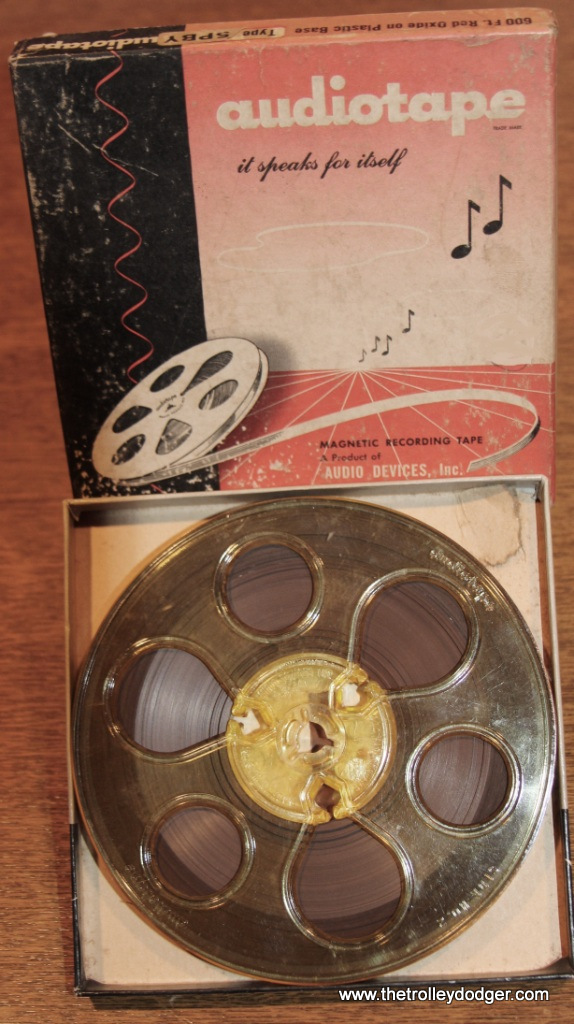
No one person has been more responsible for preserving the historic artifacts connected with William A. Steventon‘s Railroad Record Club than our good friend Kenneth Gear. A while back, Ken acquired many of the original RRC tape recordings, some of which were never issued.

I have referred before to the RRC output being the “tip of the iceberg,” so to speak, and thanks to Ken, we are beginning to see what the rest of the RRC archive consisted of. While we had already issued some “new” RRC recordings, taken from discs found in the Steventon archive, we have something even more exciting to announce today– newly uncovered audio recordings of the Chicago, North Shore and Milwaukee interurban, the fabled North Shore Line, unheard for perhaps as much as 60 years.

These recordings have been digitized from original RRC tapes that Ken purchased, and are now available for the first time on compact disc. More details about that will be found at the end of this post.

Because we feel it is important for Ken to get back at least some of the substantial investment he has made, in order to preserve these and other historic materials, we are paying Ken a royalty of $5 for each disc sold. Our humble offerings are already reasonably priced, and we don’t make much money from them. On top of that, the Trolley Dodger has, to date, operated at a loss for every year. Our original losses were in excess of $10k per year. This was reduced to $6k in 2017, and we recently did our taxes and are pleased to report that we cut the loss to just $1400 in 2018.

Our goal with this enterprise is historic preservation and education, to provide an archive where people can get, and exchange information about electric railways. In some ways it is the modern equivalent of what my friend Ray DeGroote calls the “intelligence network” of railfans, which has been around since the 1930s or even earlier, just updated for the Internet age.

It used to be that you had to know somebody to be part of this intelligence network, and information was passed from one person to another. Now, it is accessible to anyone and everyone who wants it, via the world wide web.

With that in mind, our goal has always been to break even, in order to make the Trolley Dodger a self-sustaining enterprise.

But we have to give credit where credit is due. Without Kenneth Gear’s personal sacrifices, it’s possible that these materials would have been lost forever, and would have ended up in a dumpster somewhere. You never would even have known they existed.

That’s why I hope you will help support Ken’s gallant efforts by purchasing a copy of this new CD offering.

Because we are not entirely mercenary, Ken is also sharing dozens of classic railfan photos which he purchased as part of the Railroad Record Club archive. Presumably, all or nearly all of these were taken by the late William A. Steventon (1921-1993) himself, as many reflect the areas he lived, worked, and traveled to in his career.

A few of these we already published, but most of these appear here for the first time.

As always, if you can help provide any additional information about these photos, we would love to hear from you.

Enjoy!

-David Sadowski

Altoona and Logan Valley car 74. Don’s Rail Photos: “74 was built by Osgood-Bradley Car Co in 1930.”

This photo was originally misidentified, but actually shows Indianapolis Railways Peter Witt car #132, apparently on a fantrip, probably circa 1950. The streetcar was a Master Unit (that was a Brill trade name), built circa 1932-33, making it one of the last such orders before the PCC era. Master Units were supposed to be a standardized car, but in actuality I believe no two orders were exactly the same.

This photo was originally misidentified, but actually shows Indianapolis Railways Peter Witt car #132, apparently on a fantrip, probably circa 1950. The streetcar was a Master Unit (that was a Brill trade name), built circa 1932-33, making it one of the last such orders before the PCC era. Master Units were supposed to be a standardized car, but in actuality I believe no two orders were exactly the same.

A Chicago, Aurora & Elgin train street running in Aurora in 1931. The CA&E was relocated off-street here in 1939.

A Chicago, Aurora & Elgin train street running in Aurora in 1931. The CA&E was relocated off-street here in 1939.

A Capital Transit PCC and bus at Catholic University in the Washington, DC area.

A Capital Transit PCC and bus at Catholic University in the Washington, DC area.

Denver and Rio Grande Western 476, which was featured on Railroad Record Club LP SP-1.

Denver and Rio Grande Western 476, which was featured on Railroad Record Club LP SP-1.

Denver and Rio Grande Western 481.

Denver and Rio Grande Western 481.

Des Moines and Central Iowa cars #1701 and 1704 in the scrap line, November 19, 1939.

Des Moines and Central Iowa cars #1701 and 1704 in the scrap line, November 19, 1939.

Des Moines and Central Iowa #1705 in October 1938.

Des Moines and Central Iowa #1705 in October 1938.

Des Moines and Central Iowa car 1710.

Des Moines and Central Iowa car 1710.

East Broad Top #15 on a rainy day, very likely while Railroad Record Club LP #3 was being recorded.

East Broad Top #15 on a rainy day, very likely while Railroad Record Club LP #3 was being recorded.

Evansville and Ohio Valley car #134.

Evansville and Ohio Valley car #134.

Hagerstown and Frederick #19 in Frederick, MD on May 30, 1939.

Hagerstown and Frederick #19 in Frederick, MD on May 30, 1939.

The same picture cropped.

The same picture cropped.

A Hagerstown and Frederick work car in Fredercik, MD on May 30, 1939.

A Hagerstown and Frederick work car in Fredercik, MD on May 30, 1939.

Hagerstown and Frederick 164.

Hagerstown and Frederick 164.

Illinois Terminal car 285. Don’s rail Photos: “285 was built by St Louis Car in 1914. It was rebuilt as a parlor car in 1024 and as a coach in December 1928. It was air conditioned in August 1938 and got new seating in December 1952. It was sold for scrap to Hyman Michaels Co. on May 16, 1956.”

An Illinois Terminal local on Caldwell Hill in East Peoria about 1936.

An Illinois Terminal local on Caldwell Hill in East Peoria about 1936.

A fuzzy picture of Illinois Power Company loco #1551.

A fuzzy picture of Illinois Power Company loco #1551.

A builder's photo of Illinois Terminal #207.

A builder’s photo of Illinois Terminal #207.

Illinois Terminal 1201 at Peoria. Don’s Rail Photos: “1201 was built by McGuire-Cummings in 1910 as an express motor with 20 seats at the rear. In 1919 it was rebuilt with a small baggage section at the front and the trucks were changed from Curtis to Baldwin.”

Indiana Railroad box car #550.

Indiana Railroad box car #550.

Indiana Railroad loco #752 waiting for loads at a mine scale.

Indiana Railroad loco #752 waiting for loads at a mine scale.

Indiana Railroad lightweight high-speed car #64. Howard Pletcher adds, “Indiana Railroad lightweight high-speed car #64 is at the Fort Wayne passenger terminal.”

The Indiana Railroad passenger terminal in Fort Wayne. (Howard Pletcher Collection)

The Indiana Railroad passenger terminal in Fort Wayne. (Howard Pletcher Collection)

Indiana Railroad #93 at Anderson, IN on September 4, 1938.

Indiana Railroad #93 at Anderson, IN on September 4, 1938.

Indiana Railroad box motor #722.

Indiana Railroad box motor #722.

Indiana Railroad lightweight high-speed car #80 on an Indianapolis local. It was built by Pullman in 1931 and scrapped in 1941.

Indiana Railroad lightweight high-speed car #80 on an Indianapolis local. It was built by Pullman in 1931 and scrapped in 1941.

Indiana Railroad box motor #115.

Indiana Railroad box motor #115.

Indiana Railroad car #375. Don’s Rail Photos: “375 was built by St Louis Car Co in 1926 as Indiana Service Corp 375. It was ass1gned to IRR as 375 in 1932 and rebuilt as a RPO-combine in 1935. It was sold to Chicago South Shore & South Bend in 1941 as 503 and used as a straight baggage car. It was rebuilt in 1952 with windows removed and doors changed.”

Indiana Railroad car #446.

Indiana Railroad car #446.

Indiana Railroad car #730.

Indiana Railroad car #730.

Indiana Railroad loco #792.

Indiana Railroad loco #792.

The same picture, restored.

The same picture, restored.

Indiana Railroad Vigo with rails ripped out.

Indiana Railroad Vigo with rails ripped out.

Indiana Service Corp., looking forward from car at speed on Spy Run Avenue showing car on #6 line, May 22, 1939.

Indiana Service Corp., looking forward from car at speed on Spy Run Avenue showing car on #6 line, May 22, 1939.

Indiana Service Corporation #820 at Wabash station on August 3, 1936.

Indiana Service Corporation #820 at Wabash station on August 3, 1936.

Indiana Service Corp View across the Broadway bridge, showing double truck car in distance, August 18, 1940. (But what city is this?) Mike Peters writes: “he ISC city car is in Fort Wayne, a block away from the south end of the Broadway line. The bridge carries Bluffton Road and the ISC interurban to Bluffton over the Saint Marys River. A good map of the Ft. Wayne system can be found in “Fort Wayne’s Trolleys” (George Bradley). ISC did provide service in several smaller cities, but these lines did not survive the 1930’s.”

Interstate car #711, ex-Indiana Public Service Corporation 427, on September 3, 1939.

Interstate car #711, ex-Indiana Public Service Corporation 427, on September 3, 1939.

Interstate car 711 on shop siding west of Greencastle on June 3 1939.

Interstate car 711 on shop siding west of Greencastle on June 3 1939.

Indiana Railroad lightweight car #94. Don’s Rail Photos: “90 thru 99 were built by Cummings in 1930 as Northern Indiana Ry 350 thru 359. In 1935, they were returned to Cummings, who rebuilt them and sold them to the IRR. They were retired in 1940.”

Indiana Railroad line car 763 at the Muncie station on May 19, 1940.

Indiana Railroad line car 763 at the Muncie station on May 19, 1940.

Indiana Railroad lightweight car 96.

Indiana Railroad lightweight car 96.

Indiana Railroad lightweight car #90 at New Castle, IN on July 4, 1936. Note the Woolworth's at right.

Indiana Railroad lightweight car #90 at New Castle, IN on July 4, 1936. Note the Woolworth’s at right.

Indiana Railroad lightweight car #95 at the Indianapolis terminal.

Indiana Railroad lightweight car #95 at the Indianapolis terminal.

Indiana Railroad lightweight car #99.

Indiana Railroad lightweight car #99.

Indiana Railroad #787.

Indiana Railroad #787.

Lake Erie and Northern car #795.

Lake Erie and Northern car #795.

Lake Erie and Northern car #797.

Lake Erie and Northern car #797.

Lake Erie and Northern car #939.

Lake Erie and Northern car #939.

A Lehigh Valley Transit Allentown Limited on the Liberty Bell Route, descending the ramp at Norristown (where LVT shared tracks with the Philadelphia & Western for access to Philadelphia, at least until 1949).

A Lehigh Valley Transit Allentown Limited on the Liberty Bell Route, descending the ramp at Norristown (where LVT shared tracks with the Philadelphia & Western for access to Philadelphia, at least until 1949).

Lehigh Valley Transit lightweight high-speed car 1002, presumably in Allentown PA.

Lehigh Valley Transit lightweight high-speed car 1002, presumably in Allentown PA.

Mason City and Clear Lake car #34 (photo restored).

Mason City and Clear Lake car #34 (photo restored).

Mason City and Clear Lake car #34 (unrestored photo).

Mason City and Clear Lake car #34 (unrestored photo).

Mason City and Clear Lake car #106.

Mason City and Clear Lake car #106.

Mason City and Clear Lake car #14.

Mason City and Clear Lake car #14.

Mason City and Clear Lake steeple cab #52.

Mason City and Clear Lake steeple cab #52.

Niagara St. Catharines and Toronto Railway yard.

Niagara St. Catharines and Toronto Railway yard.

A Niagara St. Catharines and Toronto Railway snow plow.

A Niagara St. Catharines and Toronto Railway snow plow.

A Niagara St. Catharines and Toronto Railway trolley.

A Niagara St. Catharines and Toronto Railway trolley.

A nice right-of-way photo with no information, other than the date-- March 31, 1936.

A nice right-of-way photo with no information, other than the date– March 31, 1936.

Jeff Wien: “TMER&T, route 13: Clybourn Downtown Milwaukee.”
.

No information.

No information.

This is a three-car train of Indiana Railroad lightweight high-speeds in multiple-unit service on a fantrip, circa 1938-40.

This is a three-car train of Indiana Railroad lightweight high-speeds in multiple-unit service on a fantrip, circa 1938-40.

No information (photo restored).

No information (photo restored).

No information (unrestored photo).

No information (unrestored photo).

Does ST F Co RR stand for Santa Fe? At any rate, this is car #54 at Farmington, MO.

Does ST F Co RR stand for Santa Fe? At any rate, this is car #54 at Farmington, MO.

Salt Lake and Utah loco #101.

Salt Lake and Utah loco #101.

Sand Springs Railway (Oklahoma) loco #1001.

Sand Springs Railway (Oklahoma) loco #1001.

Unidentified car and person. Mike Peters: “The photo of 817 and employee would also be Fort Wayne. After passenger operations ceased, this motor was retained for switching the Spy Run power plant and several nearby industries. The roster in “Fort Wayne and Wabash Valley Trolleys” (CERA #122) shows the 817 as being retired in 1952.”

Unidentified steeple cab locomotive.

Unidentified steeple cab locomotive.

Unidentified steeple cab locomotive.

Unidentified steeple cab locomotive.

Union Electric Railway loco #80.

Union Electric Railway loco #80.

Utah Idaho Central #905 in June 1945.

Utah Idaho Central #905 in June 1945.

Utah Idaho Central #905 in June 1945.

Utah Idaho Central #905 in June 1945.

Washington and Old Dominion car #44 and a Railway Express Agency truck in Rosslyn VA.

Washington and Old Dominion car #44 and a Railway Express Agency truck in Rosslyn VA.

A Washington and Old Dominion locomotive.

A Washington and Old Dominion locomotive.

A Washington and Old Dominion RPO (Railway Post Office) on a mail run outside Rosslyn VA.

A Washington and Old Dominion RPO (Railway Post Office) on a mail run outside Rosslyn VA.

The Washington and Old Dominion shops.

The Washington and Old Dominion shops.

Recent Finds

The CTA DesPlaines Avenue terminal in Forest Park in July 1955. This is an unusal view, looking west from Desplaines Avenue. At left, you can just barely see some streetcar tracks, which were used by West Towns Railways trolleys no later than 1948. That could be a CTA Route 17 bus, and you can also see some Chicago, Aurora & Elgin interurban cars in the station. The CA&E cut back service to here in 1953.

The CTA DesPlaines Avenue terminal in Forest Park in July 1955. This is an unusal view, looking west from Desplaines Avenue. At left, you can just barely see some streetcar tracks, which were used by West Towns Railways trolleys no later than 1948. That could be a CTA Route 17 bus, and you can also see some Chicago, Aurora & Elgin interurban cars in the station. The CA&E cut back service to here in 1953.

CTA 1775 at Cermak and Kostner on March 21, 1954, about two months before streetcar service ended on Route 21.

CTA 1775 at Cermak and Kostner on March 21, 1954, about two months before streetcar service ended on Route 21.

CTA 7213 on Route 49 - Western on August 2, 1949. This car would later become the last Chicago streetcar to operate.

CTA 7213 on Route 49 – Western on August 2, 1949. This car would later become the last Chicago streetcar to operate.

North Shore Line 254

North Shore Line 254 “at freight station on “L”structure near Loop – January 27, 1962.”

The North Shore Line shops interior in Milwaukee, September 24, 1961.

The North Shore Line shops interior in Milwaukee, September 24, 1961.

Chicago Surface Lines 5258 at Lowe Avenue in the 1940s (not sure of main street, perhaps 79th?).

Chicago Surface Lines 5258 at Lowe Avenue in the 1940s (not sure of main street, perhaps 79th?).

CTA 6180, a one-man car, picks up passengers at an

CTA 6180, a one-man car, picks up passengers at an “L” station in the early 1950s.

CTA 7216, a St. Louis Car Company PCC, is northbound on Route 36 – Broadway in the 1950s. Jeff Wien: “Cars laying over on 119th at Morgan.”

CTA 4362, a Pullman PCC, on Route 8 – Halsted, most likely in the late 1940s. Jeff Wien adds, “Rt. 8 car has just pulled off of Broadway onto Waveland to head south on Halsted to 79th Street loop. Photo ca 1951 when Halsted was operated with PCCs, most Pullmans.”

TRACTION AUDIO, NOW AVAILABLE ON COMPACT DISC:

CDLayout33p85

RRCNSLR
Railroad Record Club – North Shore Line Rarities 1955-1963
# of Discs – 1
Price: $15.99

Railroad Record Club – North Shore Line Rarities 1955-1963

Newly rediscovered and digitized after 60 years, most of these audio recordings of Chicago, North Shore and Milwaukee interurban trains are previously unheard, and include on-train recordings, run-bys, and switching. Includes both Electroliners, standard cars, and locomotives. Recorded between 1955 and 1963 on the Skokie Valley Route and Mundelein branch. We are donating $5 from the sale of each disc to Kenneth Gear, who saved these and many other original Railroad Record Club master tapes from oblivion.

Total time – 73:14


Tape 4 switching at Roudout + Mundeline pic 3Tape 4 switching at Roudout + Mundeline pic 2Tape 4 switching at Roudout + Mundeline pic 1Tape 3 Mundeline Run pic 2Tape 3 Mundeline Run pic 1Tape 2 Mundeline pic 3Tape 2 Mundeline pic 2Tape 2 Mundeline pic 1Tape 1 ElectrolinerTape 1 Electroliner pic 3Tape 1 Electroliner pic 2Notes from tape 4Note from tape 2

The Trolley Dodger On the Air

We appeared on WGN radio in Chicago last November, discussing our book Building Chicago’s Subways on the Dave Plier Show. You can hear our 19-minute conversation here.

Order Our New Book Building Chicago’s Subways

There were three subway anniversaries in 2018 in Chicago:
60 years since the West Side Subway opened (June 22, 1958)
75 years since the State Street Subway opened (October 17, 1943)
80 years since subway construction started (December 17, 1938)

To commemorate these anniversaries, we have written a new book, Building Chicago’s Subways.

While the elevated Chicago Loop is justly famous as a symbol of the city, the fascinating history of its subways is less well known. The City of Chicago broke ground on what would become the “Initial System of Subways” during the Great Depression and finished 20 years later. This gigantic construction project, a part of the New Deal, would overcome many obstacles while tunneling through Chicago’s soft blue clay, under congested downtown streets, and even beneath the mighty Chicago River. Chicago’s first rapid transit subway opened in 1943 after decades of wrangling over routes, financing, and logistics. It grew to encompass the State Street, Dearborn-Milwaukee, and West Side Subways, with the latter modernizing the old Garfield Park “L” into the median of Chicago’s first expressway. Take a trip underground and see how Chicago’s “I Will” spirit overcame challenges and persevered to help with the successful building of the subways that move millions. Building Chicago’s subways was national news and a matter of considerable civic pride–making it a “Second City” no more!

Bibliographic information:

Title Building Chicago’s Subways
Images of America
Author David Sadowski
Edition illustrated
Publisher Arcadia Publishing (SC), 2018
ISBN 1467129380, 9781467129381
Length 128 pages

Chapter Titles:
01. The River Tunnels
02. The Freight Tunnels
03. Make No Little Plans
04. The State Street Subway
05. The Dearborn-Milwaukee Subway
06. Displaced
07. Death of an Interurban
08. The Last Street Railway
09. Subways and Superhighways
10. Subways Since 1960

Building Chicago’s Subways is in stock and now available for immediate shipment. Order your copy today! All copies purchased through The Trolley Dodger will be signed by the author.

The price of $23.99 includes shipping within the United States.

For Shipping to US Addresses:

For Shipping to Canada:

For Shipping Elsewhere:

Redone tile at the Monroe and Dearborn CTA Blue Line subway station, showing how an original sign was incorporated into a newer design, May 25, 2018. (David Sadowski Photo)

Redone tile at the Monroe and Dearborn CTA Blue Line subway station, showing how an original sign was incorporated into a newer design, May 25, 2018. (David Sadowski Photo)

Help Support The Trolley Dodger

gh1

This is our 229th post, and we are gradually creating a body of work and an online resource for the benefit of all railfans, everywhere. To date, we have received over 507,000 page views, for which we are very grateful.

You can help us continue our original transit research by checking out the fine products in our Online Store.

As we have said before, “If you buy here, we will be here.”

We thank you for your support.

DONATIONS

In order to continue giving you the kinds of historic railroad images that you have come to expect from The Trolley Dodger, we need your help and support. It costs money to maintain this website, and to do the sort of historic research that is our specialty.

Your financial contributions help make this web site better, and are greatly appreciated.

101 Dalmatians

CSL prewar PCC 4022 heads west on Madison Street in the late 1940s. It is signed for the Madison-Fifth branch line. Fifth Avenue is an angle street that heads southwest. Service on the branch line terminated at the Garfield Park

CSL prewar PCC 4022 heads west on Madison Street in the late 1940s. It is signed for the Madison-Fifth branch line. Fifth Avenue is an angle street that heads southwest. Service on the branch line terminated at the Garfield Park “L” station at Pulaski Road. Several parts of Fifth Avenue have been truncated since streetcars stopped running there in early 1954. (Edward Frank, Jr. Photo)

It has been nearly two months since our last post, but we are back with a bevy of classic traction photos for your consideration.

Things have been quite busy of late, as we worked as an election judge for two recent elections (three in the last six months). Although you have not seen a new post for a while, work behind the scenes continued. We scanned hundreds of images, and many needed extra help in Photoshop.

When you see as post such as this, it is like the tip of an iceberg. For every image we share, there are others that, for whatever reason, do not make the grade, as well as others that are being stored up in an inventory of images, waiting for their moment in the sun.

Leopards, they say, never change their spots… but I assume you can identify certain breeds of dogs, such as Dalmatians, by the location of their spots. Spots factor into our images in any number of ways. Our readers often help us determine just which spot a picture was taken at. And we often have to do spot removal, a tedious practice, on old images.

Brian Wilson has his Pet Sounds, and we have our own pet images. Today’s batch are particular favorites, but each one is a different animal– a horse of a different color, you could say. You should have seen some of these pictures before we got hold of them and gave them triage. On second thought, just stick to the finished product you see here.

There are many, many hours of work that go into each post, and money too. When you see an image here, figure that it cost at least $10 on average to obtain it. We are fortunate that some of our readers have shared images from their extensive collections with us.

In particular, today’s post benefited tremendously from the generosity of both William Shapotkin and Jeffrey L. Wien, both of whom recently celebrated birthdays.

So, we are calling this post 101 Dalmatians, as we have at least that many new pictures here, and after working on them for so long, we are starting to see spots everywhere we look. We hope you will appreciate our modest efforts, and we will be back soon with more posts.

-David Sadowski

Our best wishes also go out to Ray DeGroote, the dean of Chicago railfans at age 88, who was recently injured in a fall. We wish him a speedy recovery. If anyone can do it at that age, Ray can.

Recent Finds

A bird's-eye view of the Wells Street Terminal used by the Chicago, Aurora and Elgin interurban on September 19, 1953. The following day, CA&E stopped running trains downtown, and their track connection with the CTA was severed forever in suburban Forest Park. There is a similar image, taken in 1960, showing the same terminal, or what was left after the CTA built a new track connection to the Loop elevated through it in 1955. You can find that in my book Building Chicago's Subways.

A bird’s-eye view of the Wells Street Terminal used by the Chicago, Aurora and Elgin interurban on September 19, 1953. The following day, CA&E stopped running trains downtown, and their track connection with the CTA was severed forever in suburban Forest Park. There is a similar image, taken in 1960, showing the same terminal, or what was left after the CTA built a new track connection to the Loop elevated through it in 1955. You can find that in my book Building Chicago’s Subways.

On July 27, 1962, a CTA Douglas Park “B” train pulls away from us at the Racine stop on the Congress rapid transit line., then only four years old. The train will go downtown through the Dearborn Subway, and then out to Logan Square via the Milwaukee Avenue tube.

On May 28, 1978, photographer William D. Lloyd caught this picture of CTA Historic cars 4271-4272 on the north side “L”. Now nearing the century mark, they are still on the property today. Here, they were only about five years out of regular service.

On January 26, 1964, approximately one year after the North Shore Line quit, the two Electroliners were rechristened as Liberty Liners on the Red Arrow's 13-mile line between Philadelphia and Norristown. In the distance, we see a pair of early 1930s Bullet cars, which had a storied history of their own.

On January 26, 1964, approximately one year after the North Shore Line quit, the two Electroliners were rechristened as Liberty Liners on the Red Arrow’s 13-mile line between Philadelphia and Norristown. In the distance, we see a pair of early 1930s Bullet cars, which had a storied history of their own.

MBTA (Boston) ex-Dallas double-end PCC 3336 at Mattapan yards on December 5, 1976. (Ed McKernan Photo)

MBTA (Boston) ex-Dallas double-end PCC 3336 at Mattapan yards on December 5, 1976. (Ed McKernan Photo)

picture255

Two CRT Met cars at the Laramie Shops in 1947. (John Gibb Smith, Jr. Photo)

In the last couple years of red car service in Chicago, which ended in 1954, the CTA painted a few of the older streetcars green. It was not an attractive color for them. Here, we see inbound car 6172 jogging from one side of Lake Street to another via Pine Avenue. To this day, tracks are still visible under the viaduct. At this point, streetcars crossed the Lake Street

In the last couple years of red car service in Chicago, which ended in 1954, the CTA painted a few of the older streetcars green. It was not an attractive color for them. Here, we see inbound car 6172 jogging from one side of Lake Street to another via Pine Avenue. To this day, tracks are still visible under the viaduct. At this point, streetcars crossed the Lake Street “L”, which ran on the ground here until 1962.

CSL 1466 was used as a training car for the three river tunnels. (Edward Frank, Jr. Photo)

CSL 1466 was used as a training car for the three river tunnels. (Edward Frank, Jr. Photo)

CSL 173X (full number not visible) is heading west on Madison Street in the 1930s. The Civic Opera House, built by Samuel Insull in 1929, is visible at rear. (Edward Frank, Jr. Photo)

CSL 173X (full number not visible) is heading west on Madison Street in the 1930s. The Civic Opera House, built by Samuel Insull in 1929, is visible at rear. (Edward Frank, Jr. Photo)

A maintenance of way car along the overhead section of the North Side “L”, exact date and location unknown. Jeff Wien adds that this is: “Wilson Avenue, freight connection to Buena Yards, probably in the early 50s.”

Laurel Line car 31 is at the Plains substation on August 3, 1952. Edward Skuchas writes: “I believe the locations of the two Laurel Line photos are incorrect. The top photo is Pittston. The lower photo may be the Plains sub-station. West Pittston is on the other side of the Susquehanna River, and the Laurel Line did not go there.”

Laurel Line car 39 is at the Plains sub-station on December 28, 1952, shortly before abandonment.

Laurel Line car 39 is at the Plains sub-station on December 28, 1952, shortly before abandonment.

The interior of Lehigh Valley Transit car 1007, showing its leather bucket seats, which were popular when this car was built for the Cincinnati and Lake Erie in the early 1930s.

The interior of Lehigh Valley Transit car 1007, showing its leather bucket seats, which were popular when this car was built for the Cincinnati and Lake Erie in the early 1930s.

Conductors on a Humboldt Park

Conductors on a Humboldt Park “L” train, circa 1907-15.

A Loop-bound Metropolitan

A Loop-bound Metropolitan “L” train, circa 1907-15.

The Chicago Surface Lines used trailers during the 1920s, as a way of dealing with increasing crowds of riders. But with the advent of the Great Depression, ridership fell sharply, and the trailers were no longer needed. Some thought was given to reviving them during World War II, but this did not happen. Here, 1756 pulls 8049. Don's Rail Photos notes,

The Chicago Surface Lines used trailers during the 1920s, as a way of dealing with increasing crowds of riders. But with the advent of the Great Depression, ridership fell sharply, and the trailers were no longer needed. Some thought was given to reviving them during World War II, but this did not happen. Here, 1756 pulls 8049. Don’s Rail Photos notes, “8056 was built by Brill in 1921, #21272. It became a shed at 77th and scrapped on July 17, 1957.” 1756 was a “169” or Broadway-State car. Again, Don Ross: “1756 was built by CSL in 1923. It was rebuilt as one-man in 1949.”

CTA prewar PCC 7028 on private right-of-way at the south end of Route 4 - Cottage Grove, in June 1953.

CTA prewar PCC 7028 on private right-of-way at the south end of Route 4 – Cottage Grove, in June 1953.

CTA Sedan (aka Peter Witt) 3848 on priate right-of-way at the south end of Route 4 - Cottage Grove in June 1952. Here, the line ran parallel to the Illinois Central Electric suburban service, now the Metra Electric.

CTA Sedan (aka Peter Witt) 3848 on priate right-of-way at the south end of Route 4 – Cottage Grove in June 1952. Here, the line ran parallel to the Illinois Central Electric suburban service, now the Metra Electric.

After the Chicago Transit Authority retired the last of the wooden

After the Chicago Transit Authority retired the last of the wooden “L” cars in 1957, some were used for a few more years in work service. Here, a Met car has been renumbered as S-308 at Skokie Shops.

CTA single cat unit 23 is outbound on the Skokie Swift at Niles Center Road on August 20, 1970.

CTA single cat unit 23 is outbound on the Skokie Swift at Niles Center Road on August 20, 1970.

CTA single car unit 26 on the open-cut section of the Skokie Swift in August 1978.

CTA single car unit 26 on the open-cut section of the Skokie Swift in August 1978.

CTA postwar PCC 4337, built by Pullman, heads south on State Street in the early 1950s.

CTA postwar PCC 4337, built by Pullman, heads south on State Street in the early 1950s.

An outbound CTA Douglas Park train ascends the ramp that will take from the Congress (now Eisenhower) Expressway to the old

An outbound CTA Douglas Park train ascends the ramp that will take from the Congress (now Eisenhower) Expressway to the old “L” structure in the mid-1960s. This ramp is not used much now, as Douglas trains, now renamed the Pink Line, have been rerouted to the Lake Street “L” via the Paulina Connector. (Mark D. Meyer Photo)

I ought this Red Border Kodachrome slide, which dates to the early 1950s, thinking perhaps it might e the old Park Theater on Chicago’s west side (on Lake near Austin). But after studying the image for a while, I am inclined to think it’s somewhere else. While the facade looks similar to the actual Park Theater, it is not identical. There should be streetcar tracks visible– the movie theater closed in 1952, about two years before the streetcar quit. And the theater on Lake Street at Austin Boulevard did not have a streetlight such as the one seen at right. There was a light attached to a line pole that held the trolley wire– a line pole not visible in this picture. That, plus the rounded nature of the signage, which I have never seen in any other pictures of the Park, tell me that this is not it. But we have in the past posted several pictures of streetcars near the actual theater. If you type “park theater” or “lake austin” in the search window on our page, these various pictures will come up.

CSL 1039 at Wabash and Lake in June 1947. Signed for the Indiana-Lincoln through route #3, it is southbound, and headed to Indiana and 51st.

CSL 1039 at Wabash and Lake in June 1947. Signed for the Indiana-Lincoln through route #3, it is southbound, and headed to Indiana and 51st.

CSL 6284 on Wabash at Roosevelt Road on June 13, 1947. Although the car is full of people, for some reason the side sign says Not In Service.

CSL 6284 on Wabash at Roosevelt Road on June 13, 1947. Although the car is full of people, for some reason the side sign says Not In Service.

A two-car CTA train of 4000s at right, in Evanston shuttle service, heads southbound approaching Howard in the 1950s.

A two-car CTA train of 4000s at right, in Evanston shuttle service, heads southbound approaching Howard in the 1950s.

TMER&T 1121, on a December 4, 1949 fantrip on the North Shore Line.

TMER&T 1121, on a December 4, 1949 fantrip on the North Shore Line.

CTA historic cars 4271-4272 at McCormick Boulevard (Yellow Line aka Skokie Swift) on July 16, 1989. (Bruce C. Nelson Photo)

CTA historic cars 4271-4272 at McCormick Boulevard (Yellow Line aka Skokie Swift) on July 16, 1989. (Bruce C. Nelson Photo)

The CTA has a yard for the Green Line (formerly the Lake Street

The CTA has a yard for the Green Line (formerly the Lake Street “L”) just west of the Harlem Avenue terminal in suburban Forest Park. Here, various cars in the 2000-series are seen, along with a Metra commuter train on the adjacent Union Pacific West Line. This picture was most likely taken during the 1990s. (Bruce C. Nelson Photo)

CTA gate car 2318 is parked along the outer portion of the Douglas Park line in February 1950.

CTA gate car 2318 is parked along the outer portion of the Douglas Park line in February 1950.

Chicago Rapid Transit Company gate car 305 is seen on the Loop

Chicago Rapid Transit Company gate car 305 is seen on the Loop “L” in the 1940s, signed as a Wilson Avenue Local.

The presence of double track would seem to indicate that this picture of a South Shore Line train was taken in East Chicago, Indiana in the 1950s. The street running through the middle of town was replaced by a new section running parallel to the Indiana Toll Road in 1956.

The presence of double track would seem to indicate that this picture of a South Shore Line train was taken in East Chicago, Indiana in the 1950s. The street running through the middle of town was replaced by a new section running parallel to the Indiana Toll Road in 1956.

CTA Holiday Trains have become an annual tradition. Photographer Bruce C. Nelson captured this one on December 2, 2017.

CTA Holiday Trains have become an annual tradition. Photographer Bruce C. Nelson captured this one on December 2, 2017.

Chicago Surface Lines red Pullman 426 is most likely running on Route 65 - Grand, as it is signed to go to Grand and Armitage. Chances are, this photo was taken circa 1939-40, and shows temporary trackage for construction of Chicago's first subways.

Chicago Surface Lines red Pullman 426 is most likely running on Route 65 – Grand, as it is signed to go to Grand and Armitage. Chances are, this photo was taken circa 1939-40, and shows temporary trackage for construction of Chicago’s first subways.

October 27, 1962 was the last day of ground-level operation on the CTA Lake Street

October 27, 1962 was the last day of ground-level operation on the CTA Lake Street “L”. The following day, service was relocated to the adjacent Chicago & North Western embankment. Here, we see a pair of 4000s heading west on South Boulevard at Kenilworth.

After serving Chicago for many years, some of the original CTA

After serving Chicago for many years, some of the original CTA “flat door” 6000s had a second life on Philadelphia’s Norristown High-Speed Line. 6089-6090 are approaching Radnor on April 10, 1987.

Here is a view of the old Tower 18 on Chicago's Loop

Here is a view of the old Tower 18 on Chicago’s Loop “L”, when this was the world’s busiest railroad crossing. The old Loop ran both tracks in only one direction, but this changed in 1969, when the CTA wanted to connect the Lake Street “L” with the new Dan Ryan line. Therefore, the old tower had to go, as it was situated right where the new tracks had to go.

Both CTA and CA&E trains are visible in this July 8, 1953 photo taken at Laramie on the Garfield Park

Both CTA and CA&E trains are visible in this July 8, 1953 photo taken at Laramie on the Garfield Park “L”. Just a little over two months later, the CA&E interurban cut back service to Forest Park, a few miles west of here (and behind the photographer).

The Milwaukee Rapid Transit & Speedrail Company's car 60, seen here in 1950, was a Cincinnati curved-side car. The ill-fated attempt to keep electric transit service going in Milwaukee was doomed to failure, once a horrific head-on collision took the lives of several people.

The Milwaukee Rapid Transit & Speedrail Company’s car 60, seen here in 1950, was a Cincinnati curved-side car. The ill-fated attempt to keep electric transit service going in Milwaukee was doomed to failure, once a horrific head-on collision took the lives of several people.

CA&E 425 is passing over Union Station in this undated photo. Trains going more or less straight would end up at the Wells Street Terminal, while the tracks in the background leading off to the right connected to the Loop

CA&E 425 is passing over Union Station in this undated photo. Trains going more or less straight would end up at the Wells Street Terminal, while the tracks in the background leading off to the right connected to the Loop “L” Van Buren. When Lower Wacker Drive was being built, this necessitated tearing down this second connection to thee Loop, and building a new one through the second floor of Wells Terminal. The switchover between the two took place in 1955.

Riders at the old Laramie stop on the CTA's Garfield Park

Riders at the old Laramie stop on the CTA’s Garfield Park “L” in 1947. Met cars are seen in storage in the background. (John Gibb Smith, Jr. Photo)

A CRT gate car, running in service on the old Garfield Park

A CRT gate car, running in service on the old Garfield Park “L” in 1947. This is the Laramie stop. (Charles R. Griffin Photo)

This CTA brochure, dated July 1949, explains the changes that were coming from the CTA's plan to revise north-south

This CTA brochure, dated July 1949, explains the changes that were coming from the CTA’s plan to revise north-south “L” and subway service. This included A/B “skip stop” service and making the Evanston branch a shuttle.

new935new936new937

From the Wien-Criss Archive:

One of the two North Shore Line Electroliners on Chicago's South Side

One of the two North Shore Line Electroliners on Chicago’s South Side “L” on February 17, 1962. (Wien-Criss Archive)

A North Shore Line Electroliner barrels through, having just crossed under the EJ&E, on January 12, 1963, a little over a week before the end of service. (Wien-Criss Archive)

A North Shore Line Electroliner barrels through, having just crossed under the EJ&E, on January 12, 1963, a little over a week before the end of service. (Wien-Criss Archive)

A North Shore Line Electroliner on June 1, 1962. (Wien-Criss Archive)

A North Shore Line Electroliner on June 1, 1962. (Wien-Criss Archive)

A North Shore Line Electroliner at Edison Court on February 17, 1962. (Wien-Criss Archive)

A North Shore Line Electroliner at Edison Court on February 17, 1962. (Wien-Criss Archive)

Chicago Surface Lines experimental pre-PCC car 7001 at 77th and Vincennes in October 1956. It is a shame that this historic car, which ran in Chicago from 1934 to 1944, was not saved. (Wien-Criss Archive)

Chicago Surface Lines experimental pre-PCC car 7001 at 77th and Vincennes in October 1956. It is a shame that this historic car, which ran in Chicago from 1934 to 1944, was not saved. (Wien-Criss Archive)

A Milwaukee streetcar, presumably on Route 10, in the 1950s. (Wien-Criss Archive)

A Milwaukee streetcar, presumably on Route 10, in the 1950s. (Wien-Criss Archive)

Interior shots were not easy for photographers on September 4, 1962, when Robert F. Collins took this picture of the North Shore Line's Milwaukee terminal. (Wien-Criss Archive)

Interior shots were not easy for photographers on September 4, 1962, when Robert F. Collins took this picture of the North Shore Line’s Milwaukee terminal. (Wien-Criss Archive)

Don's Rail Photos:

Don’s Rail Photos: “E223, sweeper, was built by McGuire-Cummings in 1908 as CCRys E23. It was renumbered E223 in 1913 and became CSL E223 in 1914. It was sold to Illinois Railway Museum on August 29, 1958.” (Wien-Criss Archive)

On March 17, 1957 the late James J. Buckley caught this terrific 3/4 view of a Chicago, Aurora & Elgin freight train at Lakewood. (Wien-Criss Archive)

On March 17, 1957 the late James J. Buckley caught this terrific 3/4 view of a Chicago, Aurora & Elgin freight train at Lakewood. (Wien-Criss Archive)

It's June 1963, several months after the CTA elevated the Lake Street

It’s June 1963, several months after the CTA elevated the Lake Street “L” onto the Chicago & North Western embankment. A four-car train made up of “circus wagons,” the fan’s name for experimental high-speed cars, is making a rare appearance at Harlem Avenue, the end of the line. This view looks east. (Wien-Criss Archive)

CTA postwar PCC 7237 is running southbound on Clark Street in the late 1950s. (Wien-Criss Archive)

CTA postwar PCC 7237 is running southbound on Clark Street in the late 1950s. (Wien-Criss Archive)

CTA postwar PCC 7196 is at 81st and Halsted, the southern end of Route 22 - Clark-Wentworth. (Wien-Criss Archive)

CTA postwar PCC 7196 is at 81st and Halsted, the southern end of Route 22 – Clark-Wentworth. (Wien-Criss Archive)

CTA 7195 is southbound on Clark at Washington. (Heier Industrial Photo, Wien-Criss Archive)

CTA 7195 is southbound on Clark at Washington. (Heier Industrial Photo, Wien-Criss Archive)

CTA red Pullman 144, which is now at the Illinois Railway Museum. (Wien-Criss Archive)

CTA red Pullman 144, which is now at the Illinois Railway Museum. (Wien-Criss Archive)

CTA red Pullman 144, which is now at the Illinois Railway Museum. (Wien-Criss Archive)

CTA red Pullman 144, which is now at the Illinois Railway Museum. (Wien-Criss Archive)

CTA PCC 7187 on Clark Street on September 6, 1957, the last day of street railway service on Chicago's north side. (Charles H. Thorpe Photo, Wien-Criss Archive)

CTA PCC 7187 on Clark Street on September 6, 1957, the last day of street railway service on Chicago’s north side. (Charles H. Thorpe Photo, Wien-Criss Archive)

On September 6, 1957, CTA 4372 pulls into the turnaround loop at Clark and Howard. (Charles H. Thorpe Photo, Wien-Criss Archive)

On September 6, 1957, CTA 4372 pulls into the turnaround loop at Clark and Howard. (Charles H. Thorpe Photo, Wien-Criss Archive)

CTA 7189 is southbound at Clark and Ohio on September 6, 1957. (Charles H. Thorpe Photo, Wien-Criss Archive) Daniel Joseph notes, "The Hotel Wacker was at Clark and Huron."

CTA 7189 is southbound at Clark and Ohio on September 6, 1957. (Charles H. Thorpe Photo, Wien-Criss Archive) Daniel Joseph notes, “The Hotel Wacker was at Clark and Huron.”

On September 6, 1957, Charles H. Thorpe took this picture of CTA 7139, the last pull-out from Devon Station (car barn). (Wien-Criss Archive)

On September 6, 1957, Charles H. Thorpe took this picture of CTA 7139, the last pull-out from Devon Station (car barn). (Wien-Criss Archive)

CTA 4379 is on north Clark Street on September 6, 1957. (Charles H. Thorpe Photo, Wien-Criss Archive) Daniel Joseph adds, "This streetcar is traveling southbound to 81st & Halsted (as the destination sign states) somewhere near Clark and Glenlake." (This is, however, on the northern portion of Clark Street as we stated.)

CTA 4379 is on north Clark Street on September 6, 1957. (Charles H. Thorpe Photo, Wien-Criss Archive) Daniel Joseph adds, “This streetcar is traveling southbound to 81st & Halsted (as the destination sign states) somewhere near Clark and Glenlake.” (This is, however, on the northern portion of Clark Street as we stated.)

CTA 7195 is on Halsted Street, near the south end of Route 22 - Clark-Wentworth. (Heier Industrial Photo, Wien-Criss Archive)

CTA 7195 is on Halsted Street, near the south end of Route 22 – Clark-Wentworth. (Heier Industrial Photo, Wien-Criss Archive)

CTA Sedan (aka Peter Witt) 3360 is running Route 4 - Cottage Grove, circa 1951-52. (Wien-Criss Archive)

CTA Sedan (aka Peter Witt) 3360 is running Route 4 – Cottage Grove, circa 1951-52. (Wien-Criss Archive)

CTA 7154 is near Limits Station (car barn), near 2700 N. Clark Street, on September 6, 1957. (Charles H. Thorpe Photo, Wien-Criss Archive)

CTA 7154 is near Limits Station (car barn), near 2700 N. Clark Street, on September 6, 1957. (Charles H. Thorpe Photo, Wien-Criss Archive)

CTA steeple cab S-343, a

CTA steeple cab S-343, a “yard shifter,” serving the rapid transit system, is at 64th and Prairie. Don’s Rail Photos notes, “S-343 was built by Chicago City Ry in 1909 as Chicago City Ry C50. It was renumbered L202 in 1913 and became CSL L202 in 1914. It was rebuilt as S-343 in 1959 and acquired by Railway Equipment Leasing & Investment Co in 1979. It was acquired by Fox River Trolley Museum in 1983 and restored as L202.” (Wien-Criss Archive)

Chicago Surface Lines crane car X-4 at the Illinois Railway Museum. Don's Rail Photos says,

Chicago Surface Lines crane car X-4 at the Illinois Railway Museum. Don’s Rail Photos says,”X4, derrick, was built by McGuire-Cummings in 1910 as CRys 2. It was renumbered N2 in 1913 and became CSL N2 in 1914. It was rebuilt as X4 in 1947 and rebuilt as S344 in 1958. It was sold to Electric Railway Historical Society in 1963 and donated to Illinois Railway Museum in 1973.” (Wien-Criss Archive)

CTA postwar PCC 7220, a product of the St. Louis Car Company, on Route 22. (Wien-Criss Archive)

CTA postwar PCC 7220, a product of the St. Louis Car Company, on Route 22. (Wien-Criss Archive)

From the William Shapotkin Collection:

CSL 5301 is at Lake and Ashland, running on Route 9, in April 1937. Streetcars were not permitted on boulevards, and the section of Ashland between Lake and Roosevelt was just such a boulevard. Therefore, in that stretch, Ashland streetcars jogged over the nearby Paulina. (William Shapotkin Collection)

CSL 5301 is at Lake and Ashland, running on Route 9, in April 1937. Streetcars were not permitted on boulevards, and the section of Ashland between Lake and Roosevelt was just such a boulevard. Therefore, in that stretch, Ashland streetcars jogged over the nearby Paulina. (William Shapotkin Collection)

This picture was taken on a Central Electric Railfans' Association fantrip on the Illinois Central Electric on April 24, 1966. (William Shapotkin Collection)

This picture was taken on a Central Electric Railfans’ Association fantrip on the Illinois Central Electric on April 24, 1966. (William Shapotkin Collection)

The slide mount for this had the word

The slide mount for this had the word “junk” written on it, but I don’t agree. This is also from that same April 24, 1966 fantrip. (William Shapotkin Collection)

picture056

A photo stop at Washington Park race track on the April 24, 1966 CERA fantrip on the IC. (William Shapotkin Collection)

Illinois Central Electric 1427 and 1186 on the Washington Park Branch on the April 24, 1966 CERA fantrip. Note that the motor unit in this pair faces north. (William Shapotkin Collection)

Illinois Central Electric 1427 and 1186 on the Washington Park Branch on the April 24, 1966 CERA fantrip. Note that the motor unit in this pair faces north. (William Shapotkin Collection)

The Illinois Central Electric at Blue Island in June 1978. (William Shapotkin Collection)

The Illinois Central Electric at Blue Island in June 1978. (William Shapotkin Collection)

This slide mount has George Strombeck written on it, but I am not sure whether that is the name of the photographer, or the man in the picture. Either way, this shows a Milwaukee Road commuter train in Downtown Chicago on April 21, 1973. (William Shapotkin Collection)

This slide mount has George Strombeck written on it, but I am not sure whether that is the name of the photographer, or the man in the picture. Either way, this shows a Milwaukee Road commuter train in Downtown Chicago on April 21, 1973. (William Shapotkin Collection)

The GM&O

The GM&O “Abe Lincoln” at 18th Street in Chicago on April 22, 1966. (William Shapotkin Collection)

Ryan Tower

Photos of Ryan Tower, where the North Shore Line crossed the Chicago & North Western, are scarce, as this was a somewhat remote location for fans. But thanks to the good offices of Bill Shapotkin, here are several such views, along with his usual contemporary photos showing what the area looks like today.

Milwaukee County, WI - A pair of CNS&M cars (the

Milwaukee County, WI – A pair of CNS&M cars (the “Silverliner” at left is on a fantrip) pass one another at Ryan Tower – crossing with the C&NW “New Line.” Note that the once-double-tracked C&NW is now ut a single-track line through here (the one-time westbound main has been removed). The view looks north. (William Shapotkin Collection)

Ryan Tower, WI - TM interurban #1121, in fantrip service, heads southbound on the CNS&M as it crosses over the C&NW

Ryan Tower, WI – TM interurban #1121, in fantrip service, heads southbound on the CNS&M as it crosses over the C&NW “New Line” at Ryan Tower on December 4, 1949. The view looks north. (William Shapotkin Collection)

Milwaukee County, WI - A southbound CNS&M

Milwaukee County, WI – A southbound CNS&M “Silverliner” (in fantrip service) is about to cross over the (now single-track) C&NW “New Line” at Ryan Tower. View looks north. (William Shapotkin Collection)

On the stretch between Milwaukee limits and Racine station, a North Shore train crosses North Western freight route at Ryan Road. (A. C. Kalmbach Photo, William Shapotkin Collection)

On the stretch between Milwaukee limits and Racine station, a North Shore train crosses North Western freight route at Ryan Road. (A. C. Kalmbach Photo, William Shapotkin Collection)

Milwaukee County, WI - In 1958, a southbound CNS&M passenger train approaches the crossing with C&NW

Milwaukee County, WI – In 1958, a southbound CNS&M passenger train approaches the crossing with C&NW “New Line” at Ryan Road (that’s Ryan Tower at left). The view looks north. (William Shapotkin Collection)

Near the Milwaukee County line, a North Shore car crosses the C&NW freight line at an acute angle. (A. C. Kalmbach Photo, William Shapotkin Collection)

Near the Milwaukee County line, a North Shore car crosses the C&NW freight line at an acute angle. (A. C. Kalmbach Photo, William Shapotkin Collection)

Milwaukee County, WI - Looking N/NW (timetable NB) on long-abandoned right-of-way of CNS&M from

Milwaukee County, WI – Looking N/NW (timetable NB) on long-abandoned right-of-way of CNS&M from “Old Ryan Road,” (formerly Ryan Road). The CNS&M once crossed the C&NW (now UP) “New Line” – visible at right at “Ryan Tower,” located behind the photographer on the south side of the road. Photo by William Shapotkin on September 20, 2003.

(William Shapotkin Photo)

(William Shapotkin Photo)

Milwaukee, WI - Looking SB on UP (ex-C&NW)

Milwaukee, WI – Looking SB on UP (ex-C&NW) “New Line” from “Old Ryan Road” (new Ryan Road is visible overhead in the distance). This once double-tracked line once crossed the long-abandoned CNS&M at “Ryan Tower,” located south of the Roadway. Photo by William Shapotkin on September 6, 2003.

C&WT 104 at the end of the line in LaGrange. (William Shapotkin Collection)

C&WT 104 at the end of the line in LaGrange. (William Shapotkin Collection)

C&WT 164 on Lake Street. (William Shapotkin Collection)

C&WT 164 on Lake Street. (William Shapotkin Collection)

C&WT 145 is westbound on Lake Street at Harlem Avenue. To the left is the Marshall Field & Company store, a local landmark. (William Shapotkin Collection)

C&WT 145 is westbound on Lake Street at Harlem Avenue. To the left is the Marshall Field & Company store, a local landmark. (William Shapotkin Collection)

This picture is not very sharp, but it does show a C&WT streetcar stopped at the south parking lot of Brookfield Zoo, sometime in the 1940s. (William Shapotkin Collection)

This picture is not very sharp, but it does show a C&WT streetcar stopped at the south parking lot of Brookfield Zoo, sometime in the 1940s. (William Shapotkin Collection)

C&WT 133 has changed ends at Madison and Austin, and is ready to head west. Across the street from Oak Park into Chicago, riders could change to a Chicago Surface Lines PCC for a fast ride into the city. (William Shapotkin Collection)

C&WT 133 has changed ends at Madison and Austin, and is ready to head west. Across the street from Oak Park into Chicago, riders could change to a Chicago Surface Lines PCC for a fast ride into the city. (William Shapotkin Collection)

This shows westbound C&WT car 108, signed Berwyn-Lyons, on Stanley having just passed Oak Park Avenue circa 1941. At right is the Berwyn stop on the Chicago Burlington & Quincy. Today, Pace bus route 302 runs here, and commuter train service is under the auspices of Metra. (William Shapotkin Collection)

This shows westbound C&WT car 108, signed Berwyn-Lyons, on Stanley having just passed Oak Park Avenue circa 1941. At right is the Berwyn stop on the Chicago Burlington & Quincy. Today, Pace bus route 302 runs here, and commuter train service is under the auspices of Metra. (William Shapotkin Collection)

I am not sure of where this C&WT photo was taken. (William Shapotkin Collection) Patrick Cunningham: “The unidentified C&WT photo looks like it was taken just east of the Stone Ave. station on the CB&Q in LaGrange. The view is east. If you look at the prior photo of the end of the C&WT in LaGrange (which was at Brainard Ave.), you’ll note that the line was single track. This appears to be a passing siding or layover point.” On the other hand. Michael Murray writes, “I believe the 7th C&WT picture is looking east at Harlem and Stanley Aves. Page 128 of the Buckley book shows the signal on the pole, the track alignment, the CBQ shelter, and the CBQ signal in a photo near where yours was taken. I originally thought the same about the C&WT picture, but it’s Berwyn, not La Grange. The Buckley book confirms the location. ” Charles R. Vlk: “The “I am not sure of where this C&WT photo was taken. (William Shapotkin Collection)” photo is looking East on Stanley Avenue where the single track line crossing the Burlington at Harlem Avenue goes to double track. Harlem Avenue is behind the camera to the West.”

C&WT 112 is eastbound at Stanley and Oak Park Avenue. The CB&Q Berwyn stop is at left. (William Shapotkin Collection)

C&WT 112 is eastbound at Stanley and Oak Park Avenue. The CB&Q Berwyn stop is at left. (William Shapotkin Collection)

We have seen this picture of C&WT 141 before (it is also in my book Chicago Trolleys), but why pass up another chance to see it again? This is the bridge where the LaGrange line crossed the DesPlaines River, and I believe we are looking the the southeast. (William Shapotkin Collection)

We have seen this picture of C&WT 141 before (it is also in my book Chicago Trolleys), but why pass up another chance to see it again? This is the bridge where the LaGrange line crossed the DesPlaines River, and I believe we are looking the the southeast. (William Shapotkin Collection)

I assume these are the C&WT tracks in LaGrange. (William Shapotkin Collection) Michael Murray: “I’m skeptical that photo 10 is on the La Grange line. There wasn’t any single track on the line similar to the one in the photo. My guess is perhaps the Berwyn-Lyons line? Ogden Ave. on the right, and this is the easternmost passing track, which, according to the Buckley book, was west of Harlem. Note that the line poles are only briefly wide of the main “march” of poles into the distance.”

A C&WT streetcar in LaGrange. (William Shapotkin Collection) Michael Murray: “Photo 11, which you have captioned as “A C&WT streetcar in LaGrange” is found on page 129 of the Buckley book, and is captioned: “Between Harlem Ave and the Des Plaines River, the Berwyn-Lyons streetcar line was built on private right-of-way on the south side of Ogden Ave. It was abandoned October 26, 1933 because the land was wanted to widen Ogden Ave. The railway here was single track with two passing sidings. Car 133 was photographed on the passing siding near the Des Plaines River in October 1933, a few days before abandonment.”

C&WT 111. (William Shapotkin Collection)

C&WT 111. (William Shapotkin Collection)

C&WT 105 on Cermak Road. (William Shapotkin Collection)

C&WT 105 on Cermak Road. (William Shapotkin Collection)

An unidentified C&WT car, probably in the 1930s. (William Shapotkin Collection)

An unidentified C&WT car, probably in the 1930s. (William Shapotkin Collection)

C&WT 107. (William Shapotkin Collection)

C&WT 107. (William Shapotkin Collection)

C&WT 165 is at Lake and Austin, the east end of the line, in suburban Oak Park. (William Shapotkin Collection)

C&WT 165 is at Lake and Austin, the east end of the line, in suburban Oak Park. (William Shapotkin Collection)

C&WT 158 in LaGrange. Not sure why this section of track is blocked off, except that perhaps it is due to the tracks being unstable, due to the nearby excavation going on. (William Shapotkin Collection) Patrick Cunningham adds, “C&WT 158 is just east of LaGrange Road. In the background, you can just make out the Jackson Moving and Storage sign on the building with the towers. The building is there, the towers are gone. Probably about here: https://www.google.com/maps/@41.8166104,-87.8687401,3a,75y,70.46h,80.48t/data=!3m6!1e1!3m4!1st0yuoCYe7FXm6EGEmBkuQA!2e0!7i16384!8i8192!5m1!1e1

From a high vantage point, here we see C&WT 112 has just turned from Ridgeland onto Stanley in suburban Berwyn, and is heading west, just north of the CB&Q, which it will cross at Harlem Avenue one mile west of here. (William Shapotkin Collection)

From a high vantage point, here we see C&WT 112 has just turned from Ridgeland onto Stanley in suburban Berwyn, and is heading west, just north of the CB&Q, which it will cross at Harlem Avenue one mile west of here. (William Shapotkin Collection)

C&WT 132 on Cermak Road in the late 1930s. (William Shapotkin Collection)

C&WT 132 on Cermak Road in the late 1930s. (William Shapotkin Collection)

C&WT 105 at the Harlem and Cermak car barn. (William Shapotkin Photo)

C&WT 105 at the Harlem and Cermak car barn. (William Shapotkin Photo)

C&WT 111 on Cermak Road. (William Shapotkin Photo)

C&WT 111 on Cermak Road. (William Shapotkin Photo)

The Trolley Dodger On the Air

We appeared on WGN radio in Chicago last November, discussing our book Building Chicago’s Subways on the Dave Plier Show. You can hear our 19-minute conversation here.

Order Our New Book Building Chicago’s Subways

There were three subway anniversaries in 2018 in Chicago:
60 years since the West Side Subway opened (June 22, 1958)
75 years since the State Street Subway opened (October 17, 1943)
80 years since subway construction started (December 17, 1938)

To commemorate these anniversaries, we have written a new book, Building Chicago’s Subways.

While the elevated Chicago Loop is justly famous as a symbol of the city, the fascinating history of its subways is less well known. The City of Chicago broke ground on what would become the “Initial System of Subways” during the Great Depression and finished 20 years later. This gigantic construction project, a part of the New Deal, would overcome many obstacles while tunneling through Chicago’s soft blue clay, under congested downtown streets, and even beneath the mighty Chicago River. Chicago’s first rapid transit subway opened in 1943 after decades of wrangling over routes, financing, and logistics. It grew to encompass the State Street, Dearborn-Milwaukee, and West Side Subways, with the latter modernizing the old Garfield Park “L” into the median of Chicago’s first expressway. Take a trip underground and see how Chicago’s “I Will” spirit overcame challenges and persevered to help with the successful building of the subways that move millions. Building Chicago’s subways was national news and a matter of considerable civic pride–making it a “Second City” no more!

Bibliographic information:

Title Building Chicago’s Subways
Images of America
Author David Sadowski
Edition illustrated
Publisher Arcadia Publishing (SC), 2018
ISBN 1467129380, 9781467129381
Length 128 pages

Chapter Titles:
01. The River Tunnels
02. The Freight Tunnels
03. Make No Little Plans
04. The State Street Subway
05. The Dearborn-Milwaukee Subway
06. Displaced
07. Death of an Interurban
08. The Last Street Railway
09. Subways and Superhighways
10. Subways Since 1960

Building Chicago’s Subways is in stock and now available for immediate shipment. Order your copy today! All copies purchased through The Trolley Dodger will be signed by the author.

The price of $23.99 includes shipping within the United States.

For Shipping to US Addresses:

For Shipping to Canada:

For Shipping Elsewhere:

Redone tile at the Monroe and Dearborn CTA Blue Line subway station, showing how an original sign was incorporated into a newer design, May 25, 2018. (David Sadowski Photo)

Redone tile at the Monroe and Dearborn CTA Blue Line subway station, showing how an original sign was incorporated into a newer design, May 25, 2018. (David Sadowski Photo)

Help Support The Trolley Dodger

gh1

This is our 228th post, and we are gradually creating a body of work and an online resource for the benefit of all railfans, everywhere. To date, we have received over 504,000 page views, for which we are very grateful.

You can help us continue our original transit research by checking out the fine products in our Online Store.

As we have said before, “If you buy here, we will be here.”

We thank you for your support.

DONATIONS

In order to continue giving you the kinds of historic railroad images that you have come to expect from The Trolley Dodger, we need your help and support. It costs money to maintain this website, and to do the sort of historic research that is our specialty.

Your financial contributions help make this web site better, and are greatly appreciated.

Traction Valentines

I believe this photo postcard of Chicago Surface Lines 5812 was taken at the 72nd and Cottage Grove loop. Don's Rail Photos says, "5712 was built by Brill Car Co in 1912, #18322. It was rebuilt as one man/two man service in 1933 and retired on August 25, 1947." This picture appears to date between 1914 and 1933.

I believe this photo postcard of Chicago Surface Lines 5812 was taken at the 72nd and Cottage Grove loop. Don’s Rail Photos says, “5712 was built by Brill Car Co in 1912, #18322. It was rebuilt as one man/two man service in 1933 and retired on August 25, 1947.” This picture appears to date between 1914 and 1933.

Valentine’s Day is fast approaching, and here we have some tasty traction Valentines for your consideration. First, we have some recent finds of our own, followed by many generously shared from the collections of William Shapotkin. We finish this post with an important find from J. J. Sedelmaier.

-David Sadowski

Recent Finds

LVT 812 in front of the Easton car barn on a June 30, 1947 fantrip. (James Maloney, Jr. Photo)

LVT 812 in front of the Easton car barn on a June 30, 1947 fantrip. (James Maloney, Jr. Photo)

LVT 710 at Philadelphia, PA on August 19, 1945. (James Maloney, Jr. Photo)

LVT 710 at Philadelphia, PA on August 19, 1945. (James Maloney, Jr. Photo)

LVT 1000 is on an ERA fantrip, "at the east end of the Ham Street Bridge," in Allentown on October 29, 1950. (James Maloney, Jr. Photo)

LVT 1000 is on an ERA fantrip, “at the east end of the Ham Street Bridge,” in Allentown on October 29, 1950. (James Maloney, Jr. Photo)

LVT 1003 is at the Allentown car barn in September, 1940. (James Maloney, Jr. Photo)

LVT 1003 is at the Allentown car barn in September, 1940. (James Maloney, Jr. Photo)

LVT 1004 in Allentown, October 1939. (James Maloney, Jr. Photo)

LVT 1004 in Allentown, October 1939. (James Maloney, Jr. Photo)

LT 1006 at Allentown on January 23, 1943. (James Maloney, Jr. Photo)

LT 1006 at Allentown on January 23, 1943. (James Maloney, Jr. Photo)

LVT 803, in dead storage awaiting scrapping in Allentown, on November 8, 1939. (James Maloney, Jr. Photo)

LVT 803, in dead storage awaiting scrapping in Allentown, on November 8, 1939. (James Maloney, Jr. Photo)

A single-car CTA Skokie Swift train leaves Howard Street in June 1977.

A single-car CTA Skokie Swift train leaves Howard Street in June 1977.

An artist's rendering of the high-level us subway the CTA envisioned for Washington Street between Canal and Michigan, 1961.

An artist’s rendering of the high-level us subway the CTA envisioned for Washington Street between Canal and Michigan, 1961.

Indiana Railroad #1150 is southbound at Springport station on the New Castle line on January 1, 1941 in the waning days of that storied Hoosier interurban. (Eugene Van Dusen Photo)

Indiana Railroad #1150 is southbound at Springport station on the New Castle line on January 1, 1941 in the waning days of that storied Hoosier interurban. (Eugene Van Dusen Photo)

SF Muni cable car 524 is at Powell and Market at 1 am on September 2, 1956.

SF Muni cable car 524 is at Powell and Market at 1 am on September 2, 1956.

SF Muni cable car 503 at Washington and Octavia on September 1, 1956.

SF Muni cable car 503 at Washington and Octavia on September 1, 1956.

Cable car track work at Powell and California on October 31, 1957.

Cable car track work at Powell and California on October 31, 1957.

Red Arrow Lines Brilliner #7 is running on the street, presumably on the Sharon Hill branch, on November 27, 1960.

Red Arrow Lines Brilliner #7 is running on the street, presumably on the Sharon Hill branch, on November 27, 1960.

On June 3, 1962 Red Arrow car 20 is turning onto a cobblestone street on the Sharon Hill line.

On June 3, 1962 Red Arrow car 20 is turning onto a cobblestone street on the Sharon Hill line.

At first, you might think this lineup of NSL cars in dead storage at Highwood (headed up by 158) is post-abandonment, but apparently not. The slide not only has a 1/20/63 date stamped on it (last full day of operations), the slide was processed by Kodak in January 1963.

At first, you might think this lineup of NSL cars in dead storage at Highwood (headed up by 158) is post-abandonment, but apparently not. The slide not only has a 1/20/63 date stamped on it (last full day of operations), the slide was processed by Kodak in January 1963.

In this April 11, 1964 view, one of the former North Shore Line Electroliners has been rechristened as a Red Arrow Liberty Liner on the Norristown High Speed Line in Philadelphia's suburbs. I would expect that the abandoned right-of-way at left is where the Strafford branch once was.

In this April 11, 1964 view, one of the former North Shore Line Electroliners has been rechristened as a Red Arrow Liberty Liner on the Norristown High Speed Line in Philadelphia’s suburbs. I would expect that the abandoned right-of-way at left is where the Strafford branch once was.

North Shore Line electric loco 456 heads up a short freight train on January 20, 1963-- the last full day of operations prior to abandonment.

North Shore Line electric loco 456 heads up a short freight train on January 20, 1963– the last full day of operations prior to abandonment.

CTA 7108, already signed for its northbound trip on Route 36, is near 120th and Halsted in the 1950s.

CTA 7108, already signed for its northbound trip on Route 36, is near 120th and Halsted in the 1950s.

CTA 4095 is eastbound at Lake and Ashland on June 24, 1961. In the background, you can see the old Lake Transfer station, where riders could change (up until February 1951) for Logan Square and Humboldt Park trains.

CTA 4095 is eastbound at Lake and Ashland on June 24, 1961. In the background, you can see the old Lake Transfer station, where riders could change (up until February 1951) for Logan Square and Humboldt Park trains.

A CTA two-car Lake Street "L" train heads east in this 1960 photo by Al Holtz.

A CTA two-car Lake Street “L” train heads east in this 1960 photo by Al Holtz.

April 1963.

April 1963.

From the Collections of William Shapotkin

CTA trolley us 9377 is at Irving Park and Neenah. This bus turnaround is no longer in use by CTA, and has now become part of a driveway for a development.

CTA trolley us 9377 is at Irving Park and Neenah. This bus turnaround is no longer in use by CTA, and has now become part of a driveway for a development.

At right, 2411-2412 are on the same fantrip mentioned in the revious photo. At left, a southbound Howard-Dan Ryan train passes the Diversey station on the Ravenswood "L". William Shapotkin took this picture on December 13, 1998.

At right, 2411-2412 are on the same fantrip mentioned in the revious photo. At left, a southbound Howard-Dan Ryan train passes the Diversey station on the Ravenswood “L”. William Shapotkin took this picture on December 13, 1998.

At right, CTA cars 2411-2412 are on an NRHS (National Railway Historical Society) fantrip. At left, a southbound Howard-Dan Ryan train blasts by the Armitage station on the Ravenswood "L". William Shapotkin took this photo on December 13, 1998.

At right, CTA cars 2411-2412 are on an NRHS (National Railway Historical Society) fantrip. At left, a southbound Howard-Dan Ryan train blasts by the Armitage station on the Ravenswood “L”. William Shapotkin took this photo on December 13, 1998.

CTA 2177 heads up an Evanston Express train at Armitage on July 10, 1989.

CTA 2177 heads up an Evanston Express train at Armitage on July 10, 1989.

CTA bus 8413 is southbound on Broadway at Lawrence in October 1973, running on Route 36. (Ronald J. Sullivan Photo)

CTA bus 8413 is southbound on Broadway at Lawrence in October 1973, running on Route 36. (Ronald J. Sullivan Photo)

CTA 3140, working a southbound trip on CTA Route 38 - Indiana, heads southbound on Wabash Avenue, crossing Roosevelt Road. Visible above the red car at right is the one-time Union Bus Deport. The view looks north.

CTA 3140, working a southbound trip on CTA Route 38 – Indiana, heads southbound on Wabash Avenue, crossing Roosevelt Road. Visible above the red car at right is the one-time Union Bus Deport. The view looks north.

CTA trolley bus 9537, working Route 12 - Roosevelt Road, departs its east end terminal at Roosevelt Road east of Wabash Avenue. the view looks north.

CTA trolley bus 9537, working Route 12 – Roosevelt Road, departs its east end terminal at Roosevelt Road east of Wabash Avenue. the view looks north.

CSL 5925 heads southbound on Wabash Avenue and crosses Roosevelt Road. The Union Bus Depot is on the northeast corner. The view looks northeast.

CSL 5925 heads southbound on Wabash Avenue and crosses Roosevelt Road. The Union Bus Depot is on the northeast corner. The view looks northeast.

CTA trolley bus 9453, working a westbound trip on Route 12 - Roosevelt Road, has just crossed Wabash Avenue. (The building on the northeast corner is the one-time Union Bus Depot.) The view looks northeast on May 27, 1967, taken from the CTA Roosevelt Road station.) Jeffrey L. Wien Photo, Wien-Criss Archive)

CTA trolley bus 9453, working a westbound trip on Route 12 – Roosevelt Road, has just crossed Wabash Avenue. (The building on the northeast corner is the one-time Union Bus Depot.) The view looks northeast on May 27, 1967, taken from the CTA Roosevelt Road station.) Jeffrey L. Wien Photo, Wien-Criss Archive)

A northbound Lake-Englewood "A" train of 2000-series cars approaches the "L" station at 40th and Indiana in September 1993. (Myron Lane Photo)

A northbound Lake-Englewood “A” train of 2000-series cars approaches the “L” station at 40th and Indiana in September 1993. (Myron Lane Photo)

A northbound CTA train approaches the Indiana "L" station on the south side of Chicago on June 28, 1992. The occasion was a Central Electric Railfans' Association fantrip, celebrating a century of rapid transit. (Jim Arvites Photo)

A northbound CTA train approaches the Indiana “L” station on the south side of Chicago on June 28, 1992. The occasion was a Central Electric Railfans’ Association fantrip, celebrating a century of rapid transit. (Jim Arvites Photo)

CTA 2821, a wooden Met car running northbound on the Kenwood shuttle circa 1956-57. These were the last type of cars used for that service, which ended in 1957.

CTA 2821, a wooden Met car running northbound on the Kenwood shuttle circa 1956-57. These were the last type of cars used for that service, which ended in 1957.

We are looking east off the CTA's Indiana Avenue "L" station in the early 1950s. At left, a Kenwood train has just departed en route to 42nd Place. At right, two 200-series cars (used as equipment on the Kenwood line) are in storage on what once had been the northbound local track of the South Side "L".

We are looking east off the CTA’s Indiana Avenue “L” station in the early 1950s. At left, a Kenwood train has just departed en route to 42nd Place. At right, two 200-series cars (used as equipment on the Kenwood line) are in storage on what once had been the northbound local track of the South Side “L”.

CTA gate car 268 at the Indiana Avenue station "pocket."

CTA gate car 268 at the Indiana Avenue station “pocket.”

CTA 268 is a Kenwood local, at the Indiana Avenue station.

CTA 268 is a Kenwood local, at the Indiana Avenue station.

A two-car train, including #227, is being stored for Kenwood service, on what had once been the northbound local track on the South Side "L", in the early 1950s.

A two-car train, including #227, is being stored for Kenwood service, on what had once been the northbound local track on the South Side “L”, in the early 1950s.

CTA 385 is at the Indiana Avenue station in July 1948,signed as a Wilson Avenue local via the elevated (instead of the State Street subway, which opened in 1943). The following year, the CTA introduced A/B "skip stop" service to North-South and the Kenwood and Stockyards branches became shuttles.

CTA 385 is at the Indiana Avenue station in July 1948,signed as a Wilson Avenue local via the elevated (instead of the State Street subway, which opened in 1943). The following year, the CTA introduced A/B “skip stop” service to North-South and the Kenwood and Stockyards branches became shuttles.

CTA car #273, working the Kenwood "L" shuttle, is seen at the 40th and Indiana Avenue station. The view looks northeast.

CTA car #273, working the Kenwood “L” shuttle, is seen at the 40th and Indiana Avenue station. The view looks northeast.

Once the Kenwood and Stockyards ranch lines became full-time shuttle operations, the CTA station at 40th and Indiana Avenue was reconfigured. Here is a Kenwood car in the "pocket."

Once the Kenwood and Stockyards ranch lines became full-time shuttle operations, the CTA station at 40th and Indiana Avenue was reconfigured. Here is a Kenwood car in the “pocket.”

Looking west from the west end of the Indiana Avenue "L" station, 4000-series "L" cars are laying over on the Stockyards "L". 4000s were used on this branch during the 1952 and 1956 political conventions held at the International Amphitheater. (Joseph N. Canfield Photo)

Looking west from the west end of the Indiana Avenue “L” station, 4000-series “L” cars are laying over on the Stockyards “L”. 4000s were used on this branch during the 1952 and 1956 political conventions held at the International Amphitheater. (Joseph N. Canfield Photo)

The Indiana Avenue station on the South Side "L" circa 1956. A northbound Englewood-Howard train departs the station, while a Stockyards shuttle train awaits departure time. The view looks east. (Joseph N. Canfield Photo)

The Indiana Avenue station on the South Side “L” circa 1956. A northbound Englewood-Howard train departs the station, while a Stockyards shuttle train awaits departure time. The view looks east. (Joseph N. Canfield Photo)

Looking east (timetable south) into 63rd and Cottage Grove station on the Jackson Park "L" on May 12, 1996. (William Shapotkin Photo)

Looking east (timetable south) into 63rd and Cottage Grove station on the Jackson Park “L” on May 12, 1996. (William Shapotkin Photo)

A Lake-Jackson Park train approaching 63rd and Cottage Grove on May 12, 1996. The train has crossed over to the northbound track and is arriving at the station. (William Shapotkin Photo)

A Lake-Jackson Park train approaching 63rd and Cottage Grove on May 12, 1996. The train has crossed over to the northbound track and is arriving at the station. (William Shapotkin Photo)

A southbound Jackson Park train approaches 63rd and Cottage Grove on May 12, 1996. The train is about to cross over and arrive at the station. The view looks west (timetable north) from the north platform. (William Shapotkin Photo)

A southbound Jackson Park train approaches 63rd and Cottage Grove on May 12, 1996. The train is about to cross over and arrive at the station. The view looks west (timetable north) from the north platform. (William Shapotkin Photo)

Chicago, IL. Looking westbound on O'Neil Street (now 23rd Place) from Halsted Street. Well into the 1900s, this was an important terminal/transfer point. Note cable slots-- the West Chicago Street Railroad Company's Halsted-Van Buren cable line terminated in the carbarn at left. This was also the south terminal of Chicago Union Traction's Halsted line. CUT car #4171 (Pullman 1898) prepares for its northward journey. (Fred J. Borchert Photo)

Chicago, IL. Looking westbound on O’Neil Street (now 23rd Place) from Halsted Street. Well into the 1900s, this was an important terminal/transfer point. Note cable slots– the West Chicago Street Railroad Company’s Halsted-Van Buren cable line terminated in the carbarn at left. This was also the south terminal of Chicago Union Traction’s Halsted line. CUT car #4171 (Pullman 1898) prepares for its northward journey. (Fred J. Borchert Photo)

Chicago, IL. Looking westbound on 23rd (O'Neil) Street from Halsted Street, once a busy street-- once a busy streetcar/cable car terminal (with a carbarn). The rails (along with a crossover) are still intact and visible in this July 30, 2004 photo by William Shapotkin.

Chicago, IL. Looking westbound on 23rd (O’Neil) Street from Halsted Street, once a busy street– once a busy streetcar/cable car terminal (with a carbarn). The rails (along with a crossover) are still intact and visible in this July 30, 2004 photo by William Shapotkin.

(William Shapotkin Photo)

(William Shapotkin Photo)

Bus stop sign at the northwest corner of 23rd (O'Neil) Street and Halsted Street. The view looks northeast on July 30, 2004. (William Shapotkin Photo)

Bus stop sign at the northwest corner of 23rd (O’Neil) Street and Halsted Street. The view looks northeast on July 30, 2004. (William Shapotkin Photo)

Chicago, IL. Looking eastbound on 3rd (O'Neil) Street towards Halsted Street, once a busy streetcar/cable car terminal. Both sets of rails (which head onto northbound Halsted) are still visible (as of July 30, 2004) lo these many years since the discontinuance of streetcar service. (William Shapotkin Photo)

Chicago, IL. Looking eastbound on 3rd (O’Neil) Street towards Halsted Street, once a busy streetcar/cable car terminal. Both sets of rails (which head onto northbound Halsted) are still visible (as of July 30, 2004) lo these many years since the discontinuance of streetcar service. (William Shapotkin Photo)

Indiana Avenue station on the South Side "L". Left-- a northbound Kenwood train arrives, while at right, a westbound Howard train also arrives. The view looks east off the overhead transfer ridge in 1950. (Joseph N. Canfield Photo)

Indiana Avenue station on the South Side “L”. Left– a northbound Kenwood train arrives, while at right, a westbound Howard train also arrives. The view looks east off the overhead transfer ridge in 1950. (Joseph N. Canfield Photo)


Another North Shore Line Poster

Following up on our previous post Anniversaries (January 24, 2019), here is an interesting find, courtesy of our friend J. J. Sedelmaier.

Looking north on Chicago's Michigan Avenue at Ohio Street circa mid-late 1920s. BTW - the billboard on the right was originally produced in 1925 as a South Shore Line one-sheet poster. (J. J. Sedelmaier Collection)

Looking north on Chicago’s Michigan Avenue at Ohio Street circa mid-late 1920s. BTW – the billboard on the right was originally produced in 1925 as a South Shore Line one-sheet poster. (J. J. Sedelmaier Collection)

The Trolley Dodger On the Air

We appeared on WGN radio in Chicago last November, discussing our book Building Chicago’s Subways on the Dave Plier Show. You can hear our 19-minute conversation here.

Order Our New Book Building Chicago’s Subways

There were three subway anniversaries in 2018 in Chicago:
60 years since the West Side Subway opened (June 22, 1958)
75 years since the State Street Subway opened (October 17, 1943)
80 years since subway construction started (December 17, 1938)

To commemorate these anniversaries, we have written a new book, Building Chicago’s Subways.

While the elevated Chicago Loop is justly famous as a symbol of the city, the fascinating history of its subways is less well known. The City of Chicago broke ground on what would become the “Initial System of Subways” during the Great Depression and finished 20 years later. This gigantic construction project, a part of the New Deal, would overcome many obstacles while tunneling through Chicago’s soft blue clay, under congested downtown streets, and even beneath the mighty Chicago River. Chicago’s first rapid transit subway opened in 1943 after decades of wrangling over routes, financing, and logistics. It grew to encompass the State Street, Dearborn-Milwaukee, and West Side Subways, with the latter modernizing the old Garfield Park “L” into the median of Chicago’s first expressway. Take a trip underground and see how Chicago’s “I Will” spirit overcame challenges and persevered to help with the successful building of the subways that move millions. Building Chicago’s subways was national news and a matter of considerable civic pride–making it a “Second City” no more!

Bibliographic information:

Title Building Chicago’s Subways
Images of America
Author David Sadowski
Edition illustrated
Publisher Arcadia Publishing (SC), 2018
ISBN 1467129380, 9781467129381
Length 128 pages

Chapter Titles:
01. The River Tunnels
02. The Freight Tunnels
03. Make No Little Plans
04. The State Street Subway
05. The Dearborn-Milwaukee Subway
06. Displaced
07. Death of an Interurban
08. The Last Street Railway
09. Subways and Superhighways
10. Subways Since 1960

Building Chicago’s Subways is in stock and now available for immediate shipment. Order your copy today! All copies purchased through The Trolley Dodger will be signed by the author.

The price of $23.99 includes shipping within the United States.

For Shipping to US Addresses:

For Shipping to Canada:

For Shipping Elsewhere:

Redone tile at the Monroe and Dearborn CTA Blue Line subway station, showing how an original sign was incorporated into a newer design, May 25, 2018. (David Sadowski Photo)

Redone tile at the Monroe and Dearborn CTA Blue Line subway station, showing how an original sign was incorporated into a newer design, May 25, 2018. (David Sadowski Photo)

Help Support The Trolley Dodger

gh1

This is our 227th post, and we are gradually creating a body of work and an online resource for the benefit of all railfans, everywhere. To date, we have received over 488,000 page views, for which we are very grateful.

You can help us continue our original transit research by checking out the fine products in our Online Store.

As we have said before, “If you buy here, we will be here.”

We thank you for your support.

DONATIONS

In order to continue giving you the kinds of historic railroad images that you have come to expect from The Trolley Dodger, we need your help and support. It costs money to maintain this website, and to do the sort of historic research that is our specialty.

Your financial contributions help make this web site better, and are greatly appreciated.

Anniversaries

For fans of the North Shore Line interurban, January 21, 1963 will always be a day that will “live in infamy,” to borrow a phrase from Franklin D. Roosevelt, as that was the date of abandonment.

But January 21 is also the day we started this blog, four years ago. We can’t do anything to bring back the NSL, but we can honor its memory going forward, and a lot of other memories besides, in this space.

As far as we are concerned, every day is a day to celebrate the North Shore Line. But today, as we begin our fifth year, we are fortunate to have much NSL material to share. First, courtesy of Jim Huffman, we have nearly 60 images of North Shore Line posters. To these, we have added some additional classic photos from the collections of William Shapotkin.

To round things out, we have some recent photo finds of our own, plus some interesting correspondence from Jeff Marinoff.

Throughout its existence, the Chicago, North Shore & Milwaukee prided itself on SERVICE. In our own small way, we try to do the same for you and the railfan community.

-David Sadowski

Annual Fundraiser

Thanks to the generosity of our readers, we have already exceeded our goal of raising $436 by the end of this month. To date, we have received $725. We have tried to personally thank everyone who contributed. Unfortunately, a couple of e-mail addresses we were given, along with these donations, appear to be out of date, as our thank you messages were returned by the mail server. So, if you did not receive a thank you note from us, that is probably why, but we are still thankful nonetheless.

It is a fact of life that this blog has run at a deficit since it began. Our goal is to get it to a point where it can be self-sufficient. We lost at least $10k in each of our first two years, and $6k in our third year.

While we have not yet determined the amount of loss for last year, it is expected to have been less than $6k.

It costs real money to bring you many of these classic images. We have already paid our fees for the coming year, and additional donations in excess of that goal will be used to pay for more images that will show up in future posts.

On average, it probably costs about $10 for each image we purchase for this blog. So if you have 50 images in a post, that represents a $500 expenditure, and $1000 for 100 images. Now you can see the challenge, and how beneficial it is when individuals share their material with us.

We also hope to work on another book project this year. The costs of doing the necessary research on our first two volumes are far in excess of the revenue received. But it is possible these books will continue to sell over time, and in the long run, may also eventually reach a break-even point.

So, while we have now met our immediate goal, the need is ongoing throughout the year. Your generous contributions are always appreciated, in whatever amount you choose to give.

You will find links for donations at the end of this post.

Thanks.

North Shore Line Posters

Again, we thank Jim Huffman for sharing these with our readers. There are color variations for a few of the posters. Presumably, these went through more than one printing.

As you can see, many of these iconic posters have little, if anything, to do with actually riding on the North Shore Line. But they were tremendously successful in promoting the North Shore itself, its beauty, charm, and history, along with the idea of easy and convenient travel, resulting in a greater sense of freedom and ultimate satisfaction in life. Now, they are an important part of our history.

North Shore Line Photos

These are from the collections of William Shapotkin:

CNS&M 756 is at the rear of the 10:55 am train to Milwaukee, leaving Roosevelt Road station on November 7, 1962. (William Shapotkin Collection)

CNS&M 756 is at the rear of the 10:55 am train to Milwaukee, leaving Roosevelt Road station on November 7, 1962. (William Shapotkin Collection)

CNS&M Electroliner 802-801 at Roosevelt Road in Chicago on November 11, 1962. (William Shapotkin Collection)

CNS&M Electroliner 802-801 at Roosevelt Road in Chicago on November 11, 1962. (William Shapotkin Collection)

The Roosevelt Road/Holden Court station on the South Side "L". The view looks north. (William Shapotkin Collection)

The Roosevelt Road/Holden Court station on the South Side “L”. The view looks north. (William Shapotkin Collection)

North Shore Line cars are stored on the center track at the CTA's Roosevelt Road station on November 7, 1962. The view looks south. CNS&M had exclusive use of the station from 1949 to 1963, as rapid transit cars on North-South were routed through the State Street subway. The station was eventually removed, but since put back. (William Shapotkin Collection)

North Shore Line cars are stored on the center track at the CTA’s Roosevelt Road station on November 7, 1962. The view looks south. CNS&M had exclusive use of the station from 1949 to 1963, as rapid transit cars on North-South were routed through the State Street subway. The station was eventually removed, but since put back. (William Shapotkin Collection)

North Shore Line Electroliner 801-802 at Roosevelt Road in Chicago, 1962. (William Shapotkin Collection)

North Shore Line Electroliner 801-802 at Roosevelt Road in Chicago, 1962. (William Shapotkin Collection)

Recent Finds

CTA 6186 heads east over the Illinois Central right-of-way in the early 1950s, heading towards the Field Museum and Soldier Field. This extension of the Roosevelt Road streetcar line was built for A Century of Progress, the 1933-34 Chicago World's Fair.

CTA 6186 heads east over the Illinois Central right-of-way in the early 1950s, heading towards the Field Museum and Soldier Field. This extension of the Roosevelt Road streetcar line was built for A Century of Progress, the 1933-34 Chicago World’s Fair.

CTA 3173, at right, is a one-man car running on Route 38, as is the red car it is passing. At left is a Route 4 - Cottage Grove prewar PCC. We are looking south on Wabash Avenue, just north of the Chicago River, in the early 1950s.

CTA 3173, at right, is a one-man car running on Route 38, as is the red car it is passing. At left is a Route 4 – Cottage Grove prewar PCC. We are looking south on Wabash Avenue, just north of the Chicago River, in the early 1950s.

CTA 4180 heads southbound at State and 86th Streets in May 1952. (John D. Koschwanez Photo)

CTA 4180 heads southbound at State and 86th Streets in May 1952. (John D. Koschwanez Photo)

CTA 4164, a Pullman PCC, heads north on Clark Street circa 1948, ready to cross LaSalle Drive, which runs at an angle at this point. In the background, you can see the Chicago Historical Society (now Chicago History Museum) building. The Standard gas station at right is now a BP.

CTA 4164, a Pullman PCC, heads north on Clark Street circa 1948, ready to cross LaSalle Drive, which runs at an angle at this point. In the background, you can see the Chicago Historical Society (now Chicago History Museum) building. The Standard gas station at right is now a BP.

CTA 4111 heads south on Route 22 - Clark-Wentworth in this undated view. This image was restored from a badly faded Kodacolor print.

CTA 4111 heads south on Route 22 – Clark-Wentworth in this undated view. This image was restored from a badly faded Kodacolor print.

Chicago Surface Lines 7008, in "tiger stripes," is in the Madison-Austin loop, circa 1945-46. (Robert J. Mahar Photo)

Chicago Surface Lines 7008, in “tiger stripes,” is in the Madison-Austin loop, circa 1945-46. (Robert J. Mahar Photo)

Four generations of Chicago rapid transit cars, as they were posed in Forest Park on January 9, 1994-- cars 6102, 1992 (formerly 2008), 1, and 4271. After this, their fates diverged; car 1 is now at the Chicago History Museum, 1992 eventually went to the Illinois Railway Museum for parts scrapping, 4271 is still part of the CTA's Heritage Fleet, and 6102 was stored at the Fox River Trolley Museum for several years, before returning to CTA in 2017, where it will hopefully one day run again. (Bruce C. Nelson Photo)

Four generations of Chicago rapid transit cars, as they were posed in Forest Park on January 9, 1994– cars 6102, 1992 (formerly 2008), 1, and 4271. After this, their fates diverged; car 1 is now at the Chicago History Museum, 1992 eventually went to the Illinois Railway Museum for parts scrapping, 4271 is still part of the CTA’s Heritage Fleet, and 6102 was stored at the Fox River Trolley Museum for several years, before returning to CTA in 2017, where it will hopefully one day run again. (Bruce C. Nelson Photo)

Philadelphia Suburban Transportation Company (aka Red Arrow Lines) car #17 is near West Chester on May 1, 1954. Much of this line was single track, running along the side of West Chester Pike.

Philadelphia Suburban Transportation Company (aka Red Arrow Lines) car #17 is near West Chester on May 1, 1954. Much of this line was single track, running along the side of West Chester Pike.

Recent Correspondence

Jeff Marinoff writes:

Among the several post cards that I’ve added to my collection lately are two awesome Chicago Union Traction Company cards from 1906. Note that car # 4911 is pulling an open trailer. Also, if you zoom in on the rear of car # 4911, you’ll see on the opposite track in the distant background is another car pulling an open trailer car in the other direction.

Also of interest is the wooden roof sign on car # 4911. It reads N. CLARK STREET. The side roll sign on # 4911 reads CLARK – DEVON. The front roll sign reads CLARK ST . Possibly helping to identify the location is the address painted on the window of the building behind car # 4911 which looks like it says 4362. I wonder if this was 4362 North Clark Street. I’m being told that the scene showing # 4911 is in the area of the Devon Station car barn and near the intersection of Clark and Devon. In September 1909, the City of Chicago changed its street numbering system. In the c1906 post card photo, you see the street number 4362. That number was changed in 1909 to 6333 N. Clark, which is about a block south of Devon Avenue, which is 6400 North.

On the card that shows the Chicago Union Traction Company crews in 1906, note that one of the conductors has hung the round metal run number sign on his uniform jacket. A novel place to carry it to his assignment. This post card scene is said to be outside of the Devon Station car barn.

As usual, I am indebted to Walter Keevil for technical info on Chicago Union Traction Company car # 4911.

Thanks for sharing these wonderful photos, plus your research. Keep those cards and letters coming in, folks.

-David Sadowski

The Trolley Dodger On the Air

We appeared on WGN radio in Chicago last November, discussing our book Building Chicago’s Subways on the Dave Plier Show. You can hear our 19-minute conversation here.

Order Our New Book Building Chicago’s Subways

There were three subway anniversaries in 2018 in Chicago:
60 years since the West Side Subway opened (June 22, 1958)
75 years since the State Street Subway opened (October 17, 1943)
80 years since subway construction started (December 17, 1938)

To commemorate these anniversaries, we have written a new book, Building Chicago’s Subways.

While the elevated Chicago Loop is justly famous as a symbol of the city, the fascinating history of its subways is less well known. The City of Chicago broke ground on what would become the “Initial System of Subways” during the Great Depression and finished 20 years later. This gigantic construction project, a part of the New Deal, would overcome many obstacles while tunneling through Chicago’s soft blue clay, under congested downtown streets, and even beneath the mighty Chicago River. Chicago’s first rapid transit subway opened in 1943 after decades of wrangling over routes, financing, and logistics. It grew to encompass the State Street, Dearborn-Milwaukee, and West Side Subways, with the latter modernizing the old Garfield Park “L” into the median of Chicago’s first expressway. Take a trip underground and see how Chicago’s “I Will” spirit overcame challenges and persevered to help with the successful building of the subways that move millions. Building Chicago’s subways was national news and a matter of considerable civic pride–making it a “Second City” no more!

Bibliographic information:

Title Building Chicago’s Subways
Images of America
Author David Sadowski
Edition illustrated
Publisher Arcadia Publishing (SC), 2018
ISBN 1467129380, 9781467129381
Length 128 pages

Chapter Titles:
01. The River Tunnels
02. The Freight Tunnels
03. Make No Little Plans
04. The State Street Subway
05. The Dearborn-Milwaukee Subway
06. Displaced
07. Death of an Interurban
08. The Last Street Railway
09. Subways and Superhighways
10. Subways Since 1960

Building Chicago’s Subways is in stock and now available for immediate shipment. Order your copy today! All copies purchased through The Trolley Dodger will be signed by the author.

The price of $23.99 includes shipping within the United States.

For Shipping to US Addresses:

For Shipping to Canada:

For Shipping Elsewhere:

Redone tile at the Monroe and Dearborn CTA Blue Line subway station, showing how an original sign was incorporated into a newer design, May 25, 2018. (David Sadowski Photo)

Redone tile at the Monroe and Dearborn CTA Blue Line subway station, showing how an original sign was incorporated into a newer design, May 25, 2018. (David Sadowski Photo)

Help Support The Trolley Dodger

gh1

This is our 226th post, and we are gradually creating a body of work and an online resource for the benefit of all railfans, everywhere. To date, we have received over 483,000 page views, for which we are very grateful.

You can help us continue our original transit research by checking out the fine products in our Online Store.

As we have said before, “If you buy here, we will be here.”

We thank you for your support.

DONATIONS

In order to continue giving you the kinds of historic railroad images that you have come to expect from The Trolley Dodger, we need your help and support. It costs money to maintain this website, and to do the sort of historic research that is our specialty.

Your financial contributions help make this web site better, and are greatly appreciated.

Our 225th Post

A Ravenswood "L" train at State and Lake in April 1964. Trains ran counter-clockwise around the Loop in one direction until the opening of the Dan Ryan line in 1969. Fritzel's restaurant is at left. At right, you can just make out one of those "praying mantis" street lights, installed in 1959. Steve Felsenthal adds, "Ravenswood trains switched to the inner track after stopping on the outer track at Randolph & Wells except during weekdays rush hours during the CTA era from sometime in the early to mid 50s until 1969 when the direction of the inner loop track was reversed."

A Ravenswood “L” train at State and Lake in April 1964. Trains ran counter-clockwise around the Loop in one direction until the opening of the Dan Ryan line in 1969. Fritzel’s restaurant is at left. At right, you can just make out one of those “praying mantis” street lights, installed in 1959. Steve Felsenthal adds, “Ravenswood trains switched to the inner track after stopping on the outer track at Randolph & Wells except during weekdays rush hours during the CTA era from sometime in the early to mid 50s until 1969 when the direction of the inner loop track was reversed.”

Happy New Year! We begin 2019 with classic traction photos for our 225th post. William Shapotkin has generously shared more with us, and we have some recent finds of our own to round things out.

It costs real money to bring you these fine images, and soon the bill will come due for maintaining this site. It’s the time of year for our annual fundraiser, and our goal is to raise $436, to keep the Trolley Dodger blog around for another year. Can you help us?

We thank you in advance for your generosity in helping to keep this site going and free of advertising.  If you wish to contribute, there are links at the end of this post.

We finished 2018 with 122,358 page views from 38,469 visitors.  Page views increased by nearly 3% from the year before, making this our second-best year to date.  We had about 10% more visitors than the year before, and in that category, it was our best year yet.

January 21 marks our fourth anniversary, and we will have another new post for you then.

During 2018, we made 22 posts in all. While this was less than in previous years, several of these posts had more than 100 images apiece (as does this one). With 225 posts, we have achieved our initial goal of creating an online archive and resource for people who are interested in vintage transit images. Our current goal is to keep the quality high while avoiding repeating ourselves.

We also published Building Chicago’s Subways, our second book in two years. Information on that book can be found at the end of this post.

Enjoy!

-David Sadowski

From the William Shapotkin Collection

Classic South Shore Line Photos

Here are 49 great South Shore Line images, all from the William Shapotkin Collection. We are very grateful to Mr. Shapotkin for his generosity in sharing these photos with our readers and the railfan community.

#8 heads up train #511 at Miller on May 30, 1988. (Gordon E. Lloyd Photo)

#8 heads up train #511 at Miller on May 30, 1988. (Gordon E. Lloyd Photo)

#44 at Dune Park, headquarters of the Northern Indiana Commuter Transit District that funded the electric operation and the new cars. This was a charter train. (Walter Veilbaum Photo)

#44 at Dune Park, headquarters of the Northern Indiana Commuter Transit District that funded the electric operation and the new cars. This was a charter train. (Walter Veilbaum Photo)

#3 at Michigan City in 1938. (C. V. Hess Photo)

#3 at Michigan City in 1938. (C. V. Hess Photo)

#4 at Gary on June 16, 1946. (Gordon E. Lloyd Photo)

#4 at Gary on June 16, 1946. (Gordon E. Lloyd Photo)

#6 at Michigan City in 1938. (C. V. Hess Photo)

#6 at Michigan City in 1938. (C. V. Hess Photo)

#12 at Michigan City in 1939. (C. V. Hess Photo)

#12 at Michigan City in 1939. (C. V. Hess Photo)

#22 in East Chicago, Indiana in 1953. (Richard Brown Photo)

#22 in East Chicago, Indiana in 1953. (Richard Brown Photo)

#26 in Gary on October 29, 1949. (Gordon E. Lloyd Photo)

#26 in Gary on October 29, 1949. (Gordon E. Lloyd Photo)

#30 at South Bend in August 1938. (C. V. Hess Photo)

#30 at South Bend in August 1938. (C. V. Hess Photo)

#30 at Tremont on May 17, 1941. (Charles Savage Photo)

#30 at Tremont on May 17, 1941. (Charles Savage Photo)

#32 at South Bend on September 15, 1948. (Paul Stringham Photo)

#32 at South Bend on September 15, 1948. (Paul Stringham Photo)

#34 at Michigan City in September 1953. That's the note that came with the photo... on the other hand, Spence Ziegler says, "Looks more like CSS&SB Car #34 is in the South Bend coach yard." (Richard Brown Photo)

#34 at Michigan City in September 1953. That’s the note that came with the photo… on the other hand, Spence Ziegler says, “Looks more like CSS&SB Car #34 is in the South Bend coach yard.” (Richard Brown Photo)

#100 at Chicago on February 8, 1944. The only patriotic car of CSS&SB. (Gordon E. Lloyd Photo) (Editor's note: there is a different picture of car 100 in this paint scheme in my book Chicago Trolleys.)

#100 at Chicago on February 8, 1944. The only patriotic car of CSS&SB. (Gordon E. Lloyd Photo) (Editor’s note: there is a different picture of car 100 in this paint scheme in my book Chicago Trolleys.)

#100 at South Bend, apparently in the 1940s. (Charles Savage Photo)

#100 at South Bend, apparently in the 1940s. (Charles Savage Photo)

Another photo of #100 at South Bend, but not taken at the same time. Note how the windows have been changed, with the installation of air conditioning. This photo appears to date to the early 1950s. (Charles Savage Photo)

Another photo of #100 at South Bend, but not taken at the same time. Note how the windows have been changed, with the installation of air conditioning. This photo appears to date to the early 1950s. (Charles Savage Photo)

#100 at Wagner Siding, east of Gary, on May 30, 1940. (Eugene Van Dusen Photo)

#100 at Wagner Siding, east of Gary, on May 30, 1940. (Eugene Van Dusen Photo)

#100 at Wagner Siding, east of Gary, on May 30, 1940. (Eugene Van Dusen Photo)

#100 at Wagner Siding, east of Gary, on May 30, 1940. (Eugene Van Dusen Photo)

#103 on September 20, 1942. (Paul Stringham Photo)

#103 on September 20, 1942. (Paul Stringham Photo)

#106A at Chicago on August 22, 1968. (Will Whittaker Photo)

#106A at Chicago on August 22, 1968. (Will Whittaker Photo)

#102 at South Bend on July 8, 1947. At right, the auto appears to be a 1947 Studebaker, known as the "which way is it going" model. (Charles Savage Photo)

#102 at South Bend on July 8, 1947. At right, the auto appears to be a 1947 Studebaker, known as the “which way is it going” model. (Charles Savage Photo)

#201 at Michigan City in September 1953. (Richard Brown Photo)

#201 at Michigan City in September 1953. (Richard Brown Photo)

Trailer #203 at South Bend in October 1938. (C. V. Hess Photo)

Trailer #203 at South Bend in October 1938. (C. V. Hess Photo)

Dining car #301 in 1939. (Photo by A. Q.)

Dining car #301 in 1939. (Photo by A. Q.)

Parlor car #352 at Lydick, Indiana on September 20, 1942. It appears to have been rebuilt later and gone to the Canada Gulf & Terminal Railway. See their car 504 for comparison. (Paul Stringham Photo)

Parlor car #352 at Lydick, Indiana on September 20, 1942. It appears to have been rebuilt later and gone to the Canada Gulf & Terminal Railway. See their car 504 for comparison. (Paul Stringham Photo)

#354 was built by Pullman in 1927 as a parlor car trailer, and rebuilt as a passenger car trailer in 1939.

#354 was built by Pullman in 1927 as a parlor car trailer, and rebuilt as a passenger car trailer in 1939.

Loco #802 at Fremont, Indiana in June 1956. (Will Whittaker Photo)

Loco #802 at Fremont, Indiana in June 1956. (Will Whittaker Photo)

Loco #701 at Michigan City on August 22, 1968. (Gordon E. Lloyd Photo)

Loco #701 at Michigan City on August 22, 1968. (Gordon E. Lloyd Photo)

Loco 702, lettered for South Shore RR.

Loco 702, lettered for South Shore RR.

Loco #900. (R. Biermann Photo)

Loco #900. (R. Biermann Photo)

Loco #903 (ex-IC), and #503 (ex-Indiana Railroad #375.

Loco #903 (ex-IC), and #503 (ex-Indiana Railroad #375.

Loco #1005 at Michigan City in April 1940.

Loco #1005 at Michigan City in April 1940.

Locos #1009 and 1004 at Michigan City in June 1939. (Birney Miller Photo)

Locos #1009 and 1004 at Michigan City in June 1939. (Birney Miller Photo)

Loco #1013 at Michigan City. (Gordon E. Lloyd Photo)

Loco #1013 at Michigan City. (Gordon E. Lloyd Photo)

Loco #1014 at Michigan City. (C. V. Hess Photo)

Loco #1014 at Michigan City. (C. V. Hess Photo)

Line car #1100. (Gus Wilson Photo)

Line car #1100. (Gus Wilson Photo)

Line car #1100 at Chicago on June 28, 1986 (for a fantrip, which I also attended). (Gordon E. Lloyd Photo)

Line car #1100 at Chicago on June 28, 1986 (for a fantrip, which I also attended). (Gordon E. Lloyd Photo)

#1100 in Chicago on June 28, 1986. (Gordon E. Lloyd Photo)

#1100 in Chicago on June 28, 1986. (Gordon E. Lloyd Photo)

Don's Rail Photos says, "73 was built by Niles in 1908. In 1927 it was rebuilt into work motor 1126. In 1941 it was sold and converted to a house. In 1994 it was purchased for restoration from a buyer who had picked it up the month before for back taxes. He really did not want the car, just the land. Bob Harris began restoration in 2005. There were delays when Bob had a heart attack. There is a recent report on June 17, 2017."

Don’s Rail Photos says, “73 was built by Niles in 1908. In 1927 it was rebuilt into work motor 1126. In 1941 it was sold and converted to a house. In 1994 it was purchased for restoration from a buyer who had picked it up the month before for back taxes. He really did not want the car, just the land. Bob Harris began restoration in 2005. There were delays when Bob had a heart attack. There is a recent report on June 17, 2017.”

#1100 at Hudson Lake on June 28, 1986. (Gordon E. Lloyd Photo)

#1100 at Hudson Lake on June 28, 1986. (Gordon E. Lloyd Photo)

#1100 at Dune Park on June 28, 1986. (Gordon E. Lloyd Photo)

#1100 at Dune Park on June 28, 1986. (Gordon E. Lloyd Photo)

Loco #1014A at New Carlisle, Indiana on August 7, 1938, during an Illinois Central excursion. (Eugene Van Dusen Photo)

Loco #1014A at New Carlisle, Indiana on August 7, 1938, during an Illinois Central excursion. (Eugene Van Dusen Photo)

Line car #1101, formerly a passenger car, at Michigan City in April 1940. (Eugene Van Dusen Photo)

Line car #1101, formerly a passenger car, at Michigan City in April 1940. (Eugene Van Dusen Photo)

#1126 in August 1938. (Photo by R. S.)

#1126 in August 1938. (Photo by R. S.)

CSS&SB combo, used by railfans at South Bend on March 22, 1938.

CSS&SB combo, used by railfans at South Bend on March 22, 1938.

An 8-car train at Lake Park in Fall 1940.

An 8-car train at Lake Park in Fall 1940.

RTA loco #126 heads a leased 10-car train, which supplemented electric service for a time due to a car shortage. It made one round-trip a day out of Michigan City.

RTA loco #126 heads a leased 10-car train, which supplemented electric service for a time due to a car shortage. It made one round-trip a day out of Michigan City.

Loco #2000 at Michigan City in May 1988. (Walter H. Vielbaum Photo)

Loco #2000 at Michigan City in May 1988. (Walter H. Vielbaum Photo)

#2004 and caboose #003 at Michigan City in May 1988. (Walter H. Veilbaum Photo)

#2004 and caboose #003 at Michigan City in May 1988. (Walter H. Veilbaum Photo)

Misc. Photos From the Shapotkin Collection

On July 25, 1943 several railfans posed on the northbound platform of the as-yet unopened State Street Subway station at North and Clybourn. From left to right, we have John Goehst, O. Scheer, George Krambles, N. Strodte, John R. Williams, J. E. Merriken Jr., R. Burns, J. Hughes, and R. E. Geis. (William Shapotkin Collection)

On July 25, 1943 several railfans posed on the northbound platform of the as-yet unopened State Street Subway station at North and Clybourn. From left to right, we have J. Goehst, O. Scheer, George Krambles, N. Strodte, John R. Williams, J. E. Merriken Jr., R. Burns, J. Hughes, and R. E. Geis. (William Shapotkin Collection)

A train station at an unidentified location in February 1970. (William Shapotkin Collection)

A train station at an unidentified location in February 1970. (William Shapotkin Collection)

This is car #202 of the Chippewa Valley Electric in Eau Claire, Wisconsin. (William Shapotkin Collection)

This is car #202 of the Chippewa Valley Electric in Eau Claire, Wisconsin. (William Shapotkin Collection)

Grand River Railway (Canada) baggage car 622. (William Shapotkin Collection)

Grand River Railway (Canada) baggage car 622. (William Shapotkin Collection)

Yakima (Washington) trolley #1776 in 1976. (William Shapotkin Collection)

Yakima (Washington) trolley #1776 in 1976. (William Shapotkin Collection)

Two CTA 4000-series "L" cars in Sylvania, Ohio in August 1976. (William Shapotkin Collection)

Two CTA 4000-series “L” cars in Sylvania, Ohio in August 1976. (William Shapotkin Collection)

Recent Finds

We have a picture of South Shore Line car 100 of our own. This one was taken on October 15, 1967 at the shops in Michigan City.

We have a picture of South Shore Line car 100 of our own. This one was taken on October 15, 1967 at the shops in Michigan City.

This picture shows CTA trolleybus 234 (prior to the renumbering, where a "9" was added before all TB #s) running on the 51st-55th line. Perhaps the machine at left is removing streetcar track. Presumably this is the early 1950s. (William Hoffman Photo, Wien-Criss Archive)

This picture shows CTA trolleybus 234 (prior to the renumbering, where a “9” was added before all TB #s) running on the 51st-55th line. Perhaps the machine at left is removing streetcar track. Presumably this is the early 1950s. (William Hoffman Photo, Wien-Criss Archive)

CTA trolleybus 9672 and red Pullman 685 are near the Montgomery Wards complex at Chicago and Larrabee. This would be a Halsted streetcar, running on diversion trackage via Division to Crosby and Larrabee, then Chicago to Halsted, when work was being done on the Halsted Street bridge over the Chicago River. That dates the picture to 1953-- after Marmon trolleybuses were delivered, but before streetcars stopped running on Halsted in 1954. (William Hoffman Photo, Wien-Criss Archive)

CTA trolleybus 9672 and red Pullman 685 are near the Montgomery Wards complex at Chicago and Larrabee. This would be a Halsted streetcar, running on diversion trackage via Division to Crosby and Larrabee, then Chicago to Halsted, when work was being done on the Halsted Street bridge over the Chicago River. That dates the picture to 1953– after Marmon trolleybuses were delivered, but before streetcars stopped running on Halsted in 1954. (William Hoffman Photo, Wien-Criss Archive)

Chicago's Initial System of Subways originally had parcel lockers for public use. This picture helps explain why they were eliminated. In this April 17, 1962 photo, bomb squad detectives are carefully removing some hand grenades that were found in just such a locker at State and Randolph, along with machine gun ammunition.

Chicago’s Initial System of Subways originally had parcel lockers for public use. This picture helps explain why they were eliminated. In this April 17, 1962 photo, bomb squad detectives are carefully removing some hand grenades that were found in just such a locker at State and Randolph, along with machine gun ammunition.

Jim Huffman: Pix #564 & 565 (below) are SB Cottages returning from Grand and State on Wabash. The #38 Indiana north terminal was Navy Pier via Wabash and Grand, when it ended as a route, the #4 Cottage took its place north to Grand on State & south on Wabash, for awhile.

CTA 4056 is running on Route 4 - Cottage Grove in 1953. This is one of the postwar PCCs that was converted to one-man operation.

CTA 4056 is running on Route 4 – Cottage Grove in 1953. This is one of the postwar PCCs that was converted to one-man operation.

CTA 7013 running on Route 4 - Cottage Grove in 1953.

CTA 7013 running on Route 4 – Cottage Grove in 1953.

A colorized postcard view of a two-car Lake Street train crossing the Chicago River in the early 1900s. The postcard itself was mailed in 1907.

A colorized postcard view of a two-car Lake Street train crossing the Chicago River in the early 1900s. The postcard itself was mailed in 1907.

This transit worker is wearing a Chicago Union Traction cap, and a Chicago Railways jacket. This may help date the photo, as Chicago Railways acquired Chicago Union Traction in 1908.

This transit worker is wearing a Chicago Union Traction cap, and a Chicago Railways jacket. This may help date the photo, as Chicago Railways acquired Chicago Union Traction in 1908.

CSL 7003 on Madison.

CSL 7003 on Madison.

CSL 4018 in experimental colors, at Kedzie Station circa 1945-46. It's signed for the Madison-Fifth branch line. (Joe L. Diaz Photo)

CSL 4018 in experimental colors, at Kedzie Station circa 1945-46. It’s signed for the Madison-Fifth branch line. (Joe L. Diaz Photo)

CTA 4012 and 4090 at Kedzie Station. Since neither PCC has a logo, this is probably early in the CTA era that started on October 1, 1947. Both cars would have been running on Route 20 - Madison. (Joe L. Diaz Photo)

CTA 4012 and 4090 at Kedzie Station. Since neither PCC has a logo, this is probably early in the CTA era that started on October 1, 1947. Both cars would have been running on Route 20 – Madison. (Joe L. Diaz Photo)

CTA prewar PCC 4047 is running on the 10-cent Madison Shuttle.

CTA prewar PCC 4047 is running on the 10-cent Madison Shuttle.

CSL 7053, 4145, and follower, at the Vincennes and 80th turning loop.

CSL 7053, 4145, and follower, at the Vincennes and 80th turning loop.

CSL 3300 on Montrose. Note the old Divco milk truck at left. Jim Hufman adds that we are "looking west on Montrose from Ashland, the building on the right is on the NW corner." (Joe L. Diaz Photo)

CSL 3300 on Montrose. Note the old Divco milk truck at left. Jim Hufman adds that we are “looking west on Montrose from Ashland, the building on the right is on the NW corner.” (Joe L. Diaz Photo)

CTA prewar PCC 4007 at 63rd Place and Narragansett, west end of Route 63, on September 11, 1948.

CTA prewar PCC 4007 at 63rd Place and Narragansett, west end of Route 63, on September 11, 1948.

CSL 2730 and 2728, among others, at an unknown location. Jim Huffman: "Seems to be a Riverview-Larrabee car, could be Wrightwood car barn." (Joe L. Diaz Photo)

CSL 2730 and 2728, among others, at an unknown location. Jim Huffman: “Seems to be a Riverview-Larrabee car, could be Wrightwood car barn.” (Joe L. Diaz Photo)

CSL 4080, a Pullman PCC newly delivered at South Shops.

CSL 4080, a Pullman PCC newly delivered at South Shops.

CSL 3210 on Montrose at Milwaukee, west end of the line. Streetcars were replaced by buses on July 29, 1946. Trolley buses ran west o here. The entire line was converted to trolley bus on April 19, 1948, and they continued in used until January 13, 1973. Jim Huffman adds, "car #3310 is behind the car waiting to go east. This was always a problem with PM pull-out trippers at the end of line crossovers. The regular cars would have a longer layover/recovery time than the pull-outs would have. Often the tripper would arrive after their follower, hence the follower at the extreme end with its leader squeezed in so as to leave first. If two followers were there first, one would have to take the crossover & back up on the adjacent track. This I learned from observation when I was younger & also from CSL family members. Buses do not have this problem, they just go around." (Joe L. Diaz Photo)

CSL 3210 on Montrose at Milwaukee, west end of the line. Streetcars were replaced by buses on July 29, 1946. Trolley buses ran west o here. The entire line was converted to trolley bus on April 19, 1948, and they continued in used until January 13, 1973. Jim Huffman adds, “car #3310 is behind the car waiting to go east. This was always a problem with PM pull-out trippers at the end of line crossovers. The regular cars would have a longer layover/recovery time than the pull-outs would have. Often the tripper would arrive after their follower, hence the follower at the extreme end with its leader squeezed in so as to leave first. If two followers were there first, one would have to take the crossover & back up on the adjacent track. This I learned from observation when I was younger & also from CSL family members. Buses do not have this problem, they just go around.” (Joe L. Diaz Photo)

CSL 3298 on Montrose. (Joe L. Diaz Photo)

CSL 3298 on Montrose. (Joe L. Diaz Photo)

CSL 5702 on Archer. (Joe L. Diaz Photo)

CSL 5702 on Archer. (Joe L. Diaz Photo)

CSL 5731 on Route 5, South Chicago Avenue. Note two fans on the railroad embankment, taking pictures. (Joe L. Diaz Photo)

CSL 5731 on Route 5, South Chicago Avenue. Note two fans on the railroad embankment, taking pictures. (Joe L. Diaz Photo)

CTA 4036 is turning westbound on 63rd Place at Central. There was a section of nearly a mile of private right-of-way west of here. (Joe L. Diaz Photo)

CTA 4036 is turning westbound on 63rd Place at Central. There was a section of nearly a mile of private right-of-way west of here. (Joe L. Diaz Photo)

CSL 3287 on Montrose near Kedzie. (Joe L. Diaz Photo)

CSL 3287 on Montrose near Kedzie. (Joe L. Diaz Photo)

CSL 3307 on Montrose. (Joe L. Diaz Photo)

CSL 3307 on Montrose. (Joe L. Diaz Photo)

CSL 2616, signed for 115th and Halsted. (Joe L. Diaz Photo)

CSL 2616, signed for 115th and Halsted. (Joe L. Diaz Photo)

CSL 2733, signed for Downtown. Jim Huffman: "Riverview-Larrabee." (Joe L. Diaz Photo)

CSL 2733, signed for Downtown. Jim Huffman: “Riverview-Larrabee.” (Joe L. Diaz Photo)

CSL 5073, signed for Archer and Western. (Joe L. Diaz Photo)

CSL 5073, signed for Archer and Western. (Joe L. Diaz Photo)

CSL 2754 on a wintry day, signed or Roscoe and Western. Andre Kristopans writes, "I strongly suspect (2754 is) northbound on Larrabee at Clybourn on Route 40 Riverview-Larrabee." (Joe L. Diaz Photo)

CSL 2754 on a wintry day, signed or Roscoe and Western. Andre Kristopans writes, “I strongly suspect (2754 is) northbound on Larrabee at Clybourn on Route 40 Riverview-Larrabee.” (Joe L. Diaz Photo)

CSL 3298 on Montrose. (Joe L. Diaz Photo)

CSL 3298 on Montrose. (Joe L. Diaz Photo)

CSL 2816, signed or Cottage Grove and 38th.

CSL 2816, signed or Cottage Grove and 38th.

CTA 4330, a Pullman PCC, heads south on Halsted, crossing a brand-new bridge over the Congress Expressway, then under construction, in 1950. In the background is the Met "L" main line, which remained in use at this location until June 1958. The PCC is signed for Route 42, Halsted-Downtown. M. E. adds, "The streetcar's destination sign reads route 42, but route 42 did not run when and where the picture was taken (Halsted at Congress). At that spot, only route 8 ran. The correct sign would have said 8 Halsted-79." Jim Huffman adds, "The motorman saw the 79th thru the little view window & stopped there."

CTA 4330, a Pullman PCC, heads south on Halsted, crossing a brand-new bridge over the Congress Expressway, then under construction, in 1950. In the background is the Met “L” main line, which remained in use at this location until June 1958. The PCC is signed for Route 42, Halsted-Downtown. M. E. adds, “The streetcar’s destination sign reads route 42, but route 42 did not run when and where the picture was taken (Halsted at Congress). At that spot, only route 8 ran. The correct sign would have said 8 Halsted-79.” Jim Huffman adds, “The motorman saw the 79th thru the little view window & stopped there.”

CTA 282 and 285 at 63rd and Kedzie in August 1953.

CTA 282 and 285 at 63rd and Kedzie in August 1953.

The same location today, looking north on Kedzie at 63rd Street.

The same location today, looking north on Kedzie at 63rd Street.

CTA 6101-6102 on the Paulina Connector, crossing the Congress rapid transit line, on April 21, 1991. This trackage is now used by the CTA Pink Line. Ater being stored at the Fox River Trolley Museum for many years, these cars are now back on CTA property as part of their historical collection and it is hoped they will someday run again. (Albert J. Reinschmidt Photo)

CTA 6101-6102 on the Paulina Connector, crossing the Congress rapid transit line, on April 21, 1991. This trackage is now used by the CTA Pink Line. Ater being stored at the Fox River Trolley Museum for many years, these cars are now back on CTA property as part of their historical collection and it is hoped they will someday run again. (Albert J. Reinschmidt Photo)

CTA red Pullman 225 and PCC 4406 on an October 21, 1956 fantrip. M. E. adds, "This picture is at 16th and Clark, facing north. Streetcars had their own private right-of-way west of Clark going under the two railroad viaducts located here."

CTA red Pullman 225 and PCC 4406 on an October 21, 1956 fantrip. M. E. adds, “This picture is at 16th and Clark, facing north. Streetcars had their own private right-of-way west of Clark going under the two railroad viaducts located here.”

CA&E #321 is at the rear of an outbound train at Marshfield Junction.

CA&E #321 is at the rear of an outbound train at Marshfield Junction.

A train of CA&E woods near Wells Street Terminal in downtown Chicago.

A train of CA&E woods near Wells Street Terminal in downtown Chicago.

CTA 2067-2068 head up a westbound Lake Street train in June 1965.

CTA 2067-2068 head up a westbound Lake Street train in June 1965.

CTA 2175-2176, a northbound Lake-Dan Ryan "B" train, near Adams and Wabash station on August 2, 1974. (Douglas N. Grotjahn Photo)

CTA 2175-2176, a northbound Lake-Dan Ryan “B” train, near Adams and Wabash station on August 2, 1974. (Douglas N. Grotjahn Photo)

Chicago, Aurora & Elgin wood car #30. Don's Rail Photos notes, "These 15 motor cars and 5 trailers were built by Stephenson Car Co. in 1903 and were part of the original stock. 30 was built by Stephenson in 1903. It was retired in 1959."

Chicago, Aurora & Elgin wood car #30. Don’s Rail Photos notes, “These 15 motor cars and 5 trailers were built by Stephenson Car Co. in 1903 and were part of the original stock. 30 was built by Stephenson in 1903. It was retired in 1959.”

North Shore Line city streetcar #354, which once ran on the streets of Milwaukee and Waukegan, at the Illinois Electric Railway Museum in North Chicago, September 15, 1957.

North Shore Line city streetcar #354, which once ran on the streets of Milwaukee and Waukegan, at the Illinois Electric Railway Museum in North Chicago, September 15, 1957.

CTA Pullman PCC 4111 heads west on Monroe Street in 1950, running on Route 20 - Madison.

CTA Pullman PCC 4111 heads west on Monroe Street in 1950, running on Route 20 – Madison.

A two-car train of CTA 6000s heads east on Garfield Park temporary trackage at Paulina on April 3, 1954. The photographer was standing on the platform of the Met "L" station at Marshfield Junction, then still in use or Douglas Park trains.

A two-car train of CTA 6000s heads east on Garfield Park temporary trackage at Paulina on April 3, 1954. The photographer was standing on the platform of the Met “L” station at Marshfield Junction, then still in use or Douglas Park trains.

Red Arrow Brilliner #9 at the end of the Ardmore line in May 1965.

Red Arrow Brilliner #9 at the end of the Ardmore line in May 1965.

Philadelphia Suburban Transportation Co. (aka Red Arrow) #17, a double-ended interurban car built by St. Louis Car Co. in 1949, is at the west end of the long West Chester line, which was bussed in 1954 to facilitate the widening of West Chester Pike.

Philadelphia Suburban Transportation Co. (aka Red Arrow) #17, a double-ended interurban car built by St. Louis Car Co. in 1949, is at the west end of the long West Chester line, which was bussed in 1954 to facilitate the widening of West Chester Pike.

Philadelphia Transportation Co. PCC #2031 is on a section of private right-of-way at the end of Route 6 in the early 1950s. That looks like aa 1953 Cadillac at right. This section of route was eventually cut back due to highway construction. (Walter Broschart Photo)

Philadelphia Transportation Co. PCC #2031 is on a section of private right-of-way at the end of Route 6 in the early 1950s. That looks like aa 1953 Cadillac at right. This section of route was eventually cut back due to highway construction. (Walter Broschart Photo)

Public Service #2695 is inbound on the Hudson line on the old Hoboken elevated near the Summit turnoff at Palisade Avenue.

Public Service #2695 is inbound on the Hudson line on the old Hoboken elevated near the Summit turnoff at Palisade Avenue.

A Brooklyn-Manhattan Transit articulated "Bluebird" set of cars, on its inaugural run in 1939.

A Brooklyn-Manhattan Transit articulated “Bluebird” set of cars, on its inaugural run in 1939.

A set of articulated Brooklyn-Manhattan Transit "Bluebird" cars on Fulton Street at Tompkins Avenue.

A set of articulated Brooklyn-Manhattan Transit “Bluebird” cars on Fulton Street at Tompkins Avenue.

We recently purchased some original plans from the Initial System of Subways, which detail where various utilities were intended to be relocated at the subway station at Grand and State. This just goes to show the incredible level of detail required for a project of this sort. Interestingly, these plans were in London, England and have now been repatriated back to Chicago. They are dated October 1939, and this document was voided out in December of that same year (and no doubt replaced with an updated version, based on the actual locations of utilities).

Recent Correspondence

Ashley Koda writes:

I came across your website while researching the history of my apartment building. I have the attached photo reflecting a Chicago Surface Line Car No. 3098 on the corner of Erie & Bishop. I understand that this line was in operation between 1913-1947. I found a photo on your website of a 3098 car at Erie & Racine which looks identical to the one attached, so I was hoping you could please help me narrow the time frame of this photo or perhaps point me to some resources that may assist.

Thanks for writing.

Your note doesn’t mention which route the streetcar is on, and neither does the caption on the picture you found on my blog. However, it is probably this one, although the dates don’t quite match up with 1913-1947 (information from www.chicagorailfan.com):

23 Morgan-Racine
Horse car route introduced by Chicago Passenger Railway
Streetcar route introduced by West Chicago Street Railroad/Chicago Railways (north of 21st St.)
Streetcar route introduced by Southern Street Railway (21st St. to Archer)
Streetcar route introduced by Chicago City Railway (south of Archer)

1886 – horse car service introduced primarily on Erie between downtown and Ashland
1886 – horse car service introduced on Racine between downtown and 21st St.
1896 – service on Erie and Racine converted to electric streetcar
1898 – Racine streetcar extended south via Throop and Morgan to Union Stockyards
12/1/12 – Through Route streetcar introduced, combining Erie and Racine routes
7/25/48 – streetcar route converted to buses
9/13/81 – discontinued

Through Route operated between Union Stockyards and near northwest side. Segment between 21st St. and Archer actually introduced by Chicago General Railway Co., acquired by Southern Street Railway Co. in 1905.

Midday service discontinued 9/10/61

Car House: Noble (until 8/31/47)
Blue Island (8/31/47-7/25/48)
Bus Garage: Blue Island (7/25/48-1/16/55)
Archer (1/16/55-9/13/81)

As for the streetcar itself, Don’s Rail Photos gives the following information:

3098 was built by CSL in 1922. It was scrapped in 1948.

More pictures of streetcars were taken by fans in the 1940s than in the 1930s, perhaps in part because it was widely known that the older ones would soon be disappearing. So while there may not be much in the picture that can help date it, chances are it is from the period 1940-1948 than anything earlier than that, just due to statistics.

I hope this helps.

-David Sadowski

PS- Here is the other picture of 3098 that we previously ran.

Andre Kristopans: "3098 SB turning off Erie into Racine." (Railway Negative Exchange Photo)

Andre Kristopans: “3098 SB turning off Erie into Racine.” (Railway Negative Exchange Photo)

The Trolley Dodger On the Air

We appeared on WGN radio in Chicago last November, discussing our book Building Chicago’s Subways on the Dave Plier Show. You can hear our 19-minute conversation here.

Order Our New Book Building Chicago’s Subways

There were three subway anniversaries in 2018 in Chicago:
60 years since the West Side Subway opened (June 22, 1958)
75 years since the State Street Subway opened (October 17, 1943)
80 years since subway construction started (December 17, 1938)

To commemorate these anniversaries, we have written a new book, Building Chicago’s Subways.

While the elevated Chicago Loop is justly famous as a symbol of the city, the fascinating history of its subways is less well known. The City of Chicago broke ground on what would become the “Initial System of Subways” during the Great Depression and finished 20 years later. This gigantic construction project, a part of the New Deal, would overcome many obstacles while tunneling through Chicago’s soft blue clay, under congested downtown streets, and even beneath the mighty Chicago River. Chicago’s first rapid transit subway opened in 1943 after decades of wrangling over routes, financing, and logistics. It grew to encompass the State Street, Dearborn-Milwaukee, and West Side Subways, with the latter modernizing the old Garfield Park “L” into the median of Chicago’s first expressway. Take a trip underground and see how Chicago’s “I Will” spirit overcame challenges and persevered to help with the successful building of the subways that move millions. Building Chicago’s subways was national news and a matter of considerable civic pride–making it a “Second City” no more!

Bibliographic information:

Title Building Chicago’s Subways
Images of America
Author David Sadowski
Edition illustrated
Publisher Arcadia Publishing (SC), 2018
ISBN 1467129380, 9781467129381
Length 128 pages

Chapter Titles:
01. The River Tunnels
02. The Freight Tunnels
03. Make No Little Plans
04. The State Street Subway
05. The Dearborn-Milwaukee Subway
06. Displaced
07. Death of an Interurban
08. The Last Street Railway
09. Subways and Superhighways
10. Subways Since 1960

Building Chicago’s Subways is in stock and now available for immediate shipment. Order your copy today! All copies purchased through The Trolley Dodger will be signed by the author.

The price of $23.99 includes shipping within the United States.

For Shipping to US Addresses:

For Shipping to Canada:

For Shipping Elsewhere:

Redone tile at the Monroe and Dearborn CTA Blue Line subway station, showing how an original sign was incorporated into a newer design, May 25, 2018. (David Sadowski Photo)

Redone tile at the Monroe and Dearborn CTA Blue Line subway station, showing how an original sign was incorporated into a newer design, May 25, 2018. (David Sadowski Photo)

Help Support The Trolley Dodger

gh1

This is our 225th post, and we are gradually creating a body of work and an online resource for the benefit of all railfans, everywhere. To date, we have received over 480,000 page views, for which we are very grateful.

You can help us continue our original transit research by checking out the fine products in our Online Store.

As we have said before, “If you buy here, we will be here.”

We thank you for your support.

DONATIONS

In order to continue giving you the kinds of historic railroad images that you have come to expect from The Trolley Dodger, we need your help and support. It costs money to maintain this website, and to do the sort of historic research that is our specialty.

Your financial contributions help make this web site better, and are greatly appreciated.

Giving Thanks

This photo is interesting, as it shows a 6-car train of old wooden "L" cars on the CTA's temporary Garfield Park "L" trackage in Van Buren Street, possibly before service was transferred there in September 1953.

This photo is interesting, as it shows a 6-car train of old wooden “L” cars on the CTA’s temporary Garfield Park “L” trackage in Van Buren Street, possibly before service was transferred there in September 1953.

This year, in this holiday season, we give thanks for many things… among them, our health, our friends, and our family. And on behalf of this blog, I am thankful for you, our readers, for it is due to your generous support that we can continue to share these fine, old photos with you here.

Today, we have a 1959 CTA commemorative booklet, shared by Miles Beitler, plus some interesting recent finds of our own. Enjoy!

-David Sadowski

The Trolley Dodger On the Air

We were recently asked by WGN radio here in Chicago to discuss our book Building Chicago’s Subways on the Dave Plier Show. You can hear our 19-minute conversation here.

Meet the Author

FYI, I will be at Centuries and Sleuths bookstore in suburban Forest Park, Illinois from 3 to 5 pm on Saturday, November 24th, to discuss and sign copies of my new book Building Chicago’s Subways. We hope to see you there.

Centuries and Sleuths Bookstore
7419 Madison St.
Forest Park, IL 60130
(708)771-7243

1959 CTA Commemorative Brochure

Miles Beitler writes:

In 1959, a commemorative booklet was issued by the CTA as the new Congress line (referred to at the times as the “West Side Subway”) was being completed. I have had the booklet since that time.

The entire booklet is 23 pages (page 2 was omitted as it is blank), and although it features the West-Northwest route, it also covers the other CTA rail lines in operation at that time, along with bus lines, streetcar service which had just ended, Chicago transit history, and future plans for Chicago area transit. There are numerous photos as well.

Thanks!


Recent Finds

CSL 4081 and 7074 are heading northbound on Clark Street near Wacker Drive on June 13, 1947.

CSL 4081 and 7074 are heading northbound on Clark Street near Wacker Drive on June 13, 1947.

CSL 5814 is southbound on Wabash at Roosevelt Road on June 13, 1947. In the background, you can see how Roosevelt Road streetcars crossed over the Illinois Central tracks (and around Central Station) to reach the Field Museum and Soldier Field. This extension was built for the 1933-34 A Century of Progress world's fair.

CSL 5814 is southbound on Wabash at Roosevelt Road on June 13, 1947. In the background, you can see how Roosevelt Road streetcars crossed over the Illinois Central tracks (and around Central Station) to reach the Field Museum and Soldier Field. This extension was built for the 1933-34 A Century of Progress world’s fair.

CSL 5960 is westbound on Grand Avenue at Wabash on August 21, 1947.

CSL 5960 is westbound on Grand Avenue at Wabash on August 21, 1947.

CSL 5395 is westbound on 63rd Street at the Illinois Central underpass, east of Dorchester, on June 13, 1947. The "L" has since been cut back to a point west of here at Cottage Grove. Its eventual destination will be Oak Park Avenue.

CSL 5395 is westbound on 63rd Street at the Illinois Central underpass, east of Dorchester, on June 13, 1947. The “L” has since been cut back to a point west of here at Cottage Grove. Its eventual destination will be Oak Park Avenue.

Philadelphia Transportation Company Birney car #1, signed for a fantrip sponsored by the Philadelphia chapter of the National Railway Historical Society.

Philadelphia Transportation Company Birney car #1, signed for a fantrip sponsored by the Philadelphia chapter of the National Railway Historical Society.

Philadelphia Suburban Transportation Company (aka Red Arrow Lines) "Master Unit" car 83 is at the end of the line in West Chester, PA. Service on this interurban was replaced by bus in 1954, to facilitate the widening of West Chester Pike.

Philadelphia Suburban Transportation Company (aka Red Arrow Lines) “Master Unit” car 83 is at the end of the line in West Chester, PA. Service on this interurban was replaced by bus in 1954, to facilitate the widening of West Chester Pike.

Red Arrow cars 82 and 80 are on the West Chester line, at a passing siding. This interurban was mostly single track, operating alongside West Chester Pike.

Red Arrow cars 82 and 80 are on the West Chester line, at a passing siding. This interurban was mostly single track, operating alongside West Chester Pike.

Red Arrow car 78, built by Brill in 1932, is at Newtown Siding in Newtown Square, PA on May 30, 1949 (on the West Chester route).

Red Arrow car 78, built by Brill in 1932, is at Newtown Siding in Newtown Square, PA on May 30, 1949 (on the West Chester route).

Red Arrow car 22, a double-ended 1949 product of St. Louis Car Company, is presumably at the west end of the Media interurban line. These cars, which closely resemble PCCs, are not classified as such as they used standard interurban undergear.

Red Arrow car 22, a double-ended 1949 product of St. Louis Car Company, is presumably at the west end of the Media interurban line. These cars, which closely resemble PCCs, are not classified as such as they used standard interurban undergear.

CTA gate cars and Met cars are on display at Laramie Yard in this August 1948 view (on the Garfield Park "L").

CTA gate cars and Met cars are on display at Laramie Yard in this August 1948 view (on the Garfield Park “L”).

North Shore Line 715 is on the Mundelein branch in July 1950.

North Shore Line 715 is on the Mundelein branch in July 1950.

On August 17, 1966, Pittsburgh Railways PCC 1542 is on Route 71 - Highland Park. (Richard S. Short Photo)

On August 17, 1966, Pittsburgh Railways PCC 1542 is on Route 71 – Highland Park. (Richard S. Short Photo)

Chicago Rapid Transit Company 2731 is at Laramie Yard (on the Garfield Park "L") in September 1936.

Chicago Rapid Transit Company 2731 is at Laramie Yard (on the Garfield Park “L”) in September 1936.

CRT 2881 is at Gunderson Avenue (in suburban Oak Park), one of the ground-level stations on the Garfield Park "L", on September 19, 1934. This location is now the site of I-290, the Eisenhower Expressway.

CRT 2881 is at Gunderson Avenue (in suburban Oak Park), one of the ground-level stations on the Garfield Park “L”, on September 19, 1934. This location is now the site of I-290, the Eisenhower Expressway.

CTA 3164 is at the Hamlin station on the Lake Street "L" in August 1948.

CTA 3164 is at the Hamlin station on the Lake Street “L” in August 1948.

CA&E 421 is at Wheaton Yard in September 1936.

CA&E 421 is at Wheaton Yard in September 1936.

Don's Rail Photos says CA&E express motor 5 "was built by Cincinnati Car in 1921 to replace 1st 5 which was built by American Car in 1909 and wrecked in 1920. It was retired in 1953." Here, we see it in Wheaton in August 1948.

Don’s Rail Photos says CA&E express motor 5 “was built by Cincinnati Car in 1921 to replace 1st 5 which was built by American Car in 1909 and wrecked in 1920. It was retired in 1953.” Here, we see it in Wheaton in August 1948.

CTA PCC 4390 is presumably northbound at 95th Street, heading towards Broadway and Devon on Route 36 in August 1955. (Roy W. Bruce Photo)

CTA PCC 4390 is presumably northbound at 95th Street, heading towards Broadway and Devon on Route 36 in August 1955. (Roy W. Bruce Photo)

Building Chicago's Subways is dedicated to the late Charlie Petzold. His widow Beverly sent us this newspaper clipping, showing him with various family members in 1984, when the "L" was extended to O'Hare airport.

Building Chicago’s Subways is dedicated to the late Charlie Petzold. His widow Beverly sent us this newspaper clipping, showing him with various family members in 1984, when the “L” was extended to O’Hare airport.

An early 1900s view of Chicago's Union Stock Yards. The Stock Yards "L" branch can be seen at left. It closed in 1957.

An early 1900s view of Chicago’s Union Stock Yards. The Stock Yards “L” branch can be seen at left. It closed in 1957.

CTA 6565 is eastbound on the Congress rapid transit line at Morgan on July 16, 1971.

CTA 6565 is eastbound on the Congress rapid transit line at Morgan on July 16, 1971.

A train of CTA 6000s waits for the signal to leave the terminal at Lawrence and Kimball on April 21, 1965. The Ravenswood "L" is now the Brown Line.

A train of CTA 6000s waits for the signal to leave the terminal at Lawrence and Kimball on April 21, 1965. The Ravenswood “L” is now the Brown Line.

CTA prewar PCC 4023 is northbound on Route 4 - Cottage Grove circa 1952-55, having just crossed under the Illinois Central tracks.

CTA prewar PCC 4023 is northbound on Route 4 – Cottage Grove circa 1952-55, having just crossed under the Illinois Central tracks.

CTA 4054 is on private right-of-way on the south end of the Cottage Grove line, running parallel to the Illinois Central Electric suburban service.

CTA 4054 is on private right-of-way on the south end of the Cottage Grove line, running parallel to the Illinois Central Electric suburban service.

The date on this slide mount is March 1964. If so, this two-car train on the CTA Skokie Swift must be a test train, prior to the beginning of regular service in April.

The date on this slide mount is March 1964. If so, this two-car train on the CTA Skokie Swift must be a test train, prior to the beginning of regular service in April.

CTA "Peter Witt" car 6287 is on the Cottage Grove private right-of-way on June 10, 1951.

CTA “Peter Witt” car 6287 is on the Cottage Grove private right-of-way on June 10, 1951.

North Shore Line freight motor 456 is running on battery power on a siding, as there are no overhead wires present.

North Shore Line freight motor 456 is running on battery power on a siding, as there are no overhead wires present.

On June 27, 1964, a two-car train of CTA 4000s is inbound running local service at Isabella. This station closed in the early 1970s and was quickly removed.

On June 27, 1964, a two-car train of CTA 4000s is inbound running local service at Isabella. This station closed in the early 1970s and was quickly removed.

CTA red Pullman 238 is on Kedzie Avenue on a snowy January 17, 1951.

CTA red Pullman 238 is on Kedzie Avenue on a snowy January 17, 1951.

CTA PCC 4405 is southbound on Western Avenue on August 5, 1949.

CTA PCC 4405 is southbound on Western Avenue on August 5, 1949.

CTA 6205, a one-man car, is on 87th Street in April 1951.

CTA 6205, a one-man car, is on 87th Street in April 1951.

CTA 6203, another one-man car, is on the 93rd Street line in March 1951.

CTA 6203, another one-man car, is on the 93rd Street line in March 1951.

Since CTA 4406 is on a charter, this is most likely the fantrip that took place on October 21, 1956.

Since CTA 4406 is on a charter, this is most likely the fantrip that took place on October 21, 1956.

MBTA (Boston) double-end PCC 3335 (ex-Dallas) is at Milton on the Ashmont-Mattapan line in the 1960s (Photo by Frederick F. Marder)

MBTA (Boston) double-end PCC 3335 (ex-Dallas) is at Milton on the Ashmont-Mattapan line in the 1960s (Photo by Frederick F. Marder)

This photo is interesting, as it shows a 6-car train of old wooden "L" cars on the CTA's temporary Garfield Park "L" trackage in Van Buren Street, possibly before service was transferred there in September 1953.

This photo is interesting, as it shows a 6-car train of old wooden “L” cars on the CTA’s temporary Garfield Park “L” trackage in Van Buren Street, possibly before service was transferred there in September 1953.

Order Our New Book Building Chicago’s Subways

There are three subway anniversaries this year in Chicago:
60 years since the West Side Subway opened (June 22, 1958)
75 years since the State Street Subway opened (October 17, 1943)
80 years since subway construction started (December 17, 1938)

To commemorate these anniversaries, we have written a new book, Building Chicago’s Subways.

While the elevated Chicago Loop is justly famous as a symbol of the city, the fascinating history of its subways is less well known. The City of Chicago broke ground on what would become the “Initial System of Subways” during the Great Depression and finished 20 years later. This gigantic construction project, a part of the New Deal, would overcome many obstacles while tunneling through Chicago’s soft blue clay, under congested downtown streets, and even beneath the mighty Chicago River. Chicago’s first rapid transit subway opened in 1943 after decades of wrangling over routes, financing, and logistics. It grew to encompass the State Street, Dearborn-Milwaukee, and West Side Subways, with the latter modernizing the old Garfield Park “L” into the median of Chicago’s first expressway. Take a trip underground and see how Chicago’s “I Will” spirit overcame challenges and persevered to help with the successful building of the subways that move millions. Building Chicago’s subways was national news and a matter of considerable civic pride–making it a “Second City” no more!

Bibliographic information:

Title Building Chicago’s Subways
Images of America
Author David Sadowski
Edition illustrated
Publisher Arcadia Publishing (SC), 2018
ISBN 1467129380, 9781467129381
Length 128 pages

Chapter Titles:
01. The River Tunnels
02. The Freight Tunnels
03. Make No Little Plans
04. The State Street Subway
05. The Dearborn-Milwaukee Subway
06. Displaced
07. Death of an Interurban
08. The Last Street Railway
09. Subways and Superhighways
10. Subways Since 1960

Building Chicago’s Subways is in stock and now available for immediate shipment. Order your copy today! All copies purchased through The Trolley Dodger will be signed by the author.

The price of $23.99 includes shipping within the United States.

For Shipping to US Addresses:

For Shipping to Canada:

For Shipping Elsewhere:

Redone tile at the Monroe and Dearborn CTA Blue Line subway station, showing how an original sign was incorporated into a newer design, May 25, 2018. (David Sadowski Photo)

Redone tile at the Monroe and Dearborn CTA Blue Line subway station, showing how an original sign was incorporated into a newer design, May 25, 2018. (David Sadowski Photo)

Help Support The Trolley Dodger

gh1

This is our 223rd post, and we are gradually creating a body of work and an online resource for the benefit of all railfans, everywhere. To date, we have received over 464,000 page views, for which we are very grateful.

You can help us continue our original transit research by checking out the fine products in our Online Store.

As we have said before, “If you buy here, we will be here.”

We thank you for your support.

DONATIONS

In order to continue giving you the kinds of historic railroad images that you have come to expect from The Trolley Dodger, we need your help and support. It costs money to maintain this website, and to do the sort of historic research that is our specialty.

Your financial contributions help make this web site better, and are greatly appreciated.

75 Years of Chicago’s Subways

Mayor Kelly celebrates the first ceremonial trips (using one track and only two of the stations) on the State Street Subway in April 1943, just prior to a mayoral election.

Mayor Kelly celebrates the first ceremonial trips (using one track and only two of the stations) on the State Street Subway in April 1943, just prior to a mayoral election.

Chicago’s first subway opened 75 years ago today, on October 17, 1943. To help commemorate this milestone in Chicago history, we wrote the book Building Chicago’s Subways, which is now available from us and wherever Arcadia Publishing books are sold. More information can be found at the end of this post, or via our Online Store.

Today, we are featuring over 100 images that were considered for use in our new book, but for various reasons did not make the cut. We hope you will enjoy them.

The story of Chicago’s subways is a long an convoluted one, beginning 150 years ago with the first transportation tunnels under the Chicago River, and continuing with the extensive system of freight tunnels built in the early 1900s downtown.

Wrangling over what type of subways to build, where to build them, and how to pay for them, continued for 40 years and divided Chicagoans. Then, in 1938, the City of Chicago and the FDR Administration agreed on plans to build the State Street and Dearborn-Milwaukee Subways, which opened in 1943 and 1951.

In turn, this was all part of a larger plan which included Chicago’s first true expressway in Congress Street (now the I-290 Eisenhower). Construction for the highway began in 1949 and ultimately relocated the entire Garfield Park “L” into the Congress rapid transit line, also known as the West Side Subway.

Construction of Chicago’s first subways began in 1938, and the Congress line was not 100% complete until 1960, so this was a huge construction project that lasted for more than 20 years and transformed the city forever.

The story of how this came to be is detailed in my new book.

David Sadowski

PS- I salute those Chicagoans old enough to remember the opening of the Chicago Subway. Those first-day riders included Raymond DeGroote Jr., the dean of Chicago railfans, and my two uncles Robert and Raymond Wakefield, all still going strong at age 88.

A Review of Building Chicago’s Subways by Kenneth Gear

Readers of the Trolley Dodger will certainly enjoy reading David’s new book BUILDING CHICAGO’S SUBWAYS.

I’ve visited Chicago about a dozen times in my railfanning pursuits and my interests were always confined to the yards, mainlines, and junctions of the freight railroads. I was only vaguely aware that Chicago even had a subway system. After reading this book, my next trip to the windy city will definitely include a ride on the subway.

As David has done with his previous book CHICAGO TROLLEYS, he has taken a very complex subject, spanning many decades and personalities, and whittled it down to the essential facts. He then presents these facts in a clear, understandable, and entertaining manner. The photographs are all of excellent quality, properly exposed and in razor sharp focus. David is apparently very particular and extremely selective when it comes to the photos in his books. The photographs don’t only showcase the transit equipment and property, but also include many photos of the people involved with the story of the subways. He has also included scenes of Chicago’s neighborhoods, buildings, and streets that were affected by the subways.

These are historical photos that will be of interest to any Chicagoans who have an eye for the past. The book tells the interesting story of the subway’s part in hastening the demise of the Chicago Aurora, and Elgin and the impact subways had on the famous “L”. Also much insight is given on the building of the Congress Expressway (now Eisenhower Expressway). I was also very interested in the chapter about the freight tunnels under the city. I recently watched the 1950 movie UNION STATION with William Holden and the climax of the film takes place in those tunnels.

The photographic efforts and concise writing go a long way to making David’s Arcadia books among the best the publisher has to offer.

How Chicago Kept its Subway Plan on Track

I wrote to Ron Grossman at the Chicago Tribune several months ago, suggesting they do an article for the 75th anniversary of the Chicago subway. Here is that article.

Cable cars in the LaSalle tunnel.

Cable cars in the LaSalle tunnel.

A river tunnel entrance during cable car days. This is either the Washington or LaSalle tunnel.

A river tunnel entrance during cable car days. This is either the Washington or LaSalle tunnel.

I believe this shows the Van Buren river tunnel during cable car days, prior to its lowering for use by streetcars.

I believe this shows the Van Buren river tunnel during cable car days, prior to its lowering for use by streetcars.

The Van Buren Street river tunnel in streetcar days.

The Van Buren Street river tunnel in streetcar days.

The Washington Street tunnel in 2017. (Roman Vovchak Photo)

The Washington Street tunnel in 2017. (Roman Vovchak Photo)

The Washington Street tunnel in 2017. (Roman Vovchak Photo)

The Washington Street tunnel in 2017. (Roman Vovchak Photo)

The steel tubes used to lower the LaSalle Street streetcar tunnel in 1911-1912. This same method was used in 1939 for the State Street Subway.

The steel tubes used to lower the LaSalle Street streetcar tunnel in 1911-1912. This same method was used in 1939 for the State Street Subway.

Chicago Tunnel Company trains hauling ashes away from the freight tunnels, probably for use as landfill.

Chicago Tunnel Company trains hauling ashes away from the freight tunnels, probably for use as landfill.

The freight tunnels were used to haul merchandise as well as coal and ashes beneath Chicago's downtown.

The freight tunnels were used to haul merchandise as well as coal and ashes beneath Chicago’s downtown.

The freight tunnels used electric locomotives and overhead power.

The freight tunnels used electric locomotives and overhead power.

A freight tunnel intersection.

A freight tunnel intersection.

Chicago's freight tunnels.

Chicago’s freight tunnels.

Chicago badly needed subways to help reduce congestion on the Loop "L", here shown in the early 1900s at Lake and Wells.

Chicago badly needed subways to help reduce congestion on the Loop “L”, here shown in the early 1900s at Lake and Wells.

President Franklin D. Roosevelt, shown here in Chicago in 1943, approved federal funding for Chicago's first subways.

President Franklin D. Roosevelt, shown here in Chicago in 1943, approved federal funding for Chicago’s first subways.

Indirect lighting was used in the new Moscow Subway, shown here in 1936, and would also feature in Chicago's tube.

Indirect lighting was used in the new Moscow Subway, shown here in 1936, and would also feature in Chicago’s tube.

A New York subway passage in 1937, showing the widespread use of subway tile. Chicago's subways were in turn influenced by New York's far more extensive system.

A New York subway passage in 1937, showing the widespread use of subway tile. Chicago’s subways were in turn influenced by New York’s far more extensive system.

The results of a fire that destroyed several wooden el cars on New York's system.. Wooden cars were banned from use in the Chicago subways for safety reasons.

The results of a fire that destroyed several wooden el cars on New York’s system.. Wooden cars were banned from use in the Chicago subways for safety reasons.

Wooden "L" cars were also less safe in crashes.

Wooden “L” cars were also less safe in crashes.

Subway plans from the late 1930s, showing new railcars similar to contemporary ones used in New York.

Subway plans from the late 1930s, showing new railcars similar to contemporary ones used in New York.

The BMT Bluebirds in New York.

The BMT Bluebirds in New York.

The Chicago Rapid Transit Company ordered four sets of articulated rapid transit trainsets, which were delivered in 1947-48 and largely patterned after the Bluebirds used by Brooklyn-Manhattan Transit (BMT).

The Chicago Rapid Transit Company ordered four sets of articulated rapid transit trainsets, which were delivered in 1947-48 and largely patterned after the Bluebirds used by Brooklyn-Manhattan Transit (BMT).

Chicago's subways were opened using 1920s-era steel rapid transit cars, where the conductors had to stand between cars to open and close the doors.

Chicago’s subways were opened using 1920s-era steel rapid transit cars, where the conductors had to stand between cars to open and close the doors.

The first subway construction site.

The first subway construction site.

The first subway construction site.

The first subway construction site.

An air lock used in subway construction.

An air lock used in subway construction.

Early subway construction.

Early subway construction.

An air lock used in subway construction.

An air lock used in subway construction.

Mining clay in the Chicago subway.

Mining clay in the Chicago subway.

A subway tunnel before the addition of concrete.

A subway tunnel before the addition of concrete.

Mining clay in the subway.

Mining clay in the subway.

Early "cut and cover" construction near a subway station.

Early “cut and cover” construction near a subway station.

The two steel tubes for the State Street Subway's crossing of the Chicago River, before they were sunk into place in 1939.

The two steel tubes for the State Street Subway’s crossing of the Chicago River, before they were sunk into place in 1939.

Subway construction.

Subway construction.

The old Masonic Temple, world's tallest building when it first opened in 1892, efll victim to subway construction in 1939 due to its foundation being in the way of construction. Here it is seen being torn down.

The old Masonic Temple, world’s tallest building when it first opened in 1892, efll victim to subway construction in 1939 due to its foundation being in the way of construction. Here it is seen being torn down.

In the Loop, building the subways involved a mining operation and used similar equipment.

In the Loop, building the subways involved a mining operation and used similar equipment.

Subway construction, circa 1939-40.

Subway construction, circa 1939-40.

Building subway kiosks on State Street in 1942.

Building subway kiosks on State Street in 1942.

A typical mezzanine station entrance in the Loop.

A typical mezzanine station entrance in the Loop.

The new State Street tube prior to opening.

The new State Street tube prior to opening.

An obviously posed photo prior to the opening of the State Street Subway in 1943.

An obviously posed photo prior to the opening of the State Street Subway in 1943.

The unfinished subway, circa 1941.

The unfinished subway, circa 1941.

The continuous platform in the State Street Subway, 1943.

The continuous platform in the State Street Subway, 1943.

The new subway featured automatic block signals. If a train went past a red signal, brakes were automatically applied. There were also timed signals on curves. Previously, most of the "L" used "on-sight" operation.

The new subway featured automatic block signals. If a train went past a red signal, brakes were automatically applied. There were also timed signals on curves. Previously, most of the “L” used “on-sight” operation.

CRT motorman Charles R. Blade activates a signal override in the State Street Subway, early in 1943.

CRT motorman Charles R. Blade activates a signal override in the State Street Subway, early in 1943.

The incline leading to the north end of the State Street Subway in early 1943.

The incline leading to the north end of the State Street Subway in early 1943.

A snowy scene at the north portal of the State Street Subway, early 1940s.

A snowy scene at the north portal of the State Street Subway, early 1940s.

A map of the completed State Street Subway in 1944.

A map of the completed State Street Subway in 1944.

The first ceremonial train in the State Street Subway, April 1943.

The first ceremonial train in the State Street Subway, April 1943.

Final touches on the State Street Subway in April 1943.

Final touches on the State Street Subway in April 1943.

An old-time Chicago political boss enters the State Street Subway.

An old-time Chicago political boss enters the State Street Subway.

Mayor Kelly on the ceremonial train, surrounded by reporters.

Mayor Kelly on the ceremonial train, surrounded by reporters.

A ticket taker at the April 1943 event.

A ticket taker at the April 1943 event.

The unfinished Dearborn tube in 1943. Work was halted due to materials shortages during WWII.

The unfinished Dearborn tube in 1943. Work was halted due to materials shortages during WWII.

The north State Street Subway portal in 1943.

The north State Street Subway portal in 1943.

A northbound train enters south portal of the State Street Subway in the 1940s.

A northbound train enters south portal of the State Street Subway in the 1940s.

No tracks here yet.

No tracks here yet.

Subway riders downtown could get a "walking transfer," good for 15 minutes, to change to "L" trains above.

Subway riders downtown could get a “walking transfer,” good for 15 minutes, to change to “L” trains above.

In 1950, the first of the CTA's new 6000-series rapid transit cars, on display in the North Water Street stub-end terminal.

In 1950, the first of the CTA’s new 6000-series rapid transit cars, on display in the North Water Street stub-end terminal.

When the Dearborn-Milwaukee subway opened in 1951, parts of the "L" were closed. Here. we see a Logan Suare-bound train on the Paulina portion of the Metropolitan "L", soon the be closed, probably in 1950.

When the Dearborn-Milwaukee subway opened in 1951, parts of the “L” were closed. Here. we see a Logan Suare-bound train on the Paulina portion of the Metropolitan “L”, soon the be closed, probably in 1950.

The north portal of the Dearborn-Milwaukee Subway at Evergreen Street.

The north portal of the Dearborn-Milwaukee Subway at Evergreen Street.

Construction of the Van Buren temporary trackage in 1951-52.

Construction of the Van Buren temporary trackage in 1951-52.

From 1951 to 1958, the Milwaukee-Dearborn Subway ended at a stub-end terminal at LaSalle and Congress. The station was then called Congress Terminal.

From 1951 to 1958, the Milwaukee-Dearborn Subway ended at a stub-end terminal at LaSalle and Congress. The station was then called Congress Terminal.

The Garfiled Park temporary tracks in the south half of Van Buren Street. The old Throop Street shops are at right.

The Garfiled Park temporary tracks in the south half of Van Buren Street. The old Throop Street shops are at right.

At right, the ramp going down from the existing Met main line at right to the an Buren temporary trackage at street level. On the left, the Congress median line looks like it is almost ready to be put into service.

At right, the ramp going down from the existing Met main line at right to the an Buren temporary trackage at street level. On the left, the Congress median line looks like it is almost ready to be put into service.

In 1958, work was being done to connect the Douglas Park "L" with the new Congress line.

In 1958, work was being done to connect the Douglas Park “L” with the new Congress line.

The old Met main line "L" crossed the footprint of the Northwest Expressway, then being built in 1958, and had to be shored up. Once the Congress line opened, this section of "L" was removed. The new highway opened in 1960.

The old Met main line “L” crossed the footprint of the Northwest Expressway, then being built in 1958, and had to be shored up. Once the Congress line opened, this section of “L” was removed. The new highway opened in 1960.

A crossover in the Congress median.

A crossover in the Congress median.

The Congress line opens in June 1958 with three branches (Congress, Douglas, and Milwaukee).

The Congress line opens in June 1958 with three branches (Congress, Douglas, and Milwaukee).

In the late 1950s, the CTA envisioned a sort of "bus rapid transit" line in the median of the planned Southwest (now Stevenson) Expressway. Three buses are coupled together and are running along a guide rail, and presumably would uncouple and go their separate ways at the end of the journey,

In the late 1950s, the CTA envisioned a sort of “bus rapid transit” line in the median of the planned Southwest (now Stevenson) Expressway. Three buses are coupled together and are running along a guide rail, and presumably would uncouple and go their separate ways at the end of the journey,

The DesPlaines Avenue CTA terminal, after its 1959 renovation. You can just barely see where the CA&E tracks were rebuilt at right. Unfortunately, no trains ran on them.

The DesPlaines Avenue CTA terminal, after its 1959 renovation. You can just barely see where the CA&E tracks were rebuilt at right. Unfortunately, no trains ran on them.

The new Congress rapid transit line, aka the "West Side Subway" as it is below grade.

The new Congress rapid transit line, aka the “West Side Subway” as it is below grade.

Garfield Park trains crossing DesPalines Avenue at grade in Forest Park. Tracks in the foreground were once used by West Towns Railways streetcars.

Garfield Park trains crossing DesPalines Avenue at grade in Forest Park. Tracks in the foreground were once used by West Towns Railways streetcars.

The CTA issued these button in 1969-70 when two new expressway median lines were opened. The Kennedy line also included a new one-mile subway along Kimball and Milwaukee.

The CTA issued these button in 1969-70 when two new expressway median lines were opened. The Kennedy line also included a new one-mile subway along Kimball and Milwaukee.

Order Our New Book Building Chicago’s Subways

There are three subway anniversaries this year in Chicago:
60 years since the West Side Subway opened (June 22, 1958)
75 years since the State Street Subway opened (October 17, 1943)
80 years since subway construction started (December 17, 1938)

To commemorate these anniversaries, we have written a new book, Building Chicago’s Subways.

While the elevated Chicago Loop is justly famous as a symbol of the city, the fascinating history of its subways is less well known. The City of Chicago broke ground on what would become the “Initial System of Subways” during the Great Depression and finished 20 years later. This gigantic construction project, a part of the New Deal, would overcome many obstacles while tunneling through Chicago’s soft blue clay, under congested downtown streets, and even beneath the mighty Chicago River. Chicago’s first rapid transit subway opened in 1943 after decades of wrangling over routes, financing, and logistics. It grew to encompass the State Street, Dearborn-Milwaukee, and West Side Subways, with the latter modernizing the old Garfield Park “L” into the median of Chicago’s first expressway. Take a trip underground and see how Chicago’s “I Will” spirit overcame challenges and persevered to help with the successful building of the subways that move millions. Building Chicago’s subways was national news and a matter of considerable civic pride–making it a “Second City” no more!

Bibliographic information:

Title Building Chicago’s Subways
Images of America
Author David Sadowski
Edition illustrated
Publisher Arcadia Publishing (SC), 2018
ISBN 1467129380, 9781467129381
Length 128 pages

Chapter Titles:
01. The River Tunnels
02. The Freight Tunnels
03. Make No Little Plans
04. The State Street Subway
05. The Dearborn-Milwaukee Subway
06. Displaced
07. Death of an Interurban
08. The Last Street Railway
09. Subways and Superhighways
10. Subways Since 1960

Building Chicago’s Subways is in stock and now available for immediate shipment. Order your copy today! All copies purchased through The Trolley Dodger will be signed by the author.

The price of $23.99 includes shipping within the United States.

For Shipping to US Addresses:

For Shipping to Canada:

For Shipping Elsewhere:

Redone tile at the Monroe and Dearborn CTA Blue Line subway station, showing how an original sign was incorporated into a newer design, May 25, 2018. (David Sadowski Photo)

Redone tile at the Monroe and Dearborn CTA Blue Line subway station, showing how an original sign was incorporated into a newer design, May 25, 2018. (David Sadowski Photo)

Help Support The Trolley Dodger

gh1

This is our 222nd post, and we are gradually creating a body of work and an online resource for the benefit of all railfans, everywhere. To date, we have received over 452,000 page views, for which we are very grateful.

You can help us continue our original transit research by checking out the fine products in our Online Store.

As we have said before, “If you buy here, we will be here.”

We thank you for your support.

DONATIONS

In order to continue giving you the kinds of historic railroad images that you have come to expect from The Trolley Dodger, we need your help and support. It costs money to maintain this website, and to do the sort of historic research that is our specialty.

Your financial contributions help make this web site better, and are greatly appreciated.

Railroad Record Club Treasure Hunt, Part 2

1 Selection of Steventon tapes mostly unreleased

1 Selection of Steventon tapes mostly unreleased

Following up on our previous posts William A. Steventon’s Railroad Record Club (September 24, 2018), and Railroad Record Club Treasure Hunt (July 30, 2017) guest author Kenneth Gear continues with a detailed rundown on his latest discoveries.

I have been interested in historic preservation for a long time, and it’s not every day that anyone comes across original material such as this. Suddenly, out of nowhere it seems, previously unknown, unissued audio recordings have emerged for some long-vanished steam and electric railroads, along with 16mm motion picture film, and various artifacts related to the Railroad Record Club’s 42 issued LPs, in their various forms. It seems like a miracle that somehow, it all survived to be rescued from oblivion.

Getting this done involved a tremendous financial sacrifice on Ken’s part, as he is of modest means. I hope that he will be able to recoup at least some of his substantial investment in the future. I am sure he will appreciate any contributions you may be able to offer him, towards the cost of transferring some of these reel-to-reel tapes and 16mm movie films to digital.

You can find Part 1 here: Railroad Record Club Treasure Hunt (July 30, 2017)

-David Sadowski

PS- Our new book Building Chicago’s Subways is now available for immediate shipment.  If you already pre-ordered it, your copy is already on its way to you.  We are excited to have had the opportunity to tell the story of this exciting chapter in Chicago history.  Details on how to order are at the end of this post.

Railroad Record Club Treasure Hunt, Part 2

It’s been over a year since I acquired a large portion of the William Steventon estate. The Railroad Record Club items that I purchased last year have enabled David and I to piece together a fairly complete history of the RRC and to more fully appreciate the time and effort Mr. Steventon put into producing these records. The homemade 78rpm records alone proved to be an invaluable resource. Not only did they provide us with some wonderful recordings, most of which hadn’t been heard in over fifty years, they revealed the pre-history of the club and offered a glimpse into the infancy of railroad field recording.

We were able to hear the very first railroad recording Steventon made– B&O trains at Riverdale, Maryland in 1953. We also finally completed our quest to get a copy of every single released RRC record digitized and put on CDs. We are now only in need of two samplers, the 5th and 6th years. More interesting information was garnered from examining original record jacket artwork and paste up boards, as well as the metal print blocks. We were also able to compile a list of records re-issued on 12″ stock and find out what was necessary for it to happen and the cost of doing it.

Photographs from his personal collection were scanned and published in the Trolley Dodger for all to enjoy. I think the effort that went into keeping all this material from ending up in a dumpster was well worth the time and expense and I’m happy to have been involved.

In spite of this, I knew the job was only half finished. There was much more that needed to be saved and time was running out. Those tapes I wrote about under the heading “what I left behind” in the first treasure hunt story needed to be preserved. There were still a big box of photos, reams of correspondence, the metal master discs for the 12″ reissues and lots and lots of sealed records.

The estate dealer was quite adamant that this stuff had to go…and quickly! I purchased all that I could, but I certainly could not afford to buy anything else and asked for some time to raise the money. As I tried to come up with the extra cash needed, months went by and the emails ceased. For a while it seemed that all this great material would be lost. Still, I squirreled away what money I could when I could and slowly, much too slowly, I approached his asking price. With the funds in hand, I emailed the estate dealer putting in the subject line that I HAD the money for the remaining Steventon estate items. Even as I composed that email I couldn’t be sure that the entire lot wasn’t already in some land fill rotting away. He answered me the next day, but it seemed a lot longer then that to me. His first two sentences were a relief:  

Ken, good to hear from you.  Yes, it is all as we left it a year ago.

There was one complication that needed to be addressed. I could not make the trip up to him in Wisconsin this year as I had done before. All the items would have to be shipped to me in New Jersey.

The estate dealer was agreeable to packing up the items and doing the weighing and making the transportation arrangements, but again there was a complication. This was his busy season and he would be working extensively out of town.  He would not be able to devote much time to this effort for the next few weeks. A little progress was made here and there through the rest of June and I purchased boxes and packing material in July. I was a little apprehensive about shipping old open reel tapes and vinyl records during the hottest part of the summer anyway, so I just had to be patient. In early August progress was made and on the 13th I received the long-awaited email:

The last box is packed.  You’ll have a pallet coming that’s right around 400 pounds, perhaps a touch over.  Nine boxes to be delivered to the YRC terminal. 

Several more delays would still be encountered, not the lest of which was the local hardware store’s forklift needing repairs. The hardware store, for a $20 fee, would be used to lift the pallet onto the truck. At last, in early September, with all hurdles cleared, a newly-repaired forklift placed the shipment on to the truck. Finally, the second half of the Steventon estate’s Railroad Record Club items were on their way to me.

A few days later I heading to the local YRC terminal to receive the long-awaited shipment. After some paperwork in the office, I backed a borrowed ¾-ton pick-up truck to the indicated bay. Soon a forklift lowered the last of the Railroad Record Club items from the Steventon estate into the truck bed. I now had a night of treasure hunting to look forward to!

I had sort of “cherry picked” the first half of the estate, so I knew that a great unexpected find was rather doubtful, but I did come across a few surprises.

THE TAPES

2 Tapes appear to be in good condition

2 Tapes appear to be in good condition

3 Tape with hand written track listing

3 Tape with hand written track listing

4 More unreleased Steventon audio

4 More unreleased Steventon audio

5 Lots of interesting material on these tapes

5 Lots of interesting material on these tapes

6 Still more intersting tapes

6 Still more intersting tapes

7 Unreleased audio this is why I bought the whole lot

7 Unreleased audio this is why I bought the whole lot

8 Steventon tapes

8 Steventon tapes

9 More Stevnton tapes

9 More Stevnton tapes

10 Even more tapes

10 Even more tapes

11 Small reels -the master tapes for the 78rpm records

11 Small reels -the master tapes for the 78rpm records

12 Another view of the Small reels -the master tapes for the 78rpm records

12 Another view of the Small reels -the master tapes for the 78rpm records

13 A box full of the Small reels -the master tapes for the 78rpm records

13 A box full of the Small reels -the master tapes for the 78rpm records

14 Close up of the 78rpm record master tapes

14 Close up of the 78rpm record master tapes

15 Another Close up of the 78rpm record master tapes

15 Another Close up of the 78rpm record master tapes

16 78rpm master tapes showing condition of tapes-not too bad

16 78rpm master tapes showing condition of tapes-not too bad

17 close up of 78rpm master tape showing condition

17 close up of 78rpm master tape showing condition

18 BC Electric and Montreal & South Counties tapes with Steventon letter

18 BC Electric and Montreal & South Counties tapes with Steventon letter

19 Montreal & South Counties tape with Steventon letter

19 Montreal & South Counties tape with Steventon letter

20 BC Electric tape with Steventon letter

20 BC Electric tape with Steventon letter

21 Close up of the BC Electric and Montreal & South Counties tapes

21 Close up of the BC Electric and Montreal & South Counties tapes

22 Railroad Record Club Master tapes

22 Railroad Record Club Master tapes

23 Master tape for record 26

23 Master tape for record 26

24 A stack of 22 Railroad Record Club Master tapes

24 A stack of 22 Railroad Record Club Master tapes

25 master tape Railroad Record Club number 16

25 master tape Railroad Record Club number 16

26 master tape Railroad Record Club number 15

26 master tape Railroad Record Club number 15

27 master tape Railroad Record Club with memo

27 master tape Railroad Record Club with memo

28 master tape Railroad Record Club number 17

28 master tape Railroad Record Club number 17

29 master tape Railroad Record Club number 18

29 master tape Railroad Record Club number 18

30 Note on box containing master tape Railroad Record Club number 18

30 Note on box containing master tape Railroad Record Club number 18

31 Two master tapes for record number 3

31 Two master tapes for record number 3

32 Two master tapes for record number 3 showing condition

32 Two master tapes for record number 3 showing condition

33 master tape Railroad Record Club number 7

33 master tape Railroad Record Club number 7

34 master tapes Railroad Record Club number 10

34 master tapes Railroad Record Club number 10

35 master tape Railroad Record Club number 23 with memo

35 master tape Railroad Record Club number 23 with memo

36 master tape Railroad Record Club number 17

36 master tape Railroad Record Club number 17

The reel to reel tapes that I had left behind last year were the real reason I went to all this trouble and expense to acquire the rest of the estate. I’m sure I did not get any of the tapes that were actually in Steventon’s recorder when he was trackside, but they may no longer exist. Perhaps he transferred these “field tapes” to newer tape stock, in an effort to preserve them and some of these duplicates are what I received. There is at least one recording I know he made that is not among my tapes. In the liner notes of Record Number 20, Steventon writes that the cab ride onboard NYC # 1441 with his father at the throttle was edited down from over two hours of tape. I would have been very happy to find 4 or 5 reels of tape marked “cab ride with Dad” but it was not to be. What I did find, however, is some very good and interesting stuff, most of which has never been released on a Railroad Record Club LP.

One tape that was a bit of a surprise was a 4″ reel of tape marked NYS&W. Of all the railroads in the New York area, why the Susquehanna? If he recorded this tape while in New York to ride and record the Queensboro Bridge trolley, which had to be prior to April 1957 when that line shut down, then why not record PRR K-4s on the New York & Long Branch which lasted until October of that year? Or all those electric locomotives on the NYC and NYNH&H? Perhaps he did record some or all these railroads and I just don’t have the tapes. Anything is possible, but I have found no evidence that he ever did. I’ll just have to wait until I have the NYS&W tape put on CD to find out just what the attraction may have been.

Other interesting finds include three 5″ reels of a fan trip operated by the Northern Pacific Railroad on June 20, 1957. 4-8-4 # 2686 pulled the train from St. Paul, MN to Staples. One tape is labeled “NP 2686-LV MPLS,” the second NP 2686 coal dock stop,” and the last, “NP 2686 LV Staples.” There was also a negative of the NP 2686 at Staples found among the photographs. Other steam and/or diesel tapes are labeled “CPR,” “NKP Ft. Wayne,” “N&W,” and “Soo Line.”

The traction fans among us will be happy to know there is plenty for them. The CNS&M has several tapes devoted to it. One tape is marked “CNS&M switching at Rondout and Mundelein”. There is a cut on Record 26 of locomotive # 459 switching at Rondout, but not at Mundelein. Another North Shore tape is marked “Mundelein Run” and another simply ” Mundelein”. One more CNS&M tape has “Electroliner” written on the box.

There is a tape marked “ITS 202”, apparently Steventon preferred Illinois Traction System to Illinois Terminal. On Record 25 Steventon wrote in the liner notes, “We had just arrived (at Harristown, IL) on interurban No. 202 where we had made an “on train” recording east from Springfield. We alighted and watched the 202 fade into the distance. This was the last sight and sound we had of the Illinois Terminal as an interurban. The “on train” recording of 202 and a streamliner is scheduled for release at a later date.” It never was. I don’t know about the streamliner recording, I may or may not have it, but I will consider it a privilege to be involved with releasing the 202 recording for him.

There are also tapes of the Cedar Rapids & Iowa City (CRANDIC), Charles City Western, Toledo & Eastern, and Capital Transit. Canadian traction fans are not overlooked either. There is a 5″ reel of the Niagara, St. Catharines & Toronto Railway. There are also two 5″ reels, one each, of the BC Electric and the Montreal & Southern Counties. These two tapes were recorded by Eugene Van Dusen, and the accompanying letter to Steventon, plus a copy of it sent to Elwin Purington, were found among some RRC papers I have. Another reel of tape not recorded by Steventon is “Cincinnati Street Railway Car 187 12/13/51.” Finding this was a nice surprise. I don’t know who did record it, but Steventon did not start making recordings until 1953.

Here is the entire list of the tape reels, excluding 21/2″ reels which I’ll list separately, and the master tapes for the LPs,

REEL TO REEL TAPES

INFORMATION MARKED ON TAPE BOXES

4″ reels:

1. NYS&W

5″ reels:

1. CPR-J. Van Brocklin
2. Soo Line
3. T&E NKP Diesel-NKP Ft. Wayne
4. N&W
5. N&W from Salem
6. N&W Billy + Larry on end
7. NP 2686 Lv Mpls-6/20/57
8. NP 2686 coal dock stop
9. NP 2686 Lv Staples
10. B. C. Electric
11. Montreal & Southern Counties
12. Potomac Edison #5
13. Potomac Edison H&F last run radio program
14. CNS&M -switching at Rondout and Mundelein
15. Mundelein Run
16. Capital Transit co 1151
17. ITS car 202
18. Cedar Rapids and Iowa City 5/31/53
19. CCW 5/18/54*
20. CCW CC to Colwell
21. Toledo & Eastern
22. PRR GG-1s

7″ reels:

1. Railroading in Spooner Wisconsin
2. CNS&M Electroliner
3. N. St. C & Toronto
4. Johnstown Traction and Altoona & Logan Valley
5. Cincinnati Street Railway car 187 12/13/51

The next bunch of tapes are smaller reels. These 21/2″ reels are in their original manufacture’s boxes and are marked only with a Railroad name and a catalog number. The catalog numbers correspond with the catalog numbers on the 10″ 78rpm acetate records that I acquired with the first half of the estate. As producing these records was a very time-consuming task, Steventon saved time by making a master tape for each record. The master tape would contain his spoken introductions followed by the train sounds. I bought over sixty of these small master tapes, and a large number have never been put on the regular Railroad Record Club releases. They contain sounds of railroads I was completely unaware Steventon ever recorded, such as L&N, Southern, and Virginian. This collection also contains the Queensboro Bridge trolley, the IND subway, and the Third Avenue EL recordings Steventon made in New York City.

21/2″ reels:

1. Potomac Edison, 4 reels
2. Shenandoah Central, 2 reels
3. Capital Transit, 3 reels
4. Altoona & Logan Valley, 2 reels
5. B&O, 9 reels
6. Shaker Heights RT, 3 reels
7. PRR, 5 reels
8. NKP, 1 reel
9. St. Louis PS, 1 reel
10. Illinois Terminal, 2 reels
11. ICRR 3 reels
12. N&W, 1 reel
13. WM Rwy, 1 reel
14. Baltimore Transit, 2 reels
15. Senate Subway, 1 reel
16. Scranton Transit, 1 reel
17. Rochester Subway, 1 reel
18. CB&Q, 2 reels
19. Niagara, St. C & T, 2 reels
20. Virginian, 2 reels
21. Southern, 2 reels
22. Queensboro Bridge, 2 reels
23. Wabash, 1 reel
24. Third Ave. EL, 2 reels
25. Soo Line, 5 reels
26. L&N, 2 reels
27. St. Elizabeth Hospital, 1 reel (used steam switcher to move coal hoppers)
28. Omaha Road, 1 reel
29. NYC IND Subway, 1 reel
30. Unidentified, 4 reels

This is not a complete set of all the master tapes made for the 78rpm records to be sure, but it’s most of them. I consider it a small miracle that any survive at all! I am not an audio expert, but in my opinion, uninformed as it may be, these tapes appear to be in reasonably good condition. I would think that the tapes would be able to withstand a few more plays, enough to be digitized at least. Neither David nor I have the equipment to attempt this and I think it would be ill advised of us to try anyway. The tapes are old and were not stored in archival conditions. I’m sure the prudent course of action is to entrust any work on them to a professional.

The last batch of tapes are the master tapes made for the released Railroad Record Club LPs. There are different size reels, some tapes are only of one side of the LP while others have both sides on the same reel. Some are in good condition and some are not. Some I have multiple copies of and a few of the LPs I have no tapes for, Rather then make a complete list of every reel I will simply list the few LPs I have NO master tapes for.

No master tapes:

RRC 21
RRC 24
RRC 29
RRC 31
RRC SP-2
RRC SP-4
RRC SP-6

Most of these reels are 7″ with only a few smaller or larger. The most interesting master tapes are the reels for RRC 3 EBT/D&RGW. There are two 7″ reels that most likely have the original release version of the record, the one with William Steventon’s narration. There are also two 5″ reels, one marked “sounds only” and the other labeled “Narrative.” Since Steventon removed his voice from the 12″reissue of the record, the “Narrative” tape must contain just the voice of Elwin Purington doing the new narration.

I’m not sure just what to do with these master tapes. Some are in rough shape and all these sounds are on the released Railroad Record Club LPs. It certainly would be a considerable expense to digitize them all and no new sounds would be gained. For now, I’ll store them in the best possible conditions that I can provide and perhaps one day a clear path of action will present itself.

MOVIE FILMS

1 Steventon Film that should be all trains

1 Steventon Film that should be all trains

2 Capital Transit B&W Night Film

2 Capital Transit B&W Night Film

3 Steventon film

3 Steventon film

4 Pennsy and B&O film

4 Pennsy and B&O film

5 Back of Kodachrome box

5 Back of Kodachrome box

6 Front of kodachrome box

6 Front of kodachrome box

I found several rolls of 16mm movie film within the boxes of audio tapes. Fortunately, Steventon was very good at labeling everything. He inserted little slips of paper into the film boxes listing the contents of the films. Unfortunately, the majority are family home movies. Most are of Steventon’s son Seth. His first day of school, Christmases, and birthday parties. There were six 100-foot reels that should be all trains.

16mm movies;

1. 100-foot reel but only about 50 feet of film. Labeled “Pennsy Fan Trip and B&O near Riverdale.”
2. 100-foot reel, full, labeled “Canada Term”. I’m not sure what that is supposed to indicate. I unspooled a few feet of film and the first few frames are without a doubt a steeple cab locomotive.
3. 100-foot reel, full, B&W, labeled “Cap Transit Night Film.”
4. 100-foot reel, full, labeled “EBT Reel 1.”
5. 100-foot reel, full, labeled “EBT Reel 2.”
6. 100-foot reel, full, labeled “Negative 1R Freight” Also written on box “bad footage.”

PRINT BLOCKS

1 Selection of print blocks

1 Selection of print blocks

2 More print blocks

2 More print blocks

3 Still more print blocks

3 Still more print blocks

4. Print block for very early RRC traction logo

4. Print block for very early RRC traction logo

5. Railroad Record Club logo print block

5. Railroad Record Club logo print block

6 Another style Railroad Record Club logo print block

6 Another style Railroad Record Club logo print block

7 Interurban car fron LP Sound Scrapbook-Traction

7 Interurban car fron LP Sound Scrapbook-Traction

8 Interurban car fron LP Sound Scrapbook-Traction in two sizes

8 Interurban car fron LP Sound Scrapbook-Traction in two sizes

9 PRR steamer from 1st edition of RRC 10 in two sizes

9 PRR steamer from 1st edition of RRC 10 in two sizes

10 D&RGW locomotive from the 1st edition of the LP the Siverton Train

10 D&RGW locomotive from the 1st edition of the LP the Siverton Train

11A Print block for NKP LP

11A Print block for NKP LP

12 Ad for RRC 25

12 Ad for RRC 25

13 Ad for RRC 25 reversed

13 Ad for RRC 25 reversed

14 Print block for large ad

14 Print block for large ad

15 Print block for large ad reversed

15 Print block for large ad reversed

16 Ad for traction watch fobs

16 Ad for traction watch fobs

17 Ad for steam LPs

17 Ad for steam LPs

18 Ad for steam LPs reversed

18 Ad for steam LPs reversed

19 Strange RRC ad

19 Strange RRC ad

20 Strange RRC ad printed version

20 Strange RRC ad printed version

I also acquired a good number of print blocks, which are mostly quite small and were used in the RRC advertisements.  I have a bunch of print blocks of the LP covers, all about the size of a postage stamp. They were used in ads and in the catalogs. There are a few complete ads that mostly feature a single record release. One large ad of interest is a very 1960’s, almost psychedelic illustration of a steam locomotive looming over a record player. Smoke is shooting from it’s stack and entwined within the billows of smoke are such things as a whistle blowing, a box cab electric locomotive, and a steam train. LPs are seen flying through the air and the words “steam and electric recordings” in twisted snake-like lettering fills the upper portion. Wild and unexpected. I would certainly like to know if this ad ever appeared anywhere in print.

I did not make a list of these small print blocks, there are just too many. I did photograph a representative selection of them. These photos will give a good idea of what is in the collection.

RECORDS

1 41 copies of RRC 3

1 41 copies of RRC 3

2 18 copies of RRC 5

2 18 copies of RRC 5

3 RCA test pressing for Sound Scrapbook Steam showing notation on upper left of sleeve

3 RCA test pressing for Sound Scrapbook Steam showing notation on upper left of sleeve

4 RCA test pressing for Illinois Terminal one of only 3 good discs

4 RCA test pressing for Illinois Terminal one of only 3 good discs

5 Back of RCA test pressing for Illinois Terminal

5 Back of RCA test pressing for Illinois Terminal

6 Close up of RCA test pressing for Illinois Terminal

6 Close up of RCA test pressing for Illinois Terminal

7 Close up of RCA test pressing for NKP

7 Close up of RCA test pressing for NKP

8 RCA test pressing for CN showing damage

8 RCA test pressing for CN showing damage

9 Metal press stamp

9 Metal press stamp

10 Metal press stamp with cardboard sleeve

10 Metal press stamp with cardboard sleeve

11 RRC Nashville Metal press stamp

11 RRC Nashville Metal press stamp

12 Metal press stamps in cardboard sleeves for RRC4 B&O

12 Metal press stamps in cardboard sleeves for RRC4 B&O

13 3 RRC Nashville Metal press stamps

13 3 RRC Nashville Metal press stamps

14 Metal press stamp for RRC LP

14 Metal press stamp for RRC LP

15 Railroad Record Club SP-4 boxes and sleeves

15 Railroad Record Club SP-4 boxes and sleeves

16 Record jackets for each of the 3 records in the SP-4 set

16 Record jackets for each of the 3 records in the SP-4 set

17 Label for 1st edition of record 1 side 1 of RRC-SP4

17 Label for 1st edition of record 1 side 1 of RRC-SP4

18 Label for 2nd edition of record 1 side 1 of RRC-SP4

18 Label for 2nd edition of record 1 side 1 of RRC-SP4

19 Label for 3rd edition of record 1 side 1 of RRC-SP4

19 Label for 3rd edition of record 1 side 1 of RRC-SP4

Since the estate dealer would only sell me the tapes unless I bought the entire lot, including the remainder of the RRC LP stock, I had no choice but to buy them. I’ll admit I would not have wanted to see all these mint condition, still sealed LPs go in the trash, but what am I going to do with them and where am I going to store them? These questions I’m still contemplating. However, these concerns are secondary to preserving and digitizing the tapes. I have a few options, I can rent a table at a few railroadiania swap meets, contact a few local hobby stores and see if they are willing to sell some, and David and I have been thinking of making them available through the blog.

I’ll have to carefully consider my options. It would be nice to make a little of my money back and put it towards digitizing tapes. For the record, here is a list of the 12″ remasters. They are all still sealed and, for the most part, in mint condition. A few may have a bend or crease in the jackets and a few copies of RRC 20 have brown water stains in the lower right corner.

12″ remaster LPs:

41 copies of RRC 3, EBT/D&RGW
18 copies of RRC 5, D7rgw
36 copies of RRC 8 CN
29 copies of RRC 3 15, CB&Q
34 copies of RRC 16, Westside Lumber
25 copies of RRC 20, NYC/C&IM (6 copies have water damage)
15 copies of RRC 26, CNS&M Freight
22 copies of RRC 29, NKP 779

Included with the unsold record stock were several mint copies of the original 10″ LPs:

10″ LPs:
1 copy RRC 2, WCF&N
1 copy RRC 4, B&O
2 copies of RRC 5, D&RGW
1 copy RRC 7, N&W
1 copy RRC 8, CN
1 copy RRC 10, PRR
1 copy RRC 16, Westside Lumber
1 copy RRC 17, Soo Line
1 copy RRC 19, DM&IR
1 copy RRC 20, NYC/C&IM
8 copies of RRC 28, Charles City Western
1 copy RRC 29, NKP 779
1 copy RRC SP-2 NP 2626

Twenty-four RCA test pressing were included in the sale, ten 12″ pressings and fourteen 10″. All these pressings are stamped on one side only and on the paper sleeve of two of the 12″ pressings there is a hand-written note: “Masters will be 12 inch”. This is the one rather disheartening part of the story. All but three of these test pressings are in very poor condition. The accrete has flaked off in large chips. When I removed the disc from the paper sleeve to determine its condition, a black snowfall often resulted. I’m not sure what to do with these, they are really just trash now. I will photograph the label of each one for my archive but after that, I just don’t know. The three good discs are two 12″ pressings for both sides of RRC 15, CB&Q. It’s lucky that the only undamaged 12″ RCA test pressings are for the two sides of the same record. The one good 10″ disc is for side 2 of RRC 25, Illinois Terminal.

The metal stamping plates vary in condition. I was able to inspect these plates while at the dealer’s property last July, so I knew what to expect. I turned them down last year to save my money for what I considered the good stuff, the artwork and 78rpm records. All the original RCA stamp plates were lost in 1973, necessitating the 12″ remaster program. These plates are the Nashville-made stamps made in the late 1970s and throughout the 1980s. As I remember it, all 17 master plates were in the dealer’s warehouse. I only looked at them briefly but the top few were scratched and dented. Now, if I wanted the tapes, I had to buy them. Here I did a little dealing. Since these plates were a bit heavier than the records and I was paying for shipment by the pound, I convinced the dealer to choose a few of the stamps that were in the best condition. Those in poor condition he would not charge me for and he could discard them. The archivist in me wanted to save them all, but compromises must occasionally be made.

In all I got twelve of these stamps, five are 14″ and 7 are 12″.

I ended up with a bunch of returned records as well. Numbering somewhere around fifteen or twenty, these records were returned by buyers dissatisfied with them.  Most of them have a note attached with the buyer’s name and his complaint. Things such as scratches, surface noise, and various clicks and pops were the most often cited reasons for the return.

An interesting find was various copies of the records that comprise the three-record set of SP-4. I was able to put together a set of each of the three pressings this set had. A surprise was a set of these records not in the display box that they came in, but in three separate record jackets. Each jacket had the same drawing of CSS&SB MU #108 that appeared on the box lid. Perhaps this was some sort of test printing or the original idea for the jackets. I may never know but I’m sure it is a unique set.

PHOTOGRAPHS

A Washington and Old Dominion RPO (Railway Post Office) on a mail run outside Rosslyn VA. Here is some additional information, via trainorders.com: "The shot of eastbound car 44 was taken at the grade crossing of North Quinn Street; which was located just outside of Rosslyn,VA near the west end of the bridge that carried the W&OD across Lee Highway and into the Rosslyn yard. 44 had been rebuilt into an RPO, by the railroad from a 1912 Southern Car interurban combine. After passenger service ended (for the first time) in 1941, 44 continued to run under wires by itself twice a day for mail and express duties; until the conversion to diesel power in 1942. After the power was turned off for good; 44 was hauled by a GE 44-tonner."

A Washington and Old Dominion RPO (Railway Post Office) on a mail run outside Rosslyn VA. Here is some additional information, via trainorders.com: “The shot of eastbound car 44 was taken at the grade crossing of North Quinn Street; which was located just outside of Rosslyn,VA near the west end of the bridge that carried the W&OD across Lee Highway and into the Rosslyn yard. 44 had been rebuilt into an RPO, by the railroad from a 1912 Southern Car interurban combine. After passenger service ended (for the first time) in 1941, 44 continued to run under wires by itself twice a day for mail and express duties; until the conversion to diesel power in 1942. After the power was turned off for good; 44 was hauled by a GE 44-tonner.”

NP 4-8-4 2686

NP 4-8-4 2686

CA&E Elgin train on street in Aurora IL 1931

CA&E Elgin train on street in Aurora IL 1931

Capital Transit PCC and bus Catholic University

Capital Transit PCC and bus Catholic University

D&RGW 476 locomotive featured on SP-1

D&RGW 476 locomotive featured on SP-1

D&RGW 481

D&RGW 481

Des Moines & Central Iowa car 1710

Des Moines & Central Iowa car 1710

EBT 15 on a rainy day very likely while record 3 was being recorded

EBT 15 on a rainy day very likely while record 3 was being recorded

Evansville & Ohio Valley car 134

Evansville & Ohio Valley car 134

Ill Terminal car 285

Ill Terminal car 285

Ill Terminal local on Caldwell Hill East Pearia about 1936

Ill Terminal local on Caldwell Hill East Pearia about 1936

Indiana box car 550

Indiana box car 550

Indiana RR 752 waiting for loads at mine scale

Indiana RR 752 waiting for loads at mine scale

Indiana RR car 64

Indiana RR car 64

Indiana RR car 93 at Anderson IN September 4 1938

Indiana RR car 93 at Anderson IN September 4 1938

Indiana RR Vigo with rails ripped out.

Indiana RR Vigo with rails ripped out.

Interstate car 711 ex-IPSC 427 September 3 1939

Interstate car 711 ex-IPSC 427 September 3 1939

Interstate car 711 on shop siding west of Greencastle June 3 1939

Interstate car 711 on shop siding west of Greencastle June 3 1939

Interurban car 44 and REA truck Rosslyn VA

Interurban car 44 and REA truck Rosslyn VA

MC&CL RR car 34

MC&CL RR car 34

MC&CL Steeple cab 52

MC&CL Steeple cab 52

Nice right of way photo but no info other than date March 31 1936

Nice right of way photo but no info other than date March 31 1936

S T F Co RR 54 Farmington MO

S T F Co RR 54 Farmington MO

Unidentified car and person

Unidentified car and person

Unidentified steeple cab locomotive

Unidentified steeple cab locomotive

Unidentified steeple cab locomotive photo 2

Unidentified steeple cab locomotive photo 2

Waterloo Cedar Falls & Northern car 100 this car is featured on RRC 2

Waterloo Cedar Falls & Northern car 100 this car is featured on RRC 2

Here again I had to do a little dealing. I went quickly through the box of Steventon photos last year, choosing about 20 photos to purchase. The box contained a mix of railroad photos and family snap shots. The family photos outnumbered the trains. Again, I did not want to pay for, or have the added weight of photos that were just going to be tossed away. Steventon’s son was the one who sold all this family history in the first place, so I saw no reason to try and get it back to him. The dealer agreed to sort the photos and sell and ship only railroad photos. He would discard the unwanted photos.

In all there are 135 photos of railroad equipment, mostly traction subjects. Some have complete caption information, and some have nothing. There are 23 photos of active traction right-of-ways but no caption information. 24 photos of abandoned traction right-of-ways have no captions. I cannot be sure if it is a “before” and “after” series of 27 photos. I also received 11 steam negatives, the aforementioned NP 4-8-4 # 2686 (two almost identical shots at Staples, MN) and several D&RGW narrow gauge roster photos. There is one EBT negative and a shot of a steam tractor.  I haven’t had time to scan all of these photos yet, but they will appear in the Trolley Dodger as I do. For now, here are a few scans to whet your appetite.

DOCUMENTS

Stack of prints of Soo 2715

Stack of prints of Soo 2715

VHS VIDEO TAPES 

There was one last surprise waiting for me. There are eight VHS video tapes in the estate lot, seven of which were professionally produced programs of traction subjects, several of which Steventon provided audio for. One tape on a store-bought blank was labeled simply “Railroad Programs”. I thought it was most likely a tape of TV shows about trains, but I popped it in the player just to see. It turned out to be a recording of a presentation that Steventon made to a local historical society. The video quality is bad, but you can hear everything he says perfectly.

It’s all really basic stuff, what you would expect him to present to a general audience. Such things as the appeal of a steam locomotive, the nicknames of various railroad job positions like “Hogger” for engineer etc.  He then gets into the “sound portion” of his talk. He has a reel to reel tape player with him, and he explains the use of whistle signals and then plays a cut of a B&O EM-1 from Record number 4, noting the “two longs-a short-and another long” signal for a road crossing. He then goes into how a steam locomotive gains traction. Here he plays the sequence of SOO Line 2718 backing off the wye track from the intro record. He stops the tape at places to note the change in the locomotive’s sound and what that indicates to the engineer. Next, he talks about the use of torpedoes as a signaling device and plays a cut from Record number 8. He never says that these sounds are from his records. In fact, he never mentions that he ever sold records and the Railroad Record Club is not once referenced.

He eventually brings out a chart of steam locomotive wheel arrangements.  He walks out of frame with it, but you can still hear what he is saying. At some point someone thinks to pan the camera around, but the view is only the back of the chart!

By the time he finishes with the chart, the program has gone on for about 40 minutes. Now he introduces “Whistle ‘Round the Bend” and plays the entire record, all 30 minutes. While the camera never moves during this, and Steventon just sits there listening, it’s a bit of a poignant moment. The video quality, as I said, is poor, and he is in the center of a wide shot, but it’s still possible to see that he is moved by the words and sounds he his hearing.

While little information is given about how, where, or when the sounds he played were recorded a little more personal stuff is revealed. He tells of the day in 1936 that his mother died. His father was at work and needed to get home. The NYC put every opposing train on the siding and he had green signals the whole way. He also tells us that he was a sickly child and his father took him onboard the locomotive with him, even against the rules, because he wanted to spend time with him, and make William happy, as the doctors said he may not survive into adulthood.  With this video I was able to “know” William Steventon just a little bit better.

As I have these tapes put on to CD, they will be offered for sale in the online store. I bought these tapes not to just save them from destruction, but to have them made available to everyone who may be interested. I think that is perhaps the best way to ensure these historic sounds are preserved. Not just as a tribute to the people who recorded them who are now gone, but to ensure these sounds will endure to instruct and entertain future railfans long after we are gone too.

-Kenneth Gear

New Steam Audio CD:

FTS
Farewell To Steam
Mister D’s Machine
# of Discs – 1
Price: $14.99

Farewell To Steam
On February 6, 1955 the Santa Fe Railway ran a railfan train from Los Angeles to Barstow and back for the Railway Club of Southern California. This was Santa Fe’s last run powered by a steam locomotive over this route. The engine was a 4-8-4, #3759. We have used the original, rare 1955 mono version of this recording, and not the later 1958 reissue that had a bunch of echo added to create a fake stereo effect.

Mister D’s Machine
When diesel locomotives replaced steam in the 1950s, they offered a multitude of different sounds. This original 1963 stereo recording showcases the many sounds of diesels on the San Joaquin and Los Angeles Divisions of the Southern Pacific, including the Tahachappi Loop, an engineering feat that made modern railroading famous.

As with all of our recordings, this CD comes with the complete, original liner notes.

Total time – 72:56

Order Our New Book Building Chicago’s Subways

There are three subway anniversaries this year in Chicago:
60 years since the West Side Subway opened (June 22, 1958)
75 years since the State Street Subway opened (October 17, 1943)
80 years since subway construction started (December 17, 1938)

To commemorate these anniversaries, we have written a new book, Building Chicago’s Subways.

While the elevated Chicago Loop is justly famous as a symbol of the city, the fascinating history of its subways is less well known. The City of Chicago broke ground on what would become the “Initial System of Subways” during the Great Depression and finished 20 years later. This gigantic construction project, a part of the New Deal, would overcome many obstacles while tunneling through Chicago’s soft blue clay, under congested downtown streets, and even beneath the mighty Chicago River. Chicago’s first rapid transit subway opened in 1943 after decades of wrangling over routes, financing, and logistics. It grew to encompass the State Street, Dearborn-Milwaukee, and West Side Subways, with the latter modernizing the old Garfield Park “L” into the median of Chicago’s first expressway. Take a trip underground and see how Chicago’s “I Will” spirit overcame challenges and persevered to help with the successful building of the subways that move millions. Building Chicago’s subways was national news and a matter of considerable civic pride–making it a “Second City” no more!

Bibliographic information:

Title Building Chicago’s Subways
Images of America
Author David Sadowski
Edition illustrated
Publisher Arcadia Publishing (SC), 2018
ISBN 1467129380, 9781467129381
Length 128 pages

Chapter Titles:
01. The River Tunnels
02. The Freight Tunnels
03. Make No Little Plans
04. The State Street Subway
05. The Dearborn-Milwaukee Subway
06. Displaced
07. Death of an Interurban
08. The Last Street Railway
09. Subways and Superhighways
10. Subways Since 1960

Building Chicago’s Subways is in stock and now available for immediate shipment. Order your copy today!  All copies purchased through The Trolley Dodger will be signed by the author.

The price of $23.99 includes shipping within the United States.

For Shipping to US Addresses:

For Shipping to Canada:

For Shipping Elsewhere:

Redone tile at the Monroe and Dearborn CTA Blue Line subway station, showing how an original sign was incorporated into a newer design, May 25, 2018. (David Sadowski Photo)

Redone tile at the Monroe and Dearborn CTA Blue Line subway station, showing how an original sign was incorporated into a newer design, May 25, 2018. (David Sadowski Photo)

Help Support The Trolley Dodger

gh1

This is our 221st post, and we are gradually creating a body of work and an online resource for the benefit of all railfans, everywhere. To date, we have received over 446,000 page views, for which we are very grateful.

You can help us continue our original transit research by checking out the fine products in our Online Store.

As we have said before, “If you buy here, we will be here.”

We thank you for your support.

DONATIONS

In order to continue giving you the kinds of historic railroad images that you have come to expect from The Trolley Dodger, we need your help and support. It costs money to maintain this website, and to do the sort of historic research that is our specialty.

Your financial contributions help make this web site better, and are greatly appreciated.

William A. Steventon’s Railroad Record Club

William Steventon

William Steventon

Today’s post is the first of two by Kenneth Gear, long a friend of this blog. We have great news to report– Ken has finally been able to purchase all the remaining Railroad Record Club items from the dealer that purchased them many years ago from the estate of William A. Steventon, who died 25 years ago.

Ken details all that in another post, Railroad Record Club Treasure Hunt, Part 2. These new discoveries have enabled him to offer what is, to my knowledge, the first-ever comprehensive and factual history of William A. Steventon’s Railroad Record Club.

Thanks in great part to Ken’s dedication and persistence, you can find practically all the RRC’s 10″ and 12″ output, now digitized on compact discs for the 21st century, in our Online Store. We thank him for these efforts, and hope you will too.

-David Sadowski

INTRODUCTION

As regular readers of this blog know, David and I have been gathering bits and pieces of information about the Railroad Record Club and its founder, William A. Steventon. We wanted to get a better understanding of what went into making these records, and to put together a history of the club. David started the ball rolling in April 2015 when he wrote the first Trolley Dodger post about it. As soon as I read that post I jumped aboard having been interested in the subject for some time. Together we finally managed to accumulate enough separate fragments of the story so that when we put it all together, it formed an accurate outline of the events leading up to the formation of the club and offered some insight into its operation. We were also able to build a brief biological sketch of Mr. Steventon.

Separately David and I looked for any resource that might reveal some small bit of new information. We read liner notes, club newsletters, and we looked through back issues of magazines in search of RRC ads. We collected order blanks, and I purchased copies of records I already owned because they had club inserts tucked away in the jackets. I researched the meaning of the matrix codes engraved in the lead out grooves of the LPs to more accurately date them. We studied artwork and found some of Steventon’s personal correspondences.  Everything came together when I purchased a large collection of Railroad Record Club items from Steventon’s estate. Combing through this material finally gave us enough information so that David and I could piece together the Railroad Record Club story you are about to read.

There are still unanswered questions to be sure and there are also missing recordings. We haven’t been able to secure copies of the 5th and 6th year sampler records. We also can only speculate on how, to whom, and at what cost these sampler records were distributed.

If any readers have any RRC material, please contact David. We only ask for a scan of any paper work or leads you may be able to offer as to who might be able to help. Thank you.

I have recently been able to purchase the last of the Steventon estate items I left behind last year (more on that in A Railroad Record Club Treasure Hunt, Part 2) and with luck David and I will be able to put together a few more pieces of the Railroad Record Club puzzle.

WILLIAM STEVENTON & THE RAILROAD RECORD CLUB 

William A. Steventon was born in 1921 in Mount Carmel, Illinois, son of a locomotive engineer on the Big Four Railroad (New York Central). As a child he spent much of his time around the red brick passenger station and wooden freight house across from Main Street. The family eventually moved to Cairo, Illinois and there he would often ride in the locomotive cab with his father. In the liner notes to Record number 20- NYC/C&IM while describing an in-cab recording made with his father at the throttle, Steventon reminisces about his boyhood days spent there:

“It is strange that this recording should remind me of something that I had almost forgotten. If I hadn’t heard my father pull a whistle cord in 50 years, and in the distance I should hear a certain whistle, I would know that it was him. This recording also reminds me of the many times I had waited as a youngster for him to whistle near Cherry switch to let us know he was coming home from a north-end run. It reminds me of the many times I have walked down Washington Street in Cairo and heard him whistling in the yards.”

After serving in World War II Steventon married and took a government job. He and his wife settled in the Washington DC area and it is here that the Railroad Record Club story begins.

It all began when Steventon’s wife gave him a record of Railroad sound effects as a Christmas gift, most likely in 1952. While he was interested in the concept of recorded train sounds, he was very dissatisfied with this record. He was convinced that the sounds were not those of actual trains, that they were train “effects” created in a recording studio.  He wanted sound recordings of REAL trains. He purchased one of the new reel to reel tape recorders that had recently become available and in March 1953, set out to make his first railroad sound recordings.

First recording

First recording

The first recording he made was along the Baltimore & Ohio Railroad at the Riverdale, Maryland passenger station (MP 32.4 on the Washington Branch). As best as can be determined, the first train he recorded was # 523 the “MARYLANDER” powered by an EMD diesel (he did not make note of the locomotive number). His second train was powered by steam but in his haste to hear the recording immediately after making it, he accidently partially erased it! He wrote about his frustration in an article for TRACTION & MODELS Magazine:

“When we made our very first recording in 1953 we took the equipment to Riverdale, Maryland and recorded a steamer thundering past the B&O station. When it was gone we stopped the recorder, rewound the tape and played it back. Nothing happened-the tape was silent. we waited thinking that the steamer wasn’t within “hearing distance” as yet, but when it became evident that we should be hearing the sound, we investigated.  In our enthusiasm to “get recording” we had failed to become familiar with our equipment. Instead of pushing the playback key, we had pushed the record key and were erasing the sound we had just recorded.”

That partially erased recording, as well as the others he made that night, were discovered on a 78rpm acetate record in his estate. It is included on the Trolley Dodger Railroad Record Club Rarities Steam & Diesel CD.

During the next few years, Steventon made numerous railroad sound recordings, both in and around Washington DC and on trips to visit family in Illinois. Near Washington DC he recorded the streetcars of the Capital Transit Company, steam & diesels on the B&O, and Pennsy GG-1s. He even recorded the sounds of the Senate Subway. He made trips to Maryland to record the Western Maryland, the Hagerstown & Frederick interurban cars and freight box motors, and he rode and recorded the Baltimore streetcars. In Pennsylvania he recorded mainline steam on the PRR, revenue steam on the East Broad Top, and made extensive recordings of the Johnstown Traction Company and the Altoona & Logan Valley. In Illinois he captured the sounds of the New York Central, Chicago & Illinois Midland, Nickel Plate, Illinois Central, and Chicago Burlington & Quincy among others. He did recordings of the passenger and freight operations of the Midwestern electric railways including the Illinois Terminal, Chicago North Shore & Milwaukee, Chicago Aurora & Elgin and even recorded an entire run of Chicago South Shore & South Bend M.U. car # 108 from Chicago to South Bend. In Iowa he added the Waterloo, Cedar Falls & Northern, Southern Iowa, Cedar Rapids & Iowa City and Charles City Western. In his travels he made recordings of the Pacific Electric, Shaker Heights Rapid Transit, Wabash, Soo Line, Denver & Rio Grande Western narrow gauge, and Norfolk & Western. In a 1958 newspaper interview he stated he had traveled to fifteen states to record train sounds. It is quite an extensive output and not all of it has been pressed into vinyl or released on tape or CD.

All this recording did not come easily. Dragging the equipment from home to car and from car to trackside required the help of at least one other person. Steventon wrote about the difficulty of using this bulky equipment in the field:

“We had a 12-volt auto battery for the primary power source, a 12 v.d.c. to 110 v.a.c. rotary converter, a reel to reel recorder plus a satchel of extra equipment, tapes, and assorted material. Two men could struggle with all this equipment, but it required three men to carry everything with any degree of ease and mobility. In addition, we normally carried a battery charger for use with keeping the battery up to par during the night. This could be left in the auto during the day but was a very necessary part of our total equipment requirement.”

It is a wonder anyone was able to record anything, considering the burden it must have been to get all this stuff trackside. It makes one grateful for the ability to record high quality sound and high definition video with just a tiny cell phone as we can do today.

Steventon eventually took a job as manager of the Cream Valley Telephone Company and he and his wife moved to Hawkins, Wisconsin. There he would continue to make railroad sound recordings, start a family. and create the Railroad Record Club.

Doing all this traveling and making these recordings invariably put him in contact with like-minded people. It is safe to assume that they would want to trade and share the recordings they made with each other. In the mid-1950s this was no easy task. Modern home audio systems, as we think of them now, simply did not exist. The problem was made even worse if recordings were to be shared or sold to someone who did not make recordings themselves and therefore did not own a reel to reel tape player/recorder. While most people at the time did not own a tape player, a phonograph could be found in most homes.

Steventon pre-RRC 78rpm records

Steventon pre-RRC 78rpm records

If Steventon wanted to give or sell his recordings to many other people, they would have to be put onto phonograph records. This too, wouldn’t be easy. The solution was to procure a portable disc cutter. These machines became available for home use starting in about 1929 and were most often used to record things off the radio. The standard record format of the time was a disc ten inches in diameter and made of aluminum covered with acetate. The 78rpm playing speed yielded no more than five minutes of content per side. These records had to be made in real time and the record blanks were quite heavy compared to a modern vinyl record. To distill more and varied content on these homemade records, he spliced together all sorts of bits and pieces and recorded brief introductions to tell listeners what they were about to hear. He conceived a catalog numbering system and had rubber stamps made for the most popular titles, the rest having hand-written labels. Steventon produced an extraordinary amount of records this way. Finding a sizable collection of these acetate records in the Steventon estate reveled just how extensive the output was. Although a complete catalog listing of these records can not presently be made, the following partial list is still very impressive.

01. Potomac Edison (aka Hagerstown & Frederick)
02. Shenandoah Central
03. Capital Transit
04. Johnstown Traction
05. Altoona & Logan Valley
06. Baltimore & Ohio
07. Shaker Heights Rapid Transit
08. Claude Mahoney Radio Program about NRHS fantrip (1953)
09. Pennsylvania Railroad
10. Nickel Plate Road
11. St. Louis Public Service
12. Illinois Terminal
13. Illinois Central
16. Norfolk & Western
17. Western Maryland Railway
18. Baltimore Transit
19. Senate Subway (Washington, DC)
21. Rochester Subway
22. East Broad Top
23. Chicago, Burlington & Quincy
24. Chicago & Illinois Midland
25. Niagara, St. Catharines & Toronto
26. Virginian
28. Queensboro Bridge
29. Wabash
30. 3rd Avenue Elevated
31. Minneapolis, St Paul & Sault Ste Marie
32. Louisville & Nashville
34. St Elizabeth’s Hospital (hospital in Washington DC that used a 0-4-0T to move coal from the B&O.)
37. Independent Subway

It is worth noting that this numbering sequence is totally different from the later one adopted for the 10” records issued later.

Things were apparently going well for Steventon’s railroad record enterprise for a while but things were about to change. Long playing 33 1/3 rpm records made of lighter materials and with improved sound were beginning to gain in popularity. Record blanks and parts for the disc cutter would undoubtedly become harder to get. Steventon needed to have his records made by a professional record pressing company to continue selling them. Steventon would have to make new master tapes for each release because the new records, although still 10”, could hold fifteen minutes of sound on each side-a full half-hour altogether. This would be the equivalent of more then five of the old acetates. He would forgo, for the most part, his spoken introductions and provide printed notes on the cardboard record jackets. These notes could be pretty sparse at first, containing little more than the railroad and locomotive number.

RRC intro record

RRC intro record

RRC INTRO old SP5

RRC INTRO old SP5

Bill Steventon recording compressor noise on CNS&M interurban

Bill Steventon recording compressor noise on CNS&M interurban

Eventually he began to write extensive notes on separate sheets of paper that were inserted into the record jackets. In time, the first completed master tape was sent off to the RCA Custom Record facility in Indianapolis, Indiana and soon afterward the first official Railroad Record Club LP came into being. The record was titled simply INTRODUCTORY RECORD and carried no catalog number. Side one contained the sounds of Soo Line 4-6-2 # 2718 powering an August, 1955 fan trip between Minneapolis, Minnesota and Rice Lake, Wisconsin. Illinois Central 0-8-0 # 3509 switching at Centralia, Illinois was featured on the flip side. A look at the first four characters in the matrix code engraved into the lead-out grooves of a first edition of this record, G8OL, gives the following information: First is the date code-G indicates the record was manufactured in 1956, then the label code-8 showing it was a custom job that was re-recorded from the client’s source material. Next is the category code-O meaning it is a phonograph record, and the fourth character-L denoted the size, speed & groove, 10”, mono, & 331/3 rpm. The final numbers 0479 for side one and 0480 on side two were simply sequence numbers. The Introductory Record was therefore available for sale sometime in 1956 or perhaps 1957.

He made the decision to sell these new records not as a regular mail order business, but as a club. The club membership idea may have been the direct result of the expense associated with this new endeavor. He had to have the records pressed by RCA which required metal master plates to be made. Cardboard record jackets had to be purchased and be printed with photographs or drawings. Tape stock had to be bought for the making of the new master tapes. All in all, this must have been a considerable expense. Selling the records through a club meant that the members were required to purchase a set number of records and paying for them in advance, thereby guaranteeing he would get some return on all this investment. The club worked like this: Four records would be offered per year. Members could buy the records at the discounted price of $4 each providing they maintained membership by purchasing at least three of the selections. Membership expired upon the purchase of one year’s group. There were no membership dues, but records were paid for in advance to provide the necessary money to have the metal masters made.  Special pressings could be purchased at club prices but were not counted toward the three-record minimum. Non-members could buy individual LPs at $5.25 each. $4.00 for a LP record sounds like a bargain but remember those $4 in 1958 had the same buying power as $34.72 in 2018! These Records weren’t cheap. According to a 1958 interview he gave to the Milwaukee Sentinel, the club started off very well. The article stated that there were some 200 club members through out the United States and several foreign countries including New Zealand, Australia, England and Canada. It goes on to state he has already sold 1,000 records.

Steventon continued to sell his records through the yearly club membership plan until October 1965 when the club membership requirement was withdrawn. The records would now be sold separately and at the same price to everyone.

From 1957 with the release of the Introductory record until October 1965 when the last regularly scheduled production of a Railroad Record Club release (Record number 32-New York Central) was offered, Steventon produced thirty-two regular club releases and three special pressings. One more release, SP-4-CSS&SB would be released later that year. Afterwards, Steventon released Records Numbers 33-36 and special pressings numbers SP-5 (a reissue of the introductory record) and the last all new Railroad Record Club record in 1983, number SP-6 Milwaukee Road box cab electrics. Each record was simply numbered in the order it was produced.

RAILROAD RECORD CLUB TITLES
0 Soo Line, Illinois Central (Introductory Record)
1 Wabash Railroad, Chicago, St. Paul, Minneapolis & Omaha
2 Waterloo, Cedar Falls & Northern, Southern Iowa Railway
3 Denver, Rio Grande & Western, East Broad Top
4 Baltimore and Ohio
5 Denver & Rio Grande Western
6 Potomac Edison (Hagerstown & Frederick)
7 Norfolk & Western, Illinois Central (Also includes a bit of Illinois Terminal Railroad)
8 Canadian National (aka Canadian Railroading in the Days of Steam)
9 Winston-Salem Southbound
10 Pennsylvania Railroad
11 Shaker Heights Rapid Transit
12 Duluth Missabe & Iron Range
13 Nickel Plate Road
14 Pacific Electric
15 Chicago, Burlington & Quincy
16 Westside Lumber Company
17 Minneapolis & St Paul, Sault Ste Marie Railway
18 Chicago, North Shore & Milwaukee
19 Duluth, Missabe & Iron Range
20 Chicago & Illinois Midland – New York Central
21 Duluth & Northeastern
22 Buffalo Creek & Gauley
23 Pennsylvania Trolleys
24 Canadian Pacific
25 Illinois Terminal Railroad
26 Chicago, North Shore & Milwaukee (freight)
27 Capital Transit Company
28 Charles City Western – Waterloo, Cedar Falls & Northern
29 Nickel Plate Road
30 Sound Scrapbook, Traction
31 Sound Scrapbook, Steam
32 New York Central
33 Chicago, South Shore & South Bend (freight)
34 Chicago, South Shore & South Bend (freight)
35 Milwaukee & Suburban Transport, Chicago, North Shore & Milwaukee
36 Chicago, Aurora & Elgin, Chicago Transit Authority

Special Pressings
SP1 The Silverton Train
SP2 Northern Pacific 2626 Memorial Album
SP3 Whistle ‘Round the Bend
SP4 Chicago, South Shore & South Bend Railroad (passenger)
SP5 Soo Line, Illinois Central
SP6 The Milwaukee Road (electric freight)

He also produced several “sampler” records which contain short snippets of tracks from the LP records.

THE RAILROAD RECORD CLUB SAMPLERS

1st & 2nd Year Sampler:  (short excerpts from records 1 to 4 on side one & records 5 to 8 on side two)
3rd & 4th Year Sampler: (short excerpts from records 9 to 12 on side one & records 13 to 16 on side two)
5th Year Sampler: (short excerpts from records 17 to 20 recorded on one side only)
6th Year Sampler: (short excerpts from records 21 to 24 recorded on one side only)
7th & 8th Year Sampler: (short excerpts from records 25 to 28 on side one & records 29 to 32 on side two)

Among these forty-two LPs there are some real gems. He certainly started off strong with Record Number one. On side two there is one of his best “sound picture” type recordings. It features Chicago, St. Paul, Minneapolis & Omaha 2-8-0 # 219 switching in the yards at Spooner, Wisconsin on a dark misty night in October of 1955. This was one of his favorite audio sequences and he described it like this in the record’s reissue liner notes:

“Close your eyes and imagine you are in a Pullman berth. Your passenger train has stopped at the station and you are sleepily listening to this nearby switching movement.” And from the notes to the original release: “That night in October of 1955 was very dark, moonless and misting heavily. The sulfuric, yet nostalgic odor of coal smoke drifted sluggishly over the Spooner, Wisconsin yards as the sound of exhausts and squealing brakes seeped through the murky atmosphere. A dim yellow light at the south end of the station platform rocked in the wind, flicking shadows to and fro over the moving cars.” 

If you don’t feel the dampness, smell the coal smoke, or find that you need to shake off a chill while listening to this, you’re just not trying.

There are so many remarkable sound sequences on these LPs that it would be impossible to list them all, Some of the most interesting ones include:  a D&RGW narrow gauge train with a mid-train helper on Cumbres Pass on Record number 3, the B&O EM-1 stopping and starting sequences on Record Number 4, a PRR 4-8-2 on slick rail on Record number 10, the cab rides in CSS&SB freight motors on Record numbers 33 and 34, the list goes on and on.

William Steventon did not exclusively use his own recordings on the Railroad Record Club LPs. In the second year of the club he began to utilize the talents of his friends, and the most notable of the group was Elwin D. Purington. Mr. Purington’s considerable recording talents added greatly to the quality of Steventon’s releases. Three records were entirely comprised of his recordings and they are three of the best. Record number 8-Canadian National (re-released as “Canadian Railroading in The Days Of Steam”) is one of Steventon’s favorites, and SP-2 the Northern Pacific 2626 memorial album Steventon called “a masterpiece.”  He provided the sounds for side one of Record number 12-DM&IR and his recordings of the CMSt.P&P electric freight locomotives are featured on Record SP-6.  He also did the narration on Number 3-East Broad Top and SP-3-Whistle ‘Round the Bend. Thomas A. Hosick recorded the train sounds for Record number 9-Winston-Salem Southbound, and John L. Wise contributed to Record number 10-PRR. Harold O. Lewis did some fine recording work that was used on three LPs, Record number 16-Westside Lumber, number 24-Canadian Pacific, and number 31-Sound Scrapbook-Steam. Eugene Van Dusen made all but the final three cuts for Record Number 32-NYC, and finally A. L. Shade, another top-notch sound recorder of trains, added his talents to Record numbers 13-Nickel Plate, 29-NKP 779 and 22-Buffalo Creek & Gauley.

Excellent HM Pech cover RRC 5

Excellent HM Pech cover RRC 5

Marginal HM Pech cover 1st edition of Record number 8

Marginal HM Pech cover 1st edition of Record number 8

RRC 19

RRC 19

The sounds on these LPs were great right from the start, but it took awhile for the record jackets to evolve into something interesting and appealing. At first the record jackets had little in the way of cover art, nothing more than a small photo or two plus a few paragraphs of text. Eventually sketches of the featured locomotive pulling a train were added, usually draw by an artist who signed his work HM Pech. These drawings could range from excellent (Record number 5) to marginal (1st edition of Record number 8). All mediocrity was removed for good when the cover art for Record number 19 was revealed. The cover of this record is a very nice accomplishment. The drawing of DM&IR 2-8-8-4 # 222 is perfect in every way. This great drawing combined with an appealing layout makes for a wonderful cover. A new visual benchmark for the Railroad Record Club had been reached and there was no going back. The drawing was done by Marshall P. (Pat) McMahon. He worked for the Minneapolis Star Tribune as an illustrator. His drawings of railroad equipment are flawless. The detail is meticulously rendered and drawn with precision and skill. Mr. McMahon would from here on out, be the main artist used by Steventon to illustrate the record jackets. When second editions of previously released records were pressed, McMahon would be called upon to create a new cover drawing. Every one is a vast improvement over what had come before. He also got the call to do new drawings when the records began to be reissued on 12″ discs, and he even did at least one drawing that Steventon sold prints of (Soo Line steamer # 2715). He would go on to do cover illustrations for thirty record jackets for the club! Rounding out the list of artists employed by the Railroad Record Club: Ernie Towler did a fine pencil sketch of a Shay locomotive for the 12″ reissue of Record Number 16-Westside Lumber and he did the cover of the reissue of number 15-CB&Q. Herb Mott did a painting of a boy watching a steam train passing for the cover of SP-3-Whistle ‘Round the Bend. This record has the distinction of being the only one with a full color cover.

RRC 17 Steventon enjoyed being here Hawkins WI Soo station

RRC 17 Steventon enjoyed being here Hawkins WI Soo station

RRC 17 1st edition drawing Hawkins WI Soo station

RRC 17 1st edition drawing Hawkins WI Soo station

RRC 20

RRC 20

Advertising had to be done, and ads were placed in several railroad and modeling magazines including Trains and Model Railroad Craftsman. Such tag lines as “Authentic steam and electric railway recordings,” “Sounds you like to hear steam-traction,” and “Out of the past and into your home” were used. A mailing list was maintained, and announcements and sales information mailed directly to those on it. Records were sold in hobby stores, and Steventon sent LPs  to railroad historical societies that coincided with the group’s interests. He even devised a unique “Audition Set Program”. To audition a set of records a request form had to be filled out. A choice could be made as to which records were wanted but a choice of pre-selected LPs could be made by choosing ” all steam” or “all traction” or both. A “random” selection could be made giving the customer the choice of titles and number of records. A deposit in the following amounts had to be sent: “all steam” consisting of 25 10″ records-$100.00, “all traction” consisting of 15 10″ records-$60.00 and “random” $4.00 each. After listening, the records were to be returned with (hopefully) a purchase order. The money for the purchased records would be deducted from the deposit and the remainder returned with the record order.

Eventually Steventon branched out and began to sell all types of things. His biggest sideline was selling photographs. The photo catalog alone was 40 pages! He sold 16mm, 8mm and super 8 traction movies, books, records from other producers, he even had a line of railroad logo watch fobs! In one sales flyer he was trying to unload his old adding machine, a Sears model No. 871.58251 (he wanted $40 for it postpaid).

After 1965, when The Railroad Record Club stopped functioning as a club, not much else changed. Steventon continued to release records and in fact had plans to release many more. In a 1966 newsletter Steventon makes mention of future planned releases, unfortunately not all of them were produced. He writes: “Future releases will be made on the basis of availability of time and material. At this writing an “on train” recording of the old 1000 series Chicago South Shore & South Bend locomotives is in production. No release date has been set.” (Records number 33 & 34). He continues: “Other material for future work includes many steam and electric lines including the Shenandoah Central (never produced), Baltimore & Ohio (never produced) Chicago Aurora & Elgin (Record Number 36), Chicago Transit Authority (record number 36) Queensboro Bridge (never produced) and others.”

This newsletter also announces the first Railroad Record Club selection ever to be released on 12” discs-Special Pressing number 4.  “On December 21, 1965 a new milestone was established with the release of a set of three 12-inch 33 1/3 rpm recordings of the complete run of interurban No. 108 from Chicago to South Bend. Approximately two hours playing time and conveniently arranged for automatic playing sequence. Prepared and recommended for the devoted traction enthusiast.”

Through the rest of the 1960s and into the 1970s Steventon successfully sold his records. Some of the most popular selections had second and even third editions pressed, and the covers and liner notes continued to evolve, The liner notes were becoming more extensive and contained more information, not just about the equipment recorded, but somewhat personal stuff as well. For example, on record number 17, the entirety of side one contains the sounds of the activities going on inside the Hawkins, Wisconsin Soo Line station. Although Steventon writes in the third person he conveys his pleasure at being there. The sound of the telegraph, talking with the agent, the rumble of trains going past, the whole “atmosphere” he loved. “Plant your feet on the desk” he writes, “lean back in your chair and you’re the agent at this small village station.” He wrote fond boyhood memories in the notes to Record number 20 and revealed in those same notes just how he felt about diesel locomotives. He wrote that while recording a C&IM 0-8-0 switcher going about her chores, he was “dismayed” and “disgusted” when a GM&O RS-1 came onto the scene.  He included the diesel on the record however, noting that the steamer and the diesel sharing the stage made for an interesting recording. As he puts it: “Actually this could be considered as the tug-of-war between two types of motive power as to which will dominate the railroad scene”. At this point, he had to be dismayed to know steam would be the loser. Eventually his negative view of diesels must have softened a bit because in 1988, when he revised the notes to Record number 20, he removed the word “disgusted” although he continued to be “dismayed”. Steventon never released an LP that was entirely diesel sounds. He recorded diesels with some degree of regularity, as his first recording was of one. In his estate there was an open reel tape labeled “Nickel Plate Diesels” and on those acetate records there are plenty of B&O diesels. Perhaps he thought his record buying customers wouldn’t want to spend money to hear those “disgusting” machines. Rarely is the sound of a diesel included on any of the records.

The Railroad Record Club continued steadily along until early in 1973. A situation then developed that could not be easily overcome, in fact, it never would be completely. Early in that year RCA informed Steventon that they would no longer press his records. In club announcements concerning this situation Steventon wrote “In February of 1973 they (RCA) notified us that all of their custom work was being discontinued.” If RCA would not press his records, he would just have to find another company that would. That plan quickly died when another, more devastating difficulty was discovered. RCA had lost or destroyed all the Club’s metal master discs at its Indianapolis plant. Without those master discs new records could not be pressed by anyone. Steventon was stopped cold.  If he wanted to continue selling his previously released records, new master discs would have to be made. By the early 1970s 7” singles and 12” albums were the standards and the old 10” format was on the way out. New master discs would have to be made and they would have to be 12”.  Steventon managed to surmount these obstacles. He found a new company to work with, Nashville Record Productions of Nashville, Tennessee.

Even as the process of remastering and pressing new records progressed, Steventon was cautious with his expectations. He wrote carefully in a flyer about the remastering: “Due to a shortage of raw material record pressings may become difficult to obtain. Consequently we have no guarantee that our complete line can be produced, but will re-issue each record as conditions permit.”  Interested parties were mailed a “Railroad Record Club Advance Notice Mailing Card.” On this card selections were to be made as to which records the recipient wanted to be notified of when the 12” reissue was being readied. The recipient could then purchase the record at a pre-production discounted price.  Progress was made, albeit very slowly. The RCA masters were lost in the winter of 1973 but by summer 1976, only two records had been reissued. The first two being number 10-PRR and the second Number 8-CN now titled “Canadian Railroading in The Days Of Steam.” Steventon could not simply reissue the records numerically starting at number one and progressing from there. This was a very expensive undertaking and he needed to release the most popular titles first. At first, he considered having all the records remastered at once and getting a press run of each. This idea was dropped when the cost turned out to be more then $30,000! He decided to go back to his original club plan where he required a set amount of those pre-production advance payments to come in. Once there was sufficient interest shown for a certain record, as calculated from the advance mailing cards, he would announce that it was being readied for remastering. He would only send an order to Nashville when enough of the pre-production money came in to justify it.

In a telling reply to an inquiry from a customer wanting to know why a certain record, number 36, was still unavailable, Steventon spelled it out clearly:

“The program of re-mastering was started in ’73 after RCA lost our metal masters. The pre-production offer is used to generate funds to pay for the re-mastering process. As a rule of thumb it takes about 125 pre-payments to cover these costs. Experience has shown that roughly only 50% of those who ask to be notified on a new selection actually follow through with an order. Thus we need 250 requests to start the program. As of this date (March 29, 1989) only 99 have shown an interest in record 36, CA&E. The pressing firm in TN has just notified us of another increase in production costs. Dollar wise we are now talking $1100 to $1200 to re-master and get the first press run. The RR club is not a profit venture – we only ask to break even. In 1987 we operated at a loss of $444.10. 1988 was better with a modest net income of $119.75. We need EVERY bit of interest shown to keep the program rolling – it is a tough job!”

It was a tough job to be certain and it was also a very slow one. An order blank from November 1984 shows only eight remastered records, Number 4-B&O, 7-N&W/IC, 8-CN, 10-PRR, 19-DM&IR, 29-NKP 779 and SP-5-SOO/IC the ex-intro record. Also for sale at that time was a second pressing of SP-4 the CSS&SB three record set. Also listed on this order blank was a brand new record. Even with the remastering difficulties going on the Railroad Record Club managed to release one last all-new record. This last hurrah was special pressing number 6-The Milwaukee Road- Box Cab Electric Locomotives on the Coast Division, recorded by Elwin Purington in stereo. On the jacket SP-6 is touted as the “30th Anniversary Issue 1953-1983.” Another fine McMahon drawing graced the cover.

As each 12” reissue was produced, Steventon would revise and update the liner notes. If the record had an existing McMahon illustration it was transferred to the new jacket in the same size it appeared on the 10” jacket, but with a wide white border. If a reissue did not have a previously drawn McMahon picture, one would be commissioned. These black and white record jackets were distinctive and attractive. On the reissues the audio content was always identical to the 10” version, since the same master tapes were used. There was one exception, however. Although the railroad sounds were exactly the same, on the original release of Record number 3-EBT/D&RGW, Steventon had recorded spoken introductions to each of the EBT tracks, just as he had done for the old 78 acetate records in fact, they are exactly the same.  Steventon wanted these introductions removed to correct a mistake and instead of simply taking them off and writing the information into the liner notes, he had Elwin Purington re-record them.

The long and expensive remastering project continued into 1990. A test pressing for Record number 16-Westside Lumber had a memo attached that read: “Record No. 16, Westside Lumber Co. Record pressing approved if “blips” at approximately 3 min, 36 seconds into side one and continuing for about 6 or 7 seconds were corrected. Card returned 1/10/90.”  Not all of the surviving test pressings have dates on the jackets, but it is obvious that this one had to be among the last. By the early 1990s’ compact discs were already poised to topple vinyl records as the standard audio format. Steventon simply choose not to upgrade to yet another new format. Record number 16 being reissued in 1990, proves that Steventon worked at remastering the records almost to the end of his life. He died in 1993, just three years after the test pressing date for Record number 16. The long, expensive, and difficult remastering program started in 1973 and continued into at least 1990. In all only 17 of the 40 10” records were reissued on 12″ discs.

RAILROAD RECORD CLUB RECORDS REISSUED IN 12″ FORMAT
#1-WABASH (10″ 3rd Edition Cover Art)
#3-D&RGW/EBT (New Cover Art)
#4-B&O (New Cover Art)
#5-D&RGW
#7-N&W/IC (New Cover Art)
#8-CN (New Cover Art) Title changed to “Canadian Railroading In The Days Of Steam”
#10-PRR (10″ 2nd Edition Cover Art)
#15-CB&Q (New Cover Art)
#16-Westside Lumber (New Cover Art) Cover changed from a photograph to a pencil sketch
#17-Soo (New Cover Art)
#18-CNS&M (10″ 2nd Edition Cover Art)
#19-DM&IR
#20-C&IM/NYC
#26-CNS&M (Freight)
#29-NKP 779
#SP-2-NP 2626 (Same photo used on both 10″ & 12″ record covers but reproduced smaller on the reissue)
#SP-4-CSS&SB (passenger) 3 record set was only released on 12″ stock in display box
#SP-5-Soo/IC Formally the introductory record (New Cover Art)
#SP-6-MILW Box Cabs (Only released in 12″ format)
17 records reissued from 10″ to 12″
2 records only released on 12″

The Railroad Record Club didn’t completely die with William Steventon. His son Seth revived the club some years after his father’s death by putting the entire line of records on cassette tapes. By this time, however, CDs were the favored format and the effort was shelved.

Because of William A. Steventon’s commitment to recording the vanishing sounds of a passing era on American railroads, and just as importantly, making those recordings available to all who were interested, we can today hear the sounds of a Hagerstown & Frederick interurban car speeding past a lonely country crossing. We can experience the sonic thunder of a New York Central 4-6-4 blasting out of Mount Carmel, Illinois with a whistle full of water. We can ride along in the cab of a CSS&SB freight motor on its trip out of Michigan city, and we can enjoy the work of the other talented railroad recordists whose work Steventon put on his records. We can even listen to that whining rotary converter in Harristown, Illinois.

-Kenneth Gear

New Steam Audio CD:

FTS
Farewell To Steam
Mister D’s Machine
# of Discs – 1
Price: $14.99

Farewell To Steam
On February 6, 1955 the Santa Fe Railway ran a railfan train from Los Angeles to Barstow and back for the Railway Club of Southern California. This was Santa Fe’s last run powered by a steam locomotive over this route. The engine was a 4-8-4, #3759. We have used the original, rare 1955 mono version of this recording, and not the later 1958 reissue that had a bunch of echo added to create a fake stereo effect.

Mister D’s Machine
When diesel locomotives replaced steam in the 1950s, they offered a multitude of different sounds. This original 1963 stereo recording showcases the many sounds of diesels on the San Joaquin and Los Angeles Divisions of the Southern Pacific, including the Tahachappi Loop, an engineering feat that made modern railroading famous.

As with all of our recordings, this CD comes with the complete, original liner notes.

Total time – 72:56

Pre-Order Our New Book Building Chicago’s Subways

There are three subway anniversaries this year in Chicago:
60 years since the West Side Subway opened (June 22, 1958)
75 years since the State Street Subway opened (October 17, 1943)
80 years since subway construction started (December 17, 1938)

To commemorate these anniversaries, we have written a new book, Building Chicago’s Subways.

While the elevated Chicago Loop is justly famous as a symbol of the city, the fascinating history of its subways is less well known. The City of Chicago broke ground on what would become the “Initial System of Subways” during the Great Depression and finished 20 years later. This gigantic construction project, a part of the New Deal, would overcome many obstacles while tunneling through Chicago’s soft blue clay, under congested downtown streets, and even beneath the mighty Chicago River. Chicago’s first rapid transit subway opened in 1943 after decades of wrangling over routes, financing, and logistics. It grew to encompass the State Street, Dearborn-Milwaukee, and West Side Subways, with the latter modernizing the old Garfield Park “L” into the median of Chicago’s first expressway. Take a trip underground and see how Chicago’s “I Will” spirit overcame challenges and persevered to help with the successful building of the subways that move millions. Building Chicago’s subways was national news and a matter of considerable civic pride–making it a “Second City” no more!

Bibliographic information:

Title Building Chicago’s Subways
Images of America
Author David Sadowski
Edition illustrated
Publisher Arcadia Publishing (SC), 2018
ISBN 1467129380, 9781467129381
Length 128 pages

Chapter Titles:
01. The River Tunnels
02. The Freight Tunnels
03. Make No Little Plans
04. The State Street Subway
05. The Dearborn-Milwaukee Subway
06. Displaced
07. Death of an Interurban
08. The Last Street Railway
09. Subways and Superhighways
10. Subways Since 1960

Building Chicago’s Subways will be published on October 1, 2018. Order your copy today, and it will be shipped on or about that date. All copies purchased through The Trolley Dodger will be signed by the author.

The price of $23.99 includes shipping within the United States.

For Shipping to US Addresses:

For Shipping to Canada:

For Shipping Elsewhere:

Redone tile at the Monroe and Dearborn CTA Blue Line subway station, showing how an original sign was incorporated into a newer design, May 25, 2018. (David Sadowski Photo)

Redone tile at the Monroe and Dearborn CTA Blue Line subway station, showing how an original sign was incorporated into a newer design, May 25, 2018. (David Sadowski Photo)

Help Support The Trolley Dodger

gh1

This is our 220th post, and we are gradually creating a body of work and an online resource for the benefit of all railfans, everywhere. To date, we have received over 446,000 page views, for which we are very grateful.

You can help us continue our original transit research by checking out the fine products in our Online Store.

As we have said before, “If you buy here, we will be here.”

We thank you for your support.

DONATIONS

In order to continue giving you the kinds of historic railroad images that you have come to expect from The Trolley Dodger, we need your help and support. It costs money to maintain this website, and to do the sort of historic research that is our specialty.

Your financial contributions help make this web site better, and are greatly appreciated.

Reader Showcase, 9-9-2018

This photo purports to show the actual last run on Milwaukee's ill-fated Speedrail interurban on June 30, 1951. However, according to Larry Sakar, author of Speedrail: Milwaukee's Last Rapid Transit?, "The last run to Waukesha which left Milwaukee at a little after 8:00 pm and returned to Milwaukee at 10:08 pm, 2 minutes ahead of schedule, was handled by duplex 37-38. The final round trip to Hales Corners was handled by curved side car 63, not 66. 66 did run on the last day, but it was by no means the final run." Chances are this photo was at least taken on the last day. The line could not survive the repercussions of a terrible head-on collision in 1950, and Milwaukee area officials wanted to use the interurban's right-of-way, which it did not own, for a new highway. Don's Rail Photos: "66 was built by Cincinnati Car in August 1929, #3025, as Dayton & Troy Ry 203. It was returned to Cincinnati Car in 1932, and in 1938 it was sold to Lehigh Valley Transit as 1102. In 1949 it was sold to Speedrail, but was not rehabilitated until March 1951. But it only ran for 3 months before the line was abandoned and then scrapped in 1952." (Photo by George Harris)

This photo purports to show the actual last run on Milwaukee’s ill-fated Speedrail interurban on June 30, 1951. However, according to Larry Sakar, author of Speedrail: Milwaukee’s Last Rapid Transit?, “The last run to Waukesha which left Milwaukee at a little after 8:00 pm and returned to Milwaukee at 10:08 pm, 2 minutes ahead of schedule, was handled by duplex 37-38. The final round trip to Hales Corners was handled by curved side car 63, not 66. 66 did run on the last day, but it was by no means the final run.” Chances are this photo was at least taken on the last day. The line could not survive the repercussions of a terrible head-on collision in 1950, and Milwaukee area officials wanted to use the interurban’s right-of-way, which it did not own, for a new highway. Don’s Rail Photos: “66 was built by Cincinnati Car in August 1929, #3025, as Dayton & Troy Ry 203. It was returned to Cincinnati Car in 1932, and in 1938 it was sold to Lehigh Valley Transit as 1102. In 1949 it was sold to Speedrail, but was not rehabilitated until March 1951. But it only ran for 3 months before the line was abandoned and then scrapped in 1952.” (Photo by George Harris)

This post features many great contributions from our readers that we hope you will enjoy. Our sincere thanks go out to Larry Sakar, Miles Beitler, Jack Bejna, Jeffrey Haertlein, Kathryn Boyer, and Mitch Markovitz.

-David Sadowski

PS- Happy 88th birthday to two of my uncles, Raymond and Robert Wakefield, fraternal twins born September 10, 1930. They are my late mother’s younger brothers.

I hope they each have a wonderful day.

According to my mother’s memoirs, they were both first day riders on the new Chicago subway, which opened on October 17, 1943, nearly 75 years ago. My new book Building Chicago’s Subways, which will be released on October 1st, tells the story of how this came to be.

Larry Sakar writes:

Hi Dave,

Recently you asked if car 66 was the used for the last run to Hales Corners and back on MRT’s (Speedrail) last day, 6-30-51. As I said, the 66 did make at least one round trip to Hales Corners that day. The first photo I am attaching shows it westbound at 85th St. The water tower in the background is at N. 84th St. The 84th St. stop on the Rapid Transit Line was adjacent to it. The tower is still there today. No trace of the station or the right of way exists. Car 66 would be adjacent to the present day Honey Creek business park which would be at right.

As I also mentioned car 63 made the last round trip to Hales Corners and back shortly before midnight. Here we see it earlier in the evening of 6-30-51. In the second photo the motorman has just called for orders at the call in booth you see at right It was adjacent to the West Jct. stop just beyond the platform on the single track .

In the last photo car 63 has turned on Hillcrest loop and is laying over before returning to Milwaukee. Note some of photographer Robert Townley’s equipment sitting on the platform. The poor motorman looks rather forlorn. As of tomorrow 7-1-51 he will be unemployed.

The Hales Corners station was located on the southeast corner of Highway 100 (S.108th St.) and W. Janesville Rd. (Hwy. 24). The northbound curb lane of Highway 100 now occupies the former r.o.w. Except for the power lines, no traces of the line can be found today. The Hales Corners loop which was located about a half mile or so southwest of the station is now the site of a Menards store. For anyone unfamiliar with Menards, it’s a home improvement chain like Home Depot.

These photos and others including the last round trip to Waukesha were taken by Robert Townley. His capture of Speedrail’s last day were somewhat of an unplanned event. Remember this was during the height of the Korean War and guys were being drafted or were enlisting. Bob had enlisted in the Navy in order to avoid being drafted into the Army. His enlistment point was somewhere south of Chicago but definitely not Great Lakes Naval Training Station. I have forgotten where he said it was located.

Anyway, Bob was in Council Bluffs, Iowa taking pictures of whatever traction system they had in that city. He happened to overhear a couple of railfans mention that the next day 6-30-51 was Speedrail’s last. He had planned to visit Milwaukee later on, but now that Speedrail was about to shut down it became a priority. The next day he boarded a bus for Peoria, Illinois where he caught the Rock Island’s Peoria Rocket for Chicago. Upon arriving in Chicago in the afternoon he made his way to the Adams & Wabash “L” station where he took the next North Shore train to Milwaukee. He arrived in the late afternoon and headed from the NSL station at 6th & Michigan to the Public Service Building. He rode the trip to Hales Corners you see photographed. I’m sure he took either a Hales Corners local or a West Jct. train and got off at 84th St. which is how he was able to capture car 66 bound for Hales Corners.

One other interesting coincidence. Bob, who is from Columbia, CA. (that’s in Gold Rush country east of Sacramento) met up with another Milwaukee traction fan/photographer – Don Ross! It was while both men were serving in Korea. Small world!

I mentioned the Hales Corners station site at Highway 100 & Janesville Rd. I took the attached photo around 1995 but it really doesn’t look much different today. You are looking north along Highway 100. The curb lane is where the TM r.o.w. would have been.

The station stood right in front of the traffic light you see center right. Janesville Rd. was only a two lane highway in the days of TM and Speedrail. Where you see the car on the right edge of the photo there was only grass. Where you see the two cars across from it was the extent of Janesville Rd. back then. None of the buildings behind those two cars were there then either. The grassy median you see dividing the north and south lanes of Highway 100 was also not there back then. The highway consisted of the lane where you see the dark colored car passing the second light pole on the left, and the lanes on the other side of that median.

Today there is no transit service to this area. At one time MCTS Rt 28-Highway 100 did go all the way to Hales Corners. Subsequent budget cuts saw it cut back to the MCTS Hales Corners Park ‘n’ Ride lot which ironically is not in Hales Corners!

For anyone confused, highway 100 goes by three different names, depending what part of it you’re traveling on. It is S. 108th St. to the point that south streets end and north streets begin. Then, it’s technically N. 108th St. It is Highway 100 from Franklin which is south of Hales Corners to Wauwatosa and Brown Deer. At that point, Highway 100 becomes an east-west and it is also known as Brown Deer Rd. On the far south side, it also turns to running east-west and it is Ryan Rd., the same Ryan Rd. crossed by the North Shore Line (but way, way east in the suburb of Oak Creek). The idea was to make it a sort of belt line highway around Milwaukee. Want more confusion? Through parts of Wauwatosa, it is also known as Lovers Lane Rd.

Larry

PS- Here are three additional pictures of the TM Watertown line abandoned r.o.w. from the point where street running in Oconomowoc ended and the p.r.o.w. heading for Watertown began. The one looking east to where eastbound trains entered the street on Oconomowoc’s west side was taken to try and match the picture of the same spot on p.261 of the TM book. I took these in the summer of 1976.

Abandoned TM r.o.w. heading toward Watertown from Oconomowoc in 1976.

Abandoned TM r.o.w. heading toward Watertown from Oconomowoc in 1976.

Abandoned TM r.o.w. heading west from end of street running in Oconomowoc in 1976.

Abandoned TM r.o.w. heading west from end of street running in Oconomowoc in 1976.

TM r.o.w. entering street on west side of Oconomoc, looking east in 1976.

TM r.o.w. entering street on west side of Oconomoc, looking east in 1976.

Miles Beitler writes:

Here are a couple of Chicago and North Western photos that I took in the late 1970s or early 1980s at the old Dee Road station in Park Ridge. The old station was torn down and moved one block west some time in the 1990s. (Editor’s note: Bill Wulfert says the new station was dedicated in 2006- see his Comment below.)

I located a few more photos but unfortunately only one has a locomotive in view. The rest only show tracks or stations. I’ll keep looking — maybe I can find more.

The two Metra photos show the Amtrak/Milwaukee District tracks approaching Union Station. The photo of the Lake Street L was taken near Lake and Des Plaines on the near west side. All of these photos were taken circa March 2001.

The shots of the downtown Des Plaines C&NW station are late 1970s (pre-Metra) and although no trains are shown, the photos show the tracks running through the station as well as two buses (one Nortran and the second RTA) across the street. Both bus operators later were merged into the PACE suburban bus system.

Jack Bejna writes:

In my continuing search for CA&E photos and information I came across this interesting item from the John Stephenson Company describing quite a ride with brand new CA&E Car 32.

Here is another batch of Michigan photos. I believe these photos were taken circa 1921 as they were in the notebooks containing DUR photographs used for an audit for an upcoming fare increase request.

These photos don’t include the location where they were taken, and again, since I’m not familiar with Michigan towns and cities, I don’t have any idea where the pictures were taken, with some exceptions. It is interesting that many non-DUR photos were in the notebooks; perhaps the photographer was a railfan!

As far as I know the DUR triple car 5000 was unique, and it was used to accommodate large numbers of Ford employees at shift change.

The Benton Harbor & St Joseph photos are not the best but I’ve included several shots taken in winter. As you can see, the BH&StJ served the Graham & Morton Steamship Lines, but the steamship business was not enough to maintain the line and it quit in the mid-thirties.

I hope that readers of your fine blog may help to identify locations of some of the photographs.

Detroit United Railway

Benton Harbor & St Joseph Railway

Jeffrey Haertlein writes:

The Wisconsin Dells MINIRAMA was an O scale layout in operation as a tourist attraction from 1960 thru 1969. It was a great train layout, one in which I marveled at for decades, even after it closed.

Long story short, after many years I was able to purchase quite a bit of it starting in 2005. It was sold to a guy in Milwaukee (130 mi.), and now a good amount of it is only 15 miles away from where it started.

I’ll attach a few pictures of the attraction. Sure wish I could find more of it.

OLYMPUS DIGITAL CAMERA

OLYMPUS DIGITAL CAMERA

Kathryn Boyer writes:

I am an art historian, and I am trying to find someone who knows enough about trains of the 1930s to help with some specific information related to the Edward Hopper painting Compartment C, Car 193, painted in 1938. (See above.)

After looking at some websites and a YouTube clip with John Smatlak, it seems as though the painting rather accurately presents many of the features of a McKeever Pullman Sleeper. The lamp in the corner does not seem to correspond to any of the images I’ve seen, but the other elements are fairly similar.

I was wondering if someone is able to pinpoint more specifically
– the train(s)/cars that this image most closely represents
– when it was first made
– how long it was out in circulation
-and what do you notice in the painting that deviates from actuality?
That is, basic information about the train/car.

But I’m also wondering if you know if there is a place to seek out information about facts such as
– how much would a ticket on this train/in this car cost (including the sleeping berth)?

Also, are you aware of any information put together or research done on the profiles of passengers of this era, for example, the number of men and women and their socio-economic status.

I appreciate any leads or directions as well as photos and documents that you can provide.

I am no expert on Pullman sleepers, but let’s hope some of our readers can help you out, thanks.

I posted this picture to Facebook, and this led to some discussion with Mitch Markovitz. He is an accomplished artist who has been researching both Edward Hopper and the Pullman Company for the last 60 years.  Here is what Mitch has to say:

As a railroad historian, and with Edward Hopper’s work having a great influence on my own i can say this. Hopper would never fly anywhere. His wife, Josephine, complained that on trips he spent much time in railroad yards painting engines. He has several great works that include Pullman equipment including “Pennsylvania Morning.” In most of his works his model was his wife. This is just your standard Pullman section sleeper of the time. Once during one of his only TV interviews he was on a Sunday morning program on Boston Public Television being interviewed by Brian O’Dougherity. Brian asked Hopper, “We noticed you came up to Boston by train today (instead of flying.) Isn’t that a bit old fashioned?” Hopper looked down for a moment, thought, and then replied, “No. It isn’t. I just didn’t feel like dying this morning.”

The art historian wants to know what the factual basis is for the painting, whether the artist made any changes… how much a train ticket would have cost, and the socio-economic status of train travelers in the 1930s.

The factual basis would be one of Hopper’s many trips by rail in a standard sleeping car. This accommodation, the section, was the least expensive one available. Used by people of middle income. This type of car would have had one or two “drawing rooms” at one end. More expensive priced accommodations for people that expected more privacy. A traveler in a section sleeper would have to use a general washroom at each end of the car for both shaving and brushing of teeth in the morning, and for the other prerequisites. Traveling salesmen used sections a lot. A traveler would pay the first class railroad fare, and then the appropriate Pullman accommodation fare in a separate ticket between the two stations. If one were to travel on a premiere train and desired a shower and the services of a barber they were available in the club car, front of the train. Please keep asking questions, I’m happy to answer.

Is this something that the average person could afford back then?

In general yes. But during the depression it would depend on the definition of “average.” In this era we saw the rise of the “All coach train.” The section sleeper was the bottom of services. If one were to travel on say the “Twentieth Century Limited,” with a premium schedule, a premium dining car, and a barber shop with a shower one would pay the rail fare, the Pullman accommodation fare, and then, on top an “extra fare,” which in today’s dollars would be an additional $100 or so. A successful artist who lived in a 4th floor walk-up apartment, and had a small cottage on Martha’s Vineyard could afford this accommodation. (Hopper was cheap by the way.)

“Pennsylvania Hotel,” 20″x30″ Pastel on sand paper, 1989. One of my works that people compare to those of Hopper.

The car depicted would be of heavyweight construction before streamliners. Into the late 1930s all private rooms began to rise in popularity aboard streamlined (modern) trains. Pictured below is a standard Pullman sleeper. There were the Pullman Manufacturing Company, who built many types of railroad cars, and “The PULLMAN Company,” who owned, operated, and maintained sleeping, parlor, lounge, and restaurant cars. Both companies were part of Pullman Inc.

Thanks… did Hopper, in this painting, change anything in the interior of the sleeping car for artistic license?

Everything seen is correct. Including the interior color. The only thing I could mention is the lamp. The shade would have had a golden yellow-orange color to it on a brass or bronze colored fixture.

From www.edwardhopper.net:

Hopper also took an interest in cars and trains. It is a pity he didn’t live long into the jet age, though we sense his shadow in many contemporary works. The artist was drawn to the introspective mood that travelling seems to put us into. He captured the atmosphere in half-empty carriages making their way across a landscape: the silence that reigns inside while the wheels beat in rhythm against the rails outside, the dreaminess fostered by the noise and the view from the windows – a dreaminess in which we seem to stand outside our normal selves and have access to thoughts and memories that may not emerge in more settled circumstances. The woman in Hopper’s Compartment C Car 1938 seems in such a frame of mind, reading her book and shifting her gaze between the carriage and the view.

Hopper’s people give the impression of being people attempting to escape something. They are involved in themselves and cannot seem to get their lives straight. They escape the society of others, and would like to escape themselves. They are not really at home anywhere, neither in a room nor outside, neither at work nor at play, neither alone nor with others. That is why they are on the move. Their home is a train station, a highway restaurant, a gas station, a hotel or motel, a train compartment, a snack bar, a theater foyer, a movie house.

They are going somewhere without being able to arrive. They have personality traits that seem mutually exclusive. They are mobile and restless, yet statically tied to some location from which they will probably never escape.

Our thanks to everyone else who contributed to this post. Keep those cards and letters coming in, folks!

-David Sadowski
Recent Finds

Here are a few pictures we have recently acquired.

Chicago Aurora & Elgin 419 is eastbound in June 1952, just east of First Avenue in Maywood.

Chicago Aurora & Elgin 419 is eastbound in June 1952, just east of First Avenue in Maywood.

In this original red border Kodachrome slide, we see a two-car train of CTA wooden "L" cars, possibly on a fantrip, on the ground-level section of the Garfield Park "L" (possibly Central or Austin?). The date is April 14, 1957. In the foreground, we see a new temporary track alignment under construction.

In this original red border Kodachrome slide, we see a two-car train of CTA wooden “L” cars, possibly on a fantrip, on the ground-level section of the Garfield Park “L” (possibly Central or Austin?). The date is April 14, 1957. In the foreground, we see a new temporary track alignment under construction.

CTA PCC 4168, a Pullman, heads west on diversion trackage along Chicago Avenue. This is a southbound Halsted car, probably circa 1952. This routing was used when the Halsted Street bridge over the Chicago River was out of service. The building in the background is the historic Montgomery Wards headquarters, a local landmark, at 618 W. Chicago Avenue.

CTA PCC 4168, a Pullman, heads west on diversion trackage along Chicago Avenue. This is a southbound Halsted car, probably circa 1952. This routing was used when the Halsted Street bridge over the Chicago River was out of service. The building in the background is the historic Montgomery Wards headquarters, a local landmark, at 618 W. Chicago Avenue.

On January 1, 1947, Chicago Surface Lines 789 heads south on Damen Avenue at the intersection of Lincoln and Irving Park Road. I lived about a block away from here in the 1980s and this neighborhood is known as North Center.

On January 1, 1947, Chicago Surface Lines 789 heads south on Damen Avenue at the intersection of Lincoln and Irving Park Road. I lived about a block away from here in the 1980s and this neighborhood is known as North Center.

This photo, taken at the CTA's South Shops in the second half of 1956, shows various prewar PCCs (including 4006) that were out of service following the bustitution of Route 49 - Western. Trolley poles have already been removed, and it appears that seat frames are stacked nearby. From an original medium format transparency.

This photo, taken at the CTA’s South Shops in the second half of 1956, shows various prewar PCCs (including 4006) that were out of service following the bustitution of Route 49 – Western. Trolley poles have already been removed, and it appears that seat frames are stacked nearby. From an original medium format transparency.

CTA 6573 is shown in Pekin, Illinois, on its way from the St. Louis Car Company to Chicago in the mid-1950s. Once on CTA property, it will be coupled with 6574 as a permanently married pair.

CTA 6573 is shown in Pekin, Illinois, on its way from the St. Louis Car Company to Chicago in the mid-1950s. Once on CTA property, it will be coupled with 6574 as a permanently married pair.

Queensboro Bridge trolleys 601 and 611 at Queens Plaza on April 19, 1949. This bridge line was abandoned in 1957 and was the last trolley operation in the state of New York. These cars were called "Electromobiles," and were built by Osgood Bradley in the late 1920s.

Queensboro Bridge trolleys 601 and 611 at Queens Plaza on April 19, 1949. This bridge line was abandoned in 1957 and was the last trolley operation in the state of New York. These cars were called “Electromobiles,” and were built by Osgood Bradley in the late 1920s.

CTA PCC 4396, a product of the St. Louis Car Company, is southbound on Clark Street, having just crossed the Chicago River, on July 9, 1957. This is from an original 35mm Kodachrome slide, processed by Technicolor.

CTA PCC 4396, a product of the St. Louis Car Company, is southbound on Clark Street, having just crossed the Chicago River, on July 9, 1957. This is from an original 35mm Kodachrome slide, processed by Technicolor.

The Chicago Aurora & Elgin's Wheaton Yards on April 13, 1957. From an original red border Kodachrome.

The Chicago Aurora & Elgin’s Wheaton Yards on April 13, 1957. From an original red border Kodachrome.

Various North Shore Line cars are seen in Waukegan in June 1961, including 159. (F. R. Burke Photo)

Various North Shore Line cars are seen in Waukegan in June 1961, including 159. (F. R. Burke Photo)

New Steam Audio CD:

FTS
Farewell To Steam
Mister D’s Machine
# of Discs – 1
Price: $14.99

Farewell To Steam
On February 6, 1955 the Santa Fe Railway ran a railfan train from Los Angeles to Barstow and back for the Railway Club of Southern California. This was Santa Fe’s last run powered by a steam locomotive over this route. The engine was a 4-8-4, #3759. We have used the original, rare 1955 mono version of this recording, and not the later 1958 reissue that had a bunch of echo added to create a fake stereo effect.

Mister D’s Machine
When diesel locomotives replaced steam in the 1950s, they offered a multitude of different sounds. This original 1963 stereo recording showcases the many sounds of diesels on the San Joaquin and Los Angeles Divisions of the Southern Pacific, including the Tahachappi Loop, an engineering feat that made modern railroading famous.

As with all of our recordings, this CD comes with the complete, original liner notes.

Total time – 72:56

Pre-Order Our New Book Building Chicago’s Subways

There are three subway anniversaries this year in Chicago:
60 years since the West Side Subway opened (June 22, 1958)
75 years since the State Street Subway opened (October 17, 1943)
80 years since subway construction started (December 17, 1938)

To commemorate these anniversaries, we have written a new book, Building Chicago’s Subways.

While the elevated Chicago Loop is justly famous as a symbol of the city, the fascinating history of its subways is less well known. The City of Chicago broke ground on what would become the “Initial System of Subways” during the Great Depression and finished 20 years later. This gigantic construction project, a part of the New Deal, would overcome many obstacles while tunneling through Chicago’s soft blue clay, under congested downtown streets, and even beneath the mighty Chicago River. Chicago’s first rapid transit subway opened in 1943 after decades of wrangling over routes, financing, and logistics. It grew to encompass the State Street, Dearborn-Milwaukee, and West Side Subways, with the latter modernizing the old Garfield Park “L” into the median of Chicago’s first expressway. Take a trip underground and see how Chicago’s “I Will” spirit overcame challenges and persevered to help with the successful building of the subways that move millions. Building Chicago’s subways was national news and a matter of considerable civic pride–making it a “Second City” no more!

Bibliographic information:

Title Building Chicago’s Subways
Images of America
Author David Sadowski
Edition illustrated
Publisher Arcadia Publishing (SC), 2018
ISBN 1467129380, 9781467129381
Length 128 pages

Chapter Titles:
01. The River Tunnels
02. The Freight Tunnels
03. Make No Little Plans
04. The State Street Subway
05. The Dearborn-Milwaukee Subway
06. Displaced
07. Death of an Interurban
08. The Last Street Railway
09. Subways and Superhighways
10. Subways Since 1960

Building Chicago’s Subways will be published on October 1, 2018. Order your copy today, and it will be shipped on or about that date. All copies purchased through The Trolley Dodger will be signed by the author.

The price of $23.99 includes shipping within the United States.

For Shipping to US Addresses:

For Shipping to Canada:

For Shipping Elsewhere:

Redone tile at the Monroe and Dearborn CTA Blue Line subway station, showing how an original sign was incorporated into a newer design, May 25, 2018. (David Sadowski Photo)

Redone tile at the Monroe and Dearborn CTA Blue Line subway station, showing how an original sign was incorporated into a newer design, May 25, 2018. (David Sadowski Photo)

Help Support The Trolley Dodger

gh1

This is our 219th post, and we are gradually creating a body of work and an online resource for the benefit of all railfans, everywhere. To date, we have received over 440,000 page views, for which we are very grateful.

You can help us continue our original transit research by checking out the fine products in our Online Store.

As we have said before, “If you buy here, we will be here.”

We thank you for your support.

DONATIONS

In order to continue giving you the kinds of historic railroad images that you have come to expect from The Trolley Dodger, we need your help and support. It costs money to maintain this website, and to do the sort of historic research that is our specialty.

Your financial contributions help make this web site better, and are greatly appreciated.