Our 11th Anniversary

North Shore Line car #722 is at the Mundelein Terminal on a cold and snowy December 23, 1962 night. I purchased this original Kodachrome slide last October. I recently noticed it looks nearly identical to one of the duplicate slides in a set marketed in the late 1970s by photographer Tom Gildersleeve (see below), only with less cropping, taken at the same time. He says this is probably an extra he shot that night, when the temperature was just 3 degrees. Tom Gildersleeve: "Now that I get a better look at that slide I can tell you that my keeper, which was in the (duplicate slide) set, had flash utilized that was not utilized for this one."

North Shore Line car #722 is at the Mundelein Terminal on a cold and snowy December 23, 1962 night. I purchased this original Kodachrome slide last October. I recently noticed it looks nearly identical to one of the duplicate slides in a set marketed in the late 1970s by photographer Tom Gildersleeve (see below), only with less cropping, taken at the same time. He says this is probably an extra he shot that night, when the temperature was just 3 degrees. Tom Gildersleeve: “Now that I get a better look at that slide I can tell you that my keeper, which was in the (duplicate slide) set, had flash utilized that was not utilized for this one.”

Our first Trolley Dodger blog post went up on January 21, 2015, making this our 11th anniversary.

These past years have been quite an adventure. I like to think of this space as a dialogue between myself and other fans, where we can have a conversation about our past history of transit, and how this affects our present and future. There is much to learn from history, and one of the most important things is to learn how to avoid repeating mistakes made in the past.

To date, we have shared something like 16,000 transit images here. I see my work appearing in all sorts of places. It comes up frequently when I do Google searches. What you see here is only the tip of the iceberg, and we scan and correct thousands of images each year.

My original plan was to create an archive, accessible to anyone and everyone. This is in some ways to opposite approach to what many had done in the past. There have been people who hoarded their knowledge and had no interest in sharing it. But when I share what I know, others share back in turn, and everyone benefits. We can all learn together.

When I started my first transit blog, one wag said it was a “good idea, but lacking in execution.” Over the 11 years of the Trolley Dodger, I think we have gotten better at this. Our skills have improved.

At first, there were a lot of posts, as we had to establish ourselves. But over time, we are emphasizing quality over quantity. When we post an image, we are hoping it will be the best available version of that image for reference, and one that will establish a standard or benchmark for the future. It is our legacy.

This is an all-new Trolley Dodger blog post, our 317th. Our fifth book, The Chicago, Aurora and Elgin Railway, has arrived, to very positive reviews. Ordering information is below.

January 21, 1963 was the date that the fabled North Shore Line interurban quit. We have several NSL pictures to commemorate that in this post. I chose that date to start this blog, because I wanted it to symbolize new beginnings as well as endings.

On January 26-27, 1967, 23 inches of snow fell on Chicago. We have several pictures taken during the Big Snow of 1967 to share with you today. I had just turned 12 when this happened, and I remember it well.

Many of the pictures in today’s post were taken by William C. Hoffman (1910-1988), one of Chicago’s all-time great railfan photographers. I would also like to thank Tom Gildersleeve for sharing several of his photos with our readers.

Finally, this is the time for our Annual Fundraiser. It costs money to find all these pictures and share them with you here. Our goal is just $400, which represents just a bit more than one dollar for each day of the year. We depend on our readers for their support. We would like to continue to offer this site ad-free.

If you might consider making a donation, there is a link at the end of this post where you can do that. We thank everyone in advance for all your help and support. Together, we can keep this good thing going. There’s so much more we can learn.

Enjoy!

-David Sadowski

PS- You might also like our Trolley Dodger Facebook auxiliary, a private group that now has 2,351 members.

Our friend Kenneth Gear has a Facebook group for the Railroad Record Club. If you enjoy listening to audio recordings of classic railroad trains, whether steam, electric, or diesel, you might consider joining.

FYI, the Hoosier Traction Facebook Group celebrates electric transit in Indiana and the Midwest. It also supports the activities of the annual Hoosier Traction Meet (although not affiliated with the North American Transit Historical Society, which organizes that event).

Our Latest Book, Now Available for Immediate Shipment:

The Chicago Aurora and Elgin Railway

FYI, my latest book from Arcadia Publishing is now available for and in stock for immediate shipment.

The Chicago, Aurora & Elgin Railway (CA&E) ran electric passenger and freight service from 1902 until 1959. Although classed as an interurban, it was a hybrid of rapid transit and commuter rail. CA&E trains ran to downtown Chicago via the Metropolitan West Side “L,” ending at the Well Street Terminal. This was a high-tech endeavor funded by industrialists from Cleveland, Ohio, who wanted to open Chicago’s western suburbs for development. The result was a high-speed operation, built to steam road standards, with an electrified third rail powering the trains. It thrived until World War I, was modernized in the Roaring Twenties, weathered the Great Depression, and did its duty during World War II. A privately owned railroad, without subsidies, the CA&E began losing money in the 1950s due to highway construction that stopped it from running into Chicago. Efforts to save the railroad failed, and passenger service ended in 1957, with freight following two years later.

David Sadowski is the author of Chicago Trolleys, Building Chicago’s Subways, Chicago’s Lost “L”s, and The North Shore Line and runs the online Trolley Dodger blog. Photographs shown are from the author’s extensive collections and archival sources such as the Chicago History Museum, Forest Park Historical Society, and Lake States Railway Historical Association.

Each copy purchased here will be signed by the author, and you will also receive a bonus Chicago Aurora and Elgin track map.  Books will ship by USPS Media Mail.

Chapters:
01. The Fox River Line
02. The Third Rail Line
03. On the “L”
04. Main Line to Wheaton
05. Aurora and Batavia
06. Elgin and Geneva
07. Electric Freight
08. Forest Park
09. Into the Sunset
10. The Legacy

Title The Chicago Aurora and Elgin Railway
Images of Rail
Author David Sadowski
Edition illustrated
Publisher Arcadia Publishing (SC), 2025
ISBN-10: 146716254X
ISBN-13: ‎978-1467162548
Length 128 pages
The price of $24.99 includes shipping within the United States via USPS Media Mail.

For Shipping to US Addresses:

The North Shore Line in Winter by Tom Gildersleeve

Tom Gildersleeve has been a well-known railfan photographer for many years. In the late 1970s, he made a set of 16 duplicate slides of some of his work, featuring the North Shore Line in Winter. These were very high quality dupes, which he made himself.

I found one of these sets in the photo collection I inherited from the late Jeffrey L. Wien. With Mr. Gildersleeve’s permission, in honor of the 63rd anniversary of the NSL abandonment, here it is. The captions are his.

1. Leaving Milwaukee for Chicago, December 16, 1961. Note the billboard in the background. (Tom Gildersleeve Photo)

1. Leaving Milwaukee for Chicago, December 16, 1961. Note the billboard in the background. (Tom Gildersleeve Photo)

2. Arriving in Milwaukee from Chicago, December 16, 1961. (Tom Gildersleeve Photo)

2. Arriving in Milwaukee from Chicago, December 16, 1961. (Tom Gildersleeve Photo)

3. A southbound Electroliner at Racine, Wisconsin, December 16, 1961. (Tom Gildersleeve Photo)

3. A southbound Electroliner at Racine, Wisconsin, December 16, 1961. (Tom Gildersleeve Photo)

4. One of the ex-Oregon Electric freight motors powers a northbound freight at Racine, December 16, 1961. (Tom Gildersleeve Photo)

4. One of the ex-Oregon Electric freight motors powers a northbound freight at Racine, December 16, 1961. (Tom Gildersleeve Photo)

5. A northbound Electroliner at Racine, December 16, 1961. (Tom Gildersleeve Photo)

5. A northbound Electroliner at Racine, December 16, 1961. (Tom Gildersleeve Photo)

6. A three-car consist rolls into Racine, southbound at dusk, December 16, 1961. (Tom Gildersleeve Photo)

6. A three-car consist rolls into Racine, southbound at dusk, December 16, 1961. (Tom Gildersleeve Photo)

7. A trio of steeple cab motors handle a freight at Great Lakes, Illinois, December 23, 1962. (Tom Gildersleeve Photo)

7. A trio of steeple cab motors handle a freight at Great Lakes, Illinois, December 23, 1962. (Tom Gildersleeve Photo)

8. A pair of cars on the Mundelein Branch crosses the diamond at Lake Bluff heading east. December 23, 1962. (Tom Gildersleeve Photo)

8. A pair of cars on the Mundelein Branch crosses the diamond at Lake Bluff heading east. December 23, 1962. (Tom Gildersleeve Photo)

9. The same trio of steeple cabs in Shot No. 7 performs switching chores at Mundelein, Illinois, December 23, 1962. The snow on the poles leaves little doubt as to the direction of prevailing wind. (Tom Gildersleeve Photo)

9. The same trio of steeple cabs in Shot No. 7 performs switching chores at Mundelein, Illinois, December 23, 1962. The snow on the poles leaves little doubt as to the direction of prevailing wind. (Tom Gildersleeve Photo)

10. Mundelein, December 23, 1962. (Tom Gildersleeve Photo)

10. Mundelein, December 23, 1962. (Tom Gildersleeve Photo)

11. A trio of cars at Great Lakes Naval Training Station, December 23, 1962. (Tom Gildersleeve Photo)

11. A trio of cars at Great Lakes Naval Training Station, December 23, 1962. (Tom Gildersleeve Photo)

12. A southbound Electroliner rolls through Lake Bluff, December 23, 1962. (Tom Gildersleeve Photo)

12. A southbound Electroliner rolls through Lake Bluff, December 23, 1962. (Tom Gildersleeve Photo)

13. Rear view of the same train pictured in Shot No. 12. (Tom Gildersleeve Photo)

13. Rear view of the same train pictured in Shot No. 12. (Tom Gildersleeve Photo)

14. Late afternoon light catches a single car whisking up snow on the Mundelein Branch, a scene about as interurbanish as the North Shore offered. December 23, 1962. (Tom Gildersleeve Photo)

14. Late afternoon light catches a single car whisking up snow on the Mundelein Branch, a scene about as interurbanish as the North Shore offered. December 23, 1962. (Tom Gildersleeve Photo)

15. A night scene at Mundelein, with the temperature at 3 above zero. December 23, 1962. (Tom Gildersleeve Photo)

15. A night scene at Mundelein, with the temperature at 3 above zero. December 23, 1962. (Tom Gildersleeve Photo)

16. The date is January 20, 1963, and final abandonment of the North Shore is only hours away as a four-car train plows through a heavy snowstorm at dusk, Lake Bluff, Illinois. This shot, by Alvin LeRoy Schultze (1932-2016), has been a frequent contest prize winner, and is my nomination for the finest single photo ever taken of the North Shore. -Tom Gildersleeve

16. The date is January 20, 1963, and final abandonment of the North Shore is only hours away as a four-car train plows through a heavy snowstorm at dusk, Lake Bluff, Illinois. This shot, by Alvin LeRoy Schultze (1932-2016), has been a frequent contest prize winner, and is my nomination for the finest single photo ever taken of the North Shore. -Tom Gildersleeve

The Big Snow of 1967

When 23 inches of snow unexpectedly fell on Chicago during January 26 and 27, 1967, the city was paralysed for a week. Cars, buses, and trucks were abandoned in the streets, which became impassable. Nearly all cars then had rear-wheel drive, meaning less traction, and this is before radial tires. There was also a lot less snow fighting equipment.

But somehow, the Chicago Transit Authority managed to keep service running, experiencing fewer problems than occurred during the next major snowstorm in January 1979. Luckily for us, William C. Hoffman was out with his camera.

An inbound Englewood-Howard train approaches the "L" station at Wentworth and 59th on January 26, 1967. The median line in the Dan Ryan expressway was as of yet unbuilt, and did not open until September 28, 1969. (William C. Hoffman Photo)

An inbound Englewood-Howard train approaches the “L” station at Wentworth and 59th on January 26, 1967. The median line in the Dan Ryan expressway was as of yet unbuilt, and did not open until September 28, 1969. (William C. Hoffman Photo)

A train of 6000s approaches the 35th Street station on the South Side "L" on January 26, 1967. (William C. Hoffman Photo)

A train of 6000s approaches the 35th Street station on the South Side “L” on January 26, 1967. (William C. Hoffman Photo)

An Evanston Express train, made up of 4000-series "L" cars, is at State and Van Buren on January 26, 1967. This station closed in the early 1970s and was demolished, save for a small section of platform. A new station went up years later in approximately the same location to serve the new Harold Washington Library. (William C. Hoffman Photo)

An Evanston Express train, made up of 4000-series “L” cars, is at State and Van Buren on January 26, 1967. This station closed in the early 1970s and was demolished, save for a small section of platform. A new station went up years later in approximately the same location to serve the new Harold Washington Library. (William C. Hoffman Photo)

An inbound train of 2000-series cars stops at Clinton on the Lake Street "L" on January 26, 1967. (William C. Hoffman Photo)

An inbound train of 2000-series cars stops at Clinton on the Lake Street “L” on January 26, 1967. (William C. Hoffman Photo)

A train of 6000s prepares to stop at Halsted on the Congress "L" on January 27, 1967. You can see cars stranded on the Eisenhower expressway, and a bus stalled out on the Halsted Street bridge. (William C. Hoffman Photo)

A train of 6000s prepares to stop at Halsted on the Congress “L” on January 27, 1967. You can see cars stranded on the Eisenhower expressway, and a bus stalled out on the Halsted Street bridge. (William C. Hoffman Photo)

On January 27, 1967, we are looking west from the old Wentworth station on the Englewood "L" at 59th Street. The Dan Ryan expressway has been rendered impassable by the 23" snowfall that fell on Chicago starting on the 26th. (William C. Hoffman Photo)

On January 27, 1967, we are looking west from the old Wentworth station on the Englewood “L” at 59th Street. The Dan Ryan expressway has been rendered impassable by the 23″ snowfall that fell on Chicago starting on the 26th. (William C. Hoffman Photo)

We are looking southwest off the Englewood "L" platform at Wentworth and 59th Street on January 27, 1967. There are no cars on the Dan Ryan Expressway due to the 23" snowfall. (William C. Hoffman Photo)

We are looking southwest off the Englewood “L” platform at Wentworth and 59th Street on January 27, 1967. There are no cars on the Dan Ryan Expressway due to the 23″ snowfall. (William C. Hoffman Photo)

On January 27, 1967, a string of stalled 6000-series "L" cars are near 50th Street on the South Side "L". (William C. Hoffman Photo)

On January 27, 1967, a string of stalled 6000-series “L” cars are near 50th Street on the South Side “L”. (William C. Hoffman Photo)

Here's one more picture from the Big Snow of 1967, taken by William C. Hoffman on January 27. "Line of stalled southbound trains south of 51st Street (on the South Side "L"). Chicago Transit Authority."

Here’s one more picture from the Big Snow of 1967, taken by William C. Hoffman on January 27. “Line of stalled southbound trains south of 51st Street (on the South Side “L”). Chicago Transit Authority.”

On February 28, 1967, an eight-car train of CTA 6000s is at 34th Street on the South Side "L", next to a large mound of dirty snow left over from the Big Snow a month before. (William C. Hoffman Photo)

On February 28, 1967, an eight-car train of CTA 6000s is at 34th Street on the South Side “L”, next to a large mound of dirty snow left over from the Big Snow a month before. (William C. Hoffman Photo)

Signs of the Times

On April 22, 1951, William C. Hoffman took this picture of the CA&E neon sign outside of the Wells Street Terminal in downtown Chicago. There was a walkway connecting it with the Quincy and Wells station on the Loop "L". After the interurban cut back service to Forest Park in 1953, this sign was moved there. It is now at the Illinois Railway Museum.

On April 22, 1951, William C. Hoffman took this picture of the CA&E neon sign outside of the Wells Street Terminal in downtown Chicago. There was a walkway connecting it with the Quincy and Wells station on the Loop “L”. After the interurban cut back service to Forest Park in 1953, this sign was moved there. It is now at the Illinois Railway Museum.

Englewood Union Station RR Signage Location: Chicago, Illinois (Englewood Union Station, 63rd and Clark) Date: May 21, 1965 Photographer: William C. Hoffman From the Wikipedia: Englewood Union Station was a major rail junction and passenger depot in the Englewood neighborhood of Chicago, Illinois. Four railroads served the station in its prime – the Chicago, Rock Island and Pacific Railroad, the New York Central Railroad, the Pennsylvania Railroad, and New York, Chicago and St. Louis Railroad, which operated over the New York Central via trackage rights. The station closed in 1978 when the Rock Island closed intercity rail operations and intermediate stops between LaSalle Street and Gresham. There are presently no plans to reopen the station.

Englewood Union Station RR Signage
Location: Chicago, Illinois (Englewood Union Station, 63rd and Clark)
Date: May 21, 1965
Photographer: William C. Hoffman
From the Wikipedia: Englewood Union Station was a major rail junction and passenger depot in the Englewood neighborhood of Chicago, Illinois. Four railroads served the station in its prime – the Chicago, Rock Island and Pacific Railroad, the New York Central Railroad, the Pennsylvania Railroad, and New York, Chicago and St. Louis Railroad, which operated over the New York Central via trackage rights. The station closed in 1978 when the Rock Island closed intercity rail operations and intermediate stops between LaSalle Street and Gresham. There are presently no plans to reopen the station.

20th Century Limited/Golden State RR Signage Location: Chicago, Illinois (LaSalle Street Station, LaSalle and Van Buren) Date: November 16, 1966 Photographer: William C. Hoffman From the Wikipedia: The 20th Century Limited was an express passenger train on the New York Central Railroad (NYC) from 1902 to 1967. The train traveled between Grand Central Terminal in New York City and LaSalle Street Station in Chicago, Illinois, along the railroad's "Water Level Route". NYC inaugurated the 20th Century Limited as competition to the Pennsylvania Railroad, aimed at upper-class and business travelers. It made few station stops along the way and used track pans to take water at speed. On June 15, 1938, streamlined train sets designed by Henry Dreyfuss were added to the route. Widely considered to be one of the greatest American passenger trains of all time, the 20th Century Limited was the flagship train of the New York Central and was advertised as "The Most Famous Train in the World". It was described in The New York Times as having been "[...] known to railroad buffs for 65 years as the world's greatest train", and its style was described as "spectacularly understated". The phrase "red-carpet treatment" is derived from passengers' walking to the train on a specially designed crimson carpet.

20th Century Limited/Golden State RR Signage
Location: Chicago, Illinois (LaSalle Street Station, LaSalle and Van Buren)
Date: November 16, 1966
Photographer: William C. Hoffman
From the Wikipedia: The 20th Century Limited was an express passenger train on the New York Central Railroad (NYC) from 1902 to 1967. The train traveled between Grand Central Terminal in New York City and LaSalle Street Station in Chicago, Illinois, along the railroad’s “Water Level Route”.
NYC inaugurated the 20th Century Limited as competition to the Pennsylvania Railroad, aimed at upper-class and business travelers. It made few station stops along the way and used track pans to take water at speed. On June 15, 1938, streamlined train sets designed by Henry Dreyfuss were added to the route. Widely considered to be one of the greatest American passenger trains of all time, the 20th Century Limited was the flagship train of the New York Central and was advertised as “The Most Famous Train in the World”. It was described in The New York Times as having been “[…] known to railroad buffs for 65 years as the world’s greatest train”, and its style was described as “spectacularly understated”. The phrase “red-carpet treatment” is derived from passengers’ walking to the train on a specially designed crimson carpet.

New York Central/Rock Island Neon Signage Location: Chicago, Illinois (Main floor of LaSalle Street Station, LaSalle and Van Buren) Date: March 25, 1968 Photographer: William C. Hoffman This sign is now at the Illinois Railway Museum. From the Wikipedia: LaSalle Street Station is a commuter rail terminal at 414 South LaSalle Street in downtown Chicago. First used as a rail terminal in 1852, it was a major intercity rail terminal for the New York Central Railroad until 1968, and for the Chicago, Rock Island and Pacific Railroad until 1978, but now serves only Metra's Rock Island District. The present structure became the fifth station on the site when its predecessor was demolished in 1981 and replaced by the new station and the One Financial Place (now 425 South Financial Place) tower for the Chicago Stock Exchange. The Chicago Board of Trade Building, Willis Tower, and Harold Washington Library are nearby.

New York Central/Rock Island Neon Signage
Location: Chicago, Illinois (Main floor of LaSalle Street Station, LaSalle and Van Buren)
Date: March 25, 1968
Photographer: William C. Hoffman
This sign is now at the Illinois Railway Museum.
From the Wikipedia: LaSalle Street Station is a commuter rail terminal at 414 South LaSalle Street in downtown Chicago. First used as a rail terminal in 1852, it was a major intercity rail terminal for the New York Central Railroad until 1968, and for the Chicago, Rock Island and Pacific Railroad until 1978, but now serves only Metra’s Rock Island District. The present structure became the fifth station on the site when its predecessor was demolished in 1981 and replaced by the new station and the One Financial Place (now 425 South Financial Place) tower for the Chicago Stock Exchange. The Chicago Board of Trade Building, Willis Tower, and Harold Washington Library are nearby.

Chicago Union Station Railroad Terminal Neon Signage Location: Chicago, Illinois (Union Station) Date: November 30, 1965 Photographer: William C. Hoffman From the Wikipedia: Chicago Union Station is an intercity and commuter rail terminal located in the West Loop neighborhood of the Near West Side of Chicago, United States. Amtrak's flagship station in the Midwest, Union Station is the terminus of eight national long-distance routes and eight regional corridor routes. Six Metra commuter lines also terminate here. Union Station is just west of the Chicago River between West Adams Street and West Jackson Boulevard, adjacent to the Chicago Loop. Including approach and storage tracks, it covers about nine and a half city blocks (mostly underground, beneath streets and skyscrapers, some built with the earliest usage of railway air rights). The present station opened in 1925, replacing an earlier union station on this site built in 1881. The station is the fourth-busiest rail station in the United States, after Pennsylvania Station, Grand Central Terminal, and Jamaica station in New York City, and the busiest outside of the Northeast Corridor. It handles about 140,000 passengers on an average weekday (including 10,000 Amtrak passengers). It has Bedford limestone Beaux-Arts facades, and an interior with massive Corinthian columns, marble floors, and a Great Hall, highlighted by brass lamps. The station connects to multiple transit authorities including the Chicago Transit Authority bus and Chicago L lines, Metra, Pace, Greyhound, and more either within the station or within walking distance.

Chicago Union Station Railroad Terminal Neon Signage
Location: Chicago, Illinois (Union Station)
Date: November 30, 1965
Photographer: William C. Hoffman
From the Wikipedia: Chicago Union Station is an intercity and commuter rail terminal located in the West Loop neighborhood of the Near West Side of Chicago, United States. Amtrak’s flagship station in the Midwest, Union Station is the terminus of eight national long-distance routes and eight regional corridor routes. Six Metra commuter lines also terminate here. Union Station is just west of the Chicago River between West Adams Street and West Jackson Boulevard, adjacent to the Chicago Loop. Including approach and storage tracks, it covers about nine and a half city blocks (mostly underground, beneath streets and skyscrapers, some built with the earliest usage of railway air rights). The present station opened in 1925, replacing an earlier union station on this site built in 1881. The station is the fourth-busiest rail station in the United States, after Pennsylvania Station, Grand Central Terminal, and Jamaica station in New York City, and the busiest outside of the Northeast Corridor. It handles about 140,000 passengers on an average weekday (including 10,000 Amtrak passengers). It has Bedford limestone Beaux-Arts facades, and an interior with massive Corinthian columns, marble floors, and a Great Hall, highlighted by brass lamps. The station connects to multiple transit authorities including the Chicago Transit Authority bus and Chicago L lines, Metra, Pace, Greyhound, and more either within the station or within walking distance.

TTC New Toronto Subways Billboard Location: Toronto, Canada (Davisville Station) Date: September 2, 1955 Photographer: William C. Hoffman Toronto's first subway opened on March 30, 1954. The Chicago Transit Authority also used this type of advertising when the new Congress rapid transit line opened in 1958. Later, all such signs mentioning a specific time to reach the Loop were removed, most likely because they were unable to keep to these travel times. Looks like Toronto did the same thing, a few years earlier.

TTC New Toronto Subways Billboard
Location: Toronto, Canada (Davisville Station)
Date: September 2, 1955
Photographer: William C. Hoffman
Toronto’s first subway opened on March 30, 1954. The Chicago Transit Authority also used this type of advertising when the new Congress rapid transit line opened in 1958. Later, all such signs mentioning a specific time to reach the Loop were removed, most likely because they were unable to keep to these travel times. Looks like Toronto did the same thing, a few years earlier.

In the era of luxury train travel, the Chicago Burlington and Quincy advertised their Vista-Dome Zephyrs with this billboard at Ogden and Western in Chicago. William C. Hoffman took this picture of it on August 23, 1959.

In the era of luxury train travel, the Chicago Burlington and Quincy advertised their Vista-Dome Zephyrs with this billboard at Ogden and Western in Chicago. William C. Hoffman took this picture of it on August 23, 1959.

The Canal Street Barns of New Orleans Public Service once had this very attractive sign in front. Streetcar #912, built by the Perley A. Thomas car works in High Point, North Carolina in the early 1920s, was retired and scrapped in 1964, after the Canal Street line had been replaced by buses. It was reconverted to trolleys in 2004. Other 1920s-era streetcars continue to operate on the St. Charles line, which has been running since 1835. More modern streetcars are also used, built to resemble the older ones.

The Canal Street Barns of New Orleans Public Service once had this very attractive sign in front. Streetcar #912, built by the Perley A. Thomas car works in High Point, North Carolina in the early 1920s, was retired and scrapped in 1964, after the Canal Street line had been replaced by buses. It was reconverted to trolleys in 2004. Other 1920s-era streetcars continue to operate on the St. Charles line, which has been running since 1835. More modern streetcars are also used, built to resemble the older ones.

A sign at the old LaSalle Street train station in downtown Chicago directed people where to go to catch "L" trains at the LaSalle and Van Buren station on the Loop. I recall there was a direct entrance. William C. Hoffman took this picture on December 20, 1967.

A sign at the old LaSalle Street train station in downtown Chicago directed people where to go to catch “L” trains at the LaSalle and Van Buren station on the Loop. I recall there was a direct entrance. William C. Hoffman took this picture on December 20, 1967.

On March 6, 1955, this sign at the old Union Station Concourse building directed riders towards the nearby "L" station on the Metropolitan Main Line at Canal Street. I believe there was a dedicated walkway and we might have even included a map of that in a previous post. That "L" station was not in the direct path of Congress expressway construction, and remained open until it was replaced by the new Congress median line on June 22, 1958. This concourse building was demolished in 1969 and replaced by a taller office building with a concourse on the lower levels. Now the Clinton subway station on what is today the CTA Blue Line is the closest one to Union Station. (William C. Hoffman Photo)

On March 6, 1955, this sign at the old Union Station Concourse building directed riders towards the nearby “L” station on the Metropolitan Main Line at Canal Street. I believe there was a dedicated walkway and we might have even included a map of that in a previous post. That “L” station was not in the direct path of Congress expressway construction, and remained open until it was replaced by the new Congress median line on June 22, 1958. This concourse building was demolished in 1969 and replaced by a taller office building with a concourse on the lower levels. Now the Clinton subway station on what is today the CTA Blue Line is the closest one to Union Station. (William C. Hoffman Photo)

Here's another CTA neon sign at Union Station on March 6, 1955. (William C. Hoffman Photo)

Here’s another CTA neon sign at Union Station on March 6, 1955. (William C. Hoffman Photo)

Illinois Central

Subject: Illinois Central Railroad Station Location: Chicago, Illinois (11th Place and Michigan Avenue) Date: November 12, 1971 Photographer: William C. Hoffman From the Wikipedia: Central Station was an intercity passenger terminal in downtown Chicago, Illinois, at the southern end of Grant Park near Roosevelt Road and Michigan Avenue. Owned by the Illinois Central Railroad, it also served other companies via trackage rights. It opened in 1893, replacing Great Central Station (on the site of the current Millennium Station), and closed in 1972 when Amtrak rerouted services to Union Station. The station building was demolished in 1974. It is now the site of a redevelopment called Central Station, Chicago. Adjoining platforms at Roosevelt served the Illinois Central's suburban trains for both the Electric and West lines, in addition to the South Shore Line interurban railroad. All three lines continued north to Randolph Street.

Subject: Illinois Central Railroad Station
Location: Chicago, Illinois (11th Place and Michigan Avenue)
Date: November 12, 1971
Photographer: William C. Hoffman
From the Wikipedia: Central Station was an intercity passenger terminal in downtown Chicago, Illinois, at the southern end of Grant Park near Roosevelt Road and Michigan Avenue. Owned by the Illinois Central Railroad, it also served other companies via trackage rights. It opened in 1893, replacing Great Central Station (on the site of the current Millennium Station), and closed in 1972 when Amtrak rerouted services to Union Station. The station building was demolished in 1974. It is now the site of a redevelopment called Central Station, Chicago. Adjoining platforms at Roosevelt served the Illinois Central’s suburban trains for both the Electric and West lines, in addition to the South Shore Line interurban railroad. All three lines continued north to Randolph Street.

Chicago Illinois Central Railroad Station Location: Chicago, Illinois (Illinois Central Station) Date: July 13, 1966 Photographer: William C. Hoffman

Chicago Illinois Central Railroad Station
Location: Chicago, Illinois (Illinois Central Station)
Date: July 13, 1966
Photographer: William C. Hoffman

IC Illinois Central Electric Suburban Station Entrance Location: Chicago, Illinois (Randolph and Michigan) Date: July 11, 1957 Photographer: William C. Hoffman The Illinois Central Electric Suburban commuter train service was electrified in 1926, which is when the station entrance was built here. The entire station has since been redone and is now underneath Millennium Park. Jake Lingle, a corrupt newspaper reporter, was shot to death on these steps in 1930, in a mob hit.

IC Illinois Central Electric Suburban Station Entrance
Location: Chicago, Illinois (Randolph and Michigan)
Date: July 11, 1957
Photographer: William C. Hoffman
The Illinois Central Electric Suburban commuter train service was electrified in 1926, which is when the station entrance was built here. The entire station has since been redone and is now underneath Millennium Park. Jake Lingle, a corrupt newspaper reporter, was shot to death on these steps in 1930, in a mob hit.

IC Illinois Central Electric Suburban Station Entrance Location: Chicago, Illinois (Randolph and Michigan) Date: June 29, 1966 Photographer: William C. Hoffman The same location as the previous picture, but nine years later. Notice the same man working the newsstand, which was there for many years.

IC Illinois Central Electric Suburban Station Entrance
Location: Chicago, Illinois (Randolph and Michigan)
Date: June 29, 1966
Photographer: William C. Hoffman
The same location as the previous picture, but nine years later. Notice the same man working the newsstand, which was there for many years.

More North Shore Line

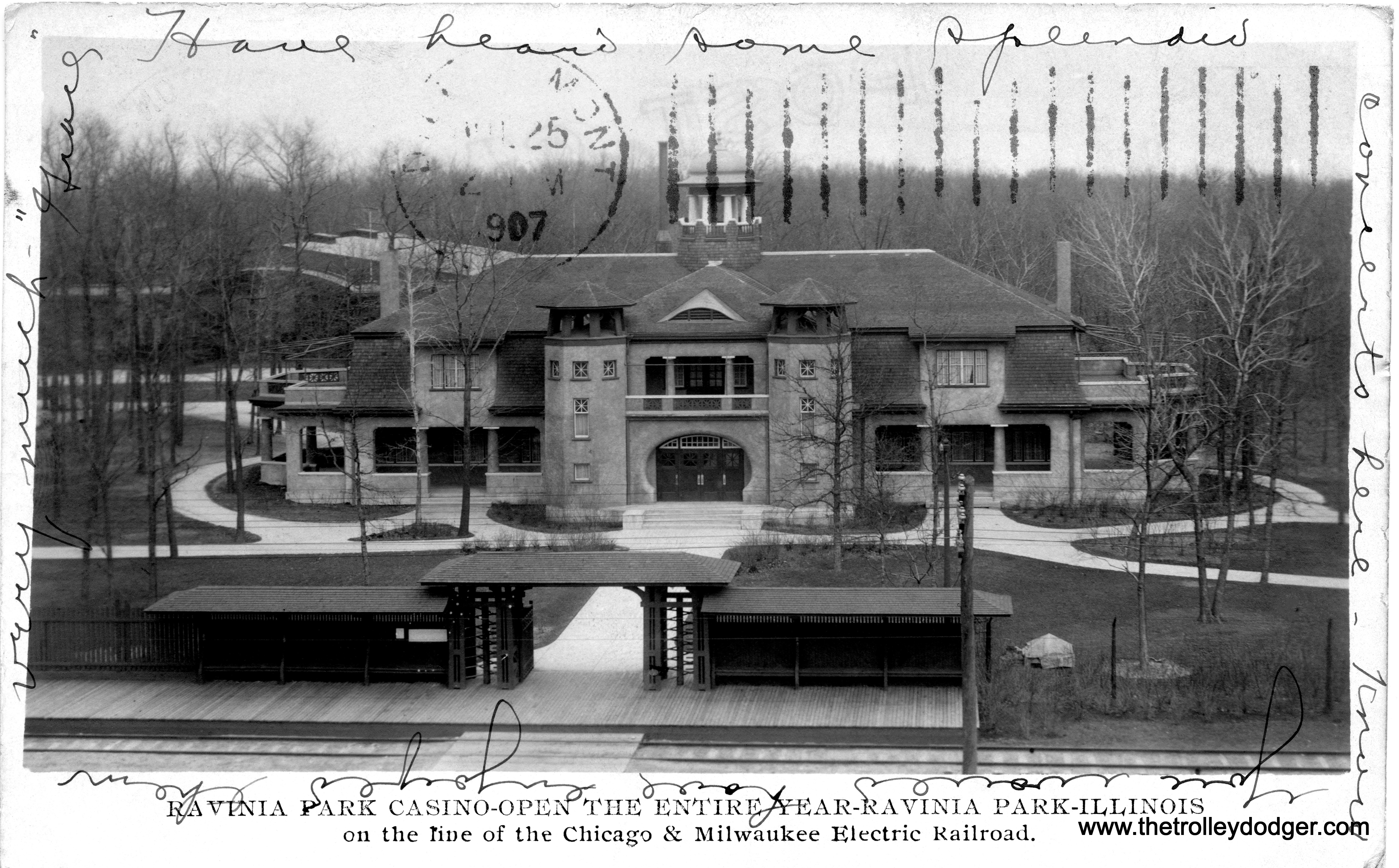
The Chicago North Shore and Milwaukee had its origins in Waukegan. Here, we see Chicago and Milwaukee Electric car #9 near a hospital in Waukegan. The picture dates to around 1907. Streetcar service continued in Waukegan until 1947.

The Chicago North Shore and Milwaukee had its origins in Waukegan. Here, we see Chicago and Milwaukee Electric car #9 near a hospital in Waukegan. The picture dates to around 1907. Streetcar service continued in Waukegan until 1947.

North Shore Line cars 436, 404, and 161 are operating as a Milwaukee Business Man's Special at 2nd and Grand in 1918. This was the end of the line prior to the opening of the interurban's new terminal at 6th and Michigan in 1920.

North Shore Line cars 436, 404, and 161 are operating as a Milwaukee Business Man’s Special at 2nd and Grand in 1918. This was the end of the line prior to the opening of the interurban’s new terminal at 6th and Michigan in 1920.

On March 25, 1962, a Central Electric Railfans' Association fantrip train has made a photo stop at 6th Street and Scott on the North Shore Line. This is where the interurban line made a jog from 5th to 6th, before heading north via street trackage to the terminal at 6th and Michigan. The fantrip train is the northbound one at left. A regular service train is southbound at right. Both cars are Silverliners. This is now the site of an expressway access road. Scanned from the original Anscochrome slide. (William C. Hoffman Photo)

On March 25, 1962, a Central Electric Railfans’ Association fantrip train has made a photo stop at 6th Street and Scott on the North Shore Line. This is where the interurban line made a jog from 5th to 6th, before heading north via street trackage to the terminal at 6th and Michigan. The fantrip train is the northbound one at left. A regular service train is southbound at right. Both cars are Silverliners. This is now the site of an expressway access road. Scanned from the original Anscochrome slide. (William C. Hoffman Photo)

A closeup of the previous picture. The fans have formed a photo line while a regular service train heads southbound.

A closeup of the previous picture. The fans have formed a photo line while a regular service train heads southbound.

The same location today. The two buildings at right appear to be the same ones in the 1962 picture. The North Shore Line tracks went in about the same location as where those autos are parked. Milwaukee's freeways were built in stages, and the segment near here opened in 1968, about five years after the abandonment of the interurban.

The same location today. The two buildings at right appear to be the same ones in the 1962 picture. The North Shore Line tracks went in about the same location as where those autos are parked. Milwaukee’s freeways were built in stages, and the segment near here opened in 1968, about five years after the abandonment of the interurban.

The interior of North Shore Line car #154 on October 24, 1962. This car, built in 1915, became the oldest survivor in the fleet for many years, but it could not survive decades of neglect at a museum that did not take care of it. It has since been scrapped.

The interior of North Shore Line car #154 on October 24, 1962. This car, built in 1915, became the oldest survivor in the fleet for many years, but it could not survive decades of neglect at a museum that did not take care of it. It has since been scrapped.

The interior of NSL 168.

The interior of NSL 168.

One of the North Shore Line Electroliners, looking a bit rusty after nearly a year without being used, has arrived at the Red Arrow Lines (Philadelphia Suburban Transportation Company) 69th Street Yard on November 17, 1963. Notice the emblem on the front is missing, having been removed prior to transport. After being fitted with different third rail shoes, it was tested on the Norristown High-Speed Line. Additional modifications were necessary. The Shops transformed it into a Liberty Liner, and put it into service just about a year after the NSL abandonment.

One of the North Shore Line Electroliners, looking a bit rusty after nearly a year without being used, has arrived at the Red Arrow Lines (Philadelphia Suburban Transportation Company) 69th Street Yard on November 17, 1963. Notice the emblem on the front is missing, having been removed prior to transport. After being fitted with different third rail shoes, it was tested on the Norristown High-Speed Line. Additional modifications were necessary. The Shops transformed it into a Liberty Liner, and put it into service just about a year after the NSL abandonment.

North Shore Line pocket calendars from 1947 and 1948.

North Shore Line pocket calendars from 1947 and 1948.

On January 4, 1963, North Shore Line car #162 is over an inspection pit and out of service at Waukegan. However, it survived the abandonment and with the scrapping of car 154 a few years ago, 162 became the oldest NSL car extant. (It was delivered ahead of 160.) Although it needs a lot of work, it is now at the East Troy Railroad Museum, where it is being restored.

On January 4, 1963, North Shore Line car #162 is over an inspection pit and out of service at Waukegan. However, it survived the abandonment and with the scrapping of car 154 a few years ago, 162 became the oldest NSL car extant. (It was delivered ahead of 160.) Although it needs a lot of work, it is now at the East Troy Railroad Museum, where it is being restored.

More Recent Finds

CTA Chicago Transit Authority "L" 6000s (Train coming up from State Street Subway - view looks north) Location: Chicago, Illinois (14th Street - South Side "L") Date: July 3, 1966 Photographer: William C. Hoffman This is an unusual photo for 1966. Bill Hoffman took this picture while looking out the window of a fantrip train. There were no regular service trains on this stretch of the "L"from 1949 until 1969. In 1949, the CTA revised North-South service, and hereafter, all trains ran through the State Street Subway. This changed with the inauguration of the new Dan Ryan "L" in 1969. The Roosevelt Road "L" station was served only by North Shore Line trains from 1949 until 1963. With the abandonment of the NSL, the station was closed. This may be the fantrip that had a photo stop at the closed station shortly before it was demolished. A new station has since been put there.

CTA Chicago Transit Authority “L” 6000s (Train coming up from State Street Subway – view looks north)
Location: Chicago, Illinois (14th Street – South Side “L”)
Date: July 3, 1966
Photographer: William C. Hoffman
This is an unusual photo for 1966. Bill Hoffman took this picture while looking out the window of a fantrip train. There were no regular service trains on this stretch of the “L”from 1949 until 1969. In 1949, the CTA revised North-South service, and hereafter, all trains ran through the State Street Subway. This changed with the inauguration of the new Dan Ryan “L” in 1969. The Roosevelt Road “L” station was served only by North Shore Line trains from 1949 until 1963. With the abandonment of the NSL, the station was closed. This may be the fantrip that had a photo stop at the closed station shortly before it was demolished. A new station has since been put there.

CTA Chicago Transit Authority "L" Subway Location: Chicago, Illinois (North and Clybourn Subway Station) Date: August 22, 1966 Photographer: William C. Hoffman This picture shows the CTA subway station at North and Clybourn, the only such subway station on the system built with an above-ground building entrance. This was part of the State Street Subway and opened in October 1943. In recent years, this station entrance has been renovated. But here, 23 years after opening, you can see how some of the lettering on the outside of the station has deteriorated. It was eventually removed. There was also a bus turnaround at the station which was eventually removed.

CTA Chicago Transit Authority “L” Subway
Location: Chicago, Illinois (North and Clybourn Subway Station)
Date: August 22, 1966
Photographer: William C. Hoffman
This picture shows the CTA subway station at North and Clybourn, the only such subway station on the system built with an above-ground building entrance. This was part of the State Street Subway and opened in October 1943. In recent years, this station entrance has been renovated. But here, 23 years after opening, you can see how some of the lettering on the outside of the station has deteriorated. It was eventually removed. There was also a bus turnaround at the station which was eventually removed.

On December 11, 1955 (a Sunday) a fantrip train made up of CTA high-performance cars 6129 and 6130 has posed for a photo stop at Sedgwick. The signage is for the Shopper's Special service, which was a mid-day version of the Evanston Express, which today only runs during weekday rush hours. There were other Shopper's Specials on various lines dating back to the 1920s, but the Evanston one ran from November 28, 1955 until July 4, 1957. As late as the 1980s, though, the Evanston Express ran until nearly noon. These cars, built in 1950, were fitted with trolley poles for use on the Evanston Branch, which did not use third rail until 1973. They were fitted with experimental high-speed motors in 1955. These tests paved the way for faster rapid transit cars, such as the 2000-series starting in 1964. On Sundays, Ravenswood "L" service in 1955 did not operate south of Armitage at night or on Sundays. This was later changed to Belmont in the early 1960s, but with increased ridership, today's Brown Line runs to the Loop during those times. (William C. Hoffman Photo)

On December 11, 1955 (a Sunday) a fantrip train made up of CTA high-performance cars 6129 and 6130 has posed for a photo stop at Sedgwick. The signage is for the Shopper’s Special service, which was a mid-day version of the Evanston Express, which today only runs during weekday rush hours. There were other Shopper’s Specials on various lines dating back to the 1920s, but the Evanston one ran from November 28, 1955 until July 4, 1957. As late as the 1980s, though, the Evanston Express ran until nearly noon. These cars, built in 1950, were fitted with trolley poles for use on the Evanston Branch, which did not use third rail until 1973. They were fitted with experimental high-speed motors in 1955. These tests paved the way for faster rapid transit cars, such as the 2000-series starting in 1964. On Sundays, Ravenswood “L” service in 1955 did not operate south of Armitage at night or on Sundays. This was later changed to Belmont in the early 1960s, but with increased ridership, today’s Brown Line runs to the Loop during those times. (William C. Hoffman Photo)

On August 22, 1957, a six-car Evanston Express "L"train heads southbound at Franklin and Erie. The last wood cars on the CTA ran in regular service on November 30, 1957, on the Kenwood Branch. Numerous mid-to-late 1950s autos, some with tail fins, are also present. (William C. Hoffman Photo)

On August 22, 1957, a six-car Evanston Express “L”train heads southbound at Franklin and Erie. The last wood cars on the CTA ran in regular service on November 30, 1957, on the Kenwood Branch. Numerous mid-to-late 1950s autos, some with tail fins, are also present. (William C. Hoffman Photo)

On August 30, 1959, when William C. Hoffman took this picture, the Chicago White Sox were in first place in the American League Pennant Race. The clinched a World Series berth by defeating the Cleveland Indians 4-2 on September 22nd, when Early Wynn won his 20th game of the season. The Pale Hose went on to lose the World Series to the Los Angeles Dodgers, four games to two. This shows the 35th Street station on the South Side "L", looking to the east. The large crowds encountered during the '59 Series helped inspire the CTA to renovate this station, which was then changed to a center island platform. Since the Dan Ryan "L" opened in 1969, closer to the ballparks (Comiskey Park was replaced after the 1990 season) most fans use that line instead of the South Side "L" (today's Green Line).

On August 30, 1959, when William C. Hoffman took this picture, the Chicago White Sox were in first place in the American League Pennant Race. The clinched a World Series berth by defeating the Cleveland Indians 4-2 on September 22nd, when Early Wynn won his 20th game of the season. The Pale Hose went on to lose the World Series to the Los Angeles Dodgers, four games to two. This shows the 35th Street station on the South Side “L”, looking to the east. The large crowds encountered during the ’59 Series helped inspire the CTA to renovate this station, which was then changed to a center island platform. Since the Dan Ryan “L” opened in 1969, closer to the ballparks (Comiskey Park was replaced after the 1990 season) most fans use that line instead of the South Side “L” (today’s Green Line).

TM Milwaukee Electric Trolley Streetcar #966 Location: North Chicago, Illinois (Illinois Railway Museum) Date: June 30, 1962 Photographer: William C. Hoffman Don's Rail Photos: "966 was built by St Louis Car Company in 1927, (Job) #1466. It was purchased by Illinois Railway Museum in 1958." A lightweight safety car, it is currently stored inoperable.

TM Milwaukee Electric Trolley Streetcar #966
Location: North Chicago, Illinois (Illinois Railway Museum)
Date: June 30, 1962
Photographer: William C. Hoffman
Don’s Rail Photos: “966 was built by St Louis Car Company in 1927, (Job) #1466. It was purchased by Illinois Railway Museum in 1958.” A lightweight safety car, it is currently stored inoperable.

On July 29, 1955, William C. Hoffman captured this view of Chicago's "L" looking east from the Chicago River along Van Buren Street. This leg of the "L" connected the Loop structure with the Metropolitan West Side Elevated, and was in use from 1897 to 1955. Market Street ran north and south here, but would soon be rebuilt into Upper and Lower Wacker Drive. The "L" was in the way, and soon, a new connection was built to relace this, running through the old Wells Street Terminal. This had last been used by the Chicago Aurora and Elgin in September 1953. By 1957, the structure running east from here to Wells Street had been removed. That's a Garfield Park train navigating the curve. Notice also, the Van Buren Street bridge is being replaced by a newer one, under construction. I have previously seen this image online, in a lo-res version, but this has been scanned from the original Anscochrome slide in my collection.

On July 29, 1955, William C. Hoffman captured this view of Chicago’s “L” looking east from the Chicago River along Van Buren Street. This leg of the “L” connected the Loop structure with the Metropolitan West Side Elevated, and was in use from 1897 to 1955. Market Street ran north and south here, but would soon be rebuilt into Upper and Lower Wacker Drive. The “L” was in the way, and soon, a new connection was built to relace this, running through the old Wells Street Terminal. This had last been used by the Chicago Aurora and Elgin in September 1953. By 1957, the structure running east from here to Wells Street had been removed. That’s a Garfield Park train navigating the curve. Notice also, the Van Buren Street bridge is being replaced by a newer one, under construction. I have previously seen this image online, in a lo-res version, but this has been scanned from the original Anscochrome slide in my collection.

After the opening of the Congress median line in June 1958, the "L" tracks leading to the old Wells Street Terminal were cut back to this point at Wacker Drive. On June 13, 1962, this is how it looked. The CTA used it to store maintenance equipment, and it appears there was a parking lot underneath part of it. All this was removed in 1964. (William C. Hoffman Photo)

After the opening of the Congress median line in June 1958, the “L” tracks leading to the old Wells Street Terminal were cut back to this point at Wacker Drive. On June 13, 1962, this is how it looked. The CTA used it to store maintenance equipment, and it appears there was a parking lot underneath part of it. All this was removed in 1964. (William C. Hoffman Photo)

This is an early Ektachrome slide that has shifted to red, due to unstable dyes in the other colors. In many instances, we are able to color-correct these using computer technology. But in this case it wasn't very successful, so we presented it as a black-and-white image instead. Kodak reformulated Ektachrome in 1963, and solved the problem of the unstable dyes.

This is an early Ektachrome slide that has shifted to red, due to unstable dyes in the other colors. In many instances, we are able to color-correct these using computer technology. But in this case it wasn’t very successful, so we presented it as a black-and-white image instead. Kodak reformulated Ektachrome in 1963, and solved the problem of the unstable dyes.

Here we see how a new connection was being built bridging the old Wells Street Terminal and the Loop "L" on June 5, 1955. The now-unused platforms were cut back as needed to create room for tracks that would curve in and out of the Loop. Once the top of the building facade was removed, new steel was added. The new connection, including Tower 22, went into service on October 11, 1955. (William C. Hoffman Photo)

Here we see how a new connection was being built bridging the old Wells Street Terminal and the Loop “L” on June 5, 1955. The now-unused platforms were cut back as needed to create room for tracks that would curve in and out of the Loop. Once the top of the building facade was removed, new steel was added. The new connection, including Tower 22, went into service on October 11, 1955. (William C. Hoffman Photo)

This picture was also taken on June 5, 1955 by William C. Hoffman.

This picture was also taken on June 5, 1955 by William C. Hoffman.

On June 21, 1956, a Garfield Park "L" train made up of 4000-series cars is turning from the Loop onto what had once been the Wells Street Terminal. This new very short track connection was put into place to allow for the demolition of a much larger stretch of "L" structure along Van Buren and what had once been Market Street, but was now becoming Wacker Drive. Behind the train, but almost entirely out of view, Tower 22 controlled these movements. The Loop "L" was uni-directional (counterclockwise) from 1913 to 1969, so this train was southbound prior to making this turn. Photographer William C. Hoffman took this picture to show how part of the platform had to be cut out to allow for the swing of the cars while switching. This arrangement continued through June 21, 1958, two years to the day after this picture was taken. In the distance, you can see Tower 8 at the intersection of Van Buren and Wells, which had previously handled switching at the old connection point. The clock tower belongs to Grand Central Station (1890-1971), located at Harrison and Wells.

On June 21, 1956, a Garfield Park “L” train made up of 4000-series cars is turning from the Loop onto what had once been the Wells Street Terminal. This new very short track connection was put into place to allow for the demolition of a much larger stretch of “L” structure along Van Buren and what had once been Market Street, but was now becoming Wacker Drive. Behind the train, but almost entirely out of view, Tower 22 controlled these movements. The Loop “L” was uni-directional (counterclockwise) from 1913 to 1969, so this train was southbound prior to making this turn. Photographer William C. Hoffman took this picture to show how part of the platform had to be cut out to allow for the swing of the cars while switching. This arrangement continued through June 21, 1958, two years to the day after this picture was taken. In the distance, you can see Tower 8 at the intersection of Van Buren and Wells, which had previously handled switching at the old connection point. The clock tower belongs to Grand Central Station (1890-1971), located at Harrison and Wells.

The crane seen in the distance in this July 29, 1964 view of the former Wells Street Terminal would suggest that demolition is underway. The terminal went through several distinct phases. From 1905 to 1927, it was in its original configuration-- a stub end terminal, not connected to the Loop directly at this point. It was renovated in 1927, with the addition of an attractive second-story facade and improved facilities. The CTA stopped using it in 1951, and the CA&E in 1953. In 1955, the facade was removed in favor of a new direct track connection to the Loop "L", replacing the former connection via Van Buren Street. Tower 22 controlled the movements of Garfield Park trains in and out of the Loop. This continued until the new Congress median line replaced Garfield in 1958. Soon cut back to Wacker Drive, these tracks were only used for storage. By the time this picture was taken, there was only one track leading to the Loop instead of two. And soon after William C. Hoffman took this picture, looking from the nearby Quincy and Wells station, the rest of it would soon be gone.

The crane seen in the distance in this July 29, 1964 view of the former Wells Street Terminal would suggest that demolition is underway. The terminal went through several distinct phases. From 1905 to 1927, it was in its original configuration– a stub end terminal, not connected to the Loop directly at this point. It was renovated in 1927, with the addition of an attractive second-story facade and improved facilities. The CTA stopped using it in 1951, and the CA&E in 1953. In 1955, the facade was removed in favor of a new direct track connection to the Loop “L”, replacing the former connection via Van Buren Street. Tower 22 controlled the movements of Garfield Park trains in and out of the Loop. This continued until the new Congress median line replaced Garfield in 1958. Soon cut back to Wacker Drive, these tracks were only used for storage. By the time this picture was taken, there was only one track leading to the Loop instead of two. And soon after William C. Hoffman took this picture, looking from the nearby Quincy and Wells station, the rest of it would soon be gone.

By August 19, 1964, further work had been done dismantling and removing the old Wells Street Terminal tracks and structure. Now, the platforms are gone, and you can see the electrical substation the "L" had once gone over. (William C. Hoffman Photo)

By August 19, 1964, further work had been done dismantling and removing the old Wells Street Terminal tracks and structure. Now, the platforms are gone, and you can see the electrical substation the “L” had once gone over. (William C. Hoffman Photo)

CTA Chicago Transit Authority "L" 6000s (8-car train) Location: Chicago, Illinois (Looking south from 33rd Street - South Side "L") Date: July 17, 1961 Photographer: William C. Hoffman The Chicago Transit Authority closed the 33rd Street station in 1949, as part of their rationalization of North-South "L" service in order to speed up service. A walkway connected with the 35th Street station, which had side platforms, for use by exiting students from the Illinois Institute of Technology. Riders could exit through the old 33rd station. After large crowds used the 35th Street station during the 1959 World Series, where the Chicago White Sox lost to the Los Angeles Dodgers, four games to two, the CTA decided to redo this station with a center island platform. This new station opened in June 1961. The northbound platform, although unused, was retained for a few months because it connected to the walkway, which closed on September 25, 1961. So, this picture was taken after the new center island platform had opened, but before the walkway to 33rd was closed. You can't see the walkway in this picture, as it was on the opposite side of the "L" structure. The new 35th Street station was only in use for just over one year when it was destroyed by fire on October 17, 1961. It had to be rebuilt yet again. Eventually, the old station at 33rd Street was removed.

CTA Chicago Transit Authority “L” 6000s (8-car train)
Location: Chicago, Illinois (Looking south from 33rd Street – South Side “L”)
Date: July 17, 1961
Photographer: William C. Hoffman
The Chicago Transit Authority closed the 33rd Street station in 1949, as part of their rationalization of North-South “L” service in order to speed up service. A walkway connected with the 35th Street station, which had side platforms, for use by exiting students from the Illinois Institute of Technology. Riders could exit through the old 33rd station.
After large crowds used the 35th Street station during the 1959 World Series, where the Chicago White Sox lost to the Los Angeles Dodgers, four games to two, the CTA decided to redo this station with a center island platform. This new station opened in June 1961. The northbound platform, although unused, was retained for a few months because it connected to the walkway, which closed on September 25, 1961.
So, this picture was taken after the new center island platform had opened, but before the walkway to 33rd was closed. You can’t see the walkway in this picture, as it was on the opposite side of the “L” structure.
The new 35th Street station was only in use for just over one year when it was destroyed by fire on October 17, 1961. It had to be rebuilt yet again. Eventually, the old station at 33rd Street was removed.

By July 18, 1963, the Chicago Transit Authority had already removed the Clark Street entrance to the old North Water Terminal which ran over Carroll Street, where freight once ran all the way to Navy Pier. This stub-end terminal dated back to the earliest days of the Northwestern Elevated at the turn of the century, but the last CTA trains ran there in 1949. It was a useful place for special runs, like the 1950 introduction of the North Shore Line's Silverliners, but at some point it was taken out of service completely. It was torn down the following year, when the CTA demolished a lot of unused structure and presumably made bank on the resulting scrap value. (William C. Hoffman Photo)

By July 18, 1963, the Chicago Transit Authority had already removed the Clark Street entrance to the old North Water Terminal which ran over Carroll Street, where freight once ran all the way to Navy Pier. This stub-end terminal dated back to the earliest days of the Northwestern Elevated at the turn of the century, but the last CTA trains ran there in 1949. It was a useful place for special runs, like the 1950 introduction of the North Shore Line’s Silverliners, but at some point it was taken out of service completely. It was torn down the following year, when the CTA demolished a lot of unused structure and presumably made bank on the resulting scrap value. (William C. Hoffman Photo)

When the CTA wanted to extend the northbound platform at the Merchandise Mart "L" station, the tracks leading to the North Water Terminal were in the way. So they came up with a creative solution-- a movable platform that could slide out of the way if needed. On August 19, 1964, William C. Hoffman took this picture showing how the track connection to the stub-end terminal had been cut. Soon the entire terminal would be demolished, as were several other "L" structures that were no longer in use. Perhaps this was motivated by the cost of scrap, or a reduction in the expenses of having to maintain things.

When the CTA wanted to extend the northbound platform at the Merchandise Mart “L” station, the tracks leading to the North Water Terminal were in the way. So they came up with a creative solution– a movable platform that could slide out of the way if needed. On August 19, 1964, William C. Hoffman took this picture showing how the track connection to the stub-end terminal had been cut. Soon the entire terminal would be demolished, as were several other “L” structures that were no longer in use. Perhaps this was motivated by the cost of scrap, or a reduction in the expenses of having to maintain things.

William C. Hoffman took this picture of the CTA's North Water Terminal being dismantled on September 23, 1964, looking west along Carroll Avenue from Clark Street. The tracks below are from the Chicago and North Western freight line that ran to Navy Pier.

William C. Hoffman took this picture of the CTA’s North Water Terminal being dismantled on September 23, 1964, looking west along Carroll Avenue from Clark Street. The tracks below are from the Chicago and North Western freight line that ran to Navy Pier.

CTA 6000s in old colors (right) and new colors (left) at Damen, Milwaukee and North Avenue in January 1970. We are looking northwest. (Jeffrey L. Wien Photo)

CTA 6000s in old colors (right) and new colors (left) at Damen, Milwaukee and North Avenue in January 1970. We are looking northwest. (Jeffrey L. Wien Photo)

Here's how the Red Arrow Lines terminal looked on a July 1963 night at the 69th Street Transportation Center in Upper Darby, just outside Philadelphia. Car #12, a double ender that has PCC car styling (but was technically not considered such) is signed for the Ardmore line. Ardmore trolleys were replaced by buses at the end of 1966. Riders can change here for the Market-Frankford elevated to go to downtown Philadelphia. The Red Arrow suburban trolley lines to Media and Sharon Hill continue today under SEPTA, a public agency. The ghostlike blue blur means the photographer took this picture using a long exposure, and someone moved while the shutter was open.

Here’s how the Red Arrow Lines terminal looked on a July 1963 night at the 69th Street Transportation Center in Upper Darby, just outside Philadelphia. Car #12, a double ender that has PCC car styling (but was technically not considered such) is signed for the Ardmore line. Ardmore trolleys were replaced by buses at the end of 1966. Riders can change here for the Market-Frankford elevated to go to downtown Philadelphia. The Red Arrow suburban trolley lines to Media and Sharon Hill continue today under SEPTA, a public agency. The ghostlike blue blur means the photographer took this picture using a long exposure, and someone moved while the shutter was open.

The last night of service on the Myrtle Avenue Elevated in Brooklyn. This line opened in 1888. While a small portion of this line is still in use, much of it closed on October 4, 1969. It was the last line in New York City that used wooden rapid transit cars. This was nearly 12 years after the last woods ran in Chicago, on the Kenwood "L". The Myrtle Avenue El structure wasn't sturdy enough to handle heavier rapid transit cars, which is why it was abandoned.

The last night of service on the Myrtle Avenue Elevated in Brooklyn. This line opened in 1888. While a small portion of this line is still in use, much of it closed on October 4, 1969. It was the last line in New York City that used wooden rapid transit cars. This was nearly 12 years after the last woods ran in Chicago, on the Kenwood “L”. The Myrtle Avenue El structure wasn’t sturdy enough to handle heavier rapid transit cars, which is why it was abandoned.

On August 23, 1954, we see the body of an old red Chicago streetcar being used as a lunchstand on the southeast corner of 33rd and Ashland. This was from the 1101-1423 series built by the St. Louis Car Company in 1903 and 1906-- the same as #1374 at the Illinois Railway Museum, the "Matchbox." This is also known as a Small St. Louis Car. These were retired in 1946 when the new postwar PCC cars started to come in. There was an empty lot here in 2019, but a new building has gone up since. (William C. Hoffman Photo)

On August 23, 1954, we see the body of an old red Chicago streetcar being used as a lunchstand on the southeast corner of 33rd and Ashland. This was from the 1101-1423 series built by the St. Louis Car Company in 1903 and 1906– the same as #1374 at the Illinois Railway Museum, the “Matchbox.” This is also known as a Small St. Louis Car. These were retired in 1946 when the new postwar PCC cars started to come in. There was an empty lot here in 2019, but a new building has gone up since. (William C. Hoffman Photo)

On July 28, 1957, construction was already underway in suburban Oak Park on the new Congress expressway (Now Eisenhower). We see a retaining wall at left, indicating an excavation. At right, new tracks are being installed, including a crossover. The location is just west of Oak Park Avenue. This would become the new location where the B&OCT tracks and the CTA would cross each other. Soon, the CTA tracks would be moved to the north, and the Baltimore and Ohio Chicago Terminal would also move north, occupying what had been the CTA right-of-way. Once the south end of the highway footprint got excavated, both sets of tracks were put there, and then the rest of the highway was completed. This view looks west, and we can see the Forest Park gas holder in the distance, located just east of First Avenue. (William C. Hoffman Photo)

On July 28, 1957, construction was already underway in suburban Oak Park on the new Congress expressway (Now Eisenhower). We see a retaining wall at left, indicating an excavation. At right, new tracks are being installed, including a crossover. The location is just west of Oak Park Avenue. This would become the new location where the B&OCT tracks and the CTA would cross each other. Soon, the CTA tracks would be moved to the north, and the Baltimore and Ohio Chicago Terminal would also move north, occupying what had been the CTA right-of-way. Once the south end of the highway footprint got excavated, both sets of tracks were put there, and then the rest of the highway was completed. This view looks west, and we can see the Forest Park gas holder in the distance, located just east of First Avenue. (William C. Hoffman Photo)

On September 8, 1957, a westbound two-car CTA Garfield Park "L" train approaches the new temporary station, while photographer William C. Hoffman looks to the east from the old station. Graham Garfield (from chicago-l.org): "Work on the Congress Expressway and "L" line west of Laramie Avenue resulted in some complicated staging and several temporary facilities along the at-grade portion of the Garfield Line. On September 6, 1957, westbound Garfield Line trains shifted to a set of temporary tracks from Austin to west of Oak Park, north than the previous alignment. Concurrent with the move to the temporary alignment west of Austin, a temporary island platform was opened on east side of Oak Park Avenue for westbound trains and the old westbound side platform on the west side of Oak Park Avenue was closed. Eastbound trains followed onto the temporary alignment and began using the temporary island platform on September 17, closing the old eastbound side platform and station house on the east side of Oak Park Avenue." Eventually, the Baltimore and Ohio Chicago Terminal trains were shifted north onto what had formerly been the CTA's tracks. This is now the site of the Eisenhower expressway, where it is below grade. This section of highway opened in October 1960.

On September 8, 1957, a westbound two-car CTA Garfield Park “L” train approaches the new temporary station, while photographer William C. Hoffman looks to the east from the old station. Graham Garfield (from chicago-l.org): “Work on the Congress Expressway and “L” line west of Laramie Avenue resulted in some complicated staging and several temporary facilities along the at-grade portion of the Garfield Line. On September 6, 1957, westbound Garfield Line trains shifted to a set of temporary tracks from Austin to west of Oak Park, north than the previous alignment. Concurrent with the move to the temporary alignment west of Austin, a temporary island platform was opened on east side of Oak Park Avenue for westbound trains and the old westbound side platform on the west side of Oak Park Avenue was closed. Eastbound trains followed onto the temporary alignment and began using the temporary island platform on September 17, closing the old eastbound side platform and station house on the east side of Oak Park Avenue.” Eventually, the Baltimore and Ohio Chicago Terminal trains were shifted north onto what had formerly been the CTA’s tracks. This is now the site of the Eisenhower expressway, where it is below grade. This section of highway opened in October 1960.

This picture was taken at the same location as the first one in the next section, but there is a world of difference. A six-car train of CTA wood cars has turned off the four-track Metropolitan Main Line to head south on the Douglas Park "L". This was taken on April 1, 1954, which the photographer indicated was the last day of operations on the old structure. Garfield Park "L" trains had last run here in September 1953, before being shifted onto a temporary right-of-way in Van Buren Street. Now, new connections (visible here at right) were built for Douglas trains-- first, to take them across the Congress expressway footprint, then connect up with part of the old "L" going to Logan Square and Humboldt Park, and finally, to a new connection with the Lake Street "L" for the trip downtown. This permitted the demolition of the remaining portions of the Met "L" structure that were in the path of the new highway. The tracks west of here had already been removed. This new route for Douglas continued in use until June 22, 1958, when the new Congress median line opened here. But decades later, it once again became the route for the Pink Line, successor to the Douglas service. (William C. Hoffman Photo)

This picture was taken at the same location as the first one in the next section, but there is a world of difference. A six-car train of CTA wood cars has turned off the four-track Metropolitan Main Line to head south on the Douglas Park “L”. This was taken on April 1, 1954, which the photographer indicated was the last day of operations on the old structure. Garfield Park “L” trains had last run here in September 1953, before being shifted onto a temporary right-of-way in Van Buren Street. Now, new connections (visible here at right) were built for Douglas trains– first, to take them across the Congress expressway footprint, then connect up with part of the old “L” going to Logan Square and Humboldt Park, and finally, to a new connection with the Lake Street “L” for the trip downtown. This permitted the demolition of the remaining portions of the Met “L” structure that were in the path of the new highway. The tracks west of here had already been removed. This new route for Douglas continued in use until June 22, 1958, when the new Congress median line opened here. But decades later, it once again became the route for the Pink Line, successor to the Douglas service. (William C. Hoffman Photo)

Chicago Aurora and Elgin

On July 21, 1950, an inbound Chicago Aurora and Elgin train, led by car #48, approaches the Marshfield "L" station, while a CTA Garfield Park train trails behind. This was the junction of all the Met lines-- Douglas Park, Garfield Park, Logan Square, and Humboldt Park. Douglas trains used the tracks here at left. Outbound CA&E trains could pick up passengers at the platform on the right. The tracks leading to the northwest side were just out of view to our right. Soon, practically all the buildings you see here would be removed, as construction of the long-awaited Congress expressway would soon be underway. Don's Rail photos: "48 was built by Stephenson in 1903. It was modernized in January 1940 and retired in 1955." (William C. Hoffman Photo)

On July 21, 1950, an inbound Chicago Aurora and Elgin train, led by car #48, approaches the Marshfield “L” station, while a CTA Garfield Park train trails behind. This was the junction of all the Met lines– Douglas Park, Garfield Park, Logan Square, and Humboldt Park. Douglas trains used the tracks here at left. Outbound CA&E trains could pick up passengers at the platform on the right. The tracks leading to the northwest side were just out of view to our right. Soon, practically all the buildings you see here would be removed, as construction of the long-awaited Congress expressway would soon be underway. Don’s Rail photos: “48 was built by Stephenson in 1903. It was modernized in January 1940 and retired in 1955.” (William C. Hoffman Photo)

This CA&E bus appears to date to the late 1920s-- but where did it operate?

This CA&E bus appears to date to the late 1920s– but where did it operate?

On August 13, 1950, an inbound two-car Chicago Aurora and Elgin train has just left the Lakewood station on the Elgin branch. This image was color-corrected from an Anscochrome slide that had shifted to red. (William C. Hoffman Photo)

On August 13, 1950, an inbound two-car Chicago Aurora and Elgin train has just left the Lakewood station on the Elgin branch. This image was color-corrected from an Anscochrome slide that had shifted to red. (William C. Hoffman Photo)

This Anscochrome slide, now 75 years old, has shifted to red due to unstable dyes, much like early Ektachrome has. But I don't think Ektachrome was introduced until 1955. The technology may be very similar, though, as both films were based on Agfa technology.

This Anscochrome slide, now 75 years old, has shifted to red due to unstable dyes, much like early Ektachrome has. But I don’t think Ektachrome was introduced until 1955. The technology may be very similar, though, as both films were based on Agfa technology.

On August 13, 1950, CA&E car #315 is at Wheaton. This original Anscochrome slide was so badly faded and shifted to red that it was not possible to fully color-correct. This car was not actually purple with cyan ends. Parts of the image have too much green and too much magenta at the same time. Those colors are opposites, so not matter which way you try to change the color, it's not going to look right. It's still a big improvement on the original (see below). (William C. Hoffman Photo)

On August 13, 1950, CA&E car #315 is at Wheaton. This original Anscochrome slide was so badly faded and shifted to red that it was not possible to fully color-correct. This car was not actually purple with cyan ends. Parts of the image have too much green and too much magenta at the same time. Those colors are opposites, so not matter which way you try to change the color, it’s not going to look right. It’s still a big improvement on the original (see below). (William C. Hoffman Photo)

The same considerations apply to this Anscochrome image from August 13, 1950 at Wheaton. It was not possible to fully restore the color. The grass looks right but the car was blue, not purple. (William C. Hoffman Photo)

The same considerations apply to this Anscochrome image from August 13, 1950 at Wheaton. It was not possible to fully restore the color. The grass looks right but the car was blue, not purple. (William C. Hoffman Photo)

This circa 1909 real photo postcard image produced some controversy online regarding its location. But the only place it can possibly be is the Batavia Terminal, which originally had two tracks and third rail. The Great Third Rail, the famous CERA publication, says third rail was replaced by overhead wire here in the 1930s. The second track was most likely removed as the light ridership on this branch made it unnecessary. Generally service was operated by a single shuttle car, going back and forth to Batavia Junction, where passengers could change to Aurora branch trains. An early timetable indicates there had once been direct service downtown. Even the terminal building was altered over time, as the canopy was removed.

This circa 1909 real photo postcard image produced some controversy online regarding its location. But the only place it can possibly be is the Batavia Terminal, which originally had two tracks and third rail. The Great Third Rail, the famous CERA publication, says third rail was replaced by overhead wire here in the 1930s. The second track was most likely removed as the light ridership on this branch made it unnecessary. Generally service was operated by a single shuttle car, going back and forth to Batavia Junction, where passengers could change to Aurora branch trains. An early timetable indicates there had once been direct service downtown. Even the terminal building was altered over time, as the canopy was removed.

Here's how the Batavia Terminal looked in later days.

Here’s how the Batavia Terminal looked in later days.

Once the CA&E and the Chicago Rapid Transit Company ended their joint funeral train service in 1934, the interurban's trackage along Roosevelt Road west of Mannheim in Hillside was cut back to Oak Ridge, adjacent to the Oak Ridge Cemetery. On May 19, 1957, we see CA&E wood car #309 on a fantrip. This branch had many names, including Cook County and Mt. Carmel, but unlike the other CA&E sections, it did not have any third rail. The man in the raincoat may in fact be William C. Hoffman, who took several of the other photos in this post. (Vic Wagner Photo)

Once the CA&E and the Chicago Rapid Transit Company ended their joint funeral train service in 1934, the interurban’s trackage along Roosevelt Road west of Mannheim in Hillside was cut back to Oak Ridge, adjacent to the Oak Ridge Cemetery. On May 19, 1957, we see CA&E wood car #309 on a fantrip. This branch had many names, including Cook County and Mt. Carmel, but unlike the other CA&E sections, it did not have any third rail. The man in the raincoat may in fact be William C. Hoffman, who took several of the other photos in this post. (Vic Wagner Photo)

Not all the rails were pulled up on the Mt. Carmel branch. Here at Oak Ridge Avenue, some were simply covered over with dirt.

Not all the rails were pulled up on the Mt. Carmel branch. Here at Oak Ridge Avenue, some were simply covered over with dirt.

The same location in 2024. This view looks east. The CA&E tracks curved off to the left, following those power lines.

The same location in 2024. This view looks east. The CA&E tracks curved off to the left, following those power lines.

CA&E 421 heads up a westbound train at the Glen Ellyn stop. That's the tower of the Glen Ellyn village hall at right. (Martin Brady Photo)

CA&E 421 heads up a westbound train at the Glen Ellyn stop. That’s the tower of the Glen Ellyn village hall at right. (Martin Brady Photo)

And here's how it looks today. A parking lot, with the Illinois Prairie Path at right.

And here’s how it looks today. A parking lot, with the Illinois Prairie Path at right.

CA&E car #455 is at the end of the line in downtown Elgin, circa 1955-57. This is one of the ten curved-sided interurban cars that did not get saved after the abandonment. It was built by the St. Louis Car Company in 1945.

CA&E car #455 is at the end of the line in downtown Elgin, circa 1955-57. This is one of the ten curved-sided interurban cars that did not get saved after the abandonment. It was built by the St. Louis Car Company in 1945.

Like everyone else, the Chicago Transit Authority was caught off guard by the Chicago Aurora and Elgin's sudden discontinuance of passenger service in the middle of the day on July 3, 1957. Thousands of downtown commuters had to scramble to find a way home that evening. A couple days later, the CTA posted this sign at some "L" stations. William C. Hoffman took this picture on July 10, 1957.

Like everyone else, the Chicago Transit Authority was caught off guard by the Chicago Aurora and Elgin’s sudden discontinuance of passenger service in the middle of the day on July 3, 1957. Thousands of downtown commuters had to scramble to find a way home that evening. A couple days later, the CTA posted this sign at some “L” stations. William C. Hoffman took this picture on July 10, 1957.

This press photo, showing CA&E cars 414, 308, and 418 at the Wheaton Yard, ran with a story dated November 7, 1957-- four months after the abandonment of passenger service. The view looks to the southwest.

This press photo, showing CA&E cars 414, 308, and 418 at the Wheaton Yard, ran with a story dated November 7, 1957– four months after the abandonment of passenger service. The view looks to the southwest.

An October 26, 1958 outing, which ultimately ran with four cars, was the last major fantrip held on the CA&E. The final fantrip on December 7, 1958 was not well attended and it snowed that day. Here, fantrip attendees, including Aurora Mayor Paul Egan (who famously offered to put up his house for collateral in a failed attempt to keep the CA&E running the year before) are at the Wheaton Yards. This is one of those early Ektachrome slides that has shifted to red. It was not possible to correct the color completely back to normal. (William C. Hoffman Photo)

An October 26, 1958 outing, which ultimately ran with four cars, was the last major fantrip held on the CA&E. The final fantrip on December 7, 1958 was not well attended and it snowed that day. Here, fantrip attendees, including Aurora Mayor Paul Egan (who famously offered to put up his house for collateral in a failed attempt to keep the CA&E running the year before) are at the Wheaton Yards. This is one of those early Ektachrome slides that has shifted to red. It was not possible to correct the color completely back to normal. (William C. Hoffman Photo)

On June 30, 1962, Chicago Aurora and Elgin car #309 was a recent arrival at the Illinois Electric Railway Museum in North Chicago. Don's Rail Photos: "309 was built by Hicks Locomotive Works in 1907. It was modernized in October 1941 and acquired by Illinois Railway Museum in 1962." Prior to purchasing it, the museum raised funds from its members, calling this car the "jewel of the fleet." (William C. Hoffman Photo)

On June 30, 1962, Chicago Aurora and Elgin car #309 was a recent arrival at the Illinois Electric Railway Museum in North Chicago. Don’s Rail Photos: “309 was built by Hicks Locomotive Works in 1907. It was modernized in October 1941 and acquired by Illinois Railway Museum in 1962.” Prior to purchasing it, the museum raised funds from its members, calling this car the “jewel of the fleet.” (William C. Hoffman Photo)

Chicago Aurora and Elgin car 320 is at Mount Pleasant, Iowa on September 13, 1975. Don's Rail Photos: "320 was built by Jewett Car Co in 1914. It was modernized at an unknown date and sold to Iowa Chapter NRHS in 1962. It was transferred to Midwest Electric Railway Museum in 1968." By now, it has been in Iowa longer than it ever was in Illinois. (William C. Hoffman Photo)

Chicago Aurora and Elgin car 320 is at Mount Pleasant, Iowa on September 13, 1975. Don’s Rail Photos: “320 was built by Jewett Car Co in 1914. It was modernized at an unknown date and sold to Iowa Chapter NRHS in 1962. It was transferred to Midwest Electric Railway Museum in 1968.” By now, it has been in Iowa longer than it ever was in Illinois. (William C. Hoffman Photo)

Keep those cards and letters coming in, folks!

-David Sadowski

Help Support The Trolley Dodger

This is our 317th post, and we are gradually creating a body of work and an online resource for the benefit of all railfans, everywhere. To date, we have received over 1,227,000 page views, for which we are very grateful.

You can help us continue our original transit research by checking out the fine products in our Online Store.
As we have said before, “If you buy here, we will be here.”

We thank you for your support.

DONATIONS

In order to continue giving you the kinds of historic railroad images that you have come to expect from The Trolley Dodger, we need your help and support. It costs money to maintain this website, and to do the sort of historic research that is our specialty.

Your financial contributions help make this web site better, and are greatly appreciated.


Copyrights

There is a popular impression that everything on the Internet is free, and that people can do whatever they want with the content. This is mistaken.

A lot of hard work goes into creating these posts. Everything you see here is my copyrighted work, and should not be reused without obtaining my permission. A scanner is a camera, and even in those cases where the copyright on what is being scanned may be in the public domain, the person who pushes the button to create that scan owns the copyright on the scan.

For example, if you went to the Art Institute and took a picture of Grant Wood’s American Gothic painting, you would not own the copyright to that. But you would own the photo itself and should have the rights to control what happens to your own photographs, no matter what the subject matter is. Someone else can take a picture of American Gothic and they would have control over what happens to their picture.

In addition, we have had additional creative input in using software such as Photoshop to interpret photos, slides, and negatives. These are derivative works and as I have exercised my creative input into how they look, regarding cropping, color, density, and restoration, they are also subject to copyright for those reasons.

This is similar to how a musician interprets a musical score. The score is created by the composer, and they own the copyright to it, but when someone plays the music, they put their own spin on it, and they have rights to what happens to a recording of it.

Please ask before reusing any of the images you see here. Proper credit must be given to both me and the original photographer, and any captions you see here should be included. You do not have permission to change or colorize any black-and-white images from the Trolley Dodger.

Under current copyright law, copyright exists without any registration or notice of same. Please be respectful of other people’s rights.

Thanks.

Our 10th Anniversary

An westbound two-car CTA "L" train crosses over the Baltimore and Ohio Chicago Terminal tracks circa November 1959. We are by Kenilworth Avenue in Oak Park during construction of the Congress (now Eisenhower) expressway. The highway is depressed below grade in this area, and the two railroads are in the south portion of the expressway footprint. All the buildings seen here are still extant. (Jeffrey L. Wien Photo)

An westbound two-car CTA “L” train crosses over the Baltimore and Ohio Chicago Terminal tracks circa November 1959. We are by Kenilworth Avenue in Oak Park during construction of the Congress (now Eisenhower) expressway. The highway is depressed below grade in this area, and the two railroads are in the south portion of the expressway footprint. All the buildings seen here are still extant. (Jeffrey L. Wien Photo)

As of this January 21st, the Trolley Dodger blog is now ten years old. Each year since 1963, this date has commemorated the end of service on the North Shore Line interurban. I thought it would be a good date to associate with beginnings as well as endings.

It has been some months since our last post. We only had a few last year. This has led some people to ask about my health, or if I am still continuing with this.

Fact is, I am fine and have been busier than ever. In early December, we turned in our first draft of our next book, and this was accepted by our publisher. We have been scanning lots of images, and have added many important ones to our collection, some of which are featured here.

Acquiring new images costs money, and the research involved with our books is very expensive. Much of my work this past year has involved raising the funds to pay for all this. If you would like to help out, there is information further down in this post about our annual fundraiser.

We have been quite active on our Trolley Dodger Facebook group, which has added about 250 members since our last blog post. I realize that many of you are not on Facebook and therefore wouldn’t see any of that.

The Facebook group has been very useful as our members are very knowledgeable and are an aid to research. If I post something there that I am not sure about, I can often get locations identified quickly by someone on the group, along with finding out additional useful information.

My longtime friend Raymond DeGroote, Jr., who is 94, fell and broke his hip last November 1st. He needed partial hip replacement surgery, and contracted pneumonia while in the hospital. Ray went into a rehab facility, where he remained until January 22nd. Now he is back home once again, and is temporarily receiving round-the-clock care while he builds up his strength so he can negotiate those stairs. We wish him the best and hope he makes a full recovery.

I wanted this anniversary post to be extra special, and we have lots of exceptional, very rare images here for your consideration. Now that work on our new book is a lot further along, our hope is to have at least one new post every month for the rest of the year.

I have been interested in how the CTA transitioned the Garfield Park “L” into the Congress rapid transit line west of Laramie Avenue (5200 W.) for a long time. I was a small child when this construction was going on, and we lived in the area. Back in the 1980s, I wrote to the legendary George Krambles himself, asking how this was done. He replied there were at least three temporary rights-of-way, but that he was not clear on the details.

Since then, I have learned quite a bit about this, and some of that information (and many pictures) can be found in my 2018 Arcadia book Building Chicago’s Subways. Many more pictures have appeared on this blog.

Still, there were two remaining questions that needed answering. First, exactly where did the old Garfield Park alignment join up with the new Congress “L”? There was such a junction, we know, because service was offered on both lines simultaneously on June 21, 1958, and some maintenance work continued at the old Laramie Yard until around April 1959.

Second, where was the crossing between the Baltimore and Ohio Chicago Terminal tracks and the CTA moved to, while the new flyover was being built? They originally crossed each other at grade just east of DesPlaines Avenue in Forest Park. Now, there is a flyover that takes the freight line north of the CTA, and also carries both sets of tracks over the expressway (now I-290).

I recently discovered several photos by the late Jeffrey L. Wien that answer both questions. You will find them later in this post.

As I look back on our first ten years, I can honestly say that I have learned a lot. I thought I knew a few things when we started this journey, but it has been an educational experience for me. That is, in large part, due to our readers being so knowledgeable. So I have to thank all of you for that.

Another difference between now and then is our standards and capabilities for photo restoration have greatly improved. Experience is a great teacher, and we have worked on thousands and thousands of images since then.

My goal has always been to create a resource where people can find useful information about the history of electric railways. With over 1.1 million page views, I believe we have achieved that goal. When I do Google searches, doing my own research, the hits that come up often include things I have posted. Trolley Dodger pictures show up all the time on Facebook too.

I’m excited about the future as I look forward to the next ten years of the Trolley Dodger. And the best thing about this continued journey is we will do it together.

Enjoy!
-David Sadowski

PS- You might also like our Trolley Dodger Facebook auxiliary, a private group that now has 2,038 members.

Our friend Kenneth Gear has a Facebook group for the Railroad Record Club. If you enjoy listening to audio recordings of classic railroad trains, whether steam, electric, or diesel, you might consider joining.

FYI, the Hoosier Traction Facebook Group celebrates electric transit in Indiana and the Midwest. It also supports the activities of the annual Hoosier Traction Meet (although not affiliated with the North American Transit Historical Society, which organizes that event).

Department of Corrections

This real photo postcard shows a crash between two Metropolitan "L" cars on the Humboldt Park branch. There is a different picture of the same wreck (again, from a RPP) on page 60 of my 2021 book Chicago's Lost "L"s. The question was always, where was this taken? The best guess at the time was looking west from Kedzie Avenue (3200 W.) so that's what I put in the book. On the other hand, Andre Kristopans thought it was near the west end of the line (Lawndale Avenue, 3700 W.). Turns out it was near Ballou station. This was later renamed to St. Louis Avenue (3500 W.) meaning it's between where the two guesses were. Further research by Ron Tee turned up a March 15, 1909 article about the accident in the Herald News.

This real photo postcard shows a crash between two Metropolitan “L” cars on the Humboldt Park branch. There is a different picture of the same wreck (again, from a RPP) on page 60 of my 2021 book Chicago’s Lost “L”s. The question was always, where was this taken? The best guess at the time was looking west from Kedzie Avenue (3200 W.) so that’s what I put in the book. On the other hand, Andre Kristopans thought it was near the west end of the line (Lawndale Avenue, 3700 W.). Turns out it was near Ballou station. This was later renamed to St. Louis Avenue (3500 W.) meaning it’s between where the two guesses were. Further research by Ron Tee turned up a March 15, 1909 article about the accident in the Herald News.

Our Annual Fundraiser

Since we started this blog in 2015, we have posted more than 16,000 images. This is our 314th post.

In the near future, we will need to renew our WordPress subscription, our domain registration, and pay other bills associated with maintaining this site, so it is time for our Annual Fundraiser.

The Trolley Dodger blog can only be kept going with the help of our devoted readers. Perhaps you count yourself among them.

If you have already contributed in the past, we thank you very much for your help. Meanwhile, our goal for this fundraiser is just $700, which is only a fraction of what it costs us each year. The rest is made up from either the profits from the items we sell, or out of our own pocket.

There are links at the top and bottom of this page, where you can click and make a donation that will help us meet our goal again for this coming year, so we can continue to offer you more classic images in the future, and keep this good thing we have going.

We thank you in advance for your time and consideration.

Our Next Book Project

On December 7, 1958, CA&E wood cars 319 and 320 ran on a charter that became the last passenger movement on the railroad. Here, the fantrip train has reached the off-street Aurora terminal on a very wintry day. (Don Swanson Photo)

On December 7, 1958, CA&E wood cars 319 and 320 ran on a charter that became the last passenger movement on the railroad. Here, the fantrip train has reached the off-street Aurora terminal on a very wintry day. (Don Swanson Photo)

FYI, we are hard at work on our next book about the Chicago Aurora and Elgin interurban. Although we already have thousands of images, we start out on these book projects with some of what we need, and then have to find the rest. Some have generously shared their images with us, and some we have to pay real money for. In case you would like to help contribute to this effort, either by sharing images or making a donation, we would like to hear from you. All contributors will be mentioned in the book, which will be dedicated to the memory of the late Robert D. Heinlein. The most difficult images to find are always the earliest ones. You can contact me via Facebook messenger, at thetrolleydodger@gmail.com or via my blog. I thank you for your time and consideration.

CA&E locos 4005 and 4006 head up a freight train at Lakewood siding in June 1956. (Don Swanson Photo)

CA&E locos 4005 and 4006 head up a freight train at Lakewood siding in June 1956. (Don Swanson Photo)

James P. Shulman took this picture of Chicago Aurora and Elgin #456 on January 12, 1947 at Wheaton, when this car was just about one year old. It was still lettered in Futura type.

James P. Shulman took this picture of Chicago Aurora and Elgin #456 on January 12, 1947 at Wheaton, when this car was just about one year old. It was still lettered in Futura type.

Here is a picture of Chicago Aurora and Elgin #401 at the Wheaton station on March 18, 1956. (Raymond DeGroote, Jr. Photo)

Here is a picture of Chicago Aurora and Elgin #401 at the Wheaton station on March 18, 1956. (Raymond DeGroote, Jr. Photo)

Here is another picture of Chicago Aurora and Elgin #401 at the Wheaton station on March 18, 1956. We are looking to the east. (Raymond DeGroote, Jr. Photo)

Here is another picture of Chicago Aurora and Elgin #401 at the Wheaton station on March 18, 1956. We are looking to the east. (Raymond DeGroote, Jr. Photo)

This is how the abandoned Chicago Aurora and Elgin right-of-way looked in June 1960, nearly three years after the end of passenger service and one year after the last freight train. We are looking west from Fifth Avenue in Maywood. The gates have been removed but the tracks are still in place. Formal abandonment of the railroad was approved the following year.

This is how the abandoned Chicago Aurora and Elgin right-of-way looked in June 1960, nearly three years after the end of passenger service and one year after the last freight train. We are looking west from Fifth Avenue in Maywood. The gates have been removed but the tracks are still in place. Formal abandonment of the railroad was approved the following year.

Recent Finds

North Shore Line electric loco 456 is moving freight in North Chicago on the last full day of service, January 20, 1963. The weather was bitterly cold. There was no slacking off for the NSL's employees, even though everyone knew the storied interurban had come to the end of the line. The photographer is not known, but I do think it's very possible Jeffrey L. Wien is one of the three guys on the right... carrying a case that most likely has his movie camera in it. I think he's the guy in the middle, grinning, because he's in his element.

North Shore Line electric loco 456 is moving freight in North Chicago on the last full day of service, January 20, 1963. The weather was bitterly cold. There was no slacking off for the NSL’s employees, even though everyone knew the storied interurban had come to the end of the line. The photographer is not known, but I do think it’s very possible Jeffrey L. Wien is one of the three guys on the right… carrying a case that most likely has his movie camera in it. I think he’s the guy in the middle, grinning, because he’s in his element.

North Shore Line car #159 and an Electroliner are at the Mundelein Terminal in June 1961. The Liner was there on a fantrip, as they did not operate on this branch line in regular service. We are looking west.

North Shore Line car #159 and an Electroliner are at the Mundelein Terminal in June 1961. The Liner was there on a fantrip, as they did not operate on this branch line in regular service. We are looking west.

North Shore Line express motors 238 and 231 are at Pettibone Yard in the 1950s. 238 has been converted to a snow plow, as the interurban had ended less-than-carload freight in 1947. This image was scanned from an 838 Kodachrome slide-- which at 28x40mm is somewhat larger than 35mm's 24x36mm. Kodak had a series of Bantam cameras that took this size, but it did not catch on.

North Shore Line express motors 238 and 231 are at Pettibone Yard in the 1950s. 238 has been converted to a snow plow, as the interurban had ended less-than-carload freight in 1947. This image was scanned from an 838 Kodachrome slide– which at 28x40mm is somewhat larger than 35mm’s 24x36mm. Kodak had a series of Bantam cameras that took this size, but it did not catch on.

North Shore Line car #703 is parked at Roosevelt Road in Chicago on a very snowy February 11, 1960.

North Shore Line car #703 is parked at Roosevelt Road in Chicago on a very snowy February 11, 1960.

The photographer must have been riding on a North Shore Line train to capture this picture on August 23, 1959. We are looking west towards the former Niles Center "L" station at Asbury Street in Evanston, last used in 1948. After being rented out to local businesses, the station building was torn down in the 1970s. The Skokie Swift began using these tracks in 1964, just over a year after the North Shore Line quit. (William C. Hoffman Photo)

The photographer must have been riding on a North Shore Line train to capture this picture on August 23, 1959. We are looking west towards the former Niles Center “L” station at Asbury Street in Evanston, last used in 1948. After being rented out to local businesses, the station building was torn down in the 1970s. The Skokie Swift began using these tracks in 1964, just over a year after the North Shore Line quit. (William C. Hoffman Photo)

CTA trolley bus 9361 was built by Pullman-Standard in 1948, and was retired on December 15, 1966. On February 26, 1965, it is heading west on Route 80 - Irving Park Road. The bus has just gone under the four-track North Side "L". and is about to traverse the Milwaukee Road's freight track just west of there. Until 1973, this track brought interchange freight to the CTA via the ground-level Buena Yard. Further north from here, there was a ramp connecting with the "L". This was once a Milwaukee Road commuter line, but the Northwestern Elevated Railroad Company took over service north of Wilson Avenue in 1908. By 1912, this "Evanston Extension" of the "L" went as far north as Linden Avenue in Wilmette. (Jeffrey L. Wien Photo)

CTA trolley bus 9361 was built by Pullman-Standard in 1948, and was retired on December 15, 1966. On February 26, 1965, it is heading west on Route 80 – Irving Park Road. The bus has just gone under the four-track North Side “L”. and is about to traverse the Milwaukee Road’s freight track just west of there. Until 1973, this track brought interchange freight to the CTA via the ground-level Buena Yard. Further north from here, there was a ramp connecting with the “L”. This was once a Milwaukee Road commuter line, but the Northwestern Elevated Railroad Company took over service north of Wilson Avenue in 1908. By 1912, this “Evanston Extension” of the “L” went as far north as Linden Avenue in Wilmette. (Jeffrey L. Wien Photo)

On July 3, 1967, CTA trolley bus 9527 is eastbound on Irving Park Road, having just passed under the North-South "L". This bus was built by Marmon-Herrington in 1951-52. The last Chicago trolley bus ran in 1973. (Jeffrey L. Wien Photo)

On July 3, 1967, CTA trolley bus 9527 is eastbound on Irving Park Road, having just passed under the North-South “L”. This bus was built by Marmon-Herrington in 1951-52. The last Chicago trolley bus ran in 1973. (Jeffrey L. Wien Photo)

This looks north from the 35th Street station on the South Side "L" on November 6, 1950. The walkway led to the former 33rd Street station, which had been closed the year before. The photographer noted that this walkway was used by students at the Illinois Institute of Technology. The walkway was closed on September 25, 1961. (William C. Hoffman Photo) M.E. writes, "This photo shows the three tracks that ran from south of Indiana Ave. north to Roosevelt Rd. The middle track was used by express trains (obviously not going in both directions simultaneously), and probably by North Shore Line trains that ran as far south as 63rd and Dorchester on the Jackson Park line for a time. Your caption mentions the 33rd St. station. This trackage was the original South Side L from 1892, when the city was a lot smaller than today. So this trackage had a lot more stations, which (if I remember correctly) were at Congress, 12th St. (a.k.a. Roosevelt Rd.), 16th St., 18th St., 22nd St. (a.k.a. Cermak Rd.), 26th St., 29th St., 31st St., 33rd St., 35th St. and 39th St. (a.k.a. Pershing Rd.). Trains (other than express trains) on this structure stopped at all these stations (although after the State St. subway opened in 1943, mainline trains could serve L stations only as far north as 18th St.). This was before 1949, when the Kenwood line still used this trackage and before A/B skip-stop service began on the north/south mainline. After 1949, stations other than Cermak and 35th were closed to speed up service on this section. Cermak became a B (Jackson Park mainline) station and 35th an A (Englewood mainline) station. By the way, until the 1949 major change, Englewood trains went not to Howard St. but to Ravenswood. Only Jackson Park, Evanston Express, and North Shore Line trains went to Howard. Before the 1949 cutback, Kenwood trains went into the Loop and some went as far north as Wilson Ave. After 1949, the Ravenswood line got its own trains between Kimball and the Loop."

This looks north from the 35th Street station on the South Side “L” on November 6, 1950. The walkway led to the former 33rd Street station, which had been closed the year before. The photographer noted that this walkway was used by students at the Illinois Institute of Technology. The walkway was closed on September 25, 1961. (William C. Hoffman Photo) M.E. writes, “This photo shows the three tracks that ran from south of Indiana Ave. north to Roosevelt Rd. The middle track was used by express trains (obviously not going in both directions simultaneously), and probably by North Shore Line trains that ran as far south as 63rd and Dorchester on the Jackson Park line for a time.
Your caption mentions the 33rd St. station. This trackage was the original South Side L from 1892, when the city was a lot smaller than today. So this trackage had a lot more stations, which (if I remember correctly) were at Congress, 12th St. (a.k.a. Roosevelt Rd.), 16th St., 18th St., 22nd St. (a.k.a. Cermak Rd.), 26th St., 29th St., 31st St., 33rd St., 35th St. and 39th St. (a.k.a. Pershing Rd.). Trains (other than express trains) on this structure stopped at all these stations (although after the State St. subway opened in 1943, mainline trains could serve L stations only as far north as 18th St.). This was before 1949, when the Kenwood line still used this trackage and before A/B skip-stop service began on the north/south mainline. After 1949, stations other than Cermak and 35th were closed to speed up service on this section. Cermak became a B (Jackson Park mainline) station and 35th an A (Englewood mainline) station.
By the way, until the 1949 major change, Englewood trains went not to Howard St. but to Ravenswood. Only Jackson Park, Evanston Express, and North Shore Line trains went to Howard. Before the 1949 cutback, Kenwood trains went into the Loop and some went as far north as Wilson Ave. After 1949, the Ravenswood line got its own trains between Kimball and the Loop.”

When Jeff Wien took this picture looking north along Pulaski Road at Irving Park Road in March 1973, CTA trolley buses were in their very last days. Here, we see 9624, a Marmon-Herrington, built in 1951-52. The Buffalo ice cream parlor was a local landmark for decades. Established in 1902, they moved to this location in 1918. It closed in 1978 and a gas station replaced it.

When Jeff Wien took this picture looking north along Pulaski Road at Irving Park Road in March 1973, CTA trolley buses were in their very last days. Here, we see 9624, a Marmon-Herrington, built in 1951-52. The Buffalo ice cream parlor was a local landmark for decades. Established in 1902, they moved to this location in 1918. It closed in 1978 and a gas station replaced it.

CTA prewar PCC car 7019 is heading north on Cottage Grove at 93rd on September 23, 1954. Route 4 streetcar service ended the following year. Our resident south side expert M.E. adds, "This intersection had a lot of trackage, for two reasons: (1) The 93rd-95th St. car line used Cottage Grove Ave. to move between 95th St. and 93rd St.; (2) A car barn was situated a block east on 93rd St. at Drexel. Notice all the trolley wire, which also indicates how much trackage existed at this intersection."

CTA prewar PCC car 7019 is heading north on Cottage Grove at 93rd on September 23, 1954. Route 4 streetcar service ended the following year. Our resident south side expert M.E. adds, “This intersection had a lot of trackage, for two reasons: (1) The 93rd-95th St. car line used Cottage Grove Ave. to move between 95th St. and 93rd St.; (2) A car barn was situated a block east on 93rd St. at Drexel. Notice all the trolley wire, which also indicates how much trackage existed at this intersection.”

Here's the same location in October 2022.

Here’s the same location in October 2022.

On June 29, 1966, CTA single car unit 44 heads south from the Linden Avenue terminal, working an Evanston branch local. For a time, there was an automatic gate installed here to keep people and animals out of the yard. (Jeffrey L. Wien Photo)

On June 29, 1966, CTA single car unit 44 heads south from the Linden Avenue terminal, working an Evanston branch local. For a time, there was an automatic gate installed here to keep people and animals out of the yard. (Jeffrey L. Wien Photo)

On July 14, 1963, this is the view looking south at South Boulevard on the Evanston branch of the "L". As the sign at right notes, this was the changeover point from overhead wire to third rail. Evanston would not allow the "L" to use third rail north of here until 1973. (William C. Hoffman Photo)

On July 14, 1963, this is the view looking south at South Boulevard on the Evanston branch of the “L”. As the sign at right notes, this was the changeover point from overhead wire to third rail. Evanston would not allow the “L” to use third rail north of here until 1973. (William C. Hoffman Photo)

Chicago Surface Lines Nearside streetcar #5773 is on Through Route 5: Cottage Grove - South Chicago in the late 1930s. Don's Rail Photos: "5773 was built by Brill Car Co in 1912, #18322. It was retired on February 8, 1946."

Chicago Surface Lines Nearside streetcar #5773 is on Through Route 5: Cottage Grove – South Chicago in the late 1930s. Don’s Rail Photos: “5773 was built by Brill Car Co in 1912, #18322. It was retired on February 8, 1946.”

On May 11, 1958, William C. Hoffman captured this view, looking northwest towards the 43rd Street station on the Illinois Central Electric suburban service. You can see the former Kenwood "L" Terminal and Yard in the distance at 42nd and Oakenwald. That branch had closed on November 30, 1957, when its 50 year lease ran out with the Chicago Junction Railway, which owned it. This date also marked the end of wood cars on the "L". The Kenwood "L" was demolished within a few years, although remnants still exist.

On May 11, 1958, William C. Hoffman captured this view, looking northwest towards the 43rd Street station on the Illinois Central Electric suburban service. You can see the former Kenwood “L” Terminal and Yard in the distance at 42nd and Oakenwald. That branch had closed on November 30, 1957, when its 50 year lease ran out with the Chicago Junction Railway, which owned it. This date also marked the end of wood cars on the “L”. The Kenwood “L” was demolished within a few years, although remnants still exist.

I was recently contacted by someone working on the effort to turn the old Kenwood "L" right-of-way into a south side version of the 606 Trail. They were wondering when the bridges over various streets were removed after the line was abandoned in November 1957. They were certainly gone by September 5, 1960, when this picture was taken at Vincennes Avenue. (William C. Hoffman Photo)

I was recently contacted by someone working on the effort to turn the old Kenwood “L” right-of-way into a south side version of the 606 Trail. They were wondering when the bridges over various streets were removed after the line was abandoned in November 1957. They were certainly gone by September 5, 1960, when this picture was taken at Vincennes Avenue.
(William C. Hoffman Photo)

Here is the former Kenwood "L" embankment at Cottage Grove Avenue on September 5, 1960. The Chicago Junction Railway was still active at this point, adjacent to the former "L". (William C. Hoffman Photo)

Here is the former Kenwood “L” embankment at Cottage Grove Avenue on September 5, 1960. The Chicago Junction Railway was still active at this point, adjacent to the former “L”. (William C. Hoffman Photo)

A view of the old Kenwood "L" at Drexel Boulevard on September 5, 1960. (William C. Hoffman Photo)

A view of the old Kenwood “L” at Drexel Boulevard on September 5, 1960. (William C. Hoffman Photo)

This is where the old Ellis Avenue station was on the Kenwood "L", as of September 5, 1960. (William C. Hoffman Photo)

This is where the old Ellis Avenue station was on the Kenwood “L”, as of September 5, 1960. (William C. Hoffman Photo)

We are looking north along Stony Island at 63rd Street on May 19, 1961. The eastern end of the Jackson Park "L" is at left. During the 1893 World's Columbian Exposition, the "L" went further east of here. The Jackson Park branch has since been cut back to Cottage Grove. This image was restored from an early Ektachrome slide that had shifted to red. (William C. Hoffman Photo) M.E. writes, "In my early lifetime, the L structure over Stony Island Ave. was not there. The structure ended abutting Stony Island, but not spanning it. The streets here were a mini business district, there was a Greyhound bus station on Stony Island south of 63rd St., and Hyde Park High School was on Stony Island south of 62nd St. The 63rd St. streetcars traveled east to Stony Island, then turned right (south) to 64th St. to their terminal on 64th. To start their westbound trips, they went a block farther west on 64th St. to Harper, then north to 63rd St., then west. And of course Stony Island had its own streetcar line (and traffic ran in both directions)."

We are looking north along Stony Island at 63rd Street on May 19, 1961. The eastern end of the Jackson Park “L” is at left. During the 1893 World’s Columbian Exposition, the “L” went further east of here. The Jackson Park branch has since been cut back to Cottage Grove. This image was restored from an early Ektachrome slide that had shifted to red. (William C. Hoffman Photo) M.E. writes, “In my early lifetime, the L structure over Stony Island Ave. was not there. The structure ended abutting Stony Island, but not spanning it. The streets here were a mini business district, there was a Greyhound bus station on Stony Island south of 63rd St., and Hyde Park High School was on Stony Island south of 62nd St. The 63rd St. streetcars traveled east to Stony Island, then turned right (south) to 64th St. to their terminal on 64th. To start their westbound trips, they went a block farther west on 64th St. to Harper, then north to 63rd St., then west. And of course Stony Island had its own streetcar line (and traffic ran in both directions).”

Chicago Transit Authority streetcar 3137 is at Root and Halsted (end of the 43rd Street car line) in 1952. The bridge belonged to the Stock Yard branch of the "L". This was one of a few older trolleys that the CTA had painted in green and creme in the early 1950s. The sign at rear advertises the Chicago Daily Drovers Journal, founded in 1873 to report on the Union Stockyards. It is still in business today at: www.drovers.com (E. Rinke Photo)

Chicago Transit Authority streetcar 3137 is at Root and Halsted (end of the 43rd Street car line) in 1952. The bridge belonged to the Stock Yard branch of the “L”. This was one of a few older trolleys that the CTA had painted in green and creme in the early 1950s. The sign at rear advertises the Chicago Daily Drovers Journal, founded in 1873 to report on the Union Stockyards. It is still in business today at: http://www.drovers.com (E. Rinke Photo)

Here's how the Stock Yards "L" looked on Exchange Avenue near Racine Avenue on September 1, 1954. This "L" branchy was abandoned in 1957. (William C. Hoffman Photo)

Here’s how the Stock Yards “L” looked on Exchange Avenue near Racine Avenue on September 1, 1954. This “L” branchy was abandoned in 1957. (William C. Hoffman Photo)

We are looking west from the transfer bridge at the Indiana Avenue "L" station in the south side on November 6, 1950. By then, the Kenwood branch had become a shuttle. The CTA widened the platform so it could berth here, and northbound main line trains were relocated onto what had formerly been the express track (no longer in use, as the CTA had instituted A/B skip stop service). The Stock Yards branch always ran as a shuttle from the opposite platform. (William C. Hoffman Photo) M.E. notes: "This photo shows people on a wide platform. The space occupied by that platform was initially the third track that northbound mainline trains and northbound Kenwood trains used, before the Kenwood line was cut back to a shuttle from Indiana Ave. east. That change took place in 1949. This transfer bridge enabled passengers on: (1) northbound mainline and Kenwood trains to reach southbound mainline trains and Stock Yards trains, and (2) southbound mainline and Stock Yards trains to reach northbound mainline trains and Kenwood trains."

We are looking west from the transfer bridge at the Indiana Avenue “L” station in the south side on November 6, 1950. By then, the Kenwood branch had become a shuttle. The CTA widened the platform so it could berth here, and northbound main line trains were relocated onto what had formerly been the express track (no longer in use, as the CTA had instituted A/B skip stop service). The Stock Yards branch always ran as a shuttle from the opposite platform. (William C. Hoffman Photo) M.E. notes: “This photo shows people on a wide platform. The space occupied by that platform was initially the third track that northbound mainline trains and northbound Kenwood trains used, before the Kenwood line was cut back to a shuttle from Indiana Ave. east. That change took place in 1949. This transfer bridge enabled passengers on:
(1) northbound mainline and Kenwood trains to reach southbound mainline trains and Stock Yards trains, and
(2) southbound mainline and Stock Yards trains to reach northbound mainline trains and Kenwood trains.”

This looks north from the 35th Street station on the South Side "L" on November 6, 1950. The walkway led to the former 33rd Street station, which had been closed the year before. The photographer noted that this walkway was used by students at the Illinois Institute of Technology. The walkway was closed on September 25, 1961. (William C. Hoffman Photo)

This looks north from the 35th Street station on the South Side “L” on November 6, 1950.
The walkway led to the former 33rd Street station, which had been closed the year before. The photographer noted that this walkway was used by students at the Illinois Institute of Technology. The walkway was closed on September 25, 1961. (William C. Hoffman Photo)

On August 30, 1960, a southbound eight-car train is at 35th Street on the South Side "L". Construction of a new center-island platform has started. This turned out to be ill-fated, as the station was destroyed by fire not long after it opened. (William C. Hoffman Photo)

On August 30, 1960, a southbound eight-car train is at 35th Street on the South Side “L”.
Construction of a new center-island platform has started. This turned out to be ill-fated, as the station was destroyed by fire not long after it opened. (William C. Hoffman Photo)

The picture was taken on October 18, 1962, the day after the station fire at 35th Street. It shows the train with the burned up car and a crowd of people nearby, including the fire department. (Jeffrey L. Wien Photo)

The picture was taken on October 18, 1962, the day after the station fire at 35th Street. It shows the train with the burned up car and a crowd of people nearby, including the fire department. (Jeffrey L. Wien Photo)

Subject: CSS&SB South Shore Line Hegewisch Station 1970s Location: Chicago, Illinois (Hegewisch neighborhood) Date: Circa 1970s Photographer: Unknown This picture shows the old South Shore Line station at Hegewisch, near the Illinois-Indiana border. It was replaced by a newer station in 1992, and as this slide has square corners, it probably predates 1981.

Subject: CSS&SB South Shore Line Hegewisch Station 1970s
Location: Chicago, Illinois (Hegewisch neighborhood)
Date: Circa 1970s
Photographer: Unknown
This picture shows the old South Shore Line station at Hegewisch, near the Illinois-Indiana border. It was replaced by a newer station in 1992, and as this slide has square corners, it probably predates 1981.

Subject: CSS&SB South Shore Line Interurban #104 Location: Michigan City, Indiana Date: April 1963 (processing date) Photographer: Emery J. Gulash Emery J. Gulash (1918-2006) was a very well known railfan photographer. CSS&SB #104 was built by Pullman in 1926, job #4936. It was lengthened in 1943. Air conditioning and picture windows came in 1950. All cars in this series were retired by 1983, and many went to museums. The facade from the historic Michigan City station has been saved and is planned to be reused with a new building behind it. The South Shore Line street running has been replaced by new double track on private right-of-way.

Subject: CSS&SB South Shore Line Interurban #104
Location: Michigan City, Indiana
Date: April 1963 (processing date)
Photographer: Emery J. Gulash
Emery J. Gulash (1918-2006) was a very well known railfan photographer.
CSS&SB #104 was built by Pullman in 1926, job #4936. It was lengthened in 1943. Air conditioning and picture windows came in 1950. All cars in this series were retired by 1983, and many went to museums. The facade from the historic Michigan City station has been saved and is planned to be reused with a new building behind it. The South Shore Line street running has been replaced by new double track on private right-of-way.

Subject: CSS&SB South Shore Line Electric Loco #901 (and presumably #900) Location: Unknown Date: Circa 1950-55 (based on the style of slide mount Photographer: Unknown CSS&SB electric steeplecab #901 was built by Baldwin/Westinghouse in 1929 as IC #10001. The CSS acquired it in 1941. It appears to have been retired sometime in the 1960s.

Subject: CSS&SB South Shore Line Electric Loco #901 (and presumably #900)
Location: Unknown
Date: Circa 1950-55 (based on the style of slide mount
Photographer: Unknown
CSS&SB electric steeplecab #901 was built by Baldwin/Westinghouse in 1929 as IC #10001. The CSS acquired it in 1941. It appears to have been retired sometime in the 1960s.

Whenever a movie theatre pops up in one of these photos, I post it to Cinema Treasures. Pittsburgh Railways PCC streetcar #1724 passes the Art Cinema at 809 Liberty Avenue on March 23, 1968. The adult theatre was offering a double feature of Fanny Hill Meets Dr. Erotica and Unholy Matrimony. It opened in 1931 as the Avenue Cinema and was renamed the Art Cinema in 1935. Redeveloped in 1995, it is now the Harris Theatre. (Jeffrey L. Wien Photo)

Whenever a movie theatre pops up in one of these photos, I post it to Cinema Treasures. Pittsburgh Railways PCC streetcar #1724 passes the Art Cinema at 809 Liberty Avenue on March 23, 1968. The adult theatre was offering a double feature of Fanny Hill Meets Dr. Erotica and Unholy Matrimony. It opened in 1931 as the Avenue Cinema and was renamed the Art Cinema in 1935. Redeveloped in 1995, it is now the Harris Theatre. (Jeffrey L. Wien Photo)

On February 23, 1957, Queensboro Bridge streetcar #602 is posed by a BMT "A" train. The bridge train stopped running on April 7, 1957, as the last streetcar in New York City. Car 602 was built in 1929 by Osgood-Bradley for New Bedford, Massachusetts. Although similar in appearance to Brill Master Units, these cars were called Electromobiles. Several came to the bridge operation in 1948.

On February 23, 1957, Queensboro Bridge streetcar #602 is posed by a BMT “A” train. The bridge train stopped running on April 7, 1957, as the last streetcar in New York City. Car 602 was built in 1929 by Osgood-Bradley for New Bedford, Massachusetts. Although similar in appearance to Brill Master Units, these cars were called Electromobiles. Several came to the bridge operation in 1948.

This circa 1948 picture of CTA "Jitterbug" 5002 caused a lot of discussion on our Facebook group, namely, where is this? But the consensus is, this is the original turnaround loop at DesPlaines Avenue on the Garfield Park "L", looking east. William Shapotkin says the Chicago Great Western's control tower is just barely visible at left. The yard here, and the turnback loop, were reconfigured in 1953 when the Chicago Aurora and Elgin cut back service to here. It was rebuilt again in 1959 during construction of the adjacent expressway.

This circa 1948 picture of CTA “Jitterbug” 5002 caused a lot of discussion on our Facebook group, namely, where is this? But the consensus is, this is the original turnaround loop at DesPlaines Avenue on the Garfield Park “L”, looking east. William Shapotkin says the Chicago Great Western’s control tower is just barely visible at left. The yard here, and the turnback loop, were reconfigured in 1953 when the Chicago Aurora and Elgin cut back service to here. It was rebuilt again in 1959 during construction of the adjacent expressway.

From 1940 to 1952, the Pacific Electric ran in the median of the Hollywood Freeway (now U.S. Route 101) through Cahuenga Pass in Los Angeles. Here we see it during a 1948 fantrip. I can't quite make out the car number. The Chicago Transit Authority opened its Congress rapid transit line in an expressway median in 1958, but by then, this one was already gone, and the space is now occupied by additional highway lanes.

From 1940 to 1952, the Pacific Electric ran in the median of the Hollywood Freeway (now U.S. Route 101) through Cahuenga Pass in Los Angeles. Here we see it during a 1948 fantrip. I can’t quite make out the car number. The Chicago Transit Authority opened its Congress rapid transit line in an expressway median in 1958, but by then, this one was already gone, and the space is now occupied by additional highway lanes.

CTA #4410, built in the early 1920s, is part of a fantrip train at Lake and Homan on October 21, 1973. This was about a month before the 4000s were taken out of service. (Arthur H. Peterson Photo)

CTA #4410, built in the early 1920s, is part of a fantrip train at Lake and Homan on October 21, 1973. This was about a month before the 4000s were taken out of service. (Arthur H. Peterson Photo)

We are looking northwest from Marshfield Avenue towards the Lake and Paulina "L" junction on August 15, 1963. The Paulina "L" still crossed over the Lake Street "L", but the tracks north of here were only being used for shop moves, work trains, and charters by this point. A new connection to the Lake Street "L" was used by Douglas Park trains from 1954 to 1958, and is used by Pink Line trains today. The white structure was added during construction of this connection for use by the work crews. The upper level tracks here, along with the Lake Transfer station and trackage all the way north to the Milwaukee Subway was removed in 1964. (William C. Hoffman Photo) M.E. adds, "You may want to add to your caption that, after the Dearborn St. subway opened in 1951, this segment of trackage also provided the only way to move L cars between the Logan Square - Dearborn St. subway - Congress and LaSalle St. line and the rest of the system."

We are looking northwest from Marshfield Avenue towards the Lake and Paulina “L” junction on August 15, 1963. The Paulina “L” still crossed over the Lake Street “L”, but the tracks north of here were only being used for shop moves, work trains, and charters by this point. A new connection to the Lake Street “L” was used by Douglas Park trains from 1954 to 1958, and is used by Pink Line trains today. The white structure was added during construction of this connection for use by the work crews. The upper level tracks here, along with the Lake Transfer station and trackage all the way north to the Milwaukee Subway was removed in 1964. (William C. Hoffman Photo) M.E. adds, “You may want to add to your caption that, after the Dearborn St. subway opened in 1951, this segment of trackage also provided the only way to move L cars between the Logan Square – Dearborn St. subway – Congress and LaSalle St. line and the rest of the system.”

The view looking north from around Chicago Avenue along the old Paulina "L" on June 26, 1960 during a fantrip. New CTA single car units 41 and 42 were used. (William C. Hoffman Photo)

The view looking north from around Chicago Avenue along the old Paulina “L” on June 26, 1960 during a fantrip. New CTA single car units 41 and 42 were used. (William C. Hoffman Photo)

This is the old Paulina "L" bridge over what are now Metra tracks. On June 26, 1960, the "L" structure was still intact all the way between Lake Street and the Milwaukee Avenue Subway, but only the southbound track was in use for shop moves, equipment transfers, work cars, and fantrips like this. The bridge is still there, used for signals. (William C. Hoffman Photo)

This is the old Paulina “L” bridge over what are now Metra tracks. On June 26, 1960, the “L” structure was still intact all the way between Lake Street and the Milwaukee Avenue Subway, but only the southbound track was in use for shop moves, equipment transfers, work cars, and fantrips like this. The bridge is still there, used for signals. (William C. Hoffman Photo) (William C. Hoffman Photo)

To capture this view today, showing the north portal of the Milwaukee Avenue Subway, you would need a drone. But on June 26, 1960, you could take this picture while looking out the window of a fantrip train, turning sharply south onto the old Paulina "L". That structure was demolished in 1964. (William C. Hoffman Photo)

To capture this view today, showing the north portal of the Milwaukee Avenue Subway, you would need a drone. But on June 26, 1960, you could take this picture while looking out the window of a fantrip train, turning sharply south onto the old Paulina “L”. That structure was demolished in 1964. (William C. Hoffman Photo)

To get this shot, the photographer must have been on a boat in the Chicago River, passing under the Van Buren Street bridge. We see the two side-by-side bridges used by the Metropolitan "L". They were still in service for Garfield Park "L" trains when this picture was taken on May 12, 1957. (William C. Hoffman Photo)

To get this shot, the photographer must have been on a boat in the Chicago River, passing under the Van Buren Street bridge. We see the two side-by-side bridges used by the Metropolitan “L”. They were still in service for Garfield Park “L” trains when this picture was taken on May 12, 1957. (William C. Hoffman Photo)

By July 26, 1959, when this picture was taken, the Garfield Park "L" was no longer running, so the twin Met "L" bridges had been permanently raised. They were torn down around 1961. (William C. Hoffman Photo)

By July 26, 1959, when this picture was taken, the Garfield Park “L” was no longer running, so the twin Met “L” bridges had been permanently raised. They were torn down around 1961. (William C. Hoffman Photo)

Another view of the Met "L" bridges, also from July 26, 1959. It was taken from the east side of the Chicago River, as you can see the 547 W. Jackson building in the distance.(William C. Hoffman Photo)

Another view of the Met “L” bridges, also from July 26, 1959. It was taken from the east side of the Chicago River, as you can see the 547 W. Jackson building in the distance.(William C. Hoffman Photo)

On July 28, 1958, the old Metropolitan "L" structure, last used by the Garfield Park "L" the month before was being demolished in this view looking east from Morgan Street. The new Congress line, which replaced it, is at right. (William C. Hoffman Photo)

On July 28, 1958, the old Metropolitan “L” structure, last used by the Garfield Park “L” the month before was being demolished in this view looking east from Morgan Street. The new Congress line, which replaced it, is at right. (William C. Hoffman Photo)

By November 18, 1962, when this picture was taken, there were still a few remnants of the old Metropolitan "L". This is what's left of the old Canal Street "L" station after the structure here was torn down in 1961. (William C. Hoffman Photo)

By November 18, 1962, when this picture was taken, there were still a few remnants of the old Metropolitan “L”. This is what’s left of the old Canal Street “L” station after the structure here was torn down in 1961.
(William C. Hoffman Photo)

This is the view looking east along Van Buren Street at Ogden Avenue on June 17, 1958. We see the temporary Garfield Park "L" right-of-way, and the new Congress "L" at right, which would replace it five days later. Meanwhile, a Douglas Park "L" train rides along on the Paulina "L". (William C. Hoffman Photo)

This is the view looking east along Van Buren Street at Ogden Avenue on June 17, 1958. We see the temporary Garfield Park “L” right-of-way, and the new Congress “L” at right, which would replace it five days later. Meanwhile, a Douglas Park “L” train rides along on the Paulina “L”. (William C. Hoffman Photo)

The same location, looking the same way, but on July 9, 1957. (William C. Hoffman Photo)

The same location, looking the same way, but on July 9, 1957. (William C. Hoffman Photo)

On October 19, 1953, demolition of the Garfield Park "L" structure was well underway in this view looking northwest from Claremont (2332 W.) and the construction site of the Congress expressway. The portion crossing Western Avenue has been removed. (William C. Hoffman Photo)

On October 19, 1953, demolition of the Garfield Park “L” structure was well underway in this view looking northwest from Claremont (2332 W.) and the construction site of the Congress expressway. The portion crossing Western Avenue has been removed.
(William C. Hoffman Photo)

This is all that was left of the Western Avenue "L" station on the Garfield Park "L" on November 1, 1953. This station was last used on September 27, 1953. For nearly five years, Garfield Park trains ran on a ground-level temporary right-of-way on Van Buren Street, just north of the expressway footprint to the left. (William C. Hoffman Photo)

This is all that was left of the Western Avenue “L” station on the Garfield Park “L” on November 1, 1953. This station was last used on September 27, 1953. For nearly five years, Garfield Park trains ran on a ground-level temporary right-of-way on Van Buren Street, just north of the expressway footprint to the left. (William C. Hoffman Photo)

As of July 27, 1958, when this picture was taken, the new CTA Congress "L" had been running for a month, and the old Garfield Park structure was still there. This was near Kilbourn Avenue (4500 W.), one of two places where it crossed the highway. The "L" was finally removed by November 1959. (William C. Hoffman Photo)

As of July 27, 1958, when this picture was taken, the new CTA Congress “L” had been running for a month, and the old Garfield Park structure was still there. This was near Kilbourn Avenue (4500 W.), one of two places where it crossed the highway. The “L” was finally removed by November 1959. (William C. Hoffman Photo)

The solid gray line shows how the old Garfield Park "L" cut across the Congress (now Eisenhower) expressway just west of Kostner (4400 W.). Disregard the purple line, that's just marking different sections of the map.

The solid gray line shows how the old Garfield Park “L” cut across the Congress (now Eisenhower) expressway just west of Kostner (4400 W.). Disregard the purple line, that’s just marking different sections of the map.

Here is the partially demolished Garfield Park "L" structure. looking east at Kostner Avenue (4400 W.) from a slide processed in November 1959. (Jeffrey L. Wien Photo)

Here is the partially demolished Garfield Park “L” structure. looking east at Kostner Avenue (4400 W.) from a slide processed in November 1959. (Jeffrey L. Wien Photo)

The Congress (now Eisenhower) expressway was completely shut down during removal of the Garfield Park "L" structure, where it crossed the highway just west of Kostner (4400 W.). This slide was processed in November 1959. (Jeffrey L. Wien Photo)

The Congress (now Eisenhower) expressway was completely shut down during removal of the Garfield Park “L” structure, where it crossed the highway just west of Kostner (4400 W.). This slide was processed in November 1959. (Jeffrey L. Wien Photo)

When the Congress expressway was built, the Garfield Park "L" crossed its footprint at two locations-- here (4500 W.) and at Sacramento Boulevard (3000 W.). The existing "L" structures were retained, supported by additional steel called an "interlining." That is how the Englewood "L" is supported now, where it crosses the Dan Ryan expressway. I do not know if any of the steel supports there came from here. (Jeffrey L. Wien Photo)

When the Congress expressway was built, the Garfield Park “L” crossed its footprint at two locations– here (4500 W.) and at Sacramento Boulevard (3000 W.). The existing “L” structures were retained, supported by additional steel called an “interlining.” That is how the Englewood “L” is supported now, where it crosses the Dan Ryan expressway. I do not know if any of the steel supports there came from here. (Jeffrey L. Wien Photo)

Since the Congress expressway was shut down temporarily for removal of the old Garfield Park "L", it looks like photographer Jeffrey L. Wien walked over to the fence near the Congress "L" to get this shot near Kilbourn Avenue (4500 W.).

Since the Congress expressway was shut down temporarily for removal of the old Garfield Park “L”, it looks like photographer Jeffrey L. Wien walked over to the fence near the Congress “L” to get this shot near Kilbourn Avenue (4500 W.).

We are looking east from Cicero Avenue, as the Garfield Park "L" was being dismantled circa November 1959. (Jeffrey L. Wien Photo)

We are looking east from Cicero Avenue, as the Garfield Park “L” was being dismantled circa November 1959. (Jeffrey L. Wien Photo)

A contemporary view of the same location.

A contemporary view of the same location.

After taking the previous picture, it appears that photographer Jeffrey L. Wien walked west along the temporarily closed Congress expressway for this shot of a two-car westbound Congress train near Cicero Avenue. This slide was processed in November 1959.

After taking the previous picture, it appears that photographer Jeffrey L. Wien walked west along the temporarily closed Congress expressway for this shot of a two-car westbound Congress train near Cicero Avenue. This slide was processed in November 1959.

This pair of CTA flat-door 6000s is signed for Garfield Park in this circa 1955-58 photograph. But it's not entirely clear where the location is. My guess is this at Central Avenue, by comparison with the next picture, where the location was identified. This was scanned from an original Ektachrome slide that had faded to red. I had attempted to color-correct this same slide (or one just like it) ten years ago, without success, but now this one doesn't look too bad. It was a lot of work, though.

This pair of CTA flat-door 6000s is signed for Garfield Park in this circa 1955-58 photograph. But it’s not entirely clear where the location is. My guess is this at Central Avenue, by comparison with the next picture, where the location was identified. This was scanned from an original Ektachrome slide that had faded to red. I had attempted to color-correct this same slide (or one just like it) ten years ago, without success, but now this one doesn’t look too bad. It was a lot of work, though.

Here's how the slide looked before I started working on it.

Here’s how the slide looked before I started working on it.

CTA 6039-6040 are at Central Avenue on the Garfield Park "L" on March 25, 1958. This was another early Ektachrome slide that had faded to red. On June 22, 1958, the CTA opened the new Congress rapid transit line as far west as the Cicero Avenue station. The Congress expressway was only open as far as Laramie Avenue, and construction gradually headed west. The "L" used a variety of temporary rights-of-way until everything was finished in 1960. Presumably, the tracks at right connected to the new Congress median right-of-way, while the ones at left went to the old Garfield alignment (which included Laramie Yard).

CTA 6039-6040 are at Central Avenue on the Garfield Park “L” on March 25, 1958. This was another early Ektachrome slide that had faded to red. On June 22, 1958, the CTA opened the new Congress rapid transit line as far west as the Cicero Avenue station. The Congress expressway was only open as far as Laramie Avenue, and construction gradually headed west. The “L” used a variety of temporary rights-of-way until everything was finished in 1960. Presumably, the tracks at right connected to the new Congress median right-of-way, while the ones at left went to the old Garfield alignment (which included Laramie Yard).

If this map, made by a Google user, is accurate, it shows where the Garfield Park "L" ran at ground level in the area by Central Avenue (5600 W.). The Lotus Tunnel is not shown, but would be in approximately the same location as where the Garfield "L" ran, east of Central, bringing the current "L" into the expressway median. If true, this would suggest the Garfield tracks were temporarily relocated to the north of where the tunnel is, but I am not sure if that is what really happened.

If this map, made by a Google user, is accurate, it shows where the Garfield Park “L” ran at ground level in the area by Central Avenue (5600 W.). The Lotus Tunnel is not shown, but would be in approximately the same location as where the Garfield “L” ran, east of Central, bringing the current “L” into the expressway median. If true, this would suggest the Garfield tracks were temporarily relocated to the north of where the tunnel is, but I am not sure if that is what really happened.

This picture was taken at the same time as the previous one at Central Avenue. The crossing gate at left has been removed, which supports my theory that Central Avenue was closed for traffic. In earlier photos at this location, Garfield Park trains were using tracks that veered off to the left. Now, Congress trains headed off to the right. The two-car train of flat-door 6000s has a run number and is on the westbound track. In the next picture, the train has its headlight on and also seems to be heading west. This slide was processed in November 1959. (Jeffrey L. Wien Photo)

This picture was taken at the same time as the previous one at Central Avenue. The crossing gate at left has been removed, which supports my theory that Central Avenue was closed for traffic. In earlier photos at this location, Garfield Park trains were using tracks that veered off to the left. Now, Congress trains headed off to the right. The two-car train of flat-door 6000s has a run number and is on the westbound track. In the next picture, the train has its headlight on and also seems to be heading west. This slide was processed in November 1959. (Jeffrey L. Wien Photo)

While the Congress median line opened as far west as Cicero Avenue on June 22, 1958, service west of there remained on various temporary rights of way until 1960. Here, we are looking east at the temporary "L" station at Central Avenue, circa November 1959. Generally speaking, there were perhaps three different temporary alignments, and the progression was to keep moving the "L" farther north, until the permanent alignment was ready. Here, what had been an island platform was, by the time this photo was taken, only being used by one set of tracks. You can see where some of the rails on the south end of the platform have been removed. Central Avenue appears closed to traffic, as an underpass was being built, going underneath the highway. There is a control tower at Central Avenue, to switch trains to either the old Garfield alignment at left, or the Congress route at right. By November 1959, this tower probably wasn't in use. It was necessary to have continued access to Laramie Yard until about May 1959, as the new facilities in Forest Park were not ready yet. Graham Garfield's excellent chicago-l.org web site explains: "On October 16, 1959, the permanent eastbound Congress Line track was placed in service between Parkside and Pine avenues thru Lotus Tunnel. A temporary side platform was placed in service. Three days later, on October 19, the permanent westbound track and a temporary westbound side platform was placed in service, closing the previous temporary platform. Meanwhile, between the permanent tracks, the new, permanent island platform was constructed. The new Central station platform (with temporary fare controls) was placed in service on October 10, 1960, with westbound trains first using it, followed by eastbound trains the next day. On October 11, 1960, the third and final temporary Central station was closed." It's not clear how this photo fits into the sequence of events, unless the temporary island platform became a side platform as seen here. (Jeffrey L. Wien Photo)

While the Congress median line opened as far west as Cicero Avenue on June 22, 1958, service west of there remained on various temporary rights of way until 1960. Here, we are looking east at the temporary “L” station at Central Avenue, circa November 1959. Generally speaking, there were perhaps three different temporary alignments, and the progression was to keep moving the “L” farther north, until the permanent alignment was ready. Here, what had been an island platform was, by the time this photo was taken, only being used by one set of tracks. You can see where some of the rails on the south end of the platform have been removed. Central Avenue appears closed to traffic, as an underpass was being built, going underneath the highway. There is a control tower at Central Avenue, to switch trains to either the old Garfield alignment at left, or the Congress route at right. By November 1959, this tower probably wasn’t in use. It was necessary to have continued access to Laramie Yard until about May 1959, as the new facilities in Forest Park were not ready yet. Graham Garfield’s excellent chicago-l.org web site explains: “On October 16, 1959, the permanent eastbound Congress Line track was placed in service between Parkside and Pine avenues thru Lotus Tunnel. A temporary side platform was placed in service. Three days later, on October 19, the permanent westbound track and a temporary westbound side platform was placed in service, closing the previous temporary platform. Meanwhile, between the permanent tracks, the new, permanent island platform was constructed. The new Central station platform (with temporary fare controls) was placed in service on October 10, 1960, with westbound trains first using it, followed by eastbound trains the next day. On October 11, 1960, the third and final temporary Central station was closed.” It’s not clear how this photo fits into the sequence of events, unless the temporary island platform became a side platform as seen here. (Jeffrey L. Wien Photo)

This January 1960 view, looking northeast, shows the temporary Central Avenue side platform station during construction of the Congress expressway. The CTA Congress median line had opened as far west as Cicero Avenue in June 1958, but farther west, used a series of temporary ground level alignments while highway work continue. The temporary station here was in use from October 1959 until October 1960, when the permanent center platform station opened. You can see a stairway for the new platform, built into the concrete wall of the Central Avenue underpass. The side platforms allowed for simultaneous construction of the new station. The expressway originally ended at Laramie Avenue (5200 W.), but was extended to Central (5600 W.) in early 1960, and finally opened to Oak Park, Forest Park, and Maywood in October 1960. Newly delivered single car unit 22 heads up this westbound Congress-Milwaukee "A" train. East of here, the tracks curve off to go into the Lotus Tunnel, taking the line into the expressway median. Ultimately, this station did not develop much ridership, and closed in 1973, although it is still extant. (Jeffrey L. Wien Photo)

This January 1960 view, looking northeast, shows the temporary Central Avenue side platform station during construction of the Congress expressway. The CTA Congress median line had opened as far west as Cicero Avenue in June 1958, but farther west, used a series of temporary ground level alignments while highway work continue. The temporary station here was in use from October 1959 until October 1960, when the permanent center platform station opened. You can see a stairway for the new platform, built into the concrete wall of the Central Avenue underpass. The side platforms allowed for simultaneous construction of the new station. The expressway originally ended at Laramie Avenue (5200 W.), but was extended to Central (5600 W.) in early 1960, and finally opened to Oak Park, Forest Park, and Maywood in October 1960. Newly delivered single car unit 22 heads up this westbound Congress-Milwaukee “A” train. East of here, the tracks curve off to go into the Lotus Tunnel, taking the line into the expressway median. Ultimately, this station did not develop much ridership, and closed in 1973, although it is still extant. (Jeffrey L. Wien Photo)

CTA Congress (now Blue Line) "L" trains switch from the expressway median to an alignment at the south end of the highway via the Lotus Tunnel, seen here in March 1971 with a pair of westbound 6000s. We are just east of Central Avenue. (Jeffrey L. Wien Photo)

CTA Congress (now Blue Line) “L” trains switch from the expressway median to an alignment at the south end of the highway via the Lotus Tunnel, seen here in March 1971 with a pair of westbound 6000s. We are just east of Central Avenue. (Jeffrey L. Wien Photo)

This slide, processed in November 1959, shows an eastbound Congress-Milwaukee "L" train, made up of single-car units 39-40, at Austin on Chicago's west side. The Congress expressway was under construction, but hadn't reached this point quite yet. The train is running on temporary trackage at ground level. At left, that's Columbus Park. When the highway was built, a bit of the south end of the park got shaved off. In the distance you can see Loretta hospital and also the temporary station at Central Avenue. The B&OCT tracks are to the south of the CTA, and the crossover point was west of here. The temporary Central station was in the same location as the permanent one, but the temp station had two platforms on the outside of the tracks, while the permanent station has a central platform. When the Garfield Park "L" became the Congress line, the new portion only ran as far west as Cicero Avenue. Everything west of there was the same as before. There were a few different alignments of temporary tracks leading to DesPlaines Avenue, with the CTA and B&OCT leapfrogging each other at times. The current alignment was finished in 1960, which is also when this part of the highway opened. (Jeffrey L. Wien Photo)

This slide, processed in November 1959, shows an eastbound Congress-Milwaukee “L” train, made up of single-car units 39-40, at Austin on Chicago’s west side. The Congress expressway was under construction, but hadn’t reached this point quite yet. The train is running on temporary trackage at ground level.
At left, that’s Columbus Park. When the highway was built, a bit of the south end of the park got shaved off.
In the distance you can see Loretta hospital and also the temporary station at Central Avenue. The B&OCT tracks are to the south of the CTA, and the crossover point was west of here. The temporary Central station was in the same location as the permanent one, but the temp station had two platforms on the outside of the tracks, while the permanent station has a central platform.
When the Garfield Park “L” became the Congress line, the new portion only ran as far west as Cicero Avenue. Everything west of there was the same as before. There were a few different alignments of temporary tracks leading to DesPlaines Avenue, with the CTA and B&OCT leapfrogging each other at times. The current alignment was finished in 1960, which is also when this part of the highway opened. (Jeffrey L. Wien Photo)

We are looking mainly to the east from Austin Avenue, the borderline between Chicago and suburban Oak Park, in March 1971. This shows where the permanent alignment of the Congress (now Blue Line) "L" goes, compared to the previous picture. (Jeffrey L. Wien Photo)

We are looking mainly to the east from Austin Avenue, the borderline between Chicago and suburban Oak Park, in March 1971. This shows where the permanent alignment of the Congress (now Blue Line) “L” goes, compared to the previous picture. (Jeffrey L. Wien Photo)

We are looking east from Austin Avenue along the future site of the Congress expressway circa November 1959. The highway would slice off a small part of Columbus Park at left. The Baltimore and Ohio Chicago Terminal tracks are at right. Far in the distance, bulldozers are clearing the way for the expressway. (Jeffrey L. Wien Photo)

We are looking east from Austin Avenue along the future site of the Congress expressway circa November 1959. The highway would slice off a small part of Columbus Park at left. The Baltimore and Ohio Chicago Terminal tracks are at right. Far in the distance, bulldozers are clearing the way for the expressway. (Jeffrey L. Wien Photo)

In this slide, processed in November 1959 but possibly taken earlier, we see an eastbound Congress A train approaching the Austin Avenue station in the distance. A bridge is under construction that spans the portion of the highway footprint that has already been dug out. (Jeffrey L. Wien Photo)

In this slide, processed in November 1959 but possibly taken earlier, we see an eastbound Congress A train approaching the Austin Avenue station in the distance. A bridge is under construction that spans the portion of the highway footprint that has already been dug out. (Jeffrey L. Wien Photo)

The same location as the previous slide, but this time, with a westbound train. (Jeffrey L. Wien Photo)

The same location as the previous slide, but this time, with a westbound train. (Jeffrey L. Wien Photo)

This circa November 1959 view looks east just west of Lombard Avenue in Oak Park. A westbound train approaches. In the distance, you can just make out the "L" station at Austin Avenue. The orange bridge under construction is Lombard Avenue. (Jeffrey L. Wien Photo)

This circa November 1959 view looks east just west of Lombard Avenue in Oak Park. A westbound train approaches. In the distance, you can just make out the “L” station at Austin Avenue. The orange bridge under construction is Lombard Avenue. (Jeffrey L. Wien Photo)

The same location today. We are looking east along Flournoy Street at Lombard Avenue in Oak Park, In the distance, we see the same house as in the 1959 photo.

The same location today. We are looking east along Flournoy Street at Lombard Avenue in Oak Park, In the distance, we see the same house as in the 1959 photo.

This is the same location as the previous picture, with an eastbound train. (Jeffrey L. Wien Photo)

This is the same location as the previous picture, with an eastbound train. (Jeffrey L. Wien Photo)

Oak Park residents may be surprised to know there was once an "L" station at Ridgeland Avenue on what is today the CTA Blue Line. But it was short-lived, only open from September 1957 until March 1960. This slide was processed in November 1959. The Garfield Park "L" previously had a station at Gunderson Avenue, a side street a few blocks west of here. It was on a side street because that's where some new homes were built by a developer named Gunderson at the turn of the century. The CTA originally planned a permanent station here, but opted for secondary entrances to the stations at Austin (Lombard) and Oak Park Avenue (East Avenue) instead. You can see the bridge that crosses the highway at Austin Avenue under construction in the distance. (Jeffrey L. Wien Photo)

Oak Park residents may be surprised to know there was once an “L” station at Ridgeland Avenue on what is today the CTA Blue Line. But it was short-lived, only open from September 1957 until March 1960. This slide was processed in November 1959. The Garfield Park “L” previously had a station at Gunderson Avenue, a side street a few blocks west of here. It was on a side street because that’s where some new homes were built by a developer named Gunderson at the turn of the century. The CTA originally planned a permanent station here, but opted for secondary entrances to the stations at Austin (Lombard) and Oak Park Avenue (East Avenue) instead. You can see the bridge that crosses the highway at Austin Avenue under construction in the distance. (Jeffrey L. Wien Photo)

CTA 6123-6124 are heading eastbound at the temporary Oak Park Avenue station in Oak Park in March 1960. These cars formerly were used on the Evanston branch "L" and had trolley poles for use there (third rail was not permitted). These have been removed, as the Congress line was all third rail, but you can see remnants. (Jeffrey L. Wien Photo)

CTA 6123-6124 are heading eastbound at the temporary Oak Park Avenue station in Oak Park in March 1960. These cars formerly were used on the Evanston branch “L” and had trolley poles for use there (third rail was not permitted). These have been removed, as the Congress line was all third rail, but you can see remnants. (Jeffrey L. Wien Photo)

A westbound CTA two-car train is about to take the crossover at Kenilworth Avenue in Oak Park during a snowy March 1960. (Jeffrey L. Wien Photo)

A westbound CTA two-car train is about to take the crossover at Kenilworth Avenue in Oak Park during a snowy March 1960. (Jeffrey L. Wien Photo)

An eastbound CTA train has just crossed over the B&OCT tracks near Kenilworth Avenue in Oak Park in this circa November 1959 view. (Jeffrey L. Wien Photo)

An eastbound CTA train has just crossed over the B&OCT tracks near Kenilworth Avenue in Oak Park in this circa November 1959 view. (Jeffrey L. Wien Photo)

An eastbound two-car CTA train of flat-door 6000s has just crossed the B&OCT tracks at Kenilworth Avenue, a short distance west of Oak Park Avenue in March 1960. Near Central Avenue, the B&OCT tracks are south of the CTA. By the time they reach the Forest Park terminal, they are north of the CTA. Before the start of the highway project, the crossover point was just east of DesPlaines Avenue. While a new flyover was under construction near that location, the crossover was temporarily moved further east, as seen here. (Jeffrey L. Wien Photo)

An eastbound two-car CTA train of flat-door 6000s has just crossed the B&OCT tracks at Kenilworth Avenue, a short distance west of Oak Park Avenue in March 1960. Near Central Avenue, the B&OCT tracks are south of the CTA. By the time they reach the Forest Park terminal, they are north of the CTA. Before the start of the highway project, the crossover point was just east of DesPlaines Avenue. While a new flyover was under construction near that location, the crossover was temporarily moved further east, as seen here. (Jeffrey L. Wien Photo)

The bank building in the distance is still there today. It looks as though the bridge over the future highway may be under construction already, in this circa November 1959 view looking east towards Oak Park Avenue. (Jeffrey L. Wien Photo)

The bank building in the distance is still there today. It looks as though the bridge over the future highway may be under construction already, in this circa November 1959 view looking east towards Oak Park Avenue. (Jeffrey L. Wien Photo)

CTA 4235 (at left) is at the head of a westbound two-car CERA fantrip train in Oak Park, on temporary trackage during construction of the adjacent Congress (now Eisenhower) expressway. The date is September 14, 1958. By 1955, the new highway was already open as far west as Laramie Avenue. There were two parallel sets of tracks west of there, through Oak Park and Forest Park, the CTA and the Baltimore and Ohio Chicago Terminal. The tracks were moved in stages to the north end of the expressway footprint. Then, the area to the south was dug out and by 1960, the tracks were relocated to their present location just south of the highway, which opened the same year. The location was identified as Ridgeland but I believe it is actually west of Oak Park Avenue. You will note how the B&OCT tracks are north of the CTA in this 1958 photo. That would imply the temporary crossover that brought them there was located east of here at the time. Photos from November 1959 show this crossover was at Kenilworth Avenue, just west of Oak Park Avenue. (Robert Heinlein Photo)

CTA 4235 (at left) is at the head of a westbound two-car CERA fantrip train in Oak Park, on temporary trackage during construction of the adjacent Congress (now Eisenhower) expressway. The date is September 14, 1958. By 1955, the new highway was already open as far west as Laramie Avenue. There were two parallel sets of tracks west of there, through Oak Park and Forest Park, the CTA and the Baltimore and Ohio Chicago Terminal. The tracks were moved in stages to the north end of the expressway footprint. Then, the area to the south was dug out and by 1960, the tracks were relocated to their present location just south of the highway, which opened the same year. The location was identified as Ridgeland but I believe it is actually west of Oak Park Avenue. You will note how the B&OCT tracks are north of the CTA in this 1958 photo. That would imply the temporary crossover that brought them there was located east of here at the time. Photos from November 1959 show this crossover was at Kenilworth Avenue, just west of Oak Park Avenue. (Robert Heinlein Photo)

In March 1960, we are looking east along the expressway footprint from just east of Harlem Avenue. In the far distance, you can just make out where the CTA tracks curve to the north and cross the B&OCT at grade. A Chicago and West Towns bus is also just barely visible on Oak Park Avenue. The CTA train is heading westbound and is just about to stop at the temporary Harlem Avenue station. (Jeffrey L. Wien Photo)

In March 1960, we are looking east along the expressway footprint from just east of Harlem Avenue. In the far distance, you can just make out where the CTA tracks curve to the north and cross the B&OCT at grade. A Chicago and West Towns bus is also just barely visible on Oak Park Avenue. The CTA train is heading westbound and is just about to stop at the temporary Harlem Avenue station. (Jeffrey L. Wien Photo)

A pair of CTA single-car units heads east on temporary trackage at Harlem Avenue in March 1960. This was during construction of the Congress (now Eisenhower) expressway, which opened in this area later in the year. Notice how the CTA tracks veer off to the left in the distance, while the B&OCT tracks are already north of the "L". While the current flyover arrangement was being built west of here, the location of where the two railroads crossed was moved somewhere further east. Originally, they crossed at grade a short distance east of today's flyover. The single-car units were brand new and were first assigned to Congress-Milwaukee before some began being used on Evanston in 1961. (Jeffrey L. Wien Photo)

A pair of CTA single-car units heads east on temporary trackage at Harlem Avenue in March 1960. This was during construction of the Congress (now Eisenhower) expressway, which opened in this area later in the year. Notice how the CTA tracks veer off to the left in the distance, while the B&OCT tracks are already north of the “L”. While the current flyover arrangement was being built west of here, the location of where the two railroads crossed was moved somewhere further east. Originally, they crossed at grade a short distance east of today’s flyover. The single-car units were brand new and were first assigned to Congress-Milwaukee before some began being used on Evanston in 1961. (Jeffrey L. Wien Photo)

An eastbound Congress "L" train has just passed Harlem Avenue in March 1960. The two railroads here are on ground-level temporary tracks, while their eventual home is at right, below grade. Harlem Avenue is the dividing line here between Forest Park and Oak Park. There are below-grade traffic lanes where the railroads were. The Baltimore and Ohio Chicago Terminal tracks are, at this point, north of the CTA's. They crossed each other at a point further east of here while construction of a new flyover was underway a short distance west of Harlem. (Jeffrey L. Wien Photo)

An eastbound Congress “L” train has just passed Harlem Avenue in March 1960. The two railroads here are on ground-level temporary tracks, while their eventual home is at right, below grade. Harlem Avenue is the dividing line here between Forest Park and Oak Park. There are below-grade traffic lanes where the railroads were. The Baltimore and Ohio Chicago Terminal tracks are, at this point, north of the CTA’s. They crossed each other at a point further east of here while construction of a new flyover was underway a short distance west of Harlem. (Jeffrey L. Wien Photo)

It's March 1960, and CTA single car units #25 and 26 are heading westbound on the Congress route temporary trackage at Harlem Avenue. The expressway was still under construction here at this time, and would open later in the year. Here, the B&OCT tracks are north of the CTA. The crossing point between them appears to be off in the distance, where you can see the CTA veer off. Now there is a flyover west of Harlem Avenue that takes the B&O over the CTA. (Jeffrey L. Wien Photo)

It’s March 1960, and CTA single car units #25 and 26 are heading westbound on the Congress route temporary trackage at Harlem Avenue. The expressway was still under construction here at this time, and would open later in the year. Here, the B&OCT tracks are north of the CTA. The crossing point between them appears to be off in the distance, where you can see the CTA veer off. Now there is a flyover west of Harlem Avenue that takes the B&O over the CTA. (Jeffrey L. Wien Photo)

CTA 6041-6042 head east at the temporary Harlem Avenue station in March 1960. (Jeffrey L. Wien Photo)

CTA 6041-6042 head east at the temporary Harlem Avenue station in March 1960. (Jeffrey L. Wien Photo)

This March 1960 view looks northwest from Harlem Avenue, along the future site of the Congress expressway. The retaining wall at left may be for the eventual ramp used today by westbound traffic, which enters via the left lane. The CTA and B&OCT temporary tracks are at grade level, but were relocated later in the year into a cut at left of this picture, just out of view. In the distance, at left, you can see a large gas holder, then a local landmark, but which has since been removed. As this is west of Harlem, everything you see is in suburban Forest Park. DesPlaines Avenue is a half-mile west of here. (Jeffrey L. Wien Photo)

This March 1960 view looks northwest from Harlem Avenue, along the future site of the Congress expressway. The retaining wall at left may be for the eventual ramp used today by westbound traffic, which enters via the left lane. The CTA and B&OCT temporary tracks are at grade level, but were relocated later in the year into a cut at left of this picture, just out of view. In the distance, at left, you can see a large gas holder, then a local landmark, but which has since been removed. As this is west of Harlem, everything you see is in suburban Forest Park. DesPlaines Avenue is a half-mile west of here. (Jeffrey L. Wien Photo)

At noon on Sunday, October 12, 1958, a two-car CTA train made up of flat-door 6000s heads east from the DesPlaines Avenue terminal in Forest Park. There were three sets of tracks for motorists to cross on DesPlaines Avenue. From the looks of the tower at left, the CTA's may have been manually operated. After the highway project was completed, an underpass took traffic underneath all three. The concrete slab at left is probably where a temporary bypass road took DesPlaines Avenue traffic around the construction site, while the underpass was being built. The view looks northwest. (Robert A. Selle Photo)

At noon on Sunday, October 12, 1958, a two-car CTA train made up of flat-door 6000s heads east from the DesPlaines Avenue terminal in Forest Park. There were three sets of tracks for motorists to cross on DesPlaines Avenue. From the looks of the tower at left, the CTA’s may have been manually operated. After the highway project was completed, an underpass took traffic underneath all three. The concrete slab at left is probably where a temporary bypass road took DesPlaines Avenue traffic around the construction site, while the underpass was being built. The view looks northwest. (Robert A. Selle Photo)

CTA 6191-6192 approach the DesPlaines Avenue Terminal in Forest Park circa 1959, when the Congress expressway was being built nearby.

CTA 6191-6192 approach the DesPlaines Avenue Terminal in Forest Park circa 1959, when the Congress expressway was being built nearby.

Recent Correspondence

A Garfield/Westchester "L" train crosses the B&OCT tracks in Forest Park, circa 1948. This area has changed so much as to be virtually unrecognizable, but we are looking to the east. The freight tracks are turning to the north, while the "L" turns south towards DesPlaines Avenue. Behind the "L" train, out of view, is the Hannah Avenue station. East of here, the two trains ran parallel to each other to about Central Avenue, a distance of about two-and-a-half miles. The Eisenhower expressway runs through here today, with a flyover keeping the CTA Blue Line apart from the B&OCT as they cross each other (and the highway).

A Garfield/Westchester “L” train crosses the B&OCT tracks in Forest Park, circa 1948. This area has changed so much as to be virtually unrecognizable, but we are looking to the east. The freight tracks are turning to the north, while the “L” turns south towards DesPlaines Avenue. Behind the “L” train, out of view, is the Hannah Avenue station. East of here, the two trains ran parallel to each other to about Central Avenue, a distance of about two-and-a-half miles. The Eisenhower expressway runs through here today, with a flyover keeping the CTA Blue Line apart from the B&OCT as they cross each other (and the highway).

The Hannah Avenue "L" station (7400 W/700 S) in Forest Park, circa 1948.

The Hannah Avenue “L” station (7400 W/700 S) in Forest Park, circa 1948.

Jack Franklin writes:

This edition was especially meaningful to me. I was in middle and high schools on the west side of Chicago Austin area, when the Congress X-way was being built. I rode on the Garfield Park L all the time during the transition. From ground level to to elevated to street running and other modes. When I would go to the Forest Park pool (Now the Forest Park Aquatic Center) with my cousin Bob who lived down the street from it, I would watch the Garfield Park L cross the B&O tracks just north of the pool.

One day while we were hanging out at the pool and looking for girls, I saw an L train derail heading westbound toward the crossing. There were derails in place on the L tracks, so the train must have tried to go through an open one. Some scurrying around by wreck crews and the L train was quickly back on the rails again. Lots of excitement.

In 1959, I was working in the Horder’s Warehouse at Clinton and Jackson across from Union Station. From our office windows we could see the elevated structure being taken down and the bridges being dismantled. Your pictures brought back some memories for me.

Jon Roma writes:

David, this is apropos of my comment to your 10th anniversary post, regarding the Metropolitan “L” station labeled as Clinton St., but actually named Canal St. (see comments section)

It turns out that I have an image showing the actual front façade of that station, albeit from a bit more distance than I would have preferred. This is one of my favorite bought slides, and I think the CPD officer on foot patrol in the foreground adds a bit of color to this fascinating street scene that includes the Metropolitan “L” and Chicago Union Station.

The slide does not carry any identifying information, so, alas, there is no photographer to credit. Feel free to use this as you see fit.

Some of my recent replies are long-winded, but that’s a reflection of how thought-provoking the shared images are to me.

Great photo, thanks for sharing! I have updated the caption to the photo you refer to, changing it to Canal Street.

Again, Jon Roma:

Hi, David.

I just tried to post a reply to the comment about the street crossing just south of the Linden Ave. yard in Wilmette, but I think it may have gotten eaten by WordPress. I can try reposting if it is truly lost.

https://i0.wp.com/thetrolleydodger.com/wp-content/uploads/2025/01/ebf059a.jpg

My comment expressed doubt that the middle rail has anything to do with the crossing warning devices, but its purpose is a mystery. Incidentally, I also tried to share the morsel that the crossing still exists.

https://maps.app.goo.gl/XBSqEAJHiaoLNHuU6

The pictures of the various track alignments along the Congress Expressway in Oak Park and River Forest are fascinating, but they open up several cans of worms because we are forced to try to piece together the construction staging in the absence of factual details. Because public funds were used for the highway and subway work, the documents probably exist – albeit in some yet-to-be-uncovered location buried deep in a library – perhaps in Springfield, or even here in Urbana-Champaign.

It is revealing that the B&OCT/CTA crossing appears to have moved at least once before the permanent alignment and grade separation were put into service. To a signal historian like me, this begs the question about what they did with the interlocking in the interim. The old interlocking governed the crossings of CRT/CTA and the B&OCT in addition to the split where B&OCT became two separate main lines belonging to the Soo Line and CGW. Of course, once the CTA construction was complete, the interlocking devolved into just the split, as the CTA was by then no longer part of the plant.

It’s conceivable that there was a temporary interlocking when the tracks were relocated, though that would have been a somewhat expensive proposition. If the interim situation persisted for more than a few months, it would likely be documented in at least one B&OCT operating timetable.

As I mentioned in my public comment a few days ago, I am very happy that the Trolley Dodger is back. I will reiterate how happy I am to hear that you are hoping for shorter and more frequent posts, because I think they’re easier to follow and digest.

Regards.

Keep those cards and letters coming in, folks.

-David Sadowski

Our Latest Book, Now Available:

The North Shore Line

FYI, my new Arcadia Publishing book The North Shore Line is now available for immediate shipment. My publisher decided to expand it to 160 pages, instead of the usual 128. That’s a 25% increase, without any change to the $23.99 price. I am quite pleased with how this turned out.

From the back cover:

As late as 1963, it was possible to board high-speed electric trains on Chicago’s famous Loop “L” that ran 90 miles north to Milwaukee. This was the Chicago North Shore & Milwaukee Railroad, commonly known as the North Shore Line. It rose from humble origins in the 1890s as a local streetcar line in Waukegan to eventually become America’s fastest interurban under the visionary management of Midwest utilities tycoon Samuel Insull. The North Shore Line, under Insull, became a worthy competitor to the established steam railroads. Hobbled by the Great Depression, the road fought back in 1941 with two streamlined, air-conditioned, articulated trains called Electroliners, which included dining service. It regained its popularity during World War II, when gasoline and tires were rationed, but eventually, it fell victim to highways and the automobile. The North Shore Line had intercity rail, commuter rail, electric freight, city streetcars, and even buses. It has been gone for nearly 60 years, but it will always remain the Road of Service.

Each copy purchased here will be signed by the author, and you will also receive a bonus North Shore Line map.  Books will ship by USPS Media Mail.

Chapters:
01. Beginnings
02. The Milwaukee Division
03. The Shore Line Route
04. The Skokie Valley Route
05. The Mundelein Branch
06. On the “L”
07. City Streetcars
08. Trolley Freight
09. The Long Goodbye
10. The Legacy

Title The North Shore Line
Images of America
Author David Sadowski
Edition illustrated
Publisher Arcadia Publishing (SC), 2023
ISBN 1467108960, 978-1467108966
Length 160 pages

The price of $23.99 includes shipping within the United States.

For Shipping to US Addresses:

New Compact Disc Titles, Now Available:

HFIH
Hi-Fi Iron Horse
Price: $15.99

Hi-Fi Iron Horse is a unique collection of early steam recordings, made between 1949 and 1954. Portable tape recorders were not yet available when the earliest of these was made, but there was still another source for making high-quality audio– the optical sound track of motion picture film.

Featuring in-service steam of the Baltimore & Ohio, Bessemer & Lake Erie, Burlington, Canadian National, Delaware & Hudson, East Broad Top, Erie, Grand Trunk Western, Huntingdon & Broad Top Mountain, Western Maryland, and Rutland Railway.

Total time – 50:49

TSOS
The Sound of Steam
Reading 2124

Price: $19.99

Three very rare, out of print North Jersey Recordings LPs, now digitally remastered on two CDs at a special price.

The Sound of Steam offers a comprehensive overview of the twilight days of steam railroading in North America, with sounds recorded between 1957 and 1964. Railroads featured include the Denver & Rio Grande Western, Union Pacific, Canadian Pacific, Duluth, Missabe & Iron Range Railway, Gainesville Midland Railroad, Pennsylvania Railroad, Reading Railroad, Canadian National, Twin Seams Mining Company, Nickel Plate, Colorado & Southern, Norfolk & Western, Buffalo Creek & Gauley, Monadnock, Steamtown & Northern, Rockton & Rion Railway, and the National Railways of Mexico.

Reading 2124 features recordings made in 1959 and 1960 on a series of “Iron Horse Rambles,” excursion trips through eastern Pennsylvania.  The Reading Company had retained this class T-1 4-8-4 for emergency use after steam was retired on the railroad.  Seven years after the last Reading steam loco had hauled a passenger train, a series of 51 special excursion trips were held, ending in 1964.  These have since been revived, and the Rambles continue.

Total time – 69:54 (Disc 1) and 61:20 (Disc 2)

RWW-V103
Rods, Wheels, and Whistles
Voice of the 103

Price: $19.99

Two very rare, out of print North Jersey Recordings LPs, now digitally remastered on two CDs at a special price.

Rods, Wheels, and Whistles features the sounds of the Pennsylvania Railroad and the Norfolk and Western Railway, recorded in the twilight years of steam. This LP was originally issued in 1958, but our version is taken from the revised and expanded edition, which includes additional recordings from 1959.

Voice of the 103 documents the former Sumter and Choctaw Railroad #103, a 2-6-2 locomotive built in 1925 by the Baldwin Locomotive Works, after it was refurbished in 1962 to operate on the Middletown and New Jersey. This was an excursion service of the Empire State Railway Museum, which has since moved to a new location and no longer operates trains.  The 103 is now on static display.

Our collection is rounded out with three bonus tracks from the Strasbourg Railroad, when old number 31 ran excursion trains on the oldest short line railroad in the United States (chartered in June 1832), joining the Pennsylvania Dutch towns of Strasbourg and Paradise in the early 1960s.

Total time – 46:15 (RWW) and 49:26 (V103)

Help Support The Trolley Dodger

This is our 314th post, and we are gradually creating a body of work and an online resource for the benefit of all railfans, everywhere. To date, we have received over 1,142,000 page views, for which we are very grateful.

You can help us continue our original transit research by checking out the fine products in our Online Store.
As we have said before, “If you buy here, we will be here.”

We thank you for your support.

DONATIONS

In order to continue giving you the kinds of historic railroad images that you have come to expect from The Trolley Dodger, we need your help and support. It costs money to maintain this website, and to do the sort of historic research that is our specialty.

Your financial contributions help make this web site better, and are greatly appreciated.


Back On Track

The Chicago Surface Lines ran a fantrip on October 23, 1938 using PCC #4002, then just two years old. It toured the city carrying many railfans, and was credited as giving the fledgling Central Electric Railfans' Association a big membership boost. The excursion was also covered extensively in Surface Service, the CSL's employee publication. This scan was taken from an original 3 1/4 x 5 1/2" negative. The photographer is not known, although one of the two men was apparently named Ranke. The location is also not known, although we appear to be on an angle street, which could mean Clark, Broadway, or Milwaukee.

The Chicago Surface Lines ran a fantrip on October 23, 1938 using PCC #4002, then just two years old. It toured the city carrying many railfans, and was credited as giving the fledgling Central Electric Railfans’ Association a big membership boost. The excursion was also covered extensively in Surface Service, the CSL’s employee publication. This scan was taken from an original 3 1/4 x 5 1/2″ negative. The photographer is not known, although one of the two men was apparently named Ranke. The location is also not known, although we appear to be on an angle street, which could mean Clark, Broadway, or Milwaukee.

Our regular readers may note this is our first post since April. We have been hard at work on our next book, The Chicago Aurora and Elgin Railway, for Arcadia Publishing. this will be our fifth book for them.

Books are our gift to future generations, and we have but one chance to get this right. It is an awesome responsibility, and one we take very seriously.

A tremendous amount of work has already been done. We have deadlines approaching, and everything has to be ready. We think you will be very pleased with the results. The book should come out sometime next year.

It is a complicated and at times controversial subject, and it deserves to be done right.

In the meantime, we have some excellent photos to share with you today, from places both far and near.

You can read more about the 1938 CSL fantrip here.

Enjoy!

-David Sadowski

PS- You might also like our Trolley Dodger Facebook auxiliary, a private group that now has 1,762 members.

Our friend Kenneth Gear has a Facebook group for the Railroad Record Club. If you enjoy listening to audio recordings of classic railroad trains, whether steam, electric, or diesel, you might consider joining.

FYI, the Hoosier Traction Facebook Group celebrates electric transit in Indiana and the Midwest. It also supports the activities of the annual Hoosier Traction Meet (although not affiliated with the North American Transit Historical Society, which organizes that event).

Our Next Book Project

This picture, credited to Louis Paus, ran on the vintagetribune Instagram page a few years ago. It would appear to have been taken on September 20, 1953 at DesPlaines Avenue. This was the first day when Chicago Aurora and Elgin trains were cut back to Forest Park instead of continuing downtown via the Garfield Park "L". The canopy has not yet been installed on the hastily built transfer platform, and the riders appear to be confused as to what they are supposed to be doing. Unfortunately, the Chicago Tribune media people were not able to find a high resolution version of this image, and therefore it won't be in my upcoming book. It's not clear what the date of publication might have been, if indeed it was actually published in the newspaper.

This picture, credited to Louis Paus, ran on the vintagetribune Instagram page a few years ago. It would appear to have been taken on September 20, 1953 at DesPlaines Avenue. This was the first day when Chicago Aurora and Elgin trains were cut back to Forest Park instead of continuing downtown via the Garfield Park “L”. The canopy has not yet been installed on the hastily built transfer platform, and the riders appear to be confused as to what they are supposed to be doing. Unfortunately, the Chicago Tribune media people were not able to find a high resolution version of this image, and therefore it won’t be in my upcoming book. It’s not clear what the date of publication might have been, if indeed it was actually published in the newspaper.

FYI, we are hard at work researching our next book about the Chicago Aurora and Elgin interurban. Although we already have thousands of images, we start out on these book projects with some of what we need, and then have to find the rest. Some have generously shared their images with us, and some we have to pay real money for. In case you would like to help contribute to this effort, either by sharing images or making a donation, we would like to hear from you. All contributors will be mentioned in the book, which will be dedicated to the memory of the late Robert D. Heinlein. The most difficult images to find are always the earliest ones. You can contact me via Facebook messenger, at thetrolleydodger@gmail.com or via my blog. I thank you for your time and consideration.

Dennis McClendon – An Appreciation

I was shocked and saddened to hear that my longtime friend Dennis McClendon recently died from pancreatic cancer, aged 67. I had been told only a couple weeks before that he was ill by a mutual friend. I reached out to him at that time, but didn’t hear back. And now he is gone.

I first met Dennis in 1981, when he was involved with the Friends of Downtown Chicago, an advocacy group. He had grown up in Texas, and had also lived in Oklahoma and California before making his home in Chicago. Although not a native, he quickly became enamored with the city and its history.

Dennis had a law degree, but wasn’t interested in practicing law. When I met him, he called himself a “Planner,” as in city planner, and he was for some years the editor of Planning, the magazine of the American Planning Association.

For the rest of his life, Dennis had a strong interest in the City of Chicago, its history, and future. He participated in innumerable meetings, hearings, and presentations about his beloved South Loop neighborhood and many others.

After he left the APA, he became a mapmaker and started his own firm, Chicago Cartographics. Over time, he produced maps for the Chicago Transit Authority, the Regional Transportation Authority, and many other clients.

When I co-authored a book about Chicago’s PCC streetcars about ten years ago, we hired Dennis to make one of the maps, and his work was outstanding.

More recently, he did the design and layout for Transit in the Triangle Part 2, Bulletin 152 from the Central Electric Railfans’ Association. It is a very attractive looking book.

Over time, Dennis became a “go to guy” for local media, when they had questions that needed answering, like why Chicago has alleys, and cities like New York do not. He was a frequent contributor to WTTW’s Chicago Tonight. If you have ever watched that show regularly, you probably saw him answer some question posed to him by Geoffrey Baer. Or you saw the answers he provided, which were always factual, interesting, and informative.

There was no one like him in his areas of expertise, but he wasn’t just serious. He had a finely developed sense of humor.

I think it would be fitting if the City of Chicago would rename one of the South Loop streets Honorary Dennis McClendon Way in his honor.

There is now an obit in the Chicago Tribune.

His Twitter/X account name was mrdowntownchi, and that is how I will remember him, as Mister Downtown Chicago, because that’s what he was.

I purchased this old press photo recently because I thought it might amuse my friend Dennis. Although I sent it to him, now I do not know if he even saw it.

I purchased this old press photo recently because I thought it might amuse my friend Dennis. Although I sent it to him, now I do not know if he even saw it.

Recent Finds

Chicago Aurora and Elgin car #430 looks to be freshly painted in this photo at Wheaton, circa July 1949.

Chicago Aurora and Elgin car #430 looks to be freshly painted in this photo at Wheaton, circa July 1949.

CA&E freight locos 4005-4006 are working in Elgin, circa 1958.

CA&E freight locos 4005-4006 are working in Elgin, circa 1958.

By August 1960, the Chicago Aurora and Elgin's trackage in downtown Elgin had been cut back to this point. The Milwaukee Road continued servicing some of CA&E's former freight customers.

By August 1960, the Chicago Aurora and Elgin’s trackage in downtown Elgin had been cut back to this point. The Milwaukee Road continued servicing some of CA&E’s former freight customers.

A CA&E freight train crosses over the Chicago and North Western's tracks in Wheaton in 1958, heading outbound on the Elgin branch. Front Street is at left.

A CA&E freight train crosses over the Chicago and North Western’s tracks in Wheaton in 1958, heading outbound on the Elgin branch. Front Street is at left.

Here's how the bridge looked on August 3, 2024. Since 1983, it has become a part of the Illinois Prairie Path.

Here’s how the bridge looked on August 3, 2024. Since 1983, it has become a part of the Illinois Prairie Path.

CA&E 2001-2002 head up an eastbound freight train in 1959, coming off the Elgin branch. The cross street is Liberty, which took a jog here to circumvent the Wheaton Yard.

CA&E 2001-2002 head up an eastbound freight train in 1959, coming off the Elgin branch. The cross street is Liberty, which took a jog here to circumvent the Wheaton Yard.

Here is the same view today. The two large Wheaton Center buildings dominate Liberty Drive, which was extended west after the CA&E site was cleared in the early 1960s.

Here is the same view today. The two large Wheaton Center buildings dominate Liberty Drive, which was extended west after the CA&E site was cleared in the early 1960s.

William C. Hoffman took this picture of a CTA test train on new temporary trackage in Van Buren Street on September 19, 1953, the day before Garfield Park "L" service was rerouted there due to construction of the Congress (now Eisenhower) expressway. The "L" cars are #2794, 2116, and 2807-- a gate car between two Met cars. The photographer was at the Marshfield Junction "L" station, looking to the northeast.

William C. Hoffman took this picture of a CTA test train on new temporary trackage in Van Buren Street on September 19, 1953, the day before Garfield Park “L” service was rerouted there due to construction of the Congress (now Eisenhower) expressway. The “L” cars are #2794, 2116, and 2807– a gate car between two Met cars. The photographer was at the Marshfield Junction “L” station, looking to the northeast.

The presence of car 314 at the head of a six-car Chicago Aurora and Elgin train would suggest this is the "Cannonball" that ran (prior to the 1953 cutback) express from Downtown to Wheaton in about 40 minutes.

The presence of car 314 at the head of a six-car Chicago Aurora and Elgin train would suggest this is the “Cannonball” that ran (prior to the 1953 cutback) express from Downtown to Wheaton in about 40 minutes.

This is the Wagner Road stop on the Chicago Aurora and Elgin's Batavia branch. Like many other lightly used stations, this was a flag stop, meaning you had to signal to get on or off here. As you can see, the railroad hadn't painted the small shelter in some time. I believe this photo may have been taken in June 1958, nearly a year after the end of passenger service. The Illinois Prairie Path runs through here now, but the area around it has been built up.

This is the Wagner Road stop on the Chicago Aurora and Elgin’s Batavia branch. Like many other lightly used stations, this was a flag stop, meaning you had to signal to get on or off here. As you can see, the railroad hadn’t painted the small shelter in some time. I believe this photo may have been taken in June 1958, nearly a year after the end of passenger service. The Illinois Prairie Path runs through here now, but the area around it has been built up.

Displaced commuters packed a suburban train station on November 11, 1944, as employees of two Chicago interurbans (the North Shore Line and the Chicago Aurora and Elgin) embarked on a 17-day strike for higher wages. The strike was settled after the workers accepted a five cents per hour increase recommended by a board appointed by President Franklin D. Roosevelt. They had been holding out for nine cents per hour. The march of Patton's third Army through Europe dominated the headlines that day during World War II. The exact location is not known. (Acme Photo)

Displaced commuters packed a suburban train station on November 11, 1944, as employees of two Chicago interurbans (the North Shore Line and the Chicago Aurora and Elgin) embarked on a 17-day strike for higher wages. The strike was settled after the workers accepted a five cents per hour increase recommended by a board appointed by President Franklin D. Roosevelt. They had been holding out for nine cents per hour. The march of Patton’s third Army through Europe dominated the headlines that day during World War II. The exact location is not known. (Acme Photo)

A six-car Chicago Aurora and Elgin train, traveling 70 miles per hour (according to what's written on this slide), is eastbound in Bellwood on December 24, 1951.

A six-car Chicago Aurora and Elgin train, traveling 70 miles per hour (according to what’s written on this slide), is eastbound in Bellwood on December 24, 1951.

Chicago Aurora and Elgin car #30 heads up an eastbound three-car train in Bellwood on December 24, 1951. The platform curving off to the left belongs to the Westchester branch of the "L", which had only recently (December 9th) been abandoned by the CTA and replaced by the #17 bus. (Gordon E. Lloyd Photo)

Chicago Aurora and Elgin car #30 heads up an eastbound three-car train in Bellwood on December 24, 1951. The platform curving off to the left belongs to the Westchester branch of the “L”, which had only recently (December 9th) been abandoned by the CTA and replaced by the #17 bus. (Gordon E. Lloyd Photo)

The view looking west towards the Chicago Aurora and Elgin station at Liberty Avenue and Main Street in Wheaton on September 11, 1952. Two cars are in the station; the one at right is #409 and the left one may be #420, although it's hard to tell. You can also see part of the Chicago and North Western commuter train station just to the north. (Edward S. Miller Photo)

The view looking west towards the Chicago Aurora and Elgin station at Liberty Avenue and Main Street in Wheaton on September 11, 1952. Two cars are in the station; the one at right is #409 and the left one may be #420, although it’s hard to tell. You can also see part of the Chicago and North Western commuter train station just to the north. (Edward S. Miller Photo)

When CA&E trains ran to Elgin, it was possible to get a spectacular reflection off the Fox River in pictures such as this. There are many such examples, some widely duplicated, but this one was taken by Lawson K. Hill on September 8, 1953.

When CA&E trains ran to Elgin, it was possible to get a spectacular reflection off the Fox River in pictures such as this. There are many such examples, some widely duplicated, but this one was taken by Lawson K. Hill on September 8, 1953.

A westbound CA&E train of wood cars, headed by #38, is stopped at DesPlaines Avenue in Forest Park on September 9, 1953. This was but ten days before theses trains stopped running downtown due to highway construction. (Lawson K. Hill Photo) We previously ran a photo of the following train in an earlier post. For the sake of completeness, we will include it below.

A westbound CA&E train of wood cars, headed by #38, is stopped at DesPlaines Avenue in Forest Park on September 9, 1953. This was but ten days before theses trains stopped running downtown due to highway construction. (Lawson K. Hill Photo) We previously ran a photo of the following train in an earlier post. For the sake of completeness, we will include it below.

Chicago Aurora and Elgin wood car 317 is at the head of a westbound train at DesPlaines Avenue in Forest Park on September 9, 1953. This was about ten days before the CA&E stopped running downtown via the CTA and cut back service to here. The old station you see here was replaced with a hastily built one just a bit to the north, with a loop for interurban trains to turn back, and cross platform connections with CTA Garfield Park "L" trains. The old station was on the east side of DesPlaines Avenue, with the new station to the west. The terminal was once again reconfigured in 1959, during construction of the adjacent expressway, but by then the CA&E had stopped running (although new tracks were put in place in case it had been able to continue). I am sure I will include this picture in my upcoming book. (Lawson K. Hill Photo) Lawson Kingsbury Hill (1910-1998) lived in Massachusetts, where he worked as a rate clerk.

Chicago Aurora and Elgin wood car 317 is at the head of a westbound train at DesPlaines Avenue in Forest Park on September 9, 1953. This was about ten days before the CA&E stopped running downtown via the CTA and cut back service to here. The old station you see here was replaced with a hastily built one just a bit to the north, with a loop for interurban trains to turn back, and cross platform connections with CTA Garfield Park “L” trains. The old station was on the east side of DesPlaines Avenue, with the new station to the west.
The terminal was once again reconfigured in 1959, during construction of the adjacent expressway, but by then the CA&E had stopped running (although new tracks were put in place in case it had been able to continue). I am sure I will include this picture in my upcoming book. (Lawson K. Hill Photo) Lawson Kingsbury Hill (1910-1998) lived in Massachusetts, where he worked as a rate clerk.

David H. Cope took this picture of CA&E express motor #7 in Wheaton on October 24, 1948. Don's Rail Photos (via Archive.org): "7 was built by Jewett Car in 1906. In 1941 it was rebuilt as a tool car."

David H. Cope took this picture of CA&E express motor #7 in Wheaton on October 24, 1948. Don’s Rail Photos (via Archive.org): “7 was built by Jewett Car in 1906. In 1941 it was rebuilt as a tool car.”

CA&E #403, built by Pullman in 1923, is shown by the old Batavia Power Station sometime in the 1950s.

CA&E #403, built by Pullman in 1923, is shown by the old Batavia Power Station sometime in the 1950s.

The sign on the CA&E Dispatcher's office after the abrupt "temporary" end of passenger service in 1957.

The sign on the CA&E Dispatcher’s office after the abrupt “temporary” end of passenger service in 1957.

CA&E snow plow #3 at Wheaton in August 1960, after the abandonment, next to car #453.

CA&E snow plow #3 at Wheaton in August 1960, after the abandonment, next to car #453.

CA&E car #20, built by Niles in 1902, is operating at the Fox River Trolley Museum in July 1980 here.

CA&E car #20, built by Niles in 1902, is operating at the Fox River Trolley Museum in July 1980 here.

An early view of the main Chicago Aurora and Elgin station in Wheaton, which opened in 1912. As this gives the name of the railroad as the AE&C, chances are this photo predates the 1922 corporate reorganization. The station closed in 1957 and was demolished in 1966. From a real photo postcard.

An early view of the main Chicago Aurora and Elgin station in Wheaton, which opened in 1912. As this gives the name of the railroad as the AE&C, chances are this photo predates the 1922 corporate reorganization. The station closed in 1957 and was demolished in 1966. From a real photo postcard.

A tale of two postcards. The Libertyville one shows the Chicago & Milwaukee Electric (later the North Shore Line) in 1907. This would have been a good candidate for my last book. The Oak Park one, postmarked in 1905, shows the Chicago and North Western line looking west, most likely at Wisconsin Avenue (or, as it is known at that point today, Marion Street). This was a few years before the tracks were elevated onto an embankment. The Lake Street "L" is just barely visible at left. Those tracks were put on the embankment in 1962. If I ever do a book on the Lake Street "L", I will try to get this one in there, although it probably won't reproduce well. The caption shows how this was the start of suburbia and a bedroom community.

A tale of two postcards. The Libertyville one shows the Chicago & Milwaukee Electric (later the North Shore Line) in 1907. This would have been a good candidate for my last book.
The Oak Park one, postmarked in 1905, shows the Chicago and North Western line looking west, most likely at Wisconsin Avenue (or, as it is known at that point today, Marion Street). This was a few years before the tracks were elevated onto an embankment.
The Lake Street “L” is just barely visible at left. Those tracks were put on the embankment in 1962.
If I ever do a book on the Lake Street “L”, I will try to get this one in there, although it probably won’t reproduce well. The caption shows how this was the start of suburbia and a bedroom community.

I wish the quality on this postcard image were better, but at least it does show the Lake Street "L" (at left) and the Chicago and North Western (at right) when both ran at ground level through Oak Park prior to about 1909.

I wish the quality on this postcard image were better, but at least it does show the Lake Street “L” (at left) and the Chicago and North Western (at right) when both ran at ground level through Oak Park prior to about 1909.

North Shore Line car #162 heads up a northbound train approaching the CTA Wilson Avenue "L" station on July 4, 1954. This car is now at the East Troy Railroad Museum, where it will be restored.

North Shore Line car #162 heads up a northbound train approaching the CTA Wilson Avenue “L” station on July 4, 1954. This car is now at the East Troy Railroad Museum, where it will be restored.

The late Jeffrey L. Wien took these pictures of CTA trailer (i.e., no motor) car 4055 in June 1959 at Skokie Shops. This car was built in 1914 by the Cincinnati Car Company, and was known as a "Baldie" 4000, as opposed to the second series of such cars built in the early 1920s, aka the "Plushies." This car was retired on November 15, 1963, according to information provided by Andre Kristopans. Apparently, the only trailer in the series 4001-4066 that still exists is 4043, which is in poor shape and is at the Northern Ohio Railway Museum.

The late Jeffrey L. Wien took these pictures of CTA trailer (i.e., no motor) car 4055 in June 1959 at Skokie Shops. This car was built in 1914 by the Cincinnati Car Company, and was known as a “Baldie” 4000, as opposed to the second series of such cars built in the early 1920s, aka the “Plushies.” This car was retired on November 15, 1963, according to information provided by Andre Kristopans. Apparently, the only trailer in the series 4001-4066 that still exists is 4043, which is in poor shape and is at the Northern Ohio Railway Museum.

The Madison-Fifth streetcar line in Chicago was a branch off Route 20 - Madison, and ran southwest to Pulaski Road. After the CTA replaced streetcars on Madison with buses in 1953, Fifth operated as a shuttle for several months, before being discontinued about a month after this picture was taken on January 1, 1954. One-man car 1757 is one of a few that got repainted into CTA green and creme circa 1952. The car is heading east on Fifth Avenue at Millard Avenue (about 3700 West). When the Congress expressway was planned, it was decided to truncate Fifth Avenue instead of bridging it at an angle. Since then, there have been several such cutbacks to Fifth, to the point where it functions today as a side street. There is even a cul-de-sac where it meets Madison Street.

The Madison-Fifth streetcar line in Chicago was a branch off Route 20 – Madison, and ran southwest to Pulaski Road. After the CTA replaced streetcars on Madison with buses in 1953, Fifth operated as a shuttle for several months, before being discontinued about a month after this picture was taken on January 1, 1954. One-man car 1757 is one of a few that got repainted into CTA green and creme circa 1952. The car is heading east on Fifth Avenue at Millard Avenue (about 3700 West). When the Congress expressway was planned, it was decided to truncate Fifth Avenue instead of bridging it at an angle. Since then, there have been several such cutbacks to Fifth, to the point where it functions today as a side street. There is even a cul-de-sac where it meets Madison Street.

CTA PCC 4384 is parked on a short-turn track at 80th and Vincennes in May 1958. Since the car is signed for Western, I assume this was a fantrip. This was nearly two years after buses replaced streetcars on Western Avenue, and it was common practice to put up signs for routes that weren't running any longer. The last chicago streetcar ran the following month.

CTA PCC 4384 is parked on a short-turn track at 80th and Vincennes in May 1958. Since the car is signed for Western, I assume this was a fantrip. This was nearly two years after buses replaced streetcars on Western Avenue, and it was common practice to put up signs for routes that weren’t running any longer. The last chicago streetcar ran the following month.

Chicago Transit Authority PCC #4383 is at the 77th Street car barn on June 20, 1958, the last full day of streetcar service. This slide was shot on an early version of Ektachrome that had unstable dyes. We were able to color correct it using modern technology. (Robert D. Heinlein Photo)

Chicago Transit Authority PCC #4383 is at the 77th Street car barn on June 20, 1958, the last full day of streetcar service. This slide was shot on an early version of Ektachrome that had unstable dyes. We were able to color correct it using modern technology. (Robert D. Heinlein Photo)

This is a real photo postcard of the Lake Forest station on the Chicago and Milwaukee Electric (which became the North Shore Line in 1916). Eventually, this portion of the railroad was known as the Shore Line Route, once the Skokie Valley Route opened in 1926. This must be an early picture, since it is postmarked February 11, 1908. The station was built in 1907, but was not actually opened until 1910, due to a mechanic's lien. The Shore Line Route quit in 1955 and the building was demolished around 1970.

This is a real photo postcard of the Lake Forest station on the Chicago and Milwaukee Electric (which became the North Shore Line in 1916). Eventually, this portion of the railroad was known as the Shore Line Route, once the Skokie Valley Route opened in 1926. This must be an early picture, since it is postmarked February 11, 1908. The station was built in 1907, but was not actually opened until 1910, due to a mechanic’s lien. The Shore Line Route quit in 1955 and the building was demolished around 1970.

In May 1959, a Waukegan-North Chicago Transit bus is stopped at the North Shore Line station at Edison Court in Waukegan. The interurban owned the bus company, which was sold off after the 1963 abandonment of rail service. Bus service in this area is now handled by PACE.

In May 1959, a Waukegan-North Chicago Transit bus is stopped at the North Shore Line station at Edison Court in Waukegan. The interurban owned the bus company, which was sold off after the 1963 abandonment of rail service. Bus service in this area is now handled by PACE.

A Chicago and Milwaukee Electric interurban is on Greenleaf Avenue in Wilmette circa 1910. According to J. J. Sedelmaier, we are looking east. The C&ME became the North Shore Line in 1916.

A Chicago and Milwaukee Electric interurban is on Greenleaf Avenue in Wilmette circa 1910. According to J. J. Sedelmaier, we are looking east. The C&ME became the North Shore Line in 1916.

The Chicago North Shore & Milwaukee's Shore Line Route was abandoned in 1955. This is how the right-of-way looked at Indian Hill on March 31, 1962, facing south. This section was part of the Winnetka Grade Separation Project (1938-43), which eliminated numerous dangerous grade crossings for the North Shore Line and the adjacent Chicago and North Western at right. Interestingly, a few of the support poles for the trolley wire were still up, nearly seven years after service ended. There is a hiking and biking path here now. Jack Coladarci adds, "All the cement bases are still there, and all the station platform supports at Harbor St, Hubbard Woods, Eldorado, Winnetka Elm street, Willow Road, and Indian Hill. This view is looking south towards Indian Hill from the Cherry Street bridge. You can see the Willow Road staircase to the platforms visible in the distance, as the two white structures on either side of the trail. A local citizens group formed in 1964 to turn the old rail bed into the actual Green Bay Trail, currently used for running biking walking and all sorts of other community activities. Also visible on the right hand side over the Chicago Northwestern tracks is a "telltale" holding wires that hung down over the train cars which were used to worn railroad workers on the tops of trains of approaching low bridges or tunnels or other low structures. This one was warning of the approaching Cherry Street, Oak Street, Elm Street, Pine Street, Eldorado, and Tower Road Bridges plus a pedestrian overpass coming after Tower road, and at the Elm Street Station."

The Chicago North Shore & Milwaukee’s Shore Line Route was abandoned in 1955. This is how the right-of-way looked at Indian Hill on March 31, 1962, facing south. This section was part of the Winnetka Grade Separation Project (1938-43), which eliminated numerous dangerous grade crossings for the North Shore Line and the adjacent Chicago and North Western at right. Interestingly, a few of the support poles for the trolley wire were still up, nearly seven years after service ended. There is a hiking and biking path here now. Jack Coladarci adds, “All the cement bases are still there, and all the station platform supports at Harbor St, Hubbard Woods, Eldorado, Winnetka Elm street, Willow Road, and Indian Hill. This view is looking south towards Indian Hill from the Cherry Street bridge. You can see the Willow Road staircase to the platforms visible in the distance, as the two white structures on either side of the trail. A local citizens group formed in 1964 to turn the old rail bed into the actual Green Bay Trail, currently used for running biking walking and all sorts of other community activities. Also visible on the right hand side over the Chicago Northwestern tracks is a “telltale” holding wires that hung down over the train cars which were used to worn railroad workers on the tops of trains of approaching low bridges or tunnels or other low structures. This one was warning of the approaching Cherry Street, Oak Street, Elm Street, Pine Street, Eldorado, and Tower Road Bridges plus a pedestrian overpass coming after Tower road, and at the Elm Street Station.”

I recently purchased an original 4x5 negative of Chicago Surface Lines Little Pullman #1000, probably from the 1930s. The car was built in 1910. CSL had 1000 Pullmans in all, numbered from 100 to 1100 as follows: Big Pullmans 100-700, Pressed Steel Cars 701-750, and Little Pullmans 751-1100. I think the latter were slightly shorter than the Big Pullmans. All were built between 1908 and 1910. This car is signed for Western Avenue, and we are at either the north or south end of its route. This picture is sharp enough that you can almost read the badge number (2957?) on the man's hat, and you can see smoke coming off his pipe. Three Big Pullmans have been preserved-- cars 144 and 460 at the Illinois Railway Museum, and 225 at Seashore Trolley Museum in Maine. Our resident south side expert M.E. adds, "Western Ave. streetcars, at one time, ran all the way from 111th St. to Howard. That's a 22.5-mile-long route. The destination sign says Western-Howard, yet the streetcar is empty of passengers. So it could be at either 111th St. or at the end of its run at Howard, as you conjecture. Lind's book says the newly formed CTA chopped up the Western route in 1948 into three parts. Corroborating this is https://www.chicagorailfan.com/rte04049.html , which says: "Split into the present three separate routes 8/1/48, when buses replaced streetcars on south segment (route 49A) and on north segment (route 49B)." The autos in the picture might be models from right after World War II. If so, then the photo could have been taken prior to 1 August 1948. Let's say the Western Av. trackage ended just north of 111th St. Then I would expect to see the 111th St. car line in the photo, and maybe a few buildings such as a corner drugstore, rather than a huge building in the southwest background. Ergo, I'm leaning toward this photo being taken south of Howard St.

I recently purchased an original 4×5 negative of Chicago Surface Lines Little Pullman #1000, probably from the 1930s. The car was built in 1910. CSL had 1000 Pullmans in all, numbered from 100 to 1100 as follows: Big Pullmans 100-700, Pressed Steel Cars 701-750, and Little Pullmans 751-1100. I think the latter were slightly shorter than the Big Pullmans. All were built between 1908 and 1910.
This car is signed for Western Avenue, and we are at either the north or south end of its route. This picture is sharp enough that you can almost read the badge number (2957?) on the man’s hat, and you can see smoke coming off his pipe.
Three Big Pullmans have been preserved– cars 144 and 460 at the Illinois Railway Museum, and 225 at Seashore Trolley Museum in Maine.
Our resident south side expert M.E. adds, “Western Ave. streetcars, at one time, ran all the way from 111th St. to Howard. That’s a 22.5-mile-long route. The destination sign says Western-Howard, yet the streetcar is empty of passengers. So it could be at either 111th St. or at the end of its run at Howard, as you conjecture.
Lind’s book says the newly formed CTA chopped up the Western route in 1948 into three parts. Corroborating this is
https://www.chicagorailfan.com/rte04049.html , which says: “Split into the present three separate routes 8/1/48, when buses replaced streetcars on south segment (route 49A) and on north segment (route 49B).”
The autos in the picture might be models from right after World War II. If so, then the photo could have been taken prior to 1 August 1948. Let’s say the Western Av. trackage ended just north of 111th St. Then I would expect to see the 111th St. car line in the photo, and maybe a few buildings such as a corner drugstore, rather than a huge building in the southwest background. Ergo, I’m leaning toward this photo being taken south of Howard St.

An early view of a streetcar on Fifth Avenue in Maywood, from a real photo postcard.

An early view of a streetcar on Fifth Avenue in Maywood, from a real photo postcard.

While Chicago's wooden "L" cars were taken out of regular service in 1957, similar cars continued to run in New York on Brooklyn's Myrtle Avenue El until October 10, 1969. This picture, showing a section of elevated about to be torn down, was taken by James P. Marcus on October 4, 1969.

While Chicago’s wooden “L” cars were taken out of regular service in 1957, similar cars continued to run in New York on Brooklyn’s Myrtle Avenue El until October 10, 1969. This picture, showing a section of elevated about to be torn down, was taken by James P. Marcus on October 4, 1969.

Philadelphia Transportation Company #7258 (Nearside) @Lehigh near Douglas (and Mt. Vernon Cemetery) 54 - Lehigh Avenue Line November 27, 1954 (Raymond DeGroote, Jr. Photo) Here's what the Wikipedia says about Nearsides: The Nearside (or Near-side) Car was a streetcar (trolley car or tram) designed by in-house engineers of the Thomas E. Mitten management team, which ran the Philadelphia Rapid Transit Company (PRT). Nearside refers to the fact the car would pick up and discharge passengers on the “nearside” of an intersection rather than the “farside” as the previous generation of “conventional” cars did (this method of operation caused frequent gridlock, as the stopped cars blocked cross traffic). The 1,500 cars that the PRT ordered from the J. G. Brill Company in South Philadelphia was the largest single order of streetcars in North American history. The cars were initially designed as “muzzle loaders” with only double front doors for passenger entry and exit. Later, most of the fleet would have center exit doors cut into them making them Peter Witt cars. The cars were in service in Philadelphia from 1911 to 1955, when they were scrapped in favor of the more modern PCC streetcar. Nearside cars were also purchased by the International Railway Company of Buffalo, NY and in Chicago by the Chicago Surface Lines, both properties were also managed by Mitten.

Philadelphia Transportation Company #7258 (Nearside)
@Lehigh near Douglas (and Mt. Vernon Cemetery)
54 – Lehigh Avenue Line
November 27, 1954
(Raymond DeGroote, Jr. Photo)
Here’s what the Wikipedia says about Nearsides:
The Nearside (or Near-side) Car was a streetcar (trolley car or tram) designed by in-house engineers of the Thomas E. Mitten management team, which ran the Philadelphia Rapid Transit Company (PRT). Nearside refers to the fact the car would pick up and discharge passengers on the “nearside” of an intersection rather than the “farside” as the previous generation of “conventional” cars did (this method of operation caused frequent gridlock, as the stopped cars blocked cross traffic). The 1,500 cars that the PRT ordered from the J. G. Brill Company in South Philadelphia was the largest single order of streetcars in North American history. The cars were initially designed as “muzzle loaders” with only double front doors for passenger entry and exit. Later, most of the fleet would have center exit doors cut into them making them Peter Witt cars. The cars were in service in Philadelphia from 1911 to 1955, when they were scrapped in favor of the more modern PCC streetcar. Nearside cars were also purchased by the International Railway Company of Buffalo, NY and in Chicago by the Chicago Surface Lines, both properties were also managed by Mitten.

Two views of Philadelphia Suburban Transportation Company (aka Red Arrow Lines) trolleys 13 and 15 on the Ardmore line in latter days. Buses were substituted for trolleys at the end of 1966. These double-ended cars, resembling PCCs, were built by the St. Louis Car Company in 1949 and were retired in 1982. (Robert Heinlein Photos)

Two views of Philadelphia Suburban Transportation Company (aka Red Arrow Lines) trolleys 13 and 15 on the Ardmore line in latter days. Buses were substituted for trolleys at the end of 1966. These double-ended cars, resembling PCCs, were built by the St. Louis Car Company in 1949 and were retired in 1982. (Robert Heinlein Photos)

Don's Rail Photos (via Archive.org): "(Milwaukee Electric) 882 was built by St. Louis Car Co. in 1920, (order) #1239. It was one manned in 1926 and rebuilt in 1954 with a plow on one end and a pilot on the other for use at the Lakeside Power Plant of WEPCo. It also had interurban headlights added. It ran until May 8, 1961." This was more than three years after the last streetcar ran in Milwaukee. Here, we see #882 at K-K Avenue in Milwaukee on July 13, 1958, where it is changing ends. A new modern streetcar line (The Hop) opened in Milwaukee on November 2, 2018. (Robert Selle Photo)

Don’s Rail Photos (via Archive.org): “(Milwaukee Electric) 882 was built by St. Louis Car Co. in 1920, (order) #1239. It was one manned in 1926 and rebuilt in 1954 with a plow on one end and a pilot on the other for use at the Lakeside Power Plant of WEPCo. It also had interurban headlights added. It ran until May 8, 1961.” This was more than three years after the last streetcar ran in Milwaukee. Here, we see #882 at K-K Avenue in Milwaukee on July 13, 1958, where it is changing ends. A new modern streetcar line (The Hop) opened in Milwaukee on November 2, 2018. (Robert Selle Photo)

Subject: BTC Baltimore PCC Streetcar Trolley #7115 Location: Baltimore, Maryland (Route 8 - York Road Carhouse) Date: November 2, 1963 (the last full day of streetcar service) Photographer: Jeffrey L. Wien

Subject: BTC Baltimore PCC Streetcar Trolley #7115
Location: Baltimore, Maryland (Route 8 – York Road Carhouse)
Date: November 2, 1963 (the last full day of streetcar service)
Photographer: Jeffrey L. Wien

Subject: BTC Baltimore PCC Streetcar Trolley #7388 (and the Hippodrome Theatre at left, plus Baltimore and Annapolis "old look" bus #701) Location: Baltimore, Maryland (Eutaw and Baltimore) Date: November 2, 1963 (the last full day of service) Photographer: Jeffrey L. Wien

Subject: BTC Baltimore PCC Streetcar Trolley #7388 (and the Hippodrome Theatre at left, plus Baltimore and Annapolis “old look” bus #701)
Location: Baltimore, Maryland (Eutaw and Baltimore)
Date: November 2, 1963 (the last full day of service)
Photographer: Jeffrey L. Wien

Baltimore Transit Company PCC #7128 is at Eutaw and Fayette on July 5, 1959, having just passed the Town Theatre, where Walt Disney's Sleeping Beauty was being shown. The Town first opened in 1911 and closed in 1937. It was rebuilt in 1946 and became a Cinerama theatre in 1953. It closed again in 1990, and appeared headed for the wrecking ball. But it was saved by the Everyman Theatre troupe and reopened in 2012. (Jeffrey L. Wien Photo)

Baltimore Transit Company PCC #7128 is at Eutaw and Fayette on July 5, 1959, having just passed the Town Theatre, where Walt Disney’s Sleeping Beauty was being shown. The Town first opened in 1911 and closed in 1937. It was rebuilt in 1946 and became a Cinerama theatre in 1953. It closed again in 1990, and appeared headed for the wrecking ball. But it was saved by the Everyman Theatre troupe and reopened in 2012. (Jeffrey L. Wien Photo)

Baltimore PCC #7382 is on Eutaw at Baltimore on November 2, 1963, the last full day of streetcar service. The Trans-Lux Hippodrome was featuring Cleopatra, starring Richard Burton and Elizabeth Taylor, probably the most expensive film ever made up until that time and widely regarded as a "bomb." The Hippodrome opened in 1914 and closed in 1990. It is now part of the France-Merrick Performing Arts Center, and is the last surviving movie palace in Baltimore. (Jeffrey L. Wien Photo)

Baltimore PCC #7382 is on Eutaw at Baltimore on November 2, 1963, the last full day of streetcar service. The Trans-Lux Hippodrome was featuring Cleopatra, starring Richard Burton and Elizabeth Taylor, probably the most expensive film ever made up until that time and widely regarded as a “bomb.” The Hippodrome opened in 1914 and closed in 1990. It is now part of the France-Merrick Performing Arts Center, and is the last surviving movie palace in Baltimore. (Jeffrey L. Wien Photo)

BTC Baltimore Streetcar Trolley #3738 Location: Baltimore, Maryland (Route 8 - Gilmore Street) Date: May 19, 1961 Photographer: Jeffrey L. Wien Here, we see a classic night shot of an ancient Baltimore streetcar, most likely built around 1900. It does not appear to have survived to the present day.

BTC Baltimore Streetcar Trolley #3738
Location: Baltimore, Maryland (Route 8 – Gilmore Street)
Date: May 19, 1961
Photographer: Jeffrey L. Wien
Here, we see a classic night shot of an ancient Baltimore streetcar, most likely built around 1900. It does not appear to have survived to the present day.

Baltimore Transit Company PCC #7124 is running on Route 15 on August 19, 1958. Buses replaced streetcars in Baltimore in 1963. Mike Franklin adds, "Looking west on Fayette St across Howard St, Baltimore MD."

Baltimore Transit Company PCC #7124 is running on Route 15 on August 19, 1958. Buses replaced streetcars in Baltimore in 1963. Mike Franklin adds, “Looking west on Fayette St across Howard St, Baltimore MD.”

Seaboard Air Line diesel #2028, built in 1936 by the St. Louis Car Company, was an obvious influence on the pair of Electroliners built in 1940 for the North Shore Line. This picture was taken in April 1964 in Florida. From the Wikipedia: The St. Louis Car Company "Doodlebug" was a model of lightweight, streamlined diesel-electric railcars built by the St. Louis Car Company in 1936 for the Seaboard Air Line Railroad. Electromotive Corporation supplied the 600 hp (450 kW), eight-cylinder Winton 8-201A prime mover and electric transmission components, though unit 2028 would be rebuilt in 1948 with a more modern EMD 567 prime mover. The units had a B-2 wheel arrangement, mounted atop a pair of road trucks. The aft section was divided into two separate compartments: one was used to transport baggage and the other served as a small railway post office, or RPO (the forward door, located just behind the radiator louvers, was equipped with a mail hook). Two units were manufactured for the Seaboard Air Line Railroad (SAL) and were numbered 2027 and 2028. Unit 2027 was destroyed in a collision with a gas tanker truck at Arcadia, Florida in 1956. Unit 2028 remained in service, and was primarily used on the Silver Meteor between Tampa, Florida and Venice, Florida through the 1950s and 60s. Unit 2028 was renumbered to 4900 after the Seaboard Coast Line merger in 1967 between the SAL and the Atlantic Coast Line Railroad (ACL). Unit 2028, now numbered 4900, was reassigned to operate the Champion between Lakeland, Florida and Naples, Florida. Unit 2028 was removed from service and scrapped after Amtrak took over national passenger service in 1971.

Seaboard Air Line diesel #2028, built in 1936 by the St. Louis Car Company, was an obvious influence on the pair of Electroliners built in 1940 for the North Shore Line. This picture was taken in April 1964 in Florida.
From the Wikipedia:
The St. Louis Car Company “Doodlebug” was a model of lightweight, streamlined diesel-electric railcars built by the St. Louis Car Company in 1936 for the Seaboard Air Line Railroad. Electromotive Corporation supplied the 600 hp (450 kW), eight-cylinder Winton 8-201A prime mover and electric transmission components, though unit 2028 would be rebuilt in 1948 with a more modern EMD 567 prime mover. The units had a B-2 wheel arrangement, mounted atop a pair of road trucks. The aft section was divided into two separate compartments: one was used to transport baggage and the other served as a small railway post office, or RPO (the forward door, located just behind the radiator louvers, was equipped with a mail hook).
Two units were manufactured for the Seaboard Air Line Railroad (SAL) and were numbered 2027 and 2028. Unit 2027 was destroyed in a collision with a gas tanker truck at Arcadia, Florida in 1956. Unit 2028 remained in service, and was primarily used on the Silver Meteor between Tampa, Florida and Venice, Florida through the 1950s and 60s. Unit 2028 was renumbered to 4900 after the Seaboard Coast Line merger in 1967 between the SAL and the Atlantic Coast Line Railroad (ACL). Unit 2028, now numbered 4900, was reassigned to operate the Champion between Lakeland, Florida and Naples, Florida. Unit 2028 was removed from service and scrapped after Amtrak took over national passenger service in 1971.

Boston MTA PCC #3027 makes a stop at Broadway and Tremont streets in May 1961, and is about to head into the subway via a portal that no longer exists. (Jeffrey L. Wien Photo)

Boston MTA PCC #3027 makes a stop at Broadway and Tremont streets in May 1961, and is about to head into the subway via a portal that no longer exists. (Jeffrey L. Wien Photo)

Boston MTA PCC #3051 makes a stop at Broadway and Tremont streets in May 1961. The Pleasant Street Portal connected to Boston's subway system here, starting in 1897. From the Wikipedia: "On March 2, 1953, the City Point line was replaced by the 9 bus route. The tracks to Tremont Street, formerly connected to the west tracks of the portal, were realigned to the east tracks, allowing a bus transfer station to be built where the west tracks had been. The Tremont Street line was bustituted as the 43 route on November 20, 1961, and a streetcar shuttle started between the portal and Boylston, with transfers to the subway. This shuttle was short-lived, ending with closure of the portal on April 6, 1962. The Pleasant Street portal is now covered by Elliot Norton Park at the intersection of Tremont Street, Shawmut Avenue, and Oak Street West." (Jeffrey L. Wien Photo)

Boston MTA PCC #3051 makes a stop at Broadway and Tremont streets in May 1961. The Pleasant Street Portal connected to Boston’s subway system here, starting in 1897. From the Wikipedia: “On March 2, 1953, the City Point line was replaced by the 9 bus route. The tracks to Tremont Street, formerly connected to the west tracks of the portal, were realigned to the east tracks, allowing a bus transfer station to be built where the west tracks had been. The Tremont Street line was bustituted as the 43 route on November 20, 1961, and a streetcar shuttle started between the portal and Boylston, with transfers to the subway. This shuttle was short-lived, ending with closure of the portal on April 6, 1962. The Pleasant Street portal is now covered by Elliot Norton Park at the intersection of Tremont Street, Shawmut Avenue, and Oak Street West.” (Jeffrey L. Wien Photo)

Subject: DCT DC Transit PCC Streetcar Trolley #1477 Location: Washington, DC (Route 54 - Pennsylvania and 14th) Date: September 1961 Photographer: Jeffrey L. Wien

Subject: DCT DC Transit PCC Streetcar Trolley #1477
Location: Washington, DC (Route 54 – Pennsylvania and 14th)
Date: September 1961
Photographer: Jeffrey L. Wien

Subject: DCT DC Transit PCC Streetcar Trolley #1506 Location: Washington, DC (Route 40 - Columbia Road - U Street) Date: September 1961 Photographer: Jeffrey L. Wien

Subject: DCT DC Transit PCC Streetcar Trolley #1506
Location: Washington, DC (Route 40 – Columbia Road – U Street)
Date: September 1961
Photographer: Jeffrey L. Wien

Subject: DCT DC Transit PCC Streetcar Trolley #1506 Location: Washington, DC (Route 42 - Columbia Road - Ontario) Date: September 1961 Photographer: Jeffrey L. Wien

Subject: DCT DC Transit PCC Streetcar Trolley #1506
Location: Washington, DC (Route 42 – Columbia Road – Ontario)
Date: September 1961
Photographer: Jeffrey L. Wien

Subject: DCT DC Transit PCC Streetcar Trolley #1499 Location: Washington, DC (Route 92 - Calvert Bridge) Date: September 1961 Photographer: Jeffrey L. Wien

Subject: DCT DC Transit PCC Streetcar Trolley #1499
Location: Washington, DC (Route 92 – Calvert Bridge)
Date: September 1961
Photographer: Jeffrey L. Wien

Recent Correspondence

Dave Neff writes:

I live in Wildwood, NJ. Although I ‘like’ trolleys, I’m nowhere near the aficionado that my father was. When I was a young child back in the 1940s, my father and a good friend of his designed, manufactured and sold trolley kits nationwide. My dad died back in 2005 at age 90, but it was only a few months ago that my sister, with whom he and our mom had lived, presented me with materials he had saved having to do with his trolley manufacturing days. Although I had known about that venture, I didn’t really appreciate the amount of work involved in the enterprise.

Impressed with what I learned, I scanned a few of the documents and passed them along to a fellow in Wildwood who has owned and operated ‘The Holly Beach Train Depot’ here for many years. He responded that he had seen an ad in an old model train magazine advertising trolley kits for sale which gave a North Wildwood NJ address and had always wondered who the guys were that made and sold the kits. Inasmuch as he is active in our local Historical Society, he proposed preparing some sort of display for the Society’s museum. I volunteered to write a short piece for the display and have copied it below.

My father had come to Wildwood as a boy and the Five Mile Beach Electric Railway trolley line ran right down the middle of the street where he lived. The trolley kits that he designed were models of the trolleys that ran on that line. When researching Wildwood trolleys on the internet I came across your blog from 3/14/2021 which pictured trolley car 22 on the Five Mile Beach Electric Railway line. Thus, I thought that you might be interested in my story, and also wondered if you or any of your readers may have come across a Beach Island Manufacturing Co. (BIMCO) advertisement in a Model Craftsman or Model Railroader magazine, or a BIMCO trolley kit. If so, I’d very much like to hear about it.

Perhaps some of our readers might know something about these model trolleys.  In the meantime, here are a couple more pictures I have found of Wildwood streetcars:

Five Mile Beach Electric Railway car #25 is on Schellenger Avenue in Wildwood, New Jersey on July 2, 1943. Trolleys ran at this seaside resort until 1945. World War II blackouts disrupted business, and Nazi U-Boats were not far off shore. German sailors would occasionally sneak into town looking for food.

Five Mile Beach Electric Railway car #25 is on Schellenger Avenue in Wildwood, New Jersey on July 2, 1943. Trolleys ran at this seaside resort until 1945. World War II blackouts disrupted business, and Nazi U-Boats were not far off shore. German sailors would occasionally sneak into town looking for food.

Five Mile Beach Electric Railway car #23 is at the beginning of double track in Wildwood, New Jersey on July 1, 1943. Four trolleys (#20, 34, 36, and 651) have been preserved from this operation, but none are in operating condition.

Five Mile Beach Electric Railway car #23 is at the beginning of double track in Wildwood, New Jersey on July 1, 1943. Four trolleys (#20, 34, 36, and 651) have been preserved from this operation, but none are in operating condition.

Christopher Lemm just sent me this picture of a very unusual Chicago Aurora and Elgin pin. The railroad branded itself as the "Sunset Lines" in the 1920s and 30s. His grandfather worked as a track foreman for the CA&E until his death in 1936. Lemm grew up in a house in Bellwood on Madison Street, next to the Westchester branch of the "L" that ran until December 1951.

Christopher Lemm just sent me this picture of a very unusual Chicago Aurora and Elgin pin. The railroad branded itself as the “Sunset Lines” in the 1920s and 30s. His grandfather worked as a track foreman for the CA&E until his death in 1936. Lemm grew up in a house in Bellwood on Madison Street, next to the Westchester branch of the “L” that ran until December 1951.

Keep those cards and letters coming in, folks.

-David Sadowski

Our Latest Book, Now Available:

The North Shore Line

FYI, my new Arcadia Publishing book The North Shore Line is now available for immediate shipment. My publisher decided to expand it to 160 pages, instead of the usual 128. That’s a 25% increase, without any change to the $23.99 price. I am quite pleased with how this turned out.

From the back cover:

As late as 1963, it was possible to board high-speed electric trains on Chicago’s famous Loop “L” that ran 90 miles north to Milwaukee. This was the Chicago North Shore & Milwaukee Railroad, commonly known as the North Shore Line. It rose from humble origins in the 1890s as a local streetcar line in Waukegan to eventually become America’s fastest interurban under the visionary management of Midwest utilities tycoon Samuel Insull. The North Shore Line, under Insull, became a worthy competitor to the established steam railroads. Hobbled by the Great Depression, the road fought back in 1941 with two streamlined, air-conditioned, articulated trains called Electroliners, which included dining service. It regained its popularity during World War II, when gasoline and tires were rationed, but eventually, it fell victim to highways and the automobile. The North Shore Line had intercity rail, commuter rail, electric freight, city streetcars, and even buses. It has been gone for nearly 60 years, but it will always remain the Road of Service.

Each copy purchased here will be signed by the author, and you will also receive a bonus North Shore Line map.  Books will ship by USPS Media Mail.

Chapters:
01. Beginnings
02. The Milwaukee Division
03. The Shore Line Route
04. The Skokie Valley Route
05. The Mundelein Branch
06. On the “L”
07. City Streetcars
08. Trolley Freight
09. The Long Goodbye
10. The Legacy

Title The North Shore Line
Images of America
Author David Sadowski
Edition illustrated
Publisher Arcadia Publishing (SC), 2023
ISBN 1467108960, 978-1467108966
Length 160 pages

The price of $23.99 includes shipping within the United States.

For Shipping to US Addresses:

New Compact Disc Titles, Now Available:

HFIH
Hi-Fi Iron Horse
Price: $15.99

Hi-Fi Iron Horse is a unique collection of early steam recordings, made between 1949 and 1954. Portable tape recorders were not yet available when the earliest of these was made, but there was still another source for making high-quality audio– the optical sound track of motion picture film.

Featuring in-service steam of the Baltimore & Ohio, Bessemer & Lake Erie, Burlington, Canadian National, Delaware & Hudson, East Broad Top, Erie, Grand Trunk Western, Huntingdon & Broad Top Mountain, Western Maryland, and Rutland Railway.

Total time – 50:49

TSOS
The Sound of Steam
Reading 2124

Price: $19.99

Three very rare, out of print North Jersey Recordings LPs, now digitally remastered on two CDs at a special price.

The Sound of Steam offers a comprehensive overview of the twilight days of steam railroading in North America, with sounds recorded between 1957 and 1964. Railroads featured include the Denver & Rio Grande Western, Union Pacific, Canadian Pacific, Duluth, Missabe & Iron Range Railway, Gainesville Midland Railroad, Pennsylvania Railroad, Reading Railroad, Canadian National, Twin Seams Mining Company, Nickel Plate, Colorado & Southern, Norfolk & Western, Buffalo Creek & Gauley, Monadnock, Steamtown & Northern, Rockton & Rion Railway, and the National Railways of Mexico.

Reading 2124 features recordings made in 1959 and 1960 on a series of “Iron Horse Rambles,” excursion trips through eastern Pennsylvania.  The Reading Company had retained this class T-1 4-8-4 for emergency use after steam was retired on the railroad.  Seven years after the last Reading steam loco had hauled a passenger train, a series of 51 special excursion trips were held, ending in 1964.  These have since been revived, and the Rambles continue.

Total time – 69:54 (Disc 1) and 61:20 (Disc 2)

RWW-V103
Rods, Wheels, and Whistles
Voice of the 103

Price: $19.99

Two very rare, out of print North Jersey Recordings LPs, now digitally remastered on two CDs at a special price.

Rods, Wheels, and Whistles features the sounds of the Pennsylvania Railroad and the Norfolk and Western Railway, recorded in the twilight years of steam. This LP was originally issued in 1958, but our version is taken from the revised and expanded edition, which includes additional recordings from 1959.

Voice of the 103 documents the former Sumter and Choctaw Railroad #103, a 2-6-2 locomotive built in 1925 by the Baldwin Locomotive Works, after it was refurbished in 1962 to operate on the Middletown and New Jersey. This was an excursion service of the Empire State Railway Museum, which has since moved to a new location and no longer operates trains.  The 103 is now on static display.

Our collection is rounded out with three bonus tracks from the Strasbourg Railroad, when old number 31 ran excursion trains on the oldest short line railroad in the United States (chartered in June 1832), joining the Pennsylvania Dutch towns of Strasbourg and Paradise in the early 1960s.

Total time – 46:15 (RWW) and 49:26 (V103)

Help Support The Trolley Dodger

This is our 313th post, and we are gradually creating a body of work and an online resource for the benefit of all railfans, everywhere. To date, we have received over 1,100,000 page views, for which we are very grateful.

You can help us continue our original transit research by checking out the fine products in our Online Store.
As we have said before, “If you buy here, we will be here.”

We thank you for your support.

DONATIONS

In order to continue giving you the kinds of historic railroad images that you have come to expect from The Trolley Dodger, we need your help and support. It costs money to maintain this website, and to do the sort of historic research that is our specialty.

Your financial contributions help make this web site better, and are greatly appreciated.


Welcome 2024

PRC Pittsburgh Railways PCC Route 28 Location: Pittsburgh, Pennsylvania Date: July 1958 Photographer: Unknown Pittsburgh PCC #1562 was built in 1944 by the St. Louis Car Company. The Roxian Theatre is located at 501 Chartiers Avenue, McKees Rocks, PA 15136. It was built in 1928 and had 1,200 seats. It closed in 1979 and was converted into a concert venue for a time. In 2019, it reopened as a film and performing arts theatre. Stuart B. Slaymaker adds, "Route 26 was a West End Line, (and) died with the others, in June, 1959. 30 years later, most of the trackage up in West Park, was in perfect condition. We drove and photographed it. Looked like it was waiting for the PCCs to come back..." Larry Lovejoy adds, "Photo eba839 technically isn't in Pittsburgh but rather the independent Borough of McKees Rocks. The car and the bus are both running inbound to downtown Pittsburgh. The bus was operated by Shafer Coach Lines, one of the 30-plus independent bus companies that was absorbed into the Port Authority of Allegheny County in 1964. Shafer and Pittsburgh Railways were fiercely competitive in the corridor running along the south bank of the Ohio River." https://www.amcap.org/history/pghhistory/shafer.shtml

PRC Pittsburgh Railways PCC Route 28
Location: Pittsburgh, Pennsylvania
Date: July 1958
Photographer: Unknown
Pittsburgh PCC #1562 was built in 1944 by the St. Louis Car Company. The Roxian Theatre is located at 501 Chartiers Avenue, McKees Rocks, PA 15136. It was built in 1928 and had 1,200 seats. It closed in 1979 and was converted into a concert venue for a time. In 2019, it reopened as a film and performing arts theatre. Stuart B. Slaymaker adds, “Route 26 was a West End Line, (and) died with the others, in June, 1959. 30 years later, most of the trackage up in West Park, was in perfect condition. We drove and photographed it. Looked like it was waiting for the PCCs to come back…” Larry Lovejoy adds, “Photo eba839 technically isn’t in Pittsburgh but rather the independent Borough of McKees Rocks. The car and the bus are both running inbound to downtown Pittsburgh. The bus was operated by Shafer Coach Lines, one of the 30-plus independent bus companies that was absorbed into the Port Authority of Allegheny County in 1964. Shafer and Pittsburgh Railways were fiercely competitive in the corridor running along the south bank of the Ohio River.” https://www.amcap.org/history/pghhistory/shafer.shtml

As we welcome the new year, this is also the third anniversary of our friend Jeff Wien‘s passing. We offer herein a special selection of some of the fantastic images from his vast and exceptional collection, as a tribute to him. He deserves to be remembered for all his contributions to historic preservation.

Jeff’s extensive collection covers steam and diesel trains, in addition to streetcars, rapid transit, and interurbans.

We also have some recent finds of our own.

-David Sadowski

Our Next Live Program

FYI, my next presentation will take place at the Edgewater Branch of the Chicago Public Library from 10-11am on Saturday, January 13, 2024. Admission is free, and copies of my four Arcadia books will be available for purchase at special prices.

The library is located at 6000 N. Broadway, Chicago 60660.

I will be covering the History of the Chicago “L”. This program is being done in partnership with the Edgewater Historical Society.

I look forward to seeing you there. As far as I am aware, this program is not being streamed.

More information here: CPL Event Page

Our Annual Fundraiser

Since we started this blog in 2015, we have posted more than 16,000 images. This is our 311th post.

In the near future, we will need to renew our WordPress subscription, our domain registration, and pay other bills associated with maintaining this site, so it is time for our Annual Fundraiser.

The Trolley Dodger blog can only be kept going with the help of our devoted readers. Perhaps you count yourself among them.

If you have already contributed in the past, we thank you very much for your help. Meanwhile, our goal for this fundraiser is just $700, which is only a fraction of what it costs us each year. The rest is made up from either the profits from the items we sell, which are not large, or out of our own pocket, which is not very large either.

To date, we have raised $473.22 towards our goal.

There are links at the top and bottom of this page, where you can click and make a donation that will help us meet our goal again for this coming year, so we can continue to offer you more classic images in the future, and keep this good thing we have going.

We thank you in advance for your time and consideration.

-David Sadowski

PS- You might also like our Trolley Dodger Facebook auxiliary, a private group that now has 1,487 members.

Our friend Kenneth Gear has a Facebook group for the Railroad Record Club. If you enjoy listening to audio recordings of classic railroad trains, whether steam, electric, or diesel, you might consider joining.

FYI, the Hoosier Traction Facebook Group celebrates electric transit in Indiana and the Midwest. It also supports the activities of the annual Hoosier Traction Meet (although not affiliated with the North American Transit Historical Society, which organizes that event).

Our Next Book Project

FYI, we are hard at work researching our next book about the Chicago Aurora and Elgin interurban. Although we already have thousands of images, we start out on these book projects with some of what we need, and then have to find the rest. Some have generously shared their images with us, and some we have to pay real money for. In case you would like to help contribute to this effort, either by sharing images or making a donation, we would like to hear from you. All contributors will be mentioned in the book, which will be dedicated to the memory of the late Robert D. Heinlein. The most difficult images to find are always the earliest ones. You can contact me via messenger, at thetrolleydodger@gmail.com or via my blog. I thank you for your time and consideration.

Chicago Aurora and Elgin wood car 317 is at the head of a westbound train at DesPlaines Avenue in Forest Park on September 9, 1953. This was about ten days before the CA&E stopped running downtown via the CTA and cut back service to here. The old station you see here was replaced with a hastily built one just a bit to the north, with a loop for interurban trains to turn back, and cross platform connections with CTA Garfield Park "L" trains. The old station was on the east side of DesPlaines Avenue, with the new station to the west. The terminal was once again reconfigured in 1959, during construction of the adjacent expressway, but by then the CA&E had stopped running (although new tracks were put in place in case it had been able to continue). I am sure I will include this picture in my upcoming book. (Lawson K. Hill Photo) Lawson Kingsbury Hill (1910-1998) lived in Massachusetts, where he worked as a rate clerk.

Chicago Aurora and Elgin wood car 317 is at the head of a westbound train at DesPlaines Avenue in Forest Park on September 9, 1953. This was about ten days before the CA&E stopped running downtown via the CTA and cut back service to here. The old station you see here was replaced with a hastily built one just a bit to the north, with a loop for interurban trains to turn back, and cross platform connections with CTA Garfield Park “L” trains. The old station was on the east side of DesPlaines Avenue, with the new station to the west.
The terminal was once again reconfigured in 1959, during construction of the adjacent expressway, but by then the CA&E had stopped running (although new tracks were put in place in case it had been able to continue). I am sure I will include this picture in my upcoming book. (Lawson K. Hill Photo) Lawson Kingsbury Hill (1910-1998) lived in Massachusetts, where he worked as a rate clerk.

Chicago's Union Depot was built in 1881 and was on Canal Street between Madison and Adams streets. Stations that served more than one railroad were known as union stations. Construction of the current Union Station, a massive project, began in 1913. It opened in 1925.

Chicago’s Union Depot was built in 1881 and was on Canal Street between Madison and Adams streets. Stations that served more than one railroad were known as union stations. Construction of the current Union Station, a massive project, began in 1913. It opened in 1925.

South Shore Line car 26 is at the Randolph Street Terminal in downtown Chicago in December 1981. These venerable cars, built in 1926, were retired in 1983-- a remarkable 57 years of service. You can't get a picture like this any longer, as Millennium Park has since been built above this station. We are looking north.

South Shore Line car 26 is at the Randolph Street Terminal in downtown Chicago in December 1981. These venerable cars, built in 1926, were retired in 1983– a remarkable 57 years of service. You can’t get a picture like this any longer, as Millennium Park has since been built above this station. We are looking north.

Pittsburgh Railways PC car 1640 is at South Hills Junction in June 1965 (processing date). This car, looking a bit worse for wear here, was built in 1945 by the St. Louis Car Company. It was rebuilt as car 1799 in 1979, and in 1990 it went to the Pennsylvania Trolley Museum in Washington, Pennsylvania. (Rick Burn Photo)

Pittsburgh Railways PC car 1640 is at South Hills Junction in June 1965 (processing date). This car, looking a bit worse for wear here, was built in 1945 by the St. Louis Car Company. It was rebuilt as car 1799 in 1979, and in 1990 it went to the Pennsylvania Trolley Museum in Washington, Pennsylvania. (Rick Burn Photo)

Chicago Aurora and Elgin express car 9 was built by Niles Car in 1907, and was scrapped in 1959. Here it is on September 1, 1948 at Wheaton.

Chicago Aurora and Elgin express car 9 was built by Niles Car in 1907, and was scrapped in 1959. Here it is on September 1, 1948 at Wheaton.

Chicago Aurora and Elgin express car 11 heads up a fantrip train in 1949. Don's Rail Photos: "11 was built by Brill in 1910, #16483. It was rebuilt to a line car in 1947 and replaced 45. It was acquired by Railway Equipment Leasing & Investment Co in 1962 and became Fox River Trolley Museum in 1984. It was lettered as Fox River & Eastern."

Chicago Aurora and Elgin express car 11 heads up a fantrip train in 1949. Don’s Rail Photos: “11 was built by Brill in 1910, #16483. It was rebuilt to a line car in 1947 and replaced 45. It was acquired by Railway Equipment Leasing & Investment Co in 1962 and became Fox River Trolley Museum in 1984. It was lettered as Fox River & Eastern.”

From the Collections of Jeffrey L. Wien

Philadelphia SEPTA PCC #2245 Location: Philadelphia (Route 60, Allegheny-Collins) Date: September 8, 1976 Photographer: James J. Buckley This was the second Philadelphia PCC numbered 2245. It was originally Toronto Transportation Commission car 4762. It came to Philadelphia in 1976 and was scrapped in 1982.

Philadelphia SEPTA PCC #2245
Location: Philadelphia (Route 60, Allegheny-Collins)
Date: September 8, 1976
Photographer: James J. Buckley
This was the second Philadelphia PCC numbered 2245. It was originally Toronto Transportation Commission car 4762. It came to Philadelphia in 1976 and was scrapped in 1982.

Pittsburgh PAT PCC Streetcar Trolley #1468 Location: Pittsburgh, Pennsylvania (Route 73 - Highland) Date: January 20, 1967 Photographer: Unknown Pittsburgh Railways PCC streetcar 1468 was built in 1942 by the St. Louis Car Company.

Pittsburgh PAT PCC Streetcar Trolley #1468
Location: Pittsburgh, Pennsylvania (Route 73 – Highland)
Date: January 20, 1967
Photographer: Unknown
Pittsburgh Railways PCC streetcar 1468 was built in 1942 by the St. Louis Car Company.

Pittsburgh Railways PCC Streetcar #1520 (and 1549) Location: Pittsburgh, PA (North St. Clair and Bowden, Routes 71 and 73) Date: July 3, 1964 Photographer: Unknown Pittsburgh Railways PCC streetcar 1520 was built in 1945 by the St. Louis Car Company. It was later renumbered to 1795.

Pittsburgh Railways PCC Streetcar #1520 (and 1549)
Location: Pittsburgh, PA (North St. Clair and Bowden, Routes 71 and 73)
Date: July 3, 1964
Photographer: Unknown
Pittsburgh Railways PCC streetcar 1520 was built in 1945 by the St. Louis Car Company. It was later renumbered to 1795.

Pittsburgh Railways PCC Streetcar #1662 Location: Pittsburgh, PA (Glenwood Bridge) Date: October 7, 1962 Photographer: Unknown

Pittsburgh Railways PCC Streetcar #1662
Location: Pittsburgh, PA (Glenwood Bridge)
Date: October 7, 1962
Photographer: Unknown

Pittsburgh PAT PCC Streetcar Trolley #1646 Location: Pittsburgh, PA (Route 10 - Perrysville at Towers Terrace, Ross Township) Date: May 23, 1965 Photographer: Unknown

Pittsburgh PAT PCC Streetcar Trolley #1646
Location: Pittsburgh, PA (Route 10 – Perrysville at Towers Terrace, Ross Township)
Date: May 23, 1965
Photographer: Unknown

Pittsburgh Railways PCC Streetcar #1478 Location: Pittsburgh, PA (Route 28 - Heidelberg, 1st and Railroad Avenue) Date: July 1958 Photographer: Unknown

Pittsburgh Railways PCC Streetcar #1478
Location: Pittsburgh, PA (Route 28 – Heidelberg, 1st and Railroad Avenue)
Date: July 1958
Photographer: Unknown

Pittsburgh PAT PCC Streetcar Trolley #1626 Location: Pittsburgh, PA (Route 39 - Brookline at Jillson Street) Date: April 22, 1966 Photographer: Joseph P. Saitta

Pittsburgh PAT PCC Streetcar Trolley #1626
Location: Pittsburgh, PA (Route 39 – Brookline at Jillson Street)
Date: April 22, 1966
Photographer: Joseph P. Saitta

Pittsburgh Railways PCC Trolley #1623 Location: Pittsburgh, PA (Route 88 - Tioga Loop) Date: September 13, 1964 Photographer: Unknown

Pittsburgh Railways PCC Trolley #1623
Location: Pittsburgh, PA (Route 88 – Tioga Loop)
Date: September 13, 1964
Photographer: Unknown

Pittsburgh PAT PCC Streetcar Trolley #1619 Location: Pittsburgh, PA (Fort Pitt-Smithfield) Date: October 23, 1973 Photographer: Joseph P. Saitta

Pittsburgh PAT PCC Streetcar Trolley #1619
Location: Pittsburgh, PA (Fort Pitt-Smithfield)
Date: October 23, 1973
Photographer: Joseph P. Saitta

Pittsburgh PAT Streetcar Trolley #3756 Location: Pittsburgh, PA (Grant and Fifth) Date: July 3, 1976 (processing date) Photographer: Joseph P. Saitta

Pittsburgh PAT Streetcar Trolley #3756
Location: Pittsburgh, PA (Grant and Fifth)
Date: July 3, 1976 (processing date)
Photographer: Joseph P. Saitta

Pittsburgh Railways PCC Trolley #1674 Location: Pittsburgh, PA (signed for Route 49 - Arlington) Date: January 1, 1964 Photographer: Unknown

Pittsburgh Railways PCC Trolley #1674
Location: Pittsburgh, PA (signed for Route 49 – Arlington)
Date: January 1, 1964
Photographer: Unknown

Pittsburgh Railways PCC Trolley #1685 Location: Pittsburgh, PA (Route 10 - West View) Date: July 21, 1963 Photographer: Unknown

Pittsburgh Railways PCC Trolley #1685
Location: Pittsburgh, PA (Route 10 – West View)
Date: July 21, 1963
Photographer: Unknown

Pittsburgh Railways PCC Trolley #1627 Location: Pittsburgh, PA (Route 44 - Knoxville PA Station) Date: May 1958 (processing date) Photographer: Unknown

Pittsburgh Railways PCC Trolley #1627
Location: Pittsburgh, PA (Route 44 – Knoxville PA Station)
Date: May 1958 (processing date)
Photographer: Unknown

CTUSV Vera Cruz Mexico Tram Streetcar #212 (Operator: Sociedad Cooperativa de Transportes Urbanos y Sub-Urbanos de Veracruz) Location: Vera Cruz, Mexico (Pages-Uribe) Date: April 17, 1971 Photographer: Joseph P. Saitta

CTUSV Vera Cruz Mexico Tram Streetcar #212 (Operator: Sociedad Cooperativa de Transportes Urbanos y Sub-Urbanos de Veracruz)
Location: Vera Cruz, Mexico (Pages-Uribe)
Date: April 17, 1971
Photographer: Joseph P. Saitta

CMTC São Paulo Streetcar Tram #1813 Location: São Paulo, Brazil Date: March 11, 1965 Photographer: James J. Buckley Ex-Third Avenue Railway, New York City, built 1936-37.

CMTC São Paulo Streetcar Tram #1813
Location: São Paulo, Brazil
Date: March 11, 1965
Photographer: James J. Buckley
Ex-Third Avenue Railway, New York City, built 1936-37.

Mexico City Streetcar #826 Location: Mexico City (Zocalo) Date: September 30, 1950 Photographer: Unknown

Mexico City Streetcar #826
Location: Mexico City (Zocalo)
Date: September 30, 1950
Photographer: Unknown

TESCL Tampico Mexico Tram Streetcar #21 (Transportes Eléctricos Tampico Sociedad Cooperativa Limitada) Location: Tampico, Mexico Date: July 1972 (processing date) Photographer: Unknown

TESCL Tampico Mexico Tram Streetcar #21 (Transportes Eléctricos Tampico Sociedad Cooperativa Limitada)
Location: Tampico, Mexico
Date: July 1972 (processing date)
Photographer: Unknown

TESCL Tampico Mexico Tram Streetcar #21 (Transportes Eléctricos Tampico Sociedad Cooperativa Limitada) Location: Tampico, Mexico Date: July 1972 (processing date) Photographer: Unknown

TESCL Tampico Mexico Tram Streetcar #21 (Transportes Eléctricos Tampico Sociedad Cooperativa Limitada)
Location: Tampico, Mexico
Date: July 1972 (processing date)
Photographer: Unknown

CTUSV Vera Cruz Mexico Tram Streetcar #212 (Operator: Sociedad Cooperativa de Transportes Urbanos y Sub-Urbanos de Veracruz) Location: Vera Cruz, Mexico (Pages-Uribe) Date: April 17, 1971 Photographer: Joseph P. Saitta

CTUSV Vera Cruz Mexico Tram Streetcar #212 (Operator: Sociedad Cooperativa de Transportes Urbanos y Sub-Urbanos de Veracruz)
Location: Vera Cruz, Mexico (Pages-Uribe)
Date: April 17, 1971
Photographer: Joseph P. Saitta

South Shore Line Interurban Car #100 Location: Indiana (either Michigan City or South Bend) Date: July 4, 1966 Photographer: Unknown The South Shore Line, running between Chicago and South Bend, Indiana, is the one classic major interurban that has survived into the 21st Century. It is currently being upgraded and expanded. From Don's Rail Photos (via Archive.org): "100 was built by Pullman in 1926, (order) #4936. It was lengthened in 1943, and received air conditioning and picture windows in 1949. It was sold to a shopping center at Chesterton, IN, in 1983." Spence Ziegler adds, "The picture of CSS&SB combine #100 was taken at Michigan City."

South Shore Line Interurban Car #100
Location: Indiana (either Michigan City or South Bend)
Date: July 4, 1966
Photographer: Unknown
The South Shore Line, running between Chicago and South Bend, Indiana, is the one classic major interurban that has survived into the 21st Century. It is currently being upgraded and expanded. From Don’s Rail Photos (via Archive.org): “100 was built by Pullman in 1926, (order) #4936. It was lengthened in 1943, and received air conditioning and picture windows in 1949. It was sold to a shopping center at Chesterton, IN, in 1983.” Spence Ziegler adds, “The picture of CSS&SB combine #100 was taken at Michigan City.”

Philadelphia Market Frankford El 6-car arched roof elevated train Location: Philadelphia (Market Street at 46th Street) Date: September 12, 1955 Photographer: William C. Hoffman

Philadelphia Market Frankford El 6-car arched roof elevated train
Location: Philadelphia (Market Street at 46th Street)
Date: September 12, 1955
Photographer: William C. Hoffman

Philadelphia Market Frankford El 6-car railroad roof elevated train Location: Philadelphia (Entering 69th Street Terminal) Date: September 12, 1955 Photographer: William C. Hoffman

Philadelphia Market Frankford El 6-car railroad roof elevated train
Location: Philadelphia (Entering 69th Street Terminal)
Date: September 12, 1955
Photographer: William C. Hoffman

PTC Peter Witt #8500 Location: Philadelphia (Market Street near 15th) Date: September 12, 1955 Photographer: William C. Hoffman Here is a classic view of a Philadelphia Transportation Company Peter Witt car. Philadelphia had 535 Peter Witt streetcars in all, built by Brill between 1923 and 1926. They were all retired from regular service by 1957.

PTC Peter Witt #8500
Location: Philadelphia (Market Street near 15th)
Date: September 12, 1955
Photographer: William C. Hoffman
Here is a classic view of a Philadelphia Transportation Company Peter Witt car. Philadelphia had 535 Peter Witt streetcars in all, built by Brill between 1923 and 1926. They were all retired from regular service by 1957.

PTC Peter Witt #8500 Location: Philadelphia (Route 32 - 17th Street at Market Street) Date: September 12, 1955 Photographer: William C. Hoffman

PTC Peter Witt #8500
Location: Philadelphia (Route 32 – 17th Street at Market Street)
Date: September 12, 1955
Photographer: William C. Hoffman

Philadelphia Market Frankford El and PCC car Location: Philadelphia (30th Street Station) Date: September 12, 1955 Photographer: William C. Hoffman

Philadelphia Market Frankford El and PCC car
Location: Philadelphia (30th Street Station)
Date: September 12, 1955
Photographer: William C. Hoffman

NYCTA Manhattan Elevated Location: IRT West Side Line at 125th Street Date: 1953 Photographer: Unknown

NYCTA Manhattan Elevated
Location: IRT West Side Line at 125th Street
Date: 1953
Photographer: Unknown

Atlantic City Streetcar Trolley #213 Location: Atlantic City, New Jersey Date: December 28, 1955 Photographer: Unknown Mike Franklin: "This is the intersection of Fredericksburg and Atlantic Aves, Ventnor City, NJ."

Atlantic City Streetcar Trolley #213
Location: Atlantic City, New Jersey
Date: December 28, 1955
Photographer: Unknown
Mike Franklin: “This is the intersection of Fredericksburg and Atlantic Aves, Ventnor City, NJ.”

SF San Francisco Muni Twin Peaks Portal Reconstruction Location: San Francisco, California Date: May 1, 1977 Photographer: William C. Hoffman The Twin Peaks streetcar tunnel was originally built in 1917. Here it is in 1977, while the tunnel entrance was being rebuilt. Our previous post A Colorful Harvest (October 28, 2023) included before and after pictures of the portal.

SF San Francisco Muni Twin Peaks Portal Reconstruction
Location: San Francisco, California
Date: May 1, 1977
Photographer: William C. Hoffman
The Twin Peaks streetcar tunnel was originally built in 1917. Here it is in 1977, while the tunnel entrance was being rebuilt. Our previous post A Colorful Harvest (October 28, 2023) included before and after pictures of the portal.

Fort Worth Tandy Subway xWashington PCC #3 Location: Fort Worth, Texas Date: January 1975 (processing date) Photographer: Unknown From the Wikipedia: The Tandy Center Subway operated in Fort Worth, Texas, from February 15, 1963 to August 30, 2002. It ran a distance of 0.7 miles (1.1 km) and was, during the period of its operation, the only privately owned subway in the United States. The subway was originally built by Leonard's Department Store in 1963, connecting the store to its large parking lots on the edge of downtown. Originally known as the Leonard's M&O Subway, it consisted of one underground station beneath the store and four stations in the parking lots. Between 1962 and 1966, Leonard's acquired a total of 15 PCC streetcars from DC Transit in Washington, D.C. These had been manufactured by the St. Louis Car Company in the 1930s and 1940s. The Tandy Corporation purchased the department store, its parking lots, and the subway in 1967. The corporation built its headquarters, the Tandy Center, on the site in 1974. Although it demolished the original store, Tandy retained the subway. The small subway primarily served patrons visiting the mall at the base of the Tandy Center, which also linked to the downtown location of Fort Worth Public Library. However, the anchor tenant moved out in 1995 and the mall declined. The Tandy Center Subway ceased operation on August 30, 2002. After the closure, one of the streetcars used on the subway was acquired by Dallas's McKinney Avenue Transit Authority, which modified it to again make it suitable for in-street use, and it operated in service on the McKinney Avenue heritage streetcar line in Dallas until the mid-to late 2000s. As of 2012, it remained in storage in Dallas, out of use.

Fort Worth Tandy Subway xWashington PCC #3
Location: Fort Worth, Texas
Date: January 1975 (processing date)
Photographer: Unknown
From the Wikipedia: The Tandy Center Subway operated in Fort Worth, Texas, from February 15, 1963 to August 30, 2002. It ran a distance of 0.7 miles (1.1 km) and was, during the period of its operation, the only privately owned subway in the United States. The subway was originally built by Leonard’s Department Store in 1963, connecting the store to its large parking lots on the edge of downtown. Originally known as the Leonard’s M&O Subway, it consisted of one underground station beneath the store and four stations in the parking lots. Between 1962 and 1966, Leonard’s acquired a total of 15 PCC streetcars from DC Transit in Washington, D.C. These had been manufactured by the St. Louis Car Company in the 1930s and 1940s. The Tandy Corporation purchased the department store, its parking lots, and the subway in 1967. The corporation built its headquarters, the Tandy Center, on the site in 1974. Although it demolished the original store, Tandy retained the subway. The small subway primarily served patrons visiting the mall at the base of the Tandy Center, which also linked to the downtown location of Fort Worth Public Library. However, the anchor tenant moved out in 1995 and the mall declined. The Tandy Center Subway ceased operation on August 30, 2002. After the closure, one of the streetcars used on the subway was acquired by Dallas’s McKinney Avenue Transit Authority, which modified it to again make it suitable for in-street use, and it operated in service on the McKinney Avenue heritage streetcar line in Dallas until the mid-to late 2000s. As of 2012, it remained in storage in Dallas, out of use.

Fort Worth Tandy Subway xWashington PCC #24 Location: Fort Worth, Texas (Station #3) Date: April 1975 (processing date) Photographer: Philip Hom

Fort Worth Tandy Subway xWashington PCC #24
Location: Fort Worth, Texas (Station #3)
Date: April 1975 (processing date)
Photographer: Philip Hom

Delaware & Hudson Baldwin RF16 Sharknose #1205 Location: Unknown Date: May 1978 Photographer: John Swift From the Wikipedia: "Delaware and Hudson 1205 and 1216 are two Baldwin RF-16 locomotives originally built for the New York Central Railroad in 1951 and 1952. They are the last two surviving examples of the Baldwin RF-16." Dan Cluley adds, "The former D&H Sharks are in Cadillac MI at the former Ann Arbor RR engine house. The State of MI bought quite a bit of trackage that didn’t make it into Conrail, and then had contracts with several companies to run it. The Michigan Northern RR which operated several ex PRR & AA lines leased these sharks for a few years in the late ’70s."

Delaware & Hudson Baldwin RF16 Sharknose #1205
Location: Unknown
Date: May 1978
Photographer: John Swift
From the Wikipedia: “Delaware and Hudson 1205 and 1216 are two Baldwin RF-16 locomotives originally built for the New York Central Railroad in 1951 and 1952. They are the last two surviving examples of the Baldwin RF-16.” Dan Cluley adds, “The former D&H Sharks are in Cadillac MI at the former Ann Arbor RR engine house. The State of MI bought quite a bit of trackage that didn’t make it into Conrail, and then had contracts with several companies to run it. The Michigan Northern RR which operated several ex PRR & AA lines leased these sharks for a few years in the late ’70s.”

NWS&W Northwestern Steel & Wire Steam #74 Location: Sterling, Illinois Date: May 1974 (processing date) Photographer: Melvin Bernero

NWS&W Northwestern Steel & Wire Steam #74
Location: Sterling, Illinois
Date: May 1974 (processing date)
Photographer: Melvin Bernero

ICG Illinois Central Gulf E8A Diesel #4020 (The City of Miami) Location: Chicago, Illinois Date: April 25, 1971 Photographer: Unknown

ICG Illinois Central Gulf E8A Diesel #4020 (The City of Miami)
Location: Chicago, Illinois
Date: April 25, 1971
Photographer: Unknown

C&WI Chicago & Western Indiana Diesel #256 Location: Chicago, Illinois Date: October 1963 (processing date) Photographer: Unknown

C&WI Chicago & Western Indiana Diesel #256
Location: Chicago, Illinois
Date: October 1963 (processing date)
Photographer: Unknown

CB&Q Burlington Diesel EMD E8 #9948B Location: Chicago, Illinois Date: March 1965 (processing date) Photographer: Unknown

CB&Q Burlington Diesel EMD E8 #9948B
Location: Chicago, Illinois
Date: March 1965 (processing date)
Photographer: Unknown

PRR Pennsylvania Baldwin RF16 Sharknose #9739, 9592 Location: Ambridge, Pennsylvania Date: September 10, 1961 Photographer: Unknown

PRR Pennsylvania Baldwin RF16 Sharknose #9739, 9592
Location: Ambridge, Pennsylvania
Date: September 10, 1961
Photographer: Unknown

N&W Norfolk & Western Diesel #1371 Location: Chicago, Illinois Date: April 1975 Photographer: Unknown

N&W Norfolk & Western Diesel #1371
Location: Chicago, Illinois
Date: April 1975
Photographer: Unknown

N&W Norfolk & Western Diesel #507 Location: Chicago, Illinois Date: March 27, 1970 Photographer: Richard R. Wallin N&W #507 was an EMD GP9 built in November 1958. Here it is seen in Chicago commuter train service. This is now operated by Metra.

N&W Norfolk & Western Diesel #507
Location: Chicago, Illinois
Date: March 27, 1970
Photographer: Richard R. Wallin
N&W #507 was an EMD GP9 built in November 1958. Here it is seen in Chicago commuter train service. This is now operated by Metra.

FEC Florida East Coast EMD E8A Diesel #1031 Location: Daytona Beach, Florida Date: April 8, 1968 Photographer: Raymond J. Muller

FEC Florida East Coast EMD E8A Diesel #1031
Location: Daytona Beach, Florida
Date: April 8, 1968
Photographer: Raymond J. Muller

Delaware & Hudson Baldwin RF16 Sharknose #1205 Location: Unknown Date: October 1975 Photographer: Robert Malinoski

Delaware & Hudson Baldwin RF16 Sharknose #1205
Location: Unknown
Date: October 1975
Photographer: Robert Malinoski

Delaware & Hudson Diesels Alco P-4s #18, 17 Location: Unknown Date: August 1975 Photographer: Unknown Dan Cluley: "I believe the Alco PAs are at D&H’s Colonie Shops near Albany NY."

Delaware & Hudson Diesels Alco P-4s #18, 17
Location: Unknown
Date: August 1975
Photographer: Unknown
Dan Cluley: “I believe the Alco PAs are at D&H’s Colonie Shops near Albany NY.”

Delaware & Hudson Diesels Alco P-4s #18, 17 Location: Mayfield, Pennsylvania Date: October 19, 1974 Photographer: Unknown

Delaware & Hudson Diesels Alco P-4s #18, 17
Location: Mayfield, Pennsylvania
Date: October 19, 1974
Photographer: Unknown

Delaware & Hudson Diesels Alco P-4s #18, 17 Location: Unknown Date: October 1975 (processing date)

Delaware & Hudson Diesels Alco P-4s #18, 17
Location: Unknown
Date: October 1975 (processing date)

RI Rock Island Diesel Alco RS-3 #493 Location: Chicago, Illinois (where the Rock Island crossed the Pennsylvania Railroad) Date: November 1963 (processing date) Photographer: Unknown

RI Rock Island Diesel Alco RS-3 #493
Location: Chicago, Illinois (where the Rock Island crossed the Pennsylvania Railroad)
Date: November 1963 (processing date)
Photographer: Unknown

Our resident south side expert M. E. has quite a lot to say about the Rock Island picture above:

There is a lot to talk about in this picture and about its component rail trackage.

This photo was taken, looking straight north, at the north end of the Washington Heights station platform of the Rock Island main line south of 103rd St. at Vincennes. In the foreground in the photo is the wooden walkway from Vincennes Ave. to the station. Note there were no safety setups to tell a pedestrian a train is coming.

Engine 493 is leading a main-line suburban train southbound. This train may, or probably may not, stop at Washington Heights, because main-line suburban service generally did not stop at stations along Vincennes Ave. except during rush hours. Judging by auto traffic, this is not rush hour. Also, this train has not yet cleared 103rd St., which can be seen to the east of the train’s last few cars.

Paralleling the Rock Island main line tracks is Vincennes Ave. heading north / northeast. The autos on Vincennes are waiting at the traffic signal for 103rd St. (It would appear the traffic signals did not turn green for Vincennes when a Rock Island train was near.)

Notice the space between the Rock Island tracks and Vincennes Ave. That space was once the private right-of-way for the Kankakee interurban that began at the Englewood Rapid Transit station at 63rd and Halsted, then ran south on Halsted, then Vincennes, past this spot, and on to Kankakee. Later in time, the Chicago Surface Lines Halsted service used this same trackage on its way to the end of line at 111th and Sacramento.

The cross tracks are a Pennsylvania freight line. This trackage started farther north in the city along Leavitt St. (2200 W.). Coming south, it eventually ran on the ground. At 91st and Hermitage (1732 W.), the Pennsy trackage crossed the Rock Island suburban line, then continued southeast to where this photo was taken, then all the way into Indiana. As a side note, the Baltimore & Ohio Capitol Limited ran along the Pennsy tracks south to 89th St., where the Capitol Limited then headed east along the Rock Island suburban line, the east-west Rock Island freight line into South Chicago, and finally on its own trackage.

The road paralleling the Pennsy tracks is Beverly Ave., which was basically an extension of Ashland Ave. south of 95th to 103rd St. There were no businesses on Beverly Ave., it was strictly residential.

Not shown in the picture, but off to the left, was the CTA bus barn, west of Vincennes and south of 103rd St.

Side note about 103rd St. bus service: As I recall calculating, the 103rd-106th bus line, which ran from Pulaski Rd. all the way east to the state line, crossed 13 railroad rights-of-way. It was a wonder that the bus could maintain a schedule with all these potential interruptions.
M E

D&RGW Rio Grande Diesel F7A #5674 (The Prospector) Location: Salida, Colorado Date: October 1966 (processing date) Photographer: Unknown

D&RGW Rio Grande Diesel F7A #5674 (The Prospector)
Location: Salida, Colorado
Date: October 1966 (processing date)
Photographer: Unknown

RFP Richmond Fredericksburg E8A Diesel #1005 Location: Alexandria, Virginia Date: April 22, 1971 Photographer: J. David Ingles

RFP Richmond Fredericksburg E8A Diesel #1005
Location: Alexandria, Virginia
Date: April 22, 1971
Photographer: J. David Ingles

EL Erie Lackawanna Alco PA Diesel #853 Location: Lima, Ohio Date: October 1967 (processing date) Photographer: Eric Hirsimaki

EL Erie Lackawanna Alco PA Diesel #853
Location: Lima, Ohio
Date: October 1967 (processing date)
Photographer: Eric Hirsimaki

GM&O Gulf Mobile & Ohio EMD F3A Diesel #882B Location: Unknown Date: August 1963 (processing date) Photographer: Unknown

GM&O Gulf Mobile & Ohio EMD F3A Diesel #882B
Location: Unknown
Date: August 1963 (processing date)
Photographer: Unknown

GM&O Gulf Mobile & Ohio "Abraham Lincoln" Location: Unknown Date: August 1963 (processing date) Photographer: Unknown Mike Franklin: "Photo of GM&O Gulf Mobile & Ohio “Abraham Lincoln” is taken looking due south from Union Station, Joliet IL across what is today New St."

GM&O Gulf Mobile & Ohio “Abraham Lincoln”
Location: Unknown
Date: August 1963 (processing date)
Photographer: Unknown
Mike Franklin: “Photo of GM&O Gulf Mobile & Ohio “Abraham Lincoln” is taken looking due south from Union Station, Joliet IL across what is today New St.”

GM&O Gulf Mobile & Ohio EMD F3A Diesel #882B Location: Unknown Date: August 1963 (processing date) Photographer: Unknown Mike Franklin: "Photo of GM&O Gulf Mobile & Ohio EMD F3A Diesel #882B is taken looking SW from Joliet IL Station. Building to the right (Beutel Nash Co. Inc.) stood at 67-69 N. Scott St."

GM&O Gulf Mobile & Ohio EMD F3A Diesel #882B
Location: Unknown
Date: August 1963 (processing date)
Photographer: Unknown
Mike Franklin: “Photo of GM&O Gulf Mobile & Ohio EMD F3A Diesel #882B is taken looking SW from Joliet IL Station. Building to the right (Beutel Nash Co. Inc.) stood at 67-69 N. Scott St.”

Monon Railroad "The Thoroughbred" Location: Mitchell, Indiana Date: August 25, 1967 Photographer: Tom Smart The Thoroughbred was a streamlined passenger train operated by the Chicago, Indianapolis and Louisville Railway (Monon) between Chicago, Illinois and Louisville, Kentucky via Monon, Indiana. It operated from 1948 to 1967. The Thoroughbred was the last passenger train operated by the Monon. It was named for the Thoroughbred horse breeds, a nod to the horse racing heritage of Louisville. Following World War II new Monon president John W. Barriger III embarked on a program to renew the Monon's passenger service, long neglected. The centerpiece of this program was a group of 28 surplus hospital cars originally built by the American Car and Foundry Company (ACF) in 1944–1945 for the U.S. Army. The Monon rebuilt these cars in their shops, creating enough lightweight coaches, parlor-observation cars, dining cars and mail/baggage cars to create three new streamliners: the Chicago-Indianapolis Hoosier and Tippecanoe, and the Chicago-Louisville Thoroughbred. The Thoroughbred made its first run on February 15, 1948, replacing the Day Express. Monon discontinued the Thoroughbred on September 30, 1967. It was the final passenger service on the Monon, although Amtrak's Hoosier State utilized part of Monon's route between Indianapolis and Chicago.

Monon Railroad “The Thoroughbred”
Location: Mitchell, Indiana
Date: August 25, 1967
Photographer: Tom Smart
The Thoroughbred was a streamlined passenger train operated by the Chicago, Indianapolis and Louisville Railway (Monon) between Chicago, Illinois and Louisville, Kentucky via Monon, Indiana. It operated from 1948 to 1967. The Thoroughbred was the last passenger train operated by the Monon. It was named for the Thoroughbred horse breeds, a nod to the horse racing heritage of Louisville.
Following World War II new Monon president John W. Barriger III embarked on a program to renew the Monon’s passenger service, long neglected. The centerpiece of this program was a group of 28 surplus hospital cars originally built by the American Car and Foundry Company (ACF) in 1944–1945 for the U.S. Army. The Monon rebuilt these cars in their shops, creating enough lightweight coaches, parlor-observation cars, dining cars and mail/baggage cars to create three new streamliners: the Chicago-Indianapolis Hoosier and Tippecanoe, and the Chicago-Louisville Thoroughbred.
The Thoroughbred made its first run on February 15, 1948, replacing the Day Express. Monon discontinued the Thoroughbred on September 30, 1967. It was the final passenger service on the Monon, although Amtrak’s Hoosier State utilized part of Monon’s route between Indianapolis and Chicago.

Monon Railroad "The Thoroughbred" Chicago Location: Chicago, Illinois Date: October 1963 (processing date) Photographer: Unknown

Monon Railroad “The Thoroughbred” Chicago
Location: Chicago, Illinois
Date: October 1963 (processing date)
Photographer: Unknown

Subject: C&NW Chicago & North Western EMD E8A #5024A Location: Janesville, Wisconsin Date: June 1962 (processing date) Photographer: Unknown

Subject: C&NW Chicago & North Western EMD E8A #5024A
Location: Janesville, Wisconsin
Date: June 1962 (processing date)
Photographer: Unknown

WMSRR Western Maryland Alco FPA4 Diesel #305 Location: Corriganville, Maryland Date: July 31, 1991 Photographer: Bob Wilt

WMSRR Western Maryland Alco FPA4 Diesel #305
Location: Corriganville, Maryland
Date: July 31, 1991
Photographer: Bob Wilt

CNW Chicago & North Western Diesel Commuter Location: Unknown Date: November 1966 (processing date) Photographer: Unknown Miles Beitler: "I believe the Chicago & North Western commuter train in photo eba994 is on the C&NW Northwest Line at Edison Park (near Devon Avenue and Northwest Highway) on Chicago’s far northwest side." Patrick J. Cunningham: "M.P. Heinze Machine Co. looks to have been at 6300 Northwest Highway, so that picture may have been taken from the Harlem Ave. grade crossing." Matt Cajda: "I second this opinion. I grew up in this area and it looks like Harlem Ave. at Avondale. We would be looking southeast towards the Norwood Park station but it is not visible behind the train."

CNW Chicago & North Western Diesel Commuter
Location: Unknown
Date: November 1966 (processing date)
Photographer: Unknown
Miles Beitler: “I believe the Chicago & North Western commuter train in photo eba994 is on the C&NW Northwest Line at Edison Park (near Devon Avenue and Northwest Highway) on Chicago’s far northwest side.” Patrick J. Cunningham: “M.P. Heinze Machine Co. looks to have been at 6300 Northwest Highway, so that picture may have been taken from the Harlem Ave. grade crossing.” Matt Cajda: “I second this opinion. I grew up in this area and it looks like Harlem Ave. at Avondale. We would be looking southeast towards the Norwood Park station but it is not visible behind the train.”

CNW Chicago & North Western EMD E7 Diesel #5020A 1963 35mm Original Kodachrome Slide Location: Unknown Date: August 1963 (processing date) Photographer: Unknown Patrick J. Cunningham: "The picture of CNW 5020A is in Fond du Lac, WI." https://fdlhistory.blogspot.com/2018/05/old-pictures.html

CNW Chicago & North Western EMD E7 Diesel #5020A 1963 35mm Original Kodachrome Slide
Location: Unknown
Date: August 1963 (processing date)
Photographer: Unknown
Patrick J. Cunningham: “The picture of CNW 5020A is in Fond du Lac, WI.” https://fdlhistory.blogspot.com/2018/05/old-pictures.html

ATSF Santa Fe Diesel F3 Location: Leaving the Santa Fe Yard in fort Worth, Texas Date: April 1963 (processing date) Photographer: Unknown From the Wikipedia: "The Texas Chief was a passenger train operated by the Atchison, Topeka and Santa Fe Railway between Chicago, Illinois, and Galveston, Texas. It was the first Santa Fe "Chief" outside the Chicago–Los Angeles routes. The Santa Fe conveyed the Texas Chief to Amtrak in 1971, which renamed it the Lone Star in 1974. The train was discontinued in 1979."

ATSF Santa Fe Diesel F3
Location: Leaving the Santa Fe Yard in fort Worth, Texas
Date: April 1963 (processing date)
Photographer: Unknown
From the Wikipedia: “The Texas Chief was a passenger train operated by the Atchison, Topeka and Santa Fe Railway between Chicago, Illinois, and Galveston, Texas. It was the first Santa Fe “Chief” outside the Chicago–Los Angeles routes. The Santa Fe conveyed the Texas Chief to Amtrak in 1971, which renamed it the Lone Star in 1974. The train was discontinued in 1979.”

N&W Norfolk & Western Steam Loco #132 Location: Roanoke, Virginia Date: June 4, 1958 Photographer: Unknown N&W #132, a K2a 4-8-2, was built by Baldwin in 1923 and scrapped in July 1959. Among the major railroads, the Norfolk and Western was the last to dieselize. Many of these classic scenes of late steam were captured by O. Winston Link. This photo by an unknown photographer was shot on early Ektachrome, which has shifted to red over the years due to the instability of the dyes. We have color-corrected it here. It is kind of a monochrome image anyway, although you can see some natural colors in the background.

N&W Norfolk & Western Steam Loco #132
Location: Roanoke, Virginia
Date: June 4, 1958
Photographer: Unknown
N&W #132, a K2a 4-8-2, was built by Baldwin in 1923 and scrapped in July 1959. Among the major railroads, the Norfolk and Western was the last to dieselize. Many of these classic scenes of late steam were captured by O. Winston Link. This photo by an unknown photographer was shot on early Ektachrome, which has shifted to red over the years due to the instability of the dyes. We have color-corrected it here. It is kind of a monochrome image anyway, although you can see some natural colors in the background.

Milwaukee Road Electrification E29B Location: Butte, Montana Photographer: Keith E. Ardinger Date: October 1972 In the early 1900s, the Milwaukee Road electrified over 600 miles of freight trackage in the northwestern United States. Use of electric locos ended in 1974. This was a very picturesque, if not a profitable, operation. Large parts of it were eventually abandoned. As these were rather remote places, there are not a lot of pictures.

Milwaukee Road Electrification E29B
Location: Butte, Montana
Photographer: Keith E. Ardinger
Date: October 1972
In the early 1900s, the Milwaukee Road electrified over 600 miles of freight trackage in the northwestern United States. Use of electric locos ended in 1974. This was a very picturesque, if not a profitable, operation. Large parts of it were eventually abandoned. As these were rather remote places, there are not a lot of pictures.

Milwaukee Road Electrification E50B, E35C, E47C, E50A (Avery Helper) Location: Haugan, Montana Photographer: R. Bruce Black Date: October 2, 1971

Milwaukee Road Electrification E50B, E35C, E47C, E50A (Avery Helper)
Location: Haugan, Montana
Photographer: R. Bruce Black
Date: October 2, 1971

PRR Pennsylvania RR Baldwin Shark #5779 Location: Columbus, Ohio Date: August 1956 Photographer: David R. Sweetland From Facebook: "The PRR's Baldwin passenger shark units were PRR class BP20 (Baldwin model DR6-4-20). It's a shame none of these remain today. There are, however, two former D&H freight sharks still around that hopefully someday will see the light of day."

PRR Pennsylvania RR Baldwin Shark #5779
Location: Columbus, Ohio
Date: August 1956
Photographer: David R. Sweetland
From Facebook: “The PRR’s Baldwin passenger shark units were PRR class BP20 (Baldwin model DR6-4-20). It’s a shame none of these remain today. There are, however, two former D&H freight sharks still around that hopefully someday will see the light of day.”

NYC New York Central Steam Loco #5256 Location: Shelbyville, Maryland Date: May 23, 1954 Photographer: Unknown New York Central loco #5256 was a Hudson (4-6-4) type, class J1c, built by Alco circa 1928-29.

NYC New York Central Steam Loco #5256
Location: Shelbyville, Maryland
Date: May 23, 1954
Photographer: Unknown
New York Central loco #5256 was a Hudson (4-6-4) type, class J1c, built by Alco circa 1928-29.

NYC New York Central Steam Locos #3132 #3014 Location: Cincinnati, Ohio (leaving Riverside Yard with westbound freight) Date: August 11, 1956 Photographer: Unknown New York Central loco #3132 was a Mohawk (4-8-2) type, built by Lima circa 1943-44. NYC #3014, also a Mohawk (4-8-2) type, was built by Alco in 1940.

NYC New York Central Steam Locos #3132 #3014
Location: Cincinnati, Ohio (leaving Riverside Yard with westbound freight)
Date: August 11, 1956
Photographer: Unknown
New York Central loco #3132 was a Mohawk (4-8-2) type, built by Lima circa 1943-44. NYC #3014, also a Mohawk (4-8-2) type, was built by Alco in 1940.

CNW Chicago & North Western Steam Loco #620 Location: 4 miles east of Crystal Lake, Illinois Date: August 31, 1955 Photographer: Unknown Here is an excellent original Kodachrome slide of a classic C&NW steam engine, in its last days of operation before being replaced by diesels. The final C&NW steam commuter run took place on May 10, 1956.

CNW Chicago & North Western Steam Loco #620
Location: 4 miles east of Crystal Lake, Illinois
Date: August 31, 1955
Photographer: Unknown
Here is an excellent original Kodachrome slide of a classic C&NW steam engine, in its last days of operation before being replaced by diesels. The final C&NW steam commuter run took place on May 10, 1956.

Keep those cards and letters coming in, folks.

Our Latest Book, Now Available:

The North Shore Line

FYI, my new Arcadia Publishing book The North Shore Line is now available for immediate shipment. My publisher decided to expand it to 160 pages, instead of the usual 128. That’s a 25% increase, without any change to the $23.99 price. I am quite pleased with how this turned out.

From the back cover:

As late as 1963, it was possible to board high-speed electric trains on Chicago’s famous Loop “L” that ran 90 miles north to Milwaukee. This was the Chicago North Shore & Milwaukee Railroad, commonly known as the North Shore Line. It rose from humble origins in the 1890s as a local streetcar line in Waukegan to eventually become America’s fastest interurban under the visionary management of Midwest utilities tycoon Samuel Insull. The North Shore Line, under Insull, became a worthy competitor to the established steam railroads. Hobbled by the Great Depression, the road fought back in 1941 with two streamlined, air-conditioned, articulated trains called Electroliners, which included dining service. It regained its popularity during World War II, when gasoline and tires were rationed, but eventually, it fell victim to highways and the automobile. The North Shore Line had intercity rail, commuter rail, electric freight, city streetcars, and even buses. It has been gone for nearly 60 years, but it will always remain the Road of Service.

Each copy purchased here will be signed by the author, and you will also receive a bonus North Shore Line map.  Books will ship by USPS Media Mail.

Chapters:
01. Beginnings
02. The Milwaukee Division
03. The Shore Line Route
04. The Skokie Valley Route
05. The Mundelein Branch
06. On the “L”
07. City Streetcars
08. Trolley Freight
09. The Long Goodbye
10. The Legacy

Title The North Shore Line
Images of America
Author David Sadowski
Edition illustrated
Publisher Arcadia Publishing (SC), 2023
ISBN 1467108960, 978-1467108966
Length 160 pages

The price of $23.99 includes shipping within the United States.

For Shipping to US Addresses:

New Compact Disc Titles, Now Available:

HFIH
Hi-Fi Iron Horse
Price: $15.99

Hi-Fi Iron Horse is a unique collection of early steam recordings, made between 1949 and 1954. Portable tape recorders were not yet available when the earliest of these was made, but there was still another source for making high-quality audio– the optical sound track of motion picture film.

Featuring in-service steam of the Baltimore & Ohio, Bessemer & Lake Erie, Burlington, Canadian National, Delaware & Hudson, East Broad Top, Erie, Grand Trunk Western, Huntingdon & Broad Top Mountain, Western Maryland, and Rutland Railway.

Total time – 50:49

TSOS
The Sound of Steam
Reading 2124

Price: $19.99

Three very rare, out of print North Jersey Recordings LPs, now digitally remastered on two CDs at a special price.

The Sound of Steam offers a comprehensive overview of the twilight days of steam railroading in North America, with sounds recorded between 1957 and 1964. Railroads featured include the Denver & Rio Grande Western, Union Pacific, Canadian Pacific, Duluth, Missabe & Iron Range Railway, Gainesville Midland Railroad, Pennsylvania Railroad, Reading Railroad, Canadian National, Twin Seams Mining Company, Nickel Plate, Colorado & Southern, Norfolk & Western, Buffalo Creek & Gauley, Monadnock, Steamtown & Northern, Rockton & Rion Railway, and the National Railways of Mexico.

Reading 2124 features recordings made in 1959 and 1960 on a series of “Iron Horse Rambles,” excursion trips through eastern Pennsylvania.  The Reading Company had retained this class T-1 4-8-4 for emergency use after steam was retired on the railroad.  Seven years after the last Reading steam loco had hauled a passenger train, a series of 51 special excursion trips were held, ending in 1964.  These have since been revived, and the Rambles continue.

Total time – 69:54 (Disc 1) and 61:20 (Disc 2)

RWW-V103
Rods, Wheels, and Whistles
Voice of the 103

Price: $19.99

Two very rare, out of print North Jersey Recordings LPs, now digitally remastered on two CDs at a special price.

Rods, Wheels, and Whistles features the sounds of the Pennsylvania Railroad and the Norfolk and Western Railway, recorded in the twilight years of steam. This LP was originally issued in 1958, but our version is taken from the revised and expanded edition, which includes additional recordings from 1959.

Voice of the 103 documents the former Sumter and Choctaw Railroad #103, a 2-6-2 locomotive built in 1925 by the Baldwin Locomotive Works, after it was refurbished in 1962 to operate on the Middletown and New Jersey. This was an excursion service of the Empire State Railway Museum, which has since moved to a new location and no longer operates trains.  The 103 is now on static display.

Our collection is rounded out with three bonus tracks from the Strasbourg Railroad, when old number 31 ran excursion trains on the oldest short line railroad in the United States (chartered in June 1832), joining the Pennsylvania Dutch towns of Strasbourg and Paradise in the early 1960s.

Total time – 46:15 (RWW) and 49:26 (V103)

Help Support The Trolley Dodger

This is our 311th post, and we are gradually creating a body of work and an online resource for the benefit of all railfans, everywhere. To date, we have received over 1,042,000 page views, for which we are very grateful.

You can help us continue our original transit research by checking out the fine products in our Online Store.
As we have said before, “If you buy here, we will be here.”

We thank you for your support.

DONATIONS

In order to continue giving you the kinds of historic railroad images that you have come to expect from The Trolley Dodger, we need your help and support. It costs money to maintain this website, and to do the sort of historic research that is our specialty.

Your financial contributions help make this web site better, and are greatly appreciated.


A Colorful Harvest

CTA PCC 7213 is at the Clark-Arthur Loop in 1957, ready to head back south on Route 22 - Clark-Wentworth. The loop is still used by CTA buses, but the flowers have long since been replaced by asphalt. In the early morning hours of June 21, 1958, 7213 became the last Chicago streetcar to operate. (Charles L. Tauscher Photo)

CTA PCC 7213 is at the Clark-Arthur Loop in 1957, ready to head back south on Route 22 – Clark-Wentworth. The loop is still used by CTA buses, but the flowers have long since been replaced by asphalt. In the early morning hours of June 21, 1958, 7213 became the last Chicago streetcar to operate. (Charles L. Tauscher Photo)

Fall has arrived again, and with the season, the days grow shorter and the leaves turn all sorts of beautiful colors. It should only be fitting that this post should include lots of colorful shots of classic electric trains from all over the country. These are supplanted with some excellent black and white scenes.

Enjoy!

-David Sadowski

PS- You might also like our Trolley Dodger Facebook auxiliary, a private group that now has 1,465 members.

Our friend Kenneth Gear has a Facebook group for the Railroad Record Club. If you enjoy listening to audio recordings of classic railroad trains, whether steam, electric, or diesel, you might consider joining.

FYI, the Hoosier Traction Facebook Group celebrates electric transit in Indiana and the Midwest. It also supports the activities of the annual Hoosier Traction Meet (although not affiliated with the North American Transit Historical Society, which organizes that event).

Our Next Book Project

FYI, we are hard at work researching our next book about the Chicago Aurora and Elgin interurban. Although we already have thousands of images, we start out on these book projects with some of what we need, and then have to find the rest. Some have generously shared their images with us, and some we have to pay real money for. In case you would like to help contribute to this effort, either by sharing images or making a donation, we would like to hear from you. All contributors will be mentioned in the book, which will be dedicated to the memory of the late Robert D. Heinlein. The most difficult images to find are always the earliest ones. You can contact me via messenger, at thetrolleydodger@gmail.com or via my blog. I thank you for your time and consideration.

Robert D. Heinlein took this picture of CTA Met "L" car 2804 at the Laramie Avenue Yards on September 20, 1956. These wooden cars had been in use for 50 years on the various Met lines (Garfield Park, Douglas Park, Humboldt Park, and Logan Square), but were being phased out as more and more of the new 6000-series cars were delivered. The last wooden "L" car ran in regular service in November 1957 on the Kenwood line.

Robert D. Heinlein took this picture of CTA Met “L” car 2804 at the Laramie Avenue Yards on September 20, 1956. These wooden cars had been in use for 50 years on the various Met lines (Garfield Park, Douglas Park, Humboldt Park, and Logan Square), but were being phased out as more and more of the new 6000-series cars were delivered. The last wooden “L” car ran in regular service in November 1957 on the Kenwood line.

This picture was taken by Robert D. Heinlein on September 29, 1956, looking east from Asbury Avenue in Evanston. North Shore Line coach 738 is at the head of a westbound train. In the distance, you can see the former Ridge Avenue "L" station, which was used by Niles Center trains from 1925 to 1948. The station was later rented out to a business, but has long since been removed. CTA Yellow Line trains run here now. You can see why this was a favorite spot for photographers, but it was difficult to get a good shot here, due to the slow film speeds of the time (Kodachrome was ISO 10). Even with the lens wide open, shutter speeds were too slow to stop the motion of a train moving at speed. So the erstwhile shutterbug had no choice but to push the button while the train was still some distance away.

This picture was taken by Robert D. Heinlein on September 29, 1956, looking east from Asbury Avenue in Evanston. North Shore Line coach 738 is at the head of a westbound train. In the distance, you can see the former Ridge Avenue “L” station, which was used by Niles Center trains from 1925 to 1948. The station was later rented out to a business, but has long since been removed. CTA Yellow Line trains run here now. You can see why this was a favorite spot for photographers, but it was difficult to get a good shot here, due to the slow film speeds of the time (Kodachrome was ISO 10). Even with the lens wide open, shutter speeds were too slow to stop the motion of a train moving at speed. So the erstwhile shutterbug had no choice but to push the button while the train was still some distance away.

Chicago Aurora and Elgin wood car 307 at the Wheaton Yards in June 1961, after the abandonment. Don's Rail Photos (via Archive.org): "307 was built by Niles Car & Mfg Co in 1906, It was modernized in July 1939." It was not saved.

Chicago Aurora and Elgin wood car 307 at the Wheaton Yards in June 1961, after the abandonment. Don’s Rail Photos (via Archive.org): “307 was built by Niles Car & Mfg Co in 1906, It was modernized in July 1939.” It was not saved.

Pictures of South Side "L" cars on the center express track seem to be fairly rare, but here is one such train at 18th Street, looking north. The CTA stopped using the express track in 1949, when North-South service was revamped, with the closure of several stations, and A/B "skip stop" service was introduced. Not sure if this train is in service, or is just being stored here. I asked our resident south side expert M. E. about this photo, and here's what he has to say: "This photo is a mystery. You might think these L cars are being stored on the middle track. You might also think they are in service. Which is it? Notice the white flags at both ends of the front porch. I think white flags indicate an extra section of a particular run. At least that was true about steam and diesel engines. But I would have to think the L used the same white flag system. I would think there would be a destination placard hanging somewhere on the front of the first car. I see no such thing in the picture. So which route would this train be on? Maybe, just maybe, it was a Shopper's Special, which ran express between the Loop and Indiana Ave. If it is a Shopper's Special, where is the destination placard? There would be no need for that placard if the train was running northbound. Then maybe the white flags indicate the end, rather than the beginning, of a train. Or, because it has three cars, maybe it was an Englewood-bound train. I say this because a third car (either south- or northbound) would have been the Normal Park L car that was attached/detached from mainline Englewood service at 63rd and Harvard. (But, again, no destination placard!) Whichever route it was on, this train was slapped together with different kinds of cars. The second and third cars are 4000-series from the 1920s, which had no porch. So this is a mixed consist. Mainline north/south trains were the Rapid Transit Company's pride and joy. They would not have sullied those trains with mixed consists. But if this train was simply being stored there, the question is why? Perhaps it was put there to be used later in the day starting in the Loop, then heading south. Maybe, once in use, it would display a destination placard. If indeed the train was to be used later starting in the Loop, this middle track at 18th St. would likely have been the storage track closest to the Loop. Yes, there were three tracks through the Roosevelt L station, but those tracks were used to store North Shore cars between runs. There is a train in the background as well. I believe it is also sitting on the middle track, which would make it a North Shore train in storage. Another question is, when was this photo taken? As you mentioned, after September 1949, with the advent of skip-stop service, no trains used the middle track. Also, looking at the trackage north of 18th St., I don't see a ramp down into the State St. subway. The subway opened in 1943, and the ramp would have been constructed earlier than that, so this photo was probably taken no later than around 1940. In conclusion: This train is a mystery."

Pictures of South Side “L” cars on the center express track seem to be fairly rare, but here is one such train at 18th Street, looking north. The CTA stopped using the express track in 1949, when North-South service was revamped, with the closure of several stations, and A/B “skip stop” service was introduced. Not sure if this train is in service, or is just being stored here. I asked our resident south side expert M. E. about this photo, and here’s what he has to say: “This photo is a mystery.
You might think these L cars are being stored on the middle track. You might also think they are in service. Which is it?
Notice the white flags at both ends of the front porch. I think white flags indicate an extra section of a particular run. At least that was true about steam and diesel engines. But I would have to think the L used the same white flag system.
I would think there would be a destination placard hanging somewhere on the front of the first car. I see no such thing in the picture.
So which route would this train be on? Maybe, just maybe, it was a Shopper’s Special, which ran express between the Loop and Indiana Ave. If it is a Shopper’s Special, where is the destination placard? There would be no need for that placard if the train was running northbound. Then maybe the white flags indicate the end, rather than the beginning, of a train.
Or, because it has three cars, maybe it was an Englewood-bound train. I say this because a third car (either south- or northbound) would have been the Normal Park L car that was attached/detached from mainline Englewood service at 63rd and Harvard. (But, again, no destination placard!)
Whichever route it was on, this train was slapped together with different kinds of cars. The second and third cars are 4000-series from the 1920s, which had no porch. So this is a mixed consist. Mainline north/south trains were the Rapid Transit Company’s pride and joy. They would not have sullied those trains with mixed consists.
But if this train was simply being stored there, the question is why? Perhaps it was put there to be used later in the day starting in the Loop, then heading south. Maybe, once in use, it would display a destination placard.
If indeed the train was to be used later starting in the Loop, this middle track at 18th St. would likely have been the
storage track closest to the Loop. Yes, there were three tracks through the Roosevelt L station, but those tracks were used to store North Shore cars between runs.
There is a train in the background as well. I believe it is also sitting on the middle track, which would make it a North Shore train in storage.
Another question is, when was this photo taken? As you mentioned, after September 1949, with the advent of skip-stop service, no trains used the middle track. Also, looking at the trackage north of 18th St., I don’t see a ramp down into the State St. subway. The subway opened in 1943, and the ramp would have been constructed earlier than that, so this photo was probably taken no later than around 1940.
In conclusion: This train is a mystery.”

Under normal circumstances, Chicago Rapid Transit trains did not go down city streets like streetcars, but during World War II, they were sometimes used for troop movements on the Chicago North Shore and Milwaukee. Here is a four-car train of 4000-series cars on Greenleaf Avenue in Wilmette.

Under normal circumstances, Chicago Rapid Transit trains did not go down city streets like streetcars, but during World War II, they were sometimes used for troop movements on the Chicago North Shore and Milwaukee. Here is a four-car train of 4000-series cars on Greenleaf Avenue in Wilmette.

Long before the CTA Skokie Swift (today's Yellow Line), there was the Niles Center "L" branch. It ran to Dempster Street in Skokie from 1925 to 1948, but as the area was just starting to be developed, there wasn't much ridership.

Long before the CTA Skokie Swift (today’s Yellow Line), there was the Niles Center “L” branch. It ran to Dempster Street in Skokie from 1925 to 1948, but as the area was just starting to be developed, there wasn’t much ridership.

"Saturday afternoon, January 30, 1954: Stub end of Normal Park "L' (on 69th Street, east of Halsted), taken shortly after closing of branch." Until the CTA Dan Ryan line opened in 1969, this was the farthest south the "L" went. Now the Red Line will be extended to 130th Street. (Robert A. Selle Photo)

“Saturday afternoon, January 30, 1954: Stub end of Normal Park “L’ (on 69th Street, east of Halsted), taken shortly after closing of branch.” Until the CTA Dan Ryan line opened in 1969, this was the farthest south the “L” went. Now the Red Line will be extended to 130th Street. (Robert A. Selle Photo)

We are looking west from the North Shore Line station in Libertyville in January 1963, the month of the abandonment.

We are looking west from the North Shore Line station in Libertyville in January 1963, the month of the abandonment.

A 1926 view of the Chicago Aurora and Elgin's Wheaton Yard.

A 1926 view of the Chicago Aurora and Elgin’s Wheaton Yard.

An early postcard view of the Aurora Elgin and Chicago (predecessor of the CA&E) yard in Wheaton. This may be from the World War I era as there only seem to be wood cars present.

An early postcard view of the Aurora Elgin and Chicago (predecessor of the CA&E) yard in Wheaton. This may be from the World War I era as there only seem to be wood cars present.

Chicago Aurora and Elgin 453 in its original paint scheme, which was somewhat different than how it looked later on. In particular, lettering was done in Futura, a modern font, as the ten cars 451-460 were the most modern CA&E ever had. Delivered in late 1945, this was 18 years after their previous new car order. 453 is now at the Illinois Railway Museum, where it is being restored to this classic look. The car behind it is 451, which IRM also has.

Chicago Aurora and Elgin 453 in its original paint scheme, which was somewhat different than how it looked later on. In particular, lettering was done in Futura, a modern font, as the ten cars 451-460 were the most modern CA&E ever had. Delivered in late 1945, this was 18 years after their previous new car order. 453 is now at the Illinois Railway Museum, where it is being restored to this classic look. The car behind it is 451, which IRM also has.

Two views of Chicago Aurora and Elgin car 10, both likely from the same Central Electric Railfans' Association fantrip, circa 1939 or so. Don's Rail Photos (via Archive.org): "10 was built by Niles Car in 1902. It was rebuilt with a baggage compartment in 1910. It was later removed, but then reinstalled in April 1933 for funeral service. It was wrecked September 10, 1948, and scrapped."

Two views of Chicago Aurora and Elgin car 10, both likely from the same Central Electric Railfans’ Association fantrip, circa 1939 or so. Don’s Rail Photos (via Archive.org): “10 was built by Niles Car in 1902. It was rebuilt with a baggage compartment in 1910. It was later removed, but then reinstalled in April 1933 for funeral service. It was wrecked September 10, 1948, and scrapped.”

The late Charles L. Tauscher took this picture of CTA red Pullman 144 on one of those latter day Chicago streetcar fantrips. I am not sure of the location, but the film was processed in June 1958, which would imply this is South Shops at 77th and Vincennes (and the car on the right has a 1958 Illinois license plate). By that time, there was just one streetcar line left-- Wentworth on the south side. 144 is now at the Illinois Railway Museum.

The late Charles L. Tauscher took this picture of CTA red Pullman 144 on one of those latter day Chicago streetcar fantrips. I am not sure of the location, but the film was processed in June 1958, which would imply this is South Shops at 77th and Vincennes (and the car on the right has a 1958 Illinois license plate). By that time, there was just one streetcar line left– Wentworth on the south side. 144 is now at the Illinois Railway Museum.

Don's Rail Photos (via Archive.org): "Aurora Elgin and Fox River Electric 303 was built by St Louis Car in 1924, (order) #1306. In 1936 it was sold to CI/SHRT as 303 and in 1954 it was sold to CP&SW (Columbia Park and Southwestern, aka Trolleyville USA) as 303. It was sold to Northern Ohio Railway Museum in 2009." Here, we see it in Cleveland (Shaker Heights Rapid Transit) on October 23, 1954.

Don’s Rail Photos (via Archive.org): “Aurora Elgin and Fox River Electric 303 was built by St Louis Car in 1924, (order) #1306. In 1936 it was sold to CI/SHRT as 303 and in 1954 it was sold to CP&SW (Columbia Park and Southwestern, aka Trolleyville USA) as 303. It was sold to Northern Ohio Railway Museum in 2009.” Here, we see it in Cleveland (Shaker Heights Rapid Transit) on October 23, 1954.

This is certainly a view of the Stock Yards "L" that I have not seen before. Robert D. Heinlein took this picture on September 28, 1957, not long before the branch was abandoned. Note the unique single-track operation here, unlike anything else on the system. CTA wood car #2906 is at the Armour station, which the photographer noted was located at Racine Avenue (1200 W.) and 43rd Street. The Union Stock Yards was already in an irreversible decline by this point, and would close for good in 1971. The "L" ran in a loop through the yards and back to the main line station at 40th and Indiana Avenue. It always operated as a shuttle, except possibly when there was a major event at the International Amphitheater. Our resident south side expert M. E. writes, "Your last sentence says "It always operated as a shuttle, except possibly when there was a major event at the International Amphitheater." I respectfully disagree about the "major event" part. At 40th and Indiana, the Stock Yards L approached Indiana Ave. from the west. Mainline trains from downtown also approached Indiana Ave. from the west. The Stock Yards and mainline tracks ran parallel. Switches that connected the Stock Yards line and the mainline were also west of the Indiana Ave. station. Any mainline train from downtown, if it were to offer direct service to the International Amphitheater, would have to change direction, negotiate the switches, and head west on the Stock Yards line. I think this would have been a clumsy if not dangerous practice -- perhaps requiring a motorman at each end of the mainline train -- and it would have delayed L traffic on both the mainline and Stock Yards line. Ergo, I can't imagine a direct connection from downtown to the Stock Yards line. But if a mainline train came into Indiana from the south, such a "transfer" would have been possible. A mainline train would first stop at Indiana, then proceed to the switches and move to the Stock Yards line, probably with minimal disruption to both lines. Still, it would not have been worth doing, because of much less L patronage from the south versus from downtown. A Stock Yards shuttle train usually had only one car, but for special events at the International Amphitheater, the Rapid Transit Company ran two-car trains, sometimes using the newer 4000-series cars for more capacity."

This is certainly a view of the Stock Yards “L” that I have not seen before. Robert D. Heinlein took this picture on September 28, 1957, not long before the branch was abandoned. Note the unique single-track operation here, unlike anything else on the system. CTA wood car #2906 is at the Armour station, which the photographer noted was located at Racine Avenue (1200 W.) and 43rd Street. The Union Stock Yards was already in an irreversible decline by this point, and would close for good in 1971. The “L” ran in a loop through the yards and back to the main line station at 40th and Indiana Avenue. It always operated as a shuttle, except possibly when there was a major event at the International Amphitheater. Our resident south side expert M. E. writes, “Your last sentence says “It always operated as a shuttle, except possibly when there was a major event at the International Amphitheater.” I respectfully disagree about the “major event” part. At 40th and Indiana, the Stock Yards L approached Indiana Ave. from the west. Mainline trains from downtown also approached Indiana Ave. from the west. The Stock Yards and mainline tracks ran parallel. Switches that connected the Stock Yards line and the mainline were also west of the Indiana Ave. station. Any mainline train from downtown, if it were to offer direct service to the International Amphitheater, would have to change direction, negotiate the switches, and head west on the Stock Yards line. I think this would have been a clumsy if not dangerous practice — perhaps requiring a motorman at each end of the mainline train — and it would have delayed L traffic on both the mainline and Stock Yards line. Ergo, I can’t imagine a direct connection from downtown to the Stock Yards line. But if a mainline train came into Indiana from the south, such a “transfer” would have been possible. A mainline train would first stop at Indiana, then proceed to the switches and move to the Stock Yards line, probably with minimal disruption to both lines. Still, it would not have been worth doing, because of much less L patronage from the south versus from downtown. A Stock Yards shuttle train usually had only one car, but for special events at the International Amphitheater, the Rapid Transit Company ran two-car trains, sometimes using the newer 4000-series cars for more capacity.”

CTA PCC 4391 is northbound on Wentworth Avenue at 40th Street in June 1958, the last month of service. That's the old Stockyards "L", which had been abandoned the previous year and would soon be removed. Everything to the right here has now been replaced by the Dan Ryan expressway. Car 4391 was the only postwar PCC saved, and is now at the Illinois Railway Museum. (Charles L. Tauscher Photo)

CTA PCC 4391 is northbound on Wentworth Avenue at 40th Street in June 1958, the last month of service. That’s the old Stockyards “L”, which had been abandoned the previous year and would soon be removed. Everything to the right here has now been replaced by the Dan Ryan expressway. Car 4391 was the only postwar PCC saved, and is now at the Illinois Railway Museum. (Charles L. Tauscher Photo)

A group of sailors boards a northbound North Shore Line train at Adams and Wabash on the Loop "L" on September 4, 1961.

A group of sailors boards a northbound North Shore Line train at Adams and Wabash on the Loop “L” on September 4, 1961.

And here's the view looking the other way, as North Shore Line Silverliner 761 enters the Milwaukee Terminal at 6th and Clybourn. This negative was undated, but from the automobiles, I would say this is circa 1957.

And here’s the view looking the other way, as North Shore Line Silverliner 761 enters the Milwaukee Terminal at 6th and Clybourn. This negative was undated, but from the automobiles, I would say this is circa 1957.

"Electroliner at Milwaukee, Wisconsin, entering station from street with policeman directing traffic, June 18, 1962."

“Electroliner at Milwaukee, Wisconsin, entering station from street with policeman directing traffic, June 18, 1962.”

I realize this is not the greatest picture, but it does show the CTA Forest Park Terminal as it looked on June 27, 1958. We are looking north, as the Abell-Howe company was located at 7747 W. Van Buren Street. The yard was being rebuilt at the time, in conjunction with construction of the Congress expressway nearby (now the Eisenhower). This work carried over into the following year. Six days before this picture was taken, the new Congress rapid transit line had opened as far west as Cicero Avenue in the highway median. West of there, there were temporary tracks. The new alignment went into use in 1960. This slide was shot on Anscochrome film, which was cheaper and inferior to Kodachrome. In the close-up, you can see how grainy it is, making it look similar to an Impressionist painting. The difference is that Kodachrome was basically black-and-white film, where the colors were added in the development process, while Anscochrome, Ektachrome, and Fujichrome have the colors built into the film.

I realize this is not the greatest picture, but it does show the CTA Forest Park Terminal as it looked on June 27, 1958. We are looking north, as the Abell-Howe company was located at 7747 W. Van Buren Street. The yard was being rebuilt at the time, in conjunction with construction of the Congress expressway nearby (now the Eisenhower). This work carried over into the following year. Six days before this picture was taken, the new Congress rapid transit line had opened as far west as Cicero Avenue in the highway median. West of there, there were temporary tracks. The new alignment went into use in 1960. This slide was shot on Anscochrome film, which was cheaper and inferior to Kodachrome. In the close-up, you can see how grainy it is, making it look similar to an Impressionist painting. The difference is that Kodachrome was basically black-and-white film, where the colors were added in the development process, while Anscochrome, Ektachrome, and Fujichrome have the colors built into the film.

North Shore Line 761 is at the head of a three-car train of Silverliners in North Chicago. (G. Millen Photo) This was scanned from one of those early Ektachrome slides that has faded to red. This time, we were able to restore the colors pretty well.

North Shore Line 761 is at the head of a three-car train of Silverliners in North Chicago. (G. Millen Photo) This was scanned from one of those early Ektachrome slides that has faded to red. This time, we were able to restore the colors pretty well.

I recently received this real photo postcard and did some restoration work on it. I would say it dates to around 1907, as there are areas on both the front and back where people can write messages. 1907 was the first year when the post office allowed messages on the backs. There is a document visible in the picture from the Metropolitan West Side Elevated in Chicago. Given the presence of railroad lanterns, this is likely a behind the scenes view of one of the early "L" companies, which began service in 1895.

I recently received this real photo postcard and did some restoration work on it. I would say it dates to around 1907, as there are areas on both the front and back where people can write messages. 1907 was the first year when the post office allowed messages on the backs. There is a document visible in the picture from the Metropolitan West Side Elevated in Chicago. Given the presence of railroad lanterns, this is likely a behind the scenes view of one of the early “L” companies, which began service in 1895.

Here is a classic red border Kodachrome view of a Chicago and North Western steam-powered "scoot" circa 1955, just leaving North Western station in downtown Chicago. E class 658 was built in 1922. The 4-6-2's original number was 1658. Bill Shapotkin adds, "The photo was taken in Chicago at Clinton St Tower -- where the West Line (Galena Division) splits from the North (Milwaukee Division) and Northwest (Wisconsin Division) Lines. The train at right is an outbound Northwest Line Train. The train at left MAY be backing into Northwestern Station (hard to tell). View looks E-S/E. Photo taken pre-Oct 1956 (when steam last operated on the C&NW)."

Here is a classic red border Kodachrome view of a Chicago and North Western steam-powered “scoot” circa 1955, just leaving North Western station in downtown Chicago. E class 658 was built in 1922. The 4-6-2’s original number was 1658. Bill Shapotkin adds, “The photo was taken in Chicago at Clinton St Tower — where the West Line (Galena Division) splits from the North (Milwaukee Division) and Northwest (Wisconsin Division) Lines. The train at right is an outbound Northwest Line Train. The train at left MAY be backing into Northwestern Station (hard to tell). View looks E-S/E. Photo taken pre-Oct 1956 (when steam last operated on the C&NW).”

Here is a classic April 1968 view of PTSC Red Arrow Lines Rail Bus #409. The Rail Bus was an attempt by Merritt H. Taylor Jr., head of the privately owned Philadelphia Suburban Transportation Company (aka Red Arrow Lines) to create a vehicle that could operate via railroad tracks and ordinary streets. There were two such buses adapted in the 1967-68 experiment. 409 was standard gauge and 410 was Pennsylvania wide gauge. 409 operated on the Norristown High-Speed Line. Ultimately, the experiment was not successful, and Red Arrow was sold to a public agency (SEPTA) in 1970. (F. I. Goldsmith, Jr. Photo)

Here is a classic April 1968 view of PTSC Red Arrow Lines Rail Bus #409. The Rail Bus was an attempt by Merritt H. Taylor Jr., head of the privately owned Philadelphia Suburban Transportation Company (aka Red Arrow Lines) to create a vehicle that could operate via railroad tracks and ordinary streets. There were two such buses adapted in the 1967-68 experiment. 409 was standard gauge and 410 was Pennsylvania wide gauge. 409 operated on the Norristown High-Speed Line. Ultimately, the experiment was not successful, and Red Arrow was sold to a public agency (SEPTA) in 1970. (F. I. Goldsmith, Jr. Photo)

NYCTA Rapid Transit Lo-V #5466 Location: New York City (Near Stillwell Avenue, Coney Island Terminal) Date: November 14, 1965 Photographer: Unknown Here is a classic view of a New York City Lo-V subway train, operated by the New York City Transit Authority. The landmark Brooklyn Union gas holder is also visible in the picture. The occasion seems to be a farewell fantrip for the Lo-Vs. These cars were built by American Car & Foundry in 1924 for the IRT (Interborough Rapid Transit Company). From the Wikipedia: "Low-V" is short for "Low Voltage", which refers to the cars' form of propulsion control. Earlier Composite and "High-V" (High Voltage) equipment that ran on the IRT had utilized a 600 volt DC circuit that ran directly through the motorman's master controller to control the car's propulsion. The 600 volts was also trainlined through the whole train by the use of high voltage jumper cables, which had to be run between cars. However, the Low-V equipment used battery voltage (32 volts) in the motor control circuit to move high voltage (600 volts) contacts underneath the car, which would control the car's propulsion. Likewise, it would no longer be necessary to use 600 volt jumpers between cars. This tremendously improved the safety of the equipment for both train crews and shop personnel alike. Today's operator, the Metropolitan Transit Authority, has retained a set of Lo-Vs, which are used for special occasions, such as opening day at Yankee Stadium. Car 5466 is now at the Branford Electric Railway Association in Connecticut.

NYCTA Rapid Transit Lo-V #5466
Location: New York City (Near Stillwell Avenue, Coney Island Terminal)
Date: November 14, 1965
Photographer: Unknown
Here is a classic view of a New York City Lo-V subway train, operated by the New York City Transit Authority. The landmark Brooklyn Union gas holder is also visible in the picture. The occasion seems to be a farewell fantrip for the Lo-Vs. These cars were built by American Car & Foundry in 1924 for the IRT (Interborough Rapid Transit Company).
From the Wikipedia:
“Low-V” is short for “Low Voltage”, which refers to the cars’ form of propulsion control. Earlier Composite and “High-V” (High Voltage) equipment that ran on the IRT had utilized a 600 volt DC circuit that ran directly through the motorman’s master controller to control the car’s propulsion. The 600 volts was also trainlined through the whole train by the use of high voltage jumper cables, which had to be run between cars. However, the Low-V equipment used battery voltage (32 volts) in the motor control circuit to move high voltage (600 volts) contacts underneath the car, which would control the car’s propulsion. Likewise, it would no longer be necessary to use 600 volt jumpers between cars. This tremendously improved the safety of the equipment for both train crews and shop personnel alike.
Today’s operator, the Metropolitan Transit Authority, has retained a set of Lo-Vs, which are used for special occasions, such as opening day at Yankee Stadium. Car 5466 is now at the Branford Electric Railway Association in Connecticut.

New Orleans streetcars have a long history, going back to 1835, when horsecars were first put into service. The St. Charles line has operated continuously since then, except for a period after Hurricane Katrina. The streetcars pictured here (972 and 836) were built in the 1920s by the Perley A. Thomas company. This picture was taken on June 7, 1960 by noted railfan photographer Clark Frazier.

New Orleans streetcars have a long history, going back to 1835, when horsecars were first put into service. The St. Charles line has operated continuously since then, except for a period after Hurricane Katrina. The streetcars pictured here (972 and 836) were built in the 1920s by the Perley A. Thomas company. This picture was taken on June 7, 1960 by noted railfan photographer Clark Frazier.

Subject: Boston Massachusetts Bay Transit Authority PCC Streetcar #3173 Location: Boston, MA Date: January 22, 1978 Photographer: Clark Frazier Boston PCC 3173 was built in 1945 by Pullman-Standard. The MBTA still operates a few PCCs on the Ashmont-Mattapan line. A blizzard paralyzed Boston in January 1978, and this picture shows a trolley stranded in the snow. It looks like the operator is having lunch.

Subject: Boston Massachusetts Bay Transit Authority PCC Streetcar #3173
Location: Boston, MA
Date: January 22, 1978
Photographer: Clark Frazier
Boston PCC 3173 was built in 1945 by Pullman-Standard. The MBTA still operates a few PCCs on the Ashmont-Mattapan line.
A blizzard paralyzed Boston in January 1978, and this picture shows a trolley stranded in the snow. It looks like the operator is having lunch.

Subject: SF Muni Cable Car #521 Location: San Francisco, CA Date: 1956 Photographer: Clark Frazier This is an excellent vintage picture of San Francisco's famous cable cars.

Subject: SF Muni Cable Car #521
Location: San Francisco, CA
Date: 1956
Photographer: Clark Frazier
This is an excellent vintage picture of San Francisco’s famous cable cars.

Subject: SF Muni Magic Carpet #1003 Location: San Francisco, CA Date: June 13, 1960 Photographer: Clark Frazier San Francisco's "Magic Carpets" 1001-1005 were double-ended streetcars, similar to PCCs but with somewhat different components, built in 1939 for the Municipal Railway. They were used in service until 1959. #1003, seen here, was the only survivor and it went to the Western Railway Museum, where it is today. Here it is shown prepared for the move.

Subject: SF Muni Magic Carpet #1003
Location: San Francisco, CA
Date: June 13, 1960
Photographer: Clark Frazier
San Francisco’s “Magic Carpets” 1001-1005 were double-ended streetcars, similar to PCCs but with somewhat different components, built in 1939 for the Municipal Railway. They were used in service until 1959. #1003, seen here, was the only survivor and it went to the Western Railway Museum, where it is today. Here it is shown prepared for the move.

Subject: CTA State of the Art Car on the Skokie Swift Location: Chicago, Illinois Date: February 1, 1975 Photographer: George J. Adler From the Wikipedia: The State-of-the-Art Car (SOAC) was a heavy rail mass transit demonstrator vehicle produced for the United States Department of Transportation's Urban Mass Transportation Administration in the 1970s. It was intended to demonstrate the latest technologies to operating agencies and the riding public, and serve to promote existing and proposed transit lines. A single married pair was produced by the St. Louis Car Company in 1972. It operated in intermittent revenue service on six rapid transit systems in five United States cities between May 1974 and January 1977. Since 1989, the two cars have been on display at the Seashore Trolley Museum in Kennebunkport, Maine. This is a classic view of the SOAC on the Chicago Transit Authority's Skokie Swift (aka Yellow Line). This was the only line it could be used on due to clearance issues, as it was wider than regular "L" cars.Subject: CTA State of the Art Car on the Skokie Swift
Location: Chicago, Illinois
Date: February 1, 1975
Photographer: George J. Adler
From the Wikipedia:

The State-of-the-Art Car (SOAC) was a heavy rail mass transit demonstrator vehicle produced for the United States Department of Transportation’s Urban Mass Transportation Administration in the 1970s. It was intended to demonstrate the latest technologies to operating agencies and the riding public, and serve to promote existing and proposed transit lines. A single married pair was produced by the St. Louis Car Company in 1972. It operated in intermittent revenue service on six rapid transit systems in five United States cities between May 1974 and January 1977. Since 1989, the two cars have been on display at the Seashore Trolley Museum in Kennebunkport, Maine.

This is a classic view of the SOAC on the Chicago Transit Authority’s Skokie Swift (aka Yellow Line). This was the only line it could be used on due to clearance issues, as it was wider than regular “L” cars.

Subject: The Milwaukee Road Location: Pacific Northwest Photographer: Unknown Date: August 1971 (processing date) In the early 1900s, the Milwaukee Road electrified over 600 miles of freight trackage in the northwestern United States. Use of electric locos ended in 1974. This was a very picturesque, if not a profitable, operation. Large parts of it were eventually abandoned. M. E. adds, "Your caption mentions freight trackage. Passenger trains used this line too, particularly the flagship Olympian Hiawatha. The electric locomotives in the picture were called Little Joes (after Joseph Stalin) because they were originally intended to go to Russia, but the U.S. government negated the shipment. The Chicago, South Shore and South Bend also had some Little Joes. By the way, the Milwaukee Road used electric locos to go through tunnels safely. There was a second section of electrified trackage in Washington State as well."

Subject: The Milwaukee Road
Location: Pacific Northwest
Photographer: Unknown
Date: August 1971 (processing date)
In the early 1900s, the Milwaukee Road electrified over 600 miles of freight trackage in the northwestern United States. Use of electric locos ended in 1974. This was a very picturesque, if not a profitable, operation. Large parts of it were eventually abandoned. M. E. adds, “Your caption mentions freight trackage. Passenger trains used this line too, particularly the flagship Olympian Hiawatha. The electric locomotives in the picture were called Little Joes (after Joseph Stalin) because they were originally intended to go to Russia, but the U.S. government negated the shipment. The Chicago, South Shore and South Bend also had some Little Joes. By the way, the Milwaukee Road used electric locos to go through tunnels safely. There was a second section of electrified trackage in Washington State as well.”

Subject: The Milwaukee Road E45 B-C-A Location: Pacific Northwest Photographer: Unknown Date: October 2, 1971

Subject: The Milwaukee Road E45 B-C-A
Location: Pacific Northwest
Photographer: Unknown
Date: October 2, 1971

Subject: The Milwaukee Road E74 Location: Three Forks, Montana (West end of yard) Photographer: Bruce Black Date: September 4, 1973

Subject: The Milwaukee Road E74
Location: Three Forks, Montana (West end of yard)
Photographer: Bruce Black
Date: September 4, 1973

Subject: Milwaukee and Suburban Transport Trolley Bus 526 Location: Milwaukee, Wisconsin (Route 18 @ 92nd and Lapham) Date: 1960s Photographer: Unknown Milwaukee operated trolley buses from 1936 until 1965. These were also known locally as trackless trolleys. This picture was taken in the 1960s. #526 was built by Marmon-Herrington in 1946-47 for the Indianapolis system. It was sold to Milwaukee in 1957, which helps date the picture.

Subject: Milwaukee and Suburban Transport Trolley Bus 526
Location: Milwaukee, Wisconsin (Route 18 @ 92nd and Lapham)
Date: 1960s
Photographer: Unknown
Milwaukee operated trolley buses from 1936 until 1965. These were also known locally as trackless trolleys. This picture was taken in the 1960s. #526 was built by Marmon-Herrington in 1946-47 for the Indianapolis system. It was sold to Milwaukee in 1957, which helps date the picture.

Subject: Milwaukee and Suburban Transport Trolley Bus #351 Location: Milwaukee, Wisconsin Date: 1960s Photographer: Unknown #351 was built by Marmon-Herrington in 1947.

Subject: Milwaukee and Suburban Transport Trolley Bus #351
Location: Milwaukee, Wisconsin
Date: 1960s
Photographer: Unknown
#351 was built by Marmon-Herrington in 1947.

Subject: Milwaukee and Suburban Transport Trolley Bus 526 Location: Milwaukee, Wisconsin Date: 1960s Photographer: Unknown #526 was built by Marmon-Herrington in 1946-47 for the Indianapolis system. It was sold to Milwaukee in 1957, which helps date the picture.

Subject: Milwaukee and Suburban Transport Trolley Bus 526
Location: Milwaukee, Wisconsin
Date: 1960s
Photographer: Unknown
#526 was built by Marmon-Herrington in 1946-47 for the Indianapolis system. It was sold to Milwaukee in 1957, which helps date the picture.

Subject: Milwaukee and Suburban Transport Trolley Bus #521 Location: Milwaukee, Wisconsin Date: 1960s Photographer: Unknown #521 was built by Marmon-Herrington in 1946-47 for the Indianapolis system. It was sold to Milwaukee in 1957, which helps date the picture.

Subject: Milwaukee and Suburban Transport Trolley Bus #521
Location: Milwaukee, Wisconsin
Date: 1960s
Photographer: Unknown
#521 was built by Marmon-Herrington in 1946-47 for the Indianapolis system. It was sold to Milwaukee in 1957, which helps date the picture.

Subject: Chicago CTA Flxible Bus #3122 Location: Chicago, Illinois (Route 29 on State Street at Van Buren Street) Date: August 16, 1978 Photographer: Unknown CTA Flxible Bus 3122 was built in 1965. Here it is shown during construction of the ill-fated State Street Mall, which opened in 1979. The mall has since been removed.

Subject: Chicago CTA Flxible Bus #3122
Location: Chicago, Illinois (Route 29 on State Street at Van Buren Street)
Date: August 16, 1978
Photographer: Unknown
CTA Flxible Bus 3122 was built in 1965. Here it is shown during construction of the ill-fated State Street Mall, which opened in 1979. The mall has since been removed.

Subject: PTC Peter Witt #8490 Location: Philadelphia (Route 55 - Willow Grove) Date: September 15, 1957 Photographer: Unknown Here is a classic view of a Philadelphia Transportation Company Peter Witt car. Philadelphia had 535 Peter Witt streetcars in all, built by Brill between 1923 and 1926. They were all retired from regular service by the end of 1957.

Subject: PTC Peter Witt #8490
Location: Philadelphia (Route 55 – Willow Grove)
Date: September 15, 1957
Photographer: Unknown
Here is a classic view of a Philadelphia Transportation Company Peter Witt car. Philadelphia had 535 Peter Witt streetcars in all, built by Brill between 1923 and 1926. They were all retired from regular service by the end of 1957.

In November 1966 (processing date), CTA trolley bus 9551 is at the west end of the line for Route 73 - Armitage (at Latrobe). Glenn Anderson and Richard Kunz are among the group of people boarding the bus. Since the last Armitage trolley bus ran on October 15, 1966, that might be the occasion and would help date the slide.

In November 1966 (processing date), CTA trolley bus 9551 is at the west end of the line for Route 73 – Armitage (at Latrobe). Glenn Anderson and Richard Kunz are among the group of people boarding the bus. Since the last Armitage trolley bus ran on October 15, 1966, that might be the occasion and would help date the slide.

Subject: Shaker Heights Rapid Transit ex-Toronto PCC 4663 Location: Cleveland, Ohio Date: January 21, 1979 Photographer: Unknown Greater Cleveland RTA 4663 was built by Pullman-Standard in 1946, for the Cleveland Transit System as #4233. It was sold to Toronto in 1952. In 1978 the RTA, short on cars prior to delivery of its new LRVs, repurchased this car and several others and operated them on the Shaker Heights line for a short time. The body of 4663 has been on a farm since 1982.

Subject: Shaker Heights Rapid Transit ex-Toronto PCC 4663
Location: Cleveland, Ohio
Date: January 21, 1979
Photographer: Unknown
Greater Cleveland RTA 4663 was built by Pullman-Standard in 1946, for the Cleveland Transit System as #4233. It was sold to Toronto in 1952. In 1978 the RTA, short on cars prior to delivery of its new LRVs, repurchased this car and several others and operated them on the Shaker Heights line for a short time. The body of 4663 has been on a farm since 1982.

Subject: SF Muni XT40 Trolley Bus #5761 Location: San Francisco, California (Route 1 - California, at Sacramento and Fillmore) Date: June 7, 2019 Photographer: Peter Ehrlich SF Muni XT40 Trolley Bus 5761 was built by New Flyer circa 2017-2019.

Subject: SF Muni XT40 Trolley Bus #5761
Location: San Francisco, California (Route 1 – California, at Sacramento and Fillmore)
Date: June 7, 2019
Photographer: Peter Ehrlich
SF Muni XT40 Trolley Bus 5761 was built by New Flyer circa 2017-2019.

Subject: GM&O Diesel Loco #100 Location: St. Louis, Missouri Date: September 1970 Photographer: Kutta Here is a classic view of a Gulf Mobile and Ohio diesel train in the months prior to the Amtrak takeover. From Railroad Pictures Archives: "Built in May 1946 (c/n 3218) on EMD Order E660 as Alton 100, it became GM&O 100 in 1947 and was sold for scrap in March 1975."

Subject: GM&O Diesel Loco #100
Location: St. Louis, Missouri
Date: September 1970
Photographer: Kutta
Here is a classic view of a Gulf Mobile and Ohio diesel train in the months prior to the Amtrak takeover.
From Railroad Pictures Archives:
“Built in May 1946 (c/n 3218) on EMD Order E660 as Alton 100, it became GM&O 100 in 1947 and was sold for scrap in March 1975.”

Subject: Metra #52 Diesel Loco Location: Chicago, Illinois Date: June 1977 Photographer: Joseph R. Quinn Here is a classic view of a Metra commuter train in Chicago, having just left Union Station. You can see a Chicago "L" train in the background.

Subject: Metra #52 Diesel Loco
Location: Chicago, Illinois
Date: June 1977
Photographer: Joseph R. Quinn
Here is a classic view of a Metra commuter train in Chicago, having just left Union Station. You can see a Chicago “L” train in the background.

Subject: Boston MBTA Snowplow Streetcar #5138 Location: Boston, MA Date: January 22, 1978 Photographer: Clark Frazier Boston MBTA Snowplow streetcar 5138 started out as a Type 3 car, built in 1908 by the St. Louis Car Company. It was retired in 2009 and is now at the Seashore Trolley Museum in Maine. A blizzard paralyzed Boston in January 1978, and this picture shows a snowplow trolley. It appears only one track was in service.

Subject: Boston MBTA Snowplow Streetcar #5138
Location: Boston, MA
Date: January 22, 1978
Photographer: Clark Frazier
Boston MBTA Snowplow streetcar 5138 started out as a Type 3 car, built in 1908 by the St. Louis Car Company. It was retired in 2009 and is now at the Seashore Trolley Museum in Maine. A blizzard paralyzed Boston in January 1978, and this picture shows a snowplow trolley. It appears only one track was in service.

Here is a “before and after” view of the Twin Peaks Tunnel entrance in San Francisco, with the two views taken 25 years apart:

Subject: SF Muni Iron Monster Streetcar #184 (and PCC 1024) Location: San Francisco, CA (at the entrance to the Twin Peaks Tunnel) Date: June 22, 1954 Photographer: J. W. Vigrass Muni bought 125 of these cars from the long-vanished Jewett Car Co. in Ohio and put them to work hauling passengers to the 1915 Panama Pacific International Exposition. The cars were big - 47 feet long - and heavy - 24 tons each - and famously slow. They were painted battleship gray at first and then green and cream. San Franciscans called them "Iron Monsters." They were all retired by 1958. A few were saved by museums and by the Municipal Railway.

Subject: SF Muni Iron Monster Streetcar #184 (and PCC 1024)
Location: San Francisco, CA (at the entrance to the Twin Peaks Tunnel)
Date: June 22, 1954
Photographer: J. W. Vigrass
Muni bought 125 of these cars from the long-vanished Jewett Car Co. in Ohio and put them to work hauling passengers to the 1915 Panama Pacific International Exposition. The cars were big – 47 feet long – and heavy – 24 tons each – and famously slow. They were painted battleship gray at first and then green and cream. San Franciscans called them “Iron Monsters.” They were all retired by 1958. A few were saved by museums and by the Municipal Railway.

Subject: SF Muni PCC #1168 Location: San Francisco, CA (West Portal, Twin Peaks Tunnel) Date: December 7, 1979 Photographer: Clark Frazier Muni PCC #1168 was built by the St. Louis Car Company in 1945 for St. Louis Public Service as car 1779. It came to San Francisco in 1961.

Subject: SF Muni PCC #1168
Location: San Francisco, CA (West Portal, Twin Peaks Tunnel)
Date: December 7, 1979
Photographer: Clark Frazier
Muni PCC #1168 was built by the St. Louis Car Company in 1945 for St. Louis Public Service as car 1779. It came to San Francisco in 1961.

Subject: Southern Pacific SP #4449 Location: Port Costa, California Date: June1984 (processing date) Photographer: Greg Stadter Here is an excellent original Kodachrome slide of a classic steam engine in action. From the Wikipedia: Southern Pacific 4449, also known as the Daylight, is the only surviving example of Southern Pacific Railroad's "GS-4" class of 4-8-4 "Northern" type steam locomotives and one of only two GS-class locomotives surviving, the other being "GS-6" 4460 at the National Museum of Transportation in St. Louis, Missouri. GS is an abbreviation of "General Service" or "Golden State," a nickname for California (where the locomotive was operated in regular service). The locomotive was built by Lima Locomotive Works in Lima, Ohio for the Southern Pacific in May 1941; it received the red-and-orange "Daylight" paint scheme for the passenger trains of the same name which it hauled for most of its service career. No. 4449 was retired from revenue service in 1956 and put into storage. In 1958, the Southern Pacific donated the locomotive to the City of Portland, Oregon. The City then put the locomotive on static display near Oaks Amusement Park, where it remained until 1974. After this, No. 4449 was then restored to operation for use in the American Freedom Train, which toured the 48 contiguous United States as part of the nation's 1976 Bicentennial celebration. The locomotive has operated in excursion service since 1984. The locomotive's operations are now based at the Oregon Rail Heritage Center in Portland, Oregon where it is maintained by a non-profit group of volunteers named "The Friends of SP 4449". In 1983, a poll of Trains magazine readers selected 4449 as being the most popular locomotive in the United States... In 1984, 4449 pulled an all-Daylight-painted train from Portland via Los Angeles to New Orleans, Louisiana and back, to publicize the World's Fair, with UP 8444 there too. The 7,477-mile (12,033 km) round trip was the longest steam train excursion in the history of the United States. However, this trip was not flawless. On June 11, No. 4449 was approaching Del Rio, Texas, still on its way to New Orleans, when the retention plate that holds the draw-bar pin in place somehow disconnected and fell in between the ties, allowing the tender and the entire consist to uncouple, while the locomotive accelerated all by itself. Fortunately, Doyle noticed this after checking the rear-view mirror and quickly applied the brakes. The locomotive backed-up, the fallen parts were recovered, the connections were quickly repaired, and No. 4449 and its consist proceeded to run only slightly behind schedule.Subject: Southern Pacific SP #4449
Location: Port Costa, California
Date: June1984 (processing date)
Photographer: Greg Stadter
Here is an excellent original Kodachrome slide of a classic steam engine in action.
From the Wikipedia:

Southern Pacific 4449, also known as the Daylight, is the only surviving example of Southern Pacific Railroad’s “GS-4” class of 4-8-4 “Northern” type steam locomotives and one of only two GS-class locomotives surviving, the other being “GS-6” 4460 at the National Museum of Transportation in St. Louis, Missouri. GS is an abbreviation of “General Service” or “Golden State,” a nickname for California (where the locomotive was operated in regular service).
The locomotive was built by Lima Locomotive Works in Lima, Ohio for the Southern Pacific in May 1941; it received the red-and-orange “Daylight” paint scheme for the passenger trains of the same name which it hauled for most of its service career. No. 4449 was retired from revenue service in 1956 and put into storage. In 1958, the Southern Pacific donated the locomotive to the City of Portland, Oregon. The City then put the locomotive on static display near Oaks Amusement Park, where it remained until 1974.
After this, No. 4449 was then restored to operation for use in the American Freedom Train, which toured the 48 contiguous United States as part of the nation’s 1976 Bicentennial celebration. The locomotive has operated in excursion service since 1984.
The locomotive’s operations are now based at the Oregon Rail Heritage Center in Portland, Oregon where it is maintained by a non-profit group of volunteers named “The Friends of SP 4449”. In 1983, a poll of Trains magazine readers selected 4449 as being the most popular locomotive in the United States…
In 1984, 4449 pulled an all-Daylight-painted train from Portland via Los Angeles to New Orleans, Louisiana and back, to publicize the World’s Fair, with UP 8444 there too. The 7,477-mile (12,033 km) round trip was the longest steam train excursion in the history of the United States. However, this trip was not flawless. On June 11, No. 4449 was approaching Del Rio, Texas, still on its way to New Orleans, when the retention plate that holds the draw-bar pin in place somehow disconnected and fell in between the ties, allowing the tender and the entire consist to uncouple, while the locomotive accelerated all by itself. Fortunately, Doyle noticed this after checking the rear-view mirror and quickly applied the brakes. The locomotive backed-up, the fallen parts were recovered, the connections were quickly repaired, and No. 4449 and its consist proceeded to run only slightly behind schedule.


Subject: Southern Pacific SP #4449 Location: Portland Union Station Date: April 26, 1981 Photographer: J. David Ingles

Subject: Southern Pacific SP #4449
Location: Portland Union Station
Date: April 26, 1981
Photographer: J. David Ingles

Subject: CTA Chicago "L" #4271-4272-1 Location: Chicago, Illinois (Wellington and Sheffield) Date: January 9, 1994 Photographer: Gregory J. Sommers CTA "L" car 1 was built in 1892 for the South Side Rapid Transit Company. Since this photo was taken, it was moved to the Chicago History Museum, where it is on display. CTA cars 4271 and 4272 were built in 1923 by the Cincinnati Car Company, and were the "state of the art" rapid transit cars of their time. They are part of the CTA Historical Fleet. M. E. adds, "Maybe THIS is the configuration of cars in the "mystery" photo at https://i0.wp.com/thetrolleydodger.com/wp-content/uploads/2023/10/aaf472a.jpg . And I appreciate Andris Kristopans' thought that this train was awaiting a deadhead trip to Old Congress to start a southbound mainline trip in the afternoon rush. But that would mean, on the way south, the porch car led the train. That baffles me if the train was an Englewood train, because the detachable Normal Park-destined car (an older porch car in the 1930s and 1940s) was always at the rear. Either I am wrong, or the Rapid Transit Company occasionally put a porch car in the front -- on an Englewood or Jackson Park train -- and I never knew that. Here's another thought: Maybe this picture was taken while the Rapid Transit Company was still getting new 4000-series cars, and at that time there were not enough 4000-series cars to form complete trains, so the porch car was still necessary. But the 4000-series cars arrived in the early 1920s. Could this photo be that old?"

Subject: CTA Chicago “L” #4271-4272-1
Location: Chicago, Illinois (Wellington and Sheffield)
Date: January 9, 1994
Photographer: Gregory J. Sommers
CTA “L” car 1 was built in 1892 for the South Side Rapid Transit Company. Since this photo was taken, it was moved to the Chicago History Museum, where it is on display. CTA cars 4271 and 4272 were built in 1923 by the Cincinnati Car Company, and were the “state of the art” rapid transit cars of their time. They are part of the CTA Historical Fleet. M. E. adds, “Maybe THIS is the configuration of cars in the “mystery” photo at https://i0.wp.com/thetrolleydodger.com/wp-content/uploads/2023/10/aaf472a.jpg . And I appreciate Andris Kristopans’ thought that this train was awaiting a deadhead trip to Old Congress to start a southbound mainline trip in the afternoon rush. But that would mean, on the way south, the porch car led the train. That baffles me if the train was an Englewood train, because the detachable Normal Park-destined car (an older porch car in the 1930s and 1940s) was always at the rear. Either I am wrong, or the Rapid Transit Company occasionally put a porch car in the front — on an Englewood or Jackson Park train — and I never knew that. Here’s another thought: Maybe this picture was taken while the Rapid Transit Company was still getting new 4000-series cars, and at that time there were not enough 4000-series cars to form complete trains, so the porch car was still necessary. But the 4000-series cars arrived in the early 1920s. Could this photo be that old?”

Subject: Pittsburgh PAT PCC Streetcar #1729 Location: Pittsburgh, PA (Route 42/38 - Mt. Lebanon-Beechview) Date: June 1982 (processing date) Photographer: Joseph P. Saitta Pittsburgh PCC 1729 was built by the St. Louis Car company in 1949. It was later rebuilt and renumbered to 4007. The Port Authority of Allegheny County took over Pittsburgh Railways in 1964. The last PCC ran in Pittsburgh in 1999. Over a period of years, Pittsburgh's extensive streetcar system morphed into the light rail of today.

Subject: Pittsburgh PAT PCC Streetcar #1729
Location: Pittsburgh, PA (Route 42/38 – Mt. Lebanon-Beechview)
Date: June 1982 (processing date)
Photographer: Joseph P. Saitta
Pittsburgh PCC 1729 was built by the St. Louis Car company in 1949. It was later rebuilt and renumbered to 4007.
The Port Authority of Allegheny County took over Pittsburgh Railways in 1964. The last PCC ran in Pittsburgh in 1999. Over a period of years, Pittsburgh’s extensive streetcar system morphed into the light rail of today.

Subject: Philadelphia DRPA Bridge RT Car #1017 Location: Philadelphia (Fern Rock Yard) Date: April 1968 (processing date) Photographer: Gerald H. Landau Streamlined rapid transit cars such as this one were used in Philadelphia from 1936 until 1968, when this service was replaced by the PATCO Speedline. Car 1017 does not appear to still exist, although a small number of sister cars have been saved. From the Wikipedia: The Delaware River Bridge, now the Benjamin Franklin Bridge, was designed to accommodate both rail and road traffic. When it opened on July 1, 1926, it had two outboard structures beside the main roadway for rail and space for two streetcar tracks (never installed) on the main road deck. Construction of the rail line did not begin until 1932, and the Bridge Line opened on June 7, 1936. Relatively short, it only had four stations: 8th Street and Franklin Square in Philadelphia, and City Hall and Broadway in Camden. Connection was available to the Pennsylvania-Reading Seashore Lines at Broadway. In Philadelphia, the line joined the 1932-opened Broad-Ridge Spur just west of Franklin Square and shared its 8th Street/Market Street station. An underground tunnel continuing south following 8th Street then west following Locust Street to 18th Street, had been started in 1917 as part of plans for a Center City subway loop. The shell of this 8th–Locust Street subway was completed, but not outfitted for passenger service, in 1933. Beginning in June 1949, Bridge Line and Ridge Spur services were through-routed, providing one-seat service between Girard station and Camden. Construction on the 8th–Locust Street subway resumed in 1950. Bridge Line service was extended to 15–16th & Locust station, with intermediate stations at 12–13th & Locust station and 9–10th & Locust station, on February 14, 1953. This section is owned by the City of Philadelphia and leased by PATCO. Extension to Lindenwold Despite the extension, Bridge Line ridership was limited by high fares and not extending east of Camden. In January 1954, due to low ridership on the extension, off-peak service and Saturday again began operating between Girard and Camden, with a shuttle train operating between 8th and 16th stations. Sunday service was suspended west of 8th Street at that time due to minimal usage. By 1962, only 1,900 daily passengers boarded the line west of 8th Street. To facilitate the construction of extensions in Southern New Jersey, the states expanded the powers of the Delaware River Joint Commission (which owned the Benjamin Franklin Bridge and the New Jersey portion of the Bridge Line), rechristening it as the Delaware River Port Authority (DRPA) in 1951. The agency commissioned Parsons, Brinckerhoff, Hall & MacDonald to study possible rapid transit services for South Jersey; Parsons, Brinckerhoff's final report recommended building a new tunnel under the Delaware and three lines in New Jersey. Route A would run to Moorestown, Route B to Kirkwood (now Lindenwold), and Route C to Woodbury Heights. A later study by Louis T. Klauder & Associates recommended using the Bridge Line instead to reach Philadelphia and suggested building Route B first, as it had the highest potential ridership. Over the weekend of August 23 to 27, 1968, the Ridge Spur was connected to a new upper-level terminal platform at 8th Street station to allow conversion of the Bridge Line into the "High-Speed Line". Bridge Line service was split into 16th Street–8th Street and 8th Street–Camden segments during the conversion, with a cross-platform transfer at 8th Street. Bridge Line service was suspended on December 29, 1968, for final conversion of the line. Service from Lindenwold station to Camden along former Pennsylvania-Reading Seashore Lines trackage began on January 4, 1969; full service into Center City Philadelphia over the bridge began on February 15, 1969. The Lindenwold extension cost $92 million.

Subject: Philadelphia DRPA Bridge RT Car #1017
Location: Philadelphia (Fern Rock Yard)
Date: April 1968 (processing date)
Photographer: Gerald H. Landau
Streamlined rapid transit cars such as this one were used in Philadelphia from 1936 until 1968, when this service was replaced by the PATCO Speedline. Car 1017 does not appear to still exist, although a small number of sister cars have been saved.
From the Wikipedia:

The Delaware River Bridge, now the Benjamin Franklin Bridge, was designed to accommodate both rail and road traffic. When it opened on July 1, 1926, it had two outboard structures beside the main roadway for rail and space for two streetcar tracks (never installed) on the main road deck. Construction of the rail line did not begin until 1932, and the Bridge Line opened on June 7, 1936. Relatively short, it only had four stations: 8th Street and Franklin Square in Philadelphia, and City Hall and Broadway in Camden. Connection was available to the Pennsylvania-Reading Seashore Lines at Broadway.
In Philadelphia, the line joined the 1932-opened Broad-Ridge Spur just west of Franklin Square and shared its 8th Street/Market Street station. An underground tunnel continuing south following 8th Street then west following Locust Street to 18th Street, had been started in 1917 as part of plans for a Center City subway loop. The shell of this 8th–Locust Street subway was completed, but not outfitted for passenger service, in 1933. Beginning in June 1949, Bridge Line and Ridge Spur services were through-routed, providing one-seat service between Girard station and Camden. Construction on the 8th–Locust Street subway resumed in 1950. Bridge Line service was extended to 15–16th & Locust station, with intermediate stations at 12–13th & Locust station and 9–10th & Locust station, on February 14, 1953. This section is owned by the City of Philadelphia and leased by PATCO.
Extension to Lindenwold
Despite the extension, Bridge Line ridership was limited by high fares and not extending east of Camden. In January 1954, due to low ridership on the extension, off-peak service and Saturday again began operating between Girard and Camden, with a shuttle train operating between 8th and 16th stations. Sunday service was suspended west of 8th Street at that time due to minimal usage. By 1962, only 1,900 daily passengers boarded the line west of 8th Street.
To facilitate the construction of extensions in Southern New Jersey, the states expanded the powers of the Delaware River Joint Commission (which owned the Benjamin Franklin Bridge and the New Jersey portion of the Bridge Line), rechristening it as the Delaware River Port Authority (DRPA) in 1951. The agency commissioned Parsons, Brinckerhoff, Hall & MacDonald to study possible rapid transit services for South Jersey; Parsons, Brinckerhoff’s final report recommended building a new tunnel under the Delaware and three lines in New Jersey. Route A would run to Moorestown, Route B to Kirkwood (now Lindenwold), and Route C to Woodbury Heights. A later study by Louis T. Klauder & Associates recommended using the Bridge Line instead to reach Philadelphia and suggested building Route B first, as it had the highest potential ridership.
Over the weekend of August 23 to 27, 1968, the Ridge Spur was connected to a new upper-level terminal platform at 8th Street station to allow conversion of the Bridge Line into the “High-Speed Line”. Bridge Line service was split into 16th Street–8th Street and 8th Street–Camden segments during the conversion, with a cross-platform transfer at 8th Street. Bridge Line service was suspended on December 29, 1968, for final conversion of the line. Service from Lindenwold station to Camden along former Pennsylvania-Reading Seashore Lines trackage began on January 4, 1969; full service into Center City Philadelphia over the bridge began on February 15, 1969. The Lindenwold extension cost $92 million.

Keep those cards and letters coming in, folks.

Our Latest Book, Now Available:

The North Shore Line

FYI, my new Arcadia Publishing book The North Shore Line is now available for immediate shipment. My publisher decided to expand it to 160 pages, instead of the usual 128. That’s a 25% increase, without any change to the $23.99 price. I am quite pleased with how this turned out.

From the back cover:

As late as 1963, it was possible to board high-speed electric trains on Chicago’s famous Loop “L” that ran 90 miles north to Milwaukee. This was the Chicago North Shore & Milwaukee Railroad, commonly known as the North Shore Line. It rose from humble origins in the 1890s as a local streetcar line in Waukegan to eventually become America’s fastest interurban under the visionary management of Midwest utilities tycoon Samuel Insull. The North Shore Line, under Insull, became a worthy competitor to the established steam railroads. Hobbled by the Great Depression, the road fought back in 1941 with two streamlined, air-conditioned, articulated trains called Electroliners, which included dining service. It regained its popularity during World War II, when gasoline and tires were rationed, but eventually, it fell victim to highways and the automobile. The North Shore Line had intercity rail, commuter rail, electric freight, city streetcars, and even buses. It has been gone for nearly 60 years, but it will always remain the Road of Service.

Each copy purchased here will be signed by the author, and you will also receive a bonus North Shore Line map.  Books will ship by USPS Media Mail.

Chapters:
01. Beginnings
02. The Milwaukee Division
03. The Shore Line Route
04. The Skokie Valley Route
05. The Mundelein Branch
06. On the “L”
07. City Streetcars
08. Trolley Freight
09. The Long Goodbye
10. The Legacy

Title The North Shore Line
Images of America
Author David Sadowski
Edition illustrated
Publisher Arcadia Publishing (SC), 2023
ISBN 1467108960, 978-1467108966
Length 160 pages

The price of $23.99 includes shipping within the United States.

For Shipping to US Addresses:

New Compact Disc Titles, Now Available:

HFIH
Hi-Fi Iron Horse
Price: $15.99

Hi-Fi Iron Horse is a unique collection of early steam recordings, made between 1949 and 1954. Portable tape recorders were not yet available when the earliest of these was made, but there was still another source for making high-quality audio– the optical sound track of motion picture film.

Featuring in-service steam of the Baltimore & Ohio, Bessemer & Lake Erie, Burlington, Canadian National, Delaware & Hudson, East Broad Top, Erie, Grand Trunk Western, Huntingdon & Broad Top Mountain, Western Maryland, and Rutland Railway.

Total time – 50:49

TSOS
The Sound of Steam
Reading 2124

Price: $19.99

Three very rare, out of print North Jersey Recordings LPs, now digitally remastered on two CDs at a special price.

The Sound of Steam offers a comprehensive overview of the twilight days of steam railroading in North America, with sounds recorded between 1957 and 1964. Railroads featured include the Denver & Rio Grande Western, Union Pacific, Canadian Pacific, Duluth, Missabe & Iron Range Railway, Gainesville Midland Railroad, Pennsylvania Railroad, Reading Railroad, Canadian National, Twin Seams Mining Company, Nickel Plate, Colorado & Southern, Norfolk & Western, Buffalo Creek & Gauley, Monadnock, Steamtown & Northern, Rockton & Rion Railway, and the National Railways of Mexico.

Reading 2124 features recordings made in 1959 and 1960 on a series of “Iron Horse Rambles,” excursion trips through eastern Pennsylvania.  The Reading Company had retained this class T-1 4-8-4 for emergency use after steam was retired on the railroad.  Seven years after the last Reading steam loco had hauled a passenger train, a series of 51 special excursion trips were held, ending in 1964.  These have since been revived, and the Rambles continue.

Total time – 69:54 (Disc 1) and 61:20 (Disc 2)

RWW-V103
Rods, Wheels, and Whistles
Voice of the 103

Price: $19.99

Two very rare, out of print North Jersey Recordings LPs, now digitally remastered on two CDs at a special price.

Rods, Wheels, and Whistles features the sounds of the Pennsylvania Railroad and the Norfolk and Western Railway, recorded in the twilight years of steam. This LP was originally issued in 1958, but our version is taken from the revised and expanded edition, which includes additional recordings from 1959.

Voice of the 103 documents the former Sumter and Choctaw Railroad #103, a 2-6-2 locomotive built in 1925 by the Baldwin Locomotive Works, after it was refurbished in 1962 to operate on the Middletown and New Jersey. This was an excursion service of the Empire State Railway Museum, which has since moved to a new location and no longer operates trains.  The 103 is now on static display.

Our collection is rounded out with three bonus tracks from the Strasbourg Railroad, when old number 31 ran excursion trains on the oldest short line railroad in the United States (chartered in June 1832), joining the Pennsylvania Dutch towns of Strasbourg and Paradise in the early 1960s.

Total time – 46:15 (RWW) and 49:26 (V103)

Help Support The Trolley Dodger

This is our 309th post, and we are gradually creating a body of work and an online resource for the benefit of all railfans, everywhere. To date, we have received over 1,024,000 page views, for which we are very grateful.

You can help us continue our original transit research by checking out the fine products in our Online Store.
As we have said before, “If you buy here, we will be here.”

We thank you for your support.

DONATIONS

In order to continue giving you the kinds of historic railroad images that you have come to expect from The Trolley Dodger, we need your help and support. It costs money to maintain this website, and to do the sort of historic research that is our specialty.

Your financial contributions help make this web site better, and are greatly appreciated.


CA&E Rarities

I recently purchased a medium format color negative, showing a three-car Chicago Aurora and Elgin train (cars 455, 420, and 424) at the Forest Park Terminal, some time between 1953 and 1957. The interurban ended here then, and riders had to change trains and take the CTA downtown. Color negative film was much less popular, apparently, than color slides when this picture was taken. In general, color quality and sharpness was not as good. In this case, there are variations in color based on the uneven fading of the colored film base over nearly 70 years. Colored film base was added to negatives to keep the film from becoming too contrasty. Since making a print from a negative is a two-step process, contrast is naturally increased when a print is made. When prints are made from slides, there is also an increase in contrast, but in the computer age, these issues are much more manageable. We are looking to the northeast.

I recently purchased a medium format color negative, showing a three-car Chicago Aurora and Elgin train (cars 455, 420, and 424) at the Forest Park Terminal, some time between 1953 and 1957. The interurban ended here then, and riders had to change trains and take the CTA downtown.
Color negative film was much less popular, apparently, than color slides when this picture was taken. In general, color quality and sharpness was not as good. In this case, there are variations in color based on the uneven fading of the colored film base over nearly 70 years. Colored film base was added to negatives to keep the film from becoming too contrasty. Since making a print from a negative is a two-step process, contrast is naturally increased when a print is made. When prints are made from slides, there is also an increase in contrast, but in the computer age, these issues are much more manageable. We are looking to the northeast.

The Chicago Aurora and Elgin interurban is the subject of our next book. We will leave no stone unturned, in our efforts to make the best possible book for our readers. Today, we are featuring just a few of the pictures we have collected for possible inclusion. Many of these are vintage CA&E company photos.

The high temperature was 70 degrees (low 57) with lots of sun in Chicago on Monday, April 18, 1938. The CA&E was in receivership at this time and would not emerge from bankruptcy until after World War II. Apparently, the receiver needed detailed documentation of the railroad’s facilities. A photographer, armed with an 8×10 view camera, was dispatched to take lots of pictures, which are now important historic artifacts.

Between 1923 and 1989, the very best view cameras were made by L.F. Deardorff & Sons Inc.. Here, I have a bit of personal history. I got to visit their shop just west of Chicago’s Loop a few times during the 1980s making deliveries. Everything they did was made by hand, using the finest possible materials, including exotic woods from Central America.

For much of the 20th century, Chicago was home to various catalog houses such as Sears, Roebuck and Company, Montgomery Wards, and many others. Several large local studios handled much of the product photography work. Eventually, this went into a decline. When Kranzten Studios went out of business in the late 1980s, their large inventory of Deardorff cameras hit the market and killed the demand for new ones. The company never recovered, although there are still other firms making view cameras today.

We also have many other new recent photo finds for your enjoyment. We recently received the gift of 41 original color slides from David Church, for which we are very grateful. A few of these appear here, and the rest will turn up in future posts. Mr. church says he purchased these 50 years ago or more.

Finally, we have three new CD titles of digitally remastered railroad audio now available. Four of the five discs are from steam recordings made in the late 1950s and early 1960s by North Jersey Recordings. This adds to our already extensive collections of train sounds from the Railroad Record Club and many others. You will find more details at the end of this post.

Keep those cards and letters coming in.

Enjoy!

-David Sadowski

PS- You might also like our Trolley Dodger Facebook auxiliary, a private group that now has 1,445 members.

Our friend Kenneth Gear has a Facebook group for the Railroad Record Club. If you enjoy listening to audio recordings of classic railroad trains, whether steam, electric, or diesel, you might consider joining.

FYI, the Hoosier Traction Facebook Group celebrates electric transit in Indiana and the Midwest. It also supports the activities of the annual Hoosier Traction Meet (although not affiliated with the North American Transit Historical Society, which organizes that event).

Our Next Book Project

This is a picture of Aurora Elgin and Fox River Electric car 305, signed for Elgin. FYI, we are hard at work researching our next book about the Chicago Aurora and Elgin interurban. Although we already have thousands of images, we start out on these book projects with some of what we need, and then have to find the rest. Some have generously shared their images with us, and some we have to pay real money for. In case you would like to help contribute to this effort, either by sharing images or making a donation, we would like to hear from you. All contributors will be mentioned in the book, which will be dedicated to the memory of the late Robert D. Heinlein. The most difficult images to find are always the earliest ones. You can contact me via messenger, at thetrolleydodger@gmail.com or via my blog. I thank you for your time and consideration.

This is a picture of Aurora Elgin and Fox River Electric car 305, signed for Elgin. FYI, we are hard at work researching our next book about the Chicago Aurora and Elgin interurban. Although we already have thousands of images, we start out on these book projects with some of what we need, and then have to find the rest. Some have generously shared their images with us, and some we have to pay real money for. In case you would like to help contribute to this effort, either by sharing images or making a donation, we would like to hear from you. All contributors will be mentioned in the book, which will be dedicated to the memory of the late Robert D. Heinlein. The most difficult images to find are always the earliest ones. You can contact me via messenger, at thetrolleydodger@gmail.com or via my blog. I thank you for your time and consideration.

CA&E Rarities

Here is a picture of car 310, taken by Robert A. Selle during a CERA fantrip on August 8, 1954. "State Road station near Wheaton, Ill." However, it actually looks like Glen Oak, which was adjacent to a golf course.

Here is a picture of car 310, taken by Robert A. Selle during a CERA fantrip on August 8, 1954. “State Road station near Wheaton, Ill.” However, it actually looks like Glen Oak, which was adjacent to a golf course.

The Prince Crossing CA&E station, looking west on April 18, 1938.

The Prince Crossing CA&E station, looking west on April 18, 1938.

CA&E 430, built by Cincinnati Car Company in 1927.

CA&E 430, built by Cincinnati Car Company in 1927.

CA&E 410 on January 30, 1927. Don's Rail Photos (via Archive.org): "410 was built by Pullman in 1923." Sister car 409 is at the Illinois Railway Museum.

CA&E 410 on January 30, 1927. Don’s Rail Photos (via Archive.org): “410 was built by Pullman in 1923.” Sister car 409 is at the Illinois Railway Museum.

CA&E 303. Don's Rail Photos (via Archive.org): "303 was built by Niles Car & Mfg Co in 1906. It was modernized in March 1945 and sold to Trolleyville USA in 1962. It was sold to Connecticut Trolley Museum in December 2009."

CA&E 303. Don’s Rail Photos (via Archive.org): “303 was built by Niles Car & Mfg Co in 1906. It was modernized in March 1945 and sold to Trolleyville USA in 1962. It was sold to Connecticut Trolley Museum in December 2009.”

A CA&E storage room at Wheaton, circa 1927.

A CA&E storage room at Wheaton, circa 1927.

Don's Rail Photos (via Archive.org): "3004 was built by Baldwin-Westinghouse in April 1924, #57717. It was rebuilt in 1930 and scrapped in August 1963. 3003 was built by Baldwin-Westinghouse in September 1923, #57070. It was rebuilt in 1930 and scrapped in August 1963." From the number on this company photo, this picture may date to 1927.

Don’s Rail Photos (via Archive.org): “3004 was built by Baldwin-Westinghouse in April 1924, #57717. It was rebuilt in 1930 and scrapped in August 1963. 3003 was built by Baldwin-Westinghouse in September 1923, #57070. It was rebuilt in 1930 and scrapped in August 1963.” From the number on this company photo, this picture may date to 1927.

This looks like the CA&E paint shop at Wheaton on April 18, 1938.

This looks like the CA&E paint shop at Wheaton on April 18, 1938.

The inspection pit at the Wheaton Shops on April 18, 1938.

The inspection pit at the Wheaton Shops on April 18, 1938.

Not sure of this location, but the date is April 18, 1938. Derek (no last name) writes: "The section of unknown CA&E trackage with the two bridges is on the the Batavia branch just before the power house. It’s crossing under the CB&Q line." Bill Shapotkin: "This photo looks W/B on the Batavia Branch, just (timetable east) of Glenwood Park. The first bridge is the CB&Q. The second bridge is Illinois State Route 25."

Not sure of this location, but the date is April 18, 1938. Derek (no last name) writes: “The section of unknown CA&E trackage with the two bridges is on the the Batavia branch just before the power house. It’s crossing under the CB&Q line.” Bill Shapotkin: “This photo looks W/B on the Batavia Branch, just (timetable east) of Glenwood Park. The first bridge is the CB&Q. The second bridge is Illinois State Route 25.”

The Wheaton Shops on April 18, 1938.

The Wheaton Shops on April 18, 1938.

The Wheaton Shops on April 18, 1938.

The Wheaton Shops on April 18, 1938.

I'm not sure where this freight train is in the picture, or just what those people are doing on the nearby hill. Jason Learakos notes, "The photo with the freight train at the hill with people on it, with the “End Of Block” sign is Lakewood on the Elgin branch. The hill is from the embankment of the nearby road overpass."

I’m not sure where this freight train is in the picture, or just what those people are doing on the nearby hill. Jason Learakos notes, “The photo with the freight train at the hill with people on it, with the “End Of Block” sign is Lakewood on the Elgin branch. The hill is from the embankment of the nearby road overpass.”

The CA&E yard just west of Laramie Avenue in Chicago on April 18, 1938. We are looking east.

The CA&E yard just west of Laramie Avenue in Chicago on April 18, 1938. We are looking east.

CA&E 410.

CA&E 410.

CA&E control trailer 701. The interurban had a car shortage in the 1930s, as suburban business grew, and ended up purchasing several cars from an east coast property that had surplus. The ends were modified to fit the tight clearances on the Chicago "L", and the cars were given a somewhat more modern appearance. Don's Rail Photos (via Archive.org): "701 was built by Cincinnati Car Co in 1913 as WB&A (Washington Baltimore and Annapolis) 81. It was sold as CA&E 701 in 1938."

CA&E control trailer 701. The interurban had a car shortage in the 1930s, as suburban business grew, and ended up purchasing several cars from an east coast property that had surplus. The ends were modified to fit the tight clearances on the Chicago “L”, and the cars were given a somewhat more modern appearance. Don’s Rail Photos (via Archive.org): “701 was built by Cincinnati Car Co in 1913 as WB&A (Washington Baltimore and Annapolis) 81. It was sold as CA&E 701 in 1938.”

We are at the Spring Road station in Elmhurst on April 18, 1938, looking east.

We are at the Spring Road station in Elmhurst on April 18, 1938, looking east.

Again, not sure where we are here, but the date is April 18, 1938. Jerry Hund: "I believe the unidentified station is Taylor St. in Glen Ellyn."

Again, not sure where we are here, but the date is April 18, 1938. Jerry Hund: “I believe the unidentified station is Taylor St. in Glen Ellyn.”

CA&E wood car 52. Don's Rail Photos (via Archive.org): "52 was built by Stephenson in 1903. It was modernized in January 1941 and retired in 1955."

CA&E wood car 52. Don’s Rail Photos (via Archive.org): “52 was built by Stephenson in 1903. It was modernized in January 1941 and retired in 1955.”

The Wheaton Yards on April 18, 1938.

The Wheaton Yards on April 18, 1938.

The Wheaton Shops on April 18, 1938.

The Wheaton Shops on April 18, 1938.

Wolf Road in Hillside on April 18, 1938.

Wolf Road in Hillside on April 18, 1938.

The Wheaton Shops on April 18, 1938.

The Wheaton Shops on April 18, 1938.

The view looking west from County Line Road in Elmhurst on July 13, 1931. This is the approximately where the Illinois Prairie Path crosses I-290 today.

The view looking west from County Line Road in Elmhurst on July 13, 1931. This is the approximately where the Illinois Prairie Path crosses I-290 today.

A new station at Poplar Avenue in Elmhurst is dedicated on November 28, 1931. The City of Elmhurst had petitioned the railroad to add a station here, because it was expected to generate much ridership. The railroad wanted to move the nearby Stratford Hills station, which had low ridership. As it turned out, Stratford Hills did not close until 1943.

A new station at Poplar Avenue in Elmhurst is dedicated on November 28, 1931. The City of Elmhurst had petitioned the railroad to add a station here, because it was expected to generate much ridership. The railroad wanted to move the nearby Stratford Hills station, which had low ridership. As it turned out, Stratford Hills did not close until 1943.

CA&E 105. Don's Rail Photos (via Archive.org): "105 was built by Stephenson in 1903. It was modernized in August 1940 and retired in 1955."

CA&E 105. Don’s Rail Photos (via Archive.org): “105 was built by Stephenson in 1903. It was modernized in August 1940 and retired in 1955.”

CA&E 416 at the Wheaton Shops on April 18, 1938. It was built by Pullman in 1923.

CA&E 416 at the Wheaton Shops on April 18, 1938. It was built by Pullman in 1923.

CA&E 10. Don's Rail Photos (via Archive.org): "10 was built by Niles Car in 1902. It was rebuilt with a baggage compartment in 1910. It was later removed, but then reinstalled in April 1933 for funeral service. It was wrecked September 10, 1948, and scrapped."

CA&E 10. Don’s Rail Photos (via Archive.org): “10 was built by Niles Car in 1902. It was rebuilt with a baggage compartment in 1910. It was later removed, but then reinstalled in April 1933 for funeral service. It was wrecked September 10, 1948, and scrapped.”

CA&E 315. Don's Rail Photos (via Archive.org): "315 was built by Kuhlman Car Co in 1909, (order) #404. It was modernized at an unknown date and sold to Rockhill Trolley Museum in 1962."

CA&E 315. Don’s Rail Photos (via Archive.org): “315 was built by Kuhlman Car Co in 1909, (order) #404. It was modernized at an unknown date and sold to Rockhill Trolley Museum in 1962.”

CA&E 602. Don's Rail Photos (via Archive.org): "In 1937, the CA&E needed additional equipment. Much was available, but most of the cars suffered from extended lack of maintenance. Finally, 5 coaches were found on the Washington Baltimore & Annapolis which were just the ticket. 35 thru 39, built by Cincinnati Car in 1913, were purchased and remodeled for service as 600 thru 604. The ends were narrowed for service on the El. They had been motors, but came out as control trailers. Other modifications included drawbars, control, etc. A new paint scheme was devised. Blue and grey with red trim and tan roof was adopted from several selections. They entered service between July and October in 1937. 602 was built by Cincinnati Car Co in 1913 as WB&A 37. It was sold as CA&E 602 in August 1937 and burned in 1952."

CA&E 602. Don’s Rail Photos (via Archive.org): “In 1937, the CA&E needed additional equipment. Much was available, but most of the cars suffered from extended lack of maintenance. Finally, 5 coaches were found on the Washington Baltimore & Annapolis which were just the ticket. 35 thru 39, built by Cincinnati Car in 1913, were purchased and remodeled for service as 600 thru 604. The ends were narrowed for service on the El. They had been motors, but came out as control trailers. Other modifications included drawbars, control, etc. A new paint scheme was devised. Blue and grey with red trim and tan roof was adopted from several selections. They entered service between July and October in 1937. 602 was built by Cincinnati Car Co in 1913 as WB&A 37. It was sold as CA&E 602 in August 1937 and burned in 1952.”

CA&E 209. Don's Rail Photos (via Archive.org): "Five cars were built by Niles in late 1904 and were similar to the earlier Niles cars except that they were 4 feet longer and included a toilet compartment. There were four coaches, 201,203, 205, and 207, and a deluxe buffet-parlor car "Carolyn". The coaches were motorized using 2 motors each from the earlier cars which had been delivered as 4 motor cars. "Carolyn" was built by Niles Car in 1904. It was rebuilt as 209, a trailer coach, in 1924 and rebuilt in May 1939. It was retired in 1959."

CA&E 209. Don’s Rail Photos (via Archive.org): “Five cars were built by Niles in late 1904 and were similar to the earlier Niles cars except that they were 4 feet longer and included a toilet compartment. There were four coaches, 201,203, 205, and 207, and a deluxe buffet-parlor car “Carolyn”. The coaches were motorized using 2 motors each from the earlier cars which had been delivered as 4 motor cars. “Carolyn” was built by Niles Car in 1904. It was rebuilt as 209, a trailer coach, in 1924 and rebuilt in May 1939. It was retired in 1959.”

The Wheaton Yards on April 18, 1938.

The Wheaton Yards on April 18, 1938.

The Wheaton Yards on April 18, 1938.

The Wheaton Yards on April 18, 1938.

A CA&E storage area, presumably at the Wheaton Yards, circa 1927.

A CA&E storage area, presumably at the Wheaton Yards, circa 1927.

CA&E 436 at the Wheaton Shops on April 18, 1938. Don's Rail Photos (via Archive.org): "305 was built by Niles Car & Mfg Co in 1906. It was wrecked and rebuilt in 1923 as 600, a buffet-parlor car. It was again rebuilt in 1929 as a coach to match the other 400s and numbered 436. It was scrapped in 1954."

CA&E 436 at the Wheaton Shops on April 18, 1938. Don’s Rail Photos (via Archive.org): “305 was built by Niles Car & Mfg Co in 1906. It was wrecked and rebuilt in 1923 as 600, a buffet-parlor car. It was again rebuilt in 1929 as a coach to match the other 400s and numbered 436. It was scrapped in 1954.”

The Wheaton Shops on April 18, 1938.

The Wheaton Shops on April 18, 1938.

CA&E435. From the Wikipedia: "435, 436 were wood body coaches rebuilt in 1929 from parlor-buffet cars #600 and #601. They were originally Florence and #305, mechanical sisters built by Niles in 1906."

CA&E435. From the Wikipedia: “435, 436 were wood body coaches rebuilt in 1929 from parlor-buffet cars #600 and #601. They were originally Florence and #305, mechanical sisters built by Niles in 1906.”

CA&E 319. Don's Rail Photos (via Archive.org): "319 was built by Jewett Car Co in 1914. It was modernized at an unknown date and sold to Columbia Park & Southwestern (Trolleyville USA) in 1962. It was resold to IRM in December 2009."

CA&E 319. Don’s Rail Photos (via Archive.org): “319 was built by Jewett Car Co in 1914. It was modernized at an unknown date and sold to Columbia Park & Southwestern (Trolleyville USA) in 1962. It was resold to IRM in December 2009.”

A view looking east from the 25th Avenue station platform on April 18, 1938. You can see the shadow of the photographer's camera in the lower left hand corner. Most likely, either 4x5 or 8x10 sheet film was used in a view camera, possibly a Deardorff (which would have been made in Chicago). In the distance, you can see a gas holder located in forest Park, just east of first Avenue. One platform extension is turned up. These could be flipped to allow for the clearance of freight trains, which were wider than CA&E and "L" cars. When a freight train passed this and other high-level stations, which were required by the "L" cars of Garfield Park and Westchester trains, someone standing on the front of the loco would flip these up, and someone on the back of the train would flip them back down.

A view looking east from the 25th Avenue station platform on April 18, 1938. You can see the shadow of the photographer’s camera in the lower left hand corner. Most likely, either 4×5 or 8×10 sheet film was used in a view camera, possibly a Deardorff (which would have been made in Chicago). In the distance, you can see a gas holder located in forest Park, just east of first Avenue. One platform extension is turned up. These could be flipped to allow for the clearance of freight trains, which were wider than CA&E and “L” cars. When a freight train passed this and other high-level stations, which were required by the “L” cars of Garfield Park and Westchester trains, someone standing on the front of the loco would flip these up, and someone on the back of the train would flip them back down.

A Deardorff 8x10 view camera, known as model V8. These were produced from the 1923 until 1989.

A Deardorff 8×10 view camera, known as model V8. These were produced from the 1923 until 1989.

An unknown location, possibly on the Aurora branch, on April 18, 1938. Jason Learakos adds, "The unknown picture on the Aurora branch is actually on the Batavia branch, looking West from Raddant Road, facing the Fox River. You can see the two Batavia Powerhouse funnels in the distance, so this is definitely the Batavia branch. Based on the shape of the curve, this is Raddant."

An unknown location, possibly on the Aurora branch, on April 18, 1938. Jason Learakos adds, “The unknown picture on the Aurora branch is actually on the Batavia branch, looking West from Raddant Road, facing the Fox River. You can see the two Batavia Powerhouse funnels in the distance, so this is definitely the Batavia branch. Based on the shape of the curve, this is Raddant.”

Recent Finds

An early excursion to Ravinia Park on the Chicago and Milwaukee Electric (called the North Shore Line starting in 1916). Don's Rail Photos (via Archive.org): "118 thru 127 were built by Jewett Car in 1906. They were the first of the 52 foot cars which then set the standard for all following cars. Since they were wider than later cars, they never could operate into Chicago on the Elevated. They were rebuilt in 1914 with toilets and train doors. Since they could only be used on locals, they were retired as steel cars became available and most had been out of service for some time previous. 118 was built by Jewett Car in 1906 and retired in 1927."

An early excursion to Ravinia Park on the Chicago and Milwaukee Electric (called the North Shore Line starting in 1916). Don’s Rail Photos (via Archive.org): “118 thru 127 were built by Jewett Car in 1906. They were the first of the 52 foot cars which then set the standard for all following cars. Since they were wider than later cars, they never could operate into Chicago on the Elevated. They were rebuilt in 1914 with toilets and train doors. Since they could only be used on locals, they were retired as steel cars became available and most had been out of service for some time previous. 118 was built by Jewett Car in 1906 and retired in 1927.”

This and the next photo: CTA postwar PCC 4364 is at the new loop at 63rd Place and Narragansett on July 30, 1948. It doesn't have a destination sign at front, and the side sign says Clark-Wentworth, which is nowhere near here. Perhaps it was here to pose for pictures. There is also prewar PCC 4005, operating on Route 63 - 63rd Street. The Clearing neighborhood has become completely built up here since, and while there is still a bus turnaround here, it was reduced in size to make room for a new public library.

This and the next photo: CTA postwar PCC 4364 is at the new loop at 63rd Place and Narragansett on July 30, 1948. It doesn’t have a destination sign at front, and the side sign says Clark-Wentworth, which is nowhere near here. Perhaps it was here to pose for pictures. There is also prewar PCC 4005, operating on Route 63 – 63rd Street. The Clearing neighborhood has become completely built up here since, and while there is still a bus turnaround here, it was reduced in size to make room for a new public library.

North Shore Line 178 on the Mundelein branch west of Knollwood. (David Church collection)

North Shore Line 178 on the Mundelein branch west of Knollwood. (David Church collection)

Silverliner 742 is at the head of a two-car train in March 1961. Might this be in Wisconsin? (David Church collection) Nick Jenkins writes: "I believe the photo was taken from Howard Ave overpass in Milwaukee. The spur in the background would be the Austin Ave Team Track. The little green dot (in the trees) would be Sig 813 and the bridge over the Milwaukee Road is barely visible at the top edge of the photo."

Silverliner 742 is at the head of a two-car train in March 1961. Might this be in Wisconsin? (David Church collection) Nick Jenkins writes: “I believe the photo was taken from Howard Ave overpass in Milwaukee. The spur in the background would be the Austin Ave Team Track. The little green dot (in the trees) would be Sig 813 and the bridge over the Milwaukee Road is barely visible at the top edge of the photo.”

Silverliner 774, plus two, on the Skokie Valley Route in June 1960. (David Church collection)

Silverliner 774, plus two, on the Skokie Valley Route in June 1960. (David Church collection)

There is only a span of a few years (1948-51) when this picture of CTA trolley bus 146 could have been taken, heading south on Central Avenue at Irving Park Road. The CTA took over from CSL and CRT on October 1, 1947, and new emblems did not start appearing on vehicles until the following year. Then, in the early 1950s, CTA renumbered all their trolley buses by adding a "9" in front of existing numbers, to eliminate duplicate numbers with the rest of the bus fleet. The entrance to Portage Park is at right. While the bus is operating on Central Avenue, that was Route 85, and this bus is signed for Route 55A. That seems to have run on Elston Avenue a bit north of here as an extension of the Central route, starting at Lawrence Avenue (4800 N), and ending at Holbrook Street in Norwood Park. Trolleybus service on Route 55A ended on January 21, 1951, which also helps date the picture. Trolley buses continued to run on Central until 1970. This model T40 bus was built circa 1930-31 by American Car Company.

There is only a span of a few years (1948-51) when this picture of CTA trolley bus 146 could have been taken, heading south on Central Avenue at Irving Park Road. The CTA took over from CSL and CRT on October 1, 1947, and new emblems did not start appearing on vehicles until the following year. Then, in the early 1950s, CTA renumbered all their trolley buses by adding a “9” in front of existing numbers, to eliminate duplicate numbers with the rest of the bus fleet. The entrance to Portage Park is at right. While the bus is operating on Central Avenue, that was Route 85, and this bus is signed for Route 55A. That seems to have run on Elston Avenue a bit north of here as an extension of the Central route, starting at Lawrence Avenue (4800 N), and ending at Holbrook Street in Norwood Park. Trolleybus service on Route 55A ended on January 21, 1951, which also helps date the picture. Trolley buses continued to run on Central until 1970. This model T40 bus was built circa 1930-31 by American Car Company.

Chicago Surface Lines streetcar 6234 is on 43rd Street, based on the addresses visible on that very distinctive building. I get the impression we are in Bronzeville, but am not sure of the cross street, or if that building still exists. My guess is this picture was taken in the 1940s. 6234 was part of a series of Multiple Unit cars, intended to couple to others in the busy years of the 1920s. Don's Rail Photos (via Archive.org): "6234 was built by Lightweight Noiseless Streetcar Company in 1924. It was rebuilt (for) one-man service in 1932." Mike Franklin: "Northeast corner of Cottage Grove Avenue and 43rd Street." Our resident south side expert M. E. adds, "After doing some detective work, I conclude this picture is looking northeast at 43rd St. and Cottage Grove (800 East). Being so specific about the corner means knowing on which side of a street are even numbers, and which side are odd numbers. The Del-Mar Lunch place has an awning with the address 4257. That puts it just north of 43rd St., on the east side of the north/south street. At the far right of the photo is an optometrist's store. I'm not positive, but I think I see the address 814. That puts the store on the north side of 43rd St., just east of Cottage Grove. The streetcar's side sign says 43-Root. It is heading west on 43rd St., about to cross Cottage Grove Ave. The 43rd-Root route ran along 43rd St. from just west of the lake (Oakenwald Ave.) to State St., north to Root St. (4130 S.), then west to and across Halsted (800 W.) to a dead-end. The thing that astounds me is to see how many passengers are on the streetcar. I don't think there was any major employer east of Cottage Grove along 43rd St. But there certainly was one at Root and Halsted -- the International Amphitheater (at 42nd and Halsted). Another major employer was the Chicago Stock Yards, bounded by Ashland (1600 W.), 47th St., Halsted, and 39th St. (Pershing Rd.). To get from Root and Halsted into the Stock Yards proper, someone would have to get off the streetcar at Halsted, walk a little north to the Stock Yards L station at Halsted, then take the L into the yards. So I think we are seeing, on this streetcar, employees of either the Amphitheater or the Stock Yards going to work. An alternate way to get from the eastern end of the streetcar route to the Stock Yards would have been to take the Kenwood L (which also began at Oakenwald Av.) west to Indiana Ave., go over the pedestrian bridge spanning the north/south L tracks, and take the Stock Yards L (which began at Indiana Ave.) west to the stations inside the Stock Yards."

Chicago Surface Lines streetcar 6234 is on 43rd Street, based on the addresses visible on that very distinctive building. I get the impression we are in Bronzeville, but am not sure of the cross street, or if that building still exists. My guess is this picture was taken in the 1940s. 6234 was part of a series of Multiple Unit cars, intended to couple to others in the busy years of the 1920s. Don’s Rail Photos (via Archive.org): “6234 was built by Lightweight Noiseless Streetcar Company in 1924. It was rebuilt (for) one-man service in 1932.” Mike Franklin: “Northeast corner of Cottage Grove Avenue and 43rd Street.” Our resident south side expert M. E. adds, “After doing some detective work, I conclude this picture is looking northeast at 43rd St. and Cottage Grove (800 East). Being so specific about the corner means knowing on which side of a street are even numbers, and which side are odd numbers. The Del-Mar Lunch place has an awning with the address 4257. That puts it just north of 43rd St., on the east side of the north/south street. At the far right of the photo is an optometrist’s store. I’m not positive, but I think I see the address 814. That puts the store on the north side of 43rd St., just east of Cottage Grove. The streetcar’s side sign says 43-Root. It is heading west on 43rd St., about to cross Cottage Grove Ave. The 43rd-Root route ran along 43rd St. from just west of the lake (Oakenwald Ave.) to State St., north to Root St. (4130 S.), then west to and across Halsted (800 W.) to a dead-end. The thing that astounds me is to see how many passengers are on the streetcar. I don’t think there was any major employer east of Cottage Grove along 43rd St. But there certainly was one at Root and Halsted — the International Amphitheater (at 42nd and Halsted). Another major employer was the Chicago Stock Yards, bounded by Ashland (1600 W.), 47th St., Halsted, and 39th St. (Pershing Rd.). To get from Root and Halsted into the Stock Yards proper, someone would have to get off the streetcar at Halsted, walk a little north to the Stock Yards L station at Halsted, then take the L into the yards. So I think we are seeing, on this streetcar, employees of either the Amphitheater or the Stock Yards going to work. An alternate way to get from the eastern end of the streetcar route to the Stock Yards would have been to take the Kenwood L (which also began at Oakenwald Av.) west to Indiana Ave., go over the pedestrian bridge spanning the north/south L tracks, and take the Stock Yards L (which began at Indiana Ave.) west to the stations inside the Stock Yards.”

The same location in 2017.

The same location in 2017.

Chicago South Shore and South Bend electric locomotive 704 at South Bend, Indiana in 1961. Don's Rail Photos (via Archive.org): "704 was built by Alco-General Electric in June 1931, (order) #68271, 11194, as NYC 1243, Class R-2. It was renumbered 343 in August 1936 and sold to CSS&SB in 1955. It was rebuilt as 704 in 1956 and scrapped in April 1976."

Chicago South Shore and South Bend electric locomotive 704 at South Bend, Indiana in 1961. Don’s Rail Photos (via Archive.org): “704 was built by Alco-General Electric in June 1931, (order) #68271, 11194, as NYC 1243, Class R-2. It was renumbered 343 in August 1936 and sold to CSS&SB in 1955. It was rebuilt as 704 in 1956 and scrapped in April 1976.”

North Shore Line Silverliner 757 is at Adams and Wabash on the Loop "L" on September 4, 1961. Don's Rail Photos (via Archive.org): "757 was built by Standard Steel Car Co in 1930. It was modernized in 1949 and rebuilt as (a) Silverliner on March 16, 1956. It was sold to Wisconsin Electric Railway Historical Society in 1963 and resold to Illinois Railway Museum in 1988."

North Shore Line Silverliner 757 is at Adams and Wabash on the Loop “L” on September 4, 1961. Don’s Rail Photos (via Archive.org): “757 was built by Standard Steel Car Co in 1930. It was modernized in 1949 and rebuilt as (a) Silverliner on March 16, 1956. It was sold to Wisconsin Electric Railway Historical Society in 1963 and resold to Illinois Railway Museum in 1988.”

Chicago North Shore and Milwaukee 411 at Coney Island Yard in New York City in the mid-1960s, after the abandonment. Don's Rail Photos (via Archive.org): "411 was built as a trailer observation car by Cincinnati Car in June 1923 #2640. It was out of service in 1932. 411 It was rebuilt as a two motor coach by closing in the open platform and changing the seating on February 25, 1943, and sold to Trolley Museum of New York in 1963. It was sold to Wisconsin Electric Railway & Historical Society in 1973 and sold to Escanaba & Lake Superior in 1989."

Chicago North Shore and Milwaukee 411 at Coney Island Yard in New York City in the mid-1960s, after the abandonment. Don’s Rail Photos (via Archive.org): “411 was built as a trailer observation car by Cincinnati Car in June 1923 #2640. It was out of service in 1932. 411 It was rebuilt as a two motor coach by closing in the open platform and changing the seating on February 25, 1943, and sold to Trolley Museum of New York in 1963. It was sold to Wisconsin Electric Railway & Historical Society in 1973 and sold to Escanaba & Lake Superior in 1989.”

When I received this negative, no information came with it, but we are on the south side, most likely in the 1940s. Chicago Surface Lines car 5787 (I think that is the number) is on Through Route 5, Cottage Grove-South Chicago. This went to Ewing and 108th from April 10, 1927 until July 14, 1947, which does help date the photo. Car 5787 was known as a Nearside and was built by Brill in 1912. The cars of this type were retired circa 1946-47. The location is not known to me. Mike Franklin: "Building behind the car housed the Eastside Theater at 10555 S Ewing Ave, Chicago. Still standing." Andre Kristopans: "He should be going two more blocks down Ewing to 108th and wye there."

When I received this negative, no information came with it, but we are on the south side, most likely in the 1940s. Chicago Surface Lines car 5787 (I think that is the number) is on Through Route 5, Cottage Grove-South Chicago. This went to Ewing and 108th from April 10, 1927 until July 14, 1947, which does help date the photo. Car 5787 was known as a Nearside and was built by Brill in 1912. The cars of this type were retired circa 1946-47. The location is not known to me. Mike Franklin: “Building behind the car housed the Eastside Theater at 10555 S Ewing Ave, Chicago. Still standing.” Andre Kristopans: “He should be going two more blocks down Ewing to 108th and wye there.”

This circa 1909 postcard image, showing the first Aurora Elgin and Chicago train on the then-new branch to Geneva and St. Charles, appears to be based on a photograph but includes parts that are drawn in.

This circa 1909 postcard image, showing the first Aurora Elgin and Chicago train on the then-new branch to Geneva and St. Charles, appears to be based on a photograph but includes parts that are drawn in.

CTA Red Pullman 507 on the scrap line at South Shops on September 2, 1955. After the CTA took all the remaining red cars out of regular service in 1954, ten such cars were retained for emergency service. Of these, one car (460) became part of the CTA Historical Collection. Two were used in fantrips-- 225, which Seashore Trolley Museum purchased in 1957, and 144, which went to the Illinois Electric Railway Museum. It's not clear to me what the other seven cars were. 507 was built by in 1908/1909 for the Chicago City Railway and is known as a "Big Pullman."

CTA Red Pullman 507 on the scrap line at South Shops on September 2, 1955. After the CTA took all the remaining red cars out of regular service in 1954, ten such cars were retained for emergency service. Of these, one car (460) became part of the CTA Historical Collection. Two were used in fantrips– 225, which Seashore Trolley Museum purchased in 1957, and 144, which went to the Illinois Electric Railway Museum. It’s not clear to me what the other seven cars were. 507 was built by in 1908/1909 for the Chicago City Railway and is known as a “Big Pullman.”

CTA 4235 (at left) is at the head of a westbound two-car CERA fantrip train in Oak Park, on temporary trackage during construction of the adjacent Congress (now Eisenhower) expressway. The date is September 14, 1958. By 1955, the new highway was already open as far west as Laramie Avenue. There were two parallel sets of tracks west of there, through Oak Park and Forest Park, the CTA and the Baltimore and Ohio Chicago Terminal. The tracks were moved in stages to the north end of the expressway footprint. Then, the area to the south was dug out and by 1960, the tracks were relocated to their present location just south of the highway, which opened the same year. The location was identified as Ridgeland but I believe it is actually west of Oak Park Avenue. You will note how the B&OCT tracks are north of the CTA in this 1958 photo. That would imply the temporary crossover that brought them there was located east of here at the time. Photos from November 1959 show this crossover was at Kenilworth Avenue, just west of Oak Park Avenue. (Robert Heinlein Photo)

CTA 4235 (at left) is at the head of a westbound two-car CERA fantrip train in Oak Park, on temporary trackage during construction of the adjacent Congress (now Eisenhower) expressway. The date is September 14, 1958. By 1955, the new highway was already open as far west as Laramie Avenue. There were two parallel sets of tracks west of there, through Oak Park and Forest Park, the CTA and the Baltimore and Ohio Chicago Terminal. The tracks were moved in stages to the north end of the expressway footprint. Then, the area to the south was dug out and by 1960, the tracks were relocated to their present location just south of the highway, which opened the same year. The location was identified as Ridgeland but I believe it is actually west of Oak Park Avenue. You will note how the B&OCT tracks are north of the CTA in this 1958 photo. That would imply the temporary crossover that brought them there was located east of here at the time. Photos from November 1959 show this crossover was at Kenilworth Avenue, just west of Oak Park Avenue. (Robert Heinlein Photo)

Chicago Surface Lines 3136 is eastbound on Lake Street on October 21, 1940, operating on Through Route 16. What was a Through Route? These were the first numbered routes, which operated over the tracks of more than one streetcar company. They were a step in the consolidation of these private companies into what became the Chicago Surface Lines in 1913. After heading downtown, this car would have gone south via State Street. This Through Route was discontinued on October 7, 1946. The Lake streetcar route also became Route 16 over time. It ran until 1954. CTA had to run narrow buses on this route due to clearances, and this bus route was discontinued in 1997. Dig the kid with the big ears. Don's Rail Photos (via Archive.org): "3136 was built by Brill Car Co in December 1922, #21686. It was rebuilt as one-man in 1949." Here, you can see it is still a two-man car, as someone is entering from the rear.

Chicago Surface Lines 3136 is eastbound on Lake Street on October 21, 1940, operating on Through Route 16. What was a Through Route? These were the first numbered routes, which operated over the tracks of more than one streetcar company. They were a step in the consolidation of these private companies into what became the Chicago Surface Lines in 1913. After heading downtown, this car would have gone south via State Street. This Through Route was discontinued on October 7, 1946. The Lake streetcar route also became Route 16 over time. It ran until 1954. CTA had to run narrow buses on this route due to clearances, and this bus route was discontinued in 1997. Dig the kid with the big ears. Don’s Rail Photos (via Archive.org): “3136 was built by Brill Car Co in December 1922, #21686. It was rebuilt as one-man in 1949.” Here, you can see it is still a two-man car, as someone is entering from the rear.

CTA PCC 4405 is at South Shops after streetcar service ended in June 1958. This Ektachrome slide was very overexposed, and it was not possible to do a perfect job with the color. (David Church collection)

CTA PCC 4405 is at South Shops after streetcar service ended in June 1958. This Ektachrome slide was very overexposed, and it was not possible to do a perfect job with the color. (David Church collection)

Chicago Aurora and DeKalb car 24 is in Kaneville, Illinois (north of Elgin) in this early photo. Service on this 29-mile interurban, which had a variety of names due to various reorganizations, began in 1906 and ended in 1923, when it was purchased by a scrap dealer and dismantled. The line was only electrified from 1910 on, which helps date the photo. Prior to that, gasoline powered cars were used.

Chicago Aurora and DeKalb car 24 is in Kaneville, Illinois (north of Elgin) in this early photo. Service on this 29-mile interurban, which had a variety of names due to various reorganizations, began in 1906 and ended in 1923, when it was purchased by a scrap dealer and dismantled. The line was only electrified from 1910 on, which helps date the photo. Prior to that, gasoline powered cars were used.

Aurora Elgin and Fox River Electric car 66 is on North Farnsworth Street in Aurora. Passenger service was abandoned on this interurban in 1935. A small portion remained for freight into the early 1970s. That section, in South Elgin, is now the trackage used by the Fox River Trolley Museum. Car 66 was built by the St. Louis Car Company in the mid-1920s and was used as a city streetcar by the AE&FRE. After the company was reorganized in the early 1920s, city service was largely handled by Birney cars, which were operated by one man and had but a single truck underneath.

Aurora Elgin and Fox River Electric car 66 is on North Farnsworth Street in Aurora. Passenger service was abandoned on this interurban in 1935. A small portion remained for freight into the early 1970s. That section, in South Elgin, is now the trackage used by the Fox River Trolley Museum. Car 66 was built by the St. Louis Car Company in the mid-1920s and was used as a city streetcar by the AE&FRE. After the company was reorganized in the early 1920s, city service was largely handled by Birney cars, which were operated by one man and had but a single truck underneath.

Our Latest Book, Now Available:

The North Shore Line

FYI, my new Arcadia Publishing book The North Shore Line is now available for immediate shipment. My publisher decided to expand it to 160 pages, instead of the usual 128. That’s a 25% increase, without any change to the $23.99 price. I am quite pleased with how this turned out.

From the back cover:

As late as 1963, it was possible to board high-speed electric trains on Chicago’s famous Loop “L” that ran 90 miles north to Milwaukee. This was the Chicago North Shore & Milwaukee Railroad, commonly known as the North Shore Line. It rose from humble origins in the 1890s as a local streetcar line in Waukegan to eventually become America’s fastest interurban under the visionary management of Midwest utilities tycoon Samuel Insull. The North Shore Line, under Insull, became a worthy competitor to the established steam railroads. Hobbled by the Great Depression, the road fought back in 1941 with two streamlined, air-conditioned, articulated trains called Electroliners, which included dining service. It regained its popularity during World War II, when gasoline and tires were rationed, but eventually, it fell victim to highways and the automobile. The North Shore Line had intercity rail, commuter rail, electric freight, city streetcars, and even buses. It has been gone for nearly 60 years, but it will always remain the Road of Service.

Each copy purchased here will be signed by the author, and you will also receive a bonus North Shore Line map.  Books will ship by USPS Media Mail.

Chapters:
01. Beginnings
02. The Milwaukee Division
03. The Shore Line Route
04. The Skokie Valley Route
05. The Mundelein Branch
06. On the “L”
07. City Streetcars
08. Trolley Freight
09. The Long Goodbye
10. The Legacy

Title The North Shore Line
Images of America
Author David Sadowski
Edition illustrated
Publisher Arcadia Publishing (SC), 2023
ISBN 1467108960, 978-1467108966
Length 160 pages

The price of $23.99 includes shipping within the United States.

For Shipping to US Addresses:

New Compact Disc Titles, Now Available:

HFIH
Hi-Fi Iron Horse
Price: $15.99

Hi-Fi Iron Horse is a unique collection of early steam recordings, made between 1949 and 1954. Portable tape recorders were not yet available when the earliest of these was made, but there was still another source for making high-quality audio– the optical sound track of motion picture film.

Featuring in-service steam of the Baltimore & Ohio, Bessemer & Lake Erie, Burlington, Canadian National, Delaware & Hudson, East Broad Top, Erie, Grand Trunk Western, Huntingdon & Broad Top Mountain, Western Maryland, and Rutland Railway.

Total time – 50:49

TSOS
The Sound of Steam
Reading 2124

Price: $19.99

Three very rare, out of print North Jersey Recordings LPs, now digitally remastered on two CDs at a special price.

The Sound of Steam offers a comprehensive overview of the twilight days of steam railroading in North America, with sounds recorded between 1957 and 1964. Railroads featured include the Denver & Rio Grande Western, Union Pacific, Canadian Pacific, Duluth, Missabe & Iron Range Railway, Gainesville Midland Railroad, Pennsylvania Railroad, Reading Railroad, Canadian National, Twin Seams Mining Company, Nickel Plate, Colorado & Southern, Norfolk & Western, Buffalo Creek & Gauley, Monadnock, Steamtown & Northern, Rockton & Rion Railway, and the National Railways of Mexico.

Reading 2124 features recordings made in 1959 and 1960 on a series of “Iron Horse Rambles,” excursion trips through eastern Pennsylvania.  The Reading Company had retained this class T-1 4-8-4 for emergency use after steam was retired on the railroad.  Seven years after the last Reading steam loco had hauled a passenger train, a series of 51 special excursion trips were held, ending in 1964.  These have since been revived, and the Rambles continue.

Total time – 69:54 (Disc 1) and 61:20 (Disc 2)

RWW-V103
Rods, Wheels, and Whistles
Voice of the 103

Price: $19.99

Two very rare, out of print North Jersey Recordings LPs, now digitally remastered on two CDs at a special price.

Rods, Wheels, and Whistles features the sounds of the Pennsylvania Railroad and the Norfolk and Western Railway, recorded in the twilight years of steam. This LP was originally issued in 1958, but our version is taken from the revised and expanded edition, which includes additional recordings from 1959.

Voice of the 103 documents the former Sumter and Choctaw Railroad #103, a 2-6-2 locomotive built in 1925 by the Baldwin Locomotive Works, after it was refurbished in 1962 to operate on the Middletown and New Jersey. This was an excursion service of the Empire State Railway Museum, which has since moved to a new location and no longer operates trains.  The 103 is now on static display.

Our collection is rounded out with three bonus tracks from the Strasbourg Railroad, when old number 31 ran excursion trains on the oldest short line railroad in the United States (chartered in June 1832), joining the Pennsylvania Dutch towns of Strasbourg and Paradise in the early 1960s.

Total time – 46:15 (RWW) and 49:26 (V103)

Help Support The Trolley Dodger

This is our 308th post, and we are gradually creating a body of work and an online resource for the benefit of all railfans, everywhere. To date, we have received over 1,018,000 page views, for which we are very grateful.

You can help us continue our original transit research by checking out the fine products in our Online Store.
As we have said before, “If you buy here, we will be here.”

We thank you for your support.

DONATIONS

In order to continue giving you the kinds of historic railroad images that you have come to expect from The Trolley Dodger, we need your help and support. It costs money to maintain this website, and to do the sort of historic research that is our specialty.

Your financial contributions help make this web site better, and are greatly appreciated.


Back in Business

North Shore Line cars 155, 190, and 154 are stopped by the historic Kenilworth fountain on July 24, 1955. The occasion was a Central Electric Railfans' Association fantrip just prior to the abandonment of the Shore Line Route. A similar picture, taken by Ray DeGroote, is in my book The North Shore Line.

North Shore Line cars 155, 190, and 154 are stopped by the historic Kenilworth fountain on July 24, 1955. The occasion was a Central Electric Railfans’ Association fantrip just prior to the abandonment of the Shore Line Route. A similar picture, taken by Ray DeGroote, is in my book The North Shore Line.

While this is our first new post in nearly three months, we have been hard at work this entire time. Since January 21st we took delivery on our new book The North Shore Line (see below), and shipped out over 200 copies to our purchasers and contributors. The book has been very well received by our readers.

We also gave a presentation on March 8th at the Schaumburg Township Public Library for our 2021 book Chicago’s Lost “L”s.  This was a “hybrid” (in-person and on Zoom) program, but it was not recorded.

FYI, I will be giving a presentation on Monday, April 17th at the Libertyville Historical Society for my new book The North Shore Line. This is a “hybrid” program (both in person and on Zoom). More information here.

Three days later, on April 20th, I have another presentation scheduled (in Lake Forest) at the History Center Lake Forest-Lake Bluff. This one is in-person only. More information here.

Meanwhile, we have already begun doing research on our next book, which will be about the Chicago Aurora and Elgin interurban. This is a process that we expect will take the rest of this year. More than $2500 has been spent collecting materials for possible use.

Research does take both time and money, and the expenses are ongoing. If you support our efforts, we hope that you will consider making a donation. There are links to do just that in this post.  Any and all contributions are very much appreciated, and we are very thankful for all the help we get from our readers.  We can’t do it without you.

Keep those cards and letters coming in, folks.

-David Sadowski

PS- You might also like our Trolley Dodger Facebook auxiliary, a private group that now has 1,117 members.

Our friend Kenneth Gear now has a Facebook group for the Railroad Record Club. If you enjoy listening to audio recordings of classic railroad trains, whether steam, electric, or diesel, you might consider joining.

FYI, the Hoosier Traction Facebook Group celebrates electric transit in Indiana and the Midwest. It also supports the activities of the annual Hoosier Traction Meet (although not affiliated with the North American Transit Historical Society, which organizes that event).

The Lake Street “L” in Transition

We recently scanned several original slides taken by the late William C. Hoffman, documenting the transition made by the Lake Street “L”. For more than 60 years, the line ran at ground level west of Laramie Avenue (5200 West). On October 28, 1962, it switched to a new alignment on the adjacent Chicago and North Western embankment, where it has remained for more than 60 years.

We previously ran some other pictures showing this transition in our post Elevation (December 5, 2022).

This September 1959 view looks west along South Boulevard in Oak Park, and shows the Marion Street station on the Lake Street "L", when it still ran at ground level west of Laramie Avenue. The "L" was relocated to the adjacent Chicago and North Western embankment in October 1962, and the buildings to the left are gone. The side street (Maple Avenue) shown in the picture has been truncated, and a large high-rise residential building occupies this space now.

This September 1959 view looks west along South Boulevard in Oak Park, and shows the Marion Street station on the Lake Street “L”, when it still ran at ground level west of Laramie Avenue. The “L” was relocated to the adjacent Chicago and North Western embankment in October 1962, and the buildings to the left are gone. The side street (Maple Avenue) shown in the picture has been truncated, and a large high-rise residential building occupies this space now.

The same location today.

The same location today.

William C. Hoffman took this picture from the back end of an "L" train on June 28, 1962 just west of the Laramie station. This offers a good view of the construction work underway at left, preparing the new embankment line which opened on October 28th. He referred to this as the "Laramie Avenue interchange."

William C. Hoffman took this picture from the back end of an “L” train on June 28, 1962 just west of the Laramie station. This offers a good view of the construction work underway at left, preparing the new embankment line which opened on October 28th. He referred to this as the “Laramie Avenue interchange.”

Here, we are looking east toward the Laramie Avenue station on the Lake Street "L" on June 28, 1962. According to photographer William C. Hoffman, the westbound track to the new embankment alignment was tied in on this date, and the first cars ran there.

Here, we are looking east toward the Laramie Avenue station on the Lake Street “L” on June 28, 1962. According to photographer William C. Hoffman, the westbound track to the new embankment alignment was tied in on this date, and the first cars ran there.

A CTA diesel crane and work gondola are on the new connecting track leading to the Chicago and North Western embankment on August 22, 1962. At this time, there was a connection between the "L" and the new alignment via the westbound track, but not the eastbound one. For a time, it was necessary to have connections leading to both the ground-level trackage as well as the embankment, until service was switched over on October 28th. I am not sure when the new connection was made with the eastbound track. (William C. Hoffman Photo)

A CTA diesel crane and work gondola are on the new connecting track leading to the Chicago and North Western embankment on August 22, 1962. At this time, there was a connection between the “L” and the new alignment via the westbound track, but not the eastbound one. For a time, it was necessary to have connections leading to both the ground-level trackage as well as the embankment, until service was switched over on October 28th. I am not sure when the new connection was made with the eastbound track. (William C. Hoffman Photo)

This photo by the late William C. Hoffman was taken on October 28, 1962 at the Central Avenue station on the Lake Street "L", and shows how the transition was made from the ground level operation to the new alignment on the C&NW embankment. Unlike the situation in 1958, when the new Congress rapid transit line and the old Garfield Park "L" both ran on the same day, that was not possible here, due to the tight clearances at the station entrances. The new entrances could not be finished until the old line was torn out. So on October 28, 1962, which was a Sunday, the ceremonies dedicating the new 2.5 mile "L" realignment were held in the morning, and then, until 6 pm, trains only ran as far as Laramie Avenue, where the steel "L" structure ended. While workers put wooden platforms over the old tracks, riders west of Laramie had to take shuttle buses on Lake Street, as the signs here indicate. Passengers still had to enter via the old station entrances for a time.

This photo by the late William C. Hoffman was taken on October 28, 1962 at the Central Avenue station on the Lake Street “L”, and shows how the transition was made from the ground level operation to the new alignment on the C&NW embankment. Unlike the situation in 1958, when the new Congress rapid transit line and the old Garfield Park “L” both ran on the same day, that was not possible here, due to the tight clearances at the station entrances. The new entrances could not be finished until the old line was torn out. So on October 28, 1962, which was a Sunday, the ceremonies dedicating the new 2.5 mile “L” realignment were held in the morning, and then, until 6 pm, trains only ran as far as Laramie Avenue, where the steel “L” structure ended. While workers put wooden platforms over the old tracks, riders west of Laramie had to take shuttle buses on Lake Street, as the signs here indicate. Passengers still had to enter via the old station entrances for a time.

A 6-car eastbound Lake Street "L" test train is on the new embankment on October 28, 1962, shortly before the new service began at 6 pm. Although the photographer did not indicate which station this was, I believe it is Ridgeland Avenue in Oak Park. (William C. Hoffman Photo)

A 6-car eastbound Lake Street “L” test train is on the new embankment on October 28, 1962, shortly before the new service began at 6 pm. Although the photographer did not indicate which station this was, I believe it is Ridgeland Avenue in Oak Park. (William C. Hoffman Photo)

The view looking east along the new Lake Street "L" embankment alignment at Marion Street on October 28, 1962, shortly before service began. A work train heads east. Photographer William C. Hoffman accessed this area via the Chicago and North Western Oak Park commuter train station, as the "L" station wasn't yet open until 6 pm.

The view looking east along the new Lake Street “L” embankment alignment at Marion Street on October 28, 1962, shortly before service began. A work train heads east. Photographer William C. Hoffman accessed this area via the Chicago and North Western Oak Park commuter train station, as the “L” station wasn’t yet open until 6 pm.

A 6-car train of CTA 4000-series "L" cars is heading eastbound near Ridgeland Avenue on the new embankment trackage on October 28, 1962, as the ground-level operation has finally been replaced. (William C. Hoffman Photo)

A 6-car train of CTA 4000-series “L” cars is heading eastbound near Ridgeland Avenue on the new embankment trackage on October 28, 1962, as the ground-level operation has finally been replaced. (William C. Hoffman Photo)

A westbound train of 4000s is on the new Lake Street "L" embankment alignment on November 11, 1962. A track welder's car is on the eastbound track. The photographer notes, "Bub Lindgren on "L" train." (William C. Hoffman Photo)

A westbound train of 4000s is on the new Lake Street “L” embankment alignment on November 11, 1962. A track welder’s car is on the eastbound track. The photographer notes, “Bub Lindgren on “L” train.” (William C. Hoffman Photo)

The view looking east along the old ground-level Lake Street "L" right-of-way at Menard Avenue on November 11, 1962. An eastbound two-car "L" train is on the new alignment on the embankment. (William C. Hoffman Photo)

The view looking east along the old ground-level Lake Street “L” right-of-way at Menard Avenue on November 11, 1962. An eastbound two-car “L” train is on the new alignment on the embankment. (William C. Hoffman Photo)

A 4000-series "L" train is stopped at the Harlem and Lake station on November 11, 1962. Note how there are some transparent portions of the station canopy, to let more light in. (William C. Hoffman Photo)

A 4000-series “L” train is stopped at the Harlem and Lake station on November 11, 1962. Note how there are some transparent portions of the station canopy, to let more light in. (William C. Hoffman Photo)

The view looking west/northwest at Lake and Central on November 11, 1962. Riders still entered the station via a temporary connection to the old ground-level station. (William C. Hoffman Photo)

The view looking west/northwest at Lake and Central on November 11, 1962. Riders still entered the station via a temporary connection to the old ground-level station. (William C. Hoffman Photo)

A westbound Lake Street "L" train has just left the Laramie Avenue station on November 11, 1962. This photo gives a good view of how the tracks were shifted over to connect with the nearby embankment. (William C. Hoffman Photo)

A westbound Lake Street “L” train has just left the Laramie Avenue station on November 11, 1962. This photo gives a good view of how the tracks were shifted over to connect with the nearby embankment. (William C. Hoffman Photo)

The view looking east/northeast along Lake Street (now Corcoran Place) at Austin Boulevard on August 12, 1963. The new station entrance has been finished. (William C. Hoffman Photo)

The view looking east/northeast along Lake Street (now Corcoran Place) at Austin Boulevard on August 12, 1963. The new station entrance has been finished. (William C. Hoffman Photo)

The view east along Mansfield Avenue at Lake Street on August 12, 1963. The old ground level tracks and ties have been removed, while a two-car train of 4000s is on the new embankment alignment. (William C. Hoffman Photo)

The view east along Mansfield Avenue at Lake Street on August 12, 1963. The old ground level tracks and ties have been removed, while a two-car train of 4000s is on the new embankment alignment. (William C. Hoffman Photo)

The view east at Lake and Parkside, showing the auxiliary entrance to the new Central Avenue "L" station on August 12, 1963. By now, the old ground-level tracks have been removed, except at street crossings. (William C. Hoffman Photo)

The view east at Lake and Parkside, showing the auxiliary entrance to the new Central Avenue “L” station on August 12, 1963. By now, the old ground-level tracks have been removed, except at street crossings. (William C. Hoffman Photo)

An eastbound two-car Lake Street "L" train heads east on November 24, 1963, after having left the terminal at Harlem Avenue. South Boulevard has been resurfaced, and parking spaces (with meters) added where the tracks used to be. (William C. Hoffman Photo)

An eastbound two-car Lake Street “L” train heads east on November 24, 1963, after having left the terminal at Harlem Avenue. South Boulevard has been resurfaced, and parking spaces (with meters) added where the tracks used to be. (William C. Hoffman Photo)

A southbound Western Avenue PCC car prepares to cross the Garfield Park "L" temporary trackage on September 24, 1953. The view looks west. (William C. Hoffman Photo)

A southbound Western Avenue PCC car prepares to cross the Garfield Park “L” temporary trackage on September 24, 1953. The view looks west. (William C. Hoffman Photo)

Several Chicago Aurora and Elgin interurban cars are visible at the entrance to the Wells Street "L" Terminal on April 6, 1953. The substation under the "L" is still there today and powers the Loop "L". This was the very first color slide my friend Ray DeGroote took (with an Argus C3 camera) on April 6, 1953. He was standing on the platform of the old Franklin Street "L" station.

Several Chicago Aurora and Elgin interurban cars are visible at the entrance to the Wells Street “L” Terminal on April 6, 1953. The substation under the “L” is still there today and powers the Loop “L”. This was the very first color slide my friend Ray DeGroote took (with an Argus C3 camera) on April 6, 1953. He was standing on the platform of the old Franklin Street “L” station.

This is how the northwest corner of 21st Street and 3rd Avenue looked in Manhattan on August 5, 1937. The Third Avenue El was abandoned in 1955 without replacement subway service. In the 68 years since, only a small portion of the Second Avenue Subway has been built.

This is how the northwest corner of 21st Street and 3rd Avenue looked in Manhattan on August 5, 1937. The Third Avenue El was abandoned in 1955 without replacement subway service. In the 68 years since, only a small portion of the Second Avenue Subway has been built.

Photographer Arthur H. Peterson captured this image of a southbound Evanston Express "L" train, including car 4409, near the Berwyn Avenue station on November 25, 1973. The 4000s were ending their more than 50 years of passenger service on the "L". Miles Beitler writes: "There is a third rail in photo aae109a, so why would the trolley pole be raised? The only reason I can think of is that it’s a fantrip, and the train might be on the gauntlet track (to access Buena Yard), but that is not apparent in the photo. Also, 4000s in Evanston Express service were usually at least four cars long." November 25, 1973 was a Sunday, and since the Evanston Express only runs on weekdays (then and now), this must be a fantrip. But there were two-car Evanston Express trains in mid-day service, when the EE ran until almost noon (which it no longer does). I rode on one myself. As for the overhead wire, they may have simply preferred operating the fantrip train using the overhead, as it was about to be eliminated in Evanston, and would no longer be needed south of Howard (as the last CTA freight train had operated several months prior). It's not entirely clear to me exactly when there was third rail available on the entire length of track 1, but the overhead was officially taken out of service in 1975. This left the Skokie Swift as the only CTA that continued to use any overhead wire, and even that was eliminated in the early 2000s.

Photographer Arthur H. Peterson captured this image of a southbound Evanston Express “L” train, including car 4409, near the Berwyn Avenue station on November 25, 1973. The 4000s were ending their more than 50 years of passenger service on the “L”. Miles Beitler writes: “There is a third rail in photo aae109a, so why would the trolley pole be raised? The only reason I can think of is that it’s a fantrip, and the train might be on the gauntlet track (to access Buena Yard), but that is not apparent in the photo. Also, 4000s in Evanston Express service were usually at least four cars long.” November 25, 1973 was a Sunday, and since the Evanston Express only runs on weekdays (then and now), this must be a fantrip. But there were two-car Evanston Express trains in mid-day service, when the EE ran until almost noon (which it no longer does). I rode on one myself. As for the overhead wire, they may have simply preferred operating the fantrip train using the overhead, as it was about to be eliminated in Evanston, and would no longer be needed south of Howard (as the last CTA freight train had operated several months prior). It’s not entirely clear to me exactly when there was third rail available on the entire length of track 1, but the overhead was officially taken out of service in 1975. This left the Skokie Swift as the only CTA that continued to use any overhead wire, and even that was eliminated in the early 2000s.

Although partially double exposed, this rare image shows Hammond Whiting and East Chicago car 79 in service and in color. These streetcars were nearly identical to the Chicago Pullmans. Chicago Surface Lines streetcars shared trackage with these cars, which also went into Chicago as far as 63rd Street until 1940. That is the latest date when this Kodachrome slide could have been taken. Andre Kristopans: "Calumet 79 is NB on Ewing at 95th."

Although partially double exposed, this rare image shows Hammond Whiting and East Chicago car 79 in service and in color. These streetcars were nearly identical to the Chicago Pullmans. Chicago Surface Lines streetcars shared trackage with these cars, which also went into Chicago as far as 63rd Street until 1940. That is the latest date when this Kodachrome slide could have been taken. Andre Kristopans: “Calumet 79 is NB on Ewing at 95th.”

Chicago Aurora and Elgin cars 455 ad 460 are looping at the DesPlaines Avenue Terminal in Forest Park on July 23, 1955. This view looks east.

Chicago Aurora and Elgin cars 455 ad 460 are looping at the DesPlaines Avenue Terminal in Forest Park on July 23, 1955. This view looks east.

Indiana Railroad lightweight high-speed car 58 is at Eaton on October 20, 1940 on a fantrip.

Indiana Railroad lightweight high-speed car 58 is at Eaton on October 20, 1940 on a fantrip.

Indiana Railroad car 50 is in Fort Wayne on April 16, 1939.

Indiana Railroad car 50 is in Fort Wayne on April 16, 1939.

Indiana Railroad car 71 is in New Castle. (Charles Able Photo)

Indiana Railroad car 71 is in New Castle. (Charles Able Photo)

Milwaukee Electric interurban car 1116, a West Junction car, is southbound on 6th Street in Milwaukee on October 10, 1948, passing by the North Shore Line Terminal.

Milwaukee Electric interurban car 1116, a West Junction car, is southbound on 6th Street in Milwaukee on October 10, 1948, passing by the North Shore Line Terminal.

Chicago Aurora and Elgin cars 413 and 453 are looping at the DesPlaines Avenue Terminal, sometime between 1953 and 1957. (Robert Heinlein Photo)

Chicago Aurora and Elgin cars 413 and 453 are looping at the DesPlaines Avenue Terminal, sometime between 1953 and 1957. (Robert Heinlein Photo)

An Electroliner leaves the North Shore Line's Edison Court station in Waukegan, probably in the late 1950s. (A. C. Kalmbach Photo)

An Electroliner leaves the North Shore Line’s Edison Court station in Waukegan, probably in the late 1950s. (A. C. Kalmbach Photo)

Here is how the abandoned Chicago Aurora and Elgin Terminal looked like in Aurora in March 1974, fifteen years after the interurban was abandoned. It has since been removed.

Here is how the abandoned Chicago Aurora and Elgin Terminal looked like in Aurora in March 1974, fifteen years after the interurban was abandoned. It has since been removed.

North Shore Line line car 606 is at Orchard and 5th in Milwaukee on October 20, 1951.

North Shore Line line car 606 is at Orchard and 5th in Milwaukee on October 20, 1951.

The Metropolitan West Side Elevated's Logan Square Terminal, as it appeared in the early 1900s. This station was open from 1895 until 1970, when it was replaced by a subway station. From a C. R. Childs real photo postcard.

The Metropolitan West Side Elevated’s Logan Square Terminal, as it appeared in the early 1900s. This station was open from 1895 until 1970, when it was replaced by a subway station. From a C. R. Childs real photo postcard.

Capital Transit (Washington D.C.) ordered 25 pre-PCC cars in 1935. Here is how cars 1002, 1010, 1006, 1009, and 1004 looked on May 13, 1958. By then, they were presumably in dead storage. Only car 1053 from this series was still in service by the time buses replaced streetcars in 1962. This image was shot on type 828 film, with an image size slightly larger than 35mm.

Capital Transit (Washington D.C.) ordered 25 pre-PCC cars in 1935. Here is how cars 1002, 1010, 1006, 1009, and 1004 looked on May 13, 1958. By then, they were presumably in dead storage. Only car 1053 from this series was still in service by the time buses replaced streetcars in 1962. This image was shot on type 828 film, with an image size slightly larger than 35mm.

The view looking east from Narragansett Avenue along 63rd Place on May 19, 1953. This was around the time that buses replaced streetcars on the CTA 63rd Street route, which ran here. The buses ran on 63rd Street west of Central Avenue. 63rd Place became a street after streetcars were abandoned, and there is now a fully developed residential neighborhood (known as Clearing) here. (William C. Hoffman Photo)

The view looking east from Narragansett Avenue along 63rd Place on May 19, 1953. This was around the time that buses replaced streetcars on the CTA 63rd Street route, which ran here. The buses ran on 63rd Street west of Central Avenue. 63rd Place became a street after streetcars were abandoned, and there is now a fully developed residential neighborhood (known as Clearing) here. (William C. Hoffman Photo)

CTA streetcar 6209 crosses the Nickel Plate railroad at 94th and Dorchester on July 2, 1949, operating on the 93-95 line. (William C. Hoffman Photo) Our resident South Side expert M.E. writes: "Your caption says the streetcar is crossing the Nickel Plate railroad. I had always thought these railroad tracks belonged to the Chicago and Western Indiana, which was basically a commuter line to towns near the Illinois / Indiana border. Fortunately I have a copy of the 1975 issue of "Train Watchers Guide to Chicago", by John Szwajkart. That book came with a terrific map of Chicago-area railroads and their owners. Right near the junction in your picture, the map lists the track thus: "C&WI (NKP)". So the C&WI owned it and the NKP used it. Also: Note in the picture there are two crewmen. Before the streetcar could cross the railroad track, the conductor had to get off the streetcar, walk to the railroad track, look both ways, and only then signal the streetcar to proceed across the tracks. So the motorman picked up the conductor right next to the track, and the conductor kept the motorman company for this short segment. Several streetcar lines that ran east/west on the far south side required two crewmen because those streetcars crossed railroad tracks at grade. Also: Note all the arms in the side windows. This route was busy because the eastern terminal was near the big steel mills in South Chicago. All those arms tell me it was time for a shift change."

CTA streetcar 6209 crosses the Nickel Plate railroad at 94th and Dorchester on July 2, 1949, operating on the 93-95 line. (William C. Hoffman Photo) Our resident South Side expert M.E. writes: “Your caption says the streetcar is crossing the Nickel Plate railroad. I had always thought these railroad tracks belonged to the Chicago and Western Indiana, which was basically a commuter line to towns near the Illinois / Indiana border. Fortunately I have a copy of the 1975 issue of “Train Watchers Guide to Chicago”, by John Szwajkart. That book came with a terrific map of Chicago-area railroads and their owners. Right near the junction in your picture, the map lists the track thus: “C&WI (NKP)”. So the C&WI owned it and the NKP used it.
Also: Note in the picture there are two crewmen. Before the streetcar could cross the railroad track, the conductor had to get off the streetcar, walk to the railroad track, look both ways, and only then signal the streetcar to proceed across the tracks. So the motorman picked up the conductor right next to the track, and the conductor kept the motorman company for this short segment. Several streetcar lines that ran east/west on the far south side required two crewmen because those streetcars crossed railroad tracks at grade.
Also: Note all the arms in the side windows. This route was busy because the eastern terminal was near the big steel mills in South Chicago. All those arms tell me it was time for a shift change.”

The view looking east along 63rd Street from Prairie Avenue on June 18, 1953. This is where the Jackson Park branch of the "L" turned east. The tracks at right ramped down to ground level and the 63rd Street Lower Yard. (William C. Hoffman Photo)

The view looking east along 63rd Street from Prairie Avenue on June 18, 1953. This is where the Jackson Park branch of the “L” turned east. The tracks at right ramped down to ground level and the 63rd Street Lower Yard. (William C. Hoffman Photo)

Northbound CTA pre-war PCC streetcar 4015 crosses the Garfield Park "L" temporary tracks at Western And Van Buren on August 4, 1955. Streetcars last ran on Western Avenue in June 1956. (William C. Hoffman Photo)

Northbound CTA pre-war PCC streetcar 4015 crosses the Garfield Park “L” temporary tracks at Western And Van Buren on August 4, 1955. Streetcars last ran on Western Avenue in June 1956. (William C. Hoffman Photo)

Photographer William C. Hoffman described this as a segment of old Chicago Surface Lines track in Exchange Avenue and Indianapolis Boulevard in East Chicago, Indiana on May 30, 1956. Streetcars last ran here in 1940. Andre Kristopans: "Indianapolis & Exchange “y” was (at the) south end of Whiting line."

Photographer William C. Hoffman described this as a segment of old Chicago Surface Lines track in Exchange Avenue and Indianapolis Boulevard in East Chicago, Indiana on May 30, 1956. Streetcars last ran here in 1940. Andre Kristopans: “Indianapolis & Exchange “y” was (at the) south end of Whiting line.”

The late William C. Hoffman took pictures that no one else bothered to take. Here, he captured a danger sign at the northwest corner of Madison and Dearborn on June 6, 1954, warning motorists not to park where their cars would not clear turning Madison and Milwaukee streetcars.

The late William C. Hoffman took pictures that no one else bothered to take. Here, he captured a danger sign at the northwest corner of Madison and Dearborn on June 6, 1954, warning motorists not to park where their cars would not clear turning Madison and Milwaukee streetcars.

On November 11, 1956, CTA red Pullman car 225 is in 81st Street at Emerald Avenue, on an Illini Railroad Club fantrip. This car was soon purchased by the Seashore Trolley Museum in Kennebunkport, Maine, where it remains today in much the same condition as when it last ran in Chicago. (William C. Hoffman Photo)

On November 11, 1956, CTA red Pullman car 225 is in 81st Street at Emerald Avenue, on an Illini Railroad Club fantrip. This car was soon purchased by the Seashore Trolley Museum in Kennebunkport, Maine, where it remains today in much the same condition as when it last ran in Chicago. (William C. Hoffman Photo)

CTA "L" cars 4375 and 4376 are in the State Street Subway at Jackson Boulevard on an October 26, 1969 fantrip. (Ray DeGroote Photo)

CTA “L” cars 4375 and 4376 are in the State Street Subway at Jackson Boulevard on an October 26, 1969 fantrip. (Ray DeGroote Photo)

One of the original CTA entrances to the Dearborn Street Subway at Quincy on May 28, 1961. I assume the building at left is the old post office. (William C. Hoffman Photo) Chris Cole writes: "The Dearborn Subway entrance was on the west side of Dearborn between Adams and Jackson. The building on the left is the old federal courthouse. The Fair Store was at the NE Corner of Adams and Dearborn. They were later replaced by Montgomery Wards who re-skinned the building to make it look “modern”."

One of the original CTA entrances to the Dearborn Street Subway at Quincy on May 28, 1961. I assume the building at left is the old post office. (William C. Hoffman Photo) Chris Cole writes: “The Dearborn Subway entrance was on the west side of Dearborn between Adams and Jackson. The building on the left is the old federal courthouse. The Fair Store was at the NE Corner of Adams and Dearborn. They were later replaced by Montgomery Wards who re-skinned the building to make it look “modern”.”

This appears to be Post Street in San Francisco, circa 1915. Taken from a real photo postcard.

This appears to be Post Street in San Francisco, circa 1915. Taken from a real photo postcard.

A southbound Lake-Dan Ryan "L" train negotiate the curve at Wabash and Harrison in November 1969. The new Dan Ryan line had only recently opened in September, and was joined up with the Lake Street "L". It was eventually linked with the Howard line, which was a better match for ridership than Lake. The view looks north.

A southbound Lake-Dan Ryan “L” train negotiate the curve at Wabash and Harrison in November 1969. The new Dan Ryan line had only recently opened in September, and was joined up with the Lake Street “L”. It was eventually linked with the Howard line, which was a better match for ridership than Lake. The view looks north.

The new Kimball Subway opened on February 1, 1970, as an extension of the Logan Square "L", and connected to tracks in the Kennedy Expressway median. This picture was taken at the Logan Square station on January 29, one day prior to the dedication ceremony.

The new Kimball Subway opened on February 1, 1970, as an extension of the Logan Square “L”, and connected to tracks in the Kennedy Expressway median. This picture was taken at the Logan Square station on January 29, one day prior to the dedication ceremony.

West Penn Railways car 739 is on a fantrip at an unknown time. Interestingly, the car survives. After being used as a residence, after retirement in 1952, it ended up at the Pennsylvania Trolley Museum, where it is being restored. Larry Lovejoy adds: "The photo of West Penn Railways 739 is northbound at Mt. Pleasant, on Center Avenue, just about to cross West Main Street, the latter which is now Pennsylvania Route 31 but back then had a different highway number. The date is August 10, 1952 and this is an “after the last day” fantrip charter by the Pittsburgh Electric Railway Club. PERC was the direct corporate predecessor of Pennsylvania Trolley Museum. The car behind 739 is the 733. Sorry I can’t identify any of the recognizable faces."

West Penn Railways car 739 is on a fantrip at an unknown time. Interestingly, the car survives. After being used as a residence, after retirement in 1952, it ended up at the Pennsylvania Trolley Museum, where it is being restored. Larry Lovejoy adds: “The photo of West Penn Railways 739 is northbound at Mt. Pleasant, on Center Avenue, just about to cross West Main Street, the latter which is now Pennsylvania Route 31 but back then had a different highway number. The date is August 10, 1952 and this is an “after the last day” fantrip charter by the Pittsburgh Electric Railway Club. PERC was the direct corporate predecessor of Pennsylvania Trolley Museum. The car behind 739 is the 733. Sorry I can’t identify any of the recognizable faces.”

Milwaukee and Suburban Transport car 943 received a unique paint job as a "safety car," and is shown on February 20, 1955 at the National Avenue station. Ironically, this car was later damaged in an accident.

Milwaukee and Suburban Transport car 943 received a unique paint job as a “safety car,” and is shown on February 20, 1955 at the National Avenue station. Ironically, this car was later damaged in an accident.

North Shore Line loco 459 is northbound at Edison Court in Waukegan in May 1962. Also visible are a late 1950s Plymouth (left) and two Chevys. (E. R. Burke Photo) Fred Hilgenberg adds, "For dating verification purposes (and the photo caption appears accurate), the license plates on the cars are white lettering on red. Illinois used that scheme starting in 1961 (and I think 1962) as a nod to North Central College. It was changed to John Deere colors in 1963. The Plymouth appears to be a 1959 (possibly 1958). The two-tone Chevy is a 1956 Bel Air, the other Chevy is a 1961 Impala."

North Shore Line loco 459 is northbound at Edison Court in Waukegan in May 1962. Also visible are a late 1950s Plymouth (left) and two Chevys. (E. R. Burke Photo) Fred Hilgenberg adds, “For dating verification purposes (and the photo caption appears accurate), the license plates on the cars are white lettering on red. Illinois used that scheme starting in 1961 (and I think 1962) as a nod to North Central College. It was changed to John Deere colors in 1963. The Plymouth appears to be a 1959 (possibly 1958). The two-tone Chevy is a 1956 Bel Air, the other Chevy is a 1961 Impala.”

North Shore Line Silverliner 776 was the final conventional coach ordered by the interurban in 1930. Merchandise Despatch car 232 is at right in this November 19, 1960 view at the Harrison Street Shops.

North Shore Line Silverliner 776 was the final conventional coach ordered by the interurban in 1930. Merchandise Despatch car 232 is at right in this November 19, 1960 view at the Harrison Street Shops.

This picture, taken on January 2, 1961, gives an excellent overview of the North Shore Line's Milwaukee Terminal. The view looks south.

This picture, taken on January 2, 1961, gives an excellent overview of the North Shore Line’s Milwaukee Terminal. The view looks south.

North Shore Line combine 250 has just left the Milwaukee Terminal in June 1962.

North Shore Line combine 250 has just left the Milwaukee Terminal in June 1962.

CTA "L" car number 1 in May 1963. Don's rail Photos: "1 was built by Jackson & Sharpe in 1892 as South Side Rapid Transit Co 1 as a steam trailer. It was rebuilt as a MU motor car in 1898. It became Chicago Elevated Railway 1 in 1913 and became CRT 1 in 1924. It was preserved by CTA in 1947 and donated to Chicago History Museum in 2005."

CTA “L” car number 1 in May 1963. Don’s rail Photos: “1 was built by Jackson & Sharpe in 1892 as South Side Rapid Transit Co 1 as a steam trailer. It was rebuilt as a MU motor car in 1898. It became Chicago Elevated Railway 1 in 1913 and became CRT 1 in 1924. It was preserved by CTA in 1947 and donated to Chicago History Museum in 2005.”

Philadelphia Suburban Transportation Company double-ended car 13 has just left the 69th Street Terminal and is signed for Westchester in this early 1950s view. The long Westchester line was replaced by buses in June 1954.

Philadelphia Suburban Transportation Company double-ended car 13 has just left the 69th Street Terminal and is signed for Westchester in this early 1950s view. The long Westchester line was replaced by buses in June 1954.

Three old Metropolitan "L" cars are at Indiana Avenue on September 2, 1955, and appear to be operating on the Stock Yards branch. Our resident South Side expert M.E. notes: "This time your caption is absolutely correct -- this is the Stock Yards line's terminal at Indiana Ave. on the southernmost platform. The other side of the platform was for southbound mainline trains to Jackson Park and Englewood."

Three old Metropolitan “L” cars are at Indiana Avenue on September 2, 1955, and appear to be operating on the Stock Yards branch. Our resident South Side expert M.E. notes: “This time your caption is absolutely correct — this is the Stock Yards line’s terminal at Indiana Ave. on the southernmost platform. The other side of the platform was for southbound mainline trains to Jackson Park and Englewood.”

This picture was taken on a North Shore Line fantrip using the Electroliner, but the time and place are not evident. Nick Jenkins: "Photo of Electroliner (aae053) is on the interchange track with the Milwaukee Road at Racine."

This picture was taken on a North Shore Line fantrip using the Electroliner, but the time and place are not evident. Nick Jenkins: “Photo of Electroliner (aae053) is on the interchange track with the Milwaukee Road at Racine.”

North Shore Line car 719 is part of a westbound two-car train on the Mundelein branch in November 1962. The Perpetual Adoration stop was an obvious fan favorite, as it expressed their thoughts about the legendary interurban.

North Shore Line car 719 is part of a westbound two-car train on the Mundelein branch in November 1962. The Perpetual Adoration stop was an obvious fan favorite, as it expressed their thoughts about the legendary interurban.

North Shore Line caboose 1003 is part of a freight train at an unknown location.

North Shore Line caboose 1003 is part of a freight train at an unknown location.

North Shore Line caboose 1003 is at the back end of a freight train on the Skokie Valley Route in June 1962.

North Shore Line caboose 1003 is at the back end of a freight train on the Skokie Valley Route in June 1962.

A two-car train of North Shore Line Silverliners is in North Chicago in January 1963.

A two-car train of North Shore Line Silverliners is in North Chicago in January 1963.

Although there was never a chance that Chicago would be subjected to a Blitz during World War II, part of our war preparedness involved a practice blackout on August 12, 1942. Both "L" and interurban service was suspended for 30 minutes.

Although there was never a chance that Chicago would be subjected to a Blitz during World War II, part of our war preparedness involved a practice blackout on August 12, 1942. Both “L” and interurban service was suspended for 30 minutes.

This rare poster (framed) recently sold for $338.34 on eBay. This was the CTA's attempt to help riders get around after the North Shore Line abandonment. But there wasn't much they really could do, since the NSL served many communities far beyond the reach of the CTA. In 1963, the CTA served Skokie with the #97 bus, but starting in April 1964, offered "L" service to Dempster Street via the new Skokie Swift (on the former NSL right-of-way).

This rare poster (framed) recently sold for $338.34 on eBay. This was the CTA’s attempt to help riders get around after the North Shore Line abandonment. But there wasn’t much they really could do, since the NSL served many communities far beyond the reach of the CTA. In 1963, the CTA served Skokie with the #97 bus, but starting in April 1964, offered “L” service to Dempster Street via the new Skokie Swift (on the former NSL right-of-way).

This is the North Shore Line on February 6, 1949, and the photographer was Charles A. Brown. The Briergate station was built in 1926 on the new Skokie Valley Route, in a style generally referred to as "Insull Spanish." There were nine such stations on the SVR and Briergate is the only one that still exists. There is a more recent picture of it in my new book The North Shore Line. Briergate station is in west Highland Park, IL and the car number is 157. (Courtesy of Larry Miller III)

This is the North Shore Line on February 6, 1949, and the photographer was Charles A. Brown. The Briergate station was built in 1926 on the new Skokie Valley Route, in a style generally referred to as “Insull Spanish.” There were nine such stations on the SVR and Briergate is the only one that still exists. There is a more recent picture of it in my new book The North Shore Line. Briergate station is in west Highland Park, IL and the car number is 157. (Courtesy of Larry Miller III)

North Shore Line electric loco 459 is an eastbound freight in Kenosha, Wisconsin on June 29, 1962.

North Shore Line electric loco 459 is an eastbound freight in Kenosha, Wisconsin on June 29, 1962.

The North Shore Line's Milwaukee Terminal as it appeared on June 29, 1962.

The North Shore Line’s Milwaukee Terminal as it appeared on June 29, 1962.

North Shore Line wooden coach 302. Don's Rail Photos: "300 thru 302 were built by Jewett in 1909 as mainline coaches. As the steel cars arrived, they were downgraded to local and school tripper service. In 1936 they became sleet cutters. In 1939 300 was turned over to the Central Electric Railfans Association as a private car. The ownership remained with the CNS&M, but the maintenance was taken over by CERA. During the war, with many members in service, CERA relinquished control, and the car was scrapped in 1947. 301 and 302 were retired in 1939 and scrapped in 1940."

North Shore Line wooden coach 302. Don’s Rail Photos: “300 thru 302 were built by Jewett in 1909 as mainline coaches. As the steel cars arrived, they were downgraded to local and school tripper service. In 1936 they became sleet cutters. In 1939 300 was turned over to the Central Electric Railfans Association as a private car. The ownership remained with the CNS&M, but the maintenance was taken over by CERA. During the war, with many members in service, CERA relinquished control, and the car was scrapped in 1947. 301 and 302 were retired in 1939 and scrapped in 1940.”

North Shore Line wooden coach 140. Don's Rail Photos: "138 thru 141 were built by American Car in 1910. They were rebuilt for Elevated compatibility in 1919. They were also leased to the CA&E in 1936, returned to the CNS&M in 1945, and sold to the CA&E in 1946."

North Shore Line wooden coach 140. Don’s Rail Photos: “138 thru 141 were built by American Car in 1910. They were rebuilt for Elevated compatibility in 1919. They were also leased to the CA&E in 1936, returned to the CNS&M in 1945, and sold to the CA&E in 1946.”

North Shore Line wooden coach 303. Don's Rail Photos: "303 thru 305 were built by American Car in 1910 and were almost identical. In 1939 they became sleet cutters and were retired and scrapped in 1940."

North Shore Line wooden coach 303. Don’s Rail Photos: “303 thru 305 were built by American Car in 1910 and were almost identical. In 1939 they became sleet cutters and were retired and scrapped in 1940.”

North Shore Line car 162. Don's Rail Photos: "162 was built by Brill in 1915, (job) #19605. It was acquired by American Museum of Electricity in 1963 and resold to Connecticut Trolley Museum in 1971." Car 162 is now at the East Troy Railroad Museum, where it is undergoing restoration. It is now the oldest surviving car in the fleet.

North Shore Line car 162. Don’s Rail Photos: “162 was built by Brill in 1915, (job) #19605. It was acquired by American Museum of Electricity in 1963 and resold to Connecticut Trolley Museum in 1971.” Car 162 is now at the East Troy Railroad Museum, where it is undergoing restoration. It is now the oldest surviving car in the fleet.

North Shore Line car 748 is part of a two-car train heading northbound at Adams and Wabash on September 4, 1961. The view looks south, and you can see CTA Tower 12 in the distance.

North Shore Line car 748 is part of a two-car train heading northbound at Adams and Wabash on September 4, 1961. The view looks south, and you can see CTA Tower 12 in the distance.

A North Shore Line Electroliner is at the Adams and Wabash station on the Loop "L" on September 4, 1961. The interurban had a station here that was connected directly to the "L".

A North Shore Line Electroliner is at the Adams and Wabash station on the Loop “L” on September 4, 1961. The interurban had a station here that was connected directly to the “L”.

Here is North Shore Line Merchandise Despatch car 228 as it appeared on Sunday afternoon, August 9, 1953, at the Highwood Shops. It is now undergoing restoration at the East Troy Railroad Museum in Wisconsin. (Bob Selle Photo on Ansco 616 film)

Here is North Shore Line Merchandise Despatch car 228 as it appeared on Sunday afternoon, August 9, 1953, at the Highwood Shops. It is now undergoing restoration at the East Troy Railroad Museum in Wisconsin. (Bob Selle Photo on Ansco 616 film)

North Shore Line car 730 at Edison Court in Waukegan. This must be right before the end, as this Kodachrome slide (by Walter Schopp) wasn't processed until March 1963, two months after the abandonment. Looks like someone has already swiped the destination sign.

North Shore Line car 730 at Edison Court in Waukegan. This must be right before the end, as this Kodachrome slide (by Walter Schopp) wasn’t processed until March 1963, two months after the abandonment. Looks like someone has already swiped the destination sign.

Our Latest Book, Now Available:

The North Shore Line

Publication Date: February 20, 2023

FYI, my new Arcadia Publishing book The North Shore Line is now available. My publisher decided to expand it to 160 pages, instead of the usual 128. That’s a 25% increase, without any change to the $23.99 price. I am quite pleased with how this turned out.

From the back cover:

As late as 1963, it was possible to board high-speed electric trains on Chicago’s famous Loop “L” that ran 90 miles north to Milwaukee. This was the Chicago North Shore & Milwaukee Railroad, commonly known as the North Shore Line. It rose from humble origins in the 1890s as a local streetcar line in Waukegan to eventually become America’s fastest interurban under the visionary management of Midwest utilities tycoon Samuel Insull. The North Shore Line, under Insull, became a worthy competitor to the established steam railroads. Hobbled by the Great Depression, the road fought back in 1941 with two streamlined, air-conditioned, articulated trains called Electroliners, which included dining service. It regained its popularity during World War II, when gasoline and tires were rationed, but eventually, it fell victim to highways and the automobile. The North Shore Line had intercity rail, commuter rail, electric freight, city streetcars, and even buses. It has been gone for nearly 60 years, but it will always remain the Road of Service.

Each copy purchased here will be signed by the author, and you will also receive a bonus North Shore Line map.  Books will ship by USPS Media Mail.

Chapters:
01. Beginnings
02. The Milwaukee Division
03. The Shore Line Route
04. The Skokie Valley Route
05. The Mundelein Branch
06. On the “L”
07. City Streetcars
08. Trolley Freight
09. The Long Goodbye
10. The Legacy

Title The North Shore Line
Images of America
Author David Sadowski
Edition illustrated
Publisher Arcadia Publishing (SC), 2023
ISBN 1467108960, 978-1467108966
Length 160 pages

The price of $23.99 includes shipping within the United States.

For Shipping to US Addresses:

New Compact Disc, Now Available:

CTA-1
The Last Chicago Streetcars 1958
# of Discs – 1
Price: $15.99

Until now, it seemed as though audio recordings of Chicago streetcars were practically non-existent. For whatever reason, the late William A. Steventon does not appear to have made any for his Railroad Record Club, even though he did make other recordings in the Chicago area in 1956.

Now, audio recordings of the last runs of Chicago streetcars have been found, in the collections of the late Jeffrey L. Wien (who was one of the riders on that last car). We do not know who made these recordings, but this must have been done using a portable reel-to-reel machine.

These important recordings will finally fill a gap in transit history. The last Chicago Transit Authority streetcar finished its run in the early hours of June 21, 1958. Now you can experience these events just as Chicagoans did.

As a bonus, we have included Keeping Pace, a 1939 Chicago Surface Lines employee training program. This was digitally transferred from an original 16” transcription disc. These recordings were unheard for 80 years.

Total time – 74:38

Help Support The Trolley Dodger

This is our 297th post, and we are gradually creating a body of work and an online resource for the benefit of all railfans, everywhere. To date, we have received over 972,000 page views, for which we are very grateful.

You can help us continue our original transit research by checking out the fine products in our Online Store.
As we have said before, “If you buy here, we will be here.”

We thank you for your support.

DONATIONS

In order to continue giving you the kinds of historic railroad images that you have come to expect from The Trolley Dodger, we need your help and support. It costs money to maintain this website, and to do the sort of historic research that is our specialty.

Your financial contributions help make this web site better, and are greatly appreciated.


Elevation

An eastbound six-car Lake Street "L" A train approaches Oak Park Avenue in suburban Oak Park on March 23, 1955. Trains ran adjacent to South Boulevard until October 28, 1962, when they were relocated to the Chicago and North Western embankment. (Robert A. Selle Photo)

An eastbound six-car Lake Street “L” A train approaches Oak Park Avenue in suburban Oak Park on March 23, 1955. Trains ran adjacent to South Boulevard until October 28, 1962, when they were relocated to the Chicago and North Western embankment. (Robert A. Selle Photo)

October 28, 2022 was the 60th anniversary of the elevation of the outer 2.5 miles of the Lake Street “L” (now the CTA Green Line). This was an important event in the history of suburban Oak Park and the Austin neighborhood in Chicago.

The steel Lake Street “L” structure, first opened in 1893, was only built as far west as Laramie Avenue (5200 W). Once the main “L” lines were built by the four original private companies, they extended service out to less populated areas at a greatly reduced cost by putting the tracks at ground level. The idea was to establish service, then wait until the surrounding area developed, and then elevate the tracks.

In some cases, this elevation never happened. To this day, portions of the Chicago Transit Authority’s Brown, Pink, Yellow, and Purple lines continue to run at ground level.

The Lake Street “L”‘s ground level extension opened in 1901. The Chicago and North Western’s tracks, which were adjacent to the “L”, were elevated circa 1909-1910, with extremely tight clearances the result. The ground level “L” operated much like a streetcar, using overhead wire instead of third rail, and used high-level platforms.

By the 1930s, the City of Chicago, under the influence of New York City, wanted to build subways to replace the Loop elevated. The subways that eventually were built (State Street, Milwaukee-Dearborn, and West Side) were very ambitious and costly projects which helped alleviate overcrowding on the Loop, but could not replace it outright.

City planners had ideas for putting portions of the Lake line into various subways, so portions of the elevated structure could be torn down. But once the Chicago Transit Authority took over operations in 1947, it was quickly determined that the outer portion of the line, the ground-level section, was the real difficulty.

There were 22 grade crossings in this section, all manually operated by a gateman 24 hours a day. In a similar situation, the City of Berwyn was uncooperative with the CTA’s plans to reduce the number of grade crossings and install automatic gates. As a result, service on the Douglas Park “L” was cut back from Oak Park Avenue (6800 W) to 54th Avenue (5400 W), where it remains today.

Faced with the possible truncation of the Lake Street “L” to Laramie Avenue, the Village of Oak Park took a different approach, working cooperatively with all the interested parties (the City of Chicago, Chicago Transit Authority, and the Chicago and North Western), and a plan came about that benefitted everyone.

The C&NW embankment had enough extra space on it to accommodate the CTA tracks, which permitted the Lake Street “L” to be elevated at last. Removing the tracks from the street eliminated all 22 grade crossings, reducing the CTA’s payroll.

“L” operations were speeded up, offering better service, and the North Western received new revenue from renting out the space. The railroad was allowed to close some lightly used commuter rail stations, ceding these customers to the CTA, which speeded up service for riders farther out.

Removing the ground-level tracks widened the street, reducing traffic congestion and increasing the amount of parking spaces available. It was a win-win for all.

Plans were finalized around 1958, but construction does not seem to have begun until 1961. Service was changed over to the embankment at 6:00pm on October 28, 1962 (see the newspaper article below).

I was seven years old when this transition took place, and rode the ground-level “L” many times. It was always a bit tense, as all 22 cross streets were blind crossings. Cars might come darting out from under a viaduct at the last second, and there were some collisions between “L” cars and autos.

The tight clearances also prevented the use of the CTA’s 6000-series “L” cars in the 1950s, as they had curved sides that stuck out farther than previous equipment. Once the line began running on the embankment, it was possible to use newer equipment, and the CTA assigned many of their new 2000-series rapid transit cars to the Lake line starting in 1964.

Now, the “L” has been running on the embankment for nearly the same length of time as the ground-level operation had. And practically every trace of that surface trackage and stations is long gone.

People who have grown up in the area since 1962 might not have any idea that the “L” ever ran anywhere but on the embankment, but this is an important part of Oak Park’s history, and it deserves to be remembered.

Fortunately, we recently collected various images showing both the construction work, and many taken on the very day of the ground-level operation, October 28, 1962. In addition to this, we have an excellent selection of other classic traction photos from around the country.

We are pleased to report that our latest book The North Shore Line is now 100% complete and has gone to press. The publication date is February 20, 2023, and we are now taking pre-orders. You will find more information about that at the end of this post (and our Online Store).

-David Sadowski

PS- You might also like our Trolley Dodger Facebook auxiliary, a private group that now has 1,016 members.

Our friend Kenneth Gear now has a Facebook group for the Railroad Record Club. If you enjoy listening to audio recordings of classic railroad trains, whether steam, electric, or diesel, you might consider joining.

FYI, the Hoosier Traction Facebook Group celebrates electric transit in Indiana and the Midwest. It also supports the activities of the annual Hoosier Traction Meet in Dayton, OH (although not affiliated with the North American Transit Historical Society, which organizes that event).

The Lake Street “L” in Transition

In this July 16, 1961 view, work has just started on connecting the "L" with the nearby Chicago and North Western embankment. But the changeover point between overhead wire and third rail has already been moved to the Central Avenue ground-level station. This would otherwise have been a complicating factor in the transition process, as both routes would need to be operational for a short time simultaneously.

In this July 16, 1961 view, work has just started on connecting the “L” with the nearby Chicago and North Western embankment. But the changeover point between overhead wire and third rail has already been moved to the Central Avenue ground-level station. This would otherwise have been a complicating factor in the transition process, as both routes would need to be operational for a short time simultaneously.

The view looking west from Laramie Avenue on August 27, 1961. A new temporary track has been built at left, supported by wooden pilings, to allow the ground-level operation to continue while the new "L" connection is being built. Note the Chicago and North Western freight train at right.

The view looking west from Laramie Avenue on August 27, 1961. A new temporary track has been built at left, supported by wooden pilings, to allow the ground-level operation to continue while the new “L” connection is being built. Note the Chicago and North Western freight train at right.

This picture, taken on August 27, 1961, shows how the "L" was shored up during construction of the new connection to the nearby railroad embankment.

This picture, taken on August 27, 1961, shows how the “L” was shored up during construction of the new connection to the nearby railroad embankment.

On August 27, 1961, new steel has been added to the "L" structure at Laramie Avenue. This section of "L" was eventually rebuilt in the 1990s, when the line was shut down for about two years.

On August 27, 1961, new steel has been added to the “L” structure at Laramie Avenue. This section of “L” was eventually rebuilt in the 1990s, when the line was shut down for about two years.

On September 10, 1961, new streel is being added to the "L" to support the additional tracks needed for the realignment.

On September 10, 1961, new streel is being added to the “L” to support the additional tracks needed for the realignment.

Looking west from the Laramie Avenue "L" station on September 17, 1961. New tracks will be added to create a junction between the old and new alignments.

Looking west from the Laramie Avenue “L” station on September 17, 1961. New tracks will be added to create a junction between the old and new alignments.

Third rail (here referred to as "trolley rail") was installed between Laramie and Parkside Avenues on the Lake Street "L" as of May 8, 1961. This was one of the first actions taken in the project to move the "L" onto the nearby railroad embankment.

Third rail (here referred to as “trolley rail”) was installed between Laramie and Parkside Avenues on the Lake Street “L” as of May 8, 1961. This was one of the first actions taken in the project to move the “L” onto the nearby railroad embankment.

Work on the CTA's new Congress "L" branch was finishing up just as work began on realigning the outer portion of the Lake Street "L". Once these projects were finished, all the CTA grade crossings in Oak Park and Forest Park were eliminated.

Work on the CTA’s new Congress “L” branch was finishing up just as work began on realigning the outer portion of the Lake Street “L”. Once these projects were finished, all the CTA grade crossings in Oak Park and Forest Park were eliminated.

The changeover point from third rail to overhead wire on the Lake Street "L" was moved from Laramie to Central Avenue on May 22, 1961, at the beginning of the relocation project.

The changeover point from third rail to overhead wire on the Lake Street “L” was moved from Laramie to Central Avenue on May 22, 1961, at the beginning of the relocation project.

Overhead wire was removed from the eastbound Lake Street "L" track between Central and Laramie on May 24, 1961.

Overhead wire was removed from the eastbound Lake Street “L” track between Central and Laramie on May 24, 1961.

Central Avenue and Lake Street on October 28, 1962. This was the only place on the "L" system where trains under wire crossed a trolley bus line. Motor buses replaced trolley buses on Central on January 17, 1970. This portion of Lake Street was renamed Corcoran Place a few years after this picture was taken, to honor a local alderman who had recently died.

Central Avenue and Lake Street on October 28, 1962. This was the only place on the “L” system where trains under wire crossed a trolley bus line. Motor buses replaced trolley buses on Central on January 17, 1970. This portion of Lake Street was renamed Corcoran Place a few years after this picture was taken, to honor a local alderman who had recently died.

We are looking east along what was then Lake Street at Mayfield Avenue on October 28, 1962. We are just east of where the dedication ceremony took place. The new Central Avenue "L" station can be seen in the distance.

We are looking east along what was then Lake Street at Mayfield Avenue on October 28, 1962. We are just east of where the dedication ceremony took place. The new Central Avenue “L” station can be seen in the distance.

We are looking to the northeast along what was then Lake Street (now Corcoran Place) just east of Austin Boulevard on October 28, 1962.

We are looking to the northeast along what was then Lake Street (now Corcoran Place) just east of Austin Boulevard on October 28, 1962.

Chicago's dedication ceremony for the new "L" alignment took place on what was then Lake Street (now Corcoran Place), between Austin Boulevard and Mason Avenue. Mayor Richard J, Daley and CTA chairman Virgil Gunlock presided. A similar ceremony was held in Oak Park.

Chicago’s dedication ceremony for the new “L” alignment took place on what was then Lake Street (now Corcoran Place), between Austin Boulevard and Mason Avenue. Mayor Richard J, Daley and CTA chairman Virgil Gunlock presided. A similar ceremony was held in Oak Park.

CTA "L" car 4407 appears to have been decorated for the dedication event near the Austin stop on October 28, 1962.

CTA “L” car 4407 appears to have been decorated for the dedication event near the Austin stop on October 28, 1962.

I believe we are just west of the Austin Boulevard "L" station on October 28, 1962.

I believe we are just west of the Austin Boulevard “L” station on October 28, 1962.

Clearances were extremely narrow on the ground level portion of the Lake Street "L", and therefore, when the line was elevated, temporary entrances were used. Once the old "L" had been cleared away, construction of the permanent entrances continued.

Clearances were extremely narrow on the ground level portion of the Lake Street “L”, and therefore, when the line was elevated, temporary entrances were used. Once the old “L” had been cleared away, construction of the permanent entrances continued.

Again, near Austin Boulevard on October 28, 1962. We are looking to the northeast.

Again, near Austin Boulevard on October 28, 1962. We are looking to the northeast.

An eastbound Lake Street "A" train is just east of Ridgeland Avenue on October 28, 1962.

An eastbound Lake Street “A” train is just east of Ridgeland Avenue on October 28, 1962.

We are looking west, just east of the Ridgeland Avenue "L" station on October 28, 1962. The building at left with the sign on it advertising a dry cleaner is now occupied by the Tayloe Glass Company.

We are looking west, just east of the Ridgeland Avenue “L” station on October 28, 1962. The building at left with the sign on it advertising a dry cleaner is now occupied by the Tayloe Glass Company.

We are looking west along South Boulevard at Marion Street in suburban Oak Park on October 28, 1962. A two-tone mid-50s Ford heads north on Marion, while an early 1960s Corvair is eastbound on South Boulevard. This is a rare opportunity to see "L" cars on both levels.

We are looking west along South Boulevard at Marion Street in suburban Oak Park on October 28, 1962. A two-tone mid-50s Ford heads north on Marion, while an early 1960s Corvair is eastbound on South Boulevard. This is a rare opportunity to see “L” cars on both levels.

We are looking west along South Boulevard at Marion Street on October 28, 1962. The sign at left advertises Blue Cab, and there is a cab waiting there to serve people getting off the "L".

We are looking west along South Boulevard at Marion Street on October 28, 1962. The sign at left advertises Blue Cab, and there is a cab waiting there to serve people getting off the “L”.

Looking west along South Boulevard at Marion Street on October 28, 1962. Due to the narrow width of South Boulevard in this area, it was a one-way street going east. This section is now a two-way street, although there is still a section that is one way westbound, between Oak Park Avenue and Home Avenue.

Looking west along South Boulevard at Marion Street on October 28, 1962. Due to the narrow width of South Boulevard in this area, it was a one-way street going east. This section is now a two-way street, although there is still a section that is one way westbound, between Oak Park Avenue and Home Avenue.

A closer view of the new and old "L" stations. The sign above the entrance advertises the all metal "L" cars the CTA had operated on Lake since the last wood cars were taken off this line in 1954.

A closer view of the new and old “L” stations. The sign above the entrance advertises the all metal “L” cars the CTA had operated on Lake since the last wood cars were taken off this line in 1954.

At one time, Blue Cab had their headquarters on South Boulevard, but I don't recall offhand whether they were located here. The Lake Street "L" ground-level trackage extended across Harlem Avenue a short distance west of here. In the distance, you can see construction is already underway on expanding the railroad embankment to create a new yard for Lake Street trains. It opened in 1964.

At one time, Blue Cab had their headquarters on South Boulevard, but I don’t recall offhand whether they were located here. The Lake Street “L” ground-level trackage extended across Harlem Avenue a short distance west of here. In the distance, you can see construction is already underway on expanding the railroad embankment to create a new yard for Lake Street trains. It opened in 1964.

This slide, taken by the same photographer, has a processing date of May 1963. Lake Street trains are running on the embankment, with their trolley poles removed. The old tracks are still in place but will soon be ripped up. The adjacent street was widened and parking spaces added.

This slide, taken by the same photographer, has a processing date of May 1963. Lake Street trains are running on the embankment, with their trolley poles removed. The old tracks are still in place but will soon be ripped up. The adjacent street was widened and parking spaces added.

The Congress Expressway is under construction at Homan Avenue on October 9, 1955, and would soon open as far west as Laramie Avenue. Tracks are already being laid for the new CTA Congress "L" line, which opened on June 22, 1958, replacing the old Garfield Park "L". Note the very flimsy barrier separating the "L" and highway. This soon proved completely inadequate and was eventually replaced by concrete barriers. Mayor Richard J. Daley drove the first spike for the new rails on July 8, 1955 near Pulaski Road. We are looking east. The entire story of the transition from the Garfield Park "L" to the Congress median line is told in my 2018 book Building Chicago's Subways.

The Congress Expressway is under construction at Homan Avenue on October 9, 1955, and would soon open as far west as Laramie Avenue. Tracks are already being laid for the new CTA Congress “L” line, which opened on June 22, 1958, replacing the old Garfield Park “L”. Note the very flimsy barrier separating the “L” and highway. This soon proved completely inadequate and was eventually replaced by concrete barriers. Mayor Richard J. Daley drove the first spike for the new rails on July 8, 1955 near Pulaski Road. We are looking east. The entire story of the transition from the Garfield Park “L” to the Congress median line is told in my 2018 book Building Chicago’s Subways.

We were fortunately to recently purchase this original early red border Kodachrome slide, taken on September 7, 1941. It shows a fan taking a picture of Connecticut Company car 500, built in 1904 and described as the pride of the fleet, equipped with a kitchen, bathroom, and dining tables. It was acquired by the Shore Line Trolley Museum in 1948.

We were fortunately to recently purchase this original early red border Kodachrome slide, taken on September 7, 1941. It shows a fan taking a picture of Connecticut Company car 500, built in 1904 and described as the pride of the fleet, equipped with a kitchen, bathroom, and dining tables. It was acquired by the Shore Line Trolley Museum in 1948.

A view of the Chicago Transit Authority's Stock Yards branch on September 16, 1956. Service was discontinued the following year, and it has now been 65 years since the last wooden "L" car ran in regular service in Chicago.

A view of the Chicago Transit Authority’s Stock Yards branch on September 16, 1956. Service was discontinued the following year, and it has now been 65 years since the last wooden “L” car ran in regular service in Chicago.

Some Milwaukee Electric interurban trains ran past the North Shore Line's Milwaukee Terminal, although there does not seem to have been a track connection here. This picture dates to the 1940s. A TM interurban car did operate on a North Shore Line fantrip in 1949, so there must have been a track connection somewhere. An Electroliner is berthed at the terminal.

Some Milwaukee Electric interurban trains ran past the North Shore Line’s Milwaukee Terminal, although there does not seem to have been a track connection here. This picture dates to the 1940s. A TM interurban car did operate on a North Shore Line fantrip in 1949, so there must have been a track connection somewhere. An Electroliner is berthed at the terminal.

The Logan Square “L” Terminal, right around the end of service in late January 1970. Service was extended on this line via the new Kimball Subway and a median line in the Kennedy Expressway. Service went only to Jefferson Park at first, but now continues all the way to O’Hare Airport.

Another view of the old Logan Square "L" station near the end of service.

Another view of the old Logan Square “L” station near the end of service.

On December 6, 1958, CTA salt car AA98 was still on a trailer at the Electric Railway Historical Society (ERHS) location in Downers Grove. It was formerly Chicago Surface Lines car 2846 and was built in 1908 by the South Chicago City Railway. It went to the Illinois Railway Museum in 1973. (Robert A. Selle Photo)

On December 6, 1958, CTA salt car AA98 was still on a trailer at the Electric Railway Historical Society (ERHS) location in Downers Grove. It was formerly Chicago Surface Lines car 2846 and was built in 1908 by the South Chicago City Railway. It went to the Illinois Railway Museum in 1973. (Robert A. Selle Photo)

The CTA Congress Expressway median line was not the first of its type, that distinction having been taken by the Pacific Electric in 1940. Here, we see a 600-series "Hollywood" car in Cahuenga Pass at Barham Boulevard. This print was made in 1946 but could have been taken earlier. PE service here ended in 1952 (this was part of the Van Nuys line) and the right-of-way was taken up by additional traffic lanes. (Stuart A. Liebman Photo)

The CTA Congress Expressway median line was not the first of its type, that distinction having been taken by the Pacific Electric in 1940. Here, we see a 600-series “Hollywood” car in Cahuenga Pass at Barham Boulevard. This print was made in 1946 but could have been taken earlier. PE service here ended in 1952 (this was part of the Van Nuys line) and the right-of-way was taken up by additional traffic lanes. (Stuart A. Liebman Photo)

Don's Rail Photos: "(North Shore Line) 420 was was built by Pullman in 1928 as an observation. It was out of service by 1932. On July 21, 1943, it reentered service as a motorized coach. It was sold to Seashore Trolley Museum in 1963." Here we see it prior to conversion.

Don’s Rail Photos: “(North Shore Line) 420 was was built by Pullman in 1928 as an observation. It was out of service by 1932. On July 21, 1943, it reentered service as a motorized coach. It was sold to Seashore Trolley Museum in 1963.” Here we see it prior to conversion.

North Shore Line diner 418 at the Milwaukee Terminal, when it was still in service as a diner. This print was made in 1945 but could have been taken earlier. Dining car service on the CNS&M ended in 1947, except for the Electroliners, and car 415, which was used in the "substitute Liner" and for charters.

North Shore Line diner 418 at the Milwaukee Terminal, when it was still in service as a diner. This print was made in 1945 but could have been taken earlier. Dining car service on the CNS&M ended in 1947, except for the Electroliners, and car 415, which was used in the “substitute Liner” and for charters.

A five-car train of Chicago Aurora and Elgin wood cars, including 312, in Wheaton. This print was made in 1945, but the picture was probably taken earlier. (Ewing Dale Photo)

A five-car train of Chicago Aurora and Elgin wood cars, including 312, in Wheaton. This print was made in 1945, but the picture was probably taken earlier. (Ewing Dale Photo)

Chicago Aurora and Elgin wood car 24 in Wheaton. This print was made in 1945, but the picture was probably taken earlier. (E. Dale Photo)

Chicago Aurora and Elgin wood car 24 in Wheaton. This print was made in 1945, but the picture was probably taken earlier. (E. Dale Photo)

Chicago Aurora and Elgin steel car 431, which was built by Pullman, in Wheaton. This print was made in 1945, but the picture was probably taken earlier. (E. Dale Photo)

Chicago Aurora and Elgin steel car 431, which was built by Pullman, in Wheaton. This print was made in 1945, but the picture was probably taken earlier. (E. Dale Photo)

A two-car Chicago Aurora and Elgin train, with 414 at the rear, heads west at Laramie Avenue as an Elgin Express. This picture was printed in 1945 but was probably taken earlier. (E. Dale Photo)

A two-car Chicago Aurora and Elgin train, with 414 at the rear, heads west at Laramie Avenue as an Elgin Express. This picture was printed in 1945 but was probably taken earlier. (E. Dale Photo)

Chicago Surface Lines pre-war PCC 7020 heads west on Madison Street at Central Park Avenue. This print was made in 1946 but could have been taken earlier. There is another picture taken at this location in my 2017 book Chicago Trolleys, showing a postwar PCC. (Ken Kidder Photo)

Chicago Surface Lines pre-war PCC 7020 heads west on Madison Street at Central Park Avenue. This print was made in 1946 but could have been taken earlier. There is another picture taken at this location in my 2017 book Chicago Trolleys, showing a postwar PCC. (Ken Kidder Photo)

Chicago Aurora and Elgin wood car 140, formerly from the North Shore Line. Don's Rail Photos: "138 thru 141 were built by American Car in 1910. They were rebuilt for Elevated compatibility in 1919. They were also leased to the CA&E in 1936, returned to the CNS&M in 1945, and sold to the CA&E in 1946." This print was made in 1945, but could have been taken earlier. (E. Dale Photo)

Chicago Aurora and Elgin wood car 140, formerly from the North Shore Line. Don’s Rail Photos: “138 thru 141 were built by American Car in 1910. They were rebuilt for Elevated compatibility in 1919. They were also leased to the CA&E in 1936, returned to the CNS&M in 1945, and sold to the CA&E in 1946.” This print was made in 1945, but could have been taken earlier. (E. Dale Photo)

Chicago Aurora and Elgin steel car 417 heads up a Chicago Express at Laramie Avenue. This print was made in 1945, but could have been taken earlier. (E. Dale Photo)

Chicago Aurora and Elgin steel car 417 heads up a Chicago Express at Laramie Avenue. This print was made in 1945, but could have been taken earlier. (E. Dale Photo)

Don's Rail Photos: "In 1937, the CA&E needed additional equipment. Much was available, but most of the cars suffered from extended lack of maintenance. Finally, 5 coaches were found on the Washington Baltimore & Annapolis which were just the ticket. 35 thru 39, built by Cincinnati Car in 1913, were purchased and remodeled for service as 600 thru 604. The ends were narrowed for service on the El. They had been motors, but came out as control trailers. Other modifications included drawbars, control, etc. A new paint scheme was devised. Blue and grey with red trim and tan roof was adopted from several selections. They entered service between July and October in 1937. The following year, three more cars were acquired. 80 thru 82 were combines built by Cincinnati in 1913. On the CA&E, they were rebuilt in much the same manner as the 600s. The baggage compartment was fitted with seats and the cars were operated as full coaches numbered 700 thru 702. 700 was built by Cincinnati Car Co in 1913 as WB&A 80. It was sold as CA&E 700 in 1938." This picture was printed in 1945, but could have been taken earlier. The location is the Wheaton Shops. (E. Dale Photo)

Don’s Rail Photos: “In 1937, the CA&E needed additional equipment. Much was available, but most of the cars suffered from extended lack of maintenance. Finally, 5 coaches were found on the Washington Baltimore & Annapolis which were just the ticket. 35 thru 39, built by Cincinnati Car in 1913, were purchased and remodeled for service as 600 thru 604. The ends were narrowed for service on the El. They had been motors, but came out as control trailers. Other modifications included drawbars, control, etc. A new paint scheme was devised. Blue and grey with red trim and tan roof was adopted from several selections. They entered service between July and October in 1937. The following year, three more cars were acquired. 80 thru 82 were combines built by Cincinnati in 1913. On the CA&E, they were rebuilt in much the same manner as the 600s. The baggage compartment was fitted with seats and the cars were operated as full coaches numbered 700 thru 702. 700 was built by Cincinnati Car Co in 1913 as WB&A 80. It was sold as CA&E 700 in 1938.” This picture was printed in 1945, but could have been taken earlier. The location is the Wheaton Shops. (E. Dale Photo)

Chicago Aurora and Elgin 435 is westbound at Laramie Avenue on an Aurora Express. This photo was printed in 1945, but could have been taken earlier. (E. Dale Photo)

Chicago Aurora and Elgin 435 is westbound at Laramie Avenue on an Aurora Express. This photo was printed in 1945, but could have been taken earlier. (E. Dale Photo)

Chicago Aurora and Elgin 423 is running on the streets of Aurora as an express. The terminal was relocated off the street at the end of 1939, and the license plate on the car at left is from 1934 or 1936 (probably the former). This print was made in 1945. (E. Dale Photo)

Chicago Aurora and Elgin 423 is running on the streets of Aurora as an express. The terminal was relocated off the street at the end of 1939, and the license plate on the car at left is from 1934 or 1936 (probably the former). This print was made in 1945. (E. Dale Photo)

Birney car 1501 is in Council Bluffs, Iowa in 1947. (Victor G. Wagner Photo)

Birney car 1501 is in Council Bluffs, Iowa in 1947. (Victor G. Wagner Photo)

This is the West Penn Railway in Greensburgh, Pennsylvania, which is 30 miles southeast of Pittsburgh.

This is the West Penn Railway in Greensburgh, Pennsylvania, which is 30 miles southeast of Pittsburgh.

North Shore Line 714 heads up a southbound Chicago Express on the Shore Line Route in North Chicago in 1947. This car was built in 1926 by the Cincinnati Car Company. After the North Shore Line was abandoned in 1963, 714 went to the Illinois Railway Museum, where it is today. (Victor G. Wagner Photo)

North Shore Line 714 heads up a southbound Chicago Express on the Shore Line Route in North Chicago in 1947. This car was built in 1926 by the Cincinnati Car Company. After the North Shore Line was abandoned in 1963, 714 went to the Illinois Railway Museum, where it is today. (Victor G. Wagner Photo)

A view of the Metropolitan "L" crossing the Chicago River on July 10, 1949. We are looking to the northwest.

A view of the Metropolitan “L” crossing the Chicago River on July 10, 1949. We are looking to the northwest.

Five Mile Beach Electric Railway car 32 in Wildwood, New Jersey in 1940. (G. Pilkington Photo)

Five Mile Beach Electric Railway car 32 in Wildwood, New Jersey in 1940. (G. Pilkington Photo)

CTA 2712 leads a two-car Douglas Park "L" train in the early 1950s. The train is headed towards Marshfield Junction, where Douglas Park, Garfield Park, Logan Square, and Humboldt Park lines converged into the Met "L" main line at Paulina. Construction is underway here for the Congress Expressway. A new north-south connection was built soon after this picture was taken, so that Douglas Park trains could be re-routed downtown via the former Logan Square tracks to a new connection with the Lake Street "L". This allowed the Met main line to be removed east of here in 1954, where the "L" was in the way of the new highway.

CTA 2712 leads a two-car Douglas Park “L” train in the early 1950s. The train is headed towards Marshfield Junction, where Douglas Park, Garfield Park, Logan Square, and Humboldt Park lines converged into the Met “L” main line at Paulina. Construction is underway here for the Congress Expressway. A new north-south connection was built soon after this picture was taken, so that Douglas Park trains could be re-routed downtown via the former Logan Square tracks to a new connection with the Lake Street “L”. This allowed the Met main line to be removed east of here in 1954, where the “L” was in the way of the new highway.

A four-car train of CTA 4000s is (I presume) near Howard in the 1950s. Miles Beitler adds, "Photo aad702a looks like a train of 4000s leaving Howard Street southbound on track 1. If I’m correct that that the overhead wire has been removed and the trolley poles on the 4000s are down, this must be after third rail was installed on track 1, which would date the photo to around 1964 or later."

A four-car train of CTA 4000s is (I presume) near Howard in the 1950s. Miles Beitler adds, “Photo aad702a looks like a train of 4000s leaving Howard Street southbound on track 1. If I’m correct that that the overhead wire has been removed and the trolley poles on the 4000s are down, this must be after third rail was installed on track 1, which would date the photo to around 1964 or later.”

Indiana Railroad high-speed car 69 is at Indianapolis on August 11, 1940.

Indiana Railroad high-speed car 69 is at Indianapolis on August 11, 1940.

A North Shore Line freight train is at the Rondout weigh station in January 1963.

A North Shore Line freight train is at the Rondout weigh station in January 1963.

North Shore Line combine 256 is at the front of a three-car train of "Greenliners" (a fan term) in a slide processed in June 1961.

North Shore Line combine 256 is at the front of a three-car train of “Greenliners” (a fan term) in a slide processed in June 1961.

The Ravinia Park Casino was built in 1904 and demolished in 1985. Ravinia Park was built by the Chicago and Milwaukee electric, which became the North Shore Line in 1916.

The Ravinia Park Casino was built in 1904 and demolished in 1985. Ravinia Park was built by the Chicago and Milwaukee electric, which became the North Shore Line in 1916.

Indiana Railroad high-speed car 59 is at Indianapolis on August 11, 1940.

Indiana Railroad high-speed car 59 is at Indianapolis on August 11, 1940.

A Chicago Aurora and Elgin electric loco in Wheaton, where the lines diverged to go to either Aurora (shown here) or Elgin.

A Chicago Aurora and Elgin electric loco in Wheaton, where the lines diverged to go to either Aurora (shown here) or Elgin.

When I posted this circa 1954-55 Garfield Park "L" image to our Facebook group, it generated a lot of discussion as to whether or not this 4000-series "L" car was still in CRT brown paint. The CTA repainted these cars into green and cream starting around 1952. But after much consideration, my conclusion is that this is just a trick of the light, and the car is actually painted in the later CTA colors. It is in shadow and not in direct sunlight. By this time, all such cars should have been repainted and put into married pairs with various modifications (which are visible on this car). The car behind it, which is presumably its mate, is painted green and cream. We are at the east end of the Van Bure Street temporary trackage, which was used from 1953 to 1958. The photographer was apparently looking out the front end of a westbound train, and there was a ramp behind the photographer leading up to the old "L" structure heading to the Loop. The cross street here is Racine Avenue (1200 W).

When I posted this circa 1954-55 Garfield Park “L” image to our Facebook group, it generated a lot of discussion as to whether or not this 4000-series “L” car was still in CRT brown paint. The CTA repainted these cars into green and cream starting around 1952. But after much consideration, my conclusion is that this is just a trick of the light, and the car is actually painted in the later CTA colors. It is in shadow and not in direct sunlight. By this time, all such cars should have been repainted and put into married pairs with various modifications (which are visible on this car). The car behind it, which is presumably its mate, is painted green and cream. We are at the east end of the Van Bure Street temporary trackage, which was used from 1953 to 1958. The photographer was apparently looking out the front end of a westbound train, and there was a ramp behind the photographer leading up to the old “L” structure heading to the Loop. The cross street here is Racine Avenue (1200 W).

I assume this picture of Chicago Surface Lines Peter Witt car 6311 was taken at Devon station. The date given with the negative was January 6, 1941 but this hardly seems likely, given the foliage and the open door. Perhaps month and date were reversed, and a date of June 1, 1941 is correct.

I assume this picture of Chicago Surface Lines Peter Witt car 6311 was taken at Devon station. The date given with the negative was January 6, 1941 but this hardly seems likely, given the foliage and the open door. Perhaps month and date were reversed, and a date of June 1, 1941 is correct.

A view of the Indiana Railroad's Muncie Terminal on August 10, 1940. The photo is by WVK, although I don't know what those initials stand for.

A view of the Indiana Railroad’s Muncie Terminal on August 10, 1940. The photo is by WVK, although I don’t know what those initials stand for.

Indiana Railroad high-speed car 78 in Indianapolis in the late 1930s.

Indiana Railroad high-speed car 78 in Indianapolis in the late 1930s.

A night shot of the North Shore Line's Milwaukee Terminal in July 1962.

A night shot of the North Shore Line’s Milwaukee Terminal in July 1962.

North Shore Line car 748 is part of a two-car train near North Chicago Junction on September 4, 1961.

North Shore Line car 748 is part of a two-car train near North Chicago Junction on September 4, 1961.

This and the next picture shows a Aurora Elgin and Chicago (predecessor to the CA&E) monthly ticket book from June 1922.

This and the next picture shows a Aurora Elgin and Chicago (predecessor to the CA&E) monthly ticket book from June 1922.

The Chicago Aurora and Elgin used uncovered third rail in nearly all areas, including here, in Wheaton, where the Aurora and Elgin branches diverged. A small boy is playing in a nearby field, and people then were not terribly concerned with the danger posed by 600 volts of direct current. If the CA&E had survived, chances are additional protections would be in place.

The Chicago Aurora and Elgin used uncovered third rail in nearly all areas, including here, in Wheaton, where the Aurora and Elgin branches diverged. A small boy is playing in a nearby field, and people then were not terribly concerned with the danger posed by 600 volts of direct current. If the CA&E had survived, chances are additional protections would be in place.

North Shore Line wood car 132 and train at Ravinia Park in the early 1900s.

North Shore Line wood car 132 and train at Ravinia Park in the early 1900s.

Starting in the 1930s, enterprising railfans such as the late Barney Neuberger sold prints of streetcars and interurbans. The smallest such prints were what is now called wallet size, and the going rate was usually 10 cents. Mr. Neuberger had flyers and catalogs printed. There are thousands and thousands of such photos that still circulate, and enrich our knowledge of the past.

Starting in the 1930s, enterprising railfans such as the late Barney Neuberger sold prints of streetcars and interurbans. The smallest such prints were what is now called wallet size, and the going rate was usually 10 cents. Mr. Neuberger had flyers and catalogs printed. There are thousands and thousands of such photos that still circulate, and enrich our knowledge of the past.

CTA 2811 heads up a westbound Garfield Park "L" train of wood cars, circa 1953-54. The ramp connected to the temporary tracks on Van Buren Street/ We are near Sacramento Boulevard. For a time, these tracks crossed over the new Congress Expressway, which was built underneath it. Once the new Congress median line opened in 1958, this structure was removed.

CTA 2811 heads up a westbound Garfield Park “L” train of wood cars, circa 1953-54. The ramp connected to the temporary tracks on Van Buren Street/ We are near Sacramento Boulevard. For a time, these tracks crossed over the new Congress Expressway, which was built underneath it. Once the new Congress median line opened in 1958, this structure was removed.

A two-car Garfield Park "L" train, made up of 4000-series cars, heads west on temporary trackage in Van Buren Street on September 2, 1955. A portion of the Congress Expressway, then under construction, opened later that year.

A two-car Garfield Park “L” train, made up of 4000-series cars, heads west on temporary trackage in Van Buren Street on September 2, 1955. A portion of the Congress Expressway, then under construction, opened later that year.

A Philadelphia Suburban Transportation Company Brill Master Unit is on West Chester Pike at Paoli Road in February 1945. (David H. Cope Photo)

A Philadelphia Suburban Transportation Company Brill Master Unit is on West Chester Pike at Paoli Road in February 1945. (David H. Cope Photo)

The Chicago Aurora and Elgin station in Wheaton, probably in the 1920s.

The Chicago Aurora and Elgin station in Wheaton, probably in the 1920s.

CTA 6190-6189 is at Adams and Wabash on the Loop "L" in July 1954.

CTA 6190-6189 is at Adams and Wabash on the Loop “L” in July 1954.

A northbound CTA train of curved-door 6000s is on the South Side "L" just north of 35th Street in 1954. The middle track had been used for express trains until the CTA realigned north-south service in 1949.

A northbound CTA train of curved-door 6000s is on the South Side “L” just north of 35th Street in 1954. The middle track had been used for express trains until the CTA realigned north-south service in 1949.

This picture was taken from out of the front window of a Lake Street "L" train on July 17, 1954. We are near Garfield Park, and the 4000-series cars parked on the middle track are in mid-day storage. The middle track had been used by express trains prior to 1948, when the CTA inaugurated A/B "skip stop" service.

This picture was taken from out of the front window of a Lake Street “L” train on July 17, 1954. We are near Garfield Park, and the 4000-series cars parked on the middle track are in mid-day storage. The middle track had been used by express trains prior to 1948, when the CTA inaugurated A/B “skip stop” service.

CTA 6047-6048 are looping via a wooden structure at DesPlaines Avenue on July 14, 1954. This was necessary once Chicago Aurora and Elgin service was cut back to Forest Park, starting in September 1953. The direct connection between the two railroads was severed and this loop took CTA trains over the CA&E tracks. Once CA&E was allowed to discontinue passenger service in July 1957, the ramp was no longer necessary. The entire yard area was revamped in 1959 in conjunction with nearby expressway construction.

CTA 6047-6048 are looping via a wooden structure at DesPlaines Avenue on July 14, 1954. This was necessary once Chicago Aurora and Elgin service was cut back to Forest Park, starting in September 1953. The direct connection between the two railroads was severed and this loop took CTA trains over the CA&E tracks. Once CA&E was allowed to discontinue passenger service in July 1957, the ramp was no longer necessary. The entire yard area was revamped in 1959 in conjunction with nearby expressway construction.

Philadelphia Suburban Transportation Company (aka Red Arrow Lines) double-ended car 19 is outbound on West Chester Pike, headed for West Chester, in the early 1950s. Buses replaced trolleys on this line in 1954 so the road could be widened.

Philadelphia Suburban Transportation Company (aka Red Arrow Lines) double-ended car 19 is outbound on West Chester Pike, headed for West Chester, in the early 1950s. Buses replaced trolleys on this line in 1954 so the road could be widened.

Chicago and Illinois Valley (aka the Chicago Ottawa and Peoria, part of the Illinois Traction System) car 56 at Ottawa, Illinois. Don's Rail Photos: "In 1901, the Illinois Valley Traction was incorporated to build the first part of what later became the CO&P. Various other companies were involved in the construction until the CO&P consolidated them all by 1909. The CO&P became the Valley Division of Illinois Traction Inc. in 1923. In 1929, a new company, the Chicago & Illinois Valley, took over the Valley Division and operated it until abandonment on May 14, 1934. It was always considered a part of the Illinois Traction, and this can be seen in its rolling stock. 55 and 56 were built by St. Louis in 1903. 55 was retired in 1921. 56 was used in Peoria from 1920 thru 1927 when it was returned to the Valley. It was scrapped in 1934."

Chicago and Illinois Valley (aka the Chicago Ottawa and Peoria, part of the Illinois Traction System) car 56 at Ottawa, Illinois. Don’s Rail Photos: “In 1901, the Illinois Valley Traction was incorporated to build the first part of what later became the CO&P. Various other companies were involved in the construction until the CO&P consolidated them all by 1909. The CO&P became the Valley Division of Illinois Traction Inc. in 1923. In 1929, a new company, the Chicago & Illinois Valley, took over the Valley Division and operated it until abandonment on May 14, 1934. It was always considered a part of the Illinois Traction, and this can be seen in its rolling stock. 55 and 56 were built by St. Louis in 1903. 55 was retired in 1921. 56 was used in Peoria from 1920 thru 1927 when it was returned to the Valley. It was scrapped in 1934.”

The next-to-last North Shore Line fantrip took place on January 12, 1963, and used coaches 150 and 160. Here, the train has made a photo stop at the old Chicago Rapid Transit Company "L" station at Kostner Avenue, which was in use from 1925 to 1948 on the Niles Center branch. The station was designed by Insull staff architect Arthur U. Gerber. North Shore trains never stopped here in regular service. (William C. Hoffman Photo) Scott Greig adds: "By the way, the last charter on the North Shore was the day after the one pictured. It was a CERA charter with four Silverliners on Sunday, January 13, 1963. Illini Railroad Club announced that they would have a charter on the last day, but they finally had to settle for an extra car added to a regular train."

The next-to-last North Shore Line fantrip took place on January 12, 1963, and used coaches 150 and 160. Here, the train has made a photo stop at the old Chicago Rapid Transit Company “L” station at Kostner Avenue, which was in use from 1925 to 1948 on the Niles Center branch. The station was designed by Insull staff architect Arthur U. Gerber. North Shore trains never stopped here in regular service. (William C. Hoffman Photo) Scott Greig adds: “By the way, the last charter on the North Shore was the day after the one pictured. It was a CERA charter with four Silverliners on Sunday, January 13, 1963. Illini Railroad Club announced that they would have a charter on the last day, but they finally had to settle for an extra car added to a regular train.”

The two car fantrip train has stopped at the old Clark and Lake "L" station on January 12, 1963. (William C. Hoffman Photo)

The two car fantrip train has stopped at the old Clark and Lake “L” station on January 12, 1963. (William C. Hoffman Photo)

North Shore Line coach 772 is southbound at North Chicago Junction on July 4, 1955, operating on the Shore Line Route that would be abandoned later that month. Skokie Valley Route trains went to the other side of the station. (William C. Hoffman Photo)

North Shore Line coach 772 is southbound at North Chicago Junction on July 4, 1955, operating on the Shore Line Route that would be abandoned later that month. Skokie Valley Route trains went to the other side of the station. (William C. Hoffman Photo)

The North Shore Line Milwaukee Terminal on June 25, 1961.

The North Shore Line Milwaukee Terminal on June 25, 1961.

Electroliner 803-804 is northbound on Fifth Street in Milwaukee at Maple on January 13, 1963. All the buildings on the right are gone now, as this is now the location of an expressway. (Jeffrey L. Wien Photo)

Electroliner 803-804 is northbound on Fifth Street in Milwaukee at Maple on January 13, 1963. All the buildings on the right are gone now, as this is now the location of an expressway. (Jeffrey L. Wien Photo)

North Shore Line snow plow 605 at Pettibone Yards on August 29, 1964. Built by Russell in 1921, it became the last piece of NSL equipment to be scrapped on the property. David A. Myers Jr. says he found someone who was interested in taking it, but they procrastinated so long that the tracks were taken up around the car, and it was then scrapped in place. (Jeffrey L. Wien Photo)

North Shore Line snow plow 605 at Pettibone Yards on August 29, 1964. Built by Russell in 1921, it became the last piece of NSL equipment to be scrapped on the property. David A. Myers Jr. says he found someone who was interested in taking it, but they procrastinated so long that the tracks were taken up around the car, and it was then scrapped in place. (Jeffrey L. Wien Photo)

Chicago Surface Lines prewar PCC 4048 is downtown, signed for the Madison-Fifth route which was a branch of Route 20 - Madison. The 83 cars in this series were built in 1936 and retired in 1956. The sole survivor is 4021, which is now at the Illinois Railway Museum.

Chicago Surface Lines prewar PCC 4048 is downtown, signed for the Madison-Fifth route which was a branch of Route 20 – Madison. The 83 cars in this series were built in 1936 and retired in 1956. The sole survivor is 4021, which is now at the Illinois Railway Museum.

Chicago Surface Lines work car H7. Don's Rail Photos: "H7, mail car, was built by American Car Co in 1891, as a Cicero & Proviso Street Railway passenger car. It was rebuilt as Chicago Union Traction 8 in 1900 as a mail car and as Chicago Railways 8 in 1903. It was renumbered H7 in 1913 and became CSL H7 in 1914. It was retired on May 16, 1949."

Chicago Surface Lines work car H7. Don’s Rail Photos: “H7, mail car, was built by American Car Co in 1891, as a Cicero & Proviso Street Railway passenger car. It was rebuilt as Chicago Union Traction 8 in 1900 as a mail car and as Chicago Railways 8 in 1903. It was renumbered H7 in 1913 and became CSL H7 in 1914. It was retired on May 16, 1949.”

Indiana Railroad car 65. Don's Rail Photos: "65 was built by Pullman in 1931, #6399. The lounge section was replaced by a baggage section. 65 was sold to the Cedar Rapids & Iowa City as 120 in 1941. In 1954 it was purchased as the first car of the Illinois Railway Museum, which was known as the Illinois Electric Railway Museum at that time. I put in many enjoyable hours working on that car prior to 1960 when I moved to Peoria."

Indiana Railroad car 65. Don’s Rail Photos: “65 was built by Pullman in 1931, #6399. The lounge section was replaced by a baggage section. 65 was sold to the Cedar Rapids & Iowa City as 120 in 1941. In 1954 it was purchased as the first car of the Illinois Railway Museum, which was known as the Illinois Electric Railway Museum at that time. I put in many enjoyable hours working on that car prior to 1960 when I moved to Peoria.”

Our Latest Book, Now Available for Pre-Order:

The North Shore Line

Publication Date: February 20, 2023

FYI, my new Arcadia Publishing book The North Shore Line is now finished and has gone to press. My publisher decided to expand it to 160 pages, instead of the usual 128. That’s a 25% increase, without any change to the $23.99 price. I am quite pleased with how this turned out.

From the back cover:

As late as 1963, it was possible to board high-speed electric trains on Chicago’s famous Loop “L” that ran 90 miles north to Milwaukee. This was the Chicago North Shore & Milwaukee Railroad, commonly known as the North Shore Line. It rose from humble origins in the 1890s as a local streetcar line in Waukegan to eventually become America’s fastest interurban under the visionary management of Midwest utilities tycoon Samuel Insull. The North Shore Line, under Insull, became a worthy competitor to the established steam railroads. Hobbled by the Great Depression, the road fought back in 1941 with two streamlined, air-conditioned, articulated trains called Electroliners, which included dining service. It regained its popularity during World War II, when gasoline and tires were rationed, but eventually, it fell victim to highways and the automobile. The North Shore Line had intercity rail, commuter rail, electric freight, city streetcars, and even buses. It has been gone for nearly 60 years, but it will always remain the Road of Service.

Each copy purchased here will be signed by the author, and you will also receive a bonus North Shore Line map.  Books will ship by USPS Media Mail as soon as we receive them, on or before February 20, 2023.

Chapters:
01. Beginnings
02. The Milwaukee Division
03. The Shore Line Route
04. The Skokie Valley Route
05. The Mundelein Branch
06. On the “L”
07. City Streetcars
08. Trolley Freight
09. The Long Goodbye
10. The Legacy

Title The North Shore Line
Images of America
Author David Sadowski
Edition illustrated
Publisher Arcadia Publishing (SC), 2023
ISBN 1467108960, 978-1467108966
Length 160 pages

The price of $23.99 includes shipping within the United States.

For Shipping to US Addresses:

New Compact Disc, Now Available:

CTA-1
The Last Chicago Streetcars 1958
# of Discs – 1
Price: $15.99

Until now, it seemed as though audio recordings of Chicago streetcars were practically non-existent. For whatever reason, the late William A. Steventon does not appear to have made any for his Railroad Record Club, even though he did make other recordings in the Chicago area in 1956.

Now, audio recordings of the last runs of Chicago streetcars have been found, in the collections of the late Jeffrey L. Wien (who was one of the riders on that last car). We do not know who made these recordings, but this must have been done using a portable reel-to-reel machine.

These important recordings will finally fill a gap in transit history. The last Chicago Transit Authority streetcar finished its run in the early hours of June 21, 1958. Now you can experience these events just as Chicagoans did.

As a bonus, we have included Keeping Pace, a 1939 Chicago Surface Lines employee training program. This was digitally transferred from an original 16” transcription disc. These recordings were unheard for 80 years.

Total time – 74:38

Help Support The Trolley Dodger

This is our 294th post, and we are gradually creating a body of work and an online resource for the benefit of all railfans, everywhere. To date, we have received over 934,000 page views, for which we are very grateful.

You can help us continue our original transit research by checking out the fine products in our Online Store.
As we have said before, “If you buy here, we will be here.”

We thank you for your support.

DONATIONS

In order to continue giving you the kinds of historic railroad images that you have come to expect from The Trolley Dodger, we need your help and support. It costs money to maintain this website, and to do the sort of historic research that is our specialty.

Your financial contributions help make this web site better, and are greatly appreciated.


Shine a Light

Over the years, I have seen many poor quality duplicate slides with this view, looking to the northwest, with a Garfield Park "L" train crossing the Met bridge over the Chicago River, with Union Station in the background. However, this was scanned from an original red border Kodachrome slide, circa 1955-58. The name of the photographer is not known. This must be a Garfield train, and the results are stunning. Douglas cars were re-routed over the Lake Street "L" in 1954. Logan Square trains began running via the Milwaukee-Dearborn Subway in 1951.

Over the years, I have seen many poor quality duplicate slides with this view, looking to the northwest, with a Garfield Park “L” train crossing the Met bridge over the Chicago River, with Union Station in the background. However, this was scanned from an original red border Kodachrome slide, circa 1955-58. The name of the photographer is not known. This must be a Garfield train, and the results are stunning. Douglas cars were re-routed over the Lake Street “L” in 1954. Logan Square trains began running via the Milwaukee-Dearborn Subway in 1951.

Here we have another bevy of classic traction photos for your enjoyment. All are from our collections, and nearly all were scanned from the original slides and negatives. Then, they were painstakingly worked over in Photoshop to make them look their best.

These views shine a light on the past, but also help illuminate our present and our future. We chose these images because we think they are important. They show some things that still exist, and other things that don’t.

By studying the past, we can learn from it, and the lessons we learn will help us make the decisions that will determine what gets preserved and improved in the future– and what goes by the wayside, into the dustbin of history.

When faced with the darkness of the present times, we could all use more light.

We have an exciting new Compact Disc available now, with audio recorded on the last Chicago Streetcar in 1958. There is additional information about this towards the end of this post, and also in our Online Store.

Keep those cards and letters coming in, folks.

-David Sadowski

PS- You might also like our Trolley Dodger Facebook auxiliary, a private group that now has 931 members.

Our friend Kenneth Gear now has a Facebook group for the Railroad Record Club. If you enjoy listening to audio recordings of classic railroad trains, whether steam, electric, or diesel, you might consider joining.

Work on our North Shore Line book is ongoing. Donations are needed in order to bring this to a successful conclusion. You will find donation links at the top and bottom of each post. We thank you in advance for your time and consideration.

Recent Finds

A North Shore Line Electroliner stops on a curve during the early 1950s, while a woman wearing a long skirt and heels departs. This looks like North Chicago Junction.

A North Shore Line Electroliner stops on a curve during the early 1950s, while a woman wearing a long skirt and heels departs. This looks like North Chicago Junction.

Don's Rail Photos: (Caboose) "1003 was built by American Car & Foundry Co in 1926. It was rebuilt without a cupola but restored when it was acquired IRM." Here is how part of it looked in the early 1950s.

Don’s Rail Photos: (Caboose) “1003 was built by American Car & Foundry Co in 1926. It was rebuilt without a cupola but restored when it was acquired IRM.” Here is how part of it looked in the early 1950s.

One of the two ex-North Shore Line Electroliners is shown in Philadelphia in December 1963, prior to being repainted as a Red Arrow Liberty Liner.

One of the two ex-North Shore Line Electroliners is shown in Philadelphia in December 1963, prior to being repainted as a Red Arrow Liberty Liner.

Although this was scanned from a duplicate slide, this is an excellent and well known shot, showing the last day fantrip on the North Shore Line's Shore Line Route in July 1955. The location is Kenilworth, and we are looking mainly to the south, and a bit towards the west. The town's famous fountain, paid for by the Chicago and Milwaukee Electric, the NSL's predecessor, is at left. It was designed by noted architect George W. Maher (1864-1926), who lived in the area. The Chicago and North Western's tracks are at right (now Union Pacific).

Although this was scanned from a duplicate slide, this is an excellent and well known shot, showing the last day fantrip on the North Shore Line’s Shore Line Route in July 1955. The location is Kenilworth, and we are looking mainly to the south, and a bit towards the west. The town’s famous fountain, paid for by the Chicago and Milwaukee Electric, the NSL’s predecessor, is at left. It was designed by noted architect George W. Maher (1864-1926), who lived in the area. The Chicago and North Western’s tracks are at right (now Union Pacific).

A northbound Electroliner, just outside of Milwaukee in July 1962. (Jim Martin Photo)

A northbound Electroliner, just outside of Milwaukee in July 1962. (Jim Martin Photo)

Car 170 is an NSL Lake Bluff local at the east end of the line on December 23, 1962. The tracks going off to the right connected to what was left of the old Shore Line Route. After the 1955 abandonment, a single track was retained for freight and for access to the Highwood Shops. (Jim Martin Photo)

Car 170 is an NSL Lake Bluff local at the east end of the line on December 23, 1962. The tracks going off to the right connected to what was left of the old Shore Line Route. After the 1955 abandonment, a single track was retained for freight and for access to the Highwood Shops. (Jim Martin Photo)

Once the NSL abandonment was formally approved, in May 1962, there was a flurry of fantrip activity soon after. In June 1962, this trip was popular enough that two trains were used. Here they are on the Mundelein branch, posed side by side. One of the Liners made a rare appearance here. (Jim Martin Photo)

Once the NSL abandonment was formally approved, in May 1962, there was a flurry of fantrip activity soon after. In June 1962, this trip was popular enough that two trains were used. Here they are on the Mundelein branch, posed side by side. One of the Liners made a rare appearance here. (Jim Martin Photo)

An Electroliner has gone past the east end of the Mundelein branch on a June 1962 fantrip, and is now on the single remaining track of the old Shore Line Route, which continued to Highwood (and ended in Highland Park). (Jim Martin Photo)

An Electroliner has gone past the east end of the Mundelein branch on a June 1962 fantrip, and is now on the single remaining track of the old Shore Line Route, which continued to Highwood (and ended in Highland Park). (Jim Martin Photo)

A three-car North Shore Line train in Lake Bluff on a snowy day on December 23, 1962. (Jim Martin Photo)

A three-car North Shore Line train in Lake Bluff on a snowy day on December 23, 1962. (Jim Martin Photo)

North Shore Line car 714, freshly painted, is at the Milwaukee Terminal on June 16, 1962. (Richard H. Young Photo)

North Shore Line car 714, freshly painted, is at the Milwaukee Terminal on June 16, 1962. (Richard H. Young Photo)

The North Shore Line's Mundelein Terminal on September 7, 1959.

The North Shore Line’s Mundelein Terminal on September 7, 1959.

David A. Myers recently sent me this picture, which shows him making an audio recording during the last run of the North Shore Line, in the early morning hours of January 21, 1963. He still has the tape and I hope someday he will have it digitized.

David A. Myers recently sent me this picture, which shows him making an audio recording during the last run of the North Shore Line, in the early morning hours of January 21, 1963. He still has the tape and I hope someday he will have it digitized.

No information came with this black and white negative, but the location is Highwood. Diners 415 and 419 are present. 419 was out of service by 1949, and 415 was converted to a Silverliner the following year, so that helps date the picture. Car 150, built in 1915, is at the right, along with a Merchandise Despatch car. This picture could be from 1947 or even earlier.

No information came with this black and white negative, but the location is Highwood. Diners 415 and 419 are present. 419 was out of service by 1949, and 415 was converted to a Silverliner the following year, so that helps date the picture. Car 150, built in 1915, is at the right, along with a Merchandise Despatch car. This picture could be from 1947 or even earlier.

Jim Martin caught this meet between both Electroliners at North Chicago Junction in May 1962.

Jim Martin caught this meet between both Electroliners at North Chicago Junction in May 1962.

An Electroliner in Lake Bluff in January 1963. This and the following image were consecutive shots taken by the same (unknown) photographer.

An Electroliner in Lake Bluff in January 1963. This and the following image were consecutive shots taken by the same (unknown) photographer.

The photographer (possibly Emery Gulash) had but one chance to press the shutter button at precisely the right moment, and he nailed it with this classic view of westbound Electroliner train 803 at Lake Bluff in January 1963. This is what noted photographer Henri Cartier-Bresson had in mind when he wrote about the "decisive moment." Douglas Noble: "Northbound crossing Rockland Road / IL 176 in Lake Bluff."

The photographer (possibly Emery Gulash) had but one chance to press the shutter button at precisely the right moment, and he nailed it with this classic view of westbound Electroliner train 803 at Lake Bluff in January 1963. This is what noted photographer Henri Cartier-Bresson had in mind when he wrote about the “decisive moment.” Douglas Noble: “Northbound crossing Rockland Road / IL 176 in Lake Bluff.”

CTA 53 (originally 5003), seen here at Skokie Shops in July 1971, was one of four such articulated sets ordered by the Chicago Rapid Transit Company and delivered in 1947-48. They were the first tangible evidence of the postwar modernization yet to come, under the management of the new Chicago Transit Authority. They were important cars, as the bridge between the 4000 and 6000 series, but were not that successful operationally on their own, even though they were the first Chicago "L" cars to utilize PCC technology. As it turned out, articulation was more of a dead end than a new beginning here, but these cars did pave the way for further refinements that were realized in the 6000s. As oddball equipment, they were eventually relegated to the Skokie Swift, where they lived out their lives until their mid-1980s retirement.

CTA 53 (originally 5003), seen here at Skokie Shops in July 1971, was one of four such articulated sets ordered by the Chicago Rapid Transit Company and delivered in 1947-48. They were the first tangible evidence of the postwar modernization yet to come, under the management of the new Chicago Transit Authority. They were important cars, as the bridge between the 4000 and 6000 series, but were not that successful operationally on their own, even though they were the first Chicago “L” cars to utilize PCC technology. As it turned out, articulation was more of a dead end than a new beginning here, but these cars did pave the way for further refinements that were realized in the 6000s. As oddball equipment, they were eventually relegated to the Skokie Swift, where they lived out their lives until their mid-1980s retirement.

CTA trolleybus 9510 heads west on Roosevelt Road at Ogden Avenue at 6:50 pm on June 16, 1966.

CTA trolleybus 9510 heads west on Roosevelt Road at Ogden Avenue at 6:50 pm on June 16, 1966.

CTA trolleybus 9499 is southbound on Kedzie at 59th Street on September 10, 1963.

CTA trolleybus 9499 is southbound on Kedzie at 59th Street on September 10, 1963.

CTA 3311, a one-man car, is at the east end of one of the south side routes in the early 1950s. Andre Kristopans: "3311 is at 67th and South Shore on 67th/69th route."

CTA 3311, a one-man car, is at the east end of one of the south side routes in the early 1950s. Andre Kristopans: “3311 is at 67th and South Shore on 67th/69th route.”

A CTA single car unit heads north at Isabella Avenue in Evanston in September 1965. This station, closed in 1973, was a short distance from the end of the Evanston branch (Linden Avenue, Wilmette).

A CTA single car unit heads north at Isabella Avenue in Evanston in September 1965. This station, closed in 1973, was a short distance from the end of the Evanston branch (Linden Avenue, Wilmette).

CTA PCC 7101, a product of the St. Louis Car Company, on September 2, 1955. Not sure of the exact location. Our resident south side expert M.E. adds: "As for where this location is, I can more likely tell you where it isn't. It isn't on route 49, Western Ave., which was built up everywhere. It isn't on route 22, Clark-Wentworth, which was also built up everywhere. I thought it might be on route 4, Cottage Grove, just south of 95th, where the streetcar tracks ran in the street for a few blocks before entering private right-of-way. However, I see no sign of the Illinois Central railroad embankment that ran next to Cottage Grove Ave. So that leaves one possibility: Route 36, Broadway-State. Some of that route ran through sparse areas, particularly along 119th St. between Michigan Ave. and Morgan St. My best guess is that this view is on 119th St., looking east from east of Halsted St. Notice the building shadow at the bottom, which means the sun was behind the building, to the south. Ergo, the streetcar is going east. Another reason I think this is 119th St. is the presence of exactly one motor vehicle. 119th St. was far out in those days; buildings were few in number, not just along 119th St. but also route 8A South Halsted (bus). The only "bustling" area that far out was around 119th and Halsted (and west to Morgan), where there were industries like foundries, mills, etc. In fact, I think the only reasons the streetcar line continued to run that far south were (1) to accommodate the people who worked in those industries, and (2) to service the Roseland business district at 111th and Michigan."

CTA PCC 7101, a product of the St. Louis Car Company, on September 2, 1955. Not sure of the exact location. Our resident south side expert M.E. adds: “As for where this location is, I can more likely tell you where it isn’t. It isn’t on route 49, Western Ave., which was built up everywhere. It isn’t on route 22, Clark-Wentworth, which was also built up everywhere. I thought it might be on route 4, Cottage Grove, just south of 95th, where the streetcar tracks ran in the street for a few blocks before entering private right-of-way. However, I see no sign of the Illinois Central railroad embankment that ran next to Cottage Grove Ave. So that leaves one possibility: Route 36, Broadway-State. Some of that route ran through sparse areas, particularly along 119th St. between Michigan Ave. and Morgan St. My best guess is that this view is on 119th St., looking east from east of Halsted St. Notice the building shadow at the bottom, which means the sun was behind the building, to the south. Ergo, the streetcar is going east. Another reason I think this is 119th St. is the presence of exactly one motor vehicle. 119th St. was far out in those days; buildings were few in number, not just along 119th St. but also route 8A South Halsted (bus). The only “bustling” area that far out was around 119th and Halsted (and west to Morgan), where there were industries like foundries, mills, etc. In fact, I think the only reasons the streetcar line continued to run that far south were (1) to accommodate the people who worked in those industries, and (2) to service the Roseland business district at 111th and Michigan.”

CTA "L" car #1 is at the west end of the Green Line in Oak Park, probably in the 1990s. This car is now on display at the Chicago History Museum.

CTA “L” car #1 is at the west end of the Green Line in Oak Park, probably in the 1990s. This car is now on display at the Chicago History Museum.

CTA PCC 4385 is southbound on Clark Street at North Water Street in May 1958, running on Route 22A - Wentworth.

CTA PCC 4385 is southbound on Clark Street at North Water Street in May 1958, running on Route 22A – Wentworth.

A northbound CTA Englewood-Howard "A" train, made up of curved-door 6000-series "L" cars, heads into the State Street Subway at the south portal in August 1982.

A northbound CTA Englewood-Howard “A” train, made up of curved-door 6000-series “L” cars, heads into the State Street Subway at the south portal in August 1982.

A southbound CTA Ravenswood "B" train, made up of wooden "L" cars, approaches the Sedgwick station on April 10, 1957.

A southbound CTA Ravenswood “B” train, made up of wooden “L” cars, approaches the Sedgwick station on April 10, 1957.

A two-car mid-day CTA Evanston Express "L" train, made up of single-car units 39 and 47, heads east on Van Buren between LaSalle and State on August 14, 1964. During this period, Loop trains all ran counter-clockwise and there was a continuous platform running from LaSalle to State. The platform sections between stations were removed in 1968.

A two-car mid-day CTA Evanston Express “L” train, made up of single-car units 39 and 47, heads east on Van Buren between LaSalle and State on August 14, 1964. During this period, Loop trains all ran counter-clockwise and there was a continuous platform running from LaSalle to State. The platform sections between stations were removed in 1968.

A northbound CTA Evanston Express train, made up of 4000s, is north of Lawrence Avenue on July 22, 1968. Miles Beitler: "In photo aad017a, the Evanston Express is northbound on the local track between Rosemont Avenue and Sheridan Road (around 6300-6400 north). Granville tower is visible in the distance. PM northbound Evanston Express trains switched to the local track at Granville in order to serve Loyola and Morse stations. (AM trains did not do this.) I believe that sometime in the 1980s or 1990s, to speed up service, Loyola and Morse were no longer served by Evanston Expresses, and the trains remained on the outside express track all the way to Howard." Andre Kristopans adds, "For years after AM rush until noon Evanston trains used local tracks all the way as Granville tower only manned AM rush. Also AM rush expresses usually crossed over NB as express track was used to lay up trains midday south of Howard. SB expresses always used local tracks to Granville as SB express track did not have 3rd rail north of Granville until 1970s sometime." Miles Beitler replies, "That is not correct. Third rail was installed on the southbound express track between Howard and Granville at least by 1964, and even before that the expresses ran on that portion using overhead wire."

A northbound CTA Evanston Express train, made up of 4000s, is north of Lawrence Avenue on July 22, 1968. Miles Beitler: “In photo aad017a, the Evanston Express is northbound on the local track between Rosemont Avenue and Sheridan Road (around 6300-6400 north). Granville tower is visible in the distance. PM northbound Evanston Express trains switched to the local track at Granville in order to serve Loyola and Morse stations. (AM trains did not do this.) I believe that sometime in the 1980s or 1990s, to speed up service, Loyola and Morse were no longer served by Evanston Expresses, and the trains remained on the outside express track all the way to Howard.” Andre Kristopans adds, “For years after AM rush until noon Evanston trains used local tracks all the way as Granville tower only manned AM rush. Also AM rush expresses usually crossed over NB as express track was used to lay up trains midday south of Howard. SB expresses always used local tracks to Granville as SB express track did not have 3rd rail north of Granville until 1970s sometime.” Miles Beitler replies, “That is not correct. Third rail was installed on the southbound express track between Howard and Granville at least by 1964, and even before that the expresses ran on that portion using overhead wire.”

A close-up of the previous image, showing Granville Tower.

A close-up of the previous image, showing Granville Tower.

CTA PCC 7160 is northbound on Clark Street, approaching the loop at Howard Street, on July 5, 1957. (Edward S. Miller Photo)

CTA PCC 7160 is northbound on Clark Street, approaching the loop at Howard Street, on July 5, 1957. (Edward S. Miller Photo)

The Washington station in the State Street Subway in Chicago on July 6, 1975.

The Washington station in the State Street Subway in Chicago on July 6, 1975.

CTA single-car unit 39 is southbound at Isabella on August 13, 1964, operating on the Evanston Shuttle.

CTA single-car unit 39 is southbound at Isabella on August 13, 1964, operating on the Evanston Shuttle.

CTA red Pullman 281 is heading westbound into the turnaround loop at 63rd Place and Narragansett in early 1953. Towards the end of streetcar service on Route 63, older red cars replaced PCCs, which were shifted over to run on Cottage Grove. This residential neighborhood, sparsely populated then, is now completely built up.

CTA red Pullman 281 is heading westbound into the turnaround loop at 63rd Place and Narragansett in early 1953. Towards the end of streetcar service on Route 63, older red cars replaced PCCs, which were shifted over to run on Cottage Grove. This residential neighborhood, sparsely populated then, is now completely built up.

CTA salt car AA101 at South Shops, circa 1955-57. Don's Rail Photos: "AA101, salt car, was built by South Chicago City Ry in 1907 as SCCRy 335. It was rebuilt in 1907 and became C&SCRy 834 in 1908. It was renumbered 2849 in 1913 and became CSL 2849 in 1914. It was later converted as a salt car and renumbered AA101 in 1948. It was retired on December 14, 1956."

CTA salt car AA101 at South Shops, circa 1955-57. Don’s Rail Photos: “AA101, salt car, was built by South Chicago City Ry in 1907 as SCCRy 335. It was rebuilt in 1907 and became C&SCRy 834 in 1908. It was renumbered 2849 in 1913 and became CSL 2849 in 1914. It was later converted as a salt car and renumbered AA101 in 1948. It was retired on December 14, 1956.”

The view looking north along Halsted Street at 42nd Street on Chicago's south side, from a real photo postcard. The message on the back was dated August 24, 1910. Postal postcards were a new thing in the early 1900s and were very popular. Some, like this, were made by contact printing from the original photo negative. The Union Stock Yards were at left, and you can see the Halsted Station on then-new Stock Yards "L" branch (opened in 1908) in the distance. Automobiles were not yet common, and you can spot a man riding a horse to the left of streetcar 5150. This car was built by Brill in 1905, and was modernized in 1908. When this picture was taken, it was operated by the Chicago City Railway, as the Surface Lines did not come into existence until 1914.

The view looking north along Halsted Street at 42nd Street on Chicago’s south side, from a real photo postcard. The message on the back was dated August 24, 1910. Postal postcards were a new thing in the early 1900s and were very popular. Some, like this, were made by contact printing from the original photo negative. The Union Stock Yards were at left, and you can see the Halsted Station on then-new Stock Yards “L” branch (opened in 1908) in the distance. Automobiles were not yet common, and you can spot a man riding a horse to the left of streetcar 5150. This car was built by Brill in 1905, and was modernized in 1908. When this picture was taken, it was operated by the Chicago City Railway, as the Surface Lines did not come into existence until 1914.

A close-up from the previous photo.

A close-up from the previous photo.

This Skokie Swift sign graced the Dempster Street terminal of what is now the CTA Yellow Line for many years. It is now at the Illinois Railway Museum. Here is how it looked in September 1985. The original running time was more like 6 1/2 minutes when the line opened in 1964, but things got slowed down a bit in the interests of safety, since there are several grade crossings.

This Skokie Swift sign graced the Dempster Street terminal of what is now the CTA Yellow Line for many years. It is now at the Illinois Railway Museum. Here is how it looked in September 1985. The original running time was more like 6 1/2 minutes when the line opened in 1964, but things got slowed down a bit in the interests of safety, since there are several grade crossings.

CTA single-car unit #1 at the Skokie Swift terminal at Dempster on June 11, 1965. It was built by St. Louis Car Company in 1960 and had high-speed motors. It was sent to General Electric in 1974 and used to test equipment. Since 2016 it has been at the Seashore Trolley Museum in Maine, but it would require a lot of work (and parts) to restore.

CTA single-car unit #1 at the Skokie Swift terminal at Dempster on June 11, 1965. It was built by St. Louis Car Company in 1960 and had high-speed motors. It was sent to General Electric in 1974 and used to test equipment. Since 2016 it has been at the Seashore Trolley Museum in Maine, but it would require a lot of work (and parts) to restore.

We are looking east along the Indiana Avenue "L" station around 1955. The wooden "L" car at back is a spare, being stored on what had once been the main line track up until 1949. The Kenwood branch ran east from here until 1957. The Stockyards branch went west from here. (C. Foreman Photo)

We are looking east along the Indiana Avenue “L” station around 1955. The wooden “L” car at back is a spare, being stored on what had once been the main line track up until 1949. The Kenwood branch ran east from here until 1957. The Stockyards branch went west from here. (C. Foreman Photo)

We are looking east from the CTA's Indiana Avenue "L" station on September 2, 1955. A northbound Howard "B" train, made up of new curved-door 6000s, approaches on what had once been the middle express track. This was changed in 1949, when the CTA made a major revamp of north-south service. Numerous little-used stations were closed, and A/B "skip stop" service introduced, in an effort to speed things up. Since the express track was no longer needed, the CTA used part of it here to establish a pocket track for Kenwood branch trains, which became a shuttle operation. Sean Hunnicutt adds, "6405-06 are at the front." Andre Kristopans adds, "At Indiana the layup track was the old LOCAL track, the middle in use was the express." Northbound “L” trains switched over to what had been the express track (middle) just south of Indiana Avenue. I should have made that clear in the caption, thanks.

We are looking east from the CTA’s Indiana Avenue “L” station on September 2, 1955. A northbound Howard “B” train, made up of new curved-door 6000s, approaches on what had once been the middle express track. This was changed in 1949, when the CTA made a major revamp of north-south service. Numerous little-used stations were closed, and A/B “skip stop” service introduced, in an effort to speed things up. Since the express track was no longer needed, the CTA used part of it here to establish a pocket track for Kenwood branch trains, which became a shuttle operation. Sean Hunnicutt adds, “6405-06 are at the front.” Andre Kristopans adds, “At Indiana the layup track was the old LOCAL track, the middle in use was the express.” Northbound “L” trains switched over to what had been the express track (middle) just south of Indiana Avenue. I should have made that clear in the caption, thanks.

Milwaukee Electric articulated unit 1190 is on Main Street in Waukesha, Wisconsin on June 12, 1949. (William C. Hoffman Photo) One commenter adds, "Both photos taken by William C. Hoffman in Waukesha are actually on W. Broadway, just south of Main St. All buildings are still standing."

Milwaukee Electric articulated unit 1190 is on Main Street in Waukesha, Wisconsin on June 12, 1949. (William C. Hoffman Photo) One commenter adds, “Both photos taken by William C. Hoffman in Waukesha are actually on W. Broadway, just south of Main St. All buildings are still standing.”

Milwaukee Electric heavyweight car 1119 is on Main Street on June 12, 1949. (William C. Hoffman Photo) One commenter adds, "Both photos taken by William C. Hoffman in Waukesha are actually on W. Broadway, just south of Main St. All buildings are still standing."

Milwaukee Electric heavyweight car 1119 is on Main Street on June 12, 1949. (William C. Hoffman Photo) One commenter adds, “Both photos taken by William C. Hoffman in Waukesha are actually on W. Broadway, just south of Main St. All buildings are still standing.”

Milwaukee streetcar 972 at the Harwood Avenue terminal in Wauwatosa, circa 1955-58. (W. H. Higginbotham Photo)

Milwaukee streetcar 972 at the Harwood Avenue terminal in Wauwatosa, circa 1955-58. (W. H. Higginbotham Photo)

The Public Service Building in downtown Milwaukee, located at 4th and Michigan, had been the former rapid transit terminal until 1951. Here is how it appeared on August 23, 1964. (William C. Hoffman Photo) Larry Sakar: "this is the southeast corner of the PSB at 3rd (not 4th) and Michigan Sts. You are looking southeast. Greyhound would continue using the PSB until February, 1965 when it moved to its own, brand new terminal on the northeast corner of North 7th & W. Michigan Sts. In addition to the 3 story terminal on the Michigan St side (the station had about a dozen angled spaces that the buses pulled into. Spaces 1 and 2 were used solely by Wisconsin Coach Lines buses to Waukesha, Racine & Kenosha and for a short time Port Washington. Atop the bus terminal was (and still is) a 2 story parking garage. On the Wisconsin Avenue side Greyhound constructed a 20 story office building. In 2006 when the Amtrak station was remodeled and a bus area added to the west of it in what had been a freight yard (became) a new bus station (outdoor platforms only). Today the entire complex is the Milwaukee Intermodal station."

The Public Service Building in downtown Milwaukee, located at 4th and Michigan, had been the former rapid transit terminal until 1951. Here is how it appeared on August 23, 1964. (William C. Hoffman Photo) Larry Sakar: “this is the southeast corner of the PSB at 3rd (not 4th) and Michigan Sts. You are looking southeast. Greyhound would continue using the PSB until February, 1965 when it moved to its own, brand new terminal on the northeast corner of North 7th & W. Michigan Sts. In addition to the 3 story terminal on the Michigan St side (the station had about a dozen angled spaces that the buses pulled into. Spaces 1 and 2 were used solely by Wisconsin Coach Lines buses to Waukesha, Racine & Kenosha and for a short time Port Washington. Atop the bus terminal was (and still is) a 2 story parking garage. On the Wisconsin Avenue side Greyhound constructed a 20 story office building. In 2006 when the Amtrak station was remodeled and a bus area added to the west of it in what had been a freight yard (became) a new bus station (outdoor platforms only). Today the entire complex is the Milwaukee Intermodal station.”

Milwaukee streetcar 953 is at the west end of the long Wells Street viaduct (at 44th), circa 1955-58. (W. H. Higginbotham Photo)

Milwaukee streetcar 953 is at the west end of the long Wells Street viaduct (at 44th), circa 1955-58. (W. H. Higginbotham Photo)

A Milwaukee Route 10 streetcar is on the Wells Street viaduct on September 5, 1954. (William C. Hoffman Photo)

A Milwaukee Route 10 streetcar is on the Wells Street viaduct on September 5, 1954. (William C. Hoffman Photo)

A Miller Brewery Company beer wagon at the base of the Wells Street viaduct on September 6, 1954. (William C. Hoffman Photo)

A Miller Brewery Company beer wagon at the base of the Wells Street viaduct on September 6, 1954. (William C. Hoffman Photo)

Route 10 streetcar 953 heads east on Wells Street in Milwaukee, having just passed the Pabst theater, on June 25, 1956. (William C. Hoffman Photo)

Route 10 streetcar 953 heads east on Wells Street in Milwaukee, having just passed the Pabst theater, on June 25, 1956. (William C. Hoffman Photo)

The same location in 2019.

The same location in 2019.

The caption on this slide says, "M&S body replica at Fond du Lac station, August 4, 1957."

The caption on this slide says, “M&S body replica at Fond du Lac station, August 4, 1957.”

Two Milwaukee streetcars, including 861, on Howell during a National Railway Historical Society fantrip on September 3, 1955. (Paul Kutta Photo) Larry Sakar: "Photo aad021a is correct. That is Howell Avenue where the streetcar is laying over. More specifically, it is the intersection of South Howell Ave, and East Howard Ave which was the end of the line for Route 11 Vliet-Howell and later just Howell when streetcars came off of Vliet St. For a while in the 40's streetcars went about a mile farther south on Howell Avenue to the intersection of East Bolivar Ave. Before this became part of the city of Milwaukee this was the Town of Lake. This area was given the name Tippecanoe. If you would turn a bit more east, today on the southeast corner of Howell & Howard there is a branch of the Milwaukee Public Library appropriately called Tippecanoe. Library. MPL calls their branches, "Neighborhood libraries"."

Two Milwaukee streetcars, including 861, on Howell during a National Railway Historical Society fantrip on September 3, 1955. (Paul Kutta Photo) Larry Sakar: “Photo aad021a is correct. That is Howell Avenue where the streetcar is laying over. More specifically, it is the intersection of South Howell Ave, and East Howard Ave which was the end of the line for Route 11 Vliet-Howell and later just Howell when streetcars came off of Vliet St. For a while in the 40’s streetcars went about a mile farther south on Howell Avenue to the intersection of East Bolivar Ave. Before this became part of the city of Milwaukee this was the Town of Lake. This area was given the name Tippecanoe. If you would turn a bit more east, today on the southeast corner of Howell & Howard there is a branch of the Milwaukee Public Library appropriately called Tippecanoe. Library. MPL calls their branches, “Neighborhood libraries”.”

Milwaukee streetcar 903 is in white and green as the "Stay Alive" car on Route 10 on October 2, 1953. Larry Sakar: "This is car 943 the Milwaukee Safety Commission green and white car. Dave Stanley and some of the other Milwaukee TM fans I know have said that if streetcars had lasted until July of 1975 when the Milwaukee County Transit System took over M&STC this is what they'd have looked like sans the safety message. Here is the great irony involving car 943. It didn't practice what it preached. It was wrecked in 1955 at 4th & Wells Sts. downtown when it collided with a city of Milwaukee garbage truck. OOPS!"

Milwaukee streetcar 903 is in white and green as the “Stay Alive” car on Route 10 on October 2, 1953. Larry Sakar: “This is car 943 the Milwaukee Safety Commission green and white car. Dave Stanley and some of the other Milwaukee TM fans I know have said that if streetcars had lasted until July of 1975 when the Milwaukee County Transit System took over M&STC this is what they’d have looked like sans the safety message. Here is the great irony involving car 943. It didn’t practice what it preached. It was wrecked in 1955 at 4th & Wells Sts. downtown when it collided with a city of Milwaukee garbage truck. OOPS!”

A Milwaukee Road Hiawatha train in Milwaukee in 1954. Larry Sakar: "aad013a is the original Milwaukee Road station at North 4th & W. Everett Streets. The easternmost part of the trainshed was kiddie-corner from the southwest corner of the Public Service Bldg. but the station building was at 4th St. fAcing the park that is still there.Over the years that park has had lord knows how many different names. Today it is called Zeidler Union Park. However the Zeidler for whom it's named is not Frank who was Mayor of Milqwaukee from 1948-1960. The park is named for Frank's older brother, Carl who was Mayor for just two years 1940 to the outbreak of WWII on 12-7-41. He was in the U.S. Naval; Reserve and was called to Active Duty early in 1942. He was killed in action when the ship he was on was torpedoed and sunk by a Japanese submarine. in 1943. Carl was a Democrat. Frank was a Socialist. The site of the Everett St. Milwaukee Road station is now I794. That row of smaller buildings to the right of the train belonged to the Railway Express Agency. After he was no longer employed as a towerman, the late Don Ross went to work for REA. Remember, when express died out on passenger trains they became REA Air Express but they didn't last."

A Milwaukee Road Hiawatha train in Milwaukee in 1954. Larry Sakar: “aad013a is the original Milwaukee Road station at North 4th & W. Everett Streets. The easternmost part of the trainshed was kiddie-corner from the southwest corner of the Public Service Bldg. but the station building was at 4th St. fAcing the park that is still there.Over the years that park has had lord knows how many different names. Today it is called Zeidler Union Park. However the Zeidler for whom it’s named is not Frank who was Mayor of Milqwaukee from 1948-1960. The park is named for Frank’s older brother, Carl who was Mayor for just two years 1940 to the outbreak of WWII on 12-7-41. He was in the U.S. Naval; Reserve and was called to Active Duty early in 1942. He was killed in action when the ship he was on was torpedoed and sunk by a Japanese submarine. in 1943. Carl was a Democrat. Frank was a Socialist. The site of the Everett St. Milwaukee Road station is now I794. That row of smaller buildings to the right of the train belonged to the Railway Express Agency. After he was no longer employed as a towerman, the late Don Ross went to work for REA. Remember, when express died out on passenger trains they became REA Air Express but they didn’t last.”

A Chicago Aurora & Elgin freight train, led by electric locos 4005 and 4006, is at Lakewood on March 17, 1957. (James J. Buckley Photo)

A Chicago Aurora & Elgin freight train, led by electric locos 4005 and 4006, is at Lakewood on March 17, 1957. (James J. Buckley Photo)

Pacific Electric blimp car 401 is signed for San Pedro. We have no other information on this original red border Kodachrome slide, but PE service to San Pedro was replaced by bus on January 2, 1949.

Pacific Electric blimp car 401 is signed for San Pedro. We have no other information on this original red border Kodachrome slide, but PE service to San Pedro was replaced by bus on January 2, 1949.

The caption on this September 11, 1977 photo in New York City says, "Jamaica Avenue, 160th Street - Last train." Bill Wasik writes, "Re the 9/11/1977 NYC photo: Exploring New York City a few months after moving there in 1977, I entered an uptown-bound subway train at a station near the New York Stock Exchange, intending to take a short ride north to Midtown Manhattan. Minutes later, I had to change my plans when the train suddenly emerged in sunlight on the Lower East Side and began to cross the Williamsburg Bridge heading east to Brooklyn. With nothing better to do on a nice late summer afternoon, I decided to take this “J” train to the end of the line, which at the time was near where the car shown in this photo is stopped. The setting here was an ancient elevated structure that ran above the Jamaica Avenue shopping district in Queens, apparently on the day Jamaica Line service (once known as the Broadway Elevated) was cut back from 160th Street west to Queens Boulevard. The structure shown here was demolished around 1980, with bus service and the 1988 opening of the Archer Avenue rapid transit lines eventually replacing portions of the old Broadway El west to 121st Street in Queens."

The caption on this September 11, 1977 photo in New York City says, “Jamaica Avenue, 160th Street – Last train.” Bill Wasik writes, “Re the 9/11/1977 NYC photo: Exploring New York City a few months after moving there in 1977, I entered an uptown-bound subway train at a station near the New York Stock Exchange, intending to take a short ride north to Midtown Manhattan. Minutes later, I had to change my plans when the train suddenly emerged in sunlight on the Lower East Side and began to cross the Williamsburg Bridge heading east to Brooklyn. With nothing better to do on a nice late summer afternoon, I decided to take this “J” train to the end of the line, which at the time was near where the car shown in this photo is stopped. The setting here was an ancient elevated structure that ran above the Jamaica Avenue shopping district in Queens, apparently on the day Jamaica Line service (once known as the Broadway Elevated) was cut back from 160th Street west to Queens Boulevard. The structure shown here was demolished around 1980, with bus service and the 1988 opening of the Archer Avenue rapid transit lines eventually replacing portions of the old Broadway El west to 121st Street in Queens.”

Vintage District of Columbia streetcar 303 and trailer 1512 are on a May 1959 fantrip. There are no wires here, as underground conduit was used for power in DC. Don's Rail Photos: "303 was built by American Car Co in 1898 as Capital Traction Co 303. It is now at the Smithsonian."

Vintage District of Columbia streetcar 303 and trailer 1512 are on a May 1959 fantrip. There are no wires here, as underground conduit was used for power in DC. Don’s Rail Photos: “303 was built by American Car Co in 1898 as Capital Traction Co 303. It is now at the Smithsonian.”

Boston MTA PCC 3219 is about to descend into the Tremont subway entrance at Pleasant Street on April 23, 1960. This portal was closed on November 19, 1961 and sealed up. It is presently the location of Elliot Norton Park, although there have been proposals to reuse the portal.

Boston MTA PCC 3219 is about to descend into the Tremont subway entrance at Pleasant Street on April 23, 1960. This portal was closed on November 19, 1961 and sealed up. It is presently the location of Elliot Norton Park, although there have been proposals to reuse the portal.

The same location in 2020.

The same location in 2020.

Baltimore Transit PCC 7102 is on route 8 - Irvington on November 2, 1963, in a view taken out of the front window of a PCC going the opposite way. Streetcar service in Baltimore ended the next day, but light rail returned to the city in 1992.

Baltimore Transit PCC 7102 is on route 8 – Irvington on November 2, 1963, in a view taken out of the front window of a PCC going the opposite way. Streetcar service in Baltimore ended the next day, but light rail returned to the city in 1992.

One of the two Liberty Liners (ex-North Shore Line Electroliners) on the Red Arrow's Norristown High-Speed Line in March 1964. (David H. Cope Photo)

One of the two Liberty Liners (ex-North Shore Line Electroliners) on the Red Arrow’s Norristown High-Speed Line in March 1964. (David H. Cope Photo)

A two-car train of Bullets, near the Philadelphia city limits, in this October 26, 1946 photo by David H. Cope.

A two-car train of Bullets, near the Philadelphia city limits, in this October 26, 1946 photo by David H. Cope.

A Philadelphia and Western Bullet car is near the Norristown terminal on May 14, 1949.

A Philadelphia and Western Bullet car is near the Norristown terminal on May 14, 1949.

Open car 20 on the Five Mile Beach Electric Railway in Wildwood, New Jersey on August 26, 1934. This car still exists and is now owned by the Liberty Historic Railway. In 2019 the body of car 20 was sent to Gomaco for restoration, in hopes it can operation once again in the future.

Open car 20 on the Five Mile Beach Electric Railway in Wildwood, New Jersey on August 26, 1934. This car still exists and is now owned by the Liberty Historic Railway. In 2019 the body of car 20 was sent to Gomaco for restoration, in hopes it can operation once again in the future.

New Compact Disc, Now Available:

CTA-1
The Last Chicago Streetcars 1958
# of Discs – 1
Price: $15.99

Until now, it seemed as though audio recordings of Chicago streetcars were practically non-existent. For whatever reason, the late William A. Steventon does not appear to have made any for his Railroad Record Club, even though he did make other recordings in the Chicago area in 1956.

Now, audio recordings of the last runs of Chicago streetcars have been found, in the collections of the late Jeffrey L. Wien (who was one of the riders on that last car). We do not know who made these recordings, but this must have been done using a portable reel-to-reel machine.

These important recordings will finally fill a gap in transit history. The last Chicago Transit Authority streetcar finished its run in the early hours of June 21, 1958. Now you can experience these events just as Chicagoans did.

As a bonus, we have included Keeping Pace, a 1939 Chicago Surface Lines employee training program. This was digitally transferred from an original 16” transcription disc. These recordings were unheard for 80 years.

Total time – 74:38

Chicago’s Lost “L”s Online Presentation

We recently gave an online presentation about our book Chicago’s Lost “L”s for the Chicago Public Library, as part of their One Book, One Chicago series. You can watch it online by following this link.

The Trolley Dodger On the Air

We appeared on the Dave Plier Show on WGN radio on July 16, 2021, to discuss Chicago’s Lost “L”s. You can hear that discussion here.

Our Latest Book, Now Available:

Chicago’s Lost “L”s

From the back cover:

Chicago’s system of elevated railways, known locally as the “L,” has run continuously since 1892 and, like the city, has never stood still. It helped neighborhoods grow, brought their increasingly diverse populations together, and gave the famous Loop its name. But today’s system has changed radically over the years. Chicago’s Lost “L”s tells the story of former lines such as Garfield Park, Humboldt Park, Kenwood, Stockyards, Normal Park, Westchester, and Niles Center. It was once possible to take high-speed trains on the L directly to Aurora, Elgin, and Milwaukee, Wisconsin. The L started out as four different companies, two starting out using steam engines instead of electricity. Eventually, all four came together via the Union Loop. The L is more than a way of getting around. Its trains are a place where people meet and interact. Some say the best way to experience the city is via the L, with its second-story view. Chicago’s Lost “L”s is virtually a “secret history” of Chicago, and this is your ticket. David Sadowski grew up riding the L all over the city. He is the author of Chicago Trolleys and Building Chicago’s Subways and runs the online Trolley Dodger blog.

The Images of America series celebrates the history of neighborhoods, towns, and cities across the country. Using archival photographs, each title presents the distinctive stories from the past that shape the character of the community today. Arcadia is proud to play a part in the preservation of local heritage, making history available to all.

Title Chicago’s Lost “L”s
Images of America
Author David Sadowski
Edition illustrated
Publisher Arcadia Publishing (SC), 2021
ISBN 1467100007, 9781467100007
Length 128 pages

Chapters:
01. The South Side “L”
02. The Lake Street “L”
03. The Metropolitan “L”
04. The Northwestern “L”
05. The Union Loop
06. Lost Equipment
07. Lost Interurbans
08. Lost Terminals
09. Lost… and Found

Each copy purchased here will be signed by the author, and you will also receive a bonus facsimile of a 1926 Chicago Rapid Transit Company map, with interesting facts about the “L” on the reverse side.

The price of $23.99 includes shipping within the United States.

For Shipping to US Addresses:

For Shipping to Canada:

For Shipping Elsewhere:

Help Support The Trolley Dodger

This is our 291st post, and we are gradually creating a body of work and an online resource for the benefit of all railfans, everywhere. To date, we have received over 905,000 page views, for which we are very grateful.

You can help us continue our original transit research by checking out the fine products in our Online Store.
As we have said before, “If you buy here, we will be here.”

We thank you for your support.

DONATIONS

In order to continue giving you the kinds of historic railroad images that you have come to expect from The Trolley Dodger, we need your help and support. It costs money to maintain this website, and to do the sort of historic research that is our specialty.

Your financial contributions help make this web site better, and are greatly appreciated.


Catching Up

The photographer (possibly Emery Gulash) had but one chance to press the shutter button at precisely the right moment, and he nailed it with this classic view of westbound Electroliner train 803 at Lake Bluff in January 1963. This is what noted photographer Henri Cartier-Bresson had in mind when he wrote about the "decisive moment." Douglas Noble: "Northbound crossing Rockland Road / IL 176 in Lake Bluff."

The photographer (possibly Emery Gulash) had but one chance to press the shutter button at precisely the right moment, and he nailed it with this classic view of westbound Electroliner train 803 at Lake Bluff in January 1963. This is what noted photographer Henri Cartier-Bresson had in mind when he wrote about the “decisive moment.” Douglas Noble: “Northbound crossing Rockland Road / IL 176 in Lake Bluff.”

This is our first post in nearly two months. We have been hard at work on our next book, The North Shore Line. In addition, I worked 16 straight days as an election judge during the recent primary here.

Each of these posts involves a tremendous amount of hard work that may not be apparent to the causal observer. First, we have to scan the negatives, prints, and slides that you see here. Then, they have to be worked over in Photoshop to get the color and density right, and remove any scratches, crud, and other blemishes that have accumulated over the decades since these pictures were taken. This can take hours for just a single photograph, but we think the results are well worth it.

Our goal is to present definitive versions of these classic photos in an online archive for all to enjoy. We see our stuff showing up all over Facebook and other parts of the Internet all the time, and, recently, even in books and magazines put out by others.

It would be nice if, in all cases, we received some credit for our contributions. When people ask permission to use our work, it is freely granted, but all we ask is that we are properly credited, that the original photographer is credited, and that the small watermark we place on these images is not cropped out.

We don’t think this is too much to ask. Meanwhile, we hope you will enjoy this latest batch of classic photographs.

-David Sadowski

PS- You might also like our Trolley Dodger Facebook auxiliary, a private group that now has 862 members.

Our friend Kenneth Gear now has a Facebook group for the Railroad Record Club. If you enjoy listening to audio recordings of classic railroad trains, whether steam, electric, or diesel, you might consider joining.

Work on our North Shore Line book is ongoing. Donations are needed in order to bring this to a successful conclusion. You will find donation links at the top and bottom of each post. We thank you in advance for your time and consideration.

Recent Finds

The Chicago Surface Lines had a collection of historic streetcars, starting in the 1920s. These were used for parades and the opening of new lines. Some of the restoration work, such as this car, was more fanciful than authentic, as this car was never part of the West Chicago Street Railway, nor was it #4. Don's Rail Photos: "4 was built by Pullman in 1895, #840, as North Chicago Street RR 922. It became Chicago Union Traction Co 4022 in 1899 and became Chicago Surface Lines 4022 in 1914. It was rebuilt as WCStRy 4 in 1933. It went to Illinois Railway Museum in 1985." The CTA inherited this collection, and various cars were trotted out during shops tours in the 1950s. Once streetcar service ended in 1958, these cars were put into storage, and were finally donated to museums in the mid-1980s.

The Chicago Surface Lines had a collection of historic streetcars, starting in the 1920s.
These were used for parades and the opening of new lines. Some of the restoration work, such as this car, was more fanciful than authentic, as this car was never part of the West Chicago Street Railway, nor was it #4. Don’s Rail Photos: “4 was built by Pullman in 1895, #840, as North Chicago Street RR 922. It became Chicago Union Traction Co 4022 in 1899 and became Chicago Surface Lines 4022 in 1914. It was rebuilt as WCStRy 4 in 1933. It went to Illinois Railway Museum in 1985.” The CTA inherited this collection, and various cars were trotted out during shops tours in the 1950s. Once streetcar service ended in 1958, these cars were put into storage, and were finally donated to museums in the mid-1980s.

Brooklyn-Queens Transit PCC 1066 is signed for Coney Island in the early 1950s.

Brooklyn-Queens Transit PCC 1066 is signed for Coney Island in the early 1950s.

A train of CTA curved-door 6000s is at Howard Street in June 1977.

A train of CTA curved-door 6000s is at Howard Street in June 1977.

A southbound North Shore Line train, with 711 in the lead, is at Morse on the "L" in June 1959.

A southbound North Shore Line train, with 711 in the lead, is at Morse on the “L” in June 1959.

North Shore Line cars 157 and 252 are on a June 16, 1962 fantrip. Here, we see the train at the Root River bridge near Racine, Wisconsin. (Richard H. Young Photo)

North Shore Line cars 157 and 252 are on a June 16, 1962 fantrip. Here, we see the train at the Root River bridge near Racine, Wisconsin. (Richard H. Young Photo)

This is a South Shore Line portable substation at Michigan City, Indiana on July 10, 1977.

This is a South Shore Line portable substation at Michigan City, Indiana on July 10, 1977.

Philadelphia Suburban Transportation Company (aka Red Arrow) cars 16 and 20 in May 1965, signed for the Media line. Kenneth Achtert: "Appears to be outbound at Springfield Rd. I would assume this is on a fantrip from the number of random individuals around the right-of-way (most likely a run-by since they are scattered about); also, the Media destination would not be standard operating procedure for two-car trains. The trains were typically scheduled to Springfield (Woodland Ave.) with only single cars going all the way to Media." Jeff Didlake says, "I agree with Ken Achtert's thoughts that this is a fan trip, but I believe the location is the Scenic Rd. station on the Media Line. The track is on a slight curve and a hint of the red brick high rise Drexelline Apts. is in the background. I know this station well as I managed to ruin a good tire and wheel while pulling into the parking lot there on a poorly maintained Springfield Twp. sewer inlet grate."

Philadelphia Suburban Transportation Company (aka Red Arrow) cars 16 and 20 in May 1965, signed for the Media line. Kenneth Achtert: “Appears to be outbound at Springfield Rd. I would assume this is on a fantrip from the number of random individuals around the right-of-way (most likely a run-by since they are scattered about); also, the Media destination would not be standard operating procedure for two-car trains. The trains were typically scheduled to Springfield (Woodland Ave.) with only single cars going all the way to Media.” Jeff Didlake says, “I agree with Ken Achtert’s thoughts that this is a fan trip, but I believe the location is the Scenic Rd. station on the Media Line. The track is on a slight curve and a hint of the red brick high rise Drexelline Apts. is in the background. I know this station well as I managed to ruin a good tire and wheel while pulling into the parking lot there on a poorly maintained Springfield Twp. sewer inlet grate.”

On June 11, 1962, a two-car North Shore Line train, headed by 731, is bound for Mundelein near Lake Bluff. (Richard H. Young Photo)

On June 11, 1962, a two-car North Shore Line train, headed by 731, is bound for Mundelein near Lake Bluff. (Richard H. Young Photo)

North Shore Line combine 251 is near Racine, Wisconsin on February 6, 1962.

North Shore Line combine 251 is near Racine, Wisconsin on February 6, 1962.

The interior of Queensborough Bridge Railway car 601 in the mid-1950s. This was an Electromobile, built around 1929 by Osgood-Bradley.

The interior of Queensborough Bridge Railway car 601 in the mid-1950s. This was an Electromobile, built around 1929 by Osgood-Bradley.

North Shore Line car 733 awaiting scrapping at South Upton Junction on October 26, 1963, several months after abandonment.

North Shore Line car 733 awaiting scrapping at South Upton Junction on October 26, 1963, several months after abandonment.

North Shore Line Silverliner 758 is at Edison Court in Waukegan during the summer of 1958. This was an important station, where cars were routinely added and cut from trains.

North Shore Line Silverliner 758 is at Edison Court in Waukegan during the summer of 1958. This was an important station, where cars were routinely added and cut from trains.

Philadelphia PCC 2142 is signed for Route 6 on September 15, 1957. Mark A. Jones writes, "That picture is of the northbound terminus of route 6 across from Willow Grove Park. 2142 is headed south to Broad and Olney." Kenneth Achtert adds, "2142 is at Willow Grove Park, the end of the Route 6. The amusement park is hidden behind the trees."

Philadelphia PCC 2142 is signed for Route 6 on September 15, 1957. Mark A. Jones writes, “That picture is of the northbound terminus of route 6 across from Willow Grove Park. 2142 is headed south to Broad and Olney.” Kenneth Achtert adds, “2142 is at Willow Grove Park, the end of the Route 6. The amusement park is hidden behind the trees.”

North Shore Line loco 455 is working the Niles Gas Spur in the Weber Industrial District, Skokie, Illinois, probably in the late 1950s. (Bob Geis Photo)

North Shore Line loco 455 is working the Niles Gas Spur in the Weber Industrial District, Skokie, Illinois, probably in the late 1950s. (Bob Geis Photo)

Chicago Surface Lines one-man car 6241 is at the east end of Route 43 in the 1940s. You can see a pedestrian bridge leading to the nearby Illinois Central Electric commuter station behind the streetcar.

Chicago Surface Lines one-man car 6241 is at the east end of Route 43 in the 1940s. You can see a pedestrian bridge leading to the nearby Illinois Central Electric commuter station behind the streetcar.

A North Shore Line train at Winnetka Road on the Skokie Valley Route. The business at left is John H. Davies and Son, general contractors.

A North Shore Line train at Winnetka Road on the Skokie Valley Route. The business at left is John H. Davies and Son, general contractors.

A three-car North Shore Line train heads south over the 6th Street Bridge, probably in the 1940s.

A three-car North Shore Line train heads south over the 6th Street Bridge, probably in the 1940s.

North Shore Line cars 716 and 409 at Highwood, possibly in the early 1940s. 409 started out as a dining car motor before it was converted to coach in 1942.

North Shore Line cars 716 and 409 at Highwood, possibly in the early 1940s. 409 started out as a dining car motor before it was converted to coach in 1942.

North Shore Line loco 455 heads up a freight train that is crossing over to the northbound track near Oakton on the Skokie Valley Route.

North Shore Line loco 455 heads up a freight train that is crossing over to the northbound track near Oakton on the Skokie Valley Route.

A three-car train of North Shore Line Silverliners prepares to cross the North Shore Channel, probably in the 1950s.

A three-car train of North Shore Line Silverliners prepares to cross the North Shore Channel, probably in the 1950s.

To get a shot like this in the 1940s, a photographer had to be extremely lucky, patient, or both. While a two-car CRT Lake Street "L" train heads east, going up the ramp towards Laramie, it passes a westbound CSL Route 16 streetcar. Two conductors on the "L" are lowering the trolley poles, as this was the switchover point to third rail. Streetcar service on Lake Street ended in 1954, and the outer portion of the Lake Street "L" was shifted over to the nearby C&NW embankment in 1962.

To get a shot like this in the 1940s, a photographer had to be extremely lucky, patient, or both. While a two-car CRT Lake Street “L” train heads east, going up the ramp towards Laramie, it passes a westbound CSL Route 16 streetcar. Two conductors on the “L” are lowering the trolley poles, as this was the switchover point to third rail. Streetcar service on Lake Street ended in 1954, and the outer portion of the Lake Street “L” was shifted over to the nearby C&NW embankment in 1962.

CTA PCC 7148 is at 71st and Ashland in June 1953. (Vic Wagner Photo) Our resident south side expert M. E. notes, "I don't doubt this photo is at 71st and Ashland. (The street sign says Ashland.) So this photo is near the 69th and Ashland carbarn. I think this streetcar had been heading south on Ashland to 71st, and here it is turning west on 71st St. for what would be a short distance. Then it will turn north and into the carbarn."

CTA PCC 7148 is at 71st and Ashland in June 1953. (Vic Wagner Photo) Our resident south side expert M. E. notes, “I don’t doubt this photo is at 71st and Ashland. (The street sign says Ashland.) So this photo is near the 69th and Ashland carbarn. I think this streetcar had been heading south on Ashland to 71st, and here it is turning west on 71st St. for what would be a short distance. Then it will turn north and into the carbarn.”

CTA one-man streetcar 3228 is on 79th Street at the crossing with the Illinois Central in April 1951. (Vic Wagner Photo)

CTA one-man streetcar 3228 is on 79th Street at the crossing with the Illinois Central in April 1951. (Vic Wagner Photo)

The view looking north along State Street at 63rd in April 1953. The PCCs are running on Route 36, while the red Pullman is eastbound on Route 63. This was near the end of streetcar service on 63rd Street, and older red cars had replaced newer PCCs, which were shifted to run on Route 4 - Cottage Grove. At right, you can see where some buildings were destroyed by fire on May 25, 1950, after a PCC collided with a gasoline truck. 34 people were killed. The photographer was standing on a railroad viaduct and probably wanted to document the intersection of two streetcar lines before one of them changed to buses. (Vic Wagner Photo)

The view looking north along State Street at 63rd in April 1953. The PCCs are running on Route 36, while the red Pullman is eastbound on Route 63. This was near the end of streetcar service on 63rd Street, and older red cars had replaced newer PCCs, which were shifted to run on Route 4 – Cottage Grove. At right, you can see where some buildings were destroyed by fire on May 25, 1950, after a PCC collided with a gasoline truck. 34 people were killed. The photographer was standing on a railroad viaduct and probably wanted to document the intersection of two streetcar lines before one of them changed to buses. (Vic Wagner Photo)

About the image above, M. E. adds:

Your caption reads: “This was near the end of streetcar service on 63rd Street, and older red cars had replaced newer PCCs, which were shifted to run on Route 4 – Cottage Grove.” My hangup is with the term “newer PCCs”. Yes, they were newer than the red cars, but they were not newer than the PCCs on State St. in the photo. The PCCs that ran on 63rd St. were those that Chicago Surface Lines acquired in 1936 to run on Madison St. Those PCCs were also called “pre-war PCCs”. So perhaps your caption might better say “older red cars had replaced the pre-war PCCs, which were shifted …”

I give you credit for pointing out where a State St. PCC car collided with a gasoline truck. I remember that like it happened yesterday. I also credit the photographer for a terrific action photo.

Also, about this photo:

(1) In the distance is the State St. station on the Englewood L, situated south of 59th St. I spy two more State St. PCC cars at or near the L station. This illustrates how busy the north/south PCC car lines were. The Chicago Surface Lines, then the CTA, ordered a total of 600 post-war PCCs, and they were all needed on just five north/south lines — 36 Broadway/State, 22 Clark/Wentworth, 8 Halsted, 42 Halsted/Archer/Clark, and 49 Western. (The pre-war PCCs were still on 20 Madison.)

(2) You mentioned that the photographer was standing on a railroad viaduct. That viaduct spanned State St. just south of 63rd St. The photographer was at the eastern edge of a big freight yard paralleling the New York Central right of way. It is this same freight yard that was used, three blocks east, to deliver new PCC cars, then (later) L cars, to the CTA. The L cars were transferred to the CTA via the L track that ran from the southbound Jackson Park line south past 63rd St. and then down into a ground-level freight yard.

(3) That freight yard also spanned 63rd St., so the westbound red car shown in the photo is about to go underneath the freight yard until it emerges past the New York Central (and Nickel Plate) passenger train tracks, adjacent to the entrance to Englewood Union Station. Past the station, 63rd St. ran under more tracks, first the Rock Island, then the Pennsylvania, both of which also served Englewood Union Station. All told, the trip between State St. and almost to Wentworth Av. was mostly dark 24 hours a day.

(4) The billboard at the left in the photo advertises the ’53 Ford. Assuming this photo was taken in late spring or early summer of 1953 (judging by the clothing on pedestrians and the green foliage), I don’t see any ’53 Fords in the photo.

Buses replaced streetcars on 63rd Street on May 24, 1953, so the picture can’t be from after that, thanks.

The CTA off-street loop on Halsted Street, just south of 79th, in August 1953. Pullman PCC 4368 is operating on Route 8, while the red Pullman is signed for Halsted-Downtown (Route 42). By this stage, the Pullman PCCs, although no more than seven years old, were being retired and sent to St. Louis Car Company for scrapping and parts re-use in new PCC "L" cars. Service was being supplemented by older red cars. Streetcar service on Halsted ended in May 1954. (Vic Wagner Photo) Our resident south side expert M. E. adds, "Notice how busy this terminal was. I count at least four streetcars, and perhaps a fifth if I detect another trolley pole behind the last PCC car. This terminal also served South Halsted and Halsted / Vincennes / 111th St. buses, which used the paved lane in the terminal."

The CTA off-street loop on Halsted Street, just south of 79th, in August 1953. Pullman PCC 4368 is operating on Route 8, while the red Pullman is signed for Halsted-Downtown (Route 42). By this stage, the Pullman PCCs, although no more than seven years old, were being retired and sent to St. Louis Car Company for scrapping and parts re-use in new PCC “L” cars. Service was being supplemented by older red cars. Streetcar service on Halsted ended in May 1954. (Vic Wagner Photo) Our resident south side expert M. E. adds, “Notice how busy this terminal was. I count at least four streetcars, and perhaps a fifth if I detect another trolley pole behind the last PCC car. This terminal also served South Halsted and Halsted / Vincennes / 111th St. buses, which used the paved lane in the terminal.”

CTA one-man streetcar 3261 is at the east end of Route 79, at 79th and Brandon near Chicago's lakefront, in September 1951. (Vic Wagner Photo)

CTA one-man streetcar 3261 is at the east end of Route 79, at 79th and Brandon near Chicago’s lakefront, in September 1951. (Vic Wagner Photo)

Milwaukee Electric (Speedrail) car 1121 operated on a North Shore Line fantrip on December 4, 1949. Here it is with one of the Electroliners near Racine, Wisconsin.

Milwaukee Electric (Speedrail) car 1121 operated on a North Shore Line fantrip on December 4, 1949. Here it is with one of the Electroliners near Racine, Wisconsin.

The pass for Central Electric Railfans' Association fantrip #36, which used freight equipment on the Chicago Aurora and Elgin on August 10, 1941.

The pass for Central Electric Railfans’ Association fantrip #36, which used freight equipment on the Chicago Aurora and Elgin on August 10, 1941.

The Chicago and North Western station at Lake Forest in the early 1900s, from a real photo postcard. The Chicago and Milwaukee electric (which became the North Shore Line in 1916) ran just beyond those large trees, and had a handsome station of its own just out of view to the right.

The Chicago and North Western station at Lake Forest in the early 1900s, from a real photo postcard. The Chicago and Milwaukee electric (which became the North Shore Line in 1916) ran just beyond those large trees, and had a handsome station of its own just out of view to the right.

This picture was taken during Fall 1962, in the waning days of the ground-level operation of the Lake Street "L". The new elevated station on the nearby C&NW embankment has been built and the changeover took place on October 28th of that year. This view looks west along South Boulevard at Marion Street in Oak Park. Crossing gates were manually operated.

This picture was taken during Fall 1962, in the waning days of the ground-level operation of the Lake Street “L”. The new elevated station on the nearby C&NW embankment has been built and the changeover took place on October 28th of that year. This view looks west along South Boulevard at Marion Street in Oak Park. Crossing gates were manually operated.

On February 19, 1956, a northbound Electroliner has stopped at Kenosha and is presumably on a fantrip. (William C. Hoffman Photo)

On February 19, 1956, a northbound Electroliner has stopped at Kenosha and is presumably on a fantrip. (William C. Hoffman Photo)

Speedrail curved-side car 61 is on Michigan at 6th Street in Milwaukee on September 2, 1950, passing by the north side of the North Shore Line's Milwaukee Terminal. (William C. Hoffman Photo)

Speedrail curved-side car 61 is on Michigan at 6th Street in Milwaukee on September 2, 1950, passing by the north side of the North Shore Line’s Milwaukee Terminal. (William C. Hoffman Photo)

Milwaukee and Suburban Transport streetcar 954 is westbound on Route 10 at 68th and Fairview in August 1957.

Milwaukee and Suburban Transport streetcar 954 is westbound on Route 10 at 68th and Fairview in August 1957.

The same location in 2015. The streetcar tracks were just to the right of this alley.

The same location in 2015. The streetcar tracks were just to the right of this alley.

On June 12, 1955, Milwaukee and Suburban Transport streetcar 999 is on a bridge over the Chicago & North Western Railway at Howell Avenue. This was a Central Electric Railfans' Association fantrip. (William C. Hoffman Photo)

On June 12, 1955, Milwaukee and Suburban Transport streetcar 999 is on a bridge over the Chicago & North Western Railway at Howell Avenue. This was a Central Electric Railfans’ Association fantrip. (William C. Hoffman Photo)

North Shore Line Silverliner 766 is about to cross the Glencoe gauntlet, a short single-track section on the otherwise double-tracked Shore Line Route. The occasion was an August 9, 1953 fantrip. This short bridge over a ravine was not deemed strong enough to support the weight of two trains passing each other, so it was made single-tracked. This also permitted a tight curve to be straightened out a bit. (William C. Hoffman Photo)

North Shore Line Silverliner 766 is about to cross the Glencoe gauntlet, a short single-track section on the otherwise double-tracked Shore Line Route. The occasion was an August 9, 1953 fantrip. This short bridge over a ravine was not deemed strong enough to support the weight of two trains passing each other, so it was made single-tracked. This also permitted a tight curve to be straightened out a bit. (William C. Hoffman Photo)

North Shore Line car 155 is on the tail end of a fantrip train, turning onto Greenleaf Avenue in Wilmette, heading east on a July 24, 1955 Central Electric Railfans' Association fantrip. (William C. Hoffman Photo)

North Shore Line car 155 is on the tail end of a fantrip train, turning onto Greenleaf Avenue in Wilmette, heading east on a July 24, 1955 Central Electric Railfans’ Association fantrip. (William C. Hoffman Photo)

North Shore Line freight loco 456 and caboose 1002 are at the scale house in Rondout during January 1963. (Photo attributed to Emery Gulash)

North Shore Line freight loco 456 and caboose 1002 are at the scale house in Rondout during January 1963. (Photo attributed to Emery Gulash)

North Shore Line freight loco 456 and caboose 1002 are at the scale house in Rondout during January 1963. (Photo attributed to Emery Gulash)

North Shore Line freight loco 456 and caboose 1002 are at the scale house in Rondout during January 1963. (Photo attributed to Emery Gulash)

North Shore Line cars 157 and 252 are on a June 16, 1962 fantrip. We have posted pictures from this trip before. There is another in this post, taken by Richard H. Young, but this one may be by Emery Gulash.

North Shore Line cars 157 and 252 are on a June 16, 1962 fantrip. We have posted pictures from this trip before. There is another in this post, taken by Richard H. Young, but this one may be by Emery Gulash.

Don's Rail Photos: "1796 was built by American Car & Foundry in 1907 as NEWRy 287, #5098, as trailer. It was renumbered 1287 in 1913 and rebuilt as motor 1796. It became CRT 1796 in 1923 and was sold to Gaylord Container in Louisiana..." One side of this "L" car was removed, and it was used to transport large rolls of paper. Although Don's says this car was scrapped in 1966, that is incorrect and the date was actually 1973. Parts were salvaged from this car to help restore sister car 1797 at the Illinois Railway Museum. 1796 could not be saved since the body was no longer structurally sound. I have July 1958 as the date when the CTA sold this car, and this picture was taken by William C. Hoffman in October 1963.

Don’s Rail Photos: “1796 was built by American Car & Foundry in 1907 as NEWRy 287, #5098, as trailer. It was renumbered 1287 in 1913 and rebuilt as motor 1796. It became CRT 1796 in 1923 and was sold to Gaylord Container in Louisiana…” One side of this “L” car was removed, and it was used to transport large rolls of paper. Although Don’s says this car was scrapped in 1966, that is incorrect and the date was actually 1973. Parts were salvaged from this car to help restore sister car 1797 at the Illinois Railway Museum. 1796 could not be saved since the body was no longer structurally sound. I have July 1958 as the date when the CTA sold this car, and this picture was taken by William C. Hoffman in October 1963.

Mystery Photo

This was scanned from an original North Shore Line 8x10" nitrate negative, taken circa 1930, and in the collections of Robert Heinlein. Determining the location presented many challenges, yet this has now been determined with the aid of other fans. The car is 714, and it is signed as a Chicago Local on the Shore Line Route. Since the North Shore tracks are not adjacent to the Chicago and North Western, we must be north of North Chicago Junction. We cannot be south of Highland Park, as there is freight present here. A sign on the high-level platform indicates that freight trains have to come to a stop, most likely to make sure part of the platform gets flipped up for the sake of clearances. A similar arrangement existed at high-level stations of the Chicago Aurora and Elgin. As all the Shore Line tracks in Waukegan ran on the street, that pretty much narrows it down to North Chicago. The Thomas J. Killian Plumbing Supply company building at left clinches it, and the location is between 16th and 17th Streets, looking north. The Chicago and North Western's tracks were a short distance east of here, to the right out of view of this photo. (Courtesy of Kevin Heinlein)

This was scanned from an original North Shore Line 8×10″ nitrate negative, taken circa 1930, and in the collections of Robert Heinlein. Determining the location presented many challenges, yet this has now been determined with the aid of other fans. The car is 714, and it is signed as a Chicago Local on the Shore Line Route. Since the North Shore tracks are not adjacent to the Chicago and North Western, we must be north of North Chicago Junction. We cannot be south of Highland Park, as there is freight present here. A sign on the high-level platform indicates that freight trains have to come to a stop, most likely to make sure part of the platform gets flipped up for the sake of clearances. A similar arrangement existed at high-level stations of the Chicago Aurora and Elgin. As all the Shore Line tracks in Waukegan ran on the street, that pretty much narrows it down to North Chicago. The Thomas J. Killian Plumbing Supply company building at left clinches it, and the location is between 16th and 17th Streets, looking north. The Chicago and North Western’s tracks were a short distance east of here, to the right out of view of this photo. (Courtesy of Kevin Heinlein)

A close-up view of car 714, which seems to be painted orange.

A close-up view of car 714, which seems to be painted orange.

The freight siding for the Thomas J. Killian Plumbing Supply Company.

The freight siding for the Thomas J. Killian Plumbing Supply Company.

This was also scanned from an original North Shore Line 8x10" nitrate negative in the collections of Robert Heinlein, and was taken at the same time as the previous photo and shows a slightly different view of the same scene. (Courtesy of Kevin Heinlein)

This was also scanned from an original North Shore Line 8×10″ nitrate negative in the collections of Robert Heinlein, and was taken at the same time as the previous photo and shows a slightly different view of the same scene. (Courtesy of Kevin Heinlein)

Ray DeGroote Turns 92

Ray DeGroote celebrated his 92nd birthday on July 15th. Here he is about two weeks earlier, at our celebratory lunch.

Ray DeGroote celebrated his 92nd birthday on July 15th. Here he is about two weeks earlier, at our celebratory lunch.

I dedicated my last book Chicago’s Lost “L”s to my friend Raymond DeGroote, Jr., as the “Dean of Chicago Railfans.” He turned 92 recently. Ray has traveled the world, and has taken thousands of great photos, many of which have been used in books, magazines, and in his excellent slideshows over the years.

And he’s still at it– Ray recently returned from a trip to San Diego for the Electric Railroaders’ Association annual convention. Since returning, other friends have treated him to lunch, and he reports he is “well fed.”

Here are a few of Ray’s classic photos of the North Shore Line:

We are at Indian Hill on the Shore Line Route on July 24, 1955, just prior to abandonment. Cars 175 and 413 are in regular service, while 155 is on a Central Electric Railfans' Association fantrip, and has temporarily been shunted to a siding. The tracks in this area were grade-separated circa 1938-43 by a project partially funded by the Federal government. (Raymond DeGroote, Jr. Photo)

We are at Indian Hill on the Shore Line Route on July 24, 1955, just prior to abandonment. Cars 175 and 413 are in regular service, while 155 is on a Central Electric Railfans’ Association fantrip, and has temporarily been shunted to a siding. The tracks in this area were grade-separated circa 1938-43 by a project partially funded by the Federal government. (Raymond DeGroote, Jr. Photo)

A fantrip train made up of Silverliners is on Greenleaf Avenue in Wilmette on February 20, 1955. This trip was sponsored by the Illini Railroad Club. (Raymond DeGroote, Jr. Photo)

A fantrip train made up of Silverliners is on Greenleaf Avenue in Wilmette on February 20, 1955. This trip was sponsored by the Illini Railroad Club. (Raymond DeGroote, Jr. Photo)

North Shore Line loco 459 and caboose 1006 are at Lake Bluff on January 19, 1963. (Raymond DeGroote, Jr. Photo)

North Shore Line loco 459 and caboose 1006 are at Lake Bluff on January 19, 1963. (Raymond DeGroote, Jr. Photo)

The "KX" here most likely refers to Kodachrome X, first released by Kodak in 1962, with a film speed of 64. The original Kodachrome had a film speed of ASA/ISO 10, which was bumped up to 25 in 1961 with the release of Kodachrome II.

The “KX” here most likely refers to Kodachrome X, first released by Kodak in 1962, with a film speed of 64. The original Kodachrome had a film speed of ASA/ISO 10, which was bumped up to 25 in 1961 with the release of Kodachrome II.

The unrestored interior of North Shore Line car 151 on September 4, 1961. (Raymond DeGroote, Jr. Photo)

The unrestored interior of North Shore Line car 151 on September 4, 1961. (Raymond DeGroote, Jr. Photo)

The interior of North Shore Line car 160 on January 12, 1963. Interestingly, it had been refurbished in November 1962, even though abandonment was at hand. This car was purchased by the Illinois Railway Museum, where it remains today. (Raymond DeGroote, Jr. Photo)

The interior of North Shore Line car 160 on January 12, 1963. Interestingly, it had been refurbished in November 1962, even though abandonment was at hand. This car was purchased by the Illinois Railway Museum, where it remains today. (Raymond DeGroote, Jr. Photo)

North Shore Line car 714's interior on June 17, 1962. This car is now at the Illinois Railway Museum. (Raymond DeGroote, Jr. Photo)

North Shore Line car 714’s interior on June 17, 1962. This car is now at the Illinois Railway Museum. (Raymond DeGroote, Jr. Photo)

The interior of North Shore Line Silverliner 755 on September 4, 1961. After abandonment, this car went to the Seashore Trolley Museum in Maine. (Raymond DeGroote, Jr. Photo)

The interior of North Shore Line Silverliner 755 on September 4, 1961. After abandonment, this car went to the Seashore Trolley Museum in Maine. (Raymond DeGroote, Jr. Photo)

Recent Correspondence

Max Hensley sent us this scan of a 1890 specimen $1,000 bond for the West Chicago Street Railroad Tunnel Company. This cable car tunnel was built in 1893 and crossed the Chicago River near Van Buren Street. Like the other river tunnels, it was eventually enlarged and dug deeper around 1911 for streetcar use. But of the three such tunnels (the others being on Washington and LaSalle Streets), Van Buren was used the least, and does not seem to have seen much action after 1924, except for training use. These tunnels still exist but the approaches have been filled in.

The river tunnels are also discussed at length in my book Building Chicago’s Subways.

Milwaukee Streetcar

We were in Milwaukee on July 13th to help a friend move some things. We did stop by Burns Commons for a few minutes to catch a few pictures (and one video) of Milwaukee’s modern streetcar at its northern terminus:

Did Not Win

Try as we might, our resources are limited. Here are some interesting items that we were not able to purchase, but are still worth a second look:

This desktop ink blotter dates to circa 1919-20, as the North Shore Line is already running via the "L", but had not yet opened their new Milwaukee Terminal. The line to Mundelein is shown, as it had been extended there as of 1905. But prior to 1925, it was called Rockefeller, and later, the area was known rather generically as "Area." When using a fountain pen, you would wipe off excess ink on the backside of blotters such as this, which measured about 6" wide.

This desktop ink blotter dates to circa 1919-20, as the North Shore Line is already running via the “L”, but had not yet opened their new Milwaukee Terminal. The line to Mundelein is shown, as it had been extended there as of 1905. But prior to 1925, it was called Rockefeller, and later, the area was known rather generically as “Area.” When using a fountain pen, you would wipe off excess ink on the backside of blotters such as this, which measured about 6″ wide.

This real photo postcard view of the Elgin and Belvedere Electric Company was most likely taken on its inaugural run in early 1907. Mike Franklin has identified the location as Belvedere, as that is the First M. E. Church at rear. Car 201 was built by the St. Louis Car Company in 1906. (Thanks to J. J. Sedelmaier for tweaking this image.)

This real photo postcard view of the Elgin and Belvedere Electric Company was most likely taken on its inaugural run in early 1907. Mike Franklin has identified the location as Belvedere, as that is the First M. E. Church at rear. Car 201 was built by the St. Louis Car Company in 1906. (Thanks to J. J. Sedelmaier for tweaking this image.)

Here is what the late Don Ross wrote about the Elgin and Belvedere:

This line was built in 1906 and opened in 1907 between Elgin and Belvidere, 36 miles, to connect the Rockford lines with the Chicago lines. It was under the management of Bion J. Arnold, who was the most distinguished expert in city transit between 1900 and 1925. In 1927 the Rockford to Belvidere segment of the Rockford & Interurban was merged to form the Elgin Belvidere & Rockford. Rockford lightweight interurbans were used, but this was not financially satisfactory. The cars were returned to Rockford Public Service, and the old E&B cars were remodeled for one man service. But it was too late. Competition from the parallel Chicago & North Western and from the automobile caused the line to quit service on March 9, 1930. Arnold purchased two Manhattan Elevated steam locomotives and scrapped the line by himself. It was not completed until the mid to late 1930s.

In 1956, I was checking on ownership of an abandoned C&NW right-of-way for the Illinois Railway Museum, and I stopped in the county clerk’s office in Woodstock. The clerk became curious and then suggested that we might be interested in a piece of property which was on the delinquent tax rolls. It was 50 feet wide and 7 miles long. After paying the taxes for two years, a quit claim was filed and this has become the home of the IRM at Union, IL.

We ran some Elgin and Belvedere photos in a previous post, taken in the mid-1930s by the late Edward Frank, Jr., showing the interurban’s rolling stock in dead storage, waiting for buyers that never materialized.

Keep those cards and letters coming in, folks!

-David Sadowski

Now Available:

SGA-1
Stan Griffith Audio Recordings of the North Shore Line
# of Discs – 1
Price: $15.99

The late Stanwood C. Griffith (1926-2013) was an interesting character who is probably best known for building the two-foot gauge Rock River Valley Traction, a miniature electric railway that is large enough to ride on. He began building it on private property in a mysterious wooded area somewhere near Rockford, IL around 1950. Work continues on it to this day, and there are several videos of it on YouTube.

We only recently found out that he recorded some North Shore Line audio. Even better, what he did record is different than the other known recordings by William A. Steventon and Brad Miller.

Mr. Griffith made the only known recordings of the Shore Line Route, which quit in 1955. Steventon didn’t record NSL until the following year, and the Miller recordings are circa 1960.

This recording has some occasional narration. At one point, Griffith notes that the trolley bus wires in Kenosha are gone. Trolley buses ran there until 1952, so this dates the recordings to circa 1952-55.

He also recorded North Shore Line street running in Milwaukee, which is also unique as far as I am aware. There are also recordings of Milwaukee streetcars on this CD.

Total time – 52:36


Chicago’s Lost “L”s Online Presentation

We recently gave an online presentation about our book Chicago’s Lost “L”s for the Chicago Public Library, as part of their One Book, One Chicago series. You can watch it online by following this link.

The Trolley Dodger On the Air

We appeared on the Dave Plier Show on WGN radio on July 16, 2021, to discuss Chicago’s Lost “L”s. You can hear that discussion here.

Our Latest Book, Now Available:

Chicago’s Lost “L”s

From the back cover:

Chicago’s system of elevated railways, known locally as the “L,” has run continuously since 1892 and, like the city, has never stood still. It helped neighborhoods grow, brought their increasingly diverse populations together, and gave the famous Loop its name. But today’s system has changed radically over the years. Chicago’s Lost “L”s tells the story of former lines such as Garfield Park, Humboldt Park, Kenwood, Stockyards, Normal Park, Westchester, and Niles Center. It was once possible to take high-speed trains on the L directly to Aurora, Elgin, and Milwaukee, Wisconsin. The L started out as four different companies, two starting out using steam engines instead of electricity. Eventually, all four came together via the Union Loop. The L is more than a way of getting around. Its trains are a place where people meet and interact. Some say the best way to experience the city is via the L, with its second-story view. Chicago’s Lost “L”s is virtually a “secret history” of Chicago, and this is your ticket. David Sadowski grew up riding the L all over the city. He is the author of Chicago Trolleys and Building Chicago’s Subways and runs the online Trolley Dodger blog.

The Images of America series celebrates the history of neighborhoods, towns, and cities across the country. Using archival photographs, each title presents the distinctive stories from the past that shape the character of the community today. Arcadia is proud to play a part in the preservation of local heritage, making history available to all.

Title Chicago’s Lost “L”s
Images of America
Author David Sadowski
Edition illustrated
Publisher Arcadia Publishing (SC), 2021
ISBN 1467100007, 9781467100007
Length 128 pages

Chapters:
01. The South Side “L”
02. The Lake Street “L”
03. The Metropolitan “L”
04. The Northwestern “L”
05. The Union Loop
06. Lost Equipment
07. Lost Interurbans
08. Lost Terminals
09. Lost… and Found

Each copy purchased here will be signed by the author, and you will also receive a bonus facsimile of a 1926 Chicago Rapid Transit Company map, with interesting facts about the “L” on the reverse side.

The price of $23.99 includes shipping within the United States.

For Shipping to US Addresses:

For Shipping to Canada:

For Shipping Elsewhere:

Help Support The Trolley Dodger

This is our 290th post, and we are gradually creating a body of work and an online resource for the benefit of all railfans, everywhere. To date, we have received over 893,000 page views, for which we are very grateful.

You can help us continue our original transit research by checking out the fine products in our Online Store.
As we have said before, “If you buy here, we will be here.”

We thank you for your support.

DONATIONS

In order to continue giving you the kinds of historic railroad images that you have come to expect from The Trolley Dodger, we need your help and support. It costs money to maintain this website, and to do the sort of historic research that is our specialty.

Your financial contributions help make this web site better, and are greatly appreciated.