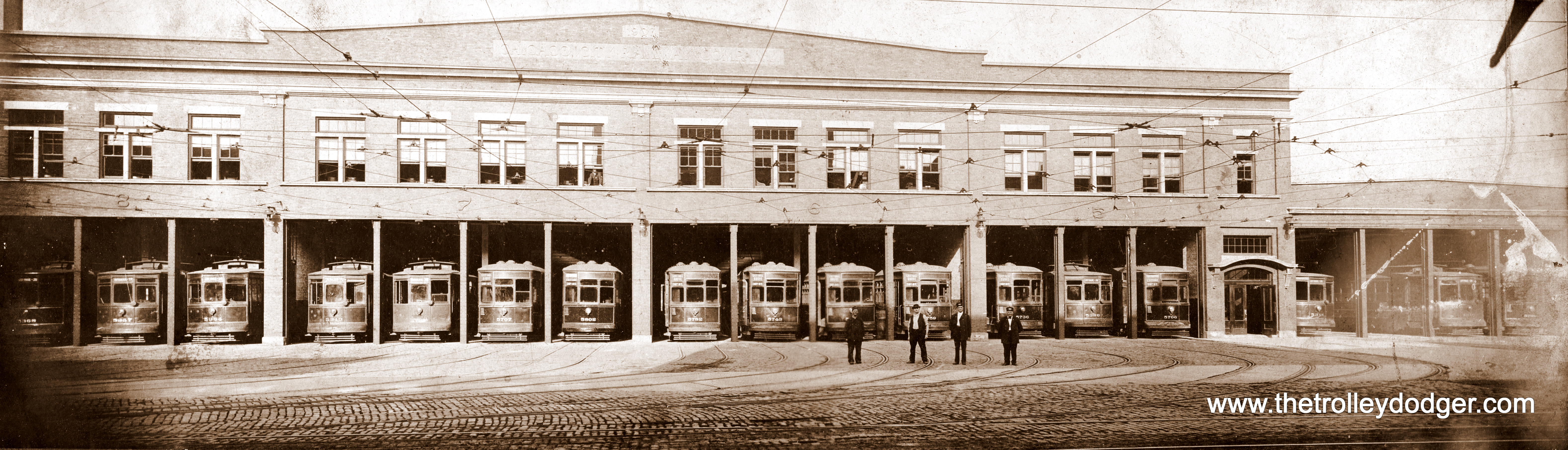
Reader Showcase

CTA 1758 at Randolph and Clark in the 1950s, with the Woods Theater in the background. It closed in 1989. "The Beauty and the Outlaw," playing at the Woods, is more typically known as Ride, Vaquero!. This western starred Robert Taylor and Ava Gardner and was released on July 15, 1953, which helps date the photo.

CTA 1758 at Randolph and Clark in the 1950s, with the Woods Theater in the background. It closed in 1989. “The Beauty and the Outlaw,” playing at the Woods, is more typically known as Ride, Vaquero!. This western starred Robert Taylor and Ava Gardner and was released on July 15, 1953, which helps date the photo.

As we work hard to finish our new book Chicago Trolleys, we thought we would take this opportunity to share some interesting images that our readers recently shared with us. Most of these are from a single individual who would prefer to remain anonymous.

Many of these are slides that were sold by the late Jack Bailey, under the name Ashland Car Works. Mr. Bailey also sold models using the ACW brand name.

The collector who shared these purchased most of the black-and-white prints from Downtown Hobby, which is now called Chicagoland Hobby.

That doesn’t tell you who took the pictures, in most cases, but that is where they came from.

We thank everyone for their contributions.

-David Sadowski

CTA PCCs 7070 and 7168 at Clark and Howard, the north end of route 22 - Clark-Wentworth, in the 1950s. (Ashland Car Works)

CTA PCCs 7070 and 7168 at Clark and Howard, the north end of route 22 – Clark-Wentworth, in the 1950s. (Ashland Car Works)

A CTA Sedan at 115th adn St. Lawrence, near the south end of the Cottage Grove line.

A CTA Sedan at 115th adn St. Lawrence, near the south end of the Cottage Grove line.

CTA PCC 4019 heads east on 63rd Place private right-of-way in 1949. This is a completely built up residential area today.

CTA PCC 4019 heads east on 63rd Place private right-of-way in 1949. This is a completely built up residential area today.

Patrick wirites,"CTA 1733 is actually on 25th Street east of Laramie. Ogden is a diagonal street and the street is too narrow for Cermak. The bank building seen over the top of 1733 is still there." This would be the west end of route 58 - Ogden.

Patrick wirites,”CTA 1733 is actually on 25th Street east of Laramie. Ogden is a diagonal street and the street is too narrow for Cermak. The bank building seen over the top of 1733 is still there.” This would be the west end of route 58 – Ogden.

Andre Kristopans: "Re 723 at 'Pulaski and North' – no way. However, look carefully at the front truck of 723. It is not following the curve to its right, but is turning left. Seems like we are looking east on Harrison at Halsted and that is a Blue Island car about to go down Blue Island Av. That was a very awkward intersection before Circle Campus street realignments."

Andre Kristopans: “Re 723 at ‘Pulaski and North’ – no way. However, look carefully at the front truck of 723. It is not following the curve to its right, but is turning left. Seems like we are looking east on Harrison at Halsted and that is a Blue Island car about to go down Blue Island Av. That was a very awkward intersection before Circle Campus street realignments.”

CTA 7260 at 119th and Morgan. One of our regular readers writes, "I seem to recall that this photo was taken by Bill Janssen on December 4, 1955, the last day (early morning) that route 36 Broadway-State still existed. It is a Broadway-State car laying over, waiting to head north to Clark and Schreiber. It is not Broadway and Ardmore." We were only going by what was written on the slide, which appears to be in error, thanks. This picture appears to be a time exposure (see the light streaking at right). My guess is that the photographer had his camera on a tripod, and used an exposure time of a few seconds for each picture.

CTA 7260 at 119th and Morgan. One of our regular readers writes, “I seem to recall that this photo was taken by Bill Janssen on December 4, 1955, the last day (early morning) that route 36 Broadway-State still existed. It is a Broadway-State car laying over, waiting to head north to Clark and Schreiber. It is not Broadway and Ardmore.” We were only going by what was written on the slide, which appears to be in error, thanks. This picture appears to be a time exposure (see the light streaking at right). My guess is that the photographer had his camera on a tripod, and used an exposure time of a few seconds for each picture.

CTA 4408 is southbound on Clark at Lake Street.

CTA 4408 is southbound on Clark at Lake Street.

CTA 653 is northbound on Dearborn.

CTA 653 is northbound on Dearborn.

CTA 144 on a fantrip at Broadway and Ardmore, with a PCC behind.

CTA 144 on a fantrip at Broadway and Ardmore, with a PCC behind.

The view looking north from State and Van Buren in the 1950s.

The view looking north from State and Van Buren in the 1950s.

CTA 7193 heads south on State Street in the 1950s.

CTA 7193 heads south on State Street in the 1950s.

CTA 7192 northbound on Dearborn, after both Clark and Dearborn were converted to one-way streets.

CTA 7192 northbound on Dearborn, after both Clark and Dearborn were converted to one-way streets.

CTA 7175 is westbound and Polk and Dearborn.

CTA 7175 is westbound and Polk and Dearborn.

CTA 7210, southbound at Clark and Van Buren.

CTA 7210, southbound at Clark and Van Buren.

CMC GM bus 624 on route 34 - Diversey in the early 1950s. The fare at this time was 13 cents.

CMC GM bus 624 on route 34 – Diversey in the early 1950s. The fare at this time was 13 cents.

Chicago Motor Coach bus 1281, newly painted, at Wilcox garage on May 11, 1946. The CMC assets were purchased by the Chicago Transit Authority on October 1, 1952. Route 26 - Jackson became CTA route 126.

Chicago Motor Coach bus 1281, newly painted, at Wilcox garage on May 11, 1946. The CMC assets were purchased by the Chicago Transit Authority on October 1, 1952. Route 26 – Jackson became CTA route 126.

CMC double-decker 146 in July 1936.

CMC double-decker 146 in July 1936.

CMC double-decker 146 in the 1930s.

CMC double-decker 146 in the 1930s.

CMC 61.

CMC 61.

CMC Mack bus 1005, eastbound on Addison near Wrigley Field. Andre Kristopans: "Cmc Mack was built in 1951."

CMC Mack bus 1005, eastbound on Addison near Wrigley Field. Andre Kristopans: “Cmc Mack was built in 1951.”

In this tricked-up photo, we see a GM demo bus, the design of which eventually became the 500 series, at an unidentified location (not Chicago) circa 1950. George Trapp adds, "The bus is the GM Model TDH5502 Demo which became Chicago Motor Coach #500 in 1951. This bus may have been the first paired window version of the Yellow/GM so called "Old Look" buses. It differed somewhat from the production buses #501-600 delivered from Oct. - Dec. 1948. The demo lacks the "Michigan marker lights" front and rear and has two rectangular shaped vents between the headlights which the 501-600 lacked. The CMC TDH5103's 601-650 of 1950 and 651-700 of late 1951 as well as Fifth Avenue Coach TDH-5104's of 1952 also lacked them." Dan Cluely adds, "I believe that the demo bus picture is downtown Pontiac MI. The S.S. Kresge store seem to match, and this would only be a short distance from GM’s bus plant."

In this tricked-up photo, we see a GM demo bus, the design of which eventually became the 500 series, at an unidentified location (not Chicago) circa 1950. George Trapp adds, “The bus is the GM Model TDH5502 Demo which became Chicago Motor Coach #500 in 1951. This bus may have been the first paired window version of the Yellow/GM so called “Old Look” buses. It differed somewhat from the production buses #501-600 delivered from Oct. – Dec. 1948. The demo lacks the “Michigan marker lights” front and rear and has two rectangular shaped vents between the headlights which the 501-600 lacked. The CMC TDH5103’s 601-650 of 1950 and 651-700 of late 1951 as well as Fifth Avenue Coach TDH-5104’s of 1952 also lacked them.” Dan Cluely adds, “I believe that the demo bus picture is downtown Pontiac MI. The S.S. Kresge store seem to match, and this would only be a short distance from GM’s bus plant.”

Fifth Avenue Coach Company (NYC) double-decker 2030.

Fifth Avenue Coach Company (NYC) double-decker 2030.

CSL gas bus #1 in the 1930s.

CSL gas bus #1 in the 1930s.

A CTA Lawrence Avenue trolley bus turning from Leland onto Broadway in the 1950s. This is how Lawrence TBs looped at the east end of the route. Notice the trolley bu wires were not shared with Broadway streetcars. (Gary Johnson Photo)

A CTA Lawrence Avenue trolley bus turning from Leland onto Broadway in the 1950s. This is how Lawrence TBs looped at the east end of the route. Notice the trolley bu wires were not shared with Broadway streetcars. (Gary Johnson Photo)

The famous Norfolk and Western Class J steam engine 611. Retired in 1959, and resurrected 21 years later, the 611 has three excursions planned for this April.

The famous Norfolk and Western Class J steam engine 611. Retired in 1959, and resurrected 21 years later, the 611 has three excursions planned for this April.

Illinois Terminal double-end PCC on the St. Louis-Granite City route.

Illinois Terminal double-end PCC on the St. Louis-Granite City route.

CTA's historical cars 4271-4272, now 95 years young.

CTA’s historical cars 4271-4272, now 95 years young.

1898 - General Electric and the forerunner to the Chicago Transit Authority make history with the world's first electric multiple-unit cars. That must be inventor Frank Julian Sprague at the front of the car.

1898 – General Electric and the forerunner to the Chicago Transit Authority make history with the world’s first electric multiple-unit cars. That must be inventor Frank Julian Sprague at the front of the car.

In 1972, CTA 4358 emerged as rail grinder S-I "Shhhicago." Don's Rail Photos: "4358 was built by Cincinnati Car in 1924, (order) #2860."

In 1972, CTA 4358 emerged as rail grinder S-I “Shhhicago.” Don’s Rail Photos: “4358 was built by Cincinnati Car in 1924, (order) #2860.”

A CTA wooden "L" car, signed as a Lake Street "B" train.

A CTA wooden “L” car, signed as a Lake Street “B” train.

The Lake Street Elevated Railroad in the 1890s, when it was steam-powered.

The Lake Street Elevated Railroad in the 1890s, when it was steam-powered.

A train of CTA 2000s on the Lake Street "L".

A train of CTA 2000s on the Lake Street “L”.

CTA GMC New Look bus 1305, on State near the Chicago Theater.

CTA GMC New Look bus 1305, on State near the Chicago Theater.

Chicago Motor Coach double-decker buses on Michigan Avenue.

Chicago Motor Coach double-decker buses on Michigan Avenue.

Chicago Motor Coach double-decker buses on Michigan Avenue. Note Kroch's bookstore, which later became Kroch's and Brentano's.

Chicago Motor Coach double-decker buses on Michigan Avenue. Note Kroch’s bookstore, which later became Kroch’s and Brentano’s.

Although the Chicago Surface Lines built some replica vehicles in the 1930s, North Chicago Street Railroad car 8 is not among them. An original built in 1859, we see it here in demonstration service during the 1948-49 Chicago Railroad Fair on the lakefront. This car is now preserved at the Illinois Railway Museum.

Although the Chicago Surface Lines built some replica vehicles in the 1930s, North Chicago Street Railroad car 8 is not among them. An original built in 1859, we see it here in demonstration service during the 1948-49 Chicago Railroad Fair on the lakefront. This car is now preserved at the Illinois Railway Museum.

Chicago Motor Coach Ford bus 434, circa 1946.

Chicago Motor Coach Ford bus 434, circa 1946.

An artist's rendering of a CTA New Look bus.

An artist’s rendering of a CTA New Look bus.

This is the upper deck of CMC double-decker bus 146.

This is the upper deck of CMC double-decker bus 146.

A CSL streetcar at Western and Devon in the 1930s, near the old Nortown Theater. That appears to be a Chrysler Airflow in front of the streetcar.

A CSL streetcar at Western and Devon in the 1930s, near the old Nortown Theater. That appears to be a Chrysler Airflow in front of the streetcar.

CTA 7155 signed for route 49 - Western.

CTA 7155 signed for route 49 – Western.

CTA 4160 on Madison near the Garfield Park field house. George Trapp notes, "CSL PCC #4160 on Madison, while photographed on Madison in Garfield Park, this is a publicity photo. The side sign reads Clark-Wentworth and was probably taken in the summer of 1947 before cars in this series, although not necessarily this one, went to Madison."

CTA 4160 on Madison near the Garfield Park field house. George Trapp notes, “CSL PCC #4160 on Madison, while photographed on Madison in Garfield Park, this is a publicity photo. The side sign reads Clark-Wentworth and was probably taken in the summer of 1947 before cars in this series, although not necessarily this one, went to Madison.”

CTA 225 in the 1950s, probably at 77th and Vincennes prior to a fantrip. This car is now preserved at the Seashore Trolley Museum in Maine.

CTA 225 in the 1950s, probably at 77th and Vincennes prior to a fantrip. This car is now preserved at the Seashore Trolley Museum in Maine.

CSL 297 on Belmont.

CSL 297 on Belmont.

It's hard to make out the number, but this shows a CSL one-man car at Armitage and Hudson in the 1940s. That is not far from Lincoln Avenue.

It’s hard to make out the number, but this shows a CSL one-man car at Armitage and Hudson in the 1940s. That is not far from Lincoln Avenue.

Recent Correspondence

1917-uniform

Neil Pantelis writes:

Thank you for such a great page and for sharing an incredible amount of information.

Can you tell me by looking at this photo if the subject is wearing the uniform of a conductor, driver, motorman etc?  He is in a group photo from my grandparents engagement party.

The photo is from the Douglas Park area of Chicago in the year 1917. It is very likely near the intersection of California and Ogden.

Anyone working for the Chicago Surface Lines in 1917 would most likely have had a CSL badge, with a number, on their hat. The resolution on this picture is such that it’s difficult to tell whether or not there is such a badge.

Perhaps our readers can weigh in on this. This appears to be but a portion of a larger photo. If I could see the rest, perhaps we can try to put this into the proper context.

Glad you like the blog.

A Chicago City Railway Co. hat badge.

A Chicago City Railway Co. hat badge.

Spence Ziegler writes:

I tried to access this website recently and I noticed that it’s gone; do you know anything about this?  Any information or thoughts on this would greatly be appreciated. It’s address was CAERR.com.

Thank you in advance.

Looks like someone didn’t pay for the domain renewal.  Julie Johnson died in 2011, and presumably left some money to pay for this, and now the registration has run out. Not sure who else was involved with this web site.

I did a “Whois” search and it looks like someone updated the site several months ago, so someone else must be involved:

Expires On 2017-02-14
Registered On 2000-02-14
Updated On 2016-06-22

Jack Bejna writes:

I enjoy the Trolley Dodger immensely, especially anything CA&E! I grew up in Broadview and walked to Proviso High School every day along the CA&E right of way from 9th avenue to 5th Avenue. This month’s CA&E images are some that I haven’t seen before and are great, especially since they’re medium format images. I have a request… I would like to see a good image of the old dispatcher’s office (before it was repainted and the upper windows covered over. I’m sure someone took pictures of the office but I’ve never seen one.

Thanks for all you do; it sure makes my day!

PS- Here are some CA&E shots that I have Photoshopped. All of them except CA&E 26 are from the JJ (Julie Johnson) collection.

What you call “Photoshopping” is nothing new, when you consider that retouching and airbrushing has been around for a long time.  There is nothing wrong with creating idealized versions of photographs that eliminate unnecessary parts of the background that are distracting, as long as everyone realizes what they are.

If anyone is familiar with promotional materials from General Motors, St. Louis Car Company, Chicago Surface Lines, etc., you will see all sorts of retouched and airbrushed images. Photoshop is just a different way of achieving the same result.

My own approach to photo restoration is to eliminate imperfections to make the image look more realistic. It’s a big world, and there is plenty of room for both approaches, as long as there is “truth in packaging,” so people will know the difference.

Thanks for sharing these with our readers.  Another good reason for posting these is that Julie Johnson’s web site has, for the moment, disappeared.

-David Sadowski

CA&E 46: This builders photo of CA&E 46 was too good not to improve; looks a lot better.

CA&E 46: This builders photo of CA&E 46 was too good not to improve; looks a lot better.

CA&E 28: A really poor print that I worked on to improve; not a bad shot.

CA&E 28: A really poor print that I worked on to improve; not a bad shot.

CA&E 26: The nice original was marred by the fence in front of it so I removed it and it looks much better.

CA&E 26: The nice original was marred by the fence in front of it so I removed it and it looks much better.

CA&E 24: A washed out shot that deserved to be worked on a bit.

CA&E 24: A washed out shot that deserved to be worked on a bit.

CA&E 14: Pretty much the same as CA&E 12.

CA&E 14: Pretty much the same as CA&E 12.

CA&E 12: The original was coupled to another car and looked a little crowded, so I got rid of the car and cleaned up the image as well.

CA&E 12: The original was coupled to another car and looked a little crowded, so I got rid of the car and cleaned up the image as well.

In my search for CA&E car Photos, sometimes you just can"t find what you want. Recently, I was looking at an image from the WCJ collection - ETRM, specifically car 46, a 1902 Stephenson Motor. I had been searching for a good image of car 101, a 1902 Stephenson trailer. Hmmm, the wheels started turning and here you see the result. I'm sure a purist would be able to pick apart some details, etc., but it sure looks like CA&E trailer 101 to me! (Editor's note: I assume WCJ stands for early railfan William C. Janssen.)

In my search for CA&E car Photos, sometimes you just can”t find what you want. Recently, I was looking at an image from the WCJ collection – ETRM, specifically car 46, a 1902 Stephenson Motor. I had been searching for a good image of car 101, a 1902 Stephenson trailer. Hmmm, the wheels started turning and here you see the result. I’m sure a purist would be able to pick apart some details, etc., but it sure looks like CA&E trailer 101 to me!
(Editor’s note: I assume WCJ stands for early railfan William C. Janssen.)

cae-dining-car-carolyn-niles-1905

cae-car-309-3-hicks-1908-end

cae-car-101-trailer-stephenson-1902

street-railwayreview1895-002

Help Support The Trolley Dodger

gh1

This is our 176th post, and we are gradually creating a body of work and an online resource for the benefit of all railfans, everywhere. To date, we have received over 253,000 page views, for which we are very grateful.

You can help us continue our original transit research by checking out the fine products in our Online Store.

As we have said before, “If you buy here, we will be here.”

We thank you for your support.

DONATIONS

In order to continue giving you the kinds of historic railroad images that you have come to expect from The Trolley Dodger, we need your help and support. It costs money to maintain this website, and to do the sort of historic research that is our specialty.

As we mentioned in a previous post, we also are on a tight deadline to finish our new book Chicago Trolleys. Your financial contributions will help make this book better, and are greatly appreciated.

The Great Chicago Interurbans – Part Two (CNS&M)

This remarkable very early color picture shows NSL Birney car 332 and a variety of interurban cars in Milwaukee. In back, that’s car 300 in fantrip service. It was used by CERA as a club car circa 1939-42, which helps date the photo. Don’s Rail Photos: “332 was built by Cincinnati Car Co in December 1922, #2625. It was retired in 1947 and scrapped in April 1948… 300 thru 302 were built by Jewett in 1909 as mainline coaches. As the steel cars arrived, they were downgraded to local and school tripper service. In 1936 they became sleet cutters. In 1939 300 was turned over to the Central Electric Railfans’ Association as a private car. The ownership remained with the CNS&M, but the maintenance was taken over by CERA. During the war, with many members in service, CERA relinquished control, and the car was scrapped in 1947. 301 and 302 were retired in 1939 and scrapped in 1940.” CERA bulletins of the time say that fantrips, being non-essential travel were not allowed for much of the war, starting in 1942. By the time the war ended, car 300 had been stripped of some parts in order to keep other wood cars running. Several were sold to the Chicago, Aurora & Elgin in 1946. The North Shore Line had decided it no longer wanted to run wood cars in passenger service. Then, the 300 was vandalized and some windows were smashed. It was scrapped by CNS&M.

Today, we continue our look at the great Chicago interurbans* by featuring the North Shore Line. The Chicago, North Shore & Milwaukee last ran on January 21, 1963, just over 54 years ago.

This is widely considered the end of the Interurban Era.

But wait, there’s much more on offer in this, our 175th post. All of today’s black-and-white photos are scanned from the original negatives. This includes an original medium format neg taken by Edward Frank, Jr., which he traded with another collector. I don’t know what became of the rest of his negatives.

-David Sadowski

See our last post (January 28, 2017) for part one.

North Shore Line

<img class="size-large wp-image-9191" src="https://thetrolleydodger.com/wp-content/uploads/2017/01/dave588.jpg?w=665" alt="On a June 17, 1962 CERA fantrip, we see NSL car 744 posing for pictures on a section of track that was once part of the old Shore Line Route, abandoned in 1955. Don's Rail Photos: "744 was built by Pullman in 1928. It was modernized in 1940." We previously featured another picture taken at this location in our post More Color Restorations (August 9, 2016).” width=”665″ height=”407″ /> On a June 17, 1962 CERA fantrip, we see NSL car 744 posing for pictures on a section of track that was once part of the old Shore Line Route, abandoned in 1955. Don’s Rail Photos: “744 was built by Pullman in 1928. It was modernized in 1940.” We previously featured another picture taken at this location in our post More Color Restorations (August 9, 2016).

CNS&M wooden interurban car 303 in its days as a sleet cutter. Don’s Rail Photos: “303 thru 305 were built by American Car in 1910 and were almost identical. In 1939 they became sleet cutters and were retired and scrapped in 1940.”

CNS&M 704 getting washed at the Milwaukee terminal. Don’s Rail Photos: “704 was built by Cincinnati Car Co in May 1923, #2635.” (Walter Broschart Photo)

The information I received with this negative says that CNS&M 169 is a Special on the Shore Line Route in Wilmette in 1954. On the other hand, one of our long-time readers says this is actually Mundelein terminal on that branch line. Since this is apparently a fantrip car, the Shore Line Route sign may be incorrect. Don’s Rail Photos: “169 was built by Jewett in 1917.”

A not too sharp picture of a southbound train on the Shore Line Route at Wilmette.

A not too sharp picture of a southbound train on the Shore Line Route at Wilmette.

Richard H. Young took this picture on June 2, 1960 from the back of a moving North Shore car somewhere near Mundelein. We see a line car at work on the other track. One of our regular readers says that we are looking east toward South Upton tower, with Rt. 176 at left (north).

Richard H. Young took this picture on June 2, 1960 from the back of a moving North Shore car somewhere near Mundelein. We see a line car at work on the other track. One of our regular readers says that we are looking east toward South Upton tower, with Rt. 176 at left (north).

A close-up of the line car. Not sure whether this is the 604 or the 606.

A close-up of the line car. Not sure whether this is the 604 or the 606.

The same location today.

The same location today.

CNS&M 774 at the Milwaukee terminal. Don’s Rail Photos: “774 was built by Standard Steel Car Co in 1930, It was rebuilt as (a) Silverliner on May 9, 1950.” This photo appears to predate that.

CNS&M 761 at the Milwaukee terminal on May 29, 1950. Don’s Rail Photos: “761 was built by Standard Steel Car Co in 1930. It was modernized in 1949 and rebuilt as Silverliner in October 11, 1957.”

One of the two Electroliners passes a train of older cars in this wintry scene. Not sure of the exact location. The Electroliners entered service in 1941. Don Ross: “The Electroliner in the snow was at North Chicago. I have one similar from a different angle and no snow.” Jerry Wiatrowski: “The picture of the Southbound Electroliner is entering the curve to North Chicago Junction. The photographer is looking Northwest from North Chicago Junction. The bypass line continues South to the left.”

The same location today. We are looking north at about 2225 Commonwealth Avenue in North Chicago, IL. The cross-street, which was 22nd Street, is now Martin Luther King, Jr. Dr.

The same location today. We are looking north at about 2225 Commonwealth Avenue in North Chicago, IL. The cross-street, which was 22nd Street, is now Martin Luther King, Jr. Dr.

North Shore steeple cab 459 looks like it is backing up to connect with a couple of stalled cars. The information I got with this negative says this is Cudahy, Wisconsin in April 1954. That is just south of Milwaukee. However, it’s been pointed out to me that this municipality was a couple miles west of the right-of-way and the station in the picture looks more like Waukegan. Don’s Rail Photos: “459 was built by the SP&S in August 1941 as OERy 51. It was purchased by the North Shore in December 1947 and was completed as 459 on November 22, 1948.”

North Shore Birney car 335 in July 1947. Don’s Rail Photos: “335 was built by Cincinnati Car Co in December 1922, #2625. It was retired in 1947 and scrapped in April 1948.” The car is signed for Oklahoma Avenue in Milwaukee.

Car 409 on an early CERA fantrip, which may have been on June 4, 1939. It appears to be coupled to 716. The car at left may be 168. Car 255 is also supposed to have been used on that 1939 fantrip, but at that time, it was a full-length baggage car that had no seats and was often used to move musician’s instruments to and from Ravinia Park. The seats were not put in again until 1942. Don’s Rail Photos: “409 was built by Cincinnati Car in May 1923, #2465, as a dining car motor. In 1942 it was rebuilt as a coach and rebuilt as a Silverliner on March 30, 1955. Since it had no bulkhead between smoking and non-smoking sections, it was our favorite car to be used for meetings of the Milwaukee Division of the Electric Railroaders Association in Milwaukee. The North Shore was very cooperative in making sure that the car was in the location shown on meeting nights.”

I received no information with this negative, but this may show a bunch of North Shore Line cars in dead storage after the 1963 abandonment. Notice the destination sign is missing from combine 254. This car was not saved. Don’s Rail Photos: “254 was built by Jewett in 1917. The seating was changed to 28 on August 26, 1955.”

CNS&M 759 and train at South Upton on June 15, 1947. Don’s Rail Photos: “759 was built by Standard Steel Car Co in 1930. It was modernized in 1949.”

CNS&M 737 at Highwood in 1950. Don’s Rail Photos: “737 was built by Pullman in 1928. It was modernized in 1940 and rebuilt as Silverliner on June 30, 1950.” (Richard S. Short Photo)

CNS&M 739 near Glencoe. The date given is June 21, 1941; however, there was a CERA fantrip the following day, so the date may actually be June 22. The car is signed for charter service on the Shore Line Route. June 22, 1941 was also the day that Hitler invaded the Soviet Union. Don’s Rail Photos: “739 was built by Pullman in 1928. It was modernized in 1940 and rebuilt as (a) Silverliner on August 31, 1950.”

CNS&M 155 is a Skokie Valley Route Special at North Chicago on April 17, 1952. Don’s Rail Photos: “155 was built by Brill in 1915, #19605. It was damaged by fire at Highwood on August 11, 1955, and scrapped. One end from it was used to repair 735.”

South Shore Line

The other great Chicago interurban, of course, is the South Shore Line, which continues to operate between Chicago and South Bend, Indiana. We have just a couple vintage photos to show you today, but are sure to have more soon.

CSS&SB car 1 heads up a train at Randolph Street in downtown Chicago in 1946. Don’s Rail Photos: “1 was built by Pullman in 1926. It was later air-conditioned. It went to National Park Service in 1983 and (was) loaned to (the) Southern Michigan RR.” Spence Ziegler says, “The photo of CSS&SB #1 was more likely 1950-52; I have a slide from the Interurbans Slide set from 1983 showing #1 leaving Kensington in 1949 (on the rear of a train) still with the destination sign and train number sign on it’s end, though both were disused. Bill Wasik: “The CSS&SB car 1 at Randolph Street in downtown Chicago photo dated 1946 instead likely was taken between July 1952, when the giant Pabst sign on Randolph was dismantled, and mid-1953, when steel going up for the Prudential Building would have been visible in this view.”

CSS&SB freight motor 903 at Michigan City on July 17, 1956. Don’s Rail Photos: “903 was built by Baldwin-Westinghouse in September 1929, #61047, as IC 10001. It became CSS&SB 903 in July 1941.”

Chicago & West Towns Railways

The Chicago & West Towns Railways operated streetcars in Chicago’s western suburbs. But a 1942 Chicago guidebook referred to it as an “interurban,” probably referring to its longest and busiest line, which ran from Cicero to LaGrange and had sections of private right-of-way. Starting in 1934, it went to the Brookfield Zoo.

C&WT 163 at the Oak Park car barn on April 23, 1939. There was a CERA fantrip on the West Towns on this date. 163 was built by the Cummings Car Company in 1927. (LaMar M. Kelley Photo)

C&WT 163 at the Oak Park car barn on April 23, 1939. There was a CERA fantrip on the West Towns on this date. 163 was built by the Cummings Car Company in 1927. (LaMar M. Kelley Photo)

C&WT line car 15 at the Harlem and Cermak car barn. Don’s Rail Photos: “15 was built by Pullman Car in 1897 as Suburban RR 512. It was renumbered 515 and rebuilt as 15 in 1927. It was rebuilt in 1940 and scrapped in 1948.” (Edward Frank, Jr. Photo)

Edward Frank, Jr.'s famous bicycle, which appears in many of his pictures.

Edward Frank, Jr.’s famous bicycle, which appears in many of his pictures.

C&WT 146 at Lake and Austin, east end of the line. Riders could change across the street for a Chicago car. The Park Theater, at right, was showing Sutter's Gold, starring Edward Arnold. That film was released in 1936, which may be the date of this photo. This car was built by McGuire-Cummings in 1924.

C&WT 146 at Lake and Austin, east end of the line. Riders could change across the street for a Chicago car. The Park Theater, at right, was showing Sutter’s Gold, starring Edward Arnold. That film was released in 1936, which may be the date of this photo. This car was built by McGuire-Cummings in 1924.

C&WT 105, described as being tan in color, in front of the North Riverside car barn on April 28, 1939. (However, if the date was actually the 23rd, there was a CERA fantrip.) Don’s Rail Photos: “105 was built by McGuire-Cummings in 1915.” (Gordon E. Lloyd Photo) Gordon E. Lloyd grew up in the Chicago area and would have been 14 years old at the time. He later became a well-known railfan photographer and authored some books. He died aged 81 in 2006. Pretty good picture for a teenager!

C&WT 105 at Cermak and Kenton, probably in the late 1930s. This was the east end of the long LaGrange line and this car is signed for the Brookfield Zoo. Note the CSL car at rear. Riders could change here to go east on route 21 – Cermak. Don’s Rail Photos: “105 was built by McGuire-Cummings in 1915.”

Angel’s Flight

The Angel’s Flight Railway is a narrow gauge funicular in the Bunker Hill neighborhood in Los Angeles. A funicular is somewhat like an elevator that goes up the side of a hill; when one car goes up, the other goes down. I’ve been on three of these myself– two in Pittsburgh and one in Dubuque, Iowa.

Most of these have operated for over a century without major incidents, but Angel’s Flight has been plagued by bad luck for a long time. First, starting in the early 1960s, the area around it was slated for redevelopment, and the surrounding buildings were torn down. The hill it was on was partly leveled.

Fortunately, Angel’s Flight was disassembled after it stopped running in 1969, and put into storage. It was moved a half block south and reopened in 1996.

Unfortunately, there were some problems with how the thing was engineered as reconstructed, which led to some accidents. While Angel’s Flight has not run for a few years, these safety concerns have been addressed one by one, and now all that stands in the way of its reopening is the installation of an emergency walkway in case the thing breaks down on its 298-foot journey. Meanwhile, the not-for-profit group that operates it has to pay thousands of dollars each month for insurance.

Still, Angel’s Flight is an LA landmark and we hope that it will operate once again, and safely.

In the meantime, I was surprised to find it featured in a brief scene in the film La La Land. The two leads (Ryan Gosling and Emma Stone) are shown riding and kissing on the funicular.

Although Angel’s Flight is closed to the public, the operators thought it would be OK to use it in a film, and I’m sure they benefit a great deal from the publicity. But while they have been reprimanded (right now, no one is supposed to ride except employees), I am glad it appears in the film.

Angel’s Flight has been appearing in movies for nearly 100 years now. You can read an article about this here.

af1

af2

af3

Angel's Flight at its original location (3rd and Hill Streets) on July 5, 1962, before nearby buildings were torn down. (Leo Callos Photo)

Angel’s Flight at its original location (3rd and Hill Streets) on July 5, 1962, before nearby buildings were torn down. (Leo Callos Photo)

A view of Angel's Flight in 1964, showing the building at left demolished.

A view of Angel’s Flight in 1964, showing the building at left demolished.

A side view of Angel's Flight in 1964, after nearby buildings were being demolished. (Leo Callos Photo)

A side view of Angel’s Flight in 1964, after nearby buildings were being demolished. (Leo Callos Photo)

The Angel's Flight funicular on June 13, 1961. (George Basch Photo)

The Angel’s Flight funicular on June 13, 1961. (George Basch Photo)

Recent Correspondence

Jack Bejna writes:

I enjoy the Trolley Dodger immensely, especially anything CA&E! I grew up in Broadview and walked to Proviso High School every day along the CA&E right of way from 9th avenue to 5th Avenue. This month’s CA&E images are some that I haven’t seen before and are great, especially since they’re medium format images. I have a request….I would like to see a good image of the old dispatcher’s office (before it was repainted and the upper windows covered over. I’m sure someone took pictures of the office but I’ve never seen one.

Thanks for all you do; it sure makes my day!

I post these images practically as soon as I can buy them, but I can put this request in my next post, in hopes that someone might be able to help.

Glad you enjoy the blog.

Thanks David, I’ll be looking and hoping for a good shot. Again, thanks for all you do for us CA&E fanatics!

Bill Shapotkin writes:

Dave — in your January 2015 posting, this photo was included:

CTA 78 is shown at the east end of the Madison-Fifth shuttle in February, 1954. But wait-- wouldn't car 78 be on the Hammond, Whiting, and East Chicago? According to Alan R. Lind's CSL book, the CTA renumbered car 1780 to 78 in the waning days of red car service, in order to free up numbers in the 1780s for some buses. This was the only time a CSL streetcar was given a two-digit number, except for work cars. That's one school of thought. On the other hand, the number on the side of this car looks like 1781, and according to Andre Kristopans, it was still 1781 when scrapped. It may in fact not be a renumbering at all, just a case where either the car's paint got touched up and obscured part of the number, or part of the number fell off and did not get replaced, since red car service was ending in a few months anyway. At left in the background you can see Fohrman Motors, a Chicago car dealer from 1912 to 1979. Three people were killed at the dealership by a disgruntled customer on January 7, 1966. The neighborhood, not far from the construction site for the Congress (now Eisenhower) expressway, is already showing signs of urban decay. We discuss this in our post Some Thoughts on “Displaced” (August 30, 2016).

CTA 78 is shown at the east end of the Madison-Fifth shuttle in February, 1954. But wait– wouldn’t car 78 be on the Hammond, Whiting, and East Chicago? According to Alan R. Lind’s CSL book, the CTA renumbered car 1780 to 78 in the waning days of red car service, in order to free up numbers in the 1780s for some buses. This was the only time a CSL streetcar was given a two-digit number, except for work cars.
That’s one school of thought. On the other hand, the number on the side of this car looks like 1781, and according to Andre Kristopans, it was still 1781 when scrapped. It may in fact not be a renumbering at all, just a case where either the car’s paint got touched up and obscured part of the number, or part of the number fell off and did not get replaced, since red car service was ending in a few months anyway.
At left in the background you can see Fohrman Motors, a Chicago car dealer from 1912 to 1979. Three people were killed at the dealership by a disgruntled customer on January 7, 1966. The neighborhood, not far from the construction site for the Congress (now Eisenhower) expressway, is already showing signs of urban decay. We discuss this in our post Some Thoughts on “Displaced” (August 30, 2016).

Your caption read (in part):

“CTA 78 is shown at the east end of the Madison-Fifth shuttle in February, 1954. But wait– wouldn’t car 78 be on the Hammond, Whiting, and East Chicago? In actuality, I think this is car 1781. Perhaps part of the number has fallen off”

Well, I have an explanation (courtesy of Roy Benedict — who seems to recall that he heard this from Glen Anderson). It JUST SO HAPPENED, both car #1781 AND bus #1781 were assigned to Kedzie station at the time. To avoid confusion, the decals for the digit”1″ were removed off the streetcar — thus avoiding any confusion. Roy had ridden car #78 on the Fifth Ave Shuttle on at least two occasions (and noticed the strange two-digit car number) — only to find out years later (again, he recalls that it was via Glen) as to the reason.

That’s great to know, thanks. I recently bought another copy of the Lind book, and while it does mention the renumbering, offers no explanation. (I have owned several copies of Chicago Surface Lines, An Illustrated History over the years, but have given some of them away, and other copies are in storage.)

The only thing that would need to be double-checked is whether there really was a bus 1781 working out of the Kedzie car house. I suppose Andre would know that.

Andre Kristopans writes:

There was a bus 1781 in 1954, but not at Kedzie. 1700’s at the time were at North Av, North Park, and Limits. Best explanation I can give is that when 1781 was last repainted, they didn’t have any “1” decals, and so out it went as “78”, and the problem was never corrected. Note it does appear the side number is 78 also! However, CTA’s streetcar retirements documentation show 1781, both in the AFR and the scrap ledger.

Gina Sammis wrote us a while back, looking for information on Gustav Johnson, a longtime Chicago Surface Lines employee (born June 23, 1855 – died November 23, 1946). He retired around 1925, after having worked on streetcars for 35 years.

As it happens, I recently purchased a copy of the December 1946 Surface Service, the CSL employee magazine. These do not often come up for sale, in comparison with the later CTA Transit News.

Mr. Johnson is mentioned in two places. There is the one you already know about on page 15, in a section titled In Memoriam.

But there are also reports from individual car houses (barns), and on page 8 it says,”Retired Motorman Gus Johnson passed away November 24.”

So, at least that tells you that he was driving the streetcars, and not just the conductor taking fares.

I took the liberty of writing to George Trapp, in order to find out just what streetcar lines would have been operating out of Devon Station (car house) in the early 1900s. Here is his reply:

I would guess the Evanston cars before 1913 or so before the barn on Central Street in Evanston was built and after 1901 when the Devon barn was built. The North Shore & Western dinkey may also have been stored there in the Winter when the golf club was closed. The Devon shuttle and the Lawrence Avenue lines as well and possibly the North Western line before being through routed with Western which also used the barn for part of the service from sometime in the 1930’s and half the service in the PCC era.

His answer needs a bit of further explaining.  I did some additional research,  From 1901, when the Devon car house opened, until 1913, Evanston streetcars would have used the facility. After that, they had their own barn.

You need to consider that this area was just getting built up around this time. So, there were a lot of changes. In general, the dates of the changes will give you a clue to about when development was happening.

Here is what the Rogers Park/West Ridge Historical Society says about the North Shore and Western Railway:

The North Shore & Western Railway Company was formed and owned by the members of the Glen View Club in Golf, Illinois. It comprised two pieces of equipment, one streetcar and a snow plow. There were two employees, a motorman and conductor. The hours of operation were set for the convenience of the members of the golf club.

It operated from the golf club through a portion of Harms Woods crossing the North Branch of the Chicago River in the woods and ran straight east on what is now known as Old Orchard Road to Evanston, where the street becomes Harrison Street. It was nicknamed the Toonerville Trolley and a piece of a rail is on display at the Skokie Historical Society.

The membership tired of the trolley’s ownership and sold the line to the Evanston Railway Company.

George Trapp refers to their sole streetcar as a “dinky,” meaning it was small.

The “Devon Avenue Shuttle” would have run east-west. According to Alan R. Lind on page 254 of Chicago Surface Lines, An Illustrated History (Third Edition):

This short North Side shuttle started operation May 20, 1917 from Clark to Western. One-man cars took over the service March 13, 1921. A west extension opened December 14, 1925 from Western to Kedzie, and an east extension opened from Clark to Magnolia January 30, 1928. When Broadway cars began to run to Devon and Kedzie on July 10, 1932, the Devon shuttle car was discontinued.”

North Western Avenue is covered in the same book on page 312:

This extension of the regular Western route began October 18, 1915 between Lawrence and Bryn Mawr. Extensions brought the line to Devon on December 11, 1915, and to Howard on December 16, 1916. The line was through-routed with Western on May 1, 1923.

The busiest route working out of Devon station would have always been Clark, which started running downtown (from Howard) on October 21, 1906. It was through-routed with the south side Wentworth line on March 17, 1908.

Here is what Lind says about the Broadway route on page 231:

In 1906 this North Side trunk route ran from Clark and Howard at the city limits to a loop in downtown Chicago via Cark, Devon, Broadway, Clark, Randolph, LaSalle, Monroe, Dearborn, and Randolph. At this time streetcars to north suburban Evanston also ran on the Broadway route from the old Limits carbarn at Drummond and Clark to Central and Bennett in Evanston. The route was the same as the Broadway cars to Howard, then via Chicago, Dempster, Sherman, and Central to Bennett.

On July 24, 1907 the Evanston line was extended west from Bennett to Lincolnwood Dr. On the same day a single track extension line known as the North Shore & Western Railway began service via Lincolnwood and Harrison to the Glenview Golf Club west of the Chicago River.

The local Broadway cars and the Evanston service to Lincolnwood Dr. were operated by the Chicago Union Traction Company, a Yerkes property. The track north of Irving Park was owned by the Chicago Consolidated Traction Company. (The North Shore & Western was owned by some men with a stake in the golf club.) On February 25, 1908 CUT was reorganized as Chicago Railways Company. On December 27, 1910 Chicago Railways sold its suburban lines to the County Traction Company. At midnight on that date the track connection between the Broadway line, still under CRYs, and the Evanston line was cut at Clark and Howard. Through passengers had to walk across a 30-foot gap in the track from the Evanston cars, now in local Evanston service only under County Traction, to the Broadway cars, still under Chicago Railways.

Because of a franchise requirement of one of the underlying companies,, free transfers from Evanston to Broadway cars were issued starting December 31, 1910. County Traction was split into two companies on August 5, 1913: Evanston Traction and Chicago & West Towns Railway Co. Evanston Traction became (the Evanston Railways Company and in 1936) Evanston Bus Company.

In sum, if your relative worked at Devon station in the early 1900s, chances are most of his work would have been on the Clark and Broadway lines. On my blog, if you do a search on the words Clark or Broadway, you will turn up lots of photos showing service on those lines.

Gina replied:

You have been so helpful and I am very appreciative. Thank you David.

We have added a complete scan of the December 1946 Surface Service to our E-book Chicago's PCC Streetcars: The Rest of the Story, available in our Online Store.

We have added a complete scan of the December 1946 Surface Service to our E-book Chicago’s PCC Streetcars: The Rest of the Story, available in our Online Store.

dave763

dave771

Keep those cards and letters coming in, folks. But better yet, why not write us at:

thetrolleydodger@gmail.com

Thanks.

-David Sadowski

street-railwayreview1895-002

Help Support The Trolley Dodger

gh1

This is our 175th post, and we are gradually creating a body of work and an online resource for the benefit of all railfans, everywhere. To date, we have received over 248,000 page views, for which we are very grateful.

You can help us continue our original transit research by checking out the fine products in our Online Store.

As we have said before, “If you buy here, we will be here.”

We thank you for your support.

DONATIONS

In order to continue giving you the kinds of historic railroad images that you have come to expect from The Trolley Dodger, we need your help and support. It costs money to maintain this website, and to do the sort of historic research that is our specialty.

As we mentioned in a previous post, we also are on a tight deadline to finish our new book Chicago Trolleys. Your financial contributions will help make this book better, and are greatly appreciated.

The Great Chicago Interurbans – Part One (CA&E and AE&FRE)

Here is a very rare photo taken at Laramie Yards in 1936. At left we see North Shore Line car 722, heading up a four-car train and signed for Wheaton. CNS&M cars did, of course, operate on parts of the Chicago "L" system, of course, but this is the first picture I have seen showing them at this location, posed next to CA&E cars 421 and 401. 722 was buit by Cincinnati Car Co. in 1926. I wonder what the occasion was that brought four North Shore Line cars to Wheaton? (Edward Frank, Jr. Photo)

Here is a very rare photo taken at Laramie Yards in 1936. At left we see North Shore Line car 722, heading up a four-car train and signed for Wheaton. CNS&M cars did, of course, operate on parts of the Chicago “L” system, of course, but this is the first picture I have seen showing them at this location, posed next to CA&E cars 421 and 401. 722 was buit by Cincinnati Car Co. in 1926. I wonder what the occasion was that brought four North Shore Line cars to Wheaton? (Edward Frank, Jr. Photo)

The last Chicago, North Shore & Milwaukee interurban train ran in the early hours of a very cold January 21, 1963. George Hilton and John Due, in their classic book The Electric Interurban Railways in America called this the end of the Interurban Era in the United States. The 54th anniversary was just a few days ago.

Since this was also the second anniversary of this blog, we thought this an excellent opportunity to showcase the three great Chicago-area interurbans- the North Shore Line, South Shore Line, and Chicago, Aurora & Elgin.

We have been saving up images of these lines, and now find ourselves with enough for two posts. So today, we will begin with the “Roarin’ Elgin” and its one-time subsidiary, the Aurora, Elgin & Fox River Electric. The great majority of these images were scanned from the original medium-format negatives.

While we do lament the passing of the Interurban Era and two of the three major Chicago systems, we can celebrate them with these classic pictures. Some of these were made possible thanks to your recent generous donations.

We will round out January in a few days with our second installment of great Chicago interurbans, featuring the North Shore Line and South Shore Line. Watch this space!

-David Sadowski

A Bird’s Eye View

While visiting a friend at Rush hospital earlier this month, I took a few pictures from out the window. It just so happened his room had a spectacular view of where the Chicago Transit Authority’s Pink Line crosses over the Blue Line. There is a ramp at this location, which is also where the old Marshfied Junction was on the Met “L”. In previous posts, we have run pictures showing how this looked like before expressway construction in the early 1950s.

An inbound Blue Line train passes the point where part of an access ramp at the Damen-Ogden-Paulina station was damaged during a lightning storm. With the addition of chain-link fencing, it has since been reopened.

An inbound Blue Line train passes the point where part of an access ramp at the Damen-Ogden-Paulina station was damaged during a lightning storm. With the addition of chain-link fencing, it has since been reopened.

A southbound Pink Line train about to cross over the Blue Line.

A southbound Pink Line train about to cross over the Blue Line.

An inbound Blue Line train.

An inbound Blue Line train.

A northbound Pink Line train has just passed the location of the old Marshfield Junction on the Met "L".

A northbound Pink Line train has just passed the location of the old Marshfield Junction on the Met “L”.

The CA&E and AE&FRE

This is a rare photo, as it shows AE&FRE car 304 sometime prior to the abandonment of passenger service in 1935. Don's Rail Photos: "304 was built by St Louis Car in 1924. #1306. In 1936 it was sold CI/SHRT (aka Shaker Heights Rapid Transit) as 304 and in 1954 it was sold to CP&SW (Trolleyville USA) as 304. It was sold to Fox River Trolley Museum in 2009." I have had the pleasure of riding on this fine car at the Fox River Trolley Museum, as it has returned to its home rais after a 75-year absence. You can see pictures I took of it there on the previous blog that I worked on here. Long may it run.

This is a rare photo, as it shows AE&FRE car 304 sometime prior to the abandonment of passenger service in 1935. Don’s Rail Photos: “304 was built by St Louis Car in 1924. #1306. In 1936 it was sold CI/SHRT (aka Shaker Heights Rapid Transit) as 304 and in 1954 it was sold to CP&SW (Trolleyville USA) as 304. It was sold to Fox River Trolley Museum in 2009.” I have had the pleasure of riding on this fine car at the Fox River Trolley Museum, as it has returned to its home rais after a 75-year absence. You can see pictures I took of it there on the previous blog that I worked on here. Long may it run.

Here is an excellent model that shows AE&FRE 300's colors. (Bruce Moffat Photo)

Here is an excellent model that shows AE&FRE 300’s colors. (Bruce Moffat Photo)

CA&E wood car 138 at the Wheaton Yard on July 3, 1949. Don's Rail Photos says, "138 was built by American Car Co in March 1910, #844, as C&ME 138. It was rebuilt in 1914 and no retired date." This was one of several cars leased from the North Shore Line in 1936 and purchased from them a decade later. Ironically, this made them the last passenger cars bought by CA&E. They were considered surplus after service was cut back to Forest Park in 1953 and were scrapped shortly thereafter.

CA&E wood car 138 at the Wheaton Yard on July 3, 1949. Don’s Rail Photos says, “138 was built by American Car Co in March 1910, #844, as C&ME 138. It was rebuilt in 1914 and no retired date.” This was one of several cars leased from the North Shore Line in 1936 and purchased from them a decade later. Ironically, this made them the last passenger cars bought by CA&E. They were considered surplus after service was cut back to Forest Park in 1953 and were scrapped shortly thereafter.

Don's Rail Photos: "301 was built by Niles Car & Mfg Co in 1906. It was modernized in December 1940."

Don’s Rail Photos: “301 was built by Niles Car & Mfg Co in 1906. It was modernized in December 1940.”

Don's Rail Photos: "105 was built by Stephenson in 1903. It was modernized in August 1940 and retired in 1955. "

Don’s Rail Photos: “105 was built by Stephenson in 1903. It was modernized in August 1940 and retired in 1955. “

CA&E 302 at the Wheaton Yard in July 1948. Don's Rail Photos: "302 was built by Niles Car & Mfg Co in 1906. It was modernized in May 1940."

CA&E 302 at the Wheaton Yard in July 1948. Don’s Rail Photos: “302 was built by Niles Car & Mfg Co in 1906. It was modernized in May 1940.”

Express car 15 at Wheaton on June 18, 1947. Don's Rail Photos says, "15 was built by McGuire-Cummings in 1910. It was scrapped in 1953."

Express car 15 at Wheaton on June 18, 1947. Don’s Rail Photos says, “15 was built by McGuire-Cummings in 1910. It was scrapped in 1953.”

CA&E 458 at Wheaton on June 18, 1947. This was part of an order of 10 curved-sided cars built in 1945 by St. Louis Car Company. Some consider these the last standard interurban cars built.

CA&E 458 at Wheaton on June 18, 1947. This was part of an order of 10 curved-sided cars built in 1945 by St. Louis Car Company. Some consider these the last standard interurban cars built.

Don's Rail Photos: "11 was built by Brill in 1910, #16483. It was rebuilt to a line car in 1947 and replaced 45. It was acquired by Railway Equipment Leasing & Invenstment Co in 1962 and became Fox River Trolley Museum in 1984. It was lettered as Fox River & Eastern." Here we see it at Wheaton in July 1948.

Don’s Rail Photos: “11 was built by Brill in 1910, #16483. It was rebuilt to a line car in 1947 and replaced 45. It was acquired by Railway Equipment Leasing & Invenstment Co in 1962 and became Fox River Trolley Museum in 1984. It was lettered as Fox River & Eastern.” Here we see it at Wheaton in July 1948.

In the days before scanners, fans tried to document things as best they could. Here is a not-so-successful attempt to photograph the blueprint for car 451 in August 1949.

In the days before scanners, fans tried to document things as best they could. Here is a not-so-successful attempt to photograph the blueprint for car 451 in August 1949.

Don's Rai Photos: "9 was built by Niles Car in 1907. It was scrapped in 1959." This picture was taken at Wheaton in April 1952.

Don’s Rai Photos: “9 was built by Niles Car in 1907. It was scrapped in 1959.” This picture was taken at Wheaton in April 1952.

Here is 425 at the Aurora terminal in October 1949. While the CA&E used third rail extensively, the Aurora and Elgin terminals had overhead wire. This terminal replaced street running in downtown Aurora in the late 1930s. The 425 was built by Cincinnati Car Co. in 1927.

Here is 425 at the Aurora terminal in October 1949. While the CA&E used third rail extensively, the Aurora and Elgin terminals had overhead wire. This terminal replaced street running in downtown Aurora in the late 1930s. The 425 was built by Cincinnati Car Co. in 1927.

Here, we see freight motor 9 at Wheaton in 1947. (Walter Broschart Photo)

Here, we see freight motor 9 at Wheaton in 1947. (Walter Broschart Photo)

CA&E 38 at the CTA Laramie Avenue Yards on May 17, 1948. Trackage west of here was owned by CA&E. Don's Rail Photos: "38 was built by Stephenson in 1903. It was modernized in September 1939 and retired in 1959."

CA&E 38 at the CTA Laramie Avenue Yards on May 17, 1948. Trackage west of here was owned by CA&E. Don’s Rail Photos: “38 was built by Stephenson in 1903. It was modernized in September 1939 and retired in 1959.”

CA&E 139 heads up a five-car train of woods in the maroon and cream paint scheme. I don't know where this was taken. There is a siding with overhead wire, so perhaps that is a clue towards figuring it out. The water tower in the background may indicate that we are somewhere west of Laramie. Randall Hicks: "I believe the picture of 139 and train was taken facing north at Childs St. crossover. The train is pulling south off the west ladder. There was a short team track there under wire. And that is indeed somewhere west of Laramie. 🙂" Yes, Wheaton is indeed west of Laramie, thanks.

CA&E 139 heads up a five-car train of woods in the maroon and cream paint scheme. I don’t know where this was taken. There is a siding with overhead wire, so perhaps that is a clue towards figuring it out. The water tower in the background may indicate that we are somewhere west of Laramie. Randall Hicks: “I believe the picture of 139 and train was taken facing north at Childs St. crossover. The train is pulling south off the west ladder. There was a short team track there under wire. And that is indeed somewhere west of Laramie. 🙂” Yes, Wheaton is indeed west of Laramie, thanks.

CA&E 300 and 453 in Wheaton. Don's Rail Photos: "300 was built by Niles Car & Mfg Co in 1906. It was modernized in May 1942." (Anderson Photo)

CA&E 300 and 453 in Wheaton. Don’s Rail Photos: “300 was built by Niles Car & Mfg Co in 1906. It was modernized in May 1942.” (Anderson Photo)

CA&E 311 at the CTA Laramie Avenue Yards on May 17, 1948. This shows a small area in the yards where CA&E could store a few trains in mid-day for use in the afternoon rush hour. I am pretty sure those 1920s Chicago bungalows at left are still there. Don's Rail Photos adds, "311 was built by Kuhlman Car Co in 1909, #404. It was modernized at an unknown date."

CA&E 311 at the CTA Laramie Avenue Yards on May 17, 1948. This shows a small area in the yards where CA&E could store a few trains in mid-day for use in the afternoon rush hour. I am pretty sure those 1920s Chicago bungalows at left are still there. Don’s Rail Photos adds, “311 was built by Kuhlman Car Co in 1909, #404. It was modernized at an unknown date.”

The approximate location of the previous photo is 5413 W. Flournoy, on Chicago's west side. The area once occupied by the CA&E's storage tracks is now part of the Eisenhower expressway footprint.

The approximate location of the previous photo is 5413 W. Flournoy, on Chicago’s west side. The area once occupied by the CA&E’s storage tracks is now part of the Eisenhower expressway footprint.

A two-car train of 300-series woods on a July 8, 1949 fantrip. From the "side of the road" location under wire, I would guess this is the Mt. Carmel branch along Mannheim Road.

A two-car train of 300-series woods on a July 8, 1949 fantrip. From the “side of the road” location under wire, I would guess this is the Mt. Carmel branch along Mannheim Road.

Sunset Lines indeed! (Or sunrise, depending on the angle.) Here we see wood car 38 at an unknown location. (Walter Broschart Photo)

Sunset Lines indeed! (Or sunrise, depending on the angle.) Here we see wood car 38 at an unknown location. (Walter Broschart Photo)

CA&E 407, built by Pullman in 1923, at Wheaton Yard. (Walter Broschart Photo)

CA&E 407, built by Pullman in 1923, at Wheaton Yard. (Walter Broschart Photo)

CA&E 5 at Wheaton Yards in July 1948.

CA&E 5 at Wheaton Yards in July 1948.

CA&E 141 on single-track private right-of-way at Batavia Junction on August 13, 1952. This was one of several woods that CA&E bought from the North Shore Line in 1946, after the latter decided it no longer wanted to run wood cars in passenger service. CA&E ran wood cars right up until the end of service.

CA&E 141 on single-track private right-of-way at Batavia Junction on August 13, 1952. This was one of several woods that CA&E bought from the North Shore Line in 1946, after the latter decided it no longer wanted to run wood cars in passenger service. CA&E ran wood cars right up until the end of service.

CA&E 34 at the Wheaton Yards in June 1947. Don's Rail Photos: "34 was built by Stephenson in 1903. It was modernized in February 1940 and retired in 1959." (Walter Hulseweder Photo)

CA&E 34 at the Wheaton Yards in June 1947. Don’s Rail Photos: “34 was built by Stephenson in 1903. It was modernized in February 1940 and retired in 1959.” (Walter Hulseweder Photo)

Here, part of the caption information I received with this negative must be wrong. This is CA&E 431 at the Illinois (Electric) Railway Museum. The date is given as November 17, 1962 but the location is said to be Union. Since the date is so specific, I would venture this is actually North Chicago instead. Cars were not moved to Union until 1964. (Richard S. Short Photo)

Here, part of the caption information I received with this negative must be wrong. This is CA&E 431 at the Illinois (Electric) Railway Museum. The date is given as November 17, 1962 but the location is said to be Union. Since the date is so specific, I would venture this is actually North Chicago instead. Cars were not moved to Union until 1964. (Richard S. Short Photo)

CA&E wood car 26 in Aurora. Don's Rail Photos notes: "26 was built by Niles Car in 1902. It was modernized in June 1943 and retired in 1959."

CA&E wood car 26 in Aurora. Don’s Rail Photos notes: “26 was built by Niles Car in 1902. It was modernized in June 1943 and retired in 1959.”

CA&E 142 at Wheaton in July 1948. Some of these cars were used on the North Shore Line as late as 1946. We wrote about that on the previous blog we worked on. Check out the post A Mystery Solved (August 6, 2013) for more details.

CA&E 142 at Wheaton in July 1948. Some of these cars were used on the North Shore Line as late as 1946. We wrote about that on the previous blog we worked on. Check out the post A Mystery Solved (August 6, 2013) for more details.

AE&FRE loco 23. The caption gives the location as Aurora, but this may be in error. After passenger service ended in 1935, this line was reduced to three miles of track in the South Elgin area-- the current site of the Fox River Trolley Museum. Electric locos ran unti 1947, and the last freight move took place in 1972. Around 1940, there were a couple of fantrips.

AE&FRE loco 23. The caption gives the location as Aurora, but this may be in error. After passenger service ended in 1935, this line was reduced to three miles of track in the South Elgin area– the current site of the Fox River Trolley Museum. Electric locos ran unti 1947, and the last freight move took place in 1972. Around 1940, there were a couple of fantrips.

AE&FRE electric freight loco 49 in Elgin in November 1939. This was one of two that the railroad had in its latter days.

AE&FRE electric freight loco 49 in Elgin in November 1939. This was one of two that the railroad had in its latter days.

AE&FRE loco 49. The neg envelope says this is Aurora, but it is much more likely to be Elgin.

AE&FRE loco 49. The neg envelope says this is Aurora, but it is much more likely to be Elgin.

You may have seen this picture before, but here we now have it from the original medium format negative. It shows a two-car train of Chicago Rapid Transit Company 4000s on an early CERA fantrip (#6) that took place on February 12, 1939. The CA&E connection is that here we see the cars on the Mt. Carmel branch. These rapid transit cars did get around-- during World War II, some were operated on the North Shore Line to move service personnel around. (Anderson Photo)

You may have seen this picture before, but here we now have it from the original medium format negative. It shows a two-car train of Chicago Rapid Transit Company 4000s on an early CERA fantrip (#6) that took place on February 12, 1939. The CA&E connection is that here we see the cars on the Mt. Carmel branch. These rapid transit cars did get around– during World War II, some were operated on the North Shore Line to move service personnel around. (Anderson Photo)

This is a well-known photo showing the Wells Street Terminal, where CA&E cars ended up in downtown Chicago starting in 1905. CA&E trains did not go around the Loop, although this terminal was adjacent to it. There is some question as to whether all CA&E cars could actually make the Loop's tight clearances. To the best of my knowledge, some could and perhaps others could not.

This is a well-known photo showing the Wells Street Terminal, where CA&E cars ended up in downtown Chicago starting in 1905. CA&E trains did not go around the Loop, although this terminal was adjacent to it. There is some question as to whether all CA&E cars could actually make the Loop’s tight clearances. To the best of my knowledge, some could and perhaps others could not.

CA&E 428 at the Laramie Avenue Yards on November 3, 1940. This was built by the Cincinnati Car Co. in 1927. (Frank Krejcik Photo)

CA&E 428 at the Laramie Avenue Yards on November 3, 1940. This was built by the Cincinnati Car Co. in 1927. (Frank Krejcik Photo)

CA&E 426 at the Elgin terminal. Although this was the "Great Third Rail," overhead wire was used here.

CA&E 426 at the Elgin terminal. Although this was the “Great Third Rail,” overhead wire was used here.

The CA&E's Aurora terminal, after it was moved here in the late 1930s.

The CA&E’s Aurora terminal, after it was moved here in the late 1930s.

A 6-car train of CA&E woods near Laramie Avenue on May 7, 1937.

A 6-car train of CA&E woods near Laramie Avenue on May 7, 1937.

A two-car train of CA&E woods at the Bellwood station. (Edward Frank, Jr. Photo)

A two-car train of CA&E woods at the Bellwood station. (Edward Frank, Jr. Photo)

CA&E 134 and 137 under wire at State Road crossing on the Batavia branch, August 30, 1942. The flags would seem to indicate this was CERA fantrip #39. Wire was used here for a short distance instead of third rail, due to the width of the crossing.

CA&E 134 and 137 under wire at State Road crossing on the Batavia branch, August 30, 1942. The flags would seem to indicate this was CERA fantrip #39. Wire was used here for a short distance instead of third rail, due to the width of the crossing.

A four-car train of the woods that were (at that time) being leased to CA&E by the North Shore Line. We see them at York Road in 1937. (Edward Frank, Jr. Photo)

A four-car train of the woods that were (at that time) being leased to CA&E by the North Shore Line. We see them at York Road in 1937. (Edward Frank, Jr. Photo)

Recent Correspondence

Jade C. Huguenot writes:

I’d like to ask you a question about some historical research I’ve been doing about my hometown, Mystic, CT. I’ve got a very old postcard (1907) that features two trolleys and a utility pole with several black and white diagonal stripes at its base on our main street, just a few hundred feet away from our bascule drawbridge (it can be seen here on the left utility pole http://www.groton-ct.gov/history/detail.asp?bibid=1079).

At first, I wondered if this signaled a trolley stop, but I know from researching other postcards from my area in that time period that a trolley stop was designated by a thick band of white (several feet thick) painted onto the utility pole, usually several feet up from the ground.

Then I wondered if it could be some sort of safety alert with “black and white stripes” placed several hundred feet before a drawbridge, like the one Boston instituted after a trolley of theirs crashed into the river while the drawbridge was open, killing 47 people (https://www.bostonglobe.com/metro/2016/10/29/trolleydisaster/c451CX1qx9SpPo5tJAupFP/story.html). However, the original report from Boston’s Public Safety Commission in 1917 said that the black and white striped alert should be on a mechanized gate.

Do you have any clue if this is related to trolleys at all? I would greatly appreciate your help with this!!

I will put it in my next post, thanks. Got any pictures I can use?

Yes! Here is the picture of the trolleys on our main street. The striped utility pole is shown to the left. Trolleys first began running in Mystic in 1905, and this postcard is dated 1907. I have also included a picture of a woman waiting by a trolley stop- which looks very different from the striped pole seen in the postcard. If you need any more pictures, let me know!

Perhaps one of our readers may know, thanks. A few years ago, I had the pleasure of spending an evening in Mystic, CT and even ate at Mystic Pizza, which was made famous by a film of the same name.

Keep those cards and letters coming in, folks. But better yet, why not write us at:

thetrolleydodger@gmail.com

Thanks.

-David Sadowski

176-west-main-street-2-trolleys-1907-gpl

1907-trolley-stop

Help Support The Trolley Dodger

gh1

This is our 174th post, and we are gradually creating a body of work and an online resource for the benefit of all railfans, everywhere. To date, we have received over 244,000 page views, for which we are very grateful.

You can help us continue our original transit research by checking out the fine products in our Online Store.

As we have said before, “If you buy here, we will be here.”

We thank you for your support.

DONATIONS

In order to continue giving you the kinds of historic railroad images that you have come to expect from The Trolley Dodger, we need your help and support. It costs money to maintain this website, and to do the sort of historic research that is our specialty.

As we mentioned in a previous post, we are on a tight deadline to finish our new book Chicago Trolleys. Your financial contributions will help make this book better, and are greatly appreciated.

Recent Finds, Part 2

CTA pre-war PCCs 4016 and 4050 at Western and 79th, southern terminal of route 49. This picture was taken seconds after a similar one on page 363 of CERA Bulletin 146. That picture is dated May 1956 and is attributed to William C. Janssen.

CTA pre-war PCCs 4016 and 4050 at Western and 79th, southern terminal of route 49. This picture was taken seconds after a similar one on page 363 of CERA Bulletin 146. That picture is dated May 1956 and is attributed to William C. Janssen.

The CTA terminal at Western and 79th today.

The CTA terminal at Western and 79th today.

Here are more classic traction photos we recently acquired. While many are from Chicago, our trip this time takes us all around the country, and even across our northern border.

As always, if you have interesting tidbits of information to add, you can either post a Comment here, or drop us a line directly aat:

thetrolleydodger@gmail.com

Don’t forget, if you click on each picture with your mouse, you can bring up a larger version in your browser, and zoom in on that one too for closer inspection.

Thanks.

-David Sadowski


Chicago Area

When I got this slide, it was identified as being a station on the Garfield Park "L". However, I did some further research, and it is actually the old Austin Boulevard stop on the Douglas Park line. The house and apartment buildings in the background are still there. The Douglas branch was cut back to 54th Avenue in 1952 and the former right-of-way is now used for parking. Locals still call it the "L" Strip.

When I got this slide, it was identified as being a station on the Garfield Park “L”. However, I did some further research, and it is actually the old Austin Boulevard stop on the Douglas Park line. The house and apartment buildings in the background are still there. The Douglas branch was cut back to 54th Avenue in 1952 and the former right-of-way is now used for parking. Locals still call it the “L” Strip.

The same view today.

The same view today.

CTA 2163-2164, then brand new, in the 54th Avenue Yard, west end of the Douglas Park "L" (now the Pink Line) in 1964. The roadway at left is where the line continued before it was cut back in 1952. (Walter Broschart Photo)

CTA 2163-2164, then brand new, in the 54th Avenue Yard, west end of the Douglas Park “L” (now the Pink Line) in 1964. The roadway at left is where the line continued before it was cut back in 1952. (Walter Broschart Photo)

CTA 4002 is shown heading north on route 49 - Western on July 14, 1953. The photographer was up on the Logan Square "L" platform. The people at right are waiting for a southbound car at a safety island. In the distance, we see what was then the Bloomingdale freight spur of the Milwaukee Road, but is now part of the 606 Trail. Jim Huffman adds, "Photo #525. “CTA 4002 is shown heading north on route 49 – Western on July 14, 1953”, I feel is incorrect. 1. There is a 1955 Chevrolet on the left, precludes 1953. 2. 1-Man, Pre-War PCC were assigned in June 1955 (as well as 1-Man Post-Wars), prior to that Western used 2-Man Post-War PCCs only. Went Bus in June 1956. 3. People standing on the safety island are waiting at the end for the front door boarding of an 1-man car. Prior to 1-Man cars, they waited at the other end for the rear doors. 4. Although there is no proof, the 55 Chev looks somewhat used, I would say this is a 1956 photo."

CTA 4002 is shown heading north on route 49 – Western on July 14, 1953. The photographer was up on the Logan Square “L” platform. The people at right are waiting for a southbound car at a safety island. In the distance, we see what was then the Bloomingdale freight spur of the Milwaukee Road, but is now part of the 606 Trail. Jim Huffman adds, “Photo #525. “CTA 4002 is shown heading north on route 49 – Western on July 14, 1953”, I feel is incorrect.
1. There is a 1955 Chevrolet on the left, precludes 1953.
2. 1-Man, Pre-War PCC were assigned in June 1955 (as well as 1-Man Post-Wars), prior to that Western used 2-Man Post-War PCCs only. Went Bus in June 1956.
3. People standing on the safety island are waiting at the end for the front door boarding of an 1-man car. Prior to 1-Man cars, they waited at the other end for the rear doors.
4. Although there is no proof, the 55 Chev looks somewhat used, I would say this is a 1956 photo.”

CSL single-truck mail car H2, apparently still operational, is shown years after streetcar RPO (Railway Post Office) service ended in 1915. It was scrapped on October 2, 1942. From the looks of the autos in the background, this picture may date to the 1920s.

CSL single-truck mail car H2, apparently still operational, is shown years after streetcar RPO (Railway Post Office) service ended in 1915. It was scrapped on October 2, 1942. From the looks of the autos in the background, this picture may date to the 1920s.

CTA red Pullman 225 is shown here on a mid-1950s fantrip at the 77th Street Shops. The big man at front is Maurice Klebolt (1930-1988), who organized many such trips for the Illini Railroad Club. He later moved to San Francisco and helped start the historic trolley festival there. Car 225 is preserved at the Seashore Trolley Museum in Maine. (Chuck Wlodarczyk Photo)

CTA red Pullman 225 is shown here on a mid-1950s fantrip at the 77th Street Shops. The big man at front is Maurice Klebolt (1930-1988), who organized many such trips for the Illini Railroad Club. He later moved to San Francisco and helped start the historic trolley festival there. Car 225 is preserved at the Seashore Trolley Museum in Maine. (Chuck Wlodarczyk Photo)

On this fantrip, Maury is calling the shots. Looks like he's wearing a tie with various railroad insignias.

On this fantrip, Maury is calling the shots. Looks like he’s wearing a tie with various railroad insignias.

Car 225 under makeshift cover at Seashore (Kennebunkport, Maine) in the late 1950s. (Walter Broschart Photo)

Car 225 under makeshift cover at Seashore (Kennebunkport, Maine) in the late 1950s. (Walter Broschart Photo)

CSL 2601 is shown running on the last day of streetcar service on route 111 (111th Street), September 22, 1945. As for the exact location, Andre Kristopans says this is "probably just west of Indiana Av., looks like the school campus in background that is between King and Indiana to this day."

CSL 2601 is shown running on the last day of streetcar service on route 111 (111th Street), September 22, 1945. As for the exact location, Andre Kristopans says this is “probably just west of Indiana Av., looks like the school campus in background that is between King and Indiana to this day.”

CSL 4033 passes the Garfield Park field house on Madison in 1938.

CSL 4033 passes the Garfield Park field house on Madison in 1938.

CSL Pullman 318 is heading west on Fullerton in the mid-1930s picture. At right, you can just make out the marquee of the old Liberty Theatre, which opened in 1911 and closed in 1951. The building is now a banquet hall. Will Rogers' name is on the marquee. The photo date is given as September 8, 1937 and I guess that is possible although Rogers died in August 1935.

CSL Pullman 318 is heading west on Fullerton in the mid-1930s picture. At right, you can just make out the marquee of the old Liberty Theatre, which opened in 1911 and closed in 1951. The building is now a banquet hall. Will Rogers’ name is on the marquee. The photo date is given as September 8, 1937 and I guess that is possible although Rogers died in August 1935.

The same area today.

The same area today.

The former Liberty Theatre at 3705 W. Fullerton.

The former Liberty Theatre at 3705 W. Fullerton.

CSL 7024 is westbound on Madison just west of the Chicago River in this September 8, 1937 view. The photo caption describes this as a "noiseless streetcar," with magnetic air brakes and rubber cushioned wheels.

CSL 7024 is westbound on Madison just west of the Chicago River in this September 8, 1937 view. The photo caption describes this as a “noiseless streetcar,” with magnetic air brakes and rubber cushioned wheels.

The view from 400 W. Madison today. We are looking to the southeast.

The view from 400 W. Madison today. We are looking to the southeast.

CTA 7093 is southbound on State Street near Lake, as a route 36 Broadway-State car. The film Scaramouche, playing at the State-Lake, was released on June 27, 1952, so that is the approximate date of this picture. Note a Chicago Motor Coach Company bus at left. The State-Lake opened in 1919 and closed in 1985. It was taken over by WLS-TV for use as a studio. (Walter Hulseweder Photo)

CTA 7093 is southbound on State Street near Lake, as a route 36 Broadway-State car. The film Scaramouche, playing at the State-Lake, was released on June 27, 1952, so that is the approximate date of this picture. Note a Chicago Motor Coach Company bus at left. The State-Lake opened in 1919 and closed in 1985. It was taken over by WLS-TV for use as a studio. (Walter Hulseweder Photo)

State and Lake today.

State and Lake today.

CTA 7051 is northbound at State and Delaware as a route 36 Broadway-State car in the early 1950s. (Walter Hulseweder Photo)

CTA 7051 is northbound at State and Delaware as a route 36 Broadway-State car in the early 1950s. (Walter Hulseweder Photo)

State and Delaware today, looking south.

State and Delaware today, looking south.

CTA 1784, on route 16, has just turned from eastbound Lake Street south on Dearborn, and is passing the Selwyn Theater. A poster advertises Joan Bennett and Zachary Scott in the play Bell, Book and Candle. They took over those parts on May 9, 1952, which is the approximate date of this picture. Bell, Book and Candle was later made into a movie in 1958, starring James Stewart and Kim Novak. Michael Todd eventually bought the Harris and Selwyn later in the 1950s and they were converted into movie theaters. The facades of those two buildings have been saved and are now part of the Goodman Theater complex. (Walter Hulsweder Photo)

CTA 1784, on route 16, has just turned from eastbound Lake Street south on Dearborn, and is passing the Selwyn Theater. A poster advertises Joan Bennett and Zachary Scott in the play Bell, Book and Candle. They took over those parts on May 9, 1952, which is the approximate date of this picture. Bell, Book and Candle was later made into a movie in 1958, starring James Stewart and Kim Novak. Michael Todd eventually bought the Harris and Selwyn later in the 1950s and they were converted into movie theaters. The facades of those two buildings have been saved and are now part of the Goodman Theater complex. (Walter Hulsweder Photo)

Dearborn and Lake today.

Dearborn and Lake today.

Joan Bennett and Zachary Scott in the 1952 off-Broadway version of Bell, Book and Candle.

Joan Bennett and Zachary Scott in the 1952 off-Broadway version of Bell, Book and Candle.

Bell, Book and Candle helped inspire the later TV series Bewitched.

Bell, Book and Candle helped inspire the later TV series Bewitched.

This undated photo shows the station (car house) at Cottage Grove and 38th. It is undated, but the newest car shown here was built in 1912. So a good guess would be sometime between 1912 and the early 1920s, when streetcars were painted red to make them more visible to motorists. Several cars can be identified in this picture. From left to right, I see 5368, 5357, 5364, 5378, 5707, 5802, 5782, 5743, 5759, 5736, 5386, 5706, and 5348. All are either Brill-American-Kuhlman cars, or Nearsides. Streetcars last ran out of Cottage Grove in 1955, after which the building was demolished.

This undated photo shows the station (car house) at Cottage Grove and 38th. It is undated, but the newest car shown here was built in 1912. So a good guess would be sometime between 1912 and the early 1920s, when streetcars were painted red to make them more visible to motorists. Several cars can be identified in this picture. From left to right, I see 5368, 5357, 5364, 5378, 5707, 5802, 5782, 5743, 5759, 5736, 5386, 5706, and 5348. All are either Brill-American-Kuhlman cars, or Nearsides. Streetcars last ran out of Cottage Grove in 1955, after which the building was demolished.

A close-up of four unidentified men in the photo. Presumably, all worked out of the Cottage Grove station.

A close-up of four unidentified men in the photo. Presumably, all worked out of the Cottage Grove station.

It's April 23, 1939, and Chicago & West Towns cars 140 and 141 are operating on an early Central Electric Railfans' Association fantrip. Car 141, the lone survivor of the fleet, is now restored to operable condition at the Illinois Railway Museum.

It’s April 23, 1939, and Chicago & West Towns cars 140 and 141 are operating on an early Central Electric Railfans’ Association fantrip. Car 141, the lone survivor of the fleet, is now restored to operable condition at the Illinois Railway Museum.


New Site Additions

FYI, these Birney car pictures have been added to Our 150th Post (August 6, 2016):

Fort Collins Municipal Railway "Birney" car 21, at the intersection of Johnson and Mountain Avenues. (Ward Photo)

Fort Collins Municipal Railway “Birney” car 21, at the intersection of Johnson and Mountain Avenues. (Ward Photo)

Restored FCMR 21 as it appeared on May 14, 1995. (Mark D. Meyer Photo)

Restored FCMR 21 as it appeared on May 14, 1995. (Mark D. Meyer Photo)

FCMR 22 on October 26, 1949. Its paint scheme is described as green, red, and aluminum.

FCMR 22 on October 26, 1949. Its paint scheme is described as green, red, and aluminum.

FCMR 25 at the car barn. (Ward Photo)

FCMR 25 at the car barn. (Ward Photo)

Many other cities had Birneys, of course. Here, we see Brantford (Ontario) Municipal Railway car 137 on July 1, 1935. This was ex-Lock Haven, Pa. Electric Railway car #2. (George Slyford Photo)

Many other cities had Birneys, of course. Here, we see Brantford (Ontario) Municipal Railway car 137 on July 1, 1935. This was ex-Lock Haven, Pa. Electric Railway car #2. (George Slyford Photo)

This picture has been added to our post Badger Traction, 2016 (June 14, 2016):

In this mid-1950s view, Village of East Troy Railway freight motor M-15 is shown here in East Troy, Wisconsin, near the power station which now serves as the waiting room for the East Troy Electric Railroad museum operation. It was built by TMER&L in 1920 and is now preserved at the Illinois Railway Museum. (Walter Broschart Photo)

In this mid-1950s view, Village of East Troy Railway freight motor M-15 is shown here in East Troy, Wisconsin, near the power station which now serves as the waiting room for the East Troy Electric Railroad museum operation. It was built by TMER&L in 1920 and is now preserved at the Illinois Railway Museum. (Walter Broschart Photo)

We have added this one to The “Other” Penn Central (May 29, 2016):

Montreal Tramways had four of these unique observation cars in their fleet, which were used for sightseeing tours. Here, car #3 is at St. Joseph's Shrine on August 14, 1948. All four cars have been preserved, and car 3 is now at Exporail, the Canadian Railway Museum. A few years ago, I rode the very similar car #2 at the Seashore Trolley Museum.

Montreal Tramways had four of these unique observation cars in their fleet, which were used for sightseeing tours. Here, car #3 is at St. Joseph’s Shrine on August 14, 1948. All four cars have been preserved, and car 3 is now at Exporail, the Canadian Railway Museum. A few years ago, I rode the very similar car #2 at the Seashore Trolley Museum.

These pictures have been added to Red Arrow in West Chester (September 13, 2016):

This picture shows Red Arrow Brilliner 8 and an older car at the end of the Ardmore branch on May 15, 1949. It looks like the older car is in fantrip service, while the Brilliner is the regular service car ahead of it. The Ardmore branch was replaced by buses in 1966.

This picture shows Red Arrow Brilliner 8 and an older car at the end of the Ardmore branch on May 15, 1949. It looks like the older car is in fantrip service, while the Brilliner is the regular service car ahead of it. The Ardmore branch was replaced by buses in 1966.

Here, Red Arrow Brill Master Unit 86 is the regular service car at the end of the line in West Chester, with the older fantrip car behind it. Again, the date is May 15, 1949.

Here, Red Arrow Brill Master Unit 86 is the regular service car at the end of the line in West Chester, with the older fantrip car behind it. Again, the date is May 15, 1949.

The photo caption reads, "Two car streamline train arriving at Norristown, looking up from R. R. tracks." The date is May 12, 1935, meaning these "Bullet" cars were just a few years old.

The photo caption reads, “Two car streamline train arriving at Norristown, looking up from R. R. tracks.” The date is May 12, 1935, meaning these “Bullet” cars were just a few years old.

This picture was added to Chicago’s Pre-PCCs (May 5, 2015):

Baltimore Transit Company car 6105, shown here on route 15 - Ostend St., is one of the last modern streetcars built before PCCs took over the market. The sign on front says that September 7 will be the last day for 6 hour local rides. Perhaps that can help date the picture.

Baltimore Transit Company car 6105, shown here on route 15 – Ostend St., is one of the last modern streetcars built before PCCs took over the market. The sign on front says that September 7 will be the last day for 6 hour local rides. Perhaps that can help date the picture.


Bonus Pictures

The Lackawanna & Wyoming Valley (aka the Laurel Line) was a Scranton-area interurban powered by third rail, much as the Chicago, Aurora & Elgin was. Here, we see coach #37 in Scranton on September 9, 1950. The line quit at the end of 1952. There were no takers for these cars and all were scrapped. It has been suggested that perhaps CA&E might have benefited from buying some of these cars, although it does seem they were too long for tight turns on the Chicago "L". However, I do not know if this would have prevented them from running on the CA&E after the system was cut back to Forest Park. In any case, CA&E had previously reduced the length of other cars purchased from the Baltimore & Annapolis in 1938. What was missing in 1953, apparently, was a willingness to continue trying to operate.

The Lackawanna & Wyoming Valley (aka the Laurel Line) was a Scranton-area interurban powered by third rail, much as the Chicago, Aurora & Elgin was. Here, we see coach #37 in Scranton on September 9, 1950. The line quit at the end of 1952. There were no takers for these cars and all were scrapped. It has been suggested that perhaps CA&E might have benefited from buying some of these cars, although it does seem they were too long for tight turns on the Chicago “L”. However, I do not know if this would have prevented them from running on the CA&E after the system was cut back to Forest Park. In any case, CA&E had previously reduced the length of other cars purchased from the Baltimore & Annapolis in 1938. What was missing in 1953, apparently, was a willingness to continue trying to operate.

The Hagerstown & Frederick was a Maryland interurban in sparsely populated rural areas, a veritable real-life "Toonerville Trolley." Despite having practically no ridership, it subsisted on freight and somehow managed to survive into the mid-1950s. Here, we see freight motor #5 in Frederick, Maryland on April 11, 1954. (Gene Connelly Photo)

The Hagerstown & Frederick was a Maryland interurban in sparsely populated rural areas, a veritable real-life “Toonerville Trolley.” Despite having practically no ridership, it subsisted on freight and somehow managed to survive into the mid-1950s. Here, we see freight motor #5 in Frederick, Maryland on April 11, 1954. (Gene Connelly Photo)

In some sense, the Charles City Western in Iowa was comparable to the Hagerstown & Frederick, in that it had sparse ridership, yet managed to survive into the 1950s with freight. Here we see combine 50 in March 1937. Don's Rail Photos notes, "50 was built by McGuire-Cummings in 1915. It became Iowa Terminal 101 in December 1964. It was sent to Mount Pleasant and restored as CCW 50. It was then sent to Boone & Scenic Valley RR." Vintage audio of the Charles City Western in operation can be heard on Railroad Record Club disc #28, which is available on compact disc via our Online Store.

In some sense, the Charles City Western in Iowa was comparable to the Hagerstown & Frederick, in that it had sparse ridership, yet managed to survive into the 1950s with freight. Here we see combine 50 in March 1937. Don’s Rail Photos notes, “50 was built by McGuire-Cummings in 1915. It became Iowa Terminal 101 in December 1964. It was sent to Mount Pleasant and restored as CCW 50. It was then sent to Boone & Scenic Valley RR.” Vintage audio of the Charles City Western in operation can be heard on Railroad Record Club disc #28, which is available on compact disc via our Online Store.

The Omaha & Council Bluffs Street Railway operated between Nebraska and Iowa. Here, car 814 is shown in Council Bluffs in September 1936, unloading passengers next to a natty-looking 1935 V8 Ford Sedan Delivery, advertising Old gold cigarettes. I assume this car was built by O&CB in 1908 and was rebuilt in 1932, possibly to convert it to one-man service. If so, riders would board at the rear and pay as they left through the front. Note the "people catcher" device at front.

The Omaha & Council Bluffs Street Railway operated between Nebraska and Iowa. Here, car 814 is shown in Council Bluffs in September 1936, unloading passengers next to a natty-looking 1935 V8 Ford Sedan Delivery, advertising Old gold cigarettes. I assume this car was built by O&CB in 1908 and was rebuilt in 1932, possibly to convert it to one-man service. If so, riders would board at the rear and pay as they left through the front. Note the “people catcher” device at front.


Recent Correspondence

Virginia Sammis writes:

I wrote you once before, and I was hoping you might be able to help me again. I am still trying to find CSL employee photos. I had a researcher in Chicago spend some hours looking at the CHM archives of the CSL newsletter and she did find Gustav Johnson’s brief obituary in there for 1946. But very few photos. Do you know of any other place I might find photos of employees of CSL?

(She had written some months ago, looking for information on Gustav Johnson, who emigrated to America around 1880, worked for the Chicago Surface Lines, and died in 1946.)

The employee newsletter would have been the best bet. However, I do know a genealogist, and I can ask her to see what she can find out.

In the CTA era, which started in October 1947, the newsletter ran more pictures of retirees, of which there were many. However, we are talking about several thousands of people working there at any one given time, so the odds of finding one person are not good.

If you know which routes, or which car houses (aka “stations”) he might have worked at, that would help.

I just got a picture (see elsewhere in this post) showing four guys standing outside the car barn at Cottage Grove and 38th, taken in the early 20th century, but have no way of knowing who the people in the picture are.

I will run your request in my blog, and see what other people might suggest.

Ms. Sammis replied:

This is what his obituary said:
“Gustave Johnsen, 84, motorman from Devon, died 11-22-46, after along illness. He had been with the company for 35 years.”

It was actually spelled Gustav Johnson. Does that mean that he would have reported to work every day at the Devon Station at 6454 N. Clark St/Devon St.? Also, can you confirm that a “motorman” was the engineer on the trolley and the “conductor” collected the fares?

Thank you for your help David. I am determined to find a photograph of Gustav SOMEWHERE!

Yes, that means he worked out of the Devon station, or car house. And yes, the motorman operated the streetcar, while the conductor collected the fares. We have run lots of pictures in previous posts showing streetcars at or near Devon station. You can find those by typing Devon into the search window at the top of this page.

Thanks.

-David Sadowski


Our resident South Side expert M. E. writes:

Your latest post, Recent Finds Part 2, includes a photo of the carbarn at 38th and Cottage Grove. This photo obviates my wild guess that perhaps the photo ostensibly of the 69th and Ashland carbarn instead might have been the 38th & Cottage barn. (See our previous post Recent Finds, December 2, 2016.)

In the new photo, https://thetrolleydodger.com/wp-content/uploads/2016/12/dave511.jpg , the bay numbers under the Chicago City Railway logo are 7 and 6. In the previous photo, https://thetrolleydodger.com/wp-content/uploads/2016/12/dave4891.jpg , the bay number under the logo is 4.

This observation, together with the Campbell barn label (Campbell is nowhere near Cottage Grove), cements my opinion that you are correct saying the previous photo is of the 69th and Ashland carbarn.

None of which solves the mysteries of why there are so many 4 Cottage Grove cars at the 69th and Ashland barn, and how they got there from Cottage Grove.

It’s a mystery, alright… hopefully one we will eventually clear up, thanks!


Kenneth Gear writes:

Hi David. I’ve been falling behind on my reading lately and just today read the latest Trolley Dodger “Recent Finds 2”.

I was very interested in the photo of Hagerstown & Frederick Railway freight motor # 5.

Back in 2008 while chasing and photographing the Maryland Midland RR train UBHF from Union Bridge to Highfield, I was surprised to find H&F freight motor #5 displayed at the former site of the H&F Thurmont Station along Main Street.

It was apparently under going restoration at the time. The building in the background is a former H&F electric sub station. I’m not sure how this restoration has progressed in the ensuing years, but here is the photo I took back on March 9, 2008:

hagerstown-and-frederrick-rr-freight-motor-at-power-sub-station-thurmont-md-3-9-08

Thanks! Good to know this car was saved. Here’s what Don’s Rail Photos says: “5 was built by H&F in 1920. It was retired in 1955 and went to Shade Gap Electric Ry. It then was returned to home by H&F Ry Historical Society.”

About the line in general, Don Ross adds:

“It’s hard to describe the H&F since it seems to be more of a country trolley than an interurban line. Yet they did operate freight service and covered some 76 miles of line in western Maryland. It was the last passenger interurban east of Chicago. The H&F was a consolidation of several lines dating back to 1902. They joined together in 1913. Abandonments began in 1932. In 1938 the main line was cut so that there were two separate sections, one at Hagerstown, and the other at Frederick. The Hagerstown line finally quit in 1947, but the Frederick to Thurmont passenger service lasted until February 20, 1954. Freight service was later dieselized but lasted only until 1958.”

I checked and it looks like the car went from the Rockhill Trolley Museum to Thurmont in 2006. The car is now owned by the City and there are trucks under the body.

As for the Shade Gap name, here is how the Wikipedia explains it:

The museum operates what has been historically referred to as the Shade Gap Electric Railway to demonstrate the operable pieces in its collection. “Shade Gap” refers to the name of a branch of the East Broad Top Railroad, from whom the museum leases it property.

-David Sadowski


Charles Turek writes:

re: Recent Finds, Part 2 – image dave513.jpg

Having grown up at 27th & Harvey in Berwyn, IL, effective walking distance from Austin/Cermak in the 1950s, I can confirm the station is, indeed, Austin on the Douglas Park line. The distinctive chain gate, which was atypical for the line, was my first clue. I used to find this gate fascinating to watch and enjoyed hearing the pulleys (in the towers on each side of Austin) crank it up and down. This was a very busy area in those days and the chain gate was effective in stopping traffic in both lanes that would otherwise attempt to get past standard gates to make the signals at Cermak Road. Nonetheless, the gateman who holed up in the little house in front of the station was still necessary.

Love your web pages and visit them often.


Stained Glass from New York’s Third Avenue El

p1070344

p1070342

FYI, to raise money to help fund the original research we do on this site, we are selling two unique artifacts— decorative stained glass, circa 1878, from stations on the old IRT Third Avenue El in New York, which was torn down in 1955. We purchased these several years ago from a noted New York collector.

You can check out our eBay auction here. This may be your only opportunity to own a true piece of history from that fabled line, which has yet to be replaced more than 60 years after it was abandoned.

Thanks.


New Book Project

We are now working on a new paperback book Chicago Trolleys, that we expect will be published in 2017. Original research does cost money, so please consider making a donation to cover our costs. We will keep you updated as we progress, and thank you in advance for your help.


Help Support The Trolley Dodger

gh1

This is our 170th post, and we are gradually creating a body of work and an online resource for the benefit of all railfans, everywhere. To date, we have received over 228,000 page views, for which we are very grateful.

You can help us continue our original transit research by checking out the fine products in our Online Store. You can make a contribution there as well.

As we have said before, “If you buy here, we will be here.”

We thank you for your support.

Stephen M. Scalzo in Memoriam

The late Stephen M. Scalzo‘s family has graciously permitted me to share this information with you, for the benefit of those who knew him:

Stephen Michael Scalzo, 73, of Park Forest, Illinois, passed away suddenly on Wednesday, November 16, 2016, in the arms of his wife, Kimberly. He was preceded by his parents, Silvio M. and Jerry V. Scalzo, and is directly survived by his wife, daughter Emily, sons David and Michael, daughter-in-law Licun, grandson Ciro, estranged sister Annette, and nieces Michelle and Kristi. His extended family, friends, and colleagues number in the hundreds. He was an animal lover, and many of Stephen’s pet companions were rescues, including the Chihuahua he left behind, Chiquita, her daughter Spot, and his cats, Chessie and Panama—fittingly named after railways.

A native of Peoria, Illinois, Stephen was an alumnus of Bradley University and worked many years for various railways, most recently Metra in Chicago. Fittingly, he passed in Metra’s Millennium Station on his way to work at a job he loved. He was an avid rail fan and belonged to the CERA and was an Illinois Railway Museum member since the 1960s. He attended monthly CERA meetings in the Loop, and often took Saturdays out to go to Union, Illinois to enjoy the exhibits and ride the trains at the museum. His obsession was electric streetcars and trolleys. He was a cartographer whose maps were published in numerous CERA publications, and his articles about railways were published in a variety of train magazines.

Although he grew up listening to the St. Louis Cardinals on the radio, he grew to love the Cubs after moving to Chicago in the 1960s and enjoyed attending games at Wrigley with his children—especially if the Cardinals were in town. He celebrated the 2016 Cubs World Series win with joy and was looking forward to next year.

A quiet man, he was known for a dry sense of humor and had a mischievous streak, occasionally playing pranks when his family least expected them—though he never could hold back a wicked little grin when he was playing them. He was generous, loving, and hard-working. He will be greatly missed by many.

Stephen Scalzo will be laid to rest in an informal ceremony at Skyline Memorial Park’s chapel at 10am, Wednesday, November 23, 2016. He wished that in lieu of flowers, donations in his memory be sent to the Illinois Railway Museum in Union, Illinois, where he spent many happy days riding the trains and enjoying the exhibits.

Skyline Memorial Park is located at 24800 S. Governors Highway in Monee, Illinois.

Our deepest sympathies go out to the entire Scalzo family for their loss. The family has also created a memorial page here.

-David Sadowski

Chicago Rapid Transit Photos, Part Eight

This famous photo shows Tower 18 at Lake and Wells in 1917, a very busy intersection indeed. We are looking north along Wells. In 1969, the tower was torn down and replaced in a slightly different location, so that Lake Street trains could continue directly east instead of having to turn south on Wells. This was done to facilitate pairing the Lake line with the new Dan Ryan service. (George Trapp collection)

This famous photo shows Tower 18 at Lake and Wells in 1917, a very busy intersection indeed. We are looking north along Wells. In 1969, the tower was torn down and replaced in a slightly different location, so that Lake Street trains could continue directly east instead of having to turn south on Wells. This was done to facilitate pairing the Lake line with the new Dan Ryan service. (George Trapp collection)

I apologize for the 16-day gap since our last post, but I recently worked 15 straight days as an election judge. It usually takes me a while to recover when I do this. On the other hand, I have friends who say it will take them the next four years to recover from this election, so I should consider myself fortunate.

Today we have another generous selection of Chicago rapid transit photos from the collections of George Trapp. We thank him again for sharing these with our readers.

Today, we are mainly featuring the South Side “L”, used by today’s CTA Green Line, plus Howard Street on the North side, and the Niles Center/Skokie branch, today’s Yellow Line.

As always, if you have anything interesting to add to the discussion, you can either leave a comment here on this post, or contact us directly at:

thetrolleydodger@gmail.com

Thanks.

-David Sadowski

PS- To find earlier posts in our series, just type “Chicago rapid transit” in the search window at the top of the page.


CTA hi-speed 6129 at Chicago Avenue on the Ravenswood (today's Brown Line) in 1961. (Pete Busack Photo, George Trapp Collection)

CTA hi-speed 6129 at Chicago Avenue on the Ravenswood (today’s Brown Line) in 1961. (Pete Busack Photo, George Trapp Collection)

CTA high-speeds 32 and 4 at Kimball on the Ravenswood in 1961. (Pete Busack Photo, George Trapp Collection)

CTA high-speeds 32 and 4 at Kimball on the Ravenswood in 1961. (Pete Busack Photo, George Trapp Collection)

CTA high-speed 3 at Kimball in 1961. (Pete Busack Photo, George Trapp Collection)

CTA high-speed 3 at Kimball in 1961. (Pete Busack Photo, George Trapp Collection)

This look like the Linden Yard in Wilmette to me. The date is 1957-58. George Trapp: "Linden Yard but looking North toward Linden Station." (Allen T. Zagel Photo, George Trapp Collection) This and the other photos taken at the same time are "Kodachrome prints" (see the next picture).

This look like the Linden Yard in Wilmette to me. The date is 1957-58. George Trapp: “Linden Yard but looking North toward Linden Station.” (Allen T. Zagel Photo, George Trapp Collection) This and the other photos taken at the same time are “Kodachrome prints” (see the next picture).

The phrase "Kodachrome print" has gone by the wayside. But back in the old days, there were two different ways to make color prints-- a Type C print from a negative, and a Type R print from a slide. You could also have a C print made from a slide by way of an internegative, which somewhat reduced the inevitable buildup in contrast printing direct, but also sacrificed some sharpness. Scanning and modern color printing has replaced much of this.

The phrase “Kodachrome print” has gone by the wayside. But back in the old days, there were two different ways to make color prints– a Type C print from a negative, and a Type R print from a slide. You could also have a C print made from a slide by way of an internegative, which somewhat reduced the inevitable buildup in contrast printing direct, but also sacrificed some sharpness. Scanning and modern color printing has replaced much of this.

A pair of flat-door 6000s at Howard Yard circa 1957-58. (Allen T. Zagel Photo, George Trapp Collection)

A pair of flat-door 6000s at Howard Yard circa 1957-58. (Allen T. Zagel Photo, George Trapp Collection)

Howard Yard, 1957-58. This was taken at the same time as the previous photo. (Allen T. Zagel Photo, George Trapp Collection)

Howard Yard, 1957-58. This was taken at the same time as the previous photo. (Allen T. Zagel Photo, George Trapp Collection)

THe view looking north from the transfer bridge at Howard in 1957-58. The tracks going to the north are Evanston; at left, the North Shore Line's Skokie Valley Route, site of today's Yellow Line. (Allen T. Zagel Photo, George Trapp Collection)

THe view looking north from the transfer bridge at Howard in 1957-58. The tracks going to the north are Evanston; at left, the North Shore Line’s Skokie Valley Route, site of today’s Yellow Line. (Allen T. Zagel Photo, George Trapp Collection)

In response to demands that the struggling Chicago Rapid Transit Company replace their aging fleet of wooden cars with modern ones, the company had a mock-up built for a proposed 5000-series car at Skokie Shops. This shows some influence from New York City cars. The 5001-5004 articulated cars that were eventually built in 1947-48 were patterned after the Brooklyn-Manhattan Transit "Bluebirds," but styling from this mock-up does seem to be reflected in the 6000s that followed in 1950. (George Trapp Collection)

In response to demands that the struggling Chicago Rapid Transit Company replace their aging fleet of wooden cars with modern ones, the company had a mock-up built for a proposed 5000-series car at Skokie Shops. This shows some influence from New York City cars. The 5001-5004 articulated cars that were eventually built in 1947-48 were patterned after the Brooklyn-Manhattan Transit “Bluebirds,” but styling from this mock-up does seem to be reflected in the 6000s that followed in 1950. (George Trapp Collection)

CRT gate car 2509, shown here coupled to 4395, is signed for Westchester, so this may be Laramie Yard on the Garfield Park "L". (Joe L. Diaz Photo, George Trapp Collection)

CRT gate car 2509, shown here coupled to 4395, is signed for Westchester, so this may be Laramie Yard on the Garfield Park “L”. (Joe L. Diaz Photo, George Trapp Collection)

A Niles Center car at Main Street in Skokie. (George Trapp Collection)

A Niles Center car at Main Street in Skokie. (George Trapp Collection)

When the Niles Center branch ran (1925-1948), Chicago's rapid transit lines depended on a lot of walk-in riders from the neighborhoods. Unfortunately, large parts of Skokie were not built up until after World War II. (George Trapp Collection)

When the Niles Center branch ran (1925-1948), Chicago’s rapid transit lines depended on a lot of walk-in riders from the neighborhoods. Unfortunately, large parts of Skokie were not built up until after World War II. (George Trapp Collection)

CRT 1804, shown here at Crawford, has just changed over from overhead wire to third rail on its inbound journey. George Trapp: "This car, built by A. C. F., was originally a trailer as were all the cars from 1789-1815. These cars are quite similar to the 1769-1788 built by Pullman in 1909." (George Trapp Collection)

CRT 1804, shown here at Crawford, has just changed over from overhead wire to third rail on its inbound journey. George Trapp: “This car, built by A. C. F., was originally a trailer as were all the cars from 1789-1815. These cars are quite similar to the 1769-1788 built by Pullman in 1909.” (George Trapp Collection)

CRT 1807 in the pocket track at Dempster, northern end of the Niles Center branch. (George Trapp Collection)

CRT 1807 in the pocket track at Dempster, northern end of the Niles Center branch. (George Trapp Collection)

A train of CRT 4000s on the North Shore Line. (George Trapp Collection)

A train of CRT 4000s on the North Shore Line. (George Trapp Collection)

The north end of Howard Yard in CRT days. (George Trapp Collection)

The north end of Howard Yard in CRT days. (George Trapp Collection)

The north end of Howard Yard in CRT days. George Trapp: "Note cars 1776 and 1779, which head up the two trains at right. Built by Pullman in 1909, these were the last wooden cars built new in Chicago." (George Trapp Collection)

The north end of Howard Yard in CRT days. George Trapp: “Note cars 1776 and 1779, which head up the two trains at right. Built by Pullman in 1909, these were the last wooden cars built new in Chicago.” (George Trapp Collection)

Construction at Skokie Shops. By comparing this photo to a similar one on Graham Garfield's web site, we can date this to about 1930. George Trapp: "Construction at Skokie (Niles Center at time of photo) is late 1920's or early 1930's. Wood cars at right are in CRT Green and Orange scheme." (Allen T. Zagel Photo, George Trapp Collection)

Construction at Skokie Shops. By comparing this photo to a similar one on Graham Garfield’s web site, we can date this to about 1930. George Trapp: “Construction at Skokie (Niles Center at time of photo) is late 1920’s or early 1930’s. Wood cars at right are in CRT Green and Orange scheme.” (Allen T. Zagel Photo, George Trapp Collection)

The view looking north from Howard Street. George Trapp dates this to the "late 1920's - 1930's." (Allen T. Zagel Photo, George Trapp Collection)

The view looking north from Howard Street. George Trapp dates this to the “late 1920’s – 1930’s.” (Allen T. Zagel Photo, George Trapp Collection)

The Ravenswood terminal at Lawrence and Kimball in CRT days. (George Trapp Collection)

The Ravenswood terminal at Lawrence and Kimball in CRT days. (George Trapp Collection)

CTA high-speed car 4, built by St. Louis Car Company in 1960, at Skokie Shops in December 1962. (George Trapp Photo)

CTA high-speed car 4, built by St. Louis Car Company in 1960, at Skokie Shops in December 1962. (George Trapp Photo)

CTA 29 outbound from Howard on the new Skokie Swift in 1964. (George Trapp Photo)

CTA 29 outbound from Howard on the new Skokie Swift in 1964. (George Trapp Photo)

CTA high-speed car 2 at Skokie Shops in June 1962. (George Trapp Photo)

CTA high-speed car 2 at Skokie Shops in June 1962. (George Trapp Photo)

CTA car 4 near Howard in 1964. (George Trapp Photo)

CTA car 4 near Howard in 1964. (George Trapp Photo)

CTA car 2 near Howard in 1964. (George Trapp Photo)

CTA car 2 near Howard in 1964. (George Trapp Photo)

CRT 4320 at Skokie Shops, freshly repainted. George Trapp: "CRT 4320 not CTA, car is freshly painted in CRT Green and Orange and is a Met assigned car note position of safety springs and Van Dorn coupler." Comparison with a similar photograph dates this one to 1937. (Allen T. Zagel Photo, George Trapp Collection)

CRT 4320 at Skokie Shops, freshly repainted. George Trapp: “CRT 4320 not CTA, car is freshly painted in CRT Green and Orange and is a Met assigned car note position of safety springs and Van Dorn coupler.” Comparison with a similar photograph dates this one to 1937. (Allen T. Zagel Photo, George Trapp Collection)

Gate cars at Howard. (George Trapp Collection)

Gate cars at Howard. (George Trapp Collection)

A CTA single car unit at Howard on the Evanston shuttle. (Lou Gerard Photo, George Trapp Collection)

A CTA single car unit (28) at Howard on the Evanston shuttle. (Lou Gerard Photo, George Trapp Collection)

George Trapp: "Car 2788 is probably at 54th Avenue yard on Douglas Park branch as that is what rear side sign says." (Joe L. Diaz Photo, George Trapp Collection)

George Trapp: “Car 2788 is probably at 54th Avenue yard on Douglas Park branch as that is what rear side sign says.” (Joe L. Diaz Photo, George Trapp Collection)

An old postcard view of the Wells Street bridge over the Chicago River. I assume we are looking north. The clock tower is part of the old Chicago & North Western station. It would be nice to see this one in color. (George Trapp Collection)

An old postcard view of the Wells Street bridge over the Chicago River. I assume we are looking north. The clock tower is part of the old Chicago & North Western station. It would be nice to see this one in color. (George Trapp Collection)

Metropolitan Elevated Railway car 800 heads up a train in the early 1900s at the old Glenwood amusement park in Batavia on the Aurora, Elgin & Chicago (later the CA&E). That's the branch's large powerhouse in the background. Circa 1960, this was considered (but rejected) as the new home for the fledgling Illinois Electric Railway Museum. (George Trapp Collection)

Metropolitan Elevated Railway car 800 heads up a train in the early 1900s at the old Glenwood amusement park in Batavia on the Aurora, Elgin & Chicago (later the CA&E). That’s the branch’s large powerhouse in the background. Circa 1960, this was considered (but rejected) as the new home for the fledgling Illinois Electric Railway Museum. (George Trapp Collection)

Unlike this one, most 4000-series "L" cars did not have giant thumbprints on them. So, either the Cardiff Giant has paid a visit, or someone put their thumb onto a wet print or negative. (Joe L. Diaz Photo, George Trapp Collection)

Unlike this one, most 4000-series “L” cars did not have giant thumbprints on them. So, either the Cardiff Giant has paid a visit, or someone put their thumb onto a wet print or negative. (Joe L. Diaz Photo, George Trapp Collection)

This photo of two gate cars on the Loop "L" is a bit scratchy, but I think I recognize the Insurance Exchange Building at right, which would make this the Wells leg of the Loop, looking north. (George Trapp Collection)

This photo of two gate cars on the Loop “L” is a bit scratchy, but I think I recognize the Insurance Exchange Building at right, which would make this the Wells leg of the Loop, looking north. (George Trapp Collection)

The South Side "L" crossing Garfield Boulevard (55th), circa the 1920s. (George Trapp Collection)

The South Side “L” crossing Garfield Boulevard (55th), circa the 1920s. (George Trapp Collection)

CRT gate car 50. Don's Rail Photos says, "50 was built by Jackson & Sharpe in 1892 as SSRT 50. It became CERy 50 in 1913 and CRT 50 in 1923. It was rebuilt as S2 in 1939." (George Trapp Collection)

CRT gate car 50. Don’s Rail Photos says, “50 was built by Jackson & Sharpe in 1892 as SSRT 50. It became CERy 50 in 1913 and CRT 50 in 1923. It was rebuilt as S2 in 1939.” (George Trapp Collection)

CRT 4265 heads up a northbound train going into the State Street subway not far south of Roosevelt Road. It is signed as going to both Howard and Skokie. This picture must have been taken between 1943 and 1948. (Joe L. Diaz Photo, George Trapp Collection)

CRT 4265 heads up a northbound train going into the State Street subway not far south of Roosevelt Road. It is signed as going to both Howard and Skokie. This picture must have been taken between 1943 and 1948. (Joe L. Diaz Photo, George Trapp Collection)

61st Street on the South Side "L". (George Trapp Collection)

61st Street on the South Side “L”. (George Trapp Collection)

M. E. says this is "the view facing west at Indiana, again while the Kenwood line was a through line." George Trapp: "The center-door steel car is a loop-bound Kenwood train, shown at the junction with the main South Side "L". The 4-car train is a north-south through train. The wood train about to cross in front of the Kenwood train is probably a Loop-bound Englewood train." The tracks at right were used for freight. This photo was taken from the roof of the building shown on the left of the next picture that follows. Contrast this with a photo taken circa 1955-57 at much the same spot in our previous post Chicago Rapid Transit Photos, Part Three (March 23, 2016). (George Trapp Collection)

M. E. says this is “the view facing west at Indiana, again while the Kenwood line was a through line.” George Trapp: “The center-door steel car is a loop-bound Kenwood train, shown at the junction with the main South Side “L”. The 4-car train is a north-south through train. The wood train about to cross in front of the Kenwood train is probably a Loop-bound Englewood train.” The tracks at right were used for freight. This photo was taken from the roof of the building shown on the left of the next picture that follows. Contrast this with a photo taken circa 1955-57 at much the same spot in our previous post Chicago Rapid Transit Photos, Part Three (March 23, 2016). (George Trapp Collection)

I thought perhaps this was a Stock Yards train, but close examination of the sign seems to indicate it's a Kenwood instead. If you zoom in, you can also see freight tracks at left, which paralleled the Kenwood line on an embankment. If so, we are looking east from where the Kenwood branch met the South Side main line near Indiana Avenue. (George Trapp Collection)

I thought perhaps this was a Stock Yards train, but close examination of the sign seems to indicate it’s a Kenwood instead. If you zoom in, you can also see freight tracks at left, which paralleled the Kenwood line on an embankment. If so, we are looking east from where the Kenwood branch met the South Side main line near Indiana Avenue. (George Trapp Collection)

An enlargement of the previous photo, showing the Kenwood right-of-way adjacent to freight tracks on an embankment. I am not sure which movie theater that is in the background-- the only Park Theater I know of was located at Lake and Austin. This picture was probably taken in Kenwood shuttle days on the CTA (1949-1957), since there is only the one track connecting it with the main line. Two tracks were visible in the earlier picture taken from the roof of a nearby building. Chris Cole adds, "The Park Theater is listed in Cinema Treasures at 3955 S King Dr. That matches the location in the picture."

An enlargement of the previous photo, showing the Kenwood right-of-way adjacent to freight tracks on an embankment. I am not sure which movie theater that is in the background– the only Park Theater I know of was located at Lake and Austin. This picture was probably taken in Kenwood shuttle days on the CTA (1949-1957), since there is only the one track connecting it with the main line. Two tracks were visible in the earlier picture taken from the roof of a nearby building. Chris Cole adds, “The Park Theater is listed in Cinema Treasures at 3955 S King Dr. That matches the location in the picture.”

The facade of the old Park Theater, located at 3955 S. Dr. Marin Luther King Jr. Drive, is still there, next to the abandoned embankment that once housed the Kenwood "L".

The facade of the old Park Theater, located at 3955 S. Dr. Marin Luther King Jr. Drive, is still there, next to the abandoned embankment that once housed the Kenwood “L”.

M. E. writes: "The sign says Kenwood to Indiana Ave., which was the shuttle service."

M. E. writes: “The sign says Kenwood to Indiana Ave., which was the shuttle service.”

We are looking east from the Indiana Avenue station. Off in the distance, more or less straight ahead, is the Kenwood branch of the "L". The north-south main line heads off to the right (south) at this point, and Stock Yards service would go behind us to the west. M. E. adds: "The caption also says Stock Yards service is behind the photographer. It would be more accurate to say the Stock Yards L used the south side of the south platform, which is visible in the picture. From there the Stock Yards L headed west (behind the photographer) to Halsted, then into the stock yards. This picture was taken while the Kenwood line was still a through line into the Loop (and possibly north to Wilson). The same view after the Kenwood line was cut back to a shuttle is in photo dave408." George Trapp adds: "straight ahead with jog is the Kenwood Branch, which shared embankment with Chicago Junction Ry." (George Trapp Collection)

We are looking east from the Indiana Avenue station. Off in the distance, more or less straight ahead, is the Kenwood branch of the “L”. The north-south main line heads off to the right (south) at this point, and Stock Yards service would go behind us to the west. M. E. adds: “The caption also says Stock Yards service is behind the photographer. It would be more accurate to say the Stock Yards L used the south side of the south platform, which is visible in the picture. From there the Stock Yards L headed west (behind the photographer) to Halsted, then into the stock yards. This picture was taken while the Kenwood line was still a through line into the Loop (and possibly north to Wilson). The same view after the Kenwood line was cut back to a shuttle is in photo dave408.” George Trapp adds: “straight ahead with jog is the Kenwood Branch, which shared embankment with Chicago Junction Ry.” (George Trapp Collection)

David Vartanoff noticed that this Chicago Blues LP features a cover shot of the "L", taken where Kenwood branched off from the main line.

David Vartanoff noticed that this Chicago Blues LP features a cover shot of the “L”, taken where Kenwood branched off from the main line.

61st Street on the South side "L". (George Trapp Collection)

61st Street on the South side “L”. (George Trapp Collection)

George Trapp: "The pair of South Side gate cars are at Lake between State and Wabash on a Wilson Ave. Local, probably originating on the Kenwood Branch." (Joe L. Diaz Photo, George Trapp Collection)

George Trapp: “The pair of South Side gate cars are at Lake between State and Wabash on a Wilson Ave. Local, probably originating on the Kenwood Branch.” (Joe L. Diaz Photo, George Trapp Collection)

This old photo shows South Side Rapid Transit car 131 at 63rd Street in 1899. (George Trapp Collection)

This old photo shows South Side Rapid Transit car 131 at 63rd Street in 1899. (George Trapp Collection)

South Side Rapid Transit car 139 rounding the curve at Harrison and State, probably in the late 1890s. George Foelschow: "The photo of South Side car 139 on the Harrison curve April 16, 1898 appears on page 35 of CERA B-131, authored by Bruce Moffat. Multiple-unit inventor Frank Sprague may be at the controls, since he is pictured on the following page the next day on an M-U test at 61st Street yard. These tests presaged the steam to electric conversion on the South Side “L”." (George Trapp Collection)

South Side Rapid Transit car 139 rounding the curve at Harrison and State, probably in the late 1890s. George Foelschow: “The photo of South Side car 139 on the Harrison curve April 16, 1898 appears on page 35 of CERA B-131, authored by Bruce Moffat. Multiple-unit inventor Frank Sprague may be at the controls, since he is pictured on the following page the next day on an M-U test at 61st Street yard. These tests presaged the steam to electric conversion on the South Side “L”.” (George Trapp Collection)

It is not widely known, but during its first few years, the South side "L" was powered by steam. This picture was taken at Indiana Avenue in the 1890s. (George Trapp Collection)

It is not widely known, but during its first few years, the South side “L” was powered by steam. This picture was taken at Indiana Avenue in the 1890s. (George Trapp Collection)

Finally, here are a few more pictures from a 4000s fantrip on the Skokie Swift in the late 1970s or early 1980s:

(George Trapp Photo)

(George Trapp Photo)

(George Trapp Photo)

(George Trapp Photo)

(George Trapp Photo)

(George Trapp Photo)

(George Trapp Photo)

(George Trapp Photo)

(George Trapp Photo)

(George Trapp Photo)

(George Trapp Photo)

(George Trapp Photo)


Recent Correspondence

Adam Platt from Minneapolis writes:

Hello David… very much enjoy the blog and look forward to your posts.

A couple of notes regarding the current post.

—Re Kenwood shuttle–The Park theater at 40th and Grand Blvd opened as the Grand Oak, a vaudeville house, but became the Park during the period 1937-1958.

—The single unit at Howard NB on Evanston shuttle is car 28. Throughout the late 1960s and 70s, the car assignments on Evanston (still hard to think of it as the Purple Line) were single units 27, 28, 39-50. I practically lived on these cars growing up in east Wilmette. Later the CTA moved single units 5-22 and 31-38 from the Ravenswood to Linden and they operated in rush hour Evanston Express service, but I believe lacking fireboxes, they did not run in shuttle service.

1-4 were retired early, though I remember riding 4 on Skokie in the 1970s, in normal green/white CTA paint, though service there was held down mostly by cars 23-26, 29-30, which had pan trolleys, with doodlebugs 51-54 running in rush hour. Ultimately all 5-50 finished their lives on Evanston, I believe, though perhaps the Skokie cars migrated straight to the scrapper.

The Evanston shuttle operation was really one of the most interesting in the system because it ran one-man with the motorman collecting fares from many of the low volume Evanston stations until approx 1980. And notably, these motormen managed to collect fares, operate the doors, and run the line faster than most current CTA one-man operators. And Evanston ran one-man all but roughly 35 hours a week, which is amazing when you consider today’s volumes, though I think there are half as many off peak runs on Evanston than there were back in single unit days. I recall 4 cars typically active at once (but don’t hold me to it). Of course, some stations had agents in rush hours, some in middays. I do believe around 1980 CTA went to mostly two-car trains on Evanston shuttle and this unique operation was history.

Adam adds:

And of course after I sent this I discovered that all the 5-50 cars ended their life running infrequently on weekends on the Blue Line, as the CTA could not retire them due to the constraints of a federally funded rehab.


Stephen M. Scalzo, In Memoriam

We are shocked by the news that long-time railfan historian Stephen M. Scalzo has died at the age of 73.  His family has graciously shared the notice they have prepared with us. You can read it here.

Steve was a long-time member of the Chicagotransit Yahoo discussion group, and had a background as a railfan journalist and historian going back more than 50 years. He will be sorely missed by all of us.

-David Sadowski


Another Milestone

In the first few days of November, we passed last year’s total of 107,460 page views, even though there have been fewer posts (57 vs. 108). This year’s posts, on the other hand, are longer and contain more pictures. Our current total of 218,332 page views in less than two years now exceeds that of the previous blog we worked on, and we have done this in a shorter period of time.

We must be doing something right, eh?


New Book Project

We are now working on a new paperback book Chicago Trolleys, that we expect will be published in 2017. Original research does cost money, so please consider making a donation to cover our costs. We will keep you updated as we progress, and thank you in advance for your help.


Help Support The Trolley Dodger

gh1

This is our 165th post, and we are gradually creating a body of work and an online resource for the benefit of all railfans, everywhere. To date, we have received over 218,000 page views, for which we are very grateful.

You can help us continue our original transit research by checking out the fine products in our Online Store. You can make a contribution there as well.

As we have said before, “If you buy here, we will be here.”

We thank you for your support.

Trolley Dodger Mailbag, 10-31-2016

NJ Transit's Gladstone Branch took on the appearance of an Interurban railroad once it reached the open country side of Somerset County New Jersey. Close head ways, fast running, wooden catenary poles, and 1930's era MU equipment combined to create that Interurban look. This photo shows clearly the wooden catenary poles as a fast running Gladstone bound train of Ex-DL&W DC electric MU cars fly down the track near Bernardsville, NJ on June 2, 1983. (Kenneth Gear Photo)

NJ Transit’s Gladstone Branch took on the appearance of an Interurban railroad once it reached the open country side of Somerset County New Jersey. Close head ways, fast running, wooden catenary poles, and 1930’s era MU equipment combined to create that Interurban look. This photo shows clearly the wooden catenary poles as a fast running Gladstone bound train of Ex-DL&W DC electric MU cars fly down the track near Bernardsville, NJ on June 2, 1983. (Kenneth Gear Photo)

Reader’s Photos

Kenneth Gear writes:

On the subject of the The Guy Wicksall Traction Collection*, I am, as you said (you were referring to me?), looking forward to seeing the Gladstone Branch material on it.

NJ Transit’s Gladstone operation is about as close as I ever got to riding and photographing a true Interurban Railroad. I think it was very close, with it’s DC electric MUs and wooden catenary poles. It sure had the “feel” of an interurban, at least it did to me. I attached two photos to illustrate my point. One of my “railfan regrets” is never getting over to SEPTA’s Norristown line and riding and photographing the Bullet cars. I always meant to, but somehow it never happened. Another regret is that when I made a railfan trip to Chicago back in 1982 I did not ride the CSS&SB’s old MUs. I did however, photograph ONE train of them, I attached the photos as well.

Looking at this CSS&SB photo gave me an idea for the Trolley Dodger. Perhaps you could ask people to send in a few of their traction photographs to use in a “Readers Photos” section. These photos would not necessarily pertain to the subject of the post, just a little gallery of unrelated traction photos. It might come in handy if you need to fill out a Trolley Dodger post that’s a little short. It’s just an idea.

*See our post Guy Wicksall and His Films, October 11, 2016.

Thanks! I will run your pictures. Once people see how it’s done, they will probably be inspired to send others of their own. And yes, I was referring to you.

Does the Gladstone branch retain any of that interurban character today? Interesting that it was so interurban-ish, yet was probably never classified as one. Unfortunately, I never got to ride it before the old cars were replaced.

Ken replied:

I’d say the Gladstone Branch does retain it’s Interurban look, too a lesser degree. It’s still a single track main line with many passing sidings where, during rush hours, a lot of meets are done. The headways are still rather short between trains and the Gladstone end of the line has not changed all that much. It is an affluent area and land owners like their large estates and are not so willing to sell out for strip malls and housing developments.

What mostly made me think of Interurban trains on this line were the original Lackawanna RR DC electric MU cars, With their replacement, a good deal of that “charm” disappeared (daily commuters on those cars would most likely disagree). The wooden catenary poles have also been recently replaced with metal ones.

njt-mu-far-hills-12-15-14

I’ve attached a recent photo of a NJT train of ARROW MUs departing the Far Hills station to show you how it looks now, still somewhat Interurban if you ask me. The photo was taken in December of 2014.

njt-mu-millington-nj-8-23-84

I forgot to attach a photo of the Lackawanna MUs in traction orange. This scene, too me, has a very strong interurban flavor. It was taken in the last weeks of DC electric service and the lead MU looks a little rough around the edges, but I really like the shot. It was taken at Pond Hill Road near Millington NJ on August 23, 1984.

csssb-6-23-82

csssb-108-6-23-82

South Shore coach/baggage car # 108 is the last car of a afternoon rush hour train. Seen from East Balbo Avenue, Chicago on June 23, 1982.

mushoboken1980

Hoboken sure don’t look like this any more! The Ex-DL&W MUs are gone, the cranes along the long slip are gone, and the World Trade Center Towers are gone. This Kodachrome slide was taken on a gloomy day in March of 1980, just outside of the MU shed.

img108-copy

A nice broadside view of an afternoon rush hour Gladstone Branch train of NJ Transit (Ex-DL&W) DC electric MUs. The train is approaching the station stop at Far Hills, NJ on June 2, 1983. The Interurban RR look of this operation must not have been lost on someone in NJ Transit’s employ. When these cars needed repainting they were not given another coat of olive green paint- NJT painted them in a nice bright paint job of traction orange!


PS- I may be able to shed a little light on the mystery of the Lehigh Valley RR Baldwin switcher under catenary on the DVD.

Mr. Wicksall says in the narration that the scene may have been filmed on the North East Corridor in New Jersey. I think that is correct. It may have very likely been shot between Edison, NJ (at the time it may still have been called Stelton) and Metuchen. In this area was a former military base called Camp Kilmer. It was served by three railroads, the Pennsylvania (off the mainline), Lehigh Valley (off the Perth Amboy Branch), & Reading (off the Port Reading Branch). By the 1960s’ when that film was shot the base was closed and the land was being sold off for business redevelopment. Before this happened some of the base trackage was removed and that may have caused one railroad to use the tracks of another while serving the various industries on the former base property. I know the relationship among the competing RRs was not always friendly there. The Penn Central & Reading ended up in court fighting over who had the right to switch a chemical factory located on the Kilmer land.

Anyway, that is, in my humble opinion, the most likely reason for the LV train having been seen on PC electric trackage.

The only other place I know of that LV trains were regularly seen under PRR catenary was at “NK” tower in Newark, NJ where the “Hunter” connecting track linked the PRR NEC to the LV mainline. This was primarily a track used in the days of LV passenger service (which ended in 1961). Here LV diesels or steam was changed for PRR GG-1s (and reverse) for the trip into or out of Pennsylvania Station, New York. I believe a small amount of freight was interchanged here but the film footage on the DVD does not appear to have been shot here.

Thanks! I will forward this to Guy.


Another Mystery Photo

moosic%20lk%20trolley%20gap%203

moosic%20lk%20trolley%20gap%205

Tony Zadjura of the Jefferson Township (Pennsylvania) Historical Society writes:

Hi Dave! Help! Need your help again. I don’t know what we have here. Overall view shows “Cobbs Gap” as it was called years ago. Present day PA Rt 435 runs below the cliffs, known as Greenville Cliffs years ago, in the background. The second photo is a cropped enlargement of the same. The car has the Erie logo, and the number 200. Thanks in advance.

Hopefully some of our readers can shed some light on this mystery photo, thanks.


Early CTA Schedules, Fares

Andre Kristopans recently sent us several scans, including a CTA schedule summary for Westchester trains, fare changes over the years, and CRT schedules as of the CTA takeover. Note Sunday only North-South. Other routes ran 24 hours terminal to terminal on Sunday.

Regarding fare changes, Andre adds:

A few items of interest:

On 10/1/47 CTA raised the fare from 8 cents to 10 cents. Chicago Motor Coach had already been 10 cents, so now inter-company transfers were free. CTA kept raising the fares, to 11c 5/11/48, and 13c 6/20/48, while CMC did not follow to 13c until 9/18/48. CTA again upped to 15c 10/15/49, while CMC did not follow until 11/8/51, but then CTA again went up, to 20c 6/1/52, which CMC did not match. So much of the time, CMC fares were LOWER than CTA.

Transfers were free until 7/23/61, then charge 5 cents. Went up to 10 cents 7/8/70.

Supertransfer (Sundays only) started 6/2/74

I replied:

Thanks. So, in 1952 if you transferred from CMC to CTA, you had to pay a nickel?

Andre:

Yes indeed! Additional amount was, as far as I can tell, paid to the receiving agency, in this case the CTA bus driver. But you can tell that towards the end, passengers were probably not too happy with this, because until 10/1/47 the extra fare was the other way!

cci09202016

cci09202016_0001

cci09202016_0002

cci09202016_0003

cci10292016_0001

cci10292016_0002

cci10292016_0003

cci10292016_0004

cci10292016

cci10302016

cci10302016_0001

cci10302016_0002

cci10302016_0003

cci10302016_0004

cci10302016_0005

cci10302016_0006

cci10302016_0007

cci10302016_0008

cci10302016_0009

cci10302016_0010

cci10302016_0011

cci10302016_0012

cci10302016_0013

cci10302016_0014

cci10302016_0015

cci10302016_0016

cci10302016_0017

cci10302016_0018

cci10302016_0019

cci10302016_0020

cci10302016_0021

cci10302016_0022

cci10302016_0023

cci10302016_0024

cci10302016_0025


Keep those cards and letters coming in, folks. You can always drop us a line at:

thetrolleydodger@gmail.com

-David Sadowski


New From Trolley Dodger Press

VIDEOS ON DVD:

DVD05CoverA.pmd

The Guy Wicksall Traction Collection (1963-1975)

Our latest release, by special arrangement with Guy Wicksall, features video transfers of rare, high quality 16mm color films of electric railroads taken across the country between 1963 and 1975. These are much better quality than the more typical 8mm films railfans used back then. If you like classic railfan videos, you are sure to enjoy this collection, which features narration by the photographer. Mr. Wicksall receives a royalty on each disc sold.

Disc 1: 38 Chicago and New York Commuter Trains, 1963-1964 (18:24)
Includes Illinois Central Electric, South Shore Line, Chicago Transit Authority “L” trains in the Loop, on Lake Street, Howard, and Evanston lines, Chicago & North Western and Milwaukee Road commuters, Pennsylvania Railroad, New York Central, Long Island Rail Road, New Haven, and New York elevated trains.

Disc 2: 48 Commuter Trains, 1968-1975 (57:22)
Includes San Francisco Municipal Railway (Muni) PCCs (some double-ended), trolley buses, and cable cars, Philadelphia Suburban (Red Arrow Lines), including Straffords and Bullets), Penn Central, New Haven, Erie Lackawanna, South Shore Line, Illinois Central Electric, and more.

Total time – 75:46

# of Discs – 2
Price: $24.95


Help Support The Trolley Dodger

gh1

This is our 164th post, and we are gradually creating a body of work and an online resource for the benefit of all railfans, everywhere. To date, we have received over 213,000 page views, for which we are very grateful.

You can help us continue our original transit research by checking out the fine products in our Online Store. You can make a contribution there as well.

As we have said before, “If you buy here, we will be here.”

We thank you for your support.

Guy Wicksall and His Films

South Shore Line car 102 in downtown Chicago.

South Shore Line car 102 in downtown Chicago.

You probably have not ever heard of Guy J. Wicksall before, but he has been shooting movies of trains for a long time now. He recently had some of his rare 16mm color films converted to video. By special arrangement with the photographer, we are now able to offer our readers The Guy Wicksall Traction Collection (1963-1975) on DVD (details below, at the end of this post).

All the photos in this post are screen grabs from the Wicksall Collection. We figured the best way to introduce these films to you would be to go to the source, and discuss them with Guy himself.

Here is an edited transcript of my conversation with the man behind the movies from October 10, 2016.  Mr. Wicksall is now 81 years old and lives in the Finger Lakes area in upstate New York.

-David Sadowski


How long have you been making movies?

I started making movies in 1960. I have right now, some 59 DVDs. If I could ever get the money together, I have enough material for another 30 or 40.

That’s pretty incredible. What subject matter would most of them be?

Most of it is anything that ran on steel rails (laughs), there are a few exceptions, I have a few of the aerial cable ways in Switzerland. I have a real short piece, a 15-minute piece, on the Minnesota Transportation Museum trolleys.

And what percentage of your film footage would you say is devoted to electric traction?

Oh, probably 5 percent, maybe as much as 10 when you count in the European stuff.

And was it all 16mm that you shot?

Not all of it. The first few years I was shooting 8mm. When Kodak came out with their Super 8, my local photo shop loaned me a sample of Kodak Super 8 film, and I looked at that, and compared it with the 8mm, and decided that the 8mm wasn’t suitable, and the Super 8 wasn’t any better, so I changed at that time to 16mm.

(Editor’s note: Kodak introduced Super 8 in 1965, but some of Mr. Wicksall’s 16mm films date back to 1963. You can read more about these film formats here.)

And how much larger is the 16mm film area that the 8mm?

Oh, well, it’s at least four times the area.

That makes a tremendous difference as far as the quality is concerned. I’m very pleased with the excellent quality of the films that you made, because I am used to seeing videos made up from 8mm, where the picture is so fuzzy that if you made a screen shot of it, you’d hardly know what it was a picture of.

Right. I know what you mean. And, talking with people, it seems that the Super 8 got worse as the years went by. They tried to push the speed, it hurt the quality of the image.

Was it Kodachrome or Ektachrome, or both?

Kodachrome.

What was the film speed back then?

Well, I started out with 25 ASA, and I think I got to 64 at some point.

And what kind of film was available for 16mm? Was it also Kodachrome?

Yes. I always shot Kodachrome on the 16mm.

And then, at some point, did you switch over to using video?

Yes, I got pushed into it by the cost, when I started shooting 16 it was about $9 for a 50-foot reel, and it went to $70, and I just couldn’t stand it anymore. I had to go to something that was a little more reasonable. Unfortunately, I lost a little quality on the early Hi8 camera I used.

Sure. But now they keep coming up with new formats for the video, they’ve got this new one called 4k, which is the best one yet.

Well, the big problem is they keep changing formats so quickly. Now I’ve had three different video cameras with three different setups. A couple used Hi8, and the last one is digital video on SD cards, and things keep changing.

Regarding some of the film on the two traction discs, I could ask you a few questions. You made some business trips to Chicago, is that how you ended up making some films around Chicago?

Some of it was business trips to Chicago, and some of it was just plain vacation. I didn’t get a lot of business trips. The stuff shot in New York was on business trips, and some of the stuff shot in Chicago was on business trips, but not all of it.

In ’63 or so, you took some film on the “L”. It looked like you were at what they now call Adams and Wabash station, watching some trains come around into the station, and you’ve got some footage where you rode out on the Lake Street “L” to Oak Park.

Right.

That was the year after they had elevated that one section, the outer end of the Lake Street “L”, it ran on the ground for 2 ½ miles on the west end, and I saw that you had a glimpse there showing the track was still in place, even though you were up on the embankment. But it looks like they had paved over the grade crossings.

I was wondering a little bit what that track was.

Until October 28, 1962, the west end of the Lake Street “L” ran on the ground, west of the Laramie station. There was a ramp that went down to ground level and it ran parallel to the Chicago and North Western embankment there, using overhead wire. They had trolley poles on the trains, and clearances were very tight. There were something like 22 grade crossings, blind crossings, where you could easily have an accident where a vehicle would run under that viaduct and run right into a train. It was kind of dangerous. These were manually operated gates, so there was a lot of manpower involved.

The CTA wanted to reduce expenses, improve the running time, and safety, so they made a deal with the Chicago and North Western in the 1950s to relocate the tracks onto the embankment, which had probably been put up sometime around 1910. It was a big project which involved a variety of different government bodies, the Village of Oak Park, the City of Chicago, the Chicago Transit Authority, the State of Illinois, and it was a “win-win” situation, because everybody benefited from the relocation of the tracks. When they got rid of those tracks, that made the street wider, and it allowed for more parking, and of course there were a lot of improvements based on the quicker running time for the trains, and since it was grade separated, there weren’t going to be any more accidents with pedestrians and vehicles.

I grew up in the area around Oak Park, so we rode those trains many times when they ran on the ground. The clearances were so tight that they couldn’t run the 6000-series “L” cars, which had curved sides, and just that little bit of extra room was enough that they couldn’t run those cars on that part of the line. I noticed also that you had taken some film showing trains going up the ramp out of the old Hamlin Yard, which was near Lake and Pulaski.

You remind me of what was in that video. A lot of it, I’ve forgotten. Of course, it’s been a few years, I’ve had some time to forget stuff.

Yeah, for car storage then, they really didn’t have a proper yard as such at the end of the line, which was in Forest Park, just west of Harlem Avenue. For car storage, they had this Hamlin Yard, across the street from West Shops, used by the Surface Lines. They had streetcar trackage running in and out of there, where they had overhead wire. They also had a third track on the Lake Street “L” where they stored some cars. You had some great shots of all of that.

And then you had shots of the South Shore Line and the Illinois Central Electric, showing the old IC cars from 1926, plus the Highliners, the bi-levels that were replacing them back in the ’70s.

Yes, yes.

All great stuff. Those first generation Highliners have now been retired, just within the last year or so, and they’ve been replaced by something very similar, but more modern.

That’s the thing about a lot of this railfanning. I’ve been at it long enough that sometimes, the things have been replaced, and sometimes the replacements have been replaced.

Right. And on the South Shore Line, all those old cars have been replaced. I think that many of them have been saved, by many railway museums, and there are a few of them that actually operate some, like the Illinois Railway Museum, and the East Troy Electric Railroad in Wisconsin. I did ride those cars a few times in their twilight years. Those cars were replaced by some Japanese-made vehicles around 1981, and now they even have some bi-levels of their own. They piggybacked on an order of cars for the Metra Electric, which runs the service now that used to be the Illinois Central suburban. They just use them during weekday rush hours. There is even now some talk of double-tracking the rest of the line out to South Bend.

It’s been a lot of changes.

Your first shots there of the South Shore Line were taken in 1971 or so. Up until the summer of 1970, they ran all the way into downtown South Bend. They had some street running there, which they cut back to the outskirts of town. Since that time, they built some new track to a nearby airport. There’s always been talk about grade separating the track that runs on the streets through Michigan City, but they haven’t done that yet. They keep arguing over which route they would use. So, at the moment, all those South Shore trains run right down the street through Michigan City, like they have for many, many decades.

You had some great footage in other places too, like in San Francisco, amazing shots of all that wonderful old equipment. Fortunately, they still have some old equipment running, on those historic lines they’ve come up with, and then Red Arrow, some great footage there of the Red Arrow Lines. Do you have some memories of those visits?

Oh yes. I have some memories, but I don’t have the details. I have to watch the videos to see what I saw.

There’s a lot out east, New York and New Jersey.

I’ve got a lot of, oh dear, Conrail. I was looking here, I’ve got Minnesota Transportation Museum, September ’74, that’s 11 minutes. There’s another one that’s about 15 minutes, that shows the same stuff years later.

Some of the east coast stuff would be interesting to many people. There’s a friend of mine who lives in New Jersey. I’m sure he would love to see your footage of the Gladstone Branch, the Erie Lackawanna. Some of that reminds me of, the old cars there, reminds me a lot of the ones that were used on the Illinois Central.

Trains have changed so much in the last 50 years.

Sure, those lines are running too, but they’re all NJ Transit.

Now, the Como-Harriet trolley (Minneapolis-St. Paul), I have the one reel from 1974, and another one that shows the same thing in 1998, with expansion and so on. Anyway, I’ve got these two, which add up to another oh, 26 minutes. They might be of some small interest too.

Oh, sure.

I used to show my movies to the Syracuse chapter of the NRHS. I wore out a projector doing that. Now I’ve gotta get off the phone. My wife is calling me for supper.

I have no objection to your making copies of these DVDs, and to sell them. I am quite happy with it. My thought is, it does no good sitting on my shelf. I would rather have it spread as widely as possible, and you look like you might be a good person to do that.

It’s been so nice talking to you. We’ll be in touch. Thanks so much. Take care.

You’re welcome.


The original Illinois Central Electric trains, which were built in 1926.

The original Illinois Central Electric trains, which were built in 1926.

4000s pass the old Tower 12 at Wabash and Van Buren in Chicago's Loop.

4000s pass the old Tower 12 at Wabash and Van Buren in Chicago’s Loop.

A Lake train of 4000s approaches Adams and Wabash in 1963, when the Loop was single-directional.

A Lake train of 4000s approaches Adams and Wabash in 1963, when the Loop was single-directional.

A two-car CTA Ravenswood train approaches Adams and Wabash in 1963.

A two-car CTA Ravenswood train approaches Adams and Wabash in 1963.

In 1963, the old Lake Street Transfer station had not yet been torn down. It was removed the following year. Logan Square and Humboldt Park trains stopped running on the other level here in 1951.

In 1963, the old Lake Street Transfer station had not yet been torn down. It was removed the following year. Logan Square and Humboldt Park trains stopped running on the other level here in 1951.

A quick glimpse of CTA trolley bus 9649.

A quick glimpse of CTA trolley bus 9649.

A Milwaukee Road train in the early 1960s. Not sure if this is inter-city or commuter service. Bi-levels were being phased in on the MR commuter lines. David Vartanoff adds: "The Milw Road train is a commuter run. By the time he was filming, intercity cars had been repainted to UP as the E-7 was."

A Milwaukee Road train in the early 1960s. Not sure if this is inter-city or commuter service. Bi-levels were being phased in on the MR commuter lines. David Vartanoff adds: “The Milw Road train is a commuter run. By the time he was filming, intercity cars had been repainted to UP as the E-7 was.”

The photographer was on a northbound Evanston train that was pacing a Howard train of 6000s.

The photographer was on a northbound Evanston train that was pacing a Howard train of 6000s.

4000s pass the old Tower 18 in Chicago's Loop. It was torn down and relocated in 1969 so that Lake Street trains could go directly east at this point, when that line was paired with the new Dan Ryan service.

4000s pass the old Tower 18 in Chicago’s Loop. It was torn down and relocated in 1969 so that Lake Street trains could go directly east at this point, when that line was paired with the new Dan Ryan service.

CTA single-car units under wire in Evanston in 1963.

CTA single-car units under wire in Evanston in 1963.

A Pennsy GG1.

A Pennsy GG1.

A New Haven train emerges from a tunnel in Manhattan.

A New Haven train emerges from a tunnel in Manhattan.

A New York rapid transit train on the 7 line in 1964.

A New York rapid transit train on the 7 line in 1964.

The New York Central in Manhattan.

The New York Central in Manhattan.

To this day, San Francisco operates trolley buses as well as PCCs.

To this day, San Francisco operates trolley buses as well as PCCs.

SF Muni PCC 1021 and a 1955-57 two-seater Thunderbird roadster.

SF Muni PCC 1021 and a 1955-57 two-seater Thunderbird roadster.

SF Muni double-end PCC 1015.

SF Muni double-end PCC 1015.

A San Francisco cable car in the late 1960s.

A San Francisco cable car in the late 1960s.

Red Arrow Strafford car 163 on a curve.

Red Arrow Strafford car 163 on a curve.

Red Arrow Strafford car 164.

Red Arrow Strafford car 164.

A Strafford car with a Liberty Liner (ex-North Shore Line Electroliner) behind it at 69th Street.

A Strafford car with a Liberty Liner (ex-North Shore Line Electroliner) behind it at 69th Street.

A Bullet car on the Norristown High-Speed Line.

A Bullet car on the Norristown High-Speed Line.

A train of Philadelphia "Almond Joys" at 69th Street Terminal.

A train of Philadelphia “Almond Joys” at 69th Street Terminal.

St. Louis-built double-end car 16 (not an official PCC, although it certainly looks like one) on the Red Arrow.

St. Louis-built double-end car 16 (not an official PCC, although it certainly looks like one) on the Red Arrow.

Red Arrow Brilliner #1 at 69th Street.

Red Arrow Brilliner #1 at 69th Street.

David Vartanoff: "PRR never had RDCs. That is an NYC (New York Central) car."

David Vartanoff: “PRR never had RDCs. That is an NYC (New York Central) car.”

David Vartanoff: "The PRR EMU you show is NYC (New York Central). The under running third rail is the clue."

David Vartanoff: “The PRR EMU you show is NYC (New York Central). The under running third rail is the clue.”

Erie Lackawanna.

Erie Lackawanna.

A Penn Central train.

A Penn Central train.

An Erie Lackawanna train in New Jersey.

An Erie Lackawanna train in New Jersey.

700-series electric freight locos.

700-series electric freight locos.

The South Shore Line shops in Michigan City.

The South Shore Line shops in Michigan City.

The South Shore Line in Indiana.

The South Shore Line in Indiana.

South Shore Line car 108 in Chicago.

South Shore Line car 108 in Chicago.

An Illinois Central bi-level whose end has not yet been repainted in brighter colors.

An Illinois Central bi-level whose end has not yet been repainted in brighter colors.

IC Highliners downtown.

IC Highliners downtown.

Illinois Central bi-levels in Chicago, with the old Central Station in the background.

Illinois Central bi-levels in Chicago, with the old Central Station in the background.


Recent Correspondence

Father Thomas Nagle writes:

Hello…hope you can point me in the right direction. I remember seeing CTA wreck wagons as a kid and was always fascinated by them. They looked like CFD rigs to me with Mars lights, gongs and sirens and even red and green headlights. Are there any photos of them available anywhere? I’ve googled them and come up empty. Thank you.

Fr Thomas Nangle
CPD chaplain retired

Perhaps our readers may have some pictures, thanks!

One of our regular readers writes:

Why didn’t the CSL/CTA ever install Post War PCC cars on Ashland Avenue? The street was as wide as Western Avenue from the north end to the south end. All that would have been necessary would have been the construction of an off street loop (such as Western and Berwyn) at 95th Street and a connecting track off of northbound Clark to southbound Southport at the north terminal.

PS: Is it possible that Ashland and Milwaukee might have been slated for PCCs if they had ordered 1,000 as had been originally thought?

In 1937, when the “Green Book” plan was issued, the City of Chicago envisioned replacing half the existing streetcar fleet with PCCs, and the other half with buses (some of which would have been trolley buses). But the report noted that at some future date, buses might be able to handle all the traffic.

Half the fleet, at that time, would have been something more like 1,500 PCC cars. That the number was soon reduced to 1,000 probably reflects the continuing trend toward buses.

Milwaukee would have to be a candidate for PCCs, since one PCC (4051) was operated there in 1940-41, on a test basis with the altered door configuration that CSL adopted for the postwar cars.

On the other hand, arguing against that is the plan, formulated in 1939, for the Dearborn-Milwaukee subway. Only the outer portion of Milwaukee truly made sense to run PCCs if you were going to have a greatly improved, more direct rapid transit service running in a subway on Milwaukee. PCCs would have done well in feeder service between the Imlay Loop at the city limits and the Logan Square terminal.

Offhand, I don’t know where Ashland would stack up in a list of the heaviest lines. But certainly the prevailing wisdom at CSL in the 1930s and 40s was to use streetcars for the heaviest lines, trolley buses for the medium ones, and gas or diesel buses for the rest. I assume that Ashland had plenty enough ridership to be considered for PCCs, though, and it would have been an excellent choice.

Ridership in the WWII era was heavy enough that CSL and the City planned to assign the 600 postwar PCCs to just four major lines. But by the time the deliveries were complete, this had been expanded to six lines, since ridership was declining.

What we don’t know is how strategic these assignments were, with the thought of creating an ongoing streetcar system for Chicago that could have continued into the future. One thought is that perhaps the CTA and the City felt that they had to spread the new cars around, so that more neighborhoods would benefit from the new service.

If that was a consideration, it would argue against Ashland, since it ran parallel to Western and went to many of the same parts of town. It would argue in favor of choosing a street like 63rd, which ran east-west on the south side and therefore served different neighborhoods.

In any event, by 1947 the CTA, even as it was still taking deliveries on the postwar order, seems to have planned for the gradual phasing out of streetcars, even the PCC ones. The 1947 CTA modernization plan (which you can read in my E-book Chicago’s PCC Streetcars: The Rest of the Story), which covered the years 1946-1955, anticipated having only three streetcar lines left by 1955, which is pretty much what actually did happen. Presumably, they would have phased those out in the years following 1955, if another such plan had been published.

Furthermore, it was not always possible for CTA to put turnback loops where they wanted them. The area around 95th and Ashland was built up and who knows what locations would have been available.

There were plans to build a loop for the 36-Broadway at 115th that never materialized, due to neighborhood opposition. And the Grand-Nordica trolley bus loop for route 65 – Grand could only be put a couple blocks away from Harlem, which would have been much the preferred location.

Keep those cards and letters coming in, folks. You can always reach us at:

thetrolleydodger@gmail.com


New From Trolley Dodger Press

VIDEOS ON DVD:

South Shore Line car 102 in downtown Chicago.

South Shore Line car 102 in downtown Chicago.

The Guy Wicksall Traction Collection (1963-1975)

Our latest release, by special arrangement with Guy Wicksall, features video transfers of rare, high quality 16mm color films of electric railroads taken across the country between 1963 and 1975. These are much better quality than the more typical 8mm films railfans used back then. If you like classic railfan videos, you are sure to enjoy this collection, which features narration by the photographer. Mr. Wicksall receives a royalty on each disc sold.

Disc 1: 38 Chicago and New York Commuter Trains, 1963-1964 (18:24)
Includes Illinois Central Electric, South Shore Line, Chicago Transit Authority “L” trains in the Loop, on Lake Street, Howard, and Evanston lines, Chicago & North Western and Milwaukee Road commuters, Pennsylvania Railroad, New York Central, Long Island Rail Road, New Haven, and New York elevated trains.

Disc 2: 48 Commuter Trains, 1968-1975 (57:22)
Includes San Francisco Municipal Railway (Muni) PCCs (some double-ended), trolley buses, and cable cars, Philadelphia Suburban (Red Arrow Lines), including Straffords and Bullets), Penn Central, New Haven, Erie Lackawanna, South Shore Line, Illinois Central Electric, and more.

Total time – 75:46

# of Discs – 2
Price: $24.95


Help Support The Trolley Dodger

gh1

This is our 161st post, and we are gradually creating a body of work and an online resource for the benefit of all railfans, everywhere. To date, we have received over 206,000 page views, for which we are very grateful.

You can help us continue our original transit research by checking out the fine products in our Online Store. You can make a contribution there as well.

As we have said before, “If you buy here, we will be here.”

We thank you for your support.

More Mystery Photos

Tony Manthos: "Birney 93 (very elaborate 3), destination boards read "Willard via Third." Looks like end of line loop in pretty remote spot." Frank Hicks: "This is the Jamestown Street Railway in Jamestown, NY. This exact car (this isn't actually a Birney, it's a 1926 St. Louis Car Company product*) is currently being restored by a group there." http://jamestowntrolley.org/trolrest/index.html

Tony Manthos: “Birney 93 (very elaborate 3), destination boards read “Willard via Third.” Looks like end of line loop in pretty remote spot.” Frank Hicks: “This is the Jamestown Street Railway in Jamestown, NY. This exact car (this isn’t actually a Birney, it’s a 1926 St. Louis Car Company product*) is currently being restored by a group there.” http://jamestowntrolley.org/trolrest/index.html

Recent Correspondence

Dear Sir:

I have been struggling to identify some trolley-related photos which came in mixed auction lots.

One significant score this morning was interurban 302, which I found to be Jamestown Westfield & NW. Others remain a mystery. Do you think you would have time to take a look at them?

Thanks and regards.

Tony Manthos
London UK

Thanks for sharing. We’ll see what our readers think. Likewise, I am sure they would also like to see the pictures that you have identified, including interurban 302.

If you can shed any light on these photos, you can either leave a Comment on this post, or write us directly at:

thetrolleydodger@gmail.com

Thanks!

-David Sadowski

Tony Manthos: "Here is the photo of no. 128. I am hoping that this is San Diego Elec. Ry. 128 (St. Louis Car Co. 1912). I understand the series had centre doors but they were removed in 1924. I can't read the signs on the side and front. The car on the right seems to have the same sign, but only the H of the first word is visible. The box-like appendage on the roof seems to be a feature of SD cars. The flame shaped streetlight globes are distinctive. Are they a SD feature? There are 5 trolley cars in the picture, which seems a lot for a relatively quiet street. My big question is this - No. 128 and some others were apparently sold to make private residences around1937, but the California license plate on the auto has a 1948 tag in the corner. I hope you can make sense of this. Many thanks." Don Ross: "The 128 was Municipal Ry of San Francisco." Tunnelstation writes: "The cars you think are SD cars are indeed San Francisco Municipal Railway streetcars. The location is on Duboce Street passing the “New” Mint just off of Market street. In the background is where the Sunset Tunnel (built in 1928) is located, which took the Muni cars through the hills to the Inner Sunset District on their way to the Beach and the Pacific Ocean where the “N” Judah Street line ended in a loop."

Tony Manthos: “Here is the photo of no. 128. I am hoping that this is San Diego Elec. Ry. 128 (St. Louis Car Co. 1912). I understand the series had centre doors but they were removed in 1924. I can’t read the signs on the side and front. The car on the right seems to have the same sign, but only the H of the first word is visible. The box-like appendage on the roof seems to be a feature of SD cars. The flame shaped streetlight globes are distinctive. Are they a SD feature? There are 5 trolley cars in the picture, which seems a lot for a relatively quiet street. My big question is this – No. 128 and some others were apparently sold to make private residences around1937, but the California license plate on the auto has a 1948 tag in the corner. I hope you can make sense of this. Many thanks.” Don Ross: “The 128 was Municipal Ry of San Francisco.” Tunnelstation writes: “The cars you think are SD cars are indeed San Francisco Municipal Railway streetcars. The location is on Duboce Street passing the “New” Mint just off of Market street. In the background is where the Sunset Tunnel (built in 1928) is located, which took the Muni cars through the hills to the Inner Sunset District on their way to the Beach and the Pacific Ocean where the “N” Judah Street line ended in a loop.”

James B. Holland writes:

The above is clearly San Francisco on Duboce with Market Street behind the photographer and Church Street the first intersection in the distance. Part way up the hill in the distance the tracks cross the right-sidewalk to enter the Sunset Tunnel (the picture is not clear but it does appear to show the tunnel portal outline itself!). The photographer is facing West which is Outbound. The strong cliff on the right supports the San Francisco Mint.

The Trolleys are on top of the current entrance for the “N” and “J” lines into the Market Street Subway. Indeed, the car coming toward us has “N” in the cube on the roof immediately behind the doors.

The “trestle” photo hints at West Penn but could be most any ‘smaller’ interurban line up and over a mainline RR!

Thank You! Thank You! Thank You … for these excellent emails on trolleys. A native of Pittsburgh, I lived a decade in Zion, IL, following my stint in Uncle Sam’s Canoe Club! This is the latter 1960s and early 1970s! After this I did 3.5+decades in San Francisco but am now in upstate NY!

Duboce and Market today.

Duboce and Market today.

Tony Manthos: "There is a vertical diamond lozenge logo on the cab side which looks like it might be a Ft. Dodge, Des Moines & Southern. Looks like edges to it so it could be a plate. Mighty steep grade it's on. I can't see any headlights and what's even stranger, no pole and no wire. If there was a wire would that guy be on the boxcar roof? Has it been converted to battery power or internal combustion?" Don Ross: "The loco seems to be FtDDM&S but it is a little shaky."

Tony Manthos: “There is a vertical diamond lozenge logo on the cab side which looks like it might be a Ft. Dodge, Des Moines & Southern. Looks like edges to it so it could be a plate. Mighty steep grade it’s on. I can’t see any headlights and what’s even stranger, no pole and no wire. If there was a wire would that guy be on the boxcar roof? Has it been converted to battery power or internal combustion?” Don Ross: “The loco seems to be FtDDM&S but it is a little shaky.”

Tony Manthos writes: "Apart from being No.70 with zebra stripes I have nothing else to observe. I'll rely on your expertise." Don Ross: "70 was Sand Springs." http://donsdepot.donrossgroup.net/dr2452.htm

Tony Manthos writes: “Apart from being No.70 with zebra stripes I have nothing else to observe. I’ll rely on your expertise.” Don Ross: “70 was Sand Springs.” http://donsdepot.donrossgroup.net/dr2452.htm

Unidentified by Tony Manthos. Don Ross: Don Ross: "Milwaukee Sweeper." http://donsdepot.donrossgroup.net/dr022.htm

Unidentified by Tony Manthos. Don Ross: Don Ross: “Milwaukee Sweeper.” http://donsdepot.donrossgroup.net/dr022.htm

Unidentified by Tony Manthos. Don Ross: Don Ross: "Milwaukee Sweeper." http://donsdepot.donrossgroup.net/dr022.htm

Unidentified by Tony Manthos. Don Ross: Don Ross: “Milwaukee Sweeper.” http://donsdepot.donrossgroup.net/dr022.htm

Tony Manthos: "All I can see on the sweeper is No.6 under the front middle window." Don Ross: "I think the other sweeper was Third Avenue Ry." http://donsdepot.donrossgroup.net/dr180.htm Frank Hicks: "Sweeper 6 - this is the Chicago & West Towns."

Tony Manthos: “All I can see on the sweeper is No.6 under the front middle window.” Don Ross: “I think the other sweeper was Third Avenue Ry.” http://donsdepot.donrossgroup.net/dr180.htm Frank Hicks: “Sweeper 6 – this is the Chicago & West Towns.”

Tony Manthos: "As for the trestle, it's a long shot, just in case you have encountered it before or know the site. The main line underneath is very well maintained. They obviously didn't want an interurban diamond getting in their way." Don Ross: "The trestle was Milwaukee at Grafton." http://donsdepot.donrossgroup.net/dr2672.htm On the other hand, Scott Greig says, "The Milwaukee Electric viaduct identified as Grafton is actually the viaduct near Mequon quarry. The view is looking north, from the side of Highway 57."

Tony Manthos: “As for the trestle, it’s a long shot, just in case you have encountered it before or know the site. The main line underneath is very well maintained. They obviously didn’t want an interurban diamond getting in their way.” Don Ross: “The trestle was Milwaukee at Grafton.” http://donsdepot.donrossgroup.net/dr2672.htm On the other hand, Scott Greig says, “The Milwaukee Electric viaduct identified as Grafton is actually the viaduct near Mequon quarry. The view is looking north, from the side of Highway 57.”

Other than the number (1101), Tony Manthos has no information on this car. Don Ross: "1101 was Portland, OR." http://donsdepot.donrossgroup.net/dr328.htm

Other than the number (1101), Tony Manthos has no information on this car. Don Ross: “1101 was Portland, OR.” http://donsdepot.donrossgroup.net/dr328.htm

Tony Manthos: "Interurban 818. The snow tempted me to Denver & Intermountain 818 but I believe it had a center door." Don Ross: "818 is Denver. The center door was only on one side." http://donsdepot.donrossgroup.net/dr2234.htm

Tony Manthos: “Interurban 818. The snow tempted me to Denver & Intermountain 818 but I believe it had a center door.” Don Ross: “818 is Denver. The center door was only on one side.” http://donsdepot.donrossgroup.net/dr2234.htm

Tony Manthos writes:

I am blown away by the response from your readers. Very many thanks to you and all of them.

I know where to go if I get more of the same.

I had actually already identified the little Jamestown car and have been in correspondence with the guys who are doing the restoration. They kindly sent me a photo similar to mine taken at the same spot and one of the scene today, taken from the same place on the sidewalk. It hasn’t changed much. The loop is paved and the local bus turns on it. They also sent me photos of when they rescued it – it was a fishing shack on a nearby lake and they had to haul it out of thick trees. They found a good space to work on it, in the old depot, and they are doing a first rate job.

Unfortunately a big wrench has been thrown into the works, in the shape of a theatrical company which is going to convert the depot into a theatre venue in honor of Lucille Ball, who was born in Jamestown, and they don’t feel a trolley is compatible. The restoration group is in despair because they have no place to move to and continue the work. I did suggest they spread a rumor that Lucy used to go to school in that trolley but my contact had already tried that and the committee shot it down. I wish I could do something to help them out.

Thanks again and best regards.


Another Mystery Photo

MBTA (Boston) PCC 3147 at an unidentified location in October 1966. Could this be the old Braves Field loop? Tunnelstation writes:"The Boston PCC picture is located at the end of the “C” line near the Chestnut Hill Reservoir off Beacon Street. The scene is the exit from the Reservoir Car yard out to the street which also serves as the end of the line return loop going to Downtown Boston. That is one of the oldest continuous running trolley lines in America and is still in service today using cars built in Japan." Beacon Street is the MBTA Green Line "C" branch.

MBTA (Boston) PCC 3147 at an unidentified location in October 1966. Could this be the old Braves Field loop? Tunnelstation writes:”The Boston PCC picture is located at the end of the “C” line near the Chestnut Hill Reservoir off Beacon Street. The scene is the exit from the Reservoir Car yard out to the street which also serves as the end of the line return loop going to Downtown Boston. That is one of the oldest continuous running trolley lines in America and is still in service today using cars built in Japan.” Beacon Street is the MBTA Green Line “C” branch.

The general area of the 1966 photo. That may be the same building at left, with the fire escape.

The general area of the 1966 photo. That may be the same building at left, with the fire escape.

A contemporary aerial view.

A contemporary aerial view.

Phil Bergen writes:

The second color Boston photo is indeed the same large building that trolleys loop around at the corner of Beacon Street and Chestnut Hill Avenue.

The only remaining portion of Braves Field that shows on the Sanborn map is the section marked Pavilion A. The stadium has gradually been reduced in size from its baseball configuration. It was the original home field of the AFL Boston (New England) Patriots and later became the property and home field of Boston University. After BU dropped football, it has evolved into a soccer/field hockey/intramural multipurpose field.

A map showing the Braves Field loop in 1916. A portion of this old ballpark still exists.

A map showing the Braves Field loop in 1916. A portion of this old ballpark still exists.


Steamed Up

We recently came across some interesting photos showing the last days of steam operation on the Brooklyn East District Terminal Railroad, which was a rail-marine terminal that operated until 1983. Small steam engines were used until October 25, 1963. These had been converted from coal to oil in the 1930s. A number of these locos have been preserved.

S. Berliner III writes:

The Brooklyn Eastern District Terminal Railroad was a “pocket” railroad, one with no connection to other railroads by land. It had a main pocket yard on the Brooklyn waterfront at Kent Avenue from North 4th Street (the PRR N. 4th St. yard, immediately north of the Domino Sugar plant and the Williamsburgh Bridge, in an area formerly known as Palmer’s Docks), extending north to North 10th Street and east inland only a few blocks, and a small yard directly across Newtown Creek in Queens, Pidgeon Street Terminal, and a third yard, Navy Terminal, down at the Brooklyn Navy Yard (New York Naval Shipyard), but this latter was strictly for in-yard transfer. It now (Jan 01) appears that there was a second Queens yard. All commerce by rail was via carfloats, barges with rails on them, which were moved by tugboats across or along the East, North (Hudson), and Harlem Rivers to railheads at St. George on Staten Island (B&O) or in the Bronx (EL, NYC, NH) or New Jersey (PRR, CNJ, LV) where connections to the mainland railroads were available. It is also possible that connections with the LIRR via its marine terminals in Bay Ridge or LIC might have given mainland access via the New Haven over the Hell Gate Bridge but I have never seen any indication this was so, nor is the LIRR listed on the BEDT’s Feb 1964 connections list. Historian Tom Flagg advised 19 Jan 01 that there was even a Warren St. Terminal in Jersey City which only lasted from about 1910-1915 until shortly after 1920; its track plan looked much more like a Christmas Tree layout, with a loop, than it did a real railroad. Tom suggests that perhaps that’s why it didn’t last long! Further, he advised that the BEDT became a common carrier in 1940, which certainly changes its status (source: Plowden, April 1961, article on BEDT in Railroad Magazine). Aha, interstate commerce for sure!

Several of these color images were Ektachrome slides that have faded to red over the past 50 or 60 years. Usually, red Ektachromes date to around 1956 or so– the stability of the dyes was eventually improved. The problem is not the red dye layer itself, but the greens and blues that receded, leaving practically nothing but red.

People used to think these were unsalvageable, other than to convert them to black and white. But with today’s digital technology, it is possible to restore many of these classic images to something like their original appearance. To show you what is possible, we are including the “before” versions in addition to the “after.”

-David Sadowski

PS- If you are interested in knowing what became of the BEDT property after it was abandoned in 1983, go here. There is also a very comprehensive site devoted to the BEDT here.

bedt1

bedt1a

bedt2

bedt2a

bedt3

bedt3a

bedt4

bedt4a

bedt5

bedt5a

bedt6

bedt6a

bedt7

bedt7a

bedt8

bedt8a

bedt9

bedt10

bedt11

bedt12

bedt13

bedt14

bedt15

bedt16

bedt17

bedt18

bedt19

bedt20

BEDT 0-6-0 #16 in Brooklyn, NY on October 9, 1982.

BEDT 0-6-0 #16 in Brooklyn, NY on October 9, 1982.

The BEDT tug "Invincible" nudges a car float on the Brooklyn side of the East River in June 1956.

The BEDT tug “Invincible” nudges a car float on the Brooklyn side of the East River in June 1956.

You can hear the sounds of steam on the Brooklyn East District Terminal in our CD collection Twilight of Steam, available through our Online Store.

From The New York Times – Oct. 26, 1963:

DIESEL REPLACES LAST IRON HORSE

Buffs Sad, Engineer Happy at Brooklyn Ceremony

By John F. Callahan

The last regularly operating steam locomotive in the East died yesterday.

With a hiss of steam that roared and then faded to a gasping whisper, No. 10 ended a 44-year run in the shuttling yard of the Brooklyn East District Terminal.

Begrimed, and clouded in her own steam from the last of her banked-down boiler fires, the old black, 28-foot six-wheeler looked tired– especially alongside the bright blue, 44-foot diesel electric locomotive that has taken its place.

A few sad facial expressions were noticeable among steam locomotive buffs who were snapping pictures from all angles. But there was an absence of sadness on the part of Joseph Keane, engineer on No. 10.

Too Hot For Comfort

“There’s no use feeling badly,” he remarked. “The diesel is better in every way, and I can’t forget how hot that cab was in the winter, as well as in the sweltering summer. Just step up in there and see for yourself, and mind, the fire is about out.”

Then he was joined in the ventilated cab of the diesel locomotive, where there was an air-cooled supply of drinking water and but three main switch- and engine-throttles, compared with more than 20 knobs, handles, bars and cords, and no drinking water, in old No. 10’s cab.

The terminal is one of three in Brooklyn that transport freight cars on floats between the New Jersey side of the Hudson River and piers along the Brooklyn side of the East River, Brooklyn’s Eastern District’s No. 10 is one of four sister steam locomotives that were replaced yesterday by four diesel electric engines.

Nicholas G. Cutler, a railroad man since 1926 and vice president of operations for the terminal, said he would miss the sound of locomotive steam.

“It was an old-world sound, and it was good to hear on a bitter winter day; it seemed to warm one a bit,” he remarked, looking down into the yard from his second-floor office window at 86 Kent Avenue in the Williamsburgh section of Brooklyn.

“Actually, I think we might have kept at least one of the steam engines if we could replace parts, but no iron works make them anymore,” he said. “That factor, plus the economies of operation offered by the diesel, decided us in burying the steam engine.”

It was the same decision that influenced the major railroads to abandon the old Iron Horse beginning in 1925, when the diesel first edged its way onto the nation’s railroad tracks.

In the mid-20s there were about 65,000 steam locomotives, some with as many as 12 wheels, and many of them making, if not beating, the diesel’s speed. As long ago as 1893, old 999 ran at a top speed of 112.5 miles an hour up near Buffalo. A diesel’s maximum today is about 100 miles an hour.

The last steam engine operated by the New York Central was No. 1977. She finished her run in May, 1957, and since then her counterparts have been nostalgic conversation pieces.

Except for a few steam locomotives working in marble quarries in Vermont and on narrow-gauge tracks in outdoor railroad museums and along spurs in some southern states, the Iron Horse is dead in the eastern half of the country, and her plaintive whoooo, hoooo, whoooo has been replaced by the shrilly efficient blast of the staid diesel.

Kenneth Gear adds:

Hi David, I enjoyed the BEDT story in the latest Trolley Dodger and thought I’d share a little info about, and an few photos of 0-6-0T # 16.

Back in the early 1990’s I paid a few visits to the ex-PRR Greenville car float in Jersey City, NJ to photograph the New York Cross Harbor RR’s Alco switchers in action. The NYCH had taken over the operations of the BEDT and a few other remaining waterfront rail lines in New York, as well as the New Jersey side car float.

In 1992 and 1993 the New York Cross Harbor held “Railfan Days”. The railroad welcomed railfans onto the property for tours of the yard and photo ops of the car floats being loaded/unloaded.

I knew the NYCH used ex-BEDT Alco switcher locomotives but I was very surprised to find that 0-6-0T # 16 was still here on the property at Bush Terminal in Brooklyn. The railroad pulled the steamer out of the engine house and spotted it next to Alco S-1 switchers 22 & 25 for both day and night photos! I’ve attached a few photos of #16 that I took that day.

Happily, BEDT 16 is under going a restoration at the Railroad Museum of Long Island. http://rmli.org/RMLI/Restoration.html

BEDT 0-6-0T 16 6-5-93

BEDT 0-6-0T 16 NYCH S-1 25 Bush Term 6-5-93

BEDT 16 NYCH 25 22 6-5-93

Interestingly, cross ferry car float operations continue in this area today via New York New Jersey Rail, LLC, successor to the New York Cross Harbor and earlier railroads. It is owned by the Port Authority of New York and New Jersey.

I asked Kenneth Gear:

The way #16 was painted in the early 1990s is different than how it looked when it last ran in 1963. That would suggest it was repainted at some later date, but by who?

Did the #16 get abandoned later on, and was it vandalized (stripped for brass) before it was saved? Or was it sent to a museum while still in good shape?

He replied:

As I remember it, BEDT sold the # 16 shortly after it was replaced with diesels in 1963 but it never left Brooklyn.

Who repainted it and why I’m not sure but there was some talk of restoration on a tourist Railroad. The New York Cross Harbor RR ceased operations very quickly and management was under suspicion of some legal wrong doing and the whole railroad was abandoned and eventually taken over by the Port Authority of New York & New Jersey. 16 was still on the property at this time and the Port Authority disposed of the locomotive and it ended up on Long Island.

I found a website with just about everything you would want to know about BEDT 16, Here is the link:
http://members.trainweb.com/bedt/bedt/BEDT16.html

Some info from that website:

BEDT documents dated June 24, 1963 request $7,000 asking price of #16.

Non-BEDT documents (5/90 issue of Semaphore) show #16 was sold to a G. Foster, then resold, then (erroneously) state it was scrapped!

In actuality, #16 had been sold to George Foster, for use in conjunction with BEDT #12 & Ron Ziel’s Sag Harbor & Scuttle Hole operation; but was never removed from the Kent Ave. property and was abandoned in place when BEDT ceased operations in 1983.

It remained there until late 1993, at which time #16 was brought to NY Cross Harbor RR for cosmetic restoration.

From the time of move from Kent Avenue and during restoration in NY Cross Harbor shops, Robert Diamond (of BHRA) claims ownership. Mr. Diamond was kind enough to send a copy of receipt from owner of Kent Avenue property authorizing #16 to be moved by Mr. Diamond and transfers ownership of #16 to Mr. Diamond. According to Mr. Diamond, sometime after restoration and “unveiling” in 1993, NYCH donated #16 without his consent.

According to sources at the Trolley Museum of New York in Kingston, they were supposed to acquire it. Unfortunately, the TMNY could not fund the rigging and move from Brooklyn to Kingston, so #16 was offered by NYCH to Friends of Locomotive 35 in Oyster Bay, which accepted it. However, it was allegedly brought to the RR Museum of Long Island in Riverhead in error, but has remained at that location as their project.

New information states #16 was NOT brought to Riverhead in error, but was sent there intentionally with the knowledge of Friends of Loco #35, as a RR Museum of LI banner was hung on 16 during its move.


A Redder Red Arrow

Here is another example of photo restoration. Fittingly, this is from the Red Arrow Lines (Philadelphia Suburban Transportation Company) in 1960 at an unidentified location. Even the Red Arrow wasn’t this red!

redarrow1960

redarrow1960-002

Bob adds:

The photo on Red Arrow is at Drexel Hill jct the car is headed towards 69th st coming from Sharon Hill. The tracks in the foreground are the pocket tracks at the jct where they short turn cars behind the photographer are the tracks to Media. All still remains today although the 80 class car is long gone.

Fired Up

On July 24, a lightning bolt hit the long ramp leading to the Chicago Transit Authority’s Medical Center station on the Blue Line, completely destroying a long section of the original late 1950s canopy. It made for some very compelling video:

Fortunately, no one was hurt. CTA service was fully restored by the next morning, after all the debris was removed from the tracks. This station was originally called Damen-Ogden-Paulina, and it’s the Paulina entrance that remains closed.

On the Philly_Traction Yahoo discussion group, Andre Kristopans remarked:

Basically, if you see the video somebody captured from a car on the expressway, the lightning went up the ramp over about 20 seconds, totally destroying, mostly melting, all the aluminum parts of the walkway, walls, railings, with part of the roof falling onto the tracks and causing a massive arc. I have never seen anything even similar to this!


Recent Additions

These three pictures have been added to our previous post Night Beat (June 21, 2016):

The North Shore Line terminal in Milwaukee in January 1963.

The North Shore Line terminal in Milwaukee in January 1963.

A North Shore Line train stops at Edison Court in January 1963.

A North Shore Line train stops at Edison Court in January 1963.

A Toronto subway train in August 1963.

A Toronto subway train in August 1963.

This picture has been added to our post Love For Selle (June 8, 2016):

CTA 3025 is running inbound on Elston on June 30, 1949. (Bob Selle Photo) Neil Arsenty adds, "Although this is the Elston Avenue line, this is actually taken at Milwaukee and Kinzie going southeast. The building behind the streetcar still stands at the Northwest corner."

CTA 3025 is running inbound on Elston on June 30, 1949. (Bob Selle Photo) Neil Arsenty adds, “Although this is the Elston Avenue line, this is actually taken at Milwaukee and Kinzie going southeast. The building behind the streetcar still stands at the Northwest corner.”

Milwaukee and Kinzie today.

Milwaukee and Kinzie today.


NOW AVAILABLE, DIGITALLY REMASTERED ON COMPACT DISC:

cover025gtcover

SEGT
Steam Echoes
Ghost Train
# of Discs – 1
Price: $14.95

Steam Echoes:
First published in 1959, and long out of print, Steam Echoes captures the unforgettable sound drama of steam engines in action. Like Whistles West, it features the recordings of E. P. Ripley, made in the waning days of steam during the 1950s.

The scenes were selected for listening pleasure as well as to create an historical document. They represent the everyday workings of our old steam friends, selected for the most interest, or the most beauty. The series are purposely kept short to preserve their brilliance. They show the steam engine in all four of the ways it may be heard at work– riding in it, on the train behind it, traveling along beside it, and standing at trackside while it goes by, or stops and takes off again.

Railroads featured include Southern Pacific, Union Pacific, and Canadian National.

Ghost Train:
Ghost Train, first issued in 1962 and also long unavailable, is a Hi-Fi stereo sound panorama of haunting memories, highlighting the final days of steam railroading. Railroads featured include the Grand Trunk Western, Norfolk & Western, Nickel Plate Road, Union Pacific, and the Reading Company. A particular highlight is a special whistle recording, demonstrating the famous “Doppler Effect” in true stereophonic sound.

Total time – 79:45


Help Support The Trolley Dodger

gh1

This is our 149th post, and we are gradually creating a body of work and an online resource for the benefit of all railfans, everywhere. To date, we have received over 182,000 page views, for which we are very grateful.

You can help us continue our original transit research by checking out the fine products in our Online Store. You can make a contribution there as well.

As we have said before, “If you buy here, we will be here.”

We thank you for your support.

Faded Love

CSL/CTA 4021, the only prewar Chicago car that survives, at the Illinois Railway Museum in 2002. (John Marton Photo)

CSL/CTA 4021, the only prewar Chicago car that survives, at the Illinois Railway Museum in 2002. (John Marton Photo)

I was going through my things the other day, and came across some images that were given to me a few years ago by the late John Marton. It’s hard to believe that he’s been gone for two-and-a-half years now.

Anyhow, mostly these are rare color images showing experimental paint schemes tried out by the Chicago Surface Lines on six of their prewar PCCs in late 1945 and early 1946. This helped CSL determine the eventual colors (Mercury Green, Croydon Cream, and Swamp Holly Orange) used on the 600 postwar PPCCs that were put into service starting in September 1946.

Unfortunately, these images were not of sufficient quality to merit inclusion in Central Electric Railfans’ Association Bulletin 146, Chicago Streetcar Pictorial: The PCC Car Era, 1936-1958. There are reasons for that.

The pictures were originally taken by John Marton’s uncle. Somehow, John ended up with color prints that had a textured finish. I assume these were made from color negatives. The prints were later damaged in a basement flood. Eventually, John had slides made from the prints.

Although not of the greatest quality, these photos do have historical importance as possibly the only surviving color still pictures taken of the cars in these experimental colors. Fortunately, the late Bill Hoffman took color films, and these are included in the Chicago Streetcar Memories DVD that comes with each copy of B-146.

Fortunately, the St. Petersburg Tram Collection includes highly detailed, very accurate scale models of nearly all the various paint schemes and door configurations for the Chicago PCCs (I say nearly all, since there was one postwar car (4132) that had a unique roof treatment and has not so far been modeled. We have a color photo of that car in our post More Chicago PCC Photos – Part Three from October 7, 2015.)

Canadian railfan John F. Bromley owns all six models of the experimental PCCs, and generously provided us with pictures for use in B-146.

Here are reference pictures of models showing the various colors that Chicago PCCs, both prewar and postwar, were decorated in. That should provide you with a frame of reference for the Marton photos that follow.

We present those in tribute to John Marton, a good man who is unfortunately gone, but is certainly not forgotten by those who knew him.

-David Sadowski

PS- These faded old color photos remind me of a song by Bob Wills and His Texas Playboys:

Faded Love

As I look at the letters that you wrote to me
It’s you that I am thinking of
As I read the lines that to me were so sweet
I remember our faded love

I miss you darling more and more every day
As heaven would miss the stars above
With every heartbeat I still think of you
And remember our faded love

As I think of the past and all the pleasures we had
As I watch the mating of the dove
It was in the springtime when you said goodbye
I remember our faded love

I miss you darling more and more every day
As heaven would miss the stars above
With every heartbeat I still think of you
And remember our faded love


CSL 4021 in the standard prewar paint scheme.

CSL 4021 in the standard prewar paint scheme.

Chicago Surface Lines 1940-41 experimental door configuration.

Chicago Surface Lines 1940-41 experimental door configuration.

Chicago Surface Lines "tiger stripes," 1945.

Chicago Surface Lines “tiger stripes,” 1945.

CSL 4010 in experimental paint, 1945-46.

CSL 4010 in experimental paint, 1945-46.

CSL 4018 in experimental paint, 1945-46.

CSL 4018 in experimental paint, 1945-46.

CSL 4020 in experimental paint, 1945-46.

CSL 4020 in experimental paint, 1945-46.

CSL 4022 in experimental paint, 1945-46.

CSL 4022 in experimental paint, 1945-46.

CSL 4035 in experimental paint, 1945-46.

CSL 4035 in experimental paint, 1945-46.

CSL 4050 in experimental paint, 1945-46.

CSL 4050 in experimental paint, 1945-46.

1952 CTA one-man conversion.

1952 CTA one-man conversion.

1946 Chicago Surface Lines as-delivered with white standee windows.

1946 Chicago Surface Lines as-delivered with white standee windows.

1946 Chicago Surface Lines in Mercury Green, Croydon Cream, and Swamp Holly Orange.

1946 Chicago Surface Lines in Mercury Green, Croydon Cream, and Swamp Holly Orange.

1952 Chicago Transit Authority Everglade Green and Cream.

1952 Chicago Transit Authority Everglade Green and Cream.

A CSL prewar car in standard colors on Madison, somewhere west of the Loop. (John Marton Collection)

A CSL prewar car in standard colors on Madison, somewhere west of the Loop. (John Marton Collection)

A CSL prewar car in standard colors on Madison, near the west end of the line. (John Marton Collection)

A CSL prewar car in standard colors on Madison, near the west end of the line. (John Marton Collection)

CSL 4035 on Madison near the west end of the line. (John Marton Collection)

CSL 4035 on Madison near the west end of the line. (John Marton Collection)

A CSL "tiger stripes" car near the old State Theatre, which was located at 5814 W. Madison. (John Marton Collection)

A CSL “tiger stripes” car near the old State Theatre, which was located at 5814 W. Madison. (John Marton Collection)

"Tiger stripes" on route 20 - Madison, pulling out from the Madison-Austin loop. (John Marton Collection)

“Tiger stripes” on route 20 – Madison, pulling out from the Madison-Austin loop. (John Marton Collection)

A CTA "tiger stripes" car at the east end of the 63rd Street line. (John Marton Collection)

A CTA “tiger stripes” car at the east end of the 63rd Street line. (John Marton Collection)

A CSL prewar car in standard colors neat the west end of the Madison line. (Joh n Marton Collection)

A CSL prewar car in standard colors neat the west end of the Madison line. (Joh n Marton Collection)

CSL 4018 in experimental colors, at the Madison-Austin loop. (John Marton Collection)

CSL 4018 in experimental colors, at the Madison-Austin loop. (John Marton Collection)

There's not much color here, but the shape of the stripe would indicate this is CSL 4018 heading towards is on the west end of Madison, while the yellow color would suggest that's 4050 in the opposite direction. (John Marton Collection)

There’s not much color here, but the shape of the stripe would indicate this is CSL 4018 heading towards is on the west end of Madison, while the yellow color would suggest that’s 4050 in the opposite direction. (John Marton Collection)

A CTA prewar car in "tiger stripes" on 63rd Street. (John Marton Collection) Andre Kristopans: "The shot of the prewar car on 63rd in tiger stripes between shots of 4018 and 4010 is just east of 63rd and Indiana. For some reason, 63rd St is offset to the south about 50 feet from State to Indiana, this is why there appears to be a curve behind the car, as there really is a jog there."

A CTA prewar car in “tiger stripes” on 63rd Street. (John Marton Collection) Andre Kristopans: “The shot of the prewar car on 63rd in tiger stripes between shots of 4018 and 4010 is just east of 63rd and Indiana. For some reason, 63rd St is offset to the south about 50 feet from State to Indiana, this is why there appears to be a curve behind the car, as there really is a jog there.”

CSL 4010 in experimental colors, near the State Theater (5814 W. Madison). (John Marton Collection)

CSL 4010 in experimental colors, near the State Theater (5814 W. Madison). (John Marton Collection)

This picture was taken at Madison and Austin, west end of route 20. Interstingly, two prewar CSL PCCs are posted side by side. That's 4018 in experimental paint at left, next to a car in "tiger stripes." (John Marton Collection)

This picture was taken at Madison and Austin, west end of route 20. Interstingly, two prewar CSL PCCs are posted side by side. That’s 4018 in experimental paint at left, next to a car in “tiger stripes.” (John Marton Collection)

A CSL prewar car in standard colors stops at a safety island near the old State Theatre, which was located at 5814 W. Madison. The State, opened in 1925, could seat 1,900. It was taken over by the Balaban and Katz chain in the 1930s and remained open into the late 1970s. Sadly, it was demolished in 1995. (John Marton Collection)

A CSL prewar car in standard colors stops at a safety island near the old State Theatre, which was located at 5814 W. Madison. The State, opened in 1925, could seat 1,900. It was taken over by the Balaban and Katz chain in the 1930s and remained open into the late 1970s. Sadly, it was demolished in 1995. (John Marton Collection)

CSL 4020 in experimental colors, on route 20 - Madison just west of the Loop. (John Marton Collection)

CSL 4020 in experimental colors, on route 20 – Madison just west of the Loop. (John Marton Collection)

A westbound PCC nearing the west end of route 20 - Madison. You can tell by the radio tower, which is still located at the Madison-Austin loop. (John Marton Collection)

A westbound PCC nearing the west end of route 20 – Madison. You can tell by the radio tower, which is still located at the Madison-Austin loop. (John Marton Collection)

CSL 4020, in experimental paint, at the Madison-Austin loop. (John Marton Collection)

CSL 4020, in experimental paint, at the Madison-Austin loop. (John Marton Collection)

"Tiger stripes" on route 20 - Madison, leaving the Madison-Austin terminal. (John Marton Collection)

“Tiger stripes” on route 20 – Madison, leaving the Madison-Austin terminal. (John Marton Collection)

"Tiger stripes" on route 20 - Madison just west of the Loop. (John Marton Collection)

“Tiger stripes” on route 20 – Madison just west of the Loop. (John Marton Collection)


Recent Correspondence

Andre Kristopans writes:

Sending you two files which were originally researched by George Chaisson in the early 1990’s, one detailing 6000 assignments thru 6/58 and the other 4000 assignments 1949 thru 1958. Put them on your blog.

Thanks very much. I am sure our readers will appreciate having the information.


Island Model Works offers this model of a Chicago 4000-series "L" car (among others). This is the earlier 1913 version with center doors that were not used in service this way. The idea was to speed loading and unloading, but the doors were sealed before these cars were put into service and seats were put there. These cars were built by the Cincinnati Car Company and many were in service for 50 years.

Island Model Works offers this model of a Chicago 4000-series “L” car (among others). This is the earlier 1913 version with center doors that were not used in service this way. The idea was to speed loading and unloading, but the doors were sealed before these cars were put into service and seats were put there. These cars were built by the Cincinnati Car Company and many were in service for 50 years.

CTA Rapid Transit Cars 4067-4455 History 1949-58:

07/49 4001-4455 on NS (North-South)
08/52 4251-4262 move NS to LS (Logan Square)
4299-4328 move NS to RV (Ravenswood)
10/52 4001-4051 move NS to LS
4052-4066 move NS to LK (Lake) (trailers off NS)
4261-4298 move NS to LS
4299-4301 move RV to LS
4302-4328 move RV to LK (1st 4000’s on Lake)
4329-4340 move NS to LK
12/52 4037-4051 move LS to NS
4052-4066 move LK to NS (trailers off LK, return to NS)
4302-4322 move LK to LS
4341-4370 move NS to LK
02/53 4101-4136 move NS to LS, coupled to 4001-4036
4137-4166 coupled to 4037-4066 on NS
04/53 4011/4111, 4044/4144 destroyed in fire at Logan Square (note 4044/4144 were NS cars)
05/53 4371-4455 (NS assigned) used on EV (Evanston) on weekends
03/54 4026-4028 move LS to NS
4099-4100 move NS to LS
4126-4136 move LS to NS
4299-4322 move LS to LK
4355-4370 move LK to NS
04/54 4126-4131 move NS to LS
4293-4298 move LS to LK
4335-4336 move NS to LK
05/54 4026-4028 move NS to LK
4037-4039 move NS to LK
4337-4360 move NS to LK
Status 5/22/54:
4001-4010 LS
4011 retired
4012-4025 LS
4026-4028 LK
4029-4036 LS
4037-4039 LK
4040-4043 NS
4044 retired
4045-4066 NS
4067-4098 NS
4099-4110 LS
4111 retired
4112-4131 LS
4132-4143 NS
4144 retired
4145-4250 NS
4251-4292 LS
4293-4360 LK
4361-4455 NS (also EV Sat-Sun)
07/54 4066 r# 4044 on NS
4040-4047 move NS to LK
4361-4402 move NS to LK
10/54 4048-4057 move NS to LK
4403-4448 move NS to LK
4455 move NS to LK
01/55 4067-4098 move NS to DP (Douglas Park) (1st 4000’s on DP)
05/55 4019-4025 move LS to LK
4029-4036 move LS to LK
4046-4057 move LK to DP
4067-4098 move DP to LS
4125-4131 move LS to DP
4132-4143 move NS to DP
4145-4194 move NS to DP
4283-4292 move LS to LK
4433-4448 move LK to GP (Garfield park) (1st 4000’s on GP)
4455 move LK to GP
Status 05/55:
4001-4010 LS
4011 retired
4012-4018 LS
4019-4045 LK
4046-4057 DP
4058-4065 NS
4066 r# 4044
4067-4110 LS
4111 retired
4112-4124 LS
4125-4143 DP
4144 retired
4145-4194 DP
4195-4250 NS
4251-4282 LS
4283-4432 LK
4433-4448 GP
4449-4454 NS (EV Sat-Sun)
4455 GP
07/55 4058-4065 move NS to GP (trailers off NS)
4195-4250 move NS to GP
4449-4454 move NS to GP (4000’s off NS)
4045 move LK to DP
4121-4124 move LS to DP
08/55 4005 off LS for motorization
09/55 4019 move LK to LS
4045 move DP to LK
4055-4058 move GP to DP
4186-4208 move GP to DP
4433-4455 move GP to DP
11/55 4455 move DP to LS
4005 return to service LS as 4456
4121-4126 move DP to LS
02/57 4046-4047 move DP to LK
4048-4049 move DP to LS
4058 move DP to GP
4127-4143 move DP to RV
4195-4208 move DP to GP
4433-4454 move DP to GP
05/57 4060-4065 move GP to RV
4127-4143 move RV to DP
4179-4194 move DP to RV
4195-4220 move GP to RV
06/57 4067-4088 move LS to RV
4127-4143 move DP to LS
4221-4242 move GP to RV
08/57 4058-4059 move GP to RV
4119-4142 move LS to DP
4172-4178 move DP to RV
4243-4250 move GP to RV
4433-4454 move GP to LS
09/57 4119-4142 move LS to DP
4145-4149 move LS to DP
4251-4282 move LS to EV (1st 4000’s assigned to EV)
12/57 4001-4004 move LS to EV
4006 move LS to EV
4050-4057 move DP to RV
4150-4171 move DP to LS
4172-4178 move RV to LS
4433-4455 move LS to EV
(note 4456 recoupled to 4143)
06/58 4007, 4107 retired off LS (fire)
4003-4004 retired off EV
4028-4029, 4032-4033, 4039 retired off LK
4065 retired off RV
06/22/58 status:
4001-4002 EV
4006 EV
4008-4010 LS to WNW (West-Northwest)
4012-4019 LS to WNW
4020-4027 LK
4030-4031 LK
4034-4038 LK
4040-4047 LK
4048-4049 LS to WNW
4050-4064 RV
4067-4088 RV
4089-4106 LS to WNW
4108-4110 LS to WNW
4112-4143 LS to WNW
4145-4178 LS to WNW
4179-4250 RV
4251-4282 EV
4283-4432 LK
4433-4455 EV
4456 LS to WNW


Chicago Transit Authority 6000-series "L" cars in their 1950 as-delivered colors.

Chicago Transit Authority 6000-series “L” cars in their 1950 as-delivered colors.

CTA Rapid Transit Cars 6000s 1950-1958:

08-12/50 6001-6084 new to LS (Logan Square)
12/50-03/51 6085-6130 new to RV (Ravenswood)
09-12/51 6131-6200 new to RV
6085-6090 move RV to LS
6091-6110 move RV to DP (Douglas Park)
07/52 6047-6048 move LS to RV
6085-6086 move DP to LS
6131-6134, 6141-6142 move RV to DP
08/52 6069-6086 move LS to RV
6087-6128, 6131-6134, 6141-6142 move DP to RV
10/52 6001-6068 move LS to NS (North-South)
6069-6146 move RV to NS (all 6000’s off LS, DP)
3/54 6201-6228 new to GP (Garfield Park) (1st on route)
03-07/54 6229-6350 new to NS
6201-6228 move GP to NS
6111-6146 move NS to GP
6091-6110, 6177-6200 move NS to DP (6000’s return to DP)
12/54-04/55 6351-6450 new to NS
6041-6090 move NS to DP
6177-6200 move DP to RV
05-07/55 6451-6470 new to NS
6041-6110 move DP to NS
6111-6112 move GP to NS
6127-6130 off GP for modifications
6145-6146 move GP to DP
6147-6168 move RV to DP
07/55 6113-6126, 6131-6144 move GP to NS (6000’s off GP)
09/55 6145-6168 move DP to NS (6000’s off DP)
11/55 6127-6130 reinstated on EV (Evanston) as high-speed cars
03/56 6123-6126 move NS to EV, poles installed
06/56 6159-6168 move NS to RV
10/56-04/57 6471-6550 new to NS
6001-6034 move NS to DP (6000’s return to DP)
04-06/57 6551-6600 new to NS
6035-6066 move NS to GP (6000’s return to GP)
07/57-04/58 6601-6670 new to NS
6067-6092 move NS to GP
6093-6122 move NS to DP
6123-6130 move EV to NS
6131-6144 move NS to DP
06/58 6145-6152 move NS to DP
6153-6158 move NS to RV
6511-6522 move NS to GP
6/22/58 6001-6034 DP to WNW (West-Northwest)
6035-6092 GP to WNW
6093-6122 DP to WNW
6123-6130 on NS
6131-6152 DP to WNW
6153-6200 on RV
6201-6510 on NS
6511-6522 GP to WNW
6523-6670 on NS


On the Chicagotransit Yahoo discussion group, Dennis McClendon asked:

Did Chicago Motor Coach—or, for that matter, CSL’s bus operations—ever use conductors or onboard collectors in addition to drivers?

Andre Kristopans:

CMC certainly did, on the open-top double-decks from 1917 until WW2, when the last were retired. There was no reasonable way to convert them to one-man as they were rear-entrance/exit. The 1930’s Double-deckers were one-man, with a front entrance. The rest of the CMC single-level fleet, from the early 20’s onward, were always one-man, as they were relatively small.

CSL never had two-man buses, as before CTA took over, CSL buses were really rather tiny by comparison to a streetcar, and were used strictly on what would be considered minor and feeder routes. However, in 1950 when the CTA ordered the 5000 Twins, there was some question whether two man buses would be needed to convert the remaining streetcar routes, as some were very heavy, and it was thought a one-man bus would suffer from excessive dwell time at stops loading and unloading, resulting in extremely slow schedules. However, as “luck” would have it, riding fell so dramatically in the early to mid 1950’s that by the time the heaviest main lines were being converted, buses were quite able to handle the loads on a reasonable schedule.

I replied:

I have seen a picture, taken in the 1950s, showing a CTA employee standing outside a trolley bus, taking fares and letting people in through the back door.

This was a practice that CTA also seems to have done, at least at first, at certain times and certain points along streetcar routes that had recently been converted to one-man.

Chances are the practice did not last too long, for the reasons you mention– surface ridership was in decline, and as a result, there was less crowding on the buses.

Andre again:

The last remnants of this lasted into the 1980’s. Last place I know of was at Belmont/Kimball L stating in the PM rush, mostly on WB Belmont buses. In the 1960’s there were a lot of loaders at L stations (and also at high schools). From what I gather, many of these guys were “medical cases”, drivers who could no longer drive buses for one reason or another, and they were given part-time work to help out with their work-related disability pensions. Towards the last years, there were also regular drivers doing this as overtime.

There is still a very minimal version of this to this day at one location that I know of – Belmont/Sheffield L station, where in the PM rush they send a guy with a portable Ventra reader to help load up westbounds, but as far as I know it is somebody from the office detailed to do this. On Cubs game days they also use this same portable reader at Cubs Park to help load westbound extras.

robyer2000 adds (on Chicagotransit):

CTA used to have collectors at choke points and major events, like the ball parks, to take fares and admit people using the rear doors. ‎ I saw it many times.


THE RAILROAD RECORD CLUB & THE 60th ANNIVERSARY CD

By Kenneth Gear

I’ve been a fan of the Railroad Record Club albums ever since I played the first one. That was in the late 1970s when my Uncle, a huge PRR fan, loaned me his copy of RRC # 10. That record contained the sounds of Pennsylvania RR steam and I enjoyed it so much, that I wrote to Hawkins, Wisconsin to find out if I could buy my own copy. I could and did. I was in high school then and funds were rather scarce, and I was only able to buy a few more LPs before the Railroad Record Club ceased to exist.

Just a year or so ago, my interest in these recordings was rekindled. I began bidding on the RRC LPs on eBay, then sending them out to a sound lab to be converted to CD. The resulting CDs were disappointing because the sound lab employees had no idea what to do to improve these sounds, they were used to working with music, not the traction motor sounds of a CSS&SB MU car.
Enter Trolley Dodger Records!

When I found out that David Sadowski was releasing CDs of the old RRC albums I couldn’t wait to buy some. Not only was I now able to get many of the albums that I never bought on vinyl, but David made these recordings sound better than they ever had before! I sent him my entire RRC collection (and searched eBay for more) and he converted them to digital, improved the sound quality, and made those great recordings available again!

Now David has taken the next step and has recorded a brand new Railroad Record Club album, RRC # 37, a 60th anniversary tribute to William A. Steventon and his legacy of preserving the sounds of America’s railroading history.

This new CD was recorded at the Illinois Railway Museum, a place that I’m sure the late Mr. Steventon would have been be very fond of. The Railroad Record Club released many recordings of traction sounds over the years and the new CD pays tribute to that legacy. It contains the sounds of a large assortment of Chicago area trolleys and interurban cars including CTA single car units, CA&E wood and steel cars, a PCC (a favorite track of mine since I rode PCCs in revenue service on the Newark, NJ City subway) and many others. There are even a few cameo appearances from Frisco 2-10-0 #1630!

Some of the tracks on the CD contain a brief history of the cars being ridden as told by the conductor on the train. The inclusion of this bit of narration gives the listener a better appreciation of the equipment and puts a historical context to the sounds that follow.

Tracks 4, 5 & 6 on disc one of the CA&E steel cars making a main line run really invokes the “on train” recordings of the RRC interurban records! The sounds of these wonderful cars come through perfectly, so crisp and clear that you can almost feel the bounce and sway of the cars as they hit each rail joint. It’s not hard to imagine how it felt to ride on the “Roarin’ Elgin” albeit at a slower speed.

Another interesting nod to the original RRC recordings is track 7 of Commonwealth Edison electric locomotive # 4. Just as the train was leaving the station, a gusty wind began to blow and the resulting wind noise is plainly audible. This reminded me instantly of a favorite track on RRC # 10, the PRR album. Track 3 is of PRR # 4249 at Paxinos, PA on a windy day in 1954. Here, as on the PRR LP, the wind is as much a part of the “sound picture” as the locomotive on the train.

Track 9 is a great but much too short “on train” speed run of CTA single unit cars # 22 & 41.

Track 3 on disc 2 is a real treat! It’s another trip on the “Roarin’ Elgin”, this time on board the wood cars. Every little moan, creak, bang, & rattle of these 100 year old cars is splendidly recorded in digital audio. Also of note on this track is a “meet” between the train of CA&E “woods” and Frisco 2-10-0 # 1630. Heard here is the sound of a steam locomotive recorded from inside a transit car. Mr. Steventon did a very similar thing in May of 1954 when he recorded a NYC 4-8-2 in Cleveland, OH from a Shaker Heights Rapid Transit car. This track is on RRC # 20 NYC/C&IM.

Track 4 is also reminiscent of RRC recordings of the past. In this case, CSL red Pullman car 144 departs the depot. The gear noise is plainly heard but the best part is when the sound of the departing transit car mixes with the high pitched excited voices of young children, just as they did on RRC # 18. The first track on RRC # 18 has the sound of CNS&M car 754 at Racine, WI leaving the station to a chorus of children’s shouting.

Another fine recording of CSL car 144 is track 6. This is a complete trolley loop circuit and the gear nose couldn’t come through any clearer.

The last track, number 11, contains another mix of traction and steam. On RRC # 7 the last track is also a traction/steam mix but there IC # 2507, a 4-8-2, is at center stage while a IT interurban is heard in the background. On the new CD the roles are reversed and the traction is in the lead role and the steamer reduced to the background.

These CDs are great modern digital recordings of vintage railroad equipment with more than a little inspiration coming from those wonderful old Railroad Record Club recordings!

Another interesting comparison between the new CDs and the old RRC LPs. These new CDs contain as much audio as five of the original RRC LPs and costs $19.95. According to a 1966 Railroad Record Club catalog, 5 LPs would cost $21.00. What else can be bought today at lower than 1966 prices!


RRC37ARRC37B

RRC #37
Railroad Record Club
60th Anniversary Tribute
# of Discs – 2

Railroad Record Club #37:
We celebrate the Railroad Record Club with a 60th anniversary tribute containing all new audio of vintage streetcars, interurbans, trolley buses, and even a bit of steam, recorded in 2016 at the Illinois Railway Museum. Electric equipment featured includes CTA PCC 4391, CSL red Pullman 144, CSL “Matchbox” 1374, CTA “L” single car units 22 and 41, CTA trolley bus 9553, and the interurbans of the Chicago, Aurora & Elgin, and Chicago, North Shore & Milwaukee (North Shore Line). Steam sounds are provided by Frisco 1630. Recorded with the finest quality digital equipment of today, this is a fitting tribute to the late William Steventon and the Railroad Record Club of Hawkins, Wisconsin, with all the bells and whistles, dings, and gear sounds we could fit onto a pair of CDs. The material presented here is equivalent in length to about five of the original RRC LPs.

Total time:
Disc 1- 79:38
Disc 2- 79:55

Editor’s note: This title is no longer available for purchase.


NOW AVAILABLE, DIGITALLY REMASTERED ON COMPACT DISC:

cover025gtcover

SEGT
Steam Echoes
Ghost Train
# of Discs – 1
Price: $14.95

Steam Echoes:
First published in 1959, and long out of print, Steam Echoes captures the unforgettable sound drama of steam engines in action. Like Whistles West, it features the recordings of E. P. Ripley, made in the waning days of steam during the 1950s.

The scenes were selected for listening pleasure as well as to create an historical document. They represent the everyday workings of our old steam friends, selected for the most interest, or the most beauty. The series are purposely kept short to preserve their brilliance. They show the steam engine in all four of the ways it may be heard at work– riding in it, on the train behind it, traveling along beside it, and standing at trackside while it goes by, or stops and takes off again.

Railroads featured include Southern Pacific, Union Pacific, and Canadian National.

Ghost Train:
Ghost Train, first issued in 1962 and also long unavailable, is a Hi-Fi stereo sound panorama of haunting memories, highlighting the final days of steam railroading. Railroads featured include the Grand Trunk Western, Norfolk & Western, Nickel Plate Road, Union Pacific, and the Reading Company. A particular highlight is a special whistle recording, demonstrating the famous “Doppler Effect” in true stereophonic sound.

Total time – 79:45


Help Support The Trolley Dodger

gh1

This is our 148th post, and we are gradually creating a body of work and an online resource for the benefit of all railfans, everywhere. To date, we have received over 180,000 page views, for which we are very grateful.

You can help us continue our original transit research by checking out the fine products in our Online Store. You can make a contribution there as well.

As we have said before, “If you buy here, we will be here.”

We thank you for your support.