The Magic of Jack Bejna

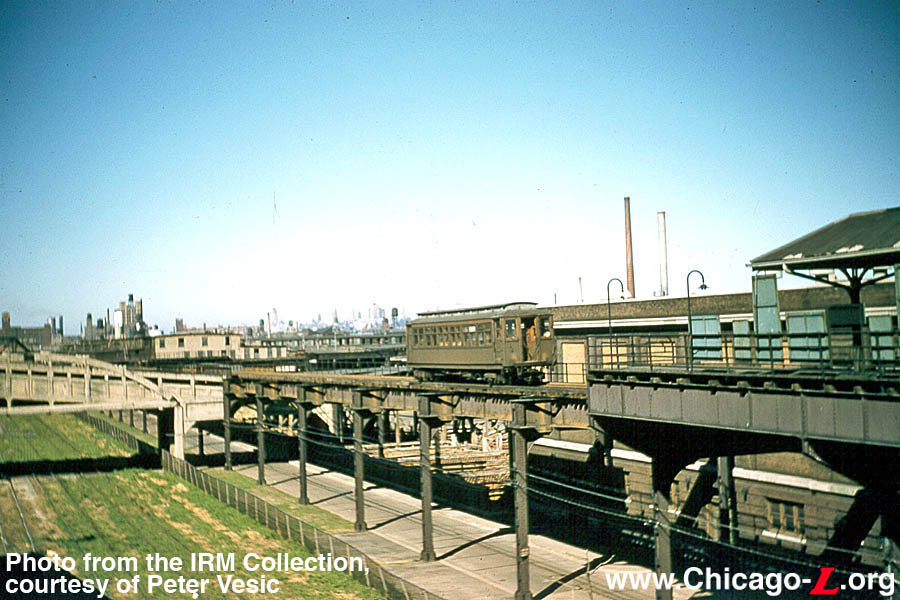
CA&E Car 52 (Stephenson, 1902).

CA&E Car 52 (Stephenson, 1902).

Some of you have a device called a Magic Jack to make telephone calls using your home computer. But as many of our readers know, this blog also has a “Magic Jack” all of its own.

Today’s post features the work of Jack Bejna, whose pictures have been featured here many times previously. He loves finding old photographs and works his own brand of magic on them, making them look better using Photoshop.

We thank him for sharing these great images with our readers. The comments that follow, in this section, are Jack’s. Just to keep a hand in, we also have a few additional photos of our own that follow.

Enjoy!

-David Sadowski

Chicago Aurora & Elgin at Laramie Avenue

Here are a few shots of the yard at Laramie Avenue. The first shows the yard looking east with the freight shed at the right, and at the left a CTA train heads west. The second shot features a CA&E train heading west (not sure but looks like a motorman in the front window). The third shot is at the freight house looking west. The tracks in the foreground were used to store CA&E trains when not needed, and many photographs of CA&E cars were taken at this location through the years. The fourth shot shows a CA&E freight at Flournoy Street heading west. In the background can be seen the mid-day storage tracks for CA&E cars.

CA&E Lockwood Yard at Laramie.

CA&E Lockwood Yard at Laramie.

CA&E Laramie Yard overview.

CA&E Laramie Yard overview.

CA&E Laramie Ave freight house.

CA&E Laramie Ave freight house.

CA&E 7 at Flournoy Street, Laramie Yard.

CA&E 7 at Flournoy Street, Laramie Yard.

Chicago Aurora & Elgin Wheaton Yards

CA&E car 18 (Niles 1902), plus cars 44 and 423.

CA&E car 18 (Niles 1902), plus cars 44 and 423.

CA&E car 24 (Niles 1902).

CA&E car 24 (Niles 1902).

CA&E car 26 (Niles 1902).

CA&E car 26 (Niles 1902).

CA&E car 28 (Niles 1902).

CA&E car 28 (Niles 1902).

CA&E Car 34 end view (Stephenson, 1902).

CA&E Car 34 end view (Stephenson, 1902).

CA&E Car 34 (Stephenson, 1902).

CA&E Car 34 (Stephenson, 1902).

CA&E Car 36 (Stephenson, 1902).

CA&E Car 36 (Stephenson, 1902).

CA&E Car 48 (Stephenson, 1902).

CA&E Car 48 (Stephenson, 1902).

CA&E Car 52 (Stephenson, 1902).

CA&E Car 52 (Stephenson, 1902).

Detroit Jackson & Chicago

I believe that all of these pictures were taken in or near Jackson, Michigan. The Jackson depot is lettered Michigan United Railways in one picture, Michigan United Traction Comapny in another, and the cars are lettered Michigan Railway Lines, all as a result of several changes of ownership of the Detroit Jackson and Chicago lines. Also included is a map of downtown Jackson.

Jackson Interurban Station postcard.

Jackson Interurban Station postcard.

Jackson Interurban Station.

Jackson Interurban Station.

Jackson, Michigan Traction Map.

Jackson, Michigan Traction Map.

Michigan Railway Lines - Car 1.

Michigan Railway Lines – Car 1.

Michigan Railway Lines - Car 2.

Michigan Railway Lines – Car 2.

Michigan Railway Lines - Car 3.

Michigan Railway Lines – Car 3.

Michigan Railway Lines - Car 16.

Michigan Railway Lines – Car 16.

Michigan Railway Lines - Cars 27 and 64.

Michigan Railway Lines – Cars 27 and 64.

Michigan Railway Lines - Car 65.

Michigan Railway Lines – Car 65.

Michigan Railway Lines - Car 85.

Michigan Railway Lines – Car 85.

Michigan Railway Lines - Car 647.

Michigan Railway Lines – Car 647.

Detroit United Railway

Some years ago a friend of mine told me that her uncle had died and left a lot of railroadiana behind, and I could have a look and take anything I wanted. Most of the stuff was not worth anything but I did come across two small (4”x 6”) two ring binders that were full of Detroit United Railways and Michigan Interurban equipment photos. The DUR photos had in-depth tech specs on the photo back for the particular car pictured. The pre-printed tech spec info form was dated: Rep cost 10-1-1921. I believe these photos were part of an audit for an upcoming fare increase request. I therefore believe that the photos were taken circa 1921.

I kept the binders and several years ago I started scanning them and Photoshopping them when I had time to spare. The quality of the pictures (i.e., exposure, lighting, etc.) varies but there are a number that are fine following a lot of Photoshop work.

Most of the photos don’t include the location where the photo were taken, and, since I’m not familiar with Michigan towns and cities, I don’t have any idea where the pictures were taken, with some exceptions.

I hope that readers of your fine blog may help to identify locations of some of the photographs.

DUR Car 1026

DUR Car 1026

DUR Car 1857

DUR Car 1857

DUR Car 1939

DUR Car 1939

DUR Car 2004

DUR Car 2004

DUR Car 2046

DUR Car 2046

DUR Car 2105

DUR Car 2105

DUR Car 5200

DUR Car 5200

DUR Car 5623

DUR Car 5623

DUR Car 7001

DUR Car 7001

DUR Car 7051

DUR Car 7051

DUR Car 13

DUR Car 13

DUR Car 1861

DUR Car 1861

DUR Car 7053.

DUR Car 7053.

DUR Car 7067.

DUR Car 7067.

DUR Car 7081.

DUR Car 7081.

DUR Car 7103.

DUR Car 7103.

DUR Car 7105.

DUR Car 7105.

DUR Car 7256.

DUR Car 7256.

DUR Car 7263.

DUR Car 7263.

DUR Car 7272.

DUR Car 7272.

DUR Car 7288.

DUR Car 7288.

DUR Car 7292.

DUR Car 7292.

DUR Car 7312.

DUR Car 7312.

Recent Finds

CTA wooden "L" car 1024 at the Illinois Electric Railway Museum in North Chicago, February 1960. The original museum location was at the Chicago Hardware Foundry Company, adjacent to the North Shore Line tracks. Some of the wooden "L" cars were operated under their own power to North Chicago. This car, originally built by Pullman in 1898 as Northwestern Elevated Railroad 24, has since been restored to its original condition at IRM in Union.

CTA wooden “L” car 1024 at the Illinois Electric Railway Museum in North Chicago, February 1960. The original museum location was at the Chicago Hardware Foundry Company, adjacent to the North Shore Line tracks. Some of the wooden “L” cars were operated under their own power to North Chicago. This car, originally built by Pullman in 1898 as Northwestern Elevated Railroad 24, has since been restored to its original condition at IRM in Union.

Illinois Terminal Railroad line car 1702, built by that operator in 1922, at North Chicago in February 1960.

Illinois Terminal Railroad line car 1702, built by that operator in 1922, at North Chicago in February 1960.

Illinois Terminal car 101 at IERM in North Chicago in February 1960. Don's Rail Photos: "101 was built by American Car in 1917 as AG&StL 61. In 1926 the car became StL&ARy 61 and in 1930 it became IT 101. On March 9, 1956, it was sold to the Illinois Electric Railway Museum and is now at Union, IL." This car ran between St. Louis and Alton.

Illinois Terminal car 101 at IERM in North Chicago in February 1960. Don’s Rail Photos: “101 was built by American Car in 1917 as AG&StL 61. In 1926 the car became StL&ARy 61 and in 1930 it became IT 101. On March 9, 1956, it was sold to the Illinois Electric Railway Museum and is now at Union, IL.” This car ran between St. Louis and Alton.

Don's Rail Photos says, (North Shore Line) "213 was built by Cincinnati in March 1920, #2445, as a merchandise despatch car. In 1940 it was rebuilt as a disc harrow ice cutter. It was retired in 1955 and sold to CHF as their 242. It was donated to Illinois Railway Museum in 1964." Here, we see the car at the Chicago Hardware Foundry Company in February 1960. This was also then the location of the Illinois Electric Railway Museum.

Don’s Rail Photos says, (North Shore Line) “213 was built by Cincinnati in March 1920, #2445, as a merchandise despatch car. In 1940 it was rebuilt as a disc harrow ice cutter. It was retired in 1955 and sold to CHF as their 242. It was donated to Illinois Railway Museum in 1964.” Here, we see the car at the Chicago Hardware Foundry Company in February 1960. This was also then the location of the Illinois Electric Railway Museum.

Chicago Aurora & Elgin car 419 is eastbound west of DesPlaines Avenue in Forest Park in November 1951. The gas holder, at right, was a local landmark for many years.

Chicago Aurora & Elgin car 419 is eastbound west of DesPlaines Avenue in Forest Park in November 1951. The gas holder, at right, was a local landmark for many years.

This photo appears to have been taken on Clark Street across from Lincoln Park during one of those late 1950s Chicago streetcar fantrips (possibly October 21, 1956). I thought this one was intersesting, since the man at left may very well be noted railfan William Hoffman, whose films and slides are now part of the Wien-Criss Archive.

This photo appears to have been taken on Clark Street across from Lincoln Park during one of those late 1950s Chicago streetcar fantrips (possibly October 21, 1956). I thought this one was interesting, since the man at left may very well be noted railfan William C. Hoffman, whose films and slides are now part of the Wien-Criss Archive.

I realize this is not the greatest quality picture, but it does appear to show the late Bill Hoffman shooting film using a tripod to steady his camera.

I realize this is not the greatest quality picture, but it does appear to show the late Bill Hoffman shooting film using a tripod to steady his camera.

Bill Hoffman and his sister Dorothy at their home at 6622 S. Maplewood Avenue in Chicago on December 26, 1981. Two nicer people, you will never meet. Both are sadly long gone. (Wien-Criss Archive)

Bill Hoffman and his sister Dorothy at their home at 6622 S. Maplewood Avenue in Chicago on December 26, 1981. Two nicer people, you will never meet. Both are sadly long gone. (Wien-Criss Archive)

More about the Hoffmans from Jeff Wien:

Dorothy and Bill were twins. They were born on May 15, 1910. Bill was 78 when he died (July 5, 1988) and Dorothy was 88 when she died. Dorothy died on May 10, 1999, five days short of her 89th birthday.

Dorothy was a wonderful person. Very generous in her donations to the Illinois Railway Museum in Bill’s memory. She funded the Hoffman Garage and other motor bus related projects. Dorothy donated over $800,000 to IRM, mostly motor bus related.

The Chicago Transit Authority, whose operating area covers most of Cook County, added the words "Metropolitan Transit" to its logo around 1958. This image was made from an original Kodalith originally in the collections of the late Robert Selle. My guess is he obtained it from the CTA back in the late 1950s. A Kodalith uses graphic arts film, and was likely made from the original logo artwork. Graphic arts film renders things in either black or white, and does not include gray tones as would conventional film. This image was not made by taking a picture of a logo on the side of a bus or "L" car. (Wien-Criss Archive)

The Chicago Transit Authority, whose operating area covers most of Cook County, added the words “Metropolitan Transit” to its logo around 1958. This image was made from an original Kodalith originally in the collections of the late Robert Selle. My guess is he obtained it from the CTA back in the late 1950s. A Kodalith uses graphic arts film, and was likely made from the original logo artwork. Graphic arts film renders things in either black or white, and does not include gray tones as would conventional film. This image was not made by taking a picture of a logo on the side of a bus or “L” car. (Wien-Criss Archive)

Don's Rail Photos says that North Shore Line car 231 "was built by Cincinnati in May 1924, #2720, as a merchandise despatch car. It was rebuilt as a plow in 1949." That's the configuration we see it in here. It does not appear to have been saved.

Don’s Rail Photos says that North Shore Line car 231 “was built by Cincinnati in May 1924, #2720, as a merchandise despatch car. It was rebuilt as a plow in 1949.” That’s the configuration we see it in here. It does not appear to have been saved.

This interesting scene shows North Shore Line car 413 (and train) turning off street running on Greenleaf Avenue in Wilmette on the Shore Line Route, which uit in 1955. The building at right is still standing.

This interesting scene shows North Shore Line car 413 (and train) turning off street running on Greenleaf Avenue in Wilmette on the Shore Line Route, which uit in 1955. The building at right is still standing.

The same location today. We are looking east. North Shore Line cars turned into what is now the parking lot at left, before running north parallel to the Chicago & North Western tracks.

The same location today. We are looking east. North Shore Line cars turned into what is now the parking lot at left, before running north parallel to the Chicago & North Western tracks.

Lehigh Valley Transit 812 is shown running a special at Souderton PA on May 14, 1951. Service on the Liberty Bell interurban ended in September 1951, and unfortunately, this car was not saved.

Lehigh Valley Transit 812 is shown running a special at Souderton PA on May 14, 1951. Service on the Liberty Bell interurban ended in September 1951, and unfortunately, this car was not saved.

Baltimore Transit Company "Peter Witt" car 6076 is on Route 8 on Fayette. Don's Rail Photos adds, "6051 thru 6100 were built by Cincinnati in 1930 and retired in 1955." I thought of this since the body of a similar 1930s Peter Witt car from Indianapolis was being stored at the ill-fated Indiana Transportation Museum in Noblesville. Hopefully, it can be saved. (Walter Broschart Photo)

Baltimore Transit Company “Peter Witt” car 6076 is on Route 8 on Fayette. Don’s Rail Photos adds, “6051 thru 6100 were built by Cincinnati in 1930 and retired in 1955.” I thought of this since the body of a similar 1930s Peter Witt car from Indianapolis was being stored at the ill-fated Indiana Transportation Museum in Noblesville. Hopefully, it can be saved. (Walter Broschart Photo)

Chicago Aurora & Elgin wood car 301 at the Wheaton Yards on July 8, 1955. Don's Rail Photos: "301 was built by Niles Car & Mfg Co in 1906. It was modernized in December 1940." As part of this modernization, the car's stained glass windows were covered up. Unfortunately, this car was not saved.

Chicago Aurora & Elgin wood car 301 at the Wheaton Yards on July 8, 1955. Don’s Rail Photos: “301 was built by Niles Car & Mfg Co in 1906. It was modernized in December 1940.” As part of this modernization, the car’s stained glass windows were covered up. Unfortunately, this car was not saved.

Chicago Aurora & Elgin 138 at Laramie Yards on May 17, 1948. Don's Rail Photos: "138 was built by American Car Co in March 1910, #844, as C&ME 138. It was rebuilt in 1914 and no retired date." Starting in 1936, the CA&E leased several wood cars from the North Shore Line, including this one. They were returned to the NSL in 1945 and operated there briefly before being purchased by CA&E the following year. These cars were no longer needed after the September 1953 cutback in service to Forest Park and were scrapped. I believe we are looking to the west. (Richard J. Anderson Photo)

Chicago Aurora & Elgin 138 at Laramie Yards on May 17, 1948. Don’s Rail Photos: “138 was built by American Car Co in March 1910, #844, as C&ME 138. It was rebuilt in 1914 and no retired date.” Starting in 1936, the CA&E leased several wood cars from the North Shore Line, including this one. They were returned to the NSL in 1945 and operated there briefly before being purchased by CA&E the following year. These cars were no longer needed after the September 1953 cutback in service to Forest Park and were scrapped. I believe we are looking to the west. (Richard J. Anderson Photo)

This three-car train of Chicago Transit Authority 4000-series "L" cars is signed as a Howard Street Express in June 1949. (L. L. Bonney Photo) Our resident south side expert M. E. adds, "Methinks this photo was taken looking west at the Indiana Av. (at 40th St.) station. Because the train destination sign says Howard Express, the location has to be on the main north/south line. (Plus, this train had to originate on the Jackson Park branch, because Englewood trains at that time ran to Ravenswood.) Also, I don't recall any other three-track main anywhere else on the north/south line. Also, Indiana Ave. had the overhead walkway to get to and from the Stock Yards L, which terminated to the left of the left-hand platform in the photo. When this photo was taken, the Kenwood L ran as through service from 42nd Place, through Indiana Ave., up to Wilson Ave. Later in 1949, the Kenwood service was cut back to a shuttle ending at Indiana Ave. The inbound station platform was extended over the northernmost track, then mainline north/south service used the middle track heading downtown. A fuller explanation is at https://www.chicago-l.org/operations/lines/kenwood.html . Also of interest is that this photo shows a three-car train. Before the advent of new equipment in 1950 there were no "married pairs" of cars. Trains could be as small as a single car, which I recall seeing on the Englewood branch on Sunday mornings. Plus, the three-car train shown in the photo would have had two conductors whose job was to open the passenger entry doors (which were on the sides, at the ends of the cars) using controls situated between the cars. So conductor #1 operated the doors at the rear of car 1 and the front of car 2. Conductor #2 operated the doors at the rear of car 2 and the front of car 3. Side doors at the front of car 1 and the rear of car 3 were not used by passengers. To operate his side doors, a conductor had to stand between the cars. (Yes, in any weather.) And the conductors had to notify the motorman when to proceed. To do this, the conductors had to observe when there was no more boarding or alighting at their doors. They used a bell system to notify the motorman. Two dings meant "proceed". One ding meant "hold". The rearmost conductor started with his bell, then the next rearmost, etc., until two dings rang in the motorman's compartment, his signal to go. The longer the train, the longer it took to leave the station."

This three-car train of Chicago Transit Authority 4000-series “L” cars is signed as a Howard Street Express in June 1949. (L. L. Bonney Photo) Our resident south side expert M. E. adds, “Methinks this photo was taken looking west at the Indiana Av. (at 40th St.) station.
Because the train destination sign says Howard Express, the location has to be on the main north/south line. (Plus, this train had to originate on the Jackson Park branch, because Englewood trains at that time ran to Ravenswood.) Also, I don’t recall any other three-track main anywhere else on the north/south line. Also, Indiana Ave. had the overhead walkway to get to and from the Stock Yards L, which terminated to the left of the left-hand platform in the photo.
When this photo was taken, the Kenwood L ran as through service from 42nd Place, through Indiana Ave., up to Wilson Ave. Later in 1949, the Kenwood service was cut back to a shuttle ending at Indiana Ave. The inbound station platform was extended over the northernmost track, then mainline north/south service used the middle track heading downtown. A fuller explanation is at
https://www.chicago-l.org/operations/lines/kenwood.html .
Also of interest is that this photo shows a three-car train. Before the advent of new equipment in 1950 there were no “married pairs” of cars. Trains could be as small as a single car, which I recall seeing on the Englewood branch on Sunday mornings.
Plus, the three-car train shown in the photo would have had two conductors whose job was to open the passenger entry doors (which were on the sides, at the ends of the cars) using controls situated between the cars. So conductor #1 operated the doors at the rear of car 1 and the front of car 2. Conductor #2 operated the doors at the rear of car 2 and the front of car 3. Side doors at the front of car 1 and the rear of car 3 were not used by passengers. To operate his side doors, a conductor had to stand between the cars. (Yes, in any weather.)
And the conductors had to notify the motorman when to proceed. To do this, the conductors had to observe when there was no more boarding or alighting at their doors. They used a bell system to notify the motorman. Two dings meant “proceed”. One ding meant “hold”. The rearmost conductor started with his bell, then the next rearmost, etc., until two dings rang in the motorman’s compartment, his signal to go. The longer the train, the longer it took to leave the station.”

The late photographer Robert Selle writes, "CTA one-man car 6180 turning north onto State Street from 43rd Street (43rd Street line), August 1, 1953."

The late photographer Robert Selle writes, “CTA one-man car 6180 turning north onto State Street from 43rd Street (43rd Street line), August 1, 1953.”

The Chicago Surface Lines decorated several of its streetcars for patriotic purposes during World War II, but here we see 1741 postwar on March 19, 1946, promoting the American Red Cross. I believe this southbound Broadway-State car is operating on Wabash just north of the Chicago River, as the new State Street bridge did not open until 1949.

The Chicago Surface Lines decorated several of its streetcars for patriotic purposes during World War II, but here we see 1741 postwar on March 19, 1946, promoting the American Red Cross. I believe this southbound Broadway-State car is operating on Wabash just north of the Chicago River, as the new State Street bridge did not open until 1949.

Bob Selle: "CTA car 115 northbound on Kedzie Street line at 35th and Kedzie, July 23, 1953." Daniel Joseph adds, "I do not believe this photo is at Kedzie & 35th Street. 35th Street never went to Kedzie and 36th Street had street car tracks."

Bob Selle: “CTA car 115 northbound on Kedzie Street line at 35th and Kedzie, July 23, 1953.” Daniel Joseph adds, “I do not believe this photo is at Kedzie & 35th Street. 35th Street never went to Kedzie and 36th Street had street car tracks.”

Philadelphia Transportation Company 2023 was one of only three "Brilliners" in its fleet. Don's Rail Photos: '2023 was built by Brill Car Co in April 1939, #23763-006. It was scrapped in August 1956." Presumably PTC did not purchase any additional Brilliners, as it considered them inferior in some ways to PCC cars. Here we see 2023 at an unknown location on July 23, 1950. Jeff Wien adds, "The Philadelphia Rapid Transit Company, predecessor to PTC, purchased three Brilliners (2021-2023) in 1939. Thus, PRT/PTC owned more than one Brilliner. Brilliner 2021-2023 3 Brill *1939 **1956 GE 1198G1 * Date Acquired **Date Retired They were unpopular with operators because they were not PCC cars and there were only 3 of them in the fleet. They looked like PCC cars to the naked eye, which the riding public probably assumed they were."

Philadelphia Transportation Company 2023 was one of only three “Brilliners” in its fleet. Don’s Rail Photos: ‘2023 was built by Brill Car Co in April 1939, #23763-006. It was scrapped in August 1956.” Presumably PTC did not purchase any additional Brilliners, as it considered them inferior in some ways to PCC cars. Here we see 2023 at an unknown location on July 23, 1950. Jeff Wien adds, “The Philadelphia Rapid Transit Company, predecessor to PTC, purchased three Brilliners (2021-2023) in 1939. Thus, PRT/PTC owned more than one Brilliner.
Brilliner 2021-2023 3 Brill *1939 **1956 GE 1198G1
* Date Acquired **Date Retired
They were unpopular with operators because they were not PCC cars and there were only 3 of them in the fleet. They looked like PCC cars to the naked eye, which the riding public probably assumed they were.”

California Street Cable RR car 41 is on Hyde Street at Union Street in San Francisco in 1947. (W. Sievert Photo)

California Street Cable RR car 41 is on Hyde Street at Union Street in San Francisco in 1947. (W. Sievert Photo)

Recent Correspondence


Miles Beitler writes:

I have seen the attached photo in various sites on the internet. The photo shows a Lake Street train which apparently failed to stop at the Market Street terminal at Madison Street and ran through the bumper at the end of the line, derailing the first car which hangs over the edge of the structure. I thought the purpose of the bumper was to prevent a train from running beyond the end of the line, but it apparently didn’t work too well in this case.

The date would appear to be the late 1930s or 1940s (pre-CTA), but I have not found any information or newspaper articles describing what happened. I assume that means there were no deaths or injuries. It could even have been an empty train. Do you have any information about this?

I continue to enjoy your blog — keep it up!

I reached out to Andre Kristopans, who replied:

Not seeing the photo in question makes it harder, but this is what I can say. In wood car days, a wood car could take a pretty bad hit and survive to see service again. CRT was so broke that they were forced to fix anything that wasn’t totally destroyed as they could not afford to replace anything. That said, this is a possible list of candidates it the car in question was totaled:

3055 (trailer) 1929
1732 1944

Other early retirements are all shown as “fire”, so not likely. However, there were about a dozen cars that CTA retired in 1948 which were apparently in wrecked or burned condition before 10/1/47 but still on the books that were simply written off without any actual scrapping dates recorded. Lake St cars on this list were trailers trailers, so not likely.

As far as Market St service, it was thought that three AM trains circled the loop and then backed into Market St. This is not correct. Three trains left Austin at 656, 709, 727AM making all stops to Hamlin, then Oakley and all stops to Madison/Market and laid up. There might have been additional layups coming off the loop, however. Then they left between 507 and 613PM (6.5 to 12 min headway, so more than three trains) making all stops to Oakley, then Hamlin and all stops to Forest Park.

Sorry, I thought the photo would come across. At any rate, it does look like a trailer, and the number is 3053, although it desn’t appear to be wrecked, really.

The picture certainly does look like the 1940s, though.

Thanks.

Andre replied:

Well, this explains a lot. 3053 lasted until 4/51, so it certainly survived. Also, it was not a control trailer, so the motorman was at the other end of the train, backing in, and overshot his stopping point.

Pittsburgh Mystery Photo

Jeff Wien recently obtained this photo processed in September 1965, but without any other information, noting, “The photo was taken after route 55 was converted to motor bus, so it is not route 55 streetcars that we see in the photo.”

Jeff contacted James B. Holland, who writes:

It is at the Flood Control Barrier (one can see track goes single immediately right of PCCs) on the 55 line and within ‘eye+sight’ of E. Pittsburgh, except for the curve in the road!!! It is worked by an extended 65-line: Lincoln Place (loop on 56) to Homestead Loop on 8th. The 65-line loop in Homestead (also shared by former 60-line shuttle to East Liberty) was just west of Rankin Bridge. The 55-line shared track with 65 thru Homestead on 8th between Amity and 60/65 Loop and beyond to Rankin Bridge which 55 crossed to East Pittsburgh. Thus, with demise of 55, the 65 was extended from Homestead to E. Pittsburgh for ‘some time.’ The 60/65 line loop in Homestead was used by the 55A, a rush Hour tripper To/From downtown Pittsburgh.

The Carlson PCC book Coast To Coast lists both 65 and 55 as ending on the same date, 5 September 1965. A note in the table (Pgs168-169) indicates: “[55] Hays to Pittsburgh (including 57) abandoned 04 Jul 1964 balance [worked by extended 65 abandoned] by PAT modernization on [09 Sep] 1965.” Thus It Seems the 65 line was extended for 1 year plus two months. Many are not aware of this. I have pictures distinctly signed 65 also distinctly working the 55.

With Glenwood Car House closed in 1961 and routes operated from South Hills, several years before PAT, and with Glenwood Bridge banned to trolleys, 65 line left South Hills and probably used Forbes and Braddock to Rankin Jct and ‘to extended route’ from there. (Interesting to note: 55 Owl terminal was Rankin Bridge, at least post-rebuild.)

I do not know if the extended 65 used the old dedicated loop in East Pittsburgh which was not quite in “downtown E. Pittsburgh”. The 65 line may have looped in E. Pittsburgh proper on Braddock to Electric, Linden, Beech and Braddock.

In case any of our readers have additional information, Jeff is still trying to find out the name of the steel mill shown in the photo. (Editor’s note: John Suhayda adds, “The Pittsburgh Mystery Photo shows the Edgar Thomson Steel Works in Braddock, east of Pittsburgh, along the Monongahela River.”)

Richard Wilke
writes:

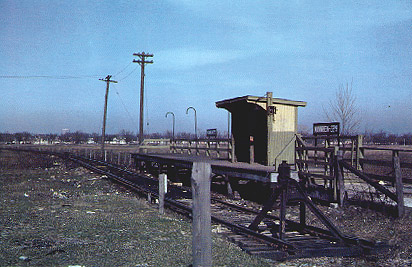
What a wonderful website! Thank you for all the information I was able locate about the CA&E! I am looking for any photo of the last stop at Mannheim & 22nd Street on the Westchester branch. My uncle lived in Wheaton on Electric Avenue. He somehow acquired the station signage from that last stop, and I have yet to confirm that the sign that I now have, as being from that end of line stop! Is there someone in your organization that might be able to confirm its existence with a picture of said sign? It’s a 14″ x 7′, deep blue with white block lettering, reading, MANNHEIM-22nd. Would appreciate any information to find its true history!

I found a picture of that station on Graham Garfield’s excellent web site. It is dated 1951, which was when service ended, and although it is not very sharp, you can see two signs.  The photo is credited to Bernard L. Stone:

https://www.chicago-l.org/stations/images/Westchester/mannheim-22nd01.jpg

On the other hand, Mitch Markovitz writes:

I saw the photo of the sign that reads “MANNHEIM 22nd STREET” in the latest Dodger. I don’t think it’s authentic at all. The type is way too contemporary, and doesn’t match anything else the “L” did as far as signs. Including the photos with the two signs at the platform. The blue is way too light as well.

Keep those cards and letters coming in, folks.

-David Sadowski

Finally, Jack Bejna writes:

Thanks for the kind comments and the forum to share my photographic efforts with the interurban/streetcar community. It’s nice to know that someday when I’m gone my collection will have been shared with the electric railroad enthusiasts that remain.

There are more Detroit United Railway photos to be posted as well as photographs from the Michigan interurbans that vanished long ago so stay tuned to this great blog!

Pre-Order Our New Book Building Chicago’s Subways

There are three subway anniversaries this year in Chicago:
60 years since the West Side Subway opened (June 22, 1958)
75 years since the State Street Subway opened (October 17, 1943)
80 years since subway construction started (December 17, 1938)

To commemorate these anniversaries, we have written a new book, Building Chicago’s Subways.

While the elevated Chicago Loop is justly famous as a symbol of the city, the fascinating history of its subways is less well known. The City of Chicago broke ground on what would become the “Initial System of Subways” during the Great Depression and finished 20 years later. This gigantic construction project, a part of the New Deal, would overcome many obstacles while tunneling through Chicago’s soft blue clay, under congested downtown streets, and even beneath the mighty Chicago River. Chicago’s first rapid transit subway opened in 1943 after decades of wrangling over routes, financing, and logistics. It grew to encompass the State Street, Dearborn-Milwaukee, and West Side Subways, with the latter modernizing the old Garfield Park “L” into the median of Chicago’s first expressway. Take a trip underground and see how Chicago’s “I Will” spirit overcame challenges and persevered to help with the successful building of the subways that move millions. Building Chicago’s subways was national news and a matter of considerable civic pride–making it a “Second City” no more!

Bibliographic information:

Title Building Chicago’s Subways
Images of America
Author David Sadowski
Edition illustrated
Publisher Arcadia Publishing (SC), 2018
ISBN 1467129380, 9781467129381
Length 128 pages

Chapter Titles:
01. The River Tunnels
02. The Freight Tunnels
03. Make No Little Plans
04. The State Street Subway
05. The Dearborn-Milwaukee Subway
06. Displaced
07. Death of an Interurban
08. The Last Street Railway
09. Subways and Superhighways
10. Subways Since 1960

Building Chicago’s Subways will be published on October 1, 2018. Order your copy today, and it will be shipped on or about that date. All copies purchased through The Trolley Dodger will be signed by the author.

The price of $23.99 includes shipping within the United States.

For Shipping to US Addresses:

For Shipping to Canada:

For Shipping Elsewhere:

Redone tile at the Monroe and Dearborn CTA Blue Line subway station, showing how an original sign was incorporated into a newer design, May 25, 2018. (David Sadowski Photo)

Redone tile at the Monroe and Dearborn CTA Blue Line subway station, showing how an original sign was incorporated into a newer design, May 25, 2018. (David Sadowski Photo)

Help Support The Trolley Dodger

gh1

This is our 217th post, and we are gradually creating a body of work and an online resource for the benefit of all railfans, everywhere. To date, we have received over 428,000 page views, for which we are very grateful.

You can help us continue our original transit research by checking out the fine products in our Online Store.

As we have said before, “If you buy here, we will be here.”

We thank you for your support.

DONATIONS

In order to continue giving you the kinds of historic railroad images that you have come to expect from The Trolley Dodger, we need your help and support. It costs money to maintain this website, and to do the sort of historic research that is our specialty.

Your financial contributions help make this web site better, and are greatly appreciated.

Never Too Late

Former Chicago Surface Lines mail car 6, built in 1891, as it looked on May 25, 1958. This car is now at the Fox River Trolley Museum, where it was recently vandalized. You can see a black-and-white photo of this car, taken at the same time as this one, in our previous post Throwback Thursday (January 7, 2016). To see a picture of West Chicago Street Railway car 4, also taken the same day, there's one in our post Chicago Streetcars In Color (February 22, 2015).

Former Chicago Surface Lines mail car 6, built in 1891, as it looked on May 25, 1958. This car is now at the Fox River Trolley Museum, where it was recently vandalized. You can see a black-and-white photo of this car, taken at the same time as this one, in our previous post Throwback Thursday (January 7, 2016). To see a picture of West Chicago Street Railway car 4, also taken the same day, there’s one in our post Chicago Streetcars In Color (February 22, 2015).

Recent news reports that eight historic railcars at the Fox River Trolley Museum were vandalized to the tune of perhaps as much as $150,000 brought back some memories.

Back in 1961, when I was six years old, my family took a Sunday drive out to the Chicago Aurora & Elgin’s Wheaton Yards to take one last look at their fleet. We had read in the news that efforts to save the CA&E had failed, and that the entire line was being abandoned forever.

I never did get to ride the CA&E, which stopped running passenger service in 1957. But I did at least get to see the railcars on their home turf in Wheaton. I distinctly recall being gratified that they did not appear to be vandalized. I did not see any broken windows.

Not all of these cars were saved, but some did make it off the property and several lived to run again in museum service in various parts of the country. (We ran some pictures of the “hospital train” in our post Trolley Dodger Mailbag, 1-29-2016.)

That anything at all got saved was, in my humble opinion, a miracle. Now it is true that in the waning days of traction, there were fans who “liberated” various bits and pieces of trolleys that were destined for the scrap heap. Their goal was to preserve history, not desecrate it. In some cases, these original parts have since been put back onto historic equipment, or are now in the collections of railroad museums. At least they were saved for future generations.

Railroad museums across the country depend on small groups of dedicated volunteers. Occasionally, entire museum operations have either failed or have been obliged to relocate. The sad situation faced by the Indiana Transportation Museum, which was recently evicted from its home in Noblesville, is but the latest example.

Let’s take a closer look at Aurora, Elgin & Fox River car 304. This fine specimen of a 1920s interurban car, which returned to run on the small surviving portion of its home rails at the Fox River Trolley Museum, was damaged by the two young vandals. It is not just a piece of equipment that was injured. This was a senseless attack on the history of an entire region.

While this blog is not affiliated with the Fox River Trolley Museum, we wholeheartedly support their efforts, and historic preservation. Insurance, unfortunately, will only cover a small portion of the cost of replacing all the broken glass and other damage. The bulk of funds will have to come from private donations.

The museum has begun a fundraising campaign, which must be successful. I realize many of us are angry about this senseless destruction, but let’s turn our anger into something constructive.

We are but the current caretakers of precious artifacts of the past. If we fail to preserve them, it will be a loss to all who come after us. We can all lament that a couple of young kids did a tremendous amount of harm here, but it’s never too late for the rest of us to do the right thing, right now.

-David Sadowski

The Toonerville Trolley That Meets All the Trains

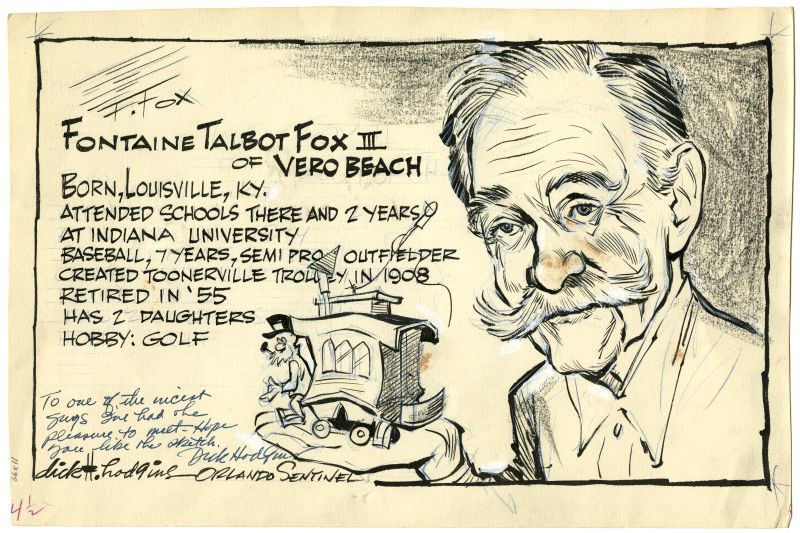
We recently acquired the original artwork for this January 17, 1938 Toonerville Trolley comic panel by the great Fontaine Fox (1884-1964).

We recently acquired the original artwork for this January 17, 1938 Toonerville Trolley comic panel by the great Fontaine Fox (1884-1964).

In a time when trolley lines criss-crossed this country, and were a part of everyday life for Americans, there was even a railfan comic strip. Or, better put, a comic strip by a railfan, Fontaine Fox.

His “Toonerville Trolley” comic ran in newspapers from 1913 until he retired in 1955. Over time, he even grew to resemble the “Skipper,” his own creation. Fox even answered his voluminous fan mail using letterhead he had printed up for the Toonerville Electric Railway Company.

Here is what the Filson (Kentucky) Historical Society has to say about Fontaine Fox:

Fontaine Talbot Fox III, creator of the famous Toonerville Trolley, was born in Louisville, Kentucky in 1884. He started his career as a reporter for the Louisville Herald, but soon abandoned this course to pursue his true passion of drawing cartoons. During a visit to the small town of Pelham, New York, Fox received inspiration for what would become one of the nation’s most beloved comics. While in Pelham, he rode on the local trolley car, where the conductor’s unhurried manner and penchant for gossiping with his passengers gave Fox the idea for his own comic strip. By 1915, the resulting comic series, Toonerville Folks, had come to the attention of the Wheeler Syndicate and was soon published in newspapers across the nation.

The Filson’s collections contain a number of items documenting the life and career of this celebrated cartoonist, including photographs of Fox and his family, as well as some of his correspondence and several scrapbooks with clippings of his cartoons. Notable among Fox’s papers are a collection of twenty-one original pen and ink cartoons from his beloved Toonerville Folks. Set in the fictional town of Toonerville, the single-paneled cartoon featured a rickety trolley car and a glimpse into suburban life in the early twentieth century. Fox created a cast of characters that charmed a nation: the Terrible-Tempered Mr. Bang, the Powerful Katrinka, Mickey (Himself) McGuire (the town bully), Aunt Eppie Hogg (the fattest woman in three counties), and of course the Skipper, who piloted the beloved trolley car. Toonerville Folks ran in hundreds of newspapers nationwide for over forty years, until Fox’s retirement in 1955. His comics would become an inspiration for a future generation of cartoonists.

Actually, it was a single panel cartoon six days a week. On Sunday, it was in color, in multiple panels. The strip had various names, including The Toonerville Trolley That Meets All the Trains and Toonerville Folks. Eventually, the adventures of the “Skipper” and his rickety trolley car only took up a part of the action, as Fox developed a variety of memorable characters for Toonerville.

Blake A. Bell
writes an excellent blog called Historic Pelham, and has written extensively about Fox, the Toonerville Trolley, and its connection to the area.

While the phrase “Toonerville Trolley” eventually became synonymous with any rural streetcar or interurban running on poorly maintained track, Pelham, NY, its inspiration, is actually a suburb, located 14 miles from Midtown Manhattan in Westchester County. It is near the city of New Rochelle, made famous as the home of Rob and Laura Petrie on the Dick Van Dyke Show (1961-1966).

The Toonerville Trolley ran in over 200 daily newspapers in its heyday, and was popular enough to inspire numerous motion pictures. The first series, circa 1920-21, was silent and produced by the Betzwood Studios in Montgomery County, Pennsylvania (more on that in our book review section). You can watch one of those films here.

Next, a young Mickey Rooney (1920-2014) later starred in 78 short films based on the Toonerville character Mickey McGuire, made between 1927 and 1934. This was Mickey Rooney’s first big break in show business. He even attempted, unsuccessfully, to legally change his name to Mickey McGuire.

There were also some Toonerville Trolley animated shorts, made in 1936 by Van Beuren Studios, which can be seen on Youtube. Here is one example:

By the late 1930s, trolley lines were starting to disappear from the American scene. On July 31, 1937 the Pelham Manor “H” trolley line ran its last. Fontaine Fox used the popularity of his comic strip to turn this into a major event.

From Historical Treasures of Westchester County:

On July 31, 1937, the H-Line Trolley that inspired Fontaine Fox was shut down for good – replaced by a bus line. That day the Village of Pelham Manor hosted a celebration attended by about 8,000 people for the last run of the “Toonerville Trolley”.

This “pass,” signed by Fontaine Fox who attended the event, entitled the bearer to ride the trolley car during its last trip. That trip took hours to travel only a couple of miles due to the crowds and the antics of local residents dressed as various characters from the “Toonerville Folks” comic strip.

The Hagerstown & Frederick interurban, which we have featured in a variety of posts, is an example of a country interurban that was frequently called a “Toonerville Trolley.” Its last passenger interurban ran on February 20, 1954.

Perhaps inspired by this, around this time Fontaine Fox bowed to the inevitable, and “retired” the trolley from his strip, replacing it with a bus. But such was the popularity of the old contraption that I believe he brought it back, prior to the strip’s demise in 1955 with Fox’s retirement. He donated some of his original artwork to a trolley museum.

As a tribute to Fontaine Fox, here we present an entire month’s worth of daily Toonerville panels, from June 1927. You will note that only some of the dailies include the trolley and Skipper (who, apparently, was based on real-life Pelham operator James (“Old Jim”) Bailey, who lived in the Bronx). Charles A. Lindbergh (1902-1974) made his historic non-stop flight from New YHork to Paris on May 20-21, 1927 and “Lindbergh mania” is reflected in many of the strips shown here, suggesting that Fox was working on some of these panels not long before they appeared in newspapers.

Fontaine Fox in retirement:

https://filsonhistorical.org/wp-content/uploads/Sketch-of-Fontaine-Fox_A_F791_1_web.jpg

Book Reviews


Montgomery County Trolleys
by Mike Szilagyi, with a Foreword by Andrew W. Maginnis
Arcadia Publishing, 2018

We recently received a copy of Montogomery County Trolleys from the author, as we had provided a couple of images he used in the book. Otherwise, chances are we might not have seen this fine addition to Arcadia’s Images of Rail series, which we are also involved with (see below for information on Building Chicago’s Subways, and our Online Store for copies of Chicago Trolleys).

Author Mike Szilagyi was no stranger to us, as we had corresponded concerning a different book project he was involved with as mapmaker. This was eventually published as Riding the Bell: Lehigh Valley Transit’s Liberty Bell Route by Ron Ruddell, Bulletin 147 of the Central Electric Railfans’ Association (2015).

Naturally, the maps Mr. Szilagyi made for this new book are excellent. But the entire thing is well done, from the scope the author set out to cover, the organization of the chapters, picture selection, text, and captions.

Here is a capsule description:

Montgomery County, Pennsylvania, was once served by 140 miles of trolley lines. In the first half of the 20th century, a wide array of trolley cars rolled over Montgomery County’s rails, from quaint open streetcars rumbling through borough streets to sleek 80-mile-an-hour trolleys sailing across open fields in Upper Gwynedd and Hatfield Townships. The cars had zero emissions, and some lines were powered by renewable hydroelectric power. Taking the trolley was a convenient, affordable option for those travelling and commuting in Montgomery County, nearby Philadelphia, and points beyond. Freight was also carried on board trolleys, with prompt parcel delivery service. Fortunately, many years ago, dedicated trolley fans had the foresight to aim their cameras at these unique vehicles, providing rare glimpses not just of the trolleys but also of Montgomery County’s rapidly changing landscapes.

Mike Szilagyi’s interest in trolleys was sparked at a young age by the sight of big green streamliners gliding down Old York Road near his grandmother’s house in the Logan neighborhood of Philadelphia. Today, Szilagyi lives and works in Montgomery County, where he plans and designs bicycle paths and serves on the North Wales Historic Commission.

This volume’s foreword was written by noted transit historian and longtime Montgomery County resident Andrew W. Maginnis.

In addition to detailed captions for each photograph, the book offers a brief history of transportation in Montgomery County, placing the trolley era in its historical context. The timeline of travel may be very generally summed up as:

dirt roads – canals – railroads – trolleys – motor vehicles

Rather than each mode supplanting the previous, there were varying degrees of overlap between them. That said, the use of animals for motive power was there from the beginning, only fading as motor vehicles gained prominence in the 1910s and 1920s. The bicycle came on the scene in a big way in the 1890s, never really completely disappeared, and is today enjoying widespread resurgence.

By concentrating on Montgomery County, the author is able to provide tremendous variety, as he was therefore able to include the Lehigh Valley Transit’s Liberty Bell interurban, the Philadelphia & Western High-Speed Line to Norristown, numerous small-town trolleys, and even a bit of Philadelphia streetcars (Route 6 went into the county). Although very little of this remains, back in the day I did manage to ride Bullets and Strafford cars on the Norristown line (which still operates, with more modern equipment) as well as PCCs on SEPTA’s Route 6, which was replaced by buses in January 1986, subjects covered in this book.

Montgomery County Trolleys is dedicated to the memory of the late Harry Foesig (1897-2003) whose long life spanned parts of three centuries. He was co-author, along with Dr. Harold E. Cox, of Trolleys of Montgomery County, Pennsylvania (1968). This was an obvious inspiration for this new volume, which can be thought of as a kind of “spiritual descendant” of that earlier tome. That book also included some excellent maps, rendered by Foesig.

Anyone who has an interest in the subject, and the rich heritage of Keystone-state traction, would do well to pick up copies of each. While the earlier book is long out of print, you should have little difficulty in finding a used copy at a reasonable price. Mine only cost about $10, which is perhaps about half what you should expect to pay for Montgomery County Trolleys.

Interestingly, longtime railfan Andrew W. Maginnis contributed to both books, 50 years apart. Perhaps the 50-year anniversary was also a factor that motivated the author to put this new collection together, just as I was inspired by some anniversaries to do my new book (see below).

-David Sadowski

Pre-Order Our New Book Building Chicago’s Subways

There are three subway anniversaries this year in Chicago:
60 years since the West Side Subway opened (June 22, 1958)
75 years since the State Street Subway opened (October 17, 1943)
80 years since subway construction started (December 17, 1938)

To commemorate these anniversaries, we have written a new book, Building Chicago’s Subways.

While the elevated Chicago Loop is justly famous as a symbol of the city, the fascinating history of its subways is less well known. The City of Chicago broke ground on what would become the “Initial System of Subways” during the Great Depression and finished 20 years later. This gigantic construction project, a part of the New Deal, would overcome many obstacles while tunneling through Chicago’s soft blue clay, under congested downtown streets, and even beneath the mighty Chicago River. Chicago’s first rapid transit subway opened in 1943 after decades of wrangling over routes, financing, and logistics. It grew to encompass the State Street, Dearborn-Milwaukee, and West Side Subways, with the latter modernizing the old Garfield Park “L” into the median of Chicago’s first expressway. Take a trip underground and see how Chicago’s “I Will” spirit overcame challenges and persevered to help with the successful building of the subways that move millions. Building Chicago’s subways was national news and a matter of considerable civic pride–making it a “Second City” no more!

Bibliographic information:

Title Building Chicago’s Subways
Images of America
Author David Sadowski
Edition illustrated
Publisher Arcadia Publishing (SC), 2018
ISBN 1467129380, 9781467129381
Length 128 pages

Chapter Titles:
01. The River Tunnels
02. The Freight Tunnels
03. Make No Little Plans
04. The State Street Subway
05. The Dearborn-Milwaukee Subway
06. Displaced
07. Death of an Interurban
08. The Last Street Railway
09. Subways and Superhighways
10. Subways Since 1960

Building Chicago’s Subways will be published on October 1, 2018. Order your copy today, and it will be shipped on or about that date. All copies purchased through The Trolley Dodger will be signed by the author.

The price of $23.99 includes shipping within the United States.

For Shipping to US Addresses:

For Shipping to Canada:

For Shipping Elsewhere:

Help Support The Trolley Dodger

gh1

This is our 215th post, and we are gradually creating a body of work and an online resource for the benefit of all railfans, everywhere. To date, we have received over 422,000 page views, for which we are very grateful.

You can help us continue our original transit research by checking out the fine products in our Online Store.

As we have said before, “If you buy here, we will be here.”

We thank you for your support.

DONATIONS

In order to continue giving you the kinds of historic railroad images that you have come to expect from The Trolley Dodger, we need your help and support. It costs money to maintain this website, and to do the sort of historic research that is our specialty.

Your financial contributions help make this web site better, and are greatly appreciated.

A Long Time Gone

Chicago postwar PCC 7216 is shown heading south on Clark at Harrison on March 11, 1958. I was attracted to this shot since the woman and child who are about to board could just as well be me and my mother at that time. (Photo by A. Goddard)

Chicago postwar PCC 7216 is shown heading south on Clark at Harrison on March 11, 1958. I was attracted to this shot since the woman and child who are about to board could just as well be me and my mother at that time. (Photo by A. Goddard)

June 21st marks 60 years since the last Chicago streetcar ran. If you consider that 80 years is, perhaps, about an average lifespan, that means 3/4ths of such a time has now passed since that historic event.

The number of people still living who rode Chicago streetcars is dwindling, and is certainly only a small fraction of the current population. At age 63, I must be among the youngest people who can say they rode a Chicago streetcar on the streets of Chicago, much less remember it.

But the number of people who have taken a ride on a Chicago streetcar does increase, since there are a number of them that are operable at the Illinois Railway Museum in Union. The Seashore Trolley Museum (Kennebunkport, ME) has another car (225) that is operated infrequently.

The experience of riding at a railway museum is, of necessity, somewhat different than what people experienced 60+ years ago on the streets of Chicago. However, as a “streetcar renaissance” is underway across the country in various cities, the number of track miles in city streets has been increasing. In those places, it is possible to experience something more like what Chicago once had.

Milwaukee, Wisconsin will soon join that list, just 90 miles north of Chicago. After a similar 60-year gap in streetcar service, their first new line, aka “The Hop,” is expected to begin service mid-November. (You can read our recent update here. Since our article appeared, the new cars have begun testing out on the streets.)

Interestingly, a heritage trolley recently began service in Rockford, Illinois, which is also about 90 miles from Chicago.

For the past 18 years, Kenosha, Wisconsin (about 65 miles from Chicago) has operated a tourist trolley, which you can even reach using Metra‘s Union Pacific North Line.

Perhaps the streetcar line that would offer a ride closest to what Chicagoans could once experience, however, is the SEPTA #15 Girard Avenue line in Philadelphia, which is operated with modernized PCC cars.

I can also recommend the Muni F-Market and Wharves line in San Francisco, which operates using a variety of historic equipment.

Anyway you look at it, this anniversary is a good excuse to feature some classic Chicago traction photos, which we hope you will enjoy.

But wait– there’s more!

June 22, 1958 is another important date in Chicago transit history. 60 years ago, a new CTA rapid transit line opened in the median of the Congress (now Eisenhower) expressway. This line, also known as the “West Side Subway,” replaced the Garfield Park “L” and was the culmination of plans made 20 years before.

Another important anniversary is approaching on October 17th– the 75th anniversary of the opening of Chicago’s first subway. In December, it will be 80 years since subway construction began.

For these reasons, and more, we have written a new book called Building Chicago’s Subways, to be released by Arcadia Publishing this October 1st. Information about how to pre-order this book appears further down in this post.

The idea for Building Chicago’s Subways first came to me a few years ago, when I realized these important anniversaries were approaching. A few months after the publication of Chicago Trolleys last fall, I pitched the idea to Arcadia, and that is when the real work began.

Much additional research had to be done. I read everything I could find on the subject. Photos came from my own collections and those of other collectors, who have graciously permitted their use in this project.

Here is a short description of the book:

While the elevated Chicago Loop is justly famous as a symbol of the city, the fascinating history of its subways is less well known. The City of Chicago broke ground on what would become the “Initial System of Subways” during the Great Depression and finished 20 years later. This gigantic construction project, a part of the New Deal, would overcome many obstacles while tunneling through Chicago’s soft blue clay, under congested downtown streets, and even beneath the mighty Chicago River. Chicago’s first rapid transit subway opened in 1943 after decades of wrangling over routes, financing, and logistics. It grew to encompass the State Street, Dearborn-Milwaukee, and West Side Subways, with the latter modernizing the old Garfield Park “L” into the median of Chicago’s first expressway. Take a trip underground and see how Chicago’s “I Will” spirit overcame challenges and persevered to help with the successful building of the subways that move millions. Building Chicago’s subways was national news and a matter of considerable civic pride–making it a “Second City” no more!

The story goes back much further than that… before there were rapid transit tunnels, there were tunnels under the Chicago River, used by cable cars and streetcars. In the early 1900s, private enterprise built an extensive system of freight tunnels under the downtown area. And there was about 40 years of wrangling over what kind of subway to build, where to build it, and who should pay for it.

I found it a fascinating tale, and am gratified that I have been able to complete this new book in time for the anniversary, and within the living memory of Chicagoans who were here to witness these events 75 long years ago. The State Street, Dearborn-Milwaukee and West Side Subways have changed life for everyday Chicagoans forever.

-David Sadowski

PS- The Chicago Transit Authority posted this excellent video showing the last run of car 7213 in the early morning hours of June 21, 1958 (the June 22 date in the video is not correct):

Jeffrey L. Wien and I, along with the late Bradley Criss, collaborated on the book Chicago Streetcar Pictorial: The PCC Car Era, 1936-1958, published in 2015 as Bulletin 146 of the Central Electric Railfans’ Association.

For this anniversary, I asked Mr. Wien, who rode on the last Chicago streetcar, to reminisce for our readers:

Today, June 21, 2018, marks the 60th anniversary of my ride on the Last Chicago Streetcar with my high school friend Greer Nielsen. Thinking back 60 years I recall that it was a very melancholy event, one that remained in my mind for the rest of my life.

Thinking back 60 years can be a challenging task, but I do remember that it was a warm and muggy night on that last ride. CTA PCC 7213 was the last car on the shortened route 22 Wentworth line. The last run south from Clark and Kinzie began around 4am. There were probably at least 100 people crammed into that car so that they could say that they rode the Last Chicago Streetcar. As the car headed south through the Loop headed to 81st and Halsted, the group was quite loud and raucous, but as we went farther and farther south, the crowd quieted down, perhaps because we wanted to hear the sound of the streetcar in the streets of Chicago for the very last time.

When we arrived at 81st and Halsted, everyone got off the car for photos, private and official, and then reboarded the car for the last time for the short trip to Vincennes and 78th where the car pulled off of the street. It was about 6:15am by that point in time, and the Sun was just rising.

As the 7213 pulled away from Vincennes Avenue heading into the Rising Sun, we knew that we had witnessed an historic event in the history of Chicago. 99 years of traction history in Chicago ended at that moment. For me, it was a very sad moment for it was like losing a very good friend.

Jeff Wien

Chicago Area Recent Finds

Chicago's PCCs did not operate in multiple units, but you would be forgiven for thinking so from this photo. Car 4172 and a very close follower are heading south at Clark and Division circa 1950. Note there are not yet any advertising brackets on the sides of the PCCs. At right, there is an entrance to a CTA subway station, which is today part of the Red Line.

Chicago’s PCCs did not operate in multiple units, but you would be forgiven for thinking so from this photo. Car 4172 and a very close follower are heading south at Clark and Division circa 1950. Note there are not yet any advertising brackets on the sides of the PCCs. At right, there is an entrance to a CTA subway station, which is today part of the Red Line.

CTA PCC 4366, a Pullman, heads north on diversion trackage on Halsted at Congress in 1950. This was necessitated by construction of the bridge that would go over the Congress expressway (now the Eisenhower, I290). Bridges that crossed the highway were the first things built, since traffic could be routed around them. Once a bridge was finished, the area around it could be dug out.

CTA PCC 4366, a Pullman, heads north on diversion trackage on Halsted at Congress in 1950. This was necessitated by construction of the bridge that would go over the Congress expressway (now the Eisenhower, I290). Bridges that crossed the highway were the first things built, since traffic could be routed around them. Once a bridge was finished, the area around it could be dug out.

CTA PCC 7148, running northbound on Route 36 - Broadway, turns from Broadway onto westbound Devon in 1955, with the Howard line "L" in the background. The date written on this slide mount was 8-14-56, but the turning car has a 1955 Illinois license plate on it, so perhaps the correct date is 8-14-55. (William Shapotkin Collection)

CTA PCC 7148, running northbound on Route 36 – Broadway, turns from Broadway onto westbound Devon in 1955, with the Howard line “L” in the background. The date written on this slide mount is 8-14-56, but the turning car has a 1955 Illinois license plate on it, so perhaps the correct date is 8-14-55. (William Shapotkin Collection)

CTA Pullman-built PCC 4124 is eastbound on Route 20 - Madison at Cicero Avenue in 1953. The PCC is signed for Kedzie, so it is most likely a tripper, heading back to the barn. Streetcar service on the main portion of Madison ended on December 13, 1953.

CTA Pullman-built PCC 4124 is eastbound on Route 20 – Madison at Cicero Avenue in 1953. The PCC is signed for Kedzie, so it is most likely a tripper, heading back to the barn. Streetcar service on the main portion of Madison ended on December 13, 1953.

The same building as in the previous picture.

The same building as in the previous picture.

Rust never sleeps, as the saying goes, and that is evident in this picture of a Chicago Surface Lines (now CTA, but still sporting a CSL logo) electric loco as it looked in the 1950s. Behind it is one of the CSL trailers that were used during the 1920s, pulled along behind other streetcars. Once ridership dropped during the Great Depression, these were used for storage at various CSL yards.

Rust never sleeps, as the saying goes, and that is evident in this picture of a Chicago Surface Lines (now CTA, but still sporting a CSL logo) electric loco as it looked in the 1950s. Behind it is one of the CSL trailers that were used during the 1920s, pulled along behind other streetcars. Once ridership dropped during the Great Depression, these were used for storage at various CSL yards.

In August 1960, a four-car train of CTA 4000-series cars heads west on the ground-level portion of the Lake Street "L". Since it appears there are passengers waiting for a Chicago & North Western commuter train on the adjacent embankment, I would say it's possible the location is near Marion Street in suburban Oak Park. The outer 2.5 miles of the Lake route were relocated onto the embankment in October 1962.

In August 1960, a four-car train of CTA 4000-series cars heads west on the ground-level portion of the Lake Street “L”. Since it appears there are passengers waiting for a Chicago & North Western commuter train on the adjacent embankment, I would say it’s possible the location is near Marion Street in suburban Oak Park. The outer 2.5 miles of the Lake route were relocated onto the embankment in October 1962.

CTA 4295 heads up a train in Oak Park on the ground-level portion of the Lake Street "L" on August 7, 1954. (Photo by Mark D. Meyer)

CTA 4295 heads up a train in Oak Park on the ground-level portion of the Lake Street “L” on August 7, 1954. (Photo by Mark D. Meyer)

Two CTA 4000s go up the ramp on Lake Street, just west of Laramie, to rejoin the steel "L" structure east of here on November 30, 1952. (Robert Selle Photo)

Two CTA 4000s go up the ramp on Lake Street, just west of Laramie, to rejoin the steel “L” structure east of here on November 30, 1952. (Robert Selle Photo)

In September 1959, we see a two-car train of CTA 4000s, preparing to head east. I believe the location is Marion Street in Oak Park and not Marengo Avenue in Forest Park as written on the slide mount. Marengo is a short distance west of Harlem, and although Lake Street trains did go there, the buildings in this picture match Marion. We have another picture in this post showing what the area west of Harlem actually looked like. (William Shapotkin Collection)

In September 1959, we see a two-car train of CTA 4000s, preparing to head east. I believe the location is Marion Street in Oak Park and not Marengo Avenue in Forest Park as written on the slide mount. Marengo is a short distance west of Harlem, and although Lake Street trains did go there, the buildings in this picture match Marion. We have another picture in this post showing what the area west of Harlem actually looked like. (William Shapotkin Collection)

Photographer Bob Selle notes: Two-car "L" train (4420 at right) on Lake Street line just west of Harlem Avenue." In the distance, you can see the actual terminal. Not that many people boarded there, compared to the Marion Street station just east of Harlem Avenue. This picture was taken on May 1, 1955.

Photographer Bob Selle notes: Two-car “L” train (4420 at right) on Lake Street line just west of Harlem Avenue.” In the distance, you can see the actual terminal. Not that many people boarded there, compared to the Marion Street station just east of Harlem Avenue. This picture was taken on May 1, 1955.

A close-up of the previous picture, showing some wavy track and the actual station and bumper post (or is it turned-up rail?) at the west end of the Lake Street "L" prior to 1962. Riders could board trains at the station, which was located about two blocks west of Harlem Avenue.

A close-up of the previous picture, showing some wavy track and the actual station and bumper post (or is it turned-up rail?) at the west end of the Lake Street “L” prior to 1962. Riders could board trains at the station, which was located about two blocks west of Harlem Avenue.

CTA one-man car 3125, heading west on Route 16, is turning north from Lake Street onto Pine Street, where Lake takes a jog. In the process, it crosses the ground-level Lake Street "L". This picture was taken on September 26, 1953. (Robert Selle Photo)

CTA one-man car 3125, heading west on Route 16, is turning north from Lake Street onto Pine Street, where Lake takes a jog. In the process, it crosses the ground-level Lake Street “L”. This picture was taken on September 26, 1953. (Robert Selle Photo)

A two-car train of 4000s is on the Lake Street "L" during construction of the Northwest (now Kennedy) expressway on February 25, 1958. The new highway opened in 1960. Further south, the Garfield Park "L" also crossed the highway footprint and had to be shored up around the same time this photo was taken. But once the new Congress rapid transit line opened on June 22, 1958 the Garfield line was no longer needed and the structure was removed where it crossed the highway, cutting the line off from the rest of the system. The remaining portions of structure west of there were removed in 1959; east of there, parts remained until 1964. The Lake Street "L", on the other hand, rechristened the Green Line, is still here.

A two-car train of 4000s is on the Lake Street “L” during construction of the Northwest (now Kennedy) expressway on February 25, 1958. The new highway opened in 1960. Further south, the Garfield Park “L” also crossed the highway footprint and had to be shored up around the same time this photo was taken. But once the new Congress rapid transit line opened on June 22, 1958 the Garfield line was no longer needed and the structure was removed where it crossed the highway, cutting the line off from the rest of the system. The remaining portions of structure west of there were removed in 1959; east of there, parts remained until 1964. The Lake Street “L”, on the other hand, rechristened the Green Line, is still here.

In this picture, taken in April 1964, we see the back end of a CTA two-car train of 4000s as they head east at Halsted on the Lake Street "L". By this time, the western portion of the line had been relocated onto the C&NW embankment, and therefore there was no further need to use overhead wire. But the new 2000-series "L" cars had not yet replaced the 4000s in this line, which they would do shortly. This station, built in 1892-93, was closed in 1994 for the Green Line rehabilitation project, but never reopened. It was demolished in 1996 and the new Morgan station, two blocks to the west, more or less replaced it when it opened in 2012.

In this picture, taken in April 1964, we see the back end of a CTA two-car train of 4000s as they head east at Halsted on the Lake Street “L”. By this time, the western portion of the line had been relocated onto the C&NW embankment, and therefore there was no further need to use overhead wire. But the new 2000-series “L” cars had not yet replaced the 4000s in this line, which they would do shortly. This station, built in 1892-93, was closed in 1994 for the Green Line rehabilitation project, but never reopened. It was demolished in 1996 and the new Morgan station, two blocks to the west, more or less replaced it when it opened in 2012.

On August 13, 1964 CTA single-car unit 45 prepares to stop at Isabella station on the Evanston line. The car is signed as an Evanston Express, but I do not think it would have operated downtown as a single car. Therefore, it must be in Evanston shuttle service. (August 13, 1964 was a Thursday, so the Evanston Express was running that day, though.) (Photo by Douglas N. Grotjahn)

On August 13, 1964 CTA single-car unit 45 prepares to stop at Isabella station on the Evanston line. The car is signed as an Evanston Express, but I do not think it would have operated downtown as a single car. Therefore, it must be in Evanston shuttle service. (August 13, 1964 was a Thursday, so the Evanston Express was running that day, though.) (Photo by Douglas N. Grotjahn)

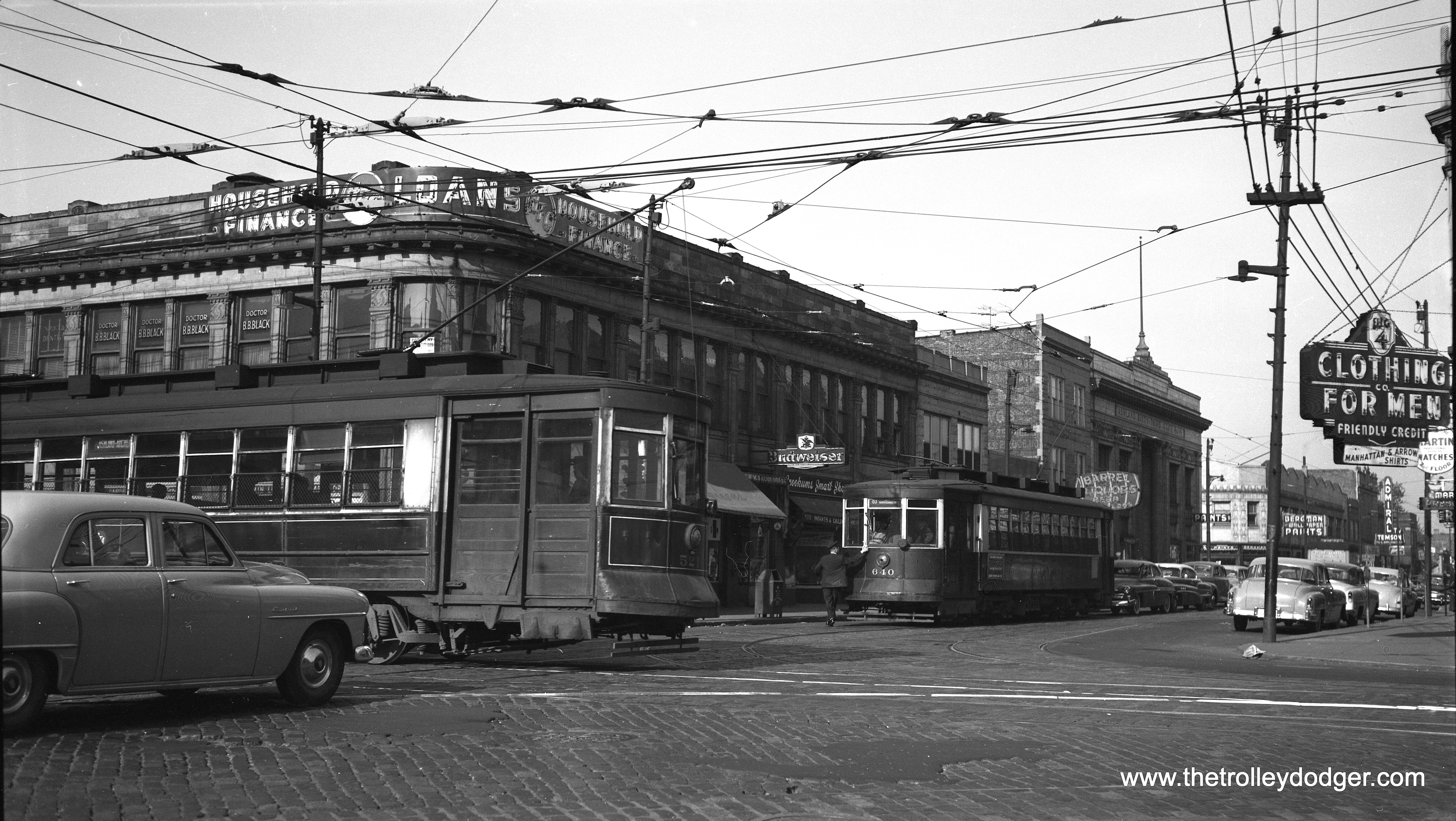
CTA red Pullmans 521 (on Ashland) and 640 (on 63rd Street) meet on May 14, 1953. This was near the end of streetcar service on 63rd. By then, PCC cars had been transferred from 63rd to Cottage Grove. The Curtis restaurant, located in this vicinity but behind the photographer, was a favorite of my parents. It is perhaps no coincidence that I have a brother named Curtis. (Robert Selle Photo)

CTA red Pullmans 521 (on Ashland) and 640 (on 63rd Street) meet on May 14, 1953. This was near the end of streetcar service on 63rd. By then, PCC cars had been transferred from 63rd to Cottage Grove. The Curtis restaurant, located in this vicinity but behind the photographer, was a favorite of my parents. It is perhaps no coincidence that I have a brother named Curtis. (Robert Selle Photo)

CTA PCC 4095, built by Pullman, has just left the Madison-Austin loop on the west end of Route 20 on June 1, 1953. Buses continue to use this loop today, although it has been somewhat reconfigured. (Robert Selle Photo)

CTA PCC 4095, built by Pullman, has just left the Madison-Austin loop on the west end of Route 20 on June 1, 1953. Buses continue to use this loop today, although it has been somewhat reconfigured. (Robert Selle Photo)

CTA 4271-4272 head up a northbound Evanston Express train passing through the Chicago Avenue station on June 26, 1958. These two cars, which were originally independent but were converted to semi-permanent "married pairs" in the 1950s, are still on CTA property and within a few years will celebrate their centennial. When the last of the 4000-series "L" cars were retired in 1973, these were chosen for preservation as historic cars. They are occasionally used for special events. (Robert Selle Photo)

CTA 4271-4272 head up a northbound Evanston Express train passing through the Chicago Avenue station on June 26, 1958. These two cars, which were originally independent but were converted to semi-permanent “married pairs” in the 1950s, are still on CTA property and within a few years will celebrate their centennial. When the last of the 4000-series “L” cars were retired in 1973, these were chosen for preservation as historic cars. They are occasionally used for special events. (Robert Selle Photo)

CTA red Pullman 270 is on Cicero at North Avenue, where Cicero took a bit of a jog which has since been somewhat straightened out. The date is July 19, 1948. (William Shapotkin Collection)

CTA red Pullman 270 is on Cicero at North Avenue, where Cicero took a bit of a jog which has since been somewhat straightened out. The date is July 19, 1948. (William Shapotkin Collection)

CTA trolleybus 9219 on Route 77 - Belmont, running eastbound at approximately 952 W. Belmont (near Sheffield). The photographer was up on the north-south "L" platform. (William Shapotkin Collection)

CTA trolleybus 9219 on Route 77 – Belmont, running eastbound at approximately 952 W. Belmont (near Sheffield). The photographer was up on the north-south “L” platform. (William Shapotkin Collection)

The building in the previous picture is still there. For several years, there was a club on the second floor, first called the Quiet Knight, later on Tut's. I attended many great concerts there in the 1970s and 80s.

The building in the previous picture is still there. For several years, there was a club on the second floor, first called the Quiet Knight, later on Tut’s. I attended many great concerts there in the 1970s and 80s.

Chicago Surface Lines 1775 crosses the Chicago River at Wabash Avenue on May 30, 1945, promoting the WAVES (Women Accepted for Volunteer Emergency Service). The nearby State Street bridge was out of service from 1939 to 1949 due to subway construction and wartime materials shortages.

Chicago Surface Lines 1775 crosses the Chicago River at Wabash Avenue on May 30, 1945, promoting the WAVES (Women Accepted for Volunteer Emergency Service). The nearby State Street bridge was out of service from 1939 to 1949 due to subway construction and wartime materials shortages.

CSL 1775, decorated to promote the SPARS*, is on 119th one block west of Halsted in August 1943. Car 1775 was chosen for patriotic duty because that was the year the Revolutionary War broke out, with the Battles of Lexington and Concord. *The United States Coast Guard (USCG) Women's Reserve, better known as the SPARS, was the World War II women's branch of the USCG Reserve. It was established by the United States Congress and signed into law by President Franklin D. Roosevelt on 23 November 1942.

CSL 1775, decorated to promote the SPARS*, is on 119th one block west of Halsted in August 1943. Car 1775 was chosen for patriotic duty because that was the year the Revolutionary War broke out, with the Battles of Lexington and Concord.
*The United States Coast Guard (USCG) Women’s Reserve, better known as the SPARS, was the World War II women’s branch of the USCG Reserve. It was established by the United States Congress and signed into law by President Franklin D. Roosevelt on 23 November 1942.

On August 25, 1946 CSL one-man car 3093 is running outbound on private right-of-way between Morgan and Throop on Route 23, Morgan-Racine-Sangamon.

On August 25, 1946 CSL one-man car 3093 is running outbound on private right-of-way between Morgan and Throop on Route 23, Morgan-Racine-Sangamon.

On May 25, 1958 we see CTA two-man PCCs 7206 and 4390 at 78th and Wentworth (South Shops). Both were products of St. Louis Car Company, as all 310 postwar Pullman PCCs had been scrapped by then for the "PCC conversion program" that used some of their parts in new 6000-series rapid transit cars. In spite of the roll signs shown here, Chicago streetcars were limited to running on a single route between downtown and the south side. The last northside car ran in 1957. (Robert Selle Photo)

On May 25, 1958 we see CTA two-man PCCs 7206 and 4390 at 78th and Wentworth (South Shops). Both were products of St. Louis Car Company, as all 310 postwar Pullman PCCs had been scrapped by then for the “PCC conversion program” that used some of their parts in new 6000-series rapid transit cars. In spite of the roll signs shown here, Chicago streetcars were limited to running on a single route between downtown and the south side. The last northside car ran in 1957. (Robert Selle Photo)

CTA PCC 7151, a product of St. Louis Car Company, heads south on Route 49 - Western at North Avenue in 1953. The "L" station behind it was part of the Humboldt Park branch, which was abandoned in 1952. Once the station was closed, signs advertising "L" service were removed although I don't believe this portion of the structure was removed until the early 1960s. Note that riders at this safety island are boarding at the rear, as this is a two-man car.

CTA PCC 7151, a product of St. Louis Car Company, heads south on Route 49 – Western at North Avenue in 1953. The “L” station behind it was part of the Humboldt Park branch, which was abandoned in 1952. Once the station was closed, signs advertising “L” service were removed although I don’t believe this portion of the structure was removed until the early 1960s. Note that riders at this safety island are boarding at the rear, as this is a two-man car.

CTA 4393 is at the 79th and Western loop, south end of Route 49, on July 19, 1954. (Robert Selle Photo)

CTA 4393 is at the 79th and Western loop, south end of Route 49, on July 19, 1954. (Robert Selle Photo)

CTA PCC 4376 is turning into the loop at 79th and Western, south end of Route 49, on July 19, 1954. (Robert Selle Photo)

CTA PCC 4376 is turning into the loop at 79th and Western, south end of Route 49, on July 19, 1954. (Robert Selle Photo)

On May 1, 1955 CERA held a fantrip using 2800-series wooden "L" cars. Here, the train makes a photo stop at DesPlaines Avenue in Forest Park, then the western end of the Garfield Park "L". The terminal had been reconfigured in 1953 when CA&E trains stopped running downtown. It would be reconfigured again in 1959. By 1960, the Congress expressway was extended through this area. (Robert Selle Photo)

On May 1, 1955 CERA held a fantrip using 2800-series wooden “L” cars. Here, the train makes a photo stop at DesPlaines Avenue in Forest Park, then the western end of the Garfield Park “L”. The terminal had been reconfigured in 1953 when CA&E trains stopped running downtown. It would be reconfigured again in 1959. By 1960, the Congress expressway was extended through this area. (Robert Selle Photo)

CTA two-man arch roof car 3189 is southbound on Halsted Street near the Garfield Park "L" overpass, south of Van Buren Street on September 17, 1953. As had previously happened with 63rd Street, PCCs had been taken off this route and replaced by older red cars for the final few months of service. 3189 is on the bridge that would eventually go over the Congress expressway, which was then under construction. (Robert Selle Photo)

CTA two-man arch roof car 3189 is southbound on Halsted Street near the Garfield Park “L” overpass, south of Van Buren Street on September 17, 1953. As had previously happened with 63rd Street, PCCs had been taken off this route and replaced by older red cars for the final few months of service. 3189 is on the bridge that would eventually go over the Congress expressway, which was then under construction. (Robert Selle Photo)

Here's what photographer Bob Selle wrote on this negative envelope: ""L" cars fresh from the paint shops, MU-coupled, for trip to South side "L" lines: deck roofer 2912 and steel car 4224 at Quincy and Wells platform. June 14th, 1955."

Here’s what photographer Bob Selle wrote on this negative envelope: “”L” cars fresh from the paint shops, MU-coupled, for trip to South side “L” lines: deck roofer 2912 and steel car 4224 at Quincy and Wells platform. June 14th, 1955.”

CSL 4062 was the first postwar PCC put into service. It was built by Pullman. Here, we see it as delivered at 78th and Vincennes on September 30, 1946. Note the different paint scheme the first cars had in the "standee" windows area.

CSL 4062 was the first postwar PCC put into service. It was built by Pullman. Here, we see it as delivered at 78th and Vincennes on September 30, 1946. Note the different paint scheme the first cars had in the “standee” windows area.

CSL 298 is on Wabash at Cermak on September 14, 1934.

CSL 298 is on Wabash at Cermak on September 14, 1934.

This picture of CTA one-man car 3236, taken on January 14, 1950 shows it crossing Maplewood Avenue on what is obviously an east-west trolley line. John F. Bromley, who sold me this negative, was unsure of the location. Jeff Wien writes, "I would guess that it is at 71st & Maplewood. Bill Hoffman lived all of his life at 6664 S. Maplewood which was a half mile north. Maplewood is a block or two west of Western. Route 67 covered 67th, 69th and 71st as far west as California (2800). Maplewood is around 2600 West. Check out the streets to see if I am correct. The one man cars were used on route 67." Looks like Jeff is correct, as further research shows that the house at left is still standing at 7053 S. Maplewood.

This picture of CTA one-man car 3236, taken on January 14, 1950 shows it crossing Maplewood Avenue on what is obviously an east-west trolley line. John F. Bromley, who sold me this negative, was unsure of the location. Jeff Wien writes, “I would guess that it is at 71st & Maplewood. Bill Hoffman lived all of his life at 6664 S. Maplewood which was a half mile north. Maplewood is a block or two west of Western. Route 67 covered 67th, 69th and 71st as far west as California (2800). Maplewood is around 2600 West. Check out the streets to see if I am correct. The one man cars were used on route 67.” Looks like Jeff is correct, as further research shows that the house at left is still standing at 7053 S. Maplewood.

Photographer Bob Selle writes, "CTA one-man car 6174 eastbound as it crosses Halsted Street on Root Street (43rd Street line), leaving west end of line. August 1, 1953."

Photographer Bob Selle writes, “CTA one-man car 6174 eastbound as it crosses Halsted Street on Root Street (43rd Street line), leaving west end of line. August 1, 1953.”

Photographer Bob Selle writes, "Car 6177 leaving south end of Kedzie barn for Cermak Road, February 14, 1953."

Photographer Bob Selle writes, “Car 6177 leaving south end of Kedzie barn for Cermak Road, February 14, 1953.”

CTA Pullman-built PCC 4084 leaving the Kedzie Station (car barn) on September 13, 1950. The car at right appears to be either a 1949 or 1950 Ford. My father had a 1949 model, and as cars were very much in demand after the end of World War II, the dealer put him on a waiting list. After being on the list for six months, he found that he had actually gone further down the list than he was at the start! So he wrote a letter complaining about this to Henry Ford II, and the next thing you know, they sold him a car. Presumably the PCC is heading out on Route 20 - Madison. (Robert Selle Photo)

CTA Pullman-built PCC 4084 leaving the Kedzie Station (car barn) on September 13, 1950. The car at right appears to be either a 1949 or 1950 Ford. My father had a 1949 model, and as cars were very much in demand after the end of World War II, the dealer put him on a waiting list. After being on the list for six months, he found that he had actually gone further down the list than he was at the start! So he wrote a letter complaining about this to Henry Ford II, and the next thing you know, they sold him a car. Presumably the PCC is heading out on Route 20 – Madison. (Robert Selle Photo)

This negative did not come with any identifying information, but it is obviously from a February 12, 1939 fantrip where the fledgling Central Electric Railfans' Association chartered Chicago Rapid Transit Company "L" cars 4317 and 4401 and took them out on parts of the CA&E including the Mount Carmel branch. However, since that line used overhead wire, that's not where this picture was taken. Instead, it appears to be out near the end of the line at Mannheim and 22nd Street on the CRT's lightly used Westchester line, which was built in anticipation of housing being built in this area (which did not come about until the 1950s). South of Roosevelt Road, the line was single-track, which appears to be the case here. If not for the Great Depression, more housing would have been built here. We have previously run two other pictures from the same fantrip, both taken on the Mt. Carmel branch. The CTA substituted bus service for "L" on the Westchester line in 1951 as it did not want to continue paying rent to the CA&E, which had already announced its intentions to truncate passenger service to Forest Park, which meant similar rent payments to the CTA were about to cease.

This negative did not come with any identifying information, but it is obviously from a February 12, 1939 fantrip where the fledgling Central Electric Railfans’ Association chartered Chicago Rapid Transit Company “L” cars 4317 and 4401 and took them out on parts of the CA&E including the Mount Carmel branch. However, since that line used overhead wire, that’s not where this picture was taken. Instead, it appears to be out near the end of the line at Mannheim and 22nd Street on the CRT’s lightly used Westchester line, which was built in anticipation of housing being built in this area (which did not come about until the 1950s). South of Roosevelt Road, the line was single-track, which appears to be the case here. If not for the Great Depression, more housing would have been built here. We have previously run two other pictures from the same fantrip, both taken on the Mt. Carmel branch. The CTA substituted bus service for “L” on the Westchester line in 1951 as it did not want to continue paying rent to the CA&E, which had already announced its intentions to truncate passenger service to Forest Park, which meant similar rent payments to the CTA were about to cease.

CTA PCC 4087 leaves the Kedzie car barn during the morning rush on July 1, 1953 and is signed for the Madison-Fifth branch line. (Robert Selle Photo)

CTA PCC 4087 leaves the Kedzie car barn during the morning rush on July 1, 1953 and is signed for the Madison-Fifth branch line. (Robert Selle Photo)

The end is near for CTA 4402 and the other couple dozen or so PCC cars that remained at the end of service. Ultimately, only car 4391, now at the Illinois Railway Museum, was saved. This picture was taken at 77th Street yards on June 15, 1958. (Robert Selle Photo)

The end is near for CTA 4402 and the other couple dozen or so PCC cars that remained at the end of service. Ultimately, only car 4391, now at the Illinois Railway Museum, was saved. This picture was taken at 77th Street yards on June 15, 1958. (Robert Selle Photo)

CSL 5387 is westbound at 63rd and Dorchester, having just gone under the Illinois Central viaduct on June 13, 1947. Even though this neg was lightstruck on the top edge (almost all of which I cropped out), I thought it was an interesting streetscape with the diner and what appears to be some sort of pawn shop or resale shop. The Jackson Park branch of the "L" went over the IC at this point, and has since been cut back.

CSL 5387 is westbound at 63rd and Dorchester, having just gone under the Illinois Central viaduct on June 13, 1947. Even though this neg was lightstruck on the top edge (almost all of which I cropped out), I thought it was an interesting streetscape with the diner and what appears to be some sort of pawn shop or resale shop. The Jackson Park branch of the “L” went over the IC at this point, and has since been cut back.

On August 28, 1955 Illinois Central Electric suburban 1161 and its trailer are crossing Halsted Street at 121st on their way to Blue Island. There was a fantrip that day (hence the fans,), but this was not the fantrip train apparently. (Robert Selle Photo)

On August 28, 1955 Illinois Central Electric suburban 1161 and its trailer are crossing Halsted Street at 121st on their way to Blue Island. There was a fantrip that day (hence the fans,), but this was not the fantrip train apparently. (Robert Selle Photo)

CSL 1872 is on Franklin at Jackson on June 13, 1947.

CSL 1872 is on Franklin at Jackson on June 13, 1947.

CSL red Pullman 293 is at Roosevelt and Wabash on June 13, 1947.

CSL red Pullman 293 is at Roosevelt and Wabash on June 13, 1947.

This Chicago, Aurora & Elgin image is from an original 1950s Kodachrome slide that was not processed by Kodak. I am not quite able to make out the car number, but it looks like it is one of the 420s. The location is downtown Elgin, along the Fox River. The Rialto Theater burned down in 1956.

This Chicago, Aurora & Elgin image is from an original 1950s Kodachrome slide that was not processed by Kodak. I am not quite able to make out the car number, but it looks like it is one of the 420s. The location is downtown Elgin, along the Fox River. The Rialto Theater burned down in 1956.

This picture is somewhat blurred, which makes one wonder why the late Edward Frank, Jr. printed it and sold it. But it does show CSL 1819 and a passing Chicago, Aurora & Elgin train. The curved section of track suggests this may have been taken near the Sacramento curve. That's probably Ed Frank's bicycle in the lower right hand corner.

This picture is somewhat blurred, which makes one wonder why the late Edward Frank, Jr. printed it and sold it. But it does show CSL 1819 and a passing Chicago, Aurora & Elgin train. The curved section of track suggests this may have been taken near the Sacramento curve. That’s probably Ed Frank’s bicycle in the lower right hand corner.

It is not often that individual employees can be identified in an old photo such as this, which shows CA&E express freight car #5 (presumably, the second #5, built by Cincinnati Car Company). But the man at left is Clyde Goodrich, a longtime engineer on the interurban. As far as I know, he was still employed there up to the final 1959 abandonment of service.

It is not often that individual employees can be identified in an old photo such as this, which shows CA&E express freight car #5 (presumably, the second #5, built by Cincinnati Car Company). But the man at left is Clyde Goodrich, a longtime engineer on the interurban. As far as I know, he was still employed there up to the final 1959 abandonment of service.

Clyde B. Goodrich, the man in the left, was born in DeKalb, Illinois on May 17, 1887 and died in Florida on September 1, 1970. His wife's name was Winifred (1882-1955). In 1920, Clyde lived in Aurora and was employed by the Chicago, Burlington & Quincy. In the 1940 census, he was living in Wheaton and worked as an engineer on the Chicago, Aurora & Elgin. Clyde B. Goodrich and his wife are buried in Wheaton Cemetery.

Clyde B. Goodrich, the man in the left, was born in DeKalb, Illinois on May 17, 1887 and died in Florida on September 1, 1970. His wife’s name was Winifred (1882-1955). In 1920, Clyde lived in Aurora and was employed by the Chicago, Burlington & Quincy. In the 1940 census, he was living in Wheaton and worked as an engineer on the Chicago, Aurora & Elgin. Clyde B. Goodrich and his wife are buried in Wheaton Cemetery.

The caption here reads, "North Western and electric lines stations, Wheaton." The CA&E is in the foreground. The photo is not dated, but it must be quite early.

The caption here reads, “North Western and electric lines stations, Wheaton.” The CA&E is in the foreground. The photo is not dated, but it must be quite early.

This photo, dated May 1966, shows the CA&E's Wheaton station being torn down.

This photo, dated May 1966, shows the CA&E’s Wheaton station being torn down.

Demolition is nearly complete in this photo, also dated May 1966.

Demolition is nearly complete in this photo, also dated May 1966.

CA&E wooden interurban car 54. Don's Rail Photos: "54 was built by Stephonsin in 1903. It was modernized in July 1946 and retired in 1959."

CA&E wooden interurban car 54. Don’s Rail Photos: “54 was built by Stephonsin in 1903. It was modernized in July 1946 and retired in 1959.”

CA&E wooden freight motor 9. Don's Rail Photos: "9 was built by Niles Car in 1907. It was scrapped in 1959."

CA&E wooden freight motor 9. Don’s Rail Photos: “9 was built by Niles Car in 1907. It was scrapped in 1959.”

A crane on a CA&E flat car. This appears to be Wheaton Yard.

A crane on a CA&E flat car. This appears to be Wheaton Yard.

North Shore Line car 182 is southbound on the Shore Line Route in North Chicago, Illinois on June 12, 1954. Don's Rail Photos: "182 was built by Cincinnati Car in September 1920, #2455." (Robert Selle Photo)

North Shore Line car 182 is southbound on the Shore Line Route in North Chicago, Illinois on June 12, 1954. Don’s Rail Photos: “182 was built by Cincinnati Car in September 1920, #2455.” (Robert Selle Photo)

While Chicago's Congress expressway (now the Eisenhower) is rightly considered its first, Lake Shore Drive preceded it as an "almost" expressway. Here. we see construction taking place on December 13, 1940. Until 1979 LSD had lanes that could be reversed in rush hour by raising and lowering these short barriers. Unfortunately, this resulted in a number of head-on collisions, and these were eventually deactivated. The photo caption reads, "Workmen install line of elevating curbs in new express highway on Chicago's lake front. The curbs, placed two lanes apart on the eight lane roadway, give extra lanes to rush hour traffic to ease traffic flow. The elevating jacks shown raise the curb to height of nine inches, exert pressure of 12 tons. The retracting springs, having a 10-ton pressure, pull the curbs down when the hydraulic jacks are released. The entire curb system is operated from one central control station." (Photo by Acme)

While Chicago’s Congress expressway (now the Eisenhower) is rightly considered its first, Lake Shore Drive preceded it as an “almost” expressway. Here. we see construction taking place on December 13, 1940. Until 1979 LSD had lanes that could be reversed in rush hour by raising and lowering these short barriers. Unfortunately, this resulted in a number of head-on collisions, and these were eventually deactivated. The photo caption reads, “Workmen install line of elevating curbs in new express highway on Chicago’s lake front. The curbs, placed two lanes apart on the eight lane roadway, give extra lanes to rush hour traffic to ease traffic flow. The elevating jacks shown raise the curb to height of nine inches, exert pressure of 12 tons. The retracting springs, having a 10-ton pressure, pull the curbs down when the hydraulic jacks are released. The entire curb system is operated from one central control station.” (Photo by Acme)

Chicago’s Loop in 1959

The following ten images are part of a larger batch we recently purchased. Several of the others show various downtown movie theaters (including the Clark and Garrick) and will be posted in the near future on our “sister” Clark Theater blog. By studying the various films that were playing, I have determined these pictures were taken during the summer of 1959.

Here's a rather unique view showing the front of the old Wells Street Terminal, or what was left of it anyway, as it appeared in 1959. This terminal was last used by the CA&E in 1953. Two years later, the upper portion of the attractive facade was removed and a new track connection was built so that Garfield Park trains could connect to the Loop "L". A new connection was needed, since the old one had to give way to construction on Wacker Drive. The remainder of the terminal, and the track connection, were no longer needed after the Congress rapid transit line replaced the Garfield Park "L" in 1958, and they were removed in 1964. Note there is a barber shop occupying part of the building.

Here’s a rather unique view showing the front of the old Wells Street Terminal, or what was left of it anyway, as it appeared in 1959. This terminal was last used by the CA&E in 1953. Two years later, the upper portion of the attractive facade was removed and a new track connection was built so that Garfield Park trains could connect to the Loop “L”. A new connection was needed, since the old one had to give way to construction on Wacker Drive. The remainder of the terminal, and the track connection, were no longer needed after the Congress rapid transit line replaced the Garfield Park “L” in 1958, and they were removed in 1964. Note there is a barber shop occupying part of the building.

A two-car train of CTA 4000s, running on the Lake Street "L", are at Wabash and Van Buren on the Loop. In the background, you can see the Auditorium Theater building.

A two-car train of CTA 4000s, running on the Lake Street “L”, are at Wabash and Van Buren on the Loop. In the background, you can see the Auditorium Theater building.

The old Epicurean restaurant, at left, was located at 316 S. Wabash and served Hugarian cuisine. A CTA Lake Street train rumbles by above.

The old Epicurean restaurant, at left, was located at 316 S. Wabash and served Hugarian cuisine. A CTA Lake Street train rumbles by above.

A street sign is just barely visible in this photo taken under the Loop "L", identifying the cross street as Dearborn. Since that is one way southbound downtown, and the arrow is pointing to the right, that implies we are in Lake Street and are looking to the east.

A street sign is just barely visible in this photo taken under the Loop “L”, identifying the cross street as Dearborn. Since that is one way southbound downtown, and the arrow is pointing to the right, that implies we are in Lake Street and are looking to the east.

The old Metropolitan "L" crossed the Chicago River just south of Union Station (just visible at left) and had four tracks, necessitating two bridges. After these tracks were taken out of service in June 1958, the bridges were permanently raised, and razed in 1964.

The old Metropolitan “L” crossed the Chicago River just south of Union Station (just visible at left) and had four tracks, necessitating two bridges. After these tracks were taken out of service in June 1958, the bridges were permanently raised, and razed in 1964.

Another view of the same two Met "L" bridges in 1959.

Another view of the same two Met “L” bridges in 1959.

Another photo of the two Met "L" bridges.

Another photo of the two Met “L” bridges.

It's not clear where this picture was taken. The two wires that cross the trolley bus wires are, I am told, "feeder span hangers." The last Chicago trolley bus ran in 1973. The CTA currently has two electric buses that run on batteries, and has just placed an order for 20 more.

It’s not clear where this picture was taken. The two wires that cross the trolley bus wires are, I am told, “feeder span hangers.” The last Chicago trolley bus ran in 1973. The CTA currently has two electric buses that run on batteries, and has just placed an order for 20 more.

Another view of the Loop "L" on south Wabash, probably taken near the locations if the other similar photos showing Lake Street trains.

Another view of the Loop “L” on south Wabash, probably taken near the locations if the other similar photos showing Lake Street trains.

This photo shows what State Street, that great street, looked like during the summer of 1959. We are looking north from about 400 S. State. The Goldblatt's department store is at right, and that's a CTA #36 bus heading south. Streetcar tracks on State have either been removed, or paved over. Note the "grasshopper" style street lights that were installed in 1959.

This photo shows what State Street, that great street, looked like during the summer of 1959. We are looking north from about 400 S. State. The Goldblatt’s department store is at right, and that’s a CTA #36 bus heading south. Streetcar tracks on State have either been removed, or paved over. Note the “grasshopper” style street lights that were installed in 1959.

FYI, here is another view from the same location, taken after streetcar tracks were removed, but before the 1959 installation of those unique street lights:

https://portal-ccc.s3.amazonaws.com/media/images/uic/26/j09wx3v.jpg

(See attribution information for this photo via the link provided above.)

Miscellaneous New Finds

This photo purports to show the actual last run on Milwaukee's ill-fated Speedrail interurban on June 30, 1951. However, according to Larry Sakar, author of Speedrail: Milwaukee's Last Rapid Transit?, "The last run to Waukesha which left Milwaukee at a little after 8:00 pm and returned to Milwaukee at 10:08 pm, 2 minutes ahead of schedule, was handled by duplex 37-38. The final round trip to Hales Corners was handled by curved side car 63, not 66. 66 did run on the last day, but it was by no means the final run." Chances are this photo was at least taken on the last day. The line could not survive the repercussions of a terrible head-on collision in 1950, and Milwaukee area officials wanted to use the interurban's right-of-way, which it did not own, for a new highway. Don's Rail Photos: "66 was built by Cincinnati Car in August 1929, #3025, as Dayton & Troy Ry 203. It was returned to Cincinnati Car in 1932, and in 1938 it was sold to Lehigh Valley Transit as 1102. In 1949 it was sold to Speedrail, but was not rehabilitated until March 1951. But it only ran for 3 months before the line was abandoned and then scrapped in 1952." (Photo by George Harris)

This photo purports to show the actual last run on Milwaukee’s ill-fated Speedrail interurban on June 30, 1951. However, according to Larry Sakar, author of Speedrail: Milwaukee’s Last Rapid Transit?, “The last run to Waukesha which left Milwaukee at a little after 8:00 pm and returned to Milwaukee at 10:08 pm, 2 minutes ahead of schedule, was handled by duplex 37-38. The final round trip to Hales Corners was handled by curved side car 63, not 66. 66 did run on the last day, but it was by no means the final run.” Chances are this photo was at least taken on the last day. The line could not survive the repercussions of a terrible head-on collision in 1950, and Milwaukee area officials wanted to use the interurban’s right-of-way, which it did not own, for a new highway. Don’s Rail Photos: “66 was built by Cincinnati Car in August 1929, #3025, as Dayton & Troy Ry 203. It was returned to Cincinnati Car in 1932, and in 1938 it was sold to Lehigh Valley Transit as 1102. In 1949 it was sold to Speedrail, but was not rehabilitated until March 1951. But it only ran for 3 months before the line was abandoned and then scrapped in 1952.” (Photo by George Harris)

Early Kodachrome images such as this are rare. Here, we see a San Francisco cable car (signed for Powell and Mason) in operation during the summer of 1945. When this picture was taken, the war in Europe had ended, but the US was still fighting Japan. According to the Cable Car Museum web site, this car is currently in service as #3: "Built by the Carter Bros. of Newark, California during 1893-1894 for the Market Street Railway's Sacramento-Clay cable car line. The United Railroads transferred it to the Powell Street cable car lines in 1907, after the Earthquake and Fire of 1906. Until 1973, numbered as No. 503. No. 3 is painted in Muni's green and cream paint scheme, which is based on the green and white scheme of the Muni's former rival between 1921-1944, the Market Street Railway. This was the basic paint scheme for Powell Street cable cars from 1947 to 1982. Extensive rebuilding, by Muni 1955."

Early Kodachrome images such as this are rare. Here, we see a San Francisco cable car (signed for Powell and Mason) in operation during the summer of 1945. When this picture was taken, the war in Europe had ended, but the US was still fighting Japan. According to the Cable Car Museum web site, this car is currently in service as #3: “Built by the Carter Bros. of Newark, California during 1893-1894 for the Market Street Railway’s Sacramento-Clay cable car line. The United Railroads transferred it to the Powell Street cable car lines in 1907, after the Earthquake and Fire of 1906. Until 1973, numbered as No. 503. No. 3 is painted in Muni’s green and cream paint scheme, which is based on the green and white scheme of the Muni’s former rival between 1921-1944, the Market Street Railway. This was the basic paint scheme for Powell Street cable cars from 1947 to 1982. Extensive rebuilding, by Muni 1955.”

PTC "Peter Witt" 8057 was built by Brill in 1923. Here it is seen on Route 34 in the 1950s. Michael T. Greene writes: "The picture of the Route 34 Peter Witt was taken at 38th and Locust Streets, on what’s now the campus of the University of Pennsylvania. (An alum now resides at 1600 Pennsylvania Avenue, NW, in Washington, but enough of that!). The trolley is using detour trackage onto Locust Street EB, as part of the subway-surface extension of the 1950’s…westbound trackage continued on Locust to 40th Street, where it hung a left turn. Today, 38th Street has been widened to a 2-way street, but still with a trolley track, used as a diversion route for subway-surface Routes 11, 13, 34, and 36. Locust Street was been turned into a pedestrian walkway, and a pedestrian bridge goes over 38th Street these days."

PTC “Peter Witt” 8057 was built by Brill in 1923. Here it is seen on Route 34 in the 1950s. Michael T. Greene writes: “The picture of the Route 34 Peter Witt was taken at 38th and Locust Streets, on what’s now the campus of the University of Pennsylvania. (An alum now resides at 1600 Pennsylvania Avenue, NW, in Washington, but enough of that!). The trolley is using detour trackage onto Locust Street EB, as part of the subway-surface extension of the 1950’s…westbound trackage continued on Locust to 40th Street, where it hung a left turn. Today, 38th Street has been widened to a 2-way street, but still with a trolley track, used as a diversion route for subway-surface Routes 11, 13, 34, and 36. Locust Street was been turned into a pedestrian walkway, and a pedestrian bridge goes over 38th Street these days.”

Philadelphia Transportation Company 7266 is on Route 9, sometime in the 1950s during street construction. Micheal T. Greene writes: "The Route 9 car is on 5th Street south of Market Street. At this time, 5th Street was being widened as part of Independence Mall. Independence Hall is out of this picture to the right."

Philadelphia Transportation Company 7266 is on Route 9, sometime in the 1950s during street construction. Micheal T. Greene writes: “The Route 9 car is on 5th Street south of Market Street. At this time, 5th Street was being widened as part of Independence Mall. Independence Hall is out of this picture to the right.”

Indianapolis Railways "Peter Witt" car 181, also known as a "Master Unit," a Brill trademark, is signed for College-Broad Ripple on April 16, 1952. This car was built in March 1934 and was one of the last streetcar orders filled before the PCC era. (Robert Selle Photo)

Indianapolis Railways “Peter Witt” car 181, also known as a “Master Unit,” a Brill trademark, is signed for College-Broad Ripple on April 16, 1952. This car was built in March 1934 and was one of the last streetcar orders filled before the PCC era. (Robert Selle Photo)

Indianapolis Railways 155 was built by Brill in September 1933. On May 21, 1950 it is at the east end of the Washington Street line on a fantrip.

Indianapolis Railways 155 was built by Brill in September 1933. On May 21, 1950 it is at the east end of the Washington Street line on a fantrip.

On August23, 1946, photographer Walter Hulseweder snapped this picture of Indianapolis Railways 131 on Washington Street at Illinois Avenue on the Washington-Sheridan line.

On August23, 1946, photographer Walter Hulseweder snapped this picture of Indianapolis Railways 131 on Washington Street at Illinois Avenue on the Washington-Sheridan line.

By strange coincidence, this photo showing a Rock Island Motor Transit Company bus was taken in June 21, 1958. Bill shapotkin adds, "The photo was taken at the joint CGW/Greyhound/Jefferson bus station in Rochester, MN. This bus provided connections from/to ROCK trains at Owatonna, MN." (William Shapotkin Collection)

By strange coincidence, this photo showing a Rock Island Motor Transit Company bus was taken in June 21, 1958. Bill shapotkin adds, “The photo was taken at the joint CGW/Greyhound/Jefferson bus station in Rochester, MN. This bus provided connections from/to ROCK trains at Owatonna, MN.” (William Shapotkin Collection)

Mystery Photo

This picture, which could be as old as the 1930s, was listed by the seller as being Chicago. However, I have my doubts, as I am unable to think of a location this could be around here, or what the construction project might be. The sign says "Detour to temporary bridge." Jeff Wien thinks this might be Philadelphia.

This picture, which could be as old as the 1930s, was listed by the seller as being Chicago. However, I have my doubts, as I am unable to think of a location this could be around here, or what the construction project might be. The sign says “Detour to temporary bridge.” Jeff Wien thinks this might be Philadelphia.

Updates

We’ve added another image to our previous post The Fairmount Park Trolley (November 7. 2017), which includes an extensive section about the Five Mile Beach Electric Railway in Wildwood, New Jersey:

Five Mile Beach Electric Railway car 36 at Warehouse Point, Connecticut on August 16, 1952.

Five Mile Beach Electric Railway car 36 at Warehouse Point, Connecticut on August 16, 1952.

These photos were added to our previous post Red Arrow in West Chester (September 13, 2016):

A SEPTA commuter train, ex-PRR, at West Chester in May 1979. SEPTA rail service to this station ended in 1986, but the West Chester Railroad began running a not-for-profit tourist operation of train service on weekends between West Chester and Glen Mills in 1997. (Photo by Paul Kutta)

A SEPTA commuter train, ex-PRR, at West Chester in May 1979. SEPTA rail service to this station ended in 1986, but the West Chester Railroad began running a not-for-profit tourist operation of train service on weekends between West Chester and Glen Mills in 1997. (Photo by Paul Kutta)

Red Arrow "Master Unit" 79 is inbound in 1949 on either the Media or Sharon Hill line, in spite of the sign saying Ardmore (thanks to Kenneth Achtert for that correction). He adds, "It was (still is) standard practice for Red Arrow operators, when changing ends at the outer end of their route, to set the sign on what would be the rear of the car for the inbound trip to read their next outbound destination. Thus, when the car arrived at 69th St. Terminal and went around the loop to the boarding platform the rear destination sign was already set. This was actually the more important sign, as most passengers approached the cars from the rear coming from the main terminal (and from the Market-Frankford Elevated line)." (Mark D. Meyer Photo)

Red Arrow “Master Unit” 79 is inbound in 1949 on either the Media or Sharon Hill line, in spite of the sign saying Ardmore (thanks to Kenneth Achtert for that correction). He adds, “It was (still is) standard practice for Red Arrow operators, when changing ends at the outer end of their route, to set the sign on what would be the rear of the car for the inbound trip to read their next outbound destination. Thus, when the car arrived at 69th St. Terminal and went around the loop to the boarding platform the rear destination sign was already set. This was actually the more important sign, as most passengers approached the cars from the rear coming from the main terminal (and from the Market-Frankford Elevated line).” (Mark D. Meyer Photo)

Red Arrow "Master Unit" 82 is at the 69th Street Terminal on August 8, 1948. (Walter Broschart Photo)

Red Arrow “Master Unit” 82 is at the 69th Street Terminal on August 8, 1948. (Walter Broschart Photo)

On September 12, 1959, Philadelphia Suburban Transportation 3, a 1941 "Brilliner," is on Lippincott Avenue north of County Line Road, on the short Ardmore line which was bussed in 1966.

On September 12, 1959, Philadelphia Suburban Transportation 3, a 1941 “Brilliner,” is on Lippincott Avenue north of County Line Road, on the short Ardmore line which was bussed in 1966.

Philadelphia Suburban Transportation Company (aka "Red Arrow") cars 5 and 14 pose at 69th Street Terminal on June 22, 1963. The car at left is a Brilliner, from the last batch of trolleys built by Brill in 1941. The car at right was built by the St. Louis Car Company in 949. Although it looks much like a PCC, it was not considered such as it had standard interurban trucks and motors. Both types of cars were double-ended.

Philadelphia Suburban Transportation Company (aka “Red Arrow”) cars 5 and 14 pose at 69th Street Terminal on June 22, 1963. The car at left is a Brilliner, from the last batch of trolleys built by Brill in 1941. The car at right was built by the St. Louis Car Company in 949. Although it looks much like a PCC, it was not considered such as it had standard interurban trucks and motors. Both types of cars were double-ended.

We’ve added this image to our extensive section about the Fort Collins (Colorado) Birney car operation in Our 150th Post (August 6, 2016):

Fort Collins Municipal Railway Birney car 22 in the city park on April 30, 1947.

Fort Collins Municipal Railway Birney car 22 in the city park on April 30, 1947.

Recent Correspondence

Our resident South Side expert M. E. writes:

Your latest post has a bunch of good stuff.

https://thetrolleydodger.com/wp-content/uploads/2018/06/proofs116.jpg
Interesting that you think this picture might be of your mother and you. In the book “In Search of Steam” by Joe Collias (which I do not have), there is a picture taken at Englewood Union Station of a young boy, bundled in winter clothing, watching a New York Central steam engine come into the station. I’d swear that young boy is me.

The movie of the last PCC streetcar almost made me cry. My last ride on a Chicago streetcar occurred in early June when my high-school best friend and I rode one car from 81st and Halsted to 63rd and Wentworth, then another car ack to 81st and Halsted. Also: Probably less than a week after the last streetcar ran, I graduated high school. So this time frame is especially meaningful to me. (Please don’t publish this, it’s just for your information.)

https://thetrolleydodger.com/wp-content/uploads/2018/06/proofs123.jpg
In this photo, did you notice the swell “woodie” station wagon?

https://thetrolleydodger.com/wp-content/uploads/2018/06/proofs139.jpg
Your text beneath this picture fascinates me. You say your parents frequented the Curtis restaurant at 63rd and Ashland. Does that mean you grew up around there? I grew up a mile east of this junction.

https://thetrolleydodger.com/wp-content/uploads/2018/06/proofs138.jpg
The text under this picture says the South Shops was at 78th and Wentworth. Not so. South Shops was at 77th and Vincennes on the east side of Vincennes. And the land it occupied was huge — from 77th and Vincennes east to about Perry (a block west of State St.) and south to 79th. I haven’t been there in a long time, but maybe the CTA still has all that land.

https://thetrolleydodger.com/wp-content/uploads/2018/06/proofs1611.jpg
I’d have to agree that this car is on 71st St. west of Western. Because you say 7053 S. Maplewood is at the left, I contend the streetcar is heading west to 71st and California. One small nit: The caption says “Bill Hoffmann lived all of his life at 6664 S. Maplewood.” Unless there was an extra-long block between 66th and
67th (Marquette Blvd.) on Maplewood, the address would have to be 6654. Normally there are 60 addresses to a block, from 00 to 59.

https://thetrolleydodger.com/wp-content/uploads/2018/06/proofs160.jpg
This is an interesting picture. As the caption indicates, the car had just left the west end of its line. That west end was west of Halsted between two buildings. It was a dead end, providing only a switch from westbound to eastbound track. Also: You previously published a photo taken here, on Halsted St. south of Root, looking north. In that photo was a 44 Wallace-Racine car turning from west on Root to south on Halsted. (In this current photo you can see the trackage for this turn.) Also in that previous photo was the Halsted St. station of the Stock Yards L.

https://thetrolleydodger.com/wp-content/uploads/2018/06/proofs160.jpg
This is your mystery photo. I agree that this can’t be a Chicago
scene, for the reason that I know of no elevated trackage in Chicago that was so low to the ground. Also, the elevated train does not look like any Chicago L train I remember.

M E

Thanks very much for your interesting observations!

I don’t think that the woman and boy actually are me, but they certainly resemble us in 1958. My mother dressed like that all the time, and the kid is about my age.

We lived on the west side, in Mont Clare. My mother’s parents lived in Englewood and that’s where she was living when my parents met. So naturally, they frequented restaurants in the neighborhood.

63rd and Ashland was bustling back then.

The June 18, 1958 Southtown Economist gives Dorothy Hoffman’s address as 6622 S. Maplewood.  I believe Bill Hoffman lived with his sister, so perhaps that is the correct address.

If you think 63rd and Ashland was busy, you should have seen 63rd and Halsted, which was the heart of Englewood. Somewhere I once read that 63rd and Halsted was the busiest commercial district in Chicago outside the Loop. It was a great place to grow up because there were three streetcar lines (8, 42, 63), the Englewood L (which I could see from our building), and railroad stations east on 63rd at Wallace and La Salle.

Good point! People tend to forget these things, as certain areas of the city became depopulated to some extent, and urban renewal leveled entire blocks.

We’ll let Jeff Wien have the last word:

Streetcars, streetcars, streetcars. They seem to be popping up all over the country. And who would have thought 60 years ago that there would be such a renaissance! I was called a trolley jolly because I favored streetcars. The Millenials like them.

Pre-Order Building Chicago’s Subways

Bibliographic information:

Title Building Chicago’s Subways
Images of America
Author David Sadowski
Edition illustrated
Publisher Arcadia Publishing (SC), 2018
ISBN 1467129380, 9781467129381
Length 128 pages

Chapter Titles:
01. The River Tunnels
02. The Freight Tunnels
03. Make No Little Plans
04. The State Street Subway
05. The Dearborn-Milwaukee Subway
06. Displaced
07. Death of an Interurban
08. The Last Street Railway
09. Subways and Superhighways
10. Subways Since 1960

Building Chicago’s Subways will be published on October 1, 2018. Order your copy today, and it will be shipped on or about that date. All copies purchased through The Trolley Dodger will be signed by the author.

The price of $23.99 includes shipping within the United States.

For Shipping to US Addresses:

For Shipping to Canada:

For Shipping Elsewhere:

Help Support The Trolley Dodger

gh1

This is our 214th post, and we are gradually creating a body of work and an online resource for the benefit of all railfans, everywhere. To date, we have received over 414,000 page views, for which we are very grateful.

You can help us continue our original transit research by checking out the fine products in our Online Store.

As we have said before, “If you buy here, we will be here.”

We thank you for your support.

DONATIONS

In order to continue giving you the kinds of historic railroad images that you have come to expect from The Trolley Dodger, we need your help and support. It costs money to maintain this website, and to do the sort of historic research that is our specialty.

Your financial contributions help make this web site better, and are greatly appreciated.

A Traction Photo Album, Part 3

J G Brill Master Unit Car #80 at Scranton, PA. 8-5-09.

J G Brill Master Unit Car #80 at Scranton, PA. 8-5-09.

Today’s post features more classic traction photographs by guest contributor Kenneth Gear. This is the third installment in a virtual career retrospective, covering 40 years of railfanning.

Ken has long been a friend of this blog. He has contributed greatly to our understanding of the Railroad Record Club of Hawkins, Wisconisn, and it is thanks largely to him that we have been able to share all 40 RRC LPs with you, digitally remastered on CDs and sounding better than ever.

We thank Ken for that, and for sharing these great images with our readers.

Click on these links to see Part 1 and Part 2 in this series.

-David Sadowski

Metra/ICG Highliners

Photo 1. RTA/ ICG Highliner MU trains pass near the Randolph Street Terminal, Chicago, IL. 6-23-82.

Photo 1. RTA/ ICG Highliner MU trains pass near the Randolph Street Terminal, Chicago, IL. 6-23-82.

RTA/ ICG Highliner #407 near the Randolph Street Terminal, Chicago, IL. 6-23-82.

RTA/ ICG Highliner #407 near the Randolph Street Terminal, Chicago, IL. 6-23-82.

Metra Electric Highliner #224 at the Vermont Avenue Station, Blue Island IL 3-25-03.

Metra Electric Highliner #224 at the Vermont Avenue Station, Blue Island IL 3-25-03.

Canadian National Box Cab

CN Box cabs #6714, # 6715, & #6722 at Montreal, Que. 6-14-85.

CN Box cabs #6714, # 6715, & #6722 at Montreal, Que. 6-14-85.

CN Box cabs #6714, # 6715, & #6722 at Montreal, Que. 6-14-85.

CN Box cabs #6714, # 6715, & #6722 at Montreal, Que. 6-14-85.

CN Box cabs 6710 & 6711 at Montreal photographed from the Amtrak MONTREALER approaching Central Station.

CN Box cabs 6710 & 6711 at Montreal photographed from the Amtrak MONTREALER approaching Central Station.

EX-NYNH&H 4400 “Washboard” MU

Ex-NH 4400 "Washboard" MUs in the dead line at New Haven, CT on March17, 1984 awaiting scrapping.

Ex-NH 4400 “Washboard” MUs in the dead line at New Haven, CT on March17, 1984 awaiting scrapping.

National Capitol Trolley Museum

Third Avenue Railway System car 678 still wears her bicentennial paint scheme as she sits outside the car barn at the National Capital Trolley Museum in May of 1989. The car has since been repainted in the TARS color scheme of red and white.

Third Avenue Railway System car 678 still wears her bicentennial paint scheme as she sits outside the car barn at the National Capital Trolley Museum in May of 1989. The car has since been repainted in the TARS color scheme of red and white.

DC Transit PCC #1101, 8-5-89.

DC Transit PCC #1101, 8-5-89.

DC Transit PCC #1101, 8-5-89.

DC Transit PCC #1101, 8-5-89.

Electric City Trolley Museum

J G Brill Master Unit Car #80 at Scranton, PA. 8-5-09.

J G Brill Master Unit Car #80 at Scranton, PA. 8-5-09.

Pennsylvania Trolley Museum

Pittsburgh Railways DE City Low-floor car #4398 at Washington, PA. 9-27-13.

Pittsburgh Railways DE City Low-floor car #4398 at Washington, PA. 9-27-13.

Pittsburgh Railways DE City Low-floor car #4398 at Washington, PA. 9-27-13.

Pittsburgh Railways DE City Low-floor car #4398 at Washington, PA. 9-27-13.

Conrail

Conrail E-33 #4602 leads a long freight through the Metropark station at Iselin, NJ. 8-14-78. From my very first roll of color slide film.

Conrail E-33 #4602 leads a long freight through the Metropark station at Iselin, NJ. 8-14-78. From my very first roll of color slide film.

Conrail E-44 #4430 leads a westbound train at the Metropark station, Iselin, NJ. From my very first roll of 35mm slide film.

Conrail E-44 #4430 leads a westbound train at the Metropark station, Iselin, NJ. From my very first roll of 35mm slide film.

Conrail sold E-44 #4464 to NJ Transit in 1983 for use as work train power. The locomotive never turned a wheel for NJT and it is shown here at the Ex-CNJ yard at Elizabethport, NJ. 5-25-83.

Conrail sold E-44 #4464 to NJ Transit in 1983 for use as work train power. The locomotive never turned a wheel for NJT and it is shown here at the Ex-CNJ yard at Elizabethport, NJ. 5-25-83.

Conrail sold E-44 #4464 to NJ Transit in 1983 for use as work train power. The locomotive never turned a wheel for NJT and it is shown here at the Ex-CNJ yard at Elizabethport, NJ. 5-25-83.

Conrail sold E-44 #4464 to NJ Transit in 1983 for use as work train power. The locomotive never turned a wheel for NJT and it is shown here at the Ex-CNJ yard at Elizabethport, NJ. 5-25-83.

Odds and Ends: Miscellaneous Traction:

New Orleans Streetcar

In 1982 I was in New Orleans, LA making an overnight connection between Amtrak’s CRESENT and the SUNSET LIMITED. In the general vicinity of the Amtrak station I took several photos of the streetcars. All of the streetcar photos were taken in the vicinity of Lee Circle.

All of these cars were built by Perley Thomas in 1924.

Car #904 New Orleans, LA. 6-1-82.

Car #904 New Orleans, LA. 6-1-82.

Car #904 New Orleans, LA. 6-1-82.

Car #904 New Orleans, LA. 6-1-82.

Car #911.

Car #911.

Car #923.

Car #923.

Car #953.

Car #953.

Car 968.

Car 968.

Car 968.

Car 968.

Car #971.

Car #971.

New York City Transit Authority

R-36

I wanted to include this photo in spite of the fact that the subject is Amtrak SSB-1200 #550 at Q Tower at Sunnyside, Queens, New York. I hope it will be of interest to traction fans because of the IRT subway train of NYCTA R-36 "Redbirds" passing overhead in the background. 6-20-87.

I wanted to include this photo in spite of the fact that the subject is Amtrak SSB-1200 #550 at Q Tower at Sunnyside, Queens, New York. I hope it will be of interest to traction fans because of the IRT subway train of NYCTA R-36 “Redbirds” passing overhead in the background. 6-20-87.

R-42

A "W" train of R-42 cars near the Ditmers Boulevard station in Astoria Queens, New York, 4-19-05.

A “W” train of R-42 cars near the Ditmers Boulevard station in Astoria Queens, New York, 4-19-05.

A "W" train of R-42 cars near the Ditmers Boulevard station in Astoria Queens, New York, 4-19-05.

A “W” train of R-42 cars near the Ditmers Boulevard station in Astoria Queens, New York, 4-19-05.

R-21

The NYCTA Car Repair yard at 207th Street in New York as seen from a boat in the Harlem River in 1986. Visible just behind the fence are two R-21 garbage motors. These cars were tasked with the removal of trash from the subway. The two shown here G7208 and G7206 have both been retired and most likely scrapped.

The NYCTA Car Repair yard at 207th Street in New York as seen from a boat in the Harlem River in 1986. Visible just behind the fence are two R-21 garbage motors. These cars were tasked with the removal of trash from the subway. The two shown here G7208 and G7206 have both been retired and most likely scrapped.

Apparently retired and not too far from being scrapped is R-21 #7086 at the 207th Street Car Repair yard.

Apparently retired and not too far from being scrapped is R-21 #7086 at the 207th Street Car Repair yard.

R-38

Retired R-38s #4002 & #4003 at the 207th Street Car Repair yard.

Retired R-38s #4002 & #4003 at the 207th Street Car Repair yard.

R-32A

Starting in 1988 and continuing to 1990, NYCTA sent most of the R-32 cars to Morrison Knudsen at Hornell, NY for overhaul. Conrail brought the rebuilt cars loaded onto flat cars down the River Line to Greenville yard in Jersey City, New Jersey. From there the New York Cross Harbor Railroad car floated them back to New York City. On February 13, 1990 several of the rebuilt R-32a cars, including #3613 head out, were sitting in Greenville yard awaiting a boat ride home.

Starting in 1988 and continuing to 1990, NYCTA sent most of the R-32 cars to Morrison Knudsen at Hornell, NY for overhaul. Conrail brought the rebuilt cars loaded onto flat cars down the River Line to Greenville yard in Jersey City, New Jersey. From there the New York Cross Harbor Railroad car floated them back to New York City. On February 13, 1990 several of the rebuilt R-32a cars, including #3613 head out, were sitting in Greenville yard awaiting a boat ride home.

Starting in 1988 and continuing to 1990, NYCTA sent most of the R-32 cars to Morrison Knudsen at Hornell, NY for overhaul. Conrail brought the rebuilt cars loaded onto flat cars down the River Line to Greenville yard in Jersey City, New Jersey. From there the New York Cross Harbor Railroad car floated them back to New York City. On February 13, 1990 several of the rebuilt R-32a cars, including #3613 head out, were sitting in Greenville yard awaiting a boat ride home.

Starting in 1988 and continuing to 1990, NYCTA sent most of the R-32 cars to Morrison Knudsen at Hornell, NY for overhaul. Conrail brought the rebuilt cars loaded onto flat cars down the River Line to Greenville yard in Jersey City, New Jersey. From there the New York Cross Harbor Railroad car floated them back to New York City. On February 13, 1990 several of the rebuilt R-32a cars, including #3613 head out, were sitting in Greenville yard awaiting a boat ride home.

Starting in 1988 and continuing to 1990, NYCTA sent most of the R-32 cars to Morrison Knudsen at Hornell, NY for overhaul. Conrail brought the rebuilt cars loaded onto flat cars down the River Line to Greenville yard in Jersey City, New Jersey. From there the New York Cross Harbor Railroad car floated them back to New York City. On February 13, 1990 several of the rebuilt R-32a cars, including #3613 head out, were sitting in Greenville yard awaiting a boat ride home.

Starting in 1988 and continuing to 1990, NYCTA sent most of the R-32 cars to Morrison Knudsen at Hornell, NY for overhaul. Conrail brought the rebuilt cars loaded onto flat cars down the River Line to Greenville yard in Jersey City, New Jersey. From there the New York Cross Harbor Railroad car floated them back to New York City. On February 13, 1990 several of the rebuilt R-32a cars, including #3613 head out, were sitting in Greenville yard awaiting a boat ride home.

Eventually NYCHR Alco S-1s 25 & 22 came across the float bridge and coupled to the flat car containing the subway cars. The immaculate Alcos then loaded the car of R-32As onto the car float for a trip across the bay to Brooklyn.

Eventually NYCHR Alco S-1s 25 & 22 came across the float bridge and coupled to the flat car containing the subway cars. The immaculate Alcos then loaded the car of R-32As onto the car float for a trip across the bay to Brooklyn.

End of the line: NYCTA R-10 cars face a very bleak future at Greenville yard, Jersey City, NJ.

End of the line: NYCTA R-10 cars face a very bleak future at Greenville yard, Jersey City, NJ.

Staten Island Rapid Transit Operating Authority:

R-44

R-44 cars at Great Kills, NY.

R-44 cars at Great Kills, NY.

R-44 cars at the terminal in Tottenville, NY.

R-44 cars at the terminal in Tottenville, NY.

R-44 cars at the terminal in Tottenville, NY.

R-44 cars at the terminal in Tottenville, NY.

Staten Island S-1 #821 & R-44 cars at Annadale. The Alco was leading an Electric Railroaders Association "Farewell to the Alcos" fan trip on October 25, 2008.

Staten Island S-1 #821 & R-44 cars at Annadale. The Alco was leading an Electric Railroaders Association “Farewell to the Alcos” fan trip on October 25, 2008.

Staten Island Railway Alco S-2 #821 & S-1 #407 make way for an approaching train of R-44 cars at Tottenville, NY in October of 2008.

Staten Island Railway Alco S-2 #821 & S-1 #407 make way for an approaching train of R-44 cars at Tottenville, NY in October of 2008.

R-44 car #421 in the shop at Clifton, NY.

R-44 car #421 in the shop at Clifton, NY.

R-33 De-Icer

SIRTOA R-33 De-Icer car #RD344 at Clifton, NY.

SIRTOA R-33 De-Icer car #RD344 at Clifton, NY.

SIRTOA R-33 De-Icer car #RD344 at Clifton, NY.

SIRTOA R-33 De-Icer car #RD344 at Clifton, NY.

SEPTA – City Transit Division

PCC

SEPTA Kawasaki car #9023 & PCC #2129 at the Elmwood Avenue car barn in Philadelphia, PA in January of 1992.

SEPTA Kawasaki car #9023 & PCC #2129 at the Elmwood Avenue car barn in Philadelphia, PA in January of 1992.

SEPTA PCC car #2129 at the CSX/SEPTA grade crossing at Main Street in Darby, PA.

SEPTA PCC car #2129 at the CSX/SEPTA grade crossing at Main Street in Darby, PA.

SEPTA PCC car #2129 at the CSX/SEPTA grade crossing at Main Street in Darby, PA.

SEPTA PCC car #2129 at the CSX/SEPTA grade crossing at Main Street in Darby, PA.

SEPTA PCC car #2129 at 49th Street & Woodland Avenue in West Philadelphia PA. This car was built by the St Louis Car Company in 1948. It is now preserved by the Pikes Peak Historical Street Railway at Colorado Springs, CO.

SEPTA PCC car #2129 at 49th Street & Woodland Avenue in West Philadelphia PA. This car was built by the St Louis Car Company in 1948. It is now preserved by the Pikes Peak Historical Street Railway at Colorado Springs, CO.

SEPTA Kawasaki car #9017, PCC #2129, & GM RTS bus (model T8W603) #8043 at Darby, PA in 1992.

SEPTA Kawasaki car #9017, PCC #2129, & GM RTS bus (model T8W603) #8043 at Darby, PA in 1992.

PCC #2129 at the 80th & Eastwick loop in Philadelphia, which is the end of the Route 36. This photo was taken on January 25, 1992, the car was used on a Wilmington Chapter NRHS charter this day.

PCC #2129 at the 80th & Eastwick loop in Philadelphia, which is the end of the Route 36. This photo was taken on January 25, 1992, the car was used on a Wilmington Chapter NRHS charter this day.

SEPTA PCC #2054 built by St Louis Car in 1941. Philadelphia, PA. 5-7-95.

SEPTA PCC #2054 built by St Louis Car in 1941. Philadelphia, PA. 5-7-95.

SEPTA PCC #2711 at the Elmwood Depot, Philadelphia, PA.

SEPTA PCC #2711 at the Elmwood Depot, Philadelphia, PA.

SEPTA PCC #2728 in Philadelphia Transportation Company colors at Philadelphia, PA in 1995.

SEPTA PCC #2728 in Philadelphia Transportation Company colors at Philadelphia, PA in 1995.

On May 7, 1995 Wilmington Chapter NRHS chartered SEPTA PCC #2799 in a Red Arrow paint scheme and PCC #2728 in the colors of the Philadelphia Transportation. The two brightly colored cars were posed side by side on Girard Avenue at 63rd Street in the Philadelphia neighborhood of Haddington.

On May 7, 1995 Wilmington Chapter NRHS chartered SEPTA PCC #2799 in a Red Arrow paint scheme and PCC #2728 in the colors of the Philadelphia Transportation. The two brightly colored cars were posed side by side on Girard Avenue at 63rd Street in the Philadelphia neighborhood of Haddington.

SEPTA motor flat #W-61 & PCC #2054 at Philadelphia, PA.

SEPTA motor flat #W-61 & PCC #2054 at Philadelphia, PA.

Work Cars

SEPTA motor flat #W-61 at Philadelphia, PA. 1-25-92.

SEPTA motor flat #W-61 at Philadelphia, PA. 1-25-92.

SEPTA crane #W-56 at Elmwood.

SEPTA crane #W-56 at Elmwood.

Motor flat # W-62 at Elmwood.

Motor flat # W-62 at Elmwood.

Kawasaki Streetcar

Line up of SEPTA Kawasaki cars at the Elmwood Avenue car barn in Philadelphia, PA. 1-25-92.

Line up of SEPTA Kawasaki cars at the Elmwood Avenue car barn in Philadelphia, PA. 1-25-92.

SEPTA Kawasaki car #9003 departs the Elmwood depot, 5-7-95.

SEPTA Kawasaki car #9003 departs the Elmwood depot, 5-7-95.

SEPTA Kawasaki car #9023 at Philadelphia, PA.

SEPTA Kawasaki car #9023 at Philadelphia, PA.

SEPTA Kawasaki car at 49th Street & Woodland Avenue in West Philadelphia, PA in 1992.

SEPTA Kawasaki car at 49th Street & Woodland Avenue in West Philadelphia, PA in 1992.

AEM-7

SEPTA AEM-7 #2304 laying over for the weekend at Trenton, NJ. 2-9-02.

SEPTA AEM-7 #2304 laying over for the weekend at Trenton, NJ. 2-9-02.

SEPTA AEM-7 #2307 at Conshohocken, PA in 1992.

SEPTA AEM-7 #2307 at Conshohocken, PA in 1992.

Interior of the cab of SEPTA AEM-7 #2307.

Interior of the cab of SEPTA AEM-7 #2307.

SEPTA AEM-7 2307 in the yard at West Trenton NJ. It will soon power a fan trip excursion around the Philadelphia area. 3-29-92.

SEPTA AEM-7 2307 in the yard at West Trenton NJ. It will soon power a fan trip excursion around the Philadelphia area. 3-29-92.

The Philadelphia Chapter NRHS arranged this over & under shot of SEPTA AEM-7 #2307 & P&W N-5 #451 at Norristown, PA on March 29, 1992.

The Philadelphia Chapter NRHS arranged this over & under shot of SEPTA AEM-7 #2307 & P&W N-5 #451 at Norristown, PA on March 29, 1992.

AEM-7 2307 at West Trenton, NJ.

AEM-7 2307 at West Trenton, NJ.

SEPTA Regional Rail:

Blueliner

SEPTA Ex-Reading Blueliner MU train on a Philadelphia Chapter NRHS special during a photo stop at Glenside, PA on June 5,1988.

SEPTA Ex-Reading Blueliner MU train on a Philadelphia Chapter NRHS special during a photo stop at Glenside, PA on June 5,1988.

SEPTA Blueliner #9128 at Wissahickon, PA. Number 9128 has been preserved by the Reading Technical and Historical Society at Hamburg, PA. According to their website this MU, Reading Class EPb was built as an 80 seat steel coach by Harlan & Hollingsworth (subsidiary of Bethlehem Steel) in 1932 and converted into a MU trailer.

SEPTA Blueliner #9128 at Wissahickon, PA. Number 9128 has been preserved by the Reading Technical and Historical Society at Hamburg, PA. According to their website this MU, Reading Class EPb was built as an 80 seat steel coach by Harlan & Hollingsworth (subsidiary of Bethlehem Steel) in 1932 and converted into a MU trailer.

SEPTA Ex-Reading class EPb Blueliner MU #9116 in 1988.

SEPTA Ex-Reading class EPb Blueliner MU #9116 in 1988.

The engineer's Controls of SEPTA Blueliner MU #9119.

The engineer’s Controls of SEPTA Blueliner MU #9119.

Inside Blueliner MU #9114.

Inside Blueliner MU #9114.

SEPTA Blueliners on a fan trip passing the Ex-PRR interlocking tower at Overbrook, PA on the famed Pennsy Mainline. 6-5-88.

SEPTA Blueliners on a fan trip passing the Ex-PRR interlocking tower at Overbrook, PA on the famed Pennsy Mainline. 6-5-88.

SEPTA Blueliner #9129 at Elm Street Station in Norristown, PA in 1989.

SEPTA Blueliner #9129 at Elm Street Station in Norristown, PA in 1989.

SEPTA Blueliner #9129 at Elm Street Station in Norristown, PA in 1989.

SEPTA Blueliner #9129 at Elm Street Station in Norristown, PA in 1989.

Blueliner #9129 departs from the upper level of 30th Street Station Philadelphia, PA.

Blueliner #9129 departs from the upper level of 30th Street Station Philadelphia, PA.

Silverliners

A train of SEPTA Silverliner IV MUs departs Cornwall Heights, PA. 1-10-10.

A train of SEPTA Silverliner IV MUs departs Cornwall Heights, PA. 1-10-10.

SEPTA Silverliner II #9004 (Ex-RDG) at the Philadelphia Airport Station in 1988.

SEPTA Silverliner II #9004 (Ex-RDG) at the Philadelphia Airport Station in 1988.

SEPTA Silverliner III #238 on a R-1 Airport line train at the Philadelphia Airport station.

SEPTA Silverliner III #238 on a R-1 Airport line train at the Philadelphia Airport station.

SEPTA Silverliner III #227 at West Trenton NJ. 3-29 -92. This MU was built by St Louis car in 1967.

SEPTA Silverliner III #227 at West Trenton NJ. 3-29 -92. This MU was built by St Louis car in 1967.

A 3 car train of SEPTA Siverliners crossing the Delaware River at Morrisville, PA in January of 2010.

A 3 car train of SEPTA Siverliners crossing the Delaware River at Morrisville, PA in January of 2010.

SEPTA Silverliner II #263 & Silverliner IV #182 at Lansdale, PA in April of 1993.

SEPTA Silverliner II #263 & Silverliner IV #182 at Lansdale, PA in April of 1993.

Silverliner IV #333 departing the upper level of 30th Street Station Philadelphia, PA in 1988.

Silverliner IV #333 departing the upper level of 30th Street Station Philadelphia, PA in 1988.

SEPTA Silverliner IV #368 on a R-5 train arriving at the Upper Level of 30th Street Station, Philadelphia PA. 4-25-93.

SEPTA Silverliner IV #368 on a R-5 train arriving at the Upper Level of 30th Street Station, Philadelphia PA. 4-25-93.

Chicago Trolleys

On the Cover: Car 1747 was built between 1885 and 1893 by the Chicago City Railway, which operated lines on the South Side starting in April 1859. This is a single-truck (one set of wheels) open electric car; most likely a cable car, retrofitted with a trolley and traction motor. The man at right is conductor William Stevely Atchison (1861-1921), and this image came from his granddaughter. (Courtesy of Debbie Becker.)

On the Cover: Car 1747 was built between 1885 and 1893 by the Chicago City Railway, which operated lines on the South Side starting in April 1859. This is a single-truck (one set of wheels) open electric car; most likely a cable car, retrofitted with a trolley and traction motor. The man at right is conductor William Stevely Atchison (1861-1921), and this image came from his granddaughter. (Courtesy of Debbie Becker.)

Check out our new book Chicago Trolleys. Signed copies are available through our Online Store.

This book makes an excellent gift and costs just $17.99 plus shipping. That’s $4.00 off the list price.

Help Support The Trolley Dodger

gh1

This is our 212th post, and we are gradually creating a body of work and an online resource for the benefit of all railfans, everywhere. To date, we have received over 408,000 page views, for which we are very grateful.

You can help us continue our original transit research by checking out the fine products in our Online Store.

As we have said before, “If you buy here, we will be here.”

We thank you for your support.

DONATIONS

In order to continue giving you the kinds of historic railroad images that you have come to expect from The Trolley Dodger, we need your help and support. It costs money to maintain this website, and to do the sort of historic research that is our specialty.

Your financial contributions help make this web site better, and are greatly appreciated.

Spring Forward

CTA 6151 is southbound at Halsted and Congress on October 5, 1953 running on Route 8. The bridge 6151 is on spanned the Congress Expressway construction site. The highway was not yet open, and service continued on the Halsted "L" station at rear (with two tracks instead of the original four) until June 1958. (William Shapotkin Collection)

CTA 6151 is southbound at Halsted and Congress on October 5, 1953 running on Route 8. The bridge 6151 is on spanned the Congress Expressway construction site. The highway was not yet open, and service continued on the Halsted “L” station at rear (with two tracks instead of the original four) until June 1958. (William Shapotkin Collection)

Spring is here again, at least sort of, since we are expecting snow today here in Chicago. It’s been some time since our last post, but we have been busy collecting more streetcar and interurban pictures for your enjoyment. Plus, there are important contributions from some of our readers, for which we are thankful.

Each year, we turn our clocks forward one hour in the spring. But many of us wish we could simply turn back the clock instead, although hindsight is always 20/20 and we should always keep our eyes on the future.

But regardless, let’s “spring forward” with some great traction images from days gone by! We also have a few bonus images for our bus and diesel fans as well.

-David Sadowski

PS- We are gratified that despite not having a new post for two months, our readers have continued to support us. In fact, we are still very much on track to show a 15% increase in page views this year.

Waterloo, Cedar Falls & Northern car 100 on the Southern Iowa Railway on October 13, 1963. Don's Rail Photos: "100 was built by McGuire-Cummings in 1914. It was built as a second motor to operate behind the 140s as a two car train. The baggage compartment was a kitchen, and the rear end was an open platform observation. The buffet section was replaced with coach seats in 1918. The car was then rebuilt with a control station and baggage compartment in 1928 and the rear platform was enclosed at that time. It was the last interurban left on the WCF&N when it became diesel freight, and it was donated to the Iowa Chapter of the NRHS in 1956. It was moved to Centerville and operated on the Southern Iowa Ry. When the SI cut back its operation and dieselized, the Iowa Chapter transferred the car to the Iowa Terminal RR in 1966. Shortly after it was repainted and put into charter service, it was destroyed in the carbarn fire early November 24, 1967. It had been the only car saved from the WCF&N roundhouse fire on October 31, 1954, when the other two cars of its class burned." This slide has "Q transfer" noted on it-- not sure what that means. (James J. Buckley Photo)

Waterloo, Cedar Falls & Northern car 100 on the Southern Iowa Railway on October 13, 1963. Don’s Rail Photos: “100 was built by McGuire-Cummings in 1914. It was built as a second motor to operate behind the 140s as a two car train. The baggage compartment was a kitchen, and the rear end was an open platform observation. The buffet section was replaced with coach seats in 1918. The car was then rebuilt with a control station and baggage compartment in 1928 and the rear platform was enclosed at that time. It was the last interurban left on the WCF&N when it became diesel freight, and it was donated to the Iowa Chapter of the NRHS in 1956. It was moved to Centerville and operated on the Southern Iowa Ry. When the SI cut back its operation and dieselized, the Iowa Chapter transferred the car to the Iowa Terminal RR in 1966. Shortly after it was repainted and put into charter service, it was destroyed in the carbarn fire early November 24, 1967. It had been the only car saved from the WCF&N roundhouse fire on October 31, 1954, when the other two cars of its class burned.” This slide has “Q transfer” noted on it– not sure what that means. (James J. Buckley Photo)

The new and the old. CTA 5007 and 2269 at Rosemont on August 26, 2010. The 2200s have since been retired. (Bruce Nelson Photo)

The new and the old. CTA 5007 and 2269 at Rosemont on August 26, 2010. The 2200s have since been retired. (Bruce Nelson Photo)

An Oshawa steeple cab with a Philadelphia & Reading coach at the Connecticut Trolley Museum in May 1967. (Gerald H. Landau Photo)

An Oshawa steeple cab with a Philadelphia & Reading coach at the Connecticut Trolley Museum in May 1967. (Gerald H. Landau Photo)

An Oshawa steeple cab at the Connecticut Trolley Museum in May 1967. (Gerald H. Landau Photo)

An Oshawa steeple cab at the Connecticut Trolley Museum in May 1967. (Gerald H. Landau Photo)

Montreal observation car #4 at the Connecticut Trolley Museum in May 1967. (Gerald H. Landau Photo)

Montreal observation car #4 at the Connecticut Trolley Museum in May 1967. (Gerald H. Landau Photo)

Connecticut Company Birney car 3001 at the Connecticut Trolley Museum in May 1967. (Gerald H. Landau Photo)

Connecticut Company Birney car 3001 at the Connecticut Trolley Museum in May 1967. (Gerald H. Landau Photo)

Illinois Terminal double-ended PCC 451 at the Connecticut Trolley Museum in May 1967. (Gerald H. Landau Photo)

Illinois Terminal double-ended PCC 451 at the Connecticut Trolley Museum in May 1967. (Gerald H. Landau Photo)

New Orleans #836 and Rio car #1850 at the Connecticut Trolley Museum in May 1967. (Gerald H. Landau Photo)

New Orleans #836 and Rio car #1850 at the Connecticut Trolley Museum in May 1967. (Gerald H. Landau Photo)

Rio car #1850 at the Connecticut Trolley Museum in May 1967. (Gerald H. Landau Photo)

Rio car #1850 at the Connecticut Trolley Museum in May 1967. (Gerald H. Landau Photo)

Connecticut Company open car 1414 was built by Osgood Bradley in 1911. Here, we see it at the Shore Line Trolley Museum located at Branford, Connecticut on June 18, 1966. (William C. Janssen Photo)

Connecticut Company open car 1414 was built by Osgood Bradley in 1911. Here, we see it at the Shore Line Trolley Museum located at Branford, Connecticut on June 18, 1966. (William C. Janssen Photo)

Connecticut Company open car 1414 at Branford on May 30, 1964. (J. W. Vigrass Photo)

Connecticut Company open car 1414 at Branford on May 30, 1964. (J. W. Vigrass Photo)

Connecticut Company open car 1414 was built by Osgood Bradley in 1911. Here, we see it at the Shore Line Trolley Museum located at Branford, Connecticut on June 18, 1966. (William C. Janssen Photo)

Connecticut Company open car 1414 was built by Osgood Bradley in 1911. Here, we see it at the Shore Line Trolley Museum located at Branford, Connecticut on June 18, 1966. (William C. Janssen Photo)

You would be forgiven for thinking this December 18, 1955 photo shows CTA Pullman 144. But this was actually the excursion where car 144 was promised, but 225 was substituted in its place-- renumbered with the help of a few pieces of oilcloth. Here, the fantrip car is seen at Broadway and Devon.

You would be forgiven for thinking this December 18, 1955 photo shows CTA Pullman 144. But this was actually the excursion where car 144 was promised, but 225 was substituted in its place– renumbered with the help of a few pieces of oilcloth. Here, the fantrip car is seen at Broadway and Devon.

CTA PCC 7138, a product of the St. Louis Car Company, at the State Street loop near 84th on February 11, 1950. This location is now occupied by the Dan Ryan expressway.

CTA PCC 7138, a product of the St. Louis Car Company, at the State Street loop near 84th on February 11, 1950. This location is now occupied by the Dan Ryan expressway.

CTA PCC 7070 at the Clark and Howard loop on July 4, 1954.

CTA PCC 7070 at the Clark and Howard loop on July 4, 1954.

Philadelphia & Western (aka Red Arrow) Bullet car 202 at Norristown in 1949. Behind 202, you can see the ramp leading down to street level, used by Lehigh Valley Transit's Liberty Bell route trains. (S. Bogen Photo)

Philadelphia & Western (aka Red Arrow) Bullet car 202 at Norristown in 1949. Behind 202, you can see the ramp leading down to street level, used by Lehigh Valley Transit’s Liberty Bell route trains. (S. Bogen Photo)

By May 1961, when this photo was taken in Norristown, Liberty Bell Limited trains had been gone for nearly a decade. As you can see at left, the ramp leading down to ground level was removed and blocked off with an advertising sign.

By May 1961, when this photo was taken in Norristown, Liberty Bell Limited trains had been gone for nearly a decade. As you can see at left, the ramp leading down to ground level was removed and blocked off with an advertising sign.

Philadelphia Suburban (aka Red Arrow) Brilliner car 3 at Gay and High Streets in West Chester on June 6, 1954, at the end of trolley service on this route. The longest Red Arrow line was mainly a single-track side-of-the-road operation, which had to give way for the widening of West Chester Pike. (Edward S. Miller Photo)

Philadelphia Suburban (aka Red Arrow) Brilliner car 3 at Gay and High Streets in West Chester on June 6, 1954, at the end of trolley service on this route. The longest Red Arrow line was mainly a single-track side-of-the-road operation, which had to give way for the widening of West Chester Pike. (Edward S. Miller Photo)

Philadelphia Suburban (aka Red Arrow) car 78 at Larchmont Station on West Chester Pike at Media Line Road, Newtown Township, PA on May 9, 1954. Photographer Edward S. Miller noted that he later operated this car at the Arden trolley museum.

Philadelphia Suburban (aka Red Arrow) car 78 at Larchmont Station on West Chester Pike at Media Line Road, Newtown Township, PA on May 9, 1954. Photographer Edward S. Miller noted that he later operated this car at the Arden trolley museum.

Philadelphia Suburban double-end car 19, which looked like a PCC but does not technically qualify as one, since it had standard interurban trucks and motors. It is captured on May 9, 1954 at Broomall Station on West Chester Pike at Sproul Road in Marple Township, PA. (Edward S. Miller Photo)

Philadelphia Suburban double-end car 19, which looked like a PCC but does not technically qualify as one, since it had standard interurban trucks and motors. It is captured on May 9, 1954 at Broomall Station on West Chester Pike at Sproul Road in Marple Township, PA. (Edward S. Miller Photo)

A pair of Bullet cars running in multiple units on the Red Arrow Norristown High Speed Line on September 9, 1958. (Clark Frazier Photo)

A pair of Bullet cars running in multiple units on the Red Arrow Norristown High Speed Line on September 9, 1958. (Clark Frazier Photo)

Philadelphia Suburban (aka red Arrow) car 11 at the end of the line on the short Ardmore branch on September 9, 1958. (Clark Frazier Photo)

Philadelphia Suburban (aka red Arrow) car 11 at the end of the line on the short Ardmore branch on September 9, 1958. (Clark Frazier Photo)

Philadelphia Suburban (aka red Arrow) car 13, a product of the St. Louis Car Company, on the Media line on September 9, 1958. Garrett Patterson says the location is "Drexelbrook, inbound." (Clark Frazier Photo)

Philadelphia Suburban (aka red Arrow) car 13, a product of the St. Louis Car Company, on the Media line on September 9, 1958. Garrett Patterson says the location is “Drexelbrook, inbound.” (Clark Frazier Photo)

Philadelphia Suburban double-ended car 15, built by St. Louis Car Company in 1949, is seen at Gay and High Streets in West Chester, at the end of the long West Chester trolley line.

Philadelphia Suburban double-ended car 15, built by St. Louis Car Company in 1949, is seen at Gay and High Streets in West Chester, at the end of the long West Chester trolley line.

To see many more Philadelphia pictures like the ones above,take a look at our previous post Red Arrow in West Chester (September 13, 2016).

Fairmount Park Transit closed car #1 on May 19, 1935.

Fairmount Park Transit closed car #1 on May 19, 1935.

Fairmount Park Transit open car 18 at the car barn.

Fairmount Park Transit open car 18 at the car barn.

For more pictures like the two above, check out our previous post The Fairmount Park Trolley (November 7, 2017).

CTA one-man car 1743 (signed for Route 21 - Cermak, but the photographer has written "Lake Street") entering Kedzie Station at 5th Avenue and Jackson Boulevard on July 21, 1952. This picture looks to have been taken at about the same time as another, which shows a PCC car, on page 102 of my book Chicago Trolleys. (Robert Selle Photo)

CTA one-man car 1743 (signed for Route 21 – Cermak, but the photographer has written “Lake Street”) entering Kedzie Station at 5th Avenue and Jackson Boulevard on July 21, 1952. This picture looks to have been taken at about the same time as another, which shows a PCC car, on page 102 of my book Chicago Trolleys. (Robert Selle Photo)

Indianapolis Railways "Peter Witt" car 173 is shown at the Broad Ripple loop on June 6, 1951. Broad Ripple Village is an Indy neighborhood that was once an independent municipality. It was annexed into Indianapolis in 1922. (Robert Selle Photo)

Indianapolis Railways “Peter Witt” car 173 is shown at the Broad Ripple loop on June 6, 1951. Broad Ripple Village is an Indy neighborhood that was once an independent municipality. It was annexed into Indianapolis in 1922. (Robert Selle Photo)

CSL "Matchbox" 1169 at Damen and Taylor on June 2, 1945. Don's Rail Photos says, "1169 was built by St Louis Car Co in 1903 as CUT 4698. It was renumbered 1169 in 1913 and became CSL 1169 in 1914. It was retired on September 16, 1944." Not sure about the discrepancy in dates, but some renumbering of these cars did take place.

CSL “Matchbox” 1169 at Damen and Taylor on June 2, 1945. Don’s Rail Photos says, “1169 was built by St Louis Car Co in 1903 as CUT 4698. It was renumbered 1169 in 1913 and became CSL 1169 in 1914. It was retired on September 16, 1944.” Not sure about the discrepancy in dates, but some renumbering of these cars did take place.

Chicago Aurora & Elgin cars 401 and 431 are crossing the DesPlaines River westbound on August 29, 1953, about a half mile west of the DesPlaines Avenue station. This is now the site of I-290. The CA&E tracks and bridge were moved north of the highway in 1959 but were never used by the interurban, which was subsequently abandoned. In this section, the CA&E ran parallel to Harrison Street, which has also been taken up by the highway. (Robert Selle Photo)

Chicago Aurora & Elgin cars 401 and 431 are crossing the DesPlaines River westbound on August 29, 1953, about a half mile west of the DesPlaines Avenue station. This is now the site of I-290. The CA&E tracks and bridge were moved north of the highway in 1959 but were never used by the interurban, which was subsequently abandoned. In this section, the CA&E ran parallel to Harrison Street, which has also been taken up by the highway. (Robert Selle Photo)

Three CTA arch-roof cars awaiting scrapping on May 16, 1954: two-man 6141, one-man cars 6167 and 3128 at South Shops. This was just two weeks before the end of all red car service in Chicago, and was also the date of a fantrip that ran on all the lines that were about to be "bustituted." (Robert Selle Photo)

Three CTA arch-roof cars awaiting scrapping on May 16, 1954: two-man 6141, one-man cars 6167 and 3128 at South Shops. This was just two weeks before the end of all red car service in Chicago, and was also the date of a fantrip that ran on all the lines that were about to be “bustituted.” (Robert Selle Photo)

Images From the Wien-Criss Archive

Our thanks to Jeffrey L. Wien for sharing these classic pictures with our readers.

A three-car train of Boston MTA PCCs, running on Commonwealth Avenue east of Summit Avenue on May 31, 1961. (Clark Frazier Photo, Wien-Criss Archive)

A three-car train of Boston MTA PCCs, running on Commonwealth Avenue east of Summit Avenue on May 31, 1961. (Clark Frazier Photo, Wien-Criss Archive)

The Chicago Great Western Railway merged with the Chicago & North Western in 1968, and most of its trackage was thereafter abandoned. But on February 21, 1965, we see CGW freight #91, running westbound on Baltimore & Ohio Chicago Terminal tracks, parallel to I-290 just west of Lombard in suburban Oak Park, Illinois. The motive power consisted of 104A, 105B, 106C, 116F, 1100, 112C, and 177. At right, you can see the secondary entrance to the CTA's Congress rapid transit line at Lombard. The main entrance at Austin Boulevard is two blocks east of there. The CGW split off from the B&OCT in Forest Park a few miles west of here, and then ran parallel to the Chicago Aurora & Elgin interurban through Bellwood. (James J. Buckley Photo, Wien-Criss Archive)

The Chicago Great Western Railway merged with the Chicago & North Western in 1968, and most of its trackage was thereafter abandoned. But on February 21, 1965, we see CGW freight #91, running westbound on Baltimore & Ohio Chicago Terminal tracks, parallel to I-290 just west of Lombard in suburban Oak Park, Illinois. The motive power consisted of 104A, 105B, 106C, 116F, 1100, 112C, and 177. At right, you can see the secondary entrance to the CTA’s Congress rapid transit line at Lombard. The main entrance at Austin Boulevard is two blocks east of there. The CGW split off from the B&OCT in Forest Park a few miles west of here, and then ran parallel to the Chicago Aurora & Elgin interurban through Bellwood. (James J. Buckley Photo, Wien-Criss Archive)

Kansas City Public Service PCCs 712 and 796 at the 48th and Harrison yard on October 16, 1956. PCCs last ran in Kansas City in 1957, but streetcars returned to Kansas City in 2016. (Robert Selle Photo, Wien-Criss Archive)

Kansas City Public Service PCCs 712 and 796 at the 48th and Harrison yard on October 16, 1956. PCCs last ran in Kansas City in 1957, but streetcars returned to Kansas City in 2016. (Robert Selle Photo, Wien-Criss Archive)

Chicago North Shore & Milwaukee city car 360 on Glen Flora Avenue in Waukegan, Illinois. This picture could not have been taken after 1947. (Robert Selle Photo, Wien-Criss Archive)

Chicago North Shore & Milwaukee city car 360 on Glen Flora Avenue in Waukegan, Illinois. This picture could not have been taken after 1947. (Robert Selle Photo, Wien-Criss Archive)

CTA Pullman 529, as seen from the Ashland station on the Lake Street "L", on May 7, 1953. (Robert Selle Photo, Wien-Criss Archive)

CTA Pullman 529, as seen from the Ashland station on the Lake Street “L”, on May 7, 1953. (Robert Selle Photo, Wien-Criss Archive)

CTA 1725 is operating as a one-man shuttle car on the Madison-Fifth branch line on Route 20 on February 15, 1953. The car is heading southwest on Fifth Avenue approaching Harrison Street and Pulaski Avenue, which was the end of the line near the adjacent Garfield Park "L" station. I thought at first that the date might actually have been 1954, but subsequent research shows the 1953 date to be correct (see correspondence with Tony Waller below). (Robert Selle Photo, Wien-Criss Archive)

CTA 1725 is operating as a one-man shuttle car on the Madison-Fifth branch line on Route 20 on February 15, 1953. The car is heading southwest on Fifth Avenue approaching Harrison Street and Pulaski Avenue, which was the end of the line near the adjacent Garfield Park “L” station. I thought at first that the date might actually have been 1954, but subsequent research shows the 1953 date to be correct (see correspondence with Tony Waller below). (Robert Selle Photo, Wien-Criss Archive)

CTA Pullman 540 at 70th and Ashland (69th Street Station) on May 23, 1953. The sign above the streetcar bays is now at the Illinois Railway Museum. (Robert Selle Photo, Wien-Criss Archive)

CTA Pullman 540 at 70th and Ashland (69th Street Station) on May 23, 1953. The sign above the streetcar bays is now at the Illinois Railway Museum. (Robert Selle Photo, Wien-Criss Archive)

Chicago Surface Lines 4118, built by Pullman, heads southbound on Clark at Wacker on June 13, 1947. We ran a version of this picture before, in our post More Chicago PCC Photos - Part Six (November 30, 2015), but this one is better, as it is a scan from the original medium format negative. (Wien-Criss Archive)

Chicago Surface Lines 4118, built by Pullman, heads southbound on Clark at Wacker on June 13, 1947. We ran a version of this picture before, in our post More Chicago PCC Photos – Part Six (November 30, 2015), but this one is better, as it is a scan from the original medium format negative. (Wien-Criss Archive)

CTA Pullman 230 is southbound on Clark Street, having just crossed the bridge over the Chicago River on May 18, 1954. This was less than two weeks before the end of red car service in Chicago. (Robert Selle Photo, Wien-Criss Archive)

CTA Pullman 230 is southbound on Clark Street, having just crossed the bridge over the Chicago River on May 18, 1954. This was less than two weeks before the end of red car service in Chicago. (Robert Selle Photo, Wien-Criss Archive)

In this November 4, 1952 view, CTA 593 is on Clark Street, heading south to the Limits car barn, while car 562 is on Southport, the north end of the Ashland route. (Robert Selle Photo, Wien-Criss Archive)

In this November 4, 1952 view, CTA 593 is on Clark Street, heading south to the Limits car barn, while car 562 is on Southport, the north end of the Ashland route. (Robert Selle Photo, Wien-Criss Archive)

On August 7, 1952, CTA 452 is at the north end of Route #9 - Ashland, on Southport just north of Irving Park Road. (Robert Selle Photo, Wien-Criss Archive)

On August 7, 1952, CTA 452 is at the north end of Route #9 – Ashland, on Southport just north of Irving Park Road. (Robert Selle Photo, Wien-Criss Archive)

On May 24, 1958 the Central Electric Railfans' Association operated a fantrip on the South Shore Line, using Illinois Central equipment. Normally, South Shore cars ran on the IC, but not the other way around. Here, they are having a photo stop at the "new" East Chicago station, parallel to the Indiana Toll Road, which opened in 1956. It replaced street running in East Chicago. The view looks east. (Robert Selle Photo, Wien-Criss Archive)

On May 24, 1958 the Central Electric Railfans’ Association operated a fantrip on the South Shore Line, using Illinois Central equipment. Normally, South Shore cars ran on the IC, but not the other way around. Here, they are having a photo stop at the “new” East Chicago station, parallel to the Indiana Toll Road, which opened in 1956. It replaced street running in East Chicago. The view looks east. (Robert Selle Photo, Wien-Criss Archive)

On July 13, 1955, a 700-series North Shore Line car is being converted into a Silverliner, while flanked by cars 419 and 746 at the Highwood Shops. (Robert Selle Photo, Wien-Criss Archive)

On July 13, 1955, a 700-series North Shore Line car is being converted into a Silverliner, while flanked by cars 419 and 746 at the Highwood Shops. (Robert Selle Photo, Wien-Criss Archive)

Clark in December 1951. Note the outdoor scale at left. (Robert Selle Photo, Wien-Criss Archive)

CTA one-man car 6171 is at Lawrence and Clark in December 1951. Note the outdoor scale at left. (Robert Selle Photo, Wien-Criss Archive)

CTA one-man car 1784 is heading southwest on Ogden (Route 58) at Van Buren and Honore. To the right, buildings are being cleared away for the Congress Expressway. To the north, you can see a Wieboldt's department store, which was located on Adams between Ogden and Ashland. The "L" to the rear is the Met branch leading to Logan Suare, already out of service for several months when this picture was taken in August 1951. The Garfield Park "L" would have been directly behind the photographer, smack dab in the middle of what became the expressway footprint. (Robert Selle Photo, Wien-Criss Archive)

CTA one-man car 1784 is heading southwest on Ogden (Route 58) at Van Buren and Honore. To the right, buildings are being cleared away for the Congress Expressway. To the north, you can see a Wieboldt’s department store, which was located on Adams between Ogden and Ashland. The “L” to the rear is the Met branch leading to Logan Suare, already out of service for several months when this picture was taken in August 1951. The Garfield Park “L” would have been directly behind the photographer, smack dab in the middle of what became the expressway footprint. (Robert Selle Photo, Wien-Criss Archive)

CTA Pullmans 546 and 553 cross near a safety island at 71st and Ashland on June 29, 1953. (Robert Selle Photo, Wien-Criss Archive)

CTA Pullmans 546 and 553 cross near a safety island at 71st and Ashland on June 29, 1953. (Robert Selle Photo, Wien-Criss Archive)

In this amazing June 22, 1953 view of the junction at Tower 18, on Chicago's Loop "L" at Lake and Wells, we see CTA Evanston Express and Garfield Park trains, with a North Shore Line train in the background. Until 1969, both Loop tracks ran in the same direction, so the two cars are heading towards the photographer, while the North Shore Line train is going away. The photographer was standing on the Randolph and Wells platform. That station has since been replaced by Washington and Wells. (Robert Selle Photo, Wien-Criss Archive)

In this amazing June 22, 1953 view of the junction at Tower 18, on Chicago’s Loop “L” at Lake and Wells, we see CTA Evanston Express and Garfield Park trains, with a North Shore Line train in the background. Until 1969, both Loop tracks ran in the same direction, so the two cars are heading towards the photographer, while the North Shore Line train is going away. The photographer was standing on the Randolph and Wells platform. That station has since been replaced by Washington and Wells. (Robert Selle Photo, Wien-Criss Archive)

On November 9, 1952, a two-car CTA "L" train, headed by car 1019, is on the trestle at Central on the Evanston branch. (Robert Selle Photo, Wien-Criss Archive)

On November 9, 1952, a two-car CTA “L” train, headed by car 1019, is on the trestle at Central on the Evanston branch. (Robert Selle Photo, Wien-Criss Archive)

CTA Pullman 643 is westbound at North and Halsted on August 14, 1948. That section of "L" at the rear, part of a section known as the "triple curve," is still there today, and is used by Brown and Purple Line trains. (Robert Selle Photo, Wien-Criss Archive)

CTA Pullman 643 is westbound at North and Halsted on August 14, 1948. That section of “L” at the rear, part of a section known as the “triple curve,” is still there today, and is used by Brown and Purple Line trains. (Robert Selle Photo, Wien-Criss Archive)

CTA Clark Street PCC 4361 and Broadway PCC 7175 meet at Clark, Broadway, and Diversey on November 8, 1953. (Robert Selle Photo, Wien-Criss Archive)

CTA Clark Street PCC 4361 and Broadway PCC 7175 meet at Clark, Broadway, and Diversey on November 8, 1953. (Robert Selle Photo, Wien-Criss Archive)

CTA Pullman 558, turning onto Ashland from Irving Park Road on May 19, 1953. (Robert Selle Photo, Wien-Criss Archive)

CTA Pullman 558, turning onto Ashland from Irving Park Road on May 19, 1953. (Robert Selle Photo, Wien-Criss Archive)

CTA one-man car 3276 on Route 50 - Damen at about 2300 North. (Robert Selle Photo, Wien-Criss Archive)

CTA one-man car 3276 on Route 50 – Damen at about 2300 North. (Robert Selle Photo, Wien-Criss Archive)

CTA 926 is a Lincoln-Peterson car at Division and Clark in June 1951. (Robert Selle Photo, Wien-Criss Archive)

CTA 926 is a Lincoln-Peterson car at Division and Clark in June 1951. (Robert Selle Photo, Wien-Criss Archive)

CTA Pullman 58 is running as a "tripper" on Broadway-State on May 18, 1954. Here, we see it southbound on State Street, crossing the Chicago River over the bridge that was put into service in 1949. (Robert Selle Photo, Wien-Criss Archive)

CTA Pullman 58 is running as a “tripper” on Broadway-State on May 18, 1954. Here, we see it southbound on State Street, crossing the Chicago River over the bridge that was put into service in 1949. (Robert Selle Photo, Wien-Criss Archive)

CTA 575 is southbound on Paulina near Washington Boulevard, running on Route 9 - Ashland on September 15, 1953. (Robert Selle Photo, Wien-Criss Archive)

CTA 575 is southbound on Paulina near Washington Boulevard, running on Route 9 – Ashland on September 15, 1953. (Robert Selle Photo, Wien-Criss Archive)

A green and cream "L" car passes a green and cream trolley. CTA 4327 is at the front of a Lake Street "L" train, running at ground level under trolley wire at Pine Street, while CTA 3141 prepares to turn and cross the tracks, heading to the other side of the Chicago & North Western embankment on September 26, 1953. (Robert Selle Photo, Wien-Criss Archive)

A green and cream “L” car passes a green and cream trolley. CTA 4327 is at the front of a Lake Street “L” train, running at ground level under trolley wire at Pine Street, while CTA 3141 prepares to turn and cross the tracks, heading to the other side of the Chicago & North Western embankment on September 26, 1953. (Robert Selle Photo, Wien-Criss Archive)

Trolley scrapping: except for a few stragglers, nearly all red cars were scrapped by the CTA after being taken out of regular service on May 30, 1954. On November 6, 1954, we see Big Pullmans 248 and 585 at right, and one of the cars at left is 604 in this scene at South Shops. (Robert Selle Photo, Wien-Criss Archive)

Trolley scrapping: except for a few stragglers, nearly all red cars were scrapped by the CTA after being taken out of regular service on May 30, 1954. On November 6, 1954, we see Big Pullmans 248 and 585 at right, and one of the cars at left is 604 in this scene at South Shops. (Robert Selle Photo, Wien-Criss Archive)

The late Robert Selle, a very gifted photographer, took his own picture inside CTA streetcar 3217 at 69th Street Station on July 12, 1952. (Wien-Criss Archive)

The late Robert Selle, a very gifted photographer, took his own picture inside CTA streetcar 3217 at 69th Street Station on July 12, 1952. (Wien-Criss Archive)

Bob Selle took a "fast shot" of CTA 681 just inside the gates at Limits Station on June 28, 1952. Limits was located at 2650 North Clark Street, which was the city limits in the late 1800s. (Wien-Criss Archive)

Bob Selle took a “fast shot” of CTA 681 just inside the gates at Limits Station on June 28, 1952. Limits was located at 2650 North Clark Street, which was the city limits in the late 1800s. (Wien-Criss Archive)

In this September 5, 1953 view, looking west from the CTA Racine Avenue station on the old Metropolitan main line, we see the Throop Street Shops at right. A CA&E train is approaching us, heading toward the Loop. (Robert Selle Photo, Wien-Criss Archive)

In this September 5, 1953 view, looking west from the CTA Racine Avenue station on the old Metropolitan main line, we see the Throop Street Shops at right. A CA&E train is approaching us, heading toward the Loop. (Robert Selle Photo, Wien-Criss Archive)

A 6-car CTA Ravenswood "A" train, made up of 200 and 300-series "L" cars, approaches Clark and Lake on September 15, 1953. (Robert Selle Photo, Wien-Criss Archive)

A 6-car CTA Ravenswood “A” train, made up of 200 and 300-series “L” cars, approaches Clark and Lake on September 15, 1953. (Robert Selle Photo, Wien-Criss Archive)

Chicago & North Western steam loco 555, a 4-6-2, heads up a northwest line commuter train at Kinzie and 400 West on August 20, 1953. (Robert Selle Photo, Wien-Criss Archive)

Chicago & North Western steam loco 555, a 4-6-2, heads up a northwest line commuter train at Kinzie and 400 West on August 20, 1953. (Robert Selle Photo, Wien-Criss Archive)

A two-car CTA train of railroad-roof cars is on the bridge over the North Shore Channel on the Evanston line on November 29, 1952. (Robert Selle Photo, Wien-Criss Archive)

A two-car CTA train of railroad-roof cars is on the bridge over the North Shore Channel on the Evanston line on November 29, 1952. (Robert Selle Photo, Wien-Criss Archive)

A view of the first 6400-series CTA "L" cars head into Chicago on a North Shore Line freight train on February 19, 1955. The location is just south of the Highmoor, Illinois station. Some of the parts used on these cars were recycled from scrapped CTA PCCs that had less than 10 years' service. (Robert Selle Photo, Wien-Criss Archive)

A view of the first 6400-series CTA “L” cars head into Chicago on a North Shore Line freight train on February 19, 1955. The location is just south of the Highmoor, Illinois station. Some of the parts used on these cars were recycled from scrapped CTA PCCs that had less than 10 years’ service. (Robert Selle Photo, Wien-Criss Archive)

CTA Pullman PCC 4063 is turning from Madison Street onto Franklin on its way into the Loop, running on Route 20 - Madison. In this September 16, 1953 view, car 4063 appears to have suffered some front-end damage that has gone unrepaired. This is probably due to the CTA's desire to scrap these cars within the next year or so. (Robert Selle Photo, Wien-Criss Archive)

CTA Pullman PCC 4063 is turning from Madison Street onto Franklin on its way into the Loop, running on Route 20 – Madison. In this September 16, 1953 view, car 4063 appears to have suffered some front-end damage that has gone unrepaired. This is probably due to the CTA’s desire to scrap these cars within the next year or so. (Robert Selle Photo, Wien-Criss Archive)

CTA PCC 4081, heading south on Route 22 - Clark-Wentworth, proceeds slowly through a work zone at Clark and Van Buren on July 17, 1954. For more pictures of this, see our previous post Track Work @Clark & Van Buren, 1954 (February 1, 2015). This negative was apparently sold by an "RJA" at one point, which may mean the photo was taken by railfan Richard J. Anderson. This track work was related to the conversion of Clark and Dearborn into one-way streets downtown. (Wien-Criss Archive)

CTA PCC 4081, heading south on Route 22 – Clark-Wentworth, proceeds slowly through a work zone at Clark and Van Buren on July 17, 1954. For more pictures of this, see our previous post Track Work @Clark & Van Buren, 1954 (February 1, 2015). This negative was apparently sold by an “RJA” at one point, which may mean the photo was taken by railfan Richard J. Anderson. This track work was related to the conversion of Clark and Dearborn into one-way streets downtown. (Wien-Criss Archive)

From the Collections of William Shapotkin

Again, our tanks to Bill for sharing these with us.

CTA PCCs 7182 and 4380 (or is it 4390?) are turning from Wentworth onto Vincennes at 73rd Street on Route 22. From the looks of the automobiles, this picture may have been taken in 1958. (William Shapotkin Collection)

CTA PCCs 7182 and 4380 (or is it 4390?) are turning from Wentworth onto Vincennes at 73rd Street on Route 22. From the looks of the automobiles, this picture may have been taken in 1958. (William Shapotkin Collection)

CSL/CTA 6213 at 93rd and Exchange Avenue. The slide said the cross street was Anthony, but as Tony Waller points out, "The photo of the red streetcar on route 95 captioned as being at 93rd and Anthony Ave. is actually at 93rd and Exchange Ave. The streetcar line westbound turned from Exchange onto 93rd. Anthony Ave. parallels the PRR/NYC viaducts (and now the Skyway bridge alignment) that is in the near distance; crossing the streetcar line at a perpendicular angle." (William Shapotkin Collection)

CSL/CTA 6213 at 93rd and Exchange Avenue. The slide said the cross street was Anthony, but as Tony Waller points out, “The photo of the red streetcar on route 95 captioned as being at 93rd and Anthony Ave. is actually at 93rd and Exchange Ave. The streetcar line westbound turned from Exchange onto 93rd. Anthony Ave. parallels the PRR/NYC viaducts (and now the Skyway bridge alignment) that is in the near distance; crossing the streetcar line at a perpendicular angle.” (William Shapotkin Collection)

CSL 5130, signed for 31st and Lake Park. Bill Shapotkin says this car "is at Archer/Pitney. The view looks N-N/W on Pitney. The car has just changed ends and will take the crossover to head east." (William Shapotkin Collection)

CSL 5130, signed for 31st and Lake Park. Bill Shapotkin says this car “is at Archer/Pitney. The view looks N-N/W on Pitney. The car has just changed ends and will take the crossover to head east.” (William Shapotkin Collection)

CSL 5083 is signed for Pitney and Archer. Bill Shapotkin say this location "is E/B in 31st, the car has just x/o South Park (now King Dr). The church on the S/E corner is still-standing and either is or has just undergone renovation." (William Shapotkin Collection)

CSL 5083 is signed for Pitney and Archer. Bill Shapotkin say this location “is E/B in 31st, the car has just x/o South Park (now King Dr). The church on the S/E corner is still-standing and either is or has just undergone renovation.” (William Shapotkin Collection)

CSL 5147, signed for Pitney and Archer. Bill Shapotkin says this location "is W/B at Wallace (note address of 556 on building at left and car tracks in Wallace). View looks E-N/E." (William Shapotkin Collection)

CSL 5147, signed for Pitney and Archer. Bill Shapotkin says this location “is W/B at Wallace (note address of 556 on building at left and car tracks in Wallace). View looks E-N/E.” (William Shapotkin Collection)

CTA 6199 is signed for Route 87A. (William Shapotkin Collection)

CTA 6199 is signed for Route 87A. (William Shapotkin Collection)

This close-up from the previous image, although not very sharp, does show that this car is a Frazer, a product of the Kaiser-Frazer company, If I had to guess, I would say it's a 1947 model, possibly a Frazer Manhattan. Most of the styling on this car is attributed to "Dutch" Darrin. Kaiser-Frazer was an independent automaker between 1946 and 1954, started by aluminum magnate Henry J. Kaiser.

This close-up from the previous image, although not very sharp, does show that this car is a Frazer, a product of the Kaiser-Frazer company, If I had to guess, I would say it’s a 1947 model, possibly a Frazer Manhattan. Most of the styling on this car is attributed to “Dutch” Darrin. Kaiser-Frazer was an independent automaker between 1946 and 1954, started by aluminum magnate Henry J. Kaiser.

CTA one-man car 3224 is at 92nd and Baltimore. That's a bus trailing behind. (William Shapotkin Collection)

CTA one-man car 3224 is at 92nd and Baltimore. That’s a bus trailing behind. (William Shapotkin Collection)

CTA Pullman 144, possibly on a late 1950s fantrip. This car is now at the Illinois Railway Museum. (William Shapotkin Collection)

CTA Pullman 144, possibly on a late 1950s fantrip. This car is now at the Illinois Railway Museum. (William Shapotkin Collection)

CTA one-man car 3219 is at 87th and Escanaba in May 1950, at the end of the line for Route 87A. The operator is changing ends. (William Shapotkin Collection)

CTA one-man car 3219 is at 87th and Escanaba in May 1950, at the end of the line for Route 87A. The operator is changing ends. (William Shapotkin Collection)

CTA one-man car 3220 is at 67th and Oglesby in June 1952, on Route 67. (William Shapotkin Collection)

CTA one-man car 3220 is at 67th and Oglesby in June 1952, on Route 67. (William Shapotkin Collection)

CTA 6153. (William Shapotkin Collection)

CTA 6153. (William Shapotkin Collection)

CTA 7191 is at 81st and Wallace on Route - Clark-Wentworth. (Robert W. Gibson Photo, William Shapotkin collection)

CTA 7191 is at 81st and Wallace on Route – Clark-Wentworth. (Robert W. Gibson Photo, William Shapotkin collection)

CTA Pullman 459 is at Ashland and 27th Street on Route 9 in February 1951. (William Shapotkin Collection)

CTA Pullman 459 is at Ashland and 27th Street on Route 9 in February 1951. (William Shapotkin Collection)

CSL 5147, signed for Pitney and Archer. Michael D. Franklin adds, "This picture shows 6181 heading south on Larrabee St between Crosby St and Kingsbury Street. Building with 'Adams Mfg. Co.' is still standing at 907 N. Larrabee Ave." (William Shapotkin Collection)

CSL 5147, signed for Pitney and Archer. Michael D. Franklin adds, “This picture shows 6181 heading south on Larrabee St between Crosby St and Kingsbury Street. Building with ‘Adams Mfg. Co.’ is still standing at 907 N. Larrabee Ave.” (William Shapotkin Collection)

CSL 5154, signed for Piney and Archer. Bill Shapotkin says, "This car is at East end-of-line in 26th east of Lake Park Ave -- note IC catenary in background. View looks N/E." (William Shapotkin Collection)

CSL 5154, signed for Piney and Archer. Bill Shapotkin says, “This car is at East end-of-line in 26th east of Lake Park Ave — note IC catenary in background. View looks N/E.” (William Shapotkin Collection)

CTA 5278 at 79th and Western in March 1948 on Route 79. (William Shapotkin Collection)

CTA 5278 at 79th and Western in March 1948 on Route 79. (William Shapotkin Collection)

CTA one-man car 6224 is at 92nd and Commercial in April 1948. (William Shapotkin Collection)

CTA one-man car 6224 is at 92nd and Commercial in April 1948. (William Shapotkin Collection)

CTA one-man car 6272 is at 89th and Buffalo on Route 93 in April 1948. (William Shapotkin Collection)

CTA one-man car 6272 is at 89th and Buffalo on Route 93 in April 1948. (William Shapotkin Collection)

CSL one-man car 6213 is at 89th and Avenue O in October 1946, on Route 93-95. (William Shapotkin Collection)

CSL one-man car 6213 is at 89th and Avenue O in October 1946, on Route 93-95. (William Shapotkin Collection)

CTA 6209 is at 94th on July 2, 1949, running on Route 93-95. (William Shapotkin Collection)

CTA 6209 is at 94th on July 2, 1949, running on Route 93-95. (William Shapotkin Collection)

CTA Pullman 677 is at Pulaski and Bryn Mawr in 1949 on Route 53. (William Shapotkin Collection)

CTA Pullman 677 is at Pulaski and Bryn Mawr in 1949 on Route 53. (William Shapotkin Collection)

Bill Shapotkin writes:

All the pix of a ‘GM&O” passenger train are of the southbound “Plug,” the Chicago-Joliet suburban train. Even after the ICG merger, the train continued to operate with GM&O equipment — and indeed, the loco (do not recall if it was 880-B or not), even got a new GM&O logo stenciled onto its nose. Bi-level equipment arrived (I believe) circa 1977-79, when a second “Plug” was added to the schedule.

A Gulf, Mobile & Ohio passenger train near Chicago's Loop. This slide was process in August 1972, right around the time that the GM&O was merged into the Illinois Central. (William Shapotkin Collection)

A Gulf, Mobile & Ohio passenger train near Chicago’s Loop. This slide was process in August 1972, right around the time that the GM&O was merged into the Illinois Central. (William Shapotkin Collection)

A GM&O diesel in August 1972, near some Penn Central motive power. (William Shapotkin Collection)

A GM&O diesel in August 1972, near some Penn Central motive power. (William Shapotkin Collection)

A diesel loco, still in GM&O colors, on August 15, 1978. (William Shapotkin Collection)

A diesel loco, still in GM&O colors, on August 15, 1978. (William Shapotkin Collection)

A GM&O loco heads up a passenger train in August 1975 and prepares to pass an Amtrak train. (William Shapotkin Collection)

A GM&O loco heads up a passenger train in August 1975 and prepares to pass an Amtrak train. (William Shapotkin Collection)

A Chicago & North Western commuter train near Chicago's Loop in August 1970. (William Shapotkin Collection)

A Chicago & North Western commuter train near Chicago’s Loop in August 1970. (William Shapotkin Collection)

A Chicago & North Western commuter train in Maywood on August 4, 1969. (William Shapotkin Collection)

A Chicago & North Western commuter train in Maywood on August 4, 1969. (William Shapotkin Collection)

CTA "Fishbowl" bus 1253 at Jefferson Park on June 25, 1978, running on Route 81. (Ronald J. Sullivan Photo, William Shapotkin Collection)

CTA “Fishbowl” bus 1253 at Jefferson Park on June 25, 1978, running on Route 81. (Ronald J. Sullivan Photo, William Shapotkin Collection)

CTA "Fishbowl" 1178 leaving Jefferson Park on Route 81 on March 10, 1980. (William Shapotkin Collection)

CTA “Fishbowl” 1178 leaving Jefferson Park on Route 81 on March 10, 1980. (William Shapotkin Collection)

CTA bus 6286 is turning from Clark onto Southport in April 2008. This is the north end for Route 9 - Ashland. (John J. Le Beau Photo, William Shapotkin Collection)

CTA bus 6286 is turning from Clark onto Southport in April 2008. This is the north end for Route 9 – Ashland. (John J. Le Beau Photo, William Shapotkin Collection)

Milwaukee County Transit System 4718 at the Mitchell International Airport cell phone parking lot on September 30, 2016. (William Shapotkin Collection)

Milwaukee County Transit System 4718 at the Mitchell International Airport cell phone parking lot on September 30, 2016. (William Shapotkin Collection)

Milwaukee County Transit System 5612 at the Mitchell International Airport cell phone parking lot on April 26, 2017. (William Shapotkin Collection)

Milwaukee County Transit System 5612 at the Mitchell International Airport cell phone parking lot on April 26, 2017. (William Shapotkin Collection)

Milwaukee County Transit System 5180 at the Bayshore loop on February 20, 2012, running the Green Line to Mitchell Airport. (William Shapotkin Collection)

Milwaukee County Transit System 5180 at the Bayshore loop on February 20, 2012, running the Green Line to Mitchell Airport. (William Shapotkin Collection)

Milwaukee County Transit System 5174 at the 60th and Vliet loop on May 27, 2012, running Route 33. (William Shapotkin Collection)

Milwaukee County Transit System 5174 at the 60th and Vliet loop on May 27, 2012, running Route 33. (William Shapotkin Collection)

Milwaukee County Transit System 5129 at 35th and Silver Spring on June 9, 2012, running Route 19. (William Shapotkin Collection)

Milwaukee County Transit System 5129 at 35th and Silver Spring on June 9, 2012, running Route 19. (William Shapotkin Collection)

Milwaukee County Transit System 5162 at the 60th and Vliet loop on February 19, 2012, running Route 33. (William Shapotkin Collection)

Milwaukee County Transit System 5162 at the 60th and Vliet loop on February 19, 2012, running Route 33. (William Shapotkin Collection)

Milwaukee County Transit System 5137 at the 60th and Vliet loop on March 5, 2012, running Route 33. (William Shapotkin Collection)

Milwaukee County Transit System 5137 at the 60th and Vliet loop on March 5, 2012, running Route 33. (William Shapotkin Collection)

Railroad Record Club News

From Kenneth Gear:

I just found an interesting RRC document on line. It is a list of all RRC records available at the time of RRC 12 the DM&IR record’s release. I found it on a British vinyl record website but the copy of RRC 12 it came with was already sold. Unfortunately the scan is low res and there wasn’t much I could do to fix it. I color corrected it and sharpened the image. It is readable and contains a little bit of info about the club membership.

Recent Correspondence

Barry Shanoff writes:

I haven’t seen any updates in a while. I hope all is well.

Thanks for writing.

I worked 15 out of 16 days in a row last month as an election judge, and that pretty much wore me out for a while. After that, it took me a couple weeks to get back up to speed.

Meanwhile, I have also been working hard on my next book, now scheduled for publication on October 1st. It’s close to being finished. I am also collecting material for what I hope will be next year’s book.

I have also been collecting lots of new images for the blog (see this post!).  There’s a major article coming soon by Larry Sakar about Milwaukee streetcars, plus lots of images that other people have shared with me, in addition to ones I have purchased.

So although there hasn’t been a post in a while, a lot of work, as always, has been going on behind the scenes.

Charlie Vlk writes:

In case you haven’t come across this site the Indiana Historical Society has photos of 4200s being built and North Shore and South Shore items.

http://images.indianahistory.org/cdm/search/collection/p16797coll21/searchterm/chicago/order/title

There is an excellent film of a North Shore Line wreck filmed on February 24, 1930 at https://mirc.sc.edu/islandora/object/usc%3A48292

PS- Still looking for photos of the Douglas Park CB&Q / El stations.

Thanks very much for sharing these links!

Thomas Kruse writes, regarding our previous post A Shoebox Full of Dreams (September 21, 2017)

A caregiver for my father sent this to me. My father is the Marvin C. Kruse you cited. A few corrections. My dad just celebrated his 96th birthday a few weeks ago, alive and well. Also he never said he was POW.

I LOVE what you have done with his photos that my brother sold. This is a real benefit for all. Very good memories; Dad enjoyed this blog, too.

Looks like some of the information I dug up applied to a different Marvin C. Kruse. We have corrected the post, thanks. Glad he likes it.

Jack Bejna writes:

Another great post! The time you spend in preparation of these posts has to be enormous and just want you to know that your efforts are appreciated!

More CA&E images to come!

Tony Waller writes:

While I commend you for keeping up the great work, I believe I detected some errors in your photos. In the photo of the Fifth Avenue shuttle’s one-man red car that you said must be 1954 and not the cited 1953. It could well have been 1953. When streetcars were replaced by weekend/holiday buses on Route 20 Madison and Madison/Fifth in March 1952, buses ran on the Fifth Avenue branch only on Saturdays (through to the Loop). One-man red cars instituted the shuttle service on Fifth Avenue on Sundays and major holidays. Following complete bus substitution on the main line of Madison in December 1953, the one-man red car shuttle provided all service (seven days per week) on Fifth Avenue until February 1954 when the branch was discontinued without replacement.

The photo of the IC electric suburban train does not appear to me to be at Halsted (West Pullman) station on the Blue Island branch. I can’t say where it is, however.

The photo of the two wooden “railroad roof” Chicago Rapid Transit cars are not on the Central St., Evanston elevation; but are on the bridge over the nearby North Shore Channel waterway.

The photo of the red streetcar on route 95 captioned as being at 93rd and Anthony Ave. is actually at 93rd and Exchange Ave. The streetcar line westbound turned from Exchange onto 93rd. Anthony Ave. parallels the PRR/NYC viaducts (and now the Skyway bridge alignment) that is in the near distance; crossing the streetcar line at a perpendicular angle.

But as I said above, keep up your great work!

Thanks for the corrections. I did already fix the caption for the IC picture, which was the result of the neg envelopes getting switched between two negs. Not sure whether Bob Selle did this, but in any event I purchased one neg and Jeff Wien the other. Once we swap neg envelopes, order will be restored in the universe.

The www.chicagorailfan.com web site gives May 11, 1952 as the date when buses were substituted for streetcars on weekends for Route 20, but did not say anything about the Madison-Fifth branch line still being operated with trolleys as a shuttle until December 13, 1953.  Admittedly, some of this minutiae does get a bit confusing.

However, this is all clarified on page 284 of Chicago Surface Lines: An Illustrated History (Third Edition), where author Alan R. Lind notes:

“CTA substituted buses for the Madison main line cars on weekends only starting May 11, 1952… (regarding the Madison-Fifth branch) On May 11, 1952 it remained a two-man car route on weekdays to downtown, but became a bus route to downtown on Saturdays only, and a one-man shuttle car route on Sundays only.”

One reason Madison-Fifth was eventually discontinued without bus replacement was the construction of the Congress (now Eisenhower) expressway. It was decided to simply truncate Fifth Avenue at the highway and no bridge was built crossing it. Other cutbacks to that street have followed, to the point where today it is perhaps a vestige of what it once was.

The other thing that cinches it is the calendar. February 15, 1953 was a Sunday, when shuttle cars would have been running, while the following year the 15th was a Monday.  Since Bob Selle marked on his neg envelope that this was a Sunday, the 1953 date must be correct after all.

Our resident South Side expert M. E. writes:

Missed you, wondered where you went. Glad you’re back.

https://thetrolleydodger.com/wp-content/uploads/2018/04/image616.jpg
Your caption says “signed for route 1 – Cermak.” Cermak was — and still is — route 21, as is displayed on the streetcar’s front sign.

https://thetrolleydodger.com/wp-content/uploads/2018/04/image742.jpg
The reason the original year given was 1953 is simple — everyone forgets to adjust for a new year until a few months into the new year. I’m sure you have written checks with the prior year’s date.

https://thetrolleydodger.com/wp-content/uploads/2018/04/image691.jpg
Behind the streetcar you see the tracks and the trolley wires curving to the left. Also, this streetcar is crossing a railroad. Also, the sign indicates the car is westbound to 95th and State. All of this tells me this is the area west of Stony Island Ave. where the 93rd/95th streetcar wiggled through several streets, heading west and south, before crossing the railroad seen in the picture. I also think the person in the front left window of the streetcar is its conductor. When the streetcar approached the railroad crossing, it stopped. The conductor had to get out of the streetcar, walk up to the railroad track, look both ways for trains, and then signal to the motorman if it was okay to cross the railroad tracks. The conductor probably re-boarded the streetcar at the front. He could stay there a while because the next streetcar stop was a fair distance west. By the way, this crossing required a two-man crew, which otherwise would have been only one man because of relatively light patronage on that line. The customers on this particular run were most likely steelworkers heading home.

https://thetrolleydodger.com/wp-content/uploads/2018/04/image688.jpg
I wondered why there was a Gulf, Mobile and Ohio passenger train in 1972, because most passenger railroads yielded to Amtrak in April 1971 (the only exceptions being the Rock Island, Southern, and Rio Grande). So I guessed this picture has to depict a commuter train. I looked up “GM&O commuter train” in Google, and sure enough, it was GM&O’s only commuter train of the day, called the Plug.

The “2” key on my computer keyboard has been malfunctioning recently, which explains why I typed 1 instead of 21.

Additional research seems to show the 1953 date is correct for image742. See my correspondence with Tony Waller, which I have posted to the main body of the post.

I will post your other corrections later today, thanks! Always great to hear from you.

George Trapp writes:

Great to see your latest post. I do have one small correction on one photo and a couple of observations on another.

The June 22, 1953 view of Tower 18 on the Loop Elevated: The train approaching on the left is an Evanston Express not a Ravenswood. The lead car is a former Northwestern Elevated 1000 series gate car, note left hand cab and trolley poles. The Ravenswood used former South Side gate cars that had been used on the Wilson-Kenwood locals at this time in addition to new 6000’s.. Also, run #509 is an Evanston run number, Ravenswood’s were in the 400’s. Train behind is a Ravenswood at Merchandise Mart with 6131-6200 series cars.

Photo of Air-Door Pullman #528 on State Street bridge running as a Broadway-State tripper on May 18, 1954. Interesting because some of these cars were retained for emergencies after Ashland was converted to bus in Feb., 1954. In your CERA bulletin 146, there’s a photo of a line of them at Devon next to PCC #7195. By May 1954 the Post War PCC fleet was down to 347 cars. One other thing is the former Chicago Motor Coach 1001-1008 series Mack C-50 on the Wabash bridge. Unusual because they were not GM’s CMC’s usual supplier. They were probably purchased at GM’s encouragement because of anti-trust pressure GM was feeling. CMC reverted back to GM for 50 more TDH5103’s delivered four months after the Macks.

It’s great to hear from you; thanks for writing.

Ravenswood was what Bob Selle, the photographer, wrote on his negative envelope, so I went with that. But as we know, no one is infallible, and sometimes what’s written on a neg, slide, or print can turn out to be wrong.

Mr. Selle was a stickler for details, often putting down the day of the week and even the time of day when his pictures were taken, so for him, it’s a rare mistake. I will correct the caption, thanks.

We have written about the last few red cars before, the ones that were kept after May 30, 1954 for emergency use. I am pretty sure we were able to determine which cars they were, and how many.

Adam Platt writes:

Thanks again for the wonderful posts. They keep me up way too late some nights.

You’re welcome!

Wally Weart writes:

A home run, really one of the best so far.

Thanks!!

Glad you like this post.  Again, special thanks to Jeff Wien and Bill Shapotkin for their contributions.

-David Sadowski

Chicago Trolleys

On the Cover: Car 1747 was built between 1885 and 1893 by the Chicago City Railway, which operated lines on the South Side starting in April 1859. This is a single-truck (one set of wheels) open electric car; most likely a cable car, retrofitted with a trolley and traction motor. The man at right is conductor William Stevely Atchison (1861-1921), and this image came from his granddaughter. (Courtesy of Debbie Becker.)

On the Cover: Car 1747 was built between 1885 and 1893 by the Chicago City Railway, which operated lines on the South Side starting in April 1859. This is a single-truck (one set of wheels) open electric car; most likely a cable car, retrofitted with a trolley and traction motor. The man at right is conductor William Stevely Atchison (1861-1921), and this image came from his granddaughter. (Courtesy of Debbie Becker.)

Check out our new book Chicago Trolleys. Signed copies are available through our Online Store.

This book makes an excellent gift and costs just $17.99 plus shipping. That’s $4.00 off the list price.

Help Support The Trolley Dodger

gh1

This is our 210th post, and we are gradually creating a body of work and an online resource for the benefit of all railfans, everywhere. To date, we have received over 395,000 page views, for which we are very grateful.

You can help us continue our original transit research by checking out the fine products in our Online Store.

As we have said before, “If you buy here, we will be here.”

We thank you for your support.

DONATIONS

In order to continue giving you the kinds of historic railroad images that you have come to expect from The Trolley Dodger, we need your help and support. It costs money to maintain this website, and to do the sort of historic research that is our specialty.

Your financial contributions help make this web site better, and are greatly appreciated.

A Traction Photo Album, Part 1

Photo 1. A train of Ex-DL&W MUs, which appears to have recently received a fresh coat of Pullman green paint, depart the Hoboken (NJ) Terminal 10-2-82.

Photo 1. A train of Ex-DL&W MUs, which appears to have recently received a fresh coat of Pullman green paint, depart the Hoboken (NJ) Terminal 10-2-82.

Kenneth Gear is no stranger to this blog, as we have featred his photos a few times before.* Starting with this post, he offers a sort of career retrospective of his best work over the last 40 years.

We thank him for sharing these wonderful pictures. Part 1 includes Amtrak, New Jersey Transit GG-1s, and ex-Lackawanna MUs, all electric. As Ken says, it’s an “eclectic group of electric motive power!”

Watch this space for future installments.

Enjoy!

-David Sadowski

*To see more of Ken’s photos, check out these previous posts:
Night Beat, Jersey Style (June 4, 2016)
Trolley Dodger Mailbag, 10-31-2016
Iowa Traction (December 6, 2016)
An Interurban Legacy (March 4, 2017)
Railroad Record Club Treasure Hunt (July 30, 2017)

Annual Fundraiser

Thanks to you, our readers, we just had a successful fundraiser. We will be here for yet another year. If you contributed, we are particularly grateful.

We are fortunate to have readers who are sharing their material with us. Otherwise, we have to purchase everything that you see here, or see in our books. The need for help is ongoing.

It’s no secret that we are working on another book for publication later this year. More details will be forthcoming when they are available.

If you enjoy reading this blog, and want to see it continue, we hope you will consider supporting it via a donation.  You can also purchase items from our Online Store. With your help, we cannot fail.

A Traction Photo Album


By Kenneth Gear

Recently I’ve been scanning some of the slides I’ve photographed over the years. I’m attempting to catalog them into some logical, easily retrievable order. Not such an easy task considering I have shot well over 70,000 slides since I started in 1977. In the process of scanning the slides I was somewhat surprised to realize that a lot of the equipment I photographed is now retired, scrapped or in museums. Of course the GG-1s are gone as well as the Ex-Lackawanna DC electric MU cars- no surprise there, but Amtrak HHP-8s and NJ Transit ALP-44s! It doesn’t seem like their time should have passed yet. NJT has recently solicited bids for new MUs to replace the Arrow MU car fleet and newer PA-5 cars now take commuters through the “tubes” under the Hudson to and from New York. I’m glad I rode and photographed what I did when I did.

I thought readers of the Trolley Dodger might be interested in seeing some of these images so I put together a bit of a photo album to share. I’ve included photos of the equipment no longer in service as well as some of the locomotives and MUs that are out on the rails at this moment serving the traveling public. I also included some slides I shot of fan trips, shop tours, and equipment displays that I attended over the years. Since my photos of the Iowa Traction steeple cabs and the night shots I took of electric railroad operations have already been featured in past installments of this blog, I did not include any here. The photos are categorized by railroad and equipment type. I hope everyone enjoys the photos.

Amtrak

Photo 1. An Amtrak GG-1 arrives at the Metropark station in Iselin, New Jersey in 1978.

Photo 1. An Amtrak GG-1 arrives at the Metropark station in Iselin, New Jersey in 1978.

Photo 2. I took this photo of an Amtrak train powered by two GG-1s in Edison, New Jersey on December 1, 1980. I was only 17 years old at the time and was using an Electra 135 range finder camera. It was aperture priority so I could not select the shutter speed. I was told that on a sunny day to use an aperture of F5.6 or F8, which I did. I loaded a roll of Kodachrome 64 slide film into the camera and headed trackside to the Edison station. This being one of the fastest pieces of track in the whole country, combined with a camera that automatically picked shutter speeds and, using ASA 64 film, meant the results were going to be predictable. Most of the trains appeared as blurry messes! I was disappointed with this shot and stored it away for many years. I now like the shot very much! It has just the right amount of blur to convey motion but not enough to ruin the shot. Even the newspaper on the platform is being carried along in the wind with just the right amount of motion blur. The word AMTRAK on the side of the second G is blurred just enough to remain legible.

Photo 2. I took this photo of an Amtrak train powered by two GG-1s in Edison, New Jersey on December 1, 1980. I was only 17 years old at the time and was using an Electra 135 range finder camera. It was aperture priority so I could not select the shutter speed. I was told that on a sunny day to use an aperture of F5.6 or F8, which I did. I loaded a roll of Kodachrome 64 slide film into the camera and headed trackside to the Edison station. This being one of the fastest pieces of track in the whole country, combined with a camera that automatically picked shutter speeds and, using ASA 64 film, meant the results were going to be predictable. Most of the trains appeared as blurry messes!
I was disappointed with this shot and stored it away for many years. I now like the shot very much! It has just the right amount of blur to convey motion but not enough to ruin the shot. Even the newspaper on the platform is being carried along in the wind with just the right amount of motion blur. The word AMTRAK on the side of the second G is blurred just enough to remain legible.

Photo 3. Amtrak GG-1 #918 at Lancaster PA October 3, 1978.

Photo 3. Amtrak GG-1 #918 at Lancaster PA October 3, 1978.

Photo 4. In another of my motion blurred action shots, an Amtrak Metroliner MU train speeds through Edison, NJ on December 1, 1979.

Photo 4. In another of my motion blurred action shots, an Amtrak Metroliner MU train speeds through Edison, NJ on December 1, 1979.

Photo 5. Amtrak Metroliner MU #817 leads a westbound train at Edison, NJ in 1978.

Photo 5. Amtrak Metroliner MU #817 leads a westbound train at Edison, NJ in 1978.

Photo 6. Metroliner #823 crossing the DOCK drawbridge and arriving at Penn Station Newark, NJ.

Photo 6. Metroliner #823 crossing the DOCK drawbridge and arriving at Penn Station Newark, NJ.

Photo 7. Amtrak E-60C #972 speeding through Edison, NJ in December of 1979. I couldn't stop the fast motion of the trains with the camera I had, so I decided to try to make the best of it by using the motion blur to convey a sense of speed and power. This is one more of only a few of the "blur" shots that I actually like.

Photo 7. Amtrak E-60C #972 speeding through Edison, NJ in December of 1979. I couldn’t stop the fast motion of the trains with the camera I had, so I decided to try to make the best of it by using the motion blur to convey a sense of speed and power. This is one more of only a few of the “blur” shots that I actually like.

Photo 8. A tour of Amtrak's Sunnyside Yard in Queens, New York City on June 20, 1987 officered a rare opportunity to photograph behind the scenes operations there. This photo shows Amtrak E-60 950 at the engine house awaiting attention.

Photo 8. A tour of Amtrak’s Sunnyside Yard in Queens, New York City on June 20, 1987 officered a rare opportunity to photograph behind the scenes operations there. This photo shows Amtrak E-60 950 at the engine house awaiting attention.

Photo 9. Amtrak E-60 #608 on train #88 the SILVER METEOR passing the Hell Gate Fire train. The fire train is used to fight fires on the elevated approaches and main span of the Hell Gate Bridge where it would be very difficult for the NYFD to reach.

Photo 9. Amtrak E-60 #608 on train #88 the SILVER METEOR passing the Hell Gate Fire train. The fire train is used to fight fires on the elevated approaches and main span of the Hell Gate Bridge where it would be very difficult for the NYFD to reach.

Photo 10. Amtrak E-60 #608 on Train #88 SILVER METEOR is being cleaned and stocked at Sunnyside.

Photo 10. Amtrak E-60 #608 on Train #88 SILVER METEOR is being cleaned and stocked at Sunnyside.

Photo 11. An eclectic group of Amtrak electric motive power at Sunnyside yard, Queens, NY. 6-20-87.

Photo 11. An eclectic group of Amtrak electric motive power at Sunnyside yard, Queens, NY. 6-20-87.

Photo 12. Amtrak E-60 #609 powers Train #91 the SILVER STAR at Holmesburg Junction, PA. 2-9-02.

Photo 12. Amtrak E-60 #609 powers Train #91 the SILVER STAR at Holmesburg Junction, PA. 2-9-02.

Photo 13. Amtrak E-60 MA #608 on Train #91 SILVER STAR at Penn Station Newark, NJ. 9-7-02.

Photo 13. Amtrak E-60 MA #608 on Train #91 SILVER STAR at Penn Station Newark, NJ. 9-7-02.

Photo 14. Amtrak E-60MA #600 on Track A at Newark, NJ Penn Station.

Photo 14. Amtrak E-60MA #600 on Track A at Newark, NJ Penn Station.

Photo 15. Amtrak E-60MA #600 & NJ Transit ALP-44 #4423 at Newark, NJ Penn Station 2-2-02.

Photo 15. Amtrak E-60MA #600 & NJ Transit ALP-44 #4423 at Newark, NJ Penn Station 2-2-02.

Photo 16. Amtrak AEM-7 #943 & E-60s #955 and #953 at New Haven, CT. 3-17-84.

Photo 16. Amtrak AEM-7 #943 & E-60s #955 and #953 at New Haven, CT. 3-17-84.

hoto 17. Amtrak AEM-7 #900 at New Haven, CT in May of 1986. Prior to the extension of electrification from New Haven to Boston in 2000, Amtrak trains switched from electric locomotives to Diesel before continuing to Boston. The reverse was done for New York Bound trains. Number 900 has cut off a train from New York and is heading to the motor storage yard.

hoto 17. Amtrak AEM-7 #900 at New Haven, CT in May of 1986. Prior to the extension of electrification from New Haven to Boston in 2000, Amtrak trains switched from electric locomotives to Diesel before continuing to Boston. The reverse was done for New York Bound trains. Number 900 has cut off a train from New York and is heading to the motor storage yard.

Photo 18. In October of 1997 I made a trip to Rye, New York to photograph Amtrak and Metro-North trains under the New Haven Railroad's unique triangular catenary. The first photo I took was of the train I arrived on, the FAST MAIL powered by Amtrak AEM-7 #932.

Photo 18. In October of 1997 I made a trip to Rye, New York to photograph Amtrak and Metro-North trains under the New Haven Railroad’s unique triangular catenary. The first photo I took was of the train I arrived on, the FAST MAIL powered by Amtrak AEM-7 #932.

Photo 19. Amtrak AEM-7s 908 & 918 under the triangular catenary.

Photo 19. Amtrak AEM-7s 908 & 918 under the triangular catenary.

Photo 20. One more at Rye, Amtrak AEM-7 #904 is New Haven bound. More triangular catenary photos in the Metro-North section.

Photo 20. One more at Rye, Amtrak AEM-7 #904 is New Haven bound. More triangular catenary photos in the Metro-North section.

Photo 21. AEM-7 #909 at HUNTER Tower, Newark, NJ. 2-16-97.

Photo 21. AEM-7 #909 at HUNTER Tower, Newark, NJ. 2-16-97.

Photo 22. Amtrak AEM-7s 926 & 929 meet at speed in the rain at the Jersey Avenue station in New Brunswick, NJ. November 1991.

Photo 22. Amtrak AEM-7s 926 & 929 meet at speed in the rain at the Jersey Avenue station in New Brunswick, NJ. November 1991.

Photo 23. AEM-7 #933 at speed. Linden, NJ. March 1, 1992.

Photo 23. AEM-7 #933 at speed. Linden, NJ. March 1, 1992.

Photo 24. AEM-7 #929 departs Newark, NJ Penn Station 10-29-83.

Photo 24. AEM-7 #929 departs Newark, NJ Penn Station 10-29-83.

Photo 25. Amtrak AEM-7s 924 & 940 power Keystone Train 644 at Harrison NJ in 2002.

Photo 25. Amtrak AEM-7s 924 & 940 power Keystone Train 644 at Harrison NJ in 2002.

Photo 26. Amtrak AEM-7 912 W/B photographed from a boat on the Passaic River at Kearny NJ.

Photo 26. Amtrak AEM-7 912 W/B photographed from a boat on the Passaic River at Kearny NJ.

Photo 27. AEM-7 #928 on Train #170 at Old Saybrook, CT. 4-19-05.

Photo 27. AEM-7 #928 on Train #170 at Old Saybrook, CT. 4-19-05.

Photo 28 Amtrak AEM-7AC #948 on Keystone Train #661 crossing the Delaware River on the Ex-PRR bridge opened in 1903. Morrisville, PA. 1-10-10.

Photo 28 Amtrak AEM-7AC #948 on Keystone Train #661 crossing the Delaware River on the Ex-PRR bridge opened in 1903. Morrisville, PA. 1-10-10.

Photo 29. AEM-7ACs 939 & 919 on Train #162 crossing the Delaware River at Morrisville, PA.

Photo 29. AEM-7ACs 939 & 919 on Train #162 crossing the Delaware River at Morrisville, PA.

Photo 30. Amtrak #AEM-7 932 at Cornwall Heights, PA. January 10, 2010.

Photo 30. Amtrak #AEM-7 932 at Cornwall Heights, PA. January 10, 2010.

Photo 31. HHP-8 #651 on Train #93 at Old Saybrook, CT. High maintenance costs and low reliability doomed these locomotives to barely ten years of service on Amtrak.

Photo 31. HHP-8 #651 on Train #93 at Old Saybrook, CT. High maintenance costs and low reliability doomed these locomotives to barely ten years of service on Amtrak.

Photo 32. Amtrak HHP-8 #650 on Train #173 at Old Saybrook, CT. 4-19-05.

Photo 32. Amtrak HHP-8 #650 on Train #173 at Old Saybrook, CT. 4-19-05.

Photo 33. HHP-8 #660 powers Train #137 at Old Saybrook, CT in this overhead view.

Photo 33. HHP-8 #660 powers Train #137 at Old Saybrook, CT in this overhead view.

Photo 34 Amtrak HHP-8 #658 with Train #163 at Secaucus Junction, NJ. 9-6-03.

Photo 34 Amtrak HHP-8 #658 with Train #163 at Secaucus Junction, NJ. 9-6-03.

Photo 35. Amtrak HHP-8 #655 is passing a PATH train at Harrison, NJ in 2002.

Photo 35. Amtrak HHP-8 #655 is passing a PATH train at Harrison, NJ in 2002.

Photo 36. Amtrak Acela power car #2028 and a PATH train of PA-3 & PA-4 cars at Harrison NJ.

Photo 36. Amtrak Acela power car #2028 and a PATH train of PA-3 & PA-4 cars at Harrison NJ.

Photo 37. Amtrak's leased X-2000 trainset was assigned to Express Metroliner #223 on April 27, 1993. It is shown here flying though Edison, NJ.

Photo 37. Amtrak’s leased X-2000 trainset was assigned to Express Metroliner #223 on April 27, 1993. It is shown here flying though Edison, NJ.

New Jersey Transit GG-1s

Photo 1. NJDOT GG-1 #4882 awaits her next assignment at South Amboy, NJ in 1980.

Photo 1. NJDOT GG-1 #4882 awaits her next assignment at South Amboy, NJ in 1980.

Photo 2. The crossing guard takes a little break from manually operating the gates as NJDOT GG-1 #4882 waits for it's next train at South Amboy, NJ in the summer of 1980.

Photo 2. The crossing guard takes a little break from manually operating the gates as NJDOT GG-1 #4882 waits for it’s next train at South Amboy, NJ in the summer of 1980.

Photo 3 NJDOT GG-1 #4883 retains her yellow stripe that was applied in PRR days. South Amboy, NJ. 7-24-81.

Photo 3 NJDOT GG-1 #4883 retains her yellow stripe that was applied in PRR days. South Amboy, NJ. 7-24-81.

Photo 4. Ex- PRR GG-1 #4883 departs South Amboy, NJ bound for Penn Station New York.

Photo 4. Ex- PRR GG-1 #4883 departs South Amboy, NJ bound for Penn Station New York.

Photo 5. GG-1 #4873 crossing RIVER drawbridge across the Raritan Bay between Perth Amboy and South Amboy, NJ. 5-4-82.

Photo 5. GG-1 #4873 crossing RIVER drawbridge across the Raritan Bay between Perth Amboy and South Amboy, NJ. 5-4-82.

Photo 6. NJDOT GG-1 #4881 crossing RIVER drawbridge into South Amboy, NJ.

Photo 6. NJDOT GG-1 #4881 crossing RIVER drawbridge into South Amboy, NJ.

Photo 7. In 1981 NJ Transit restored GG-1 #4877 and painted her in the classic PRR Tuscan red and gold five stripe scheme. She looked great in the summer sunshine at South Amboy, NJ.

Photo 7. In 1981 NJ Transit restored GG-1 #4877 and painted her in the classic PRR Tuscan red and gold five stripe scheme. She looked great in the summer sunshine at South Amboy, NJ.

Photo 8. NJT restored Pennsylvania GG-1 #4877 and Ex-Southern E-8 #4330 at South Amboy on July 24, 1981. I have never visited Ivy City yard near Washington DC where PRR GG-1s were serviced along with passenger power from connecting Southern railroads, but I imagine this scene is not unlike what it looked like there before the coming of Amtrak.

Photo 8. NJT restored Pennsylvania GG-1 #4877 and Ex-Southern E-8 #4330 at South Amboy on July 24, 1981. I have never visited Ivy City yard near Washington DC where PRR GG-1s were serviced along with passenger power from connecting Southern railroads, but I imagine this scene is not unlike what it looked like there before the coming of Amtrak.

Photo 9. Doubling-up on the Pennsylvania RR heritage, GG-1s 4877 and 4883 show off their PRR lineage in two different paint schemes.

Photo 9. Doubling-up on the Pennsylvania RR heritage, GG-1s 4877 and 4883 show off their PRR lineage in two different paint schemes.

Photo 10. NJT GG-1 #4877 heads light to the station at South Amboy to couple onto a New York bound train from Bay Head that was just brought in by a couple of E-8 diesels.

Photo 10. NJT GG-1 #4877 heads light to the station at South Amboy to couple onto a New York bound train from Bay Head that was just brought in by a couple of E-8 diesels.

Photo 11. Now coupled to the train and with the brake test completed, GG-1 #4877 is about to leave the station.

Photo 11. Now coupled to the train and with the brake test completed, GG-1 #4877 is about to leave the station.

Photo 12. GG-1 #4883, South Amboy NJ at sunset. 5-4-82.

Photo 12. GG-1 #4883, South Amboy NJ at sunset. 5-4-82.

Photo 13. NJT GG-1 #4882 is about to depart South Amboy early on the cold morning of January 13, 1983. I'm sure the passengers were very happy to have that steam heat. Before the end of the year, the Gs will be replaced by Ex-Amtrak E-60s.

Photo 13. NJT GG-1 #4882 is about to depart South Amboy early on the cold morning of January 13, 1983. I’m sure the passengers were very happy to have that steam heat. Before the end of the year, the Gs will be replaced by Ex-Amtrak E-60s.

Photo 14. NJT GG-1 4876 in the weeds at the South Amboy, NJ Engine Terminal. 11-7-81.

Photo 14. NJT GG-1 4876 in the weeds at the South Amboy, NJ Engine Terminal. 11-7-81.

Photo 15. GG-1 #4876 with tip-toe pantographs at the South Amboy Engine Terminal.

Photo 15. GG-1 #4876 with tip-toe pantographs at the South Amboy Engine Terminal.

Photo 16. NJT GG-1s in the fog at South Amboy. 5-25-83.

Photo 16. NJT GG-1s in the fog at South Amboy. 5-25-83.

NJ Transit ex-Lackawanna DC Electric MUs

Photo 1. A train of Ex-DL&W MUs, which appears to have recently received a fresh coat of Pullman green paint, depart the Hoboken (NJ) Terminal 10-2-82.

Photo 1. A train of Ex-DL&W MUs, which appears to have recently received a fresh coat of Pullman green paint, depart the Hoboken (NJ) Terminal 10-2-82.

Photo 2. A train of DC electric MUs under the Bush trainshed of the Hoboken Terminal in 1980.

Photo 2. A train of DC electric MUs under the Bush trainshed of the Hoboken Terminal in 1980.

Photo 3. Ex-DL&W MUs sit in the Hoboken yards looking as gloomy as the weather. At this time Conrail was operating the New Jersey Commuter trains for the state's Department of Transportation.

Photo 3. Ex-DL&W MUs sit in the Hoboken yards looking as gloomy as the weather. At this time Conrail was operating the New Jersey Commuter trains for the state’s Department of Transportation.

Photos 4, 5, & 6. On March 25, 1980 I was treated to a tour of the Hoboken MU shed. This was the shop located near the passenger terminal where the Ex-DL&W cars were maintained. This shop was closed and eventually tore down after the opening of NJ Transit's new Meadows Maintenance Complex in Kearny, NJ.

Photos 4, 5, & 6. On March 25, 1980 I was treated to a tour of the Hoboken MU shed. This was the shop located near the passenger terminal where the Ex-DL&W cars were maintained. This shop was closed and eventually tore down after the opening of NJ Transit’s new Meadows Maintenance Complex in Kearny, NJ.

Photo 7. Stacked pantographs at MU shed in Hoboken, NJ.

Photo 7. Stacked pantographs at MU shed in Hoboken, NJ.

Photo 8. NJ Transit catenary inspection car #3408 on display at Hoboken Terminal during the "Hoboken/Try Transit Festival on October 2, 1982. It was originally a DL&W combine. A dome was installed in the roof of the baggage section and a platform with chairs provided inspectors a great view of the wires.

Photo 8. NJ Transit catenary inspection car #3408 on display at Hoboken Terminal during the “Hoboken/Try Transit Festival on October 2, 1982. It was originally a DL&W combine. A dome was installed in the roof of the baggage section and a platform with chairs provided inspectors a great view of the wires.

Photo 9 NJT Catenary inspection car 3408 again on display at a festival in Hoboken this time on September 27, 1986. It once again wears the Pullman green paint that the DL&W used on the MU fleet.

Photo 9 NJT Catenary inspection car 3408 again on display at a festival in Hoboken this time on September 27, 1986. It once again wears the Pullman green paint that the DL&W used on the MU fleet.

Photo 10. Catenary inspection car #3408 once more. This time in company with other Ex-DL&W MUs facing the afternoon sun at Hoboken, NJ.

Photo 10. Catenary inspection car #3408 once more. This time in company with other Ex-DL&W MUs facing the afternoon sun at Hoboken, NJ.

Photo 11. Looking a little shabby, Ex-DL&W MUs depart Hoboken Terminal. 10-3-81.

Photo 11. Looking a little shabby, Ex-DL&W MUs depart Hoboken Terminal. 10-3-81.

Photo 12. NJ Transit DC MU Motor car at Hoboken, NJ. 1-25-81.

Photo 12. NJ Transit DC MU Motor car at Hoboken, NJ. 1-25-81.

Photo 13. Interior of one of the refurbished Ex-DL&W MU cars.

Photo 13. Interior of one of the refurbished Ex-DL&W MU cars.

Photo 14. Big changes are coming! In 1982, along with the work to convert the 3000 Volt DC current to 25,000 volt 60 hertz AC, NJT was building a new TERMINAL tower. A train of MUs depart Hoboken passing the new tower still under construction.

Photo 14. Big changes are coming! In 1982, along with the work to convert the 3000 Volt DC current to 25,000 volt 60 hertz AC, NJT was building a new TERMINAL tower. A train of MUs depart Hoboken passing the new tower still under construction.

Photo 15. NJDOT/Conrail Ex-DL&W MU on a Gladstone Line train at Summit, NJ in January of 1981. At this time Gladstone Branch trains departed Hoboken coupled to the rear of Morristown trains. At Summit the Gladstone section was uncoupled and departed as a separate train. Today's ARROW MUs are semi-permanently coupled preventing this type of operation. Gladstone passengers must now change trains at Summit, no more one seat ride.

Photo 15. NJDOT/Conrail Ex-DL&W MU on a Gladstone Line train at Summit, NJ in January of 1981. At this time Gladstone Branch trains departed Hoboken coupled to the rear of Morristown trains. At Summit the Gladstone section was uncoupled and departed as a separate train. Today’s ARROW MUs are semi-permanently coupled preventing this type of operation. Gladstone passengers must now change trains at Summit, no more one seat ride.

Photo 16. Another view of the Ex-DL&W MUs on a Gladstone Branch train at Summit, NJ. 1-25-81.

Photo 16. Another view of the Ex-DL&W MUs on a Gladstone Branch train at Summit, NJ. 1-25-81.

Photo 17, 18, & 19. The scenic highlight of the Gladstone branch is the high bridge over the Passaic River at Millington, NJ. Here are three photos of the Ex-DL&W MUs crossing the bridge in August of 1984, just before the DC current was shut off and all of these cars retired.

Photo 17, 18, & 19. The scenic highlight of the Gladstone branch is the high bridge over the Passaic River at Millington, NJ. Here are three photos of the Ex-DL&W MUs crossing the bridge in August of 1984, just before the DC current was shut off and all of these cars retired.

Photo 20. The Pyle-National headlight & Westinghouse Pneuphonic horn of an Ex-DL&W MU.

Photo 20. The Pyle-National headlight & Westinghouse Pneuphonic horn of an Ex-DL&W MU.

Photo 21. A train of Ex-DL&W MUs arrives at Bernardsville, NJ in October of 1982. Work on converting the DC current the MU train is being powered by, to the AC current needed by the Arrow MU replacements, is in evidence. Work equipment on the siding track will spell doom for the venerable DC cars. There is still some time left. The DC MUs will not finally give up the rails they have been polishing since 1930 for almost two more years. The cars will last until August of 1984 but not all is lost, 156 (97 trailers, 59 motors) will be preserved.

Photo 21. A train of Ex-DL&W MUs arrives at Bernardsville, NJ in October of 1982. Work on converting the DC current the MU train is being powered by, to the AC current needed by the Arrow MU replacements, is in evidence. Work equipment on the siding track will spell doom for the venerable DC cars. There is still some time left. The DC MUs will not finally give up the rails they have been polishing since 1930 for almost two more years. The cars will last until August of 1984 but not all is lost, 156 (97 trailers, 59 motors) will be preserved.

Photo 22. NJ Transit DC MUs departs Bernardsville, NJ into the gloom of an October evening and an uncertain future.

Photo 22. NJ Transit DC MUs departs Bernardsville, NJ into the gloom of an October evening and an uncertain future.

Photo 23. After the day's work the commuters on this train likely feel as weary as the train of Ex-DL&W MUs look. Hoboken, NJ. 3-25-80.

Photo 23. After the day’s work the commuters on this train likely feel as weary as the train of Ex-DL&W MUs look. Hoboken, NJ. 3-25-80.

Photo 24. Just before the end of DC operation, the Tri-State chapter of the National Railway Historical Society organized a "farewell" excursion of the Ex-DL&W MUs. Polar car #3454 carried the white EXTRA flags at a photo stop at Bay Street Station, Montclair, NJ on August 19, 1984.

Photo 24. Just before the end of DC operation, the Tri-State chapter of the National Railway Historical Society organized a “farewell” excursion of the Ex-DL&W MUs. Polar car #3454 carried the white EXTRA flags at a photo stop at Bay Street Station, Montclair, NJ on August 19, 1984.

Photo 25. Whatever adhesive was used to apply the LACKAWANNA lettering to the Polar car was certainly not up to the task. "K WANNA" #3454 is shown during a photo stop at Montclair, NJ.

Photo 25. Whatever adhesive was used to apply the LACKAWANNA lettering to the Polar car was certainly not up to the task. “K WANNA” #3454 is shown during a photo stop at Montclair, NJ.

A Recent Find

Color photos from the 1948-49 Chicago Railroad Fair are not that common, especially ones like this with replica cable grip car 532, which was actually built by the Chicago Surface Lines in 1934. It can be seen today at the Museum of Science and Industry. Here is how it looked on September 25, 1949. (James J. Buckley Photo)

Color photos from the 1948-49 Chicago Railroad Fair are not that common, especially ones like this with replica cable grip car 532, which was actually built by the Chicago Surface Lines in 1934. It can be seen today at the Museum of Science and Industry. Here is how it looked on September 25, 1949. (James J. Buckley Photo)

We spent two or three hours cleaning up this image in Photoshop. It was full of crud, but it’s practically spotless now.

-David Sadowski

Chicago Trolleys

On the Cover: Car 1747 was built between 1885 and 1893 by the Chicago City Railway, which operated lines on the South Side starting in April 1859. This is a single-truck (one set of wheels) open electric car; most likely a cable car, retrofitted with a trolley and traction motor. The man at right is conductor William Stevely Atchison (1861-1921), and this image came from his granddaughter. (Courtesy of Debbie Becker.)

On the Cover: Car 1747 was built between 1885 and 1893 by the Chicago City Railway, which operated lines on the South Side starting in April 1859. This is a single-truck (one set of wheels) open electric car; most likely a cable car, retrofitted with a trolley and traction motor. The man at right is conductor William Stevely Atchison (1861-1921), and this image came from his granddaughter. (Courtesy of Debbie Becker.)

Check out our new book Chicago Trolleys. Signed copies are available through our Online Store.

This book makes an excellent gift and costs just $17.99 plus shipping. That’s $4.00 off the list price.

Help Support The Trolley Dodger

gh1

This is our 207th post, and we are gradually creating a body of work and an online resource for the benefit of all railfans, everywhere. To date, we have received over 368,000 page views, for which we are very grateful.

You can help us continue our original transit research by checking out the fine products in our Online Store.

As we have said before, “If you buy here, we will be here.”

We thank you for your support.

DONATIONS

In order to continue giving you the kinds of historic railroad images that you have come to expect from The Trolley Dodger, we need your help and support. It costs money to maintain this website, and to do the sort of historic research that is our specialty.

Your financial contributions help make this web site better, and are greatly appreciated.

Holiday Spirit

Here's Eric Bronsky's 2017 holiday card. Alluding to some Comments that were made about a different picture in our last post (Reader Showcase, 12-11-2017), we are certain that this image of the new Chicago Transit Authority "L" station at Washington and Wabash has been worked over in Photoshop. But such is our desire to see North Shore Line trains running again, that we freely admit we believe it must be true!*

Here’s Eric Bronsky’s 2017 holiday card. Alluding to some Comments that were made about a different picture in our last post (Reader Showcase, 12-11-2017), we are certain that this image of the new Chicago Transit Authority “L” station at Washington and Wabash has been worked over in Photoshop. But such is our desire to see North Shore Line trains running again, that we freely admit we believe it must be true!*

Christmas Eve is here once again, and we’re sharing some holiday joy from our readers. Thanks to everyone who let us use their pictures. Whatever your beliefs, we hope for a joyous holiday season for all.

-David Sadowski

From John F. Bromley:

From Kenneth Gear:

From Alan Wickens:

Alan Wickens produces a monthly magazine about Wellington, New Zealand’s (now former) trolleybus system. This was the November ‘special’ to mark the very last day of trolleybus operation there. Click this link to read it.

From Bob Carroll:

Pittsburgh, 1975.

Pittsburgh, 1975.

From Charles Seims:

Jack Bejna writes:

Here’s an early Xmas present for the blog. My favorite CA&E cars are by far the original several orders of woodies, especially before they lost their original window configuration. It’s too bad we didn’t have modern cameras to capture these wooden beauties in all their original configuration. Merry Christmas and a great New Year as well.

And I know I join our readers in wishing the same to you as well, thanks!

CA&E 12 was built by Niles in 1902.

CA&E 12 was built by Niles in 1902.

CA&E 14, built by Niles in 1902.

CA&E 14, built by Niles in 1902.

CA&E 24, built by Niles in 1902.

CA&E 24, built by Niles in 1902.

CA&E 26, built by Niles in 1902.

CA&E 26, built by Niles in 1902.

CA&E 30, built by Stephenson in 1902.

CA&E 30, built by Stephenson in 1902.

CA&E 34, built by Stephenson in 1902.

CA&E 34, built by Stephenson in 1902.

CA&E 46, built by Stephenson in 1902.

CA&E 46, built by Stephenson in 1902.

CA&E 48 as new. It was built by Stephenson in 1902.

CA&E 48 as new. It was built by Stephenson in 1902.

CA&E 54 was built by Stephenson in 1902.

CA&E 54 was built by Stephenson in 1902.

CA&E 103, a trailer, was built by Stephenson in 1902.

CA&E 103, a trailer, was built by Stephenson in 1902.

Recent Finds

Here are three Red Border Kodachrome slides we recently acquired, plus one circular:

A train of CTA 4000s prepares to head east at DesPlaines Avenue, west end of the Garfield Park "L", on May 26, 1956.

A train of CTA 4000s prepares to head east at DesPlaines Avenue, west end of the Garfield Park “L”, on May 26, 1956.

A two-car Chicago Aurora & Elgin train loops at DesPlaines Avenue in Forest Park on May 26, 1956, while a CTA Route 17 bus waits in the background. That was the replacement service for the Westchester branch of the "L", which uit in 1951.

A two-car Chicago Aurora & Elgin train loops at DesPlaines Avenue in Forest Park on May 26, 1956, while a CTA Route 17 bus waits in the background. That was the replacement service for the Westchester branch of the “L”, which uit in 1951.

On July 4, 1953, we are looking north from the stairway to the CTA's "L" station at State and Van Buren. Streetcars are still running on State Street, via tracks laid in concrete about ten years before when the State Street subway was built. The nearby subway entrances are in their original configuration. State did not get those "preying mantis" street lights until 1959.

On July 4, 1953, we are looking north from the stairway to the CTA’s “L” station at State and Van Buren. Streetcars are still running on State Street, via tracks laid in concrete about ten years before when the State Street subway was built. The nearby subway entrances are in their original configuration. State did not get those “preying mantis” street lights until 1959.

Unfortunately, one tour that you can't take via interurban any longer...

Unfortunately, one tour that you can’t take via interurban any longer…

Santa Is Coming…

The Santa Maria Valley Railroad, that is, in vintage 1959 recordings prepared for the Railroad Record Club of Hawkins, Wisconsin, but previously unissued, now digitally remastered for your enjoyment on compact disc:

From the introduction to the record:

This is Pete Brett. What you are about to hear is a recording of the Santa Maria Valley Railroad in 1959. Engine number 21, Mikado type, 2-8-2, oil burning.

Regular service in 1959, on the Santa Maria Valley, freight only. My recording depicts a composite of different recordings, of different operations. Our train switches in Santa Maria, some switching operation at the John Inglis Frozen Food Company, just outside Santa Maria, which we’ll hear some sounds of mechanical reefers, along with whistles.

Some on-line recordings, as the train proceeds to Betteravia Junction. There, some of the cars are cut out, the engine backs up to Betteravaia, switches, drops off some cars, picks some up, goes back to Betteravia Junction, picks up the rest of the train; we proceed on to Guadalupe, and our junction with the Southern Pacific. There, some switching operations, as some cars are dropped off, others picked up. Later on, the train returns to Betteravaia Junction. Once again, the train splits in two, part of it going to Betteravia, the switching operation there, the train then proceeding on to Santa Maria.

Santa Maria Valley Railroad, 1959.

The remainder of the CD includes 14 additional steam railroad tracks recorded by William A. Steventon, for use in a presentation he gave, demonstrating various types of sounds involved in basic railroad operations.

Total Time: 70:26

A History of the Santa Maria Valley Railroad

From the railroad’s website:

The Santa Maria Valley Railroad (SMVRR.com) has a rich and interesting history, and can be credited, at least in large part, with the Santa Maria Valley becoming an economic powerhouse by building up primarily the agricultural and industrial segments of its economy.

The Santa Maria Valley Railroad commenced construction on July 11, 1911 by an English oil syndicate to haul oil and asphalt from Roadamite to Guadalupe. The SMVRR reached Santa Maria on October 7, 1911 and was completed to Roadamite on November 5, 1911. The SMVRR took over switching operations for Union Sugar Plant. The railroad was initially successful but in the 1920s the sugar plant closed and the railroad drifted into bankruptcy in 1925.

Captain G. Allan Hancock purchased the railroad in 1925 in a bankruptcy auction on the steps of the Santa Barbara County Courthouse and proceeded to build many industries which complemented the railroad. Captain Hancock built a state of the art, fully-equipped engine house to maintain his locomotives and equipment. He invested heavily in the railroad, installing new ties and new rail, and buying locomotives. Captain Hancock developed agriculture in the Santa Maria Valley, introducing new irrigation methods, and invested heavily in packing sheds, an ice plant, and Rosemary Farms. By the mid 1930s the SMVRR was hauling many carloads of sugar beets to the Union Sugar Plant in Betteravia, and crude oil and vegetables out of the valley. The SMVRR was one of the busiest shortline railroads on the west, hauling over 20,000 carloads per year.

At the start of World War II, the SMVRR purchased the old Pacific Coast (narrow gauge) Railroad right-of-way to the Airbase, now the location of the Santa Maria Airport. The Airbase Branch is actually the oldest railroad right-of-way on the SMVRR system, originally constructed in April 1882. In fact, the Airbase Branch is the only Pacific Coast right-of-way still in operation as a railroad.

Roadamite ceased operations in the late 1940s and the line was abandoned from Sisquoc to Roadamite in 1949. The last major track construction was in 1950 when the Battles Branch was built to service a refinery.

The SMVRR was one of the last railroads on the West Coast to run main line steam locomotives. On February 24, 1962, the last run of steam engine 21, with Captain Hancock at the throttle and Walt Disney in the cab, occurred. The SMVRR had purchased its first diesel-electric locomotives, the GE 70-tonners, in 1948. The GE 70-tonners proved to be excellent work horses for the SMVRR and they eventually displaced the steam locomotives.

Captain Hancock passed away in 1965. Two Hancock family trusts took over the SMVRR: the Marian Mullen Trust, controlled by Hancock’s third wife Marian Hancock; and the Rosemary Trust, the descendants of Rosemary, Hancock’s only daughter. Through the years many of the loose carload merchandise business went to trucking and by the late 1970s the fresh vegetable market was gone. Oil produced in the valley eventually left the rails. In August 1993, Holly Sugar closed down the sugar plant in Betteravia. This resulted in the loss of 90% of the railroad’s remaining traffic. The Hancock Trusts eventually concentrated on their more lucrative real estate holdings and the railroad continued to lose its customer base.

The Rosemary Trust took complete control of the railroad in 1999 and worked to turn the fortunes around for the railroad. An intense marketing campaign brought some new customers aboard. The railroad divested its right-of-way east of Highway 101 in Santa Maria and the main line trackage was reduced to 14 miles.

In October 2006 the SMVRR was purchased by the Coast Belle Rail Corporation from the descendants of the Hancock family, ending more than 80 years of control by the Hancock Family. New ownership embarked on a daunting task of rebuilding the line and rebuilding the customer base. To raise public and customer awareness and to raise much needed capital, the SMVRR hosted special events and dinner excursions.

On November 9, 2006 the SMVRR chartered the private car Silver Lariat for a freight customer appreciation excursion. That night was the first public excursion since 1962. On December 9, 2006 the SMVRR held its first ever public open house, the first of several events to reintroduce the public to the railroad. On the weekend of April 5, 2008 the former SMVRR Railbus No. 9 made a cameo appearance during a Motorcar Operators West excursion.

In September 2008 the SMVRR moved its yard and office facilities out of downtown Santa Maria and relocated at the former sugar plant in Betteravia. The new location offers full transload services with team track, dock track and ramp track as well as many acres of on-ground storage.

In July 2016, the SMVRR Headquarters relocates to its new Osburn Yard.

Today, history continues to be made. The past two years were the busiest since the sugar beet plant closed in 1993. New customers have come on board as well as current customers increasing their carloadings. The SMVRR is now a full-service shortline railroad company, performing contract switching, contract track repairs and inspections, and car repairs.

Friends of the Santa Maria Valley Railroad

The Friends of the Santa Maria Valley Railroad (Friends-SMVRR.org) was formed in 2007 to preserve the history of the Santa Maria Valley Railroad and to educate its members on the current railroad industry. Tours and lectures cover the current railroad business, railroad safety, as well as the history of the railroad.

On May 13, 2017, the San Luis Obispo Railroad Museum opened an exhibit entitled, “Two Centuries…One Dream”, the story of the Santa Maria Valley Railroad.

Here are some pictures taken on the occasion of the last steam operation on the Santa Maria Valley on February 24, 1962. I would expect that the “Ward” in one picture was Ward Kimball (1914-2002), one of Disney’s “Nine Old Men”:

A dream that fortunately did not come true: CHICAGO'S LOOP ELEVATED TRACKS TO GO January 4, 1974 - This is a view looking south of the Elevated tracks of Chicago's CTA system on Wabash Avenue. This section along with other portions that formed "The Loop" is scheduled to be taken down sometime in the future with the building of a subway that is to take its place.

A dream that fortunately did not come true:

CHICAGO’S LOOP ELEVATED TRACKS TO GO
January 4, 1974 – This is a view looking south of the Elevated tracks of Chicago’s CTA system on Wabash Avenue. This section along with other portions that formed “The Loop” is scheduled to be taken down sometime in the future with the building of a subway that is to take its place.

*Here’s the original message Eric sent out with his card:

40 years ago, who would have imagined that Chicago’s Loop ‘L,’ long reviled as an eyesore and a deterrent to urban revitalization, would one day be viewed as an iconic landmark? The turnaround began soon after the city axed a harebrained scheme to tear down the ‘L’ and replace it with a single subway route under Franklin Street. Property values adjacent to the structure have since risen, and in mild weather you can even dine at a sidewalk café in the shadow of the ‘L’ (Mort’s Deli once offered “‘L’-egant dining under the cars”).

To date, the 120-year-old Loop ‘L’ structure has been restored and all except two of the aging stations have been renovated or replaced. Most recently, Washington/Wabash, a completely new and accessible ‘L’ station with wide platforms beneath a striking glass-and-steel canopy with LED lighting replaced two historic but obsolete stations at Randolph and Madison Streets.

In the spirit of CTA’s annual Holiday Train and Elves’ Workshop Train, and also the “Heritage Fleet,” we digitally enhanced the new Washington/Wabash station with some red-and-green stuff. The North Shore train is grafted from an original photo by William E. Robertson. The elf (someone you know?) is waiting for the train to Santa’s workshop. You might need to enlarge the image to spot some of the other oddities. It’s sort of like a “What’s wrong with this picture” … or should we say, “What’s right with this picture?”

— Eric

Chicago Trolleys

On the Cover: Car 1747 was built between 1885 and 1893 by the Chicago City Railway, which operated lines on the South Side starting in April 1859. This is a single-truck (one set of wheels) open electric car; most likely a cable car, retrofitted with a trolley and traction motor. The man at right is conductor William Stevely Atchison (1861-1921), and this image came from his granddaughter. (Courtesy of Debbie Becker.)

On the Cover: Car 1747 was built between 1885 and 1893 by the Chicago City Railway, which operated lines on the South Side starting in April 1859. This is a single-truck (one set of wheels) open electric car; most likely a cable car, retrofitted with a trolley and traction motor. The man at right is conductor William Stevely Atchison (1861-1921), and this image came from his granddaughter. (Courtesy of Debbie Becker.)

Check out our new book Chicago Trolleys. Signed copies are available through our Online Store.

HOLIDAY SPECIAL! This book makes an excellent gift. For a limited time only, we have reduced the price to just $17.99 plus shipping. That’s $4.00 off the regular price.

Help Support The Trolley Dodger

gh1

This is our 203rd post, and we are gradually creating a body of work and an online resource for the benefit of all railfans, everywhere. To date, we have received over 351,000 page views, for which we are very grateful.

You can help us continue our original transit research by checking out the fine products in our Online Store.

As we have said before, “If you buy here, we will be here.”

We thank you for your support.

DONATIONS

In order to continue giving you the kinds of historic railroad images that you have come to expect from The Trolley Dodger, we need your help and support. It costs money to maintain this website, and to do the sort of historic research that is our specialty.

Your financial contributions help make this web site better, and are greatly appreciated.

Reader Showcase, 12-11-17

Here's a mystery photo, showing a Birney car (#512) being worked on, signed for Fruitridge Avenue. My guess is this may be the Terre Haute Indianapolis & Eastern Traction Company in Indiana. If so, Don's Rail Photos says that Birneys 490 thru 514 were "built by American Car Co in December 1919, (order) #1228 as THI&E 490 thru 514." There is a Fruitridge Avenue in Terre Haute. (Kenneth Gear Collection)

Here’s a mystery photo, showing a Birney car (#512) being worked on, signed for Fruitridge Avenue. My guess is this may be the Terre Haute Indianapolis & Eastern Traction Company in Indiana. If so, Don’s Rail Photos says that Birneys 490 thru 514 were “built by American Car Co in December 1919, (order) #1228 as THI&E 490 thru 514.” There is a Fruitridge Avenue in Terre Haute. (Kenneth Gear Collection)

Here we are again, just in time for the holiday season, bringing many gifts. Like our last post (Reader Showcase, 11-30-17) we are featuring contributions recently sent in by our readers. These include some rare traction shots.

Again, our thanks go out to Jack Bejna, Kenneth Gear, and Larry Sakar for their great contributions and hard work.

In addition, just to keep a hand in, I have added some of our own recent finds that you may enjoy.

Keep those cards and letters coming in, folks!

-David Sadowski

Kenneth Gear shared some additional photos from the collections of the late William A. Steventon of the Railroad Record Club:

Salt Lake, Garfield and Western 401 was former Salt Lake and Utah 104. It changed hands in 1946, and is seen here in December 1952.

Salt Lake, Garfield and Western 401 was former Salt Lake and Utah 104. It changed hands in 1946, and is seen here in December 1952.

Niagara, St. Catharines and Toronto Railway locos 14 and 18.

Niagara, St. Catharines and Toronto Railway locos 14 and 18.

Niagara, St. Catharines and Toronto Railway 130.

Niagara, St. Catharines and Toronto Railway 130.

Altoona & Logan Valley Railway sweeper 50a in Altoona.

Altoona & Logan Valley Railway sweeper 50a in Altoona.

A North Shore Line Electroliner at the Milwaukee terminal.

A North Shore Line Electroliner at the Milwaukee terminal.

Chicago Aurora & Elgin freight locos 2001 and 2002.

Chicago Aurora & Elgin freight locos 2001 and 2002.

Jack Bejna writes:

Hi Dave,

I got back to work on my CA&E project and here are some shots of the final order of steel cars. In many cases I have more than one shot of individual cars so if you need any more images I may be able to help. This group of cars completes my coverage of CA&E’s fleet of passenger cars. I’ll move on to the freight motors and other miscellaneous cars that the railroad owned.

In 1941, CA&E ordered 10 new cars (451-460) from the St. Louis Car Company. This final order was not delivered until October 1945, after World War II ended. The new cars were compatible (and could train) with the Pullman and Cincinnati cars, and were used for all types of service. These cars were lighter and included many improvements.

I know our readers appreciate your fine work, and we will be glad to share any and all images you want to share with us.  Thanks again.

CA&E 451.

CA&E 451.

CA&E 452 as new.

CA&E 452 as new.

CA&E 453 plus one on a CERA inspection trip.

CA&E 453 plus one on a CERA inspection trip.

CA&E 454.

CA&E 454.

CA&E 455.

CA&E 455.

CA&E 456, eastbound at Lombard.

CA&E 456, eastbound at Lombard.

CA&E 457 and three more cars at Wheaton.

CA&E 457 and three more cars at Wheaton.

CA&E 457.

CA&E 457.

(See Comments section) Jack Bejna: "Here's the image that I started with, as found on one of my searches of the internet. As you can see, I just Photoshopped the end of the car so as to present a nice ¾ view. I never noticed the lettering was unusual and didn't do any work on it. In future posts, if I change/modify an image I will clearly label it as such!"

(See Comments section) Jack Bejna: “Here’s the image that I started with, as found on one of my searches of the internet. As you can see, I just Photoshopped the end of the car so as to present a nice ¾ view. I never noticed the lettering was unusual and didn’t do any work on it. In future posts, if I change/modify an image I will clearly label it as such!”

CA&E 458.

CA&E 458.

CA&E 459, eastbound at Wheaton.

CA&E 459, eastbound at Wheaton.

CA&E 460 at Collingbourne.

CA&E 460 at Collingbourne.

Larry Sakar writes:

TM 978 at San Francisco Muni's Geneva Yard in September 1983.

TM 978 at San Francisco Muni’s Geneva Yard in September 1983.

I was going thru my Milwaukee streetcar photos and ran across the one and only shot I got of the 978 in San Francisco. I had to climb on to this concrete wall in front of the yard and hold on to the cyclone fence with one hand and snap the picture with the other. The ledge was quite narrow.

Here is some valuable background for the Los Angeles streetcar and Pacific Electric Railway material. (Editor’s Note: See our previous post Reader Showcase, 11-30-17.

The Los Angeles Railway company operated a large network of streetcar Ines covering every part of Los Angeles. Los Angeles’ streetcar system was a cable railway in its early beginnings, which accounts for the fact that it was narrow gauge for its entire existence. On a number of streets in downtown LA, both the Pacific Electric and LARY operated on the same tracks. In those instances, there were three versus the standard two rails. Both lines shared the outer rail, but LA Railway cars had their own second rail “farther in”.

By the turnoff the 20th Century, the LA system was acquired by the great Henry Huntington. Huntington was the nephew of Collis P. Huntington, one of the big four involved in the creation of the transcontinental railway along with other eventual luminaries like Mark Hopkins, Leland Stanford, and Theodore Judah. Huntington headed the Central Pacific RR which ultimately became the Southern Pacific RR. The Pacific Electric RR was a wholly owned subsidiary of the SP, as were the Interurban Electric RR and Northwestern Pacific RR in the San Francisco Bay area. Henry Huntington transformed the former cable railway into the magnificent Los Angeles Railways Co. He was also the President and CEO of the Pacific Electric Railway, often referred to as “the interurban that helped build southern California.”

As was the case in so many cities, the rise of the private automobile began to take a toll on the streetcar lines, until the outbreak of WWII on December 7, 1941. Every available car was pressed into service. By the war’s end in 1945, the LA streetcar system was in need of renovation. Although both LARY and PE purchased new PCC cars, they could not overcome the post war turn towards freeways. PE’s right-of-way was beset with numerous additional grade crossings thus making the cars slower than competing automobiles and buses. By 1950 the LA Freeway system was knocking at PE’s door. there was little doubt of the eventual outcome. It remained only a matter of when PE would finally be killed off by the highway interests and one other well known menace, National City Lines.

First to succumb to the rail-destroying conglomerate (NCL) was LARY sold by Henry Huntington’s heirs in 1945. The company was renamed Los Angeles Transit Lines and equipment wore the well-known NCL “fruit salad” colors of yellow, green and white. Remarkably the LA system outlasted both Chicago and Milwaukee, abandoning the final five streetcar lines in March 1963. Some of the older equipment, like the sow bellies and Huntington Standard streetcars, were acquired by museums and one was “preserved” at the Travel Town Museum in LA’s Griffith Park. Several LARY PCCs also went to the Orange Empire Trolley Museum in Perris, CA. The remaining and newest PCCs were sold to Cairo, Egypt in 1963.

PE fared no better. Interurban lines on each of the four operating districts, as PE called them, (designated by direction) were abandoned even before the company was sold to bus operator Metropolitan Coach lines in 1953. Supposedly, MCL owner Jesse Haugh, a former officer with Pacific City lines (an NCL company), nearly had a heart attack when he saw the MCL emblem on the PE Interurban cars.

In 1958, both LATL and PE became part of the newly created Los Angeles Metropolitan Transit Authority. But the MTA was, in reality, nothing more than a continuation of the pro-bus MCL/LATL managements. The two-tone green colors of the MTA were the colors of Metropolitan Coach Lines. The last PE line (to Long Beach) went to its grave in April 1961.

As stated previously, streetcar service under the MTA continued until March of 1963. Some of PE’s older 1200-series interurbans and all 20 of the Pullman built PCCs were sold to the General Urguiza Railway in 1959. Four years of storage in the damp, abandoned Hollywood subway brought an early end to their second lives in Argentina.

But the worst insult to transit came next. In 1963, the LAMTA became the SCRTD, Southern California Rapid Transit District. Never has a bus system been so misnamed. There was absolutely nothing “rapid transit” about it!

But when all hoped for California to wake up and return to its past, a transit revolution took place down the California Coast. A brand new light rail line was opened in San Diego in 1980. Known as the San Diego Trolley, it would start a transit revolution that rocked California. True, BART started up in the San Francisco Bay area in 1972, but San Francisco never lost touch with the streetcar the way LA did.

By 1990, LA was beginning to rise out of the dense smog that blanketed the area on a daily basis. It was then that the newly formed Los Angeles County Metropolitan Transportation Commission opened its first light rail line, the Blue Line running between downtown LA and Long Beach via the right of way once used by the PE red cars. The line begins in a subway that one connects with via the LA METRO Red Line subway from LAUPT, Los Angeles Union Passenger Terminal (Amtrak and Metrolink Commuter Rail).

Since then, two additional former PE lines to Pasadena and Santa Monica have been rebuilt and placed in service. Diesel commuter rail service, operated by Metrolink, serves other points once served by PE such as Glendale and Burbank. The service extends all the way up the California Coast to San Luis Obispo and south to Oceanside. Here, one can take the frequent trains on Amtrak’s San Diego Surfliner route or the commuter train from Oceanside to San Diego known as the Coaster. The Coaster operates equipment that resembles Toronto’s GO Transit system. Perhaps they are the same type of cars. Somebody familiar with both systems will undoubtedly know.

I went into my timetables and documents collection and found the 1983 San Francisco Historic Streetcar Festival brochure which pictured the cars that were going to operate. You’ll see that TM 978 was one of them. I had to scan it in part and then move it slightly to get the rest of it scanned as it was too long for my screen. I found some interesting things in my timetables and transfers that you are welcome to post if you wish.

Thanks!

San Francisco MUNI Part 3 by Larry Sakar

(Editor’s note: Parts 1 and 2 appeared in our last post, referenced above.)

SAN FRANCISCO MUNICIPAL RAILWAY STREETCAR LINES

The San Francisco Municipal Railway operates 8 streetcar lines. Although that may seem like a substantial number of streetcar lines, it is a fraction of the streetcar lines that once operated in the city by the Golden Gate. The 8 lines serve nearly every part of San Francisco. Within the last few years MUNI was reorganized into the SFMTA –San Francisco Municipal Transit Agency. The Market Street Railway which owns the historic streetcars is not a part of MUNI and receives no transit funding.

The Municipal Railway or MUNI for short uses letters rather than route numbers to identify the streetcar lines. Of course with the exception of the F-Line all of the other routes used modern Light Rail Vehicles with brand new cars now arriving and undergoing testing. The 8 lines are as follows:

E-Embarcadero (south of Market to Cal Train station)
F-Market St. & Wharves
J-Church St.
K-Ingleside
L-Taraval
M-Ocean View
N-Judah
T-Third St.

All trains entering the “downtown” area operate in the Market Street subway (with the exception of the E, F & T lines) to the end of the MUNI subway at Embarcadero station. The Market Street subway is a two-level tube. MUNI streetcars operate on the upper level with BART trains running in the lower tube. The MUNI subway ends at Embarcadero station but BART continues across the bay in a subway laid on the floor of the bay. The tube runs relatively close to the Oakland-San Francisco Bay Bridge.

In the opposite direction BART turns off toward Daly City and eventually Milbrae and the line to San Francisco International Airport. However, they are still in close proximity at the BART Balboa Park station which is near the Curtis Green Light Rail facility. Let’s take a ride on MUNI:

Before the Market St. subway was built, streetcars operated down the center of Market St. from 1st to Duboce, where they turned off and entered the Twin Peaks tunnel. It is one of two streetcar tunnels, the other being the Sunset tunnel.

THE PHOTOS

1-3. I took the first three photos in late December 1973. If it looks like the car is running the wrong way that’s because it is. Long before passage of the Americans with Disabilities Act, protestors decided to call attention to their plight by blocking the tracks on Market Street. PCCs put up their rear poles and ran the wrong way back down Market Street. At least two of the cars seen here were the 1006 thru 1015, which were double ended cars. Note the differing paint schemes between the PCCs.

4. We have operated thru the Twin Peaks tunnel and have arrived at West Portal station. This was the point where the various routes diverged and remains so today. The station was completely rebuilt when the LRVs took over from the PCCs and no longer looks like this.

5. This is the interior of one of the double ended PCCs.

6-7: By 1983 when I took these next two pictures the PCCs had been replaced by new Boeing-Vertol LRVs. The Boeing cars had many problems. When the new F-Market surface line opened in 1995, commuters flocked to the surface cars to avoid the delays caused by malfunctioning Boeing cars in the subway.

8. An interior view of one of the Boeing LRVs, which were articulated. Unlike TMER&L, who assigned numbers to each car of their articulated streetcars and interurbans, MUNI LRVs carried the same car number on each end, with one designated as “A” and the other “B”.

9-10: The Boeing LRVs were replaced by new LRVs built by BREDA. I don’t especially like the boxy looking front end of these cars. When I was in San Francisco on August 5th & 6th of this year (2017), MUNI was testing brand new LRVs which will replace the BREDA cars.

11-13: Three interior views of the BREDA LRVs. Like the Boeing cars before them, these cars have a unique but necessary feature. While operating thru the Market Street subway, steps are not needed as the floors are at platform height. As the cars depart West Portal station a warning bell goes off and a red light begins to flash. The floor then descends to reveal the steps needed to enter the cars from the city streets over which they operate. The door in the rear car has permitted fare cheaters to escape paying a fare. I saw school kids at various stops watch for that door to open. One would then jump in, thus blocking it from closing, while his cohorts scrambled aboard without paying a fare. The motorman was probably well aware of it, but knew better than to challenge the cheaters and risk potential assault. It surprises me that MUNI does not assign undercover personnel to catch these brats in the act.

14-17: This is the Curtis Green Light Rail Center near Balboa Park.

18. A BREDA two-car train lays over in front of the old Geneva car house. Look between the UPS truck and the train, and you’ll see that the old car house is fenced off. The building suffered extensive damage in the 1989 earthquake. MUNI plans to restore it when funding permits. The M-Ocean View, K-Ingleside and J-Church light rail lines all meet here.

19-22: Without question is MUNI’s most scenic streetcar line is the J-Church. A portion of the line operates on private right-of-way along the western edge of Mission Dolores park providing a spectacular view of San Francisco.

Recent Finds

Postwar PCC 4300, heading northbound on Route 42 (which was an offshoot of the Halsted line), has just passed under the New York Central on its way towards Clark and Illinois Streets. That's a Rock Island train passing by, with a Railway Express car.

Postwar PCC 4300, heading northbound on Route 42 (which was an offshoot of the Halsted line), has just passed under the New York Central on its way towards Clark and Illinois Streets. That’s a Rock Island train passing by, with a Railway Express car.

Four CTA prewar PCCs, led by 7033, are lined up on Cottage Grove at 115th in the early 1950s.

Four CTA prewar PCCs, led by 7033, are lined up on Cottage Grove at 115th in the early 1950s.

This one is probably late 1960s, as buildings around the funicular have already been cleared away as part of the redevelopment of the Bunker Hill area.

This one is probably late 1960s, as buildings around the funicular have already been cleared away as part of the redevelopment of the Bunker Hill area.

This view of the Angel's Flight Railway looks more like the early 1950s.

This view of the Angel’s Flight Railway looks more like the early 1950s.

Angel's Flight in the mid-1960s.

Angel’s Flight in the mid-1960s.

Don's Rail Photos says, "707 was built by Alco-General Electric in June 1931, #68270, 11193, as NYC 1242, Class R-2. It was renumbered 342 in August 1936. In July 1967 it was rebuilt as CSS&SB 707. It was scrapped in April 1976." Here, we see it prior to the 1967 rebuilding.

Don’s Rail Photos says, “707 was built by Alco-General Electric in June 1931, #68270, 11193, as NYC 1242, Class R-2. It was renumbered 342 in August 1936. In July 1967 it was rebuilt as CSS&SB 707. It was scrapped in April 1976.” Here, we see it prior to the 1967 rebuilding.

South Shore Line 108 in Michigan City.

South Shore Line 108 in Michigan City.

South Shore Line 111 in Michigan City.

South Shore Line 111 in Michigan City.

South Shore Line 211.

South Shore Line 211.

South Shore Line 111 in the mid-1960s. Not sure if this is in Michigan City or South Bend.

South Shore Line 111 in the mid-1960s. Not sure if this is in Michigan City or South Bend.

To me, this looks like the CTA DesPlaines Avenue terminal as it appeared on April 4, 1959. Work was underway to both reconfigure the terminal and build the adjacent Congress expressway. We are looking east.

To me, this looks like the CTA DesPlaines Avenue terminal as it appeared on April 4, 1959. Work was underway to both reconfigure the terminal and build the adjacent Congress expressway. We are looking east.

North Shore Line 714 on January 20, 1963, the last full day of service before abandonment. 714 is now at the Illinois Railway Museum.

North Shore Line 714 on January 20, 1963, the last full day of service before abandonment. 714 is now at the Illinois Railway Museum.

North Shore Line cars 715 and 748 at the Milwaukee terminal on January 20, 1963. 715 is now preserved at the Fox River Trolley Museum.

North Shore Line cars 715 and 748 at the Milwaukee terminal on January 20, 1963. 715 is now preserved at the Fox River Trolley Museum.

CTA PCC 7215 on July 9, 1957. Notice the large dent on the front of the car. In our previous post One Good Turn (January 20, 2017), we ran another picture of this car taken on August 21, 1956 showing the same dent. Chances are, CTA chose not to repair this, as streetcar service was being phased out. This car was retired about two weeks before the Wentworth line was converted to bus on June 21, 1958.

CTA PCC 7215 on July 9, 1957. Notice the large dent on the front of the car. In our previous post One Good Turn (January 20, 2017), we ran another picture of this car taken on August 21, 1956 showing the same dent. Chances are, CTA chose not to repair this, as streetcar service was being phased out. This car was retired about two weeks before the Wentworth line was converted to bus on June 21, 1958.

CTA PCC 7184 is southbound on Clark Street on July 9, 1957. I realize that some people might not like this photo, since it is not perfect and part of the streetcar is blocked by a moving vehicle. But such pictures do give you a sense that these were vehicles in motion.

CTA PCC 7184 is southbound on Clark Street on July 9, 1957. I realize that some people might not like this photo, since it is not perfect and part of the streetcar is blocked by a moving vehicle. But such pictures do give you a sense that these were vehicles in motion.

This view of two Garfield Park "L" trains is somewhere west of the Loop and was taken on April 13, 1957.

This view of two Garfield Park “L” trains is somewhere west of the Loop and was taken on April 13, 1957.

Indiana Railroad 375, probably on a 1938-40 fantrip. Don's Rail Photos: "375 was built by St Louis Car Co in 1926 as Indiana Service Corp 375. It was ass1gned to IRR as 375 in 1932 and rebuilt as a RPO-combine in 1935. It was sold to Chicago South Shore & South Bend in 1941 as 503 and used as a straight baggage car. It was rebuilt in 1952 with windows removed and doors changed."

Indiana Railroad 375, probably on a 1938-40 fantrip. Don’s Rail Photos: “375 was built by St Louis Car Co in 1926 as Indiana Service Corp 375. It was ass1gned to IRR as 375 in 1932 and rebuilt as a RPO-combine in 1935. It was sold to Chicago South Shore & South Bend in 1941 as 503 and used as a straight baggage car. It was rebuilt in 1952 with windows removed and doors changed.”

From the picture, it's hard to tell, but this is either Indiana Railroad lightweight high-speed car 35 or 55. If it is 55, that later went to Lehigh Valley Transit and became their car 1030, which is now at the Seashore Trolley Museum. Again, this appears to be a late 1930s fantrip.

From the picture, it’s hard to tell, but this is either Indiana Railroad lightweight high-speed car 35 or 55. If it is 55, that later went to Lehigh Valley Transit and became their car 1030, which is now at the Seashore Trolley Museum. Again, this appears to be a late 1930s fantrip.

Indiana Railroad 375. This car has been preserved as South Shore Line baggage car 503 since 1996 in Scottsburg, Indiana.

Indiana Railroad 375. This car has been preserved as South Shore Line baggage car 503 since 1996 in Scottsburg, Indiana.

Chicago Rapid Transit Door Control on 4000s

As late as 1950, the Chicago Transit Authority, which took over the Chicago Rapid Transit Company in 1947, was still using a very old-fashioned and labor-intensive method of door control on its 4000-series “L” cars, which were built between 1913 and 1924.

CRT had been unable to invest in more modern methods, which had been introduced in New York in the early 1920s, due to its lack of capital. Ironically, such an investment in multiple-unit door control (with a starting signal supplied to the motorman) would have saved CRT a great deal in labor costs.

If you’ve ever wondered how the old system worked, here is a detailed explanation from a rare 1950 CTA training brochure.  Conductors rode outside between cars, even on some of the newer post-World War II rapid transit cars, before the conductor’s position was moved to a greater place of comfort and safety inside the new “married pairs” of cars.

This brochure suggests that as of March 1950, all 4000-series rapid transit cars had been made into semi-married pairs.  As built, they were all single-car units.  The last single car units (the 1-50 series) were built for the CTA in 1960.

Knittin’ Pretty

Here is a real curiosity. Reading this 1954 brochure through, you might at first think it is simply encouraging people to ride the CTA in order to save a few pennies.

However, as the text goes on, it becomes an argument in favor of the CTA’s “PCC Conversion Program,” whereby 570 fairly new postwar PCC streetcars were scrapped, and some of their parts were used to build a like number of 6000-series rapid transit cars.

The cost of a rapid transit car with all new parts is quoted as $50-60k, while St. Louis Car Company offered to build them for just $32,332 each. Thus a savings between $17-27k per car is implied.

After doing some research, I eventually found a CTA document that gives the actual costs incurred. The first 250 curved-door 6000s, with some recycled parts, actually cost the CTA $54,727.64 apiece.

From this, two conclusions can be drawn. First, that the contract between CTA and SLCC allowed for price adjustments that increased costs by more than 67% over the bid price.

Second, that the PCC Conversion Program did not actually save the CTA between $17-27k as was implied in this brochure (and similar figures claimed elsewhere). Since the cost of the previous order for one hundred 6000s with all new parts was $40,904.01, somehow the cost per car actually increased by nearly $14k per unit.

The difference can be explained in how the program worked. Over time, CTA sold 570 PCCs to SLCC for $14k each. This figure is confirmed on page 13 of the 1961 CTA Annual Report. Meanwhile, the cost for each new rapid transit car ordered appears to have increased by approximately the same amount, at least for the first 250 cars ordered under this arrangement.

The cost per car for subsequent rapid transit car orders, in general, shows a gradual increase. 120 cars purchased in 1957 had a cost of $59,368.84 per car, or $4,600 higher than the first 250.

Perhaps part of this increase is due to inflation, but it is likely that the age and condition of the parts being recycled was another factor.

In light of this, a case can be made that, from a materials standpoint in constructing 570 rapid transit cars, this program did not save any money at all, compared to what it would have cost to build the same number of vehicles with all new parts. In fact, since the recycled parts were not new, chances are the program was a disadvantage, as old parts cannot last as long, or serve as well, compared to new.

The actual goal, it would seem, of the PCC Conversion Program, was to get rid of the PCC streetcars in such a way as to take them off the books without showing a loss compared to their depreciated value. The 570 cars involved were between five and ten years old when scrapped. As we know, there are PCCs that are still being used in regular service by a few transit systems. The newest of these were built 65 years ago.

The CTA had other reasons for wanting to eliminate even the modern PCC streetcars. Curiously, the costs of maintaining track and wire were not cited in any of the various documents I have seen.

On the other hand, the 1951 DeLeuw, Cather consultant’s report recommended that CTA not buy any additional electric vehicles, streetcar or trolley bus, due to the supposed high cost of electricity purchased from Commonwealth Edison. As it turned out, no additional electric vehicles were purchased for the surface system until the recent experiments with battery powered buses.

CTA saved money by eliminating two-man streetcars, through reduced labor costs, but the CTA Board was told in 1954 not to expect any further savings in this regard (after the elimination of red car service). The reasons may be two-fold: in some cases, on the heaviest lines, it was likely advantageous to use two-man PCCs, and some PCCs had been converted to one-man operation, or could be used either way.

The Chicago Transit Authority had an decade-long flirtation with propane buses during the 1950s. Propane was then quite cheap, but the buses so used were severely under-powered and had difficulty maintaining schedules. The service thus provided on the surface system by such buses was of lower quality than the PCC streetcars and may have contributed to continued ridership losses on the surface system in the late 1950s.

One can argue that it might have actually worked to CTA’s advantage to continue operating the PCCs instead of scrapping them.

-David Sadowski

FYI, the above graph shows the costs for various rapid transit car orders placed between 1947 and 1958. A couple things are worth noting. The first four cars were the experimental articulated 5001-5004 units, which were each approximately equivalent in length to two standard "L" cars. This, and their experimental nature, helps explain the relatively high per-unit cost. The 1958 total includes the 50 single car units (#1-50), but does not break down the cost relative to the final 50 married-pair units it is lumped in with.

FYI, the above graph shows the costs for various rapid transit car orders placed between 1947 and 1958. A couple things are worth noting. The first four cars were the experimental articulated 5001-5004 units, which were each approximately equivalent in length to two standard “L” cars. This, and their experimental nature, helps explain the relatively high per-unit cost. The 1958 total includes the 50 single car units (#1-50), but does not break down the cost relative to the final 50 married-pair units it is lumped in with.

Railroad Record Club News

Additional tracks have been added to two of our Railroad Record Club CD releases, which are available through our Online Store.

An additional 11:24 has been added to this disc, which now has a running time of 75:41. Source: The Silverton Train (Your Sound of Steam Souvenir #2, 1964).

We recently obtained another handmade Railroad Record Club acetate disc with some new material on it, which has been added to our RRC Steam Rarities CD. One more track from the East Broad Top has been added, and the Illinois Central track has been improved. The new running time for this disc is 76:34.

Chicago Trolleys

On the Cover: Car 1747 was built between 1885 and 1893 by the Chicago City Railway, which operated lines on the South Side starting in April 1859. This is a single-truck (one set of wheels) open electric car; most likely a cable car, retrofitted with a trolley and traction motor. The man at right is conductor William Stevely Atchison (1861-1921), and this image came from his granddaughter. (Courtesy of Debbie Becker.)

On the Cover: Car 1747 was built between 1885 and 1893 by the Chicago City Railway, which operated lines on the South Side starting in April 1859. This is a single-truck (one set of wheels) open electric car; most likely a cable car, retrofitted with a trolley and traction motor. The man at right is conductor William Stevely Atchison (1861-1921), and this image came from his granddaughter. (Courtesy of Debbie Becker.)

Check out our new book Chicago Trolleys. Signed copies are available through our Online Store.

HOLIDAY SPECIAL! This book makes an excellent gift. For a limited time only, we have reduced the price to just $17.99 plus shipping. That’s $4.00 off the regular price.

Help Support The Trolley Dodger

gh1

This is our 202nd post, and we are gradually creating a body of work and an online resource for the benefit of all railfans, everywhere. To date, we have received over 347,000 page views, for which we are very grateful.

You can help us continue our original transit research by checking out the fine products in our Online Store.

As we have said before, “If you buy here, we will be here.”

We thank you for your support.

DONATIONS

In order to continue giving you the kinds of historic railroad images that you have come to expect from The Trolley Dodger, we need your help and support. It costs money to maintain this website, and to do the sort of historic research that is our specialty.

Your financial contributions help make this web site better, and are greatly appreciated.

The Fairmount Park Trolley

The Fairmount Park trolley, just prior to abandonment in 1946.

The Fairmount Park trolley, just prior to abandonment in 1946.

Many years ago, old-time railfans would compile “dossiers” or scrapbooks about their favorite lines. Eventually, some of these dossiers were used to help write books about those same properties.

Over the last three years or so, I have been collecting information about the Fairmount Park trolley operation in Philadelphia, Pennsylvania. Today’s post is my “dossier” for your enjoyment. Hopefully, it will give you some of the flavor of what it must have been like to ride that long-gone scenic trolley.

There are today, of course, other scenic trolleys with open cars in service, but these are latter-day recreations such as in Lowell, Massachusetts.

Photos of the Fairmount Park trolley are scarce, so it took quite some time to find this many. Pictures in color are even scarcer, as few people were using color film as early as 1946.

There are some books about this line that do not have as many pictures as we have in this post. Most of the images you see here are taken from the original medium-format negatives.

Some of those dark spots that you see in the sky in some of the pictures are actually birds flying around in the park.

Even finding a decent map of the line was not easy. I purchased one of the “broadsides” used for the 1946 auction, and this fortunately had a nice map in it. Apparently the electric cars were used one last time to give prospective bidders a tour of the line, just days before the end of the half-century long franchise agreement.

Reports indicate that many people refused to get off the cars at the end of the line, having enjoyed it so much they went for multiple rides. This created problems on busy days.

Dr. Harold E. Cox, in his 1970 book The Fairmount Park Trolley: A Unique Philadelphia Experiment, told the fascinating story of this self-contained trolley operation that ran in a very large public park for nearly 50 years, from November 1896 until September 1946. He called it an experiment, because a park trolley line was quite unusual. There was one other example that ran in Europe, but for a much shorter period of time.

The Fairmount Park Transportation Company used the same rolling stock, originally built by Brill in 1896-97, for the entire life of the 8-mile long trolley. This was also quite unusual. Nothing seems to have been updated or replaced with anything newer.

J. G. Brill was an obvious choice for a builder as they were located in Philadelphia, and were at that time the industry leader.

By 1946, Fairmount Park was a virtual rolling museum of vintage equipment. The trolley operated year-round, on a reduced schedule during the winter of course. Open cars were used in the summer and closed cars in the winter.

The line mainly ran on the west side of the park, on a long one-way single track loop entirely on private right-of-way. There was a Junction station if you wanted to take a short cut and not have to ride all the way around the loop.

There were some double-tracked sections too, which you can see on the map below.

The east and west halves of the park were connected by a long bridge, built by the trolley company. It was renovated in the 1990s and is still in use today.

The FPTC built Woodside Amusement Park in 1897 and this provided another reason to use the park trolley. Woodside actually outlasted the trolley and closed in 1955.

Through the years, one of the closed cars was converted to a rather bizarre-looking line car. Various models have been made of this car. It sticks in your mind, just as it does the first time you see Frankenstein’s monster cobbled together from parts of various cadavers.

After World War II, the park trolley was badly in need to new equipment and new track, but it had operated at a loss for many years, and there were no funds available. The Philadelphia chapter of the National Railway Historical Society drafted a proposal to save the line, suggesting that if fares were increased, additional monies could be used for renovations. Unfortunately, this came to naught, and the trolley was allowed to abandon service as of September 1946, about two months before the end of its 50-year franchise.

The trolley assets were sold at auction in November 1946, an event advertised using a large “broadside” printed brochure. All the cars were scrapped, and the rails, ties, wire, and line poles removed.

Eventually, it became difficult to tell just where the trolley had run through the park. In recent years, efforts have been made to turn the old trolley right-of-way into a trail. You can read about the Trolley Trail Demonstration Project here.

Some remnants of the trolley persist-  read about that here.

In spite of the winters in the northeast, there were a few streetcar lines that used open cars in warm weather for longer than practically anywhere else. Open cars were used in service to shuttle people to the Yale Bowl in Connecticut as late as 1948.

We are also featuring a few additional pictures from the Five Mile Beach Electric Railway, which ran open cars on the Jersey shore until 1945. We thank our resident New Jersey expert Kenneth Gear for helping research this obscure trolley line.

In addition, there is some interesting correspondence with Andre Kristopans and more great restored Chicago Aurora & Elgin pictures, courtesy of Jack Bejna.

Enjoy!

-David Sadowski

PS- The word “broadside,” meaning a large advertisement such as this, took on an additional meaning during the folk song revival of the late 1950s and early 1960s. It brings to mind Broadside magazine, which began publishing in 1962 and continued through the 1970s.

Some of the images in today’s post were taken by the Reverend W. Lupher Hay (1905-1984), who lived in Canton, Ohio. According to author George W. Hilton, W. Lupher Hay purchased an interurban car from the Toledo, Port Clinton and Lakeside in 1934 for use as a summer home; he sold it in 1941.* Interestingly, his wife Fay (nee Siebert) (1910-2010), who survived him, passed away one day short of her 100th birthday.

*From The Toledo, Port Clinton and Lakeside Railway, Bulletin 42 of the Electric Railway Historical Society (1964), page 32.

Our next post will be our 200th, and we have been saving up some great Chicago images for that. Watch this space.

Car 8.

Car 8.

Trailer 55 in the mid-1940s.

Trailer 55 in the mid-1940s.

Car 15.

Car 15.

Car 8. (Walter Broschart Photo)

Car 8. (Walter Broschart Photo)

Car 14.

Car 14.

Car 7.

Car 7.

Car 31 near a tunnel.

Car 31 near a tunnel.

Car 54, a 14-bench open car and two other cars in the same series at the Belmont Avenue car house in July 1934. (W. Lupher Hay Photo)

Car 54, a 14-bench open car and two other cars in the same series at the Belmont Avenue car house in July 1934. (W. Lupher Hay Photo)

Car 4 leaving the sation, moving away from the photographer in January 1935. (W. Lupher Hay Photo)

Car 4 leaving the sation, moving away from the photographer in January 1935. (W. Lupher Hay Photo)

Car 1 on October 13, 1935.

Car 1 on October 13, 1935.

Car 8, signed for Dauphin Street, is at 44th and Parkside on October 13, 1935.

Car 8, signed for Dauphin Street, is at 44th and Parkside on October 13, 1935.

Very much the same as the previous shot, same car and location (44th and Parkside) but two weeks later on October 27, 1935. (William Lichtenstern Photo)

Very much the same as the previous shot, same car and location (44th and Parkside) but two weeks later on October 27, 1935. (William Lichtenstern Photo)

The Strawberry Mansion Bridge, which connects the east and west sides of the park.

The Strawberry Mansion Bridge, which connects the east and west sides of the park.

Closed car 5, which was built by Brill in 1896 along with the rest of the fleet.

Closed car 5, which was built by Brill in 1896 along with the rest of the fleet.

Parkside station.

Parkside station.

A stock certificate.

A stock certificate.

A paper transfer.

A paper transfer.

A stock certificate.

A stock certificate.

A 1910 postcard, quite "colorized."

A 1910 postcard, quite “colorized.”

Car 18 at the Junction station. The date is given as December 12, 1935, but the time of the year seems unlikely from the way people are dressed, and the looks of the trees. If the date was 2035, this could possibly be the correct attire, but as of 1935, there hadn't been enough global warming just yet.

Car 18 at the Junction station. The date is given as December 12, 1935, but the time of the year seems unlikely from the way people are dressed, and the looks of the trees. If the date was 2035, this could possibly be the correct attire, but as of 1935, there hadn’t been enough global warming just yet.

Car 3 on January 23, 1937. (W. Lupher Hay Photo)

Car 3 on January 23, 1937. (W. Lupher Hay Photo)

Composite line or utility car 200 was made from closed passenger car 9. Here we see it at the Belmont Avenue car house on June 26, 1936. (W. Lupher Hay Photo)

Composite line or utility car 200 was made from closed passenger car 9. Here we see it at the Belmont Avenue car house on June 26, 1936. (W. Lupher Hay Photo)

Car 16 on April 19, 1937.

Car 16 on April 19, 1937.

Line car 200 on October 16, 1938.

Line car 200 on October 16, 1938.

Car 30 at the car house on September 17, 1939.

Car 30 at the car house on September 17, 1939.

Car 11 in 1939. (Duane Bearse Photo)

Car 11 in 1939. (Duane Bearse Photo)

Car 14 at the terminal near the Philadelphia Transportation Company terminal in 1940. They did not share any tracks.

Car 14 at the terminal near the Philadelphia Transportation Company terminal in 1940. They did not share any tracks.

You can tell this picture was taken at the same time and place as the last one in 1940. That's the same girl in both pictures.

You can tell this picture was taken at the same time and place as the last one in 1940. That’s the same girl in both pictures.

An open car at 44th Street in 1941.

An open car at 44th Street in 1941.

Car 18 in May 1941.

Car 18 in May 1941.

Car 32 "at speed" in May 1941.

Car 32 “at speed” in May 1941.

May 1941.

May 1941.

The interior of an open car in May 1941. This charming photo also appeared in Harold Cox's book, but here we see it scanned from the original negative.

The interior of an open car in May 1941. This charming photo also appeared in Harold Cox’s book, but here we see it scanned from the original negative.

Two open cars in May 1941.

Two open cars in May 1941.

Two open cars in May 1941.

Two open cars in May 1941.

#31 in May 1941, as seen from another car.

#31 in May 1941, as seen from another car.

#46 in May 1941.

#46 in May 1941.

#23, as seen from a passing car in May 1941.

#23, as seen from a passing car in May 1941.

#18 in May 1941.

#18 in May 1941.

#25 in May 1941.

#25 in May 1941.

#25 in May 1941.

#25 in May 1941.

#19 in May 1941.

#19 in May 1941.

#28 in May 1941.

#28 in May 1941.

#46 in May 1941.

#46 in May 1941.

Car #21 in May 1941.

Car #21 in May 1941.

#18 at the car house in September 1941.

#18 at the car house in September 1941.

Car 10, shown here at Woodside in September 1941, is signed for the Philadelphia chapter of the National Railway Historical Society, so perhaps this is a fantrip. Trailer #50 is at the rear out of view.

Car 10, shown here at Woodside in September 1941, is signed for the Philadelphia chapter of the National Railway Historical Society, so perhaps this is a fantrip. Trailer #50 is at the rear out of view.

#49, a trailer, seen here as the rear car of a two-car train at the Park Junction station in 1942.

#49, a trailer, seen here as the rear car of a two-car train at the Park Junction station in 1942.

#26 in the car house in 1944.

#26 in the car house in 1944.

Car 18 at the station in June 1945. (Walter Hulseweder Photo)

Car 18 at the station in June 1945. (Walter Hulseweder Photo)

Cars 19 and 36 on the Strawberry Mansion Bridge over the Schuykill River near Woodford Station on July 9, 1944. The bridge, built in 1896-97 for the trolley company, is still in use, but the section used by the streetcars has only recently been repurposed with a "pedestrian promenade."

Cars 19 and 36 on the Strawberry Mansion Bridge over the Schuykill River near Woodford Station on July 9, 1944. The bridge, built in 1896-97 for the trolley company, is still in use, but the section used by the streetcars has only recently been repurposed with a “pedestrian promenade.”

#7 inside the car house in June 1946.

#7 inside the car house in June 1946.

Car 25 at the Junction station on April 13, 1946. (Major G. F. Cunningham Photo)

Car 25 at the Junction station on April 13, 1946. (Major G. F. Cunningham Photo)

Car 11 at the 44th and Parkside terminal on April 14, 1946. (Major G. F. Cunningham Photo)

Car 11 at the 44th and Parkside terminal on April 14, 1946. (Major G. F. Cunningham Photo)

Car 3 on April 13, 1946. (Major G. F. Cunningham Photo)

Car 3 on April 13, 1946. (Major G. F. Cunningham Photo)

Car 20 on April 14, 1946. (Major G. F. Cunningham Photo)

Car 20 on April 14, 1946. (Major G. F. Cunningham Photo)

Car 5 at the car house.

Car 5 at the car house.

The November 6, 1946 auction.

The November 6, 1946 auction.

Dismantling the line in late 1946 or early 1947.

Dismantling the line in late 1946 or early 1947.

Dismantling the line in late 1946 or early 1947.

Dismantling the line in late 1946 or early 1947.

1946 Color Film by Gerhard Salomon:

Bill Volkmer Writes:

Might be of interest to you. I believe the Strawberry Mansion Bridge photos came in an estate collection I bought from Syd Walker who was a bus driver for Southern Penn. Bought them ca. 1960.

Thanks very much!

Car 15 on July 7, 1946. (Bill Volkmer Collection)

Car 15 on July 7, 1946. (Bill Volkmer Collection)

Car 10 at Woodside in 1945. (Bill Volkmer Collection)

Car 10 at Woodside in 1945. (Bill Volkmer Collection)

Car 31. (Bill Volkmer Collection)

Car 31. (Bill Volkmer Collection)

The Strawberry Mansion Bridge circa 1945. (Bill Volkmer Collection)

The Strawberry Mansion Bridge circa 1945. (Bill Volkmer Collection)

Car 10 circa 1945. (Bill Volkmer Collection)

Car 10 circa 1945. (Bill Volkmer Collection)

Five Mile Beach Electric Railway

Me, to Kenneth Gear:

I have collected a few photos of the Five Mile Beach Electric Railway in Wildwood, NJ. As a New Jersey-ite, I was wondering if you can tell me anything about it. There hardly seems to be any info about it online.

I get the impression that the trolleys ran until the mid-1940s. It seems the company is still in business, and runs tourist trolleys that are gas powered. They claim to be an “interurban” on their web site but offer no history.

Thanks.

Wow, “New Jersey-ite”! That’s probably the nicest thing we’ve been called in a long time!

As for the Five Mile Beach Electric Railway, I personally know very little but my “go to” reference book on NJ streetcar lines has 6 pages of information. The book is STREETCARS OF NEW JERSEY by Joseph F. Eid, Jr. & Barker Gummere.

I’ve scanned the pages and attached them. Hope this tells you all you want to know.

Hey, thanks very much!

So, what nicknames do people from NJ go by? Here, I guess we have Chicagoans, or Illinoisans.

We prefer “Jerseyian” or for us men, “Jersey Guys”.

OK, thanks… FYI, I organized your scans into a PDF.

So, the trolley quit in 1945 but the bus operation that succeeded it is still going. Apparently, the character of life on the Jersey Shore changed during World War II, as there were German U-Boats preying on shipping just off the coast. They used the lights from the boardwalks to outline ships they were hunting, so a nighttime blackout was instituted.

Incredibly, there are reports that sometimes sailors from the U-Boats would row ashore and buy food locally to take back to their submarines.

Unlike the Fairmount Park trolley, at least one car from Five Mile Beach was saved. Car 36 is now at the Connecticut Trolley Museum. Read more about it here.

In Wildwood. Not sure which car this is.

In Wildwood. Not sure which car this is.

Car 20, signed for "Crest."

Car 20, signed for “Crest.”

Car 36 in Wildwood.

Car 36 in Wildwood.

Car 30 at Anglesea in July 1935.

Car 30 at Anglesea in July 1935.

Car 25 at Wildwood in the mid-1940s.

Car 25 at Wildwood in the mid-1940s.

Five Mile Beach car 26 at Wildwood, NJ in 1944. (Walter Hulseweder Photo)

Five Mile Beach car 26 at Wildwood, NJ in 1944. (Walter Hulseweder Photo)

Five Mile Beach cars 22 and 27 at the Wildwood car house on May 30, 1945. (Walter Hulseweder Photo)

Five Mile Beach cars 22 and 27 at the Wildwood car house on May 30, 1945. (Walter Hulseweder Photo)

Car 36 at the Wildwood car house in 1944. (Walter Hulseweder Photo)

Car 36 at the Wildwood car house in 1944. (Walter Hulseweder Photo)

Car 36 on its way to the Connecticut Trolley Museum in 1945.

Car 36 on its way to the Connecticut Trolley Museum in 1945.

Five Mile Beach electric Railway car 27 at Atlantic and Oak Avenues in Wildwood, on the Angelsea-Crest line, June 1945. A bus is also visible. (Walter Hulseweder Photo)

Five Mile Beach electric Railway car 27 at Atlantic and Oak Avenues in Wildwood, on the Angelsea-Crest line, June 1945. A bus is also visible. (Walter Hulseweder Photo)

Five Mile Beach electric Railway cars 22 and 27 at the Wildwood carhouse on May 30, 1945, shortly before abandonment. (Walter Hulseweder Photo)

Five Mile Beach electric Railway cars 22 and 27 at the Wildwood carhouse on May 30, 1945, shortly before abandonment. (Walter Hulseweder Photo)

Five Mile Beach Electric Railway car 30 in the car barn, circa the mid-1940s. (Walter Broschart Photo)

Five Mile Beach Electric Railway car 30 in the car barn, circa the mid-1940s. (Walter Broschart Photo)

The Five Mile Beach Electric Railway line truck on May 30, 1945, at the Wildwood car house around the time of abandonment. (Walter Hulseweder Photo)

The Five Mile Beach Electric Railway line truck on May 30, 1945, at the Wildwood car house around the time of abandonment. (Walter Hulseweder Photo)

A former Five Mile Beach Electric Railway streetcar at Wildwood, New Jersey in the late 1940s. The sign at left says, "Barbecued chicken our specialty." (Walter Hulseweder Photo)

A former Five Mile Beach Electric Railway streetcar at Wildwood, New Jersey in the late 1940s. The sign at left says, “Barbecued chicken our specialty.” (Walter Hulseweder Photo)

Five Mile Beach Electric Railway car 36 at Warehouse Point, Connecticut on August 16, 1952.

Five Mile Beach Electric Railway car 36 at Warehouse Point, Connecticut on August 16, 1952.

Videos

Wildwood: The History of An American Resort

NJN Documentary Our Vanishing Past – Wildwood

Wildwoods by the Sea:

CA&E 1923 Pullman Cars

Here are more great Chicago Aurora & Elgin photo restorations, courtesy of Jack Bejna:

I recently received my copy of “Images of Rail: Chicago Trolleys”, just in time to take with on a flight from Florida to Los Angeles. I read it from cover to cover and enjoyed it immensely!

Glad you like it. Thanks!

In 1923 CA&E ordered 20 new cars (400­419) from Pullman. These cars were all steel and were state of the art when purchased. They were equipped with Tomlinson couplers and were not capable of training with any of the wood cars in the fleet. The new cars were put into limited service initially, but they eventually were used for all types of service.

Of these, the 409 at the Illinois Railway Museum is the lone survivor.

Recent Correspondence

The Last of the Red-Hot Pullmans

CTA 225 on October 12, 1956.

CTA 225 on October 12, 1956.

Me, to Andre Kristopans:

After the last of the red streetcars were taken out of service in May 1954, I read that the CTA planned to keep “about 10 or so” cars for emergency use.

It seems like the figure was actually nine cars. Looks like six were burned in March 1956, an event that was covered in the CTA Transit News. There is some film footage too:

From photos taken at that time, I see that some of the cars burned were 362, 453 (or is it 153), and 542. The three saved cars, of course, are 144, 225, and 460.

Any idea what numbers the other three cars might have been?

Thanks.

Actually, there seem to have been eight. There are 8 cars listed as off the books on 2/23/56:

144,225,288,362,453,460,507,542

They were part of a large group of 55 cars retired on AFR 16455R, comprising all remaining red cars. Rest were scrapped in 1955.

Thanks very much… but that CTA video sure seems to show six cars being torched.

This is somewhat strange, isn’t it? LOOKS like it might be six cars, but the scrap lists (which are contemporary records!) show only 8 cars with a 2/23/56 disposal date. Also, why do 144, 225, 460 show a “scrap date”? In fact 144 didn’t go to IRM until 1959, 460 sat around until 1985!. Only other departure was 225, supposedly in 1956 (but see below!). Apparently these are “removed from the books” dates. Another strange observation: Why are these cars so badly banged up? Especially the one at the north end of the lineup. Looks like it was chewed up by something. Were they pushing them around with forklifts? Even a forklift wouldn’t do THAT much damage. Looks like it was hit by a train!

Another tidbit – 2/1/56 roster on the IRM-CTA website has these same 8 cars listed as authorized for retirement but still around. 3/1/55 roster at same shows 60 cars in storage – scrap lists for 52 all come up April-May 1955. So unless there were some shenanigans – such as the 225 at Seashore isn’t the real 225, but another car sent to Seashore renumbered 225 and stricken off the books in 1955 under it’s real number and the real 225 was actually burned 2/56??? I can’t come up with another explanation. Can you?

I’ve been to Seashore, and that car is largely in original condition, more so than 144. There’s nothing to indicate any changes in numbering.

I think 225 might have left Chicago in 1957.

144 may have belonged to IERM while still being used in fantrip service.

I posted this on the chicagobus.org forum. This is the only thing that makes sense. If there are indeed six being burned in the video, I can’t come up with a better explanation.

Andre

You guys want to hear an interesting conspiracy theory? Well, I have one for you. First, a bit of background: I have in my possession a CTA list, hand-written and added-on to over they years, of scrapping dates for all streetcars. This can be considered a “contemporary record”. I also have in my possession a listing of which streetcars were retired under which Authorization for Retirement. Finally, the IRM-CTA website has on it various CTA rosters, with the pertinent dates being for 3/1/54 and 2/1/56.

According to the 3/1/54 roster, there were still 60 red streetcars sitting in storage. The 2/1/56 roster lists 8 left (144,225,288,362,453,460,507,542). The scrap list gives dates for the other 52 as in April and May of 1955, so this all comes out correct.

Now it gets interesting. CTA Connections has a video showing the burning of what is said to be the last red streetcars at 77th in the winter of 1956. The scrap list shows a 2/23/56 date for all eight cars listed above. HOWEVER — there is a problem. The video shows what appears to be six cars being burned. There should only have been five! Note of the above eight cars listed, three supposedly still exist – 144, 225, and 460. So what gives???

144 went to IRM in 1959. 460 sat at CTA for decades at Lincoln, Lawndale, etc. until it was finally shipped to IRM in 1985. 225 is at Seashore, and has been there since 1956, according to their website. It appears the dates in the scrap lists are actually the date a car was removed from inventory, not necessarily the actual date burned, though that date was probably soon after. So what would the sixth car scrapped in March of 1956 have been?

Here is a thought: Is it possible CTA did a number swap in 1955, and another car was actually shipped off to Seashore, lettered as 225? At this point, 61 years later, it would probably not be possible to determine if this is true, except maybe by a VERY detailed examination of the car at Seashore. However, if this is what happened, then the real 225 was the sixth car burned in 1956. Of the six cars being burned, you can only make out numbers on a couple, and in fact at least one has its number painted out. Maybe this swap was made because the real 225 had a major problem, and somebody at South Shops took it upon themselves to “send a better car?” CTA list does not note anything about 144 or 460 except a date, so if a car shown as off the inventory in 1955 was in fact shipped out, there would not likely be any note attached to it either.

Any better explanations??

Very interesting!

On the other hand, how about this scenario:

  1. The three saved cars 144, 225, and 460 have their original numbers.

2. Five other red cars were burned early in 1956.

3. One other car, not on the list of eight, was also burned at that time. This had been involved in a major wreck at some time previous, and therefore had an earlier retirement date, since there was no intention of fixing it.

This car sat around for some time until they got around to torching it with the others.

CTA was very good at scrapping what the paper said was scrapped. So definitely something marked 225 was burned that day in all likelihood, while whatever car went to Seashore while it might have been marked 225 on the car itself as it sat on the flatcar was written off as it’s “real” number, whatever it might have been. Or alternatively, the 225 burned wasn’t “really” 225 but something else in reality. No way to tell at this point, except that most likely the car at Seashore is most likely not really 225???

On the car at Seashore, I did not notice anything inside the car that would look as though the number got changed. Pretty sure I took some pictures of that too.

OK – this is what we know for sure: There are six cars burning. CTA 3/1/56 roster lists 8 cars. Scrap list corroborates these 8. 1954 roster lists 60. Scrap list corroborates that 52 scrapped 1955. So what conclusion can be drawn? A car that is listed as scrapped in 1955 at least on paper was renumbered 225 and burned 1956. Note we can make out 362, 542, 288, 507, 453 at various points, but not the sixth number. East lineup seems to be 362 (north), 453, unknown. West lineup is unknown, 288, 507?. 542 seems to be at the end of one of the rows. 542 is a smooth-side, the south car on the east row is not, but south car on west row is. Note south car on east row seems to have no visible numbers??? Only thing I can say is some number was retired in 1955 was actually 225 shipped out, while that number off the 1955 scrap list was actually burned in 1956. CTA was known to do number swapping to make reality match paperwork.

Got it, thanks.

225 was still on the property as of October 21, 1956. (It was used on a fantrip that date.)

Only thing I can say is somebody was fudging the paperwork. Were only 51 cars were burned in 1955 and the 52nd (number unknown) was actually burned in 1956? In that case somebody made a paperwork error, in multiple places, or was some other car previously written off as scrapped actually burned in 1956? This might be the case, if there is indeed a car with number painted out sitting in the fire line. Maybe another car was to go to Seashore and had been written off earlier, but then 225 was chosen instead and the original candidate burned? Like I said, it appears the dates are the day car was turned over to Materials Management for disposal, not the day something was actually burned. If somebody could come up with a specific date a specific car was burned, it might be possible to confirm this, but this is what it appears to be.

One car did seem to have the number painted out…

225 and 144 were both used for competing fantrips on February 10, 1957. Of the two, photos show 225’s number looking newer than 144. But of course that just may mean it had received a new paint job more recently than the other car. That does not necessarily indicate a renumbering of 225.

At least, that does confirm a 1957 date for 225 being moved to the Seashore Trolley Museum instead of 1956.

These car numbers only took on any significance when they were practically the only cars left. Before that, there were so many cars, one or two did not have particular importance. The May 16, 1954 “Farewell to the Red Cars” fantrip used 473 and 479, not 144 or 225.

Maybe the late Maury Klebolt was on to something when he “renumbered” the 144 into 225 for a December 1956 fantrip, eh?

Chicago Trolleys

On the Cover: Car 1747 was built between 1885 and 1893 by the Chicago City Railway, which operated lines on the South Side starting in April 1859. This is a single-truck (one set of wheels) open electric car; most likely a cable car, retrofitted with a trolley and traction motor. The man at right is conductor William Stevely Atchison (1861-1921), and this image came from his granddaughter. (Courtesy of Debbie Becker.)

On the Cover: Car 1747 was built between 1885 and 1893 by the Chicago City Railway, which operated lines on the South Side starting in April 1859. This is a single-truck (one set of wheels) open electric car; most likely a cable car, retrofitted with a trolley and traction motor. The man at right is conductor William Stevely Atchison (1861-1921), and this image came from his granddaughter. (Courtesy of Debbie Becker.)

Check out our new book Chicago Trolleys. Signed copies are available through our Online Store.

-David Sadowski

Help Support The Trolley Dodger

gh1

This is our 199th post, and we are gradually creating a body of work and an online resource for the benefit of all railfans, everywhere. To date, we have received over 336,000 page views, for which we are very grateful.

You can help us continue our original transit research by checking out the fine products in our Online Store.

As we have said before, “If you buy here, we will be here.”

We thank you for your support.

DONATIONS

In order to continue giving you the kinds of historic railroad images that you have come to expect from The Trolley Dodger, we need your help and support. It costs money to maintain this website, and to do the sort of historic research that is our specialty.

Your financial contributions help make this web site better, and are greatly appreciated.

Recent Finds, 10-14-2017

You would be forgiven if you think this is CTA red Pullman 144 heading north on Wentworth Avenue at Cermak Road in Chicago's Chinatown neighborhood. But it is actually car 225 with its number hidden by a piece of red oilcloth. This was a fantrip organized by the late Maury Klebolt in 1955. He had promised the fans that car 144 would be used. Car 225 was built in 1908 and was sold to Seashore Trolley Museum in 1957. I previously wrote a post about this fantrip in 2013.

You would be forgiven if you think this is CTA red Pullman 144 heading north on Wentworth Avenue at Cermak Road in Chicago’s Chinatown neighborhood. But it is actually car 225 with its number hidden by a piece of red oilcloth. This was a fantrip organized by the late Maury Klebolt in 1955. He had promised the fans that car 144 would be used. Car 225 was built in 1908 and was sold to Seashore Trolley Museum in 1957. I previously wrote a post about this fantrip in 2013.

This close-up of the previous picture shows how the "144" is on an oilcloth patch over the actual number 225.

This close-up of the previous picture shows how the “144” is on an oilcloth patch over the actual number 225.

Today, we are featuring many rare transit photographs that we recently collected. Most are from the Chicagoland area, but some are from Milwaukee and Philadelphia.

What they all have in common is I think they are interesting. I hope that you will agree.

October 17 is the 74th anniversary of the opening of Chicago’s first subway. We have included a few subway pictures to help commemorate that historic event.

-David Sadowski

PS- I will be making a personal appearance at 1:00 pm on Saturday, October 21, 2017 at The Museums at Lisle Station Park in Lisle, IL. This presentation is for my new book Chicago Trolleys, from Arcadia Publishing. You can purchase an autographed copy via our Online Store. We look forward to seeing you there.

Recent Finds

This is a very unusual picture. At first, I thought it might show the ramp at Sacramento on the Garfield Park "L", where the line descended to temporary trackage in Van Buren Street. Then, I noticed that this is single track. This makes it the loop at the west end of the line at DesPlaines Avenue, as it was configured in 1953 to allow the CA&E (not seen here) to pass underneath. There are lots of pictures showing this ramp taken from the ground. But to take this picture, the photographer either had to be in another railcar, or was standing on the walkway. At left, you can see the Altenhiem building, described in the next picture. The DesPlaines Avenue yard was reconfigured again in 1959 and this ramp was eliminated. We previously posted another picture of this crossover here.

This is a very unusual picture. At first, I thought it might show the ramp at Sacramento on the Garfield Park “L”, where the line descended to temporary trackage in Van Buren Street. Then, I noticed that this is single track. This makes it the loop at the west end of the line at DesPlaines Avenue, as it was configured in 1953 to allow the CA&E (not seen here) to pass underneath. There are lots of pictures showing this ramp taken from the ground. But to take this picture, the photographer either had to be in another railcar, or was standing on the walkway. At left, you can see the Altenhiem building, described in the next picture. The DesPlaines Avenue yard was reconfigured again in 1959 and this ramp was eliminated. We previously posted another picture of this crossover here.

Altenhiem, described here as an "old people's home," is still in business today.

Altenhiem, described here as an “old people’s home,” is still in business today.

Once CA&E trains were cut back to Forest Park in September 1953, joint timetables were issued for the benefit of passengers who wanted to continue to the Loop. These schedules were changed several times over the nearly four years before the CA&E abandoned passenger service. This is the 14th, and perhaps last such timetable. Over time, I assume there were fewer CA&E trains as ridership was declining. We previously posted timetable #7 here.

Once CA&E trains were cut back to Forest Park in September 1953, joint timetables were issued for the benefit of passengers who wanted to continue to the Loop. These schedules were changed several times over the nearly four years before the CA&E abandoned passenger service. This is the 14th, and perhaps last such timetable. Over time, I assume there were fewer CA&E trains as ridership was declining. We previously posted timetable #7 here.

WORK ON CHICAGO'S SUBWAY STARTED Chicago, Ill.: Above photo shows crowd on North State Street at Chicago Avenue during ceremonies marking the start of work on the new subway, which will run under State Street. Mayor Edward Kelly and Secy. of the Interior Harold Ickes used pneumatic spades to start the project. (Acme Press Photo, December 17, 1938)

WORK ON CHICAGO’S SUBWAY STARTED
Chicago, Ill.: Above photo shows crowd on North State Street at Chicago Avenue during ceremonies marking the start of work on the new subway, which will run under State Street. Mayor Edward Kelly and Secy. of the Interior Harold Ickes used pneumatic spades to start the project. (Acme Press Photo, December 17, 1938)

STREET CARS CRASH IN TUNNEL; 7 INJURED Chicago - Its brakes failing to hold as it attempted up-grade run in Chicago street car tunnel, trolley at left slid backward down incline, crashed into front end of following car. Seven passengers were taken to hospital, 100 others shaken up. (Acme Press Photo, November 6, 1941)

STREET CARS CRASH IN TUNNEL; 7 INJURED
Chicago – Its brakes failing to hold as it attempted up-grade run in Chicago street car tunnel, trolley at left slid backward down incline, crashed into front end of following car. Seven passengers were taken to hospital, 100 others shaken up. (Acme Press Photo, November 6, 1941)

AT LAST -- THE CHICAGO SUBWAY All-steel cars from the elevated lines enter the tubes on the north side near Armitage and Sheffield Avenues, about 2 1/2 miles north of the Loop. Overhead is the existing elevated structure still used by local trains. Hard rubber plates have been placed between the ties and the steel rails to cushion the subway ride. (Acme Press Photo, October 21, 1943)

AT LAST — THE CHICAGO SUBWAY
All-steel cars from the elevated lines enter the tubes on the north side near Armitage and Sheffield Avenues, about 2 1/2 miles north of the Loop. Overhead is the existing elevated structure still used by local trains. Hard rubber plates have been placed between the ties and the steel rails to cushion the subway ride. (Acme Press Photo, October 21, 1943)

NO AN ART GALLERY--BUT PART OF MOSCOW'S SUBWAY LINE Moscow, Russia-- Beautiful inverted bowls throw light to the paneled ceiling of this archway part of the lighting system of the Sokolniki station of Moscow's new subway. Indirect light is used in many parts of the system. The subway, thrown open to the public amidst scenes of great jubilation, is called the "Metro." All Moscow went joy riding on opening day. (Acme Press Photo, May 17, 1935) What interested me about his photo was how the general configuration looks a lot like the Chicago subway, which was built a few years later. Is it possible that the design was influenced by Moscow's?

NO AN ART GALLERY–BUT PART OF MOSCOW’S SUBWAY LINE
Moscow, Russia– Beautiful inverted bowls throw light to the paneled ceiling of this archway part of the lighting system of the Sokolniki station of Moscow’s new subway. Indirect light is used in many parts of the system. The subway, thrown open to the public amidst scenes of great jubilation, is called the “Metro.” All Moscow went joy riding on opening day. (Acme Press Photo, May 17, 1935) What interested me about his photo was how the general configuration looks a lot like the Chicago subway, which was built a few years later. Is it possible that the design was influenced by Moscow’s?

The interior of DC Transit car 766, during an October 8, 1961 fantrip just a few months before Washington's streetcar system was abandoned. This car is now preserved at the National Capital Trolley Museum as Capital Traction Company 27 (its original umber). We have an excellent CD featuring audio recordings of 766 in operation in Washington, DC in our Online Store.

The interior of DC Transit car 766, during an October 8, 1961 fantrip just a few months before Washington’s streetcar system was abandoned. This car is now preserved at the National Capital Trolley Museum as Capital Traction Company 27 (its original umber). We have an excellent CD featuring audio recordings of 766 in operation in Washington, DC in our Online Store.

This picture was taken on the Wells leg of Chicago's Loop on April 16, 1926. If this is Quincy and Wells, the scaffolding at left may be related to work being done on the nearby Wells Street Terminal, which started at this time. The terminal got a new facade and was expanded, reopening on August 27, 1927.

This picture was taken on the Wells leg of Chicago’s Loop on April 16, 1926. If this is Quincy and Wells, the scaffolding at left may be related to work being done on the nearby Wells Street Terminal, which started at this time. The terminal got a new facade and was expanded, reopening on August 27, 1927.

This picture shows the old Wells Street bridge, carrying the "L" across the Chicago River as it heads north-south in the early 1900s.

This picture shows the old Wells Street bridge, carrying the “L” across the Chicago River as it heads north-south in the early 1900s.

This is Racine Avenue on the Metropolitan "L" main line. The autos below the "L" would suggest this picture was taken in the 1940s.

This is Racine Avenue on the Metropolitan “L” main line. The autos below the “L” would suggest this picture was taken in the 1940s.

"L" trains at the north State Street subway portal, probably in the 1940s.

“L” trains at the north State Street subway portal, probably in the 1940s.

The view looking north from the Howard "L" station. We ran a very similar picture to this in a previous post Chicago Rapid Transit Photos, Part Eight (November 16, 2016), where George Trapp suggested in was taken in the late 1920s or 1930s. This photo is dated December 17, 1930.

The view looking north from the Howard “L” station. We ran a very similar picture to this in a previous post Chicago Rapid Transit Photos, Part Eight (November 16, 2016), where George Trapp suggested in was taken in the late 1920s or 1930s. This photo is dated December 17, 1930.

Michael Franklin has identified this picture as showing the Armour station on the Stock Yards branch. He notes, "(the) clue was a station on one side but not one on the other." See below for another view of the same station.

Michael Franklin has identified this picture as showing the Armour station on the Stock Yards branch. He notes, “(the) clue was a station on one side but not one on the other.” See below for another view of the same station.

http://www.chicago-l.org/operations/lines/images/StockYards/cta2906%40armour.jpg

The above image is from Graham Garfield’s excellent web site, and looks to the northeast. The original www.chicago-l.org caption reads:

Looking north on September 28, 1957, ex-Metropolitan Elevated car 2906 has left Armour station (seen at right) and it about to rejoin the Stock Yards main line to head east to its terminal at Indiana. The Sock Yards branch is only a week away from abandonment at this time. (Photo from the IRM Collection, courtesy of Peter Vesic)

This picture was taken on the Evanston branch of the "L", and the wooden "L" car is signed "Howard Only," which suggests this was taken during the CTA era. Previously, all Evanston trains continued south into the city. The nearby curve would indicate that this picture was taken just north of Howard, and may show the viaduct where the line crossed Chicago Avenue, which is a continuation of Clark Street.

This picture was taken on the Evanston branch of the “L”, and the wooden “L” car is signed “Howard Only,” which suggests this was taken during the CTA era. Previously, all Evanston trains continued south into the city. The nearby curve would indicate that this picture was taken just north of Howard, and may show the viaduct where the line crossed Chicago Avenue, which is a continuation of Clark Street.

This picture is identified as showing Chicago streetcar conductors and motormen, and probably dates to the early 1900s.

This picture is identified as showing Chicago streetcar conductors and motormen, and probably dates to the early 1900s.

Here, we have a westbound train of wooden Met cars at Laramie on the old Garfield Park line. This was replaced by the Congress line in 1958.

Here, we have a westbound train of wooden Met cars at Laramie on the old Garfield Park line. This was replaced by the Congress line in 1958.

Chicago Surface Lines 2779 at Cicero and Montrose in 1934. This was the north end of the Cicero Avenue line. This car is part of a series known as "Robertson Rebuilds," and was built by St. Louis Car Co. in 1903. (Edward Frank, Jr. Photo)

Chicago Surface Lines 2779 at Cicero and Montrose in 1934. This was the north end of the Cicero Avenue line. This car is part of a series known as “Robertson Rebuilds,” and was built by St. Louis Car Co. in 1903. (Edward Frank, Jr. Photo)

CSL 970 on Waveland between Broadway and Halsted in 1936. This was the north end of the Halsted line. 970 was part of a series known as the "little" Pullmans, since they were slightly shorter than cars 101-750. It was built in 1910. (Edward Frank, Jr. Photo)

CSL 970 on Waveland between Broadway and Halsted in 1936. This was the north end of the Halsted line. 970 was part of a series known as the “little” Pullmans, since they were slightly shorter than cars 101-750. It was built in 1910. (Edward Frank, Jr. Photo)

CSL experimental pre-PCC car 7001 is shown heading south on Clark Street at North Avenue, across the street from the Chicago Historical Society (now the Chicago History Museum). This picture was probably taken in the 1930s. 7001 went into service in 1934 and was repainted in 1941 before being retired around 1944. (Edward Frank, Jr. Photo)

CSL experimental pre-PCC car 7001 is shown heading south on Clark Street at North Avenue, across the street from the Chicago Historical Society (now the Chicago History Museum). This picture was probably taken in the 1930s. 7001 went into service in 1934 and was repainted in 1941 before being retired around 1944. (Edward Frank, Jr. Photo)

The view looking east at Lake Street and Ridgeland, when the Lake Street "L" ran on the ground. Many years ago, the Rapid Transit Company put advertisements on the steps leading into such ground-level stations. The "L" was relocated onto the nearby C&NW embankment in 1962. This picture may be circa 1930.

The view looking east at Lake Street and Ridgeland, when the Lake Street “L” ran on the ground. Many years ago, the Rapid Transit Company put advertisements on the steps leading into such ground-level stations. The “L” was relocated onto the nearby C&NW embankment in 1962. This picture may be circa 1930.

The north end of the Merchandise Mart "L" station. This has since been rebuilt and the curved area of the platform has been eliminated.

The north end of the Merchandise Mart “L” station. This has since been rebuilt and the curved area of the platform has been eliminated.

We are looking west along Harrison at Wabash on November 12, 1928. In 2003, the Chicago Transit Authority straightened out this jog with a section of new "L" structure, occupying the area where the building at left once was.

We are looking west along Harrison at Wabash on November 12, 1928. In 2003, the Chicago Transit Authority straightened out this jog with a section of new “L” structure, occupying the area where the building at left once was.

Oakton Street in Skokie on December 11, 1931. The tracks with overhead wire were used by the North Shore Line and the Chicago Rapid Transit Company's Niles Center branch. Both were running on the NSL's Skokie Valley Route, built in 1925. The other set of tracks belong to the Chicago & North Western and were used for freight.

Oakton Street in Skokie on December 11, 1931. The tracks with overhead wire were used by the North Shore Line and the Chicago Rapid Transit Company’s Niles Center branch. Both were running on the NSL’s Skokie Valley Route, built in 1925. The other set of tracks belong to the Chicago & North Western and were used for freight.

CSL 2601 was a Robertson Rebuild car built in 1901 by St. Louis Car Company. In this wintry scene, it is signed for the 111th Street route, presumably in the 1940s. (Joe L. Diaz Photo)

CSL 2601 was a Robertson Rebuild car built in 1901 by St. Louis Car Company. In this wintry scene, it is signed for the 111th Street route, presumably in the 1940s. (Joe L. Diaz Photo)

Here is an unusual view. This shows the ramp taking the Garfield Park "L" down to grade level between Cicero Avenue and Laramie. It must be an early picture, since the area around the "L" seems largely unbuilt. The Laramie Yard would be to the right just out of view. This "L" was torn down shortly after the CTA opened the Congress line in 1958.

Here is an unusual view. This shows the ramp taking the Garfield Park “L” down to grade level between Cicero Avenue and Laramie. It must be an early picture, since the area around the “L” seems largely unbuilt. The Laramie Yard would be to the right just out of view. This “L” was torn down shortly after the CTA opened the Congress line in 1958.

The old Cermak Road station on the south Side "L". Note there are three tracks here. This station was closed in 1977 and removed. A new station replaced it in 2015.

The old Cermak Road station on the south Side “L”. Note there are three tracks here. This station was closed in 1977 and removed. A new station replaced it in 2015.

Here. a wooden "L" car train descends the ramp near Laramie on the Lake Street "L". This must be an early photo, as it looks like Lake Street is unpaved. Streetcar service was extended west to Harlem Avenue here by the Cicero & Proviso in 1891. Chicago Railways took over the city portion in 1910. Service west of Austin Boulevard was provided by the West Towns Railways.

Here. a wooden “L” car train descends the ramp near Laramie on the Lake Street “L”. This must be an early photo, as it looks like Lake Street is unpaved. Streetcar service was extended west to Harlem Avenue here by the Cicero & Proviso in 1891. Chicago Railways took over the city portion in 1910. Service west of Austin Boulevard was provided by the West Towns Railways.

Wooden gate car 3105 and train in the Loop. This was originally built for the Lake Street "L". Don's Rail Photos says, "3103 thru 3118 were built by McGuire-Cummings in 1893 as LSERR 103 thru 118. In 1913 they were renumbered 3103 thru 3118 and became CRT 3103 thru 3118 in 1923."

Wooden gate car 3105 and train in the Loop. This was originally built for the Lake Street “L”. Don’s Rail Photos says, “3103 thru 3118 were built by McGuire-Cummings in 1893 as LSERR 103 thru 118. In 1913 they were renumbered 3103 thru 3118 and became CRT 3103 thru 3118 in 1923.”

The view looking west along the Douglas Park "L" at 49th Avenue in Cicero on February 4, 1944. The station we see in the background is 50th Avenue. After it closed in 1978, this station was moved to the Illinois Railway Museum in Union, where it is used to board the museum's fleet of retired "L" cars.

The view looking west along the Douglas Park “L” at 49th Avenue in Cicero on February 4, 1944. The station we see in the background is 50th Avenue. After it closed in 1978, this station was moved to the Illinois Railway Museum in Union, where it is used to board the museum’s fleet of retired “L” cars.

Here, we are looking south from Garfield (55th Street) on the South Side "L".

Here, we are looking south from Garfield (55th Street) on the South Side “L”.

61st Street on the South Side "L", looking north on November 13, 1944.

61st Street on the South Side “L”, looking north on November 13, 1944.

Photos of the old Humboldt Park "L" branch are quite rare. This photo looks west from Western Avenue on January 26, 1931. This branch closed in 1952, although portions of the structure remained into the early 1960s.

Photos of the old Humboldt Park “L” branch are quite rare. This photo looks west from Western Avenue on January 26, 1931. This branch closed in 1952, although portions of the structure remained into the early 1960s.

This picture looks south from Randolph and Wells on the Loop "L". The date is not known, but the construction of the building at right may provide a clue. Andre Kristopans writes, "The overhead shot on Wells showing platform construction is early 20’s, when platforms were extended to accommodate longer trains. For instance Randolph/Wells and Madison/Wells were once separate platforms, after the early 20’s they were a continuous platform. Also at that time, LaSalle/Van Buren and State/Van Buren were connected and the separate station at Dearborn/Van Buren became an auxiliary entrance to State, until a building next to it blew up in the very early 60’s and destroyed the Outer Loop side."

This picture looks south from Randolph and Wells on the Loop “L”. The date is not known, but the construction of the building at right may provide a clue. Andre Kristopans writes, “The overhead shot on Wells showing platform construction is early 20’s, when platforms were extended to accommodate longer trains. For instance Randolph/Wells and Madison/Wells were once separate platforms, after the early 20’s they were a continuous platform. Also at that time, LaSalle/Van Buren and State/Van Buren were connected and the separate station at Dearborn/Van Buren became an auxiliary entrance to State, until a building next to it blew up in the very early 60’s and destroyed the Outer Loop side.”

North Shore Line 156 and several others at Waukegan in December 1962. Since there are about a dozen cars visible, they are being stored on a siding which you will note is outside the area of the catenary. (George Niles, Jr. Photo)

North Shore Line 156 and several others at Waukegan in December 1962. Since there are about a dozen cars visible, they are being stored on a siding which you will note is outside the area of the catenary. (George Niles, Jr. Photo)

This shows TMER&T 1121 running on a 1949 fantrip on the North Shore Line at the Kenosha station. We ran a similar picture in our previous post Traction in Milwaukee (September 16, 2015).

This shows TMER&T 1121 running on a 1949 fantrip on the North Shore Line at the Kenosha station. We ran a similar picture in our previous post Traction in Milwaukee (September 16, 2015).

Speedrail car 60 at the Waukesha Quarry, date unknown but circa 1949-51.

Speedrail car 60 at the Waukesha Quarry, date unknown but circa 1949-51.


Larry Sakar
writes:

The photo of Speedrail car 60 in your latest postings at the Waukesha Gravel pit was taken on 10-16-49. The occasion was the inaugural fan trip using a 60-series curved side car. It was sponsored by the short lived Milwaukee Division of the Electric Railroaders Association and was run by Milwaukeean James P. Harper who authored CERA Bulletin 97, “The Electric Railways of Wisconsin” published in 1952.

At the start of the private right-of-way at 8th St., the motors on the rear truck began having problems. At Waukesha, the car pulled onto one of the 2 side tracks leading back into the gravel pit. George Krambles accessed the rear trucks via a panel in the floor and disconnected the motor leads to the troublesome rear trucks. From that point forward the car ran on only 2 motors for the remainder of the fan trip. Car 65 had been the car originally intended to do the trip, but it was down with mechanical problems of its own. This caused the trip to be postponed for a week and the substitution of car 60.

When the car pulled into gravel pit siding one of the fans on board remarked, “Wow, look at this. They’ve got it in the scrap line already!”.

In addition to George Krambles, Al Kalmbach was on the trip, as was well-known railfan and photographer Barney Neuberger. He can be seen siting in about the 4th row of the car on the left side wearing a pork pie hat.

I’ve attached a few items related to that fan trip including a photo of Jay Maeder walking alongside car 60. This was taken at the first photo stop which was 44th St. where Milwaukee County Stadium would be built starting a year later. Car 60 was doing a photo run-by by backing down the line. The fans formed a photo line facing the car.

Philadelphia Stories

Philadelphia Peter Witt 8534 in July 1996. Don's Rail Photos: "8534 was built by Brill Car in 1926, #22353." It is part of the Electric City Trolley Museum collection in Scranton, PA. Here, it is shown in Philadelphia, during the time it was leased to SEPTA for trolley tours.

Philadelphia Peter Witt 8534 in July 1996. Don’s Rail Photos: “8534 was built by Brill Car in 1926, #22353.” It is part of the Electric City Trolley Museum collection in Scranton, PA. Here, it is shown in Philadelphia, during the time it was leased to SEPTA for trolley tours.

SEPTA 2750 and 8534 on a fantrip in August 1996. Apparently 8534 has broken down and is being towed.

SEPTA 2750 and 8534 on a fantrip in August 1996. Apparently 8534 has broken down and is being towed.

SEPTA 2785 in November 2002.

SEPTA 2785 in November 2002.

SEPTA 2750 and 8534 in August 1996.

SEPTA 2750 and 8534 in August 1996.

Three generations of Philadelphia streetcars in May 1999.

Three generations of Philadelphia streetcars in May 1999.

2785 in November 2002.

2785 in November 2002.

SEPTA 2785 in November 2002, with a commuter train nearby. Kenneth Achtert writes, "The shot of SEPTA #2785 with the commuter train that you presumed to be in Chestnut Hill is actually approaching 11th and Susquehanna,southbound, a cut-back location for which the car is signed in the picture. The commuter train would be inbound toward Center City."

SEPTA 2785 in November 2002, with a commuter train nearby. Kenneth Achtert writes, “The shot of SEPTA #2785 with the commuter train that you presumed to be in Chestnut Hill is actually approaching 11th and Susquehanna,southbound, a cut-back location for which the car is signed in the picture. The commuter train would be inbound toward Center City.”

SEPTA 2785 in November 2002.

SEPTA 2785 in November 2002.

SEPTA PCC 2785 on the truncated route 23 in November 2002.

SEPTA PCC 2785 on the truncated route 23 in November 2002.

8534 in August 1996. Kenneth Achtert: "The view of #8534 being “manually switched” three photos later shows 8534 being coupled to its leader (2750) after apparently becoming disabled. Several of your other photos show the subsequent towing operation."

8534 in August 1996. Kenneth Achtert: “The view of #8534 being “manually switched” three photos later shows 8534 being coupled to its leader (2750) after apparently becoming disabled. Several of your other photos show the subsequent towing operation.”

The fantrip train is having trouble clearing this auto in August 1996.

The fantrip train is having trouble clearing this auto in August 1996.

Looks like an attempt was made to move the offending car out of the way. August 1996.

Looks like an attempt was made to move the offending car out of the way. August 1996.

Recent Correspondence

Kenneth Gear writes:

Look who is in the new HISTORIC RAIL & ROADS catalog!

Thanks!

In case you missed it, here is Kenneth Gear’s review of the book:

I just finished reading your book and I enjoyed it very much. Good, clear, concise, and informative writing.

I must compliment you on the choice and presentation of the photographs. It is obvious that you spent much time and effort to present these wonderful photos as perfectly restored as possible.

So many times the authors of books that are primarily “picture books” seem to have a complete disregard for the condition of the photos reproduced. I’ve often seen photos that are yellowed with age, water stained, ripped, folded, and scratched. Other times a book might contain photos that are not properly exposed, are crooked, out of focus, or the composition could have been easily corrected with a little cropping.

The photos in your book are absolutely fantastic! They are pristine, sharp, and have absolutely no blemishes at all. You also packed a lot of information into the captions as well. It’s a fine book and you should be proud, as I’m sure you are, to have your name on the cover.

Another reader writes:

Your book arrived and it is JUST AWESOME. I am completely taken by some of the imagery, and of course enjoy the way you seem to simplify historical writing. VERY nice work!! THANK YOU!!!

Help Support The Trolley Dodger

gh1

This is our 197th post, and we are gradually creating a body of work and an online resource for the benefit of all railfans, everywhere. To date, we have received over 329,000 page views, for which we are very grateful.

You can help us continue our original transit research by checking out the fine products in our Online Store.

As we have said before, “If you buy here, we will be here.”

We thank you for your support.

DONATIONS

In order to continue giving you the kinds of historic railroad images that you have come to expect from The Trolley Dodger, we need your help and support. It costs money to maintain this website, and to do the sort of historic research that is our specialty.

Your financial contributions help make this web site better, and are greatly appreciated.