Highlights from The “New Look,” Part 1

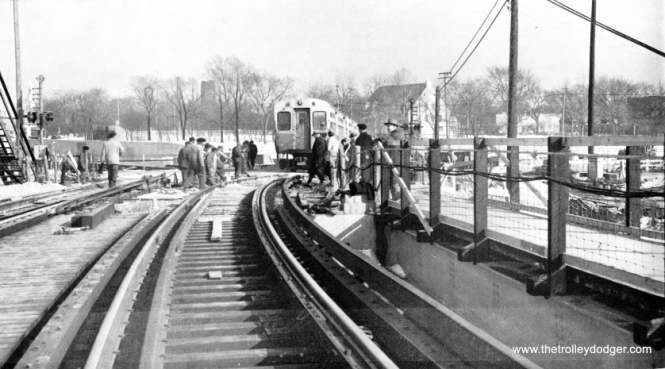
This is one of the very first CTA trains to use the permanent routing into the DesPlaines terminal on March 20, 1960. This bridge, originally designed for three tracks, is still in use. But with expressway construction far from finished, note the grade crossing right behind the bridge. That implies that the bridge was built first and then the area around it was later cleared out for the highway. Cars today go underneath the “L”. Behind the train, you can see a handsome 1939 field house, still in use today in a nearby park.

This is one of the very first CTA trains to use the permanent routing into the DesPlaines terminal on March 20, 1960. This bridge, originally designed for three tracks, is still in use. But with expressway construction far from finished, note the grade crossing right behind the bridge. That implies that the bridge was built first and then the area around it was later cleared out for the highway. Cars today go underneath the “L”. Behind the train, you can see a handsome 1939 field house, still in use today in a nearby park.

In the first of two posts, as we close out 2015, we are featuring highlights from our recent E-book collection, The “New Look” in Chicago Transit: 1938-1973. Today’s highlights are from the CTA Transit News and mainly cover the period 1958-61. Watch this space for another helping in a few days.

There is a tremendous amount of useful information in the Transit News, and there are thousands of pages of material on this DVD data disc we are offering.

FYI, all current orders for The “New Look” have now shipped.

DVD03CoverA.PNG

The “New Look” in Chicago Transit: 1938-1973
Edited by David Sadowski

Over a period of 35 years, between 1938 and 1973, Chicago’s transit system was radically transformed, for better or for worse.

This transformation included the creation of the Chicago Transit Authority in 1945 by act of the state legislature. CTA represented public ownership and unification of Chicago’s mass transit system. The Chicago Rapid Transit Company, Chicago Surface Lines, and (later) Chicago Motor Coach Company were all merged.

The venerable Loop “L” was supplemented by two new subways, under State and Dearborn streets. Several “L” lines and dozens of stations were abandoned. New rapid transit lines were built in three different expressways.

Streetcars and trolley buses were eliminated, as were many grade crossings. Two of Chicago’s three major interurbans expired.

High-speed rapid transit cars were developed by the Chicago Transit Authority, and put into use on the new Skokie Swift service and, eventually, throughout the system. Air conditioning became standard on rapid transit cars.

By the early 1960s, the CTA began calling it a “New Look” in transit.

Now, to examine this transformation, we have collected many original CTA source documents from this revolution together in one place, as our third DVD data disc release, The “New Look” in Chicago Transit: 1938-1973, edited by David Sadowski.

Since our previous release Chicago’s PCC Streetcars: The Rest of the Story covered surface system changes, this new collection’s primary focus is rapid transit. Naturally, there is some overlap between the two E-books, but The “New Look” includes over 1000 pages of new material, including:

An introductory essay by transit historian David Sadowski, which puts the era into perspective

Special commemorative publications put out by the City of Chicago in 1943 and 1951, when the State Street and Dearborn subways opened

43 entire issues of CTA Transit News in hi-res (an employee publication, primarily covering the important transition period from 1958 through 1961), plus additional scans from 1964-65, 1967-68, and 1969-70

High-resolution scans of the 1958 and 1961 CTA Annual Reports (all reports from 1945-76 are also included in lower-res scans)

Rapid transit system track maps

A short book, The Story of the Chicago Rapid Transit Lines (circa 1938)

Numerous CTA pamphlets, covering A/B “skip stop” service, Rider’s Reader, opening of the Congress rapid transit line, “New Look” (aka “Fishbowl”) buses, bus overhaul shops, and the elevation of the outer end of the Lake Street “L”.

In addition, we have included a variety of CTA technical publications, including the operation of various old interlockings, signal systems, and troubleshooting manuals for the 4000-series rapid transit cars.

# of Discs – 1
Price: $19.95


Help Support The Trolley Dodger

This is our 107th post, and we are gradually creating a body of work and an online resource for the benefit of all railfans, everywhere. To date, we have received over 106,000 page views from 30,500 individuals.

You can help us continue our original transit research by checking out the fine products in our Online Store. You can make a donation there as well.

As we have said before, “If you buy here, we will be here.”

We thank you for your support.

PS- As we approach our one-year anniversary next month, the deadline for renewing our premium WordPress account comes due in less than 30 days. This includes out Internet domain www.thetrolleydodger.com, much of the storage space we use for the thousands of files posted here, and helps keep this an ads-free experience for our readers. Your contributions towards this goal are greatly appreciated, in any amount.


Transit historian and author Andre Kristopans has sent us a preliminary list, which still needs work, of the CSL/CTA off-street turning loops:

Root/Halsted 1/1895 out 8/9/53
Cable Ct/harper 7/08 out 1960
Wentworth/63 11/08 out 6/22/58
Western/Flournoy 6/09 out 7/18/65
Cottage Grove/72 11/10 out 9/28/56
State/63 01/11 out 1/9/57
Western/Roscoe 7/11 out 1/24/51
Vincennes/80 8/11 out 1990’s
Clark/Arthur 11/11 active
Halsted/79 12/12 active
63/King 6/13 out 6/28/69 (temporarily reactivated circa 1977 when Ryan L out of service at 18th)
Halsted/Waveland 3/15 active
Clark/Howard 4/15 out 12/3/61
75/Lakefront 5/15 active (cul-de-sac)
Broadway/Ardmore 12/15 out 12/26/63
Torrence/112 3/17 active
Devon/Sheridan 5/17 (CMC) out 10/18/53
Archer/Cicero 12/17 active (relocated 1955)
Navy Pier 6/21 active (relocated 1959, relocated again 1990’s)
Madison/Austin 7/21 active
Milwaukee/Imlay 9/27 active
Montrose/Milwaukee 1/31 out 1980’s
Montrose/Narragansett 1/31 out 1990’s
Belmont/Pacific 5/31 out 1/9/49
18th/Lake Shore 6/33 out 3/9/49
Roosevelt/Columbus 8/33 out 4/11/53
Hamlin/Fulton (CMC) 6/35 out 2/11/53
87/Western 7/35 active
Belmont/Central 9/35 out 1/9/49 (relocated across street 1930’s)
Diversey/Western 9/35 out 7/1/55
Diversey/Neva 10/38 active
Caldwell/Central 8/39 (relocated 1961)
83/Green Bay 5/40 out 10/30/63
Bell & Howell 12/42 out 1976
76/Keeler 7/43 out 3/16/53
76/Kilpatrick 7/43 out 6/21/59
115/Cottage Grove 9/24/63 out 6/16/63 (south of 115th)
Montrose/Broadway 7/29/46 out 1970’s
Monroe Parking Lot 8/15/46 out 1972
Soldier Field Parking Lot 8/15/46 out 1990’s
Merchandise mart plaza 9/16/46 out 1990’s
Torrence/128 10/21/46 relocated to 130th west of Torrence 1980’s, out 1990’s
Torrence/112 10/21/46 out 4/25/48 (south of RR)
74/Damen 11/1/46 active
Irving Park/Cumberland 2/4/47 active (moved 1/24/64)
Damen/Elston 6/19/47 out 9/30/63
84/State 6/28/47 out 11/26/58
116/Burley 6/30/47 out 1990’s
Cortland/Paulina 8/31/47 out 4/17/59
31/Ellis 2/29/48 out 9/27/56
Narragansett/63 Pl 4/25/48 active
63/Archer 4/25/48 active (relocated 1990’s)
Harlem/64 Pl 6/15/48 active
Western/79 7/31/48 active
Devon/Kedzie 9/13/48 active
Irving Pk/Neenah 11/17/48 (moved from S to N of Irving Pk 7/9/58) out 1980’s
16th/47th Ct 12/12/48 active
Belmont/Halsted 1/9/49 active
Belmont/Cumberland 1/9/49 active
Belmont/Octavia 1/9/49 active
Western/Berwyn 1/10/49 active
Western/Howard 2/17/49 active
North/Clybourn 7/3/49 out 2000’s
Lehigh/Touhy 7/14/49 out 2/20/55
Cermak/Harlem (West Towns Garage) 8/13/49 out 1/16/57
Harrison/Central 8/14/49 active
Addison/Pontiac (CMC) 8/17/49 active
Western/Leland 11/14/49 active
Fullerton/Parkside 12/4/49 out 1990’s
North/Clark 12/4/49 active
North/Narragansett 12/4/49 active
Jersey/Peterson 5/13/50 out 1973
31/California 5/17/50 out 1990’s
111/Harding 10/21/50 active
Central/Milwaukee 11/17/50 out 9/24/70
Grand/Nordica 4/1/51 active
47/Lake Park 4/15/51 active (moved from W of Lake Park to E 7/26/66)
Cicero/Pensacola 5/10/51 active
Lincoln/Wrightwood 7/2/51 out 4/27/60
Elston/Kentucky 7/19/51 out 7/8/55
Pulaski/Peterson 7/20/51 active
Archer/Neva 11/2/51 active
Lincoln Village 11/13/51 out 1/30/55 (McCormick N of Lincoln)
Lincoln/Whipple 11/23/51 out 1970’s
Cicero/24 Pl 11/25/51 active
31/Komensky 12/6/51 active
Logan Square 12/19/51 out 1/31/70
North/Winchester 5/5/52 out 1973
Grand/Latrobe 5/24/52 active
Cermak/54 Av 5/25/52 active (moved 2000’s)
Fairbanks/Ontario 7/20/52 out 1990’s, new built 2000’s
79/Lakefront 8/11/52 relocated 2012
Roosevelt/Monitor 9/7/52 out 2000’s
Pulaski/Foster 9/8/52 out 1990’s
95/Western Evergreen Plaza 9/28/52 out 2015
Chicago/Mayfield 12/13/52 active (moved to Austin 1980’s)
Roosevelt/Wabash 5/12/53 out 1972
Racine/87 5/28/53 active
26/Kenton 6/18/53 out 1970’s
Desplaines/Congress 10/9/53 active relocated numerous times
Jackson/Central Fieldhouse 10/29/53 out 7/8/55
Niles Center/Pratt 11/15/53 out 1/15/54
Kedzie/63 Pl 12/15/53 active
42/Packers 2/14/54 out 11/9/70 (moved 4/22/63)
87/Cicero 8/13/54 active moved to shopping center across Cicero 1980’s
Ashland/95 11/4/54 active
California/Addison 11/26/54 out 2015
Grand/Natchez 12/20/54 out 2/22/67
Western/119 2/9/55 active
Cermak/57 Ac 4/17/55 out 1980’s
Jackson/Austin 7/8/55 active
Forest Glen garage 12/4/55
Damen/87 12/9/55 active
Cottage Grove/Burnside 8/22/56 out 2000’s
North Park Garage 12/4/55 no longer used as turnaround since 1980’s
Brother Rice High School 9/10/56 active
Cermak Plaza 1/14/57 active relocated to N Riverside Park Mall 1975
59/Keating 5/5/57 out 1990’s
Howard/Kedzie 1/26/58 out 11/19/60 (east of Channel)
Jackson/Kedzie Garage 7/3/58 not used as turnaround since 1990’s
83/Wentworth 7/14/58 out 1990’s
Teletype Corp 9/8/58 out 1980’s
Pulaski/104 9/17/58 active
Cicero/64 11/27/58 out 1990’s
Pulaski/77 6/21/59 out 6/1/62
79/Kilpatrick 6/21/58 out 1990’s
Indianapolis/101 7/5/59 out 1970’s
Cumberland/Montrose 8/3/59 out 7/13/64
Howard/McCormick 11/3/60 active
Cermak/State 11/19/60 out 9/28/69
McCormick Place 11/19/60 replaced 1970, out 1970’s
115/Pulaski 12/4/60 out 8/3/64
67/Oglesby 12/15/60 active
Howard/Hermiatage 12/3/61 replaced 1990’s
Pulaski/75 6/1/62 out 7/21/63
Pulaski/81 7/21/63 active
Beverly Garage 2/10/64 not used as turnaround after 1990’s
Skokie Swift 4/19/64 active
Old Orchard 4/20/64 moved 1970’s
Marist High School 8/24/64 out 2000’s
Randolph/Lake Shore 9/14/64 active moved to Randolph/Harbor 1970’s
55/St Louis 11/11/64 active replaced 2000’s
51/St Louis 1/13/65 out 1990’s
115/Springfield 5/10/65 active
King Dr/Burnside 6/20/65 out 1970’s
Ford City 8/12/65 active relocated 1990’s
Luther High School (87/Sacramento) 11/24/65 out 1990’s
Pratt/Kedzie 8/1/66 out 1990’s
Mercy Hospital 2/1/68 out 1980’s
Ashland/63 5/6/69 active
95/Dan Ryan 9/28/69 active
79/Perry 9/28/69 active
69/Dan Ryan 9/28/69 active
Cermak/Clark 9/28/69 out 1980’s
Jefferson Park 2/1/70 active
Irving Park/Keystone 2/1/70 active
Belmont/Kimball 2/1/70 active
Logan Square 2/1/70 active
Olive/Harvey 2/8/71 active relocated 1970’s and 1990’s
International Towers 6/7/71 out 1973
King Dr/96 1970’s out 1970’s
95/St Lawrence 1970’s active
Archer/Halsted 1990’s active
Archer/Ashland 1990’s active
Lincoln Village (Lincoln/Jersey) 1980’s out 1990’s
103rd Garage 1990’s active
Limits Garage 1860’s out 1990’s
47/Laramie 1970’s out 1980’s
Western/49 1990’s active
Archer/Leavitt 1990’s active
Kedzie/49 1990’s active
Pulaski/51 1990’s active
Skokie Courthouse 1990’s active
73/Kostner 1990’s active
59/Kilpatrick 1990’s active
71/Pulaski 1980’s active
Division/Austin 1970’s active
Clark/Wisconsin 1970’s out 1990’s
Chicago-Read hospital 1970’s out 2015 (relocated across Oak park Av 1980’s)
River Rd/Kennedy 1980’s – CTA stopped using 1990’s
Cumberland/Bryn Mawr – 1980’s active
Pavilion Apts – 1970’s active (relocated 1980’s)
Lincolnwood Town Ctr – 1990’s active
Bryn Mawr/Lake Shore 1980’s active
Wright College 1990’s active
Higgins/Harlem 1980’s active
Touhy/Overhill 1970’s – CTA has not used since 2000’s (replaced last Y terminal)
Evanston Twp High School Parking Lot 1990’s out 2000’s
74th Garage first used as turnaround 2015 active
Avon @ Golf/Waukegan 1990’s active
Pullman Plaza parking lot (Doty W/109) 2000’s
Grand/Columbus 1970’s out 1990’s
Desplaines/Harrison 1990’s active
Field Museum turn-in on McFetridge 1980’s active
King/24th Pl 1980’s active
McCormick Place South driveway 1980’s out 1990’s
Wilson/E Ravenswood 1970’s out 1990’s
Nature Museum (Cannon/Fullerton) 1980’s active
South Blvd/Sheridan 1973 out 1990’s inherited from Evanston Bus Co.
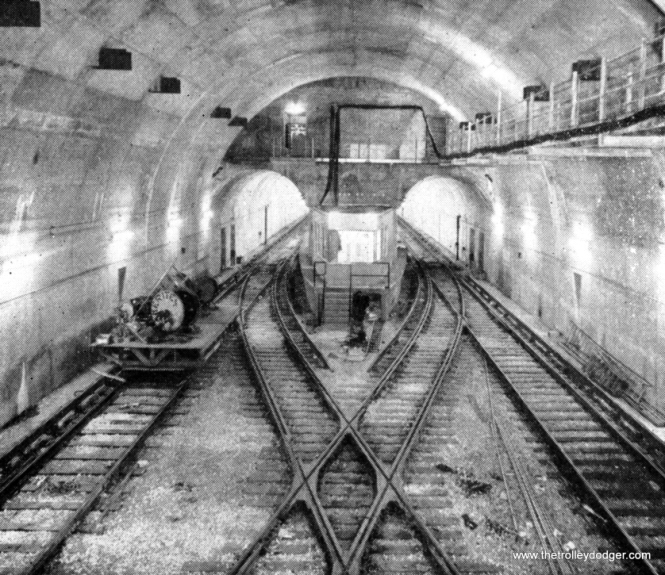
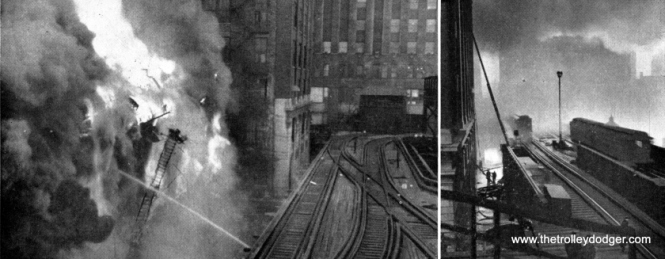
From 1951 to 1958, the CTA Dearborn-Milwaukee subway ended at a stub-end terminal at the LaSalle Street station. The original plans were for an underground loop just east of the old Main Post Office, but that was given up in order to save money.
From 1951 to 1958, the CTA Dearborn-Milwaukee subway ended at a stub-end terminal at the LaSalle Street station. The original plans were for an underground loop just east of the old Main Post Office, but that was given up in order to save money.

In January 1951, a fire threatened CTA’s little-used North Water Street stub terminal, which managed to survive until 1963.

In January 1951, a fire threatened CTA’s little-used North Water Street stub terminal, which managed to survive until 1963.

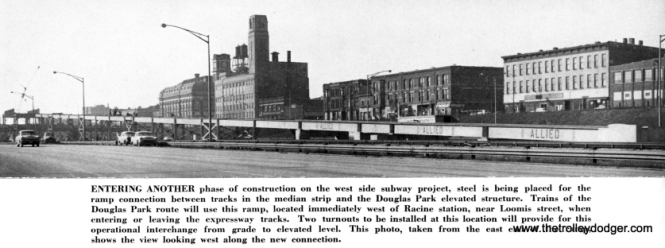
The CTA Transit News included many rare photos of Congress rapid transit line construction. This picture was taken around January 1958 at the DesPlaines terminal and looks to the northeast. While most of the Congress line went into service in June 1958, the portion west of the Lotus tunnel was not finished until 1961. Work in the terminal area continued into 1962.
The CTA Transit News included many rare photos of Congress rapid transit line construction. This picture was taken around January 1958 at the DesPlaines terminal and looks to the northeast. While most of the Congress line went into service in June 1958, the portion west of the Lotus tunnel was not finished until 1961. Work in the terminal area continued into 1962.

text004

The ramp connecting Congress with Douglas was still being built in February 1958, four months before service began. If a similar ramp could have been built to the west of Marshfield, interurban trains of the Chicago, Aurora & Elgin would have been able to access the Loop via the Paulina Connector and the Lake Street “L”, just as the Pink Line (successor to the Douglas Park “L”) does today.

The ramp connecting Congress with Douglas was still being built in February 1958, four months before service began. If a similar ramp could have been built to the west of Marshfield, interurban trains of the Chicago, Aurora & Elgin would have been able to access the Loop via the Paulina Connector and the Lake Street “L”, just as the Pink Line (successor to the Douglas Park “L”) does today.

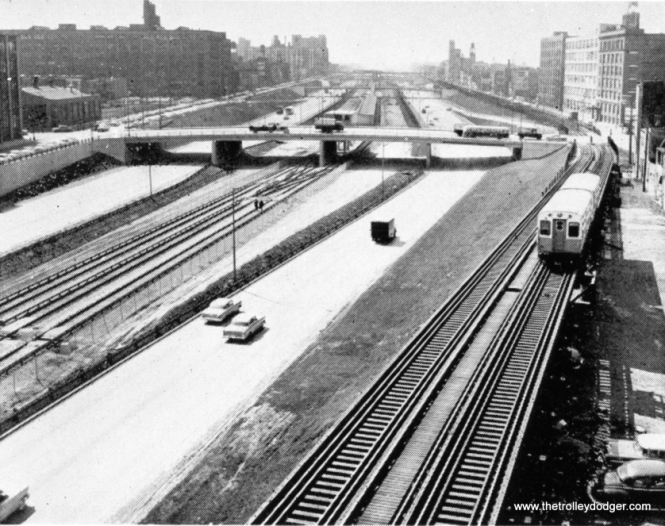
Until 1969, the Englewood branch of the south side “L” ended at Loomis, not a convenient place for bus transfers going north and south. CTA made some improvements, but the ultimate solution was a short extension of the line to nearby Ashland Avenue. This photo is from about February 1958.

Until 1969, the Englewood branch of the south side “L” ended at Loomis, not a convenient place for bus transfers going north and south. CTA made some improvements, but the ultimate solution was a short extension of the line to nearby Ashland Avenue. This photo is from about February 1958.

In May 1958, service continued uninterrupted during major projects.

In May 1958, service continued uninterrupted during major projects.

Among many other things, the CTA improved safety and reduced labor costs by replacing manually operated gates with automatic ones, as shown in this April 1958 photo. There was some resistance to automatic gates, since some people thought that manually operated ones were safer. Signal systems, which were primitive on the older “L” lines, were also gradually improved. Automatic block signals were installed in the new subways and the Congress expressway median line.

Among many other things, the CTA improved safety and reduced labor costs by replacing manually operated gates with automatic ones, as shown in this April 1958 photo. There was some resistance to automatic gates, since some people thought that manually operated ones were safer.
Signal systems, which were primitive on the older “L” lines, were also gradually improved. Automatic block signals were installed in the new subways and the Congress expressway median line.

The CTA added “Metropolitan Transit” to its logo early in 1958, to emphasize how their role extended outside the Chicago city limits. It was during this time that two of the three area interurbans were failing, and CTA unsuccessfully lobbied the Illinois legislature for financial aid that might have made it possible to incorporate larger parts of them into the CTA system. As it turned out, both the Chicago, Aurora & Elgin and Chicago, North Shore & Milwaukee railroads went out of business and were liquidated. Only a few miles of each line survives in the present rapid transit network.
The CTA added “Metropolitan Transit” to its logo early in 1958, to emphasize how their role extended outside the Chicago city limits. It was during this time that two of the three area interurbans were failing, and CTA unsuccessfully lobbied the Illinois legislature for financial aid that might have made it possible to incorporate larger parts of them into the CTA system. As it turned out, both the Chicago, Aurora & Elgin and Chicago, North Shore & Milwaukee railroads went out of business and were liquidated. Only a few miles of each line survives in the present rapid transit network.

By the time this picture was taken in May 1958, the four-track Metropolitan “L”, shown here near Aberdeen Street, had been shaved back to two, since part of the “L” footprint was needed for the expressway. Behind the two-car train of 6000s there is a ramp leading down to the temporary Van Buren trackage of about 2 ½ miles heading west.
By the time this picture was taken in May 1958, the four-track Metropolitan “L”, shown here near Aberdeen Street, had been shaved back to two, since part of the “L” footprint was needed for the expressway. Behind the two-car train of 6000s there is a ramp leading down to the temporary Van Buren trackage of about 2 ½ miles heading west.

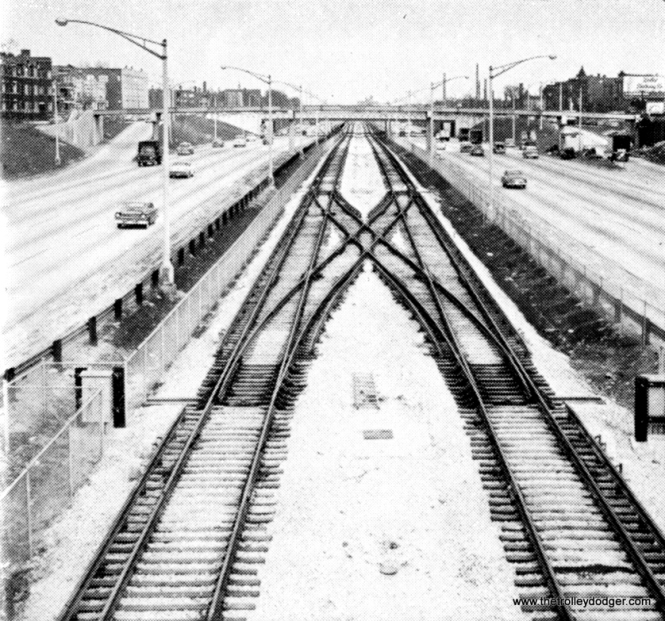
The new Congress median rapid transit line shortly before being put into service.
The new Congress median rapid transit line shortly before being put into service.

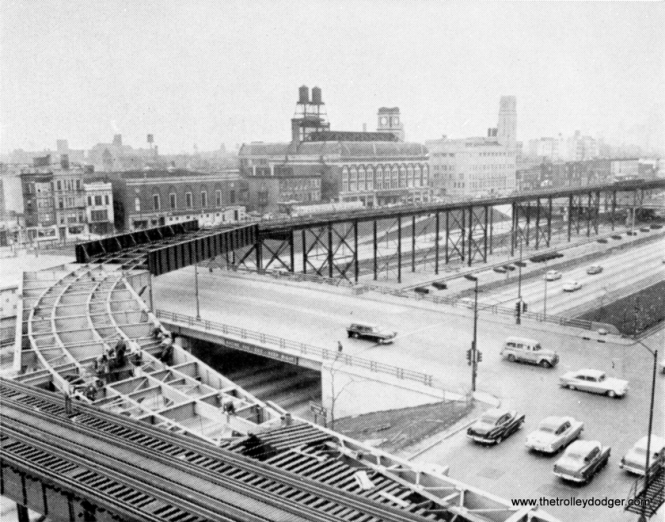
By Spring 1958, work was nearly complete on the ramp connecting the Douglas and Congress lines.
By Spring 1958, work was nearly complete on the ramp connecting the Douglas and Congress lines.

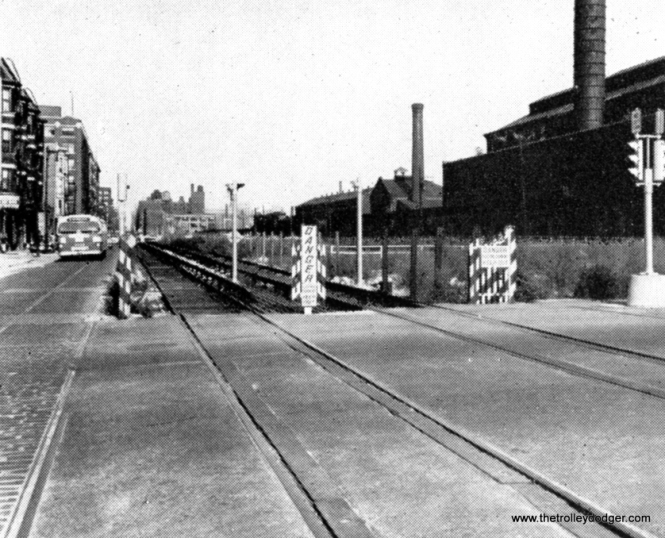
The temporary “L” service in Van Buren Street, which operated from September 1953 to June 1958, shown here at Loomis prior to the demolition of the cavernous Throop street shops at right.
The temporary “L” service in Van Buren Street, which operated from September 1953 to June 1958, shown here at Loomis prior to the demolition of the cavernous Throop street shops at right.

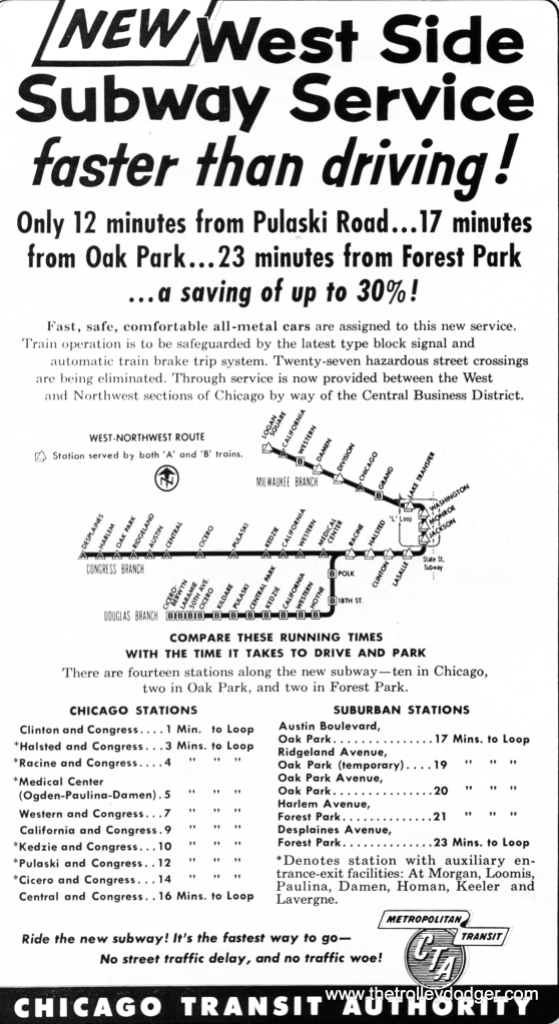
CTA’s first new rapid transit line opened on June 22, 1958, at least as far as the Cicero Avenue station. Work continued west of there until 1961. While service was faster than the Garfield Park “L” it replaced, the project was a major factor in the abandonment of the “Roarin’ Elgin

CTA’s first new rapid transit line opened on June 22, 1958, at least as far as the Cicero Avenue station. Work continued west of there until 1961. While service was faster than the Garfield Park “L” it replaced, the project was a major factor in the abandonment of the “Roarin’ Elgin

The first section of the old Garfield Park “L” to be removed after the opening of the Congress line.
The first section of the old Garfield Park “L” to be removed after the opening of the Congress line.

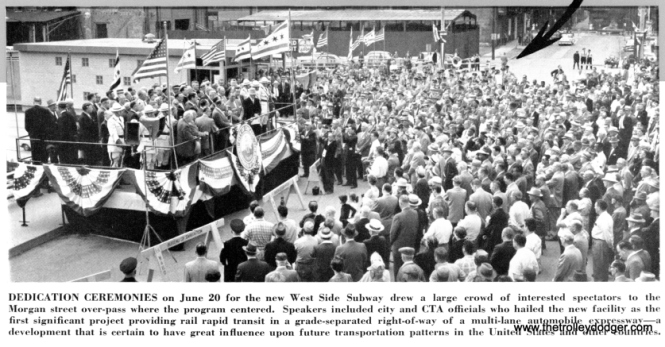
The opening of the Congress line was a matter of considerable civic pride for Chicago, the CTA, and Mayor Richard J. Daley.
The opening of the Congress line was a matter of considerable civic pride for Chicago, the CTA, and Mayor Richard J. Daley.

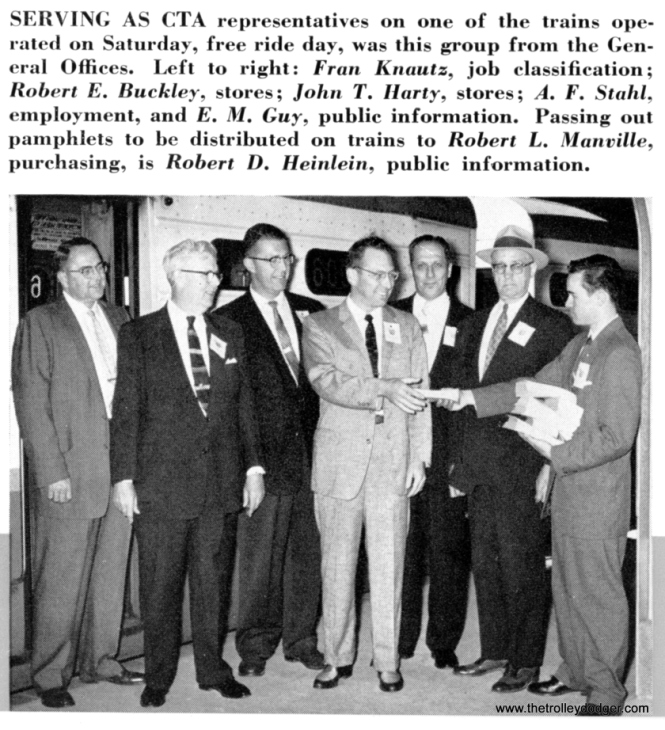
Bob Heinlein, shown here at right during his CTA days, has been a well-known railfan for many years. He's a great guy.

Bob Heinlein, shown here at right during his CTA days, has been a well-known railfan for many years. He’s a great guy.

The Congress line, in the median of an expressway, inspired two additional rapid transit extensions in other local highways a decade later. However, such operations are not without problems caused by truck and auto accidents, road salt, noise, wind, poor drainage, or snow.

The Congress line, in the median of an expressway, inspired two additional rapid transit extensions in other local highways a decade later. However, such operations are not without problems caused by truck and auto accidents, road salt, noise, wind, poor drainage, or snow.

This picture was taken in May 1958 on what was indeed the final operation of a red Pullman (#144) on Chicago streetcar tracks.

This picture was taken in May 1958 on what was indeed the final operation of a red Pullman (#144) on Chicago streetcar tracks.

CTA opened a new bus turnaround loop at Irving Park and Neenah in July 1958. This was one of more than 100 such off-street loops. This particular loop is no longer in use and was sold to developers. It is now part of a driveway. It was originally used by the #80 Irving Park and #86 Narragansett routes. Over time, this loop became superfluous as the 86 was extended farther north and some of the short-turns were eliminated on 80.
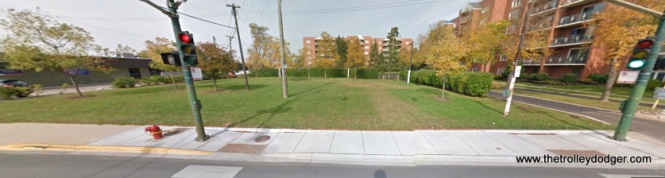
CTA opened a new bus turnaround loop at Irving Park and Neenah in July 1958. This was one of more than 100 such off-street loops. This particular loop is no longer in use and was sold to developers. It is now part of a driveway.
It was originally used by the #80 Irving Park and #86 Narragansett routes. Over time, this loop became superfluous as the 86 was extended farther north and some of the short-turns were eliminated on 80.

The same location today.

The same location today.

July 1958. These sections of “L” were very close to the expressway.

July 1958. These sections of “L” were very close to the expressway.

Between 1959 and 1961, CTA embarked on a major construction project to fill a gap in the side “L”, where four tracks went down to two and then four again.

Between 1959 and 1961, CTA embarked on a major construction project to fill a gap in the side “L”, where four tracks went down to two and then four again.

October 1958.

October 1958.

November 1958.

November 1958.

text025

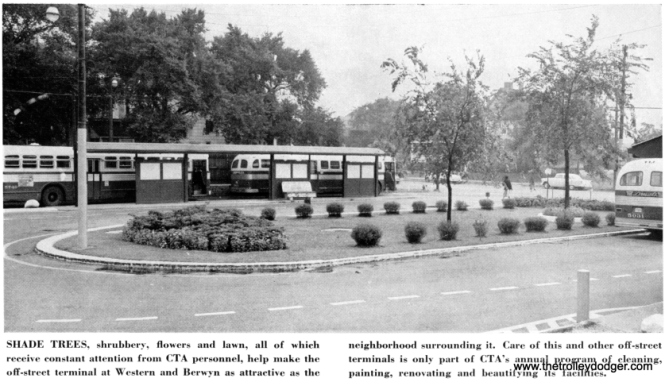
Many of CTA’s more than 100 off-street loops were beautifully landscaped, a tradition going back to the 1930s and the Chicago Surface Lines. Unfortunately, over the years many of these manicured green spaces have been replaced by asphalt.

Many of CTA’s more than 100 off-street loops were beautifully landscaped, a tradition going back to the 1930s and the Chicago Surface Lines. Unfortunately, over the years many of these manicured green spaces have been replaced by asphalt.

The loop at Western and Berwyn today. Those trees in the middle have grown a lot larger in the 56 years since the earlier photo was taken.

The loop at Western and Berwyn today. Those trees in the middle have grown a lot larger in the 56 years since the earlier photo was taken.

The CSL Sedans

CSL 3375 northbound on Clark just south of Wacker Drive in 1934. In fact, that's a 1934 Ford, possibly a V-8, at left. (Edward Frank, Jr. Photo)

CSL 3375 northbound on Clark just south of Wacker Drive in 1934. In fact, that’s a 1934 Ford, possibly a V-8, at left. (Edward Frank, Jr. Photo)

Thanks to the generosity of George Trapp, here is a Christmas Eve helping of classic Chicago Surface Lines streetcar photos from his wonderful collection. (To see additional photos he has already shared with us, just type “George Trapp” into the search window at the top of this page. Several other posts will come up.)

Today we feature the 100 “Sedans” (aka Peter Witts) that ran in Chicago from 1929 to 1952.

As always, if you can help identify locations, or have interesting facts or reminiscences to add, don’t hesitate to drop us a line. You can leave comments on this post, or write us directly at:

thetrolleydodger@gmail.com

FYI there will be additional posts in this series coming up in the near future, so watch this space.

The Peter Witts in Chicago

A Peter Witt streetcar (also known here as a “Sedan”), a very popular car type, was introduced in many North American cities around 1915 to 1930. Peter Witt himself (1869-1948) was a commissioner of the Cleveland Railway Company, and developed the design of these cars there.

The advantage of the Witts was to reduce dwell time at stops. Passengers boarded at the front of these two-man cars and exited at the center door after paying on their way out. Peter Witt received U. S. Patent 1,180,900 for this improvement in streetcar design.

Witt cars were popular in large cities like Cleveland and Toronto. They are still in use in Milan, Italy.

As Railroad Model Craftsman magazine noted:

The Chicago Surface Lines Peter Witt cars were known locally as “Sedans” and were 49′ long. These 100 cars were numbered 3322-3381 and 6280-6319. They had three folding doors at the front and three sliding doors, separated by a window for the conductor’s station, at the center. The front-end dash was rounded.

The Chicago order was split between Cummings, Brill, and CSL as follows:

3322-3341, 6280-6293 – CSL (34 cars)

3342-3361, 6294-6306 – Brill (33 cars)

3362-3381, 6307-6319 – Cummings Car (33 cars)

I’m not sure whether all three batches had the same trucks and motors. A list of Brill work orders indicates theirs had Brill 76E2 trucks.

It wasn’t that unusual back then for transit operators to build some of their own cars. Starting in 1929, CSL was a very active participant in the Electric Railway Presidents’ Conference Committee, whose work developed the standardized PCC car, which soon dominated the industry.

The PCC patents were assigned to the Transit Research Corporation, whose stock was owned by the various transit operators who took part in the program. CSL apparently owned the largest amount of stock, which in turn was owned by the Chicago Transit Authority starting in 1947. Eventually Walter J. McCarter, first general manager of CTA, became the head of TRC, which I think has since been disbanded.

The Witts were speedy and attractive cars with leather seats, certainly the most modern things CSL had prior to the two experimental units and the PCCs. When considered with these, Chicago had a total of 785 modern cars.

The Sedans were mainly used on the busy Clark-Wentworth line. After the 83 prewar PCCs came on the scene in 1936-37, they also helped fill out schedules on Madison. After World War II, they eventually made their way to Cottage Grove before being retired in 1952.

They certainly could have been used longer than 23 years. Toronto had 350 Witts, built between 1921 and 1923, and the last of these was retired in 1965– more than 40 years of service.

To this day, Toronto still has one Peter Witt (#2766) on the property in operable condition, and it is brought out for special occasions.

Once the Chicago Transit Authority took over the surface and rapid transit lines in 1947, the mantra became, “get rid of all the old red streetcars.” And since the Witts were not PCCs, they got lumped into that category as well. Some were slated for conversion to one-man around 1951, but I am not certain whether any were operated in this way prior to retirement. I have seen photos showing how the door configuration on at least one car was so changed.

All 100 Sedans were scrapped in 1952. None were saved for museums, which is a real shame. Unfortunately, the Sedans were scrapped just before a museum movement started here. The Illinois Electric Railway Museum was founded in 1953, and their first purchase was Indiana Railroad car 65. The first Chicago streetcar acquired by the museum was red Pullman 144.

Likewise, the preservation efforts of the Electric Railway Historical Society did not begin until a few years later. Ultimately, ERHS saved several Chicago trolleys, all of which made their way to IRM in 1973. Additional cars were saved by CTA and made their way to IRM and the Fox River Trolley Museum in the mid-1980s.

J. G. Brill was the preeminent American streetcar manufacturer before the PCC era. While they were involved in the development of the PCC, and built experimental car 7001 for Chicago in 1934, they made a fateful decision not to pay royalties on the PCC patents, and their attempts to compete with the PCC were largely a failure. Fewer than 50 “Brilliners” (their competing model) were built, the last in 1941.

Around 1930, Brill promoted another type of standardized car called a Master Unit. However, as built, I don’t believe any two orders of Master Units were exactly the same.

There is some dispute as to whether Baltimore’s Peter Witts also qualify as Master Units. However, what defines a Witt is the manner of fare collection, and not the overall style of the car or its mechanical equipment.

As the same magazine referenced above explains:

Peter Witt was the very efficient city clerk in the administration of Cleveland, OH mayor Tom Johnson in the 1900s. In 1912, subsequent mayor Newton Baker appointed him as Street Railway Commissioner. Witt became concerned with the inefficiencies of fare collection in streetcars. Many systems still relied on the old horse car era scheme of having the conductor squeeze through the crowded car to collect fares from newly boarded passengers. After 1905, many systems adopted the “pay-as-you-enter” (PAYE) car design, with the conductor stationed at a fixed location on the rear platform to collect fares as passengers boarded and moved forward to find seats in the car interior. On busy lines, this resulted in delays while enough new passengers paid their fares to allow the last waiting passenger to find room on the rear platform so the doors could be closed and the conductor could give a two-bell signal for the motorman to proceed.

Peter Witt’s innovation was the “pay-as-you-pass” fare collection system, using a front entrance and center exit streetcar configuration. The section of the car forward of the center doors had longitudinal “bowling alley” seats to allow abundant space for newly boarded standees. The conductor was stationed just ahead of the center exit doors, and collected fares while the car was in motion either as patrons prepared to exit the car, or as they moved aft to find more comfortable seating in the rear section of the car. This greatly expedited the loading process at busy stops, and improved efficiency. The first Cleveland cars modified to Witt’s design entered service in December 1914, and were an immediate success, resulting in orders for new cars built to this design in Cleveland and in many other cities. The Peter Witt type of car remained very popular until the advent of the PCC streetcar in the 1930’s. The standard PCC used the same proven front entrance-center exit configuration, and many two-man PCCs used the Peter Witt fare collection scheme.

Before the PCC, most streetcar systems ordered unique cars specified to meet local needs and traditions. While many cities used Peter Witt type streetcars, the cars were not of the same design from city to city…

In doing the research for this review, one question remains unanswered: were the Baltimore Peter Witts Master Units? The Seashore Trolley Museum website describes the Baltimore #6144 in their collection as a “Brill Master Unit Peter Witt”. In “PCC – The Car That Fought Back”, Carlson and Schneider describe the 90 Indianapolis cars as Master Units. The Brill Master Unit was intended to be a flexible design based on standardized components, including single or double-ended single or double truck cars. The Master Unit product line also included a double truck front entrance-center exit design shown in an artist’s illustration in a Brill advertisement in the February 9, 1929 Electric Railway Journal. On the other hand Debra Brill in her History of the J.G. Brill Company states that only 78 Master Units were constructed (20 for Lima Peru, 20 for Brazil, 20 for Lynchburg, 13 for Youngstown, 3 for Yakima, 1 for Louisville, and 1 single trucker for TARS in New York). Ms. Brill does not count the 32 similar cars for Wilmington ordered before the official introduction of the Master Unit, or the single car built for a cancelled Lynchburg order and used by Brill for testing. She recognizes that the TARS and Louisville cars were the only ones that fully conformed to Brill’s Master Unit design.

Likewise, the definition of what constitutes a PCC streetcar is also a bit fluid, as detailed by noted transit historian Dr. Harold E. Cox in this article.

Several models of the Chicago Peter Witts have been produced by various firms, including the excellent St. Petersburg Tram Collection.

Each year, the holiday season creates a warm and generous feeling towards other people, and this year is no exception. Now that we are truly at our “Witt’s End,” we hope that you will enjoy these photographic gifts in the spirit in which they are intended.

Happy Holidays!

-David Sadowski


gh1

    Help Support The Trolley Dodger

This is our 106th post, and we are gradually creating a body of work and an online resource for the benefit of all railfans, everywhere. To date, we have received 105,000 page views from 30,000 individuals.

You can help us continue our original transit research by checking out the fine products in our Online Store. You can make a donation there as well.

As we have said before, “If you buy here, we will be here.”

We thank you for your support.

PS- As we approach our one-year anniversary next month, the deadline for renewing our premium WordPress account comes due in less than 30 days. This includes out domain name www.thetrolleydodger.com, much of the storage space we use for the thousands of files posted here, and helps keep this an ads-free experience for our readers. Your contributions towards this goal are greatly appreciated, in any amount.


Updates

Our E-book Chicago’s PCC Streetcars: The Rest of the Story, available through our Online Store, has been updated with the addition of about 12 minutes of public domain color video showing Chicago PCCs in action. These films were mainly taken on route 36 – Broadway, with a date of October 9, 1956. However, some portions of the film may have been shot earlier, since there are a couple of prewar cars seen. These were last used on route 49 – Western on June 17, 1956.

This video portion can be viewed on any computer using media player software.

PS- Several additional photos have been added to our previous post Chicago Surface Lines Photos, Part Five (December 11th).


Fred J. Borchert

Fred J. Borchert (1889-1951), some of whose work appears on this blog, was an early railfan photographer in Chicago. His work predated other early fans such as Edward Frank, Jr. (1911-1992). There are Ed Frank pictures here from as early as 1934, but Borchert’s work goes back even further than that.

I haven’t been able to find much information on Borchert, but I do know that during WWI, he drove a taxicab, and later, worked for the US Post Office. Ed Frank must have acquired at least some of Borchert’s negatives after his death, since he made prints. If anyone can provide further information on either of these gentlemen, I would appreciate it. I did at least meet Ed Frank since he used to sell his black-and-white photos at CERA meetings many years ago.


CSL Sedan 6315 is southbound on Clark at Wells on January 21, 1945. (Thomas H. Desnoyers Photo, Krambles-Peterson Archive)

CSL Sedan 6315 is southbound on Clark at Wells on January 21, 1945. (Thomas H. Desnoyers Photo, Krambles-Peterson Archive)

CTA 6309 is southbound on Cottage Grove at Cermak on August 1, 1950. (Thomas H. Desnoyers Photo, Krambles-Peterson Archive)

CTA 6309 is southbound on Cottage Grove at Cermak on August 1, 1950. (Thomas H. Desnoyers Photo, Krambles-Peterson Archive)

CSL 6307 and crew at the Clark-Devon loop. (Krambles-Peterson Archive) One of our readers writes, "Where was this photo taken? It says Clark-Devon Loop. That was the designation for the Clark-Arthur Loop, but this photo does not appear to be taken there. The reason that I say that is because of all of the tracks in the foreground. Too many to be Clark-Arthur Loop. My guess is that it really was taken at the back of the 77th Street Station (west end of the barn) because the tracks are set in paving blocks and appear to be curved for entering the bays of the barn. The street was called "Wentworth Avenue" even though it was not a dedicated street to the public."

CSL 6307 and crew at the Clark-Devon loop. (Krambles-Peterson Archive) One of our readers writes, “Where was this photo taken? It says Clark-Devon Loop. That was the designation for the Clark-Arthur Loop, but this photo does not appear to be taken there. The reason that I say that is because of all of the tracks in the foreground. Too many to be Clark-Arthur Loop. My guess is that it really was taken at the back of the 77th Street Station (west end of the barn) because the tracks are set in paving blocks and appear to be curved for entering the bays of the barn. The street was called “Wentworth Avenue” even though it was not a dedicated street to the public.”

CSL 6308 southbound on Clark at Armitage. (Krambles-Peterson Archive)

CSL 6308 southbound on Clark at Armitage. (Krambles-Peterson Archive)

CSL 6297 at Vincennes and 78th.

CSL 6297 at Vincennes and 78th.

CSL 6296 on Vincennes at 79th. (Edward Frank, Jr. Photo)

CSL 6296 on Vincennes at 79th. (Edward Frank, Jr. Photo)

CSL 6295 at Vincennes and 80th. (Fred J. Borchert Photo, Edward Frank, Jr. Collection)

CSL 6295 at Vincennes and 80th. (Fred J. Borchert Photo, Edward Frank, Jr. Collection)

CSL 6301, southbound on Clark Street north of Randolph. (Edward Frank, Jr. Photo)

CSL 6301, southbound on Clark Street north of Randolph. (Edward Frank, Jr. Photo)

CSL 6307.

CSL 6307.

From the numbers on this photo, I'd say it shows one of the CSL Sedan frames at the J. G. Brill factory in 1929.

From the numbers on this photo, I’d say it shows one of the CSL Sedan frames at the J. G. Brill factory in 1929.

The interior of CSL 6294 as new, in a 1929 photo at the J. G. Brill plant. Brill built 33 of the 100 "Sedans," aka Peter Witts.

The interior of CSL 6294 as new, in a 1929 photo at the J. G. Brill plant. Brill built 33 of the 100 “Sedans,” aka Peter Witts.

Presumably another interior photo of 6294. These cars had leather seats. The "bucket" seats remind me a bit of those on Indiana Railroad lightweight high-speed interurban car 65, built two years after this car.

Presumably another interior photo of 6294. These cars had leather seats. The “bucket” seats remind me a bit of those on Indiana Railroad lightweight high-speed interurban car 65, built two years after this car.

CSL 6305 shiny and new at the Brill plant in Philadelphia. (J. G. Brill Photo, Historical Society of Pennsylvania Collection)

CSL 6305 shiny and new at the Brill plant in Philadelphia. (J. G. Brill Photo, Historical Society of Pennsylvania Collection)

As delivered, the 33 Sedans made for Chicago by J. G. Brill came with 76E2 trucks. However, that was job #22768, which does not match the number in this photo. The Brill list of work orders I consulted does not have a job #22770 on it.

As delivered, the 33 Sedans made for Chicago by J. G. Brill came with 76E2 trucks. However, that was job #22768, which does not match the number in this photo. The Brill list of work orders I consulted does not have a job #22770 on it.

CSL 6294, built for the Chicago City Railway, at the Brill plant in 1929. Surface Lines was an "umbrella" that presented a unified transit operator to the public, but it was actually made up of constituent companies. Of the 33 Brill Sedans, 20 were purchased by Chicago Railways and 13 by the Chicago City Railway. This balkanized arrangement continued until the Chicago Transit Authority took over in 1947.

CSL 6294, built for the Chicago City Railway, at the Brill plant in 1929. Surface Lines was an “umbrella” that presented a unified transit operator to the public, but it was actually made up of constituent companies. Of the 33 Brill Sedans, 20 were purchased by Chicago Railways and 13 by the Chicago City Railway. This balkanized arrangement continued until the Chicago Transit Authority took over in 1947.

CSL 6280 southbound at Clark and Southport. (Edward Frank, Jr. Photo)

CSL 6280 southbound at Clark and Southport. (Edward Frank, Jr. Photo)

CTA 3381 at Cottage Grove and 111th, near the south end of route 4, on February 2, 1952. The landmark Hotel Florence is in the background, in Chicago's Pullman neighborhood. (Thomas H. Desnoyers Photo, Krambles-Peterson Archive)

CTA 3381 at Cottage Grove and 111th, near the south end of route 4, on February 2, 1952. The landmark Hotel Florence is in the background, in Chicago’s Pullman neighborhood. (Thomas H. Desnoyers Photo, Krambles-Peterson Archive)

CTA 3381 at Cottage Grove and 115th, south end of route 4, on April 2, 1952. (Thomas H. Desnoyers Photo, Krambles-Peterson Archive)

CTA 3381 at Cottage Grove and 115th, south end of route 4, on April 2, 1952. (Thomas H. Desnoyers Photo, Krambles-Peterson Archive)

CSL 3377 is southbound on Clark north of Huron in the 1936 scene. (Edward Frank, Jr. Photo)

CSL 3377 is southbound on Clark north of Huron in the 1936 scene. (Edward Frank, Jr. Photo)

A southbound Sedan has just passed CSL car 5250 on Clark just south of Wacker Drive in 1935. According to Don's Rail Photos, "1st 5201 thru 5250 were built by Brill-American Car Co in 1906, #15365, for CCRy as 5201 thru 5250, but it was shipped to United Railroads of San Francisco due to the earthquake. 2nd 5201 thru 5250 were built by Brill-American Car Co in 1906, #15365, to replace the orignal order. They were rebuilt in 1909 to bring them up to the standard of the later cars."

A southbound Sedan has just passed CSL car 5250 on Clark just south of Wacker Drive in 1935. According to Don’s Rail Photos, “1st 5201 thru 5250 were built by Brill-American Car Co in 1906, #15365, for CCRy as 5201 thru 5250, but it was shipped to United Railroads of San Francisco due to the earthquake. 2nd 5201 thru 5250 were built by Brill-American Car Co in 1906, #15365, to replace the orignal order. They were rebuilt in 1909 to bring them up to the standard of the later cars.”

CSL 3375 at Kedzie Station on February 14, 1946. Besides Clark-Wentworth, the Sedans helped fill out schedules on Madison, since the 83 prewar PCCs were not enough for the route, which probably needed about 100 cars at the time. The speedy Witts were able to keep up with the PCCs. (Robert W. Gibson Photo)

CSL 3375 at Kedzie Station on February 14, 1946. Besides Clark-Wentworth, the Sedans helped fill out schedules on Madison, since the 83 prewar PCCs were not enough for the route, which probably needed about 100 cars at the time. The speedy Witts were able to keep up with the PCCs. (Robert W. Gibson Photo)

CSL 3371. (Krambles-Peterson Archive)

CSL 3371. (Krambles-Peterson Archive)

Clark Street north of LaSalle circa 1930. (Fred J. Borchert Photo, Edward J. Frank Collection)

Clark Street north of LaSalle circa 1930. (Fred J. Borchert Photo, Edward J. Frank Collection)

CSL 5209 and 3367 pass on Clark just north of Madison in 1935. That is the famous Clark Theatre in the background, later made famous in the song "Werewolves of London" by Warren Zevon. (Edward Frank, Jr. Photo)

CSL 5209 and 3367 pass on Clark just north of Madison in 1935. That is the famous Clark Theatre in the background, later made famous in the song “Werewolves of London” by Warren Zevon. (Edward Frank, Jr. Photo)

CSL 3365 in the "open air" portion of Devon car barn, which was damaged in a 1922 fire. They never did put a roof back on. (Krambles-Peterson Archive)

CSL 3365 in the “open air” portion of Devon car barn, which was damaged in a 1922 fire. They never did put a roof back on. (Krambles-Peterson Archive)

CSL 3367 on Clark at Armitage. (Krambles-Peterson Archive)

CSL 3367 on Clark at Armitage. (Krambles-Peterson Archive)

CSL 3356 at the Devon car barn (station). (Krambles-Peterson Archive)

CSL 3356 at the Devon car barn (station). (Krambles-Peterson Archive)

One of our readers writes, "The reason that this is Wentworth & 65th rather than Devon and Ravenswood is for two reasons. The first is because the railroad viaduct in the background is at an angle as it passed over the street which was the Rock Island RR, probably looks the same today although now Metra. Also, the curb on the west side of the street is raised, whereas Devon is flat at Ravenswood with no raised curbs."

Here we have a real difference of opinion. On the back of this photo, it says that CSL 3354 is at Wentworth and 65th. We have another opinion that says it’s Devon and Ravenswood. (Krambles-Peterson Archive)
One of our readers writes, “The reason that this is Wentworth & 65th rather than Devon and Ravenswood is for two reasons. The first is because the railroad viaduct in the background is at an angle as it passed over the street which was the Rock Island RR, probably looks the same today although now Metra. Also, the curb on the west side of the street is raised, whereas Devon is flat at Ravenswood with no raised curbs.”

Wentworth and 65th today. As you can see, this matches the view in the previous picture.

Wentworth and 65th today. As you can see, this matches the view in the previous picture.

A southbound Sedan at Clark and Rogers. (George Krambles Photo, Krambles-Peterson Archive)

A southbound Sedan at Clark and Rogers. (George Krambles Photo, Krambles-Peterson Archive)

CSL 3342 at the Clark-Arthur loop, looking east from the second floor of Devon Station. (Chicago Surface Lines Photo, Krambles-Peterson Archive) We posted a very similar (but not identical) photo here: http://thetrolleydodger.com/2015/11/03/chicago-surface-lines-photos-part-one/

CSL 3342 at the Clark-Arthur loop, looking east from the second floor of Devon Station. (Chicago Surface Lines Photo, Krambles-Peterson Archive) We posted a very similar (but not identical) photo here: http://thetrolleydodger.com/2015/11/03/chicago-surface-lines-photos-part-one/

CSL 3337 at Devon Station (car barn). (Krambles-Peterson Archive)

CSL 3337 at Devon Station (car barn). (Krambles-Peterson Archive)

CSL 3349 at Vincennes and 80th. (Fred J. Borchert Photo, Edward Frank, Jr. Collection)

CSL 3349 at Vincennes and 80th. (Fred J. Borchert Photo, Edward Frank, Jr. Collection)

Looking north from Clark and Van Buren circa 1930. (Fred J. Borchert Photo, Edward Frank, Jr. Collection)

Looking north from Clark and Van Buren circa 1930. (Fred J. Borchert Photo, Edward Frank, Jr. Collection)

Bill Robb writes:

Toronto had 350 Peter Witt cars and 225 similar trailers. The motor cars had even numbers and the trailers had odd numbers.

Attached is a Ray F Corley TTC document on the Peter Witt design.

But Philadelphia had a larger fleet. Philadelphia also had 535 Peter Witt cars purchased in three orders during the 1920s, which were locally known as Eighty Hundreds. The last PTC 8000s ran in December 1957. More on the Philadelphia orders:

https://archive.org/stream/electricrailwayj612mcgrrich#page/433/mode/1up

https://archive.org/stream/electricrailwayj61mcgrrich#page/1073/mode/1up

Remembering Newark’s PCCs

PCC 14 outbound at Orange St. Station on March 28, 2001.

PCC 14 outbound at Orange St. Station on March 28, 2001.

Today’s article is by guest contributor Kenneth Gear.  You’ve heard his name before, since Ken has generously loaned us many Railroad Record Club and other similar records from his collection, so that we could transfer them to audio CDs.  Thanks to Ken, we are well on our way towards our goal of making the entire RRC collection available once again.

But Ken is also an excellent photographer, with a particular fondness for the PCC cars that ran from 1954 to 2001 in the Newark City Subway.  I only rode the line once, in 1991, and you can see a picture I took here.  Last year, along with Ray DeGroote, I gave a program about the Newark and Rochester subways, which you can read about here.

You will also find an unofficial list there detailing where Newark’s PCCs ended up after they were retired.  Newark car 4 (ex-Twin Cities Rapid Transit 323) is now at the Illinois Railway Museum.

All the Newark PCC photos in today’s post are by Kenneth Gear.

-David Sadowski


gh1

    Help Support The Trolley Dodger

This is our 105th post, and we are gradually creating a body of work and an online resource for the benefit of all railfans, everywhere. To date, we have received 103,000 page views from nearly 30,000 individuals.

You can help us continue our original transit research by checking out the fine products in our Online Store. You can make a donation there as well.

As we have said before, “If you buy here, we will be here.”

We thank you for your support.

PS- As we approach our one-year anniversary next month, the deadline for renewing our premium WordPress account comes due in less than 30 days. This includes out domain name www.thetrolleydodger.com, much of the storage space we use for the thousands of files posted here, and keep this an ads-free experience for our readers. Your contributions towards this goal are greatly appreciated, in any amount.


CD Updates

The latest addition to our steam audio CDs (again, thanks to collector Kenneth Gear) features Hi-fi recordings made in late 1964, showcasing the last great days of Mexican steam:

Valle.PNG

VALLE
Valle del Locomotora de Vapor (Valley of the Steam Locomotives)
Mexican Steam Railroading in Twilight, 1964
# of Discs – 1
Price: $14.95

A decade after mainline steam railroading had largely disappeared from the United States, it was still going strong in the Queretaro Division of the National Railways of Mexico. These Hi-Fi stereo recordings were made in the summer and fall of 1964, just before diesels took the place of steam in some of the last North American holdouts. This two-LP set, originally issued on a long-defunct record label in the 1960s, fits on a single CD and is a remarkable document of a vanished era.

Total time – 75:12


Our Twilight of Steam title (again, made possible thanks to the generosity of Kenneth Gear) has been expanded to three CDs, and now covers four LPs in this series, with nearly three hours of audio:

Screen Shot 11-12-15 at 10.43 PM.PNG

TOS-123
Twilight of Steam
# of Discs – 3
Price: $24.95

Record #TOS-123:
The long out-of-print, thrilling audio counterpart to the exciting and controversial 1963 book The Twilight of Steam Locomotives by Ron Ziel. (Book not included.)

This collection includes LPs 1 through 4 on three CDs.

Railroads covered include the Reader, Virginia Blue Ridge, Southern Pacific, Bevier & Southern, Mobile & Gulf, Kentucky & Tennessee, Magma Arizona, the Mississippian, Graham County Railroad, Brooklyn Eastern District Terminal, Denver & Rio Grande, East Broad Top, Reading, Canadian Northern, the Strasburg, the Burlington, Buffalo Creek & Gauley, Grand Trunk Western, Alabama Central, Valle de Mexico, Rockton & Rion, Duluth Missabe & Iron Range, and Great Western. These were among the last steam locos in regular service on North American railroads, in recordings made between 1958 and 1966.

Total time – 171:17


Remembering Newark’s PCCs

Most of my trips on the Newark City Subway (excepting fan trips) were not railfan photography outings. I rode for the fun of riding a PCC car on an interesting route. I might ride on the spur of the moment because my Amtrak or NJ Transit train wasn’t due for an a while. Sometimes when I had a free day I took a NJT Raritan Valley Line train from Dunellen to Newark Penn, bought a coffee, and rode to Franklin Avenue and back.

I did on occasion make a photography day out of a trip on the subway.  In my opinion there were only a hand full of good photography locations on the entire 4.3 mile length of the line. I tended to shoot these same locations over and over but I wish I would have taken photos at more stations.  I went where I knew I’d get good photos and be reasonably safe.

The locations were Norfolk Street, the only station I photographed at that was below street level in the old Morris Canal bed. Still visible was sections of the ramp that carried the Route 23 Central Avenue line up to street level. Buses replaced trolleys in 1947.

Orange Street was the location I went to the most. It is at street level with plenty of room to move around and even take broadside views of the PCCs as they crossed Orange Street, the only grade crossing on the subway. According to the April 1999 issue of RAILPACE both Orange Street and Norfolk Street are “the stops which could pose the greatest safety concerns as the surrounding areas at these locations are blighted”. I never felt threatened at either place, in fact my interactions with locals were always pleasant and usually we chatted about the trolleys and how they will be missed.

My second most photographed location is Davenport Avenue . I always enjoyed spending time here. It is in a nicely kept neighborhood at the entrance of Branch Brook Park. Elevated photos could be taken from a pedestrian walkway and there was a conveniently located set of vintage signals that, like the PCCs they governed, were on borrowed time. Here in March of 2001 I photographed motor flat # 5223, the only time I saw this car out on the line. This work car was made from Public Service composite car # 2683 in 1954. The car was originally built in 1917! The only other railroad equipment of that age I saw in regular service were the steeple cab locomotives on the Iowa Traction. These electrics seem to be able to stand the test of time!

My other photo spot was the end of the line at Franklin Avenue Station.  Here was located that wonderful loop track. I really enjoyed the sight and sounds of the PCCs rounding that impossibly tight curve, screeching and clawing their way from being outbound to being inbound. The loop was built around 1940 because the PCCs being single ended, needed a means of changing direction. The loop is now gone, Franklin Avenue Station is now called Branch Brook Park Station and , of coarse, the PCCs are long gone.

On August 24th 2001 I rode the Newark City Subway for the last time. That was the last day of PCC car service. The cars had been running since 1954, but it sure seemed to me that they still had a lot more life left in them. NJ Transit, to their credit, did a nice job of giving these cars a grand send-off. Car # 6 was painted in the grey paint scheme of Public Service Coordinated Transport. It looked great in it’s new shiny paint on that warm sunny day. It was quite a nice gesture for NJT to completely repaint a piece of equipment that only had one more day of revenue service.

This wasn’t only the end of the PCC era this was, after all, August of 2001. We all know what would happen on the 11th of the following month and railfanning the subway, or any place other place would never be the same.

-Kenneth Gear

This batch is from the first time I rode the Newark subway. It is also the only time I photographed the PCCs before they were equipped with pantographs. The occasion was an Electric Railroad’s Association fan trip that ran on May 24, 1987. In the morning we rode a farewell to the PATH K class cars and after lunch we rode the subway and toured the shop at Penn Station. My tripod was accidently left at home so I got very few useable photos of the shop. Somehow I managed to get a fairly good shot of the snow sweeper.

PCC 10 makes a photo stop at Davenport Avenue Station.

PCC 10 makes a photo stop at Davenport Avenue Station.

PCC 10 at Franklin Avenue station in Branch Brook Park. PCC 10 was built by St. Louis car in 1946.

PCC 10 at Franklin Avenue station in Branch Brook Park. PCC 10 was built by St. Louis car in 1946.

No. 10 at Norfolk Street. This station is where the connection to the 23 Central Avenue Line once left the subway by means of ramps.

No. 10 at Norfolk Street. This station is where the connection to the 23 Central Avenue Line once left the subway by means of ramps.

PCC 11, still in the Transport of New Jersey Bicentennial colors, is stopped at the soon to be replaced Orange Street Station. Here the subway crosses over the ex-DL&W Morris & Essex Line and the bridge is in need of replacement. To accommodate this work the station was moved across Orange Street to it's present site.

PCC 11, still in the Transport of New Jersey Bicentennial colors, is stopped at the soon to be replaced Orange Street Station. Here the subway crosses over the ex-DL&W Morris & Essex Line and the bridge is in need of replacement. To accommodate this work the station was moved across Orange Street to it’s present site.

PCCs being readied for the NJ Transit "Disco Stripes" paint job.

PCCs being readied for the NJ Transit “Disco Stripes” paint job.

A going away shot of PCC 15 in TNJ colors, inbound, leaving Franklin Avenue.

A going away shot of PCC 15 in TNJ colors, inbound, leaving Franklin Avenue.

PCCs 10 & 11 on the Franklin Avenue loop.

PCCs 10 & 11 on the Franklin Avenue loop.

Cars 10 & 11 during a photo stop at the Franklin Avenue station.

Cars 10 & 11 during a photo stop at the Franklin Avenue station.

Snow sweeper #5246 in the shop area of Penn Station. Number 5426 was built by Russell in 1921. It was built for the Trenton & Mercer County, Trenton Transit as number 51.

Snow sweeper #5246 in the shop area of Penn Station. Number 5426 was built by Russell in 1921. It was built for the Trenton & Mercer County, Trenton Transit as number 51.

Here is the next bunch of photos. Again these are from a fan trip. This time the trip was run by The North Jersey Electric Railway Historical Society. All photos taken on April 22, 2000:

NJ Transit PCC 1 makes a photo stop at Davenport Ave.

NJ Transit PCC 1 makes a photo stop at Davenport Ave.

A wider shot of PCC 1 at Davenport Avenue.

A wider shot of PCC 1 at Davenport Avenue.

This is one of my favorite PCC photos. It shows car 15 seen from inside car 1 near Franklin Street. Number 1 is inbound while 15 is, of coarse, outbound.

This is one of my favorite PCC photos. It shows car 15 seen from inside car 1 near Franklin Street. Number 1 is inbound while 15 is, of coarse, outbound.

PCC 23 is outbound at Franklin Avenue, it will soon go around the loop track and become inbound (to Penn Station). The construction work in preparation of the new LRV cars is in evidence along the right of way here.

PCC 23 is outbound at Franklin Avenue, it will soon go around the loop track and become inbound (to Penn Station). The construction work in preparation of the new LRV cars is in evidence along the right of way here.

NJT PCC all electric PCC 1 at Norfolk Street Station "chartered" for a fan trip.

NJT PCC all electric PCC 1 at Norfolk Street Station “chartered” for a fan trip.

Car 1 is again in front of the fan's cameras as it poses for even more photos at Franklin Avenue. We made several trips of the entire subway.

Car 1 is again in front of the fan’s cameras as it poses for even more photos at Franklin Avenue. We made several trips of the entire subway.

Cars 1 and 19 pass at Davenport Avenue.

Cars 1 and 19 pass at Davenport Avenue.

The famous art deco headlight wings on PCC 25.

The famous art deco headlight wings on PCC 25.

After taking tons of photos of car 1, we toured the Penn Station subway shop.
Photos in the next bunch are all April 22, 2000:

Operator's controls of PCC No. 1

Operator’s controls of PCC No. 1

The trolley operator in this photo appears to be all business. He was the person who ran car 1 during our fan trip. He was more likely to be smiling at the end of the day because we passed the hat around and he got a pretty nice tip!

The trolley operator in this photo appears to be all business. He was the person who ran car 1 during our fan trip. He was more likely to be smiling at the end of the day because we passed the hat around and he got a pretty nice tip!

Brand new line car # 5420 (diesel powered)

Brand new line car # 5420 (diesel powered)

PCC 1 at Newark Penn Station.

PCC 1 at Newark Penn Station.

PCC 21 in the shop under Penn Station.

PCC 21 in the shop under Penn Station.

PCC 16 in the shop.

PCC 16 in the shop.

A wide view of car 21 and the surrounding shop area.

A wide view of car 21 and the surrounding shop area.

Car 25 and friends in the shop.

Car 25 and friends in the shop.

No tobacco chewing here! The sign in the shop area of Penn Station spells it out quite clearly.

No tobacco chewing here! The sign in the shop area of Penn Station spells it out quite clearly.

Here is the next bunch. All photos were taken on March 28, 2001 at Davenport Avenue Station:

PCC 12 and motor flat 5223 meet at Davenport Avenue.

PCC 12 and motor flat 5223 meet at Davenport Avenue.

Inside car 24.

Inside car 24.

PCC 12 inbound at Davenport Avenue.

PCC 12 inbound at Davenport Avenue.

NJT motor flat 5223. Originally built in 1917 as Public Service Composite car 2683. It was converted to a motor flat work car in 1954.

NJT motor flat 5223. Originally built in 1917 as Public Service Composite car 2683. It was converted to a motor flat work car in 1954.

Car 20 outbound at Davenport Ave.

Car 20 outbound at Davenport Ave.

Car 23 arrives Davenport Ave.

Car 23 arrives Davenport Ave.

PCC 24 inbound and 14 outbound meet at Davenport Ave.

PCC 24 inbound and 14 outbound meet at Davenport Ave.

PCC 24 inbound and 14 outbound meet at Davenport Ave.

PCC 24 inbound and 14 outbound meet at Davenport Ave.

PCC 12 and motor flat 5223 meet at Davenport Avenue.

PCC 12 and motor flat 5223 meet at Davenport Avenue.

All photos taken at Orange Street on March 28, 2001:

Car 17 inbound, Interstate 280 overpass in background.

Car 17 inbound, Interstate 280 overpass in background.

Car 17 rear view as it makes the Orange Street station stop.

Car 17 rear view as it makes the Orange Street station stop.

Car 17 again, crossing the subway's only grade crossing-- Orange Street.

Car 17 again, crossing the subway’s only grade crossing– Orange Street.

PCC 20 outbound.

PCC 20 outbound.

PCC 23 approaching the Orange Street Station. Former Otis Elevator building in background.

PCC 23 approaching the Orange Street Station. Former Otis Elevator building in background.

Car 24 outbound, showing the entire Orange street Station.

Car 24 outbound, showing the entire Orange street Station.

PCC 28 inbound at Orange Street.

PCC 28 inbound at Orange Street.

Here is the last batch of the PCC car photos. These were all taken on the last day of PCC car service on August 24, 2001:

PCC 6 outbound making the stop at Orange Street.

PCC 6 outbound making the stop at Orange Street.

PCC 28 in a wide view of the Orange Street grade crossing.

PCC 28 in a wide view of the Orange Street grade crossing.

Car 28 'rounds the tight curve of the Franklin Avenue loop on the last day of service for both the car and the loop trackage.

Car 28 ’rounds the tight curve of the Franklin Avenue loop on the last day of service for both the car and the loop trackage.

PCC 19 outbound, Orange Street.

PCC 19 outbound, Orange Street.

PCC 17 amongst the construction work still going on at Franklin Avenue/Branch Brook Park Station.

PCC 17 amongst the construction work still going on at Franklin Avenue/Branch Brook Park Station.

PCC 17 at Franklin Avenue re-named Branch Brook Park at this point.

PCC 17 at Franklin Avenue re-named Branch Brook Park at this point.

PCC 6 head-on at Orange Street.

PCC 6 head-on at Orange Street.

PCC 6 again crossing Orange Street.

PCC 6 again crossing Orange Street.

PCC 4 inbound. (Editor's note: This car is now at the Illinois Railway Museum.)

PCC 4 inbound. (Editor’s note: This car is now at the Illinois Railway Museum.)

The star of the show PCC 6 in it's brand new retro Public Service paint job. Crossing Orange Street.

The star of the show PCC 6 in it’s brand new retro Public Service paint job. Crossing Orange Street.

My last ride. The last time I rode a PCC on the Newark City Subway was in this car, Number 19. inbound to Penn Station. It would all be over soon!

My last ride. The last time I rode a PCC on the Newark City Subway was in this car, Number 19. inbound to Penn Station. It would all be over soon!

PS- Here are some scans of Newark Subway related documents from my files.
These are all from NJ Transit except the newspaper article:

img415

img416

img418

img420

img423

img424

img425

img426

img428

img429

More LVT Photos & Trolley Dodger Mailbag, 12-14-2015

LVT 1006 making a backup move, which these single-ended cars had to do on a regular basis in Allentown. This must be near the end of service in 1951 as evidenced by the premature corrosion on the car (caused by electrolysis between the steel and aluminum plates it was built with).

LVT 1006 making a backup move, which these single-ended cars had to do on a regular basis in Allentown. This must be near the end of service in 1951 as evidenced by the premature corrosion on the car (caused by electrolysis between the steel and aluminum plates it was built with).

Our recent post about the Lehigh Valley Transit’s Liberty Bell Limited interurban (December 7) prompted us to dig around for some additional photos to share with you. In addition, we have some recent selections from the Trolley Dodger mailbag. Keep those cards and letters coming in, folks, either as comments, or to:

thetrolleydodger@gmail.com

-David Sadowski

LVT 1002 on the Philadelphia & Western in 1940. The straight track heading behind us is the original main line that went to Strafford (and gave the Strafford cars their name). It was eventually eclipsed by the extension to Norristown and was abandoned in 1956.

LVT 1002 on the Philadelphia & Western in 1940. The straight track heading behind us is the original main line that went to Strafford (and gave the Strafford cars their name). It was eventually eclipsed by the extension to Norristown and was abandoned in 1956.

In a 1951 snow scene, LVT 702 meets a 1000-series car.

In a 1951 snow scene, LVT 702 meets a 1000-series car.

LVT 702 and 812 on November 12, 1939.

LVT 702 and 812 on November 12, 1939.

An LVT 1000-series lightweight high-speed car on the Philadelphia & Western in the 1940s. According to Jim Graebner, the siding is "a yard track of the Millbourne Mills shop area. The long straight stretch of double track leads to the first station stop at West Overbrook, which is just over the hill out of sight."

An LVT 1000-series lightweight high-speed car on the Philadelphia & Western in the 1940s. According to Jim Graebner, the siding is “a yard track of the Millbourne Mills shop area.
The long straight stretch of double track leads to the first station stop at West Overbrook, which is just over the hill out of sight.”

LVT's Souderton car barn in 1951.

LVT’s Souderton car barn in 1951.

LVT 702 at Rink Siding in Norristown in 1951.

LVT 702 at Rink Siding in Norristown in 1951.

LVT 1020 and 1002 on Washington Street on an April 1, 1951 fantrip.  If you look closely, you will see lots of fans with their cameras on both cars.

LVT 1020 and 1002 on Washington Street on an April 1, 1951 fantrip. If you look closely, you will see lots of fans with their cameras on both cars.

LVT 704 and 1020 taking their last trip on the way to the Bethlehem Steel scrap line, on New Street near 3rd Street in Bethlehem on January 8, 1952, four months after service ended on the Liberty Bell Limited interurban. Some cars had to be towed, but these at least were still able to move on their own.

LVT 704 and 1020 taking their last trip on the way to the Bethlehem Steel scrap line, on New Street near 3rd Street in Bethlehem on January 8, 1952, four months after service ended on the Liberty Bell Limited interurban. Some cars had to be towed, but these at least were still able to move on their own.

Prior to being put into service on the Liberty Bell Limited in September 1941, LVT 1030 made the rounds throughout the system.  Note the sign advertising this new club car.  This may be Easton, usually the territory of the Easton Limited, LVT's other interurban.  Notice the difference in the shape of the rear end (curved) vs. that of the ex-Cincinnati & Lake Erie cars that LVT had (squared off).  That is because 1030 was originally Indiana Railroad car 55, and the IR lightweight high-speeds could be operated in multiple units and hence needed more clearance in back for turns.

Prior to being put into service on the Liberty Bell Limited in September 1941, LVT 1030 made the rounds throughout the system. Note the sign advertising this new club car. This may be Easton, usually the territory of the Easton Limited, LVT’s other interurban. Notice the difference in the shape of the rear end (curved) vs. that of the ex-Cincinnati & Lake Erie cars that LVT had (squared off). That is because 1030 was originally Indiana Railroad car 55, and the IR lightweight high-speeds could be operated in multiple units and hence needed more clearance in back for turns.

Lehigh Valley Transit Co. Liberty Bell Route right-of-way at Acorn Siding one year after abandonment, looking north in 1952.

Lehigh Valley Transit Co. Liberty Bell Route right-of-way at Acorn Siding one year after abandonment, looking north in 1952.

The Lehigh Valley Transit Co. Aineyville Viaduct over the Reading Railroad East Penn Junction in Allentown, PA in 1951.

The Lehigh Valley Transit Co. Aineyville Viaduct over the Reading Railroad East Penn Junction in Allentown, PA in 1951.

LVT built the Eighth Street Bridge in Allentown, which charged tolls. This vintage postcard was mailed in 1919.

LVT built the Eighth Street Bridge in Allentown, which charged tolls. This vintage postcard was mailed in 1919.

An LVT local car (yes, the interurban had locals as well as expresses) in Norristown in 1934, on the ramp up to the Philadelphia & Western terminal.

An LVT local car (yes, the interurban had locals as well as expresses) in Norristown in 1934, on the ramp up to the Philadelphia & Western terminal.

A Liberty Bell Limited saucer.

A Liberty Bell Limited saucer.

The LVT crockware was made in Allentown. According to author Ron Ruddell, these were custom-fired in 1914 for use on car 999.

The LVT crockware was made in Allentown. According to author Ron Ruddell, these were custom-fired in 1914 for use on car 999.

This vintage liberty Bell Limited mustard pot recently sold on eBay for $429.99, although not to me (my finances don't cut the mustard for stuff like this).

This vintage liberty Bell Limited mustard pot recently sold on eBay for $429.99, although not to me (my finances don’t cut the mustard for stuff like this).

Jamestown (NY) Street Railway car 82, built by St. Louis Car Company in 1917, was sold to Lehigh Valley Transit in 1938 as part of their modernization program, where it was renumbered into the 400-series.

Jamestown (NY) Street Railway car 82, built by St. Louis Car Company in 1917, was sold to Lehigh Valley Transit in 1938 as part of their modernization program, where it was renumbered into the 400-series.

A vintage uniform patch.

A vintage uniform patch.

A P&W "Bullet" car side by side with the LVT at the 69th Street Terminal in 1948. The following year, Liberty Bell Limited service would be cut back to Norristown.

A P&W “Bullet” car side by side with the LVT at the 69th Street Terminal in 1948. The following year, Liberty Bell Limited service would be cut back to Norristown.

A rear view of two Lehigh Valley Transit ex-Cincinnati & Lake Erie "Red Devils" shows how their squared-off ends were not designed for multiple-unit operation. By comparison, car 1030, adapted from Indiana Railroad car 55, had a rounded end and was designed for multiple unit operation. Presumably, this is the Fairview car barn in Allentown. Liberty Bell Limited interurban service ended in 1951.

A rear view of two Lehigh Valley Transit ex-Cincinnati & Lake Erie “Red Devils” shows how their squared-off ends were not designed for multiple-unit operation. By comparison, car 1030, adapted from Indiana Railroad car 55, had a rounded end and was designed for multiple unit operation. Presumably, this is the Fairview car barn in Allentown. Liberty Bell Limited interurban service ended in 1951.

The final meet between two Liberty Bell Limited cars (1006 and 702), late in the night on September 6, 1951. The operators are F. Enters and C. Kistler. This was a press photo and appeared in newspapers. (Gerhard Solomon Photo)

The final meet between two Liberty Bell Limited cars (1006 and 702), late in the night on September 6, 1951. The operators are F. Enters and C. Kistler. This was a press photo and appeared in newspapers. (Gerhard Solomon Photo)

Recent Correspondence

Joey Morrow writes:

On this link there are 2 photos that show the northbound (outbound) platform directly north of Elm street east of the (North Shore Line) Winnetka Station which would have been on the modernized section of the Shore Line route. The only thing remaining are the cement blocks that supported the platform structure. The platform is long gone, but the cement supports are still fighting trees and other greenery from taking out the last known platform (that I know of) from America’s fastest interurban era. The strange thing is that this platform was abandoned in 1955.

Obviously it’s either gone (let’s hope not), or it’s so hidden you can’t see it. But it’s pretty clear that those photo’s are not old. I’m pretty sure that one of them is still there, or at least the foundation of the platform.

P.S. Thank you so very much for posting my email on your blog, you totally made my day!

The Shore Line was abandoned in 1955 since it was a lot slower than the Skokie Valley route and presumably had a lot fewer passengers. It also had a lot more direct competition. Of course, their eventual goal was to abandon everything, which did happen in 1963.

Around 1950, the CTA proposed turning over the Evanston/Wilmette service to the North Shore Line, in exchange for having all their trains terminate at Howard. I am sure some people at the CTA regarded the interurban operations on their tracks as an inconvenience that created various operating complications. With the CTA’s attempts to speed up service, at first by using A/B skip-stop service, then later high speed motors, they felt that reasonable times to downtown could still be achieved even if interurban passengers had to change trains at Howard (or Forest Park).

This did not work out so well for the Chicago, Aurora & Elgin in 1953-57 but that was mainly due to the very slow temporary trackage on Van Buren Street (2 1/2 miles). Who knows how things would have worked out if CA&E had survived after the new Congress rapid transit line had opened in June 1958?

Riley O’Connor writes (in reference to our recent post about the Ken Kidder O-scale model of CSL 7001):

Thanks for the reference to the CSL car. It sometimes seems that the best we can do is get “close enough” for colors. And, sometimes an educated guess is closer to reality than the rivet counters want to admit.

I follow a seller on eBay who operates out of Waukesha and he seems to be knowledgeable about the Kidder 0-Scale production. There appear to have been quite a number of these short production run cars in addition to your CSL car. I just haven’t had time to sit down and pick his brain about them. Kidder specialized in this sort of thing, and these cars appear to be at the direction of a buyer or two, with an additional unknown number of “spec” cars. No telling where he got the drawings of the different cars; perhaps Wagner.

From what I’ve seen, Kidder did, among other things, an Electroliner body (four cars, but no floor or mechanism) and a number of interurbans. Also at least one city car in 0-Scale.

By the way, I’ve read your blog on many occasions and I thank you for doing it. It’s very interesting.

One possible source for the 7001 blueprint would be Car Plans of the Chicago Surface Lines (1962), published by the Electric Railway Historical Society as their 38th bulletin. All 49 ERHS bulletins have been reissued by Central Electric Railfans’ Association on a DVD data disc in PDF form, and are available directly from them or their dealers.

I’ve seen Ken Kidder brass Birney cars for sale on eBay, both single and double truck. The double truck Birney would be the same type of car (Johnstown 311) featured on Railroad Record Club LP #23, Pennsylvania Trolleys, available on CD via our Online Store. This car still exists and was the first one acquired by the Rockhill Trolley Museum in Pennsylvania.

birney1

birney2

birney3

Kenneth Gear writes:

I started buying RRC LPs from Mr. Steventon back when I was in high school (Mid-1970s) My uncle had RRC 10 PRR and he loaned it to me and I enjoyed it very much. In spite of the fact that this record was almost fifteen years old, I wanted to find out if the other LPs (I knew there had to be at least nine others) were still available. I wrote a letter to the Railroad Record Club thinking that I’d never get a reply. Could the post office even deliver a letter addressed simply Hawkins, Wisconsin? A few weeks later I got a nice handwritten note from Mr. Steventon (I sure wish I had saved it) explaining that RCA had lost or destroyed his master discs that the LPs were made from. He was in the process of having new masters made using good copies of the 10″ LPs. He would then start selling the remastered records as 12″ discs.

I would end up buying eight LPs over the next couple of years, but for a while my interest faded. By the time I wanted to start buying more, it was all over.

Just one of the reasons I enjoy these records (CDs) so much.

Awhile ago I sent a few Railroad LPs to a company I found online. I spoke to the sound engineer on the phone before I sent any thing to them. He admitted that he had no idea what to do with locomotive sound recordings but he agreed to make simple transfers to CD without attempting any restoration or track dividing. The results were CDs that sounded exactly like playing the LPs. Your work is so much better that there is no comparing them.

So far, I haven’t been able to find anything to indicate that Steventon (1921-1993) had any children. His wife’s name was Mary (née Witt) (1921-2003) and they got married in Washington, D. C. in 1954, when they were in their early 30s.

She outlived him by ten years and it looks like someone else helped clean out their house after she died. His own personal collection of RRC LPs ended up getting sold one-by-one on eBay.

I would like to think that we are continuing to carry out Mr. Steventon’s life mission by making these fine recordings available once again in modern form as compact discs.

Dennis Kern writes:

I wrote you a while back asking if anyone might have photos/plans of interurban stations/depots specifically ones like the ones on Northern Indiana Power. This was the line that ran from Marion, Indiana to Frankfort, Indiana and more specifically like the depot in CERA book bulletin 102, 1958 on pg 55 of Michigantown – Bottom right. The depot in this photo is very like the one we are working on in Russiaville, Indiana. I know you indicated you might ask around however since I have not heard anything more I assume you did not find anything. You will recall we want to restore the Waiting room in the depot. We did find one photo of the Agents office which is attached for you.

!. Can you tell me your opinion of generally what a waiting room would be like. I am thinking a lot of depots had vertical siding about 3 feet up from the floor covering the lower portion of the plaster. This wood was like box car siding I think. Would appreciate any suggestions you might have because if we can not find anything specific we will just make it look like a generic depot interior.

2. Could you look at the photo – Questions; the two men in uniform – one is an agent. The uniforms are different i.e. one has a dark shirt – other has a white shirt also different hats – we have talked about trying to obtain some uniforms like these and putting some “dummies” in the depot agents office. Any idea where we might obtain uniforms like these. Also any idea on the route map on the wall above the desk, Also the telephone. Also would you say what I think is a window – to the left of door in the back – might be a ticket window – what do you think. Also any comments you might have about the other objects in the office.

Thanks for your time in looking at this.

interurban station

Let me ask the readers of my blog and also some of the railroad discussion groups I belong to. I apologize for not following through on your previous request. Chances are some of our readers will offer some excellent ideas.

Thanks.

Andre Kristopans writes:

I have a series of huge sheets from1939 that detail car equipments. Would have to scan in three sections to send, and right now scanner is acting up anyway. However, let me give you some interesting tidbits regarding the Odd 17 (actually 19) cars:

6138-6146, 3090 built 1918

11’8-3/16″ high

6138-6142 Brill 27GE1 trucks, 4’10” wheelbase, 4 GE 226-A 45hp motors weight 46700

6143-6145 MCGMCB A/Brill 27FE1 trucks, 6′ wheelbase, 4 GE 80-A 40hp motors, weight 51600

6146 Brill 39E trucks, 4’10” wheelbase, 2 GE 242-B 65hp motors, weight 40600

3090 Brill 39E-1 trucks, 4’10” wheelbase, 2 GE 242-B 65hp motors, weight 41100

6147-6154, 3091 built 1919

11’9-3/8″ high

6147-6153 Brill 27GE1 trucks, 4’10” wheelbase, 4 GE 226-A 45hp motors, weight 46100

6154 Brill 51-E2 trucks, 4’10” wheelbase, 4 GE 80-A 40hp motors, weight 51150

3091 Brill 39E-1 trucks, 4’10” wheelbase, 2 GE 242-B 65hp motors, weight 41800

27GE1 trucks with 226A motors (12) almost certainly came from 1429-1526 series cars, of which many were sold 1914-1916

MCB 10A trucks (the 6-foot wheelbase ones) with 80A motors would have come from 5001-5200 series, though trucks were apparently rebuilt by Brill as “27FE-1″ as MCB 10A trucks were only 4’10” wheelbase.
There were three cars burned 1916, 5169, 5194,5303.

39Ewith 242-B motors would have come from 5701?

39E1 with 242-B motors on 3090-3091 might have been new purchases as no other cars with 242-B motors were retired by 1918-19

Here is some more info on these 19 cars. Officially, 6138-6142 replaced 2520, 2526, 2584, 2597, 2621, 6147-6150 replaced 2515, 2546, 2565, 2585, 6151 replaced 2777, 6152 replaced 5239, 6153 replaced 5765, and 6154 replaced 2561. However, the reality is a bit different.

2500’s had 4 GE 67 40hp motors and 6′ wheelbase St Louis MCB trucks. Very different from 226-A’s and 27GE-1 trucks.

2777 had again 4 GE 67 40hp motors and Brill 51-E-2 trucks

5239 GE 80A 40hp motors and Brill 27FE trucks

Possibly 2777’s trucks ended up under 6154, with 5239’s motors?

6143-6146 do appear to have the equipments of 5169,5194,5303,5701 which they “replaced”. However, note that 1927 inventory shows 6143-6145 with GE 80 (not 80-A) motors. This might be an error, though.

It would appear that 6138-6142 and 6147-6153 did not have the equipments from the cars they “replaced” at all, but instead had trucks and motors from entirely different cars, the 1409-1505 series Bowling Alleys. One wonders if the 2500’s trucks went with the 1400’s bodies when they were sold off?

In addition 3090-3091 “replaced” 1405 and 1360, Matchboxes. Again, no equipment match. St Louis 47A trucks with GE 80A 40hp motors vs Brill 39E-1 trucks and 242-B motors. In 1927, though, 3090 is shown with GE 80A motors, which were apparently from the Matchbox, but by 1939 has 242-B’s.

Here is an interesting tabulation. One-man conversions over the years.

1994-1999 to convertibles (can be operated one or two man) 1936
2841,2842,2845 to one-man 1926-27
5703-5722 to convertibles 1933
5723-5731 to convertibles 1935
6000-6019 to one-man 1945, back to 2-man 1946
6061-6065 to convertibles 1936
1721-1726,1728-1737,1739-1753,1755-1762,1764-1769,1771-1785, 6155-6158 to one-man 1949-50
3119-3129,3131-3132,3134-3149,3151,3153,3154,3156-3158,3160, 6159-6186 to one-man 1949-50
3161-3169,3171-3175,3177,3178,6187-6196,6198 to one-man 1949-50
3179 to convertible 1935
3200-3201 to convertibles 1936
3202-3231,6199-6218,3232-3261,6219-6238 to one-man 1932
3204-3206,3210-3216,3220,3222-3224,3227,3229,3244,6219-6221,6223-6227,6229,6235 return to 2-man 1948, back again to 1-man 1949
3262-3281,6240-6252 to one-man 1932
3262,3264,3265,3267-3270,3275,3276,3278,3279,6241-6252 return to 2-man 1948, back again to 1-man 1949
3282-3301,6253-6265 to one-man 1932
6253,6255,6257,6258,6261,6264,6265 return to 2-man 1948, back again to 1-man 1949
3302-3321,6266-6279 to one-man 1932
3319,3321 return to 2-man 1948, back again to 1-man 1949
3325,3347-3349,3351,3352,3354,3355,3357,3360,3361-3363,3368,3372,3378,3379,6303,6305,6310,6319 to one-man 1952, never operated as such
4002-4051,7002-7034 to one-man 1952
4052-4061 to one-man 1952, 4059-4061 back to 2-man 1954, then all 4052-4061 to convertibles 1955
7035-7044 to one-man 1952, back to 2-man 1954, to convertibles 1955
7049,7052,7053,7057,7058,7060,7062,7064,7066,7067,7070-7074 to one-man 1952, but back to 2-man same year
7235-7249,7251,7253-7259 to convertibles 1955

Thanks!!

Ron Ruddell writes:

The China shown on your blog embossed with the Liberty Bell was not used in any depot restaurant. It was custom-fired in 1914 for Liberty Bell Car 999. Please see my book “Riding on the Bell” – page 78 for further information. I have a pickle dish of the same pattern.

Thanks for the correction.

Nice to hear from you again. Congratulations on the successful completion of your excellent and very definitive work on the Liberty Bell interurban.


In the News

Upcoming Exhibition at Grohmann Museum in Milwaukee

Jan. 22 – April 24, 2016
Art of the North Shore Line

With its rapid expansion in the 1920s, the Chicago North Shore and Milwaukee Railroad set the standard for electric interurban transit in America; no railway could compare to the North Shore Line. The North Shore Line also established itself as a leader in marketing with a highly successful print ad and poster campaign featuring the work of designers Willard Frederic Elmes, Oscar Rabe Hanson and Ervine Metzl, among others. Assembled from the collection of the Milwaukee Public Library and a number of private collections, this exhibition features many of these memorable posters along with photographs, prints and ephemera from the height of the North Shore Line’s success. Curated by photographer John Gruber and J.J. Sedelmaier, world-renowned artist, designer and animator of Saturday Night Live’s TV Funhouse.

Gallery Night and Day
Friday, Jan. 22, 5 to 9 p.m. – Free admission
(Presentation by John Gruber and J.J. Sedelmaier, guest curators, at 7 p.m.)
Saturday, Jan. 23, Noon to 6 p.m. – Free admission

Grohmann Museum
1000 N. Broadway
Milwaukee, WI 53202
(414) 277-2300
grohmannmuseum@msoe.edu


Help Support The Trolley Dodger

This is our 104th post, and we are gradually creating a body of work and an online resource for the benefit of all railfans, everywhere. To date, we have received 101,000 page views from over 29,000 individuals.

You can help us continue our original transit research by checking out the fine products in our Online Store. You can make a donation there as well.

As we have said before, “If you buy here, we will be here.”

We thank you for your support.


Chicago Surface Lines Photos, Part Five

CTA Pullman 143 changing ends at Grand and Harlem in July 1949. It appears that the motorman is just about ready to head east and switch over to the other track. Before the advent of shopping centers, this was one of the busiest shopping districts in the entire city. Note the 1949 Ford just to the right of the streetcar, with some sort of advertising sign on top. My Dad had a '49 Ford, but I doubt he ever put any advertising on it. (C. Edward Hedstrom Photo) CTA Pullman 143 changing ends at Grand and Harlem in July 1949. It appears that the motorman is just about ready to head east and switch over to the other track. Before the advent of shopping centers, this was one of the busiest shopping districts in the entire city. Note the 1949 Ford just to the right of the streetcar, with some sort of advertising sign on top. My Dad had a '49 Ford, but I doubt he ever put any advertising on it. (C. Edward Hedstrom Photo)

CTA Pullman 143 changing ends at Grand and Harlem in July 1949. It appears that the motorman is just about ready to head east and switch over to the other track. Before the advent of shopping centers, this was one of the busiest shopping districts in the entire city. Note the 1949 Ford just to the right of the streetcar, with some sort of advertising sign on top. My Dad had a ’49 Ford, but I doubt he ever put any advertising on it. (C. Edward Hedstrom Photo)

Everyone wants to go home for the holidays, even if just in spirit. So, for this, our latest batch of classic views of Chicago streetcars, we have made sure to include some pictures from our old stomping grounds.

I grew up near Grand and Harlem on Chicago’s west side, in the Mont Clare neighborhood, then one of the busier shopping areas outside of the Loop. The Grand Avenue streetcar stopped running in 1951, three years before I was born, so I don’t remember that. Today, however, we have not one but two photos showing the west end of the line. I can assure you that such pictures are rare indeed.

I do fondly recall the Grand trolley bus, which terminated at Grand and Noridca, an off-street loop about two blocks east of Harlem, which the CTA still uses for various bus routes (65 – Grand and 74 – Fullerton). The #90 – Harlem bus used to terminate here, but now goes south all the way to the CTA Green Line in Forest Park. I’ve been told that the CTA would have preferred to put the loop closer to Harlem, but this was the closest point at which the necessary land was available.

I recall walking over to Grand and Harlem along with my mother and siblings to go shopping on many occasions. With the rise of various shopping centers within easy driving distance, the Grand and Harlem area went into a gradual decline in the 1970s and 80s, resulting in many empty storefronts and, eventually, demolished buildings.

The great Montclare theatre opened around 1929, prospered for decades, and eventually sputtered into permanent closure in the mid-80s. It is now but a memory along with many other local landmarks of my youth. We saw films all the time at the Mont Clare, which at one time had an expensive organ. I even worked there for six weeks in 1970 as an usher, and some years later, my sister worked at the candy counter.

We also have a few pictures of the route 16 – Lake streetcar. Again, I am too young to remember this (it quit six months before I was born) but I certainly recall riding the Lake Street “L” many times when it still ran at ground level for the two-and-a-half miles west of Laramie.

Nowadays, the CTA doesn’t even offer bus service on Lake Street, which was at one time an important route. For a time, CTA used special narrow buses to navigate around the “L” support columns on Lake. Streetcars, of course, could operate on much closer clearances, since they were on rails.

Fortunately, we still have our memories and these great pictures, which date to the “red car” era in Chicago.

As always, if you can help identify locations, or have interesting facts or reminiscences to add, don’t hesitate to drop us a line. You can leave comments on this post, or write us directly at:

thetrolleydodger@gmail.com

FYI there will be additional posts in this series coming up in the near future, so watch this space. To see previous posts in this series, use the search window on this page.

Yesterday, we reached another milestone with 100,000 page views in less than 11 months since our first post on January 21st. We must be doing something right and hope to do even better in 2016. Thank you for spending time with us.

Happy Holidays!

-David Sadowski


gh1

Help Support The Trolley Dodger

This is our 103rd post, and we are gradually creating a body of work and an online resource for the benefit of all railfans, everywhere. To date, we have received over 100,000 page views from approximately 29,000 individuals.

You can help us continue our original transit research by checking out the fine products in our Online Store. You can make a donation there as well.

As we have said before, “If you buy here, we will be here.”

We thank you for your support.


New Addition to Our Collection of Traction Audio CDs – Toronto Streetcars

It’s always a good day when we can expand our offerings of traction audio CDs. We have several additional steam titles that are coming down the pike, but there just happen to have been a lot fewer audio recordings made of streetcars and interurbans in the classic era.

We thank collector Kenneth Gear for sharing a 1962 recording of Toronto streetcars (described below) with us. This features Peter Witts and PCCs.

It has been our intent to pair up traction LPs on CDs, to give our customers the best value for their money. The only traction CD in our collection that still was not paired up with another recording is Interurban Memories, which has audio from both Pacific Electric and the North Shore Line recorded circa 1959-60, the waning days of both these great interurbans.

Combining these two LPs onto a single CD results in a running time of more than 73 minutes, at no additional cost to you. All our traction CDs are new 2015 digital remasters, using the modern technology, from the best available sources. In some cases, we have compared multiple versions of the same recording in order to pick the best one to use.

We are glad to make these long out-of-print public domain recordings available once again at very reasonable prices. Many of these “orphan works” of long-gone enterprises like the Railroad Record Club have been rescued from the dustbin of history and are now sounding better than ever. Eventually, we hope to have all the Railroad Record Club recordings available once again.


Capture16SOTS.PNG

IM & TS
Interurban Memories
The Sounds of Toronto Streetcars
# of Discs – 1
Price: $14.95

Interurban Memories features Hi-Fi audio of the Pacific Electric and the North Shore Line in their twilight years 1959-1960. The Sounds of Toronto Streetcars was recorded in 1962.

You will hear sounds at trackside and on board trains. The North Shore Line portion, from 1960, includes a run from Skokie (Dempster Street) to Edison Court. The Pacific Electric recordings were made on the line between L. A. and Long Beach, including the Watts Local that quit in late 1959. You will hear both the Blimps and the Hollywood Cars.

The Toronto streetcar audio recordings include both a Peter Witt car and a PCC. While streetcars still do run in Toronto, both these types of cars have long since been replaced with more modern equipment.

Both these recordings were originally issued on LP by record companies that have long been out of business.

Total time – 73:42


CTA 927 at Grand and Harlem, then the west end of route 65 - Grand. Note the S. S. Kresge dime store at right. There were once three different dime stores in this shopping area (Kresge's, Neisner's, and Woolworth's). There were still two of these when I was growing up. All are long gone now. The buildings at right, which were probably built circa 1910-1915, have since been torn down and there is a Chase Bank facility there now. Behind the streetcar, you can just catch a glimpse of Ablin Drugs, a local landmark for many decades. There is an Alden's department store visible. They were considerably downmarket from stores like Marshall Field's. This picture was probably taken in July 1949. Alden's and Ablin's were in suburban Elmwood Park. There is a Caputo's Fresh Market on that corner now. (C. Edward Hedstrom Photo)

CTA 927 at Grand and Harlem, then the west end of route 65 – Grand. Note the S. S. Kresge dime store at right. There were once three different dime stores in this shopping area (Kresge’s, Neisner’s, and Woolworth’s). There were still two of these when I was growing up. All are long gone now. The buildings at right, which were probably built circa 1910-1915, have since been torn down and there is a Chase Bank facility there now. Behind the streetcar, you can just catch a glimpse of Ablin Drugs, a local landmark for many decades. There is an Alden’s department store visible. They were considerably downmarket from stores like Marshall Field’s. This picture was probably taken in July 1949. Alden’s and Ablin’s were in suburban Elmwood Park. There is a Caputo’s Fresh Market on that corner now. (C. Edward Hedstrom Photo)

The corner of Grand and Harlem, looking to the southwest into Elmwood Park. A West Towns bus is turning west on Grand; a double-ended CTA route 65 streetcar is parked in the street, and will soon head back east; and a CTA route 90 - Harlem bus is parked at the corner and will then make a right turn and head north. Note that the trolley seems to have parked far enough off from Harlem to permit cars to make left turns. In 1951, the streetcar was replaced with a trolley bus that terminated a couple blocks east of here at Grand and Nordica, which then became the transfer point for the CTA Harlem bus. In the 1980s, the West Towns was purchased by Pace and this bus route became today's route 307. Nowadays the CTA #90 bus continues south of here to the Green Line in Oak Park. (Illinois Digital Archives Photo)

The corner of Grand and Harlem, looking to the southwest into Elmwood Park. A West Towns bus is turning west on Grand; a double-ended CTA route 65 streetcar is parked in the street, and will soon head back east; and a CTA route 90 – Harlem bus is parked at the corner and will then make a right turn and head north. Note that the trolley seems to have parked far enough off from Harlem to permit cars to make left turns. In 1951, the streetcar was replaced with a trolley bus that terminated a couple blocks east of here at Grand and Nordica, which then became the transfer point for the CTA Harlem bus. In the 1980s, the West Towns was purchased by Pace and this bus route became today’s route 307. Nowadays the CTA #90 bus continues south of here to the Green Line in Oak Park. (Illinois Digital Archives Photo)

National was a popular grocery chain in postwar Chicago. This is how their new location at 1705 N. Harlem Avenue (a few blocks south of Grand ) looked on July 18, 1949, three days before opening. The building eventually became an Osco Drug and was torn down several years ago when Osco moved to a new building on the next block north. (Bob Kotalik Photo)

National was a popular grocery chain in postwar Chicago. This is how their new location at 1705 N. Harlem Avenue (a few blocks south of Grand ) looked on July 18, 1949, three days before opening. The building eventually became an Osco Drug and was torn down several years ago when Osco moved to a new building on the next block north. (Bob Kotalik Photo)

This is what the the area near Grand and Nordica looked like before things got very built up. Service was extended west to Harlem in 1911. The date given for this picture is 1916, but by then at least some of the retail buildings at Grand and Harlem had already been built. We are looking to the west. In the late 1800s, this area had been farmland. Local pioneer Harriet Sayre's house was located not far from here at the corner of Grand and Sayre. I recall seeing it demolished in 1960 to make way for a bank. A few blocks to the south, Sayre elementary school opened in 1929. My father went to school there, and I also went there through the fifth grade. (Illinois Digital Archives Photo)

This is what the the area near Grand and Nordica looked like before things got very built up. Service was extended west to Harlem in 1911. The date given for this picture is 1916, but by then at least some of the retail buildings at Grand and Harlem had already been built. We are looking to the west. In the late 1800s, this area had been farmland. Local pioneer Harriet Sayre’s house was located not far from here at the corner of Grand and Sayre. I recall seeing it demolished in 1960 to make way for a bank. A few blocks to the south, Sayre elementary school opened in 1929. My father went to school there, and I also went there through the fifth grade. (Illinois Digital Archives Photo)

The Grand Avenue streetcar at the end of the line in 1921. 72nd Avenue was later renamed Harlem. (Illinois Digital Archives Photo)

The Grand Avenue streetcar at the end of the line in 1921. 72nd Avenue was later renamed Harlem. (Illinois Digital Archives Photo)

A 1960 CTA photo of the Grand and Nordica off-street bus loop. Route 65 - Grand trolley buses began operating from here in 1951, as did route 90 - Harlem buses. 74B West Fullerton buses began using the loop on December 12, 1955.

A 1960 CTA photo of the Grand and Nordica off-street bus loop. Route 65 – Grand trolley buses began operating from here in 1951, as did route 90 – Harlem buses. 74B West Fullerton buses began using the loop on December 12, 1955.

This image from www.trolleybuses.net, credited to the Scalzo collection, shows a Grand trolleybus, Marmon 9437, at Grand and Nordica on October 12, 1968. There was a grocery next to the loop, which later became a thrift store.

This image from http://www.trolleybuses.net, credited to the Scalzo collection, shows a Grand trolleybus, Marmon 9437, at Grand and Nordica on October 12, 1968. There was a grocery next to the loop, which later became a thrift store.

Marmon 9437 westbound on Grand at Newland on September 7, 1969, again from www.trolleybuses.net and the Scalzo collection. From 1954 to 1964, my family lived just south of here on Medill. The Rambler dealer later became AMC, then Jeep, Chrysler-Jeep and is now demolished. We are a short distance from the Grand-Nordica loop.

Marmon 9437 westbound on Grand at Newland on September 7, 1969, again from http://www.trolleybuses.net and the Scalzo collection. From 1954 to 1964, my family lived just south of here on Medill. The Rambler dealer later became AMC, then Jeep, Chrysler-Jeep and is now demolished. We are a short distance from the Grand-Nordica loop.

The CTA bus loop at Grand and Noridca as it appears today. The two halves of the loop are bisected by retail, which once included the Terminal Grill, which had pictures of Grand Avenue streetcars hanging on the wall. From 1951 to 1973, CTA route 65 trolley buses turned back here.

The CTA bus loop at Grand and Noridca as it appears today. The two halves of the loop are bisected by retail, which once included the Terminal Grill, which had pictures of Grand Avenue streetcars hanging on the wall. From 1951 to 1973, CTA route 65 trolley buses turned back here.

CSL 1616 heads west towards Lake and Austin, while running parallel to a ramp just west of Laramie that will bring the Lake Street "L" down to ground level. Both lines will then run side-by-side for a few blocks. At rear, an eastbound "L" train is changing over from overhead wire to third rail. By 1961, the changeover point had been moved further west as part of the process that eventually relocated this portion of "L" to the nearby Chicago & North Western embankment. (Joe L. Diaz Photo)

CSL 1616 heads west towards Lake and Austin, while running parallel to a ramp just west of Laramie that will bring the Lake Street “L” down to ground level. Both lines will then run side-by-side for a few blocks. At rear, an eastbound “L” train is changing over from overhead wire to third rail. By 1961, the changeover point had been moved further west as part of the process that eventually relocated this portion of “L” to the nearby Chicago & North Western embankment. (Joe L. Diaz Photo)

A contemporary view looking east on Lake Stret just west of Laramie. Until October 1962, the "L" descended onto the left portion of Lake Street and ran at ground level to Forest Park.

A contemporary view looking east on Lake Stret just west of Laramie. Until October 1962, the “L” descended onto the left portion of Lake Street and ran at ground level to Forest Park.

CSL 1627, heading west on route 16 - Lake, prepares to cross the ground-level tracks of the Lake Street "L" at Pine Avenue, one block east of Central. It will then proceed just over half a mile before turning back at Austin Boulevard. This is also where Lake Street itself takes the same jog. (Joe L. Diaz Photo)

CSL 1627, heading west on route 16 – Lake, prepares to cross the ground-level tracks of the Lake Street “L” at Pine Avenue, one block east of Central. It will then proceed just over half a mile before turning back at Austin Boulevard. This is also where Lake Street itself takes the same jog. (Joe L. Diaz Photo)

Lake and Pine today, the same general view as the previous photo.

Lake and Pine today, the same general view as the previous photo.

CTA 6172 passes under the Chicago & North Western overpass near the west end of route 16 - Lake in June 1952. We are facing south, and the streetcar would also have just crossed the Lake Street "L" tracks on the other side of the viaduct. The ground-level portion of Lake was elevated onto the embankment in 1962. Route 16 ended a short distance west of here at Austin Boulevard, the city limits.

CTA 6172 passes under the Chicago & North Western overpass near the west end of route 16 – Lake in June 1952. We are facing south, and the streetcar would also have just crossed the Lake Street “L” tracks on the other side of the viaduct. The ground-level portion of Lake was elevated onto the embankment in 1962. Route 16 ended a short distance west of here at Austin Boulevard, the city limits.

Pine Avenue at Lake Street, looking south. This is the same view as in the previous photo showing where the Lake streetcar went under the C&NW embankment until the end of May, 1954.

Pine Avenue at Lake Street, looking south. This is the same view as in the previous photo showing where the Lake streetcar went under the C&NW embankment until the end of May, 1954.

CSL 3144 is eastbound on route 16 - Lake, just west of where the line passed under the C&NW.

CSL 3144 is eastbound on route 16 – Lake, just west of where the line passed under the C&NW.

The view today looking west on Lake Street at Pine Avenue, where Lake and its streetcar crossed under the C&NW embankment. This is approximately the same view as the previous photo.

The view today looking west on Lake Street at Pine Avenue, where Lake and its streetcar crossed under the C&NW embankment. This is approximately the same view as the previous photo.

In 1946, my grandparents on my mother's side bought a wooden frame house at 6226 South Honore Street in Chicago. Previously, they had lived in Lakeview on Newport starting in 1937. This is what their block on Honore looked like in 1946. The jalopy at left, which looks like a Model A Ford, was their car and must have been the oldest one on the block. The house remained in the family until the early 1970s when my uncle sold it. It has since been demolished, as have most of the other homes on this block. They lived just north of 63rd Street, which had a busy streetcar line, and less than a mile away from Loomis, west end of the Englewood branch of the south side "L". In 1969 the "L" was extended west a few blocks to Ashland, a more logical place to transfer to buses.

In 1946, my grandparents on my mother’s side bought a wooden frame house at 6226 South Honore Street in Chicago. Previously, they had lived in Lakeview on Newport starting in 1937. This is what their block on Honore looked like in 1946. The jalopy at left, which looks like a Model A Ford, was their car and must have been the oldest one on the block. The house remained in the family until the early 1970s when my uncle sold it. It has since been demolished, as have most of the other homes on this block. They lived just north of 63rd Street, which had a busy streetcar line, and less than a mile away from Loomis, west end of the Englewood branch of the south side “L”. In 1969 the “L” was extended west a few blocks to Ashland, a more logical place to transfer to buses.

CTA Pullman 133, eastbound on 63rd Place private right-of-way between Narrangansett and Central on the 63rd Street line.

CTA Pullman 133, eastbound on 63rd Place private right-of-way between Narrangansett and Central on the 63rd Street line.

PCC 7023 heads west on the mile-long private right-of-way at the west end of the 63rd Street line. This is a built-up residential neighborhood today.

PCC 7023 heads west on the mile-long private right-of-way at the west end of the 63rd Street line. This is a built-up residential neighborhood today.

CTA prewar PCC 7012 at the west end of the 63rd Street line (63rd Place and Narragansett). Not sure which direction we are facing.

CTA prewar PCC 7012 at the west end of the 63rd Street line (63rd Place and Narragansett). Not sure which direction we are facing.

A view of the CTA bus loop at 6400 West 63rd Place as it appears today. The wooden frame building at right looks very much like one in the previous prictrue. According to Andre Kristopans, the loop was reduced in size to make room for the new Chicago Public Library branch at rear.

A view of the CTA bus loop at 6400 West 63rd Place as it appears today. The wooden frame building at right looks very much like one in the previous prictrue. According to Andre Kristopans, the loop was reduced in size to make room for the new Chicago Public Library branch at rear.

CTA 3167 and 479 at Cermak and Kenton on May 16, 1954, by the massive Western Electric plant. 479 was there on a "farewell to red cars" fantrip sponsored by Central Electric Railfans' Association, which was organized by Bernard Rossbach.

CTA 3167 and 479 at Cermak and Kenton on May 16, 1954, by the massive Western Electric plant. 479 was there on a “farewell to red cars” fantrip sponsored by Central Electric Railfans’ Association, which was organized by Bernard Rossbach.

CTA regular service car 3167, painted green, is at Cermak and Kenton, west end of route 21. Red cars 479 and 473, at the rear, are on the famous CERA "farewell to red cars fantrip." The date is May 16, 1954, two weeks before the end of red car service in Chicago.

CTA regular service car 3167, painted green, is at Cermak and Kenton, west end of route 21. Red cars 479 and 473, at the rear, are on the famous CERA “farewell to red cars fantrip.” The date is May 16, 1954, two weeks before the end of red car service in Chicago.

CTA 1728 and 3127 at Cermak and Kenton in May 1952. This was the western end of route 21 - Cermak.

CTA 1728 and 3127 at Cermak and Kenton in May 1952. This was the western end of route 21 – Cermak.

CTA 1724 is westbound at Ogden and Cicero on June 24, 1951.

CTA 1724 is westbound at Ogden and Cicero on June 24, 1951.

CTA Pullman 144 in fantrip service, April 1956. Regular use of these cars had ended nearly two years before. This car is now preserved in operating condition at the Illinois Railway Museum. George Trapp adds, "144 is actually westbound on Devon at Ravenswood, (the) photographer must have been on the Chicago & NorthWestern's viaduct. Track curving off to the left was used by Route 36 Broadway cars, by this date the State end had been bustituted. Out of sight was a track curving from eastbound Devon to northbound Ravenswood used by Western pull ins to Devon Depot. Eastbound track on Devon between Ravenswood and Clark not used for regular service after Dec. 1947."

CTA Pullman 144 in fantrip service, April 1956. Regular use of these cars had ended nearly two years before. This car is now preserved in operating condition at the Illinois Railway Museum. George Trapp adds, “144 is actually westbound on Devon at Ravenswood, (the) photographer must have been on the
Chicago & NorthWestern’s viaduct. Track curving off to the left was used by Route 36 Broadway cars, by this date the State end had been bustituted. Out of sight was a track curving from eastbound Devon to northbound
Ravenswood used by Western pull ins to Devon Depot. Eastbound track on Devon between Ravenswood and Clark not used for regular service after Dec. 1947.”

CTA 3207 is signed for the 93rd-95th route on June 27, 1948. This was early in the CTA era, and this car does not appear to have either a CTA or CSL logo on its side. M. E. writes, "CTA 3207 is signed for the 93rd-95th route on June 27, 1948." The railroad on the right is the east-west line (I believe the Rock Island) that ran at about 94th Place. If this picture had been taken about a block behind the current camera location, it would show the north-south railroad that crosses the east-west railroad. So this view faces east and is situated at about 94th Place and a block west of Stony Island Ave. The streetcar is heading west. The 93rd-95th line wiggled a bit in this area. It went west on 93rd St. to Stony Island Ave., south on Stony Island to about 94th St., west a half-block or so, south another half-block (the streetcar trackage at the left of the picture), then west alongside the east-west railroad. It is this last-mentioned turn that is photographed." Andre Kristopans: "Regarding the PROW west of Stony Island – there are THREE railroads to the right – nearest is the Belt Ry of Chicago, furthest is the Rock Island, both heading for South Chicago, and coming into the middle from the right is the Chicago & Western Indiana from State Line. The CWI crossed the RI and the Nickel Plate (New York Chicago & St Louis) which headed north towards the NYC at 75th St at what was called Pullman Junction. Also, the reason for the PROW was because before Calumet Yard was built by the Nickel Plate about 1950, their yard was between 83rd and 93rd, and thus 93rd St was never put thru."

CTA 3207 is signed for the 93rd-95th route on June 27, 1948. This was early in the CTA era, and this car does not appear to have either a CTA or CSL logo on its side. M. E. writes, “CTA 3207 is signed for the 93rd-95th route on June 27, 1948.” The railroad on the right is the east-west line (I believe the Rock Island) that ran at about 94th Place. If this picture had been taken about a block behind the current camera location, it would show the north-south railroad that crosses the east-west railroad. So this view faces east and is situated at about 94th Place and a block west of Stony Island Ave. The streetcar is heading west. The 93rd-95th line wiggled a bit in this area. It went west on 93rd St. to Stony Island Ave., south on Stony Island to about 94th St., west a half-block or so, south another half-block (the streetcar trackage at the left of the picture), then west alongside the east-west railroad. It is this last-mentioned turn that is photographed.”
Andre Kristopans: “Regarding the PROW west of Stony Island – there are THREE railroads to the right – nearest is the Belt Ry of Chicago, furthest is the Rock Island, both heading for South Chicago, and coming into the middle from the right is the Chicago & Western Indiana from State Line. The CWI crossed the RI and the Nickel Plate (New York Chicago & St Louis) which headed north towards the NYC at 75th St at what was called Pullman Junction. Also, the reason for the PROW was because before Calumet Yard was built by the Nickel Plate about 1950, their yard was between 83rd and 93rd, and thus 93rd St was never put thru.”

CTA 5309 is running a charter on the 59th-61st Street line, July 4, 1949 (date of an ERA fantrip). (Charles K. Willhoft Photo) M. E. writes, "Based on the L in the background, this picture shows either the Englewood L station at State St. south of 59th St. or the Jackson Park L station at 61st St. and Prairie Ave. If the former, this view faces north on State St. from about 61st St. If the latter, this view faces west on 61st St. from about 600 east." Another reader says, "I do not believe that this is 61st and State because the street is too narrow to be State Street. Take a look at (Bill) Hoffman's photos of State & 62nd Place on route 36 (in CERA Bulletin 146) and you can see how wide State Street was and is today." Mike Franklin: "Car 5309 is headed west on 61st Street having just passed Indiana Avenue. Building to the far left is St. Anselm's, still standing at 110 E 61st St, Chicago."

CTA 5309 is running a charter on the 59th-61st Street line, July 4, 1949 (date of an ERA fantrip). (Charles K. Willhoft Photo) M. E. writes, “Based on the L in the background, this picture shows either the Englewood L station at State St. south of 59th St. or the Jackson Park L station at 61st St. and Prairie Ave. If the former, this view faces north on State St. from about 61st St. If the latter, this view faces west on 61st St. from about 600 east.” Another reader says, “I do not believe that this is 61st and State because the street is too narrow to be State Street. Take a look at (Bill) Hoffman’s photos of State & 62nd Place on route 36 (in CERA Bulletin 146) and you can see how wide State Street was and is today.” Mike Franklin: “Car 5309 is headed west on 61st Street having just passed Indiana Avenue. Building to the far left is St. Anselm’s, still standing at 110 E 61st St, Chicago.”

CTA 5257 at 79th and Western on July 31, 1948. (C. Edward Hedstrom Photo)

CTA 5257 at 79th and Western on July 31, 1948. (C. Edward Hedstrom Photo)

CTA 3262, signed for route 28, is at the Vincennes Avenue shops on July 4, 1949. (Charles K. Willhoft Photo) This picture may have been taken during an ERA fantrip. One of our readers opines, "Burnside Station at 93rd & Drexel (possibly)."

CTA 3262, signed for route 28, is at the Vincennes Avenue shops on July 4, 1949. (Charles K. Willhoft Photo) This picture may have been taken during an ERA fantrip. One of our readers opines, “Burnside Station at 93rd & Drexel (possibly).”

CTA 3232 is on route 67 at 71st and California, the west end of the line.

CTA 3232 is on route 67 at 71st and California, the west end of the line.

CTA Pullman 187 is southbound on route 9 - Ashland in a winter wonderland. M. E. writes, "The only at-grade railroad crossing I know of on Ashland Ave. is the one at 89th St., trackage used by Rock Island Beverly branch commuter trains (Metra trackage today) and the daily B&O Capitol Limited. Because the streetcar's destination sign reads Ashland and 69th, this car is probably heading north on Ashland."

CTA Pullman 187 is southbound on route 9 – Ashland in a winter wonderland. M. E. writes, “The only at-grade railroad crossing I know of on Ashland Ave. is the one at 89th St., trackage used by Rock Island Beverly branch commuter trains (Metra trackage today) and the daily B&O Capitol Limited. Because the streetcar’s destination sign reads Ashland and 69th, this car is probably heading north on Ashland.”

CTA 523 on a Madison Street shoo-fly, during construction of lower Wacker Drive in the early 1950s. (C. Edward Hedstrom Photo)

CTA 523 on a Madison Street shoo-fly, during construction of lower Wacker Drive in the early 1950s. (C. Edward Hedstrom Photo)

CSL 6234.

CSL 6234.

CTA Pullman 426 on route 52 - Kedzie-California on July 23, 1953, at California-Roscoe.

CTA Pullman 426 on route 52 – Kedzie-California on July 23, 1953, at California-Roscoe.

CTA 255 on Route 52 - Kedzie-California, with its two-man crew on July 23, 1953, at California-Roscoe.

CTA 255 on Route 52 – Kedzie-California, with its two-man crew on July 23, 1953, at California-Roscoe.

CTA Pullman 509, an Ashland car at Southport-Clark.

CTA Pullman 509, an Ashland car at Southport-Clark.

CSL 1731 at Armitage Station (car house) in War Bond livery, July 1942.

CSL 1731 at Armitage Station (car house) in War Bond livery, July 1942.

CTA 6297 stops to let off passengers just south of the Loop. The sign advertising the Stevens Hotel should provide a clue as to the location. This is now the Hilton Chicago, located at 720 S. Michigan, but of course no streetcars ran on Michigan downtown. (The second trolley pole you see at rear is on another streetcar that is hidden from view by this one.) M. E. writes, "These cars, called Sedans, ran on Cottage Grove Ave., sometimes in conjunction with the pre-war PCC cars. The Cottage Grove route downtown used Wabash Ave. Now let's talk about the big buildings. The two big buildings at the left are the back side of the Stevens Hotel, which fronted on Michigan Ave. The sign advertising the Stevens Hotel is on a separate building along Wabash. Another factor is the intersecting street, which must be Balbo (700 South). Balbo ran along the north side of the Stevens Hotel. Ergo, this picture is at Wabash and Balbo, facing southeast, and the streetcar is southbound."

CTA 6297 stops to let off passengers just south of the Loop. The sign advertising the Stevens Hotel should provide a clue as to the location. This is now the Hilton Chicago, located at 720 S. Michigan, but of course no streetcars ran on Michigan downtown. (The second trolley pole you see at rear is on another streetcar that is hidden from view by this one.) M. E. writes, “These cars, called Sedans, ran on Cottage Grove Ave., sometimes in conjunction with the pre-war PCC cars. The Cottage Grove route downtown used Wabash Ave. Now let’s talk about the big buildings. The two big buildings at the left are the back side of the Stevens Hotel, which fronted on Michigan Ave. The sign advertising the Stevens Hotel is on a separate building along Wabash. Another factor is the intersecting street, which must be Balbo (700 South). Balbo ran along the north side of the Stevens Hotel. Ergo, this picture is at Wabash and Balbo, facing southeast, and the streetcar is southbound.”

CSL 6177 southbound at State and Wacker on July 26, 1939. George Trapp: "Photo of car 6177 on State just south of Wacker, car is empty and is probably laying over as it's on the northbound track. After closure of old State Street bridge it was a good place for short turn State Downtown cars to lay over. Side sign says State-Michigan."

CSL 6177 southbound at State and Wacker on July 26, 1939. George Trapp: “Photo of car 6177 on State just south of Wacker, car is empty and is probably laying over as it’s on the northbound track. After closure of old State Street bridge it was a good place for short turn State Downtown cars to lay over. Side sign says State-Michigan.”

CSL 1910 at the eastern end of the Chicago Avenue line in April, 1941.

CSL 1910 at the eastern end of the Chicago Avenue line in April, 1941.

CTA 5457 at 79th and Western on May 29, 1949. Note the PCC in the nearby loop at rear. M. E. writes, "The PCC loop was at the south end of the Western Ave. streetcar line. The loop itself was on the east side of Western at about 78th Place. Car 5457 is at the end of the westbound track on 79th St. east of Western. The trolley has been reversed and the car is ready to head back east on 79th St. To the left of car 5457 is the intersection of 79th and Western."

CTA 5457 at 79th and Western on May 29, 1949. Note the PCC in the nearby loop at rear. M. E. writes, “The PCC loop was at the south end of the Western Ave. streetcar line. The loop itself was on the east side of Western at about 78th Place. Car 5457 is at the end of the westbound track on 79th St. east of Western. The trolley has been reversed and the car is ready to head back east on 79th St. To the left of car 5457 is the intersection of 79th and Western.”

C&IT stands for the Chicago & Interurban Traction Company. Don's Rail Photos says, "The Chicago & Interurban Traction Company was incorporated in February 1912, taking over all trackage outside Chicago in March 1912 (all trackage in the City of Chicago went to the Chicago City Railway Company). C&IT interurban service continued from the south side Engelwood Elevated Station at 63rd and Halsted (trackage in Chicago was leased along with the shops at 88th and Vincennes) to Kankakee." Samuel Insull took over the C&IT in 1922 and tried to revive the line, but when the competing Illinois Central elevated much of their line and electrified, the C&IT could not compete and interurban service was abandoned in 1927.

CSL 2802 on a charter, possibly a July 4, 1949 fantrip held by the Electric Railroaders’ Association on various south side lines. Bill Shapotkin writes: “Believe this pic is in the streetcar terminal next to the 63/Halsted ‘L’ station (where the C&IT cars and later busses of South Suburban Safeway and Suburban transit began their runs). View looks east.” M. E. adds, “Bill Shapotkin is correct. This view faces east along 63rd Place on the south side of the 63rd and Halsted (Englewood) L station, which was east of Halsted. One small nit about Bill’s text: The bus lines were named Suburban Transit System and South Suburban Safeway Lines.”
C&IT stands for the Chicago & Interurban Traction Company. Don’s Rail Photos says, “The Chicago & Interurban Traction Company was incorporated in February 1912, taking over all trackage outside Chicago in March 1912 (all trackage in the City of Chicago went to the Chicago City Railway Company). C&IT interurban service continued from the south side Engelwood Elevated Station at 63rd and Halsted (trackage in Chicago was leased along with the shops at 88th and Vincennes) to Kankakee.” Samuel Insull took over the C&IT in 1922 and tried to revive the line, but when the competing Illinois Central elevated much of their line and electrified, the C&IT could not compete and interurban service was abandoned in 1927.

The "L" station at 63rd and Halsted as it looks today.

The “L” station at 63rd and Halsted as it looks today.

Ringing “The Bell”

LVT interurbans 1006 and 702 at Perkasie on February 11, 1951. 702 was in fantrip service.

LVT interurbans 1006 and 702 at Perkasie on February 11, 1951. 702 was in fantrip service.

Lehigh Valley Transit

Today, we review a new book about the Liberty Bell Limited, a classic Pennsylvania interurban line that carried passengers between Philadelphia and Allentown until abandonment in the early hours of September 7, 1951. President George H. W. Bush once mistakenly referred to September 7th as Pearl Harbor Day, but to Keystone Traction enthusiasts, it will always be a day that will live in infamy.

Along with our book review, we offer a generous selection of classic Lehigh Valley Transit photos from our own collections– mostly from the Liberty Bell route, but with a few from the Easton Limited, LVT’s “other” interurban, and even a city car to boot.

P1060347

Riding the Bell: Lehigh Valley Transit’s Liberty Bell Route by Ron Ruddell
Bulletin 147 of Central Electric Railfans’ Association

There have been many books written about the famed Liberty Bell Limited over the years, including some excellent ones, but Riding the Bell, available now from Central Electric Railfans’ Association* and their dealers, is sure to stand the test of the time as the best and most comprehensive of the lot.

This is not the first time that the “Bell Route” has been covered in a CERA publication, of course. A roster appeared during World War II, and a 1000-series lightweight graced the cover of Trolley Sparks, the organization’s newsletter, when the line was still running.

The late author Ronald DeGraw included much information about LVT in his excellent book Pig & Whistle: The Story of the Philadelphia & Western Railway, published by CERA in 2007 as their 140th bulletin. However, that coverage only pertained to LVT’s use of the P&W line to Norristown, which became the Bell’s main route to Philadelphia in the early 1900s.

Author Ron Ruddell headed up a group of Pennsylvania traction historians, who labored for ten years to create a book equal to their subject. I am glad to say they have succeeded in spades. A tremendous amount of information has been put into Riding the Bell‘s 224 pages, and it would be hard to put anything else into it without needing to take out something just as important.

The 1950s were the twilight years of Keystone Traction, at least outside of Pittsburgh and Philadelphia. The LVT Liberty Bell Limited was, in some ways, the last great interurban in the eastern United States. It has been gone for 64 years now, meaning you would have to be a few years older than that to have ridden it, even as a youth.

Many Chicago-area railfans made a pilgrimage to ride it, but not all were so lucky. Ray DeGroote, still going strong at 85, did not get there until a few weeks after the interurban quit in 1951. He was able to ride and document the still-extensive LVT city streetcar system, and he saw the interurban cars in dead storage, but could not ride them. It was “one that got away.”

The Bell line is fondly remembered and riding it must have been, in some ways, like riding the world’s largest roller coaster. The area between Allentown and Philadelphia is not flat, with grades that certainly put a strain on LVT’s traction motors. It also included quite a lot of variety, with burst of high speeds, followed by numerous stops in many small towns. Several of the station buildings in these towns still exist.

Luckily for us, Lehigh Valley Transit must be about the most well-documented operation ever, perhaps even more so than the Pacific Electric or the three great Chicago-area interurbans. When it comes to photographs, there is literally an embarrassment of riches, and as a result, the book is full of fine photos, some in color. An attempt has been made not to duplicate ones that were already featured in previous LVT books.

As a subject, LVT operations covered so much ground that this book does not even attempt to document their extensive city lines or the Easton Limited, LVT’s shorter interurban. Those are wisely left to future authors and future books.

Faced with a need to either modernize or abandon rail service in 1938, LVT took the daring step of updating the Liberty Bell fleet. This task was made even more daunting due to a very constrained budget, which meant buying new PCCs or other such equipment was out of the question.

Fortunately, some relatively new (circa 1930) lightweight high-speed interurban cars were available at a relatively low cost, as the Cincinnati & Lake Erie had just been abandoned. 13 cars were purchased for the Bell, along with four Cincinnati curved-side cars for the Easton Limited, and LVT attractively modernized them.

The new cars were a hit with the public, and ridership increased. The facelift was never intended to be permanent, but was hoped to buy the interurban another five years of usefulness before the inevitable switch to bus. It ended up lasting for 12, a testament to the build quality and durability of these cars.

There were many unfortunate problems along the way. The ex-C&LE lightweights could not be coupled together. More passengers meant running additional trains in second and third sections. Inevitably, this led to a horrific accident in 1942, which was not the only such collision.

After one of the C&LE cars was destroyed in a fire, LVT purchased one additional lightweight car, which had been built for the Indiana Railroad. This was rebuilt into club car 1030, which became the standout of the fleet and one of the few Liberty Bell cars that has been preserved.

Wartime rationing of gasoline and tires also increased ridership. The wear and tear of all that hill climbing really did a number on those traction motors. Schedules had to be adjusted in the interest of safety, and running times between Allentown and Philadelphia increased.

What really would have helped LVT would have been some more of those ex-Indiana Railroad cars, which were very similar to the C&LE “Red Devils” but could be coupled together in as many as three cars at a time. More than two dozen of these cars were available circa 1940-41 but ended up being unsold and were scrapped just prior to the outbreak of World War II. They would have been quite useful to LVT.

Only two such Indiana Railroad lightweights were saved– car 55, which became LVT 1030, and car 65, which was sold to CRANDIC (Cedar Rapids and Iowa City) and eventually made its way to the Illinois Railway Museum, its first acquisition. Oddly enough, they were made by two different builders.

The end of the war in 1945 meant a steep drop-off in interurban ridership. By then, the handwriting was really on the wall for the Bell line, but the end did not come for another few years yet.

There was a piecemeal abandonment. For a variety of reasons, well covered in this book and in Pig & Whistle, service was cut back to Norristown. The Liberty Bell Limited never had a direct route to center city Philadelphia throughout its history.

Consideration was given to cutting service back to Lansdale, where the Bell could connect to Reading (now SEPTA) suburban commuter trains to Philadelphia, but this would have necessitated building a turnaround loop for the single-end cars. Since the Bell’s days were numbered anyway, LVT decided to simply let service continue as far as Norristown and the P&W.

By 1951, LVT had really let maintenance slide, to the point where, in September, only a few of the lightweight interurban cars were still operable. As soon as they could get approval for abandonment, the end was swift. Fortunately, the fans caught wind of it and the railroad allowed them to ride one last time. The rails began to come up the very next morning.

In some ways, this abandonment has some parallels in what happened a few years later to the Chicago, Aurora & Elgin. They decided not to continue running trains to Chicago’s downtown over the CTA Garfield Park “L” temporary trackage in 1953, due to expressway construction. In CA&E’s case, however, they kept up the equipment right to the end, as did the Chicago, North Shore & Milwaukee, which quit in 1963.

When CA&E got a local judge to allow their “temporary” abandonment of passenger service on July 3, 1957, they ceased operations immediately, stranding thousands of riders who had to scramble for a way home.

In LVT’s case, they offered a replacement bus service. Unfortunately, while the interurban could run in a straight line between towns, the bus had to follow a more convoluted path at right angles. As more and more highways were built in Pennsylvania, even the bus ridership evaporated, and the interurban bus quit without any fanfare in 1956.

While electric rail transit is undergoing a renaissance in many places around the world today, the chance that anything like a Liberty Bell service might return to the Lehigh Valley is very slim indeed. The cost would simply be too great, compared to the number of potential passengers.

But until it does, the spirit of this historic interurban is conjured up very well  in this great new volume by Ron Ruddell. Hats off to him, and to the team that worked so long and hard to make this book possible. I would also like to single out John Nicholson, who acted as project coordinator for CERA in bringing this very worthy book over the finish line. Publishing any book like this is a very complicated effort.

The layout, by the veteran team of Jack and Ad Sowchin, is handsome and attractive. CERA merits a lot of credit as well for publishing this wonderful addition to the historical record.

Even if you do not live in Pennsylvania, the book may interest you. The Bell was one of the classic interurbans and, in one way or another, it had many connections to the Midwest.

It is highly recommended, and I urge you to purchase a copy if you have not done so already. Only limited quantities of such books are made, and once they run out, the prospect of them being reprinted is unlikely for a variety of reasons.

Many previous CERA books have become collector’s items and cost more to buy used than they did when new. I will not be surprised when this book sells out and if you don’t purchase your copy today, you may have difficulty picking one up in the future.

In addition to this book, there are also some excellent Liberty Bell videos on the market, and those will really give you an idea of what the line was all about, after you have whetted your appetite by feasting on Riding the Bell.

-David Sadowski

PS- You can also experience some of the twilight of Keystone Traction via one of our recently released audio CDs, featuring 1950s-era Hi-Fi recordings of Johnstown Traction, Altoona & Logan Valley, and Scranton Transit, available from our Online Store.  Just look for the Railroad Record Club disc with LPs 23 and 30 on it.

*Trolley Dodger Press is not affiliated with Central Electric Railfans’ Association.


Help Support The Trolley Dodger

This is our 102nd post, and we are gradually creating a body of work and an online resource for the benefit of all railfans, everywhere. To date, we have received 99,000 page views from over 28,500 individuals.

You can help us continue our original transit research by checking out the fine products in our Online Store. You can make a donation there as well.

As we have said before, “If you buy here, we will be here.”

We thank you for your support.


LVT 812 at 69th Street terminal in Upper Darby on August 12, 1934. Most people refer to this as Philadelphia, but it is just outside the city limits. Don's Rail Photos says, "812 was built by St Louis Car in 1901 as 159. It was rebuilt as 999 in 1914 and rebuilt as 812 in 1921. It was scrapped in November 1951."

LVT 812 at 69th Street terminal in Upper Darby on August 12, 1934. Most people refer to this as Philadelphia, but it is just outside the city limits. Don’s Rail Photos says, “812 was built by St Louis Car in 1901 as 159. It was rebuilt as 999 in 1914 and rebuilt as 812 in 1921. It was scrapped in November 1951.”

LVT 808 in Allentown on April 22, 1934. Don's Rail Photos: "808 was built by Jewett Car in 1913. It was rebuilt as C15 in 1935." The C-series cars were used for interurban freight.

LVT 808 in Allentown on April 22, 1934. Don’s Rail Photos: “808 was built by Jewett Car in 1913. It was rebuilt as C15 in 1935.” The C-series cars were used for interurban freight.

LVT 805 at 69th Street terminal in Upper Darby. This car was built by Jewett circa 1912-13. Apparently this car has been preserved and is privately owned but not operable.

LVT 805 at 69th Street terminal in Upper Darby. This car was built by Jewett circa 1912-13. Apparently this car has been preserved and is privately owned but not operable.

LVT 812 in the Easton town circle on June 30, 1947, making a rare appearance on LVT's "other" interurban, the Easton Limited by way of a fantrip. (James Maloney, Jr. Photo)

LVT 812 in the Easton town circle on June 30, 1947, making a rare appearance on LVT’s “other” interurban, the Easton Limited by way of a fantrip. (James Maloney, Jr. Photo)

LVT 812 on Broad Street in Bethlehem on June 30, 1947. The occasion was a fantrip. Many fans considered it a real shame that the 812 was not saved. Other than the 1030, it was the "jewel of the fleet." (James Maloney, Jr. Photo)

LVT 812 on Broad Street in Bethlehem on June 30, 1947. The occasion was a fantrip. Many fans considered it a real shame that the 812 was not saved. Other than the 1030, it was the “jewel of the fleet.” (James Maloney, Jr. Photo)

LVT 1007 at Perkasie on November 12, 1939.

LVT 1007 at Perkasie on November 12, 1939.

LVT 1020 at 69th Street terminal in 1939, shortly after being modernized. Don's Rail Photos: "1020 was built by Cincinnati Car in April 1930, #3055, as C&LE 113. It was renumbered 413 in 1932 and sold to LVT as 1020 in 1938. It was scrapped in 1951."

LVT 1020 at 69th Street terminal in 1939, shortly after being modernized. Don’s Rail Photos: “1020 was built by Cincinnati Car in April 1930, #3055, as C&LE 113. It was renumbered 413 in 1932 and sold to LVT as 1020 in 1938. It was scrapped in 1951.”

Another view of 1020 taken at the same time as the previous photo. Jim Boylan adds, "Location is the wye where the Victory Ave. bus garage is now, across the tracks from the P&W's 72nd St. Shops."

Another view of 1020 taken at the same time as the previous photo. Jim Boylan adds, “Location is the wye where the Victory Ave. bus garage is now, across the tracks from the P&W’s 72nd St. Shops.”

LVT 702, 704, and 710 are southbound on a fantrip at West Point on April 15, 1951. This was the first and only time a matched set of three 700-series cars were operated as a multiple unit. Shortly after this, the 710, looking pretty shabby here, was scrapped.

LVT 702, 704, and 710 are southbound on a fantrip at West Point on April 15, 1951. This was the first and only time a matched set of three 700-series cars were operated as a multiple unit. Shortly after this, the 710, looking pretty shabby here, was scrapped.

LVT 702 at Locust Siding on February 11, 1951.

LVT 702 at Locust Siding on February 11, 1951.

LVT 1009 at Hatfield on May 9,1951. (William D. Slade Photo)

LVT 1009 at Hatfield on May 9,1951. (William D. Slade Photo)

From this scene, it would appear that a Liberty Bell Limited lightweight is backing up to the LVT downtown terminal in Allentown. Meanwhile, LVT city streetcar 900 passes by. Don's Rail Photos says, "900 was built by Brill Car Co in February 1917, (order) #20206. It was (later) rebuilt." Looks like an LVT employee is crossing the street. Jim Layland writes: "The scene is actually at New and Broad Streets in Bethlehem. The lightweight would have been on a fan trip as they did not run to Bethlehem in normal service. The length of track on which the lightweight is parked is a short remnant of the rural route between Bethlehem and Nazareth that was abandoned February 1932."

From this scene, it would appear that a Liberty Bell Limited lightweight is backing up to the LVT downtown terminal in Allentown. Meanwhile, LVT city streetcar 900 passes by. Don’s Rail Photos says, “900 was built by Brill Car Co in February 1917, (order) #20206. It was (later) rebuilt.” Looks like an LVT employee is crossing the street. Jim Layland writes: “The scene is actually at New and Broad Streets in Bethlehem. The lightweight would have been on a fan trip as they did not run to Bethlehem in normal service. The length of track on which the lightweight is parked is a short remnant of the rural route between Bethlehem and Nazareth that was abandoned February 1932.”

An LVT 1100-series lightweight interurban, still looking shiny, in the Easton town square circa 1939. These Cincinnati curved-side cars were built in 1929 for the Dayton & Troy. They were repossessed in 1932 and remained at the Cincinnati Car Company plant until sold to LVT in 1938. After the Easton Limited was bussed in 1949, two of the four cars were sold to Speedrail in Milwaukee, where one operated briefly as car 66. Unfortunately all four cars were scrapped.

An LVT 1100-series lightweight interurban, still looking shiny, in the Easton town square circa 1939. These Cincinnati curved-side cars were built in 1929 for the Dayton & Troy. They were repossessed in 1932 and remained at the Cincinnati Car Company plant until sold to LVT in 1938. After the Easton Limited was bussed in 1949, two of the four cars were sold to Speedrail in Milwaukee, where one operated briefly as car 66. Unfortunately all four cars were scrapped.

LVT 812 heading towards Allentown on the Liberty Bell Limited.

LVT 812 heading towards Allentown on the Liberty Bell Limited.

An LVT 1000-series car delivers newspapers (probably dailies from Philadelphia) in Allentown.

An LVT 1000-series car delivers newspapers (probably dailies from Philadelphia) in Allentown.

LVT 1030, the so-called "Golden Calf" of the fleet, on a National Railway Historical Society fantrip on September 28, 1941. This club car was just being introduced into regular service at this time, and had been extensively rebuilt from Indiana Railroad car 55. Don's Rail Photos: "1030 was built by American Car & Foundry in 1931, #1203, as Indiana RR 55. It was rebuilt in 1934 (as a club car) and rebuilt as C&LE 1030 in 1941. It was acquired by Seashore Trolley Museum in 1951."

LVT 1030, the so-called “Golden Calf” of the fleet, on a National Railway Historical Society fantrip on September 28, 1941. This club car was just being introduced into regular service at this time, and had been extensively rebuilt from Indiana Railroad car 55. Don’s Rail Photos: “1030 was built by American Car & Foundry in 1931, #1203, as Indiana RR 55. It was rebuilt in 1934 (as a club car) and rebuilt as C&LE 1030 in 1941. It was acquired by Seashore Trolley Museum in 1951.”

LVT 1103 on the Easton Limited interurban. From the looks of the cars, this picture probably dates to around 1939. (Larry Gaillard Photo)

LVT 1103 on the Easton Limited interurban. From the looks of the cars, this picture probably dates to around 1939. (Larry Gaillard Photo)

LVT 1007 making a fantrip photo stop on the Liberty Bell Limited. A fan with a box camera is jumping off.

LVT 1007 making a fantrip photo stop on the Liberty Bell Limited. A fan with a box camera is jumping off.

CRANDIC 111, shown here on June 10, 1953, was another ex-Cinicinnati & Lake Erie lightweight interurban car. While all the ones that went to LVT were scrapped, some of the ones that went to CRANDIC were saved. Don's Rail Photos:"111 was built by Cincinnati Car in 1930, #3055, as C&LE 111. It was sold to Crandic in 1939 and kept the same number. In 1954 it was sold to an individual and stored at Emporia, KS, until 1973. It was then donated to the Bay Area Electric Railway Association at Rio Vista, CA. It has been restored as Crandic 111."

CRANDIC 111, shown here on June 10, 1953, was another ex-Cinicinnati & Lake Erie lightweight interurban car. While all the ones that went to LVT were scrapped, some of the ones that went to CRANDIC were saved. Don’s Rail Photos:”111 was built by Cincinnati Car in 1930, #3055, as C&LE 111. It was sold to Crandic in 1939 and kept the same number. In 1954 it was sold to an individual and stored at Emporia, KS, until 1973. It was then donated to the Bay Area Electric Railway Association at Rio Vista, CA. It has been restored as Crandic 111.”

One other Indiana Railroad high-speed car had a second life, in addition to 55. Car 65 became Cedar Rapids and Iowa City 120, shown here on June 10, 1953. From Don's Rail Photos: "120 was built by Pullman in 1931, #6399, as Indiana Railroad 65. It was sold to the Crandic as 120 in 1941. In 1954 it was purchased as the first car of the Illinois Electric Railway Museum and restored as IRR 65." The last official run of a CRANDIC passenger train occurred on May 30, 1953.

One other Indiana Railroad high-speed car had a second life, in addition to 55. Car 65 became Cedar Rapids and Iowa City 120, shown here on June 10, 1953. From Don’s Rail Photos: “120 was built by Pullman in 1931, #6399, as Indiana Railroad 65. It was sold to the Crandic as 120 in 1941. In 1954 it was purchased as the first car of the Illinois Electric Railway Museum and restored as IRR 65.” The last official run of a CRANDIC passenger train occurred on May 30, 1953.

LVT 1001, 701, 1008 and 702 at Fairview car barn in Allentown on January 6, 1952, shortly before being scrapped.

LVT 1001, 701, 1008 and 702 at Fairview car barn in Allentown on January 6, 1952, shortly before being scrapped.

LVT 1006 in the scrap line at Bethlehem Steel on January 23, 1952.

LVT 1006 in the scrap line at Bethlehem Steel on January 23, 1952.

LVT 1030 loaded on a flat car at Riverside Yard on January 30, 1952, headed to Boston, and, eventually, the Seashore Trolley Museum in Maine, where it remains today in operable condition.

LVT 1030 loaded on a flat car at Riverside Yard on January 30, 1952, headed to Boston, and, eventually, the Seashore Trolley Museum in Maine, where it remains today in operable condition.

Machine-generated Liberty Bell Limited tickets.

Machine-generated Liberty Bell Limited tickets.

Lehigh Valley Transit's Liberty Bell Limited lightweight high-speed car 1001 (ex-Cincinnati & Lake Erie 128) at the 69th Street Terminal on the Philadelphia & Western, September 21, 1949. Soon after this picture was taken, LVT passenger service was cut back to Norristown.

Lehigh Valley Transit’s Liberty Bell Limited lightweight high-speed car 1001 (ex-Cincinnati & Lake Erie 128) at the 69th Street Terminal on the Philadelphia & Western, September 21, 1949. Soon after this picture was taken, LVT passenger service was cut back to Norristown.

The “New Look” in Chicago Transit

DVD03CoverA.PNG

The “New Look” in Chicago Transit: 1938-1973
Edited by David Sadowski

Over a period of 35 years, between 1938 and 1973, Chicago’s transit system was radically transformed, for better or for worse.

This transformation included the creation of the Chicago Transit Authority in 1945 by act of the state legislature. CTA represented public ownership and unification of Chicago’s mass transit system. The Chicago Rapid Transit Company, Chicago Surface Lines, and (later) Chicago Motor Coach Company were all merged.

The venerable Loop “L” was supplemented by two new subways, under State and Dearborn streets. Several “L” lines and dozens of stations were abandoned. New rapid transit lines were built in three different expressways.

Streetcars and trolley buses were eliminated, as were many grade crossings. Two of Chicago’s three major interurbans expired.

High-speed rapid transit cars were developed by the Chicago Transit Authority, and put into use on the new Skokie Swift service and, eventually, throughout the system. Air conditioning became standard on rapid transit cars.

By the early 1960s, the CTA began calling it a “New Look” in transit.

Now, to examine this transformation, we have collected many original CTA source documents from this revolution together in one place, as our third DVD data disc release, The “New Look” in Chicago Transit: 1938-1973, edited by David Sadowski.

Since our previous release Chicago’s PCC Streetcars: The Rest of the Story covered surface system changes, this new collection’s primary focus is rapid transit. Naturally, there is some overlap between the two E-books, but The “New Look” includes over 1000 pages of new material, including:

An introductory essay by transit historian David Sadowski, which puts the era into perspective

Special commemorative publications put out by the City of Chicago in 1943 and 1951, when the State Street and Dearborn subways opened

43 entire issues of CTA Transit News, an employee publication, primarily covering the important transition period from 1958 through 1961

High-resolution scans of the 1958 and 1961 CTA Annual Reports (all reports from 1945-76 are also included in lower-res scans)

Rapid transit system track maps

A short book, The Story of the Chicago Rapid Transit Lines (circa 1938)

Numerous CTA pamphlets, covering A/B “skip stop” service, Rider’s Reader, opening of the Congress rapid transit line, “New Look” (aka “Fishbowl”) buses, bus overhaul shops, and the elevation of the outer end of the Lake Street “L”.

In addition, we have included a variety of CTA technical publications, including the operation of various old interlockings, signal systems, and troubleshooting manuals for the 4000-series rapid transit cars.

# of Discs – 1
Price: $19.95


Help Support The Trolley Dodger

This is our 101st post, and we are gradually creating a body of work and an online resource for the benefit of all railfans, everywhere. To date, we have received over 98,000 page views from 28,500 individuals.

You can help us continue our original transit research by checking out the fine products in our Online Store. You can make a donation there as well.

As we have said before, “If you buy here, we will be here.”

We thank you for your support.


scan004

scan005

scan015

scan905

scan911

scan872

scan917

scan001

scan002

scan003

scan006

scan007

scan009

scan010

scan011

scan012

scan013

scan014

P1060345

More Chicago PCC Photos – Part Six

CSL 7003 lets passengers off in front of the old Chicago & North Western Station on Madison just west of the Loop. The late 1930s Packard at left helps date the picture.

CSL 7003 lets passengers off in front of the old Chicago & North Western Station on Madison just west of the Loop. The late 1930s Packard at left helps date the picture.

The Trolley Dodger at 100

We have reached a milestone with this, our 100th post. When we began this venture in January of this year, I would never have dreamed it possible, to have come so far in so little time. But here we are.

The challenge then was to get people to take a look, even though there wasn’t yet much to look at. Little by little, we have gradually built up an archive of work that people can refer to. Many times, when I am researching a subject on the Internet, a lot of the “hits” that come up with are simply posts from this blog.

At first, we thought there was a need for something like this, a place where photos, information, reminiscences, and original research in transit history could be shared with people who have similar interests. We just didn’t know how many people would be interested in it.

There is a tendency in some quarters to think of this as a hobby in decline, that will simply shrivel up and fade away in future years. Nothing, I think, could be further from the truth. There are, I believe, a lot of folks who are interested, but you have to know how to reach them and how to engage them.

This we have done. We are well on our way to achieving 100,000 page views by the middle of December, and The Trolley Dodger has been visited by more than 28,000 individuals to date. Over time, the number of visitors and page views is increasing.

That would not be possible if this was really a hobby in an irreversible decline.

The good thing is we are not doing this alone. If we have had some success already, it is mainly due to all the various people who have helped us out and have shared things with us and others. Even in less than a year, the names of all who have helped are too numerous to mention individually here. It would be a very long list.

It is a rule of life that no one person ever has all the facts. I have made plenty of mistakes, and I apologize for that, but my errors are usually quickly corrected by an ever-larger army of keen-eyed, fact-checking readers.

I frankly admit that many of my readers know more about these subjects than I do. If you find yourself in the position of knowing more, we would love to hear from you. Lend us a hand.

I like to think of The Trolley Dodger as a collaborative effort. Your help and participation makes it all possible.

There will always be room for improvement here, and may our reach always exceed our grasp. As for the future, we have many exciting things in the pipeline. I don’t know just what our second 100 posts will bring, but of one thing I am certain.

We hope it will be something worthwhile. Something of lasting value. We will do our best, and with your help, we cannot fail.

Thanks.

-David Sadowski

More Chicago PCC Photos – Part Six

For our 100th post, here are lots of classic photos of Chicago PCC streetcars, all of them new to this blog.

Some show prewar Chicago PCCs in experimental paint schemes. These were tried out by the Chicago Surface Lines in 1945-46 before settling on the well-known combination of Mercury Green, Croydon Cream, and Swamp Holly Orange for the 600 postwar cars that were on then on order.

In similar fashion, the door arrangement used on the postwar PCCs had first been tried out (before the war intervened) on CSL car 4051, and we have pictures of that car as well to go along with others we have previously featured.

All of the pictures in today’s post are being added to our E-book Chicago’s PCC Streetcars: The Rest of the Story, available through our Online Store.

If you have already purchased our E-book, and wish to get an updated copy with the additional information, this can be done at little or no cost to you. We always intended that it would be improved over time and offer an upgrade service to our purchasers on an ongoing basis.

We also wish to thank the great photographers who took these pictures originally. We have provided attribution for each photo, if we have the information.

As always, clicking on each photo with your mouse should bring up a larger version of the picture in your browser. You may be able to magnify this if you then see a “+” on your screen.

Finally, if you have any interesting tidbits of information to share about the photos you see here, don’t hesitate to let us know, either by making a comment on this post, or by dropping us a line to:

thetrolleydodger@gmail.com


gh1

Help Support The Trolley Dodger

In addition to 100 posts, we have put out two electronic book collections, with a third on the way. We are also well on our way towards our goal of reissuing the entire output of the long-gone Railroad Record Club on compact discs for a new generation of railfans. So far, we have issued 25 different CD collections of vintage material, covering both electric railroads and steam. Nearly all of these collections include two LPs on a single disc. A few are multiple CDs.

All this has been done in less than a year, for the benefit of all railfans, everywhere.

You can help us continue our original transit research by checking out the fine products in our Online Store. You can make a donation there as well.

As we have said before, “If you buy here, we will be here.”

We thank you for your support.


CSL 4081 and another PCC are northbound on Clark at Wacker Drive, June 13, 1947. (J. William Vigrass Collection) On the back of the photo it says the second car is 7174, but George Trapp counters, "The St. Louis built car cannot be 7174 based on the date, car 7174 being delivered 2/25/48. Note the car has a CSL logo and also has its rear marker and stop lights mounted on tubes, a spotting feature of the first 90 St. Louis Post War PCC's. It looks to me like the car is either 7071 or 7074."

CSL 4081 and another PCC are northbound on Clark at Wacker Drive, June 13, 1947. (J. William Vigrass Collection) On the back of the photo it says the second car is 7174, but George Trapp counters, “The St. Louis built car cannot be 7174 based on the date, car 7174 being delivered 2/25/48. Note the car has a CSL logo and also has its rear marker and stop lights mounted on tubes, a spotting feature of the first 90 St. Louis Post War PCC’s. It looks to me like the car is either 7071 or 7074.”

CSL 4118 southbound on Clark at Wacker, June 13, 1947. (J. William Vigrass Collection)

CSL 4118 southbound on Clark at Wacker, June 13, 1947. (J. William Vigrass Collection)

Clark and Wacker today, looking north.

Clark and Wacker today, looking north.

Although signed for Clark-Wentworth, CSL 4160 is eastbound on Madison at Central Park in this 1947 CSL photo, with the Garfield Park fieldhouse in the background. The newly delivered car was brought here to pose for staged photos.

Although signed for Clark-Wentworth, CSL 4160 is eastbound on Madison at Central Park in this 1947 CSL photo, with the Garfield Park fieldhouse in the background. The newly delivered car was brought here to pose for staged photos.

CTA 4218 at State and 95th on April 4, 1948 (route 36 - Broadway-State). (John F. Bromley Collection)

CTA 4218 at State and 95th on April 4, 1948 (route 36 – Broadway-State). (John F. Bromley Collection)

CSL prewar cars 4042 and 7029, in "tiger stripes," are at the loop at 63rd Place and Narragansett, western terminal of the 63rd Street line.

CSL prewar cars 4042 and 7029, in “tiger stripes,” are at the loop at 63rd Place and Narragansett, western terminal of the 63rd Street line.

CSL 4050 in experimental Coronado Tan, with 4047 behind it, at the Madison-Austin loop on November 2, 1946. (Harold A. Smith Photo)

CSL 4050 in experimental Coronado Tan, with 4047 behind it, at the Madison-Austin loop on November 2, 1946. (Harold A. Smith Photo)

CSL 4028 is eastbound on Madison at Dearborn in Chicago's Loop, having already changed the sign for the trip west . O'Connor and Goldberg shoe stores were once a fixture throughout the Chicago area, with 15 locations. (Ohio Brass Company Photo)

CSL 4028 is eastbound on Madison at Dearborn in Chicago’s Loop, having already changed the sign for the trip west . O’Connor and Goldberg shoe stores were once a fixture throughout the Chicago area, with 15 locations. (Ohio Brass Company Photo)

4020, in experimental colors, is eastbound on Madison Street between Parkside and Central circa 1946. (Robert W. Gibson Photo)

4020, in experimental colors, is eastbound on Madison Street between Parkside and Central circa 1946. (Robert W. Gibson Photo)

CTA 4208 on a shoofly at Halsted and Congress circa 1950-51, during the early stages of construction on the Congress Expressway. Two of the four Metropolitan "L" tracks were removed in this area, since they were in the expressway footprint. (M. D. McCarter Collection)

CTA 4208 on a shoofly at Halsted and Congress circa 1950-51, during the early stages of construction on the Congress Expressway. Two of the four Metropolitan “L” tracks were removed in this area, since they were in the expressway footprint. (M. D. McCarter Collection)

CTA Pullman PCC 4173 on the long Broadway-State route. The building at rear advertises the Werner Brothers - Kennelly moving and storage firm, owned by Martin H. Kennelly, Chicago's mayor from 1947-55. This picture was taken in January 1951.

CTA Pullman PCC 4173 on the long Broadway-State route. The building at rear advertises the Werner Brothers – Kennelly moving and storage firm, owned by Martin H. Kennelly, Chicago’s mayor from 1947-55. This picture was taken in January 1951.

7024 at Madison and Austin on July 16, 1938. (M. D. McCarter Collection)

7024 at Madison and Austin on July 16, 1938. (M. D. McCarter Collection)

CSL 4090 and follower at 81st and Halsted, south end of the Clark-Wentworth line, circa 1947.

CSL 4090 and follower at 81st and Halsted, south end of the Clark-Wentworth line, circa 1947.

CSL 4043, despite the sign, is eastbound on Madison near LaSalle on May 12, 1945. (Thomas H. Desnoyers Photo, Krambles-Peterson Archive)

CSL 4043, despite the sign, is eastbound on Madison near LaSalle on May 12, 1945. (Thomas H. Desnoyers Photo, Krambles-Peterson Archive)

A more recent view of Madison near LaSalle. We are looking west. Bus rapid transit stops are under construction.

A more recent view of Madison near LaSalle. We are looking west. Bus rapid transit stops are under construction.

CSL 4033 and 7002 on 78th Street by South Shops on October 23, 1938, during a fantrip. Although sponsored by the Chicago Surface Lines, this trip helped recruit many members to the fledgling Central Electric Railfans' Association. (M. D. McCarter Collection)

CSL 4033 and 7002 on 78th Street by South Shops on October 23, 1938, during a fantrip. Although sponsored by the Chicago Surface Lines, this trip helped recruit many members to the fledgling Central Electric Railfans’ Association. (M. D. McCarter Collection)

CSL 4039 at Madison and Austin on June 30, 1946. (Barney Neuburger Collection, Courtesy of John F. Bromley)

CSL 4039 at Madison and Austin on June 30, 1946. (Barney Neuburger Collection, Courtesy of John F. Bromley)

CSL 4022 and 4018, with varying stripes, at Kedzie and Van Buren in December 1945. (Joe L. Diaz Photo)

CSL 4022 and 4018, with varying stripes, at Kedzie and Van Buren in December 1945. (Joe L. Diaz Photo)

7002 and 7006 show the first and second generation CSL paint schemes. The "tiger stripes" were added in 1945 to warn motorists that these streetcars were wider than the older red ones.

7002 and 7006 show the first and second generation CSL paint schemes. The “tiger stripes” were added in 1945 to warn motorists that these streetcars were wider than the older red ones.

From left to rigth, at Ashland and 69th Station, we have prewar PCC 4032, Pullman 813, postwar St. Louis Car Company PCC 7259 and an unidentified prewar car.

From left to rigth, at Ashland and 69th Station, we have prewar PCC 4032, Pullman 813, postwar St. Louis Car Company PCC 7259 and an unidentified prewar car.

CTA 4009 is on route 4 - Cottage Grove, circa 1952-55. Patrick writes, "Photo 981 is in the 6700 block of (south) Cottage Grove, looking north. The one story Michael Dunn building still exists, as does the biggest building (now a self storage facility). This is across the street from Oak Woods Cemetery."

CTA 4009 is on route 4 – Cottage Grove, circa 1952-55. Patrick writes, “Photo 981 is in the 6700 block of (south) Cottage Grove, looking north. The one story Michael Dunn building still exists, as does the biggest building (now a self storage facility). This is across the street from Oak Woods Cemetery.”

The 6700 block of South Cottage Grove today.

The 6700 block of South Cottage Grove today.

CSL 7014 is westbound on the wider, outer end of Madison Street in this 1940s view. The auto at left is a type referred to as a "business coupe," a two-door car with a small back seat and a large trunk-- the type of car favored by salesmen of the 1940s. (Joe L. Diaz Photo)

CSL 7014 is westbound on the wider, outer end of Madison Street in this 1940s view. The auto at left is a type referred to as a “business coupe,” a two-door car with a small back seat and a large trunk– the type of car favored by salesmen of the 1940s. (Joe L. Diaz Photo)

CSL 4027 at 64th and Stony Island, east end of the 63rd Street line. Again, at left, we have a 1940s business coupe. This Joe L. Diaz photo was taken at the same time as some others we previously posted here: http://thetrolleydodger.com/2015/10/12/more-chicago-pcc-photos-part-four/

CSL 4027 at 64th and Stony Island, east end of the 63rd Street line. Again, at left, we have a 1940s business coupe. This Joe L. Diaz photo was taken at the same time as some others we previously posted here:
http://thetrolleydodger.com/2015/10/12/more-chicago-pcc-photos-part-four/

CSL 4051 at the Madison and Austin loop on February 22, 1942. This car had previously been modified with an experimental door arrangement later used on the 600 postwar Chicago PCCs. By the time this picture was taken, it had been partially returned to its original configuration. As John Bromley notes, "The car is not yet fully restored after the rear entrance experiment. It’s missing one front door and is thus in a hybrid state." (James J. Buckley Photo, Krambles-Peterson Archive)

CSL 4051 at the Madison and Austin loop on February 22, 1942. This car had previously been modified with an experimental door arrangement later used on the 600 postwar Chicago PCCs. By the time this picture was taken, it had been partially returned to its original configuration. As John Bromley notes, “The car is not yet fully restored after the rear entrance experiment. It’s missing one front door and is thus in a hybrid state.” (James J. Buckley Photo, Krambles-Peterson Archive)

CSL 4051 at Kedzie and Van Buren, during the 1940-41 experiment with a modified door arrangement. (CSL Photo)

CSL 4051 at Kedzie and Van Buren, during the 1940-41 experiment with a modified door arrangement. (CSL Photo)

CSL 4020 and 4044 at Madison and Austin on November 7, 1945, showing off contrasting paint schemes (4020's is experimental). These experiments eventually led to the adoption of the well-known combination of Mercury Green, Croydon Cream, and Swamp Holly Orange. (Joe L. Diaz Photo)

CSL 4020 and 4044 at Madison and Austin on November 7, 1945, showing off contrasting paint schemes (4020’s is experimental). These experiments eventually led to the adoption of the well-known combination of Mercury Green, Croydon Cream, and Swamp Holly Orange. (Joe L. Diaz Photo)

CSL 4050 in experimental paint (Coronado Tan), most likely in late 1945. (Joe L. Diaz Photo)

CSL 4050 in experimental paint (Coronado Tan), most likely in late 1945. (Joe L. Diaz Photo)

CSL 4035, in experimental colors, at Madison and Austin, probably in late 1945. (Joe L. Diaz Photo)

CSL 4035, in experimental colors, at Madison and Austin, probably in late 1945. (Joe L. Diaz Photo)

CSL 4036 on Madison Street. (CSL Photo)

CSL 4036 on Madison Street. (CSL Photo)

PCC 7026 at West Shops, temporarily fitted with experimental roof-mounted forced air ventilation, of a type that was used in Boston, but did not find favor in Chicago. (CSL Photo) Chuck Amstein adds, "The large building behind the shop building is the back of the Paradise Theatre, 231 N. Crawford/Pulaski. It was one of the last big movie palaces built in Chicago (1928) and one of the first to be torn down (1956)."

PCC 7026 at West Shops, temporarily fitted with experimental roof-mounted forced air ventilation, of a type that was used in Boston, but did not find favor in Chicago. (CSL Photo) Chuck Amstein adds, “The large building behind the shop building is the back of the Paradise Theatre, 231 N. Crawford/Pulaski. It was one of the last big movie palaces built in Chicago (1928) and one of the first to be torn down (1956).”

A side view of the 1934 Brill-built experimental pre-PCC 7001, with doors open.

A side view of the 1934 Brill-built experimental pre-PCC 7001, with doors open.

A side view of the 1934 Brill-built experimental pre-PCC 7001, with doors closed.

A side view of the 1934 Brill-built experimental pre-PCC 7001, with doors closed.

A rare 1947 picture showing 7001 at Rockwell Depot, signed as an Instruction Car. It had been retired from regular service in 1944 and was turned into a shed in 1948.

A rare 1947 picture showing 7001 at Rockwell Depot, signed as an Instruction Car. It had been retired from regular service in 1944 and was turned into a shed in 1948.

A close-up of the 7001 during its instruction car days. On the front of the car, it says, "Please enter and leave by center door." A picture of the car's interior during this period, from the Hicks Car Works blog, shows why: http://3.bp.blogspot.com/-CibxtjFSWwY/T37_s3ADAxI/AAAAAAAABXc/A3Aief1Y1iA/s1600/kpa7001-classroom3-48.JPG

A close-up of the 7001 during its instruction car days. On the front of the car, it says, “Please enter and leave by center door.” A picture of the car’s interior during this period, from the Hicks Car Works blog, shows why:
http://3.bp.blogspot.com/-CibxtjFSWwY/T37_s3ADAxI/AAAAAAAABXc/A3Aief1Y1iA/s1600/kpa7001-classroom3-48.JPG

Chicago & West Towns Railways car 130 is at the east end of the Madison line on March 31, 1946, while a Chicago Surface Lines prewar PCC sits nearby at the Madison-Austin loop. This is the borderline between Chicago and suburban Oak Park. (Don Ross Photo)

Chicago & West Towns Railways car 130 is at the east end of the Madison line on March 31, 1946, while a Chicago Surface Lines prewar PCC sits nearby at the Madison-Austin loop. This is the borderline between Chicago and suburban Oak Park. (Don Ross Photo)

CSL 7034 eastbound at Madison and Hamlin in July 1937. The tall building at rear is still there. (CSL Photo) Marty Robinson adds, "The tall building is the Midwest Hotel, which housed the studio of WNIB in the attic. I was a program host there in 1957."

CSL 7034 eastbound at Madison and Hamlin in July 1937. The tall building at rear is still there. (CSL Photo) Marty Robinson adds, “The tall building is the Midwest Hotel, which housed the studio of WNIB in the attic. I was a program host there in 1957.”

Chicago Surface Lines Photos, Part Four

CSL 3167 on Broadway at Sheridan. The old Granada Theatre, one of Chicago's lost movie palaces, is visible at rear. It was located at 6427 North Sheridan Road. (Railway Negative Exchange Photo) George Trapp adds: "CSL #3167 is on Broadway between Rosemont and Devon-Sheridan, photo dates to around 1930. Note that car 3167 is the last car in a line of six 169 class cars as is the southbound Broadway car. These cars ran on Broadway and it's variants from 1923 until early 1948. Building at far right next to Kushler Chevrolet is the Rosemont Garage of the Chicago Motor Coach Company."

CSL 3167 on Broadway at Sheridan. The old Granada Theatre, one of Chicago’s lost movie palaces, is visible at rear. It was located at 6427 North Sheridan Road. (Railway Negative Exchange Photo) George Trapp adds: “CSL #3167 is on Broadway between Rosemont and Devon-Sheridan, photo dates to around 1930. Note that car 3167 is the last car in a line of six 169 class cars as is the southbound Broadway car. These cars ran on Broadway and it’s variants from 1923 until early 1948. Building at far right next to Kushler Chevrolet is the Rosemont Garage of the Chicago Motor Coach Company.”

Thanksgiving is a time to share the abundance of life with family and friends. During this past year, our readers have shared many things with us. In keeping with the holiday spirit, we present a “feast for the eyes.”

Thanks to the generosity of George Trapp, here is another abundant helping of classic Chicago Surface Lines streetcar photos from his collection. (To see additional photos he has already shared with us, just type “George Trapp” into the search window at the top of this page. Several other posts should come up.)

Most of these pictures date to the “red car” era in Chicago, which began in the early 1920s and ended in 1954.

As always, if you can help identify locations, or have interesting facts or reminiscences to add, don’t hesitate to drop us a line. You can leave comments on this post, or write us directly at:

thetrolleydodger@gmail.com

FYI there will be additional posts in this series coming up in the near future, so watch this space.

Happy Holidays!

-David Sadowski


gh1

Help Support The Trolley Dodger

This is our 99th post, and we are gradually creating a body of work and an online resource for the benefit of all railfans, everywhere. To date, we have received 95,000 page views from nearly 28,000 individuals.

You can help us continue our original transit research by checking out the fine products in our Online Store. You can make a donation there as well.

As we have said before, “If you buy here, we will be here.”

We thank you for your support.


CSL 2733, signed for 79th and Brandon. (Heier Industrial Photo) Chuck Amstein writes, "79th St. and just east of Emerald Ave., looking NW. The buildings to the left of #2733 are still there."

CSL 2733, signed for 79th and Brandon. (Heier Industrial Photo) Chuck Amstein writes, “79th St. and just east of Emerald Ave., looking NW. The buildings to the left of #2733 are still there.”

George Trapp: "CSL #6055 is on Route 17 in front of Kedzie Depot." (Heier Industrial Photo) Through route 17 was Kedzie and ran from 1911 to 1949.

George Trapp: “CSL #6055 is on Route 17 in front of Kedzie Depot.” (Heier Industrial Photo) Through route 17 was Kedzie and ran from 1911 to 1949.

George Trapp: "CSL #872 on Through Route 3, Lincoln-Indiana is on the North approach to the Wabash Avenue bridge. Note the Chicago Motor Coach 45-passenger GM bus on the Michigan Avenue Blvd. bridge." (Heier Industrial Photo)

George Trapp: “CSL #872 on Through Route 3, Lincoln-Indiana is on the North approach to the Wabash Avenue bridge. Note the Chicago Motor Coach 45-passenger GM bus on the Michigan Avenue Blvd. bridge.” (Heier Industrial Photo)

CSL salt spreader AA102, formerly car #2851, retired on 8/10/1951 and scrapped in 1952. (Heier Industrial Photo)

CSL salt spreader AA102, formerly car #2851, retired on 8/10/1951 and scrapped in 1952. (Heier Industrial Photo)

George Trapp: "CSL Brill #5349 is eastbound on 63rd Street near State judging from the address of Indian Trailer." (Heier Industrial Photo)

George Trapp: “CSL Brill #5349 is eastbound on 63rd Street near State judging from the address of Indian Trailer.” (Heier Industrial Photo)

CSL 426, is on Armitage, signed to go downtown. Milwaukee Avenue cars also used these signs for North Western Station. (Heier Industrial Photo) George Trapp: "CSL #426 is on the Armitage-Downtown line, which was almost a branch of the Milwaukee Avenue line."

CSL 426, is on Armitage, signed to go downtown. Milwaukee Avenue cars also used these signs for North Western Station. (Heier Industrial Photo) George Trapp: “CSL #426 is on the Armitage-Downtown line, which was almost a branch of the Milwaukee Avenue line.”

CSL 3093, a one-man car, signed for Morgan and Pershing. (Railway Negative Exchange Photo) George Trapp: "CSL #3093 is on Erie at Ashland."

CSL 3093, a one-man car, signed for Morgan and Pershing. (Railway Negative Exchange Photo) George Trapp: “CSL #3093 is on Erie at Ashland.”

3093 again, this time signed for Erie and Ashland. Andre Kristopans: "3093 on Bridge is on the old Throop St bridge over the Sanitary & Ship Canal." (Railway Negative Exchange Photo)

3093 again, this time signed for Erie and Ashland. Andre Kristopans: “3093 on Bridge is on the old Throop St bridge over the Sanitary & Ship Canal.” (Railway Negative Exchange Photo)

3093 turning at 21st. Note the late 1930s Packard at left. (Railway Negative Exchange Photo)

3093 turning at 21st. Note the late 1930s Packard at left. (Railway Negative Exchange Photo)

Close-up of the Packard. The trim design on the side of the engine compartment makes this a 1938 model. (Railway Negative Exchange Photo)

Close-up of the Packard. The trim design on the side of the engine compartment makes this a 1938 model. (Railway Negative Exchange Photo)

Andre Kristopans says, "2909/1419 on 87th are just west of Commercial Av, the east end of the route." (Railway Negative Exchange Photo)

Andre Kristopans says, “2909/1419 on 87th are just west of Commercial Av, the east end of the route.” (Railway Negative Exchange Photo)

Andre Kristopans: "2918 is at Pershing and Western – McKinley Park in background. Note side sign “35-PERSHING”. Most of time West Pershing was a shuttle between Western and Ashland, but rush hours cars ran thru via Ashland and 35th to Cottage Grove." (Railway Negative Exchange Photo)

Andre Kristopans: “2918 is at Pershing and Western – McKinley Park in background. Note side sign “35-PERSHING”. Most of time West Pershing was a shuttle between Western and Ashland, but rush hours cars ran thru via Ashland and 35th to Cottage Grove.” (Railway Negative Exchange Photo)

CSL 204 on Western Avenue. (Railway Negative Exchange Photo)

CSL 204 on Western Avenue. (Railway Negative Exchange Photo)

CSL modernized small Pullman 804 on south Cicero Avenue, near Midway Airport (which may have been called Chicago Municipal Airport when this picture was taken). (Railway Negative Exchange Photo)

CSL modernized small Pullman 804 on south Cicero Avenue, near Midway Airport (which may have been called Chicago Municipal Airport when this picture was taken). (Railway Negative Exchange Photo)

CSL Big Pullman 204 signed for route 22 - Clark-Wentworth. (Railway Negative Exchange Photo)

CSL Big Pullman 204 signed for route 22 – Clark-Wentworth. (Railway Negative Exchange Photo)

CSL 453 northbound on Clark. (Railway Negative Exchange Photo)

CSL 453 northbound on Clark. (Railway Negative Exchange Photo)

CSL 3041 on Montrose in winter. Jim Huffman writes, "Photo #936 shows two Montrose cars, waiting their time, about to go EB at Milwaukee Av. Note that the 1st car is a two-man car & the following car is a one-man car. On Lawrence Av after it went to one-man cars, on certain nights when the Aragon ballroom let out, two-man cars would be used at that time for the crowds." (Railway Negative Exchange Photo) Streetcar service on Montrose ended on 7/29/46. The entire route was converted to trolley buses as of 4/19/48, which continued to 1973.

CSL 3041 on Montrose in winter. Jim Huffman writes, “Photo #936 shows two Montrose cars, waiting their time, about to go EB at Milwaukee Av. Note that the 1st car is a two-man car & the following car is a one-man car. On Lawrence Av after it went to one-man cars, on certain nights when the Aragon ballroom let out, two-man cars would be used at that time for the crowds.” (Railway Negative Exchange Photo) Streetcar service on Montrose ended on 7/29/46. The entire route was converted to trolley buses as of 4/19/48, which continued to 1973.

CSL 459 heading towards Soldier Field and the Field Museum of Natural History, crossing over the Illinois Central right-of-way. (Railway Negative Exchange Photo)

CSL 459 heading towards Soldier Field and the Field Museum of Natural History, crossing over the Illinois Central right-of-way. (Railway Negative Exchange Photo)

Andre Kristopans: "3098 SB turning off Erie into Racine." (Railway Negative Exchange Photo)

Andre Kristopans: “3098 SB turning off Erie into Racine.” (Railway Negative Exchange Photo)

3096 signed for Morgan and Pershing, heads through some backyard private right-of-way. (Railway Negative Exchange Photo)

3096 signed for Morgan and Pershing, heads through some backyard private right-of-way. (Railway Negative Exchange Photo)

CSL 3295 has just gone under an "L" storage yard. (Railway Negative Exchange Photo) George Trapp: "CSL #3295 is on Montrose just west of North Side "L", (with the) south end of Wilson Avenue shop storage yard in background."

CSL 3295 has just gone under an “L” storage yard. (Railway Negative Exchange Photo) George Trapp: “CSL #3295 is on Montrose just west of North Side “L”, (with the) south end of Wilson Avenue shop storage yard in background.”

CSL 1784, in WWII garb supporting the Women's Army Corps on route 22 - Clark-Wentworth. That's the Ridge Theatre at right. (Railway Negative Exchange Photo)

CSL 1784, in WWII garb supporting the Women’s Army Corps on route 22 – Clark-Wentworth. That’s the Ridge Theatre at right. (Railway Negative Exchange Photo)

CSL 1776 in patriotic garb during World War II, on through route 1 (Cottage Grove-Broadway). (Railway Negative Exchange Photo) George Trapp: "CSL #1776 is on Broadway just south of Devon."

CSL 1776 in patriotic garb during World War II, on through route 1 (Cottage Grove-Broadway). (Railway Negative Exchange Photo) George Trapp: “CSL #1776 is on Broadway just south of Devon.”

George Trapp: "Photo of car 204 with new Twin Coach buses in background, it appears car is in process of being converted to a salt spreader, cars last assignment was on Western after PCC's bumped it from Clark-Wentworth." (Railway Negative Exchange Photo) I'm not sure about a salt car, since 204 does not appear on the list of conversions we got from Andre Kristopans, which you can read here: http://thetrolleydodger.com/2015/10/04/trolley-dodger-mailbag-10-4-2015-etc/ George Trapp adds, "It seems to be a mystery what the bracket on the side of car 204 is for nor the location, is it South Shops property? This car was extensively modernized after a fire in the early 1930's."

George Trapp: “Photo of car 204 with new Twin Coach buses in background, it appears car is in process of being converted to a salt spreader, cars last assignment was on Western after PCC’s bumped it from Clark-Wentworth.” (Railway Negative Exchange Photo) I’m not sure about a salt car, since 204 does not appear on the list of conversions we got from Andre Kristopans, which you can read here:
http://thetrolleydodger.com/2015/10/04/trolley-dodger-mailbag-10-4-2015-etc/
George Trapp adds, “It seems to be a mystery what the bracket on the side of car 204 is for nor the location, is it South Shops property? This car was extensively modernized after a fire in the early 1930’s.”

CSL 2909, signed for Division and Grand. Since it is on an angle street, this may be Grand Avenue. (Railway Negative Exchange Photo)

CSL 2909, signed for Division and Grand. Since it is on an angle street, this may be Grand Avenue. (Railway Negative Exchange Photo)

CSL 2907, at the west end of the 87th Street route. Jon Habermaas writes: "The line ended east of the Rock Island viaduct, and there was no connection to the tracks on Vincennes. The car has changed ends and is ready for a new trip eastbound on 87th." (Railway Negative Exchange Photo) M. E. adds, "The 87th St. streetcar line's west end was on the east side of the Rock Island main line. Therefore, the streetcar shown has ended its run on the westbound track, switched trolleys, and is ready to head back east. On the west side of the railroad viaduct is Vincennes Ave., on which is a Halsted-Vincennes car. Just to the east of this view on 87th St. is Halsted St."

CSL 2907, at the west end of the 87th Street route. Jon Habermaas writes: “The line ended east of the Rock Island viaduct, and there was no connection to the tracks on Vincennes. The car has changed ends and is ready for a new trip eastbound on 87th.” (Railway Negative Exchange Photo) M. E. adds, “The 87th St. streetcar line’s west end was on the east side of the Rock Island main line. Therefore, the streetcar shown has ended its run on the westbound track, switched trolleys, and is ready to head back east. On the west side of the railroad viaduct is Vincennes Ave., on which is a Halsted-Vincennes car. Just to the east of this view on 87th St. is Halsted St.”

CSL 2859 at Southport and Clark, the north terminus of route 9 - Ashland. (Railway Negative Exchange Photo)

CSL 2859 at Southport and Clark, the north terminus of route 9 – Ashland. (Railway Negative Exchange Photo)

George Trapp: "CSL #3168 is at Devon and Kedzie," signed for route 36 - Broadway-State. He continues, "photo taken after CTA takeover as evidenced by ad on 3168, probably just before Broadway-State cut back to Ravenswood Avenue. Notice all the open land in the area, CTA could have built a loop for PCC cars if they had wanted." (Railway Negative Exchange Photo)

George Trapp: “CSL #3168 is at Devon and Kedzie,” signed for route 36 – Broadway-State. He continues, “photo taken after CTA takeover as evidenced by
ad on 3168, probably just before Broadway-State cut back to Ravenswood Avenue. Notice all the open land in the area, CTA could have built a loop for PCC cars if they had wanted.” (Railway Negative Exchange Photo)

CSL 230 crosses the old Milwaukee Road freight tracks near Wrigley Field. (Railway Negative Exchange Photo)

CSL 230 crosses the old Milwaukee Road freight tracks near Wrigley Field. (Railway Negative Exchange Photo)

CSL 1759 on through route 1, Cottage Grove-Broadway. (Railway Negative Exchange Photo) George Trapp: "CSL #1759 is on Devon approaching Kedzie."

CSL 1759 on through route 1, Cottage Grove-Broadway. (Railway Negative Exchange Photo) George Trapp: “CSL #1759 is on Devon approaching Kedzie.”

CSL 5279, signed for Halsted and Waveland, north terminus of route 8. However, this looks more like Clark Street near Lincoln Park. (Railway Negative Exchange Photo) George Trapp: "CSL #5279 is on Route 42, which ran through to Halsted-Waveland via Clark and Halsted returning via Broadway and Clark until late 1947." (I assume the route was changed once PCCs began running on route 8 - Halsted.)

CSL 5279, signed for Halsted and Waveland, north terminus of route 8. However, this looks more like Clark Street near Lincoln Park. (Railway Negative Exchange Photo) George Trapp: “CSL #5279 is on Route 42, which ran through to Halsted-Waveland via Clark and Halsted returning via Broadway and Clark until late 1947.” (I assume the route was changed once PCCs began running on route 8 – Halsted.)

CSL 3120 in the same location as the previous picture. (Railway Negative Exchange Photo)

CSL 3120 in the same location as the previous picture. (Railway Negative Exchange Photo)

CSL 209, westbound on route 72 - North Avenue, prepares to cross the north branch of the Chicago River near Goose Island. (Railway Negative Exchange Photo)

CSL 209, westbound on route 72 – North Avenue, prepares to cross the north branch of the Chicago River near Goose Island. (Railway Negative Exchange Photo)

CSL 117 has just left the Cermak loop near the lakefront, added for the 1933-34 World's Fair (A Century of Progress) (Railway Negative Exchange Photo)

CSL 117 has just left the Cermak loop near the lakefront, added for the 1933-34 World’s Fair (A Century of Progress) (Railway Negative Exchange Photo)

CSL 113 crosses the Milwaukee Road freight tracks that used to go by Wrigley Field. This was originally their main line. The large sign indicates a "through route," in this case 22 - Clark-Wentworth. (Railway Negative Exchange Photo)

CSL 113 crosses the Milwaukee Road freight tracks that used to go by Wrigley Field. This was originally their main line. The large sign indicates a “through route,” in this case 22 – Clark-Wentworth. (Railway Negative Exchange Photo)

CSL 1775 during WWII, promoting the Navy, is signed for Broadway. At right there is one of those supervisor's shantys that used to dot the Chicago landscape. (Railway Negative Exchange Photo) George Trapp: "CSL #1775 turning from Clark onto Devon."

CSL 1775 during WWII, promoting the Navy, is signed for Broadway. At right there is one of those supervisor’s shantys that used to dot the Chicago landscape. (Railway Negative Exchange Photo) George Trapp: “CSL #1775 turning from Clark onto Devon.”

CSL 1775 again. (Railway Negative Exchange Photo)

CSL 1775 again. (Railway Negative Exchange Photo)

CSL 1775 on route 22, this time promoting the Merchant Marine. Folksinger Woody Guthrie was a member of the Merchant Marine during World War II. (Railway Negative Exchange Photo) George Trapp: "CSL #1775 Merchant Marine is northbound on Clark at Devon."

CSL 1775 on route 22, this time promoting the Merchant Marine. Folksinger Woody Guthrie was a member of the Merchant Marine during World War II. (Railway Negative Exchange Photo) George Trapp: “CSL #1775 Merchant Marine is northbound on Clark at Devon.”

CSL 1784 signed for Broadway-State during WWII, advertising the U. S. Maritime Service. (Railway Negative Exchange Photo) George Trapp: "CSL #1784 is on Schreiber alongside Devon Depot."

CSL 1784 signed for Broadway-State during WWII, advertising the U. S. Maritime Service. (Railway Negative Exchange Photo) George Trapp: “CSL #1784 is on Schreiber alongside Devon Depot.”

George Trapp: "CSL #3157 is at 77th Street Depot." (Railway Negative Exchange Photo)

George Trapp: “CSL #3157 is at 77th Street Depot.” (Railway Negative Exchange Photo)

CSL 577 and 536 pass each other near downtown. Bill Shapotkin writes, "Believe this pic looks S-S/E on Milwaukee Ave from approx Des Plaines. The bridge x/o the joint MILW/PRR tracks." (Railway Negative Exchange Photo)

CSL 577 and 536 pass each other near downtown. Bill Shapotkin writes, “Believe this pic looks S-S/E on Milwaukee Ave from approx Des Plaines. The bridge x/o the joint MILW/PRR tracks.” (Railway Negative Exchange Photo)

CSL 5012. The sign "Stock Yards Direct" may provide a clue as to which route this is. (Railway Negative Exchange Photo) M. E. writes, "Magnifying the picture twice, the destination sign reads Racine - Downtown. Also, the side roller sign says Racine. Because of the Santa Fe in the background, and because the streetcar appears to be on a diagonal street, I think the streetcar is on Archer Ave. heading northeast. It will turn left (north) on either Clark St. or State St. to get downtown. As for the Stock Yards Direct sign, the Stock Yards are in the opposite direction. Heading southwest on Archer, the Racine car line went south on Wallace (600 West) to Root (4132 South), west to Halsted (800 West), south to 47th St., west to Racine (1200 West), south to 87th St. The Stock Yards were in the square mile bordered by Pershing, Halsted, 47th and Ashland, so the Racine car ran alongside the Stock Yards from Root and Halsted to 47th and Racine."

CSL 5012. The sign “Stock Yards Direct” may provide a clue as to which route this is. (Railway Negative Exchange Photo) M. E. writes, “Magnifying the picture twice, the destination sign reads Racine – Downtown. Also, the side roller sign says Racine. Because of the Santa Fe in the background, and because the streetcar appears to be on a diagonal street, I think the streetcar is on Archer Ave. heading northeast. It will turn left (north) on either Clark St. or State St. to get downtown. As for the Stock Yards Direct sign, the Stock Yards are in the opposite direction. Heading southwest on Archer, the Racine car line went south on Wallace (600 West) to Root (4132 South), west to Halsted (800 West), south to 47th St., west to Racine (1200 West), south to 87th St. The Stock Yards were in the square mile bordered by Pershing, Halsted, 47th and Ashland, so the Racine car ran alongside the Stock Yards from Root and Halsted to 47th and Racine.”

CSL 3154 at the Clark-Arthur loop. (Railway Negative Exchange Photo)

CSL 3154 at the Clark-Arthur loop. (Railway Negative Exchange Photo)

CSL 1457, during its days as a salt spreader. (Railway Negative Exchange Photo) George Trapp: "CSL #1457 is in Devon Depot open South Yard, note Pullman PCC in 4300's alongside."

CSL 1457, during its days as a salt spreader. (Railway Negative Exchange Photo) George Trapp: “CSL #1457 is in Devon Depot open South Yard, note Pullman PCC in 4300’s alongside.”

CSL 3134, southbound on Broadway-State. (Railway Negative Exchange Photo)

CSL 3134, southbound on Broadway-State. (Railway Negative Exchange Photo)

CSL modernized small Pullman 804 on south Cicero Avenue near Midway Airport. (Railway Negative Exchange Photo)

CSL modernized small Pullman 804 on south Cicero Avenue near Midway Airport. (Railway Negative Exchange Photo)

CSL 5915. (Heier Industrial Photo) Patrick writes, "Photos 953, 952 and 947 are taken in front of the Eighth Street Theater http://www.artic.edu/aic/resources/resource/2002?search_id=1&index=0 , which was home of the WLS National Barn dance as can be seen on the marquee in 947. The featured streetcars are southbound on Wabash. The taller building to the left still exists. The theater and the nearer tall building were demolished for exposition space for the Hilton (former Stevens) Hotel."

CSL 5915. (Heier Industrial Photo) Patrick writes, “Photos 953, 952 and 947 are taken in front of the Eighth Street Theater http://www.artic.edu/aic/resources/resource/2002?search_id=1&index=0 , which was home of the WLS National Barn dance as can be seen on the marquee in 947. The featured streetcars are southbound on Wabash. The taller building to the left still exists. The theater and the nearer tall building were demolished for exposition space for the Hilton (former Stevens) Hotel.”

CSL 5777. (Heier Industrial Photo)

CSL 5777. (Heier Industrial Photo)

CSL Sedan 3351. Note the marquee on the Eighth Street Theater at right, advertising the WLS National Barn Dance, which was broadcast "every Saturday." George Trapp: "(The) three shots on Wabash at Eighth were probably taken in Summer of 1947 when the Sedans were beginning to replace the Nearsides on Routes 4 and 5 after being bumped off of Route 22 by new PCC's." (Heier Industrial Photo)

CSL Sedan 3351. Note the marquee on the Eighth Street Theater at right, advertising the WLS National Barn Dance, which was broadcast “every Saturday.” George Trapp: “(The) three shots on Wabash at Eighth were probably taken in Summer of 1947 when the Sedans were beginning to replace the Nearsides on Routes 4 and 5 after being bumped off of Route 22 by new PCC’s.” (Heier Industrial Photo)

CSL 3100. If the sign at right is any indication, that is probably the South Side Park "L" at rear. (Railway Negative Exchange Photo) M. E. thinks this streetcar is on the 18th Street line, which "started at Leavitt (2200 West) and Blue Island, went north on Leavitt to 18th St., then east to probably Michigan Ave." George Foelschow: "I believe 3100 is eastbound on 18th Street crossing South Clark Street. There was a Catholic church at 18th and Clark. The 18th St. line ended at State. Track on 18th east of State and Wabash turned south on Indiana and was used by Indiana and Cottage Grove cars."

CSL 3100. If the sign at right is any indication, that is probably the South Side Park “L” at rear. (Railway Negative Exchange Photo) M. E. thinks this streetcar is on the 18th Street line, which “started at Leavitt (2200 West) and Blue Island, went north on Leavitt to 18th St., then east to probably Michigan Ave.”
George Foelschow: “I believe 3100 is eastbound on 18th Street crossing South Clark Street. There was a Catholic church at 18th and Clark. The 18th St. line ended at State. Track on 18th east of State and Wabash turned south on Indiana and was used by Indiana and Cottage Grove cars.”

Historic Chicago Buses, Part Three

CTA trolley bus 374 at Montrose and Narrangansett in 1948, "Another New CTA Bus." (Railway Negative Exchange Photo)

CTA trolley bus 374 at Montrose and Narrangansett in 1948, “Another New CTA Bus.” (Railway Negative Exchange Photo)

We generally don’t feature buses on this blog, since our main interest is in streetcars, light rail, and electric rail transit. But we do get requests to post more bus photos, and we are fortunate to have some excellent ones to show you today, thanks to the incredible generosity of George Trapp. Mr. Trapp has been collecting these type of pictures for nearly the last 50 years, and we thank him for sharing them with us. Some of these pictures also have streetcars in them.

To see additional photos he has already shared with us, just type “George Trapp” into the search window at the top of this page. Several other posts should come up.

For the streetcar fans, we have also included several additional trolley pictures from our own collections, featuring the Chicago & West Towns Railways, Illinois Terminal Railroad, and its subsidiary the Chicago, Ottawa & Peoria.

As always, if you can help identify locations, or have interesting facts or reminiscences to add, don’t hesitate to drop us a line. You can leave comments on this post, or write us directly at:

thetrolleydodger@gmail.com

-David Sadowski

gh1


Help Support The Trolley Dodger

This is our 98th post, and we are gradually creating a body of work and an online resource for the benefit of all railfans, everywhere. To date, we received more than 93,000 page views from nearly 27,500 individuals.

You can help us continue our original transit research by checking out the fine products in our Online Store. You can make a donation there as well.

As we have said before, “If you buy here, we will be here.”

We thank you for your support.


Bill Robb: "Chicago City Railway 430 is a 1938 ACF H-13-S. These units lasted unit 1953-55."

Bill Robb: “Chicago City Railway 430 is a 1938 ACF H-13-S. These units lasted unit 1953-55.”

CSL buses 6515 and 6407 at South Shops. The destinations signs on 6515 do not match. George Trapp: "CSL bus 6515 built by GM model TD-4506 built in 1946 is newly delivered and photo most likely taken by CSL."

CSL buses 6515 and 6407 at South Shops. The destinations signs on 6515 do not match. George Trapp: “CSL bus 6515 built by GM model TD-4506 built in 1946 is newly delivered and photo most likely taken by CSL.”

Bill Robb: "Chicago City Railways 402 is a 1934 ACF H-13-S."

Bill Robb: “Chicago City Railways 402 is a 1934 ACF H-13-S.”

Andre Kristopans: "The Diversey TB shot is eb at Kimball. Large building across street still there." Trolley bus service on Diversey ended in 1955 once the route was consolidated with former Chicago Motor Coach route 134. Ray Piesciuk: "The Diversey TB route was extended to Harlem (actually a wye at Neva) on 06/19/1932." (Railway Negative Exchange Photo)

Andre Kristopans: “The Diversey TB shot is eb at Kimball. Large building across street still there.” Trolley bus service on Diversey ended in 1955 once the route was consolidated with former Chicago Motor Coach route 134. Ray Piesciuk: “The Diversey TB route was extended to Harlem (actually a wye at Neva) on 06/19/1932.” (Railway Negative Exchange Photo)

CSL bus 825, signed for Peterson. Bill Robb: "Calumet & South Chicago 825 is a 1939 White 805M which ran until a general purge of obsolete buses in 1949." Andre Kristopans: "Most likely turning from north on Catalpa to west on Hollywood. Loop at the time was Bryn Mawr-Catalpa-Hollywood-Broadway."

CSL bus 825, signed for Peterson. Bill Robb: “Calumet & South Chicago 825 is a 1939 White 805M which ran until a general purge of obsolete buses in 1949.” Andre Kristopans: “Most likely turning from north on Catalpa to west on Hollywood. Loop at the time was Bryn Mawr-Catalpa-Hollywood-Broadway.”

CSL bus 6520 on extension route 103A. The original version of this route operated between 1930 and 1941. (Railway Negative Exchange Photo)

CSL bus 6520 on extension route 103A. The original version of this route operated between 1930 and 1941. (Railway Negative Exchange Photo)

CTA trolley bus 465. (Railway Negative Exchange Photo)

CTA trolley bus 465. (Railway Negative Exchange Photo)

Another new trolley bus being delivered to Chicago by rail. (Railway Negative Exchange Photo) George Trapp: "New St. Louis trolley bus #411 on flatcar in a freight train in April of 1948 on Illinois Terminal, note catenary."

Another new trolley bus being delivered to Chicago by rail. (Railway Negative Exchange Photo) George Trapp: “New St. Louis trolley bus #411 on flatcar in a freight train in April of 1948 on Illinois Terminal, note catenary.”

CTA trolley buses 570 and 571 being delivered on Illinois Central flatcars.

CTA trolley buses 570 and 571 being delivered on Illinois Central flatcars.

North and Lamon was the approximate location of CTA North Avenue garage, so presumably that is where this picture of trolley bus 403 was taken. (Railway Negative Exchange Photo) George Trapp: "St. Louis trolley bus 403 is next to Pullman-Standard trolley bus 344 built at Worcester plant. Both delivered in 1948, St. Louis unit in March-April, Pullman in Nov.-Dec."

North and Lamon was the approximate location of CTA North Avenue garage, so presumably that is where this picture of trolley bus 403 was taken. (Railway Negative Exchange Photo) George Trapp: “St. Louis trolley bus 403 is next to Pullman-Standard trolley bus 344 built at Worcester plant. Both delivered in
1948, St. Louis unit in March-April, Pullman in Nov.-Dec.”

A St. Louis Car Company builder's photo of trolley bus 172. (Railway Negative Exchange Photo)

A St. Louis Car Company builder’s photo of trolley bus 172. (Railway Negative Exchange Photo)

CSL had an open-air trolleybus yard at Central and Avondale, adjacent to the Chicago & North Western. The Kennedy expressway now occupies this location. (Railway Negative Exchange Photo) Ray Piesciuk: "The open air TB yard at Central-Avondale shows two buses with poles that are not trolley buses. They are work motor buses BA-106 & BA-115 outfitted with sleet scraping poles." Another reader writes: "Note the "Marmon-Herrington" builder's plate on the front of the bus. When the buses were retired, there were no such builder's plates to be found under the advertising holders that had existed at that location for most of the lives of the coaches. "

CSL had an open-air trolleybus yard at Central and Avondale, adjacent to the Chicago & North Western. The Kennedy expressway now occupies this location. (Railway Negative Exchange Photo) Ray Piesciuk: “The open air TB yard at Central-Avondale shows two buses with poles that are not trolley buses. They are work motor buses BA-106 & BA-115 outfitted with sleet scraping poles.”
Another reader writes: “Note the “Marmon-Herrington” builder’s plate on the front of the bus. When the buses were retired, there were no such builder’s plates to be found under the advertising holders that had existed at that location for most of the lives of the coaches. “

Another view of the old Central and Avondale yard. (Railway Negative Exchange Photo)

Another view of the old Central and Avondale yard. (Railway Negative Exchange Photo)

Here is a 1940s map of the area around Central and Avondale on Chicago's northwest side, where the Surface Lines had a temporary open-air trolley bus yard parallel to the Chicago & North Western starting in 1943. It was replaced by the Forest Glen garage in 1955. This area is now occupied by the Kennedy expressway.

Here is a 1940s map of the area around Central and Avondale on Chicago’s northwest side, where the Surface Lines had a temporary open-air trolley bus yard parallel to the Chicago & North Western starting in 1943. It was replaced by the Forest Glen garage in 1955. This area is now occupied by the Kennedy expressway.

George Trapp: "CSL #3226 is at South end of South Damen streetcar line, bus 6805 is on the shuttle bus extension to 87th Street." (Railway Negative Exchange Photo)

George Trapp: “CSL #3226 is at South end of South Damen streetcar line, bus 6805 is on the shuttle bus extension to 87th Street.” (Railway Negative Exchange Photo)

CSL 6153 on a charter, eastbound at Washington and State. Meanwhile, a suburban bus bound for the Brookfield Zoo approaches. (Edward Frank, Jr. Photo) Andre Kristopans: "The Brookfield Zoo bus is Bluebird Coach Lines. Route was from downtown out Randolph, Ogden, 26th Desplaines, with most trips continuing out 31st, LaGrange, Ogden to Aurora."

CSL 6153 on a charter, eastbound at Washington and State. Meanwhile, a suburban bus bound for the Brookfield Zoo approaches. (Edward Frank, Jr. Photo) Andre Kristopans: “The Brookfield Zoo bus is Bluebird Coach Lines. Route was from downtown out Randolph, Ogden, 26th Desplaines, with most trips continuing out 31st, LaGrange, Ogden to Aurora.”

CSL 3189, northbound at State and Lake, on August 29, 1947. Note the Greyhound bus at right. (Thomas H, Desnoyers Photo, Krambles-Peterson Archive)

CSL 3189, northbound at State and Lake, on August 29, 1947. Note the Greyhound bus at right. (Thomas H, Desnoyers Photo, Krambles-Peterson Archive)

CSL Sedan 3332 southbound at Wabash and Roosevelt on September 27, 1947. Note the Greyhound bus at right. (Thomas H. Desnoyers Photo, Krambles-Peterson Archive) Allen Breyer: "Also shows the old Union Bus Terminal behind the Greyhound."

CSL Sedan 3332 southbound at Wabash and Roosevelt on September 27, 1947. Note the Greyhound bus at right. (Thomas H. Desnoyers Photo, Krambles-Peterson Archive) Allen Breyer: “Also shows the old Union Bus Terminal behind the Greyhound.”

CSL 5289 passes some CSL buses at 78th and Vincennes, looking NE. According to Don's Rail Photos, "5251 thru 5300 were built by Brill in 1906, #15365, for CCRy. They were brought up to higher standards in 1909." (Gordon Lloyd Photo) This CSL bus photo is not part of the Trapp collection. Chuck Amstein: "The South Shops building in the background is still there." Another reader notes, "The two Yellow Coach gas buses in the background were purchased by CSL and are painted in the pre-Mercury Green CSL motor bus colors of Red and Cream with Black Striping as found on CSL 3407 at the Illinois Railway Museum today."

CSL 5289 passes some CSL buses at 78th and Vincennes, looking NE. According to Don’s Rail Photos, “5251 thru 5300 were built by Brill in 1906, #15365, for CCRy. They were brought up to higher standards in 1909.” (Gordon Lloyd Photo) This CSL bus photo is not part of the Trapp collection. Chuck Amstein: “The South Shops building in the background is still there.”
Another reader notes, “The two Yellow Coach gas buses in the background were purchased by CSL and are painted in the pre-Mercury Green CSL motor bus colors of Red and Cream with Black Striping as found on CSL 3407 at the Illinois Railway Museum today.”

Chicago & West Towns Railways

FYI, we have also added these two pictures to our earlier post West Towns Streetcars in Black-and-White (August 4th).

C&WT 104 at the Harlem and Cermak car barn on April 3, 1948, less than two before the end of streetcar service. One of the replacement buses is at right. (C. Edward Hedstrom Photo)

C&WT 104 at the Harlem and Cermak car barn on April 3, 1948, less than two before the end of streetcar service. One of the replacement buses is at right. (C. Edward Hedstrom Photo)

C&WT line car 15, with its famous bent pole.The defect was apparently accidental, but it was certainly distinctive.

C&WT line car 15, with its famous bent pole.The defect was apparently accidental, but it was certainly distinctive.

Illinois Terminal Railroad

IT 273.

IT 273.

According to Don's Rail Photos, IT 104 "was built by American Car in 1917 as AG&StL 64. In 1926 it became StL&ARy 64 and in 1930 it became IT 104." This picture was taken in Granite City on August 14, 1956.

According to Don’s Rail Photos, IT 104 “was built by American Car in 1917 as AG&StL 64. In 1926 it became StL&ARy 64 and in 1930 it became IT 104.” This picture was taken in Granite City on August 14, 1956.

IT 284, decked in bunting, on what must have been the final revenue trip on this portion of the interurban in 1955. If anyone can identify the exact date or the location, please let me know. (Glenn L. Sticken Photo) You can see a picture of the same bunting applied to IT 277 at the Illinois Railway Museum in 2011 here: http://hickscarworks.blogspot.com/2011/04/illinois-terminal-society-meet.html

IT 284, decked in bunting, on what must have been the final revenue trip on this portion of the interurban in 1955. If anyone can identify the exact date or the location, please let me know. (Glenn L. Sticken Photo) You can see a picture of the same bunting applied to IT 277 at the Illinois Railway Museum in 2011 here:
http://hickscarworks.blogspot.com/2011/04/illinois-terminal-society-meet.html

IT double-end PCC 455 at speed in St. Louis on May 18, 1951.

IT double-end PCC 455 at speed in St. Louis on May 18, 1951.

Chicago, Ottawa & Peoria

Here are four rare photos of the CO&P. Since it was abandoned in 1934, photos are scarce. We previously posted a few more here.

CO&P freight motor 1523 at the Ottawa Shops in 1934, presumably around the time of abandonment.

CO&P freight motor 1523 at the Ottawa Shops in 1934, presumably around the time of abandonment.

CO&P express freight car 301 in November 1910.

CO&P express freight car 301 in November 1910.

CO&P first #60 at Depue in 1910, a product of the Danville Car Company.

CO&P first #60 at Depue in 1910, a product of the Danville Car Company.

CO&P #66 at the Ottawa Shops in 1934, presumably at the time of abandonment. It was built by St. Louis Car Company in 1924. Some cars in this series were rebuilt for use on the rest of the Illinois Terminal system, including IT 415 (former CO&P 64) which is now at the Illinois Railway Museum.

CO&P #66 at the Ottawa Shops in 1934, presumably at the time of abandonment. It was built by St. Louis Car Company in 1924. Some cars in this series were rebuilt for use on the rest of the Illinois Terminal system, including IT 415 (former CO&P 64) which is now at the Illinois Railway Museum.