Back in Business

North Shore Line cars 155, 190, and 154 are stopped by the historic Kenilworth fountain on July 24, 1955. The occasion was a Central Electric Railfans' Association fantrip just prior to the abandonment of the Shore Line Route. A similar picture, taken by Ray DeGroote, is in my book The North Shore Line.

North Shore Line cars 155, 190, and 154 are stopped by the historic Kenilworth fountain on July 24, 1955. The occasion was a Central Electric Railfans’ Association fantrip just prior to the abandonment of the Shore Line Route. A similar picture, taken by Ray DeGroote, is in my book The North Shore Line.

While this is our first new post in nearly three months, we have been hard at work this entire time. Since January 21st we took delivery on our new book The North Shore Line (see below), and shipped out over 200 copies to our purchasers and contributors. The book has been very well received by our readers.

We also gave a presentation on March 8th at the Schaumburg Township Public Library for our 2021 book Chicago’s Lost “L”s.  This was a “hybrid” (in-person and on Zoom) program, but it was not recorded.

FYI, I will be giving a presentation on Monday, April 17th at the Libertyville Historical Society for my new book The North Shore Line. This is a “hybrid” program (both in person and on Zoom). More information here.

Three days later, on April 20th, I have another presentation scheduled (in Lake Forest) at the History Center Lake Forest-Lake Bluff. This one is in-person only. More information here.

Meanwhile, we have already begun doing research on our next book, which will be about the Chicago Aurora and Elgin interurban. This is a process that we expect will take the rest of this year. More than $2500 has been spent collecting materials for possible use.

Research does take both time and money, and the expenses are ongoing. If you support our efforts, we hope that you will consider making a donation. There are links to do just that in this post.  Any and all contributions are very much appreciated, and we are very thankful for all the help we get from our readers.  We can’t do it without you.

Keep those cards and letters coming in, folks.

-David Sadowski

PS- You might also like our Trolley Dodger Facebook auxiliary, a private group that now has 1,117 members.

Our friend Kenneth Gear now has a Facebook group for the Railroad Record Club. If you enjoy listening to audio recordings of classic railroad trains, whether steam, electric, or diesel, you might consider joining.

FYI, the Hoosier Traction Facebook Group celebrates electric transit in Indiana and the Midwest. It also supports the activities of the annual Hoosier Traction Meet (although not affiliated with the North American Transit Historical Society, which organizes that event).

The Lake Street “L” in Transition

We recently scanned several original slides taken by the late William C. Hoffman, documenting the transition made by the Lake Street “L”. For more than 60 years, the line ran at ground level west of Laramie Avenue (5200 West). On October 28, 1962, it switched to a new alignment on the adjacent Chicago and North Western embankment, where it has remained for more than 60 years.

We previously ran some other pictures showing this transition in our post Elevation (December 5, 2022).

This September 1959 view looks west along South Boulevard in Oak Park, and shows the Marion Street station on the Lake Street "L", when it still ran at ground level west of Laramie Avenue. The "L" was relocated to the adjacent Chicago and North Western embankment in October 1962, and the buildings to the left are gone. The side street (Maple Avenue) shown in the picture has been truncated, and a large high-rise residential building occupies this space now.

This September 1959 view looks west along South Boulevard in Oak Park, and shows the Marion Street station on the Lake Street “L”, when it still ran at ground level west of Laramie Avenue. The “L” was relocated to the adjacent Chicago and North Western embankment in October 1962, and the buildings to the left are gone. The side street (Maple Avenue) shown in the picture has been truncated, and a large high-rise residential building occupies this space now.

The same location today.

The same location today.

William C. Hoffman took this picture from the back end of an "L" train on June 28, 1962 just west of the Laramie station. This offers a good view of the construction work underway at left, preparing the new embankment line which opened on October 28th. He referred to this as the "Laramie Avenue interchange."

William C. Hoffman took this picture from the back end of an “L” train on June 28, 1962 just west of the Laramie station. This offers a good view of the construction work underway at left, preparing the new embankment line which opened on October 28th. He referred to this as the “Laramie Avenue interchange.”

Here, we are looking east toward the Laramie Avenue station on the Lake Street "L" on June 28, 1962. According to photographer William C. Hoffman, the westbound track to the new embankment alignment was tied in on this date, and the first cars ran there.

Here, we are looking east toward the Laramie Avenue station on the Lake Street “L” on June 28, 1962. According to photographer William C. Hoffman, the westbound track to the new embankment alignment was tied in on this date, and the first cars ran there.

A CTA diesel crane and work gondola are on the new connecting track leading to the Chicago and North Western embankment on August 22, 1962. At this time, there was a connection between the "L" and the new alignment via the westbound track, but not the eastbound one. For a time, it was necessary to have connections leading to both the ground-level trackage as well as the embankment, until service was switched over on October 28th. I am not sure when the new connection was made with the eastbound track. (William C. Hoffman Photo)

A CTA diesel crane and work gondola are on the new connecting track leading to the Chicago and North Western embankment on August 22, 1962. At this time, there was a connection between the “L” and the new alignment via the westbound track, but not the eastbound one. For a time, it was necessary to have connections leading to both the ground-level trackage as well as the embankment, until service was switched over on October 28th. I am not sure when the new connection was made with the eastbound track. (William C. Hoffman Photo)

This photo by the late William C. Hoffman was taken on October 28, 1962 at the Central Avenue station on the Lake Street "L", and shows how the transition was made from the ground level operation to the new alignment on the C&NW embankment. Unlike the situation in 1958, when the new Congress rapid transit line and the old Garfield Park "L" both ran on the same day, that was not possible here, due to the tight clearances at the station entrances. The new entrances could not be finished until the old line was torn out. So on October 28, 1962, which was a Sunday, the ceremonies dedicating the new 2.5 mile "L" realignment were held in the morning, and then, until 6 pm, trains only ran as far as Laramie Avenue, where the steel "L" structure ended. While workers put wooden platforms over the old tracks, riders west of Laramie had to take shuttle buses on Lake Street, as the signs here indicate. Passengers still had to enter via the old station entrances for a time.

This photo by the late William C. Hoffman was taken on October 28, 1962 at the Central Avenue station on the Lake Street “L”, and shows how the transition was made from the ground level operation to the new alignment on the C&NW embankment. Unlike the situation in 1958, when the new Congress rapid transit line and the old Garfield Park “L” both ran on the same day, that was not possible here, due to the tight clearances at the station entrances. The new entrances could not be finished until the old line was torn out. So on October 28, 1962, which was a Sunday, the ceremonies dedicating the new 2.5 mile “L” realignment were held in the morning, and then, until 6 pm, trains only ran as far as Laramie Avenue, where the steel “L” structure ended. While workers put wooden platforms over the old tracks, riders west of Laramie had to take shuttle buses on Lake Street, as the signs here indicate. Passengers still had to enter via the old station entrances for a time.

A 6-car eastbound Lake Street "L" test train is on the new embankment on October 28, 1962, shortly before the new service began at 6 pm. Although the photographer did not indicate which station this was, I believe it is Ridgeland Avenue in Oak Park. (William C. Hoffman Photo)

A 6-car eastbound Lake Street “L” test train is on the new embankment on October 28, 1962, shortly before the new service began at 6 pm. Although the photographer did not indicate which station this was, I believe it is Ridgeland Avenue in Oak Park. (William C. Hoffman Photo)

The view looking east along the new Lake Street "L" embankment alignment at Marion Street on October 28, 1962, shortly before service began. A work train heads east. Photographer William C. Hoffman accessed this area via the Chicago and North Western Oak Park commuter train station, as the "L" station wasn't yet open until 6 pm.

The view looking east along the new Lake Street “L” embankment alignment at Marion Street on October 28, 1962, shortly before service began. A work train heads east. Photographer William C. Hoffman accessed this area via the Chicago and North Western Oak Park commuter train station, as the “L” station wasn’t yet open until 6 pm.

A 6-car train of CTA 4000-series "L" cars is heading eastbound near Ridgeland Avenue on the new embankment trackage on October 28, 1962, as the ground-level operation has finally been replaced. (William C. Hoffman Photo)

A 6-car train of CTA 4000-series “L” cars is heading eastbound near Ridgeland Avenue on the new embankment trackage on October 28, 1962, as the ground-level operation has finally been replaced. (William C. Hoffman Photo)

A westbound train of 4000s is on the new Lake Street "L" embankment alignment on November 11, 1962. A track welder's car is on the eastbound track. The photographer notes, "Bub Lindgren on "L" train." (William C. Hoffman Photo)

A westbound train of 4000s is on the new Lake Street “L” embankment alignment on November 11, 1962. A track welder’s car is on the eastbound track. The photographer notes, “Bub Lindgren on “L” train.” (William C. Hoffman Photo)

The view looking east along the old ground-level Lake Street "L" right-of-way at Menard Avenue on November 11, 1962. An eastbound two-car "L" train is on the new alignment on the embankment. (William C. Hoffman Photo)

The view looking east along the old ground-level Lake Street “L” right-of-way at Menard Avenue on November 11, 1962. An eastbound two-car “L” train is on the new alignment on the embankment. (William C. Hoffman Photo)

A 4000-series "L" train is stopped at the Harlem and Lake station on November 11, 1962. Note how there are some transparent portions of the station canopy, to let more light in. (William C. Hoffman Photo)

A 4000-series “L” train is stopped at the Harlem and Lake station on November 11, 1962. Note how there are some transparent portions of the station canopy, to let more light in. (William C. Hoffman Photo)

The view looking west/northwest at Lake and Central on November 11, 1962. Riders still entered the station via a temporary connection to the old ground-level station. (William C. Hoffman Photo)

The view looking west/northwest at Lake and Central on November 11, 1962. Riders still entered the station via a temporary connection to the old ground-level station. (William C. Hoffman Photo)

A westbound Lake Street "L" train has just left the Laramie Avenue station on November 11, 1962. This photo gives a good view of how the tracks were shifted over to connect with the nearby embankment. (William C. Hoffman Photo)

A westbound Lake Street “L” train has just left the Laramie Avenue station on November 11, 1962. This photo gives a good view of how the tracks were shifted over to connect with the nearby embankment. (William C. Hoffman Photo)

The view looking east/northeast along Lake Street (now Corcoran Place) at Austin Boulevard on August 12, 1963. The new station entrance has been finished. (William C. Hoffman Photo)

The view looking east/northeast along Lake Street (now Corcoran Place) at Austin Boulevard on August 12, 1963. The new station entrance has been finished. (William C. Hoffman Photo)

The view east along Mansfield Avenue at Lake Street on August 12, 1963. The old ground level tracks and ties have been removed, while a two-car train of 4000s is on the new embankment alignment. (William C. Hoffman Photo)

The view east along Mansfield Avenue at Lake Street on August 12, 1963. The old ground level tracks and ties have been removed, while a two-car train of 4000s is on the new embankment alignment. (William C. Hoffman Photo)

The view east at Lake and Parkside, showing the auxiliary entrance to the new Central Avenue "L" station on August 12, 1963. By now, the old ground-level tracks have been removed, except at street crossings. (William C. Hoffman Photo)

The view east at Lake and Parkside, showing the auxiliary entrance to the new Central Avenue “L” station on August 12, 1963. By now, the old ground-level tracks have been removed, except at street crossings. (William C. Hoffman Photo)

An eastbound two-car Lake Street "L" train heads east on November 24, 1963, after having left the terminal at Harlem Avenue. South Boulevard has been resurfaced, and parking spaces (with meters) added where the tracks used to be. (William C. Hoffman Photo)

An eastbound two-car Lake Street “L” train heads east on November 24, 1963, after having left the terminal at Harlem Avenue. South Boulevard has been resurfaced, and parking spaces (with meters) added where the tracks used to be. (William C. Hoffman Photo)

A southbound Western Avenue PCC car prepares to cross the Garfield Park "L" temporary trackage on September 24, 1953. The view looks west. (William C. Hoffman Photo)

A southbound Western Avenue PCC car prepares to cross the Garfield Park “L” temporary trackage on September 24, 1953. The view looks west. (William C. Hoffman Photo)

Several Chicago Aurora and Elgin interurban cars are visible at the entrance to the Wells Street "L" Terminal on April 6, 1953. The substation under the "L" is still there today and powers the Loop "L". This was the very first color slide my friend Ray DeGroote took (with an Argus C3 camera) on April 6, 1953. He was standing on the platform of the old Franklin Street "L" station.

Several Chicago Aurora and Elgin interurban cars are visible at the entrance to the Wells Street “L” Terminal on April 6, 1953. The substation under the “L” is still there today and powers the Loop “L”. This was the very first color slide my friend Ray DeGroote took (with an Argus C3 camera) on April 6, 1953. He was standing on the platform of the old Franklin Street “L” station.

This is how the northwest corner of 21st Street and 3rd Avenue looked in Manhattan on August 5, 1937. The Third Avenue El was abandoned in 1955 without replacement subway service. In the 68 years since, only a small portion of the Second Avenue Subway has been built.

This is how the northwest corner of 21st Street and 3rd Avenue looked in Manhattan on August 5, 1937. The Third Avenue El was abandoned in 1955 without replacement subway service. In the 68 years since, only a small portion of the Second Avenue Subway has been built.

Photographer Arthur H. Peterson captured this image of a southbound Evanston Express "L" train, including car 4409, near the Berwyn Avenue station on November 25, 1973. The 4000s were ending their more than 50 years of passenger service on the "L". Miles Beitler writes: "There is a third rail in photo aae109a, so why would the trolley pole be raised? The only reason I can think of is that it’s a fantrip, and the train might be on the gauntlet track (to access Buena Yard), but that is not apparent in the photo. Also, 4000s in Evanston Express service were usually at least four cars long." November 25, 1973 was a Sunday, and since the Evanston Express only runs on weekdays (then and now), this must be a fantrip. But there were two-car Evanston Express trains in mid-day service, when the EE ran until almost noon (which it no longer does). I rode on one myself. As for the overhead wire, they may have simply preferred operating the fantrip train using the overhead, as it was about to be eliminated in Evanston, and would no longer be needed south of Howard (as the last CTA freight train had operated several months prior). It's not entirely clear to me exactly when there was third rail available on the entire length of track 1, but the overhead was officially taken out of service in 1975. This left the Skokie Swift as the only CTA that continued to use any overhead wire, and even that was eliminated in the early 2000s.

Photographer Arthur H. Peterson captured this image of a southbound Evanston Express “L” train, including car 4409, near the Berwyn Avenue station on November 25, 1973. The 4000s were ending their more than 50 years of passenger service on the “L”. Miles Beitler writes: “There is a third rail in photo aae109a, so why would the trolley pole be raised? The only reason I can think of is that it’s a fantrip, and the train might be on the gauntlet track (to access Buena Yard), but that is not apparent in the photo. Also, 4000s in Evanston Express service were usually at least four cars long.” November 25, 1973 was a Sunday, and since the Evanston Express only runs on weekdays (then and now), this must be a fantrip. But there were two-car Evanston Express trains in mid-day service, when the EE ran until almost noon (which it no longer does). I rode on one myself. As for the overhead wire, they may have simply preferred operating the fantrip train using the overhead, as it was about to be eliminated in Evanston, and would no longer be needed south of Howard (as the last CTA freight train had operated several months prior). It’s not entirely clear to me exactly when there was third rail available on the entire length of track 1, but the overhead was officially taken out of service in 1975. This left the Skokie Swift as the only CTA that continued to use any overhead wire, and even that was eliminated in the early 2000s.

Although partially double exposed, this rare image shows Hammond Whiting and East Chicago car 79 in service and in color. These streetcars were nearly identical to the Chicago Pullmans. Chicago Surface Lines streetcars shared trackage with these cars, which also went into Chicago as far as 63rd Street until 1940. That is the latest date when this Kodachrome slide could have been taken. Andre Kristopans: "Calumet 79 is NB on Ewing at 95th."

Although partially double exposed, this rare image shows Hammond Whiting and East Chicago car 79 in service and in color. These streetcars were nearly identical to the Chicago Pullmans. Chicago Surface Lines streetcars shared trackage with these cars, which also went into Chicago as far as 63rd Street until 1940. That is the latest date when this Kodachrome slide could have been taken. Andre Kristopans: “Calumet 79 is NB on Ewing at 95th.”

Chicago Aurora and Elgin cars 455 ad 460 are looping at the DesPlaines Avenue Terminal in Forest Park on July 23, 1955. This view looks east.

Chicago Aurora and Elgin cars 455 ad 460 are looping at the DesPlaines Avenue Terminal in Forest Park on July 23, 1955. This view looks east.

Indiana Railroad lightweight high-speed car 58 is at Eaton on October 20, 1940 on a fantrip.

Indiana Railroad lightweight high-speed car 58 is at Eaton on October 20, 1940 on a fantrip.

Indiana Railroad car 50 is in Fort Wayne on April 16, 1939.

Indiana Railroad car 50 is in Fort Wayne on April 16, 1939.

Indiana Railroad car 71 is in New Castle. (Charles Able Photo)

Indiana Railroad car 71 is in New Castle. (Charles Able Photo)

Milwaukee Electric interurban car 1116, a West Junction car, is southbound on 6th Street in Milwaukee on October 10, 1948, passing by the North Shore Line Terminal.

Milwaukee Electric interurban car 1116, a West Junction car, is southbound on 6th Street in Milwaukee on October 10, 1948, passing by the North Shore Line Terminal.

Chicago Aurora and Elgin cars 413 and 453 are looping at the DesPlaines Avenue Terminal, sometime between 1953 and 1957. (Robert Heinlein Photo)

Chicago Aurora and Elgin cars 413 and 453 are looping at the DesPlaines Avenue Terminal, sometime between 1953 and 1957. (Robert Heinlein Photo)

An Electroliner leaves the North Shore Line's Edison Court station in Waukegan, probably in the late 1950s. (A. C. Kalmbach Photo)

An Electroliner leaves the North Shore Line’s Edison Court station in Waukegan, probably in the late 1950s. (A. C. Kalmbach Photo)

Here is how the abandoned Chicago Aurora and Elgin Terminal looked like in Aurora in March 1974, fifteen years after the interurban was abandoned. It has since been removed.

Here is how the abandoned Chicago Aurora and Elgin Terminal looked like in Aurora in March 1974, fifteen years after the interurban was abandoned. It has since been removed.

North Shore Line line car 606 is at Orchard and 5th in Milwaukee on October 20, 1951.

North Shore Line line car 606 is at Orchard and 5th in Milwaukee on October 20, 1951.

The Metropolitan West Side Elevated's Logan Square Terminal, as it appeared in the early 1900s. This station was open from 1895 until 1970, when it was replaced by a subway station. From a C. R. Childs real photo postcard.

The Metropolitan West Side Elevated’s Logan Square Terminal, as it appeared in the early 1900s. This station was open from 1895 until 1970, when it was replaced by a subway station. From a C. R. Childs real photo postcard.

Capital Transit (Washington D.C.) ordered 25 pre-PCC cars in 1935. Here is how cars 1002, 1010, 1006, 1009, and 1004 looked on May 13, 1958. By then, they were presumably in dead storage. Only car 1053 from this series was still in service by the time buses replaced streetcars in 1962. This image was shot on type 828 film, with an image size slightly larger than 35mm.

Capital Transit (Washington D.C.) ordered 25 pre-PCC cars in 1935. Here is how cars 1002, 1010, 1006, 1009, and 1004 looked on May 13, 1958. By then, they were presumably in dead storage. Only car 1053 from this series was still in service by the time buses replaced streetcars in 1962. This image was shot on type 828 film, with an image size slightly larger than 35mm.

The view looking east from Narragansett Avenue along 63rd Place on May 19, 1953. This was around the time that buses replaced streetcars on the CTA 63rd Street route, which ran here. The buses ran on 63rd Street west of Central Avenue. 63rd Place became a street after streetcars were abandoned, and there is now a fully developed residential neighborhood (known as Clearing) here. (William C. Hoffman Photo)

The view looking east from Narragansett Avenue along 63rd Place on May 19, 1953. This was around the time that buses replaced streetcars on the CTA 63rd Street route, which ran here. The buses ran on 63rd Street west of Central Avenue. 63rd Place became a street after streetcars were abandoned, and there is now a fully developed residential neighborhood (known as Clearing) here. (William C. Hoffman Photo)

CTA streetcar 6209 crosses the Nickel Plate railroad at 94th and Dorchester on July 2, 1949, operating on the 93-95 line. (William C. Hoffman Photo) Our resident South Side expert M.E. writes: "Your caption says the streetcar is crossing the Nickel Plate railroad. I had always thought these railroad tracks belonged to the Chicago and Western Indiana, which was basically a commuter line to towns near the Illinois / Indiana border. Fortunately I have a copy of the 1975 issue of "Train Watchers Guide to Chicago", by John Szwajkart. That book came with a terrific map of Chicago-area railroads and their owners. Right near the junction in your picture, the map lists the track thus: "C&WI (NKP)". So the C&WI owned it and the NKP used it. Also: Note in the picture there are two crewmen. Before the streetcar could cross the railroad track, the conductor had to get off the streetcar, walk to the railroad track, look both ways, and only then signal the streetcar to proceed across the tracks. So the motorman picked up the conductor right next to the track, and the conductor kept the motorman company for this short segment. Several streetcar lines that ran east/west on the far south side required two crewmen because those streetcars crossed railroad tracks at grade. Also: Note all the arms in the side windows. This route was busy because the eastern terminal was near the big steel mills in South Chicago. All those arms tell me it was time for a shift change."

CTA streetcar 6209 crosses the Nickel Plate railroad at 94th and Dorchester on July 2, 1949, operating on the 93-95 line. (William C. Hoffman Photo) Our resident South Side expert M.E. writes: “Your caption says the streetcar is crossing the Nickel Plate railroad. I had always thought these railroad tracks belonged to the Chicago and Western Indiana, which was basically a commuter line to towns near the Illinois / Indiana border. Fortunately I have a copy of the 1975 issue of “Train Watchers Guide to Chicago”, by John Szwajkart. That book came with a terrific map of Chicago-area railroads and their owners. Right near the junction in your picture, the map lists the track thus: “C&WI (NKP)”. So the C&WI owned it and the NKP used it.
Also: Note in the picture there are two crewmen. Before the streetcar could cross the railroad track, the conductor had to get off the streetcar, walk to the railroad track, look both ways, and only then signal the streetcar to proceed across the tracks. So the motorman picked up the conductor right next to the track, and the conductor kept the motorman company for this short segment. Several streetcar lines that ran east/west on the far south side required two crewmen because those streetcars crossed railroad tracks at grade.
Also: Note all the arms in the side windows. This route was busy because the eastern terminal was near the big steel mills in South Chicago. All those arms tell me it was time for a shift change.”

The view looking east along 63rd Street from Prairie Avenue on June 18, 1953. This is where the Jackson Park branch of the "L" turned east. The tracks at right ramped down to ground level and the 63rd Street Lower Yard. (William C. Hoffman Photo)

The view looking east along 63rd Street from Prairie Avenue on June 18, 1953. This is where the Jackson Park branch of the “L” turned east. The tracks at right ramped down to ground level and the 63rd Street Lower Yard. (William C. Hoffman Photo)

Northbound CTA pre-war PCC streetcar 4015 crosses the Garfield Park "L" temporary tracks at Western And Van Buren on August 4, 1955. Streetcars last ran on Western Avenue in June 1956. (William C. Hoffman Photo)

Northbound CTA pre-war PCC streetcar 4015 crosses the Garfield Park “L” temporary tracks at Western And Van Buren on August 4, 1955. Streetcars last ran on Western Avenue in June 1956. (William C. Hoffman Photo)

Photographer William C. Hoffman described this as a segment of old Chicago Surface Lines track in Exchange Avenue and Indianapolis Boulevard in East Chicago, Indiana on May 30, 1956. Streetcars last ran here in 1940. Andre Kristopans: "Indianapolis & Exchange “y” was (at the) south end of Whiting line."

Photographer William C. Hoffman described this as a segment of old Chicago Surface Lines track in Exchange Avenue and Indianapolis Boulevard in East Chicago, Indiana on May 30, 1956. Streetcars last ran here in 1940. Andre Kristopans: “Indianapolis & Exchange “y” was (at the) south end of Whiting line.”

The late William C. Hoffman took pictures that no one else bothered to take. Here, he captured a danger sign at the northwest corner of Madison and Dearborn on June 6, 1954, warning motorists not to park where their cars would not clear turning Madison and Milwaukee streetcars.

The late William C. Hoffman took pictures that no one else bothered to take. Here, he captured a danger sign at the northwest corner of Madison and Dearborn on June 6, 1954, warning motorists not to park where their cars would not clear turning Madison and Milwaukee streetcars.

On November 11, 1956, CTA red Pullman car 225 is in 81st Street at Emerald Avenue, on an Illini Railroad Club fantrip. This car was soon purchased by the Seashore Trolley Museum in Kennebunkport, Maine, where it remains today in much the same condition as when it last ran in Chicago. (William C. Hoffman Photo)

On November 11, 1956, CTA red Pullman car 225 is in 81st Street at Emerald Avenue, on an Illini Railroad Club fantrip. This car was soon purchased by the Seashore Trolley Museum in Kennebunkport, Maine, where it remains today in much the same condition as when it last ran in Chicago. (William C. Hoffman Photo)

CTA "L" cars 4375 and 4376 are in the State Street Subway at Jackson Boulevard on an October 26, 1969 fantrip. (Ray DeGroote Photo)

CTA “L” cars 4375 and 4376 are in the State Street Subway at Jackson Boulevard on an October 26, 1969 fantrip. (Ray DeGroote Photo)

One of the original CTA entrances to the Dearborn Street Subway at Quincy on May 28, 1961. I assume the building at left is the old post office. (William C. Hoffman Photo) Chris Cole writes: "The Dearborn Subway entrance was on the west side of Dearborn between Adams and Jackson. The building on the left is the old federal courthouse. The Fair Store was at the NE Corner of Adams and Dearborn. They were later replaced by Montgomery Wards who re-skinned the building to make it look “modern”."

One of the original CTA entrances to the Dearborn Street Subway at Quincy on May 28, 1961. I assume the building at left is the old post office. (William C. Hoffman Photo) Chris Cole writes: “The Dearborn Subway entrance was on the west side of Dearborn between Adams and Jackson. The building on the left is the old federal courthouse. The Fair Store was at the NE Corner of Adams and Dearborn. They were later replaced by Montgomery Wards who re-skinned the building to make it look “modern”.”

This appears to be Post Street in San Francisco, circa 1915. Taken from a real photo postcard.

This appears to be Post Street in San Francisco, circa 1915. Taken from a real photo postcard.

A southbound Lake-Dan Ryan "L" train negotiate the curve at Wabash and Harrison in November 1969. The new Dan Ryan line had only recently opened in September, and was joined up with the Lake Street "L". It was eventually linked with the Howard line, which was a better match for ridership than Lake. The view looks north.

A southbound Lake-Dan Ryan “L” train negotiate the curve at Wabash and Harrison in November 1969. The new Dan Ryan line had only recently opened in September, and was joined up with the Lake Street “L”. It was eventually linked with the Howard line, which was a better match for ridership than Lake. The view looks north.

The new Kimball Subway opened on February 1, 1970, as an extension of the Logan Square "L", and connected to tracks in the Kennedy Expressway median. This picture was taken at the Logan Square station on January 29, one day prior to the dedication ceremony.

The new Kimball Subway opened on February 1, 1970, as an extension of the Logan Square “L”, and connected to tracks in the Kennedy Expressway median. This picture was taken at the Logan Square station on January 29, one day prior to the dedication ceremony.

West Penn Railways car 739 is on a fantrip at an unknown time. Interestingly, the car survives. After being used as a residence, after retirement in 1952, it ended up at the Pennsylvania Trolley Museum, where it is being restored. Larry Lovejoy adds: "The photo of West Penn Railways 739 is northbound at Mt. Pleasant, on Center Avenue, just about to cross West Main Street, the latter which is now Pennsylvania Route 31 but back then had a different highway number. The date is August 10, 1952 and this is an “after the last day” fantrip charter by the Pittsburgh Electric Railway Club. PERC was the direct corporate predecessor of Pennsylvania Trolley Museum. The car behind 739 is the 733. Sorry I can’t identify any of the recognizable faces."

West Penn Railways car 739 is on a fantrip at an unknown time. Interestingly, the car survives. After being used as a residence, after retirement in 1952, it ended up at the Pennsylvania Trolley Museum, where it is being restored. Larry Lovejoy adds: “The photo of West Penn Railways 739 is northbound at Mt. Pleasant, on Center Avenue, just about to cross West Main Street, the latter which is now Pennsylvania Route 31 but back then had a different highway number. The date is August 10, 1952 and this is an “after the last day” fantrip charter by the Pittsburgh Electric Railway Club. PERC was the direct corporate predecessor of Pennsylvania Trolley Museum. The car behind 739 is the 733. Sorry I can’t identify any of the recognizable faces.”

Milwaukee and Suburban Transport car 943 received a unique paint job as a "safety car," and is shown on February 20, 1955 at the National Avenue station. Ironically, this car was later damaged in an accident.

Milwaukee and Suburban Transport car 943 received a unique paint job as a “safety car,” and is shown on February 20, 1955 at the National Avenue station. Ironically, this car was later damaged in an accident.

North Shore Line loco 459 is northbound at Edison Court in Waukegan in May 1962. Also visible are a late 1950s Plymouth (left) and two Chevys. (E. R. Burke Photo) Fred Hilgenberg adds, "For dating verification purposes (and the photo caption appears accurate), the license plates on the cars are white lettering on red. Illinois used that scheme starting in 1961 (and I think 1962) as a nod to North Central College. It was changed to John Deere colors in 1963. The Plymouth appears to be a 1959 (possibly 1958). The two-tone Chevy is a 1956 Bel Air, the other Chevy is a 1961 Impala."

North Shore Line loco 459 is northbound at Edison Court in Waukegan in May 1962. Also visible are a late 1950s Plymouth (left) and two Chevys. (E. R. Burke Photo) Fred Hilgenberg adds, “For dating verification purposes (and the photo caption appears accurate), the license plates on the cars are white lettering on red. Illinois used that scheme starting in 1961 (and I think 1962) as a nod to North Central College. It was changed to John Deere colors in 1963. The Plymouth appears to be a 1959 (possibly 1958). The two-tone Chevy is a 1956 Bel Air, the other Chevy is a 1961 Impala.”

North Shore Line Silverliner 776 was the final conventional coach ordered by the interurban in 1930. Merchandise Despatch car 232 is at right in this November 19, 1960 view at the Harrison Street Shops.

North Shore Line Silverliner 776 was the final conventional coach ordered by the interurban in 1930. Merchandise Despatch car 232 is at right in this November 19, 1960 view at the Harrison Street Shops.

This picture, taken on January 2, 1961, gives an excellent overview of the North Shore Line's Milwaukee Terminal. The view looks south.

This picture, taken on January 2, 1961, gives an excellent overview of the North Shore Line’s Milwaukee Terminal. The view looks south.

North Shore Line combine 250 has just left the Milwaukee Terminal in June 1962.

North Shore Line combine 250 has just left the Milwaukee Terminal in June 1962.

CTA "L" car number 1 in May 1963. Don's rail Photos: "1 was built by Jackson & Sharpe in 1892 as South Side Rapid Transit Co 1 as a steam trailer. It was rebuilt as a MU motor car in 1898. It became Chicago Elevated Railway 1 in 1913 and became CRT 1 in 1924. It was preserved by CTA in 1947 and donated to Chicago History Museum in 2005."

CTA “L” car number 1 in May 1963. Don’s rail Photos: “1 was built by Jackson & Sharpe in 1892 as South Side Rapid Transit Co 1 as a steam trailer. It was rebuilt as a MU motor car in 1898. It became Chicago Elevated Railway 1 in 1913 and became CRT 1 in 1924. It was preserved by CTA in 1947 and donated to Chicago History Museum in 2005.”

Philadelphia Suburban Transportation Company double-ended car 13 has just left the 69th Street Terminal and is signed for Westchester in this early 1950s view. The long Westchester line was replaced by buses in June 1954.

Philadelphia Suburban Transportation Company double-ended car 13 has just left the 69th Street Terminal and is signed for Westchester in this early 1950s view. The long Westchester line was replaced by buses in June 1954.

Three old Metropolitan "L" cars are at Indiana Avenue on September 2, 1955, and appear to be operating on the Stock Yards branch. Our resident South Side expert M.E. notes: "This time your caption is absolutely correct -- this is the Stock Yards line's terminal at Indiana Ave. on the southernmost platform. The other side of the platform was for southbound mainline trains to Jackson Park and Englewood."

Three old Metropolitan “L” cars are at Indiana Avenue on September 2, 1955, and appear to be operating on the Stock Yards branch. Our resident South Side expert M.E. notes: “This time your caption is absolutely correct — this is the Stock Yards line’s terminal at Indiana Ave. on the southernmost platform. The other side of the platform was for southbound mainline trains to Jackson Park and Englewood.”

This picture was taken on a North Shore Line fantrip using the Electroliner, but the time and place are not evident. Nick Jenkins: "Photo of Electroliner (aae053) is on the interchange track with the Milwaukee Road at Racine."

This picture was taken on a North Shore Line fantrip using the Electroliner, but the time and place are not evident. Nick Jenkins: “Photo of Electroliner (aae053) is on the interchange track with the Milwaukee Road at Racine.”

North Shore Line car 719 is part of a westbound two-car train on the Mundelein branch in November 1962. The Perpetual Adoration stop was an obvious fan favorite, as it expressed their thoughts about the legendary interurban.

North Shore Line car 719 is part of a westbound two-car train on the Mundelein branch in November 1962. The Perpetual Adoration stop was an obvious fan favorite, as it expressed their thoughts about the legendary interurban.

North Shore Line caboose 1003 is part of a freight train at an unknown location.

North Shore Line caboose 1003 is part of a freight train at an unknown location.

North Shore Line caboose 1003 is at the back end of a freight train on the Skokie Valley Route in June 1962.

North Shore Line caboose 1003 is at the back end of a freight train on the Skokie Valley Route in June 1962.

A two-car train of North Shore Line Silverliners is in North Chicago in January 1963.

A two-car train of North Shore Line Silverliners is in North Chicago in January 1963.

Although there was never a chance that Chicago would be subjected to a Blitz during World War II, part of our war preparedness involved a practice blackout on August 12, 1942. Both "L" and interurban service was suspended for 30 minutes.

Although there was never a chance that Chicago would be subjected to a Blitz during World War II, part of our war preparedness involved a practice blackout on August 12, 1942. Both “L” and interurban service was suspended for 30 minutes.

This rare poster (framed) recently sold for $338.34 on eBay. This was the CTA's attempt to help riders get around after the North Shore Line abandonment. But there wasn't much they really could do, since the NSL served many communities far beyond the reach of the CTA. In 1963, the CTA served Skokie with the #97 bus, but starting in April 1964, offered "L" service to Dempster Street via the new Skokie Swift (on the former NSL right-of-way).

This rare poster (framed) recently sold for $338.34 on eBay. This was the CTA’s attempt to help riders get around after the North Shore Line abandonment. But there wasn’t much they really could do, since the NSL served many communities far beyond the reach of the CTA. In 1963, the CTA served Skokie with the #97 bus, but starting in April 1964, offered “L” service to Dempster Street via the new Skokie Swift (on the former NSL right-of-way).

This is the North Shore Line on February 6, 1949, and the photographer was Charles A. Brown. The Briergate station was built in 1926 on the new Skokie Valley Route, in a style generally referred to as "Insull Spanish." There were nine such stations on the SVR and Briergate is the only one that still exists. There is a more recent picture of it in my new book The North Shore Line. Briergate station is in west Highland Park, IL and the car number is 157. (Courtesy of Larry Miller III)

This is the North Shore Line on February 6, 1949, and the photographer was Charles A. Brown. The Briergate station was built in 1926 on the new Skokie Valley Route, in a style generally referred to as “Insull Spanish.” There were nine such stations on the SVR and Briergate is the only one that still exists. There is a more recent picture of it in my new book The North Shore Line. Briergate station is in west Highland Park, IL and the car number is 157. (Courtesy of Larry Miller III)

North Shore Line electric loco 459 is an eastbound freight in Kenosha, Wisconsin on June 29, 1962.

North Shore Line electric loco 459 is an eastbound freight in Kenosha, Wisconsin on June 29, 1962.

The North Shore Line's Milwaukee Terminal as it appeared on June 29, 1962.

The North Shore Line’s Milwaukee Terminal as it appeared on June 29, 1962.

North Shore Line wooden coach 302. Don's Rail Photos: "300 thru 302 were built by Jewett in 1909 as mainline coaches. As the steel cars arrived, they were downgraded to local and school tripper service. In 1936 they became sleet cutters. In 1939 300 was turned over to the Central Electric Railfans Association as a private car. The ownership remained with the CNS&M, but the maintenance was taken over by CERA. During the war, with many members in service, CERA relinquished control, and the car was scrapped in 1947. 301 and 302 were retired in 1939 and scrapped in 1940."

North Shore Line wooden coach 302. Don’s Rail Photos: “300 thru 302 were built by Jewett in 1909 as mainline coaches. As the steel cars arrived, they were downgraded to local and school tripper service. In 1936 they became sleet cutters. In 1939 300 was turned over to the Central Electric Railfans Association as a private car. The ownership remained with the CNS&M, but the maintenance was taken over by CERA. During the war, with many members in service, CERA relinquished control, and the car was scrapped in 1947. 301 and 302 were retired in 1939 and scrapped in 1940.”

North Shore Line wooden coach 140. Don's Rail Photos: "138 thru 141 were built by American Car in 1910. They were rebuilt for Elevated compatibility in 1919. They were also leased to the CA&E in 1936, returned to the CNS&M in 1945, and sold to the CA&E in 1946."

North Shore Line wooden coach 140. Don’s Rail Photos: “138 thru 141 were built by American Car in 1910. They were rebuilt for Elevated compatibility in 1919. They were also leased to the CA&E in 1936, returned to the CNS&M in 1945, and sold to the CA&E in 1946.”

North Shore Line wooden coach 303. Don's Rail Photos: "303 thru 305 were built by American Car in 1910 and were almost identical. In 1939 they became sleet cutters and were retired and scrapped in 1940."

North Shore Line wooden coach 303. Don’s Rail Photos: “303 thru 305 were built by American Car in 1910 and were almost identical. In 1939 they became sleet cutters and were retired and scrapped in 1940.”

North Shore Line car 162. Don's Rail Photos: "162 was built by Brill in 1915, (job) #19605. It was acquired by American Museum of Electricity in 1963 and resold to Connecticut Trolley Museum in 1971." Car 162 is now at the East Troy Railroad Museum, where it is undergoing restoration. It is now the oldest surviving car in the fleet.

North Shore Line car 162. Don’s Rail Photos: “162 was built by Brill in 1915, (job) #19605. It was acquired by American Museum of Electricity in 1963 and resold to Connecticut Trolley Museum in 1971.” Car 162 is now at the East Troy Railroad Museum, where it is undergoing restoration. It is now the oldest surviving car in the fleet.

North Shore Line car 748 is part of a two-car train heading northbound at Adams and Wabash on September 4, 1961. The view looks south, and you can see CTA Tower 12 in the distance.

North Shore Line car 748 is part of a two-car train heading northbound at Adams and Wabash on September 4, 1961. The view looks south, and you can see CTA Tower 12 in the distance.

A North Shore Line Electroliner is at the Adams and Wabash station on the Loop "L" on September 4, 1961. The interurban had a station here that was connected directly to the "L".

A North Shore Line Electroliner is at the Adams and Wabash station on the Loop “L” on September 4, 1961. The interurban had a station here that was connected directly to the “L”.

Here is North Shore Line Merchandise Despatch car 228 as it appeared on Sunday afternoon, August 9, 1953, at the Highwood Shops. It is now undergoing restoration at the East Troy Railroad Museum in Wisconsin. (Bob Selle Photo on Ansco 616 film)

Here is North Shore Line Merchandise Despatch car 228 as it appeared on Sunday afternoon, August 9, 1953, at the Highwood Shops. It is now undergoing restoration at the East Troy Railroad Museum in Wisconsin. (Bob Selle Photo on Ansco 616 film)

North Shore Line car 730 at Edison Court in Waukegan. This must be right before the end, as this Kodachrome slide (by Walter Schopp) wasn't processed until March 1963, two months after the abandonment. Looks like someone has already swiped the destination sign.

North Shore Line car 730 at Edison Court in Waukegan. This must be right before the end, as this Kodachrome slide (by Walter Schopp) wasn’t processed until March 1963, two months after the abandonment. Looks like someone has already swiped the destination sign.

Our Latest Book, Now Available:

The North Shore Line

Publication Date: February 20, 2023

FYI, my new Arcadia Publishing book The North Shore Line is now available. My publisher decided to expand it to 160 pages, instead of the usual 128. That’s a 25% increase, without any change to the $23.99 price. I am quite pleased with how this turned out.

From the back cover:

As late as 1963, it was possible to board high-speed electric trains on Chicago’s famous Loop “L” that ran 90 miles north to Milwaukee. This was the Chicago North Shore & Milwaukee Railroad, commonly known as the North Shore Line. It rose from humble origins in the 1890s as a local streetcar line in Waukegan to eventually become America’s fastest interurban under the visionary management of Midwest utilities tycoon Samuel Insull. The North Shore Line, under Insull, became a worthy competitor to the established steam railroads. Hobbled by the Great Depression, the road fought back in 1941 with two streamlined, air-conditioned, articulated trains called Electroliners, which included dining service. It regained its popularity during World War II, when gasoline and tires were rationed, but eventually, it fell victim to highways and the automobile. The North Shore Line had intercity rail, commuter rail, electric freight, city streetcars, and even buses. It has been gone for nearly 60 years, but it will always remain the Road of Service.

Each copy purchased here will be signed by the author, and you will also receive a bonus North Shore Line map.  Books will ship by USPS Media Mail.

Chapters:
01. Beginnings
02. The Milwaukee Division
03. The Shore Line Route
04. The Skokie Valley Route
05. The Mundelein Branch
06. On the “L”
07. City Streetcars
08. Trolley Freight
09. The Long Goodbye
10. The Legacy

Title The North Shore Line
Images of America
Author David Sadowski
Edition illustrated
Publisher Arcadia Publishing (SC), 2023
ISBN 1467108960, 978-1467108966
Length 160 pages

The price of $23.99 includes shipping within the United States.

For Shipping to US Addresses:

New Compact Disc, Now Available:

CTA-1
The Last Chicago Streetcars 1958
# of Discs – 1
Price: $15.99

Until now, it seemed as though audio recordings of Chicago streetcars were practically non-existent. For whatever reason, the late William A. Steventon does not appear to have made any for his Railroad Record Club, even though he did make other recordings in the Chicago area in 1956.

Now, audio recordings of the last runs of Chicago streetcars have been found, in the collections of the late Jeffrey L. Wien (who was one of the riders on that last car). We do not know who made these recordings, but this must have been done using a portable reel-to-reel machine.

These important recordings will finally fill a gap in transit history. The last Chicago Transit Authority streetcar finished its run in the early hours of June 21, 1958. Now you can experience these events just as Chicagoans did.

As a bonus, we have included Keeping Pace, a 1939 Chicago Surface Lines employee training program. This was digitally transferred from an original 16” transcription disc. These recordings were unheard for 80 years.

Total time – 74:38

Help Support The Trolley Dodger

This is our 297th post, and we are gradually creating a body of work and an online resource for the benefit of all railfans, everywhere. To date, we have received over 972,000 page views, for which we are very grateful.

You can help us continue our original transit research by checking out the fine products in our Online Store.
As we have said before, “If you buy here, we will be here.”

We thank you for your support.

DONATIONS

In order to continue giving you the kinds of historic railroad images that you have come to expect from The Trolley Dodger, we need your help and support. It costs money to maintain this website, and to do the sort of historic research that is our specialty.

Your financial contributions help make this web site better, and are greatly appreciated.


Two Anniversaries

Here is a photo taken by the late William C. Hoffman on July 1, 1957, from the 7th floor of the Builder's Building in downtown Chicago. A southbound NSL train, led by car 178, crosses the Chicago River as it approaches the Loop, having just passed by the Merchandise Mart. This is one of those early Ektachromes that turned out to have unstable dyes-- a problem that Kodak corrected by about 1964. I had to do a lot of restoration work to make it look like this. I will post the original as well for comparison.

Here is a photo taken by the late William C. Hoffman on July 1, 1957, from the 7th floor of the Builder’s Building in downtown Chicago. A southbound NSL train, led by car 178, crosses the Chicago River as it approaches the Loop, having just passed by the Merchandise Mart. This is one of those early Ektachromes that turned out to have unstable dyes– a problem that Kodak corrected by about 1964. I had to do a lot of restoration work to make it look like this. I will post the original as well for comparison.

As the song says, “What a difference a day makes… 24 little hours.” For fans of the Chicago North Shore and Milwaukee Railroad, aka the North Shore Line, January 21, 1963 is a date that will live in infamy, as that was the time of the final abandonment.

January 21 is also the eighth anniversary of the Trolley Dodger blog. I thought it was important to have new beginnings associated with that date as well as endings. We are now starting our ninth year.

Over the years, this date has also become a celebration the North Shore Line, especially at the Illinois Railway Museum, which has by far the most extensive collection of NSL equipment anywhere. This year, the museum (normally closed in the winter) held a special event, and brought out nearly everything they could muster to let visitors ride, or see.

We were glad to take part, and our photo essay follows a few classic images of this legendary interurban.  As the years go by, IRM just gets better and better and is already the largest railway museum in the entire country.  You could not ask for more dedicated stewards for much of the North Shore Line’s legacy.

January is traditionally the month when we ask our readers for donations to keep this site going. If you enjoy what you see here, we hope you will consider making a contribution via the link at the end of this post. The expenses we incur, in order to bring you the finest and most interesting traction pictures, are considerable and ongoing. Our research costs a lot, but you see the results here and in our four Arcadia Publishing books, which we hope make a modest contribution to society. If you have contributed to our efforts, we are most appreciative, and if you have not, we hope you will consider it.

To date, we have received $215 in contributions via our fundraiser.

We are pleased to report that our latest book The North Shore Line is now 100% complete and has gone to press. The publication date is February 20, 2023, and we are now taking pre-orders. You will find more information about that at the end of this post (and our Online Store).  To date, we have received orders for 114 copies.

Keep those cards and letters coming in, folks.

-David Sadowski

PS- You might also like our Trolley Dodger Facebook auxiliary, a private group that now has 1,053 members.

Our friend Kenneth Gear now has a Facebook group for the Railroad Record Club. If you enjoy listening to audio recordings of classic railroad trains, whether steam, electric, or diesel, you might consider joining.

FYI, the Hoosier Traction Facebook Group celebrates electric transit in Indiana and the Midwest. It also supports the activities of the annual Hoosier Traction Meet in Dayton, OH (although not affiliated with the North American Transit Historical Society, which organizes that event).

A very early Leica M3.

A very early Leica M3.

Charles Fretzin sent me these amazing North Shore Line pictures he took 60 years ago. Some are from the final night. I spoke with him on the phone the other day.

While working on my book, I had been trying to find out who took the picture of the sailor and his girlfriend at the terminal without success. Imagine my surprise when the photographer contacted me, asking if I could post it to my blog!
He says that picture was taken with a Leica M3 and a 35mm f/2 lens, and he has another picture showing the same couple embracing in front of a juke box. It was his impression that he had just given her an engagement ring.

These pictures were shot on Kodak Tri-X film that was push-developed to 1200 ISO using either Acufine or Diafine developer.

One of the two Electroliners prepares to leave Milwaukee on the final trip to Chicago. (Charles Fretzin Photo)

One of the two Electroliners prepares to leave Milwaukee on the final trip to Chicago.
(Charles Fretzin Photo)

The North Shore Line's Milwaukee Terminal on the final night. (Charles Fretzin Photo)

The North Shore Line’s Milwaukee Terminal on the final night. (Charles Fretzin Photo)

The lunch counter at the Milwaukee Terminal on the final night. Note the Electroliner image stenciled on the mirror. (Charles Fretzin Photo)

The lunch counter at the Milwaukee Terminal on the final night. Note the Electroliner image stenciled on the mirror. (Charles Fretzin Photo)

An NSL conductor punches a ticket. (Charles Fretzin Photo)

An NSL conductor punches a ticket. (Charles Fretzin Photo)

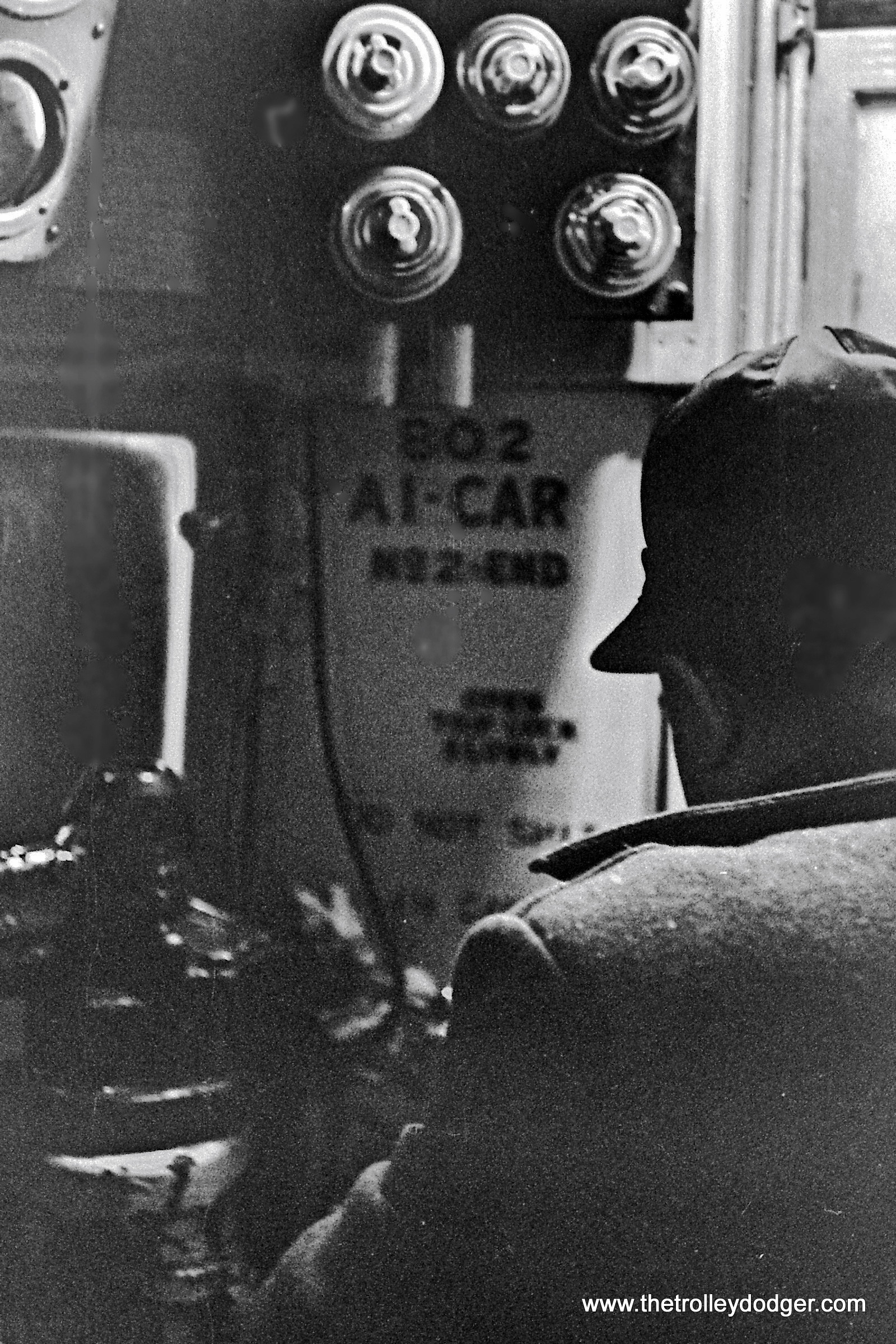
An Electroliner motorman in the cab of the 802 end. (Charles Fretzin Photo)

An Electroliner motorman in the cab of the 802 end. (Charles Fretzin Photo)

One of the Electroliners at the Highwood Shops after the abandonment in 1963. (Charles Fretzin Photo)

One of the Electroliners at the Highwood Shops after the abandonment in 1963.
(Charles Fretzin Photo)

A northbound North Shore Line Electroliner has just left Howard Street on June 10, 1956, descending into an open cut now used by CTA Yellow Line (Skokie Swift) trains. (William C. Hoffman Photo)

A northbound North Shore Line Electroliner has just left Howard Street on June 10, 1956, descending into an open cut now used by CTA Yellow Line (Skokie Swift) trains. (William C. Hoffman Photo)

This looks red because the other dye layers have faded so badly... a process that will unfortunately continue as the years go by. But thanks to modern tools such as Photoshop, it was still possible to bring the colors back to normal.

This looks red because the other dye layers have faded so badly… a process that will unfortunately continue as the years go by. But thanks to modern tools such as Photoshop, it was still possible to bring the colors back to normal.

North Shore Line Day 2023 at the Illinois Railway Museum

The Electroliner was the first thing visitors saw upon arriving at the museum.

The Electroliner was the first thing visitors saw upon arriving at the museum.

Electroliner 801-802 was on display at the 50th Avenue "L" station, which was moved here from the Douglas Park branch in the late 1970s. The Liner has been undergoing a complete restoration that will ultimately cost more than a million dollars. Part of the interior is not finished, but there is still much work to be done. Visitors to the museum had an opportunity to see the remarkable progress that has been made.

Electroliner 801-802 was on display at the 50th Avenue “L” station, which was moved here from the Douglas Park branch in the late 1970s. The Liner has been undergoing a complete restoration that will ultimately cost more than a million dollars. Part of the interior is not finished, but there is still much work to be done. Visitors to the museum had an opportunity to see the remarkable progress that has been made.

Electroliner interior.

Electroliner interior.

Electroliner interior.

Electroliner interior.

The way these seats have been reupholstered is truly beautiful.

The way these seats have been reupholstered is truly beautiful.

The cab at the 802 end of the Electroliner. Compare this to the picture of the same cab taken in 1963 by Charles Fretzin, found elsewhere in this post.

The cab at the 802 end of the Electroliner. Compare this to the picture of the same cab taken in 1963 by Charles Fretzin, found elsewhere in this post.

Electroliner interior.

Electroliner interior.

Electroliner interior.

Electroliner interior.

There are still a few vestiges left of the Electroliner's second career as a Liberty Liner on the Red Arrow's Norristown High-Speed Line.

There are still a few vestiges left of the Electroliner’s second career as a Liberty Liner on the Red Arrow’s Norristown High-Speed Line.

The interior of 354.

The interior of 354.

The interior of 354. Note the sign lit indicating riders can exit at both ends of the car.

The interior of 354. Note the sign lit indicating riders can exit at both ends of the car.

City streetcar 354 first ran in Waukegan, and later Milwaukee. It was once operated frequently at IRM, but this was my first chance to ride it in many years. Note the sign lit on the car, indicating that riders should board via the front entrance.

City streetcar 354 first ran in Waukegan, and later Milwaukee. It was once operated frequently at IRM, but this was my first chance to ride it in many years. Note the sign lit on the car, indicating that riders should board via the front entrance.

Line car 604.

Line car 604.

IRM has by far the largest and most extensive collection of North Shore Line coaches, and these were operated in various combinations on the museum's main line.

IRM has by far the largest and most extensive collection of North Shore Line coaches, and these were operated in various combinations on the museum’s main line.

Numerically speaking car 160 has the lowest number of any that have survived, but car 162, now undergoing restoration in East Troy, WI was actually delivered slightly earlier in 1915. 154 managed to survive the 1963 abandonment, but eventually fell victim to many years of outdoor storage and neglect at another railway museum that has struggled over the years.

Numerically speaking car 160 has the lowest number of any that have survived, but car 162, now undergoing restoration in East Troy, WI was actually delivered slightly earlier in 1915. 154 managed to survive the 1963 abandonment, but eventually fell victim to many years of outdoor storage and neglect at another railway museum that has struggled over the years.

It was a chilly day, but fortunately there was plenty of heat available in the cars that were running.

It was a chilly day, but fortunately there was plenty of heat available in the cars that were running.

The motorman's cab in 749.

The motorman’s cab in 749.

IRM has been gradually developing a main street with several new buildings.

IRM has been gradually developing a main street with several new buildings.

You can purchase North Shore Line coffee, a recreation of the blend once used on the Electroliners.

You can purchase North Shore Line coffee, a recreation of the blend once used on the Electroliners.

This is a transfer stamp machine, once found at CTA "L" and subway stations. When leaving the station, you would stamp your paper transfer with the time, which would allow you to get on another bus or train without paying a full fare. With today's electronic payment system, this is no longer needed.

This is a transfer stamp machine, once found at CTA “L” and subway stations. When leaving the station, you would stamp your paper transfer with the time, which would allow you to get on another bus or train without paying a full fare. With today’s electronic payment system, this is no longer needed.

The North Shore Commuters Association was a last-ditch effort to save the railroad. It failed, but did postpone the abandonment by four years. It also paved the way for later, more successful efforts to save much of Chicago's commuter rail system.

The North Shore Commuters Association was a last-ditch effort to save the railroad. It failed, but did postpone the abandonment by four years. It also paved the way for later, more successful efforts to save much of Chicago’s commuter rail system.

Signs like this were once commonplace on CTA "L" and subway stations in off-peak hours. Conductors collected fares on many lines. Starting in 1961, off-peak Evanston branch trains used a single operator who drove the train and collected fares.

Signs like this were once commonplace on CTA “L” and subway stations in off-peak hours. Conductors collected fares on many lines. Starting in 1961, off-peak Evanston branch trains used a single operator who drove the train and collected fares.

I spotted one of my books in the IRM gift shop.

I spotted one of my books in the IRM gift shop.

The sun will never set on the North Shore Line, if the Illinois Railway Museum has anything to say about it.

The sun will never set on the North Shore Line, if the Illinois Railway Museum has anything to say about it.

IRM Souvenir Brochure

Our Latest Book, Now Available for Pre-Order:

The North Shore Line

Publication Date: February 20, 2023

FYI, my new Arcadia Publishing book The North Shore Line is now finished and has gone to press. My publisher decided to expand it to 160 pages, instead of the usual 128. That’s a 25% increase, without any change to the $23.99 price. I am quite pleased with how this turned out.

From the back cover:

As late as 1963, it was possible to board high-speed electric trains on Chicago’s famous Loop “L” that ran 90 miles north to Milwaukee. This was the Chicago North Shore & Milwaukee Railroad, commonly known as the North Shore Line. It rose from humble origins in the 1890s as a local streetcar line in Waukegan to eventually become America’s fastest interurban under the visionary management of Midwest utilities tycoon Samuel Insull. The North Shore Line, under Insull, became a worthy competitor to the established steam railroads. Hobbled by the Great Depression, the road fought back in 1941 with two streamlined, air-conditioned, articulated trains called Electroliners, which included dining service. It regained its popularity during World War II, when gasoline and tires were rationed, but eventually, it fell victim to highways and the automobile. The North Shore Line had intercity rail, commuter rail, electric freight, city streetcars, and even buses. It has been gone for nearly 60 years, but it will always remain the Road of Service.

Each copy purchased here will be signed by the author, and you will also receive a bonus North Shore Line map.  Books will ship by USPS Media Mail as soon as we receive them, on or before February 20, 2023.

Chapters:
01. Beginnings
02. The Milwaukee Division
03. The Shore Line Route
04. The Skokie Valley Route
05. The Mundelein Branch
06. On the “L”
07. City Streetcars
08. Trolley Freight
09. The Long Goodbye
10. The Legacy

Title The North Shore Line
Images of America
Author David Sadowski
Edition illustrated
Publisher Arcadia Publishing (SC), 2023
ISBN 1467108960, 978-1467108966
Length 160 pages

The price of $23.99 includes shipping within the United States.

For Shipping to US Addresses:

New Compact Disc, Now Available:

CTA-1
The Last Chicago Streetcars 1958
# of Discs – 1
Price: $15.99

Until now, it seemed as though audio recordings of Chicago streetcars were practically non-existent. For whatever reason, the late William A. Steventon does not appear to have made any for his Railroad Record Club, even though he did make other recordings in the Chicago area in 1956.

Now, audio recordings of the last runs of Chicago streetcars have been found, in the collections of the late Jeffrey L. Wien (who was one of the riders on that last car). We do not know who made these recordings, but this must have been done using a portable reel-to-reel machine.

These important recordings will finally fill a gap in transit history. The last Chicago Transit Authority streetcar finished its run in the early hours of June 21, 1958. Now you can experience these events just as Chicagoans did.

As a bonus, we have included Keeping Pace, a 1939 Chicago Surface Lines employee training program. This was digitally transferred from an original 16” transcription disc. These recordings were unheard for 80 years.

Total time – 74:38

Help Support The Trolley Dodger

This is our 296th post, and we are gradually creating a body of work and an online resource for the benefit of all railfans, everywhere. To date, we have received over 948,000 page views, for which we are very grateful.

You can help us continue our original transit research by checking out the fine products in our Online Store.
As we have said before, “If you buy here, we will be here.”

We thank you for your support.

DONATIONS

In order to continue giving you the kinds of historic railroad images that you have come to expect from The Trolley Dodger, we need your help and support. It costs money to maintain this website, and to do the sort of historic research that is our specialty.

Your financial contributions help make this web site better, and are greatly appreciated.


Welcome 2023

An early (turn of the century) view of passengers boarding an Illinois Central Suburban train before the line was converted from steam to electric in 1926. I am not certain of the location, but it may be in Hyde Park.

An early (turn of the century) view of passengers boarding an Illinois Central Suburban train before the line was converted from steam to electric in 1926. I am not certain of the location, but it may be in Hyde Park.

Today, we are ringing in 2023 with a bevy of classic traction images from many far-flung places for your enjoyment.

Later this month, the Trolley Dodger blog will begin its ninth year. This year, we expect to make our 300th post, and will reach one million page views. When we began this journey, these things hardly seemed possible, but here we are, in large part thanks to you, our readers.

January is traditionally the month when we ask our readers for donations to keep this site going. If you enjoy what you see here, we hope you will consider making a contribution via the link at the end of this post. The expenses we incur, in order to bring you the finest and most interesting traction pictures, are considerable and ongoing. Our research costs a lot, but you see the results here and in our four Arcadia Publishing books, which we hope make a modest contribution to society. If you have contributed to our efforts, we are most appreciative, and if you have not, we hope you will consider it.

We are pleased to report that our latest book The North Shore Line is now 100% complete and has gone to press. The publication date is February 20, 2023, and we are now taking pre-orders. You will find more information about that at the end of this post (and our Online Store).  To date, we have received orders for 102 copies.

Keep those cards and letters coming in, folks.

-David Sadowski

PS- You might also like our Trolley Dodger Facebook auxiliary, a private group that now has 1,040 members.

Our friend Kenneth Gear now has a Facebook group for the Railroad Record Club. If you enjoy listening to audio recordings of classic railroad trains, whether steam, electric, or diesel, you might consider joining.

FYI, the Hoosier Traction Facebook Group celebrates electric transit in Indiana and the Midwest. It also supports the activities of the annual Hoosier Traction Meet in Dayton, OH (although not affiliated with the North American Transit Historical Society, which organizes that event).

Indiana Railroad lightweight high-speed car 71 is at the Indianapolis Terminal on August 11, 1940.

Indiana Railroad lightweight high-speed car 71 is at the Indianapolis Terminal on August 11, 1940.

Indiana Railroad high-speed car 58 (described as a "parlor car") is at the Indianapolis Terminal yards on August 11, 1940.

Indiana Railroad high-speed car 58 (described as a “parlor car”) is at the Indianapolis Terminal yards on August 11, 1940.

Philadelphia streetcar 8026 is at Church Road in Glenside, PA on February 22, 1941, operating on Route 6.

Philadelphia streetcar 8026 is at Church Road in Glenside, PA on February 22, 1941, operating on Route 6.

CTA/CSL 7001 and 4001 at South Shops, circa 1958. This was scanned from a red border Kodachrome slide, and by early 1958, those mounts were replaced by more modern ones. In the last days of Chicago streetcars, there were some PCCs in dead storage due to accidents or mechanical issues. The red car at right is a trailer in the 8000-series. The body of 4001 is now at the Illinois Railway Museum, but 7001 was scrapped in 1959.

CTA/CSL 7001 and 4001 at South Shops, circa 1958. This was scanned from a red border Kodachrome slide, and by early 1958, those mounts were replaced by more modern ones. In the last days of Chicago streetcars, there were some PCCs in dead storage due to accidents or mechanical issues. The red car at right is a trailer in the 8000-series. The body of 4001 is now at the Illinois Railway Museum, but 7001 was scrapped in 1959.

North shore Line 721 is at the back end of a Central Electric Railfans' Association fantrip that is making a photo stop at the Zion station.

North shore Line 721 is at the back end of a Central Electric Railfans’ Association fantrip that is making a photo stop at the Zion station.

North Shore Line freight loco 451. Don's Rail Photos notes, "451 was built in 1907 by Alco, #44387, and General Electric, #2697. It was retired in February 1948 and sold for scrap in March 1949."

North Shore Line freight loco 451. Don’s Rail Photos notes, “451 was built in 1907 by Alco, #44387, and General Electric, #2697. It was retired in February 1948 and sold for scrap in March 1949.”

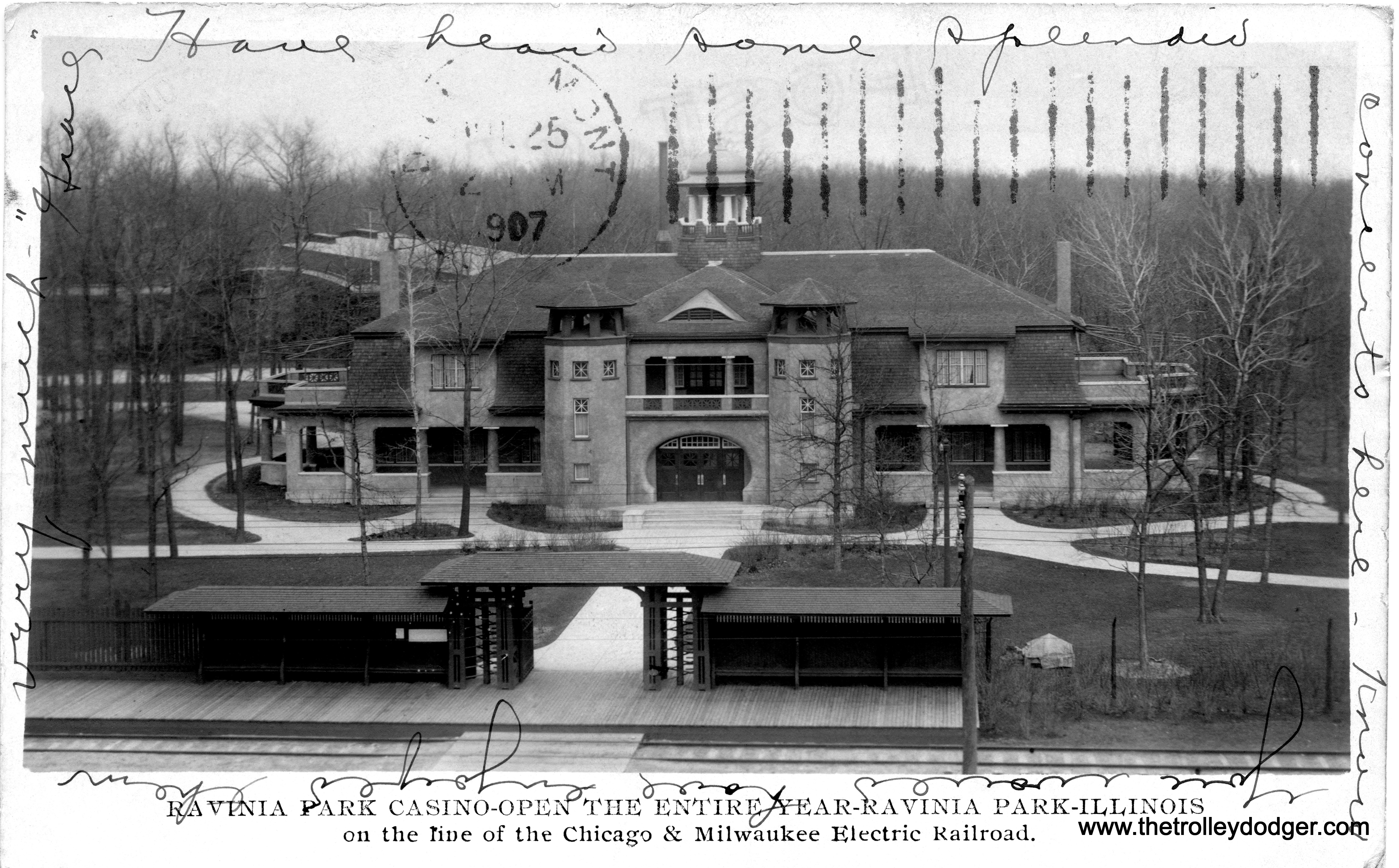
Ravinia Park was built by the Chicago and Milwaukee Electric, predecessor of the North Shore Line. Here is a view of the original music pavilion.

Ravinia Park was built by the Chicago and Milwaukee Electric, predecessor of the North Shore Line. Here is a view of the original music pavilion.

There was once an A branch on the MBTA Green Line in Boston-- the Watertown line, which shared some trackage with the B branch to Boston College. PCC streetcars were replaced by buses on June 20, 1969, and this photo by Robert A. Newbegin was taken that same month. Various reasons have been cited for the change, including an equipment shortage. But this view in the Newton Corner neighborhood shows another issue-- the inbound PCC, shown crossing over a highway, is going against the flow of one way traffic. Still, this trackage remained in place until 1994, for non-revenue streetcar access to Watertown Yard.

There was once an A branch on the MBTA Green Line in Boston– the Watertown line, which shared some trackage with the B branch to Boston College. PCC streetcars were replaced by buses on June 20, 1969, and this photo by Robert A. Newbegin was taken that same month. Various reasons have been cited for the change, including an equipment shortage. But this view in the Newton Corner neighborhood shows another issue– the inbound PCC, shown crossing over a highway, is going against the flow of one way traffic. Still, this trackage remained in place until 1994, for non-revenue streetcar access to Watertown Yard.

Kansas City Public Service PCC 535 on the Dodson line. The type of slide mount for this red border Kodachrome dates it to circa 1955-57. Car 535 was built by the St. Louis Car Company in 1947, and Kansas City abandoned streetcars in 1957. They have since opened modern streetcar lines.

Kansas City Public Service PCC 535 on the Dodson line. The type of slide mount for this red border Kodachrome dates it to circa 1955-57. Car 535 was built by the St. Louis Car Company in 1947, and Kansas City abandoned streetcars in 1957. They have since opened modern streetcar lines.

Illinois Terminal car 415 at the Illinois Electric Railway Museum in North Chicago on February 21, 1960.

Illinois Terminal car 415 at the Illinois Electric Railway Museum in North Chicago on February 21, 1960.

The view looking west along Van Bure Street under the Loop "L" on July 24, 1957. The "L" went further west from here until 1955, when a new connection was built through the old Wells Street Terminal a short distance north of here. The Insurance Exchange building is at right.

The view looking west along Van Bure Street under the Loop “L” on July 24, 1957. The “L” went further west from here until 1955, when a new connection was built through the old Wells Street Terminal a short distance north of here. The Insurance Exchange building is at right.

Philadelphia Suburban Transportation Company (aka Red Arrow) car 63 has turned north at Llanerch Junction on May 30, 1964.  It was most likely operating on the Ardmore line, which was converted to bus on December 30, 1966.  Kenneth Achtert adds, "PSTC #63 is indeed on the Ardmore Division (having just turned off of West Chester Pike) probably on a fantrip, as May 30, 1964, was a Saturday (and Memorial Day weekend)."

Philadelphia Suburban Transportation Company (aka Red Arrow) car 63 has turned north at Llanerch Junction on May 30, 1964. It was most likely operating on the Ardmore line, which was converted to bus on December 30, 1966. Kenneth Achtert adds, “PSTC #63 is indeed on the Ardmore Division (having just turned off of West Chester Pike) probably on a fantrip, as May 30, 1964, was a Saturday (and Memorial Day weekend).”

SEPTA (Red Arrow) double-ended car 19 at the 69th Street Terminal storage yard on August 9, 1971. It was built by the St. Louis Car Company in 1949, and although it looks like a PCC car, it is not considered one, as it has standard motor components.

SEPTA (Red Arrow) double-ended car 19 at the 69th Street Terminal storage yard on August 9, 1971. It was built by the St. Louis Car Company in 1949, and although it looks like a PCC car, it is not considered one, as it has standard motor components.

A North Shore Line Electroliner heads southbound at North Chicago Junction on January 12, 1963, just over a week prior to abandonment.

A North Shore Line Electroliner heads southbound at North Chicago Junction on January 12, 1963, just over a week prior to abandonment.

Chicago Aurora and Elgin freight loco 2002 at Wheaton on August 6, 1939. Scanned from the original negative. (LaMar M. Kelley Photo)

Chicago Aurora and Elgin freight loco 2002 at Wheaton on August 6, 1939. Scanned from the original negative. (LaMar M. Kelley Photo)

Chicago Aurora and Elgin car 130 (ex-North shore Line) on April 13, 1943. (Malcolm D. McCarter Photo)

Chicago Aurora and Elgin car 130 (ex-North shore Line) on April 13, 1943. (Malcolm D. McCarter Photo)

Chicago Aurora and Elgin 600 (ex-Washington, Baltimore & Annapolis) and line car 5, on a Central Electric Railfans' Association fantrip.

Chicago Aurora and Elgin 600 (ex-Washington, Baltimore & Annapolis) and line car 5, on a Central Electric Railfans’ Association fantrip.

This time card for the Batavia branch of the Aurora, Eglin and Chicago (predecessor of the CA&E) dates to 1905, when the interurban began running trains to downtown Chicago over the Metropolitan West side "L".

This time card for the Batavia branch of the Aurora, Eglin and Chicago (predecessor of the CA&E) dates to 1905, when the interurban began running trains to downtown Chicago over the Metropolitan West side “L”.

Chicago Aurora and Elgin steel cars 412 and 416 are at the DesPlaines Avenue Terminal in Forest Park on July 23, 1955. After CA&E cut back service to here in 1953, riders could make a cross-platform change to ride the CTA Garfield Park "L" downtown, after paying another fare.

Chicago Aurora and Elgin steel cars 412 and 416 are at the DesPlaines Avenue Terminal in Forest Park on July 23, 1955. After CA&E cut back service to here in 1953, riders could make a cross-platform change to ride the CTA Garfield Park “L” downtown, after paying another fare.

Chicago Aurora and Elgin 416 at the DesPlaines Avenue Terminal in Forest Park on July 23, 1955. This is the view from the opposite direction as the last photo. There were two sets of platforms. The CA&E dropped off passengers at one platform, then traveled a short distance to pick others up at the other platform. CTA trains looped via a wooden trestle that went over the CA&E just west of here. This arrangement continued until the CA&E abruptly abandoned passenger service in the middle of the day on July 3, 1957. The CTA reconfigured the terminal and yard area in 1959, in conjunction with construction of the nearby expressway.

Chicago Aurora and Elgin 416 at the DesPlaines Avenue Terminal in Forest Park on July 23, 1955. This is the view from the opposite direction as the last photo. There were two sets of platforms. The CA&E dropped off passengers at one platform, then traveled a short distance to pick others up at the other platform. CTA trains looped via a wooden trestle that went over the CA&E just west of here. This arrangement continued until the CA&E abruptly abandoned passenger service in the middle of the day on July 3, 1957. The CTA reconfigured the terminal and yard area in 1959, in conjunction with construction of the nearby expressway.

Lehigh Valley Transit

During the first half of the 20th century, Lehigh Valley Transit operated an interurban line known as teh Liberty Bell route between Allentown, Pennsylvania and Philadelphia. 42 miles of the route were on LVT trackage, with the remaining 13 miles going into Philadelphia via shared trackage on the Philadelphia and Western.

The line ran through a lot of farmland and open areas, with numerous stops in small towns along the way. Several of the station buildings still exist.

The Liberty Bell line is considered one of the classic American interurbans, and had somewhat of a Midwestern character despite being located in Pennsylvania. Like many other interurbans, it fell into a decline due to the Great Depression and the rise of the automobile, but rather than pack it in, LVT decided to modernize in 1938. Several lightweight high speed cars were purchased second hand and helped keep the line going for more than a dozen additional years.

Traffic was good during World War II, but went into an irreversible decline after the war. With new highways siphoning off traffic, the interurban had no future and was abandoned in 1951. Even the replacement bus service did not last.

Here are some classic views of LVT interurbans and city streetcars. Nearly all were scanned from original negatives or slides.

A Lehigh Valley Transit lightweight high-speed car is southbound on the Philadelphia and Western, crossing over Matson Ford Road, approaching Conshohocken Road station in January 1947. (David H. Cope Photo)

A Lehigh Valley Transit lightweight high-speed car is southbound on the Philadelphia and Western, crossing over Matson Ford Road, approaching Conshohocken Road station in January 1947. (David H. Cope Photo)

A Liberty Bell Limited train leaving Allentown, PA. The interurban ran to Philadelphia until 1949, partially via the Philadelphia and Western. For the last two years, service was cut back to Norristown until the 1951 abandonment.

A Liberty Bell Limited train leaving Allentown, PA. The interurban ran to Philadelphia until 1949, partially via the Philadelphia and Western. For the last two years, service was cut back to Norristown until the 1951 abandonment.

Some Lehigh Valley Transit freight motors are at the Philadelphia and Western's Norristown Terminal on a foggy day. The P&W connected with the Liberty Bell interurban route that continued to Allentown until 1951.

Some Lehigh Valley Transit freight motors are at the Philadelphia and Western’s Norristown Terminal on a foggy day. The P&W connected with the Liberty Bell interurban route that continued to Allentown until 1951.

LVT 1023 (at left) has just passed another car on the streets of Norristown. The Pennsylvania license plate on the auto would indicate we are in an odd-numbered year (1947, 1949, or 1951). Kenneth Achtert: "#1023 is on Marshall siding with the Reading Railroad Elm Street yard to the right."

LVT 1023 (at left) has just passed another car on the streets of Norristown. The Pennsylvania license plate on the auto would indicate we are in an odd-numbered year (1947, 1949, or 1951). Kenneth Achtert: “#1023 is on Marshall siding with the Reading Railroad Elm Street yard to the right.”

LVT 1030 at the Allentown depot.

LVT 1030 at the Allentown depot.

LVT 1023 at the Allentown depot.

LVT 1023 at the Allentown depot.

Lehigh Valley Transit's Liberty Bell interurban was abandoned in September 1951, but the company still had various streetcar lines in the Allentown and Bethlehem area that continued. Here, we see LVT 357, operating on a stretch of Gillmore Street line private right of way known as the "Race Track." This picture was taken on October 26, 1952, the last day of streetcar service on the South Bethlehem Division (and there is a notice of the service change on the telephone pole at right). The last LVT streetcar ran in 1953.

Lehigh Valley Transit’s Liberty Bell interurban was abandoned in September 1951, but the company still had various streetcar lines in the Allentown and Bethlehem area that continued. Here, we see LVT 357, operating on a stretch of Gillmore Street line private right of way known as the “Race Track.” This picture was taken on October 26, 1952, the last day of streetcar service on the South Bethlehem Division (and there is a notice of the service change on the telephone pole at right). The last LVT streetcar ran in 1953.

LVT 963 passes a Liberty Bell car at the Allentown depot, while passengers board for the trip to Philadelphia.

LVT 963 passes a Liberty Bell car at the Allentown depot, while passengers board for the trip to Philadelphia.

An LVT Liberty Bell car is on a passing siding in Norristown, adjacent to a Reading Railroad yard for its electrified commuter rail service to Philadelphia. While the Liberty Bell line is long gone, commuter rail service to Norristown continues under SEPTA. Kenneth Achtert adds, "on Marshall siding NB with (Reading Railroad) Elm Street yard to the right."

An LVT Liberty Bell car is on a passing siding in Norristown, adjacent to a Reading Railroad yard for its electrified commuter rail service to Philadelphia. While the Liberty Bell line is long gone, commuter rail service to Norristown continues under SEPTA. Kenneth Achtert adds, “on Marshall siding NB with (Reading Railroad) Elm Street yard to the right.”

LVT city streetcar 908, signed for Fullerton. Don's Rail Photos: "908 was built by Brill Car Co in February 1917, #20206. It was rebuilt."

LVT city streetcar 908, signed for Fullerton. Don’s Rail Photos: “908 was built by Brill Car Co in February 1917, #20206. It was rebuilt.”

LVT 917, signed for the South Bethlehem route. Don's Rail Photos: "917 was built by Brill Car Co in February 1917, #20206. It was rebuilt."

LVT 917, signed for the South Bethlehem route. Don’s Rail Photos: “917 was built by Brill Car Co in February 1917, #20206. It was rebuilt.”

A southbound LVT Liberty Bell car on 8th Street crosses Walnut Street in Allentown.

A southbound LVT Liberty Bell car on 8th Street crosses Walnut Street in Allentown.

LVT Liberty Bell car 1005. Don's Rail Photos: "1005 was built by Cincinnati Car in June 1930, #3050, as C&LE 123. It was sold to LVT as 1005 in 1938 and scrapped in 1952."

LVT Liberty Bell car 1005. Don’s Rail Photos: “1005 was built by Cincinnati Car in June 1930, #3050, as C&LE 123. It was sold to LVT as 1005 in 1938 and scrapped in 1952.”

LVT city streetcar 924. It was built by Brill, around the time 1917-1919.

LVT city streetcar 924. It was built by Brill, around the time 1917-1919.

LVT city streetcar 927, signed for Albright. Don's Rail Photos: "927 was built by Brill Car Co in February 1919, #20706. It was rebuilt."

LVT city streetcar 927, signed for Albright. Don’s Rail Photos: “927 was built by Brill Car Co in February 1919, #20706. It was rebuilt.”

LVT city streetcars 908 (at right), and possibly 413 at left.

LVT city streetcars 908 (at right), and possibly 413 at left.

LVT city streetcar 908, signed for Albright.

LVT city streetcar 908, signed for Albright.

This is an amazing photograph. LVT 1001 is northbound in Norristown, passing the Rambo House Hotel. I assume this was a short distance from where the Liberty Bell met the Philadelphia and Western line. There is a circa 1950-51 Ford parked at right. The car sign just says Express instead of Philadelphia Express, as LVT cut back passenger service to Norristown in 1949. Their fleet of second-hand high speed cars was wearing out, in part due to having to climb hills in Pennsylvania, instead of the flat Midwest prairies they were designed to traverse. The car at left may have a 1951 Pennsylvania license plate, indicating this picture may have been taken shortly before the abandonment of rail service.

This is an amazing photograph. LVT 1001 is northbound in Norristown, passing the Rambo House Hotel. I assume this was a short distance from where the Liberty Bell met the Philadelphia and Western line. There is a circa 1950-51 Ford parked at right. The car sign just says Express instead of Philadelphia Express, as LVT cut back passenger service to Norristown in 1949. Their fleet of second-hand high speed cars was wearing out, in part due to having to climb hills in Pennsylvania, instead of the flat Midwest prairies they were designed to traverse. The car at left may have a 1951 Pennsylvania license plate, indicating this picture may have been taken shortly before the abandonment of rail service.

This picture was taken at the same location, and same time, as the previous image. We are in Norristown on Swede St. with Airy St. in the background, not far from the point where the LVT Liberty Bell line met the Philadelphia and Western. LVT 1002 is an outbound Allentown Limited. Kenneth Achtert: "#1002 is not yet headed to Allentown, but is backing up on Swede St. about to turn onto Airy St. (note that the front-end pole is up). These single-ended cars would unload at the Norristown Terminal (after through operation was halted) then would back up the 3-4 blocks on Swede and Airy Streets to Rink Loop, back around the loop, then back to the Terminal (now facing north) for the trip to Allentown."

This picture was taken at the same location, and same time, as the previous image. We are in Norristown on Swede St. with Airy St. in the background, not far from the point where the LVT Liberty Bell line met the Philadelphia and Western. LVT 1002 is an outbound Allentown Limited. Kenneth Achtert: “#1002 is not yet headed to Allentown, but is backing up on Swede St. about to turn onto Airy St. (note that the front-end pole is up). These single-ended cars would unload at the Norristown Terminal (after through operation was halted) then would back up the 3-4 blocks on Swede and Airy Streets to Rink Loop, back around the loop, then back to the Terminal (now facing north) for the trip to Allentown.”

LVT 1021 is operating as a northbound Allentown Limited. Most of the Liberty Bell route was single tracked, with passing sidings. This is Acorn Siding, located by Normandy Farms in Blue Bell, PA.

LVT 1021 is operating as a northbound Allentown Limited. Most of the Liberty Bell route was single tracked, with passing sidings. This is Acorn Siding, located by Normandy Farms in Blue Bell, PA.

The photographer took this picture while riding in a southbound Liberty Bell train on Markley Street in Norristown. Most of this was single track and we are on a passing siding. The northbound car approaching us could be 1021, and the picture probably dates to 1949-51, as the sign on the approaching car does not say Philadelphia. The Reading Company's Elm Street commuter train station is off to the right.

The photographer took this picture while riding in a southbound Liberty Bell train on Markley Street in Norristown. Most of this was single track and we are on a passing siding. The northbound car approaching us could be 1021, and the picture probably dates to 1949-51, as the sign on the approaching car does not say Philadelphia. The Reading Company’s Elm Street commuter train station is off to the right.

This LVT Philadelphia Limited car is at Nace Siding, which Wikipedia says was "in open country just north of Souderton and the Souderton carbarn."

This LVT Philadelphia Limited car is at Nace Siding, which Wikipedia says was “in open country just north of Souderton and the Souderton carbarn.”

Another picture at Nace Siding. The car is LVT 1008.

Another picture at Nace Siding. The car is LVT 1008.

This LVT car is signed as a Norristown Local, which dates the picture to circa 1949-51. Not sure of the exact house number location on Airy Street in Norristown, but it has just crossed Cherry Street.

This LVT car is signed as a Norristown Local, which dates the picture to circa 1949-51. Not sure of the exact house number location on Airy Street in Norristown, but it has just crossed Cherry Street.

A rear end view of LVT 1030 on Airy Street in Norristown, about to turn onto Swede Street towards the Philadelphia and Western station. As this car originally came from the Indiana Railroad, it was slightly different than the other lightweight high-speed cars, which started out as Cincinnati and Lake Erie "Red Devils." The IR cars were designed for multiple-unit operation, while the C&LE cars were not. Therefore, car 1030 had a more squared off back end. The C&LE cars were more rounded.

A rear end view of LVT 1030 on Airy Street in Norristown, about to turn onto Swede Street towards the Philadelphia and Western station. As this car originally came from the Indiana Railroad, it was slightly different than the other lightweight high-speed cars, which started out as Cincinnati and Lake Erie “Red Devils.” The IR cars were designed for multiple-unit operation, while the C&LE cars were not. Therefore, car 1030 had a more squared off back end. The C&LE cars were more rounded.

Another shot of LVT 908, signed for Fullerton.

Another shot of LVT 908, signed for Fullerton.

Original Slides For Sale

My friend Jeff Wien passed away nearly two years ago, and I inherited his extensive slide collection, which takes up a lot of space. His interests were very wide-ranging, far more so than mine. One of my resolutions for 2023 is to start going through this collection systematically and decide what to keep, and add to my own collection. Simply leaving all these slides in boxes does not do anyone any good.

It is a fact of life that you can’t keep everything and you can’t take it with you. Since the Trolley Dodger blog has ongoing expenses, and my book projects cost real money, I have decided to sell some of these slides to help defray expenses and de-clutter. Here are the first 30 slides I have listed on eBay. The process of going through these will take several years. I can still post the scanned images to the blog, as I have done below.

Most of the slides below were taken by the late James J. Buckley (1918-1994), who was an excellent photographer.

We continue to purchase prints, slides, and negatives for what we consider our core collection, which we hope will eventually end up at a proper institution that can make good use of it. Those things that do not fit into our core collection can be sold, and the proceeds will help in our overall efforts.

-David Sadowski

Chicago, Rock Island and Pacific Railroad 1974 Original 35mm Kodachrome Slide Subject: CRI&P 652-610-654 and 14 cars on train 5, intercity service to Rock Island, IL Location: Chicago IL Date: May 4, 1974 Photographer: James J. Buckley This is slide EBA030 in our internal filing system. From the Wikipedia: By the time Amtrak was formed in 1971, the once-proud Rock Island was down to just two intercity trains, the Chicago-Peoria Peoria Rocket and the Chicago-Rock Island Quad Cities Rocket, both of which now operated entirely within the borders of Illinois. However, the Rock Island opted against joining Amtrak, in part because the government assessed the Amtrak entrance fee based upon passenger miles operated in 1970. After concluding that the cost of joining would be greater than remaining in the passenger business, the railroad decided to "perform a public service for the state of Illinois" and continue intercity passenger operations. To help manage the service, the Rock Island hired National Association of Railroad Passengers founder Anthony Haswell as managing director of passenger services. The last two trains plied the Rock Island's Illinois Division as the track quality declined from 1971 through 1977. The transit times, once a speedy 2½ hours in the 1950s, had lengthened to a 4½ hour run by 1975. The State of Illinois continued to subsidize the service to keep it running. The track program of 1978 helped with main-line timekeeping, although the Rock Island's management decreed that the two trains were not to delay freight traffic on the route. By this time, both once-proud trains were down to just two coaches, powered by EMD E8 locomotives entering their second decade of service. With the trains frequently running with as many paying passengers as coaches in the train, Illinois withdrew its subsidy, and the two trains made their final runs on December 31, 1978. Link to eBay Listing

Chicago, Rock Island and Pacific Railroad 1974 Original 35mm Kodachrome Slide
Subject: CRI&P 652-610-654 and 14 cars on train 5, intercity service to Rock Island, IL
Location: Chicago IL
Date: May 4, 1974
Photographer: James J. Buckley
This is slide EBA030 in our internal filing system.
From the Wikipedia:
By the time Amtrak was formed in 1971, the once-proud Rock Island was down to just two intercity trains, the Chicago-Peoria Peoria Rocket and the Chicago-Rock Island Quad Cities Rocket, both of which now operated entirely within the borders of Illinois. However, the Rock Island opted against joining Amtrak, in part because the government assessed the Amtrak entrance fee based upon passenger miles operated in 1970. After concluding that the cost of joining would be greater than remaining in the passenger business, the railroad decided to “perform a public service for the state of Illinois” and continue intercity passenger operations. To help manage the service, the Rock Island hired National Association of Railroad Passengers founder Anthony Haswell as managing director of passenger services.
The last two trains plied the Rock Island’s Illinois Division as the track quality declined from 1971 through 1977. The transit times, once a speedy 2½ hours in the 1950s, had lengthened to a 4½ hour run by 1975. The State of Illinois continued to subsidize the service to keep it running. The track program of 1978 helped with main-line timekeeping, although the Rock Island’s management decreed that the two trains were not to delay freight traffic on the route. By this time, both once-proud trains were down to just two coaches, powered by EMD E8 locomotives entering their second decade of service. With the trains frequently running with as many paying passengers as coaches in the train, Illinois withdrew its subsidy, and the two trains made their final runs on December 31, 1978.
Link to eBay Listing

Santa Teresa Tram Rio de Janeiro Original 1974 35mm Kodachrome Slide Subject: CTCG 6 Location: Carioca (R10) Date: March 17, 1974 Photographer: James J. Buckley Link to eBay Listing

Santa Teresa Tram Rio de Janeiro Original 1974 35mm Kodachrome Slide
Subject: CTCG 6
Location: Carioca (R10)
Date: March 17, 1974
Photographer: James J. Buckley
Link to eBay Listing

Amtrak Conrail Train Valpo Local 1971 Original 35mm Kodachrome Slide Subject: CR 5780-5603 plus 3 commuter train to Valparaiso, IN Location: Chicago IL Date: May 14, 1977 Photographer: James J. Buckley From the Wikipedia: The Calumet, also commonly called the Valpo Local, was a 43.6-mile (70.2 km) passenger train route operated by Amtrak between Chicago and Valparaiso, Indiana. Despite Amtrak's mandate to provide only intercity service, the Calumet was a commuter train. Transferred from Conrail in 1979, the full route was shared with Amtrak's Broadway Limited until 1990; the Calumet was discontinued the next year. Link to eBay Listing

Amtrak Conrail Train Valpo Local 1971 Original 35mm Kodachrome Slide
Subject: CR 5780-5603 plus 3 commuter train to Valparaiso, IN
Location: Chicago IL
Date: May 14, 1977
Photographer: James J. Buckley
From the Wikipedia:
The Calumet, also commonly called the Valpo Local, was a 43.6-mile (70.2 km) passenger train route operated by Amtrak between Chicago and Valparaiso, Indiana. Despite Amtrak’s mandate to provide only intercity service, the Calumet was a commuter train. Transferred from Conrail in 1979, the full route was shared with Amtrak’s Broadway Limited until 1990; the Calumet was discontinued the next year.
Link to eBay Listing

Bolton Tram 66 Original 1985 35mm Kodachrome Slide UK Subject: Bolton Tram 66 Location: Fleetwood (on Blackpool Tramway, UK) Date: July 14, 1985 Photographer: James J. Buckley From The Bolton News: The Bolton 66 tramcar was built in 1901 as an open top eight-wheel double deck bogie tram by the Electric Railway and Tramway Carriage Works in Preston. Bolton 66, the only tram in Blackpool Transport's Heritage Tramcar fleet which does not originate in Blackpool, is well over one hundred years old and is still in good running order but that has not always been the case. At the beginning of the 1960's, Alan Ralphs and Bolton-born Derek Shepherd took the decision to attempt to restore the Bolton tramcar. After more than 40 years serving the people of Bolton, the tramcar spent twenty years as a semi derelict bodyshell on a farm on the moors above Bolton. However, with lots of enthusiasm, a group led by the duo, professional electrical engineer Derek Shepherd and supported by Alan Ralphs, spent many hours to completely restore the tram to a new condition taking them 18 years to complete. In June 1981 the tram was moved to Blackpool and started to operate on the seafront, where it has remained for the last 41 years, due to Covid the 40th anniversary was postponed until this year. Link to eBay Listing

Bolton Tram 66 Original 1985 35mm Kodachrome Slide UK
Subject: Bolton Tram 66
Location: Fleetwood (on Blackpool Tramway, UK)
Date: July 14, 1985
Photographer: James J. Buckley
From The Bolton News:
The Bolton 66 tramcar was built in 1901 as an open top eight-wheel double deck bogie tram by the Electric Railway and Tramway Carriage Works in Preston.
Bolton 66, the only tram in Blackpool Transport’s Heritage Tramcar fleet which does not originate in Blackpool, is well over one hundred years old and is still in good running order but that has not always been the case.
At the beginning of the 1960’s, Alan Ralphs and Bolton-born Derek Shepherd took the decision to attempt to restore the Bolton tramcar.
After more than 40 years serving the people of Bolton, the tramcar spent twenty years as a semi derelict bodyshell on a farm on the moors above Bolton.
However, with lots of enthusiasm, a group led by the duo, professional electrical engineer Derek Shepherd and supported by Alan Ralphs, spent many hours to completely restore the tram to a new condition taking them 18 years to complete.
In June 1981 the tram was moved to Blackpool and started to operate on the seafront, where it has remained for the last 41 years, due to Covid the 40th anniversary was postponed until this year.
Link to eBay Listing

Chicago, Rock Island and Pacific Railroad 1971 Original 35mm Kodachrome Slide Subject: CRI&P 664 and 6 cars, commuter train to Blue Island Location: 47th Street, Chicago IL Date: September 8, 1971 Photographer: James J. Buckley From the Wikipedia: Chicago commuter service The Rock Island also operated an extensive commuter train service in the Chicago area. The primary route ran from LaSalle Street Station to Joliet along the main line, and a spur line, known as the "Suburban Line" to Blue Island. The main-line trains supplanted the long-distance services that did not stop at the numerous stations on that route. The Suburban Line served the Beverly Hills area of Chicago as a branch leaving the main line at Gresham and heading due west, paralleling the Baltimore and Ohio Chicago Terminal Railroad passenger line before turning south. The Suburban Line made stops every four blocks along the way before rejoining the main line at Western Avenue Junction in Blue Island. From the 1920s on, the suburban services were operated using Pacific-type 4-6-2 locomotives and specially designed light-heavyweight coaches that with their late 1920s build dates became known as the "Capone" cars. The suburban service became well known in the diesel era, as the steam power was replaced, first with new EMD FP7s and ALCO RS-3s, with two Fairbanks-Morse units added later. In 1949, Pullman-built 2700-series cars arrived as the first air-conditioned commuter cars on the line. In the 1960s, the Rock Island tried to upgrade the suburban service with newer equipment at lower cost. Second-hand Aerotrains, while less than successful in intercity service, were purchased to provide further air-conditioned accommodations that had proven popular with the 2700 series cars. When the Milwaukee Road purchased new Budd Company stainless-steel, bilevel cars in 1961, the Rock Island elected to add to a subsequent order and took delivery of its first bilevel equipment in 1964. Power for these new cars was provided by orphaned passenger units: three EMD F7s, an EMD E6, and the two EMD AB6s. The engines were rebuilt with head end power to provide heat, air conditioning, and lighting for the new cars. In 1970, another order, this time for Pullman-built bilevel cars arrived to further supplement the fleet. To provide the power for these cars, several former Union Pacific EMD E8 and EMD E9 diesels were also rebuilt with head end power and added to the commuter pool. The outdoor passenger concourse and platforms of LaSalle Street Station as built and operated by Metra. The trains shown are commuter runs to Blue Island and Joliet, Illinois. The commuter service was not exempt from the general decline of the Rock Island through the 1970s. Over time, deferred maintenance took its toll on both track and rolling stock. On the Rock Island, the Capone cars were entering their sixth decade of service and the nearly 30-year-old 2700s suffered from severe corrosion due to the steel used in their construction. LaSalle Street Station, the service's downtown terminal, suffered from neglect and urban decay with the slab roof of the train shed literally falling apart, requiring its removal. By this time, the Rock Island could not afford to replace the clearly worn-out equipment. In 1976, the entire Chicago commuter rail system began to receive financial support from the state of Illinois through the Regional Transportation Authority. Operating funds were disbursed to all commuter operators, and the Rock Island was to be provided with new equipment to replace the tired 2700 series and Capone cars. New Budd bilevels that were near copies of the 1961 Milwaukee Road cars arrived in 1978. New EMD F40PH units arrived in late 1977 and, in summer, 1978, briefly could be seen hauling Capone cars. The Rock Island's commuter F and E units were relegated to freight service or the scrapyard. With the 1980 end of the Rock Island, the RTA purchased the suburban territory and remaining Rock Island commuter equipment from the estate, while the Chicago and North Western Railway took over operations for a year before the RTA began operating it directly in 1981. LaSalle Street Station was torn down and replaced with the Chicago Stock Exchange building, with a smaller commuter station located one block south of the old station. The RTA gradually rebuilt the track and added more new equipment to the service, leaving the property in better shape than it was in the Rock Island's heyday, albeit with less track. The Rock Island District, as the Rock Island's suburban service is now known, now operates as part of Metra, the Chicago commuter rail agency. Our resident South Side expert M.E. adds, "Your (or maybe the Wikipedia) text says "The Suburban Line served the Beverly Hills area of Chicago as a branch leaving the main line at Gresham and heading due west, paralleling the Baltimore and Ohio Chicago Terminal Railroad passenger line before turning south." The wording "paralleling the B&OCT RR passenger line" is not precise. On a sheet of paper, maybe the CRI&P and the B&OCT ran parallel, but in reality, they shared the ground-level trackage for about a mile. The CRI&P's first station on the Suburban Line (after leaving the Main Line) was at 89th and Loomis (1400 W.). It was (and still is) called Brainerd. One block of Loomis, between 89th and 90th Sts., became a business district. Just as the commuter lines to the north and west saw the development of business districts around commuter train stations, the CRI&P Suburban Line brought about business districts at Brainerd, 95th St., 99th St., 103rd St., and 111th St. At the western end of that shared mile, about a block west of Ashland Ave. (1600 W.), the B&OCT turned north while the CRI&P turned south. At the eastern end of the shared mile, a few blocks west of Vincennes (which at that point was about 1000 W.), the B&OCT kept going east while the CRI&P Suburban Line ascended to the Main Line and turned north. Way back (I'm talking about 1950 and earlier), the Halsted St. streetcar line went south on Vincennes, eventually ending at 111th and Sacramento (3000 W.) where it served a row of cemeteries along 111th. Southbound along Vincennes, at 89th St., having just gone under the CRI&P overhead Suburban Line junction with the Main Line, the streetcar line diverged from the street itself onto its own private right-of-way adjacent to the CRI&P Main Line. So 89th and Vincennes was at one time a nice place to watch railroad and streetcar activity." Link to eBay Listing

Chicago, Rock Island and Pacific Railroad 1971 Original 35mm Kodachrome Slide
Subject: CRI&P 664 and 6 cars, commuter train to Blue Island
Location: 47th Street, Chicago IL
Date: September 8, 1971
Photographer: James J. Buckley
From the Wikipedia:
Chicago commuter service
The Rock Island also operated an extensive commuter train service in the Chicago area. The primary route ran from LaSalle Street Station to Joliet along the main line, and a spur line, known as the “Suburban Line” to Blue Island. The main-line trains supplanted the long-distance services that did not stop at the numerous stations on that route. The Suburban Line served the Beverly Hills area of Chicago as a branch leaving the main line at Gresham and heading due west, paralleling the Baltimore and Ohio Chicago Terminal Railroad passenger line before turning south. The Suburban Line made stops every four blocks along the way before rejoining the main line at Western Avenue Junction in Blue Island.
From the 1920s on, the suburban services were operated using Pacific-type 4-6-2 locomotives and specially designed light-heavyweight coaches that with their late 1920s build dates became known as the “Capone” cars. The suburban service became well known in the diesel era, as the steam power was replaced, first with new EMD FP7s and ALCO RS-3s, with two Fairbanks-Morse units added later. In 1949, Pullman-built 2700-series cars arrived as the first air-conditioned commuter cars on the line.
In the 1960s, the Rock Island tried to upgrade the suburban service with newer equipment at lower cost. Second-hand Aerotrains, while less than successful in intercity service, were purchased to provide further air-conditioned accommodations that had proven popular with the 2700 series cars.
When the Milwaukee Road purchased new Budd Company stainless-steel, bilevel cars in 1961, the Rock Island elected to add to a subsequent order and took delivery of its first bilevel equipment in 1964. Power for these new cars was provided by orphaned passenger units: three EMD F7s, an EMD E6, and the two EMD AB6s. The engines were rebuilt with head end power to provide heat, air conditioning, and lighting for the new cars. In 1970, another order, this time for Pullman-built bilevel cars arrived to further supplement the fleet. To provide the power for these cars, several former Union Pacific EMD E8 and EMD E9 diesels were also rebuilt with head end power and added to the commuter pool.
The outdoor passenger concourse and platforms of LaSalle Street Station as built and operated by Metra. The trains shown are commuter runs to Blue Island and Joliet, Illinois.
The commuter service was not exempt from the general decline of the Rock Island through the 1970s. Over time, deferred maintenance took its toll on both track and rolling stock. On the Rock Island, the Capone cars were entering their sixth decade of service and the nearly 30-year-old 2700s suffered from severe corrosion due to the steel used in their construction. LaSalle Street Station, the service’s downtown terminal, suffered from neglect and urban decay with the slab roof of the train shed literally falling apart, requiring its removal. By this time, the Rock Island could not afford to replace the clearly worn-out equipment.
In 1976, the entire Chicago commuter rail system began to receive financial support from the state of Illinois through the Regional Transportation Authority. Operating funds were disbursed to all commuter operators, and the Rock Island was to be provided with new equipment to replace the tired 2700 series and Capone cars. New Budd bilevels that were near copies of the 1961 Milwaukee Road cars arrived in 1978. New EMD F40PH units arrived in late 1977 and, in summer, 1978, briefly could be seen hauling Capone cars. The Rock Island’s commuter F and E units were relegated to freight service or the scrapyard.
With the 1980 end of the Rock Island, the RTA purchased the suburban territory and remaining Rock Island commuter equipment from the estate, while the Chicago and North Western Railway took over operations for a year before the RTA began operating it directly in 1981. LaSalle Street Station was torn down and replaced with the Chicago Stock Exchange building, with a smaller commuter station located one block south of the old station. The RTA gradually rebuilt the track and added more new equipment to the service, leaving the property in better shape than it was in the Rock Island’s heyday, albeit with less track. The Rock Island District, as the Rock Island’s suburban service is now known, now operates as part of Metra, the Chicago commuter rail agency.
Our resident South Side expert M.E. adds, “Your (or maybe the Wikipedia) text says
“The Suburban Line served the Beverly Hills area of Chicago as a branch leaving the main line at Gresham and heading due west, paralleling the Baltimore and Ohio Chicago Terminal Railroad passenger line before turning south.” The wording “paralleling the B&OCT RR passenger line” is not precise. On a sheet of paper, maybe the CRI&P and the B&OCT ran parallel, but in reality, they shared the ground-level trackage for about a mile. The CRI&P’s first station on the Suburban Line (after leaving the Main Line) was at 89th and Loomis (1400 W.). It was (and still is) called Brainerd. One block of Loomis, between 89th and 90th Sts., became a business district. Just as the commuter lines to the north and west saw the development of business districts around commuter train stations, the CRI&P Suburban Line brought about business districts at Brainerd, 95th St., 99th St., 103rd St., and 111th St.
At the western end of that shared mile, about a block west of Ashland Ave. (1600 W.), the B&OCT turned north while the CRI&P turned south. At the eastern end of the shared mile, a few blocks west of Vincennes (which at that point was about 1000 W.), the B&OCT kept going east while the CRI&P Suburban Line ascended to the Main Line and turned north.
Way back (I’m talking about 1950 and earlier), the Halsted St. streetcar line went south on Vincennes, eventually ending at 111th and Sacramento (3000 W.) where it served a row of cemeteries along 111th. Southbound along Vincennes, at 89th St., having just gone under the CRI&P overhead Suburban Line junction with the Main Line, the streetcar line diverged from the street itself onto its own private right-of-way adjacent to the CRI&P Main Line. So 89th and Vincennes was at one time a nice place to watch railroad and streetcar activity.”
Link to eBay Listing

Amtrak Turboliner RTG 1978 Original 35mm Kodachrome Slide Subject: Amtrak RTG 6715, train 334 Location: Chicago, IL on route to Milwaukee Date: April 15, 1978 Photographer: James J. Buckley Link to eBay Listing

Amtrak Turboliner RTG 1978 Original 35mm Kodachrome Slide
Subject: Amtrak RTG 6715, train 334
Location: Chicago, IL on route to Milwaukee
Date: April 15, 1978
Photographer: James J. Buckley
Link to eBay Listing

mtrak RDC Train 1974 Original 35mm Kodachrome Slide Subject: Amtrak RDCs 31-30-10, Train 370 Location: Cicero, IL (between Dubuque and Chicago) Date: June 24, 1974 Photographer: James J. Buckley Link to eBay Listing

mtrak RDC Train 1974 Original 35mm Kodachrome Slide
Subject: Amtrak RDCs 31-30-10, Train 370
Location: Cicero, IL (between Dubuque and Chicago)
Date: June 24, 1974
Photographer: James J. Buckley
Link to eBay Listing

Santa Teresa Tram Rio de Janeiro Original 1974 35mm Kodachrome Slide Subject: CTCG 7 Location: Carioca (R10) Date: March 17, 1974 Photographer: James J. Buckley From the Wikipedia: The Santa Teresa Tram, or Tramway (Portuguese: Bonde de Santa Teresa, IPA: [bõˈdʒi dʒi ˈsɐ̃tɐ teˈɾezɐ]), is a historic tram line in Rio de Janeiro, Brazil. It connects the city centre with the primarily residential, inner-city neighbourhood of Santa Teresa, in the hills immediately southwest of downtown. It is mainly maintained as a tourist attraction and is nowadays considered a heritage tramway system, having been designated a national historic monument in 1985. The line has a very unusual gauge: 1,100 mm (3 ft 7+5⁄16 in). The main line is 6.0 kilometres (3.7 miles) long. Having run continuously since its opening in 1877 (except for a 2011–15 suspension), it is one of the oldest street railway lines in the world and having been electrically powered since 1896, it is the oldest electric railway in all of Latin America. For many years it was also the only remaining metropolitan tram system in Brazil. The only other original tram systems in the country to have survived past 1971 are the Campos do Jordão interurban tram/light rail line, which continues to operate today, and the Itatinga line (near Bertioga), a rural and non-public tram line which had ceased operation as a tramway by 2017. All other cities closed their systems by 1971 (Santos being the last), but since that time, three towns, Belém, Campinas and Santos, have reinstated trams as heritage services. Rio de Janeiro opened a modern light rail/tram system in 2016. Link to eBay Listing

Santa Teresa Tram Rio de Janeiro Original 1974 35mm Kodachrome Slide
Subject: CTCG 7
Location: Carioca (R10)
Date: March 17, 1974
Photographer: James J. Buckley
From the Wikipedia:
The Santa Teresa Tram, or Tramway (Portuguese: Bonde de Santa Teresa, IPA: [bõˈdʒi dʒi ˈsɐ̃tɐ teˈɾezɐ]), is a historic tram line in Rio de Janeiro, Brazil. It connects the city centre with the primarily residential, inner-city neighbourhood of Santa Teresa, in the hills immediately southwest of downtown. It is mainly maintained as a tourist attraction and is nowadays considered a heritage tramway system, having been designated a national historic monument in 1985. The line has a very unusual gauge: 1,100 mm (3 ft 7+5⁄16 in). The main line is 6.0 kilometres (3.7 miles) long.
Having run continuously since its opening in 1877 (except for a 2011–15 suspension), it is one of the oldest street railway lines in the world and having been electrically powered since 1896, it is the oldest electric railway in all of Latin America. For many years it was also the only remaining metropolitan tram system in Brazil. The only other original tram systems in the country to have survived past 1971 are the Campos do Jordão interurban tram/light rail line, which continues to operate today, and the Itatinga line (near Bertioga), a rural and non-public tram line which had ceased operation as a tramway by 2017. All other cities closed their systems by 1971 (Santos being the last), but since that time, three towns, Belém, Campinas and Santos, have reinstated trams as heritage services. Rio de Janeiro opened a modern light rail/tram system in 2016.
Link to eBay Listing

Pittsburgh PAT PCC 1751 1974 35mm Kodachrome Slide Subject: Pittsburgh PAT PCC 1751 Location: Broadway near Neeld, Beechview, 42/38 route Date: May 21, 1974 Photographer: James J. Buckley Link to eBay Link

Pittsburgh PAT PCC 1751 1974 35mm Kodachrome Slide
Subject: Pittsburgh PAT PCC 1751
Location: Broadway near Neeld, Beechview, 42/38 route
Date: May 21, 1974
Photographer: James J. Buckley
Link to eBay Link

Santos Tramways São Paulo Brazil Original 1965 35mm Kodachrome Slide Subject: Serviço Municipal de Transportes Coletivos car 216 Location: Santos Date: March 12, 1965 Photographer: James J. Buckley Link to eBay Listing

Santos Tramways São Paulo Brazil Original 1965 35mm Kodachrome Slide
Subject: Serviço Municipal de Transportes Coletivos car 216
Location: Santos
Date: March 12, 1965
Photographer: James J. Buckley
Link to eBay Listing

Amtrak Turboliner RTG 1974 Original 35mm Kodachrome Slide Subject: Amtrak RTG 63-95-94-93-62 Location: Bloomington IL (on Chicago-St. Louis route) Date: November 2, 1974 Photographer: James J. Buckley Amtrak took over much of the nation's rail passenger service in 1971, and the Turboliners were an attempt to modernize. Ultimately, they proved unsuccessful for a variety of reasons, and were withdrawn from service in 1981. Some were rebuilt and were used in the Northeast Corridor from 1988-1994. Link to eBay Listing

Amtrak Turboliner RTG 1974 Original 35mm Kodachrome Slide
Subject: Amtrak RTG 63-95-94-93-62
Location: Bloomington IL (on Chicago-St. Louis route)
Date: November 2, 1974
Photographer: James J. Buckley
Amtrak took over much of the nation’s rail passenger service in 1971, and the Turboliners were an attempt to modernize. Ultimately, they proved unsuccessful for a variety of reasons, and were withdrawn from service in 1981. Some were rebuilt and were used in the Northeast Corridor from 1988-1994.
Link to eBay Listing

Milwaukee Road Electrification E71 1970 Original 35mm Kodachrome Slide Subject: Milwaukee Road E71 Location: East end of Butte, MT yard Date: October 2, 1970 Photographer: Unknown The Milwaukee Road operated an extensive system of electric freight in its Pacific Extension in the northwestern United States between 1914 and 1974. Link to eBay Listing

Milwaukee Road Electrification E71 1970 Original 35mm Kodachrome Slide
Subject: Milwaukee Road E71
Location: East end of Butte, MT yard
Date: October 2, 1970
Photographer: Unknown
The Milwaukee Road operated an extensive system of electric freight in its Pacific Extension in the northwestern United States between 1914 and 1974.
Link to eBay Listing

Southern Pacific 4449 Steam Loco "Daylight" 1991 Original 35mm Kodachrome Slide Subject: SP 4449 Location: Benecia Date: May 17, 1991 Photographer: Unknown From the Wikipedia: Southern Pacific 4449, also known as the Daylight, is the only surviving example of Southern Pacific Railroad's "GS-4" class of 4-8-4 "Northern" type steam locomotives and one of only two GS-class locomotives surviving, the other being "GS-6" 4460 at the National Museum of Transportation in St. Louis, Missouri. GS is an abbreviation of "General Service" or "Golden State," a nickname for California (where the locomotive was operated in regular service). The locomotive was built by Lima Locomotive Works in Lima, Ohio for the Southern Pacific in May 1941; it received the red-and-orange "Daylight" paint scheme for the passenger trains of the same name which it hauled for most of its service career. No. 4449 was retired from revenue service in 1956 and put into storage. In 1958, the Southern Pacific donated the locomotive to the City of Portland, Oregon. The City then put the locomotive on static display in Oaks Amusement Park, where it remained until 1974. After this, No. 4449 was then restored to operation for use in the American Freedom Train, which toured the 48 contiguous United States as part of the nation's 1976 Bicentennial celebration. The locomotive has operated in excursion service throughout that area since 1984. The locomotive's operations are based at the Oregon Rail Heritage Center in Portland, Oregon where it is maintained by a group of volunteers named the Friends of SP 4449. In 1983, a poll of Trains magazine readers selected 4449 as being the most popular locomotive in the United States. Link to eBay Listing

Southern Pacific 4449 Steam Loco “Daylight” 1991 Original 35mm Kodachrome Slide
Subject: SP 4449
Location: Benecia
Date: May 17, 1991
Photographer: Unknown
From the Wikipedia:
Southern Pacific 4449, also known as the Daylight, is the only surviving example of Southern Pacific Railroad’s “GS-4” class of 4-8-4 “Northern” type steam locomotives and one of only two GS-class locomotives surviving, the other being “GS-6” 4460 at the National Museum of Transportation in St. Louis, Missouri. GS is an abbreviation of “General Service” or “Golden State,” a nickname for California (where the locomotive was operated in regular service).
The locomotive was built by Lima Locomotive Works in Lima, Ohio for the Southern Pacific in May 1941; it received the red-and-orange “Daylight” paint scheme for the passenger trains of the same name which it hauled for most of its service career. No. 4449 was retired from revenue service in 1956 and put into storage. In 1958, the Southern Pacific donated the locomotive to the City of Portland, Oregon. The City then put the locomotive on static display in Oaks Amusement Park, where it remained until 1974.
After this, No. 4449 was then restored to operation for use in the American Freedom Train, which toured the 48 contiguous United States as part of the nation’s 1976 Bicentennial celebration. The locomotive has operated in excursion service throughout that area since 1984.
The locomotive’s operations are based at the Oregon Rail Heritage Center in Portland, Oregon where it is maintained by a group of volunteers named the Friends of SP 4449. In 1983, a poll of Trains magazine readers selected 4449 as being the most popular locomotive in the United States.
Link to eBay Listing

Southern Pacific 4449 Steam Loco "Daylight" 1984 Original 35mm Kodachrome Slide Subject: SP 4449 Location: Unknown Date: May 8, 1984 Photographer: Unknown Link to eBay Listing

Southern Pacific 4449 Steam Loco “Daylight” 1984 Original 35mm Kodachrome Slide
Subject: SP 4449
Location: Unknown
Date: May 8, 1984
Photographer: Unknown
Link to eBay Listing

Illinois Central City of New Orleans 1966 Original 35mm Kodachrome Slide Subject: IC 4020-4015 Location: Chicago IL Date: July 10, 1966 Photographer: James J. Buckley From the Wikipedia: The City of New Orleans is an Amtrak passenger train which operates on an overnight schedule between Chicago and New Orleans. The train is a successor to the Illinois Central Railroad's Panama Limited. The original City of New Orleans began in 1947 as part of the Illinois Central Railroad, and was the longest daylight run in the United States. The daylight train under that name ran through 1971, when it was moved to an overnight schedule as the Panama Limited. The present name was brought back in 1981, still on an overnight schedule. The train is the subject of the bittersweet 1971 song "City of New Orleans", written by Steve Goodman. The train operates along a route that has been served in one form or another for over a century. The Panama Limited originally ran from 1911 to 1971, though the IC ran Chicago-New Orleans trains since the turn of the century. Additional corridor service is provided between Chicago and Carbondale, Illinois–the northern leg of the route–by the Illini and Saluki. Link to eBay Listing

Illinois Central City of New Orleans 1966 Original 35mm Kodachrome Slide
Subject: IC 4020-4015
Location: Chicago IL
Date: July 10, 1966
Photographer: James J. Buckley
From the Wikipedia:
The City of New Orleans is an Amtrak passenger train which operates on an overnight schedule between Chicago and New Orleans. The train is a successor to the Illinois Central Railroad’s Panama Limited.
The original City of New Orleans began in 1947 as part of the Illinois Central Railroad, and was the longest daylight run in the United States. The daylight train under that name ran through 1971, when it was moved to an overnight schedule as the Panama Limited. The present name was brought back in 1981, still on an overnight schedule. The train is the subject of the bittersweet 1971 song “City of New Orleans”, written by Steve Goodman.
The train operates along a route that has been served in one form or another for over a century. The Panama Limited originally ran from 1911 to 1971, though the IC ran Chicago-New Orleans trains since the turn of the century. Additional corridor service is provided between Chicago and Carbondale, Illinois–the northern leg of the route–by the Illini and Saluki.
Link to eBay Listing

Sao Paulo Brazil CMTC Tram 1807 ex-NYC 1965 Original 35mm Kodachrome Slide Subject: CMTC 807 (ex-Third Avenue Railway System, NYC) Location: Sao Paulo, Brazil Date: March 11, 1965 Photographer: James J. Buckley From www.tramz.com: Additions in later years included 75 center-door cars, called centex in São Paulo, acquired second-hand in 1947 from the Third Avenue Transit System in New York. Third Avenue Railway had built them for conduit operation in 1938; trolley poles were added in São Paulo, doors were removed on one side and they were numbered 1701-1849. These "Huffliners" ran twice as long in São Paulo as in New York. In 1947 the São Paulo tramway system had 689 trams: 252 single-truck open motors, 28 single-truck open trailers, 153 double-truck open motors, In 1960 CMTC announced that it would rid the city completely of trams by 1968. The Santa Amaro route, which ran mostly on private right-of-way, would be converted to rapid transit. Several short routes were abandoned in the early 1960s: Barra Funda, Vila Prudente, Brésser, Bosque, Jardim Paulista. After 1963 open trams ran only on the Belém line - it had no turning loop, so required double-end cars. July and August 1966 saw the abandonment of most of the major tram routes in the city: Lapa, Penha, Belém, Pinheiros, Perdizes, Angélica, São Judas Tadeu. In January 1967 the end came to the others: Ipiranga, Fábrica, Casa Verde and Alto da Vila Maria. Only the Santo Amaro line remained. Its inner terminus was cut back to Vila Mariana and henceforth São Paulo, like Rio de Janeiro, had only one standard-gauge trolley line running in an obscure area at the edge of town. On 27 March 1968, with thousands of weeping paulistas lining the route, a cortège of 12 camarões made a final roundtrip to Santo Amaro and ended 96 years of tram service in the city. Link to eBay Listing

Sao Paulo Brazil CMTC Tram 1807 ex-NYC 1965 Original 35mm Kodachrome Slide
Subject: CMTC 807 (ex-Third Avenue Railway System, NYC)
Location: Sao Paulo, Brazil
Date: March 11, 1965
Photographer: James J. Buckley
From http://www.tramz.com:
Additions in later years included 75 center-door cars, called centex in São Paulo, acquired second-hand in 1947 from the Third Avenue Transit System in New York. Third Avenue Railway had built them for conduit operation in 1938; trolley poles were added in São Paulo, doors were removed on one side and they were numbered 1701-1849. These “Huffliners” ran twice as long in São Paulo as in New York. In 1947 the São Paulo tramway system had 689 trams: 252 single-truck open motors, 28 single-truck open trailers, 153 double-truck open motors,
In 1960 CMTC announced that it would rid the city completely of trams by 1968. The Santa Amaro route, which ran mostly on private right-of-way, would be converted to rapid transit. Several short routes were abandoned in the early 1960s: Barra Funda, Vila Prudente, Brésser, Bosque, Jardim Paulista. After 1963 open trams ran only on the Belém line – it had no turning loop, so required double-end cars. July and August 1966 saw the abandonment of most of the major tram routes in the city: Lapa, Penha, Belém, Pinheiros, Perdizes, Angélica, São Judas Tadeu. In January 1967 the end came to the others: Ipiranga, Fábrica, Casa Verde and Alto da Vila Maria. Only the Santo Amaro line remained. Its inner terminus was cut back to Vila Mariana and henceforth São Paulo, like Rio de Janeiro, had only one standard-gauge trolley line running in an obscure area at the edge of town. On 27 March 1968, with thousands of weeping paulistas lining the route, a cortège of 12 camarões made a final roundtrip to Santo Amaro and ended 96 years of tram service in the city.
Link to eBay Listing

Toronto Streetcar TTC ALRV 4201 1988 Original 35mm Kodachrome Slide Subject: TTC ALRV 4201 Location: Lake Shore and Symons, Etibicoke, Ontario Date: May 30, 1988 Photographer: James J. Buckley Link to eBay Listing

Toronto Streetcar TTC ALRV 4201 1988 Original 35mm Kodachrome Slide
Subject: TTC ALRV 4201
Location: Lake Shore and Symons, Etibicoke, Ontario
Date: May 30, 1988
Photographer: James J. Buckley
Link to eBay Listing

Illinois Central City of New Orleans 1966 Original 35mm Kodachrome Slide Subject: IC 4039-4104-4031-4021 Location: Chicago IL Date: July 10, 1966 Photographer: James J. Buckley Link to eBay Listing

Illinois Central City of New Orleans 1966 Original 35mm Kodachrome Slide
Subject: IC 4039-4104-4031-4021
Location: Chicago IL
Date: July 10, 1966
Photographer: James J. Buckley
Link to eBay Listing

Santa Teresa Open Tram 4 Rio de Janeiro Brazil Original 1974 35mm Kodachrome Slide Subject: CTCG 4 Location: Carioca, Rio de Janeiro Date: March 17, 1974 Photographer: James J. Buckley Link to eBay Listing

Santa Teresa Open Tram 4 Rio de Janeiro Brazil Original 1974 35mm Kodachrome Slide
Subject: CTCG 4
Location: Carioca, Rio de Janeiro
Date: March 17, 1974
Photographer: James J. Buckley
Link to eBay Listing

Baltimore and Ohio Capitol Limited 1967 Original 35mm Kodachrome Slide Subject: B&O 1419-2415/8 Location: Capitol Limited Train 6 departing Chicago Date: September 16, 1967 Photographer: James J. Buckley From the Wikipedia: The Capitol Limited was an American passenger train run by the Baltimore and Ohio Railroad, originally between New York City and Grand Central Station in Chicago, Illinois, via Union Station, Washington, D.C., Baltimore and Pittsburgh. For almost 48 years, it was the B&O's flagship passenger train, noted for personalized service and innovation. At the time of its discontinuation on May 1, 1971, when Amtrak took over most rail passenger service in the U.S., the Capitol Limited operated between Washington and Chicago. Link to eBay Listing

Baltimore and Ohio Capitol Limited 1967 Original 35mm Kodachrome Slide
Subject: B&O 1419-2415/8
Location: Capitol Limited Train 6 departing Chicago
Date: September 16, 1967
Photographer: James J. Buckley
From the Wikipedia:
The Capitol Limited was an American passenger train run by the Baltimore and Ohio Railroad, originally between New York City and Grand Central Station in Chicago, Illinois, via Union Station, Washington, D.C., Baltimore and Pittsburgh. For almost 48 years, it was the B&O’s flagship passenger train, noted for personalized service and innovation. At the time of its discontinuation on May 1, 1971, when Amtrak took over most rail passenger service in the U.S., the Capitol Limited operated between Washington and Chicago.
Link to eBay Listing

Santos Tramways São Paulo Brazil Original 1965 35mm Kodachrome Slide Subject: Serviço Municipal de Transportes Coletivos cars 90-223 Location: Santos Date: March 12, 1965 Photographer: James J. Buckley Link to eBay Listing

Santos Tramways São Paulo Brazil Original 1965 35mm Kodachrome Slide
Subject: Serviço Municipal de Transportes Coletivos cars 90-223
Location: Santos
Date: March 12, 1965
Photographer: James J. Buckley
Link to eBay Listing

Santa Teresa Tram Rio de Janeiro Original 1974 35mm Kodachrome Slide Subject: CTCG 18 Location: Carioca (R10) Date: March 17, 1974 Photographer: James J. Buckley Link to eBay Listing

Santa Teresa Tram Rio de Janeiro Original 1974 35mm Kodachrome Slide
Subject: CTCG 18
Location: Carioca (R10)
Date: March 17, 1974
Photographer: James J. Buckley
Link to eBay Listing

Santa Teresa Tram Rio de Janeiro Original 1974 35mm Kodachrome Slide Subject: CTCG 17 Location: Carioca (R10) Date: March 17, 1974 Photographer: James J. Buckley From the Wikipedia: The Santa Teresa Tram, or Tramway (Portuguese: Bonde de Santa Teresa, IPA: [bõˈdʒi dʒi ˈsɐ̃tɐ teˈɾezɐ]), is a historic tram line in Rio de Janeiro, Brazil. It connects the city centre with the primarily residential, inner-city neighbourhood of Santa Teresa, in the hills immediately southwest of downtown. It is mainly maintained as a tourist attraction and is nowadays considered a heritage tramway system, having been designated a national historic monument in 1985. The line has a very unusual gauge: 1,100 mm (3 ft 7+5⁄16 in). The main line is 6.0 kilometres (3.7 miles) long. Having run continuously since its opening in 1877 (except for a 2011–15 suspension), it is one of the oldest street railway lines in the world and having been electrically powered since 1896, it is the oldest electric railway in all of Latin America. For many years it was also the only remaining metropolitan tram system in Brazil. The only other original tram systems in the country to have survived past 1971 are the Campos do Jordão interurban tram/light rail line, which continues to operate today, and the Itatinga line (near Bertioga), a rural and non-public tram line which had ceased operation as a tramway by 2017. All other cities closed their systems by 1971 (Santos being the last), but since that time, three towns, Belém, Campinas and Santos, have reinstated trams as heritage services. Rio de Janeiro opened a modern light rail/tram system in 2016. Link to eBay Listing

Santa Teresa Tram Rio de Janeiro Original 1974 35mm Kodachrome Slide
Subject: CTCG 17
Location: Carioca (R10)
Date: March 17, 1974
Photographer: James J. Buckley
From the Wikipedia:
The Santa Teresa Tram, or Tramway (Portuguese: Bonde de Santa Teresa, IPA: [bõˈdʒi dʒi ˈsɐ̃tɐ teˈɾezɐ]), is a historic tram line in Rio de Janeiro, Brazil. It connects the city centre with the primarily residential, inner-city neighbourhood of Santa Teresa, in the hills immediately southwest of downtown. It is mainly maintained as a tourist attraction and is nowadays considered a heritage tramway system, having been designated a national historic monument in 1985. The line has a very unusual gauge: 1,100 mm (3 ft 7+5⁄16 in). The main line is 6.0 kilometres (3.7 miles) long.
Having run continuously since its opening in 1877 (except for a 2011–15 suspension), it is one of the oldest street railway lines in the world and having been electrically powered since 1896, it is the oldest electric railway in all of Latin America. For many years it was also the only remaining metropolitan tram system in Brazil. The only other original tram systems in the country to have survived past 1971 are the Campos do Jordão interurban tram/light rail line, which continues to operate today, and the Itatinga line (near Bertioga), a rural and non-public tram line which had ceased operation as a tramway by 2017. All other cities closed their systems by 1971 (Santos being the last), but since that time, three towns, Belém, Campinas and Santos, have reinstated trams as heritage services. Rio de Janeiro opened a modern light rail/tram system in 2016.
Link to eBay Listing

Shaker Heights Rapid Transit PCC 41 Original 1968 35mm Kodachrome Slide Subject: SHRT PCC 41 Location: 55th Street, Cleveland OH Date: May 25, 1968 Photographer: James J. Buckley From Don's Rail Photos: "41 was built by St. Louis Car (Company) in 1946, #1655, as SLPS (St. Louis Public Service) 1766. It was sold as SHRT 41 in 1959 and converted to MU (multiple unit) operation after purchase. It was sold to Buckeye Lake Trolley in 1984." Link to eBay Listing

Shaker Heights Rapid Transit PCC 41 Original 1968 35mm Kodachrome Slide
Subject: SHRT PCC 41
Location: 55th Street, Cleveland OH
Date: May 25, 1968
Photographer: James J. Buckley
From Don’s Rail Photos: “41 was built by St. Louis Car (Company) in 1946, #1655, as SLPS (St. Louis Public Service) 1766. It was sold as SHRT 41 in 1959 and converted to MU (multiple unit) operation after purchase. It was sold to Buckeye Lake Trolley in 1984.”
Link to eBay Listing

Blackpool Tramway 40 Original 1985 35mm Kodachrome Slide UK Subject: Blackpool Tramway 40 Location: Fleetwood UK Date: July 14, 1985 Photographer: James J. Buckley Blackpool Tramway 40 was built in 1926 and retired in 1963. It has since been part of the collection at the Crich Tramway Village museum. Here, it is shown operating briefly once again on the Blackpool Tramway in 1985. Link to eBay Listing

Blackpool Tramway 40 Original 1985 35mm Kodachrome Slide UK
Subject: Blackpool Tramway 40
Location: Fleetwood UK
Date: July 14, 1985
Photographer: James J. Buckley
Blackpool Tramway 40 was built in 1926 and retired in 1963. It has since been part of the collection at the Crich Tramway Village museum. Here, it is shown operating briefly once again on the Blackpool Tramway in 1985.
Link to eBay Listing

Glasgow Tram 1297 Original 1985 35mm Kodachrome Slide UK Subject: Glasgow Tram 1297 Location: Fleetwood (on Blackpool Tramway, UK) Date: July 14, 1985 Photographer: James J. Buckley Glasgow Tram 1297 was built in 1948 and retired in 1962. It is part of the collection at the Crich Tramway Village museum. Here, it is shown operating on the Blackpool Tramway briefly in 1985. Link to eBay Listing

Glasgow Tram 1297 Original 1985 35mm Kodachrome Slide UK
Subject: Glasgow Tram 1297
Location: Fleetwood (on Blackpool Tramway, UK)
Date: July 14, 1985
Photographer: James J. Buckley
Glasgow Tram 1297 was built in 1948 and retired in 1962. It is part of the collection at the Crich Tramway Village museum. Here, it is shown operating on the Blackpool Tramway briefly in 1985.
Link to eBay Listing

Great Northern Railway Red River 1954 Original 35mm Red Border Kodachrome Slide Subject: GNR 12 Location: Departing Minneapolis station for St. Paul Date: Fall 1954 Photographer: Unknown From the Wikipedia: The Red River was a passenger train operated by Great Northern Railway between Grand Forks, North Dakota, and Saint Paul, Minnesota (operating between 1950 and 1968). History Great Northern Railway's third new train set of 1950 was a new schedule named the Red River. The five-car streamliner built by American Car and Foundry Company began service June 25, 1950, operating a daily round trip 324 miles (521 km) each way between Grand Forks, North Dakota, and Saint Paul, Minnesota. The train went southbound in the morning returning northbound in the evening. The cars for the Red River streamliner were quite different than those built for the International (another 1950 introduction) in that the Red River's cars had extra insulation and the coaches were equipped with Baker Heaters as there was no steam heat available at the Grand Forks depot where the cars stood overnight. The locomotive was sent to the roundhouse each evening for any running repairs and service so the solution was the installation of the Baker Heaters in the cars. Link to eBay Listing

Great Northern Railway Red River 1954 Original 35mm Red Border Kodachrome Slide
Subject: GNR 12
Location: Departing Minneapolis station for St. Paul
Date: Fall 1954
Photographer: Unknown
From the Wikipedia:
The Red River was a passenger train operated by Great Northern Railway between Grand Forks, North Dakota, and Saint Paul, Minnesota (operating between 1950 and 1968).
History
Great Northern Railway’s third new train set of 1950 was a new schedule named the Red River. The five-car streamliner built by American Car and Foundry Company began service June 25, 1950, operating a daily round trip 324 miles (521 km) each way between Grand Forks, North Dakota, and Saint Paul, Minnesota. The train went southbound in the morning returning northbound in the evening.
The cars for the Red River streamliner were quite different than those built for the International (another 1950 introduction) in that the Red River’s cars had extra insulation and the coaches were equipped with Baker Heaters as there was no steam heat available at the Grand Forks depot where the cars stood overnight. The locomotive was sent to the roundhouse each evening for any running repairs and service so the solution was the installation of the Baker Heaters in the cars.
Link to eBay Listing

Amtrak RDC Train 1975 Original 35mm Kodachrome Slide Subject: Amtrak RDCs 30-32-15, Train 372 Blackhawk Location: Crawford (Chicago bound, between Dubuque and Chicago) Date: September 14, 1975 Photographer: James J. Buckley Link to eBay Listing

Amtrak RDC Train 1975 Original 35mm Kodachrome Slide
Subject: Amtrak RDCs 30-32-15, Train 372 Blackhawk
Location: Crawford (Chicago bound, between Dubuque and Chicago)
Date: September 14, 1975
Photographer: James J. Buckley
Link to eBay Listing

Milwaukee and Suburban Transport 1975 Original 35mm Kodachrome Slide Subject: M&ST 1466 Location: Wells-River (posed by the old Milwaukee Electric power plant) Date: June 29, 1975 Photographer: Jeff Wien Link to eBay Listing

Milwaukee and Suburban Transport 1975 Original 35mm Kodachrome Slide
Subject: M&ST 1466
Location: Wells-River (posed by the old Milwaukee Electric power plant)
Date: June 29, 1975
Photographer: Jeff Wien
Link to eBay Listing

Yakima Valley Transit Trolley 1975 Original 35mm Kodachrome Slide Subject: YVT 1776/1976 Location: 44th-Nob Hill, Yakima Date: June 1975 Photographer: Jeff Wien Link to eBay Listing

Yakima Valley Transit Trolley 1975 Original 35mm Kodachrome Slide
Subject: YVT 1776/1976
Location: 44th-Nob Hill, Yakima
Date: June 1975
Photographer: Jeff Wien
Link to eBay Listing

Our Latest Book, Now Available for Pre-Order:

The North Shore Line

Publication Date: February 20, 2023

FYI, my new Arcadia Publishing book The North Shore Line is now finished and has gone to press. My publisher decided to expand it to 160 pages, instead of the usual 128. That’s a 25% increase, without any change to the $23.99 price. I am quite pleased with how this turned out.

From the back cover:

As late as 1963, it was possible to board high-speed electric trains on Chicago’s famous Loop “L” that ran 90 miles north to Milwaukee. This was the Chicago North Shore & Milwaukee Railroad, commonly known as the North Shore Line. It rose from humble origins in the 1890s as a local streetcar line in Waukegan to eventually become America’s fastest interurban under the visionary management of Midwest utilities tycoon Samuel Insull. The North Shore Line, under Insull, became a worthy competitor to the established steam railroads. Hobbled by the Great Depression, the road fought back in 1941 with two streamlined, air-conditioned, articulated trains called Electroliners, which included dining service. It regained its popularity during World War II, when gasoline and tires were rationed, but eventually, it fell victim to highways and the automobile. The North Shore Line had intercity rail, commuter rail, electric freight, city streetcars, and even buses. It has been gone for nearly 60 years, but it will always remain the Road of Service.

Each copy purchased here will be signed by the author, and you will also receive a bonus North Shore Line map.  Books will ship by USPS Media Mail as soon as we receive them, on or before February 20, 2023.

Chapters:
01. Beginnings
02. The Milwaukee Division
03. The Shore Line Route
04. The Skokie Valley Route
05. The Mundelein Branch
06. On the “L”
07. City Streetcars
08. Trolley Freight
09. The Long Goodbye
10. The Legacy

Title The North Shore Line
Images of America
Author David Sadowski
Edition illustrated
Publisher Arcadia Publishing (SC), 2023
ISBN 1467108960, 978-1467108966
Length 160 pages

The price of $23.99 includes shipping within the United States.

For Shipping to US Addresses:

New Compact Disc, Now Available:

CTA-1
The Last Chicago Streetcars 1958
# of Discs – 1
Price: $15.99

Until now, it seemed as though audio recordings of Chicago streetcars were practically non-existent. For whatever reason, the late William A. Steventon does not appear to have made any for his Railroad Record Club, even though he did make other recordings in the Chicago area in 1956.

Now, audio recordings of the last runs of Chicago streetcars have been found, in the collections of the late Jeffrey L. Wien (who was one of the riders on that last car). We do not know who made these recordings, but this must have been done using a portable reel-to-reel machine.

These important recordings will finally fill a gap in transit history. The last Chicago Transit Authority streetcar finished its run in the early hours of June 21, 1958. Now you can experience these events just as Chicagoans did.

As a bonus, we have included Keeping Pace, a 1939 Chicago Surface Lines employee training program. This was digitally transferred from an original 16” transcription disc. These recordings were unheard for 80 years.

Total time – 74:38

Help Support The Trolley Dodger

This is our 295th post, and we are gradually creating a body of work and an online resource for the benefit of all railfans, everywhere. To date, we have received over 941,000 page views, for which we are very grateful.

You can help us continue our original transit research by checking out the fine products in our Online Store.
As we have said before, “If you buy here, we will be here.”

We thank you for your support.

DONATIONS

In order to continue giving you the kinds of historic railroad images that you have come to expect from The Trolley Dodger, we need your help and support. It costs money to maintain this website, and to do the sort of historic research that is our specialty.

Your financial contributions help make this web site better, and are greatly appreciated.


Elevation

An eastbound six-car Lake Street "L" A train approaches Oak Park Avenue in suburban Oak Park on March 23, 1955. Trains ran adjacent to South Boulevard until October 28, 1962, when they were relocated to the Chicago and North Western embankment. (Robert A. Selle Photo)

An eastbound six-car Lake Street “L” A train approaches Oak Park Avenue in suburban Oak Park on March 23, 1955. Trains ran adjacent to South Boulevard until October 28, 1962, when they were relocated to the Chicago and North Western embankment. (Robert A. Selle Photo)

October 28, 2022 was the 60th anniversary of the elevation of the outer 2.5 miles of the Lake Street “L” (now the CTA Green Line). This was an important event in the history of suburban Oak Park and the Austin neighborhood in Chicago.

The steel Lake Street “L” structure, first opened in 1893, was only built as far west as Laramie Avenue (5200 W). Once the main “L” lines were built by the four original private companies, they extended service out to less populated areas at a greatly reduced cost by putting the tracks at ground level. The idea was to establish service, then wait until the surrounding area developed, and then elevate the tracks.

In some cases, this elevation never happened. To this day, portions of the Chicago Transit Authority’s Brown, Pink, Yellow, and Purple lines continue to run at ground level.

The Lake Street “L”‘s ground level extension opened in 1901. The Chicago and North Western’s tracks, which were adjacent to the “L”, were elevated circa 1909-1910, with extremely tight clearances the result. The ground level “L” operated much like a streetcar, using overhead wire instead of third rail, and used high-level platforms.

By the 1930s, the City of Chicago, under the influence of New York City, wanted to build subways to replace the Loop elevated. The subways that eventually were built (State Street, Milwaukee-Dearborn, and West Side) were very ambitious and costly projects which helped alleviate overcrowding on the Loop, but could not replace it outright.

City planners had ideas for putting portions of the Lake line into various subways, so portions of the elevated structure could be torn down. But once the Chicago Transit Authority took over operations in 1947, it was quickly determined that the outer portion of the line, the ground-level section, was the real difficulty.

There were 22 grade crossings in this section, all manually operated by a gateman 24 hours a day. In a similar situation, the City of Berwyn was uncooperative with the CTA’s plans to reduce the number of grade crossings and install automatic gates. As a result, service on the Douglas Park “L” was cut back from Oak Park Avenue (6800 W) to 54th Avenue (5400 W), where it remains today.

Faced with the possible truncation of the Lake Street “L” to Laramie Avenue, the Village of Oak Park took a different approach, working cooperatively with all the interested parties (the City of Chicago, Chicago Transit Authority, and the Chicago and North Western), and a plan came about that benefitted everyone.

The C&NW embankment had enough extra space on it to accommodate the CTA tracks, which permitted the Lake Street “L” to be elevated at last. Removing the tracks from the street eliminated all 22 grade crossings, reducing the CTA’s payroll.

“L” operations were speeded up, offering better service, and the North Western received new revenue from renting out the space. The railroad was allowed to close some lightly used commuter rail stations, ceding these customers to the CTA, which speeded up service for riders farther out.

Removing the ground-level tracks widened the street, reducing traffic congestion and increasing the amount of parking spaces available. It was a win-win for all.

Plans were finalized around 1958, but construction does not seem to have begun until 1961. Service was changed over to the embankment at 6:00pm on October 28, 1962 (see the newspaper article below).

I was seven years old when this transition took place, and rode the ground-level “L” many times. It was always a bit tense, as all 22 cross streets were blind crossings. Cars might come darting out from under a viaduct at the last second, and there were some collisions between “L” cars and autos.

The tight clearances also prevented the use of the CTA’s 6000-series “L” cars in the 1950s, as they had curved sides that stuck out farther than previous equipment. Once the line began running on the embankment, it was possible to use newer equipment, and the CTA assigned many of their new 2000-series rapid transit cars to the Lake line starting in 1964.

Now, the “L” has been running on the embankment for nearly the same length of time as the ground-level operation had. And practically every trace of that surface trackage and stations is long gone.

People who have grown up in the area since 1962 might not have any idea that the “L” ever ran anywhere but on the embankment, but this is an important part of Oak Park’s history, and it deserves to be remembered.

Fortunately, we recently collected various images showing both the construction work, and many taken on the very day of the ground-level operation, October 28, 1962. In addition to this, we have an excellent selection of other classic traction photos from around the country.

We are pleased to report that our latest book The North Shore Line is now 100% complete and has gone to press. The publication date is February 20, 2023, and we are now taking pre-orders. You will find more information about that at the end of this post (and our Online Store).

-David Sadowski

PS- You might also like our Trolley Dodger Facebook auxiliary, a private group that now has 1,016 members.

Our friend Kenneth Gear now has a Facebook group for the Railroad Record Club. If you enjoy listening to audio recordings of classic railroad trains, whether steam, electric, or diesel, you might consider joining.

FYI, the Hoosier Traction Facebook Group celebrates electric transit in Indiana and the Midwest. It also supports the activities of the annual Hoosier Traction Meet in Dayton, OH (although not affiliated with the North American Transit Historical Society, which organizes that event).

The Lake Street “L” in Transition

In this July 16, 1961 view, work has just started on connecting the "L" with the nearby Chicago and North Western embankment. But the changeover point between overhead wire and third rail has already been moved to the Central Avenue ground-level station. This would otherwise have been a complicating factor in the transition process, as both routes would need to be operational for a short time simultaneously.

In this July 16, 1961 view, work has just started on connecting the “L” with the nearby Chicago and North Western embankment. But the changeover point between overhead wire and third rail has already been moved to the Central Avenue ground-level station. This would otherwise have been a complicating factor in the transition process, as both routes would need to be operational for a short time simultaneously.

The view looking west from Laramie Avenue on August 27, 1961. A new temporary track has been built at left, supported by wooden pilings, to allow the ground-level operation to continue while the new "L" connection is being built. Note the Chicago and North Western freight train at right.

The view looking west from Laramie Avenue on August 27, 1961. A new temporary track has been built at left, supported by wooden pilings, to allow the ground-level operation to continue while the new “L” connection is being built. Note the Chicago and North Western freight train at right.

This picture, taken on August 27, 1961, shows how the "L" was shored up during construction of the new connection to the nearby railroad embankment.

This picture, taken on August 27, 1961, shows how the “L” was shored up during construction of the new connection to the nearby railroad embankment.

On August 27, 1961, new steel has been added to the "L" structure at Laramie Avenue. This section of "L" was eventually rebuilt in the 1990s, when the line was shut down for about two years.

On August 27, 1961, new steel has been added to the “L” structure at Laramie Avenue. This section of “L” was eventually rebuilt in the 1990s, when the line was shut down for about two years.

On September 10, 1961, new streel is being added to the "L" to support the additional tracks needed for the realignment.

On September 10, 1961, new streel is being added to the “L” to support the additional tracks needed for the realignment.

Looking west from the Laramie Avenue "L" station on September 17, 1961. New tracks will be added to create a junction between the old and new alignments.

Looking west from the Laramie Avenue “L” station on September 17, 1961. New tracks will be added to create a junction between the old and new alignments.

Third rail (here referred to as "trolley rail") was installed between Laramie and Parkside Avenues on the Lake Street "L" as of May 8, 1961. This was one of the first actions taken in the project to move the "L" onto the nearby railroad embankment.

Third rail (here referred to as “trolley rail”) was installed between Laramie and Parkside Avenues on the Lake Street “L” as of May 8, 1961. This was one of the first actions taken in the project to move the “L” onto the nearby railroad embankment.

Work on the CTA's new Congress "L" branch was finishing up just as work began on realigning the outer portion of the Lake Street "L". Once these projects were finished, all the CTA grade crossings in Oak Park and Forest Park were eliminated.

Work on the CTA’s new Congress “L” branch was finishing up just as work began on realigning the outer portion of the Lake Street “L”. Once these projects were finished, all the CTA grade crossings in Oak Park and Forest Park were eliminated.

The changeover point from third rail to overhead wire on the Lake Street "L" was moved from Laramie to Central Avenue on May 22, 1961, at the beginning of the relocation project.

The changeover point from third rail to overhead wire on the Lake Street “L” was moved from Laramie to Central Avenue on May 22, 1961, at the beginning of the relocation project.

Overhead wire was removed from the eastbound Lake Street "L" track between Central and Laramie on May 24, 1961.

Overhead wire was removed from the eastbound Lake Street “L” track between Central and Laramie on May 24, 1961.

Central Avenue and Lake Street on October 28, 1962. This was the only place on the "L" system where trains under wire crossed a trolley bus line. Motor buses replaced trolley buses on Central on January 17, 1970. This portion of Lake Street was renamed Corcoran Place a few years after this picture was taken, to honor a local alderman who had recently died.

Central Avenue and Lake Street on October 28, 1962. This was the only place on the “L” system where trains under wire crossed a trolley bus line. Motor buses replaced trolley buses on Central on January 17, 1970. This portion of Lake Street was renamed Corcoran Place a few years after this picture was taken, to honor a local alderman who had recently died.

We are looking east along what was then Lake Street at Mayfield Avenue on October 28, 1962. We are just east of where the dedication ceremony took place. The new Central Avenue "L" station can be seen in the distance.

We are looking east along what was then Lake Street at Mayfield Avenue on October 28, 1962. We are just east of where the dedication ceremony took place. The new Central Avenue “L” station can be seen in the distance.

We are looking to the northeast along what was then Lake Street (now Corcoran Place) just east of Austin Boulevard on October 28, 1962.

We are looking to the northeast along what was then Lake Street (now Corcoran Place) just east of Austin Boulevard on October 28, 1962.

Chicago's dedication ceremony for the new "L" alignment took place on what was then Lake Street (now Corcoran Place), between Austin Boulevard and Mason Avenue. Mayor Richard J, Daley and CTA chairman Virgil Gunlock presided. A similar ceremony was held in Oak Park.

Chicago’s dedication ceremony for the new “L” alignment took place on what was then Lake Street (now Corcoran Place), between Austin Boulevard and Mason Avenue. Mayor Richard J, Daley and CTA chairman Virgil Gunlock presided. A similar ceremony was held in Oak Park.

CTA "L" car 4407 appears to have been decorated for the dedication event near the Austin stop on October 28, 1962.

CTA “L” car 4407 appears to have been decorated for the dedication event near the Austin stop on October 28, 1962.

I believe we are just west of the Austin Boulevard "L" station on October 28, 1962.

I believe we are just west of the Austin Boulevard “L” station on October 28, 1962.

Clearances were extremely narrow on the ground level portion of the Lake Street "L", and therefore, when the line was elevated, temporary entrances were used. Once the old "L" had been cleared away, construction of the permanent entrances continued.

Clearances were extremely narrow on the ground level portion of the Lake Street “L”, and therefore, when the line was elevated, temporary entrances were used. Once the old “L” had been cleared away, construction of the permanent entrances continued.

Again, near Austin Boulevard on October 28, 1962. We are looking to the northeast.

Again, near Austin Boulevard on October 28, 1962. We are looking to the northeast.

An eastbound Lake Street "A" train is just east of Ridgeland Avenue on October 28, 1962.

An eastbound Lake Street “A” train is just east of Ridgeland Avenue on October 28, 1962.

We are looking west, just east of the Ridgeland Avenue "L" station on October 28, 1962. The building at left with the sign on it advertising a dry cleaner is now occupied by the Tayloe Glass Company.

We are looking west, just east of the Ridgeland Avenue “L” station on October 28, 1962. The building at left with the sign on it advertising a dry cleaner is now occupied by the Tayloe Glass Company.

We are looking west along South Boulevard at Marion Street in suburban Oak Park on October 28, 1962. A two-tone mid-50s Ford heads north on Marion, while an early 1960s Corvair is eastbound on South Boulevard. This is a rare opportunity to see "L" cars on both levels.

We are looking west along South Boulevard at Marion Street in suburban Oak Park on October 28, 1962. A two-tone mid-50s Ford heads north on Marion, while an early 1960s Corvair is eastbound on South Boulevard. This is a rare opportunity to see “L” cars on both levels.

We are looking west along South Boulevard at Marion Street on October 28, 1962. The sign at left advertises Blue Cab, and there is a cab waiting there to serve people getting off the "L".

We are looking west along South Boulevard at Marion Street on October 28, 1962. The sign at left advertises Blue Cab, and there is a cab waiting there to serve people getting off the “L”.

Looking west along South Boulevard at Marion Street on October 28, 1962. Due to the narrow width of South Boulevard in this area, it was a one-way street going east. This section is now a two-way street, although there is still a section that is one way westbound, between Oak Park Avenue and Home Avenue.

Looking west along South Boulevard at Marion Street on October 28, 1962. Due to the narrow width of South Boulevard in this area, it was a one-way street going east. This section is now a two-way street, although there is still a section that is one way westbound, between Oak Park Avenue and Home Avenue.

A closer view of the new and old "L" stations. The sign above the entrance advertises the all metal "L" cars the CTA had operated on Lake since the last wood cars were taken off this line in 1954.

A closer view of the new and old “L” stations. The sign above the entrance advertises the all metal “L” cars the CTA had operated on Lake since the last wood cars were taken off this line in 1954.

At one time, Blue Cab had their headquarters on South Boulevard, but I don't recall offhand whether they were located here. The Lake Street "L" ground-level trackage extended across Harlem Avenue a short distance west of here. In the distance, you can see construction is already underway on expanding the railroad embankment to create a new yard for Lake Street trains. It opened in 1964.

At one time, Blue Cab had their headquarters on South Boulevard, but I don’t recall offhand whether they were located here. The Lake Street “L” ground-level trackage extended across Harlem Avenue a short distance west of here. In the distance, you can see construction is already underway on expanding the railroad embankment to create a new yard for Lake Street trains. It opened in 1964.

This slide, taken by the same photographer, has a processing date of May 1963. Lake Street trains are running on the embankment, with their trolley poles removed. The old tracks are still in place but will soon be ripped up. The adjacent street was widened and parking spaces added.

This slide, taken by the same photographer, has a processing date of May 1963. Lake Street trains are running on the embankment, with their trolley poles removed. The old tracks are still in place but will soon be ripped up. The adjacent street was widened and parking spaces added.

The Congress Expressway is under construction at Homan Avenue on October 9, 1955, and would soon open as far west as Laramie Avenue. Tracks are already being laid for the new CTA Congress "L" line, which opened on June 22, 1958, replacing the old Garfield Park "L". Note the very flimsy barrier separating the "L" and highway. This soon proved completely inadequate and was eventually replaced by concrete barriers. Mayor Richard J. Daley drove the first spike for the new rails on July 8, 1955 near Pulaski Road. We are looking east. The entire story of the transition from the Garfield Park "L" to the Congress median line is told in my 2018 book Building Chicago's Subways.

The Congress Expressway is under construction at Homan Avenue on October 9, 1955, and would soon open as far west as Laramie Avenue. Tracks are already being laid for the new CTA Congress “L” line, which opened on June 22, 1958, replacing the old Garfield Park “L”. Note the very flimsy barrier separating the “L” and highway. This soon proved completely inadequate and was eventually replaced by concrete barriers. Mayor Richard J. Daley drove the first spike for the new rails on July 8, 1955 near Pulaski Road. We are looking east. The entire story of the transition from the Garfield Park “L” to the Congress median line is told in my 2018 book Building Chicago’s Subways.

We were fortunately to recently purchase this original early red border Kodachrome slide, taken on September 7, 1941. It shows a fan taking a picture of Connecticut Company car 500, built in 1904 and described as the pride of the fleet, equipped with a kitchen, bathroom, and dining tables. It was acquired by the Shore Line Trolley Museum in 1948.

We were fortunately to recently purchase this original early red border Kodachrome slide, taken on September 7, 1941. It shows a fan taking a picture of Connecticut Company car 500, built in 1904 and described as the pride of the fleet, equipped with a kitchen, bathroom, and dining tables. It was acquired by the Shore Line Trolley Museum in 1948.

A view of the Chicago Transit Authority's Stock Yards branch on September 16, 1956. Service was discontinued the following year, and it has now been 65 years since the last wooden "L" car ran in regular service in Chicago.

A view of the Chicago Transit Authority’s Stock Yards branch on September 16, 1956. Service was discontinued the following year, and it has now been 65 years since the last wooden “L” car ran in regular service in Chicago.

Some Milwaukee Electric interurban trains ran past the North Shore Line's Milwaukee Terminal, although there does not seem to have been a track connection here. This picture dates to the 1940s. A TM interurban car did operate on a North Shore Line fantrip in 1949, so there must have been a track connection somewhere. An Electroliner is berthed at the terminal.

Some Milwaukee Electric interurban trains ran past the North Shore Line’s Milwaukee Terminal, although there does not seem to have been a track connection here. This picture dates to the 1940s. A TM interurban car did operate on a North Shore Line fantrip in 1949, so there must have been a track connection somewhere. An Electroliner is berthed at the terminal.

The Logan Square “L” Terminal, right around the end of service in late January 1970. Service was extended on this line via the new Kimball Subway and a median line in the Kennedy Expressway. Service went only to Jefferson Park at first, but now continues all the way to O’Hare Airport.

Another view of the old Logan Square "L" station near the end of service.

Another view of the old Logan Square “L” station near the end of service.

On December 6, 1958, CTA salt car AA98 was still on a trailer at the Electric Railway Historical Society (ERHS) location in Downers Grove. It was formerly Chicago Surface Lines car 2846 and was built in 1908 by the South Chicago City Railway. It went to the Illinois Railway Museum in 1973. (Robert A. Selle Photo)

On December 6, 1958, CTA salt car AA98 was still on a trailer at the Electric Railway Historical Society (ERHS) location in Downers Grove. It was formerly Chicago Surface Lines car 2846 and was built in 1908 by the South Chicago City Railway. It went to the Illinois Railway Museum in 1973. (Robert A. Selle Photo)

The CTA Congress Expressway median line was not the first of its type, that distinction having been taken by the Pacific Electric in 1940. Here, we see a 600-series "Hollywood" car in Cahuenga Pass at Barham Boulevard. This print was made in 1946 but could have been taken earlier. PE service here ended in 1952 (this was part of the Van Nuys line) and the right-of-way was taken up by additional traffic lanes. (Stuart A. Liebman Photo)

The CTA Congress Expressway median line was not the first of its type, that distinction having been taken by the Pacific Electric in 1940. Here, we see a 600-series “Hollywood” car in Cahuenga Pass at Barham Boulevard. This print was made in 1946 but could have been taken earlier. PE service here ended in 1952 (this was part of the Van Nuys line) and the right-of-way was taken up by additional traffic lanes. (Stuart A. Liebman Photo)

Don's Rail Photos: "(North Shore Line) 420 was was built by Pullman in 1928 as an observation. It was out of service by 1932. On July 21, 1943, it reentered service as a motorized coach. It was sold to Seashore Trolley Museum in 1963." Here we see it prior to conversion.

Don’s Rail Photos: “(North Shore Line) 420 was was built by Pullman in 1928 as an observation. It was out of service by 1932. On July 21, 1943, it reentered service as a motorized coach. It was sold to Seashore Trolley Museum in 1963.” Here we see it prior to conversion.

North Shore Line diner 418 at the Milwaukee Terminal, when it was still in service as a diner. This print was made in 1945 but could have been taken earlier. Dining car service on the CNS&M ended in 1947, except for the Electroliners, and car 415, which was used in the "substitute Liner" and for charters.

North Shore Line diner 418 at the Milwaukee Terminal, when it was still in service as a diner. This print was made in 1945 but could have been taken earlier. Dining car service on the CNS&M ended in 1947, except for the Electroliners, and car 415, which was used in the “substitute Liner” and for charters.

A five-car train of Chicago Aurora and Elgin wood cars, including 312, in Wheaton. This print was made in 1945, but the picture was probably taken earlier. (Ewing Dale Photo)

A five-car train of Chicago Aurora and Elgin wood cars, including 312, in Wheaton. This print was made in 1945, but the picture was probably taken earlier. (Ewing Dale Photo)

Chicago Aurora and Elgin wood car 24 in Wheaton. This print was made in 1945, but the picture was probably taken earlier. (E. Dale Photo)

Chicago Aurora and Elgin wood car 24 in Wheaton. This print was made in 1945, but the picture was probably taken earlier. (E. Dale Photo)

Chicago Aurora and Elgin steel car 431, which was built by Pullman, in Wheaton. This print was made in 1945, but the picture was probably taken earlier. (E. Dale Photo)

Chicago Aurora and Elgin steel car 431, which was built by Pullman, in Wheaton. This print was made in 1945, but the picture was probably taken earlier. (E. Dale Photo)

A two-car Chicago Aurora and Elgin train, with 414 at the rear, heads west at Laramie Avenue as an Elgin Express. This picture was printed in 1945 but was probably taken earlier. (E. Dale Photo)

A two-car Chicago Aurora and Elgin train, with 414 at the rear, heads west at Laramie Avenue as an Elgin Express. This picture was printed in 1945 but was probably taken earlier. (E. Dale Photo)

Chicago Surface Lines pre-war PCC 7020 heads west on Madison Street at Central Park Avenue. This print was made in 1946 but could have been taken earlier. There is another picture taken at this location in my 2017 book Chicago Trolleys, showing a postwar PCC. (Ken Kidder Photo)

Chicago Surface Lines pre-war PCC 7020 heads west on Madison Street at Central Park Avenue. This print was made in 1946 but could have been taken earlier. There is another picture taken at this location in my 2017 book Chicago Trolleys, showing a postwar PCC. (Ken Kidder Photo)

Chicago Aurora and Elgin wood car 140, formerly from the North Shore Line. Don's Rail Photos: "138 thru 141 were built by American Car in 1910. They were rebuilt for Elevated compatibility in 1919. They were also leased to the CA&E in 1936, returned to the CNS&M in 1945, and sold to the CA&E in 1946." This print was made in 1945, but could have been taken earlier. (E. Dale Photo)

Chicago Aurora and Elgin wood car 140, formerly from the North Shore Line. Don’s Rail Photos: “138 thru 141 were built by American Car in 1910. They were rebuilt for Elevated compatibility in 1919. They were also leased to the CA&E in 1936, returned to the CNS&M in 1945, and sold to the CA&E in 1946.” This print was made in 1945, but could have been taken earlier. (E. Dale Photo)

Chicago Aurora and Elgin steel car 417 heads up a Chicago Express at Laramie Avenue. This print was made in 1945, but could have been taken earlier. (E. Dale Photo)

Chicago Aurora and Elgin steel car 417 heads up a Chicago Express at Laramie Avenue. This print was made in 1945, but could have been taken earlier. (E. Dale Photo)

Don's Rail Photos: "In 1937, the CA&E needed additional equipment. Much was available, but most of the cars suffered from extended lack of maintenance. Finally, 5 coaches were found on the Washington Baltimore & Annapolis which were just the ticket. 35 thru 39, built by Cincinnati Car in 1913, were purchased and remodeled for service as 600 thru 604. The ends were narrowed for service on the El. They had been motors, but came out as control trailers. Other modifications included drawbars, control, etc. A new paint scheme was devised. Blue and grey with red trim and tan roof was adopted from several selections. They entered service between July and October in 1937. The following year, three more cars were acquired. 80 thru 82 were combines built by Cincinnati in 1913. On the CA&E, they were rebuilt in much the same manner as the 600s. The baggage compartment was fitted with seats and the cars were operated as full coaches numbered 700 thru 702. 700 was built by Cincinnati Car Co in 1913 as WB&A 80. It was sold as CA&E 700 in 1938." This picture was printed in 1945, but could have been taken earlier. The location is the Wheaton Shops. (E. Dale Photo)

Don’s Rail Photos: “In 1937, the CA&E needed additional equipment. Much was available, but most of the cars suffered from extended lack of maintenance. Finally, 5 coaches were found on the Washington Baltimore & Annapolis which were just the ticket. 35 thru 39, built by Cincinnati Car in 1913, were purchased and remodeled for service as 600 thru 604. The ends were narrowed for service on the El. They had been motors, but came out as control trailers. Other modifications included drawbars, control, etc. A new paint scheme was devised. Blue and grey with red trim and tan roof was adopted from several selections. They entered service between July and October in 1937. The following year, three more cars were acquired. 80 thru 82 were combines built by Cincinnati in 1913. On the CA&E, they were rebuilt in much the same manner as the 600s. The baggage compartment was fitted with seats and the cars were operated as full coaches numbered 700 thru 702. 700 was built by Cincinnati Car Co in 1913 as WB&A 80. It was sold as CA&E 700 in 1938.” This picture was printed in 1945, but could have been taken earlier. The location is the Wheaton Shops. (E. Dale Photo)

Chicago Aurora and Elgin 435 is westbound at Laramie Avenue on an Aurora Express. This photo was printed in 1945, but could have been taken earlier. (E. Dale Photo)

Chicago Aurora and Elgin 435 is westbound at Laramie Avenue on an Aurora Express. This photo was printed in 1945, but could have been taken earlier. (E. Dale Photo)

Chicago Aurora and Elgin 423 is running on the streets of Aurora as an express. The terminal was relocated off the street at the end of 1939, and the license plate on the car at left is from 1934 or 1936 (probably the former). This print was made in 1945. (E. Dale Photo)

Chicago Aurora and Elgin 423 is running on the streets of Aurora as an express. The terminal was relocated off the street at the end of 1939, and the license plate on the car at left is from 1934 or 1936 (probably the former). This print was made in 1945. (E. Dale Photo)

Birney car 1501 is in Council Bluffs, Iowa in 1947. (Victor G. Wagner Photo)

Birney car 1501 is in Council Bluffs, Iowa in 1947. (Victor G. Wagner Photo)

This is the West Penn Railway in Greensburgh, Pennsylvania, which is 30 miles southeast of Pittsburgh.

This is the West Penn Railway in Greensburgh, Pennsylvania, which is 30 miles southeast of Pittsburgh.

North Shore Line 714 heads up a southbound Chicago Express on the Shore Line Route in North Chicago in 1947. This car was built in 1926 by the Cincinnati Car Company. After the North Shore Line was abandoned in 1963, 714 went to the Illinois Railway Museum, where it is today. (Victor G. Wagner Photo)

North Shore Line 714 heads up a southbound Chicago Express on the Shore Line Route in North Chicago in 1947. This car was built in 1926 by the Cincinnati Car Company. After the North Shore Line was abandoned in 1963, 714 went to the Illinois Railway Museum, where it is today. (Victor G. Wagner Photo)

A view of the Metropolitan "L" crossing the Chicago River on July 10, 1949. We are looking to the northwest.

A view of the Metropolitan “L” crossing the Chicago River on July 10, 1949. We are looking to the northwest.

Five Mile Beach Electric Railway car 32 in Wildwood, New Jersey in 1940. (G. Pilkington Photo)

Five Mile Beach Electric Railway car 32 in Wildwood, New Jersey in 1940. (G. Pilkington Photo)

CTA 2712 leads a two-car Douglas Park "L" train in the early 1950s. The train is headed towards Marshfield Junction, where Douglas Park, Garfield Park, Logan Square, and Humboldt Park lines converged into the Met "L" main line at Paulina. Construction is underway here for the Congress Expressway. A new north-south connection was built soon after this picture was taken, so that Douglas Park trains could be re-routed downtown via the former Logan Square tracks to a new connection with the Lake Street "L". This allowed the Met main line to be removed east of here in 1954, where the "L" was in the way of the new highway.

CTA 2712 leads a two-car Douglas Park “L” train in the early 1950s. The train is headed towards Marshfield Junction, where Douglas Park, Garfield Park, Logan Square, and Humboldt Park lines converged into the Met “L” main line at Paulina. Construction is underway here for the Congress Expressway. A new north-south connection was built soon after this picture was taken, so that Douglas Park trains could be re-routed downtown via the former Logan Square tracks to a new connection with the Lake Street “L”. This allowed the Met main line to be removed east of here in 1954, where the “L” was in the way of the new highway.

A four-car train of CTA 4000s is (I presume) near Howard in the 1950s. Miles Beitler adds, "Photo aad702a looks like a train of 4000s leaving Howard Street southbound on track 1. If I’m correct that that the overhead wire has been removed and the trolley poles on the 4000s are down, this must be after third rail was installed on track 1, which would date the photo to around 1964 or later."

A four-car train of CTA 4000s is (I presume) near Howard in the 1950s. Miles Beitler adds, “Photo aad702a looks like a train of 4000s leaving Howard Street southbound on track 1. If I’m correct that that the overhead wire has been removed and the trolley poles on the 4000s are down, this must be after third rail was installed on track 1, which would date the photo to around 1964 or later.”

Indiana Railroad high-speed car 69 is at Indianapolis on August 11, 1940.

Indiana Railroad high-speed car 69 is at Indianapolis on August 11, 1940.

A North Shore Line freight train is at the Rondout weigh station in January 1963.

A North Shore Line freight train is at the Rondout weigh station in January 1963.

North Shore Line combine 256 is at the front of a three-car train of "Greenliners" (a fan term) in a slide processed in June 1961.

North Shore Line combine 256 is at the front of a three-car train of “Greenliners” (a fan term) in a slide processed in June 1961.

The Ravinia Park Casino was built in 1904 and demolished in 1985. Ravinia Park was built by the Chicago and Milwaukee electric, which became the North Shore Line in 1916.

The Ravinia Park Casino was built in 1904 and demolished in 1985. Ravinia Park was built by the Chicago and Milwaukee electric, which became the North Shore Line in 1916.

Indiana Railroad high-speed car 59 is at Indianapolis on August 11, 1940.

Indiana Railroad high-speed car 59 is at Indianapolis on August 11, 1940.

A Chicago Aurora and Elgin electric loco in Wheaton, where the lines diverged to go to either Aurora (shown here) or Elgin.

A Chicago Aurora and Elgin electric loco in Wheaton, where the lines diverged to go to either Aurora (shown here) or Elgin.

When I posted this circa 1954-55 Garfield Park "L" image to our Facebook group, it generated a lot of discussion as to whether or not this 4000-series "L" car was still in CRT brown paint. The CTA repainted these cars into green and cream starting around 1952. But after much consideration, my conclusion is that this is just a trick of the light, and the car is actually painted in the later CTA colors. It is in shadow and not in direct sunlight. By this time, all such cars should have been repainted and put into married pairs with various modifications (which are visible on this car). The car behind it, which is presumably its mate, is painted green and cream. We are at the east end of the Van Bure Street temporary trackage, which was used from 1953 to 1958. The photographer was apparently looking out the front end of a westbound train, and there was a ramp behind the photographer leading up to the old "L" structure heading to the Loop. The cross street here is Racine Avenue (1200 W).

When I posted this circa 1954-55 Garfield Park “L” image to our Facebook group, it generated a lot of discussion as to whether or not this 4000-series “L” car was still in CRT brown paint. The CTA repainted these cars into green and cream starting around 1952. But after much consideration, my conclusion is that this is just a trick of the light, and the car is actually painted in the later CTA colors. It is in shadow and not in direct sunlight. By this time, all such cars should have been repainted and put into married pairs with various modifications (which are visible on this car). The car behind it, which is presumably its mate, is painted green and cream. We are at the east end of the Van Bure Street temporary trackage, which was used from 1953 to 1958. The photographer was apparently looking out the front end of a westbound train, and there was a ramp behind the photographer leading up to the old “L” structure heading to the Loop. The cross street here is Racine Avenue (1200 W).

I assume this picture of Chicago Surface Lines Peter Witt car 6311 was taken at Devon station. The date given with the negative was January 6, 1941 but this hardly seems likely, given the foliage and the open door. Perhaps month and date were reversed, and a date of June 1, 1941 is correct.

I assume this picture of Chicago Surface Lines Peter Witt car 6311 was taken at Devon station. The date given with the negative was January 6, 1941 but this hardly seems likely, given the foliage and the open door. Perhaps month and date were reversed, and a date of June 1, 1941 is correct.

A view of the Indiana Railroad's Muncie Terminal on August 10, 1940. The photo is by WVK, although I don't know what those initials stand for.

A view of the Indiana Railroad’s Muncie Terminal on August 10, 1940. The photo is by WVK, although I don’t know what those initials stand for.

Indiana Railroad high-speed car 78 in Indianapolis in the late 1930s.

Indiana Railroad high-speed car 78 in Indianapolis in the late 1930s.

A night shot of the North Shore Line's Milwaukee Terminal in July 1962.

A night shot of the North Shore Line’s Milwaukee Terminal in July 1962.

North Shore Line car 748 is part of a two-car train near North Chicago Junction on September 4, 1961.

North Shore Line car 748 is part of a two-car train near North Chicago Junction on September 4, 1961.

This and the next picture shows a Aurora Elgin and Chicago (predecessor to the CA&E) monthly ticket book from June 1922.

This and the next picture shows a Aurora Elgin and Chicago (predecessor to the CA&E) monthly ticket book from June 1922.

The Chicago Aurora and Elgin used uncovered third rail in nearly all areas, including here, in Wheaton, where the Aurora and Elgin branches diverged. A small boy is playing in a nearby field, and people then were not terribly concerned with the danger posed by 600 volts of direct current. If the CA&E had survived, chances are additional protections would be in place.

The Chicago Aurora and Elgin used uncovered third rail in nearly all areas, including here, in Wheaton, where the Aurora and Elgin branches diverged. A small boy is playing in a nearby field, and people then were not terribly concerned with the danger posed by 600 volts of direct current. If the CA&E had survived, chances are additional protections would be in place.

North Shore Line wood car 132 and train at Ravinia Park in the early 1900s.

North Shore Line wood car 132 and train at Ravinia Park in the early 1900s.

Starting in the 1930s, enterprising railfans such as the late Barney Neuberger sold prints of streetcars and interurbans. The smallest such prints were what is now called wallet size, and the going rate was usually 10 cents. Mr. Neuberger had flyers and catalogs printed. There are thousands and thousands of such photos that still circulate, and enrich our knowledge of the past.

Starting in the 1930s, enterprising railfans such as the late Barney Neuberger sold prints of streetcars and interurbans. The smallest such prints were what is now called wallet size, and the going rate was usually 10 cents. Mr. Neuberger had flyers and catalogs printed. There are thousands and thousands of such photos that still circulate, and enrich our knowledge of the past.

CTA 2811 heads up a westbound Garfield Park "L" train of wood cars, circa 1953-54. The ramp connected to the temporary tracks on Van Buren Street/ We are near Sacramento Boulevard. For a time, these tracks crossed over the new Congress Expressway, which was built underneath it. Once the new Congress median line opened in 1958, this structure was removed.

CTA 2811 heads up a westbound Garfield Park “L” train of wood cars, circa 1953-54. The ramp connected to the temporary tracks on Van Buren Street/ We are near Sacramento Boulevard. For a time, these tracks crossed over the new Congress Expressway, which was built underneath it. Once the new Congress median line opened in 1958, this structure was removed.

A two-car Garfield Park "L" train, made up of 4000-series cars, heads west on temporary trackage in Van Buren Street on September 2, 1955. A portion of the Congress Expressway, then under construction, opened later that year.

A two-car Garfield Park “L” train, made up of 4000-series cars, heads west on temporary trackage in Van Buren Street on September 2, 1955. A portion of the Congress Expressway, then under construction, opened later that year.

A Philadelphia Suburban Transportation Company Brill Master Unit is on West Chester Pike at Paoli Road in February 1945. (David H. Cope Photo)

A Philadelphia Suburban Transportation Company Brill Master Unit is on West Chester Pike at Paoli Road in February 1945. (David H. Cope Photo)

The Chicago Aurora and Elgin station in Wheaton, probably in the 1920s.

The Chicago Aurora and Elgin station in Wheaton, probably in the 1920s.

CTA 6190-6189 is at Adams and Wabash on the Loop "L" in July 1954.

CTA 6190-6189 is at Adams and Wabash on the Loop “L” in July 1954.

A northbound CTA train of curved-door 6000s is on the South Side "L" just north of 35th Street in 1954. The middle track had been used for express trains until the CTA realigned north-south service in 1949.

A northbound CTA train of curved-door 6000s is on the South Side “L” just north of 35th Street in 1954. The middle track had been used for express trains until the CTA realigned north-south service in 1949.

This picture was taken from out of the front window of a Lake Street "L" train on July 17, 1954. We are near Garfield Park, and the 4000-series cars parked on the middle track are in mid-day storage. The middle track had been used by express trains prior to 1948, when the CTA inaugurated A/B "skip stop" service.

This picture was taken from out of the front window of a Lake Street “L” train on July 17, 1954. We are near Garfield Park, and the 4000-series cars parked on the middle track are in mid-day storage. The middle track had been used by express trains prior to 1948, when the CTA inaugurated A/B “skip stop” service.

CTA 6047-6048 are looping via a wooden structure at DesPlaines Avenue on July 14, 1954. This was necessary once Chicago Aurora and Elgin service was cut back to Forest Park, starting in September 1953. The direct connection between the two railroads was severed and this loop took CTA trains over the CA&E tracks. Once CA&E was allowed to discontinue passenger service in July 1957, the ramp was no longer necessary. The entire yard area was revamped in 1959 in conjunction with nearby expressway construction.

CTA 6047-6048 are looping via a wooden structure at DesPlaines Avenue on July 14, 1954. This was necessary once Chicago Aurora and Elgin service was cut back to Forest Park, starting in September 1953. The direct connection between the two railroads was severed and this loop took CTA trains over the CA&E tracks. Once CA&E was allowed to discontinue passenger service in July 1957, the ramp was no longer necessary. The entire yard area was revamped in 1959 in conjunction with nearby expressway construction.

Philadelphia Suburban Transportation Company (aka Red Arrow Lines) double-ended car 19 is outbound on West Chester Pike, headed for West Chester, in the early 1950s. Buses replaced trolleys on this line in 1954 so the road could be widened.

Philadelphia Suburban Transportation Company (aka Red Arrow Lines) double-ended car 19 is outbound on West Chester Pike, headed for West Chester, in the early 1950s. Buses replaced trolleys on this line in 1954 so the road could be widened.

Chicago and Illinois Valley (aka the Chicago Ottawa and Peoria, part of the Illinois Traction System) car 56 at Ottawa, Illinois. Don's Rail Photos: "In 1901, the Illinois Valley Traction was incorporated to build the first part of what later became the CO&P. Various other companies were involved in the construction until the CO&P consolidated them all by 1909. The CO&P became the Valley Division of Illinois Traction Inc. in 1923. In 1929, a new company, the Chicago & Illinois Valley, took over the Valley Division and operated it until abandonment on May 14, 1934. It was always considered a part of the Illinois Traction, and this can be seen in its rolling stock. 55 and 56 were built by St. Louis in 1903. 55 was retired in 1921. 56 was used in Peoria from 1920 thru 1927 when it was returned to the Valley. It was scrapped in 1934."

Chicago and Illinois Valley (aka the Chicago Ottawa and Peoria, part of the Illinois Traction System) car 56 at Ottawa, Illinois. Don’s Rail Photos: “In 1901, the Illinois Valley Traction was incorporated to build the first part of what later became the CO&P. Various other companies were involved in the construction until the CO&P consolidated them all by 1909. The CO&P became the Valley Division of Illinois Traction Inc. in 1923. In 1929, a new company, the Chicago & Illinois Valley, took over the Valley Division and operated it until abandonment on May 14, 1934. It was always considered a part of the Illinois Traction, and this can be seen in its rolling stock. 55 and 56 were built by St. Louis in 1903. 55 was retired in 1921. 56 was used in Peoria from 1920 thru 1927 when it was returned to the Valley. It was scrapped in 1934.”

The next-to-last North Shore Line fantrip took place on January 12, 1963, and used coaches 150 and 160. Here, the train has made a photo stop at the old Chicago Rapid Transit Company "L" station at Kostner Avenue, which was in use from 1925 to 1948 on the Niles Center branch. The station was designed by Insull staff architect Arthur U. Gerber. North Shore trains never stopped here in regular service. (William C. Hoffman Photo) Scott Greig adds: "By the way, the last charter on the North Shore was the day after the one pictured. It was a CERA charter with four Silverliners on Sunday, January 13, 1963. Illini Railroad Club announced that they would have a charter on the last day, but they finally had to settle for an extra car added to a regular train."

The next-to-last North Shore Line fantrip took place on January 12, 1963, and used coaches 150 and 160. Here, the train has made a photo stop at the old Chicago Rapid Transit Company “L” station at Kostner Avenue, which was in use from 1925 to 1948 on the Niles Center branch. The station was designed by Insull staff architect Arthur U. Gerber. North Shore trains never stopped here in regular service. (William C. Hoffman Photo) Scott Greig adds: “By the way, the last charter on the North Shore was the day after the one pictured. It was a CERA charter with four Silverliners on Sunday, January 13, 1963. Illini Railroad Club announced that they would have a charter on the last day, but they finally had to settle for an extra car added to a regular train.”

The two car fantrip train has stopped at the old Clark and Lake "L" station on January 12, 1963. (William C. Hoffman Photo)

The two car fantrip train has stopped at the old Clark and Lake “L” station on January 12, 1963. (William C. Hoffman Photo)

North Shore Line coach 772 is southbound at North Chicago Junction on July 4, 1955, operating on the Shore Line Route that would be abandoned later that month. Skokie Valley Route trains went to the other side of the station. (William C. Hoffman Photo)

North Shore Line coach 772 is southbound at North Chicago Junction on July 4, 1955, operating on the Shore Line Route that would be abandoned later that month. Skokie Valley Route trains went to the other side of the station. (William C. Hoffman Photo)

The North Shore Line Milwaukee Terminal on June 25, 1961.

The North Shore Line Milwaukee Terminal on June 25, 1961.

Electroliner 803-804 is northbound on Fifth Street in Milwaukee at Maple on January 13, 1963. All the buildings on the right are gone now, as this is now the location of an expressway. (Jeffrey L. Wien Photo)

Electroliner 803-804 is northbound on Fifth Street in Milwaukee at Maple on January 13, 1963. All the buildings on the right are gone now, as this is now the location of an expressway. (Jeffrey L. Wien Photo)

North Shore Line snow plow 605 at Pettibone Yards on August 29, 1964. Built by Russell in 1921, it became the last piece of NSL equipment to be scrapped on the property. David A. Myers Jr. says he found someone who was interested in taking it, but they procrastinated so long that the tracks were taken up around the car, and it was then scrapped in place. (Jeffrey L. Wien Photo)

North Shore Line snow plow 605 at Pettibone Yards on August 29, 1964. Built by Russell in 1921, it became the last piece of NSL equipment to be scrapped on the property. David A. Myers Jr. says he found someone who was interested in taking it, but they procrastinated so long that the tracks were taken up around the car, and it was then scrapped in place. (Jeffrey L. Wien Photo)

Chicago Surface Lines prewar PCC 4048 is downtown, signed for the Madison-Fifth route which was a branch of Route 20 - Madison. The 83 cars in this series were built in 1936 and retired in 1956. The sole survivor is 4021, which is now at the Illinois Railway Museum.

Chicago Surface Lines prewar PCC 4048 is downtown, signed for the Madison-Fifth route which was a branch of Route 20 – Madison. The 83 cars in this series were built in 1936 and retired in 1956. The sole survivor is 4021, which is now at the Illinois Railway Museum.

Chicago Surface Lines work car H7. Don's Rail Photos: "H7, mail car, was built by American Car Co in 1891, as a Cicero & Proviso Street Railway passenger car. It was rebuilt as Chicago Union Traction 8 in 1900 as a mail car and as Chicago Railways 8 in 1903. It was renumbered H7 in 1913 and became CSL H7 in 1914. It was retired on May 16, 1949."

Chicago Surface Lines work car H7. Don’s Rail Photos: “H7, mail car, was built by American Car Co in 1891, as a Cicero & Proviso Street Railway passenger car. It was rebuilt as Chicago Union Traction 8 in 1900 as a mail car and as Chicago Railways 8 in 1903. It was renumbered H7 in 1913 and became CSL H7 in 1914. It was retired on May 16, 1949.”

Indiana Railroad car 65. Don's Rail Photos: "65 was built by Pullman in 1931, #6399. The lounge section was replaced by a baggage section. 65 was sold to the Cedar Rapids & Iowa City as 120 in 1941. In 1954 it was purchased as the first car of the Illinois Railway Museum, which was known as the Illinois Electric Railway Museum at that time. I put in many enjoyable hours working on that car prior to 1960 when I moved to Peoria."

Indiana Railroad car 65. Don’s Rail Photos: “65 was built by Pullman in 1931, #6399. The lounge section was replaced by a baggage section. 65 was sold to the Cedar Rapids & Iowa City as 120 in 1941. In 1954 it was purchased as the first car of the Illinois Railway Museum, which was known as the Illinois Electric Railway Museum at that time. I put in many enjoyable hours working on that car prior to 1960 when I moved to Peoria.”

Our Latest Book, Now Available for Pre-Order:

The North Shore Line

Publication Date: February 20, 2023

FYI, my new Arcadia Publishing book The North Shore Line is now finished and has gone to press. My publisher decided to expand it to 160 pages, instead of the usual 128. That’s a 25% increase, without any change to the $23.99 price. I am quite pleased with how this turned out.

From the back cover:

As late as 1963, it was possible to board high-speed electric trains on Chicago’s famous Loop “L” that ran 90 miles north to Milwaukee. This was the Chicago North Shore & Milwaukee Railroad, commonly known as the North Shore Line. It rose from humble origins in the 1890s as a local streetcar line in Waukegan to eventually become America’s fastest interurban under the visionary management of Midwest utilities tycoon Samuel Insull. The North Shore Line, under Insull, became a worthy competitor to the established steam railroads. Hobbled by the Great Depression, the road fought back in 1941 with two streamlined, air-conditioned, articulated trains called Electroliners, which included dining service. It regained its popularity during World War II, when gasoline and tires were rationed, but eventually, it fell victim to highways and the automobile. The North Shore Line had intercity rail, commuter rail, electric freight, city streetcars, and even buses. It has been gone for nearly 60 years, but it will always remain the Road of Service.

Each copy purchased here will be signed by the author, and you will also receive a bonus North Shore Line map.  Books will ship by USPS Media Mail as soon as we receive them, on or before February 20, 2023.

Chapters:
01. Beginnings
02. The Milwaukee Division
03. The Shore Line Route
04. The Skokie Valley Route
05. The Mundelein Branch
06. On the “L”
07. City Streetcars
08. Trolley Freight
09. The Long Goodbye
10. The Legacy

Title The North Shore Line
Images of America
Author David Sadowski
Edition illustrated
Publisher Arcadia Publishing (SC), 2023
ISBN 1467108960, 978-1467108966
Length 160 pages

The price of $23.99 includes shipping within the United States.

For Shipping to US Addresses:

New Compact Disc, Now Available:

CTA-1
The Last Chicago Streetcars 1958
# of Discs – 1
Price: $15.99

Until now, it seemed as though audio recordings of Chicago streetcars were practically non-existent. For whatever reason, the late William A. Steventon does not appear to have made any for his Railroad Record Club, even though he did make other recordings in the Chicago area in 1956.

Now, audio recordings of the last runs of Chicago streetcars have been found, in the collections of the late Jeffrey L. Wien (who was one of the riders on that last car). We do not know who made these recordings, but this must have been done using a portable reel-to-reel machine.

These important recordings will finally fill a gap in transit history. The last Chicago Transit Authority streetcar finished its run in the early hours of June 21, 1958. Now you can experience these events just as Chicagoans did.

As a bonus, we have included Keeping Pace, a 1939 Chicago Surface Lines employee training program. This was digitally transferred from an original 16” transcription disc. These recordings were unheard for 80 years.

Total time – 74:38

Help Support The Trolley Dodger

This is our 294th post, and we are gradually creating a body of work and an online resource for the benefit of all railfans, everywhere. To date, we have received over 934,000 page views, for which we are very grateful.

You can help us continue our original transit research by checking out the fine products in our Online Store.
As we have said before, “If you buy here, we will be here.”

We thank you for your support.

DONATIONS

In order to continue giving you the kinds of historic railroad images that you have come to expect from The Trolley Dodger, we need your help and support. It costs money to maintain this website, and to do the sort of historic research that is our specialty.

Your financial contributions help make this web site better, and are greatly appreciated.


CTA at 75 Celebration

CTA Historic cars 4271-4272, built in 1923, ran special trips around Chicago's Loop "L" on October 1, 2022, to celebrate the 75th anniversary of the Chicago Transit Authority.

CTA Historic cars 4271-4272, built in 1923, ran special trips around Chicago’s Loop “L” on October 1, 2022, to celebrate the 75th anniversary of the Chicago Transit Authority.

By 1932, with the onset of the Great Depression, it was no longer possible for private companies to make a reasonable profit operating public transit in Chicago. Revenues were insufficient to cover the expenses of offering convenient and frequent service to the public, especially when fares were kept artificially low through government regulation.

That the Chicago Surface Lines and Chicago Rapid Transit Company competed with each other, to some extent, only made the situation worse. Unifying the two companies became a civic priority, but several attempts to create a privately owned Chicago Transit Company failed in the 1930s and early 1940s.

Meanwhile, the City of Chicago built our first rapid transit subway between 1938 and 1943, with 45% funded by the Federal Government as a jobs program. With the end of World War II looming, Illinois politicians created the Chicago Transit Authority in 1945 as a semi-independent governmental body to operate local transit in nearly all of Cook County. This was approved by voters in a referendum.

The fledgling CTA started out as an offshoot of the City’s Department of Subways and Superhighways. The transition period between 1945 and 1947 saw the City, via the CTA, stage-manage transit matters while CSL and CRT continued to operate under the supervision of the bankruptcy courts.

The CTA was charged with streamlining and modernizing local transit, which was long overdue. While given no taxing authority, it could sell bonds backed by future transit revenues.

October 1, 2022 marks 75 years since the CTA took over the operations of CSL and CRT. By any standard, it has done a remarkable job and continues to do so. To celebrate this anniversary, the CTA brought several pieces of historic equipment to the Loop to give the public a taste of how transit ran in the past.

We were there to record these events in pictures and videos for your enjoyment. Cars 4271-4272 were built in 1923 and have been on the property for nearly a century now. They were last used in regular service in 1973 on the Evanston Express. Cars 6711-6712 date to 1959 and were used in regular service until 1992. They spent several years at a musdeum in St. Louis before returning to the CTA a few years ago.

-David Sadowski

New Book Update

FYI we recently turned in a second draft of our upcoming book The North Shore Line to Arcadia Publishing. I am pleased to report that the book has been expanded to 160 pages (from 128), a 25% increase. A publication date of February 20, 2023 has been announced, and we will begin our pre-sale on November 20 of this year.

PS- You might also like our Trolley Dodger Facebook auxiliary, a private group that now has 974 members.

Our friend Kenneth Gear now has a Facebook group for the Railroad Record Club. If you enjoy listening to audio recordings of classic railroad trains, whether steam, electric, or diesel, you might consider joining.

CTA at 75 Celebration

Tickets and posters were given out in Daley Plaza, home of the famous Picasso (1967).

Tickets and posters were given out in Daley Plaza, home of the famous Picasso (1967).

CTA Historic bus 3706 on display at Daley Plaza.

CTA Historic bus 3706 on display at Daley Plaza.

CTA Historic bus 8499 on Washington Boulevard at Daley Plaza.

CTA Historic bus 8499 on Washington Boulevard at Daley Plaza.

The CTA had several historical buses and "L" cars downtown for the 75th anniversary celebration.

The CTA had several historical buses and “L” cars downtown for the 75th anniversary celebration.

The booth where tickets and posters were handed out in Daley Plaza.

The booth where tickets and posters were handed out in Daley Plaza.

Tickets were available for the first three rides of the day on cars 4271-4272 and 6711-6712.

Tickets were available for the first three rides of the day on cars 4271-4272 and 6711-6712.

Three different free posters were available.

Three different free posters were available.

4271-4272 at Clark and Lake.

4271-4272 at Clark and Lake.

Inside CTA 4272.

Inside CTA 4272.

Inside CTA 4272.

Inside CTA 4272.

Clearances are tight, and these warning labels are a necessity on "L" cars without air conditioning, where the windows can open.

Clearances are tight, and these warning labels are a necessity on “L” cars without air conditioning, where the windows can open.

Inside CTA 4272.

Inside CTA 4272.

The interior of 4272.

The interior of 4272.

The interior of 4272.

The interior of 4272.

CTA 6711-6712 arriving at Clark and Lake.

CTA 6711-6712 arriving at Clark and Lake.

CTA 6711-6712 at Clark and Lake.

CTA 6711-6712 at Clark and Lake.

The interior of CTA 6711.

The interior of CTA 6711.

Some CTA employees have gone to great lengths to put together historically accurate period uniforms.

Some CTA employees have gone to great lengths to put together historically accurate period uniforms.

The interior of CTA 6711.

The interior of CTA 6711.

The interior of CTA 6711.

The interior of CTA 6711.

Videos

CTA at 75 Posters

New Compact Disc, Now Available:

CTA-1
The Last Chicago Streetcars 1958
# of Discs – 1
Price: $15.99

Until now, it seemed as though audio recordings of Chicago streetcars were practically non-existent. For whatever reason, the late William A. Steventon does not appear to have made any for his Railroad Record Club, even though he did make other recordings in the Chicago area in 1956.

Now, audio recordings of the last runs of Chicago streetcars have been found, in the collections of the late Jeffrey L. Wien (who was one of the riders on that last car). We do not know who made these recordings, but this must have been done using a portable reel-to-reel machine.

These important recordings will finally fill a gap in transit history. The last Chicago Transit Authority streetcar finished its run in the early hours of June 21, 1958. Now you can experience these events just as Chicagoans did.

As a bonus, we have included Keeping Pace, a 1939 Chicago Surface Lines employee training program. This was digitally transferred from an original 16” transcription disc. These recordings were unheard for 80 years.

Total time – 74:38

Chicago’s Lost “L”s Online Presentation

We recently gave an online presentation about our book Chicago’s Lost “L”s for the Chicago Public Library, as part of their One Book, One Chicago series. You can watch it online by following this link.

The Trolley Dodger On the Air

We appeared on the Dave Plier Show on WGN radio on July 16, 2021, to discuss Chicago’s Lost “L”s. You can hear that discussion here.

Our Latest Book, Now Available:

Chicago’s Lost “L”s

From the back cover:

Chicago’s system of elevated railways, known locally as the “L,” has run continuously since 1892 and, like the city, has never stood still. It helped neighborhoods grow, brought their increasingly diverse populations together, and gave the famous Loop its name. But today’s system has changed radically over the years. Chicago’s Lost “L”s tells the story of former lines such as Garfield Park, Humboldt Park, Kenwood, Stockyards, Normal Park, Westchester, and Niles Center. It was once possible to take high-speed trains on the L directly to Aurora, Elgin, and Milwaukee, Wisconsin. The L started out as four different companies, two starting out using steam engines instead of electricity. Eventually, all four came together via the Union Loop. The L is more than a way of getting around. Its trains are a place where people meet and interact. Some say the best way to experience the city is via the L, with its second-story view. Chicago’s Lost “L”s is virtually a “secret history” of Chicago, and this is your ticket. David Sadowski grew up riding the L all over the city. He is the author of Chicago Trolleys and Building Chicago’s Subways and runs the online Trolley Dodger blog.

The Images of America series celebrates the history of neighborhoods, towns, and cities across the country. Using archival photographs, each title presents the distinctive stories from the past that shape the character of the community today. Arcadia is proud to play a part in the preservation of local heritage, making history available to all.

Title Chicago’s Lost “L”s
Images of America
Author David Sadowski
Edition illustrated
Publisher Arcadia Publishing (SC), 2021
ISBN 1467100007, 9781467100007
Length 128 pages

Chapters:
01. The South Side “L”
02. The Lake Street “L”
03. The Metropolitan “L”
04. The Northwestern “L”
05. The Union Loop
06. Lost Equipment
07. Lost Interurbans
08. Lost Terminals
09. Lost… and Found

Each copy purchased here will be signed by the author, and you will also receive a bonus facsimile of a 1926 Chicago Rapid Transit Company map, with interesting facts about the “L” on the reverse side.

The price of $23.99 includes shipping within the United States.

For Shipping to US Addresses:

For Shipping to Canada:

For Shipping Elsewhere:

Help Support The Trolley Dodger

This is our 293rd post, and we are gradually creating a body of work and an online resource for the benefit of all railfans, everywhere. To date, we have received over 915,000 page views, for which we are very grateful.

You can help us continue our original transit research by checking out the fine products in our Online Store.
As we have said before, “If you buy here, we will be here.”

We thank you for your support.

DONATIONS

In order to continue giving you the kinds of historic railroad images that you have come to expect from The Trolley Dodger, we need your help and support. It costs money to maintain this website, and to do the sort of historic research that is our specialty.

Your financial contributions help make this web site better, and are greatly appreciated.


Autumn Leaves

North Shore Line Silverliner 737 (at left) and "Greenliner" 767 (at right) prepare to leave the Milwaukee Terminal on May 24, 1953. (Robert Selle Photo)

North Shore Line Silverliner 737 (at left) and “Greenliner” 767 (at right) prepare to leave the Milwaukee Terminal on May 24, 1953. (Robert Selle Photo)

Seasons change and Fall is here. Today’s post features classic images from two excellent photographers, Robert A. Selle (1929-2013) and Charles L. Tauscher (1940-2017). Selle was a master of black-and-white photography, while Tauscher shot Kodachrome slides in his prime.

We spent a lot of time working these slides over in Photoshop, making them look their best for you. Some required a lot of cleaning.

Lastly, we have some interesting historical CTA documents to share. Going back to the original source can often shed light on past events.

Keep those cards and letters coming in, folks.

-David Sadowski

New Book Update

FYI we recently turned in a second draft of our upcoming book The North Shore Line to Arcadia Publishing. I am pleased to report that the book has been expanded to 160 pages (from 128), a 25% increase. A publication date of February 20, 2023 has been announced, and we will begin our pre-sale on November 20 of this year.

PS- You might also like our Trolley Dodger Facebook auxiliary, a private group that now has 974 members.

Our friend Kenneth Gear now has a Facebook group for the Railroad Record Club. If you enjoy listening to audio recordings of classic railroad trains, whether steam, electric, or diesel, you might consider joining.

Indiana Railroad cars 446, 737, and 68 in Indianapolis, IN on June 3, 1938.

Indiana Railroad cars 446, 737, and 68 in Indianapolis, IN on June 3, 1938.

FYI, we are in the process of assisting with the creation of a new Facebook group called Hoosier Traction, which will be formally announced in the near future.

The Hoosier Traction Facebook Group will celebrate electric transit in Indiana and the Midwest, and also support the activities of the annual Hoosier Traction Meet in Dayton, OH (although not affiliated with the North American Transit Historical Society, which organizes that event).

The North Shore Line (nearly all by Robert A. Selle)

North Shore Line car 162 is at the rear of a northbound train at Chicago Avenue on June 30, 1958. This car is now the oldest survivor of the fleet, and recently arrived at East Troy, where it will be restored. (Robert Selle Photo)

North Shore Line car 162 is at the rear of a northbound train at Chicago Avenue on June 30, 1958. This car is now the oldest survivor of the fleet, and recently arrived at East Troy, where it will be restored. (Robert Selle Photo)

North Shore Line tool car 234 (a former Merchandise Despatch car) at Edison Court in Waukegan on August 2, 1958. (Robert Selle Photo)

North Shore Line tool car 234 (a former Merchandise Despatch car) at Edison Court in Waukegan on August 2, 1958. (Robert Selle Photo)

A view of the abandoned Shore Line Route and the crossover to the Chicago Hardware Foundry Company in North Chicago in April 1956. (Robert Selle Photo)

A view of the abandoned Shore Line Route and the crossover to the Chicago Hardware Foundry Company in North Chicago in April 1956. (Robert Selle Photo)

A view of the abandoned Shore Line Route in North Chicago in April 1956. (Robert Selle Photo)

A view of the abandoned Shore Line Route in North Chicago in April 1956. (Robert Selle Photo)

A view of the abandoned Shore Line Route in North Chicago in April 1956. (Robert Selle Photo)

A view of the abandoned Shore Line Route in North Chicago in April 1956. (Robert Selle Photo)

North Shore Line caboose 1005 at North Chicago in June, 1939. (Richard J. Anderson Photo)

North Shore Line caboose 1005 at North Chicago in June, 1939. (Richard J. Anderson Photo)

North Shore Line caboose 1004 at North Chicago on September 17, 1955. (Robert Selle Photo)

North Shore Line caboose 1004 at North Chicago on September 17, 1955. (Robert Selle Photo)

Former North Shore Line Merchandise Despatch car 213 at North Chicago (Chicago Hardware Foundry Company) on August 20, 1955. (Robert Selle Photo)

Former North Shore Line Merchandise Despatch car 213 at North Chicago (Chicago Hardware Foundry Company) on August 20, 1955. (Robert Selle Photo)

Newly painted North Shore Line caboose 1003 at North Chicago on January 19, 1957. (Robert Selle Photo)

Newly painted North Shore Line caboose 1003 at North Chicago on January 19, 1957. (Robert Selle Photo)

North Shore Line caboose 1002 at North Chicago on January 19, 1957. (Robert Selle Photo)

North Shore Line caboose 1002 at North Chicago on January 19, 1957. (Robert Selle Photo)

North Shore Line car 419 is at the Highwood Shops on August 9, 1953. (Robert Selle Photo)

North Shore Line car 419 is at the Highwood Shops on August 9, 1953. (Robert Selle Photo)

North Shore Line car 444 at the Highwood Shops on August 9, 1953. (Robert Selle Photo)

North Shore Line car 444 at the Highwood Shops on August 9, 1953. (Robert Selle Photo)

North Shore Line car 169 in Mundelein on August 9, 1953. (Robert Selle Photo)

North Shore Line car 169 in Mundelein on August 9, 1953. (Robert Selle Photo)

North Shore Line car 735 is at the Mundelein Yards on August 9, 1953. (Robert Selle Photo)

North Shore Line car 735 is at the Mundelein Yards on August 9, 1953. (Robert Selle Photo)

North Shore Line car 150 is on the rear end of a northbound train at Chicago Avenue on June 3, 1959. (Robert Selle Photo)

North Shore Line car 150 is on the rear end of a northbound train at Chicago Avenue on June 3, 1959. (Robert Selle Photo)

North Shore Line diner/lounge car 417 is at the Highwood Shops on February 20, 1955. (Robert Selle Photo)

North Shore Line diner/lounge car 417 is at the Highwood Shops on February 20, 1955. (Robert Selle Photo)

North Shore Line Silverliner 764 is on a side track at Edison Court in Waukegan on July 26, 1958. (Robert Selle Photo)

North Shore Line Silverliner 764 is on a side track at Edison Court in Waukegan on July 26, 1958. (Robert Selle Photo)

North Shore Line car 169 is on a side track at Edison Court in Waukegan on July 9, 1955. (Robert Selle Photo)

North Shore Line car 169 is on a side track at Edison Court in Waukegan on July 9, 1955. (Robert Selle Photo)

North Shore Line car 190, which had recently been damaged by fire, at the Highwood Shops on August 27, 1955. (Robert Selle Photo)

North Shore Line car 190, which had recently been damaged by fire, at the Highwood Shops on August 27, 1955. (Robert Selle Photo)

North Shore Line steeple cab loco 452 (with 453 at left) at Great Lakes Naval Station, on August 9, 1953. (Robert Selle Photo)

North Shore Line steeple cab loco 452 (with 453 at left) at Great Lakes Naval Station, on August 9, 1953. (Robert Selle Photo)

North Shore Line loco 459 at the Pettibone Shops in North Chicago on October 23, 1954. (Robert Selle Photo)

North Shore Line loco 459 at the Pettibone Shops in North Chicago on October 23, 1954. (Robert Selle Photo)

North Shore Line tool car 234 at the Highwood Shops on February 20, 1955. (Robert Selle Photo)

North Shore Line tool car 234 at the Highwood Shops on February 20, 1955. (Robert Selle Photo)

North Shore Line line car 606 at the Highwood Shops on February 20, 1955. (Robert Selle Photo)

North Shore Line line car 606 at the Highwood Shops on February 20, 1955. (Robert Selle Photo)

North Shore Line line car 604 at the Highwood Shops on February 20, 1955. (Robert Selle Photo)

North Shore Line line car 604 at the Highwood Shops on February 20, 1955. (Robert Selle Photo)

Chicago Transit Authority Buses by Charles L. Tauscher

CTA trolley bus 9410 is westbound on Montrose Avenue in June 1961. Note the late 1940s Jeepster at left, and the mid-50s Chevy at right. (Charles L. Tauscher Photo)

CTA trolley bus 9410 is westbound on Montrose Avenue in June 1961. Note the late 1940s Jeepster at left, and the mid-50s Chevy at right. (Charles L. Tauscher Photo)

CTA trolley bus 9341 is southbound on Central Avenue at North Avenue in August 1965, at a time when a White Castle hamburger cost just 12 cents. (Charles L. Tauscher Photo)

CTA trolley bus 9341 is southbound on Central Avenue at North Avenue in August 1965, at a time when a White Castle hamburger cost just 12 cents. (Charles L. Tauscher Photo)

The same location in 2019. There is still a White Castle on the corner, off to the left, but the building in the previous photo has been replaced by a newer one just out of view.

The same location in 2019. There is still a White Castle on the corner, off to the left, but the building in the previous photo has been replaced by a newer one just out of view.

CTA trolley bus 9287 is turning from North Avenue onto Narragansett Avenue in September 1962, so it can go into the off-street loop. It's possible that the man on the corner looking down may be the late William C. Hoffman. The Terminal Grill is long gone, but this loop is still used by CTA buses. (Charles L. Tauscher Photo)

CTA trolley bus 9287 is turning from North Avenue onto Narragansett Avenue in September 1962, so it can go into the off-street loop. It’s possible that the man on the corner looking down may be the late William C. Hoffman. The Terminal Grill is long gone, but this loop is still used by CTA buses.
(Charles L. Tauscher Photo)

The same location in 2021. A Dunkin Donuts has replaced the diner grill. Midas Muffler is still there, down the street at the corner of North Avenue and Ridgeland Avenue in Oak Park. The off-street loop is in Chicago.

The same location in 2021. A Dunkin Donuts has replaced the diner grill. Midas Muffler is still there, down the street at the corner of North Avenue and Ridgeland Avenue in Oak Park. The off-street loop is in Chicago.

CTA 9746 at an unidentified location in April 1963. (Charles L. Tauscher Photo) Andre Kristopans: "9746 is on Giddings east of Austin facing west."

CTA 9746 at an unidentified location in April 1963. (Charles L. Tauscher Photo) Andre Kristopans: “9746 is on Giddings east of Austin facing west.”

CTA trolley bus 9502 is southbound on Central Avenue at Bloomingdale (1800 N.) in 1969. (Charles L. Tauscher Photo)

CTA trolley bus 9502 is southbound on Central Avenue at Bloomingdale (1800 N.) in 1969. (Charles L. Tauscher Photo)

The same location today. The bridge has been replaced since the previous photo.

The same location today. The bridge has been replaced since the previous photo.

This is most likely CTA trolley bus 9631 on the April 1, 1973 Omnibus Society of America fantrip that closed out trolley bus service in Chicago. (Charles L. Tauscher Photo)

This is most likely CTA trolley bus 9631 on the April 1, 1973 Omnibus Society of America fantrip that closed out trolley bus service in Chicago. (Charles L. Tauscher Photo)

CTA trolley bus 9761 in 1973. This may be on a fantrip. The location is at Belmont and Kimball, but the side sign says Montrose. (Charles L. Tauscher Photo)

CTA trolley bus 9761 in 1973. This may be on a fantrip. The location is at Belmont and Kimball, but the side sign says Montrose. (Charles L. Tauscher Photo)

The same location in 2019.

The same location in 2019.

CTA trolley bus 9761 on a 1973 fantrip. Can this be somewhere along Belmont Avenue? (Charles L. Tauscher Photo) Andre Kristopans: "9761 shots at Belmont and Nagle wye."

CTA trolley bus 9761 on a 1973 fantrip. Can this be somewhere along Belmont Avenue? (Charles L. Tauscher Photo) Andre Kristopans: “9761 shots at Belmont and Nagle wye.”

CTA trolley bus 9761 at an unidentified location on a 1973 fantrip. (Charles L. Tauscher Photo) Andre Kristopans: "9761 shots at Belmont and Nagle wye."

CTA trolley bus 9761 at an unidentified location on a 1973 fantrip. (Charles L. Tauscher Photo) Andre Kristopans: “9761 shots at Belmont and Nagle wye.”

CTA trolley buses in dead storage some time after the end of service in 1973. (Charles L. Tauscher Photo)

CTA trolley buses in dead storage some time after the end of service in 1973. (Charles L. Tauscher Photo)

CTA trolley bus 9325 is westbound on Irving Park Road in September 1968. (Charles L. Tauscher Photo)

CTA trolley bus 9325 is westbound on Irving Park Road in September 1968. (Charles L. Tauscher Photo)

CTA trolley bus 9708 at an unidentified location in August 1965. (Charles L. Tauscher Photo) Andre Kristopans: "9708 wyeing in 1965 is most likely at Central and West End. There were not many head-in, back-out wyes in the trolley bus network, and this is only one where buildings would look like this." The wye was located on the east side of Central Avenue. On September 20, 2022, a gas explosion destroyed the top floor of an apartment building on the west side of Central at West End.

CTA trolley bus 9708 at an unidentified location in August 1965. (Charles L. Tauscher Photo) Andre Kristopans: “9708 wyeing in 1965 is most likely at Central and West End. There were not many head-in, back-out wyes in the trolley bus network, and this is only one where buildings would look like this.” The wye was located on the east side of Central Avenue. On September 20, 2022, a gas explosion destroyed the top floor of an apartment building on the west side of Central at West End.

CTA trolley bus 9708 at an unidentified location in August 1965. (Charles L. Tauscher Photo) Andre Kristopans: "9708 wyeing in 1965 is most likely at Central and West End. There were not many head-in, back-out wyes in the trolley bus network, and this is only one where buildings would look like this."

CTA trolley bus 9708 at an unidentified location in August 1965. (Charles L. Tauscher Photo) Andre Kristopans: “9708 wyeing in 1965 is most likely at Central and West End. There were not many head-in, back-out wyes in the trolley bus network, and this is only one where buildings would look like this.”

CTA 9761 is signed for Route 80 - Irving Park Road in 1969, but the actual location seems to be Central Avenue not far south from Fullerton, so this may be a fantrip. (Charles L. Tauscher Photo)

CTA 9761 is signed for Route 80 – Irving Park Road in 1969, but the actual location seems to be Central Avenue not far south from Fullerton, so this may be a fantrip. (Charles L. Tauscher Photo)

CTA 9545 is signed for 47th Street in August 1965. Not sure of the actual location, however. (Charles L. Tauscher Photo) Mike Tuggle adds, "The actual location of this photo is the southeast corner of 48th Street and Lake Park Avenue in the Kenwood area, just north of Hyde Park. I know because I was living about 2 blocks south of that area in August 1965. I was 10 years old at the time. The building at the right is long gone, and to the right of the photo is the old Sam Bell Shell filling station. Today, it is a strip mall. The land on which this trolley stood is occupied by townhomes and condos. The building, partially seen over the trolley was the Lakeridge Hotel, which is has since been renovated into apartments. Thank you. I always look forward to the next issue, though I would like to see more photos in this area as well as Hyde Park, South Shore, Woodlawn and Chatham." Andre Kristopans: "9545 certainly is 47th, specifically at the gas station terminal between Harper and Lake Park south of 47th."

CTA 9545 is signed for 47th Street in August 1965. Not sure of the actual location, however. (Charles L. Tauscher Photo) Mike Tuggle adds, “The actual location of this photo is the southeast corner of 48th Street and Lake Park Avenue in the Kenwood area, just north of Hyde Park. I know because I was living about 2 blocks south of that area in August 1965. I was 10 years old at the time. The building at the right is long gone, and to the right of the photo is the old Sam Bell Shell filling station. Today, it is a strip mall. The land on which this trolley stood is occupied by townhomes and condos. The building, partially seen over the trolley was the Lakeridge Hotel, which is has since been renovated into apartments. Thank you. I always look forward to the next issue, though I would like to see more photos in this area as well as Hyde Park, South Shore, Woodlawn and Chatham.” Andre Kristopans: “9545 certainly is 47th, specifically at the gas station terminal between Harper and Lake Park south of 47th.”

CTA 9308 has just crossed over the Chicago River on North Avenue on May 15, 1962. (Charles L. Tauscher Photo)

CTA 9308 has just crossed over the Chicago River on North Avenue on May 15, 1962. (Charles L. Tauscher Photo)

CTA 2583 is westbound on 103rd Street at Vincennes Avenue in May 1960. (Charles L. Tauscher Photo)

CTA 2583 is westbound on 103rd Street at Vincennes Avenue in May 1960. (Charles L. Tauscher Photo)

CTA trolley bus 9300 is southbound on Central Avenue in July 1969. (Charles L. Tauscher Photo)

CTA trolley bus 9300 is southbound on Central Avenue in July 1969. (Charles L. Tauscher Photo)

We can infer from this July 1968 photo that CTA trolley bus 9537 could not go through the northbound side of the viaduct under the Chicago and North Western tracks on Central Avenue at Lake Street. There must have been some sort of obstruction. The bus is being pushed so that it can get back to the northbound side of the street where it can be re-wired. (Charles L. Tauscher Photo)

We can infer from this July 1968 photo that CTA trolley bus 9537 could not go through the northbound side of the viaduct under the Chicago and North Western tracks on Central Avenue at Lake Street. There must have been some sort of obstruction. The bus is being pushed so that it can get back to the northbound side of the street where it can be re-wired. (Charles L. Tauscher Photo)

CTA 9761 is northbound at Central Avenue at North Avenue on a 1973 fantrip. (Charles L. Tauscher Photo)

CTA 9761 is northbound at Central Avenue at North Avenue on a 1973 fantrip. (Charles L. Tauscher Photo)

CTA 9761 is northbound at Central Avenue at North Avenue on a 1973 fantrip. (Charles L. Tauscher Photo)

CTA 9761 is northbound at Central Avenue at North Avenue on a 1973 fantrip. (Charles L. Tauscher Photo)

CTA 9670 and 3534 are at an unidentified location in June 1961. (Charles L. Tauscher Photo) Andre Kristopans: "9670/3534 at Cicero and Pensacola."

CTA 9670 and 3534 are at an unidentified location in June 1961. (Charles L. Tauscher Photo) Andre Kristopans: “9670/3534 at Cicero and Pensacola.”

CTA 9670 and 3534 are at an unidentified location in June 1961. (Charles L. Tauscher Photo) Andre Kristopans: "9670/3534 at Cicero and Pensacola."

CTA 9670 and 3534 are at an unidentified location in June 1961. (Charles L. Tauscher Photo) Andre Kristopans: “9670/3534 at Cicero and Pensacola.”

CTA 3534 and 9389 are at Irving Park Road and Neenah in June 1961. This off-street loop was as far west as trolley buses went on Irving Park. This loop was later decommissioned and part of it is now used as a private driveway. 3534 is on a fantrip. (Charles L. Tauscher Photo)

CTA 3534 and 9389 are at Irving Park Road and Neenah in June 1961. This off-street loop was as far west as trolley buses went on Irving Park. This loop was later decommissioned and part of it is now used as a private driveway. 3534 is on a fantrip. (Charles L. Tauscher Photo)

CTA 3534 and 9389 are at Irving Park Road and Neenah in June 1961. This off-street loop was as far west as trolley buses went on Irving Park. This loop was later decommissioned and part of it is now used as a private driveway. 3534 is on a fantrip. (Charles L. Tauscher Photo)

CTA 3534 and 9389 are at Irving Park Road and Neenah in June 1961. This off-street loop was as far west as trolley buses went on Irving Park. This loop was later decommissioned and part of it is now used as a private driveway. 3534 is on a fantrip. (Charles L. Tauscher Photo)

Historical CTA Documents

Who can say why some things are kept, while others are destroyed? These historical documents form a paper trail that helps inform our understanding of the past.

Mystery CERA Document

In 2014, I compiled a data disc made up of the first 76 Central Electric Railfans’ Association Bulletins from 1938-47. I recently came across an early document that I had not seen before. Curiously, it is not one of the numbered bulletins, but is called “Circular 115.” Which gives rise to the question, were there really 114 previous circulars issued in the three years prior to this one? And if so, where are they and what happened to them?

Please note that the Trolley Dodger is not affiliated with Central Electric Railfans’ Association.

New Compact Disc, Now Available:

CTA-1
The Last Chicago Streetcars 1958
# of Discs – 1
Price: $15.99

Until now, it seemed as though audio recordings of Chicago streetcars were practically non-existent. For whatever reason, the late William A. Steventon does not appear to have made any for his Railroad Record Club, even though he did make other recordings in the Chicago area in 1956.

Now, audio recordings of the last runs of Chicago streetcars have been found, in the collections of the late Jeffrey L. Wien (who was one of the riders on that last car). We do not know who made these recordings, but this must have been done using a portable reel-to-reel machine.

These important recordings will finally fill a gap in transit history. The last Chicago Transit Authority streetcar finished its run in the early hours of June 21, 1958. Now you can experience these events just as Chicagoans did.

As a bonus, we have included Keeping Pace, a 1939 Chicago Surface Lines employee training program. This was digitally transferred from an original 16” transcription disc. These recordings were unheard for 80 years.

Total time – 74:38

Chicago’s Lost “L”s Online Presentation

We recently gave an online presentation about our book Chicago’s Lost “L”s for the Chicago Public Library, as part of their One Book, One Chicago series. You can watch it online by following this link.

The Trolley Dodger On the Air

We appeared on the Dave Plier Show on WGN radio on July 16, 2021, to discuss Chicago’s Lost “L”s. You can hear that discussion here.

Our Latest Book, Now Available:

Chicago’s Lost “L”s

From the back cover:

Chicago’s system of elevated railways, known locally as the “L,” has run continuously since 1892 and, like the city, has never stood still. It helped neighborhoods grow, brought their increasingly diverse populations together, and gave the famous Loop its name. But today’s system has changed radically over the years. Chicago’s Lost “L”s tells the story of former lines such as Garfield Park, Humboldt Park, Kenwood, Stockyards, Normal Park, Westchester, and Niles Center. It was once possible to take high-speed trains on the L directly to Aurora, Elgin, and Milwaukee, Wisconsin. The L started out as four different companies, two starting out using steam engines instead of electricity. Eventually, all four came together via the Union Loop. The L is more than a way of getting around. Its trains are a place where people meet and interact. Some say the best way to experience the city is via the L, with its second-story view. Chicago’s Lost “L”s is virtually a “secret history” of Chicago, and this is your ticket. David Sadowski grew up riding the L all over the city. He is the author of Chicago Trolleys and Building Chicago’s Subways and runs the online Trolley Dodger blog.

The Images of America series celebrates the history of neighborhoods, towns, and cities across the country. Using archival photographs, each title presents the distinctive stories from the past that shape the character of the community today. Arcadia is proud to play a part in the preservation of local heritage, making history available to all.

Title Chicago’s Lost “L”s
Images of America
Author David Sadowski
Edition illustrated
Publisher Arcadia Publishing (SC), 2021
ISBN 1467100007, 9781467100007
Length 128 pages

Chapters:
01. The South Side “L”
02. The Lake Street “L”
03. The Metropolitan “L”
04. The Northwestern “L”
05. The Union Loop
06. Lost Equipment
07. Lost Interurbans
08. Lost Terminals
09. Lost… and Found

Each copy purchased here will be signed by the author, and you will also receive a bonus facsimile of a 1926 Chicago Rapid Transit Company map, with interesting facts about the “L” on the reverse side.

The price of $23.99 includes shipping within the United States.

For Shipping to US Addresses:

For Shipping to Canada:

For Shipping Elsewhere:

Help Support The Trolley Dodger

This is our 292nd post, and we are gradually creating a body of work and an online resource for the benefit of all railfans, everywhere. To date, we have received over 915,000 page views, for which we are very grateful.

You can help us continue our original transit research by checking out the fine products in our Online Store.
As we have said before, “If you buy here, we will be here.”

We thank you for your support.

DONATIONS

In order to continue giving you the kinds of historic railroad images that you have come to expect from The Trolley Dodger, we need your help and support. It costs money to maintain this website, and to do the sort of historic research that is our specialty.

Your financial contributions help make this web site better, and are greatly appreciated.


Shine a Light

Over the years, I have seen many poor quality duplicate slides with this view, looking to the northwest, with a Garfield Park "L" train crossing the Met bridge over the Chicago River, with Union Station in the background. However, this was scanned from an original red border Kodachrome slide, circa 1955-58. The name of the photographer is not known. This must be a Garfield train, and the results are stunning. Douglas cars were re-routed over the Lake Street "L" in 1954. Logan Square trains began running via the Milwaukee-Dearborn Subway in 1951.

Over the years, I have seen many poor quality duplicate slides with this view, looking to the northwest, with a Garfield Park “L” train crossing the Met bridge over the Chicago River, with Union Station in the background. However, this was scanned from an original red border Kodachrome slide, circa 1955-58. The name of the photographer is not known. This must be a Garfield train, and the results are stunning. Douglas cars were re-routed over the Lake Street “L” in 1954. Logan Square trains began running via the Milwaukee-Dearborn Subway in 1951.

Here we have another bevy of classic traction photos for your enjoyment. All are from our collections, and nearly all were scanned from the original slides and negatives. Then, they were painstakingly worked over in Photoshop to make them look their best.

These views shine a light on the past, but also help illuminate our present and our future. We chose these images because we think they are important. They show some things that still exist, and other things that don’t.

By studying the past, we can learn from it, and the lessons we learn will help us make the decisions that will determine what gets preserved and improved in the future– and what goes by the wayside, into the dustbin of history.

When faced with the darkness of the present times, we could all use more light.

We have an exciting new Compact Disc available now, with audio recorded on the last Chicago Streetcar in 1958. There is additional information about this towards the end of this post, and also in our Online Store.

Keep those cards and letters coming in, folks.

-David Sadowski

PS- You might also like our Trolley Dodger Facebook auxiliary, a private group that now has 931 members.

Our friend Kenneth Gear now has a Facebook group for the Railroad Record Club. If you enjoy listening to audio recordings of classic railroad trains, whether steam, electric, or diesel, you might consider joining.

Work on our North Shore Line book is ongoing. Donations are needed in order to bring this to a successful conclusion. You will find donation links at the top and bottom of each post. We thank you in advance for your time and consideration.

Recent Finds

A North Shore Line Electroliner stops on a curve during the early 1950s, while a woman wearing a long skirt and heels departs. This looks like North Chicago Junction.

A North Shore Line Electroliner stops on a curve during the early 1950s, while a woman wearing a long skirt and heels departs. This looks like North Chicago Junction.

Don's Rail Photos: (Caboose) "1003 was built by American Car & Foundry Co in 1926. It was rebuilt without a cupola but restored when it was acquired IRM." Here is how part of it looked in the early 1950s.

Don’s Rail Photos: (Caboose) “1003 was built by American Car & Foundry Co in 1926. It was rebuilt without a cupola but restored when it was acquired IRM.” Here is how part of it looked in the early 1950s.

One of the two ex-North Shore Line Electroliners is shown in Philadelphia in December 1963, prior to being repainted as a Red Arrow Liberty Liner.

One of the two ex-North Shore Line Electroliners is shown in Philadelphia in December 1963, prior to being repainted as a Red Arrow Liberty Liner.

Although this was scanned from a duplicate slide, this is an excellent and well known shot, showing the last day fantrip on the North Shore Line's Shore Line Route in July 1955. The location is Kenilworth, and we are looking mainly to the south, and a bit towards the west. The town's famous fountain, paid for by the Chicago and Milwaukee Electric, the NSL's predecessor, is at left. It was designed by noted architect George W. Maher (1864-1926), who lived in the area. The Chicago and North Western's tracks are at right (now Union Pacific).

Although this was scanned from a duplicate slide, this is an excellent and well known shot, showing the last day fantrip on the North Shore Line’s Shore Line Route in July 1955. The location is Kenilworth, and we are looking mainly to the south, and a bit towards the west. The town’s famous fountain, paid for by the Chicago and Milwaukee Electric, the NSL’s predecessor, is at left. It was designed by noted architect George W. Maher (1864-1926), who lived in the area. The Chicago and North Western’s tracks are at right (now Union Pacific).

A northbound Electroliner, just outside of Milwaukee in July 1962. (Jim Martin Photo)

A northbound Electroliner, just outside of Milwaukee in July 1962. (Jim Martin Photo)

Car 170 is an NSL Lake Bluff local at the east end of the line on December 23, 1962. The tracks going off to the right connected to what was left of the old Shore Line Route. After the 1955 abandonment, a single track was retained for freight and for access to the Highwood Shops. (Jim Martin Photo)

Car 170 is an NSL Lake Bluff local at the east end of the line on December 23, 1962. The tracks going off to the right connected to what was left of the old Shore Line Route. After the 1955 abandonment, a single track was retained for freight and for access to the Highwood Shops. (Jim Martin Photo)

Once the NSL abandonment was formally approved, in May 1962, there was a flurry of fantrip activity soon after. In June 1962, this trip was popular enough that two trains were used. Here they are on the Mundelein branch, posed side by side. One of the Liners made a rare appearance here. (Jim Martin Photo)

Once the NSL abandonment was formally approved, in May 1962, there was a flurry of fantrip activity soon after. In June 1962, this trip was popular enough that two trains were used. Here they are on the Mundelein branch, posed side by side. One of the Liners made a rare appearance here. (Jim Martin Photo)

An Electroliner has gone past the east end of the Mundelein branch on a June 1962 fantrip, and is now on the single remaining track of the old Shore Line Route, which continued to Highwood (and ended in Highland Park). (Jim Martin Photo)

An Electroliner has gone past the east end of the Mundelein branch on a June 1962 fantrip, and is now on the single remaining track of the old Shore Line Route, which continued to Highwood (and ended in Highland Park). (Jim Martin Photo)

A three-car North Shore Line train in Lake Bluff on a snowy day on December 23, 1962. (Jim Martin Photo)

A three-car North Shore Line train in Lake Bluff on a snowy day on December 23, 1962. (Jim Martin Photo)

North Shore Line car 714, freshly painted, is at the Milwaukee Terminal on June 16, 1962. (Richard H. Young Photo)

North Shore Line car 714, freshly painted, is at the Milwaukee Terminal on June 16, 1962. (Richard H. Young Photo)

The North Shore Line's Mundelein Terminal on September 7, 1959.

The North Shore Line’s Mundelein Terminal on September 7, 1959.

David A. Myers recently sent me this picture, which shows him making an audio recording during the last run of the North Shore Line, in the early morning hours of January 21, 1963. He still has the tape and I hope someday he will have it digitized.

David A. Myers recently sent me this picture, which shows him making an audio recording during the last run of the North Shore Line, in the early morning hours of January 21, 1963. He still has the tape and I hope someday he will have it digitized.

No information came with this black and white negative, but the location is Highwood. Diners 415 and 419 are present. 419 was out of service by 1949, and 415 was converted to a Silverliner the following year, so that helps date the picture. Car 150, built in 1915, is at the right, along with a Merchandise Despatch car. This picture could be from 1947 or even earlier.

No information came with this black and white negative, but the location is Highwood. Diners 415 and 419 are present. 419 was out of service by 1949, and 415 was converted to a Silverliner the following year, so that helps date the picture. Car 150, built in 1915, is at the right, along with a Merchandise Despatch car. This picture could be from 1947 or even earlier.

Jim Martin caught this meet between both Electroliners at North Chicago Junction in May 1962.

Jim Martin caught this meet between both Electroliners at North Chicago Junction in May 1962.

An Electroliner in Lake Bluff in January 1963. This and the following image were consecutive shots taken by the same (unknown) photographer.

An Electroliner in Lake Bluff in January 1963. This and the following image were consecutive shots taken by the same (unknown) photographer.

The photographer (possibly Emery Gulash) had but one chance to press the shutter button at precisely the right moment, and he nailed it with this classic view of westbound Electroliner train 803 at Lake Bluff in January 1963. This is what noted photographer Henri Cartier-Bresson had in mind when he wrote about the "decisive moment." Douglas Noble: "Northbound crossing Rockland Road / IL 176 in Lake Bluff."

The photographer (possibly Emery Gulash) had but one chance to press the shutter button at precisely the right moment, and he nailed it with this classic view of westbound Electroliner train 803 at Lake Bluff in January 1963. This is what noted photographer Henri Cartier-Bresson had in mind when he wrote about the “decisive moment.” Douglas Noble: “Northbound crossing Rockland Road / IL 176 in Lake Bluff.”

CTA 53 (originally 5003), seen here at Skokie Shops in July 1971, was one of four such articulated sets ordered by the Chicago Rapid Transit Company and delivered in 1947-48. They were the first tangible evidence of the postwar modernization yet to come, under the management of the new Chicago Transit Authority. They were important cars, as the bridge between the 4000 and 6000 series, but were not that successful operationally on their own, even though they were the first Chicago "L" cars to utilize PCC technology. As it turned out, articulation was more of a dead end than a new beginning here, but these cars did pave the way for further refinements that were realized in the 6000s. As oddball equipment, they were eventually relegated to the Skokie Swift, where they lived out their lives until their mid-1980s retirement.

CTA 53 (originally 5003), seen here at Skokie Shops in July 1971, was one of four such articulated sets ordered by the Chicago Rapid Transit Company and delivered in 1947-48. They were the first tangible evidence of the postwar modernization yet to come, under the management of the new Chicago Transit Authority. They were important cars, as the bridge between the 4000 and 6000 series, but were not that successful operationally on their own, even though they were the first Chicago “L” cars to utilize PCC technology. As it turned out, articulation was more of a dead end than a new beginning here, but these cars did pave the way for further refinements that were realized in the 6000s. As oddball equipment, they were eventually relegated to the Skokie Swift, where they lived out their lives until their mid-1980s retirement.

CTA trolleybus 9510 heads west on Roosevelt Road at Ogden Avenue at 6:50 pm on June 16, 1966.

CTA trolleybus 9510 heads west on Roosevelt Road at Ogden Avenue at 6:50 pm on June 16, 1966.

CTA trolleybus 9499 is southbound on Kedzie at 59th Street on September 10, 1963.

CTA trolleybus 9499 is southbound on Kedzie at 59th Street on September 10, 1963.

CTA 3311, a one-man car, is at the east end of one of the south side routes in the early 1950s. Andre Kristopans: "3311 is at 67th and South Shore on 67th/69th route."

CTA 3311, a one-man car, is at the east end of one of the south side routes in the early 1950s. Andre Kristopans: “3311 is at 67th and South Shore on 67th/69th route.”

A CTA single car unit heads north at Isabella Avenue in Evanston in September 1965. This station, closed in 1973, was a short distance from the end of the Evanston branch (Linden Avenue, Wilmette).

A CTA single car unit heads north at Isabella Avenue in Evanston in September 1965. This station, closed in 1973, was a short distance from the end of the Evanston branch (Linden Avenue, Wilmette).

CTA PCC 7101, a product of the St. Louis Car Company, on September 2, 1955. Not sure of the exact location. Our resident south side expert M.E. adds: "As for where this location is, I can more likely tell you where it isn't. It isn't on route 49, Western Ave., which was built up everywhere. It isn't on route 22, Clark-Wentworth, which was also built up everywhere. I thought it might be on route 4, Cottage Grove, just south of 95th, where the streetcar tracks ran in the street for a few blocks before entering private right-of-way. However, I see no sign of the Illinois Central railroad embankment that ran next to Cottage Grove Ave. So that leaves one possibility: Route 36, Broadway-State. Some of that route ran through sparse areas, particularly along 119th St. between Michigan Ave. and Morgan St. My best guess is that this view is on 119th St., looking east from east of Halsted St. Notice the building shadow at the bottom, which means the sun was behind the building, to the south. Ergo, the streetcar is going east. Another reason I think this is 119th St. is the presence of exactly one motor vehicle. 119th St. was far out in those days; buildings were few in number, not just along 119th St. but also route 8A South Halsted (bus). The only "bustling" area that far out was around 119th and Halsted (and west to Morgan), where there were industries like foundries, mills, etc. In fact, I think the only reasons the streetcar line continued to run that far south were (1) to accommodate the people who worked in those industries, and (2) to service the Roseland business district at 111th and Michigan."

CTA PCC 7101, a product of the St. Louis Car Company, on September 2, 1955. Not sure of the exact location. Our resident south side expert M.E. adds: “As for where this location is, I can more likely tell you where it isn’t. It isn’t on route 49, Western Ave., which was built up everywhere. It isn’t on route 22, Clark-Wentworth, which was also built up everywhere. I thought it might be on route 4, Cottage Grove, just south of 95th, where the streetcar tracks ran in the street for a few blocks before entering private right-of-way. However, I see no sign of the Illinois Central railroad embankment that ran next to Cottage Grove Ave. So that leaves one possibility: Route 36, Broadway-State. Some of that route ran through sparse areas, particularly along 119th St. between Michigan Ave. and Morgan St. My best guess is that this view is on 119th St., looking east from east of Halsted St. Notice the building shadow at the bottom, which means the sun was behind the building, to the south. Ergo, the streetcar is going east. Another reason I think this is 119th St. is the presence of exactly one motor vehicle. 119th St. was far out in those days; buildings were few in number, not just along 119th St. but also route 8A South Halsted (bus). The only “bustling” area that far out was around 119th and Halsted (and west to Morgan), where there were industries like foundries, mills, etc. In fact, I think the only reasons the streetcar line continued to run that far south were (1) to accommodate the people who worked in those industries, and (2) to service the Roseland business district at 111th and Michigan.”

CTA "L" car #1 is at the west end of the Green Line in Oak Park, probably in the 1990s. This car is now on display at the Chicago History Museum.

CTA “L” car #1 is at the west end of the Green Line in Oak Park, probably in the 1990s. This car is now on display at the Chicago History Museum.

CTA PCC 4385 is southbound on Clark Street at North Water Street in May 1958, running on Route 22A - Wentworth.

CTA PCC 4385 is southbound on Clark Street at North Water Street in May 1958, running on Route 22A – Wentworth.

A northbound CTA Englewood-Howard "A" train, made up of curved-door 6000-series "L" cars, heads into the State Street Subway at the south portal in August 1982.

A northbound CTA Englewood-Howard “A” train, made up of curved-door 6000-series “L” cars, heads into the State Street Subway at the south portal in August 1982.

A southbound CTA Ravenswood "B" train, made up of wooden "L" cars, approaches the Sedgwick station on April 10, 1957.

A southbound CTA Ravenswood “B” train, made up of wooden “L” cars, approaches the Sedgwick station on April 10, 1957.

A two-car mid-day CTA Evanston Express "L" train, made up of single-car units 39 and 47, heads east on Van Buren between LaSalle and State on August 14, 1964. During this period, Loop trains all ran counter-clockwise and there was a continuous platform running from LaSalle to State. The platform sections between stations were removed in 1968.

A two-car mid-day CTA Evanston Express “L” train, made up of single-car units 39 and 47, heads east on Van Buren between LaSalle and State on August 14, 1964. During this period, Loop trains all ran counter-clockwise and there was a continuous platform running from LaSalle to State. The platform sections between stations were removed in 1968.

A northbound CTA Evanston Express train, made up of 4000s, is north of Lawrence Avenue on July 22, 1968. Miles Beitler: "In photo aad017a, the Evanston Express is northbound on the local track between Rosemont Avenue and Sheridan Road (around 6300-6400 north). Granville tower is visible in the distance. PM northbound Evanston Express trains switched to the local track at Granville in order to serve Loyola and Morse stations. (AM trains did not do this.) I believe that sometime in the 1980s or 1990s, to speed up service, Loyola and Morse were no longer served by Evanston Expresses, and the trains remained on the outside express track all the way to Howard." Andre Kristopans adds, "For years after AM rush until noon Evanston trains used local tracks all the way as Granville tower only manned AM rush. Also AM rush expresses usually crossed over NB as express track was used to lay up trains midday south of Howard. SB expresses always used local tracks to Granville as SB express track did not have 3rd rail north of Granville until 1970s sometime." Miles Beitler replies, "That is not correct. Third rail was installed on the southbound express track between Howard and Granville at least by 1964, and even before that the expresses ran on that portion using overhead wire."

A northbound CTA Evanston Express train, made up of 4000s, is north of Lawrence Avenue on July 22, 1968. Miles Beitler: “In photo aad017a, the Evanston Express is northbound on the local track between Rosemont Avenue and Sheridan Road (around 6300-6400 north). Granville tower is visible in the distance. PM northbound Evanston Express trains switched to the local track at Granville in order to serve Loyola and Morse stations. (AM trains did not do this.) I believe that sometime in the 1980s or 1990s, to speed up service, Loyola and Morse were no longer served by Evanston Expresses, and the trains remained on the outside express track all the way to Howard.” Andre Kristopans adds, “For years after AM rush until noon Evanston trains used local tracks all the way as Granville tower only manned AM rush. Also AM rush expresses usually crossed over NB as express track was used to lay up trains midday south of Howard. SB expresses always used local tracks to Granville as SB express track did not have 3rd rail north of Granville until 1970s sometime.” Miles Beitler replies, “That is not correct. Third rail was installed on the southbound express track between Howard and Granville at least by 1964, and even before that the expresses ran on that portion using overhead wire.”

A close-up of the previous image, showing Granville Tower.

A close-up of the previous image, showing Granville Tower.

CTA PCC 7160 is northbound on Clark Street, approaching the loop at Howard Street, on July 5, 1957. (Edward S. Miller Photo)

CTA PCC 7160 is northbound on Clark Street, approaching the loop at Howard Street, on July 5, 1957. (Edward S. Miller Photo)

The Washington station in the State Street Subway in Chicago on July 6, 1975.

The Washington station in the State Street Subway in Chicago on July 6, 1975.

CTA single-car unit 39 is southbound at Isabella on August 13, 1964, operating on the Evanston Shuttle.

CTA single-car unit 39 is southbound at Isabella on August 13, 1964, operating on the Evanston Shuttle.

CTA red Pullman 281 is heading westbound into the turnaround loop at 63rd Place and Narragansett in early 1953. Towards the end of streetcar service on Route 63, older red cars replaced PCCs, which were shifted over to run on Cottage Grove. This residential neighborhood, sparsely populated then, is now completely built up.

CTA red Pullman 281 is heading westbound into the turnaround loop at 63rd Place and Narragansett in early 1953. Towards the end of streetcar service on Route 63, older red cars replaced PCCs, which were shifted over to run on Cottage Grove. This residential neighborhood, sparsely populated then, is now completely built up.

CTA salt car AA101 at South Shops, circa 1955-57. Don's Rail Photos: "AA101, salt car, was built by South Chicago City Ry in 1907 as SCCRy 335. It was rebuilt in 1907 and became C&SCRy 834 in 1908. It was renumbered 2849 in 1913 and became CSL 2849 in 1914. It was later converted as a salt car and renumbered AA101 in 1948. It was retired on December 14, 1956."

CTA salt car AA101 at South Shops, circa 1955-57. Don’s Rail Photos: “AA101, salt car, was built by South Chicago City Ry in 1907 as SCCRy 335. It was rebuilt in 1907 and became C&SCRy 834 in 1908. It was renumbered 2849 in 1913 and became CSL 2849 in 1914. It was later converted as a salt car and renumbered AA101 in 1948. It was retired on December 14, 1956.”

The view looking north along Halsted Street at 42nd Street on Chicago's south side, from a real photo postcard. The message on the back was dated August 24, 1910. Postal postcards were a new thing in the early 1900s and were very popular. Some, like this, were made by contact printing from the original photo negative. The Union Stock Yards were at left, and you can see the Halsted Station on then-new Stock Yards "L" branch (opened in 1908) in the distance. Automobiles were not yet common, and you can spot a man riding a horse to the left of streetcar 5150. This car was built by Brill in 1905, and was modernized in 1908. When this picture was taken, it was operated by the Chicago City Railway, as the Surface Lines did not come into existence until 1914.

The view looking north along Halsted Street at 42nd Street on Chicago’s south side, from a real photo postcard. The message on the back was dated August 24, 1910. Postal postcards were a new thing in the early 1900s and were very popular. Some, like this, were made by contact printing from the original photo negative. The Union Stock Yards were at left, and you can see the Halsted Station on then-new Stock Yards “L” branch (opened in 1908) in the distance. Automobiles were not yet common, and you can spot a man riding a horse to the left of streetcar 5150. This car was built by Brill in 1905, and was modernized in 1908. When this picture was taken, it was operated by the Chicago City Railway, as the Surface Lines did not come into existence until 1914.

A close-up from the previous photo.

A close-up from the previous photo.

This Skokie Swift sign graced the Dempster Street terminal of what is now the CTA Yellow Line for many years. It is now at the Illinois Railway Museum. Here is how it looked in September 1985. The original running time was more like 6 1/2 minutes when the line opened in 1964, but things got slowed down a bit in the interests of safety, since there are several grade crossings.

This Skokie Swift sign graced the Dempster Street terminal of what is now the CTA Yellow Line for many years. It is now at the Illinois Railway Museum. Here is how it looked in September 1985. The original running time was more like 6 1/2 minutes when the line opened in 1964, but things got slowed down a bit in the interests of safety, since there are several grade crossings.

CTA single-car unit #1 at the Skokie Swift terminal at Dempster on June 11, 1965. It was built by St. Louis Car Company in 1960 and had high-speed motors. It was sent to General Electric in 1974 and used to test equipment. Since 2016 it has been at the Seashore Trolley Museum in Maine, but it would require a lot of work (and parts) to restore.

CTA single-car unit #1 at the Skokie Swift terminal at Dempster on June 11, 1965. It was built by St. Louis Car Company in 1960 and had high-speed motors. It was sent to General Electric in 1974 and used to test equipment. Since 2016 it has been at the Seashore Trolley Museum in Maine, but it would require a lot of work (and parts) to restore.

We are looking east along the Indiana Avenue "L" station around 1955. The wooden "L" car at back is a spare, being stored on what had once been the main line track up until 1949. The Kenwood branch ran east from here until 1957. The Stockyards branch went west from here. (C. Foreman Photo)

We are looking east along the Indiana Avenue “L” station around 1955. The wooden “L” car at back is a spare, being stored on what had once been the main line track up until 1949. The Kenwood branch ran east from here until 1957. The Stockyards branch went west from here. (C. Foreman Photo)

We are looking east from the CTA's Indiana Avenue "L" station on September 2, 1955. A northbound Howard "B" train, made up of new curved-door 6000s, approaches on what had once been the middle express track. This was changed in 1949, when the CTA made a major revamp of north-south service. Numerous little-used stations were closed, and A/B "skip stop" service introduced, in an effort to speed things up. Since the express track was no longer needed, the CTA used part of it here to establish a pocket track for Kenwood branch trains, which became a shuttle operation. Sean Hunnicutt adds, "6405-06 are at the front." Andre Kristopans adds, "At Indiana the layup track was the old LOCAL track, the middle in use was the express." Northbound “L” trains switched over to what had been the express track (middle) just south of Indiana Avenue. I should have made that clear in the caption, thanks.

We are looking east from the CTA’s Indiana Avenue “L” station on September 2, 1955. A northbound Howard “B” train, made up of new curved-door 6000s, approaches on what had once been the middle express track. This was changed in 1949, when the CTA made a major revamp of north-south service. Numerous little-used stations were closed, and A/B “skip stop” service introduced, in an effort to speed things up. Since the express track was no longer needed, the CTA used part of it here to establish a pocket track for Kenwood branch trains, which became a shuttle operation. Sean Hunnicutt adds, “6405-06 are at the front.” Andre Kristopans adds, “At Indiana the layup track was the old LOCAL track, the middle in use was the express.” Northbound “L” trains switched over to what had been the express track (middle) just south of Indiana Avenue. I should have made that clear in the caption, thanks.

Milwaukee Electric articulated unit 1190 is on Main Street in Waukesha, Wisconsin on June 12, 1949. (William C. Hoffman Photo) One commenter adds, "Both photos taken by William C. Hoffman in Waukesha are actually on W. Broadway, just south of Main St. All buildings are still standing."

Milwaukee Electric articulated unit 1190 is on Main Street in Waukesha, Wisconsin on June 12, 1949. (William C. Hoffman Photo) One commenter adds, “Both photos taken by William C. Hoffman in Waukesha are actually on W. Broadway, just south of Main St. All buildings are still standing.”

Milwaukee Electric heavyweight car 1119 is on Main Street on June 12, 1949. (William C. Hoffman Photo) One commenter adds, "Both photos taken by William C. Hoffman in Waukesha are actually on W. Broadway, just south of Main St. All buildings are still standing."

Milwaukee Electric heavyweight car 1119 is on Main Street on June 12, 1949. (William C. Hoffman Photo) One commenter adds, “Both photos taken by William C. Hoffman in Waukesha are actually on W. Broadway, just south of Main St. All buildings are still standing.”

Milwaukee streetcar 972 at the Harwood Avenue terminal in Wauwatosa, circa 1955-58. (W. H. Higginbotham Photo)

Milwaukee streetcar 972 at the Harwood Avenue terminal in Wauwatosa, circa 1955-58. (W. H. Higginbotham Photo)

The Public Service Building in downtown Milwaukee, located at 4th and Michigan, had been the former rapid transit terminal until 1951. Here is how it appeared on August 23, 1964. (William C. Hoffman Photo) Larry Sakar: "this is the southeast corner of the PSB at 3rd (not 4th) and Michigan Sts. You are looking southeast. Greyhound would continue using the PSB until February, 1965 when it moved to its own, brand new terminal on the northeast corner of North 7th & W. Michigan Sts. In addition to the 3 story terminal on the Michigan St side (the station had about a dozen angled spaces that the buses pulled into. Spaces 1 and 2 were used solely by Wisconsin Coach Lines buses to Waukesha, Racine & Kenosha and for a short time Port Washington. Atop the bus terminal was (and still is) a 2 story parking garage. On the Wisconsin Avenue side Greyhound constructed a 20 story office building. In 2006 when the Amtrak station was remodeled and a bus area added to the west of it in what had been a freight yard (became) a new bus station (outdoor platforms only). Today the entire complex is the Milwaukee Intermodal station."

The Public Service Building in downtown Milwaukee, located at 4th and Michigan, had been the former rapid transit terminal until 1951. Here is how it appeared on August 23, 1964. (William C. Hoffman Photo) Larry Sakar: “this is the southeast corner of the PSB at 3rd (not 4th) and Michigan Sts. You are looking southeast. Greyhound would continue using the PSB until February, 1965 when it moved to its own, brand new terminal on the northeast corner of North 7th & W. Michigan Sts. In addition to the 3 story terminal on the Michigan St side (the station had about a dozen angled spaces that the buses pulled into. Spaces 1 and 2 were used solely by Wisconsin Coach Lines buses to Waukesha, Racine & Kenosha and for a short time Port Washington. Atop the bus terminal was (and still is) a 2 story parking garage. On the Wisconsin Avenue side Greyhound constructed a 20 story office building. In 2006 when the Amtrak station was remodeled and a bus area added to the west of it in what had been a freight yard (became) a new bus station (outdoor platforms only). Today the entire complex is the Milwaukee Intermodal station.”

Milwaukee streetcar 953 is at the west end of the long Wells Street viaduct (at 44th), circa 1955-58. (W. H. Higginbotham Photo)

Milwaukee streetcar 953 is at the west end of the long Wells Street viaduct (at 44th), circa 1955-58. (W. H. Higginbotham Photo)

A Milwaukee Route 10 streetcar is on the Wells Street viaduct on September 5, 1954. (William C. Hoffman Photo)

A Milwaukee Route 10 streetcar is on the Wells Street viaduct on September 5, 1954. (William C. Hoffman Photo)

A Miller Brewery Company beer wagon at the base of the Wells Street viaduct on September 6, 1954. (William C. Hoffman Photo)

A Miller Brewery Company beer wagon at the base of the Wells Street viaduct on September 6, 1954. (William C. Hoffman Photo)

Route 10 streetcar 953 heads east on Wells Street in Milwaukee, having just passed the Pabst theater, on June 25, 1956. (William C. Hoffman Photo)

Route 10 streetcar 953 heads east on Wells Street in Milwaukee, having just passed the Pabst theater, on June 25, 1956. (William C. Hoffman Photo)

The same location in 2019.

The same location in 2019.

The caption on this slide says, "M&S body replica at Fond du Lac station, August 4, 1957."

The caption on this slide says, “M&S body replica at Fond du Lac station, August 4, 1957.”

Two Milwaukee streetcars, including 861, on Howell during a National Railway Historical Society fantrip on September 3, 1955. (Paul Kutta Photo) Larry Sakar: "Photo aad021a is correct. That is Howell Avenue where the streetcar is laying over. More specifically, it is the intersection of South Howell Ave, and East Howard Ave which was the end of the line for Route 11 Vliet-Howell and later just Howell when streetcars came off of Vliet St. For a while in the 40's streetcars went about a mile farther south on Howell Avenue to the intersection of East Bolivar Ave. Before this became part of the city of Milwaukee this was the Town of Lake. This area was given the name Tippecanoe. If you would turn a bit more east, today on the southeast corner of Howell & Howard there is a branch of the Milwaukee Public Library appropriately called Tippecanoe. Library. MPL calls their branches, "Neighborhood libraries"."

Two Milwaukee streetcars, including 861, on Howell during a National Railway Historical Society fantrip on September 3, 1955. (Paul Kutta Photo) Larry Sakar: “Photo aad021a is correct. That is Howell Avenue where the streetcar is laying over. More specifically, it is the intersection of South Howell Ave, and East Howard Ave which was the end of the line for Route 11 Vliet-Howell and later just Howell when streetcars came off of Vliet St. For a while in the 40’s streetcars went about a mile farther south on Howell Avenue to the intersection of East Bolivar Ave. Before this became part of the city of Milwaukee this was the Town of Lake. This area was given the name Tippecanoe. If you would turn a bit more east, today on the southeast corner of Howell & Howard there is a branch of the Milwaukee Public Library appropriately called Tippecanoe. Library. MPL calls their branches, “Neighborhood libraries”.”

Milwaukee streetcar 903 is in white and green as the "Stay Alive" car on Route 10 on October 2, 1953. Larry Sakar: "This is car 943 the Milwaukee Safety Commission green and white car. Dave Stanley and some of the other Milwaukee TM fans I know have said that if streetcars had lasted until July of 1975 when the Milwaukee County Transit System took over M&STC this is what they'd have looked like sans the safety message. Here is the great irony involving car 943. It didn't practice what it preached. It was wrecked in 1955 at 4th & Wells Sts. downtown when it collided with a city of Milwaukee garbage truck. OOPS!"

Milwaukee streetcar 903 is in white and green as the “Stay Alive” car on Route 10 on October 2, 1953. Larry Sakar: “This is car 943 the Milwaukee Safety Commission green and white car. Dave Stanley and some of the other Milwaukee TM fans I know have said that if streetcars had lasted until July of 1975 when the Milwaukee County Transit System took over M&STC this is what they’d have looked like sans the safety message. Here is the great irony involving car 943. It didn’t practice what it preached. It was wrecked in 1955 at 4th & Wells Sts. downtown when it collided with a city of Milwaukee garbage truck. OOPS!”

A Milwaukee Road Hiawatha train in Milwaukee in 1954. Larry Sakar: "aad013a is the original Milwaukee Road station at North 4th & W. Everett Streets. The easternmost part of the trainshed was kiddie-corner from the southwest corner of the Public Service Bldg. but the station building was at 4th St. fAcing the park that is still there.Over the years that park has had lord knows how many different names. Today it is called Zeidler Union Park. However the Zeidler for whom it's named is not Frank who was Mayor of Milqwaukee from 1948-1960. The park is named for Frank's older brother, Carl who was Mayor for just two years 1940 to the outbreak of WWII on 12-7-41. He was in the U.S. Naval; Reserve and was called to Active Duty early in 1942. He was killed in action when the ship he was on was torpedoed and sunk by a Japanese submarine. in 1943. Carl was a Democrat. Frank was a Socialist. The site of the Everett St. Milwaukee Road station is now I794. That row of smaller buildings to the right of the train belonged to the Railway Express Agency. After he was no longer employed as a towerman, the late Don Ross went to work for REA. Remember, when express died out on passenger trains they became REA Air Express but they didn't last."

A Milwaukee Road Hiawatha train in Milwaukee in 1954. Larry Sakar: “aad013a is the original Milwaukee Road station at North 4th & W. Everett Streets. The easternmost part of the trainshed was kiddie-corner from the southwest corner of the Public Service Bldg. but the station building was at 4th St. fAcing the park that is still there.Over the years that park has had lord knows how many different names. Today it is called Zeidler Union Park. However the Zeidler for whom it’s named is not Frank who was Mayor of Milqwaukee from 1948-1960. The park is named for Frank’s older brother, Carl who was Mayor for just two years 1940 to the outbreak of WWII on 12-7-41. He was in the U.S. Naval; Reserve and was called to Active Duty early in 1942. He was killed in action when the ship he was on was torpedoed and sunk by a Japanese submarine. in 1943. Carl was a Democrat. Frank was a Socialist. The site of the Everett St. Milwaukee Road station is now I794. That row of smaller buildings to the right of the train belonged to the Railway Express Agency. After he was no longer employed as a towerman, the late Don Ross went to work for REA. Remember, when express died out on passenger trains they became REA Air Express but they didn’t last.”

A Chicago Aurora & Elgin freight train, led by electric locos 4005 and 4006, is at Lakewood on March 17, 1957. (James J. Buckley Photo)

A Chicago Aurora & Elgin freight train, led by electric locos 4005 and 4006, is at Lakewood on March 17, 1957. (James J. Buckley Photo)

Pacific Electric blimp car 401 is signed for San Pedro. We have no other information on this original red border Kodachrome slide, but PE service to San Pedro was replaced by bus on January 2, 1949.

Pacific Electric blimp car 401 is signed for San Pedro. We have no other information on this original red border Kodachrome slide, but PE service to San Pedro was replaced by bus on January 2, 1949.

The caption on this September 11, 1977 photo in New York City says, "Jamaica Avenue, 160th Street - Last train." Bill Wasik writes, "Re the 9/11/1977 NYC photo: Exploring New York City a few months after moving there in 1977, I entered an uptown-bound subway train at a station near the New York Stock Exchange, intending to take a short ride north to Midtown Manhattan. Minutes later, I had to change my plans when the train suddenly emerged in sunlight on the Lower East Side and began to cross the Williamsburg Bridge heading east to Brooklyn. With nothing better to do on a nice late summer afternoon, I decided to take this “J” train to the end of the line, which at the time was near where the car shown in this photo is stopped. The setting here was an ancient elevated structure that ran above the Jamaica Avenue shopping district in Queens, apparently on the day Jamaica Line service (once known as the Broadway Elevated) was cut back from 160th Street west to Queens Boulevard. The structure shown here was demolished around 1980, with bus service and the 1988 opening of the Archer Avenue rapid transit lines eventually replacing portions of the old Broadway El west to 121st Street in Queens."

The caption on this September 11, 1977 photo in New York City says, “Jamaica Avenue, 160th Street – Last train.” Bill Wasik writes, “Re the 9/11/1977 NYC photo: Exploring New York City a few months after moving there in 1977, I entered an uptown-bound subway train at a station near the New York Stock Exchange, intending to take a short ride north to Midtown Manhattan. Minutes later, I had to change my plans when the train suddenly emerged in sunlight on the Lower East Side and began to cross the Williamsburg Bridge heading east to Brooklyn. With nothing better to do on a nice late summer afternoon, I decided to take this “J” train to the end of the line, which at the time was near where the car shown in this photo is stopped. The setting here was an ancient elevated structure that ran above the Jamaica Avenue shopping district in Queens, apparently on the day Jamaica Line service (once known as the Broadway Elevated) was cut back from 160th Street west to Queens Boulevard. The structure shown here was demolished around 1980, with bus service and the 1988 opening of the Archer Avenue rapid transit lines eventually replacing portions of the old Broadway El west to 121st Street in Queens.”

Vintage District of Columbia streetcar 303 and trailer 1512 are on a May 1959 fantrip. There are no wires here, as underground conduit was used for power in DC. Don's Rail Photos: "303 was built by American Car Co in 1898 as Capital Traction Co 303. It is now at the Smithsonian."

Vintage District of Columbia streetcar 303 and trailer 1512 are on a May 1959 fantrip. There are no wires here, as underground conduit was used for power in DC. Don’s Rail Photos: “303 was built by American Car Co in 1898 as Capital Traction Co 303. It is now at the Smithsonian.”

Boston MTA PCC 3219 is about to descend into the Tremont subway entrance at Pleasant Street on April 23, 1960. This portal was closed on November 19, 1961 and sealed up. It is presently the location of Elliot Norton Park, although there have been proposals to reuse the portal.

Boston MTA PCC 3219 is about to descend into the Tremont subway entrance at Pleasant Street on April 23, 1960. This portal was closed on November 19, 1961 and sealed up. It is presently the location of Elliot Norton Park, although there have been proposals to reuse the portal.

The same location in 2020.

The same location in 2020.

Baltimore Transit PCC 7102 is on route 8 - Irvington on November 2, 1963, in a view taken out of the front window of a PCC going the opposite way. Streetcar service in Baltimore ended the next day, but light rail returned to the city in 1992.

Baltimore Transit PCC 7102 is on route 8 – Irvington on November 2, 1963, in a view taken out of the front window of a PCC going the opposite way. Streetcar service in Baltimore ended the next day, but light rail returned to the city in 1992.

One of the two Liberty Liners (ex-North Shore Line Electroliners) on the Red Arrow's Norristown High-Speed Line in March 1964. (David H. Cope Photo)

One of the two Liberty Liners (ex-North Shore Line Electroliners) on the Red Arrow’s Norristown High-Speed Line in March 1964. (David H. Cope Photo)

A two-car train of Bullets, near the Philadelphia city limits, in this October 26, 1946 photo by David H. Cope.

A two-car train of Bullets, near the Philadelphia city limits, in this October 26, 1946 photo by David H. Cope.

A Philadelphia and Western Bullet car is near the Norristown terminal on May 14, 1949.

A Philadelphia and Western Bullet car is near the Norristown terminal on May 14, 1949.

Open car 20 on the Five Mile Beach Electric Railway in Wildwood, New Jersey on August 26, 1934. This car still exists and is now owned by the Liberty Historic Railway. In 2019 the body of car 20 was sent to Gomaco for restoration, in hopes it can operation once again in the future.

Open car 20 on the Five Mile Beach Electric Railway in Wildwood, New Jersey on August 26, 1934. This car still exists and is now owned by the Liberty Historic Railway. In 2019 the body of car 20 was sent to Gomaco for restoration, in hopes it can operation once again in the future.

New Compact Disc, Now Available:

CTA-1
The Last Chicago Streetcars 1958
# of Discs – 1
Price: $15.99

Until now, it seemed as though audio recordings of Chicago streetcars were practically non-existent. For whatever reason, the late William A. Steventon does not appear to have made any for his Railroad Record Club, even though he did make other recordings in the Chicago area in 1956.

Now, audio recordings of the last runs of Chicago streetcars have been found, in the collections of the late Jeffrey L. Wien (who was one of the riders on that last car). We do not know who made these recordings, but this must have been done using a portable reel-to-reel machine.

These important recordings will finally fill a gap in transit history. The last Chicago Transit Authority streetcar finished its run in the early hours of June 21, 1958. Now you can experience these events just as Chicagoans did.

As a bonus, we have included Keeping Pace, a 1939 Chicago Surface Lines employee training program. This was digitally transferred from an original 16” transcription disc. These recordings were unheard for 80 years.

Total time – 74:38

Chicago’s Lost “L”s Online Presentation

We recently gave an online presentation about our book Chicago’s Lost “L”s for the Chicago Public Library, as part of their One Book, One Chicago series. You can watch it online by following this link.

The Trolley Dodger On the Air

We appeared on the Dave Plier Show on WGN radio on July 16, 2021, to discuss Chicago’s Lost “L”s. You can hear that discussion here.

Our Latest Book, Now Available:

Chicago’s Lost “L”s

From the back cover:

Chicago’s system of elevated railways, known locally as the “L,” has run continuously since 1892 and, like the city, has never stood still. It helped neighborhoods grow, brought their increasingly diverse populations together, and gave the famous Loop its name. But today’s system has changed radically over the years. Chicago’s Lost “L”s tells the story of former lines such as Garfield Park, Humboldt Park, Kenwood, Stockyards, Normal Park, Westchester, and Niles Center. It was once possible to take high-speed trains on the L directly to Aurora, Elgin, and Milwaukee, Wisconsin. The L started out as four different companies, two starting out using steam engines instead of electricity. Eventually, all four came together via the Union Loop. The L is more than a way of getting around. Its trains are a place where people meet and interact. Some say the best way to experience the city is via the L, with its second-story view. Chicago’s Lost “L”s is virtually a “secret history” of Chicago, and this is your ticket. David Sadowski grew up riding the L all over the city. He is the author of Chicago Trolleys and Building Chicago’s Subways and runs the online Trolley Dodger blog.

The Images of America series celebrates the history of neighborhoods, towns, and cities across the country. Using archival photographs, each title presents the distinctive stories from the past that shape the character of the community today. Arcadia is proud to play a part in the preservation of local heritage, making history available to all.

Title Chicago’s Lost “L”s
Images of America
Author David Sadowski
Edition illustrated
Publisher Arcadia Publishing (SC), 2021
ISBN 1467100007, 9781467100007
Length 128 pages

Chapters:
01. The South Side “L”
02. The Lake Street “L”
03. The Metropolitan “L”
04. The Northwestern “L”
05. The Union Loop
06. Lost Equipment
07. Lost Interurbans
08. Lost Terminals
09. Lost… and Found

Each copy purchased here will be signed by the author, and you will also receive a bonus facsimile of a 1926 Chicago Rapid Transit Company map, with interesting facts about the “L” on the reverse side.

The price of $23.99 includes shipping within the United States.

For Shipping to US Addresses:

For Shipping to Canada:

For Shipping Elsewhere:

Help Support The Trolley Dodger

This is our 291st post, and we are gradually creating a body of work and an online resource for the benefit of all railfans, everywhere. To date, we have received over 905,000 page views, for which we are very grateful.

You can help us continue our original transit research by checking out the fine products in our Online Store.
As we have said before, “If you buy here, we will be here.”

We thank you for your support.

DONATIONS

In order to continue giving you the kinds of historic railroad images that you have come to expect from The Trolley Dodger, we need your help and support. It costs money to maintain this website, and to do the sort of historic research that is our specialty.

Your financial contributions help make this web site better, and are greatly appreciated.


Catching Up

The photographer (possibly Emery Gulash) had but one chance to press the shutter button at precisely the right moment, and he nailed it with this classic view of westbound Electroliner train 803 at Lake Bluff in January 1963. This is what noted photographer Henri Cartier-Bresson had in mind when he wrote about the "decisive moment." Douglas Noble: "Northbound crossing Rockland Road / IL 176 in Lake Bluff."

The photographer (possibly Emery Gulash) had but one chance to press the shutter button at precisely the right moment, and he nailed it with this classic view of westbound Electroliner train 803 at Lake Bluff in January 1963. This is what noted photographer Henri Cartier-Bresson had in mind when he wrote about the “decisive moment.” Douglas Noble: “Northbound crossing Rockland Road / IL 176 in Lake Bluff.”

This is our first post in nearly two months. We have been hard at work on our next book, The North Shore Line. In addition, I worked 16 straight days as an election judge during the recent primary here.

Each of these posts involves a tremendous amount of hard work that may not be apparent to the causal observer. First, we have to scan the negatives, prints, and slides that you see here. Then, they have to be worked over in Photoshop to get the color and density right, and remove any scratches, crud, and other blemishes that have accumulated over the decades since these pictures were taken. This can take hours for just a single photograph, but we think the results are well worth it.

Our goal is to present definitive versions of these classic photos in an online archive for all to enjoy. We see our stuff showing up all over Facebook and other parts of the Internet all the time, and, recently, even in books and magazines put out by others.

It would be nice if, in all cases, we received some credit for our contributions. When people ask permission to use our work, it is freely granted, but all we ask is that we are properly credited, that the original photographer is credited, and that the small watermark we place on these images is not cropped out.

We don’t think this is too much to ask. Meanwhile, we hope you will enjoy this latest batch of classic photographs.

-David Sadowski

PS- You might also like our Trolley Dodger Facebook auxiliary, a private group that now has 862 members.

Our friend Kenneth Gear now has a Facebook group for the Railroad Record Club. If you enjoy listening to audio recordings of classic railroad trains, whether steam, electric, or diesel, you might consider joining.

Work on our North Shore Line book is ongoing. Donations are needed in order to bring this to a successful conclusion. You will find donation links at the top and bottom of each post. We thank you in advance for your time and consideration.

Recent Finds

The Chicago Surface Lines had a collection of historic streetcars, starting in the 1920s. These were used for parades and the opening of new lines. Some of the restoration work, such as this car, was more fanciful than authentic, as this car was never part of the West Chicago Street Railway, nor was it #4. Don's Rail Photos: "4 was built by Pullman in 1895, #840, as North Chicago Street RR 922. It became Chicago Union Traction Co 4022 in 1899 and became Chicago Surface Lines 4022 in 1914. It was rebuilt as WCStRy 4 in 1933. It went to Illinois Railway Museum in 1985." The CTA inherited this collection, and various cars were trotted out during shops tours in the 1950s. Once streetcar service ended in 1958, these cars were put into storage, and were finally donated to museums in the mid-1980s.

The Chicago Surface Lines had a collection of historic streetcars, starting in the 1920s.
These were used for parades and the opening of new lines. Some of the restoration work, such as this car, was more fanciful than authentic, as this car was never part of the West Chicago Street Railway, nor was it #4. Don’s Rail Photos: “4 was built by Pullman in 1895, #840, as North Chicago Street RR 922. It became Chicago Union Traction Co 4022 in 1899 and became Chicago Surface Lines 4022 in 1914. It was rebuilt as WCStRy 4 in 1933. It went to Illinois Railway Museum in 1985.” The CTA inherited this collection, and various cars were trotted out during shops tours in the 1950s. Once streetcar service ended in 1958, these cars were put into storage, and were finally donated to museums in the mid-1980s.

Brooklyn-Queens Transit PCC 1066 is signed for Coney Island in the early 1950s.

Brooklyn-Queens Transit PCC 1066 is signed for Coney Island in the early 1950s.

A train of CTA curved-door 6000s is at Howard Street in June 1977.

A train of CTA curved-door 6000s is at Howard Street in June 1977.

A southbound North Shore Line train, with 711 in the lead, is at Morse on the "L" in June 1959.

A southbound North Shore Line train, with 711 in the lead, is at Morse on the “L” in June 1959.

North Shore Line cars 157 and 252 are on a June 16, 1962 fantrip. Here, we see the train at the Root River bridge near Racine, Wisconsin. (Richard H. Young Photo)

North Shore Line cars 157 and 252 are on a June 16, 1962 fantrip. Here, we see the train at the Root River bridge near Racine, Wisconsin. (Richard H. Young Photo)

This is a South Shore Line portable substation at Michigan City, Indiana on July 10, 1977.

This is a South Shore Line portable substation at Michigan City, Indiana on July 10, 1977.

Philadelphia Suburban Transportation Company (aka Red Arrow) cars 16 and 20 in May 1965, signed for the Media line. Kenneth Achtert: "Appears to be outbound at Springfield Rd. I would assume this is on a fantrip from the number of random individuals around the right-of-way (most likely a run-by since they are scattered about); also, the Media destination would not be standard operating procedure for two-car trains. The trains were typically scheduled to Springfield (Woodland Ave.) with only single cars going all the way to Media." Jeff Didlake says, "I agree with Ken Achtert's thoughts that this is a fan trip, but I believe the location is the Scenic Rd. station on the Media Line. The track is on a slight curve and a hint of the red brick high rise Drexelline Apts. is in the background. I know this station well as I managed to ruin a good tire and wheel while pulling into the parking lot there on a poorly maintained Springfield Twp. sewer inlet grate."

Philadelphia Suburban Transportation Company (aka Red Arrow) cars 16 and 20 in May 1965, signed for the Media line. Kenneth Achtert: “Appears to be outbound at Springfield Rd. I would assume this is on a fantrip from the number of random individuals around the right-of-way (most likely a run-by since they are scattered about); also, the Media destination would not be standard operating procedure for two-car trains. The trains were typically scheduled to Springfield (Woodland Ave.) with only single cars going all the way to Media.” Jeff Didlake says, “I agree with Ken Achtert’s thoughts that this is a fan trip, but I believe the location is the Scenic Rd. station on the Media Line. The track is on a slight curve and a hint of the red brick high rise Drexelline Apts. is in the background. I know this station well as I managed to ruin a good tire and wheel while pulling into the parking lot there on a poorly maintained Springfield Twp. sewer inlet grate.”

On June 11, 1962, a two-car North Shore Line train, headed by 731, is bound for Mundelein near Lake Bluff. (Richard H. Young Photo)

On June 11, 1962, a two-car North Shore Line train, headed by 731, is bound for Mundelein near Lake Bluff. (Richard H. Young Photo)

North Shore Line combine 251 is near Racine, Wisconsin on February 6, 1962.

North Shore Line combine 251 is near Racine, Wisconsin on February 6, 1962.

The interior of Queensborough Bridge Railway car 601 in the mid-1950s. This was an Electromobile, built around 1929 by Osgood-Bradley.

The interior of Queensborough Bridge Railway car 601 in the mid-1950s. This was an Electromobile, built around 1929 by Osgood-Bradley.

North Shore Line car 733 awaiting scrapping at South Upton Junction on October 26, 1963, several months after abandonment.

North Shore Line car 733 awaiting scrapping at South Upton Junction on October 26, 1963, several months after abandonment.

North Shore Line Silverliner 758 is at Edison Court in Waukegan during the summer of 1958. This was an important station, where cars were routinely added and cut from trains.

North Shore Line Silverliner 758 is at Edison Court in Waukegan during the summer of 1958. This was an important station, where cars were routinely added and cut from trains.

Philadelphia PCC 2142 is signed for Route 6 on September 15, 1957. Mark A. Jones writes, "That picture is of the northbound terminus of route 6 across from Willow Grove Park. 2142 is headed south to Broad and Olney." Kenneth Achtert adds, "2142 is at Willow Grove Park, the end of the Route 6. The amusement park is hidden behind the trees."

Philadelphia PCC 2142 is signed for Route 6 on September 15, 1957. Mark A. Jones writes, “That picture is of the northbound terminus of route 6 across from Willow Grove Park. 2142 is headed south to Broad and Olney.” Kenneth Achtert adds, “2142 is at Willow Grove Park, the end of the Route 6. The amusement park is hidden behind the trees.”

North Shore Line loco 455 is working the Niles Gas Spur in the Weber Industrial District, Skokie, Illinois, probably in the late 1950s. (Bob Geis Photo)

North Shore Line loco 455 is working the Niles Gas Spur in the Weber Industrial District, Skokie, Illinois, probably in the late 1950s. (Bob Geis Photo)

Chicago Surface Lines one-man car 6241 is at the east end of Route 43 in the 1940s. You can see a pedestrian bridge leading to the nearby Illinois Central Electric commuter station behind the streetcar.

Chicago Surface Lines one-man car 6241 is at the east end of Route 43 in the 1940s. You can see a pedestrian bridge leading to the nearby Illinois Central Electric commuter station behind the streetcar.

A North Shore Line train at Winnetka Road on the Skokie Valley Route. The business at left is John H. Davies and Son, general contractors.

A North Shore Line train at Winnetka Road on the Skokie Valley Route. The business at left is John H. Davies and Son, general contractors.

A three-car North Shore Line train heads south over the 6th Street Bridge, probably in the 1940s.

A three-car North Shore Line train heads south over the 6th Street Bridge, probably in the 1940s.

North Shore Line cars 716 and 409 at Highwood, possibly in the early 1940s. 409 started out as a dining car motor before it was converted to coach in 1942.

North Shore Line cars 716 and 409 at Highwood, possibly in the early 1940s. 409 started out as a dining car motor before it was converted to coach in 1942.

North Shore Line loco 455 heads up a freight train that is crossing over to the northbound track near Oakton on the Skokie Valley Route.

North Shore Line loco 455 heads up a freight train that is crossing over to the northbound track near Oakton on the Skokie Valley Route.

A three-car train of North Shore Line Silverliners prepares to cross the North Shore Channel, probably in the 1950s.

A three-car train of North Shore Line Silverliners prepares to cross the North Shore Channel, probably in the 1950s.

To get a shot like this in the 1940s, a photographer had to be extremely lucky, patient, or both. While a two-car CRT Lake Street "L" train heads east, going up the ramp towards Laramie, it passes a westbound CSL Route 16 streetcar. Two conductors on the "L" are lowering the trolley poles, as this was the switchover point to third rail. Streetcar service on Lake Street ended in 1954, and the outer portion of the Lake Street "L" was shifted over to the nearby C&NW embankment in 1962.

To get a shot like this in the 1940s, a photographer had to be extremely lucky, patient, or both. While a two-car CRT Lake Street “L” train heads east, going up the ramp towards Laramie, it passes a westbound CSL Route 16 streetcar. Two conductors on the “L” are lowering the trolley poles, as this was the switchover point to third rail. Streetcar service on Lake Street ended in 1954, and the outer portion of the Lake Street “L” was shifted over to the nearby C&NW embankment in 1962.

CTA PCC 7148 is at 71st and Ashland in June 1953. (Vic Wagner Photo) Our resident south side expert M. E. notes, "I don't doubt this photo is at 71st and Ashland. (The street sign says Ashland.) So this photo is near the 69th and Ashland carbarn. I think this streetcar had been heading south on Ashland to 71st, and here it is turning west on 71st St. for what would be a short distance. Then it will turn north and into the carbarn."

CTA PCC 7148 is at 71st and Ashland in June 1953. (Vic Wagner Photo) Our resident south side expert M. E. notes, “I don’t doubt this photo is at 71st and Ashland. (The street sign says Ashland.) So this photo is near the 69th and Ashland carbarn. I think this streetcar had been heading south on Ashland to 71st, and here it is turning west on 71st St. for what would be a short distance. Then it will turn north and into the carbarn.”

CTA one-man streetcar 3228 is on 79th Street at the crossing with the Illinois Central in April 1951. (Vic Wagner Photo)

CTA one-man streetcar 3228 is on 79th Street at the crossing with the Illinois Central in April 1951. (Vic Wagner Photo)

The view looking north along State Street at 63rd in April 1953. The PCCs are running on Route 36, while the red Pullman is eastbound on Route 63. This was near the end of streetcar service on 63rd Street, and older red cars had replaced newer PCCs, which were shifted to run on Route 4 - Cottage Grove. At right, you can see where some buildings were destroyed by fire on May 25, 1950, after a PCC collided with a gasoline truck. 34 people were killed. The photographer was standing on a railroad viaduct and probably wanted to document the intersection of two streetcar lines before one of them changed to buses. (Vic Wagner Photo)

The view looking north along State Street at 63rd in April 1953. The PCCs are running on Route 36, while the red Pullman is eastbound on Route 63. This was near the end of streetcar service on 63rd Street, and older red cars had replaced newer PCCs, which were shifted to run on Route 4 – Cottage Grove. At right, you can see where some buildings were destroyed by fire on May 25, 1950, after a PCC collided with a gasoline truck. 34 people were killed. The photographer was standing on a railroad viaduct and probably wanted to document the intersection of two streetcar lines before one of them changed to buses. (Vic Wagner Photo)

About the image above, M. E. adds:

Your caption reads: “This was near the end of streetcar service on 63rd Street, and older red cars had replaced newer PCCs, which were shifted to run on Route 4 – Cottage Grove.” My hangup is with the term “newer PCCs”. Yes, they were newer than the red cars, but they were not newer than the PCCs on State St. in the photo. The PCCs that ran on 63rd St. were those that Chicago Surface Lines acquired in 1936 to run on Madison St. Those PCCs were also called “pre-war PCCs”. So perhaps your caption might better say “older red cars had replaced the pre-war PCCs, which were shifted …”

I give you credit for pointing out where a State St. PCC car collided with a gasoline truck. I remember that like it happened yesterday. I also credit the photographer for a terrific action photo.

Also, about this photo:

(1) In the distance is the State St. station on the Englewood L, situated south of 59th St. I spy two more State St. PCC cars at or near the L station. This illustrates how busy the north/south PCC car lines were. The Chicago Surface Lines, then the CTA, ordered a total of 600 post-war PCCs, and they were all needed on just five north/south lines — 36 Broadway/State, 22 Clark/Wentworth, 8 Halsted, 42 Halsted/Archer/Clark, and 49 Western. (The pre-war PCCs were still on 20 Madison.)

(2) You mentioned that the photographer was standing on a railroad viaduct. That viaduct spanned State St. just south of 63rd St. The photographer was at the eastern edge of a big freight yard paralleling the New York Central right of way. It is this same freight yard that was used, three blocks east, to deliver new PCC cars, then (later) L cars, to the CTA. The L cars were transferred to the CTA via the L track that ran from the southbound Jackson Park line south past 63rd St. and then down into a ground-level freight yard.

(3) That freight yard also spanned 63rd St., so the westbound red car shown in the photo is about to go underneath the freight yard until it emerges past the New York Central (and Nickel Plate) passenger train tracks, adjacent to the entrance to Englewood Union Station. Past the station, 63rd St. ran under more tracks, first the Rock Island, then the Pennsylvania, both of which also served Englewood Union Station. All told, the trip between State St. and almost to Wentworth Av. was mostly dark 24 hours a day.

(4) The billboard at the left in the photo advertises the ’53 Ford. Assuming this photo was taken in late spring or early summer of 1953 (judging by the clothing on pedestrians and the green foliage), I don’t see any ’53 Fords in the photo.

Buses replaced streetcars on 63rd Street on May 24, 1953, so the picture can’t be from after that, thanks.

The CTA off-street loop on Halsted Street, just south of 79th, in August 1953. Pullman PCC 4368 is operating on Route 8, while the red Pullman is signed for Halsted-Downtown (Route 42). By this stage, the Pullman PCCs, although no more than seven years old, were being retired and sent to St. Louis Car Company for scrapping and parts re-use in new PCC "L" cars. Service was being supplemented by older red cars. Streetcar service on Halsted ended in May 1954. (Vic Wagner Photo) Our resident south side expert M. E. adds, "Notice how busy this terminal was. I count at least four streetcars, and perhaps a fifth if I detect another trolley pole behind the last PCC car. This terminal also served South Halsted and Halsted / Vincennes / 111th St. buses, which used the paved lane in the terminal."

The CTA off-street loop on Halsted Street, just south of 79th, in August 1953. Pullman PCC 4368 is operating on Route 8, while the red Pullman is signed for Halsted-Downtown (Route 42). By this stage, the Pullman PCCs, although no more than seven years old, were being retired and sent to St. Louis Car Company for scrapping and parts re-use in new PCC “L” cars. Service was being supplemented by older red cars. Streetcar service on Halsted ended in May 1954. (Vic Wagner Photo) Our resident south side expert M. E. adds, “Notice how busy this terminal was. I count at least four streetcars, and perhaps a fifth if I detect another trolley pole behind the last PCC car. This terminal also served South Halsted and Halsted / Vincennes / 111th St. buses, which used the paved lane in the terminal.”

CTA one-man streetcar 3261 is at the east end of Route 79, at 79th and Brandon near Chicago's lakefront, in September 1951. (Vic Wagner Photo)

CTA one-man streetcar 3261 is at the east end of Route 79, at 79th and Brandon near Chicago’s lakefront, in September 1951. (Vic Wagner Photo)

Milwaukee Electric (Speedrail) car 1121 operated on a North Shore Line fantrip on December 4, 1949. Here it is with one of the Electroliners near Racine, Wisconsin.

Milwaukee Electric (Speedrail) car 1121 operated on a North Shore Line fantrip on December 4, 1949. Here it is with one of the Electroliners near Racine, Wisconsin.

The pass for Central Electric Railfans' Association fantrip #36, which used freight equipment on the Chicago Aurora and Elgin on August 10, 1941.

The pass for Central Electric Railfans’ Association fantrip #36, which used freight equipment on the Chicago Aurora and Elgin on August 10, 1941.

The Chicago and North Western station at Lake Forest in the early 1900s, from a real photo postcard. The Chicago and Milwaukee electric (which became the North Shore Line in 1916) ran just beyond those large trees, and had a handsome station of its own just out of view to the right.

The Chicago and North Western station at Lake Forest in the early 1900s, from a real photo postcard. The Chicago and Milwaukee electric (which became the North Shore Line in 1916) ran just beyond those large trees, and had a handsome station of its own just out of view to the right.

This picture was taken during Fall 1962, in the waning days of the ground-level operation of the Lake Street "L". The new elevated station on the nearby C&NW embankment has been built and the changeover took place on October 28th of that year. This view looks west along South Boulevard at Marion Street in Oak Park. Crossing gates were manually operated.

This picture was taken during Fall 1962, in the waning days of the ground-level operation of the Lake Street “L”. The new elevated station on the nearby C&NW embankment has been built and the changeover took place on October 28th of that year. This view looks west along South Boulevard at Marion Street in Oak Park. Crossing gates were manually operated.

On February 19, 1956, a northbound Electroliner has stopped at Kenosha and is presumably on a fantrip. (William C. Hoffman Photo)

On February 19, 1956, a northbound Electroliner has stopped at Kenosha and is presumably on a fantrip. (William C. Hoffman Photo)

Speedrail curved-side car 61 is on Michigan at 6th Street in Milwaukee on September 2, 1950, passing by the north side of the North Shore Line's Milwaukee Terminal. (William C. Hoffman Photo)

Speedrail curved-side car 61 is on Michigan at 6th Street in Milwaukee on September 2, 1950, passing by the north side of the North Shore Line’s Milwaukee Terminal. (William C. Hoffman Photo)

Milwaukee and Suburban Transport streetcar 954 is westbound on Route 10 at 68th and Fairview in August 1957.

Milwaukee and Suburban Transport streetcar 954 is westbound on Route 10 at 68th and Fairview in August 1957.

The same location in 2015. The streetcar tracks were just to the right of this alley.

The same location in 2015. The streetcar tracks were just to the right of this alley.

On June 12, 1955, Milwaukee and Suburban Transport streetcar 999 is on a bridge over the Chicago & North Western Railway at Howell Avenue. This was a Central Electric Railfans' Association fantrip. (William C. Hoffman Photo)

On June 12, 1955, Milwaukee and Suburban Transport streetcar 999 is on a bridge over the Chicago & North Western Railway at Howell Avenue. This was a Central Electric Railfans’ Association fantrip. (William C. Hoffman Photo)

North Shore Line Silverliner 766 is about to cross the Glencoe gauntlet, a short single-track section on the otherwise double-tracked Shore Line Route. The occasion was an August 9, 1953 fantrip. This short bridge over a ravine was not deemed strong enough to support the weight of two trains passing each other, so it was made single-tracked. This also permitted a tight curve to be straightened out a bit. (William C. Hoffman Photo)

North Shore Line Silverliner 766 is about to cross the Glencoe gauntlet, a short single-track section on the otherwise double-tracked Shore Line Route. The occasion was an August 9, 1953 fantrip. This short bridge over a ravine was not deemed strong enough to support the weight of two trains passing each other, so it was made single-tracked. This also permitted a tight curve to be straightened out a bit. (William C. Hoffman Photo)

North Shore Line car 155 is on the tail end of a fantrip train, turning onto Greenleaf Avenue in Wilmette, heading east on a July 24, 1955 Central Electric Railfans' Association fantrip. (William C. Hoffman Photo)

North Shore Line car 155 is on the tail end of a fantrip train, turning onto Greenleaf Avenue in Wilmette, heading east on a July 24, 1955 Central Electric Railfans’ Association fantrip. (William C. Hoffman Photo)

North Shore Line freight loco 456 and caboose 1002 are at the scale house in Rondout during January 1963. (Photo attributed to Emery Gulash)

North Shore Line freight loco 456 and caboose 1002 are at the scale house in Rondout during January 1963. (Photo attributed to Emery Gulash)

North Shore Line freight loco 456 and caboose 1002 are at the scale house in Rondout during January 1963. (Photo attributed to Emery Gulash)

North Shore Line freight loco 456 and caboose 1002 are at the scale house in Rondout during January 1963. (Photo attributed to Emery Gulash)

North Shore Line cars 157 and 252 are on a June 16, 1962 fantrip. We have posted pictures from this trip before. There is another in this post, taken by Richard H. Young, but this one may be by Emery Gulash.

North Shore Line cars 157 and 252 are on a June 16, 1962 fantrip. We have posted pictures from this trip before. There is another in this post, taken by Richard H. Young, but this one may be by Emery Gulash.

Don's Rail Photos: "1796 was built by American Car & Foundry in 1907 as NEWRy 287, #5098, as trailer. It was renumbered 1287 in 1913 and rebuilt as motor 1796. It became CRT 1796 in 1923 and was sold to Gaylord Container in Louisiana..." One side of this "L" car was removed, and it was used to transport large rolls of paper. Although Don's says this car was scrapped in 1966, that is incorrect and the date was actually 1973. Parts were salvaged from this car to help restore sister car 1797 at the Illinois Railway Museum. 1796 could not be saved since the body was no longer structurally sound. I have July 1958 as the date when the CTA sold this car, and this picture was taken by William C. Hoffman in October 1963.

Don’s Rail Photos: “1796 was built by American Car & Foundry in 1907 as NEWRy 287, #5098, as trailer. It was renumbered 1287 in 1913 and rebuilt as motor 1796. It became CRT 1796 in 1923 and was sold to Gaylord Container in Louisiana…” One side of this “L” car was removed, and it was used to transport large rolls of paper. Although Don’s says this car was scrapped in 1966, that is incorrect and the date was actually 1973. Parts were salvaged from this car to help restore sister car 1797 at the Illinois Railway Museum. 1796 could not be saved since the body was no longer structurally sound. I have July 1958 as the date when the CTA sold this car, and this picture was taken by William C. Hoffman in October 1963.

Mystery Photo

This was scanned from an original North Shore Line 8x10" nitrate negative, taken circa 1930, and in the collections of Robert Heinlein. Determining the location presented many challenges, yet this has now been determined with the aid of other fans. The car is 714, and it is signed as a Chicago Local on the Shore Line Route. Since the North Shore tracks are not adjacent to the Chicago and North Western, we must be north of North Chicago Junction. We cannot be south of Highland Park, as there is freight present here. A sign on the high-level platform indicates that freight trains have to come to a stop, most likely to make sure part of the platform gets flipped up for the sake of clearances. A similar arrangement existed at high-level stations of the Chicago Aurora and Elgin. As all the Shore Line tracks in Waukegan ran on the street, that pretty much narrows it down to North Chicago. The Thomas J. Killian Plumbing Supply company building at left clinches it, and the location is between 16th and 17th Streets, looking north. The Chicago and North Western's tracks were a short distance east of here, to the right out of view of this photo. (Courtesy of Kevin Heinlein)

This was scanned from an original North Shore Line 8×10″ nitrate negative, taken circa 1930, and in the collections of Robert Heinlein. Determining the location presented many challenges, yet this has now been determined with the aid of other fans. The car is 714, and it is signed as a Chicago Local on the Shore Line Route. Since the North Shore tracks are not adjacent to the Chicago and North Western, we must be north of North Chicago Junction. We cannot be south of Highland Park, as there is freight present here. A sign on the high-level platform indicates that freight trains have to come to a stop, most likely to make sure part of the platform gets flipped up for the sake of clearances. A similar arrangement existed at high-level stations of the Chicago Aurora and Elgin. As all the Shore Line tracks in Waukegan ran on the street, that pretty much narrows it down to North Chicago. The Thomas J. Killian Plumbing Supply company building at left clinches it, and the location is between 16th and 17th Streets, looking north. The Chicago and North Western’s tracks were a short distance east of here, to the right out of view of this photo. (Courtesy of Kevin Heinlein)

A close-up view of car 714, which seems to be painted orange.

A close-up view of car 714, which seems to be painted orange.

The freight siding for the Thomas J. Killian Plumbing Supply Company.

The freight siding for the Thomas J. Killian Plumbing Supply Company.

This was also scanned from an original North Shore Line 8x10" nitrate negative in the collections of Robert Heinlein, and was taken at the same time as the previous photo and shows a slightly different view of the same scene. (Courtesy of Kevin Heinlein)

This was also scanned from an original North Shore Line 8×10″ nitrate negative in the collections of Robert Heinlein, and was taken at the same time as the previous photo and shows a slightly different view of the same scene. (Courtesy of Kevin Heinlein)

Ray DeGroote Turns 92

Ray DeGroote celebrated his 92nd birthday on July 15th. Here he is about two weeks earlier, at our celebratory lunch.

Ray DeGroote celebrated his 92nd birthday on July 15th. Here he is about two weeks earlier, at our celebratory lunch.

I dedicated my last book Chicago’s Lost “L”s to my friend Raymond DeGroote, Jr., as the “Dean of Chicago Railfans.” He turned 92 recently. Ray has traveled the world, and has taken thousands of great photos, many of which have been used in books, magazines, and in his excellent slideshows over the years.

And he’s still at it– Ray recently returned from a trip to San Diego for the Electric Railroaders’ Association annual convention. Since returning, other friends have treated him to lunch, and he reports he is “well fed.”

Here are a few of Ray’s classic photos of the North Shore Line:

We are at Indian Hill on the Shore Line Route on July 24, 1955, just prior to abandonment. Cars 175 and 413 are in regular service, while 155 is on a Central Electric Railfans' Association fantrip, and has temporarily been shunted to a siding. The tracks in this area were grade-separated circa 1938-43 by a project partially funded by the Federal government. (Raymond DeGroote, Jr. Photo)

We are at Indian Hill on the Shore Line Route on July 24, 1955, just prior to abandonment. Cars 175 and 413 are in regular service, while 155 is on a Central Electric Railfans’ Association fantrip, and has temporarily been shunted to a siding. The tracks in this area were grade-separated circa 1938-43 by a project partially funded by the Federal government. (Raymond DeGroote, Jr. Photo)

A fantrip train made up of Silverliners is on Greenleaf Avenue in Wilmette on February 20, 1955. This trip was sponsored by the Illini Railroad Club. (Raymond DeGroote, Jr. Photo)

A fantrip train made up of Silverliners is on Greenleaf Avenue in Wilmette on February 20, 1955. This trip was sponsored by the Illini Railroad Club. (Raymond DeGroote, Jr. Photo)

North Shore Line loco 459 and caboose 1006 are at Lake Bluff on January 19, 1963. (Raymond DeGroote, Jr. Photo)

North Shore Line loco 459 and caboose 1006 are at Lake Bluff on January 19, 1963. (Raymond DeGroote, Jr. Photo)

The "KX" here most likely refers to Kodachrome X, first released by Kodak in 1962, with a film speed of 64. The original Kodachrome had a film speed of ASA/ISO 10, which was bumped up to 25 in 1961 with the release of Kodachrome II.

The “KX” here most likely refers to Kodachrome X, first released by Kodak in 1962, with a film speed of 64. The original Kodachrome had a film speed of ASA/ISO 10, which was bumped up to 25 in 1961 with the release of Kodachrome II.

The unrestored interior of North Shore Line car 151 on September 4, 1961. (Raymond DeGroote, Jr. Photo)

The unrestored interior of North Shore Line car 151 on September 4, 1961. (Raymond DeGroote, Jr. Photo)

The interior of North Shore Line car 160 on January 12, 1963. Interestingly, it had been refurbished in November 1962, even though abandonment was at hand. This car was purchased by the Illinois Railway Museum, where it remains today. (Raymond DeGroote, Jr. Photo)

The interior of North Shore Line car 160 on January 12, 1963. Interestingly, it had been refurbished in November 1962, even though abandonment was at hand. This car was purchased by the Illinois Railway Museum, where it remains today. (Raymond DeGroote, Jr. Photo)

North Shore Line car 714's interior on June 17, 1962. This car is now at the Illinois Railway Museum. (Raymond DeGroote, Jr. Photo)

North Shore Line car 714’s interior on June 17, 1962. This car is now at the Illinois Railway Museum. (Raymond DeGroote, Jr. Photo)

The interior of North Shore Line Silverliner 755 on September 4, 1961. After abandonment, this car went to the Seashore Trolley Museum in Maine. (Raymond DeGroote, Jr. Photo)

The interior of North Shore Line Silverliner 755 on September 4, 1961. After abandonment, this car went to the Seashore Trolley Museum in Maine. (Raymond DeGroote, Jr. Photo)

Recent Correspondence

Max Hensley sent us this scan of a 1890 specimen $1,000 bond for the West Chicago Street Railroad Tunnel Company. This cable car tunnel was built in 1893 and crossed the Chicago River near Van Buren Street. Like the other river tunnels, it was eventually enlarged and dug deeper around 1911 for streetcar use. But of the three such tunnels (the others being on Washington and LaSalle Streets), Van Buren was used the least, and does not seem to have seen much action after 1924, except for training use. These tunnels still exist but the approaches have been filled in.

The river tunnels are also discussed at length in my book Building Chicago’s Subways.

Milwaukee Streetcar

We were in Milwaukee on July 13th to help a friend move some things. We did stop by Burns Commons for a few minutes to catch a few pictures (and one video) of Milwaukee’s modern streetcar at its northern terminus:

Did Not Win

Try as we might, our resources are limited. Here are some interesting items that we were not able to purchase, but are still worth a second look:

This desktop ink blotter dates to circa 1919-20, as the North Shore Line is already running via the "L", but had not yet opened their new Milwaukee Terminal. The line to Mundelein is shown, as it had been extended there as of 1905. But prior to 1925, it was called Rockefeller, and later, the area was known rather generically as "Area." When using a fountain pen, you would wipe off excess ink on the backside of blotters such as this, which measured about 6" wide.

This desktop ink blotter dates to circa 1919-20, as the North Shore Line is already running via the “L”, but had not yet opened their new Milwaukee Terminal. The line to Mundelein is shown, as it had been extended there as of 1905. But prior to 1925, it was called Rockefeller, and later, the area was known rather generically as “Area.” When using a fountain pen, you would wipe off excess ink on the backside of blotters such as this, which measured about 6″ wide.

This real photo postcard view of the Elgin and Belvedere Electric Company was most likely taken on its inaugural run in early 1907. Mike Franklin has identified the location as Belvedere, as that is the First M. E. Church at rear. Car 201 was built by the St. Louis Car Company in 1906. (Thanks to J. J. Sedelmaier for tweaking this image.)

This real photo postcard view of the Elgin and Belvedere Electric Company was most likely taken on its inaugural run in early 1907. Mike Franklin has identified the location as Belvedere, as that is the First M. E. Church at rear. Car 201 was built by the St. Louis Car Company in 1906. (Thanks to J. J. Sedelmaier for tweaking this image.)

Here is what the late Don Ross wrote about the Elgin and Belvedere:

This line was built in 1906 and opened in 1907 between Elgin and Belvidere, 36 miles, to connect the Rockford lines with the Chicago lines. It was under the management of Bion J. Arnold, who was the most distinguished expert in city transit between 1900 and 1925. In 1927 the Rockford to Belvidere segment of the Rockford & Interurban was merged to form the Elgin Belvidere & Rockford. Rockford lightweight interurbans were used, but this was not financially satisfactory. The cars were returned to Rockford Public Service, and the old E&B cars were remodeled for one man service. But it was too late. Competition from the parallel Chicago & North Western and from the automobile caused the line to quit service on March 9, 1930. Arnold purchased two Manhattan Elevated steam locomotives and scrapped the line by himself. It was not completed until the mid to late 1930s.

In 1956, I was checking on ownership of an abandoned C&NW right-of-way for the Illinois Railway Museum, and I stopped in the county clerk’s office in Woodstock. The clerk became curious and then suggested that we might be interested in a piece of property which was on the delinquent tax rolls. It was 50 feet wide and 7 miles long. After paying the taxes for two years, a quit claim was filed and this has become the home of the IRM at Union, IL.

We ran some Elgin and Belvedere photos in a previous post, taken in the mid-1930s by the late Edward Frank, Jr., showing the interurban’s rolling stock in dead storage, waiting for buyers that never materialized.

Keep those cards and letters coming in, folks!

-David Sadowski

Now Available:

SGA-1
Stan Griffith Audio Recordings of the North Shore Line
# of Discs – 1
Price: $15.99

The late Stanwood C. Griffith (1926-2013) was an interesting character who is probably best known for building the two-foot gauge Rock River Valley Traction, a miniature electric railway that is large enough to ride on. He began building it on private property in a mysterious wooded area somewhere near Rockford, IL around 1950. Work continues on it to this day, and there are several videos of it on YouTube.

We only recently found out that he recorded some North Shore Line audio. Even better, what he did record is different than the other known recordings by William A. Steventon and Brad Miller.

Mr. Griffith made the only known recordings of the Shore Line Route, which quit in 1955. Steventon didn’t record NSL until the following year, and the Miller recordings are circa 1960.

This recording has some occasional narration. At one point, Griffith notes that the trolley bus wires in Kenosha are gone. Trolley buses ran there until 1952, so this dates the recordings to circa 1952-55.

He also recorded North Shore Line street running in Milwaukee, which is also unique as far as I am aware. There are also recordings of Milwaukee streetcars on this CD.

Total time – 52:36


Chicago’s Lost “L”s Online Presentation

We recently gave an online presentation about our book Chicago’s Lost “L”s for the Chicago Public Library, as part of their One Book, One Chicago series. You can watch it online by following this link.

The Trolley Dodger On the Air

We appeared on the Dave Plier Show on WGN radio on July 16, 2021, to discuss Chicago’s Lost “L”s. You can hear that discussion here.

Our Latest Book, Now Available:

Chicago’s Lost “L”s

From the back cover:

Chicago’s system of elevated railways, known locally as the “L,” has run continuously since 1892 and, like the city, has never stood still. It helped neighborhoods grow, brought their increasingly diverse populations together, and gave the famous Loop its name. But today’s system has changed radically over the years. Chicago’s Lost “L”s tells the story of former lines such as Garfield Park, Humboldt Park, Kenwood, Stockyards, Normal Park, Westchester, and Niles Center. It was once possible to take high-speed trains on the L directly to Aurora, Elgin, and Milwaukee, Wisconsin. The L started out as four different companies, two starting out using steam engines instead of electricity. Eventually, all four came together via the Union Loop. The L is more than a way of getting around. Its trains are a place where people meet and interact. Some say the best way to experience the city is via the L, with its second-story view. Chicago’s Lost “L”s is virtually a “secret history” of Chicago, and this is your ticket. David Sadowski grew up riding the L all over the city. He is the author of Chicago Trolleys and Building Chicago’s Subways and runs the online Trolley Dodger blog.

The Images of America series celebrates the history of neighborhoods, towns, and cities across the country. Using archival photographs, each title presents the distinctive stories from the past that shape the character of the community today. Arcadia is proud to play a part in the preservation of local heritage, making history available to all.

Title Chicago’s Lost “L”s
Images of America
Author David Sadowski
Edition illustrated
Publisher Arcadia Publishing (SC), 2021
ISBN 1467100007, 9781467100007
Length 128 pages

Chapters:
01. The South Side “L”
02. The Lake Street “L”
03. The Metropolitan “L”
04. The Northwestern “L”
05. The Union Loop
06. Lost Equipment
07. Lost Interurbans
08. Lost Terminals
09. Lost… and Found

Each copy purchased here will be signed by the author, and you will also receive a bonus facsimile of a 1926 Chicago Rapid Transit Company map, with interesting facts about the “L” on the reverse side.

The price of $23.99 includes shipping within the United States.

For Shipping to US Addresses:

For Shipping to Canada:

For Shipping Elsewhere:

Help Support The Trolley Dodger

This is our 290th post, and we are gradually creating a body of work and an online resource for the benefit of all railfans, everywhere. To date, we have received over 893,000 page views, for which we are very grateful.

You can help us continue our original transit research by checking out the fine products in our Online Store.
As we have said before, “If you buy here, we will be here.”

We thank you for your support.

DONATIONS

In order to continue giving you the kinds of historic railroad images that you have come to expect from The Trolley Dodger, we need your help and support. It costs money to maintain this website, and to do the sort of historic research that is our specialty.

Your financial contributions help make this web site better, and are greatly appreciated.


Borrowed Time

This January 1960 view, looking northeast, shows the temporary Central Avenue side platform station during construction of the Congress expressway. The CTA Congress median line had opened as far west as Cicero Avenue in June 1958, but farther west, used a series of temporary ground level alignments while highway work continue. The temporary station here was in use from October 1959 until October 1960, when the permanent center platform station opened. You can see a stairway for the new platform, built into the concrete wall of the Central Avenue underpass. The side platforms allowed for simultaneous construction of the new station. The expressway originally ended at Laramie Avenue (5200 W.), but was extended to Central (5600 W. ) in early 1960, and finally opened to Oak Park, Forest Park, and Maywood in October 1960. Newly delivered single car unit 22 heads up this westbound Congress-Milwaukee "A" train. East of here, the tracks curve off to go into the Lotus Tunnel, taking the line into the expressway median. Ultimately, this station did not develop much ridership, and closed in 1973, although it is still extant. (Jeffrey L. Wien Photo)

This January 1960 view, looking northeast, shows the temporary Central Avenue side platform station during construction of the Congress expressway. The CTA Congress median line had opened as far west as Cicero Avenue in June 1958, but farther west, used a series of temporary ground level alignments while highway work continue. The temporary station here was in use from October 1959 until October 1960, when the permanent center platform station opened. You can see a stairway for the new platform, built into the concrete wall of the Central Avenue underpass. The side platforms allowed for simultaneous construction of the new station. The expressway originally ended at Laramie Avenue (5200 W.), but was extended to Central (5600 W. ) in early 1960, and finally opened to Oak Park, Forest Park, and Maywood in October 1960. Newly delivered single car unit 22 heads up this westbound Congress-Milwaukee “A” train. East of here, the tracks curve off to go into the Lotus Tunnel, taking the line into the expressway median. Ultimately, this station did not develop much ridership, and closed in 1973, although it is still extant. (Jeffrey L. Wien Photo)

I was thinking about the expression “living on borrowed time” recently. I guess all of us are doing that, in a sense, but it occurred to me that when we look at old photographs, they can transport us back into the past. It’s almost as if by looking at them, we can borrow back some of the past.

Here are lots of photos that do just that. We also have some pictures from our recent trip to the East Troy Railroad Museum in Wisconsin. This was our first chance to see North Shore Line car 761 since it was restored by the museum.

I can’t say enough good things about the museum and its volunteers. We were treated to a tour of the barn where 761 and several other cars are stored. Even better, we ran into the Heinlein family who just happened to be there that day.

Keep those cards and letters coming in, folks. And thanks for lending us some of your time.

-David Sadowski

PS- You might also like our Trolley Dodger Facebook auxiliary, a private group that now has 835 members.

Our friend Kenneth Gear now has a Facebook group for the Railroad Record Club. If you enjoy listening to audio recordings of classic railroad trains, whether steam, electric, or diesel, you might consider joining.

Work on our North Shore Line book is ongoing. Donations are needed in order to bring this to a successful conclusion. You will find donation links at the top and bottom of each post. We thank you in advance for your time and consideration.

Recent Finds

New York Central loco 5287, a 4-6-4, heads south at Roosevelt Road on August 24, 1954. (David R. Sweetland Photo)

New York Central loco 5287, a 4-6-4, heads south at Roosevelt Road on August 24, 1954. (David R. Sweetland Photo)

I recently purchased this "real photo postcard," and the seller said this was the Harvard station on the Englewood branch of the "L". However, closer inspection of the photo shows that this is actually the Princeton station, which opened in 1905, and closed in 1949 as part of the CTA's restructuring of north-south service.

I recently purchased this “real photo postcard,” and the seller said this was the Harvard station on the Englewood branch of the “L”. However, closer inspection of the photo shows that this is actually the Princeton station, which opened in 1905, and closed in 1949 as part of the CTA’s restructuring of north-south service.

Electroliner 803-804 at Red Arrow's 69th Street Shops on November 10, 1963, shortly after arriving from Chicago. (Jeffrey L. Wien Photo)

Electroliner 803-804 at Red Arrow’s 69th Street Shops on November 10, 1963, shortly after arriving from Chicago. (Jeffrey L. Wien Photo)

Liberty Liner "Valley Forge," formerly North Shore Line Electroliner 801-802, being put into service on Red Arrow's Norristown line on January 26, 1964. (Jeffrey L. Wien Photo)

Liberty Liner “Valley Forge,” formerly North Shore Line Electroliner 801-802, being put into service on Red Arrow’s Norristown line on January 26, 1964. (Jeffrey L. Wien Photo)

SEPTA Liberty Liner "Valley Forge" crosses the Schuylkill River in September 1976, near the end of service on the Red Arrow line to Norristown. (Jeffrey L. Wien Photo)

SEPTA Liberty Liner “Valley Forge” crosses the Schuylkill River in September 1976, near the end of service on the Red Arrow line to Norristown. (Jeffrey L. Wien Photo)

Liberty Liner "Valley Forge," formerly North Shore Line Electroliner 801-802, just after delivery to the Illinois Railway Museum on May 9, 1982. (Jeffrey L. Wien Photo)

Liberty Liner “Valley Forge,” formerly North Shore Line Electroliner 801-802, just after delivery to the Illinois Railway Museum on May 9, 1982. (Jeffrey L. Wien Photo)

Liberty Liner "Valley Forge," aka Electroliner 801-802, at the Illinois Railway Museum on October 2, 1982. (Jeffrey L. Wien Photo)

Liberty Liner “Valley Forge,” aka Electroliner 801-802, at the Illinois Railway Museum on October 2, 1982. (Jeffrey L. Wien Photo)

North Shore Line wood car 134 is on a siding, and may be possibly be in New Trier school tripper service on the Shore Line Route, before the late 1930s Winnetka Grade Separation project. Don's Rail Photos: "134 was built by Jewett Car Co in 1907 as C&ME 134. It was rebuilt in 1914 retired in 1948. In 1936, the CA&E leased 11 surplus cars from the CNS&M. These cars were modified for service by raising the coupler height, installing electric heat instead of the coal-fired hot water heaters, modifying the control, and adding jumper receptacles and other minor fittings to allow them to train with the other CA&E cars. Since these were 50 mile per hour cars, and the CA&E cars were 60 MPH cars, they were soon operated only in trains of their own kind rather than mixed in with other cars. In 1945 they were returned to the North Shore where they operated briefly. They were purchased in 1946 and last ran in regular service in September, 1953."

North Shore Line wood car 134 is on a siding, and may be possibly be in New Trier school tripper service on the Shore Line Route, before the late 1930s Winnetka Grade Separation project. Don’s Rail Photos: “134 was built by Jewett Car Co in 1907 as C&ME 134. It was rebuilt in 1914 retired in 1948. In 1936, the CA&E leased 11 surplus cars from the CNS&M. These cars were modified for service by raising the coupler height, installing electric heat instead of the coal-fired hot water heaters, modifying the control, and adding jumper receptacles and other minor fittings to allow them to train with the other CA&E cars. Since these were 50 mile per hour cars, and the CA&E cars were 60 MPH cars, they were soon operated only in trains of their own kind rather than mixed in with other cars. In 1945 they were returned to the North Shore where they operated briefly. They were purchased in 1946 and last ran in regular service in September, 1953.”

CTA gate car 390. Don's Rail Photos: "390 was built by American Car & Foundry Co in 1905 as SSRT 390. It became CERy 390 in 1913 and became CRT 390 in 1923. It was retired on June 20, 1957." Andre Kristopans: "390 I think is at North/Halsted. At first thought Sedgwick, but background does not match."

CTA gate car 390. Don’s Rail Photos: “390 was built by American Car & Foundry Co in 1905 as SSRT 390. It became CERy 390 in 1913 and became CRT 390 in 1923. It was retired on June 20, 1957.” Andre Kristopans: “390 I think is at North/Halsted. At first thought Sedgwick, but background does not match.”

On March 29, 1943, the first official Chicago Rapid Transit Company train heads into the north portal of the new State Street Subway, then still under construction. Only one track was in service, and the south portal was still being built. Test rides were being given to servicemen and war bond buyers. The official opening was on October 17th.

On March 29, 1943, the first official Chicago Rapid Transit Company train heads into the north portal of the new State Street Subway, then still under construction. Only one track was in service, and the south portal was still being built. Test rides were being given to servicemen and war bond buyers. The official opening was on October 17th.

Shaker Heights Rapid Transit car 302, formerly of the Aurora, Elgin & Fox River Electric, is inbound at Woodhill Road on September 6, 1951. Don's Rail Photos: "302 was built by St Louis Car in 1924, #1308. In 1936 it was sold to CI/SHRT as 302 and in 1954 it was sold to Gerald Brookins for the Columbia Park & Southwestern aka Trolleyville." Sounds like it was scrapped there for parts.

Shaker Heights Rapid Transit car 302, formerly of the Aurora, Elgin & Fox River Electric, is inbound at Woodhill Road on September 6, 1951. Don’s Rail Photos: “302 was built by St Louis Car in 1924, #1308. In 1936 it was sold to CI/SHRT as 302 and in 1954 it was sold to Gerald Brookins for the Columbia Park & Southwestern aka Trolleyville.” Sounds like it was scrapped there for parts.

North Shore Line city streetcar 354 at the Illinois Railway Museum in September 1972.

North Shore Line city streetcar 354 at the Illinois Railway Museum in September 1972.

The conventional view of the North Shore Line station in Lake Forest.

The conventional view of the North Shore Line station in Lake Forest.

A different view of the large North Shore Line station in Lake Forest that served the Shore Line Route. This can't be later than 1916, as the railroad is identified by its previous name, the Chicago and Milwaukee Electric. The station survived the 1955 Shore Line abandonment, but was torn down around 1970.

A different view of the large North Shore Line station in Lake Forest that served the Shore Line Route. This can’t be later than 1916, as the railroad is identified by its previous name, the Chicago and Milwaukee Electric. The station survived the 1955 Shore Line abandonment, but was torn down around 1970.

I believe we are looking north at the Chicago and North Western commuter train station in Highland Park. If so, the North Shore Line's tracks for the Shore Line Route would be at right in the adjacent street. Apparently the station footprint here did not allow for sufficient space to locate the NSL tracks on private right-of-way.

I believe we are looking north at the Chicago and North Western commuter train station in Highland Park. If so, the North Shore Line’s tracks for the Shore Line Route would be at right in the adjacent street. Apparently the station footprint here did not allow for sufficient space to locate the NSL tracks on private right-of-way.

Another view of the C&NW Highland Park station, again looking north with the NSL Shore Line tracks in the street at right.

Another view of the C&NW Highland Park station, again looking north with the NSL Shore Line tracks in the street at right.

The entrance to Ravinia Park around 1915. It was built by the Chicago and Milwaukee Electric to help generate more ridership.

The entrance to Ravinia Park around 1915. It was built by the Chicago and Milwaukee Electric to help generate more ridership.

This shows the wooden "L" ramp under construction for the CTA's Garfield Park temporary trackage that ran east of here in Van Buren Street during construction of the Congress expressway. You can see where the temporary structure was going to turn and head south, to rejoin the existing Garfield Park "L" near Sacramento Boulevard. The new alignment was used starting in September 1953, so this is some time before then. (Henryk Shafer Photo)

This shows the wooden “L” ramp under construction for the CTA’s Garfield Park temporary trackage that ran east of here in Van Buren Street during construction of the Congress expressway. You can see where the temporary structure was going to turn and head south, to rejoin the existing Garfield Park “L” near Sacramento Boulevard. The new alignment was used starting in September 1953, so this is some time before then. (Henryk Shafer Photo)

Philadelphia Suburban Transportation Company (aka Red Arrow) cars 77 and 8 in Media, PA on April 25, 1954. Brilliner 8 is still in its original 1941 paint scheme. (Russell E. Jackson Photo)

Philadelphia Suburban Transportation Company (aka Red Arrow) cars 77 and 8 in Media, PA on April 25, 1954. Brilliner 8 is still in its original 1941 paint scheme. (Russell E. Jackson Photo)

Philadelphia Suburban Transportation Company (aka Red Arrow) car 83 on the West Chester line in 1954. Buses replaced trolleys on this long route the same year, as part of a highway widening project. Don's Rail Photos: "83 was built by Brill Car Co in March 1932, #22980. It became SEPTA 83 in 1970 and sold to Middletown & Hummelstown in 1982." The M&H actually purchased car 86 in 1982, which was found to have some damage. So car 83 was renumbered as 86 by SEPTA and sold to them that way. The original car 86 also went along and was scrapped for parts. M&H is a diesel-powered tourist operation and the Red Arrow car is in storage there.

Philadelphia Suburban Transportation Company (aka Red Arrow) car 83 on the West Chester line in 1954. Buses replaced trolleys on this long route the same year, as part of a highway widening project. Don’s Rail Photos: “83 was built by Brill Car Co in March 1932, #22980. It became SEPTA 83 in 1970 and sold to Middletown & Hummelstown in 1982.” The M&H actually purchased car 86 in 1982, which was found to have some damage. So car 83 was renumbered as 86 by SEPTA and sold to them that way. The original car 86 also went along and was scrapped for parts. M&H is a diesel-powered tourist operation and the Red Arrow car is in storage there.

Laurel Line (Lackawanna and Wyoming Valley Railroad) cars 38, 114, and 35. I assume this is in Scranton, PA. Interurban passenger service quit on December 31, 1952.

Laurel Line (Lackawanna and Wyoming Valley Railroad) cars 38, 114, and 35. I assume this is in Scranton, PA. Interurban passenger service quit on December 31, 1952.

Laurel Line car 32.

Laurel Line car 32.

Laurel Line car 32.

Laurel Line car 32.

Laurel Line car 19 looks like it has seen better days.

Laurel Line car 19 looks like it has seen better days.

Laurel Line car 35.

Laurel Line car 35.

Laurel Line car 32.

Laurel Line car 32.

Another view of Laurel Line car 19.

Another view of Laurel Line car 19.

CTA single car units 41 and 42, equipped with trolley poles for use on the Evanston branch, are posed at Sedgwick on the Ravenswood line. The date may be June 26, 1960. Sunday fantrips were popular, when Ravenswood trains only went as far as Armitage, and the fans could have lengthy photo stops without interfering with regular service. North Shore Line trains were routed via the outer tracks at this time. (Richard J. Anderson Photo)

CTA single car units 41 and 42, equipped with trolley poles for use on the Evanston branch, are posed at Sedgwick on the Ravenswood line. The date may be June 26, 1960. Sunday fantrips were popular, when Ravenswood trains only went as far as Armitage, and the fans could have lengthy photo stops without interfering with regular service. North Shore Line trains were routed via the outer tracks at this time. (Richard J. Anderson Photo)

A CTA single car unit heads south just north of South Boulevard in Evanston on May 26, 1963.

A CTA single car unit heads south just north of South Boulevard in Evanston on May 26, 1963.

A train of 4000s at Armitage.

A train of 4000s at Armitage.

4000s at Wellington.

4000s at Wellington.

6000s at Wellington.

6000s at Wellington.

CTA 2041 at Hamlin on the Lake Street "L", signed as a "B" train, sometime between 1964 and 1969.

CTA 2041 at Hamlin on the Lake Street “L”, signed as a “B” train, sometime between 1964 and 1969.

6000s at Wellington.

6000s at Wellington.

6000s at Wellington.

6000s at Wellington.

CTA single car unit #2 at the Skokie Swift terminal at Dempster, some time in the 1960s.

CTA single car unit #2 at the Skokie Swift terminal at Dempster, some time in the 1960s.

4000s at Wellington.

4000s at Wellington.

Brooklyn and Queens Transit PCC 1070 is at Park Circle on November 11, 1955, running on the 68-C 1 Ave line.

Brooklyn and Queens Transit PCC 1070 is at Park Circle on November 11, 1955, running on the 68-C 1 Ave line.

Brooklyn and Queens Transit PCC 1001 is at the Bristol Street loop on line 35 - Church on May 30, 1956. The auto at right is in the "bathtub" style that was briefly popular around 1950.

Brooklyn and Queens Transit PCC 1001 is at the Bristol Street loop on line 35 – Church on May 30, 1956. The auto at right is in the “bathtub” style that was briefly popular around 1950.

Brooklyn and Queens Transit PCC 1031 in May 30, 1956. This is a Church Avenue car entering the underpass at Ocean Parkway.

Brooklyn and Queens Transit PCC 1031 in May 30, 1956. This is a Church Avenue car entering the underpass at Ocean Parkway.

Chicago Surface Lines work car S-53 on October 21, 1940. Don's Rail Photos: "S53, supply car, was built by Chicago Railways in 1909 as 10. It was renumbered S53 in 1913 and became CSL S53 in 1914. It was retired on November 25, 1949."

Chicago Surface Lines work car S-53 on October 21, 1940. Don’s Rail Photos: “S53, supply car, was built by Chicago Railways in 1909 as 10. It was renumbered S53 in 1913 and became CSL S53 in 1914. It was retired on November 25, 1949.”

Chicago Transit Authority snow plow S-319 (ex-3146) at Skokie Shops in April 1955. Don's Rail Photos: "3146 was built by St. Louis Car in 1901 as Lake Street Elevated RR 146. It was renumbered 3146 in 1913 and became CRT 3146 in 1923." Not sure when it was converted into a work car.

Chicago Transit Authority snow plow S-319 (ex-3146) at Skokie Shops in April 1955. Don’s Rail Photos: “3146 was built by St. Louis Car in 1901 as Lake Street Elevated RR 146. It was renumbered 3146 in 1913 and became CRT 3146 in 1923.” Not sure when it was converted into a work car.

North Shore Line city streetcar 357 is in Waukegan in 1946, signed for the Naval Station. Streetcar service ended the following year. Don's Rail Photos: "357 was built by St Louis Car Co in January 1928, #1453. It was retired in 1948 and scrapped in 1950. The last city cars purchased new by the North Shore were cars 351 thru 360. They came from St. Louis Car in 1927 and 1928 and were designed to operate as one or two man cars. 351 thru 358 went to Milwaukee, and 359 and 360 went to Waukegan. In 1942, 353 thru 358 were sent to Waukegan for wartime service. It is said that 351 and 352 were also sent to Waukegan, but if so, their stay was short. In 1947, with the abandonment of the Waukegan lines, the entire group was sent to Milwaukee to replace the Birneys. They ran until abandonment on August 12, 1951."

North Shore Line city streetcar 357 is in Waukegan in 1946, signed for the Naval Station. Streetcar service ended the following year. Don’s Rail Photos: “357 was built by St Louis Car Co in January 1928, #1453. It was retired in 1948 and scrapped in 1950. The last city cars purchased new by the North Shore were cars 351 thru 360. They came from St. Louis Car in 1927 and 1928 and were designed to operate as one or two man cars. 351 thru 358 went to Milwaukee, and 359 and 360 went to Waukegan. In 1942, 353 thru 358 were sent to Waukegan for wartime service. It is said that 351 and 352 were also sent to Waukegan, but if so, their stay was short. In 1947, with the abandonment of the Waukegan lines, the entire group was sent to Milwaukee to replace the Birneys. They ran until abandonment on August 12, 1951.”

NSL loco 458 at the Pettibone Yard in North Chicago on July 16, 1960. (Gordon E. Lloyd Photo)

NSL loco 458 at the Pettibone Yard in North Chicago on July 16, 1960. (Gordon E. Lloyd Photo)

A North Shore Line freight train, headed by loco 456, at North Chicago Junction on March 2, 1946. (Gordon E. Lloyd Photo)

A North Shore Line freight train, headed by loco 456, at North Chicago Junction on March 2, 1946. (Gordon E. Lloyd Photo)

The North Shore Line headquarters in Highwood, IL. (Gordon E. Lloyd Photo)

The North Shore Line headquarters in Highwood, IL. (Gordon E. Lloyd Photo)

NSL Silverliner756 at Highwood on April 15, 1950. (Gordon E. Lloyd Photo)

NSL Silverliner756 at Highwood on April 15, 1950. (Gordon E. Lloyd Photo)

A three-car North Shore Line train on the "L". (Gordon E. Lloyd Photo)

A three-car North Shore Line train on the “L”. (Gordon E. Lloyd Photo)

NSL 411 at Highwood on June 12, 1949. Don's Rail Photos: "411 was built as a trailer observation car by Cincinnati Car in June 1923 #2640. It was out of service in 1932. It was rebuilt on February 25, 1943 as a two motor coach by closing in the open platform and changing the seating, and was sold to Trolley Museum of New York in 1963. It was sold to Wisconsin Electric Railway & Historical Society in 1973 and sold to the Escanaba & Lake Superior in 1989." (Gordon E. Lloyd Photo)

NSL 411 at Highwood on June 12, 1949. Don’s Rail Photos: “411 was built as a trailer observation car by Cincinnati Car in June 1923 #2640. It was out of service in 1932. It was rebuilt on February 25, 1943 as a two motor coach by closing in the open platform and changing the seating, and was sold to Trolley Museum of New York in 1963. It was sold to Wisconsin Electric Railway & Historical Society in 1973 and sold to the Escanaba & Lake Superior in 1989.” (Gordon E. Lloyd Photo)

A four-car NSL train on Greenleaf Avenue in Wilmette on February 11, 1939. (Gordon E. Lloyd Photo)

A four-car NSL train on Greenleaf Avenue in Wilmette on February 11, 1939. (Gordon E. Lloyd Photo)

We have several pictures from this fantrip, which covered the Shore Line Route and then continued north to Milwaukee. I bought this, as I thought it might shed some light on the photo stops. But this "timetable" only gives the starting time of the trip. It does list points of interest, route mileage, safety rules, and has a complete roster of the equipment as of late 1954... including which 15 cars had already been converted to Silverliners by that time. (I think the total had reached 30 by 1963.)

We have several pictures from this fantrip, which covered the Shore Line Route and then continued north to Milwaukee. I bought this, as I thought it might shed some light on the photo stops. But this “timetable” only gives the starting time of the trip. It does list points of interest, route mileage, safety rules, and has a complete roster of the equipment as of late 1954… including which 15 cars had already been converted to Silverliners by that time. (I think the total had reached 30 by 1963.)

Original 1920s artwork for four North Shore Line posters... in the collection of David A. Myers, who bought them when the railroad was going out of business in 1963.

Original 1920s artwork for four North Shore Line posters… in the collection of David A. Myers, who bought them when the railroad was going out of business in 1963.

The North Shore Line Mundelein Terminal in December 1962.

The North Shore Line Mundelein Terminal in December 1962.

The same location today, looking east. The old terminal was located just to the right of that telephone pole. You can see where the old right-of-way was in that clearing at rear.

The same location today, looking east. The old terminal was located just to the right of that telephone pole. You can see where the old right-of-way was in that clearing at rear.

A North Shore Line train heads north at North Chicago Junction in June 1961. The tracks at left led to the old Shore Line Route. After the 1955 abandonment, one track was kept in service to connect with the headquarters at Highwood (and also for freight use). (William Shapotkin Collection)

A North Shore Line train heads north at North Chicago Junction in June 1961. The tracks at left led to the old Shore Line Route. After the 1955 abandonment, one track was kept in service to connect with the headquarters at Highwood (and also for freight use). (William Shapotkin Collection)

The late William C. Hoffman took this picture of an Electroliner menu on November 12, 1962.

The late William C. Hoffman took this picture of an Electroliner menu on November 12, 1962.

The East Troy Railroad Museum

Milwaukee streetcar 846 at East Troy. Don's Rail Photos: "846 was built by St Louis Car Co in 1920, #1239. It was one-manned in 1925 and was donated to the Kentucky Railway Museum in 1958. After two floods it went to the Appleton Trolley Museum in 1983. It was found to be severely damaged and was finally restored in 1998. In October 2002, the ATM merged with the East Troy Electric Railroad Museum and 846 was the first car moved."

Milwaukee streetcar 846 at East Troy. Don’s Rail Photos: “846 was built by St Louis Car Co in 1920, #1239. It was one-manned in 1925 and was donated to the Kentucky Railway Museum in 1958. After two floods it went to the Appleton Trolley Museum in 1983. It was found to be severely damaged and was finally restored in 1998. In October 2002, the ATM merged with the East Troy Electric Railroad Museum and 846 was the first car moved.”

South Shore Line car 24. Don's Rail Photos: "24 was built by Pullman in 1927. It was lengthened and air conditioned, and got picture windows in 1947." East Troy has turned it into a dining car.

South Shore Line car 24. Don’s Rail Photos: “24 was built by Pullman in 1927. It was lengthened and air conditioned, and got picture windows in 1947.” East Troy has turned it into a dining car.

South Shore Line car 33. Don's Rail Photos: "33 was built by Standard Car in 1929, #P-3340. It was air-conditioned and sold to National Park Service in 1983."

South Shore Line car 33. Don’s Rail Photos: “33 was built by Standard Car in 1929, #P-3340. It was air-conditioned and sold to National Park Service in 1983.”

These stickers were applied to South Shore Line cars in the mid-1970s and became a rallying cry against abandonment.

These stickers were applied to South Shore Line cars in the mid-1970s and became a rallying cry against abandonment.

South Shore Line car 9. Don's Rail Photos: "9 was built by Pullman in 1926."

South Shore Line car 9. Don’s Rail Photos: “9 was built by Pullman in 1926.”

South Shore Line car 13. Don's Rail Photos: "13 was built by Pullman in 1926 and was rebuilt in 1946."

South Shore Line car 13. Don’s Rail Photos: “13 was built by Pullman in 1926 and was rebuilt in 1946.”

CTA 4453. Don's Rail Photos: "4453 was built by Cincinnati Car in 1924, #2860. It was acquired by Indiana Transportation Museum in 1974 and sold to East Troy Electric Ry in 1995." George Trapp adds: "Enjoyed your latest post, but have a correction on the build dates for CRT/CTA 4420 and 4453 at East Troy. This order #2860 for cars 4356-4455 was placed in December of 1924 but the cars were actually built in 1925, being delivered in late summer, August and September. Car #4422 was photographed on September 4, 1925 by Cincinnati Car. The only cars built in 1924 were 4351-4355, order #2715 ordered in 1923 by Chicago Elevated prior to merger of January, 1924 of Northwestern, Metropolitan and South Side into CRT. Bankrupt Chicago & Oak Park purchased at foreclosure later in January, 1924."

CTA 4453. Don’s Rail Photos: “4453 was built by Cincinnati Car in 1924, #2860. It was acquired by Indiana Transportation Museum in 1974 and sold to East Troy Electric Ry in 1995.” George Trapp adds: “Enjoyed your latest post, but have a correction on the build dates for CRT/CTA 4420 and 4453 at East Troy. This order #2860 for cars 4356-4455 was placed in December of 1924 but the cars were actually built in 1925, being delivered in late summer, August and September. Car #4422 was photographed on September 4, 1925 by Cincinnati Car. The only cars built in 1924 were 4351-4355, order #2715 ordered in 1923 by Chicago Elevated prior to merger of January, 1924 of Northwestern, Metropolitan and South Side into CRT. Bankrupt Chicago & Oak Park purchased at foreclosure later in January, 1924.”

Sheboygan Light, Power and Railway Company car 26. Don's Rail Photos: "Sheboygan 26 was built by Cincinnati Car in 1908, #835. It was converted to one man operation. It later was used as a lake cabin for many years and was given full restoration to its original condition." This car was added to the National Register of Historic Places in 2006.

Sheboygan Light, Power and Railway Company car 26. Don’s Rail Photos: “Sheboygan 26 was built by Cincinnati Car in 1908, #835. It was converted to one man operation. It later was used as a lake cabin for many years and was given full restoration to its original condition.” This car was added to the National Register of Historic Places in 2006.

Milwaukee Electric Railway & Light Company locomotive L-9. Don's Rail Photos: "L9 was built at Cold Spring in 1944. It became WEPCo L9 in 1963 and was acquired by WERHS in 1979. It became East Troy Electric Ry L9 in 1989."

Milwaukee Electric Railway & Light Company locomotive L-9. Don’s Rail Photos: “L9 was built at Cold Spring in 1944. It became WEPCo L9 in 1963 and was acquired by WERHS in 1979. It became East Troy Electric Ry L9 in 1989.”

South Shore Line car 30. Don's Rail Photos: "30 was built by Standard Car in 1929, #P-3340. It was air conditioned and sold to Wisconsin Electric Railway Museum in 1984. It was sold to East Troy Electric Ry in 1984. It was later rebuilt without the humps and renumbered 1130."

South Shore Line car 30. Don’s Rail Photos: “30 was built by Standard Car in 1929, #P-3340. It was air conditioned and sold to Wisconsin Electric Railway Museum in 1984. It was sold to East Troy Electric Ry in 1984. It was later rebuilt without the humps and renumbered 1130.”

South Shore Line car 25. Don's Rail Photos: "25 was built by Pullman in 1927. It was lengthened and air conditioned, and got picture windows in 1947." East Troy has turned it into a dining car.

South Shore Line car 25. Don’s Rail Photos: “25 was built by Pullman in 1927. It was lengthened and air conditioned, and got picture windows in 1947.” East Troy has turned it into a dining car.

North Shore Line car 761 has recently been restored by East Troy and looks beautiful. Don's Rail Photos: "761 was built by Standard Steel Car Co in 1930. It was modernized in 1949 and rebuilt as a Silverliner in October 11, 1957." It has had a number of owners since 1963 but came to East Troy from the Michigan Transit Museum in 2001.

North Shore Line car 761 has recently been restored by East Troy and looks beautiful. Don’s Rail Photos: “761 was built by Standard Steel Car Co in 1930. It was modernized in 1949 and rebuilt as a Silverliner in October 11, 1957.” It has had a number of owners since 1963 but came to East Troy from the Michigan Transit Museum in 2001.

Watch your step. The car could board on either high-level or low-level platforms.

Watch your step. The car could board on either high-level or low-level platforms.

761's cab area.

761’s cab area.

This would have been the smoking compartment back in the day.

This would have been the smoking compartment back in the day.

The museum is justifiably proud of their restoration work.

The museum is justifiably proud of their restoration work.

The ticket booth at East Troy.

The ticket booth at East Troy.

Bob Heinlein and his brother at East Troy.

Bob Heinlein and his brother at East Troy.

Aboard 4420.

Aboard 4420.

CTA 4420 at the Elegant Farmer store in Mukwonago. Don's Rail Photos: "4420 was built by Cincinnati Car in 1924, #2860. It was acquired by Wisconsin Electric Historical Society on February 11, 1975, and sold to East Troy Electric Ry in 1988." George Trapp adds: "Enjoyed your latest post, but have a correction on the build dates for CRT/CTA 4420 and 4453 at East Troy. This order #2860 for cars 4356-4455 was placed in December of 1924 but the cars were actually built in 1925, being delivered in late summer, August and September. Car #4422 was photographed on September 4, 1925 by Cincinnati Car. The only cars built in 1924 were 4351-4355, order #2715 ordered in 1923 by Chicago Elevated prior to merger of January, 1924 of Northwestern, Metropolitan and South Side into CRT. Bankrupt Chicago & Oak Park purchased at foreclosure later in January, 1924."

CTA 4420 at the Elegant Farmer store in Mukwonago. Don’s Rail Photos: “4420 was built by Cincinnati Car in 1924, #2860. It was acquired by Wisconsin Electric Historical Society on February 11, 1975, and sold to East Troy Electric Ry in 1988.” George Trapp adds: “Enjoyed your latest post, but have a correction on the build dates for CRT/CTA 4420 and 4453 at East Troy. This order #2860 for cars 4356-4455 was placed in December of 1924 but the cars were actually built in 1925, being delivered in late summer, August and September. Car #4422 was photographed on September 4, 1925 by Cincinnati Car. The only cars built in 1924 were 4351-4355, order #2715 ordered in 1923 by Chicago Elevated prior to merger of January, 1924 of Northwestern, Metropolitan and South Side into CRT. Bankrupt Chicago & Oak Park purchased at foreclosure later in January, 1924.”

Recent Correspondence

We recently received these two photos from our good friend David Harrison:

CTA 3311 on June 19, 2006 charter, paying tribute to the 2005 World Champion Chicago White Sox. (Bruce C. Nelson Photo, courtesy of David Harrison)

CTA 3311 on June 19, 2006 charter, paying tribute to the 2005 World Champion Chicago White Sox. (Bruce C. Nelson Photo, courtesy of David Harrison)

David Harrison in his CTA uniform, near Loomis, in a photo taken by his mother. I couldn't quite make the processing date out on the slide-- it was either December '65 or '66, although this picture was obviously taken at a different time of the year.

David Harrison in his CTA uniform, near Loomis, in a photo taken by his mother. I couldn’t quite make the processing date out on the slide– it was either December ’65 or ’66, although this picture was obviously taken at a different time of the year.

North Shore Line Mystery Photo

If anyone knows who took this picture, taken at the North Shore Line’s Milwaukee Terminal, please let me know. I checked with the Center for Railroad Photography and Art, and it apparently was not taken by the late John E. Gruber, although it does look similar to his work.

Now Available:

SGA-1
Stan Griffith Audio Recordings of the North Shore Line
# of Discs – 1
Price: $15.99

The late Stanwood C. Griffith (1926-2013) was an interesting character who is probably best known for building the two-foot gauge Rock River Valley Traction, a miniature electric railway that is large enough to ride on. He began building it on private property in a mysterious wooded area somewhere near Rockford, IL around 1950. Work continues on it to this day, and there are several videos of it on YouTube.

We only recently found out that he recorded some North Shore Line audio. Even better, what he did record is different than the other known recordings by William A. Steventon and Brad Miller.

Mr. Griffith made the only known recordings of the Shore Line Route, which quit in 1955. Steventon didn’t record NSL until the following year, and the Miller recordings are circa 1960.

This recording has some occasional narration. At one point, Griffith notes that the trolley bus wires in Kenosha are gone. Trolley buses ran there until 1952, so this dates the recordings to circa 1952-55.

He also recorded North Shore Line street running in Milwaukee, which is also unique as far as I am aware. There are also recordings of Milwaukee streetcars on this CD.

Total time – 52:36


Chicago’s Lost “L”s Online Presentation

We recently gave an online presentation about our book Chicago’s Lost “L”s for the Chicago Public Library, as part of their One Book, One Chicago series. You can watch it online by following this link.

The Trolley Dodger On the Air

We appeared on the Dave Plier Show on WGN radio on July 16, 2021, to discuss Chicago’s Lost “L”s. You can hear that discussion here.

Our Latest Book, Now Available:

Chicago’s Lost “L”s

From the back cover:

Chicago’s system of elevated railways, known locally as the “L,” has run continuously since 1892 and, like the city, has never stood still. It helped neighborhoods grow, brought their increasingly diverse populations together, and gave the famous Loop its name. But today’s system has changed radically over the years. Chicago’s Lost “L”s tells the story of former lines such as Garfield Park, Humboldt Park, Kenwood, Stockyards, Normal Park, Westchester, and Niles Center. It was once possible to take high-speed trains on the L directly to Aurora, Elgin, and Milwaukee, Wisconsin. The L started out as four different companies, two starting out using steam engines instead of electricity. Eventually, all four came together via the Union Loop. The L is more than a way of getting around. Its trains are a place where people meet and interact. Some say the best way to experience the city is via the L, with its second-story view. Chicago’s Lost “L”s is virtually a “secret history” of Chicago, and this is your ticket. David Sadowski grew up riding the L all over the city. He is the author of Chicago Trolleys and Building Chicago’s Subways and runs the online Trolley Dodger blog.

The Images of America series celebrates the history of neighborhoods, towns, and cities across the country. Using archival photographs, each title presents the distinctive stories from the past that shape the character of the community today. Arcadia is proud to play a part in the preservation of local heritage, making history available to all.

Title Chicago’s Lost “L”s
Images of America
Author David Sadowski
Edition illustrated
Publisher Arcadia Publishing (SC), 2021
ISBN 1467100007, 9781467100007
Length 128 pages

Chapters:
01. The South Side “L”
02. The Lake Street “L”
03. The Metropolitan “L”
04. The Northwestern “L”
05. The Union Loop
06. Lost Equipment
07. Lost Interurbans
08. Lost Terminals
09. Lost… and Found

Each copy purchased here will be signed by the author, and you will also receive a bonus facsimile of a 1926 Chicago Rapid Transit Company map, with interesting facts about the “L” on the reverse side.

The price of $23.99 includes shipping within the United States.

For Shipping to US Addresses:

For Shipping to Canada:

For Shipping Elsewhere:

Help Support The Trolley Dodger

This is our 289th post, and we are gradually creating a body of work and an online resource for the benefit of all railfans, everywhere. To date, we have received over 879,000 page views, for which we are very grateful.

You can help us continue our original transit research by checking out the fine products in our Online Store.
As we have said before, “If you buy here, we will be here.”

We thank you for your support.

DONATIONS

In order to continue giving you the kinds of historic railroad images that you have come to expect from The Trolley Dodger, we need your help and support. It costs money to maintain this website, and to do the sort of historic research that is our specialty.

Your financial contributions help make this web site better, and are greatly appreciated.


Twilight Time

This slide, taken in March 1959, is marked as showing the first train (a diesel) that went east of the DesPlaines River via the bridge that had been relocated during expressway construction. As we now know, CA&E passenger service did not resume, and eventually this new track connection was cut back to east of the river, and became the tail track for the CTA yard. The bridge remained in place for many years, but was eventually removed. This picture appears to have been taken west of the river, by the Commonwealth Edison facilities. The ballast appears fresh. (Zaiman Gaibel Photo)

This slide, taken in March 1959, is marked as showing the first train (a diesel) that went east of the DesPlaines River via the bridge that had been relocated during expressway construction. As we now know, CA&E passenger service did not resume, and eventually this new track connection was cut back to east of the river, and became the tail track for the CTA yard. The bridge remained in place for many years, but was eventually removed. This picture appears to have been taken west of the river, by the Commonwealth Edison facilities. The ballast appears fresh. (Zalman Gaibel Photo)

Most of the pictures in today’s post come from the collection I inherited from my late friend Jeffrey L. Wien and feature the Chicago, Aurora & Elgin interurban in its twilight days.

Some 30 of these images show some late electric freight moves in March 1959, nearly two years after the abandonment of passenger service, and just a few months before the CA&E gave up the ghost. I don’t recall ever seeing any photos of such late operations on the CA&E, much less this many of them.

Once passenger service ended, the bulk of CA&E employees were let go, but some were retained on the basis of seniority. This means only the oldest of the “old timers” remained, and some of them were well past what is now considered retirement age.

There are also views of the former passenger stations at 17th Avenue in Maywood, Bellwood, and Wheaton.

There is one other remarkable photo, showing what is said to be the first train on the newly rebuilt CA&E tracks leading to the DesPlaines Avenue CTA Terminal in March 1959. While this is a diesel train, it does show that at least one train ran on the new tracks, which were relocated during expressway construction.

Apparently, part of the deal that CA&E made when they sold their right of way crossing the DesPlaines River, was that their tracks would be “made whole” so that it could be possible to restore running passenger service. Although the tracks were restored, service never resumed. The assumption has been that “no trains ever ran on them,” but the photo shown above indicates otherwise.

These historic photos, plus some others taken in August and September 1959 (after the final abandonment) at Wheaton were taken by the late Zalman Gaibel (1943-1995). I wasn’t able to find much information about him online, other than that he graduated from MIT in 1963. There is a slide show tribute that you can see here.

We have rounded these CA&E photos with a few others, taken in the latter days of interurban service over the “L”, most by William C. Hoffman, and one by Truman Hefner.

We are also featuring many wonderful photos, both black and white and color, taken by John V. Engleman in the late 1950s and early 1960s, mostly in Boston, but some in Chicago.

We hope that you will enjoy them, and we than Mr. Engleman for his generosity in sharing them with our readers.

Keep those cards and letters coming in, folks.

-David Sadowski

PS- You might also like our Trolley Dodger Facebook auxiliary, a private group that now has 800 members.

Our friend Kenneth Gear now has a Facebook group for the Railroad Record Club. If you enjoy listening to audio recordings of classic railroad trains, whether steam, electric, or diesel, you might consider joining.

Work on our North Shore Line book is ongoing. Donations are needed in order to bring this to a successful conclusion. You will find donation links at the top and bottom of each post. We thank you in advance for your time and consideration.

CA&E Freight Moves in March 1959

All the photos in this section were taken by Zalman Gaibel.

17th Avenue.

17th Avenue.

Eastbound at Mannheim.

Eastbound at Mannheim.

Bellwood Station.

Bellwood Station.

Bellwood.

Bellwood.

Bellwood/Mannheim, looking west.

Bellwood/Mannheim, looking west.

Bellwood Interchange.

Bellwood Interchange.

Bellwood/Mannheim.

Bellwood/Mannheim.

Bellwood/Mannheim.

Bellwood/Mannheim.

Bellwood/Mannheim.

Bellwood/Mannheim.

Westbound at Bellwood/Mannheim.

Westbound at Bellwood/Mannheim.

Southbound into Cook County.

Southbound into Cook County.

Southbound into Cook County.

Southbound into Cook County.

Mannheim Interchange.

Mannheim Interchange.

Mannheim Interchange.

Mannheim Interchange.

Bellwood/Mannheim.

Bellwood/Mannheim.

Bellwood Station.

Bellwood Station.

Mannheim-Cook County.

Mannheim-Cook County.

Bellwood/Mannheim.

Bellwood/Mannheim.

The CA&E Wheaton Yards in August and September 1959

All the photos in this section were taken by Zalman Gaibel.

The lineup at Wheaton.

The lineup at Wheaton.

Cars 407, 411, and 417. Don's Rail Photos: "Pullman Cars 400-419. These 20 cars were the first steel cars on the Roaring Elgin and were built by Pullman in 1923."

Cars 407, 411, and 417. Don’s Rail Photos: “Pullman Cars 400-419. These 20 cars were the first steel cars on the Roaring Elgin and were built by Pullman in 1923.”

Car 301. Don's Rail Photos: "301 was built by Niles Car & Mfg Co in 1906. It was modernized in December 1940."

Car 301. Don’s Rail Photos: “301 was built by Niles Car & Mfg Co in 1906. It was modernized in December 1940.”

Car 307. Don's Rail Photos: "307 was built by Niles Car & Mfg Co in 1906, It was modernized in July 1939."

Car 307. Don’s Rail Photos: “307 was built by Niles Car & Mfg Co in 1906, It was modernized in July 1939.”

Car 20. Don's Rail Photos: "20 was built by Niles Car in 1902. It was preserved by Railway Electric Leasing & Investing Corp in 1962. It was then transferred to Fox River Trolley Museum in 1984. It is the oldest operating interurban in the United States."

Car 20. Don’s Rail Photos: “20 was built by Niles Car in 1902. It was preserved by Railway Electric Leasing & Investing Corp in 1962. It was then transferred to Fox River Trolley Museum in 1984. It is the oldest operating interurban in the United States.”

Cars 456, 455, 452, and 460. Don's Rail Photos: "St. Louis Cars 451-460. These 10 cars were the last cars and were built by St. Louis Car in October 1945. They had been ordered in 1941 but were held up by World War II. They had to be able to operate with older equipment, and this precluded any radical design. They were highly improved over earlier cars." Of the ten cars, only four were saved, all originally purchased by Trolleyville USA (cars 451, 453, 458, and 460). Of these, 458 is at the Fox River Trolley Museum, and the rest are at the Illinois Railway Museum.

Cars 456, 455, 452, and 460. Don’s Rail Photos: “St. Louis Cars 451-460. These 10 cars were the last cars and were built by St. Louis Car in October 1945. They had been ordered in 1941 but were held up by World War II. They had to be able to operate with older equipment, and this precluded any radical design. They were highly improved over earlier cars.” Of the ten cars, only four were saved, all originally purchased by Trolleyville USA (cars 451, 453, 458, and 460). Of these, 458 is at the Fox River Trolley Museum, and the rest are at the Illinois Railway Museum.

Car 603. Don's Rail Photos: "In 1937, the CA&E needed additional equipment. Much was available, but most of the cars suffered from extended lack of maintenance. Finally, 5 coaches were found on the Washington Baltimore & Annapolis which were just the ticket. 35 thru 39, built by Cincinnati Car in 1913, were purchased and remodeled for service as 600 thru 604. The ends were narrowed for service on the El. They had been motors, but came out as control trailers. Other modifications included drawbars, control, etc. A new paint scheme was devised. Blue and grey with red trim and tan roof was adopted from several selections. They entered service between July and October in 1937. 603 was built by Cincinnati Car Co in 1913 as WB&A 38. It was sold as CA&E 603 in September 1937."

Car 603. Don’s Rail Photos: “In 1937, the CA&E needed additional equipment. Much was available, but most of the cars suffered from extended lack of maintenance. Finally, 5 coaches were found on the Washington Baltimore & Annapolis which were just the ticket. 35 thru 39, built by Cincinnati Car in 1913, were purchased and remodeled for service as 600 thru 604. The ends were narrowed for service on the El. They had been motors, but came out as control trailers. Other modifications included drawbars, control, etc. A new paint scheme was devised. Blue and grey with red trim and tan roof was adopted from several selections. They entered service between July and October in 1937. 603 was built by Cincinnati Car Co in 1913 as WB&A 38. It was sold as CA&E 603 in September 1937.”

Car 20.

Cars 603, 604, 410, and 424. Don's Rail Photos: "424 was built by Cincinnati Car Co in 1927, #2055."

Cars 603, 604, 410, and 424. Don’s Rail Photos: “424 was built by Cincinnati Car Co in 1927, #2055.”

Wheaton station. It was demolished in May 1966, and we ran some pictures showing that in a previous post.

Wheaton station. It was demolished in May 1966, and we ran some pictures showing that in a previous post.

Car 600.

Line car 11. Don's Rail Photos: "11 was built by Brill in 1910, #16483. It was rebuilt to a line car in 1947 and replaced 45. It was acquired by Railway Equipment Leasing & Investment Co in 1962 and became Fox River Trolley Museum in 1984. It was lettered as Fox River & Eastern."

Line car 11. Don’s Rail Photos: “11 was built by Brill in 1910, #16483. It was rebuilt to a line car in 1947 and replaced 45. It was acquired by Railway Equipment Leasing & Investment Co in 1962 and became Fox River Trolley Museum in 1984. It was lettered as Fox River & Eastern.”

Caboose 1004, the same one seen in action in a different photo.

Caboose 1004, the same one seen in action in a different photo.

Cars 402 and 600.

Tool car 7, plus cars 458, 459, 306, 318, and 317, among others. Don's Rail Photos: "7 was built by Jewett Car in 1906. In 1941 it was rebuilt as a tool car."

Tool car 7, plus cars 458, 459, 306, 318, and 317, among others. Don’s Rail Photos: “7 was built by Jewett Car in 1906. In 1941 it was rebuilt as a tool car.”

Cars 451, 458, 459, 306, 318, and 317. Don's Rail Photos: "306 was built by Niles Car & Mfg Co in 1906. It was modernized in July 1941. 317 was built by Jewett Car Co in 1913. It was sold to RELIC in 1962 and transferred as FRT in 1984. 318 was built by Jewett Car Co in 1914. It had steel sheathing and was modernized in 1944. It was sold to Wisconsin Electric Raiway Historical Society in 1962. It was wrecked in transit and the parts were sold to IRM to restore 321."

Cars 451, 458, 459, 306, 318, and 317. Don’s Rail Photos: “306 was built by Niles Car & Mfg Co in 1906. It was modernized in July 1941. 317 was built by Jewett Car Co in 1913. It was sold to RELIC in 1962 and transferred as FRT in 1984. 318 was built by Jewett Car Co in 1914. It had steel sheathing and was modernized in 1944. It was sold to Wisconsin Electric Raiway Historical Society in 1962. It was wrecked in transit and the parts were sold to IRM to restore 321.”

Car 307.

Car 417.

Car 417.

Car 318.

Car 318.

Cars 603 and 604.

Cars 603 and 604.

The Wheaton Yards.

The Wheaton Yards.

Car 307.

Car 307.

Miscellaneous CA&E Photos

The view looking west from the Western Avenue "L" platform on the Garfield Park line on June 9, 1953. An eastbound "L" train approaches, while passing a westbound CA&E train. (William C. Hoffman Photo)

The view looking west from the Western Avenue “L” platform on the Garfield Park line on June 9, 1953. An eastbound “L” train approaches, while passing a westbound CA&E train. (William C. Hoffman Photo)

The view looking west from Marshfield Avenue on August 23, 1953 shows a westbound three-car CA&E train. It appears that the ground at left is being prepared for the construction of a new "L" span, running north and south at this point. Once the Garfield Park structure was removed, after September 27, 1953, this new span allowed Douglas Park trains to go to the Loop via the Lake Street "L" about one mile north of here. (William C. Hoffman Photo)

The view looking west from Marshfield Avenue on August 23, 1953 shows a westbound three-car CA&E train. It appears that the ground at left is being prepared for the construction of a new “L” span, running north and south at this point. Once the Garfield Park structure was removed, after September 27, 1953, this new span allowed Douglas Park trains to go to the Loop via the Lake Street “L” about one mile north of here. (William C. Hoffman Photo)

CA&E 319 is at the back end of a westbound five-car train at Marshfield Avenue on November 30, 1950. (William C. Hoffman Photo)

CA&E 319 is at the back end of a westbound five-car train at Marshfield Avenue on November 30, 1950. (William C. Hoffman Photo)

CA&E 426 is at the back end of a westbound four-car train just west of Western Avenue on August 9, 1950. (William C. Hoffman Photo)

CA&E 426 is at the back end of a westbound four-car train just west of Western Avenue on August 9, 1950. (William C. Hoffman Photo)

CA&E 48 heads up an eastbound five-car train near Western Avenue on August 9, 1950. (William C. Hoffman Photo)

CA&E 48 heads up an eastbound five-car train near Western Avenue on August 9, 1950. (William C. Hoffman Photo)

We have run a different version of this same image a couple times before, but this was scanned from a duplicate slide made in the 1950s, and has less cropping than the later versions. CA&E 460 heads up a westbound train at Sacramento Avenue in January 1952. The other cars are 422 and 428. (Truman Hefner Photo)

We have run a different version of this same image a couple times before, but this was scanned from a duplicate slide made in the 1950s, and has less cropping than the later versions. CA&E 460 heads up a westbound train at Sacramento Avenue in January 1952. The other cars are 422 and 428. (Truman Hefner Photo)

It's hard to make out the number. Is this car 26, or 28? Don's Rail Photos: "28 was built by Niles Car in 1902. It was modernized at an unknown date and retired in 1959." Not sure who took this photo, but it was not part of the Zalman Gaibel batch.

It’s hard to make out the number. Is this car 26, or 28? Don’s Rail Photos: “28 was built by Niles Car in 1902. It was modernized at an unknown date and retired in 1959.” Not sure who took this photo, but it was not part of the Zalman Gaibel batch.

Wells Street Terminal Photo

While we are on the subject of the CA&E, I finally got a better quality version of this excellent photo thanks to Rex Butler. It which appeared in the August 1927 issue of the North Shore Bulletin. It shows the newly renovated Wells Street Terminal. While North Shore trains were only occasional visitors there, Insull owned the CA&E, North Shore Line, and the Chicago Rapid Transit Company, so one hand washes the other. The terminal remained in use until the CA&E stopped using it in September 1953.

Photos by John V. Engleman

Car 3283 and PCC 3187. Don's Rail Photos: "3179 thru 3196 were built by Pullman-Standard in 1945, #W6710B."

Car 3283 and PCC 3187. Don’s Rail Photos: “3179 thru 3196 were built by Pullman-Standard in 1945, #W6710B.”

This is on the Blue Line.

This is on the Blue Line.

PCC 3056. Don's Rail Photos: "3055 thru 3062 were built by Pullman-Standard in 1944, #W6697."

PCC 3056. Don’s Rail Photos: “3055 thru 3062 were built by Pullman-Standard in 1944, #W6697.”

The end of the Ashmont-Mattapan line.

The end of the Ashmont-Mattapan line.

PCC 3304. This is a "picture window" PCC, built in 1951 by Pullman-Standard. Starting in 1959, these cars were assigned to the new Riverside branch.

PCC 3304. This is a “picture window” PCC, built in 1951 by Pullman-Standard. Starting in 1959, these cars were assigned to the new Riverside branch.

PCC 3208, among others, at the end of the Ashmont-Mattapan line.

PCC 3208, among others, at the end of the Ashmont-Mattapan line.

PCC 3210.

PCC 3210.

PCC 3018. This was part of the first batch of PCCs ordered for Boston in 1940. Don's Rail Photos: "3018 was built by Pullman-Standard in 1940, #W6629. It was scrapped in 1974."

PCC 3018. This was part of the first batch of PCCs ordered for Boston in 1940. Don’s Rail Photos: “3018 was built by Pullman-Standard in 1940, #W6629. It was scrapped in 1974.”

Service car 6321.

Service car 6321.

Snow plow 5164.

Snow plow 5164.

PCC 3197.

PCC 3197.

PCC 3004. Don's Rail Photos: "3004 was built by Pullman-Standard in 1940, #W6629. It was scrapped in 1991."

PCC 3004. Don’s Rail Photos: “3004 was built by Pullman-Standard in 1940, #W6629. It was scrapped in 1991.”

Test car 396.

Test car 396.

The interior of a PCC.

The interior of a PCC.

CTA trolley bus 9510,

CTA trolley bus 9510,

Unfortunately, this medium format negative was partially light struck. I made another version in black-and-white so this wouldn't be so noticeable.

Unfortunately, this medium format negative was partially light struck. I made another version in black-and-white so this wouldn’t be so noticeable.

PCC 3338, an ex-Dallas double-ended "Texas Ranger." Don's Rail Photos: 3338 was built by Pullman-Standard in 1945, #W6699, as DR&T 603. It was sold as MTA 3338 in 1959 and acquired by Trolley Inc in 1983. It was purchased by Seashore Trolley Museum in 1994." This is at the old surface station at North Station. This line has since been relocated into a subway. There was also an elevated platform at this station.

PCC 3338, an ex-Dallas double-ended “Texas Ranger.” Don’s Rail Photos: 3338 was built by Pullman-Standard in 1945, #W6699, as DR&T 603. It was sold as MTA 3338 in 1959 and acquired by Trolley Inc in 1983. It was purchased by Seashore Trolley Museum in 1994.” This is at the old surface station at North Station. This line has since been relocated into a subway. There was also an elevated platform at this station.

PCC 3014.

PCC 3014.

PCC 3198.

PCC 3198.

PCC 285 is running heads a two-car train, headed for Cleveland Circle on what is now the MBTA Green Line "C" branch.

PCC 285 is running heads a two-car train, headed for Cleveland Circle on what is now the MBTA Green Line “C” branch.

Chicago in the early-to-mid 1960s. Note the Marina Towers are under construction.

Chicago in the early-to-mid 1960s. Note the Marina Towers are under construction.

Chicago in the early-to-mid 1960s. The Prudential Building was never Chicago's tallest, being slightly shorter than the Board of Trade building, but it did have a popular observation deck in the 1960s, before being eclipsed by the Hancock building and Sear Tower.

Chicago in the early-to-mid 1960s. The Prudential Building was never Chicago’s tallest, being slightly shorter than the Board of Trade building, but it did have a popular observation deck in the 1960s, before being eclipsed by the Hancock building and Sear Tower.

CTA trolley bus 9521.

CTA trolley bus 9521.

CTA trolley bus 9221. This is on North Avenue at Humboldt Park.

CTA trolley bus 9221. This is on North Avenue at Humboldt Park.

CTA 6205-6206, among the first "curved door" PCCs.

CTA 6205-6206, among the first “curved door” PCCs.

CTA trolley bus 9448 is running on Route 52 - Kedzie.

CTA trolley bus 9448 is running on Route 52 – Kedzie.

A Guide to the Railroad Record Club E-Book

William A. Steventon recording the sounds of the North Shore Line in April 1956. (Kenneth Gear Collection)

William A. Steventon recording the sounds of the North Shore Line in April 1956. (Kenneth Gear Collection)

Our good friend Ken Gear has been hard at work on collecting all things related to the late William Steventon’s railroad audio recordings and releases. The result is a new book on disc, A Guide To the Railroad Record Club. This was quite a project and labor of love on Ken’s part!

Kenneth Gear has written and compiled a complete history of William Steventon‘s Railroad Record Club, which issued 42 different LPs of steam, electric, and diesel railroad audio, beginning with its origins in 1953.

This “book on disc” format allows us to present not only a detailed history of the club and an updated account of Kenneth Gear’s purchase of the William Steventon estate, but it also includes audio files, photo scans and movie files. Virtually all the Railroad Record Club archive is gathered in one place!

Price: $19.99

$10 from the sale of each RRC E-Book will go to Kenneth Gear to repay him for some of his costs in saving this important history.

Now Available on Compact Disc:

RRC08D
Railroad Record Club #08 Deluxe Edition: Canadian National: Canadian Railroading in the Days of Steam, Recorded by Elwin Purington
The Complete Recording From the Original Master Tapes
Price: $15.99

Kenneth Gear‘s doggedness and determination resulted in his tracking down and purchasing the surviving RRC master tapes a few years back, and he has been hard at work having them digitized, at considerable personal expense, so that you and many others can enjoy them with today’s technology. We have already released a few RRC Rarities CDs from Ken’s collection.

When Ken heard the digitized version of RRC LP #08, Canadian National: Canadian Railroading in the Days of Steam, recorded by the late Elwin Purington, he was surprised to find the original tapes were more than twice the length of the 10″ LP. The resulting LP had been considerably edited down to the limited space available, 15 minutes per side.

The scenes were the same, but each was greatly shortened. Now, on compact disc, it is possible to present the full length recordings of this classic LP, which was one of Steventon’s best sellers and an all-around favorite, for the very first time.

Canadian National. Steaming giants pound high iron on mountain trails, rumble over trestles, hit torpedos and whistle for many road crossings. Mountain railroading with heavy power and lingering whistles! Includes locomotives 3566, 4301, 6013, 3560.

Total time – 72:57

$5 from the sale of RRC08D CD will go to Kenneth Gear to repay him for some of his costs in saving this important history.

Chicago’s Lost “L”s Online Presentation

We recently gave an online presentation about our book Chicago’s Lost “L”s for the Chicago Public Library, as part of their One Book, One Chicago series. You can watch it online by following this link.

The Trolley Dodger On the Air

We appeared on the Dave Plier Show on WGN radio on July 16, 2021, to discuss Chicago’s Lost “L”s. You can hear that discussion here.

Our Latest Book, Now Available:

Chicago’s Lost “L”s

From the back cover:

Chicago’s system of elevated railways, known locally as the “L,” has run continuously since 1892 and, like the city, has never stood still. It helped neighborhoods grow, brought their increasingly diverse populations together, and gave the famous Loop its name. But today’s system has changed radically over the years. Chicago’s Lost “L”s tells the story of former lines such as Garfield Park, Humboldt Park, Kenwood, Stockyards, Normal Park, Westchester, and Niles Center. It was once possible to take high-speed trains on the L directly to Aurora, Elgin, and Milwaukee, Wisconsin. The L started out as four different companies, two starting out using steam engines instead of electricity. Eventually, all four came together via the Union Loop. The L is more than a way of getting around. Its trains are a place where people meet and interact. Some say the best way to experience the city is via the L, with its second-story view. Chicago’s Lost “L”s is virtually a “secret history” of Chicago, and this is your ticket. David Sadowski grew up riding the L all over the city. He is the author of Chicago Trolleys and Building Chicago’s Subways and runs the online Trolley Dodger blog.

The Images of America series celebrates the history of neighborhoods, towns, and cities across the country. Using archival photographs, each title presents the distinctive stories from the past that shape the character of the community today. Arcadia is proud to play a part in the preservation of local heritage, making history available to all.

Title Chicago’s Lost “L”s
Images of America
Author David Sadowski
Edition illustrated
Publisher Arcadia Publishing (SC), 2021
ISBN 1467100007, 9781467100007
Length 128 pages

Chapters:
01. The South Side “L”
02. The Lake Street “L”
03. The Metropolitan “L”
04. The Northwestern “L”
05. The Union Loop
06. Lost Equipment
07. Lost Interurbans
08. Lost Terminals
09. Lost… and Found

Each copy purchased here will be signed by the author, and you will also receive a bonus facsimile of a 1926 Chicago Rapid Transit Company map, with interesting facts about the “L” on the reverse side.

The price of $23.99 includes shipping within the United States.

For Shipping to US Addresses:

For Shipping to Canada:

For Shipping Elsewhere:

NEW DVD:

A Tribute to the North Shore Line

To commemorate the 50th anniversary of the demise of the fabled North Shore Line interurban in January 2013, Jeffrey L. Wien and Bradley Criss made a very thorough and professional video presentation, covering the entire route between Chicago and Milwaukee and then some. Sadly, both men are gone now, but their work remains, making this video a tribute to them, as much as it is a tribute to the Chicago North Shore & Milwaukee.

Jeff drew on his own vast collections of movie films, both his own and others such as the late William C. Hoffman, wrote and gave the narration. Bradley acted as video editor, and added authentic sound effects from archival recordings of the North Shore Line.

It was always Jeff’s intention to make this video available to the public, but unfortunately, this did not happen in his lifetime. Now, as the caretakers of Jeff’s railfan legacy, we are proud to offer this excellent two-hour program to you for the first time. The result is a fitting tribute to what Jeff called his “Perpetual Adoration,” which was the name of a stop on the interurban.

Jeff was a wholehearted supporter of our activities, and the proceeds from the sale of this disc will help defray some of the expenses of keeping the Trolley Dodger web site going.

Total time – 121:22

# of Discs – 1
Price: $19.99 (Includes shipping within the United States)

Help Support The Trolley Dodger

This is our 288th post, and we are gradually creating a body of work and an online resource for the benefit of all railfans, everywhere. To date, we have received over 869,000 page views, for which we are very grateful.

You can help us continue our original transit research by checking out the fine products in our Online Store.
As we have said before, “If you buy here, we will be here.”

We thank you for your support.

DONATIONS

In order to continue giving you the kinds of historic railroad images that you have come to expect from The Trolley Dodger, we need your help and support. It costs money to maintain this website, and to do the sort of historic research that is our specialty.

Your financial contributions help make this web site better, and are greatly appreciated.