Welcome 2023

An early (turn of the century) view of passengers boarding an Illinois Central Suburban train before the line was converted from steam to electric in 1926. I am not certain of the location, but it may be in Hyde Park.

An early (turn of the century) view of passengers boarding an Illinois Central Suburban train before the line was converted from steam to electric in 1926. I am not certain of the location, but it may be in Hyde Park.

Today, we are ringing in 2023 with a bevy of classic traction images from many far-flung places for your enjoyment.

Later this month, the Trolley Dodger blog will begin its ninth year. This year, we expect to make our 300th post, and will reach one million page views. When we began this journey, these things hardly seemed possible, but here we are, in large part thanks to you, our readers.

January is traditionally the month when we ask our readers for donations to keep this site going. If you enjoy what you see here, we hope you will consider making a contribution via the link at the end of this post. The expenses we incur, in order to bring you the finest and most interesting traction pictures, are considerable and ongoing. Our research costs a lot, but you see the results here and in our four Arcadia Publishing books, which we hope make a modest contribution to society. If you have contributed to our efforts, we are most appreciative, and if you have not, we hope you will consider it.

We are pleased to report that our latest book The North Shore Line is now 100% complete and has gone to press. The publication date is February 20, 2023, and we are now taking pre-orders. You will find more information about that at the end of this post (and our Online Store).  To date, we have received orders for 102 copies.

Keep those cards and letters coming in, folks.

-David Sadowski

PS- You might also like our Trolley Dodger Facebook auxiliary, a private group that now has 1,040 members.

Our friend Kenneth Gear now has a Facebook group for the Railroad Record Club. If you enjoy listening to audio recordings of classic railroad trains, whether steam, electric, or diesel, you might consider joining.

FYI, the Hoosier Traction Facebook Group celebrates electric transit in Indiana and the Midwest. It also supports the activities of the annual Hoosier Traction Meet in Dayton, OH (although not affiliated with the North American Transit Historical Society, which organizes that event).

Indiana Railroad lightweight high-speed car 71 is at the Indianapolis Terminal on August 11, 1940.

Indiana Railroad lightweight high-speed car 71 is at the Indianapolis Terminal on August 11, 1940.

Indiana Railroad high-speed car 58 (described as a "parlor car") is at the Indianapolis Terminal yards on August 11, 1940.

Indiana Railroad high-speed car 58 (described as a “parlor car”) is at the Indianapolis Terminal yards on August 11, 1940.

Philadelphia streetcar 8026 is at Church Road in Glenside, PA on February 22, 1941, operating on Route 6.

Philadelphia streetcar 8026 is at Church Road in Glenside, PA on February 22, 1941, operating on Route 6.

CTA/CSL 7001 and 4001 at South Shops, circa 1958. This was scanned from a red border Kodachrome slide, and by early 1958, those mounts were replaced by more modern ones. In the last days of Chicago streetcars, there were some PCCs in dead storage due to accidents or mechanical issues. The red car at right is a trailer in the 8000-series. The body of 4001 is now at the Illinois Railway Museum, but 7001 was scrapped in 1959.

CTA/CSL 7001 and 4001 at South Shops, circa 1958. This was scanned from a red border Kodachrome slide, and by early 1958, those mounts were replaced by more modern ones. In the last days of Chicago streetcars, there were some PCCs in dead storage due to accidents or mechanical issues. The red car at right is a trailer in the 8000-series. The body of 4001 is now at the Illinois Railway Museum, but 7001 was scrapped in 1959.

North shore Line 721 is at the back end of a Central Electric Railfans' Association fantrip that is making a photo stop at the Zion station.

North shore Line 721 is at the back end of a Central Electric Railfans’ Association fantrip that is making a photo stop at the Zion station.

North Shore Line freight loco 451. Don's Rail Photos notes, "451 was built in 1907 by Alco, #44387, and General Electric, #2697. It was retired in February 1948 and sold for scrap in March 1949."

North Shore Line freight loco 451. Don’s Rail Photos notes, “451 was built in 1907 by Alco, #44387, and General Electric, #2697. It was retired in February 1948 and sold for scrap in March 1949.”

Ravinia Park was built by the Chicago and Milwaukee Electric, predecessor of the North Shore Line. Here is a view of the original music pavilion.

Ravinia Park was built by the Chicago and Milwaukee Electric, predecessor of the North Shore Line. Here is a view of the original music pavilion.

There was once an A branch on the MBTA Green Line in Boston-- the Watertown line, which shared some trackage with the B branch to Boston College. PCC streetcars were replaced by buses on June 20, 1969, and this photo by Robert A. Newbegin was taken that same month. Various reasons have been cited for the change, including an equipment shortage. But this view in the Newton Corner neighborhood shows another issue-- the inbound PCC, shown crossing over a highway, is going against the flow of one way traffic. Still, this trackage remained in place until 1994, for non-revenue streetcar access to Watertown Yard.

There was once an A branch on the MBTA Green Line in Boston– the Watertown line, which shared some trackage with the B branch to Boston College. PCC streetcars were replaced by buses on June 20, 1969, and this photo by Robert A. Newbegin was taken that same month. Various reasons have been cited for the change, including an equipment shortage. But this view in the Newton Corner neighborhood shows another issue– the inbound PCC, shown crossing over a highway, is going against the flow of one way traffic. Still, this trackage remained in place until 1994, for non-revenue streetcar access to Watertown Yard.

Kansas City Public Service PCC 535 on the Dodson line. The type of slide mount for this red border Kodachrome dates it to circa 1955-57. Car 535 was built by the St. Louis Car Company in 1947, and Kansas City abandoned streetcars in 1957. They have since opened modern streetcar lines.

Kansas City Public Service PCC 535 on the Dodson line. The type of slide mount for this red border Kodachrome dates it to circa 1955-57. Car 535 was built by the St. Louis Car Company in 1947, and Kansas City abandoned streetcars in 1957. They have since opened modern streetcar lines.

Illinois Terminal car 415 at the Illinois Electric Railway Museum in North Chicago on February 21, 1960.

Illinois Terminal car 415 at the Illinois Electric Railway Museum in North Chicago on February 21, 1960.

The view looking west along Van Bure Street under the Loop "L" on July 24, 1957. The "L" went further west from here until 1955, when a new connection was built through the old Wells Street Terminal a short distance north of here. The Insurance Exchange building is at right.

The view looking west along Van Bure Street under the Loop “L” on July 24, 1957. The “L” went further west from here until 1955, when a new connection was built through the old Wells Street Terminal a short distance north of here. The Insurance Exchange building is at right.

Philadelphia Suburban Transportation Company (aka Red Arrow) car 63 has turned north at Llanerch Junction on May 30, 1964.  It was most likely operating on the Ardmore line, which was converted to bus on December 30, 1966.  Kenneth Achtert adds, "PSTC #63 is indeed on the Ardmore Division (having just turned off of West Chester Pike) probably on a fantrip, as May 30, 1964, was a Saturday (and Memorial Day weekend)."

Philadelphia Suburban Transportation Company (aka Red Arrow) car 63 has turned north at Llanerch Junction on May 30, 1964. It was most likely operating on the Ardmore line, which was converted to bus on December 30, 1966. Kenneth Achtert adds, “PSTC #63 is indeed on the Ardmore Division (having just turned off of West Chester Pike) probably on a fantrip, as May 30, 1964, was a Saturday (and Memorial Day weekend).”

SEPTA (Red Arrow) double-ended car 19 at the 69th Street Terminal storage yard on August 9, 1971. It was built by the St. Louis Car Company in 1949, and although it looks like a PCC car, it is not considered one, as it has standard motor components.

SEPTA (Red Arrow) double-ended car 19 at the 69th Street Terminal storage yard on August 9, 1971. It was built by the St. Louis Car Company in 1949, and although it looks like a PCC car, it is not considered one, as it has standard motor components.

A North Shore Line Electroliner heads southbound at North Chicago Junction on January 12, 1963, just over a week prior to abandonment.

A North Shore Line Electroliner heads southbound at North Chicago Junction on January 12, 1963, just over a week prior to abandonment.

Chicago Aurora and Elgin freight loco 2002 at Wheaton on August 6, 1939. Scanned from the original negative. (LaMar M. Kelley Photo)

Chicago Aurora and Elgin freight loco 2002 at Wheaton on August 6, 1939. Scanned from the original negative. (LaMar M. Kelley Photo)

Chicago Aurora and Elgin car 130 (ex-North shore Line) on April 13, 1943. (Malcolm D. McCarter Photo)

Chicago Aurora and Elgin car 130 (ex-North shore Line) on April 13, 1943. (Malcolm D. McCarter Photo)

Chicago Aurora and Elgin 600 (ex-Washington, Baltimore & Annapolis) and line car 5, on a Central Electric Railfans' Association fantrip.

Chicago Aurora and Elgin 600 (ex-Washington, Baltimore & Annapolis) and line car 5, on a Central Electric Railfans’ Association fantrip.

This time card for the Batavia branch of the Aurora, Eglin and Chicago (predecessor of the CA&E) dates to 1905, when the interurban began running trains to downtown Chicago over the Metropolitan West side "L".

This time card for the Batavia branch of the Aurora, Eglin and Chicago (predecessor of the CA&E) dates to 1905, when the interurban began running trains to downtown Chicago over the Metropolitan West side “L”.

Chicago Aurora and Elgin steel cars 412 and 416 are at the DesPlaines Avenue Terminal in Forest Park on July 23, 1955. After CA&E cut back service to here in 1953, riders could make a cross-platform change to ride the CTA Garfield Park "L" downtown, after paying another fare.

Chicago Aurora and Elgin steel cars 412 and 416 are at the DesPlaines Avenue Terminal in Forest Park on July 23, 1955. After CA&E cut back service to here in 1953, riders could make a cross-platform change to ride the CTA Garfield Park “L” downtown, after paying another fare.

Chicago Aurora and Elgin 416 at the DesPlaines Avenue Terminal in Forest Park on July 23, 1955. This is the view from the opposite direction as the last photo. There were two sets of platforms. The CA&E dropped off passengers at one platform, then traveled a short distance to pick others up at the other platform. CTA trains looped via a wooden trestle that went over the CA&E just west of here. This arrangement continued until the CA&E abruptly abandoned passenger service in the middle of the day on July 3, 1957. The CTA reconfigured the terminal and yard area in 1959, in conjunction with construction of the nearby expressway.

Chicago Aurora and Elgin 416 at the DesPlaines Avenue Terminal in Forest Park on July 23, 1955. This is the view from the opposite direction as the last photo. There were two sets of platforms. The CA&E dropped off passengers at one platform, then traveled a short distance to pick others up at the other platform. CTA trains looped via a wooden trestle that went over the CA&E just west of here. This arrangement continued until the CA&E abruptly abandoned passenger service in the middle of the day on July 3, 1957. The CTA reconfigured the terminal and yard area in 1959, in conjunction with construction of the nearby expressway.

Lehigh Valley Transit

During the first half of the 20th century, Lehigh Valley Transit operated an interurban line known as teh Liberty Bell route between Allentown, Pennsylvania and Philadelphia. 42 miles of the route were on LVT trackage, with the remaining 13 miles going into Philadelphia via shared trackage on the Philadelphia and Western.

The line ran through a lot of farmland and open areas, with numerous stops in small towns along the way. Several of the station buildings still exist.

The Liberty Bell line is considered one of the classic American interurbans, and had somewhat of a Midwestern character despite being located in Pennsylvania. Like many other interurbans, it fell into a decline due to the Great Depression and the rise of the automobile, but rather than pack it in, LVT decided to modernize in 1938. Several lightweight high speed cars were purchased second hand and helped keep the line going for more than a dozen additional years.

Traffic was good during World War II, but went into an irreversible decline after the war. With new highways siphoning off traffic, the interurban had no future and was abandoned in 1951. Even the replacement bus service did not last.

Here are some classic views of LVT interurbans and city streetcars. Nearly all were scanned from original negatives or slides.

A Lehigh Valley Transit lightweight high-speed car is southbound on the Philadelphia and Western, crossing over Matson Ford Road, approaching Conshohocken Road station in January 1947. (David H. Cope Photo)

A Lehigh Valley Transit lightweight high-speed car is southbound on the Philadelphia and Western, crossing over Matson Ford Road, approaching Conshohocken Road station in January 1947. (David H. Cope Photo)

A Liberty Bell Limited train leaving Allentown, PA. The interurban ran to Philadelphia until 1949, partially via the Philadelphia and Western. For the last two years, service was cut back to Norristown until the 1951 abandonment.

A Liberty Bell Limited train leaving Allentown, PA. The interurban ran to Philadelphia until 1949, partially via the Philadelphia and Western. For the last two years, service was cut back to Norristown until the 1951 abandonment.

Some Lehigh Valley Transit freight motors are at the Philadelphia and Western's Norristown Terminal on a foggy day. The P&W connected with the Liberty Bell interurban route that continued to Allentown until 1951.

Some Lehigh Valley Transit freight motors are at the Philadelphia and Western’s Norristown Terminal on a foggy day. The P&W connected with the Liberty Bell interurban route that continued to Allentown until 1951.

LVT 1023 (at left) has just passed another car on the streets of Norristown. The Pennsylvania license plate on the auto would indicate we are in an odd-numbered year (1947, 1949, or 1951). Kenneth Achtert: "#1023 is on Marshall siding with the Reading Railroad Elm Street yard to the right."

LVT 1023 (at left) has just passed another car on the streets of Norristown. The Pennsylvania license plate on the auto would indicate we are in an odd-numbered year (1947, 1949, or 1951). Kenneth Achtert: “#1023 is on Marshall siding with the Reading Railroad Elm Street yard to the right.”

LVT 1030 at the Allentown depot.

LVT 1030 at the Allentown depot.

LVT 1023 at the Allentown depot.

LVT 1023 at the Allentown depot.

Lehigh Valley Transit's Liberty Bell interurban was abandoned in September 1951, but the company still had various streetcar lines in the Allentown and Bethlehem area that continued. Here, we see LVT 357, operating on a stretch of Gillmore Street line private right of way known as the "Race Track." This picture was taken on October 26, 1952, the last day of streetcar service on the South Bethlehem Division (and there is a notice of the service change on the telephone pole at right). The last LVT streetcar ran in 1953.

Lehigh Valley Transit’s Liberty Bell interurban was abandoned in September 1951, but the company still had various streetcar lines in the Allentown and Bethlehem area that continued. Here, we see LVT 357, operating on a stretch of Gillmore Street line private right of way known as the “Race Track.” This picture was taken on October 26, 1952, the last day of streetcar service on the South Bethlehem Division (and there is a notice of the service change on the telephone pole at right). The last LVT streetcar ran in 1953.

LVT 963 passes a Liberty Bell car at the Allentown depot, while passengers board for the trip to Philadelphia.

LVT 963 passes a Liberty Bell car at the Allentown depot, while passengers board for the trip to Philadelphia.

An LVT Liberty Bell car is on a passing siding in Norristown, adjacent to a Reading Railroad yard for its electrified commuter rail service to Philadelphia. While the Liberty Bell line is long gone, commuter rail service to Norristown continues under SEPTA. Kenneth Achtert adds, "on Marshall siding NB with (Reading Railroad) Elm Street yard to the right."

An LVT Liberty Bell car is on a passing siding in Norristown, adjacent to a Reading Railroad yard for its electrified commuter rail service to Philadelphia. While the Liberty Bell line is long gone, commuter rail service to Norristown continues under SEPTA. Kenneth Achtert adds, “on Marshall siding NB with (Reading Railroad) Elm Street yard to the right.”

LVT city streetcar 908, signed for Fullerton. Don's Rail Photos: "908 was built by Brill Car Co in February 1917, #20206. It was rebuilt."

LVT city streetcar 908, signed for Fullerton. Don’s Rail Photos: “908 was built by Brill Car Co in February 1917, #20206. It was rebuilt.”

LVT 917, signed for the South Bethlehem route. Don's Rail Photos: "917 was built by Brill Car Co in February 1917, #20206. It was rebuilt."

LVT 917, signed for the South Bethlehem route. Don’s Rail Photos: “917 was built by Brill Car Co in February 1917, #20206. It was rebuilt.”

A southbound LVT Liberty Bell car on 8th Street crosses Walnut Street in Allentown.

A southbound LVT Liberty Bell car on 8th Street crosses Walnut Street in Allentown.

LVT Liberty Bell car 1005. Don's Rail Photos: "1005 was built by Cincinnati Car in June 1930, #3050, as C&LE 123. It was sold to LVT as 1005 in 1938 and scrapped in 1952."

LVT Liberty Bell car 1005. Don’s Rail Photos: “1005 was built by Cincinnati Car in June 1930, #3050, as C&LE 123. It was sold to LVT as 1005 in 1938 and scrapped in 1952.”

LVT city streetcar 924. It was built by Brill, around the time 1917-1919.

LVT city streetcar 924. It was built by Brill, around the time 1917-1919.

LVT city streetcar 927, signed for Albright. Don's Rail Photos: "927 was built by Brill Car Co in February 1919, #20706. It was rebuilt."

LVT city streetcar 927, signed for Albright. Don’s Rail Photos: “927 was built by Brill Car Co in February 1919, #20706. It was rebuilt.”

LVT city streetcars 908 (at right), and possibly 413 at left.

LVT city streetcars 908 (at right), and possibly 413 at left.

LVT city streetcar 908, signed for Albright.

LVT city streetcar 908, signed for Albright.

This is an amazing photograph. LVT 1001 is northbound in Norristown, passing the Rambo House Hotel. I assume this was a short distance from where the Liberty Bell met the Philadelphia and Western line. There is a circa 1950-51 Ford parked at right. The car sign just says Express instead of Philadelphia Express, as LVT cut back passenger service to Norristown in 1949. Their fleet of second-hand high speed cars was wearing out, in part due to having to climb hills in Pennsylvania, instead of the flat Midwest prairies they were designed to traverse. The car at left may have a 1951 Pennsylvania license plate, indicating this picture may have been taken shortly before the abandonment of rail service.

This is an amazing photograph. LVT 1001 is northbound in Norristown, passing the Rambo House Hotel. I assume this was a short distance from where the Liberty Bell met the Philadelphia and Western line. There is a circa 1950-51 Ford parked at right. The car sign just says Express instead of Philadelphia Express, as LVT cut back passenger service to Norristown in 1949. Their fleet of second-hand high speed cars was wearing out, in part due to having to climb hills in Pennsylvania, instead of the flat Midwest prairies they were designed to traverse. The car at left may have a 1951 Pennsylvania license plate, indicating this picture may have been taken shortly before the abandonment of rail service.

This picture was taken at the same location, and same time, as the previous image. We are in Norristown on Swede St. with Airy St. in the background, not far from the point where the LVT Liberty Bell line met the Philadelphia and Western. LVT 1002 is an outbound Allentown Limited. Kenneth Achtert: "#1002 is not yet headed to Allentown, but is backing up on Swede St. about to turn onto Airy St. (note that the front-end pole is up). These single-ended cars would unload at the Norristown Terminal (after through operation was halted) then would back up the 3-4 blocks on Swede and Airy Streets to Rink Loop, back around the loop, then back to the Terminal (now facing north) for the trip to Allentown."

This picture was taken at the same location, and same time, as the previous image. We are in Norristown on Swede St. with Airy St. in the background, not far from the point where the LVT Liberty Bell line met the Philadelphia and Western. LVT 1002 is an outbound Allentown Limited. Kenneth Achtert: “#1002 is not yet headed to Allentown, but is backing up on Swede St. about to turn onto Airy St. (note that the front-end pole is up). These single-ended cars would unload at the Norristown Terminal (after through operation was halted) then would back up the 3-4 blocks on Swede and Airy Streets to Rink Loop, back around the loop, then back to the Terminal (now facing north) for the trip to Allentown.”

LVT 1021 is operating as a northbound Allentown Limited. Most of the Liberty Bell route was single tracked, with passing sidings. This is Acorn Siding, located by Normandy Farms in Blue Bell, PA.

LVT 1021 is operating as a northbound Allentown Limited. Most of the Liberty Bell route was single tracked, with passing sidings. This is Acorn Siding, located by Normandy Farms in Blue Bell, PA.

The photographer took this picture while riding in a southbound Liberty Bell train on Markley Street in Norristown. Most of this was single track and we are on a passing siding. The northbound car approaching us could be 1021, and the picture probably dates to 1949-51, as the sign on the approaching car does not say Philadelphia. The Reading Company's Elm Street commuter train station is off to the right.

The photographer took this picture while riding in a southbound Liberty Bell train on Markley Street in Norristown. Most of this was single track and we are on a passing siding. The northbound car approaching us could be 1021, and the picture probably dates to 1949-51, as the sign on the approaching car does not say Philadelphia. The Reading Company’s Elm Street commuter train station is off to the right.

This LVT Philadelphia Limited car is at Nace Siding, which Wikipedia says was "in open country just north of Souderton and the Souderton carbarn."

This LVT Philadelphia Limited car is at Nace Siding, which Wikipedia says was “in open country just north of Souderton and the Souderton carbarn.”

Another picture at Nace Siding. The car is LVT 1008.

Another picture at Nace Siding. The car is LVT 1008.

This LVT car is signed as a Norristown Local, which dates the picture to circa 1949-51. Not sure of the exact house number location on Airy Street in Norristown, but it has just crossed Cherry Street.

This LVT car is signed as a Norristown Local, which dates the picture to circa 1949-51. Not sure of the exact house number location on Airy Street in Norristown, but it has just crossed Cherry Street.

A rear end view of LVT 1030 on Airy Street in Norristown, about to turn onto Swede Street towards the Philadelphia and Western station. As this car originally came from the Indiana Railroad, it was slightly different than the other lightweight high-speed cars, which started out as Cincinnati and Lake Erie "Red Devils." The IR cars were designed for multiple-unit operation, while the C&LE cars were not. Therefore, car 1030 had a more squared off back end. The C&LE cars were more rounded.

A rear end view of LVT 1030 on Airy Street in Norristown, about to turn onto Swede Street towards the Philadelphia and Western station. As this car originally came from the Indiana Railroad, it was slightly different than the other lightweight high-speed cars, which started out as Cincinnati and Lake Erie “Red Devils.” The IR cars were designed for multiple-unit operation, while the C&LE cars were not. Therefore, car 1030 had a more squared off back end. The C&LE cars were more rounded.

Another shot of LVT 908, signed for Fullerton.

Another shot of LVT 908, signed for Fullerton.

Original Slides For Sale

My friend Jeff Wien passed away nearly two years ago, and I inherited his extensive slide collection, which takes up a lot of space. His interests were very wide-ranging, far more so than mine. One of my resolutions for 2023 is to start going through this collection systematically and decide what to keep, and add to my own collection. Simply leaving all these slides in boxes does not do anyone any good.

It is a fact of life that you can’t keep everything and you can’t take it with you. Since the Trolley Dodger blog has ongoing expenses, and my book projects cost real money, I have decided to sell some of these slides to help defray expenses and de-clutter. Here are the first 30 slides I have listed on eBay. The process of going through these will take several years. I can still post the scanned images to the blog, as I have done below.

Most of the slides below were taken by the late James J. Buckley (1918-1994), who was an excellent photographer.

We continue to purchase prints, slides, and negatives for what we consider our core collection, which we hope will eventually end up at a proper institution that can make good use of it. Those things that do not fit into our core collection can be sold, and the proceeds will help in our overall efforts.

-David Sadowski

Chicago, Rock Island and Pacific Railroad 1974 Original 35mm Kodachrome Slide Subject: CRI&P 652-610-654 and 14 cars on train 5, intercity service to Rock Island, IL Location: Chicago IL Date: May 4, 1974 Photographer: James J. Buckley This is slide EBA030 in our internal filing system. From the Wikipedia: By the time Amtrak was formed in 1971, the once-proud Rock Island was down to just two intercity trains, the Chicago-Peoria Peoria Rocket and the Chicago-Rock Island Quad Cities Rocket, both of which now operated entirely within the borders of Illinois. However, the Rock Island opted against joining Amtrak, in part because the government assessed the Amtrak entrance fee based upon passenger miles operated in 1970. After concluding that the cost of joining would be greater than remaining in the passenger business, the railroad decided to "perform a public service for the state of Illinois" and continue intercity passenger operations. To help manage the service, the Rock Island hired National Association of Railroad Passengers founder Anthony Haswell as managing director of passenger services. The last two trains plied the Rock Island's Illinois Division as the track quality declined from 1971 through 1977. The transit times, once a speedy 2½ hours in the 1950s, had lengthened to a 4½ hour run by 1975. The State of Illinois continued to subsidize the service to keep it running. The track program of 1978 helped with main-line timekeeping, although the Rock Island's management decreed that the two trains were not to delay freight traffic on the route. By this time, both once-proud trains were down to just two coaches, powered by EMD E8 locomotives entering their second decade of service. With the trains frequently running with as many paying passengers as coaches in the train, Illinois withdrew its subsidy, and the two trains made their final runs on December 31, 1978. Link to eBay Listing

Chicago, Rock Island and Pacific Railroad 1974 Original 35mm Kodachrome Slide
Subject: CRI&P 652-610-654 and 14 cars on train 5, intercity service to Rock Island, IL
Location: Chicago IL
Date: May 4, 1974
Photographer: James J. Buckley
This is slide EBA030 in our internal filing system.
From the Wikipedia:
By the time Amtrak was formed in 1971, the once-proud Rock Island was down to just two intercity trains, the Chicago-Peoria Peoria Rocket and the Chicago-Rock Island Quad Cities Rocket, both of which now operated entirely within the borders of Illinois. However, the Rock Island opted against joining Amtrak, in part because the government assessed the Amtrak entrance fee based upon passenger miles operated in 1970. After concluding that the cost of joining would be greater than remaining in the passenger business, the railroad decided to “perform a public service for the state of Illinois” and continue intercity passenger operations. To help manage the service, the Rock Island hired National Association of Railroad Passengers founder Anthony Haswell as managing director of passenger services.
The last two trains plied the Rock Island’s Illinois Division as the track quality declined from 1971 through 1977. The transit times, once a speedy 2½ hours in the 1950s, had lengthened to a 4½ hour run by 1975. The State of Illinois continued to subsidize the service to keep it running. The track program of 1978 helped with main-line timekeeping, although the Rock Island’s management decreed that the two trains were not to delay freight traffic on the route. By this time, both once-proud trains were down to just two coaches, powered by EMD E8 locomotives entering their second decade of service. With the trains frequently running with as many paying passengers as coaches in the train, Illinois withdrew its subsidy, and the two trains made their final runs on December 31, 1978.
Link to eBay Listing

Santa Teresa Tram Rio de Janeiro Original 1974 35mm Kodachrome Slide Subject: CTCG 6 Location: Carioca (R10) Date: March 17, 1974 Photographer: James J. Buckley Link to eBay Listing

Santa Teresa Tram Rio de Janeiro Original 1974 35mm Kodachrome Slide
Subject: CTCG 6
Location: Carioca (R10)
Date: March 17, 1974
Photographer: James J. Buckley
Link to eBay Listing

Amtrak Conrail Train Valpo Local 1971 Original 35mm Kodachrome Slide Subject: CR 5780-5603 plus 3 commuter train to Valparaiso, IN Location: Chicago IL Date: May 14, 1977 Photographer: James J. Buckley From the Wikipedia: The Calumet, also commonly called the Valpo Local, was a 43.6-mile (70.2 km) passenger train route operated by Amtrak between Chicago and Valparaiso, Indiana. Despite Amtrak's mandate to provide only intercity service, the Calumet was a commuter train. Transferred from Conrail in 1979, the full route was shared with Amtrak's Broadway Limited until 1990; the Calumet was discontinued the next year. Link to eBay Listing

Amtrak Conrail Train Valpo Local 1971 Original 35mm Kodachrome Slide
Subject: CR 5780-5603 plus 3 commuter train to Valparaiso, IN
Location: Chicago IL
Date: May 14, 1977
Photographer: James J. Buckley
From the Wikipedia:
The Calumet, also commonly called the Valpo Local, was a 43.6-mile (70.2 km) passenger train route operated by Amtrak between Chicago and Valparaiso, Indiana. Despite Amtrak’s mandate to provide only intercity service, the Calumet was a commuter train. Transferred from Conrail in 1979, the full route was shared with Amtrak’s Broadway Limited until 1990; the Calumet was discontinued the next year.
Link to eBay Listing

Bolton Tram 66 Original 1985 35mm Kodachrome Slide UK Subject: Bolton Tram 66 Location: Fleetwood (on Blackpool Tramway, UK) Date: July 14, 1985 Photographer: James J. Buckley From The Bolton News: The Bolton 66 tramcar was built in 1901 as an open top eight-wheel double deck bogie tram by the Electric Railway and Tramway Carriage Works in Preston. Bolton 66, the only tram in Blackpool Transport's Heritage Tramcar fleet which does not originate in Blackpool, is well over one hundred years old and is still in good running order but that has not always been the case. At the beginning of the 1960's, Alan Ralphs and Bolton-born Derek Shepherd took the decision to attempt to restore the Bolton tramcar. After more than 40 years serving the people of Bolton, the tramcar spent twenty years as a semi derelict bodyshell on a farm on the moors above Bolton. However, with lots of enthusiasm, a group led by the duo, professional electrical engineer Derek Shepherd and supported by Alan Ralphs, spent many hours to completely restore the tram to a new condition taking them 18 years to complete. In June 1981 the tram was moved to Blackpool and started to operate on the seafront, where it has remained for the last 41 years, due to Covid the 40th anniversary was postponed until this year. Link to eBay Listing

Bolton Tram 66 Original 1985 35mm Kodachrome Slide UK
Subject: Bolton Tram 66
Location: Fleetwood (on Blackpool Tramway, UK)
Date: July 14, 1985
Photographer: James J. Buckley
From The Bolton News:
The Bolton 66 tramcar was built in 1901 as an open top eight-wheel double deck bogie tram by the Electric Railway and Tramway Carriage Works in Preston.
Bolton 66, the only tram in Blackpool Transport’s Heritage Tramcar fleet which does not originate in Blackpool, is well over one hundred years old and is still in good running order but that has not always been the case.
At the beginning of the 1960’s, Alan Ralphs and Bolton-born Derek Shepherd took the decision to attempt to restore the Bolton tramcar.
After more than 40 years serving the people of Bolton, the tramcar spent twenty years as a semi derelict bodyshell on a farm on the moors above Bolton.
However, with lots of enthusiasm, a group led by the duo, professional electrical engineer Derek Shepherd and supported by Alan Ralphs, spent many hours to completely restore the tram to a new condition taking them 18 years to complete.
In June 1981 the tram was moved to Blackpool and started to operate on the seafront, where it has remained for the last 41 years, due to Covid the 40th anniversary was postponed until this year.
Link to eBay Listing

Chicago, Rock Island and Pacific Railroad 1971 Original 35mm Kodachrome Slide Subject: CRI&P 664 and 6 cars, commuter train to Blue Island Location: 47th Street, Chicago IL Date: September 8, 1971 Photographer: James J. Buckley From the Wikipedia: Chicago commuter service The Rock Island also operated an extensive commuter train service in the Chicago area. The primary route ran from LaSalle Street Station to Joliet along the main line, and a spur line, known as the "Suburban Line" to Blue Island. The main-line trains supplanted the long-distance services that did not stop at the numerous stations on that route. The Suburban Line served the Beverly Hills area of Chicago as a branch leaving the main line at Gresham and heading due west, paralleling the Baltimore and Ohio Chicago Terminal Railroad passenger line before turning south. The Suburban Line made stops every four blocks along the way before rejoining the main line at Western Avenue Junction in Blue Island. From the 1920s on, the suburban services were operated using Pacific-type 4-6-2 locomotives and specially designed light-heavyweight coaches that with their late 1920s build dates became known as the "Capone" cars. The suburban service became well known in the diesel era, as the steam power was replaced, first with new EMD FP7s and ALCO RS-3s, with two Fairbanks-Morse units added later. In 1949, Pullman-built 2700-series cars arrived as the first air-conditioned commuter cars on the line. In the 1960s, the Rock Island tried to upgrade the suburban service with newer equipment at lower cost. Second-hand Aerotrains, while less than successful in intercity service, were purchased to provide further air-conditioned accommodations that had proven popular with the 2700 series cars. When the Milwaukee Road purchased new Budd Company stainless-steel, bilevel cars in 1961, the Rock Island elected to add to a subsequent order and took delivery of its first bilevel equipment in 1964. Power for these new cars was provided by orphaned passenger units: three EMD F7s, an EMD E6, and the two EMD AB6s. The engines were rebuilt with head end power to provide heat, air conditioning, and lighting for the new cars. In 1970, another order, this time for Pullman-built bilevel cars arrived to further supplement the fleet. To provide the power for these cars, several former Union Pacific EMD E8 and EMD E9 diesels were also rebuilt with head end power and added to the commuter pool. The outdoor passenger concourse and platforms of LaSalle Street Station as built and operated by Metra. The trains shown are commuter runs to Blue Island and Joliet, Illinois. The commuter service was not exempt from the general decline of the Rock Island through the 1970s. Over time, deferred maintenance took its toll on both track and rolling stock. On the Rock Island, the Capone cars were entering their sixth decade of service and the nearly 30-year-old 2700s suffered from severe corrosion due to the steel used in their construction. LaSalle Street Station, the service's downtown terminal, suffered from neglect and urban decay with the slab roof of the train shed literally falling apart, requiring its removal. By this time, the Rock Island could not afford to replace the clearly worn-out equipment. In 1976, the entire Chicago commuter rail system began to receive financial support from the state of Illinois through the Regional Transportation Authority. Operating funds were disbursed to all commuter operators, and the Rock Island was to be provided with new equipment to replace the tired 2700 series and Capone cars. New Budd bilevels that were near copies of the 1961 Milwaukee Road cars arrived in 1978. New EMD F40PH units arrived in late 1977 and, in summer, 1978, briefly could be seen hauling Capone cars. The Rock Island's commuter F and E units were relegated to freight service or the scrapyard. With the 1980 end of the Rock Island, the RTA purchased the suburban territory and remaining Rock Island commuter equipment from the estate, while the Chicago and North Western Railway took over operations for a year before the RTA began operating it directly in 1981. LaSalle Street Station was torn down and replaced with the Chicago Stock Exchange building, with a smaller commuter station located one block south of the old station. The RTA gradually rebuilt the track and added more new equipment to the service, leaving the property in better shape than it was in the Rock Island's heyday, albeit with less track. The Rock Island District, as the Rock Island's suburban service is now known, now operates as part of Metra, the Chicago commuter rail agency. Our resident South Side expert M.E. adds, "Your (or maybe the Wikipedia) text says "The Suburban Line served the Beverly Hills area of Chicago as a branch leaving the main line at Gresham and heading due west, paralleling the Baltimore and Ohio Chicago Terminal Railroad passenger line before turning south." The wording "paralleling the B&OCT RR passenger line" is not precise. On a sheet of paper, maybe the CRI&P and the B&OCT ran parallel, but in reality, they shared the ground-level trackage for about a mile. The CRI&P's first station on the Suburban Line (after leaving the Main Line) was at 89th and Loomis (1400 W.). It was (and still is) called Brainerd. One block of Loomis, between 89th and 90th Sts., became a business district. Just as the commuter lines to the north and west saw the development of business districts around commuter train stations, the CRI&P Suburban Line brought about business districts at Brainerd, 95th St., 99th St., 103rd St., and 111th St. At the western end of that shared mile, about a block west of Ashland Ave. (1600 W.), the B&OCT turned north while the CRI&P turned south. At the eastern end of the shared mile, a few blocks west of Vincennes (which at that point was about 1000 W.), the B&OCT kept going east while the CRI&P Suburban Line ascended to the Main Line and turned north. Way back (I'm talking about 1950 and earlier), the Halsted St. streetcar line went south on Vincennes, eventually ending at 111th and Sacramento (3000 W.) where it served a row of cemeteries along 111th. Southbound along Vincennes, at 89th St., having just gone under the CRI&P overhead Suburban Line junction with the Main Line, the streetcar line diverged from the street itself onto its own private right-of-way adjacent to the CRI&P Main Line. So 89th and Vincennes was at one time a nice place to watch railroad and streetcar activity." Link to eBay Listing

Chicago, Rock Island and Pacific Railroad 1971 Original 35mm Kodachrome Slide
Subject: CRI&P 664 and 6 cars, commuter train to Blue Island
Location: 47th Street, Chicago IL
Date: September 8, 1971
Photographer: James J. Buckley
From the Wikipedia:
Chicago commuter service
The Rock Island also operated an extensive commuter train service in the Chicago area. The primary route ran from LaSalle Street Station to Joliet along the main line, and a spur line, known as the “Suburban Line” to Blue Island. The main-line trains supplanted the long-distance services that did not stop at the numerous stations on that route. The Suburban Line served the Beverly Hills area of Chicago as a branch leaving the main line at Gresham and heading due west, paralleling the Baltimore and Ohio Chicago Terminal Railroad passenger line before turning south. The Suburban Line made stops every four blocks along the way before rejoining the main line at Western Avenue Junction in Blue Island.
From the 1920s on, the suburban services were operated using Pacific-type 4-6-2 locomotives and specially designed light-heavyweight coaches that with their late 1920s build dates became known as the “Capone” cars. The suburban service became well known in the diesel era, as the steam power was replaced, first with new EMD FP7s and ALCO RS-3s, with two Fairbanks-Morse units added later. In 1949, Pullman-built 2700-series cars arrived as the first air-conditioned commuter cars on the line.
In the 1960s, the Rock Island tried to upgrade the suburban service with newer equipment at lower cost. Second-hand Aerotrains, while less than successful in intercity service, were purchased to provide further air-conditioned accommodations that had proven popular with the 2700 series cars.
When the Milwaukee Road purchased new Budd Company stainless-steel, bilevel cars in 1961, the Rock Island elected to add to a subsequent order and took delivery of its first bilevel equipment in 1964. Power for these new cars was provided by orphaned passenger units: three EMD F7s, an EMD E6, and the two EMD AB6s. The engines were rebuilt with head end power to provide heat, air conditioning, and lighting for the new cars. In 1970, another order, this time for Pullman-built bilevel cars arrived to further supplement the fleet. To provide the power for these cars, several former Union Pacific EMD E8 and EMD E9 diesels were also rebuilt with head end power and added to the commuter pool.
The outdoor passenger concourse and platforms of LaSalle Street Station as built and operated by Metra. The trains shown are commuter runs to Blue Island and Joliet, Illinois.
The commuter service was not exempt from the general decline of the Rock Island through the 1970s. Over time, deferred maintenance took its toll on both track and rolling stock. On the Rock Island, the Capone cars were entering their sixth decade of service and the nearly 30-year-old 2700s suffered from severe corrosion due to the steel used in their construction. LaSalle Street Station, the service’s downtown terminal, suffered from neglect and urban decay with the slab roof of the train shed literally falling apart, requiring its removal. By this time, the Rock Island could not afford to replace the clearly worn-out equipment.
In 1976, the entire Chicago commuter rail system began to receive financial support from the state of Illinois through the Regional Transportation Authority. Operating funds were disbursed to all commuter operators, and the Rock Island was to be provided with new equipment to replace the tired 2700 series and Capone cars. New Budd bilevels that were near copies of the 1961 Milwaukee Road cars arrived in 1978. New EMD F40PH units arrived in late 1977 and, in summer, 1978, briefly could be seen hauling Capone cars. The Rock Island’s commuter F and E units were relegated to freight service or the scrapyard.
With the 1980 end of the Rock Island, the RTA purchased the suburban territory and remaining Rock Island commuter equipment from the estate, while the Chicago and North Western Railway took over operations for a year before the RTA began operating it directly in 1981. LaSalle Street Station was torn down and replaced with the Chicago Stock Exchange building, with a smaller commuter station located one block south of the old station. The RTA gradually rebuilt the track and added more new equipment to the service, leaving the property in better shape than it was in the Rock Island’s heyday, albeit with less track. The Rock Island District, as the Rock Island’s suburban service is now known, now operates as part of Metra, the Chicago commuter rail agency.
Our resident South Side expert M.E. adds, “Your (or maybe the Wikipedia) text says
“The Suburban Line served the Beverly Hills area of Chicago as a branch leaving the main line at Gresham and heading due west, paralleling the Baltimore and Ohio Chicago Terminal Railroad passenger line before turning south.” The wording “paralleling the B&OCT RR passenger line” is not precise. On a sheet of paper, maybe the CRI&P and the B&OCT ran parallel, but in reality, they shared the ground-level trackage for about a mile. The CRI&P’s first station on the Suburban Line (after leaving the Main Line) was at 89th and Loomis (1400 W.). It was (and still is) called Brainerd. One block of Loomis, between 89th and 90th Sts., became a business district. Just as the commuter lines to the north and west saw the development of business districts around commuter train stations, the CRI&P Suburban Line brought about business districts at Brainerd, 95th St., 99th St., 103rd St., and 111th St.
At the western end of that shared mile, about a block west of Ashland Ave. (1600 W.), the B&OCT turned north while the CRI&P turned south. At the eastern end of the shared mile, a few blocks west of Vincennes (which at that point was about 1000 W.), the B&OCT kept going east while the CRI&P Suburban Line ascended to the Main Line and turned north.
Way back (I’m talking about 1950 and earlier), the Halsted St. streetcar line went south on Vincennes, eventually ending at 111th and Sacramento (3000 W.) where it served a row of cemeteries along 111th. Southbound along Vincennes, at 89th St., having just gone under the CRI&P overhead Suburban Line junction with the Main Line, the streetcar line diverged from the street itself onto its own private right-of-way adjacent to the CRI&P Main Line. So 89th and Vincennes was at one time a nice place to watch railroad and streetcar activity.”
Link to eBay Listing

Amtrak Turboliner RTG 1978 Original 35mm Kodachrome Slide Subject: Amtrak RTG 6715, train 334 Location: Chicago, IL on route to Milwaukee Date: April 15, 1978 Photographer: James J. Buckley Link to eBay Listing

Amtrak Turboliner RTG 1978 Original 35mm Kodachrome Slide
Subject: Amtrak RTG 6715, train 334
Location: Chicago, IL on route to Milwaukee
Date: April 15, 1978
Photographer: James J. Buckley
Link to eBay Listing

mtrak RDC Train 1974 Original 35mm Kodachrome Slide Subject: Amtrak RDCs 31-30-10, Train 370 Location: Cicero, IL (between Dubuque and Chicago) Date: June 24, 1974 Photographer: James J. Buckley Link to eBay Listing

mtrak RDC Train 1974 Original 35mm Kodachrome Slide
Subject: Amtrak RDCs 31-30-10, Train 370
Location: Cicero, IL (between Dubuque and Chicago)
Date: June 24, 1974
Photographer: James J. Buckley
Link to eBay Listing

Santa Teresa Tram Rio de Janeiro Original 1974 35mm Kodachrome Slide Subject: CTCG 7 Location: Carioca (R10) Date: March 17, 1974 Photographer: James J. Buckley From the Wikipedia: The Santa Teresa Tram, or Tramway (Portuguese: Bonde de Santa Teresa, IPA: [bõˈdʒi dʒi ˈsɐ̃tɐ teˈɾezɐ]), is a historic tram line in Rio de Janeiro, Brazil. It connects the city centre with the primarily residential, inner-city neighbourhood of Santa Teresa, in the hills immediately southwest of downtown. It is mainly maintained as a tourist attraction and is nowadays considered a heritage tramway system, having been designated a national historic monument in 1985. The line has a very unusual gauge: 1,100 mm (3 ft 7+5⁄16 in). The main line is 6.0 kilometres (3.7 miles) long. Having run continuously since its opening in 1877 (except for a 2011–15 suspension), it is one of the oldest street railway lines in the world and having been electrically powered since 1896, it is the oldest electric railway in all of Latin America. For many years it was also the only remaining metropolitan tram system in Brazil. The only other original tram systems in the country to have survived past 1971 are the Campos do Jordão interurban tram/light rail line, which continues to operate today, and the Itatinga line (near Bertioga), a rural and non-public tram line which had ceased operation as a tramway by 2017. All other cities closed their systems by 1971 (Santos being the last), but since that time, three towns, Belém, Campinas and Santos, have reinstated trams as heritage services. Rio de Janeiro opened a modern light rail/tram system in 2016. Link to eBay Listing

Santa Teresa Tram Rio de Janeiro Original 1974 35mm Kodachrome Slide
Subject: CTCG 7
Location: Carioca (R10)
Date: March 17, 1974
Photographer: James J. Buckley
From the Wikipedia:
The Santa Teresa Tram, or Tramway (Portuguese: Bonde de Santa Teresa, IPA: [bõˈdʒi dʒi ˈsɐ̃tɐ teˈɾezɐ]), is a historic tram line in Rio de Janeiro, Brazil. It connects the city centre with the primarily residential, inner-city neighbourhood of Santa Teresa, in the hills immediately southwest of downtown. It is mainly maintained as a tourist attraction and is nowadays considered a heritage tramway system, having been designated a national historic monument in 1985. The line has a very unusual gauge: 1,100 mm (3 ft 7+5⁄16 in). The main line is 6.0 kilometres (3.7 miles) long.
Having run continuously since its opening in 1877 (except for a 2011–15 suspension), it is one of the oldest street railway lines in the world and having been electrically powered since 1896, it is the oldest electric railway in all of Latin America. For many years it was also the only remaining metropolitan tram system in Brazil. The only other original tram systems in the country to have survived past 1971 are the Campos do Jordão interurban tram/light rail line, which continues to operate today, and the Itatinga line (near Bertioga), a rural and non-public tram line which had ceased operation as a tramway by 2017. All other cities closed their systems by 1971 (Santos being the last), but since that time, three towns, Belém, Campinas and Santos, have reinstated trams as heritage services. Rio de Janeiro opened a modern light rail/tram system in 2016.
Link to eBay Listing

Pittsburgh PAT PCC 1751 1974 35mm Kodachrome Slide Subject: Pittsburgh PAT PCC 1751 Location: Broadway near Neeld, Beechview, 42/38 route Date: May 21, 1974 Photographer: James J. Buckley Link to eBay Link

Pittsburgh PAT PCC 1751 1974 35mm Kodachrome Slide
Subject: Pittsburgh PAT PCC 1751
Location: Broadway near Neeld, Beechview, 42/38 route
Date: May 21, 1974
Photographer: James J. Buckley
Link to eBay Link

Santos Tramways São Paulo Brazil Original 1965 35mm Kodachrome Slide Subject: Serviço Municipal de Transportes Coletivos car 216 Location: Santos Date: March 12, 1965 Photographer: James J. Buckley Link to eBay Listing

Santos Tramways São Paulo Brazil Original 1965 35mm Kodachrome Slide
Subject: Serviço Municipal de Transportes Coletivos car 216
Location: Santos
Date: March 12, 1965
Photographer: James J. Buckley
Link to eBay Listing

Amtrak Turboliner RTG 1974 Original 35mm Kodachrome Slide Subject: Amtrak RTG 63-95-94-93-62 Location: Bloomington IL (on Chicago-St. Louis route) Date: November 2, 1974 Photographer: James J. Buckley Amtrak took over much of the nation's rail passenger service in 1971, and the Turboliners were an attempt to modernize. Ultimately, they proved unsuccessful for a variety of reasons, and were withdrawn from service in 1981. Some were rebuilt and were used in the Northeast Corridor from 1988-1994. Link to eBay Listing

Amtrak Turboliner RTG 1974 Original 35mm Kodachrome Slide
Subject: Amtrak RTG 63-95-94-93-62
Location: Bloomington IL (on Chicago-St. Louis route)
Date: November 2, 1974
Photographer: James J. Buckley
Amtrak took over much of the nation’s rail passenger service in 1971, and the Turboliners were an attempt to modernize. Ultimately, they proved unsuccessful for a variety of reasons, and were withdrawn from service in 1981. Some were rebuilt and were used in the Northeast Corridor from 1988-1994.
Link to eBay Listing

Milwaukee Road Electrification E71 1970 Original 35mm Kodachrome Slide Subject: Milwaukee Road E71 Location: East end of Butte, MT yard Date: October 2, 1970 Photographer: Unknown The Milwaukee Road operated an extensive system of electric freight in its Pacific Extension in the northwestern United States between 1914 and 1974. Link to eBay Listing

Milwaukee Road Electrification E71 1970 Original 35mm Kodachrome Slide
Subject: Milwaukee Road E71
Location: East end of Butte, MT yard
Date: October 2, 1970
Photographer: Unknown
The Milwaukee Road operated an extensive system of electric freight in its Pacific Extension in the northwestern United States between 1914 and 1974.
Link to eBay Listing

Southern Pacific 4449 Steam Loco "Daylight" 1991 Original 35mm Kodachrome Slide Subject: SP 4449 Location: Benecia Date: May 17, 1991 Photographer: Unknown From the Wikipedia: Southern Pacific 4449, also known as the Daylight, is the only surviving example of Southern Pacific Railroad's "GS-4" class of 4-8-4 "Northern" type steam locomotives and one of only two GS-class locomotives surviving, the other being "GS-6" 4460 at the National Museum of Transportation in St. Louis, Missouri. GS is an abbreviation of "General Service" or "Golden State," a nickname for California (where the locomotive was operated in regular service). The locomotive was built by Lima Locomotive Works in Lima, Ohio for the Southern Pacific in May 1941; it received the red-and-orange "Daylight" paint scheme for the passenger trains of the same name which it hauled for most of its service career. No. 4449 was retired from revenue service in 1956 and put into storage. In 1958, the Southern Pacific donated the locomotive to the City of Portland, Oregon. The City then put the locomotive on static display in Oaks Amusement Park, where it remained until 1974. After this, No. 4449 was then restored to operation for use in the American Freedom Train, which toured the 48 contiguous United States as part of the nation's 1976 Bicentennial celebration. The locomotive has operated in excursion service throughout that area since 1984. The locomotive's operations are based at the Oregon Rail Heritage Center in Portland, Oregon where it is maintained by a group of volunteers named the Friends of SP 4449. In 1983, a poll of Trains magazine readers selected 4449 as being the most popular locomotive in the United States. Link to eBay Listing

Southern Pacific 4449 Steam Loco “Daylight” 1991 Original 35mm Kodachrome Slide
Subject: SP 4449
Location: Benecia
Date: May 17, 1991
Photographer: Unknown
From the Wikipedia:
Southern Pacific 4449, also known as the Daylight, is the only surviving example of Southern Pacific Railroad’s “GS-4” class of 4-8-4 “Northern” type steam locomotives and one of only two GS-class locomotives surviving, the other being “GS-6” 4460 at the National Museum of Transportation in St. Louis, Missouri. GS is an abbreviation of “General Service” or “Golden State,” a nickname for California (where the locomotive was operated in regular service).
The locomotive was built by Lima Locomotive Works in Lima, Ohio for the Southern Pacific in May 1941; it received the red-and-orange “Daylight” paint scheme for the passenger trains of the same name which it hauled for most of its service career. No. 4449 was retired from revenue service in 1956 and put into storage. In 1958, the Southern Pacific donated the locomotive to the City of Portland, Oregon. The City then put the locomotive on static display in Oaks Amusement Park, where it remained until 1974.
After this, No. 4449 was then restored to operation for use in the American Freedom Train, which toured the 48 contiguous United States as part of the nation’s 1976 Bicentennial celebration. The locomotive has operated in excursion service throughout that area since 1984.
The locomotive’s operations are based at the Oregon Rail Heritage Center in Portland, Oregon where it is maintained by a group of volunteers named the Friends of SP 4449. In 1983, a poll of Trains magazine readers selected 4449 as being the most popular locomotive in the United States.
Link to eBay Listing

Southern Pacific 4449 Steam Loco "Daylight" 1984 Original 35mm Kodachrome Slide Subject: SP 4449 Location: Unknown Date: May 8, 1984 Photographer: Unknown Link to eBay Listing

Southern Pacific 4449 Steam Loco “Daylight” 1984 Original 35mm Kodachrome Slide
Subject: SP 4449
Location: Unknown
Date: May 8, 1984
Photographer: Unknown
Link to eBay Listing

Illinois Central City of New Orleans 1966 Original 35mm Kodachrome Slide Subject: IC 4020-4015 Location: Chicago IL Date: July 10, 1966 Photographer: James J. Buckley From the Wikipedia: The City of New Orleans is an Amtrak passenger train which operates on an overnight schedule between Chicago and New Orleans. The train is a successor to the Illinois Central Railroad's Panama Limited. The original City of New Orleans began in 1947 as part of the Illinois Central Railroad, and was the longest daylight run in the United States. The daylight train under that name ran through 1971, when it was moved to an overnight schedule as the Panama Limited. The present name was brought back in 1981, still on an overnight schedule. The train is the subject of the bittersweet 1971 song "City of New Orleans", written by Steve Goodman. The train operates along a route that has been served in one form or another for over a century. The Panama Limited originally ran from 1911 to 1971, though the IC ran Chicago-New Orleans trains since the turn of the century. Additional corridor service is provided between Chicago and Carbondale, Illinois–the northern leg of the route–by the Illini and Saluki. Link to eBay Listing

Illinois Central City of New Orleans 1966 Original 35mm Kodachrome Slide
Subject: IC 4020-4015
Location: Chicago IL
Date: July 10, 1966
Photographer: James J. Buckley
From the Wikipedia:
The City of New Orleans is an Amtrak passenger train which operates on an overnight schedule between Chicago and New Orleans. The train is a successor to the Illinois Central Railroad’s Panama Limited.
The original City of New Orleans began in 1947 as part of the Illinois Central Railroad, and was the longest daylight run in the United States. The daylight train under that name ran through 1971, when it was moved to an overnight schedule as the Panama Limited. The present name was brought back in 1981, still on an overnight schedule. The train is the subject of the bittersweet 1971 song “City of New Orleans”, written by Steve Goodman.
The train operates along a route that has been served in one form or another for over a century. The Panama Limited originally ran from 1911 to 1971, though the IC ran Chicago-New Orleans trains since the turn of the century. Additional corridor service is provided between Chicago and Carbondale, Illinois–the northern leg of the route–by the Illini and Saluki.
Link to eBay Listing

Sao Paulo Brazil CMTC Tram 1807 ex-NYC 1965 Original 35mm Kodachrome Slide Subject: CMTC 807 (ex-Third Avenue Railway System, NYC) Location: Sao Paulo, Brazil Date: March 11, 1965 Photographer: James J. Buckley From www.tramz.com: Additions in later years included 75 center-door cars, called centex in São Paulo, acquired second-hand in 1947 from the Third Avenue Transit System in New York. Third Avenue Railway had built them for conduit operation in 1938; trolley poles were added in São Paulo, doors were removed on one side and they were numbered 1701-1849. These "Huffliners" ran twice as long in São Paulo as in New York. In 1947 the São Paulo tramway system had 689 trams: 252 single-truck open motors, 28 single-truck open trailers, 153 double-truck open motors, In 1960 CMTC announced that it would rid the city completely of trams by 1968. The Santa Amaro route, which ran mostly on private right-of-way, would be converted to rapid transit. Several short routes were abandoned in the early 1960s: Barra Funda, Vila Prudente, Brésser, Bosque, Jardim Paulista. After 1963 open trams ran only on the Belém line - it had no turning loop, so required double-end cars. July and August 1966 saw the abandonment of most of the major tram routes in the city: Lapa, Penha, Belém, Pinheiros, Perdizes, Angélica, São Judas Tadeu. In January 1967 the end came to the others: Ipiranga, Fábrica, Casa Verde and Alto da Vila Maria. Only the Santo Amaro line remained. Its inner terminus was cut back to Vila Mariana and henceforth São Paulo, like Rio de Janeiro, had only one standard-gauge trolley line running in an obscure area at the edge of town. On 27 March 1968, with thousands of weeping paulistas lining the route, a cortège of 12 camarões made a final roundtrip to Santo Amaro and ended 96 years of tram service in the city. Link to eBay Listing

Sao Paulo Brazil CMTC Tram 1807 ex-NYC 1965 Original 35mm Kodachrome Slide
Subject: CMTC 807 (ex-Third Avenue Railway System, NYC)
Location: Sao Paulo, Brazil
Date: March 11, 1965
Photographer: James J. Buckley
From http://www.tramz.com:
Additions in later years included 75 center-door cars, called centex in São Paulo, acquired second-hand in 1947 from the Third Avenue Transit System in New York. Third Avenue Railway had built them for conduit operation in 1938; trolley poles were added in São Paulo, doors were removed on one side and they were numbered 1701-1849. These “Huffliners” ran twice as long in São Paulo as in New York. In 1947 the São Paulo tramway system had 689 trams: 252 single-truck open motors, 28 single-truck open trailers, 153 double-truck open motors,
In 1960 CMTC announced that it would rid the city completely of trams by 1968. The Santa Amaro route, which ran mostly on private right-of-way, would be converted to rapid transit. Several short routes were abandoned in the early 1960s: Barra Funda, Vila Prudente, Brésser, Bosque, Jardim Paulista. After 1963 open trams ran only on the Belém line – it had no turning loop, so required double-end cars. July and August 1966 saw the abandonment of most of the major tram routes in the city: Lapa, Penha, Belém, Pinheiros, Perdizes, Angélica, São Judas Tadeu. In January 1967 the end came to the others: Ipiranga, Fábrica, Casa Verde and Alto da Vila Maria. Only the Santo Amaro line remained. Its inner terminus was cut back to Vila Mariana and henceforth São Paulo, like Rio de Janeiro, had only one standard-gauge trolley line running in an obscure area at the edge of town. On 27 March 1968, with thousands of weeping paulistas lining the route, a cortège of 12 camarões made a final roundtrip to Santo Amaro and ended 96 years of tram service in the city.
Link to eBay Listing

Toronto Streetcar TTC ALRV 4201 1988 Original 35mm Kodachrome Slide Subject: TTC ALRV 4201 Location: Lake Shore and Symons, Etibicoke, Ontario Date: May 30, 1988 Photographer: James J. Buckley Link to eBay Listing

Toronto Streetcar TTC ALRV 4201 1988 Original 35mm Kodachrome Slide
Subject: TTC ALRV 4201
Location: Lake Shore and Symons, Etibicoke, Ontario
Date: May 30, 1988
Photographer: James J. Buckley
Link to eBay Listing

Illinois Central City of New Orleans 1966 Original 35mm Kodachrome Slide Subject: IC 4039-4104-4031-4021 Location: Chicago IL Date: July 10, 1966 Photographer: James J. Buckley Link to eBay Listing

Illinois Central City of New Orleans 1966 Original 35mm Kodachrome Slide
Subject: IC 4039-4104-4031-4021
Location: Chicago IL
Date: July 10, 1966
Photographer: James J. Buckley
Link to eBay Listing

Santa Teresa Open Tram 4 Rio de Janeiro Brazil Original 1974 35mm Kodachrome Slide Subject: CTCG 4 Location: Carioca, Rio de Janeiro Date: March 17, 1974 Photographer: James J. Buckley Link to eBay Listing

Santa Teresa Open Tram 4 Rio de Janeiro Brazil Original 1974 35mm Kodachrome Slide
Subject: CTCG 4
Location: Carioca, Rio de Janeiro
Date: March 17, 1974
Photographer: James J. Buckley
Link to eBay Listing

Baltimore and Ohio Capitol Limited 1967 Original 35mm Kodachrome Slide Subject: B&O 1419-2415/8 Location: Capitol Limited Train 6 departing Chicago Date: September 16, 1967 Photographer: James J. Buckley From the Wikipedia: The Capitol Limited was an American passenger train run by the Baltimore and Ohio Railroad, originally between New York City and Grand Central Station in Chicago, Illinois, via Union Station, Washington, D.C., Baltimore and Pittsburgh. For almost 48 years, it was the B&O's flagship passenger train, noted for personalized service and innovation. At the time of its discontinuation on May 1, 1971, when Amtrak took over most rail passenger service in the U.S., the Capitol Limited operated between Washington and Chicago. Link to eBay Listing

Baltimore and Ohio Capitol Limited 1967 Original 35mm Kodachrome Slide
Subject: B&O 1419-2415/8
Location: Capitol Limited Train 6 departing Chicago
Date: September 16, 1967
Photographer: James J. Buckley
From the Wikipedia:
The Capitol Limited was an American passenger train run by the Baltimore and Ohio Railroad, originally between New York City and Grand Central Station in Chicago, Illinois, via Union Station, Washington, D.C., Baltimore and Pittsburgh. For almost 48 years, it was the B&O’s flagship passenger train, noted for personalized service and innovation. At the time of its discontinuation on May 1, 1971, when Amtrak took over most rail passenger service in the U.S., the Capitol Limited operated between Washington and Chicago.
Link to eBay Listing

Santos Tramways São Paulo Brazil Original 1965 35mm Kodachrome Slide Subject: Serviço Municipal de Transportes Coletivos cars 90-223 Location: Santos Date: March 12, 1965 Photographer: James J. Buckley Link to eBay Listing

Santos Tramways São Paulo Brazil Original 1965 35mm Kodachrome Slide
Subject: Serviço Municipal de Transportes Coletivos cars 90-223
Location: Santos
Date: March 12, 1965
Photographer: James J. Buckley
Link to eBay Listing

Santa Teresa Tram Rio de Janeiro Original 1974 35mm Kodachrome Slide Subject: CTCG 18 Location: Carioca (R10) Date: March 17, 1974 Photographer: James J. Buckley Link to eBay Listing

Santa Teresa Tram Rio de Janeiro Original 1974 35mm Kodachrome Slide
Subject: CTCG 18
Location: Carioca (R10)
Date: March 17, 1974
Photographer: James J. Buckley
Link to eBay Listing

Santa Teresa Tram Rio de Janeiro Original 1974 35mm Kodachrome Slide Subject: CTCG 17 Location: Carioca (R10) Date: March 17, 1974 Photographer: James J. Buckley From the Wikipedia: The Santa Teresa Tram, or Tramway (Portuguese: Bonde de Santa Teresa, IPA: [bõˈdʒi dʒi ˈsɐ̃tɐ teˈɾezɐ]), is a historic tram line in Rio de Janeiro, Brazil. It connects the city centre with the primarily residential, inner-city neighbourhood of Santa Teresa, in the hills immediately southwest of downtown. It is mainly maintained as a tourist attraction and is nowadays considered a heritage tramway system, having been designated a national historic monument in 1985. The line has a very unusual gauge: 1,100 mm (3 ft 7+5⁄16 in). The main line is 6.0 kilometres (3.7 miles) long. Having run continuously since its opening in 1877 (except for a 2011–15 suspension), it is one of the oldest street railway lines in the world and having been electrically powered since 1896, it is the oldest electric railway in all of Latin America. For many years it was also the only remaining metropolitan tram system in Brazil. The only other original tram systems in the country to have survived past 1971 are the Campos do Jordão interurban tram/light rail line, which continues to operate today, and the Itatinga line (near Bertioga), a rural and non-public tram line which had ceased operation as a tramway by 2017. All other cities closed their systems by 1971 (Santos being the last), but since that time, three towns, Belém, Campinas and Santos, have reinstated trams as heritage services. Rio de Janeiro opened a modern light rail/tram system in 2016. Link to eBay Listing

Santa Teresa Tram Rio de Janeiro Original 1974 35mm Kodachrome Slide
Subject: CTCG 17
Location: Carioca (R10)
Date: March 17, 1974
Photographer: James J. Buckley
From the Wikipedia:
The Santa Teresa Tram, or Tramway (Portuguese: Bonde de Santa Teresa, IPA: [bõˈdʒi dʒi ˈsɐ̃tɐ teˈɾezɐ]), is a historic tram line in Rio de Janeiro, Brazil. It connects the city centre with the primarily residential, inner-city neighbourhood of Santa Teresa, in the hills immediately southwest of downtown. It is mainly maintained as a tourist attraction and is nowadays considered a heritage tramway system, having been designated a national historic monument in 1985. The line has a very unusual gauge: 1,100 mm (3 ft 7+5⁄16 in). The main line is 6.0 kilometres (3.7 miles) long.
Having run continuously since its opening in 1877 (except for a 2011–15 suspension), it is one of the oldest street railway lines in the world and having been electrically powered since 1896, it is the oldest electric railway in all of Latin America. For many years it was also the only remaining metropolitan tram system in Brazil. The only other original tram systems in the country to have survived past 1971 are the Campos do Jordão interurban tram/light rail line, which continues to operate today, and the Itatinga line (near Bertioga), a rural and non-public tram line which had ceased operation as a tramway by 2017. All other cities closed their systems by 1971 (Santos being the last), but since that time, three towns, Belém, Campinas and Santos, have reinstated trams as heritage services. Rio de Janeiro opened a modern light rail/tram system in 2016.
Link to eBay Listing

Shaker Heights Rapid Transit PCC 41 Original 1968 35mm Kodachrome Slide Subject: SHRT PCC 41 Location: 55th Street, Cleveland OH Date: May 25, 1968 Photographer: James J. Buckley From Don's Rail Photos: "41 was built by St. Louis Car (Company) in 1946, #1655, as SLPS (St. Louis Public Service) 1766. It was sold as SHRT 41 in 1959 and converted to MU (multiple unit) operation after purchase. It was sold to Buckeye Lake Trolley in 1984." Link to eBay Listing

Shaker Heights Rapid Transit PCC 41 Original 1968 35mm Kodachrome Slide
Subject: SHRT PCC 41
Location: 55th Street, Cleveland OH
Date: May 25, 1968
Photographer: James J. Buckley
From Don’s Rail Photos: “41 was built by St. Louis Car (Company) in 1946, #1655, as SLPS (St. Louis Public Service) 1766. It was sold as SHRT 41 in 1959 and converted to MU (multiple unit) operation after purchase. It was sold to Buckeye Lake Trolley in 1984.”
Link to eBay Listing

Blackpool Tramway 40 Original 1985 35mm Kodachrome Slide UK Subject: Blackpool Tramway 40 Location: Fleetwood UK Date: July 14, 1985 Photographer: James J. Buckley Blackpool Tramway 40 was built in 1926 and retired in 1963. It has since been part of the collection at the Crich Tramway Village museum. Here, it is shown operating briefly once again on the Blackpool Tramway in 1985. Link to eBay Listing

Blackpool Tramway 40 Original 1985 35mm Kodachrome Slide UK
Subject: Blackpool Tramway 40
Location: Fleetwood UK
Date: July 14, 1985
Photographer: James J. Buckley
Blackpool Tramway 40 was built in 1926 and retired in 1963. It has since been part of the collection at the Crich Tramway Village museum. Here, it is shown operating briefly once again on the Blackpool Tramway in 1985.
Link to eBay Listing

Glasgow Tram 1297 Original 1985 35mm Kodachrome Slide UK Subject: Glasgow Tram 1297 Location: Fleetwood (on Blackpool Tramway, UK) Date: July 14, 1985 Photographer: James J. Buckley Glasgow Tram 1297 was built in 1948 and retired in 1962. It is part of the collection at the Crich Tramway Village museum. Here, it is shown operating on the Blackpool Tramway briefly in 1985. Link to eBay Listing

Glasgow Tram 1297 Original 1985 35mm Kodachrome Slide UK
Subject: Glasgow Tram 1297
Location: Fleetwood (on Blackpool Tramway, UK)
Date: July 14, 1985
Photographer: James J. Buckley
Glasgow Tram 1297 was built in 1948 and retired in 1962. It is part of the collection at the Crich Tramway Village museum. Here, it is shown operating on the Blackpool Tramway briefly in 1985.
Link to eBay Listing
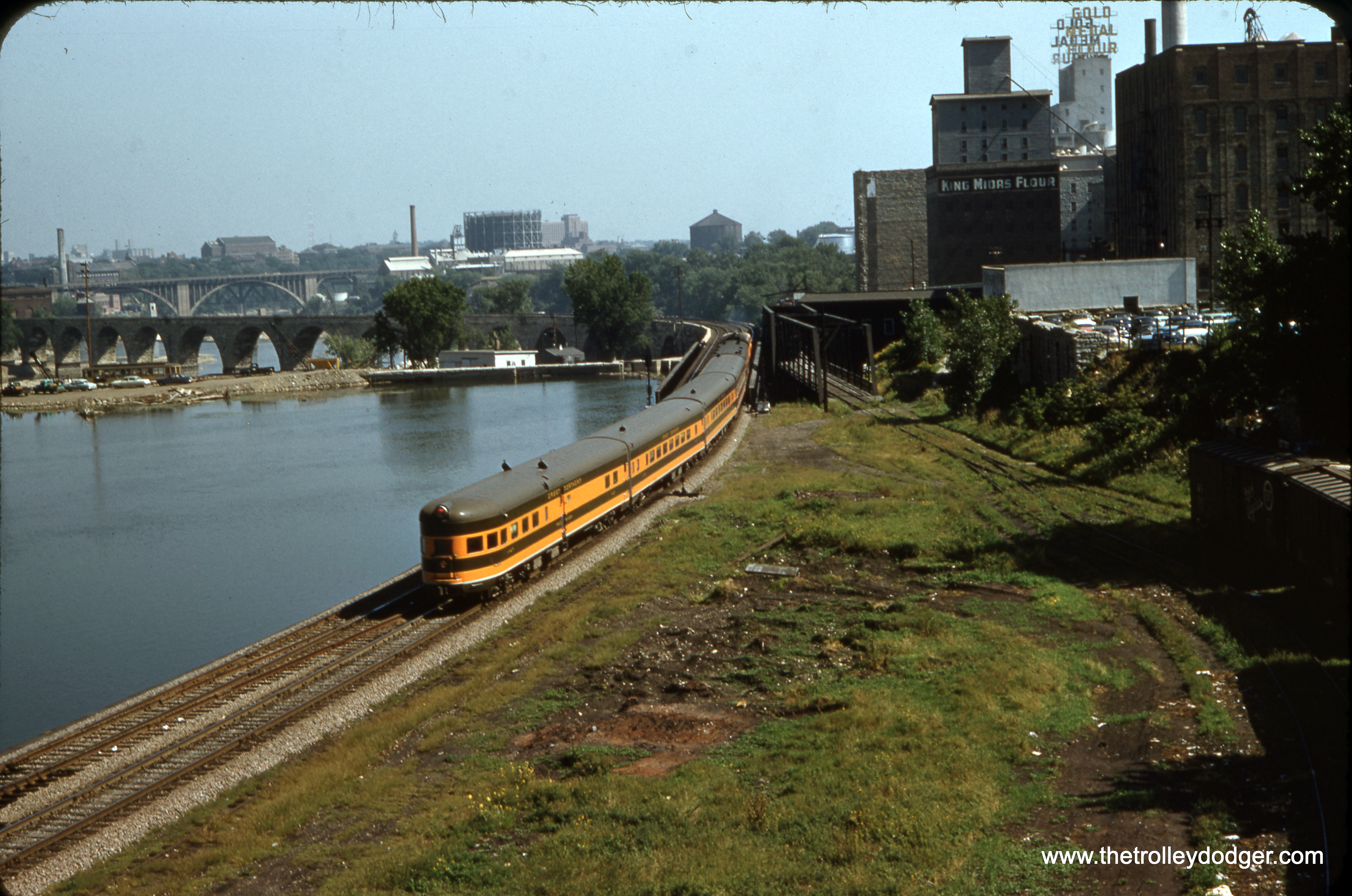
Great Northern Railway Red River 1954 Original 35mm Red Border Kodachrome Slide Subject: GNR 12 Location: Departing Minneapolis station for St. Paul Date: Fall 1954 Photographer: Unknown From the Wikipedia: The Red River was a passenger train operated by Great Northern Railway between Grand Forks, North Dakota, and Saint Paul, Minnesota (operating between 1950 and 1968). History Great Northern Railway's third new train set of 1950 was a new schedule named the Red River. The five-car streamliner built by American Car and Foundry Company began service June 25, 1950, operating a daily round trip 324 miles (521 km) each way between Grand Forks, North Dakota, and Saint Paul, Minnesota. The train went southbound in the morning returning northbound in the evening. The cars for the Red River streamliner were quite different than those built for the International (another 1950 introduction) in that the Red River's cars had extra insulation and the coaches were equipped with Baker Heaters as there was no steam heat available at the Grand Forks depot where the cars stood overnight. The locomotive was sent to the roundhouse each evening for any running repairs and service so the solution was the installation of the Baker Heaters in the cars. Link to eBay Listing

Great Northern Railway Red River 1954 Original 35mm Red Border Kodachrome Slide
Subject: GNR 12
Location: Departing Minneapolis station for St. Paul
Date: Fall 1954
Photographer: Unknown
From the Wikipedia:
The Red River was a passenger train operated by Great Northern Railway between Grand Forks, North Dakota, and Saint Paul, Minnesota (operating between 1950 and 1968).
History
Great Northern Railway’s third new train set of 1950 was a new schedule named the Red River. The five-car streamliner built by American Car and Foundry Company began service June 25, 1950, operating a daily round trip 324 miles (521 km) each way between Grand Forks, North Dakota, and Saint Paul, Minnesota. The train went southbound in the morning returning northbound in the evening.
The cars for the Red River streamliner were quite different than those built for the International (another 1950 introduction) in that the Red River’s cars had extra insulation and the coaches were equipped with Baker Heaters as there was no steam heat available at the Grand Forks depot where the cars stood overnight. The locomotive was sent to the roundhouse each evening for any running repairs and service so the solution was the installation of the Baker Heaters in the cars.
Link to eBay Listing

Amtrak RDC Train 1975 Original 35mm Kodachrome Slide Subject: Amtrak RDCs 30-32-15, Train 372 Blackhawk Location: Crawford (Chicago bound, between Dubuque and Chicago) Date: September 14, 1975 Photographer: James J. Buckley Link to eBay Listing

Amtrak RDC Train 1975 Original 35mm Kodachrome Slide
Subject: Amtrak RDCs 30-32-15, Train 372 Blackhawk
Location: Crawford (Chicago bound, between Dubuque and Chicago)
Date: September 14, 1975
Photographer: James J. Buckley
Link to eBay Listing

Milwaukee and Suburban Transport 1975 Original 35mm Kodachrome Slide Subject: M&ST 1466 Location: Wells-River (posed by the old Milwaukee Electric power plant) Date: June 29, 1975 Photographer: Jeff Wien Link to eBay Listing

Milwaukee and Suburban Transport 1975 Original 35mm Kodachrome Slide
Subject: M&ST 1466
Location: Wells-River (posed by the old Milwaukee Electric power plant)
Date: June 29, 1975
Photographer: Jeff Wien
Link to eBay Listing

Yakima Valley Transit Trolley 1975 Original 35mm Kodachrome Slide Subject: YVT 1776/1976 Location: 44th-Nob Hill, Yakima Date: June 1975 Photographer: Jeff Wien Link to eBay Listing

Yakima Valley Transit Trolley 1975 Original 35mm Kodachrome Slide
Subject: YVT 1776/1976
Location: 44th-Nob Hill, Yakima
Date: June 1975
Photographer: Jeff Wien
Link to eBay Listing

Our Latest Book, Now Available for Pre-Order:

The North Shore Line

Publication Date: February 20, 2023

FYI, my new Arcadia Publishing book The North Shore Line is now finished and has gone to press. My publisher decided to expand it to 160 pages, instead of the usual 128. That’s a 25% increase, without any change to the $23.99 price. I am quite pleased with how this turned out.

From the back cover:

As late as 1963, it was possible to board high-speed electric trains on Chicago’s famous Loop “L” that ran 90 miles north to Milwaukee. This was the Chicago North Shore & Milwaukee Railroad, commonly known as the North Shore Line. It rose from humble origins in the 1890s as a local streetcar line in Waukegan to eventually become America’s fastest interurban under the visionary management of Midwest utilities tycoon Samuel Insull. The North Shore Line, under Insull, became a worthy competitor to the established steam railroads. Hobbled by the Great Depression, the road fought back in 1941 with two streamlined, air-conditioned, articulated trains called Electroliners, which included dining service. It regained its popularity during World War II, when gasoline and tires were rationed, but eventually, it fell victim to highways and the automobile. The North Shore Line had intercity rail, commuter rail, electric freight, city streetcars, and even buses. It has been gone for nearly 60 years, but it will always remain the Road of Service.

Each copy purchased here will be signed by the author, and you will also receive a bonus North Shore Line map.  Books will ship by USPS Media Mail as soon as we receive them, on or before February 20, 2023.

Chapters:
01. Beginnings
02. The Milwaukee Division
03. The Shore Line Route
04. The Skokie Valley Route
05. The Mundelein Branch
06. On the “L”
07. City Streetcars
08. Trolley Freight
09. The Long Goodbye
10. The Legacy

Title The North Shore Line
Images of America
Author David Sadowski
Edition illustrated
Publisher Arcadia Publishing (SC), 2023
ISBN 1467108960, 978-1467108966
Length 160 pages

The price of $23.99 includes shipping within the United States.

For Shipping to US Addresses:

New Compact Disc, Now Available:

CTA-1
The Last Chicago Streetcars 1958
# of Discs – 1
Price: $15.99

Until now, it seemed as though audio recordings of Chicago streetcars were practically non-existent. For whatever reason, the late William A. Steventon does not appear to have made any for his Railroad Record Club, even though he did make other recordings in the Chicago area in 1956.

Now, audio recordings of the last runs of Chicago streetcars have been found, in the collections of the late Jeffrey L. Wien (who was one of the riders on that last car). We do not know who made these recordings, but this must have been done using a portable reel-to-reel machine.

These important recordings will finally fill a gap in transit history. The last Chicago Transit Authority streetcar finished its run in the early hours of June 21, 1958. Now you can experience these events just as Chicagoans did.

As a bonus, we have included Keeping Pace, a 1939 Chicago Surface Lines employee training program. This was digitally transferred from an original 16” transcription disc. These recordings were unheard for 80 years.

Total time – 74:38

Help Support The Trolley Dodger

This is our 295th post, and we are gradually creating a body of work and an online resource for the benefit of all railfans, everywhere. To date, we have received over 941,000 page views, for which we are very grateful.

You can help us continue our original transit research by checking out the fine products in our Online Store.
As we have said before, “If you buy here, we will be here.”

We thank you for your support.

DONATIONS

In order to continue giving you the kinds of historic railroad images that you have come to expect from The Trolley Dodger, we need your help and support. It costs money to maintain this website, and to do the sort of historic research that is our specialty.

Your financial contributions help make this web site better, and are greatly appreciated.


More LVT Photos & Trolley Dodger Mailbag, 12-14-2015

LVT 1006 making a backup move, which these single-ended cars had to do on a regular basis in Allentown. This must be near the end of service in 1951 as evidenced by the premature corrosion on the car (caused by electrolysis between the steel and aluminum plates it was built with).

LVT 1006 making a backup move, which these single-ended cars had to do on a regular basis in Allentown. This must be near the end of service in 1951 as evidenced by the premature corrosion on the car (caused by electrolysis between the steel and aluminum plates it was built with).

Our recent post about the Lehigh Valley Transit’s Liberty Bell Limited interurban (December 7) prompted us to dig around for some additional photos to share with you. In addition, we have some recent selections from the Trolley Dodger mailbag. Keep those cards and letters coming in, folks, either as comments, or to:

thetrolleydodger@gmail.com

-David Sadowski

LVT 1002 on the Philadelphia & Western in 1940. The straight track heading behind us is the original main line that went to Strafford (and gave the Strafford cars their name). It was eventually eclipsed by the extension to Norristown and was abandoned in 1956.

LVT 1002 on the Philadelphia & Western in 1940. The straight track heading behind us is the original main line that went to Strafford (and gave the Strafford cars their name). It was eventually eclipsed by the extension to Norristown and was abandoned in 1956.

In a 1951 snow scene, LVT 702 meets a 1000-series car.

In a 1951 snow scene, LVT 702 meets a 1000-series car.

LVT 702 and 812 on November 12, 1939.

LVT 702 and 812 on November 12, 1939.

An LVT 1000-series lightweight high-speed car on the Philadelphia & Western in the 1940s. According to Jim Graebner, the siding is "a yard track of the Millbourne Mills shop area. The long straight stretch of double track leads to the first station stop at West Overbrook, which is just over the hill out of sight."

An LVT 1000-series lightweight high-speed car on the Philadelphia & Western in the 1940s. According to Jim Graebner, the siding is “a yard track of the Millbourne Mills shop area.
The long straight stretch of double track leads to the first station stop at West Overbrook, which is just over the hill out of sight.”

LVT's Souderton car barn in 1951.

LVT’s Souderton car barn in 1951.

LVT 702 at Rink Siding in Norristown in 1951.

LVT 702 at Rink Siding in Norristown in 1951.

LVT 1020 and 1002 on Washington Street on an April 1, 1951 fantrip.  If you look closely, you will see lots of fans with their cameras on both cars.

LVT 1020 and 1002 on Washington Street on an April 1, 1951 fantrip. If you look closely, you will see lots of fans with their cameras on both cars.

LVT 704 and 1020 taking their last trip on the way to the Bethlehem Steel scrap line, on New Street near 3rd Street in Bethlehem on January 8, 1952, four months after service ended on the Liberty Bell Limited interurban. Some cars had to be towed, but these at least were still able to move on their own.

LVT 704 and 1020 taking their last trip on the way to the Bethlehem Steel scrap line, on New Street near 3rd Street in Bethlehem on January 8, 1952, four months after service ended on the Liberty Bell Limited interurban. Some cars had to be towed, but these at least were still able to move on their own.

Prior to being put into service on the Liberty Bell Limited in September 1941, LVT 1030 made the rounds throughout the system.  Note the sign advertising this new club car.  This may be Easton, usually the territory of the Easton Limited, LVT's other interurban.  Notice the difference in the shape of the rear end (curved) vs. that of the ex-Cincinnati & Lake Erie cars that LVT had (squared off).  That is because 1030 was originally Indiana Railroad car 55, and the IR lightweight high-speeds could be operated in multiple units and hence needed more clearance in back for turns.

Prior to being put into service on the Liberty Bell Limited in September 1941, LVT 1030 made the rounds throughout the system. Note the sign advertising this new club car. This may be Easton, usually the territory of the Easton Limited, LVT’s other interurban. Notice the difference in the shape of the rear end (curved) vs. that of the ex-Cincinnati & Lake Erie cars that LVT had (squared off). That is because 1030 was originally Indiana Railroad car 55, and the IR lightweight high-speeds could be operated in multiple units and hence needed more clearance in back for turns.

Lehigh Valley Transit Co. Liberty Bell Route right-of-way at Acorn Siding one year after abandonment, looking north in 1952.

Lehigh Valley Transit Co. Liberty Bell Route right-of-way at Acorn Siding one year after abandonment, looking north in 1952.

The Lehigh Valley Transit Co. Aineyville Viaduct over the Reading Railroad East Penn Junction in Allentown, PA in 1951.

The Lehigh Valley Transit Co. Aineyville Viaduct over the Reading Railroad East Penn Junction in Allentown, PA in 1951.

LVT built the Eighth Street Bridge in Allentown, which charged tolls. This vintage postcard was mailed in 1919.

LVT built the Eighth Street Bridge in Allentown, which charged tolls. This vintage postcard was mailed in 1919.

An LVT local car (yes, the interurban had locals as well as expresses) in Norristown in 1934, on the ramp up to the Philadelphia & Western terminal.

An LVT local car (yes, the interurban had locals as well as expresses) in Norristown in 1934, on the ramp up to the Philadelphia & Western terminal.

A Liberty Bell Limited saucer.

A Liberty Bell Limited saucer.

The LVT crockware was made in Allentown. According to author Ron Ruddell, these were custom-fired in 1914 for use on car 999.

The LVT crockware was made in Allentown. According to author Ron Ruddell, these were custom-fired in 1914 for use on car 999.

This vintage liberty Bell Limited mustard pot recently sold on eBay for $429.99, although not to me (my finances don't cut the mustard for stuff like this).

This vintage liberty Bell Limited mustard pot recently sold on eBay for $429.99, although not to me (my finances don’t cut the mustard for stuff like this).

Jamestown (NY) Street Railway car 82, built by St. Louis Car Company in 1917, was sold to Lehigh Valley Transit in 1938 as part of their modernization program, where it was renumbered into the 400-series.

Jamestown (NY) Street Railway car 82, built by St. Louis Car Company in 1917, was sold to Lehigh Valley Transit in 1938 as part of their modernization program, where it was renumbered into the 400-series.

A vintage uniform patch.

A vintage uniform patch.

A P&W "Bullet" car side by side with the LVT at the 69th Street Terminal in 1948. The following year, Liberty Bell Limited service would be cut back to Norristown.

A P&W “Bullet” car side by side with the LVT at the 69th Street Terminal in 1948. The following year, Liberty Bell Limited service would be cut back to Norristown.

A rear view of two Lehigh Valley Transit ex-Cincinnati & Lake Erie "Red Devils" shows how their squared-off ends were not designed for multiple-unit operation. By comparison, car 1030, adapted from Indiana Railroad car 55, had a rounded end and was designed for multiple unit operation. Presumably, this is the Fairview car barn in Allentown. Liberty Bell Limited interurban service ended in 1951.

A rear view of two Lehigh Valley Transit ex-Cincinnati & Lake Erie “Red Devils” shows how their squared-off ends were not designed for multiple-unit operation. By comparison, car 1030, adapted from Indiana Railroad car 55, had a rounded end and was designed for multiple unit operation. Presumably, this is the Fairview car barn in Allentown. Liberty Bell Limited interurban service ended in 1951.

The final meet between two Liberty Bell Limited cars (1006 and 702), late in the night on September 6, 1951. The operators are F. Enters and C. Kistler. This was a press photo and appeared in newspapers. (Gerhard Solomon Photo)

The final meet between two Liberty Bell Limited cars (1006 and 702), late in the night on September 6, 1951. The operators are F. Enters and C. Kistler. This was a press photo and appeared in newspapers. (Gerhard Solomon Photo)

Recent Correspondence

Joey Morrow writes:

On this link there are 2 photos that show the northbound (outbound) platform directly north of Elm street east of the (North Shore Line) Winnetka Station which would have been on the modernized section of the Shore Line route. The only thing remaining are the cement blocks that supported the platform structure. The platform is long gone, but the cement supports are still fighting trees and other greenery from taking out the last known platform (that I know of) from America’s fastest interurban era. The strange thing is that this platform was abandoned in 1955.

Obviously it’s either gone (let’s hope not), or it’s so hidden you can’t see it. But it’s pretty clear that those photo’s are not old. I’m pretty sure that one of them is still there, or at least the foundation of the platform.

P.S. Thank you so very much for posting my email on your blog, you totally made my day!

The Shore Line was abandoned in 1955 since it was a lot slower than the Skokie Valley route and presumably had a lot fewer passengers. It also had a lot more direct competition. Of course, their eventual goal was to abandon everything, which did happen in 1963.

Around 1950, the CTA proposed turning over the Evanston/Wilmette service to the North Shore Line, in exchange for having all their trains terminate at Howard. I am sure some people at the CTA regarded the interurban operations on their tracks as an inconvenience that created various operating complications. With the CTA’s attempts to speed up service, at first by using A/B skip-stop service, then later high speed motors, they felt that reasonable times to downtown could still be achieved even if interurban passengers had to change trains at Howard (or Forest Park).

This did not work out so well for the Chicago, Aurora & Elgin in 1953-57 but that was mainly due to the very slow temporary trackage on Van Buren Street (2 1/2 miles). Who knows how things would have worked out if CA&E had survived after the new Congress rapid transit line had opened in June 1958?

Riley O’Connor writes (in reference to our recent post about the Ken Kidder O-scale model of CSL 7001):

Thanks for the reference to the CSL car. It sometimes seems that the best we can do is get “close enough” for colors. And, sometimes an educated guess is closer to reality than the rivet counters want to admit.

I follow a seller on eBay who operates out of Waukesha and he seems to be knowledgeable about the Kidder 0-Scale production. There appear to have been quite a number of these short production run cars in addition to your CSL car. I just haven’t had time to sit down and pick his brain about them. Kidder specialized in this sort of thing, and these cars appear to be at the direction of a buyer or two, with an additional unknown number of “spec” cars. No telling where he got the drawings of the different cars; perhaps Wagner.

From what I’ve seen, Kidder did, among other things, an Electroliner body (four cars, but no floor or mechanism) and a number of interurbans. Also at least one city car in 0-Scale.

By the way, I’ve read your blog on many occasions and I thank you for doing it. It’s very interesting.

One possible source for the 7001 blueprint would be Car Plans of the Chicago Surface Lines (1962), published by the Electric Railway Historical Society as their 38th bulletin. All 49 ERHS bulletins have been reissued by Central Electric Railfans’ Association on a DVD data disc in PDF form, and are available directly from them or their dealers.

I’ve seen Ken Kidder brass Birney cars for sale on eBay, both single and double truck. The double truck Birney would be the same type of car (Johnstown 311) featured on Railroad Record Club LP #23, Pennsylvania Trolleys, available on CD via our Online Store. This car still exists and was the first one acquired by the Rockhill Trolley Museum in Pennsylvania.

birney1

birney2

birney3

Kenneth Gear writes:

I started buying RRC LPs from Mr. Steventon back when I was in high school (Mid-1970s) My uncle had RRC 10 PRR and he loaned it to me and I enjoyed it very much. In spite of the fact that this record was almost fifteen years old, I wanted to find out if the other LPs (I knew there had to be at least nine others) were still available. I wrote a letter to the Railroad Record Club thinking that I’d never get a reply. Could the post office even deliver a letter addressed simply Hawkins, Wisconsin? A few weeks later I got a nice handwritten note from Mr. Steventon (I sure wish I had saved it) explaining that RCA had lost or destroyed his master discs that the LPs were made from. He was in the process of having new masters made using good copies of the 10″ LPs. He would then start selling the remastered records as 12″ discs.

I would end up buying eight LPs over the next couple of years, but for a while my interest faded. By the time I wanted to start buying more, it was all over.

Just one of the reasons I enjoy these records (CDs) so much.

Awhile ago I sent a few Railroad LPs to a company I found online. I spoke to the sound engineer on the phone before I sent any thing to them. He admitted that he had no idea what to do with locomotive sound recordings but he agreed to make simple transfers to CD without attempting any restoration or track dividing. The results were CDs that sounded exactly like playing the LPs. Your work is so much better that there is no comparing them.

So far, I haven’t been able to find anything to indicate that Steventon (1921-1993) had any children. His wife’s name was Mary (née Witt) (1921-2003) and they got married in Washington, D. C. in 1954, when they were in their early 30s.

She outlived him by ten years and it looks like someone else helped clean out their house after she died. His own personal collection of RRC LPs ended up getting sold one-by-one on eBay.

I would like to think that we are continuing to carry out Mr. Steventon’s life mission by making these fine recordings available once again in modern form as compact discs.

Dennis Kern writes:

I wrote you a while back asking if anyone might have photos/plans of interurban stations/depots specifically ones like the ones on Northern Indiana Power. This was the line that ran from Marion, Indiana to Frankfort, Indiana and more specifically like the depot in CERA book bulletin 102, 1958 on pg 55 of Michigantown – Bottom right. The depot in this photo is very like the one we are working on in Russiaville, Indiana. I know you indicated you might ask around however since I have not heard anything more I assume you did not find anything. You will recall we want to restore the Waiting room in the depot. We did find one photo of the Agents office which is attached for you.

!. Can you tell me your opinion of generally what a waiting room would be like. I am thinking a lot of depots had vertical siding about 3 feet up from the floor covering the lower portion of the plaster. This wood was like box car siding I think. Would appreciate any suggestions you might have because if we can not find anything specific we will just make it look like a generic depot interior.

2. Could you look at the photo – Questions; the two men in uniform – one is an agent. The uniforms are different i.e. one has a dark shirt – other has a white shirt also different hats – we have talked about trying to obtain some uniforms like these and putting some “dummies” in the depot agents office. Any idea where we might obtain uniforms like these. Also any idea on the route map on the wall above the desk, Also the telephone. Also would you say what I think is a window – to the left of door in the back – might be a ticket window – what do you think. Also any comments you might have about the other objects in the office.

Thanks for your time in looking at this.

interurban station

Let me ask the readers of my blog and also some of the railroad discussion groups I belong to. I apologize for not following through on your previous request. Chances are some of our readers will offer some excellent ideas.

Thanks.

Andre Kristopans writes:

I have a series of huge sheets from1939 that detail car equipments. Would have to scan in three sections to send, and right now scanner is acting up anyway. However, let me give you some interesting tidbits regarding the Odd 17 (actually 19) cars:

6138-6146, 3090 built 1918

11’8-3/16″ high

6138-6142 Brill 27GE1 trucks, 4’10” wheelbase, 4 GE 226-A 45hp motors weight 46700

6143-6145 MCGMCB A/Brill 27FE1 trucks, 6′ wheelbase, 4 GE 80-A 40hp motors, weight 51600

6146 Brill 39E trucks, 4’10” wheelbase, 2 GE 242-B 65hp motors, weight 40600

3090 Brill 39E-1 trucks, 4’10” wheelbase, 2 GE 242-B 65hp motors, weight 41100

6147-6154, 3091 built 1919

11’9-3/8″ high

6147-6153 Brill 27GE1 trucks, 4’10” wheelbase, 4 GE 226-A 45hp motors, weight 46100

6154 Brill 51-E2 trucks, 4’10” wheelbase, 4 GE 80-A 40hp motors, weight 51150

3091 Brill 39E-1 trucks, 4’10” wheelbase, 2 GE 242-B 65hp motors, weight 41800

27GE1 trucks with 226A motors (12) almost certainly came from 1429-1526 series cars, of which many were sold 1914-1916

MCB 10A trucks (the 6-foot wheelbase ones) with 80A motors would have come from 5001-5200 series, though trucks were apparently rebuilt by Brill as “27FE-1″ as MCB 10A trucks were only 4’10” wheelbase.
There were three cars burned 1916, 5169, 5194,5303.

39Ewith 242-B motors would have come from 5701?

39E1 with 242-B motors on 3090-3091 might have been new purchases as no other cars with 242-B motors were retired by 1918-19

Here is some more info on these 19 cars. Officially, 6138-6142 replaced 2520, 2526, 2584, 2597, 2621, 6147-6150 replaced 2515, 2546, 2565, 2585, 6151 replaced 2777, 6152 replaced 5239, 6153 replaced 5765, and 6154 replaced 2561. However, the reality is a bit different.

2500’s had 4 GE 67 40hp motors and 6′ wheelbase St Louis MCB trucks. Very different from 226-A’s and 27GE-1 trucks.

2777 had again 4 GE 67 40hp motors and Brill 51-E-2 trucks

5239 GE 80A 40hp motors and Brill 27FE trucks

Possibly 2777’s trucks ended up under 6154, with 5239’s motors?

6143-6146 do appear to have the equipments of 5169,5194,5303,5701 which they “replaced”. However, note that 1927 inventory shows 6143-6145 with GE 80 (not 80-A) motors. This might be an error, though.

It would appear that 6138-6142 and 6147-6153 did not have the equipments from the cars they “replaced” at all, but instead had trucks and motors from entirely different cars, the 1409-1505 series Bowling Alleys. One wonders if the 2500’s trucks went with the 1400’s bodies when they were sold off?

In addition 3090-3091 “replaced” 1405 and 1360, Matchboxes. Again, no equipment match. St Louis 47A trucks with GE 80A 40hp motors vs Brill 39E-1 trucks and 242-B motors. In 1927, though, 3090 is shown with GE 80A motors, which were apparently from the Matchbox, but by 1939 has 242-B’s.

Here is an interesting tabulation. One-man conversions over the years.

1994-1999 to convertibles (can be operated one or two man) 1936
2841,2842,2845 to one-man 1926-27
5703-5722 to convertibles 1933
5723-5731 to convertibles 1935
6000-6019 to one-man 1945, back to 2-man 1946
6061-6065 to convertibles 1936
1721-1726,1728-1737,1739-1753,1755-1762,1764-1769,1771-1785, 6155-6158 to one-man 1949-50
3119-3129,3131-3132,3134-3149,3151,3153,3154,3156-3158,3160, 6159-6186 to one-man 1949-50
3161-3169,3171-3175,3177,3178,6187-6196,6198 to one-man 1949-50
3179 to convertible 1935
3200-3201 to convertibles 1936
3202-3231,6199-6218,3232-3261,6219-6238 to one-man 1932
3204-3206,3210-3216,3220,3222-3224,3227,3229,3244,6219-6221,6223-6227,6229,6235 return to 2-man 1948, back again to 1-man 1949
3262-3281,6240-6252 to one-man 1932
3262,3264,3265,3267-3270,3275,3276,3278,3279,6241-6252 return to 2-man 1948, back again to 1-man 1949
3282-3301,6253-6265 to one-man 1932
6253,6255,6257,6258,6261,6264,6265 return to 2-man 1948, back again to 1-man 1949
3302-3321,6266-6279 to one-man 1932
3319,3321 return to 2-man 1948, back again to 1-man 1949
3325,3347-3349,3351,3352,3354,3355,3357,3360,3361-3363,3368,3372,3378,3379,6303,6305,6310,6319 to one-man 1952, never operated as such
4002-4051,7002-7034 to one-man 1952
4052-4061 to one-man 1952, 4059-4061 back to 2-man 1954, then all 4052-4061 to convertibles 1955
7035-7044 to one-man 1952, back to 2-man 1954, to convertibles 1955
7049,7052,7053,7057,7058,7060,7062,7064,7066,7067,7070-7074 to one-man 1952, but back to 2-man same year
7235-7249,7251,7253-7259 to convertibles 1955

Thanks!!

Ron Ruddell writes:

The China shown on your blog embossed with the Liberty Bell was not used in any depot restaurant. It was custom-fired in 1914 for Liberty Bell Car 999. Please see my book “Riding on the Bell” – page 78 for further information. I have a pickle dish of the same pattern.

Thanks for the correction.

Nice to hear from you again. Congratulations on the successful completion of your excellent and very definitive work on the Liberty Bell interurban.


In the News

Upcoming Exhibition at Grohmann Museum in Milwaukee

Jan. 22 – April 24, 2016
Art of the North Shore Line

With its rapid expansion in the 1920s, the Chicago North Shore and Milwaukee Railroad set the standard for electric interurban transit in America; no railway could compare to the North Shore Line. The North Shore Line also established itself as a leader in marketing with a highly successful print ad and poster campaign featuring the work of designers Willard Frederic Elmes, Oscar Rabe Hanson and Ervine Metzl, among others. Assembled from the collection of the Milwaukee Public Library and a number of private collections, this exhibition features many of these memorable posters along with photographs, prints and ephemera from the height of the North Shore Line’s success. Curated by photographer John Gruber and J.J. Sedelmaier, world-renowned artist, designer and animator of Saturday Night Live’s TV Funhouse.

Gallery Night and Day
Friday, Jan. 22, 5 to 9 p.m. – Free admission
(Presentation by John Gruber and J.J. Sedelmaier, guest curators, at 7 p.m.)
Saturday, Jan. 23, Noon to 6 p.m. – Free admission

Grohmann Museum
1000 N. Broadway
Milwaukee, WI 53202
(414) 277-2300
grohmannmuseum@msoe.edu


Help Support The Trolley Dodger

This is our 104th post, and we are gradually creating a body of work and an online resource for the benefit of all railfans, everywhere. To date, we have received 101,000 page views from over 29,000 individuals.

You can help us continue our original transit research by checking out the fine products in our Online Store. You can make a donation there as well.

As we have said before, “If you buy here, we will be here.”

We thank you for your support.


Ringing “The Bell”

LVT interurbans 1006 and 702 at Perkasie on February 11, 1951. 702 was in fantrip service.

LVT interurbans 1006 and 702 at Perkasie on February 11, 1951. 702 was in fantrip service.

Lehigh Valley Transit

Today, we review a new book about the Liberty Bell Limited, a classic Pennsylvania interurban line that carried passengers between Philadelphia and Allentown until abandonment in the early hours of September 7, 1951. President George H. W. Bush once mistakenly referred to September 7th as Pearl Harbor Day, but to Keystone Traction enthusiasts, it will always be a day that will live in infamy.

Along with our book review, we offer a generous selection of classic Lehigh Valley Transit photos from our own collections– mostly from the Liberty Bell route, but with a few from the Easton Limited, LVT’s “other” interurban, and even a city car to boot.

P1060347

Riding the Bell: Lehigh Valley Transit’s Liberty Bell Route by Ron Ruddell
Bulletin 147 of Central Electric Railfans’ Association

There have been many books written about the famed Liberty Bell Limited over the years, including some excellent ones, but Riding the Bell, available now from Central Electric Railfans’ Association* and their dealers, is sure to stand the test of the time as the best and most comprehensive of the lot.

This is not the first time that the “Bell Route” has been covered in a CERA publication, of course. A roster appeared during World War II, and a 1000-series lightweight graced the cover of Trolley Sparks, the organization’s newsletter, when the line was still running.

The late author Ronald DeGraw included much information about LVT in his excellent book Pig & Whistle: The Story of the Philadelphia & Western Railway, published by CERA in 2007 as their 140th bulletin. However, that coverage only pertained to LVT’s use of the P&W line to Norristown, which became the Bell’s main route to Philadelphia in the early 1900s.

Author Ron Ruddell headed up a group of Pennsylvania traction historians, who labored for ten years to create a book equal to their subject. I am glad to say they have succeeded in spades. A tremendous amount of information has been put into Riding the Bell‘s 224 pages, and it would be hard to put anything else into it without needing to take out something just as important.

The 1950s were the twilight years of Keystone Traction, at least outside of Pittsburgh and Philadelphia. The LVT Liberty Bell Limited was, in some ways, the last great interurban in the eastern United States. It has been gone for 64 years now, meaning you would have to be a few years older than that to have ridden it, even as a youth.

Many Chicago-area railfans made a pilgrimage to ride it, but not all were so lucky. Ray DeGroote, still going strong at 85, did not get there until a few weeks after the interurban quit in 1951. He was able to ride and document the still-extensive LVT city streetcar system, and he saw the interurban cars in dead storage, but could not ride them. It was “one that got away.”

The Bell line is fondly remembered and riding it must have been, in some ways, like riding the world’s largest roller coaster. The area between Allentown and Philadelphia is not flat, with grades that certainly put a strain on LVT’s traction motors. It also included quite a lot of variety, with burst of high speeds, followed by numerous stops in many small towns. Several of the station buildings in these towns still exist.

Luckily for us, Lehigh Valley Transit must be about the most well-documented operation ever, perhaps even more so than the Pacific Electric or the three great Chicago-area interurbans. When it comes to photographs, there is literally an embarrassment of riches, and as a result, the book is full of fine photos, some in color. An attempt has been made not to duplicate ones that were already featured in previous LVT books.

As a subject, LVT operations covered so much ground that this book does not even attempt to document their extensive city lines or the Easton Limited, LVT’s shorter interurban. Those are wisely left to future authors and future books.

Faced with a need to either modernize or abandon rail service in 1938, LVT took the daring step of updating the Liberty Bell fleet. This task was made even more daunting due to a very constrained budget, which meant buying new PCCs or other such equipment was out of the question.

Fortunately, some relatively new (circa 1930) lightweight high-speed interurban cars were available at a relatively low cost, as the Cincinnati & Lake Erie had just been abandoned. 13 cars were purchased for the Bell, along with four Cincinnati curved-side cars for the Easton Limited, and LVT attractively modernized them.

The new cars were a hit with the public, and ridership increased. The facelift was never intended to be permanent, but was hoped to buy the interurban another five years of usefulness before the inevitable switch to bus. It ended up lasting for 12, a testament to the build quality and durability of these cars.

There were many unfortunate problems along the way. The ex-C&LE lightweights could not be coupled together. More passengers meant running additional trains in second and third sections. Inevitably, this led to a horrific accident in 1942, which was not the only such collision.

After one of the C&LE cars was destroyed in a fire, LVT purchased one additional lightweight car, which had been built for the Indiana Railroad. This was rebuilt into club car 1030, which became the standout of the fleet and one of the few Liberty Bell cars that has been preserved.

Wartime rationing of gasoline and tires also increased ridership. The wear and tear of all that hill climbing really did a number on those traction motors. Schedules had to be adjusted in the interest of safety, and running times between Allentown and Philadelphia increased.

What really would have helped LVT would have been some more of those ex-Indiana Railroad cars, which were very similar to the C&LE “Red Devils” but could be coupled together in as many as three cars at a time. More than two dozen of these cars were available circa 1940-41 but ended up being unsold and were scrapped just prior to the outbreak of World War II. They would have been quite useful to LVT.

Only two such Indiana Railroad lightweights were saved– car 55, which became LVT 1030, and car 65, which was sold to CRANDIC (Cedar Rapids and Iowa City) and eventually made its way to the Illinois Railway Museum, its first acquisition. Oddly enough, they were made by two different builders.

The end of the war in 1945 meant a steep drop-off in interurban ridership. By then, the handwriting was really on the wall for the Bell line, but the end did not come for another few years yet.

There was a piecemeal abandonment. For a variety of reasons, well covered in this book and in Pig & Whistle, service was cut back to Norristown. The Liberty Bell Limited never had a direct route to center city Philadelphia throughout its history.

Consideration was given to cutting service back to Lansdale, where the Bell could connect to Reading (now SEPTA) suburban commuter trains to Philadelphia, but this would have necessitated building a turnaround loop for the single-end cars. Since the Bell’s days were numbered anyway, LVT decided to simply let service continue as far as Norristown and the P&W.

By 1951, LVT had really let maintenance slide, to the point where, in September, only a few of the lightweight interurban cars were still operable. As soon as they could get approval for abandonment, the end was swift. Fortunately, the fans caught wind of it and the railroad allowed them to ride one last time. The rails began to come up the very next morning.

In some ways, this abandonment has some parallels in what happened a few years later to the Chicago, Aurora & Elgin. They decided not to continue running trains to Chicago’s downtown over the CTA Garfield Park “L” temporary trackage in 1953, due to expressway construction. In CA&E’s case, however, they kept up the equipment right to the end, as did the Chicago, North Shore & Milwaukee, which quit in 1963.

When CA&E got a local judge to allow their “temporary” abandonment of passenger service on July 3, 1957, they ceased operations immediately, stranding thousands of riders who had to scramble for a way home.

In LVT’s case, they offered a replacement bus service. Unfortunately, while the interurban could run in a straight line between towns, the bus had to follow a more convoluted path at right angles. As more and more highways were built in Pennsylvania, even the bus ridership evaporated, and the interurban bus quit without any fanfare in 1956.

While electric rail transit is undergoing a renaissance in many places around the world today, the chance that anything like a Liberty Bell service might return to the Lehigh Valley is very slim indeed. The cost would simply be too great, compared to the number of potential passengers.

But until it does, the spirit of this historic interurban is conjured up very well  in this great new volume by Ron Ruddell. Hats off to him, and to the team that worked so long and hard to make this book possible. I would also like to single out John Nicholson, who acted as project coordinator for CERA in bringing this very worthy book over the finish line. Publishing any book like this is a very complicated effort.

The layout, by the veteran team of Jack and Ad Sowchin, is handsome and attractive. CERA merits a lot of credit as well for publishing this wonderful addition to the historical record.

Even if you do not live in Pennsylvania, the book may interest you. The Bell was one of the classic interurbans and, in one way or another, it had many connections to the Midwest.

It is highly recommended, and I urge you to purchase a copy if you have not done so already. Only limited quantities of such books are made, and once they run out, the prospect of them being reprinted is unlikely for a variety of reasons.

Many previous CERA books have become collector’s items and cost more to buy used than they did when new. I will not be surprised when this book sells out and if you don’t purchase your copy today, you may have difficulty picking one up in the future.

In addition to this book, there are also some excellent Liberty Bell videos on the market, and those will really give you an idea of what the line was all about, after you have whetted your appetite by feasting on Riding the Bell.

-David Sadowski

PS- You can also experience some of the twilight of Keystone Traction via one of our recently released audio CDs, featuring 1950s-era Hi-Fi recordings of Johnstown Traction, Altoona & Logan Valley, and Scranton Transit, available from our Online Store.  Just look for the Railroad Record Club disc with LPs 23 and 30 on it.

*Trolley Dodger Press is not affiliated with Central Electric Railfans’ Association.


Help Support The Trolley Dodger

This is our 102nd post, and we are gradually creating a body of work and an online resource for the benefit of all railfans, everywhere. To date, we have received 99,000 page views from over 28,500 individuals.

You can help us continue our original transit research by checking out the fine products in our Online Store. You can make a donation there as well.

As we have said before, “If you buy here, we will be here.”

We thank you for your support.


LVT 812 at 69th Street terminal in Upper Darby on August 12, 1934. Most people refer to this as Philadelphia, but it is just outside the city limits. Don's Rail Photos says, "812 was built by St Louis Car in 1901 as 159. It was rebuilt as 999 in 1914 and rebuilt as 812 in 1921. It was scrapped in November 1951."

LVT 812 at 69th Street terminal in Upper Darby on August 12, 1934. Most people refer to this as Philadelphia, but it is just outside the city limits. Don’s Rail Photos says, “812 was built by St Louis Car in 1901 as 159. It was rebuilt as 999 in 1914 and rebuilt as 812 in 1921. It was scrapped in November 1951.”

LVT 808 in Allentown on April 22, 1934. Don's Rail Photos: "808 was built by Jewett Car in 1913. It was rebuilt as C15 in 1935." The C-series cars were used for interurban freight.

LVT 808 in Allentown on April 22, 1934. Don’s Rail Photos: “808 was built by Jewett Car in 1913. It was rebuilt as C15 in 1935.” The C-series cars were used for interurban freight.

LVT 805 at 69th Street terminal in Upper Darby. This car was built by Jewett circa 1912-13. Apparently this car has been preserved and is privately owned but not operable.

LVT 805 at 69th Street terminal in Upper Darby. This car was built by Jewett circa 1912-13. Apparently this car has been preserved and is privately owned but not operable.

LVT 812 in the Easton town circle on June 30, 1947, making a rare appearance on LVT's "other" interurban, the Easton Limited by way of a fantrip. (James Maloney, Jr. Photo)

LVT 812 in the Easton town circle on June 30, 1947, making a rare appearance on LVT’s “other” interurban, the Easton Limited by way of a fantrip. (James Maloney, Jr. Photo)

LVT 812 on Broad Street in Bethlehem on June 30, 1947. The occasion was a fantrip. Many fans considered it a real shame that the 812 was not saved. Other than the 1030, it was the "jewel of the fleet." (James Maloney, Jr. Photo)

LVT 812 on Broad Street in Bethlehem on June 30, 1947. The occasion was a fantrip. Many fans considered it a real shame that the 812 was not saved. Other than the 1030, it was the “jewel of the fleet.” (James Maloney, Jr. Photo)

LVT 1007 at Perkasie on November 12, 1939.

LVT 1007 at Perkasie on November 12, 1939.

LVT 1020 at 69th Street terminal in 1939, shortly after being modernized. Don's Rail Photos: "1020 was built by Cincinnati Car in April 1930, #3055, as C&LE 113. It was renumbered 413 in 1932 and sold to LVT as 1020 in 1938. It was scrapped in 1951."

LVT 1020 at 69th Street terminal in 1939, shortly after being modernized. Don’s Rail Photos: “1020 was built by Cincinnati Car in April 1930, #3055, as C&LE 113. It was renumbered 413 in 1932 and sold to LVT as 1020 in 1938. It was scrapped in 1951.”

Another view of 1020 taken at the same time as the previous photo. Jim Boylan adds, "Location is the wye where the Victory Ave. bus garage is now, across the tracks from the P&W's 72nd St. Shops."

Another view of 1020 taken at the same time as the previous photo. Jim Boylan adds, “Location is the wye where the Victory Ave. bus garage is now, across the tracks from the P&W’s 72nd St. Shops.”

LVT 702, 704, and 710 are southbound on a fantrip at West Point on April 15, 1951. This was the first and only time a matched set of three 700-series cars were operated as a multiple unit. Shortly after this, the 710, looking pretty shabby here, was scrapped.

LVT 702, 704, and 710 are southbound on a fantrip at West Point on April 15, 1951. This was the first and only time a matched set of three 700-series cars were operated as a multiple unit. Shortly after this, the 710, looking pretty shabby here, was scrapped.

LVT 702 at Locust Siding on February 11, 1951.

LVT 702 at Locust Siding on February 11, 1951.

LVT 1009 at Hatfield on May 9,1951. (William D. Slade Photo)

LVT 1009 at Hatfield on May 9,1951. (William D. Slade Photo)

From this scene, it would appear that a Liberty Bell Limited lightweight is backing up to the LVT downtown terminal in Allentown. Meanwhile, LVT city streetcar 900 passes by. Don's Rail Photos says, "900 was built by Brill Car Co in February 1917, (order) #20206. It was (later) rebuilt." Looks like an LVT employee is crossing the street. Jim Layland writes: "The scene is actually at New and Broad Streets in Bethlehem. The lightweight would have been on a fan trip as they did not run to Bethlehem in normal service. The length of track on which the lightweight is parked is a short remnant of the rural route between Bethlehem and Nazareth that was abandoned February 1932."

From this scene, it would appear that a Liberty Bell Limited lightweight is backing up to the LVT downtown terminal in Allentown. Meanwhile, LVT city streetcar 900 passes by. Don’s Rail Photos says, “900 was built by Brill Car Co in February 1917, (order) #20206. It was (later) rebuilt.” Looks like an LVT employee is crossing the street. Jim Layland writes: “The scene is actually at New and Broad Streets in Bethlehem. The lightweight would have been on a fan trip as they did not run to Bethlehem in normal service. The length of track on which the lightweight is parked is a short remnant of the rural route between Bethlehem and Nazareth that was abandoned February 1932.”

An LVT 1100-series lightweight interurban, still looking shiny, in the Easton town square circa 1939. These Cincinnati curved-side cars were built in 1929 for the Dayton & Troy. They were repossessed in 1932 and remained at the Cincinnati Car Company plant until sold to LVT in 1938. After the Easton Limited was bussed in 1949, two of the four cars were sold to Speedrail in Milwaukee, where one operated briefly as car 66. Unfortunately all four cars were scrapped.

An LVT 1100-series lightweight interurban, still looking shiny, in the Easton town square circa 1939. These Cincinnati curved-side cars were built in 1929 for the Dayton & Troy. They were repossessed in 1932 and remained at the Cincinnati Car Company plant until sold to LVT in 1938. After the Easton Limited was bussed in 1949, two of the four cars were sold to Speedrail in Milwaukee, where one operated briefly as car 66. Unfortunately all four cars were scrapped.

LVT 812 heading towards Allentown on the Liberty Bell Limited.

LVT 812 heading towards Allentown on the Liberty Bell Limited.

An LVT 1000-series car delivers newspapers (probably dailies from Philadelphia) in Allentown.

An LVT 1000-series car delivers newspapers (probably dailies from Philadelphia) in Allentown.

LVT 1030, the so-called "Golden Calf" of the fleet, on a National Railway Historical Society fantrip on September 28, 1941. This club car was just being introduced into regular service at this time, and had been extensively rebuilt from Indiana Railroad car 55. Don's Rail Photos: "1030 was built by American Car & Foundry in 1931, #1203, as Indiana RR 55. It was rebuilt in 1934 (as a club car) and rebuilt as C&LE 1030 in 1941. It was acquired by Seashore Trolley Museum in 1951."

LVT 1030, the so-called “Golden Calf” of the fleet, on a National Railway Historical Society fantrip on September 28, 1941. This club car was just being introduced into regular service at this time, and had been extensively rebuilt from Indiana Railroad car 55. Don’s Rail Photos: “1030 was built by American Car & Foundry in 1931, #1203, as Indiana RR 55. It was rebuilt in 1934 (as a club car) and rebuilt as C&LE 1030 in 1941. It was acquired by Seashore Trolley Museum in 1951.”

LVT 1103 on the Easton Limited interurban. From the looks of the cars, this picture probably dates to around 1939. (Larry Gaillard Photo)

LVT 1103 on the Easton Limited interurban. From the looks of the cars, this picture probably dates to around 1939. (Larry Gaillard Photo)

LVT 1007 making a fantrip photo stop on the Liberty Bell Limited. A fan with a box camera is jumping off.

LVT 1007 making a fantrip photo stop on the Liberty Bell Limited. A fan with a box camera is jumping off.

CRANDIC 111, shown here on June 10, 1953, was another ex-Cinicinnati & Lake Erie lightweight interurban car. While all the ones that went to LVT were scrapped, some of the ones that went to CRANDIC were saved. Don's Rail Photos:"111 was built by Cincinnati Car in 1930, #3055, as C&LE 111. It was sold to Crandic in 1939 and kept the same number. In 1954 it was sold to an individual and stored at Emporia, KS, until 1973. It was then donated to the Bay Area Electric Railway Association at Rio Vista, CA. It has been restored as Crandic 111."

CRANDIC 111, shown here on June 10, 1953, was another ex-Cinicinnati & Lake Erie lightweight interurban car. While all the ones that went to LVT were scrapped, some of the ones that went to CRANDIC were saved. Don’s Rail Photos:”111 was built by Cincinnati Car in 1930, #3055, as C&LE 111. It was sold to Crandic in 1939 and kept the same number. In 1954 it was sold to an individual and stored at Emporia, KS, until 1973. It was then donated to the Bay Area Electric Railway Association at Rio Vista, CA. It has been restored as Crandic 111.”

One other Indiana Railroad high-speed car had a second life, in addition to 55. Car 65 became Cedar Rapids and Iowa City 120, shown here on June 10, 1953. From Don's Rail Photos: "120 was built by Pullman in 1931, #6399, as Indiana Railroad 65. It was sold to the Crandic as 120 in 1941. In 1954 it was purchased as the first car of the Illinois Electric Railway Museum and restored as IRR 65." The last official run of a CRANDIC passenger train occurred on May 30, 1953.

One other Indiana Railroad high-speed car had a second life, in addition to 55. Car 65 became Cedar Rapids and Iowa City 120, shown here on June 10, 1953. From Don’s Rail Photos: “120 was built by Pullman in 1931, #6399, as Indiana Railroad 65. It was sold to the Crandic as 120 in 1941. In 1954 it was purchased as the first car of the Illinois Electric Railway Museum and restored as IRR 65.” The last official run of a CRANDIC passenger train occurred on May 30, 1953.

LVT 1001, 701, 1008 and 702 at Fairview car barn in Allentown on January 6, 1952, shortly before being scrapped.

LVT 1001, 701, 1008 and 702 at Fairview car barn in Allentown on January 6, 1952, shortly before being scrapped.

LVT 1006 in the scrap line at Bethlehem Steel on January 23, 1952.

LVT 1006 in the scrap line at Bethlehem Steel on January 23, 1952.

LVT 1030 loaded on a flat car at Riverside Yard on January 30, 1952, headed to Boston, and, eventually, the Seashore Trolley Museum in Maine, where it remains today in operable condition.

LVT 1030 loaded on a flat car at Riverside Yard on January 30, 1952, headed to Boston, and, eventually, the Seashore Trolley Museum in Maine, where it remains today in operable condition.

Machine-generated Liberty Bell Limited tickets.

Machine-generated Liberty Bell Limited tickets.

Lehigh Valley Transit's Liberty Bell Limited lightweight high-speed car 1001 (ex-Cincinnati & Lake Erie 128) at the 69th Street Terminal on the Philadelphia & Western, September 21, 1949. Soon after this picture was taken, LVT passenger service was cut back to Norristown.

Lehigh Valley Transit’s Liberty Bell Limited lightweight high-speed car 1001 (ex-Cincinnati & Lake Erie 128) at the 69th Street Terminal on the Philadelphia & Western, September 21, 1949. Soon after this picture was taken, LVT passenger service was cut back to Norristown.