Welcome 2023

An early (turn of the century) view of passengers boarding an Illinois Central Suburban train before the line was converted from steam to electric in 1926. I am not certain of the location, but it may be in Hyde Park.

An early (turn of the century) view of passengers boarding an Illinois Central Suburban train before the line was converted from steam to electric in 1926. I am not certain of the location, but it may be in Hyde Park.

Today, we are ringing in 2023 with a bevy of classic traction images from many far-flung places for your enjoyment.

Later this month, the Trolley Dodger blog will begin its ninth year. This year, we expect to make our 300th post, and will reach one million page views. When we began this journey, these things hardly seemed possible, but here we are, in large part thanks to you, our readers.

January is traditionally the month when we ask our readers for donations to keep this site going. If you enjoy what you see here, we hope you will consider making a contribution via the link at the end of this post. The expenses we incur, in order to bring you the finest and most interesting traction pictures, are considerable and ongoing. Our research costs a lot, but you see the results here and in our four Arcadia Publishing books, which we hope make a modest contribution to society. If you have contributed to our efforts, we are most appreciative, and if you have not, we hope you will consider it.

We are pleased to report that our latest book The North Shore Line is now 100% complete and has gone to press. The publication date is February 20, 2023, and we are now taking pre-orders. You will find more information about that at the end of this post (and our Online Store).  To date, we have received orders for 102 copies.

Keep those cards and letters coming in, folks.

-David Sadowski

PS- You might also like our Trolley Dodger Facebook auxiliary, a private group that now has 1,040 members.

Our friend Kenneth Gear now has a Facebook group for the Railroad Record Club. If you enjoy listening to audio recordings of classic railroad trains, whether steam, electric, or diesel, you might consider joining.

FYI, the Hoosier Traction Facebook Group celebrates electric transit in Indiana and the Midwest. It also supports the activities of the annual Hoosier Traction Meet in Dayton, OH (although not affiliated with the North American Transit Historical Society, which organizes that event).

Indiana Railroad lightweight high-speed car 71 is at the Indianapolis Terminal on August 11, 1940.

Indiana Railroad lightweight high-speed car 71 is at the Indianapolis Terminal on August 11, 1940.

Indiana Railroad high-speed car 58 (described as a "parlor car") is at the Indianapolis Terminal yards on August 11, 1940.

Indiana Railroad high-speed car 58 (described as a “parlor car”) is at the Indianapolis Terminal yards on August 11, 1940.

Philadelphia streetcar 8026 is at Church Road in Glenside, PA on February 22, 1941, operating on Route 6.

Philadelphia streetcar 8026 is at Church Road in Glenside, PA on February 22, 1941, operating on Route 6.

CTA/CSL 7001 and 4001 at South Shops, circa 1958. This was scanned from a red border Kodachrome slide, and by early 1958, those mounts were replaced by more modern ones. In the last days of Chicago streetcars, there were some PCCs in dead storage due to accidents or mechanical issues. The red car at right is a trailer in the 8000-series. The body of 4001 is now at the Illinois Railway Museum, but 7001 was scrapped in 1959.

CTA/CSL 7001 and 4001 at South Shops, circa 1958. This was scanned from a red border Kodachrome slide, and by early 1958, those mounts were replaced by more modern ones. In the last days of Chicago streetcars, there were some PCCs in dead storage due to accidents or mechanical issues. The red car at right is a trailer in the 8000-series. The body of 4001 is now at the Illinois Railway Museum, but 7001 was scrapped in 1959.

North shore Line 721 is at the back end of a Central Electric Railfans' Association fantrip that is making a photo stop at the Zion station.

North shore Line 721 is at the back end of a Central Electric Railfans’ Association fantrip that is making a photo stop at the Zion station.

North Shore Line freight loco 451. Don's Rail Photos notes, "451 was built in 1907 by Alco, #44387, and General Electric, #2697. It was retired in February 1948 and sold for scrap in March 1949."

North Shore Line freight loco 451. Don’s Rail Photos notes, “451 was built in 1907 by Alco, #44387, and General Electric, #2697. It was retired in February 1948 and sold for scrap in March 1949.”

Ravinia Park was built by the Chicago and Milwaukee Electric, predecessor of the North Shore Line. Here is a view of the original music pavilion.

Ravinia Park was built by the Chicago and Milwaukee Electric, predecessor of the North Shore Line. Here is a view of the original music pavilion.

There was once an A branch on the MBTA Green Line in Boston-- the Watertown line, which shared some trackage with the B branch to Boston College. PCC streetcars were replaced by buses on June 20, 1969, and this photo by Robert A. Newbegin was taken that same month. Various reasons have been cited for the change, including an equipment shortage. But this view in the Newton Corner neighborhood shows another issue-- the inbound PCC, shown crossing over a highway, is going against the flow of one way traffic. Still, this trackage remained in place until 1994, for non-revenue streetcar access to Watertown Yard.

There was once an A branch on the MBTA Green Line in Boston– the Watertown line, which shared some trackage with the B branch to Boston College. PCC streetcars were replaced by buses on June 20, 1969, and this photo by Robert A. Newbegin was taken that same month. Various reasons have been cited for the change, including an equipment shortage. But this view in the Newton Corner neighborhood shows another issue– the inbound PCC, shown crossing over a highway, is going against the flow of one way traffic. Still, this trackage remained in place until 1994, for non-revenue streetcar access to Watertown Yard.

Kansas City Public Service PCC 535 on the Dodson line. The type of slide mount for this red border Kodachrome dates it to circa 1955-57. Car 535 was built by the St. Louis Car Company in 1947, and Kansas City abandoned streetcars in 1957. They have since opened modern streetcar lines.

Kansas City Public Service PCC 535 on the Dodson line. The type of slide mount for this red border Kodachrome dates it to circa 1955-57. Car 535 was built by the St. Louis Car Company in 1947, and Kansas City abandoned streetcars in 1957. They have since opened modern streetcar lines.

Illinois Terminal car 415 at the Illinois Electric Railway Museum in North Chicago on February 21, 1960.

Illinois Terminal car 415 at the Illinois Electric Railway Museum in North Chicago on February 21, 1960.

The view looking west along Van Bure Street under the Loop "L" on July 24, 1957. The "L" went further west from here until 1955, when a new connection was built through the old Wells Street Terminal a short distance north of here. The Insurance Exchange building is at right.

The view looking west along Van Bure Street under the Loop “L” on July 24, 1957. The “L” went further west from here until 1955, when a new connection was built through the old Wells Street Terminal a short distance north of here. The Insurance Exchange building is at right.

Philadelphia Suburban Transportation Company (aka Red Arrow) car 63 has turned north at Llanerch Junction on May 30, 1964.  It was most likely operating on the Ardmore line, which was converted to bus on December 30, 1966.  Kenneth Achtert adds, "PSTC #63 is indeed on the Ardmore Division (having just turned off of West Chester Pike) probably on a fantrip, as May 30, 1964, was a Saturday (and Memorial Day weekend)."

Philadelphia Suburban Transportation Company (aka Red Arrow) car 63 has turned north at Llanerch Junction on May 30, 1964. It was most likely operating on the Ardmore line, which was converted to bus on December 30, 1966. Kenneth Achtert adds, “PSTC #63 is indeed on the Ardmore Division (having just turned off of West Chester Pike) probably on a fantrip, as May 30, 1964, was a Saturday (and Memorial Day weekend).”

SEPTA (Red Arrow) double-ended car 19 at the 69th Street Terminal storage yard on August 9, 1971. It was built by the St. Louis Car Company in 1949, and although it looks like a PCC car, it is not considered one, as it has standard motor components.

SEPTA (Red Arrow) double-ended car 19 at the 69th Street Terminal storage yard on August 9, 1971. It was built by the St. Louis Car Company in 1949, and although it looks like a PCC car, it is not considered one, as it has standard motor components.

A North Shore Line Electroliner heads southbound at North Chicago Junction on January 12, 1963, just over a week prior to abandonment.

A North Shore Line Electroliner heads southbound at North Chicago Junction on January 12, 1963, just over a week prior to abandonment.

Chicago Aurora and Elgin freight loco 2002 at Wheaton on August 6, 1939. Scanned from the original negative. (LaMar M. Kelley Photo)

Chicago Aurora and Elgin freight loco 2002 at Wheaton on August 6, 1939. Scanned from the original negative. (LaMar M. Kelley Photo)

Chicago Aurora and Elgin car 130 (ex-North shore Line) on April 13, 1943. (Malcolm D. McCarter Photo)

Chicago Aurora and Elgin car 130 (ex-North shore Line) on April 13, 1943. (Malcolm D. McCarter Photo)

Chicago Aurora and Elgin 600 (ex-Washington, Baltimore & Annapolis) and line car 5, on a Central Electric Railfans' Association fantrip.

Chicago Aurora and Elgin 600 (ex-Washington, Baltimore & Annapolis) and line car 5, on a Central Electric Railfans’ Association fantrip.

This time card for the Batavia branch of the Aurora, Eglin and Chicago (predecessor of the CA&E) dates to 1905, when the interurban began running trains to downtown Chicago over the Metropolitan West side "L".

This time card for the Batavia branch of the Aurora, Eglin and Chicago (predecessor of the CA&E) dates to 1905, when the interurban began running trains to downtown Chicago over the Metropolitan West side “L”.

Chicago Aurora and Elgin steel cars 412 and 416 are at the DesPlaines Avenue Terminal in Forest Park on July 23, 1955. After CA&E cut back service to here in 1953, riders could make a cross-platform change to ride the CTA Garfield Park "L" downtown, after paying another fare.

Chicago Aurora and Elgin steel cars 412 and 416 are at the DesPlaines Avenue Terminal in Forest Park on July 23, 1955. After CA&E cut back service to here in 1953, riders could make a cross-platform change to ride the CTA Garfield Park “L” downtown, after paying another fare.

Chicago Aurora and Elgin 416 at the DesPlaines Avenue Terminal in Forest Park on July 23, 1955. This is the view from the opposite direction as the last photo. There were two sets of platforms. The CA&E dropped off passengers at one platform, then traveled a short distance to pick others up at the other platform. CTA trains looped via a wooden trestle that went over the CA&E just west of here. This arrangement continued until the CA&E abruptly abandoned passenger service in the middle of the day on July 3, 1957. The CTA reconfigured the terminal and yard area in 1959, in conjunction with construction of the nearby expressway.

Chicago Aurora and Elgin 416 at the DesPlaines Avenue Terminal in Forest Park on July 23, 1955. This is the view from the opposite direction as the last photo. There were two sets of platforms. The CA&E dropped off passengers at one platform, then traveled a short distance to pick others up at the other platform. CTA trains looped via a wooden trestle that went over the CA&E just west of here. This arrangement continued until the CA&E abruptly abandoned passenger service in the middle of the day on July 3, 1957. The CTA reconfigured the terminal and yard area in 1959, in conjunction with construction of the nearby expressway.

Lehigh Valley Transit

During the first half of the 20th century, Lehigh Valley Transit operated an interurban line known as teh Liberty Bell route between Allentown, Pennsylvania and Philadelphia. 42 miles of the route were on LVT trackage, with the remaining 13 miles going into Philadelphia via shared trackage on the Philadelphia and Western.

The line ran through a lot of farmland and open areas, with numerous stops in small towns along the way. Several of the station buildings still exist.

The Liberty Bell line is considered one of the classic American interurbans, and had somewhat of a Midwestern character despite being located in Pennsylvania. Like many other interurbans, it fell into a decline due to the Great Depression and the rise of the automobile, but rather than pack it in, LVT decided to modernize in 1938. Several lightweight high speed cars were purchased second hand and helped keep the line going for more than a dozen additional years.

Traffic was good during World War II, but went into an irreversible decline after the war. With new highways siphoning off traffic, the interurban had no future and was abandoned in 1951. Even the replacement bus service did not last.

Here are some classic views of LVT interurbans and city streetcars. Nearly all were scanned from original negatives or slides.

A Lehigh Valley Transit lightweight high-speed car is southbound on the Philadelphia and Western, crossing over Matson Ford Road, approaching Conshohocken Road station in January 1947. (David H. Cope Photo)

A Lehigh Valley Transit lightweight high-speed car is southbound on the Philadelphia and Western, crossing over Matson Ford Road, approaching Conshohocken Road station in January 1947. (David H. Cope Photo)

A Liberty Bell Limited train leaving Allentown, PA. The interurban ran to Philadelphia until 1949, partially via the Philadelphia and Western. For the last two years, service was cut back to Norristown until the 1951 abandonment.

A Liberty Bell Limited train leaving Allentown, PA. The interurban ran to Philadelphia until 1949, partially via the Philadelphia and Western. For the last two years, service was cut back to Norristown until the 1951 abandonment.

Some Lehigh Valley Transit freight motors are at the Philadelphia and Western's Norristown Terminal on a foggy day. The P&W connected with the Liberty Bell interurban route that continued to Allentown until 1951.

Some Lehigh Valley Transit freight motors are at the Philadelphia and Western’s Norristown Terminal on a foggy day. The P&W connected with the Liberty Bell interurban route that continued to Allentown until 1951.

LVT 1023 (at left) has just passed another car on the streets of Norristown. The Pennsylvania license plate on the auto would indicate we are in an odd-numbered year (1947, 1949, or 1951). Kenneth Achtert: "#1023 is on Marshall siding with the Reading Railroad Elm Street yard to the right."

LVT 1023 (at left) has just passed another car on the streets of Norristown. The Pennsylvania license plate on the auto would indicate we are in an odd-numbered year (1947, 1949, or 1951). Kenneth Achtert: “#1023 is on Marshall siding with the Reading Railroad Elm Street yard to the right.”

LVT 1030 at the Allentown depot.

LVT 1030 at the Allentown depot.

LVT 1023 at the Allentown depot.

LVT 1023 at the Allentown depot.

Lehigh Valley Transit's Liberty Bell interurban was abandoned in September 1951, but the company still had various streetcar lines in the Allentown and Bethlehem area that continued. Here, we see LVT 357, operating on a stretch of Gillmore Street line private right of way known as the "Race Track." This picture was taken on October 26, 1952, the last day of streetcar service on the South Bethlehem Division (and there is a notice of the service change on the telephone pole at right). The last LVT streetcar ran in 1953.

Lehigh Valley Transit’s Liberty Bell interurban was abandoned in September 1951, but the company still had various streetcar lines in the Allentown and Bethlehem area that continued. Here, we see LVT 357, operating on a stretch of Gillmore Street line private right of way known as the “Race Track.” This picture was taken on October 26, 1952, the last day of streetcar service on the South Bethlehem Division (and there is a notice of the service change on the telephone pole at right). The last LVT streetcar ran in 1953.

LVT 963 passes a Liberty Bell car at the Allentown depot, while passengers board for the trip to Philadelphia.

LVT 963 passes a Liberty Bell car at the Allentown depot, while passengers board for the trip to Philadelphia.

An LVT Liberty Bell car is on a passing siding in Norristown, adjacent to a Reading Railroad yard for its electrified commuter rail service to Philadelphia. While the Liberty Bell line is long gone, commuter rail service to Norristown continues under SEPTA. Kenneth Achtert adds, "on Marshall siding NB with (Reading Railroad) Elm Street yard to the right."

An LVT Liberty Bell car is on a passing siding in Norristown, adjacent to a Reading Railroad yard for its electrified commuter rail service to Philadelphia. While the Liberty Bell line is long gone, commuter rail service to Norristown continues under SEPTA. Kenneth Achtert adds, “on Marshall siding NB with (Reading Railroad) Elm Street yard to the right.”

LVT city streetcar 908, signed for Fullerton. Don's Rail Photos: "908 was built by Brill Car Co in February 1917, #20206. It was rebuilt."

LVT city streetcar 908, signed for Fullerton. Don’s Rail Photos: “908 was built by Brill Car Co in February 1917, #20206. It was rebuilt.”

LVT 917, signed for the South Bethlehem route. Don's Rail Photos: "917 was built by Brill Car Co in February 1917, #20206. It was rebuilt."

LVT 917, signed for the South Bethlehem route. Don’s Rail Photos: “917 was built by Brill Car Co in February 1917, #20206. It was rebuilt.”

A southbound LVT Liberty Bell car on 8th Street crosses Walnut Street in Allentown.

A southbound LVT Liberty Bell car on 8th Street crosses Walnut Street in Allentown.

LVT Liberty Bell car 1005. Don's Rail Photos: "1005 was built by Cincinnati Car in June 1930, #3050, as C&LE 123. It was sold to LVT as 1005 in 1938 and scrapped in 1952."

LVT Liberty Bell car 1005. Don’s Rail Photos: “1005 was built by Cincinnati Car in June 1930, #3050, as C&LE 123. It was sold to LVT as 1005 in 1938 and scrapped in 1952.”

LVT city streetcar 924. It was built by Brill, around the time 1917-1919.

LVT city streetcar 924. It was built by Brill, around the time 1917-1919.

LVT city streetcar 927, signed for Albright. Don's Rail Photos: "927 was built by Brill Car Co in February 1919, #20706. It was rebuilt."

LVT city streetcar 927, signed for Albright. Don’s Rail Photos: “927 was built by Brill Car Co in February 1919, #20706. It was rebuilt.”

LVT city streetcars 908 (at right), and possibly 413 at left.

LVT city streetcars 908 (at right), and possibly 413 at left.

LVT city streetcar 908, signed for Albright.

LVT city streetcar 908, signed for Albright.

This is an amazing photograph. LVT 1001 is northbound in Norristown, passing the Rambo House Hotel. I assume this was a short distance from where the Liberty Bell met the Philadelphia and Western line. There is a circa 1950-51 Ford parked at right. The car sign just says Express instead of Philadelphia Express, as LVT cut back passenger service to Norristown in 1949. Their fleet of second-hand high speed cars was wearing out, in part due to having to climb hills in Pennsylvania, instead of the flat Midwest prairies they were designed to traverse. The car at left may have a 1951 Pennsylvania license plate, indicating this picture may have been taken shortly before the abandonment of rail service.

This is an amazing photograph. LVT 1001 is northbound in Norristown, passing the Rambo House Hotel. I assume this was a short distance from where the Liberty Bell met the Philadelphia and Western line. There is a circa 1950-51 Ford parked at right. The car sign just says Express instead of Philadelphia Express, as LVT cut back passenger service to Norristown in 1949. Their fleet of second-hand high speed cars was wearing out, in part due to having to climb hills in Pennsylvania, instead of the flat Midwest prairies they were designed to traverse. The car at left may have a 1951 Pennsylvania license plate, indicating this picture may have been taken shortly before the abandonment of rail service.

This picture was taken at the same location, and same time, as the previous image. We are in Norristown on Swede St. with Airy St. in the background, not far from the point where the LVT Liberty Bell line met the Philadelphia and Western. LVT 1002 is an outbound Allentown Limited. Kenneth Achtert: "#1002 is not yet headed to Allentown, but is backing up on Swede St. about to turn onto Airy St. (note that the front-end pole is up). These single-ended cars would unload at the Norristown Terminal (after through operation was halted) then would back up the 3-4 blocks on Swede and Airy Streets to Rink Loop, back around the loop, then back to the Terminal (now facing north) for the trip to Allentown."

This picture was taken at the same location, and same time, as the previous image. We are in Norristown on Swede St. with Airy St. in the background, not far from the point where the LVT Liberty Bell line met the Philadelphia and Western. LVT 1002 is an outbound Allentown Limited. Kenneth Achtert: “#1002 is not yet headed to Allentown, but is backing up on Swede St. about to turn onto Airy St. (note that the front-end pole is up). These single-ended cars would unload at the Norristown Terminal (after through operation was halted) then would back up the 3-4 blocks on Swede and Airy Streets to Rink Loop, back around the loop, then back to the Terminal (now facing north) for the trip to Allentown.”

LVT 1021 is operating as a northbound Allentown Limited. Most of the Liberty Bell route was single tracked, with passing sidings. This is Acorn Siding, located by Normandy Farms in Blue Bell, PA.

LVT 1021 is operating as a northbound Allentown Limited. Most of the Liberty Bell route was single tracked, with passing sidings. This is Acorn Siding, located by Normandy Farms in Blue Bell, PA.

The photographer took this picture while riding in a southbound Liberty Bell train on Markley Street in Norristown. Most of this was single track and we are on a passing siding. The northbound car approaching us could be 1021, and the picture probably dates to 1949-51, as the sign on the approaching car does not say Philadelphia. The Reading Company's Elm Street commuter train station is off to the right.

The photographer took this picture while riding in a southbound Liberty Bell train on Markley Street in Norristown. Most of this was single track and we are on a passing siding. The northbound car approaching us could be 1021, and the picture probably dates to 1949-51, as the sign on the approaching car does not say Philadelphia. The Reading Company’s Elm Street commuter train station is off to the right.

This LVT Philadelphia Limited car is at Nace Siding, which Wikipedia says was "in open country just north of Souderton and the Souderton carbarn."

This LVT Philadelphia Limited car is at Nace Siding, which Wikipedia says was “in open country just north of Souderton and the Souderton carbarn.”

Another picture at Nace Siding. The car is LVT 1008.

Another picture at Nace Siding. The car is LVT 1008.

This LVT car is signed as a Norristown Local, which dates the picture to circa 1949-51. Not sure of the exact house number location on Airy Street in Norristown, but it has just crossed Cherry Street.

This LVT car is signed as a Norristown Local, which dates the picture to circa 1949-51. Not sure of the exact house number location on Airy Street in Norristown, but it has just crossed Cherry Street.

A rear end view of LVT 1030 on Airy Street in Norristown, about to turn onto Swede Street towards the Philadelphia and Western station. As this car originally came from the Indiana Railroad, it was slightly different than the other lightweight high-speed cars, which started out as Cincinnati and Lake Erie "Red Devils." The IR cars were designed for multiple-unit operation, while the C&LE cars were not. Therefore, car 1030 had a more squared off back end. The C&LE cars were more rounded.

A rear end view of LVT 1030 on Airy Street in Norristown, about to turn onto Swede Street towards the Philadelphia and Western station. As this car originally came from the Indiana Railroad, it was slightly different than the other lightweight high-speed cars, which started out as Cincinnati and Lake Erie “Red Devils.” The IR cars were designed for multiple-unit operation, while the C&LE cars were not. Therefore, car 1030 had a more squared off back end. The C&LE cars were more rounded.

Another shot of LVT 908, signed for Fullerton.

Another shot of LVT 908, signed for Fullerton.

Original Slides For Sale

My friend Jeff Wien passed away nearly two years ago, and I inherited his extensive slide collection, which takes up a lot of space. His interests were very wide-ranging, far more so than mine. One of my resolutions for 2023 is to start going through this collection systematically and decide what to keep, and add to my own collection. Simply leaving all these slides in boxes does not do anyone any good.

It is a fact of life that you can’t keep everything and you can’t take it with you. Since the Trolley Dodger blog has ongoing expenses, and my book projects cost real money, I have decided to sell some of these slides to help defray expenses and de-clutter. Here are the first 30 slides I have listed on eBay. The process of going through these will take several years. I can still post the scanned images to the blog, as I have done below.

Most of the slides below were taken by the late James J. Buckley (1918-1994), who was an excellent photographer.

We continue to purchase prints, slides, and negatives for what we consider our core collection, which we hope will eventually end up at a proper institution that can make good use of it. Those things that do not fit into our core collection can be sold, and the proceeds will help in our overall efforts.

-David Sadowski

Chicago, Rock Island and Pacific Railroad 1974 Original 35mm Kodachrome Slide Subject: CRI&P 652-610-654 and 14 cars on train 5, intercity service to Rock Island, IL Location: Chicago IL Date: May 4, 1974 Photographer: James J. Buckley This is slide EBA030 in our internal filing system. From the Wikipedia: By the time Amtrak was formed in 1971, the once-proud Rock Island was down to just two intercity trains, the Chicago-Peoria Peoria Rocket and the Chicago-Rock Island Quad Cities Rocket, both of which now operated entirely within the borders of Illinois. However, the Rock Island opted against joining Amtrak, in part because the government assessed the Amtrak entrance fee based upon passenger miles operated in 1970. After concluding that the cost of joining would be greater than remaining in the passenger business, the railroad decided to "perform a public service for the state of Illinois" and continue intercity passenger operations. To help manage the service, the Rock Island hired National Association of Railroad Passengers founder Anthony Haswell as managing director of passenger services. The last two trains plied the Rock Island's Illinois Division as the track quality declined from 1971 through 1977. The transit times, once a speedy 2½ hours in the 1950s, had lengthened to a 4½ hour run by 1975. The State of Illinois continued to subsidize the service to keep it running. The track program of 1978 helped with main-line timekeeping, although the Rock Island's management decreed that the two trains were not to delay freight traffic on the route. By this time, both once-proud trains were down to just two coaches, powered by EMD E8 locomotives entering their second decade of service. With the trains frequently running with as many paying passengers as coaches in the train, Illinois withdrew its subsidy, and the two trains made their final runs on December 31, 1978. Link to eBay Listing

Chicago, Rock Island and Pacific Railroad 1974 Original 35mm Kodachrome Slide
Subject: CRI&P 652-610-654 and 14 cars on train 5, intercity service to Rock Island, IL
Location: Chicago IL
Date: May 4, 1974
Photographer: James J. Buckley
This is slide EBA030 in our internal filing system.
From the Wikipedia:
By the time Amtrak was formed in 1971, the once-proud Rock Island was down to just two intercity trains, the Chicago-Peoria Peoria Rocket and the Chicago-Rock Island Quad Cities Rocket, both of which now operated entirely within the borders of Illinois. However, the Rock Island opted against joining Amtrak, in part because the government assessed the Amtrak entrance fee based upon passenger miles operated in 1970. After concluding that the cost of joining would be greater than remaining in the passenger business, the railroad decided to “perform a public service for the state of Illinois” and continue intercity passenger operations. To help manage the service, the Rock Island hired National Association of Railroad Passengers founder Anthony Haswell as managing director of passenger services.
The last two trains plied the Rock Island’s Illinois Division as the track quality declined from 1971 through 1977. The transit times, once a speedy 2½ hours in the 1950s, had lengthened to a 4½ hour run by 1975. The State of Illinois continued to subsidize the service to keep it running. The track program of 1978 helped with main-line timekeeping, although the Rock Island’s management decreed that the two trains were not to delay freight traffic on the route. By this time, both once-proud trains were down to just two coaches, powered by EMD E8 locomotives entering their second decade of service. With the trains frequently running with as many paying passengers as coaches in the train, Illinois withdrew its subsidy, and the two trains made their final runs on December 31, 1978.
Link to eBay Listing

Santa Teresa Tram Rio de Janeiro Original 1974 35mm Kodachrome Slide Subject: CTCG 6 Location: Carioca (R10) Date: March 17, 1974 Photographer: James J. Buckley Link to eBay Listing

Santa Teresa Tram Rio de Janeiro Original 1974 35mm Kodachrome Slide
Subject: CTCG 6
Location: Carioca (R10)
Date: March 17, 1974
Photographer: James J. Buckley
Link to eBay Listing

Amtrak Conrail Train Valpo Local 1971 Original 35mm Kodachrome Slide Subject: CR 5780-5603 plus 3 commuter train to Valparaiso, IN Location: Chicago IL Date: May 14, 1977 Photographer: James J. Buckley From the Wikipedia: The Calumet, also commonly called the Valpo Local, was a 43.6-mile (70.2 km) passenger train route operated by Amtrak between Chicago and Valparaiso, Indiana. Despite Amtrak's mandate to provide only intercity service, the Calumet was a commuter train. Transferred from Conrail in 1979, the full route was shared with Amtrak's Broadway Limited until 1990; the Calumet was discontinued the next year. Link to eBay Listing

Amtrak Conrail Train Valpo Local 1971 Original 35mm Kodachrome Slide
Subject: CR 5780-5603 plus 3 commuter train to Valparaiso, IN
Location: Chicago IL
Date: May 14, 1977
Photographer: James J. Buckley
From the Wikipedia:
The Calumet, also commonly called the Valpo Local, was a 43.6-mile (70.2 km) passenger train route operated by Amtrak between Chicago and Valparaiso, Indiana. Despite Amtrak’s mandate to provide only intercity service, the Calumet was a commuter train. Transferred from Conrail in 1979, the full route was shared with Amtrak’s Broadway Limited until 1990; the Calumet was discontinued the next year.
Link to eBay Listing

Bolton Tram 66 Original 1985 35mm Kodachrome Slide UK Subject: Bolton Tram 66 Location: Fleetwood (on Blackpool Tramway, UK) Date: July 14, 1985 Photographer: James J. Buckley From The Bolton News: The Bolton 66 tramcar was built in 1901 as an open top eight-wheel double deck bogie tram by the Electric Railway and Tramway Carriage Works in Preston. Bolton 66, the only tram in Blackpool Transport's Heritage Tramcar fleet which does not originate in Blackpool, is well over one hundred years old and is still in good running order but that has not always been the case. At the beginning of the 1960's, Alan Ralphs and Bolton-born Derek Shepherd took the decision to attempt to restore the Bolton tramcar. After more than 40 years serving the people of Bolton, the tramcar spent twenty years as a semi derelict bodyshell on a farm on the moors above Bolton. However, with lots of enthusiasm, a group led by the duo, professional electrical engineer Derek Shepherd and supported by Alan Ralphs, spent many hours to completely restore the tram to a new condition taking them 18 years to complete. In June 1981 the tram was moved to Blackpool and started to operate on the seafront, where it has remained for the last 41 years, due to Covid the 40th anniversary was postponed until this year. Link to eBay Listing

Bolton Tram 66 Original 1985 35mm Kodachrome Slide UK
Subject: Bolton Tram 66
Location: Fleetwood (on Blackpool Tramway, UK)
Date: July 14, 1985
Photographer: James J. Buckley
From The Bolton News:
The Bolton 66 tramcar was built in 1901 as an open top eight-wheel double deck bogie tram by the Electric Railway and Tramway Carriage Works in Preston.
Bolton 66, the only tram in Blackpool Transport’s Heritage Tramcar fleet which does not originate in Blackpool, is well over one hundred years old and is still in good running order but that has not always been the case.
At the beginning of the 1960’s, Alan Ralphs and Bolton-born Derek Shepherd took the decision to attempt to restore the Bolton tramcar.
After more than 40 years serving the people of Bolton, the tramcar spent twenty years as a semi derelict bodyshell on a farm on the moors above Bolton.
However, with lots of enthusiasm, a group led by the duo, professional electrical engineer Derek Shepherd and supported by Alan Ralphs, spent many hours to completely restore the tram to a new condition taking them 18 years to complete.
In June 1981 the tram was moved to Blackpool and started to operate on the seafront, where it has remained for the last 41 years, due to Covid the 40th anniversary was postponed until this year.
Link to eBay Listing

Chicago, Rock Island and Pacific Railroad 1971 Original 35mm Kodachrome Slide Subject: CRI&P 664 and 6 cars, commuter train to Blue Island Location: 47th Street, Chicago IL Date: September 8, 1971 Photographer: James J. Buckley From the Wikipedia: Chicago commuter service The Rock Island also operated an extensive commuter train service in the Chicago area. The primary route ran from LaSalle Street Station to Joliet along the main line, and a spur line, known as the "Suburban Line" to Blue Island. The main-line trains supplanted the long-distance services that did not stop at the numerous stations on that route. The Suburban Line served the Beverly Hills area of Chicago as a branch leaving the main line at Gresham and heading due west, paralleling the Baltimore and Ohio Chicago Terminal Railroad passenger line before turning south. The Suburban Line made stops every four blocks along the way before rejoining the main line at Western Avenue Junction in Blue Island. From the 1920s on, the suburban services were operated using Pacific-type 4-6-2 locomotives and specially designed light-heavyweight coaches that with their late 1920s build dates became known as the "Capone" cars. The suburban service became well known in the diesel era, as the steam power was replaced, first with new EMD FP7s and ALCO RS-3s, with two Fairbanks-Morse units added later. In 1949, Pullman-built 2700-series cars arrived as the first air-conditioned commuter cars on the line. In the 1960s, the Rock Island tried to upgrade the suburban service with newer equipment at lower cost. Second-hand Aerotrains, while less than successful in intercity service, were purchased to provide further air-conditioned accommodations that had proven popular with the 2700 series cars. When the Milwaukee Road purchased new Budd Company stainless-steel, bilevel cars in 1961, the Rock Island elected to add to a subsequent order and took delivery of its first bilevel equipment in 1964. Power for these new cars was provided by orphaned passenger units: three EMD F7s, an EMD E6, and the two EMD AB6s. The engines were rebuilt with head end power to provide heat, air conditioning, and lighting for the new cars. In 1970, another order, this time for Pullman-built bilevel cars arrived to further supplement the fleet. To provide the power for these cars, several former Union Pacific EMD E8 and EMD E9 diesels were also rebuilt with head end power and added to the commuter pool. The outdoor passenger concourse and platforms of LaSalle Street Station as built and operated by Metra. The trains shown are commuter runs to Blue Island and Joliet, Illinois. The commuter service was not exempt from the general decline of the Rock Island through the 1970s. Over time, deferred maintenance took its toll on both track and rolling stock. On the Rock Island, the Capone cars were entering their sixth decade of service and the nearly 30-year-old 2700s suffered from severe corrosion due to the steel used in their construction. LaSalle Street Station, the service's downtown terminal, suffered from neglect and urban decay with the slab roof of the train shed literally falling apart, requiring its removal. By this time, the Rock Island could not afford to replace the clearly worn-out equipment. In 1976, the entire Chicago commuter rail system began to receive financial support from the state of Illinois through the Regional Transportation Authority. Operating funds were disbursed to all commuter operators, and the Rock Island was to be provided with new equipment to replace the tired 2700 series and Capone cars. New Budd bilevels that were near copies of the 1961 Milwaukee Road cars arrived in 1978. New EMD F40PH units arrived in late 1977 and, in summer, 1978, briefly could be seen hauling Capone cars. The Rock Island's commuter F and E units were relegated to freight service or the scrapyard. With the 1980 end of the Rock Island, the RTA purchased the suburban territory and remaining Rock Island commuter equipment from the estate, while the Chicago and North Western Railway took over operations for a year before the RTA began operating it directly in 1981. LaSalle Street Station was torn down and replaced with the Chicago Stock Exchange building, with a smaller commuter station located one block south of the old station. The RTA gradually rebuilt the track and added more new equipment to the service, leaving the property in better shape than it was in the Rock Island's heyday, albeit with less track. The Rock Island District, as the Rock Island's suburban service is now known, now operates as part of Metra, the Chicago commuter rail agency. Our resident South Side expert M.E. adds, "Your (or maybe the Wikipedia) text says "The Suburban Line served the Beverly Hills area of Chicago as a branch leaving the main line at Gresham and heading due west, paralleling the Baltimore and Ohio Chicago Terminal Railroad passenger line before turning south." The wording "paralleling the B&OCT RR passenger line" is not precise. On a sheet of paper, maybe the CRI&P and the B&OCT ran parallel, but in reality, they shared the ground-level trackage for about a mile. The CRI&P's first station on the Suburban Line (after leaving the Main Line) was at 89th and Loomis (1400 W.). It was (and still is) called Brainerd. One block of Loomis, between 89th and 90th Sts., became a business district. Just as the commuter lines to the north and west saw the development of business districts around commuter train stations, the CRI&P Suburban Line brought about business districts at Brainerd, 95th St., 99th St., 103rd St., and 111th St. At the western end of that shared mile, about a block west of Ashland Ave. (1600 W.), the B&OCT turned north while the CRI&P turned south. At the eastern end of the shared mile, a few blocks west of Vincennes (which at that point was about 1000 W.), the B&OCT kept going east while the CRI&P Suburban Line ascended to the Main Line and turned north. Way back (I'm talking about 1950 and earlier), the Halsted St. streetcar line went south on Vincennes, eventually ending at 111th and Sacramento (3000 W.) where it served a row of cemeteries along 111th. Southbound along Vincennes, at 89th St., having just gone under the CRI&P overhead Suburban Line junction with the Main Line, the streetcar line diverged from the street itself onto its own private right-of-way adjacent to the CRI&P Main Line. So 89th and Vincennes was at one time a nice place to watch railroad and streetcar activity." Link to eBay Listing

Chicago, Rock Island and Pacific Railroad 1971 Original 35mm Kodachrome Slide
Subject: CRI&P 664 and 6 cars, commuter train to Blue Island
Location: 47th Street, Chicago IL
Date: September 8, 1971
Photographer: James J. Buckley
From the Wikipedia:
Chicago commuter service
The Rock Island also operated an extensive commuter train service in the Chicago area. The primary route ran from LaSalle Street Station to Joliet along the main line, and a spur line, known as the “Suburban Line” to Blue Island. The main-line trains supplanted the long-distance services that did not stop at the numerous stations on that route. The Suburban Line served the Beverly Hills area of Chicago as a branch leaving the main line at Gresham and heading due west, paralleling the Baltimore and Ohio Chicago Terminal Railroad passenger line before turning south. The Suburban Line made stops every four blocks along the way before rejoining the main line at Western Avenue Junction in Blue Island.
From the 1920s on, the suburban services were operated using Pacific-type 4-6-2 locomotives and specially designed light-heavyweight coaches that with their late 1920s build dates became known as the “Capone” cars. The suburban service became well known in the diesel era, as the steam power was replaced, first with new EMD FP7s and ALCO RS-3s, with two Fairbanks-Morse units added later. In 1949, Pullman-built 2700-series cars arrived as the first air-conditioned commuter cars on the line.
In the 1960s, the Rock Island tried to upgrade the suburban service with newer equipment at lower cost. Second-hand Aerotrains, while less than successful in intercity service, were purchased to provide further air-conditioned accommodations that had proven popular with the 2700 series cars.
When the Milwaukee Road purchased new Budd Company stainless-steel, bilevel cars in 1961, the Rock Island elected to add to a subsequent order and took delivery of its first bilevel equipment in 1964. Power for these new cars was provided by orphaned passenger units: three EMD F7s, an EMD E6, and the two EMD AB6s. The engines were rebuilt with head end power to provide heat, air conditioning, and lighting for the new cars. In 1970, another order, this time for Pullman-built bilevel cars arrived to further supplement the fleet. To provide the power for these cars, several former Union Pacific EMD E8 and EMD E9 diesels were also rebuilt with head end power and added to the commuter pool.
The outdoor passenger concourse and platforms of LaSalle Street Station as built and operated by Metra. The trains shown are commuter runs to Blue Island and Joliet, Illinois.
The commuter service was not exempt from the general decline of the Rock Island through the 1970s. Over time, deferred maintenance took its toll on both track and rolling stock. On the Rock Island, the Capone cars were entering their sixth decade of service and the nearly 30-year-old 2700s suffered from severe corrosion due to the steel used in their construction. LaSalle Street Station, the service’s downtown terminal, suffered from neglect and urban decay with the slab roof of the train shed literally falling apart, requiring its removal. By this time, the Rock Island could not afford to replace the clearly worn-out equipment.
In 1976, the entire Chicago commuter rail system began to receive financial support from the state of Illinois through the Regional Transportation Authority. Operating funds were disbursed to all commuter operators, and the Rock Island was to be provided with new equipment to replace the tired 2700 series and Capone cars. New Budd bilevels that were near copies of the 1961 Milwaukee Road cars arrived in 1978. New EMD F40PH units arrived in late 1977 and, in summer, 1978, briefly could be seen hauling Capone cars. The Rock Island’s commuter F and E units were relegated to freight service or the scrapyard.
With the 1980 end of the Rock Island, the RTA purchased the suburban territory and remaining Rock Island commuter equipment from the estate, while the Chicago and North Western Railway took over operations for a year before the RTA began operating it directly in 1981. LaSalle Street Station was torn down and replaced with the Chicago Stock Exchange building, with a smaller commuter station located one block south of the old station. The RTA gradually rebuilt the track and added more new equipment to the service, leaving the property in better shape than it was in the Rock Island’s heyday, albeit with less track. The Rock Island District, as the Rock Island’s suburban service is now known, now operates as part of Metra, the Chicago commuter rail agency.
Our resident South Side expert M.E. adds, “Your (or maybe the Wikipedia) text says
“The Suburban Line served the Beverly Hills area of Chicago as a branch leaving the main line at Gresham and heading due west, paralleling the Baltimore and Ohio Chicago Terminal Railroad passenger line before turning south.” The wording “paralleling the B&OCT RR passenger line” is not precise. On a sheet of paper, maybe the CRI&P and the B&OCT ran parallel, but in reality, they shared the ground-level trackage for about a mile. The CRI&P’s first station on the Suburban Line (after leaving the Main Line) was at 89th and Loomis (1400 W.). It was (and still is) called Brainerd. One block of Loomis, between 89th and 90th Sts., became a business district. Just as the commuter lines to the north and west saw the development of business districts around commuter train stations, the CRI&P Suburban Line brought about business districts at Brainerd, 95th St., 99th St., 103rd St., and 111th St.
At the western end of that shared mile, about a block west of Ashland Ave. (1600 W.), the B&OCT turned north while the CRI&P turned south. At the eastern end of the shared mile, a few blocks west of Vincennes (which at that point was about 1000 W.), the B&OCT kept going east while the CRI&P Suburban Line ascended to the Main Line and turned north.
Way back (I’m talking about 1950 and earlier), the Halsted St. streetcar line went south on Vincennes, eventually ending at 111th and Sacramento (3000 W.) where it served a row of cemeteries along 111th. Southbound along Vincennes, at 89th St., having just gone under the CRI&P overhead Suburban Line junction with the Main Line, the streetcar line diverged from the street itself onto its own private right-of-way adjacent to the CRI&P Main Line. So 89th and Vincennes was at one time a nice place to watch railroad and streetcar activity.”
Link to eBay Listing

Amtrak Turboliner RTG 1978 Original 35mm Kodachrome Slide Subject: Amtrak RTG 6715, train 334 Location: Chicago, IL on route to Milwaukee Date: April 15, 1978 Photographer: James J. Buckley Link to eBay Listing

Amtrak Turboliner RTG 1978 Original 35mm Kodachrome Slide
Subject: Amtrak RTG 6715, train 334
Location: Chicago, IL on route to Milwaukee
Date: April 15, 1978
Photographer: James J. Buckley
Link to eBay Listing

mtrak RDC Train 1974 Original 35mm Kodachrome Slide Subject: Amtrak RDCs 31-30-10, Train 370 Location: Cicero, IL (between Dubuque and Chicago) Date: June 24, 1974 Photographer: James J. Buckley Link to eBay Listing

mtrak RDC Train 1974 Original 35mm Kodachrome Slide
Subject: Amtrak RDCs 31-30-10, Train 370
Location: Cicero, IL (between Dubuque and Chicago)
Date: June 24, 1974
Photographer: James J. Buckley
Link to eBay Listing

Santa Teresa Tram Rio de Janeiro Original 1974 35mm Kodachrome Slide Subject: CTCG 7 Location: Carioca (R10) Date: March 17, 1974 Photographer: James J. Buckley From the Wikipedia: The Santa Teresa Tram, or Tramway (Portuguese: Bonde de Santa Teresa, IPA: [bõˈdʒi dʒi ˈsɐ̃tɐ teˈɾezɐ]), is a historic tram line in Rio de Janeiro, Brazil. It connects the city centre with the primarily residential, inner-city neighbourhood of Santa Teresa, in the hills immediately southwest of downtown. It is mainly maintained as a tourist attraction and is nowadays considered a heritage tramway system, having been designated a national historic monument in 1985. The line has a very unusual gauge: 1,100 mm (3 ft 7+5⁄16 in). The main line is 6.0 kilometres (3.7 miles) long. Having run continuously since its opening in 1877 (except for a 2011–15 suspension), it is one of the oldest street railway lines in the world and having been electrically powered since 1896, it is the oldest electric railway in all of Latin America. For many years it was also the only remaining metropolitan tram system in Brazil. The only other original tram systems in the country to have survived past 1971 are the Campos do Jordão interurban tram/light rail line, which continues to operate today, and the Itatinga line (near Bertioga), a rural and non-public tram line which had ceased operation as a tramway by 2017. All other cities closed their systems by 1971 (Santos being the last), but since that time, three towns, Belém, Campinas and Santos, have reinstated trams as heritage services. Rio de Janeiro opened a modern light rail/tram system in 2016. Link to eBay Listing

Santa Teresa Tram Rio de Janeiro Original 1974 35mm Kodachrome Slide
Subject: CTCG 7
Location: Carioca (R10)
Date: March 17, 1974
Photographer: James J. Buckley
From the Wikipedia:
The Santa Teresa Tram, or Tramway (Portuguese: Bonde de Santa Teresa, IPA: [bõˈdʒi dʒi ˈsɐ̃tɐ teˈɾezɐ]), is a historic tram line in Rio de Janeiro, Brazil. It connects the city centre with the primarily residential, inner-city neighbourhood of Santa Teresa, in the hills immediately southwest of downtown. It is mainly maintained as a tourist attraction and is nowadays considered a heritage tramway system, having been designated a national historic monument in 1985. The line has a very unusual gauge: 1,100 mm (3 ft 7+5⁄16 in). The main line is 6.0 kilometres (3.7 miles) long.
Having run continuously since its opening in 1877 (except for a 2011–15 suspension), it is one of the oldest street railway lines in the world and having been electrically powered since 1896, it is the oldest electric railway in all of Latin America. For many years it was also the only remaining metropolitan tram system in Brazil. The only other original tram systems in the country to have survived past 1971 are the Campos do Jordão interurban tram/light rail line, which continues to operate today, and the Itatinga line (near Bertioga), a rural and non-public tram line which had ceased operation as a tramway by 2017. All other cities closed their systems by 1971 (Santos being the last), but since that time, three towns, Belém, Campinas and Santos, have reinstated trams as heritage services. Rio de Janeiro opened a modern light rail/tram system in 2016.
Link to eBay Listing

Pittsburgh PAT PCC 1751 1974 35mm Kodachrome Slide Subject: Pittsburgh PAT PCC 1751 Location: Broadway near Neeld, Beechview, 42/38 route Date: May 21, 1974 Photographer: James J. Buckley Link to eBay Link

Pittsburgh PAT PCC 1751 1974 35mm Kodachrome Slide
Subject: Pittsburgh PAT PCC 1751
Location: Broadway near Neeld, Beechview, 42/38 route
Date: May 21, 1974
Photographer: James J. Buckley
Link to eBay Link

Santos Tramways São Paulo Brazil Original 1965 35mm Kodachrome Slide Subject: Serviço Municipal de Transportes Coletivos car 216 Location: Santos Date: March 12, 1965 Photographer: James J. Buckley Link to eBay Listing

Santos Tramways São Paulo Brazil Original 1965 35mm Kodachrome Slide
Subject: Serviço Municipal de Transportes Coletivos car 216
Location: Santos
Date: March 12, 1965
Photographer: James J. Buckley
Link to eBay Listing

Amtrak Turboliner RTG 1974 Original 35mm Kodachrome Slide Subject: Amtrak RTG 63-95-94-93-62 Location: Bloomington IL (on Chicago-St. Louis route) Date: November 2, 1974 Photographer: James J. Buckley Amtrak took over much of the nation's rail passenger service in 1971, and the Turboliners were an attempt to modernize. Ultimately, they proved unsuccessful for a variety of reasons, and were withdrawn from service in 1981. Some were rebuilt and were used in the Northeast Corridor from 1988-1994. Link to eBay Listing

Amtrak Turboliner RTG 1974 Original 35mm Kodachrome Slide
Subject: Amtrak RTG 63-95-94-93-62
Location: Bloomington IL (on Chicago-St. Louis route)
Date: November 2, 1974
Photographer: James J. Buckley
Amtrak took over much of the nation’s rail passenger service in 1971, and the Turboliners were an attempt to modernize. Ultimately, they proved unsuccessful for a variety of reasons, and were withdrawn from service in 1981. Some were rebuilt and were used in the Northeast Corridor from 1988-1994.
Link to eBay Listing

Milwaukee Road Electrification E71 1970 Original 35mm Kodachrome Slide Subject: Milwaukee Road E71 Location: East end of Butte, MT yard Date: October 2, 1970 Photographer: Unknown The Milwaukee Road operated an extensive system of electric freight in its Pacific Extension in the northwestern United States between 1914 and 1974. Link to eBay Listing

Milwaukee Road Electrification E71 1970 Original 35mm Kodachrome Slide
Subject: Milwaukee Road E71
Location: East end of Butte, MT yard
Date: October 2, 1970
Photographer: Unknown
The Milwaukee Road operated an extensive system of electric freight in its Pacific Extension in the northwestern United States between 1914 and 1974.
Link to eBay Listing

Southern Pacific 4449 Steam Loco "Daylight" 1991 Original 35mm Kodachrome Slide Subject: SP 4449 Location: Benecia Date: May 17, 1991 Photographer: Unknown From the Wikipedia: Southern Pacific 4449, also known as the Daylight, is the only surviving example of Southern Pacific Railroad's "GS-4" class of 4-8-4 "Northern" type steam locomotives and one of only two GS-class locomotives surviving, the other being "GS-6" 4460 at the National Museum of Transportation in St. Louis, Missouri. GS is an abbreviation of "General Service" or "Golden State," a nickname for California (where the locomotive was operated in regular service). The locomotive was built by Lima Locomotive Works in Lima, Ohio for the Southern Pacific in May 1941; it received the red-and-orange "Daylight" paint scheme for the passenger trains of the same name which it hauled for most of its service career. No. 4449 was retired from revenue service in 1956 and put into storage. In 1958, the Southern Pacific donated the locomotive to the City of Portland, Oregon. The City then put the locomotive on static display in Oaks Amusement Park, where it remained until 1974. After this, No. 4449 was then restored to operation for use in the American Freedom Train, which toured the 48 contiguous United States as part of the nation's 1976 Bicentennial celebration. The locomotive has operated in excursion service throughout that area since 1984. The locomotive's operations are based at the Oregon Rail Heritage Center in Portland, Oregon where it is maintained by a group of volunteers named the Friends of SP 4449. In 1983, a poll of Trains magazine readers selected 4449 as being the most popular locomotive in the United States. Link to eBay Listing

Southern Pacific 4449 Steam Loco “Daylight” 1991 Original 35mm Kodachrome Slide
Subject: SP 4449
Location: Benecia
Date: May 17, 1991
Photographer: Unknown
From the Wikipedia:
Southern Pacific 4449, also known as the Daylight, is the only surviving example of Southern Pacific Railroad’s “GS-4” class of 4-8-4 “Northern” type steam locomotives and one of only two GS-class locomotives surviving, the other being “GS-6” 4460 at the National Museum of Transportation in St. Louis, Missouri. GS is an abbreviation of “General Service” or “Golden State,” a nickname for California (where the locomotive was operated in regular service).
The locomotive was built by Lima Locomotive Works in Lima, Ohio for the Southern Pacific in May 1941; it received the red-and-orange “Daylight” paint scheme for the passenger trains of the same name which it hauled for most of its service career. No. 4449 was retired from revenue service in 1956 and put into storage. In 1958, the Southern Pacific donated the locomotive to the City of Portland, Oregon. The City then put the locomotive on static display in Oaks Amusement Park, where it remained until 1974.
After this, No. 4449 was then restored to operation for use in the American Freedom Train, which toured the 48 contiguous United States as part of the nation’s 1976 Bicentennial celebration. The locomotive has operated in excursion service throughout that area since 1984.
The locomotive’s operations are based at the Oregon Rail Heritage Center in Portland, Oregon where it is maintained by a group of volunteers named the Friends of SP 4449. In 1983, a poll of Trains magazine readers selected 4449 as being the most popular locomotive in the United States.
Link to eBay Listing

Southern Pacific 4449 Steam Loco "Daylight" 1984 Original 35mm Kodachrome Slide Subject: SP 4449 Location: Unknown Date: May 8, 1984 Photographer: Unknown Link to eBay Listing

Southern Pacific 4449 Steam Loco “Daylight” 1984 Original 35mm Kodachrome Slide
Subject: SP 4449
Location: Unknown
Date: May 8, 1984
Photographer: Unknown
Link to eBay Listing

Illinois Central City of New Orleans 1966 Original 35mm Kodachrome Slide Subject: IC 4020-4015 Location: Chicago IL Date: July 10, 1966 Photographer: James J. Buckley From the Wikipedia: The City of New Orleans is an Amtrak passenger train which operates on an overnight schedule between Chicago and New Orleans. The train is a successor to the Illinois Central Railroad's Panama Limited. The original City of New Orleans began in 1947 as part of the Illinois Central Railroad, and was the longest daylight run in the United States. The daylight train under that name ran through 1971, when it was moved to an overnight schedule as the Panama Limited. The present name was brought back in 1981, still on an overnight schedule. The train is the subject of the bittersweet 1971 song "City of New Orleans", written by Steve Goodman. The train operates along a route that has been served in one form or another for over a century. The Panama Limited originally ran from 1911 to 1971, though the IC ran Chicago-New Orleans trains since the turn of the century. Additional corridor service is provided between Chicago and Carbondale, Illinois–the northern leg of the route–by the Illini and Saluki. Link to eBay Listing

Illinois Central City of New Orleans 1966 Original 35mm Kodachrome Slide
Subject: IC 4020-4015
Location: Chicago IL
Date: July 10, 1966
Photographer: James J. Buckley
From the Wikipedia:
The City of New Orleans is an Amtrak passenger train which operates on an overnight schedule between Chicago and New Orleans. The train is a successor to the Illinois Central Railroad’s Panama Limited.
The original City of New Orleans began in 1947 as part of the Illinois Central Railroad, and was the longest daylight run in the United States. The daylight train under that name ran through 1971, when it was moved to an overnight schedule as the Panama Limited. The present name was brought back in 1981, still on an overnight schedule. The train is the subject of the bittersweet 1971 song “City of New Orleans”, written by Steve Goodman.
The train operates along a route that has been served in one form or another for over a century. The Panama Limited originally ran from 1911 to 1971, though the IC ran Chicago-New Orleans trains since the turn of the century. Additional corridor service is provided between Chicago and Carbondale, Illinois–the northern leg of the route–by the Illini and Saluki.
Link to eBay Listing

Sao Paulo Brazil CMTC Tram 1807 ex-NYC 1965 Original 35mm Kodachrome Slide Subject: CMTC 807 (ex-Third Avenue Railway System, NYC) Location: Sao Paulo, Brazil Date: March 11, 1965 Photographer: James J. Buckley From www.tramz.com: Additions in later years included 75 center-door cars, called centex in São Paulo, acquired second-hand in 1947 from the Third Avenue Transit System in New York. Third Avenue Railway had built them for conduit operation in 1938; trolley poles were added in São Paulo, doors were removed on one side and they were numbered 1701-1849. These "Huffliners" ran twice as long in São Paulo as in New York. In 1947 the São Paulo tramway system had 689 trams: 252 single-truck open motors, 28 single-truck open trailers, 153 double-truck open motors, In 1960 CMTC announced that it would rid the city completely of trams by 1968. The Santa Amaro route, which ran mostly on private right-of-way, would be converted to rapid transit. Several short routes were abandoned in the early 1960s: Barra Funda, Vila Prudente, Brésser, Bosque, Jardim Paulista. After 1963 open trams ran only on the Belém line - it had no turning loop, so required double-end cars. July and August 1966 saw the abandonment of most of the major tram routes in the city: Lapa, Penha, Belém, Pinheiros, Perdizes, Angélica, São Judas Tadeu. In January 1967 the end came to the others: Ipiranga, Fábrica, Casa Verde and Alto da Vila Maria. Only the Santo Amaro line remained. Its inner terminus was cut back to Vila Mariana and henceforth São Paulo, like Rio de Janeiro, had only one standard-gauge trolley line running in an obscure area at the edge of town. On 27 March 1968, with thousands of weeping paulistas lining the route, a cortège of 12 camarões made a final roundtrip to Santo Amaro and ended 96 years of tram service in the city. Link to eBay Listing

Sao Paulo Brazil CMTC Tram 1807 ex-NYC 1965 Original 35mm Kodachrome Slide
Subject: CMTC 807 (ex-Third Avenue Railway System, NYC)
Location: Sao Paulo, Brazil
Date: March 11, 1965
Photographer: James J. Buckley
From http://www.tramz.com:
Additions in later years included 75 center-door cars, called centex in São Paulo, acquired second-hand in 1947 from the Third Avenue Transit System in New York. Third Avenue Railway had built them for conduit operation in 1938; trolley poles were added in São Paulo, doors were removed on one side and they were numbered 1701-1849. These “Huffliners” ran twice as long in São Paulo as in New York. In 1947 the São Paulo tramway system had 689 trams: 252 single-truck open motors, 28 single-truck open trailers, 153 double-truck open motors,
In 1960 CMTC announced that it would rid the city completely of trams by 1968. The Santa Amaro route, which ran mostly on private right-of-way, would be converted to rapid transit. Several short routes were abandoned in the early 1960s: Barra Funda, Vila Prudente, Brésser, Bosque, Jardim Paulista. After 1963 open trams ran only on the Belém line – it had no turning loop, so required double-end cars. July and August 1966 saw the abandonment of most of the major tram routes in the city: Lapa, Penha, Belém, Pinheiros, Perdizes, Angélica, São Judas Tadeu. In January 1967 the end came to the others: Ipiranga, Fábrica, Casa Verde and Alto da Vila Maria. Only the Santo Amaro line remained. Its inner terminus was cut back to Vila Mariana and henceforth São Paulo, like Rio de Janeiro, had only one standard-gauge trolley line running in an obscure area at the edge of town. On 27 March 1968, with thousands of weeping paulistas lining the route, a cortège of 12 camarões made a final roundtrip to Santo Amaro and ended 96 years of tram service in the city.
Link to eBay Listing

Toronto Streetcar TTC ALRV 4201 1988 Original 35mm Kodachrome Slide Subject: TTC ALRV 4201 Location: Lake Shore and Symons, Etibicoke, Ontario Date: May 30, 1988 Photographer: James J. Buckley Link to eBay Listing

Toronto Streetcar TTC ALRV 4201 1988 Original 35mm Kodachrome Slide
Subject: TTC ALRV 4201
Location: Lake Shore and Symons, Etibicoke, Ontario
Date: May 30, 1988
Photographer: James J. Buckley
Link to eBay Listing

Illinois Central City of New Orleans 1966 Original 35mm Kodachrome Slide Subject: IC 4039-4104-4031-4021 Location: Chicago IL Date: July 10, 1966 Photographer: James J. Buckley Link to eBay Listing

Illinois Central City of New Orleans 1966 Original 35mm Kodachrome Slide
Subject: IC 4039-4104-4031-4021
Location: Chicago IL
Date: July 10, 1966
Photographer: James J. Buckley
Link to eBay Listing

Santa Teresa Open Tram 4 Rio de Janeiro Brazil Original 1974 35mm Kodachrome Slide Subject: CTCG 4 Location: Carioca, Rio de Janeiro Date: March 17, 1974 Photographer: James J. Buckley Link to eBay Listing

Santa Teresa Open Tram 4 Rio de Janeiro Brazil Original 1974 35mm Kodachrome Slide
Subject: CTCG 4
Location: Carioca, Rio de Janeiro
Date: March 17, 1974
Photographer: James J. Buckley
Link to eBay Listing

Baltimore and Ohio Capitol Limited 1967 Original 35mm Kodachrome Slide Subject: B&O 1419-2415/8 Location: Capitol Limited Train 6 departing Chicago Date: September 16, 1967 Photographer: James J. Buckley From the Wikipedia: The Capitol Limited was an American passenger train run by the Baltimore and Ohio Railroad, originally between New York City and Grand Central Station in Chicago, Illinois, via Union Station, Washington, D.C., Baltimore and Pittsburgh. For almost 48 years, it was the B&O's flagship passenger train, noted for personalized service and innovation. At the time of its discontinuation on May 1, 1971, when Amtrak took over most rail passenger service in the U.S., the Capitol Limited operated between Washington and Chicago. Link to eBay Listing

Baltimore and Ohio Capitol Limited 1967 Original 35mm Kodachrome Slide
Subject: B&O 1419-2415/8
Location: Capitol Limited Train 6 departing Chicago
Date: September 16, 1967
Photographer: James J. Buckley
From the Wikipedia:
The Capitol Limited was an American passenger train run by the Baltimore and Ohio Railroad, originally between New York City and Grand Central Station in Chicago, Illinois, via Union Station, Washington, D.C., Baltimore and Pittsburgh. For almost 48 years, it was the B&O’s flagship passenger train, noted for personalized service and innovation. At the time of its discontinuation on May 1, 1971, when Amtrak took over most rail passenger service in the U.S., the Capitol Limited operated between Washington and Chicago.
Link to eBay Listing

Santos Tramways São Paulo Brazil Original 1965 35mm Kodachrome Slide Subject: Serviço Municipal de Transportes Coletivos cars 90-223 Location: Santos Date: March 12, 1965 Photographer: James J. Buckley Link to eBay Listing

Santos Tramways São Paulo Brazil Original 1965 35mm Kodachrome Slide
Subject: Serviço Municipal de Transportes Coletivos cars 90-223
Location: Santos
Date: March 12, 1965
Photographer: James J. Buckley
Link to eBay Listing

Santa Teresa Tram Rio de Janeiro Original 1974 35mm Kodachrome Slide Subject: CTCG 18 Location: Carioca (R10) Date: March 17, 1974 Photographer: James J. Buckley Link to eBay Listing

Santa Teresa Tram Rio de Janeiro Original 1974 35mm Kodachrome Slide
Subject: CTCG 18
Location: Carioca (R10)
Date: March 17, 1974
Photographer: James J. Buckley
Link to eBay Listing

Santa Teresa Tram Rio de Janeiro Original 1974 35mm Kodachrome Slide Subject: CTCG 17 Location: Carioca (R10) Date: March 17, 1974 Photographer: James J. Buckley From the Wikipedia: The Santa Teresa Tram, or Tramway (Portuguese: Bonde de Santa Teresa, IPA: [bõˈdʒi dʒi ˈsɐ̃tɐ teˈɾezɐ]), is a historic tram line in Rio de Janeiro, Brazil. It connects the city centre with the primarily residential, inner-city neighbourhood of Santa Teresa, in the hills immediately southwest of downtown. It is mainly maintained as a tourist attraction and is nowadays considered a heritage tramway system, having been designated a national historic monument in 1985. The line has a very unusual gauge: 1,100 mm (3 ft 7+5⁄16 in). The main line is 6.0 kilometres (3.7 miles) long. Having run continuously since its opening in 1877 (except for a 2011–15 suspension), it is one of the oldest street railway lines in the world and having been electrically powered since 1896, it is the oldest electric railway in all of Latin America. For many years it was also the only remaining metropolitan tram system in Brazil. The only other original tram systems in the country to have survived past 1971 are the Campos do Jordão interurban tram/light rail line, which continues to operate today, and the Itatinga line (near Bertioga), a rural and non-public tram line which had ceased operation as a tramway by 2017. All other cities closed their systems by 1971 (Santos being the last), but since that time, three towns, Belém, Campinas and Santos, have reinstated trams as heritage services. Rio de Janeiro opened a modern light rail/tram system in 2016. Link to eBay Listing

Santa Teresa Tram Rio de Janeiro Original 1974 35mm Kodachrome Slide
Subject: CTCG 17
Location: Carioca (R10)
Date: March 17, 1974
Photographer: James J. Buckley
From the Wikipedia:
The Santa Teresa Tram, or Tramway (Portuguese: Bonde de Santa Teresa, IPA: [bõˈdʒi dʒi ˈsɐ̃tɐ teˈɾezɐ]), is a historic tram line in Rio de Janeiro, Brazil. It connects the city centre with the primarily residential, inner-city neighbourhood of Santa Teresa, in the hills immediately southwest of downtown. It is mainly maintained as a tourist attraction and is nowadays considered a heritage tramway system, having been designated a national historic monument in 1985. The line has a very unusual gauge: 1,100 mm (3 ft 7+5⁄16 in). The main line is 6.0 kilometres (3.7 miles) long.
Having run continuously since its opening in 1877 (except for a 2011–15 suspension), it is one of the oldest street railway lines in the world and having been electrically powered since 1896, it is the oldest electric railway in all of Latin America. For many years it was also the only remaining metropolitan tram system in Brazil. The only other original tram systems in the country to have survived past 1971 are the Campos do Jordão interurban tram/light rail line, which continues to operate today, and the Itatinga line (near Bertioga), a rural and non-public tram line which had ceased operation as a tramway by 2017. All other cities closed their systems by 1971 (Santos being the last), but since that time, three towns, Belém, Campinas and Santos, have reinstated trams as heritage services. Rio de Janeiro opened a modern light rail/tram system in 2016.
Link to eBay Listing

Shaker Heights Rapid Transit PCC 41 Original 1968 35mm Kodachrome Slide Subject: SHRT PCC 41 Location: 55th Street, Cleveland OH Date: May 25, 1968 Photographer: James J. Buckley From Don's Rail Photos: "41 was built by St. Louis Car (Company) in 1946, #1655, as SLPS (St. Louis Public Service) 1766. It was sold as SHRT 41 in 1959 and converted to MU (multiple unit) operation after purchase. It was sold to Buckeye Lake Trolley in 1984." Link to eBay Listing

Shaker Heights Rapid Transit PCC 41 Original 1968 35mm Kodachrome Slide
Subject: SHRT PCC 41
Location: 55th Street, Cleveland OH
Date: May 25, 1968
Photographer: James J. Buckley
From Don’s Rail Photos: “41 was built by St. Louis Car (Company) in 1946, #1655, as SLPS (St. Louis Public Service) 1766. It was sold as SHRT 41 in 1959 and converted to MU (multiple unit) operation after purchase. It was sold to Buckeye Lake Trolley in 1984.”
Link to eBay Listing

Blackpool Tramway 40 Original 1985 35mm Kodachrome Slide UK Subject: Blackpool Tramway 40 Location: Fleetwood UK Date: July 14, 1985 Photographer: James J. Buckley Blackpool Tramway 40 was built in 1926 and retired in 1963. It has since been part of the collection at the Crich Tramway Village museum. Here, it is shown operating briefly once again on the Blackpool Tramway in 1985. Link to eBay Listing

Blackpool Tramway 40 Original 1985 35mm Kodachrome Slide UK
Subject: Blackpool Tramway 40
Location: Fleetwood UK
Date: July 14, 1985
Photographer: James J. Buckley
Blackpool Tramway 40 was built in 1926 and retired in 1963. It has since been part of the collection at the Crich Tramway Village museum. Here, it is shown operating briefly once again on the Blackpool Tramway in 1985.
Link to eBay Listing

Glasgow Tram 1297 Original 1985 35mm Kodachrome Slide UK Subject: Glasgow Tram 1297 Location: Fleetwood (on Blackpool Tramway, UK) Date: July 14, 1985 Photographer: James J. Buckley Glasgow Tram 1297 was built in 1948 and retired in 1962. It is part of the collection at the Crich Tramway Village museum. Here, it is shown operating on the Blackpool Tramway briefly in 1985. Link to eBay Listing

Glasgow Tram 1297 Original 1985 35mm Kodachrome Slide UK
Subject: Glasgow Tram 1297
Location: Fleetwood (on Blackpool Tramway, UK)
Date: July 14, 1985
Photographer: James J. Buckley
Glasgow Tram 1297 was built in 1948 and retired in 1962. It is part of the collection at the Crich Tramway Village museum. Here, it is shown operating on the Blackpool Tramway briefly in 1985.
Link to eBay Listing

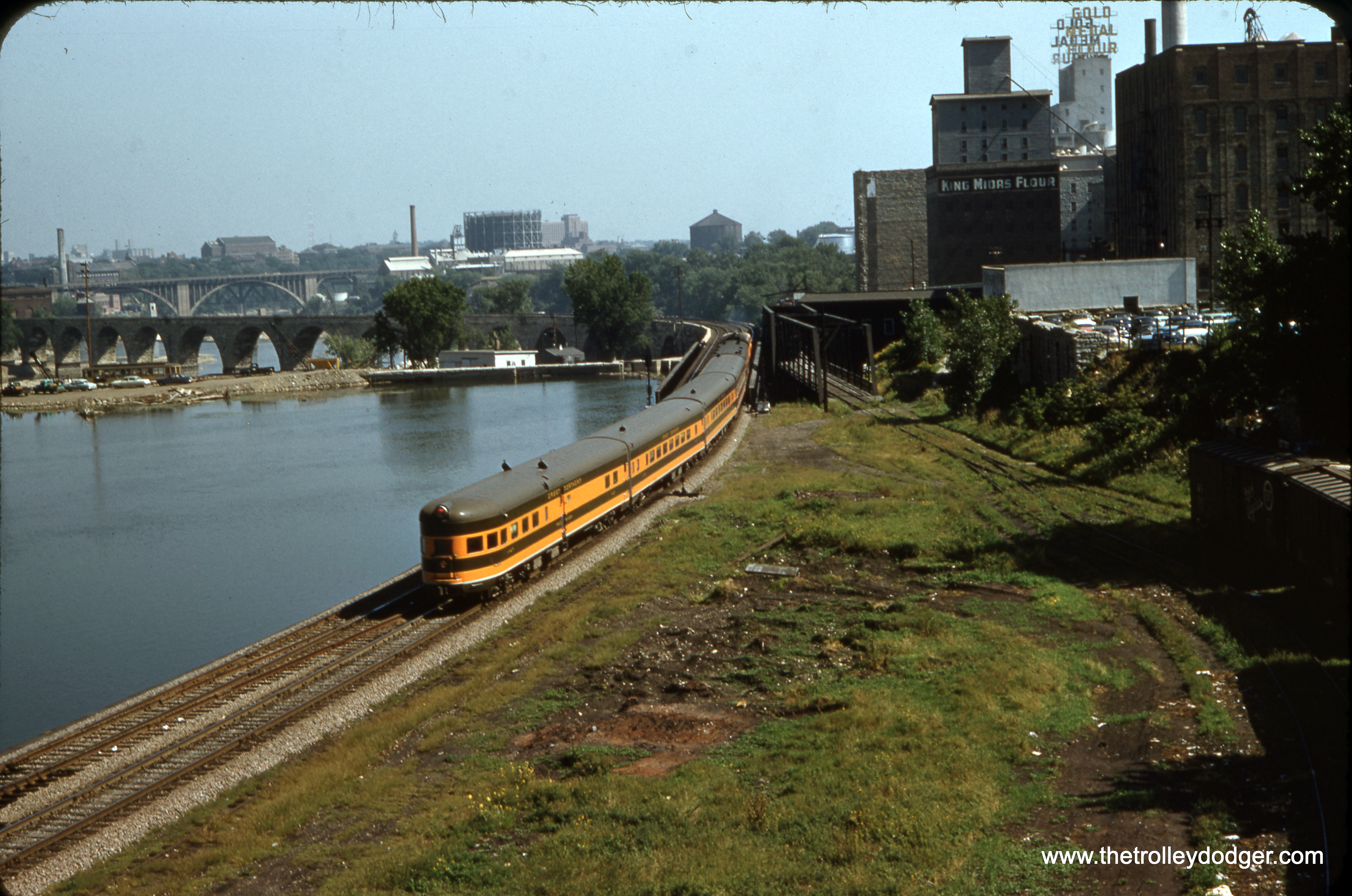
Great Northern Railway Red River 1954 Original 35mm Red Border Kodachrome Slide Subject: GNR 12 Location: Departing Minneapolis station for St. Paul Date: Fall 1954 Photographer: Unknown From the Wikipedia: The Red River was a passenger train operated by Great Northern Railway between Grand Forks, North Dakota, and Saint Paul, Minnesota (operating between 1950 and 1968). History Great Northern Railway's third new train set of 1950 was a new schedule named the Red River. The five-car streamliner built by American Car and Foundry Company began service June 25, 1950, operating a daily round trip 324 miles (521 km) each way between Grand Forks, North Dakota, and Saint Paul, Minnesota. The train went southbound in the morning returning northbound in the evening. The cars for the Red River streamliner were quite different than those built for the International (another 1950 introduction) in that the Red River's cars had extra insulation and the coaches were equipped with Baker Heaters as there was no steam heat available at the Grand Forks depot where the cars stood overnight. The locomotive was sent to the roundhouse each evening for any running repairs and service so the solution was the installation of the Baker Heaters in the cars. Link to eBay Listing

Great Northern Railway Red River 1954 Original 35mm Red Border Kodachrome Slide
Subject: GNR 12
Location: Departing Minneapolis station for St. Paul
Date: Fall 1954
Photographer: Unknown
From the Wikipedia:
The Red River was a passenger train operated by Great Northern Railway between Grand Forks, North Dakota, and Saint Paul, Minnesota (operating between 1950 and 1968).
History
Great Northern Railway’s third new train set of 1950 was a new schedule named the Red River. The five-car streamliner built by American Car and Foundry Company began service June 25, 1950, operating a daily round trip 324 miles (521 km) each way between Grand Forks, North Dakota, and Saint Paul, Minnesota. The train went southbound in the morning returning northbound in the evening.
The cars for the Red River streamliner were quite different than those built for the International (another 1950 introduction) in that the Red River’s cars had extra insulation and the coaches were equipped with Baker Heaters as there was no steam heat available at the Grand Forks depot where the cars stood overnight. The locomotive was sent to the roundhouse each evening for any running repairs and service so the solution was the installation of the Baker Heaters in the cars.
Link to eBay Listing

Amtrak RDC Train 1975 Original 35mm Kodachrome Slide Subject: Amtrak RDCs 30-32-15, Train 372 Blackhawk Location: Crawford (Chicago bound, between Dubuque and Chicago) Date: September 14, 1975 Photographer: James J. Buckley Link to eBay Listing

Amtrak RDC Train 1975 Original 35mm Kodachrome Slide
Subject: Amtrak RDCs 30-32-15, Train 372 Blackhawk
Location: Crawford (Chicago bound, between Dubuque and Chicago)
Date: September 14, 1975
Photographer: James J. Buckley
Link to eBay Listing

Milwaukee and Suburban Transport 1975 Original 35mm Kodachrome Slide Subject: M&ST 1466 Location: Wells-River (posed by the old Milwaukee Electric power plant) Date: June 29, 1975 Photographer: Jeff Wien Link to eBay Listing

Milwaukee and Suburban Transport 1975 Original 35mm Kodachrome Slide
Subject: M&ST 1466
Location: Wells-River (posed by the old Milwaukee Electric power plant)
Date: June 29, 1975
Photographer: Jeff Wien
Link to eBay Listing

Yakima Valley Transit Trolley 1975 Original 35mm Kodachrome Slide Subject: YVT 1776/1976 Location: 44th-Nob Hill, Yakima Date: June 1975 Photographer: Jeff Wien Link to eBay Listing

Yakima Valley Transit Trolley 1975 Original 35mm Kodachrome Slide
Subject: YVT 1776/1976
Location: 44th-Nob Hill, Yakima
Date: June 1975
Photographer: Jeff Wien
Link to eBay Listing

Our Latest Book, Now Available for Pre-Order:

The North Shore Line

Publication Date: February 20, 2023

FYI, my new Arcadia Publishing book The North Shore Line is now finished and has gone to press. My publisher decided to expand it to 160 pages, instead of the usual 128. That’s a 25% increase, without any change to the $23.99 price. I am quite pleased with how this turned out.

From the back cover:

As late as 1963, it was possible to board high-speed electric trains on Chicago’s famous Loop “L” that ran 90 miles north to Milwaukee. This was the Chicago North Shore & Milwaukee Railroad, commonly known as the North Shore Line. It rose from humble origins in the 1890s as a local streetcar line in Waukegan to eventually become America’s fastest interurban under the visionary management of Midwest utilities tycoon Samuel Insull. The North Shore Line, under Insull, became a worthy competitor to the established steam railroads. Hobbled by the Great Depression, the road fought back in 1941 with two streamlined, air-conditioned, articulated trains called Electroliners, which included dining service. It regained its popularity during World War II, when gasoline and tires were rationed, but eventually, it fell victim to highways and the automobile. The North Shore Line had intercity rail, commuter rail, electric freight, city streetcars, and even buses. It has been gone for nearly 60 years, but it will always remain the Road of Service.

Each copy purchased here will be signed by the author, and you will also receive a bonus North Shore Line map.  Books will ship by USPS Media Mail as soon as we receive them, on or before February 20, 2023.

Chapters:
01. Beginnings
02. The Milwaukee Division
03. The Shore Line Route
04. The Skokie Valley Route
05. The Mundelein Branch
06. On the “L”
07. City Streetcars
08. Trolley Freight
09. The Long Goodbye
10. The Legacy

Title The North Shore Line
Images of America
Author David Sadowski
Edition illustrated
Publisher Arcadia Publishing (SC), 2023
ISBN 1467108960, 978-1467108966
Length 160 pages

The price of $23.99 includes shipping within the United States.

For Shipping to US Addresses:

New Compact Disc, Now Available:

CTA-1
The Last Chicago Streetcars 1958
# of Discs – 1
Price: $15.99

Until now, it seemed as though audio recordings of Chicago streetcars were practically non-existent. For whatever reason, the late William A. Steventon does not appear to have made any for his Railroad Record Club, even though he did make other recordings in the Chicago area in 1956.

Now, audio recordings of the last runs of Chicago streetcars have been found, in the collections of the late Jeffrey L. Wien (who was one of the riders on that last car). We do not know who made these recordings, but this must have been done using a portable reel-to-reel machine.

These important recordings will finally fill a gap in transit history. The last Chicago Transit Authority streetcar finished its run in the early hours of June 21, 1958. Now you can experience these events just as Chicagoans did.

As a bonus, we have included Keeping Pace, a 1939 Chicago Surface Lines employee training program. This was digitally transferred from an original 16” transcription disc. These recordings were unheard for 80 years.

Total time – 74:38

Help Support The Trolley Dodger

This is our 295th post, and we are gradually creating a body of work and an online resource for the benefit of all railfans, everywhere. To date, we have received over 941,000 page views, for which we are very grateful.

You can help us continue our original transit research by checking out the fine products in our Online Store.
As we have said before, “If you buy here, we will be here.”

We thank you for your support.

DONATIONS

In order to continue giving you the kinds of historic railroad images that you have come to expect from The Trolley Dodger, we need your help and support. It costs money to maintain this website, and to do the sort of historic research that is our specialty.

Your financial contributions help make this web site better, and are greatly appreciated.


A Fall Harvest

This picture of the old Met bridge over the Chicago River is undated, but probably dates to circa 1952-55 based on the type of red border Kodachrome mount it is in. But it is certainly after the the other picture in this post, taken at much the same location, since the building at rear, or part of it, was in the process of being torn down. This was not related to expressway construction, since the "L" at this point was north of there. Once the Congress rapid transit line opened in 1958, this section of "L" was taken out of service and by the early 1960s it had been torn down.

This picture of the old Met bridge over the Chicago River is undated, but probably dates to circa 1952-55 based on the type of red border Kodachrome mount it is in. But it is certainly after the the other picture in this post, taken at much the same location, since the building at rear, or part of it, was in the process of being torn down. This was not related to expressway construction, since the “L” at this point was north of there. Once the Congress rapid transit line opened in 1958, this section of “L” was taken out of service and by the early 1960s it had been torn down.

Cooler weather has moved into the Chicago area, and along with it, we have a Fall Harvest of classic rail images for you today, including many by three of the greatest railfan photographers of the 1950s– Clark Frazier, Truman Hefner, and William C. Hoffman.

Enjoy!
-David Sadowski

This video features streetcars and elevated trains in Chicago, Milwaukee, and New York City, mostly from the early 1950s– and originally shot on high quality 16mm film:

PS- You might also like our Trolley Dodger Facebook auxiliary, a private group that now has 482 members.

Recent Finds

CSL 4001 at South Shops, with 7001 in front of it, probably during the 1950s, when these two experimental cars were being used for storage.

CSL 4001 at South Shops, with 7001 in front of it, probably during the 1950s, when these two experimental cars were being used for storage.

CTA PCC 4371, built by Pullman, is on State Street heading south from Randolph, with the old State-Lake Theater in the background. The film "Lovely To Look At" was released on July 4, 1952, which is probably around when this picture was taken.

CTA PCC 4371, built by Pullman, is on State Street heading south from Randolph, with the old State-Lake Theater in the background. The film “Lovely To Look At” was released on July 4, 1952, which is probably around when this picture was taken.

North Shore Line 759 heads up a two-car train heading southbound at Harrison Street, leaving street running in favor of private right-of-way in Milwaukee on June 16, 1962. (Richard H. Young Photo)

North Shore Line 759 heads up a two-car train heading southbound at Harrison Street, leaving street running in favor of private right-of-way in Milwaukee on June 16, 1962. (Richard H. Young Photo)

A two-car CTA Kenwood shuttle train at Indiana Avenue, probably some time around 1949. I assume there must have been stairs leading up to the tower.

A two-car CTA Kenwood shuttle train at Indiana Avenue, probably some time around 1949. I assume there must have been stairs leading up to the tower.

A close-up of the previous image.

A close-up of the previous image.

CTA 6130-6129 are "at speed" near Jarvis "L" station on the north side, operating under wire on the southbound express track as a mid-day Evanston "Shopper's Special" on December 11, 1955. The picture is slightly blurred because Kodachrome back then was ASA 10 (until the introduction of Kodachrome II in 1961). The unique signage on the train indicates which stations this express train stopped at.

CTA 6130-6129 are “at speed” near Jarvis “L” station on the north side, operating under wire on the southbound express track as a mid-day Evanston “Shopper’s Special” on December 11, 1955. The picture is slightly blurred because Kodachrome back then was ASA 10 (until the introduction of Kodachrome II in 1961). The unique signage on the train indicates which stations this express train stopped at.

Chicago, Aurora & Elgin wood car 28 is at the head of a train in this picture I assume was taken in Wheaton, between 1952-55 (based on the slide mount).

Chicago, Aurora & Elgin wood car 28 is at the head of a train in this picture I assume was taken in Wheaton, between 1952-55 (based on the slide mount).

Red Arrow Strafford car 164 is on the high-speed line to Norristown in the early 1950s, perhaps near 69th Street Terminal. Kenneth Achtert adds: "Your picture of Strafford car #164, if the early 1950s date is accurate, was most likely not on a Norristown line trip, but is arriving at 69th St. Terminal likely coming from Strafford. Strafford service was not abandoned until 1956 and was what gave the 160-series cars their common name. The bullet cars could have been called Norristown cars, but they already had an even better name."

Red Arrow Strafford car 164 is on the high-speed line to Norristown in the early 1950s, perhaps near 69th Street Terminal. Kenneth Achtert adds: “Your picture of Strafford car #164, if the early 1950s date is accurate, was most likely not on a Norristown line trip, but is arriving at 69th St. Terminal likely coming from Strafford. Strafford service was not abandoned until 1956 and was what gave the 160-series cars their common name. The bullet cars could have been called Norristown cars, but they already had an even better name.”

Red Arrow double-ended car 20, which looks like a PCC but technically isn't, is running outbound on the Ardmore branch in 1953. Not sure what all the track work is about, although the West Chester branch itself was abandoned in favor of buses in 1954, so that West Chester Pike could be widened. I assume this is the intersection of West Chester Pike and Darby Road in Havertown, PA. The Ardmore trolley was replaced by buses at the end of 1966. Both trolley lines here are now SEPTA bus routes. Mark A. Jones adds: "Regarding the Red Arrow trackage on West Chester Pike west of the Ardmore turn-off, it continued in use after the West Chester line became a bus as the Llanerch car barn (which housed the Red Arrow trolleys at the time) was located Darby Rd. and West Chester Pike west of the Ardmore cut-off. That’s my memory of that."

Red Arrow double-ended car 20, which looks like a PCC but technically isn’t, is running outbound on the Ardmore branch in 1953. Not sure what all the track work is about, although the West Chester branch itself was abandoned in favor of buses in 1954, so that West Chester Pike could be widened. I assume this is the intersection of West Chester Pike and Darby Road in Havertown, PA. The Ardmore trolley was replaced by buses at the end of 1966. Both trolley lines here are now SEPTA bus routes. Mark A. Jones adds: “Regarding the Red Arrow trackage on West Chester Pike west of the Ardmore turn-off, it continued in use after the West Chester line became a bus as the Llanerch car barn (which housed the Red Arrow trolleys at the time) was located Darby Rd. and West Chester Pike west of the Ardmore cut-off. That’s my memory of that.”

Red Arrow double-ended St. Louis car 15, built circa 1949, is coming off the Ardmore line towards the 69th Street Terminal in 1953. The West Chester branch might still have been in operation then, as there is a car in the distance on West Chester Pike.

Red Arrow double-ended St. Louis car 15, built circa 1949, is coming off the Ardmore line towards the 69th Street Terminal in 1953. The West Chester branch might still have been in operation then, as there is a car in the distance on West Chester Pike.

Red Arrow Brilliner 9 is signed for the Media route in the early 1950s.

Red Arrow Brilliner 9 is signed for the Media route in the early 1950s.

Red Arrow Brilliner 6 is signed for the Media route in the early 1950s.

Red Arrow Brilliner 6 is signed for the Media route in the early 1950s.

On August 3, 1950, an eastbound Garfield Park "L" train approaches Western Avenue station. (William C. Hoffman Photo)

On August 3, 1950, an eastbound Garfield Park “L” train approaches Western Avenue station.
(William C. Hoffman Photo)

Deck roofed "L" cars, including 2908, are in Laramie Yard on July 2, 1950. (William C. Hoffman Photo)

Deck roofed “L” cars, including 2908, are in Laramie Yard on July 2, 1950. (William C. Hoffman Photo)

An eastbound train of wooden "L" cars (including 3210), with trolley poles up, heads east on the ground-level portion of the Lake Street "L" in Oak Park on October 12, 1953. I believe the location is a few blocks east of Marion Street, where the street (South Boulevard) narrows.

An eastbound train of wooden “L” cars (including 3210), with trolley poles up, heads east on the ground-level portion of the Lake Street “L” in Oak Park on October 12, 1953. I believe the location is a few blocks east of Marion Street, where the street (South Boulevard) narrows.

The subway entrance on State Street between Madison and Monroe, as it looked on December 5, 1954. PCCs were still operating on State at that time. (William C. Hoffman Photo)

The subway entrance on State Street between Madison and Monroe, as it looked on December 5, 1954. PCCs were still operating on State at that time. (William C. Hoffman Photo)

The view looking south from the 35th Street "L" station on August 23, 1963. A new center island station had opened here in 1961, taking up space formerly occupied by the center express track, which had been unused after 1949. A fire destroyed the new station in October 1962, and temporary facilities were used until the station was rebuilt in 1965. (William C. Hoffman Photo)

The view looking south from the 35th Street “L” station on August 23, 1963. A new center island station had opened here in 1961, taking up space formerly occupied by the center express track, which had been unused after 1949. A fire destroyed the new station in October 1962, and temporary facilities were used until the station was rebuilt in 1965. (William C. Hoffman Photo)

An 8-car train of CTA 4000s, still in the old tan color, approaches 35th Street on November 6, 1950. In this somewhat underxposed slide, you can still make out the long walkway at right, which connected to a stairway at the former 33rd Street "L" station, only used as an auxiliary entrance and exit for 35th after 1949. This walkway was closed on September 25, 1961 and removed thereafter. (William C. Hoffman Photo)

An 8-car train of CTA 4000s, still in the old tan color, approaches 35th Street on November 6, 1950. In this somewhat underxposed slide, you can still make out the long walkway at right, which connected to a stairway at the former 33rd Street “L” station, only used as an auxiliary entrance and exit for 35th after 1949. This walkway was closed on September 25, 1961 and removed thereafter. (William C. Hoffman Photo)

The view looking west from the transfer bridge at the CTA station at 40th and Indiana Avenue on July 7, 1953. A southbound train of 6000s heads into the station. (William C. Hoffman Photo)

The view looking west from the transfer bridge at the CTA station at 40th and Indiana Avenue on July 7, 1953. A southbound train of 6000s heads into the station. (William C. Hoffman Photo)

This slide, taken on Sunday, March 6, 1955, gives a good view of the direction sign on the transfer bridge at 40th and Indiana station. Our resident South Side expert M. E. adds, "Two-car trains were rare on the north/south main line. The destination sign explains why just two cars: It is an "all-stop" sign reading "Howard Street". Most days of the week, main line service was either "A" or "B". The only time the CTA ran just two cars on the main line as all-stop trains was on Sunday mornings." (William C. Hoffman Photo)

This slide, taken on Sunday, March 6, 1955, gives a good view of the direction sign on the transfer bridge at 40th and Indiana station. Our resident South Side expert M. E. adds, “Two-car trains were rare on the north/south main line. The destination sign explains why just two cars: It is an “all-stop” sign reading “Howard Street”. Most days of the week, main line service was either “A” or “B”. The only time the CTA ran just two cars on the main line as all-stop trains was on Sunday mornings.” (William C. Hoffman Photo)

The westbound view from the transfer bridge at 40th and Indiana on July 2, 1963 shows CTA 6047 at the rear of a northbound train, fitted with an experimental ventilation system. This was not shot on Kodachrome, which explains the somewhat funky color shift on this slide. (William C. Hoffman Photo)

The westbound view from the transfer bridge at 40th and Indiana on July 2, 1963 shows CTA 6047 at the rear of a northbound train, fitted with an experimental ventilation system. This was not shot on Kodachrome, which explains the somewhat funky color shift on this slide. (William C. Hoffman Photo)

The view west from the overhead transfer bridge at 40th and Indiana on July 7, 1953, looking west. We see a northbound train of 4000s, an approaching southbound train of 6000s, a Stock Yards shuttle train, and some additional Stock Yards cars being stored on the former express track, unused since 1949. (William C. Hoffman Photo)

The view west from the overhead transfer bridge at 40th and Indiana on July 7, 1953, looking west. We see a northbound train of 4000s, an approaching southbound train of 6000s, a Stock Yards shuttle train, and some additional Stock Yards cars being stored on the former express track, unused since 1949.
(William C. Hoffman Photo)

Looking west from the passenger overpass at Indiana Avenue on July 3, 1950, we see an 8-car train of steel cars, and a Stock Yards shuttle train. In the distance, that may be some additional Stock Yards cars being stored on the otherwise unused center track. (William C. Hoffman Photo) Our resident South Side expert M. E. writes: "Your caption needs correction. What you claim to be a Stock Yards shuttle is not on the Stock Yards tracks, which ran directly west from the switch building at the end of the platform. Instead, your "Stock Yards" train is on the main line heading east/south. Apparently the CTA still ran old cars on the main line at that time, although I don't remember that. Another, more remote, possibility is that this short train is dead-heading east (without passengers) toward the Kenwood line. But in the next photo, you see no track connection from the main line to the Kenwood line. The only way dead-headed cars destined for Kenwood could end up on the Kenwood line would have been to turn south on the main line to 43rd St. and use switches to go from the southbound main line to the northbound main line to the former northbound main line track, which joined the Kenwood shuttle track back at Indiana Ave. -- and which (in reverse) provided the only way to move Kenwood cars off the Kenwood tracks." We were only repeating the information that Mr. Hoffman wrote on the original slide mount, which, of course, could be wrong.

Looking west from the passenger overpass at Indiana Avenue on July 3, 1950, we see an 8-car train of steel cars, and a Stock Yards shuttle train. In the distance, that may be some additional Stock Yards cars being stored on the otherwise unused center track. (William C. Hoffman Photo) Our resident South Side expert M. E. writes: “Your caption needs correction. What you claim to be a Stock Yards shuttle is not on the Stock Yards tracks, which ran directly west from the switch building at the end of the platform. Instead, your “Stock Yards” train is on the main line heading east/south. Apparently the CTA still ran old cars on the main line at that time, although I don’t remember that. Another, more remote, possibility is that this short train is dead-heading east (without passengers) toward the Kenwood line. But in the next photo, you see no track connection from the main line to the Kenwood line. The only way dead-headed cars destined for Kenwood could end up on the Kenwood line would have been to turn south on the main line to 43rd St. and use switches to go from the southbound main line to the northbound main line to the former northbound main line track, which joined the Kenwood shuttle track back at Indiana Ave. — and which (in reverse) provided the only way to move Kenwood cars off the Kenwood tracks.” We were only repeating the information that Mr. Hoffman wrote on the original slide mount, which, of course, could be wrong.

Two "new" and two "old" 6000s enter the CTA station at 40th and Indiana on June 6, 1954. The Kenwood shuttle continued to operate for another three years after this. We are facing east. (William C. Hoffman Photo)

Two “new” and two “old” 6000s enter the CTA station at 40th and Indiana on June 6, 1954. The Kenwood shuttle continued to operate for another three years after this. We are facing east. (William C. Hoffman Photo)

SF Muni 170 on the N Line, entering the Sunset Tunnel in 1957. (Clark Frazier Photo)

SF Muni 170 on the N Line, entering the Sunset Tunnel in 1957. (Clark Frazier Photo)

SF Muni 130 on Ocean Avenue by Elkton Shops on September 16, 1957. According to the Market Street Railway web site: "Car No. 130 was among the the last ‘Iron Monsters’ to leave passenger service, in 1958. Muni shop foreman Charlie Smallwood saved it from the scrap heap by hiding it in the back of Geneva carhouse while its mates met their fates. He then talked his bosses into making it a ‘wrecker’. Stripped bare and painted yellow, it spent the next 25 years towing its replacements–PCC streetcars–back to the barn when they broke down. It was fully restored by Muni craft workers in 1983 for the Historic Trolley Festival, including original seats, which Charlie had kept all those years in his basement…just in case!" (Clark Frazier Photo)

SF Muni 130 on Ocean Avenue by Elkton Shops on September 16, 1957. According to the Market Street Railway web site: “Car No. 130 was among the the last ‘Iron Monsters’ to leave passenger service, in 1958. Muni shop foreman Charlie Smallwood saved it from the scrap heap by hiding it in the back of Geneva carhouse while its mates met their fates. He then talked his bosses into making it a ‘wrecker’. Stripped bare and painted yellow, it spent the next 25 years towing its replacements–PCC streetcars–back to the barn when they broke down. It was fully restored by Muni craft workers in 1983 for the Historic Trolley Festival, including original seats, which Charlie had kept all those years in his basement…just in case!” (Clark Frazier Photo)

Key System A Train 130 near Yerba Buena Island on the Bay Bridge on April 18, 1958. (Clark Frazier Photo)

Key System A Train 130 near Yerba Buena Island on the Bay Bridge on April 18, 1958. (Clark Frazier Photo)

Pittsburgh 1499 on Route 34/21 on Ladoga Street near Ingram in 1959. (Clark Frazier Photo)

Pittsburgh 1499 on Route 34/21 on Ladoga Street near Ingram in 1959. (Clark Frazier Photo)

Pittsburgh 1486 and 1485 rest at Ingram carhouse in 1959. (Clark Frazier Photo)

Pittsburgh 1486 and 1485 rest at Ingram carhouse in 1959. (Clark Frazier Photo)

SF Muni "Iron Monster" 162 at La Playa (48th), approaching the N Line terminus on December 16, 1956. (Clark Frazier Photo)

SF Muni “Iron Monster” 162 at La Playa (48th), approaching the N Line terminus on December 16, 1956. (Clark Frazier Photo)

The SF Muni Geary car house in 1956. (Clark Frazier Photo)

The SF Muni Geary car house in 1956. (Clark Frazier Photo)

Dresden 264 007 on Line 4 at Dresdner Schloss on June 3, 1978. At the time, Dresden was located in East Germany. (Clark Frazier Photo)

Dresden 264 007 on Line 4 at Dresdner Schloss on June 3, 1978. At the time, Dresden was located in East Germany. (Clark Frazier Photo)

Key System 167 is an A Train east of Yerba Buena Island on the Bay Bridge on April 18, 1958. (Clark Frazier Photo)

Key System 167 is an A Train east of Yerba Buena Island on the Bay Bridge on April 18, 1958. (Clark Frazier Photo)

SF Muni "Iron Monster" 178 on a fantrip on the J Line by SF Muni

SF Muni “Iron Monster” 178 on a fantrip on the J Line by SF Muni “Iron Monster” 178 on a fantrip on the J Line by Dolores Park in 1958. (Clark Frazier Photo)Park in 1958. (Clark Frazier Photo)

SF Muni "Iron Monster" 114 stops for passengers on the B Line in 1956. (Clark Frazier Photo)

SF Muni “Iron Monster” 114 stops for passengers on the B Line in 1956. (Clark Frazier Photo)

DC Transit 1553 at the Route 20 Plow Pit on February 7, 1959. This was a spot where overhead wire ended (by law) and streetcars changed over to collecting electricity through an underground conduit. (Clark Frazier Photo)

DC Transit 1553 at the Route 20 Plow Pit on February 7, 1959. This was a spot where overhead wire ended (by law) and streetcars changed over to collecting electricity through an underground conduit. (Clark Frazier Photo)

Boston MTA 3276 entering Reservoir Yard on June 5, 1959. (Clark Frazier Photo)

Boston MTA 3276 entering Reservoir Yard on June 5, 1959. (Clark Frazier Photo)

Boston MTA 3216 on Mass Avenue in North Cambridge on August 29, 1958. (Clark Frazier Photo)

Boston MTA 3216 on Mass Avenue in North Cambridge on August 29, 1958. (Clark Frazier Photo)

Boston MTA 3337 (ex-Dallas) near the Cedar Grove station on the Ashmont-Mattapan line on May 31, 1961. (Clark Frazier Photo)

Boston MTA 3337 (ex-Dallas) near the Cedar Grove station on the Ashmont-Mattapan line on May 31, 1961. (Clark Frazier Photo)

DC Transit 1543 on Route 20 in Georgetown on June 7, 1959. The Georgetown Theatre was located at 1351 Wisconsin Avenue NW, Washington, DC and opened in 1913. It closed in 1986 and was converted to retail. (Clark Frazier Photo)

DC Transit 1543 on Route 20 in Georgetown on June 7, 1959. The Georgetown Theatre was located at 1351 Wisconsin Avenue NW, Washington, DC and opened in 1913. It closed in 1986 and was converted to retail. (Clark Frazier Photo)

DC Transit 1159 at the Calvert Bridge on Route 92 on February 6, 1959. (Clark Frazier Photo)

DC Transit 1159 at the Calvert Bridge on Route 92 on February 6, 1959. (Clark Frazier Photo)

SF Muni "Iron Monster" 213 on the N Line, west of the Sunset Tunnel, in 1957. (Clark Frazier Photo)

SF Muni “Iron Monster” 213 on the N Line, west of the Sunset Tunnel, in 1957. (Clark Frazier Photo)

Key System (Oakland) E train 184 to Berkeley leaving 55th Street in 1958. This slide has a processing date of March 1958 stamped on it, one of the earliest I have seen. (Clark Frazier Photo)

Key System (Oakland) E train 184 to Berkeley leaving 55th Street in 1958. This slide has a processing date of March 1958 stamped on it, one of the earliest I have seen. (Clark Frazier Photo)

SF Muni "Iron Monster" 130 on the M Line by Parkmerced on September 16, 1957. (Clark Frazier Photo)

SF Muni “Iron Monster” 130 on the M Line by Parkmerced on September 16, 1957. (Clark Frazier Photo)

A Key System E train to San Francisco near Tower 3 in 1958. (Clark Frazier Photo)

A Key System E train to San Francisco near Tower 3 in 1958. (Clark Frazier Photo)

DC Transit 1136 on Route 54 at the Navy Yard car barn on September 1, 1958. (Clark Frazier Photo)

DC Transit 1136 on Route 54 at the Navy Yard car barn on September 1, 1958. (Clark Frazier Photo)

In May 1952, a CTA train of flat-door 6000s heads down an incline west of Pulaski Road on the Douglas Park "L". (Truman Hefner Photo)

In May 1952, a CTA train of flat-door 6000s heads down an incline west of Pulaski Road on the Douglas Park “L”. (Truman Hefner Photo)

A train of CTA 6000s on the Metropolitan main line, looking east from Marshfield Avenue. This probably dates to late 1950, since no work has yet been done building the temporary right-of-way in Van Buren Street to the left, later used by Garfield Park trains. The tag on the train indicates whether it stopped at some part-time stations on Douglas. (Truman Hefner Photo)

A train of CTA 6000s on the Metropolitan main line, looking east from Marshfield Avenue. This probably dates to late 1950, since no work has yet been done building the temporary right-of-way in Van Buren Street to the left, later used by Garfield Park trains. The tag on the train indicates whether it stopped at some part-time stations on Douglas. (Truman Hefner Photo)

A CTA two-car train of 6000s, running on the Douglas Park line, heads east onto the Metropolitan main line at Marshfield Junction. Since a train is visible on the Garfield Park portion, the date cannot be later than September 1953, and is likely a couple years before that. (Truman Hefner Photo)

A CTA two-car train of 6000s, running on the Douglas Park line, heads east onto the Metropolitan main line at Marshfield Junction. Since a train is visible on the Garfield Park portion, the date cannot be later than September 1953, and is likely a couple years before that. (Truman Hefner Photo)

CTA 6056-6057 crossing East Avenue in Berwyn, where a sign indicates that the crossing guard is off duty. This portion of "L" was abandoned in February 1952. (Truman Hefner Photo)

CTA 6056-6057 crossing East Avenue in Berwyn, where a sign indicates that the crossing guard is off duty. This portion of “L” was abandoned in February 1952. (Truman Hefner Photo)

6053-6054 near Oak Park Avenue on the Douglas Park "L". The date given here (December 1953) must be wrong, as the line had already been cut back to 54th Avenue by then. It may be December 1950, as Douglas was the first line to use the new 6000s. (Truman Hefner Photo)

6053-6054 near Oak Park Avenue on the Douglas Park “L”. The date given here (December 1953) must be wrong, as the line had already been cut back to 54th Avenue by then. It may be December 1950, as Douglas was the first line to use the new 6000s. (Truman Hefner Photo)

CTA 2725 at the Oak Park Avenue terminal of the Douglas Park "L" in December 1950. The line was cut back to 54th Avenue, nearly two miles east of here, in 1952. This area is now used as a parking lot in Berwyn, often referred to as the "L" strip. (Truman Hefner Photo)

CTA 2725 at the Oak Park Avenue terminal of the Douglas Park “L” in December 1950.
The line was cut back to 54th Avenue, nearly two miles east of here, in 1952. This area is now used as a parking lot in Berwyn, often referred to as the “L” strip. (Truman Hefner Photo)

CTA 6087 and train are running on the ground-level portion of the Douglas Park "L" at Kenton Avenue in May 1952. (Truman Hefner Photo)

CTA 6087 and train are running on the ground-level portion of the Douglas Park “L” at Kenton Avenue in May 1952. (Truman Hefner Photo)

CTA deck-roofed car 2891 is just south of Roosevelt Road on the Westchester "L" in April 1951. (Truman Hefner Photo)

CTA deck-roofed car 2891 is just south of Roosevelt Road on the Westchester “L” in April 1951. (Truman Hefner Photo)

A train of CTA 6000s (probably 6055-6056) crosses Austin Boulevard in Cicero on the Douglas Park "L" in February 1952, shortly before service was abandoned west of 54th Avenue. (Truman Hefner Photo)

A train of CTA 6000s (probably 6055-6056) crosses Austin Boulevard in Cicero on the Douglas Park “L” in February 1952, shortly before service was abandoned west of 54th Avenue. (Truman Hefner Photo)

A CTA train of 6000s is turning onto the Metropolitan main line from the Douglas Park "L" on April 3, 1954, while a CTA test train (with car 2276) is on the new, as yet unused connecting track between the Douglas "L" and the old Logan Square branch. Once Douglas trains began using this new "L" connection, they began running downtown via the Lake Street "L", and portions of the old "L" east of here were torn down for expressway construction. By 1958, there was a new ramp in place, approximately in the same place the 6000s are here, leading down to the Congress rapid transit line in the expressway median. (Truman Hefner Photo)

A CTA train of 6000s is turning onto the Metropolitan main line from the Douglas Park “L” on April 3, 1954, while a CTA test train (with car 2276) is on the new, as yet unused connecting track between the Douglas “L” and the old Logan Square branch. Once Douglas trains began using this new “L” connection, they began running downtown via the Lake Street “L”, and portions of the old “L” east of here were torn down for expressway construction. By 1958, there was a new ramp in place, approximately in the same place the 6000s are here, leading down to the Congress rapid transit line in the expressway median. (Truman Hefner Photo)

A CTA train of 6000s is turning from the Metropolitan main line onto the Douglas Park "L" on April 3, 1954, while a CTA test train (with car 2276) is on the new, as yet unused connecting track between the Douglas "L" and the old Logan Square branch. Once Douglas trains began using this new "L" connection, they began running downtown via the Lake Street "L", and portions of the old "L" east of here were torn down for expressway construction. By 1958, there was a new ramp in place, approximately in the same place the 6000s are here, leading down to the Congress rapid transit line in the expressway median. (Truman Hefner Photo)

A CTA train of 6000s is turning from the Metropolitan main line onto the Douglas Park “L” on April 3, 1954, while a CTA test train (with car 2276) is on the new, as yet unused connecting track between the Douglas “L” and the old Logan Square branch. Once Douglas trains began using this new “L” connection, they began running downtown via the Lake Street “L”, and portions of the old “L” east of here were torn down for expressway construction. By 1958, there was a new ramp in place, approximately in the same place the 6000s are here, leading down to the Congress rapid transit line in the expressway median. (Truman Hefner Photo)

In December 1950, CTA open platform, railroad-roofed car 2327 is westbound at Austin Boulevard on the Douglas Park "L". Here, the barrier is down. (Truman Hefner Photo)

In December 1950, CTA open platform, railroad-roofed car 2327 is westbound at Austin Boulevard on the Douglas Park “L”.
Here, the barrier is down. (Truman Hefner Photo)

CTA wooden open platform, railroad-roofed car 2330 is northbound on the Northwestern "L" near Berwyn Avenue, running on the Evanston line in July 1951. (Truman Hefner Photo)

CTA wooden open platform, railroad-roofed car 2330 is northbound on the Northwestern “L” near Berwyn Avenue, running on the Evanston line in July 1951. (Truman Hefner Photo)

CTA 2256 is part of a four-car Met train, turning from Market Street onto the double bridge over the Chicago River in March 1951. (Truman Hefner Photo)

CTA 2256 is part of a four-car Met train, turning from Market Street onto the double bridge over the Chicago River in March 1951.
(Truman Hefner Photo)

CTA railroad roofed, open platform car 2707 under the Belt Railway at Kenton Avenue on the Douglas Park "L". (Truman Hefner Photo)

CTA railroad roofed, open platform car 2707 under the Belt Railway at Kenton Avenue on the Douglas Park “L”. (Truman Hefner Photo)

CTA arched roof, open-platform car 2281 at 54th Avenue on the Douglas Park "L" in March 1951. (Truman Hefner Photo)

CTA arched roof, open-platform car 2281 at 54th Avenue on the Douglas Park “L” in March 1951. (Truman Hefner Photo)

Open platform, railroad roof car 2715 at 54th Avenue in Cicero, on the Douglas Park "L", in January 1951. (Truman Hefner Photo)

Open platform, railroad roof car 2715 at 54th Avenue in Cicero, on the Douglas Park “L”, in January 1951. (Truman Hefner Photo)

The CTA ground-level station at Austin Boulevard in Cicero, on the Douglas Park "L" in December 1950. Note the unusual raised barrier at the crossing. (Truman Hefner Photo)

The CTA ground-level station at Austin Boulevard in Cicero, on the Douglas Park “L” in December 1950. Note the unusual raised barrier at the crossing. (Truman Hefner Photo)

CTA open-platform, railroad roof car 2338 at Kenton on the Douglas Park line, where there was a connection to the Belt Railway of Chicago, in December 1950. (Truman Hefner Photo)

CTA open-platform, railroad roof car 2338 at Kenton on the Douglas Park line, where there was a connection to the Belt Railway of Chicago, in December 1950. (Truman Hefner Photo)

CTA open-platform, railroad roof car 2318 at Kenton on the Douglas Park line, where there was a connection to the Belt Railway of Chicago, in December 1950. (Truman Hefner Photo)

CTA open-platform, railroad roof car 2318 at Kenton on the Douglas Park line, where there was a connection to the Belt Railway of Chicago, in December 1950. (Truman Hefner Photo)

CTA PCC 7215, a product of the St. Louis Car Company, is signed to go to 80th and Vincennes, operating on Route 22 - Wentworth in 1958. But was this picture taken at 80th and Vincennes? M. E. writes: "Reason to think this photo was taken at 80th and Vincennes: There was a single loop track at 80th and Vincennes, and the terminal area was on the east side of a miniature "park" situated east of Vincennes between the terminal trackage and Vincennes Ave. proper. Reasons to think this photo was not taken at 80th and Vincennes: (1) The exit trackage in the photo makes no sense if it were indeed 80th and Vincennes. The exit trackage ran straight out of the loop and onto northbound Vincennes trackage. (2) As I recall, 80th and Vincennes was a residential area with no large buildings. If I had to hazard a guess, I'd say this photo was taken on the property of the 77th/Vincennes carbarn, and the streetcar in the photo had either just returned from 80th and Vincennes or was headed there. This scenario is also likely because there was never a "terminal" on line 22 at 77th St.; the closest was at 80th St. Consequently, streetcars in service coming from the north had to go to at least 80th St. before heading back to the barn at 77th St."

CTA PCC 7215, a product of the St. Louis Car Company, is signed to go to 80th and Vincennes, operating on Route 22 – Wentworth in 1958. But was this picture taken at 80th and Vincennes? M. E. writes: “Reason to think this photo was taken at 80th and Vincennes: There was a
single loop track at 80th and Vincennes, and the terminal area was on the east side of a miniature “park” situated east of Vincennes between the terminal trackage and Vincennes Ave. proper. Reasons to think this photo was not taken at 80th and Vincennes: (1) The exit trackage in the photo makes no sense if it were indeed 80th and Vincennes. The exit trackage ran straight out of the loop and onto northbound Vincennes trackage. (2) As I recall, 80th and Vincennes was a residential area with no large buildings. If I had to hazard a guess, I’d say this photo was taken on the property of the 77th/Vincennes carbarn, and the streetcar in the photo had either just returned from 80th and Vincennes or was headed there. This scenario is also likely because there was never a “terminal” on line 22 at 77th St.; the closest was at 80th St. Consequently, streetcars in service coming from the north had to go to at least 80th St. before heading back to the barn at 77th St.”

The Prince Crossing station on the Chicago, Aurora & Elgin, as it appeared on June 14, 1960, after abandonment.

The Prince Crossing station on the Chicago, Aurora & Elgin, as it appeared on June 14, 1960, after abandonment.

Did Not Win

Try as we might, our resources are always limited and there are photos that our beyond our means to afford. Yet many of them are worth another look anyway:

Chicago, South Shore and South Bend Railroad modernized interurban coach 28 and modernized steel interurban combine 107 at the end of the line station shared with Amtrak. The line was cut back from downtown South Bend in 1970. In 1992 the line would be diverted to the South Bend Airport. April 26, 1980, W Washington St & W Meade St, South Bend, Indiana. (Clark Frazier Photo)

Chicago, South Shore and South Bend Railroad modernized interurban coach 28 and modernized steel interurban combine 107 at the end of the line station shared with Amtrak. The line was cut back from downtown South Bend in 1970. In 1992 the line would be diverted to the South Bend Airport.
April 26, 1980, W Washington St & W Meade St, South Bend, Indiana. (Clark Frazier Photo)

This original glass plate negative, showing the last New York City horse car line circa 1907, recently sold on eBay for $539. The location is Broadway looking north just past Broome Street. The horse car line was abandoned in 1917, by which time it had few passengers as was a "franchise run."

This original glass plate negative, showing the last New York City horse car line circa 1907, recently sold on eBay for $539(!). The location is Broadway looking north just past Broome Street. The horse car line was abandoned in 1917, by which time it had few passengers as was a “franchise run.”

Angel's Flight in its original LA Bunker Hill location, probably circa 1969. The funicular opened in 1901, but was dismantled and put into storage for several years not long after this picture was taken, as the hill it climbed was razed. It has since reopened in a different location.

Angel’s Flight in its original LA Bunker Hill location, probably circa 1969. The funicular opened in 1901, but was dismantled and put into storage for several years not long after this picture was taken, as the hill it climbed was razed. It has since reopened in a different location.

A Hidden Freight Spur

Looking northwest.

Looking northwest.

I was somewhat surprised a few months ago when it appeared some freight car switching was taking place on the Union Pacific West Line (formerly Chicago & North Western) embankment in Forest Park, just east of Lathrop Avenue. The tracks here were raised around 1910 and not far east of here, the embankment is shared with the Chicago Transit Authority’s Green Line (aka the Lake Street “L”).

There isn’t much light industry left near the railroad in Forest Park, but apparently there is still at least one active customer, and behind a row of town houses, there is an active freight spur, with a ramp leading up to the embankment. I found a lone freight car on the spur. Presumably it will be hauled away prior to the next delivery, whenever that might be.

The freight spur is visible on this map. You can also see how the curved streets in this part of Forest Park got their shape. They once formed a "wye" used to turn trains around. Much of the CTA rail yard west of Harlem Avenue was built onto new embankment in the early 1960s.

The freight spur is visible on this map. You can also see how the curved streets in this part of Forest Park got their shape. They once formed a “wye” used to turn trains around. Much of the CTA rail yard west of Harlem Avenue was built onto new embankment in the early 1960s.

I drive by this area nearly every day, but all this is so completely hidden from view that I had no idea any of this still existed. It also sheds some light on the changes made to the “L” and the adjacent commuter rail line in the late 1950s.

When the CTA and C&NW were negotiating the relocation of the Lake Street “L” onto the embankment, at first it was thought that the “L” would run as far west as the DesPlaines River in River Forest. In 1958, the C&NW sought permission to close several commuter rail stations, ceding their close-in ridership to the CTA (and at the same time speeding up service to suburbs that were further out).

Originally, the River Forest station was one of the C&NW petitioned the Illinois Commerce Commission to close, but at some point, plans were changed, and the station is still there, serving riders on what is now the Metra Union Pacific West Line.

If the “L” had been extended through this area, it would have made it difficult for the C&NW to continue serving their freight customers in Forest Park with the spur line that is, apparently, still in use.

Looking west.

Looking west.

Looking west.

Looking west.

Looking southeast. Town houses have replaced light industry south of the railroad spur.

Looking southeast. Town houses have replaced light industry south of the railroad spur.

Looking northwest.

Looking northwest.

Recent Correspondence

Larry Sakar writes:

A three-car train in Lake Bluff by William D. Volkmer, 10/8/60.

A three-car train in Lake Bluff by William D. Volkmer, 10/8/60.

I was browsing through some of your newest pics on The Trolley Dodger. You have a great picture of a North Shore train NB at Lake Bluff taken by Bill Volkmer on 10/08/60 (5 days after my 10th birthday). They aren’t what I’m concerned with.

In the spring of 1992 I accompanied another NSL fan on a tour of the abandoned NSL from Lake Bluff to Mundelein, probably other spots on the NSL as well but I no longer remember. It may have been this trip, or another time but he was after a whistling post that was still embedded near one of the crossings on the Skokie Valley route. He brought along a sack of tools with which to extricate it. He discovered that it was anchored very deeply by a steel cord of some sort and did not get it.

I took the attached photo at Lake Bluff that day. What I would like to know is where the Lake Bluff station would have been in the 1992 photo and what direction I am facing. As you can obviously tell, it was a damp and foggy day. The second picture was taken at Mundelein. He told me that the NSL station was in the parking lot seen in my photo, which I seem to recall was for an apartment complex.

The individual in the photo was an avid NSL fan, having ridden the last northbound train from Chicago to Racine. He was a high school student at the time. The Racine station agent was a friend of the family. He was in the right place at the right time. The place was the Racine station on the day it was torn down. It was gone by the time he got there but he noticed a pile of items being burned. Among those items was the ticket agent’s rack and rubber stamps which he rescued from the pile.

No rush. I’ve just been wondering. He may have told me that where he was standing was where the trains stopped, but I honestly don’t remember. I ceased all contact with this individual in 2003 when I quit TMER&THS (The Milwaukee Electric Railway & Transit Historical Society).

Thanks.

The site of the former North Shore Line station in Lake Bluff in 1992.

The site of the former North Shore Line station in Lake Bluff in 1992.

The site of the former North Shore Line station in Mundelein in 1992.

The site of the former North Shore Line station in Mundelein in 1992.

The site (at right) of the former North Shore Line station in Waukegan in 1992.

The site (at right) of the former North Shore Line station in Waukegan in 1992.

Perhaps some of our readers can help Larry figure this out, thanks.

Keep those cards and letters coming in, folks.

-David Sadowski

The Trolley Dodger On the Air

I recently appeared on the Dave Plier Show on WGN radio, to discuss Chicago’s Lost “L”s. You can hear that discussion here.

Our Latest Book, Now Available:

Chicago’s Lost “L”s

From the back cover:

Chicago’s system of elevated railways, known locally as the “L,” has run continuously since 1892 and, like the city, has never stood still. It helped neighborhoods grow, brought their increasingly diverse populations together, and gave the famous Loop its name. But today’s system has changed radically over the years. Chicago’s Lost “L”s tells the story of former lines such as Garfield Park, Humboldt Park, Kenwood, Stockyards, Normal Park, Westchester, and Niles Center. It was once possible to take high-speed trains on the L directly to Aurora, Elgin, and Milwaukee, Wisconsin. The L started out as four different companies, two starting out using steam engines instead of electricity. Eventually, all four came together via the Union Loop. The L is more than a way of getting around. Its trains are a place where people meet and interact. Some say the best way to experience the city is via the L, with its second-story view. Chicago’s Lost “L”s is virtually a “secret history” of Chicago, and this is your ticket. David Sadowski grew up riding the L all over the city. He is the author of Chicago Trolleys and Building Chicago’s Subways and runs the online Trolley Dodger blog.

The Images of America series celebrates the history of neighborhoods, towns, and cities across the country. Using archival photographs, each title presents the distinctive stories from the past that shape the character of the community today. Arcadia is proud to play a part in the preservation of local heritage, making history available to all.

Title Chicago’s Lost “L”s
Images of America
Author David Sadowski
Edition illustrated
Publisher Arcadia Publishing (SC), 2021
ISBN 1467100007, 9781467100007
Length 128 pages

Chapters:
01. The South Side “L”
02. The Lake Street “L”
03. The Metropolitan “L”
04. The Northwestern “L”
05. The Union Loop
06. Lost Equipment
07. Lost Interurbans
08. Lost Terminals
09. Lost… and Found

Each copy purchased here will be signed by the author, and you will also receive a bonus facsimile of a 1926 Chicago Rapid Transit Company map, with interesting facts about the “L” on the reverse side.

The price of $23.99 includes shipping within the United States.

For Shipping to US Addresses:

For Shipping to Canada:

For Shipping Elsewhere:

NEW DVD:

A Tribute to the North Shore Line

To commemorate the 50th anniversary of the demise of the fabled North Shore Line interurban in January 2013, Jeffrey L. Wien and Bradley Criss made a very thorough and professional video presentation, covering the entire route between Chicago and Milwaukee and then some. Sadly, both men are gone now, but their work remains, making this video a tribute to them, as much as it is a tribute to the Chicago North Shore & Milwaukee.

Jeff drew on his own vast collections of movie films, both his own and others such as the late William C. Hoffman, wrote and gave the narration. Bradley acted as video editor, and added authentic sound effects from archival recordings of the North Shore Line.

It was always Jeff’s intention to make this video available to the public, but unfortunately, this did not happen in his lifetime. Now, as the caretakers of Jeff’s railfan legacy, we are proud to offer this excellent two-hour program to you for the first time. The result is a fitting tribute to what Jeff called his “Perpetual Adoration,” which was the name of a stop on the interurban.

Jeff was a wholehearted supporter of our activities, and the proceeds from the sale of this disc will help defray some of the expenses of keeping the Trolley Dodger web site going.

Total time – 121:22

# of Discs – 1
Price: $19.99 (Includes shipping within the United States)

Help Support The Trolley Dodger

This is our 278th post, and we are gradually creating a body of work and an online resource for the benefit of all railfans, everywhere. To date, we have received over 811,000 page views, for which we are very grateful.

You can help us continue our original transit research by checking out the fine products in our Online Store.
As we have said before, “If you buy here, we will be here.”

We thank you for your support.

DONATIONS

In order to continue giving you the kinds of historic railroad images that you have come to expect from The Trolley Dodger, we need your help and support. It costs money to maintain this website, and to do the sort of historic research that is our specialty.

Your financial contributions help make this web site better, and are greatly appreciated.


CTA’s New 7000s

CTA 7009-7010 at Dempster.

CTA 7009-7010 at Dempster.

Cooler weather returned to the Chicago area last Friday, after a string of hot and muggy days. We took this opportunity to take pictures on the Chicago Transit Authority.

We rode the new 7000-series cars for the first time on the Yellow Line (formerly the Skokie Swift), where they were being tested last week. Our luck was good, as our ride from Dempster to Howard turned out to be the last trip of the day for these new cars, which are being tested extensively on the CTA system.

My impression of these new “L” cars was very favorable. While in many respects they are similar to the existing fleet, the 7000s are instantly recognizable, due to their blue end caps. They are smooth and quiet in operation, and offer improved seating, with fewer sideways seats, which did not prove to be very popular on the 5000s. The 7000s will replace the 2600-series cars, some of which are now 40 years old.

We also took some pictures of the Belmont Flyover construction progress, which is part of the RPM (Red and Purple Modernization) project. The flyover will keep Red, Purple, and Brown Line trains from having to cross in front of each other, and will therefore add capacity to these routes once it opens this November.

In addition, we have more classic traction pictures to share, both our own, and from our contributors Larry Sakar, Bob Bresse-Rodenkirk, and Jack Bejna.

-David Sadowski

PS- If you enjoy reading these posts, you might consider joining our Trolley Dodger Facebook Group as well. We currently have 419 members.

CTA Yellow Line

CTA 7009-7010 has arrived at Dempster in Skokie.

CTA 7009-7010 has arrived at Dempster in Skokie.

Our 7000s train pulls up to the platform at Dempster.

Our 7000s train pulls up to the platform at Dempster.

The 7000s interior. There is less sideways seating than on the 5000s, which should prove popular with riders.

The 7000s interior. There is less sideways seating than on the 5000s, which should prove popular with riders.

Skokie Shops.

Skokie Shops.

Skokie Shops. You can see 6711-6712 and 6101-6102, part of CTA's Historic Fleet.

Skokie Shops. You can see 6711-6712 and 6101-6102, part of CTA’s Historic Fleet.

There are some 2400s at Howard Yard, for use in work service.

There are some 2400s at Howard Yard, for use in work service.

7009-7010 after arriving at Howard. Unfortunately, there was no return trip on these cars.

7009-7010 after arriving at Howard. Unfortunately, there was no return trip on these cars.

From the side, you can hardly tell the 7000s from other "L" cars.

From the side, you can hardly tell the 7000s from other “L” cars.

The new 7000s have distinctive blue caps on the ends.

The new 7000s have distinctive blue caps on the ends.

A northbound Red Line train at Howard.

A northbound Red Line train at Howard.

CTA 7009-7010 at Howard.

CTA 7009-7010 at Howard.

The 7000s were done for the day and about to be put back in the yard.

The 7000s were done for the day and about to be put back in the yard.

5519-5520 at Howard.

5519-5520 at Howard.

5519-5520 at Howard.

5519-5520 at Howard.

5519-5520 at Howard.

Howard Yard.

Howard Yard.

Flatcars at Skokie Shops.

Flatcars at Skokie Shops.

The CTA's historic 6000s at Skokie Shops.

The CTA’s historic 6000s at Skokie Shops.

Skokie Shops. Note the 7000-series car present.

Skokie Shops. Note the 7000-series car present.

East Prairie Road.

East Prairie Road.

This portion of platform is a remnant of the old Crawford-East Prairie station on the Niles Center route.

This portion of platform is a remnant of the old Crawford-East Prairie station on the Niles Center route.

Kostner.

Kostner.

Oakton curve.

Oakton curve.

Although the Skokie Swift has been renamed the Yellow Line, the CTA still uses this distinctive logo. I believe it was designed by the late George Krambles.

Although the Skokie Swift has been renamed the Yellow Line, the CTA still uses this distinctive logo. I believe it was designed by the late George Krambles.

CTA 5519-5520 at the Dempster terminal.

CTA 5519-5520 at the Dempster terminal.

The bus turnaround area has a shelter that is stylistically in keeping with the Dempster Street Terminal.

The bus turnaround area has a shelter that is stylistically in keeping with the Dempster Street Terminal.

This is the back end of the historic Dempster Street Terminal, originally built for the North Shore Line and designed by Arthur U. Gerber. The station was moved a bit from its original location to create a bus turnaround area.

This is the back end of the historic Dempster Street Terminal, originally built for the North Shore Line and designed by Arthur U. Gerber. The station was moved a bit from its original location to create a bus turnaround area.

From 1925 to 1948, Dempster was the terminal of the CRT's Niles Center branch.

From 1925 to 1948, Dempster was the terminal of the CRT’s Niles Center branch.

Belmont Flyover

The Belmont Flyover is massive and work is proceeding rapidly. It may be put into service as soon as this November.

The Belmont Flyover is massive and work is proceeding rapidly. It may be put into service as soon as this November.

This welder wanted me to take his picture with his mask on and the flame lit.

This welder wanted me to take his picture with his mask on and the flame lit.

Thumbs up.

Thumbs up.

The three-story Vautravers Building at 947 West Newport Avenue was recently moved 30 feet to the west by the CTA as part of the flyover project, so a curve could be straightened out.

The three-story Vautravers Building at 947 West Newport Avenue was recently moved 30 feet to the west by the CTA as part of the flyover project, so a curve could be straightened out.

There is more to the RPM project than just the Belmont Flyover. Parts of the century-old "L" embankment north of Wilson Avenue are being replaced. The Lawrence Avenue station is currently closed, and there is a temporary station at Argyle (shown here).

There is more to the RPM project than just the Belmont Flyover. Parts of the century-old “L” embankment north of Wilson Avenue are being replaced. The Lawrence Avenue station is currently closed, and there is a temporary station at Argyle (shown here).

Recent Finds

Red Arrow car 27, from a late 1950s red border Kodachrome slide. It was built by Brill in 1918. Sister car 25 was retired in 1964.

Red Arrow car 27, from a late 1950s red border Kodachrome slide. It was built by Brill in 1918. Sister car 25 was retired in 1964.

Red Arrow car 68 in the late 1950s, from a red border Kodachrome. We ran a different picture taken at this location in a previous post, so I can tell the location is Sheldon and Spring Avenues on the Ardmore line, which was converted to buses at the end of 1966.

Red Arrow car 68 in the late 1950s, from a red border Kodachrome. We ran a different picture taken at this location in a previous post, so I can tell the location is Sheldon and Spring Avenues on the Ardmore line, which was converted to buses at the end of 1966.

On June 6, 1954, William C. Hoffman took this picture looking to the northwest at Congress and Bishop Streets (1432 W.), showing the demolition of main line of the Metropolitan "L".

On June 6, 1954, William C. Hoffman took this picture looking to the northwest at Congress and Bishop Streets (1432 W.), showing the demolition of main line of the Metropolitan “L”.

The view looking west from Congress and Racine Avenue (1200 W.), showing the old Metropolitan "L"'s Throop Street Shops and power plant in the process of being torn down to make way for the Congress Expressway on June 6, 1954. (William C. Hoffman Photo)

The view looking west from Congress and Racine Avenue (1200 W.), showing the old Metropolitan “L”‘s Throop Street Shops and power plant in the process of being torn down to make way for the Congress Expressway on June 6, 1954. (William C. Hoffman Photo)

Again, looking northwest from Congress and Racine, but this time on July 25, 1954. (William C. Hoffman Photo)

Again, looking northwest from Congress and Racine, but this time on July 25, 1954. (William C. Hoffman Photo)

Photographer Bruce C. Nelson took this picture of CTA 5695-5696 on February 19, 2017, when these cars (and two others), decorated to celebrate the Chicago Cubs winning their first World Series since 1908, were used on a fantrip sponsored by the Central Electric Railfans' Association (and made possible by a substantial donation by the late Jeffrey L. Wien).

Photographer Bruce C. Nelson took this picture of CTA 5695-5696 on February 19, 2017, when these cars (and two others), decorated to celebrate the Chicago Cubs winning their first World Series since 1908, were used on a fantrip sponsored by the Central Electric Railfans’ Association (and made possible by a substantial donation by the late Jeffrey L. Wien).

This shows why I am fully in favor of the recent plan to replace the State and Lake station on the Loop "L" with something new and modern. There was little left of the original station anyway, due to previous renovations and a fire. Clark Frazier took this picture looking north from State Street on April 21, 1980.

This shows why I am fully in favor of the recent plan to replace the State and Lake station on the Loop “L” with something new and modern. There was little left of the original station anyway, due to previous renovations and a fire. Clark Frazier took this picture looking north from State Street on April 21, 1980.

This picture of North Shore Line car 254 on the "L" in August 1962 generated a lot of discussion on the Facebook Trolley Dodger group. First of all, where is it? Jon Habermaas has identified it as the Harrison Curve at Harrison and Wabash. He also says that the train is northbound, turning onto Wabash, as the location of the combine as the lead car shows.

This picture of North Shore Line car 254 on the “L” in August 1962 generated a lot of discussion on the Facebook Trolley Dodger group. First of all, where is it? Jon Habermaas has identified it as the Harrison Curve at Harrison and Wabash. He also says that the train is northbound, turning onto Wabash, as the location of the combine as the lead car shows.

Jon Habermaas also posted this picture, taken at the same location.

Jon Habermaas also posted this picture, taken at the same location.

William C. Hoffman took this picture of a four-car train of 4000s at 43rd Street on October 13, 1952... with three cars in the old paint scheme and one in the new.

William C. Hoffman took this picture of a four-car train of 4000s at 43rd Street on October 13, 1952… with three cars in the old paint scheme and one in the new.

The view looking north at the 43rd Street station on October 13, 1952 found a train of flat-door 6000s. (William C. Hoffman Photo)

The view looking north at the 43rd Street station on October 13, 1952 found a train of flat-door 6000s. (William C. Hoffman Photo)

William C. Hoffman took this picture of a southbound train of CTA 6000s at 43rd Street on March 13, 1955.

William C. Hoffman took this picture of a southbound train of CTA 6000s at 43rd Street on March 13, 1955.

The view looking northwest from Congress and Ashland (1600 W.) on October 29, 1950. The one car train is a Douglas Park, and the two-car train of brand new 6000s is from Logan Square. This was a few months before the new Milwaukee-Dearborn Subway opened. (William C. Hoffman Photo)

The view looking northwest from Congress and Ashland (1600 W.) on October 29, 1950. The one car train is a Douglas Park, and the two-car train of brand new 6000s is from Logan Square. This was a few months before the new Milwaukee-Dearborn Subway opened. (William C. Hoffman Photo)

A Lake Street "L" A train prepares to head east from the Harlem terminal in September 1966. These cars were two years old then, and the line had only been elevated here four years earlier.

A Lake Street “L” A train prepares to head east from the Harlem terminal in September 1966. These cars were two years old then, and the line had only been elevated here four years earlier.

The location of this 1950s Loop photo was a mystery. But Graham Garfield writes, "It’s Wells Street looking north at Monroe St. The 200 on the building in the background isn’t 200N, it’s 200W. Everything in this view is gone now, except the “L” and the building on the near left (the SW corner of Wells/Monroe)."

The location of this 1950s Loop photo was a mystery. But Graham Garfield writes, “It’s Wells Street looking north at Monroe St. The 200 on the building in the background isn’t 200N, it’s 200W. Everything in this view is gone now, except the “L” and the building on the near left (the SW corner of Wells/Monroe).”

Halsted looking south from 63rd Street. This picture was taken some time between 1907 and 1910. This station on the Englewood "L" has been rebuilt twice since then and is still in use today as part of the CTA Green Line.

Halsted looking south from 63rd Street. This picture was taken some time between 1907 and 1910. This station on the Englewood “L” has been rebuilt twice since then and is still in use today as part of the CTA Green Line.

A close-up of the previous picture.

A close-up of the previous picture.

This was a slide that was recently sold on eBay that I did not win. North Shore Line car 157 is apparently on a fantrip at the Milwaukee Terminal in the early 1960s, with the Milwaukee Road's train shed in the background.

This was a slide that was recently sold on eBay that I did not win. North Shore Line car 157 is apparently on a fantrip at the Milwaukee Terminal in the early 1960s, with the Milwaukee Road’s train shed in the background.

There were six original slides on auction recently, all taken in Chicago on January 10, 1956. I assume the photographer, who is as of yet unknown, may have simply been in town for a short time. I did win three of these, and will post improved scans once I receive them, but I thought they were interesting as an entire set:

A nice view of a gateman's shanty on the ground level portion of the Lake Street "L" in Oak Park. All 22 grade crossings here were manually operated.

A nice view of a gateman’s shanty on the ground level portion of the Lake Street “L” in Oak Park. All 22 grade crossings here were manually operated.

This is either the Kedzie or Homan station on the Lake Street "L" (today's Green Line). There was a third track on a portion of the line, originally used for express trains. In the CTA era, it was used for midday car storage.

This is either the Kedzie or Homan station on the Lake Street “L” (today’s Green Line). There was a third track on a portion of the line, originally used for express trains. In the CTA era, it was used for midday car storage.

Graham Garfield thinks this is the "L" station at Quincy and Wells, looking north.

Graham Garfield thinks this is the “L” station at Quincy and Wells, looking north.

Wentworth on the Englewood branch. Much of what you see here was cleared away within a few years to build the Dan Ryan Expressway.

Wentworth on the Englewood branch. Much of what you see here was cleared away within a few years to build the Dan Ryan Expressway.

Racine on the Englewood branch.

Racine on the Englewood branch.

Racine on the Englewood branch.

Racine on the Englewood branch.

Here's a 1950s view of the shuttle train that went to the Polo Grounds, where the New York Giants played, before decamping to San Francisco after the 1957 season. It was located in Manhattan, within view of Yankee Stadium (which was across the river in the Bronx). This was apparently the last vestige of the 6th and 9th Avenue Els in Manhattan. The expansion New York Mets played their 1962 and 1963 seasons at the Polo Grounds, while Shea Stadium was being built, after which it was torn down.

Here’s a 1950s view of the shuttle train that went to the Polo Grounds, where the New York Giants played, before decamping to San Francisco after the 1957 season. It was located in Manhattan, within view of Yankee Stadium (which was across the river in the Bronx). This was apparently the last vestige of the 6th and 9th Avenue Els in Manhattan. The expansion New York Mets played their 1962 and 1963 seasons at the Polo Grounds, while Shea Stadium was being built, after which it was torn down.

Ebbets Field

I recently bought seven original red border Kodachrome slides, taken at Ebbets Field in Brooklyn during a World Series game between the New York Yankees and the Brooklyn Dodgers. (They cost me just $7.50 apiece.)

The Dodgers were originally called the Trolley Dodgers in the early part of the 20th century, so I hope you won’t mind seeing these pictures here, even though they do not have a transit connection per se.

It is not often that old photos can be dated, but there are enough clues here that the actual date of this one can be figured out. The advertising signs match other pictures from the 1949 WS, where the Yankees beat the Dodgers, 4 games to 1. Games 3, 4, and 5 were played in Brooklyn, and the first two of those had a 1 pm start. Game 5 started at 2 pm since it was a Sunday.

Since the clock here says it is just after 2, and the game hasn’t started yet, this is Sunday, October 9, 1949. By studying one slide, you can see it was taken during the National Anthem. At the base of the scoreboard, there’s the iconic sign for Abe Stark’s clothing store (“Hit sign, win suit”).

Two blimps were flying overhead, one advertising R&H Beer, the other Tydol Gasoline.

The Yankees defeated the Dodgers that day 10-6 in the deciding game of the Series. Ebbets Field was not a large ballpark, and this game was attended by a crowd of 33,711 (several thousand less than the modern capacity of Fenway Park or Wrigley Field).

Ebbets Field had lights installed in 1938. This game was also historic, since the lights were turned on during the 9th inning, the first time this had been done in a WS game. (All WS games were played in the daytime until 1971.)

When games were over, fans were able to walk on part of the left field grass to exit by the center field gate.

The Brooklyn Dodgers moved to Los Angeles after the 1957 season (and their rivals, the New York Giants, went to San Francisco), leaving the Yankees as the sole New York team until the expansion team Mets joined them in 1962. Ebbets Field, which opened in 1913, was torn down in 1960 and replaced by apartments.

"Hit sign, win suit."

“Hit sign, win suit.”

Recent Correspondence

This is one of the North Shore Line stations designed by Arthur U. Gerber. But which one? My guess is Kenosha. The original slide, from November 1987, was so underexposed that it almost looked opaque, but I did what I could with it.

This is one of the North Shore Line stations designed by Arthur U. Gerber. But which one? My guess is Kenosha. The original slide, from November 1987, was so underexposed that it almost looked opaque, but I did what I could with it.  (William Shapotkin Collection)

Larry Sakar writes:

As regards photo 2021/07/bills228 your guess that this is the Kenosha, WI. NSL station is 100% correct.

The giveaway is the entrance. This is the north end of the station. Sometime in the ’80’a or ’90’s when It was Spaghetti Station and then just “The Station,” the owners decided to add a banquet room to the north end of the building. It completely ruined its historical appearance. No attempt was made to make it look anything like the existing building and that big, square addition looked totally out of place with Arthur Gerber’s original design. They also ended up building across from one platform to the other forever ruining that part as well.

I went there in April or May of 1972. There was no bus service in Kenosha at the time, so I had to walk from the location of the TM station (8th Avenue & 55th St.) to the NSL station at 27th Avenue and 63rd St. When I got there I found the building completely enclosed by a picket fence. Luckily, the gate or whatever was open and I walked in and began snapping photos. In those days I was using an Ansco box camera and 620 b&w film with 8 shots to the roll. Talk about primitive!

Just then a gentleman came out of the station which was open on the south end. I explained that I was a traction fan and the North Shore line which had built this station is one of my areas of study. I thought I was going to get kicked off the property, but the man was quite flattered that I was interested in the building.

Did he know about the NSL and the history of the building? He never said. He said I was welcome to take as many pictures as I wished, and said he’d invite me inside but he had just finished washing the floor and it was slippery.

It was just as well because I’d lost the flash attachment to that camera years earlier. Remember the days of flash attachments and flashbulbs? I was also limited in how much time I could spend there. I’d come down from Milwaukee on the Wisconsin Coach Lines bus, which let you off in the downtown Kenosha area. I was really going to have to hustle if I was going to make the next bus back to Milwaukee. Luckily, I did.

I still have the prints that I shot that day and will send them to you should you wish to use them.

NSL Kenosha Station, north end of the southbound platform, April 5, 1972. (Larry Sakar Photo)

NSL Kenosha Station, north end of the southbound platform, April 5, 1972. (Larry Sakar Photo)

NSL Kenosha Station, looking south from the former track area, April 5, 1972. (Larry Sakar Photo)

NSL Kenosha Station, looking south from the former track area, April 5, 1972. (Larry Sakar Photo)

NSL Kenosha Station, southbound platform from the northbound platform, April 5, 1972. (Larry Sakar Photo)

NSL Kenosha Station, southbound platform from the northbound platform, April 5, 1972. (Larry Sakar Photo)

NSL Kenosha Station, waiting room on the southbound platform, April 5, 1972. (Larry Sakar Photo)

NSL Kenosha Station, waiting room on the southbound platform, April 5, 1972. (Larry Sakar Photo)

Bob Bresse-Rodenkirk sent in three recent photos, taken at the Shore Line Trolley Museum, in East Haven, CT:

“The Chicago Boys in proper North Shore uniform. Stephen B. Rudolph and Bob Bresse-Rodenkirk. Photos by Alan Zelazo.”

Bob adds, “I am the motorman there and Steve Rudolph is conductor.” Chicagoans may remember Bob from WBBM radio, under his professional name, Bob Roberts.

Finally, Jack Bejna sent us this photo of Chicago Surface Lines 4001:

An "as built" photo of experimental Chicago Surface Lines car 4001 in 1934. It was built by Pullman-Standard, and its body shell is now at the Illinois Railway Museum. (Jack Bejna Collection)

An “as built” photo of experimental Chicago Surface Lines car 4001 in 1934. It was built by Pullman-Standard, and its body shell is now at the Illinois Railway Museum. (Jack Bejna Collection)

Keep those cards and letters coming in, folks!

-David Sadowski

The Trolley Dodger On the Air

I recently appeared on the Dave Plier Show on WGN radio, to discuss Chicago’s Lost “L”s. You can hear that discussion here.

Our Latest Book, Now Available:

Chicago’s Lost “L”s

From the back cover:

Chicago’s system of elevated railways, known locally as the “L,” has run continuously since 1892 and, like the city, has never stood still. It helped neighborhoods grow, brought their increasingly diverse populations together, and gave the famous Loop its name. But today’s system has changed radically over the years. Chicago’s Lost “L”s tells the story of former lines such as Garfield Park, Humboldt Park, Kenwood, Stockyards, Normal Park, Westchester, and Niles Center. It was once possible to take high-speed trains on the L directly to Aurora, Elgin, and Milwaukee, Wisconsin. The L started out as four different companies, two starting out using steam engines instead of electricity. Eventually, all four came together via the Union Loop. The L is more than a way of getting around. Its trains are a place where people meet and interact. Some say the best way to experience the city is via the L, with its second-story view. Chicago’s Lost “L”s is virtually a “secret history” of Chicago, and this is your ticket. David Sadowski grew up riding the L all over the city. He is the author of Chicago Trolleys and Building Chicago’s Subways and runs the online Trolley Dodger blog.

The Images of America series celebrates the history of neighborhoods, towns, and cities across the country. Using archival photographs, each title presents the distinctive stories from the past that shape the character of the community today. Arcadia is proud to play a part in the preservation of local heritage, making history available to all.

Title Chicago’s Lost “L”s
Images of America
Author David Sadowski
Edition illustrated
Publisher Arcadia Publishing (SC), 2021
ISBN 1467100007, 9781467100007
Length 128 pages

Chapters:
01. The South Side “L”
02. The Lake Street “L”
03. The Metropolitan “L”
04. The Northwestern “L”
05. The Union Loop
06. Lost Equipment
07. Lost Interurbans
08. Lost Terminals
09. Lost… and Found

Each copy purchased here will be signed by the author, and you will also receive a bonus facsimile of a 1926 Chicago Rapid Transit Company map, with interesting facts about the “L” on the reverse side.

The price of $23.99 includes shipping within the United States.

For Shipping to US Addresses:

For Shipping to Canada:

For Shipping Elsewhere:

NEW DVD:

A Tribute to the North Shore Line

To commemorate the 50th anniversary of the demise of the fabled North Shore Line interurban in January 2013, Jeffrey L. Wien and Bradley Criss made a very thorough and professional video presentation, covering the entire route between Chicago and Milwaukee and then some. Sadly, both men are gone now, but their work remains, making this video a tribute to them, as much as it is a tribute to the Chicago North Shore & Milwaukee.

Jeff drew on his own vast collections of movie films, both his own and others such as the late William C. Hoffman, wrote and gave the narration. Bradley acted as video editor, and added authentic sound effects from archival recordings of the North Shore Line.

It was always Jeff’s intention to make this video available to the public, but unfortunately, this did not happen in his lifetime. Now, as the caretakers of Jeff’s railfan legacy, we are proud to offer this excellent two-hour program to you for the first time.  The result is a fitting tribute to what Jeff called his “Perpetual Adoration,” which was the name of a stop on the interurban.

Jeff was a wholehearted supporter of our activities, and the proceeds from the sale of this disc will help defray some of the expenses of keeping the Trolley Dodger web site going.

Total time – 121:22

# of Discs – 1
Price: $19.99 (Includes shipping within the United States)

Help Support The Trolley Dodger

This is our 274th post, and we are gradually creating a body of work and an online resource for the benefit of all railfans, everywhere. To date, we have received over 792,000 page views, for which we are very grateful.

You can help us continue our original transit research by checking out the fine products in our Online Store.
As we have said before, “If you buy here, we will be here.”

We thank you for your support.

DONATIONS

In order to continue giving you the kinds of historic railroad images that you have come to expect from The Trolley Dodger, we need your help and support. It costs money to maintain this website, and to do the sort of historic research that is our specialty.

Your financial contributions help make this web site better, and are greatly appreciated.


Independence

North Shore Line car 749 at the 50th Avenue station, Illinois Railway Museum, July 3, 2021.

North Shore Line car 749 at the 50th Avenue station, Illinois Railway Museum, July 3, 2021.

I could not think of a better place to be on July 3rd than at the Illinois Railway Museum, which I had not visited in nearly two years. Here are some pictures from that day.

Unfortunately I did not arrive in time for the annual reenactment of the sudden mid-day July 3, 1957 abandonment of passenger service by the Chicago Aurora & Elgin interurban, which stranded perhaps 3,500 riders. At the museum, museum visitors are taken to the end of the main line via a CA&E train, which then leaves them high and dry (only to be picked up by another train shortly thereafter).

I did not arrive until later in the afternoon. No CA&E cars were running, but I did capture lots of other action.

Every time I visit the museum, things are a little bit nicer, a little bit better, thanks to the dedication of their many volunteers. May it always be so.

Enjoy!

-David Sadowski

PS- We have already sent out over 100 copies of our new book Chicago’s Lost “L”s, which is available for immediate shipment. Ordering information can be found at the end of this post, and in our Online Store.

Although the 50th Avenue station was closed for renovations, North Shore Line car 749 was there for a fundraising event, where people could actually pilot the car for a brief period out on the line.

Although the 50th Avenue station was closed for renovations, North Shore Line car 749 was there for a fundraising event, where people could actually pilot the car for a brief period out on the line.

Dayton trolley bus 9809 joined the IRM fleet in 2020.

Dayton trolley bus 9809 joined the IRM fleet in 2020.

A Budd RDC (rail diesel car).

A Budd RDC (rail diesel car).

Metropolitan "L" car 2872 is under restoration. There is a picture of it in service on the Kenwood shuttle in my new book Chicago's Lost "L"s.

Metropolitan “L” car 2872 is under restoration. There is a picture of it in service on the Kenwood shuttle in my new book Chicago’s Lost “L”s.

Chicago Rapid Transit car 4146, a "Baldy," was built by Cincinnati Car Company in 1915 as one of our first all-steel "L" cars. The four separate "L" companies had come under joint operation a few years earlier, and previously just had wood-steel cars that were ordered for an individual line. The center doors on these cars were never used.

Chicago Rapid Transit car 4146, a “Baldy,” was built by Cincinnati Car Company in 1915 as one of our first all-steel “L” cars. The four separate “L” companies had come under joint operation a few years earlier, and previously just had wood-steel cars that were ordered for an individual line. The center doors on these cars were never used.

CTA PCC 4391 was operating on the streetcar loop that day.

CTA PCC 4391 was operating on the streetcar loop that day.

Neils No. 5 was one of two steam engines being used that day.

Neils No. 5 was one of two steam engines being used that day.

CTA single car units 41 and 30 were operating as a pair. The former with trolley poles, and the latter with a Skokie Swift pantograph.

CTA single car units 41 and 30 were operating as a pair. The former with trolley poles, and the latter with a Skokie Swift pantograph.

Car 30 looked resplendent in a new coat of paint.

Car 30 looked resplendent in a new coat of paint.

The singles were set up for one-person operation, where it was possible to have the operator collect fares on the train. They were used at night on the Evanston shuttle in this manner for some years, but it really slowed things down.

The singles were set up for one-person operation, where it was possible to have the operator collect fares on the train. They were used at night on the Evanston shuttle in this manner for some years, but it really slowed things down.

Frisco 1630, a 2-10-0, on the IRM main line.

Frisco 1630, a 2-10-0, on the IRM main line.

The 1630 at the passing siding near the end of the main line.

The 1630 at the passing siding near the end of the main line.

A close-up of CTA 41's third rail shoe.

A close-up of CTA 41’s third rail shoe.

CTA 6655-6656 were also running.

CTA 6655-6656 were also running.

An attractive "retro" sign has already gone up for what will eventually be a model train display (but not a hobby shop, apparently).

An attractive “retro” sign has already gone up for what will eventually be a model train display (but not a hobby shop, apparently).

Recent Finds

I recently acquired this 1893 map, showing the route of the Columbian Intramural Railway at the World's Fair here in Chicago. The Jackson Park "L" connected with the CIR at Chicago Junction (65th Street on this map), a few blocks south of where the "L" ran on 63rd Street.

I recently acquired this 1893 map, showing the route of the Columbian Intramural Railway at the World’s Fair here in Chicago. The Jackson Park “L” connected with the CIR at Chicago Junction (65th Street on this map), a few blocks south of where the “L” ran on 63rd Street.

A CTA Skokie Swift train crosses McCormick Boulevard on September 20, 1966. The tracks going under the Swift are from the Chicago & North Western's Weber Subdivision, which was abandoned in 1982. (James P. Marcus Photo)

A CTA Skokie Swift train crosses McCormick Boulevard on September 20, 1966. The tracks going under the Swift are from the Chicago & North Western’s Weber Subdivision, which was abandoned in 1982. (James P. Marcus Photo)

Philadelphia Suburban Transportation Company (aka Red Arrow) car 16 at the end of the Ardmore line on June 11, 1966, six months before trolleys were replaced by buses. (Allan H. Roberts Photo)

Philadelphia Suburban Transportation Company (aka Red Arrow) car 16 at the end of the Ardmore line on June 11, 1966, six months before trolleys were replaced by buses. (Allan H. Roberts Photo)

This picture of Chicago Surface Lines pre-PCC 7001 was taken in 1935, a year after it was built. Auto parts dealer Warshawsky & Co. was located at around 1900 S. State Street, which may be this location. The streetcar is heading north.

This picture of Chicago Surface Lines pre-PCC 7001 was taken in 1935, a year after it was built. Auto parts dealer Warshawsky & Co. was located at around 1900 S. State Street, which may be this location. The streetcar is heading north.

A three-car train of cable cars on Madison Street in the 1890s. This is a colorized photo.

A three-car train of cable cars on Madison Street in the 1890s. This is a colorized photo.

Cable car 1836 is part of a two-car train on Dearborn Street, circa the 1890s. This is a colorized photo.

Cable car 1836 is part of a two-car train on Dearborn Street, circa the 1890s. This is a colorized photo.

A Pittsburgh Railways employee works on a PCC wheel in August 1957.

A Pittsburgh Railways employee works on a PCC wheel in August 1957.

A 6-car Evanston Express train, made up of wood-steel cars, heads northbound approaching the Wilson Avenue station in August 1957. The Wilson Shops is in the background behind the train. At right, you can see the ramp that went down to Buena Yard.

A 6-car Evanston Express train, made up of wood-steel cars, heads northbound approaching the Wilson Avenue station in August 1957. The Wilson Shops is in the background behind the train. At right, you can see the ramp that went down to Buena Yard.

A westbound Garfield Park "L" train crosses Austin Boulevard in August 1957. That's Columbus Park in the background. This is now the site of I-290.

A westbound Garfield Park “L” train crosses Austin Boulevard in August 1957. That’s Columbus Park in the background. This is now the site of I-290.

In August 1957, an eastbound two-car train of 4000s is on the ground-level portion of the Lake Street "L", running parallel to South Boulevard in Oak Park. We are looking north. I am not sure of the exact side street here. Dan Cluley writes: "I think the picture of the Lake St L in Oak Park (pic 397) is S Kenilworth Ave. The house at right has been replaced with a parking lot, but the tops of the Post Office & First United Church seen through the trees seem to match up."

In August 1957, an eastbound two-car train of 4000s is on the ground-level portion of the Lake Street “L”, running parallel to South Boulevard in Oak Park. We are looking north. I am not sure of the exact side street here. Dan Cluley writes: “I think the picture of the Lake St. L in Oak Park (pic 397) is S Kenilworth Ave. The house at right has been replaced with a parking lot, but the tops of the Post Office & First United Church seen through the trees seem to match up.”

The same location today.

The same location today.

Michael Franklin writes: "This (aaa397) is looking north on Kenilworth. The twin spires in the background are the church on the NE corner of Kenilworth and Lake. The long gone Oak Leaves Offices are on the right. Building demolished in 1971." Here we see the same building from a different angle, looking to the southeast across the "L" right-of-way.

Michael Franklin writes: “This (aaa397) is looking north on Kenilworth. The twin spires in the background are the church on the NE corner of Kenilworth and Lake. The long gone Oak Leaves Offices are on the right. Building demolished in 1971.” Here we see the same building from a different angle, looking to the southeast across the “L” right-of-way.

A CTA fantrip was held on August 6, 1972, which took a four-car train down into the Lake Street "L"'s Hamlin Yard. Two single-car units flanked a pair of flat-door 6000s, all equipped with trolley poles. Shortly after this picture was taken, car 44, in the foreground, was detached from the rest of the train, and operated across Lake Street to West Shops. We have run other photos from this trip in previous posts. The ramp connecting Hamlin Yard to the Lake Street "L" was removed many years ago.

A CTA fantrip was held on August 6, 1972, which took a four-car train down into the Lake Street “L”‘s Hamlin Yard. Two single-car units flanked a pair of flat-door 6000s, all equipped with trolley poles. Shortly after this picture was taken, car 44, in the foreground, was detached from the rest of the train, and operated across Lake Street to West Shops. We have run other photos from this trip in previous posts. The ramp connecting Hamlin Yard to the Lake Street “L” was removed many years ago.

The same location today.

The same location today.

J. W. Vigrass took this picture in East Chicago, Indiana, on September 15, 1956, shortly before the South Shore Line in this area was relocated to run alongside the Indiana Toll Road. That's car 22 coming at us.

J. W. Vigrass took this picture in East Chicago, Indiana, on September 15, 1956, shortly before the South Shore Line in this area was relocated to run alongside the Indiana Toll Road. That’s car 22 coming at us.

The Last CA&E Train?

There is some question whether this photo does or does not actually show the last CA&E passenger train leaving DesPlaines Avenue without passengers on July 3, 1957, shortly after the interurban was given permission to abandon service by the courts. Some people think the photo was actually taken earlier.

There is some question whether this photo does or does not actually show the last CA&E passenger train leaving DesPlaines Avenue without passengers on July 3, 1957, shortly after the interurban was given permission to abandon service by the courts. Some people think the photo was actually taken earlier.

This is how the photo appeared in the July 4, 1957 issue of the Chicago Tribune.

This is how the photo appeared in the July 4, 1957 issue of the Chicago Tribune.

Recent Correspondence

This photo appeared in our recent post Reflections in a Golden Wye (June 24, 2021):

This photo, showing a mirror at the North Shore Line's Milwaukee terminal, was taken on January 21, 1963 (after abandonment) by Allan Y. Scott for the Milwaukee Journal. You can see the photographer in the picture, apparently using a Leica M2 or M3. This picture came from the collection of the late John Horachek. Rather than being a double exposure, it seems like the ghostly image of an Electroliner was applied to the mirror using a stencil and a product known as Glass Wax.

This photo, showing a mirror at the North Shore Line’s Milwaukee terminal, was taken on January 21, 1963 (after abandonment) by Allan Y. Scott for the Milwaukee Journal. You can see the photographer in the picture, apparently using a Leica M2 or M3. This picture came from the collection of the late John Horachek. Rather than being a double exposure, it seems like the ghostly image of an Electroliner was applied to the mirror using a stencil and a product known as Glass Wax.

John Nicholson writes:

Attached is a photo of the mirror in question at the Milwaukee terminal lunch counter on the last day of operation. I ate lunch there on the last day, wondering all the while who was going to grab that mirror once the line closed. Nobody seems to know what happened to it.

So, as you can see, all the photographer had to do was take a photo of the mirror with the waiting room reflected in the background.

(Ernie Maragos Photo, John Nicholson Collection)

(Ernie Maragos Photo, John Nicholson Collection)

Thanks for sharing those. At first, some people who saw that other picture thought it was a double exposure, but it was apparent to me that it wasn’t. I figure it was applied using Glass Wax and a stencil. My mother put some Christmas decorations on our window that way when I was a small child.

John replies:

I remember the Glass Wax stencils from Christmas 1957. Once they were removed after the holiday, at least your windows got a cleaning in the process.

Miles Beitler writes:

Your latest post included discussion of why the Congress line was constructed with room for a third track between the Lotus tunnel and the Forest Park terminal. I have attached a Tribune article from 1954 which gives the “official” reason (which essentially agrees with your post).

Thanks. You can read the article by clicking on the link given above.

The question came up recently, about whether the Congress rapid transit line was planned to have three tracks between Laramie and Forest Park, and what the third track was intended for. This Chicago Tribune article from January 6, 1954 provides the answer.

The third track was added to the plans at the insistence of Governor William Stratton, who wanted to make sure that the Chicago Aurora & Elgin could resume going downtown eventually. This is described as the final issue that needed to be settled in the overall deal whereby the CTA purchased CA&E’s fixed assets in this section for $1m. This process began when the CA&E announced that they could not afford to pay for new tracks in this stretch a few years earlier. State and county officials did not want the highway extension to be the cause of the interurban’s demise. Eventually the CTA came up with the proposal that they would purchase the CA&E’s fixed assets there, which naturally all would need to be replaced anyway. This gave the CTA “skin in the game” to continue offering rail service west of Laramie. CA&E made money from both the sale of the land for the highway and the sale of the tracks and signals to the CTA.

Suburban transit riders were unhappy with the need to transfer to the CTA at Forest Park for a slow ride downtown, starting in September 1953, and Gov. Stratton’s move was partly a response to that. The article says that the third track could be used by the CA&E or express trains (CTA’s), but the CTA did not have any interest in a third track, since they considered the new line an express service in itself. And the area that would have been occupied by this third CA&E track was left vacant. It runs north of the existing two tracks. That’s why there is a third portal in the Lotus Tunnel. The only place where this got fudged was the bridge over DesPlaines Avenue, where a tight curve got eased by using part of the area set aside for this third track.

Peter Korling writes:

I was looking for the layout of street cars and elevated trains in O scale on your website. Can you help? Or if you have other layouts help me use your search machine to find them- let me know.

Another question- do you have a picture of a streetcar in the layover at Oakenwald and 35th st? I’m not sure of the street the CTA used but the cross street was Oakenwald. Near the IC tracks. Circa 1940. the date doesn’t have to be exact. I searched CTA’s website with no success. This is for my interest only I am NOT a policeman solving a case.

I drove the L line for Muni in mid 60s. I have pics. PCC cars.

My father took this B&W photo in the early 40s.

I have original print w/his signature should you know somebody who would want to buy it.

The paintings are mine. peterkorling.com

SONY DSC

(FYI, Peter’s father was Torkel Korling, a famous photographer and inventor.)

Thanks for the photos. I actually met your father a couple of times in the 1980s. We had the chance to chat over a cup of coffee and he told me many interesting things.

I am not a model railroader myself, but perhaps some of my readers can help you with that.

As for a streetcar photo at the east end of the 35th Street line, I don’t recall seeing such a picture, but naturally I will check.

Jeremy Barnard writes:

I noticed you have a page dedicated to Capital Transit trolleys. I’m trying to find someone who may have some fleet roster information for capital-transit-company that might included buses from the early 1940s.

I have a couple photos from that era of White buses and have been trying to figure out exactly which model they were.

I saw David Sadowski’s name mentioned a few times. Do you think there would be a way to ask him as well?

I’d really appreciate any help in pointing me in the right direction.

Unfortunately I don’t have a Capital Transit bus roster, although there have been some books published about this operator. You might check those, in case you have not already done so.

As for David Sadowski, that’s me, so I guess you have killed two birds with one stone there.

Maybe some of our readers can assist you further.

Thanks.

Keep those cards and letters coming in, folks!

-David Sadowski

Our Latest Book, Now Available:

Chicago’s Lost “L”s

From the back cover:

Chicago’s system of elevated railways, known locally as the “L,” has run continuously since 1892 and, like the city, has never stood still. It helped neighborhoods grow, brought their increasingly diverse populations together, and gave the famous Loop its name. But today’s system has changed radically over the years. Chicago’s Lost “L”s tells the story of former lines such as Garfield Park, Humboldt Park, Kenwood, Stockyards, Normal Park, Westchester, and Niles Center. It was once possible to take high-speed trains on the L directly to Aurora, Elgin, and Milwaukee, Wisconsin. The L started out as four different companies, two starting out using steam engines instead of electricity. Eventually, all four came together via the Union Loop. The L is more than a way of getting around. Its trains are a place where people meet and interact. Some say the best way to experience the city is via the L, with its second-story view. Chicago’s Lost “L”s is virtually a “secret history” of Chicago, and this is your ticket. David Sadowski grew up riding the L all over the city. He is the author of Chicago Trolleys and Building Chicago’s Subways and runs the online Trolley Dodger blog.

The Images of America series celebrates the history of neighborhoods, towns, and cities across the country. Using archival photographs, each title presents the distinctive stories from the past that shape the character of the community today. Arcadia is proud to play a part in the preservation of local heritage, making history available to all.

Title Chicago’s Lost “L”s
Images of America
Author David Sadowski
Edition illustrated
Publisher Arcadia Publishing (SC), 2021
ISBN 1467100007, 9781467100007
Length 128 pages

Chapters:
01. The South Side “L”
02. The Lake Street “L”
03. The Metropolitan “L”
04. The Northwestern “L”
05. The Union Loop
06. Lost Equipment
07. Lost Interurbans
08. Lost Terminals
09. Lost… and Found

Each copy purchased here will be signed by the author, and you will also receive a bonus facsimile of a 1926 Chicago Rapid Transit Company map, with interesting facts about the “L” on the reverse side.

The price of $23.99 includes shipping within the United States.

For Shipping to US Addresses:

For Shipping to Canada:

For Shipping Elsewhere:

NEW DVD:

A Tribute to the North Shore Line

To commemorate the 50th anniversary of the demise of the fabled North Shore Line interurban in January 2013, Jeffrey L. Wien and Bradley Criss made a very thorough and professional video presentation, covering the entire route between Chicago and Milwaukee and then some. Sadly, both men are gone now, but their work remains, making this video a tribute to them, as much as it is a tribute to the Chicago North Shore & Milwaukee.

Jeff drew on his own vast collections of movie films, both his own and others such as the late William C. Hoffman, wrote and gave the narration. Bradley acted as video editor, and added authentic sound effects from archival recordings of the North Shore Line.

It was always Jeff’s intention to make this video available to the public, but unfortunately, this did not happen in his lifetime. Now, as the caretakers of Jeff’s railfan legacy, we are proud to offer this excellent two-hour program to you for the first time.  The result is a fitting tribute to what Jeff called his “Perpetual Adoration,” which was the name of a stop on the interurban.

Jeff was a wholehearted supporter of our activities, and the proceeds from the sale of this disc will help defray some of the expenses of keeping the Trolley Dodger web site going.

Total time – 121:22

# of Discs – 1
Price: $19.99 (Includes shipping within the United States)

Help Support The Trolley Dodger

This is our 271st post, and we are gradually creating a body of work and an online resource for the benefit of all railfans, everywhere. To date, we have received over 781,000 page views, for which we are very grateful.
You can help us continue our original transit research by checking out the fine products in our Online Store.
As we have said before, “If you buy here, we will be here.”
We thank you for your support.
DONATIONS
In order to continue giving you the kinds of historic railroad images that you have come to expect from The Trolley Dodger, we need your help and support. It costs money to maintain this website, and to do the sort of historic research that is our specialty.
Your financial contributions help make this web site better, and are greatly appreciated.

Getting Warmer

The conductor on this gate car, on a westbound Douglas Park train at Western Avenue, is waiting to receive the bell signal from the next car, so he can pass it along. Before "L" trains had door control wired up between cars, this is how the system worked. There were many more conductors-- a three car train of wooden "L" cars had two conductors, plus the motorman. The date was February 9, 1954. (William C. Hoffman Photo) Andre Kristopans: "One detail - each train had one motorman and one conductor. Conductor worked between first two cars (or in only car if there was only one). The rest of the men were classified as "guards" and had a slightly lower pay rate. Motorman and conductor stayed together all day, guards worked dependent on train length that trip. They were apparently mostly part timers that only worked the longer rush trains, though for instance on North-South where trains were four cars midday at least one guard worked all day."

The conductor on this gate car, on a westbound Douglas Park train at Western Avenue, is waiting to receive the bell signal from the next car, so he can pass it along. Before “L” trains had door control wired up between cars, this is how the system worked. There were many more conductors– a three car train of wooden “L” cars had two conductors, plus the motorman. The date was February 9, 1954. (William C. Hoffman Photo) Andre Kristopans: “One detail – each train had one motorman and one conductor. Conductor worked between first two cars (or in only car if there was only one). The rest of the men were classified as “guards” and had a slightly lower pay rate. Motorman and conductor stayed together all day, guards worked dependent on train length that trip. They were apparently mostly part timers that only worked the longer rush trains, though for instance on North-South where trains were four cars midday at least one guard worked all day.”

Spring is finally here, and the temps are gradually getting warmer. But here at the Trolley Dodger, we feel we’re getting warmer in other ways as well– in the sense that we’re on to something.

After more than six years, we’re getting closer to what I hoped this site could be when it started. Maybe we’re finally realizing some of our true potential, I don’t know. I will leave such determinations to our readers.

But when I started my first transit blog (this is actually the second), someone opined it was long on potential, and short on execution. And I had to agree that this was so. Hey, nobody knows everything about a subject, and we learn as we go along.

And in six plus years, I feel we have improved both the content of this site (our image library) and the information that we provide. And it does seem to fill a need that was out there. I base that on how often our own articles and pictures come up when I do Internet searches on subjects, and the number of times we see our own pictures re-shared on Facebook.

When folks do share our images on Facebook, though, there are a few things that I would ask. First, do not crop out the watermark on our images that identifies them as having come from here. Second, please provide the correct caption information. Too many times, I have seen either partial, or sometimes even incorrect captions placed on our photos when shared.

Finally, please credit the original photographer, when the name of that person is known.

Today, we have a large number of outstanding classic photos for your consideration. Even better, all of them are from our own collections. Some we purchased, and others are scans of original 35mm slides taken by the late William C. Hoffman.

We recently received the Hoffman collection as part of an overall gift of photographs collected and shot by the late Jeffrey L. Wein, a friend for over 40 years. We thank him for his generosity.

You may have seen duplicate slides over the years from some of these Hoffman shots. Bill Hoffman was an avid photographer, and while not always the best from a technical standpoint, he got many shots that are unique and were either missed, or overlooked, by others.

Bill Hoffman’s strong suit was in documenting things that were fast disappearing, those scenes of everyday life that others took for granted. While many of his pictures are not tack-sharp, at least here, we are working with the “best evidence,” the original slides themselves, and not duplicates.

I don’t know what kind of camera equipment he used back in the day, but after he passed away in the late 1980s, a friend gave me Bill Hoffman’s last camera, which was a screw-mount Leica IIIg, a model from 1957.

Meanwhile, after taking a pause due to the pandemic, work will soon resume on our next book Chicago’s Lost “L”s, scheduled to appear on July 12. It has now reached the proofing stage, and there are still a few changes that need to be made.

Arcadia Publishing has priced this at $23.99, and we are doing our best to make sure that you, the reader, will get an excellent value for your money. We will begin our pre-sale at the beginning of June, and each copy purchased from our Online Store will also include a bonus item, as well as being autographed.

Enjoy!

-David Sadowski

PS- If you want to see even more transit-related content than we can share here, check out our Trolley Dodger Facebook group, which currently has 242 members.

Recent Finds

CTA 3156, seen here on the Stock Yards branch in the early 1950s, was built by Brill in 1909 for the Lake Street "L". After it was no longer needed there, it was used on this shuttle operation in the early-to-mid 1950s, still sporting at least one trolley pole. I am not sure of the exact location here, but it is nearby Agar's Meats and on a section of "L" that was double-tracked. The men in the foreground were either on the roof of a nearby building, or perhaps on the Chicago Junction Railway embankment, if that was close by. (Wendell E. Grove Photo)

CTA 3156, seen here on the Stock Yards branch in the early 1950s, was built by Brill in 1909 for the Lake Street “L”. After it was no longer needed there, it was used on this shuttle operation in the early-to-mid 1950s, still sporting at least one trolley pole. I am not sure of the exact location here, but it is nearby Agar’s Meats and on a section of “L” that was double-tracked. The men in the foreground were either on the roof of a nearby building, or perhaps on the Chicago Junction Railway embankment, if that was close by. (Wendell E. Grove Photo)

On June 6, 1954, the National Railway Historical Society held a fantrip to say goodbye to trolley service on the Red Arrow interurban to West Chester, PA. Cars 14, 20, and 68 were used, and after 20 broke down, it was towed by 68. This was a photo stop, and the slide identifies the location as either "Milltown" or "Mill farm," the handwriting is hard to make out.

On June 6, 1954, the National Railway Historical Society held a fantrip to say goodbye to trolley service on the Red Arrow interurban to West Chester, PA. Cars 14, 20, and 68 were used, and after 20 broke down, it was towed by 68. This was a photo stop, and the slide identifies the location as either “Milltown” or “Mill farm,” the handwriting is hard to make out.

We actually ran another picture from the same photo stop in a previous post:

Cars 14, 20 and 68 at a photo stop along the West Chester line on the June 6, 1954 NRHS fantrip.

Cars 14, 20 and 68 at a photo stop along the West Chester line on the June 6, 1954 NRHS fantrip.

Red Arrow Brill-built "Master Unit" 77, signed for the Sharon Hill line, in the early 1950s. This car, built in 1932, has been preserved, but the last report I have is that it is stored inoperable by the Middletown and Hummelstown Railroad.

Red Arrow Brill-built “Master Unit” 77, signed for the Sharon Hill line, in the early 1950s. This car, built in 1932, has been preserved, but the last report I have is that it is stored inoperable by the Middletown and Hummelstown Railroad.

Ardmore junction was a favorite spot for photographers on the Red Arrow Lines, as the Norristown High-Speed Line crossed over the trolley line to Ardmore. Many photos such as this were posed on fantrips, up until the end of 1966, when buses replaced rail on the Ardmore branch. The date and circumstances of this photo are not known, other than that it was taken in 1961. Car 66 was built by Brill in 1927, and has been preserved at the Pennsylvania Trolley Museum since 1970.

Ardmore junction was a favorite spot for photographers on the Red Arrow Lines, as the Norristown High-Speed Line crossed over the trolley line to Ardmore. Many photos such as this were posed on fantrips, up until the end of 1966, when buses replaced rail on the Ardmore branch. The date and circumstances of this photo are not known, other than that it was taken in 1961. Car 66 was built by Brill in 1927, and has been preserved at the Pennsylvania Trolley Museum since 1970.

Over the years, Boston has phased out nearly all the street running on its Green Line trolley system, except for a bit of the E line, which now terminates at Heath. Here, on October 30, 1982, Clark Frazier captured this view of MBTA "picture window" PCC 3314, built by Pullman-Standard in 1951, on Huntington Avenue, going by Mission Park on its way to Arborway as part of a two-car train. Although service on the E line was truncated to Heath, trolleys still run at this location today.

Over the years, Boston has phased out nearly all the street running on its Green Line trolley system, except for a bit of the E line, which now terminates at Heath. Here, on October 30, 1982, Clark Frazier captured this view of MBTA “picture window” PCC 3314, built by Pullman-Standard in 1951, on Huntington Avenue, going by Mission Park on its way to Arborway as part of a two-car train. Although service on the E line was truncated to Heath, trolleys still run at this location today.

Here is a view of the Lake Street "L" looking north from Garfield Park in September 1963. This was a time between the elevation of the west portion of the line in 1962, and the arrival of the new 2000-series "L" cars in 1964. The line was operated using 4000s, which by then had their trolley poles removed, as Lake was now operated with third rail only. These cars are in mid-day storage on a third track. The following year, a new yard opened in Forest Park, making this kind of storage unnecessary.

Here is a view of the Lake Street “L” looking north from Garfield Park in September 1963. This was a time between the elevation of the west portion of the line in 1962, and the arrival of the new 2000-series “L” cars in 1964. The line was operated using 4000s, which by then had their trolley poles removed, as Lake was now operated with third rail only. These cars are in mid-day storage on a third track. The following year, a new yard opened in Forest Park, making this kind of storage unnecessary.

Johnstown, PA was the smallest city to operate PCC cars, and was a favorite of photographers, but I don't recall seeing a lot of winter pictures. Here, Johnstown Traction 412, with its distinctive Pepsi bottlecap advertising on the front, is at the Roxbury Loop on March 14, 1959. Streetcar service ended the following year. (Bill Volkmer Photo)

Johnstown, PA was the smallest city to operate PCC cars, and was a favorite of photographers, but I don’t recall seeing a lot of winter pictures. Here, Johnstown Traction 412, with its distinctive Pepsi bottlecap advertising on the front, is at the Roxbury Loop on March 14, 1959. Streetcar service ended the following year. (Bill Volkmer Photo)

Officials from Skokie and the CTA cut the ribbon at Dempster Street on April 20, 1964, inaugurating Skokie Swift service on file miles of trackage formerly owned by the North Shore Line interurban, which had quit service just over a year before. This is today's Yellow Line and is now operated using third rail power rather than overhead wire.

Officials from Skokie and the CTA cut the ribbon at Dempster Street on April 20, 1964, inaugurating Skokie Swift service on file miles of trackage formerly owned by the North Shore Line interurban, which had quit service just over a year before. This is today’s Yellow Line and is now operated using third rail power rather than overhead wire.

We ran a different picture from this event in a previous post:

On April 20, 1964, CTA and local officials cut the ribbon at Dempster, commencing service on the new five-mile-long Skokie Swift line. This represented but a small portion of the Chicago North Shore and Milwaukee interurban that abandoned service on January 21, 1963. The Chicago Transit Authority had to purchase about half of the Swift route anyway, as their connection to Skokie Shops went over NSL tracks. The CTA decided to offer an express service between Dempster and Howard stations, and put in a large parking lot. Service was put into place using existing equipment at the lowest possible cost. The late George Krambles was put in charge of this project, which received some federal funding as a "demonstration" service, at a time when that was still somewhat unusual. But CTA officials at the time indicated that they would still have started the Swift, even without federal funds. I was nine years old at the time, and rode these trains on the very first day. I can assure you they went 65 miles per hour, as I was watching the speedometer. Needless to say, the experiment was quite successful, and service continues on what is now the Yellow Line today, with the addition of one more stop at Oakton. (Richard Hofer Photo, David Stanley Collection)

On April 20, 1964, CTA and local officials cut the ribbon at Dempster, commencing service on the new five-mile-long Skokie Swift line. This represented but a small portion of the Chicago North Shore and Milwaukee interurban that abandoned service on January 21, 1963. The Chicago Transit Authority had to purchase about half of the Swift route anyway, as their connection to Skokie Shops went over NSL tracks. The CTA decided to offer an express service between Dempster and Howard stations, and put in a large parking lot. Service was put into place using existing equipment at the lowest possible cost. The late George Krambles was put in charge of this project, which received some federal funding as a “demonstration” service, at a time when that was still somewhat unusual. But CTA officials at the time indicated that they would still have started the Swift, even without federal funds. I was nine years old at the time, and rode these trains on the very first day. I can assure you they went 65 miles per hour, as I was watching the speedometer. Needless to say, the experiment was quite successful, and service continues on what is now the Yellow Line today, with the addition of one more stop at Oakton. (Richard Hofer Photo, David Stanley Collection)

A two-car South Shore Line train, made up of cars 103 and 24, has made it to downtown Chicago during a blizzard in January 1979.

A two-car South Shore Line train, made up of cars 103 and 24, has made it to downtown Chicago during a blizzard in January 1979.

This is the back end of a westbound two-car train of 2000s on the Douglas Park "L" in July 1966, approaching the Laramie Avenue station in Cicero. Laramie was closed in 1992, but was reopened in 2002-2003, while the nearby 54th Avenue station was being redone. The station house at Laramie has been declared historic and is the last remaining one of its type, and has been preserved, although no longer used.

This is the back end of a westbound two-car train of 2000s on the Douglas Park “L” in July 1966, approaching the Laramie Avenue station in Cicero. Laramie was closed in 1992, but was reopened in 2002-2003, while the nearby 54th Avenue station was being redone. The station house at Laramie has been declared historic and is the last remaining one of its type, and has been preserved, although no longer used.

A close-up of the previous picture, giving a better view of the Laramie Avenue station, with 54th Avenue off in the distance.

A close-up of the previous picture, giving a better view of the Laramie Avenue station, with 54th Avenue off in the distance.

A remnant of the Laramie station, as it looks today.

A remnant of the Laramie station, as it looks today.

Pittsburgh PCC 1646 on Arlington Avenue in Pittsburgh on April 25, 1974. This trackage serves as a bypass route for a nearby transit tunnel, and I actually have rode on it twice-- the first time was in 1985, when for a short time, it became an actual route, and then again in 2014, on a fantrip. (Joseph Saitta Photo)

Pittsburgh PCC 1646 on Arlington Avenue in Pittsburgh on April 25, 1974. This trackage serves as a bypass route for a nearby transit tunnel, and I actually have rode on it twice– the first time was in 1985, when for a short time, it became an actual route, and then again in 2014, on a fantrip. (Joseph Saitta Photo)

North Shore Line combine car 255 on June 1, 1962. Note the variations in paint color on this car, ranging from a dark green to a bluish green. That should be enough to drive would-be modelers crazy in their quest for authenticity. Don's Rail Photos: "255 was built by Jewett in 1917. It had all of the seats removed in the 1920s to provide a full length baggage car which ran in passenger trains. It was used for the Chicago Symphony Orchestra to move equipment to Ravinia. On July 2, 1942, the 40 seats were replaced. Then on December 1, 1946, the seats were again removed. In addition to the Symphony, the car was used for sailors' baggage from Great Lakes."

North Shore Line combine car 255 on June 1, 1962. Note the variations in paint color on this car, ranging from a dark green to a bluish green. That should be enough to drive would-be modelers crazy in their quest for authenticity. Don’s Rail Photos: “255 was built by Jewett in 1917. It had all of the seats removed in the 1920s to provide a full length baggage car which ran in passenger trains. It was used for the Chicago Symphony Orchestra to move equipment to Ravinia. On July 2, 1942, the 40 seats were replaced. Then on December 1, 1946, the seats were again removed. In addition to the Symphony, the car was used for sailors’ baggage from Great Lakes.”

A train of CTA 2000s on the then-new Dan Ryan line in November 1969 at 79th Street. (Rick Burn Photo)

A train of CTA 2000s on the then-new Dan Ryan line in November 1969 at 79th Street. (Rick Burn Photo)

A South Shore Line train at 130th and the under construction Calumet Superhighway in April 1952. (James P. Shuman Photo)

A South Shore Line train at 130th and the under construction Calumet Superhighway in April 1952. (James P. Shuman Photo)

Since this shows a Logan Square "L" train on the Met main line, just west of the Loop, it must have been taken between August 1950 (when the 6000s were introduced) and February 1951 (when the Dearborn-Milwaukee Subway opened).

Since this shows a Logan Square “L” train on the Met main line, just west of the Loop, it must have been taken between August 1950 (when the 6000s were introduced) and February 1951 (when the Dearborn-Milwaukee Subway opened).

This June 1975 photo of a pair of derelict CTA 4000s was, and remains, somewhat of a mystery. The location is marked as "Forest Glen Yard," which is actually the name of a bus yard on Chicago's northwest side. I posted this to our Facebook group, in hopes someone might help identify the location. Three possibilities were suggested: CTA Skokie Shops, Michigan City on the South Shore Line, and Joliet. The nearby freight yard and the orange caboose are clues. According to Andre Kristopans, that's Chuck Tauscher at right. In his prime, he was an excellent photographer. (S. Downey Photo)

This June 1975 photo of a pair of derelict CTA 4000s was, and remains, somewhat of a mystery. The location is marked as “Forest Glen Yard,” which is actually the name of a bus yard on Chicago’s northwest side. I posted this to our Facebook group, in hopes someone might help identify the location. Three possibilities were suggested: CTA Skokie Shops, Michigan City on the South Shore Line, and Joliet. The nearby freight yard and the orange caboose are clues. According to Andre Kristopans, that’s Chuck Tauscher at right. In his prime, he was an excellent photographer. (S. Downey Photo)

A close-up of the late Charles Tauscher, from the previous photo.

A close-up of the late Charles Tauscher, from the previous photo.

I really have no information about this photo, other than that it might be Mexico City. If I had to guess a date, I would say the early 1960s. What attracted me to it is that you don't see a lot of photos showing a streetcar and a trolley bus together.

I really have no information about this photo, other than that it might be Mexico City. If I had to guess a date, I would say the early 1960s. What attracted me to it is that you don’t see a lot of photos showing a streetcar and a trolley bus together.

In a previous post, we ran a photo of the Logan Square interlocking tower, taken by the late Roger Puta on April 9, 1966, shortly before this tower was replaced by a new one that continued in use until the line was extended in 1970. Another, similar photo turned up recently, and I bought it. Imagine my surprise when it turns out to have been taken mere minutes after the first one! Although I cannot say for certain, this one may also have been taken by Roger Puta. I believe the man at left is his friend Rick Burn, whose name is written on the back of the slide. However, if that is him, he could hardly have taken the picture, and due to the great similarity with the other shot, it's entirely possible that Roger Puta took this one as well.

In a previous post, we ran a photo of the Logan Square interlocking tower, taken by the late Roger Puta on April 9, 1966, shortly before this tower was replaced by a new one that continued in use until the line was extended in 1970. Another, similar photo turned up recently, and I bought it. Imagine my surprise when it turns out to have been taken mere minutes after the first one! Although I cannot say for certain, this one may also have been taken by Roger Puta. I believe the man at left is his friend Rick Burn, whose name is written on the back of the slide. However, if that is him, he could hardly have taken the picture, and due to the great similarity with the other shot, it’s entirely possible that Roger Puta took this one as well.

Here is the other photo by Roger Puta:

CTA interlocking tower at Logan Square Terminal, Chicago, IL on April 9, 1966 Roger Puta photograph Roger wrote, "The last mechanical interlocking on the CTA and will be replaced with a new tower."

CTA interlocking tower at Logan Square Terminal, Chicago, IL on April 9, 1966
Roger Puta photograph
Roger wrote, “The last mechanical interlocking on the CTA and will be replaced with a new tower.”

South Shore Line trains at the Randolph Street Terminal in August 1965. This terminal has since been completely redone and is now underground, beneath Millennium Park.

South Shore Line trains at the Randolph Street Terminal in August 1965. This terminal has since been completely redone and is now underground, beneath Millennium Park.

On May 25, 1958 there was a fantrip on Chicago’s last remaining streetcar line (Wentworth), less than a month before the final run. This included a tour of South Shops at 77th and Vincennes, and the CTA Historical Collection was trotted out one last time for photos, of which there are many circulating. This batch was taken by J. W. Vigrass. The collection was eventually moved to the Lawndale car barn, where it languished until the 1980s, when it was parsed out to various museums.

CTA PCC 7207 is on Ravenswood near Devon Station (car barn) in the 1950s.

CTA PCC 7207 is on Ravenswood near Devon Station (car barn) in the 1950s.

This is the third "L" photo I have, taken at this location, which at first was a mystery, but eventually turned out to be an annex (since demolished) just north of the Merchandise Mart. All three photos may have been taken at the same time, and by the same photographer, in the 1930s. This one shows North Shore Line cars 768 and 769.

This is the third “L” photo I have, taken at this location, which at first was a mystery, but eventually turned out to be an annex (since demolished) just north of the Merchandise Mart. All three photos may have been taken at the same time, and by the same photographer, in the 1930s. This one shows North Shore Line cars 768 and 769.

This is a Brooklyn PCC car, one of a hundred in use from 1936 to 1956. It is signed for Route 68 and could be heading to the Brooklyn Bridge. Other than that, I have no information.

This is a Brooklyn PCC car, one of a hundred in use from 1936 to 1956. It is signed for Route 68 and could be heading to the Brooklyn Bridge. Other than that, I have no information.

Stereo images were popular around 1900, and when placed in the proper viewer (sometimes called a "stereopticon") provided a 3-D effect. This is the left picture from a stereo pair, showing cable cars on Madison Street in downtown Chicago. Some say that the Loop got its name from the paths taken by downtown cable cars, but research has shown the term came into popular use because of the "L' and the Union Loop, completed in 1897. There are no overhead wires in view here, and none were permitted downtown until 1906. The tracks at left may have been used by horse car lines, since there is no trough for a cable.

Stereo images were popular around 1900, and when placed in the proper viewer (sometimes called a “stereopticon”) provided a 3-D effect. This is the left picture from a stereo pair, showing cable cars on Madison Street in downtown Chicago. Some say that the Loop got its name from the paths taken by downtown cable cars, but research has shown the term came into popular use because of the “L’ and the Union Loop, completed in 1897. There are no overhead wires in view here, and none were permitted downtown until 1906. The tracks at left may have been used by horse car lines, since there is no trough for a cable.

The right image of the stereo pair.

The right image of the stereo pair.

This picture shows a Chicago PCC at the Pullman plant in Massachusetts. Chances are excellent that this is car 4062, the first of 310 that Pullman would build for Chicago, starting in 1946.

This picture shows a Chicago PCC at the Pullman plant in Massachusetts. Chances are excellent that this is car 4062, the first of 310 that Pullman would build for Chicago, starting in 1946.

This is a rare agent's stub for what is known as an "Interline ticket," used for one trip involving two different railroads. In this case, it seems the trip involved the Monon Railroad and the Chicago North Shore and Milwaukee, aka the North Shore Line. The passenger may have been a new recruit during World War II, as this ticket was apparently requested by the US government.

This is a rare agent’s stub for what is known as an “Interline ticket,” used for one trip involving two different railroads. In this case, it seems the trip involved the Monon Railroad and the Chicago North Shore and Milwaukee, aka the North Shore Line. The passenger may have been a new recruit during World War II, as this ticket was apparently requested by the US government.

CRT 4096 is part of a Normal Park Express. This picture may have been taken on the south side. This car was part of the original order of 4000s, which came with a center door that was never actually used in service. It was closed off to provide more seating. These cars were known as "Baldies," as opposed to the second 4000s order, the "Plushies." Our resident south side expert M.E. writes: "This picture must have been taken underneath the pedestrian bridge at the Indiana Ave. station when the shoppers' specials were running express from 43rd St. into the Loop. The shoppers' specials ran only northbound. Returning southbound, they were local trains using the local southbound track, which is the track next to the platform at Indiana Ave.. This is the only circumstance I can think of in which a sign would say "Express Normal Pk". Notice that the Normal Park car is the last car in the train. West of the Harvard station on the Englewood line, Normal Park cars were always attached as the last car of northbound mainline Englewood trains and detached from being the last car on southbound mainline Englewood trains. That arrangement lasted until 1949."

CRT 4096 is part of a Normal Park Express. This picture may have been taken on the south side. This car was part of the original order of 4000s, which came with a center door that was never actually used in service. It was closed off to provide more seating. These cars were known as “Baldies,” as opposed to the second 4000s order, the “Plushies.”
Our resident south side expert M.E. writes: “This picture must have been taken underneath the pedestrian bridge at the Indiana Ave. station when the shoppers’ specials were running express from 43rd St. into the Loop. The shoppers’ specials ran only northbound. Returning southbound, they were local trains using the local southbound track, which is the track next to the platform at Indiana Ave.. This is the only circumstance I can think of in which a sign would say “Express Normal Pk”. Notice that the Normal Park car is the last car in the train. West of the Harvard station on the Englewood line, Normal Park cars were always attached as the last car of northbound mainline Englewood trains and detached from being the last car on southbound mainline Englewood trains. That arrangement lasted until 1949.”

CRT wood car 1136 is part of a Howard Street Express. The location might be the same as the previous picture.

CRT wood car 1136 is part of a Howard Street Express. The location might be the same as the previous picture.

CRT 4415, a "Plushie," is part of a Howard Street Express. The nickname came from the plush seats used on these cars. "L" cars wore flags on certain holidays such as the 4th of July.

CRT 4415, a “Plushie,” is part of a Howard Street Express. The nickname came from the plush seats used on these cars. “L” cars wore flags on certain holidays such as the 4th of July.

North Shore Line Electroliner set 801-802 is heading northbound at Loyola on Chicago's north side "L". If the train had been southbound, there would be overhead wire, then in use by freight locomotives. This Electroliner set is currently undergoing restoration at the Illinois Railway Museum.

North Shore Line Electroliner set 801-802 is heading northbound at Loyola on Chicago’s north side “L”. If the train had been southbound, there would be overhead wire, then in use by freight locomotives. This Electroliner set is currently undergoing restoration at the Illinois Railway Museum.

North Shore Line 743 in a pocket track at Edison Court.

North Shore Line 743 in a pocket track at Edison Court.

Photos showing North Shore Line trains being scrapped after the 1963 abandonment are rare-- and this is not one of them. This is car 416, built in 1916 by Cincinnati Car Company, and rebuilt in 1942. It was scrapped shortly after this picture was taken at North Chicago on January 21, 1956, after the car had been damaged in a fire.

Photos showing North Shore Line trains being scrapped after the 1963 abandonment are rare– and this is not one of them. This is car 416, built in 1916 by Cincinnati Car Company, and rebuilt in 1942. It was scrapped shortly after this picture was taken at North Chicago on January 21, 1956, after the car had been damaged in a fire.

Atlantic City once had an interurban known as the Shore Fast Line. Interestingly, it inspired one of the four railroad names in the game Monopoly, the "Short Line." In the early 1930s, Charles Todd, an early Monopoly player, got tired of trying to fit Shore Fast Line on his handmade Monopoly board, and "shortened" it as a joke. Charles Darrow copied it verbatim, and began to market this version of Atlantic City Monopoly commercially, and the rest is history.

Atlantic City once had an interurban known as the Shore Fast Line. Interestingly, it inspired one of the four railroad names in the game Monopoly, the “Short Line.” In the early 1930s, Charles Todd, an early Monopoly player, got tired of trying to fit Shore Fast Line on his handmade Monopoly board, and “shortened” it as a joke. Charles Darrow copied it verbatim, and began to market this version of Atlantic City Monopoly commercially, and the rest is history.

South Shore Line car 100 wore patriotic colors during World War II, and helped promote the sale of War Bonds. A different picture of this car appeared in my 2017 book Chicago Trolleys.

South Shore Line car 100 wore patriotic colors during World War II, and helped promote the sale of War Bonds. A different picture of this car appeared in my 2017 book Chicago Trolleys.

CRT Shopper’s Specials Timetables, 1923-24

Chicago’s “L” system started out as four separate companies, that gradually came together as a single system. This evolution reached its fruition in 1924, when all four entities were combined into the Chicago Rapid Transit Company as part of the Samuel Insull empire.

From about 1913 on, the “L” had been operated more or less as a single unit, but the four underlying companies were still there. As part of this unification process, new all-steel state of the art rapid transit cars were ordered, the 4000-series, in two distinct batches. These were the first “L” cars intended for use on all lines– previously, all cars had been at least partially made from wood, and were ordered for use on one of the four independent “L” lines.

The first 4000s were built circa 1913-15, and the second group from 1923-24. When the later 4000s were put into service, the Insull interests instituted a mid-day “Shopper’s Special” express service on five lines in time for the 1923 Christmas season.

We were fortunate recently to be able to purchase three rare 1923-24 timetables for this service. This type of service was most successful on the Evanston line over the years. The Chicago Transit Authority re-introduced a “Shopper’s Special” as a mid-day Evanston Express in the late 1950s, and this lasted into the early 1990s.

Photos by William C. Hoffman

Bill Hoffman used a Leica iiig camera similar to this for many years.

Bill Hoffman used a Leica iiig camera similar to this for many years.

On October 22, 1953, work was far along on dismantling the former CTA Garfield Park "L" station at Western and Congress. Remarkably, trains ran on this line less than a month before this picture was taken. The tracks at ground level were a bypass route for Western Avenue streetcars, to facilitate construction of a new bridge over the eventual Congress (now Eisenhower) expressway. The view looks to the north. (William C. Hoffman Photo)

On October 22, 1953, work was far along on dismantling the former CTA Garfield Park “L” station at Western and Congress. Remarkably, trains ran on this line less than a month before this picture was taken. The tracks at ground level were a bypass route for Western Avenue streetcars, to facilitate construction of a new bridge over the eventual Congress (now Eisenhower) expressway. The view looks to the north. (William C. Hoffman Photo)

An interior view of CTA wood car 1813, built by ACF in 1907. This picture was taken on a May 1, 1955 fantrip, while the train was on the Van Buren Street temporary ground level trackage, where the Garfield Park "L" ran from 1953 to 1958 during construction of the nearby Congress rapid transit line. (William C. Hoffman Photo)

An interior view of CTA wood car 1813, built by ACF in 1907. This picture was taken on a May 1, 1955 fantrip, while the train was on the Van Buren Street temporary ground level trackage, where the Garfield Park “L” ran from 1953 to 1958 during construction of the nearby Congress rapid transit line. (William C. Hoffman Photo)

In a previous post, we ran a picture of car 1813 (not by Bill Hoffman), probably taken on the same May 1, 1955 fantrip:

CRT 1813 is part of a two-car train at Sedgwick. The flags may indicate this was a fantrip. (George Trapp Collection)

CRT 1813 is part of a two-car train at Sedgwick. The flags may indicate this was a fantrip. (George Trapp Collection)

Bill Hoffman took this picture on July 8, 1954, to compare "old" (left) and "new" types of third rail collection shoes on CTA 6000-series "L" cars. This photo was taken at 43rd Street.

Bill Hoffman took this picture on July 8, 1954, to compare “old” (left) and “new” types of third rail collection shoes on CTA 6000-series “L” cars. This photo was taken at 43rd Street.

Steel wheels, trolley poles, and coupling detail of CTA high performance cars 6129-6130 at Sedgwick on December 11, 1955. (William C. Hoffman Photo)

Steel wheels, trolley poles, and coupling detail of CTA high performance cars 6129-6130 at Sedgwick on December 11, 1955. (William C. Hoffman Photo)

On July 21, 1950, a CTA Grafield Park "L" train approaches Marshfield from the west, while a westbound Chicago Aurora & Elgin train is at the station. The tracks curving off to the left are for the Douglas Park branch (today's Pink Line), (William C. Hoffman Photo)

On July 21, 1950, a CTA Grafield Park “L” train approaches Marshfield from the west, while a westbound Chicago Aurora & Elgin train is at the station. The tracks curving off to the left are for the Douglas Park branch (today’s Pink Line), (William C. Hoffman Photo)

Chicago Rapid Transit 3023 is southbound at Chicago Avenue on April 6, 1946. Note the tower behind the train, which controlled switching. North of here there were four tracks instead of two. (William C. Hoffman Photo)

Chicago Rapid Transit 3023 is southbound at Chicago Avenue on April 6, 1946. Note the tower behind the train, which controlled switching. North of here there were four tracks instead of two. (William C. Hoffman Photo)

On December 2, 1946, Chicago Rapid Transit car 3024 heads up a southbound two-car train at Chicago Avenue. (William C. Hoffman Photo)

On December 2, 1946, Chicago Rapid Transit car 3024 heads up a southbound two-car train at Chicago Avenue. (William C. Hoffman Photo)

This is the view looking east at the CTA 40th and Indiana Avenue station on November 10, 1957. There is a single car Kenwood shuttle train in the pocket track, and Kenwood had less than three weeks to go before abandonment. The sign shows the routing of lines at this station, and there is a sticker over where the Stock Yards line had been, as that branch had already been abandoned not long before (October 6, 1957). (William C. Hoffman Photo)

This is the view looking east at the CTA 40th and Indiana Avenue station on November 10, 1957. There is a single car Kenwood shuttle train in the pocket track, and Kenwood had less than three weeks to go before abandonment. The sign shows the routing of lines at this station, and there is a sticker over where the Stock Yards line had been, as that branch had already been abandoned not long before (October 6, 1957). (William C. Hoffman Photo)

A close-up of the sign, and an early example of "cancel culture." The replacement bus was a new #43 Stock Yards Limited, which continued in service until March 26, 1962. Both "L" and bus did not last due to the Stock Yards being in an irreversible decline, and this Chicago landmark closed for good in 1971. (William C. Hoffman Photo)

A close-up of the sign, and an early example of “cancel culture.” The replacement bus was a new #43 Stock Yards Limited, which continued in service until March 26, 1962. Both “L” and bus did not last due to the Stock Yards being in an irreversible decline, and this Chicago landmark closed for good in 1971. (William C. Hoffman Photo)

This is the view looking west along the Congress expressway construction site on December 30, 1954, showing an eastbound four-car Garfield Park "L" train on temporary trackage in Van Buren Street. The highway opened in this area the following year. (William C. Hoffman Photo)

This is the view looking west along the Congress expressway construction site on December 30, 1954, showing an eastbound four-car Garfield Park “L” train on temporary trackage in Van Buren Street. The highway opened in this area the following year. (William C. Hoffman Photo)

A southbound 6-car train of CTA woods is at 18th Street on the Douglas Park "L" on March 7, 1955. (William C. Hoffman Photo)

A southbound 6-car train of CTA woods is at 18th Street on the Douglas Park “L” on March 7, 1955. (William C. Hoffman Photo)

The Chicago Transit Authority logo on a new substation under the Harvard "L" station on April 23, 1962. This Englewood branch station closed, in 1992 and was demolished during the 1994-96 Green Line reconstruction. (William C. Hoffman Photo)

The Chicago Transit Authority logo on a new substation under the Harvard “L” station on April 23, 1962. This Englewood branch station closed in 1992, and was demolished during the 1994-96 Green Line reconstruction. (William C. Hoffman Photo)

On August 15, 1954, a four-car CTA train of 6000s heads northbound into the State Street Subway at the south portal at 13th and State. The section of "L" to the left was then not being used by CTA trains on a regular basis. Now the situation is reversed-- the "L" is used by regular trains, but the subway portal is not, since Howard trains are connected to the Dan Ryan line via a different tunnel. (William C. Hoffman Photo)

On August 15, 1954, a four-car CTA train of 6000s heads northbound into the State Street Subway at the south portal at 13th and State. The section of “L” to the left was then not being used by CTA trains on a regular basis. Now the situation is reversed– the “L” is used by regular trains, but the subway portal is not, since Howard trains are connected to the Dan Ryan line via a different tunnel. (William C. Hoffman Photo)

A two car CTA train of 6000s descends into the south portal of the State Street Subway on April 1, 1956. (William C. Hoffman Photo)

A two car CTA train of 6000s descends into the south portal of the State Street Subway on April 1, 1956. (William C. Hoffman Photo)

Here. we see the tail end of a northbound four-car train of CTA 6000s on the Douglas Park "L" at 18th Street. The date was March 7, 1955. (William C. Hoffman Photo)

Here. we see the tail end of a northbound four-car train of CTA 6000s on the Douglas Park “L” at 18th Street. The date was March 7, 1955. (William C. Hoffman Photo)

On September 15, 1957, a southbound CTA train on the north-south "L" passes by a North Shore Line train (lead car 420) on a fantrip. The lower level tracks were an interchange connection between the "L" and the Milwaukee Road, and were used for freight until 1973. They had once been part of a commuter rail line that the "L" took over north of Wilson Avenue that originally ran at ground level to Evanston. The lower level area is now occupied by Challenger Park. (William C. Hoffman Photo)

On September 15, 1957, a southbound CTA train on the north-south “L” passes by a North Shore Line train (lead car 420) on a fantrip. The lower level tracks were an interchange connection between the “L” and the Milwaukee Road, and were used for freight until 1973. They had once been part of a commuter rail line that the “L” took over north of Wilson Avenue that originally ran at ground level to Evanston. The lower level area is now occupied by Challenger Park. (William C. Hoffman Photo)

When the Lake Street "L" ran at ground level west of Laramie, it ran parallel with the Lake Street streetcar line for a few blocks, before the latter crossed over to the north side of the railroad embankment at Pine Avenue. On May 8, 1954, about three weeks before buses replaced streetcars on CTA Route 16, westbound car 3163 passes an eastbound "L" train made up of 4000s. Note the trolley wires for both used a common support. The "L" was relocated onto the embankment on October 28, 1962. (William C. Hoffman Photo)

When the Lake Street “L” ran at ground level west of Laramie, it ran parallel with the Lake Street streetcar line for a few blocks, before the latter crossed over to the north side of the railroad embankment at Pine Avenue. On May 8, 1954, about three weeks before buses replaced streetcars on CTA Route 16, westbound car 3163 passes an eastbound “L” train made up of 4000s. Note the trolley wires for both used a common support. The “L” was relocated onto the embankment on October 28, 1962. (William C. Hoffman Photo)

An eastbound CTA three-car train of woods passes a westbound CA&E train near Western Avenue on August 9, 1950. This is approximately the same view as a different photo in this post, taken on October 19, 1953, by which time the "L" structure here was being demolished to make way for the Congress expressway. (William C. Hoffman Photo)

An eastbound CTA three-car train of woods passes a westbound CA&E train near Western Avenue on August 9, 1950. This is approximately the same view as a different photo in this post, taken on October 19, 1953, by which time the “L” structure here was being demolished to make way for the Congress expressway. (William C. Hoffman Photo)

On October 19, 1953, we are looking west along the old Garfield Park "L" at Western Avenue, as it was being demolished as part of the Congress expressway construction project. Behind the photographer, the Western Avenue "L" station was already being dismantled, which you can see in a different photo in this post. Remarkably, trains ran on these tracks as late as September 27 in one direction, only about three weeks before this picture was taken by William C. Hoffman. Soon, the Western Avenue streetcar tracks were re-routed in this area, so it could be excavated and the bridge that now goes over the expressway could be built.

On October 19, 1953, we are looking west along the old Garfield Park “L” at Western Avenue, as it was being demolished as part of the Congress expressway construction project. Behind the photographer, the Western Avenue “L” station was already being dismantled, which you can see in a different photo in this post. Remarkably, trains ran on these tracks as late as September 27 in one direction, only about three weeks before this picture was taken by William C. Hoffman. Soon, the Western Avenue streetcar tracks were re-routed in this area, so it could be excavated and the bridge that now goes over the expressway could be built.

When Bill Hoffman tool this picture on August 7, 1954, looking east along Randolph Street at the "L" station on Wabash, it was about to be renovated with, among other things, a large metal CTA logo and a new waiting room. The new station opened in 1957 and included a direct entrance to the second floor of Marshall Field's. Randolph and Wabash was replaced by a new station at Washington and Wabash (which also replaced Madison) in 2017. This picture is a bit blurry, probably because Hoffman had only a few seconds to take it before getting out of the way from oncoming traffic. I guess you could call it a "grabshot."

When Bill Hoffman tool this picture on August 7, 1954, looking east along Randolph Street at the “L” station on Wabash, it was about to be renovated with, among other things, a large metal CTA logo and a new waiting room. The new station opened in 1957 and included a direct entrance to the second floor of Marshall Field’s. Randolph and Wabash was replaced by a new station at Washington and Wabash (which also replaced Madison) in 2017. This picture is a bit blurry, probably because Hoffman had only a few seconds to take it before getting out of the way from oncoming traffic. I guess you could call it a “grabshot.”

I used a black-and-white version of this image, made from a duplicate slide, in my 2018 book Building Chicago's Subways. I had tried to borrow the original from Jeff, but he said he had no idea where to find it. So I had to guess at the date, and assumed it was from 1954. But actually, the date was October 19, 1953. Apparently, they were in a rush to get the old Garfield Park "L" structure out of the way here at Western Avenue, so expressway work could proceed. The view looks to the northeast on Western at Congress. Since this was scanned from the original slide, now I can make out that the PCC streetcar at left is 4390, which was still in service in June 1958, when the last Chicago streetcar ran on Wentworth. (William C. Hoffman Photo)

I used a black-and-white version of this image, made from a duplicate slide, in my 2018 book Building Chicago’s Subways. I had tried to borrow the original from Jeff, but he said he had no idea where to find it. So I had to guess at the date, and assumed it was from 1954. But actually, the date was October 19, 1953. Apparently, they were in a rush to get the old Garfield Park “L” structure out of the way here at Western Avenue, so expressway work could proceed. The view looks to the northeast on Western at Congress. Since this was scanned from the original slide, now I can make out that the PCC streetcar at left is 4390, which was still in service in June 1958, when the last Chicago streetcar ran on Wentworth. (William C. Hoffman Photo)

Now here is an amazing photograph. To catch both an eastbound CTA Jackson Park "L" train on the bridge, and a southbound Illinois Central Electric commuter train, is nothing short of fortuitous. But that's exactly what Bill Hoffman did on August 3, 1958. The bridge is now gone, as CTA "L" service has been cut back to Cottage Grove, and the IC is now Metra Electric.

Now here is an amazing photograph. To catch both an eastbound CTA Jackson Park “L” train on the bridge, and a southbound Illinois Central Electric commuter train, is nothing short of fortuitous. But that’s exactly what Bill Hoffman did on August 3, 1958. The bridge is now gone, as CTA “L” service has been cut back to Cottage Grove, and the IC is now Metra Electric.

Bill Hoffman's notes: "October 25, 1954. View northwest - Halsted Street station - Englewood "L" line - (63rd Place). Old Chicago & Interurban Traction terminal in foreground." Our resident south side expert M.E. adds: "Lots of things to say about this picture. (1) The first car has the old Rapid Transit System paint job. It seems to me that, when the CTA formed married pairs of L cars, they would have repainted the CRT car in current CTA livery. So I think the cars on this train were not married pairs. (2) Notice the eastbound train, which is stopped, extends past the platform. I think the rear of the train also extends past the rear of the platform. Why? Until 1949, Normal Park L cars were attached or detached from mainline Englewood trains at Harvard. Therefore, Englewood trains west of Harvard had one less car than trains had east of Harvard. But after 1949, when Normal Park service became a shuttle to and from Harvard, all Englewood trains had the same number of cars both west and east of Harvard. I think the train shown has 7 cars. One reason, of course, is the CRT paint on only one car. A second reason is that, as I recall, platform lengths back then accommodated 6 cars. Therefore the first and seventh cars would extend past the platform. A third factor would be if there were still multiple conductors who stood between cars to open and close entry and exit doors. There would be no conductor at the rear of the train, and no conductor at the front. So the train could extend past the platform at both ends. But if, by then, there were indeed married pairs and only one conductor who controlled all the doors, then why is only the first car still painted in CRT colors? Too bad we can't count the cars. (3) The bus shown belonged to the South Suburban Safeway Lines, which essentially replaced the Chicago & Interurban Traction Co. and kept the same route along Halsted St. into Chicago, ending on the south side of the 63rd and Halsted L station. But in the meantime, the bus company started a second route north of Harvey that used Dixie Highway, Western Ave., and 63rd St., and ended at the 63rd/Halsted L. So the SSL bus shown could be on either the Halsted line or the Western line. The other bus line that served 63rd/Halsted was the Suburban Transit System, based in Oak Lawn. All this bus service came to Englewood because the shopping district centered around 63rd and Halsted was the largest outside the Loop. (4) Landmark buildings in the picture: (a) The Sears store was on the northeast corner of 63rd and Halsted. (b) The tower at the far left was atop the Wieboldt store on the southwest corner of 63rd and Green (a half-block west of Halsted). (5) West of the interurban building, and just past the tree, is the Rapid Transit station entrance from 63rd Place. There was also an entrance on Halsted St. (6) The red neon sign at the left seems to say "Ambulances". I don't know what that was about. (7) This picture was made possible because the buildings on the south side of 63rd Place had been razed, leaving a mound of dirt and rocks." Andre Kristopans adds: "You are correct the shot at 63/Halsted has odd number of cars, and therefore can't be consecutive numbers. As I understand, the plushies were paired up starting in 1950s, but baldies never really were. There was an effort made circa 1949, but until the end there were mismates. It was only after the plushies came off Lake and went to Ravenswood 1964 was there really an effort to keep pairs together. Remember there were trailers around until about 1960, so you had to pair a trailer with a motor both on Lake and Evanston. Also, "CTA"ing 4000s was a multi-part process. Install MUDC, convert from line to battery control, add permanent markers, add headlights, repaint. Not all at same time. Have seen photos of cars in brown with marker boxes and headlights and cars in green without. Another item - how were train splits handled? There were at least three locations where in-service trains were split. Harvard on Englewood, Laramie on Garfield, Damen on Logan Square. I assume a fresh crew of two handled the cut section, shuttling Harvard to 69, Laramie to 22/Mannheim (or Roosevelt) and Damen to Lawndale, with one guard going off duty at the cut location and going back on aboard the next inbound train. Also there were cuts and adds at midroute yards, but that was simply the guards on the cut or add ending there. Finally, there were thru Jackson Park trains to Linden rush hours until the reorganization. Probably only part of train went thru, with rest being added to a southbound at Howard? Howard was not a major yard until 1950s apparently, Wilson was."

Bill Hoffman’s notes: “October 25, 1954. View northwest – Halsted Street station – Englewood “L” line – (63rd Place). Old Chicago & Interurban Traction terminal in foreground.”
Our resident south side expert M.E. adds: “Lots of things to say about this picture.
(1) The first car has the old Rapid Transit System paint job. It seems to me that, when the CTA formed married pairs of L cars, they would have repainted the CRT car in current CTA livery. So I think the cars on this train were not married pairs.
(2) Notice the eastbound train, which is stopped, extends past the platform. I think the rear of the train also extends past the rear of the platform. Why? Until 1949, Normal Park L cars were attached or detached from mainline Englewood trains at Harvard. Therefore, Englewood trains west of Harvard had one less car than trains had east of Harvard. But after 1949, when Normal Park service became a shuttle to and from Harvard, all Englewood trains had the same number of cars both west and east of Harvard.
I think the train shown has 7 cars. One reason, of course, is the CRT paint on only one car. A second reason is that, as I recall, platform lengths back then accommodated 6 cars. Therefore the first and seventh cars would extend past the platform. A third factor would be if there were still multiple conductors who stood between cars to open and close entry and exit doors. There would be no conductor at the rear of the train, and no conductor at the front. So the train could extend past the platform at both ends. But if, by then, there were indeed married pairs and only one conductor who controlled all the doors, then why is only the first car still painted in CRT colors? Too bad we can’t count the cars.
(3) The bus shown belonged to the South Suburban Safeway Lines, which
essentially replaced the Chicago & Interurban Traction Co. and kept the same route along Halsted St. into Chicago, ending on the south side of the 63rd and
Halsted L station. But in the meantime, the bus company started a second route north of Harvey that used Dixie Highway, Western Ave., and 63rd St., and ended at the 63rd/Halsted L. So the SSL bus shown could be on either the Halsted line or the Western line. The other bus line that served 63rd/Halsted was the Suburban Transit System, based in Oak Lawn. All this bus service came to Englewood because the shopping district centered around 63rd and Halsted was the largest outside the Loop.
(4) Landmark buildings in the picture: (a) The Sears store was on the northeast corner of 63rd and Halsted. (b) The tower at the far left was atop the Wieboldt store on the southwest corner of 63rd and Green (a half-block west of Halsted).
(5) West of the interurban building, and just past the tree, is the Rapid Transit station entrance from 63rd Place. There was also an entrance on Halsted St.
(6) The red neon sign at the left seems to say “Ambulances”. I don’t know what that was about.
(7) This picture was made possible because the buildings on the south side of 63rd Place had been razed, leaving a mound of dirt and rocks.”
Andre Kristopans adds: “You are correct the shot at 63/Halsted has odd number of cars, and therefore can’t be consecutive numbers. As I understand, the plushies were paired up starting in 1950s, but baldies never really were. There was an effort made circa 1949, but until the end there were mismates. It was only after the plushies came off Lake and went to Ravenswood 1964 was there really an effort to keep pairs together. Remember there were trailers around until about 1960, so you had to pair a trailer with a motor both on Lake and Evanston.
Also, “CTA”ing 4000s was a multi-part process. Install MUDC, convert from line to battery control, add permanent markers, add headlights, repaint. Not all at same time. Have seen photos of cars in brown with marker boxes and headlights and cars in green without. Another item – how were train splits handled? There were at least three locations where in-service trains were split. Harvard on Englewood, Laramie on Garfield, Damen on Logan Square. I assume a fresh crew of two handled the cut section, shuttling Harvard to 69, Laramie to 22/Mannheim (or Roosevelt) and Damen to Lawndale, with one guard going off duty at the cut location and going back on aboard the next inbound train. Also there were cuts and adds at midroute yards, but that was simply the guards on the cut or add ending there. Finally, there were thru Jackson Park trains to Linden rush hours until the reorganization. Probably only part of train went thru, with rest being added to a southbound at Howard? Howard was not a major yard until 1950s apparently, Wilson was.”

From September 20, 1953, until July 3, 1957, Chicago Aurora & Elgin interurban train service terminated in Forest Park, and commuters had to change trains to ride the CTA Garfield Park "L" if they wanted to continue downtown. They had to pay a regular CTA fare (packs of tokens were available at a discount) and portions of the ride were slow, at least on the 2.3 miles where Garfield was temporarily running on surface trackage in Van Buren street. The CTA and CA&E did their best to coordinate service, however, as evidenced by these signs lined up at Laramie Avenue on August 7, 1955. (William C. Hoffman Photo)

From September 20, 1953, until July 3, 1957, Chicago Aurora & Elgin interurban train service terminated in Forest Park, and commuters had to change trains to ride the CTA Garfield Park “L” if they wanted to continue downtown. They had to pay a regular CTA fare (packs of tokens were available at a discount) and portions of the ride were slow, at least on the 2.3 miles where Garfield was temporarily running on surface trackage in Van Buren street. The CTA and CA&E did their best to coordinate service, however, as evidenced by these signs lined up at Laramie Avenue on August 7, 1955. (William C. Hoffman Photo)

While this is not the greatest picture, from a technical standpoint (it is blurred), it does show CTA streetcar 1749, one of a few that had been painted green, running under the Lake Street "L". The view looks east at Central Park Boulevard, by Garfield Park. I am not sure why the streetcar is signed for Route 21, which was Cermak Road. The "L" cars up top are midday storage on a third track. The Lake "L" did not have a proper storage yard until 1964, when a new one opened west of Harlem Avenue in Forest Park. (William C. Hoffman Photo)

While this is not the greatest picture, from a technical standpoint (it is blurred), it does show CTA streetcar 1749, one of a few that had been painted green, running under the Lake Street “L”. The view looks east at Central Park Boulevard, by Garfield Park. I am not sure why the streetcar is signed for Route 21, which was Cermak Road. The “L” cars up top are midday storage on a third track. The Lake “L” did not have a proper storage yard until 1964, when a new one opened west of Harlem Avenue in Forest Park. (William C. Hoffman Photo)

In the Red

Bill Hoffman didn’t just shoot Kodachrome slide film. Sometimes he used Ektachrome, and occasionally, Agfachrome. Ektachrome had a higher film speed than Kodachrome (32 vs. 10) in the 1950s. Unfortunately, time has proven that the dyes used in early Ektachrome film were unstable and subject to fading.

I scanned some of these faded slides, and took a stab at color correcting them. They appear almost entirely red, due to the extreme fading of the other color layers. Years ago, it was felt there was little that could be done with these images, except convert them to black-and-white.

With computers, it is now possible to do a better job at repairing some of these images.

So, first here are the red versions, and then the versions that are not so red. Unfortunately, only one of them really looks “right.” Sometimes, there is only so much you can do.

The view looking west at 41st Street on the "L" as of June 28, 1962. The freight cars are on Chicago Junction Railway tracks. The old Stock Yards "L" branch would have run to the west just south of the CTA main line. East of here, the former Kenwood branch ran on CJR's embankment. The "L" turned north here via "Powerhouse Curve." (William C. Hoffman Photo)

The view looking west at 41st Street on the “L” as of June 28, 1962. The freight cars are on Chicago Junction Railway tracks. The old Stock Yards “L” branch would have run to the west just south of the CTA main line. East of here, the former Kenwood branch ran on CJR’s embankment. The “L” turned north here via “Powerhouse Curve.” (William C. Hoffman Photo)

CTA riders enter the "L" station at 63rd and Loomis after a snow storm on April 17, 1961. This station was built in 1907, and was the terminal for the Englewood branch until it was extended about two blocks west to Ashland Avenue in 1969. (William C. Hoffman Photo)

CTA riders enter the “L” station at 63rd and Loomis after a snow storm on April 17, 1961. This station was built in 1907, and was the terminal for the Englewood branch until it was extended about two blocks west to Ashland Avenue in 1969. (William C. Hoffman Photo)

On September 13, 1959, the Chicago White Sox were in first place in the American League, but had not yet clinched the pennant. That happened on September 22 in Cleveland, after which Fire Commissioner Robert Quinn ordered the air raid sirens to blow here for five minutes. But the CTA was already encouraging baseball fans to take the "L" to Comiskey Park for the upcoming World Series, which the pale hose lost in six games to the Los Angeles Dodgers. This is the north face of the CTA "L" station at State and Van Buren, which appears largely unchanged since it was built in 1897. This station closed in 1973 and was removed two years later. It was replaced by a new station serving the Harold Washington Library in 1997. (William C. Hoffman Photo) Our resident south side expert M.E. adds: "My eagle eye says the destination sign on the bus reads "42 Halsted- Downtown", which ran along State St. north of Archer Ave. Also: The US flag in the picture is a brand-new, 50-state flag that took effect on 20 August 1959 when Hawaii became the 50th state. The tall building at the left would be the Sears store on the southeast corner of State and Van Buren."

On September 13, 1959, the Chicago White Sox were in first place in the American League, but had not yet clinched the pennant. That happened on September 22 in Cleveland, after which Fire Commissioner Robert Quinn ordered the air raid sirens to blow here for five minutes. But the CTA was already encouraging baseball fans to take the “L” to Comiskey Park for the upcoming World Series, which the pale hose lost in six games to the Los Angeles Dodgers. This is the north face of the CTA “L” station at State and Van Buren, which appears largely unchanged since it was built in 1897. This station closed in 1973 and was removed two years later. It was replaced by a new station serving the Harold Washington Library in 1997. (William C. Hoffman Photo)
Our resident south side expert M.E. adds: “My eagle eye says the destination sign on the bus reads “42 Halsted- Downtown”, which ran along State St. north of Archer Ave. Also: The US flag in the picture is a brand-new, 50-state flag that took effect on 20 August 1959 when Hawaii became the 50th state. The tall building at the left would be the Sears store on the southeast corner of State and Van Buren.”

On August 24, 1958, we are looking to the southeast at the State Street Subway's south portal at 13th and State. A northbound CTA train heads into the tunnel, while North Shore Line cars are sitting up on the nearby "L". Between 1949 and the 1963 abandonment, NSL trains had exclusive use of the Roosevelt Road "L" station, just north of here, and used the nearby tracks for storage. Now, those tracks are used by the CTA Green Line, while this subway portal only sees use when Red Line trains are diverted to the "L". (William C. Hoffman Photo)

On August 24, 1958, we are looking to the southeast at the State Street Subway’s south portal at 13th and State. A northbound CTA train heads into the tunnel, while North Shore Line cars are sitting up on the nearby “L”. Between 1949 and the 1963 abandonment, NSL trains had exclusive use of the Roosevelt Road “L” station, just north of here, and used the nearby tracks for storage. Now, those tracks are used by the CTA Green Line, while this subway portal only sees use when Red Line trains are diverted to the “L”. (William C. Hoffman Photo)

On June 15, 1956, just two days before streetcars were replaced by buses on Western Avenue, two CTA PCCs meet a Garfield Park "L" train running on temporary trackage on Van Buren Street. (William C. Hoffman Photo)

On June 15, 1956, just two days before streetcars were replaced by buses on Western Avenue, two CTA PCCs meet a Garfield Park “L” train running on temporary trackage on Van Buren Street. (William C. Hoffman Photo)

On March 25, 1962, a Central Electric Railfans' Association fantrip used North Shore Line cars 771-415-753-251 on the Evanston branch, where NSL cars had last run in 1955 (when the Shore Line Route was abandoned). Here, the train is at Isabella. This lightly used station closed in 1973 and was removed soon after. (William C. Hoffman Photo)

On March 25, 1962, a Central Electric Railfans’ Association fantrip used North Shore Line cars 771-415-753-251 on the Evanston branch, where NSL cars had last run in 1955 (when the Shore Line Route was abandoned). Here, the train is at Isabella. This lightly used station closed in 1973 and was removed soon after. (William C. Hoffman Photo)

A CTA rapid transit sign at Randolph and Wells on May 12, 1961. This was a difficult one to correct, as I really have no idea what color this sign was. (William C. Hoffman Photo)

A CTA rapid transit sign at Randolph and Wells on May 12, 1961. This was a difficult one to correct, as I really have no idea what color this sign was. (William C. Hoffman Photo)

Mom wrote: "May 1944. My new outfit-- navy overalls and red jacket and beret. Mama likes to dress me in red-- the better to keep her eyes on me."

The late Jeffrey L. Wien would have celebrated his 80th birthday on April 3rd. We were all young once. Somehow I ended up with photos of him as a child. I will try to get them to his sister.
Mom wrote: “May 1944. My new outfit– navy overalls and red jacket and beret. Mama likes to dress me in red– the better to keep her eyes on me.”

Keep those cards and letters coming in, folks!

-David Sadowski

New Steam Audio CD:

FYI, we have digitally remastered another classic steam railroad audio LP to Compact Disc. Many additional titles, including the complete output of the Railroad Record Club, in our Online Store.

misc676-001

STEAM CDs:

RGTS
Rio Grande to Silverton:
A Sound Portrait of Mountain Railroading
Price: $14.99

These are vintage 1960 narrow gauge steam train recordings, in true stereo, and originally released on LP in 1961.  It is long out of print.
Includes:
01. Riding The Train To Silverton
02. Photo Run At Elk Park
03. Arriving At Silverton
04. Train Time At La Jara
05. Illini Special At Cumbres Pass
06. Doubleheader Starting At Monero
07. Eastbound Freight
08. Arriving At Chama
09. Whistles At Coxo
10. Freight With Pusher At Coxo

Gone are the nostalgic sounds of steam echoes and thundering exhausts, but the memory is immortal. May they live on in the locomotive lexicon, as a monument to the era when trains were pulled by STEAM POWER.

As with all of our recordings, this CD comes with the complete, original liner notes.

Total time – 45:49

The Trolley Dodger On the Air
We appeared on WGN radio in Chicago in November 2018, discussing our book Building Chicago’s Subways on the Dave Plier Show. You can hear our 19-minute conversation here.

Chicago, Illinois, December 17, 1938-- Secretary Harold Ickes, left, and Mayor Edward J. Kelly turn the first spadeful of earth to start the new $40,000,000 subway project. Many thousands gathered to celebrate the starting of work on the subway.

Chicago, Illinois, December 17, 1938– Secretary Harold Ickes, left, and Mayor Edward J. Kelly turn the first spadeful of earth to start the new $40,000,000 subway project. Many thousands gathered to celebrate the starting of work on the subway.
Order Our New Book Building Chicago’s Subways

There were three subway anniversaries in 2018 in Chicago:
60 years since the West Side Subway opened (June 22, 1958)
75 years since the State Street Subway opened (October 17, 1943)
80 years since subway construction started (December 17, 1938)
To commemorate these anniversaries, we have written a new book, Building Chicago’s Subways. While the elevated Chicago Loop is justly famous as a symbol of the city, the fascinating history of its subways is less well known. The City of Chicago broke ground on what would become the “Initial System of Subways” during the Great Depression and finished 20 years later. This gigantic construction project, a part of the New Deal, would overcome many obstacles while tunneling through Chicago’s soft blue clay, under congested downtown streets, and even beneath the mighty Chicago River. Chicago’s first rapid transit subway opened in 1943 after decades of wrangling over routes, financing, and logistics. It grew to encompass the State Street, Dearborn-Milwaukee, and West Side Subways, with the latter modernizing the old Garfield Park “L” into the median of Chicago’s first expressway. Take a trip underground and see how Chicago’s “I Will” spirit overcame challenges and persevered to help with the successful building of the subways that move millions. Building Chicago’s subways was national news and a matter of considerable civic pride–making it a “Second City” no more!

Bibliographic information:
Title Building Chicago’s Subways
Images of America
Author David Sadowski
Edition illustrated
Publisher Arcadia Publishing (SC), 2018
ISBN 1467129380, 9781467129381
Length 128 pages
Chapter Titles:
01. The River Tunnels
02. The Freight Tunnels
03. Make No Little Plans
04. The State Street Subway
05. The Dearborn-Milwaukee Subway
06. Displaced
07. Death of an Interurban
08. The Last Street Railway
09. Subways and Superhighways
10. Subways Since 1960
Building Chicago’s Subways is in stock and now available for immediate shipment. Order your copy today! All copies purchased through The Trolley Dodger will be signed by the author.
The price of $23.99 includes shipping within the United States.
For Shipping to US Addresses:

For Shipping to Canada:

For Shipping Elsewhere:

Redone tile at the Monroe and Dearborn CTA Blue Line subway station, showing how an original sign was incorporated into a newer design, May 25, 2018. (David Sadowski Photo) Redone tile at the Monroe and Dearborn CTA Blue Line subway station, showing how an original sign was incorporated into a newer design, May 25, 2018. (David Sadowski Photo)
Help Support The Trolley Dodger

This is our 265th post, and we are gradually creating a body of work and an online resource for the benefit of all railfans, everywhere. To date, we have received over 752,000 page views, for which we are very grateful.
You can help us continue our original transit research by checking out the fine products in our Online Store.
As we have said before, “If you buy here, we will be here.”
We thank you for your support.
DONATIONS
In order to continue giving you the kinds of historic railroad images that you have come to expect from The Trolley Dodger, we need your help and support. It costs money to maintain this website, and to do the sort of historic research that is our specialty.
Your financial contributions help make this web site better, and are greatly appreciated.

October Surprises

Chicago Railways Pullman 513. This picture dates to between 1909 and 1920. I was fortunate to purchase this photo postcard recently, and cleaned up many of the imperfections in Photoshop. The caption on back reads, "Uncle Herbert Phipps, Chicago. This was taken during the summer. Your humble is stood with his hand(s) crossed. I look older in the picture than what I do in person. This picture reminds me of my grandfather. He looked a good deal like I do here." This may be the same person: "Born in New Whittington, Derbyshire, England on 7 May 1876 to George Phipps. Herbert Phipps married Frances Jane Fox and had 5 children. He passed away on 18 Oct 1928 in Chicago, Cook, Illinois, USA." See the Recent Correspondence section for more discussion about this picture.

Chicago Railways Pullman 513. This picture dates to between 1909 and 1920. I was fortunate to purchase this photo postcard recently, and cleaned up many of the imperfections in Photoshop. The caption on back reads, “Uncle Herbert Phipps, Chicago. This was taken during the summer. Your humble is stood with his hand(s) crossed. I look older in the picture than what I do in person. This picture reminds me of my grandfather. He looked a good deal like I do here.” This may be the same person: “Born in New Whittington, Derbyshire, England on 7 May 1876 to George Phipps. Herbert Phipps married Frances Jane Fox and had 5 children. He passed away on 18 Oct 1928 in Chicago, Cook, Illinois, USA.” See the Recent Correspondence section for more discussion about this picture.

October is often full of surprises, especially during an election year. Here are some surprisingly good traction photos for your enjoyment. Some, we were fortunate enough to purchase. We missed out on others, but they are still worth including. We also have some excellent Chicago streetcar pictures from the collections of William Shapotkin, plus some interesting correspondence from our readers. We thank all our contributors.

As always, if you have questions or comments about anything you see here, we are glad to hear from you. It helps to refer to individual photos by their file name, which you can find by hovering your mouse over the image.

-David Sadowski

PS- We have received more than 100,000 page views this year. This is the sixth straight year we have done this. We are very grateful for our readers. Thank you for stopping by.

Facebook Auxiliary Group

It seems we always have things left over after each new post. So, we thought it would be a good idea to create a Facebook auxiliary group for The Trolley Dodger. You can find it here. People can post pictures, links, have discussions, etc. etc., thanks.

Recent Finds

The Merchandise Mart station, looking south, on September 26, 1944. Those tracks at left went to the old North Water Terminal. This version of the image is a composite made up by combining the scans from two different prints, and shows slightly more of the overall scene than either would individually.

The Merchandise Mart station, looking south, on September 26, 1944. Those tracks at left went to the old North Water Terminal. This version of the image is a composite made up by combining the scans from two different prints, and shows slightly more of the overall scene than either would individually.

Chicago Aurora & Elgin 317 at Wheaton Yards on June 28, 1957. Passenger service ended on July 3rd. (Paul Stringham Photo)

Chicago Aurora & Elgin 317 at Wheaton Yards on June 28, 1957. Passenger service ended on July 3rd. (Paul Stringham Photo)

CA&E 430 and 315 at Wheaton Yards on August 7, 1954.

CA&E 430 and 315 at Wheaton Yards on August 7, 1954.

North Shore Line four-truck loco 459 at Pettibone Yards in North Chicago, IL on October 23, 1954. (Robert Selle Photo) Sderailway notes, "North Shore Line freight motor 459, one of two large four truck motors purchased from Oregon Electric, 459 was built in 1941 and sold to the North Shore Line in 1946. The large motors supplemented NSL’s smaller, slower, lower horse powered fleet of steeple cabs. With 459 being only 5 years old when purchased from OE it seems with only 17 years more years in NSL service, it still had a lot of “life” left in it."

North Shore Line four-truck loco 459 at Pettibone Yards in North Chicago, IL on October 23, 1954. (Robert Selle Photo) Sderailway notes, “North Shore Line freight motor 459, one of two large four truck motors purchased from Oregon Electric, 459 was built in 1941 and sold to the North Shore Line in 1946. The large motors supplemented NSL’s smaller, slower, lower horse powered fleet of steeple cabs. With 459 being only 5 years old when purchased from OE it seems with only 17 years more years in NSL service, it still had a lot of “life” left in it.”

CTA subway wash car S-108 is in front of trailer 1199 at the "L" supply yards at 63rd and South Park on January 9, 1954. (Robert Selle Photo)

CTA subway wash car S-108 is in front of trailer 1199 at the “L” supply yards at 63rd and South Park on January 9, 1954. (Robert Selle Photo)

Robert Selle captured this picture of Milwaukee Road steam locomotive 163 (4-6-2) pulling a commuter train just north of Lake Street in downtown Chicago on August 18, 1953. My family moved to the Mont Clare neighborhood in 1954, and we lived a block from the Milwaukee Road. My mother would hang her wash out to dry behind where we lived, and she told me her clothes were dirtied by the smoke from the steam engines (which were fast disappearing from the scene).

Robert Selle captured this picture of Milwaukee Road steam locomotive 163 (4-6-2) pulling a commuter train just north of Lake Street in downtown Chicago on August 18, 1953. My family moved to the Mont Clare neighborhood in 1954, and we lived a block from the Milwaukee Road. My mother would hang her wash out to dry behind where we lived, and she told me her clothes were dirtied by the smoke from the steam engines (which were fast disappearing from the scene).

Erie Lackawanna 3357 on the Gladstone branch in New Jersey on October 4, 1970. These cars somewhat resembled the Illinois Central Electric commuter trains built in 1936. The 3357 was built by Pullman in 1920 as a trailer and was retired in 1984. The inly information I could find is that it may be stored inoperable at Steamtown in Scranton, PA. The Gladstone Branch, currently operated by NJ Transit, had many of the attributes of an old-fashioned interurban, and our good friend Kenneth Gear has written about it on this site. (James C. Herold Photo)

Erie Lackawanna 3357 on the Gladstone branch in New Jersey on October 4, 1970. These cars somewhat resembled the Illinois Central Electric commuter trains built in 1936. The 3357 was built by Pullman in 1920 as a trailer and was retired in 1984. The inly information I could find is that it may be stored inoperable at Steamtown in Scranton, PA. The Gladstone Branch, currently operated by NJ Transit, had many of the attributes of an old-fashioned interurban, and our good friend Kenneth Gear has written about it on this site. (James C. Herold Photo)

The North Shore Line interurban operated city streetcars in Milwaukee and Waukegan. Here's what Don's Rail Photos tells us about this car: "313 and 315 were built by St. Louis Car in 1915 as 313 and 315 of the Empire State Ry for service in Oswego, NY. After only two years, they were sold to the North Shore in June 1918. 313 was rebuilt to one man service on March 12, 1919, and retired in 1941. 315 was rebuilt on February 24, 1919, and retired in 1940. Both were scrapped in 1945." Don Ross adds, "North Shore 313 was taken at Waukegan. I don’t think it never ran in Milwaukee. We had the 2 door Birneys and 2 350s in Milwaukee until Waukegan quit. We got the 250s and the Birneys were dumped. The 500s were for Milwaukee but switched to Waukegan when the Birneys came."

The North Shore Line interurban operated city streetcars in Milwaukee and Waukegan. Here’s what Don’s Rail Photos tells us about this car: “313 and 315 were built by St. Louis Car in 1915 as 313 and 315 of the Empire State Ry for service in Oswego, NY. After only two years, they were sold to the North Shore in June 1918. 313 was rebuilt to one man service on March 12, 1919, and retired in 1941. 315 was rebuilt on February 24, 1919, and retired in 1940. Both were scrapped in 1945.” Don Ross adds, “North Shore 313 was taken at Waukegan. I don’t think it never ran in Milwaukee. We had the 2 door Birneys and 2 350s in Milwaukee until Waukegan quit. We got the 250s and the Birneys were dumped. The 500s were for Milwaukee but switched to Waukegan when the Birneys came.”

Chicago Rapid Transit 3048 at Marion Street in Oak Park, part of a Lake Street "L" train in the 1940s. Don's Rail Photos: "3001 thru 3100 were built by Gilbert in 1893 as Lake Street Elevated RR 1 thru 100. In 1913 they were renumbered 3001 thru 3100 and became Chicago Rapid Transit 3001 thru 3100 in 1923."

Chicago Rapid Transit 3048 at Marion Street in Oak Park, part of a Lake Street “L” train in the 1940s. Don’s Rail Photos: “3001 thru 3100 were built by Gilbert in 1893 as Lake Street Elevated RR 1 thru 100. In 1913 they were renumbered 3001 thru 3100 and became Chicago Rapid Transit 3001 thru 3100 in 1923.”

Brill built experimental pre-PCC 7001 in 1934, signed for Broadway-State. The picture can be dated because it ran direct service to A Century of Progress during the second season of this Chicago World's Fair.

Brill built experimental pre-PCC 7001 in 1934, signed for Broadway-State. The picture can be dated because it ran direct service to A Century of Progress during the second season of this Chicago World’s Fair.

Likewise, this picture of CSL 7001 can be dated to 1936, since it is signed as part of the opening ceremonies for the new Ashland Avenue bridge, which connected both parts of the Ashland car line. As the new PCCs weren't delivered until later in the year, 7001 was CSL's newest car and thus was featured along with a parade of historical equipment. As we have shown in other posts, the interior was similar to the pre-PCC cars built in 1935 for Washington, DC. It was retired in 1944 and unfortunately, scrapped in 1959.

Likewise, this picture of CSL 7001 can be dated to 1936, since it is signed as part of the opening ceremonies for the new Ashland Avenue bridge, which connected both parts of the Ashland car line. As the new PCCs weren’t delivered until later in the year, 7001 was CSL’s newest car and thus was featured along with a parade of historical equipment. As we have shown in other posts, the interior was similar to the pre-PCC cars built in 1935 for Washington, DC. It was retired in 1944 and unfortunately, scrapped in 1959.

More That Got Away

The Trolley Dodger competes with many other people to buy images for this site. Here are some that we noticed recently that slipped through our fingers. As they say, you can’t win ’em all.

North Shore Line observation parlor car 420.

North Shore Line observation parlor car 420.

The CRT Laramie Shops, adjacent to the ground-level "L" station. We are looking east.

The CRT Laramie Shops, adjacent to the ground-level “L” station. We are looking east.

CRT 4322, signed for Garfield Park and Maywood, is at Mannheim and 22nd Street in Westchester, according to the eagle-eyed Mitch Markovitz.

CRT 4322, signed for Garfield Park and Maywood, is at Mannheim and 22nd Street in Westchester, according to the eagle-eyed Mitch Markovitz.

A Chicago Rapid Transit Company one-car train on the Niles Center (Skokie) line.

A Chicago Rapid Transit Company one-car train on the Niles Center (Skokie) line.

The north portal of the State Street Subway, probably in the 1940s.

The north portal of the State Street Subway, probably in the 1940s.

A train of wooden "L" cars rounds the curve at Sedgwick.

A train of wooden “L” cars rounds the curve at Sedgwick.

An eastbound two-car train of CTA 4000s on the Lake Street "L" in 1964.

An eastbound two-car train of CTA 4000s on the Lake Street “L” in 1964.

Chicago Surface Lines 563 on Madison Street in 1928, in front of the old Northwestern Station.

Chicago Surface Lines 563 on Madison Street in 1928, in front of the old Northwestern Station.

Old and new control towers at Logan Square in 1966.

Old and new control towers at Logan Square in 1966.

The CTA Canal Street station on the Met main line, probably in the early 1950s. "L" cars and CA&E interurbans are present.

The CTA Canal Street station on the Met main line, probably in the early 1950s. “L” cars and CA&E interurbans are present.

A CA&E maintenance of way vehicle at the Wheaton Shops.

A CA&E maintenance of way vehicle at the Wheaton Shops.

MTA 3323 is a double-ended PCC built by Pullman for the Dallas system in 1945. It was sold to Boston in 1959, as more cars were needed once the new Riverside line opened.

MTA 3323 is a double-ended PCC built by Pullman for the Dallas system in 1945. It was sold to Boston in 1959, as more cars were needed once the new Riverside line opened.

Chicago Surface Lines 5377 was built by Brill-Kuhlman in 1907. This photo postcard was purchased by Jeff Marinoff.

Chicago Surface Lines 5377 was built by Brill-Kuhlman in 1907. This photo postcard was purchased by Jeff Marinoff.

Red Arrow car 19 has just departed the end of the line of the Ardmore line on June 11, 1966, about six months before buses replaced rail here.

Red Arrow car 19 has just departed the end of the line of the Ardmore line on June 11, 1966, about six months before buses replaced rail here.

This is where the trolley line ended in Ardmore. It has been turned into a pocket park and parking lot.

This is where the trolley line ended in Ardmore. It has been turned into a pocket park and parking lot.

MBTA 3271 running as part of a multiple unit train on Tremont Street in Newton, MA on May 30, 1982. This may be a fantrip, as regular streetcar service on these tracks ended in 1969. Seeing a car signed for Route A - Watertown is quite rare, as the lettered routes were just being introduced around the time Watertown was bussed. The tracks and overhead remained in place for many years, for access to the Watertown car house, but have since been removed. The Watertown line fell victim to a car shortage in the late 1960s. It also had to cross an expressway and run against one-way traffic, another factor.

MBTA 3271 running as part of a multiple unit train on Tremont Street in Newton, MA on May 30, 1982. This may be a fantrip, as regular streetcar service on these tracks ended in 1969. Seeing a car signed for Route A – Watertown is quite rare, as the lettered routes were just being introduced around the time Watertown was bussed. The tracks and overhead remained in place for many years, for access to the Watertown car house, but have since been removed. The Watertown line fell victim to a car shortage in the late 1960s. It also had to cross an expressway and run against one-way traffic, another factor.

The same location today.

The same location today.

Red Arrow car 24 is at Darby and Brookline Roads in Havertown, PA on May 29, 1958, on the Ardmore line.

Red Arrow car 24 is at Darby and Brookline Roads in Havertown, PA on May 29, 1958, on the Ardmore line.

The same location today.

The same location today.

The interior of New Orleans Public Service 924 on April 19, 1958, as photographed by Bob Selle. Note the ugly signs, evidence of the racial segregation of the time.

The interior of New Orleans Public Service 924 on April 19, 1958, as photographed by Bob Selle. Note the ugly signs, evidence of the racial segregation of the time.

On July 15, 1955 C&NW 4-6-2 #511 pulls a commuter train in Chicago. Bi-levels were pulled by steam, but here we see steam right next to some bi-levels.

On July 15, 1955 C&NW 4-6-2 #511 pulls a commuter train in Chicago. Bi-levels were pulled by steam, but here we see steam right next to some bi-levels.

CTA 45 and 46 are part of a work train in Evanston on May 30, 1994.

CTA 45 and 46 are part of a work train in Evanston on May 30, 1994.

CTA 22 and 32 are part of a work train in Evanston on May 30, 1994.

CTA 22 and 32 are part of a work train in Evanston on May 30, 1994.

CA&E 34 and many others at the Wheaton yard in 1962, after abandonment of the railroad, but before the equipment was disposed of.

CA&E 34 and many others at the Wheaton yard in 1962, after abandonment of the railroad, but before the equipment was disposed of.

Logan Square yard in 1966.

Logan Square yard in 1966.

A North Shore Line train stops at Zion, illinois for a photo stop in June 1961. The religious community here made the interurban put in a much larger station than ridership required, because they believed their community would grow rapidly.

A North Shore Line train stops at Zion, illinois for a photo stop in June 1961. The religious community here made the interurban put in a much larger station than ridership required, because they believed their community would grow rapidly.

Two "L" trains pass at the Merchandise Mart station circa 1955.

Two “L” trains pass at the Merchandise Mart station circa 1955.

Kodak did not stamp the processing date on slides until around 1958, but this appears to be around 1955 from the autos. The Garfield Park "L" crossing over the Chicago River near Union Station. We are looking to the northwest.

Kodak did not stamp the processing date on slides until around 1958, but this appears to be around 1955 from the autos. The Garfield Park “L” crossing over the Chicago River near Union Station. We are looking to the northwest.

Chicago Aurora & Elgin 309 appears to be on a fantrip. Not sure of the location.

Chicago Aurora & Elgin 309 appears to be on a fantrip. Not sure of the location.

Red Arrow car 22 is at Sheldon and Spring Avenue in September 1965 on the Ardmore line. At the end of 1966, it was converted to buses.

Red Arrow car 22 is at Sheldon and Spring Avenue in September 1965 on the Ardmore line. At the end of 1966, it was converted to buses.

The same location today.

A CTA Garfield Park train heads west on Van Buren at Western. Streetcars crossed here until June 1956. Tracks are still evident, but I don't see any wire, so this could be after that.

A CTA Garfield Park train heads west on Van Buren at Western. Streetcars crossed here until June 1956. Tracks are still evident, but I don’t see any wire, so this could be after that.

Don's Rail Photos" "S-347 was built by Cincinnati Car in 1922, #2660, as 4323. It was rebuilt on February 26, 1965, as S-347 and sold to Indiana Transportation in June 1979." Perhaps this picture was taken in Indiana. The museum has since lost this location.

Don’s Rail Photos” “S-347 was built by Cincinnati Car in 1922, #2660, as 4323. It was rebuilt on February 26, 1965, as S-347 and sold to Indiana Transportation in June 1979.” Perhaps this picture was taken in Indiana. The museum has since lost this location.

CTA 7180 is about to depart the terminal loop just south of Howard Street on Clark. Where the PCCs are is now a restaurant patio area.

CTA 7180 is about to depart the terminal loop just south of Howard Street on Clark. Where the PCCs are is now a restaurant patio area.

A westbound Garfield Park train at Sacramento. You can see the beginnings of the temporary ramp at this location, which connected to the ground-level right-of-way used in Van Buren Street from 1953 to 1958. That was north of the old right-of-way. Sacramento was one of two points where the old "L" crossed the right-of-way of the Congress Expressway, then under construction.

A westbound Garfield Park train at Sacramento. You can see the beginnings of the temporary ramp at this location, which connected to the ground-level right-of-way used in Van Buren Street from 1953 to 1958. That was north of the old right-of-way. Sacramento was one of two points where the old “L” crossed the right-of-way of the Congress Expressway, then under construction.

CTA 7169 is southbound on Route 22 Clark-Wentworth. Perhaps this is somewhere on the south side, as I don't recall such a hill on the north side. Andre Kristopans: "PCC on hill is a pullout heading east on 69th at Parnell." On the other hand, our resident south side expert M.E. writes, "No scenes along Wentworth or Vincennes looked like this. So right away I thought this photo had to be along 81st St. Sure enough -- read the street sign at the left: 81st and Parnell." Robert Lalich: "M.E. is correct on the location of CTA 7169. The street sign plainly shows 81st and Parnell. The WB car is about to duck under the C&WI tracks. Two of the three buildings on the left are still there."

CTA 7169 is southbound on Route 22 Clark-Wentworth. Perhaps this is somewhere on the south side, as I don’t recall such a hill on the north side. Andre Kristopans: “PCC on hill is a pullout heading east on 69th at Parnell.” On the other hand, our resident south side expert M.E. writes, “No scenes along Wentworth or Vincennes looked like this. So right away I thought this photo had to be along 81st St. Sure enough — read the street sign at the left: 81st and Parnell.” Robert Lalich: “M.E. is correct on the location of CTA 7169. The street sign plainly shows 81st and Parnell. The WB car is about to duck under the C&WI tracks. Two of the three buildings on the left are still there.”

This is the Isabella station on the Evanston branch (today's CTA Purple Line) in 1970. That's a two-car train of 4000s. Note the lack of third rail.

This is the Isabella station on the Evanston branch (today’s CTA Purple Line) in 1970. That’s a two-car train of 4000s. Note the lack of third rail.

Some fans are shooting a South Shore Line freight in Gary, Indiana. The car looks like about a 1936 Lincoln Zephyr.

Some fans are shooting a South Shore Line freight in Gary, Indiana. The car looks like about a 1936 Lincoln Zephyr.

Don's Rail Photos: "South Shore Line 1126 was a work motor built by Niles in 1908 as CLS&SB 73. In 1927 it was rebuilt into work motor 1126. In 1941 it was sold and converted to a house. In 1994 it was purchased for restoration from a buyer who had picked it up the month before for back taxes. He really did not want the car, just the land. Bob Harris began restoration in 2005." The sign says South Bend Limited.

Don’s Rail Photos: “South Shore Line 1126 was a work motor built by Niles in 1908 as CLS&SB 73. In 1927 it was rebuilt into work motor 1126. In 1941 it was sold and converted to a house. In 1994 it was purchased for restoration from a buyer who had picked it up the month before for back taxes. He really did not want the car, just the land. Bob Harris began restoration in 2005.” The sign says South Bend Limited.

Fort Dodge, Des Moines & Southern (Iowa) car 82 in 1947. That car at left is probably from the late 1920s, though.

Fort Dodge, Des Moines & Southern (Iowa) car 82 in 1947. That car at left is probably from the late 1920s, though.

This Kodachrome slide is from 1943 and shows the Five Mile Beach Electric Railway in Wildwood, NJ, which converted to buses the following year. This is a resort town and business was hurt during the war, as there were nighttime blackouts.

This Kodachrome slide is from 1943 and shows the Five Mile Beach Electric Railway in Wildwood, NJ, which converted to buses the following year. This is a resort town and business was hurt during the war, as there were nighttime blackouts.

North Shore Line 178 at Harrison Street in Milwaukee in 1955. Don's Rail Photos: "178 was built by Cincinnati Car in September 1920, #2455."

North Shore Line 178 at Harrison Street in Milwaukee in 1955. Don’s Rail Photos: “178 was built by Cincinnati Car in September 1920, #2455.”

A Des Moines, Iowa streetcar in the 1940s.

A Des Moines, Iowa streetcar in the 1940s.

A westbound Lake Street "A" train, when the outer portion of that line ran at ground level west of Laramie. This is somewhere in Oak Park, perhaps between Home Avenue and Kenilworth.

A westbound Lake Street “A” train, when the outer portion of that line ran at ground level west of Laramie. This is somewhere in Oak Park, perhaps between Home Avenue and Kenilworth.

From the Collections of William Shapotkin:

All the pictures in this section have been graciously shared by our good friend Bill Shapotkin.

CSL 106 in May 1947.

CSL 106 in May 1947.

CTA 123 at Kedzie and Van Buren in December 1948.

CTA 123 at Kedzie and Van Buren in December 1948.

CSL 135.

CSL 135.

CSL 204 in December 1946.

CSL 204 in December 1946.

CTA 5512 at 79th and Wentworth in January 1948. Correction- Robert Lalich writes, "Photo rbk612 shows car 5512 crossing the B&O Brookdale Branch at 79th and Oglesby."

CTA 5512 at 79th and Wentworth in January 1948. Correction- Robert Lalich writes, “Photo rbk612 shows car 5512 crossing the B&O Brookdale Branch at 79th and Oglesby.”

CSL 6013 at Kedzie and Bryn Mawr in 1946.

CSL 6013 at Kedzie and Bryn Mawr in 1946.

CSL 5087 at State and 13th in June 1939, during construction of the State Street Subway.

CSL 5087 at State and 13th in June 1939, during construction of the State Street Subway.

CSL 1994 at Division and Lavergne in May 1943.

CSL 1994 at Division and Lavergne in May 1943.

CTA 6148.

CTA 6148.

CSL 1825 at West Shops.

CSL 1825 at West Shops.

CTA 3315.

CTA 3315.

CSL 1398 at 21st and Marshall Boulevard on July 6, 1946.

CSL 1398 at 21st and Marshall Boulevard on July 6, 1946.

CTA 225 on Route 9 - Ashland. This car went to the Seashore Trolley Museum in 1957, where it remains today.

CTA 225 on Route 9 – Ashland. This car went to the Seashore Trolley Museum in 1957, where it remains today.

CSL 401 at Cicero and Belden in May 1946.

CSL 401 at Cicero and Belden in May 1946.

CTA 117 on North Avenue by the Chicago River in April 1949.

CTA 117 on North Avenue by the Chicago River in April 1949.

CTA 6209 on Route 93 by the Belt Railway, between Kenwood and Harper on August 13, 1948. M.E. notes, "The destination sign begins with "89 Avenue", so this car is running east. Lind's book confirms the eastern terminus was at 89th and Avenue O."

CTA 6209 on Route 93 by the Belt Railway, between Kenwood and Harper on August 13, 1948. M.E. notes, “The destination sign begins with “89 Avenue”, so this car is running east. Lind’s book confirms the eastern terminus was at 89th and Avenue O.”

CTA 6050 on Route 55 just south of Lake Street.

CTA 6050 on Route 55 just south of Lake Street.

CTA 7217 on Route 36 - Broadway-State. (Robert W. Gibson Photo)

CTA 7217 on Route 36 – Broadway-State. (Robert W. Gibson Photo)

CTA 4401 at Skokie Shops in 1972, after retirement.

CTA 4401 at Skokie Shops in 1972, after retirement.

CSL 2919 at 26th and Halsted in 1946.

CSL 2919 at 26th and Halsted in 1946.

CSL 1423 on 26th Street on September 27, 1946. (Gordon E. Lloyd Photo)

CSL 1423 on 26th Street on September 27, 1946. (Gordon E. Lloyd Photo)

CTA 214 on Belmont at Western Avenue, with Riverview amusement park in the background. The tall structure is the parachute jump. I rode that once (the park closed after the 1967 season). This picture was taken on December 31, 1948.

CTA 214 on Belmont at Western Avenue, with Riverview amusement park in the background. The tall structure is the parachute jump. I rode that once (the park closed after the 1967 season). This picture was taken on December 31, 1948.

CSL 1007 at Wabash and 8th Street. The 8th Street Theater at right is where the WLS National Barn Dance did their weekly broadcast for several years. (Heier Industrial Photo)

CSL 1007 at Wabash and 8th Street. The 8th Street Theater at right is where the WLS National Barn Dance did their weekly broadcast for several years. (Heier Industrial Photo)

CTA 177 on Halsted on February 22, 1954, running northbound at the intersection of Halsted, Grand, and Milwaukee.

CTA 177 on Halsted on February 22, 1954, running northbound at the intersection of Halsted, Grand, and Milwaukee.

CTA 4405 on Clark Street at Chicago Avenue. Bill Barber writes, "I believe this photo in your Oct 12th email is misdated. The blue station wagon in front of the PCC is a 1956 Plymouth and the yellow and white car immediately behind the PCC is a 1955 Chevy. Considering that new automobile models were introduced, at that time, in September of the year before the actual model year, the earliest that this photo could be is late 1955."

CTA 4405 on Clark Street at Chicago Avenue. Bill Barber writes, “I believe this photo in your Oct 12th email is misdated. The blue station wagon in front of the PCC is a 1956 Plymouth and the yellow and white car immediately behind the PCC is a 1955 Chevy. Considering that new automobile models were introduced, at that time, in September of the year before the actual model year, the earliest that this photo could be is late 1955.”

CTA 1752 at Cottage Grove and Cermak on September 8, 1951.

CTA 1752 at Cottage Grove and Cermak on September 8, 1951.

The South Shore Line in East Chicago, Indiana, when it ran on the street. In 1956, this trackage was relocated to run parallel to the new Indiana Toll Road. Robert Lalich: "Photo 683 was taken at White Oak and Chicago Ave in East Chicago. The train is WB and is about to curve to the north onto private right of way before crossing the B&OCT near Columbia Ave. Notice the unusual placement of flashers on the left to warn westbound motorists."

The South Shore Line in East Chicago, Indiana, when it ran on the street. In 1956, this trackage was relocated to run parallel to the new Indiana Toll Road. Robert Lalich: “Photo 683 was taken at White Oak and Chicago Ave in East Chicago. The train is WB and is about to curve to the north onto private right of way before crossing the B&OCT near Columbia Ave. Notice the unusual placement of flashers on the left to warn westbound motorists.”

Since we posted this picture, two people have identified it as Kedzie and Van Buren.

Since we posted this picture, two people have identified it as Kedzie and Van Buren.

CTA sprinkler D-203.

CTA sprinkler D-203.

CTA Peter Witt 3375 at Wabash and 18th, running on Route 4 in 1948.

CTA Peter Witt 3375 at Wabash and 18th, running on Route 4 in 1948.

Recent Correspondence

The unrestored version of the postcard shown at the top of this post.

The unrestored version of the postcard shown at the top of this post.

This postcard of Pullman streetcar 513 generated some discussion with our friend Jeff Marinoff, and additional comments from some others.

Jeff Marinoff writes:

Here is the info I received from Walter Keevil on Chicago Railway Company car # 513:

It is car 513 at a very early date. The number is readable on the side of the car as well as the front, though the middle digit is washed out on the front. There were three digit car numbers from 101 to 999. 513 was a Large or Old Pullman delivered in 1908-09 to Chicago Railway Co. before CSL took over management. The cars were originally painted a ‘medium’ green with red sash and doors so the photo shows everything black. The numbers were gold which also appears very dark. The well known red and cream didn’t come until 1920. I don’t know when the car numbers on the sides were moved to the center instead of the ends. The car in the photo looks a bit beat up, not the way CSL kept its cars until WW II.

Andre Kristopans adds:

Noticed that too, rather shabby condition. Maybe during WW1? Suppose maintenance went down on account of war and Spanish Flu at the same time.

Sandy Terman adds:

Regarding photo 513. Appears the big Pullmans were manufactured w/o the eight roof ventilators (4 on each side of the top hat) and w/o boarding air doors which were installed on the 500 series in later years. Question is why were the vents not manufactured on the baby Pullmans that were very similar?

We recently received an interesting comment on our previous post The Green Hornet Streetcar Disaster (May 19, 2015). It was directed at Craig Allen Cleve, who authored a book by that title, so we forwarded it to him and he in turn replied.

Bren Sheriff writes:

Mr. Cleve,
The NAACP has owned 11 contiguous lots on the east side of State Street between 62nd and 63rd for over 30 years; the lot addresses are 6209-6251 S State. I bet there is a story behind how the donor acquired the lots and why they made the decision to donate them to the NAACP. Unfortunately, no one in the unit knows. In your research did you come across any land ownership info. The public records online only go back to 1988. Perhaps I’ll get down to look at the original entry books.

We are contemplating developing the lots and putting up a memorial plaque. Not that it matters, but how many victims, both the 34 dead and 50 injured, were Black?

I am one of the few folks that I know that can remember this tragic accident. The reason I remember it so well is because my family went through several hours of anguish waiting to hear from my mother; she often rode the State Street Green Hornet home from work.

My mom worked at Spiegel’s on 35th near Morgan, we lived on 69th and Michigan; she often rode home on the State Street line. On the day of the accident she decided to go shopping for a graduation gift for my cousin, she had not told my aunt. When she was not home by 6pm, as usual, it concerned my aunt. However, all of us were put into a panic when the thick dark plumes of smoke rose from the enflamed accident site and filled the sky. One of our neighbors told us that there had been an accident on State between a street car and gasoline truck.

My cousin and a friend got on their bikes and rode over to State Street to try to see the site, unsuccessfully – it had been cordoned off. On their way home they saw my mom walking from Wentworth to Michigan on 69th Street. Seeing her enter the back gate was one of the most beautiful sights I’ve ever seen, even to this day.

She is now 95 and aphasic. Over the years, we never discussed that day nor the horrific accident.

Craig Allen Cleve replies:

Hello, Ben. Thanks for your question. I’ll do my best to answer your questions.

1. Regarding the properties along the east side of the 6200 block of S. State St., I never looked into records regarding ownership. In hindsight, it might have been worthwhile, considering reports that about 120 people were left homeless after the fire. There were only five structures that were completely destroyed, including the large tenement adjacent to the entrance to the turnaround loop. I’m guessing absentee landlords and severe overcrowding. I never researched ownership of the land post fire;

2. Thirty-three people died in the blaze, although several papers reported thirty-four. This was most likely due to the frightful condition of the bodies, particularly those who died at the rear of the trolley. Subsequent examinations put the number at thirty-three;

3. Of the 33, to my best recollection, the following victims were African-American:
Marietta Catlin
Minnnie Banks Dade
Clara Dobson
Bertha Dowdell
George Dowdell
Alean Fisher
Floreine Foster
Marie A. Franklin
Tishie Mae Johnson
Daisy Palmer
Luella Phillips
Julia Piercefield
Annie Richardson
Mamie Robinson
Rosa Saunders
Earl Sue Sharp
Ollie Smith
Dorothy Townsend
Douglas Turner

That’s about 60%. A good portion of those folks were on their way to Princeton Park, located at about 91st. St. and Wentworth Ave. Princeton Park was a housing development which targeted middle-class blacks in its ad campaigns.

4. I happy to hear that if the land is developed, that the idea of a memorial of some kind is at least being considered. Please let me know if I can help in any way. I hope this info was helpful.

Cordially,

Craig Cleve

Jon Roma writes:

David, in a recent post to The Trolley Dodger (The End of Summer – September 1, 2020), you have two news photographs of a derailment on the Rapid Transit at Wabash and Van Buren in May 1942. Attached is the article and pictures from the Chicago Daily Tribune from the following day’s newspaper (May 14, 1942).

I’m not certain how a fire a block away from Tower 12 caused this derailment, but my educated guess is that the disruption threw the towerman off his game, leading him to inadvertently throw a switch under a train, jackknifing it into the tower. One CRT employee was killed in this.

Thanks for sharing! The caption on one of the two press photos we posted also mentions that some trains were being rerouted because of the fire. That could also have been a factor in the interlocking switches not getting set correctly.

Wally Weart writes:

As I grew up in Chicago post WW II, many of these pictures bring back lots of memories, I grew up on the North Side but had family on the South Side so I was able to see a lot of Chicago streetcars and “L”s. I rode all the interurbans in the Midwest that were still operating. Please keep up your work, I really enjoy it.

We will do our best, thanks.  Keep those cards and letters coming in, folks!

-David Sadowski

New Steam Audio CD:

FYI, we have digitally remastered another classic steam railroad audio LP to Compact Disc. Many additional titles, including the complete output of the Railroad Record Club, in our Online Store.

misc676-001

STEAM CDs:

RGTS
Rio Grande to Silverton:
A Sound Portrait of Mountain Railroading
Price: $14.99

These are vintage 1960 narrow gauge steam train recordings, in true stereo, and originally released on LP in 1961.  It is long out of print.
Includes:
01. Riding The Train To Silverton
02. Photo Run At Elk Park
03. Arriving At Silverton
04. Train Time At La Jara
05. Illini Special At Cumbres Pass
06. Doubleheader Starting At Monero
07. Eastbound Freight
08. Arriving At Chama
09. Whistles At Coxo
10. Freight With Pusher At Coxo

Gone are the nostalgic sounds of steam echoes and thundering exhausts, but the memory is immortal. May they live on in the locomotive lexicon, as a monument to the era when trains were pulled by STEAM POWER.

As with all of our recordings, this CD comes with the complete, original liner notes.

Total time – 45:49

The Trolley Dodger On the Air
We appeared on WGN radio in Chicago in November 2018, discussing our book Building Chicago’s Subways on the Dave Plier Show. You can hear our 19-minute conversation here.
Chicago, Illinois, December 17, 1938-- Secretary Harold Ickes, left, and Mayor Edward J. Kelly turn the first spadeful of earth to start the new $40,000,000 subway project. Many thousands gathered to celebrate the starting of work on the subway. Chicago, Illinois, December 17, 1938– Secretary Harold Ickes, left, and Mayor Edward J. Kelly turn the first spadeful of earth to start the new $40,000,000 subway project. Many thousands gathered to celebrate the starting of work on the subway.
Order Our New Book Building Chicago’s Subways

There were three subway anniversaries in 2018 in Chicago:
60 years since the West Side Subway opened (June 22, 1958)
75 years since the State Street Subway opened (October 17, 1943)
80 years since subway construction started (December 17, 1938)
To commemorate these anniversaries, we have written a new book, Building Chicago’s Subways.

While the elevated Chicago Loop is justly famous as a symbol of the city, the fascinating history of its subways is less well known. The City of Chicago broke ground on what would become the “Initial System of Subways” during the Great Depression and finished 20 years later. This gigantic construction project, a part of the New Deal, would overcome many obstacles while tunneling through Chicago’s soft blue clay, under congested downtown streets, and even beneath the mighty Chicago River. Chicago’s first rapid transit subway opened in 1943 after decades of wrangling over routes, financing, and logistics. It grew to encompass the State Street, Dearborn-Milwaukee, and West Side Subways, with the latter modernizing the old Garfield Park “L” into the median of Chicago’s first expressway. Take a trip underground and see how Chicago’s “I Will” spirit overcame challenges and persevered to help with the successful building of the subways that move millions. Building Chicago’s subways was national news and a matter of considerable civic pride–making it a “Second City” no more!

Bibliographic information:
Title Building Chicago’s Subways
Images of America
Author David Sadowski
Edition illustrated
Publisher Arcadia Publishing (SC), 2018
ISBN 1467129380, 9781467129381
Length 128 pages
Chapter Titles:
01. The River Tunnels
02. The Freight Tunnels
03. Make No Little Plans
04. The State Street Subway
05. The Dearborn-Milwaukee Subway
06. Displaced
07. Death of an Interurban
08. The Last Street Railway
09. Subways and Superhighways
10. Subways Since 1960
Building Chicago’s Subways is in stock and now available for immediate shipment. Order your copy today! All copies purchased through The Trolley Dodger will be signed by the author.
The price of $23.99 includes shipping within the United States.
For Shipping to US Addresses:

For Shipping to Canada:

For Shipping Elsewhere:

Redone tile at the Monroe and Dearborn CTA Blue Line subway station, showing how an original sign was incorporated into a newer design, May 25, 2018. (David Sadowski Photo) Redone tile at the Monroe and Dearborn CTA Blue Line subway station, showing how an original sign was incorporated into a newer design, May 25, 2018. (David Sadowski Photo)

Help Support The Trolley Dodger

gh1

This is our 257th post, and we are gradually creating a body of work and an online resource for the benefit of all railfans, everywhere. To date, we have received over 679,000 page views, for which we are very grateful.

You can help us continue our original transit research by checking out the fine products in our Online Store.

As we have said before, “If you buy here, we will be here.”

We thank you for your support.

DONATIONS

In order to continue giving you the kinds of historic railroad images that you have come to expect from The Trolley Dodger, we need your help and support. It costs money to maintain this website, and to do the sort of historic research that is our specialty.

Your financial contributions help make this web site better, and are greatly appreciated.

Red Arrow in West Chester

Double-ended Red Arrow 13 at the end of the line in West Chester (Gay and High Streets) circa 1954.

Double-ended Red Arrow 13 at the end of the line in West Chester (Gay and High Streets) circa 1954.

The same location today.

The same location today.

The Red Arrow Lines in Philadelphia’s western suburbs are a real example of perseverance. Privately owned and operated until 1970, and now by SEPTA (Southeastern Pennsylvania Transportation Authority), Red Arrow (or, as it was known for some time, the Philadelphia Suburban Transportation Company) can trace its origins back to 1848.

Only two lines (Media and Sharon Hill) remain of its vaunted interurban network. The smaller Ardmore trolley was replaced by bus at the end of 1966, with its private right-of-way portion converted into a dedicated busway.

Today, we celebrate the Red Arrow with some classic pictures, mainly featuring its longest line, between 69th Street Terminal in Upper Darby and West Chester. This is a distance of some 19 miles end to end along West Chester Pike.

The West Chester line was to some degree a victim of its own success. It helped stimulate growth in the region to such an extent that West Chester Pike was widened in 1954, displacing the trolley. It was replaced by buses.

The Red Arrow story is made all the more remarkable when you consider that much of this line was single-track, and still does not provide a one-seat ride into downtown Philadelphia. Riders must change trains at 69th Street Terminal and ride the Market-Frankford subway into town.

Lack of a one-seat ride into Chicago’s Loop is widely credited with killing off the Chicago, Aurora & Elgin interurban, which ended passenger service in 1957. But Red Arrow has never had a one-seat ride and its service continues to this day.

Much credit for its survival must go to Merritt H. Taylor, Jr. (1922-2010), who guided it into the modern era, and finally had little choice but to sell out to SEPTA. Red Arrow was one of the very last holdouts against public ownership and set a very high standard for the industry.

From what I have heard, Merritt Taylor was something of a “closet railfan,” who learned to operate the cars as a youth and sometimes took them out for late-night “joy rides” to West Chester.

In 1954, Philadelphia Suburban Transportation purchased the Philadelphia and Western, which operated the Norristown High-Speed Line. This 13 1/2 mile long, grade-separated third-rail route also continues today under SEPTA.

Until 1956, the Norristown line included a branch to Strafford, which gave name to the famous Strafford cars that ran alongside the more well-known Bullets. Today, SEPTA is working on plans to extend the High-speed Line to King of Prussia.

For the longest time, Red Arrow favored J. G. Brill railcars, which were built in nearby Philadelphia, including Master Units and Brilliners in the 1930s and 40s. But with that firm’s exit from the market in the early 1940s, there was one order of double-ended cars circa 1949, made by St. Louis Car Company.

Although those cars had styling very much like PCC streetcars, they had conventional interurban running gear and are thus not technically considered “true” PCCs. Service on the Media and Sharon Hill lines is handled by 29 modern Kawasaki cars, built in 1981.

We hope that you will enjoy this trip down memory lane in the Keystone State. Meanwhile, back here in Chicago, one can only wonder what fate might have awaited the Chicago, Aurora & Elgin if it had been run by Merritt Taylor, Jr. in the 1950s. For all we know, it might still be with us in some form.

As for West Chester, SEPTA ran commuter rail service there until 1986, when it was cut back due to deteriorating track conditions. There are hopes for restoring service by the year 2040. Meanwhile, the bus service that replaced the West Chester trolley remains popular and convenient.

You can read my 2013 report on the Media trolley centennial fantrip here. (Videos are here.)

-David Sadowski

PS- You can read an interesting report on the Ardmore line and its busway successor here.

Red Arrow 78 and 80 in 1959. These were Brill-built “Master Units.” Garrett Patterson adds, “It might be pointed out with the second image, that both 78 & 80 operate to this day, #78 at PTM in Washington, PA, and #80 at Steamtown.”

Red Arrow 17. Michael T. Greene writes, “The first picture of Red Arrow 17 was taken in Media, probably at the end of the line, sometime starting in 1956, based on the 1956 Plymouth parked (or passing) by the trolley.” Kenneth Achtert: “The shot of #17 is at the end of the line in Media (Orange St.) as evidenced by the two poles raised as the operator is in the process of changing ends.”

350 W. State Street in Media, the end of the Media light rail line.

350 W. State Street in Media, the end of the Media light rail line.

Near 69th Street Terminal. This is where the Ardore and West Chester lines (left) converged with Media and Sharon Hill (right). Over the years, the tracks to the left have been cut back to just a few short blocks where cars can be stored.

Near 69th Street Terminal. This is where the Ardore and West Chester lines (left) converged with Media and Sharon Hill (right). Over the years, the tracks to the left have been cut back to just a few short blocks where cars can be stored.

Brilliner 6 in Ardmore service near 69th Street Terminal circa 1954.

Brilliner 6 in Ardmore service near 69th Street Terminal circa 1954.

Near 69th Street Terminal.

Near 69th Street Terminal.

A Brilliner near 69th Street Terminal.

A Brilliner near 69th Street Terminal.

A West Chester car at 63rd and Market in 1905. (Robert Foley, Jr. Collection)

A West Chester car at 63rd and Market in 1905. (Robert Foley, Jr. Collection)

Car 12 at a passing siding along West Chester Pike circa 1954.

Car 12 at a passing siding along West Chester Pike circa 1954.

Near 69th Street Terminal circa 1954.

Near 69th Street Terminal circa 1954.

Car 12 at a passing siding along West Chester Pike circa 1954.

Car 12 at a passing siding along West Chester Pike circa 1954.

Brilliner 3 at the end of the line in West Chester, circa 1954. This car is an Express. There were many photos taken here over the years, by the W. T. Grant dime store. The line was single track going into town.

Brilliner 3 at the end of the line in West Chester, circa 1954. This car is an Express. There were many photos taken here over the years, by the W. T. Grant dime store. The line was single track going into town.

An outbound car in “side of the road” operation along West Chester Pike, circa 1954. Matt Nawn: “The scene of #22 outbound along West Chester Pike appears to be near Broomall. The homes along this part of West Chester Pike look much the same today. Zooming in on the photo, a former Acme store near the intersection of West Chester Pike and PA Route 320 can be seen in the background. “

The same location today. That certainly appears to be the same house at right. We are looking west on West Chester Pike in Broomall, just east of PA Route 320.

The same location today. That certainly appears to be the same house at right. We are looking west on West Chester Pike in Broomall, just east of PA Route 320.

screen-shot-09-15-16-at-04-07-am-png

Near 69th Street Terminal.

Near 69th Street Terminal.

A Sharon Hill train at 69th Street Terminal, circa 1954. Garrett Patterson: “Sharon Hill Train of Center Doors was most likely a School Tripper servicing Archbishop Pendergast (girls) and Msgr. Bonner (boys) at Lansdowne Ave.” On the other hand, Matt Nawn says, “The two-car train of center door cars is probably a few years too early to be a school tripper to Monsignor Bonner and Archbishop Prendergast High Schools (combined into one school in recent years). These schools did not open until the late 1950s.”

Double-end car 14, a product of St. Louis Car Company, signed for Sharon Hill in the 69th Street Terminal circa 1954. Garrett Patterson: “Where #14 is shown loading at 69th St., the track was paved to street rail condition days before the cessation of West Chester car service for the startup of the W Bus which took its place.”

Caption: 2 car “MU” Train, which operated along with an extra single car behind it on the last rail trip (by MPRA Club) to West Chester, PA., Sunday, June 6, 1954.

Car 12 in August 1952. Garrett Patterson: “Llanerch Car house.” Kenneth Achtert: “That shot of #12 in August 1952 would be at the Llanerch car barn. The street at the top of the hill behind the cars is West Chester Pike, and the car barn structure is to the right out of the frame.” (Arthur B. Johnson Photo)

This postcard, showing the end of the line in West Chester, was mailed in 1907. The view is the opposite of the one shown at the top of this page. Caption: “You might take the early trolley to Atlantic. Think the photo is something worth having, thanks.”

The same view today. That's the Greentree building at left, built around 1930.

The same view today. That’s the Greentree building at left, built around 1930.

Red Arrow 41 on the West Chester line in 1945.

Red Arrow 41 on the West Chester line in 1945.

Cars 14, 20 and 68 at a photo stop along the West Chester line on the June 6, 1954 NRHS fantrip.

Cars 14, 20 and 68 at a photo stop along the West Chester line on the June 6, 1954 NRHS fantrip.

Brill “Master Unit” 78, built in 1932, at the West Chester end of the line on August 24, 1941. This car is now preserved at the Pennsylvania Trolley Museum in Washington, PA.

Car 19 along West Chester Pike. What was once a “side of the road” operation is now part of the road. This long view gives you some idea of the distances involved on this 19-mile line.

Car 17 at a passing siding along West Chester Pike on April 25, 1954.

Car 17 at a passing siding along West Chester Pike on April 25, 1954.

Car 66 (plus one) at Edgemont Siding on the West Chester line.

Car 66 (plus one) at Edgemont Siding on the West Chester line.

Cars 14 and 15 running in multiple unit operation at the West Chester end of the line on June 6, 1954.

Cars 14 and 15 running in multiple unit operation at the West Chester end of the line on June 6, 1954.

Cars 69 and 71 at the West Chester end of the line on June 6, 1954.

Cars 69 and 71 at the West Chester end of the line on June 6, 1954.

Cars 69 and 71 at the West Chester end of the line on June 6, 1954.

Cars 69 and 71 at the West Chester end of the line on June 6, 1954.

Cars 14 and 15 at the West Chester end of the line on June 6, 1954.

Cars 14 and 15 at the West Chester end of the line on June 6, 1954.

Young railfan with a box camera, 62 years ago.

Young railfan with a box camera, 62 years ago.

This picture shows Red Arrow Brilliner 8 and an older car at the end of the Ardmore branch on May 15, 1949. It looks like the older car is in fantrip service, while the Brilliner is the regular service car ahead of it. The Ardmore branch was replaced by buses in 1966.

This picture shows Red Arrow Brilliner 8 and an older car at the end of the Ardmore branch on May 15, 1949. It looks like the older car is in fantrip service, while the Brilliner is the regular service car ahead of it. The Ardmore branch was replaced by buses in 1966.

Here, Red Arrow Brill Master Unit 86 is the regular service car at the end of the line in West Chester, with the older fantrip car behind it. Again, the date is May 15, 1949.

Here, Red Arrow Brill Master Unit 86 is the regular service car at the end of the line in West Chester, with the older fantrip car behind it. Again, the date is May 15, 1949.

Red Arrow 66 and 76 at St. Albans Siding in Newtown Square on June 6, 1954.

Red Arrow 66 and 76 at St. Albans Siding in Newtown Square on June 6, 1954.

Here, we see Red Arrow car 66 heading up a two-car train on May 6, 1962. This is the Clifton-Aldan stop on the Sharon Hill line.

Here, we see Red Arrow car 66 heading up a two-car train on May 6, 1962. This is the Clifton-Aldan stop on the Sharon Hill line.

The same location today.

The same location today.

Red Arrow car 21 on the private right-of-way section of the Ardmore line. Since Ardmore was converted to bus at the end of 1966, this area has been paved over to create a dedicated busway.

Red Arrow car 21 on the private right-of-way section of the Ardmore line. Since Ardmore was converted to bus at the end of 1966, this area has been paved over to create a dedicated busway.

The photo caption reads, "Two car streamline train arriving at Norristown, looking up from R. R. tracks." The date is May 12, 1935, meaning these "Bullet" cars were just a few years old.

The photo caption reads, “Two car streamline train arriving at Norristown, looking up from R. R. tracks.” The date is May 12, 1935, meaning these “Bullet” cars were just a few years old.

Although the late Merritt Taylor, Jr. may have been, in some fashion, a "closet railfan," he was also responsible for the ill-fated Railbus experiment on the Red Arrow Lines in 1967-68. This was an attempt to replace rail with buses that could also run on railroad tracks. Fortunately, the effort proved to be a failure. Taylor had found that he couldn't simply convert all his rail lines to bus service, without losing much of the rights-of-way in turn due to the terms under which rail service had started many years earlier. It turns out that the requirements of a railcar and a bus are too much different to be combined into a single vehicle. Within a couple years of this experiment, Taylor sold Red Arrow to SEPTA, and the Norristown, Media and Sharon Hill lines remain rail to this day.

Although the late Merritt Taylor, Jr. may have been, in some fashion, a “closet railfan,” he was also responsible for the ill-fated Railbus experiment on the Red Arrow Lines in 1967-68. This was an attempt to replace rail with buses that could also run on railroad tracks. Fortunately, the effort proved to be a failure. Taylor had found that he couldn’t simply convert all his rail lines to bus service, without losing much of the rights-of-way in turn due to the terms under which rail service had started many years earlier. It turns out that the requirements of a railcar and a bus are too much different to be combined into a single vehicle. Within a couple years of this experiment, Taylor sold Red Arrow to SEPTA, and the Norristown, Media and Sharon Hill lines remain rail to this day.

Red Arrow "Master Unit" 79 is inbound in 1949 on either the Media or Sharon Hill line, in spite of the sign saying Ardmore (thanks to Kenneth Achtert for that correction). He adds, "It was (still is) standard practice for Red Arrow operators, when changing ends at the outer end of their route, to set the sign on what would be the rear of the car for the inbound trip to read their next outbound destination. Thus, when the car arrived at 69th St. Terminal and went around the loop to the boarding platform the rear destination sign was already set. This was actually the more important sign, as most passengers approached the cars from the rear coming from the main terminal (and from the Market-Frankford Elevated line)." (Mark D. Meyer Photo)

Red Arrow “Master Unit” 79 is inbound in 1949 on either the Media or Sharon Hill line, in spite of the sign saying Ardmore (thanks to Kenneth Achtert for that correction). He adds, “It was (still is) standard practice for Red Arrow operators, when changing ends at the outer end of their route, to set the sign on what would be the rear of the car for the inbound trip to read their next outbound destination. Thus, when the car arrived at 69th St. Terminal and went around the loop to the boarding platform the rear destination sign was already set. This was actually the more important sign, as most passengers approached the cars from the rear coming from the main terminal (and from the Market-Frankford Elevated line).” (Mark D. Meyer Photo)

Red Arrow "Master Unit" 82 is at the 69th Street Terminal on August 8, 1948. (Walter Broschart Photo)

Red Arrow “Master Unit” 82 is at the 69th Street Terminal on August 8, 1948. (Walter Broschart Photo)

On September 12, 1959, Philadelphia Suburban Transportation 3, a 1941 "Brilliner," is on Lippincott Avenue north of County Line Road, on the short Ardmore line which was bussed in 1966.

On September 12, 1959, Philadelphia Suburban Transportation 3, a 1941 “Brilliner,” is on Lippincott Avenue north of County Line Road, on the short Ardmore line which was bussed in 1966.

Philadelphia Suburban Transportation Company (aka "Red Arrow") cars 5 and 14 pose at 69th Street Terminal on June 22, 1963. The car at left is a Brilliner, from the last batch of trolleys built by Brill in 1941. The car at right was built by the St. Louis Car Company in 949. Although it looks much like a PCC, it was not considered such as it had standard interurban trucks and motors. Both types of cars were double-ended.

Philadelphia Suburban Transportation Company (aka “Red Arrow”) cars 5 and 14 pose at 69th Street Terminal on June 22, 1963. The car at left is a Brilliner, from the last batch of trolleys built by Brill in 1941. The car at right was built by the St. Louis Car Company in 949. Although it looks much like a PCC, it was not considered such as it had standard interurban trucks and motors. Both types of cars were double-ended.

A SEPTA commuter train, ex-PRR, at West Chester in May 1979. SEPTA rail service to this station ended in 1986, but the West Chester Railroad began running a not-for-profit tourist operation of train service on weekends between West Chester and Glen Mills in 1997. (Photo by Paul Kutta)

A SEPTA commuter train, ex-PRR, at West Chester in May 1979. SEPTA rail service to this station ended in 1986, but the West Chester Railroad began running a not-for-profit tourist operation of train service on weekends between West Chester and Glen Mills in 1997. (Photo by Paul Kutta)

PS- Here is a video with many additional pictures of the Red Arrow Railbus:


A Red Arrow PCC!

Kenneth Gear writes:

I really enjoyed the latest Trolley Dodger installment about the Red Arrow Lines.

Although the Philadelphia Suburban Transportation Company never owned a “true” PCC, one SEPTA PCC car, number 2799, was painted in their red & cream paint scheme! This car is single ended, unlike Red Arrow cars, but it was built by the St. Louis Car Company only a year earlier than the red arrow cars.

On May 7, 1995 I rode a Wilmington (DE) Chapter NRHS fan trip using Red Arrow painted car# 2799. Here are a few pictures.

For the last ten years or so, 2799 has been in the collection of the Baltimore Streetcar Museum.

All photos by Kenneth Gear:

PCC 2799 at Woodland Avenue & 60th Street, Kingsessing, PA

PCC 2799 at Woodland Avenue & 60th Street, Kingsessing, PA.

2799 on Girard Avenue at St. Bernard, West Philadelphia, note cobble stones in road.

2799 on Girard Avenue at St. Bernard, West Philadelphia, note cobble stones in road.

2799 on Lancaster Avenue & 41st Street, Barins, PA.

2799 on Lancaster Avenue & 41st Street, Barins, PA.

2799 on Girard Avenue at Corinthian, North Philadelphia.

2799 on Girard Avenue at Corinthian, North Philadelphia.

2799 at the Market Frankford Line Girard station, Philadelphia.

2799 at the Market Frankford Line Girard station, Philadelphia.

The Red Arrow logo as applied to SEPTA PCC car # 2799.

The Red Arrow logo as applied to SEPTA PCC car # 2799.


PS- Here is a video tour of the Ardmore busway:

Also, video of West Chester trolleys:


The Chicago, Aurora & Elgin

Chicago, Aurora & Elgin 309 heads up a four-car train of woods circa 1940. This “coffee and cream” paint job is not often seen in color pictures. This one, however, has the appearance of being hand-colored, most likely not digital, either. The original was faded, which would not happen with digital. This is more like an old colorized postcard.

The CA&E Spring Road station in Elmhurst in the mid-1950s.

The CA&E Spring Road station in Elmhurst in the mid-1950s.

My guess is this 1950 CA&E scene shows the end of the line in Elgin, If so, the commuter rail coaches on the other side of the river belong to the Milwaukee Road.

My guess is this 1950 CA&E scene shows the end of the line in Elgin, If so, the commuter rail coaches on the other side of the river belong to the Milwaukee Road.

A CA&E for-car train of steels, headed up by 460. Some think this may be 25th Avenue in Bellwood.

A CA&E for-car train of steels, headed up by 460. Some think this may be 25th Avenue in Bellwood.

CA&E wood car 26. (Paul H, Stringham Photo) Don’s Rail Photos: “26 was built by Niles Car in 1902. It was modernized in June 1943 and retired in 1959.”

CA&E wood car 314 at an unknown location. Don’s Rail Photos says, “314 was built by Kuhlman Car Co in 1909, #404. It was modernized at an unknown date.” (Paul H. Stringham Photo)


Mystery Photo

This Chicago “mystery photo” showing two young girls is dated 1943. But where was it taken? The “L” structure in the background has some ornamentation, and we see a gate car as well as a 4000. Since the 4000s were all put onto the State Street subway when it opened in October 1943, this picture probably dates to a late snowfall in spring. So far, our best guess is this may be Independence Boulevard on the Garfield Park “L”.


Recent Correspondence

From Andre Kristopans, following up on some earlier correspondence we had regarding CTA transfer regulations:

A few items –

Half-fare for high school students started 5/10/1943. Before that half fare was strictly for 7 to 11 years old, and I guess grammar school kids, though this I have never seen actually spelled out anywhere. Until 7/23/1961 there were two kinds of student permits, those that allowed reduced rate travel 24/7 and cost $1 per year, and those that allowed travel only to and from school on school days that were issued by the schools free. I remember those – they would be accepted anywhere from about 6 to 8 am, and only within one block of the school after letout.

Transfer regulations remained remarkably constant for all the years that map transfers were in use. Basically good at points of intersection, divergence, convergence, and extension with travel only in the same general direction. Walking transfers were basically within two city blocks, such as between the 92-Foster/NW Highway bus and 151-Sheridan bus at Berwyn.

Transfers were free until 7/23/61, then charged 5 cents. This also caused two minor changes in procedures. ID checks showing that you paid the express fare were now needed on Evanston Express trains south of Loyola, and ID checks of a different sort were issued by ticket agents when they were opening and closing stations. Before, you just got a regular transfer.

The problem with CMC was that CMC fares were HIGHER than CTA’s. CSL went from 7 to 8 cents 4/20/42, while CMC and CRT were already 10. CRT went to 12 cents 5/24/46. CTA went to 10 cents 10/1/47 on surface, CMC was 20 by 10/1/52, while CTA had only hit 20 on 6/1/52. Unfortunately I do not have any better info on changes in this time period. I have a CTA listing somewhere that detailed some of this, maybe I will find it one day… When I was doing much of this research in the 1980’s, I basically just went thru the service bulletins that sometimes had fare stuff, but often not, and I never did dig thru the fares bulletins.

This much I can tell you, though: As of 10/1/47 transfers surface to surface were free, transferring to the L paid 2 cents to agent at station, as L fare was 12 cents. I do not know for sure what CMC was at the time, but coming from CMC to surface was free, to L was 2 cents to the ticket agent, so CMC fare must have been 10c as of 10/1/47. Only thing I can surmise is that CMC must have raised fares more or less as CTA did, to 13 in 1948, 15 in 1949, 17 in 1951 and 20 in 1952.

If you want to see how the transfers worked, look under irm-cta.org – documentation – service pamphlets – 02/60 transfer regulations. In some ways a very complex system, but in other ways very straight-forward and very hard to cheat.

As a note of interest – on 10/1/43 when the subway opened, the schedule for the North-South, which included Ravenswood-Loop, Wilson-Loop, Wilson-Kenwood, and Stock Yards wood car routes, called for 416 steel and 284 wood cars, 840 trainmen, 230 ticket agents, 20 switchmen, 54 towermen, 38 porters, and carried 64% (325,000) of the L system’s passengers.


Help Support The Trolley Dodger

gh1

This is our 157th post, and we are gradually creating a body of work and an online resource for the benefit of all railfans, everywhere. To date, we have received over 197,000 page views, for which we are very grateful.

You can help us continue our original transit research by checking out the fine products in our Online Store. You can make a contribution there as well.

As we have said before, “If you buy here, we will be here.”

We thank you for your support.

Night Beat

In this classic July 1963 shot, South Shore Line car 25 is parked at the east end of the line in downtown South Bend, across from the Hotel LaSalle. Service was cut back to Bendix at the outskirts of town in 1970, and later extended to the local airport. Don's Rail Photos adds, "25 was built by Pullman in 1927. It was lengthened and air conditioned, and got picture windows in 1947."

In this classic July 1963 shot, South Shore Line car 25 is parked at the east end of the line in downtown South Bend, across from the Hotel LaSalle. Service was cut back to Bendix at the outskirts of town in 1970, and later extended to the local airport. Don’s Rail Photos adds, “25 was built by Pullman in 1927. It was lengthened and air conditioned, and got picture windows in 1947.”

nightbeat

Chicagoans of a certain age might recall Night Beat, a WGN-TV late night news show that aired after the Late Movie between 1958 and 1983. For much of that time, baritone Carl Greyson was the announcer.*

We begin today’s post with our very own Night Beat of sorts, an exhibit of some fine night photography from the early 1960s. We rightly celebrate 3/4 views of streetcars taken on days with bright sunshine and cloudless skies, but there is also something to be said for those few railfan shutterbugs who experimented and documented what some cities call “Owl Service.”

Back in the days of film and manually set cameras, many photographers operated using the “sunny f/16” rule, or some variation thereof, where your shutter speed corresponds to the film speed, and your lens opening is f/16 on a bright sunny day. So, with ISO 64 film, this gives a setting of 1/60th of a second at f/16, and you can extrapolate from there (i.e., this is equivalent to 1/125th at f/11, 1/250th at f/8, etc.).

But this relationship begins to fail when you are talking about longer exposures. It is an effect called “reciprocity failure.” Now, your general idea of reciprocity might be that if I scratch your back, you’ll scratch mine. But for our purposes, this means that photographic materials may not behave in a predictable manner when used outside of the norm.

So, long exposure times of several seconds may not give predictable results. There are other problems with night shots, including the different colors of mixed light sources (incandescent plus fluorescent), and problems with determining the proper exposure when light sources have such a wide range of brightness.

This means you really can’t follow any special rule for available light photography at night; it’s really a matter of trial and error. The best method is to steady your camera on a tripod and experiment with different exposures, in hopes that perhaps one image out of the lot might turn out really well.

What we have here are some excellent shots, taken by an unknown photographer who was good at this sort of thing and was willing to travel the country. Chances are, for every acceptable photo, there were several that ended up in the circular file.

Here’s to those unnamed Night Owls who prowled around in the 1960s and covered the traction Night Beat.

-David Sadowski

*You can hear the classic 1970s Night Beat theme here. A fuller version of the theme, which many associate with Chicago night life, can be heard in a 1977 special that featured actor Bill Bixby. Supposedly, the music was composed by Dave Grusin, although nobody seems to know for sure what the piece was called, or where it originated.**

**It’s been identified!  The piece is called “Gadabout,” composed by William Loose and Emil Cadkin.  It was part of the CPM (Carlin Production Music) Library of music licensed to television broadcasters and producers who needed themes and incidental music.  In turn, it may previously have been part of the Capitol Hi-“Q” Library that preceded it.  The details, and some alternate versions, are in this Facebook video.

A two-car train of 6000s prepares to head east from the DesPlaines Avenue terminal on the CTA Congress branch in April 1964. This was the station arrangement from 1959 until the early 1980s. As I recall, the entrance at right in front of the train led to a narrow sidewalk where you had to cross the tracks in order to access the platform, hardly an ideal setup. At right there was a parking lot, and a few streaks of light show you where I-290 is located. The tracks today are in pretty much the same exact location, however.

A two-car train of 6000s prepares to head east from the DesPlaines Avenue terminal on the CTA Congress branch in April 1964. This was the station arrangement from 1959 until the early 1980s. As I recall, the entrance at right in front of the train led to a narrow sidewalk where you had to cross the tracks in order to access the platform, hardly an ideal setup. At right there was a parking lot, and a few streaks of light show you where I-290 is located. The tracks today are in pretty much the same exact location, however.

I believe this July 1963 picture shows the South Shore Line station at Roosevelt Road. Frank Hicks writes, "Chicago South Shore & South Bend 504. This interurban freight trailer has a more unusual history than most. It was built for ISC as an interurban combine, and ran on that system's lines in Indiana for five years until ISC became part of the great Indiana Railroad system. IR rebuilt the three cars of the 375-377 series into railway post office cars and put them to use in this unusual capacity. The three RPO's survived on IR until the end of interurban service in 1941, at which time all three were sold to the only other interurban line then operating in Indiana: the South Shore. The South Shore converted 376 into a line car while 375 and 377 became express package trailers. These cars were designed to run in passenger trains and had control lines so that they could be run mid-train; they were often used to transport newspapers. Car 504 was retired in 1975 and acquired by IRM, which has repainted it and put it on display." (Editor's Note: car 377 became 504.)

I believe this July 1963 picture shows the South Shore Line station at Roosevelt Road. Frank Hicks writes, “Chicago South Shore & South Bend 504. This interurban freight trailer has a more unusual history than most. It was built for ISC as an interurban combine, and ran on that system’s lines in Indiana for five years until ISC became part of the great Indiana Railroad system. IR rebuilt the three cars of the 375-377 series into railway post office cars and put them to use in this unusual capacity. The three RPO’s survived on IR until the end of interurban service in 1941, at which time all three were sold to the only other interurban line then operating in Indiana: the South Shore. The South Shore converted 376 into a line car while 375 and 377 became express package trailers. These cars were designed to run in passenger trains and had control lines so that they could be run mid-train; they were often used to transport newspapers. Car 504 was retired in 1975 and acquired by IRM, which has repainted it and put it on display.” (Editor’s Note: car 377 became 504.)

This slide showing one of the North Shore Line Electroliners is dated January 1963, and who knows, it may have been taken on that last frigid night. Jerry Wiatrowski writes, "The unidentified picture of the Electroliner was taken at North Chicago Junction. The train is Southbound coming off of the Waukegan bypass to Edison Court and Milwaukee."

This slide showing one of the North Shore Line Electroliners is dated January 1963, and who knows, it may have been taken on that last frigid night. Jerry Wiatrowski writes, “The unidentified picture of the Electroliner was taken at North Chicago Junction. The train is Southbound coming off of the Waukegan bypass to Edison Court and Milwaukee.”

When this April 1964 picture was taken at the 69th Street Terminal in Upper Darby, Pennsylvania, the Red Arrow Lines were still privately held, and the Ardmore trolley was still running. Two and a half years later, it would be replaced by bus service. 1941-era Brilliner #1, a Sharon Hill car, is in the station.

When this April 1964 picture was taken at the 69th Street Terminal in Upper Darby, Pennsylvania, the Red Arrow Lines were still privately held, and the Ardmore trolley was still running. Two and a half years later, it would be replaced by bus service. 1941-era Brilliner #1, a Sharon Hill car, is in the station.

It's August 1963 in Boston, and MTA PCC 3243 stands ready for another trip on the Green Line. Phil Bergen writes, "The night view of the Boston PCC that appears in today’s posting was taken at Riverside terminal. Although picture window PCCs were originally used on this line, other PCCs were added to meet the demand. The side roll sign, once enlarged, indicates this is a Riverside car, and the terminal itself is the only place where there were multiple tracks." The Riverside line started running on July 4, 1959 and occupies a right-of-way once used by a steam commuter railroad. It is considered a pioneer in what we today call "light rail."

It’s August 1963 in Boston, and MTA PCC 3243 stands ready for another trip on the Green Line. Phil Bergen writes, “The night view of the Boston PCC that appears in today’s posting was taken at Riverside terminal. Although picture window PCCs were originally used on this line, other PCCs were added to meet the demand. The side roll sign, once enlarged, indicates this is a Riverside car, and the terminal itself is the only place where there were multiple tracks.” The Riverside line started running on July 4, 1959 and occupies a right-of-way once used by a steam commuter railroad. It is considered a pioneer in what we today call “light rail.”

From 1949 until 1963, the North Shore Line had the CTA's Roosevelt Road station all to itself, as this July 1962 picture of car 752 shows. Don's Rail Photos: "752 was built by Standard Steel Car in 1930. It was modernized in 1940."

From 1949 until 1963, the North Shore Line had the CTA’s Roosevelt Road station all to itself, as this July 1962 picture of car 752 shows. Don’s Rail Photos: “752 was built by Standard Steel Car in 1930. It was modernized in 1940.”

The North Shore Line terminal in Milwaukee in January 1963.

The North Shore Line terminal in Milwaukee in January 1963.

A North Shore Line train stops at Edison Court in January 1963.

A North Shore Line train stops at Edison Court in January 1963.

A Toronto subway train in August 1963.

A Toronto subway train in August 1963.

Toronto Peter Witt 2766 at Vincent Loop in November 1964. (R. McMann Photo)

Toronto Peter Witt 2766 at Vincent Loop in November 1964. (R. McMann Photo)

TTC crane C-2 at work at Queen Street and Eastern Avenue in October 1966. (R. McMann Photo)

TTC crane C-2 at work at Queen Street and Eastern Avenue in October 1966. (R. McMann Photo)

A postcard view of C-2 at work in 1967.

A postcard view of C-2 at work in 1967.

Originally, I thought this was early 1960s night shot showed a CTA single-car unit in the 1-50 series, and those cars were used on the Congress-Douglas-Milwaukee line. But as Andre Kristopans has pointed out, the doors on those cars were closer to the ends than this one, which he identifies as being part of the 6511-6720 series. It just looks like there's one car, since the other "married pair" behind it is not illuminated. This picture was most likely taken at the end of the line at DesPlaines Avenue.

Originally, I thought this was early 1960s night shot showed a CTA single-car unit in the 1-50 series, and those cars were used on the Congress-Douglas-Milwaukee line. But as Andre Kristopans has pointed out, the doors on those cars were closer to the ends than this one, which he identifies as being part of the 6511-6720 series. It just looks like there’s one car, since the other “married pair” behind it is not illuminated. This picture was most likely taken at the end of the line at DesPlaines Avenue.

From left to right, we see New Orleans Public Service cars 930, 934, and 900 in the barn. All were built by Perley-Thomas Car Co in 1924, and are signed for the St. Charles line. New Orleans is practically unique in North America, in that it never modernized its fleet with PCCs, yet has maintained uninterrupted service with vintage equipment. (Even the newer cars New Orleans has now are "retro" styled.) The date of this photo is not known.

From left to right, we see New Orleans Public Service cars 930, 934, and 900 in the barn. All were built by Perley-Thomas Car Co in 1924, and are signed for the St. Charles line. New Orleans is practically unique in North America, in that it never modernized its fleet with PCCs, yet has maintained uninterrupted service with vintage equipment. (Even the newer cars New Orleans has now are “retro” styled.) The date of this photo is not known.

A South Shore Line train at the old Gary station in August 1970.

A South Shore Line train at the old Gary station in August 1970.

South Shore Line car 110 laying over at South Bend, Indiana in July 1963. This was the east end of the line until 1970, when service was cut back to the outskirts of town, and South Bend street running was eliminated. In 1992, service was extended to the South Bend International Airport, 3 miles northwest of downtown South Bend.

South Shore Line car 110 laying over at South Bend, Indiana in July 1963. This was the east end of the line until 1970, when service was cut back to the outskirts of town, and South Bend street running was eliminated. In 1992, service was extended to the South Bend International Airport, 3 miles northwest of downtown South Bend.

This remarkable picture was taken at the North Shore Line's Milwaukee terminal in January 1963. For all we know, this may be the last night of operation. If so, the temperature was below zero.

This remarkable picture was taken at the North Shore Line’s Milwaukee terminal in January 1963. For all we know, this may be the last night of operation. If so, the temperature was below zero.

A Dayton (Ohio) trolley bus at night in September 1972.

A Dayton (Ohio) trolley bus at night in September 1972.

This is another remarkable photograph, showing Monongahela West Penn car 320 at night in June 1946. Such night shots were very difficult to achieve back then, due to the slow film speed of the time (this is Kodachrome 10, as in ASA/ISO 10). About the only way to take such a picture would have been with a very long exposure, with the camera resting on a tripod. (Dr. H. Blackbunn Photo)

This is another remarkable photograph, showing Monongahela West Penn car 320 at night in June 1946. Such night shots were very difficult to achieve back then, due to the slow film speed of the time (this is Kodachrome 10, as in ASA/ISO 10). About the only way to take such a picture would have been with a very long exposure, with the camera resting on a tripod. (Dr. H. Blackbunn Photo)

Another great night shot, this time it's Illinois Terminal 473 on the line that ran from St. Louis to Granite City in the 1950s. This was IT's final passenger line and was abandoned in June 1958, on the same weekend that the last Chicago streetcar ran.

Another great night shot, this time it’s Illinois Terminal 473 on the line that ran from St. Louis to Granite City in the 1950s. This was IT’s final passenger line and was abandoned in June 1958, on the same weekend that the last Chicago streetcar ran.

BTC Baltimore Streetcar Trolley #3738 Location: Baltimore, Maryland (Route 8 - Gilmore Street) Date: May 19, 1961 Photographer: Jeffrey L. Wien Here, we see a classic night shot of an ancient Baltimore streetcar, most likely built around 1900. It does not appear to have survived to the present day.

BTC Baltimore Streetcar Trolley #3738
Location: Baltimore, Maryland (Route 8 – Gilmore Street)
Date: May 19, 1961
Photographer: Jeffrey L. Wien
Here, we see a classic night shot of an ancient Baltimore streetcar, most likely built around 1900. It does not appear to have survived to the present day.


pic304.png

The next three photos have been added to our previous post Love For Selle (June 8, 2016):

Caption: "3 cars on North Shore Line northbound at Kenilworth (714 on rear of train), July 13, 1955. This was shortly before the end of service on the Shore Line Route. (Bob Selle Photo) Don's Rail Photos: "714 was built by Cincinnati Car Co in 1926, #2890. It is modernized in 1939 and preserved in 1963 by the Illinois Railway Museum."

Caption: “3 cars on North Shore Line northbound at Kenilworth (714 on rear of train), July 13, 1955. This was shortly before the end of service on the Shore Line Route. (Bob Selle Photo) Don’s Rail Photos: “714 was built by Cincinnati Car Co in 1926, #2890. It is modernized in 1939 and preserved in 1963 by the Illinois Railway Museum.”

This looks like a 1952 Chevrolet 4-door Fleetline fastback to me, which would be a somewhat rare model with only a few thousand produced. The fastback, which had enjoyed a brief vogue starting around 1941, was dropped for the 1953 model year.

This looks like a 1952 Chevrolet 4-door Fleetline fastback to me, which would be a somewhat rare model with only a few thousand produced. The fastback, which had enjoyed a brief vogue starting around 1941, was dropped for the 1953 model year.

It's May 30, 1958 and Chicago Surface Lines car 1467 (former CTA salt car AA72) is at the Electric Railway Historical Society site on Plainfield Road in Downer's Grove. Don's Rail Photos says this "Bowling Alley" car "was built by CUTCo in 1900 as CUT 4516. It was rebuilt as 1467 in 1911 and became CSL 1467 in 1914. It was rebuilt as salt car and renumbered AA72 on April 15, 1948. It was retired on February 28, 1958. It was sold to Electric Railway Historical Society in 1959 and went to Illinois Railway Museum in 1973." Actually it must have been sold earlier, as the negative envelope has written on it "owned now by ERHS!" (Bob Selle Photo)

It’s May 30, 1958 and Chicago Surface Lines car 1467 (former CTA salt car AA72) is at the Electric Railway Historical Society site on Plainfield Road in Downer’s Grove. Don’s Rail Photos says this “Bowling Alley” car “was built by CUTCo in 1900 as CUT 4516. It was rebuilt as 1467 in 1911 and became CSL 1467 in 1914. It was rebuilt as salt car and renumbered AA72 on April 15, 1948. It was retired on February 28, 1958. It was sold to Electric Railway Historical Society in 1959 and went to Illinois Railway Museum in 1973.” Actually it must have been sold earlier, as the negative envelope has written on it “owned now by ERHS!” (Bob Selle Photo)

North Shore Line cars 411 and 715 at an unidentified location. Don's Rail Photos says, "411 was built as a trailer observation car by Cincinnati Car in June 1923 #2640. It was out of service in 1932. 411 got the same treatment on February 25, 1943, and sold to Trolley Museum of New York in 1963. It was sold to Wisconsin Electric Railway & Historical Society in 1973 and sold to Escanaba & Lake Superior in 1989." As for the other car, Don says, "715 was built by Cincinnati Car Co in 1926, #2890. It is modernized in 1939 and purchased by Mid-Continent Railroad Museum in 1963. It was sold to Wisconsin Electric Railway Museum in 1967 and then sold to Fox River Trolley in 1988."

North Shore Line cars 411 and 715 at an unidentified location. Don’s Rail Photos says, “411 was built as a trailer observation car by Cincinnati Car in June 1923 #2640. It was out of service in 1932. 411 got the same treatment on February 25, 1943, and sold to Trolley Museum of New York in 1963. It was sold to Wisconsin Electric Railway & Historical Society in 1973 and sold to Escanaba & Lake Superior in 1989.” As for the other car, Don says, “715 was built by Cincinnati Car Co in 1926, #2890. It is modernized in 1939 and purchased by Mid-Continent Railroad Museum in 1963. It was sold to Wisconsin Electric Railway Museum in 1967 and then sold to Fox River Trolley in 1988.”

North Shore Line car 255 is laying over on middle storage track at the Roosevelt Road station on the Chicago "L". Don's Rail Photos": "255 was built by Jewett in 1917. It had all of the seats removed in the 1920s to provide a full length baggage car which ran in passenger trains. It was used for the Chicago Symphony Orchestra to move equipment to Ravinia. On July 2, 1942, the 40 seats were replaced. Then on December 1, 1946, the seats were again removed. In addition to the Symphony, the car was used for sailors' baggage from Great Lakes." (C. Edward Hedstrom, Jr. Photo)

North Shore Line car 255 is laying over on middle storage track at the Roosevelt Road station on the Chicago “L”. Don’s Rail Photos”: “255 was built by Jewett in 1917. It had all of the seats removed in the 1920s to provide a full length baggage car which ran in passenger trains. It was used for the Chicago Symphony Orchestra to move equipment to Ravinia. On July 2, 1942, the 40 seats were replaced. Then on December 1, 1946, the seats were again removed. In addition to the Symphony, the car was used for sailors’ baggage from Great Lakes.” (C. Edward Hedstrom, Jr. Photo)

CSL "Little" Pullman 985 at Wabash and Roosevelt in September 1936. It was built in 1910. It appears to be on through route 3 - Lincoln-Indiana, which operated from 1912 to 1951.

CSL “Little” Pullman 985 at Wabash and Roosevelt in September 1936. It was built in 1910. It appears to be on through route 3 – Lincoln-Indiana, which operated from 1912 to 1951.

CSL "Big" Pullman 144 on Cermak Road, September 19, 1934. Don's Rail Photos: "144 was built by Pullman in 1908. It was acquired by Illinois Railway Museum in 1959." It is rare to find pictures of the 144 in actual service as opposed to some 1950s fantrip.

CSL “Big” Pullman 144 on Cermak Road, September 19, 1934. Don’s Rail Photos: “144 was built by Pullman in 1908. It was acquired by Illinois Railway Museum in 1959.” It is rare to find pictures of the 144 in actual service as opposed to some 1950s fantrip.

A close-up of the car in the last photo. It closely resembles two very similar, low-production front wheel drive cars on the market circa 1930, the Cord L-29 and the even rarer Ruxton. However, Dan Cluley seems to have correctly identified this as a 1930 Checker Model M. The auto on the other side of the streetcar looks like an early 1930s Auburn, which was also built by Auburn-Cord-Duesenberg, headquartered in Auburn, Indiana.

A close-up of the car in the last photo. It closely resembles two very similar, low-production front wheel drive cars on the market circa 1930, the Cord L-29 and the even rarer Ruxton. However, Dan Cluley seems to have correctly identified this as a 1930 Checker Model M. The auto on the other side of the streetcar looks like an early 1930s Auburn, which was also built by Auburn-Cord-Duesenberg, headquartered in Auburn, Indiana.

The 1930 Checker Model M.

The 1930 Checker Model M.

This is a 1929 Ruxton Model A Baker-Raulang Roadster.

This is a 1929 Ruxton Model A Baker-Raulang Roadster.

And this is a 1930 Cord L-29 Convertible.

And this is a 1930 Cord L-29 Convertible.

An early 1930s Auburn with fancy hood ornament.

An early 1930s Auburn with fancy hood ornament.

Chicago Surface Lines 5241 on 111th Street near Vincennes on August 3, 1947. The sign on the front of the car indicates this was on through route 8. According to www.chicagrailfan.com, "Various Through Route combinations existed throughout the early history of this route. Original Through Route operated between Grace/Halsted and 63rd/Stony Island via Halsted and 63rd St. Beginning in 1912, some Halsted service, mainly route 42 Halsted-Downtown service, began operating south of 79th St. via Vincennes and 111th St. to Sacramento, over what now is the 112 route. While for most of through service continuing north on Halsted, the south terminal remained 79th St. Effective 5/24/31, the through Halsted service generally turned around at 111th/Sacramento, with the downtown service generally turning at 79th St. Through service south of 79th St. discontinued 12/4/49, when segment south of 79th St. was converted to buses." (John F. Bromley Collection) Our resident South Side expert M. E. adds, "The caption begins: "Chicago Surface Lines 5241 on 111th Street near Vincennes on August 3, 1947." Not quite. 111th St. approaches Vincennes Ave. only from the east. The car line on 111th St. was not route 8. Instead, route 8 was on Vincennes. Vincennes Ave. continued south of 111th one block to Monterey Ave., whereupon route 8 cars turned right onto Monterey, then about three blocks later, onto 111th St. heading west. (To see all this on a map, use maps.google.com and plug in '60643 post office'.) As for the photo, I'd say this car is on Vincennes, heading south, anywhere between 109th and Monterey. I say 109th because route 8 left its private right-of-way (which started at 89th St.) at 107th St. and ran south from 107th on the street."

Chicago Surface Lines 5241 on 111th Street near Vincennes on August 3, 1947. The sign on the front of the car indicates this was on through route 8. According to http://www.chicagrailfan.com, “Various Through Route combinations existed throughout the early history of this route. Original Through Route operated between Grace/Halsted and 63rd/Stony Island via Halsted and 63rd St. Beginning in 1912, some Halsted service, mainly route 42 Halsted-Downtown service, began operating south of 79th St. via Vincennes and 111th St. to Sacramento, over what now is the 112 route. While for most of through service continuing north on Halsted, the south terminal remained 79th St. Effective 5/24/31, the through Halsted service generally turned around at 111th/Sacramento, with the downtown service generally turning at 79th St. Through service south of 79th St. discontinued 12/4/49, when segment south of 79th St. was converted to buses.” (John F. Bromley Collection) Our resident South Side expert M. E. adds, “The caption begins: “Chicago Surface Lines 5241 on 111th Street near Vincennes on August 3, 1947.” Not quite. 111th St. approaches Vincennes Ave. only from the east. The car line on 111th St. was not route 8. Instead, route 8 was on Vincennes. Vincennes Ave. continued south of 111th one block to Monterey Ave., whereupon route 8 cars turned right onto Monterey, then about three blocks later, onto 111th St. heading west. (To see all this on a map, use maps.google.com and plug in ‘60643 post office’.) As for the photo, I’d say this car is on Vincennes, heading south, anywhere between 109th and Monterey. I say 109th because route 8 left its private right-of-way (which started at 89th St.) at 107th St. and ran south from 107th on the street.”

This July 1963 view shows the Wabash leg of Chicago's Loop "L" between Van Buren and Jackson. We are looking north, so the buildings behind the train of CTA 4000s are on the west side of the street. As you can see by the sign advertising Baldwin pianos and organs, this was once Chicago's "Music Row." The flagship Rose Records location was near here, as were Carl Fischer, the Guitar Gallery, American Music World and many others. The Chicago Symphony is still nearby, but nearly all the other music-related retailers are now gone from this area. You can just catch a glimpse of the iconic Kodak sign that still graces Central Camera under the "L". The old North Shore Line station, which closed about six months before this picture was taken, would have been up the street on the right just out of view. Until 1969 trains operated counterclockwise around the Loop on both tracks, so we are looking at the back end of this Lake Street "B" train. Adams and Wabash station is at the far right of the picture.

This July 1963 view shows the Wabash leg of Chicago’s Loop “L” between Van Buren and Jackson. We are looking north, so the buildings behind the train of CTA 4000s are on the west side of the street. As you can see by the sign advertising Baldwin pianos and organs, this was once Chicago’s “Music Row.” The flagship Rose Records location was near here, as were Carl Fischer, the Guitar Gallery, American Music World and many others. The Chicago Symphony is still nearby, but nearly all the other music-related retailers are now gone from this area. You can just catch a glimpse of the iconic Kodak sign that still graces Central Camera under the “L”. The old North Shore Line station, which closed about six months before this picture was taken, would have been up the street on the right just out of view. Until 1969 trains operated counterclockwise around the Loop on both tracks, so we are looking at the back end of this Lake Street “B” train. Adams and Wabash station is at the far right of the picture.

Enlarging a small section of the slide shows the Kodak sign in front of Central Camera at 230 S. Wabash.

Enlarging a small section of the slide shows the Kodak sign in front of Central Camera at 230 S. Wabash.

Central Camera today. The Kodak sign is still there.

Central Camera today. The Kodak sign is still there.

The corner of Wabash and Jackson today.

The corner of Wabash and Jackson today.

Two of the buildings in the 1963 photograph were torn down to make a parking lot, while the building to their right is still there.

Two of the buildings in the 1963 photograph were torn down to make a parking lot, while the building to their right is still there.

If you are curious about just what a Birney car is, you can read the definitive account by Dr. Harold E. Cox here.

Fort Collins Municipal Railway Birney car 20 in Colorado. There were three lines, and all three cars met in the town center once an hour so riders could transfer. Service ended in 1951, but a portion of one line was restored to service in the 1980s. Don's Rail Photos says, "20 was built by American Car Co. in April 1919, #1184. It was sold in 1951 and moved to the Stuhr Museum of the Prairie Pioneer in Minden, NE. and has been on static display there ever since." (Joseph P. Saitta Photo)

Fort Collins Municipal Railway Birney car 20 in Colorado. There were three lines, and all three cars met in the town center once an hour so riders could transfer. Service ended in 1951, but a portion of one line was restored to service in the 1980s. Don’s Rail Photos says, “20 was built by American Car Co. in April 1919, #1184. It was sold in 1951 and moved to the Stuhr Museum of the Prairie Pioneer in Minden, NE. and has been on static display there ever since.” (Joseph P. Saitta Photo)

Feel the Birn(ey)! After service in Fort Collins ended in 1951, car 26 was sold to the Henry Ford Museum in Dearborn, Michigan. But prior to being put on static display, it operated in a Detroit parade of street railway equipment in August 1953. Don's Rail Photos: "26 was built by American Car Co. in November 1922, #1324 as CERy 7. It was sold as FCM 26 it in 1924. It was sold to Henry Ford Museum and moved to Michigan in 1953 where it is on static display. It was operated several times on the trackage of the Department of Street Railways." (C. Edward Hedstrom Photo) To read more about 26's Michigan sojourn, click here.

Feel the Birn(ey)! After service in Fort Collins ended in 1951, car 26 was sold to the Henry Ford Museum in Dearborn, Michigan. But prior to being put on static display, it operated in a Detroit parade of street railway equipment in August 1953. Don’s Rail Photos: “26 was built by American Car Co. in November 1922, #1324 as CERy 7. It was sold as FCM 26 it in 1924. It was sold to Henry Ford Museum and moved to Michigan in 1953 where it is on static display. It was operated several times on the trackage of the Department of Street Railways.” (C. Edward Hedstrom Photo) To read more about 26’s Michigan sojourn, click here.

Laurel Line (Lackawanna and Wyoming Valley Railroad) car 37 at the G.E. plant on the Minooka branch on May 9, 1948. The occasion was an ERA (Electric Railroader's Association) fantrip. Nearly all this Scranton, Pennsylvania interurban was third-rail operated on private right-of-way, something it had in common with the Chicago, Aurora & Elgin. Some have wondered if the Laurel Line's fleet of steel cars, which ended service at the end of 1952, could have been used on the CA&E. They appear to have been too long to operate on the Chicago "L" system, but I do not know if such clearance issues would have kept them from running west of Forest Park. As it was, all these cars were scrapped, and ironically, some thought was given later to restoring a CA&E curved-side car as an ersatz Laurel Line replica. Wisely, it was decided against this.

Laurel Line (Lackawanna and Wyoming Valley Railroad) car 37 at the G.E. plant on the Minooka branch on May 9, 1948. The occasion was an ERA (Electric Railroader’s Association) fantrip. Nearly all this Scranton, Pennsylvania interurban was third-rail operated on private right-of-way, something it had in common with the Chicago, Aurora & Elgin. Some have wondered if the Laurel Line’s fleet of steel cars, which ended service at the end of 1952, could have been used on the CA&E. They appear to have been too long to operate on the Chicago “L” system, but I do not know if such clearance issues would have kept them from running west of Forest Park. As it was, all these cars were scrapped, and ironically, some thought was given later to restoring a CA&E curved-side car as an ersatz Laurel Line replica. Wisely, it was decided against this.

The next three photos have been added to our earlier post Chicago’s Pre-PCCs (May 5, 2015):

Scranton Transit 508, an "Electromobile," was built by Osgood-Bradley Co in 1929. It was another attempt at a modern standardized streetcar in the pre-PCC era.

Scranton Transit 508, an “Electromobile,” was built by Osgood-Bradley Co in 1929. It was another attempt at a modern standardized streetcar in the pre-PCC era.

Baltimore Peter Witt 6146. Don's Rail Photos says it was "built by Brill in 1930 and retired in 1955." Sister car 6119 is at the Baltimore Streetcar Museum, while 6144 is at Seashore. These were some of the most modern cars around, prior to the PCCs.

Baltimore Peter Witt 6146. Don’s Rail Photos says it was “built by Brill in 1930 and retired in 1955.” Sister car 6119 is at the Baltimore Streetcar Museum, while 6144 is at Seashore. These were some of the most modern cars around, prior to the PCCs.

Indianapolis Railways 146, shown here on a special run in 1949, was a Brill "Master Unit" but appears very similar to the Baltimore Peter Witts. This car was built in 1933, one of the last streetcars built before the PCC era. Brill tried to sell street railways on standardized cars (hence the name "Master Units") but as you might expect, no two orders were identical.

Indianapolis Railways 146, shown here on a special run in 1949, was a Brill “Master Unit” but appears very similar to the Baltimore Peter Witts. This car was built in 1933, one of the last streetcars built before the PCC era. Brill tried to sell street railways on standardized cars (hence the name “Master Units”) but as you might expect, no two orders were identical.

We’ve added this next picture to our post Ringing the Bell (December 7, 2015):

Lehigh Valley Transit's Liberty Bell Limited lightweight high-speed car 1001 (ex-Cincinnati & Lake Erie 128) at the 69th Street Terminal on the Philadelphia & Western, September 21, 1949. Soon after this picture was taken, LVT passenger service was cut back to Norristown.

Lehigh Valley Transit’s Liberty Bell Limited lightweight high-speed car 1001 (ex-Cincinnati & Lake Erie 128) at the 69th Street Terminal on the Philadelphia & Western, September 21, 1949. Soon after this picture was taken, LVT passenger service was cut back to Norristown.

PE double-end PCCs 5006 and 5012 at West Hollywood car house on September 8, 1946. These were used on the Glendale-Burbank line, which was "light rail" before the term ever existed. Service was abandoned in 1955 and I'll bet Angelinos wish they had it back today. (Norman Rolfe Photo)

PE double-end PCCs 5006 and 5012 at West Hollywood car house on September 8, 1946. These were used on the Glendale-Burbank line, which was “light rail” before the term ever existed. Service was abandoned in 1955 and I’ll bet Angelinos wish they had it back today. (Norman Rolfe Photo)

Pacific Electric double-end PCC 502x is boarded up for a trip to Buenos Aires, Argentina. Don's Rail Photos says this car was "built by Pullman-Standard in October 1940, #W6642. It was retired in 1956 and was sold as FGU M.1523 and made modifications in 1959. It was retired in short time." You can see some additional pictures of these cars as they appeared in 1959 after being damaged by dripping lime deposits in the damp PE Subway here.

Pacific Electric double-end PCC 502x is boarded up for a trip to Buenos Aires, Argentina. Don’s Rail Photos says this car was “built by Pullman-Standard in October 1940, #W6642. It was retired in 1956 and was sold as FGU M.1523 and made modifications in 1959. It was retired in short time.” You can see some additional pictures of these cars as they appeared in 1959 after being damaged by dripping lime deposits in the damp PE Subway here.

Brilliner 9 on the Red Arrow's Ardmore line in May 1965. About 18 months later, this line was converted to bus.

Brilliner 9 on the Red Arrow’s Ardmore line in May 1965. About 18 months later, this line was converted to bus.

A Septa Bullet car at the Norristown (Pennsylvania) terminal in August 1986.

A Septa Bullet car at the Norristown (Pennsylvania) terminal in August 1986.

Not all Bullets were double-ended, or built for the Philadelphia & Western. Here we see Bamberger Railroad car 125 in Salt Lake City on September 4, 1950. A single-end Bullet car, it originally came from the Fonda Johnstown & Gloversville. Don's Rail Photos says, "125 was built by Brill in 1932, #22961. It was sold as Bamberger RR 125 in 1939 and retired in 1952. The body was sold to Utah Pickle Co." We ran a picture of sister car 129 in our previous post Trolley Dodgers (January 15, 2016).

Not all Bullets were double-ended, or built for the Philadelphia & Western. Here we see Bamberger Railroad car 125 in Salt Lake City on September 4, 1950. A single-end Bullet car, it originally came from the Fonda Johnstown & Gloversville. Don’s Rail Photos says, “125 was built by Brill in 1932, #22961. It was sold as Bamberger RR 125 in 1939 and retired in 1952. The body was sold to Utah Pickle Co.” We ran a picture of sister car 129 in our previous post Trolley Dodgers (January 15, 2016).

Here is another photo of Chicago, Aurora & Elgin wood car 315. Don's Rail Photos says, "315 was built by Kuhlman Car Co in 1909, #404. It was modernized at an unknown date and sold to Rockhill Trolley Museum in 1962."

Here is another photo of Chicago, Aurora & Elgin wood car 315. Don’s Rail Photos says, “315 was built by Kuhlman Car Co in 1909, #404. It was modernized at an unknown date and sold to Rockhill Trolley Museum in 1962.”

D. C. Transit 1484 on route 30. Streetcar service in Washington ended in 1962, but recently started up again.

D. C. Transit 1484 on route 30. Streetcar service in Washington ended in 1962, but recently started up again.

Capital Transit Company PCC 1101 in Washington, D. C., with the U. S. Capitol in the background. From the looks of the car in the background, this picture was probably taken in the mid1950s. Don't ask me why there are two different spellings of capitol/capital.

Capital Transit Company PCC 1101 in Washington, D. C., with the U. S. Capitol in the background. From the looks of the car in the background, this picture was probably taken in the mid1950s. Don’t ask me why there are two different spellings of capitol/capital.


WGN's Late Movie "open," seen above, used a simple title image and not the sophisticated graphics of today. If you heard Dave Brubeck's "Take Five" coming out of your TV set in the 1960s or 70s, that most likely meant you were about to watch the Late Movie. (The afternoon "Early Show" movie on our local CBS station WBBM-TV used Leroy Anderson's "The Syncopated Clock" as their theme.) To see a clip of what the Late Movie open looked and sounded like, click here. Take Five was written by Paul Desmond, alto sax player in Brubeck's combo. If you are wondering who the man in the kaleidoscope image is, that's British actor/comedian Terry-Thomas.

WGN’s Late Movie “open,” seen above, used a simple title image and not the sophisticated graphics of today. If you heard Dave Brubeck‘s “Take Five” coming out of your TV set in the 1960s or 70s, that most likely meant you were about to watch the Late Movie. (The afternoon “Early Show” movie on our local CBS station WBBM-TV used Leroy Anderson‘s “The Syncopated Clock” as their theme.) To see a clip of what the Late Movie open looked and sounded like, click here. Take Five was written by Paul Desmond, alto sax player in Brubeck’s combo. If you are wondering who the man in the kaleidoscope image is, that’s British actor/comedian Terry-Thomas.

In the days before 24 hour a day television, most stations went off the air late at night. Some went completely off the air, leaving nothing but static and white noise, while others broadcast test patterns. This was perhaps the most popular type used and should be familiar to anyone of a certain age.

In the days before 24 hour a day television, most stations went off the air late at night. Some went completely off the air, leaving nothing but static and white noise, while others broadcast test patterns. This was perhaps the most popular type used and should be familiar to anyone of a certain age.


Recent Correspondence

IMG_0108

IMG_0107

Barry Shanoff writes:

I was born and raised in Chicago, and left in 1975, at age 32, for the Washington, DC area where I have lived ever since. I recently discovered your website, and I enjoy what you have posted.

I have an extensive collection of Chicago transit memorabilia, including vintage CSL, CA&E and CNS&M items, that I am interested in selling. In particular, I have a CTA Rapid Transit sign roll as pictured and described in the attachments to this message.

Rather than posting the items on eBay or consigning them to an auction firm, I’d like to first offer them to Chicago area enthusiasts.

The price sign roll is $325 plus shipping. My guess is that it weighs about four pounds with the mailing tube. Shipping costs will depend on the destination. Best if a would-be buyer contacts me and we complete the arrangements via e-mail or phone.

As for my CTA and interurban material, I don’t have photos of the timetables and brochures, but I can put together a list with prices. Discounts for multi-item purchases. Anyone interested in this or that item can contact me and I will provide a cover photo.

You can contact Barry at: barry_5678@yahoo.com

Screen Shot 06-20-16 at 12.49 AM.PNG

Phil Bergen writes:

Big fan of your site, though I’ve only been to Chicago once (1973) and am fascinated by the multiplicity of transit historically and today in Chicago.

Long-time subscriber to First & Fastest. several years ago I wrote to then-editor Roy Benedict suggesting an article for a fictional one-day fan trip around Chicago in a past year of his choice, for an out-of-towner, one that would show a variety of neighborhoods, equipment, and could be done in a day. I created one myself for Boston that ran in Roll Sign.

Mr. Benedict replied with interest in my proposal, but I never heard more about it. With your knowledge and wealth of photos, it might be something to try.

Thanks for your work. I belong to CERA and have enjoyed your PCC book very much. So full of material that it is sometime hard to hold such a tome!!

Glad you like the site and the PCC book. I’ll give your article proposal some thought.

Sometimes these things come together in unusual ways. There are times when I don’t really know what a post is about until it’s finished. Take this one, for example. On the one hand, it’s mainly about night photography, but the additional pictures, oddly enough seem to include quite a lot of preserved equipment, more so than you would expect. You could make quite a list of them. Then again, there are many things in this post that are “paired.” There is a picture of a North Shore car at Roosevelt Road at night, but also one in the day, and so on.

My general idea is to use pictures to tell a story. Often times, the individual pictures are like pieces of a mosaic or jigsaw puzzle. I fiddle around with them and rearrange them until they seem to fit together, and hopefully have some deeper meaning.

My understanding is that Roy Benedict does not have any current involvement with First & Fastest and has not for some years, although naturally I don’t speak for him. The current person to talk to regarding article ideas for that magazine would be Norm Carlson, who does excellent work. It’s a fine publication and sets a high standard for others to follow.

The Chicago PCC book was a labor of love for everyone who collaborated on it. At first, the idea was just for a standard-length picture book, but after we had collected a lot of material, we realized that quite a lot would have to be left out. So, the book grew in length, and at the same time we gradually decided there were other things that needed to go into the book, in order to tell the whole story.

So, the final product is twice standard length, and includes a lot of the history and background material that helps the reader put Chicago’s PCC era into context. It’s somewhere in between a picture book and a more scholarly text, and it seems a very worthwhile addition to the slim shelf of Chicago streetcar books. In the year since its release, it appears to have found an audience.

-David Sadowski

PS- Keep those cards and letters coming in, folks. You can either leave a Comment directly on this post, or contact us at:

thetrolleydodger@gmail.com


Help Support The Trolley Dodger

gh1

This is our 142nd post, and we are gradually creating a body of work and an online resource for the benefit of all railfans, everywhere. To date, we have received over 171,000 page views, for which we are very grateful.

You can help us continue our original transit research by checking out the fine products in our Online Store.

As we have said before, “If you buy here, we will be here.”

We thank you for your support.