Our Latest Book – The Chicago Aurora and Elgin Railway

Two Chicago Aurora and Elgin cars (both from the 450-series) cross the Chicago River on the Metropolitan West Side Elevated in 1949.

Two Chicago Aurora and Elgin cars (both from the 450-series) cross the Chicago River on the Metropolitan West Side Elevated in 1949.

We are back with an all-new Trolley Dodger blog post, our 315th. We are heralding the impending arrival of our fifth book, The Chicago, Aurora and Elgin Railway. Ordering information is below.

Arcadia Publishing shipped my initial book order on June 21st. I expect to receive them by Wednesday, the 25th, and will begin sending out all the books in our pre-order immediately.

I believe this is my best book, out of the five I have written. It’s an important and still a somewhat controversial subject. It was the most difficult to write, and required the most work, but I am very pleased with the results. I hope it will find favor with you as well.

Author William S. Burroughs once remarked, “Excuse me, there is no accurate description of the creation of a book, or an event.” That being the case, I will try anyway.

I have been fascinated with the Chicago, Aurora and Elgin interurban since I was a kid. We lived on the west side of Chicago, and among my earliest memories, I recall seeing a few CA&E trains crossing First Avenue in Maywood prior to the July 3, 1957 abandonment of passenger service.

After reading in the newspaper that the line was not coming back in 1961, I persuaded my family to take a Sunday drive to Wheaton Yards to look at the old cars. I noticed they did not have broken windows, unlike many of the wooden “L” cars that had been stored by the Chicago Transit Authority at Lockwood Yard on the Garfield Park line.

Once my last book (The North Shore Line) was published in 2023, the CA&E was a natural follow-up subject. As with my other books, I started out having some of the photos I needed, and had to hunt up and find the rest. The entire process took well over two years.

Researching these books is quite expensive, and the costs far exceed any potential future revenue from book sales. But there are other reasons for doing this. Books are our gift to the future. It’s as if we are leaving bread crumbs for future generations to follow, in tracing back our past.

Once my research was far enough along, I made a pitch for the book to Arcadia Publishing. They approved it, and that set the deadlines in motion that have now resulted in a finished book.

Determining how to organize the material is one of the most difficult aspects of book writing. There are three different considerations for a book like this– chronological, geographic, and thematic. Ultimately, the method that works for me is a combination of all three. It can take some time even to figure out the chapter titles for a book.

A lot of hard work was put into this book, in terms of research. But it was also hard work paying for all of it. I am very appreciative for the donations made by our readers, and for your purchases of the items we sell that help make all this possible. None of this would be possible without your help and support, for which I am grateful.

When starting a book project, it is impossible to determine everything that is needed to complete it. It’s like putting together a giant jigsaw puzzle, without first knowing what the pieces look like.

Each book finds its own path towards completion. Fortunately, for this book, I was gradually able to find many excellent, rare images. And by taking a “deep dive” into the history of my subject, I also reached conclusions that help make this book different than the ones that have come before it.

This is a book from the perspective of 2025, which makes it different from one written say, in 1965.  The world has changed a lot in these many decades, perhaps not always for the better, but we have access to many photos and more information than it was possible to have then.

Now that my book is finished, you, the reader, will have the final say on its merits and ultimate value.

But wait, there’s more in this, our 315th post. We have continued to collect rare and interesting traction photos all this time, some of which are featured here.  In addition, we have some South Shore Line news to share.  Exciting things are happening there now.

Finally, on May 15th, WTTW, Chicago’s Public Television station, interviewed me in Kenosha, Wisconsin for a documentary they are working on, covering the history of railroads in Chicago. More information follows towards the end of this post.

Enjoy, and keep those cards and letters coming in, folks.

-David Sadowski

PS- You might also like our Trolley Dodger Facebook auxiliary, a private group that now has 2,200 members.

Our friend Kenneth Gear has a Facebook group for the Railroad Record Club. If you enjoy listening to audio recordings of classic railroad trains, whether steam, electric, or diesel, you might consider joining.

FYI, the Hoosier Traction Facebook Group celebrates electric transit in Indiana and the Midwest. It also supports the activities of the annual Hoosier Traction Meet (although not affiliated with the North American Transit Historical Society, which organizes that event).

Our Latest Book, Now Available for Pre-Order:

The Chicago Aurora and Elgin Railway

FYI, my latest book will be released by Arcadia Publishing on July 8, 2025 and is now available for pre-order.  I expect to have books prior to that date, and they will be shipped out as soon as I get them.

The Chicago, Aurora & Elgin Railway (CA&E) ran electric passenger and freight service from 1902 until 1959. Although classed as an interurban, it was a hybrid of rapid transit and commuter rail. CA&E trains ran to downtown Chicago via the Metropolitan West Side “L,” ending at the Well Street Terminal. This was a high-tech endeavor funded by industrialists from Cleveland, Ohio, who wanted to open Chicago’s western suburbs for development. The result was a high-speed operation, built to steam road standards, with an electrified third rail powering the trains. It thrived until World War I, was modernized in the Roaring Twenties, weathered the Great Depression, and did its duty during World War II. A privately owned railroad, without subsidies, the CA&E began losing money in the 1950s due to highway construction that stopped it from running into Chicago. Efforts to save the railroad failed, and passenger service ended in 1957, with freight following two years later.

David Sadowski is the author of Chicago Trolleys, Building Chicago’s Subways, Chicago’s Lost “L”s, and The North Shore Line and runs the online Trolley Dodger blog. Photographs shown are from the author’s extensive collections and archival sources such as the Chicago History Museum, Forest Park Historical Society, and Lake States Railway Historical Association.

Each copy purchased here will be signed by the author, and you will also receive a bonus Chicago Aurora and Elgin track map.  Books will ship by USPS Media Mail.

Chapters:
01. The Fox River Line
02. The Third Rail Line
03. On the “L”
04. Main Line to Wheaton
05. Aurora and Batavia
06. Elgin and Geneva
07. Electric Freight
08. Forest Park
09. Into the Sunset
10. The Legacy

Title The Chicago Aurora and Elgin Railway
Images of Rail
Author David Sadowski
Edition illustrated
Publisher Arcadia Publishing (SC), 2025
ISBN-10: 146716254X
ISBN-13: ‎978-1467162548
Length 128 pages
The price of $24.99 includes shipping within the United States via USPS Media Mail.

For Shipping to US Addresses:

Recent Finds

CA&E 432, seen here in Wheaton, was built by the Cincinnati Car Company in 1927, part of an order for 15 cars. 431 and 434 were the only cars saved by museums. (William C. Janssen Photo)

CA&E 432, seen here in Wheaton, was built by the Cincinnati Car Company in 1927, part of an order for 15 cars. 431 and 434 were the only cars saved by museums. (William C. Janssen Photo)

CA&E car 404 seems a bit lonely in this picture taken on June 13, 1957 at St. Andrews, on the line between Wheaton and Elgin. You can see how much of this branch did not have (and in many places, still do not have) large population centers. This was only about three weeks before the end of passenger service.

CA&E car 404 seems a bit lonely in this picture taken on June 13, 1957 at St. Andrews, on the line between Wheaton and Elgin. You can see how much of this branch did not have (and in many places, still do not have) large population centers. This was only about three weeks before the end of passenger service.

This picture, looking west at the CTA's Forest Park Terminal, was taken on July 5, 1957, just two days after the interurban abruptly stopped running passenger service in mid-day, stranding thousands of commuters. Note the neon CA&E sign still hanging at right, which had once been downtown in front of the Wells Street Terminal. An inbound Garfield Park "L" train, made up of 4000-series cars, is at left. This terminal was reconfigured in 1959, while the Congress (now Eisenhower) expressway was under construction just south of here.

This picture, looking west at the CTA’s Forest Park Terminal, was taken on July 5, 1957, just two days after the interurban abruptly stopped running passenger service in mid-day, stranding thousands of commuters. Note the neon CA&E sign still hanging at right, which had once been downtown in front of the Wells Street Terminal. An inbound Garfield Park “L” train, made up of 4000-series cars, is at left. This terminal was reconfigured in 1959, while the Congress (now Eisenhower) expressway was under construction just south of here.

The Chicago Great Western Railway ran parallel to the Chicago Aurora and Elgin for several miles west of First Avenue in Maywood. Here, we see an eastbound freight train in Maywood (possibly near 11th or 9th Avenue) on March 14, 1957, when the CA&E still ran passenger service. Locomotive 111C was an F3 diesel, built by the Electro-Motive Division in March 1948. The Chicago and North Wesern, a CGW competitor, purchased the railroad in 1968. C&NW retained any long-haul lines CGW had, and abandoned all the short-haul ones such as this, as they were not profitable. Parts of the CGW right-of-way have become the Great Western Trail, much as the CA&E is now the Illinois Prairie Path.

The Chicago Great Western Railway ran parallel to the Chicago Aurora and Elgin for several miles west of First Avenue in Maywood. Here, we see an eastbound freight train in Maywood (possibly near 11th or 9th Avenue) on March 14, 1957, when the CA&E still ran passenger service. Locomotive 111C was an F3 diesel, built by the Electro-Motive Division in March 1948. The Chicago and North Wesern, a CGW competitor, purchased the railroad in 1968. C&NW retained any long-haul lines CGW had, and abandoned all the short-haul ones such as this, as they were not profitable. Parts of the CGW right-of-way have become the Great Western Trail, much as the CA&E is now the Illinois Prairie Path.

CA&E steel cars 415 and 407 make up part of a five-car train at Wheaton.

CA&E steel cars 415 and 407 make up part of a five-car train at Wheaton.

After the CA&E officially went defunct as a railroad in 1961, its fleet of cars were put up for sale. The ten 450-series cars almost went to Cleveland for use on a planned rapid transit extension to an airport. But the project was delayed for several years, and the line finally opened in 1969 with the new Airporter cars seen here. Ultimately, only four of the ten cars were saved.

After the CA&E officially went defunct as a railroad in 1961, its fleet of cars were put up for sale. The ten 450-series cars almost went to Cleveland for use on a planned rapid transit extension to an airport. But the project was delayed for several years, and the line finally opened in 1969 with the new Airporter cars seen here. Ultimately, only four of the ten cars were saved.

From 1908 until 1922, the Forest Park Amusement Park operated between the Aurora Elgin and Chicago (predecessor of the CA&E) tracks and the Waldheim cemetery. This real photo postcard view looks to the southwest. This was a major operation, with what was said to be the largest roller coaster in the US at that time, plus other rides including a Chute-the-Chutes. It was a major traffic generator for the interurban and the Garfield Park "L", which also ran here. After Prohibition went into effect in 1920, the park could not make money and soon closed. The Eisenhower expressway runs through here now.

From 1908 until 1922, the Forest Park Amusement Park operated between the Aurora Elgin and Chicago (predecessor of the CA&E) tracks and the Waldheim cemetery. This real photo postcard view looks to the southwest. This was a major operation, with what was said to be the largest roller coaster in the US at that time, plus other rides including a Chute-the-Chutes. It was a major traffic generator for the interurban and the Garfield Park “L”, which also ran here. After Prohibition went into effect in 1920, the park could not make money and soon closed. The Eisenhower expressway runs through here now.

This advertisement, which appeared in the August 17, 1910 edition of the Chicago Evening American, shows how the AE&C used promotions to try and drum up business on the interurban. People worked a six day week then, and there was a need for more ridership on Sundays.

This advertisement, which appeared in the August 17, 1910 edition of the Chicago Evening American, shows how the AE&C used promotions to try and drum up business on the interurban. People worked a six day week then, and there was a need for more ridership on Sundays.

By 1906, the Aurora, Elgin and Chicago (predecessor of the CA&E) operated local service in Aurora and Elgin as well as an interurban along the Fox River connecting the two cities. Here, we see some local streetcars at Fountain Square in Elgin, circa 1907.

By 1906, the Aurora, Elgin and Chicago (predecessor of the CA&E) operated local service in Aurora and Elgin as well as an interurban along the Fox River connecting the two cities. Here, we see some local streetcars at Fountain Square in Elgin, circa 1907.

The AE&C station in Elgin was adjacent to a theater. Cars were boarded behind the building, as the interurban to Chicago did not have any street running in Elgin.

The AE&C station in Elgin was adjacent to a theater. Cars were boarded behind the building, as the interurban to Chicago did not have any street running in Elgin.

The CA&E's end of the line in Elgin ran along the Fox River, rather than the street running it had in Aurora until 1939. The tracks here were directly behind the buildings seen in the previous picture.

The CA&E’s end of the line in Elgin ran along the Fox River, rather than the street running it had in Aurora until 1939. The tracks here were directly behind the buildings seen in the previous picture.

AE&C car 202, built in 1906 by the Niles Car Company, is running in Elgin, on the interurban that connected Carpentersville on the north and Yorkville on the south. Following the AE&C bankruptcy in 1919, the Fox River line was reorganized into the Aurora Elgin and Fox River Electric. Passenger service ended in 1935.

AE&C car 202, built in 1906 by the Niles Car Company, is running in Elgin, on the interurban that connected Carpentersville on the north and Yorkville on the south. Following the AE&C bankruptcy in 1919, the Fox River line was reorganized into the Aurora Elgin and Fox River Electric. Passenger service ended in 1935.

The AE&C station in Aurora was located in this building, from 1915 to 1935. The Traction Terminal building, now the Hotel Arthur, still stands. Until the end of 1939, riders boarded in the street in Aurora.

The AE&C station in Aurora was located in this building, from 1915 to 1935. The Traction Terminal building, now the Hotel Arthur, still stands. Until the end of 1939, riders boarded in the street in Aurora.

A street scene in Aurora in the early 1900s.

A street scene in Aurora in the early 1900s.

Fox River Park, originally called Riverview, was located south of Aurora and was a major generator of traffic for the Aurora Elgin and Fox River Electric until it closed in 1925. It had to change its name after Riverview Park in Chicago became popular.

Fox River Park, originally called Riverview, was located south of Aurora and was a major generator of traffic for the Aurora Elgin and Fox River Electric until it closed in 1925. It had to change its name after Riverview Park in Chicago became popular.

The AE&FRE interurban ran right to the entrance of Fox River Park.

The AE&FRE interurban ran right to the entrance of Fox River Park.

After the AE&FRE ended passenger service in 1935, freight continued on a small portion of trackage in South Elgin, serving the State Hospital there.

After the AE&FRE ended passenger service in 1935, freight continued on a small portion of trackage in South Elgin, serving the State Hospital there.

The AE&FRE ran electric freight until 1946, when it purchased this small General Electric diesel engine #5. Here, it is seen running freight at the State Hospital in South Elgin in November 1972, shortly before that location stopped using coal, which ended the need for freight. The freight operation had shared trackage for a few years, starting in the mid-1960s with a trolley museum, originally called RELIC. That is now the Fox River Trolley Museum. Diesel engine #5 remains in their collection. The AE&FRE may still exist as a corporate entity. (Mike Schafer Photo)

The AE&FRE ran electric freight until 1946, when it purchased this small General Electric diesel engine #5. Here, it is seen running freight at the State Hospital in South Elgin in November 1972, shortly before that location stopped using coal, which ended the need for freight. The freight operation had shared trackage for a few years, starting in the mid-1960s with a trolley museum, originally called RELIC. That is now the Fox River Trolley Museum. Diesel engine #5 remains in their collection. The AE&FRE may still exist as a corporate entity. (Mike Schafer Photo)

Railroads typically gave passes to certain employees of other railroads, as seen here.

Railroads typically gave passes to certain employees of other railroads, as seen here.

After the Chicago Aurora and Elgin quit operating freight service in June 1959, there were a few places where other railroads wanted to continue it. Elgin was one such place. This map shows how the Milwaukee Road purchased a short stretch of former CA&E trackage, already connected to it via an interchange, for access to the McGraw Edison plant there. As you can see in this map dated September 28, 1962, they purchased just enough track to service the plant.

After the Chicago Aurora and Elgin quit operating freight service in June 1959, there were a few places where other railroads wanted to continue it. Elgin was one such place. This map shows how the Milwaukee Road purchased a short stretch of former CA&E trackage, already connected to it via an interchange, for access to the McGraw Edison plant there. As you can see in this map dated September 28, 1962, they purchased just enough track to service the plant.

In August 1957, an inbound Lake Street "B" train departs from the Marion Street station at South Boulevard. The outer portion of Lake (between Laramie Avenue and Forest Park) ran on the ground until October 28, 1962. Crossing gates were manually operated, and you can see the gateman's shanty in the foreground (and who is that holding a stop sign?). The area has become much more built up in recent years, as there is nowhere to go but up.

In August 1957, an inbound Lake Street “B” train departs from the Marion Street station at South Boulevard. The outer portion of Lake (between Laramie Avenue and Forest Park) ran on the ground until October 28, 1962. Crossing gates were manually operated, and you can see the gateman’s shanty in the foreground (and who is that holding a stop sign?). The area has become much more built up in recent years, as there is nowhere to go but up.

This C. R. Childs real photo postcard, postmarked in 1907, shows the Lake Street "L" running left-handed at ground level. The view looks west along Lake at Central Avenue. The postcard says this is South Boulevard, but that name is used west of Austin (6000 W.) in Oak Park. This picture was taken prior to the construction of the Chicago and North Western's embankment, located just to the right (north) of the "L". The Lake and Northwestern elevated lines ran left-handed until the Loop was reconfigured to operated unidirectional (counter-clockwise) in 1913, when the north and south lines were through-routed to increase capacity. This section of Lake Street was renamed to Corcoran Place in the mid-1960s after the local alderman, a close friend of Mayor Richard J. Daley, died suddenly from a heart attack. We ran a colorized version of this photo in a previous blog post.

This C. R. Childs real photo postcard, postmarked in 1907, shows the Lake Street “L” running left-handed at ground level. The view looks west along Lake at Central Avenue. The postcard says this is South Boulevard, but that name is used west of Austin (6000 W.) in Oak Park. This picture was taken prior to the construction of the Chicago and North Western’s embankment, located just to the right (north) of the “L”. The Lake and Northwestern elevated lines ran left-handed until the Loop was reconfigured to operated unidirectional (counter-clockwise) in 1913, when the north and south lines were through-routed to increase capacity. This section of Lake Street was renamed to Corcoran Place in the mid-1960s after the local alderman, a close friend of Mayor Richard J. Daley, died suddenly from a heart attack. We ran a colorized version of this photo in a previous blog post.

We are used to seeing pictures of Route 22 - Clark-Wentworth streetcars here at 81st and Halsted taken in the 1950s, when the line was operated with PCC cars. But prior to the arrival of the postwar cars, Clark used 1929-era Peter Witt cars (some call them "Sedans") such as the 6286 you see here. This picture was taken in either 1940 or 1941, as that's Chicago Surface Lines car 2802 right behind it. That would date the picture to either June 12, 1940 or July 13, 1941, as the same car was used on both CERA trips. Single-ended streetcars like the Witts and the PCCs had to make a backup move into traffic to proceed north from here, as there never was a turning loop at this location.

We are used to seeing pictures of Route 22 – Clark-Wentworth streetcars here at 81st and Halsted taken in the 1950s, when the line was operated with PCC cars. But prior to the arrival of the postwar cars, Clark used 1929-era Peter Witt cars (some call them “Sedans”) such as the 6286 you see here. This picture was taken in either 1940 or 1941, as that’s Chicago Surface Lines car 2802 right behind it. That would date the picture to either June 12, 1940 or July 13, 1941, as the same car was used on both CERA trips. Single-ended streetcars like the Witts and the PCCs had to make a backup move into traffic to proceed north from here, as there never was a turning loop at this location.

John Hallman generously donated this real photo postcard to us, which shows extension of the Grand Avenue streetcar line through the Mont Clare neighborhood in 1911. One of the men in the picture may be Thomas A. Rutherford, who donated land in 1915 that now makes up part of Rutherford Sayre Park. Extension of streetcar service to Grand and Harlem spurred the rapid development of the area. Streetcars were replaced by buses in 1951.

John Hallman generously donated this real photo postcard to us, which shows extension of the Grand Avenue streetcar line through the Mont Clare neighborhood in 1911. One of the men in the picture may be Thomas A. Rutherford, who donated land in 1915 that now makes up part of Rutherford Sayre Park. Extension of streetcar service to Grand and Harlem spurred the rapid development of the area. Streetcars were replaced by buses in 1951.

An early view of 43rd Street in Chicago, looking west from Langley Avenue (700 E.). Streetcar 5317 was built by Brill in 1907 for the Chicago City Railway.

An early view of 43rd Street in Chicago, looking west from Langley Avenue (700 E.). Streetcar 5317 was built by Brill in 1907 for the Chicago City Railway.

This view, probably circa 1907, looks west along 43rd Street at Forrestville Avenue (528 E.). Streetcar 5370 was built by Brill-Kuhlman in 1907 for the Chicago City Railway.

This view, probably circa 1907, looks west along 43rd Street at Forrestville Avenue (528 E.). Streetcar 5370 was built by Brill-Kuhlman in 1907 for the Chicago City Railway.

This C. R. Childs real photo postcard view of the back of the Chicago and Milwaukee Electric (later the North Shore Line) station in Lake Forest indicates that this was taken prior to its 1910 completion.

This C. R. Childs real photo postcard view of the back of the Chicago and Milwaukee Electric (later the North Shore Line) station in Lake Forest indicates that this was taken prior to its 1910 completion.

An early view of the Chicago and Milwaukee Electric (later the North Shore Line) station in Zion, Illinois, apparently taken from the back of a moving train.

An early view of the Chicago and Milwaukee Electric (later the North Shore Line) station in Zion, Illinois, apparently taken from the back of a moving train.

Chicago and Milwaukee Electric car #25 has stopped at the Chicago and North Western station in Highland Park in this early view. While the interurban (later known as the North Shore Line) attempted to eliminate as much street running as possible on what was eventually known as the Shore Line Route, a few sections remained-- including this one.

Chicago and Milwaukee Electric car #25 has stopped at the Chicago and North Western station in Highland Park in this early view. While the interurban (later known as the North Shore Line) attempted to eliminate as much street running as possible on what was eventually known as the Shore Line Route, a few sections remained– including this one.

Chicago Lake Shore and South Bend Railway car #74 was built by the Niles Car Company in 1908. Cars like these were replaced by new all-metal ones when successor company the South Shore Line began operating directly into Chicago in 1926 over the Illinois Central's tracks. Prior to that, these coaches were hauled partway by steam. Sister car #73 is now owned by Bob Harris, who has already spent $1m of his own money to restore it back as close as possible to original condition.

Chicago Lake Shore and South Bend Railway car #74 was built by the Niles Car Company in 1908. Cars like these were replaced by new all-metal ones when successor company the South Shore Line began operating directly into Chicago in 1926 over the Illinois Central’s tracks. Prior to that, these coaches were hauled partway by steam. Sister car #73 is now owned by Bob Harris, who has already spent $1m of his own money to restore it back as close as possible to original condition.

Perhaps the timetable information from the back of this postcard can help date the photo.

Perhaps the timetable information from the back of this postcard can help date the photo.

Chicago Railways car #4352 presents a bit of a puzzle, as streetcar rosters only list numbers like this as having been used decades later by PCC cars. But it may be that car #4352 was originally bought by the Chicago Union Traction Company, which Chicago Railways took over in 1908. Some CUT cars were renumbered by CR in 1909, which probably helps date this photo. Chicago Railways became one of the underlying constituent companies of the Chicago Surface Lines in 1914. This car is shown operating on the Blue Island line.

Chicago Railways car #4352 presents a bit of a puzzle, as streetcar rosters only list numbers like this as having been used decades later by PCC cars. But it may be that car #4352 was originally bought by the Chicago Union Traction Company, which Chicago Railways took over in 1908. Some CUT cars were renumbered by CR in 1909, which probably helps date this photo. Chicago Railways became one of the underlying constituent companies of the Chicago Surface Lines in 1914. This car is shown operating on the Blue Island line.

South Chicago City Railway car #321 is parked by the South Side "L" at 63rd Street in the early 1900s. Don's Rail Photos: "2841 was built by Jewett in 1903, (order) #148, as South Chicago City Ry 321. It became Calumet & South Chicago Ry 826 in 1908 and renumbered 2841 in 1913. It became CSL 2841 in 1914 and rebuilt as one man service in 1926. It was later converted as a salt car. It was renumbered AA93 in 1948 and retired on May 17, 1958." So, this picture was taken between 1903 and 1908. If that's the Englewood branch of the "L", at Halsted, that station opened on December 24, 1906. That would suggest this picture dates to around 1907. See additional comments by Frank Hicks below.

South Chicago City Railway car #321 is parked by the South Side “L” at 63rd Street in the early 1900s. Don’s Rail Photos: “2841 was built by Jewett in 1903, (order) #148, as South Chicago City Ry 321. It became Calumet & South Chicago Ry 826 in 1908 and renumbered 2841 in 1913. It became CSL 2841 in 1914 and rebuilt as one man service in 1926. It was later converted as a salt car. It was renumbered AA93 in 1948 and retired on May 17, 1958.” So, this picture was taken between 1903 and 1908. If that’s the Englewood branch of the “L”, at Halsted, that station opened on December 24, 1906. That would suggest this picture dates to around 1907. See additional comments by Frank Hicks below.

After I obtained this image, I wrote to Frank Hicks:

FYI, this is a scan of a real photo postcard I recently purchased. As you have written about these cars on your Hicks Car Works blog, I thought it might interest you. I already did some restoration work on this one, but am not finished by any means.

This picture must have been taken somewhere along 63rd Street (Englewood “L” at Halsted?). Interesting that it survived until 1958.

His reply:

Thanks for sending this! That’s a great photo showing these cars as they appeared when new. This is the “front” of the car, as they were considered single-ended even though they had poles and controls at both ends. The coal-fired water heater was located on the front platform and that’s its smoke jack over the motorman’s head. Other neat details that were changed or removed later in the car’s career include the bracket for a hang-on headlight; unusual rope guard on the roof; the fender; peanut whistle; spikes on the roof to hold a removable sign board; and truss rods.

One thing I’ve never noticed before is the trucks: unfortunately it’s hard to see much detail, but they definitely aren’t the Taylor HSB2 trucks these cars had for nearly their entire service lives. I’ve even seen a different photo of car 321 in this paint scheme and it has HSB2 trucks, so what’s under it in this photo must not have lasted very long. Looking through my truck book, this design closely resembles a Peckham 18CX truck, though there are a few differences. Peckham was notorious for a wide variety of oddball designs, many rather similar to each other, so my guess is that the trucks under the car in this photo are Peckham 18’s of some description. Very cool!

Best regards,

Frank Hicks

There aren't a lot of pictures from Evanston Railways, as streetcar service ended in 1935. Hence, this real photo postcard view of the car barn must also be considered rare.

There aren’t a lot of pictures from Evanston Railways, as streetcar service ended in 1935. Hence, this real photo postcard view of the car barn must also be considered rare.

This early real photo postcard view shows Chicago streetcar #1293, running on the Ashland Avenue route. This would be a sister car to "Matchbox" car #1374, which has been restored to operating condition at the Illinois Railway Museum. Don's Rail Photos says that the cars in series 1101-1423 were "built by St. Louis Car in 1903 and 1906 for Chicago Union Traction Co. They are similar to the Robertson design without the small windows. Cars of this series were converted to one man operation in later years and have a wide horizontal stripe on the front to denote this. Two were used for an experimental articulated train. A number of these cars were converted to sand and salt service and as flangers."

This early real photo postcard view shows Chicago streetcar #1293, running on the Ashland Avenue route. This would be a sister car to “Matchbox” car #1374, which has been restored to operating condition at the Illinois Railway Museum. Don’s Rail Photos says that the cars in series 1101-1423 were “built by St. Louis Car in 1903 and 1906 for Chicago Union Traction Co. They are similar to the Robertson design without the small windows. Cars of this series were converted to one man operation in later years and have a wide horizontal stripe on the front to denote this. Two were used for an experimental articulated train. A number of these cars were converted to sand and salt service and as flangers.”

Chicago Union Traction car #4911 is on Clark Street in this early real photo postcard. The address here, 4362 North Clark, threw me off for a bit until I recalled that Chicago's street numbers were changed at some point. The Chicago History Museum notes, "In 1909, street numbers changed, with a general rule of thumb that odd numbers became even and vice-versa. Madison was used as the baseline for numbering north and south while State was used as the baseline for numbering east and west." So, 4362 N. Clark became 6335 N. Clark in 1909, some time after this picture was taken. That makes more sense, as the Devon Car House was located just north of 6400 N. Clark. Another version of this image appeared in one of our earlier posts in 2021, courtesy of Jeff Marinoff, but now we have an original in our collection. This car was later renumbered to 1382, making it a sister car to the Matchbox at IRM (if my math is correct).

Chicago Union Traction car #4911 is on Clark Street in this early real photo postcard. The address here, 4362 North Clark, threw me off for a bit until I recalled that Chicago’s street numbers were changed at some point. The Chicago History Museum notes, “In 1909, street numbers changed, with a general rule of thumb that odd numbers became even and vice-versa. Madison was used as the baseline for numbering north and south while State was used as the baseline for numbering east and west.” So, 4362 N. Clark became 6335 N. Clark in 1909, some time after this picture was taken. That makes more sense, as the Devon Car House was located just north of 6400 N. Clark. Another version of this image appeared in one of our earlier posts in 2021, courtesy of Jeff Marinoff, but now we have an original in our collection. This car was later renumbered to 1382, making it a sister car to the Matchbox at IRM (if my math is correct).

This picture was labelled Baltimore, since there is a sign for the Baltimore and Ohio railroad. But it's actually Chicago, and that's the Travel and Transportation building at the 1933-34 Chicago World's Fair (A Century of Progress).

This picture was labelled Baltimore, since there is a sign for the Baltimore and Ohio railroad. But it’s actually Chicago, and that’s the Travel and Transportation building at the 1933-34 Chicago World’s Fair (A Century of Progress).

This view of a CTA Stock Yards shuttle looks east from the Exchange Avenue station, and was taken between 1955 and 1957. This type of wooden "L" car was originally used on the Metropolitan West Side Elevated. A similar, although not identical, picture appears in my book Chicago's Lost "L"s.

This view of a CTA Stock Yards shuttle looks east from the Exchange Avenue station, and was taken between 1955 and 1957. This type of wooden “L” car was originally used on the Metropolitan West Side Elevated. A similar, although not identical, picture appears in my book Chicago’s Lost “L”s.

Chicago street railway RPO (railway post office) car #8 is shown in 1908. There is a similar car, now numbered 6, at the Fox River Trolley Museum, but that car may have been renumbered when it was rebuilt in 1942, so there is some possibility this may actually be the same car. Below the caption, you can read what the Fox River Trolley Museum has to say about car #6.

Chicago street railway RPO (railway post office) car #8 is shown in 1908. There is a similar car, now numbered 6, at the Fox River Trolley Museum, but that car may have been renumbered when it was rebuilt in 1942, so there is some possibility this may actually be the same car. Below the caption, you can read what the Fox River Trolley Museum has to say about car #6.

General
At least eight or more US cities had street railway post office cars in service on their streetcar systems with Chicago being one of them. Mail was moved between the central post office and branch stations and mail was actually sorted on the cars which had mail slots in the sides where a person could actually deposit a stamped letter. There were at least five different routes in Chicago, each with its own distinct post mark. On board sorting stopped in 1911 and use of the SRPO’s to transport bagged mail finally ended on November 22nd, 1915, as motor trucks and pneumatic tube systems took over the task.

History
The mail car has a murky history, but the best guess is that it was built as a double truck streetcar for the Cicero & Proviso Street Railway and that about 1900 through the consolidation of Chicago streetcar companies, it was converted to a Street Railway Post Office car at that time and was placed on a four-wheel Brill truck. When its use as street railway post office ended in 1915 the car was converted to work service and painted dark green like all service cars to distinguish it from the red and cream passenger cars. In 1942 our car was selected to be restored back to its Street Railway Post Office configuration. Its two traction motors were removed for use as spares for the system’s snow sweepers, so the car had to be towed by another streetcar. Its first known outing was in a street parade on October 16th, 1943, celebrating the opening of the Rapid Transit’s State Street Subway which had been constructed by the City of Chicago. Its next known event was on August 22nd , 1946 for the American Philatelic Society’s 60th annual convention where it was towed around the loop and once again special postcards and mail were cancelled on the car. Subsequentially it was brought out for special events and even after the conversion of the last streetcar line in 1958 it was occasionally trucked to special events. It was stored at the old Lawndale car house with other historic transit equipment for many years. When CTA decided to disburse this equipment, it was held for the Smithsonian’s then being planned Post Office Museum in Washington DC. When the Smithsonian declined to use it, the car was deeded over to the Fox River Trolley Museum where in the 1980’s and 90’s it would annually be used by the South Elgin Post Office to cancel mail during what was known as “Trolleyfest”. As USPS budgets tightened this finally ended and the car has been in storage ever since.

Photo Restoration

This Ektachrome slide was taken by William C. Hoffman on March 30, 1958, looking north along Wabash Avenue just south of Adams Street in Chicago. The North Shore Line had a station inside a building, with a direct connection to the Adams and Wabash "L" station. Unfortunately, the first version of Ektachrome had unstable dyes, and the dye layers other than red have faded badly. This problem was corrected in 1963 when the film was replaced by a new version. Using modern computer technology, it is sometimes possible to restore the color to a scan of such an image, sometimes not. The next photo shows how I was able to somewhat improve the picture. The only other option is to make a black-and-white version, which follows.

This Ektachrome slide was taken by William C. Hoffman on March 30, 1958, looking north along Wabash Avenue just south of Adams Street in Chicago. The North Shore Line had a station inside a building, with a direct connection to the Adams and Wabash “L” station. Unfortunately, the first version of Ektachrome had unstable dyes, and the dye layers other than red have faded badly. This problem was corrected in 1963 when the film was replaced by a new version. Using modern computer technology, it is sometimes possible to restore the color to a scan of such an image, sometimes not. The next photo shows how I was able to somewhat improve the picture. The only other option is to make a black-and-white version, which follows.

As you can see, parts of the image are too red, and other parts are too cyan. Since those are opposite colors, this is as far as the restoration train will go.

As you can see, parts of the image are too red, and other parts are too cyan. Since those are opposite colors, this is as far as the restoration train will go.

1955 Red Car Fantrip

There was a Farewell to the Red Cars fantrip in May 1954, sponsored by the Central Electric Railfans' Association, held two weeks before buses replaced the older streetcars on several lines. After this, the CTA kept ten such cars for emergency use, and the rest were scrapped. Even so, it was found that ten were too many, and ultimately only 144, 225, and 460 were retained for a time, the latter becoming part of the CTA historical fleet of old equipment. That left but two cars for other uses, and this December 18, 1955 fantrip appears to have been the first in a series of excursions that continued up until the end of PCC service in June 1958. On this particular trip in 1955, I believe that was the one where it was promised it would use 144, and car 225 was used instead, with a piece of cloth that had the number 144 over the actual number. The pictures below are snapshots from that trip that I recently purchased. They are not very good pictures, but they do give a bit of the flavor of the event. A PCC car was typically sent along with in case of a breakdown, and such trips were usually held on a Sunday, when buses were substituted for streetcars on some of the remaining lines.

There was a Farewell to the Red Cars fantrip in May 1954, sponsored by the Central Electric Railfans’ Association, held two weeks before buses replaced the older streetcars on several lines. After this, the CTA kept ten such cars for emergency use, and the rest were scrapped. Even so, it was found that ten were too many, and ultimately only 144, 225, and 460 were retained for a time, the latter becoming part of the CTA historical fleet of old equipment. That left but two cars for other uses, and this December 18, 1955 fantrip appears to have been the first in a series of excursions that continued up until the end of PCC service in June 1958. On this particular trip in 1955, I believe that was the one where it was promised it would use 144, and car 225 was used instead, with a piece of cloth that had the number 144 over the actual number. The pictures below are snapshots from that trip that I recently purchased. They are not very good pictures, but they do give a bit of the flavor of the event. A PCC car was typically sent along with in case of a breakdown, and such trips were usually held on a Sunday, when buses were substituted for streetcars on some of the remaining lines.

The South Shore Line Today

A westbound train at the 11th Street station in Michigan City.

A westbound train at the 11th Street station in Michigan City.

I spent the weekend of May 18-19 in Michigan, and on the way back to Chicago, stopped off in Michigan City and Beverly Shores to take a few pictures of the South Shore Line. The street running in Michigan City has been replaced by a double-tracked private right-of-way. The facade from the old station has been incorporated into a parking garage. The new station is very nice.

There are now two sets of tracks at Beverly Shores as well. The historic Insull Spanish station, which is listed on the National Register of Historic Places, now hosts a gift shop and an art gallery. There are machines to purchase fares on the interurban. It is still a flag stop– one of only three left on the line, the others being Hudson Lake and Gary/Chicago International Airport.

Lots of good things are happening on the South Shore Line. The new branch line, which runs just on the Indiana side of the border with Illinois, is expected to begin service later this year.  Since my visit, the 11th Street station has been dedicated.

The facade of the old station (designed by Insull staff architect Arthur U. Gerber) has been incorporated into the new one.

The facade of the old station (designed by Insull staff architect Arthur U. Gerber) has been incorporated into the new one.

Looking west from the 11th Street station in Michigan City.

Looking west from the 11th Street station in Michigan City.

The view looking west along the right-of-way.

The view looking west along the right-of-way.

The Beverly Shores station was designed by Insull staff architect Arthur U. Gerber, and was built in 1929. There was originally one other such station on the South Shore Line (Lake Shore, built in 1927). It was demolished in the 1980s.

The Beverly Shores station was designed by Insull staff architect Arthur U. Gerber, and was built in 1929. There was originally one other such station on the South Shore Line (Lake Shore, built in 1927). It was demolished in the 1980s.

Originally, a ticket window would have been here. The rest of the building had living quarters for the station agent.

Originally, a ticket window would have been here. The rest of the building had living quarters for the station agent.

The current art exhibit.

The current art exhibit.

The waiting room.

The waiting room.

Carol Ruzic, the woman pictured here, spearheaded the effort to save the station in the 1980s, when it was threatened with demolition. She died earlier this year at the age of 96.

Carol Ruzic, the woman pictured here, spearheaded the effort to save the station in the 1980s, when it was threatened with demolition. She died earlier this year at the age of 96.

The nearby Beverly Shores Administration building has a tiled roof, just like the station.

The nearby Beverly Shores Administration building has a tiled roof, just like the station.

This is how the Lake Shore station looked in November 1966. Unfortunately, it was not saved.

This is how the Lake Shore station looked in November 1966. Unfortunately, it was not saved.

North Shore Line electric loco #455 is about to pass the Northbrook station on March 11, 1960. This was one of nine such "Insull Spanish" station on the Skokie Valley Route, all built in 1926. Briergate is the sole survivor.

North Shore Line electric loco #455 is about to pass the Northbrook station on March 11, 1960. This was one of nine such “Insull Spanish” station on the Skokie Valley Route, all built in 1926. Briergate is the sole survivor.

Rails in Chicago Documentary

Geoffrey Baer with retired Kenosha master mechanic Brad Preston.

Geoffrey Baer with retired Kenosha master mechanic Brad Preston.

Here are some pictures from my WTTW taping session from May 15th. Our PBS station has begun filming a documentary about Chicago railroads. This was the first of twelve weeks of filming. Host Geoffrey Baer says we probably won’t see the finished product for another year.

After the crew finished their lunch break at the nearby historic Franks Diner, Kenosha’s Chicago tribute streetcar #4606 (originally from Toronto, although it has wheels and motors from an actual Chicago streetcar) became our set.

Once the lighting and cameras were set up, and our microphones were attached, the WTTW crew filmed Geoffrey Baer and yours truly while we talked, as the trolley went around the two-mile long loop a few times.

He has lots of experience doing this sort of thing. His method is to not talk much about the questions he has prepared before the cameras are recording, because your first answers are usually best. But sometimes he would ask me the same question again, in hopes of getting a bit more in the answer.

He’s an excellent interviewer, and his excitement about finding things out rubs off on the audience when you are viewing at home.

When we weren’t talking, they were still recording so they could have background audio they can use if needed. And before I even got there, they were out on the line filming exterior shots that they call “B roll footage.”

Even if fifteen minutes of fame gets distilled down to a fifteen seconds, it was a very interesting experience, and I hope they got what they were looking for. And it was nice to meet Geoffrey Baer, after seeing him host so many wonderful shows on WTTW.

The Franks Diner started out as a prefabricated structure in 1926, brought here by horsepower. It was later expanded and enclosed in brick.

The Franks Diner started out as a prefabricated structure in 1926, brought here by horsepower. It was later expanded and enclosed in brick.

Here, you can see the original exterior of the diner. This predated the more modern looking streamlined diners that are often seen in the East.

Here, you can see the original exterior of the diner. This predated the more modern looking streamlined diners that are often seen in the East.

Help Support The Trolley Dodger

This is our 315th post, and we are gradually creating a body of work and an online resource for the benefit of all railfans, everywhere. To date, we have received over 1,170,000 page views, for which we are very grateful.

You can help us continue our original transit research by checking out the fine products in our Online Store.
As we have said before, “If you buy here, we will be here.”

We thank you for your support.

DONATIONS

In order to continue giving you the kinds of historic railroad images that you have come to expect from The Trolley Dodger, we need your help and support. It costs money to maintain this website, and to do the sort of historic research that is our specialty.

Your financial contributions help make this web site better, and are greatly appreciated.


The Spice of Life

The date of this picture is not known, but it must have been in the early 1950s. We see a Chicago & North Western commuter train (aka a "Scoot") at left on an embankment, while an eastbound CTA train is on the ground level portion of the Lake Street "L". Perhaps a more exact location can be determined by the signal tower shown in the photo. I think the woods were off of Lake by the end of 1954, and steam only lasted a couple more years on the C&NW. Now both Metra commuter trains and CTA's Green Line trains share this embankment. (William Shapotkin Collection)

The date of this picture is not known, but it must have been in the early 1950s. We see a Chicago & North Western commuter train (aka a “Scoot”) at left on an embankment, while an eastbound CTA train is on the ground level portion of the Lake Street “L”. Perhaps a more exact location can be determined by the signal tower shown in the photo. I think the woods were off of Lake by the end of 1954, and steam only lasted a couple more years on the C&NW. Now both Metra commuter trains and CTA’s Green Line trains share this embankment. (William Shapotkin Collection)

Variety, they say, is the spice of life, and we certainly have a spicy batch of photos for you today. Most are from the collections of William Shapotkin, whose interests range far afield. Looking through all these photos was, for me at least, like Christmas in July.

We hope that you will enjoy them as much as we do. We thank Mr. Shapotkin for generously sharing these images with our readers.

-David Sadowski

PS- If you enjoy reading these posts, you might consider joining our Trolley Dodger Facebook Group as well. We currently have 391 members.

Meet the Author

We will be appearing at City Lit Books (2523 N. Kedzie Avenue in Chicago) at 1:00 pm this Saturday, July 24, to discuss our new book Chicago’s Lost “L”s.

Our program will start with a 20 minute audiovisual presentation, followed by questions and answers from the audience, and a book signing. We hope to see you there.

Interestingly, City Lit Books occupies the same building that once housed the Logan Square “L” Terminal, although you would hardly know it by looking at the exterior. Our presentation will give an overview of the book, and then delve further into the historic “L”s of the northwest side (Logan Square, Humboldt Park, and Ravenswood), with plenty of pictures of the Logan Square Terminal.

The Trolley Dodger On the Air

On July 16th, I was invited to appear on the Dave Plier Show on WGN radio, to discuss Chicago’s Lost “L”s. You can hear that discussion here.

Recent Finds

CA&E 318 is on a mid-1950s fantrip sponsored by the Illini Railroad Club. The car is out on the Mount Carmel branch. You can see Maury Klebolt (1930-1988), the trip organizer, in the window. Mike Franklin: "This photo is looking west on the north side of Roosevelt Rd in Hillside taken from Oak Ridge Ave. That is not a cemetery on the right but rather the outdoor show room for Peter Troost Monument Co, same as today. Queen of Heaven Mausoleum at Wolf & Roosevelt can be seen in the distant left."

CA&E 318 is on a mid-1950s fantrip sponsored by the Illini Railroad Club. The car is out on the Mount Carmel branch. You can see Maury Klebolt (1930-1988), the trip organizer, in the window. Mike Franklin: “This photo is looking west on the north side of Roosevelt Rd in Hillside taken from Oak Ridge Ave. That is not a cemetery on the right but rather the outdoor show room for Peter Troost Monument Co, same as today. Queen of Heaven Mausoleum at Wolf & Roosevelt can be seen in the distant left.”

The same location today.

The same location today.

We are looking east along Lake Street, just west of Laramie, in the early 1950s. The Lake Street "L" descended to ground level here, running parallel to the CTA Route 16 streetcar for a few blocks. Streetcar service was replaced by buses on May 30, 1954.

We are looking east along Lake Street, just west of Laramie, in the early 1950s. The Lake Street “L” descended to ground level here, running parallel to the CTA Route 16 streetcar for a few blocks. Streetcar service was replaced by buses on May 30, 1954.

The CTA State and Lake station on April 21, 1980, looking north. This is why I am not sorry to see the old station replaced by a new one-- the old one was messed with a lot over the years. It was also damaged by fire, with the result that very little that is original remains. (Clark Frazier Photo)

The CTA State and Lake station on April 21, 1980, looking north. This is why I am not sorry to see the old station replaced by a new one– the old one was messed with a lot over the years. It was also damaged by fire, with the result that very little that is original remains. (Clark Frazier Photo)

On February 19, 2017, thanks to a substantial donation from the late Jeffrey L. Wien, the Central Electric Railfans' Association held a fantrip on the CTA using a four-car train wrapped to celebrate the Chicago Cubs' World Series victory the previous fall. The lead car was 5695. (Bruce C. Nelson Photo)

On February 19, 2017, thanks to a substantial donation from the late Jeffrey L. Wien, the Central Electric Railfans’ Association held a fantrip on the CTA using a four-car train wrapped to celebrate the Chicago Cubs’ World Series victory the previous fall. The lead car was 5695. (Bruce C. Nelson Photo)

On June 1, 1950 CTA PCC 7217 was used as part of an inquest into the fatal collision between car 7078 and a gasoline truck that killed 33 people (and injured many others) on May 25th of that year. The location is 6242 S. State Street. The resulting fire destroyed several nearby buildings. This accident is the subject of a book (The Green Hornet Streetcar Disaster).

On June 1, 1950 CTA PCC 7217 was used as part of an inquest into the fatal collision between car 7078 and a gasoline truck that killed 33 people (and injured many others) on May 25th of that year. The location is 6242 S. State Street. The resulting fire destroyed several nearby buildings. This accident is the subject of a book (The Green Hornet Streetcar Disaster).

Chicago Aurora & Elgin car 205 heads up a westbound four-car train at Cicero Avenue on the Garfield Park "L".

Chicago Aurora & Elgin car 205 heads up a westbound four-car train at Cicero Avenue on the Garfield Park “L”.

The beginnings of demolition of the Stohr Arcade building at Broadway and Wilson in December 1922. This Frank Lloyd Wright-designed triangular structure, partially hidden underneath the Northwestern "L". barely lasted a decade and was replaced by Arthur U. Gerber's Uptown Union Station the following year. (Chicago Daily News Collection, DN-0075219, Chicago History Museum)

The beginnings of demolition of the Stohr Arcade building at Broadway and Wilson in December 1922. This Frank Lloyd Wright-designed triangular structure, partially hidden underneath the Northwestern “L”. barely lasted a decade and was replaced by Arthur U. Gerber’s Uptown Union Station the following year. (Chicago Daily News Collection, DN-0075219, Chicago History Museum)

There was once a veritable railfan comic strip that appeared in hundreds of daily newspapers– Fontaine Fox‘s Toonerville Trolley. Here are eight daily panels from December 1939. You will note that most do not feature the trolley or its Skipper.

December 2, 1939.

December 2, 1939.

December 4, 1939. The reference to Holland relates to the "phony war" period of World War II. War had broken out in Europe, but Germany did not invade Holland until the Spring of 1940.

December 4, 1939. The reference to Holland relates to the “phony war” period of World War II. War had broken out in Europe, but Germany did not invade Holland until the Spring of 1940.

December 6, 1939.

December 6, 1939.

December 7, 1939.

December 7, 1939.

December 9, 1939.

December 9, 1939.

December 11, 1939.

December 11, 1939.

December 13, 1939.

December 13, 1939.

December 14, 1939.

December 14, 1939.

From the Collections of William Shapotkin:

Bill had three different duplicate slides, all of this same image. I tried to stitch them all together to see if the result would be sharper than the three rather fuzzy slides. It didn't seem to help much. All I know about this North Shore Line scene is that it was taken in 1957. One of the dupes was from Ashland Car Works.

Bill had three different duplicate slides, all of this same image. I tried to stitch them all together to see if the result would be sharper than the three rather fuzzy slides. It didn’t seem to help much. All I know about this North Shore Line scene is that it was taken in 1957. One of the dupes was from Ashland Car Works.

CTA 6238 at 71st and Western on February 3, 1953.

CTA 6238 at 71st and Western on February 3, 1953.

February 22, 1956 at the Chicago & North Western's Lake Bluff station. At right, an eastbound passenger train arrives, while a westbound freight (coming off the "New Line") passes. The view looks north.

February 22, 1956 at the Chicago & North Western’s Lake Bluff station. At right, an eastbound passenger train arrives, while a westbound freight (coming off the “New Line”) passes. The view looks north.

CTA single-car unit 41 in July 1992. This car is now at the Illinois Railway Museum. During the 1980s it was usually paired with car 28, which unfortunately was not saved.

CTA single-car unit 41 in July 1992. This car is now at the Illinois Railway Museum. During the 1980s it was usually paired with car 28, which unfortunately was not saved.

North Shore Line 758 heads up a four-car train, while a nearby Milwaukee Electric interurban is visiting on a 1949 fantrip.

North Shore Line 758 heads up a four-car train, while a nearby Milwaukee Electric interurban is visiting on a 1949 fantrip.

CTA 6151, a Stony Island car, at Navy Pier on July 4, 1951.

CTA 6151, a Stony Island car, at Navy Pier on July 4, 1951.

CA&E bus 101.

CA&E bus 101.

CA&E 409 at Trolleyville, USA in Olmstead Falls, OH in July 1966. Since 2009, this car has been at the Illinois Railway Museum.

CA&E 409 at Trolleyville, USA in Olmstead Falls, OH in July 1966. Since 2009, this car has been at the Illinois Railway Museum.

CTA 2923 at the Addison station on the (now) Red Line in June 1993. It was suggested that this might be Addison on the Ravenswood (today's Brown Line) because there are only two tracks visible. However, Graham Garfield says, "No no! This is actually a very special photo! This is a temporary platform at Addison Red Line (only recently having become the “Red Line”, née North-South Route) built as part of the staging for reconstructing the station, which was rather involved because the structure had to be widened to change from dual side platforms to a single island platform. I was interested to see this photo, as I have only seen a handful of photos of the staging and temp facilities from this project. To accommodate the island platform, the space between the center tracks had to the widened, so the two northbound tracks (3 & 4) stayed on the original steel structure and the southbound tracks (1 & 2) were placed on a new concrete deck with direct track fixation instead of the standard cut spikes and tie plates on the steel-deck elevated. While this concrete structure was being built, southbound Evanston and Howard trains ran on track 3 until August 19, 1994, when both where shifted onto track 1 on the new decking. On August 21, southbound Howard trains moved onto their permanent home on track 2. The new island platform had opened earlier in the summer. The layout of the switches in Addison Interlocking north of the station were arranged specifically to make that reroute scheme possible. So this view looks north on the temporary SB platform along track 3, with a SB Red Line A train stopping."

CTA 2923 at the Addison station on the (now) Red Line in June 1993. It was suggested that this might be Addison on the Ravenswood (today’s Brown Line) because there are only two tracks visible. However, Graham Garfield says, “No no! This is actually a very special photo! This is a temporary platform at Addison Red Line (only recently having become the “Red Line”, née North-South Route) built as part of the staging for reconstructing the station, which was rather involved because the structure had to be widened to change from dual side platforms to a single island platform. I was interested to see this photo, as I have only seen a handful of photos of the staging and temp facilities from this project.
To accommodate the island platform, the space between the center tracks had to the widened, so the two northbound tracks (3 & 4) stayed on the original steel structure and the southbound tracks (1 & 2) were placed on a new concrete deck with direct track fixation instead of the standard cut spikes and tie plates on the steel-deck elevated. While this concrete structure was being built, southbound Evanston and Howard trains ran on track 3 until August 19, 1994, when both where shifted onto track 1 on the new decking. On August 21, southbound Howard trains moved onto their permanent home on track 2. The new island platform had opened earlier in the summer.
The layout of the switches in Addison Interlocking north of the station were arranged specifically to make that reroute scheme possible.
So this view looks north on the temporary SB platform along track 3, with a SB Red Line A train stopping.”

A three-car CA&E train at the Aurora terminal.

A three-car CA&E train at the Aurora terminal.

A five-car North Shore Line train on July 5, 1957. (Joseph Canfield Photo)

A five-car North Shore Line train on July 5, 1957. (Joseph Canfield Photo)

CTA Pullman 550 at Madison and Canal in November 1951, presumably running on Route 56 - Milwaukee Avenue. That's the Chicago Daily News building at rear.

CTA Pullman 550 at Madison and Canal in November 1951, presumably running on Route 56 – Milwaukee Avenue. That’s the Chicago Daily News building at rear.

CTA trolley bus 9761 is running on Route 85 - Central near the end of electric bus service. This slide was processed in April 1973. The Manor Theater was located at 5609 W. North Avenue, and was eventually converted into a banquet hall (Ferrara Manor) after it was purchased by the same family that owned the Ferrara Pan Candy Company. So, the location of this slide is at Central and North Avenues, looking to the southwest as the bus is heading north to Bryn Mawr.

CTA trolley bus 9761 is running on Route 85 – Central near the end of electric bus service. This slide was processed in April 1973. The Manor Theater was located at 5609 W. North Avenue, and was eventually converted into a banquet hall (Ferrara Manor) after it was purchased by the same family that owned the Ferrara Pan Candy Company. So, the location of this slide is at Central and North Avenues, looking to the southwest as the bus is heading north to Bryn Mawr.

CTA 550 entering the Imlay loop at Milwaukee and Devon in September 1951.

CTA 550 entering the Imlay loop at Milwaukee and Devon in September 1951.

This is a former Toronto PCC streetcar, but I have no other information about the picture.

This is a former Toronto PCC streetcar, but I have no other information about the picture.

CSL 6022 at Kedzie and 47th Place in June 1943 (?) Not sure if this date is correct, considering the slab-sided postwar auto on the next block. Dan Cluley writes, "Regarding the date of bills188 the sign on the streetcar advertises “Park and Recreation week – May 21-30” That seems to have been a national promotion in 1948. My guess on the car would be postwar Hudson." So let's call it June 1948 then.

CSL 6022 at Kedzie and 47th Place in June 1943 (?) Not sure if this date is correct, considering the slab-sided postwar auto on the next block. Dan Cluley writes, “Regarding the date of bills188 the sign on the streetcar advertises “Park and Recreation week – May 21-30” That seems to have been a national promotion in 1948. My guess on the car would be postwar Hudson.” So let’s call it June 1948 then.

CTA Pullman 900 at 93rd and Stony Island on November 16, 1951.

CTA Pullman 900 at 93rd and Stony Island on November 16, 1951.

CTA 3191 at Stony Island and 93rd on July 11, 1951.

CTA 3191 at Stony Island and 93rd on July 11, 1951.

The Pioneer Limited (live steam) at Kiddieland amusement park in August 1992. After Kiddieland closed, the steam engines were purchased by the Hesston Steam Museum.

The Pioneer Limited (live steam) at Kiddieland amusement park in August 1992. After Kiddieland closed, the steam engines were purchased by the Hesston Steam Museum.

The observation car on the Kiddieland Express at Kiddieland amusement park in Melrose Park, IL in August 1992. (William Shapotkin Photo)

The observation car on the Kiddieland Express at Kiddieland amusement park in Melrose Park, IL in August 1992. (William Shapotkin Photo)

Milwaukee Road "bipolar" electric loco E-2 on display at the National Museum of Transportation in Kirkwood, MO on August 2, 1995. (William Shapotkin Photo)

Milwaukee Road “bipolar” electric loco E-2 on display at the National Museum of Transportation in Kirkwood, MO on August 2, 1995. (William Shapotkin Photo)

CTA gate car 322 is signed as a Kenwood Local on Chicago's Loop "L" in July 1`1948. Kenwood became a shuttle, running only as far as the Indiana Avenue station, in August 1949 as part of CTA's major revision of north-south service.

CTA gate car 322 is signed as a Kenwood Local on Chicago’s Loop “L” in July 1`1948. Kenwood became a shuttle, running only as far as the Indiana Avenue station, in August 1949 as part of CTA’s major revision of north-south service.

Chicago, IL. CTA car 5010 leads the inaugural revenue run of 5000-series cars on CTA's Howard-Dan Ryan Line at Howard terminal. The view looks W-NW on April 19, 2010. (William Shapotkin Photo)

Chicago, IL. CTA car 5010 leads the inaugural revenue run of 5000-series cars on CTA’s Howard-Dan Ryan Line at Howard terminal. The view looks W-NW on April 19, 2010. (William Shapotkin Photo)

Chicago, IL. Rear-end interior view of CTA "L" car 5010. Photo taken during inaugural revenue run of 5000-series cars on the Howard-Dan Ryan line (April 19, 2010). (William Shapotkin Photo)

Chicago, IL. Rear-end interior view of CTA “L” car 5010. Photo taken during inaugural revenue run of 5000-series cars on the Howard-Dan Ryan line (April 19, 2010). (William Shapotkin Photo)

CA&E 604 and 427 in Wheaton.

CA&E 604 and 427 in Wheaton.

CA&E 405.

CA&E 405.

CA&E 56.

CA&E 56.

CA&E car 20 at the Fox River Trolley Museum in July 1987, with CTA 5001 and a 4000 in the background.

CA&E car 20 at the Fox River Trolley Museum in July 1987, with CTA 5001 and a 4000 in the background.

A CTA freight train is on the north side "L" in this undated photo, looking south. Electric freight service was the "L"s responsibility from 1920 to 1973, a holdover from the days when this was a Milwaukee Road line operating at ground level.

A CTA freight train is on the north side “L” in this undated photo, looking south. Electric freight service was the “L”s responsibility from 1920 to 1973, a holdover from the days when this was a Milwaukee Road line operating at ground level.

CA&E 422.

CA&E 422.

The CA&E Wheaton Yard and Shops.

The CA&E Wheaton Yard and Shops.

"In the last days of the last streetcar line in Milwaukee, a Wells Street car trundels through downtown." This would have to be no later than 1958. A new modern streetcar line began operations in Milwaukee a few years ago. (A. C. Kalmbach Photo)

“In the last days of the last streetcar line in Milwaukee, a Wells Street car trundels through downtown.” This would have to be no later than 1958. A new modern streetcar line began operations in Milwaukee a few years ago. (A. C. Kalmbach Photo)

CA&E 430.

CA&E 430.

I did the best I could with this image, which was completely faded to red. It shows Illinois Terminal 451 being used in regular service on the Shaker Heights Rapid Transit line in October 1976, due to a car shortage. (Jim Walker Photo)

I did the best I could with this image, which was completely faded to red. It shows Illinois Terminal 451 being used in regular service on the Shaker Heights Rapid Transit line in October 1976, due to a car shortage. (Jim Walker Photo)

Cleveland RTA PCC 75 is at East 83rd Street on the Shaker Heights Rapid Transit line on May 30, 1976.

Cleveland RTA PCC 75 is at East 83rd Street on the Shaker Heights Rapid Transit line on May 30, 1976.

SEPTA 6139-6140 (ex-CTA) at the Norristown terminal on March 10, 1987. Until 1951, there was a ramp continuing north from here, leading to street trackage used by the Lehigh Valley Transit's Liberty Bell interurban, which continued to Allentown. This terminal has since been replaced.

SEPTA 6139-6140 (ex-CTA) at the Norristown terminal on March 10, 1987. Until 1951, there was a ramp continuing north from here, leading to street trackage used by the Lehigh Valley Transit’s Liberty Bell interurban, which continued to Allentown. This terminal has since been replaced.

This is one of the North Shore Line stations designed by Arthur U. Gerber. But which one? My guess is Kenosha. The original slide, from November 1987, was so underexposed that it almost looked opaque, but I did what I could with it.

This is one of the North Shore Line stations designed by Arthur U. Gerber. But which one? My guess is Kenosha. The original slide, from November 1987, was so underexposed that it almost looked opaque, but I did what I could with it.

This picture shows the Lake Street "L" at Laramie Avenue (5200 W.) in a state of transition on October 22, 1962-- just six days before service west of here was moved to the nearby Chicago & North Western embankment. This two-car train of 4000s (4383-4384) is descending the ramp to ground level, but as you can see, the connection to the embankment is already in place to the left (north). It appears that a section of the ramp was modified when the new track connection was made, as you can see the tracks leading down to ground level bump out a bit to the south. Once the new arrangement was placed in service, the ramp leading to ground level was removed, and the trolley poles were taken off the 4000s used on Lake. They were replaced by new 2000-series cars in 1964.

This picture shows the Lake Street “L” at Laramie Avenue (5200 W.) in a state of transition on October 22, 1962– just six days before service west of here was moved to the nearby Chicago & North Western embankment. This two-car train of 4000s (4383-4384) is descending the ramp to ground level, but as you can see, the connection to the embankment is already in place to the left (north). It appears that a section of the ramp was modified when the new track connection was made, as you can see the tracks leading down to ground level bump out a bit to the south. Once the new arrangement was placed in service, the ramp leading to ground level was removed, and the trolley poles were taken off the 4000s used on Lake. They were replaced by new 2000-series cars in 1964.

CSL trolley bus 87 is on Central Avenue near Lake Street on June 7, 1930. These are probably CSL officials, since trolley bus service on Route 85 - Central began the next day, replacing a Chicago Motor Coach route. CSL had begun trolley bus service on Diversey Avenue on April 17, 1930, which explains why this chartered bus was signed for Route 76. Diversey lost its trolley buses in 1955. CSL chose trolley buses for some northwest side routes as they were in competition with the Chicago Motor Coach company to extend service there. It was quicker (and cheaper) for CSL to institute service with electric buses, with the intention (never realized) to convert them to streetcar lines once ridership justified it. This was part of what CSL called "balanced" transit.

CSL trolley bus 87 is on Central Avenue near Lake Street on June 7, 1930. These are probably CSL officials, since trolley bus service on Route 85 – Central began the next day, replacing a Chicago Motor Coach route. CSL had begun trolley bus service on Diversey Avenue on April 17, 1930, which explains why this chartered bus was signed for Route 76. Diversey lost its trolley buses in 1955. CSL chose trolley buses for some northwest side routes as they were in competition with the Chicago Motor Coach company to extend service there. It was quicker (and cheaper) for CSL to institute service with electric buses, with the intention (never realized) to convert them to streetcar lines once ridership justified it. This was part of what CSL called “balanced” transit.

Milwaukee streetcar 998 in the 1950s.

Milwaukee streetcar 998 in the 1950s.

CTA buses 5076 and 5300 at the Imlay loop, at Milwaukee and Devon.

CTA buses 5076 and 5300 at the Imlay loop, at Milwaukee and Devon.

CTA buses 5253 and 5218 at the Imlay loop.

CTA buses 5253 and 5218 at the Imlay loop.

CTA buses 5143 and 5300 at the Imlay loop, which is still in use today.

CTA buses 5143 and 5300 at the Imlay loop, which is still in use today.

CA&E cars 600 and 702.

CA&E cars 600 and 702.

We are looking to the west/northwest along the Kennedy expressway at Canfield. An inbound CTA Blue Line train approaches the Harlem Avenue station (located behind the photographer). This picture was taken around October 2019.

We are looking to the west/northwest along the Kennedy expressway at Canfield. An inbound CTA Blue Line train approaches the Harlem Avenue station (located behind the photographer). This picture was taken around October 2019.

CTA trolley bus 9657 on Route 53 - Pulaski. Daniel Joseph: "Location is Pulaski/Peterson Terminal."

CTA trolley bus 9657 on Route 53 – Pulaski. Daniel Joseph: “Location is Pulaski/Peterson Terminal.”

Illinois Terminal sleeping car 504, the "Peoria," at the Illinois Railway Museum in May 1977. It was built by American Car and Foundry in 1910.

Illinois Terminal sleeping car 504, the “Peoria,” at the Illinois Railway Museum in May 1977. It was built by American Car and Foundry in 1910.

CA&E car 303.

CA&E car 303.

I am not sure just which CA&E wood car this is, at the Wheaton yards. I stitched together two versions of this slide, both badly faded to red, and attempted to restore the colors.

I am not sure just which CA&E wood car this is, at the Wheaton yards. I stitched together two versions of this slide, both badly faded to red, and attempted to restore the colors.

CA&E 406 at Elgin.

CA&E 406 at Elgin.

CTA 3163 on the ground level portion of the Lake Street "L" in Oak Park on April 27, 1952.

CTA 3163 on the ground level portion of the Lake Street “L” in Oak Park on April 27, 1952.

CA&E 424 and train at the Elgin terminal in August 1953.

CA&E 424 and train at the Elgin terminal in August 1953.

CA&E 428 at the terminal in Elgin on August 10, 1956.

CA&E 428 at the terminal in Elgin on August 10, 1956.

CTA 5436 at 79th and Perry in March 1950.

CTA 5436 at 79th and Perry in March 1950.

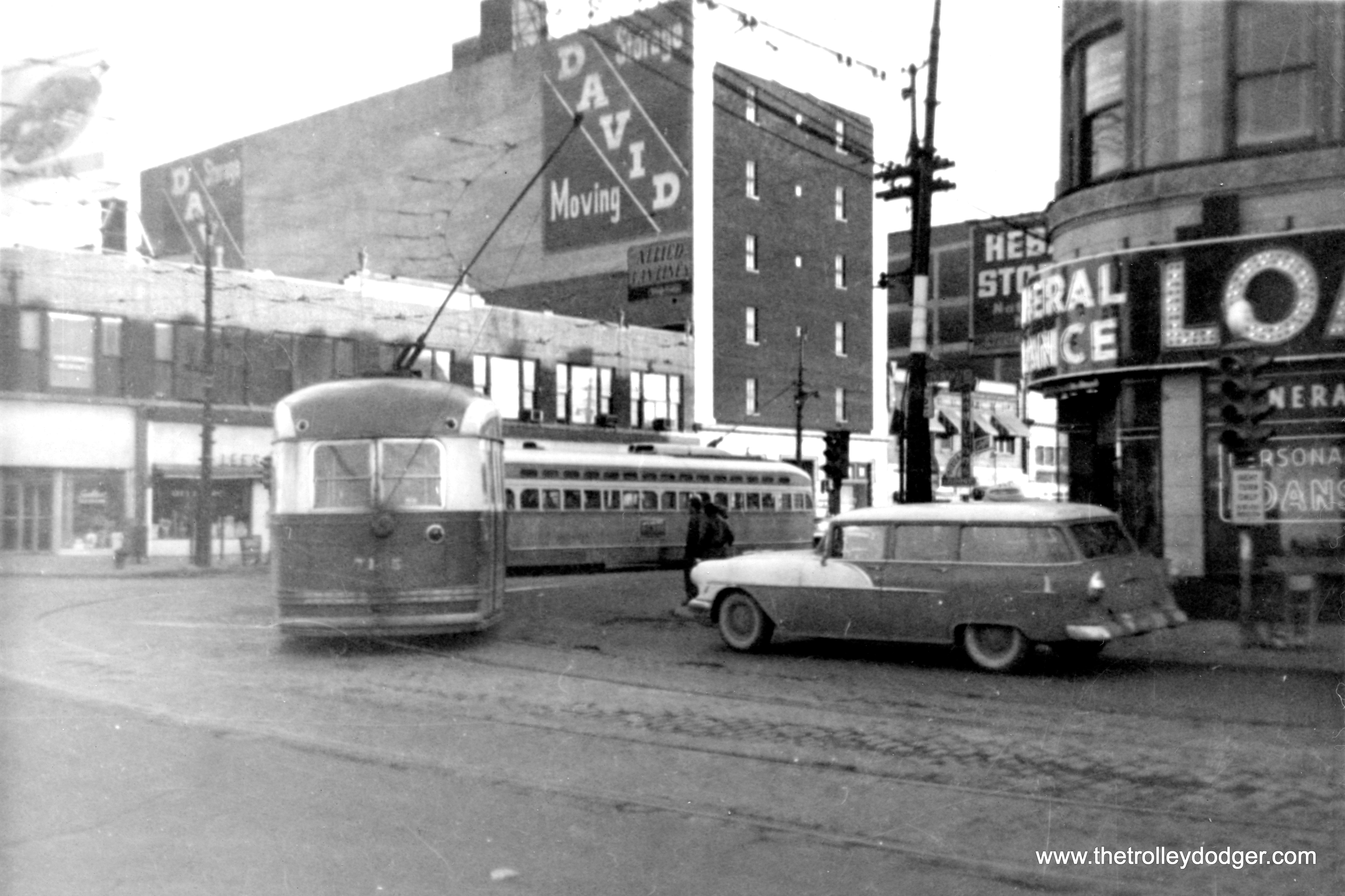
CTA 3232 on Route 67. M.E. adds, "This photo was likely taken at 69th and Western. This is an eastbound car making the turn from going north on Western to going east on 69th. After the 69th St. line was converted to buses, the CTA kept the tracks in operation so that PCC cars running along Western could access the barn at Vincennes and 77th."

CTA 3232 on Route 67. M.E. adds, “This photo was likely taken at 69th and Western. This is an eastbound car making the turn from going north on Western to going east on 69th. After the 69th St. line was converted to buses, the CTA kept the tracks in operation so that PCC cars running along Western could access the barn at Vincennes and 77th.”

CTA 3254 at 71st and California on February 3, 1953.

CTA 3254 at 71st and California on February 3, 1953.

CTA 3318 at 71st and California on May 28, 1950.

CTA 3318 at 71st and California on May 28, 1950.

CTA 422 on Kedzie at 47th on May 13, 1954. It would appear this one of one a few locations where there was wire shared by streetcars and trolley buses. M.E. adds, "There was no trolley bus service along Kedzie, so the only explanation for the trolley bus here is that it was going either to or from the trolley bus barn. I don't know precisely where that barn was, but judging by the picture, it had to be somewhere along Kedzie between 47th and 51st Sts., which had the only two trolley bus lines on the south side." John V.: "CTA 422 on Kedzie: Trolley buses for routes 47 & 51 utilized Archer Car Station for storage, accessed via Kedzie north of 47th Street. Kedzie itself changed over to trolley buses in 1955."

CTA 422 on Kedzie at 47th on May 13, 1954. It would appear this one of one a few locations where there was wire shared by streetcars and trolley buses. M.E. adds, “There was no trolley bus service along Kedzie, so the only explanation for the trolley bus here is that it was going either to or from the trolley bus barn. I don’t know precisely where that barn was, but judging by the picture, it had to be somewhere along Kedzie between 47th and 51st Sts., which had the only two trolley bus lines on the south side.” John V.: “CTA 422 on Kedzie: Trolley buses for routes 47 & 51 utilized Archer Car Station for storage, accessed via Kedzie north of 47th Street. Kedzie itself changed over to trolley buses in 1955.”

CTA trolley bus 9289 at the turnaround loop at Belmont and Cumberland.

CTA trolley bus 9289 at the turnaround loop at Belmont and Cumberland.

The same location today.

The same location today.

CTA trolley bus 9504 on Route 53 - Pulaski in 1970. Mike Charnota Photo)

CTA trolley bus 9504 on Route 53 – Pulaski in 1970. Mike Charnota Photo)

We are looking east along Randolph Street on October 16, 1958. We see the old Trailways bus depot, and what was then the newly remodeled CTA "L" station, which was replaced a few years ago by a new station a block south and Washington and Wabash. I am not sure whether the giant CTA logo was saved off the old station.

We are looking east along Randolph Street on October 16, 1958. We see the old Trailways bus depot, and what was then the newly remodeled CTA “L” station, which was replaced a few years ago by a new station a block south and Washington and Wabash. I am not sure whether the giant CTA logo was saved off the old station.

This is an Ashland Car Works duplicate slide, sold by the late Jack Bailey. This is a North Shore Line train in one of the northern suburbs, running on the Shore Line Route, parallel to the Chicago & North Western (which would be just to the right of the frame). Which means we are looking to the south. KV writes that this "appears to be St. Johns Avenue in Highland Park."

This is an Ashland Car Works duplicate slide, sold by the late Jack Bailey. This is a North Shore Line train in one of the northern suburbs, running on the Shore Line Route, parallel to the Chicago & North Western (which would be just to the right of the frame). Which means we are looking to the south. KV writes that this “appears to be St. Johns Avenue in Highland Park.”

Blue Island, IL on September 6, 2001. This two-car section of the Blue Island (Vermont Street) Metra (IC) Electric station platform is all that's left of the original 1926 station. The head house and remainder of the platform have been demolished and a new facility is under construction. The view looks N-NE across the west pocket track.

Blue Island, IL on September 6, 2001. This two-car section of the Blue Island (Vermont Street) Metra (IC) Electric station platform is all that’s left of the original 1926 station. The head house and remainder of the platform have been demolished and a new facility is under construction. The view looks N-NE across the west pocket track.

Near the Armitage CTA "L" station in April 1968.

Near the Armitage CTA “L” station in April 1968.

A Chicago Great Western "piggyback" freight train on Baltimore & Ohio Chicago Terminal tracks on September 13, 1965. The CGW was abandoned in the 1970s. We are looking west from Harlem Avenue in Forest Park, IL, with the CTA Congress rapid transit station at right (part of today's Blue Line). Note how the fiberglass panels on the ramp are arranged in a colorful pattern. Some years later, many of these were removed after some riders were robbed in these secluded walkways. (Dick Talbott Photo)

A Chicago Great Western “piggyback” freight train on Baltimore & Ohio Chicago Terminal tracks on September 13, 1965. The CGW was abandoned in the 1970s. We are looking west from Harlem Avenue in Forest Park, IL, with the CTA Congress rapid transit station at right (part of today’s Blue Line). Note how the fiberglass panels on the ramp are arranged in a colorful pattern. Some years later, many of these were removed after some riders were robbed in these secluded walkways. (Dick Talbott Photo)

South Shore Line car 16 in July 1977.

South Shore Line car 16 in July 1977.

A southbound North Shore Line Electroliner at Lake Bluff. (A. C. Kalmbach Photo)

A southbound North Shore Line Electroliner at Lake Bluff. (A. C. Kalmbach Photo)

This was taken on a Central Electric Railfans' Association fantrip on the Metra Electric around May 1990. The South Shore Line also runs on these tracks somewhere on Chicago's south side.

This was taken on a Central Electric Railfans’ Association fantrip on the Metra Electric around May 1990. The South Shore Line also runs on these tracks somewhere on Chicago’s south side.

South Shore Line 10 in December 1983. (Gregory Markey Photo)

South Shore Line 10 in December 1983. (Gregory Markey Photo)

CA&E 309 at the Wheaton Shops.

CA&E 309 at the Wheaton Shops.

CTA PCC 7171 heads south on State Street at Wacker Drive, most likely on Route 36. The CTA "L" station at State and Lake Streets is a block away, with Fritzel's restaurant and the Chicago Theater visible. This picture dates to the mid-1950s.

CTA PCC 7171 heads south on State Street at Wacker Drive, most likely on Route 36. The CTA “L” station at State and Lake Streets is a block away, with Fritzel’s restaurant and the Chicago Theater visible. This picture dates to the mid-1950s.

A train of Met cars on the Garfield Park "L". (John J. Kelly, Jr. Photo)

A train of Met cars on the Garfield Park “L”. (John J. Kelly, Jr. Photo)

CTA 4053-4336 on the Lake Street "L" in Oak Park on October 19, 1952.

CTA 4053-4336 on the Lake Street “L” in Oak Park on October 19, 1952.

CSL 5222 on Halsted at 79th Street, apparently in the late 1920s. The Capitol Theater was located at 7941 S. Halsted and opened in 1925. The view looks south. M.E. notes: "In this photo you see tracks switching between Halsted and 79th St. These switches took Halsted cars east on 79th St. to Vincennes, then north to 77th St. to the big CSL barn. Those tracks could also have led to Emerald Ave. (a half block east of Halsted), where the Halsted cars turned south, then west into the terminal at roughly 79th Place between Emerald and Halsted. From the picture, I can't determine whether that terminal existed in the 1920s. Halsted cars could have also used the barn farther south at 88th and Vincennes, which had been the barn for the interurban line that ran from Kankakee to the L at 63rd Place and Halsted." "I don't know when the barn at 103rd and Vincennes (also on the Halsted route) opened, but even had it existed in the 1920s, there would not have been a track connection between the Halsted cars running on a private right-of-way east of Vincennes, and the barn on the southwest corner of 103rd and Vincennes. I say this with certainty because, at the intersection of 103rd St., Vincennes Ave. and Beverly Blvd. (which came in from the northwest), there was also the freight line of the Pennsylvania Railroad that ran alongside Beverly Blvd. and crossed both the CSL Vincennes line and the Rock Island main line. So there would not have been any room to run streetcar trackage to the barn! Plus, I believe the 103rd St. barn was strictly a bus barn. But the junction of 103rd and Vincennes, the center of the neighborhood called Washington Heights, would have been a great railfanning location, with Rock Island mainline and commuter trains, CSL Vincennes streetcars, and the Pennsy freights."

CSL 5222 on Halsted at 79th Street, apparently in the late 1920s. The Capitol Theater was located at 7941 S. Halsted and opened in 1925. The view looks south. M.E. notes: “In this photo you see tracks switching between Halsted and 79th St. These switches took Halsted cars east on 79th St. to Vincennes, then north to 77th St. to the big CSL barn. Those tracks could also have led to Emerald Ave. (a half block east of Halsted), where the Halsted cars turned south, then west into the terminal at roughly 79th Place between Emerald and Halsted. From the picture, I can’t determine whether that terminal existed in the 1920s. Halsted cars could have also used the barn farther south at 88th and Vincennes, which had been the barn for the interurban line that ran from Kankakee to the L at 63rd Place and Halsted.”
“I don’t know when the barn at 103rd and Vincennes (also on the Halsted route) opened, but even had it existed in the 1920s, there would not have been a track connection between the Halsted cars running on a private right-of-way east of Vincennes, and the barn on the southwest corner of 103rd and Vincennes. I say this with certainty because, at the intersection of 103rd St., Vincennes Ave. and Beverly Blvd. (which came in from the northwest), there was also the freight line of the Pennsylvania Railroad that ran alongside Beverly Blvd. and crossed both the CSL Vincennes line and the Rock Island main line. So there would not have been any room to run streetcar trackage to the barn! Plus, I believe the 103rd St. barn was strictly a bus barn. But the junction of 103rd and Vincennes, the center of the neighborhood called Washington Heights, would have been a great railfanning location, with Rock Island mainline and commuter trains, CSL Vincennes streetcars, and the Pennsy freights.”

Our Latest Book, Now Available:

Chicago’s Lost “L”s

From the back cover:

Chicago’s system of elevated railways, known locally as the “L,” has run continuously since 1892 and, like the city, has never stood still. It helped neighborhoods grow, brought their increasingly diverse populations together, and gave the famous Loop its name. But today’s system has changed radically over the years. Chicago’s Lost “L”s tells the story of former lines such as Garfield Park, Humboldt Park, Kenwood, Stockyards, Normal Park, Westchester, and Niles Center. It was once possible to take high-speed trains on the L directly to Aurora, Elgin, and Milwaukee, Wisconsin. The L started out as four different companies, two starting out using steam engines instead of electricity. Eventually, all four came together via the Union Loop. The L is more than a way of getting around. Its trains are a place where people meet and interact. Some say the best way to experience the city is via the L, with its second-story view. Chicago’s Lost “L”s is virtually a “secret history” of Chicago, and this is your ticket. David Sadowski grew up riding the L all over the city. He is the author of Chicago Trolleys and Building Chicago’s Subways and runs the online Trolley Dodger blog.

The Images of America series celebrates the history of neighborhoods, towns, and cities across the country. Using archival photographs, each title presents the distinctive stories from the past that shape the character of the community today. Arcadia is proud to play a part in the preservation of local heritage, making history available to all.

Title Chicago’s Lost “L”s
Images of America
Author David Sadowski
Edition illustrated
Publisher Arcadia Publishing (SC), 2021
ISBN 1467100007, 9781467100007
Length 128 pages

Chapters:
01. The South Side “L”
02. The Lake Street “L”
03. The Metropolitan “L”
04. The Northwestern “L”
05. The Union Loop
06. Lost Equipment
07. Lost Interurbans
08. Lost Terminals
09. Lost… and Found

Each copy purchased here will be signed by the author, and you will also receive a bonus facsimile of a 1926 Chicago Rapid Transit Company map, with interesting facts about the “L” on the reverse side.

The price of $23.99 includes shipping within the United States.

For Shipping to US Addresses:

For Shipping to Canada:

For Shipping Elsewhere:

NEW DVD:

A Tribute to the North Shore Line

To commemorate the 50th anniversary of the demise of the fabled North Shore Line interurban in January 2013, Jeffrey L. Wien and Bradley Criss made a very thorough and professional video presentation, covering the entire route between Chicago and Milwaukee and then some. Sadly, both men are gone now, but their work remains, making this video a tribute to them, as much as it is a tribute to the Chicago North Shore & Milwaukee.

Jeff drew on his own vast collections of movie films, both his own and others such as the late William C. Hoffman, wrote and gave the narration. Bradley acted as video editor, and added authentic sound effects from archival recordings of the North Shore Line.

It was always Jeff’s intention to make this video available to the public, but unfortunately, this did not happen in his lifetime. Now, as the caretakers of Jeff’s railfan legacy, we are proud to offer this excellent two-hour program to you for the first time.  The result is a fitting tribute to what Jeff called his “Perpetual Adoration,” which was the name of a stop on the interurban.

Jeff was a wholehearted supporter of our activities, and the proceeds from the sale of this disc will help defray some of the expenses of keeping the Trolley Dodger web site going.

Total time – 121:22

# of Discs – 1
Price: $19.99 (Includes shipping within the United States)

Help Support The Trolley Dodger

This is our 272nd post, and we are gradually creating a body of work and an online resource for the benefit of all railfans, everywhere. To date, we have received over 784,000 page views, for which we are very grateful.
You can help us continue our original transit research by checking out the fine products in our Online Store.
As we have said before, “If you buy here, we will be here.”
We thank you for your support.
DONATIONS
In order to continue giving you the kinds of historic railroad images that you have come to expect from The Trolley Dodger, we need your help and support. It costs money to maintain this website, and to do the sort of historic research that is our specialty.
Your financial contributions help make this web site better, and are greatly appreciated.

Outtakes From Chicago’s Lost “L”s (Part One)

A northbound midday express train passes the 18th Street "L" station, just prior to the October 1943 opening the State Street Subway. The new signals that controlled access to the subway are already in place. A wooden Pullman-built trailer, built around the turn of the century, is being pushed by two early 1920s 4000-series cars. Once the subway opened, all 455 steel-bodied cars were needed there, and mixed consists such as these became a thing of the past. When the Chicago Transit Authority made a major revision of north-south service in 1949, the third track here was taken out of service, and was eventually removed. (Chicago Transit Authority Historical Collection)

A northbound midday express train passes the 18th Street “L” station, just prior to the October 1943 opening the State Street Subway. The new signals that controlled access to the subway are already in place. A wooden Pullman-built trailer, built around the turn of the century, is being pushed by two early 1920s 4000-series cars. Once the subway opened, all 455 steel-bodied cars were needed there, and mixed consists such as these became a thing of the past. When the Chicago Transit Authority made a major revision of north-south service in 1949, the third track here was taken out of service, and was eventually removed. (Chicago Transit Authority Historical Collection)

We are pleased to report that our new book Chicago’s Lost “L”s is now 100% finished, and will be released by Arcadia Publishing on July 12, 2021.  The final proofing process took several days, as there were a number of changes I wanted to make.

We have already received pre-orders for more than 60 copies, better than either of our two previous books.  You will find ordering information at the end of this post, and also on our Online Store.

How does a book like this get made? I am sure the process varies for every author, but for me, it starts out with an idea. I wanted to do a book about the “L”, but I also wanted it to be different than any of the others that are out there.

Once I had settled on my theme, and had determined the chapter titles, I started looking at images, lots of them. I have a collection of perhaps 30,000 digitized images, and I went through all of them– three times. I put the 500 or so images that I considered “possibles” into a folder, and from this, I continued the winnowing down process, until I had a more reasonable number (there are usually around 230 images or so in this type of book).

But this was just the start of the work. I had to put the images into an order that made sense, and then try to write captions for them.

In the process of doing this, it became clear to me that each and every image in the book had to have a clear purpose for being there, and couldn’t just be a place holder. If I couldn’t come up with an interesting and informative caption, there was really no point in including that particular photo.

That’s when the narrative of the book starts to become clear, and you eventually figure out what the story is you are trying to tell. You see what’s missing, and have to seek out the missing images that will help you fill the holes in your narrative.  Often, these have to be purchased outright, and many of the images in the book are taken from original negatives and slides in our own collections, all made possible by your purchases and donations.

Over the course of many months, nearly half the images in my lineup got replaced by others. It’s always the oldest pictures that are the hardest to find. This process took longer for Chicago’s Lost “L”s because of the delays caused by the pandemic.

A book such as this is a partnership between the author and the publisher. They have requirements and standards of their own, and once a book is written and submitted, things go back and forth between author and editor several times, until everyone is happy with the results.

Every effort has been made to make this the best and most comprehensive book on this subject, and we sincerely hope you will enjoy reading it!

In today’s post, (part one of two) we feature some of the images that ultimately were not selected for the book. But they are still interesting in their own right, and we hope they will whet your appetite for Chicago’s Lost “L”s. We’ll see you nexdt time with another batch of outtakes.

-David Sadowski

PS- FYI, we have a Facebook auxiliary for the Trolley Dodger, which currently has 354 members.

This is how the end of the Jackson Park "L" looked for many years at 63rd Street and Stony Island Avenue. The "L" had gone about a block further east during the 1893 World's Columbian Exposition to connect to the experimental Columbian Intramural Railway. In this early 1950s view, a CTA 63rd Street bus has turned the corner onto Stoney Island, as this was the end of the line. Behind the "L" station, we can see a sign advertising the Tower Theater, open from 1926 to 1956, built by the Lubliner and Trinz chain. (Chicago Transit Authority Historical Collection)

This is how the end of the Jackson Park “L” looked for many years at 63rd Street and Stony Island Avenue. The “L” had gone about a block further east during the 1893 World’s Columbian Exposition to connect to the experimental Columbian Intramural Railway. In this early 1950s view, a CTA 63rd Street bus has turned the corner onto Stoney Island, as this was the end of the line. Behind the “L” station, we can see a sign advertising the Tower Theater, open from 1926 to 1956, built by the Lubliner and Trinz chain. (Chicago Transit Authority Historical Collection)

Inventor Frank Julian Sprague was hired by the South Side "L" to equip their cars with electricity (powered by third rail) and multiple unit operation, his latest invention. Here, "L" car 139 is being tested on Harrison Curve on April 16, 1898. (Chicago Transit Authority Historical Collection)

Inventor Frank Julian Sprague was hired by the South Side “L” to equip their cars with electricity (powered by third rail) and multiple unit operation, his latest invention. Here, “L” car 139 is being tested on Harrison Curve on April 16, 1898. (Chicago Transit Authority Historical Collection)

Service on the South Side "L" began under steam power, as seen here in this 1893 view of a train on 63rd Street just west of Cottage Grove. Locomotive #41 was built by Baldwin. Steam was replaced by electricity in the late 1890s. (Chicago Transit Authority Historical Collection)

Service on the South Side “L” began under steam power, as seen here in this 1893 view of a train on 63rd Street just west of Cottage Grove. Locomotive #41 was built by Baldwin. Steam was replaced by electricity in the late 1890s. (Chicago Transit Authority Historical Collection)

The Normal Park "L" was the shortest branch on the rapid transit system. Here we see the end of the line at 69th Street, looking east in 1949. The terminal here was designed for extension, but this did not come to pass. This branch closed in 1954. The sign on the train indicates it is a Ravenswood Express. (Chicago Transit Authority Historical Collection)

The Normal Park “L” was the shortest branch on the rapid transit system. Here we see the end of the line at 69th Street, looking east in 1949. The terminal here was designed for extension, but this did not come to pass. This branch closed in 1954. The sign on the train indicates it is a Ravenswood Express. (Chicago Transit Authority Historical Collection)

Shortly before the Stock Yards branch was discontinued in 1957, a single-car wooden train heads west towards the Exchange station. (Chicago Transit Authority Historical Collection)

Shortly before the Stock Yards branch was discontinued in 1957, a single-car wooden train heads west towards the Exchange station. (Chicago Transit Authority Historical Collection)

In this view at Adams and Wabash station circa 1939, we see the rears of two "L" cars that are both heading away from us, as both Loop tracks then ran in a counter-clockwise direction. The train at left is a Lake Street "L", while the one at right may have been working in north-south service. (Chicago Transit Authority Historical Collection)

In this view at Adams and Wabash station circa 1939, we see the rears of two “L” cars that are both heading away from us, as both Loop tracks then ran in a counter-clockwise direction. The train at left is a Lake Street “L”, while the one at right may have been working in north-south service. (Chicago Transit Authority Historical Collection)

This circa 1910 view of Indiana Junction on the South Side "L" looks to the southwest. Once branch lines were opened here, going to Kenwood and the Stock Yards, this became a busy transfer point. The "L" tracks here ran parallel to 40th Street and were adjacent to the Chicago Junction Railway's freight line, seen at right. A southbound Jackson Park Express train runs on the middle track, turning south, with its next stop at 43rd Street. (Chicago Transit Authority Historical Collection)

This circa 1910 view of Indiana Junction on the South Side “L” looks to the southwest. Once branch lines were opened here, going to Kenwood and the Stock Yards, this became a busy transfer point. The “L” tracks here ran parallel to 40th Street and were adjacent to the Chicago Junction Railway’s freight line, seen at right. A southbound Jackson Park Express train runs on the middle track, turning south, with its next stop at 43rd Street. (Chicago Transit Authority Historical Collection)

The South Side "L" was Chicago's first, and was also known as the Alley "L". On September 5, 1890, a connecting span is raised at what became the 35th Street station. Service began in 1892. (Chicago Transit Authority Historical Collection)

The South Side “L” was Chicago’s first, and was also known as the Alley “L”. On September 5, 1890, a connecting span is raised at what became the 35th Street station. Service began in 1892. (Chicago Transit Authority Historical Collection)

Frank Lloyd Wright designed the triangular Stohr Arcade Building at Wilson Avenue and Broadway in 1909, part of which was underneath the Northwestern "L" structure. Within a decade of its construction, "L" service led to rapid development of the Uptown neighborhood, and the Stohr Arcade was replaced by Arthur U. Gerber's Uptown Union Station in 1923. (Krambles-Peterson Archive)

Frank Lloyd Wright designed the triangular Stohr Arcade Building at Wilson Avenue and Broadway in 1909, part of which was underneath the Northwestern “L” structure. Within a decade of its construction, “L” service led to rapid development of the Uptown neighborhood, and the Stohr Arcade was replaced by Arthur U. Gerber’s Uptown Union Station in 1923. (Krambles-Peterson Archive)

The view looking north from the Wilson Avenue Lower Terminal between 1909 and 1922, showing the Stohr Arcade Building at the intersection of Wilson and Broadway. (Krambles-Peterson Archive)

The view looking north from the Wilson Avenue Lower Terminal between 1909 and 1922, showing the Stohr Arcade Building at the intersection of Wilson and Broadway. (Krambles-Peterson Archive)

We are looking east from Exchange on the Stock Yards branch. The time is circa 1949.

We are looking east from Exchange on the Stock Yards branch. The time is circa 1949.

The stations on the Stock Yards loop had but one side platform, as there was only a single track. This is the Armour station,

The stations on the Stock Yards loop had but one side platform, as there was only a single track. This is the Armour station,

A two-car train of wooden "L" cars on the single-track Stock Yards branch in 1946. This photo has been attributed to Charles Keevil.

A two-car train of wooden “L” cars on the single-track Stock Yards branch in 1946. This photo has been attributed to Charles Keevil.

CTA 1780 heads up an "A" train at Marion Street in Oak Park. The ground-level portion of the Lake Street "L" was relocated onto the nearby C&NW embankment in 1962. This picture was probably taken between 1948 and 1955.

CTA 1780 heads up an “A” train at Marion Street in Oak Park. The ground-level portion of the Lake Street “L” was relocated onto the nearby C&NW embankment in 1962. This picture was probably taken between 1948 and 1955.

Service to Wilson Avenue via the "L" commenced in 1900, but the lower-level station did not open until March 5, 1907, with this modest station house designed by Arthur U. Gerber. In the book, I chose to use a different image, taken on opening day, that shows the other side of this building and the lower level tracks.

Service to Wilson Avenue via the “L” commenced in 1900, but the lower-level station did not open until March 5, 1907, with this modest station house designed by Arthur U. Gerber. In the book, I chose to use a different image, taken on opening day, that shows the other side of this building and the lower level tracks.

A 1908 view of the Argyle station on the Northwestern "L", shortly after service was extended between Uptown and Evanston at ground level. The "L" took over tracks belonging to the Milwaukee Road via a lease arrangement. By 1915, the "L' was gradually being elevated here onto a new embankment, which is now itself in the process of being rebuilt after a century of use. (Chicago Transit Authority Historical Collection)

A 1908 view of the Argyle station on the Northwestern “L”, shortly after service was extended between Uptown and Evanston at ground level. The “L” took over tracks belonging to the Milwaukee Road via a lease arrangement. By 1915, the “L’ was gradually being elevated here onto a new embankment, which is now itself in the process of being rebuilt after a century of use. (Chicago Transit Authority Historical Collection)

This circa 1952 shot of CTA 6097-6098 was taken from the LaSalle and Van Buren platform, looking west towards the junction at Wells and Van Buren. In the distance, you can see the Franklin Street station, used by Metropolitan "L" trains. It was not on the Loop itself. (George Trapp Collection)

This circa 1952 shot of CTA 6097-6098 was taken from the LaSalle and Van Buren platform, looking west towards the junction at Wells and Van Buren. In the distance, you can see the Franklin Street station, used by Metropolitan “L” trains. It was not on the Loop itself. (George Trapp Collection)

The façade of Wells Street Terminal, after it was renovated in the late 1920s, with the addition of two levels. It was designed by Chicago Rapid Transit Company staff architect Arthur U. Gerber. (Jack Bejna Collection)

The façade of Wells Street Terminal, after it was renovated in the late 1920s, with the addition of two levels. It was designed by Chicago Rapid Transit Company staff architect Arthur U. Gerber. (Jack Bejna Collection)

We are looking west along Harrison at Wabash on November 12, 1928. In 2003, the Chicago Transit Authority straightened out this jog with a section of new “L” structure, occupying the area where the building at left once was.

The old Cermak Road station on the south Side "L". Note there are three tracks here. This station was closed in 1977 and removed. A new station replaced it in 2015.

The old Cermak Road station on the south Side “L”. Note there are three tracks here. This station was closed in 1977 and removed. A new station replaced it in 2015.

A train of 4000s, signed for Jackson Park via the Subway, in 1947. If I am reading the sign correctly, this is 31st Street, a station the CTA closed in 1949. There was also apparently a Chicago White Sox home game when this picture was taken. M. E. writes: "pict673.jpg features a Jackson Park train at 31st St. Notice three tracks. The middle track was used, although I am unsure under what circumstances. One possibility that comes to mind is that the Kenwood line (until it became a shuttle out of Indiana Ave.) ran on this trackage into the Loop and up to Wilson. The Kenwood was a local. The Englewood and Jackson Park trains sometimes bypassed the Kenwood locals using the middle track. There were switches up and down the line to enable moving to and from the middle track. Another possibility is that at one point the North Shore ran trains south as far as 63rd and Dorchester (1400 East) on the Jackson Park line. Perhaps some CNS&M trains used the middle track. One impossibility is that the Englewood and Jackson Park trains used the middle track the whole way from south of Indiana Ave. to the Loop. I say this was not possible because all the stations on this line were on the outer sides of the outside tracks. I don't recall any Englewood or Jackson Park trains running express on the middle track along this stretch. By the way, prior to the 1949 changes, only the Jackson Park line ran north to Howard. The Englewood ran to Ravenswood (to Lawrence and Kimball)."

A train of 4000s, signed for Jackson Park via the Subway, in 1947. If I am reading the sign correctly, this is 31st Street, a station the CTA closed in 1949. There was also apparently a Chicago White Sox home game when this picture was taken. M. E. writes: “pict673.jpg features a Jackson Park train at 31st St. Notice three tracks. The middle track was used, although I am unsure under what circumstances. One possibility that comes to mind is that the Kenwood line (until it became a shuttle out of Indiana Ave.) ran on this trackage into the Loop and up to Wilson. The Kenwood was a local. The Englewood and Jackson Park trains sometimes bypassed the Kenwood locals using the middle track. There were switches up and down the line to enable moving to and from the middle track.
Another possibility is that at one point the North Shore ran trains south as far as 63rd and Dorchester (1400 East) on the Jackson Park line. Perhaps some CNS&M trains used the middle track.
One impossibility is that the Englewood and Jackson Park trains used the middle track the whole way from south of Indiana Ave. to the Loop. I say this was not possible because all the stations on this line were on the outer sides of the outside tracks. I don’t recall any Englewood or Jackson Park trains running express on the middle track along this stretch.
By the way, prior to the 1949 changes, only the Jackson Park line ran north to Howard. The Englewood ran to Ravenswood (to Lawrence and Kimball).”

61st Street on the South Side "L", looking north on November 13, 1944.

61st Street on the South Side “L”, looking north on November 13, 1944.

This old photo shows South Side Rapid Transit car 131 at 63rd Street in 1899. Note the wires on the tops of the cars, which were used for current collection via overhead wire in yard areas that did not yet have third rail installed. (George Trapp Collection)

This old photo shows South Side Rapid Transit car 131 at 63rd Street in 1899. Note the wires on the tops of the cars, which were used for current collection via overhead wire in yard areas that did not yet have third rail installed. (George Trapp Collection)

A track map of the Kenwood branch, which ran between Indiana Avenue and 42nd Place. It branched off the South Side "L".

A track map of the Kenwood branch, which ran between Indiana Avenue and 42nd Place. It branched off the South Side “L”.

A track map showing the Stock Yard branch, which operated as a shuttle starting at Indiana Avenue on the South Side "L". It didn't really have an end of the line, since part of the line ran in a single-track loop.

A track map showing the Stock Yard branch, which operated as a shuttle starting at Indiana Avenue on the South Side “L”. It didn’t really have an end of the line, since part of the line ran in a single-track loop.

CTA 2067-2068 head up a westbound Lake Street train in June 1965.

CTA 2067-2068 head up a westbound Lake Street train in June 1965.

A two-car train of 4000s is on the Lake Street "L" during construction of the Northwest (now Kennedy) expressway on February 25, 1958. The new highway opened in 1960. Further south, the Garfield Park "L" also crossed the highway footprint and had to be shored up around the same time this photo was taken. But once the new Congress rapid transit line opened on June 22, 1958 the Garfield line was no longer needed and the structure was removed where it crossed the highway, cutting the line off from the rest of the system. The remaining portions of structure west of there were removed in 1959; east of there, parts remained until 1964. The Lake Street "L", on the other hand, rechristened the Green Line, is still here.

A two-car train of 4000s is on the Lake Street “L” during construction of the Northwest (now Kennedy) expressway on February 25, 1958. The new highway opened in 1960. Further south, the Garfield Park “L” also crossed the highway footprint and had to be shored up around the same time this photo was taken. But once the new Congress rapid transit line opened on June 22, 1958 the Garfield line was no longer needed and the structure was removed where it crossed the highway, cutting the line off from the rest of the system. The remaining portions of structure west of there were removed in 1959; east of there, parts remained until 1964. The Lake Street “L”, on the other hand, rechristened the Green Line, is still here.

This is an inspection train at the Lake Street Transfer "L" station, which provided connections between the Lake Street "L", on the lower level, and the Metropolitan above. The higher level station was closed in February 1951, when the Dearborn-Milwaukee subway opened.

This is an inspection train at the Lake Street Transfer “L” station, which provided connections between the Lake Street “L”, on the lower level, and the Metropolitan above. The higher level station was closed in February 1951, when the Dearborn-Milwaukee subway opened.

CTA 3119, signed as a Lake Street local, is being stored on the third track at Hamlin in August 1948. By then, A/B "skip stop" service had been in effect for some months. It's possible this car was no longer being used on the line. Don's Rail Photos: "3119 was built by St. Louis Car in 1902 as LSERR 119. In 1913 it was renumbered 3119 and became CRT 3119 in 1923."

CTA 3119, signed as a Lake Street local, is being stored on the third track at Hamlin in August 1948. By then, A/B “skip stop” service had been in effect for some months. It’s possible this car was no longer being used on the line. Don’s Rail Photos: “3119 was built by St. Louis Car in 1902 as LSERR 119. In 1913 it was renumbered 3119 and became CRT 3119 in 1923.”

CRT S-200 in the Lake and Hamlin yard. Don's Rail Photos says, "S-200 was built by Barney & Smith in 1901 at M-WSER 783. It was renumbered in 1913 as 2783. In 1916 it was rebuilt as a work motor and numbered S-200. It became CRT S-200 in 1923." In this photo, it looks like it is being used to string trolley wire. You can see the ramp leading up to the "L" at right. (George Trapp Collection)

CRT S-200 in the Lake and Hamlin yard. Don’s Rail Photos says, “S-200 was built by Barney & Smith in 1901 at M-WSER 783. It was renumbered in 1913 as 2783. In 1916 it was rebuilt as a work motor and numbered S-200. It became CRT S-200 in 1923.” In this photo, it looks like it is being used to string trolley wire. You can see the ramp leading up to the “L” at right. (George Trapp Collection)

An eastbound Garfield Park train approaches the Loop in the 1940s, crossing over the Chicago River. (Chicago Transit Authority Historical Collection)

An eastbound Garfield Park train approaches the Loop in the 1940s, crossing over the Chicago River. (Chicago Transit Authority Historical Collection)

This may be an "as new" photo showing Metropolitan West Side "L" car 876. Don's Rail Photos: "2873 thru 2887 were built by Pullman in 1906 as M-WSER 873 thru 887. In 1913 they were renumbered 2873 thru 2887 and in 1923 they became CRT 2873 thru 2987." (George Trapp Collection)

This may be an “as new” photo showing Metropolitan West Side “L” car 876. Don’s Rail Photos: “2873 thru 2887 were built by Pullman in 1906 as M-WSER 873 thru 887. In 1913 they were renumbered 2873 thru 2887 and in 1923 they became CRT 2873 thru 2987.” (George Trapp Collection)

A Douglas Park "B" train heads west at Halsted on the Met main line, prior to the removal of two tracks for expressway construction.

A Douglas Park “B” train heads west at Halsted on the Met main line, prior to the removal of two tracks for expressway construction.

A two car CRT "L" train in December 1935, heading west toward the Douglas Pak "L"s end-of-the-line at Oak Park Avenue in Berwyn.

A two car CRT “L” train in December 1935, heading west toward the Douglas Pak “L”s end-of-the-line at Oak Park Avenue in Berwyn.

The Pulaski station on the Douglas Park "L" on May 10, 1958. There was a yard there at the time. This was once the western terminus of Douglas, and the curved track visible here was part of a turning loop. (Lawrence H. Boehuring Photo)

The Pulaski station on the Douglas Park “L” on May 10, 1958. There was a yard there at the time. This was once the western terminus of Douglas, and the curved track visible here was part of a turning loop. (Lawrence H. Boehuring Photo)

Around July 1, 1957, a westbound CTA Garfield Park "L" train is westbound on the Van Buren temporary trackage at California Avenue (2800 W.).

Around July 1, 1957, a westbound CTA Garfield Park “L” train is westbound on the Van Buren temporary trackage at California Avenue (2800 W.).

A night shot of CTA 2810 and 2818 in the Laramie Yards on February 1, 1957. By then, the Congress Expressway was open as far as Laramie and was adjacent to the Garfield Park "L". It was still under construction west of here, and the "L" ran on temporary trackage. (Robert Selle Photo)

A night shot of CTA 2810 and 2818 in the Laramie Yards on February 1, 1957. By then, the Congress Expressway was open as far as Laramie and was adjacent to the Garfield Park “L”. It was still under construction west of here, and the “L” ran on temporary trackage. (Robert Selle Photo)

The CRT Westchester branch at Roosevelt Road, circa 1929-1930. Service along this line opened in 1926, and when the line was extended, local officials insisted that tracks not cross Roosevelt at grade, thereby necessitating this grade separation project. The platform at left was later moved into the open cut, although the original station house was retained. Service to Mannheim began in 1930. The line was abandoned in 1951. We are looking north. (George Trapp Collection)

The CRT Westchester branch at Roosevelt Road, circa 1929-1930. Service along this line opened in 1926, and when the line was extended, local officials insisted that tracks not cross Roosevelt at grade, thereby necessitating this grade separation project. The platform at left was later moved into the open cut, although the original station house was retained. Service to Mannheim began in 1930. The line was abandoned in 1951. We are looking north. (George Trapp Collection)

A track map showing the Metropolitan "L" branches going to Logan Square and Humboldt Park (Lawndale). All four Met lines came together at Marshfield.

A track map showing the Metropolitan “L” branches going to Logan Square and Humboldt Park (Lawndale). All four Met lines came together at Marshfield.

The Logan Square terminal in 1946. "L" service terminated here from 1895 to 1970, when the CTA extended service to the northwest via a new subway. A portion of this building still exists, although considerably altered. (Chicago Transit Authority Historical Collection)

The Logan Square terminal in 1946. “L” service terminated here from 1895 to 1970, when the CTA extended service to the northwest via a new subway. A portion of this building still exists, although considerably altered. (Chicago Transit Authority Historical Collection)

A Metropolitan "L" motorman in the early 1900s.

A Metropolitan “L” motorman in the early 1900s.

The Humboldt Park "L" station at Lawndale Avenue (3700 W), which was the end of the line. There was just the one platform here. Since the Met hoped to eventually extend the line (which never happened), there was no terminal as such, and trains were stored on the other two tracks when not in use.

The Humboldt Park “L” station at Lawndale Avenue (3700 W), which was the end of the line. There was just the one platform here. Since the Met hoped to eventually extend the line (which never happened), there was no terminal as such, and trains were stored on the other two tracks when not in use.

You would be forgiven for not recognizing this location, but that's the Western Avenue station on the Humboldt Park "L", just north of North Avenue. The station was closed in 1952, probably just a few months before this picture was taken. If the station was open, there would be a sign advertising this, similar to ones seen in some of the other pictures in this post. You can also see trolley bus wires, used on North Avenue. PCC 7151 is a two-man car, and passengers are boarding at the rear. This portion of the old Humboldt Park line was not demolished for another decade, and the story goes that it would have been used by Chicago Aurora & Elgin interurban trains as a midday storage area, if service on that line could have continued after 1957.

You would be forgiven for not recognizing this location, but that’s the Western Avenue station on the Humboldt Park “L”, just north of North Avenue. The station was closed in 1952, probably just a few months before this picture was taken. If the station was open, there would be a sign advertising this, similar to ones seen in some of the other pictures in this post. You can also see trolley bus wires, used on North Avenue. PCC 7151 is a two-man car, and passengers are boarding at the rear. This portion of the old Humboldt Park line was not demolished for another decade, and the story goes that it would have been used by Chicago Aurora & Elgin interurban trains as a midday storage area, if service on that line could have continued after 1957.

Robert Selle took this photo on June 21, 1958, looking out the front window of a northbound CTA Douglas Park train. We are about to pass the old Met station at Madison Street on the Logan Square-Humboldt Park branch, unused since 1951. From 1954 to 1958, Douglas trains were routed downtown over the Lake Street "L" via a new connection seen off in the distance. This is the current route of the CTA Pink Line, but the day after this picture was taken, Douglas trains began using the Congress-Dearborn-Milwaukee subway instead.

Robert Selle took this photo on June 21, 1958, looking out the front window of a northbound CTA Douglas Park train. We are about to pass the old Met station at Madison Street on the Logan Square-Humboldt Park branch, unused since 1951. From 1954 to 1958, Douglas trains were routed downtown over the Lake Street “L” via a new connection seen off in the distance. This is the current route of the CTA Pink Line, but the day after this picture was taken, Douglas trains began using the Congress-Dearborn-Milwaukee subway instead.

Our Latest Book, Now Available for Pre-Order:

Chicago’s Lost “L”s

Arcadia Publishing will release our new book Chicago’s Lost “L”s on July 12, 2021. Reserve your copy today!

From the back cover:

Chicago’s system of elevated railways, known locally as the “L,” has run continuously since 1892 and, like the city, has never stood still. It helped neighborhoods grow, brought their increasingly diverse populations together, and gave the famous Loop its name. But today’s system has changed radically over the years. Chicago’s Lost “L”s tells the story of former lines such as Garfield Park, Humboldt Park, Kenwood, Stockyards, Normal Park, Westchester, and Niles Center. It was once possible to take high-speed trains on the L directly to Aurora, Elgin, and Milwaukee, Wisconsin. The L started out as four different companies, two starting out using steam engines instead of electricity. Eventually, all four came together via the Union Loop. The L is more than a way of getting around. Its trains are a place where people meet and interact. Some say the best way to experience the city is via the L, with its second-story view. Chicago’s Lost “L”s is virtually a “secret history” of Chicago, and this is your ticket. David Sadowski grew up riding the L all over the city. He is the author of Chicago Trolleys and Building Chicago’s Subways and runs the online Trolley Dodger blog.

The Images of America series celebrates the history of neighborhoods, towns, and cities across the country. Using archival photographs, each title presents the distinctive stories from the past that shape the character of the community today. Arcadia is proud to play a part in the preservation of local heritage, making history available to all.

Title Chicago’s Lost “L”s
Images of America
Author David Sadowski
Edition illustrated
Publisher Arcadia Publishing (SC), 2021
ISBN 1467100007, 9781467100007
Length 128 pages

Chapters:
01. The South Side “L”
02. The Lake Street “L”
03. The Metropolitan “L”
04. The Northwestern “L”
05. The Union Loop
06. Lost Equipment
07. Lost Interurbans
08. Lost Terminals
09. Lost… and Found

Each copy purchased here will be signed by the author, and you will also receive a bonus facsimile of a 1926 Chicago Rapid Transit Company map, with interesting facts about the “L” on the reverse side.

The price of $23.99 includes shipping within the United States.

For Shipping to US Addresses:

For Shipping to Canada:

For Shipping Elsewhere:

NEW DVD:

A Tribute to the North Shore Line

To commemorate the 50th anniversary of the demise of the fabled North Shore Line interurban in January 2013, Jeffrey L. Wien and Bradley Criss made a very thorough and professional video presentation, covering the entire route between Chicago and Milwaukee and then some. Sadly, both men are gone now, but their work remains, making this video a tribute to them, as much as it is a tribute to the Chicago North Shore & Milwaukee.

Jeff drew on his own vast collections of movie films, both his own and others such as the late William C. Hoffman, wrote and gave the narration. Bradley acted as video editor, and added authentic sound effects from archival recordings of the North Shore Line.

It was always Jeff’s intention to make this video available to the public, but unfortunately, this did not happen in his lifetime. Now, as the caretakers of Jeff’s railfan legacy, we are proud to offer this excellent two-hour program to you for the first time.  The result is a fitting tribute to what Jeff called his “Perpetual Adoration,” which was the name of a stop on the interurban.

Jeff was a wholehearted supporter of our activities, and the proceeds from the sale of this disc will help defray some of the expenses of keeping the Trolley Dodger web site going.

Total time – 121:22

# of Discs – 1
Price: $19.99 (Includes shipping within the United States)

Keep those cards and letters coming in, folks!

-David Sadowski

Help Support The Trolley Dodger

This is our 267th post, and we are gradually creating a body of work and an online resource for the benefit of all railfans, everywhere. To date, we have received over 767,000 page views, for which we are very grateful.
You can help us continue our original transit research by checking out the fine products in our Online Store.
As we have said before, “If you buy here, we will be here.”
We thank you for your support.
DONATIONS
In order to continue giving you the kinds of historic railroad images that you have come to expect from The Trolley Dodger, we need your help and support. It costs money to maintain this website, and to do the sort of historic research that is our specialty.
Your financial contributions help make this web site better, and are greatly appreciated.

More Chicago PCC Photos – Part Eight

On June 19, 1953, CTA Pullman-built PCC 4337 is at the Halsted and 79th loop, south end of route 8. But the car is signed for route 42, Halsted-Downtown, which was a variant on the line. CTA bus 2581 is at left. Soon, the Pullmans would begin disappearing from this route as they were sent off to St. Louis Car Company for scrapping in the "PCC Conversion Program." There are very few photos of PCCs on route 42, making this one a rarity.

On June 19, 1953, CTA Pullman-built PCC 4337 is at the Halsted and 79th loop, south end of route 8. But the car is signed for route 42, Halsted-Downtown, which was a variant on the line. CTA bus 2581 is at left. Soon, the Pullmans would begin disappearing from this route as they were sent off to St. Louis Car Company for scrapping in the “PCC Conversion Program.” There are very few photos of PCCs on route 42, making this one a rarity.

Also, in the early photo, all buses and cars went around the block via 79th and Emerald, and exited westbound. Later there was a large section added in the back, behind the buildings you see, so buses could enter directly off Halsted, loop around, and come back out onto Halsted."

The bus loop at Halsted and 79th as it appears today. Andre Kristopans: “Regarding 79th/Halsted loop, the driveway is actually just as wide in both photos. It is an optical illusion because where once there were three lanes, now there are only two, wider, lanes, and a single, wide, platform.
Also, in the early photo, all buses and cars went around the block via 79th and Emerald, and exited westbound. Later there was a large section added in the back, behind the buildings you see, so buses could enter directly off Halsted, loop around, and come back out onto Halsted.”

Here we have another bevy of Chicago PCC streetcar photos for your enjoyment. To see previous installments in this series, just use the search window at the top of this page.

As always, if you have interesting tidbits of information to add to what we have written here, don’t hesitate to add your comments or drop us a line to:

thetrolleydodger@gmail.com

-David Sadowski

PS- These photos are also being added to our E-book collection Chicago’s PCC Streetcars: The Rest of the Story, available in our Online Store.

If you are interested in PCC trucks, the motors that make these things go, there is an interesting article you can read about them, written by Bill Becwar, who is one of our readers. It explains how trucks from actual Chicago streetcars came to power ones used now In Kenosha, by way of scrapped 6000-series “L” cars.


Help Support The Trolley Dodger

gh1

This is our 135th post, and we are gradually creating a body of work and an online resource for the benefit of all railfans, everywhere. To date, we have received over 151,000 page views, for which we are very grateful.

You can help us continue our original transit research by checking out the fine products in our Online Store.

As we have said before, “If you buy here, we will be here.”

We thank you for your support.


Now Updated with 46 Pages of New Material:

StitchSCAN0109-SCAN0114rapidtransitnews1

Lifting the Lid in the Loop, 1915
The Chicago Freight Tunnels, 1928
Chicago Elevated Railroads Consolidation of Operations, 1913

The Chicago Tunnel Company (1906-1959) operated an elaborate network of 2 ft (610 mm) narrow gauge track in 7.5-by-6-foot (2.3 m × 1.8 m) tunnels running under the streets throughout the central business district including and surrounding the Loop, delivering freight, parcels, and coal, and disposed of ash and excavation debris.

Our E-book collection includes two short books issued by the Tunnel Company, detailing their operations. Lifting the Lid in the Loop is 46 pages long, has many great illustrations, and was published in 1915. To this we add a different 32-page illustrated book from 1928.

The third volume in this collection, Chicago Elevated Railroads Consolidation of Operations (60 pages) was published in 1913 to help facilitate the through-routing of the South Side and Northwestern elevated lines. As Britton I. Budd wrote in the introduction, “This book of instructions is issued for the purpose of familiarizing the employees of the South Side Elevated Railroad with the character, service, track arrangement, and general features of the system of the Northwestern Elevated Railroad, and to familiarize the employees of the Northwestern elevated Railroad with the same details of the South Side Elevated Railroad, before through-routed operation of cars is begun.”

Now The Trolley Dodger is making all three of these long-out-of-print works available once again on a single DVD data disc. Includes a Tribute to the late bookseller Owen Davies, who reprinted the “L” book in 1967, a 1966 Chicago Tribune profile of Davies, and reproductions of several Davies flyers. 177 pages in all.

This collection is a tremendous value, since an original copy of Lifting the Lid in the Loop alone recently sold for over $200 on eBay.

# of Discs – 1
Price: $14.95


It's November 14, 1948, and CTA PCC 4341 and its follower are on Southport at Clark Street, the north end of the #9 Ashland route-- a very unusual place for PCCs to be. That's Graceland cemetery on the east side of Clark. Andre Kristopans writes, "The Clark PCC’s parked on Southport are Cubs extras. Would have come down from Devon (note CLARK-LAWRENCE sign), and would be put away on normally-unused track on Southport. When game would let out, they would be backed back out onto Clark, and sent south." Which all sounds very plausible except for the date of the photograph. But as Andre pointed out in a later note, on November 14, 1948 the Chicago Bears played the Green Bay Packers, and that game took place in Wrigley Field. So these PCCs are being held back until the end of the game. The Bears won that day, 7-6.

It’s November 14, 1948, and CTA PCC 4341 and its follower are on Southport at Clark Street, the north end of the #9 Ashland route– a very unusual place for PCCs to be. That’s Graceland cemetery on the east side of Clark. Andre Kristopans writes, “The Clark PCC’s parked on Southport are Cubs extras. Would have come down from Devon (note CLARK-LAWRENCE sign), and would be put away on normally-unused track on Southport. When game would let out, they would be backed back out onto Clark, and sent south.” Which all sounds very plausible except for the date of the photograph. But as Andre pointed out in a later note, on November 14, 1948 the Chicago Bears played the Green Bay Packers, and that game took place in Wrigley Field. So these PCCs are being held back until the end of the game. The Bears won that day, 7-6.

Clark and Southport today.

Clark and Southport today.

Someone's just gotten off CTA PCC 4246 via the middle door on October 8, 1948. The car is heading southbound on route 36 - Broadway-State and is just north of Lake Street in this Mervin E. Borgnis photo. Borgnis wrote a number of different railfan books, and at one time worked as a motorman for the Lehigh Valley Transit Company in Allentown, Pennsylvania. Jim Huffman writes: "It does not look like State St, to me it looks like Wabash. The Broadway-State route used Wabash as a detour until the State St bridge was constructed. The new bridge was Dedicated on 5/28/1949, which precludes it being on State."

Someone’s just gotten off CTA PCC 4246 via the middle door on October 8, 1948. The car is heading southbound on route 36 – Broadway-State and is just north of Lake Street in this Mervin E. Borgnis photo. Borgnis wrote a number of different railfan books, and at one time worked as a motorman for the Lehigh Valley Transit Company in Allentown, Pennsylvania. Jim Huffman writes: “It does not look like State St, to me it looks like Wabash. The Broadway-State route used Wabash as a detour until the State St bridge was constructed. The new bridge was Dedicated on 5/28/1949, which precludes it being on State.”

Wabash and Lake today. We are looking north.

Wabash and Lake today. We are looking north.

CTA PCCS 4372 and 7261 are at 81st and Halsted, the south end of the busy Clark-Wentworth line.

CTA PCCS 4372 and 7261 are at 81st and Halsted, the south end of the busy Clark-Wentworth line.

CTA pre-war PCC 4007 speeds east on private right-of-way near the Narragansett terminal of the 63rd Street line. (Joe L. Diaz Photo)

CTA pre-war PCC 4007 speeds east on private right-of-way near the Narragansett terminal of the 63rd Street line. (Joe L. Diaz Photo)

CSL pre-war PCC 7002 is in the Madison-Austin loop, at the west end of busy route 20, circa 1945-46 in "tiger stripes" livery.

CSL pre-war PCC 7002 is in the Madison-Austin loop, at the west end of busy route 20, circa 1945-46 in “tiger stripes” livery.

In this posed press photo, probably taken in late 1936, two well-dressed models show how easy it is to get on the new "streamliners." This may be car 7002. (Chicago Architectural Photographing Company)

In this posed press photo, probably taken in late 1936, two well-dressed models show how easy it is to get on the new “streamliners.” This may be car 7002. (Chicago Architectural Photographing Company)

CSL PCC 4062, the first postwar car delivered, heads west on Madison just east of Laramie, probably in the fall of 1946. (Joe L. Diaz Photo)

CSL PCC 4062, the first postwar car delivered, heads west on Madison just east of Laramie, probably in the fall of 1946. (Joe L. Diaz Photo)

5146 W. Madison today.

5146 W. Madison today.

CTA 4010 and 4035 lay over at the expansive loop at 63rd Place and Narragansett in December 1952.

CTA 4010 and 4035 lay over at the expansive loop at 63rd Place and Narragansett in December 1952.

CTA 4029 lays over on 64th Street near Stony Island on March 10, 1952. This was the east end of route 63.

CTA 4029 lays over on 64th Street near Stony Island on March 10, 1952. This was the east end of route 63.

Dave Carlson asks:

Great pics, as always. What was that interesting building on the left side of the photo at 63rd and Stony? Is it still there?

63rd and Stony Island was once the eastern terminus of the Jackson Park branch of the South Side “L”, so it was an important transfer point to other places. Greyhound had a terminal there, and there were various other retail businesses.

However, now the Jackson Park “L” has been cut back to Cottage Grove and, in a reversal of sorts, part of the abandonment involved a local group who argued that removing the “L” would actually stimulate economic growth. Usually, it’s the opposite.

The first cutback of this branch involved the bridge over the Illinois Central, which was not as well built as some others. It was declared unsafe and the first cutback was supposed to be just west of the IC, where there was to be a transfer point with what is now the Metra Electric.

Some work was done on this station, using federal money, but ultimately it was never used as the line was cut back even further. Not sure whether CTA had to pay back the government for this.

So, no, the large retail building in the picture, which took up a square block, is gone. Besides the Greyhound station there was a golf shop (still in business, but elsewhere) and I think a bowling alley among other things.  A YMCA now occupies the site.

64th and Stony Island today. Jackson Park, site of the 1893 World's Columbian Exposition, is east of here. The "L", which once ran here, has been cut back to Cottage Grove. If anything is still here, it's probably the tracks under the pavement.

64th and Stony Island today. Jackson Park, site of the 1893 World’s Columbian Exposition, is east of here. The “L”, which once ran here, has been cut back to Cottage Grove. If anything is still here, it’s probably the tracks under the pavement.

It's winter, and CTA 7272 heads south. The local movie theater is showing The King and I, a musical starring Yul Brynner that was first released in June 1956. This picture probably dates to the winter of 1956-57, and there is a 1957 Plymouth visible at rear. One of our readers notes: "The movie theater was the CALO THEATER at Clark and Balmoral. It is now occupied by a thrift store called The Brown Elephant. Photo was probably taken in December 1956 because of the Christmas decorations hanging on the line poles. Car is heading south on Clark." You can read more about the Calo Theater here.

It’s winter, and CTA 7272 heads south. The local movie theater is showing The King and I, a musical starring Yul Brynner that was first released in June 1956. This picture probably dates to the winter of 1956-57, and there is a 1957 Plymouth visible at rear. One of our readers notes: “The movie theater was the CALO THEATER at Clark and Balmoral. It is now occupied by a thrift store called The Brown Elephant. Photo was probably taken in December 1956 because of the Christmas decorations hanging on the line poles. Car is heading south on Clark.” You can read more about the Calo Theater here.

Clark and Balmoral today. We are looking north.

Clark and Balmoral today. We are looking north.

CTA PCC 7174 heads south on route 36 at Broadway amd Wilson, with a three-car train of wooden "L" cars up above, probably in Evanston Express service. This historic Uptown "L" station also served the North Shore Line.

CTA PCC 7174 heads south on route 36 at Broadway amd Wilson, with a three-car train of wooden “L” cars up above, probably in Evanston Express service. This historic Uptown “L” station also served the North Shore Line.

Broadway and Wilson today. The CTA station is being completely rebuilt, at substantial cost. To read more about architect Arthur U. Gerber, who designed the original rapid transit station and many others, go here.

Broadway and Wilson today. The CTA station is being completely rebuilt, at substantial cost. To read more about architect Arthur U. Gerber, who designed the original rapid transit station and many others, go here.

CTA prewar PCC 4021, last survivor of its type, in dead storage at South Shops in the late 1950s. This car is now preserved at the Illinois Railway Museum.

CTA prewar PCC 4021, last survivor of its type, in dead storage at South Shops in the late 1950s. This car is now preserved at the Illinois Railway Museum.

We are looking north on Clark and Devon in 1957, and a southbound route 22 - Clark-Wentworth car heads our way. It's difficult to make out the car number, but this may be 4390.

We are looking north on Clark and Devon in 1957, and a southbound route 22 – Clark-Wentworth car heads our way. It’s difficult to make out the car number, but this may be 4390.

Clark and Devon today, looking north.

Clark and Devon today, looking north.

CTA 7165 at Broadway and Devon, circa 1956-57. (Jay Viena Photo)

CTA 7165 at Broadway and Devon, circa 1956-57. (Jay Viena Photo)

Broadway and Devon today. We are facing south.

Broadway and Devon today. We are facing south.

CTA 7169 at Clark and Schubert. (Jay Viena Photo)

CTA 7169 at Clark and Schubert. (Jay Viena Photo)

CTA 7142 is on a flatcar in August 1958, ready to be pulled by locomotive L-201 to an interchange for its trip to St. Louis for scrapping and parts recycling for rapid transit cars. (Jay Viena Photo)

CTA 7142 is on a flatcar in August 1958, ready to be pulled by locomotive L-201 to an interchange for its trip to St. Louis for scrapping and parts recycling for rapid transit cars. (Jay Viena Photo)

CTA 7189 at the Clark-Howard loop, circa 1956-57, northern terminus of busy route 22. (Jay Viena Photo)

CTA 7189 at the Clark-Howard loop, circa 1956-57, northern terminus of busy route 22. (Jay Viena Photo)

In this fantrip photo, which I believe is from December 1955, PCC 7236 follows red Pullman 225, which has been temporarily renumbered as 144 just for the day, thanks to the Illini Railroad Club. To read more about this fantrip, go here. This location may be on Irving Park just west of Sheridan Road.

In this fantrip photo, which I believe is from December 1955, PCC 7236 follows red Pullman 225, which has been temporarily renumbered as 144 just for the day, thanks to the Illini Railroad Club. To read more about this fantrip, go here. This location may be on Irving Park just west of Sheridan Road.

The St. Petersburg Tram Collection is now producing a very handsome model of the 1934 Chicago Surface Lines experimental pre-PCC car 4001.

The St. Petersburg Tram Collection is now producing a very handsome model of the 1934 Chicago Surface Lines experimental pre-PCC car 4001.

CTA 4377, a product of the St. Louis Car Company, is southbound on Clark Street at Harrison in June 1958. (Joe Testagrose Collection)

CTA 4377, a product of the St. Louis Car Company, is southbound on Clark Street at Harrison in June 1958. (Joe Testagrose Collection)

Andre Kristopans comments on this 1930s photo: "Look carefully at the shot of 7003 – it is a posed picture. Probably everybody is a CSL engineering department employee. Several things of note: 1) That is not trolley bus overhead. It is two positive wires side by side. Look at the street carefully. That is gauntlet track. Most carbarns had a gauntlet track so there would be fewer switches in the normal running rail. Besides, the TB wire on Pulaski existed as far as Maypole, then turned east into the shops in 1936. 2) Behind is a southbound Kedzie car. 3) Street is way too narrow to be anywhere on Madison. Conclusion – this is on Kedzie in front of Kedzie carhouse, and indeed 7003 is on the yard lead, loading up “dignitaries” for an inspection trip."

Andre Kristopans comments on this 1930s photo: “Look carefully at the shot of 7003 – it is a posed picture. Probably everybody is a CSL engineering department employee. Several things of note:
1) That is not trolley bus overhead. It is two positive wires side by side. Look at the street carefully. That is gauntlet track. Most carbarns had a gauntlet track so there would be fewer switches in the normal running rail. Besides, the TB wire on Pulaski existed as far as Maypole, then turned east into the shops in 1936.
2) Behind is a southbound Kedzie car.
3) Street is way too narrow to be anywhere on Madison.
Conclusion – this is on Kedzie in front of Kedzie carhouse, and indeed 7003 is on the yard lead, loading up “dignitaries” for an inspection trip.”

About the above picture, Bill Shapotkin writes:

This pic of a W/B Madison St car is unidentified. Believe view may be WB at Pulaski (note trolley bus wire overhead). Would this have been for pull-outs on Pulaski (from West Shops?). Do not see a corresponding trackless wire for E/B Madison.

Any such shared wire, between trolley buses and streetcars, does not seem to be noted on the track maps in my possession.  Perhaps one of our readers will know more, thanks.

Stan Nettis adds:

The picture of the pre war PCC is not at Pulaski. It is probably at Cicero as I don’t recognize any of those buildings at Pulaski.

Looks like Andre Kristopans has hit upon the answer (see the revised photo caption above).

CTA rapid transit cars 6199-6200, also known as "flat door" PCCs, were the final pair built with all-new parts before the wholesale recycling of Chicago's PCC streetcar fleet began. (St. Louis Car Company Photo)

CTA rapid transit cars 6199-6200, also known as “flat door” PCCs, were the final pair built with all-new parts before the wholesale recycling of Chicago’s PCC streetcar fleet began. (St. Louis Car Company Photo)

A St. Louis Car Company photo of CTA 4381. But you can't exactly call this a "builder's photo," since this car was sent to St. Louis in October 1952 to see if it would be feasible to convert streetcars into "L" cars. As it turned out, there were too many differences, in floor height for example. Thus it was decided to simply scrap the cars and reuse as many of the parts as possible, or, in some cases, resell them, as SLCC did with some of the backup controllers, which went to St. Louis Public Service.

A St. Louis Car Company photo of CTA 4381. But you can’t exactly call this a “builder’s photo,” since this car was sent to St. Louis in October 1952 to see if it would be feasible to convert streetcars into “L” cars. As it turned out, there were too many differences, in floor height for example. Thus it was decided to simply scrap the cars and reuse as many of the parts as possible, or, in some cases, resell them, as SLCC did with some of the backup controllers, which went to St. Louis Public Service.

Another shot of CTA 4381 at the St. Louis Car Company plant. This car was not officially retired by CTA until April 15, 1953. Another car was sent to Pullman for similar experiments.

Another shot of CTA 4381 at the St. Louis Car Company plant. This car was not officially retired by CTA until April 15, 1953. Another car was sent to Pullman for similar experiments.

CTA PCC 4094 near downtown. George Foelschow: "Car 4094 is making the turn from northbound Dearborn Street into Kinzie Street. When Clark and Dearborn were made one-way, northbound cars on Dearborn used the former southbound track. I have heard that after both Broadway and Clark were abandoned and only Wentworth remained, CTA briefly considered turning cars on Randolph Street, but the two river crossings persisted until the end."

CTA PCC 4094 near downtown. George Foelschow: “Car 4094 is making the turn from northbound Dearborn Street into Kinzie Street. When Clark and Dearborn were made one-way, northbound cars on Dearborn used the former southbound track. I have heard that after both Broadway and Clark were abandoned and only Wentworth remained, CTA briefly considered turning cars on Randolph Street, but the two river crossings persisted until the end.”

Dearborn and Kinzie today. We are looking south.

Dearborn and Kinzie today. We are looking south.

It's hard to make out the location of this Pullman-built postwar PCC. One of our readers writes: "I believe that this photo was taken on Dearborn Street just north of Adams. The building in the background on the far left looks like the Marquette Building. The front destination sign reads 42 and the side sign reads Halsted-Archer-Clark."

It’s hard to make out the location of this Pullman-built postwar PCC. One of our readers writes: “I believe that this photo was taken on Dearborn Street just north of Adams. The building in the background on the far left looks like the Marquette Building. The front destination sign reads 42 and the side sign reads Halsted-Archer-Clark.”

PCCs and buses share State Street in December 1954. The former State-Lake theater is now used by ABC station WLS-TV to tape live performances.

PCCs and buses share State Street in December 1954. The former State-Lake theater is now used by ABC station WLS-TV to tape live performances.