Our 200th Post

CTA Pullman-built PCC 4281 on Route 36 - Broadway-State. Andre Kristopans: "4281 is on 119th east of Morgan."

CTA Pullman-built PCC 4281 on Route 36 – Broadway-State. Andre Kristopans: “4281 is on 119th east of Morgan.”

It is fitting that our 200th Trolley Dodger blog post should appear on Thanksgiving weekend. There is always so much in life to be thankful for.

We are thankful for our relative good health (knock on wood), and thankful for friends and family. Since we began this venture in January 2015, we have made many new friends among our readers.

I am thankful to be able to share these classic images with you.

After wandering far afield recently to such exotic places as Milwaukee and Fairmount Park in Philadelphia, we are home for the holidays with an all-new post chock full of Chicago transit pictures.

We wanted to make this one something special. But that is our goal with every post… we want #199 to be as good as #200, and #201 to be as good as this one. We may not always succeed, but it is not for lack of trying.

Enjoy!

-David Sadowski

PS- We threw in a few shots from outside the Chicago area, just because we liked them.

Meet the Author

Incredibly, this building, which served as the terminal for the Logan Square branch of Chicago's "L" until 1970, is still there, although heavily modified, and now serves as the home of City Lit Books at 2523 N. Kedzie. (Chicago Transit Authority Photo)

Incredibly, this building, which served as the terminal for the Logan Square branch of Chicago’s “L” until 1970, is still there, although heavily modified, and now serves as the home of City Lit Books at 2523 N. Kedzie. (Chicago Transit Authority Photo)

FYI, this Saturday at 5 pm (11-25) I will be at City Lit Books (2523 N. Kedzie Blvd., Chicago) to discuss my new book Chicago Trolleys. Additional authors will be there as well. Their books are Cycling in Chicago and The Great Chicago Fire. I hope to see you there.

More information here.

Recent Correspondence

Wally Weart writes:

David, I want to let you know how much I enjoy your postings. I grew up in Chicago during and after World War II and was able to ride a lot of the streetcar and “L” lines as well as those interurbans still in operation through the 50s and 60s.

Your pictures bring back a lot of memories and show me things that I missed during that period of time as well. Please do know how much your work is appreciated and keep it going.

I appreciate that, thanks! I will do my best.

Another of our regular readers writes:

Creative writing has always been your skill, whether it was the CERA blog, the Trolley Dodger blog, as well as several CERA publications. Some of your postings on the Trolley Dodger blog are mini stories in themselves. Writing seems to come easily to you and you do it well. Such has never been the case for me. Although I have done some writing, maintaining a blog like you do would be boring to me.

I was extremely impressed with your postings on the Fairmount Trolley, the CA&E 400 series Pullmans, and Andre Kristopan’s analysis of the end of the Red streetcars (see our post The Fairmount Park Trolley, November 7, 2017).

Thanks… I think that everyone has a unique contribution to make in life, and we all need to find that “niche” for ourselves. I seem to have found mine with this type of work. No doubt there are other things you excel at that would leave me clueless.

While some might think working on a blog such as this would be a burden, I consider it a privilege and a responsibility. Like many other things in life, you get back out of it what you put in. I hear from so many people who are grateful to see our posts. Like The Beatles famously sang, “And in the end, the love you take is equal to the love you make.”

It’s anything but boring to me, because in the process of researching these articles, I always learn so much. And when I do get things wrong, which does happen, our readers are quick to point that out, and I learn from that too. So, we all learn together and I feel that our readers are an integral part of what goes on here. So again, I am thankful to you.

If you challenge yourself to “think outside the box,” you can achieve more in life than you ever dreamed possible. There is so much to learn in life that I don’t see how it would ever be possible to be bored. There simply aren’t enough hours in the day to take it all in.

Recent Finds

A westbound Garfield Park "Met" car crosses the B&OCT tracks in Forest Park.

A westbound Garfield Park “Met” car crosses the B&OCT tracks in Forest Park.

In July 1965, a two-car train of flat-door CTA 6000s is on the ground-level portion of the Ravenswood route, todays' Brown Line. (Roger Puta Photo)

In July 1965, a two-car train of flat-door CTA 6000s is on the ground-level portion of the Ravenswood route, todays’ Brown Line. (Roger Puta Photo)

CSL Small Pullman 891 is on north Lincoln Avenue, running on Through route 3 (Lincoln-Indiana). Cliff Burnstein adds, "The CSL small Pullman 891 is on the northbound track at the end of the line on Lincoln at Peterson near Kedzie. . The poles have been reversed and 891 will shortly cross over to the southbound track. The north suburban gas tower is seen in the distance to the right."

CSL Small Pullman 891 is on north Lincoln Avenue, running on Through route 3 (Lincoln-Indiana). Cliff Burnstein adds, “The CSL small Pullman 891 is on the northbound track at the end of the line on Lincoln at Peterson near Kedzie. . The poles have been reversed and 891 will shortly cross over to the southbound track. The north suburban gas tower is seen in the distance to the right.”

CTA "Turtleback" 1702 is at Division and California.

CTA “Turtleback” 1702 is at Division and California.

CSL 584, a Milwaukee Avenue car, is at Madison and Canal, in front of the Chicago Daily News building.

CSL 584, a Milwaukee Avenue car, is at Madison and Canal, in front of the Chicago Daily News building.

CTA 6152 at Waveland and Halsted, north end of the Halsted car line in April 1952.

CTA 6152 at Waveland and Halsted, north end of the Halsted car line in April 1952.

CTA 1801 at Kedzie and 67th Streets on March 28, 1948.

CTA 1801 at Kedzie and 67th Streets on March 28, 1948.

CTA 407, signed for the Museum Loop, is on Roosevelt Road in August 1949.

CTA 407, signed for the Museum Loop, is on Roosevelt Road in August 1949.

CTA535 on Milwaukee at Paulina in April 1951 (this is the date that I received with this negative, however it must be wrong). Milwaukee was converted to buses on May 11, 1952. George Trapp: "The photo at Milwaukee and Paulina looks to me to be earlier than 1951, auto at far right looks like it dates to late 1920’s early 1930’s and no post war autos are in sight so I guess the photo is from the late 1930’s early 1940’s."

CTA535 on Milwaukee at Paulina in April 1951 (this is the date that I received with this negative, however it must be wrong). Milwaukee was converted to buses on May 11, 1952. George Trapp: “The photo at Milwaukee and Paulina looks to me to be earlier than 1951, auto at far right looks like it dates to late 1920’s early 1930’s and no post war autos are in sight so I guess the photo is from the late 1930’s early 1940’s.”

CTA 363 at the Pennsylvania Railroad viaduct at Ashland and Arbor in March 1951. Andre Kristopans notes, "363 Ashland north of Fulton – bridge has three railroads over it, closer behind car is PRR with Milwaukee Road also using the same tracks, beyond is C&NW. Note that street under bridge is much narrower than rest of street. Ashland was widened relatively late, and the bridges were never widened out to this day."

CTA 363 at the Pennsylvania Railroad viaduct at Ashland and Arbor in March 1951. Andre Kristopans notes, “363 Ashland north of Fulton – bridge has three railroads over it, closer behind car is PRR with Milwaukee Road also using the same tracks, beyond is C&NW. Note that street under bridge is much narrower than rest of street. Ashland was widened relatively late, and the bridges were never widened out to this day.”

CTA 415 at Cermak and Kenton. The date given is August 2, 1949, but that must be wrong, since there is a Chicago & West Towns streetcar at left and the 415 still has a CSL logo. So perhaps 1947 would be more like it as the West Towns streetcars quit in April 1948.

CTA 415 at Cermak and Kenton. The date given is August 2, 1949, but that must be wrong, since there is a Chicago & West Towns streetcar at left and the 415 still has a CSL logo. So perhaps 1947 would be more like it as the West Towns streetcars quit in April 1948.

CTA Sedan 3358, still sporting a CSL logo, is at Cottage Grove and 115th, south end of the Cottage Grove line, in May 1948.

CTA Sedan 3358, still sporting a CSL logo, is at Cottage Grove and 115th, south end of the Cottage Grove line, in May 1948.

CTA 6168, signed for Route 38, is on the Wabash Avenue bridge in October 1951.

CTA 6168, signed for Route 38, is on the Wabash Avenue bridge in October 1951.

CSL Sedan 6316 is on Wentworth and 73rd Street, running on Route 22, Clark-Wentworth.

CSL Sedan 6316 is on Wentworth and 73rd Street, running on Route 22, Clark-Wentworth.

CSL 3318 is at Damen and 74th on November 28, 1946.

CSL 3318 is at Damen and 74th on November 28, 1946.

CTA Pullman 585 is signed for Halsted and Waveland in February 1954, which suggests it is running on Route 8 - Halsted, which was bussed three months later. Andre Kristopans: "585 is on Emerald south of 79th."

CTA Pullman 585 is signed for Halsted and Waveland in February 1954, which suggests it is running on Route 8 – Halsted, which was bussed three months later. Andre Kristopans: “585 is on Emerald south of 79th.”

CTA 6172 is at Lawrence and Austin on February 26, 1950, running on Route 81.

CTA 6172 is at Lawrence and Austin on February 26, 1950, running on Route 81.

Some passengers are getting off CSL 3312, which is running on the Damen Avenue extension. This gives you an idea of how some men dressed back in the 1940s when it was cold out.

Some passengers are getting off CSL 3312, which is running on the Damen Avenue extension. This gives you an idea of how some men dressed back in the 1940s when it was cold out.

CSL work car S-53. Not sure of the location.

CSL work car S-53. Not sure of the location.

CTA 4380, signed for Clark-Wentworth, on June 30, 1955. This may be South Shops.

CTA 4380, signed for Clark-Wentworth, on June 30, 1955. This may be South Shops.

CTA Postwar PCC 7053 is signed for Route 38 in this November 1952 view. This designation was used for Route 4 - Cottage Grove cars to indicate they were terminating at Grand and Wabash. As you can see, some postwar cars were used on Cottage, and this one appears to have been converted to one-man operation.

CTA Postwar PCC 7053 is signed for Route 38 in this November 1952 view. This designation was used for Route 4 – Cottage Grove cars to indicate they were terminating at Grand and Wabash. As you can see, some postwar cars were used on Cottage, and this one appears to have been converted to one-man operation.

CSL 7054 in the late 1940s, running on Route 22, probably near the south end of the line. Andre Kristopans: "7054 is AT the south end of 22 – 81st and Halsted about to turn north into Halsted."

CSL 7054 in the late 1940s, running on Route 22, probably near the south end of the line. Andre Kristopans: “7054 is AT the south end of 22 – 81st and Halsted about to turn north into Halsted.”

CTA 4008, in "tiger stripes," is on Route 20 - Madison in March 1948. Notice the sign advertising the Chicago Herald-American, which at this time was owned by the Hearst Corporation. It was sold to the Chicago Tribune in 1956.

CTA 4008, in “tiger stripes,” is on Route 20 – Madison in March 1948. Notice the sign advertising the Chicago Herald-American, which at this time was owned by the Hearst Corporation. It was sold to the Chicago Tribune in 1956.

North Shore Line wood car 300,in the days circa 1939-42 when it was used as the "club car" for the fledgling Central Electric Railfans' Association.

North Shore Line wood car 300,in the days circa 1939-42 when it was used as the “club car” for the fledgling Central Electric Railfans’ Association.

North Shore Line "Birney" car 333 circa 1947. (Donald Ross Photo) Larry Sakar says this is "southbound at 5th & Chase."

North Shore Line “Birney” car 333 circa 1947. (Donald Ross Photo) Larry Sakar says this is “southbound at 5th & Chase.”

North Shore Line wood car 201, which looks like it is headed for the scrapper (probably in the late 1940s). (Donald Ross Photo)

North Shore Line wood car 201, which looks like it is headed for the scrapper (probably in the late 1940s). (Donald Ross Photo)

South Shore Line car 107 at the South Bend terminal near the LaSalle Hotel in 1954. (Walter Hulseweder Photo)

South Shore Line car 107 at the South Bend terminal near the LaSalle Hotel in 1954. (Walter Hulseweder Photo)

Chicago Rapid Transit Company "L" car 328 at Indiana Avenue in September 1936. It is signed as a Stock Yards local.

Chicago Rapid Transit Company “L” car 328 at Indiana Avenue in September 1936. It is signed as a Stock Yards local.

CRT "Met" car 2847 at Canal in August 1938. Riders could change here for Union Station. This station remained in service until June 1958, when the Congress rapid transit line opened.

CRT “Met” car 2847 at Canal in August 1938. Riders could change here for Union Station. This station remained in service until June 1958, when the Congress rapid transit line opened.

CTA Pullman 908 is at Navy Pier, east end of Route 65 - Grand.

CTA Pullman 908 is at Navy Pier, east end of Route 65 – Grand.

South Shore Line car 110 is in South Bend, not far from the LaSalle Hotel which was its east terminus until 1970. I presume it is heading into a storage yard.

South Shore Line car 110 is in South Bend, not far from the LaSalle Hotel which was its east terminus until 1970. I presume it is heading into a storage yard.

CSL experimental pre-PCC 4001 at South Shops in 1934. Like its counterpart 7001, it was used in service that year to bring people to A Century of Progress, the Chicago World's Fair.

CSL experimental pre-PCC 4001 at South Shops in 1934. Like its counterpart 7001, it was used in service that year to bring people to A Century of Progress, the Chicago World’s Fair.

CTA PCC 4168 is seen in 1949, signed for Route 42 - Halsted-Downtown (note the side sign says Halsted-Archer-Clark). There is a Route 8 - Halsted car behind it. The location is on Emerald south of 79th.

CTA PCC 4168 is seen in 1949, signed for Route 42 – Halsted-Downtown (note the side sign says Halsted-Archer-Clark). There is a Route 8 – Halsted car behind it. The location is on Emerald south of 79th.

CTA 7052 appears to be in dead storage at South Shops on June 30, 1955. Note the lack of overhead wire.

CTA 7052 appears to be in dead storage at South Shops on June 30, 1955. Note the lack of overhead wire.

CTA 4025 at South Shops on June 30, 1955.

CTA 4025 at South Shops on June 30, 1955.

A train of CRT steel 4000s emerges from the brand-new State Street subway in late 1943.

A train of CRT steel 4000s emerges from the brand-new State Street subway in late 1943.

Cable cars are shown here using the LaSalle Street tunnel under the Chicago River some time before they were replaced by streetcars in 1906.

Cable cars are shown here using the LaSalle Street tunnel under the Chicago River some time before they were replaced by streetcars in 1906.

CTA 4035 on Cottage Grove in 1953. Not sure of the exact location. (Walter Hulseweder Photo)

CTA 4035 on Cottage Grove in 1953. Not sure of the exact location. (Walter Hulseweder Photo)

CTA 4004 running on State Street, signed for Route 4 - Cottage Grove, in the early 1950s. (Walter Broschart Photo)

CTA 4004 running on State Street, signed for Route 4 – Cottage Grove, in the early 1950s. (Walter Broschart Photo)

CSL 4039 at the Madison and Austin Loop in August 1941.

CSL 4039 at the Madison and Austin Loop in August 1941.

CSL 7018, a Madison-Fifth car, heads west near Union Station in August 1941.

CSL 7018, a Madison-Fifth car, heads west near Union Station in August 1941.

CTA 7067 at South Shops on June 30, 1955. The "Enter at Rear" sign indicates this was a two-man car and was thus not one that had recently been assigned to Western Avenue. However, chances are the date I received is wrong, since George Trapp notes: " The photo of PCC #7067 at South Shops shows the car brand new, note CSL logo, so should be dated around May 18, 1947 when that car was delivered, for some reason St. Louis Car cranked the side signs to HALSTED on there first order of Post War cars when shipping. I have a photo of car #7089 just delivered with same side sign."

CTA 7067 at South Shops on June 30, 1955. The “Enter at Rear” sign indicates this was a two-man car and was thus not one that had recently been assigned to Western Avenue. However, chances are the date I received is wrong, since George Trapp notes: ” The photo of PCC #7067 at South Shops shows the car brand new, note CSL logo, so should be dated around May 18, 1947 when that car was delivered, for some reason St. Louis Car cranked the side signs to HALSTED on there first order of Post War cars when shipping. I have a photo of car #7089 just delivered with same side sign.”

CTA 7225 at South Shops in 1956.

CTA 7225 at South Shops in 1956.

Don's Rail Photos says that North shore Line wood car 131 "was built by Jewett Car in 1907. It was rebuilt in 1914 and rebuilt as a plow in 1930. It was retired in 1935 and scrapped in 1942."

Don’s Rail Photos says that North shore Line wood car 131 “was built by Jewett Car in 1907. It was rebuilt in 1914 and rebuilt as a plow in 1930. It was retired in 1935 and scrapped in 1942.”

CTA 7060 on June 30, 1955, possibly in dead storage.

CTA 7060 on June 30, 1955, possibly in dead storage.

CTA 7041, possibly in dead storage at South Shops on June 30, 1955.

CTA 7041, possibly in dead storage at South Shops on June 30, 1955.

CSL 7025 is downtown and signed for Madison-Fifth, which was a branch line of Route 20.

CSL 7025 is downtown and signed for Madison-Fifth, which was a branch line of Route 20.

CSL 7090 is at 81st and Halsted, south end of Route 22, in the late 1940s.

CSL 7090 is at 81st and Halsted, south end of Route 22, in the late 1940s.

CTA 7156 is signed as a one-man car (but appears to be convertible to two-man) at South Shops in October 1956. (Walter Hulseweder Photo)

CTA 7156 is signed as a one-man car (but appears to be convertible to two-man) at South Shops in October 1956. (Walter Hulseweder Photo)

CTA 4022 heading east on 63rd Street in the early 1950s.

CTA 4022 heading east on 63rd Street in the early 1950s.

CTA 4094 in dead storage at South Shops on June 30, 1955. Postwar Pullmans were an endangered species by then, practically all having been scrapped as part of the CTA's "PCC Conversion Program." I believe the date is correct; however George Trapp says, "Last Pullman PCC’s to be sent off to St. Louis were the oldest while the newest were sent first, 150 cars in series 4172-4371 went in 1953 with the rest in early 1954."

CTA 4094 in dead storage at South Shops on June 30, 1955. Postwar Pullmans were an endangered species by then, practically all having been scrapped as part of the CTA’s “PCC Conversion Program.” I believe the date is correct; however George Trapp says, “Last Pullman PCC’s to be sent off to St. Louis were the oldest while the newest were sent first, 150 cars in series 4172-4371 went in 1953 with the rest in early 1954.”

CTA 4401 on October 21, 1950.

CTA 4401 on October 21, 1950.

CTA 4401, with 4376 trailing, is heading north on Dearborn via Route 22 in 1955.

CTA 4401, with 4376 trailing, is heading north on Dearborn via Route 22 in 1955.

CTA 7268 is signed for Route 36 - Broadway-State and appears to be near Devon Station (car barn) in 1955. (Walter Hulseweder Photo)

CTA 7268 is signed for Route 36 – Broadway-State and appears to be near Devon Station (car barn) in 1955. (Walter Hulseweder Photo)

CTA side dump car N-1 at South Shops on May 16, 1954. A CERA fantrip was held on that day, over the last remaining streetcar lines that used the old red cars, which were retired from service two weeks later. (James C. Barrick Photo)

CTA side dump car N-1 at South Shops on May 16, 1954. A CERA fantrip was held on that day, over the last remaining streetcar lines that used the old red cars, which were retired from service two weeks later. (James C. Barrick Photo)

CTA side dump car N-1 at South Shops in October 1956. (Walter Hulseweder Photo)

CTA side dump car N-1 at South Shops in October 1956. (Walter Hulseweder Photo)

Capital Transit Company pre-PCC 1053 is on line 42 - Mt. Pleasant in Washington, D. C. on September 26, 1948. This was probably on a fantrip.

Capital Transit Company pre-PCC 1053 is on line 42 – Mt. Pleasant in Washington, D. C. on September 26, 1948. This was probably on a fantrip.

CTA 6163 is at Lake and Austin in the early 1950s. The Park Theater has already been closed, which would probably date this to circa 1952-54. (Walter Hulseweder Photo)

CTA 6163 is at Lake and Austin in the early 1950s. The Park Theater has already been closed, which would probably date this to circa 1952-54. (Walter Hulseweder Photo)

Lehigh Valley Transit car 702 is part of a three-car fantrip circa 1950 or 51 at stop #96 in Quakertown, Pennsylvania. This was in the waning days of the Liberty Bell Limited interurban between Allentown and Norristown. The "Bell" stopped running on the Philadelphia & Western's Norristown High-Speed Line in 1949.

Lehigh Valley Transit car 702 is part of a three-car fantrip circa 1950 or 51 at stop #96 in Quakertown, Pennsylvania. This was in the waning days of the Liberty Bell Limited interurban between Allentown and Norristown. The “Bell” stopped running on the Philadelphia & Western’s Norristown High-Speed Line in 1949.

CTA salt spreader AA-105 (ex-2854) at the North Avenue car barn in February 1952. Don's Rail Photos: "2854 was built by South Chicago City Ry in 1907 as SCCRy 340. It was rebuilt in 1907 and became C&SCRy 839 in 1908. It was renumbered 2854 in 1913 and became CSL 2854 in 1914. It was later converted as a salt car and renumbered AA105 in 1948. It was retired on February 17, 1954."

CTA salt spreader AA-105 (ex-2854) at the North Avenue car barn in February 1952. Don’s Rail Photos: “2854 was built by South Chicago City Ry in 1907 as SCCRy 340. It was rebuilt in 1907 and became C&SCRy 839 in 1908. It was renumbered 2854 in 1913 and became CSL 2854 in 1914. It was later converted as a salt car and renumbered AA105 in 1948. It was retired on February 17, 1954.”

CTA Pullmans 482, 584, and 518 on the scrap line at South Shops in March 1955. (Walter Hulseweder Photo)

CTA Pullmans 482, 584, and 518 on the scrap line at South Shops in March 1955. (Walter Hulseweder Photo)

CSL R-202 was a single-truck sand car. It is seen here on February 20, 1943.

CSL R-202 was a single-truck sand car. It is seen here on February 20, 1943.

CSL 4000 was a 1920s experiment in articulation that did not work out. It is seen here on the scrap track in the early 1940s.

CSL 4000 was a 1920s experiment in articulation that did not work out. It is seen here on the scrap track in the early 1940s.

With gas and tire rationing during World War II, CSL 2840, which had been in storage for ten years, was put back into service. Here, we see it on September 13, 1942.

With gas and tire rationing during World War II, CSL 2840, which had been in storage for ten years, was put back into service. Here, we see it on September 13, 1942.

CSL 2779 at South Shops on October 23, 1938. On this day, the Surface Lines held a fantrip that helped garner new members to the Central Electric Railfans' Association, which was just getting started. (LaMar M. Kelley Photo)

CSL 2779 at South Shops on October 23, 1938. On this day, the Surface Lines held a fantrip that helped garner new members to the Central Electric Railfans’ Association, which was just getting started. (LaMar M. Kelley Photo)

Chicago Aurora & Elgin 407 and 432 in Forest Park in April 1955.

Chicago Aurora & Elgin 407 and 432 in Forest Park in April 1955.

CA&E 413 at Wheaton on July 26, 1942.

CA&E 413 at Wheaton on July 26, 1942.

South Shore Line cars 109, 39, 353, and 103 are on west Chicago Avenue at Northcote Avenue in East Chicago, Indiana on July 16, 1956. Not long after this, street running in East Chicago came to an end, as the South Shore began using a new bypass route parallel to the Indiana Toll Road. (James C. Barrick Photo)

South Shore Line cars 109, 39, 353, and 103 are on west Chicago Avenue at Northcote Avenue in East Chicago, Indiana on July 16, 1956. Not long after this, street running in East Chicago came to an end, as the South Shore began using a new bypass route parallel to the Indiana Toll Road. (James C. Barrick Photo)

South Shore Line "Little Joe" freight loco 803, with a train of 25 cars, is in the 1100 block of west Chicago in East Chicago on July 9, 1956. (James C. Barrick Photo)

South Shore Line “Little Joe” freight loco 803, with a train of 25 cars, is in the 1100 block of west Chicago in East Chicago on July 9, 1956. (James C. Barrick Photo)

South Shore Line cars 107, 37, 27, and 5 are on east Chicago Avenue at Whiteoak Avenue in East Chicago on July 16, 1956. (James C. Barrick Photo)

South Shore Line cars 107, 37, 27, and 5 are on east Chicago Avenue at Whiteoak Avenue in East Chicago on July 16, 1956. (James C. Barrick Photo)

CRT 294 is signed as a Kenwood Local on July 21, 1934.

CRT 294 is signed as a Kenwood Local on July 21, 1934.

CTA 4109 at Madison and Austin in August 1948.

CTA 4109 at Madison and Austin in August 1948.

CTA 4383, I would assume, is turning from Clark onto westbound Devon as it is to run on Route 49 - Western.

CTA 4383, I would assume, is turning from Clark onto westbound Devon as it is to run on Route 49 – Western.

CTA Sedan 6317 is running on Route 4 - Cottage Grove in the south Loop.

CTA Sedan 6317 is running on Route 4 – Cottage Grove in the south Loop.

CSL Birney car 2000 in 1927.

CSL Birney car 2000 in 1927.

CRT 1048 is a Jackson Park Local on July 21, 1934.

CRT 1048 is a Jackson Park Local on July 21, 1934.

CRT 1763 is at Cermak Road on September 19, 1934.

CRT 1763 is at Cermak Road on September 19, 1934.

CRT 337 at Indiana Avenue in September 1936.

CRT 337 at Indiana Avenue in September 1936.

Queensboro Bridge car 534 on January 16, 1949.

Queensboro Bridge car 534 on January 16, 1949.

Queensboro Bridge car 534 on January 16, 1949.

Queensboro Bridge car 534 on January 16, 1949.

North Shore Line 719 is northbound on the Loop "L" at Adams and Wabash in June 1940.

North Shore Line 719 is northbound on the Loop “L” at Adams and Wabash in June 1940.

North Shore Line car 181 in Winnetka.

North Shore Line car 181 in Winnetka.

North Shore Line car 409 at the Milwaukee terminal yard in February 1952. (Donald Ross Photo) Don Ross adds, "North Shore 409 at the Milwaukee station yard is interesting. That car had no smoking area and it was completely open. We used that car for our ERA meetings and the North Shore people helped to make sure it was set up."

North Shore Line car 409 at the Milwaukee terminal yard in February 1952. (Donald Ross Photo) Don Ross adds, “North Shore 409 at the Milwaukee station yard is interesting. That car had no smoking area and it was completely open. We used that car for our ERA meetings and the North Shore people helped to make sure it was set up.”

North Shore Line cars 720 and 747 in Milwaukee on October 12, 1941.

North Shore Line cars 720 and 747 in Milwaukee on October 12, 1941.

North Shore Line car 725 in Milwaukee in June 1940.

North Shore Line car 725 in Milwaukee in June 1940.

North Shore Line 170 at the Highwood Shops on July 5, 1949.

North Shore Line 170 at the Highwood Shops on July 5, 1949.

North Shore Line 250 in Wilmette on July 11, 1939.

North Shore Line 250 in Wilmette on July 11, 1939.

CSL 3210 on the 51st-55th route, probably in the late 1930s.

CSL 3210 on the 51st-55th route, probably in the late 1930s.

North Shore Line Electroliner 803-804, which was new at the time, on a February 8, 1941 fantrip, making a photo stop at South Upton Junction.

North Shore Line Electroliner 803-804, which was new at the time, on a February 8, 1941 fantrip, making a photo stop at South Upton Junction.

Updated Posts

FYI, new material has been added to our post The Other Penn Central (May 9, 2016). Several additional pictures have also been added to The Fairmount Park Trolley (November 7, 2017).

Chicago Trolleys

On the Cover: Car 1747 was built between 1885 and 1893 by the Chicago City Railway, which operated lines on the South Side starting in April 1859. This is a single-truck (one set of wheels) open electric car; most likely a cable car, retrofitted with a trolley and traction motor. The man at right is conductor William Stevely Atchison (1861-1921), and this image came from his granddaughter. (Courtesy of Debbie Becker.)

On the Cover: Car 1747 was built between 1885 and 1893 by the Chicago City Railway, which operated lines on the South Side starting in April 1859. This is a single-truck (one set of wheels) open electric car; most likely a cable car, retrofitted with a trolley and traction motor. The man at right is conductor William Stevely Atchison (1861-1921), and this image came from his granddaughter. (Courtesy of Debbie Becker.)

Check out our new book Chicago Trolleys. Signed copies are available through our Online Store.

-David Sadowski

Help Support The Trolley Dodger

gh1

This is our 200th post, and we are gradually creating a body of work and an online resource for the benefit of all railfans, everywhere. To date, we have received over 341,000 page views, for which we are very grateful.

You can help us continue our original transit research by checking out the fine products in our Online Store.

As we have said before, “If you buy here, we will be here.”

We thank you for your support.

DONATIONS

In order to continue giving you the kinds of historic railroad images that you have come to expect from The Trolley Dodger, we need your help and support. It costs money to maintain this website, and to do the sort of historic research that is our specialty.

Your financial contributions help make this web site better, and are greatly appreciated.

Milwaukee Rapid Transit

SR 60 laying over @ Waukesha loop Spring, 1950

SR 60 laying over @ Waukesha loop Spring, 1950

With construction well underway on the new Milwaukee streetcar, and Milwaukee Transit Day (October 7th) fast approaching at the Illinois Railway Museum, this seems like an opportune time for guest contributor Larry Sakar to share more of his research with us.

Larry is the author of Speedrail: Milwaukee’s Last Rapid Transit? We thank him for his generosity in sharing these pictures and information with our readers.

-David Sadowski

PS- FYI, all copies of Chicago Trolleys that were purchased during the pre-order have been mailed. Yesterday was the official release date for the book, and it is now in stock and autographed copies are available for immediate shipment. We hope that you will enjoy this new work (more information at the end of this post).

Larry Sakar writes:

The Trolley Dodger is getting a lot of notice. A friend of mine who does not have a computer has heard about it, most likely from Bill Shapotkin or Andre Kristopans. When something is well done, people notice, so I’m not surprised.

I promised you some pictures of the former TM station in Kenosha at 8th Ave. & 55th St. These 2 photos were taken by Ray DeGroote in September 1963 probably just days before the building was torn down. The passageway beneath the portico was where TM interurbans pulled in. They then curved to the right in the photo, on their way back to Milwaukee crossed Sheridan Rd. on the long elevated trestle, and then came parallel to the C&NW RR’s mainline between Chicago & Milwaukee. From around 1952 or ’53 to the end in Sept.’63 the former waiting room was a pizza restaurant – Vena’s Pizzeria.

Former TM Kenosha station 9-63 Ray DeGroote

Former TM Kenosha station 9-63 Ray DeGroote

Former TM Kenosha Station 9-63 Ray DeGroote note freight tracks.

Former TM Kenosha Station 9-63 Ray DeGroote note freight tracks.

When Speedrail acquired the 6-60 series curved side lightweight cars from Shaker Heights Rapid Transit in October 1949, they were shipped to Milwaukee via the Nickel Plate Road (CMSTP&STL) to Chicago, where the NKP flat cars were interchanged with the Milwaukee Road. The MILW brought them to The Transport Co.’s. Cold Spring shops where they were unloaded and given a thorough inspection. First to arrive was car 65 on 10-6-49. Shaker Heights had painted it in an experimental green and yellow paint scheme to improve visibility at grade crossings. Sometime between 10-7-49 and 10-23-49 someone repainted the front end of car 65 in an obvious effort to emulate the “Liberty Bell Limited” design on the LVT 1000 series high speed cars. No one knows who did it or when. First we see 65 coming down the Michigan St. hill eastbound on the shakedown runs over both the Waukesha & Hales Corners lines on 10-7-49. In the second shot, note that the front has been repainted white with the quasi-LVT design and air horns placed where they are on an LVT 1000 series car. The second shot is in the 25th St. curve next to the tanks of the Milwaukee Gas Light Co. Today I-94 the East-West Freeway occupies the r.o.w.

SHRT60 arriving from Cleveland 10-49 Lew Martin

SHRT60 arriving from Cleveland 10-49 Lew Martin

SR 65 @ 6th & Michigan on 10-7-49 shakedown trip.

SR 65 @ 6th & Michigan on 10-7-49 shakedown trip.

SR 65 @ 25th St, curve 10-23-49

SR 65 @ 25th St, curve 10-23-49

Harper SR fan trip 10-49 schedule

Harper SR fan trip 10-49 schedule

I believe car 60 was the last to arrive from Shaker Heights. First we see it on the Milwaukee Division ERA fan trip of 10-16-49 crossing Brookdale Dr. In 2016 my friend and colleague Chris Barney took these 2 photos of Brookdale Dr. as it looks today.

SR 60 inaugural fan trip Brookdale 10-16-49

SR 60 inaugural fan trip Brookdale 10-16-49

Brookdale Dr xing on H.C. line in 2016 C.N.Barney

Brookdale Dr xing on H.C. line in 2016 C.N.Barney

Lots of absolutely fantastic material in this collection I just inherited. Look at these 2 documents. Without saying a word, there’s a very clear picture of the way things were being run at Speedrail in April of 1950! Owing $8000+ to TMER&T was definitely not the way to go!

Collection Letter from TMER&T attys against MRT&S 4-5-50

Collection Letter from TMER&T attys against MRT&S 4-5-50

Dunning letter to MRT&S from TMER&T re: overdue payments 3-8-50

Dunning letter to MRT&S from TMER&T re: overdue payments 3-8-50

Talk about valuable information, in this collection I just inherited was a list, no actually there were 2 lists. A railfan but not too likely the friend who gave me the collection walked down the scrap line out at the Waukesha gravel pit on March 1, 1952 and again two weeks later March 16, 1952. He wrote down the number of every car in the scrap line. This info is valuable because a year earlier the trustee sold 13 of the TM 1100 series heavy interurban cars to Afram Brothers Scrap Metal Co. in Milwaukee. Obviously, Speedrail was desperate for money so why not sell off what was no longer being used? $2,000 (approximate figure) went to pay for the transformation of LVT 1102 into Milwaukee Rapid Transit 66, the so-called, “last hope car.”

Notice, I did not say Speedrail 66. Legally, it was still The Milwaukee Rapid Transit & Speedrail Company but when Bruno V. Bitker took over as the court-appointed trustee, he ordered the Speedrail name painted out on the curved-side lightweight (60 series) car as well as removed from all timetables and tickets. He made it very clear that the Speedrail name immediately brought to mind the 9-2-50 fatal accident. That is also one of the reasons Jay Maeder was dismissed. From then on everything just said “Rapid Transit 234 W. Everett St.”

You may notice, by the way, that when I write the Speedrail corporate name I always capitalize “THE.” Maeder insisted on it because “The” in TMER&L was always capitalized and anything TM did was what he wanted to do as well. There is no better evidence of that than the first Speedrail timetable dated `10-16-49 which said “TM Speedrail”. Here are the covers of Speedrail’s very first and very last timetables, and for the Waukesha Transit Lines bus which replaced it, a fact you’ll notice they made sure to put on their timetable. Waukesha Transit Lines eventually became Wisconsin Coach Lines. They are still in business but are now part of the Coach USA system.

TM SR Timetable 10-16-49

TM SR Timetable 10-16-49

Rapid Transit TT West Jct. 6-4-51

Rapid Transit TT West Jct. 6-4-51

WTL Replacing the SR 7-1-51

WTL Replacing the SR 7-1-51

WTL Bus schedule 7-1-51

WTL Bus schedule 7-1-51

Here are the pictures I took at both the TM and North Shore stations on 4-5-72. I mentioned in a previous post that for many years after the TM M-R-K – Milwaukee-Racine-Kenosha was abandoned in 1947 the freight tracks used by Motor Transport Co. were still embedded in pavement. Here they are on 4-5-72.

TM Kenosha Station looking north 4-5-72

TM Kenosha Station looking north 4-5-72

Motor Transport Co. tracks TM Kenosha Sta. 4-5-72

Motor Transport Co. tracks TM Kenosha Sta. 4-5-72

The next 2 photos at the TM Kenosha station site show the point where the long elevated bridge over Sheridan Rd. began. The large building to the left was the Barr Furniture Co. which has since been torn down. The very last photo I just scanned shows the sign created by Kenosha radio broadcaster Lou Rugani to commemorate where TM’s Kenosha station used to stand at 8th Ave. & 55th St. Just one problem with the sign. The Don Ross photo on the sign shows the Racine, not the Kenosha station.

TM Kenosha Station next to Barr Furniture 4-5-72

TM Kenosha Station next to Barr Furniture 4-5-72

Sign commemorating TM Kenosha station

Sign commemorating TM Kenosha station

From the TM station I walked out to the North Shore Line’s Kenosha station which is on 22nd Ave & 63rd St. if I recall correctly. I knew it was still standing but I didn’t expect it to be behind a stockade fence. I do not know why it was fenced off on 3 sides.

The first photo shows the northbound platform looking northeast. You can see the fence. The track area had been paved with asphalt but other than that the station appeared unchanged in the 9 years since abandonment.

NSL Kenosha Station 4-5-72 northbound platform

NSL Kenosha Station 4-5-72 northbound platform

I then snapped a series of 3 pictures of the southbound platform starting at it’s north end, then the middle of it and last the south end of that southbound platform. All of that changed some years later when the station became a restaurant. They added a banquet room to the north end of the station which ruined its historic Arthur U. Gerber appearance. Then they extended the restaurant over the track area and removed the southbound platform entirely.

NSL Kenosha Station south end southbound platform 4-5-72

NSL Kenosha Station south end southbound platform 4-5-72

NSL Kenosha Station Southbound platform 4-5-72

NSL Kenosha Station Southbound platform 4-5-72

NSL Kenosha Station 4-5-72 Southbound platform

NSL Kenosha Station 4-5-72 Southbound platform

The last NSL picture shows the abandoned NSL r.o.w. just north of Ryan Rd. I had just taken the picture when I noticed a large building in the distance. It turned out to be the Carrollville substation.

Abandoned NSL r.o.w. north of Ryan Road Carrollville substation distant 1971

Abandoned NSL r.o.w. north of Ryan Road Carrollville substation distant 1971

Here is something I think you will enjoy. This picture appeared in a much smaller version in the Speedrail book. This is a much larger, more detailed print. These seats were installed by Shaker Heights when they acquired the curved side cars from Inter City Rapid Transit in 1940. They had purchased some of the very first Cincinnati curved side lightweights built from Kentucky Traction & Terminal but never placed them in service because their small motors made them unable to maintain the speed necessary for the 2 SHRT lines. They were kept on a storage track at Shaker’s Kingsbury Run shops and used for spare parts when the ICT cars arrived. That included these seats.

Interior SR 63

Interior SR 63

But there was one exception. Car 64 had green plush seats according to several people I spoke to who rode these cars on Speedrail. The Speedrail riders did not like these cars. They were glad Jay Maeder had saved the Waukesha line from the impending abandonment being sought by Northland-Greyhound but they wanted the TM 1100’s to remain in service.

Maeder became quite angry when he found out the Waukesha riders were complaining about the 60 series cars and he ran this ad in the Waukesha Freeman. Somebody should have told him you don’t bite the hand that feeds you. You never start off a communication with, “We all know…” Yes, he knew, and the railfans knew, but the average everyday rider thought these were new cars when they first saw them. One look at the interiors told them otherwise.

Maeder response to 60 series cars complaints

Maeder response to 60 series cars complaints

To give you an example of just how much the 60’s were disliked, the late Len Garver told me that one day he and his friend Jerry Fisher were riding a 60-series car to Waukesha. A lady getting off the car near Waukesha East Limits turned to the motorman and said, “Do all of these cars ride this way? I feel like I’ve just ridden over Niagara Falls in a barrel!”

Much of it had to do with car weight and height of the car above the rail. This photo from the collection of Herb Danneman illustrated the problem. Note the height of car 1138 at left with car 60 at right. This photo was taken on the Milwaukee Division ERA fan trip of 10-16-49 and is at 46th St.

TM 1138 & SR 60 meet @ 46thSt. 10-16-49. Herb Danneman coll.

TM 1138 & SR 60 meet @ 46thSt. 10-16-49. Herb Danneman coll.

Two of these pictures are ones I sent previously, but they were not the best quality. Two are ones you might never have seen before. One is pretty dramatic. Lew Martin took a picture as car 39 was rolling down the embankment of the r.o.w. after the 9-2-50 wreck. The other is of 1192 as it looked after the accident. Note how badly the front end was caved in. The photo was taken at the Waukesha Gravel pit. The car was towed out there once the investigation of the crash had been completed.

SR39 rolling off embankment 9-2-50 Lew Martin

SR39 rolling off embankment 9-2-50 Lew Martin

SR 40 after push off embankment 9-2-50

SR 40 after push off embankment 9-2-50

SR 1192 at Wauk. Grvl pit after 9-50 wreck

SR 1192 at Wauk. Grvl pit after 9-50 wreck

Remains of SR 39 dumped off r.o.w. 9-2-50 (color)

Remains of SR 39 dumped off r.o.w. 9-2-50 (color)

The one picture of the Speedrail crash that I did have showed the wreck before the cars were rolled off the right-of-way. How long was it before the tracks were cleared? A few hours, perhaps?

I don’t recall any of the newspapers giving specifics as to how long it took to clear the wreck, much less to cut apart what was left of car 39 and all of car 40. I believe one account did say the tracks had been cleared by late afternoon which to me means about 4:00 or 5:00 pm. The biggest problem they had was trying to get the cars separated. Trip #5, the last one of the day with duplex 1184-85 hooked up to 1193, the rear car of the heavy duplex, attempted to pull them apart but couldn’t. A heavy duty National Guard wrecker was then brought in and it was able to do it. Ironic, isn’t it that when Hyman-Michaels was scrapping the cars at the gravel pit in 1952 they used 1184-85 as their office car. It’s the one with the sign saying attached to its front that said “No Trespassing. Property of Milwaukee Rapid Transit and Speed Rail Co.”  Someone recently asked me why they separated the Speedrail name into two words. I guess only Hyman-Michaels Co. would have known.

Firemen trying to pry wrecked SR cars apart on 9-2-50 from MJ 9-3-50

Firemen trying to pry wrecked SR cars apart on 9-2-50 from MJ 9-3-50

I know they were serious about prosecuting anyone caught trespassing on the property. Al Buetschle, whom I mentioned in a recent post as the person who saved Milwaukee streetcar 978 went out to the gravel pit soon after scrapping began. He tried to get close enough to where the scrappers were working so he could get some good pictures. He tried hiding in the brush and weeds close to the tracks and they caught him. He was warned that if they ever caught him again he would be turned over to the Waukesha County Sheriff. After that, he discovered that walking up the C&NW RR tracks west from Springdale Rd. which were adjacent to the gravel pit was the “safe” way to gain entry without detection. The other was by going out there on Sundays. The scrappers did not work on Sundays and the place was pretty much deserted. It was on one of these “hunts” that he “saved” the roll sign from Car 66 as well as an Ohio Brass trolley retriever. The problem with the retriever was that it was rather cumbersome. He did not drive a car in 1952 so he had to take the replacement for Speedrail “Waukesha Transit Lines” bus to and from. He was afraid if the bus driver saw it he would report him so he hid the retriever under a log. Regrettably, it wasn’t there the next time he came back. When he moved to California in 1961 the roll sign found its way to someone else and from him to the person who owns it today. I have a color slide of it taken at a train show where it was on display back in the ’80’s or ’90’s.

Springdale Road. on Waukesha Line looking east in TM days Ed Wilson

Springdale Road. on Waukesha Line looking east in TM days Ed Wilson

Abandoned TM ROW Looking east to Springdale Rd. 4-14-71 LAS

Abandoned TM ROW Looking east to Springdale Rd. 4-14-71 LAS

We have a new TM/Speedrail mystery on our hands. This is a photo of a TM or Speedrail 1100 series car eastbound on the Waukesha line at Sunny Slope Rd. The date of the photo is unknown as is the photographer. My friend and colleague Chris Barney obtained this from the Waukesha Freeman newspaper. The car is headed east on the eastbound track but look at the car. It’s running backwards!

The "mystery photo." A TM or Speedrail 1100 poss. 1142 is running backwards EB on the eastbound track at Sunny Slope Rd. J.G. Van Holten plant at right. Collection of C.N. Barney.

#1 – The “mystery photo.” A TM or Speedrail 1100 poss. 1142 is running backwards EB on the eastbound track at Sunny Slope Rd. J.G. Van Holten plant at right. Collection of C.N. Barney.

The streamlined modern type building to the right was the J.G. Van Holten Vinegar works along the westbound track. TM had a siding into the plant and delivered a brine car at least once a month. That continued into the Speedrail era. There were 2 crossover tracks both west of the crossing which the grainy quality of the photo makes impossible to see. That was where the Speedrail accident of 2-8-50 took place.

I’d like to ask my fellow TM fans for any information as to why a car would be running backwards. The switch into the plant was from the westbound track so even if the car had been switching a car in or out there would be no reason for it to be running backwards on the eastbound track.

Chris’ and my friend, Herb Danneman came up with what may be the explanation. On 2-29-52 Hyman-Michaels, the scrapper who dismantled Speedrail moved all of the cars in storage in Milwaukee to the Waukesha gravel pit for scrapping. We know for a fact that the cars operated in trains of 2 or 3 cars. TM 1142 which had been Speedrail’s freight motor from 12/50 to the end of service hauled a number of out of service 1100’s to the gravel pit. The “scrap trains” were operated westbound on the eastbound track as demonstrated in this photo by George Gloff. This is car 66 being towed by car 63. 1100’s could not couple onto curved side cars because of the difference in floor heights. That might be what’s going on here. It might have been easier just to run backwards to Milwaukee than wyeing at the gravel pit if they still could. We tried enlarging the photo to 8x`10 to see if the person standing on the rear platform is wearing a uniform which he would if this was some sort of unusual TM or Speedrail move but it only made him a shadow. We can’t tell.

The photo of 66 being towed is at Calhoun Rd. Some present-day photos at Sunny Slope and one I took there in 1971 are also included. J.G. Van Holten moved to Waterloo, Wisconsin in 1956 after a dispute with the then Town of New Berlin (now city). Seems the Van Holten company was disposing of its waste (they made both pickles and sauerkraut) in a retention pond west of the plant. That must have been a smell you’d never forget!

#2 - The Sunny Slope Rd. xing lkg. west in 5/71. Former J.G. Van Holten plant @ right. Note: power lines not in same place as #1.

#2 – The Sunny Slope Rd. xing lkg. west in 5/71. Former J.G. Van Holten plant @ right. Note: power lines not in same place as #1.

#3 – Speedrail 1115 arr. @ Waukesha Gravel pit. C. N. Barney collection. Larry Sakar adds: “The car was on the 7/15/50 fan trip. The guys in the background were railfans who had come out on curved side car 60. They met 1115 at Waukesha loop. The fans returned on 1115 and 60 went into regular service for the return to Milwaukee. Each segment of the charter used a different car. The morning trip to Waukesha loop used lightweight duplex 31-32. Car 1115 had taken its place on the regular trip. 31-32 pulled into the loop behind 1115. 1115 obviously departed first though I’ve no idea how far ahead and the Milwaukee or intermediate stops crowd got 31-32. The afternoon trip to Hales Corners Hillcrest loop used curved side car 65 on the outbound trip and car 300 for the return. It was on that trip that the trolley pole rewired as they were crossing the Honey Creek Pkwy. bridge, hit the arm holding the trolley wire which jutted out from the right and bent like a pretzel. What to do? Somebody came up with the idea of turning the front trolley pole around and see if they could operate the car that way though obviously a lot slower than would otherwise have been the case. It worked. It would be the last successful fan trip on Speedrail. A month and a half later came the 9-2-50 disaster at Oklahoma Ave.”

#3 – Speedrail 1115 arr. @ Waukesha Gravel pit. C. N. Barney collection. Larry Sakar adds: “The car was on the 7/15/50 fan trip. The guys in the background were railfans who had come out on curved side car 60. They met 1115 at Waukesha loop. The fans returned on 1115 and 60 went into regular service for the return to Milwaukee. Each segment of the charter used a different car. The morning trip to Waukesha loop used lightweight duplex 31-32. Car 1115 had taken its place on the regular trip. 31-32 pulled into the loop behind 1115. 1115 obviously departed first though I’ve no idea how far ahead and the Milwaukee or intermediate stops crowd got 31-32. The afternoon trip to Hales Corners Hillcrest loop used curved side car 65 on the outbound trip and car 300 for the return. It was on that trip that the trolley pole rewired as they were crossing the Honey Creek Pkwy. bridge, hit the arm holding the trolley wire which jutted out from the right and bent like a pretzel. What to do? Somebody came up with the idea of turning the front trolley pole around and see if they could operate the car that way though obviously a lot slower than would otherwise have been the case. It worked. It would be the last successful fan trip on Speedrail. A month and a half later came the 9-2-50 disaster at Oklahoma Ave.”

#4 - SR 66 being towed to Wauk. Gravel Pit passing Kuney's at Calhoun Rd. 2-29-52 George Gloff photo.

#4 – SR 66 being towed to Wauk. Gravel Pit passing Kuney’s at Calhoun Rd. 2-29-52 George Gloff photo.

#5 - Calhoun Rd. xing lkg west. Part of Kuney's bldg. at left. 2013 photo by C.N. Barney

#5 – Calhoun Rd. xing lkg west. Part of Kuney’s bldg. at left. 2013 photo by C.N. Barney

#6 - Sunny Slope Rd. xing lkg west 2013. That's me in the photo. C.N. Barney photo

#6 – Sunny Slope Rd. xing lkg west 2013. That’s me in the photo. C.N. Barney photo

#7 - Lkg. east from west of Sunny Slope Rd. xing 2013. C;N. Barney

#7 – Lkg. east from west of Sunny Slope Rd. xing 2013. C;N. Barney

#8 - Ex J.G. Van Holten plant hidden in the brush as seen from the U.P. RR (ex C&NW) r.o.w. 2013 C. N. Barney photo

#8 – Ex J.G. Van Holten plant hidden in the brush as seen from the U.P. RR (ex C&NW) r.o.w. 2013 C. N. Barney photo

#9 - Literal end of track on Lincoln Ave. (Waukesha East Limits), 9-26-52. Note track has been cut. John Schoenknecht collection.

#9 – Literal end of track on Lincoln Ave. (Waukesha East Limits), 9-26-52. Note track has been cut. John Schoenknecht collection.

#10 - Newspaper clipping showing 2-8-50 Speedrail accident at Sunny Slope Rd. Larry Sakar collection.

#10 – Newspaper clipping showing 2-8-50 Speedrail accident at Sunny Slope Rd. Larry Sakar collection.

Have you ever studied a picture and not noticed something obvious? I was thinking of the “mystery” photo I just sent you and that’s when it hit me. This can’t be any kind of normal passenger run. Because the car is running backwards on the eastbound track the entry door is on the wrong side. How would they board or discharge passengers? The left side of the 1100’s didn’t have any doors!

If this car was heading back to 25th St. to pick up more 1100’s for transport to the Waukesha Gravel pit, you’d want it to be backwards so you could couple to another set of cars. Then you’d be position correctly for the reverse trip to Waukesha. Running backwards like that there was absolutely no place to turn the car around except West Junction loop. They’d have run backwards to the switch that took cars from the Waukesha to the Hales Corners line which was a short distance north of the West Jct. station, then switched to the Hales Corners line where they’d now be facing south, gone around the loop and then you’d be facing north frontwards). They could not have gone all the way to the Public Service Building. First, there was no way to turn a car around there and second by Feb. 29 of 1952 the rails had tar put over them and the trolley wire had been removed from the trainshed.

I think Herb Danneman was right. This is 2-29-52 and that is car 1142.

-Larry Sakar

Postscript

Scott Greig (see Comments section below) was wondering if there was any sort of listing of which Speedrail cars went to the Waukesha Gravel Pit for scrapping. He is in luck. Among the many great documents I found in that collection Herb Danneman so generously gave me were 2 lists of cars that were in the scrap line and elsewhere on the Speedrail property on March 1, 1952 and March 16, 1952. The list was written in pencil and hard to read so I typed it up and scanned in both lists

Thanks Scott, Charles and Robert for the great comments and superb information.

-Larry

Recent Finds

CTA PCC 7199, a product of the St. Louis Car Company, is eastbound on 120th near Halsted circa 1952-55. This was the south end of Route 36 - Broadway-State. (Eugene Van Dusen Photo)

CTA PCC 7199, a product of the St. Louis Car Company, is eastbound on 120th near Halsted circa 1952-55. This was the south end of Route 36 – Broadway-State. (Eugene Van Dusen Photo)

CTA 6148, and "Odd 17" car, was built by the Surface Lines in 1919. Here we see it southbound, turning from Clark onto Halsted.

CTA 6148, and “Odd 17” car, was built by the Surface Lines in 1919. Here we see it southbound, turning from Clark onto Halsted.

CTA 1750 heads west on Randolph Street, signed for Route 16 - Lake Street, circa 1952-54. In the background, we see the Sherman House Hotel, the old Greyhound Bus Terminal, and the Garrick Television Center.

CTA 1750 heads west on Randolph Street, signed for Route 16 – Lake Street, circa 1952-54. In the background, we see the Sherman House Hotel, the old Greyhound Bus Terminal, and the Garrick Television Center.

CTA 1775 heads west on Cermak Road at Kostner circa 1952-54. This photo gives you a good view of a Chicago safety island.

CTA 1775 heads west on Cermak Road at Kostner circa 1952-54. This photo gives you a good view of a Chicago safety island.

CTA 1728 and 3127 on Route 21 - Cermak, just east of Kenton, circa 1952-54.

CTA 1728 and 3127 on Route 21 – Cermak, just east of Kenton, circa 1952-54.

Chicago Aurora & Elgin 310 and follower (309?) are on the west side of Mannheim road near Roosevelt Road on a 1950s fantrip.

Chicago Aurora & Elgin 310 and follower (309?) are on the west side of Mannheim road near Roosevelt Road on a 1950s fantrip.

CA&E 310 on a 1955 fantrip on the Mt. Carmel branch.

CA&E 310 on a 1955 fantrip on the Mt. Carmel branch.

Marion (Indiana) Railways Birney car 8. It was probably built by St. Louis Car Company circa 1922-23, and scrapped in 1947.

Marion (Indiana) Railways Birney car 8. It was probably built by St. Louis Car Company circa 1922-23, and scrapped in 1947.

Marion Railways 8 circa World War II.

Marion Railways 8 circa World War II.

New Washington and Wabash “L” Station

The new Chicago Transit Authority “L” station at Washington and Wabash recently opened. It replaces two stations, at Madison and Randolph. Having one station instead of two speeds up service on the Loop. The Madison station was closed at the beginning of the project, while Randolph remained open until the new one was ready.

This new station is very attractive and seems designed well to handle large crowds. The old Randolph station was already being cut up for scrap when I took these pictures. Not sure what happened to the large CTA logo that was added when that station was renovated in 1954.

Washington and Wabash is conveniently located near Millennium Park, and also provides easy transfer to CTA buses heading east and west.

-David Sadowski

Charlie On the M.T.A.

A period illustration for the M.T.A. song (aka Charlie on the M.T.A.).

A period illustration for the M.T.A. song (aka Charlie on the M.T.A.).

After purchasing a “Charlie Ticket” on our recent trip to Boston (see Back in Boston, September 15, 2017), that got us to thinking about the song that inspired it, generally known as Charlie On the M.T.A. We spent some time recently looking into the origins of this iconic song.

It all started in 1949, when the late Walter O’Brien ran for Mayor of Boston on the Progressive Party ticket. He had no money for advertising, but he did have some folksinging friends, who recorded several songs for his campaign, including The People’s Choice, The O’Brien Train, We Want Walter A. O’Brien, and The M.T.A. Song.

These had new lyrics set to old melodies that the folksingers, who included Bess Lomax Hawes, Al Katz, Sam Berman, Al Berman, and Jackie Steiner, were already familiar with. The M.T.A. song was set to the tune of The Ship That Never Returned, written in 1865 by Henry Clay Work.

The same song also inspired The Wreck of the Old 97.

Fare hikes were a reason to protest the newly formed M.T.A. The Massachusetts legislature had allowed the Boston Elevated Railway Company to absorb its competitors in 1922, creating a monopoly. When the company went bankrupt in 1947, the legislature bought the company, bailing out the shareholders, and formed the Massachusetts Transportation Authority (now called the MBTA).

As a result, a five cent surcharge was added to the existing ten cent fare. Since it was not easy to adapt existing fare collection equipment, riders had to pay an extra nickel when getting off the train– hence the theme of the song.

Bess Lomax Hawes, who had been in the Almanac Singers, picked the tune, while most of the new lyrics were written by Jackie Steiner. It was Hawes, however, who wrote the memorable verse about how Charlie’s wife brought him a sandwich every day and handed it to him through the window of the train as it rumbled by.

The newly recorded song made its debut on October 24, 1949. O’Brien hired a truck with a PA system and had it drive around the city, playing his campaign songs. Of these, M.T.A. was by far the most popular and enduring.

O’Brien got very few votes, but Charlie gained Boston immortality in the process.

Cut to 1955. Folksinger Richard “Specs” Simmons taught the song to Will Holt, who recorded his own version in 1957. This was on its way toward being a hit when his record company began getting complaints from the Boston area, accusing Holt of promoting a radical.

Not knowing the true origin of the song, Holt had no idea that Walter A. O’Brien was a real person.

An edited version was issued, but the damage was done. It was left to the Kingston Trio to record the best and by far most famous version of the song in 1959. They avoided controversy by changing the name of the mayoral candidate to the fictional George O’Brien.

Reportedly, when Will Holt recorded his version, he cut in Richard “Specs” Simmons for one-third of the publishing, which eventually provided him the cash to purchase a bar in San Francisco’s North Beach area, now known as Specs’ Twelve Adler Museum Cafe. He died at age 86 in October 2016.

Most other people involved with the song are no longer with us. Walter O’Brien has died. Bess Lomax Hawes, sister of Alan Lomax and daughter of John Lomax, passed away in 2009. However, Sam Berman, who sang lead on the original 1949 version, lives in Lexington and is in his early 90s. His brother Arnold, also in his 90s, may still be alive. Lyricist Jackie Steiner is also still with us.

You can listen to several versions of the song, including the 1949 original and Will Holt’s, here.

-David Sadowski

Recent Correspondence

A model of GM&O 1900.

A model of GM&O 1900.

Charles Harris of New Zealand writes:

In 1946 Ingalls Iron Works manufactured the one and only Ingalls 4-S diesel loco, tested on several railroads and then sold to GM&O. Used until 1966 and then scrapped. Used a Superior marine engine, with apparently a distinctive sound.

Do any of your recordings feature the Ingalls 4-S? and or film etc.


Kenneth Gear
replies:

I am unaware of any sound recordings of the Ingalls 4-S diesel locomotive. Since it was a one of a kind loco and surely sought out by fans, and considering it lasted to the mid-sixties, the possibility exists that someone recorded it. I’ll keep an eye (and ear) out for it, I would watch for DVDs of vintage GM&O Diesels, perhaps it was filmed at some point with a sound movie camera. If so, the footage and sound track may have ended up on a DVD release.

You might also contact the Meridian Railroad Museum in Meridian, Mississippi: 1805 Front Street, Meridian, MS 39301, phone: (601) 485-7245.

GM&O was one of the local railroads here and the staff there my know of something.

By the way, on the Yahoo Group RAILROAD RECORD FANCLUB I’ve conversed with a person named Doug Harris who also lives in New Zealand. Any relation?

Our New Book Chicago Trolleys— Now In Stock!

On the Cover: Car 1747 was built between 1885 and 1893 by the Chicago City Railway, which operated lines on the South Side starting in April 1859. This is a single-truck (one set of wheels) open electric car; most likely a cable car, retrofitted with a trolley and traction motor. The man at right is conductor William Stevely Atchison (1861-1921), and this image came from his granddaughter. (Courtesy of Debbie Becker.)

On the Cover: Car 1747 was built between 1885 and 1893 by the Chicago City Railway, which operated lines on the South Side starting in April 1859. This is a single-truck (one set of wheels) open electric car; most likely a cable car, retrofitted with a trolley and traction motor. The man at right is conductor William Stevely Atchison (1861-1921), and this image came from his granddaughter. (Courtesy of Debbie Becker.)

We are pleased to report that our new book Chicago Trolleys was released on September 25, 2017 by Arcadia Publishing. You can order an autographed copy through us (see below). Chicago Trolleys is also available wherever Arcadia books are sold.

Overview

Chicago’s extensive transit system first started in 1859, when horsecars ran on rails in city streets. Cable cars and electric streetcars came next. Where new trolley car lines were built, people, businesses, and neighborhoods followed. Chicago quickly became a world-class city. At its peak, Chicago had over 3,000 streetcars and 1,000 miles of track—the largest such system in the world. By the 1930s, there were also streamlined trolleys and trolley buses on rubber tires. Some parts of Chicago’s famous “L” system also used trolley wire instead of a third rail. Trolley cars once took people from the Loop to such faraway places as Aurora, Elgin, Milwaukee, and South Bend. A few still run today.

The book features 230 classic black-and-white images, each with detailed captions, in 10 chapters:

1. Early Traction
2. Consolidation and Growth
3. Trolleys to the Suburbs
4. Trolleys on the “L”
5. Interurbans Under Wire
6. The Streamlined Era
7. The War Years
8. Unification and Change
9. Trolley Buses
10. Preserving History

Product Details

ISBN-13: 9781467126816
Publisher: Arcadia Publishing SC
Publication date: 09/25/2017
Series: Images of Rail
Pages: 128

Meet the Author

David Sadowski has been interested in streetcars ever since his father took him for a ride on one of the last remaining lines in 1958. He grew up riding trolley buses and “L” trains all over Chicago. He coauthored Chicago Streetcar Pictorial: The PCC Car Era, 1936–1958, and runs the online Trolley Dodger blog. Come along for the ride as we travel from one side of the city to the other and see how trolley cars and buses moved Chicago’s millions of hardworking, diverse people.

Images of Rail

The Images of Rail series celebrates the history of rail, trolley, streetcar, and subway transportation across the country. Using archival photographs, each title presents the people, places, and events that helped revolutionize transportation and commerce in 19th- and 20th-century America. Arcadia is proud to play a part in the preservation of local heritage, making history available to all.

The book costs just $21.99 plus shipping.

We appreciate your business!

For Shipping to US Addresses:

For Shipping to Canada:

For Shipping Elsewhere:

Praise for Chicago Trolleys

Kenneth Gear writes:

I just finished reading your book and I enjoyed it very much. Good, clear, concise, and informative writing.

I must compliment you on the choice and presentation of the photographs. It is obvious that you spent much time and effort to present these wonderful photos as perfectly restored as possible.

So many times the authors of books that are primarily “picture books” seem to have a complete disregard for the condition of the photos reproduced. I’ve often seen photos that are yellowed with age, water stained, ripped, folded, and scratched. Other times a book might contain photos that are not properly exposed, are crooked, out of focus, or the composition could have been easily corrected with a little cropping.

The photos in your book are absolutely fantastic! They are pristine, sharp, and have absolutely no blemishes at all. You also packed a lot of information into the captions as well. It’s a fine book and you should be proud, as I’m sure you are, to have your name on the cover.

NEW – Chicago Trolleys Postcard Collection

Selected images from Chicago Trolleys are now available in a pack of 15 postcards, all for just $7.99. This is part of a series put out by Arcadia Publishing. Dimensions: 6″ wide x 4.25″ tall

The Postcards of America Series

Here in the 21st century, when everyone who’s anyone seems to do most of their communicating via Facebook and Twitter, it’s only natural to wax a little nostalgic when it comes to days gone by. What happened to more personal means of communication like hand-written letters on nice stationery? Why don’t people still send postcards when they move someplace new or go away on vacation?

If that line of thinking sounds familiar, then Arcadia Publishing’s Postcards of America was launched with you in mind. Each beautiful volume features a different collection of real vintage postcards that you can mail to your friends and family.

Order your Chicago Trolleys Postcard Pack today!

For Shipping to US Addresses:

For Shipping to Canada:

For Shipping Elsewhere:

street-railwayreview1895-002

Help Support The Trolley Dodger

gh1

This is our 196th post, and we are gradually creating a body of work and an online resource for the benefit of all railfans, everywhere. To date, we have received over 324,000 page views, for which we are very grateful.

You can help us continue our original transit research by checking out the fine products in our Online Store.

As we have said before, “If you buy here, we will be here.”

We thank you for your support.

DONATIONS

In order to continue giving you the kinds of historic railroad images that you have come to expect from The Trolley Dodger, we need your help and support. It costs money to maintain this website, and to do the sort of historic research that is our specialty.

Your financial contributions help make this web site better, and are greatly appreciated.

A Shoebox Full of Dreams

A two-car train of PCCs near North Station in Boston August 31, 1976. The nearby Boston Garden has since been torn down and rebuilt.

A two-car train of PCCs near North Station in Boston August 31, 1976. The nearby Boston Garden has since been torn down and rebuilt.

One of my brothers called me recently from a garage sale, and asked if I had any interest in a shoebox full of train pictures. The cost was just $10. I figured it would have to be worth at least that much, so I said sure.

I went through the box when I got it, and discovered most of the pictures were faded color snapshots from the 1970s, probably taken with a Kodak Instamatic camera on size 126 film. Worse yet, nearly all the pictures have a textured surface.

However, it sure seems the photographer got around. He visited train museums all over the country. He went on steam train excursions. He took pictures of streetcars.

Eventually, I figured out who he was– Marvin C. Kruse.

Although, in looking up information on Mr. Kruse, I somehow got the mistaken idea he was deceased, his son wrote to me (see the Comments section below) and informs us that he is alive and well, aged 96! In fact, he has seen this post and enjoyed it. Nothing could make me happier.

When someone dies, or has to downsize, it is often up to their loved ones to go through their things and decide what to do with them. This can be a very traumatic process, for you feel as if you are dismantling someone’s life, piece by piece. And yet that is the way of the world, for life goes on. People’s belongings are often scattered to the four winds.

I decided to give an extra special effort to restore some of Mr. Kruse’s photos for the railfan community, to honor his efforts, and the sacrifices he made. I hope you like the results. They are mementos of someone’s life, from someone who should not be so easily forgotten.

-David Sadowski

PS- By the time you read this, we will have received a substantial shipment of our new book Chicago Trolleys (see below). It should only take us a short time to mail out books to all who have pre-ordered them, plus complementary copies for important contributors. We thank you all for your support. The book was completed on time and is now available for immediate shipment.

Picture caption: "1947 snow (2 ft.). This taken off Monongahela tracks just below our house. B&O yards across river."

Picture caption: “1947 snow (2 ft.). This taken off Monongahela tracks just below our house. B&O yards across river.”

Winter 1947-48. "Same as other, only vertical. Big building, left foreground, is Interstate Construction & Engineers... build coal tipples."

Winter 1947-48. “Same as other, only vertical. Big building, left foreground, is Interstate Construction & Engineers… build coal tipples.”

Photo caption: "New Have R. R. diesel passing Providence, RI engine house 12/21/47 with New York-bound train."

Photo caption: “New Have R. R. diesel passing Providence, RI engine house 12/21/47 with New York-bound train.”

A photo stop on a steam excursion, May 1961.

A photo stop on a steam excursion, May 1961.

South Shore Line "Little Joe" 801 in October 1960.

South Shore Line “Little Joe” 801 in October 1960.

South Shore Line electric locos 703 and 704 in October 1960.

South Shore Line electric locos 703 and 704 in October 1960.

This looks like Chicago Surface Lines red Pullman 144 at the Illinois Electric Railway Museum (North Chicago) in June 1961.

This looks like Chicago Surface Lines red Pullman 144 at the Illinois Electric Railway Museum (North Chicago) in June 1961.

Another scene from IERM in July 1961. At left is Milwaukee streetcar 966, built by St. Louis Car Company in 1927. At right is ex-CTA/CSL sweeper E223, which was purchased for the museum by Dick Lukin in 1956.

Another scene from IERM in July 1961. At left is Milwaukee streetcar 966, built by St. Louis Car Company in 1927. At right is ex-CTA/CSL sweeper E223, which was purchased for the museum by Dick Lukin in 1956.

Two 900-series South Shore Line freight locos in October 1960.

Two 900-series South Shore Line freight locos in October 1960.

Always remember...never step on any rails. Right? (Photo stop bedlam, September 1958.)

Always remember…never step on any rails. Right? (Photo stop bedlam, September 1958.)

If you've ever tried taking a picture at a photo stop on a fantrip, this is what happens. Invariably, someone runs right in front of you, oblivious to the fact you are trying to take a picture.

If you’ve ever tried taking a picture at a photo stop on a fantrip, this is what happens. Invariably, someone runs right in front of you, oblivious to the fact you are trying to take a picture.

People used to climb on just about anything, in their quest to take a picture.

People used to climb on just about anything, in their quest to take a picture.

This is the view from an engine cab... which makes sense, if you think about it, as the engine in front of you is massive.

This is the view from an engine cab… which makes sense, if you think about it, as the engine in front of you is massive.

I think what we are seeing here is new commuter rail bi-levels on display, probably the Milwaukee Road, in July 1961. The sign at left says, "Entrance," implying that they wanted you to walk through the cars in one direction only. At right are some vehicles from the Railway Express Agency (REA), which delivered small packages via the railway system between 1917 and the late 1960s. It was a national monopoly formed by the federal government during the First World War.

I think what we are seeing here is new commuter rail bi-levels on display, probably the Milwaukee Road, in July 1961. The sign at left says, “Entrance,” implying that they wanted you to walk through the cars in one direction only. At right are some vehicles from the Railway Express Agency (REA), which delivered small packages via the railway system between 1917 and the late 1960s. It was a national monopoly formed by the federal government during the First World War.

A Milwaukee Road commuter train in July 1961. This is about the time the railroad began introducing bi-levels, which the Chicago & North Western had been using for some years. I'd bet this is the same scene as in the previous picture, but from the other end. The train is on display at a station.

A Milwaukee Road commuter train in July 1961. This is about the time the railroad began introducing bi-levels, which the Chicago & North Western had been using for some years. I’d bet this is the same scene as in the previous picture, but from the other end. The train is on display at a station.

There wasn't much I could do about the scratches on this picture, but how often have you witnessed a steam locomotive on a turntable? (November 1958)

There wasn’t much I could do about the scratches on this picture, but how often have you witnessed a steam locomotive on a turntable? (November 1958)

Not sure of the location, but it's June 1958, and steam is still active here.

Not sure of the location, but it’s June 1958, and steam is still active here.

Several steam locos are on this property in June 1958, wherever it was.

Several steam locos are on this property in June 1958, wherever it was.

One thing about steam... as the song goes, smoke gets in your eyes. Note the small twin-lens reflex camera this shutterbug is holding. Perhaps a grey "Baby" Rolleiflex, which took size 127 film? (On the other hand, Carl Lantz thinks thinks he's holding a movie camera.)

One thing about steam… as the song goes, smoke gets in your eyes. Note the small twin-lens reflex camera this shutterbug is holding. Perhaps a grey “Baby” Rolleiflex, which took size 127 film? (On the other hand, Carl Lantz thinks thinks he’s holding a movie camera.)

More steam fantrip action.

More steam fantrip action.

There were many such excursions in the waning days of steam (late 1950s to early 1960s).

There were many such excursions in the waning days of steam (late 1950s to early 1960s).

Evidence of a Toronto trip in June 1959. This may be part of a PCC car.

Evidence of a Toronto trip in June 1959. This may be part of a PCC car.

The Mt. Washington Cog Railway still operates.

The Mt. Washington Cog Railway still operates.

CTA 6000s in Forest Park , December 22, 1976.

CTA 6000s in Forest Park , December 22, 1976.

The CTA DesPlaines Avenue yard in Forest Park, December 22, 1976. This was the 1959 configuration that was in use until the station was rebuilt circa 1980.

The CTA DesPlaines Avenue yard in Forest Park, December 22, 1976. This was the 1959 configuration that was in use until the station was rebuilt circa 1980.

CTA 6000s interior, December 22, 1976.

CTA 6000s interior, December 22, 1976.

Central City, Colorado, August 15, 1977.

Central City, Colorado, August 15, 1977.

What was a PCC doing in Golden, Colorado on July 8, 1976.

What was a PCC doing in Golden, Colorado on July 8, 1976.

My previous post did not mention the ill-fated Boston LRVs. But here is one of their SF Muni counterparts, being tested by the DOT at Pueblo on July 7, 1976.

My previous post did not mention the ill-fated Boston LRVs. But here is one of their SF Muni counterparts, being tested by the DOT at Pueblo on July 7, 1976.

North Shore Line car 160 at the Illinois Railway Museum in the mid-1970s.

North Shore Line car 160 at the Illinois Railway Museum in the mid-1970s.

Chicago red Pullman 144 at IRM, 1970s.

Chicago red Pullman 144 at IRM, 1970s.

Chicago Aurora & Elgin 431 at IRM, August 8, 1976.

Chicago Aurora & Elgin 431 at IRM, August 8, 1976.

Chicago postwar PCC 4391 at IRM in September 1975.

Chicago postwar PCC 4391 at IRM in September 1975.

Chicago postwar PCC 4391 at IRM in September 1975.

Chicago postwar PCC 4391 at IRM in September 1975.

San Francisco cable car 16(?) on May 27, 1974.

San Francisco cable car 16(?) on May 27, 1974.

Los Angeles streetcar 665 at Perris, California.

Los Angeles streetcar 665 at Perris, California.

North Shore Line city streetcar 354 at IRM in September 1975.

North Shore Line city streetcar 354 at IRM in September 1975.

North Shore Line city streetcar 354 at IRM in September 1975.

North Shore Line city streetcar 354 at IRM in September 1975.

North Shore Line city streetcar 354 at IRM on August 8, 1976.

North Shore Line city streetcar 354 at IRM on August 8, 1976.

North Shore Line city streetcar 354 at IRM on August 8, 1976.

North Shore Line city streetcar 354 at IRM on August 8, 1976.

SF cable car 4 on May 27, 1974.

SF cable car 4 on May 27, 1974.

SF cable car 4 on May 27, 1974.

SF cable car 4 on May 27, 1974.

BART on May 27, 1974.

BART on May 27, 1974.

When did they stop letting the passengers turn cable cars around in San Francisco? They were still doing it on May 27, 1974.

When did they stop letting the passengers turn cable cars around in San Francisco? They were still doing it on May 27, 1974.

BART at Balboa Park on May 27, 1974.

BART at Balboa Park on May 27, 1974.

BART at Balboa Park on May 27, 1974.

BART at Balboa Park on May 27, 1974.

An SF Muni PCC on Market Street, May 27, 1974.

An SF Muni PCC on Market Street, May 27, 1974.

An SF Muni PCC on Market Street, May 27, 1974.

An SF Muni PCC on Market Street, May 27, 1974.

An SF Muni trolley bus on Market Street, May 27, 1974. Looks like construction may already have been underway on the Muni Metro subway.

An SF Muni trolley bus on Market Street, May 27, 1974. Looks like construction may already have been underway on the Muni Metro subway.

An SF Muni PCC on Market Street, May 27, 1974.

An SF Muni PCC on Market Street, May 27, 1974.

An SF Muni PCC on Market Street, May 27, 1974.

An SF Muni PCC on Market Street, May 27, 1974.

Don's Rail Photos: "717 was built by Brill Co in 1925. It was rebuilt in 1939 and rebuilt in 1951 as 5167. It became LAMTA 1815 in 1958, It was retired and restored as717 at OERM in March 1960." Here, we see it at Orange Empire on May 31, 1974. Was it ever used in service with this color scheme?

Don’s Rail Photos: “717 was built by Brill Co in 1925. It was rebuilt in 1939 and rebuilt in 1951 as 5167. It became LAMTA 1815 in 1958, It was retired and restored as717 at OERM in March 1960.” Here, we see it at Orange Empire on May 31, 1974. Was it ever used in service with this color scheme?

I'm wondering if the streetcar at right is Key System 987. The steam loco is Western Pacific 334, a 2-8-2 built in 1929 by American Locomotive. We see both at the Western Railway Museum on May 26, 1972.

I’m wondering if the streetcar at right is Key System 987. The steam loco is Western Pacific 334, a 2-8-2 built in 1929 by American Locomotive. We see both at the Western Railway Museum on May 26, 1972.

A Toronto Peter Witt at Trolleyville USA, Olmstead Falls, Ohio, on August 23, 1975.

A Toronto Peter Witt at Trolleyville USA, Olmstead Falls, Ohio, on August 23, 1975.

A Toronto Peter Witt at Trolleyville USA, Olmstead Falls, Ohio, on August 23, 1975.

A Toronto Peter Witt at Trolleyville USA, Olmstead Falls, Ohio, on August 23, 1975.

I assume this is probably an ex-PE car at the Orange Empire Railway Museum on May 31, 1974.

I assume this is probably an ex-PE car at the Orange Empire Railway Museum on May 31, 1974.

A Los Angeles streetcar at OERM, Perris, California on July 6, 1976.

A Los Angeles streetcar at OERM, Perris, California on July 6, 1976.

Here, we see Brooklyn car 4573 at the Branford Trolley Museum. It was built by the Laconia Car Company in 1906 and was acquired by the museum on 1947. Here is how it looked on August 31, 1976.

Here, we see Brooklyn car 4573 at the Branford Trolley Museum. It was built by the Laconia Car Company in 1906 and was acquired by the museum on 1947. Here is how it looked on August 31, 1976.

Marvin C. Kruse on the Queen Mary in Long Beach, California on May 24, 1974.

Marvin C. Kruse on the Queen Mary in Long Beach, California on May 24, 1974.

Marvin C. Kruse at the Andrews Raiders Memorial in the Chattanooga Military Cemetery on October 23, 1907. According to Find-a-Grave: :"Memorial erected by the State of Ohio to the Andrews Raiders. In early April, 1862, a band of Union soldiers lead by civilian James Andrews infiltrated south from the Union lines near Shelbyville, Tennessee and met at Big Shanty, Georgia (near Marietta). On the morning of April 12, 1862, 20 of them (2 raiders never arrived and 2 others overslept and missed the adventure) stole the passenger train "The General" during its morning breakfast stop. With the farms and factories of Georgia supplying the Confederate Army fighting further west, the Raiders' mission was to burn the railroad bridges between Atlanta and Chattanooga, thus isolating the Confederate Armies from their supply sources and enabling the Union Army to seize Chattanooga. Due primarily to the persistency of William Fuller, conductor of the stolen train, and, secondarily to the rainy weather and unlucky miscoordination with the Union Army to the west, the Raiders failed. All 22 at Big Shanty that morning were captured. Eight, including James Andrews, were tried and hanged by the Confederate Army in Atlanta. In 1866, after the war, they were reburied in a semi-circle at the Chattanooga National Cemetery. On the imposing granite monument, erected in 1891, are the names of 22 of the raiders. The memorial is topped by a bronze likeness of the "General"." This story inspired the classic 1927 Buster Keaton film The General.

Marvin C. Kruse at the Andrews Raiders Memorial in the Chattanooga Military Cemetery on October 23, 1907. According to Find-a-Grave: :”Memorial erected by the State of Ohio to the Andrews Raiders. In early April, 1862, a band of Union soldiers lead by civilian James Andrews infiltrated south from the Union lines near Shelbyville, Tennessee and met at Big Shanty, Georgia (near Marietta). On the morning of April 12, 1862, 20 of them (2 raiders never arrived and 2 others overslept and missed the adventure) stole the passenger train “The General” during its morning breakfast stop. With the farms and factories of Georgia supplying the Confederate Army fighting further west, the Raiders’ mission was to burn the railroad bridges between Atlanta and Chattanooga, thus isolating the Confederate Armies from their supply sources and enabling the Union Army to seize Chattanooga. Due primarily to the persistency of William Fuller, conductor of the stolen train, and, secondarily to the rainy weather and unlucky miscoordination with the Union Army to the west, the Raiders failed. All 22 at Big Shanty that morning were captured. Eight, including James Andrews, were tried and hanged by the Confederate Army in Atlanta. In 1866, after the war, they were reburied in a semi-circle at the Chattanooga National Cemetery. On the imposing granite monument, erected in 1891, are the names of 22 of the raiders. The memorial is topped by a bronze likeness of the “General”.” This story inspired the classic 1927 Buster Keaton film The General.

Philadelphia PCC 2278, in bicentennial garb, on Route 53, September 2, 1976.

Philadelphia PCC 2278, in bicentennial garb, on Route 53, September 2, 1976.

SEPTA Red Arrow cars at 69th Street Terminal on September 2, 1976.

SEPTA Red Arrow cars at 69th Street Terminal on September 2, 1976.

An Amtrak GG-1 in Baltimore on August 31, 1977.

An Amtrak GG-1 in Baltimore on August 31, 1977.

This is not a very good picture, but it does show a Liberty Liner (ex-North Shore Line Electroliner) on September 2, 1976.

This is not a very good picture, but it does show a Liberty Liner (ex-North Shore Line Electroliner) on September 2, 1976.

SEPTA Red Arrow car 13, built by St. Louis Car Company in 1949, as it looked on September 2, 1976.

SEPTA Red Arrow car 13, built by St. Louis Car Company in 1949, as it looked on September 2, 1976.

Red Arrow car 18, also built in 1949. These double-ended interurban cars closely resembled PCCs but did not use PCC trucks.

Red Arrow car 18, also built in 1949. These double-ended interurban cars closely resembled PCCs but did not use PCC trucks.

A Washington, D.C. subway car at the Rhode Island Avenue station on September 1, 1977.

A Washington, D.C. subway car at the Rhode Island Avenue station on September 1, 1977.

A PCC car at the Roanoke, Virginia Transportation Museum on August 27, 1975.

A PCC car at the Roanoke, Virginia Transportation Museum on August 27, 1975.

A PCC car at the Virginia Museum of Transportation in Roanoke on August 27, 1975. This is DC Transit 1470, built by St. Louis Car Company in 1945.

A PCC car at the Virginia Museum of Transportation in Roanoke on August 27, 1975. This is DC Transit 1470, built by St. Louis Car Company in 1945.

J. G. Brill built car 249 for Oporto, Portugal in 1904 and features maximum traction trucks. It was retired in 1972 and is shown at the Rockhill Trolley Museum on August 24, 1975.

J. G. Brill built car 249 for Oporto, Portugal in 1904 and features maximum traction trucks. It was retired in 1972 and is shown at the Rockhill Trolley Museum on August 24, 1975.

A Washington, D.C. subway car at the Rhode Island Avenue station on September 1, 1977.

A Washington, D.C. subway car at the Rhode Island Avenue station on September 1, 1977.

A Washington, D.C. subway car at the Rhode Island Avenue station on September 1, 1977.

A Washington, D.C. subway car at the Rhode Island Avenue station on September 1, 1977.

A PCC car at the Virginia Museum of Transportation in Roanoke on August 27, 1975. This is DC Transit 1470, built by St. Louis Car Company in 1945.

A PCC car at the Virginia Museum of Transportation in Roanoke on August 27, 1975. This is DC Transit 1470, built by St. Louis Car Company in 1945.

This is Sacramento Northern 62, a Birney car built in 1920 by American Car Company. We see it here at the Western Railway Museum on May 26, 1974.

This is Sacramento Northern 62, a Birney car built in 1920 by American Car Company. We see it here at the Western Railway Museum on May 26, 1974.

San Francisco Municipal Railway "Magic Carpet" carr 1003 was one of five experimental double-end cars built in 1939 by the St. Louis Car Company. This lone survivor is seen at the Western Railway Museum on May 26, 1974.

San Francisco Municipal Railway “Magic Carpet” carr 1003 was one of five experimental double-end cars built in 1939 by the St. Louis Car Company. This lone survivor is seen at the Western Railway Museum on May 26, 1974.

At left, we see Muni car 178, and next to it is "Magic Carpet" car 1003, at the Western Railway Museum on May 26, 1974.

At left, we see Muni car 178, and next to it is “Magic Carpet” car 1003, at the Western Railway Museum on May 26, 1974.

This open car was built by Brill in 1912 and was used in Rio De Janeiro. It's shown at the Rockhill Trolley Museum on August 24, 1975.

This open car was built by Brill in 1912 and was used in Rio De Janeiro. It’s shown at the Rockhill Trolley Museum on August 24, 1975.

This looks like a Sacramento Northern electric freight loco (Western Railway Museum, May 26, 1974).

This looks like a Sacramento Northern electric freight loco (Western Railway Museum, May 26, 1974).

This San Francisco cable car was on display at the Santa Clara County Fairgrounds on May 26, 1973. Many children played on this car over the years. It was originally a California Street car using a side grip and was not updated when Muni took over the line. I read that in 2005 it was in storage, listed as being in poor condition with a broken frame. I am not sure if it still exists.

This San Francisco cable car was on display at the Santa Clara County Fairgrounds on May 26, 1973. Many children played on this car over the years. It was originally a California Street car using a side grip and was not updated when Muni took over the line. I read that in 2005 it was in storage, listed as being in poor condition with a broken frame. I am not sure if it still exists.

This equipment is at the Travel Town Museum at Griffith Park in Los Angeles on August 26, 1977.

This equipment is at the Travel Town Museum at Griffith Park in Los Angeles on August 26, 1977.

A Los Angeles streetcar and a Pacific electric "Blimp" interurban at Griffith Park on July 5, 1977.

A Los Angeles streetcar and a Pacific electric “Blimp” interurban at Griffith Park on July 5, 1977.

In the distance, we see a pair of Key System bridge units at the Western Railway Museum on May 26, 1974. These ran in Oakland over the bay Bridge, and were retired in 1958.

In the distance, we see a pair of Key System bridge units at the Western Railway Museum on May 26, 1974. These ran in Oakland over the bay Bridge, and were retired in 1958.

Toronto PCC 4394 on October 25, 1973.

Toronto PCC 4394 on October 25, 1973.

North Shore Line car 757 at East Troy, Wisconsin on June 23, 1974. This car has since gone to the Illinois Railway Museum.

North Shore Line car 757 at East Troy, Wisconsin on June 23, 1974. This car has since gone to the Illinois Railway Museum.

The East Troy Trolley Museum, June 23, 1974.

The East Troy Trolley Museum, June 23, 1974.

A Chicago Transit Authority 4000-series "L" car in Louisville, Kentucky on June 3, 1974.

A Chicago Transit Authority 4000-series “L” car in Louisville, Kentucky on June 3, 1974.

A pair of 700-series South Shore Line freight locos at the Gary, Indiana station in 1974.

A pair of 700-series South Shore Line freight locos at the Gary, Indiana station in 1974.

Chattanooga, Tennessee on June 2, 1974.

Chattanooga, Tennessee on June 2, 1974.

A New Orleans streetcar at Union Station in Chattanooga, June 2, 1974.

A New Orleans streetcar at Union Station in Chattanooga, June 2, 1974.

A New Orleans streetcar at Union Station in Chattanooga, June 2, 1974.

A New Orleans streetcar at Union Station in Chattanooga, June 2, 1974.

A pair of 700-series South Shore Line freight locos at the Gary, Indiana station in 1974.

A pair of 700-series South Shore Line freight locos at the Gary, Indiana station in 1974.

Steam at Union, Illinois, August 8, 1976.

Steam at Union, Illinois, August 8, 1976.

The Burlington Zephyr at IRM, 1976.

The Burlington Zephyr at IRM, 1976.

IRM, August 8, 1976.

IRM, August 8, 1976.

South Shore Line cars in storage at Michigan City, Indiana on July 17, 1977.

South Shore Line cars in storage at Michigan City, Indiana on July 17, 1977.

A "Little Joe" in Michigan City, July 17, 1977.

A “Little Joe” in Michigan City, July 17, 1977.

Illinois Terminal cars at IRM, July 1977.

Illinois Terminal cars at IRM, July 1977.

IRM, June 23, 1974.

IRM, June 23, 1974.

IRM, June 23, 1974.

IRM, June 23, 1974.

Illinois Terminal cars at IRM, June 23, 1974.

Illinois Terminal cars at IRM, June 23, 1974.

IRM, August 8, 1976.

IRM, August 8, 1976.

IRM, September 1975.

IRM, September 1975.

IRM, August 8, 1976.

IRM, August 8, 1976.

IRM, August 8, 1976.

IRM, August 8, 1976.

IRM, August 8, 1976.

IRM, August 8, 1976.

IRM, September 1975.

IRM, September 1975.

Recent Finds

Boston MTA 3292, signed for Braves Field, is on a double-track loop with the ball park at the right. The Boston Braves played there last game here on September 21, 1952 (exactly 65 years ago today), after which the team was moved to Milwaukee. Following the 1965 season, they became the Atlanta Braves. A portion of Braves Field still exists as part of Boston College's Nickerson Field. We discussed streetcar service to Braves Field in our previous post More Mystery Photos (July 29, 2016).

Boston MTA 3292, signed for Braves Field, is on a double-track loop with the ball park at the right. The Boston Braves played there last game here on September 21, 1952 (exactly 65 years ago today), after which the team was moved to Milwaukee. Following the 1965 season, they became the Atlanta Braves. A portion of Braves Field still exists as part of Boston College’s Nickerson Field. We discussed streetcar service to Braves Field in our previous post More Mystery Photos (July 29, 2016).

Hammond, Whiting & East Chicago car 67 was built by American Car in 1917 and was converted to one-man operation in 1932. Streetcar service ended in 1940. Notice how similar this car is to some operated by the Chicago Surface Lines. For much of its history, the HW&EC was run by the Calumet & South Chicago Railway, which became part of CSL in 1914.

Hammond, Whiting & East Chicago car 67 was built by American Car in 1917 and was converted to one-man operation in 1932. Streetcar service ended in 1940. Notice how similar this car is to some operated by the Chicago Surface Lines. For much of its history, the HW&EC was run by the Calumet & South Chicago Railway, which became part of CSL in 1914.

Chicago Surface Lines crane X-3 at Dearborn and Washington in 1942. Tracks were being put back in the street after construction of the Dearborn Subway, which was 80% completed when work stopped due to wartime materials shortages. The subway did not open until 1951.

Chicago Surface Lines crane X-3 at Dearborn and Washington in 1942. Tracks were being put back in the street after construction of the Dearborn Subway, which was 80% completed when work stopped due to wartime materials shortages. The subway did not open until 1951.

New Castle (Pennsylvania) Electric Street Railway "Birney" car 363 at Cascade Park loop on August 24, 1941. Streetcar service was abandoned on December 11th of that year. This car was formerly Penn-Ohio Power & Light 363 and was painted orange. (John A. Clark Photo)

New Castle (Pennsylvania) Electric Street Railway “Birney” car 363 at Cascade Park loop on August 24, 1941. Streetcar service was abandoned on December 11th of that year. This car was formerly Penn-Ohio Power & Light 363 and was painted orange. (John A. Clark Photo)

New Castle (Pennsylvania) Electric Street Railway "Birney" car 359 at Cascade Park loop on August 24, 1941. This car was ex=Penn-Ohio Power and Light 359, and was painted orange and cream. (John A. Clark Photo)

New Castle (Pennsylvania) Electric Street Railway “Birney” car 359 at Cascade Park loop on August 24, 1941. This car was ex=Penn-Ohio Power and Light 359, and was painted orange and cream. (John A. Clark Photo)

This odd, boxy streetcar is Black River Traction car #1 in Watertown, New York. This was a 1906 product of the Barber Car Co. Some consider this an ugly design, but apparently these cars were well-built. Apparently this line abandoned streetcar service on August 17, 1937, but this negative is dated June 20, 1938. The sign on the side of the car doesn't really solve this mystery-- there were two championship heavyweight bouts between Joe Louis and Max Schmeling, and these took place on June 19, 1936 and June 22, 1938. For more information on the Barber Car Company, click here.

This odd, boxy streetcar is Black River Traction car #1 in Watertown, New York. This was a 1906 product of the Barber Car Co. Some consider this an ugly design, but apparently these cars were well-built. Apparently this line abandoned streetcar service on August 17, 1937, but this negative is dated June 20, 1938. The sign on the side of the car doesn’t really solve this mystery– there were two championship heavyweight bouts between Joe Louis and Max Schmeling, and these took place on June 19, 1936 and June 22, 1938. For more information on the Barber Car Company, click here.

Black River Traction car 5, with a date given of June 20, 1938. Not sure whether this car was also built by the Barber Car Company.

Black River Traction car 5, with a date given of June 20, 1938. Not sure whether this car was also built by the Barber Car Company.

Recent Correspondence

Jack Bejna writes:

I recently came across this photo, and, after looking at it awhile I realized that this is an image of the CA&E crossing the Chicago River. It appears to have been taken from Franklin Street looking generally northeast. The train appears to be an eastbound train just entering the Wells Street Terminal. Look at the two cars and you’ll see Car 436 leading trailer 603. In addition, below the El structure there is the substation that provided the power for the terminal area. The picture was taken in 1939.

Jack continues:

I enjoyed your latest post about Boston’s great trolleys. Keep up the great work.

Here is the latest stuff, the CA&E and the CNS&M woodies. As usual, some of the images aren’t the best, but it’s all I could find in my continuing search for the best of the CA&E!

Increasing suburban traffic found the CA&E short of cars. In 1936, the CNS&M came to the rescue by making some of their older wooden cars available for lease.

In 1936, cars 129, 130, 133, 134, 137 (Jewett 1907), cars 138, 139, 140, 141, 144 (American 1910) and cars 142 and 143 (Jewett 1907) were leased for suburban service and returned to the CNS&M after World War II. These cars were later purchased in 1946 and finished their long careers in suburban work on the CA&E.

I know our readers appreciate your efforts in restoring and sharing these rare pictures with us. Thanks to you, they are looking better than ever.

After CA&E service was cut back to Forest Park in 1953, these cars were no longer needed and were soon scrapped. Interestingly, these old woods were the last passenger cars bought by the Aurora & Elgin.

CA&E 129.

CA&E 129.

CA&E 130.

CA&E 130.

CA&E 133.

CA&E 133.

CA&E 134.

CA&E 134.

CA&E 137.

CA&E 137.

CA&E 138.

CA&E 138.

CA&E 139.

CA&E 139.

CA&E 140.

CA&E 140.

CA&E 141 at Batavia Junction.

CA&E 141 at Batavia Junction.

CA&E 142 at the Wheaton Shops.

CA&E 142 at the Wheaton Shops.

CA&E 143.

CA&E 143.

CA&E 144.

CA&E 144.

Our New Book Chicago Trolleys— Now In Stock!

On the Cover: Car 1747 was built between 1885 and 1893 by the Chicago City Railway, which operated lines on the South Side starting in April 1859. This is a single-truck (one set of wheels) open electric car; most likely a cable car, retrofitted with a trolley and traction motor. The man at right is conductor William Stevely Atchison (1861-1921), and this image came from his granddaughter. (Courtesy of Debbie Becker.)

On the Cover: Car 1747 was built between 1885 and 1893 by the Chicago City Railway, which operated lines on the South Side starting in April 1859. This is a single-truck (one set of wheels) open electric car; most likely a cable car, retrofitted with a trolley and traction motor. The man at right is conductor William Stevely Atchison (1861-1921), and this image came from his granddaughter. (Courtesy of Debbie Becker.)

We are pleased to report that our new book Chicago Trolleys will be released on September 25th by Arcadia Publishing. You can pre-order an autographed copy through us today (see below). Chicago Trolleys will also be available wherever Arcadia books are sold.

Overview

Chicago’s extensive transit system first started in 1859, when horsecars ran on rails in city streets. Cable cars and electric streetcars came next. Where new trolley car lines were built, people, businesses, and neighborhoods followed. Chicago quickly became a world-class city. At its peak, Chicago had over 3,000 streetcars and 1,000 miles of track—the largest such system in the world. By the 1930s, there were also streamlined trolleys and trolley buses on rubber tires. Some parts of Chicago’s famous “L” system also used trolley wire instead of a third rail. Trolley cars once took people from the Loop to such faraway places as Aurora, Elgin, Milwaukee, and South Bend. A few still run today.

The book features 226 classic black-and-white images, each with detailed captions, in 10 chapters:

1. Early Traction
2. Consolidation and Growth
3. Trolleys to the Suburbs
4. Trolleys on the “L”
5. Interurbans Under Wire
6. The Streamlined Era
7. The War Years
8. Unification and Change
9. Trolley Buses
10. Preserving History

Product Details

ISBN-13: 9781467126816
Publisher: Arcadia Publishing SC
Publication date: 09/25/2017
Series: Images of Rail
Pages: 128

Meet the Author

David Sadowski has been interested in streetcars ever since his father took him for a ride on one of the last remaining lines in 1958. He grew up riding trolley buses and “L” trains all over Chicago. He coauthored Chicago Streetcar Pictorial: The PCC Car Era, 1936–1958, and runs the online Trolley Dodger blog. Come along for the ride as we travel from one side of the city to the other and see how trolley cars and buses moved Chicago’s millions of hardworking, diverse people.

Images of Rail

The Images of Rail series celebrates the history of rail, trolley, streetcar, and subway transportation across the country. Using archival photographs, each title presents the people, places, and events that helped revolutionize transportation and commerce in 19th- and 20th-century America. Arcadia is proud to play a part in the preservation of local heritage, making history available to all.

The book costs just $21.99 plus shipping.

Please note that Illinois residents must pay 10.00% sales tax on their purchases.

We appreciate your business!

For Shipping to US Addresses:

For Shipping to Canada:

For Shipping Elsewhere:

NEW – Chicago Trolleys Postcard Collection

We are pleased to report that selected images from our upcoming book Chicago Trolleys will be available on September 25th in a pack of 15 postcards, all for just $7.99. This is part of a series put out by Arcadia Publishing. Dimensions: 6″ wide x 4.25″ tall

The Postcards of America Series

Here in the 21st century, when everyone who’s anyone seems to do most of their communicating via Facebook and Twitter, it’s only natural to wax a little nostalgic when it comes to days gone by. What happened to more personal means of communication like hand-written letters on nice stationery? Why don’t people still send postcards when they move someplace new or go away on vacation?

If that line of thinking sounds familiar, then Arcadia Publishing’s Postcards of America was launched with you in mind. Each beautiful volume features a different collection of real vintage postcards that you can mail to your friends and family.

Pre-Order your Chicago Trolleys Postcard Pack today!

For Shipping to US Addresses:

For Shipping to Canada:

For Shipping Elsewhere:

street-railwayreview1895-002

Help Support The Trolley Dodger

gh1

This is our 195th post, and we are gradually creating a body of work and an online resource for the benefit of all railfans, everywhere. To date, we have received over 322,000 page views, for which we are very grateful.

You can help us continue our original transit research by checking out the fine products in our Online Store.

As we have said before, “If you buy here, we will be here.”

We thank you for your support.

DONATIONS

In order to continue giving you the kinds of historic railroad images that you have come to expect from The Trolley Dodger, we need your help and support. It costs money to maintain this website, and to do the sort of historic research that is our specialty.

Your financial contributions help make this web site better, and are greatly appreciated.

Recent Finds, 8-16-2017

Chicago Aurora & Elgin wood car 301 sports a new paint job at Wheaton Yard in August 1959, two years after the end of passenger service. It sits forlornly while waiting for a buyer that never came. Fortunately, some other cars were saved.

Chicago Aurora & Elgin wood car 301 sports a new paint job at Wheaton Yard in August 1959, two years after the end of passenger service. It sits forlornly while waiting for a buyer that never came. Fortunately, some other cars were saved.

We have been hard at work since our last post. Here are lots of great, classic pictures for your consideration.

In addition, we have new CD titles, which include about six hours of classic train audio. This means we have now digitized the complete Railroad Record Club collection and have made these long out-of-print recordings available to a new generation of fans. For each hour of CD audio, there is at least 10 hours of work involved. I hope that you will enjoy the results.

Our new book Chicago Trolleys is now 100% finished and has gone to press. There is also a set of 15 postcards available for a very reasonable price, using selected images from the book. The details are at the end of this post.

Enjoy!

-David Sadowski

CTA one-man streetcar 3144 heads east on Route 16 - Lake Street somewhere between Laramie and Pine Street, while a two-car train of 400-series "L" cars runs at ground level parallel to the streetcar. The time must be near the end of red car service here, which was May 30, 1954, as that is a 1953 or 1954 Cadillac at left. The C&NW signal tower on the embankment is still there today, at about Pine Street, which is where streetcars crossed the "L" to run north of the embankment for a few blocks before terminating at Austin Boulevard, the city limits.

CTA one-man streetcar 3144 heads east on Route 16 – Lake Street somewhere between Laramie and Pine Street, while a two-car train of 400-series “L” cars runs at ground level parallel to the streetcar. The time must be near the end of red car service here, which was May 30, 1954, as that is a 1953 or 1954 Cadillac at left. The C&NW signal tower on the embankment is still there today, at about Pine Street, which is where streetcars crossed the “L” to run north of the embankment for a few blocks before terminating at Austin Boulevard, the city limits.

CTA 1777 is on Lake Street heading east near Laramie, next to the ramp that once took the Lake Street "L" up to steel structure. A few of the older red trolleys were repainted in this color scheme by CTA, but I don't know anyone who found this very attractive when compared to what it replaced. The total distance where streetcars and "L" cars ran side-by-side was only a few blocks.

CTA 1777 is on Lake Street heading east near Laramie, next to the ramp that once took the Lake Street “L” up to steel structure. A few of the older red trolleys were repainted in this color scheme by CTA, but I don’t know anyone who found this very attractive when compared to what it replaced. The total distance where streetcars and “L” cars ran side-by-side was only a few blocks.

The same location today, at about 5450 West Lake Street.

The same location today, at about 5450 West Lake Street.

A two-car train of CTA 4000s at the west end of the Lake Street "L" in Forest Park. This picture was probably taken circa 1961-62, since you can see that at right, work is already underway on expanding the embankment to create space for a rail yard. On October 28, 1962, the out end of Lake was relocated to the C&NW embankment at left.

A two-car train of CTA 4000s at the west end of the Lake Street “L” in Forest Park. This picture was probably taken circa 1961-62, since you can see that at right, work is already underway on expanding the embankment to create space for a rail yard. On October 28, 1962, the out end of Lake was relocated to the C&NW embankment at left.

Here, we see the Garfield Park "L" temporary tracks on Van Buren at Loomis, looking east on July 1, 1956. Construction on the adjacent Congress Expressway (now Eisenhower) is pretty far along. This operation would continue until the opening of the Congress median line on June 22, 1958.

Here, we see the Garfield Park “L” temporary tracks on Van Buren at Loomis, looking east on July 1, 1956. Construction on the adjacent Congress Expressway (now Eisenhower) is pretty far along. This operation would continue until the opening of the Congress median line on June 22, 1958.

At left, we can see Chicago Pullman 225 under a makeshift shelter at the Seashore Trolley Museum. 225 went there in 1957, but offhand, I'm not sure when the UK double-decker tram made the trip across the Atlantic.

At left, we can see Chicago Pullman 225 under a makeshift shelter at the Seashore Trolley Museum. 225 went there in 1957, but offhand, I’m not sure when the UK double-decker tram made the trip across the Atlantic.

A night shot from the National Tramway Museum in Crich (UK), which is home to more than 60 trams built between 1900 and 1950.

A night shot from the National Tramway Museum in Crich (UK), which is home to more than 60 trams built between 1900 and 1950.

CTA's line car S-606 at the Dempster terminal of the Skokie Swift (today's Yellow Line). According to Don's Rail Photos, "S-606 was built by Cincinnati in January 1923, #2620, as Chicago North Shore & Milwaukee 606. In 1963 it became CTA S-606 and burned in 1978. The remains were sold to the Indiana Transportation Museum." (Photo by Bob Harris) Bob Harris adds, "By the way, the body of 606 is back in Illinois. When CLS&SB #73 comes out of the restoration shop, 606 goes in. We have the Cincinnati Car Company drawings. But since 606 was virtually destroyed in the November 26, 1977 fire, this will be more of a re-creation rather than a restoration."

CTA’s line car S-606 at the Dempster terminal of the Skokie Swift (today’s Yellow Line). According to Don’s Rail Photos, “S-606 was built by Cincinnati in January 1923, #2620, as Chicago North Shore & Milwaukee 606. In 1963 it became CTA S-606 and burned in 1978. The remains were sold to the Indiana Transportation Museum.” (Photo by Bob Harris) Bob Harris adds, “By the way, the body of 606 is back in Illinois. When CLS&SB #73 comes out of the restoration shop, 606 goes in. We have the Cincinnati Car Company drawings. But since 606 was virtually destroyed in the November 26, 1977 fire, this will be more of a re-creation rather than a restoration.”

Here, we are looking south on State Street from Monroe in 1942. Construction of the State Street Subway is being finished up, with the construction of stairway entrances. New streetcar tracks have been set in concrete, while it looks like some street paving work is still going on. The famous Palmer House is at left. There are a few references to WWII visible, meaning this picture was taken after Pearl Harbor. The subway was put into regular service on October 17, 1943.

Here, we are looking south on State Street from Monroe in 1942. Construction of the State Street Subway is being finished up, with the construction of stairway entrances. New streetcar tracks have been set in concrete, while it looks like some street paving work is still going on. The famous Palmer House is at left. There are a few references to WWII visible, meaning this picture was taken after Pearl Harbor. The subway was put into regular service on October 17, 1943.

A close-up of the previous picture.

A close-up of the previous picture.

This aerial view shows the old Main Chicago Post Office and the near west side in 1946, before work started on building the Congress Expressway (now Eisenhower), which now runs right through the center of the building. That will give you an idea of just what a massive project this was. The old Metropolitan "L", parts of which were displaced by the highway, has already curved off to the left, where it can be seen crossing the Union Station train sheds. Two side-by-side bridges carried the four tracks over the Chicago River. Then, tracks split, one part going to the Wells Street Terminal, the other continuing to a connection with the Loop structure at Wells and Van Buren. Now, the CTA Blue Line subway goes underneath the post office and river.

This aerial view shows the old Main Chicago Post Office and the near west side in 1946, before work started on building the Congress Expressway (now Eisenhower), which now runs right through the center of the building. That will give you an idea of just what a massive project this was. The old Metropolitan “L”, parts of which were displaced by the highway, has already curved off to the left, where it can be seen crossing the Union Station train sheds. Two side-by-side bridges carried the four tracks over the Chicago River. Then, tracks split, one part going to the Wells Street Terminal, the other continuing to a connection with the Loop structure at Wells and Van Buren. Now, the CTA Blue Line subway goes underneath the post office and river.

A close-up of the previous picture shows the Met "L" in greater detail. An eastbound two-car "L" train and a red CSL streetcar are visible.

A close-up of the previous picture shows the Met “L” in greater detail. An eastbound two-car “L” train and a red CSL streetcar are visible.

In this picture, it looks like the Congress Expressway (now Eisenhower) has just opened, which would date the picture to November 1960. We are looking east near Oak Park Avenue. Many things are unfinished, and traffic is limited to two lanes in each direction (and already very crowded). According to Graham Garfield's excellent web site, the new Oak Park station opened on March 19, 1960, and the station house was finished on March 27, 1961.

In this picture, it looks like the Congress Expressway (now Eisenhower) has just opened, which would date the picture to November 1960. We are looking east near Oak Park Avenue. Many things are unfinished, and traffic is limited to two lanes in each direction (and already very crowded). According to Graham Garfield’s excellent web site, the new Oak Park station opened on March 19, 1960, and the station house was finished on March 27, 1961.

Chicago, North Shore & Milwaukee car 772 in 1959 at the barn lead to the Harrison Street Shops in Milwaukee..

Chicago, North Shore & Milwaukee car 772 in 1959 at the barn lead to the Harrison Street Shops in Milwaukee..

North Shore Line car 158 is a northbound Waukegan Express on the Shore Line Route at North Chicago, July 4, 1949. This was the also date of an Electric Railroaders Association (ERA) fantrip. 158 was built by Brill in 1915.

North Shore Line car 158 is a northbound Waukegan Express on the Shore Line Route at North Chicago, July 4, 1949. This was the also date of an Electric Railroaders Association (ERA) fantrip. 158 was built by Brill in 1915.

North Shore Line city streetcar 356 in the 1940s. The consensus is this shows Waukegan, as there was no curve in Milwaukee that matches the buildings in this picture. Jerry Wiatrowski adds, "This is in Waukegan! The photographer is standing on the South side of Belvidere Street looking East/Northeast. The Westbound streetcar is turning off of Marion Street (now South Genesee Street) and will shortly turn right onto South Genesee Street as it travels North thru the center of downtown Waukegan. If I recall correctly, the “s-curve” this streetcar is on was known as “Merchants curve”. The sailors that can be seen in the windows of the car are going to downtown Waukegan from the Great Lakes Naval Base, the South end of the streetcar line."

North Shore Line city streetcar 356 in the 1940s. The consensus is this shows Waukegan, as there was no curve in Milwaukee that matches the buildings in this picture. Jerry Wiatrowski adds, “This is in Waukegan! The photographer is standing on the South side of Belvidere Street looking East/Northeast. The Westbound streetcar is turning off of Marion Street (now South Genesee Street) and will shortly turn right onto South Genesee Street as it travels North thru the center of downtown Waukegan. If I recall correctly, the “s-curve” this streetcar is on was known as “Merchants curve”. The sailors that can be seen in the windows of the car are going to downtown Waukegan from the Great Lakes Naval Base, the South end of the streetcar line.”

Randolph Street looking east in the late 1940s. The RKO Palace Theatre, located at 151 West Randolph, is now the Cadillac Palace.

Randolph Street looking east in the late 1940s. The RKO Palace Theatre, located at 151 West Randolph, is now the Cadillac Palace.

CTA Pullman 106 at South Shops on September 10, 1952.

CTA Pullman 106 at South Shops on September 10, 1952.

A view of the north side of CTA's South Shops on September 10, 1952. In a previous post, we ran a picture of car 4001 taken on this trackage. That picture was taken in the 1930s, and by 1952 it appears one track had been taken out of service.

A view of the north side of CTA’s South Shops on September 10, 1952. In a previous post, we ran a picture of car 4001 taken on this trackage. That picture was taken in the 1930s, and by 1952 it appears one track had been taken out of service.

PS- Here is that photo of 4001, which we previously ran in our post More Chicago PCC Photos – Part Four (10-12-2015):

CSL 4001 may be on non-revenue trackage at the north end of South Shops. (Edward Frank, Jr. Photo)

CSL 4001 may be on non-revenue trackage at the north end of South Shops. (Edward Frank, Jr. Photo)

This picture was taken on September 9, 1952, looking north from the Main Street station on CTA's Evanston branch.

This picture was taken on September 9, 1952, looking north from the Main Street station on CTA’s Evanston branch.

On September 9, 1952, a southbound North Shore Line train, running via the Shore Line Route, stops at Foster Street in Evanston. Here, NSL had its own platform to keep passengers from transferring to the "L" without paying another fare. The stairs descended to a free area. It was not necessary to have a similar platform for northbound riders, as North Shore Line conductors would check tickets on the train.

On September 9, 1952, a southbound North Shore Line train, running via the Shore Line Route, stops at Foster Street in Evanston. Here, NSL had its own platform to keep passengers from transferring to the “L” without paying another fare. The stairs descended to a free area. It was not necessary to have a similar platform for northbound riders, as North Shore Line conductors would check tickets on the train.

A view from the 15th floor of the YMCA Hotel on Wabash Avenue on September 9, 1952.

A view from the 15th floor of the YMCA Hotel on Wabash Avenue on September 9, 1952.

Another view from the same location.

Another view from the same location.

From the door configuration, you can tell that this prewar Chicago PCC has been converted to one-man operation. It is running on Route 4 - Cottage Grove in this blow-up of the previous image.

From the door configuration, you can tell that this prewar Chicago PCC has been converted to one-man operation. It is running on Route 4 – Cottage Grove in this blow-up of the previous image.

CTA work car L-203 and various PCCs parked behind South Shops on September 10, 1952.

CTA work car L-203 and various PCCs parked behind South Shops on September 10, 1952.

A CSL trailer being used as an office at South Shops on September 10, 1952.

A CSL trailer being used as an office at South Shops on September 10, 1952.

Here, one-man car 3266 is on the south side (Route 67). The car is at Harvard, heading westbound, and I believe the destination sign reads 79th and California. On the other hand, our resident south side expert M. E. writes: "In pict662.jpg , your caption says "I believe the destination sign reads 79th and California." No, it is 71st and California. Route 67 was known as 67th-69th-71st; abbreviated, just 69th, because that was the longest stretch. In fact, you might want to revise the caption to note that the photo is at 69th and Harvard."

Here, one-man car 3266 is on the south side (Route 67). The car is at Harvard, heading westbound, and I believe the destination sign reads 79th and California. On the other hand, our resident south side expert M. E. writes: “In pict662.jpg , your caption says “I believe the destination sign reads 79th and California.” No, it is 71st and California. Route 67 was known as 67th-69th-71st; abbreviated, just 69th, because that was the longest stretch. In fact, you might want to revise the caption to note that the photo is at 69th and Harvard.”

69th and Harvard today, looking east.

69th and Harvard today, looking east.

CTA 6193, a "169" or Broadway-State car, was built by Cummings in 1923. It was converted to one-man operation in 1949 and has suffered some damage in this September 10, 1952 view at South Shops.

CTA 6193, a “169” or Broadway-State car, was built by Cummings in 1923. It was converted to one-man operation in 1949 and has suffered some damage in this September 10, 1952 view at South Shops.

CTA 4314 and 4304 on the west side of South Shops, September 10, 1952. On the other hand, M. E. writes: "In pict664.jpg, you say "on the west side of South Shops." No, this has to be the east side of South Shops. That's because South Shops was on the east side of Vincennes, so its west side faced Vincennes. There is no Vincennes in this photo." We were just going by the information written in the negative envelope that came with this image, which turns out to be incorrect. Gosh darn those out-of-town photographers!!

CTA 4314 and 4304 on the west side of South Shops, September 10, 1952. On the other hand, M. E. writes: “In pict664.jpg, you say “on the west side of South Shops.” No, this has to be the east side of South Shops. That’s because South Shops was on the east side of Vincennes, so its west side faced Vincennes. There is no Vincennes in this photo.” We were just going by the information written in the negative envelope that came with this image, which turns out to be incorrect. Gosh darn those out-of-town photographers!!

CTA 4314 and 4304 on the east side of South Shops, September 10, 1952.

CTA 4314 and 4304 on the east side of South Shops, September 10, 1952.

CTA prewar PCC 4047 and postwar car 7038 at South Shops on September 10, 1952.

CTA prewar PCC 4047 and postwar car 7038 at South Shops on September 10, 1952.

Two CTA freight locos at South Shops, September 10, 1952.

Two CTA freight locos at South Shops, September 10, 1952.

A CTA freight loco, possibly L-201, at South Shops on September 10, 1952.

A CTA freight loco, possibly L-201, at South Shops on September 10, 1952.

A CTA wood car at 42nd Place, end of the Kenwood branch, during the 1950s. (Walter Broschart Photo)

A CTA wood car at 42nd Place, end of the Kenwood branch, during the 1950s. (Walter Broschart Photo)

A two car train of singles just north of Main Street in Evanston. #27 is the lead car.

A two car train of singles just north of Main Street in Evanston. #27 is the lead car.

A CTA single-car unit under wire on the Evanston branch, just north of Main Street. This might be car 47.

A CTA single-car unit under wire on the Evanston branch, just north of Main Street. This might be car 47.

A CTA single-car unit heads south from Isabella on the Evanston branch, sometime between 1961 and 1973.

A CTA single-car unit heads south from Isabella on the Evanston branch, sometime between 1961 and 1973.

A train of 4000s, signed for Jackson Park via the Subway, in 1947. If I am reading the sign correctly, this is 31st Street, a station the CTA closed in 1949. There was also apparently a Chicago White Sox home game when this picture was taken. M. E. writes: "pict673.jpg features a Jackson Park train at 31st St. Notice three tracks. The middle track was used, although I am unsure under what circumstances. One possibility that comes to mind is that the Kenwood line (until it became a shuttle out of Indiana Ave.) ran on this trackage into the Loop and up to Wilson. The Kenwood was a local. The Englewood and Jackson Park trains sometimes bypassed the Kenwood locals using the middle track. There were switches up and down the line to enable moving to and from the middle track. Another possibility is that at one point the North Shore ran trains south as far as 63rd and Dorchester (1400 East) on the Jackson Park line. Perhaps some CNS&M trains used the middle track. One impossibility is that the Englewood and Jackson Park trains used the middle track the whole way from south of Indiana Ave. to the Loop. I say this was not possible because all the stations on this line were on the outer sides of the outside tracks. I don't recall any Englewood or Jackson Park trains running express on the middle track along this stretch. By the way, prior to the 1949 changes, only the Jackson Park line ran north to Howard. The Englewood ran to Ravenswood (to Lawrence and Kimball)."

A train of 4000s, signed for Jackson Park via the Subway, in 1947. If I am reading the sign correctly, this is 31st Street, a station the CTA closed in 1949. There was also apparently a Chicago White Sox home game when this picture was taken. M. E. writes: “pict673.jpg features a Jackson Park train at 31st St. Notice three tracks. The middle track was used, although I am unsure under what circumstances. One possibility that comes to mind is that the Kenwood line (until it became a shuttle out of Indiana Ave.) ran on this trackage into the Loop and up to Wilson. The Kenwood was a local. The Englewood and Jackson Park trains sometimes bypassed the Kenwood locals using the middle track. There were switches up and down the line to enable moving to and from the middle track.
Another possibility is that at one point the North Shore ran trains south as far as 63rd and Dorchester (1400 East) on the Jackson Park line. Perhaps some CNS&M trains used the middle track.
One impossibility is that the Englewood and Jackson Park trains used the middle track the whole way from south of Indiana Ave. to the Loop. I say this was not possible because all the stations on this line were on the outer sides of the outside tracks. I don’t recall any Englewood or Jackson Park trains running express on the middle track along this stretch.
By the way, prior to the 1949 changes, only the Jackson Park line ran north to Howard. The Englewood ran to Ravenswood (to Lawrence and Kimball).”

A close-up of the previous picture.

A close-up of the previous picture.

North Shore Line city streetcar 509 in August 1941. Don's Rail Photos says, "509 was built by St Louis Car in 1909. It was rebuilt to one man and transferred to Waukegan on November 3, 1922. It was used as a waiting room at 10th Street, North Chicago, for a short time in 1947, until a new station could be built at the truncated north end of the Shore Line Route. It was sold for scrap in 1949."

North Shore Line city streetcar 509 in August 1941. Don’s Rail Photos says, “509 was built by St Louis Car in 1909. It was rebuilt to one man and transferred to Waukegan on November 3, 1922. It was used as a waiting room at 10th Street, North Chicago, for a short time in 1947, until a new station could be built at the truncated north end of the Shore Line Route. It was sold for scrap in 1949.”

North Shore Line wood car 304, built by American Car in 1910, as it looked in June 1938. It became a sleet cutter in 1939 and was scrapped the following year.

North Shore Line wood car 304, built by American Car in 1910, as it looked in June 1938. It became a sleet cutter in 1939 and was scrapped the following year.

Gary Railways 19 at Indiana Harbor on May 1, 1938 during the very first fantrip of Central Electric Railfans' Association. This car was built by Cummings in 1927. (LaMar M. Kelley Photo)

Gary Railways 19 at Indiana Harbor on May 1, 1938 during the very first fantrip of Central Electric Railfans’ Association. This car was built by Cummings in 1927. (LaMar M. Kelley Photo)

Gary Railways 22 on May 10, 1940.

Gary Railways 22 on May 10, 1940.

Gary Railways 21 in 1938, signed for 22nd Avenue. It was built by Cummings in 1927.

Gary Railways 21 in 1938, signed for 22nd Avenue. It was built by Cummings in 1927.

Northern Indiana Railways 216 in South Bend, Indiana on June 25, 1939. The occasion was Central Electric Railfans' Association fantrip #9, which brought people here via the South Shore Line. This deck roof car was built by Kuhlman in 1923.

Northern Indiana Railways 216 in South Bend, Indiana on June 25, 1939. The occasion was Central Electric Railfans’ Association fantrip #9, which brought people here via the South Shore Line. This deck roof car was built by Kuhlman in 1923.

Gary Railways 5, a 1925 Kuhlman product, is shown at Indiana Harbor on May 1, 1938, date of the very first Central Electric Railfans' Association fantrip. (LaMar M. Kelley Photo)

Gary Railways 5, a 1925 Kuhlman product, is shown at Indiana Harbor on May 1, 1938, date of the very first Central Electric Railfans’ Association fantrip. (LaMar M. Kelley Photo)

Here, we see New Castle Electric Street Railway 352 in Grant Street at the Erie/B&O/P&LE station in New Castle, PA on August 24, 1941. This was a Birney car, a 1919 National product that, to these eyes, reminds me of the Osgood-Bradley Electromobiles of ten years later. All streetcar service in this area was discontinued on December 11, 1941. (W. Lupher Hay Photo)

Here, we see New Castle Electric Street Railway 352 in Grant Street at the Erie/B&O/P&LE station in New Castle, PA on August 24, 1941. This was a Birney car, a 1919 National product that, to these eyes, reminds me of the Osgood-Bradley Electromobiles of ten years later. All streetcar service in this area was discontinued on December 11, 1941. (W. Lupher Hay Photo)

The Queensboro Bridge trolley, which last ran on April 7, 1957, making it New York City's final (to date) streetcar. Our new audio collection has a "mystery track" on it that may or may not be the Queensboro Bridge trolley. You be the judge. It takes a serious railfan to distinguish an Osgood Bradley Electromobile, as we see here, from the very similar Brill Master Unit. Parts from sister car 601 are now being used to help the Electric City Trolley Museum Association restore Scranton Transit car 505.

The Queensboro Bridge trolley, which last ran on April 7, 1957, making it New York City’s final (to date) streetcar. Our new audio collection has a “mystery track” on it that may or may not be the Queensboro Bridge trolley. You be the judge.
It takes a serious railfan to distinguish an Osgood Bradley Electromobile, as we see here, from the very similar Brill Master Unit. Parts from sister car 601 are now being used to help the Electric City Trolley Museum Association restore Scranton Transit car 505.

Indianapolis Railways 175 was a Brill "Master Unit" built in 1934. These were among the last cars built by Brill prior to the pre-PCCs. Brill's idea behind the "Master Unit" was to create a standardized car, but as it turned out, no two orders placed were exactly alike.

Indianapolis Railways 175 was a Brill “Master Unit” built in 1934. These were among the last cars built by Brill prior to the pre-PCCs. Brill’s idea behind the “Master Unit” was to create a standardized car, but as it turned out, no two orders placed were exactly alike.

North Shore Line city streetcar 352 at Harrison Street Shops in Milwaukee, June 1941.

North Shore Line city streetcar 352 at Harrison Street Shops in Milwaukee, June 1941.

Philadelphia Suburban Transportation Co. (aka Red Arrow) 13, a 1949 product of St. Louis Car Co., in side-of-the-road operation on West Chester Pike, June 2, 1954. Buses replaced trolleys a few days later to allow for the widening of this important thoroughfare.

Philadelphia Suburban Transportation Co. (aka Red Arrow) 13, a 1949 product of St. Louis Car Co., in side-of-the-road operation on West Chester Pike, June 2, 1954. Buses replaced trolleys a few days later to allow for the widening of this important thoroughfare.

Here, Red Arrow 61 approaches the 69th Street Terminal in Upper Darby, sometime in the 1930s. Car 61 was a Brill product from about 1927. Note the man wearing a straw hat, which is something people used to do on hot days.

Here, Red Arrow 61 approaches the 69th Street Terminal in Upper Darby, sometime in the 1930s. Car 61 was a Brill product from about 1927. Note the man wearing a straw hat, which is something people used to do on hot days.

North Shore Line car 760 in Milwaukee. Don's Rail Photos says: "760 was built by Standard Steel Car Co in 1930. It was modernized in 1945 and rebuilt as (a) Silverliner on September 23, 1952." Since photographer LaMar M. Kelley died on January 5, 1948 (see below), this picture cannot be later than that date.

North Shore Line car 760 in Milwaukee. Don’s Rail Photos says: “760 was built by Standard Steel Car Co in 1930. It was modernized in 1945 and rebuilt as (a) Silverliner on September 23, 1952.” Since photographer LaMar M. Kelley died on January 5, 1948 (see below), this picture cannot be later than that date.

We don't often know much about the people who took some of these historic photographs. But here is an obituary of LaMar M. Kelley appeared in the February 1948 issue of Central Headlight, an employee publication of the New York Central railroad. I also found this online (even though it gets the date wrong): "Lamar M. Kelly (d. 1947) of Elkhart IN worked as a helper at the sand house and coal pockets at Elkhart . He was crippled by polio and devoted most his time to rail photography. He traded negatives with Jerry Best who considered Kelley's work to be of varied quality. Kelley died suddenly in a workplace accident in 1947. His negative collection was sold piecemeal." I object to the author's use of the word "crippled," which implies limitations in someone's life that are more than just physical disabilities. Personally, I think LaMar M. Kelley's photography was quite good, and that he led a life of great accomplishment in his 50 short years.

We don’t often know much about the people who took some of these historic photographs. But here is an obituary of LaMar M. Kelley appeared in the February 1948 issue of Central Headlight, an employee publication of the New York Central railroad. I also found this online (even though it gets the date wrong): “Lamar M. Kelly (d. 1947) of Elkhart IN worked as a helper at the sand house and coal pockets at Elkhart . He was crippled by polio and devoted most his time to rail photography. He traded negatives with Jerry Best who considered Kelley’s work to be of varied quality. Kelley died suddenly in a workplace accident in 1947. His negative collection was sold piecemeal.” I object to the author’s use of the word “crippled,” which implies limitations in someone’s life that are more than just physical disabilities. Personally, I think LaMar M. Kelley’s photography was quite good, and that he led a life of great accomplishment in his 50 short years.

"View of two passenger interurban cars on side track for local southbound loading at Edison Court, Waukegan, Ill. Note sign on post, "Save Your North Shore Line." Photo taken circa 1960 by Richard H. Young. Ultimately, these efforts failed, but the demise of the North Shore Line (and the Chicago Aurora & Elgin) helped spur the Federal Government into action to begin subsidizing transit across the country.

“View of two passenger interurban cars on side track for local southbound loading at Edison Court, Waukegan, Ill. Note sign on post, “Save Your North Shore Line.” Photo taken circa 1960 by Richard H. Young. Ultimately, these efforts failed, but the demise of the North Shore Line (and the Chicago Aurora & Elgin) helped spur the Federal Government into action to begin subsidizing transit across the country.

As new streetcar tracks are being laid in Milwaukee, it is important to know what we once had that was lost. Here, the North Shore Line terminal in downtown Milwaukee is being reduced to rubble in 1964, a year after passenger service ended. If only we could have found some way to keep what we had, we wouldn't now need to build so much. An important lesson in life-- it is better to create than it is to destroy.

As new streetcar tracks are being laid in Milwaukee, it is important to know what we once had that was lost. Here, the North Shore Line terminal in downtown Milwaukee is being reduced to rubble in 1964, a year after passenger service ended. If only we could have found some way to keep what we had, we wouldn’t now need to build so much. An important lesson in life– it is better to create than it is to destroy.

Recent Correspondence

Jack Bejna writes:

Here’s the latest. The Chicago Aurora & Elgin Railway ordered 5 cars to be built by the G C Kuhlman Car Company in 1909, numbered 311-315. The wood siding extended down to cover the previously exposed side sill channel, enhancing the look of these classic beauties.

The final wooden car order was placed with the Jewett Car Company in 1914 for six cars numbered 316-321. Car 318 was unique, with the sides being steel up to the belt line, the only wood car built this way. In the 1920s cars 319-321 were upgraded with more powerful motors and thereafter they were used together and/or with trailers.

I don’t know how you manage to put out an interesting, informative post every month, so thanks again for your website and all of the interesting stories within.

And we, in turn, really enjoy seeing these wonderful pictures that you have managed to make look better than ever, using all your skills and hard work.

Larry Sakar writes:

Hi Dave,

I just returned from my 6500 mile Amtrak trip to San Francisco, LA & Portland. I took the Hiawatha from Milwaukee to Chicago and connected to #5 the California Zephyr. Spent 2 days in SFO then took train 710 the San Joaquin to Bakersfield where they bus you to LA. The bus takes I-5 for most of the 100 mile trip to LA. As we got close to LA we were coming into Glendale and looking to my right I saw the abandoned PE r.o.w. where it crossed Fletcher Dr. There’s a picture that has been reproduced numerous times of a 3 car train of PCC’s crossing the bridge over Fletcher Dr. I thought the abandoned North Shore Line r.o.w. here in Milwaukee was high up but the PE r.o.w. is twice as high. The LA Downtown Hotel where I stayed was a block away from what used to be the Subway Terminal Bldg. at 4th & Hill.

When I was leaving the next day I rode the Red Cap’s motorized vehicle to the platform from the Metropolitan lounge. the lounge which is exclusively for 1st Class (sleeping car) passengers is on the second floor of LAUPT (Los Angeles Union Passenger Terminal). They travel down a ramp and in the process cross the light rail tracks. We had to stop at the crossing for the passage of a Gold Line train headed to Pasadena and Cucamonga. Bit by bit LA is rebuilding the PE at a cost of billions! So far lines to Long Beach, Pasadena and Santa Monica have been rebuilt. Light rail has become very big in LA.

Two days later on my way back to Portland Union Station my taxi was traveling eight alongside a Portland MAX light rail train. In SFO the F-Line streetcars to Fisherman’s Wharf were packed to the rafters. Articulated buses were operating in place of the JKLM & N light rail lines that run in the Market St. subway. The new cars that are replacing the present BREDA cars were being tested. Saw BART when the Zephyr stopped in Richmond, CA. I know they have new cars coming but they don’t appear to be there as yet. BART is experiencing a significant increase in crime on its lines. Same holds true for Portland. In fact the Portland city council voted to ban anyone convicted of a serious crime on any of its light rail lines, buses or the Portland streetcar for life.

Coming home from Portland on the Portland section of the Empire Builder we heard that the previous day’s train was hit at a crossing (don’t know where) by a water truck. The 24 year old driver smashed thru the crossing gates and slammed into the second Genesis engine destroying it, the baggage car and part of the Superliner crew car behind it. No one was injured, luckily. The cause of the accident was the truck driver texting on his cell phone and not paying attention to driving. He’ll have lots of time to text now as I’m sure he’ll be fired. He’ll lose his CDL (Commercial Drivers License) and I’m sure the trucking company’s insurance carrier will be suing him for the damages they have to pay to Amtrak.

The day I was heading up the California coast from LA to Portland our train was held for almost an hour at LA for late connecting San Diego to LA (Pacific Surfliner) train 763 which is a guaranteed connection to #14. The train hit and killed some guy who was walking on the tracks north of San Diego and south of San Juan Capistrano.

It was a great trip and I’d do it again in a heartbeat.

Thanks for sharing!

FYI, Larry Sakar comments:

Hi Dave,

Fantastic posts! Those poor CA&E cars died a slow death rotting away in Wheaton yards until everything was finally scrapped in 1961.

I enjoyed the aerial shots of Canal St. station on the Metropolitan “L” (CTA). It’s not a station that seems to have been photographed a lot but there is a giant wall-sized shot of it on display in the Clinton St. CTA blue line subway station which replaced it. In the days of the “Met” there was a passageway from the south end of Union Station to the “L”. It’s still there and I understand it leads to the present day parking garage south of the station.

In the caption for that shot of the 2 car train of 4000’s on the Lake St. “L”, I don’t think the Lake St. “L” goes to Forest Park. The Green Line as it’s known today ends in Oak Park unless it’s been extended.

Looking at that North Shore Line city car photo I’d guess that is somewhere in Waukegan – Merchant’s curve perhaps? The only place in Milwaukee that had that kind of a curve was where the NSL went between 5th & 6th Sts. None of the buildings in this photo seem to match the ones that were along that curve. The curve was reconstructed after the NSL quit and is now the way you get on to southbound I-94 at Greenfield Ave. The factory building seen in so many of the photos of NSL trains on that curve still stands. Some sort of auto repair facility has been built in front of it. I just rode over that curve last Saturday in the taxi that was taking me home from the Milwaukee Intermodal station downtown. Here’s a Bob Genack photo I have showing that curve. Larry Sakar

Thanks… actually, the Lake Street “L” ground-level operation did cross Harlem Avenue into Forest Park, and there was actually a station there a short distance west which was technically the end of the line.  But few people got on there, the great majority using Marion Street instead.  The Harlem station on the embankment has entrances at Marion and on the west side of Harlem, and thus serves both Oak Park and Forest Park.
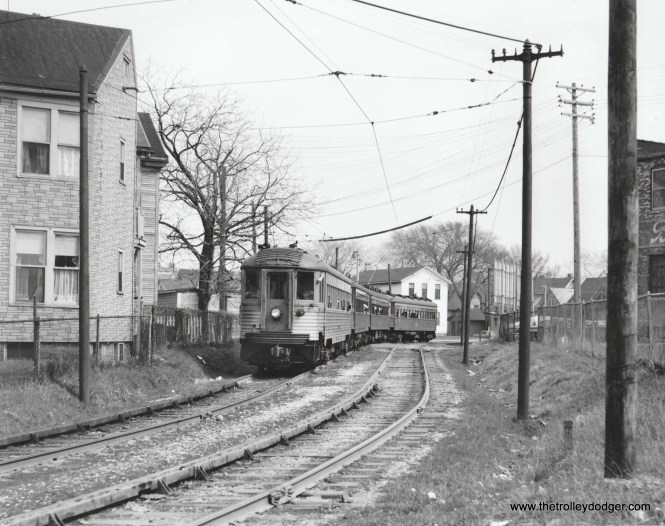
An Early History of the Railroad Record Club

Kenneth Gear and I have some new theories about the early history of the Railroad Record Club. This is based on careful study of the new material featured in our recent post Railroad Record Club Treasure Hunt (July 30, 2017).

One of the homemade 78 rpm records Ken recently bought was marked as having William A. Steventon‘s first recordings. These were dated March 24, 1953.

In a 1958 newspaper interview, Steventon said his wife had given him a tape recorder for Christmas in 1953. He probably meant to say 1952, and it took him a few months to get used to operating it.

Steventon always said that the club started in 1953. However, this seemed odd since he did not issue his first 10″ 33 1/3 rpm records until some years later. The 36 numbered discs came out at the rate of four per year from 1958 through 1966.

There was an Introductory Record, which was probably issued in 1957, and a few “special” releases, the most notable of which (SP-4) documents an entire 1962 trip of the South South Shore Line in real time on three 12″ discs as a box set. That was Steventon’s masterpiece.

In 1967, RCA Custom Records closed up shop, and it was not until some years later that Steventon began reissuing some of his recordings on 12″, using a different pressing plant in Nashville. But what was the Railroad Record Club doing from 1953 through 56?

Apparently, during those years, Steventon was distributing 78 rpm records made using a portable disc cutter. These had been available for home use starting in about 1929, and were often used to record things off the radio.

A few enterprising individuals like the late Jerry Newman took such machines to jazz clubs. This is how he made several recordings of Charlie Christian jamming at Minton’s Playhouse in Harlem in 1941.

In similar fashion, a portable disc cutter was used to record Duke Ellington and his Orchestra in Fargo, North Dakota in 1940. You can read about that here.

While Steventon was using a tape recorder, made portable by being hooked up to an auto battery, tape was not yet an effective way to distribute recordings in 1953. Very few people had such machines.

But most people did have record players, and the standard format of the time was 78 rpm, which yielded at most five minutes per side on 10″ aluminum discs covered with acetate. “Long Playing” 33 1/3 rpm records were a new format, just beginning to gain popularity.

No doubt Steventon dated the RRC’s beginnings to 1953, since that is when he began making recordings, but it is alsolikely that is when he started distributing them. Using a homemade disc cutter meant the records were made in real time. As things gained in popularity, this would have taken up more and more of his time.

To distill much longer recordings to fit the five minute limit, Steventon spliced together all sorts of bits and pieces, and recorded brief introductions later, to tell listeners what they were about to hear.

Some of the homemade discs that Ken purchased have numbers on them. Others have stamped titles, which would indicate to me that Steventon was making them in quantity, and had rubber stamps made for the most popular titles.

These early records were distributed using a number sequence that is totally different than the later one adopted for the 10″ records issued in 1958 or later. Here is a partial list of these early releases:

01. Potomac Edison (aka Hagerstown & Frederick)
02. Shenandoah Central
03. Capital Transit
04. Johnstown Traction
05. Altoona & Logan Valley
06. Baltimore & Ohio
07. Shaker Heights Rapid Transit
08. Claude Mahoney Radio Program about NRHS fantrip (1953)
09. Pennsylvania Railroad
10. Nickel Plate Road
11. St. Louis Public Service
15. Baltimore Transit
16. Norfolk & Western
17. Western Maryland Railway
22. East Broad Top
24. Chicago & Illinois Midland

In this period (1953-55), Steventon was living in Washington, D.C., so many of his recordings were made in that area. He was originally from Mount Carmel, Illinois, which is near the Indiana border. That explains his Hoosier accent as heard on his introductions.

Over time, Steventon branched out, making recordings in other cities when he was on vacation. Regarding his traction recordings, he generally preferred to tape the older equipment, since these made all the right noises. It was more difficult to make successful recordings of PCC cars, since they were much quieter by design, but he did do some.

The success of these records surely inspired Steventon to have records made in quantity by a pressing plant, the RCA Custom Records Division. By 1957, the 33 1/3 rpm format had become the norm, and this permitted about 15 minutes per side on a 10″ record. The resulting disc could hold as much sound as three of the 78s, and weighed a lot less, saving on postage.

Eventually, Steventon began including detailed liner notes with his records, and largely abandoned the spoken introductions.

The 1958 newspaper article mentioned above said that Steventon had sold 1000 records in the previous year. Without his previous experience with homemade records, it is unlikely that Steventon would have records pressed commercially.

We have now cleaned up and digitized many of these early recordings, which are now available under the title Railroad Record Club Rarities. The Traction recordings fill two discs, and the Steam and Diesel tracks are on a single disc. More details are below.

Sometimes, in the absence of written records, or spoken introductions, it is only possible to identify certain recordings through a bit of detective work. As an example, on one recording, the only clues we have are Steventon’s brief mention of riding cars 80 and 83.

This narrows down considerably the list of possible locations. The most likely is the Philadelphia Suburban Transporation Company, also known as the Red Arrow Lines. Cars 80 and 83, which fortunately have survived, were 1932 Brill-built “Master Units.”

We know that Steventon made recordings of similar cars. On one of the Altoona discs, he even refers to an Osgood Bradley Electromobile at one point as a “Master Unit.”

Car 80 still runs to this day at the Electric City Trolley Museum in Scranton, PA., so there are YouTube recordings that I compared with this one. They sound very much the same.

Finally, the Steventon recording shows cars 80 and 83 running at speed, frequently blowing the horn, very much in interurban mode. The longest Red Arrow route, and the most interurban in character, was the West Chester line, which was largely side-of-the-road operation along West Chester Pike.

The final trolley trips on West Chester took place on June 6, 1954. We have written about this before– see Red Arrow in West Chester, September 13, 2016. Buses replaced trolleys so that West chester Pike could be widened.

The National Railway Historical Society held a fantrip after the last revenue runs were made. We know that Steventon participated in NRHS events, since one of the 78 rpm records he distributed features a radio program that discusses a 1953 NRHS excursion.

So, the most logical conclusion is that this rare recording was made by Steventon in 1953 or 1954, and documents the Red Arrow line to West Chester. This recording is included on Railroad Record Club Rarities – Traction.

While we are happy to report that we have finally achieved our long-sought goal of digitizing the Railroad Record Club’s later output, it seems very likely there are still more of these early recordings waiting to be discovered.

-David Sadowski

Now Available on Compact Disc

RRC-RT
Railroad Record Club Rarities – Traction!
# of Discs – 2
Price: $19.95

Railroad Record Club Rarities – Traction!
These are rare recordings, which date to 1953-55 and predate the 10″ LPs later issued by the Railroad Record Club. Many are previously unissued, and some are available here in a different (and longer) format than later releases, often including William A. Steventon’s spoken introductions. We have used the best available sources, and while some recordings sound excellent, others have some imperfections. But all are rare, rare, rare!

Includes Altoona & Logan Valley, Baltimore Transit, Capital Transit (Washington D.C.), Johnstown Traction, Pennsylvania GG-1s, Potomac Edison (Hagerstown & Frederick), Red Arrow, St. Louis Public Service, Shaker Heights Rapid Transit, and South Shore Line Electric Freight.

Total time – 149:52


RRC-RSD
Railroad Record Club Rarities – Steam and Diesel!
# of Discs – 1
Price: $14.95

Railroad Record Club Rarities – Steam and Diesel
These are rare recordings, made by William A. Steventon between 1953 and 1955, and include his earliest recordings. These predate the regular output of the Railroad Record Club. Many are previously unissued, and some are available here in a different (and longer) format than later releases, often including William A. Steventon’s spoken introductions. In general, audio quality is good, but some recordings have imperfections. However, the best available sources have been used, and you won’t find them anywhere else. Much of this material has not been heard in over 60 years.

Includes: Baltimore & Ohio, Chicago & Illinois Midland, East Broad Top, Illinois Central, Nickel Plate road, Pennsylvania Railroad, Shenadoah Central, and even a 1953 radio broadcast by Claude Mahoney that discusses an NRHS fantrip.

Total time – 69:36


RRC #22 and 31
Buffalo Creek & Gauley
Sound Scrapbook – Steam!
# of Discs – 1
Price: $14.95

Railroad Record Club #22 and 31:

The Buffalo Creek and Gauley Railroad (BC&G) was a railroad chartered on April 1, 1904 and ran along Buffalo Creek in Clay County, West Virginia. The original Buffalo Creek and Gauley ended service in 1965.

The BC&G was one of the last all-steam railroads, never operating a diesel locomotive to the day it shut down in 1965. Its primary purpose was to bring coal out of the mountains above Widen to an interchange with the Baltimore and Ohio Railroad at Dundon. These recordings were made in 1960.

Sound Scrapbook – Steam! covers several different steam railroads, including Canadian National, National Railways of Mexico, McCloud River Railway, Union Pacific, Southern Pacific, Westside Lumber Company, Duluth Missabe & Iron Range, and Pickering Lumber Corp.

Total time – 62:43


RRC #32, Sampler for Years 3 & 4, and Steam Whistles and Bells
# of Discs – 1
Price: $14.95

RRC #32, Sampler for Years 3 & 4, and Steam Whistles and Bells
This disc features the New York Central, recorded in 1954-55. It’s mainly steam, but with some diesel. In addition, the Railroad Record Club Sampler for years 3 and 4 includes selections from discs 9 through 16. Finally, we have included a very rare circa 1955 recording, Steam Whistles and Bells, which covers several properties across the country.

Total time – 72:07


Pre-Order Our New Book Chicago Trolleys

On the Cover: Car 1747 was built between 1885 and 1893 by the Chicago City Railway, which operated lines on the South Side starting in April 1859. This is a single-truck (one set of wheels) open electric car; most likely a cable car, retrofitted with a trolley and traction motor. The man at right is conductor William Stevely Atchison (1861-1921), and this image came from his granddaughter. (Courtesy of Debbie Becker.)

On the Cover: Car 1747 was built between 1885 and 1893 by the Chicago City Railway, which operated lines on the South Side starting in April 1859. This is a single-truck (one set of wheels) open electric car; most likely a cable car, retrofitted with a trolley and traction motor. The man at right is conductor William Stevely Atchison (1861-1921), and this image came from his granddaughter. (Courtesy of Debbie Becker.)

We are pleased to report that our new book Chicago Trolleys will be released on September 25th by Arcadia Publishing. You can pre-order an autographed copy through us today (see below). Chicago Trolleys will also be available wherever Arcadia books are sold.

Overview

Chicago’s extensive transit system first started in 1859, when horsecars ran on rails in city streets. Cable cars and electric streetcars came next. Where new trolley car lines were built, people, businesses, and neighborhoods followed. Chicago quickly became a world-class city. At its peak, Chicago had over 3,000 streetcars and 1,000 miles of track—the largest such system in the world. By the 1930s, there were also streamlined trolleys and trolley buses on rubber tires. Some parts of Chicago’s famous “L” system also used trolley wire instead of a third rail. Trolley cars once took people from the Loop to such faraway places as Aurora, Elgin, Milwaukee, and South Bend. A few still run today.

The book features 226 classic black-and-white images, each with detailed captions, in 10 chapters:

1. Early Traction
2. Consolidation and Growth
3. Trolleys to the Suburbs
4. Trolleys on the “L”
5. Interurbans Under Wire
6. The Streamlined Era
7. The War Years
8. Unification and Change
9. Trolley Buses
10. Preserving History

Product Details

ISBN-13: 9781467126816
Publisher: Arcadia Publishing SC
Publication date: 09/25/2017
Series: Images of Rail
Pages: 128

Meet the Author

David Sadowski has been interested in streetcars ever since his father took him for a ride on one of the last remaining lines in 1958. He grew up riding trolley buses and “L” trains all over Chicago. He coauthored Chicago Streetcar Pictorial: The PCC Car Era, 1936–1958, and runs the online Trolley Dodger blog. Come along for the ride as we travel from one side of the city to the other and see how trolley cars and buses moved Chicago’s millions of hardworking, diverse people.

Images of Rail

The Images of Rail series celebrates the history of rail, trolley, streetcar, and subway transportation across the country. Using archival photographs, each title presents the people, places, and events that helped revolutionize transportation and commerce in 19th- and 20th-century America. Arcadia is proud to play a part in the preservation of local heritage, making history available to all.

The book costs just $21.99 plus shipping. Shipping within the US is included in the price. Shipping to Canada is just $5 additional, or $10 elsewhere.

Please note that Illinois residents must pay 10.00% sales tax on their purchases.

We appreciate your business!

For Shipping to US Addresses:

For Shipping to Canada:

For Shipping Elsewhere:

NEW – Chicago Trolleys Postcard Collection

We are pleased to report that selected images from our upcoming book Chicago Trolleys will be available on September 25th in a pack of 15 postcards, all for just $7.99. This is part of a series put out by Arcadia Publishing. Dimensions: 6″ wide x 4.25″ tall

The Postcards of America Series

Here in the 21st century, when everyone who’s anyone seems to do most of their communicating via Facebook and Twitter, it’s only natural to wax a little nostalgic when it comes to days gone by. What happened to more personal means of communication like hand-written letters on nice stationery? Why don’t people still send postcards when they move someplace new or go away on vacation?

If that line of thinking sounds familiar, then Arcadia Publishing’s Postcards of America was launched with you in mind. Each beautiful volume features a different collection of real vintage postcards that you can mail to your friends and family.

Pre-Order your Chicago Trolleys Postcard Pack today!

For Shipping to US Addresses:

For Shipping to Canada:

For Shipping Elsewhere:

street-railwayreview1895-002

Help Support The Trolley Dodger

gh1

This is our 191st post, and we are gradually creating a body of work and an online resource for the benefit of all railfans, everywhere. To date, we have received over 311,000 page views, for which we are very grateful.

You can help us continue our original transit research by checking out the fine products in our Online Store.

As we have said before, “If you buy here, we will be here.”

We thank you for your support.

DONATIONS

In order to continue giving you the kinds of historic railroad images that you have come to expect from The Trolley Dodger, we need your help and support. It costs money to maintain this website, and to do the sort of historic research that is our specialty.

Your financial contributions help make this web site better, and are greatly appreciated.

Points East, West and South

This remarkable Kodachrome image was taken on Canal Street in New Orleans on June 19, 1940. It was shot on size 828 film, which has an image area of 28x40mm, about 30% larger than 35mm. (828 film, which Kodak introduced in the late 1930s, was essentially 35mm film without sprocket holes, but with a paper backing like other roll film formats.) One of our regular readers writes, "The 4 tracks were taken out about 1948 when a number of the car lines that operated off of Canal were converted to trolley bus." The location is the intersection of Canal and St. Charles. Car 444 is looping at the end of the St. Charles route and will be turning to the left in the picture. WSMB (now WWWL) was an AM radio station at 1350 on the dial. Its old call letters reflect its original ownership by the Saenger theater chain and Maison Blanche department store. Its studios were located in the Maison Blanche department store building at right, now the Ritz-Carlton hotel. The Saenger Theatre, another local landmark, is also on the right side of the picture. In the days before air conditioning, men used to wear white suits, as you see here, since white reflects more heat than darker clothing. When this picture was taken, France had just fallen to Nazi Germany. The US did not enter World War II directly until 18 months later.

This remarkable Kodachrome image was taken on Canal Street in New Orleans on June 19, 1940. It was shot on size 828 film, which has an image area of 28x40mm, about 30% larger than 35mm. (828 film, which Kodak introduced in the late 1930s, was essentially 35mm film without sprocket holes, but with a paper backing like other roll film formats.)
One of our regular readers writes, “The 4 tracks were taken out about 1948 when a number of the car lines that operated off of Canal were converted to trolley bus.” The location is the intersection of Canal and St. Charles. Car 444 is looping at the end of the St. Charles route and will be turning to the left in the picture.
WSMB (now WWWL) was an AM radio station at 1350 on the dial. Its old call letters reflect its original ownership by the Saenger theater chain and Maison Blanche department store. Its studios were located in the Maison Blanche department store building at right, now the Ritz-Carlton hotel.
The Saenger Theatre, another local landmark, is also on the right side of the picture.
In the days before air conditioning, men used to wear white suits, as you see here, since white reflects more heat than darker clothing. When this picture was taken, France had just fallen to Nazi Germany. The US did not enter World War II directly until 18 months later.

Our theme today is points east, west, and south. We’re going off in three directions, every which way but north.

We are especially glad to feature both the Chicago & West Towns Railways and Gary Railways. These photos have been generously shared by George Trapp, long a friend of this blog.

The West Towns map and photos of other properties come from our own collections. As always, to see a larger version of each photo, just click on it with your mouse. And, if you have useful information to add, please be sure to contact us.

Enjoy!

-David Sadowski

NOLA

A streamlined Kodak Bantam camera, using size 828 roll film, of a type that may have taken the New Orleans picture.

A streamlined Kodak Bantam camera, using size 828 roll film, of a type that may have taken the New Orleans picture.

The same location today. The St. Charles line still loops as it did in the 1940 picture. Streetcars were absent from Canal Street for 40 years starting in 1964, but have returned. There is a crossover track, visible in this picture, connecting the two lines.

The same location today. The St. Charles line still loops as it did in the 1940 picture. Streetcars were absent from Canal Street for 40 years starting in 1964, but have returned. There is a crossover track, visible in this picture, connecting the two lines.

This close-up shows New Orleans Public Service car 444. One of our regular readers says, "It is not a Perley-Thomas built car but rather a Southern Car Company car built in 1914. Starting in 1914, all of the car bodies appeared the same starting with car #400 even though they were not all built by Perley-Thomas." It was part of a group of 50 cars, numbered 400-449. Behind the streetcar, you can see part of the marquee for the Loew's State Theatre (also known as the State Palace), at 1108 Canal Street. It opened in 1926, but is currently closed and awaiting restoration. You can see some pictures of that theater's interior here.

This close-up shows New Orleans Public Service car 444. One of our regular readers says, “It is not a Perley-Thomas built car but rather a Southern Car Company car built in 1914. Starting in 1914, all of the car bodies appeared the same starting with car #400 even though they were not all built by Perley-Thomas.” It was part of a group of 50 cars, numbered 400-449.
Behind the streetcar, you can see part of the marquee for the Loew’s State Theatre (also known as the State Palace), at 1108 Canal Street. It opened in 1926, but is currently closed and awaiting restoration. You can see some pictures of that theater’s interior here.

A bus crosses Canal.

A bus crosses Canal.

Loew's State circa 1930. From the Wikipedia: "The Rogue Song is a 1930 romantic musical film which tells the story of a Russian bandit who falls in love with a princess, but takes his revenge on her when her brother rapes and kills his sister. The Metro-Goldwyn-Mayer production was directed by Lionel Barrymore and released in two versions, with and without sound. Hal Roach wrote and directed the Laurel and Hardy sequences and was not credited. The film stars Metropolitan Opera singer Lawrence Tibbett— who was nominated for an Academy Award for Best Actor for his performance— and Catherine Dale Owen. Laurel and Hardy were third-billed; their sequences were filmed at the last minute and interspersed throughout the film in an attempt to boost its potential box office appeal. This film, which was MGM's first all-talking (two-color) Technicolor film, is partially lost, as there are no known complete prints of this film. Fragments do exist."

Loew’s State circa 1930. From the Wikipedia: “The Rogue Song is a 1930 romantic musical film which tells the story of a Russian bandit who falls in love with a princess, but takes his revenge on her when her brother rapes and kills his sister. The Metro-Goldwyn-Mayer production was directed by Lionel Barrymore and released in two versions, with and without sound. Hal Roach wrote and directed the Laurel and Hardy sequences and was not credited. The film stars Metropolitan Opera singer Lawrence Tibbett— who was nominated for an Academy Award for Best Actor for his performance— and Catherine Dale Owen. Laurel and Hardy were third-billed; their sequences were filmed at the last minute and interspersed throughout the film in an attempt to boost its potential box office appeal. This film, which was MGM’s first all-talking (two-color) Technicolor film, is partially lost, as there are no known complete prints of this film. Fragments do exist.”

Loew's circa 1940, showing I Love You Again, an MGM comedy starring William Powell and Myrna Loy, directed by W. S. Van Dyke. All three were associated with the Thin Man series of films, which were very popular.

Loew’s circa 1940, showing I Love You Again, an MGM comedy starring William Powell and Myrna Loy, directed by W. S. Van Dyke. All three were associated with the Thin Man series of films, which were very popular.

A postcard view of Canal Street, showing the same general area as the 1940 slide, but looking from the opposite direction.

A postcard view of Canal Street, showing the same general area as the 1940 slide, but looking from the opposite direction.

Chicago & West Towns

A Chicago & West Towns route map, from April 1942. By this time, only three streetcar lines were left: LaGrange, Lake, and Madison. The owner of the map crossed out (with hash marks) some routes that were abandoned later. There was, by 1942, no track connection between the two north side lines and the LaGrange line. When the Lake and Madison lines were finally bustituted, the remaining streetcar fleet was moved at night in 1947 on a circuitous route via Chicago Surface Lines trackage.

A Chicago & West Towns route map, from April 1942. By this time, only three streetcar lines were left: LaGrange, Lake, and Madison. The owner of the map crossed out (with hash marks) some routes that were abandoned later. There was, by 1942, no track connection between the two north side lines and the LaGrange line. When the Lake and Madison lines were finally bustituted, the remaining streetcar fleet was moved at night in 1947 on a circuitous route via Chicago Surface Lines trackage.

The Chicago & West Towns was a major streetcar operator in Chicago’s western suburbs until April 1948, when the last line was converted to bus. Bus operation continues today as part of Pace, a public agency.

C&WT 127 and 104 in Maywood. The grade crossing at rear may be a clue as to the exact location. Don's Rail Photos notes: "104 was built by McGuire-Cummings in 1917. It was scrapped in 1948." The 127 looks to be the older of the pair, built by McGuire-Cummings in 1914. (Joe L. Diaz Photo) Joe writes: "The photo of C&WT cars 127 and 104 is in Maywood at 19th and Railroad Avenue looking north."

C&WT 127 and 104 in Maywood. The grade crossing at rear may be a clue as to the exact location. Don’s Rail Photos notes: “104 was built by McGuire-Cummings in 1917. It was scrapped in 1948.” The 127 looks to be the older of the pair, built by McGuire-Cummings in 1914. (Joe L. Diaz Photo) Joe writes: “The photo of C&WT cars 127 and 104 is in Maywood at 19th and Railroad Avenue looking north.”

C&WT 135, making a turn, is signed for Melrose Park, possibly on the Lake or Madison lines. Don's Rail Photos: "135 was built by McGuire-Cummings in 1919. It was scrapped in 1947." (Joe L. Diaz Photo) Joe writes: "The photo of C&WT car 135 is looking east at Madison and 19th in Maywood. The apartment building is still there." Andre Kristopans: "CWT 135 turning from W on Madison to N on 19th Ave."

C&WT 135, making a turn, is signed for Melrose Park, possibly on the Lake or Madison lines. Don’s Rail Photos: “135 was built by McGuire-Cummings in 1919. It was scrapped in 1947.” (Joe L. Diaz Photo) Joe writes: “The photo of C&WT car 135 is looking east at Madison and 19th in Maywood. The apartment building is still there.” Andre Kristopans: “CWT 135 turning from W on Madison to N on 19th Ave.”

C&WT 134 at the North Riverside barn. (Joe L. Diaz Photo)

C&WT 134 at the North Riverside barn. (Joe L. Diaz Photo)

C&WT 153, 140 and 119 on the LaGrange line. Comparison with some other photos in this series shows this location is DesPlaines Avenue just south of 26th Street in Riverside. We are looking north. Don's Rail Photos: "153 was built by Cummings Car Co in 1927. It was scrapped in 1948. 140 was built by McGuire-Cummings in 1924. It was rebuilt in 1939 and scrapped in 1948. 119 was built by McGuire-Cummings in 1912. It was scrapped in 1948." (Joe L. Diaz Photo)

C&WT 153, 140 and 119 on the LaGrange line. Comparison with some other photos in this series shows this location is DesPlaines Avenue just south of 26th Street in Riverside. We are looking north. Don’s Rail Photos: “153 was built by Cummings Car Co in 1927. It was scrapped in 1948. 140 was built by McGuire-Cummings in 1924. It was rebuilt in 1939 and scrapped in 1948. 119 was built by McGuire-Cummings in 1912. It was scrapped in 1948.” (Joe L. Diaz Photo)

C&WT 116, 115, and 158 at Cermak and Kenton, east end of the LaGrange line. Riders heading east could change here for Chicago Surface Lines route 21 streetcars like the one shown at rear. (Joe L. Diaz Photo)

C&WT 116, 115, and 158 at Cermak and Kenton, east end of the LaGrange line. Riders heading east could change here for Chicago Surface Lines route 21 streetcars like the one shown at rear. (Joe L. Diaz Photo)

C&WT 152 is heading east on private right-of-way on the busy LaGrange route. The exact location is about 82 Park Place in Riverside. Car 152 has just crossed the DesPlaines River, passing through the Forest Preserves after stopping at the Brookfield Zoo. From here, it will turn north on Woodside Drive, which changes into DesPlaines Avenue, before heading east on 26th Street. (Joe L. Diaz Photo)

C&WT 152 is heading east on private right-of-way on the busy LaGrange route. The exact location is about 82 Park Place in Riverside. Car 152 has just crossed the DesPlaines River, passing through the Forest Preserves after stopping at the Brookfield Zoo. From here, it will turn north on Woodside Drive, which changes into DesPlaines Avenue, before heading east on 26th Street. (Joe L. Diaz Photo)

The same location today.

The same location today.

C&WT 112 crosses the Indiana Harbor Belt on the LaGrange line, with a steam train off in the distance. Don's Rail Photos: "112 was built by McGuire-Cummings in 1912. It was scrapped in 1948." (Joe L. Diaz Photo)

C&WT 112 crosses the Indiana Harbor Belt on the LaGrange line, with a steam train off in the distance. Don’s Rail Photos: “112 was built by McGuire-Cummings in 1912. It was scrapped in 1948.” (Joe L. Diaz Photo)

C&WT 101 is turning from 26th Street onto DesPlaines Avenue in Riverside on the LaGrange line. Don's Rail Photos: "101 was built by McGuire-Cummings in 1917. It was scrapped in 1948." (Joe L. Diaz Photo)

C&WT 101 is turning from 26th Street onto DesPlaines Avenue in Riverside on the LaGrange line. Don’s Rail Photos: “101 was built by McGuire-Cummings in 1917. It was scrapped in 1948.” (Joe L. Diaz Photo)

C&WT 134 and 124 meet at Madison and Harlem. Note how Madison took a jog when crossing between Oak Park and Forest Park. We are looking east. Don's Rail Photos: "124 was built by McGuire-Cummings in 1914. It was rebuilt in 1936 and scrapped in 1948." (Joe L. Diaz Photo)

C&WT 134 and 124 meet at Madison and Harlem. Note how Madison took a jog when crossing between Oak Park and Forest Park. We are looking east. Don’s Rail Photos: “124 was built by McGuire-Cummings in 1914. It was rebuilt in 1936 and scrapped in 1948.” (Joe L. Diaz Photo)

Madison and Harlem today. A route 318 Pace bus is turning from Harlem onto Madison. Pace is the successor to the West Towns. At some point, it appears that Madison was widened to eliminate the jog seen in the earlier photo.

Madison and Harlem today. A route 318 Pace bus is turning from Harlem onto Madison. Pace is the successor to the West Towns. At some point, it appears that Madison was widened to eliminate the jog seen in the earlier photo.

C&WT 101 is at Lake and Austin in Oak Park, the east end of its route. Two Chicago Surface Lines streetcars, including 1743, are across Austin Boulevard at the west end of route 16. Don's Rail Photos: "101 was built by McGuire-Cummings in 1917. It was scrapped in 1948. 1743 was built by CSL in 1923. It was rebuilt as one-man in 1949." The car at left looks like a 1941 Packard model One Twenty-- very stylish. (Joe L. Diaz Photo)

C&WT 101 is at Lake and Austin in Oak Park, the east end of its route. Two Chicago Surface Lines streetcars, including 1743, are across Austin Boulevard at the west end of route 16. Don’s Rail Photos: “101 was built by McGuire-Cummings in 1917. It was scrapped in 1948. 1743 was built by CSL in 1923. It was rebuilt as one-man in 1949.” The car at left looks like a 1941 Packard model One Twenty– very stylish. (Joe L. Diaz Photo)

A 1941 Packard One Twenty sedan.

A 1941 Packard One Twenty sedan.

C&WT 136 and 132 on Lake Street just west of Austin Boulevard in suburban Oak Park. This was the east end of the line. (Joe L. Diaz Photo)

C&WT 136 and 132 on Lake Street just west of Austin Boulevard in suburban Oak Park. This was the east end of the line. (Joe L. Diaz Photo)

Lake Street just west of Austin Boulevard today.

Lake Street just west of Austin Boulevard today.

Here, C&WT 119 appears to be crossing the Illinois Central at 26th Street, since that is an IC caboose at the rear of the passing freight train. Don's Rail Photos: "119 was built by McGuire-Cummings in 1912. It was scrapped in 1948." (Joe L. Diaz Photo)

Here, C&WT 119 appears to be crossing the Illinois Central at 26th Street, since that is an IC caboose at the rear of the passing freight train. Don’s Rail Photos: “119 was built by McGuire-Cummings in 1912. It was scrapped in 1948.” (Joe L. Diaz Photo)

Here, we are looking north along DesPlaines Avenue just south of 26th Street in Riverside. Cars from the LaGrange line turned east on 26th to Harlem, where they continued north to Cermak Road. Cars may be operating on a single track here due to track work. Southbound C&WT 107 waits for 161 to cross over to the northbound track, while a work car is on 26th. Don's Rail Photos: "107 was built by McGuire-Cummings in 1912. It was scrapped in 1948. 161 was built by Cummings Car Co in 1927. It was scrapped in 1948." (Joe L. Diaz Photo)

Here, we are looking north along DesPlaines Avenue just south of 26th Street in Riverside. Cars from the LaGrange line turned east on 26th to Harlem, where they continued north to Cermak Road. Cars may be operating on a single track here due to track work. Southbound C&WT 107 waits for 161 to cross over to the northbound track, while a work car is on 26th. Don’s Rail Photos: “107 was built by McGuire-Cummings in 1912. It was scrapped in 1948. 161 was built by Cummings Car Co in 1927. It was scrapped in 1948.” (Joe L. Diaz Photo)

A close-up of the previous image. This may be C&WT work car 12. Don's Rail Photos says, "12 was built by McGuire-Cummings in 1912. It was scrapped in 1948."

A close-up of the previous image. This may be C&WT work car 12. Don’s Rail Photos says, “12 was built by McGuire-Cummings in 1912. It was scrapped in 1948.”

The top of this building, on 26th Street just east of DesPlaines Avenue in North Riverside, has been altered, but it is still recognizable as the same building in the previous picture.

The top of this building, on 26th Street just east of DesPlaines Avenue in North Riverside, has been altered, but it is still recognizable as the same building in the previous picture.

C&WT 152 on the LaGrange line. (Joe L. Diaz Photo)

C&WT 152 on the LaGrange line. (Joe L. Diaz Photo)

C&WT 144 at the North Riverside car barn. Don's Rail Photos: "144 was built by McGuire-Cummings in 1924. It was scrapped in 1947." (Joe L. Diaz Photo)

C&WT 144 at the North Riverside car barn. Don’s Rail Photos: “144 was built by McGuire-Cummings in 1924. It was scrapped in 1947.” (Joe L. Diaz Photo)

C&WT 164 on Lake Street just west of Austin Boulevard in Oak Park. (Joe L. Diaz Photo)

C&WT 164 on Lake Street just west of Austin Boulevard in Oak Park. (Joe L. Diaz Photo)

C&WT 107 and a work car (12 or 13, hard to tell) plus a flat car on DesPlaines Avenue just south of 26th Street in Riverside. Don's Rail Photos: "107 was built by McGuire-Cummings in 1912. It was scrapped in 1948." (Joe L. Diaz Photo)

C&WT 107 and a work car (12 or 13, hard to tell) plus a flat car on DesPlaines Avenue just south of 26th Street in Riverside. Don’s Rail Photos: “107 was built by McGuire-Cummings in 1912. It was scrapped in 1948.” (Joe L. Diaz Photo)

C&WT 158 crossing the Illinois Central at 26th Street in Riverside. I believe the car is heading east. If it was heading west, the sign on the front of the car would probably advertise service direct to the Brookfield Zoo. (Joe L. Diaz Photo)

C&WT 158 crossing the Illinois Central at 26th Street in Riverside. I believe the car is heading east. If it was heading west, the sign on the front of the car would probably advertise service direct to the Brookfield Zoo. (Joe L. Diaz Photo)

C&WT 158 and 157 cross on the bridge over the DesPlaines River (LaGrange line). I believe we are looking south. (Joe L. Diaz Photo)

C&WT 158 and 157 cross on the bridge over the DesPlaines River (LaGrange line). I believe we are looking south. (Joe L. Diaz Photo)

C&WT 100, most likely at the North Riverside car barn. Car 130 is at right. Don's Rail Photos: "100 was built by McGuire-Cummings in 1917. It was scrapped in 1948. 130 was built by McGuire-Cummings in 1914. It was scrapped in 1948." (Joe L. Diaz Photo)

C&WT 100, most likely at the North Riverside car barn. Car 130 is at right. Don’s Rail Photos: “100 was built by McGuire-Cummings in 1917. It was scrapped in 1948. 130 was built by McGuire-Cummings in 1914. It was scrapped in 1948.” (Joe L. Diaz Photo)

C&WT 141 at the North Riverside car barn. Don's Rail Photos: "141 was built by McGuire-Cummings in 1924. It was rebuilt in 1939 and the body sold as a shed in 1948. It was purchased by Electric Railway Historical Society in 1958. It went to Illinois Railway Museum in 1973 and began restoring." The 141 is now in operating condition. (Joe L. Diaz Photo)

C&WT 141 at the North Riverside car barn. Don’s Rail Photos: “141 was built by McGuire-Cummings in 1924. It was rebuilt in 1939 and the body sold as a shed in 1948. It was purchased by Electric Railway Historical Society in 1958. It went to Illinois Railway Museum in 1973 and began restoring.” The 141 is now in operating condition. (Joe L. Diaz Photo)

C&WT 157 and 155 meet on DesPlaines Avenue and 26th street. Single track operation is in effect due to track work. (Joe L. Diaz Photo)

C&WT 157 and 155 meet on DesPlaines Avenue and 26th street. Single track operation is in effect due to track work. (Joe L. Diaz Photo)

C&WT line car 15 at an undetermined location. Don's Rail Photos: "15 was built by Pullman Car in 1897 as Suburban RR 512. It was renumbered 515 and rebuilt as 15 in 1927. It was rebuilt in 1940 and scrapped in 1948." (Joe L. Diaz Photo)

C&WT line car 15 at an undetermined location. Don’s Rail Photos: “15 was built by Pullman Car in 1897 as Suburban RR 512. It was renumbered 515 and rebuilt as 15 in 1927. It was rebuilt in 1940 and scrapped in 1948.” (Joe L. Diaz Photo)

C&WT 156 is on Cermak at Cicero Avenue. The Pinkert State Bank (built in 1919) at rear was located at 4810-12 W. Cerak (22nd Street) in Cicero. It featured prominently in the government's tax evasion cases against Al and Ralph Capone. Don's Rail Photos: "156 was built by Cummings Car Co in 1927. It was rebuilt in 1942 and scrapped in 1948." (Joe L. Diaz Photo)

C&WT 156 is on Cermak at Cicero Avenue. The Pinkert State Bank (built in 1919) at rear was located at 4810-12 W. Cerak (22nd Street) in Cicero. It featured prominently in the government’s tax evasion cases against Al and Ralph Capone. Don’s Rail Photos: “156 was built by Cummings Car Co in 1927. It was rebuilt in 1942 and scrapped in 1948.” (Joe L. Diaz Photo)

C&WT 140 on the LaGrange line. Don's Rail Photos: "140 was built by McGuire-Cummings in 1924. It was rebuilt in 1939 and scrapped in 1948." (Joe L. Diaz Photo)

C&WT 140 on the LaGrange line. Don’s Rail Photos: “140 was built by McGuire-Cummings in 1924. It was rebuilt in 1939 and scrapped in 1948.” (Joe L. Diaz Photo)

C&WT 136 and 132 are eastbound on one of the lines that terminated at Austin Boulevard (either Lake or Madison). (Joe L. Diaz Photo) Joe writes: "The photo of C&WT cars 132 and 136 may have been taken at Lake and 25th, the west end of the Lake Street line." Andre Kristopans: "CWT 132, 136 at west end of Lake St line at 25th Ave."

C&WT 136 and 132 are eastbound on one of the lines that terminated at Austin Boulevard (either Lake or Madison). (Joe L. Diaz Photo) Joe writes: “The photo of C&WT cars 132 and 136 may have been taken at Lake and 25th, the west end of the Lake Street line.” Andre Kristopans: “CWT 132, 136 at west end of Lake St line at 25th Ave.”

Three C&WT streetcars, including 103 and 104, are on Lake Street at Austin Boulevard. We are looking to the east, which explains why the head car is signed for Maywood. According to Don's Rail Photos, both 103 and 104 were built by McGuire-Cummings in 1917 and scrapped in 1948. (Joe L. Diaz Photo)

Three C&WT streetcars, including 103 and 104, are on Lake Street at Austin Boulevard. We are looking to the east, which explains why the head car is signed for Maywood. According to Don’s Rail Photos, both 103 and 104 were built by McGuire-Cummings in 1917 and scrapped in 1948. (Joe L. Diaz Photo)

The laundry in the previous photo is now a beauty parlor.

The laundry in the previous photo is now a beauty parlor.

C&WT 141 is westbound, crossing the DesPlaines River on the LaGrange line. This car, sole survivor of the fleet, has been restored and you can ride it at the Illinois Railway Museum. (Joe L. Diaz Photo)

C&WT 141 is westbound, crossing the DesPlaines River on the LaGrange line. This car, sole survivor of the fleet, has been restored and you can ride it at the Illinois Railway Museum. (Joe L. Diaz Photo)

C&WT 128, on either the Madison or Lake lines, is signed for Melrose Park. Not sure which railroad that tower belongs to. (Joe L. Diaz Photo) Andre Kristopans: "CWT 128 is crossing the Soo Line on Madison west of Jackson (a half mile west of Desplaines Av.)."

C&WT 128, on either the Madison or Lake lines, is signed for Melrose Park. Not sure which railroad that tower belongs to. (Joe L. Diaz Photo) Andre Kristopans: “CWT 128 is crossing the Soo Line on Madison west of Jackson (a half mile west of Desplaines Av.).”

C&WT snow sweepers 9 and 5 in their element at the North Riverside car barn. Don's Rail Photso: "5 was built by McGuire-Cummings in 1913. It was scrapped in 1948. 9 was built by McGuire-Cummings in 1928. It was sold to Sand Springs Ry in 1948." (Joe L. Diaz Photo)

C&WT snow sweepers 9 and 5 in their element at the North Riverside car barn. Don’s Rail Photso: “5 was built by McGuire-Cummings in 1913. It was scrapped in 1948. 9 was built by McGuire-Cummings in 1928. It was sold to Sand Springs Ry in 1948.” (Joe L. Diaz Photo)

C&WT 156 is eastbound on Cermak at Ridgeland in front of the old Berwyn Theatre, which opened in 1924. It was damaged by fire in 1990 and demolished. This picture was probably taken not long after the theatre was modernized in 1936. Don's Rail Photos: "156 was built by Cummings Car Co in 1927. It was rebuilt in 1942 and scrapped in 1948." (Edward Frank, Jr. Photo)

C&WT 156 is eastbound on Cermak at Ridgeland in front of the old Berwyn Theatre, which opened in 1924. It was damaged by fire in 1990 and demolished. This picture was probably taken not long after the theatre was modernized in 1936. Don’s Rail Photos: “156 was built by Cummings Car Co in 1927. It was rebuilt in 1942 and scrapped in 1948.” (Edward Frank, Jr. Photo)

C&WT 151 on the Lake line, possibly at the west end. Don's Rail Photos: "151 was built by McGuire and Cummings in 1924. It was scrapped in 1947." (Edward Frank, Jr. Photo)

C&WT 151 on the Lake line, possibly at the west end. Don’s Rail Photos: “151 was built by McGuire and Cummings in 1924. It was scrapped in 1947.” (Edward Frank, Jr. Photo)

C&WT 151 on the Lake Street line. Don's Rail Photos: "151 was built by McGuire and Cummings in 1924. It was scrapped in 1947." (Edward Frank, Jr. Photo)

C&WT 151 on the Lake Street line. Don’s Rail Photos: “151 was built by McGuire and Cummings in 1924. It was scrapped in 1947.” (Edward Frank, Jr. Photo)

South Shore Line

CSS&SB 10, signed for South Bend. (Photo by Anderson)

CSS&SB 10, signed for South Bend. (Photo by Anderson)

CSS&SB 24. Don's Rail Photos: "24 was built by Pullman in 1927. It was lengthened and air conditioned, and got picture windows in 1947." (Photo by Anderson)

CSS&SB 24. Don’s Rail Photos: “24 was built by Pullman in 1927. It was lengthened and air conditioned, and got picture windows in 1947.” (Photo by Anderson)

CSS&SB 109 in the yard at Chicago in the mid-1960s. Don's Rail Photos: "109 was built by Pullman in 1926. It was lengthened in 1944. Air conditioning and picture windows came in 1949." (Walter Broschart Photo)

CSS&SB 109 in the yard at Chicago in the mid-1960s. Don’s Rail Photos: “109 was built by Pullman in 1926. It was lengthened in 1944. Air conditioning and picture windows came in 1949.” (Walter Broschart Photo)

The way to distinguish South Shore Line street running photos from one city to another usually includes counting the number of tracks. Only East Chicago was double tracked. However, this is Michigan City, as there are two tracks for a short distance near the station seen at rear, since many runs begin and end here. This picture, showing car 105 and train, was taken on August 6, 1948. The station building still exists but is no longer in use.

The way to distinguish South Shore Line street running photos from one city to another usually includes counting the number of tracks. Only East Chicago was double tracked. However, this is Michigan City, as there are two tracks for a short distance near the station seen at rear, since many runs begin and end here. This picture, showing car 105 and train, was taken on August 6, 1948. The station building still exists but is no longer in use.

CSS&SB cars 2 and 504 at the Michigan City station on August 30, 1960 (note the 1960 Ford at left). Don's Rail Photos: "2 was built by Pullman in 1926." Frank Hicks writes: "This interurban freight trailer has a more unusual history than most. It was built for ISC as an interurban combine, and ran on that system's lines in Indiana for five years until ISC became part of the great Indiana Railroad system. IR rebuilt the three cars of the 375-377 series into railway post office cars and put them to use in this unusual capacity. The three RPO's survived on IR until the end of interurban service in 1941, at which time all three were sold to the only other interurban line then operating in Indiana: the South Shore. The South Shore converted 376 into a line car while 375 and 377 became express package trailers. These cars were designed to run in passenger trains and had control lines so that they could be run mid-train; they were often used to transport newspapers. Car 504 was retired in 1975 and acquired by IRM, which has repainted it and put it on display." (Photo by Meyer)

CSS&SB cars 2 and 504 at the Michigan City station on August 30, 1960 (note the 1960 Ford at left). Don’s Rail Photos: “2 was built by Pullman in 1926.” Frank Hicks writes: “This interurban freight trailer has a more unusual history than most. It was built for ISC as an interurban combine, and ran on that system’s lines in Indiana for five years until ISC became part of the great Indiana Railroad system. IR rebuilt the three cars of the 375-377 series into railway post office cars and put them to use in this unusual capacity. The three RPO’s survived on IR until the end of interurban service in 1941, at which time all three were sold to the only other interurban line then operating in Indiana: the South Shore. The South Shore converted 376 into a line car while 375 and 377 became express package trailers. These cars were designed to run in passenger trains and had control lines so that they could be run mid-train; they were often used to transport newspapers. Car 504 was retired in 1975 and acquired by IRM, which has repainted it and put it on display.” (Photo by Meyer)

Chicago Lake Shore & South Bend Ry. (predecessor of the South Shore Line) car 68 at an unknown location near a wooden Chicago "L" car. This photo is a real mystery, since, as far as I know, this car has not been preserved (although car 73 is being restored). Joe writes: "Car 68 is Lake Shore Electric, not CLS&SB, built by Brill in 1903. The car behind it is one of the LSE’s Barney & Smith interurban cars." That clears up the mystery. The information that came with this negative was incorrect.

Chicago Lake Shore & South Bend Ry. (predecessor of the South Shore Line) car 68 at an unknown location near a wooden Chicago “L” car. This photo is a real mystery, since, as far as I know, this car has not been preserved (although car 73 is being restored). Joe writes: “Car 68 is Lake Shore Electric, not CLS&SB, built by Brill in 1903. The car behind it is one of the LSE’s Barney & Smith interurban cars.” That clears up the mystery. The information that came with this negative was incorrect.

CSS&SB 27 near the Art Institute of Chicago on May 7, 1963. (Photo by Anderson)

CSS&SB 27 near the Art Institute of Chicago on May 7, 1963. (Photo by Anderson)

CSS&SB 111 at Randolph Street Terminal in downtown Chicago in May 1953. This station has since been rebuilt and is now underneath Millennium Park.

CSS&SB 111 at Randolph Street Terminal in downtown Chicago in May 1953. This station has since been rebuilt and is now underneath Millennium Park.

A three-car CSS&SB train, including car 31, makes a photo stop on an early Central Electric Railfans' Association fantrip near Wilson, Indiana.

A three-car CSS&SB train, including car 31, makes a photo stop on an early Central Electric Railfans’ Association fantrip near Wilson, Indiana.

CSS&SB 105 heads up a six-car train near Miller, Indiana on June 1, 1939. This appears to be a photo stop on a fantrip. (Photo by Anderson)

CSS&SB 105 heads up a six-car train near Miller, Indiana on June 1, 1939. This appears to be a photo stop on a fantrip. (Photo by Anderson)

Chicago, South Shore & South Bend freight locos 902 and 903 in Michigan City, Indiana. (Photo by Anderson)

Chicago, South Shore & South Bend freight locos 902 and 903 in Michigan City, Indiana. (Photo by Anderson)

Gary Railways

Even the city trolley lines of Gary Railways, operating between 1908 and 1947, had an interurbanish character. Industrial development in the area meant there were large tracts of land reserved for future use. In 1938-39, Central Electric Railfans’ Association (CERA) ran three fantrips on Gary Railways interurbans in their waning days. We have run pictures from some of those trips in previous posts.

Here is a timeline of transit developments in the Gary area.

Gary Railways 101. The sign says street railway service in Gary was inaugurated 21 years ago with this car. If service began in 1912, that would date this photo to 1933.

Gary Railways 101. The sign says street railway service in Gary was inaugurated 21 years ago with this car. If service began in 1912, that would date this photo to 1933.

Gary Railways 24.

Gary Railways 24.

Gary Railways 128.

Gary Railways 128.

Gary Railways 120.

Gary Railways 120.

Gary Railways 15 at Kennedy siding on the Hammond line on March 9, 1941. According to the photo information, this car was built by Cummings in 1926.

Gary Railways 15 at Kennedy siding on the Hammond line on March 9, 1941. According to the photo information, this car was built by Cummings in 1926.

Gary Railways 16, signed for Hammond.

Gary Railways 16, signed for Hammond.

Gary Railways 14, at a loop on the Hammond line, on October 27, 1940. According to the photo information, it was built by Cummings in 1926.

Gary Railways 14, at a loop on the Hammond line, on October 27, 1940. According to the photo information, it was built by Cummings in 1926.

Gary Railways 19 at Tolleston, with both poles up. This lightweight safety car was built by Cummings Car & Coach in 1927. This car body, sole survivor of the fleet, is now at the Illinois Railway Museum.

Gary Railways 19 at Tolleston, with both poles up. This lightweight safety car was built by Cummings Car & Coach in 1927. This car body, sole survivor of the fleet, is now at the Illinois Railway Museum.

Gary Railways 27.

Gary Railways 27.

Gary Railways 22 on May 16, 1940. (Gordon E. Lloyd Photo)

Gary Railways 22 on May 16, 1940. (Gordon E. Lloyd Photo)

Gary Railways 20 on July 21, 1946.

Gary Railways 20 on July 21, 1946.

Gary Railways 22.

Gary Railways 22.

Gary Railways 12. Don's Rail Photos: "12 was built by Cummings Car Co in 1926. It was scrapped in 1946." (Jack Beers Photo)

Gary Railways 12. Don’s Rail Photos: “12 was built by Cummings Car Co in 1926. It was scrapped in 1946.” (Jack Beers Photo)

Gary Railways car 19, the only car preserved, on a Central Electric Railfans' Association fantrip. This matches a picture we previously published in our previous post More Hoosier Traction (September 2, 2015). Bill Shapotkin said that other picture was taken "taken on March 19, 1939 -- the day AFTER the last day of service on the Indiana Harbor (and Hobart) lines." The difference in tonality between the two pictures may simply be the difference between panchromatic and orthochromatic film.

Gary Railways car 19, the only car preserved, on a Central Electric Railfans’ Association fantrip. This matches a picture we previously published in our previous post More Hoosier Traction (September 2, 2015). Bill Shapotkin said that other picture was taken “taken on March 19, 1939 — the day AFTER the last day of service on the Indiana Harbor (and Hobart) lines.” The difference in tonality between the two pictures may simply be the difference between panchromatic and orthochromatic film.

A close-up of the previous picture.

A close-up of the previous picture.

Gary Railways 9 at Hobart, Indiana in 1934.

Gary Railways 9 at Hobart, Indiana in 1934.

Gary Railways cars 12 and 9.

Gary Railways cars 12 and 9.

Gary Railways 14.

Gary Railways 14.

Gary Railways 19.

Gary Railways 19.

Gary Railways 17 at the North Broadway loop.

Gary Railways 17 at the North Broadway loop.

Gary Railways 51.

Gary Railways 51.

Birney Cars

Johnston Traction 311, a double-truck Birney car (ex-Bangor, Maine) on June 24, 1956. Don's Rail Photos: " 307 thru 311 came from Bangor Hydro Electric in 1941 where they were 10, 12, 14, 16, and 18. They were scrapped in 1957 except for 311 which was preserved at Rockhill Trolley Museum which acquired it in 1960." Audio recordings of car 311 in service in Johnstown are included on Railroad Record Club LP #23.

Johnston Traction 311, a double-truck Birney car (ex-Bangor, Maine) on June 24, 1956. Don’s Rail Photos: ” 307 thru 311 came from Bangor Hydro Electric in 1941 where they were 10, 12, 14, 16, and 18. They were scrapped in 1957 except for 311 which was preserved at Rockhill Trolley Museum which acquired it in 1960.” Audio recordings of car 311 in service in Johnstown are included on Railroad Record Club LP #23.

Fort Collins Municipal Railway Birney car 25 in October 1950. Don's Rail Photos: "2nd 25 was built by Brill Car Co in December 1922, #21530, as VR&P 1520. It was sold as FCM 25 in 1946. It was sold to James Stitzel in 1953 and resided next to the former Midland Terminal depot in Victor, CO, until it was sold to a South Carolina party about 1980. It was cosmetically restored. In 1998 it was sold to the Charlotte Trolley painted as South Carolina Public Service Co 407. It was sold to Fort Colins Municipal in 2008 and is being restored as 25." (Robert C. Gray Photo)

Fort Collins Municipal Railway Birney car 25 in October 1950. Don’s Rail Photos: “2nd 25 was built by Brill Car Co in December 1922, #21530, as VR&P 1520. It was sold as FCM 25 in 1946. It was sold to James Stitzel in 1953 and resided next to the former Midland Terminal depot in Victor, CO, until it was sold to a South Carolina party about 1980. It was cosmetically restored. In 1998 it was sold to the Charlotte Trolley painted as South Carolina Public Service Co 407. It was sold to Fort Colins Municipal in 2008 and is being restored as 25.” (Robert C. Gray Photo)

Fort Collins Municipal Railway 24 on the Mountain Street line in October 1950. Don's Rail Photos: "2nd 24 was built by Brill Car Co in December 1922, #21530, as Virginia Railway & Power Co 1530 It was sold as FCM 24 in 1946 but seldom operated. Parts kept second Car 25 operating." (Robert C. Gray Photo)

Fort Collins Municipal Railway 24 on the Mountain Street line in October 1950. Don’s Rail Photos: “2nd 24 was built by Brill Car Co in December 1922, #21530, as Virginia Railway & Power Co 1530 It was sold as FCM 24 in 1946 but seldom operated. Parts kept second Car 25 operating.” (Robert C. Gray Photo)

Fort Collins Municipal Railway 26 in 1946. Don's Rail Photos: "26 was built by American Car Co. in November 1922, #1324 as CERy 7. It was sold as FCM 26 it in 1924. It was sold to Henry Ford Museum and moved to Michigan in 1953 where it is on static display. It was operated several times on the trackage of the Department of Street Railways." (Richard H. Young Photo)

Fort Collins Municipal Railway 26 in 1946. Don’s Rail Photos: “26 was built by American Car Co. in November 1922, #1324 as CERy 7. It was sold as FCM 26 it in 1924. It was sold to Henry Ford Museum and moved to Michigan in 1953 where it is on static display. It was operated several times on the trackage of the Department of Street Railways.” (Richard H. Young Photo)

Keystone-State Traction

Lehigh Valley Transit 702 and 812 on a fantrip. Don's Rail Photos: "702 was built by Southern Car Co in 1916. It was rebuilt on August 8, 1931 and scrapped on January 8, 1952. 812 was built by St Louis Car in 1901 as 159. It was rebuilt as 999 in 1914 and rebuilt as 812 in 1921. It was scrapped in November 1951."

Lehigh Valley Transit 702 and 812 on a fantrip. Don’s Rail Photos: “702 was built by Southern Car Co in 1916. It was rebuilt on August 8, 1931 and scrapped on January 8, 1952. 812 was built by St Louis Car in 1901 as 159. It was rebuilt as 999 in 1914 and rebuilt as 812 in 1921. It was scrapped in November 1951.”

Lehigh Valley Transit 702 and 812 on a Liberty Bell route fantrip, probably not long before service ended in 1951. Ed Skuchas adds, "The LVT fan trip cars are sitting on the spur at the LVT station in Perkasie at Walnut and Penn St."

Lehigh Valley Transit 702 and 812 on a Liberty Bell route fantrip, probably not long before service ended in 1951. Ed Skuchas adds, “The LVT fan trip cars are sitting on the spur at the LVT station in Perkasie at Walnut and Penn St.”

The former LVT station in Perkasie is now the headquarters for the local historical society.

The former LVT station in Perkasie is now the headquarters for the local historical society.

Not sure offhand where this picture was taken, along the LVT Liberty Bell interurban route between Philadelphia and Allentown. Ed Skuchas: "The "tunnel" photo is the underpass in Perkasie under the Reading tracks. Location is Walnut and 7th. The photo was taken from a block back at about 6th and Walnut."

Not sure offhand where this picture was taken, along the LVT Liberty Bell interurban route between Philadelphia and Allentown. Ed Skuchas: “The “tunnel” photo is the underpass in Perkasie under the Reading tracks. Location is Walnut and 7th. The photo was taken from a block back at about 6th and Walnut.”

A close-up of the previous picture.

A close-up of the previous picture.

The former LVT underpass in Perkasie today.

The former LVT underpass in Perkasie today.

The ramp you see is at Norristown, and shows how Lehigh Valley Transit interurban cars descended to street level to continue north to Allentown. Service on the Liberty Bell Limited ended in September 1951. Service between Philadelphia and Norristown, started by the Philadelphia & Western, continues today under SEPTA.

The ramp you see is at Norristown, and shows how Lehigh Valley Transit interurban cars descended to street level to continue north to Allentown. Service on the Liberty Bell Limited ended in September 1951. Service between Philadelphia and Norristown, started by the Philadelphia & Western, continues today under SEPTA.

Philadelphia & West Chester Traction (later Philadelphia Suburban Transportation Co.) cars 86, 73 and 83 at 69th Street Terminal in 1936. Don's Rail Photos: "73 was built by Brill Car Co in April 1927, #22212. It became SEPTA 73 in 1970 and sold to Pennsylvania Trolley Museum in 1990. 83 was built by Brill Car Co in March 1932, #22980. It became SEPTA 83 in 1970 and sold to Middletown & Hummelstown in 1982."

Philadelphia & West Chester Traction (later Philadelphia Suburban Transportation Co.) cars 86, 73 and 83 at 69th Street Terminal in 1936. Don’s Rail Photos: “73 was built by Brill Car Co in April 1927, #22212. It became SEPTA 73 in 1970 and sold to Pennsylvania Trolley Museum in 1990. 83 was built by Brill Car Co in March 1932, #22980. It became SEPTA 83 in 1970 and sold to Middletown & Hummelstown in 1982.”

Philadelphia Suburban Transportation car 84, a 1932 Brill "Master Unit," on the West Chester line. This long line was mainly single-track with occasional passing siidngs such as this one.

Philadelphia Suburban Transportation car 84, a 1932 Brill “Master Unit,” on the West Chester line. This long line was mainly single-track with occasional passing siidngs such as this one.

Philadelphia Suburban double-end cars 14 and 18 on West Chester Pike, April 25, 1954. Buses replaced trolley cars in June so that West Chester Pike could be widened.

Philadelphia Suburban double-end cars 14 and 18 on West Chester Pike, April 25, 1954. Buses replaced trolley cars in June so that West Chester Pike could be widened.

Brilliner 10 is on side-of-the-road trackage on the Philadelphia Suburban's West Chester line, which was bustituted in 1954.

Brilliner 10 is on side-of-the-road trackage on the Philadelphia Suburban’s West Chester line, which was bustituted in 1954.

A close-up of the previous photo.

A close-up of the previous photo.

Philadelphia Suburban Transportation Co. double-ended car 12 at 69th Street and Garrett Road on April 14, 1951. It is outbound on the Ardmore line.

Philadelphia Suburban Transportation Co. double-ended car 12 at 69th Street and Garrett Road on April 14, 1951. It is outbound on the Ardmore line.

Lehigh Valley Transit high-speed, lightweight interurban car 1000 at the 69th Street Terminal in 1947. This car, formerly Cincinnati & Lake Erie 125, was sold to LVT in 1938 for use on the Liberty Bell Limited line between Philadelphia and Allentown, and was scrapped in 1952. (Cliff Scholes Photo)

Lehigh Valley Transit high-speed, lightweight interurban car 1000 at the 69th Street Terminal in 1947. This car, formerly Cincinnati & Lake Erie 125, was sold to LVT in 1938 for use on the Liberty Bell Limited line between Philadelphia and Allentown, and was scrapped in 1952. (Cliff Scholes Photo)

The double-end Bullet cars on the Philadelphia & Western were not the only Bullets. There were also some single-ended cars such as Bamberger 125, shown here in Ogden, Utah. Don's Rail Photos: "125 was built by Brill in 1932, #22961, as Fonda Johnstown & Gloversville 125. It was sold as Bamberger 125 in 1939 and retired in 1952. The body was sold to Utah Pickle Co."

The double-end Bullet cars on the Philadelphia & Western were not the only Bullets. There were also some single-ended cars such as Bamberger 125, shown here in Ogden, Utah. Don’s Rail Photos: “125 was built by Brill in 1932, #22961, as Fonda Johnstown & Gloversville 125. It was sold as Bamberger 125 in 1939 and retired in 1952. The body was sold to Utah Pickle Co.”

Boston

Boston double-end PCC 3327, signed for Heath on the MBTA Green Line "E" branch (formerly called Arborway), is heading up the Northeastern Incline from the Huntington Avenue Subway in this March 1974 view.

Boston double-end PCC 3327, signed for Heath on the MBTA Green Line “E” branch (formerly called Arborway), is heading up the Northeastern Incline from the Huntington Avenue Subway in this March 1974 view.

MBTA double-end PC 3346 at Mattapan on March 31, 1978. These cars were painted red, since the Ashmont-Mattapan branch line is considered an extension of the Red Line subway.

MBTA double-end PC 3346 at Mattapan on March 31, 1978. These cars were painted red, since the Ashmont-Mattapan branch line is considered an extension of the Red Line subway.

Outbound double-end PCC 3345 at Ashmont in August 1968.

Outbound double-end PCC 3345 at Ashmont in August 1968.

3345 at Ashmont in August 1968 with a standing room crowd. Despite the roll sign, the Ashmont-Mattapan tracks are separate from Boston's Green Line system.

3345 at Ashmont in August 1968 with a standing room crowd. Despite the roll sign, the Ashmont-Mattapan tracks are separate from Boston’s Green Line system.

3330 at Ashmont in August 1968.

3330 at Ashmont in August 1968.

MBTA 3296, operated in multiple units, at the old North Station on September 28, 1970.

MBTA 3296, operated in multiple units, at the old North Station on September 28, 1970.

Boston stretcar 5202 at Valley Road on the Ashmont-Mattapan line on February 11, 1935. This "light rail" line continues in service with PCC cars. (M. L. Young Photo)

Boston stretcar 5202 at Valley Road on the Ashmont-Mattapan line on February 11, 1935. This “light rail” line continues in service with PCC cars. (M. L. Young Photo)

Odds and Ends

A view of the Seattle monorail at its downtown terminal in 1975. The monorail was built to serve the 1962 Seattle World's Fair. (Walter Broschart Photo)

A view of the Seattle monorail at its downtown terminal in 1975. The monorail was built to serve the 1962 Seattle World’s Fair. (Walter Broschart Photo)

This 1958 picture shows the old Garfield Park "L" crossing the area now occupied by the Kennedy expressway. The "L" was replaced by the Congress Expressway median line on June 22, 1958, after which these tracks were removed. But prior to that, they had to be shored up with new supports due to excavation work for the new highway, which opened on November 5, 1960. We ran another picture taken at this location in our previous post Some Thoughts on “Displaced” (August 30, 2016). You can also see a 1957 Chevy in the picture, plus an early Volkswagen. The last year for the split rear window Beetles was 1953, so this one is later.

This 1958 picture shows the old Garfield Park “L” crossing the area now occupied by the Kennedy expressway. The “L” was replaced by the Congress Expressway median line on June 22, 1958, after which these tracks were removed. But prior to that, they had to be shored up with new supports due to excavation work for the new highway, which opened on November 5, 1960. We ran another picture taken at this location in our previous post Some Thoughts on “Displaced” (August 30, 2016). You can also see a 1957 Chevy in the picture, plus an early Volkswagen. The last year for the split rear window Beetles was 1953, so this one is later.

This picture of various Chicago, Aurora & Elgin trains was taken around September 1953 at DesPlaines Avenue in Forest Park. Construction is underway to reconfigure the terminal for a new track arrangement, where CA&E trains will no longer head downtown, but will terminate and loop here. The wooden ramp in the background was built so that CTA trains could loop without crossing CA&E tracks, which were no longer going to be connected to the CTA. This new arrangement continued until the CA&E quit operating passenger service on July 3, 1957.

This picture of various Chicago, Aurora & Elgin trains was taken around September 1953 at DesPlaines Avenue in Forest Park. Construction is underway to reconfigure the terminal for a new track arrangement, where CA&E trains will no longer head downtown, but will terminate and loop here. The wooden ramp in the background was built so that CTA trains could loop without crossing CA&E tracks, which were no longer going to be connected to the CTA. This new arrangement continued until the CA&E quit operating passenger service on July 3, 1957.

The three Chicago Rapid Transit cars shown here are at 22nd and Mannheim, the end of the Westchester branch. The occasion was a February 12, 1939 Central Electric Railfans' Association fantrip. We have posted other photos from this excursion in previous posts. There was a photo stop scheduled at this location from 1:15 to 1:30 p.m.

The three Chicago Rapid Transit cars shown here are at 22nd and Mannheim, the end of the Westchester branch. The occasion was a February 12, 1939 Central Electric Railfans’ Association fantrip. We have posted other photos from this excursion in previous posts. There was a photo stop scheduled at this location from 1:15 to 1:30 p.m.

Illinois Terminal 273 in Springfield. (Walter Broschart Photo)

Illinois Terminal 273 in Springfield. (Walter Broschart Photo)

Illinois Terminal 274 in Decatur at 9:25 a.m. on August 10, 1954. This interurban combine car was built by the St. Louis Car Company in 1913. This was westbound train #61. This picture was taken using Kodak Super-XX film (4" x 5" size). (John A. Rehor Photo)

Illinois Terminal 274 in Decatur at 9:25 a.m. on August 10, 1954. This interurban combine car was built by the St. Louis Car Company in 1913. This was westbound train #61. This picture was taken using Kodak Super-XX film (4″ x 5″ size). (John A. Rehor Photo)

Recent Correspondence

Jack Bejna writes:

Hi David, Here are two images that I think you’ll like. First, an eastbound CA&E train passes the tower at Laramie. In the left background is the CA&E freight station (I think), and the CA&E storage yard. The second image is a shot of CA&E 304 at the freight station after quite a bit of creative Photoshopping to improve an otherwise so so image taken in the 1920s. Enjoy, Jack

PS- My never ending search for CA&E was rewarded with this route map (circa 1940) that I had never seen before.

Recent Additions

We are pleased to report that hi-resolutions scans for 12 more issues* of Surface Service, the Chicago Surface Lines emplyee magazine, have been added to our E-book Chicago’s PCC Streetcars: The Rest of the Story (available in our Online Store). This totals 200 additional pages of information.

*October and November 1942, February and March 1943, October, November and December 1944, May, July and August 1945, April and May 1946

Chicago Trolleys

Work continues on our upcoming book Chicago Trolleys, which is now in the layout and proofreading stage. The expected publication date is September 25th of this year. We will keep you advised as things progress.

street-railwayreview1895-002

Help Support The Trolley Dodger

gh1

This is our 182nd post, and we are gradually creating a body of work and an online resource for the benefit of all railfans, everywhere. To date, we have received over 284,000 page views, for which we are very grateful.

You can help us continue our original transit research by checking out the fine products in our Online Store.

As we have said before, “If you buy here, we will be here.”

We thank you for your support.

DONATIONS

In order to continue giving you the kinds of historic railroad images that you have come to expect from The Trolley Dodger, we need your help and support. It costs money to maintain this website, and to do the sort of historic research that is our specialty.

Your financial contributions help make this web site better, and are greatly appreciated.

The Great Chicago Interurbans – Part Two (CNS&M)

This remarkable very early color picture shows NSL Birney car 332 and a variety of interurban cars in Milwaukee. In back, that’s car 300 in fantrip service. It was used by CERA as a club car circa 1939-42, which helps date the photo. Don’s Rail Photos: “332 was built by Cincinnati Car Co in December 1922, #2625. It was retired in 1947 and scrapped in April 1948… 300 thru 302 were built by Jewett in 1909 as mainline coaches. As the steel cars arrived, they were downgraded to local and school tripper service. In 1936 they became sleet cutters. In 1939 300 was turned over to the Central Electric Railfans’ Association as a private car. The ownership remained with the CNS&M, but the maintenance was taken over by CERA. During the war, with many members in service, CERA relinquished control, and the car was scrapped in 1947. 301 and 302 were retired in 1939 and scrapped in 1940.” CERA bulletins of the time say that fantrips, being non-essential travel were not allowed for much of the war, starting in 1942. By the time the war ended, car 300 had been stripped of some parts in order to keep other wood cars running. Several were sold to the Chicago, Aurora & Elgin in 1946. The North Shore Line had decided it no longer wanted to run wood cars in passenger service. Then, the 300 was vandalized and some windows were smashed. It was scrapped by CNS&M.

Today, we continue our look at the great Chicago interurbans* by featuring the North Shore Line. The Chicago, North Shore & Milwaukee last ran on January 21, 1963, just over 54 years ago.

This is widely considered the end of the Interurban Era.

But wait, there’s much more on offer in this, our 175th post. All of today’s black-and-white photos are scanned from the original negatives. This includes an original medium format neg taken by Edward Frank, Jr., which he traded with another collector. I don’t know what became of the rest of his negatives.

-David Sadowski

See our last post (January 28, 2017) for part one.

North Shore Line

<img class="size-large wp-image-9191" src="https://thetrolleydodger.com/wp-content/uploads/2017/01/dave588.jpg?w=665" alt="On a June 17, 1962 CERA fantrip, we see NSL car 744 posing for pictures on a section of track that was once part of the old Shore Line Route, abandoned in 1955. Don's Rail Photos: "744 was built by Pullman in 1928. It was modernized in 1940." We previously featured another picture taken at this location in our post More Color Restorations (August 9, 2016).” width=”665″ height=”407″ /> On a June 17, 1962 CERA fantrip, we see NSL car 744 posing for pictures on a section of track that was once part of the old Shore Line Route, abandoned in 1955. Don’s Rail Photos: “744 was built by Pullman in 1928. It was modernized in 1940.” We previously featured another picture taken at this location in our post More Color Restorations (August 9, 2016).

CNS&M wooden interurban car 303 in its days as a sleet cutter. Don’s Rail Photos: “303 thru 305 were built by American Car in 1910 and were almost identical. In 1939 they became sleet cutters and were retired and scrapped in 1940.”

CNS&M 704 getting washed at the Milwaukee terminal. Don’s Rail Photos: “704 was built by Cincinnati Car Co in May 1923, #2635.” (Walter Broschart Photo)

The information I received with this negative says that CNS&M 169 is a Special on the Shore Line Route in Wilmette in 1954. On the other hand, one of our long-time readers says this is actually Mundelein terminal on that branch line. Since this is apparently a fantrip car, the Shore Line Route sign may be incorrect. Don’s Rail Photos: “169 was built by Jewett in 1917.”

A not too sharp picture of a southbound train on the Shore Line Route at Wilmette.

A not too sharp picture of a southbound train on the Shore Line Route at Wilmette.

Richard H. Young took this picture on June 2, 1960 from the back of a moving North Shore car somewhere near Mundelein. We see a line car at work on the other track. One of our regular readers says that we are looking east toward South Upton tower, with Rt. 176 at left (north).

Richard H. Young took this picture on June 2, 1960 from the back of a moving North Shore car somewhere near Mundelein. We see a line car at work on the other track. One of our regular readers says that we are looking east toward South Upton tower, with Rt. 176 at left (north).

A close-up of the line car. Not sure whether this is the 604 or the 606.

A close-up of the line car. Not sure whether this is the 604 or the 606.

The same location today.

The same location today.

CNS&M 774 at the Milwaukee terminal. Don’s Rail Photos: “774 was built by Standard Steel Car Co in 1930, It was rebuilt as (a) Silverliner on May 9, 1950.” This photo appears to predate that.

CNS&M 761 at the Milwaukee terminal on May 29, 1950. Don’s Rail Photos: “761 was built by Standard Steel Car Co in 1930. It was modernized in 1949 and rebuilt as Silverliner in October 11, 1957.”

One of the two Electroliners passes a train of older cars in this wintry scene. Not sure of the exact location. The Electroliners entered service in 1941. Don Ross: “The Electroliner in the snow was at North Chicago. I have one similar from a different angle and no snow.” Jerry Wiatrowski: “The picture of the Southbound Electroliner is entering the curve to North Chicago Junction. The photographer is looking Northwest from North Chicago Junction. The bypass line continues South to the left.”

The same location today. We are looking north at about 2225 Commonwealth Avenue in North Chicago, IL. The cross-street, which was 22nd Street, is now Martin Luther King, Jr. Dr.

The same location today. We are looking north at about 2225 Commonwealth Avenue in North Chicago, IL. The cross-street, which was 22nd Street, is now Martin Luther King, Jr. Dr.

North Shore steeple cab 459 looks like it is backing up to connect with a couple of stalled cars. The information I got with this negative says this is Cudahy, Wisconsin in April 1954. That is just south of Milwaukee. However, it’s been pointed out to me that this municipality was a couple miles west of the right-of-way and the station in the picture looks more like Waukegan. Don’s Rail Photos: “459 was built by the SP&S in August 1941 as OERy 51. It was purchased by the North Shore in December 1947 and was completed as 459 on November 22, 1948.”

North Shore Birney car 335 in July 1947. Don’s Rail Photos: “335 was built by Cincinnati Car Co in December 1922, #2625. It was retired in 1947 and scrapped in April 1948.” The car is signed for Oklahoma Avenue in Milwaukee.

Car 409 on an early CERA fantrip, which may have been on June 4, 1939. It appears to be coupled to 716. The car at left may be 168. Car 255 is also supposed to have been used on that 1939 fantrip, but at that time, it was a full-length baggage car that had no seats and was often used to move musician’s instruments to and from Ravinia Park. The seats were not put in again until 1942. Don’s Rail Photos: “409 was built by Cincinnati Car in May 1923, #2465, as a dining car motor. In 1942 it was rebuilt as a coach and rebuilt as a Silverliner on March 30, 1955. Since it had no bulkhead between smoking and non-smoking sections, it was our favorite car to be used for meetings of the Milwaukee Division of the Electric Railroaders Association in Milwaukee. The North Shore was very cooperative in making sure that the car was in the location shown on meeting nights.”

I received no information with this negative, but this may show a bunch of North Shore Line cars in dead storage after the 1963 abandonment. Notice the destination sign is missing from combine 254. This car was not saved. Don’s Rail Photos: “254 was built by Jewett in 1917. The seating was changed to 28 on August 26, 1955.”

CNS&M 759 and train at South Upton on June 15, 1947. Don’s Rail Photos: “759 was built by Standard Steel Car Co in 1930. It was modernized in 1949.”

CNS&M 737 at Highwood in 1950. Don’s Rail Photos: “737 was built by Pullman in 1928. It was modernized in 1940 and rebuilt as Silverliner on June 30, 1950.” (Richard S. Short Photo)

CNS&M 739 near Glencoe. The date given is June 21, 1941; however, there was a CERA fantrip the following day, so the date may actually be June 22. The car is signed for charter service on the Shore Line Route. June 22, 1941 was also the day that Hitler invaded the Soviet Union. Don’s Rail Photos: “739 was built by Pullman in 1928. It was modernized in 1940 and rebuilt as (a) Silverliner on August 31, 1950.”

CNS&M 155 is a Skokie Valley Route Special at North Chicago on April 17, 1952. Don’s Rail Photos: “155 was built by Brill in 1915, #19605. It was damaged by fire at Highwood on August 11, 1955, and scrapped. One end from it was used to repair 735.”

South Shore Line

The other great Chicago interurban, of course, is the South Shore Line, which continues to operate between Chicago and South Bend, Indiana. We have just a couple vintage photos to show you today, but are sure to have more soon.

CSS&SB car 1 heads up a train at Randolph Street in downtown Chicago in 1946. Don’s Rail Photos: “1 was built by Pullman in 1926. It was later air-conditioned. It went to National Park Service in 1983 and (was) loaned to (the) Southern Michigan RR.” Spence Ziegler says, “The photo of CSS&SB #1 was more likely 1950-52; I have a slide from the Interurbans Slide set from 1983 showing #1 leaving Kensington in 1949 (on the rear of a train) still with the destination sign and train number sign on it’s end, though both were disused. Bill Wasik: “The CSS&SB car 1 at Randolph Street in downtown Chicago photo dated 1946 instead likely was taken between July 1952, when the giant Pabst sign on Randolph was dismantled, and mid-1953, when steel going up for the Prudential Building would have been visible in this view.”

CSS&SB freight motor 903 at Michigan City on July 17, 1956. Don’s Rail Photos: “903 was built by Baldwin-Westinghouse in September 1929, #61047, as IC 10001. It became CSS&SB 903 in July 1941.”

Chicago & West Towns Railways

The Chicago & West Towns Railways operated streetcars in Chicago’s western suburbs. But a 1942 Chicago guidebook referred to it as an “interurban,” probably referring to its longest and busiest line, which ran from Cicero to LaGrange and had sections of private right-of-way. Starting in 1934, it went to the Brookfield Zoo.

C&WT 163 at the Oak Park car barn on April 23, 1939. There was a CERA fantrip on the West Towns on this date. 163 was built by the Cummings Car Company in 1927. (LaMar M. Kelley Photo)

C&WT 163 at the Oak Park car barn on April 23, 1939. There was a CERA fantrip on the West Towns on this date. 163 was built by the Cummings Car Company in 1927. (LaMar M. Kelley Photo)

C&WT line car 15 at the Harlem and Cermak car barn. Don’s Rail Photos: “15 was built by Pullman Car in 1897 as Suburban RR 512. It was renumbered 515 and rebuilt as 15 in 1927. It was rebuilt in 1940 and scrapped in 1948.” (Edward Frank, Jr. Photo)

Edward Frank, Jr.'s famous bicycle, which appears in many of his pictures.

Edward Frank, Jr.’s famous bicycle, which appears in many of his pictures.

C&WT 146 at Lake and Austin, east end of the line. Riders could change across the street for a Chicago car. The Park Theater, at right, was showing Sutter's Gold, starring Edward Arnold. That film was released in 1936, which may be the date of this photo. This car was built by McGuire-Cummings in 1924.

C&WT 146 at Lake and Austin, east end of the line. Riders could change across the street for a Chicago car. The Park Theater, at right, was showing Sutter’s Gold, starring Edward Arnold. That film was released in 1936, which may be the date of this photo. This car was built by McGuire-Cummings in 1924.

C&WT 105, described as being tan in color, in front of the North Riverside car barn on April 28, 1939. (However, if the date was actually the 23rd, there was a CERA fantrip.) Don’s Rail Photos: “105 was built by McGuire-Cummings in 1915.” (Gordon E. Lloyd Photo) Gordon E. Lloyd grew up in the Chicago area and would have been 14 years old at the time. He later became a well-known railfan photographer and authored some books. He died aged 81 in 2006. Pretty good picture for a teenager!

C&WT 105 at Cermak and Kenton, probably in the late 1930s. This was the east end of the long LaGrange line and this car is signed for the Brookfield Zoo. Note the CSL car at rear. Riders could change here to go east on route 21 – Cermak. Don’s Rail Photos: “105 was built by McGuire-Cummings in 1915.”

Angel’s Flight

The Angel’s Flight Railway is a narrow gauge funicular in the Bunker Hill neighborhood in Los Angeles. A funicular is somewhat like an elevator that goes up the side of a hill; when one car goes up, the other goes down. I’ve been on three of these myself– two in Pittsburgh and one in Dubuque, Iowa.

Most of these have operated for over a century without major incidents, but Angel’s Flight has been plagued by bad luck for a long time. First, starting in the early 1960s, the area around it was slated for redevelopment, and the surrounding buildings were torn down. The hill it was on was partly leveled.

Fortunately, Angel’s Flight was disassembled after it stopped running in 1969, and put into storage. It was moved a half block south and reopened in 1996.

Unfortunately, there were some problems with how the thing was engineered as reconstructed, which led to some accidents. While Angel’s Flight has not run for a few years, these safety concerns have been addressed one by one, and now all that stands in the way of its reopening is the installation of an emergency walkway in case the thing breaks down on its 298-foot journey. Meanwhile, the not-for-profit group that operates it has to pay thousands of dollars each month for insurance.

Still, Angel’s Flight is an LA landmark and we hope that it will operate once again, and safely.

In the meantime, I was surprised to find it featured in a brief scene in the film La La Land. The two leads (Ryan Gosling and Emma Stone) are shown riding and kissing on the funicular.

Although Angel’s Flight is closed to the public, the operators thought it would be OK to use it in a film, and I’m sure they benefit a great deal from the publicity. But while they have been reprimanded (right now, no one is supposed to ride except employees), I am glad it appears in the film.

Angel’s Flight has been appearing in movies for nearly 100 years now. You can read an article about this here.

af1

af2

af3

Angel's Flight at its original location (3rd and Hill Streets) on July 5, 1962, before nearby buildings were torn down. (Leo Callos Photo)

Angel’s Flight at its original location (3rd and Hill Streets) on July 5, 1962, before nearby buildings were torn down. (Leo Callos Photo)

A view of Angel's Flight in 1964, showing the building at left demolished.

A view of Angel’s Flight in 1964, showing the building at left demolished.

A side view of Angel's Flight in 1964, after nearby buildings were being demolished. (Leo Callos Photo)

A side view of Angel’s Flight in 1964, after nearby buildings were being demolished. (Leo Callos Photo)

The Angel's Flight funicular on June 13, 1961. (George Basch Photo)

The Angel’s Flight funicular on June 13, 1961. (George Basch Photo)

Recent Correspondence

Jack Bejna writes:

I enjoy the Trolley Dodger immensely, especially anything CA&E! I grew up in Broadview and walked to Proviso High School every day along the CA&E right of way from 9th avenue to 5th Avenue. This month’s CA&E images are some that I haven’t seen before and are great, especially since they’re medium format images. I have a request….I would like to see a good image of the old dispatcher’s office (before it was repainted and the upper windows covered over. I’m sure someone took pictures of the office but I’ve never seen one.

Thanks for all you do; it sure makes my day!

I post these images practically as soon as I can buy them, but I can put this request in my next post, in hopes that someone might be able to help.

Glad you enjoy the blog.

Thanks David, I’ll be looking and hoping for a good shot. Again, thanks for all you do for us CA&E fanatics!

Bill Shapotkin writes:

Dave — in your January 2015 posting, this photo was included:

CTA 78 is shown at the east end of the Madison-Fifth shuttle in February, 1954. But wait-- wouldn't car 78 be on the Hammond, Whiting, and East Chicago? According to Alan R. Lind's CSL book, the CTA renumbered car 1780 to 78 in the waning days of red car service, in order to free up numbers in the 1780s for some buses. This was the only time a CSL streetcar was given a two-digit number, except for work cars. That's one school of thought. On the other hand, the number on the side of this car looks like 1781, and according to Andre Kristopans, it was still 1781 when scrapped. It may in fact not be a renumbering at all, just a case where either the car's paint got touched up and obscured part of the number, or part of the number fell off and did not get replaced, since red car service was ending in a few months anyway. At left in the background you can see Fohrman Motors, a Chicago car dealer from 1912 to 1979. Three people were killed at the dealership by a disgruntled customer on January 7, 1966. The neighborhood, not far from the construction site for the Congress (now Eisenhower) expressway, is already showing signs of urban decay. We discuss this in our post Some Thoughts on “Displaced” (August 30, 2016).

CTA 78 is shown at the east end of the Madison-Fifth shuttle in February, 1954. But wait– wouldn’t car 78 be on the Hammond, Whiting, and East Chicago? According to Alan R. Lind’s CSL book, the CTA renumbered car 1780 to 78 in the waning days of red car service, in order to free up numbers in the 1780s for some buses. This was the only time a CSL streetcar was given a two-digit number, except for work cars.
That’s one school of thought. On the other hand, the number on the side of this car looks like 1781, and according to Andre Kristopans, it was still 1781 when scrapped. It may in fact not be a renumbering at all, just a case where either the car’s paint got touched up and obscured part of the number, or part of the number fell off and did not get replaced, since red car service was ending in a few months anyway.
At left in the background you can see Fohrman Motors, a Chicago car dealer from 1912 to 1979. Three people were killed at the dealership by a disgruntled customer on January 7, 1966. The neighborhood, not far from the construction site for the Congress (now Eisenhower) expressway, is already showing signs of urban decay. We discuss this in our post Some Thoughts on “Displaced” (August 30, 2016).

Your caption read (in part):

“CTA 78 is shown at the east end of the Madison-Fifth shuttle in February, 1954. But wait– wouldn’t car 78 be on the Hammond, Whiting, and East Chicago? In actuality, I think this is car 1781. Perhaps part of the number has fallen off”

Well, I have an explanation (courtesy of Roy Benedict — who seems to recall that he heard this from Glen Anderson). It JUST SO HAPPENED, both car #1781 AND bus #1781 were assigned to Kedzie station at the time. To avoid confusion, the decals for the digit”1″ were removed off the streetcar — thus avoiding any confusion. Roy had ridden car #78 on the Fifth Ave Shuttle on at least two occasions (and noticed the strange two-digit car number) — only to find out years later (again, he recalls that it was via Glen) as to the reason.

That’s great to know, thanks. I recently bought another copy of the Lind book, and while it does mention the renumbering, offers no explanation. (I have owned several copies of Chicago Surface Lines, An Illustrated History over the years, but have given some of them away, and other copies are in storage.)

The only thing that would need to be double-checked is whether there really was a bus 1781 working out of the Kedzie car house. I suppose Andre would know that.

Andre Kristopans writes:

There was a bus 1781 in 1954, but not at Kedzie. 1700’s at the time were at North Av, North Park, and Limits. Best explanation I can give is that when 1781 was last repainted, they didn’t have any “1” decals, and so out it went as “78”, and the problem was never corrected. Note it does appear the side number is 78 also! However, CTA’s streetcar retirements documentation show 1781, both in the AFR and the scrap ledger.

Gina Sammis wrote us a while back, looking for information on Gustav Johnson, a longtime Chicago Surface Lines employee (born June 23, 1855 – died November 23, 1946). He retired around 1925, after having worked on streetcars for 35 years.

As it happens, I recently purchased a copy of the December 1946 Surface Service, the CSL employee magazine. These do not often come up for sale, in comparison with the later CTA Transit News.

Mr. Johnson is mentioned in two places. There is the one you already know about on page 15, in a section titled In Memoriam.

But there are also reports from individual car houses (barns), and on page 8 it says,”Retired Motorman Gus Johnson passed away November 24.”

So, at least that tells you that he was driving the streetcars, and not just the conductor taking fares.

I took the liberty of writing to George Trapp, in order to find out just what streetcar lines would have been operating out of Devon Station (car house) in the early 1900s. Here is his reply:

I would guess the Evanston cars before 1913 or so before the barn on Central Street in Evanston was built and after 1901 when the Devon barn was built. The North Shore & Western dinkey may also have been stored there in the Winter when the golf club was closed. The Devon shuttle and the Lawrence Avenue lines as well and possibly the North Western line before being through routed with Western which also used the barn for part of the service from sometime in the 1930’s and half the service in the PCC era.

His answer needs a bit of further explaining.  I did some additional research,  From 1901, when the Devon car house opened, until 1913, Evanston streetcars would have used the facility. After that, they had their own barn.

You need to consider that this area was just getting built up around this time. So, there were a lot of changes. In general, the dates of the changes will give you a clue to about when development was happening.

Here is what the Rogers Park/West Ridge Historical Society says about the North Shore and Western Railway:

The North Shore & Western Railway Company was formed and owned by the members of the Glen View Club in Golf, Illinois. It comprised two pieces of equipment, one streetcar and a snow plow. There were two employees, a motorman and conductor. The hours of operation were set for the convenience of the members of the golf club.

It operated from the golf club through a portion of Harms Woods crossing the North Branch of the Chicago River in the woods and ran straight east on what is now known as Old Orchard Road to Evanston, where the street becomes Harrison Street. It was nicknamed the Toonerville Trolley and a piece of a rail is on display at the Skokie Historical Society.

The membership tired of the trolley’s ownership and sold the line to the Evanston Railway Company.

George Trapp refers to their sole streetcar as a “dinky,” meaning it was small.

The “Devon Avenue Shuttle” would have run east-west. According to Alan R. Lind on page 254 of Chicago Surface Lines, An Illustrated History (Third Edition):

This short North Side shuttle started operation May 20, 1917 from Clark to Western. One-man cars took over the service March 13, 1921. A west extension opened December 14, 1925 from Western to Kedzie, and an east extension opened from Clark to Magnolia January 30, 1928. When Broadway cars began to run to Devon and Kedzie on July 10, 1932, the Devon shuttle car was discontinued.”

North Western Avenue is covered in the same book on page 312:

This extension of the regular Western route began October 18, 1915 between Lawrence and Bryn Mawr. Extensions brought the line to Devon on December 11, 1915, and to Howard on December 16, 1916. The line was through-routed with Western on May 1, 1923.

The busiest route working out of Devon station would have always been Clark, which started running downtown (from Howard) on October 21, 1906. It was through-routed with the south side Wentworth line on March 17, 1908.

Here is what Lind says about the Broadway route on page 231:

In 1906 this North Side trunk route ran from Clark and Howard at the city limits to a loop in downtown Chicago via Cark, Devon, Broadway, Clark, Randolph, LaSalle, Monroe, Dearborn, and Randolph. At this time streetcars to north suburban Evanston also ran on the Broadway route from the old Limits carbarn at Drummond and Clark to Central and Bennett in Evanston. The route was the same as the Broadway cars to Howard, then via Chicago, Dempster, Sherman, and Central to Bennett.

On July 24, 1907 the Evanston line was extended west from Bennett to Lincolnwood Dr. On the same day a single track extension line known as the North Shore & Western Railway began service via Lincolnwood and Harrison to the Glenview Golf Club west of the Chicago River.

The local Broadway cars and the Evanston service to Lincolnwood Dr. were operated by the Chicago Union Traction Company, a Yerkes property. The track north of Irving Park was owned by the Chicago Consolidated Traction Company. (The North Shore & Western was owned by some men with a stake in the golf club.) On February 25, 1908 CUT was reorganized as Chicago Railways Company. On December 27, 1910 Chicago Railways sold its suburban lines to the County Traction Company. At midnight on that date the track connection between the Broadway line, still under CRYs, and the Evanston line was cut at Clark and Howard. Through passengers had to walk across a 30-foot gap in the track from the Evanston cars, now in local Evanston service only under County Traction, to the Broadway cars, still under Chicago Railways.

Because of a franchise requirement of one of the underlying companies,, free transfers from Evanston to Broadway cars were issued starting December 31, 1910. County Traction was split into two companies on August 5, 1913: Evanston Traction and Chicago & West Towns Railway Co. Evanston Traction became (the Evanston Railways Company and in 1936) Evanston Bus Company.

In sum, if your relative worked at Devon station in the early 1900s, chances are most of his work would have been on the Clark and Broadway lines. On my blog, if you do a search on the words Clark or Broadway, you will turn up lots of photos showing service on those lines.

Gina replied:

You have been so helpful and I am very appreciative. Thank you David.

We have added a complete scan of the December 1946 Surface Service to our E-book Chicago's PCC Streetcars: The Rest of the Story, available in our Online Store.

We have added a complete scan of the December 1946 Surface Service to our E-book Chicago’s PCC Streetcars: The Rest of the Story, available in our Online Store.

dave763

dave771

Keep those cards and letters coming in, folks. But better yet, why not write us at:

thetrolleydodger@gmail.com

Thanks.

-David Sadowski

street-railwayreview1895-002

Help Support The Trolley Dodger

gh1

This is our 175th post, and we are gradually creating a body of work and an online resource for the benefit of all railfans, everywhere. To date, we have received over 248,000 page views, for which we are very grateful.

You can help us continue our original transit research by checking out the fine products in our Online Store.

As we have said before, “If you buy here, we will be here.”

We thank you for your support.

DONATIONS

In order to continue giving you the kinds of historic railroad images that you have come to expect from The Trolley Dodger, we need your help and support. It costs money to maintain this website, and to do the sort of historic research that is our specialty.

As we mentioned in a previous post, we also are on a tight deadline to finish our new book Chicago Trolleys. Your financial contributions will help make this book better, and are greatly appreciated.

CSL by the Numbers

CTA 78 is shown at the east end of the Madison-Fifth shuttle in February, 1954. But wait-- wouldn't car 78 be on the Hammond, Whiting, and East Chicago? According to Alan R. Lind's CSL book, the CTA renumbered car 1780 to 78 in the waning days of red car service, in order to free up numbers in the 1780s for some buses. This was the only time a CSL streetcar was given a two-digit number, except for work cars. That's one school of thought. On the other hand, the number on the side of this car looks like 1781, and according to Andre Kristopans, it was still 1781 when scrapped. It may in fact not be a renumbering at all, just a case where either the car's paint got touched up and obscured part of the number, or part of the number fell off and did not get replaced, since red car service was ending in a few months anyway. At left in the background you can see Fohrman Motors, a Chicago car dealer from 1912 to 1979. Three people were killed at the dealership by a disgruntled customer on January 7, 1966. The neighborhood, not far from the construction site for the Congress (now Eisenhower) expressway, is already showing signs of urban decay. We discuss this in our post Some Thoughts on “Displaced” (August 30, 2016).

CTA 78 is shown at the east end of the Madison-Fifth shuttle in February, 1954. But wait– wouldn’t car 78 be on the Hammond, Whiting, and East Chicago? According to Alan R. Lind’s CSL book, the CTA renumbered car 1780 to 78 in the waning days of red car service, in order to free up numbers in the 1780s for some buses. This was the only time a CSL streetcar was given a two-digit number, except for work cars.
That’s one school of thought. On the other hand, the number on the side of this car looks like 1781, and according to Andre Kristopans, it was still 1781 when scrapped. It may in fact not be a renumbering at all, just a case where either the car’s paint got touched up and obscured part of the number, or part of the number fell off and did not get replaced, since red car service was ending in a few months anyway.
At left in the background you can see Fohrman Motors, a Chicago car dealer from 1912 to 1979. Three people were killed at the dealership by a disgruntled customer on January 7, 1966. The neighborhood, not far from the construction site for the Congress (now Eisenhower) expressway, is already showing signs of urban decay. We discuss this in our post Some Thoughts on “Displaced” (August 30, 2016).

Here is Hammond, Whiting and East Chicago car 78, very similar to CSL equipment. It was built by American in 1919.

Here is Hammond, Whiting and East Chicago car 78, very similar to CSL equipment. It was built by American in 1919.

Chicago once had the largest street railway system in the world, and, as such, you would expect it to have a complicated roster. This is certainly true, but there is an additional complicating factor, in that the Chicago Surface Lines was an operating entity or association, a “brand” that functioned as the public face of several smaller constituent companies.

According to the Wikipedia:

Four companies formed the CSL: the Chicago Railways Company, Chicago City Railway, Calumet and South Chicago Railway, and Southern Street Railway. (The Chicago City Railway had a subsidiary, the Chicago & Western Railway, and 95% of the stock of the City Railway and all of the stock of the Southern, Calumet, and Western were in a collateral trust, to secure certain bonds.)

Of these, Chicago Railways and Chicago City Railway were by far the most important. Rolling stock was about 60% CRYs and 40% CCRY. As far as the public was concerned, however, everything was CSL.

In anticipation of the creation of CSL in 1914, the various rosters of its underlying companies were rationalized, and in many cases, cars were renumbered so as to avoid duplication. It also seems as though blocks of car numbers were reserved for the four firms.

New cars ordered after 1914 were, generally speaking, split 60-40 between CRYs and CCRY. This often meant that there were at least two sets of numbers assigned to one type of car, as was the case with the 1929 Sedans and 1936 prewar PCCs.

The same car order might be split between different builders. The 100 Sedans were divided up three ways, between J. G. Brill, the Cummings Car Company, and CSL itself.  The groups of car “types” used by CSL did not always imply one particular builder, although they often did.

Things got even more complicated with the 600 postwar PCCs. The 310 Pullmans were technically owned by CRYs, while the 290 St. Louis Car Company cars were split into three different number groups. In part, this was due to CRYs having 60% of the order (360) and CCRY 40% (240), meaning that the St. Louies had to be split between the two companies.

I used to think that perhaps the fans had sorted out the all-time CSL roster into various car types, with nicknames for each. Interestingly, the CSL roster in Central Electric Railfans’ Association bulletin 27, issued in 1941 at the peak of the streetcar system, did not use any of these group names.

Turns out the nicknames originated within CSL, and appear on lists of car assignments used over the years.  This includes the “Odd 17,” which lumped together a few small batches of cars that did not fit easily into other categories.

Even then, there were “oddball” series that weren’t even put into the Odd 17 (which actually turns out to have been 19 cars for some reason).  1424-1428, five cars built by Brill but with St. Louis Car Company trucks, are not in the Odd 17, and neither were 5701-5702.

As Ralph Waldo Emerson put it in his essay on Self-Reliance:

A foolish consistency is the hobgoblin of little minds, adored by little statesmen and philosophers and divines. With consistency a great soul has simply nothing to do. He may as well concern himself with his shadow on the wall. Speak what you think now in hard words, and to-morrow speak what to-morrow thinks in hard words again, though it contradict every thing you said to-day. — ‘Ah, so you shall be sure to be misunderstood.’ — Is it so bad, then, to be misunderstood? Pythagoras was misunderstood, and Socrates, and Jesus, and Luther, and Copernicus, and Galileo, and Newton, and every pure and wise spirit that ever took flesh. To be great is to be misunderstood.

With that in mind, we have put together a short guide, that can be used to identify CSL car types by number. Since the numbers were, to some extent, related to the underlying ownership, we have also included the company names.

A few things are worth noting. There were no regular cars numbered 1-99. This was probably due to the joint operation of the Hammond, Whiting, and East Chicago service between Chicago and Indiana.

As Don Ross writes:

HW&EC was formed in 1892 in Hammond where 2 miles of track were built. It was then extended through East Chicago and Whiting to the state line and a connection to the South Chicago City Railway. It came under SCCRy control and service was extended to 63rd and Stony Island. In 1901 a fire destroyed the Hammond Packing Co which caused such a financial impact that all but 12 cars were sold. In 1908 the SCCRy merged with the Calumet Electric Street Ry as the Calumet & South Chicago Ry which retained control of the HW&EC. Joint service was maintained using cars of both companies. After World War I the line was plagued by private auto and jitney competition and finally filed for abandonment in 1929. A new company, Calumet Railways was formed, but it failed and was replaced by C&CDT. The Indiana Harbor line was abandoned in 1934 and the remainder of the system on June 9, 1940.

The Calumet & South Chicago, which controlled the HW&EC, was one of the constituent companies of CSL and therefore, it seems an effort was made to avoid car number duplication between the HW&EC, which had cars numbered between 46 and 80, and CSL.

Here’s how the Hammond, Whiting, and East Chicago cars break out by manufacturer:

hwec

These cars were very much like Chicago Surface Lines equipment, which caused some consternation among our readers a while back, when trying to figure out a couple of “mystery photos” showing HW&EC cars in action.

Still, there are various anomalies. Even in a small batch of cars, such as the 10 single-truck Birneys CSL had, there were variations. CERA B-27 says that 2000-2005 were Birney safety cars, 2006 was “modified” (but does not say how), and 2900-2903 were “similar” to Birneys, but does not call them such, even though they were part of the same order. The 2006 was built by Chicago Surface Lines, while the other nine cars in the series were built by Brill.

Here is what Dr. Harold E. Cox wrote about them in his classic work The Birney Car (copyright 1966):

screen-shot-09-10-16-at-02-14-pm-png

What about something like CSL mail car 6? This operated as a streetcar RPO (railway post office) for about a year into the CSL era. The car itself has been preserved and is now at the Fox River Trolley Museum in South Elgin, Illinois. Where does that fit into the CSL numbering system?

Well, the work cars had their own number sequences, preceded by a letter. So, for example, you could have car S-201, a supply car, and also have Big Pullman 201. There were many instances where work cars had the same number, but they were preceded by different letter designations, as they were in different classes.

As we have recently discussed in the Comments section of our post Chicago Surface Lines Photos, Part Eleven (September 2, 2016), CSL had a habit of storing unused cars around, often for decades. (When new equipment arrived, such as the 83 prewar PCCs, the City of Chicago mandated that an “equal value” of older equipment be scrapped.)

In some cases, this means there were cars in storage well into the CSL era that still had their old, pre-CSL numbers.  We have included a picture of just one such example here, taken nearly 20 years after the creation of CSL.

In at least one other case, parts of the numbers actually fell off a car, giving the impression that it had a different number than was actually the case.

Car 2859 is another oddity. This was a replacement car, built by CSL in 1924. It was owned by the Calumet and South Chicago Railway, yet it was a “169” or Broadway-State car. Curious indeed!

Don’s Rail Photos has an excellent page for CSL car information. This has a lot more information than can be presented here, and often includes details about individual cars. Although naturally there are going to be typographical errors on such a huge and complex web site, I hope you will join me in saluting Don Ross for creating such an invaluable resource.

Here is my own modest contribution to the subject. If there are any errors, or if you can think of some way to improve this chart, please let us know. Consider this a “finding aid” for CSL car types. If you can see the car number in a photo, you can easily look up which type it is using this chart.

To create this, we have consulted not only Don’s Rail Photos, but CERA bulletins 27 (1941) and 146 (2015), The Birney Car by Dr. Harold E. Cox (1966), and Electric Railway Historical Society bulletin 8, The Hammond Whiting and East Chicago Ry. by James J. Buckley (1953).

You can even extrapolate a few things from this exercise. If more postwar PCCs had been ordered, as was originally planned, the first new Chicago Railways car would have been 4412, and 7275 for the Chicago City Railway.

Likewise, there is a large unused block of numbers after the Chicago Railways Birneys. Does this mean there were hopes to order more Birneys, which were not realized, since they proved too small for such a big city?

I guess, when there are so many factors involved, it’s too much to expect that you can make all the numbers add up, all the time. This way lies madness.

To paraphrase Emerson, since the Surface Lines was perhaps the greatest streetcar system of all time, it can also be the most misunderstood.  I hope that we have made that a little easier.

-David Sadowski

cslroster

Chicago City Railway car 2169 on the 75th Street route. According to Central Electric Railfans' Association bulletin 27 (July 1941), this car was part of an order of 69 closed cable trailer cars (with double door in bulkheads) built by Wells-French in 1896. These cars were electrified in 1908, and most were renumbered. My guess is we are at 75th and South Chicago. This picture would have been taken between 1908 and 1914, when CCR became part of the Chicago Surface Lines. If I am reading B-27 correctly, this car would originally have been numbered 2129. It was scrapped after CSL was formed. Bob Lalich adds, "I agree, Chicago City Railway car 2169 is at 75th and South Chicago Ave. It appears that the Grand Crossing grade separation project was underway, judging by the construction shacks." Note that 2169 is an unassigned CSL roster number.

Chicago City Railway car 2169 on the 75th Street route. According to Central Electric Railfans’ Association bulletin 27 (July 1941), this car was part of an order of 69 closed cable trailer cars (with double door in bulkheads) built by Wells-French in 1896. These cars were electrified in 1908, and most were renumbered. My guess is we are at 75th and South Chicago. This picture would have been taken between 1908 and 1914, when CCR became part of the Chicago Surface Lines. If I am reading B-27 correctly, this car would originally have been numbered 2129. It was scrapped after CSL was formed. Bob Lalich adds, “I agree, Chicago City Railway car 2169 is at 75th and South Chicago Ave. It appears that the Grand Crossing grade separation project was underway, judging by the construction shacks.” Note that 2169 is an unassigned CSL roster number.

Ancient CSL car 2144 at Clark and Devon, c1930-32. The side sign reads, "Base Ball." (George Krambles Photo, Edward Frank, Jr. Collection) Note that 2144 is not an assigned CSL number.

Ancient CSL car 2144 at Clark and Devon, c1930-32. The side sign reads, “Base Ball.” (George Krambles Photo, Edward Frank, Jr. Collection) Note that 2144 is not an assigned CSL number.

Is Chicago City Railway 2503 the same car as CSL 2503? Andre Kristopans says yes. (See the Comments section of this post.)

Is Chicago City Railway 2503 the same car as CSL 2503? Andre Kristopans says yes. (See the Comments section of this post.)

Chicago Union Traction streetcar 5801, definitely not the same as CSL "Nearside" 5801.

Chicago Union Traction streetcar 5801, definitely not the same as CSL “Nearside” 5801.

Trailer 8000 being used as a shed. (Joe L. Diaz Photo)

Trailer 8000 being used as a shed. (Joe L. Diaz Photo)

West Chicago Street Railway #4 was pulled out for pictures on May 25, 1958, the occasion of the final fantrip on Chicago's streetcar system. That is not a CSL assigned number.

West Chicago Street Railway #4 was pulled out for pictures on May 25, 1958, the occasion of the final fantrip on Chicago’s streetcar system. That is not a CSL assigned number.

Former Chicago Surface Lines mail car 6, built in 1891, as it looked on May 25, 1958. This car is now at the Fox River Trolley Museum. You can see a black-and-white photo of this car, taken at the same time as this one, in our previous post Throwback Thursday (January 7, 2016). To see a picture of West Chicago Street Railway car 4, also taken the same day, there's one in our post Chicago Streetcars In Color (February 22, 2015).

Former Chicago Surface Lines mail car 6, built in 1891, as it looked on May 25, 1958. This car is now at the Fox River Trolley Museum. You can see a black-and-white photo of this car, taken at the same time as this one, in our previous post Throwback Thursday (January 7, 2016). To see a picture of West Chicago Street Railway car 4, also taken the same day, there’s one in our post Chicago Streetcars In Color (February 22, 2015).

Don's Rail Photos says the "Sunbeam" was built by Pullman in 1891. It was used as a party car, later for storage. (Joe L. Diaz Photo) This car doesn't even have a number!

Don’s Rail Photos says the “Sunbeam” was built by Pullman in 1891. It was used as a party car, later for storage. (Joe L. Diaz Photo) This car doesn’t even have a number!

This old Chicago Daily News photo is identified as being at the end of a cable car route, where horses were used to move the cars around. However, the Chicago Auto Show is being advertised, which would help date this photo. This car is #1325.

This old Chicago Daily News photo is identified as being at the end of a cable car route, where horses were used to move the cars around. However, the Chicago Auto Show is being advertised, which would help date this photo. This car is #1325.

Chicago City Railway cable trailer 209 in October 1938. Supposedly built around 1892, it appears to be a replica built by CSL in 1934 using some original parts. It is now preserved at the Illinois Railway Museum. (Alfred Seibel Photo)

Chicago City Railway cable trailer 209 in October 1938. Supposedly built around 1892, it appears to be a replica built by CSL in 1934 using some original parts. It is now preserved at the Illinois Railway Museum. (Alfred Seibel Photo)

North Chicago Street Railroad horse car 8 on January 2, 1925. The occasion was the opening of the new Cicero Avenue extension. This car, built in 1859 by the John Stephenson Car Company, is preserved at the Illinois Railway Museum.

North Chicago Street Railroad horse car 8 on January 2, 1925. The occasion was the opening of the new Cicero Avenue extension. This car, built in 1859 by the John Stephenson Car Company, is preserved at the Illinois Railway Museum.

It's August 28, 1936 on north Ashland Avenue, and time for a parade. One week earlier, streetcar service had been extended north of Cortland in one of the final extensions under CSL. Prior to this time, this portion of the route had run on Southport, two blocks to the east. North Chicago Street Railroad "Bombay roof" horsecar 8 is ahead of the experimental 1934 Brill pre-PCC car 7001. Ironically, the older car survives at the Illinois Railway Museum, while 7001 was scrapped in 1959.

It’s August 28, 1936 on north Ashland Avenue, and time for a parade. One week earlier, streetcar service had been extended north of Cortland in one of the final extensions under CSL. Prior to this time, this portion of the route had run on Southport, two blocks to the east. North Chicago Street Railroad “Bombay roof” horsecar 8 is ahead of the experimental 1934 Brill pre-PCC car 7001. Ironically, the older car survives at the Illinois Railway Museum, while 7001 was scrapped in 1959.

This supposed Chicago City Railway horse car #10 was actually a 1930s replica. It was also used at the Chicago Railroad Fair. This picture was taken by Charles Cushman (1896-1972) in 1949. (Charles W. Cushman Collection, University Archives, at Indiana University, Bloomington.)

This supposed Chicago City Railway horse car #10 was actually a 1930s replica. It was also used at the Chicago Railroad Fair. This picture was taken by Charles Cushman (1896-1972) in 1949. (Charles W. Cushman Collection, University Archives, at Indiana University, Bloomington.)


Recent Correspondence

scranton409

Tony Zadjura writes:

In need of a little advice. I am the Chairman of the Jefferson Township Historical Society, Lackawanna County PA.  Our area includes Moosic Lake, which at one time had trolley service to the lake and amusement park (Gateway to the Clouds).  We have recently been given a photograph of # 409 which shows Moosic Lake as its destination. A question has been raised as to whether the Moosic Lake destination sign has been added.

The trolley service to Moosic Lake terminated in 1926.

Is it possible to give a date of this car being built or first being available for use by STC in service. I am enclosing the photo in question, cropped to show the front of the car a little better. Any help would be appreciated. Thanks in advance.

Thanks for writing. According to Don’s Rail Photos, “409 was built by Osgood-Bradley Co. in 1925” for the Scranton Transit Company.

So, it is possible that this car could have operated to Moosic Lake, but not for very long.

Hope this helps.

Tony Zadjura replies:

Thanks for the quick reply. According to accounts, the trolley ride over the Moosic mountain must have been a thrill!

Keep those cards and letters coming in, folks. You can reach us at: thetrolleydodger@gmail.com or leave a Comment on this post.

-David Sadowski


Help Support The Trolley Dodger

gh1

This is our 156th post, and we are gradually creating a body of work and an online resource for the benefit of all railfans, everywhere. To date, we have received over 196,000 page views, for which we are very grateful.

You can help us continue our original transit research by checking out the fine products in our Online Store. You can make a contribution there as well.

As we have said before, “If you buy here, we will be here.”

We thank you for your support.