Welcome 2023

An early (turn of the century) view of passengers boarding an Illinois Central Suburban train before the line was converted from steam to electric in 1926. I am not certain of the location, but it may be in Hyde Park.

An early (turn of the century) view of passengers boarding an Illinois Central Suburban train before the line was converted from steam to electric in 1926. I am not certain of the location, but it may be in Hyde Park.

Today, we are ringing in 2023 with a bevy of classic traction images from many far-flung places for your enjoyment.

Later this month, the Trolley Dodger blog will begin its ninth year. This year, we expect to make our 300th post, and will reach one million page views. When we began this journey, these things hardly seemed possible, but here we are, in large part thanks to you, our readers.

January is traditionally the month when we ask our readers for donations to keep this site going. If you enjoy what you see here, we hope you will consider making a contribution via the link at the end of this post. The expenses we incur, in order to bring you the finest and most interesting traction pictures, are considerable and ongoing. Our research costs a lot, but you see the results here and in our four Arcadia Publishing books, which we hope make a modest contribution to society. If you have contributed to our efforts, we are most appreciative, and if you have not, we hope you will consider it.

We are pleased to report that our latest book The North Shore Line is now 100% complete and has gone to press. The publication date is February 20, 2023, and we are now taking pre-orders. You will find more information about that at the end of this post (and our Online Store).  To date, we have received orders for 102 copies.

Keep those cards and letters coming in, folks.

-David Sadowski

PS- You might also like our Trolley Dodger Facebook auxiliary, a private group that now has 1,040 members.

Our friend Kenneth Gear now has a Facebook group for the Railroad Record Club. If you enjoy listening to audio recordings of classic railroad trains, whether steam, electric, or diesel, you might consider joining.

FYI, the Hoosier Traction Facebook Group celebrates electric transit in Indiana and the Midwest. It also supports the activities of the annual Hoosier Traction Meet in Dayton, OH (although not affiliated with the North American Transit Historical Society, which organizes that event).

Indiana Railroad lightweight high-speed car 71 is at the Indianapolis Terminal on August 11, 1940.

Indiana Railroad lightweight high-speed car 71 is at the Indianapolis Terminal on August 11, 1940.

Indiana Railroad high-speed car 58 (described as a "parlor car") is at the Indianapolis Terminal yards on August 11, 1940.

Indiana Railroad high-speed car 58 (described as a “parlor car”) is at the Indianapolis Terminal yards on August 11, 1940.

Philadelphia streetcar 8026 is at Church Road in Glenside, PA on February 22, 1941, operating on Route 6.

Philadelphia streetcar 8026 is at Church Road in Glenside, PA on February 22, 1941, operating on Route 6.

CTA/CSL 7001 and 4001 at South Shops, circa 1958. This was scanned from a red border Kodachrome slide, and by early 1958, those mounts were replaced by more modern ones. In the last days of Chicago streetcars, there were some PCCs in dead storage due to accidents or mechanical issues. The red car at right is a trailer in the 8000-series. The body of 4001 is now at the Illinois Railway Museum, but 7001 was scrapped in 1959.

CTA/CSL 7001 and 4001 at South Shops, circa 1958. This was scanned from a red border Kodachrome slide, and by early 1958, those mounts were replaced by more modern ones. In the last days of Chicago streetcars, there were some PCCs in dead storage due to accidents or mechanical issues. The red car at right is a trailer in the 8000-series. The body of 4001 is now at the Illinois Railway Museum, but 7001 was scrapped in 1959.

North shore Line 721 is at the back end of a Central Electric Railfans' Association fantrip that is making a photo stop at the Zion station.

North shore Line 721 is at the back end of a Central Electric Railfans’ Association fantrip that is making a photo stop at the Zion station.

North Shore Line freight loco 451. Don's Rail Photos notes, "451 was built in 1907 by Alco, #44387, and General Electric, #2697. It was retired in February 1948 and sold for scrap in March 1949."

North Shore Line freight loco 451. Don’s Rail Photos notes, “451 was built in 1907 by Alco, #44387, and General Electric, #2697. It was retired in February 1948 and sold for scrap in March 1949.”

Ravinia Park was built by the Chicago and Milwaukee Electric, predecessor of the North Shore Line. Here is a view of the original music pavilion.

Ravinia Park was built by the Chicago and Milwaukee Electric, predecessor of the North Shore Line. Here is a view of the original music pavilion.

There was once an A branch on the MBTA Green Line in Boston-- the Watertown line, which shared some trackage with the B branch to Boston College. PCC streetcars were replaced by buses on June 20, 1969, and this photo by Robert A. Newbegin was taken that same month. Various reasons have been cited for the change, including an equipment shortage. But this view in the Newton Corner neighborhood shows another issue-- the inbound PCC, shown crossing over a highway, is going against the flow of one way traffic. Still, this trackage remained in place until 1994, for non-revenue streetcar access to Watertown Yard.

There was once an A branch on the MBTA Green Line in Boston– the Watertown line, which shared some trackage with the B branch to Boston College. PCC streetcars were replaced by buses on June 20, 1969, and this photo by Robert A. Newbegin was taken that same month. Various reasons have been cited for the change, including an equipment shortage. But this view in the Newton Corner neighborhood shows another issue– the inbound PCC, shown crossing over a highway, is going against the flow of one way traffic. Still, this trackage remained in place until 1994, for non-revenue streetcar access to Watertown Yard.

Kansas City Public Service PCC 535 on the Dodson line. The type of slide mount for this red border Kodachrome dates it to circa 1955-57. Car 535 was built by the St. Louis Car Company in 1947, and Kansas City abandoned streetcars in 1957. They have since opened modern streetcar lines.

Kansas City Public Service PCC 535 on the Dodson line. The type of slide mount for this red border Kodachrome dates it to circa 1955-57. Car 535 was built by the St. Louis Car Company in 1947, and Kansas City abandoned streetcars in 1957. They have since opened modern streetcar lines.

Illinois Terminal car 415 at the Illinois Electric Railway Museum in North Chicago on February 21, 1960.

Illinois Terminal car 415 at the Illinois Electric Railway Museum in North Chicago on February 21, 1960.

The view looking west along Van Bure Street under the Loop "L" on July 24, 1957. The "L" went further west from here until 1955, when a new connection was built through the old Wells Street Terminal a short distance north of here. The Insurance Exchange building is at right.

The view looking west along Van Bure Street under the Loop “L” on July 24, 1957. The “L” went further west from here until 1955, when a new connection was built through the old Wells Street Terminal a short distance north of here. The Insurance Exchange building is at right.

Philadelphia Suburban Transportation Company (aka Red Arrow) car 63 has turned north at Llanerch Junction on May 30, 1964.  It was most likely operating on the Ardmore line, which was converted to bus on December 30, 1966.  Kenneth Achtert adds, "PSTC #63 is indeed on the Ardmore Division (having just turned off of West Chester Pike) probably on a fantrip, as May 30, 1964, was a Saturday (and Memorial Day weekend)."

Philadelphia Suburban Transportation Company (aka Red Arrow) car 63 has turned north at Llanerch Junction on May 30, 1964. It was most likely operating on the Ardmore line, which was converted to bus on December 30, 1966. Kenneth Achtert adds, “PSTC #63 is indeed on the Ardmore Division (having just turned off of West Chester Pike) probably on a fantrip, as May 30, 1964, was a Saturday (and Memorial Day weekend).”

SEPTA (Red Arrow) double-ended car 19 at the 69th Street Terminal storage yard on August 9, 1971. It was built by the St. Louis Car Company in 1949, and although it looks like a PCC car, it is not considered one, as it has standard motor components.

SEPTA (Red Arrow) double-ended car 19 at the 69th Street Terminal storage yard on August 9, 1971. It was built by the St. Louis Car Company in 1949, and although it looks like a PCC car, it is not considered one, as it has standard motor components.

A North Shore Line Electroliner heads southbound at North Chicago Junction on January 12, 1963, just over a week prior to abandonment.

A North Shore Line Electroliner heads southbound at North Chicago Junction on January 12, 1963, just over a week prior to abandonment.

Chicago Aurora and Elgin freight loco 2002 at Wheaton on August 6, 1939. Scanned from the original negative. (LaMar M. Kelley Photo)

Chicago Aurora and Elgin freight loco 2002 at Wheaton on August 6, 1939. Scanned from the original negative. (LaMar M. Kelley Photo)

Chicago Aurora and Elgin car 130 (ex-North shore Line) on April 13, 1943. (Malcolm D. McCarter Photo)

Chicago Aurora and Elgin car 130 (ex-North shore Line) on April 13, 1943. (Malcolm D. McCarter Photo)

Chicago Aurora and Elgin 600 (ex-Washington, Baltimore & Annapolis) and line car 5, on a Central Electric Railfans' Association fantrip.

Chicago Aurora and Elgin 600 (ex-Washington, Baltimore & Annapolis) and line car 5, on a Central Electric Railfans’ Association fantrip.

This time card for the Batavia branch of the Aurora, Eglin and Chicago (predecessor of the CA&E) dates to 1905, when the interurban began running trains to downtown Chicago over the Metropolitan West side "L".

This time card for the Batavia branch of the Aurora, Eglin and Chicago (predecessor of the CA&E) dates to 1905, when the interurban began running trains to downtown Chicago over the Metropolitan West side “L”.

Chicago Aurora and Elgin steel cars 412 and 416 are at the DesPlaines Avenue Terminal in Forest Park on July 23, 1955. After CA&E cut back service to here in 1953, riders could make a cross-platform change to ride the CTA Garfield Park "L" downtown, after paying another fare.

Chicago Aurora and Elgin steel cars 412 and 416 are at the DesPlaines Avenue Terminal in Forest Park on July 23, 1955. After CA&E cut back service to here in 1953, riders could make a cross-platform change to ride the CTA Garfield Park “L” downtown, after paying another fare.

Chicago Aurora and Elgin 416 at the DesPlaines Avenue Terminal in Forest Park on July 23, 1955. This is the view from the opposite direction as the last photo. There were two sets of platforms. The CA&E dropped off passengers at one platform, then traveled a short distance to pick others up at the other platform. CTA trains looped via a wooden trestle that went over the CA&E just west of here. This arrangement continued until the CA&E abruptly abandoned passenger service in the middle of the day on July 3, 1957. The CTA reconfigured the terminal and yard area in 1959, in conjunction with construction of the nearby expressway.

Chicago Aurora and Elgin 416 at the DesPlaines Avenue Terminal in Forest Park on July 23, 1955. This is the view from the opposite direction as the last photo. There were two sets of platforms. The CA&E dropped off passengers at one platform, then traveled a short distance to pick others up at the other platform. CTA trains looped via a wooden trestle that went over the CA&E just west of here. This arrangement continued until the CA&E abruptly abandoned passenger service in the middle of the day on July 3, 1957. The CTA reconfigured the terminal and yard area in 1959, in conjunction with construction of the nearby expressway.

Lehigh Valley Transit

During the first half of the 20th century, Lehigh Valley Transit operated an interurban line known as teh Liberty Bell route between Allentown, Pennsylvania and Philadelphia. 42 miles of the route were on LVT trackage, with the remaining 13 miles going into Philadelphia via shared trackage on the Philadelphia and Western.

The line ran through a lot of farmland and open areas, with numerous stops in small towns along the way. Several of the station buildings still exist.

The Liberty Bell line is considered one of the classic American interurbans, and had somewhat of a Midwestern character despite being located in Pennsylvania. Like many other interurbans, it fell into a decline due to the Great Depression and the rise of the automobile, but rather than pack it in, LVT decided to modernize in 1938. Several lightweight high speed cars were purchased second hand and helped keep the line going for more than a dozen additional years.

Traffic was good during World War II, but went into an irreversible decline after the war. With new highways siphoning off traffic, the interurban had no future and was abandoned in 1951. Even the replacement bus service did not last.

Here are some classic views of LVT interurbans and city streetcars. Nearly all were scanned from original negatives or slides.

A Lehigh Valley Transit lightweight high-speed car is southbound on the Philadelphia and Western, crossing over Matson Ford Road, approaching Conshohocken Road station in January 1947. (David H. Cope Photo)

A Lehigh Valley Transit lightweight high-speed car is southbound on the Philadelphia and Western, crossing over Matson Ford Road, approaching Conshohocken Road station in January 1947. (David H. Cope Photo)

A Liberty Bell Limited train leaving Allentown, PA. The interurban ran to Philadelphia until 1949, partially via the Philadelphia and Western. For the last two years, service was cut back to Norristown until the 1951 abandonment.

A Liberty Bell Limited train leaving Allentown, PA. The interurban ran to Philadelphia until 1949, partially via the Philadelphia and Western. For the last two years, service was cut back to Norristown until the 1951 abandonment.

Some Lehigh Valley Transit freight motors are at the Philadelphia and Western's Norristown Terminal on a foggy day. The P&W connected with the Liberty Bell interurban route that continued to Allentown until 1951.

Some Lehigh Valley Transit freight motors are at the Philadelphia and Western’s Norristown Terminal on a foggy day. The P&W connected with the Liberty Bell interurban route that continued to Allentown until 1951.

LVT 1023 (at left) has just passed another car on the streets of Norristown. The Pennsylvania license plate on the auto would indicate we are in an odd-numbered year (1947, 1949, or 1951). Kenneth Achtert: "#1023 is on Marshall siding with the Reading Railroad Elm Street yard to the right."

LVT 1023 (at left) has just passed another car on the streets of Norristown. The Pennsylvania license plate on the auto would indicate we are in an odd-numbered year (1947, 1949, or 1951). Kenneth Achtert: “#1023 is on Marshall siding with the Reading Railroad Elm Street yard to the right.”

LVT 1030 at the Allentown depot.

LVT 1030 at the Allentown depot.

LVT 1023 at the Allentown depot.

LVT 1023 at the Allentown depot.

Lehigh Valley Transit's Liberty Bell interurban was abandoned in September 1951, but the company still had various streetcar lines in the Allentown and Bethlehem area that continued. Here, we see LVT 357, operating on a stretch of Gillmore Street line private right of way known as the "Race Track." This picture was taken on October 26, 1952, the last day of streetcar service on the South Bethlehem Division (and there is a notice of the service change on the telephone pole at right). The last LVT streetcar ran in 1953.

Lehigh Valley Transit’s Liberty Bell interurban was abandoned in September 1951, but the company still had various streetcar lines in the Allentown and Bethlehem area that continued. Here, we see LVT 357, operating on a stretch of Gillmore Street line private right of way known as the “Race Track.” This picture was taken on October 26, 1952, the last day of streetcar service on the South Bethlehem Division (and there is a notice of the service change on the telephone pole at right). The last LVT streetcar ran in 1953.

LVT 963 passes a Liberty Bell car at the Allentown depot, while passengers board for the trip to Philadelphia.

LVT 963 passes a Liberty Bell car at the Allentown depot, while passengers board for the trip to Philadelphia.

An LVT Liberty Bell car is on a passing siding in Norristown, adjacent to a Reading Railroad yard for its electrified commuter rail service to Philadelphia. While the Liberty Bell line is long gone, commuter rail service to Norristown continues under SEPTA. Kenneth Achtert adds, "on Marshall siding NB with (Reading Railroad) Elm Street yard to the right."

An LVT Liberty Bell car is on a passing siding in Norristown, adjacent to a Reading Railroad yard for its electrified commuter rail service to Philadelphia. While the Liberty Bell line is long gone, commuter rail service to Norristown continues under SEPTA. Kenneth Achtert adds, “on Marshall siding NB with (Reading Railroad) Elm Street yard to the right.”

LVT city streetcar 908, signed for Fullerton. Don's Rail Photos: "908 was built by Brill Car Co in February 1917, #20206. It was rebuilt."

LVT city streetcar 908, signed for Fullerton. Don’s Rail Photos: “908 was built by Brill Car Co in February 1917, #20206. It was rebuilt.”

LVT 917, signed for the South Bethlehem route. Don's Rail Photos: "917 was built by Brill Car Co in February 1917, #20206. It was rebuilt."

LVT 917, signed for the South Bethlehem route. Don’s Rail Photos: “917 was built by Brill Car Co in February 1917, #20206. It was rebuilt.”

A southbound LVT Liberty Bell car on 8th Street crosses Walnut Street in Allentown.

A southbound LVT Liberty Bell car on 8th Street crosses Walnut Street in Allentown.

LVT Liberty Bell car 1005. Don's Rail Photos: "1005 was built by Cincinnati Car in June 1930, #3050, as C&LE 123. It was sold to LVT as 1005 in 1938 and scrapped in 1952."

LVT Liberty Bell car 1005. Don’s Rail Photos: “1005 was built by Cincinnati Car in June 1930, #3050, as C&LE 123. It was sold to LVT as 1005 in 1938 and scrapped in 1952.”

LVT city streetcar 924. It was built by Brill, around the time 1917-1919.

LVT city streetcar 924. It was built by Brill, around the time 1917-1919.

LVT city streetcar 927, signed for Albright. Don's Rail Photos: "927 was built by Brill Car Co in February 1919, #20706. It was rebuilt."

LVT city streetcar 927, signed for Albright. Don’s Rail Photos: “927 was built by Brill Car Co in February 1919, #20706. It was rebuilt.”

LVT city streetcars 908 (at right), and possibly 413 at left.

LVT city streetcars 908 (at right), and possibly 413 at left.

LVT city streetcar 908, signed for Albright.

LVT city streetcar 908, signed for Albright.

This is an amazing photograph. LVT 1001 is northbound in Norristown, passing the Rambo House Hotel. I assume this was a short distance from where the Liberty Bell met the Philadelphia and Western line. There is a circa 1950-51 Ford parked at right. The car sign just says Express instead of Philadelphia Express, as LVT cut back passenger service to Norristown in 1949. Their fleet of second-hand high speed cars was wearing out, in part due to having to climb hills in Pennsylvania, instead of the flat Midwest prairies they were designed to traverse. The car at left may have a 1951 Pennsylvania license plate, indicating this picture may have been taken shortly before the abandonment of rail service.

This is an amazing photograph. LVT 1001 is northbound in Norristown, passing the Rambo House Hotel. I assume this was a short distance from where the Liberty Bell met the Philadelphia and Western line. There is a circa 1950-51 Ford parked at right. The car sign just says Express instead of Philadelphia Express, as LVT cut back passenger service to Norristown in 1949. Their fleet of second-hand high speed cars was wearing out, in part due to having to climb hills in Pennsylvania, instead of the flat Midwest prairies they were designed to traverse. The car at left may have a 1951 Pennsylvania license plate, indicating this picture may have been taken shortly before the abandonment of rail service.

This picture was taken at the same location, and same time, as the previous image. We are in Norristown on Swede St. with Airy St. in the background, not far from the point where the LVT Liberty Bell line met the Philadelphia and Western. LVT 1002 is an outbound Allentown Limited. Kenneth Achtert: "#1002 is not yet headed to Allentown, but is backing up on Swede St. about to turn onto Airy St. (note that the front-end pole is up). These single-ended cars would unload at the Norristown Terminal (after through operation was halted) then would back up the 3-4 blocks on Swede and Airy Streets to Rink Loop, back around the loop, then back to the Terminal (now facing north) for the trip to Allentown."

This picture was taken at the same location, and same time, as the previous image. We are in Norristown on Swede St. with Airy St. in the background, not far from the point where the LVT Liberty Bell line met the Philadelphia and Western. LVT 1002 is an outbound Allentown Limited. Kenneth Achtert: “#1002 is not yet headed to Allentown, but is backing up on Swede St. about to turn onto Airy St. (note that the front-end pole is up). These single-ended cars would unload at the Norristown Terminal (after through operation was halted) then would back up the 3-4 blocks on Swede and Airy Streets to Rink Loop, back around the loop, then back to the Terminal (now facing north) for the trip to Allentown.”

LVT 1021 is operating as a northbound Allentown Limited. Most of the Liberty Bell route was single tracked, with passing sidings. This is Acorn Siding, located by Normandy Farms in Blue Bell, PA.

LVT 1021 is operating as a northbound Allentown Limited. Most of the Liberty Bell route was single tracked, with passing sidings. This is Acorn Siding, located by Normandy Farms in Blue Bell, PA.

The photographer took this picture while riding in a southbound Liberty Bell train on Markley Street in Norristown. Most of this was single track and we are on a passing siding. The northbound car approaching us could be 1021, and the picture probably dates to 1949-51, as the sign on the approaching car does not say Philadelphia. The Reading Company's Elm Street commuter train station is off to the right.

The photographer took this picture while riding in a southbound Liberty Bell train on Markley Street in Norristown. Most of this was single track and we are on a passing siding. The northbound car approaching us could be 1021, and the picture probably dates to 1949-51, as the sign on the approaching car does not say Philadelphia. The Reading Company’s Elm Street commuter train station is off to the right.

This LVT Philadelphia Limited car is at Nace Siding, which Wikipedia says was "in open country just north of Souderton and the Souderton carbarn."

This LVT Philadelphia Limited car is at Nace Siding, which Wikipedia says was “in open country just north of Souderton and the Souderton carbarn.”

Another picture at Nace Siding. The car is LVT 1008.

Another picture at Nace Siding. The car is LVT 1008.

This LVT car is signed as a Norristown Local, which dates the picture to circa 1949-51. Not sure of the exact house number location on Airy Street in Norristown, but it has just crossed Cherry Street.

This LVT car is signed as a Norristown Local, which dates the picture to circa 1949-51. Not sure of the exact house number location on Airy Street in Norristown, but it has just crossed Cherry Street.

A rear end view of LVT 1030 on Airy Street in Norristown, about to turn onto Swede Street towards the Philadelphia and Western station. As this car originally came from the Indiana Railroad, it was slightly different than the other lightweight high-speed cars, which started out as Cincinnati and Lake Erie "Red Devils." The IR cars were designed for multiple-unit operation, while the C&LE cars were not. Therefore, car 1030 had a more squared off back end. The C&LE cars were more rounded.

A rear end view of LVT 1030 on Airy Street in Norristown, about to turn onto Swede Street towards the Philadelphia and Western station. As this car originally came from the Indiana Railroad, it was slightly different than the other lightweight high-speed cars, which started out as Cincinnati and Lake Erie “Red Devils.” The IR cars were designed for multiple-unit operation, while the C&LE cars were not. Therefore, car 1030 had a more squared off back end. The C&LE cars were more rounded.

Another shot of LVT 908, signed for Fullerton.

Another shot of LVT 908, signed for Fullerton.

Original Slides For Sale

My friend Jeff Wien passed away nearly two years ago, and I inherited his extensive slide collection, which takes up a lot of space. His interests were very wide-ranging, far more so than mine. One of my resolutions for 2023 is to start going through this collection systematically and decide what to keep, and add to my own collection. Simply leaving all these slides in boxes does not do anyone any good.

It is a fact of life that you can’t keep everything and you can’t take it with you. Since the Trolley Dodger blog has ongoing expenses, and my book projects cost real money, I have decided to sell some of these slides to help defray expenses and de-clutter. Here are the first 30 slides I have listed on eBay. The process of going through these will take several years. I can still post the scanned images to the blog, as I have done below.

Most of the slides below were taken by the late James J. Buckley (1918-1994), who was an excellent photographer.

We continue to purchase prints, slides, and negatives for what we consider our core collection, which we hope will eventually end up at a proper institution that can make good use of it. Those things that do not fit into our core collection can be sold, and the proceeds will help in our overall efforts.

-David Sadowski

Chicago, Rock Island and Pacific Railroad 1974 Original 35mm Kodachrome Slide Subject: CRI&P 652-610-654 and 14 cars on train 5, intercity service to Rock Island, IL Location: Chicago IL Date: May 4, 1974 Photographer: James J. Buckley This is slide EBA030 in our internal filing system. From the Wikipedia: By the time Amtrak was formed in 1971, the once-proud Rock Island was down to just two intercity trains, the Chicago-Peoria Peoria Rocket and the Chicago-Rock Island Quad Cities Rocket, both of which now operated entirely within the borders of Illinois. However, the Rock Island opted against joining Amtrak, in part because the government assessed the Amtrak entrance fee based upon passenger miles operated in 1970. After concluding that the cost of joining would be greater than remaining in the passenger business, the railroad decided to "perform a public service for the state of Illinois" and continue intercity passenger operations. To help manage the service, the Rock Island hired National Association of Railroad Passengers founder Anthony Haswell as managing director of passenger services. The last two trains plied the Rock Island's Illinois Division as the track quality declined from 1971 through 1977. The transit times, once a speedy 2½ hours in the 1950s, had lengthened to a 4½ hour run by 1975. The State of Illinois continued to subsidize the service to keep it running. The track program of 1978 helped with main-line timekeeping, although the Rock Island's management decreed that the two trains were not to delay freight traffic on the route. By this time, both once-proud trains were down to just two coaches, powered by EMD E8 locomotives entering their second decade of service. With the trains frequently running with as many paying passengers as coaches in the train, Illinois withdrew its subsidy, and the two trains made their final runs on December 31, 1978. Link to eBay Listing

Chicago, Rock Island and Pacific Railroad 1974 Original 35mm Kodachrome Slide
Subject: CRI&P 652-610-654 and 14 cars on train 5, intercity service to Rock Island, IL
Location: Chicago IL
Date: May 4, 1974
Photographer: James J. Buckley
This is slide EBA030 in our internal filing system.
From the Wikipedia:
By the time Amtrak was formed in 1971, the once-proud Rock Island was down to just two intercity trains, the Chicago-Peoria Peoria Rocket and the Chicago-Rock Island Quad Cities Rocket, both of which now operated entirely within the borders of Illinois. However, the Rock Island opted against joining Amtrak, in part because the government assessed the Amtrak entrance fee based upon passenger miles operated in 1970. After concluding that the cost of joining would be greater than remaining in the passenger business, the railroad decided to “perform a public service for the state of Illinois” and continue intercity passenger operations. To help manage the service, the Rock Island hired National Association of Railroad Passengers founder Anthony Haswell as managing director of passenger services.
The last two trains plied the Rock Island’s Illinois Division as the track quality declined from 1971 through 1977. The transit times, once a speedy 2½ hours in the 1950s, had lengthened to a 4½ hour run by 1975. The State of Illinois continued to subsidize the service to keep it running. The track program of 1978 helped with main-line timekeeping, although the Rock Island’s management decreed that the two trains were not to delay freight traffic on the route. By this time, both once-proud trains were down to just two coaches, powered by EMD E8 locomotives entering their second decade of service. With the trains frequently running with as many paying passengers as coaches in the train, Illinois withdrew its subsidy, and the two trains made their final runs on December 31, 1978.
Link to eBay Listing

Santa Teresa Tram Rio de Janeiro Original 1974 35mm Kodachrome Slide Subject: CTCG 6 Location: Carioca (R10) Date: March 17, 1974 Photographer: James J. Buckley Link to eBay Listing

Santa Teresa Tram Rio de Janeiro Original 1974 35mm Kodachrome Slide
Subject: CTCG 6
Location: Carioca (R10)
Date: March 17, 1974
Photographer: James J. Buckley
Link to eBay Listing

Amtrak Conrail Train Valpo Local 1971 Original 35mm Kodachrome Slide Subject: CR 5780-5603 plus 3 commuter train to Valparaiso, IN Location: Chicago IL Date: May 14, 1977 Photographer: James J. Buckley From the Wikipedia: The Calumet, also commonly called the Valpo Local, was a 43.6-mile (70.2 km) passenger train route operated by Amtrak between Chicago and Valparaiso, Indiana. Despite Amtrak's mandate to provide only intercity service, the Calumet was a commuter train. Transferred from Conrail in 1979, the full route was shared with Amtrak's Broadway Limited until 1990; the Calumet was discontinued the next year. Link to eBay Listing

Amtrak Conrail Train Valpo Local 1971 Original 35mm Kodachrome Slide
Subject: CR 5780-5603 plus 3 commuter train to Valparaiso, IN
Location: Chicago IL
Date: May 14, 1977
Photographer: James J. Buckley
From the Wikipedia:
The Calumet, also commonly called the Valpo Local, was a 43.6-mile (70.2 km) passenger train route operated by Amtrak between Chicago and Valparaiso, Indiana. Despite Amtrak’s mandate to provide only intercity service, the Calumet was a commuter train. Transferred from Conrail in 1979, the full route was shared with Amtrak’s Broadway Limited until 1990; the Calumet was discontinued the next year.
Link to eBay Listing

Bolton Tram 66 Original 1985 35mm Kodachrome Slide UK Subject: Bolton Tram 66 Location: Fleetwood (on Blackpool Tramway, UK) Date: July 14, 1985 Photographer: James J. Buckley From The Bolton News: The Bolton 66 tramcar was built in 1901 as an open top eight-wheel double deck bogie tram by the Electric Railway and Tramway Carriage Works in Preston. Bolton 66, the only tram in Blackpool Transport's Heritage Tramcar fleet which does not originate in Blackpool, is well over one hundred years old and is still in good running order but that has not always been the case. At the beginning of the 1960's, Alan Ralphs and Bolton-born Derek Shepherd took the decision to attempt to restore the Bolton tramcar. After more than 40 years serving the people of Bolton, the tramcar spent twenty years as a semi derelict bodyshell on a farm on the moors above Bolton. However, with lots of enthusiasm, a group led by the duo, professional electrical engineer Derek Shepherd and supported by Alan Ralphs, spent many hours to completely restore the tram to a new condition taking them 18 years to complete. In June 1981 the tram was moved to Blackpool and started to operate on the seafront, where it has remained for the last 41 years, due to Covid the 40th anniversary was postponed until this year. Link to eBay Listing

Bolton Tram 66 Original 1985 35mm Kodachrome Slide UK
Subject: Bolton Tram 66
Location: Fleetwood (on Blackpool Tramway, UK)
Date: July 14, 1985
Photographer: James J. Buckley
From The Bolton News:
The Bolton 66 tramcar was built in 1901 as an open top eight-wheel double deck bogie tram by the Electric Railway and Tramway Carriage Works in Preston.
Bolton 66, the only tram in Blackpool Transport’s Heritage Tramcar fleet which does not originate in Blackpool, is well over one hundred years old and is still in good running order but that has not always been the case.
At the beginning of the 1960’s, Alan Ralphs and Bolton-born Derek Shepherd took the decision to attempt to restore the Bolton tramcar.
After more than 40 years serving the people of Bolton, the tramcar spent twenty years as a semi derelict bodyshell on a farm on the moors above Bolton.
However, with lots of enthusiasm, a group led by the duo, professional electrical engineer Derek Shepherd and supported by Alan Ralphs, spent many hours to completely restore the tram to a new condition taking them 18 years to complete.
In June 1981 the tram was moved to Blackpool and started to operate on the seafront, where it has remained for the last 41 years, due to Covid the 40th anniversary was postponed until this year.
Link to eBay Listing

Chicago, Rock Island and Pacific Railroad 1971 Original 35mm Kodachrome Slide Subject: CRI&P 664 and 6 cars, commuter train to Blue Island Location: 47th Street, Chicago IL Date: September 8, 1971 Photographer: James J. Buckley From the Wikipedia: Chicago commuter service The Rock Island also operated an extensive commuter train service in the Chicago area. The primary route ran from LaSalle Street Station to Joliet along the main line, and a spur line, known as the "Suburban Line" to Blue Island. The main-line trains supplanted the long-distance services that did not stop at the numerous stations on that route. The Suburban Line served the Beverly Hills area of Chicago as a branch leaving the main line at Gresham and heading due west, paralleling the Baltimore and Ohio Chicago Terminal Railroad passenger line before turning south. The Suburban Line made stops every four blocks along the way before rejoining the main line at Western Avenue Junction in Blue Island. From the 1920s on, the suburban services were operated using Pacific-type 4-6-2 locomotives and specially designed light-heavyweight coaches that with their late 1920s build dates became known as the "Capone" cars. The suburban service became well known in the diesel era, as the steam power was replaced, first with new EMD FP7s and ALCO RS-3s, with two Fairbanks-Morse units added later. In 1949, Pullman-built 2700-series cars arrived as the first air-conditioned commuter cars on the line. In the 1960s, the Rock Island tried to upgrade the suburban service with newer equipment at lower cost. Second-hand Aerotrains, while less than successful in intercity service, were purchased to provide further air-conditioned accommodations that had proven popular with the 2700 series cars. When the Milwaukee Road purchased new Budd Company stainless-steel, bilevel cars in 1961, the Rock Island elected to add to a subsequent order and took delivery of its first bilevel equipment in 1964. Power for these new cars was provided by orphaned passenger units: three EMD F7s, an EMD E6, and the two EMD AB6s. The engines were rebuilt with head end power to provide heat, air conditioning, and lighting for the new cars. In 1970, another order, this time for Pullman-built bilevel cars arrived to further supplement the fleet. To provide the power for these cars, several former Union Pacific EMD E8 and EMD E9 diesels were also rebuilt with head end power and added to the commuter pool. The outdoor passenger concourse and platforms of LaSalle Street Station as built and operated by Metra. The trains shown are commuter runs to Blue Island and Joliet, Illinois. The commuter service was not exempt from the general decline of the Rock Island through the 1970s. Over time, deferred maintenance took its toll on both track and rolling stock. On the Rock Island, the Capone cars were entering their sixth decade of service and the nearly 30-year-old 2700s suffered from severe corrosion due to the steel used in their construction. LaSalle Street Station, the service's downtown terminal, suffered from neglect and urban decay with the slab roof of the train shed literally falling apart, requiring its removal. By this time, the Rock Island could not afford to replace the clearly worn-out equipment. In 1976, the entire Chicago commuter rail system began to receive financial support from the state of Illinois through the Regional Transportation Authority. Operating funds were disbursed to all commuter operators, and the Rock Island was to be provided with new equipment to replace the tired 2700 series and Capone cars. New Budd bilevels that were near copies of the 1961 Milwaukee Road cars arrived in 1978. New EMD F40PH units arrived in late 1977 and, in summer, 1978, briefly could be seen hauling Capone cars. The Rock Island's commuter F and E units were relegated to freight service or the scrapyard. With the 1980 end of the Rock Island, the RTA purchased the suburban territory and remaining Rock Island commuter equipment from the estate, while the Chicago and North Western Railway took over operations for a year before the RTA began operating it directly in 1981. LaSalle Street Station was torn down and replaced with the Chicago Stock Exchange building, with a smaller commuter station located one block south of the old station. The RTA gradually rebuilt the track and added more new equipment to the service, leaving the property in better shape than it was in the Rock Island's heyday, albeit with less track. The Rock Island District, as the Rock Island's suburban service is now known, now operates as part of Metra, the Chicago commuter rail agency. Our resident South Side expert M.E. adds, "Your (or maybe the Wikipedia) text says "The Suburban Line served the Beverly Hills area of Chicago as a branch leaving the main line at Gresham and heading due west, paralleling the Baltimore and Ohio Chicago Terminal Railroad passenger line before turning south." The wording "paralleling the B&OCT RR passenger line" is not precise. On a sheet of paper, maybe the CRI&P and the B&OCT ran parallel, but in reality, they shared the ground-level trackage for about a mile. The CRI&P's first station on the Suburban Line (after leaving the Main Line) was at 89th and Loomis (1400 W.). It was (and still is) called Brainerd. One block of Loomis, between 89th and 90th Sts., became a business district. Just as the commuter lines to the north and west saw the development of business districts around commuter train stations, the CRI&P Suburban Line brought about business districts at Brainerd, 95th St., 99th St., 103rd St., and 111th St. At the western end of that shared mile, about a block west of Ashland Ave. (1600 W.), the B&OCT turned north while the CRI&P turned south. At the eastern end of the shared mile, a few blocks west of Vincennes (which at that point was about 1000 W.), the B&OCT kept going east while the CRI&P Suburban Line ascended to the Main Line and turned north. Way back (I'm talking about 1950 and earlier), the Halsted St. streetcar line went south on Vincennes, eventually ending at 111th and Sacramento (3000 W.) where it served a row of cemeteries along 111th. Southbound along Vincennes, at 89th St., having just gone under the CRI&P overhead Suburban Line junction with the Main Line, the streetcar line diverged from the street itself onto its own private right-of-way adjacent to the CRI&P Main Line. So 89th and Vincennes was at one time a nice place to watch railroad and streetcar activity." Link to eBay Listing

Chicago, Rock Island and Pacific Railroad 1971 Original 35mm Kodachrome Slide
Subject: CRI&P 664 and 6 cars, commuter train to Blue Island
Location: 47th Street, Chicago IL
Date: September 8, 1971
Photographer: James J. Buckley
From the Wikipedia:
Chicago commuter service
The Rock Island also operated an extensive commuter train service in the Chicago area. The primary route ran from LaSalle Street Station to Joliet along the main line, and a spur line, known as the “Suburban Line” to Blue Island. The main-line trains supplanted the long-distance services that did not stop at the numerous stations on that route. The Suburban Line served the Beverly Hills area of Chicago as a branch leaving the main line at Gresham and heading due west, paralleling the Baltimore and Ohio Chicago Terminal Railroad passenger line before turning south. The Suburban Line made stops every four blocks along the way before rejoining the main line at Western Avenue Junction in Blue Island.
From the 1920s on, the suburban services were operated using Pacific-type 4-6-2 locomotives and specially designed light-heavyweight coaches that with their late 1920s build dates became known as the “Capone” cars. The suburban service became well known in the diesel era, as the steam power was replaced, first with new EMD FP7s and ALCO RS-3s, with two Fairbanks-Morse units added later. In 1949, Pullman-built 2700-series cars arrived as the first air-conditioned commuter cars on the line.
In the 1960s, the Rock Island tried to upgrade the suburban service with newer equipment at lower cost. Second-hand Aerotrains, while less than successful in intercity service, were purchased to provide further air-conditioned accommodations that had proven popular with the 2700 series cars.
When the Milwaukee Road purchased new Budd Company stainless-steel, bilevel cars in 1961, the Rock Island elected to add to a subsequent order and took delivery of its first bilevel equipment in 1964. Power for these new cars was provided by orphaned passenger units: three EMD F7s, an EMD E6, and the two EMD AB6s. The engines were rebuilt with head end power to provide heat, air conditioning, and lighting for the new cars. In 1970, another order, this time for Pullman-built bilevel cars arrived to further supplement the fleet. To provide the power for these cars, several former Union Pacific EMD E8 and EMD E9 diesels were also rebuilt with head end power and added to the commuter pool.
The outdoor passenger concourse and platforms of LaSalle Street Station as built and operated by Metra. The trains shown are commuter runs to Blue Island and Joliet, Illinois.
The commuter service was not exempt from the general decline of the Rock Island through the 1970s. Over time, deferred maintenance took its toll on both track and rolling stock. On the Rock Island, the Capone cars were entering their sixth decade of service and the nearly 30-year-old 2700s suffered from severe corrosion due to the steel used in their construction. LaSalle Street Station, the service’s downtown terminal, suffered from neglect and urban decay with the slab roof of the train shed literally falling apart, requiring its removal. By this time, the Rock Island could not afford to replace the clearly worn-out equipment.
In 1976, the entire Chicago commuter rail system began to receive financial support from the state of Illinois through the Regional Transportation Authority. Operating funds were disbursed to all commuter operators, and the Rock Island was to be provided with new equipment to replace the tired 2700 series and Capone cars. New Budd bilevels that were near copies of the 1961 Milwaukee Road cars arrived in 1978. New EMD F40PH units arrived in late 1977 and, in summer, 1978, briefly could be seen hauling Capone cars. The Rock Island’s commuter F and E units were relegated to freight service or the scrapyard.
With the 1980 end of the Rock Island, the RTA purchased the suburban territory and remaining Rock Island commuter equipment from the estate, while the Chicago and North Western Railway took over operations for a year before the RTA began operating it directly in 1981. LaSalle Street Station was torn down and replaced with the Chicago Stock Exchange building, with a smaller commuter station located one block south of the old station. The RTA gradually rebuilt the track and added more new equipment to the service, leaving the property in better shape than it was in the Rock Island’s heyday, albeit with less track. The Rock Island District, as the Rock Island’s suburban service is now known, now operates as part of Metra, the Chicago commuter rail agency.
Our resident South Side expert M.E. adds, “Your (or maybe the Wikipedia) text says
“The Suburban Line served the Beverly Hills area of Chicago as a branch leaving the main line at Gresham and heading due west, paralleling the Baltimore and Ohio Chicago Terminal Railroad passenger line before turning south.” The wording “paralleling the B&OCT RR passenger line” is not precise. On a sheet of paper, maybe the CRI&P and the B&OCT ran parallel, but in reality, they shared the ground-level trackage for about a mile. The CRI&P’s first station on the Suburban Line (after leaving the Main Line) was at 89th and Loomis (1400 W.). It was (and still is) called Brainerd. One block of Loomis, between 89th and 90th Sts., became a business district. Just as the commuter lines to the north and west saw the development of business districts around commuter train stations, the CRI&P Suburban Line brought about business districts at Brainerd, 95th St., 99th St., 103rd St., and 111th St.
At the western end of that shared mile, about a block west of Ashland Ave. (1600 W.), the B&OCT turned north while the CRI&P turned south. At the eastern end of the shared mile, a few blocks west of Vincennes (which at that point was about 1000 W.), the B&OCT kept going east while the CRI&P Suburban Line ascended to the Main Line and turned north.
Way back (I’m talking about 1950 and earlier), the Halsted St. streetcar line went south on Vincennes, eventually ending at 111th and Sacramento (3000 W.) where it served a row of cemeteries along 111th. Southbound along Vincennes, at 89th St., having just gone under the CRI&P overhead Suburban Line junction with the Main Line, the streetcar line diverged from the street itself onto its own private right-of-way adjacent to the CRI&P Main Line. So 89th and Vincennes was at one time a nice place to watch railroad and streetcar activity.”
Link to eBay Listing

Amtrak Turboliner RTG 1978 Original 35mm Kodachrome Slide Subject: Amtrak RTG 6715, train 334 Location: Chicago, IL on route to Milwaukee Date: April 15, 1978 Photographer: James J. Buckley Link to eBay Listing

Amtrak Turboliner RTG 1978 Original 35mm Kodachrome Slide
Subject: Amtrak RTG 6715, train 334
Location: Chicago, IL on route to Milwaukee
Date: April 15, 1978
Photographer: James J. Buckley
Link to eBay Listing

mtrak RDC Train 1974 Original 35mm Kodachrome Slide Subject: Amtrak RDCs 31-30-10, Train 370 Location: Cicero, IL (between Dubuque and Chicago) Date: June 24, 1974 Photographer: James J. Buckley Link to eBay Listing

mtrak RDC Train 1974 Original 35mm Kodachrome Slide
Subject: Amtrak RDCs 31-30-10, Train 370
Location: Cicero, IL (between Dubuque and Chicago)
Date: June 24, 1974
Photographer: James J. Buckley
Link to eBay Listing

Santa Teresa Tram Rio de Janeiro Original 1974 35mm Kodachrome Slide Subject: CTCG 7 Location: Carioca (R10) Date: March 17, 1974 Photographer: James J. Buckley From the Wikipedia: The Santa Teresa Tram, or Tramway (Portuguese: Bonde de Santa Teresa, IPA: [bõˈdʒi dʒi ˈsɐ̃tɐ teˈɾezɐ]), is a historic tram line in Rio de Janeiro, Brazil. It connects the city centre with the primarily residential, inner-city neighbourhood of Santa Teresa, in the hills immediately southwest of downtown. It is mainly maintained as a tourist attraction and is nowadays considered a heritage tramway system, having been designated a national historic monument in 1985. The line has a very unusual gauge: 1,100 mm (3 ft 7+5⁄16 in). The main line is 6.0 kilometres (3.7 miles) long. Having run continuously since its opening in 1877 (except for a 2011–15 suspension), it is one of the oldest street railway lines in the world and having been electrically powered since 1896, it is the oldest electric railway in all of Latin America. For many years it was also the only remaining metropolitan tram system in Brazil. The only other original tram systems in the country to have survived past 1971 are the Campos do Jordão interurban tram/light rail line, which continues to operate today, and the Itatinga line (near Bertioga), a rural and non-public tram line which had ceased operation as a tramway by 2017. All other cities closed their systems by 1971 (Santos being the last), but since that time, three towns, Belém, Campinas and Santos, have reinstated trams as heritage services. Rio de Janeiro opened a modern light rail/tram system in 2016. Link to eBay Listing

Santa Teresa Tram Rio de Janeiro Original 1974 35mm Kodachrome Slide
Subject: CTCG 7
Location: Carioca (R10)
Date: March 17, 1974
Photographer: James J. Buckley
From the Wikipedia:
The Santa Teresa Tram, or Tramway (Portuguese: Bonde de Santa Teresa, IPA: [bõˈdʒi dʒi ˈsɐ̃tɐ teˈɾezɐ]), is a historic tram line in Rio de Janeiro, Brazil. It connects the city centre with the primarily residential, inner-city neighbourhood of Santa Teresa, in the hills immediately southwest of downtown. It is mainly maintained as a tourist attraction and is nowadays considered a heritage tramway system, having been designated a national historic monument in 1985. The line has a very unusual gauge: 1,100 mm (3 ft 7+5⁄16 in). The main line is 6.0 kilometres (3.7 miles) long.
Having run continuously since its opening in 1877 (except for a 2011–15 suspension), it is one of the oldest street railway lines in the world and having been electrically powered since 1896, it is the oldest electric railway in all of Latin America. For many years it was also the only remaining metropolitan tram system in Brazil. The only other original tram systems in the country to have survived past 1971 are the Campos do Jordão interurban tram/light rail line, which continues to operate today, and the Itatinga line (near Bertioga), a rural and non-public tram line which had ceased operation as a tramway by 2017. All other cities closed their systems by 1971 (Santos being the last), but since that time, three towns, Belém, Campinas and Santos, have reinstated trams as heritage services. Rio de Janeiro opened a modern light rail/tram system in 2016.
Link to eBay Listing

Pittsburgh PAT PCC 1751 1974 35mm Kodachrome Slide Subject: Pittsburgh PAT PCC 1751 Location: Broadway near Neeld, Beechview, 42/38 route Date: May 21, 1974 Photographer: James J. Buckley Link to eBay Link

Pittsburgh PAT PCC 1751 1974 35mm Kodachrome Slide
Subject: Pittsburgh PAT PCC 1751
Location: Broadway near Neeld, Beechview, 42/38 route
Date: May 21, 1974
Photographer: James J. Buckley
Link to eBay Link

Santos Tramways São Paulo Brazil Original 1965 35mm Kodachrome Slide Subject: Serviço Municipal de Transportes Coletivos car 216 Location: Santos Date: March 12, 1965 Photographer: James J. Buckley Link to eBay Listing

Santos Tramways São Paulo Brazil Original 1965 35mm Kodachrome Slide
Subject: Serviço Municipal de Transportes Coletivos car 216
Location: Santos
Date: March 12, 1965
Photographer: James J. Buckley
Link to eBay Listing

Amtrak Turboliner RTG 1974 Original 35mm Kodachrome Slide Subject: Amtrak RTG 63-95-94-93-62 Location: Bloomington IL (on Chicago-St. Louis route) Date: November 2, 1974 Photographer: James J. Buckley Amtrak took over much of the nation's rail passenger service in 1971, and the Turboliners were an attempt to modernize. Ultimately, they proved unsuccessful for a variety of reasons, and were withdrawn from service in 1981. Some were rebuilt and were used in the Northeast Corridor from 1988-1994. Link to eBay Listing

Amtrak Turboliner RTG 1974 Original 35mm Kodachrome Slide
Subject: Amtrak RTG 63-95-94-93-62
Location: Bloomington IL (on Chicago-St. Louis route)
Date: November 2, 1974
Photographer: James J. Buckley
Amtrak took over much of the nation’s rail passenger service in 1971, and the Turboliners were an attempt to modernize. Ultimately, they proved unsuccessful for a variety of reasons, and were withdrawn from service in 1981. Some were rebuilt and were used in the Northeast Corridor from 1988-1994.
Link to eBay Listing

Milwaukee Road Electrification E71 1970 Original 35mm Kodachrome Slide Subject: Milwaukee Road E71 Location: East end of Butte, MT yard Date: October 2, 1970 Photographer: Unknown The Milwaukee Road operated an extensive system of electric freight in its Pacific Extension in the northwestern United States between 1914 and 1974. Link to eBay Listing

Milwaukee Road Electrification E71 1970 Original 35mm Kodachrome Slide
Subject: Milwaukee Road E71
Location: East end of Butte, MT yard
Date: October 2, 1970
Photographer: Unknown
The Milwaukee Road operated an extensive system of electric freight in its Pacific Extension in the northwestern United States between 1914 and 1974.
Link to eBay Listing

Southern Pacific 4449 Steam Loco "Daylight" 1991 Original 35mm Kodachrome Slide Subject: SP 4449 Location: Benecia Date: May 17, 1991 Photographer: Unknown From the Wikipedia: Southern Pacific 4449, also known as the Daylight, is the only surviving example of Southern Pacific Railroad's "GS-4" class of 4-8-4 "Northern" type steam locomotives and one of only two GS-class locomotives surviving, the other being "GS-6" 4460 at the National Museum of Transportation in St. Louis, Missouri. GS is an abbreviation of "General Service" or "Golden State," a nickname for California (where the locomotive was operated in regular service). The locomotive was built by Lima Locomotive Works in Lima, Ohio for the Southern Pacific in May 1941; it received the red-and-orange "Daylight" paint scheme for the passenger trains of the same name which it hauled for most of its service career. No. 4449 was retired from revenue service in 1956 and put into storage. In 1958, the Southern Pacific donated the locomotive to the City of Portland, Oregon. The City then put the locomotive on static display in Oaks Amusement Park, where it remained until 1974. After this, No. 4449 was then restored to operation for use in the American Freedom Train, which toured the 48 contiguous United States as part of the nation's 1976 Bicentennial celebration. The locomotive has operated in excursion service throughout that area since 1984. The locomotive's operations are based at the Oregon Rail Heritage Center in Portland, Oregon where it is maintained by a group of volunteers named the Friends of SP 4449. In 1983, a poll of Trains magazine readers selected 4449 as being the most popular locomotive in the United States. Link to eBay Listing

Southern Pacific 4449 Steam Loco “Daylight” 1991 Original 35mm Kodachrome Slide
Subject: SP 4449
Location: Benecia
Date: May 17, 1991
Photographer: Unknown
From the Wikipedia:
Southern Pacific 4449, also known as the Daylight, is the only surviving example of Southern Pacific Railroad’s “GS-4” class of 4-8-4 “Northern” type steam locomotives and one of only two GS-class locomotives surviving, the other being “GS-6” 4460 at the National Museum of Transportation in St. Louis, Missouri. GS is an abbreviation of “General Service” or “Golden State,” a nickname for California (where the locomotive was operated in regular service).
The locomotive was built by Lima Locomotive Works in Lima, Ohio for the Southern Pacific in May 1941; it received the red-and-orange “Daylight” paint scheme for the passenger trains of the same name which it hauled for most of its service career. No. 4449 was retired from revenue service in 1956 and put into storage. In 1958, the Southern Pacific donated the locomotive to the City of Portland, Oregon. The City then put the locomotive on static display in Oaks Amusement Park, where it remained until 1974.
After this, No. 4449 was then restored to operation for use in the American Freedom Train, which toured the 48 contiguous United States as part of the nation’s 1976 Bicentennial celebration. The locomotive has operated in excursion service throughout that area since 1984.
The locomotive’s operations are based at the Oregon Rail Heritage Center in Portland, Oregon where it is maintained by a group of volunteers named the Friends of SP 4449. In 1983, a poll of Trains magazine readers selected 4449 as being the most popular locomotive in the United States.
Link to eBay Listing

Southern Pacific 4449 Steam Loco "Daylight" 1984 Original 35mm Kodachrome Slide Subject: SP 4449 Location: Unknown Date: May 8, 1984 Photographer: Unknown Link to eBay Listing

Southern Pacific 4449 Steam Loco “Daylight” 1984 Original 35mm Kodachrome Slide
Subject: SP 4449
Location: Unknown
Date: May 8, 1984
Photographer: Unknown
Link to eBay Listing

Illinois Central City of New Orleans 1966 Original 35mm Kodachrome Slide Subject: IC 4020-4015 Location: Chicago IL Date: July 10, 1966 Photographer: James J. Buckley From the Wikipedia: The City of New Orleans is an Amtrak passenger train which operates on an overnight schedule between Chicago and New Orleans. The train is a successor to the Illinois Central Railroad's Panama Limited. The original City of New Orleans began in 1947 as part of the Illinois Central Railroad, and was the longest daylight run in the United States. The daylight train under that name ran through 1971, when it was moved to an overnight schedule as the Panama Limited. The present name was brought back in 1981, still on an overnight schedule. The train is the subject of the bittersweet 1971 song "City of New Orleans", written by Steve Goodman. The train operates along a route that has been served in one form or another for over a century. The Panama Limited originally ran from 1911 to 1971, though the IC ran Chicago-New Orleans trains since the turn of the century. Additional corridor service is provided between Chicago and Carbondale, Illinois–the northern leg of the route–by the Illini and Saluki. Link to eBay Listing

Illinois Central City of New Orleans 1966 Original 35mm Kodachrome Slide
Subject: IC 4020-4015
Location: Chicago IL
Date: July 10, 1966
Photographer: James J. Buckley
From the Wikipedia:
The City of New Orleans is an Amtrak passenger train which operates on an overnight schedule between Chicago and New Orleans. The train is a successor to the Illinois Central Railroad’s Panama Limited.
The original City of New Orleans began in 1947 as part of the Illinois Central Railroad, and was the longest daylight run in the United States. The daylight train under that name ran through 1971, when it was moved to an overnight schedule as the Panama Limited. The present name was brought back in 1981, still on an overnight schedule. The train is the subject of the bittersweet 1971 song “City of New Orleans”, written by Steve Goodman.
The train operates along a route that has been served in one form or another for over a century. The Panama Limited originally ran from 1911 to 1971, though the IC ran Chicago-New Orleans trains since the turn of the century. Additional corridor service is provided between Chicago and Carbondale, Illinois–the northern leg of the route–by the Illini and Saluki.
Link to eBay Listing

Sao Paulo Brazil CMTC Tram 1807 ex-NYC 1965 Original 35mm Kodachrome Slide Subject: CMTC 807 (ex-Third Avenue Railway System, NYC) Location: Sao Paulo, Brazil Date: March 11, 1965 Photographer: James J. Buckley From www.tramz.com: Additions in later years included 75 center-door cars, called centex in São Paulo, acquired second-hand in 1947 from the Third Avenue Transit System in New York. Third Avenue Railway had built them for conduit operation in 1938; trolley poles were added in São Paulo, doors were removed on one side and they were numbered 1701-1849. These "Huffliners" ran twice as long in São Paulo as in New York. In 1947 the São Paulo tramway system had 689 trams: 252 single-truck open motors, 28 single-truck open trailers, 153 double-truck open motors, In 1960 CMTC announced that it would rid the city completely of trams by 1968. The Santa Amaro route, which ran mostly on private right-of-way, would be converted to rapid transit. Several short routes were abandoned in the early 1960s: Barra Funda, Vila Prudente, Brésser, Bosque, Jardim Paulista. After 1963 open trams ran only on the Belém line - it had no turning loop, so required double-end cars. July and August 1966 saw the abandonment of most of the major tram routes in the city: Lapa, Penha, Belém, Pinheiros, Perdizes, Angélica, São Judas Tadeu. In January 1967 the end came to the others: Ipiranga, Fábrica, Casa Verde and Alto da Vila Maria. Only the Santo Amaro line remained. Its inner terminus was cut back to Vila Mariana and henceforth São Paulo, like Rio de Janeiro, had only one standard-gauge trolley line running in an obscure area at the edge of town. On 27 March 1968, with thousands of weeping paulistas lining the route, a cortège of 12 camarões made a final roundtrip to Santo Amaro and ended 96 years of tram service in the city. Link to eBay Listing

Sao Paulo Brazil CMTC Tram 1807 ex-NYC 1965 Original 35mm Kodachrome Slide
Subject: CMTC 807 (ex-Third Avenue Railway System, NYC)
Location: Sao Paulo, Brazil
Date: March 11, 1965
Photographer: James J. Buckley
From http://www.tramz.com:
Additions in later years included 75 center-door cars, called centex in São Paulo, acquired second-hand in 1947 from the Third Avenue Transit System in New York. Third Avenue Railway had built them for conduit operation in 1938; trolley poles were added in São Paulo, doors were removed on one side and they were numbered 1701-1849. These “Huffliners” ran twice as long in São Paulo as in New York. In 1947 the São Paulo tramway system had 689 trams: 252 single-truck open motors, 28 single-truck open trailers, 153 double-truck open motors,
In 1960 CMTC announced that it would rid the city completely of trams by 1968. The Santa Amaro route, which ran mostly on private right-of-way, would be converted to rapid transit. Several short routes were abandoned in the early 1960s: Barra Funda, Vila Prudente, Brésser, Bosque, Jardim Paulista. After 1963 open trams ran only on the Belém line – it had no turning loop, so required double-end cars. July and August 1966 saw the abandonment of most of the major tram routes in the city: Lapa, Penha, Belém, Pinheiros, Perdizes, Angélica, São Judas Tadeu. In January 1967 the end came to the others: Ipiranga, Fábrica, Casa Verde and Alto da Vila Maria. Only the Santo Amaro line remained. Its inner terminus was cut back to Vila Mariana and henceforth São Paulo, like Rio de Janeiro, had only one standard-gauge trolley line running in an obscure area at the edge of town. On 27 March 1968, with thousands of weeping paulistas lining the route, a cortège of 12 camarões made a final roundtrip to Santo Amaro and ended 96 years of tram service in the city.
Link to eBay Listing

Toronto Streetcar TTC ALRV 4201 1988 Original 35mm Kodachrome Slide Subject: TTC ALRV 4201 Location: Lake Shore and Symons, Etibicoke, Ontario Date: May 30, 1988 Photographer: James J. Buckley Link to eBay Listing

Toronto Streetcar TTC ALRV 4201 1988 Original 35mm Kodachrome Slide
Subject: TTC ALRV 4201
Location: Lake Shore and Symons, Etibicoke, Ontario
Date: May 30, 1988
Photographer: James J. Buckley
Link to eBay Listing

Illinois Central City of New Orleans 1966 Original 35mm Kodachrome Slide Subject: IC 4039-4104-4031-4021 Location: Chicago IL Date: July 10, 1966 Photographer: James J. Buckley Link to eBay Listing

Illinois Central City of New Orleans 1966 Original 35mm Kodachrome Slide
Subject: IC 4039-4104-4031-4021
Location: Chicago IL
Date: July 10, 1966
Photographer: James J. Buckley
Link to eBay Listing

Santa Teresa Open Tram 4 Rio de Janeiro Brazil Original 1974 35mm Kodachrome Slide Subject: CTCG 4 Location: Carioca, Rio de Janeiro Date: March 17, 1974 Photographer: James J. Buckley Link to eBay Listing

Santa Teresa Open Tram 4 Rio de Janeiro Brazil Original 1974 35mm Kodachrome Slide
Subject: CTCG 4
Location: Carioca, Rio de Janeiro
Date: March 17, 1974
Photographer: James J. Buckley
Link to eBay Listing

Baltimore and Ohio Capitol Limited 1967 Original 35mm Kodachrome Slide Subject: B&O 1419-2415/8 Location: Capitol Limited Train 6 departing Chicago Date: September 16, 1967 Photographer: James J. Buckley From the Wikipedia: The Capitol Limited was an American passenger train run by the Baltimore and Ohio Railroad, originally between New York City and Grand Central Station in Chicago, Illinois, via Union Station, Washington, D.C., Baltimore and Pittsburgh. For almost 48 years, it was the B&O's flagship passenger train, noted for personalized service and innovation. At the time of its discontinuation on May 1, 1971, when Amtrak took over most rail passenger service in the U.S., the Capitol Limited operated between Washington and Chicago. Link to eBay Listing

Baltimore and Ohio Capitol Limited 1967 Original 35mm Kodachrome Slide
Subject: B&O 1419-2415/8
Location: Capitol Limited Train 6 departing Chicago
Date: September 16, 1967
Photographer: James J. Buckley
From the Wikipedia:
The Capitol Limited was an American passenger train run by the Baltimore and Ohio Railroad, originally between New York City and Grand Central Station in Chicago, Illinois, via Union Station, Washington, D.C., Baltimore and Pittsburgh. For almost 48 years, it was the B&O’s flagship passenger train, noted for personalized service and innovation. At the time of its discontinuation on May 1, 1971, when Amtrak took over most rail passenger service in the U.S., the Capitol Limited operated between Washington and Chicago.
Link to eBay Listing

Santos Tramways São Paulo Brazil Original 1965 35mm Kodachrome Slide Subject: Serviço Municipal de Transportes Coletivos cars 90-223 Location: Santos Date: March 12, 1965 Photographer: James J. Buckley Link to eBay Listing

Santos Tramways São Paulo Brazil Original 1965 35mm Kodachrome Slide
Subject: Serviço Municipal de Transportes Coletivos cars 90-223
Location: Santos
Date: March 12, 1965
Photographer: James J. Buckley
Link to eBay Listing

Santa Teresa Tram Rio de Janeiro Original 1974 35mm Kodachrome Slide Subject: CTCG 18 Location: Carioca (R10) Date: March 17, 1974 Photographer: James J. Buckley Link to eBay Listing

Santa Teresa Tram Rio de Janeiro Original 1974 35mm Kodachrome Slide
Subject: CTCG 18
Location: Carioca (R10)
Date: March 17, 1974
Photographer: James J. Buckley
Link to eBay Listing

Santa Teresa Tram Rio de Janeiro Original 1974 35mm Kodachrome Slide Subject: CTCG 17 Location: Carioca (R10) Date: March 17, 1974 Photographer: James J. Buckley From the Wikipedia: The Santa Teresa Tram, or Tramway (Portuguese: Bonde de Santa Teresa, IPA: [bõˈdʒi dʒi ˈsɐ̃tɐ teˈɾezɐ]), is a historic tram line in Rio de Janeiro, Brazil. It connects the city centre with the primarily residential, inner-city neighbourhood of Santa Teresa, in the hills immediately southwest of downtown. It is mainly maintained as a tourist attraction and is nowadays considered a heritage tramway system, having been designated a national historic monument in 1985. The line has a very unusual gauge: 1,100 mm (3 ft 7+5⁄16 in). The main line is 6.0 kilometres (3.7 miles) long. Having run continuously since its opening in 1877 (except for a 2011–15 suspension), it is one of the oldest street railway lines in the world and having been electrically powered since 1896, it is the oldest electric railway in all of Latin America. For many years it was also the only remaining metropolitan tram system in Brazil. The only other original tram systems in the country to have survived past 1971 are the Campos do Jordão interurban tram/light rail line, which continues to operate today, and the Itatinga line (near Bertioga), a rural and non-public tram line which had ceased operation as a tramway by 2017. All other cities closed their systems by 1971 (Santos being the last), but since that time, three towns, Belém, Campinas and Santos, have reinstated trams as heritage services. Rio de Janeiro opened a modern light rail/tram system in 2016. Link to eBay Listing

Santa Teresa Tram Rio de Janeiro Original 1974 35mm Kodachrome Slide
Subject: CTCG 17
Location: Carioca (R10)
Date: March 17, 1974
Photographer: James J. Buckley
From the Wikipedia:
The Santa Teresa Tram, or Tramway (Portuguese: Bonde de Santa Teresa, IPA: [bõˈdʒi dʒi ˈsɐ̃tɐ teˈɾezɐ]), is a historic tram line in Rio de Janeiro, Brazil. It connects the city centre with the primarily residential, inner-city neighbourhood of Santa Teresa, in the hills immediately southwest of downtown. It is mainly maintained as a tourist attraction and is nowadays considered a heritage tramway system, having been designated a national historic monument in 1985. The line has a very unusual gauge: 1,100 mm (3 ft 7+5⁄16 in). The main line is 6.0 kilometres (3.7 miles) long.
Having run continuously since its opening in 1877 (except for a 2011–15 suspension), it is one of the oldest street railway lines in the world and having been electrically powered since 1896, it is the oldest electric railway in all of Latin America. For many years it was also the only remaining metropolitan tram system in Brazil. The only other original tram systems in the country to have survived past 1971 are the Campos do Jordão interurban tram/light rail line, which continues to operate today, and the Itatinga line (near Bertioga), a rural and non-public tram line which had ceased operation as a tramway by 2017. All other cities closed their systems by 1971 (Santos being the last), but since that time, three towns, Belém, Campinas and Santos, have reinstated trams as heritage services. Rio de Janeiro opened a modern light rail/tram system in 2016.
Link to eBay Listing

Shaker Heights Rapid Transit PCC 41 Original 1968 35mm Kodachrome Slide Subject: SHRT PCC 41 Location: 55th Street, Cleveland OH Date: May 25, 1968 Photographer: James J. Buckley From Don's Rail Photos: "41 was built by St. Louis Car (Company) in 1946, #1655, as SLPS (St. Louis Public Service) 1766. It was sold as SHRT 41 in 1959 and converted to MU (multiple unit) operation after purchase. It was sold to Buckeye Lake Trolley in 1984." Link to eBay Listing

Shaker Heights Rapid Transit PCC 41 Original 1968 35mm Kodachrome Slide
Subject: SHRT PCC 41
Location: 55th Street, Cleveland OH
Date: May 25, 1968
Photographer: James J. Buckley
From Don’s Rail Photos: “41 was built by St. Louis Car (Company) in 1946, #1655, as SLPS (St. Louis Public Service) 1766. It was sold as SHRT 41 in 1959 and converted to MU (multiple unit) operation after purchase. It was sold to Buckeye Lake Trolley in 1984.”
Link to eBay Listing

Blackpool Tramway 40 Original 1985 35mm Kodachrome Slide UK Subject: Blackpool Tramway 40 Location: Fleetwood UK Date: July 14, 1985 Photographer: James J. Buckley Blackpool Tramway 40 was built in 1926 and retired in 1963. It has since been part of the collection at the Crich Tramway Village museum. Here, it is shown operating briefly once again on the Blackpool Tramway in 1985. Link to eBay Listing

Blackpool Tramway 40 Original 1985 35mm Kodachrome Slide UK
Subject: Blackpool Tramway 40
Location: Fleetwood UK
Date: July 14, 1985
Photographer: James J. Buckley
Blackpool Tramway 40 was built in 1926 and retired in 1963. It has since been part of the collection at the Crich Tramway Village museum. Here, it is shown operating briefly once again on the Blackpool Tramway in 1985.
Link to eBay Listing

Glasgow Tram 1297 Original 1985 35mm Kodachrome Slide UK Subject: Glasgow Tram 1297 Location: Fleetwood (on Blackpool Tramway, UK) Date: July 14, 1985 Photographer: James J. Buckley Glasgow Tram 1297 was built in 1948 and retired in 1962. It is part of the collection at the Crich Tramway Village museum. Here, it is shown operating on the Blackpool Tramway briefly in 1985. Link to eBay Listing

Glasgow Tram 1297 Original 1985 35mm Kodachrome Slide UK
Subject: Glasgow Tram 1297
Location: Fleetwood (on Blackpool Tramway, UK)
Date: July 14, 1985
Photographer: James J. Buckley
Glasgow Tram 1297 was built in 1948 and retired in 1962. It is part of the collection at the Crich Tramway Village museum. Here, it is shown operating on the Blackpool Tramway briefly in 1985.
Link to eBay Listing
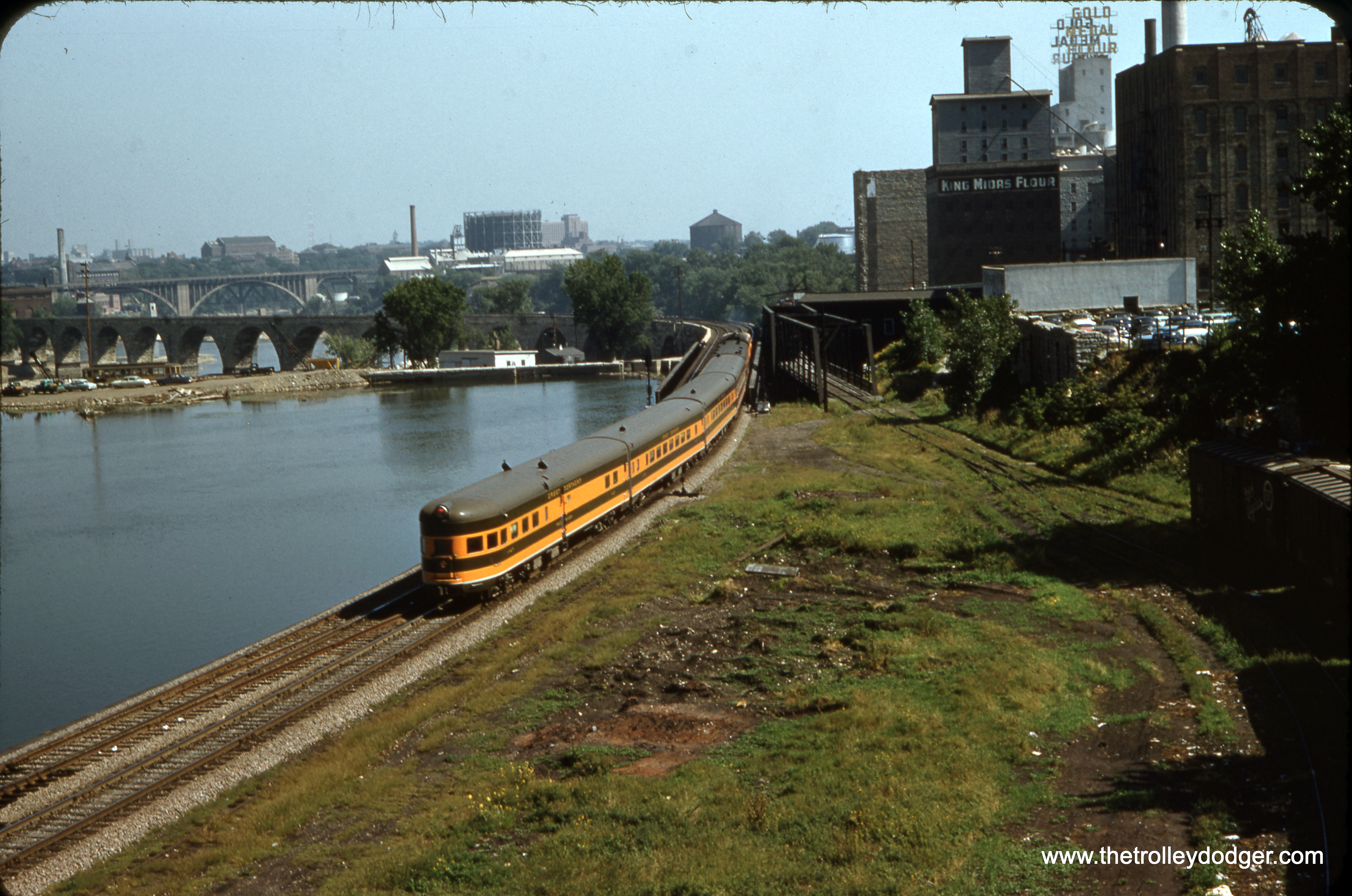
Great Northern Railway Red River 1954 Original 35mm Red Border Kodachrome Slide Subject: GNR 12 Location: Departing Minneapolis station for St. Paul Date: Fall 1954 Photographer: Unknown From the Wikipedia: The Red River was a passenger train operated by Great Northern Railway between Grand Forks, North Dakota, and Saint Paul, Minnesota (operating between 1950 and 1968). History Great Northern Railway's third new train set of 1950 was a new schedule named the Red River. The five-car streamliner built by American Car and Foundry Company began service June 25, 1950, operating a daily round trip 324 miles (521 km) each way between Grand Forks, North Dakota, and Saint Paul, Minnesota. The train went southbound in the morning returning northbound in the evening. The cars for the Red River streamliner were quite different than those built for the International (another 1950 introduction) in that the Red River's cars had extra insulation and the coaches were equipped with Baker Heaters as there was no steam heat available at the Grand Forks depot where the cars stood overnight. The locomotive was sent to the roundhouse each evening for any running repairs and service so the solution was the installation of the Baker Heaters in the cars. Link to eBay Listing

Great Northern Railway Red River 1954 Original 35mm Red Border Kodachrome Slide
Subject: GNR 12
Location: Departing Minneapolis station for St. Paul
Date: Fall 1954
Photographer: Unknown
From the Wikipedia:
The Red River was a passenger train operated by Great Northern Railway between Grand Forks, North Dakota, and Saint Paul, Minnesota (operating between 1950 and 1968).
History
Great Northern Railway’s third new train set of 1950 was a new schedule named the Red River. The five-car streamliner built by American Car and Foundry Company began service June 25, 1950, operating a daily round trip 324 miles (521 km) each way between Grand Forks, North Dakota, and Saint Paul, Minnesota. The train went southbound in the morning returning northbound in the evening.
The cars for the Red River streamliner were quite different than those built for the International (another 1950 introduction) in that the Red River’s cars had extra insulation and the coaches were equipped with Baker Heaters as there was no steam heat available at the Grand Forks depot where the cars stood overnight. The locomotive was sent to the roundhouse each evening for any running repairs and service so the solution was the installation of the Baker Heaters in the cars.
Link to eBay Listing

Amtrak RDC Train 1975 Original 35mm Kodachrome Slide Subject: Amtrak RDCs 30-32-15, Train 372 Blackhawk Location: Crawford (Chicago bound, between Dubuque and Chicago) Date: September 14, 1975 Photographer: James J. Buckley Link to eBay Listing

Amtrak RDC Train 1975 Original 35mm Kodachrome Slide
Subject: Amtrak RDCs 30-32-15, Train 372 Blackhawk
Location: Crawford (Chicago bound, between Dubuque and Chicago)
Date: September 14, 1975
Photographer: James J. Buckley
Link to eBay Listing

Milwaukee and Suburban Transport 1975 Original 35mm Kodachrome Slide Subject: M&ST 1466 Location: Wells-River (posed by the old Milwaukee Electric power plant) Date: June 29, 1975 Photographer: Jeff Wien Link to eBay Listing

Milwaukee and Suburban Transport 1975 Original 35mm Kodachrome Slide
Subject: M&ST 1466
Location: Wells-River (posed by the old Milwaukee Electric power plant)
Date: June 29, 1975
Photographer: Jeff Wien
Link to eBay Listing

Yakima Valley Transit Trolley 1975 Original 35mm Kodachrome Slide Subject: YVT 1776/1976 Location: 44th-Nob Hill, Yakima Date: June 1975 Photographer: Jeff Wien Link to eBay Listing

Yakima Valley Transit Trolley 1975 Original 35mm Kodachrome Slide
Subject: YVT 1776/1976
Location: 44th-Nob Hill, Yakima
Date: June 1975
Photographer: Jeff Wien
Link to eBay Listing

Our Latest Book, Now Available for Pre-Order:

The North Shore Line

Publication Date: February 20, 2023

FYI, my new Arcadia Publishing book The North Shore Line is now finished and has gone to press. My publisher decided to expand it to 160 pages, instead of the usual 128. That’s a 25% increase, without any change to the $23.99 price. I am quite pleased with how this turned out.

From the back cover:

As late as 1963, it was possible to board high-speed electric trains on Chicago’s famous Loop “L” that ran 90 miles north to Milwaukee. This was the Chicago North Shore & Milwaukee Railroad, commonly known as the North Shore Line. It rose from humble origins in the 1890s as a local streetcar line in Waukegan to eventually become America’s fastest interurban under the visionary management of Midwest utilities tycoon Samuel Insull. The North Shore Line, under Insull, became a worthy competitor to the established steam railroads. Hobbled by the Great Depression, the road fought back in 1941 with two streamlined, air-conditioned, articulated trains called Electroliners, which included dining service. It regained its popularity during World War II, when gasoline and tires were rationed, but eventually, it fell victim to highways and the automobile. The North Shore Line had intercity rail, commuter rail, electric freight, city streetcars, and even buses. It has been gone for nearly 60 years, but it will always remain the Road of Service.

Each copy purchased here will be signed by the author, and you will also receive a bonus North Shore Line map.  Books will ship by USPS Media Mail as soon as we receive them, on or before February 20, 2023.

Chapters:
01. Beginnings
02. The Milwaukee Division
03. The Shore Line Route
04. The Skokie Valley Route
05. The Mundelein Branch
06. On the “L”
07. City Streetcars
08. Trolley Freight
09. The Long Goodbye
10. The Legacy

Title The North Shore Line
Images of America
Author David Sadowski
Edition illustrated
Publisher Arcadia Publishing (SC), 2023
ISBN 1467108960, 978-1467108966
Length 160 pages

The price of $23.99 includes shipping within the United States.

For Shipping to US Addresses:

New Compact Disc, Now Available:

CTA-1
The Last Chicago Streetcars 1958
# of Discs – 1
Price: $15.99

Until now, it seemed as though audio recordings of Chicago streetcars were practically non-existent. For whatever reason, the late William A. Steventon does not appear to have made any for his Railroad Record Club, even though he did make other recordings in the Chicago area in 1956.

Now, audio recordings of the last runs of Chicago streetcars have been found, in the collections of the late Jeffrey L. Wien (who was one of the riders on that last car). We do not know who made these recordings, but this must have been done using a portable reel-to-reel machine.

These important recordings will finally fill a gap in transit history. The last Chicago Transit Authority streetcar finished its run in the early hours of June 21, 1958. Now you can experience these events just as Chicagoans did.

As a bonus, we have included Keeping Pace, a 1939 Chicago Surface Lines employee training program. This was digitally transferred from an original 16” transcription disc. These recordings were unheard for 80 years.

Total time – 74:38

Help Support The Trolley Dodger

This is our 295th post, and we are gradually creating a body of work and an online resource for the benefit of all railfans, everywhere. To date, we have received over 941,000 page views, for which we are very grateful.

You can help us continue our original transit research by checking out the fine products in our Online Store.
As we have said before, “If you buy here, we will be here.”

We thank you for your support.

DONATIONS

In order to continue giving you the kinds of historic railroad images that you have come to expect from The Trolley Dodger, we need your help and support. It costs money to maintain this website, and to do the sort of historic research that is our specialty.

Your financial contributions help make this web site better, and are greatly appreciated.


Independence

North Shore Line car 749 at the 50th Avenue station, Illinois Railway Museum, July 3, 2021.

North Shore Line car 749 at the 50th Avenue station, Illinois Railway Museum, July 3, 2021.

I could not think of a better place to be on July 3rd than at the Illinois Railway Museum, which I had not visited in nearly two years. Here are some pictures from that day.

Unfortunately I did not arrive in time for the annual reenactment of the sudden mid-day July 3, 1957 abandonment of passenger service by the Chicago Aurora & Elgin interurban, which stranded perhaps 3,500 riders. At the museum, museum visitors are taken to the end of the main line via a CA&E train, which then leaves them high and dry (only to be picked up by another train shortly thereafter).

I did not arrive until later in the afternoon. No CA&E cars were running, but I did capture lots of other action.

Every time I visit the museum, things are a little bit nicer, a little bit better, thanks to the dedication of their many volunteers. May it always be so.

Enjoy!

-David Sadowski

PS- We have already sent out over 100 copies of our new book Chicago’s Lost “L”s, which is available for immediate shipment. Ordering information can be found at the end of this post, and in our Online Store.

Although the 50th Avenue station was closed for renovations, North Shore Line car 749 was there for a fundraising event, where people could actually pilot the car for a brief period out on the line.

Although the 50th Avenue station was closed for renovations, North Shore Line car 749 was there for a fundraising event, where people could actually pilot the car for a brief period out on the line.

Dayton trolley bus 9809 joined the IRM fleet in 2020.

Dayton trolley bus 9809 joined the IRM fleet in 2020.

A Budd RDC (rail diesel car).

A Budd RDC (rail diesel car).

Metropolitan "L" car 2872 is under restoration. There is a picture of it in service on the Kenwood shuttle in my new book Chicago's Lost "L"s.

Metropolitan “L” car 2872 is under restoration. There is a picture of it in service on the Kenwood shuttle in my new book Chicago’s Lost “L”s.

Chicago Rapid Transit car 4146, a "Baldy," was built by Cincinnati Car Company in 1915 as one of our first all-steel "L" cars. The four separate "L" companies had come under joint operation a few years earlier, and previously just had wood-steel cars that were ordered for an individual line. The center doors on these cars were never used.

Chicago Rapid Transit car 4146, a “Baldy,” was built by Cincinnati Car Company in 1915 as one of our first all-steel “L” cars. The four separate “L” companies had come under joint operation a few years earlier, and previously just had wood-steel cars that were ordered for an individual line. The center doors on these cars were never used.

CTA PCC 4391 was operating on the streetcar loop that day.

CTA PCC 4391 was operating on the streetcar loop that day.

Neils No. 5 was one of two steam engines being used that day.

Neils No. 5 was one of two steam engines being used that day.

CTA single car units 41 and 30 were operating as a pair. The former with trolley poles, and the latter with a Skokie Swift pantograph.

CTA single car units 41 and 30 were operating as a pair. The former with trolley poles, and the latter with a Skokie Swift pantograph.

Car 30 looked resplendent in a new coat of paint.

Car 30 looked resplendent in a new coat of paint.

The singles were set up for one-person operation, where it was possible to have the operator collect fares on the train. They were used at night on the Evanston shuttle in this manner for some years, but it really slowed things down.

The singles were set up for one-person operation, where it was possible to have the operator collect fares on the train. They were used at night on the Evanston shuttle in this manner for some years, but it really slowed things down.

Frisco 1630, a 2-10-0, on the IRM main line.

Frisco 1630, a 2-10-0, on the IRM main line.

The 1630 at the passing siding near the end of the main line.

The 1630 at the passing siding near the end of the main line.

A close-up of CTA 41's third rail shoe.

A close-up of CTA 41’s third rail shoe.

CTA 6655-6656 were also running.

CTA 6655-6656 were also running.

An attractive "retro" sign has already gone up for what will eventually be a model train display (but not a hobby shop, apparently).

An attractive “retro” sign has already gone up for what will eventually be a model train display (but not a hobby shop, apparently).

Recent Finds

I recently acquired this 1893 map, showing the route of the Columbian Intramural Railway at the World's Fair here in Chicago. The Jackson Park "L" connected with the CIR at Chicago Junction (65th Street on this map), a few blocks south of where the "L" ran on 63rd Street.

I recently acquired this 1893 map, showing the route of the Columbian Intramural Railway at the World’s Fair here in Chicago. The Jackson Park “L” connected with the CIR at Chicago Junction (65th Street on this map), a few blocks south of where the “L” ran on 63rd Street.

A CTA Skokie Swift train crosses McCormick Boulevard on September 20, 1966. The tracks going under the Swift are from the Chicago & North Western's Weber Subdivision, which was abandoned in 1982. (James P. Marcus Photo)

A CTA Skokie Swift train crosses McCormick Boulevard on September 20, 1966. The tracks going under the Swift are from the Chicago & North Western’s Weber Subdivision, which was abandoned in 1982. (James P. Marcus Photo)

Philadelphia Suburban Transportation Company (aka Red Arrow) car 16 at the end of the Ardmore line on June 11, 1966, six months before trolleys were replaced by buses. (Allan H. Roberts Photo)

Philadelphia Suburban Transportation Company (aka Red Arrow) car 16 at the end of the Ardmore line on June 11, 1966, six months before trolleys were replaced by buses. (Allan H. Roberts Photo)

This picture of Chicago Surface Lines pre-PCC 7001 was taken in 1935, a year after it was built. Auto parts dealer Warshawsky & Co. was located at around 1900 S. State Street, which may be this location. The streetcar is heading north.

This picture of Chicago Surface Lines pre-PCC 7001 was taken in 1935, a year after it was built. Auto parts dealer Warshawsky & Co. was located at around 1900 S. State Street, which may be this location. The streetcar is heading north.

A three-car train of cable cars on Madison Street in the 1890s. This is a colorized photo.

A three-car train of cable cars on Madison Street in the 1890s. This is a colorized photo.

Cable car 1836 is part of a two-car train on Dearborn Street, circa the 1890s. This is a colorized photo.

Cable car 1836 is part of a two-car train on Dearborn Street, circa the 1890s. This is a colorized photo.

A Pittsburgh Railways employee works on a PCC wheel in August 1957.

A Pittsburgh Railways employee works on a PCC wheel in August 1957.

A 6-car Evanston Express train, made up of wood-steel cars, heads northbound approaching the Wilson Avenue station in August 1957. The Wilson Shops is in the background behind the train. At right, you can see the ramp that went down to Buena Yard.

A 6-car Evanston Express train, made up of wood-steel cars, heads northbound approaching the Wilson Avenue station in August 1957. The Wilson Shops is in the background behind the train. At right, you can see the ramp that went down to Buena Yard.

A westbound Garfield Park "L" train crosses Austin Boulevard in August 1957. That's Columbus Park in the background. This is now the site of I-290.

A westbound Garfield Park “L” train crosses Austin Boulevard in August 1957. That’s Columbus Park in the background. This is now the site of I-290.

In August 1957, an eastbound two-car train of 4000s is on the ground-level portion of the Lake Street "L", running parallel to South Boulevard in Oak Park. We are looking north. I am not sure of the exact side street here. Dan Cluley writes: "I think the picture of the Lake St L in Oak Park (pic 397) is S Kenilworth Ave. The house at right has been replaced with a parking lot, but the tops of the Post Office & First United Church seen through the trees seem to match up."

In August 1957, an eastbound two-car train of 4000s is on the ground-level portion of the Lake Street “L”, running parallel to South Boulevard in Oak Park. We are looking north. I am not sure of the exact side street here. Dan Cluley writes: “I think the picture of the Lake St. L in Oak Park (pic 397) is S Kenilworth Ave. The house at right has been replaced with a parking lot, but the tops of the Post Office & First United Church seen through the trees seem to match up.”

The same location today.

The same location today.

Michael Franklin writes: "This (aaa397) is looking north on Kenilworth. The twin spires in the background are the church on the NE corner of Kenilworth and Lake. The long gone Oak Leaves Offices are on the right. Building demolished in 1971." Here we see the same building from a different angle, looking to the southeast across the "L" right-of-way.

Michael Franklin writes: “This (aaa397) is looking north on Kenilworth. The twin spires in the background are the church on the NE corner of Kenilworth and Lake. The long gone Oak Leaves Offices are on the right. Building demolished in 1971.” Here we see the same building from a different angle, looking to the southeast across the “L” right-of-way.

A CTA fantrip was held on August 6, 1972, which took a four-car train down into the Lake Street "L"'s Hamlin Yard. Two single-car units flanked a pair of flat-door 6000s, all equipped with trolley poles. Shortly after this picture was taken, car 44, in the foreground, was detached from the rest of the train, and operated across Lake Street to West Shops. We have run other photos from this trip in previous posts. The ramp connecting Hamlin Yard to the Lake Street "L" was removed many years ago.

A CTA fantrip was held on August 6, 1972, which took a four-car train down into the Lake Street “L”‘s Hamlin Yard. Two single-car units flanked a pair of flat-door 6000s, all equipped with trolley poles. Shortly after this picture was taken, car 44, in the foreground, was detached from the rest of the train, and operated across Lake Street to West Shops. We have run other photos from this trip in previous posts. The ramp connecting Hamlin Yard to the Lake Street “L” was removed many years ago.

The same location today.

The same location today.

J. W. Vigrass took this picture in East Chicago, Indiana, on September 15, 1956, shortly before the South Shore Line in this area was relocated to run alongside the Indiana Toll Road. That's car 22 coming at us.

J. W. Vigrass took this picture in East Chicago, Indiana, on September 15, 1956, shortly before the South Shore Line in this area was relocated to run alongside the Indiana Toll Road. That’s car 22 coming at us.

The Last CA&E Train?

There is some question whether this photo does or does not actually show the last CA&E passenger train leaving DesPlaines Avenue without passengers on July 3, 1957, shortly after the interurban was given permission to abandon service by the courts. Some people think the photo was actually taken earlier.

There is some question whether this photo does or does not actually show the last CA&E passenger train leaving DesPlaines Avenue without passengers on July 3, 1957, shortly after the interurban was given permission to abandon service by the courts. Some people think the photo was actually taken earlier.

This is how the photo appeared in the July 4, 1957 issue of the Chicago Tribune.

This is how the photo appeared in the July 4, 1957 issue of the Chicago Tribune.

Recent Correspondence

This photo appeared in our recent post Reflections in a Golden Wye (June 24, 2021):

This photo, showing a mirror at the North Shore Line's Milwaukee terminal, was taken on January 21, 1963 (after abandonment) by Allan Y. Scott for the Milwaukee Journal. You can see the photographer in the picture, apparently using a Leica M2 or M3. This picture came from the collection of the late John Horachek. Rather than being a double exposure, it seems like the ghostly image of an Electroliner was applied to the mirror using a stencil and a product known as Glass Wax.

This photo, showing a mirror at the North Shore Line’s Milwaukee terminal, was taken on January 21, 1963 (after abandonment) by Allan Y. Scott for the Milwaukee Journal. You can see the photographer in the picture, apparently using a Leica M2 or M3. This picture came from the collection of the late John Horachek. Rather than being a double exposure, it seems like the ghostly image of an Electroliner was applied to the mirror using a stencil and a product known as Glass Wax.

John Nicholson writes:

Attached is a photo of the mirror in question at the Milwaukee terminal lunch counter on the last day of operation. I ate lunch there on the last day, wondering all the while who was going to grab that mirror once the line closed. Nobody seems to know what happened to it.

So, as you can see, all the photographer had to do was take a photo of the mirror with the waiting room reflected in the background.

(Ernie Maragos Photo, John Nicholson Collection)

(Ernie Maragos Photo, John Nicholson Collection)

Thanks for sharing those. At first, some people who saw that other picture thought it was a double exposure, but it was apparent to me that it wasn’t. I figure it was applied using Glass Wax and a stencil. My mother put some Christmas decorations on our window that way when I was a small child.

John replies:

I remember the Glass Wax stencils from Christmas 1957. Once they were removed after the holiday, at least your windows got a cleaning in the process.

Miles Beitler writes:

Your latest post included discussion of why the Congress line was constructed with room for a third track between the Lotus tunnel and the Forest Park terminal. I have attached a Tribune article from 1954 which gives the “official” reason (which essentially agrees with your post).

Thanks. You can read the article by clicking on the link given above.

The question came up recently, about whether the Congress rapid transit line was planned to have three tracks between Laramie and Forest Park, and what the third track was intended for. This Chicago Tribune article from January 6, 1954 provides the answer.

The third track was added to the plans at the insistence of Governor William Stratton, who wanted to make sure that the Chicago Aurora & Elgin could resume going downtown eventually. This is described as the final issue that needed to be settled in the overall deal whereby the CTA purchased CA&E’s fixed assets in this section for $1m. This process began when the CA&E announced that they could not afford to pay for new tracks in this stretch a few years earlier. State and county officials did not want the highway extension to be the cause of the interurban’s demise. Eventually the CTA came up with the proposal that they would purchase the CA&E’s fixed assets there, which naturally all would need to be replaced anyway. This gave the CTA “skin in the game” to continue offering rail service west of Laramie. CA&E made money from both the sale of the land for the highway and the sale of the tracks and signals to the CTA.

Suburban transit riders were unhappy with the need to transfer to the CTA at Forest Park for a slow ride downtown, starting in September 1953, and Gov. Stratton’s move was partly a response to that. The article says that the third track could be used by the CA&E or express trains (CTA’s), but the CTA did not have any interest in a third track, since they considered the new line an express service in itself. And the area that would have been occupied by this third CA&E track was left vacant. It runs north of the existing two tracks. That’s why there is a third portal in the Lotus Tunnel. The only place where this got fudged was the bridge over DesPlaines Avenue, where a tight curve got eased by using part of the area set aside for this third track.

Peter Korling writes:

I was looking for the layout of street cars and elevated trains in O scale on your website. Can you help? Or if you have other layouts help me use your search machine to find them- let me know.

Another question- do you have a picture of a streetcar in the layover at Oakenwald and 35th st? I’m not sure of the street the CTA used but the cross street was Oakenwald. Near the IC tracks. Circa 1940. the date doesn’t have to be exact. I searched CTA’s website with no success. This is for my interest only I am NOT a policeman solving a case.

I drove the L line for Muni in mid 60s. I have pics. PCC cars.

My father took this B&W photo in the early 40s.

I have original print w/his signature should you know somebody who would want to buy it.

The paintings are mine. peterkorling.com

SONY DSC

(FYI, Peter’s father was Torkel Korling, a famous photographer and inventor.)

Thanks for the photos. I actually met your father a couple of times in the 1980s. We had the chance to chat over a cup of coffee and he told me many interesting things.

I am not a model railroader myself, but perhaps some of my readers can help you with that.

As for a streetcar photo at the east end of the 35th Street line, I don’t recall seeing such a picture, but naturally I will check.

Jeremy Barnard writes:

I noticed you have a page dedicated to Capital Transit trolleys. I’m trying to find someone who may have some fleet roster information for capital-transit-company that might included buses from the early 1940s.

I have a couple photos from that era of White buses and have been trying to figure out exactly which model they were.

I saw David Sadowski’s name mentioned a few times. Do you think there would be a way to ask him as well?

I’d really appreciate any help in pointing me in the right direction.

Unfortunately I don’t have a Capital Transit bus roster, although there have been some books published about this operator. You might check those, in case you have not already done so.

As for David Sadowski, that’s me, so I guess you have killed two birds with one stone there.

Maybe some of our readers can assist you further.

Thanks.

Keep those cards and letters coming in, folks!

-David Sadowski

Our Latest Book, Now Available:

Chicago’s Lost “L”s

From the back cover:

Chicago’s system of elevated railways, known locally as the “L,” has run continuously since 1892 and, like the city, has never stood still. It helped neighborhoods grow, brought their increasingly diverse populations together, and gave the famous Loop its name. But today’s system has changed radically over the years. Chicago’s Lost “L”s tells the story of former lines such as Garfield Park, Humboldt Park, Kenwood, Stockyards, Normal Park, Westchester, and Niles Center. It was once possible to take high-speed trains on the L directly to Aurora, Elgin, and Milwaukee, Wisconsin. The L started out as four different companies, two starting out using steam engines instead of electricity. Eventually, all four came together via the Union Loop. The L is more than a way of getting around. Its trains are a place where people meet and interact. Some say the best way to experience the city is via the L, with its second-story view. Chicago’s Lost “L”s is virtually a “secret history” of Chicago, and this is your ticket. David Sadowski grew up riding the L all over the city. He is the author of Chicago Trolleys and Building Chicago’s Subways and runs the online Trolley Dodger blog.

The Images of America series celebrates the history of neighborhoods, towns, and cities across the country. Using archival photographs, each title presents the distinctive stories from the past that shape the character of the community today. Arcadia is proud to play a part in the preservation of local heritage, making history available to all.

Title Chicago’s Lost “L”s
Images of America
Author David Sadowski
Edition illustrated
Publisher Arcadia Publishing (SC), 2021
ISBN 1467100007, 9781467100007
Length 128 pages

Chapters:
01. The South Side “L”
02. The Lake Street “L”
03. The Metropolitan “L”
04. The Northwestern “L”
05. The Union Loop
06. Lost Equipment
07. Lost Interurbans
08. Lost Terminals
09. Lost… and Found

Each copy purchased here will be signed by the author, and you will also receive a bonus facsimile of a 1926 Chicago Rapid Transit Company map, with interesting facts about the “L” on the reverse side.

The price of $23.99 includes shipping within the United States.

For Shipping to US Addresses:

For Shipping to Canada:

For Shipping Elsewhere:

NEW DVD:

A Tribute to the North Shore Line

To commemorate the 50th anniversary of the demise of the fabled North Shore Line interurban in January 2013, Jeffrey L. Wien and Bradley Criss made a very thorough and professional video presentation, covering the entire route between Chicago and Milwaukee and then some. Sadly, both men are gone now, but their work remains, making this video a tribute to them, as much as it is a tribute to the Chicago North Shore & Milwaukee.

Jeff drew on his own vast collections of movie films, both his own and others such as the late William C. Hoffman, wrote and gave the narration. Bradley acted as video editor, and added authentic sound effects from archival recordings of the North Shore Line.

It was always Jeff’s intention to make this video available to the public, but unfortunately, this did not happen in his lifetime. Now, as the caretakers of Jeff’s railfan legacy, we are proud to offer this excellent two-hour program to you for the first time.  The result is a fitting tribute to what Jeff called his “Perpetual Adoration,” which was the name of a stop on the interurban.

Jeff was a wholehearted supporter of our activities, and the proceeds from the sale of this disc will help defray some of the expenses of keeping the Trolley Dodger web site going.

Total time – 121:22

# of Discs – 1
Price: $19.99 (Includes shipping within the United States)

Help Support The Trolley Dodger

This is our 271st post, and we are gradually creating a body of work and an online resource for the benefit of all railfans, everywhere. To date, we have received over 781,000 page views, for which we are very grateful.
You can help us continue our original transit research by checking out the fine products in our Online Store.
As we have said before, “If you buy here, we will be here.”
We thank you for your support.
DONATIONS
In order to continue giving you the kinds of historic railroad images that you have come to expect from The Trolley Dodger, we need your help and support. It costs money to maintain this website, and to do the sort of historic research that is our specialty.
Your financial contributions help make this web site better, and are greatly appreciated.

New Directions

Bruce C. Nelson took this photo of CTA 5174, wrapped with the Chicago flag, on April 24, 2018 at Clinton just west of the Loop.

Bruce C. Nelson took this photo of CTA 5174, wrapped with the Chicago flag, on April 24, 2018 at Clinton just west of the Loop.

Here at the Trolley Dodger, we are always in search of new directions to take this blog to. While the great majority of photos we share are definitely “old,” they are new to us, and we hope, you as well.

There doesn’t have to be an overriding theme to these posts, but often one suggests itself. Often we simply collect pictures that interest us for various reasons, and once we have a sufficiency, they all go into a post.

But what is old now was once new, and at least some of today’s images did represent new directions at one time.

Two cases in point – Harper’s Weekly, from April 20, 1895, ran an in-depth report on the new Metropolitan West Side Elevated, which opened on May 6. That was 125 year ago now, but all this was brand new and very innovative. The Met was the very first of the “L”s to forgo steam power in favor of electricity, direct current carried by a third rail.

As the article makes clear, Chicago’s third “L” (after the South Side and Lake Street lines) drew inspiration from the Columbian Intramural Railway at the 1893 World’s Columbian Exposition. And while in retrospect, it would have made a lot of sense to have the Logan Square and Humboldt Park branches continue downtown on a straight line along Milwaukee Avenue, there was no Loop in 1895 for it to connect with.

The Met started life as a very ambitious self-contained entity. There was no Loop elevated until 1897.

The other new direction we offer today is from 1913. Once established, the Loop “L” was a tremendous success, but success brought with it a host of new problems to solve. Not all trains ran on the Loop– some started and ended at the stub end terminals each of the four “L” companies had. But most of them did, and at first, all circled the Loop. The result was congestion and slower service.

Gradually, it became apparent that Chicago’s “L”s would be better off as a unified system. It was a gradual process.

By 1913, the four “L” companies were still separate entities, but came under unified management, controlled by Samuel Insull. Important changes and improvements were afoot.

Now, you could transfer between the various “L”s without paying another fare. Transfer bridges were added at Loop stations, and where the Met crossed over the Lake Street “L”.

Traffic on the Loop was changed to counter-clockwise, a system that lasted 56 years, until the Dan Ryan line opened in 1969. Prior to this, trains used left-hand running there, and operated bi-directionally. For over half a century now, the Loop has been bi-directional, with right-hand running.

We acquired a very nice 1913 brochure detailing the new changes.

In addition, we have many recent photo finds to share with you.

Enjoy.

-David Sadowski

PS- We have shared literally thousands of images with you over the last five plus years. Not surprisingly, many of these photos end up on Facebook. There are lots of railfan groups on Facebook, and we belong to many of them ourselves. We are fine with you sharing our pictures there, but we do have a couple requests.

First, please do not crop out the Trolley Dodger watermark. It’s there for a purpose– to show everyone the source of the picture.  Give credit where credit is due.

Second, please include the caption information. I have seen some pictures shared without the captions, leading to much guesswork and wondering about things that were actually answered in the original caption itself.

Thanks.

From Harper’s Weekly, April 20, 1895:

1913 “L” Brochure:

Chicago "L" operations were consolidated under one management by 1913, when this brochure was issued to explain service changes to the public.

Chicago “L” operations were consolidated under one management by 1913, when this brochure was issued to explain service changes to the public.

In 1913, free transfers were instituted between the four "L" lines. To combat overcrowding, some north and south side trains were through-routed, meaning they only ran on half the Loop. Other trains continued to circle the Loop. The direction of trains in the Loop was changed to counter-clockwise, and the Northwestern and Lake Street "L"s changed to right-hand running outside of the Loop.

In 1913, free transfers were instituted between the four “L” lines. To combat overcrowding, some north and south side trains were through-routed, meaning they only ran on half the Loop. Other trains continued to circle the Loop. The direction of trains in the Loop was changed to counter-clockwise, and the Northwestern and Lake Street “L”s changed to right-hand running outside of the Loop.

We spent some time cleaning up this 1913 map in Photoshop. Under the new scheme of things, the Loop ran counter-clockwise. Met trains continued to use the inner Loop tracks, and Northwestern trains the outer tracks, as before. Lake trains were rerouted onto the inner tracks, and South Side trains to the outer tracks. Now many trains could be through-routed between the north and south sides, although there were still trains that went around the Loop and served all the stations. It would also have been possible to through-route Lake and Met "L" trains, but this was not done. There was some equipment sharing between Northwestern and Lake, as both "L"s used overhead wire in places, but none of the Met cars were equipped with trolley poles until the 1926 Eucharistic Congress. M.E. writes, "I must compliment your excellent Photoshop work on the 1913 Rapid Transit System map. Did you notice that it mentions "electric" connections at 63rd and Stony Island and at 63rd Place and Halsted? The latter was the interurban to Kankakee, which quit sometime in the 1920s, although its trackage under the L lasted into at least the 1940s."

We spent some time cleaning up this 1913 map in Photoshop. Under the new scheme of things, the Loop ran counter-clockwise. Met trains continued to use the inner Loop tracks, and Northwestern trains the outer tracks, as before. Lake trains were rerouted onto the inner tracks, and South Side trains to the outer tracks. Now many trains could be through-routed between the north and south sides, although there were still trains that went around the Loop and served all the stations. It would also have been possible to through-route Lake and Met “L” trains, but this was not done. There was some equipment sharing between Northwestern and Lake, as both “L”s used overhead wire in places, but none of the Met cars were equipped with trolley poles until the 1926 Eucharistic Congress. M.E. writes, “I must compliment your excellent Photoshop work on the 1913 Rapid Transit System map. Did you notice that it mentions “electric” connections at 63rd and Stony Island and at 63rd Place and Halsted? The latter was the interurban to Kankakee, which quit sometime in the 1920s, although its trackage under the L lasted into at least the 1940s.”

Recent Finds

This must have been a popular postcard, as it turns up a lot. This example was never mailed and is in excellent condition. It does show the bi-directional, left-hand running Loop, though, so it must date to before 1913. The Met car at left is heading north, away from us. The train at right is heading towards us. I suspect it is a Northwestern "L" car, about to head west on Van Buren. There were no transfer bridges at Loop stations until 1913. The view looks north at Wabash and Van Buren from Tower 12.

This must have been a popular postcard, as it turns up a lot. This example was never mailed and is in excellent condition. It does show the bi-directional, left-hand running Loop, though, so it must date to before 1913. The Met car at left is heading north, away from us. The train at right is heading towards us. I suspect it is a Northwestern “L” car, about to head west on Van Buren. There were no transfer bridges at Loop stations until 1913. The view looks north at Wabash and Van Buren from Tower 12.

Postcards like this were based on black-and-white photos, although the finished product, since it is traced, ends up looking more like a drawing. Once the four "L" lines were put under consolidated management in 1913, free transfers between lines were permitted. Here, the Met "L" along Paulina crossed the Lake Street "L", the only place on the entire system where two competing lines crossed, so Lake Street Transfer station was built. Met trains went downtown anyway, but it's possible some riders might have been able to save a few minutes by switching to a Lake Street train. The view looks east.

Postcards like this were based on black-and-white photos, although the finished product, since it is traced, ends up looking more like a drawing. Once the four “L” lines were put under consolidated management in 1913, free transfers between lines were permitted. Here, the Met “L” along Paulina crossed the Lake Street “L”, the only place on the entire system where two competing lines crossed, so Lake Street Transfer station was built. Met trains went downtown anyway, but it’s possible some riders might have been able to save a few minutes by switching to a Lake Street train. The view looks east.

We are looking west along the Van Buren leg of the Loop circa 1905. The train has a large "S" on it and is therefore a South Side "L" train, coming towards us as the Loop was left-hand running at the time, and is about to cross over to head south on the right-hand running Alley "L".

We are looking west along the Van Buren leg of the Loop circa 1905. The train has a large “S” on it and is therefore a South Side “L” train, coming towards us as the Loop was left-hand running at the time, and is about to cross over to head south on the right-hand running Alley “L”.

An early 1900s postcard view of the Met "L" Logan Square Terminal.

An early 1900s postcard view of the Met “L” Logan Square Terminal.

Tower 12 at Wabash and Van Buren, looking north, in the early 900s. This is during the era when trains ran bi-directionally, left handed, prior to 1913. A Northwestern "L" train is turning behind Tower 12 and will head west. The train at left is heading north.

Tower 12 at Wabash and Van Buren, looking north, in the early 900s. This is during the era when trains ran bi-directionally, left handed, prior to 1913. A Northwestern “L” train is turning behind Tower 12 and will head west. The train at left is heading north.

The date is not known, but this must be a photo stop along the North Shore Line's Skokie Valley Route. We can only imagine how old the young boy at left is today, shown holding a pair of binoculars. This must be a siding of some sort. The original image was shot on size 127 Ektachrome film, a larger format that 35mm, but one that could still be mounted in a 2x2 mount-- what people used to call a "superslide." This term is also used to describe slides shot with size 828 film, which was slightly larger than 35mm.

The date is not known, but this must be a photo stop along the North Shore Line’s Skokie Valley Route. We can only imagine how old the young boy at left is today, shown holding a pair of binoculars. This must be a siding of some sort. The original image was shot on size 127 Ektachrome film, a larger format that 35mm, but one that could still be mounted in a 2×2 mount– what people used to call a “superslide.” This term is also used to describe slides shot with size 828 film, which was slightly larger than 35mm.

A "superslide." Since we are looking at the back of the slide, the image is reversed.

A “superslide.” Since we are looking at the back of the slide, the image is reversed.

Red Arrow car 78 on the West Chester line on May 29, 1954, about a week before buses replaced trolleys. Much of the line was single track, side-of-the-road, with passing sidings. It fell victim to a road widening project along West Chester Pike. (James P. Shuman Photo)

Red Arrow car 78 on the West Chester line on May 29, 1954, about a week before buses replaced trolleys. Much of the line was single track, side-of-the-road, with passing sidings. It fell victim to a road widening project along West Chester Pike. (James P. Shuman Photo)

Center door Red Arrow car 63 is at 69th Street Terminal on December 29, 1962.

Center door Red Arrow car 63 is at 69th Street Terminal on December 29, 1962.

Red Arrow car 63 at West Garrett Road on December 29, 1962. This car was built by Brill in the mid-1920s.

Red Arrow car 63 at West Garrett Road on December 29, 1962. This car was built by Brill in the mid-1920s.

Philadelphia Suburban Transportation Company (aka Red Arrow) car 15 at the end of the Ardmore line in the early 1950s. Buses replaced trolleys in 1966.

Philadelphia Suburban Transportation Company (aka Red Arrow) car 15 at the end of the Ardmore line in the early 1950s. Buses replaced trolleys in 1966.

Kansas City had an elevated railway line that started out as a cable car line and eventually became part of their streetcar system. It lasted into the 1950s. The last Kansas City PCC ran in 1957, but a new 2.2 mile long modern streetcar line opened in 2016. Kansas City Public Service car 776 was built by St. Louis Car Company in 1946.

Kansas City had an elevated railway line that started out as a cable car line and eventually became part of their streetcar system. It lasted into the 1950s. The last Kansas City PCC ran in 1957, but a new 2.2 mile long modern streetcar line opened in 2016. Kansas City Public Service car 776 was built by St. Louis Car Company in 1946.

A CTA Loop Shuttle train on the Wabash leg in 1974.

A CTA Loop Shuttle train on the Wabash leg in 1974.

An eastbound two-car train of single car units, including car 8, are about to enter the Lotus Tunnel in March 1960. Construction of the Congress Expressway was well underway just to the north. The new highway opened in this area later that year.

An eastbound two-car train of single car units, including car 8, are about to enter the Lotus Tunnel in March 1960. Construction of the Congress Expressway was well underway just to the north. The new highway opened in this area later that year.

Around 1940, the Chicago Surface Lines temporarily installed this door arrangement on prewar PCC 4051. It was later used on the 600 postwar PCCs.

Around 1940, the Chicago Surface Lines temporarily installed this door arrangement on prewar PCC 4051. It was later used on the 600 postwar PCCs.

CRT 3137 is part of a Lake Street Local train on the ground-level portion of that line. Don's Rail Photos: "3136 and 3137 were built by Gilbert in 1893 as LSERR 84 and 85. They were rebuilt and renumbered 136 and 137 and later renumbered 3136 and 3137 in 1913. They became CRT 3136 and 3137 in 1923."

CRT 3137 is part of a Lake Street Local train on the ground-level portion of that line. Don’s Rail Photos: “3136 and 3137 were built by Gilbert in 1893 as LSERR 84 and 85. They were rebuilt and renumbered 136 and 137 and later renumbered 3136 and 3137 in 1913. They became CRT 3136 and 3137 in 1923.”

A "Plushie" 4000-series "L" train on a late 1930s fantrip.

A “Plushie” 4000-series “L” train on a late 1930s fantrip.

A Ravenswood Express with 4000s, including "Baldy" 4073, at the Merchandise Mart station circa 1940. From 1943-49, Ravenswood trains went downtown via the State Street Subway.

A Ravenswood Express with 4000s, including “Baldy” 4073, at the Merchandise Mart station circa 1940. From 1943-49, Ravenswood trains went downtown via the State Street Subway.

CRT 1101 heads up a southbound Evanston Shopper's Special at the Merchandise Mart station circa 1940. Don's Rail Photos: "1100 thru 1158 were built as trailers by Pullman in 1899 as NWERy 100 thru 158. They were renumbered 1100 thru 1158 in 1913 and became CRT 1100 thru 1158 in 1923."

CRT 1101 heads up a southbound Evanston Shopper’s Special at the Merchandise Mart station circa 1940. Don’s Rail Photos: “1100 thru 1158 were built as trailers by Pullman in 1899 as NWERy 100 thru 158. They were renumbered 1100 thru 1158 in 1913 and became CRT 1100 thru 1158 in 1923.”

A Chicago & North Western RDC (Budd Rail Diesel Car) commuter train in Evanston on August 5, 1950.

A Chicago & North Western RDC (Budd Rail Diesel Car) commuter train in Evanston on August 5, 1950.

CTA postwar PCC 4399 in the loop at 80th and Vincennes.

CTA postwar PCC 4399 in the loop at 80th and Vincennes.

My "Spidey sense" tells me this picture of CA&E 412 was probably taken at Laramie Avenue. But it could not be any later than 1937, since that is when rail service to St. Charles ended. The view looks northwest and the train is headed west.

My “Spidey sense” tells me this picture of CA&E 412 was probably taken at Laramie Avenue. But it could not be any later than 1937, since that is when rail service to St. Charles ended. The view looks northwest and the train is headed west.

This is an unusual place to see an Electroliner, as we are on the South Side "L". While the North Shore Line did run trains to the south side up to 1938, the Electrolners entered service in 1941. So, this must be a fantrip. Our resident south side expert M.E. writes, "This photo is an enigma. I cannot imagine the CNS&M would spare one of its two Electroliners for a fan trip. Maybe this was an introductory tour before service began in 1941. Also, your caption says the CNS&M ran to the south side until 1938. Then why do I remember seeing CNS&M cars on the Jackson Park L, rounding the curve at 63rd and Prairie, in the late 1940s? That CNS&M service ran to 63rd and Dorchester (1400 E.) to connect with Illinois Central passenger trains." Miles Beitler: "I’m not sure, but RBK792 could be the 61st street station, photographed from a building in the adjacent yard. It’s hard to tell, but there appears to be a junction (the turnoff to the Englewood branch) just before the train in the far distance, which does appear to be a 6000." Comparison with the following two photos proves (IMHO) that this is actually 61st Street, and that the picture was taken from the transfer bridge.

This is an unusual place to see an Electroliner, as we are on the South Side “L”. While the North Shore Line did run trains to the south side up to 1938, the Electrolners entered service in 1941. So, this must be a fantrip. Our resident south side expert M.E. writes, “This photo is an enigma. I cannot imagine the CNS&M would spare one of its two Electroliners for a fan trip. Maybe this was an introductory tour before service began in 1941. Also, your caption says the CNS&M ran to the south side until 1938. Then why do I remember seeing CNS&M cars on the Jackson Park L, rounding the curve at 63rd and Prairie, in the late 1940s? That CNS&M service ran to 63rd and Dorchester (1400 E.) to connect with Illinois Central passenger trains.” Miles Beitler: “I’m not sure, but RBK792 could be the 61st street station, photographed from a building in the adjacent yard. It’s hard to tell, but there appears to be a junction (the turnoff to the Englewood branch) just before the train in the far distance, which does appear to be a 6000.” Comparison with the following two photos proves (IMHO) that this is actually 61st Street, and that the picture was taken from the transfer bridge.

61st Street on the South side "L". (George Trapp Collection)

61st Street on the South side “L”. (George Trapp Collection)

61st Street on the South Side "L". (George Trapp Collection)

61st Street on the South Side “L”. (George Trapp Collection)

The CA&E owned everything west of Laramie Avenue, including Lockwood Yard, shown here circa 1930 or so (by the looks of the auto at left). We are looking west and that's Loretto Hospital in the distance, opened in 1923. Cars 418 and 431 are visible. Interestingly, the yard used overhead wire instead of third rail at this time. You can see a fence at the west end of the yard, and what appear to be a couple small bumper posts at track's end. After the Garfield Park "L" was replaced by the CTA Congress median line, an alleyway was put in here, approximately where the two trains are. The house is still there, as you will see in the pictures that follow, and, it seems, one of the posts that supported trolley wire. However, the homes at left, on Flournoy Street (700 S.) are gone, replaced by expressway. This portion of yard and right-of-way is now occupied by light industry.

The CA&E owned everything west of Laramie Avenue, including Lockwood Yard, shown here circa 1930 or so (by the looks of the auto at left). We are looking west and that’s Loretto Hospital in the distance, opened in 1923. Cars 418 and 431 are visible. Interestingly, the yard used overhead wire instead of third rail at this time. You can see a fence at the west end of the yard, and what appear to be a couple small bumper posts at track’s end. After the Garfield Park “L” was replaced by the CTA Congress median line, an alleyway was put in here, approximately where the two trains are. The house is still there, as you will see in the pictures that follow, and, it seems, one of the posts that supported trolley wire. However, the homes at left, on Flournoy Street (700 S.) are gone, replaced by expressway. This portion of yard and right-of-way is now occupied by light industry.

The same view today.

The same view today.

The fence to the right of this Chicago style brick bungalow shows just where Lockwood Yard ended. The yard was just north of the CA&E main line, which curved south just east of here and ran parallel to the B&OCT from here to Forest Park.

The fence to the right of this Chicago style brick bungalow shows just where Lockwood Yard ended. The yard was just north of the CA&E main line, which curved south just east of here and ran parallel to the B&OCT from here to Forest Park.

That certainly looks like one of the same poles in the earlier picture.

That certainly looks like one of the same poles in the earlier picture.

Chicago Aurora & Elgin wood car 16 at the end of the Batavia branch. Don's Rail Photos: "16 was built by Niles Car in 1902. It was modernized in December 1939 and retired in 1959."

Chicago Aurora & Elgin wood car 16 at the end of the Batavia branch. Don’s Rail Photos: “16 was built by Niles Car in 1902. It was modernized in December 1939 and retired in 1959.”

An 1883 omnibus was part of the CTA Historical Collection at 77th and Vincennes on May 25, 1958. This and other historic vehicles were paraded out that day, during one of the final Chicago streetcar fantrips. PCCs, including 4409, are at left.

An 1883 omnibus was part of the CTA Historical Collection at 77th and Vincennes on May 25, 1958. This and other historic vehicles were paraded out that day, during one of the final Chicago streetcar fantrips. PCCs, including 4409, are at left.

The view looking west from Racine on the Englewood "L" branch on November 3, 1955. The Loomis Terminal is in the distance.

The view looking west from Racine on the Englewood “L” branch on November 3, 1955. The Loomis Terminal is in the distance.

Looking northeast from the Halsted station on the Met "L" main line on June 27, 1954, we see a two-car westbound Garfield Park train of flat-door 6000s.

Looking northeast from the Halsted station on the Met “L” main line on June 27, 1954, we see a two-car westbound Garfield Park train of flat-door 6000s.

A six-car train of wooden "L" cars heads west at California Avenue on the Lake Street line. We are looking west on March 17, 1954.

A six-car train of wooden “L” cars heads west at California Avenue on the Lake Street line. We are looking west on March 17, 1954.

The CTA installed an escalator (called a "speed ramp") at the Loomis Terminal on the Englewood branch. This photo was taken on February 19, 1957. This branch was extended two blocks west to Ashland in 1969, providing a more convenient transfer to buses. M.E. adds, "The L platform at Loomis Blvd. did not originally extend over the street. It was added to accommodate longer trains. The bus heading north on Loomis was probably serving route 110 Marquette Blvd., which ended at the L station. Until the early 1950s, bus service along Marquette and Loomis Blvds. was part of the Chicago Motor Coach system, and had double-decker buses that might not have fit under the L track (if it had been there)." Alan Follett adds, "As I recall, the “speed ramp” at Loomis wasn’t an escalator. It was a sort of gently-inclined conveyor belt."

The CTA installed an escalator (called a “speed ramp”) at the Loomis Terminal on the Englewood branch. This photo was taken on February 19, 1957. This branch was extended two blocks west to Ashland in 1969, providing a more convenient transfer to buses. M.E. adds, “The L platform at Loomis Blvd. did not originally extend over the street. It was added to accommodate longer trains. The bus heading north on Loomis was probably serving route 110 Marquette Blvd., which ended at the L station. Until the early 1950s, bus service along Marquette and Loomis Blvds. was part of the Chicago Motor Coach system, and had double-decker buses that might not have fit under the L track (if it had been there).” Alan Follett adds, “As I recall, the “speed ramp” at Loomis wasn’t an escalator. It was a sort of gently-inclined conveyor belt.”

On February 19, 1957, we are looking west from the transfer bridge at Clark and Lake. A five-car Evanston Express train is at right, made up of wood cars in their final year of service.

On February 19, 1957, we are looking west from the transfer bridge at Clark and Lake. A five-car Evanston Express train is at right, made up of wood cars in their final year of service.

The view looking west at 40th and Indiana Avenue on the South Side "L". An 8-car Jackson Park train of 4000s is going to head north to Howard, and a train of southbound 6000s is off in the distance. The extra wide platform at right was extended in 1949, when the CTA turned the Kenwood branch into a shuttle operation. Riders could change here for that line and the Stock Yards branch. The date is April 13, 1954.

The view looking west at 40th and Indiana Avenue on the South Side “L”. An 8-car Jackson Park train of 4000s is going to head north to Howard, and a train of southbound 6000s is off in the distance. The extra wide platform at right was extended in 1949, when the CTA turned the Kenwood branch into a shuttle operation. Riders could change here for that line and the Stock Yards branch. The date is April 13, 1954.

"L" car 1016 is part of an Evanston train at Madison and Wells.

“L” car 1016 is part of an Evanston train at Madison and Wells.

CTA streetcar 1069 is running westbound on Route 16 - Lake Street. Some passengers have just stepped off and are waiting for the gates to go up as a Lake Street "L" train passes. There was a stretch of a few blocks where the ground-level "L" and streetcars ran side-by-side. Here, the trolley is going to go under the nearby embankment to run for a few blocks on the north side of the Chicago & North Western. Streetcars were replaced by buses in 1954, and the "L" was elevated onto the embankment in 1962. The picture can't have been taken before 1948, as the Lake train is a "B." A/B skip-stop service began on the line that year.

CTA streetcar 1069 is running westbound on Route 16 – Lake Street. Some passengers have just stepped off and are waiting for the gates to go up as a Lake Street “L” train passes. There was a stretch of a few blocks where the ground-level “L” and streetcars ran side-by-side. Here, the trolley is going to go under the nearby embankment to run for a few blocks on the north side of the Chicago & North Western. Streetcars were replaced by buses in 1954, and the “L” was elevated onto the embankment in 1962. The picture can’t have been taken before 1948, as the Lake train is a “B.” A/B skip-stop service began on the line that year.

The front car here is 3139 on this Lake Street "L" train at Quincy and Wells.

The front car here is 3139 on this Lake Street “L” train at Quincy and Wells.

One of the two cars in this Lake Street "L" train is 1708. At Madison and Wells.

One of the two cars in this Lake Street “L” train is 1708. At Madison and Wells.

CRT 3121 is a Lake Street gate car at Madison and Wells.

CRT 3121 is a Lake Street gate car at Madison and Wells.

CRT 1772 at the front of a train at Lake and Homan.

CRT 1772 at the front of a train at Lake and Homan.

CTA 1745 is the lead car on a westbound Lake Street "L" train, going down the ramp at Lake and Laramie.

CTA 1745 is the lead car on a westbound Lake Street “L” train, going down the ramp at Lake and Laramie.

A westbound Douglas Park train at Halsted on the Lake Street "L". Douglas trains were rerouted downtown via Lake from 1954 to 1958.

A westbound Douglas Park train at Halsted on the Lake Street “L”. Douglas trains were rerouted downtown via Lake from 1954 to 1958.

CTA 2963 is a Douglas Park train at Madison and Wells.

CTA 2963 is a Douglas Park train at Madison and Wells.

CTA 2772 heads up a westbound Douglas Park train rounding the Halsted curve on the Met "L" main line.

CTA 2772 heads up a westbound Douglas Park train rounding the Halsted curve on the Met “L” main line.

The caption on the back of this picture says this is 54th Avenue on the Douglas Park "L", however, I'm not so sure. It looks as though this is a westbound train that has just crossed over at the end of the line, but it is signed as a local and not an A or B train. M.E. writes: "Your caption is 99.44% correct, this picture has to be a westbound Douglas Park L at 54th St. in Cicero, crossing over to enter the terminal. The 0.56% in error is that it could indeed have been an all-stop train; A & B service on all lines that had A & B service was not A & B service at all times of day. As I recall, south side A & B service ran til maybe 8:30 p.m., and never on Sunday. So I contend this picture was taken on a Sunday." Kenneth Smith: "I saw this pic in your recent October Surprise post and immediately suspected that the correct location is the El Strip, north of Cermak Road, between Euclid and Wesley Avenues in Berwyn, Il. The Westbound train is approaching the end-of-line station at Oak Park Ave. Were the Westbound train really approaching 54th Avenue in Cicero, the Danly Machine Tool Company plant - not residences - would have been along the Northside of the El tracks. After a little sleuthing via Google maps found that the classic two-flats which appear on the Northside of the tracks are still there and intact. And the West facing building still features a straight roof line as shown in your photo."

The caption on the back of this picture says this is 54th Avenue on the Douglas Park “L”, however, I’m not so sure. It looks as though this is a westbound train that has just crossed over at the end of the line, but it is signed as a local and not an A or B train. M.E. writes: “Your caption is 99.44% correct, this picture has to be a westbound Douglas Park L at 54th St. in Cicero, crossing over to enter the terminal. The 0.56% in error is that it could indeed have been an all-stop train; A & B service on all lines that had A & B service was not A & B service at all times of day. As I recall, south side A & B service ran til maybe 8:30 p.m., and never on Sunday. So I contend this picture was taken on a Sunday.” Kenneth Smith: “I saw this pic in your recent October Surprise post and immediately suspected that the correct location is the El Strip, north of Cermak Road, between Euclid and Wesley Avenues in Berwyn, Il. The Westbound train is approaching the end-of-line station at Oak Park Ave. Were the Westbound train really approaching 54th Avenue in Cicero, the Danly Machine Tool Company plant – not residences – would have been along the Northside of the El tracks. After a little sleuthing via Google maps found that the classic two-flats which appear on the Northside of the tracks are still there and intact. And the West facing building still features a straight roof line as shown in your photo.”

An eastbound Garfield Park train at the Marshfield station in the early 1950s. Construction is already underway for the Congress Expressway that caused the "L" to be replaced by an expressway median route.

An eastbound Garfield Park train at the Marshfield station in the early 1950s. Construction is already underway for the Congress Expressway that caused the “L” to be replaced by an expressway median route.

A train of CTA 2800s at Van Buren and Paulina. This was the temporary route for part of the Garfield Park "L" from 1953 to 1958.

A train of CTA 2800s at Van Buren and Paulina. This was the temporary route for part of the Garfield Park “L” from 1953 to 1958.

A train of CTA 6000s is westbound at Laramie Avenue on the Garfield Park line in the 1950s.

A train of CTA 6000s is westbound at Laramie Avenue on the Garfield Park line in the 1950s.

CTA 3131, a one-man car operating on Route 16 - Lake Street, stops in front of the Woods Theater, located at 54 W. Randolph Street. The film 12 O'Clock High dates the picture to 1949. The Woods closed in 1989.

CTA 3131, a one-man car operating on Route 16 – Lake Street, stops in front of the Woods Theater, located at 54 W. Randolph Street. The film 12 O’Clock High dates the picture to 1949. The Woods closed in 1989.

CRT 1013 at Skokie Shops. Don's Rail Photos: "1013 was built by Pullman in 1899 as NWERy 13. It was renumbered 1013 in 1913 and became CRT 1013 in 1923. It was retired on December 20, 1954."

CRT 1013 at Skokie Shops. Don’s Rail Photos: “1013 was built by Pullman in 1899 as NWERy 13. It was renumbered 1013 in 1913 and became CRT 1013 in 1923. It was retired on December 20, 1954.”

CRT 2704 at Skokie Shops.

CRT 2704 at Skokie Shops.

CTA 3148 heads up a Lake Street train at Quincy and Wells.

CTA 3148 heads up a Lake Street train at Quincy and Wells.

CSL 6211 near the Eastside Theater, located at 10555 S. Ewing Avenue. It opened in 1922 and closed in 1951.

CSL 6211 near the Eastside Theater, located at 10555 S. Ewing Avenue. It opened in 1922 and closed in 1951.

Recent Correspondence

Bill Myers writes:

Here is (North Shore Line) 411 in Brooklyn on the South Brooklyn Railway in March 1963.

Thanks… could it really have been that soon after the abandonment? Or is a 1964 date more likely? (The second picture shows the same car being moved years later, 1970s at least.)

Miles Beitler writes:

Great photos as usual!

Regarding RBK792, it’s really hard to tell but could there be a 6000 in the distance? If so, it would date the photo to 1950 or later. As for North Shore trains running to the south side, as far as I know that practice ended in 1938 as you said. However, perhaps NSL ran occasional trains for special events such as the 1948-1949 Chicago Railroad Fair and the 1952 Republican and Democratic national conventions (which were both held at the International Amphitheatre).

Photo RBK817 is interesting as the side curtain of car 1013 shows “LOGAN SQ EXPRESS”. Were there really express runs on that route? The Logan Square line wasn’t very long compared to the other west side lines and it didn’t have as many stations. If there was an express, which stations were skipped?

Thanks for writing. That may be 6000s in the distance. There were some very creative fantrips on the North Shore Line prior to abandonment, and some these did indeed use one of the Electroliners. I am not aware of any special runs relating to the Railroad Fair or political conventions, however.

Regarding where a Logan Square Express train would have stopped, and what stations would have been skipped, I do not know. Perhaps one of our readers can help.

Keep those cards and letters coming in, folks!

-David Sadowski

New Steam Audio CD:

FYI, we have digitally remastered another classic steam railroad audio LP to Compact Disc. Many additional titles, including the complete output of the Railroad Record Club, in our Online Store.

misc676-001

STEAM CDs:

RGTS
Rio Grande to Silverton:
A Sound Portrait of Mountain Railroading
Price: $14.99

These are vintage 1960 narrow gauge steam train recordings, in true stereo, and originally released on LP in 1961.  It is long out of print.
Includes:
01. Riding The Train To Silverton
02. Photo Run At Elk Park
03. Arriving At Silverton
04. Train Time At La Jara
05. Illini Special At Cumbres Pass
06. Doubleheader Starting At Monero
07. Eastbound Freight
08. Arriving At Chama
09. Whistles At Coxo
10. Freight With Pusher At Coxo

Gone are the nostalgic sounds of steam echoes and thundering exhausts, but the memory is immortal. May they live on in the locomotive lexicon, as a monument to the era when trains were pulled by STEAM POWER.

As with all of our recordings, this CD comes with the complete, original liner notes.

Total time – 45:49

The Trolley Dodger On the Air
We appeared on WGN radio in Chicago in November 2018, discussing our book Building Chicago’s Subways on the Dave Plier Show. You can hear our 19-minute conversation here.
Chicago, Illinois, December 17, 1938-- Secretary Harold Ickes, left, and Mayor Edward J. Kelly turn the first spadeful of earth to start the new $40,000,000 subway project. Many thousands gathered to celebrate the starting of work on the subway. Chicago, Illinois, December 17, 1938– Secretary Harold Ickes, left, and Mayor Edward J. Kelly turn the first spadeful of earth to start the new $40,000,000 subway project. Many thousands gathered to celebrate the starting of work on the subway.
Order Our New Book Building Chicago’s Subways

There were three subway anniversaries in 2018 in Chicago:
60 years since the West Side Subway opened (June 22, 1958)
75 years since the State Street Subway opened (October 17, 1943)
80 years since subway construction started (December 17, 1938)
To commemorate these anniversaries, we have written a new book, Building Chicago’s Subways.

While the elevated Chicago Loop is justly famous as a symbol of the city, the fascinating history of its subways is less well known. The City of Chicago broke ground on what would become the “Initial System of Subways” during the Great Depression and finished 20 years later. This gigantic construction project, a part of the New Deal, would overcome many obstacles while tunneling through Chicago’s soft blue clay, under congested downtown streets, and even beneath the mighty Chicago River. Chicago’s first rapid transit subway opened in 1943 after decades of wrangling over routes, financing, and logistics. It grew to encompass the State Street, Dearborn-Milwaukee, and West Side Subways, with the latter modernizing the old Garfield Park “L” into the median of Chicago’s first expressway. Take a trip underground and see how Chicago’s “I Will” spirit overcame challenges and persevered to help with the successful building of the subways that move millions. Building Chicago’s subways was national news and a matter of considerable civic pride–making it a “Second City” no more!

Bibliographic information:
Title Building Chicago’s Subways
Images of America
Author David Sadowski
Edition illustrated
Publisher Arcadia Publishing (SC), 2018
ISBN 1467129380, 9781467129381
Length 128 pages
Chapter Titles:
01. The River Tunnels
02. The Freight Tunnels
03. Make No Little Plans
04. The State Street Subway
05. The Dearborn-Milwaukee Subway
06. Displaced
07. Death of an Interurban
08. The Last Street Railway
09. Subways and Superhighways
10. Subways Since 1960
Building Chicago’s Subways is in stock and now available for immediate shipment. Order your copy today! All copies purchased through The Trolley Dodger will be signed by the author.
The price of $23.99 includes shipping within the United States.
For Shipping to US Addresses:

For Shipping to Canada:

For Shipping Elsewhere:

Redone tile at the Monroe and Dearborn CTA Blue Line subway station, showing how an original sign was incorporated into a newer design, May 25, 2018. (David Sadowski Photo) Redone tile at the Monroe and Dearborn CTA Blue Line subway station, showing how an original sign was incorporated into a newer design, May 25, 2018. (David Sadowski Photo)

Help Support The Trolley Dodger

gh1

This is our 256th post, and we are gradually creating a body of work and an online resource for the benefit of all railfans, everywhere. To date, we have received over 675,000 page views, for which we are very grateful.

You can help us continue our original transit research by checking out the fine products in our Online Store.

As we have said before, “If you buy here, we will be here.”

We thank you for your support.

DONATIONS

In order to continue giving you the kinds of historic railroad images that you have come to expect from The Trolley Dodger, we need your help and support. It costs money to maintain this website, and to do the sort of historic research that is our specialty.

Your financial contributions help make this web site better, and are greatly appreciated.

From the Collections of Bill Shapotkin

On August 13, 1971 Chicago Rock Island & Pacific #303 and 125 are backing into Blue Island (Burr Oak) yard. Bill Shapotkin adds, "The train is a ROCK Mainline Suburban train (if it had operated via Beverly, it would be west of the depot (to left)."

On August 13, 1971 Chicago Rock Island & Pacific #303 and 125 are backing into Blue Island (Burr Oak) yard. Bill Shapotkin adds, “The train is a ROCK Mainline Suburban train (if it had operated via Beverly, it would be west of the depot (to left).”

Today, we feature more classic photos of buses, trolleys, and trains, courtesy of Bill Shapotkin, long a friend of this blog. Mr. Shapotkin should be well-known to many of you from his longtime activities as a transit historian, author, and the many informative programs he has given over the years.

Today’s sampling from the Shapotkin Collection includes some rare pictures of Chicago & North Western RDCs (Budd Rail Diesel Cars), which were self-propelled and ran in Chicago area commuter train service for a short period of time in the 1950s. They replaced steam-powered trains and were in turn replaced by the familiar push-pull diesel bi-levels still in use today.

In addition, there are several pictures of Grand Central Station, a Chicago landmark in use between 1890 and 1969, which was torn down in 1971. We have some interesting correspondence, plus some new images of our own.

Enjoy!

-David Sadowski

PS- We have done our part to make these old images look as good as they possibly can. The C&NW RDC pictures were all shot around 1956 on early Ektachrome film, whose dyes turned out to be unstable and quickly shifted to red. (Technically, the red layer was relatively stable, while the green and blue layers faded.)

It used to be some people thought these sorts of images were only suitable for use as black-and-whites. But with modern technology, it is possible, to some extent, to bring back the original colors. This was easier to do on some than others, but the results look much better than you might expect. If you have ever seen one of these early red Ektachromes, you will know what I mean. Modern films are much more stable and resistant to dye fading.

I would be remiss without mentioning Bill has been involved for many years with the annual Hoosier Traction meet, which takes place in September:

It is that time of year again — the 35th annual gathering of the Hoosier Traction Meet is being held Fri-Sat, Sept 7-8 in Indianapolis, IN. The meet includes two full days of interesting presentations on a variety of subjects, as well as our “Exhibition Room” of vendors — with everything from transfers to track charts available. Book now and you can join us for just $25.00 ($40.00 at the door). We recommend that once you book hotel accommodations as early as possible, as there is an event scheduled at the Indianapolis Motor Speedway that same weekend. By calling the number of the Waterfront Inn (where our event is being held), by mentioning that you are with the Hoosier Traction Meet, you should be able to register at our group rate.

For those of you would are unable to attend both days, we have a special “Saturday Only” rate of just $15.00 ($25.00 at the door). As many of our Friday presentations are repeated on Saturday, you will be able to partake of a wide variety of subjects and presenters.

We hope you are able to join us for what many consider to be THE electric railway gathering in the country…see you there!

Thanking you in advance,

Bill Shapotkin

The Milwaukee Road's Elgin terminal in August 1970. Bill Shapotkin adds, "The MILW depot in Elgin was built 1948. It is the second depot constructed at the same site. View looks south from Chicago St."

The Milwaukee Road’s Elgin terminal in August 1970. Bill Shapotkin adds, “The MILW depot in Elgin was built 1948. It is the second depot constructed at the same site. View looks south from Chicago St.”

Chicago & Milwaukee Electric 354, built in 1928 by the St. Louis Car Company, is seen at the Illinois Railway Museum in May 1977. It ran in Milwaukee and Waukegan as a North Shore Line city streetcar.

Chicago & Milwaukee Electric 354, built in 1928 by the St. Louis Car Company, is seen at the Illinois Railway Museum in May 1977. It ran in Milwaukee and Waukegan as a North Shore Line city streetcar.

The Chessie Steam Special in Wellsboro, IN on June 17, 1978.

The Chessie Steam Special in Wellsboro, IN on June 17, 1978.

The Chessie Steam Special in Wellsboro, IN on June 17, 1978.

The Chessie Steam Special in Wellsboro, IN on June 17, 1978.

The Chessie Steam Special in Wellsboro, IN on June 17, 1978.

The Chessie Steam Special in Wellsboro, IN on June 17, 1978.

The Chessie Steam Special in Wellsboro, IN on June 17, 1978.

The Chessie Steam Special in Wellsboro, IN on June 17, 1978.

The Chessie Steam Special in Peru, IN on June 17, 1978.

The Chessie Steam Special in Peru, IN on June 17, 1978.

The Chessie Steam Special in Wellsboro, IN on June 17, 1978.

The Chessie Steam Special in Wellsboro, IN on June 17, 1978.

Minneapolis & St. Louis "doodlebug" GE 29, was used as a railway post office (RPO). According to http://www.rrpicturearchives.net/, " Number GE-29 was built in 1931, body by Saint Louis Car Company (c/n 1550), the power plant was 400 horsepower EMC Winton Model 148 gasoline engine (c/n 491) coupled to GE electrical gear. I don't know who is responsible for the boxy structure on the roof but it's likely the cooling system for the prime mover. This unit went by the name 'Montgomery' (painted above the rear truck) and was repowered in August 1950 with a Caterpillar 400 horsepower Model D diesel."

Minneapolis & St. Louis “doodlebug” GE 29, was used as a railway post office (RPO). According to http://www.rrpicturearchives.net/, ” Number GE-29 was built in 1931, body by Saint Louis Car Company (c/n 1550), the power plant was 400 horsepower EMC Winton Model 148 gasoline engine (c/n 491) coupled to GE electrical gear. I don’t know who is responsible for the boxy structure on the roof but it’s likely the cooling system for the prime mover. This unit went by the name ‘Montgomery’ (painted above the rear truck) and was repowered in August 1950 with a Caterpillar 400 horsepower Model D diesel.”

CTA bus 4606 is at the Roosevelt/Monitor Loop in October 1992 (same one used by trackless trolleys a few years earlier). The view looks E-N/E (toward Monitor Avenue). I don't know much about the GM Fishbowl next to it, however.

CTA bus 4606 is at the Roosevelt/Monitor Loop in October 1992 (same one used by trackless trolleys a few years earlier). The view looks E-N/E (toward Monitor Avenue). I don’t know much about the GM Fishbowl next to it, however.

A Milwaukee Road dome car near Union Station in Chicago.

A Milwaukee Road dome car near Union Station in Chicago.

Milwaukee Road equipment in downtown Chicago.

Milwaukee Road equipment in downtown Chicago.

Pace buses in Elgin, June 2003.

Pace buses in Elgin, June 2003.

A westbound NYC passenger train as it approaches LaSalle Street Station in November 1963. At right is the CRI&P's coach yard. The view looks south from the Roosevelt Road bridge. (John Szwajkart Photo)

A westbound NYC passenger train as it approaches LaSalle Street Station in November 1963. At right is the CRI&P’s coach yard. The view looks south from the Roosevelt Road bridge. (John Szwajkart Photo)

Chicago, IL. NYC loco #7300 is seen as it passes the CRI&P coachyard. The view looks south from the Roosevelt Road bridge in November 1963. (John Szwajkart Photo)

Chicago, IL. NYC loco #7300 is seen as it passes the CRI&P coachyard. The view looks south from the Roosevelt Road bridge in November 1963. (John Szwajkart Photo)

Metra Milwaukee District loco 124 is pushing an eastbound train towards Union Station in Chicago. The view looks east from DesPlaines Street. August 1995. (Dan Munson Photo)

Metra Milwaukee District loco 124 is pushing an eastbound train towards Union Station in Chicago. The view looks east from DesPlaines Street. August 1995. (Dan Munson Photo)

Loco 604 leads a northbound (timetable: westbound) Metra/Milwaukee District passenger train out of Union Station in Chicago. The view looks south-southwest off the Lake Street bridge over the south branch of the Chicago River. July 19, 1990. (Dan Munson Photo)

Loco 604 leads a northbound (timetable: westbound) Metra/Milwaukee District passenger train out of Union Station in Chicago. The view looks south-southwest off the Lake Street bridge over the south branch of the Chicago River. July 19, 1990. (Dan Munson Photo)

Control cab 3244 brings up the reat of a westbound Metra/Rock Island train at Joliet Union Station. The view looks west in December 1990. (Paul D. Schneider Photo)

Control cab 3244 brings up the reat of a westbound Metra/Rock Island train at Joliet Union Station. The view looks west in December 1990. (Paul D. Schneider Photo)

Joliet, IL: Loco 163 is seen pushing an eastbound Metra/Rock Island suburban train across the ATSF/IC (ex-ICG, former GM&O, nee C&A) diamonds at Union Station. The view looks south in December 1990. (Paul D. Schneider Photo)

Joliet, IL: Loco 163 is seen pushing an eastbound Metra/Rock Island suburban train across the ATSF/IC (ex-ICG, former GM&O, nee C&A) diamonds at Union Station. The view looks south in December 1990. (Paul D. Schneider Photo)

The imposing clock tower of Grand Central Station, in operation from 1890 to 1969. Located at the southwest corner of Wells and Harrison, it was demolished in 1971. This view looks northwest. (Ron Peisker Photo)

The imposing clock tower of Grand Central Station, in operation from 1890 to 1969. Located at the southwest corner of Wells and Harrison, it was demolished in 1971. This view looks northwest. (Ron Peisker Photo)

The Wells Street side of Grand Central Station in Chicago. The view looks north along Wells Street in the 1960s. (Ron Peisker Photo)

The Wells Street side of Grand Central Station in Chicago. The view looks north along Wells Street in the 1960s. (Ron Peisker Photo)

In the 1960s, and auto is parked on Wells Street in front of Grand Central Station. The view looks to the west-northwest across Wells Street. (Ron Peisker Photo)

In the 1960s, and auto is parked on Wells Street in front of Grand Central Station. The view looks to the west-northwest across Wells Street. (Ron Peisker Photo)

Looking west from the clock tower at Grand Central Station in the 1960s. Through these windows are various railroad offices. The building at left in the background is the CGW freight house. (Ron Peisker Photo)

Looking west from the clock tower at Grand Central Station in the 1960s. Through these windows are various railroad offices. The building at left in the background is the CGW freight house. (Ron Peisker Photo)

Grand Central Station, Chicago is viewed from the west side of Franklin Street from a point north of Harrison Street. The view looks southwest. (Ron Peisker Photo)

Grand Central Station, Chicago is viewed from the west side of Franklin Street from a point north of Harrison Street. The view looks southwest. (Ron Peisker Photo)

Looking north on Holden Court in March 2000, under the South Side "L", we are looking north under the St. Charles Air Line bridge. (William Shapotkin Photo)

Looking north on Holden Court in March 2000, under the South Side “L”, we are looking north under the St. Charles Air Line bridge. (William Shapotkin Photo)

A westbound B&O freight train prepares to cross the IHB at the Illinois/Indiana state line. The view looks east in September 1959. (John Szwajkart Photo)

A westbound B&O freight train prepares to cross the IHB at the Illinois/Indiana state line. The view looks east in September 1959. (John Szwajkart Photo)

This is 91st St Tower in November 1949 -- protecting the PRR/ROCK Xing on the ROCK's Suburban (now Beverly) Branch. The tracks heading off to the upper right are the ROCK. Tracks heading off to the upper left are the PRR.

This is 91st St Tower in November 1949 — protecting the PRR/ROCK Xing on the ROCK’s Suburban (now Beverly) Branch. The tracks heading off to the upper right are the ROCK. Tracks heading off to the upper left are the PRR.

This billboard, advertising SouthShore Freight, is located west of Indianapolis Boulevard north of the Indiana Toll Road in East Chicago, IN. The view looks west. June 28, 2018. (William Shapotkin Photo)

This billboard, advertising SouthShore Freight, is located west of Indianapolis Boulevard north of the Indiana Toll Road in East Chicago, IN. The view looks west. June 28, 2018. (William Shapotkin Photo)

C&NW cab-coach 152 in Chicago, north of the Clinton Street Tower on August 2, 1978.

C&NW cab-coach 152 in Chicago, north of the Clinton Street Tower on August 2, 1978.

An eastbound C&NW train is passing under the CGW bridge on July 9, 1968. Bill Shapotkin adds, "This photo was taken in Lombard east of Grace St. Today, a Great Western Trail x/o over the UP (C&NW) at the same location. View looks west."

An eastbound C&NW train is passing under the CGW bridge on July 9, 1968. Bill Shapotkin adds, “This photo was taken in Lombard east of Grace St. Today, a Great Western Trail x/o over the UP (C&NW) at the same location. View looks west.”

C&NW cab car 254 at Davis Street in Evanston on July 18, 1976.

C&NW cab car 254 at Davis Street in Evanston on July 18, 1976.

C&NW GP7 is at an unknown location, on a morning train running between Milwaukee and Madison, Wisconsin in March 1954. Bill Shapotkin: "This location is West Allis, WI just west of Belden Tower (the freight line to Butler is in background). View looks N/E."

C&NW GP7 is at an unknown location, on a morning train running between Milwaukee and Madison, Wisconsin in March 1954. Bill Shapotkin: “This location is West Allis, WI just west of Belden Tower (the freight line to Butler is in background). View looks N/E.”

C&NW KO Tower in Lake Bluff, IL on May 5, 1977.

C&NW KO Tower in Lake Bluff, IL on May 5, 1977.

C&NW 1653 at Kenmore station, Chicago.

C&NW 1653 at Kenmore station, Chicago.

The C&NW commuter stop in Zion, July 30, 1966.

The C&NW commuter stop in Zion, July 30, 1966.

The C&NW commuter stop in Zion, July 30, 1966.

The C&NW commuter stop in Zion, July 30, 1966.

The C&NW commuter stop in Zion, July 30, 1966.

The C&NW commuter stop in Zion, July 30, 1966.

The C&NW commuter stop in Zion, July 30, 1966.

The C&NW commuter stop in Zion, July 30, 1966.

The C&NW commuter stop in Zion, July 30, 1966.

The C&NW commuter stop in Zion, July 30, 1966.

The C&NW commuter stop in Zion, July 30, 1966.

The C&NW commuter stop in Zion, July 30, 1966.

C&NW RDC cars in Park Ridge, IL.

C&NW RDC cars in Park Ridge, IL.

C&NW RDC cars southbound departing Kenmore station (Granville Avenue) in Chicago.

C&NW RDC cars southbound departing Kenmore station (Granville Avenue) in Chicago.

C&NW 1531 in Kenmore station, Chicago in May 1956.

C&NW 1531 in Kenmore station, Chicago in May 1956.

C&NW RDC cars, southbound at Kenmore station, Chicago, 1956.

C&NW RDC cars, southbound at Kenmore station, Chicago, 1956.

C&NW RDC cars in Waukegan, IL.

C&NW RDC cars in Waukegan, IL.

C&NW RDC car 9933 just north of Thome Avenue in August 1956.

C&NW RDC car 9933 just north of Thome Avenue in August 1956.

Chicago Surface Lines 6213. Tony Waller adds, "The photo of the red streetcar on route 95 captioned as being at 93rd and Anthony Ave. is actually at 93rd and Exchange Ave. The streetcar line westbound turned from Exchange onto 93rd. Anthony Ave. parallels the PRR/NYC viaducts (and now the Skyway bridge alignment) that is in the near distance; crossing the streetcar line at a perpendicular angle."

Chicago Surface Lines 6213. Tony Waller adds, “The photo of the red streetcar on route 95 captioned as being at 93rd and Anthony Ave. is actually at 93rd and Exchange Ave. The streetcar line westbound turned from Exchange onto 93rd. Anthony Ave. parallels the PRR/NYC viaducts (and now the Skyway bridge alignment) that is in the near distance; crossing the streetcar line at a perpendicular angle.”

CTA 6213 at 95th and State in 1949.

CTA 6213 at 95th and State in 1949.

CSL 6212 on Route 93 near Blackstone, west of Stony Island on August 13, 1947.

CSL 6212 on Route 93 near Blackstone, west of Stony Island on August 13, 1947.

Here, we are looking north (from 31st Street) under the South Side "L" mainline. Note supports at left - that portion of the structure dates back to 1892. The pillars and structure at right was added when a third main (express) track was added. June 28, 2018. (William Shapotkin Photo)

Here, we are looking north (from 31st Street) under the South Side “L” mainline. Note supports at left – that portion of the structure dates back to 1892. The pillars and structure at right was added when a third main (express) track was added. June 28, 2018. (William Shapotkin Photo)

A southbound Englewood train approaches 31st Street on the South Side "L" main line. The view looks north from 31st Street. June 28, 2018. (William Shapotkin Photo)

A southbound Englewood train approaches 31st Street on the South Side “L” main line. The view looks north from 31st Street. June 28, 2018. (William Shapotkin Photo)

A southbound CTA Englewood train has just crossed over 31st Street on the South Side "L" main line. The view looks south across 31st. June 28, 2018. (William Shapotkin Photo)

A southbound CTA Englewood train has just crossed over 31st Street on the South Side “L” main line. The view looks south across 31st. June 28, 2018. (William Shapotkin Photo)

A southbound CTA Englewood train has just crossed over 31st Street on the South Side "L" main line. The view looks south across 31st. June 28, 2018. (William Shapotkin Photo)

A southbound CTA Englewood train has just crossed over 31st Street on the South Side “L” main line. The view looks south across 31st. June 28, 2018. (William Shapotkin Photo)

A southbound CTA Jackson Park train makes its stop at the 35th Street "L" station. The view looks north. June 28, 2018. (William Shapotkin Photo)

A southbound CTA Jackson Park train makes its stop at the 35th Street “L” station. The view looks north. June 28, 2018. (William Shapotkin Photo)

A westbound Metra train in Blue Island on June 26, 1992. (R. Bullermann Photo)

A westbound Metra train in Blue Island on June 26, 1992. (R. Bullermann Photo)

Metra loco #104 is seen heading a westbound Metra/Milwaukee District suburban train out from Union Station in August 1995. The view looks east from DesPlaines Street. (Dan Munson Photo)

Metra loco #104 is seen heading a westbound Metra/Milwaukee District suburban train out from Union Station in August 1995. The view looks east from DesPlaines Street. (Dan Munson Photo)

A 7900-series CTA bus, working a westbound trip on Route 31 - 31st, is westbound in 31st Street approaching the South Side "L" main line. The view looks east. June 28, 2018. (William Shapotkin Photo)

A 7900-series CTA bus, working a westbound trip on Route 31 – 31st, is westbound in 31st Street approaching the South Side “L” main line. The view looks east. June 28, 2018. (William Shapotkin Photo)

A 7900-series CTA bus, working a westbound trip on Route 31 - 31st, is westbound in 31st Street approaching the South Side "L" main line. The view looks east. June 28, 2018. (William Shapotkin Photo)

A 7900-series CTA bus, working a westbound trip on Route 31 – 31st, is westbound in 31st Street approaching the South Side “L” main line. The view looks east. June 28, 2018. (William Shapotkin Photo)

CTA bus 1158, working an eastbound trip on Route 103 - West 103rd, is eastbound in 103rd Street, approaching the Metra Rock Island tracks at Hale Avenue. The view looks west. June 28, 2018. (William Shapotkin Photo)

CTA bus 1158, working an eastbound trip on Route 103 – West 103rd, is eastbound in 103rd Street, approaching the Metra Rock Island tracks at Hale Avenue. The view looks west. June 28, 2018. (William Shapotkin Photo)

CTA bus 1158, working an eastbound trip on Route 103 - West 103rd, is eastbound in 103rd Street, makes a stop before crossing over the Metra Rock Island tracks at Hale Avenue. The view looks west. June 28, 2018. (William Shapotkin Photo)

CTA bus 1158, working an eastbound trip on Route 103 – West 103rd, is eastbound in 103rd Street, makes a stop before crossing over the Metra Rock Island tracks at Hale Avenue. The view looks west. June 28, 2018. (William Shapotkin Photo)

CTA bus 1158, working an eastbound trip on Route 103 - West 103rd, is eastbound in 103rd Street, crossing over the Metra Rock Island tracks at Hale Avenue. The view looks west. June 28, 2018. (William Shapotkin Photo)

CTA bus 1158, working an eastbound trip on Route 103 – West 103rd, is eastbound in 103rd Street, crossing over the Metra Rock Island tracks at Hale Avenue. The view looks west. June 28, 2018. (William Shapotkin Photo)

CTA bus 1158, working an eastbound trip on Route 103 - West 103rd, is eastbound in 103rd Street, having just crossed over the Metra Rock Island tracks at Hale Avenue. The view looks east. June 28, 2018. (William Shapotkin Photo)

CTA bus 1158, working an eastbound trip on Route 103 – West 103rd, is eastbound in 103rd Street, having just crossed over the Metra Rock Island tracks at Hale Avenue. The view looks east. June 28, 2018. (William Shapotkin Photo)

CTA bus 1094, working a westbound trip on Route 103 - West 103rd, is westbound in 103rd Street at Hale Avenue and the Metra Rock Island tracks. View looks northeast. June 28, 2018. (William Shapotkin Photo)

CTA bus 1094, working a westbound trip on Route 103 – West 103rd, is westbound in 103rd Street at Hale Avenue and the Metra Rock Island tracks. View looks northeast. June 28, 2018. (William Shapotkin Photo)

CTA bus 1094, working a westbound trip on Route 103 - West 103rd, is westbound in 103rd Street, having just crossed over Hale Avenue and Metra Rock Island tracks. The view looks northwest. June 8, 2018. (William Shapotkin Photo)

CTA bus 1094, working a westbound trip on Route 103 – West 103rd, is westbound in 103rd Street, having just crossed over Hale Avenue and Metra Rock Island tracks. The view looks northwest. June 8, 2018. (William Shapotkin Photo)

My Metra title slide... nice, eh? December 1990. (Paul D. Schneider Photo)

My Metra title slide… nice, eh? December 1990. (Paul D. Schneider Photo)

A close-up of Metra 126 and its brethren in December 1990. (Paul D. Schneider Photo)

A close-up of Metra 126 and its brethren in December 1990. (Paul D. Schneider Photo)

Recent Site Additions

This picture was added to our recent post The Magic of Jack Bejna (August 4, 2018):

Don's Rail Photos says, (North Shore Line) "213 was built by Cincinnati in March 1920, #2445, as a merchandise despatch car. In 1940 it was rebuilt as a disc harrow ice cutter. It was retired in 1955 and sold to CHF as their 242. It was donated to Illinois Railway Museum in 1964." Here, we see the car at the Chicago Hardware Foundry Company in February 1960. This was also then the location of the Illinois Electric Railway Museum.

Don’s Rail Photos says, (North Shore Line) “213 was built by Cincinnati in March 1920, #2445, as a merchandise despatch car. In 1940 it was rebuilt as a disc harrow ice cutter. It was retired in 1955 and sold to CHF as their 242. It was donated to Illinois Railway Museum in 1964.” Here, we see the car at the Chicago Hardware Foundry Company in February 1960. This was also then the location of the Illinois Electric Railway Museum.

Chicago Streetcar Tracks Exposed

Exposed streetcar tracks are a rare sight in Chicago nowadays. We recently took some pictures of some on Western Avenue under a viaduct just north of 18th Street, in the northbound lane.

-David Sadowski

While we were in the neighborhood, we took this picture of an inbound CTA Orange Line train on Archer:

Recent Finds

CTA 2029-2030 on the turnaround loop at the DesPlaines Avenue terminal in October 1964. We are looking west. Here, you can see the close proximity of the Chicago Great Western tracks to the right. These have since been removed, and the area turned into a bike path connecting with the Illinois Prairie Path at First Avenue in Maywood.

CTA 2029-2030 on the turnaround loop at the DesPlaines Avenue terminal in October 1964. We are looking west. Here, you can see the close proximity of the Chicago Great Western tracks to the right. These have since been removed, and the area turned into a bike path connecting with the Illinois Prairie Path at First Avenue in Maywood.

On July 12, 1955 we see Pittsburgh Railways car 4398 at the Drake Loop. It is signed for the Washington interurban, which continued for several miles from here until interurban service was cut back a few years before this picture was taken. Don's Rail Photos adds, "4398 was built by St. Louis Car Co. in 1916." This car was retired in 1956 and has been at the Pennsylvania Trolley Museum in (fittingly) Washington, PA ever since. Service to the Drake Loop ended in 1999, when the last PCC streetcars were retired. In its last few years, it had operated as a shuttle. You can read more about the final days of the Drake Loop here. (C. Foreman Photo)

On July 12, 1955 we see Pittsburgh Railways car 4398 at the Drake Loop. It is signed for the Washington interurban, which continued for several miles from here until interurban service was cut back a few years before this picture was taken. Don’s Rail Photos adds, “4398 was built by St. Louis Car Co. in 1916.” This car was retired in 1956 and has been at the Pennsylvania Trolley Museum in (fittingly) Washington, PA ever since. Service to the Drake Loop ended in 1999, when the last PCC streetcars were retired. In its last few years, it had operated as a shuttle. You can read more about the final days of the Drake Loop here. (C. Foreman Photo)

We recently acquired this World War II-era brochure promoting the Chicago Aurora & Elgin interurban’s services as a way to get around in spite of wartime gasoline rationing and tire shortages:

Here is an article about the new Chicago Subway, from the May 1943 issue of Trains magazine. (For information about our new book Building Chicago’s Subways, see the end of this post).

Recent Correspondence

Mark Batterson
writes:

We recently purchased the Navy Yard Car Barn, built in 1891 by the Washington and Georgetown Railroad Company. It was one of four streetcar barns in DC. We’d like to celebrate the history of streetcars in our buildout of the space. I know you’ve got some amazing images in your collection. Is there a way to purchase some of those? We’re also trying to purchase an old DC streetcar. Thought I’d ask if you know where we might be able to find one?

Thanks so much for your time and consideration.

Thanks for writing.

FYI, there is a web page that lists the current whereabouts (as of 2014) of all surviving DC trolley cars:

http://www.bera.org/cgi-bin/pnaerc-query.pl?sel_allown=DC+Transit&match_target=&Tech=Yes&pagelen=200

After the DC system quit in 1963, some PCC cars were shipped overseas and others were heavily modified for use in the Tandy Subway operation, which no longer exists. The bulk of remaining equipment is in museums.

Unfortunately, there were a few DC streetcars that were preserved at first, but were later destroyed. These include the Silver Sightseer PCC and pre-PCC car 1053.

We can offer prints from some of the images on this site, but not others… only the ones we own the rights to. We specialize in the Chicago area, and as a result, do not have that many DC images. But perhaps some of our readers can point you in the right direction for those. (If anyone reads this and can help, write to me and I can put you in touch with Mr. Batterson.

-David Sadowski

Chicago Rapid Transit Company Door Controls

A picture appeared in our last post The Magic of Jack Bejna that has stirred up some correspondence:

This three-car train of Chicago Transit Authority 4000-series "L" cars is signed as a Howard Street Express in June 1949. (L. L. Bonney Photo) Our resident south side expert M. E. adds, "Methinks this photo was taken looking west at the Indiana Av. (at 40th St.) station. Because the train destination sign says Howard Express, the location has to be on the main north/south line. (Plus, this train had to originate on the Jackson Park branch, because Englewood trains at that time ran to Ravenswood.) Also, I don't recall any other three-track main anywhere else on the north/south line. Also, Indiana Ave. had the overhead walkway to get to and from the Stock Yards L, which terminated to the left of the left-hand platform in the photo. When this photo was taken, the Kenwood L ran as through service from 42nd Place, through Indiana Ave., up to Wilson Ave. Later in 1949, the Kenwood service was cut back to a shuttle ending at Indiana Ave. The inbound station platform was extended over the northernmost track, then mainline north/south service used the middle track heading downtown. A fuller explanation is at https://www.chicago-l.org/operations/lines/kenwood.html . Also of interest is that this photo shows a three-car train. Before the advent of new equipment in 1950 there were no "married pairs" of cars. Trains could be as small as a single car, which I recall seeing on the Englewood branch on Sunday mornings. Plus, the three-car train shown in the photo would have had two conductors whose job was to open the passenger entry doors (which were on the sides, at the ends of the cars) using controls situated between the cars. So conductor #1 operated the doors at the rear of car 1 and the front of car 2. Conductor #2 operated the doors at the rear of car 2 and the front of car 3. Side doors at the front of car 1 and the rear of car 3 were not used by passengers. To operate his side doors, a conductor had to stand between the cars. (Yes, in any weather.) And the conductors had to notify the motorman when to proceed. To do this, the conductors had to observe when there was no more boarding or alighting at their doors. They used a bell system to notify the motorman. Two dings meant "proceed". One ding meant "hold". The rearmost conductor started with his bell, then the next rearmost, etc., until two dings rang in the motorman's compartment, his signal to go. The longer the train, the longer it took to leave the station."

This three-car train of Chicago Transit Authority 4000-series “L” cars is signed as a Howard Street Express in June 1949. (L. L. Bonney Photo) Our resident south side expert M. E. adds, “Methinks this photo was taken looking west at the Indiana Av. (at 40th St.) station.
Because the train destination sign says Howard Express, the location has to be on the main north/south line. (Plus, this train had to originate on the Jackson Park branch, because Englewood trains at that time ran to Ravenswood.) Also, I don’t recall any other three-track main anywhere else on the north/south line. Also, Indiana Ave. had the overhead walkway to get to and from the Stock Yards L, which terminated to the left of the left-hand platform in the photo.
When this photo was taken, the Kenwood L ran as through service from 42nd Place, through Indiana Ave., up to Wilson Ave. Later in 1949, the Kenwood service was cut back to a shuttle ending at Indiana Ave. The inbound station platform was extended over the northernmost track, then mainline north/south service used the middle track heading downtown. A fuller explanation is at
https://www.chicago-l.org/operations/lines/kenwood.html .
Also of interest is that this photo shows a three-car train. Before the advent of new equipment in 1950 there were no “married pairs” of cars. Trains could be as small as a single car, which I recall seeing on the Englewood branch on Sunday mornings.
Plus, the three-car train shown in the photo would have had two conductors whose job was to open the passenger entry doors (which were on the sides, at the ends of the cars) using controls situated between the cars. So conductor #1 operated the doors at the rear of car 1 and the front of car 2. Conductor #2 operated the doors at the rear of car 2 and the front of car 3. Side doors at the front of car 1 and the rear of car 3 were not used by passengers. To operate his side doors, a conductor had to stand between the cars. (Yes, in any weather.)
And the conductors had to notify the motorman when to proceed. To do this, the conductors had to observe when there was no more boarding or alighting at their doors. They used a bell system to notify the motorman. Two dings meant “proceed”. One ding meant “hold”. The rearmost conductor started with his bell, then the next rearmost, etc., until two dings rang in the motorman’s compartment, his signal to go. The longer the train, the longer it took to leave the station.”

Recently, Jim Huffman commented:

Photo #365? 3-car train of CTA 4000s standing at the 38th St station. I differ with your explanation of the conductors door work.
1. When the CTA took over they made all the doors on the 4000s one-man operated, allowing for trains with odd number of cars . Thus, 8-cars, 4-cars, 3-cars, 1-car= only 1-conductor per train.
2. Way prior to that, the CRT used a conductor between each two cars, doing the doors as you described. 8-cars=8-conductors, etc.
3. But later, prior to the CTA, the CRT re-wired (air?) the 4000s so that a conductor between every two cars could operate all the doors on two cars. 8-cars=4-conductors etc.
4. On multi conductor trains, there was only one signal used and that was by the front conductor, not by the other conductors. Nor were there differing sounds or number of bells or buzzers! The front conductor monitored the rear conductors doors, when all were closed, then he would signal the Motorman. There usually was not much of any delay, the reason for less men was to lower labor costs, not to speed up the train.
This is from my memory & further info from conductors back then.

We replied:

You are referring to the explanation of how door controls worked on the 4000s, given by one of our readers (M. E.) in the caption for the photo called proofs365.jpg.

We had previously reproduced a CTA training brochure dated March 1950 in our post Reader Showcase, 12-11-17. By this time, the 4000s had been retrofitted into semi-permanent married pairs, so a three-car train, as shown in the June 1949 picture, no longer would have been possible.

The 1950 training brochure does mention using a buzzer to notify the next train man in one direction.

This is how Graham Garfield’s excellent web site describes the retrofit:

After the CTA ordered the first set of 6000s (6001-6200), they set about retrofitting the 4000s to make them operate more safely, economically and basically more like the forthcoming 6000s. By the time the 6000s started rolling in, the changes had been pretty much completed. In this overhaul, the 4000s were given multiple unit door control, standardized to use battery voltage for control, the trolley feed on Evanston cars was tied together so only one pole per pair was needed, and they were paired up into “semi-permanently coupled pairs” (as opposed to the “married-pairs” of the 6000s), usually in consecutive numerical order. Additionally, the destination signs (which were all still hand-operated) were changed to display either the route names (i.e. “Ravenswood” or “Lake A”) or both terminals (i.e. “Howard – Jackson Park B”) so they wouldn’t have to be changed for the reverse trip. The number of signs per car was reduced from four to two, not counting the destination board on the front. All this allowed a two-man crew to staff a train of any length.

This does not of course explain door operation prior to 1950, and I promised to do further research, by contacting Andre Kristopans.

PS- in addition to this, in a previous comment on this post, Andre Kristopans wrote, “On CRT the conductor was the man between the first and second cars. The rest were Guards. Motorman and conductor worked together all day but guards were assigned according to train length that trip.”

So, I asked Andre to explain. Here’s what he wrote:

Wood cars very simple – man between each two cars as doors were completely local control. End doors of train were not used. Steel cars more complicated. Originally same as woods – man between each two cars. Remember steels and woods were mixed. In 1940’s changed so man could control doors at both ends of cars on either side of him, so conductor between 1and 2, guards between 3 and 4, 5 and 6, 7 and 8 only. Then in 1950’s full trainlined doors. Initially one conductor for 2 or 4 car trains, working between last 2 cars, on 6 or 8 car trains conductor between cars 3 and 4, guard between last two. Guard eliminated late 50’s, conductor in sane (same?) position now controls all doors.

Thanks for the info. On the woods and early 4000s, how did the guards and conductor signal each other?

They had signal bells. First rear guard pulled the cord that rang the gong at forward end of that car. Then that guard pulled the rope by his position to signal the next guard up. When the conductor got the signal and pulled his rope, the gong by the motorman rang and he released and started up.

Yes the 4000’s evolved. Originally basically operationally identical to woods. Circa 1943 before subway, converted from line voltage control to battery control. Now they were no longer able to train with woods. Around same time changed to door control at each end controlling doors at both ends. In 1950’s full mudc, paired with permanent headlights and permanent markers (over a period of a decade or so!). Shore Line’s Baldies book shows how this happened over time if you compare photos. Large door controls early for single door control, small door controls for entire car control, then no door controls on paired sets.

This is something that has not been looked into much, but a 1970’s 4000 was VERY different from a 1930’s 4000!

Our thanks to Andre and everyone else who contributed to this post. Keep those cards and letters coming in, folks!

-David Sadowski

Pre-Order Our New Book Building Chicago’s Subways

There are three subway anniversaries this year in Chicago:
60 years since the West Side Subway opened (June 22, 1958)
75 years since the State Street Subway opened (October 17, 1943)
80 years since subway construction started (December 17, 1938)

To commemorate these anniversaries, we have written a new book, Building Chicago’s Subways.

While the elevated Chicago Loop is justly famous as a symbol of the city, the fascinating history of its subways is less well known. The City of Chicago broke ground on what would become the “Initial System of Subways” during the Great Depression and finished 20 years later. This gigantic construction project, a part of the New Deal, would overcome many obstacles while tunneling through Chicago’s soft blue clay, under congested downtown streets, and even beneath the mighty Chicago River. Chicago’s first rapid transit subway opened in 1943 after decades of wrangling over routes, financing, and logistics. It grew to encompass the State Street, Dearborn-Milwaukee, and West Side Subways, with the latter modernizing the old Garfield Park “L” into the median of Chicago’s first expressway. Take a trip underground and see how Chicago’s “I Will” spirit overcame challenges and persevered to help with the successful building of the subways that move millions. Building Chicago’s subways was national news and a matter of considerable civic pride–making it a “Second City” no more!

Bibliographic information:

Title Building Chicago’s Subways
Images of America
Author David Sadowski
Edition illustrated
Publisher Arcadia Publishing (SC), 2018
ISBN 1467129380, 9781467129381
Length 128 pages

Chapter Titles:
01. The River Tunnels
02. The Freight Tunnels
03. Make No Little Plans
04. The State Street Subway
05. The Dearborn-Milwaukee Subway
06. Displaced
07. Death of an Interurban
08. The Last Street Railway
09. Subways and Superhighways
10. Subways Since 1960

Building Chicago’s Subways will be published on October 1, 2018. Order your copy today, and it will be shipped on or about that date. All copies purchased through The Trolley Dodger will be signed by the author.

The price of $23.99 includes shipping within the United States.

For Shipping to US Addresses:

For Shipping to Canada:

For Shipping Elsewhere:

Redone tile at the Monroe and Dearborn CTA Blue Line subway station, showing how an original sign was incorporated into a newer design, May 25, 2018. (David Sadowski Photo)

Redone tile at the Monroe and Dearborn CTA Blue Line subway station, showing how an original sign was incorporated into a newer design, May 25, 2018. (David Sadowski Photo)

Help Support The Trolley Dodger

gh1

This is our 218th post, and we are gradually creating a body of work and an online resource for the benefit of all railfans, everywhere. To date, we have received over 432,000 page views, for which we are very grateful.

You can help us continue our original transit research by checking out the fine products in our Online Store.

As we have said before, “If you buy here, we will be here.”

We thank you for your support.

DONATIONS

In order to continue giving you the kinds of historic railroad images that you have come to expect from The Trolley Dodger, we need your help and support. It costs money to maintain this website, and to do the sort of historic research that is our specialty.

Your financial contributions help make this web site better, and are greatly appreciated.