Elevation

An eastbound six-car Lake Street "L" A train approaches Oak Park Avenue in suburban Oak Park on March 23, 1955. Trains ran adjacent to South Boulevard until October 28, 1962, when they were relocated to the Chicago and North Western embankment. (Robert A. Selle Photo)

An eastbound six-car Lake Street “L” A train approaches Oak Park Avenue in suburban Oak Park on March 23, 1955. Trains ran adjacent to South Boulevard until October 28, 1962, when they were relocated to the Chicago and North Western embankment. (Robert A. Selle Photo)

October 28, 2022 was the 60th anniversary of the elevation of the outer 2.5 miles of the Lake Street “L” (now the CTA Green Line). This was an important event in the history of suburban Oak Park and the Austin neighborhood in Chicago.

The steel Lake Street “L” structure, first opened in 1893, was only built as far west as Laramie Avenue (5200 W). Once the main “L” lines were built by the four original private companies, they extended service out to less populated areas at a greatly reduced cost by putting the tracks at ground level. The idea was to establish service, then wait until the surrounding area developed, and then elevate the tracks.

In some cases, this elevation never happened. To this day, portions of the Chicago Transit Authority’s Brown, Pink, Yellow, and Purple lines continue to run at ground level.

The Lake Street “L”‘s ground level extension opened in 1901. The Chicago and North Western’s tracks, which were adjacent to the “L”, were elevated circa 1909-1910, with extremely tight clearances the result. The ground level “L” operated much like a streetcar, using overhead wire instead of third rail, and used high-level platforms.

By the 1930s, the City of Chicago, under the influence of New York City, wanted to build subways to replace the Loop elevated. The subways that eventually were built (State Street, Milwaukee-Dearborn, and West Side) were very ambitious and costly projects which helped alleviate overcrowding on the Loop, but could not replace it outright.

City planners had ideas for putting portions of the Lake line into various subways, so portions of the elevated structure could be torn down. But once the Chicago Transit Authority took over operations in 1947, it was quickly determined that the outer portion of the line, the ground-level section, was the real difficulty.

There were 22 grade crossings in this section, all manually operated by a gateman 24 hours a day. In a similar situation, the City of Berwyn was uncooperative with the CTA’s plans to reduce the number of grade crossings and install automatic gates. As a result, service on the Douglas Park “L” was cut back from Oak Park Avenue (6800 W) to 54th Avenue (5400 W), where it remains today.

Faced with the possible truncation of the Lake Street “L” to Laramie Avenue, the Village of Oak Park took a different approach, working cooperatively with all the interested parties (the City of Chicago, Chicago Transit Authority, and the Chicago and North Western), and a plan came about that benefitted everyone.

The C&NW embankment had enough extra space on it to accommodate the CTA tracks, which permitted the Lake Street “L” to be elevated at last. Removing the tracks from the street eliminated all 22 grade crossings, reducing the CTA’s payroll.

“L” operations were speeded up, offering better service, and the North Western received new revenue from renting out the space. The railroad was allowed to close some lightly used commuter rail stations, ceding these customers to the CTA, which speeded up service for riders farther out.

Removing the ground-level tracks widened the street, reducing traffic congestion and increasing the amount of parking spaces available. It was a win-win for all.

Plans were finalized around 1958, but construction does not seem to have begun until 1961. Service was changed over to the embankment at 6:00pm on October 28, 1962 (see the newspaper article below).

I was seven years old when this transition took place, and rode the ground-level “L” many times. It was always a bit tense, as all 22 cross streets were blind crossings. Cars might come darting out from under a viaduct at the last second, and there were some collisions between “L” cars and autos.

The tight clearances also prevented the use of the CTA’s 6000-series “L” cars in the 1950s, as they had curved sides that stuck out farther than previous equipment. Once the line began running on the embankment, it was possible to use newer equipment, and the CTA assigned many of their new 2000-series rapid transit cars to the Lake line starting in 1964.

Now, the “L” has been running on the embankment for nearly the same length of time as the ground-level operation had. And practically every trace of that surface trackage and stations is long gone.

People who have grown up in the area since 1962 might not have any idea that the “L” ever ran anywhere but on the embankment, but this is an important part of Oak Park’s history, and it deserves to be remembered.

Fortunately, we recently collected various images showing both the construction work, and many taken on the very day of the ground-level operation, October 28, 1962. In addition to this, we have an excellent selection of other classic traction photos from around the country.

We are pleased to report that our latest book The North Shore Line is now 100% complete and has gone to press. The publication date is February 20, 2023, and we are now taking pre-orders. You will find more information about that at the end of this post (and our Online Store).

-David Sadowski

PS- You might also like our Trolley Dodger Facebook auxiliary, a private group that now has 1,016 members.

Our friend Kenneth Gear now has a Facebook group for the Railroad Record Club. If you enjoy listening to audio recordings of classic railroad trains, whether steam, electric, or diesel, you might consider joining.

FYI, the Hoosier Traction Facebook Group celebrates electric transit in Indiana and the Midwest. It also supports the activities of the annual Hoosier Traction Meet in Dayton, OH (although not affiliated with the North American Transit Historical Society, which organizes that event).

The Lake Street “L” in Transition

In this July 16, 1961 view, work has just started on connecting the "L" with the nearby Chicago and North Western embankment. But the changeover point between overhead wire and third rail has already been moved to the Central Avenue ground-level station. This would otherwise have been a complicating factor in the transition process, as both routes would need to be operational for a short time simultaneously.

In this July 16, 1961 view, work has just started on connecting the “L” with the nearby Chicago and North Western embankment. But the changeover point between overhead wire and third rail has already been moved to the Central Avenue ground-level station. This would otherwise have been a complicating factor in the transition process, as both routes would need to be operational for a short time simultaneously.

The view looking west from Laramie Avenue on August 27, 1961. A new temporary track has been built at left, supported by wooden pilings, to allow the ground-level operation to continue while the new "L" connection is being built. Note the Chicago and North Western freight train at right.

The view looking west from Laramie Avenue on August 27, 1961. A new temporary track has been built at left, supported by wooden pilings, to allow the ground-level operation to continue while the new “L” connection is being built. Note the Chicago and North Western freight train at right.

This picture, taken on August 27, 1961, shows how the "L" was shored up during construction of the new connection to the nearby railroad embankment.

This picture, taken on August 27, 1961, shows how the “L” was shored up during construction of the new connection to the nearby railroad embankment.

On August 27, 1961, new steel has been added to the "L" structure at Laramie Avenue. This section of "L" was eventually rebuilt in the 1990s, when the line was shut down for about two years.

On August 27, 1961, new steel has been added to the “L” structure at Laramie Avenue. This section of “L” was eventually rebuilt in the 1990s, when the line was shut down for about two years.

On September 10, 1961, new streel is being added to the "L" to support the additional tracks needed for the realignment.

On September 10, 1961, new streel is being added to the “L” to support the additional tracks needed for the realignment.

Looking west from the Laramie Avenue "L" station on September 17, 1961. New tracks will be added to create a junction between the old and new alignments.

Looking west from the Laramie Avenue “L” station on September 17, 1961. New tracks will be added to create a junction between the old and new alignments.

Third rail (here referred to as "trolley rail") was installed between Laramie and Parkside Avenues on the Lake Street "L" as of May 8, 1961. This was one of the first actions taken in the project to move the "L" onto the nearby railroad embankment.

Third rail (here referred to as “trolley rail”) was installed between Laramie and Parkside Avenues on the Lake Street “L” as of May 8, 1961. This was one of the first actions taken in the project to move the “L” onto the nearby railroad embankment.

Work on the CTA's new Congress "L" branch was finishing up just as work began on realigning the outer portion of the Lake Street "L". Once these projects were finished, all the CTA grade crossings in Oak Park and Forest Park were eliminated.

Work on the CTA’s new Congress “L” branch was finishing up just as work began on realigning the outer portion of the Lake Street “L”. Once these projects were finished, all the CTA grade crossings in Oak Park and Forest Park were eliminated.

The changeover point from third rail to overhead wire on the Lake Street "L" was moved from Laramie to Central Avenue on May 22, 1961, at the beginning of the relocation project.

The changeover point from third rail to overhead wire on the Lake Street “L” was moved from Laramie to Central Avenue on May 22, 1961, at the beginning of the relocation project.

Overhead wire was removed from the eastbound Lake Street "L" track between Central and Laramie on May 24, 1961.

Overhead wire was removed from the eastbound Lake Street “L” track between Central and Laramie on May 24, 1961.

Central Avenue and Lake Street on October 28, 1962. This was the only place on the "L" system where trains under wire crossed a trolley bus line. Motor buses replaced trolley buses on Central on January 17, 1970. This portion of Lake Street was renamed Corcoran Place a few years after this picture was taken, to honor a local alderman who had recently died.

Central Avenue and Lake Street on October 28, 1962. This was the only place on the “L” system where trains under wire crossed a trolley bus line. Motor buses replaced trolley buses on Central on January 17, 1970. This portion of Lake Street was renamed Corcoran Place a few years after this picture was taken, to honor a local alderman who had recently died.

We are looking east along what was then Lake Street at Mayfield Avenue on October 28, 1962. We are just east of where the dedication ceremony took place. The new Central Avenue "L" station can be seen in the distance.

We are looking east along what was then Lake Street at Mayfield Avenue on October 28, 1962. We are just east of where the dedication ceremony took place. The new Central Avenue “L” station can be seen in the distance.

We are looking to the northeast along what was then Lake Street (now Corcoran Place) just east of Austin Boulevard on October 28, 1962.

We are looking to the northeast along what was then Lake Street (now Corcoran Place) just east of Austin Boulevard on October 28, 1962.

Chicago's dedication ceremony for the new "L" alignment took place on what was then Lake Street (now Corcoran Place), between Austin Boulevard and Mason Avenue. Mayor Richard J, Daley and CTA chairman Virgil Gunlock presided. A similar ceremony was held in Oak Park.

Chicago’s dedication ceremony for the new “L” alignment took place on what was then Lake Street (now Corcoran Place), between Austin Boulevard and Mason Avenue. Mayor Richard J, Daley and CTA chairman Virgil Gunlock presided. A similar ceremony was held in Oak Park.

CTA "L" car 4407 appears to have been decorated for the dedication event near the Austin stop on October 28, 1962.

CTA “L” car 4407 appears to have been decorated for the dedication event near the Austin stop on October 28, 1962.

I believe we are just west of the Austin Boulevard "L" station on October 28, 1962.

I believe we are just west of the Austin Boulevard “L” station on October 28, 1962.

Clearances were extremely narrow on the ground level portion of the Lake Street "L", and therefore, when the line was elevated, temporary entrances were used. Once the old "L" had been cleared away, construction of the permanent entrances continued.

Clearances were extremely narrow on the ground level portion of the Lake Street “L”, and therefore, when the line was elevated, temporary entrances were used. Once the old “L” had been cleared away, construction of the permanent entrances continued.

Again, near Austin Boulevard on October 28, 1962. We are looking to the northeast.

Again, near Austin Boulevard on October 28, 1962. We are looking to the northeast.

An eastbound Lake Street "A" train is just east of Ridgeland Avenue on October 28, 1962.

An eastbound Lake Street “A” train is just east of Ridgeland Avenue on October 28, 1962.

We are looking west, just east of the Ridgeland Avenue "L" station on October 28, 1962. The building at left with the sign on it advertising a dry cleaner is now occupied by the Tayloe Glass Company.

We are looking west, just east of the Ridgeland Avenue “L” station on October 28, 1962. The building at left with the sign on it advertising a dry cleaner is now occupied by the Tayloe Glass Company.

We are looking west along South Boulevard at Marion Street in suburban Oak Park on October 28, 1962. A two-tone mid-50s Ford heads north on Marion, while an early 1960s Corvair is eastbound on South Boulevard. This is a rare opportunity to see "L" cars on both levels.

We are looking west along South Boulevard at Marion Street in suburban Oak Park on October 28, 1962. A two-tone mid-50s Ford heads north on Marion, while an early 1960s Corvair is eastbound on South Boulevard. This is a rare opportunity to see “L” cars on both levels.

We are looking west along South Boulevard at Marion Street on October 28, 1962. The sign at left advertises Blue Cab, and there is a cab waiting there to serve people getting off the "L".

We are looking west along South Boulevard at Marion Street on October 28, 1962. The sign at left advertises Blue Cab, and there is a cab waiting there to serve people getting off the “L”.

Looking west along South Boulevard at Marion Street on October 28, 1962. Due to the narrow width of South Boulevard in this area, it was a one-way street going east. This section is now a two-way street, although there is still a section that is one way westbound, between Oak Park Avenue and Home Avenue.

Looking west along South Boulevard at Marion Street on October 28, 1962. Due to the narrow width of South Boulevard in this area, it was a one-way street going east. This section is now a two-way street, although there is still a section that is one way westbound, between Oak Park Avenue and Home Avenue.

A closer view of the new and old "L" stations. The sign above the entrance advertises the all metal "L" cars the CTA had operated on Lake since the last wood cars were taken off this line in 1954.

A closer view of the new and old “L” stations. The sign above the entrance advertises the all metal “L” cars the CTA had operated on Lake since the last wood cars were taken off this line in 1954.

At one time, Blue Cab had their headquarters on South Boulevard, but I don't recall offhand whether they were located here. The Lake Street "L" ground-level trackage extended across Harlem Avenue a short distance west of here. In the distance, you can see construction is already underway on expanding the railroad embankment to create a new yard for Lake Street trains. It opened in 1964.

At one time, Blue Cab had their headquarters on South Boulevard, but I don’t recall offhand whether they were located here. The Lake Street “L” ground-level trackage extended across Harlem Avenue a short distance west of here. In the distance, you can see construction is already underway on expanding the railroad embankment to create a new yard for Lake Street trains. It opened in 1964.

This slide, taken by the same photographer, has a processing date of May 1963. Lake Street trains are running on the embankment, with their trolley poles removed. The old tracks are still in place but will soon be ripped up. The adjacent street was widened and parking spaces added.

This slide, taken by the same photographer, has a processing date of May 1963. Lake Street trains are running on the embankment, with their trolley poles removed. The old tracks are still in place but will soon be ripped up. The adjacent street was widened and parking spaces added.

The Congress Expressway is under construction at Homan Avenue on October 9, 1955, and would soon open as far west as Laramie Avenue. Tracks are already being laid for the new CTA Congress "L" line, which opened on June 22, 1958, replacing the old Garfield Park "L". Note the very flimsy barrier separating the "L" and highway. This soon proved completely inadequate and was eventually replaced by concrete barriers. Mayor Richard J. Daley drove the first spike for the new rails on July 8, 1955 near Pulaski Road. We are looking east. The entire story of the transition from the Garfield Park "L" to the Congress median line is told in my 2018 book Building Chicago's Subways.

The Congress Expressway is under construction at Homan Avenue on October 9, 1955, and would soon open as far west as Laramie Avenue. Tracks are already being laid for the new CTA Congress “L” line, which opened on June 22, 1958, replacing the old Garfield Park “L”. Note the very flimsy barrier separating the “L” and highway. This soon proved completely inadequate and was eventually replaced by concrete barriers. Mayor Richard J. Daley drove the first spike for the new rails on July 8, 1955 near Pulaski Road. We are looking east. The entire story of the transition from the Garfield Park “L” to the Congress median line is told in my 2018 book Building Chicago’s Subways.

We were fortunately to recently purchase this original early red border Kodachrome slide, taken on September 7, 1941. It shows a fan taking a picture of Connecticut Company car 500, built in 1904 and described as the pride of the fleet, equipped with a kitchen, bathroom, and dining tables. It was acquired by the Shore Line Trolley Museum in 1948.

We were fortunately to recently purchase this original early red border Kodachrome slide, taken on September 7, 1941. It shows a fan taking a picture of Connecticut Company car 500, built in 1904 and described as the pride of the fleet, equipped with a kitchen, bathroom, and dining tables. It was acquired by the Shore Line Trolley Museum in 1948.

A view of the Chicago Transit Authority's Stock Yards branch on September 16, 1956. Service was discontinued the following year, and it has now been 65 years since the last wooden "L" car ran in regular service in Chicago.

A view of the Chicago Transit Authority’s Stock Yards branch on September 16, 1956. Service was discontinued the following year, and it has now been 65 years since the last wooden “L” car ran in regular service in Chicago.

Some Milwaukee Electric interurban trains ran past the North Shore Line's Milwaukee Terminal, although there does not seem to have been a track connection here. This picture dates to the 1940s. A TM interurban car did operate on a North Shore Line fantrip in 1949, so there must have been a track connection somewhere. An Electroliner is berthed at the terminal.

Some Milwaukee Electric interurban trains ran past the North Shore Line’s Milwaukee Terminal, although there does not seem to have been a track connection here. This picture dates to the 1940s. A TM interurban car did operate on a North Shore Line fantrip in 1949, so there must have been a track connection somewhere. An Electroliner is berthed at the terminal.

The Logan Square “L” Terminal, right around the end of service in late January 1970. Service was extended on this line via the new Kimball Subway and a median line in the Kennedy Expressway. Service went only to Jefferson Park at first, but now continues all the way to O’Hare Airport.

Another view of the old Logan Square "L" station near the end of service.

Another view of the old Logan Square “L” station near the end of service.

On December 6, 1958, CTA salt car AA98 was still on a trailer at the Electric Railway Historical Society (ERHS) location in Downers Grove. It was formerly Chicago Surface Lines car 2846 and was built in 1908 by the South Chicago City Railway. It went to the Illinois Railway Museum in 1973. (Robert A. Selle Photo)

On December 6, 1958, CTA salt car AA98 was still on a trailer at the Electric Railway Historical Society (ERHS) location in Downers Grove. It was formerly Chicago Surface Lines car 2846 and was built in 1908 by the South Chicago City Railway. It went to the Illinois Railway Museum in 1973. (Robert A. Selle Photo)

The CTA Congress Expressway median line was not the first of its type, that distinction having been taken by the Pacific Electric in 1940. Here, we see a 600-series "Hollywood" car in Cahuenga Pass at Barham Boulevard. This print was made in 1946 but could have been taken earlier. PE service here ended in 1952 (this was part of the Van Nuys line) and the right-of-way was taken up by additional traffic lanes. (Stuart A. Liebman Photo)

The CTA Congress Expressway median line was not the first of its type, that distinction having been taken by the Pacific Electric in 1940. Here, we see a 600-series “Hollywood” car in Cahuenga Pass at Barham Boulevard. This print was made in 1946 but could have been taken earlier. PE service here ended in 1952 (this was part of the Van Nuys line) and the right-of-way was taken up by additional traffic lanes. (Stuart A. Liebman Photo)

Don's Rail Photos: "(North Shore Line) 420 was was built by Pullman in 1928 as an observation. It was out of service by 1932. On July 21, 1943, it reentered service as a motorized coach. It was sold to Seashore Trolley Museum in 1963." Here we see it prior to conversion.

Don’s Rail Photos: “(North Shore Line) 420 was was built by Pullman in 1928 as an observation. It was out of service by 1932. On July 21, 1943, it reentered service as a motorized coach. It was sold to Seashore Trolley Museum in 1963.” Here we see it prior to conversion.

North Shore Line diner 418 at the Milwaukee Terminal, when it was still in service as a diner. This print was made in 1945 but could have been taken earlier. Dining car service on the CNS&M ended in 1947, except for the Electroliners, and car 415, which was used in the "substitute Liner" and for charters.

North Shore Line diner 418 at the Milwaukee Terminal, when it was still in service as a diner. This print was made in 1945 but could have been taken earlier. Dining car service on the CNS&M ended in 1947, except for the Electroliners, and car 415, which was used in the “substitute Liner” and for charters.

A five-car train of Chicago Aurora and Elgin wood cars, including 312, in Wheaton. This print was made in 1945, but the picture was probably taken earlier. (Ewing Dale Photo)

A five-car train of Chicago Aurora and Elgin wood cars, including 312, in Wheaton. This print was made in 1945, but the picture was probably taken earlier. (Ewing Dale Photo)

Chicago Aurora and Elgin wood car 24 in Wheaton. This print was made in 1945, but the picture was probably taken earlier. (E. Dale Photo)

Chicago Aurora and Elgin wood car 24 in Wheaton. This print was made in 1945, but the picture was probably taken earlier. (E. Dale Photo)

Chicago Aurora and Elgin steel car 431, which was built by Pullman, in Wheaton. This print was made in 1945, but the picture was probably taken earlier. (E. Dale Photo)

Chicago Aurora and Elgin steel car 431, which was built by Pullman, in Wheaton. This print was made in 1945, but the picture was probably taken earlier. (E. Dale Photo)

A two-car Chicago Aurora and Elgin train, with 414 at the rear, heads west at Laramie Avenue as an Elgin Express. This picture was printed in 1945 but was probably taken earlier. (E. Dale Photo)

A two-car Chicago Aurora and Elgin train, with 414 at the rear, heads west at Laramie Avenue as an Elgin Express. This picture was printed in 1945 but was probably taken earlier. (E. Dale Photo)

Chicago Surface Lines pre-war PCC 7020 heads west on Madison Street at Central Park Avenue. This print was made in 1946 but could have been taken earlier. There is another picture taken at this location in my 2017 book Chicago Trolleys, showing a postwar PCC. (Ken Kidder Photo)

Chicago Surface Lines pre-war PCC 7020 heads west on Madison Street at Central Park Avenue. This print was made in 1946 but could have been taken earlier. There is another picture taken at this location in my 2017 book Chicago Trolleys, showing a postwar PCC. (Ken Kidder Photo)

Chicago Aurora and Elgin wood car 140, formerly from the North Shore Line. Don's Rail Photos: "138 thru 141 were built by American Car in 1910. They were rebuilt for Elevated compatibility in 1919. They were also leased to the CA&E in 1936, returned to the CNS&M in 1945, and sold to the CA&E in 1946." This print was made in 1945, but could have been taken earlier. (E. Dale Photo)

Chicago Aurora and Elgin wood car 140, formerly from the North Shore Line. Don’s Rail Photos: “138 thru 141 were built by American Car in 1910. They were rebuilt for Elevated compatibility in 1919. They were also leased to the CA&E in 1936, returned to the CNS&M in 1945, and sold to the CA&E in 1946.” This print was made in 1945, but could have been taken earlier. (E. Dale Photo)

Chicago Aurora and Elgin steel car 417 heads up a Chicago Express at Laramie Avenue. This print was made in 1945, but could have been taken earlier. (E. Dale Photo)

Chicago Aurora and Elgin steel car 417 heads up a Chicago Express at Laramie Avenue. This print was made in 1945, but could have been taken earlier. (E. Dale Photo)

Don's Rail Photos: "In 1937, the CA&E needed additional equipment. Much was available, but most of the cars suffered from extended lack of maintenance. Finally, 5 coaches were found on the Washington Baltimore & Annapolis which were just the ticket. 35 thru 39, built by Cincinnati Car in 1913, were purchased and remodeled for service as 600 thru 604. The ends were narrowed for service on the El. They had been motors, but came out as control trailers. Other modifications included drawbars, control, etc. A new paint scheme was devised. Blue and grey with red trim and tan roof was adopted from several selections. They entered service between July and October in 1937. The following year, three more cars were acquired. 80 thru 82 were combines built by Cincinnati in 1913. On the CA&E, they were rebuilt in much the same manner as the 600s. The baggage compartment was fitted with seats and the cars were operated as full coaches numbered 700 thru 702. 700 was built by Cincinnati Car Co in 1913 as WB&A 80. It was sold as CA&E 700 in 1938." This picture was printed in 1945, but could have been taken earlier. The location is the Wheaton Shops. (E. Dale Photo)

Don’s Rail Photos: “In 1937, the CA&E needed additional equipment. Much was available, but most of the cars suffered from extended lack of maintenance. Finally, 5 coaches were found on the Washington Baltimore & Annapolis which were just the ticket. 35 thru 39, built by Cincinnati Car in 1913, were purchased and remodeled for service as 600 thru 604. The ends were narrowed for service on the El. They had been motors, but came out as control trailers. Other modifications included drawbars, control, etc. A new paint scheme was devised. Blue and grey with red trim and tan roof was adopted from several selections. They entered service between July and October in 1937. The following year, three more cars were acquired. 80 thru 82 were combines built by Cincinnati in 1913. On the CA&E, they were rebuilt in much the same manner as the 600s. The baggage compartment was fitted with seats and the cars were operated as full coaches numbered 700 thru 702. 700 was built by Cincinnati Car Co in 1913 as WB&A 80. It was sold as CA&E 700 in 1938.” This picture was printed in 1945, but could have been taken earlier. The location is the Wheaton Shops. (E. Dale Photo)

Chicago Aurora and Elgin 435 is westbound at Laramie Avenue on an Aurora Express. This photo was printed in 1945, but could have been taken earlier. (E. Dale Photo)

Chicago Aurora and Elgin 435 is westbound at Laramie Avenue on an Aurora Express. This photo was printed in 1945, but could have been taken earlier. (E. Dale Photo)

Chicago Aurora and Elgin 423 is running on the streets of Aurora as an express. The terminal was relocated off the street at the end of 1939, and the license plate on the car at left is from 1934 or 1936 (probably the former). This print was made in 1945. (E. Dale Photo)

Chicago Aurora and Elgin 423 is running on the streets of Aurora as an express. The terminal was relocated off the street at the end of 1939, and the license plate on the car at left is from 1934 or 1936 (probably the former). This print was made in 1945. (E. Dale Photo)

Birney car 1501 is in Council Bluffs, Iowa in 1947. (Victor G. Wagner Photo)

Birney car 1501 is in Council Bluffs, Iowa in 1947. (Victor G. Wagner Photo)

This is the West Penn Railway in Greensburgh, Pennsylvania, which is 30 miles southeast of Pittsburgh.

This is the West Penn Railway in Greensburgh, Pennsylvania, which is 30 miles southeast of Pittsburgh.

North Shore Line 714 heads up a southbound Chicago Express on the Shore Line Route in North Chicago in 1947. This car was built in 1926 by the Cincinnati Car Company. After the North Shore Line was abandoned in 1963, 714 went to the Illinois Railway Museum, where it is today. (Victor G. Wagner Photo)

North Shore Line 714 heads up a southbound Chicago Express on the Shore Line Route in North Chicago in 1947. This car was built in 1926 by the Cincinnati Car Company. After the North Shore Line was abandoned in 1963, 714 went to the Illinois Railway Museum, where it is today. (Victor G. Wagner Photo)

A view of the Metropolitan "L" crossing the Chicago River on July 10, 1949. We are looking to the northwest.

A view of the Metropolitan “L” crossing the Chicago River on July 10, 1949. We are looking to the northwest.

Five Mile Beach Electric Railway car 32 in Wildwood, New Jersey in 1940. (G. Pilkington Photo)

Five Mile Beach Electric Railway car 32 in Wildwood, New Jersey in 1940. (G. Pilkington Photo)

CTA 2712 leads a two-car Douglas Park "L" train in the early 1950s. The train is headed towards Marshfield Junction, where Douglas Park, Garfield Park, Logan Square, and Humboldt Park lines converged into the Met "L" main line at Paulina. Construction is underway here for the Congress Expressway. A new north-south connection was built soon after this picture was taken, so that Douglas Park trains could be re-routed downtown via the former Logan Square tracks to a new connection with the Lake Street "L". This allowed the Met main line to be removed east of here in 1954, where the "L" was in the way of the new highway.

CTA 2712 leads a two-car Douglas Park “L” train in the early 1950s. The train is headed towards Marshfield Junction, where Douglas Park, Garfield Park, Logan Square, and Humboldt Park lines converged into the Met “L” main line at Paulina. Construction is underway here for the Congress Expressway. A new north-south connection was built soon after this picture was taken, so that Douglas Park trains could be re-routed downtown via the former Logan Square tracks to a new connection with the Lake Street “L”. This allowed the Met main line to be removed east of here in 1954, where the “L” was in the way of the new highway.

A four-car train of CTA 4000s is (I presume) near Howard in the 1950s. Miles Beitler adds, "Photo aad702a looks like a train of 4000s leaving Howard Street southbound on track 1. If I’m correct that that the overhead wire has been removed and the trolley poles on the 4000s are down, this must be after third rail was installed on track 1, which would date the photo to around 1964 or later."

A four-car train of CTA 4000s is (I presume) near Howard in the 1950s. Miles Beitler adds, “Photo aad702a looks like a train of 4000s leaving Howard Street southbound on track 1. If I’m correct that that the overhead wire has been removed and the trolley poles on the 4000s are down, this must be after third rail was installed on track 1, which would date the photo to around 1964 or later.”

Indiana Railroad high-speed car 69 is at Indianapolis on August 11, 1940.

Indiana Railroad high-speed car 69 is at Indianapolis on August 11, 1940.

A North Shore Line freight train is at the Rondout weigh station in January 1963.

A North Shore Line freight train is at the Rondout weigh station in January 1963.

North Shore Line combine 256 is at the front of a three-car train of "Greenliners" (a fan term) in a slide processed in June 1961.

North Shore Line combine 256 is at the front of a three-car train of “Greenliners” (a fan term) in a slide processed in June 1961.
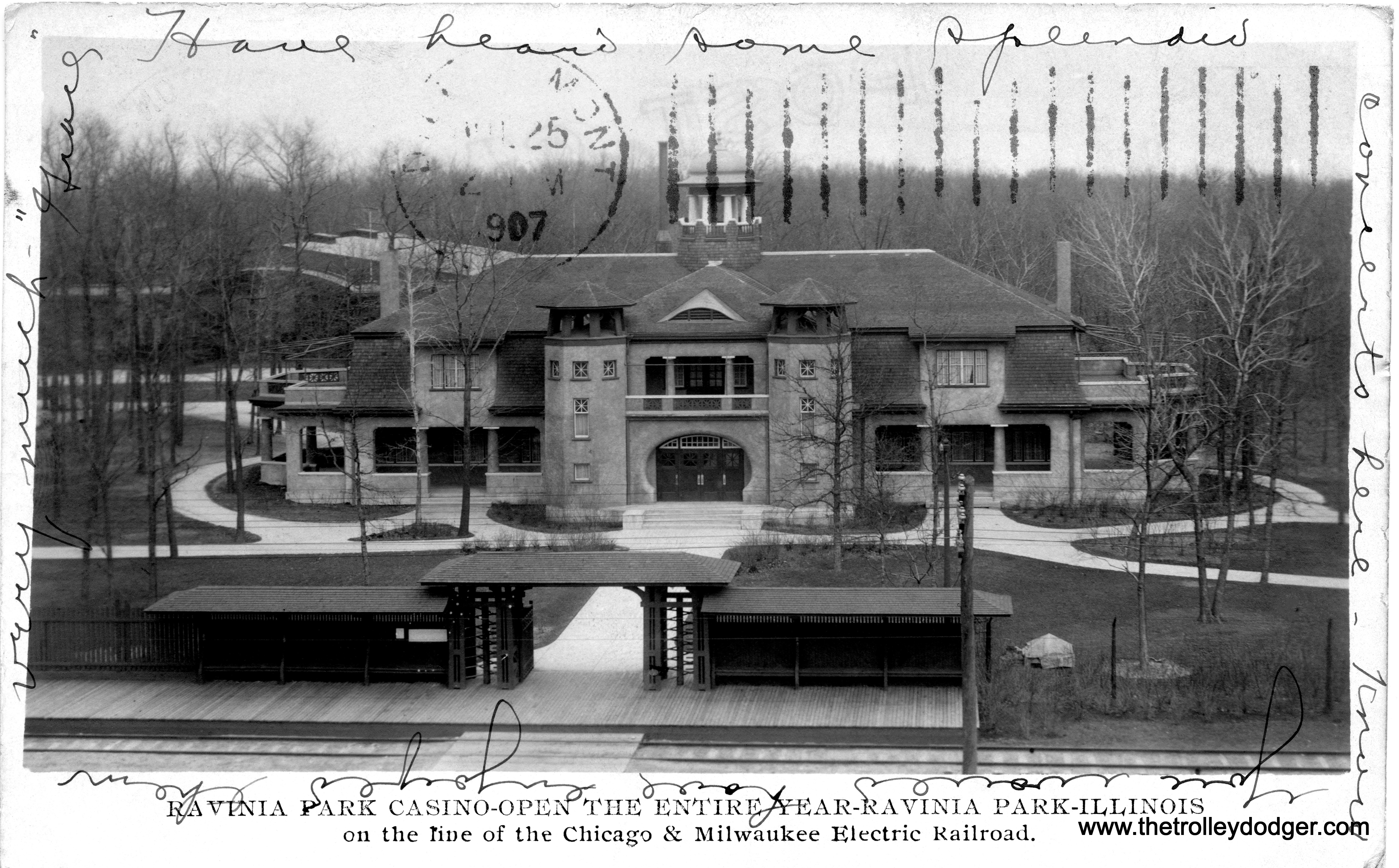
The Ravinia Park Casino was built in 1904 and demolished in 1985. Ravinia Park was built by the Chicago and Milwaukee electric, which became the North Shore Line in 1916.

The Ravinia Park Casino was built in 1904 and demolished in 1985. Ravinia Park was built by the Chicago and Milwaukee electric, which became the North Shore Line in 1916.

Indiana Railroad high-speed car 59 is at Indianapolis on August 11, 1940.

Indiana Railroad high-speed car 59 is at Indianapolis on August 11, 1940.

A Chicago Aurora and Elgin electric loco in Wheaton, where the lines diverged to go to either Aurora (shown here) or Elgin.

A Chicago Aurora and Elgin electric loco in Wheaton, where the lines diverged to go to either Aurora (shown here) or Elgin.

When I posted this circa 1954-55 Garfield Park "L" image to our Facebook group, it generated a lot of discussion as to whether or not this 4000-series "L" car was still in CRT brown paint. The CTA repainted these cars into green and cream starting around 1952. But after much consideration, my conclusion is that this is just a trick of the light, and the car is actually painted in the later CTA colors. It is in shadow and not in direct sunlight. By this time, all such cars should have been repainted and put into married pairs with various modifications (which are visible on this car). The car behind it, which is presumably its mate, is painted green and cream. We are at the east end of the Van Bure Street temporary trackage, which was used from 1953 to 1958. The photographer was apparently looking out the front end of a westbound train, and there was a ramp behind the photographer leading up to the old "L" structure heading to the Loop. The cross street here is Racine Avenue (1200 W).

When I posted this circa 1954-55 Garfield Park “L” image to our Facebook group, it generated a lot of discussion as to whether or not this 4000-series “L” car was still in CRT brown paint. The CTA repainted these cars into green and cream starting around 1952. But after much consideration, my conclusion is that this is just a trick of the light, and the car is actually painted in the later CTA colors. It is in shadow and not in direct sunlight. By this time, all such cars should have been repainted and put into married pairs with various modifications (which are visible on this car). The car behind it, which is presumably its mate, is painted green and cream. We are at the east end of the Van Bure Street temporary trackage, which was used from 1953 to 1958. The photographer was apparently looking out the front end of a westbound train, and there was a ramp behind the photographer leading up to the old “L” structure heading to the Loop. The cross street here is Racine Avenue (1200 W).

I assume this picture of Chicago Surface Lines Peter Witt car 6311 was taken at Devon station. The date given with the negative was January 6, 1941 but this hardly seems likely, given the foliage and the open door. Perhaps month and date were reversed, and a date of June 1, 1941 is correct.

I assume this picture of Chicago Surface Lines Peter Witt car 6311 was taken at Devon station. The date given with the negative was January 6, 1941 but this hardly seems likely, given the foliage and the open door. Perhaps month and date were reversed, and a date of June 1, 1941 is correct.

A view of the Indiana Railroad's Muncie Terminal on August 10, 1940. The photo is by WVK, although I don't know what those initials stand for.

A view of the Indiana Railroad’s Muncie Terminal on August 10, 1940. The photo is by WVK, although I don’t know what those initials stand for.

Indiana Railroad high-speed car 78 in Indianapolis in the late 1930s.

Indiana Railroad high-speed car 78 in Indianapolis in the late 1930s.

A night shot of the North Shore Line's Milwaukee Terminal in July 1962.

A night shot of the North Shore Line’s Milwaukee Terminal in July 1962.

North Shore Line car 748 is part of a two-car train near North Chicago Junction on September 4, 1961.

North Shore Line car 748 is part of a two-car train near North Chicago Junction on September 4, 1961.

This and the next picture shows a Aurora Elgin and Chicago (predecessor to the CA&E) monthly ticket book from June 1922.

This and the next picture shows a Aurora Elgin and Chicago (predecessor to the CA&E) monthly ticket book from June 1922.

The Chicago Aurora and Elgin used uncovered third rail in nearly all areas, including here, in Wheaton, where the Aurora and Elgin branches diverged. A small boy is playing in a nearby field, and people then were not terribly concerned with the danger posed by 600 volts of direct current. If the CA&E had survived, chances are additional protections would be in place.

The Chicago Aurora and Elgin used uncovered third rail in nearly all areas, including here, in Wheaton, where the Aurora and Elgin branches diverged. A small boy is playing in a nearby field, and people then were not terribly concerned with the danger posed by 600 volts of direct current. If the CA&E had survived, chances are additional protections would be in place.

North Shore Line wood car 132 and train at Ravinia Park in the early 1900s.

North Shore Line wood car 132 and train at Ravinia Park in the early 1900s.

Starting in the 1930s, enterprising railfans such as the late Barney Neuberger sold prints of streetcars and interurbans. The smallest such prints were what is now called wallet size, and the going rate was usually 10 cents. Mr. Neuberger had flyers and catalogs printed. There are thousands and thousands of such photos that still circulate, and enrich our knowledge of the past.

Starting in the 1930s, enterprising railfans such as the late Barney Neuberger sold prints of streetcars and interurbans. The smallest such prints were what is now called wallet size, and the going rate was usually 10 cents. Mr. Neuberger had flyers and catalogs printed. There are thousands and thousands of such photos that still circulate, and enrich our knowledge of the past.

CTA 2811 heads up a westbound Garfield Park "L" train of wood cars, circa 1953-54. The ramp connected to the temporary tracks on Van Buren Street/ We are near Sacramento Boulevard. For a time, these tracks crossed over the new Congress Expressway, which was built underneath it. Once the new Congress median line opened in 1958, this structure was removed.

CTA 2811 heads up a westbound Garfield Park “L” train of wood cars, circa 1953-54. The ramp connected to the temporary tracks on Van Buren Street/ We are near Sacramento Boulevard. For a time, these tracks crossed over the new Congress Expressway, which was built underneath it. Once the new Congress median line opened in 1958, this structure was removed.

A two-car Garfield Park "L" train, made up of 4000-series cars, heads west on temporary trackage in Van Buren Street on September 2, 1955. A portion of the Congress Expressway, then under construction, opened later that year.

A two-car Garfield Park “L” train, made up of 4000-series cars, heads west on temporary trackage in Van Buren Street on September 2, 1955. A portion of the Congress Expressway, then under construction, opened later that year.

A Philadelphia Suburban Transportation Company Brill Master Unit is on West Chester Pike at Paoli Road in February 1945. (David H. Cope Photo)

A Philadelphia Suburban Transportation Company Brill Master Unit is on West Chester Pike at Paoli Road in February 1945. (David H. Cope Photo)

The Chicago Aurora and Elgin station in Wheaton, probably in the 1920s.

The Chicago Aurora and Elgin station in Wheaton, probably in the 1920s.

CTA 6190-6189 is at Adams and Wabash on the Loop "L" in July 1954.

CTA 6190-6189 is at Adams and Wabash on the Loop “L” in July 1954.

A northbound CTA train of curved-door 6000s is on the South Side "L" just north of 35th Street in 1954. The middle track had been used for express trains until the CTA realigned north-south service in 1949.

A northbound CTA train of curved-door 6000s is on the South Side “L” just north of 35th Street in 1954. The middle track had been used for express trains until the CTA realigned north-south service in 1949.

This picture was taken from out of the front window of a Lake Street "L" train on July 17, 1954. We are near Garfield Park, and the 4000-series cars parked on the middle track are in mid-day storage. The middle track had been used by express trains prior to 1948, when the CTA inaugurated A/B "skip stop" service.

This picture was taken from out of the front window of a Lake Street “L” train on July 17, 1954. We are near Garfield Park, and the 4000-series cars parked on the middle track are in mid-day storage. The middle track had been used by express trains prior to 1948, when the CTA inaugurated A/B “skip stop” service.

CTA 6047-6048 are looping via a wooden structure at DesPlaines Avenue on July 14, 1954. This was necessary once Chicago Aurora and Elgin service was cut back to Forest Park, starting in September 1953. The direct connection between the two railroads was severed and this loop took CTA trains over the CA&E tracks. Once CA&E was allowed to discontinue passenger service in July 1957, the ramp was no longer necessary. The entire yard area was revamped in 1959 in conjunction with nearby expressway construction.

CTA 6047-6048 are looping via a wooden structure at DesPlaines Avenue on July 14, 1954. This was necessary once Chicago Aurora and Elgin service was cut back to Forest Park, starting in September 1953. The direct connection between the two railroads was severed and this loop took CTA trains over the CA&E tracks. Once CA&E was allowed to discontinue passenger service in July 1957, the ramp was no longer necessary. The entire yard area was revamped in 1959 in conjunction with nearby expressway construction.

Philadelphia Suburban Transportation Company (aka Red Arrow Lines) double-ended car 19 is outbound on West Chester Pike, headed for West Chester, in the early 1950s. Buses replaced trolleys on this line in 1954 so the road could be widened.

Philadelphia Suburban Transportation Company (aka Red Arrow Lines) double-ended car 19 is outbound on West Chester Pike, headed for West Chester, in the early 1950s. Buses replaced trolleys on this line in 1954 so the road could be widened.

Chicago and Illinois Valley (aka the Chicago Ottawa and Peoria, part of the Illinois Traction System) car 56 at Ottawa, Illinois. Don's Rail Photos: "In 1901, the Illinois Valley Traction was incorporated to build the first part of what later became the CO&P. Various other companies were involved in the construction until the CO&P consolidated them all by 1909. The CO&P became the Valley Division of Illinois Traction Inc. in 1923. In 1929, a new company, the Chicago & Illinois Valley, took over the Valley Division and operated it until abandonment on May 14, 1934. It was always considered a part of the Illinois Traction, and this can be seen in its rolling stock. 55 and 56 were built by St. Louis in 1903. 55 was retired in 1921. 56 was used in Peoria from 1920 thru 1927 when it was returned to the Valley. It was scrapped in 1934."

Chicago and Illinois Valley (aka the Chicago Ottawa and Peoria, part of the Illinois Traction System) car 56 at Ottawa, Illinois. Don’s Rail Photos: “In 1901, the Illinois Valley Traction was incorporated to build the first part of what later became the CO&P. Various other companies were involved in the construction until the CO&P consolidated them all by 1909. The CO&P became the Valley Division of Illinois Traction Inc. in 1923. In 1929, a new company, the Chicago & Illinois Valley, took over the Valley Division and operated it until abandonment on May 14, 1934. It was always considered a part of the Illinois Traction, and this can be seen in its rolling stock. 55 and 56 were built by St. Louis in 1903. 55 was retired in 1921. 56 was used in Peoria from 1920 thru 1927 when it was returned to the Valley. It was scrapped in 1934.”

The next-to-last North Shore Line fantrip took place on January 12, 1963, and used coaches 150 and 160. Here, the train has made a photo stop at the old Chicago Rapid Transit Company "L" station at Kostner Avenue, which was in use from 1925 to 1948 on the Niles Center branch. The station was designed by Insull staff architect Arthur U. Gerber. North Shore trains never stopped here in regular service. (William C. Hoffman Photo) Scott Greig adds: "By the way, the last charter on the North Shore was the day after the one pictured. It was a CERA charter with four Silverliners on Sunday, January 13, 1963. Illini Railroad Club announced that they would have a charter on the last day, but they finally had to settle for an extra car added to a regular train."

The next-to-last North Shore Line fantrip took place on January 12, 1963, and used coaches 150 and 160. Here, the train has made a photo stop at the old Chicago Rapid Transit Company “L” station at Kostner Avenue, which was in use from 1925 to 1948 on the Niles Center branch. The station was designed by Insull staff architect Arthur U. Gerber. North Shore trains never stopped here in regular service. (William C. Hoffman Photo) Scott Greig adds: “By the way, the last charter on the North Shore was the day after the one pictured. It was a CERA charter with four Silverliners on Sunday, January 13, 1963. Illini Railroad Club announced that they would have a charter on the last day, but they finally had to settle for an extra car added to a regular train.”

The two car fantrip train has stopped at the old Clark and Lake "L" station on January 12, 1963. (William C. Hoffman Photo)

The two car fantrip train has stopped at the old Clark and Lake “L” station on January 12, 1963. (William C. Hoffman Photo)

North Shore Line coach 772 is southbound at North Chicago Junction on July 4, 1955, operating on the Shore Line Route that would be abandoned later that month. Skokie Valley Route trains went to the other side of the station. (William C. Hoffman Photo)

North Shore Line coach 772 is southbound at North Chicago Junction on July 4, 1955, operating on the Shore Line Route that would be abandoned later that month. Skokie Valley Route trains went to the other side of the station. (William C. Hoffman Photo)

The North Shore Line Milwaukee Terminal on June 25, 1961.

The North Shore Line Milwaukee Terminal on June 25, 1961.

Electroliner 803-804 is northbound on Fifth Street in Milwaukee at Maple on January 13, 1963. All the buildings on the right are gone now, as this is now the location of an expressway. (Jeffrey L. Wien Photo)

Electroliner 803-804 is northbound on Fifth Street in Milwaukee at Maple on January 13, 1963. All the buildings on the right are gone now, as this is now the location of an expressway. (Jeffrey L. Wien Photo)

North Shore Line snow plow 605 at Pettibone Yards on August 29, 1964. Built by Russell in 1921, it became the last piece of NSL equipment to be scrapped on the property. David A. Myers Jr. says he found someone who was interested in taking it, but they procrastinated so long that the tracks were taken up around the car, and it was then scrapped in place. (Jeffrey L. Wien Photo)

North Shore Line snow plow 605 at Pettibone Yards on August 29, 1964. Built by Russell in 1921, it became the last piece of NSL equipment to be scrapped on the property. David A. Myers Jr. says he found someone who was interested in taking it, but they procrastinated so long that the tracks were taken up around the car, and it was then scrapped in place. (Jeffrey L. Wien Photo)

Chicago Surface Lines prewar PCC 4048 is downtown, signed for the Madison-Fifth route which was a branch of Route 20 - Madison. The 83 cars in this series were built in 1936 and retired in 1956. The sole survivor is 4021, which is now at the Illinois Railway Museum.

Chicago Surface Lines prewar PCC 4048 is downtown, signed for the Madison-Fifth route which was a branch of Route 20 – Madison. The 83 cars in this series were built in 1936 and retired in 1956. The sole survivor is 4021, which is now at the Illinois Railway Museum.

Chicago Surface Lines work car H7. Don's Rail Photos: "H7, mail car, was built by American Car Co in 1891, as a Cicero & Proviso Street Railway passenger car. It was rebuilt as Chicago Union Traction 8 in 1900 as a mail car and as Chicago Railways 8 in 1903. It was renumbered H7 in 1913 and became CSL H7 in 1914. It was retired on May 16, 1949."

Chicago Surface Lines work car H7. Don’s Rail Photos: “H7, mail car, was built by American Car Co in 1891, as a Cicero & Proviso Street Railway passenger car. It was rebuilt as Chicago Union Traction 8 in 1900 as a mail car and as Chicago Railways 8 in 1903. It was renumbered H7 in 1913 and became CSL H7 in 1914. It was retired on May 16, 1949.”

Indiana Railroad car 65. Don's Rail Photos: "65 was built by Pullman in 1931, #6399. The lounge section was replaced by a baggage section. 65 was sold to the Cedar Rapids & Iowa City as 120 in 1941. In 1954 it was purchased as the first car of the Illinois Railway Museum, which was known as the Illinois Electric Railway Museum at that time. I put in many enjoyable hours working on that car prior to 1960 when I moved to Peoria."

Indiana Railroad car 65. Don’s Rail Photos: “65 was built by Pullman in 1931, #6399. The lounge section was replaced by a baggage section. 65 was sold to the Cedar Rapids & Iowa City as 120 in 1941. In 1954 it was purchased as the first car of the Illinois Railway Museum, which was known as the Illinois Electric Railway Museum at that time. I put in many enjoyable hours working on that car prior to 1960 when I moved to Peoria.”

Our Latest Book, Now Available for Pre-Order:

The North Shore Line

Publication Date: February 20, 2023

FYI, my new Arcadia Publishing book The North Shore Line is now finished and has gone to press. My publisher decided to expand it to 160 pages, instead of the usual 128. That’s a 25% increase, without any change to the $23.99 price. I am quite pleased with how this turned out.

From the back cover:

As late as 1963, it was possible to board high-speed electric trains on Chicago’s famous Loop “L” that ran 90 miles north to Milwaukee. This was the Chicago North Shore & Milwaukee Railroad, commonly known as the North Shore Line. It rose from humble origins in the 1890s as a local streetcar line in Waukegan to eventually become America’s fastest interurban under the visionary management of Midwest utilities tycoon Samuel Insull. The North Shore Line, under Insull, became a worthy competitor to the established steam railroads. Hobbled by the Great Depression, the road fought back in 1941 with two streamlined, air-conditioned, articulated trains called Electroliners, which included dining service. It regained its popularity during World War II, when gasoline and tires were rationed, but eventually, it fell victim to highways and the automobile. The North Shore Line had intercity rail, commuter rail, electric freight, city streetcars, and even buses. It has been gone for nearly 60 years, but it will always remain the Road of Service.

Each copy purchased here will be signed by the author, and you will also receive a bonus North Shore Line map.  Books will ship by USPS Media Mail as soon as we receive them, on or before February 20, 2023.

Chapters:
01. Beginnings
02. The Milwaukee Division
03. The Shore Line Route
04. The Skokie Valley Route
05. The Mundelein Branch
06. On the “L”
07. City Streetcars
08. Trolley Freight
09. The Long Goodbye
10. The Legacy

Title The North Shore Line
Images of America
Author David Sadowski
Edition illustrated
Publisher Arcadia Publishing (SC), 2023
ISBN 1467108960, 978-1467108966
Length 160 pages

The price of $23.99 includes shipping within the United States.

For Shipping to US Addresses:

New Compact Disc, Now Available:

CTA-1
The Last Chicago Streetcars 1958
# of Discs – 1
Price: $15.99

Until now, it seemed as though audio recordings of Chicago streetcars were practically non-existent. For whatever reason, the late William A. Steventon does not appear to have made any for his Railroad Record Club, even though he did make other recordings in the Chicago area in 1956.

Now, audio recordings of the last runs of Chicago streetcars have been found, in the collections of the late Jeffrey L. Wien (who was one of the riders on that last car). We do not know who made these recordings, but this must have been done using a portable reel-to-reel machine.

These important recordings will finally fill a gap in transit history. The last Chicago Transit Authority streetcar finished its run in the early hours of June 21, 1958. Now you can experience these events just as Chicagoans did.

As a bonus, we have included Keeping Pace, a 1939 Chicago Surface Lines employee training program. This was digitally transferred from an original 16” transcription disc. These recordings were unheard for 80 years.

Total time – 74:38

Help Support The Trolley Dodger

This is our 294th post, and we are gradually creating a body of work and an online resource for the benefit of all railfans, everywhere. To date, we have received over 934,000 page views, for which we are very grateful.

You can help us continue our original transit research by checking out the fine products in our Online Store.
As we have said before, “If you buy here, we will be here.”

We thank you for your support.

DONATIONS

In order to continue giving you the kinds of historic railroad images that you have come to expect from The Trolley Dodger, we need your help and support. It costs money to maintain this website, and to do the sort of historic research that is our specialty.

Your financial contributions help make this web site better, and are greatly appreciated.


The Winnetka Grade Separation Project

A North Shore Line train on the Shore Line Route is southbound in Winnetka in September 1954. This section was grade-separated in 1940, along with the adjacent Chicago & North Western tracks, following a series of pedestrian accidents. Harold L. Ickes, Secretary of the Interior under President Franklin D. Roosevelt, approved Federal aid that paid for part of this work, in a similar fashion to Chicago's Initial System of Subways. Ickes had lived in the area for many years. The train is moving towards the photographer, and the front is blurred due to the shutter speed that had to be used, in the days when Kodachrome was ISO 10.

A North Shore Line train on the Shore Line Route is southbound in Winnetka in September 1954. This section was grade-separated in 1940, along with the adjacent Chicago & North Western tracks, following a series of pedestrian accidents. Harold L. Ickes, Secretary of the Interior under President Franklin D. Roosevelt, approved Federal aid that paid for part of this work, in a similar fashion to Chicago’s Initial System of Subways. Ickes had lived in the area for many years. The train is moving towards the photographer, and the front is blurred due to the shutter speed that had to be used, in the days when Kodachrome was ISO 10.

As part of my ongoing research for my upcoming North Shore Line book, I decided to read all the other books that are out there. Today’s post features one that may be obscure, but is still very important–The Winnetka Grade Separation Project by Robert L. Anderson. As this was a dissertation, and part of the work Anderson did to receive an engineering degree, I didn’t know what to expect.

I was pleasantly surprised to discover this highly professional, thorough report on one of the outstanding public works projects in the New Deal era. The project’s cost would equate to about $86m in today’s dollars, and was one of two major projects that received 45% federal government funding from the PWA (Public Works Administration), headed by Harold L. Ickes (1874-1952).

19th century railroads ran at ground level in the Chicagoland area, but as population increased, grade crossing accidents became more and more of a public safety issue. When Chicago was chosen by Congress as the site of the World’s Columbia Exposition in 1890, the City began making local railroads elevate their tracks. This grade separation movement continued on through the 20th century.

In the area covered by the Winnetka project, which to a lesser extent also involved the suburbs of Glencoe and Kenilworth, there were two railroads running parallel to each other– the Chicago & North Western, and the Chicago North Shore & Milwaukee (aka the North Shore Line).

This was the Shore Line Route, the interurban’s original route north from Wilmette, where it connected to the Chicago Rapid Transit Company “L” going downtown. The small space between the two train lines undoubtedly created a more dangerous situation than would otherwise have been the case.

The 1921 Plan of Winnetka, spearheaded by pioneer city planner Edward H. Bennett (1874-1954), recommended relocating the two sets of railroad tracks into an open cut. These plans continued to evolve until the late 1930s.

The Village of Winnetka applied for a grant from the PWA in 1938, and it was quickly approved. It did not hurt that FDR’s Secretary of the Interior (and thus, head of the PWA) Harold L. Ickes had been a former resident of Winnetka and therefore, knew there was a need.

Robert Landau Anderson (1906-1974), the author of this book, began working for Winnetka in 1929, and was appointed the head of Public Works in 1935, a position he held until his retirement in 1966. Anderson helped draft some of the plans, and was intimately involved with the project once it received federal approval. As Public Works chief, he helped oversee and coordinate much of the work, representing the village. At times, he also served as acting Village Manager.

He wrote this book in 1941 as his dissertation towards an engineering degree from Northwestern University. At that time, the project was largely complete, but was not 100% finished until 1943. His book is in the public domain, which we present here in full, and we are also including a magazine article he wrote in 1944, based on a presentation he gave for the Western Society of Engineers.

Both railroads were expected to kick in some portion of the cost for this project, but both were technically bankrupt at the time, as this was the Great Depression. The solution to this problem was quite creative.

Cost savings were estimated out for each railroad, based on the anticipated reductions in the need to maintain crossing signals. Bonds were issued in this amount, and immediately purchased by the PWA (in addition to their 45% share of the entire project cost). These were to be repurchased by the two railroads over a period of 30 years.

The North Shore Line abandoned the Shore Line Route in 1955, and the rest of the service went in 1963. At the time of abandonment, there still would have been an outstanding balance on the interurban’s share for a portion of these bonds, but I do not know how much money the government ultimately received.

The former North Shore Line right-of-way in Winnetka is now part of the recreational Green Bay Trail. Diesel replaced steam on the Chicago & North Western in 1956, and commuter rail service continues there today on Metra’s Union Pacific North Line between downtown Chicago and Kenosha.

Our scans were made from what may be the only remaining copy of this book, which is the best account of the Winnetka Grade Separation Project that I have found to date. I am glad we can now share this important history with you.

Sadly, Robert L. Anderson died from a heart attack in 1974, while on vacation in Montana with his wife. His dissertation earned him a Civil Engineering degree from Northwestern in 1941.

Interestingly, his younger brother James Stuart Anderson (1912-1954) was also an engineer, and also worked on the grade separation project as an employee of one of the firms that did the work.

It is entirely possible that this project influenced construction of the Congress Expressway (now I-290) through Oak Park and Forest Park in the late 1950s. After all, both projects involved relocating two sets of railroad tracks from ground level into an open cut, with trains leapfrogging from one set of temporary tracks to another.

-David Sadowski

PS- You might also like our Trolley Dodger Facebook auxiliary, a private group that now has 747 members.

Our friend Kenneth Gear now has a Facebook group for the Railroad Record Club. If you enjoy listening to audio recordings of classic railroad trains, whether steam, electric, or diesel, you might consider joining.

Work on our North Shore Line book is ongoing. Donations are needed in order to bring this to a successful conclusion. You will find donation links at the top and bottom of each post. We thank you in advance for your time and consideration.

Winnetka Grade Separation Project Video

Video segment from The Winnetka Story Documentary, produced by the Winnetka Historical Society:

The Winnetka Grade Separation Project by Robert L. Anderson

Between 1938 and 1943, the Winnetka Grade Separation Project eliminated several dangerous grade crossings along nearly four miles of trackage between Kenilworth and Glencoe. Two railroads were involved-- the Chicago & North Western, and Chicago North Shore & Milwaukee (aka the North Shore Line).

Between 1938 and 1943, the Winnetka Grade Separation Project eliminated several dangerous grade crossings along nearly four miles of trackage between Kenilworth and Glencoe. Two railroads were involved– the Chicago & North Western, and Chicago North Shore & Milwaukee (aka the North Shore Line).

Robert L. Anderson in 1951.

Robert L. Anderson in 1951.

Recent Correspondence

William Shapotkin writes:

This year’s Hoosier Traction Meet will take place Aug 19-20 in Dayton, OH. If you would please be so kind as to help us promote the event, it would be greatly appreciated.

We are glad to do so. You can download the prospectus by clicking on this link.

Keep those cards and letters coming in, folks.

-David Sadowski

A Guide to the Railroad Record Club E-Book

William A. Steventon recording the sounds of the North Shore Line in April 1956. (Kenneth Gear Collection)

William A. Steventon recording the sounds of the North Shore Line in April 1956. (Kenneth Gear Collection)

Our good friend Ken Gear has been hard at work on collecting all things related to the late William Steventon’s railroad audio recordings and releases. The result is a new book on disc, A Guide To the Railroad Record Club. This was quite a project and labor of love on Ken’s part!

Kenneth Gear has written and compiled a complete history of William Steventon‘s Railroad Record Club, which issued 42 different LPs of steam, electric, and diesel railroad audio, beginning with its origins in 1953.

This “book on disc” format allows us to present not only a detailed history of the club and an updated account of Kenneth Gear’s purchase of the William Steventon estate, but it also includes audio files, photo scans and movie files. Virtually all the Railroad Record Club archive is gathered in one place!

Price: $19.99

$10 from the sale of each RRC E-Book will go to Kenneth Gear to repay him for some of his costs in saving this important history.

Now Available on Compact Disc:

RRC08D
Railroad Record Club #08 Deluxe Edition: Canadian National: Canadian Railroading in the Days of Steam, Recorded by Elwin Purington
The Complete Recording From the Original Master Tapes
Price: $15.99

Kenneth Gear‘s doggedness and determination resulted in his tracking down and purchasing the surviving RRC master tapes a few years back, and he has been hard at work having them digitized, at considerable personal expense, so that you and many others can enjoy them with today’s technology. We have already released a few RRC Rarities CDs from Ken’s collection.

When Ken heard the digitized version of RRC LP #08, Canadian National: Canadian Railroading in the Days of Steam, recorded by the late Elwin Purington, he was surprised to find the original tapes were more than twice the length of the 10″ LP. The resulting LP had been considerably edited down to the limited space available, 15 minutes per side.

The scenes were the same, but each was greatly shortened. Now, on compact disc, it is possible to present the full length recordings of this classic LP, which was one of Steventon’s best sellers and an all-around favorite, for the very first time.

Canadian National. Steaming giants pound high iron on mountain trails, rumble over trestles, hit torpedos and whistle for many road crossings. Mountain railroading with heavy power and lingering whistles! Includes locomotives 3566, 4301, 6013, 3560.

Total time – 72:57

$5 from the sale of RRC08D CD will go to Kenneth Gear to repay him for some of his costs in saving this important history.

Chicago’s Lost “L”s Online Presentation

We recently gave an online presentation about our book Chicago’s Lost “L”s for the Chicago Public Library, as part of their One Book, One Chicago series. You can watch it online by following this link.

The Trolley Dodger On the Air

We appeared on the Dave Plier Show on WGN radio on July 16, 2021, to discuss Chicago’s Lost “L”s. You can hear that discussion here.

Our Latest Book, Now Available:

Chicago’s Lost “L”s

From the back cover:

Chicago’s system of elevated railways, known locally as the “L,” has run continuously since 1892 and, like the city, has never stood still. It helped neighborhoods grow, brought their increasingly diverse populations together, and gave the famous Loop its name. But today’s system has changed radically over the years. Chicago’s Lost “L”s tells the story of former lines such as Garfield Park, Humboldt Park, Kenwood, Stockyards, Normal Park, Westchester, and Niles Center. It was once possible to take high-speed trains on the L directly to Aurora, Elgin, and Milwaukee, Wisconsin. The L started out as four different companies, two starting out using steam engines instead of electricity. Eventually, all four came together via the Union Loop. The L is more than a way of getting around. Its trains are a place where people meet and interact. Some say the best way to experience the city is via the L, with its second-story view. Chicago’s Lost “L”s is virtually a “secret history” of Chicago, and this is your ticket. David Sadowski grew up riding the L all over the city. He is the author of Chicago Trolleys and Building Chicago’s Subways and runs the online Trolley Dodger blog.

The Images of America series celebrates the history of neighborhoods, towns, and cities across the country. Using archival photographs, each title presents the distinctive stories from the past that shape the character of the community today. Arcadia is proud to play a part in the preservation of local heritage, making history available to all.

Title Chicago’s Lost “L”s
Images of America
Author David Sadowski
Edition illustrated
Publisher Arcadia Publishing (SC), 2021
ISBN 1467100007, 9781467100007
Length 128 pages

Chapters:
01. The South Side “L”
02. The Lake Street “L”
03. The Metropolitan “L”
04. The Northwestern “L”
05. The Union Loop
06. Lost Equipment
07. Lost Interurbans
08. Lost Terminals
09. Lost… and Found

Each copy purchased here will be signed by the author, and you will also receive a bonus facsimile of a 1926 Chicago Rapid Transit Company map, with interesting facts about the “L” on the reverse side.

The price of $23.99 includes shipping within the United States.

For Shipping to US Addresses:

For Shipping to Canada:

For Shipping Elsewhere:

NEW DVD:

A Tribute to the North Shore Line

To commemorate the 50th anniversary of the demise of the fabled North Shore Line interurban in January 2013, Jeffrey L. Wien and Bradley Criss made a very thorough and professional video presentation, covering the entire route between Chicago and Milwaukee and then some. Sadly, both men are gone now, but their work remains, making this video a tribute to them, as much as it is a tribute to the Chicago North Shore & Milwaukee.

Jeff drew on his own vast collections of movie films, both his own and others such as the late William C. Hoffman, wrote and gave the narration. Bradley acted as video editor, and added authentic sound effects from archival recordings of the North Shore Line.

It was always Jeff’s intention to make this video available to the public, but unfortunately, this did not happen in his lifetime. Now, as the caretakers of Jeff’s railfan legacy, we are proud to offer this excellent two-hour program to you for the first time. The result is a fitting tribute to what Jeff called his “Perpetual Adoration,” which was the name of a stop on the interurban.

Jeff was a wholehearted supporter of our activities, and the proceeds from the sale of this disc will help defray some of the expenses of keeping the Trolley Dodger web site going.

Total time – 121:22

# of Discs – 1
Price: $19.99 (Includes shipping within the United States)

Help Support The Trolley Dodger

This is our 286th post, and we are gradually creating a body of work and an online resource for the benefit of all railfans, everywhere. To date, we have received over 861,000 page views, for which we are very grateful.

You can help us continue our original transit research by checking out the fine products in our Online Store.
As we have said before, “If you buy here, we will be here.”

We thank you for your support.

DONATIONS

In order to continue giving you the kinds of historic railroad images that you have come to expect from The Trolley Dodger, we need your help and support. It costs money to maintain this website, and to do the sort of historic research that is our specialty.

Your financial contributions help make this web site better, and are greatly appreciated.


Independence

North Shore Line car 749 at the 50th Avenue station, Illinois Railway Museum, July 3, 2021.

North Shore Line car 749 at the 50th Avenue station, Illinois Railway Museum, July 3, 2021.

I could not think of a better place to be on July 3rd than at the Illinois Railway Museum, which I had not visited in nearly two years. Here are some pictures from that day.

Unfortunately I did not arrive in time for the annual reenactment of the sudden mid-day July 3, 1957 abandonment of passenger service by the Chicago Aurora & Elgin interurban, which stranded perhaps 3,500 riders. At the museum, museum visitors are taken to the end of the main line via a CA&E train, which then leaves them high and dry (only to be picked up by another train shortly thereafter).

I did not arrive until later in the afternoon. No CA&E cars were running, but I did capture lots of other action.

Every time I visit the museum, things are a little bit nicer, a little bit better, thanks to the dedication of their many volunteers. May it always be so.

Enjoy!

-David Sadowski

PS- We have already sent out over 100 copies of our new book Chicago’s Lost “L”s, which is available for immediate shipment. Ordering information can be found at the end of this post, and in our Online Store.

Although the 50th Avenue station was closed for renovations, North Shore Line car 749 was there for a fundraising event, where people could actually pilot the car for a brief period out on the line.

Although the 50th Avenue station was closed for renovations, North Shore Line car 749 was there for a fundraising event, where people could actually pilot the car for a brief period out on the line.

Dayton trolley bus 9809 joined the IRM fleet in 2020.

Dayton trolley bus 9809 joined the IRM fleet in 2020.

A Budd RDC (rail diesel car).

A Budd RDC (rail diesel car).

Metropolitan "L" car 2872 is under restoration. There is a picture of it in service on the Kenwood shuttle in my new book Chicago's Lost "L"s.

Metropolitan “L” car 2872 is under restoration. There is a picture of it in service on the Kenwood shuttle in my new book Chicago’s Lost “L”s.

Chicago Rapid Transit car 4146, a "Baldy," was built by Cincinnati Car Company in 1915 as one of our first all-steel "L" cars. The four separate "L" companies had come under joint operation a few years earlier, and previously just had wood-steel cars that were ordered for an individual line. The center doors on these cars were never used.

Chicago Rapid Transit car 4146, a “Baldy,” was built by Cincinnati Car Company in 1915 as one of our first all-steel “L” cars. The four separate “L” companies had come under joint operation a few years earlier, and previously just had wood-steel cars that were ordered for an individual line. The center doors on these cars were never used.

CTA PCC 4391 was operating on the streetcar loop that day.

CTA PCC 4391 was operating on the streetcar loop that day.

Neils No. 5 was one of two steam engines being used that day.

Neils No. 5 was one of two steam engines being used that day.

CTA single car units 41 and 30 were operating as a pair. The former with trolley poles, and the latter with a Skokie Swift pantograph.

CTA single car units 41 and 30 were operating as a pair. The former with trolley poles, and the latter with a Skokie Swift pantograph.

Car 30 looked resplendent in a new coat of paint.

Car 30 looked resplendent in a new coat of paint.

The singles were set up for one-person operation, where it was possible to have the operator collect fares on the train. They were used at night on the Evanston shuttle in this manner for some years, but it really slowed things down.

The singles were set up for one-person operation, where it was possible to have the operator collect fares on the train. They were used at night on the Evanston shuttle in this manner for some years, but it really slowed things down.

Frisco 1630, a 2-10-0, on the IRM main line.

Frisco 1630, a 2-10-0, on the IRM main line.

The 1630 at the passing siding near the end of the main line.

The 1630 at the passing siding near the end of the main line.

A close-up of CTA 41's third rail shoe.

A close-up of CTA 41’s third rail shoe.

CTA 6655-6656 were also running.

CTA 6655-6656 were also running.

An attractive "retro" sign has already gone up for what will eventually be a model train display (but not a hobby shop, apparently).

An attractive “retro” sign has already gone up for what will eventually be a model train display (but not a hobby shop, apparently).

Recent Finds

I recently acquired this 1893 map, showing the route of the Columbian Intramural Railway at the World's Fair here in Chicago. The Jackson Park "L" connected with the CIR at Chicago Junction (65th Street on this map), a few blocks south of where the "L" ran on 63rd Street.

I recently acquired this 1893 map, showing the route of the Columbian Intramural Railway at the World’s Fair here in Chicago. The Jackson Park “L” connected with the CIR at Chicago Junction (65th Street on this map), a few blocks south of where the “L” ran on 63rd Street.

A CTA Skokie Swift train crosses McCormick Boulevard on September 20, 1966. The tracks going under the Swift are from the Chicago & North Western's Weber Subdivision, which was abandoned in 1982. (James P. Marcus Photo)

A CTA Skokie Swift train crosses McCormick Boulevard on September 20, 1966. The tracks going under the Swift are from the Chicago & North Western’s Weber Subdivision, which was abandoned in 1982. (James P. Marcus Photo)

Philadelphia Suburban Transportation Company (aka Red Arrow) car 16 at the end of the Ardmore line on June 11, 1966, six months before trolleys were replaced by buses. (Allan H. Roberts Photo)

Philadelphia Suburban Transportation Company (aka Red Arrow) car 16 at the end of the Ardmore line on June 11, 1966, six months before trolleys were replaced by buses. (Allan H. Roberts Photo)

This picture of Chicago Surface Lines pre-PCC 7001 was taken in 1935, a year after it was built. Auto parts dealer Warshawsky & Co. was located at around 1900 S. State Street, which may be this location. The streetcar is heading north.

This picture of Chicago Surface Lines pre-PCC 7001 was taken in 1935, a year after it was built. Auto parts dealer Warshawsky & Co. was located at around 1900 S. State Street, which may be this location. The streetcar is heading north.

A three-car train of cable cars on Madison Street in the 1890s. This is a colorized photo.

A three-car train of cable cars on Madison Street in the 1890s. This is a colorized photo.

Cable car 1836 is part of a two-car train on Dearborn Street, circa the 1890s. This is a colorized photo.

Cable car 1836 is part of a two-car train on Dearborn Street, circa the 1890s. This is a colorized photo.

A Pittsburgh Railways employee works on a PCC wheel in August 1957.

A Pittsburgh Railways employee works on a PCC wheel in August 1957.

A 6-car Evanston Express train, made up of wood-steel cars, heads northbound approaching the Wilson Avenue station in August 1957. The Wilson Shops is in the background behind the train. At right, you can see the ramp that went down to Buena Yard.

A 6-car Evanston Express train, made up of wood-steel cars, heads northbound approaching the Wilson Avenue station in August 1957. The Wilson Shops is in the background behind the train. At right, you can see the ramp that went down to Buena Yard.

A westbound Garfield Park "L" train crosses Austin Boulevard in August 1957. That's Columbus Park in the background. This is now the site of I-290.

A westbound Garfield Park “L” train crosses Austin Boulevard in August 1957. That’s Columbus Park in the background. This is now the site of I-290.

In August 1957, an eastbound two-car train of 4000s is on the ground-level portion of the Lake Street "L", running parallel to South Boulevard in Oak Park. We are looking north. I am not sure of the exact side street here. Dan Cluley writes: "I think the picture of the Lake St L in Oak Park (pic 397) is S Kenilworth Ave. The house at right has been replaced with a parking lot, but the tops of the Post Office & First United Church seen through the trees seem to match up."

In August 1957, an eastbound two-car train of 4000s is on the ground-level portion of the Lake Street “L”, running parallel to South Boulevard in Oak Park. We are looking north. I am not sure of the exact side street here. Dan Cluley writes: “I think the picture of the Lake St. L in Oak Park (pic 397) is S Kenilworth Ave. The house at right has been replaced with a parking lot, but the tops of the Post Office & First United Church seen through the trees seem to match up.”

The same location today.

The same location today.

Michael Franklin writes: "This (aaa397) is looking north on Kenilworth. The twin spires in the background are the church on the NE corner of Kenilworth and Lake. The long gone Oak Leaves Offices are on the right. Building demolished in 1971." Here we see the same building from a different angle, looking to the southeast across the "L" right-of-way.

Michael Franklin writes: “This (aaa397) is looking north on Kenilworth. The twin spires in the background are the church on the NE corner of Kenilworth and Lake. The long gone Oak Leaves Offices are on the right. Building demolished in 1971.” Here we see the same building from a different angle, looking to the southeast across the “L” right-of-way.

A CTA fantrip was held on August 6, 1972, which took a four-car train down into the Lake Street "L"'s Hamlin Yard. Two single-car units flanked a pair of flat-door 6000s, all equipped with trolley poles. Shortly after this picture was taken, car 44, in the foreground, was detached from the rest of the train, and operated across Lake Street to West Shops. We have run other photos from this trip in previous posts. The ramp connecting Hamlin Yard to the Lake Street "L" was removed many years ago.

A CTA fantrip was held on August 6, 1972, which took a four-car train down into the Lake Street “L”‘s Hamlin Yard. Two single-car units flanked a pair of flat-door 6000s, all equipped with trolley poles. Shortly after this picture was taken, car 44, in the foreground, was detached from the rest of the train, and operated across Lake Street to West Shops. We have run other photos from this trip in previous posts. The ramp connecting Hamlin Yard to the Lake Street “L” was removed many years ago.

The same location today.

The same location today.

J. W. Vigrass took this picture in East Chicago, Indiana, on September 15, 1956, shortly before the South Shore Line in this area was relocated to run alongside the Indiana Toll Road. That's car 22 coming at us.

J. W. Vigrass took this picture in East Chicago, Indiana, on September 15, 1956, shortly before the South Shore Line in this area was relocated to run alongside the Indiana Toll Road. That’s car 22 coming at us.

The Last CA&E Train?

There is some question whether this photo does or does not actually show the last CA&E passenger train leaving DesPlaines Avenue without passengers on July 3, 1957, shortly after the interurban was given permission to abandon service by the courts. Some people think the photo was actually taken earlier.

There is some question whether this photo does or does not actually show the last CA&E passenger train leaving DesPlaines Avenue without passengers on July 3, 1957, shortly after the interurban was given permission to abandon service by the courts. Some people think the photo was actually taken earlier.

This is how the photo appeared in the July 4, 1957 issue of the Chicago Tribune.

This is how the photo appeared in the July 4, 1957 issue of the Chicago Tribune.

Recent Correspondence

This photo appeared in our recent post Reflections in a Golden Wye (June 24, 2021):

This photo, showing a mirror at the North Shore Line's Milwaukee terminal, was taken on January 21, 1963 (after abandonment) by Allan Y. Scott for the Milwaukee Journal. You can see the photographer in the picture, apparently using a Leica M2 or M3. This picture came from the collection of the late John Horachek. Rather than being a double exposure, it seems like the ghostly image of an Electroliner was applied to the mirror using a stencil and a product known as Glass Wax.

This photo, showing a mirror at the North Shore Line’s Milwaukee terminal, was taken on January 21, 1963 (after abandonment) by Allan Y. Scott for the Milwaukee Journal. You can see the photographer in the picture, apparently using a Leica M2 or M3. This picture came from the collection of the late John Horachek. Rather than being a double exposure, it seems like the ghostly image of an Electroliner was applied to the mirror using a stencil and a product known as Glass Wax.

John Nicholson writes:

Attached is a photo of the mirror in question at the Milwaukee terminal lunch counter on the last day of operation. I ate lunch there on the last day, wondering all the while who was going to grab that mirror once the line closed. Nobody seems to know what happened to it.

So, as you can see, all the photographer had to do was take a photo of the mirror with the waiting room reflected in the background.

(Ernie Maragos Photo, John Nicholson Collection)

(Ernie Maragos Photo, John Nicholson Collection)

Thanks for sharing those. At first, some people who saw that other picture thought it was a double exposure, but it was apparent to me that it wasn’t. I figure it was applied using Glass Wax and a stencil. My mother put some Christmas decorations on our window that way when I was a small child.

John replies:

I remember the Glass Wax stencils from Christmas 1957. Once they were removed after the holiday, at least your windows got a cleaning in the process.

Miles Beitler writes:

Your latest post included discussion of why the Congress line was constructed with room for a third track between the Lotus tunnel and the Forest Park terminal. I have attached a Tribune article from 1954 which gives the “official” reason (which essentially agrees with your post).

Thanks. You can read the article by clicking on the link given above.

The question came up recently, about whether the Congress rapid transit line was planned to have three tracks between Laramie and Forest Park, and what the third track was intended for. This Chicago Tribune article from January 6, 1954 provides the answer.

The third track was added to the plans at the insistence of Governor William Stratton, who wanted to make sure that the Chicago Aurora & Elgin could resume going downtown eventually. This is described as the final issue that needed to be settled in the overall deal whereby the CTA purchased CA&E’s fixed assets in this section for $1m. This process began when the CA&E announced that they could not afford to pay for new tracks in this stretch a few years earlier. State and county officials did not want the highway extension to be the cause of the interurban’s demise. Eventually the CTA came up with the proposal that they would purchase the CA&E’s fixed assets there, which naturally all would need to be replaced anyway. This gave the CTA “skin in the game” to continue offering rail service west of Laramie. CA&E made money from both the sale of the land for the highway and the sale of the tracks and signals to the CTA.

Suburban transit riders were unhappy with the need to transfer to the CTA at Forest Park for a slow ride downtown, starting in September 1953, and Gov. Stratton’s move was partly a response to that. The article says that the third track could be used by the CA&E or express trains (CTA’s), but the CTA did not have any interest in a third track, since they considered the new line an express service in itself. And the area that would have been occupied by this third CA&E track was left vacant. It runs north of the existing two tracks. That’s why there is a third portal in the Lotus Tunnel. The only place where this got fudged was the bridge over DesPlaines Avenue, where a tight curve got eased by using part of the area set aside for this third track.

Peter Korling writes:

I was looking for the layout of street cars and elevated trains in O scale on your website. Can you help? Or if you have other layouts help me use your search machine to find them- let me know.

Another question- do you have a picture of a streetcar in the layover at Oakenwald and 35th st? I’m not sure of the street the CTA used but the cross street was Oakenwald. Near the IC tracks. Circa 1940. the date doesn’t have to be exact. I searched CTA’s website with no success. This is for my interest only I am NOT a policeman solving a case.

I drove the L line for Muni in mid 60s. I have pics. PCC cars.

My father took this B&W photo in the early 40s.

I have original print w/his signature should you know somebody who would want to buy it.

The paintings are mine. peterkorling.com

SONY DSC

(FYI, Peter’s father was Torkel Korling, a famous photographer and inventor.)

Thanks for the photos. I actually met your father a couple of times in the 1980s. We had the chance to chat over a cup of coffee and he told me many interesting things.

I am not a model railroader myself, but perhaps some of my readers can help you with that.

As for a streetcar photo at the east end of the 35th Street line, I don’t recall seeing such a picture, but naturally I will check.

Jeremy Barnard writes:

I noticed you have a page dedicated to Capital Transit trolleys. I’m trying to find someone who may have some fleet roster information for capital-transit-company that might included buses from the early 1940s.

I have a couple photos from that era of White buses and have been trying to figure out exactly which model they were.

I saw David Sadowski’s name mentioned a few times. Do you think there would be a way to ask him as well?

I’d really appreciate any help in pointing me in the right direction.

Unfortunately I don’t have a Capital Transit bus roster, although there have been some books published about this operator. You might check those, in case you have not already done so.

As for David Sadowski, that’s me, so I guess you have killed two birds with one stone there.

Maybe some of our readers can assist you further.

Thanks.

Keep those cards and letters coming in, folks!

-David Sadowski

Our Latest Book, Now Available:

Chicago’s Lost “L”s

From the back cover:

Chicago’s system of elevated railways, known locally as the “L,” has run continuously since 1892 and, like the city, has never stood still. It helped neighborhoods grow, brought their increasingly diverse populations together, and gave the famous Loop its name. But today’s system has changed radically over the years. Chicago’s Lost “L”s tells the story of former lines such as Garfield Park, Humboldt Park, Kenwood, Stockyards, Normal Park, Westchester, and Niles Center. It was once possible to take high-speed trains on the L directly to Aurora, Elgin, and Milwaukee, Wisconsin. The L started out as four different companies, two starting out using steam engines instead of electricity. Eventually, all four came together via the Union Loop. The L is more than a way of getting around. Its trains are a place where people meet and interact. Some say the best way to experience the city is via the L, with its second-story view. Chicago’s Lost “L”s is virtually a “secret history” of Chicago, and this is your ticket. David Sadowski grew up riding the L all over the city. He is the author of Chicago Trolleys and Building Chicago’s Subways and runs the online Trolley Dodger blog.

The Images of America series celebrates the history of neighborhoods, towns, and cities across the country. Using archival photographs, each title presents the distinctive stories from the past that shape the character of the community today. Arcadia is proud to play a part in the preservation of local heritage, making history available to all.

Title Chicago’s Lost “L”s
Images of America
Author David Sadowski
Edition illustrated
Publisher Arcadia Publishing (SC), 2021
ISBN 1467100007, 9781467100007
Length 128 pages

Chapters:
01. The South Side “L”
02. The Lake Street “L”
03. The Metropolitan “L”
04. The Northwestern “L”
05. The Union Loop
06. Lost Equipment
07. Lost Interurbans
08. Lost Terminals
09. Lost… and Found

Each copy purchased here will be signed by the author, and you will also receive a bonus facsimile of a 1926 Chicago Rapid Transit Company map, with interesting facts about the “L” on the reverse side.

The price of $23.99 includes shipping within the United States.

For Shipping to US Addresses:

For Shipping to Canada:

For Shipping Elsewhere:

NEW DVD:

A Tribute to the North Shore Line

To commemorate the 50th anniversary of the demise of the fabled North Shore Line interurban in January 2013, Jeffrey L. Wien and Bradley Criss made a very thorough and professional video presentation, covering the entire route between Chicago and Milwaukee and then some. Sadly, both men are gone now, but their work remains, making this video a tribute to them, as much as it is a tribute to the Chicago North Shore & Milwaukee.

Jeff drew on his own vast collections of movie films, both his own and others such as the late William C. Hoffman, wrote and gave the narration. Bradley acted as video editor, and added authentic sound effects from archival recordings of the North Shore Line.

It was always Jeff’s intention to make this video available to the public, but unfortunately, this did not happen in his lifetime. Now, as the caretakers of Jeff’s railfan legacy, we are proud to offer this excellent two-hour program to you for the first time.  The result is a fitting tribute to what Jeff called his “Perpetual Adoration,” which was the name of a stop on the interurban.

Jeff was a wholehearted supporter of our activities, and the proceeds from the sale of this disc will help defray some of the expenses of keeping the Trolley Dodger web site going.

Total time – 121:22

# of Discs – 1
Price: $19.99 (Includes shipping within the United States)

Help Support The Trolley Dodger

This is our 271st post, and we are gradually creating a body of work and an online resource for the benefit of all railfans, everywhere. To date, we have received over 781,000 page views, for which we are very grateful.
You can help us continue our original transit research by checking out the fine products in our Online Store.
As we have said before, “If you buy here, we will be here.”
We thank you for your support.
DONATIONS
In order to continue giving you the kinds of historic railroad images that you have come to expect from The Trolley Dodger, we need your help and support. It costs money to maintain this website, and to do the sort of historic research that is our specialty.
Your financial contributions help make this web site better, and are greatly appreciated.

New Directions

Bruce C. Nelson took this photo of CTA 5174, wrapped with the Chicago flag, on April 24, 2018 at Clinton just west of the Loop.

Bruce C. Nelson took this photo of CTA 5174, wrapped with the Chicago flag, on April 24, 2018 at Clinton just west of the Loop.

Here at the Trolley Dodger, we are always in search of new directions to take this blog to. While the great majority of photos we share are definitely “old,” they are new to us, and we hope, you as well.

There doesn’t have to be an overriding theme to these posts, but often one suggests itself. Often we simply collect pictures that interest us for various reasons, and once we have a sufficiency, they all go into a post.

But what is old now was once new, and at least some of today’s images did represent new directions at one time.

Two cases in point – Harper’s Weekly, from April 20, 1895, ran an in-depth report on the new Metropolitan West Side Elevated, which opened on May 6. That was 125 year ago now, but all this was brand new and very innovative. The Met was the very first of the “L”s to forgo steam power in favor of electricity, direct current carried by a third rail.

As the article makes clear, Chicago’s third “L” (after the South Side and Lake Street lines) drew inspiration from the Columbian Intramural Railway at the 1893 World’s Columbian Exposition. And while in retrospect, it would have made a lot of sense to have the Logan Square and Humboldt Park branches continue downtown on a straight line along Milwaukee Avenue, there was no Loop in 1895 for it to connect with.

The Met started life as a very ambitious self-contained entity. There was no Loop elevated until 1897.

The other new direction we offer today is from 1913. Once established, the Loop “L” was a tremendous success, but success brought with it a host of new problems to solve. Not all trains ran on the Loop– some started and ended at the stub end terminals each of the four “L” companies had. But most of them did, and at first, all circled the Loop. The result was congestion and slower service.

Gradually, it became apparent that Chicago’s “L”s would be better off as a unified system. It was a gradual process.

By 1913, the four “L” companies were still separate entities, but came under unified management, controlled by Samuel Insull. Important changes and improvements were afoot.

Now, you could transfer between the various “L”s without paying another fare. Transfer bridges were added at Loop stations, and where the Met crossed over the Lake Street “L”.

Traffic on the Loop was changed to counter-clockwise, a system that lasted 56 years, until the Dan Ryan line opened in 1969. Prior to this, trains used left-hand running there, and operated bi-directionally. For over half a century now, the Loop has been bi-directional, with right-hand running.

We acquired a very nice 1913 brochure detailing the new changes.

In addition, we have many recent photo finds to share with you.

Enjoy.

-David Sadowski

PS- We have shared literally thousands of images with you over the last five plus years. Not surprisingly, many of these photos end up on Facebook. There are lots of railfan groups on Facebook, and we belong to many of them ourselves. We are fine with you sharing our pictures there, but we do have a couple requests.

First, please do not crop out the Trolley Dodger watermark. It’s there for a purpose– to show everyone the source of the picture.  Give credit where credit is due.

Second, please include the caption information. I have seen some pictures shared without the captions, leading to much guesswork and wondering about things that were actually answered in the original caption itself.

Thanks.

From Harper’s Weekly, April 20, 1895:

1913 “L” Brochure:

Chicago "L" operations were consolidated under one management by 1913, when this brochure was issued to explain service changes to the public.

Chicago “L” operations were consolidated under one management by 1913, when this brochure was issued to explain service changes to the public.

In 1913, free transfers were instituted between the four "L" lines. To combat overcrowding, some north and south side trains were through-routed, meaning they only ran on half the Loop. Other trains continued to circle the Loop. The direction of trains in the Loop was changed to counter-clockwise, and the Northwestern and Lake Street "L"s changed to right-hand running outside of the Loop.

In 1913, free transfers were instituted between the four “L” lines. To combat overcrowding, some north and south side trains were through-routed, meaning they only ran on half the Loop. Other trains continued to circle the Loop. The direction of trains in the Loop was changed to counter-clockwise, and the Northwestern and Lake Street “L”s changed to right-hand running outside of the Loop.

We spent some time cleaning up this 1913 map in Photoshop. Under the new scheme of things, the Loop ran counter-clockwise. Met trains continued to use the inner Loop tracks, and Northwestern trains the outer tracks, as before. Lake trains were rerouted onto the inner tracks, and South Side trains to the outer tracks. Now many trains could be through-routed between the north and south sides, although there were still trains that went around the Loop and served all the stations. It would also have been possible to through-route Lake and Met "L" trains, but this was not done. There was some equipment sharing between Northwestern and Lake, as both "L"s used overhead wire in places, but none of the Met cars were equipped with trolley poles until the 1926 Eucharistic Congress. M.E. writes, "I must compliment your excellent Photoshop work on the 1913 Rapid Transit System map. Did you notice that it mentions "electric" connections at 63rd and Stony Island and at 63rd Place and Halsted? The latter was the interurban to Kankakee, which quit sometime in the 1920s, although its trackage under the L lasted into at least the 1940s."

We spent some time cleaning up this 1913 map in Photoshop. Under the new scheme of things, the Loop ran counter-clockwise. Met trains continued to use the inner Loop tracks, and Northwestern trains the outer tracks, as before. Lake trains were rerouted onto the inner tracks, and South Side trains to the outer tracks. Now many trains could be through-routed between the north and south sides, although there were still trains that went around the Loop and served all the stations. It would also have been possible to through-route Lake and Met “L” trains, but this was not done. There was some equipment sharing between Northwestern and Lake, as both “L”s used overhead wire in places, but none of the Met cars were equipped with trolley poles until the 1926 Eucharistic Congress. M.E. writes, “I must compliment your excellent Photoshop work on the 1913 Rapid Transit System map. Did you notice that it mentions “electric” connections at 63rd and Stony Island and at 63rd Place and Halsted? The latter was the interurban to Kankakee, which quit sometime in the 1920s, although its trackage under the L lasted into at least the 1940s.”

Recent Finds

This must have been a popular postcard, as it turns up a lot. This example was never mailed and is in excellent condition. It does show the bi-directional, left-hand running Loop, though, so it must date to before 1913. The Met car at left is heading north, away from us. The train at right is heading towards us. I suspect it is a Northwestern "L" car, about to head west on Van Buren. There were no transfer bridges at Loop stations until 1913. The view looks north at Wabash and Van Buren from Tower 12.

This must have been a popular postcard, as it turns up a lot. This example was never mailed and is in excellent condition. It does show the bi-directional, left-hand running Loop, though, so it must date to before 1913. The Met car at left is heading north, away from us. The train at right is heading towards us. I suspect it is a Northwestern “L” car, about to head west on Van Buren. There were no transfer bridges at Loop stations until 1913. The view looks north at Wabash and Van Buren from Tower 12.

Postcards like this were based on black-and-white photos, although the finished product, since it is traced, ends up looking more like a drawing. Once the four "L" lines were put under consolidated management in 1913, free transfers between lines were permitted. Here, the Met "L" along Paulina crossed the Lake Street "L", the only place on the entire system where two competing lines crossed, so Lake Street Transfer station was built. Met trains went downtown anyway, but it's possible some riders might have been able to save a few minutes by switching to a Lake Street train. The view looks east.

Postcards like this were based on black-and-white photos, although the finished product, since it is traced, ends up looking more like a drawing. Once the four “L” lines were put under consolidated management in 1913, free transfers between lines were permitted. Here, the Met “L” along Paulina crossed the Lake Street “L”, the only place on the entire system where two competing lines crossed, so Lake Street Transfer station was built. Met trains went downtown anyway, but it’s possible some riders might have been able to save a few minutes by switching to a Lake Street train. The view looks east.

We are looking west along the Van Buren leg of the Loop circa 1905. The train has a large "S" on it and is therefore a South Side "L" train, coming towards us as the Loop was left-hand running at the time, and is about to cross over to head south on the right-hand running Alley "L".

We are looking west along the Van Buren leg of the Loop circa 1905. The train has a large “S” on it and is therefore a South Side “L” train, coming towards us as the Loop was left-hand running at the time, and is about to cross over to head south on the right-hand running Alley “L”.

An early 1900s postcard view of the Met "L" Logan Square Terminal.

An early 1900s postcard view of the Met “L” Logan Square Terminal.

Tower 12 at Wabash and Van Buren, looking north, in the early 900s. This is during the era when trains ran bi-directionally, left handed, prior to 1913. A Northwestern "L" train is turning behind Tower 12 and will head west. The train at left is heading north.

Tower 12 at Wabash and Van Buren, looking north, in the early 900s. This is during the era when trains ran bi-directionally, left handed, prior to 1913. A Northwestern “L” train is turning behind Tower 12 and will head west. The train at left is heading north.

The date is not known, but this must be a photo stop along the North Shore Line's Skokie Valley Route. We can only imagine how old the young boy at left is today, shown holding a pair of binoculars. This must be a siding of some sort. The original image was shot on size 127 Ektachrome film, a larger format that 35mm, but one that could still be mounted in a 2x2 mount-- what people used to call a "superslide." This term is also used to describe slides shot with size 828 film, which was slightly larger than 35mm.

The date is not known, but this must be a photo stop along the North Shore Line’s Skokie Valley Route. We can only imagine how old the young boy at left is today, shown holding a pair of binoculars. This must be a siding of some sort. The original image was shot on size 127 Ektachrome film, a larger format that 35mm, but one that could still be mounted in a 2×2 mount– what people used to call a “superslide.” This term is also used to describe slides shot with size 828 film, which was slightly larger than 35mm.

A "superslide." Since we are looking at the back of the slide, the image is reversed.

A “superslide.” Since we are looking at the back of the slide, the image is reversed.

Red Arrow car 78 on the West Chester line on May 29, 1954, about a week before buses replaced trolleys. Much of the line was single track, side-of-the-road, with passing sidings. It fell victim to a road widening project along West Chester Pike. (James P. Shuman Photo)

Red Arrow car 78 on the West Chester line on May 29, 1954, about a week before buses replaced trolleys. Much of the line was single track, side-of-the-road, with passing sidings. It fell victim to a road widening project along West Chester Pike. (James P. Shuman Photo)

Center door Red Arrow car 63 is at 69th Street Terminal on December 29, 1962.

Center door Red Arrow car 63 is at 69th Street Terminal on December 29, 1962.

Red Arrow car 63 at West Garrett Road on December 29, 1962. This car was built by Brill in the mid-1920s.

Red Arrow car 63 at West Garrett Road on December 29, 1962. This car was built by Brill in the mid-1920s.

Philadelphia Suburban Transportation Company (aka Red Arrow) car 15 at the end of the Ardmore line in the early 1950s. Buses replaced trolleys in 1966.

Philadelphia Suburban Transportation Company (aka Red Arrow) car 15 at the end of the Ardmore line in the early 1950s. Buses replaced trolleys in 1966.

Kansas City had an elevated railway line that started out as a cable car line and eventually became part of their streetcar system. It lasted into the 1950s. The last Kansas City PCC ran in 1957, but a new 2.2 mile long modern streetcar line opened in 2016. Kansas City Public Service car 776 was built by St. Louis Car Company in 1946.

Kansas City had an elevated railway line that started out as a cable car line and eventually became part of their streetcar system. It lasted into the 1950s. The last Kansas City PCC ran in 1957, but a new 2.2 mile long modern streetcar line opened in 2016. Kansas City Public Service car 776 was built by St. Louis Car Company in 1946.

A CTA Loop Shuttle train on the Wabash leg in 1974.

A CTA Loop Shuttle train on the Wabash leg in 1974.

An eastbound two-car train of single car units, including car 8, are about to enter the Lotus Tunnel in March 1960. Construction of the Congress Expressway was well underway just to the north. The new highway opened in this area later that year.

An eastbound two-car train of single car units, including car 8, are about to enter the Lotus Tunnel in March 1960. Construction of the Congress Expressway was well underway just to the north. The new highway opened in this area later that year.

Around 1940, the Chicago Surface Lines temporarily installed this door arrangement on prewar PCC 4051. It was later used on the 600 postwar PCCs.

Around 1940, the Chicago Surface Lines temporarily installed this door arrangement on prewar PCC 4051. It was later used on the 600 postwar PCCs.

CRT 3137 is part of a Lake Street Local train on the ground-level portion of that line. Don's Rail Photos: "3136 and 3137 were built by Gilbert in 1893 as LSERR 84 and 85. They were rebuilt and renumbered 136 and 137 and later renumbered 3136 and 3137 in 1913. They became CRT 3136 and 3137 in 1923."

CRT 3137 is part of a Lake Street Local train on the ground-level portion of that line. Don’s Rail Photos: “3136 and 3137 were built by Gilbert in 1893 as LSERR 84 and 85. They were rebuilt and renumbered 136 and 137 and later renumbered 3136 and 3137 in 1913. They became CRT 3136 and 3137 in 1923.”

A "Plushie" 4000-series "L" train on a late 1930s fantrip.

A “Plushie” 4000-series “L” train on a late 1930s fantrip.

A Ravenswood Express with 4000s, including "Baldy" 4073, at the Merchandise Mart station circa 1940. From 1943-49, Ravenswood trains went downtown via the State Street Subway.

A Ravenswood Express with 4000s, including “Baldy” 4073, at the Merchandise Mart station circa 1940. From 1943-49, Ravenswood trains went downtown via the State Street Subway.

CRT 1101 heads up a southbound Evanston Shopper's Special at the Merchandise Mart station circa 1940. Don's Rail Photos: "1100 thru 1158 were built as trailers by Pullman in 1899 as NWERy 100 thru 158. They were renumbered 1100 thru 1158 in 1913 and became CRT 1100 thru 1158 in 1923."

CRT 1101 heads up a southbound Evanston Shopper’s Special at the Merchandise Mart station circa 1940. Don’s Rail Photos: “1100 thru 1158 were built as trailers by Pullman in 1899 as NWERy 100 thru 158. They were renumbered 1100 thru 1158 in 1913 and became CRT 1100 thru 1158 in 1923.”

A Chicago & North Western RDC (Budd Rail Diesel Car) commuter train in Evanston on August 5, 1950.

A Chicago & North Western RDC (Budd Rail Diesel Car) commuter train in Evanston on August 5, 1950.

CTA postwar PCC 4399 in the loop at 80th and Vincennes.

CTA postwar PCC 4399 in the loop at 80th and Vincennes.

My "Spidey sense" tells me this picture of CA&E 412 was probably taken at Laramie Avenue. But it could not be any later than 1937, since that is when rail service to St. Charles ended. The view looks northwest and the train is headed west.

My “Spidey sense” tells me this picture of CA&E 412 was probably taken at Laramie Avenue. But it could not be any later than 1937, since that is when rail service to St. Charles ended. The view looks northwest and the train is headed west.

This is an unusual place to see an Electroliner, as we are on the South Side "L". While the North Shore Line did run trains to the south side up to 1938, the Electrolners entered service in 1941. So, this must be a fantrip. Our resident south side expert M.E. writes, "This photo is an enigma. I cannot imagine the CNS&M would spare one of its two Electroliners for a fan trip. Maybe this was an introductory tour before service began in 1941. Also, your caption says the CNS&M ran to the south side until 1938. Then why do I remember seeing CNS&M cars on the Jackson Park L, rounding the curve at 63rd and Prairie, in the late 1940s? That CNS&M service ran to 63rd and Dorchester (1400 E.) to connect with Illinois Central passenger trains." Miles Beitler: "I’m not sure, but RBK792 could be the 61st street station, photographed from a building in the adjacent yard. It’s hard to tell, but there appears to be a junction (the turnoff to the Englewood branch) just before the train in the far distance, which does appear to be a 6000." Comparison with the following two photos proves (IMHO) that this is actually 61st Street, and that the picture was taken from the transfer bridge.

This is an unusual place to see an Electroliner, as we are on the South Side “L”. While the North Shore Line did run trains to the south side up to 1938, the Electrolners entered service in 1941. So, this must be a fantrip. Our resident south side expert M.E. writes, “This photo is an enigma. I cannot imagine the CNS&M would spare one of its two Electroliners for a fan trip. Maybe this was an introductory tour before service began in 1941. Also, your caption says the CNS&M ran to the south side until 1938. Then why do I remember seeing CNS&M cars on the Jackson Park L, rounding the curve at 63rd and Prairie, in the late 1940s? That CNS&M service ran to 63rd and Dorchester (1400 E.) to connect with Illinois Central passenger trains.” Miles Beitler: “I’m not sure, but RBK792 could be the 61st street station, photographed from a building in the adjacent yard. It’s hard to tell, but there appears to be a junction (the turnoff to the Englewood branch) just before the train in the far distance, which does appear to be a 6000.” Comparison with the following two photos proves (IMHO) that this is actually 61st Street, and that the picture was taken from the transfer bridge.

61st Street on the South side "L". (George Trapp Collection)

61st Street on the South side “L”. (George Trapp Collection)

61st Street on the South Side "L". (George Trapp Collection)

61st Street on the South Side “L”. (George Trapp Collection)

The CA&E owned everything west of Laramie Avenue, including Lockwood Yard, shown here circa 1930 or so (by the looks of the auto at left). We are looking west and that's Loretto Hospital in the distance, opened in 1923. Cars 418 and 431 are visible. Interestingly, the yard used overhead wire instead of third rail at this time. You can see a fence at the west end of the yard, and what appear to be a couple small bumper posts at track's end. After the Garfield Park "L" was replaced by the CTA Congress median line, an alleyway was put in here, approximately where the two trains are. The house is still there, as you will see in the pictures that follow, and, it seems, one of the posts that supported trolley wire. However, the homes at left, on Flournoy Street (700 S.) are gone, replaced by expressway. This portion of yard and right-of-way is now occupied by light industry.

The CA&E owned everything west of Laramie Avenue, including Lockwood Yard, shown here circa 1930 or so (by the looks of the auto at left). We are looking west and that’s Loretto Hospital in the distance, opened in 1923. Cars 418 and 431 are visible. Interestingly, the yard used overhead wire instead of third rail at this time. You can see a fence at the west end of the yard, and what appear to be a couple small bumper posts at track’s end. After the Garfield Park “L” was replaced by the CTA Congress median line, an alleyway was put in here, approximately where the two trains are. The house is still there, as you will see in the pictures that follow, and, it seems, one of the posts that supported trolley wire. However, the homes at left, on Flournoy Street (700 S.) are gone, replaced by expressway. This portion of yard and right-of-way is now occupied by light industry.

The same view today.

The same view today.

The fence to the right of this Chicago style brick bungalow shows just where Lockwood Yard ended. The yard was just north of the CA&E main line, which curved south just east of here and ran parallel to the B&OCT from here to Forest Park.

The fence to the right of this Chicago style brick bungalow shows just where Lockwood Yard ended. The yard was just north of the CA&E main line, which curved south just east of here and ran parallel to the B&OCT from here to Forest Park.

That certainly looks like one of the same poles in the earlier picture.

That certainly looks like one of the same poles in the earlier picture.

Chicago Aurora & Elgin wood car 16 at the end of the Batavia branch. Don's Rail Photos: "16 was built by Niles Car in 1902. It was modernized in December 1939 and retired in 1959."

Chicago Aurora & Elgin wood car 16 at the end of the Batavia branch. Don’s Rail Photos: “16 was built by Niles Car in 1902. It was modernized in December 1939 and retired in 1959.”

An 1883 omnibus was part of the CTA Historical Collection at 77th and Vincennes on May 25, 1958. This and other historic vehicles were paraded out that day, during one of the final Chicago streetcar fantrips. PCCs, including 4409, are at left.

An 1883 omnibus was part of the CTA Historical Collection at 77th and Vincennes on May 25, 1958. This and other historic vehicles were paraded out that day, during one of the final Chicago streetcar fantrips. PCCs, including 4409, are at left.

The view looking west from Racine on the Englewood "L" branch on November 3, 1955. The Loomis Terminal is in the distance.

The view looking west from Racine on the Englewood “L” branch on November 3, 1955. The Loomis Terminal is in the distance.

Looking northeast from the Halsted station on the Met "L" main line on June 27, 1954, we see a two-car westbound Garfield Park train of flat-door 6000s.

Looking northeast from the Halsted station on the Met “L” main line on June 27, 1954, we see a two-car westbound Garfield Park train of flat-door 6000s.

A six-car train of wooden "L" cars heads west at California Avenue on the Lake Street line. We are looking west on March 17, 1954.

A six-car train of wooden “L” cars heads west at California Avenue on the Lake Street line. We are looking west on March 17, 1954.

The CTA installed an escalator (called a "speed ramp") at the Loomis Terminal on the Englewood branch. This photo was taken on February 19, 1957. This branch was extended two blocks west to Ashland in 1969, providing a more convenient transfer to buses. M.E. adds, "The L platform at Loomis Blvd. did not originally extend over the street. It was added to accommodate longer trains. The bus heading north on Loomis was probably serving route 110 Marquette Blvd., which ended at the L station. Until the early 1950s, bus service along Marquette and Loomis Blvds. was part of the Chicago Motor Coach system, and had double-decker buses that might not have fit under the L track (if it had been there)." Alan Follett adds, "As I recall, the “speed ramp” at Loomis wasn’t an escalator. It was a sort of gently-inclined conveyor belt."

The CTA installed an escalator (called a “speed ramp”) at the Loomis Terminal on the Englewood branch. This photo was taken on February 19, 1957. This branch was extended two blocks west to Ashland in 1969, providing a more convenient transfer to buses. M.E. adds, “The L platform at Loomis Blvd. did not originally extend over the street. It was added to accommodate longer trains. The bus heading north on Loomis was probably serving route 110 Marquette Blvd., which ended at the L station. Until the early 1950s, bus service along Marquette and Loomis Blvds. was part of the Chicago Motor Coach system, and had double-decker buses that might not have fit under the L track (if it had been there).” Alan Follett adds, “As I recall, the “speed ramp” at Loomis wasn’t an escalator. It was a sort of gently-inclined conveyor belt.”

On February 19, 1957, we are looking west from the transfer bridge at Clark and Lake. A five-car Evanston Express train is at right, made up of wood cars in their final year of service.

On February 19, 1957, we are looking west from the transfer bridge at Clark and Lake. A five-car Evanston Express train is at right, made up of wood cars in their final year of service.

The view looking west at 40th and Indiana Avenue on the South Side "L". An 8-car Jackson Park train of 4000s is going to head north to Howard, and a train of southbound 6000s is off in the distance. The extra wide platform at right was extended in 1949, when the CTA turned the Kenwood branch into a shuttle operation. Riders could change here for that line and the Stock Yards branch. The date is April 13, 1954.

The view looking west at 40th and Indiana Avenue on the South Side “L”. An 8-car Jackson Park train of 4000s is going to head north to Howard, and a train of southbound 6000s is off in the distance. The extra wide platform at right was extended in 1949, when the CTA turned the Kenwood branch into a shuttle operation. Riders could change here for that line and the Stock Yards branch. The date is April 13, 1954.

"L" car 1016 is part of an Evanston train at Madison and Wells.

“L” car 1016 is part of an Evanston train at Madison and Wells.

CTA streetcar 1069 is running westbound on Route 16 - Lake Street. Some passengers have just stepped off and are waiting for the gates to go up as a Lake Street "L" train passes. There was a stretch of a few blocks where the ground-level "L" and streetcars ran side-by-side. Here, the trolley is going to go under the nearby embankment to run for a few blocks on the north side of the Chicago & North Western. Streetcars were replaced by buses in 1954, and the "L" was elevated onto the embankment in 1962. The picture can't have been taken before 1948, as the Lake train is a "B." A/B skip-stop service began on the line that year.

CTA streetcar 1069 is running westbound on Route 16 – Lake Street. Some passengers have just stepped off and are waiting for the gates to go up as a Lake Street “L” train passes. There was a stretch of a few blocks where the ground-level “L” and streetcars ran side-by-side. Here, the trolley is going to go under the nearby embankment to run for a few blocks on the north side of the Chicago & North Western. Streetcars were replaced by buses in 1954, and the “L” was elevated onto the embankment in 1962. The picture can’t have been taken before 1948, as the Lake train is a “B.” A/B skip-stop service began on the line that year.

The front car here is 3139 on this Lake Street "L" train at Quincy and Wells.

The front car here is 3139 on this Lake Street “L” train at Quincy and Wells.

One of the two cars in this Lake Street "L" train is 1708. At Madison and Wells.

One of the two cars in this Lake Street “L” train is 1708. At Madison and Wells.

CRT 3121 is a Lake Street gate car at Madison and Wells.

CRT 3121 is a Lake Street gate car at Madison and Wells.

CRT 1772 at the front of a train at Lake and Homan.

CRT 1772 at the front of a train at Lake and Homan.

CTA 1745 is the lead car on a westbound Lake Street "L" train, going down the ramp at Lake and Laramie.

CTA 1745 is the lead car on a westbound Lake Street “L” train, going down the ramp at Lake and Laramie.

A westbound Douglas Park train at Halsted on the Lake Street "L". Douglas trains were rerouted downtown via Lake from 1954 to 1958.

A westbound Douglas Park train at Halsted on the Lake Street “L”. Douglas trains were rerouted downtown via Lake from 1954 to 1958.

CTA 2963 is a Douglas Park train at Madison and Wells.

CTA 2963 is a Douglas Park train at Madison and Wells.

CTA 2772 heads up a westbound Douglas Park train rounding the Halsted curve on the Met "L" main line.

CTA 2772 heads up a westbound Douglas Park train rounding the Halsted curve on the Met “L” main line.

The caption on the back of this picture says this is 54th Avenue on the Douglas Park "L", however, I'm not so sure. It looks as though this is a westbound train that has just crossed over at the end of the line, but it is signed as a local and not an A or B train. M.E. writes: "Your caption is 99.44% correct, this picture has to be a westbound Douglas Park L at 54th St. in Cicero, crossing over to enter the terminal. The 0.56% in error is that it could indeed have been an all-stop train; A & B service on all lines that had A & B service was not A & B service at all times of day. As I recall, south side A & B service ran til maybe 8:30 p.m., and never on Sunday. So I contend this picture was taken on a Sunday." Kenneth Smith: "I saw this pic in your recent October Surprise post and immediately suspected that the correct location is the El Strip, north of Cermak Road, between Euclid and Wesley Avenues in Berwyn, Il. The Westbound train is approaching the end-of-line station at Oak Park Ave. Were the Westbound train really approaching 54th Avenue in Cicero, the Danly Machine Tool Company plant - not residences - would have been along the Northside of the El tracks. After a little sleuthing via Google maps found that the classic two-flats which appear on the Northside of the tracks are still there and intact. And the West facing building still features a straight roof line as shown in your photo."

The caption on the back of this picture says this is 54th Avenue on the Douglas Park “L”, however, I’m not so sure. It looks as though this is a westbound train that has just crossed over at the end of the line, but it is signed as a local and not an A or B train. M.E. writes: “Your caption is 99.44% correct, this picture has to be a westbound Douglas Park L at 54th St. in Cicero, crossing over to enter the terminal. The 0.56% in error is that it could indeed have been an all-stop train; A & B service on all lines that had A & B service was not A & B service at all times of day. As I recall, south side A & B service ran til maybe 8:30 p.m., and never on Sunday. So I contend this picture was taken on a Sunday.” Kenneth Smith: “I saw this pic in your recent October Surprise post and immediately suspected that the correct location is the El Strip, north of Cermak Road, between Euclid and Wesley Avenues in Berwyn, Il. The Westbound train is approaching the end-of-line station at Oak Park Ave. Were the Westbound train really approaching 54th Avenue in Cicero, the Danly Machine Tool Company plant – not residences – would have been along the Northside of the El tracks. After a little sleuthing via Google maps found that the classic two-flats which appear on the Northside of the tracks are still there and intact. And the West facing building still features a straight roof line as shown in your photo.”

An eastbound Garfield Park train at the Marshfield station in the early 1950s. Construction is already underway for the Congress Expressway that caused the "L" to be replaced by an expressway median route.

An eastbound Garfield Park train at the Marshfield station in the early 1950s. Construction is already underway for the Congress Expressway that caused the “L” to be replaced by an expressway median route.

A train of CTA 2800s at Van Buren and Paulina. This was the temporary route for part of the Garfield Park "L" from 1953 to 1958.

A train of CTA 2800s at Van Buren and Paulina. This was the temporary route for part of the Garfield Park “L” from 1953 to 1958.

A train of CTA 6000s is westbound at Laramie Avenue on the Garfield Park line in the 1950s.

A train of CTA 6000s is westbound at Laramie Avenue on the Garfield Park line in the 1950s.

CTA 3131, a one-man car operating on Route 16 - Lake Street, stops in front of the Woods Theater, located at 54 W. Randolph Street. The film 12 O'Clock High dates the picture to 1949. The Woods closed in 1989.

CTA 3131, a one-man car operating on Route 16 – Lake Street, stops in front of the Woods Theater, located at 54 W. Randolph Street. The film 12 O’Clock High dates the picture to 1949. The Woods closed in 1989.

CRT 1013 at Skokie Shops. Don's Rail Photos: "1013 was built by Pullman in 1899 as NWERy 13. It was renumbered 1013 in 1913 and became CRT 1013 in 1923. It was retired on December 20, 1954."

CRT 1013 at Skokie Shops. Don’s Rail Photos: “1013 was built by Pullman in 1899 as NWERy 13. It was renumbered 1013 in 1913 and became CRT 1013 in 1923. It was retired on December 20, 1954.”

CRT 2704 at Skokie Shops.

CRT 2704 at Skokie Shops.

CTA 3148 heads up a Lake Street train at Quincy and Wells.

CTA 3148 heads up a Lake Street train at Quincy and Wells.

CSL 6211 near the Eastside Theater, located at 10555 S. Ewing Avenue. It opened in 1922 and closed in 1951.

CSL 6211 near the Eastside Theater, located at 10555 S. Ewing Avenue. It opened in 1922 and closed in 1951.

Recent Correspondence

Bill Myers writes:

Here is (North Shore Line) 411 in Brooklyn on the South Brooklyn Railway in March 1963.

Thanks… could it really have been that soon after the abandonment? Or is a 1964 date more likely? (The second picture shows the same car being moved years later, 1970s at least.)

Miles Beitler writes:

Great photos as usual!

Regarding RBK792, it’s really hard to tell but could there be a 6000 in the distance? If so, it would date the photo to 1950 or later. As for North Shore trains running to the south side, as far as I know that practice ended in 1938 as you said. However, perhaps NSL ran occasional trains for special events such as the 1948-1949 Chicago Railroad Fair and the 1952 Republican and Democratic national conventions (which were both held at the International Amphitheatre).

Photo RBK817 is interesting as the side curtain of car 1013 shows “LOGAN SQ EXPRESS”. Were there really express runs on that route? The Logan Square line wasn’t very long compared to the other west side lines and it didn’t have as many stations. If there was an express, which stations were skipped?

Thanks for writing. That may be 6000s in the distance. There were some very creative fantrips on the North Shore Line prior to abandonment, and some these did indeed use one of the Electroliners. I am not aware of any special runs relating to the Railroad Fair or political conventions, however.

Regarding where a Logan Square Express train would have stopped, and what stations would have been skipped, I do not know. Perhaps one of our readers can help.

Keep those cards and letters coming in, folks!

-David Sadowski

New Steam Audio CD:

FYI, we have digitally remastered another classic steam railroad audio LP to Compact Disc. Many additional titles, including the complete output of the Railroad Record Club, in our Online Store.

misc676-001

STEAM CDs:

RGTS
Rio Grande to Silverton:
A Sound Portrait of Mountain Railroading
Price: $14.99

These are vintage 1960 narrow gauge steam train recordings, in true stereo, and originally released on LP in 1961.  It is long out of print.
Includes:
01. Riding The Train To Silverton
02. Photo Run At Elk Park
03. Arriving At Silverton
04. Train Time At La Jara
05. Illini Special At Cumbres Pass
06. Doubleheader Starting At Monero
07. Eastbound Freight
08. Arriving At Chama
09. Whistles At Coxo
10. Freight With Pusher At Coxo

Gone are the nostalgic sounds of steam echoes and thundering exhausts, but the memory is immortal. May they live on in the locomotive lexicon, as a monument to the era when trains were pulled by STEAM POWER.

As with all of our recordings, this CD comes with the complete, original liner notes.

Total time – 45:49

The Trolley Dodger On the Air
We appeared on WGN radio in Chicago in November 2018, discussing our book Building Chicago’s Subways on the Dave Plier Show. You can hear our 19-minute conversation here.
Chicago, Illinois, December 17, 1938-- Secretary Harold Ickes, left, and Mayor Edward J. Kelly turn the first spadeful of earth to start the new $40,000,000 subway project. Many thousands gathered to celebrate the starting of work on the subway. Chicago, Illinois, December 17, 1938– Secretary Harold Ickes, left, and Mayor Edward J. Kelly turn the first spadeful of earth to start the new $40,000,000 subway project. Many thousands gathered to celebrate the starting of work on the subway.
Order Our New Book Building Chicago’s Subways

There were three subway anniversaries in 2018 in Chicago:
60 years since the West Side Subway opened (June 22, 1958)
75 years since the State Street Subway opened (October 17, 1943)
80 years since subway construction started (December 17, 1938)
To commemorate these anniversaries, we have written a new book, Building Chicago’s Subways.

While the elevated Chicago Loop is justly famous as a symbol of the city, the fascinating history of its subways is less well known. The City of Chicago broke ground on what would become the “Initial System of Subways” during the Great Depression and finished 20 years later. This gigantic construction project, a part of the New Deal, would overcome many obstacles while tunneling through Chicago’s soft blue clay, under congested downtown streets, and even beneath the mighty Chicago River. Chicago’s first rapid transit subway opened in 1943 after decades of wrangling over routes, financing, and logistics. It grew to encompass the State Street, Dearborn-Milwaukee, and West Side Subways, with the latter modernizing the old Garfield Park “L” into the median of Chicago’s first expressway. Take a trip underground and see how Chicago’s “I Will” spirit overcame challenges and persevered to help with the successful building of the subways that move millions. Building Chicago’s subways was national news and a matter of considerable civic pride–making it a “Second City” no more!

Bibliographic information:
Title Building Chicago’s Subways
Images of America
Author David Sadowski
Edition illustrated
Publisher Arcadia Publishing (SC), 2018
ISBN 1467129380, 9781467129381
Length 128 pages
Chapter Titles:
01. The River Tunnels
02. The Freight Tunnels
03. Make No Little Plans
04. The State Street Subway
05. The Dearborn-Milwaukee Subway
06. Displaced
07. Death of an Interurban
08. The Last Street Railway
09. Subways and Superhighways
10. Subways Since 1960
Building Chicago’s Subways is in stock and now available for immediate shipment. Order your copy today! All copies purchased through The Trolley Dodger will be signed by the author.
The price of $23.99 includes shipping within the United States.
For Shipping to US Addresses:

For Shipping to Canada:

For Shipping Elsewhere:

Redone tile at the Monroe and Dearborn CTA Blue Line subway station, showing how an original sign was incorporated into a newer design, May 25, 2018. (David Sadowski Photo) Redone tile at the Monroe and Dearborn CTA Blue Line subway station, showing how an original sign was incorporated into a newer design, May 25, 2018. (David Sadowski Photo)

Help Support The Trolley Dodger

gh1

This is our 256th post, and we are gradually creating a body of work and an online resource for the benefit of all railfans, everywhere. To date, we have received over 675,000 page views, for which we are very grateful.

You can help us continue our original transit research by checking out the fine products in our Online Store.

As we have said before, “If you buy here, we will be here.”

We thank you for your support.

DONATIONS

In order to continue giving you the kinds of historic railroad images that you have come to expect from The Trolley Dodger, we need your help and support. It costs money to maintain this website, and to do the sort of historic research that is our specialty.

Your financial contributions help make this web site better, and are greatly appreciated.

The End of Summer

City Scene with Nuns (1947) by Robert W. Addison, in the collection of the Art Institute of Chicago.

City Scene with Nuns (1947) by Robert W. Addison, in the collection of the Art Institute of Chicago.

A long, hot summer is beginning to come to and end here in Chicago, and we have lots of great new images to share with you today. We thank all the original photographers, and our contributors.

We have many recent photo finds of our own, some great new ones thanks to Bill Shapotkin, and another batch that, for one reason or another, we were unable to purchase (but are still worth looking at).

We have been hard at work on our next book, Chicago’s Lost “L”s, and recently turned in all the text and images to our publisher. I am sure there will be additional changes (there always are), but I thought it would be useful to talk a bit about the process of making a book (see below).

We all have our ways of coping with situations. Working on a book has helped me keep focused during this pandemic.

Have a safe Labor Day weekend, everyone.

-David Sadowski

How a Book is Made

Technology may have changed since the 1950s, but you still have to go through your images one at a time.

Technology may have changed since the 1950s, but you still have to go through your images one at a time.

My new book Chicago’s Lost “L”s is the third part of a trilogy, along with Chicago Trolleys and Building Chicago’s Subways. I got the idea for all three books some years ago, and have been collecting images with this in mind for nearly six years.

Without an idea, there is no book. While there have been plenty of books about Chicago’s famed “L”, each one is different. The subject is so large, an author has to put their own unique “spin” on it. I decided my brief would be to showcase those aspects of the “L” that don’t exist any longer.

This, I believe, many people are interested in. Whenever the subject of various “L” lines that no longer exist comes up, I get the feeling people want to know more about this. So there is a need.

You make a proposal to your publisher, and if they like what they here, you enter into a contract that has specifics of what they need, and deadlines for when you give it to them. Books to be don’t come with instruction manuals of how to put them together, though.

There, you’re on your own, and I am sure the creative process is different for every author, and for every book.

I realized the project was doable when I had collected most of the images I would need. The first thing I did was to go through my entire image collection and look at everything. I started setting aside any images that I thought could be relevant, using an image editor. I went through 20,000 images, and I did this three times– at the beginning, middle, and near the end of the project. That was necessary, because each time I was looking for something different.

One of the most important things and author needs to determine is, how will things be organized? Chronologically, geographically, or thematically? Each approach has advantages and disadvantages, and the subject usually needs a combination of all these.

Once I decided on what the chapters in the book would be, I started a folder in my image editor for each one. Then, I started sorting the images in each folder in order, shuffling and reshuffling them until I was happy with the results.

Even after I had selected the proper number of images, I eventually ended up replacing about one-third of them. As time went on, my book’s narrative began to develop. As it did, some images fit, and others did not.

After I was satisfied with my image choices, I began writing the captions to go with them. If I couldn’t figure out a good caption for something, it had to go. Everything that stays in the book needs a good reason for being there. Writing means rewriting, over and over, as many times as necessary to say what you want to say in the most economic and efficient way possible.

Along the way, you find that no matter how much research you have done, the book needs more. You figure out what’s missing, and you do everything you can to find those things that can complete the story you are trying to tell. In general, it’s the oldest things that are hardest to find.

As you learn more while putting things together, the book tells you what it needs to be, and this is always going to be somewhat different than what you thought it was at the start. You always need to dig deeper.

The last thing I wrote was the introduction. That’s the opposite of how I approached my previous two books, but this time I wanted to see what would be included in the book first.

I also spent many, many long hours working over images in Photoshop. This includes the various maps I am using. I want everything to look its best when you open up your copy of Chicago’s Lost “L”s and start reading it.

One thing I noticed, when sorting through my images, is how sometimes, when I had duplicates of an image, they weren’t always identical. It occurs to me that when black-and-white prints were made from medium-format negatives, they were probably made in batches, and the same neg could have been printed multiple times over the years. Each time, the neg would be positioned a bit differently.

Now it is possible to combine those images using a program called Microsoft Image Composite Editor. The result is an image that is closer to the full size of the negative. I was able to do this for five or six images in the book.

More information about Chicago’s Lost “L”s will follow, as available. Once a book is published, it belongs to the readers, and you can decide whether or not it is worthwhile, but whatever the result, I have given this project 110%.

When you challenge yourself to reach a goal, it forces you to do better.  I learn so much every time I work on a new book– new skills, new methods, more efficiency, more organization, more knowledge.  And when someone reads one of my books, and appreciates it (if they do), that’s the icing on the cake.

Howard Terminal looking west in 1959. Ultimately, this picture did not make it into the book.

Howard Terminal looking west in 1959. Ultimately, this picture did not make it into the book.

The same location on June 6, 2020.

The same location on June 6, 2020.

I spent a lot of time cleaning up this image, but decided not to use it. The steam engines Chicago used on the "L" were similar to those in New York, but they weren't identical-- they were more robust. They didn't have the same specs.

I spent a lot of time cleaning up this image, but decided not to use it. The steam engines Chicago used on the “L” were similar to those in New York, but they weren’t identical– they were more robust. They didn’t have the same specs.

I took this picture of the former Linen Avenue station in Wilmette on June 6, 2020, but it didn't make the cut.

I took this picture of the former Linen Avenue station in Wilmette on June 6, 2020, but it didn’t make the cut.

I spent considerable time cleaning up this track map of the Kenwood "L" before I found something else I chose to use.

I spent considerable time cleaning up this track map of the Kenwood “L” before I found something else I chose to use.

The same goes for this map of the Stock Yards branch.

The same goes for this map of the Stock Yards branch.

In this case, after putting the two versions of this image together, only a small amount was missing at the top, not difficult to replace.

In this case, after putting the two versions of this image together, only a small amount was missing at the top, not difficult to replace.

You can see how the same negative was lined up slightly differently both times it was printed. It was not difficult to fill in the missing parts on the two corners and bottom.

You can see how the same negative was lined up slightly differently both times it was printed. It was not difficult to fill in the missing parts on the two corners and bottom.

Recent Finds

El Tracks (1949) by Robert W. Addison. The El looks like New York, but the streetcar seems more like Chicago.

El Tracks (1949) by Robert W. Addison. The El looks like New York, but the streetcar seems more like Chicago.

The Chicago Aurora & Elgin owned everything west of Laramie Avenue, and in June 1953, were storing cars mid-day at Lockwood Yard (5300 W.). Wood cars 28 and 207 are seen, among others. (Ray Mueller Photo)

The Chicago Aurora & Elgin owned everything west of Laramie Avenue, and in June 1953, were storing cars mid-day at Lockwood Yard (5300 W.). Wood cars 28 and 207 are seen, among others. (Ray Mueller Photo)

Mark Jesperson, who now lives in France, has written a Wilmette history article and is using one of our images. In turn, he sent us this nice picture, taken in the early 1950s at Linden Avenue, showing a gate car. Evanston became a shuttle to Howard starting in August 1949 (except for the Evanston Express).

Mark Jesperson, who now lives in France, has written a Wilmette history article and is using one of our images. In turn, he sent us this nice picture, taken in the early 1950s at Linden Avenue, showing a gate car. Evanston became a shuttle to Howard starting in August 1949 (except for the Evanston Express).

An early Loop photo looking north from Tower 12 at Wabash and Van Buren. I think this is pre-1913, meaning it's the left-hand-running bi-directional Loop. The Met car at left is going away from us on the Inner Loop, while that is probably a South Side car coming towards us, heading south.

An early Loop photo looking north from Tower 12 at Wabash and Van Buren. I think this is pre-1913, meaning it’s the left-hand-running bi-directional Loop. The Met car at left is going away from us on the Inner Loop, while that is probably a South Side car coming towards us, heading south.

Another early view of the Loop, again at Wabash and Van Buren, this time looking west.

Another early view of the Loop, again at Wabash and Van Buren, this time looking west.

When the Indiana Railroad interurban shut down in 1941, Lehigh Valley Transit bought high-speed car 55. Here, it's on a Pennsylvania Railroad flatcar. LVT turned it into car 1030, showcase of their fleet on the Liberty Bell Route between Allentown and Philadelphia. It is now at the Seashore Trolley Museum. (H. P. Sell Photo)

When the Indiana Railroad interurban shut down in 1941, Lehigh Valley Transit bought high-speed car 55. Here, it’s on a Pennsylvania Railroad flatcar. LVT turned it into car 1030, showcase of their fleet on the Liberty Bell Route between Allentown and Philadelphia. It is now at the Seashore Trolley Museum. (H. P. Sell Photo)

CTA PCC 7363 at Devon Station (car barn), possibly in 1957. Part of the building here was destroyed by fire years earlier.

CTA PCC 7363 at Devon Station (car barn), possibly in 1957. Part of the building here was destroyed by fire years earlier.

LVT high-speed 1022. Except for 1030, all the modern lightweight high-speed cars on the Liberty Bell Limited were ex-Cincinnati & Lake Erie.

LVT high-speed 1022. Except for 1030, all the modern lightweight high-speed cars on the Liberty Bell Limited were ex-Cincinnati & Lake Erie.

LVT 1008 in Allentown.

LVT 1008 in Allentown.

Cook County #1 was used to transport mental health patients between facilities such as Dunning on Chicago's northwest side. Don's Rail Photos: "1, hospital car, was built by CSL in 1918. It was retired on September 21, 1939."

Cook County #1 was used to transport mental health patients between facilities such as Dunning on Chicago’s northwest side. Don’s Rail Photos: “1, hospital car, was built by CSL in 1918. It was retired on September 21, 1939.”

June 21, 1958 was the day before the new Congress-Douglas-Milwaukee line went into regular service. It was also the last day the Douglas Park trains ran downtown over the Lake Street "L" . Photographer Bob Selle was riding a northbound Douglas train when he took this picture, showing the station at Madison and Paulina, which had not been used in over seven years.

June 21, 1958 was the day before the new Congress-Douglas-Milwaukee line went into regular service. It was also the last day the Douglas Park trains ran downtown over the Lake Street “L” . Photographer Bob Selle was riding a northbound Douglas train when he took this picture, showing the station at Madison and Paulina, which had not been used in over seven years.

CTA wood car 1712 is a Kenwood shuttle train at the Indiana Avenue stub terminal, probably circa 1953. It was built by St. Louis Car Company in 1903 for the Northwestern Elevated Railroad. (Robert Selle Photo)

CTA wood car 1712 is a Kenwood shuttle train at the Indiana Avenue stub terminal, probably circa 1953. It was built by St. Louis Car Company in 1903 for the Northwestern Elevated Railroad. (Robert Selle Photo)

A night shot of CTA 4219 at Laramie Avenue on the Garfield Park "L" on January 4, 1957. (Robert Selle Photo)

A night shot of CTA 4219 at Laramie Avenue on the Garfield Park “L” on January 4, 1957. (Robert Selle Photo)

A night shot of CTA 4434 at Laramie Avenue on the Garfield Park "L" on January 4,1957. (Robert Selle Photo)

A night shot of CTA 4434 at Laramie Avenue on the Garfield Park “L” on January 4,1957. (Robert Selle Photo)

CTA 2840, a Met car, at Laramie Yard on January 4, 1957. (Robert Selle Photo)

CTA 2840, a Met car, at Laramie Yard on January 4, 1957. (Robert Selle Photo)

A night shot of CTA 2810 and 2818 in the Laramie Yards on February 1, 1957. By then, the Congress Expressway was open as far as Laramie and was adjacent to the Garfield Park "L". It was still under construction west of here, and the "L" ran on temporary trackage. (Robert Selle Photo)

A night shot of CTA 2810 and 2818 in the Laramie Yards on February 1, 1957. By then, the Congress Expressway was open as far as Laramie and was adjacent to the Garfield Park “L”. It was still under construction west of here, and the “L” ran on temporary trackage. (Robert Selle Photo)

CTA 2802 at Laramie Yard (Garfield Park "L") on February 1, 1957. (Robert Selle Photo)

CTA 2802 at Laramie Yard (Garfield Park “L”) on February 1, 1957. (Robert Selle Photo)

The CTA temporarily stored many wood cars at Laramie Yard after they were retired and awaiting scrapping. Here, we see 1752, among others, on November 24, 1957. I assume these cars were last used on Evanston and Ravenswood. (Robert Selle Photo)

The CTA temporarily stored many wood cars at Laramie Yard after they were retired and awaiting scrapping. Here, we see 1752, among others, on November 24, 1957. I assume these cars were last used on Evanston and Ravenswood. (Robert Selle Photo)

CTA 1782 and 1785 at Laramie Yard on November 24, 1957. As far as I know, scrapping took place at Skokie Shops. (Robert Selle Photo)

CTA 1782 and 1785 at Laramie Yard on November 24, 1957. As far as I know, scrapping took place at Skokie Shops. (Robert Selle Photo)

CTA 3119, signed as a Lake Street local, is being stored on the third track at Hamlin in August 1948. By then, A/B "skip stop" service had been in effect for some months. It's possible this car was no longer being used on the line. Don's Rail Photos: "3119 was built by St. Louis Car in 1902 as LSERR 119. In 1913 it was renumbered 3119 and became CRT 3119 in 1923."

CTA 3119, signed as a Lake Street local, is being stored on the third track at Hamlin in August 1948. By then, A/B “skip stop” service had been in effect for some months. It’s possible this car was no longer being used on the line. Don’s Rail Photos: “3119 was built by St. Louis Car in 1902 as LSERR 119. In 1913 it was renumbered 3119 and became CRT 3119 in 1923.”

CTA Met car 2113 at Laramie Yard in August 1948. Don's Rail Photos: "2104 thru 2154 were built by Pullman in 1894 as M-WSER 104 thru 154. In 1913 they were renumbered 2104 thru 2154, and in 1923 they became CRT 2104 thru 2154." This would have been one of the original cars used on the Metropolitan West Side Elevated when it opened in 1895.

CTA Met car 2113 at Laramie Yard in August 1948. Don’s Rail Photos: “2104 thru 2154 were built by Pullman in 1894 as M-WSER 104 thru 154. In 1913 they were renumbered 2104 thru 2154, and in 1923 they became CRT 2104 thru 2154.” This would have been one of the original cars used on the Metropolitan West Side Elevated when it opened in 1895.

Chicago Rapid Transit Company medical car 2756 at Laramie Yards on September 19, 1934. It was built by Barney & Smith in 1895 and had been used as a funeral car. It could carry baggage as well as passengers.

Chicago Rapid Transit Company medical car 2756 at Laramie Yards on September 19, 1934. It was built by Barney & Smith in 1895 and had been used as a funeral car. It could carry baggage as well as passengers.

Chicago & West Towns 158 at Brookfield Zoo in the summer of 1939. This is the south entrance. The Zoo opened in 1934 and was just north of the C&WT line to LaGrange, which cut through the Forest Preserves on private right of way.

Chicago & West Towns 158 at Brookfield Zoo in the summer of 1939. This is the south entrance. The Zoo opened in 1934 and was just north of the C&WT line to LaGrange, which cut through the Forest Preserves on private right of way.

The back end of the West Towns car barn in Oak Park. The street sign identifies this as North Boulvard and Cuyler. This is undated but could be 1939. The Chicago & North Western embankment is just to the right out of view. After being used for buses into the 1980s, this building was demolished and replaced by a Dominick's Finer Foods store. After that chain went out of business, that building was remodeled into Pete's Fresh Market. We are looking to the northeast.

The back end of the West Towns car barn in Oak Park. The street sign identifies this as North Boulvard and Cuyler. This is undated but could be 1939. The Chicago & North Western embankment is just to the right out of view. After being used for buses into the 1980s, this building was demolished and replaced by a Dominick’s Finer Foods store. After that chain went out of business, that building was remodeled into Pete’s Fresh Market. We are looking to the northeast.

C&WT line car 15, probably at the car barn at Harlem and 22nd Street (Cermak), in North Riverside. On pictures, this was often mistakenly identified as Berwyn, but that's across Harlem Avenue just to the east.

C&WT line car 15, probably at the car barn at Harlem and 22nd Street (Cermak), in North Riverside. On pictures, this was often mistakenly identified as Berwyn, but that’s across Harlem Avenue just to the east.

Chicago Aurora & Elgin 406 makes a photo stop at State Road on the Batavia branch on August 8, 1954. The occasion was a Central Electric Railfans' Association fantrip. (Robert Selle Photo)

Chicago Aurora & Elgin 406 makes a photo stop at State Road on the Batavia branch on August 8, 1954. The occasion was a Central Electric Railfans’ Association fantrip. (Robert Selle Photo)

A two-car Garfield Park "L" train, just west of Laramie Avenue in August 1948.

A two-car Garfield Park “L” train, just west of Laramie Avenue in August 1948.

Caption: "Chicago El showing curve at Harrison and Wabash, taken from Congress Street station, April 2, 1939." This curve has since been straightened out. The view looks south. (Duncan L. Bryant Photo)

Caption: “Chicago El showing curve at Harrison and Wabash, taken from Congress Street station, April 2, 1939.” This curve has since been straightened out. The view looks south. (Duncan L. Bryant Photo)

A westbound Evanston Express train is on the Lake Street leg of the Loop near Clark.  The view looks east.  I assume this picture is from the 1940s, as the sign mentions Skokie instead of Niles Center.  Miles Beitler: "There appears to be a propane bus in RBK275, visible just below the motorman’s cab on the Evanston Train. If so, it dates the photo to 1950 or later."  If so, why does the sign say Skokie, as the Niles Center route was converted to bus in 1948?

A westbound Evanston Express train is on the Lake Street leg of the Loop near Clark. The view looks east. I assume this picture is from the 1940s, as the sign mentions Skokie instead of Niles Center. Miles Beitler: “There appears to be a propane bus in RBK275, visible just below the motorman’s cab on the Evanston Train. If so, it dates the photo to 1950 or later.” If so, why does the sign say Skokie, as the Niles Center route was converted to bus in 1948?

A Douglas Park "B" train heads west at (I think) Halsted on the Met main line, prior to the removal of two tracks for expressway construction.

A Douglas Park “B” train heads west at (I think) Halsted on the Met main line, prior to the removal of two tracks for expressway construction.

The two CTA freight locos, S-104 and S-105, at Howard Street.

The two CTA freight locos, S-104 and S-105, at Howard Street.

DesPlaines Avenue Yard in the 1960s, with a 2000, 6000s, and a couple of wood cars. The Met car looks like it has been converted to a snow plow, while the car on the right may have been used as an office or for storage.

DesPlaines Avenue Yard in the 1960s, with a 2000, 6000s, and a couple of wood cars. The Met car looks like it has been converted to a snow plow, while the car on the right may have been used as an office or for storage.

Chicago Aurora and Elgin 405, circa 1950, scanned from the original negative. (Railway Negative Exchange) "Railway Negative Exchange (REX), also referred to as RNE was run by Warren Miller who lived in Moraga, CA. Born in Oakland, CA--(1923) Warren was this nation's foremost authority on Western railroads and devoted virtually his entire life to assembling more than a quarter of a million negatives, most in glass plates, as well as over 200,000 photographs. Upon Warren's death (1989), his collection was left to his nephew, Bob Hall. Bob has continued his uncle's devotion to the railroad photographic hobby." (2008)

Chicago Aurora and Elgin 405, circa 1950, scanned from the original negative. (Railway Negative Exchange) “Railway Negative Exchange (REX), also referred to as RNE was run by Warren Miller who lived in Moraga, CA. Born in Oakland, CA–(1923) Warren was this nation’s foremost authority on Western railroads and devoted virtually his entire life to assembling more than a quarter of a million negatives, most in glass plates, as well as over 200,000 photographs. Upon Warren’s death (1989), his collection was left to his nephew, Bob Hall. Bob has continued his uncle’s devotion to the railroad photographic hobby.” (2008)

CA&E 411 at the Wheaton Shops. (Railway Negative Exchange)

CA&E 411 at the Wheaton Shops. (Railway Negative Exchange)

"CA&E Special #310 on the Mt. Carmel line, at the point where it switches off the main line from Chicago to Wheaton, IL (photo stop)." This was a Central Electric Railfans' Association fantrip on August 8, 1954. (Robert Selle Photo)

“CA&E Special #310 on the Mt. Carmel line, at the point where it switches off the main line from Chicago to Wheaton, IL (photo stop).” This was a Central Electric Railfans’ Association fantrip on August 8, 1954. (Robert Selle Photo)

CTA 398, D5, and 6148 at 70th and Ashland on June 28, 1952. (Robert Selle Photo)

CTA 398, D5, and 6148 at 70th and Ashland on June 28, 1952. (Robert Selle Photo)

"CTA car 649 on curve leading into south end of Limits barn (Clark and Schubert streets). 6148 at right (October 10, 1953)." (Robert Selle Photo)

“CTA car 649 on curve leading into south end of Limits barn (Clark and Schubert streets). 6148 at right (October 10, 1953).” (Robert Selle Photo)

CA&E 18 at Wheaton on August 15, 1952. Don's Rail Photos: "18 was built by Niles Car in 1902. It was modernized in March 1941 and retired in 1955."

CA&E 18 at Wheaton on August 15, 1952. Don’s Rail Photos: “18 was built by Niles Car in 1902. It was modernized in March 1941 and retired in 1955.”

"CTA "L" car lineup at DesPlaines Avenue yards, July 6, 1958." (Robert Selle Photo)

“CTA “L” car lineup at DesPlaines Avenue yards, July 6, 1958.” (Robert Selle Photo)

"CTA "L" cars view at DesPlaines Avenue yards, July 6, 1958." (Robert Selle Photo)

“CTA “L” cars view at DesPlaines Avenue yards, July 6, 1958.” (Robert Selle Photo)

"CTA-- one of the entrances to the Racine Avenue station on August 13, 1958." (Robert Selle Photo)

“CTA– one of the entrances to the Racine Avenue station on August 13, 1958.” (Robert Selle Photo)

CTA 4000s at Clark and Lake in January 1970.

CTA 4000s at Clark and Lake in January 1970.

Morning commuters on the Evanston Express in April 1970.

Morning commuters on the Evanston Express in April 1970.

Wood cars at Randolph and Wabash in July 1957. At right, the Kodak Store (133 N. Wabash Avenue) and Blackhawk Restaurant (home of the spinning salad bowl) are visible.

Wood cars at Randolph and Wabash in July 1957. At right, the Kodak Store (133 N. Wabash Avenue) and Blackhawk Restaurant (home of the spinning salad bowl) are visible.

Altman Camera, at 129 N. Wabash, was the Noah's Ark of camera stores from 1964 to 1975. Owner Ralph Altman kept two of everything in stock-- one to show, and one to go. This was literally the finest camera store in the United States. This was close to the location of the old Eastman Kodak Store, which I believe had to close in the mid-1950s due to anti-trust concerns. Here is Altman's in 1967.

Altman Camera, at 129 N. Wabash, was the Noah’s Ark of camera stores from 1964 to 1975. Owner Ralph Altman kept two of everything in stock– one to show, and one to go. This was literally the finest camera store in the United States. This was close to the location of the old Eastman Kodak Store, which I believe had to close in the mid-1950s due to anti-trust concerns. Here is Altman’s in 1967.

CTA 2519, among others, form a three-car train at Van Buren and Ogden. This must be in the early days of the temporary Garfield Park "L" operation, since the old "L" is still standing at left. The portion to Paulina (1700 W.) had to be kept until April 1954, as the Douglas Park "L" was still using it then. We are looking west at about 1800 W. Van Buren, and the "L" west of here was taken down pretty fast to facilitate expressway construction.

CTA 2519, among others, form a three-car train at Van Buren and Ogden. This must be in the early days of the temporary Garfield Park “L” operation, since the old “L” is still standing at left. The portion to Paulina (1700 W.) had to be kept until April 1954, as the Douglas Park “L” was still using it then. We are looking west at about 1800 W. Van Buren, and the “L” west of here was taken down pretty fast to facilitate expressway construction.

The same location today. The Eisenhower Expressway (formerly Congress) is behind those shrubs to the left.

The same location today. The Eisenhower Expressway (formerly Congress) is behind those shrubs to the left.

The Congress median right-of-way on November 9, 1959. I believe we are looking east.

The Congress median right-of-way on November 9, 1959. I believe we are looking east.

An Evanston Express train at Clark and Lake, possibly in the early 1970s.

An Evanston Express train at Clark and Lake, possibly in the early 1970s.

CTA 1706 is signed for Stock Yards, but is obviously a Kenwood train at Indiana Avenue. Not sure if this is before or after Kenwood became a shuttle in 1949. I assume it simply has the wrong sign on it. It's been suggested that in latter years, CTA may have through-routed Stock Yards and Kenwood trains. In actual practice, this wouldn't have been easy, as it would have involved a lot of switching across the main line here.

CTA 1706 is signed for Stock Yards, but is obviously a Kenwood train at Indiana Avenue. Not sure if this is before or after Kenwood became a shuttle in 1949. I assume it simply has the wrong sign on it. It’s been suggested that in latter years, CTA may have through-routed Stock Yards and Kenwood trains. In actual practice, this wouldn’t have been easy, as it would have involved a lot of switching across the main line here.

Miles Beitler writes:

Great photos on your newest post!

Regarding photo RBK 511, on which I left a comment, I have attached information from my 1944 Rand McNally guidebook which describes CRT operations and indicates that, during non-rush periods, Kenwood trains did run from 42nd Place all the way to the Stock Yards. Apparently the CRT had a way to run the trains straight through the Indiana station. (I long ago sent scans of my guidebook to Graham Garfield, who posted them to his website.)

Your “Lost L’s” book sounds interesting and I intend to purchase it when it’s released.

Thanks. This was in the pre-CTA era. Once the Authority took over, there was a real push to reduce the amount of such switching maneuvers, adding and cutting cars in stations, etc. as these things are quite labor intensive.

CRT 2322 on February 12, 1939. It was built for the Met in 1901 by American Car and Foundry. (La Mar M. Kelley Photo)

CRT 2322 on February 12, 1939. It was built for the Met in 1901 by American Car and Foundry. (La Mar M. Kelley Photo)

CSL "Matchbox" 1352 signed for Taylor-Sedgwick-Sheffield. I wonder where this could be? Paul Wallace identifies this as 1044 N. Orleans Street.

CSL “Matchbox” 1352 signed for Taylor-Sedgwick-Sheffield. I wonder where this could be? Paul Wallace identifies this as 1044 N. Orleans Street.

The same location today.

The same location today.

CTA 1674 on Division by the north side "L" on June 25, 1950. This station had been closed on August 1, 1949 as part of the CTA's major revision of north-south service. On the back of the print, it notes that these cars were "replaced by big Pullmans a few weeks later."

CTA 1674 on Division by the north side “L” on June 25, 1950. This station had been closed on August 1, 1949 as part of the CTA’s major revision of north-south service. On the back of the print, it notes that these cars were “replaced by big Pullmans a few weeks later.”

Elevated train tracks on Van Buren Street, looking west from Franklin Street, 1914. That's the Franklin and Van Buren station, used exclusively by the Metropolitan "L".

Elevated train tracks on Van Buren Street, looking west from Franklin Street, 1914. That’s the Franklin and Van Buren station, used exclusively by the Metropolitan “L”.

An early track arrangement, showing the four-track Metropolitan main line on the east side of the Chicago River.

An early track arrangement, showing the four-track Metropolitan main line on the east side of the Chicago River.

Figuring out which Loop tower this is took a bit of doing, but the Sterling Cycle Works was located on Wabash Avenue in 1897, making this Tower 12 at Wabash and Van Buren, looking east.

Figuring out which Loop tower this is took a bit of doing, but the Sterling Cycle Works was located on Wabash Avenue in 1897, making this Tower 12 at Wabash and Van Buren, looking east.

This circa 1897 ad shows Sterling Cycle Works on Wabash. However, this pre-dates the renumbering of Chicago streets, where the city shifted to a grid system, with numbers starting at State and Madison.

This circa 1897 ad shows Sterling Cycle Works on Wabash. However, this pre-dates the renumbering of Chicago streets, where the city shifted to a grid system, with numbers starting at State and Madison.

From the Collections of William Shapotkin

CTA 194 at Halsted and 64th in 1952.

CTA 194 at Halsted and 64th in 1952.

The Lake Street "L" in 1962, looking east at Ridgeland. This must be just before the "L" was relocated to the Chicago & North Western embankment. M&C Motors, at right, was located at 315 South Boulevard.

The Lake Street “L” in 1962, looking east at Ridgeland. This must be just before the “L” was relocated to the Chicago & North Western embankment. M&C Motors, at right, was located at 315 South Boulevard.

Ridgeland and South Boulevard today.

Ridgeland and South Boulevard today.

The Lake Street "L" ramp between Central Avenue and Laramie circa 1961-62. This was after the changeover point between third rail and overhead wire was moved west of here. I think this picture was taken looking north on Latrobe.

The Lake Street “L” ramp between Central Avenue and Laramie circa 1961-62. This was after the changeover point between third rail and overhead wire was moved west of here. I think this picture was taken looking north on Latrobe.

The same location today.

The same location today.

CTA 4227 in the shop (Skokie?) in 1956.

CTA 4227 in the shop (Skokie?) in 1956.

CTA 3073 on route 52 (Kedzie).

CTA 3073 on route 52 (Kedzie).

South Side Rapid Transit car #1 in 1962. It is now at the Chicago History Museum.

South Side Rapid Transit car #1 in 1962. It is now at the Chicago History Museum.

CTA 279.

CTA 279.

CTA 990 at 47th and Lake Park in March 1949. The Kenwood Hotel was located at 47th and Kenwood nearby.

CTA 990 at 47th and Lake Park in March 1949. The Kenwood Hotel was located at 47th and Kenwood nearby.

CTA 940.

CTA 940.

CTA 5315.

CTA 5315.

CTA 460 at 77th and Vincennes in March 1956, when it was part of the CTA Historical Collection. Looks like PCC 4021 is behind it. Both cars are now at the Illinois Railway Museum.

CTA 460 at 77th and Vincennes in March 1956, when it was part of the CTA Historical Collection. Looks like PCC 4021 is behind it. Both cars are now at the Illinois Railway Museum.

CTA 3093.

CTA 3093.

CTA 3095.

CTA 3095.

CTA 4244 on State Street in 1954.

CTA 4244 on State Street in 1954.

CTA 129. M.E.: "This scene has to be at the western end of the main 63rd St. line, at Narragansett and 63rd Place. The tight loop shown in the picture was built when one-ended PCC cars started running on 63rd. This picture had to be taken in 1952 or 1953 after the pre-war PCC cars were removed from 63rd and assigned to Cottage Grove. The last cars to run on 63rd were the old red Pullmans like this one."

CTA 129. M.E.: “This scene has to be at the western end of the main 63rd St. line, at Narragansett and 63rd Place. The tight loop shown in the picture was built when one-ended PCC cars started running on 63rd. This picture had to be taken in 1952 or 1953 after the pre-war PCC cars were removed from 63rd and assigned to Cottage Grove. The last cars to run on 63rd were the old red Pullmans like this one.”

A CTA 4000, most likely at a railway museum.

A CTA 4000, most likely at a railway museum.

CTA 7213. (Robert W. Gibson Photo) M.E.: "You might add to the caption that this car was the last one to run in Chicago. Refer to all the pictures taken at 81st and Halsted and then on the final trip to the 77th and Vincennes barn in June 1958."

CTA 7213. (Robert W. Gibson Photo) M.E.: “You might add to the caption that this car was the last one to run in Chicago. Refer to all the pictures taken at 81st and Halsted and then on the final trip to the 77th and Vincennes barn in June 1958.”

CTA 7263 at Harrison and State in 1954.

CTA 7263 at Harrison and State in 1954.

Experimental forced-air ventilation on a CTA 6000. Not sure if you could open the windows on this car or not.

Experimental forced-air ventilation on a CTA 6000. Not sure if you could open the windows on this car or not.

CTA 7023 at Clark and Van Buren on June 6, 1954.

CTA 7023 at Clark and Van Buren on June 6, 1954.

Scrapped streetcars, including work car AA57, at South Shops. Don's Rail Photos: "AA57, salt car, was built by St Louis Car Co in 1903 as CUTCo 4835. It was renumbered 1306 in 1913 and became CSL 1306 in 1914. It was rebuilt as salt car in January 1934 and renumbered AA57 on April 15, 1948. It was retired on December 14, 1956."

Scrapped streetcars, including work car AA57, at South Shops. Don’s Rail Photos: “AA57, salt car, was built by St Louis Car Co in 1903 as CUTCo 4835. It was renumbered 1306 in 1913 and became CSL 1306 in 1914. It was rebuilt as salt car in January 1934 and renumbered AA57 on April 15, 1948. It was retired on December 14, 1956.”

CTA 6669 with experimental roof-mounted air conditioning, in storage on the middle track at Western Avenue on the Ravenswood. Just about every new feature CTA introduced on the 2000s was first tried out on 6000s.

CTA 6669 with experimental roof-mounted air conditioning, in storage on the middle track at Western Avenue on the Ravenswood. Just about every new feature CTA introduced on the 2000s was first tried out on 6000s.

CTA 6151, 3196, and 554 at 69th and Ashland. M.E.: "Route 45 was the Ashland-Archer-Clark route, similar to route 42, Halsted-Archer-Clark, but different in that route 45 always used old Pullmans whereas (at this time) route 42 used postwar PCCs."

CTA 6151, 3196, and 554 at 69th and Ashland. M.E.: “Route 45 was the Ashland-Archer-Clark route, similar to route 42, Halsted-Archer-Clark, but different in that route 45 always used old Pullmans whereas (at this time) route 42 used postwar PCCs.”

CTA 3179 at Grand and Navy Pier in March 1950.

CTA 3179 at Grand and Navy Pier in March 1950.

CTA 7217 awaiting scrapping on June 30, 1959, at South Shops.

CTA 7217 awaiting scrapping on June 30, 1959, at South Shops.

CTA 3231, 369, 988, and AA103 at 69th and Ashland in May 1949. M.E.: "The Green Hornet PCC in this picture would have been assigned to Western Ave. When the 69th/Ashland barn closed, but Western still operated PCC streetcars, those cars were moved to the 77th and Vincennes barn. To get there, they traveled east on 69th St. to Wentworth, south to 73rd, then southwest on Vincennes to 77th St."

CTA 3231, 369, 988, and AA103 at 69th and Ashland in May 1949. M.E.: “The Green Hornet PCC in this picture would have been assigned to Western Ave. When the 69th/Ashland barn closed, but Western still operated PCC streetcars, those cars were moved to the 77th and Vincennes barn. To get there, they traveled east on 69th St. to Wentworth, south to 73rd, then southwest on Vincennes to 77th St.”

CTA 7113 at State and 62nd Place on November 9, 1955. This was where a PCC derailed and collided with a gasoline truck in 1950, a horrific crash that killed 34 people. M.E. "As I recall, the 1950 accident was not due to derailing, instead due to a misaligned switch on the southbound track which the motorman didn't see but put his streetcar in the path of the northbound gas truck." While that was the cause of the accident, since the PCC was going perhaps 35 mph at the time, it must have left the rails during the crash.

CTA 7113 at State and 62nd Place on November 9, 1955. This was where a PCC derailed and collided with a gasoline truck in 1950, a horrific crash that killed 34 people. M.E. “As I recall, the 1950 accident was not due to derailing, instead due to a misaligned switch on the southbound track which the motorman didn’t see but put his streetcar in the path of the northbound gas truck.” While that was the cause of the accident, since the PCC was going perhaps 35 mph at the time, it must have left the rails during the crash.

CTA 6413 at Skokie Shops on January 26, 1975. (Ronald J. Sullivan Photo)

CTA 6413 at Skokie Shops on January 26, 1975. (Ronald J. Sullivan Photo)

CSL 5177 at Archer and Cicero in March 1935. M.E.: "The building behind the streetcar has a sign for United Airlines. So this scene is at Midway Airport, most likely north of 62nd St., which is where the Cicero car line ended in front of the original Midway terminal building. The sign on the streetcar reads Archer-Cicero, which was likely its northern destination."

CSL 5177 at Archer and Cicero in March 1935. M.E.: “The building behind the streetcar has a sign for United Airlines. So this scene is at Midway Airport, most likely north of 62nd St., which is where the Cicero car line ended in front of the original Midway terminal building. The sign on the streetcar reads Archer-Cicero, which was likely its northern destination.”

CSL 5519 at Archer and Rockwell in May 1943.

CSL 5519 at Archer and Rockwell in May 1943.

CSL 5130.

CSL 5130.

CSL 5083. M.E.: "The sign on the car appears to read Pitney-Archer. I went to Google maps, entered Pitney St. Chicago, and up came a map showing that Pitney starts at Archer and heads southeast from there. (All of this is about a block east of Ashland.) So maybe there was a carbarn at Pitney and Archer, or a stub on Pitney."

CSL 5083. M.E.: “The sign on the car appears to read Pitney-Archer. I went to Google maps, entered Pitney St. Chicago, and up came a map showing that Pitney starts at Archer and heads southeast from there. (All of this is about a block east of Ashland.) So maybe there was a carbarn at Pitney and Archer, or a stub on Pitney.”

CTA 914 in March 1950. The location is given as Archer and 38th Place.

CTA 914 in March 1950. The location is given as Archer and 38th Place.

CSL 775 at 47th and Indiana in May 1945.

CSL 775 at 47th and Indiana in May 1945.

CTA 7218, 4378, and 4399 at South Shops in August 1959, more than a year after the last Chicago streetcar ran.

CTA 7218, 4378, and 4399 at South Shops in August 1959, more than a year after the last Chicago streetcar ran.

More Ones That Got Away

Both Jeff Marinoff and I regret not winning this auction, which sold for $131.32. That's a lot of money, but pictures of the Kinzie Street "L" station are rare indeed, It was located approximately where the Merchandise Mart station is now, and was open from 1900 to 1921, when it was replaced by a new station at Grand Avenue a few blocks north. Behind the "L". to the left, is the Chicago and North Western station, which closed in 1910, so the view looks west.

Both Jeff Marinoff and I regret not winning this auction, which sold for $131.32. That’s a lot of money, but pictures of the Kinzie Street “L” station are rare indeed, It was located approximately where the Merchandise Mart station is now, and was open from 1900 to 1921, when it was replaced by a new station at Grand Avenue a few blocks north. Behind the “L”. to the left, is the Chicago and North Western station, which closed in 1910, so the view looks west.

Chicago & North Western station in 1881.

Chicago & North Western station in 1881.

This, and the photos that follow, were offered as a batch of 11 original slides. I did bid on this but was not the top bidder, and they sold for about $100. That may seem like a lot, until you work out that it’s only about $9 per slide, and some of these are definitely keepers. All were taken between 1959 and 1963. Here are a pair of 6000s on the Congress line in Oak Park.

The old Lake Street Transfer station, closed since 1951. We are looking west. It was removed in 1964, along with that portion of the Paulina "L" north of here (excepting the bridge). I had originally said this was looking east. Graham Garfield: "We are looking west..." I believe we are actually looking east, from Wood St west of the station. The Met platforms began at Lake Street and projected northward (as seen in the attached Sanborn map), and in the photo they go to the left (which would be north, if we were facing east). Also, the building in the left foreground is still there today, located on the north side of Lake St near Wood St -- here is a Google Street View of it from 2009 (I chose an older one because more recently it has been repainted and had its windows changed; you can still tell it's the same building, but the older view makes it more obvious): https://goo.gl/maps/jb27nadEmRdf7BM16 "

The old Lake Street Transfer station, closed since 1951. We are looking west. It was removed in 1964, along with that portion of the Paulina “L” north of here (excepting the bridge). I had originally said this was looking east. Graham Garfield: “We are looking west…” I believe we are actually looking east, from Wood St west of the station. The Met platforms began at Lake Street and projected northward (as seen in the attached Sanborn map), and in the photo they go to the left (which would be north, if we were facing east). Also, the building in the left foreground is still there today, located on the north side of Lake St near Wood St — here is a Google Street View of it from 2009 (I chose an older one because more recently it has been repainted and had its windows changed; you can still tell it’s the same building, but the older view makes it more obvious): https://goo.gl/maps/jb27nadEmRdf7BM16

CTA single-car unit 35 at Forest Park.

CTA single-car unit 35 at Forest Park.

A two-car train of 4000s heads west on the Lake Street "L" when the outer portion still ran on the ground. I think the top of the building we see above the C&NW embankment is the Austin Town Hall, meaning we are between Laramie and Central circa 1961-62. The newspaper box at left is selling Chicago's American, an afternoon newspaper. Tracks here may be using third rail as the conversion point to overhead wire was moved to Central Avenue while work was being done to put the line onto the embankment.

A two-car train of 4000s heads west on the Lake Street “L” when the outer portion still ran on the ground. I think the top of the building we see above the C&NW embankment is the Austin Town Hall, meaning we are between Laramie and Central circa 1961-62. The newspaper box at left is selling Chicago’s American, an afternoon newspaper. Tracks here may be using third rail as the conversion point to overhead wire was moved to Central Avenue while work was being done to put the line onto the embankment.

a westbound Lake Street "L" train in Oak Park. That stairway may be where one of the other pictures in this series was taken from. I assume this was located at the east end of the C&NW's Oak Park station.

a westbound Lake Street “L” train in Oak Park. That stairway may be where one of the other pictures in this series was taken from. I assume this was located at the east end of the C&NW’s Oak Park station.

Looking east from Harlem Avenue in 1963. The Lake "L" is now on the embankment, but the old tracks and the Marion Street station are still in place. A train of CTA's high-speed cars is in the station. The fans called them "circus wagons."

Looking east from Harlem Avenue in 1963. The Lake “L” is now on the embankment, but the old tracks and the Marion Street station are still in place. A train of CTA’s high-speed cars is in the station. The fans called them “circus wagons.”

The ground-level Lake Street "L' in a somewhat underexposed shot. A "B" train heads east from the Marion Street station.

The ground-level Lake Street “L’ in a somewhat underexposed shot. A “B” train heads east from the Marion Street station.

A westbound Lake "A" train at Home Avenue in Oak Park.

A westbound Lake “A” train at Home Avenue in Oak Park.

Looking north towards the Howard "L" station.

Looking north towards the Howard “L” station.

A two-car train of CTA 6000s on the turnaround loop in Forest Park, west end of the Congress-Milwaukee line. That loop-shaped thing on the front of the train was used for route selection, since these trains shared tracks with Douglas-Milwaukee trains further east of here.

A two-car train of CTA 6000s on the turnaround loop in Forest Park, west end of the Congress-Milwaukee line. That loop-shaped thing on the front of the train was used for route selection, since these trains shared tracks with Douglas-Milwaukee trains further east of here.

An eastbound Lake Street "B" train heads east between Central and Laramie, and is about to head up the ramp to the "L" structure. This is just east of another picture in this series.

An eastbound Lake Street “B” train heads east between Central and Laramie, and is about to head up the ramp to the “L” structure. This is just east of another picture in this series.

This is Waterloo, Cedar Falls & Northern car 100, shortly before it was destroyed by fire in 1967. I was surprised when this original slide sold for very little. Don's Rail Photos: "100 was built by McGuire-Cummings in 1914. It was built as a second motor to operate behind the 140s as a two car train. The baggage compartment was a kitchen, and the rear end was an open platform observation. The buffet section was replaced with coach seats in 1918. The car was then rebuilt with a control station and baggage compartment in 1928 and the rear platform was enclosed at that time. It was the last interurban left on the WCF&N when it became diesel freight, and it was donated to the Iowa Chapter of the NRHS in 1956. It was moved to Centerville and operated on the Southern Iowa Ry. When the SI cut back its operation and dieselized, the Iowa Chapter transferred the car to the Iowa Terminal RR in 1966. Shortly after it was repainted and put into charter service, it was destroyed in the carbarn fire early November 24, 1967. It had been the only car saved from the WCF&N roundhouse fire on October 31, 1954, when the other two cars of its class burned."

This is Waterloo, Cedar Falls & Northern car 100, shortly before it was destroyed by fire in 1967. I was surprised when this original slide sold for very little. Don’s Rail Photos: “100 was built by McGuire-Cummings in 1914. It was built as a second motor to operate behind the 140s as a two car train. The baggage compartment was a kitchen, and the rear end was an open platform observation. The buffet section was replaced with coach seats in 1918. The car was then rebuilt with a control station and baggage compartment in 1928 and the rear platform was enclosed at that time. It was the last interurban left on the WCF&N when it became diesel freight, and it was donated to the Iowa Chapter of the NRHS in 1956. It was moved to Centerville and operated on the Southern Iowa Ry. When the SI cut back its operation and dieselized, the Iowa Chapter transferred the car to the Iowa Terminal RR in 1966. Shortly after it was repainted and put into charter service, it was destroyed in the carbarn fire early November 24, 1967. It had been the only car saved from the WCF&N roundhouse fire on October 31, 1954, when the other two cars of its class burned.”

The Liberty Bell Limited in 1951 at Sellersville.

The Liberty Bell Limited in 1951 at Sellersville.

4000s at Linden Avenue in 1967.

4000s at Linden Avenue in 1967.

Looks like a photo stop on the Illinois Terminal in 1956. Perhaps the final day for these lines?

Looks like a photo stop on the Illinois Terminal in 1956. Perhaps the final day for these lines?

2000s on the Lake Street "L" in 1965, looking west-southwest from the Chicago & North Western platform in Oak Park.

2000s on the Lake Street “L” in 1965, looking west-southwest from the Chicago & North Western platform in Oak Park.

6000s cross the Chicago River in 1968. We are looking east.

6000s cross the Chicago River in 1968. We are looking east.

The New York elevated, probably in the 1890s when steam was in use. Not sure which line this is.

The New York elevated, probably in the 1890s when steam was in use. Not sure which line this is.

The interior of Lehigh Valley Transit car 704 in 1951, used on the Liberty Bell interurban line in Philadelphia. The motorman would most likely punch a couple things in on that cash register and it would issue a ticket.

The interior of Lehigh Valley Transit car 704 in 1951, used on the Liberty Bell interurban line in Philadelphia. The motorman would most likely punch a couple things in on that cash register and it would issue a ticket.

Somewhere in Evanston. Graham Garfield: "This is at Madison Street, a block or so south of Main station. Here is a view of the same location today, in a video of the line posted by CTA: https://youtu.be/tag-0WOzn7o?t=6303 (pretty soon after the video starts you'll need to pause it to study the location) -- the building on the right is the back of old Evanston Fire Station #2 (now the Firehouse Grill restaurant), and although the windows have been bricked over, the brickwork along the top of the wall facing the the track and the clay tiled parapet perpendicular to the tracks are identifiable. "

Somewhere in Evanston. Graham Garfield: “This is at Madison Street, a block or so south of Main station. Here is a view of the same location today, in a video of the line posted by CTA: https://youtu.be/tag-0WOzn7o?t=6303 (pretty soon after the video starts you’ll need to pause it to study the location) — the building on the right is the back of old Evanston Fire Station #2 (now the Firehouse Grill restaurant), and although the windows have been bricked over, the brickwork along the top of the wall facing the the track and the clay tiled parapet perpendicular to the tracks are identifiable. “

This is the State Street Subway in August 1965. I would have bid on this one if it had been sharper.

This is the State Street Subway in August 1965. I would have bid on this one if it had been sharper.

The Chicago, Lake Shore and South Bend, predecessor of the South Shore Line, in East Chicago, Indiana prior to 1926.

The Chicago, Lake Shore and South Bend, predecessor of the South Shore Line, in East Chicago, Indiana prior to 1926.

The Chicago, Lake Shore and South Bend, predecessor of the South Shore Line, in East Chicago, Indiana prior to 1926.

The Chicago, Lake Shore and South Bend, predecessor of the South Shore Line, in East Chicago, Indiana prior to 1926.

North Shore Line line car 604, photo by Gordon E. Lloyd at Highwood on June 13, 1959. Another original slide.

North Shore Line line car 604, photo by Gordon E. Lloyd at Highwood on June 13, 1959. Another original slide.

I couldn't believe it when I saw that this original North Shore Line slide had sold for only $17.50. I expected it to go for a lot more and hence didn't bid on it. It was taken by Gordon E. Lloyd on October 17, 1958 at Highwood.

I couldn’t believe it when I saw that this original North Shore Line slide had sold for only $17.50. I expected it to go for a lot more and hence didn’t bid on it. It was taken by Gordon E. Lloyd on October 17, 1958 at Highwood.

A photo stop on the Hagerstown & Frederick interurban in Maryland.

A photo stop on the Hagerstown & Frederick interurban in Maryland.

Bill Shapotkin writes, "Both Andre Kristopans and I believe this is Main St. That said, he believes we are looking north (citing a curve in the distance). I am thinking we are looking south (lights to left are along Chicago Ave)." John McElroy: "I have lived in Evanston 60 years and rode the Evanston line all during this time. I believe the photo in question is taken at Davis Street, looking south, before the newer station was built here. The street visible is Benson Avenue, and the water tower is, I think, on the old building once occupied by Wieboldt’s. As you know, there is a curve south of Davis Street." Graham Garfield adds, "this isn't Main looking north, it's Davis looking south. Both stations have curves to the left right after them in the directions cited, but here are some clues as to why this is Davis: - The wooden "telephone" poles along both sides of the ROW have poles with no crossarms on the left and the ones with crossarms on the right. Photos of this part of the Evanston branch show that the crossarm poles were along the west side of the ROW, and the plain ones were along the east side of the ROW. - The water tank visible in the left background shows up in lots of shots of Davis station looking south. - They say the lights on the left under the platform are Chicago Ave, but if this was Main looking north Chicago Ave would be on the right, not the left. Also, Chicago Ave isn't that close to the ROW at Main St; it's about 60 feet from the ROW there. That's Benson Ave on the left under the platform, which does run right alongside the ROW at Davis station. - In this era, the station name signs varied in length, and were however long (or short) they needed to be to fit the station name on them. There is one visible on the left, right before the canopy, and while it is illegible we can see it is very long. While "Main" and "Davis" are short names, the ones at Main St just said the street name, but the ones at Davis were very long, reading, "Davis St - Downtown Evanston"."

Bill Shapotkin writes, “Both Andre Kristopans and I believe this is Main St. That said, he believes we are looking north (citing a curve in the distance). I am thinking we are looking south (lights to left are along Chicago Ave).” John McElroy: “I have lived in Evanston 60 years and rode the Evanston line all during this time. I believe the photo in question is taken at Davis Street, looking south, before the newer station was built here. The street visible is Benson Avenue, and the water tower is, I think, on the old building once occupied by Wieboldt’s. As you know, there is a curve south of Davis Street.” Graham Garfield adds, “this isn’t Main looking north, it’s Davis looking south. Both stations have curves to the left right after them in the directions cited, but here are some clues as to why this is Davis:
– The wooden “telephone” poles along both sides of the ROW have poles with no crossarms on the left and the ones with crossarms on the right. Photos of this part of the Evanston branch show that the crossarm poles were along the west side of the ROW, and the plain ones were along the east side of the ROW.
– The water tank visible in the left background shows up in lots of shots of Davis station looking south.
– They say the lights on the left under the platform are Chicago Ave, but if this was Main looking north Chicago Ave would be on the right, not the left. Also, Chicago Ave isn’t that close to the ROW at Main St; it’s about 60 feet from the ROW there. That’s Benson Ave on the left under the platform, which does run right alongside the ROW at Davis station.
– In this era, the station name signs varied in length, and were however long (or short) they needed to be to fit the station name on them. There is one visible on the left, right before the canopy, and while it is illegible we can see it is very long. While “Main” and “Davis” are short names, the ones at Main St just said the street name, but the ones at Davis were very long, reading, “Davis St – Downtown Evanston”.”

State and Van Buren in cable car days, between 1897 and 1906.

State and Van Buren in cable car days, between 1897 and 1906.

Congress looking west from Racine in 1967.

Congress looking west from Racine in 1967.

I think this one was undated, but I would guess maybe 1967 as 2000s are running on Douglas Park.

I think this one was undated, but I would guess maybe 1967 as 2000s are running on Douglas Park.

Looking south from Wilson Avenue in 1960.

Looking south from Wilson Avenue in 1960.

Listed as Howard, this looks like Chinatown on the Dan Ryan line, circa 1970.

Listed as Howard, this looks like Chinatown on the Dan Ryan line, circa 1970.

Could this be Isabella looking north?

Could this be Isabella looking north?

Jeff Marinoff: "It shows car #122 of the Chicago Consolidated Traction Company. The roof destination sign reads Halstead & Irving Park Blvd." CCT eventually became part of Chicago Railways Company. The photo dates to between 1900 and 1910.

Jeff Marinoff: “It shows car #122 of the Chicago Consolidated Traction Company. The roof destination sign reads Halstead & Irving Park Blvd.” CCT eventually became part of Chicago Railways Company. The photo dates to between 1900 and 1910.

This and the next picture show the aftermath of an "L" derailment at Wabash and Van Buren, which I assume took place on May 12, 1942. That's Tower 12.

This and the next picture show the aftermath of an “L” derailment at Wabash and Van Buren, which I assume took place on May 12, 1942. That’s Tower 12.

1939 Chicago Surface Lines Training Program

In 2016, we were fortunate to acquire a rare 16″ transcription disc, made in 1939 for the Chicago Surface Lines. This included an audio presentation called “Keeping Pace,” about 20 minutes long, that CSL used for employee training.

We were recently able to find someone who could play such a large disc, and now this program has been digitized and can be heard for the first time in more than 80 years. We have added it as a bonus feature to our Red Arrow Lines 1967 CD, available below and through our Online Store.

Screen Shot 03-16-16 at 06.58 PM.PNGScreen Shot 03-17-16 at 12.44 AM.PNG

RAL
Red Arrow Lines 1967: Straffords and Bullets
# of Discs – 1
Price: $14.99

This disc features rare, long out-of-print audio recordings of two 1967 round trips on the Philadelphia & Western (aka “Red Arrow Lines”) interurban between Philadelphia and Norristown, the famous third rail High-Speed Line.  One trip is by a Strafford car and the other by one of the beloved streamlined Bullets.  The line, about 13 miles long and still in operation today under SEPTA, bears many similarities to another former interurban line, the Chicago Transit Authority‘s Yellow Line (aka the “Skokie Swift”).  We have included two bonus features, audio of an entire ride along that five mile route, which was once part of the North Shore Line, and a 20-minute 1939 Chicago Surface Lines training program (“Keeping Pace”).  This was digitized from a rare original 16″ transcription disc and now can be heard again for the first time in over 80 years.

Total time – 73:32

The Trolley Dodger On the Air
We appeared on WGN radio in Chicago in November 2018, discussing our book Building Chicago’s Subways on the Dave Plier Show. You can hear our 19-minute conversation here.
Chicago, Illinois, December 17, 1938-- Secretary Harold Ickes, left, and Mayor Edward J. Kelly turn the first spadeful of earth to start the new $40,000,000 subway project. Many thousands gathered to celebrate the starting of work on the subway. Chicago, Illinois, December 17, 1938– Secretary Harold Ickes, left, and Mayor Edward J. Kelly turn the first spadeful of earth to start the new $40,000,000 subway project. Many thousands gathered to celebrate the starting of work on the subway.
Order Our New Book Building Chicago’s Subways

There were three subway anniversaries in 2018 in Chicago:
60 years since the West Side Subway opened (June 22, 1958)
75 years since the State Street Subway opened (October 17, 1943)
80 years since subway construction started (December 17, 1938)
To commemorate these anniversaries, we have written a new book, Building Chicago’s Subways.

While the elevated Chicago Loop is justly famous as a symbol of the city, the fascinating history of its subways is less well known. The City of Chicago broke ground on what would become the “Initial System of Subways” during the Great Depression and finished 20 years later. This gigantic construction project, a part of the New Deal, would overcome many obstacles while tunneling through Chicago’s soft blue clay, under congested downtown streets, and even beneath the mighty Chicago River. Chicago’s first rapid transit subway opened in 1943 after decades of wrangling over routes, financing, and logistics. It grew to encompass the State Street, Dearborn-Milwaukee, and West Side Subways, with the latter modernizing the old Garfield Park “L” into the median of Chicago’s first expressway. Take a trip underground and see how Chicago’s “I Will” spirit overcame challenges and persevered to help with the successful building of the subways that move millions. Building Chicago’s subways was national news and a matter of considerable civic pride–making it a “Second City” no more!

Bibliographic information:
Title Building Chicago’s Subways
Images of America
Author David Sadowski
Edition illustrated
Publisher Arcadia Publishing (SC), 2018
ISBN 1467129380, 9781467129381
Length 128 pages
Chapter Titles:
01. The River Tunnels
02. The Freight Tunnels
03. Make No Little Plans
04. The State Street Subway
05. The Dearborn-Milwaukee Subway
06. Displaced
07. Death of an Interurban
08. The Last Street Railway
09. Subways and Superhighways
10. Subways Since 1960
Building Chicago’s Subways is in stock and now available for immediate shipment. Order your copy today! All copies purchased through The Trolley Dodger will be signed by the author.
The price of $23.99 includes shipping within the United States.
For Shipping to US Addresses:

For Shipping to Canada:

For Shipping Elsewhere:

Redone tile at the Monroe and Dearborn CTA Blue Line subway station, showing how an original sign was incorporated into a newer design, May 25, 2018. (David Sadowski Photo) Redone tile at the Monroe and Dearborn CTA Blue Line subway station, showing how an original sign was incorporated into a newer design, May 25, 2018. (David Sadowski Photo)

Help Support The Trolley Dodger

gh1

This is our 255th post, and we are gradually creating a body of work and an online resource for the benefit of all railfans, everywhere. To date, we have received over 664,000 page views, for which we are very grateful.

You can help us continue our original transit research by checking out the fine products in our Online Store.

As we have said before, “If you buy here, we will be here.”

We thank you for your support.

DONATIONS

In order to continue giving you the kinds of historic railroad images that you have come to expect from The Trolley Dodger, we need your help and support. It costs money to maintain this website, and to do the sort of historic research that is our specialty.

Your financial contributions help make this web site better, and are greatly appreciated.

Traction in Milwaukee

Milwaukee Electric 1121 crosses the Chicago and North Western on a 1949 fantrip over the North Shore Line. It even has a Skokie Valley Route sign on it.

Milwaukee Electric 1121 crosses the Chicago and North Western on a 1949 fantrip over the North Shore Line. It even has a Skokie Valley Route sign on it.

Our last post featured the Kenosha streetcar, which has been running now for 15 years. Milwaukee is planning a streetcar line of its own, and may begin construction next spring.

Today, we pay tribute to this rich traction history with a selection of classic photos showing Milwaukee streetcars and interurbans. Much of the information we are sharing about these railcars comes from Don’s Rail Photos, an excellent online archive. Don Ross has been collecting photos since 1946 and if you have not yet checked out his web site, I hope you will do so.

Milwaukee once had an interurban system, part of which was called a “rapid transit” line. The last vestige of this once-great system was called Speedrail.

Speedrail was a valiant effort to keep service going on a shoestring, in an era before government funding for transit. Unfortunately, there was a horrific accident on September 2, 1950 that led directly to the end of the interurban on June 30, 1951. That this crash was involved a train full of railfans, many of whom had come to Milwaukee from out of town to attend a convention, made things even more tragic. Jay Maeder, head of Speedrail, was at the controls of one of the two trains, which hit head-on on a blind curve. The exact cause of the accident was never determined. You can read more about it here.

Milwaukee’s last streetcar ran in 1958. If you would like to hear the sounds of Milwaukee streetcars in action, you may be interested in our compact disc of Railroad Record Club LPs #35 and 36, which you can find in our Online Store.

This Hi-Fi recording, made in the 1950s, has been digitally remastered and sounds great. It is paired with additional vintage recordings of the Chicago, North Shore and Milwaukee, Chicago, Aurora & Elgin, plus the Chicago Transit Authority’s Garfield Park “L”.

When the Illinois Electric Railway Museum, then located in North Chicago, purchased a Chicago, Aurora & Elgin railcar after the “Roarin’ Elgin” was abandoned, the suggestion was made to use a CA&E car on a North Shore Line fantrip. And although an inspection showed that the CA&E car was, most likely, in better shape than some of the CNS&M’s existing rolling stock, IERM was unable to get permission to use the car, and this historic opportunity was lost.

However, about a dozen years before this, a similar sort of trip was run, when Milwaukee Electric interurban car 1121 ran on a fantrip over North Shore Line trackage. We are pleased to offer three photos from that trip in this post.

According to the book Kenosha on the Go, by the Kenosha Streetcar Society, page 79, this fantrip took place on Sunday, December 4, 1949, with North Shore motorman Howard A. Odinius at the controls. It had been 27 months since the abandonment of the MRK (Milwaukee-Racine-Kenosha) interurban line of KMCL (Kenosha Motor Coach Lines), which ran to downtown Kenosha. (Speedrail ran service to Waukesha.)

You can read Don Ross’ account of the fantrip here.

After Milwaukee lost its streetcars, the era of traction continued there until the North Shore Line quit in 1963, and the last Milwaukee trolley bus ran in 1965. Now, the Illinois Railway Museum has a variety of Milwaukee equipment in its extensive collections.

Let’s hope events in Milwaukee are gaining traction, and not losing it.

-Ye Olde Editor

PS- Here’s a video showing Milwaukee’s route 10 streetcar in 1957:

Milwaukee Electric car 1121 and an Electroliner near Racine on the 1949 North Shore Line fantrip. Don's Rail Photos adds, "1121 was built by Kuhlman Car in February 1909, #405. It was rebuilt in 1927. It was equipped with GE-207B motors to allow it to pull trailers. In 1949 it was found to have the best wheels, and thus it was selected for the fantrip on the North Shore Line to Green Bay Junction near Rondout. It was also used as a freight motor after the last regular freight motor was wrecked in 1950."

Milwaukee Electric car 1121 and an Electroliner near Racine on the 1949 North Shore Line fantrip. Don’s Rail Photos adds, “1121 was built by Kuhlman Car in February 1909, #405. It was rebuilt in 1927. It was equipped with GE-207B motors to allow it to pull trailers. In 1949 it was found to have the best wheels, and thus it was selected for the fantrip on the North Shore Line to Green Bay Junction near Rondout. It was also used as a freight motor after the last regular freight motor was wrecked in 1950.”

Milwaukee Electric car 1121 alongside an Electroliner (probably 803-804) at the Kenosha station. This was a 1949 fantrip where a TMER&T car was operated on part of the North Shore Line.

Milwaukee Electric car 1121 alongside an Electroliner (probably 803-804) at the Kenosha station. This was a 1949 fantrip where a TMER&T car was operated on part of the North Shore Line.

Don's Rail Photos says, "1182-1183 was rebuilt from an I&C (Indianapolis & Cincinnati Traction Co.) car in 1929 and scrapped in 1952." The car is shown at the North Side station in Milwaukee, signed for the Port Washington interurban line.

Don’s Rail Photos says, “1182-1183 was rebuilt from an I&C (Indianapolis & Cincinnati Traction Co.) car in 1929 and scrapped in 1952.” The car is shown at the North Side station in Milwaukee, signed for the Port Washington interurban line.

Don's Rail Photos says, "1196-1197 was built at Cold Spring in 1929. The second car was equipped with small dining facilities but it was shortly rebuilt with a baggage compartment at the rear end. It was stored at West Allis Station after a few years. In 1942 it was rebuilt with all coach and scrapped in 1952." This car is shown in downtown Milwaukee, signed for the Port Washington interurban line.

Don’s Rail Photos says, “1196-1197 was built at Cold Spring in 1929. The second car was equipped with small dining facilities but it was shortly rebuilt with a baggage compartment at the rear end. It was stored at West Allis Station after a few years. In 1942 it was rebuilt with all coach and scrapped in 1952.” This car is shown in downtown Milwaukee, signed for the Port Washington interurban line.

Milwaukee Electric Railway (The Milwaukee Electric Railway & Transport Co.) car 1137, westbound on the Rapid Transit Line, 68th Street Bridge, July 22, 1949.

Milwaukee Electric Railway (The Milwaukee Electric Railway & Transport Co.) car 1137, westbound on the Rapid Transit Line, 68th Street Bridge, July 22, 1949.

Speedrail cars 300 and 65, both signed for Hales Corners. According to Don's Rail Photos, "300 was built by St Louis Car in 1924. #1308. In 1936 it was sold to Cleveland Interurban RR as 300. CI became Shaker Heights Rapid Transit in 1944. It was sold to Milwaukee Rapid Transit & Speedrail in May 1950 as 300. It was scrapped in 1952." Car 65 at right is a "curved side" car built by the Cincinnati Car Company. It also came by way of Shaker Heights.

Speedrail cars 300 and 65, both signed for Hales Corners. According to Don’s Rail Photos, “300 was built by St Louis Car in 1924. #1308. In 1936 it was sold to Cleveland Interurban RR as 300. CI became Shaker Heights Rapid Transit in 1944. It was sold to Milwaukee Rapid Transit & Speedrail in May 1950 as 300. It was scrapped in 1952.” Car 65 at right is a “curved side” car built by the Cincinnati Car Company. It also came by way of Shaker Heights.

Speedrail car 66, shown here on the Waukesha loop, was a Cincinnati "curved-side" car. It had formerly been used by both Lehigh Valley Transit and the Dayton and Troy. This car, after having been refurbished for Speedrail, was only in service for a short period of time before the line quit in 1951.

Speedrail car 66, shown here on the Waukesha loop, was a Cincinnati “curved-side” car. It had formerly been used by both Lehigh Valley Transit and the Dayton and Troy. This car, after having been refurbished for Speedrail, was only in service for a short period of time before the line quit in 1951.

The tragic result of a head-on collision between two Speedrail cars on a blind curve on September 2, 1950. Heavyweight cars 1192-1193, at left, ran into lightweight articulated cars 39-40. Ten people were killed and dozens were injured.

The tragic result of a head-on collision between two Speedrail cars on a blind curve on September 2, 1950. Heavyweight cars 1192-1193, at left, ran into lightweight articulated cars 39-40. Ten people were killed and dozens were injured.

Here is a video about the Speedrail wreck:

Milwaukee city streetcar 570 on route 15. Don's Rail Photos adds, "570 was built by St Louis Car Co in 1911. It was one manned in 1931."

Milwaukee city streetcar 570 on route 15. Don’s Rail Photos adds, “570 was built by St Louis Car Co in 1911. It was one manned in 1931.”

The caption to this photo reads, "City car - Milwaukee. Last 2-man car pulling into station on last run in West Allis." Charles Kronenwetter adds, "Car 638 appears to be coming Northbound on 84th St approaching the National Ave intersection." Don's Rail Photos: "638 was built at Cold Springs in 1913. It was reconditioned as a two man car in 1928."

The caption to this photo reads, “City car – Milwaukee. Last 2-man car pulling into station on last run in West Allis.” Charles Kronenwetter adds, “Car 638 appears to be coming Northbound on 84th St approaching the National Ave intersection.” Don’s Rail Photos: “638 was built at Cold Springs in 1913. It was reconditioned as a two man car in 1928.”

Don's Rail Photos says, "589 was built by St Louis Car Co in 1911. It was rebuilt in 1927." This car is shown at the end of one of the Milwaukee city streetcar lines in West Allis. Charles Kronoenwetter says, "589 is coming off the short section of private right-of-way which ran between Mitchell St. and Becher St. onto Becher St."

Don’s Rail Photos says, “589 was built by St Louis Car Co in 1911. It was rebuilt in 1927.” This car is shown at the end of one of the Milwaukee city streetcar lines in West Allis. Charles Kronoenwetter says, “589 is coming off the short section of private right-of-way which ran between Mitchell St. and Becher St. onto Becher St.”

Milwaukee city car 556 on Becher St. in West Allis. Don's Rail Photos adds, "556 was built by St Louis Car Co in 1911. It was one manned in 1928."

Milwaukee city car 556 on Becher St. in West Allis. Don’s Rail Photos adds, “556 was built by St Louis Car Co in 1911. It was one manned in 1928.”

Railroad Record Club LP #35 features Hi-fi audio recordings of Milwaukee streetcars in the 1950s. We have digitized this and many other recordings, which you can find in our Online Store.

Railroad Record Club LP #35 features Hi-fi audio recordings of Milwaukee streetcars in the 1950s. We have digitized this and many other recordings, which you can find in our Online Store.

Updates

FYI, we’ve added another picture to a previous post, More Hoosier Traction:

Hammond, Whiting and East Chicago car 74.

Hammond, Whiting and East Chicago car 74.

Help Support The Trolley Dodger

This is our 78th post, and we are gradually creating a body of work and an online resource for the benefit of all railfans, everywhere.

You can help us continue our original transit research by checking out the fine products in our Online Store. You can make a donation there as well.

As we have said before, “If you buy here, we will be here.”

We thank you for your support.