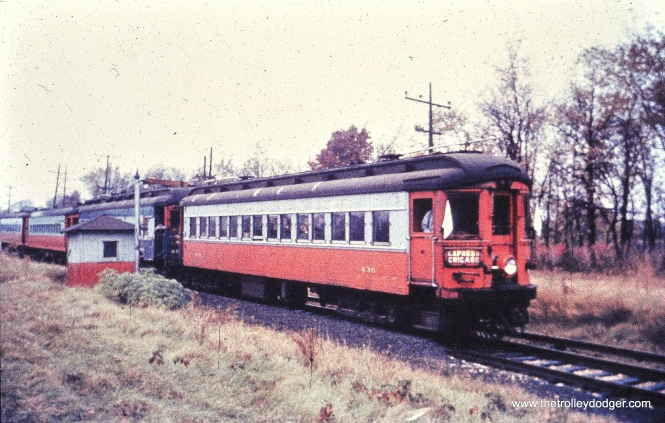
From the Collections of Bill Shapotkin

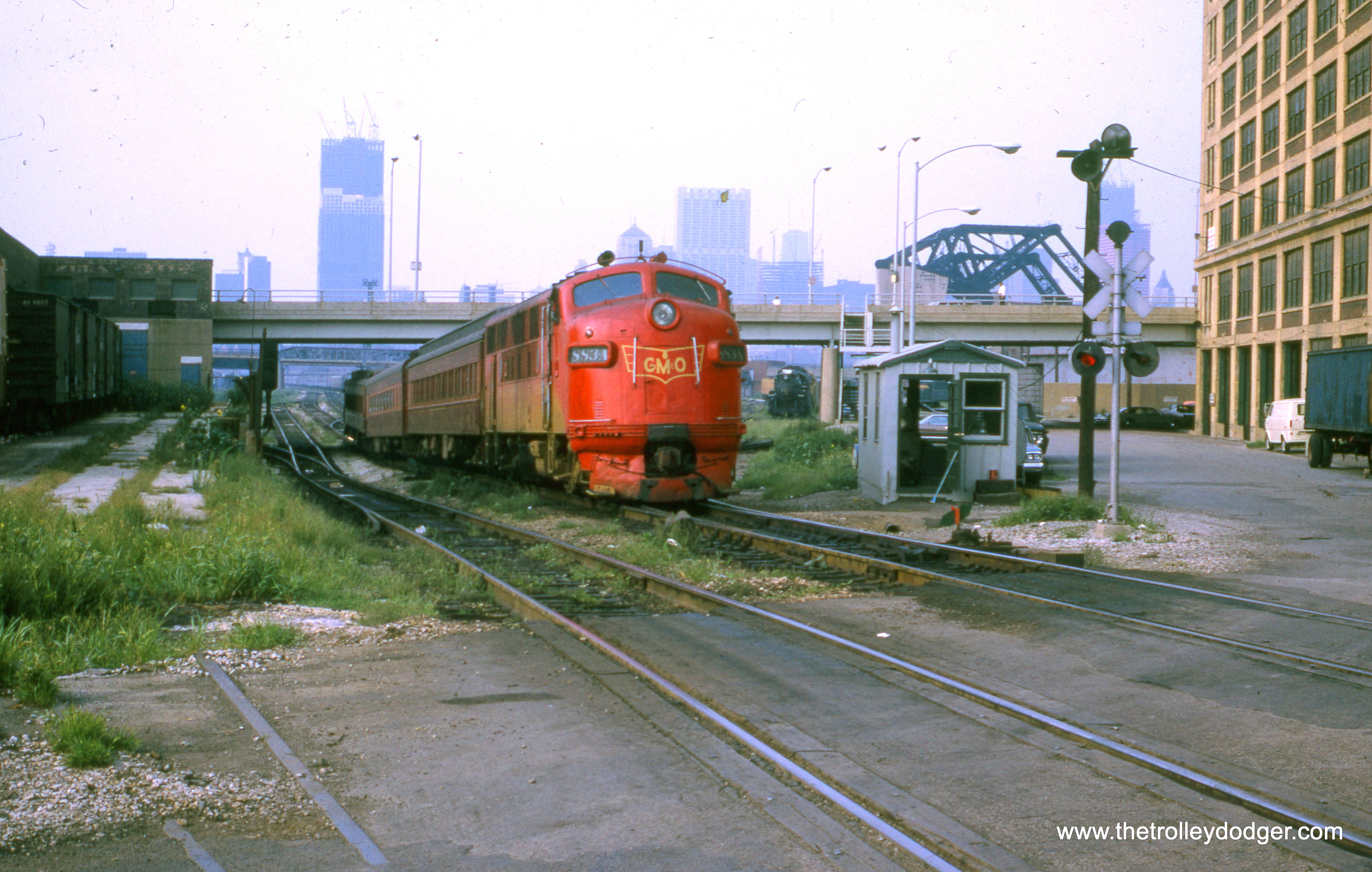
On August 13, 1971 Chicago Rock Island & Pacific #303 and 125 are backing into Blue Island (Burr Oak) yard. Bill Shapotkin adds, "The train is a ROCK Mainline Suburban train (if it had operated via Beverly, it would be west of the depot (to left)."

On August 13, 1971 Chicago Rock Island & Pacific #303 and 125 are backing into Blue Island (Burr Oak) yard. Bill Shapotkin adds, “The train is a ROCK Mainline Suburban train (if it had operated via Beverly, it would be west of the depot (to left).”

Today, we feature more classic photos of buses, trolleys, and trains, courtesy of Bill Shapotkin, long a friend of this blog. Mr. Shapotkin should be well-known to many of you from his longtime activities as a transit historian, author, and the many informative programs he has given over the years.

Today’s sampling from the Shapotkin Collection includes some rare pictures of Chicago & North Western RDCs (Budd Rail Diesel Cars), which were self-propelled and ran in Chicago area commuter train service for a short period of time in the 1950s. They replaced steam-powered trains and were in turn replaced by the familiar push-pull diesel bi-levels still in use today.

In addition, there are several pictures of Grand Central Station, a Chicago landmark in use between 1890 and 1969, which was torn down in 1971. We have some interesting correspondence, plus some new images of our own.

Enjoy!

-David Sadowski

PS- We have done our part to make these old images look as good as they possibly can. The C&NW RDC pictures were all shot around 1956 on early Ektachrome film, whose dyes turned out to be unstable and quickly shifted to red. (Technically, the red layer was relatively stable, while the green and blue layers faded.)

It used to be some people thought these sorts of images were only suitable for use as black-and-whites. But with modern technology, it is possible, to some extent, to bring back the original colors. This was easier to do on some than others, but the results look much better than you might expect. If you have ever seen one of these early red Ektachromes, you will know what I mean. Modern films are much more stable and resistant to dye fading.

I would be remiss without mentioning Bill has been involved for many years with the annual Hoosier Traction meet, which takes place in September:

It is that time of year again — the 35th annual gathering of the Hoosier Traction Meet is being held Fri-Sat, Sept 7-8 in Indianapolis, IN. The meet includes two full days of interesting presentations on a variety of subjects, as well as our “Exhibition Room” of vendors — with everything from transfers to track charts available. Book now and you can join us for just $25.00 ($40.00 at the door). We recommend that once you book hotel accommodations as early as possible, as there is an event scheduled at the Indianapolis Motor Speedway that same weekend. By calling the number of the Waterfront Inn (where our event is being held), by mentioning that you are with the Hoosier Traction Meet, you should be able to register at our group rate.

For those of you would are unable to attend both days, we have a special “Saturday Only” rate of just $15.00 ($25.00 at the door). As many of our Friday presentations are repeated on Saturday, you will be able to partake of a wide variety of subjects and presenters.

We hope you are able to join us for what many consider to be THE electric railway gathering in the country…see you there!

Thanking you in advance,

Bill Shapotkin

The Milwaukee Road's Elgin terminal in August 1970. Bill Shapotkin adds, "The MILW depot in Elgin was built 1948. It is the second depot constructed at the same site. View looks south from Chicago St."

The Milwaukee Road’s Elgin terminal in August 1970. Bill Shapotkin adds, “The MILW depot in Elgin was built 1948. It is the second depot constructed at the same site. View looks south from Chicago St.”

Chicago & Milwaukee Electric 354, built in 1928 by the St. Louis Car Company, is seen at the Illinois Railway Museum in May 1977. It ran in Milwaukee and Waukegan as a North Shore Line city streetcar.

Chicago & Milwaukee Electric 354, built in 1928 by the St. Louis Car Company, is seen at the Illinois Railway Museum in May 1977. It ran in Milwaukee and Waukegan as a North Shore Line city streetcar.

The Chessie Steam Special in Wellsboro, IN on June 17, 1978.

The Chessie Steam Special in Wellsboro, IN on June 17, 1978.

The Chessie Steam Special in Wellsboro, IN on June 17, 1978.

The Chessie Steam Special in Wellsboro, IN on June 17, 1978.

The Chessie Steam Special in Wellsboro, IN on June 17, 1978.

The Chessie Steam Special in Wellsboro, IN on June 17, 1978.

The Chessie Steam Special in Wellsboro, IN on June 17, 1978.

The Chessie Steam Special in Wellsboro, IN on June 17, 1978.

The Chessie Steam Special in Peru, IN on June 17, 1978.

The Chessie Steam Special in Peru, IN on June 17, 1978.

The Chessie Steam Special in Wellsboro, IN on June 17, 1978.

The Chessie Steam Special in Wellsboro, IN on June 17, 1978.

Minneapolis & St. Louis "doodlebug" GE 29, was used as a railway post office (RPO). According to http://www.rrpicturearchives.net/, " Number GE-29 was built in 1931, body by Saint Louis Car Company (c/n 1550), the power plant was 400 horsepower EMC Winton Model 148 gasoline engine (c/n 491) coupled to GE electrical gear. I don't know who is responsible for the boxy structure on the roof but it's likely the cooling system for the prime mover. This unit went by the name 'Montgomery' (painted above the rear truck) and was repowered in August 1950 with a Caterpillar 400 horsepower Model D diesel."

Minneapolis & St. Louis “doodlebug” GE 29, was used as a railway post office (RPO). According to http://www.rrpicturearchives.net/, ” Number GE-29 was built in 1931, body by Saint Louis Car Company (c/n 1550), the power plant was 400 horsepower EMC Winton Model 148 gasoline engine (c/n 491) coupled to GE electrical gear. I don’t know who is responsible for the boxy structure on the roof but it’s likely the cooling system for the prime mover. This unit went by the name ‘Montgomery’ (painted above the rear truck) and was repowered in August 1950 with a Caterpillar 400 horsepower Model D diesel.”

CTA bus 4606 is at the Roosevelt/Monitor Loop in October 1992 (same one used by trackless trolleys a few years earlier). The view looks E-N/E (toward Monitor Avenue). I don't know much about the GM Fishbowl next to it, however.

CTA bus 4606 is at the Roosevelt/Monitor Loop in October 1992 (same one used by trackless trolleys a few years earlier). The view looks E-N/E (toward Monitor Avenue). I don’t know much about the GM Fishbowl next to it, however.

A Milwaukee Road dome car near Union Station in Chicago.

A Milwaukee Road dome car near Union Station in Chicago.

Milwaukee Road equipment in downtown Chicago.

Milwaukee Road equipment in downtown Chicago.

Pace buses in Elgin, June 2003.

Pace buses in Elgin, June 2003.

A westbound NYC passenger train as it approaches LaSalle Street Station in November 1963. At right is the CRI&P's coach yard. The view looks south from the Roosevelt Road bridge. (John Szwajkart Photo)

A westbound NYC passenger train as it approaches LaSalle Street Station in November 1963. At right is the CRI&P’s coach yard. The view looks south from the Roosevelt Road bridge. (John Szwajkart Photo)

Chicago, IL. NYC loco #7300 is seen as it passes the CRI&P coachyard. The view looks south from the Roosevelt Road bridge in November 1963. (John Szwajkart Photo)

Chicago, IL. NYC loco #7300 is seen as it passes the CRI&P coachyard. The view looks south from the Roosevelt Road bridge in November 1963. (John Szwajkart Photo)

Metra Milwaukee District loco 124 is pushing an eastbound train towards Union Station in Chicago. The view looks east from DesPlaines Street. August 1995. (Dan Munson Photo)

Metra Milwaukee District loco 124 is pushing an eastbound train towards Union Station in Chicago. The view looks east from DesPlaines Street. August 1995. (Dan Munson Photo)

Loco 604 leads a northbound (timetable: westbound) Metra/Milwaukee District passenger train out of Union Station in Chicago. The view looks south-southwest off the Lake Street bridge over the south branch of the Chicago River. July 19, 1990. (Dan Munson Photo)

Loco 604 leads a northbound (timetable: westbound) Metra/Milwaukee District passenger train out of Union Station in Chicago. The view looks south-southwest off the Lake Street bridge over the south branch of the Chicago River. July 19, 1990. (Dan Munson Photo)

Control cab 3244 brings up the reat of a westbound Metra/Rock Island train at Joliet Union Station. The view looks west in December 1990. (Paul D. Schneider Photo)

Control cab 3244 brings up the reat of a westbound Metra/Rock Island train at Joliet Union Station. The view looks west in December 1990. (Paul D. Schneider Photo)

Joliet, IL: Loco 163 is seen pushing an eastbound Metra/Rock Island suburban train across the ATSF/IC (ex-ICG, former GM&O, nee C&A) diamonds at Union Station. The view looks south in December 1990. (Paul D. Schneider Photo)

Joliet, IL: Loco 163 is seen pushing an eastbound Metra/Rock Island suburban train across the ATSF/IC (ex-ICG, former GM&O, nee C&A) diamonds at Union Station. The view looks south in December 1990. (Paul D. Schneider Photo)

The imposing clock tower of Grand Central Station, in operation from 1890 to 1969. Located at the southwest corner of Wells and Harrison, it was demolished in 1971. This view looks northwest. (Ron Peisker Photo)

The imposing clock tower of Grand Central Station, in operation from 1890 to 1969. Located at the southwest corner of Wells and Harrison, it was demolished in 1971. This view looks northwest. (Ron Peisker Photo)

The Wells Street side of Grand Central Station in Chicago. The view looks north along Wells Street in the 1960s. (Ron Peisker Photo)

The Wells Street side of Grand Central Station in Chicago. The view looks north along Wells Street in the 1960s. (Ron Peisker Photo)

In the 1960s, and auto is parked on Wells Street in front of Grand Central Station. The view looks to the west-northwest across Wells Street. (Ron Peisker Photo)

In the 1960s, and auto is parked on Wells Street in front of Grand Central Station. The view looks to the west-northwest across Wells Street. (Ron Peisker Photo)

Looking west from the clock tower at Grand Central Station in the 1960s. Through these windows are various railroad offices. The building at left in the background is the CGW freight house. (Ron Peisker Photo)

Looking west from the clock tower at Grand Central Station in the 1960s. Through these windows are various railroad offices. The building at left in the background is the CGW freight house. (Ron Peisker Photo)

Grand Central Station, Chicago is viewed from the west side of Franklin Street from a point north of Harrison Street. The view looks southwest. (Ron Peisker Photo)

Grand Central Station, Chicago is viewed from the west side of Franklin Street from a point north of Harrison Street. The view looks southwest. (Ron Peisker Photo)

Looking north on Holden Court in March 2000, under the South Side "L", we are looking north under the St. Charles Air Line bridge. (William Shapotkin Photo)

Looking north on Holden Court in March 2000, under the South Side “L”, we are looking north under the St. Charles Air Line bridge. (William Shapotkin Photo)

A westbound B&O freight train prepares to cross the IHB at the Illinois/Indiana state line. The view looks east in September 1959. (John Szwajkart Photo)

A westbound B&O freight train prepares to cross the IHB at the Illinois/Indiana state line. The view looks east in September 1959. (John Szwajkart Photo)

This is 91st St Tower in November 1949 -- protecting the PRR/ROCK Xing on the ROCK's Suburban (now Beverly) Branch. The tracks heading off to the upper right are the ROCK. Tracks heading off to the upper left are the PRR.

This is 91st St Tower in November 1949 — protecting the PRR/ROCK Xing on the ROCK’s Suburban (now Beverly) Branch. The tracks heading off to the upper right are the ROCK. Tracks heading off to the upper left are the PRR.

This billboard, advertising SouthShore Freight, is located west of Indianapolis Boulevard north of the Indiana Toll Road in East Chicago, IN. The view looks west. June 28, 2018. (William Shapotkin Photo)

This billboard, advertising SouthShore Freight, is located west of Indianapolis Boulevard north of the Indiana Toll Road in East Chicago, IN. The view looks west. June 28, 2018. (William Shapotkin Photo)

C&NW cab-coach 152 in Chicago, north of the Clinton Street Tower on August 2, 1978.

C&NW cab-coach 152 in Chicago, north of the Clinton Street Tower on August 2, 1978.

An eastbound C&NW train is passing under the CGW bridge on July 9, 1968. Bill Shapotkin adds, "This photo was taken in Lombard east of Grace St. Today, a Great Western Trail x/o over the UP (C&NW) at the same location. View looks west."

An eastbound C&NW train is passing under the CGW bridge on July 9, 1968. Bill Shapotkin adds, “This photo was taken in Lombard east of Grace St. Today, a Great Western Trail x/o over the UP (C&NW) at the same location. View looks west.”

C&NW cab car 254 at Davis Street in Evanston on July 18, 1976.

C&NW cab car 254 at Davis Street in Evanston on July 18, 1976.

C&NW GP7 is at an unknown location, on a morning train running between Milwaukee and Madison, Wisconsin in March 1954. Bill Shapotkin: "This location is West Allis, WI just west of Belden Tower (the freight line to Butler is in background). View looks N/E."

C&NW GP7 is at an unknown location, on a morning train running between Milwaukee and Madison, Wisconsin in March 1954. Bill Shapotkin: “This location is West Allis, WI just west of Belden Tower (the freight line to Butler is in background). View looks N/E.”

C&NW KO Tower in Lake Bluff, IL on May 5, 1977.

C&NW KO Tower in Lake Bluff, IL on May 5, 1977.

C&NW 1653 at Kenmore station, Chicago.

C&NW 1653 at Kenmore station, Chicago.

The C&NW commuter stop in Zion, July 30, 1966.

The C&NW commuter stop in Zion, July 30, 1966.

The C&NW commuter stop in Zion, July 30, 1966.

The C&NW commuter stop in Zion, July 30, 1966.

The C&NW commuter stop in Zion, July 30, 1966.

The C&NW commuter stop in Zion, July 30, 1966.

The C&NW commuter stop in Zion, July 30, 1966.

The C&NW commuter stop in Zion, July 30, 1966.

The C&NW commuter stop in Zion, July 30, 1966.

The C&NW commuter stop in Zion, July 30, 1966.

The C&NW commuter stop in Zion, July 30, 1966.

The C&NW commuter stop in Zion, July 30, 1966.

C&NW RDC cars in Park Ridge, IL.

C&NW RDC cars in Park Ridge, IL.

C&NW RDC cars southbound departing Kenmore station (Granville Avenue) in Chicago.

C&NW RDC cars southbound departing Kenmore station (Granville Avenue) in Chicago.

C&NW 1531 in Kenmore station, Chicago in May 1956.

C&NW 1531 in Kenmore station, Chicago in May 1956.

C&NW RDC cars, southbound at Kenmore station, Chicago, 1956.

C&NW RDC cars, southbound at Kenmore station, Chicago, 1956.

C&NW RDC cars in Waukegan, IL.

C&NW RDC cars in Waukegan, IL.

C&NW RDC car 9933 just north of Thome Avenue in August 1956.

C&NW RDC car 9933 just north of Thome Avenue in August 1956.

Chicago Surface Lines 6213. Tony Waller adds, "The photo of the red streetcar on route 95 captioned as being at 93rd and Anthony Ave. is actually at 93rd and Exchange Ave. The streetcar line westbound turned from Exchange onto 93rd. Anthony Ave. parallels the PRR/NYC viaducts (and now the Skyway bridge alignment) that is in the near distance; crossing the streetcar line at a perpendicular angle."

Chicago Surface Lines 6213. Tony Waller adds, “The photo of the red streetcar on route 95 captioned as being at 93rd and Anthony Ave. is actually at 93rd and Exchange Ave. The streetcar line westbound turned from Exchange onto 93rd. Anthony Ave. parallels the PRR/NYC viaducts (and now the Skyway bridge alignment) that is in the near distance; crossing the streetcar line at a perpendicular angle.”

CTA 6213 at 95th and State in 1949.

CTA 6213 at 95th and State in 1949.

CSL 6212 on Route 93 near Blackstone, west of Stony Island on August 13, 1947.

CSL 6212 on Route 93 near Blackstone, west of Stony Island on August 13, 1947.

Here, we are looking north (from 31st Street) under the South Side "L" mainline. Note supports at left - that portion of the structure dates back to 1892. The pillars and structure at right was added when a third main (express) track was added. June 28, 2018. (William Shapotkin Photo)

Here, we are looking north (from 31st Street) under the South Side “L” mainline. Note supports at left – that portion of the structure dates back to 1892. The pillars and structure at right was added when a third main (express) track was added. June 28, 2018. (William Shapotkin Photo)

A southbound Englewood train approaches 31st Street on the South Side "L" main line. The view looks north from 31st Street. June 28, 2018. (William Shapotkin Photo)

A southbound Englewood train approaches 31st Street on the South Side “L” main line. The view looks north from 31st Street. June 28, 2018. (William Shapotkin Photo)

A southbound CTA Englewood train has just crossed over 31st Street on the South Side "L" main line. The view looks south across 31st. June 28, 2018. (William Shapotkin Photo)

A southbound CTA Englewood train has just crossed over 31st Street on the South Side “L” main line. The view looks south across 31st. June 28, 2018. (William Shapotkin Photo)

A southbound CTA Englewood train has just crossed over 31st Street on the South Side "L" main line. The view looks south across 31st. June 28, 2018. (William Shapotkin Photo)

A southbound CTA Englewood train has just crossed over 31st Street on the South Side “L” main line. The view looks south across 31st. June 28, 2018. (William Shapotkin Photo)

A southbound CTA Jackson Park train makes its stop at the 35th Street "L" station. The view looks north. June 28, 2018. (William Shapotkin Photo)

A southbound CTA Jackson Park train makes its stop at the 35th Street “L” station. The view looks north. June 28, 2018. (William Shapotkin Photo)

A westbound Metra train in Blue Island on June 26, 1992. (R. Bullermann Photo)

A westbound Metra train in Blue Island on June 26, 1992. (R. Bullermann Photo)

Metra loco #104 is seen heading a westbound Metra/Milwaukee District suburban train out from Union Station in August 1995. The view looks east from DesPlaines Street. (Dan Munson Photo)

Metra loco #104 is seen heading a westbound Metra/Milwaukee District suburban train out from Union Station in August 1995. The view looks east from DesPlaines Street. (Dan Munson Photo)

A 7900-series CTA bus, working a westbound trip on Route 31 - 31st, is westbound in 31st Street approaching the South Side "L" main line. The view looks east. June 28, 2018. (William Shapotkin Photo)

A 7900-series CTA bus, working a westbound trip on Route 31 – 31st, is westbound in 31st Street approaching the South Side “L” main line. The view looks east. June 28, 2018. (William Shapotkin Photo)

A 7900-series CTA bus, working a westbound trip on Route 31 - 31st, is westbound in 31st Street approaching the South Side "L" main line. The view looks east. June 28, 2018. (William Shapotkin Photo)

A 7900-series CTA bus, working a westbound trip on Route 31 – 31st, is westbound in 31st Street approaching the South Side “L” main line. The view looks east. June 28, 2018. (William Shapotkin Photo)

CTA bus 1158, working an eastbound trip on Route 103 - West 103rd, is eastbound in 103rd Street, approaching the Metra Rock Island tracks at Hale Avenue. The view looks west. June 28, 2018. (William Shapotkin Photo)

CTA bus 1158, working an eastbound trip on Route 103 – West 103rd, is eastbound in 103rd Street, approaching the Metra Rock Island tracks at Hale Avenue. The view looks west. June 28, 2018. (William Shapotkin Photo)

CTA bus 1158, working an eastbound trip on Route 103 - West 103rd, is eastbound in 103rd Street, makes a stop before crossing over the Metra Rock Island tracks at Hale Avenue. The view looks west. June 28, 2018. (William Shapotkin Photo)

CTA bus 1158, working an eastbound trip on Route 103 – West 103rd, is eastbound in 103rd Street, makes a stop before crossing over the Metra Rock Island tracks at Hale Avenue. The view looks west. June 28, 2018. (William Shapotkin Photo)

CTA bus 1158, working an eastbound trip on Route 103 - West 103rd, is eastbound in 103rd Street, crossing over the Metra Rock Island tracks at Hale Avenue. The view looks west. June 28, 2018. (William Shapotkin Photo)

CTA bus 1158, working an eastbound trip on Route 103 – West 103rd, is eastbound in 103rd Street, crossing over the Metra Rock Island tracks at Hale Avenue. The view looks west. June 28, 2018. (William Shapotkin Photo)

CTA bus 1158, working an eastbound trip on Route 103 - West 103rd, is eastbound in 103rd Street, having just crossed over the Metra Rock Island tracks at Hale Avenue. The view looks east. June 28, 2018. (William Shapotkin Photo)

CTA bus 1158, working an eastbound trip on Route 103 – West 103rd, is eastbound in 103rd Street, having just crossed over the Metra Rock Island tracks at Hale Avenue. The view looks east. June 28, 2018. (William Shapotkin Photo)

CTA bus 1094, working a westbound trip on Route 103 - West 103rd, is westbound in 103rd Street at Hale Avenue and the Metra Rock Island tracks. View looks northeast. June 28, 2018. (William Shapotkin Photo)

CTA bus 1094, working a westbound trip on Route 103 – West 103rd, is westbound in 103rd Street at Hale Avenue and the Metra Rock Island tracks. View looks northeast. June 28, 2018. (William Shapotkin Photo)

CTA bus 1094, working a westbound trip on Route 103 - West 103rd, is westbound in 103rd Street, having just crossed over Hale Avenue and Metra Rock Island tracks. The view looks northwest. June 8, 2018. (William Shapotkin Photo)

CTA bus 1094, working a westbound trip on Route 103 – West 103rd, is westbound in 103rd Street, having just crossed over Hale Avenue and Metra Rock Island tracks. The view looks northwest. June 8, 2018. (William Shapotkin Photo)

My Metra title slide... nice, eh? December 1990. (Paul D. Schneider Photo)

My Metra title slide… nice, eh? December 1990. (Paul D. Schneider Photo)

A close-up of Metra 126 and its brethren in December 1990. (Paul D. Schneider Photo)

A close-up of Metra 126 and its brethren in December 1990. (Paul D. Schneider Photo)

Recent Site Additions

This picture was added to our recent post The Magic of Jack Bejna (August 4, 2018):

Don's Rail Photos says, (North Shore Line) "213 was built by Cincinnati in March 1920, #2445, as a merchandise despatch car. In 1940 it was rebuilt as a disc harrow ice cutter. It was retired in 1955 and sold to CHF as their 242. It was donated to Illinois Railway Museum in 1964." Here, we see the car at the Chicago Hardware Foundry Company in February 1960. This was also then the location of the Illinois Electric Railway Museum.

Don’s Rail Photos says, (North Shore Line) “213 was built by Cincinnati in March 1920, #2445, as a merchandise despatch car. In 1940 it was rebuilt as a disc harrow ice cutter. It was retired in 1955 and sold to CHF as their 242. It was donated to Illinois Railway Museum in 1964.” Here, we see the car at the Chicago Hardware Foundry Company in February 1960. This was also then the location of the Illinois Electric Railway Museum.

Chicago Streetcar Tracks Exposed

Exposed streetcar tracks are a rare sight in Chicago nowadays. We recently took some pictures of some on Western Avenue under a viaduct just north of 18th Street, in the northbound lane.

-David Sadowski

While we were in the neighborhood, we took this picture of an inbound CTA Orange Line train on Archer:

Recent Finds

CTA 2029-2030 on the turnaround loop at the DesPlaines Avenue terminal in October 1964. We are looking west. Here, you can see the close proximity of the Chicago Great Western tracks to the right. These have since been removed, and the area turned into a bike path connecting with the Illinois Prairie Path at First Avenue in Maywood.

CTA 2029-2030 on the turnaround loop at the DesPlaines Avenue terminal in October 1964. We are looking west. Here, you can see the close proximity of the Chicago Great Western tracks to the right. These have since been removed, and the area turned into a bike path connecting with the Illinois Prairie Path at First Avenue in Maywood.

On July 12, 1955 we see Pittsburgh Railways car 4398 at the Drake Loop. It is signed for the Washington interurban, which continued for several miles from here until interurban service was cut back a few years before this picture was taken. Don's Rail Photos adds, "4398 was built by St. Louis Car Co. in 1916." This car was retired in 1956 and has been at the Pennsylvania Trolley Museum in (fittingly) Washington, PA ever since. Service to the Drake Loop ended in 1999, when the last PCC streetcars were retired. In its last few years, it had operated as a shuttle. You can read more about the final days of the Drake Loop here. (C. Foreman Photo)

On July 12, 1955 we see Pittsburgh Railways car 4398 at the Drake Loop. It is signed for the Washington interurban, which continued for several miles from here until interurban service was cut back a few years before this picture was taken. Don’s Rail Photos adds, “4398 was built by St. Louis Car Co. in 1916.” This car was retired in 1956 and has been at the Pennsylvania Trolley Museum in (fittingly) Washington, PA ever since. Service to the Drake Loop ended in 1999, when the last PCC streetcars were retired. In its last few years, it had operated as a shuttle. You can read more about the final days of the Drake Loop here. (C. Foreman Photo)

We recently acquired this World War II-era brochure promoting the Chicago Aurora & Elgin interurban’s services as a way to get around in spite of wartime gasoline rationing and tire shortages:

Here is an article about the new Chicago Subway, from the May 1943 issue of Trains magazine. (For information about our new book Building Chicago’s Subways, see the end of this post).

Recent Correspondence

Mark Batterson
writes:

We recently purchased the Navy Yard Car Barn, built in 1891 by the Washington and Georgetown Railroad Company. It was one of four streetcar barns in DC. We’d like to celebrate the history of streetcars in our buildout of the space. I know you’ve got some amazing images in your collection. Is there a way to purchase some of those? We’re also trying to purchase an old DC streetcar. Thought I’d ask if you know where we might be able to find one?

Thanks so much for your time and consideration.

Thanks for writing.

FYI, there is a web page that lists the current whereabouts (as of 2014) of all surviving DC trolley cars:

http://www.bera.org/cgi-bin/pnaerc-query.pl?sel_allown=DC+Transit&match_target=&Tech=Yes&pagelen=200

After the DC system quit in 1963, some PCC cars were shipped overseas and others were heavily modified for use in the Tandy Subway operation, which no longer exists. The bulk of remaining equipment is in museums.

Unfortunately, there were a few DC streetcars that were preserved at first, but were later destroyed. These include the Silver Sightseer PCC and pre-PCC car 1053.

We can offer prints from some of the images on this site, but not others… only the ones we own the rights to. We specialize in the Chicago area, and as a result, do not have that many DC images. But perhaps some of our readers can point you in the right direction for those. (If anyone reads this and can help, write to me and I can put you in touch with Mr. Batterson.

-David Sadowski

Chicago Rapid Transit Company Door Controls

A picture appeared in our last post The Magic of Jack Bejna that has stirred up some correspondence:

This three-car train of Chicago Transit Authority 4000-series "L" cars is signed as a Howard Street Express in June 1949. (L. L. Bonney Photo) Our resident south side expert M. E. adds, "Methinks this photo was taken looking west at the Indiana Av. (at 40th St.) station. Because the train destination sign says Howard Express, the location has to be on the main north/south line. (Plus, this train had to originate on the Jackson Park branch, because Englewood trains at that time ran to Ravenswood.) Also, I don't recall any other three-track main anywhere else on the north/south line. Also, Indiana Ave. had the overhead walkway to get to and from the Stock Yards L, which terminated to the left of the left-hand platform in the photo. When this photo was taken, the Kenwood L ran as through service from 42nd Place, through Indiana Ave., up to Wilson Ave. Later in 1949, the Kenwood service was cut back to a shuttle ending at Indiana Ave. The inbound station platform was extended over the northernmost track, then mainline north/south service used the middle track heading downtown. A fuller explanation is at https://www.chicago-l.org/operations/lines/kenwood.html . Also of interest is that this photo shows a three-car train. Before the advent of new equipment in 1950 there were no "married pairs" of cars. Trains could be as small as a single car, which I recall seeing on the Englewood branch on Sunday mornings. Plus, the three-car train shown in the photo would have had two conductors whose job was to open the passenger entry doors (which were on the sides, at the ends of the cars) using controls situated between the cars. So conductor #1 operated the doors at the rear of car 1 and the front of car 2. Conductor #2 operated the doors at the rear of car 2 and the front of car 3. Side doors at the front of car 1 and the rear of car 3 were not used by passengers. To operate his side doors, a conductor had to stand between the cars. (Yes, in any weather.) And the conductors had to notify the motorman when to proceed. To do this, the conductors had to observe when there was no more boarding or alighting at their doors. They used a bell system to notify the motorman. Two dings meant "proceed". One ding meant "hold". The rearmost conductor started with his bell, then the next rearmost, etc., until two dings rang in the motorman's compartment, his signal to go. The longer the train, the longer it took to leave the station."

This three-car train of Chicago Transit Authority 4000-series “L” cars is signed as a Howard Street Express in June 1949. (L. L. Bonney Photo) Our resident south side expert M. E. adds, “Methinks this photo was taken looking west at the Indiana Av. (at 40th St.) station.
Because the train destination sign says Howard Express, the location has to be on the main north/south line. (Plus, this train had to originate on the Jackson Park branch, because Englewood trains at that time ran to Ravenswood.) Also, I don’t recall any other three-track main anywhere else on the north/south line. Also, Indiana Ave. had the overhead walkway to get to and from the Stock Yards L, which terminated to the left of the left-hand platform in the photo.
When this photo was taken, the Kenwood L ran as through service from 42nd Place, through Indiana Ave., up to Wilson Ave. Later in 1949, the Kenwood service was cut back to a shuttle ending at Indiana Ave. The inbound station platform was extended over the northernmost track, then mainline north/south service used the middle track heading downtown. A fuller explanation is at
https://www.chicago-l.org/operations/lines/kenwood.html .
Also of interest is that this photo shows a three-car train. Before the advent of new equipment in 1950 there were no “married pairs” of cars. Trains could be as small as a single car, which I recall seeing on the Englewood branch on Sunday mornings.
Plus, the three-car train shown in the photo would have had two conductors whose job was to open the passenger entry doors (which were on the sides, at the ends of the cars) using controls situated between the cars. So conductor #1 operated the doors at the rear of car 1 and the front of car 2. Conductor #2 operated the doors at the rear of car 2 and the front of car 3. Side doors at the front of car 1 and the rear of car 3 were not used by passengers. To operate his side doors, a conductor had to stand between the cars. (Yes, in any weather.)
And the conductors had to notify the motorman when to proceed. To do this, the conductors had to observe when there was no more boarding or alighting at their doors. They used a bell system to notify the motorman. Two dings meant “proceed”. One ding meant “hold”. The rearmost conductor started with his bell, then the next rearmost, etc., until two dings rang in the motorman’s compartment, his signal to go. The longer the train, the longer it took to leave the station.”

Recently, Jim Huffman commented:

Photo #365? 3-car train of CTA 4000s standing at the 38th St station. I differ with your explanation of the conductors door work.
1. When the CTA took over they made all the doors on the 4000s one-man operated, allowing for trains with odd number of cars . Thus, 8-cars, 4-cars, 3-cars, 1-car= only 1-conductor per train.
2. Way prior to that, the CRT used a conductor between each two cars, doing the doors as you described. 8-cars=8-conductors, etc.
3. But later, prior to the CTA, the CRT re-wired (air?) the 4000s so that a conductor between every two cars could operate all the doors on two cars. 8-cars=4-conductors etc.
4. On multi conductor trains, there was only one signal used and that was by the front conductor, not by the other conductors. Nor were there differing sounds or number of bells or buzzers! The front conductor monitored the rear conductors doors, when all were closed, then he would signal the Motorman. There usually was not much of any delay, the reason for less men was to lower labor costs, not to speed up the train.
This is from my memory & further info from conductors back then.

We replied:

You are referring to the explanation of how door controls worked on the 4000s, given by one of our readers (M. E.) in the caption for the photo called proofs365.jpg.

We had previously reproduced a CTA training brochure dated March 1950 in our post Reader Showcase, 12-11-17. By this time, the 4000s had been retrofitted into semi-permanent married pairs, so a three-car train, as shown in the June 1949 picture, no longer would have been possible.

The 1950 training brochure does mention using a buzzer to notify the next train man in one direction.

This is how Graham Garfield’s excellent web site describes the retrofit:

After the CTA ordered the first set of 6000s (6001-6200), they set about retrofitting the 4000s to make them operate more safely, economically and basically more like the forthcoming 6000s. By the time the 6000s started rolling in, the changes had been pretty much completed. In this overhaul, the 4000s were given multiple unit door control, standardized to use battery voltage for control, the trolley feed on Evanston cars was tied together so only one pole per pair was needed, and they were paired up into “semi-permanently coupled pairs” (as opposed to the “married-pairs” of the 6000s), usually in consecutive numerical order. Additionally, the destination signs (which were all still hand-operated) were changed to display either the route names (i.e. “Ravenswood” or “Lake A”) or both terminals (i.e. “Howard – Jackson Park B”) so they wouldn’t have to be changed for the reverse trip. The number of signs per car was reduced from four to two, not counting the destination board on the front. All this allowed a two-man crew to staff a train of any length.

This does not of course explain door operation prior to 1950, and I promised to do further research, by contacting Andre Kristopans.

PS- in addition to this, in a previous comment on this post, Andre Kristopans wrote, “On CRT the conductor was the man between the first and second cars. The rest were Guards. Motorman and conductor worked together all day but guards were assigned according to train length that trip.”

So, I asked Andre to explain. Here’s what he wrote:

Wood cars very simple – man between each two cars as doors were completely local control. End doors of train were not used. Steel cars more complicated. Originally same as woods – man between each two cars. Remember steels and woods were mixed. In 1940’s changed so man could control doors at both ends of cars on either side of him, so conductor between 1and 2, guards between 3 and 4, 5 and 6, 7 and 8 only. Then in 1950’s full trainlined doors. Initially one conductor for 2 or 4 car trains, working between last 2 cars, on 6 or 8 car trains conductor between cars 3 and 4, guard between last two. Guard eliminated late 50’s, conductor in sane (same?) position now controls all doors.

Thanks for the info. On the woods and early 4000s, how did the guards and conductor signal each other?

They had signal bells. First rear guard pulled the cord that rang the gong at forward end of that car. Then that guard pulled the rope by his position to signal the next guard up. When the conductor got the signal and pulled his rope, the gong by the motorman rang and he released and started up.

Yes the 4000’s evolved. Originally basically operationally identical to woods. Circa 1943 before subway, converted from line voltage control to battery control. Now they were no longer able to train with woods. Around same time changed to door control at each end controlling doors at both ends. In 1950’s full mudc, paired with permanent headlights and permanent markers (over a period of a decade or so!). Shore Line’s Baldies book shows how this happened over time if you compare photos. Large door controls early for single door control, small door controls for entire car control, then no door controls on paired sets.

This is something that has not been looked into much, but a 1970’s 4000 was VERY different from a 1930’s 4000!

Our thanks to Andre and everyone else who contributed to this post. Keep those cards and letters coming in, folks!

-David Sadowski

Pre-Order Our New Book Building Chicago’s Subways

There are three subway anniversaries this year in Chicago:
60 years since the West Side Subway opened (June 22, 1958)
75 years since the State Street Subway opened (October 17, 1943)
80 years since subway construction started (December 17, 1938)

To commemorate these anniversaries, we have written a new book, Building Chicago’s Subways.

While the elevated Chicago Loop is justly famous as a symbol of the city, the fascinating history of its subways is less well known. The City of Chicago broke ground on what would become the “Initial System of Subways” during the Great Depression and finished 20 years later. This gigantic construction project, a part of the New Deal, would overcome many obstacles while tunneling through Chicago’s soft blue clay, under congested downtown streets, and even beneath the mighty Chicago River. Chicago’s first rapid transit subway opened in 1943 after decades of wrangling over routes, financing, and logistics. It grew to encompass the State Street, Dearborn-Milwaukee, and West Side Subways, with the latter modernizing the old Garfield Park “L” into the median of Chicago’s first expressway. Take a trip underground and see how Chicago’s “I Will” spirit overcame challenges and persevered to help with the successful building of the subways that move millions. Building Chicago’s subways was national news and a matter of considerable civic pride–making it a “Second City” no more!

Bibliographic information:

Title Building Chicago’s Subways
Images of America
Author David Sadowski
Edition illustrated
Publisher Arcadia Publishing (SC), 2018
ISBN 1467129380, 9781467129381
Length 128 pages

Chapter Titles:
01. The River Tunnels
02. The Freight Tunnels
03. Make No Little Plans
04. The State Street Subway
05. The Dearborn-Milwaukee Subway
06. Displaced
07. Death of an Interurban
08. The Last Street Railway
09. Subways and Superhighways
10. Subways Since 1960

Building Chicago’s Subways will be published on October 1, 2018. Order your copy today, and it will be shipped on or about that date. All copies purchased through The Trolley Dodger will be signed by the author.

The price of $23.99 includes shipping within the United States.

For Shipping to US Addresses:

For Shipping to Canada:

For Shipping Elsewhere:

Redone tile at the Monroe and Dearborn CTA Blue Line subway station, showing how an original sign was incorporated into a newer design, May 25, 2018. (David Sadowski Photo)

Redone tile at the Monroe and Dearborn CTA Blue Line subway station, showing how an original sign was incorporated into a newer design, May 25, 2018. (David Sadowski Photo)

Help Support The Trolley Dodger

gh1

This is our 218th post, and we are gradually creating a body of work and an online resource for the benefit of all railfans, everywhere. To date, we have received over 432,000 page views, for which we are very grateful.

You can help us continue our original transit research by checking out the fine products in our Online Store.

As we have said before, “If you buy here, we will be here.”

We thank you for your support.

DONATIONS

In order to continue giving you the kinds of historic railroad images that you have come to expect from The Trolley Dodger, we need your help and support. It costs money to maintain this website, and to do the sort of historic research that is our specialty.

Your financial contributions help make this web site better, and are greatly appreciated.

Spring Forward

CTA 6151 is southbound at Halsted and Congress on October 5, 1953 running on Route 8. The bridge 6151 is on spanned the Congress Expressway construction site. The highway was not yet open, and service continued on the Halsted "L" station at rear (with two tracks instead of the original four) until June 1958. (William Shapotkin Collection)

CTA 6151 is southbound at Halsted and Congress on October 5, 1953 running on Route 8. The bridge 6151 is on spanned the Congress Expressway construction site. The highway was not yet open, and service continued on the Halsted “L” station at rear (with two tracks instead of the original four) until June 1958. (William Shapotkin Collection)

Spring is here again, at least sort of, since we are expecting snow today here in Chicago. It’s been some time since our last post, but we have been busy collecting more streetcar and interurban pictures for your enjoyment. Plus, there are important contributions from some of our readers, for which we are thankful.

Each year, we turn our clocks forward one hour in the spring. But many of us wish we could simply turn back the clock instead, although hindsight is always 20/20 and we should always keep our eyes on the future.

But regardless, let’s “spring forward” with some great traction images from days gone by! We also have a few bonus images for our bus and diesel fans as well.

-David Sadowski

PS- We are gratified that despite not having a new post for two months, our readers have continued to support us. In fact, we are still very much on track to show a 15% increase in page views this year.

Waterloo, Cedar Falls & Northern car 100 on the Southern Iowa Railway on October 13, 1963. Don's Rail Photos: "100 was built by McGuire-Cummings in 1914. It was built as a second motor to operate behind the 140s as a two car train. The baggage compartment was a kitchen, and the rear end was an open platform observation. The buffet section was replaced with coach seats in 1918. The car was then rebuilt with a control station and baggage compartment in 1928 and the rear platform was enclosed at that time. It was the last interurban left on the WCF&N when it became diesel freight, and it was donated to the Iowa Chapter of the NRHS in 1956. It was moved to Centerville and operated on the Southern Iowa Ry. When the SI cut back its operation and dieselized, the Iowa Chapter transferred the car to the Iowa Terminal RR in 1966. Shortly after it was repainted and put into charter service, it was destroyed in the carbarn fire early November 24, 1967. It had been the only car saved from the WCF&N roundhouse fire on October 31, 1954, when the other two cars of its class burned." This slide has "Q transfer" noted on it-- not sure what that means. (James J. Buckley Photo)

Waterloo, Cedar Falls & Northern car 100 on the Southern Iowa Railway on October 13, 1963. Don’s Rail Photos: “100 was built by McGuire-Cummings in 1914. It was built as a second motor to operate behind the 140s as a two car train. The baggage compartment was a kitchen, and the rear end was an open platform observation. The buffet section was replaced with coach seats in 1918. The car was then rebuilt with a control station and baggage compartment in 1928 and the rear platform was enclosed at that time. It was the last interurban left on the WCF&N when it became diesel freight, and it was donated to the Iowa Chapter of the NRHS in 1956. It was moved to Centerville and operated on the Southern Iowa Ry. When the SI cut back its operation and dieselized, the Iowa Chapter transferred the car to the Iowa Terminal RR in 1966. Shortly after it was repainted and put into charter service, it was destroyed in the carbarn fire early November 24, 1967. It had been the only car saved from the WCF&N roundhouse fire on October 31, 1954, when the other two cars of its class burned.” This slide has “Q transfer” noted on it– not sure what that means. (James J. Buckley Photo)

The new and the old. CTA 5007 and 2269 at Rosemont on August 26, 2010. The 2200s have since been retired. (Bruce Nelson Photo)

The new and the old. CTA 5007 and 2269 at Rosemont on August 26, 2010. The 2200s have since been retired. (Bruce Nelson Photo)

An Oshawa steeple cab with a Philadelphia & Reading coach at the Connecticut Trolley Museum in May 1967. (Gerald H. Landau Photo)

An Oshawa steeple cab with a Philadelphia & Reading coach at the Connecticut Trolley Museum in May 1967. (Gerald H. Landau Photo)

An Oshawa steeple cab at the Connecticut Trolley Museum in May 1967. (Gerald H. Landau Photo)

An Oshawa steeple cab at the Connecticut Trolley Museum in May 1967. (Gerald H. Landau Photo)

Montreal observation car #4 at the Connecticut Trolley Museum in May 1967. (Gerald H. Landau Photo)

Montreal observation car #4 at the Connecticut Trolley Museum in May 1967. (Gerald H. Landau Photo)

Connecticut Company Birney car 3001 at the Connecticut Trolley Museum in May 1967. (Gerald H. Landau Photo)

Connecticut Company Birney car 3001 at the Connecticut Trolley Museum in May 1967. (Gerald H. Landau Photo)

Illinois Terminal double-ended PCC 451 at the Connecticut Trolley Museum in May 1967. (Gerald H. Landau Photo)

Illinois Terminal double-ended PCC 451 at the Connecticut Trolley Museum in May 1967. (Gerald H. Landau Photo)

New Orleans #836 and Rio car #1850 at the Connecticut Trolley Museum in May 1967. (Gerald H. Landau Photo)

New Orleans #836 and Rio car #1850 at the Connecticut Trolley Museum in May 1967. (Gerald H. Landau Photo)

Rio car #1850 at the Connecticut Trolley Museum in May 1967. (Gerald H. Landau Photo)

Rio car #1850 at the Connecticut Trolley Museum in May 1967. (Gerald H. Landau Photo)

Connecticut Company open car 1414 was built by Osgood Bradley in 1911. Here, we see it at the Shore Line Trolley Museum located at Branford, Connecticut on June 18, 1966. (William C. Janssen Photo)

Connecticut Company open car 1414 was built by Osgood Bradley in 1911. Here, we see it at the Shore Line Trolley Museum located at Branford, Connecticut on June 18, 1966. (William C. Janssen Photo)

Connecticut Company open car 1414 at Branford on May 30, 1964. (J. W. Vigrass Photo)

Connecticut Company open car 1414 at Branford on May 30, 1964. (J. W. Vigrass Photo)

Connecticut Company open car 1414 was built by Osgood Bradley in 1911. Here, we see it at the Shore Line Trolley Museum located at Branford, Connecticut on June 18, 1966. (William C. Janssen Photo)

Connecticut Company open car 1414 was built by Osgood Bradley in 1911. Here, we see it at the Shore Line Trolley Museum located at Branford, Connecticut on June 18, 1966. (William C. Janssen Photo)

You would be forgiven for thinking this December 18, 1955 photo shows CTA Pullman 144. But this was actually the excursion where car 144 was promised, but 225 was substituted in its place-- renumbered with the help of a few pieces of oilcloth. Here, the fantrip car is seen at Broadway and Devon.

You would be forgiven for thinking this December 18, 1955 photo shows CTA Pullman 144. But this was actually the excursion where car 144 was promised, but 225 was substituted in its place– renumbered with the help of a few pieces of oilcloth. Here, the fantrip car is seen at Broadway and Devon.

CTA PCC 7138, a product of the St. Louis Car Company, at the State Street loop near 84th on February 11, 1950. This location is now occupied by the Dan Ryan expressway.

CTA PCC 7138, a product of the St. Louis Car Company, at the State Street loop near 84th on February 11, 1950. This location is now occupied by the Dan Ryan expressway.

CTA PCC 7070 at the Clark and Howard loop on July 4, 1954.

CTA PCC 7070 at the Clark and Howard loop on July 4, 1954.

Philadelphia & Western (aka Red Arrow) Bullet car 202 at Norristown in 1949. Behind 202, you can see the ramp leading down to street level, used by Lehigh Valley Transit's Liberty Bell route trains. (S. Bogen Photo)

Philadelphia & Western (aka Red Arrow) Bullet car 202 at Norristown in 1949. Behind 202, you can see the ramp leading down to street level, used by Lehigh Valley Transit’s Liberty Bell route trains. (S. Bogen Photo)

By May 1961, when this photo was taken in Norristown, Liberty Bell Limited trains had been gone for nearly a decade. As you can see at left, the ramp leading down to ground level was removed and blocked off with an advertising sign.

By May 1961, when this photo was taken in Norristown, Liberty Bell Limited trains had been gone for nearly a decade. As you can see at left, the ramp leading down to ground level was removed and blocked off with an advertising sign.

Philadelphia Suburban (aka Red Arrow) Brilliner car 3 at Gay and High Streets in West Chester on June 6, 1954, at the end of trolley service on this route. The longest Red Arrow line was mainly a single-track side-of-the-road operation, which had to give way for the widening of West Chester Pike. (Edward S. Miller Photo)

Philadelphia Suburban (aka Red Arrow) Brilliner car 3 at Gay and High Streets in West Chester on June 6, 1954, at the end of trolley service on this route. The longest Red Arrow line was mainly a single-track side-of-the-road operation, which had to give way for the widening of West Chester Pike. (Edward S. Miller Photo)

Philadelphia Suburban (aka Red Arrow) car 78 at Larchmont Station on West Chester Pike at Media Line Road, Newtown Township, PA on May 9, 1954. Photographer Edward S. Miller noted that he later operated this car at the Arden trolley museum.

Philadelphia Suburban (aka Red Arrow) car 78 at Larchmont Station on West Chester Pike at Media Line Road, Newtown Township, PA on May 9, 1954. Photographer Edward S. Miller noted that he later operated this car at the Arden trolley museum.

Philadelphia Suburban double-end car 19, which looked like a PCC but does not technically qualify as one, since it had standard interurban trucks and motors. It is captured on May 9, 1954 at Broomall Station on West Chester Pike at Sproul Road in Marple Township, PA. (Edward S. Miller Photo)

Philadelphia Suburban double-end car 19, which looked like a PCC but does not technically qualify as one, since it had standard interurban trucks and motors. It is captured on May 9, 1954 at Broomall Station on West Chester Pike at Sproul Road in Marple Township, PA. (Edward S. Miller Photo)

A pair of Bullet cars running in multiple units on the Red Arrow Norristown High Speed Line on September 9, 1958. (Clark Frazier Photo)

A pair of Bullet cars running in multiple units on the Red Arrow Norristown High Speed Line on September 9, 1958. (Clark Frazier Photo)

Philadelphia Suburban (aka red Arrow) car 11 at the end of the line on the short Ardmore branch on September 9, 1958. (Clark Frazier Photo)

Philadelphia Suburban (aka red Arrow) car 11 at the end of the line on the short Ardmore branch on September 9, 1958. (Clark Frazier Photo)

Philadelphia Suburban (aka red Arrow) car 13, a product of the St. Louis Car Company, on the Media line on September 9, 1958. Garrett Patterson says the location is "Drexelbrook, inbound." (Clark Frazier Photo)

Philadelphia Suburban (aka red Arrow) car 13, a product of the St. Louis Car Company, on the Media line on September 9, 1958. Garrett Patterson says the location is “Drexelbrook, inbound.” (Clark Frazier Photo)

Philadelphia Suburban double-ended car 15, built by St. Louis Car Company in 1949, is seen at Gay and High Streets in West Chester, at the end of the long West Chester trolley line.

Philadelphia Suburban double-ended car 15, built by St. Louis Car Company in 1949, is seen at Gay and High Streets in West Chester, at the end of the long West Chester trolley line.

To see many more Philadelphia pictures like the ones above,take a look at our previous post Red Arrow in West Chester (September 13, 2016).

Fairmount Park Transit closed car #1 on May 19, 1935.

Fairmount Park Transit closed car #1 on May 19, 1935.

Fairmount Park Transit open car 18 at the car barn.

Fairmount Park Transit open car 18 at the car barn.

For more pictures like the two above, check out our previous post The Fairmount Park Trolley (November 7, 2017).

CTA one-man car 1743 (signed for Route 21 - Cermak, but the photographer has written "Lake Street") entering Kedzie Station at 5th Avenue and Jackson Boulevard on July 21, 1952. This picture looks to have been taken at about the same time as another, which shows a PCC car, on page 102 of my book Chicago Trolleys. (Robert Selle Photo)

CTA one-man car 1743 (signed for Route 21 – Cermak, but the photographer has written “Lake Street”) entering Kedzie Station at 5th Avenue and Jackson Boulevard on July 21, 1952. This picture looks to have been taken at about the same time as another, which shows a PCC car, on page 102 of my book Chicago Trolleys. (Robert Selle Photo)

Indianapolis Railways "Peter Witt" car 173 is shown at the Broad Ripple loop on June 6, 1951. Broad Ripple Village is an Indy neighborhood that was once an independent municipality. It was annexed into Indianapolis in 1922. (Robert Selle Photo)

Indianapolis Railways “Peter Witt” car 173 is shown at the Broad Ripple loop on June 6, 1951. Broad Ripple Village is an Indy neighborhood that was once an independent municipality. It was annexed into Indianapolis in 1922. (Robert Selle Photo)

CSL "Matchbox" 1169 at Damen and Taylor on June 2, 1945. Don's Rail Photos says, "1169 was built by St Louis Car Co in 1903 as CUT 4698. It was renumbered 1169 in 1913 and became CSL 1169 in 1914. It was retired on September 16, 1944." Not sure about the discrepancy in dates, but some renumbering of these cars did take place.

CSL “Matchbox” 1169 at Damen and Taylor on June 2, 1945. Don’s Rail Photos says, “1169 was built by St Louis Car Co in 1903 as CUT 4698. It was renumbered 1169 in 1913 and became CSL 1169 in 1914. It was retired on September 16, 1944.” Not sure about the discrepancy in dates, but some renumbering of these cars did take place.

Chicago Aurora & Elgin cars 401 and 431 are crossing the DesPlaines River westbound on August 29, 1953, about a half mile west of the DesPlaines Avenue station. This is now the site of I-290. The CA&E tracks and bridge were moved north of the highway in 1959 but were never used by the interurban, which was subsequently abandoned. In this section, the CA&E ran parallel to Harrison Street, which has also been taken up by the highway. (Robert Selle Photo)

Chicago Aurora & Elgin cars 401 and 431 are crossing the DesPlaines River westbound on August 29, 1953, about a half mile west of the DesPlaines Avenue station. This is now the site of I-290. The CA&E tracks and bridge were moved north of the highway in 1959 but were never used by the interurban, which was subsequently abandoned. In this section, the CA&E ran parallel to Harrison Street, which has also been taken up by the highway. (Robert Selle Photo)

Three CTA arch-roof cars awaiting scrapping on May 16, 1954: two-man 6141, one-man cars 6167 and 3128 at South Shops. This was just two weeks before the end of all red car service in Chicago, and was also the date of a fantrip that ran on all the lines that were about to be "bustituted." (Robert Selle Photo)

Three CTA arch-roof cars awaiting scrapping on May 16, 1954: two-man 6141, one-man cars 6167 and 3128 at South Shops. This was just two weeks before the end of all red car service in Chicago, and was also the date of a fantrip that ran on all the lines that were about to be “bustituted.” (Robert Selle Photo)

Images From the Wien-Criss Archive

Our thanks to Jeffrey L. Wien for sharing these classic pictures with our readers.

A three-car train of Boston MTA PCCs, running on Commonwealth Avenue east of Summit Avenue on May 31, 1961. (Clark Frazier Photo, Wien-Criss Archive)

A three-car train of Boston MTA PCCs, running on Commonwealth Avenue east of Summit Avenue on May 31, 1961. (Clark Frazier Photo, Wien-Criss Archive)

The Chicago Great Western Railway merged with the Chicago & North Western in 1968, and most of its trackage was thereafter abandoned. But on February 21, 1965, we see CGW freight #91, running westbound on Baltimore & Ohio Chicago Terminal tracks, parallel to I-290 just west of Lombard in suburban Oak Park, Illinois. The motive power consisted of 104A, 105B, 106C, 116F, 1100, 112C, and 177. At right, you can see the secondary entrance to the CTA's Congress rapid transit line at Lombard. The main entrance at Austin Boulevard is two blocks east of there. The CGW split off from the B&OCT in Forest Park a few miles west of here, and then ran parallel to the Chicago Aurora & Elgin interurban through Bellwood. (James J. Buckley Photo, Wien-Criss Archive)

The Chicago Great Western Railway merged with the Chicago & North Western in 1968, and most of its trackage was thereafter abandoned. But on February 21, 1965, we see CGW freight #91, running westbound on Baltimore & Ohio Chicago Terminal tracks, parallel to I-290 just west of Lombard in suburban Oak Park, Illinois. The motive power consisted of 104A, 105B, 106C, 116F, 1100, 112C, and 177. At right, you can see the secondary entrance to the CTA’s Congress rapid transit line at Lombard. The main entrance at Austin Boulevard is two blocks east of there. The CGW split off from the B&OCT in Forest Park a few miles west of here, and then ran parallel to the Chicago Aurora & Elgin interurban through Bellwood. (James J. Buckley Photo, Wien-Criss Archive)

Kansas City Public Service PCCs 712 and 796 at the 48th and Harrison yard on October 16, 1956. PCCs last ran in Kansas City in 1957, but streetcars returned to Kansas City in 2016. (Robert Selle Photo, Wien-Criss Archive)

Kansas City Public Service PCCs 712 and 796 at the 48th and Harrison yard on October 16, 1956. PCCs last ran in Kansas City in 1957, but streetcars returned to Kansas City in 2016. (Robert Selle Photo, Wien-Criss Archive)

Chicago North Shore & Milwaukee city car 360 on Glen Flora Avenue in Waukegan, Illinois. This picture could not have been taken after 1947. (Robert Selle Photo, Wien-Criss Archive)

Chicago North Shore & Milwaukee city car 360 on Glen Flora Avenue in Waukegan, Illinois. This picture could not have been taken after 1947. (Robert Selle Photo, Wien-Criss Archive)

CTA Pullman 529, as seen from the Ashland station on the Lake Street "L", on May 7, 1953. (Robert Selle Photo, Wien-Criss Archive)

CTA Pullman 529, as seen from the Ashland station on the Lake Street “L”, on May 7, 1953. (Robert Selle Photo, Wien-Criss Archive)

CTA 1725 is operating as a one-man shuttle car on the Madison-Fifth branch line on Route 20 on February 15, 1953. The car is heading southwest on Fifth Avenue approaching Harrison Street and Pulaski Avenue, which was the end of the line near the adjacent Garfield Park "L" station. I thought at first that the date might actually have been 1954, but subsequent research shows the 1953 date to be correct (see correspondence with Tony Waller below). (Robert Selle Photo, Wien-Criss Archive)

CTA 1725 is operating as a one-man shuttle car on the Madison-Fifth branch line on Route 20 on February 15, 1953. The car is heading southwest on Fifth Avenue approaching Harrison Street and Pulaski Avenue, which was the end of the line near the adjacent Garfield Park “L” station. I thought at first that the date might actually have been 1954, but subsequent research shows the 1953 date to be correct (see correspondence with Tony Waller below). (Robert Selle Photo, Wien-Criss Archive)

CTA Pullman 540 at 70th and Ashland (69th Street Station) on May 23, 1953. The sign above the streetcar bays is now at the Illinois Railway Museum. (Robert Selle Photo, Wien-Criss Archive)

CTA Pullman 540 at 70th and Ashland (69th Street Station) on May 23, 1953. The sign above the streetcar bays is now at the Illinois Railway Museum. (Robert Selle Photo, Wien-Criss Archive)

Chicago Surface Lines 4118, built by Pullman, heads southbound on Clark at Wacker on June 13, 1947. We ran a version of this picture before, in our post More Chicago PCC Photos - Part Six (November 30, 2015), but this one is better, as it is a scan from the original medium format negative. (Wien-Criss Archive)

Chicago Surface Lines 4118, built by Pullman, heads southbound on Clark at Wacker on June 13, 1947. We ran a version of this picture before, in our post More Chicago PCC Photos – Part Six (November 30, 2015), but this one is better, as it is a scan from the original medium format negative. (Wien-Criss Archive)

CTA Pullman 230 is southbound on Clark Street, having just crossed the bridge over the Chicago River on May 18, 1954. This was less than two weeks before the end of red car service in Chicago. (Robert Selle Photo, Wien-Criss Archive)

CTA Pullman 230 is southbound on Clark Street, having just crossed the bridge over the Chicago River on May 18, 1954. This was less than two weeks before the end of red car service in Chicago. (Robert Selle Photo, Wien-Criss Archive)

In this November 4, 1952 view, CTA 593 is on Clark Street, heading south to the Limits car barn, while car 562 is on Southport, the north end of the Ashland route. (Robert Selle Photo, Wien-Criss Archive)

In this November 4, 1952 view, CTA 593 is on Clark Street, heading south to the Limits car barn, while car 562 is on Southport, the north end of the Ashland route. (Robert Selle Photo, Wien-Criss Archive)

On August 7, 1952, CTA 452 is at the north end of Route #9 - Ashland, on Southport just north of Irving Park Road. (Robert Selle Photo, Wien-Criss Archive)

On August 7, 1952, CTA 452 is at the north end of Route #9 – Ashland, on Southport just north of Irving Park Road. (Robert Selle Photo, Wien-Criss Archive)

On May 24, 1958 the Central Electric Railfans' Association operated a fantrip on the South Shore Line, using Illinois Central equipment. Normally, South Shore cars ran on the IC, but not the other way around. Here, they are having a photo stop at the "new" East Chicago station, parallel to the Indiana Toll Road, which opened in 1956. It replaced street running in East Chicago. The view looks east. (Robert Selle Photo, Wien-Criss Archive)

On May 24, 1958 the Central Electric Railfans’ Association operated a fantrip on the South Shore Line, using Illinois Central equipment. Normally, South Shore cars ran on the IC, but not the other way around. Here, they are having a photo stop at the “new” East Chicago station, parallel to the Indiana Toll Road, which opened in 1956. It replaced street running in East Chicago. The view looks east. (Robert Selle Photo, Wien-Criss Archive)

On July 13, 1955, a 700-series North Shore Line car is being converted into a Silverliner, while flanked by cars 419 and 746 at the Highwood Shops. (Robert Selle Photo, Wien-Criss Archive)

On July 13, 1955, a 700-series North Shore Line car is being converted into a Silverliner, while flanked by cars 419 and 746 at the Highwood Shops. (Robert Selle Photo, Wien-Criss Archive)

Clark in December 1951. Note the outdoor scale at left. (Robert Selle Photo, Wien-Criss Archive)

CTA one-man car 6171 is at Lawrence and Clark in December 1951. Note the outdoor scale at left. (Robert Selle Photo, Wien-Criss Archive)

CTA one-man car 1784 is heading southwest on Ogden (Route 58) at Van Buren and Honore. To the right, buildings are being cleared away for the Congress Expressway. To the north, you can see a Wieboldt's department store, which was located on Adams between Ogden and Ashland. The "L" to the rear is the Met branch leading to Logan Suare, already out of service for several months when this picture was taken in August 1951. The Garfield Park "L" would have been directly behind the photographer, smack dab in the middle of what became the expressway footprint. (Robert Selle Photo, Wien-Criss Archive)

CTA one-man car 1784 is heading southwest on Ogden (Route 58) at Van Buren and Honore. To the right, buildings are being cleared away for the Congress Expressway. To the north, you can see a Wieboldt’s department store, which was located on Adams between Ogden and Ashland. The “L” to the rear is the Met branch leading to Logan Suare, already out of service for several months when this picture was taken in August 1951. The Garfield Park “L” would have been directly behind the photographer, smack dab in the middle of what became the expressway footprint. (Robert Selle Photo, Wien-Criss Archive)

CTA Pullmans 546 and 553 cross near a safety island at 71st and Ashland on June 29, 1953. (Robert Selle Photo, Wien-Criss Archive)

CTA Pullmans 546 and 553 cross near a safety island at 71st and Ashland on June 29, 1953. (Robert Selle Photo, Wien-Criss Archive)

In this amazing June 22, 1953 view of the junction at Tower 18, on Chicago's Loop "L" at Lake and Wells, we see CTA Evanston Express and Garfield Park trains, with a North Shore Line train in the background. Until 1969, both Loop tracks ran in the same direction, so the two cars are heading towards the photographer, while the North Shore Line train is going away. The photographer was standing on the Randolph and Wells platform. That station has since been replaced by Washington and Wells. (Robert Selle Photo, Wien-Criss Archive)

In this amazing June 22, 1953 view of the junction at Tower 18, on Chicago’s Loop “L” at Lake and Wells, we see CTA Evanston Express and Garfield Park trains, with a North Shore Line train in the background. Until 1969, both Loop tracks ran in the same direction, so the two cars are heading towards the photographer, while the North Shore Line train is going away. The photographer was standing on the Randolph and Wells platform. That station has since been replaced by Washington and Wells. (Robert Selle Photo, Wien-Criss Archive)

On November 9, 1952, a two-car CTA "L" train, headed by car 1019, is on the trestle at Central on the Evanston branch. (Robert Selle Photo, Wien-Criss Archive)

On November 9, 1952, a two-car CTA “L” train, headed by car 1019, is on the trestle at Central on the Evanston branch. (Robert Selle Photo, Wien-Criss Archive)

CTA Pullman 643 is westbound at North and Halsted on August 14, 1948. That section of "L" at the rear, part of a section known as the "triple curve," is still there today, and is used by Brown and Purple Line trains. (Robert Selle Photo, Wien-Criss Archive)

CTA Pullman 643 is westbound at North and Halsted on August 14, 1948. That section of “L” at the rear, part of a section known as the “triple curve,” is still there today, and is used by Brown and Purple Line trains. (Robert Selle Photo, Wien-Criss Archive)

CTA Clark Street PCC 4361 and Broadway PCC 7175 meet at Clark, Broadway, and Diversey on November 8, 1953. (Robert Selle Photo, Wien-Criss Archive)

CTA Clark Street PCC 4361 and Broadway PCC 7175 meet at Clark, Broadway, and Diversey on November 8, 1953. (Robert Selle Photo, Wien-Criss Archive)

CTA Pullman 558, turning onto Ashland from Irving Park Road on May 19, 1953. (Robert Selle Photo, Wien-Criss Archive)

CTA Pullman 558, turning onto Ashland from Irving Park Road on May 19, 1953. (Robert Selle Photo, Wien-Criss Archive)

CTA one-man car 3276 on Route 50 - Damen at about 2300 North. (Robert Selle Photo, Wien-Criss Archive)

CTA one-man car 3276 on Route 50 – Damen at about 2300 North. (Robert Selle Photo, Wien-Criss Archive)

CTA 926 is a Lincoln-Peterson car at Division and Clark in June 1951. (Robert Selle Photo, Wien-Criss Archive)

CTA 926 is a Lincoln-Peterson car at Division and Clark in June 1951. (Robert Selle Photo, Wien-Criss Archive)

CTA Pullman 58 is running as a "tripper" on Broadway-State on May 18, 1954. Here, we see it southbound on State Street, crossing the Chicago River over the bridge that was put into service in 1949. (Robert Selle Photo, Wien-Criss Archive)

CTA Pullman 58 is running as a “tripper” on Broadway-State on May 18, 1954. Here, we see it southbound on State Street, crossing the Chicago River over the bridge that was put into service in 1949. (Robert Selle Photo, Wien-Criss Archive)

CTA 575 is southbound on Paulina near Washington Boulevard, running on Route 9 - Ashland on September 15, 1953. (Robert Selle Photo, Wien-Criss Archive)

CTA 575 is southbound on Paulina near Washington Boulevard, running on Route 9 – Ashland on September 15, 1953. (Robert Selle Photo, Wien-Criss Archive)

A green and cream "L" car passes a green and cream trolley. CTA 4327 is at the front of a Lake Street "L" train, running at ground level under trolley wire at Pine Street, while CTA 3141 prepares to turn and cross the tracks, heading to the other side of the Chicago & North Western embankment on September 26, 1953. (Robert Selle Photo, Wien-Criss Archive)

A green and cream “L” car passes a green and cream trolley. CTA 4327 is at the front of a Lake Street “L” train, running at ground level under trolley wire at Pine Street, while CTA 3141 prepares to turn and cross the tracks, heading to the other side of the Chicago & North Western embankment on September 26, 1953. (Robert Selle Photo, Wien-Criss Archive)

Trolley scrapping: except for a few stragglers, nearly all red cars were scrapped by the CTA after being taken out of regular service on May 30, 1954. On November 6, 1954, we see Big Pullmans 248 and 585 at right, and one of the cars at left is 604 in this scene at South Shops. (Robert Selle Photo, Wien-Criss Archive)

Trolley scrapping: except for a few stragglers, nearly all red cars were scrapped by the CTA after being taken out of regular service on May 30, 1954. On November 6, 1954, we see Big Pullmans 248 and 585 at right, and one of the cars at left is 604 in this scene at South Shops. (Robert Selle Photo, Wien-Criss Archive)

The late Robert Selle, a very gifted photographer, took his own picture inside CTA streetcar 3217 at 69th Street Station on July 12, 1952. (Wien-Criss Archive)

The late Robert Selle, a very gifted photographer, took his own picture inside CTA streetcar 3217 at 69th Street Station on July 12, 1952. (Wien-Criss Archive)

Bob Selle took a "fast shot" of CTA 681 just inside the gates at Limits Station on June 28, 1952. Limits was located at 2650 North Clark Street, which was the city limits in the late 1800s. (Wien-Criss Archive)

Bob Selle took a “fast shot” of CTA 681 just inside the gates at Limits Station on June 28, 1952. Limits was located at 2650 North Clark Street, which was the city limits in the late 1800s. (Wien-Criss Archive)

In this September 5, 1953 view, looking west from the CTA Racine Avenue station on the old Metropolitan main line, we see the Throop Street Shops at right. A CA&E train is approaching us, heading toward the Loop. (Robert Selle Photo, Wien-Criss Archive)

In this September 5, 1953 view, looking west from the CTA Racine Avenue station on the old Metropolitan main line, we see the Throop Street Shops at right. A CA&E train is approaching us, heading toward the Loop. (Robert Selle Photo, Wien-Criss Archive)

A 6-car CTA Ravenswood "A" train, made up of 200 and 300-series "L" cars, approaches Clark and Lake on September 15, 1953. (Robert Selle Photo, Wien-Criss Archive)

A 6-car CTA Ravenswood “A” train, made up of 200 and 300-series “L” cars, approaches Clark and Lake on September 15, 1953. (Robert Selle Photo, Wien-Criss Archive)

Chicago & North Western steam loco 555, a 4-6-2, heads up a northwest line commuter train at Kinzie and 400 West on August 20, 1953. (Robert Selle Photo, Wien-Criss Archive)

Chicago & North Western steam loco 555, a 4-6-2, heads up a northwest line commuter train at Kinzie and 400 West on August 20, 1953. (Robert Selle Photo, Wien-Criss Archive)

A two-car CTA train of railroad-roof cars is on the bridge over the North Shore Channel on the Evanston line on November 29, 1952. (Robert Selle Photo, Wien-Criss Archive)

A two-car CTA train of railroad-roof cars is on the bridge over the North Shore Channel on the Evanston line on November 29, 1952. (Robert Selle Photo, Wien-Criss Archive)

A view of the first 6400-series CTA "L" cars head into Chicago on a North Shore Line freight train on February 19, 1955. The location is just south of the Highmoor, Illinois station. Some of the parts used on these cars were recycled from scrapped CTA PCCs that had less than 10 years' service. (Robert Selle Photo, Wien-Criss Archive)

A view of the first 6400-series CTA “L” cars head into Chicago on a North Shore Line freight train on February 19, 1955. The location is just south of the Highmoor, Illinois station. Some of the parts used on these cars were recycled from scrapped CTA PCCs that had less than 10 years’ service. (Robert Selle Photo, Wien-Criss Archive)

CTA Pullman PCC 4063 is turning from Madison Street onto Franklin on its way into the Loop, running on Route 20 - Madison. In this September 16, 1953 view, car 4063 appears to have suffered some front-end damage that has gone unrepaired. This is probably due to the CTA's desire to scrap these cars within the next year or so. (Robert Selle Photo, Wien-Criss Archive)

CTA Pullman PCC 4063 is turning from Madison Street onto Franklin on its way into the Loop, running on Route 20 – Madison. In this September 16, 1953 view, car 4063 appears to have suffered some front-end damage that has gone unrepaired. This is probably due to the CTA’s desire to scrap these cars within the next year or so. (Robert Selle Photo, Wien-Criss Archive)

CTA PCC 4081, heading south on Route 22 - Clark-Wentworth, proceeds slowly through a work zone at Clark and Van Buren on July 17, 1954. For more pictures of this, see our previous post Track Work @Clark & Van Buren, 1954 (February 1, 2015). This negative was apparently sold by an "RJA" at one point, which may mean the photo was taken by railfan Richard J. Anderson. This track work was related to the conversion of Clark and Dearborn into one-way streets downtown. (Wien-Criss Archive)

CTA PCC 4081, heading south on Route 22 – Clark-Wentworth, proceeds slowly through a work zone at Clark and Van Buren on July 17, 1954. For more pictures of this, see our previous post Track Work @Clark & Van Buren, 1954 (February 1, 2015). This negative was apparently sold by an “RJA” at one point, which may mean the photo was taken by railfan Richard J. Anderson. This track work was related to the conversion of Clark and Dearborn into one-way streets downtown. (Wien-Criss Archive)

From the Collections of William Shapotkin

Again, our tanks to Bill for sharing these with us.

CTA PCCs 7182 and 4380 (or is it 4390?) are turning from Wentworth onto Vincennes at 73rd Street on Route 22. From the looks of the automobiles, this picture may have been taken in 1958. (William Shapotkin Collection)

CTA PCCs 7182 and 4380 (or is it 4390?) are turning from Wentworth onto Vincennes at 73rd Street on Route 22. From the looks of the automobiles, this picture may have been taken in 1958. (William Shapotkin Collection)

CSL/CTA 6213 at 93rd and Exchange Avenue. The slide said the cross street was Anthony, but as Tony Waller points out, "The photo of the red streetcar on route 95 captioned as being at 93rd and Anthony Ave. is actually at 93rd and Exchange Ave. The streetcar line westbound turned from Exchange onto 93rd. Anthony Ave. parallels the PRR/NYC viaducts (and now the Skyway bridge alignment) that is in the near distance; crossing the streetcar line at a perpendicular angle." (William Shapotkin Collection)

CSL/CTA 6213 at 93rd and Exchange Avenue. The slide said the cross street was Anthony, but as Tony Waller points out, “The photo of the red streetcar on route 95 captioned as being at 93rd and Anthony Ave. is actually at 93rd and Exchange Ave. The streetcar line westbound turned from Exchange onto 93rd. Anthony Ave. parallels the PRR/NYC viaducts (and now the Skyway bridge alignment) that is in the near distance; crossing the streetcar line at a perpendicular angle.” (William Shapotkin Collection)

CSL 5130, signed for 31st and Lake Park. Bill Shapotkin says this car "is at Archer/Pitney. The view looks N-N/W on Pitney. The car has just changed ends and will take the crossover to head east." (William Shapotkin Collection)

CSL 5130, signed for 31st and Lake Park. Bill Shapotkin says this car “is at Archer/Pitney. The view looks N-N/W on Pitney. The car has just changed ends and will take the crossover to head east.” (William Shapotkin Collection)

CSL 5083 is signed for Pitney and Archer. Bill Shapotkin say this location "is E/B in 31st, the car has just x/o South Park (now King Dr). The church on the S/E corner is still-standing and either is or has just undergone renovation." (William Shapotkin Collection)

CSL 5083 is signed for Pitney and Archer. Bill Shapotkin say this location “is E/B in 31st, the car has just x/o South Park (now King Dr). The church on the S/E corner is still-standing and either is or has just undergone renovation.” (William Shapotkin Collection)

CSL 5147, signed for Pitney and Archer. Bill Shapotkin says this location "is W/B at Wallace (note address of 556 on building at left and car tracks in Wallace). View looks E-N/E." (William Shapotkin Collection)

CSL 5147, signed for Pitney and Archer. Bill Shapotkin says this location “is W/B at Wallace (note address of 556 on building at left and car tracks in Wallace). View looks E-N/E.” (William Shapotkin Collection)

CTA 6199 is signed for Route 87A. (William Shapotkin Collection)

CTA 6199 is signed for Route 87A. (William Shapotkin Collection)

This close-up from the previous image, although not very sharp, does show that this car is a Frazer, a product of the Kaiser-Frazer company, If I had to guess, I would say it's a 1947 model, possibly a Frazer Manhattan. Most of the styling on this car is attributed to "Dutch" Darrin. Kaiser-Frazer was an independent automaker between 1946 and 1954, started by aluminum magnate Henry J. Kaiser.

This close-up from the previous image, although not very sharp, does show that this car is a Frazer, a product of the Kaiser-Frazer company, If I had to guess, I would say it’s a 1947 model, possibly a Frazer Manhattan. Most of the styling on this car is attributed to “Dutch” Darrin. Kaiser-Frazer was an independent automaker between 1946 and 1954, started by aluminum magnate Henry J. Kaiser.

CTA one-man car 3224 is at 92nd and Baltimore. That's a bus trailing behind. (William Shapotkin Collection)

CTA one-man car 3224 is at 92nd and Baltimore. That’s a bus trailing behind. (William Shapotkin Collection)

CTA Pullman 144, possibly on a late 1950s fantrip. This car is now at the Illinois Railway Museum. (William Shapotkin Collection)

CTA Pullman 144, possibly on a late 1950s fantrip. This car is now at the Illinois Railway Museum. (William Shapotkin Collection)

CTA one-man car 3219 is at 87th and Escanaba in May 1950, at the end of the line for Route 87A. The operator is changing ends. (William Shapotkin Collection)

CTA one-man car 3219 is at 87th and Escanaba in May 1950, at the end of the line for Route 87A. The operator is changing ends. (William Shapotkin Collection)

CTA one-man car 3220 is at 67th and Oglesby in June 1952, on Route 67. (William Shapotkin Collection)

CTA one-man car 3220 is at 67th and Oglesby in June 1952, on Route 67. (William Shapotkin Collection)

CTA 6153. (William Shapotkin Collection)

CTA 6153. (William Shapotkin Collection)

CTA 7191 is at 81st and Wallace on Route - Clark-Wentworth. (Robert W. Gibson Photo, William Shapotkin collection)

CTA 7191 is at 81st and Wallace on Route – Clark-Wentworth. (Robert W. Gibson Photo, William Shapotkin collection)

CTA Pullman 459 is at Ashland and 27th Street on Route 9 in February 1951. (William Shapotkin Collection)

CTA Pullman 459 is at Ashland and 27th Street on Route 9 in February 1951. (William Shapotkin Collection)

CSL 5147, signed for Pitney and Archer. Michael D. Franklin adds, "This picture shows 6181 heading south on Larrabee St between Crosby St and Kingsbury Street. Building with 'Adams Mfg. Co.' is still standing at 907 N. Larrabee Ave." (William Shapotkin Collection)

CSL 5147, signed for Pitney and Archer. Michael D. Franklin adds, “This picture shows 6181 heading south on Larrabee St between Crosby St and Kingsbury Street. Building with ‘Adams Mfg. Co.’ is still standing at 907 N. Larrabee Ave.” (William Shapotkin Collection)

CSL 5154, signed for Piney and Archer. Bill Shapotkin says, "This car is at East end-of-line in 26th east of Lake Park Ave -- note IC catenary in background. View looks N/E." (William Shapotkin Collection)

CSL 5154, signed for Piney and Archer. Bill Shapotkin says, “This car is at East end-of-line in 26th east of Lake Park Ave — note IC catenary in background. View looks N/E.” (William Shapotkin Collection)

CTA 5278 at 79th and Western in March 1948 on Route 79. (William Shapotkin Collection)

CTA 5278 at 79th and Western in March 1948 on Route 79. (William Shapotkin Collection)

CTA one-man car 6224 is at 92nd and Commercial in April 1948. (William Shapotkin Collection)

CTA one-man car 6224 is at 92nd and Commercial in April 1948. (William Shapotkin Collection)

CTA one-man car 6272 is at 89th and Buffalo on Route 93 in April 1948. (William Shapotkin Collection)

CTA one-man car 6272 is at 89th and Buffalo on Route 93 in April 1948. (William Shapotkin Collection)

CSL one-man car 6213 is at 89th and Avenue O in October 1946, on Route 93-95. (William Shapotkin Collection)

CSL one-man car 6213 is at 89th and Avenue O in October 1946, on Route 93-95. (William Shapotkin Collection)

CTA 6209 is at 94th on July 2, 1949, running on Route 93-95. (William Shapotkin Collection)

CTA 6209 is at 94th on July 2, 1949, running on Route 93-95. (William Shapotkin Collection)

CTA Pullman 677 is at Pulaski and Bryn Mawr in 1949 on Route 53. (William Shapotkin Collection)

CTA Pullman 677 is at Pulaski and Bryn Mawr in 1949 on Route 53. (William Shapotkin Collection)

Bill Shapotkin writes:

All the pix of a ‘GM&O” passenger train are of the southbound “Plug,” the Chicago-Joliet suburban train. Even after the ICG merger, the train continued to operate with GM&O equipment — and indeed, the loco (do not recall if it was 880-B or not), even got a new GM&O logo stenciled onto its nose. Bi-level equipment arrived (I believe) circa 1977-79, when a second “Plug” was added to the schedule.

A Gulf, Mobile & Ohio passenger train near Chicago's Loop. This slide was process in August 1972, right around the time that the GM&O was merged into the Illinois Central. (William Shapotkin Collection)

A Gulf, Mobile & Ohio passenger train near Chicago’s Loop. This slide was process in August 1972, right around the time that the GM&O was merged into the Illinois Central. (William Shapotkin Collection)

A GM&O diesel in August 1972, near some Penn Central motive power. (William Shapotkin Collection)

A GM&O diesel in August 1972, near some Penn Central motive power. (William Shapotkin Collection)

A diesel loco, still in GM&O colors, on August 15, 1978. (William Shapotkin Collection)

A diesel loco, still in GM&O colors, on August 15, 1978. (William Shapotkin Collection)

A GM&O loco heads up a passenger train in August 1975 and prepares to pass an Amtrak train. (William Shapotkin Collection)

A GM&O loco heads up a passenger train in August 1975 and prepares to pass an Amtrak train. (William Shapotkin Collection)

A Chicago & North Western commuter train near Chicago's Loop in August 1970. (William Shapotkin Collection)

A Chicago & North Western commuter train near Chicago’s Loop in August 1970. (William Shapotkin Collection)

A Chicago & North Western commuter train in Maywood on August 4, 1969. (William Shapotkin Collection)

A Chicago & North Western commuter train in Maywood on August 4, 1969. (William Shapotkin Collection)

CTA "Fishbowl" bus 1253 at Jefferson Park on June 25, 1978, running on Route 81. (Ronald J. Sullivan Photo, William Shapotkin Collection)

CTA “Fishbowl” bus 1253 at Jefferson Park on June 25, 1978, running on Route 81. (Ronald J. Sullivan Photo, William Shapotkin Collection)

CTA "Fishbowl" 1178 leaving Jefferson Park on Route 81 on March 10, 1980. (William Shapotkin Collection)

CTA “Fishbowl” 1178 leaving Jefferson Park on Route 81 on March 10, 1980. (William Shapotkin Collection)

CTA bus 6286 is turning from Clark onto Southport in April 2008. This is the north end for Route 9 - Ashland. (John J. Le Beau Photo, William Shapotkin Collection)

CTA bus 6286 is turning from Clark onto Southport in April 2008. This is the north end for Route 9 – Ashland. (John J. Le Beau Photo, William Shapotkin Collection)

Milwaukee County Transit System 4718 at the Mitchell International Airport cell phone parking lot on September 30, 2016. (William Shapotkin Collection)

Milwaukee County Transit System 4718 at the Mitchell International Airport cell phone parking lot on September 30, 2016. (William Shapotkin Collection)

Milwaukee County Transit System 5612 at the Mitchell International Airport cell phone parking lot on April 26, 2017. (William Shapotkin Collection)

Milwaukee County Transit System 5612 at the Mitchell International Airport cell phone parking lot on April 26, 2017. (William Shapotkin Collection)

Milwaukee County Transit System 5180 at the Bayshore loop on February 20, 2012, running the Green Line to Mitchell Airport. (William Shapotkin Collection)

Milwaukee County Transit System 5180 at the Bayshore loop on February 20, 2012, running the Green Line to Mitchell Airport. (William Shapotkin Collection)

Milwaukee County Transit System 5174 at the 60th and Vliet loop on May 27, 2012, running Route 33. (William Shapotkin Collection)

Milwaukee County Transit System 5174 at the 60th and Vliet loop on May 27, 2012, running Route 33. (William Shapotkin Collection)

Milwaukee County Transit System 5129 at 35th and Silver Spring on June 9, 2012, running Route 19. (William Shapotkin Collection)

Milwaukee County Transit System 5129 at 35th and Silver Spring on June 9, 2012, running Route 19. (William Shapotkin Collection)

Milwaukee County Transit System 5162 at the 60th and Vliet loop on February 19, 2012, running Route 33. (William Shapotkin Collection)

Milwaukee County Transit System 5162 at the 60th and Vliet loop on February 19, 2012, running Route 33. (William Shapotkin Collection)

Milwaukee County Transit System 5137 at the 60th and Vliet loop on March 5, 2012, running Route 33. (William Shapotkin Collection)

Milwaukee County Transit System 5137 at the 60th and Vliet loop on March 5, 2012, running Route 33. (William Shapotkin Collection)

Railroad Record Club News

From Kenneth Gear:

I just found an interesting RRC document on line. It is a list of all RRC records available at the time of RRC 12 the DM&IR record’s release. I found it on a British vinyl record website but the copy of RRC 12 it came with was already sold. Unfortunately the scan is low res and there wasn’t much I could do to fix it. I color corrected it and sharpened the image. It is readable and contains a little bit of info about the club membership.

Recent Correspondence

Barry Shanoff writes:

I haven’t seen any updates in a while. I hope all is well.

Thanks for writing.

I worked 15 out of 16 days in a row last month as an election judge, and that pretty much wore me out for a while. After that, it took me a couple weeks to get back up to speed.

Meanwhile, I have also been working hard on my next book, now scheduled for publication on October 1st. It’s close to being finished. I am also collecting material for what I hope will be next year’s book.

I have also been collecting lots of new images for the blog (see this post!).  There’s a major article coming soon by Larry Sakar about Milwaukee streetcars, plus lots of images that other people have shared with me, in addition to ones I have purchased.

So although there hasn’t been a post in a while, a lot of work, as always, has been going on behind the scenes.

Charlie Vlk writes:

In case you haven’t come across this site the Indiana Historical Society has photos of 4200s being built and North Shore and South Shore items.

http://images.indianahistory.org/cdm/search/collection/p16797coll21/searchterm/chicago/order/title

There is an excellent film of a North Shore Line wreck filmed on February 24, 1930 at https://mirc.sc.edu/islandora/object/usc%3A48292

PS- Still looking for photos of the Douglas Park CB&Q / El stations.

Thanks very much for sharing these links!

Thomas Kruse writes, regarding our previous post A Shoebox Full of Dreams (September 21, 2017)

A caregiver for my father sent this to me. My father is the Marvin C. Kruse you cited. A few corrections. My dad just celebrated his 96th birthday a few weeks ago, alive and well. Also he never said he was POW.

I LOVE what you have done with his photos that my brother sold. This is a real benefit for all. Very good memories; Dad enjoyed this blog, too.

Looks like some of the information I dug up applied to a different Marvin C. Kruse. We have corrected the post, thanks. Glad he likes it.

Jack Bejna writes:

Another great post! The time you spend in preparation of these posts has to be enormous and just want you to know that your efforts are appreciated!

More CA&E images to come!

Tony Waller writes:

While I commend you for keeping up the great work, I believe I detected some errors in your photos. In the photo of the Fifth Avenue shuttle’s one-man red car that you said must be 1954 and not the cited 1953. It could well have been 1953. When streetcars were replaced by weekend/holiday buses on Route 20 Madison and Madison/Fifth in March 1952, buses ran on the Fifth Avenue branch only on Saturdays (through to the Loop). One-man red cars instituted the shuttle service on Fifth Avenue on Sundays and major holidays. Following complete bus substitution on the main line of Madison in December 1953, the one-man red car shuttle provided all service (seven days per week) on Fifth Avenue until February 1954 when the branch was discontinued without replacement.

The photo of the IC electric suburban train does not appear to me to be at Halsted (West Pullman) station on the Blue Island branch. I can’t say where it is, however.

The photo of the two wooden “railroad roof” Chicago Rapid Transit cars are not on the Central St., Evanston elevation; but are on the bridge over the nearby North Shore Channel waterway.

The photo of the red streetcar on route 95 captioned as being at 93rd and Anthony Ave. is actually at 93rd and Exchange Ave. The streetcar line westbound turned from Exchange onto 93rd. Anthony Ave. parallels the PRR/NYC viaducts (and now the Skyway bridge alignment) that is in the near distance; crossing the streetcar line at a perpendicular angle.

But as I said above, keep up your great work!

Thanks for the corrections. I did already fix the caption for the IC picture, which was the result of the neg envelopes getting switched between two negs. Not sure whether Bob Selle did this, but in any event I purchased one neg and Jeff Wien the other. Once we swap neg envelopes, order will be restored in the universe.

The www.chicagorailfan.com web site gives May 11, 1952 as the date when buses were substituted for streetcars on weekends for Route 20, but did not say anything about the Madison-Fifth branch line still being operated with trolleys as a shuttle until December 13, 1953.  Admittedly, some of this minutiae does get a bit confusing.

However, this is all clarified on page 284 of Chicago Surface Lines: An Illustrated History (Third Edition), where author Alan R. Lind notes:

“CTA substituted buses for the Madison main line cars on weekends only starting May 11, 1952… (regarding the Madison-Fifth branch) On May 11, 1952 it remained a two-man car route on weekdays to downtown, but became a bus route to downtown on Saturdays only, and a one-man shuttle car route on Sundays only.”

One reason Madison-Fifth was eventually discontinued without bus replacement was the construction of the Congress (now Eisenhower) expressway. It was decided to simply truncate Fifth Avenue at the highway and no bridge was built crossing it. Other cutbacks to that street have followed, to the point where today it is perhaps a vestige of what it once was.

The other thing that cinches it is the calendar. February 15, 1953 was a Sunday, when shuttle cars would have been running, while the following year the 15th was a Monday.  Since Bob Selle marked on his neg envelope that this was a Sunday, the 1953 date must be correct after all.

Our resident South Side expert M. E. writes:

Missed you, wondered where you went. Glad you’re back.

https://thetrolleydodger.com/wp-content/uploads/2018/04/image616.jpg
Your caption says “signed for route 1 – Cermak.” Cermak was — and still is — route 21, as is displayed on the streetcar’s front sign.

https://thetrolleydodger.com/wp-content/uploads/2018/04/image742.jpg
The reason the original year given was 1953 is simple — everyone forgets to adjust for a new year until a few months into the new year. I’m sure you have written checks with the prior year’s date.

https://thetrolleydodger.com/wp-content/uploads/2018/04/image691.jpg
Behind the streetcar you see the tracks and the trolley wires curving to the left. Also, this streetcar is crossing a railroad. Also, the sign indicates the car is westbound to 95th and State. All of this tells me this is the area west of Stony Island Ave. where the 93rd/95th streetcar wiggled through several streets, heading west and south, before crossing the railroad seen in the picture. I also think the person in the front left window of the streetcar is its conductor. When the streetcar approached the railroad crossing, it stopped. The conductor had to get out of the streetcar, walk up to the railroad track, look both ways for trains, and then signal to the motorman if it was okay to cross the railroad tracks. The conductor probably re-boarded the streetcar at the front. He could stay there a while because the next streetcar stop was a fair distance west. By the way, this crossing required a two-man crew, which otherwise would have been only one man because of relatively light patronage on that line. The customers on this particular run were most likely steelworkers heading home.

https://thetrolleydodger.com/wp-content/uploads/2018/04/image688.jpg
I wondered why there was a Gulf, Mobile and Ohio passenger train in 1972, because most passenger railroads yielded to Amtrak in April 1971 (the only exceptions being the Rock Island, Southern, and Rio Grande). So I guessed this picture has to depict a commuter train. I looked up “GM&O commuter train” in Google, and sure enough, it was GM&O’s only commuter train of the day, called the Plug.

The “2” key on my computer keyboard has been malfunctioning recently, which explains why I typed 1 instead of 21.

Additional research seems to show the 1953 date is correct for image742. See my correspondence with Tony Waller, which I have posted to the main body of the post.

I will post your other corrections later today, thanks! Always great to hear from you.

George Trapp writes:

Great to see your latest post. I do have one small correction on one photo and a couple of observations on another.

The June 22, 1953 view of Tower 18 on the Loop Elevated: The train approaching on the left is an Evanston Express not a Ravenswood. The lead car is a former Northwestern Elevated 1000 series gate car, note left hand cab and trolley poles. The Ravenswood used former South Side gate cars that had been used on the Wilson-Kenwood locals at this time in addition to new 6000’s.. Also, run #509 is an Evanston run number, Ravenswood’s were in the 400’s. Train behind is a Ravenswood at Merchandise Mart with 6131-6200 series cars.

Photo of Air-Door Pullman #528 on State Street bridge running as a Broadway-State tripper on May 18, 1954. Interesting because some of these cars were retained for emergencies after Ashland was converted to bus in Feb., 1954. In your CERA bulletin 146, there’s a photo of a line of them at Devon next to PCC #7195. By May 1954 the Post War PCC fleet was down to 347 cars. One other thing is the former Chicago Motor Coach 1001-1008 series Mack C-50 on the Wabash bridge. Unusual because they were not GM’s CMC’s usual supplier. They were probably purchased at GM’s encouragement because of anti-trust pressure GM was feeling. CMC reverted back to GM for 50 more TDH5103’s delivered four months after the Macks.

It’s great to hear from you; thanks for writing.

Ravenswood was what Bob Selle, the photographer, wrote on his negative envelope, so I went with that. But as we know, no one is infallible, and sometimes what’s written on a neg, slide, or print can turn out to be wrong.

Mr. Selle was a stickler for details, often putting down the day of the week and even the time of day when his pictures were taken, so for him, it’s a rare mistake. I will correct the caption, thanks.

We have written about the last few red cars before, the ones that were kept after May 30, 1954 for emergency use. I am pretty sure we were able to determine which cars they were, and how many.

Adam Platt writes:

Thanks again for the wonderful posts. They keep me up way too late some nights.

You’re welcome!

Wally Weart writes:

A home run, really one of the best so far.

Thanks!!

Glad you like this post.  Again, special thanks to Jeff Wien and Bill Shapotkin for their contributions.

-David Sadowski

Chicago Trolleys

On the Cover: Car 1747 was built between 1885 and 1893 by the Chicago City Railway, which operated lines on the South Side starting in April 1859. This is a single-truck (one set of wheels) open electric car; most likely a cable car, retrofitted with a trolley and traction motor. The man at right is conductor William Stevely Atchison (1861-1921), and this image came from his granddaughter. (Courtesy of Debbie Becker.)

On the Cover: Car 1747 was built between 1885 and 1893 by the Chicago City Railway, which operated lines on the South Side starting in April 1859. This is a single-truck (one set of wheels) open electric car; most likely a cable car, retrofitted with a trolley and traction motor. The man at right is conductor William Stevely Atchison (1861-1921), and this image came from his granddaughter. (Courtesy of Debbie Becker.)

Check out our new book Chicago Trolleys. Signed copies are available through our Online Store.

This book makes an excellent gift and costs just $17.99 plus shipping. That’s $4.00 off the list price.

Help Support The Trolley Dodger

gh1

This is our 210th post, and we are gradually creating a body of work and an online resource for the benefit of all railfans, everywhere. To date, we have received over 395,000 page views, for which we are very grateful.

You can help us continue our original transit research by checking out the fine products in our Online Store.

As we have said before, “If you buy here, we will be here.”

We thank you for your support.

DONATIONS

In order to continue giving you the kinds of historic railroad images that you have come to expect from The Trolley Dodger, we need your help and support. It costs money to maintain this website, and to do the sort of historic research that is our specialty.

Your financial contributions help make this web site better, and are greatly appreciated.

A Chicago Traction Valentine

This "red border" Kodachrome shows CTA salt car AA-104 at South Shops on January 4, 1956. Don's Rail Photos says, "AA104, salt car, was built by South Chicago City Ry in 1907 as SCCRy 339. It was rebuilt in 1907 and became C&SCRy (Calumet and South Chicago Railway) 838 in 1908. It was renumbered 2853 in 1913 and became CSL 2853 in 1914. It was later converted as a salt car and renumbered AA104 in 1948. It was retired on December 14, 1956." This was one of the few railroad-roof cars on the Chicago system. The main color here is Pullman Green. (James J. Buckley Photo)

This “red border” Kodachrome shows CTA salt car AA-104 at South Shops on January 4, 1956. Don’s Rail Photos says, “AA104, salt car, was built by South Chicago City Ry in 1907 as SCCRy 339. It was rebuilt in 1907 and became C&SCRy (Calumet and South Chicago Railway) 838 in 1908. It was renumbered 2853 in 1913 and became CSL 2853 in 1914. It was later converted as a salt car and renumbered AA104 in 1948. It was retired on December 14, 1956.” This was one of the few railroad-roof cars on the Chicago system. The main color here is Pullman Green. (James J. Buckley Photo)

After our recent forays to the East Coast, part of a series by guest contributor Kenneth Gear, we are back in Sweet Home Chicago for this one. Watch this space for additional posts in Ken’s series.

Although we are a few days late for Valentine’s Day, we nonetheless have many photographic gifts for Chicago-area traction fans in today’s post, that constitute a virtual Valentine to our readers. First, we have some recent finds. Next, a few color slides courtesy of William Shapotkin. Then, a bevy of classic black-and-white images taken by the late Robert Selle, one of the greatest railfan photographers.

We also have a book review, and there are two new audio CD collections in our ongoing efforts to digitize 1950s steam railroad audio for the 21st Century.

Enjoy!

-David Sadowski

Recent Finds

When the CTA opened the five-mile long Skokie Swift branch in April 1964 (over a small portion of the former North Shore Line) ridership far exceeded expectations. So the four articulated 5000-series cars were quickly renovated and adapted for Swift service. These were experimental when built in 1947-48 and became "oddballs" on the CTA system. Here, we see car 51 (renumbered from 5001) in October 1964 at Kostner. These cars continued to run into the 1980s. Two of the four sets were saved, and this set is now at the Fox River Trolley Museum. (Color correction by J. J. Sedelmaier)

When the CTA opened the five-mile long Skokie Swift branch in April 1964 (over a small portion of the former North Shore Line) ridership far exceeded expectations. So the four articulated 5000-series cars were quickly renovated and adapted for Swift service. These were experimental when built in 1947-48 and became “oddballs” on the CTA system. Here, we see car 51 (renumbered from 5001) in October 1964 at Kostner. These cars continued to run into the 1980s. Two of the four sets were saved, and this set is now at the Fox River Trolley Museum. (Color correction by J. J. Sedelmaier)

Three CTA trains of 6000-series "L"/Subway cars are lined up by the old Tower 18 in the early 1950s. As you can see, with the tower in the middle of the junction, not all moves could be made. For example, eastbound trains coming from Lake Street could not go straight east, but had to turn south. At this time, traffic on both the inner and outer Loop tracks went in the same direction (counter-clockwise). This arrangement was changed in 1969 when the CTA wanted to through-route Lake with the new Dan Ryan line. The tower was moved and replaced with a new one, and new eastbound trackage was built where the old tower was. That was also the beginning of bi-directional operations on the Loop, which continue to this day.

Three CTA trains of 6000-series “L”/Subway cars are lined up by the old Tower 18 in the early 1950s. As you can see, with the tower in the middle of the junction, not all moves could be made. For example, eastbound trains coming from Lake Street could not go straight east, but had to turn south. At this time, traffic on both the inner and outer Loop tracks went in the same direction (counter-clockwise). This arrangement was changed in 1969 when the CTA wanted to through-route Lake with the new Dan Ryan line. The tower was moved and replaced with a new one, and new eastbound trackage was built where the old tower was. That was also the beginning of bi-directional operations on the Loop, which continue to this day.

One-man CSL 3117 is eastbound on 18th Street at Carpenter (approx. 1100 West) in the 1940s. Don's Rail Photos: "3117 was built by CSL in 1922. It was scrapped in 1948." This was part of a series known as CSL Safety Cars, aka "Sewing Machines." (Joe L. Diaz Photo)

One-man CSL 3117 is eastbound on 18th Street at Carpenter (approx. 1100 West) in the 1940s. Don’s Rail Photos: “3117 was built by CSL in 1922. It was scrapped in 1948.” This was part of a series known as CSL Safety Cars, aka “Sewing Machines.” (Joe L. Diaz Photo)

The same location today.

The same location today.

Two CTA PCCs (4064 and 4115) and red car 368, all Pullmans, at Kedzie Station (Fifth and Kedzie) on August 22, 1953. The main portion of Route 20 - Madison was converted to bus on December 13 of that year, and the Fifth Avenue branch continued for a few more months as a shuttle operation. The PCC at left is in its original colors (Mercury Green, Croydon Cream and Swamp Holly Orange), while the one in the center has been repainted in Everglade Green and Alpine White. (Robert Selle Photo)

Two CTA PCCs (4064 and 4115) and red car 368, all Pullmans, at Kedzie Station (Fifth and Kedzie) on August 22, 1953. The main portion of Route 20 – Madison was converted to bus on December 13 of that year, and the Fifth Avenue branch continued for a few more months as a shuttle operation. The PCC at left is in its original colors (Mercury Green, Croydon Cream and Swamp Holly Orange), while the one in the center has been repainted in Everglade Green and Alpine White. (Robert Selle Photo)

CTA Postwar PCC 7200, a product of the St. Louis Car Company, at 81st and Halsted on January 2, 1954. This was the south end of Route 22, Clark-Wentworth. It's been pointed out to me that fans took a lot of pictures at this location, but here we had the opportunity to purchase the original medium-format neg, and not just a print. Notice the dents on the front of 7200. (Robert Selle Photo)

CTA Postwar PCC 7200, a product of the St. Louis Car Company, at 81st and Halsted on January 2, 1954. This was the south end of Route 22, Clark-Wentworth. It’s been pointed out to me that fans took a lot of pictures at this location, but here we had the opportunity to purchase the original medium-format neg, and not just a print. Notice the dents on the front of 7200. (Robert Selle Photo)

"One-man PCC 4021, now northbound on the (private right-of-way) portion of the South Cottage Grove line." This was on May 30, 1955. 4021 is now the only preserved prewar PCC, and is now at the Illinois Railway Museum. (Robert Selle Photo)

“One-man PCC 4021, now northbound on the (private right-of-way) portion of the South Cottage Grove line.” This was on May 30, 1955. 4021 is now the only preserved prewar PCC, and is now at the Illinois Railway Museum. (Robert Selle Photo)

Color Slides, Courtesy of William Shapotkin:

"Looking westbound on (North) Lake Street toward Austin Boulevard., cars 3153 and 1757, woring CTA Lake Street line, lay over at west end-of-line. In distance (SW corner of Lake and Austin in Oak Park), a bus working the Chicago & West Towns Lake Street line takes its layover. May 15, 1954." (About two weeks before the end of streetcar service on Route 16).

“Looking westbound on (North) Lake Street toward Austin Boulevard., cars 3153 and 1757, woring CTA Lake Street line, lay over at west end-of-line. In distance (SW corner of Lake and Austin in Oak Park), a bus working the Chicago & West Towns Lake Street line takes its layover. May 15, 1954.” (About two weeks before the end of streetcar service on Route 16).

"Chicago, IL. CTA car #3153, working an eastbound trip on Route 16 - Lake, is eastbound in (North) Lake Street, having just crossed over Central Avenue. View looks west/northwest from the Chicago & North Western embankment. May 15, 1954."

“Chicago, IL. CTA car #3153, working an eastbound trip on Route 16 – Lake, is eastbound in (North) Lake Street, having just crossed over Central Avenue. View looks west/northwest from the Chicago & North Western embankment. May 15, 1954.”

CTA 1812 at Lake and Pine in February 1953, heading west on the ground-level portion of the Lake Street "L", which was elevated onto the adjacent embankment in 1962. Pine is where Route 16 streetcars crossed the "L" to go from what was then called South Lake Street to North Lake Street. In 1964, the South Lake Street portion in this area was renamed Corcoran Place, after the death of the local alderman. (Thanks to J. J. Sedelmaier for twerking, er "tweaking" this one to make it look better.)

CTA 1812 at Lake and Pine in February 1953, heading west on the ground-level portion of the Lake Street “L”, which was elevated onto the adjacent embankment in 1962. Pine is where Route 16 streetcars crossed the “L” to go from what was then called South Lake Street to North Lake Street. In 1964, the South Lake Street portion in this area was renamed Corcoran Place, after the death of the local alderman. (Thanks to J. J. Sedelmaier for twerking, er “tweaking” this one to make it look better.)

The same location today (Lake and Pine). This is where Lake Street takes a jog to the north side of the former Chicago & North Western embankment, and the CSL/CTA Route 16 streetcar went along with it. Since Lake Street pretty much split in two at this point, the section west of here (behind the photographer) was referred to as either North Lake or South Lake, depending on which side of the embankment you were on. This was a reasonable system, since there were no duplicate street numbers. But in 1964, the south portion between Pine and Austin (a distance of just over half a mile) was renamed Corcoran Place, after the local alderman, an ally of then-Mayor Richard J. Daley's, who died suddenly from a heart attack. The "L" was relocated onto the embankment in 1962 and the street it was in (either Lake Street, South Lake Street aka Corcoan Place, or South Boulevard in Oak Park) made wider, or made into parking lots.

The same location today (Lake and Pine). This is where Lake Street takes a jog to the north side of the former Chicago & North Western embankment, and the CSL/CTA Route 16 streetcar went along with it. Since Lake Street pretty much split in two at this point, the section west of here (behind the photographer) was referred to as either North Lake or South Lake, depending on which side of the embankment you were on. This was a reasonable system, since there were no duplicate street numbers. But in 1964, the south portion between Pine and Austin (a distance of just over half a mile) was renamed Corcoran Place, after the local alderman, an ally of then-Mayor Richard J. Daley’s, who died suddenly from a heart attack. The “L” was relocated onto the embankment in 1962 and the street it was in (either Lake Street, South Lake Street aka Corcoan Place, or South Boulevard in Oak Park) made wider, or made into parking lots.

"Chicago, IL. CTA car #4333 brings up the rear of an eastbound Lake Street "L" train. View looks east from Lake/Laramie station. Note pull-offs for overhead trolley wire, used west from Laramie station. June 23, 1959,"

“Chicago, IL. CTA car #4333 brings up the rear of an eastbound Lake Street “L” train. View looks east from Lake/Laramie station. Note pull-offs for overhead trolley wire, used west from Laramie station. June 23, 1959,”

"Chicago, IL. Looking westbound on CTA's Lake Street "L" at (South) Lake Street (now Corcoran Place), at Menard Avenue. Line car #S200 is seen doing wire work. In distance is the Austin/Lake "L" station. At right (on embankment) is one-time "Boulevard" Chicago & North Western station (located at Austin Boulevard). May 27, 1960." Don Ross: "S-200 was built by Barney & Smith in 1901 at M-WSER 783. It was renumbered in 1913 as 2783. In 1916 it was rebuilt as a work motor and numbered S-200. It became CRT S-200 in 1924."

“Chicago, IL. Looking westbound on CTA’s Lake Street “L” at (South) Lake Street (now Corcoran Place), at Menard Avenue. Line car #S200 is seen doing wire work. In distance is the Austin/Lake “L” station. At right (on embankment) is one-time “Boulevard” Chicago & North Western station (located at Austin Boulevard). May 27, 1960.” Don Ross: “S-200 was built by Barney & Smith in 1901 at M-WSER 783. It was renumbered in 1913 as 2783. In 1916 it was rebuilt as a work motor and numbered S-200. It became CRT S-200 in 1924.”

"Oak Park, IL. A pair of 4000s, working a westbound trip on CTA's Lake Street "L", are on South Boulevard at Kenilworth Avenue. Visible in distance (on embankment) is one-time "Avenue" Chicago & North Western passenger station, located at Oak Park Avenue. View looks east on January 18, 1962."

“Oak Park, IL. A pair of 4000s, working a westbound trip on CTA’s Lake Street “L”, are on South Boulevard at Kenilworth Avenue. Visible in distance (on embankment) is one-time “Avenue” Chicago & North Western passenger station, located at Oak Park Avenue. View looks east on January 18, 1962.”

In the center, we see the portal at the north end of the State Street subway, just south of Armitage. The two middle "L" tracks were moved to the outer edge of the structure when the subway was built. The "L" continued south from this point with four tracks to Chicago Avenue. In recent years, the two outer tracks have been removed, and just a siding remains at this point.

In the center, we see the portal at the north end of the State Street subway, just south of Armitage. The two middle “L” tracks were moved to the outer edge of the structure when the subway was built. The “L” continued south from this point with four tracks to Chicago Avenue. In recent years, the two outer tracks have been removed, and just a siding remains at this point.

Chicago, Burlington & Qunict locomotive 4978 in Mendota, IL on September 2, 2010 with a Metra Electric (ex-Illinois Central "Highliner" at left. Both are at the Union Depot Railroad Museum. (Mike Sosalla Photo)

Chicago, Burlington & Qunict locomotive 4978 in Mendota, IL on September 2, 2010 with a Metra Electric (ex-Illinois Central “Highliner” at left. Both are at the Union Depot Railroad Museum. (Mike Sosalla Photo)

Classic Bob Selle Images

If you are a regular reader of this blog, you probably already know that the late Robert Selle (1929-2013) was an excellent photographer who specialized in black-and-white. As with many other railfan photographers, his extensive collection of images got scattered after his death.

Now and again, some of them pop up on eBay, but not always identified as his work in the auction listings. Fortunately, Selle is one of those few photographers whose work can be recognized at a glance, as it is often a cut above the rest.

Over the years, we have purchased a few Bob Selle negatives, which have been featured on this blog (including three in today’s post).

In 2011, Jeff Wien and the late Bradley Criss visited Mr. Selle in Florida, and he generously allowed them to scan some of his negatives. Tragically, Bradley Criss passed away in 2016 (you can read an appreciation of him here). He would have been 55 years old on February 4th.

As a tribute to both Bob Selle and Bradley Criss, here is a selection from the images they scanned, courtesy of Jeff Wien and the Wien-Criss Archive.

CTA Pullman 495 at Limits Station (car barn), so named because it was once at the north end of the city limits when first built. (Robert Selle Photo, Wien-Criss Archive)

CTA Pullman 495 at Limits Station (car barn), so named because it was once at the north end of the city limits when first built. (Robert Selle Photo, Wien-Criss Archive)

CTA Pullman 581 at Milwaukee and Clinton, in front of Chicago & North Western steam loco 1564. (Robert Selle Photo, Wien-Criss Archive)

CTA Pullman 581 at Milwaukee and Clinton, in front of Chicago & North Western steam loco 1564. (Robert Selle Photo, Wien-Criss Archive)

CTA 4200 northbound on Clark near Montrose. (Robert Selle Photo, Wien-Criss Archive)

CTA 4200 northbound on Clark near Montrose. (Robert Selle Photo, Wien-Criss Archive)

CTA postwar PCC 4224 (a Pullman) at the Limits car barn. (Robert Selle Photo, Wien-Criss Archive)

CTA postwar PCC 4224 (a Pullman) at the Limits car barn. (Robert Selle Photo, Wien-Criss Archive)

The group photo from the last Chicago streetcar fantrip on May 25, 1958. This was less than a month before the end of streetcar service in Chicago. (Robert Selle Photo, Wien-Criss Archive)

The group photo from the last Chicago streetcar fantrip on May 25, 1958. This was less than a month before the end of streetcar service in Chicago. (Robert Selle Photo, Wien-Criss Archive)

CTA 6136 on the Museum Loop in Grant Park, just east of the Illinois Central Electric. (Robert Selle Photo, Wien-Criss Archive)

CTA 6136 on the Museum Loop in Grant Park, just east of the Illinois Central Electric. (Robert Selle Photo, Wien-Criss Archive)

CTA snow sweeper E223 was saved from destruction by Dick Lukin, and it is shown here in 1958, on its way to the Illinois Electric Railway Museum site in North Chicago. (Robert Selle Photo, Wien-Criss Archive)

CTA snow sweeper E223 was saved from destruction by Dick Lukin, and it is shown here in 1958, on its way to the Illinois Electric Railway Museum site in North Chicago. (Robert Selle Photo, Wien-Criss Archive)

A young (and shiirtless) Nick Kallas at the ERHS (Electric Railway Historical Society) site in Downers Grove, where streetcars such as Chicago & West Towns 141, shown here, were stored between 1959 and 1973, when the collection went to the Illinois Railway Museum. (Robert Selle Photo, Wien-Criss Archive)

A young (and shiirtless) Nick Kallas at the ERHS (Electric Railway Historical Society) site in Downers Grove, where streetcars such as Chicago & West Towns 141, shown here, were stored between 1959 and 1973, when the collection went to the Illinois Railway Museum. (Robert Selle Photo, Wien-Criss Archive)

Chicago Aurora & Elgin 433, built by the Cincinnati Car Company in 1927. The tower, just barely visible at rear, was part of Wheaton Yard. (Robert Selle Photo, Wien-Criss Archive)

Chicago Aurora & Elgin 433, built by the Cincinnati Car Company in 1927. The tower, just barely visible at rear, was part of Wheaton Yard. (Robert Selle Photo, Wien-Criss Archive)

CA&E 453, a 1945 product of St. Louis Car Company, at the Wheaton station. (Robert Selle Photo, Wien-Criss Archive)

CA&E 453, a 1945 product of St. Louis Car Company, at the Wheaton station. (Robert Selle Photo, Wien-Criss Archive)

A six-car CA&E train westbound at the Halsted curve. (Robert Selle Photo, Wien-Criss Archive)

A six-car CA&E train westbound at the Halsted curve. (Robert Selle Photo, Wien-Criss Archive)

CA&E 458 heads a three-car train westbound at Western Avenue. The CTA bus on Van Buren indicates that this picture was taken no earlier than August 12, 1951. The Van Buren Street temporary trackage appears to be in place already, but testing has not started yet, as there are barriers in place. "L" service shifted to the temporary trackage in September 1953 and the CA&E cut back service to Forest Park. At left you can see the imposing structure of Richard T. Crane Medical Preparatory High School, otherwise known as Crane Tech. We are looking to the east. (Robert Selle Photo, Wien-Criss Archive)

CA&E 458 heads a three-car train westbound at Western Avenue. The CTA bus on Van Buren indicates that this picture was taken no earlier than August 12, 1951. The Van Buren Street temporary trackage appears to be in place already, but testing has not started yet, as there are barriers in place. “L” service shifted to the temporary trackage in September 1953 and the CA&E cut back service to Forest Park. At left you can see the imposing structure of Richard T. Crane Medical Preparatory High School, otherwise known as Crane Tech. We are looking to the east. (Robert Selle Photo, Wien-Criss Archive)

Two North Shore Line trains pass at Ravinia on a 1953 Shore Line Route fantrip. This is not the same stop as Ravinia Park, which is some distance away. The area taken up by the NSL tracks is now a parking lot for the Metra station (former Chicago & North Western), whose tracks are at left. We are looking southeast. Presumably the Silverliner at right is the fantrip train as the other train is not flying flags. (Robert Selle Photo, Wien-Criss Archive)

Two North Shore Line trains pass at Ravinia on a 1953 Shore Line Route fantrip. This is not the same stop as Ravinia Park, which is some distance away. The area taken up by the NSL tracks is now a parking lot for the Metra station (former Chicago & North Western), whose tracks are at left. We are looking southeast. Presumably the Silverliner at right is the fantrip train as the other train is not flying flags. (Robert Selle Photo, Wien-Criss Archive)

The building just visible in the previous picture, located at 514 Roger Williams Avenue in Highland Park.

The building just visible in the previous picture, located at 514 Roger Williams Avenue in Highland Park.

Chicago & North Western loco 505 heads up at train at Kinzie Street. (Robert Selle Photo, Wien-Criss Archive)

Chicago & North Western loco 505 heads up at train at Kinzie Street. (Robert Selle Photo, Wien-Criss Archive)

C&NW loco 531 and train at Edison Park. (Robert Selle Photo, Wien-Criss Archive)

C&NW loco 531 and train at Edison Park. (Robert Selle Photo, Wien-Criss Archive)

C&NW 545 and train in Edison Park on Chicago's northwest side. (Robert Selle Photo, Wien-Criss Archive)

C&NW 545 and train in Edison Park on Chicago’s northwest side. (Robert Selle Photo, Wien-Criss Archive)

CTA Pullman 291 at 63rd and Narragansett, possibly during the period just before Route 63 was converted to bus on May 24, 1953. (Robert Selle Photo, Wien-Criss Archive)

CTA Pullman 291 at 63rd and Narragansett, possibly during the period just before Route 63 was converted to bus on May 24, 1953. (Robert Selle Photo, Wien-Criss Archive)

CTA Pullman 475, running on Route 56 - Milwaukee Avenue, emerges from the east portal of the Washington streetcar tunnel at Franklin Street, having traveled under the Chicago River. (Robert Selle Photo, Wien-Criss Archive)

CTA Pullman 475, running on Route 56 – Milwaukee Avenue, emerges from the east portal of the Washington streetcar tunnel at Franklin Street, having traveled under the Chicago River. (Robert Selle Photo, Wien-Criss Archive)

CTA Pullman 384 at Roosevelt and Paulina. Cars on Route 9 - Ashland took a jog here, as streetcars were not allowed to run on boulevards. (Robert Selle Photo, Wien-Criss Archive)

CTA Pullman 384 at Roosevelt and Paulina. Cars on Route 9 – Ashland took a jog here, as streetcars were not allowed to run on boulevards. (Robert Selle Photo, Wien-Criss Archive)

CTA Pullman 124 at Division and Wells on Route 6 - Van Buren. The latest this photo could have been taken is 1951. (Robert Selle Photo, Wien-Criss Archive)

CTA Pullman 124 at Division and Wells on Route 6 – Van Buren. The latest this photo could have been taken is 1951. (Robert Selle Photo, Wien-Criss Archive)

CTA Pullman 265 is northbound at State and Archer on Route 45 (Ashland-Downtown). At left, we see a Route 44 CTA bus. This helps date the picture to between July 7, 1951 (when 44 converted to bus) and February 14, 1954 (when routes 9 and 45 were converted). (Robert Selle Photo, Wien-Criss Archive)

CTA Pullman 265 is northbound at State and Archer on Route 45 (Ashland-Downtown). At left, we see a Route 44 CTA bus. This helps date the picture to between July 7, 1951 (when 44 converted to bus) and February 14, 1954 (when routes 9 and 45 were converted). (Robert Selle Photo, Wien-Criss Archive)

CTA 276 is eastbound at 63rd and Paulina on Route 63, probably in 1953 near the end of streetcar service on this line. (Robert Selle Photo, Wien-Criss Archive)

CTA 276 is eastbound at 63rd and Paulina on Route 63, probably in 1953 near the end of streetcar service on this line. (Robert Selle Photo, Wien-Criss Archive)

CTA Pullman 377, also at 63rd and Paulina. (Robert Selle Photo, Wien-Criss Archive)

CTA Pullman 377, also at 63rd and Paulina. (Robert Selle Photo, Wien-Criss Archive)

CTA Pullman 289 is eastbound on Grand near Milwaukee on Route 65. This route was converted to bus on April 1, 1951. (Robert Selle Photo, Wien-Criss Archive)

CTA Pullman 289 is eastbound on Grand near Milwaukee on Route 65. This route was converted to bus on April 1, 1951. (Robert Selle Photo, Wien-Criss Archive)

CTA Pullman 452 is on Southport at Clark, the north end of Route 9 - Ashland. (Robert Selle Photo, Wien-Criss Archive)

CTA Pullman 452 is on Southport at Clark, the north end of Route 9 – Ashland. (Robert Selle Photo, Wien-Criss Archive)

CTA Pullman 453 is heading west on diversion trackage on Route 8 - Halsted at Chicago Avenue in 1953. I believe the PCC at the rear is 7228, a product of the St. Louis Car Company. The diversion was between Division and Chicago, and was used when work was being done on the Halsted Street bridge over the Chicago River. The two streetcars are about to turn from eastbound Chicago Avenue onto southbound Halsted. PCCs were being phased out on Halsted during this period, as CTA had begun shipping the 310 Pullmans to the St. Louis Car Company for scrapping and parts reuse on a like number of 6000-series rapid transit cars. By the time streetcar service ended on Halsted in 1954, service was being provided entirely by the older red cars. (Robert Selle Photo, Wien-Criss Archive)

CTA Pullman 453 is heading west on diversion trackage on Route 8 – Halsted at Chicago Avenue in 1953. I believe the PCC at the rear is 7228, a product of the St. Louis Car Company. The diversion was between Division and Chicago, and was used when work was being done on the Halsted Street bridge over the Chicago River. The two streetcars are about to turn from eastbound Chicago Avenue onto southbound Halsted. PCCs were being phased out on Halsted during this period, as CTA had begun shipping the 310 Pullmans to the St. Louis Car Company for scrapping and parts reuse on a like number of 6000-series rapid transit cars. By the time streetcar service ended on Halsted in 1954, service was being provided entirely by the older red cars. (Robert Selle Photo, Wien-Criss Archive)

The note that came with this image of CTA Pullman 469 says it is on Kedzie near Chicago Avenue. But the sign on the streetcar says route 66, which is Chicago and not Kedzie. So perhaps we are on Chicago Avenue near Kedzie. (Robert Selle Photo, Wien-Criss Archive) Patrick Cunningham adds: "The Pullman 469 photo is on Chicago Ave. looking east from the CNW viaduct towards Sacramento. The building in the far background still exists."

The note that came with this image of CTA Pullman 469 says it is on Kedzie near Chicago Avenue. But the sign on the streetcar says route 66, which is Chicago and not Kedzie. So perhaps we are on Chicago Avenue near Kedzie. (Robert Selle Photo, Wien-Criss Archive) Patrick Cunningham adds: “The Pullman 469 photo is on Chicago Ave. looking east from the CNW viaduct towards Sacramento. The building in the far background still exists.”

The view looking east from about 3037 West Chicago Avenue, which is probably just a bit east of where the above photo was taken. You can see that the same building is at rear on Sacramento Boulevard.

The view looking east from about 3037 West Chicago Avenue, which is probably just a bit east of where the above photo was taken. You can see that the same building is at rear on Sacramento Boulevard.

CTA Pullman 381 at 63rd Place and Narragansett, the west end of Route 63. This picture may have been taken early in 1953, after PCCs had been replaced by older cars on this line, shortly before it was converted to bus. (Robert Selle Photo, Wien-Criss Archive)

CTA Pullman 381 at 63rd Place and Narragansett, the west end of Route 63. This picture may have been taken early in 1953, after PCCs had been replaced by older cars on this line, shortly before it was converted to bus. (Robert Selle Photo, Wien-Criss Archive)

CTA 409 is on Southport at Clark, the north end of Route 9 - Ashland. (Robert Selle Photo, Wien-Criss Archive)

CTA 409 is on Southport at Clark, the north end of Route 9 – Ashland. (Robert Selle Photo, Wien-Criss Archive)

CTA Pullman n 504 exiting the Washington Street tunnel, operating on Route 56 - Milwaukee Avenue. (Robert Selle Photo, Wien-Criss Archive)

CTA Pullman n 504 exiting the Washington Street tunnel, operating on Route 56 – Milwaukee Avenue. (Robert Selle Photo, Wien-Criss Archive)

CTA 523 at the same location. (Robert Selle Photo, Wien-Criss Archive)

CTA 523 at the same location. (Robert Selle Photo, Wien-Criss Archive)

CTA Pullman 540 at Southport and Clark, ready to head south on another trip on Route 9 - Ashland. (Robert Selle Photo, Wien-Criss Archive)

CTA Pullman 540 at Southport and Clark, ready to head south on another trip on Route 9 – Ashland. (Robert Selle Photo, Wien-Criss Archive)

CTA Pullman 610, an Ashland car, heads south on Clark at School Street. There is a similar photo on page 104 in my book Chicago Trolleys, showing car 144 at the same location. That picture is dated May 7, 1953 which may be when this picture was taken. That car was a pull-in to the Limits car barn, which may also be the case here. (Robert Selle Photo, Wien-Criss Archive)

CTA Pullman 610, an Ashland car, heads south on Clark at School Street. There is a similar photo on page 104 in my book Chicago Trolleys, showing car 144 at the same location. That picture is dated May 7, 1953 which may be when this picture was taken. That car was a pull-in to the Limits car barn, which may also be the case here. (Robert Selle Photo, Wien-Criss Archive)

CTA 669 at 63rd and Paulina, probably in early 1953. (Robert Selle Photo, Wien-Criss Archive)

CTA 669 at 63rd and Paulina, probably in early 1953. (Robert Selle Photo, Wien-Criss Archive)

CTA 675 is westbound on Chicago Avenue at Grand Avenue on Route 66. Note the cool Bowman Dairy truck. (Robert Selle Photo, Wien-Criss Archive)

CTA 675 is westbound on Chicago Avenue at Grand Avenue on Route 66. Note the cool Bowman Dairy truck. (Robert Selle Photo, Wien-Criss Archive)

CTA Pullman 839 is on Ashland at Chicago on Route 9. (Robert Selle Photo, Wien-Criss Archive)

CTA Pullman 839 is on Ashland at Chicago on Route 9. (Robert Selle Photo, Wien-Criss Archive)

Ther motorman of CTA Pullman 879 waves at the photographer as he rounds the turn from Wells onto Division, running Through Route 3 - Lincoln-Indiana, which was discontinued on March 11, 1951. (Robert Selle Photo, Wien-Criss Archive)

Ther motorman of CTA Pullman 879 waves at the photographer as he rounds the turn from Wells onto Division, running Through Route 3 – Lincoln-Indiana, which was discontinued on March 11, 1951. (Robert Selle Photo, Wien-Criss Archive)

The same location today. Things have sure changed a lot!

The same location today. Things have sure changed a lot!

CTA 171 on Ogden at Ashland, operating on Route 58. The white stripe indicates that this is a one-man car. 1721 was part of a series known as "169" or Broadway-State cars. (Robert Selle Photo, Wien-Criss Archive)

CTA 171 on Ogden at Ashland, operating on Route 58. The white stripe indicates that this is a one-man car. 1721 was part of a series known as “169” or Broadway-State cars. (Robert Selle Photo, Wien-Criss Archive)

CTA 173 is on Chicago Avenue near Ashland, on Route 66. Note the Goldblatt's nearby. Goldblatt's was a local department store chain that operated from 1914 until 2000. In 1946, they had 15 local stores, with annual sales of $62m. (Robert Selle Photo, Wien-Criss Archive)

CTA 173 is on Chicago Avenue near Ashland, on Route 66. Note the Goldblatt’s nearby. Goldblatt’s was a local department store chain that operated from 1914 until 2000. In 1946, they had 15 local stores, with annual sales of $62m. (Robert Selle Photo, Wien-Criss Archive)

CTA 1765 is at the west end of Route 16 - Lake, at Austin Boulevard, the city limits, in 1952. The old Park Theater is behind the streetcar. It closed around this time, although it may still have been open when this picture was taken. (Robert Selle Photo, Wien-Criss Archive)

CTA 1765 is at the west end of Route 16 – Lake, at Austin Boulevard, the city limits, in 1952. The old Park Theater is behind the streetcar. It closed around this time, although it may still have been open when this picture was taken. (Robert Selle Photo, Wien-Criss Archive)

Another view, a "roster shot," showing 1765 by the Park Theater. Note the movie theater is not boarded up, which probably means it was still open when this picture was taken in 1952. Chances are, it fell victim to competition from television. (Robert Selle Photo, Wien-Criss Archive)

Another view, a “roster shot,” showing 1765 by the Park Theater. Note the movie theater is not boarded up, which probably means it was still open when this picture was taken in 1952. Chances are, it fell victim to competition from television. (Robert Selle Photo, Wien-Criss Archive)

CTA 17778 is on Route 66 - Chicago Avenue at Ashland, passing by a Woolworth's dime store. (Robert Selle Photo, Wien-Criss Archive)

CTA 17778 is on Route 66 – Chicago Avenue at Ashland, passing by a Woolworth’s dime store. (Robert Selle Photo, Wien-Criss Archive)

CTA 1781 at the same location. The white stripe on the front let riders know that this was a one-man car, and therefore they should enter at the front, instead of the rear, as they would on a two-man car. (Robert Selle Photo, Wien-Criss Archive)

CTA 1781 at the same location. The white stripe on the front let riders know that this was a one-man car, and therefore they should enter at the front, instead of the rear, as they would on a two-man car. (Robert Selle Photo, Wien-Criss Archive)

Book Review: Chicago Streetcar Memories

Chicago Streetcar Memories
By Kenneth C. Springirth
Publisher: ???? (2018)
Softcover, 128 pages

A new Chicago streetcar book is always a welcome addition to one’s library. Someone recently gave me a copy of Chicago Streetcar Memories by Kenneth C. Springirth, which came out last month.

As the author of Chicago Trolleys (see below), and co-author of a Chicago PCC book, I probably have a different perspective on this type of work than many people who will read it. I’ll put in my two cents for what it’s worth, but feel free to make up your own mind on these matters.

Mr. Springirth, who is about 78 years old and lives in Erie, Pennsylvania, has written numerous traction picture books over the years. Looking him up on Amazon, I found at least two dozen titles going back to 1968, although, for whatever reason, I did not see this new one listed there. Another source credits him with 35 books.

This new volume does not have any ISBN information, and no publisher is listed. So, in the absence of knowledge to the contrary, I am going to assume that it is a self-published work. In recent years, Springirth has been prolific, putting out a few such picture books per year.

Usually an author collects a royalty, if he or she is lucky, from a publisher who is willing to take a chance on their work. This generally involves an editor, who works with the author. There is back-and-forth until both parties are satisfied they have done their best, and then the book is published. It is a partnership.

Self-publishing, by my way of looking at it, is a bit of a double-edged sword. On the one hand, for those authors with deep enough pockets to finance the production costs, there is the chance to keep a lot more of the profits– as long as you can find a way to sell your books in sufficient quantities to create a profit.

Having absolute creative control over your book can be the ideal situation. On the other hand, an editor is a useful sounding board, and can also elevate the quality of your writing by asking you to revise your work and do better. An editor tries to get your best work out of you. The goal of a publisher should be to take what the author has done and improve it, to make a better book.

Whether by coincidence or otherwise, this book has the same name as a DVD put out some years back by Chicago Transport Memories, LLC. However, titles cannot be copyrighted (although sometimes they may be trademarked), and any way you look at it, this is a good title. The same author also has a recent book out called Baltimore Streetcar Memories, so perhaps he envisions this as part of a series.

It is worth noting that there is no connection between the DVD put out by Chicago Transport Memories, LLC and this new book, even though they have the same exact title.  Complicating matters even further, the Chicago Streetcar Memories DVD was included along with copies of Chicago Streetcar Pictorial: The PCC Car Era, 1936-1958, Bulletin 146 from the Central Electric Railfans’ Association, which I co-authored.

All the pictures in this new book, except for the cover, are black-and-white. The overall effect, at 128 pages, is somewhat like an oversized Arcadia book in their Images of Rail series, perhaps not surprising as Mr. Springirth has written a few of those also.

Unfortunately, the larger format was not put to best use, as the images in general are not very sharp and a few are downright fuzzy. I do not know if this is due to the choice of dpi (dots per inch) when the original images were scanned, or whether this somehow relates to the printing process used, or both.  In general, it would be fair to say that the images in Chicago Trolleys are sharper and more detailed than those in the Chicago Streetcar Memories book, even though our book is somewhat smaller in overall dimensions.

I don’t know why this should be the case, but it is true.

Except for a few pictures taken by the author, the bulk of images between the covers come from a single source– the collections of the late Clifford R. Scholes (1927-2018), who died less than a month ago. For that reason, it practically makes Scholes a co-author of the book, although he is not named as such, for the book inevitably reflects Scholes’ viewpoint as much as Springirth’s.

Getting all your images from a single source makes writing such a book a lot more convenient, I am sure, but it is a practice that I do not subscribe to for my own book projects. My philosophy is to leave no stone unturned, making a thorough and exhaustive search for images that will provide the reader with enough variety to make things interesting.

I keep digging into a subject until I feel I have a foundation for a book, and then I keep digging deeper. There is always the chance that if you dig deep enough, you will reach a deeper understanding of your subject than you started with.

There is a danger in using photos from a single source, and that is they reflect a singular point of view. You run the risk of having too many similar-looking types of pictures, and miss out on different perspectives.

Having such a large collection to draw upon may be useful to an author who is trying to put out several books a year. But everyone is different, and as an author, it is not the path I have chosen for myself.

When you stop searching for new material, you run the risk that you also stop learning.  And there is a temptation to stop looking when you say, “I have enough material to make a book,” even though there still might be better information out there.

I notice that in this book, there is not one picture showing the interior of a streetcar. My own book Chicago Trolleys has several such interior shots. I based my own work on the idea that history is the story of people, so I made it a point to show the motormen, conductors and riders in various situations, including paying their fares on a two-man PCC.

Although the title would tell you this is a streetcar book, the final chapter features Chicago trolley buses (although, inexplicably, they are referred to as “trackless trolleys,” a term that may have been popular in other places, but was never commonly used by Chicagoans).

One of the first rules of writing is to write what you know.  I know Chicago, having lived my entire life here.  Therefore, I wouldn’t dream of writing a book about Erie, Pennsylvania or some other city, because that is not what I know the best.  But that is just me.

Perhaps inspired by some recent Dispatches from the Shore Line Interurban Historical Society, this book goes into some detail on various streetcar routes. But since this is mainly a picture book, a single page of text at the start of several chapters is not sufficient space to cover seven routes apiece, as the author tries to do.  The overall effect here is confusing, as the author tries to do too much in the limited amount of space available.

Personally, I found the maps in this book to be somewhat amateurish. They are hand-drawn, and scanned in such a way as to not be very sharp. In fact, you could say they are downright pixilated.

I chose not to use maps in Chicago Trolleys, since there were so many streetcar lines at one time that a Surface Lines map would look like a plate of spaghetti.  My book did not try to be a route history per se. But there are several maps in the book project I am working on now, and I had to look long and hard to find ones that will be easy to read, and convey the information I want the reader to have. It is not easy to do.

In my humble opinion, the text in such books should be more than a mere recitation of facts.  There are numerous sources for transit facts, such as how the Chicago Transit Authority took over operations of the “L” and surface systems on October 1, 1947 or that the last Chicago streetcar ran on June 21, 1958.  It is an author’s responsibility to provide insight as well as facts.  Yes, these things happened, but why did they happen?  What were the circumstances and influences that made this so?

Whether by sheer coincidence, or otherwise, the last two pictures in Chicago Streeetcar Memories are very similar to the ones that conclude Chicago Trolleys, and show a Chicago PCC and a Chicago trolley bus at the Illinois Railway Museum.

All in all, I was somewhat disappointed in the Chicago Streetcar Memories book. But far be it from me to discourage anyone from buying it, since a book about Chicago streetcars is better than no book at all. Reading is always something to be encouraged, and authors applauded for their efforts at preserving history for the benefit of future generations.

If you are looking for detailed Chicago route histories, I would suggest getting a copy of the third edition of the late Alan R. Lind’s Chicago Surface Lines: An Illustrated History, which will probably remain for all time the best-ever Chicago streetcar book, and the standard by which all others are judged. Since it was published four decades ago, important contributions have been made to route histories by some of the Shore Line Dispatches.

If you are interested in Chicago PCC cars, CERA B-146 is the ne plus ultra, and our intention in writing it was to provide, at least for this aspect, a kind of updated color descendant of the Lind book, which is only black-and-white.

Chicago’s streetcar system was once so vast that no single book could do full justice to it, but we authors must continue to try.

That being said, my own recent work Chicago Trolleys provides an overview, which in my case was anything electric that ran in the Chicago area and used overhead wire instead of third rail. I also cover horsecars and cable cars, which preceded electric streetcars. My intention was to introduce the novice to the subject, while at the same time provide enough new material and previously unseen photographs to entertain even the most diehard railfan. We will leave it to our readers to tell us whether we succeeded.

Whatever my own reservations might be about it, the fact remains that you may still enjoy this new book.

While Chicago Streetcar Memories is not available (yet) on Amazon, you can purchase a copy from either Ron’s Books or the Seashore Trolley Museum.  Expect to pay about 50% more for a copy, compared to Chicago Trolleys.

-David Sadowski

New 1950s Steam Train Audio CDs:

HF-123
The Howard Fogg Steam Train Collection
# of Discs- 3
Price: $24.99


The Howard Fogg Steam Train Collection

Howard Fogg (1917-1996) was a renaissance man, the dean of American railroad illustrators. But it is not as well-known that he recorded the sounds of steam trains in their waning mainline days starting in 1954.

These recordings were released on four LPs by the long-defunct Owl Records label between 1959 and 1969. They have since become collector’s items.

They are excellent recordings. Fogg knew everybody in the railroad industry, so he had access to railroad towers and places ordinary folks could not get to. In addition, he did his own narration, and had a great voice for it.

The four Fogg LPs are widely regarded as being classics, and the equal of anything put out by the Railroad Record Club. The titles were Power of the Past!, The Talking Giants, All Steamed Up! and The Big Steam…, Union Pacific.

These “orphan works” have been digitally remastered for the 21st century and are now available on a three-CD set for your listening pleasure. Railroads covered include the Baltimore & Ohio, Grand Trunk Western, Nickel Plate, Detroit Toledo & Ironton, Illinois Central, New York Central, Pennsylvania Railroad, Colorado & Southern, Rio Grande, and Union Pacific.

Total time – 174:59


HD
Highball
Doubleheader
# of Discs- 1
Price: $14.99

Highball, narrated by Jim Ameche (Don Ameche’s brother), was originally issued in 1959 on LP by a long-defunct record label. Railroads featured include Colorado & Southern, Great Western, Santa Maria Valley, Union Pacific, and Southern Pacific. Bonus tracks feature the Denver and Rio Grande Western, Canadian Pacific, and Pennsylvania Railroad.

Total time: 77:08

Chicago Trolleys

On the Cover: Car 1747 was built between 1885 and 1893 by the Chicago City Railway, which operated lines on the South Side starting in April 1859. This is a single-truck (one set of wheels) open electric car; most likely a cable car, retrofitted with a trolley and traction motor. The man at right is conductor William Stevely Atchison (1861-1921), and this image came from his granddaughter. (Courtesy of Debbie Becker.)

On the Cover: Car 1747 was built between 1885 and 1893 by the Chicago City Railway, which operated lines on the South Side starting in April 1859. This is a single-truck (one set of wheels) open electric car; most likely a cable car, retrofitted with a trolley and traction motor. The man at right is conductor William Stevely Atchison (1861-1921), and this image came from his granddaughter. (Courtesy of Debbie Becker.)

Check out our new book Chicago Trolleys. Signed copies are available through our Online Store.

This book makes an excellent gift and costs just $17.99 plus shipping. That’s $4.00 off the list price.

Help Support The Trolley Dodger

gh1

This is our 209th post, and we are gradually creating a body of work and an online resource for the benefit of all railfans, everywhere. To date, we have received over 373,000 page views, for which we are very grateful.

You can help us continue our original transit research by checking out the fine products in our Online Store.

As we have said before, “If you buy here, we will be here.”

We thank you for your support.

DONATIONS

In order to continue giving you the kinds of historic railroad images that you have come to expect from The Trolley Dodger, we need your help and support. It costs money to maintain this website, and to do the sort of historic research that is our specialty.

Your financial contributions help make this web site better, and are greatly appreciated.

Our Third Anniversary

One of the two brand-new North Shore Line Electroliners at the Milwaukee terminal in June 1941.

One of the two brand-new North Shore Line Electroliners at the Milwaukee terminal in June 1941.

For the longest time, January 21 has been a dark day in the railfan hobby as this was when the Chicago, North Shore & Milwaukee ceased operations in 1963. That was 55 years ago today.

We run North Shore Line pictures all the time, all through the year. Every day is a day to celebrate that storied interurban.

But January 21st is also the anniversary of when we started this blog. We have been here now for three whole years, with 206 posts and 362,000 page views to date. We hope to be here for a long time to come. That is another reason to celebrate.

Here are some more great traction photos for your enjoyment. We thank our readers for sharing them.

-David Sadowski

Annual Fundraiser

In about 10 day’s time, our annual bill to fund this site and its web domain comes due.  That comes to $400, or just over $1 per day for the entire year.  So far, we have collected $370 of the required amount. If you have already contributed, we are particularly grateful.

Any additional funds collected over this amount will be used to pay for research materials for our next book, which we are currently hard at work on. We currently have a unique opportunity to purchase some rare images that would be wonderful additions to the book. This opportunity is fleeting, however.

If you make a donation towards research, we will make note of this in the book itself as our way of saying “thank you.” We expect the book will be published later this year.

If you enjoy reading this blog, and want to see it continue, we hope you will consider supporting it via a donation.  You can also purchase items from our Online Store. With your help, we cannot fail.

Recent Finds

"Former North Shore derrick car 607 and car 237, both now owned by Chicago Hardware Foundry Co., at North Chicago, Illinois, November 14, 1953." Don's Rail Photos adds: "237 was built by Cincinnati in May 1924, #2720, as a merchandise dispatch car. It was rebuilt with 2 motors and later as a sleet cutter," and "607 was built by Cincinnati in November 1924, #2730. It was retired in 1949 and sold to Chicago Hardware Foundry in 1950 and renumbered 239." North Chicago was also the original home of the Illinois Electric Railway Museum. (Photo by Robert Selle)

“Former North Shore derrick car 607 and car 237, both now owned by Chicago Hardware Foundry Co., at North Chicago, Illinois, November 14, 1953.” Don’s Rail Photos adds: “237 was built by Cincinnati in May 1924, #2720, as a merchandise dispatch car. It was rebuilt with 2 motors and later as a sleet cutter,” and “607 was built by Cincinnati in November 1924, #2730. It was retired in 1949 and sold to Chicago Hardware Foundry in 1950 and renumbered 239.” North Chicago was also the original home of the Illinois Electric Railway Museum. (Photo by Robert Selle)

"Views of North Shore Line #189 and 150 at Highwood Shops, Saturday noon, August 7, 1955." (Robert Selle Photo)

“Views of North Shore Line #189 and 150 at Highwood Shops, Saturday noon, August 7, 1955.” (Robert Selle Photo)

Chicago Aurora & Elgin car 403 "coming into Aurora from Wheaton (stopped to let off passengers)." This picture was taken on Wednesday afternoon, July 14, 1954. (Robert Selle Photo)

Chicago Aurora & Elgin car 403 “coming into Aurora from Wheaton (stopped to let off passengers).” This picture was taken on Wednesday afternoon, July 14, 1954. (Robert Selle Photo)

"CA&E freight train headed by loco 2001, to Wheaton from Aurora (taken at Batavia Junction), Saturday noon, April 25, 1953." Notice all the platform extensions here have been turned up to provide the train with enough clearance to pass. They were flipped down for use by passenger trains. (Robert Selle Photo)

“CA&E freight train headed by loco 2001, to Wheaton from Aurora (taken at Batavia Junction), Saturday noon, April 25, 1953.” Notice all the platform extensions here have been turned up to provide the train with enough clearance to pass. They were flipped down for use by passenger trains. (Robert Selle Photo)

"CTA 1-man arched roof 3162 (in green and cream) on Lake Street, just west of Kostner (4400W), Saturday noon, November 28, 1953." This was one of a handful of older streetcars that were repainted into a dark green by the CTA circa 195-54. (Robert Selle Photo)

“CTA 1-man arched roof 3162 (in green and cream) on Lake Street, just west of Kostner (4400W), Saturday noon, November 28, 1953.” This was one of a handful of older streetcars that were repainted into a dark green by the CTA circa 195-54. (Robert Selle Photo)

Chicago Transit Authority PCCs 7229 and 7090 at 77th and Vincennes, along with salt spreader AA46. The date was May 16, 1954, when Central Electric Railfans' Association held a red car fantrip. Don's Rail Photos: "AA46, salt car, was built by St Louis Car Co in 1903 as CUTCo 4779. It was renumbered 1250 in 1913 and became CSL 1250 in 1914. It was rebuilt as salt car in 1931 and renumbered AA46 on April 15, 1948. It was retired on December 27, 1955." (James C. Barrick Photo)

Chicago Transit Authority PCCs 7229 and 7090 at 77th and Vincennes, along with salt spreader AA46. The date was May 16, 1954, when Central Electric Railfans’ Association held a red car fantrip. Don’s Rail Photos: “AA46, salt car, was built by St Louis Car Co in 1903 as CUTCo 4779. It was renumbered 1250 in 1913 and became CSL 1250 in 1914. It was rebuilt as salt car in 1931 and renumbered AA46 on April 15, 1948. It was retired on December 27, 1955.” (James C. Barrick Photo)

CTA 3093 encounters a flock of pigs at the Stock Yards on March 13, 1948. The streetcar is southbound on Throop at Hilleck Street on the Morgan-Racine line, which was abandoned on July 24 of that year. (Malcolm D. McCarter Collection)

CTA 3093 encounters a flock of pigs at the Stock Yards on March 13, 1948. The streetcar is southbound on Throop at Hilleck Street on the Morgan-Racine line, which was abandoned on July 24 of that year. (Malcolm D. McCarter Collection)

"3 CTA Big Pullmans: #400, 295 and 374, in the yards at the end of the Kedzie barn (5th and Kedzie), August 9, 1953." (Robert Selle Photo)

“3 CTA Big Pullmans: #400, 295 and 374, in the yards at the end of the Kedzie barn (5th and Kedzie), August 9, 1953.” (Robert Selle Photo)

"8:05 am, Thursday morning, March 31, 1955: Chicago & North Western loco 654 (4-6-2), with commuter train, coming east toward camera at high speed at Oak Park Avenue, Oak Park, Il." (Robert Selle Photo)

“8:05 am, Thursday morning, March 31, 1955: Chicago & North Western loco 654 (4-6-2), with commuter train, coming east toward camera at high speed at Oak Park Avenue, Oak Park, Il.” (Robert Selle Photo)

"Saturday afternoon, May 24, 1958: eastbound South Shore Line passenger train #109 at head end; has a silver roof. Michigan City, Ind." The occasion was a Central Electric Railfans' Association fantrip, using Illinois Central Electric cars on the South Shore Line. The IC train is just visible behind some poles in the center of the picture. (Robert Selle Photo)

“Saturday afternoon, May 24, 1958: eastbound South Shore Line passenger train #109 at head end; has a silver roof. Michigan City, Ind.” The occasion was a Central Electric Railfans’ Association fantrip, using Illinois Central Electric cars on the South Shore Line. The IC train is just visible behind some poles in the center of the picture. (Robert Selle Photo)

These photos have been added to our previous post The Fairmount Park Trolley (November 7, 2017), which also featured several images from the Five Mile Beach Electric Railway:

The Five Mile Beach Electric Railway line truck on May 30, 1945, at the Wildwood car house around the time of abandonment. (Walter Hulseweder Photo)

The Five Mile Beach Electric Railway line truck on May 30, 1945, at the Wildwood car house around the time of abandonment. (Walter Hulseweder Photo)

A former Five Mile Beach Electric Railway streetcar at Wildwood, New Jersey in the late 1940s. The sign at left says, "Barbecued chicken our specialty." (Walter Hulseweder Photo)

A former Five Mile Beach Electric Railway streetcar at Wildwood, New Jersey in the late 1940s. The sign at left says, “Barbecued chicken our specialty.” (Walter Hulseweder Photo)

Here are some classic photos from the collections of William Shapotkin. We thank Bill for sharing these:

Chicago Transit Authority bus 9085 on Route 9 - Ashland on August 24, 1979. (Ron Sullivan Photo)

Chicago Transit Authority bus 9085 on Route 9 – Ashland on August 24, 1979. (Ron Sullivan Photo)

CTA car 6186, working a southbound trip on Route 9 - Ashland, has just arrived at the south end of the line at 95th Street in May 1951. The view looks northeast.

CTA car 6186, working a southbound trip on Route 9 – Ashland, has just arrived at the south end of the line at 95th Street in May 1951. The view looks northeast.

South Suburban Safeway Lines bus 458 in May 1971. (Richard R. Kunz Photo)

South Suburban Safeway Lines bus 458 in May 1971. (Richard R. Kunz Photo)

CTA 6213 at 95th and State Streets in 1949.

CTA 6213 at 95th and State Streets in 1949.

Chicago Surface Lines 6212 on 93rd near Blackstone on August 13, 1947.

Chicago Surface Lines 6212 on 93rd near Blackstone on August 13, 1947.

CTA 745 at 4544 W. 26th Street in March 1950. The cross-street, described as Kenton, is not quite accurate as Kenton does not run in this area, which is the border between Chicago and Cicero.

CTA 745 at 4544 W. 26th Street in March 1950. The cross-street, described as Kenton, is not quite accurate as Kenton does not run in this area, which is the border between Chicago and Cicero.

CSL 5250 at 79th and Brandon.

CSL 5250 at 79th and Brandon.

CTA 3219 changing ends at 87th and Commercial.

CTA 3219 changing ends at 87th and Commercial.

CTA trolley bus 9584 at "Six Corners" (Cicero, Milwaukee and Irving Park) in April 1969, heading south on Route 54 - Cicero Avenue. Who would have thought when this picture was taken that this would someday become the very last Sears store in Chicago?

CTA trolley bus 9584 at “Six Corners” (Cicero, Milwaukee and Irving Park) in April 1969, heading south on Route 54 – Cicero Avenue. Who would have thought when this picture was taken that this would someday become the very last Sears store in Chicago?

CTA 214 at Belmont and Western on December 31, 1948. At right is the famous Riverview amusement park, which closed abruptly after the 1967 season. The tall structure is the parachute jump, which I once rode on as a kid. It was a terrifying and exhilarating ride, especially since the harness was not especially tight.

CTA 214 at Belmont and Western on December 31, 1948. At right is the famous Riverview amusement park, which closed abruptly after the 1967 season. The tall structure is the parachute jump, which I once rode on as a kid. It was a terrifying and exhilarating ride, especially since the harness was not especially tight.

CSL 2598 at 138th and Leyden in April 1934.

CSL 2598 at 138th and Leyden in April 1934.

CSL 881 at Lawrence and Austin on Route 81 in March 1939. As you can see, this northwest side area was not very built up yet.

CSL 881 at Lawrence and Austin on Route 81 in March 1939. As you can see, this northwest side area was not very built up yet.

CTA 357 at California and Roscoe in March 1951 on Route 52.

CTA 357 at California and Roscoe in March 1951 on Route 52.

The old Chicago and North Western station in July 1966. (Joe Piersen Photo)

The old Chicago and North Western station in July 1966. (Joe Piersen Photo)

Milwaukee Road loco 93A shoves an eastbound "Scout" under Lake Street. The view looks east-southeast.

Milwaukee Road loco 93A shoves an eastbound “Scout” under Lake Street. The view looks east-southeast.

CTA 4013is at the east end of Route 63 at Stony Island and 63rd on November 29, 1951. This was also the terminus of the Jackson Park branch of the "L", which has since been cut back. I believe this is a Truman Hefner photo.

CTA 4013is at the east end of Route 63 at Stony Island and 63rd on November 29, 1951. This was also the terminus of the Jackson Park branch of the “L”, which has since been cut back. I believe this is a Truman Hefner photo.

CTA 7011 is eastbound at 63rd and Western on June 4, 1950.

CTA 7011 is eastbound at 63rd and Western on June 4, 1950.

CTA 743 at Clinton and Adams on Route 60 in May 1948.

CTA 743 at Clinton and Adams on Route 60 in May 1948.

We previously ran another version of this photo in our post Surface Service (July 11, 2017) where it was credited to Joe L. Diaz. CSL 5094 is at Root and Halsted on Route 44 - Wallace/Racine in 1945. That's the Stock Yards branch of the "L" at back.

We previously ran another version of this photo in our post Surface Service (July 11, 2017) where it was credited to Joe L. Diaz. CSL 5094 is at Root and Halsted on Route 44 – Wallace/Racine in 1945. That’s the Stock Yards branch of the “L” at back.

CSL one-man car 3286 is at Montrose and Broadway on Route 78 in April 1942.

CSL one-man car 3286 is at Montrose and Broadway on Route 78 in April 1942.

CSL one-man car 3116 is at 18th and LaSalle.

CSL one-man car 3116 is at 18th and LaSalle.

CTA 7027 is picking up a crowd of shoppers as it heads eastbound at 63rd and Halsted, sometime between 1948 and 1951.

CTA 7027 is picking up a crowd of shoppers as it heads eastbound at 63rd and Halsted, sometime between 1948 and 1951.

CTA 177 is westbound on 63rd and State in March 1950, having just passed under the viaduct near Englewood Union Station.

CTA 177 is westbound on 63rd and State in March 1950, having just passed under the viaduct near Englewood Union Station.

CTA 478 is westbound on 63rd Street at Harvard in 1952. That's the old Harvard "L" station on the Englewood branch at rear, which closed in 1992.

CTA 478 is westbound on 63rd Street at Harvard in 1952. That’s the old Harvard “L” station on the Englewood branch at rear, which closed in 1992.

309 W. 63rd Street today. Additional steel was placed under the "L" when 63rd was widened.

309 W. 63rd Street today. Additional steel was placed under the “L” when 63rd was widened.

Jeff Marinoff writes:

I’ve been meaning to contact you for a long time, but I never seem to get around to it. I have a huge collection of original 8 x 10 transportation photos and vintage post cards. Many of which are from the Chicago area. Attached is just a ‘very small’ sample of what I have.

Well, we are certainly very appreciative of this. Thank you for sharing these great pictures with our readers.

Wes Moreland’s Chicago in 1/4″ Scale

Eric Bronsky recently posted this video, featuring some incredibly detailed models made by Wes Moreland:

Pacific Electric, Hollywood Freeway

FYI, John Bengston runs a blog called Chaplin-Keaton-Lloyd film locations (and more). Streetcars and interurbans appear frequently in his posts.

We recently sent Mr. Bengston a suggestion for an article, covering filming locations for the 1941 W. C. Fields film Never Give a Sucker an Even Break. There are some shots of the Pacific Electric in this film, in particular the Glendale-Burbank line, and also the Hollywood Freeway, which was new at the time.

He does a tremendous job with his research, and he certainly took the ball and ran with it.

Part two has just been published and can be found here. You can find part one here.

Jack Bejna writes:

Congratulations on your third anniversary. I’m happy that I get a chance to enhance your fine posts once in awhile. I hope that there are many more posts to come.

Here’s a few winter shots on the CA&E. You’ll notice on the plow shots that they would put a plow on

just about any motor when they needed to clear the yard, and, probably along the main line if needed.

Ingenuity in action on the “Roarin’ Elgin!”

Don's Rail Photos: ""Carolyn" was built by Niles Car in 1904. It was rebuilt as 209, a trailer coach, in 1924 and rebuilt in May 1939. It was retired in 1959." From Ed Halstead's blog Modeling Insull's Empire in O Scale: "Parlor-buffet service was initiated in 1904. The parlor-buffet car Carolyn, although built after the original series of cars, was built much to the standards of the original cars. The Florence was built in 1906 and was slightly longer then the cars built before it. The Carolyn was a trailer while the Florence was a half-motor." A half-motor car had two motors instead of the usual four. It could run in a train at normal speeds, but reduced the power consumption on the line.

Don’s Rail Photos: “”Carolyn” was built by Niles Car in 1904. It was rebuilt as 209, a trailer coach, in 1924 and rebuilt in May 1939. It was retired in 1959.” From Ed Halstead’s blog Modeling Insull’s Empire in O Scale: “Parlor-buffet service was initiated in 1904. The parlor-buffet car Carolyn, although built after the original series of cars, was built much to the standards of the original cars. The Florence was built in 1906 and was slightly longer then the cars built before it. The Carolyn was a trailer while the Florence was a half-motor.” A half-motor car had two motors instead of the usual four. It could run in a train at normal speeds, but reduced the power consumption on the line.

CA&E car 308, built by Niles in 1906.

CA&E car 308, built by Niles in 1906.

CA&E car 309, built by Hicks in 1908.

CA&E car 309, built by Hicks in 1908.

CA&E cars 315 and 207. Don's Rail Photos: "315 was built by Kuhlman Car Co in 1909, #404. It was modernized at an unknown date and sold to Rockhill Trolley Museum in 1962. 207 was built by Niles Car in 1904. It was rebuilt in September 1940 and retired in 1955."

CA&E cars 315 and 207. Don’s Rail Photos: “315 was built by Kuhlman Car Co in 1909, #404. It was modernized at an unknown date and sold to Rockhill Trolley Museum in 1962. 207 was built by Niles Car in 1904. It was rebuilt in September 1940 and retired in 1955.”

CA&E suburban streetcar 500, built by St. Louis Car Company in 1927.

CA&E suburban streetcar 500, built by St. Louis Car Company in 1927.

CA&E loco 2002 with snow plow attached. It was built by G. E. in 1920.

CA&E loco 2002 with snow plow attached. It was built by G. E. in 1920.

Again, CA&E loco 2002 with snow plow attached. It was built by G. E. in 1920.

Again, CA&E loco 2002 with snow plow attached. It was built by G. E. in 1920.

Don's Rail Photos says CA&E 3 "was built in the company shops in 1909 as a plow."

Don’s Rail Photos says CA&E 3 “was built in the company shops in 1909 as a plow.”

CA&E locos 3003 and 3004 were built by Westinghouse in 1923.

CA&E locos 3003 and 3004 were built by Westinghouse in 1923.

At left CA&E 453, built by St. Louis Car Company in 1945, and at right, 413, built by Pullman in 193.

At left CA&E 453, built by St. Louis Car Company in 1945, and at right, 413, built by Pullman in 193.

As always, we thank Jack for sharing these wonderful pictures.

Chicago Trolleys

On the Cover: Car 1747 was built between 1885 and 1893 by the Chicago City Railway, which operated lines on the South Side starting in April 1859. This is a single-truck (one set of wheels) open electric car; most likely a cable car, retrofitted with a trolley and traction motor. The man at right is conductor William Stevely Atchison (1861-1921), and this image came from his granddaughter. (Courtesy of Debbie Becker.)

On the Cover: Car 1747 was built between 1885 and 1893 by the Chicago City Railway, which operated lines on the South Side starting in April 1859. This is a single-truck (one set of wheels) open electric car; most likely a cable car, retrofitted with a trolley and traction motor. The man at right is conductor William Stevely Atchison (1861-1921), and this image came from his granddaughter. (Courtesy of Debbie Becker.)

Check out our new book Chicago Trolleys. Signed copies are available through our Online Store.

This book makes an excellent gift and costs just $17.99 plus shipping. That’s $4.00 off the list price.

Help Support The Trolley Dodger

gh1

This is our 206th post, and we are gradually creating a body of work and an online resource for the benefit of all railfans, everywhere. To date, we have received over 362,000 page views, for which we are very grateful.

You can help us continue our original transit research by checking out the fine products in our Online Store.

As we have said before, “If you buy here, we will be here.”

We thank you for your support.

DONATIONS

In order to continue giving you the kinds of historic railroad images that you have come to expect from The Trolley Dodger, we need your help and support. It costs money to maintain this website, and to do the sort of historic research that is our specialty.

Your financial contributions help make this web site better, and are greatly appreciated.

Love for Selle

Chicago & North Western loco 608, a 4-6-2, heads an eastbound commuter train at Oak Park Avenue on March 23, 1955. This shows how the wide C&NW embankment made it possible, within a few years, to elevate the outer end of CTA's Lake Street "L". In the process, several close-in C&NW stations were closed. (Bob Selle Photo)

Chicago & North Western loco 608, a 4-6-2, heads an eastbound commuter train at Oak Park Avenue on March 23, 1955. This shows how the wide C&NW embankment made it possible, within a few years, to elevate the outer end of CTA’s Lake Street “L”. In the process, several close-in C&NW stations were closed. (Bob Selle Photo)

The building shown in the previous picture still stands on North Boulevard, just east of Oak Park Avenue, in Oak Park.

The building shown in the previous picture still stands on North Boulevard, just east of Oak Park Avenue, in Oak Park.

The late Robert A. Selle (1929-2013) was a notable railfan photographer who seems to have worked exclusively in black-and-white throughout his career. After his passing, his photo collection was sold, and recently some of his original negatives have hit the open market, where we have been fortunate enough to buy a few of them.

I know there are many people who are only interested in color photography, but personally, I appreciate great black-and-white work every bit as much. If you want to see pictures that date to before the 1940s or 1950s, that pretty much eliminates color. Even then, the early versions of Kodachrome were much more limited in how they could be used– after all, the original film speed was ISO 10.

By comparison, black-and-white films were “high speed” with ratings like 32, 64, or even 100. By the late 1950s, Kodak put out Super-XX which had a film speed of perhaps 200, depending on who you talk to.

We ran a couple of Bob Selle photos in older posts, which we are including here along with the others. We also posted a few some time back on the CERA Members Blog. To find those, just type “Selle” in the search window at the top of the page and the posts that include them will come up.

Anyhow, while I did not know the man personally, all the Bob Selle photos that I have seen have been pretty great, and I hope you think so too. Along with our tribute to Bob Selle, I am including some of our other recent photo finds that you may find interesting.

As always, if you have additional questions, comments, or other information you can add regarding what you see here, don’t hesitate to let us know. You can either leave a Comment on this post, or write us directly at:

thetrolleydodger@gmail.com

In addition to his shutterbug work, Bob Selle was also one of the founding members of the Electric Railway Historical Society, which published 49 important historical publications and preserved several electric railcars that are now at the Illinois Railway Museum. In 2014 I helped put together The Complete ERHS Collection, an E-book that includes all 49 publications. It is available from Central Electric Railfans Assocation.*

Keep those cards and letters coming in, folks.

-David Sadowski

PS- While in a sense it is a shame that when many railfan photographers pass on, their collections get scattered to the four winds, or determined by the highest bidder, that also presents us with an opportunity to try and collect some of these great images and pass them on to you. How many pictures we can save this way, and the quality of the ones we do present, is largely determined by the amount of financial support we can get from our readers.

*Trolley Dodger Press is not affiliated with Central Electric Railfans’ Association.


Help Support The Trolley Dodger

gh1

This is our 140th post, and we are gradually creating a body of work and an online resource for the benefit of all railfans, everywhere. To date, we have received over 167,000 page views, for which we are very grateful.

You can help us continue our original transit research by checking out the fine products in our Online Store.

As we have said before, “If you buy here, we will be here.”

We thank you for your support.

In the twilight days of steam, C&NW locomotive 532, a 4-6-2, heads a commuter train in February 1956. Although this negative is marked as having been taken at Euclid Avenue in Oak Park, where UP freight and Metra commuter trains now share space with the CTA's Green Line rapid transit, this certainly looks like it was taken somewhere else at ground level. (Bob Selle Photo) Andre Kristopans: "The CNW “Euclid Ave” shot most likely is about where Kilpatrick Av now crosses the tracks. If one blows up the photo, you see a railroad overpass in the background that certainly looks like the BRC bridge at Kenton. Box cars on right would be on one of the tracks at 40th St Yard, while the lower-level track in foreground would be an industrial lead. Train would be EB."

In the twilight days of steam, C&NW locomotive 532, a 4-6-2, heads a commuter train in February 1956. Although this negative is marked as having been taken at Euclid Avenue in Oak Park, where UP freight and Metra commuter trains now share space with the CTA’s Green Line rapid transit, this certainly looks like it was taken somewhere else at ground level. (Bob Selle Photo) Andre Kristopans: “The CNW “Euclid Ave” shot most likely is about where Kilpatrick Av now crosses the tracks. If one blows up the photo, you see a railroad overpass in the background that certainly looks like the BRC bridge at Kenton. Box cars on right would be on one of the tracks at 40th St Yard, while the lower-level track in foreground would be an industrial lead. Train would be EB.”

CTA salt spreader AA98 was former "Interstate" car 2846, shown here being operated for probably the last time ever on May 25, 1958 at CTA's South Shops. The occasion was a CERA fantrip on the last remaining Chicago streetcar line, so everything old that could run was trotted out for pictures. This car was soon purchased by the Electric Railway Historical Society, and eventually made its way to the Illinois Railway Museum, where it is preserved. (Bob Selle Photo)

CTA salt spreader AA98 was former “Interstate” car 2846, shown here being operated for probably the last time ever on May 25, 1958 at CTA’s South Shops. The occasion was a CERA fantrip on the last remaining Chicago streetcar line, so everything old that could run was trotted out for pictures. This car was soon purchased by the Electric Railway Historical Society, and eventually made its way to the Illinois Railway Museum, where it is preserved. (Bob Selle Photo)

There are a lot of pictures like this, showing CTA PCC 7142 and locomotive L-201 at South Shops on May 25, 1958. This was the occasion of one of the final fantrips on Chicago's last remaining streetcar line, organized by the Central Electric Railfans' Association, which was abandoned less than one month later. 7142 was on its way down to the St. Louis Car Company for scrapping so that parts could be reused in Chicago rapid transit cars. (Bob Selle Photo)

There are a lot of pictures like this, showing CTA PCC 7142 and locomotive L-201 at South Shops on May 25, 1958. This was the occasion of one of the final fantrips on Chicago’s last remaining streetcar line, organized by the Central Electric Railfans’ Association, which was abandoned less than one month later. 7142 was on its way down to the St. Louis Car Company for scrapping so that parts could be reused in Chicago rapid transit cars. (Bob Selle Photo)

CTA two-man arch roof 6141 coing off the south end of the Halsted Street bridge over the Milwaukee Road on November 16, 1953. This car was known as one of the "Odd 17" (actually 19), probably because it did not fit into some other series. Don's Rail Photos says, "6141 was built by American Car Co in February 1918, #1079." (Bob Selle Photo)

CTA two-man arch roof 6141 coing off the south end of the Halsted Street bridge over the Milwaukee Road on November 16, 1953. This car was known as one of the “Odd 17” (actually 19), probably because it did not fit into some other series. Don’s Rail Photos says, “6141 was built by American Car Co in February 1918, #1079.” (Bob Selle Photo)

CTA "Big Pullman" 511 at Lake and Paulina Streets on the Ashland Avenue line on August 26, 1953. (Bob Selle Photo)

CTA “Big Pullman” 511 at Lake and Paulina Streets on the Ashland Avenue line on August 26, 1953. (Bob Selle Photo)

It's the evening rush hour on June 3rd, 1959, and North Shore Line car 161 is on the tail end of a northbound train at Chicago Avenue on the "L". (Bob Selle Photo)

It’s the evening rush hour on June 3rd, 1959, and North Shore Line car 161 is on the tail end of a northbound train at Chicago Avenue on the “L”. (Bob Selle Photo)

The experimental pre-PCC car 4001 ended its days on CTA property as a storage shed. It is shown here at South Shops on December 18, 1955. The body shell of 4001 is now preserved at the Illinois Railway Museum. (Bob Selle Photo)

The experimental pre-PCC car 4001 ended its days on CTA property as a storage shed. It is shown here at South Shops on December 18, 1955. The body shell of 4001 is now preserved at the Illinois Railway Museum. (Bob Selle Photo)

The late Bob Selle took this great shot of an outbound Milwaukee Road commuter train leaving Union Station in Chicago on August 8, 1958. These were some of the consists I saw as a child, since I lived very close to what is now the Metra Milwaukee District West Line. Ridership was nothing compared to what it is today, and I believe bi-levels were not introduced here until around 1961-62. That's the Merchandise Mart across the Chicago River. This picture was taken from the Lake Street overpass. That looks like a 1957 Oldsmobile convertible at left.

The late Bob Selle took this great shot of an outbound Milwaukee Road commuter train leaving Union Station in Chicago on August 8, 1958. These were some of the consists I saw as a child, since I lived very close to what is now the Metra Milwaukee District West Line. Ridership was nothing compared to what it is today, and I believe bi-levels were not introduced here until around 1961-62. That’s the Merchandise Mart across the Chicago River. This picture was taken from the Lake Street overpass. That looks like a 1957 Oldsmobile convertible at left.

According to Don's Rail Photos, Chicago North Shore & Milwaukee 213 "was built by Cincinnati in March 1920, #2445, as a merchandise dispatch car. In 1940 it was rebuilt as a disc harrow ice cutter. It was retired in 1955 and sold to CHF as their 242. It was donated to Illinois Railway Museum in 1964." This photo by the late Bob Selle shows it newly delivered to the Chicago Hardware Foundry in North Chicago on August 7, 1955.

According to Don’s Rail Photos, Chicago North Shore & Milwaukee 213 “was built by Cincinnati in March 1920, #2445, as a merchandise dispatch car. In 1940 it was rebuilt as a disc harrow ice cutter. It was retired in 1955 and sold to CHF as their 242. It was donated to Illinois Railway Museum in 1964.” This photo by the late Bob Selle shows it newly delivered to the Chicago Hardware Foundry in North Chicago on August 7, 1955.

Caption: "3 cars on North Shore Line northbound at Kenilworth (714 on rear of train), July 13, 1955. This was shortly before the end of service on the Shore Line Route. (Bob Selle Photo) Don's Rail Photos: "714 was built by Cincinnati Car Co in 1926, #2890. It is modernized in 1939 and preserved in 1963 by the Illinois Railway Museum."

Caption: “3 cars on North Shore Line northbound at Kenilworth (714 on rear of train), July 13, 1955. This was shortly before the end of service on the Shore Line Route. (Bob Selle Photo) Don’s Rail Photos: “714 was built by Cincinnati Car Co in 1926, #2890. It is modernized in 1939 and preserved in 1963 by the Illinois Railway Museum.”

This looks like a 1952 Chevrolet 4-door Fleetline fastback to me, which would be a somewhat rare model with only a few thousand produced. The fastback, which had enjoyed a brief vogue starting around 1941, was dropped for the 1953 model year.

This looks like a 1952 Chevrolet 4-door Fleetline fastback to me, which would be a somewhat rare model with only a few thousand produced. The fastback, which had enjoyed a brief vogue starting around 1941, was dropped for the 1953 model year.

It's May 30, 1958 and Chicago Surface Lines car 1467 (former CTA salt car AA72) is at the Electric Railway Historical Society site on Plainfield Road in Downer's Grove. Don's Rail Photos says this "Bowling Alley" car "was built by CUTCo in 1900 as CUT 4516. It was rebuilt as 1467 in 1911 and became CSL 1467 in 1914. It was rebuilt as salt car and renumbered AA72 on April 15, 1948. It was retired on February 28, 1958. It was sold to Electric Railway Historical Society in 1959 and went to Illinois Railway Museum in 1973." Actually it must have been sold earlier, as the negative envelope has written on it "owned now by ERHS!" (Bob Selle Photo)

It’s May 30, 1958 and Chicago Surface Lines car 1467 (former CTA salt car AA72) is at the Electric Railway Historical Society site on Plainfield Road in Downer’s Grove. Don’s Rail Photos says this “Bowling Alley” car “was built by CUTCo in 1900 as CUT 4516. It was rebuilt as 1467 in 1911 and became CSL 1467 in 1914. It was rebuilt as salt car and renumbered AA72 on April 15, 1948. It was retired on February 28, 1958. It was sold to Electric Railway Historical Society in 1959 and went to Illinois Railway Museum in 1973.” Actually it must have been sold earlier, as the negative envelope has written on it “owned now by ERHS!” (Bob Selle Photo)

CTA 3025 is running inbound on Elston on June 30, 1949. (Bob Selle Photo) Neil Arsenty adds, "Although this is the Elston Avenue line, this is actually taken at Milwaukee and Kinzie going southeast. The building behind the streetcar still stands at the Northwest corner."

CTA 3025 is running inbound on Elston on June 30, 1949. (Bob Selle Photo) Neil Arsenty adds, “Although this is the Elston Avenue line, this is actually taken at Milwaukee and Kinzie going southeast. The building behind the streetcar still stands at the Northwest corner.”

Milwaukee and Kinzie today.

Milwaukee and Kinzie today.

CTA Pullman 144 is heading southwest on Archer approaching Wentworth on June 15, 1958. This was four years after red cars were retired from active service, and less than a week before the end of all Chicago streetcars. The occasion was a fantrip sponsored by the Electric Railway Historical Society (ERHS). (Bob Selle Photo)

CTA Pullman 144 is heading southwest on Archer approaching Wentworth on June 15, 1958. This was four years after red cars were retired from active service, and less than a week before the end of all Chicago streetcars. The occasion was a fantrip sponsored by the Electric Railway Historical Society (ERHS). (Bob Selle Photo)

On Sunday, September 13, 1953, CTA one-man shuttle car 3175 is on Fifth Avenue at Pulaski (Crawford), the west end of the Fifth Avenue line. This had been a branch line from route 20 - Madison. From this point, the cars looped via Pulaski and Harrison before going back NE on Fifth. The photographer was on the Garfield Park "L" at Pulaski. The "L" was heading east and west at this point, just south of where the Eisenhower expressway is today. This "L" station remained in use until June 1958. Streetcar service on Fifth Avenue continued into early 1954. (Bob Selle Photo)

On Sunday, September 13, 1953, CTA one-man shuttle car 3175 is on Fifth Avenue at Pulaski (Crawford), the west end of the Fifth Avenue line. This had been a branch line from route 20 – Madison. From this point, the cars looped via Pulaski and Harrison before going back NE on Fifth. The photographer was on the Garfield Park “L” at Pulaski. The “L” was heading east and west at this point, just south of where the Eisenhower expressway is today. This “L” station remained in use until June 1958. Streetcar service on Fifth Avenue continued into early 1954. (Bob Selle Photo)

An overview of the Fifth-Pulaski-Harrison area as it appears today. When the Congress (now Eisenhower) expressway was built, Fifth Avenue was cut off at this point just out of the right of the picture. The Garfield Park "L", which ran east and west at this point, was replaced by the Congress median rapid transit line in 1958.

An overview of the Fifth-Pulaski-Harrison area as it appears today. When the Congress (now Eisenhower) expressway was built, Fifth Avenue was cut off at this point just out of the right of the picture. The Garfield Park “L”, which ran east and west at this point, was replaced by the Congress median rapid transit line in 1958.

On August 9, 1955 CTA wooden "L" car 345 is at the front of a northbound Ravenswood "A" train at Chicago Avenue. (Bob Selle Photo)

On August 9, 1955 CTA wooden “L” car 345 is at the front of a northbound Ravenswood “A” train at Chicago Avenue. (Bob Selle Photo)

Here, we see the lineup at 71st and Ashland on May 23, 1953. From left to rigth, we have CTA 572, sprinklers D-210, D-212, D-203 and 504. (Bob Selle Photo)

Here, we see the lineup at 71st and Ashland on May 23, 1953. From left to rigth, we have CTA 572, sprinklers D-210, D-212, D-203 and 504. (Bob Selle Photo)


Recent Photo Finds

CTA 7095 heads south on State Street on route 36 Broadway-State on August 18, 1954. You can see the Mandel Brothers department store in the background. We discussed this retailer in our previous post Lifting the Lid in the Loop (April 12, 2016), which makes Madison the cross street. Mandel Brothers was bought out by Wieboldt's in 1960, and their store occupied this site into the 1980s. This image was taken on size 828 film, which was meant to be Kodak's answer to 35mm starting in the late 1930s. It offered 8 pictures on a roll, with an image area nearly 30% bigger than 35mm, and had notches in the film so that cameras could use an automatic frame counter/spacer, potentially eliminating the troublesome little red window on the back of the camera. Although Kodak promoted this format in the stylish Art Deco Bantam series of cameras, it did not catch on and 828 film was discontinued by Kodak in 1985. However, the technology behind 828 was later used in the very much more successful 126 cartridge format starting in 1963. It is actually still possible to get 828 film today that has been respooled and cut to size from larger formats.

CTA 7095 heads south on State Street on route 36 Broadway-State on August 18, 1954. You can see the Mandel Brothers department store in the background. We discussed this retailer in our previous post Lifting the Lid in the Loop (April 12, 2016), which makes Madison the cross street. Mandel Brothers was bought out by Wieboldt’s in 1960, and their store occupied this site into the 1980s. This image was taken on size 828 film, which was meant to be Kodak’s answer to 35mm starting in the late 1930s. It offered 8 pictures on a roll, with an image area nearly 30% bigger than 35mm, and had notches in the film so that cameras could use an automatic frame counter/spacer, potentially eliminating the troublesome little red window on the back of the camera. Although Kodak promoted this format in the stylish Art Deco Bantam series of cameras, it did not catch on and 828 film was discontinued by Kodak in 1985. However, the technology behind 828 was later used in the very much more successful 126 cartridge format starting in 1963. It is actually still possible to get 828 film today that has been respooled and cut to size from larger formats.

A comparison of a standard 35mm Kodachrome slide with a "superslide" in 828 film format. At 28x40mm as opposed to 24x36mm, the superslide has a nearly 30% larger surface area. Despite the different style of these two slide mounts, these pictures were taken only about one year apart (left 1956, right 1955). There were also 40x40mm superslides using size 127 roll film, taking up nearly the entire area of a standard 2x2" slide mount, but as far as I know Kodachrome was never made in that format, although Ektachrome certainly was. So, the term superslide can refer to either size 828 or 127 transparencies.

A comparison of a standard 35mm Kodachrome slide with a “superslide” in 828 film format. At 28x40mm as opposed to 24x36mm, the superslide has a nearly 30% larger surface area. Despite the different style of these two slide mounts, these pictures were taken only about one year apart (left 1956, right 1955). There were also 40x40mm superslides using size 127 roll film, taking up nearly the entire area of a standard 2×2″ slide mount, but as far as I know Kodachrome was never made in that format, although Ektachrome certainly was. So, the term superslide can refer to either size 828 or 127 transparencies.

CTA postwar PCC 7236 is shown northbound at Clark and Armitage on Sunday, December 18, 1955 in fantrip service. It was preferable in this period to run fantrips on weekends, since regular service on these lines was now being operated by buses, such as the ones shown in the background. We have run three other photos from this same fantrip in previous posts. Red car 225 was used ahead of this car. Since the trip organizers had advertised that car 144 would be used, they put a piece of oilcloth with that number on it over the Pullman's actual number. I also wrote about this same trip in the post The Old Math (144 = 225) March 13, 2013 on the CERA Members Blog. At that time, I thought the date of the trip was 1956, but a variety of sources since then say it was actually 1955. George Foelschow adds, "The tan building directly behind the car is the North Park Hotel, the apex of the Old Town Triangle, site of the Chandelier Room, where I cast my first vote in 1960, since I lived just south of there on Lincoln Avenue. Sadly, the streetcars and trolley wires were gone by then, and only the tracks remained for a time."

CTA postwar PCC 7236 is shown northbound at Clark and Armitage on Sunday, December 18, 1955 in fantrip service. It was preferable in this period to run fantrips on weekends, since regular service on these lines was now being operated by buses, such as the ones shown in the background. We have run three other photos from this same fantrip in previous posts. Red car 225 was used ahead of this car. Since the trip organizers had advertised that car 144 would be used, they put a piece of oilcloth with that number on it over the Pullman’s actual number. I also wrote about this same trip in the post The Old Math (144 = 225) March 13, 2013 on the CERA Members Blog. At that time, I thought the date of the trip was 1956, but a variety of sources since then say it was actually 1955. George Foelschow adds, “The tan building directly behind the car is the North Park Hotel, the apex of the Old Town Triangle, site of the Chandelier Room, where I cast my first vote in 1960, since I lived just south of there on Lincoln Avenue. Sadly, the streetcars and trolley wires were gone by then, and only the tracks remained for a time.”

CTA one-man prewar PCC 4032 is shown southbound on route 4 - Cottage Grove in the early 1950s, where the line ran parallel to the Illinois Central's electric suburban commuter service.

CTA one-man prewar PCC 4032 is shown southbound on route 4 – Cottage Grove in the early 1950s, where the line ran parallel to the Illinois Central’s electric suburban commuter service.

CTA 7012 at the Narragansett Loop on the west end of route 63. Tony Waller adds, "In image 257, the pre-war PCC must have been photographed in December 1951. All pre-war PCCs were removed from 63rd St. in Spring 1952 and rebuilt for one man operations (with elimination of one of the center doors). They were then assigned to Cottage Grove."

CTA 7012 at the Narragansett Loop on the west end of route 63. Tony Waller adds, “In image 257, the pre-war PCC must have been photographed in December 1951. All pre-war PCCs were removed from 63rd St. in Spring 1952 and rebuilt for one man operations (with elimination of one of the center doors). They were then assigned to Cottage Grove.”

Chicago, Aurora & Elgin wood car 318 under wire on a July 4, 1949 fantrip. The index card with this negative reads: Monitor roof double end steel interurban. Builder: Jewett 1909; Weight 100,000 lbs.; Motors 4 GE 66 HP 500; Seats 52; Length 54' Width 8' 8" Height 13' 6". On the same day, the New York-based Electric Railroader's Association held a Chicago fantrip on south side streetcar lines that were soon to be abandoned. You can see a picture from that trip in our post Chicago Surface Lines Photos, Part Five.

Chicago, Aurora & Elgin wood car 318 under wire on a July 4, 1949 fantrip. The index card with this negative reads: Monitor roof double end steel interurban. Builder: Jewett 1909; Weight 100,000 lbs.; Motors 4 GE 66 HP 500; Seats 52; Length 54′ Width 8′ 8″ Height 13′ 6″. On the same day, the New York-based Electric Railroader’s Association held a Chicago fantrip on south side streetcar lines that were soon to be abandoned. You can see a picture from that trip in our post Chicago Surface Lines Photos, Part Five.

Chicago, Aurora & Elgin wood car 319 heads west, having just left the CTA's Wells Street Terminal, sometime prior to the end of CA&E service downtown in September 1953. This was a stub-end terminal, and the tracks at right curved around to Van Buren and connected to the southwest corner of the Loop "L". In 1955, that connecting track was removed as part of the construction of lower Wacker Drive. A new connection to the Loop was made by extending two tracks through the old Wells Street Terminal, which was by then no longer in use. The CTA's Garfield Park trains continued to use this connection until June 1958, when the Congress median line opened. Parts of the old "L" structure here were not demolished until the early 1960s.

Chicago, Aurora & Elgin wood car 319 heads west, having just left the CTA’s Wells Street Terminal, sometime prior to the end of CA&E service downtown in September 1953. This was a stub-end terminal, and the tracks at right curved around to Van Buren and connected to the southwest corner of the Loop “L”. In 1955, that connecting track was removed as part of the construction of lower Wacker Drive. A new connection to the Loop was made by extending two tracks through the old Wells Street Terminal, which was by then no longer in use. The CTA’s Garfield Park trains continued to use this connection until June 1958, when the Congress median line opened. Parts of the old “L” structure here were not demolished until the early 1960s.

"Congress St. expressway under construction with rapid transit tracks in center strip, October 8, 1955." The Garfield Park "L" tracks, whether temporary or existing, are not visible in this picture. The first tracks in the median line were laid on July 28, 1955 at Pulaski Road, with Mayor Richard J. Daley driving the first spike. Matt Cajda adds, "In the Congress Expressway photo, the elevated Garfield Park tracks look visible to me just above the two bridges over the expressway. This would indicate that the photo could possibly be taken from the Homan Ave. or Kedzie Ave. bridge." Andre Kristopans: "The Congress construction is looking east at Kostner. Remember, Kostner station came later." (Yes, the short-lived Kostner station, built on a curve, opened in 1962 as the result of lobbying by three local aldermen whose wards were nearby. It closed in 1973.)

“Congress St. expressway under construction with rapid transit tracks in center strip, October 8, 1955.” The Garfield Park “L” tracks, whether temporary or existing, are not visible in this picture. The first tracks in the median line were laid on July 28, 1955 at Pulaski Road, with Mayor Richard J. Daley driving the first spike. Matt Cajda adds, “In the Congress Expressway photo, the elevated Garfield Park tracks look visible to me just above the two bridges over the expressway. This would indicate that the photo could possibly be taken from the Homan Ave. or Kedzie Ave. bridge.” Andre Kristopans: “The Congress construction is looking east at Kostner. Remember, Kostner station came later.” (Yes, the short-lived Kostner station, built on a curve, opened in 1962 as the result of lobbying by three local aldermen whose wards were nearby. It closed in 1973.)

This photo was marked as being taken in April 1951. Unfortunately, what the picture shows makes that date impossible. The buildings behind the ground level "L" show that this is Western Avenue at Van Buren, during the 1953-58 rerouting of part of the Garfield Park "L". Red car 473 is on a curve because the tracks are on a shoo-fly while the bridge that would go over the Congress (now Eisenhower) expressway was under construction to the left of this view, which looks north. This phase of construction, and the presence of car 473, would imply that this picture actually dates to May 16, 1954, when this car and 479 were used on a CERA "farewell to red cars" fantrip on Chicago's streetcar system. Meanwhile, a two-car train of flat door 6000-series "L" cars (6049-6050), with numbers painted on their roofs, proceeds on the ponderously slow 2.5 mile temporary trackage.

This photo was marked as being taken in April 1951. Unfortunately, what the picture shows makes that date impossible. The buildings behind the ground level “L” show that this is Western Avenue at Van Buren, during the 1953-58 rerouting of part of the Garfield Park “L”. Red car 473 is on a curve because the tracks are on a shoo-fly while the bridge that would go over the Congress (now Eisenhower) expressway was under construction to the left of this view, which looks north. This phase of construction, and the presence of car 473, would imply that this picture actually dates to May 16, 1954, when this car and 479 were used on a CERA “farewell to red cars” fantrip on Chicago’s streetcar system. Meanwhile, a two-car train of flat door 6000-series “L” cars (6049-6050), with numbers painted on their roofs, proceeds on the ponderously slow 2.5 mile temporary trackage.

Although CTA postwar PCC 4400 is not front and center in this September 1, 1955 press photograph, taken at Clark and Leland, looking northeast, that is actually part of its charm. This was part of a series showing neighborhood life in Uptown, during a time when streetcars were still a part of everyday life in Chicago. (Ralph Arvidson Photo)

Although CTA postwar PCC 4400 is not front and center in this September 1, 1955 press photograph, taken at Clark and Leland, looking northeast, that is actually part of its charm. This was part of a series showing neighborhood life in Uptown, during a time when streetcars were still a part of everyday life in Chicago. (Ralph Arvidson Photo)

The same location today. Leland is a block south of Lawrence.

The same location today. Leland is a block south of Lawrence.

Chicago Surface Lines "Sedan" (Peter Witt) 6281, southbound on route 22 - Clark-Wentworth, most likely in the late 1930s.

Chicago Surface Lines “Sedan” (Peter Witt) 6281, southbound on route 22 – Clark-Wentworth, most likely in the late 1930s.

CTA 4026 is eastbound on private right-of-way at the west end of route 63.

CTA 4026 is eastbound on private right-of-way at the west end of route 63.

Chicago Surface Lines Brill car 6072 at Kedzie Station on January 28, 1942. (John F. Bromley Collection) I believe this car was built in 1914. You can see part of a Sedan in the background. These were used for fill-in service on Madison along with the prewar PCCs.

Chicago Surface Lines Brill car 6072 at Kedzie Station on January 28, 1942. (John F. Bromley Collection) I believe this car was built in 1914. You can see part of a Sedan in the background. These were used for fill-in service on Madison along with the prewar PCCs.

The interior of CSL Pullman 616 during Surface Lines days. (Joe L. Diaz Collection)

The interior of CSL Pullman 616 during Surface Lines days. (Joe L. Diaz Collection)

CSL 2779 in a wintry scene, probably in the 1940s. The location is unknown, as the roll sign on the car simply reads "Downtown." According to Don's Rail Photos, this car was part of a series known as Robertson Rebuilds, built by St. Louis Car Company in 1903. Don Ross: "These cars were similar to 2501-2625 but were longer and heavier. They were built with McGuire 10-A trucks but were replaced with Brill 51-E-1 trucks in 1918. An additional 20 cars were ordered, 2781-2800, but they were delivered to St Louis & Suburban Ry as 600-619. It replaced most of their cars in a carbarn fire that destroyed most of their equipment." (Joe L. Diaz Photo) Michael Franklin: "Headed south on Damen Ave with Roscoe St. in the distance."

CSL 2779 in a wintry scene, probably in the 1940s. The location is unknown, as the roll sign on the car simply reads “Downtown.” According to Don’s Rail Photos, this car was part of a series known as Robertson Rebuilds, built by St. Louis Car Company in 1903. Don Ross: “These cars were similar to 2501-2625 but were longer and heavier. They were built with McGuire 10-A trucks but were replaced with Brill 51-E-1 trucks in 1918. An additional 20 cars were ordered, 2781-2800, but they were delivered to St Louis & Suburban Ry as 600-619. It replaced most of their cars in a carbarn fire that destroyed most of their equipment.” (Joe L. Diaz Photo) Michael Franklin: “Headed south on Damen Ave with Roscoe St. in the distance.”

I believe this is CSL car 2811 on the Riverdale line. If so, this car is part of a series (2801-2815) built by St. Louis Car Company in 1901. Don's Rail Photos says, "These cars were built for Chicago City Ry and sold to Calumet & South Chicago Railway in 1908. 2811 was built by St Louis Car Co in 1901 as CCRy 2586. It was sold as C&CS 711 in 1908 and renumbered 2811 in 1913. It became CSL 2811 in 1914." (Joe L. Diaz Photo) Michael Franklin: "Northbound on Indiana Ave turning west on 134th St."

I believe this is CSL car 2811 on the Riverdale line. If so, this car is part of a series (2801-2815) built by St. Louis Car Company in 1901. Don’s Rail Photos says, “These cars were built for Chicago City Ry and sold to Calumet & South Chicago Railway in 1908. 2811 was built by St Louis Car Co in 1901 as CCRy 2586. It was sold as C&CS 711 in 1908 and renumbered 2811 in 1913. It became CSL 2811 in 1914.” (Joe L. Diaz Photo) Michael Franklin: “Northbound on Indiana Ave turning west on 134th St.”

This photo is supposed to show the traction motor in CTA trolley bus 370. If so, it was built by St. Louis Car Company in 1948. This bus would have been renumbered to 9370 in 1952, to avoid duplication with bus numbers from the Chicago Motor Coach Company, which CTA purchased that year. A while back I asked our readers whether the North Shore Line Electroliner was fitted with trolley bus motors. I don't think I got a definitive answer, although in some sense, a traction motor is a traction motor.

This photo is supposed to show the traction motor in CTA trolley bus 370. If so, it was built by St. Louis Car Company in 1948. This bus would have been renumbered to 9370 in 1952, to avoid duplication with bus numbers from the Chicago Motor Coach Company, which CTA purchased that year. A while back I asked our readers whether the North Shore Line Electroliner was fitted with trolley bus motors. I don’t think I got a definitive answer, although in some sense, a traction motor is a traction motor.

CTA 384, a Pullman, sits at the west end of route 66 at Chicago Avenue and Austin Boulevard. That looks like a West Towns bus across the way in suburban Oak Park in the background.

CTA 384, a Pullman, sits at the west end of route 66 at Chicago Avenue and Austin Boulevard. That looks like a West Towns bus across the way in suburban Oak Park in the background.


Updates

It’s conclusively been shown that the following two “mystery” photos below show the Hammond, Whiting & East Chicago Railway, which operated a through service to Chicago with the Chicago Surface Lines. In its final years, the Indiana half of this operation was under the management of Chicago & Calumet District Transit. Chicago cars ran into Indiana, and Indiana cars ran into Illinois, up until the cessation of streetcar service in 1940. Operators were changed at the state line, and each car had two sets of fare boxes.

According to Don’s Rail Photos:

HW&EC was formed in 1892 in Hammond where 2 miles of track were built. It was then extended through East Chicago and Whiting to the state line and a connection to the South Chicago City Railway. It came under SCCRy control and service was extended to 63rd and Stony Island. In 1901 a fire destroyed the Hammond Packing Co which caused such a financial impact that all but 12 cars were sold. In 1908 the SCCRy merged with the Calumet Electric Street Ry as the Calumet & South Chicago Ry which retained control of the HW&EC. Joint service was maintained using cars of both companies. After World War I the line was plagued by private auto and jitney competition and finally filed for abandonment in 1929. A new company, Calumet Railways was formed, but it failed and was replaced by C&CDT. The Indiana Harbor line was abandoned in 1934 and the remainder of the system on June 9, 1940.

PS- Coincidentally, Frank Hicks has just posted an article called THE INTERSTATE: CSL 2846 and the Streetcar Service to Indiana on the excellent Hicks Car Works blog. It’s well worth reading, and we contributed a couple of pictures as well.

This is a higher-res version of a photo that originally appeared in our post The “Other” Penn Central (May 29, 2016). Bob Lalich writes, "The location of photo csl127 is East Chicago, IN. The road is Indianapolis Blvd and the bridge spans the west leg of the Indiana Harbor Canal. The car is SB."

This is a higher-res version of a photo that originally appeared in our post The “Other” Penn Central (May 29, 2016). Bob Lalich writes, “The location of photo csl127 is East Chicago, IN. The road is Indianapolis Blvd and the bridge spans the west leg of the Indiana Harbor Canal. The car is SB.”

A close-up of the previous photo. This appears to be Chicago and Calumet District car 78, built by American in 1919.

A close-up of the previous photo. This appears to be Chicago and Calumet District car 78, built by American in 1919.

This is a higher-res version of a photo that originally appeared in our post The “Other” Penn Central (May 29, 2016). Bob Lalich writes, "After studying photo csl26 several more times and the HW&EC map in James Buckley’s book I am convinced the location is Schrage Ave near Steiber St in Whiting. The car is SB and the crossing track is the IHB branch which connected to the B&OCT Whiting Branch, seen in the background. Everything fits."

This is a higher-res version of a photo that originally appeared in our post The “Other” Penn Central (May 29, 2016). Bob Lalich writes, “After studying photo csl26 several more times and the HW&EC map in James Buckley’s book I am convinced the location is Schrage Ave near Steiber St in Whiting. The car is SB and the crossing track is the IHB branch which connected to the B&OCT Whiting Branch, seen in the background. Everything fits.”

A close-up of the previous photo. This appears to be Chicago and Calumet District car 78, built by American in 1919.

A close-up of the previous photo. This appears to be Chicago and Calumet District car 78, built by American in 1919.

We previously ran another version of this photograph in our post Chicago Streetcars in Black-and-White, Part 3 (March 29, 2015), although that version was cropped somewhat. There, the caption read as follows: CSL 6200 by Hammond Station (car house), 1939. According to Andre Kristopans, this street is called Gostlin. (M.D. McCarter Collection)

We previously ran another version of this photograph in our post Chicago Streetcars in Black-and-White, Part 3 (March 29, 2015), although that version was cropped somewhat. There, the caption read as follows: CSL 6200 by Hammond Station (car house), 1939. According to Andre Kristopans, this street is called Gostlin. (M.D. McCarter Collection)

This is a higher-res version of a photo that originally appeared in our post The “Other” Penn Central (May 29, 2016). It shows Chicago Surface Lines prewar PCC 4003 at the Madison-Austin Loop.

This is a higher-res version of a photo that originally appeared in our post The “Other” Penn Central (May 29, 2016). It shows Chicago Surface Lines prewar PCC 4003 at the Madison-Austin Loop.

We now have a nearly complete set of hi-res scans of the CTA Transit News, an employee publication, covering the years from 1947 to 1973. That's an amazing 282 issues in all, on average 24 pages per copy. It's a wealth of information, covering several thousand pages of material, added to our E-Book The “New Look” in Chicago Transit: 1938-1973, available through our Online Store.

We now have a nearly complete set of hi-res scans of the CTA Transit News, an employee publication, covering the years from 1947 to 1973. That’s an amazing 282 issues in all, on average 24 pages per copy. It’s a wealth of information, covering several thousand pages of material, added to our E-Book The “New Look” in Chicago Transit: 1938-1973, available through our Online Store.

These issues of the CTA Transit News are full of interesting tidbits of information contained in theses publications, some of which are not to be found anywhere else.

The June 1956 issue, published 60 years ago, is no exception.

On page 20 of the June 1956 issue, we find the following:

On the preceding day, Sunday, June 17, the Western avenue one-man streetcar line was converted to bus operation… The conversion from streetcars to buses on Western was necessary to clear the way for the City of Chicago to proceed with its program of building vehicular traffic grade separations in heavily used intersections.

That was written 60 years ago, and the grade separation project they refer to was the flyover at Western, Belmont and Clybourn, which opened on November 22, 1961. This was mainly built due to traffic congestion from nearby Riverview amusement park, but that closed after the 1967 season. The flyover has long outlived its usefulness and was recently demolished.

On page 3, we find:

GARFIELD PARK TRACKS RELOCATED AGAIN– HERE’S WHY

In order to speed up construction work on the Congress street expressway, the section of CTA tracks on the Garfield Park line of the rapid transit system from east of Central avenue to Austin boulevard that was relocated last year has again been relocated and will be cut into service sometime in June.

This speed-up program will permit the highway building agencies to prepare simultaneously the permanent right-of-way and necessary facilities for CTA and B & O CT and the Chicago Great Western R. R. operations in this area. Originally the highway building agencies had planned to construct these permanent facilities in two stages, one after the other. This would have consumed considerably more time than the revised plan will require, even though this seems to duplicate the temporary work that was done a year ago.

Both of the temporary routings for CTA operations, as well as CTA permanent right-of-way and station facilities, are being paid for by the public agencies that are constructing the Congress street expressway.

The second relocation project involved the laying of two additional tracks approximately 40 feet to the north between Central avenue and Austin boulevard, It also involved the construction of a new station at Central avenue and alterations to the Austin boulevard station.

Work has already been completed on all operating facilities required for this relocation. The actual cutting in of service is contingent upon completion of new water main facilities through Oak Park and Forest Park.

After CTA service has been diverted to the temporary tracks, the existing CTA tracks will be taken over and used by the other two railroads in accomplishing their temporary relocation.

On page 7, some CTA employees were asked about their plans for the summer. Edward T. Mizerocki, a repairman at Wilson shops, replied:

Since I’m a rail fan, I will devote much of my spare time at the Illinois Electrical (sic) Railway Museum in North Chicago taking a lot of pictures. Another of my aims will be to help restore and preserve old streetcars and other electric railway equipment.

Ed Mizerocki is mentioned a couple of times in the June 2013 issue of Rail and Wire, the magazine of the Illinois Railway Museum, which you can read here.

We salute all those who helped to preserve transit history over the years, whether we know their names or not.

-David Sadowski

Upgrade Service

We strive to improve our E-books whenever we can, with the addition of new material. If you have already purchased a copy, and want to obtain the latest version, we would be happy to send you a new disc for just $5.00 within the United States. Drop us a line at thetrolleydodger@gmail.com for further details.

Bonus Feature:

The Bantamweight Division

A compendium of Kodak Bantam cameras and the size 828 roll film they used.

kodakflashbantam1

ek828c

ek828b-001

ek828

kodakbantam3

kodakbantam2

kodakbantam1

kodakbantam

k828b

k828a

k828

ekbantam1

Trolley Dodger Mailbag, 4-20-2016

As a shout-out to Joel Salomon of the Rockhill Trolley Museum, here is a picture of Chicago, Aurora & Elgin 315 in service on the old Garfield Park "L". 315 is now part of their collection and they are always on the lookout for pictures of that car. (Joe L. Diaz Photo) This picture was taken somewhere west of Paulina Junction, but not as far west as Western Avenue.

As a shout-out to Joel Salomon of the Rockhill Trolley Museum, here is a picture of Chicago, Aurora & Elgin 315 in service on the old Garfield Park “L”. 315 is now part of their collection and they are always on the lookout for pictures of that car. (Joe L. Diaz Photo) This picture was taken somewhere west of Paulina Junction, but not as far west as Western Avenue.

This post was delayed when I came down with the flu last week. But we’re back on our feet in a big way today, with lots of interesting photos, which even include a few mysteries, and plenty of reader correspondence. Keep those cards and letters coming in, folks.

-David Sadowski


Help Support The Trolley Dodger

gh1

This is our 134th post, and we are gradually creating a body of work and an online resource for the benefit of all railfans, everywhere. To date, we have received over 149,000 page views, for which we are very grateful.

You can help us continue our original transit research by checking out the fine products in our Online Store.

As we have said before, “If you buy here, we will be here.”

We thank you for your support.


Hi-res scans of eight more documents have been added to our E-book collection The “New Look” in Chicago Transit: 1938-1973, available in our Online Store. This includes CSL Service News from April 17 and May 17, 1930, and the CTA Rider's Readers from March 1951, August 1951, January 1952, July 1952, August 1952, and December 1952.

Hi-res scans of eight more documents have been added to our E-book collection The “New Look” in Chicago Transit: 1938-1973, available in our Online Store. This includes CSL Service News from April 17 and May 17, 1930, and the CTA Rider’s Readers from March 1951, August 1951, January 1952, July 1952, August 1952, and December 1952.

More World’s Fair Buses

Regarding our post Following Up (April 6, 2016), another tidbit of information has come to light regarding the disposition of 60 buses used by Greyhound to transport visitors at the 1933-34 Chicago World’s Fair (A Century of Progress). We previously reported how it appears at least a dozen of these ended up at the Texas Centennial Exhibition in 1936 with slightly different sheetmetal. Now, it seems that at least four of these buses were used in Michigan to bring people to a tourist attraction:

This 1930s postcard shows at least four former Chicago World's Fair buses being used by the House of David in Benton Harbor, Michigan, a religious community that operated a popular zoo and amusement park. I'm not sure of the connection between Enders Greyhound Lines and the parent Greyhound company, which began as a number of separate firms that were eventually consolidated. You will note the buses still say "World's Fair."

This 1930s postcard shows at least four former Chicago World’s Fair buses being used by the House of David in Benton Harbor, Michigan, a religious community that operated a popular zoo and amusement park. I’m not sure of the connection between Enders Greyhound Lines and the parent Greyhound company, which began as a number of separate firms that were eventually consolidated. You will note the buses still say “World’s Fair.”

Looks like new buses were used at the 1935-36 California Pacific Exposition in San Diego.

Looks like new buses were used at the 1935-36 California Pacific Exposition in San Diego.

35exposd

Screen Shot 04-22-16 at 08.04 AM.PNG

Torkel Korling, Renaissance Man

Peter Korling writes:

I was a streetcar operator for the MUNI of SF during the 60’s and I took the streetcar a block off the tracks-which was a long standing record. I have a picture of me departing the car after the incident. The slip-up was attributed to faulty brakes. I could be more specific- for it was an interesting story- streetcar wise.

I lived on the Southside of Chicago as a child so I love the pics of your streetcars. As all Chicagoans I rode them a lot. I also have made paintings and drawings of elevated trains, subways and interurbans. My father was a noted photographer of Chicago-maybe you heard of him: Torkel Korling.

Torkel Korling (1903-1998) was a true renaissance man. He invented the automatic diaphragm mechanism that made the SLR camera practical. He also invented the collapsing “Tiltall” type tripod.

In addition to this, he was one of the leading industrial and commercial photographers from the 1920s to the 1950s, and later in life, an expert nature photographer who published many books. He did at least one cover shot for Life magazine, and convinced them for just that one time only to leave their large logo off the front cover.

I am fortunate to have met your father when he was 85 and trying to market his latest invention, the “Optipivot.” We discussed photography, and he had nothing but disdain for the methods used by contemporary commercial shooters.

The would waste hundreds of pictures in the hopes of finding something usable. His method, he said, was to carefully set up a “master shot,” and then he would take one or two pictures at the most. Once he got what he wanted, there was no need, he felt, to take another picture.

He also complained to me about how the various Japanese camera manufacturers refused to pay him any royalties for his automatic diaphragm patent, which made the 35mm single lens reflex camera practical. Instead, they waited until his patent expired in the 1950s and then they all came out with such cameras.

He applied for this patent in 1933 and it was awarded three years later. He told me the idea came to him when he was photographing children. They moved around so much that he did not have time to focus his camera with the lens wide open, then reset his aperture to take the picture. His invention allowed viewing with the lens wide open, and then the aperture would automatically change back to its preset f/stop once the shutter was pressed to take the picture.

His invention was licensed by Graflex and first used on their Super D model reflex cameras. According to Camerapedia, “The RB Super D, which features a semi-automatic diaphragm, was produced in 3¼×4¼ (1941-1963) and 4 x 5 (1948-1957) formats.”

Photos taken by Torkel Korling are now in the collections of many museums around the world, and have been featured in several exhibitions. Anyone who has ever used an SLR camera owes Mr. Korling a debt of gratitude.

The Graflex RB Super D camera, which was the first to use Torkel Korling’s patented automatic diaphragm invention:

http://collectiblend.com/Cameras/images/Graflex-Revolving-Back-%28RB%29-Super-Graflex-Series-D.jpg

The April 26, 1937 cover of LIFE magazine featured a picture by Torkel Korling.

The April 26, 1937 cover of LIFE magazine featured a picture by Torkel Korling.

optipivot

optipivot2

L. Demery writes:

The blurb for “Chicago Surface Lines: The Big 5 Routes and 5 Others” (published by the Shore Line Interurban Historical Society) begins as follows:

“In 1931, the five largest Chicago Surface Lines routes, in terms of originating revenue passengers, were Ashland, Clark-Wentworth, Halsted, Madison and Milwaukee. The combined riding on these routes was greater than the total riding in many medium-sized American cities. CSL also had some very small routes in terms of ridership and they demonstrate the diversity of CSL’s operations.”

Does anyone have, or know where to find, a list of annual ridership statistics for individual CSL / CTA lines?

CSL (and other streetcar companies) did compile such statistics, no doubt about that. However, much information of this type (for US systems in general) has been lost or destroyed. Any information or “leads” re. CSL would be greatly appreciated.

Perhaps you can look at the yearly reports issued by the Board of Supervising Engineers during the CSL era?  Or, maybe our readers might have some suggestions.

Christopher J Lemm writes:

After reading your January 2015 story on the CTA Westchester Branch, the picture of the train crossing Madison street in Bellwood brought back some great memories, I grew up in that house, my grandfather was Clarence Lemm, track foreman for the Aurora and Elgin Railroad, he died in 1936. My father followed in grandpa’s footsteps, he worked at CTA 43 years, he started as a clerk and retired as the head of insurance and pensions. When my brother and I were very young my dad would take us for rides on the Aurora and Elgin, he used grandpa’s Sunset Lines employee pin and we all road free of charge. Thank you for some great memories!

Thanks for sharing those reminiscences with us. It’s great when we can help people make these sorts of connections.

John Smatlak writes:

David- Enjoyed your coverage of the former Chicago City Railway Building on South Wabash. I remember seeing one of those same CSL cast iron call boxes on the wall at Limits garage (photos attached).

Speaking of former CSL carhouses that survived into the modern era, I’d love to see some photos of the Lincoln-Wrightwood carhouse. I worked nearby around 1978-79 and went inside the building a few times. At the time it was used by the City as a garage for garbage trucks. The tracks were still in the floor and the repair bay for the streetcars was still very much intact (I even found some old CSL requisition paperwork scattered around on the floor). Sadly I never took any pictures of the building, and of course one day it was gone! I have a few images from when it was used as the temporary home for the CTA’s historic collection, but would love to see some more photos.

Keep up the good work.

CTA Limits Carhouse 8-13-86 3

CTA Limits Carhouse 8-13-86 4

Thanks. FYI, Bill Shapotkin has generously shared some photos he took in 2004 showing a 100-year-old substation originally used by the Chicago City Railway Company, which was then still being used for the Chicago Transit Authority’s South Side “L”:

A CTA substation located on the southwest corner of 42nd and Wabash, as it appeared on July 30, 2004. Constructed under authority of the Board of Supervising Engineers, Chicago Traction, it originally fed power to the streetcars. It now services the "L". View looks southwest. (William Shapotkin Photo)

A CTA substation located on the southwest corner of 42nd and Wabash, as it appeared on July 30, 2004. Constructed under authority of the Board of Supervising Engineers, Chicago Traction, it originally fed power to the streetcars. It now services the “L”. View looks southwest. (William Shapotkin Photo)

Another view of the same building looking east/southeast along the south side of 42nd Street at the back end of the building. (William Shapotkin Photo)

Another view of the same building looking east/southeast along the south side of 42nd Street at the back end of the building. (William Shapotkin Photo)

In this 2004 view, there are street signs still visible on the BOSE-built substation located on the southwest corner of 42nd and Wabash. (William Shapotkin Photo)

In this 2004 view, there are street signs still visible on the BOSE-built substation located on the southwest corner of 42nd and Wabash. (William Shapotkin Photo)

In this 2004 view, we see a Chicago Transit Authority manhole cover, located along the south side of 42nd Street between State and Wabash, in front of a still-in-service BOSE-built substation. (William Shapotkin Photo)

In this 2004 view, we see a Chicago Transit Authority manhole cover, located along the south side of 42nd Street between State and Wabash, in front of a still-in-service BOSE-built substation. (William Shapotkin Photo)

This century-old manhole cover, in the same general area as the previous pictire, still reads Chicago City Railway Company. (William Shapotkin Photo)

This century-old manhole cover, in the same general area as the previous pictire, still reads Chicago City Railway Company. (William Shapotkin Photo)

Scott Greig adds a postscript:

The pictured substation building at 42nd and Wabash is no longer an active substation. I was in there maybe 7-8 years ago, and there was no substation equipment left except the empty shells of some newer equipment. At the time it was being used for storage by CTA’s Power & Way department.


Interesting Photos

Here is a rare color shot of Chicago, South Shore & South Bend car 15, after it had been modernized in 1942. According to CERA Bulletin 41, the car had a red roof, but it looks more purple in this picture. I think the photo shows the accurate color, since a red roof would not have provided contrast with the maroon car body. I'm not sure what date the car was repainted to the much more familiar South Shore Line traction orange, but it may have been shortly after World War II. The car was originally built by Pullman in 1926.

Here is a rare color shot of Chicago, South Shore & South Bend car 15, after it had been modernized in 1942. According to CERA Bulletin 41, the car had a red roof, but it looks more purple in this picture. I think the photo shows the accurate color, since a red roof would not have provided contrast with the maroon car body. I’m not sure what date the car was repainted to the much more familiar South Shore Line traction orange, but it may have been shortly after World War II. The car was originally built by Pullman in 1926.

This rare photo of South Shore Line car 1126, signed "To Chicago, the Boulevardier," is dated February 14, 1939, although I do not know whether that is the date the picture was taken, or when it was printed. Incredibly, this car survives. As Don's Rail Photos notes, "1126 was a work motor built by Niles in 1908 as CLS&SB 73. In 1927 it was rebuilt into work motor 1126. In 1941 it was sold and converted to a house. In 1994 it was purchased for restoration from a buyer who had picked it up the month before for back taxes. He really did not want the car, just the land. Bob Harris began restoration in 2005..." According to a 2015 Chicago Tribune article, the car is now in Murphysboro, Illinois, and is 80% restored.

This rare photo of South Shore Line car 1126, signed “To Chicago, the Boulevardier,” is dated February 14, 1939, although I do not know whether that is the date the picture was taken, or when it was printed. Incredibly, this car survives. As Don’s Rail Photos notes, “1126 was a work motor built by Niles in 1908 as CLS&SB 73. In 1927 it was rebuilt into work motor 1126. In 1941 it was sold and converted to a house. In 1994 it was purchased for restoration from a buyer who had picked it up the month before for back taxes. He really did not want the car, just the land. Bob Harris began restoration in 2005…” According to a 2015 Chicago Tribune article, the car is now in Murphysboro, Illinois, and is 80% restored.

The coming of summer also means more construction and demolition projects. A four-car CA&E train is seen on the old CTA Garfield Park "L" at Ogden on October 19, 1952. Demolition of buildings for the Congress Expressway is well underway.

The coming of summer also means more construction and demolition projects. A four-car CA&E train is seen on the old CTA Garfield Park “L” at Ogden on October 19, 1952. Demolition of buildings for the Congress Expressway is well underway.

CTA red Pullman 144, long a mainstay at the Illinois Railway Museum, is shown on the Wentworth line on a May 25, 1958 CERA fantrip, less than a month before the end of all streetcar service on Chicago. (Homer G. Benton Photo) That's a 1956 Oldsmobile at left. M. E. writes, "This picture faces northwest and was taken at about 16th and Clark. The rail embankment on the left is the main line into LaSalle St. Station, at that time used by the New York Central, Nickel Plate and Rock Island. Today that line is the Metra Rock Island. The railroad viaduct crossing Clark St. behind car 144 is the Saint. Charles Air Line of the Illinois Central, which ran due west from the IC main line near the lake. Just north of that viaduct is the viaduct for the main line into Dearborn Station, which crossed Clark St. on a southwest / northeast angle before turning due north into the station. The streetcar tracks went under both viaducts on private right-of-way adjacent to the west side of Clark St. Car 144's destination sign says Vincennes - 77th, where the South Shops were then and still are today."

CTA red Pullman 144, long a mainstay at the Illinois Railway Museum, is shown on the Wentworth line on a May 25, 1958 CERA fantrip, less than a month before the end of all streetcar service on Chicago. (Homer G. Benton Photo) That’s a 1956 Oldsmobile at left. M. E. writes, “This picture faces northwest and was taken at about 16th and Clark. The rail embankment on the left is the main line into LaSalle St. Station, at that time used by the New York Central, Nickel Plate and Rock Island. Today that line is the Metra Rock Island. The railroad viaduct crossing Clark St. behind car 144 is the Saint. Charles Air Line of the Illinois Central, which ran due west from the IC main line near the lake. Just north of that viaduct is the viaduct for the main line into Dearborn Station, which crossed Clark St. on a southwest / northeast angle before turning due north into the station. The streetcar tracks went under both viaducts on private right-of-way adjacent to the west side of Clark St. Car 144’s destination sign says Vincennes – 77th, where the South Shops were then and still are today.”

Summer is coming, and along with it, summer music festivals. Here, North Shore Line car 167 is shown at the entrance to Ravinia Park. This was part of the old Shore Line Route, abandoned in 1955. There is a parking lot where the tracks used to be, although you can still ride Metra trains there. Perhaps the festival dates can help determine what year this picture was taken.

Summer is coming, and along with it, summer music festivals. Here, North Shore Line car 167 is shown at the entrance to Ravinia Park. This was part of the old Shore Line Route, abandoned in 1955. There is a parking lot where the tracks used to be, although you can still ride Metra trains there. Perhaps the festival dates can help determine what year this picture was taken.

According to Don's Rail Photos, Chicago North Shore & Milwaukee 213 "was built by Cincinnati in March 1920, #2445, as a merchandise despatch car. In 1940 it was rebuilt as a disc harrow ice cutter. It was retired in 1955 and sold to CHF as their 242. It was donated to Illinois Railway Museum in 1964." This photo by the late Bob Selle shows it newly delivered to the Chicago Hardware Foundry in North Chicago on August 7, 1955.

According to Don’s Rail Photos, Chicago North Shore & Milwaukee 213 “was built by Cincinnati in March 1920, #2445, as a merchandise despatch car. In 1940 it was rebuilt as a disc harrow ice cutter. It was retired in 1955 and sold to CHF as their 242. It was donated to Illinois Railway Museum in 1964.” This photo by the late Bob Selle shows it newly delivered to the Chicago Hardware Foundry in North Chicago on August 7, 1955.

The late Bob Selle took this great shot of an outbound Milwaukee Road commuter train leaving Union Station in Chicago on August 8, 1958. These were some of the consists I saw as a child, since I lived very close to what is now the Metra Milwaukee District West Line. Ridership was nothing compared to what it is today, and I believe bi-levels were not introduced here until around 1961-62. That's the Merchandise Mart across the Chicago River. This picture was taken from the Lake Street overpass. That looks like a 1957 Oldsmobile convertible at left.

The late Bob Selle took this great shot of an outbound Milwaukee Road commuter train leaving Union Station in Chicago on August 8, 1958. These were some of the consists I saw as a child, since I lived very close to what is now the Metra Milwaukee District West Line. Ridership was nothing compared to what it is today, and I believe bi-levels were not introduced here until around 1961-62. That’s the Merchandise Mart across the Chicago River. This picture was taken from the Lake Street overpass. That looks like a 1957 Oldsmobile convertible at left.

This photo of a Chicago & North Western train of bi-levels was taken by Al Clum in June 1962. But where? One reader writes, "The descending tracks in the foreground of the photo are leading to the North Shore Line's North Chicago Junction Station. The CNW train is on the CNW embankment between Great Lakes to the south and North Chicago to the north. Since the headlights are not turned on on the locomotive, one would presume that the train is a push-pull heading south."

This photo of a Chicago & North Western train of bi-levels was taken by Al Clum in June 1962. But where? One reader writes, “The descending tracks in the foreground of the photo are leading to the North Shore Line’s North Chicago Junction Station. The CNW train is on the CNW embankment between Great Lakes to the south and North Chicago to the north. Since the headlights are not turned on on the locomotive, one would presume that the train is a push-pull heading south.”

Former Chicago Surface Lines mail car 6, built in 1891, as it looked on May 25, 1958. This car is now at the Fox River Trolley Museum. You can see a black-and-white photo of this car, taken at the same time as this one, in our previous post Throwback Thursday (January 7, 2016). To see a picture of West Chicago Street Railway car 4, also taken the same day, there's one in our post Chicago Streetcars In Color (February 22, 2015).

Former Chicago Surface Lines mail car 6, built in 1891, as it looked on May 25, 1958. This car is now at the Fox River Trolley Museum. You can see a black-and-white photo of this car, taken at the same time as this one, in our previous post Throwback Thursday (January 7, 2016). To see a picture of West Chicago Street Railway car 4, also taken the same day, there’s one in our post Chicago Streetcars In Color (February 22, 2015).

Busy action at an Illinois Terminal station, but where? Perhaps the bus sign might be a clue. This type of scene was once commonplace in American life during the first half of the 20th century. PS- Don Ross says this is Springfield.

Busy action at an Illinois Terminal station, but where? Perhaps the bus sign might be a clue. This type of scene was once commonplace in American life during the first half of the 20th century. PS- Don Ross says this is Springfield.

My guess is that this picture shows the final interurban run on the Illinois Terminal, and this man may be the president of the railroad. If so, the date is March 3, 1956. (Glenn L. Sticken Photo) There is another photo of that same train, taken by the same photographer, in our earlier post Historic Chicago Buses, Part Three (November 23, 2015). Update: The young man at rear in the photo (Carter Morris, Sr.) informs me that the man in the foreground is none other than Maury Klebolt (1930-1988), head of the Illini Railroad Club, who organized many fantrips in the 1950s (and who later helped start the San Francisco Trolley Festival). The man standing behind him is Howard B. Morris (1909-1993), his father.

My guess is that this picture shows the final interurban run on the Illinois Terminal, and this man may be the president of the railroad. If so, the date is March 3, 1956. (Glenn L. Sticken Photo) There is another photo of that same train, taken by the same photographer, in our earlier post Historic Chicago Buses, Part Three (November 23, 2015). Update: The young man at rear in the photo (Carter Morris, Sr.) informs me that the man in the foreground is none other than Maury Klebolt (1930-1988), head of the Illini Railroad Club, who organized many fantrips in the 1950s (and who later helped start the San Francisco Trolley Festival). The man standing behind him is Howard B. Morris (1909-1993), his father.

Illinois Terminal car 241 at the Museum of Transportation in St. Louis in February 1958. Don's Rail Photos says, "241 was built by American Car & Foundry in July 1907, #5080. It went to the National Museum of Transport on July 25, 1950."

Illinois Terminal car 241 at the Museum of Transportation in St. Louis in February 1958. Don’s Rail Photos says, “241 was built by American Car & Foundry in July 1907, #5080. It went to the National Museum of Transport on July 25, 1950.”

The last run of the Illinois Terminal interurban, shown here in Carlinville, took place on March 3, 1956. Older equipment like car 284 was used instead of the railroad's relatively new streamliners. The black bunting draped on this car is now at the Illinois Railway Museum.

The last run of the Illinois Terminal interurban, shown here in Carlinville, took place on March 3, 1956. Older equipment like car 284 was used instead of the railroad’s relatively new streamliners. The black bunting draped on this car is now at the Illinois Railway Museum.

Illinois Terminal 276 and 530 on a 1955 fantrip in Urbana.

Illinois Terminal 276 and 530 on a 1955 fantrip in Urbana.

The final passenger train on the Illinois Terminal Railroad makes a station stop in Girard, March 2, 1956. (Dale Jenkins Collection)

The final passenger train on the Illinois Terminal Railroad makes a station stop in Girard, March 2, 1956. (Dale Jenkins Collection)

This old postcard photo, which shows obvious signs of being retouched, shows the Fifth Avenue station on the AE&C (later CA&E), most likely in the early 1900s when it was new. We are looking west, and it appears the area was not that built up yet. Contrast this with pictures of the same station in the interurban's waning days, in our post A Cold Last Ride (January 25, 2016). The postcard itself was printed by William G. Hoffman of 4340 Jackson Boulevard in Chicago, apparently no relation to the late railfan photographer Bill Hoffman.

This old postcard photo, which shows obvious signs of being retouched, shows the Fifth Avenue station on the AE&C (later CA&E), most likely in the early 1900s when it was new. We are looking west, and it appears the area was not that built up yet. Contrast this with pictures of the same station in the interurban’s waning days, in our post A Cold Last Ride (January 25, 2016). The postcard itself was printed by William G. Hoffman of 4340 Jackson Boulevard in Chicago, apparently no relation to the late railfan photographer Bill Hoffman.

New Site Additions

This picture has been added to our previous post West Towns Streetcars in Black-and-White (August 4, 2015):

Chicago & West Towns 142 at the east end of the Lake Street line at Austin Boulevard on July 4, 1946. The building at right is the old Park Theatre. This is a "sister" car to the 141, now preserved in operating condition at the Illinois Railway Museum.

Chicago & West Towns 142 at the east end of the Lake Street line at Austin Boulevard on July 4, 1946. The building at right is the old Park Theatre. This is a “sister” car to the 141, now preserved in operating condition at the Illinois Railway Museum.

This photo has been added to our post West Towns Streetcars in Color (February 10, 2015):

Chicago & West Towns Railways car 112 heads south at Harlem and Cermak on August 17, 1947.

Chicago & West Towns Railways car 112 heads south at Harlem and Cermak on August 17, 1947.

Trolley Dodger Mailbag, 1-29-2016

Our previous post Trolley Dodgers (January 15, 2016) included a photo of the old Market Street stub terminal in downtown Chicago. Here is another view, probably from the late 1930s. It was torn down in 1948 after the CTA introduced A/B "skip-stop" service on the Lake Street "L", which rendered it unnecessary. (Chicago Transit Authority Photo)

Our previous post Trolley Dodgers (January 15, 2016) included a photo of the old Market Street stub terminal in downtown Chicago. Here is another view, probably from the late 1930s. It was torn down in 1948 after the CTA introduced A/B “skip-stop” service on the Lake Street “L”, which rendered it unnecessary. (Chicago Transit Authority Photo)

The Trolley Dodger mailbag is pretty full today, since we have received a lot of interesting correspondence lately. Mark Llanuza writes:

How did you get so interested in the CA&E?

I have lived in Chicago’s western suburbs pretty much my entire life. I was born in 1954 and therefore never rode the CA&E. As it was, my mother says she only rode it once, in 1946 as part of an outing with other people from the office she worked in downtown.

I know my mother took the Garfield Park “L” downtown when she worked there in 1952-53, after she married to my dad. They lived in Forest Park for a time.

In general, however, after my parents moved to the Mont Clare neighborhood, we took either the Lake Street “L” or the Logan Square line. (Although we lived very close to the Milwaukee Road commuter train, we didn’t ride it that much.)

When it was reported in the press in 1961 that the CA&E would be dismantled forever, my family took a Sunday drive out to Wheaton, where we looked forlornly at the cars in dead storage in the yard. I recall being glad at the time that they had not been vandalized.

When the Illinois Railway Museum began rail operations around 1966, we drove out there to ride the trains. And I have been back many, many times since.

As I grew up, I learned more and more about the CA&E, and am still learning.

Mark continues:

There were three final passenger trips that took place at year’s end in 1958. On Oct 26th the Central Electric Railfans’ Association chartered three cars (with a fourth car added later due to extra loading). It was listed as the last steel car trip and went to Elgin .

The second trip was charted on Nov 21st by a church group, and went from Glen Ellyn to Clintonville station, to the Fox Valley RR club.

The final one was on December 7th 1958, which I sent you many photos of, but I may have some more.

Mark did in fact send us more images, reproduced below. The ones from the final fantrip have also been added to our previous post A Cold Last Ride (January 25, 2016). We thank him for his generosity in sharing them with our readers.

Mark Llanuza's collection of CA&E slides include Kodachromes and Ektachromes. Kodachrome II was an improved version (with the film speed increased to ISO 25) released near the end of 1961. The original photographer's name is not known. (Mark Llanuza Photo)

Mark Llanuza’s collection of CA&E slides include Kodachromes and Ektachromes. Kodachrome II was an improved version (with the film speed increased to ISO 25) released near the end of 1961. The original photographer’s name is not known. (Mark Llanuza Photo)

The CERA fantrip train on the CA&E at Raymond Street, October 26, 1958. (Mark Llanuza Collection) This is the same curve where several photos were taken during the December trip, where we got them identified as near the Corrugated Box Company.

The CERA fantrip train on the CA&E at Raymond Street, October 26, 1958. (Mark Llanuza Collection) This is the same curve where several photos were taken during the December trip, where we got them identified as near the Corrugated Box Company.

The CERA fantrip train at 5th Avenue in Maywood, looking east, still just three cars at this point. The date is October 26, 1958 and the photographer was standing at the end of the platform, which is why the position is slightly elevated. (Mark Llanuza Collection)

TThe CERA fantrip train at 5th Avenue in Maywood, looking east, still just three cars at this point. The date is October 26, 1958 and the photographer was standing at the end of the platform, which is why the position is slightly elevated. (Mark Llanuza Collection)

Fifth Avenue in Maywood as it looks today. We are facing east.

Fifth Avenue in Maywood as it looks today. We are facing east.

The four-car CERA fantrip train at Raymond Street in Elgin. Mark Llanuza says the entire day was cold and rainy, and they had to add a fourth car at Wheaton because of the large number of people on this trip. (Mark Llanuza Collection)

The four-car CERA fantrip train at Raymond Street in Elgin. Mark Llanuza says the entire day was cold and rainy, and they had to add a fourth car at Wheaton because of the large number of people on this trip. (Mark Llanuza Collection)

320-319 near the Corrugated Box Company on the Elgin branch, December 7, 1958. (Mark Llanuza Collection)

320-319 near the Corrugated Box Company on the Elgin branch, December 7, 1958. (Mark Llanuza Collection)

320 and engineer at the Lakewood station in West Chicago, December 7, 1958. As the CA&E operations wound down, starting with the abandonment of passenger service in 1957, employees were retained on the basis of seniority. Newer ones were let go while the oldest and longest serving employees remained. (Mark Llanuza Collection)

320 and engineer at the Lakewood station in West Chicago, December 7, 1958. As the CA&E operations wound down, starting with the abandonment of passenger service in 1957, employees were retained on the basis of seniority. Newer ones were let go while the oldest and longest serving employees remained. (Mark Llanuza Collection)

319-320 near the Clintonville Station on the Elgin branch, December 7, 1958. (Mark Llanuza Collection)

319-320 near the Clintonville Station on the Elgin branch, December 7, 1958. (Mark Llanuza Collection)

Mark also sent us a couple of before and after pictures:

1953 and 2015 compared in South Elgin. (Mark Llanuza Photo)

1953 and 2015 compared in South Elgin. (Mark Llanuza Photo)

1953 and 2015 at Lakewood. (Mark Llanuza Photo)

1953 and 2015 at Lakewood. (Mark Llanuza Photo)


We also came across some CA&E ephemera:

Lucian C. Sprague (1882-1960) was president of the Minneapolis and St. Louis Railway from 1935 to 1954, and received this pass from the Chicago, Aurora & Elgin. Officials from various railroads gave each other these sorts of passes as a professional courtesy. The Chicago & North Western bought the Minneapolis and St. Louis in 1960.

Lucian C. Sprague (1882-1960) was president of the Minneapolis and St. Louis Railway from 1935 to 1954, and received this pass from the Chicago, Aurora & Elgin. Officials from various railroads gave each other these sorts of passes as a professional courtesy. The Chicago & North Western bought the Minneapolis and St. Louis in 1960.

There was recently some discussion on Facebook regarding CA&E’s extensive use of uncovered third rail without fencing. It was noted that this arrangement had been in place since 1902 and residents of Chicago’s western suburbs were used to it. However, there were various signs warning of the dangers. If the CA&E had survived to the present time, no doubt there would be more protections in place.

This metal sign, said to have been used on the Chicago, Aurora & Elgin, recently sold on eBay for $280.

This metal sign, said to have been used on the Chicago, Aurora & Elgin, recently sold on eBay for $280.

caesign2


The CA&E 315 Story

Joel Salomon writes:

Thanks for the recent posting of all the great CA&E pictures on The Trolley Dodger blog. Some really fascinating images in that post.

I am a member and long time volunteer at the Rockhill Trolley Museum in Rockhill Furnace, PA. We have CA&E 315 at our museum and we are in the process of restoring the car to its original condition as built in 1909,or as close as we can make it.

One question that had always wondered me and others at the museum is how did 315 get out of Chicago and are there any photos of the car after the CA&E abandoned operations? We know the car was stored in a CN&W roundhouse for nearly a year and copies of that invoice are enclosed. But the big question is when did 315 leave the CA&E for the last time and are there any photos of that move? We do know when the car was ready to be moved to Pennsylvania the car was placed on a depressed flatcar and the trucks placed in a gondola car and moved to Mt. Union, PA. It was moved by a highway truck 11 miles to the museum site.

Do you know anyone that I might contact to help with this unknown part of the 315 story? I would appreciate knowing anyone that might be able to answer some of these questions or have pictures of 315 during its years on the CA&E as well as after abandonment.

Thanks for your help with these questions.

Thanks for writing. If, as I suspect, you are related to the late Gerhard Salomon, you might like to know I regard him as a hero for all his preservation efforts over the decades. I can only wish I had met the man to thank him personally.

While I do not have immediate answers to your various questions, I am confidant that I can help you find out, with the help of our readers.

One of my recent blog posts mentioned how the 320 (now at Mt. Pleasant) was the only car taken off the property that did not leave via a temporary interchange track with the C&NW.

It may very well be that the 315 left at the same time as some other cars that were saved, especially the ones that were heading east.

With any luck, I hope it will be possible to visit your fine museum sometime this year.

-David Sadowski

Joel Salomon is too modest. He is in fact the president of the museum. The images that follow are courtesy of Joel Salomon and the Rockhill Trolley Museum:

Screen Shot 01-29-16 at 05.59 AM.PNG

Screen Shot 01-29-16 at 05.59 AM 001.PNG

RTY-PP CAE 315 184

315 flatcar side

RTY 315 Moving to RTM 038

Perhaps somewhat coincidentally, Mark Llaunza writes:

Here are some interesting last CA&E moves from April 1962. An interchange track was built at Wheaton to pick up cars from the yards. Trains were bought over to West Chicago to run around them, and they then headed back to Chicago.

While these photos do not necessarily help answer Mr. Salomon’s question, they do show seven CA&E cars being moved off the property in April 1962. If there were, as I have read, three such trains of cars, with the 320 being handled separately, then perhaps we have a one in three chance that the 315 was part of this train movement.

Since one of the invoices shown above pro-rated the cost for moving the 315 as 1/7th of the total, that would be another indication that it may have been in the group shown in these pictures. There most likely could not have been three such trains, as I recall only around 19 cars were saved. Maybe that improves our odds to 50% or perhaps greater.

The only car whose number I can recognize in these photos is the 303, which originally went to Trolleyville USA in Ohio. However, none of the cars in this photo have curved sides, so the four cars from the 451-460 series, which also went to the Gerald E. Brookins operation, are not among them and would have been moved in a different trip.

The 303 is preserved today at the Connecticut Trolley Museum. The 315 has been owned by the Rockhill group all along.

Update:

Frank Hicks writes:

IRM and RELIC each had their own “hospital train” and the 320 left separately so, by process of elimination, we can figure that the 315 was indeed in the seven-car “eastern museums” train in Mark’s photos. It looks to me like the order was 303-409-319-36-315-308-318.

BINGO! Thanks so much.

PS- The Railway Equipment Leasing and Investment Co. was the predecessor of the Fox River Trolley Museum.

Leaving the Wheaton interchange with the C&NW, April 1962. (Mark Llanuza Collection)

Leaving the Wheaton interchange with the C&NW, April 1962. (Mark Llanuza Collection)

On the C&NW at Wheaton in April 1962. (Mark Llanuza Collection)

On the C&NW at Wheaton in April 1962. (Mark Llanuza Collection)

The saved CA&E cars on the C&NW in West Chicago, April 1962. (Mark Llanuza Collection)

The saved CA&E cars on the C&NW in West Chicago, April 1962. (Mark Llanuza Collection)

The saved CA&E cars on the C&NW in West Chicago, April 1962. (Mark Llanuza Collection)

The saved CA&E cars on the C&NW in West Chicago, April 1962. (Mark Llanuza Collection)

On the C&NW at Western Avenue in April 1962. (Mark Llanuza Collection)

On the C&NW at Western Avenue in April 1962. (Mark Llanuza Collection)

This must be the March 24, 1962 train taking CA&E equipment purchased by RELIC, the predecessor to the Fox River Trolley Museum. According to Don’s Rail Photos, “11 was built by Brill in 1910, (order) #16483. It was rebuilt to a line car in 1947 and replaced 45. It was acquired by Railway Equipment Leasing & Investment Co in 1962 and came to Fox River Trolley Museum in 1984. It was lettered as Fox River & Eastern." This picture was taken in Glen Ellyn along the C&NW. (Mark Llanuza Collection)

This must be the March 24, 1962 train taking CA&E equipment purchased by RELIC, the predecessor to the Fox River Trolley Museum. According to Don’s Rail Photos, “11 was built by Brill in 1910, (order) #16483. It was rebuilt to a line car in 1947 and replaced 45. It was acquired by Railway Equipment Leasing & Investment Co in 1962 and came to Fox River Trolley Museum in 1984. It was lettered as Fox River & Eastern.” This picture was taken in Glen Ellyn along the C&NW. (Mark Llanuza Collection)

From www.thegreatthirdrail.org: The end has come for the Roarin’ Elgin. The rails have rusted over and the hallmark of the railroad, the third rail, has already been taken off of the third rail chairs. Fortunately all isn’t lost. On March 24, 1962, we see EJ&E 212 hauling several CA&E cars past the Wheaton station and Main Street to be preserved at RELIC (today’s Fox River Trolley Museum). Photo by TH Desnoyers, from the Krambles-Peterson Archive

From http://www.thegreatthirdrail.org: The end has come for the Roarin’ Elgin. The rails have rusted over and the hallmark of the railroad, the third rail, has already been taken off of the third rail chairs. Fortunately all isn’t lost. On March 24, 1962, we see EJ&E 212 hauling several CA&E cars past the Wheaton station and Main Street to be preserved at RELIC (today’s Fox River Trolley Museum).
Photo by TH Desnoyers, from the Krambles-Peterson Archive

The rescue train taking CA&E cars purchased by RELIC through Glen Ellyn. (Mark Llanuza Collection)

The rescue train taking CA&E cars purchased by RELIC through Glen Ellyn. (Mark Llanuza Collection)


The Trolley Motel

Ruth Morgan writes:

There is a thesis at Mississippi State University on Land Use in Starkville. It is about 4 inches thick. I am attaching the pages on a trolley motel which is thought to have been the largest in the world. The trolleys were purchased by Vernon Chesteen from Birmingham and made into his motel prior to building one. It had a nice gas island with a streetcar diner. I located an aerial photo. I write an article for the Starkville paper entitled From Days Past and am trying to verify information. What I send you is true. The motel was on Highway 182 about a block west of town.

I wasn’t able to come up with anything about this Trolley Motel via a Google search. Perhaps my readers might know something more.

On Don’s Rail Photos, there is a page with information on the Birmingham streetcars themselves. Note this part:

Then, in August, 1941, cars 812, 816, 817, 830 thru 833, 835, and 838 were scrapped. A number of these car bodies were saved for non rail use, such as sheds and cabins.

Chances are those were the nine cars that were used for the Trolley Motel and associated diner. There is a picture of one such type car, which is known as a double-truck Birney. These cars were built in 1919 and 1920 by the Cincinnati Car Company, and were originally double-ended. They were eventually converted into single-end cars.

When these trolley cars were taken out of service, the motors, wheels, seats and control equipment would have been removed and saved for use on the remaining cars in that series. The car bodies would have been offered for sale, and would have been especially desirable in the immediate post-WWII era, when there was a housing shortage.

Back in those days, postcards were made of just about anything. It’s quite possible that a picture postcard may exist somewhere showing the Trolley Motel. Perhaps our readers may know something.

Ruth replies:

According to the thesis Lucille Liston Mitlin submitted to MSU to receive her master’s in geology and geography in August 1975, entitled “The Historical Development of Land Use in Starkville Mississippi, a Small University City,” it shows there was not much in the area during her days on campus.

The Trolley Motel was replaced by the University Motel about 1960 and all the “stars” who performed at MSU stayed there, including Johnny Cash. The motel no longer exists. Thank you so much for your research.

(Images below are courtesy of Ruth Morgan.)

This section of a 1975 dissertation describes how nine streetcar bodies from Birmingham, Alabama were used in a "Trolley Motel" in Mississippi. Eight were used as cabins and the ninth was a diner.

This section of a 1975 dissertation describes how nine streetcar bodies from Birmingham, Alabama were used in a “Trolley Motel” in Mississippi. Eight were used as cabins and the ninth was a diner.

An aerial photo, probably from the late 1940s, where you can just barely make out (at right) some of the streetcars in the Trolley Motel.

An aerial photo, probably from the late 1940s, where you can just barely make out (at right) some of the streetcars in the Trolley Motel.

Above is a 1952 MSU annual showing ads for the Gas Island, mentioning the diner and tourists.

Above is a 1952 MSU annual showing ads for the Gas Island, mentioning the diner and tourists.

Ruth sent us another note after this was posted:

THANK YOU! You are to be commended for the excellent job you do. This is the most reliable website I have seen. I talked to Mrs. V. J. Robinson, the sister-in-law of Mrs. Vernon Chesteen (about 90 years old). She remembers the trolley car motel. She said each trolley had 2 rooms so that would have been 16 rooms for the motel. Her two sisters worked in the trolley that was the diner. She is searching for old photos. Her mind is still clear as can be She has fond memories of the trolley car motel. Our town was crowded with students coming to Mississippi State University after the war. We had our largest increase in students during this time. Thank you again.

We are only too glad to help out. It’s worth pointing out that calling a double-truck Birney streetcar the largest in the world is a bit of hyperbole. I’m sure it was large, but of the same general size as plenty of other streetcars.


North Shore Line Abandoned Track?

Our youthful railfan Joey Morrow writes:

Does the North Shore Line have any abandoned track? The Skokie Valley doesn’t count because it was not abandoned when the NSL closed it’s doors. But I’ve found some track from the late 90’s though:

image1

image1-1

Skokie Valley? Nope that track was used after the abandonment. But the Shore Line might have some abandoned platforms– the Winnetka platform was still there in 2014. According to (http://www.sarahrothschild.com/real-estate–history-blog/archives/12-2014). The Indian Hill platform was still there in the late 90’s according to http://www.chicagorailfan.com/mpupn.html.
But the tracks… To find both the southbound and the northbound tracks, they weren’t dug up. They were surrounded in concrete almost impossible to notice. But… On 27 Ct. and 52 St. you will see them!

index

image3

(Be aware this is in July 2012 not 2016) I was so happy I almost started crying! To know that the fate of a few yards of track on the Chicago Aurora and Elgin, would be the same for a few yards of track on the Chicago North Shore and Milwaukee! North of this location but before the line turns towards Racine, there might be some more. North of 45th St. I want to check it out, but I don’t live in Kenosha anymore, not even in the Midwest. No where near where I want to be.

Good work, Joey. Perhaps one of our readers can tell us whether your detective work is correct. And in the meantime, keep trying to turn your dreams into your realities. That’s what life is all about.

-David Sadowski

Keep those cards and letters coming in, folks. You can either leave a comment on this or any other post, or reach us at:

thetrolleydodger@gmail.com


Help Support The Trolley Dodger

gh1

This is our 115th post, and we are gradually creating a body of work and an online resource for the benefit of all railfans, everywhere. To date, we have received over 117,000 page views, for which we are very grateful.

You can help us continue our original transit research by checking out the fine products in our Online Store. You can make a donation there as well.

As we have said before, “If you buy here, we will be here.”

We thank you for your support.


The CA&E in Black-and-White

#1 - CA&E 460 in Elgin on May 14, 1953. Nowadays, 460 can be found operating at the Illinois Railway Museum.

#1 – CA&E 460 in Elgin on May 14, 1953. Nowadays, 460 can be found operating at the Illinois Railway Museum.

Following up on our two recent posts that featured nearly 100 color photos of the Chicago, Aurora & Elgin, we end July with 25 classic black-and-white views of that fabled interurban railroad.

We have also included a few related pictures, a couple from the Aurora, Elgin & Fox River Electric, and a Metropolitan West Side “L” car on the CA&E Batavia branch.

A portion of the AE&FRE right-of-way is now occupied by the Fox River Trolley Museum in South Elgin. Former AE&FRE car 304, sister to the 301 shown here, has found its way back to its original rails, and you can ride it at the museum. Meanwhile, the Illinois Railway Museum in Union has the largest collection of CA&E cars anywhere.

Historical color pictures are naturally more popular than black-and-white, but are naturally limited to the era when Kodachrome and other slide films were available. Personally, I find there is much to appreciate in these black-and-white photos, which often date to an older era that predates the availability of color. The original negatives were usually larger than 35mm, which means the picture has the potential of being a lot sharper than a slide.

We hope that you will enjoy this trip down memory lane. If these images inspire you to add your own insights or comments, do not hesitate to write to us, either using the “comments” function here, or to:

thetrolleydodger@gmail.com

Thanks.

-David Sadowski

PS- We thank Don Ross and Don’s Rail Photos for providing much of the information on the history of individual cars via his very comprehensive web site.

#2 - A three-car CA&E train heads west over Union Station, having just left Wells Street Terminal. (B. H. Nichols Photo)

#2 – A three-car CA&E train heads west over Union Station, having just left Wells Street Terminal. (B. H. Nichols Photo)

#3 - CA&E freight motor 15 at Wheaton on February 1, 1954. (Arthur B. Johnson Photo)

#3 – CA&E freight motor 15 at Wheaton on February 1, 1954. (Arthur B. Johnson Photo)

#4 - Aurora, Elgin & Fox River #49 at Coleman on September 1, 1940, with the Illinois Central overhead. This was one of the earlier CERA fantrips. By then, the line was freight-only, although still operating under wire. (Roy Bruce Photo)

#4 – Aurora, Elgin & Fox River #49 at Coleman on September 1, 1940, with the Illinois Central overhead. This was one of the earlier CERA fantrips. By then, the line was freight-only, although still operating under wire. (Roy Bruce Photo)

#5 - Aurora, Elgin & Fox River Electric 301 in 1929. According to Don's Rail Photos, "301 was built by St Louis Car in 1924, (order) #1308. In 1936 it was sold to CI/SHRT as 301 and to Speedrail in May 1950. It was scrapped in 1952."

#5 – Aurora, Elgin & Fox River Electric 301 in 1929. According to Don’s Rail Photos, “301 was built by St Louis Car in 1924, (order) #1308. In 1936 it was sold to CI/SHRT as 301 and to Speedrail in May 1950. It was scrapped in 1952.”

#6 - CA&E snow plow 3 at Wheaton Shops. According to Don's Rail Photos, "3 was built in the company shops in 1909 as a plow."

#6 – CA&E snow plow 3 at Wheaton Shops. According to Don’s Rail Photos, “3 was built in the company shops in 1909 as a plow.”

#7 - CA&E 10. According to Don's Rail Photos, "10 was built by Niles Car in 1902. It was rebuilt with a baggage compartment in 1910. It was later removed, but then reinstalled in April 1933 for funeral service. It was wrecked September 10, 1948, and scrapped." (James B. M. Johnson Photo)

#7 – CA&E 10. According to Don’s Rail Photos, “10 was built by Niles Car in 1902. It was rebuilt with a baggage compartment in 1910. It was later removed, but then reinstalled in April 1933 for funeral service. It was wrecked September 10, 1948, and scrapped.” (James B. M. Johnson Photo)

#8 - Metropolitan West Side Elevated car 800 and train at Glenwood Park on the CA&E Batavia branch on a charter. This car was built by Barney & Smith in 1901 and was renumbered to 2800 in 1913. This photo must predate that renumbering.

#8 – Metropolitan West Side Elevated car 800 and train at Glenwood Park on the CA&E Batavia branch on a charter. This car was built by Barney & Smith in 1901 and was renumbered to 2800 in 1913. This photo must predate that renumbering.

#9 -CA&E line car 11. According to Don's Rail Photos, "11 was built by Brill in 1910, (order) #16483. It was rebuilt to a line car in 1947 and replaced 45. It was acquired by Railway Equipment Leasing & Invenstment Co in 1962 and came to Fox River Trolley Museum in 1984. It was lettered as Fox River & Eastern.

#9 -CA&E line car 11. According to Don’s Rail Photos, “11 was built by Brill in 1910, (order) #16483. It was rebuilt to a line car in 1947 and replaced 45. It was acquired by Railway Equipment Leasing & Invenstment Co in 1962 and came to Fox River Trolley Museum in 1984. It was lettered as Fox River & Eastern.

#10 - CA&E 603 at Wheaton on April 2, 1957. Don's Rail Photos says, "In 1937, the CA&E needed additional equipment. Much was available, but most of the cars suffered from extended lack of maintenance. Finally, 5 coaches were found on the Washington Baltimore & Annapolis which were just the ticket. 35 thru 39, built by Cincinnati Car in 1913, were purchased and remodeled for service as 600 thru 604. The ends were narrowed for service on the El. They had been motors, but came out as control trailers. Other modifications included drawbars, control, etc. A new paint scheme was devised. Blue and grey with red trim and tan roof was adopted from several selections. They entered service between July and October in 1937. "

#10 – CA&E 603 at Wheaton on April 2, 1957. Don’s Rail Photos says, “In 1937, the CA&E needed additional equipment. Much was available, but most of the cars suffered from extended lack of maintenance. Finally, 5 coaches were found on the Washington Baltimore & Annapolis which were just the ticket. 35 thru 39, built by Washington Baltimore & Annapolis in 1913, were purchased and remodeled for service as 600 thru 604. The ends were narrowed for service on the El. They had been motors, but came out as control trailers. Other modifications included drawbars, control, etc. A new paint scheme was devised. Blue and grey with red trim and tan roof was adopted from several selections. They entered service between July and October in 1937. “

#11 - Although this is a double exposure, it does show an unnumbered wooden interurban, ex-Chicago, North Shore & Milwaukee in Wheaton in 1946. It was part of the 129-144 series, the last passenger cars purchased by CA&E. Don's Rail Photos says, "In 1936, the CA&E leased 11 surplus cars from the CNS&M. These cars were modified for service by raising the coupler height, installing electric heat instead of the coal-fired hot water heaters, modifying the control, and adding jumper receptacles and other minor fittings to allow them to train with the other CA&E cars. Since these were 50 mile per hour cars, and the CA&E cars wer 60 MPH cars, they were soon operated only in trains of their own kind rather than mixed in with other cars. In 1945 they were returned to the North Shore where they operated briefly. They were purchased in 1946 and last ran in regular service in September, 1953."

#11 – Although this is a double exposure, it does show an unnumbered wooden interurban, ex-Chicago, North Shore & Milwaukee in Wheaton in 1946. It was part of the 129-144 series, the last passenger cars purchased by CA&E. Don’s Rail Photos says, “In 1936, the CA&E leased 11 surplus cars from the CNS&M. These cars were modified for service by raising the coupler height, installing electric heat instead of the coal-fired hot water heaters, modifying the control, and adding jumper receptacles and other minor fittings to allow them to train with the other CA&E cars. Since these were 50 mile per hour cars, and the CA&E cars wer 60 MPH cars, they were soon operated only in trains of their own kind rather than mixed in with other cars. In 1945 they were returned to the North Shore where they operated briefly. They were purchased in 1946 and last ran in regular service in September, 1953.”

#12 - CA&E 402 at Laramie in March 1946, with CRT 2893 at left. 402 was built by Pullman in 1923 as one of the first steel cars on the CA&E.

#12 – CA&E 402 at Laramie in March 1946, with CRT 2893 at left. 402 was built by Pullman in 1923 as one of the first steel cars on the CA&E.

#13 - The Chicago & North Western station at Wheaton. CA&E paralleled C&NW in this area and its tracks are off to the left.

#13 – The Chicago & North Western station at Wheaton. CA&E paralleled C&NW in this area and its tracks are off to the left.

#14 - CA&E wood cars 310 and 309 at Batavia station on a May 19, 1957 fantrip. According to Don's Rail Photos, 309 and 310 were built by Hicks Car Works in 1907 and modernized in October 1941. Car 309 was acquired by the Illinois Railway Museum in 1962.

#14 – CA&E wood cars 310 and 309 at Batavia station on a May 19, 1957 fantrip. According to Don’s Rail Photos, 309 and 310 were built by Hicks Car Works in 1907 and modernized in October 1941. Car 309 was acquired by the Illinois Railway Museum in 1962.

#15 - Car 134 under a 90 foot stretch of trolley wire at State Road on the Batavia branch on August 31, 1941. According to Don's Rail Photos, "134 was built by Jewett Car Co in 1907 as Chicago & Milwaukee Electric 134. It was rebuilt in 1914 retired in 1948." When this picture was taken, this car was being leased by CA&E from the North Shore Line.

#15 – Car 134 under a 90 foot stretch of trolley wire at State Road on the Batavia branch on August 31, 1941. According to Don’s Rail Photos, “134 was built by Jewett Car Co in 1907 as Chicago & Milwaukee Electric 134. It was rebuilt in 1914 retired in 1948.” When this picture was taken, this car was being leased by CA&E from the North Shore Line.

#16 - CA&E 453 at Des Plaines Avenue terminal in August 1955. Cars 451-460 were ordered in 1941 but delayed by war. They were built by St. Louis Car Co. in 1945-46 and are considered the last "standard" interurban cars built in the US, although this is a somewhat debatable point.

#16 – CA&E 453 at Des Plaines Avenue terminal in August 1955. Cars 451-460 were ordered in 1941 but delayed by war. They were built by St. Louis Car Co. in 1945-46 and are considered the last “standard” interurban cars built in the US, although this is a somewhat debatable point.

#17 - CA&E 312 (described as "part steel") just west of Wheaton in August 1952 on the way to Aurora. This appears to be the same location (Childs Street) as Photo #88 in Part 2 of our recent CA&E Mystery Photos Contest. Randy Hicks: "the lead car is the 309; the train is eastbound."

#17 – CA&E 312 (described as “part steel”) just west of Wheaton in August 1952 on the way to Aurora. This appears to be the same location (Childs Street) as Photo #88 in Part 2 of our recent CA&E Mystery Photos Contest.
Randy Hicks: “the lead car is the 309; the train is eastbound.”

#18 - CA&E 318 in Warrenville on a July 4, 1956 fantrip. Don's Rail Photos says, "318 was built by Jewett Car Co in 1914. It had steel sheating and was modernized in 1944. It was sold to Wisconsin Electric Raiway Historical Society in 1962. It was wrecked in transit and the parts were sold to IRM to restore 321." Randy Hicks: "the second car on this fantrip was the 300. This car was not preserved, but its seats were acquired by North Freedom and are now at IRM."

#18 – CA&E 318 in Warrenville on a July 4, 1956 fantrip. Don’s Rail Photos says, “318 was built by Jewett Car Co in 1914. It had steel sheating and was modernized in 1944. It was sold to Wisconsin Electric Raiway Historical Society in 1962. It was wrecked in transit and the parts were sold to IRM to restore 321.”
Randy Hicks: “the second car on this fantrip was the 300. This car was not preserved, but its seats were acquired by North Freedom and are now at IRM.”

#19 - CA&E 422 at Wheaton in February 1952.

#19 – CA&E 422 at Wheaton in February 1952.

#20 - CA&E 406 at State Road on the Batavia branch in 1954.

#20 – CA&E 406 at State Road on the Batavia branch in 1954.

#21 - CA&E 404 and 453 at Forest Park sometime between 1953 and 1957.

#21 – CA&E 404 and 453 at Forest Park sometime between 1953 and 1957.

#22 - CA&E 460 at Lakewood in 1954.

#22 – CA&E 460 at Lakewood in 1954.

#23 - CA&E 10. This car was wrecked on September 10, 1948 so this photo must predate that. Randy Hicks: "the 10 is at the end of the train; the next car is the 320. I doubt this was a fantrip, as I’ve never seen five (or more) cars used for this purpose."

#23 – CA&E 10. This car was wrecked on September 10, 1948 so this photo must predate that.
Randy Hicks: “the 10 is at the end of the train; the next car is the 320. I doubt this was a fantrip, as I’ve never seen five (or more) cars used for this purpose.”

#24 -CA&E 417 at Batavia Junction.

#24 -CA&E 417 at Batavia Junction.

#25 - CA&E 406 in Aurora. (R. J. Anderson Photo)

#25 – CA&E 406 in Aurora. (R. J. Anderson Photo)