A Cold Last Ride

319-320 in Wheaton. (Mark Llanuza Collection)

319-320 in Wheaton. (Mark Llanuza Collection)

Thanks to the generosity of Mark Llanuza, we are today featuring photos from his collection that were taken on December 7, 1958, on the final passenger movement on the Chicago, Aurora & Elgin interurban. This was a fantrip sponsored by the Illini Railroad Club.

As you can see in the flyer reproduced below, the trip started and ended at 5th Avenue in Maywood. This was as far east as CA&E could go in 1958. To get there from the DesPlaines Avenue CTA terminal, fans would have taken the CTA #17 bus (which replaced the Westchester “L” in 1951), got off at Madison and First, and walked about three blocks south.

In a previous post (“The CTA, the CA&E, and “Political Influence,” Feb. 18, 2015) we delved into some of the issues surrounding efforts to save the CA&E, and why they ultimately failed.

In short, CA&E was allowed to “temporarily” abandon passenger service as of July 3, 1957 because, at that moment, it was in the best interests of all the various power brokers who were involved.

The State of Illinois wanted very much to begin expressway construction near the DesPlaines River, so that two segments of highway could be connected. CA&E owned a crucial piece of property where the highway was to be built, and if they had not agreed to sell it, this could have held up construction for two years.

CA&E, in turn, had been operating at a loss since they voluntarily stopped running their trains over CTA trackage in September 1953. They had received a lot of income, on the other hand, through the sale of various parts of their right-of-way. For example, the CTA bought CA&E’s infrastructure between Laramie and DesPlaines Avenue (but not, apparently, the terminal itself) for $1m. Instead of using this money to purchase new equipment, the railroad distributed the proceeds from this partial liquidation to their shareholders.

These kinds of actions invited speculators to purchase CA&E stock and helped hasten the eventual liquidation of the entire railroad. It was worth more dead than alive. Operating, it lost money, but liquidated, it meant a handsome profit to the shareholders.

A CA&E stock certificate issued in 1956 to Curtis M. Wylie (1890-1958), a Michigan businessman. The stock was redeemed in 1959 after his death. Wylie left a bequest of $6.2m to the Grand Rapids Foundation, which continues to benefit the community today.

A CA&E stock certificate issued in 1956 to Curtis M. Wylie (1890-1958), a Michigan businessman. The stock was redeemed in 1959 after his death. Wylie left a bequest of $6.2m to the Grand Rapids Foundation, which continues to benefit the community today.

caestock2

If CA&E had wanted to continue operating passenger service, it would have been possible to build a temporary track connection with the CTA Forest Park terminal via the Chicago Great Western starting at First Avenue using overhead wire. But CA&E was only interested in either selling the entire railroad (to the State or the CTA) or liquidating it. The highway project became an expedient excuse for abandonment. Meanwhile, CA&E insisted on being reimbursed for the operating losses they had incurred since 1953, and this appears to have been folded into the amount they were paid for their right-of-way between First Avenue and DesPlaines.

There were, in fact, additional portions of CA&E right-of-way that were needed for highway construction elsewhere. In retrospect, it would have saved the state money if they had simply purchased the entire railroad for $6m, as they nearly did in 1956. But this would have made the state responsible for maintaining service.

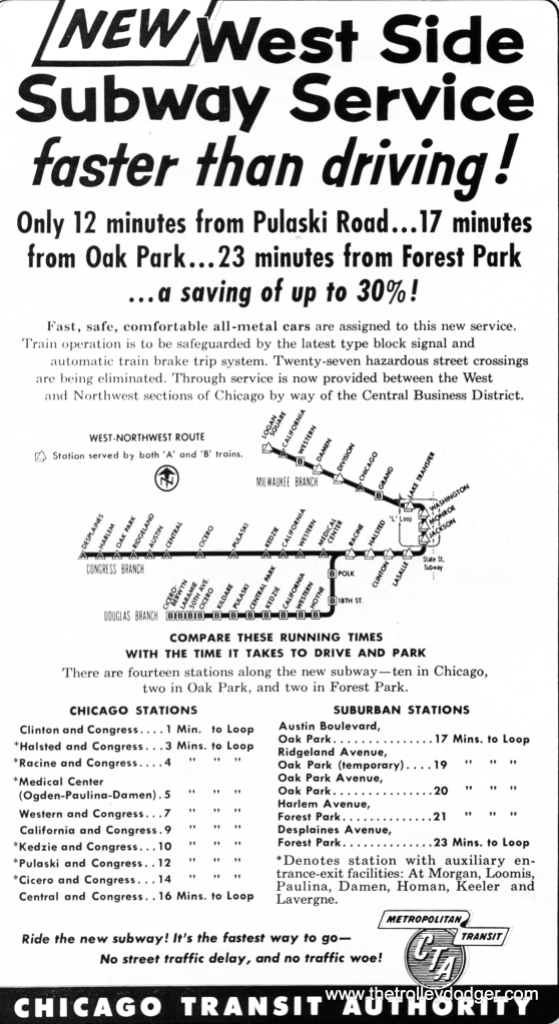
Likewise, it did not benefit the CTA to keep the CA&E running. Better to let them abandon service, in case it would have been possible for the CTA to resume service over a portion of the interurban (to Wheaton) later on. In any event, CTA did not want to operate any service over former CA&E trackage until and unless their additional operating expenses would be paid for. And nobody stepped forward to make that happen.

So, once CA&E had distributed the proceeds from various land sales to their shareholders, there was little or nothing left in the till to pay for a resumption of passenger service in 1959. And although there was a modest increase in freight traffic after the 1957 abandonment of passenger service, the railroad was still losing money. Without a firm sale or an additional funding source, the railroad’s choices were to either dissipate all their remaining assets, or simply go out of business.

It was hoped that the December 1958 fantrip would help generate interest in a resumption of passenger service on the CA&E. Unfortunately, this did not happen.

If service had been resumed, there likely would have been continued short-term losses in passengers due to completion of the Congress (now Eisenhower) expressway in the suburbs. But over time, this trend surely would have reversed itself and passenger counts would have once again increased as the western suburbs became more and more built up.

As it turned out, the state and CTA wanted to be the “good cops,” who would resume some partial level of service on the interurban if DuPage County would cover the costs, and were perfectly happy to let CA&E act as the “bad cop” who discontinued service. And in this, they rose to the occasion, with an abrupt midday shutdown that stranded thousands of riders on July 3, 1957. They were content to “take the money and run,” so to speak.

The great majority of images in this post were shot by one unknown photographer who went on the 1959 fantrip. Mark Llanuza purchased them from the man’s daughter after he died.

Film speeds were much slower in 1958 than they are today. Kodachrome was ISO 10, meaning it was mainly usable only on sunny days. However, Kodak had also introduced Ektachrome, another slide film with an initial speed of 32. I believe this is the film used on that day.

These images have a larger grain structure than is typical for Kodachrome, and are, in general, underexposed. This was a day when ISO 400 would have been a better choice, if such a thing had existed. Even the most popular black-and-white film of the time, Super-XX, only had a speed of 200 ISO.

Many railfan photographers were turned off to Ektachrome because the version available around 1956 faded badly to red in a short period of time. (Technically speaking, the red layer stayed the same, while the green and blue layers faded.) This problem appears to have been solved by 1958, when these pictures were taken.

Under the circumstances, we can be glad that the pictures turned out as well as they did. Since the film was somewhat underexposed, there are reciprocity shifts in color, which generally gave these images an overall blue cast which is unnatural. We have attempted to correct for these color shifts as best we could, but it was not always possible to eliminate all of them without increasing the contrast in each image to an excessive degree. In other words, if there is snow in the picture, you want the snow to look white and not blue, yellow, or gray.

Looking at these pictures, it’s possible to figure out somewhat the itinerary for the trip, including the photo stops and where there were staged run-bys for the benefit of motion picture cameras. Presumably, if there weren’t any freight movements on that Sunday, the fantrip had the entire railroad to itself and didn’t have to worry about any meets.

The flyer mentions a “speed run” back from Elgin but I do not know offhand to what extent CA&E’s automatic gates were still in use at this point. Freight service continued for but a few more months after this before it, too, was abandoned forever.

Thanks again to Mark for sharing these rare images with us, the last gasp of the legendary “Roarin’ Elgin.”

-David Sadowski

PS- You can hear rare audio recordings of the Chicago, Aurora & Elgin on Railroad Record Club LP #36. This recording has been digitally remastered onto compact disc, along with RRC 35, and is available in our Online Store. Along with the CA&E, this disc also features recordings of the CTA Garfield Park “L”, the North Shore Line, and Milwaukee city streetcars.

Mark Llanuza writes:

You did a really great job putting this together for your fans and members. I talked to Norm Carlson who rode this trip on a very cold December 7th 1958 trip. He said it was cold and damp, then started to rain and got colder and snow came. They ran five photo run bys– one at Elgin station, Lakewood, Wheaton Golf club, Price Crossing rd., Glen Oak, and a grand tour of the Wheaton shops in the snow storm.


Help Support The Trolley Dodger

gh1

This is our 114th post, and we are gradually creating a body of work and an online resource for the benefit of all railfans, everywhere. To date, we have received over 116,000 page views, for which we are very grateful.

You can help us continue our original transit research by checking out the fine products in our Online Store. You can make a donation there as well.

As we have said before, “If you buy here, we will be here.”

We thank you for your support.


http://www.greatthirdrail.org/images/ROW_despl_br.jpg
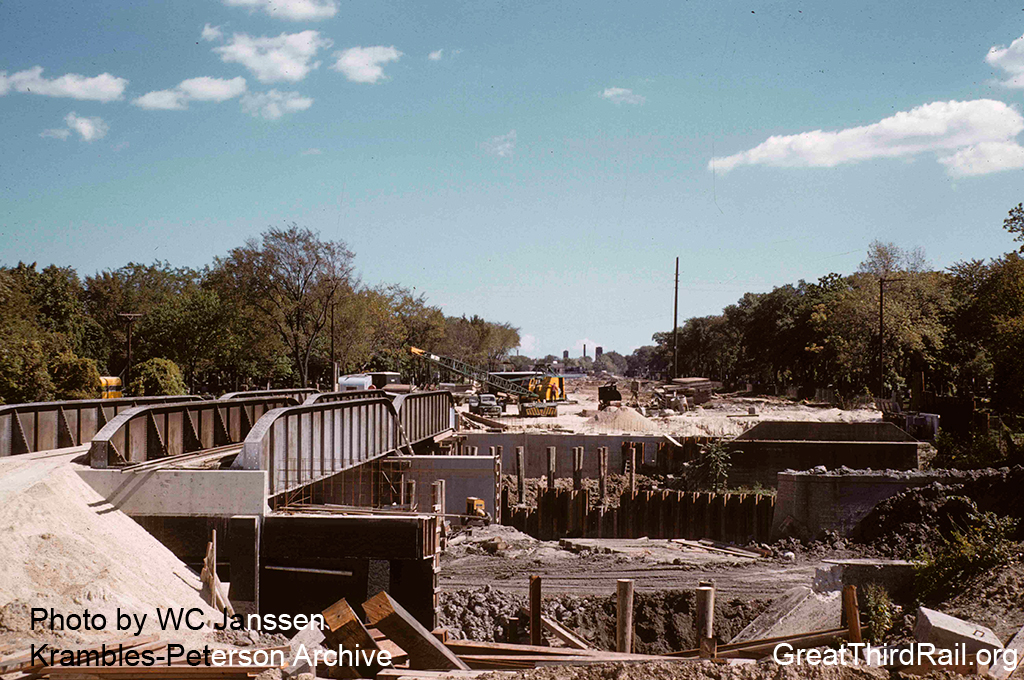
When the fantrip took place, the CA&E’s former right-of-way near the DesPlaines River was torn up for expressway construction. As you can see in this photo, the bridge was in the process of being shifted to the north, with a new track alignment. This process was not completed until the second half of 1959, by which time the railroad was unable to resume service even on a trial basis. The new track connection to the CTA Forest Park terminal was never used.

The Chicago Tribune weather forecast for December 7, 1958 called for cloudy and cold conditions, with a temperature between 12 and 20 degrees.

The Chicago Tribune weather forecast for December 7, 1958 called for cloudy and cold conditions, with a temperature between 12 and 20 degrees.

The flyer for what became the final passenger movement on the CA&E. Freight service lasted a few months into 1959 before it too was abandoned. Various efforts to revive the interurban failed, and it received government permission for complete abandonment in 1961. (William Barber Collection)

The flyer for what became the final passenger movement on the CA&E. Freight service lasted a few months into 1959 before it too was abandoned. Various efforts to revive the interurban failed, and it received government permission for complete abandonment in 1961. (William Barber Collection)

A CA&E pocket map made by Roy G. Benedict in 1958, when the "Roarin' Elgin" had already abandoned passenger service (except for charters) but was still running freight. Roy mimeographed these and sold them to aspiring railfans. He has made many additional maps since, and has had a successful career in the publishing industry.

A CA&E pocket map made by Roy G. Benedict in 1958, when the “Roarin’ Elgin” had already abandoned passenger service (except for charters) but was still running freight. Roy mimeographed these and sold them to aspiring railfans. He has made many additional maps since, and has had a successful career in the publishing industry.

photo016

When the fantrip began at 10:00 am, it had not started snowing yet. By the time it ended, at 5:00 pm, a substantial amount of snow was on the ground.

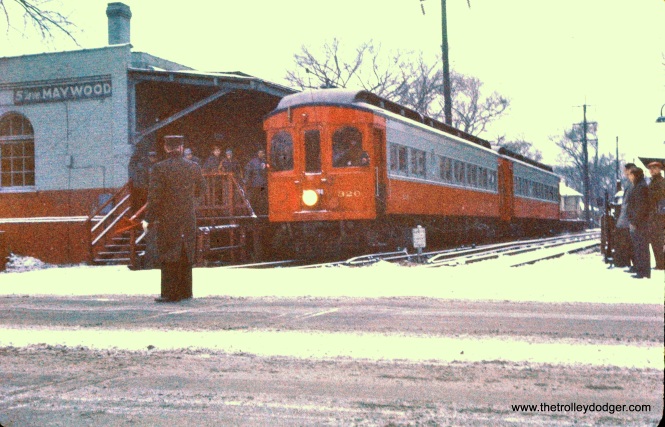
On December 7, 1958, CA&E wood cars 319 and 320 operated the last passenger train on that venerable railroad as a charter. Here, we are at Fifth Avenue station looking east. After the CTA abandoned the Westchester branch, this station was repainted in CA&E colors, and the interurban took over all service here from 1951-57.

On December 7, 1958, CA&E wood cars 319 and 320 operated the last passenger train on that venerable railroad as a charter. Here, we are at Fifth Avenue station looking east. After the CTA abandoned the Westchester branch, this station was repainted in CA&E colors, and the interurban took over all service here from 1951-57.

319-320 at the Aurora terminal. (Mark Llanuza Collection)

319-320 at the Aurora terminal. (Mark Llanuza Collection)

Aurora terminal. (Mark Llanuza Collection)
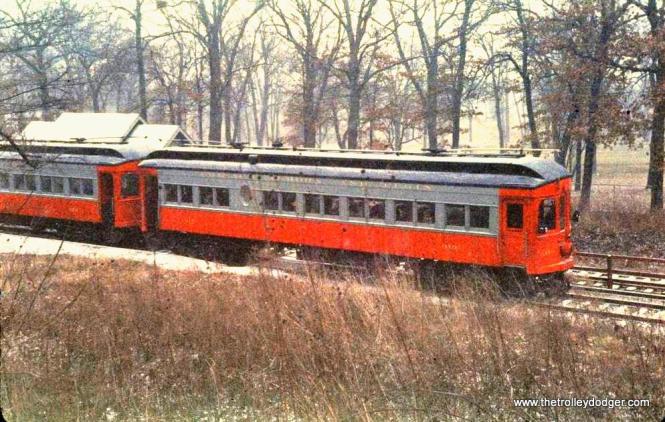
Aurora terminal. (Mark Llanuza Collection)

319-320 at Glen Oak. (Mark Llanuza Collection)
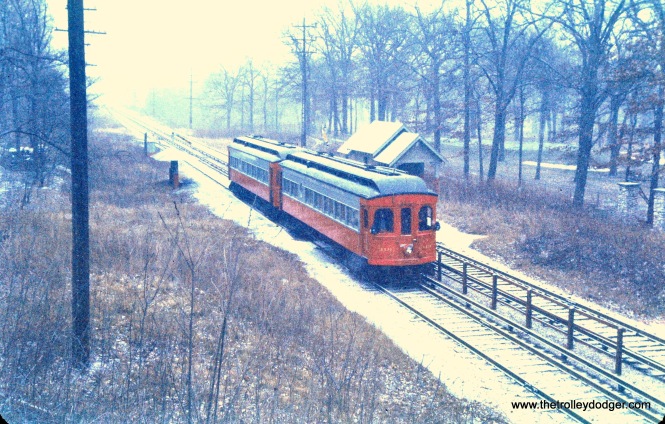
319-320 at Glen Oak. (Mark Llanuza Collection)
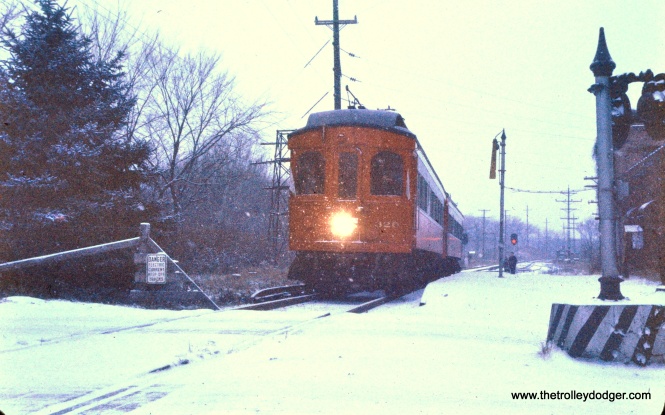
319-320 at Glen Oak. (Mark Llanuza Collection)

319-320 at Glen Oak. (Mark Llanuza Collection)

320-319 at Prince Crossing on the Elgin branch. (Mark Llanuza Collection)
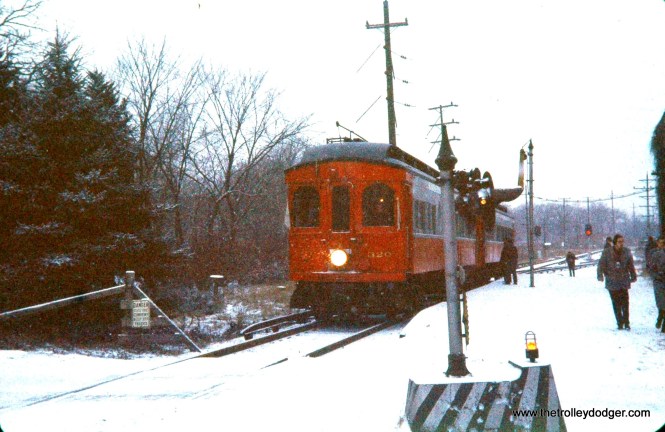
320-319 at Prince Crossing on the Elgin branch. (Mark Llanuza Collection)

320-319 at Prince Crossing Road. (Mark Llanuza Collection)

320-319 at Prince Crossing Road. (Mark Llanuza Collection)

Chicago Golf Club at Wheaton. (Mark Llanuza Collection)

Chicago Golf Club at Wheaton. (Mark Llanuza Collection)

319-320 at the Chicago Golf Club in Wheaton. (Mark Llanuza Collection)

319-320 at the Chicago Golf Club in Wheaton. (Mark Llanuza Collection)

319 at Wheaton Shops. (Mark Llanuza Collection)

319 at Wheaton Shops. (Mark Llanuza Collection)

Freight motors at Wheaton Shops. (Mark Llanuza Collection)

Freight motors at Wheaton Shops. (Mark Llanuza Collection)

Wheaton Shops. (Mark Llanuza Collection)

Wheaton Shops. (Mark Llanuza Collection)
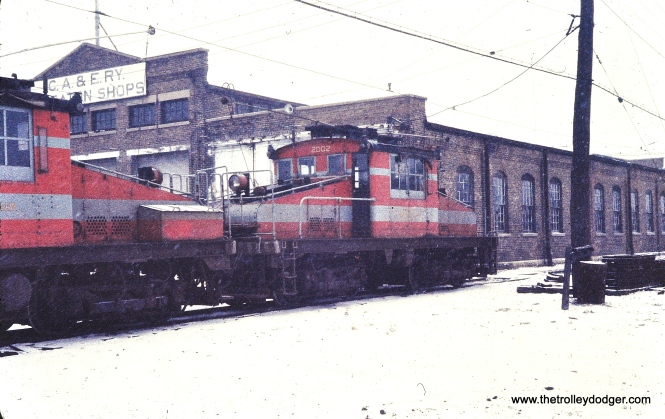
Wheaton Shops. (Mark Llanuza Collection)
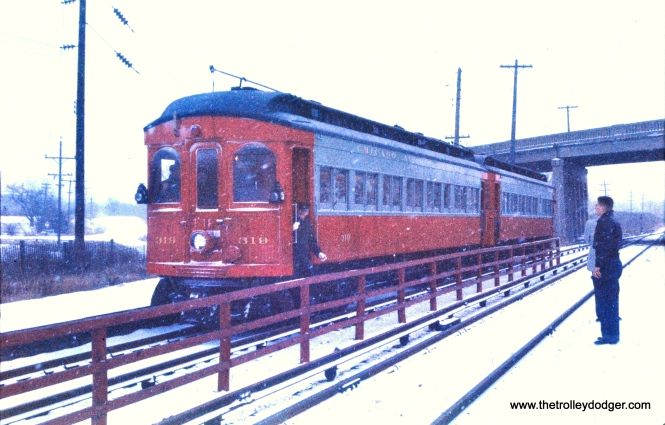
Wheaton Shops. (Mark Llanuza Collection)

Wheaton Shops. (Mark Llanuza Collection)[/caption]

Wheaton Shops. (Mark Llanuza Collection)

[/caption]

Wheaton Shops. (Mark Llanuza Collection)[/caption]

Wheaton Shops. (Mark Llanuza Collection)

[/caption]

Wheaton Shops. (Mark Llanuza Collection)

Wheaton Shops. (Mark Llanuza Collection)

319-320 at Lakewood Station in West Chicago. (Mark Llanuza Collection)

319-320 at Lakewood Station in West Chicago. (Mark Llanuza Collection)

The former Lakewood station as it looked last summer. It is now part of the Illinois Prairie Path. (Mark Llanuza Photo)

The former Lakewood station as it looked last summer. It is now part of the Illinois Prairie Path. (Mark Llanuza Photo)

At speed near Lakewood Station, West Chicago. (Mark Llanuza Collection)

At speed near Lakewood Station, West Chicago. (Mark Llanuza Collection)

319-320 near the Clintonville Station on the Elgin branch, December 7, 1958. (Mark Llanuza Collection)

319-320 near the Clintonville Station on the Elgin branch, December 7, 1958. (Mark Llanuza Collection)

319-320 in Elgin. (Mark Llanuza Collection)
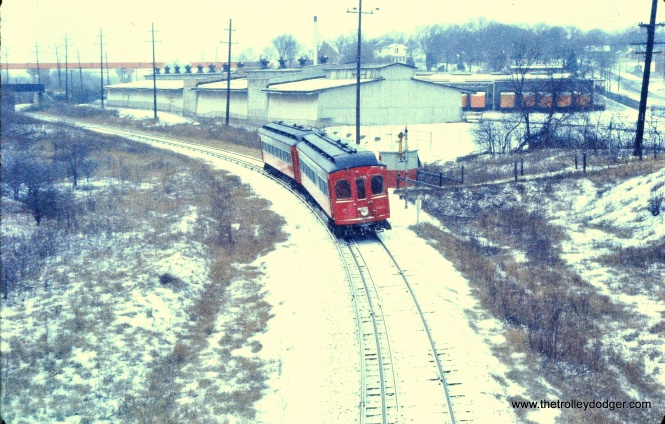
319-320 in Elgin. (Mark Llanuza Collection)

At the Corrugated Box Co., Elgin. (Mark Llanuza Collection)
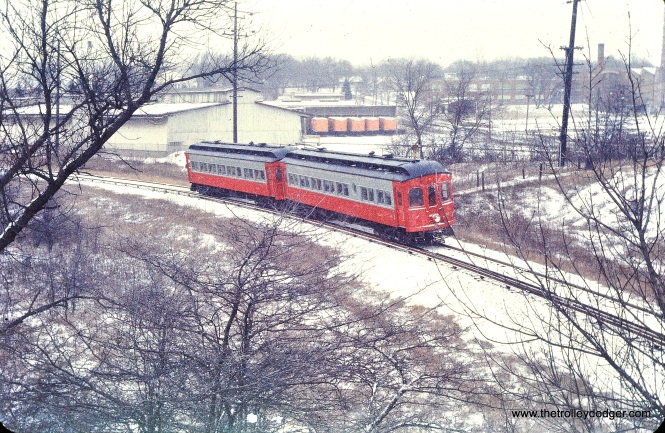
At the Corrugated Box Co., Elgin. (Mark Llanuza Collection)
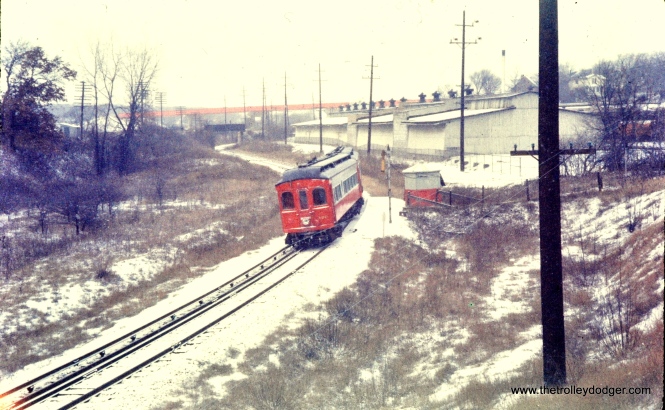
At the Corrugated Box Co., Elgin. (Mark Llanuza Collection)

At the Corrugated Box Co., Elgin. (Mark Llanuza Collection)

At the Corrugated Box Co., Elgin. (Mark Llanuza Collection)

At the Corrugated Box Co., Elgin. (Mark Llanuza Collection)

320-319 near the Corrugated Box Company on the Elgin branch, December 7, 1958. (Mark Llanuza Collection)

320-319 near the Corrugated Box Company on the Elgin branch, December 7, 1958. (Mark Llanuza Collection)

320-319 at the Elgin terminal. (Mark Llanuza Collection)

320-319 at the Elgin terminal. (Mark Llanuza Collection)

320 at the Elgin terminal. (Mark Llanuza Collection)
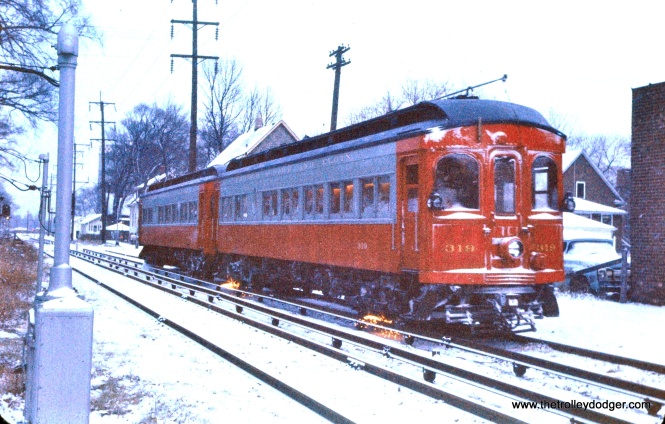
320 at the Elgin terminal. (Mark Llanuza Collection)

319-320 arcing in Maywood. (Mark Llanuza Collection)
319-320 arcing in Maywood. (Mark Llanuza Collection)

320-319 at 5th Avenue, Maywood. (Mark Llanuza Collection)

320-319 at 5th Avenue, Maywood. (Mark Llanuza Collection)


After Abandonment:

Dunham Road, Wayne IL, January 1960. (Mark Llanuza Collection)

Dunham Road, Wayne IL, January 1960. (Mark Llanuza Collection)
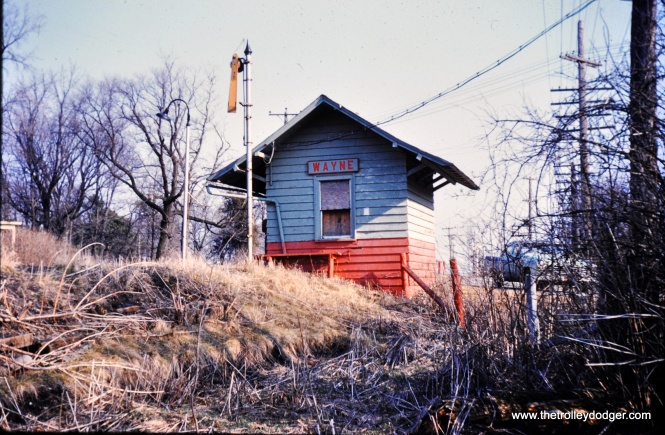
Dunham Road, Wayne IL, January 1960. (Mark Llanuza Collection)

Dunham Road, Wayne IL, January 1960. (Mark Llanuza Collection)

The former CA&E station at Wayne (Army Trail Road) as it looked in November 1961. (Mark Llanuza Collection)

The former CA&E station at Wayne (Army Trail Road) as it looked in November 1961. (Mark Llanuza Collection)

Glen Ellyn Station in 1961. (Mark Llanuza Collection)
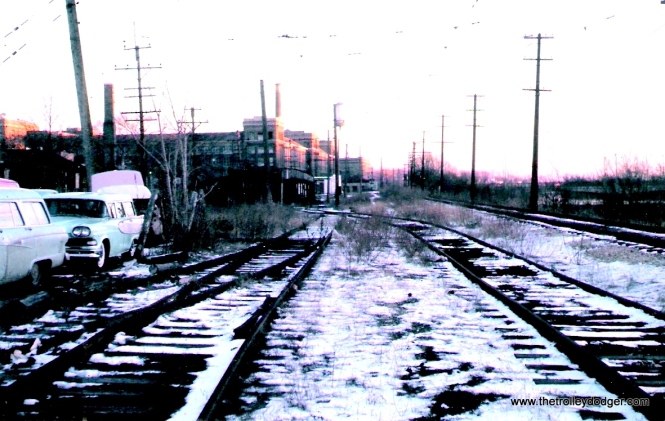
Glen Ellyn Station in 1961. (Mark Llanuza Collection)

The Elgin Watch Factory in January 1963. It closed the following year. (Mark Llanuza Collection)

The Elgin Watch Factory in January 1963. It closed the following year. (Mark Llanuza Collection)

Tokens of Our Esteem

The North Shore Line Milwaukee terminal in January 1963.

The North Shore Line Milwaukee terminal in January 1963.

We’ve reached our one-year anniversary, and have successfully renewed our Internet domain for another year, thanks to your generous contributions. Over the past year, many people have made contributions here, and not always financial.

I like to think of The Trolley Dodger as a place where we can all share information, discuss various topics and learn things together. As I’ve said before, I learn a lot from our readers and the things they choose to share with us. Coming here is like taking a stroll through a curiosity shop, and today we have lots of curios to share with you.

With the 53rd anniversary of the abandonment of the North Shore Line coming up on Thursday (the 21st), we have included a few pictures from the final days of that great electric interurban railway that once ran between Chicago and Milwaukee.

If you can shed any light on some of today’s mysteries, we would love to hear from you. You can make a comment on this page or drop us a line directly at:

thetrolleydodger@gmail.com

Thanks.

-David Sadowski

PS- We will continue our birthday celebration with another collection of great images in our next post, so watch this space.

Thanks to the generous donations from our readers, we have renewed our domain for another year. The various photos in today's post are but tokens of our esteem.

Thanks to the generous donations from our readers, we have renewed our domain for another year. The various photos in today’s post are but tokens of our esteem.


Help Support The Trolley Dodger

gh1

This is our 112th post, and we are gradually creating a body of work and an online resource for the benefit of all railfans, everywhere. To date we have received 114,000 page views from over 32,000 visitors.

You can help us continue our original transit research by checking out the fine products in our Online Store. You can make a donation there as well.

As we have said before, “If you buy here, we will be here.”

We thank you for your support.


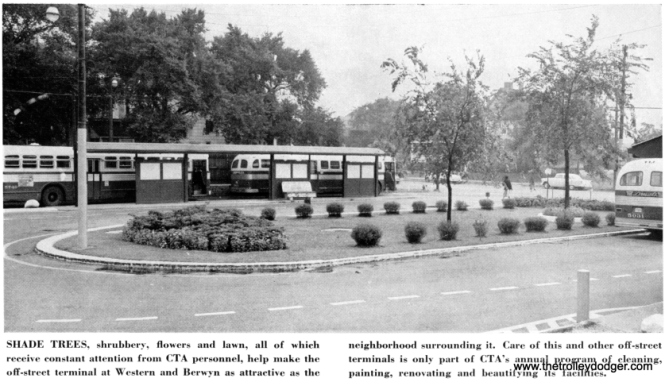
More Off-Street Loops

Andre Kristopans has a few additions to the very comprehensive list of Chicago’s off-street streetcar and bus turnaround loops he shared with us recently:

A few additions:

Roosevelt/Monitor – abandoned 09/28/08 when lease expired and renewal could not be negotiated

Madison/Springfield – 07/16/1890 out 12/13/53 originally for cable cars

118th/Burley – 4/8/45 to 7/1/47 – this was an odd situation. Both 118th and Burley were “dedicated streets”, but only Burley was paved. the “terminal” which had been a passing siding, was thus on open track. In addition, after 10/21/46, when Ewing-Brandon was bussed, only the South Chicago cars ended there, basically in the middle of nowhere, next to a tavern.

Canal between Harrison and Polk – 2/7/72 to 10/1/81 – an exclusive counterflow lane for Taylor/Sedgwick buses after the Polk St bridge was closed.

Cortland/Paulina – 9/1/47 to 4/17/59 – apron of old Noble Carhouse used by Southport buses until it was about to be torn down

Pulaski/21st – 4/26/04 to 6/16/08 – part of rebuilt Pulaski L station, not used after Ogden bus cut back to California

Blue Island/Leavitt 7/27/1893 to 7/20/06 – terminal for Blue Island cable cars adjacent to Blue Island carhouse

Corcoran/Menard – 10/26/27 to 5/19/47 – CMC is said to have had an off-street terminal here for Washington buses, but no good description has survived. 1938 aerial photo shows nothing obvious, so it might have involved wyeing by backing into a driveway.

Another subcategory– Counterflow lanes:

Madison between Desplaines and Michigan, Washington between Michigan and Jefferson 9/13/81 to 9/8/85

Adams between Jefferson and Michigan, Jackson between Michigan and Jefferson 8/31/80 to 4/20/86 (note – one block on Adams between Jefferson and Clinton not put into use until 2/1/81 account construction at the corner of Jefferson and Adams)

Canal between Randolph and Washington (NW Station) 6/22/64, extended to Lake St 7/20/81 to 8/5/87

Canal between Adams and Jackson (Union Station) 5/14/69, moved to NB exclusive lane on east side of Canal 8/31/80, returned to SB on west side of Canal 4/20/86. (note – replaced use of River Drive between Adams and Jackson which had been used since 6/22/64, however River Drive was actually a cab drive and therefore not an “off street terminal” in the strict sense, even though cars were not supposed to use it.


About that previous list, Daniel Joseph writes:

The only addition I can add to this complete list is the terminal on Sherman between Church and Davis inherited from Evanston Bus Company.


Andre replies:

Don’t know much about it. Basically, EBC loaded along regular curb until city of Evanston “streetscaped” the street in late 60’s or so, leaving a short piece of original curb for buses to load while rest of street in the two blocks between Clark and Davis was substantially narrowed and sidewalks widened. Orrington was done at the same time, as were parts of Church and Davis. Last buses that could have used the cut-out would have been the N201. Sort of what was done much later to Benson between Church and Davis. The “bus lane” is the original right lane.


The North Shore Line in January 1963, shortly before the end.

The North Shore Line in January 1963, shortly before the end.

North Shore Line freight loco 459 heads up a train in January 1963.

North Shore Line freight loco 459 heads up a train in January 1963.

A Silverliner and an Electroliner at the North Shore Line's Milwaukee terminal in January 1963.

A Silverliner and an Electroliner at the North Shore Line’s Milwaukee terminal in January 1963.

An Electroliner on the Chicago "L" in July 1962. Not sure of the exact location, but I assume this is Roosevelt Road where the NSL had free reign between 1949 and 1963 (CTA trains ran through the nearby subway then).

An Electroliner on the Chicago “L” in July 1962. Not sure of the exact location, but I assume this is Roosevelt Road where the NSL had free reign between 1949 and 1963 (CTA trains ran through the nearby subway then).

CNS&M electric locos 458 and 455 in July 1962.

CNS&M electric locos 458 and 455 in July 1962.

North Shore Line 712 at Roosevelt Road in July 1962.

North Shore Line 712 at Roosevelt Road in July 1962.

Ad touting 349 new trolley coaches ordered for the Chicago Transit Authority, 1951.

Ad touting 349 new trolley coaches ordered for the Chicago Transit Authority, 1951.

An unusual Chicago Surface Lines supervisor's badge just sold for $80 on eBay. I was not the buyer.

An unusual Chicago Surface Lines supervisor’s badge just sold for $80 on eBay. I was not the buyer.

cslbadge2

cslbadge3

cslbadge4

This 1886 trade magazine includes an article detailing how the LaSalle Street cable car tunnel under the Chicago River was being expanded and upgraded.

This 1886 trade magazine includes an article detailing how the LaSalle Street cable car tunnel under the Chicago River was being expanded and upgraded.

lasalletunnel2

lasalletunnel3

San Francisco cable car 524 at the Chicago Railroad Fair on June 21, 1949. (Jeff Marinoff Collection) One of our readers notes, "Most of the gentlemen shown in transit uniforms appear to be wearing caps that have the Chicago Surface Lines cap badge on them in spite of the fact that according to the date on the photo the CTA had been in existence for almost two years. The guy with the coin changer might be wearing a CTA cap badge of the period." Interesting. Guess things didn't get replaced immediately. "They were also slow to slap the CTA decals on some of the streetcars too."

San Francisco cable car 524 at the Chicago Railroad Fair on June 21, 1949. (Jeff Marinoff Collection) One of our readers notes, “Most of the gentlemen shown in transit uniforms appear to be wearing caps that have the Chicago Surface Lines cap badge on them in spite of the fact that according to the date on the photo the CTA had been in existence for almost two years. The guy with the coin changer might be wearing a CTA cap badge of the period.” Interesting. Guess things didn’t get replaced immediately. “They were also slow to slap the CTA decals on some of the streetcars too.”

A Marion (Indiana) Birney car circa 1940.

A Marion (Indiana) Birney car circa 1940.

South Shore Line #15 in an unusual paint scheme on a 1954 fantrip.

South Shore Line #15 in an unusual paint scheme on a 1954 fantrip.

CSS&SB 106 heads up a two-car train going east from the South Shore's old South Bend terminal. This street running was eliminated in 1970 when the line was cut back to Bendix at the outskirts of town. Since then, it has been extended to the local airport.

CSS&SB 106 heads up a two-car train going east from the South Shore’s old South Bend terminal. This street running was eliminated in 1970 when the line was cut back to Bendix at the outskirts of town. Since then, it has been extended to the local airport.

George Foelschow: "The latest Trolley Dodger installment, which included a photo of a South Shore Line train on East LaSalle Avenue in South Bend, reminded me of a watercolor painting I acquired before moving from Chicago in 1978. The artist is David Tutwiler and the painting is dated (19)77. It depicts a similar scene. I thought you may want to share it with Trolley Dodger readers." Thanks, George!

George Foelschow: “The latest Trolley Dodger installment, which included a photo of a South Shore Line train on East LaSalle Avenue in South Bend, reminded me of a watercolor painting I acquired before moving from Chicago in 1978. The artist is David Tutwiler and the painting is dated (19)77. It depicts a similar scene. I thought you may want to share it with Trolley Dodger readers.” Thanks, George!

The same location today.

The same location today.

South Shore Line cars 28 and 19 at the Randolph Street station in downtown Chicago in March 1978. By then, these cars were more than 50 years old and had but a few more years to run. That's the Prudential Building in the background. Since then, this station has been rebuilt and is now underneath Millennium Park.

South Shore Line cars 28 and 19 at the Randolph Street station in downtown Chicago in March 1978. By then, these cars were more than 50 years old and had but a few more years to run. That’s the Prudential Building in the background. Since then, this station has been rebuilt and is now underneath Millennium Park.

This is where the Lehigh Valley Transit’s Liberty Bell Limited interurban cars went up a ramp to an elevated connection with the Philadelphia & Western in Norristown. This photo of car 710 is from 1944. The ramp, a few blocks long, was torn down in 1954. The interurban quit in 1951, which made it superfluous.

This is where the Lehigh Valley Transit’s Liberty Bell Limited interurban cars went up a ramp to an elevated connection with the Philadelphia & Western in Norristown. This photo of car 710 is from 1944. The ramp, a few blocks long, was torn down in 1954. The interurban quit in 1951, which made it superfluous.

As you can see from this current photo of Swede Street in Norristown, the elevated section in the previous picture continued a few blocks from the present terminus of the former P&W, running all the way to the domed building at rear. Once the LVT interurban quit in 1951, it was no longer needed and was torn down a few years later.

As you can see from this current photo of Swede Street in Norristown, the elevated section in the previous picture continued a few blocks from the present terminus of the former P&W, running all the way to the domed building at rear. Once the LVT interurban quit in 1951, it was no longer needed and was torn down a few years later.

An interesting and unusual fate for a Philadelphia PCC-- being turned into an ice cream stand. This picture was taken in 2002. Jeff Marinoff adds, "The Philadelphia PCC car is still at the Trolley Car Diner on Germantown Avenue in Mt. Airy. The car is not a diner, however. The car is an ice cream stand. You don't sit on the car, you walk up to a window and get your order."

An interesting and unusual fate for a Philadelphia PCC– being turned into an ice cream stand. This picture was taken in 2002. Jeff Marinoff adds, “The Philadelphia PCC car is still at the Trolley Car Diner on Germantown Avenue in Mt. Airy. The car is not a diner, however. The car is an ice cream stand. You don’t sit on the car, you walk up to a window and get your order.”

Gwen Deanne writes: "My mother wearing the most fabulous shoes ever, and my brother exercising his "open carry" rights as a youngster bringing a BB gun on the train. This is 100% Chicago, but which station, I don't now. Perhaps you can figure it out. They lived on North Talman at the time, but Nana lived in Wicker Park. They could have been going anywhere. Taken by my Dad. The next brother was born, and not pictured. He may be with Nana, or Auntie Olga." Mike Murray: " That's the Ardmore station of the Chicago, Aurora, & Elgin Railroad, facing east in Villa Park. The station is still there, but the railroad quit passenger service on July 3, 1957. Much of the route is now the Prairie Path. The silver water tower in the distance is the Ovaltine Factory." Here is another picture of the same station: http://www.greatthirdrail.org/stations/main/ardmore.html (Photo from the Gwen Deanne Collection, used by permission)

Gwen Deanne writes: “My mother wearing the most fabulous shoes ever, and my brother exercising his “open carry” rights as a youngster bringing a BB gun on the train. This is 100% Chicago, but which station, I don’t now. Perhaps you can figure it out. They lived on North Talman at the time, but Nana lived in Wicker Park. They could have been going anywhere. Taken by my Dad. The next brother was born, and not pictured. He may be with Nana, or Auntie Olga.” Mike Murray: ” That’s the Ardmore station of the Chicago, Aurora, & Elgin Railroad, facing east in Villa Park. The station is still there, but the railroad quit passenger service on July 3, 1957. Much of the route is now the Prairie Path. The silver water tower in the distance is the Ovaltine Factory.” Here is another picture of the same station:
http://www.greatthirdrail.org/stations/main/ardmore.html (Photo from the Gwen Deanne Collection, used by permission)

This 1955 photo's a bit of a mystery. Could this be Wheaton? William Barber: "Yes, this is Wheaton at the grade crossing immediately east of the depot." Bill Shapotkin: "This pic is Cross St, Wheaton. View looks east."

This 1955 photo’s a bit of a mystery. Could this be Wheaton? William Barber: “Yes, this is Wheaton at the grade crossing immediately east of the depot.” Bill Shapotkin: “This pic is Cross St, Wheaton. View looks east.”

CA&E freight and passenger trains in Elmhurst in this November 5, 1949 view. (Gordon E. Lloyd Photo) Bill Shapotkin: "This pic is just east of Mannhiem Rd. The frt locos are on the CA&E/IHB interchange. While technically near Butterfield Rd, it is nowhere near Roosevelt Rd." (Roosevelt and Butterfield was written on the back of the photo, apparently in error. This was not uncommon when the photographer was from out of town.)

CA&E freight and passenger trains in Elmhurst in this November 5, 1949 view. (Gordon E. Lloyd Photo) Bill Shapotkin: “This pic is just east of Mannhiem Rd. The frt locos are on the CA&E/IHB interchange. While technically near Butterfield Rd, it is nowhere near Roosevelt Rd.” (Roosevelt and Butterfield was written on the back of the photo, apparently in error. This was not uncommon when the photographer was from out of town.)

The CA&E Wheaton Yard. This photo was dated as the 1950s but looks to be earlier.

The CA&E Wheaton Yard. This photo was dated as the 1950s but looks to be earlier.

The CA&E Elgin terminal.

The CA&E Elgin terminal.

The same location as the previous photo, early 1950s.

The same location as the previous photo, early 1950s.

CA&E 405 at Spring Road in Elmhurst. Dig that phone booth.

CA&E 405 at Spring Road in Elmhurst. Dig that phone booth.

CA&E 406, in this 1957 picture, is identified as being at Fifth Avenue in Maywood. Perhaps one of our keen-eyed readers can confirm this. Bill Shapotkin: "This pic NOT anywhere near Maywood. It is WEST of Hill Ave (aka Glen Oak Rd) in Glen Ellyn. Beyond the bridge is the Glen Oak station. View looks east."

CA&E 406, in this 1957 picture, is identified as being at Fifth Avenue in Maywood. Perhaps one of our keen-eyed readers can confirm this. Bill Shapotkin: “This pic NOT anywhere near Maywood. It is WEST of Hill Ave (aka Glen Oak Rd) in Glen Ellyn. Beyond the bridge is the Glen Oak station. View looks east.”

A CA&E pocket map made by Roy G. Benedict in 1958, when the "Roarin' Elgin" had already abandoned passenger service (except for charters) but was still running freight. Roy mimeographed these and sold them to aspiring railfans. He has made many additional maps since, and has had a successful career in the publishing industry. The Forest Park loop shown at the bottom of this page is where the next picture in this post was taken.

A CA&E pocket map made by Roy G. Benedict in 1958, when the “Roarin’ Elgin” had already abandoned passenger service (except for charters) but was still running freight. Roy mimeographed these and sold them to aspiring railfans. He has made many additional maps since, and has had a successful career in the publishing industry. The Forest Park loop shown at the bottom of this page is where the next picture in this post was taken.

photo016

CA&E 409 and 414 on the turnback loop in Forest Park in 1957.

CA&E 409 and 414 on the turnback loop in Forest Park in 1957.

Throwback Thursday

A recent post mentioned a May 25, 1958 CERA fantrip, where Chicago Transit Authority personnel brought out cars from their historical collection to pose for photographs. Here is another such car taken out that day, Chicago street railway post office #6, built in 1891 and currently preserved at the Fox River Trolley Museum in South Elgin.

A recent post mentioned a May 25, 1958 CERA fantrip, where Chicago Transit Authority personnel brought out cars from their historical collection to pose for photographs. Here is another such car taken out that day, Chicago street railway post office #6, built in 1891 and currently preserved at the Fox River Trolley Museum in South Elgin.

This is “Throwback Thursday,” so rather than have an over-arching theme, we present several interesting photos spanning the 1940s to the 1970s that we hope you will enjoy.

Happy New Year!

-David Sadowski


Help Support The Trolley Dodger

gh1

This is our 110th post, and we are gradually creating a body of work and an online resource for the benefit of all railfans, everywhere.

You can help us continue our original transit research by checking out the fine products in our Online Store. You can make a donation there as well.

As we have said before, “If you buy here, we will be here.”

We thank you for your support.

PS- As we approach our one-year anniversary this month, the deadline for renewing our premium WordPress account comes due in less than ten days. This includes out Internet domain www.thetrolleydodger.com, much of the storage space we use for the thousands of files posted here, and helps keep this an ads-free experience for our readers. Your contributions towards this goal are greatly appreciated, in any amount.


Updates

George Foelschow writes:

Some time ago, I mentioned that I had two CSL/CTA surface track maps and offered to scan them for The Trolley Dodger. Well, I am confined at home today thanks to an El Nino storm and finally got around to it.

I think the CSL 1939 map is notable in that it probably represents the maximum extent of surface track in Chicago. It includes the Roosevelt and Cermak extensions into Burnham Park, 47th Street into the same park, and the full extent of 87th Street. Add in improbable and early abandonments like Franklin/Elm, Erie, and Fulton. The only stretch already gone is the Chicago Avenue line along Lake Shore Drive and into the Navy Pier area. There is even a stretch of dead track on Jefferson Street between VanBuren and Jefferson, which showed up on a photo published on your blog recently. Maybe sharp eyes can detect other anomalies.

I just received the long-awaited “New Look” data disc and am looking forward to settling down with that.

We thank Mr. Foelschow for his generosity. Both of these supervisor’s maps have been added to our E-book Chicago’s PCC Streetcars: The Rest of the Story, available from our Online Store. Now, our unique collection includes the track maps from 1939, 1941, 1946, 1948, 1949, 1952, and 1954.


Recent Correspondence

Olin Anderson of Walla Walla, Washington, who worked for the Chicago Area Transportation Study in the 1990s, asked if we could clear up some mysteries regarding track arrangements on the CTA Congress rapid transit line (featured in our recent E-Book The “New Look” in Chicago Transit: 1938-1973, which you can also find in our Online Store.

Here is what I believe at present:

1. The third track planned for Congress between DesPlaines and Laramie was intended to be used by CA&E as an express track that would keep CA&E and CTA trains separated.

2. The original transfer point between the two railroads was intended to be Laramie, where CA&E’s tracks ended and CTA’s began. These plans were eventually changed and DesPlaines became the transfer point. Meanwhile, CTA paid $1m to CA&E for their “infrastructure” between Laramie and DesPlaines Avenue, even though all this was due to be replaced soon anyway.

3. CA&E went back and forth on whether they would run their trains downtown even after completion of the new right-of-way. They made statements at varying times both ways.

4. CTA’s general preference would have been for CA&E to not run downtown since this would have complicated their operation of the line. They also felt that with the speed improvement of the new route, even if CA&E riders had to change to CTA they would still get downtown faster.

5. Expansion of the DesPlaines yard was an afterthought. The original plans envisioned a track connection to the old Laramie Yard. I have read that this was to be a flyover, but it would have made more sense to have a subway under the highway.

6. The City wanted Lake to be routed onto Congress via a new elevated connection. The location of this changed over the years, from about 3200 W. to 4400 W.

7. From the point where Lake was to be routed onto Congress there would have been four tracks. The two extra subway portals near Halsted were intended for use by Lake trains, as they would have gone into a new “distributor” subway.

8. CTA kept a portion of the old Humboldt Park branch until late 1961 as a potential storage area for CA&E trains.

9. There was talk right near the end (1957) of building a ramp for CA&E trains to connect with the “L” system. Presumably this would have been on the other side of the ramp that was built, and would have permitted CA&E trains to run downtown via the Paulina Connector and the Lake line to circle the Loop.

10. In 1953, when the track connection between CTA and CA&E was severed, that was fine with both of them, because they did not want to have to pay each other to run on each other’s tracks.

Thanks.

In the Comments section of a recent post, Jeff Weiner and I corresponded about the CTA’s PCC Conversion Program, a subject also covered in Chicago’s PCC Streetcars: The Rest of the Story. Thanks to Phil Becker, here are a couple of his photos showing cars going back and forth between CTA and St. Louis Car Company in 1957:

(Phil Becker Photo)

(Phil Becker Photo)

Here is a postwar Chicago PCC streetcar in the Streator Yard of the Santa Fe, on its way to St. Louis Car Company as part of the CTA's "conversion program." (Phil Becker Photo)

Here is a postwar Chicago PCC streetcar in the Streator Yard of the Santa Fe, on its way to St. Louis Car Company as part of the CTA’s “conversion program.” (Phil Becker Photo)


Again, thanks to Phil Becker, here are some of his pictures from a Central Electric Railfans’ Association fantrip held on May 27, 1973 using 4000-series “L” cars which were just being retired around this time. The occasion was CERA’s 35th anniversary.

Two 4000s remain on CTA property more than 90 years after they were put into service and are operated on special occasions.

(Phil Becker Photo)

(Phil Becker Photo)

(Phil Becker Photo)

(Phil Becker Photo)

(Phil Becker Photo)

(Phil Becker Photo)

(Phil Becker Photo)

(Phil Becker Photo)

(Phil Becker Photo)

(Phil Becker Photo)

(Phil Becker Photo)

(Phil Becker Photo)


Off-Street Chicago Bus and Streetcar Loops

Andre Kristopans has updated and expanded the list of off-street loops he recently shared with us:

Limits Garage 1860’s out 7/3/94
Root/Halsted 1/1895 out 8/9/53
Cable Ct/Harper 7/08 out 6/21/59
Wentworth/63 11/08 out 6/22/58
Western/Flournoy 6/09 out 7/18/65
Cottage Grove/72 11/10 out 9/28/56
State/63 1/11 out 1/9/57
Western/Roscoe 7/11 out 1/24/51
Vincennes/80 8/11 out 1990’s
Clark/Arthur 11/11 active
Halsted/79 12/12 active
63/King 6/13 out 6/28/69 (temporarily reactivated circa 1977 when Ryan L out of service at 18th)
Halsted/Waveland 3/15 active
Clark/Howard 4/15 out 12/3/61
75/Lakefront 5/15 active (cul-de-sac)
Broadway/Ardmore 12/15 out 12/26/63
Torrence/112 3/17 active
Devon/Sheridan 5/17 (CMC) out 10/18/53
Archer/Cicero 12/17 active (relocated 1955)
Navy Pier 6/21 active (relocated 1959, relocated again 1990’s)
Madison/Austin 7/21 active
Milwaukee/Imlay 9/27 active
Montrose/Milwaukee 1/25/31 out 9/23/78
Montrose/Narragansett 1/25/31 out 9/3/78
Belmont/Pacific 5/30/31 out 1/9/49
18th/Lake Shore 6/33 out 3/9/49
Roosevelt/Columbus 8/33 out 4/11/53
Hamlin/Fulton (CMC) 6/35 out 2/11/53
Belmont/Central 5/30/31 out 1/9/49 (relocated across street 9/16/35)
Diversey/Western 9/12/35 out 7/1/55
Diversey/Neva 10/4/38 active
Caldwell/Central 8/39 (relocated 10/29/61)
83/Green Bay 5/13/40 out 10/30/63
Bell & Howell 12/5/42 out 03/08/87
76/Keeler 7/26/43 out 3/16/53
76/Kilpatrick 7/26/43 out 6/21/59
Pershing/Western Blvd parking lot east of intersection 8/28/45 out 2/14/48
Pershing/Ashland parking lot west of intersection 8/28/45 out 1947
115/Cottage Grove 9/23/45 out 6/16/63 (south of 115th)
Montrose/Broadway 7/29/46 out 6/22/80
Monroe Parking Lot (CMC) 8/15/46 out 1972
Soldier Field Parking Lot (CMC) 8/15/46 out 9/12/83
Merchandise Mart Plaza 9/16/46 out 1987
Torrence/128 10/21/46 relocated to 130th west of Torrence 6/21/78, out 9/11/81
Torrence/112 10/21/46 out 4/25/48 (south of RR)
74/Damen 11/1/46 active
Irving Park/Cumberland 2/4/47 active (moved 1/24/64)
87/Western 5/22/47 active
Damen/Elston 6/19/47 out 9/30/63
84/State 6/28/47 out 11/26/58
116/Burley (Republic Steel) 6/30/47 out 11/30/86
Cortland/Paulina 8/31/47 out 4/17/59
31/Ellis 2/29/48 out 9/27/56
Narragansett/63 Pl 4/25/48 active
63/Archer 4/25/48 active (relocated 1990’s)
Harlem/64 Pl 6/15/48 active
Western/79 7/31/48 active
Devon/Kedzie 9/13/48 active
Irving Pk/Neenah 11/17/48 (moved from S to N of Irving Pk 7/9/58) out 1/24/88
16th/47th Ct 12/12/48 active
Belmont/Halsted 1/9/49 active
Belmont/Cumberland 1/9/49 active
Belmont/Octavia 1/9/49 active
Western/Berwyn 1/10/49 active
Western/Howard 2/17/49 active
North/Clybourn 7/3/49 out 12/28/08
Lehigh/Touhy 7/14/49 out 2/20/55
Cermak/Harlem (West Towns Garage) 8/13/49 out 1/16/57
Harrison/Central 8/14/49 active
Addison/Pontiac (CMC) 8/17/49 active
Western/Leland 11/14/49 active
Fullerton/Parkside 12/4/49 out 9/8/85
North/Clark 12/4/49 active
North/Narragansett 12/4/49 active
Jersey/Peterson 5/13/50 out 9/7/73
31/California 5/17/50 out 9/2/80
111/Harding 10/21/50 active
Central/Milwaukee 11/17/50 out 9/24/70
Grand/Nordica 4/1/51 active
47/Lake Park 4/15/51 active (moved from W of Lake Park to E 7/26/66)
Cicero/Pensacola 5/10/51 active
Lincoln/Wrightwood 7/2/51 out 4/27/60
Elston/Kentucky 7/19/51 out 7/8/55
Pulaski/Peterson 7/20/51 active
Archer/Neva 11/2/51 active
Lincoln Village 11/13/51 out 1/30/55 (McCormick N of Lincoln)
Lincoln/Whipple 11/23/51 out 4/9/84
Cicero/24 Pl 11/25/51 active
31/Komensky 12/6/51 active
Logan Square 12/19/51 out 1/31/70
North/Winchester 5/5/52 out 9/7/73
Grand/Latrobe 5/24/52 active
Cermak/54 Av 5/25/52 active (moved 8/18/03)
Fairbanks/Ontario 7/20/52 out 1990’s, new built 2000’s
79/Lakefront 8/11/52 relocated 2012
Roosevelt/Monitor 9/7/52 out 2000’s
Pulaski/Foster 9/8/52 out 1990’s
95/Western Evergreen Plaza 9/28/52 out 12/20/15
Chicago/Mayfield 12/13/52 active (moved to Austin 11/21/88)
Roosevelt/Wabash 5/12/53 out 4/15/73
Racine/87 5/28/53 active
26/Kenton 6/18/53 out 6/12/77
Desplaines/Congress 10/9/53 active relocated numerous times until 2/23/81
Jackson/Central Fieldhouse 10/29/53 out 7/8/55
Niles Center/Pratt 11/15/53 out 1/15/54
Kedzie/63 Pl 12/15/53 active
42/Packers 2/14/54 out 11/9/70 (moved 4/22/63)
87/Cicero 8/13/54 active moved to shopping center across Cicero 12/29/96
Ashland/95 11/4/54 active
California/Addison 11/26/54 out 3/31/13
Grand/Natchez 12/20/54 out 2/22/67
Western/119 2/9/55 active
Cermak/47 Av 4/17/55 out 6/29/86
Jackson/Austin 7/8/55 active
Forest Glen Garage 12/4/55 active
Damen/87 12/9/55 active
North Park Garage 12/4/55 no longer used as turnaround since 1/31/92
Cottage Grove/Burnside 8/22/56 out 4/1/91 (reactivated 6/17/07 to 8/23/10)
Brother Rice High School 9/10/56 active
Cermak Plaza 1/14/57 out 11/30/75
59/Keating 5/5/57 out 9/6/87
Howard/Kedzie 1/26/58 out 11/19/60 (east of Channel)
Jackson/Kedzie Garage 7/3/58 not used as turnaround since 1990’s
83/Wentworth 7/14/58 out 3/7/86
Teletype Corp 9/8/58 out 6/26/81
Pulaski/104 9/17/58 active
Cicero/64 11/27/58 out 11/7/93
Pulaski/77 6/21/59 out 6/1/62
79/Kilpatrick (Scottsdale) 6/21/58 out 3/5/00
Indianapolis/101 7/5/59 out 1970’s
Cumberland/Montrose 8/3/59 out 7/13/64
Howard/McCormick 11/3/60 active
Cermak/State 11/19/60 out 9/28/69
McCormick Place 11/19/60 out 1/16/67 account McCormick Place burned down
115/Pulaski 12/4/60 out 8/3/64
67/Oglesby 12/15/60 active
Howard/Hermitage 12/3/61 replaced 3/22/02
Pulaski/75 6/1/62 out 7/21/63
Pulaski/81 7/21/63 active
Beverly Garage 2/10/64 not used as turnaround after 11/19/03 (unofficially several years earlier)
Skokie Swift 4/19/64 active
Old Orchard 4/20/64 relocated to west mall entrance 2/11/74
Marist High School 8/24/64 out 8/30/07
Randolph/Lake Shore (Outer Drive East Apts) 9/14/64 out 3/7/75
55/St Louis 11/11/64 active replaced 2000’s
51/St Louis 1/13/65 out 11/7/93
115/Springfield 5/10/65 active
King Dr/Burnside 6/20/65 out 11/12/72
Ford City 8/12/65 active relocated 11/29/87
Luther High School (87/Sacramento) 11/24/65 out 1990’s
Pratt/Kedzie 8/1/66 out 6/23/03
Mercy Hospital 2/1/68 out 6/29/04?
Ashland/63 5/6/69 active
95/Dan Ryan 9/28/69 active
79/Perry 9/28/69 active
69/Dan Ryan 9/28/69 active
Cermak/Clark 9/28/69 out 12/10/76
Jefferson Park 2/1/70 active
Irving Park/Keystone 2/1/70 active
Belmont/Kimball 2/1/70 active
Logan Square 2/1/70 active
McCormick Place 1/2/71 out 1/80 account McCormick Place expansion
Olive/Harvey 2/8/71 active relocated 8/3/81 to west side of main bldg and 8/20/82 to s side of bldg
International Towers (Bryn Mawr/Delphia) 6/7/71 out 5/29/73
Wilson/E Ravenswood 1970’s out 12/15/12
King Dr/96 11/12/72 out 7/30/73 temporary Chicago State terminal
Pavilion Apts – 5/29/73 active (relocated to N side of complex 2/28/83)
Clark/Wisconsin 6/18/73 out 9/8/96
95/St Lawrence 7/30/73 active (not used 6/17/07 to 8/23/10 because of dispute with CSU)
South Blvd/Sheridan 09/10/73 out 6/20/03 inherited from Evanston Bus Co
Touhy/Overhill 10/25/74 – CTA has not used since 12/15/12 (replaced last Y terminal)
Randolph/Harbor (Harbor Point Apts) 3/7/75 active
North Riverside Park Mall 11/30/75 active (relocated closer to entrance 7/9/81)
Division/Austin 2/16/76 active
Lincoln Village (Lincoln/Jersey) 4/2/78 out 2/3/80
73/Oak Park 4/2/78 out 12/31/81
Field Museum turn-in on McFetridge 6/18/78 active
Chicago-Read Hospital 9/3/78 out 9/6/15 (relocated across Oak Park Av 10/6/96)
71/Pulaski (Shopping center parking lot) 6/22/80 active
Pratt/Central Park 12/8/80 out 3/8/87
Central/77 (St Laurence HS) 1980’s active
Evanston Twp High School Parking Lot 1/3/82 out 6/20/03
Harlem/Higgins 2/27/83 active
Cumberland/Bryn Mawr – 2/27/83 active
River Rd/Kennedy 2/27/83 – CTA stopped using 1/23/88
47/Laramie (trucking company parking lot) 7/2/84 out 6/21/92
Riverside Square (Archer/Ashland) 12/1/86 out 11/4/97
Skokie Courthouse 1/25/88 active
103rd Garage 6/26/88 active
Grand/Columbus 12/27/88 out 2/28/93
Church/Lamon (Skokie) (JCC) 6/25/90 out 6/21/91
Bryn Mawr/Lake Shore 7/19/93 active
Wright College 8/22/93 active
Archer/Halsted 10/31/93 active
Archer/Ashland 10/31/93 active
Western/49 10/31/93 active
Archer/Leavitt 10/31/93 active
Kedzie/49 10/31/93 active
Pulaski/51 10/31/93 active
59/Kilpatrick 10/31/93 active
King/24th Pl 10/30/94 active but no scheduled service since 12/14/12
McCormick Place South driveway 2/8/97 out ca 1998 as impractical
Desplaines/Harrison 3/9/97 active
Nature Museum (Cannon/Fullerton) 12/12/99 active
Kostner/74 6/25/00 active
Golf/Waukegan (Avon Corp parking lot) 6/24/02 active
Central Park/Cleveland (Rand-McNally Skokie) 6/23/03 out 9/5/09
Lincolnwood Town Center Mall 6/19/06 active
Pullman Plaza parking lot (Doty W/109) 9/11/13
74th Garage first used as turnaround 3/30/14 active


More “Throwback” Photos:

Indiana Railroad car 65 at the Illinois Electric Railway Museum in North Chicago. The date given for this picture is 1955. Behind it is, I think, North Shore Line city streetcar 354. To the right is North Shore Line 161, which presents somewhat of a mystery since this car was not preserved after abandonment. The original museum site, however, was adjacent to the North Shore Line, so this must be an in-service car and not part of the museum's collection.

Indiana Railroad car 65 at the Illinois Electric Railway Museum in North Chicago. The date given for this picture is 1955. Behind it is, I think, North Shore Line city streetcar 354. To the right is North Shore Line 161, which presents somewhat of a mystery since this car was not preserved after abandonment. The original museum site, however, was adjacent to the North Shore Line, so this must be an in-service car and not part of the museum’s collection.

An interior view of a Red Arrow Bullet car in 1960. Note the similarity of these bucket seats and those on Indiana Railroad car 65, built around the same time as this car (1931).

An interior view of a Red Arrow Bullet car in 1960. Note the similarity of these bucket seats and those on Indiana Railroad car 65, built around the same time as this car (1931).

North Shore Line city streetcar 356 in Milwaukee on May 13, 1951. Sister car 354 is preserved at the Illinois Railway Museum.

North Shore Line city streetcar 356 in Milwaukee on May 13, 1951. Sister car 354 is preserved at the Illinois Railway Museum.

A sign advertising South Shore Line interurban service to the Indiana Dunes at Howard Street in Chicago, 1949.

A sign advertising South Shore Line interurban service to the Indiana Dunes at Howard Street in Chicago, 1949.

In this July1947 view, photographer Perry Frank Johnson captured Chicago South Shore & South Bend freight locomotive #1002 on busy Franklin Street in Michigan City, Indiana.

In this July1947 view, photographer Perry Frank Johnson captured Chicago South Shore & South Bend freight locomotive #1002 on busy Franklin Street in Michigan City, Indiana.

With the recent news that the new but long-delayed Washington, DC streetcar may open by the end of February, we thought we would post this view of DC Transit #1512, the air conditioned "Silver Sightseer" near the Capital Building on August 22, 1961.

With the recent news that the new but long-delayed Washington, DC streetcar may open by the end of February, we thought we would post this view of DC Transit #1512, the air conditioned “Silver Sightseer” near the Capital Building on August 22, 1961.

Chicago & West Towns cars 153, 140, and 119 on the busy LaGrange line.

Chicago & West Towns cars 153, 140, and 119 on the busy LaGrange line.

Chicago & West Towns 155 on the LaGrange line in 1941.

Chicago & West Towns 155 on the LaGrange line in 1941.

C&WT cars 128, 104,122, and 152 at the car barn at Harlem and Cermak in 1941.

C&WT cars 128, 104,122, and 152 at the car barn at Harlem and Cermak in 1941.

Chicago & West Towns 140, sister car to the 141 now operating at the Illinois Railway Museum, at the south parking lot of the Brookfield Zoo in the 1940s.

Chicago & West Towns 140, sister car to the 141 now operating at the Illinois Railway Museum, at the south parking lot of the Brookfield Zoo in the 1940s.

A pair of CTA 6000s head north from the Merchandise Mart in this wintry 1963 scene.

A pair of CTA 6000s head north from the Merchandise Mart in this wintry 1963 scene.

A two-car train of CTA 6000s heads west at Lake and LaSalle in April 1964. Below the "L" at right, we see the Loop location of Discount Records, a local chain who once had a great selection of LPs.

A two-car train of CTA 6000s heads west at Lake and LaSalle in April 1964. Below the “L” at right, we see the Loop location of Discount Records, a local chain who once had a great selection of LPs.

In July 1963, a two-car CTA Ravenswood train of 6000s approaches Adams and Wabash from the south. When this picture was taken, both tracks on the Loop "L" ran in the same direction. At right we can see Carl Fischer's, sellers of sheet music for many years, at 312 S. Wabash.

In July 1963, a two-car CTA Ravenswood train of 6000s approaches Adams and Wabash from the south. When this picture was taken, both tracks on the Loop “L” ran in the same direction. At right we can see Carl Fischer’s, sellers of sheet music for many years, at 312 S. Wabash.

PCC Side Roll Signs

Kenosha PCC 4617, the SF Muni 1950s-style tribute car. (John DeLamater Photo)

Kenosha PCC 4617, the SF Muni 1950s-style tribute car. (John DeLamater Photo)

John DeLamater writes:

I found a sign shop here in Madison that made a nice replica of a vintage MUNI side roll sign for 4617. We installed it yesterday and it looks great. Photo attached. I am wondering if CTA PCCS in the 50s had side roll signs in a standee window, and if so, what destinations were listed. Do you happen to have any sources for that information?

Thanks for writing. That San Francisco tribute car sure looks good.

Yes, the Chicago PCCs had side roll signs, both prewar and postwar, as did both experimental cars (4001 and 7001). The postwar cars had them in a standee window.

You will find many, many pictures of these signs among the Chicago PCC pictures posted here on this web site.

Presumably, such signs were somewhat simpler in wording than the front signs, which were naturally a lot larger. In addition, I would imagine there were variations.

These signs were made via a silk-screening process in segments that were then stitched together. So, parts of a sign could be added and subtracted.

Offhand, I couldn’t say whether all PCCs had the same set of signs, or if the signs a car had were based on which Station (car barn) it ran out of. Perhaps our readers can enlighten us on that point. Surely there are fans out there who have such side rolls signs in their collections, and there is also the 4391 that can be checked at IRM.

One of our readers notes:

The side signs of the Post War PCCs differed between those built by Pullman-Standard and St Louis Car Company. The readings were probably the same, but the layouts were different. Pullman side signs were straight across with the route names such as CLARK-WENTWORTH. SLCC were often in two rows such as
CLARK
WENTWORTH.

It appears that there were three different sets of side signs based upon the car stations (Kedzie, 69th/Devon/77th, 38th-Cottage). Kedzie served Madison, Madison-Fifth; 69th/Devon/77th served Halsted, Clark-Wentworth, Broadway-State, Western and 63rd; 38th-Cottage served Cottage Grove.

The side signs for 69th/Devon/77th read as follows:

CHARTERED
BROADWAY-STATE
BROADWAY (added in 1955)
BROADWAY-WABASH
STATE
CLARK-WENTWORTH
CLARK
WENTWORTH
HALSTED
HALSTED-ARCHER-CLARK
WESTERN
63RD STREET
NOT IN SERVICE

The above readings were from a SLCC PCC.

George Trapp adds:

Actually the difference was not between Pullman and St.Louis but rather between first 200 cars 4052-4171, 7035-7114 which originally had route name such as CLARK-WENTWORTH squeezed into one line. The 400 cars of the second order 4172-4411, 7115-7274 had the route name on two lines.

Front signs between the two orders differed as well as built. On the front signs the style of the route numbers were more simplified on the second order and destinations with numbered streets showed 79th, 81st, 119th on first order versus 79, 81, 119 on second.

Thanks for this great information.

-D. S.

The CTA sign shop at work in the 1950s.

The CTA sign shop at work in the 1950s.

Highlights from The “New Look,” Part 2

The Forest Park CTA terminal in June 1959. CA&E had stopped running here nearly two years earlier, which facilitated expressway construction (it opened here in 1960). If CA&E had resumed it would have used the track and platform at the left of the CTA property, begging the question of why a temporary track wasn’t instead built using one of the nearby CGW tracks.

The Forest Park CTA terminal in June 1959. CA&E had stopped running here nearly two years earlier, which facilitated expressway construction (it opened here in 1960). If CA&E had resumed it would have used the track and platform at the left of the CTA property, begging the question of why a temporary track wasn’t instead built using one of the nearby CGW tracks.

In the second of two posts, our last for this year, we again feature highlights from our recent E-book collection, The “New Look” in Chicago Transit: 1938-1973. Today’s highlights are from the CTA Transit News and mainly cover the period 1958-61. You will find the first installment here.

There is a tremendous amount of useful information in the Transit News, and there are thousands of pages of material on this DVD data disc we are offering.

FYI, all current orders for The “New Look” have now shipped.

DVD03CoverA.PNG

The “New Look” in Chicago Transit: 1938-1973
Edited by David Sadowski

Over a period of 35 years, between 1938 and 1973, Chicago’s transit system was radically transformed, for better or for worse.

This transformation included the creation of the Chicago Transit Authority in 1945 by act of the state legislature. CTA represented public ownership and unification of Chicago’s mass transit system. The Chicago Rapid Transit Company, Chicago Surface Lines, and (later) Chicago Motor Coach Company were all merged.

The venerable Loop “L” was supplemented by two new subways, under State and Dearborn streets. Several “L” lines and dozens of stations were abandoned. New rapid transit lines were built in three different expressways.

Streetcars and trolley buses were eliminated, as were many grade crossings. Two of Chicago’s three major interurbans expired.

High-speed rapid transit cars were developed by the Chicago Transit Authority, and put into use on the new Skokie Swift service and, eventually, throughout the system. Air conditioning became standard on rapid transit cars.

By the early 1960s, the CTA began calling it a “New Look” in transit.

Now, to examine this transformation, we have collected many original CTA source documents from this revolution together in one place, as our third DVD data disc release, The “New Look” in Chicago Transit: 1938-1973, edited by David Sadowski.

Since our previous release Chicago’s PCC Streetcars: The Rest of the Story covered surface system changes, this new collection’s primary focus is rapid transit. Naturally, there is some overlap between the two E-books, but The “New Look” includes over 1000 pages of new material, including:

An introductory essay by transit historian David Sadowski, which puts the era into perspective

Special commemorative publications put out by the City of Chicago in 1943 and 1951, when the State Street and Dearborn subways opened

43 entire issues of CTA Transit News in hi-res (an employee publication, primarily covering the important transition period from 1958 through 1961), plus additional scans from 1964-65, 1967-68, and 1969-70

High-resolution scans of the 1958 and 1961 CTA Annual Reports (all reports from 1945-76 are also included in lower-res scans)

Rapid transit system track maps

A short book, The Story of the Chicago Rapid Transit Lines (circa 1938)

Numerous CTA pamphlets, covering A/B “skip stop” service, Rider’s Reader, opening of the Congress rapid transit line, “New Look” (aka “Fishbowl”) buses, bus overhaul shops, and the elevation of the outer end of the Lake Street “L”.

In addition, we have included a variety of CTA technical publications, including the operation of various old interlockings, signal systems, and troubleshooting manuals for the 4000-series rapid transit cars.

# of Discs – 1
Price: $19.95


Help Support The Trolley Dodger

This is our 108th post this year, and we are gradually creating a body of work and an online resource for the benefit of all railfans, everywhere. To date, we have received over 107,500 page views from 30,500 individuals.

You can help us continue our original transit research by checking out the fine products in our Online Store. You can make a donation there as well.

As we have said before, “If you buy here, we will be here.”

We thank you for your support.

PS- As we approach our one-year anniversary next month, the deadline for renewing our premium WordPress account comes due in less than 30 days. This includes out Internet domain www.thetrolleydodger.com, much of the storage space we use for the thousands of files posted here, and helps keep this an ads-free experience for our readers. Your contributions towards this goal are greatly appreciated, in any amount.


It's an uphill climb, keeping this thing going.  But we can do it with your help.

It’s an uphill climb, keeping this thing going. But we can do it with your help.

Space- The Final Frontier

One of our readers writes:

None of the pictures on this ‘thread’ are enlargeable, with the sole exception of the cover graphic piece. I don’t think it’s my PC as all the others readily enlarge.

We’ve just about run out of our 13 GB allotment of storage space for images. As a short-term fix, I started another free WordPress blog, which gives us an additional 3 GB. However, it seems that as a result, the pictures are not enlargeable.

This may be because they are links that are not pointed to the storage space for this blog, even though it’s just another WordPress blog. I’ll have to find out if there is a way to get around this issue, at least until more funds are available and we can purchase additional storage space from WordPress, thanks. Your contributions will help solve this issue, and we appreciate them.

2015 In Review

This blog started on January 21, 2015. During the year, we made 108 posts, which included a few thousand high quality images. For our first 107 posts, we have reached more than 107,000 page views, and average of more than 1000 per post, and this figure is gradually increasing.

This means that over time, we are building up a following. More people are looking at the new posts, and more people are in turn looking at the old posts. We welcome all of our visitors as guests to our virtual home and thank you for stopping by.

We also released nearly 30 new products, three important Ebook collections, and more than two dozen CD collections featuring the sounds of vintage streetcars, interurbans, and steam engines.

For 2016, we hope to finally complete our efforts to make the entire Railroad Record Club catalog available once again. We also hope to issue new recordings in the spirit of the RRC. Watch this space for further details.

1957 SF Muni PCC Leasing

FYI, we recently came across an interesting 1957 document from San Francisco’s Municipal Railway (Muni). The last new PCC streetcar built in America was made for Muni in 1952 (car #1040, and they still have it).

Anyhow, five years later they wanted to lease PCCs from other cities that still had them and no longer wanted them. While I know they eventually bought PCCs from other cities, I do not know whether they did on fact lease any.

However, the document is interesting because it specifies what Muni wanted in a standard PCC car. They had to be postwar cars and meet certain specifications made by the Transit Research Corporation. (TRC was the successor to the ERPCC, the Electric Railway Presidents’ Conference Committee, holder of the various PCC patents.)

This was the period where the CTA was finishing up dismantling the Chicago streetcar system. While 570 of the 600 postwar Chicago PCCs were scrapped for parts recycling, there were about two dozen cars that CTA tried to sell at the end of service.

A middleman purchased nearly all of them, with the idea of selling them to another city, such as Mexico City. Ultimately, no other city could be found that could use them, because they had non-standard dimensions.

Chicago had what you might call “Super PCCs.” These were longer than standard cars, had a unique third set of rear doors, and were designed for two-man operation, although some were eventually converted to one-man operation.

Although in the short run, this made it harder to sell the cars to another city, it was a prescient design. Since the 1950s, there has been a trend towards longer and longer streetcars, and the Flexitys now being delivered to Toronto dwarf even the Super PCCs that Chicago had.

We have added this 1957 document to our E-book collection Chicago’s PCC Streetcars: The Rest of the Story, available through our Online Store.

You can read it here.

Happy New Year! See you in 2016.

-David Sadowski


text027

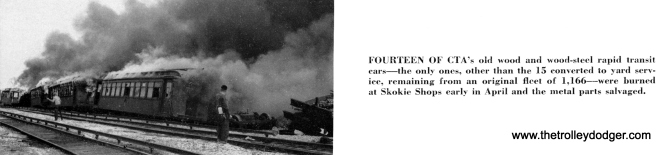
CTA found creative ways for recycling many of the wooden “L” cars that were retired in the 1950s. A few dozen of such cars were lined up at Skokie Shops and used for storage, until a new building was built on the property.

CTA found creative ways for recycling many of the wooden “L” cars that were retired in the 1950s. A few dozen of such cars were lined up at Skokie Shops and used for storage, until a new building was built on the property.

This Transit News article offers a logical explanation of why the 51st-55th trolley bus route was converted to motor buses in 1959, almost exactly one year after the last streetcar ran in Chicago. The City turned part of a street over to developers, and rather than reroute the trolley bus line, which would have involved an expense, CTA at first wanted to cut service back. They soon decided it would be better to separate 51st and 55th into two separate motor bus routes instead. Similar considerations were involved previously when route 4 Cottage Grove streetcar line was converted to bus in 1955. For a while, Cottage Grove PCCs ran through a no man’s land of a street closed off to car traffic, where all nearby buildings had been torn down. The City Council granted this operation reprieves six months at a time until abandonment. Similarly, the timing of bus conversion on route 49 – Western was influenced by the City’s desire to build a flyover on Western at Belmont, near Riverview. If the CTA had been committed to electric surface transit, of course, they would have found a way to make these investments. Instead, all three examples were part of a gradual phase-out.

This Transit News article offers a logical explanation of why the 51st-55th trolley bus route was converted to motor buses in 1959, almost exactly one year after the last streetcar ran in Chicago. The City turned part of a street over to developers, and rather than reroute the trolley bus line, which would have involved an expense, CTA at first wanted to cut service back. They soon decided it would be better to separate 51st and 55th into two separate motor bus routes instead.
Similar considerations were involved previously when route 4 Cottage Grove streetcar line was converted to bus in 1955. For a while, Cottage Grove PCCs ran through a no man’s land of a street closed off to car traffic, where all nearby buildings had been torn down. The City Council granted this operation reprieves six months at a time until abandonment.
Similarly, the timing of bus conversion on route 49 – Western was influenced by the City’s desire to build a flyover on Western at Belmont, near Riverview.
If the CTA had been committed to electric surface transit, of course, they would have found a way to make these investments. Instead, all three examples were part of a gradual phase-out.

It’s unthinkable today, of course, to simply burn rail vehicles as a means of disposing of them, but air pollution was not such a concern in 1959 when this picture was taken. Neither was historic preservation—on some occasions railfans threw the matches and started the fires.

It’s unthinkable today, of course, to simply burn rail vehicles as a means of disposing of them, but air pollution was not such a concern in 1959 when this picture was taken. Neither was historic preservation—on some occasions railfans threw the matches and started the fires.

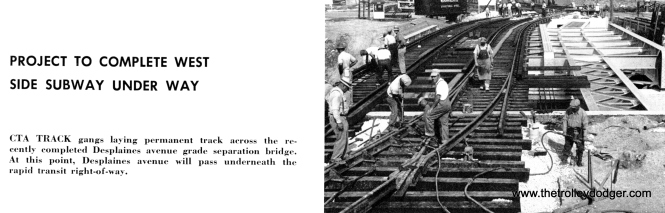
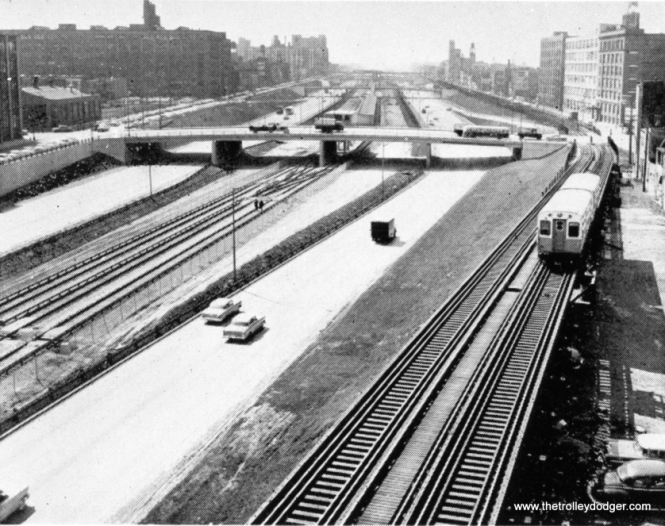
To this day, CTA trains on the Forest Park branch of the Blue Line use this bridge to cross over DesPlaines Avenue. But when the bridge was built, there was a crossing at grade behind the bridge. Typically, expressway bridges were dug out and built first, and the rest of the highway followed.

To this day, CTA trains on the Forest Park branch of the Blue Line use this bridge to cross over DesPlaines Avenue. But when the bridge was built, there was a crossing at grade behind the bridge. Typically, expressway bridges were dug out and built first, and the rest of the highway followed.

In 1959, CTA had fanciful ideas of operating a multiple unit bus train, and in fact there were other experiments with these concepts on the east coast that did not pan out. The Red Arrow Lines hoped such a vehicle would allow them to operate buses over tracks where their franchise required rail. Perhaps CTA hoped to operate such a service in the median of the Stevenson expressway, which never did receive a transit line.

In 1959, CTA had fanciful ideas of operating a multiple unit bus train, and in fact there were other experiments with these concepts on the east coast that did not pan out. The Red Arrow Lines hoped such a vehicle would allow them to operate buses over tracks where their franchise required rail. Perhaps CTA hoped to operate such a service in the median of the Stevenson expressway, which never did receive a transit line.

Another view of that 1959 wooden “L” car bonfire.

Another view of that 1959 wooden “L” car bonfire.

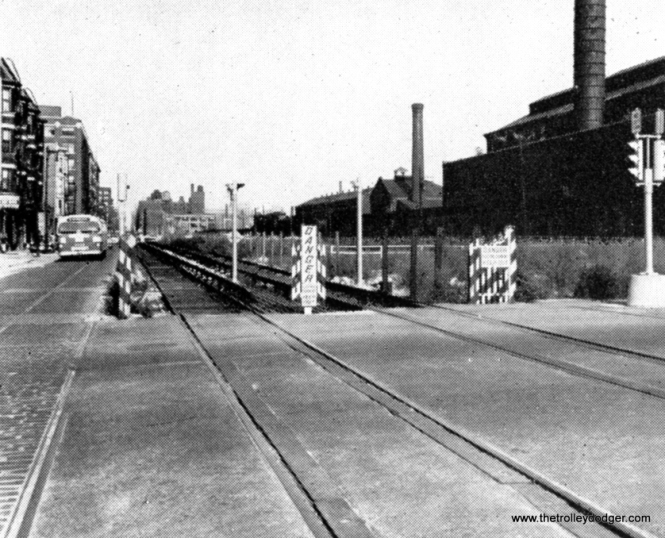
These terminal facilities, primitive by today’s standards, remained in use until the present DesPlaines Blue Line terminal was built in the 1980s.

These terminal facilities, primitive by today’s standards, remained in use until the present DesPlaines Blue Line terminal was built in the 1980s.

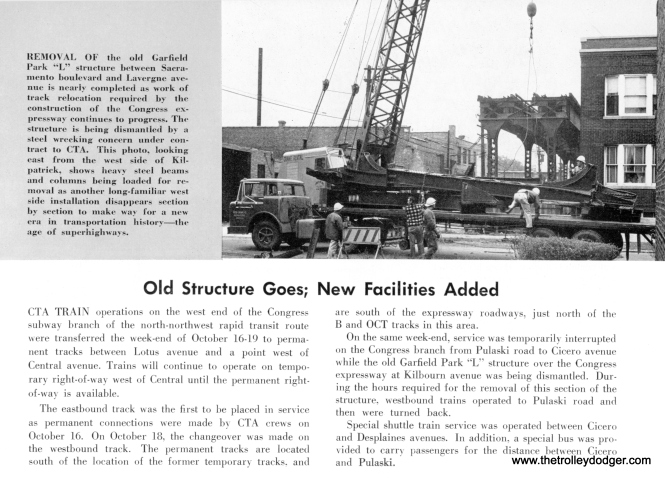
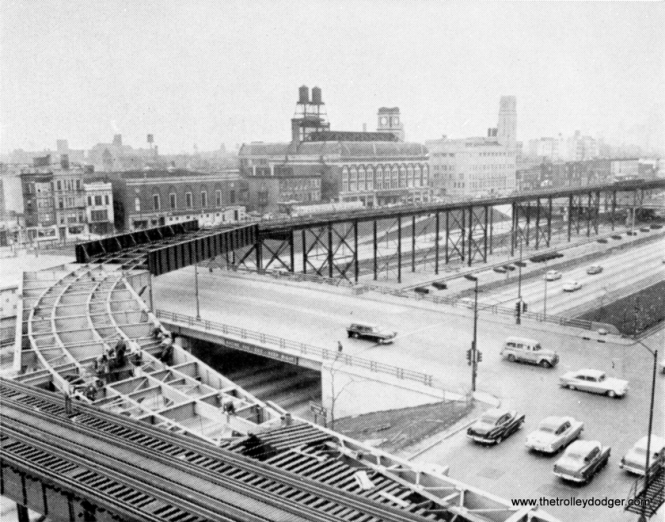
Throughout 1959, the old Garfield Park “L” structure was gradually being dismantled. This picture dates to around October. Meanwhile, the CTA finished working on the Congress line as far west as Central. This means that any connections that still remained with the old Laramie Yard were cut, which was necessary for the extension of the expressway at this point. Such tracks would have crossed the highway. If not for the DesPlaines terminal, an expensive permanent track connection, either via a subway or flyover, would have been needed between the Congress line and Laramie Yard.

Throughout 1959, the old Garfield Park “L” structure was gradually being dismantled. This picture dates to around October. Meanwhile, the CTA finished working on the Congress line as far west as Central. This means that any connections that still remained with the old Laramie Yard were cut, which was necessary for the extension of the expressway at this point. Such tracks would have crossed the highway. If not for the DesPlaines terminal, an expensive permanent track connection, either via a subway or flyover, would have been needed between the Congress line and Laramie Yard.

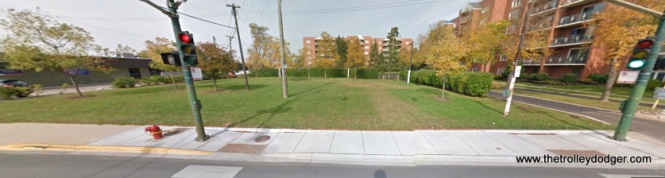
The view looking east from about 612 S. Kilpatrick today. If the location in the previous picture is correct, it looks like the old Garfield Park "L" structure occupied the space just to the right of the alley.

The view looking east from about 612 S. Kilpatrick today. If the location in the previous picture is correct, it looks like the old Garfield Park “L” structure occupied the space just to the right of the alley.

Use of concrete support columns here foreshadowed their later use for other latter-day CTA “L”s.

Use of concrete support columns here foreshadowed their later use for other latter-day CTA “L”s.

Work on elevating the outer portion of Lake, planned for several years, got underway early in 1960.

Work on elevating the outer portion of Lake, planned for several years, got underway early in 1960.

These experimental high-speed rapid transit cars were termed “circus wagons” by the fans, but they eventually formed the backbone of service on the Skokie Swift for many years and paved the way for the various series of cars that have followed.

These experimental high-speed rapid transit cars were termed “circus wagons” by the fans, but they eventually formed the backbone of service on the Skokie Swift for many years and paved the way for the various series of cars that have followed.

This is one of the very first CTA trains to use the permanent routing into the DesPlaines terminal on March 20, 1960. This bridge, originally designed for three tracks, is still in use. But with expressway construction far from finished, note the grade crossing right behind the bridge. That implies that the bridge was built first and then the area around it was later cleared out for the highway. Cars today go underneath the “L”. Behind the train, you can see a handsome 1939 field house, still in use today in a nearby park.

This is one of the very first CTA trains to use the permanent routing into the DesPlaines terminal on March 20, 1960. This bridge, originally designed for three tracks, is still in use. But with expressway construction far from finished, note the grade crossing right behind the bridge. That implies that the bridge was built first and then the area around it was later cleared out for the highway. Cars today go underneath the “L”. Behind the train, you can see a handsome 1939 field house, still in use today in a nearby park.

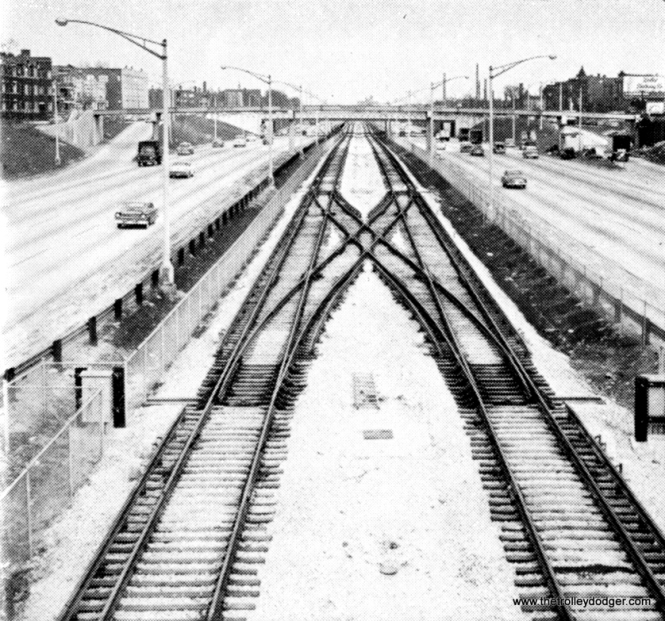
The temporary tracks veered off to the left at this point and seem to have continued at ground level. Meanwhile, the structures that carry the B&OCT over the CTA are at rear. Previously the two lines crossed at grade.

The temporary tracks veered off to the left at this point and seem to have continued at ground level. Meanwhile, the structures that carry the B&OCT over the CTA are at rear. Previously the two lines crossed at grade.

text041

text042

text043

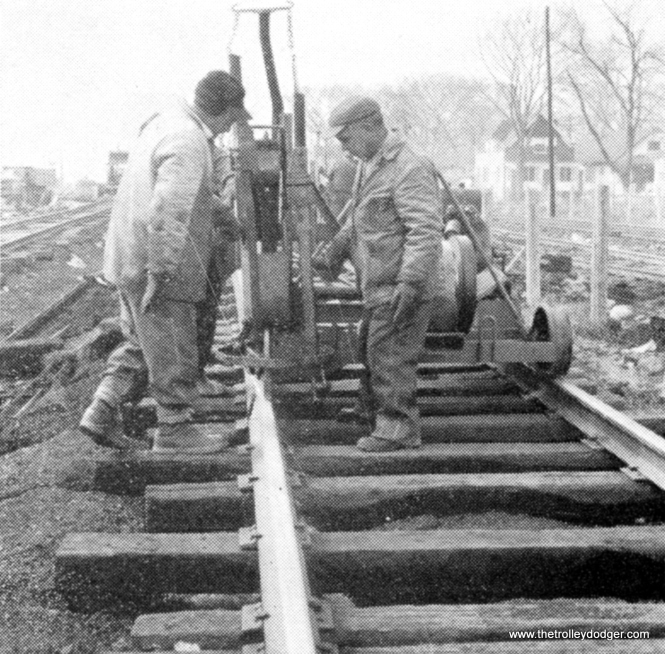
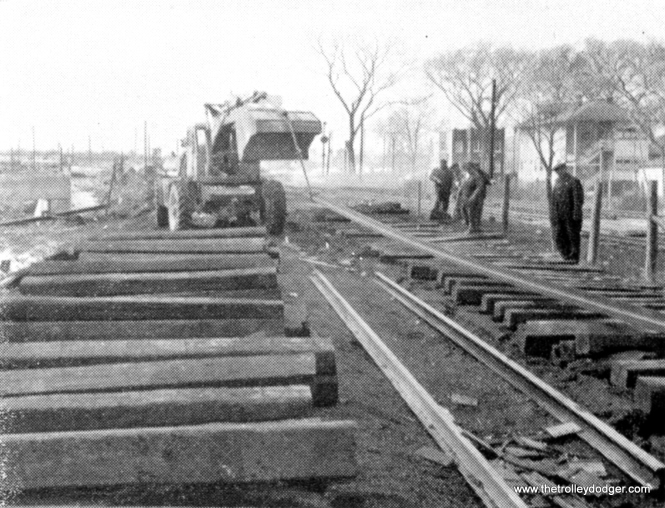
Removing the old temporary CTA tracks.

Removing the old temporary CTA tracks.

text045

text046

text047

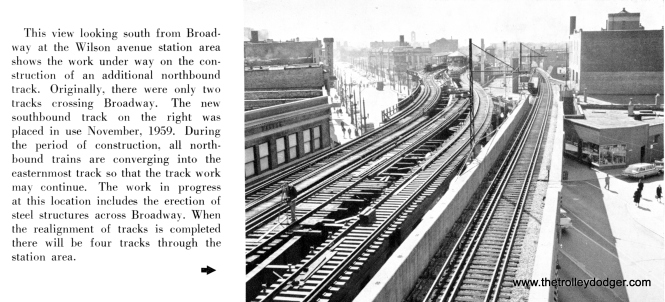
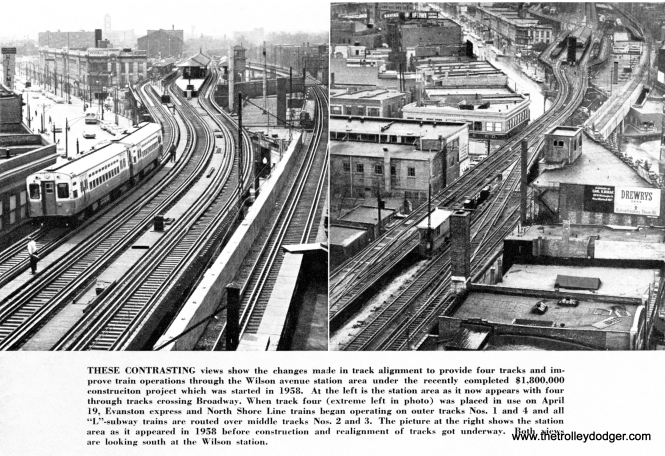
The CTA completed its project to have four tracks through the Wilson area around April, 1961.

The CTA completed its project to have four tracks through the Wilson area around April, 1961.

text049

What this blurb does not answer is why a two-block section of the old Humboldt Park “L” was even kept at all after the branch line was abandoned in the early 1950s. Rumor has it that a portion was kept in case it could be used for mid-day storage of trains from the Chicago, Aurora & Elgin in case it had resumed service. In that event, CA&E steel cars would have operated through the subway and deadheaded to North Avenue and storage tracks on this small portion of Humboldt. Alas, it was not to be. This picture was taken around September 1961, by which time the interurban was liquidating. By the following month, the Humboldt remnant was gone too.

What this blurb does not answer is why a two-block section of the old Humboldt Park “L” was even kept at all after the branch line was abandoned in the early 1950s. Rumor has it that a portion was kept in case it could be used for mid-day storage of trains from the Chicago, Aurora & Elgin in case it had resumed service. In that event, CA&E steel cars would have operated through the subway and deadheaded to North Avenue and storage tracks on this small portion of Humboldt. Alas, it was not to be. This picture was taken around September 1961, by which time the interurban was liquidating. By the following month, the Humboldt remnant was gone too.

text051

During the 1960-62 work to put the west end of Lake onto the C&NW embankment, we have a transitional view, showing the new ramp onto the embankment at right, and the reworked ramp down to street level at left.

During the 1960-62 work to put the west end of Lake onto the C&NW embankment, we have a transitional view, showing the new ramp onto the embankment at right, and the reworked ramp down to street level at left.

Highlights from The “New Look,” Part 1

This is one of the very first CTA trains to use the permanent routing into the DesPlaines terminal on March 20, 1960. This bridge, originally designed for three tracks, is still in use. But with expressway construction far from finished, note the grade crossing right behind the bridge. That implies that the bridge was built first and then the area around it was later cleared out for the highway. Cars today go underneath the “L”. Behind the train, you can see a handsome 1939 field house, still in use today in a nearby park.

This is one of the very first CTA trains to use the permanent routing into the DesPlaines terminal on March 20, 1960. This bridge, originally designed for three tracks, is still in use. But with expressway construction far from finished, note the grade crossing right behind the bridge. That implies that the bridge was built first and then the area around it was later cleared out for the highway. Cars today go underneath the “L”. Behind the train, you can see a handsome 1939 field house, still in use today in a nearby park.

In the first of two posts, as we close out 2015, we are featuring highlights from our recent E-book collection, The “New Look” in Chicago Transit: 1938-1973. Today’s highlights are from the CTA Transit News and mainly cover the period 1958-61. Watch this space for another helping in a few days.

There is a tremendous amount of useful information in the Transit News, and there are thousands of pages of material on this DVD data disc we are offering.

FYI, all current orders for The “New Look” have now shipped.

DVD03CoverA.PNG

The “New Look” in Chicago Transit: 1938-1973
Edited by David Sadowski

Over a period of 35 years, between 1938 and 1973, Chicago’s transit system was radically transformed, for better or for worse.

This transformation included the creation of the Chicago Transit Authority in 1945 by act of the state legislature. CTA represented public ownership and unification of Chicago’s mass transit system. The Chicago Rapid Transit Company, Chicago Surface Lines, and (later) Chicago Motor Coach Company were all merged.

The venerable Loop “L” was supplemented by two new subways, under State and Dearborn streets. Several “L” lines and dozens of stations were abandoned. New rapid transit lines were built in three different expressways.

Streetcars and trolley buses were eliminated, as were many grade crossings. Two of Chicago’s three major interurbans expired.

High-speed rapid transit cars were developed by the Chicago Transit Authority, and put into use on the new Skokie Swift service and, eventually, throughout the system. Air conditioning became standard on rapid transit cars.

By the early 1960s, the CTA began calling it a “New Look” in transit.

Now, to examine this transformation, we have collected many original CTA source documents from this revolution together in one place, as our third DVD data disc release, The “New Look” in Chicago Transit: 1938-1973, edited by David Sadowski.

Since our previous release Chicago’s PCC Streetcars: The Rest of the Story covered surface system changes, this new collection’s primary focus is rapid transit. Naturally, there is some overlap between the two E-books, but The “New Look” includes over 1000 pages of new material, including:

An introductory essay by transit historian David Sadowski, which puts the era into perspective

Special commemorative publications put out by the City of Chicago in 1943 and 1951, when the State Street and Dearborn subways opened

43 entire issues of CTA Transit News in hi-res (an employee publication, primarily covering the important transition period from 1958 through 1961), plus additional scans from 1964-65, 1967-68, and 1969-70

High-resolution scans of the 1958 and 1961 CTA Annual Reports (all reports from 1945-76 are also included in lower-res scans)

Rapid transit system track maps

A short book, The Story of the Chicago Rapid Transit Lines (circa 1938)

Numerous CTA pamphlets, covering A/B “skip stop” service, Rider’s Reader, opening of the Congress rapid transit line, “New Look” (aka “Fishbowl”) buses, bus overhaul shops, and the elevation of the outer end of the Lake Street “L”.

In addition, we have included a variety of CTA technical publications, including the operation of various old interlockings, signal systems, and troubleshooting manuals for the 4000-series rapid transit cars.

# of Discs – 1
Price: $19.95


Help Support The Trolley Dodger

This is our 107th post, and we are gradually creating a body of work and an online resource for the benefit of all railfans, everywhere. To date, we have received over 106,000 page views from 30,500 individuals.

You can help us continue our original transit research by checking out the fine products in our Online Store. You can make a donation there as well.

As we have said before, “If you buy here, we will be here.”

We thank you for your support.

PS- As we approach our one-year anniversary next month, the deadline for renewing our premium WordPress account comes due in less than 30 days. This includes out Internet domain www.thetrolleydodger.com, much of the storage space we use for the thousands of files posted here, and helps keep this an ads-free experience for our readers. Your contributions towards this goal are greatly appreciated, in any amount.


Transit historian and author Andre Kristopans has sent us a preliminary list, which still needs work, of the CSL/CTA off-street turning loops:

Root/Halsted 1/1895 out 8/9/53
Cable Ct/harper 7/08 out 1960
Wentworth/63 11/08 out 6/22/58
Western/Flournoy 6/09 out 7/18/65
Cottage Grove/72 11/10 out 9/28/56
State/63 01/11 out 1/9/57
Western/Roscoe 7/11 out 1/24/51
Vincennes/80 8/11 out 1990’s
Clark/Arthur 11/11 active
Halsted/79 12/12 active
63/King 6/13 out 6/28/69 (temporarily reactivated circa 1977 when Ryan L out of service at 18th)
Halsted/Waveland 3/15 active
Clark/Howard 4/15 out 12/3/61
75/Lakefront 5/15 active (cul-de-sac)
Broadway/Ardmore 12/15 out 12/26/63
Torrence/112 3/17 active
Devon/Sheridan 5/17 (CMC) out 10/18/53
Archer/Cicero 12/17 active (relocated 1955)
Navy Pier 6/21 active (relocated 1959, relocated again 1990’s)
Madison/Austin 7/21 active
Milwaukee/Imlay 9/27 active
Montrose/Milwaukee 1/31 out 1980’s
Montrose/Narragansett 1/31 out 1990’s
Belmont/Pacific 5/31 out 1/9/49
18th/Lake Shore 6/33 out 3/9/49
Roosevelt/Columbus 8/33 out 4/11/53
Hamlin/Fulton (CMC) 6/35 out 2/11/53
87/Western 7/35 active
Belmont/Central 9/35 out 1/9/49 (relocated across street 1930’s)
Diversey/Western 9/35 out 7/1/55
Diversey/Neva 10/38 active
Caldwell/Central 8/39 (relocated 1961)
83/Green Bay 5/40 out 10/30/63
Bell & Howell 12/42 out 1976
76/Keeler 7/43 out 3/16/53
76/Kilpatrick 7/43 out 6/21/59
115/Cottage Grove 9/24/63 out 6/16/63 (south of 115th)
Montrose/Broadway 7/29/46 out 1970’s
Monroe Parking Lot 8/15/46 out 1972
Soldier Field Parking Lot 8/15/46 out 1990’s
Merchandise mart plaza 9/16/46 out 1990’s
Torrence/128 10/21/46 relocated to 130th west of Torrence 1980’s, out 1990’s
Torrence/112 10/21/46 out 4/25/48 (south of RR)
74/Damen 11/1/46 active
Irving Park/Cumberland 2/4/47 active (moved 1/24/64)
Damen/Elston 6/19/47 out 9/30/63
84/State 6/28/47 out 11/26/58
116/Burley 6/30/47 out 1990’s
Cortland/Paulina 8/31/47 out 4/17/59
31/Ellis 2/29/48 out 9/27/56
Narragansett/63 Pl 4/25/48 active
63/Archer 4/25/48 active (relocated 1990’s)
Harlem/64 Pl 6/15/48 active
Western/79 7/31/48 active
Devon/Kedzie 9/13/48 active
Irving Pk/Neenah 11/17/48 (moved from S to N of Irving Pk 7/9/58) out 1980’s
16th/47th Ct 12/12/48 active
Belmont/Halsted 1/9/49 active
Belmont/Cumberland 1/9/49 active
Belmont/Octavia 1/9/49 active
Western/Berwyn 1/10/49 active
Western/Howard 2/17/49 active
North/Clybourn 7/3/49 out 2000’s
Lehigh/Touhy 7/14/49 out 2/20/55
Cermak/Harlem (West Towns Garage) 8/13/49 out 1/16/57
Harrison/Central 8/14/49 active
Addison/Pontiac (CMC) 8/17/49 active
Western/Leland 11/14/49 active
Fullerton/Parkside 12/4/49 out 1990’s
North/Clark 12/4/49 active
North/Narragansett 12/4/49 active
Jersey/Peterson 5/13/50 out 1973
31/California 5/17/50 out 1990’s
111/Harding 10/21/50 active
Central/Milwaukee 11/17/50 out 9/24/70
Grand/Nordica 4/1/51 active
47/Lake Park 4/15/51 active (moved from W of Lake Park to E 7/26/66)
Cicero/Pensacola 5/10/51 active
Lincoln/Wrightwood 7/2/51 out 4/27/60
Elston/Kentucky 7/19/51 out 7/8/55
Pulaski/Peterson 7/20/51 active
Archer/Neva 11/2/51 active
Lincoln Village 11/13/51 out 1/30/55 (McCormick N of Lincoln)
Lincoln/Whipple 11/23/51 out 1970’s
Cicero/24 Pl 11/25/51 active
31/Komensky 12/6/51 active
Logan Square 12/19/51 out 1/31/70
North/Winchester 5/5/52 out 1973
Grand/Latrobe 5/24/52 active
Cermak/54 Av 5/25/52 active (moved 2000’s)
Fairbanks/Ontario 7/20/52 out 1990’s, new built 2000’s
79/Lakefront 8/11/52 relocated 2012
Roosevelt/Monitor 9/7/52 out 2000’s
Pulaski/Foster 9/8/52 out 1990’s
95/Western Evergreen Plaza 9/28/52 out 2015
Chicago/Mayfield 12/13/52 active (moved to Austin 1980’s)
Roosevelt/Wabash 5/12/53 out 1972
Racine/87 5/28/53 active
26/Kenton 6/18/53 out 1970’s
Desplaines/Congress 10/9/53 active relocated numerous times
Jackson/Central Fieldhouse 10/29/53 out 7/8/55
Niles Center/Pratt 11/15/53 out 1/15/54
Kedzie/63 Pl 12/15/53 active
42/Packers 2/14/54 out 11/9/70 (moved 4/22/63)
87/Cicero 8/13/54 active moved to shopping center across Cicero 1980’s
Ashland/95 11/4/54 active
California/Addison 11/26/54 out 2015
Grand/Natchez 12/20/54 out 2/22/67
Western/119 2/9/55 active
Cermak/57 Ac 4/17/55 out 1980’s
Jackson/Austin 7/8/55 active
Forest Glen garage 12/4/55
Damen/87 12/9/55 active
Cottage Grove/Burnside 8/22/56 out 2000’s
North Park Garage 12/4/55 no longer used as turnaround since 1980’s
Brother Rice High School 9/10/56 active
Cermak Plaza 1/14/57 active relocated to N Riverside Park Mall 1975
59/Keating 5/5/57 out 1990’s
Howard/Kedzie 1/26/58 out 11/19/60 (east of Channel)
Jackson/Kedzie Garage 7/3/58 not used as turnaround since 1990’s
83/Wentworth 7/14/58 out 1990’s
Teletype Corp 9/8/58 out 1980’s
Pulaski/104 9/17/58 active
Cicero/64 11/27/58 out 1990’s
Pulaski/77 6/21/59 out 6/1/62
79/Kilpatrick 6/21/58 out 1990’s
Indianapolis/101 7/5/59 out 1970’s
Cumberland/Montrose 8/3/59 out 7/13/64
Howard/McCormick 11/3/60 active
Cermak/State 11/19/60 out 9/28/69
McCormick Place 11/19/60 replaced 1970, out 1970’s
115/Pulaski 12/4/60 out 8/3/64
67/Oglesby 12/15/60 active
Howard/Hermiatage 12/3/61 replaced 1990’s
Pulaski/75 6/1/62 out 7/21/63
Pulaski/81 7/21/63 active
Beverly Garage 2/10/64 not used as turnaround after 1990’s
Skokie Swift 4/19/64 active
Old Orchard 4/20/64 moved 1970’s
Marist High School 8/24/64 out 2000’s
Randolph/Lake Shore 9/14/64 active moved to Randolph/Harbor 1970’s
55/St Louis 11/11/64 active replaced 2000’s
51/St Louis 1/13/65 out 1990’s
115/Springfield 5/10/65 active
King Dr/Burnside 6/20/65 out 1970’s
Ford City 8/12/65 active relocated 1990’s
Luther High School (87/Sacramento) 11/24/65 out 1990’s
Pratt/Kedzie 8/1/66 out 1990’s
Mercy Hospital 2/1/68 out 1980’s
Ashland/63 5/6/69 active
95/Dan Ryan 9/28/69 active
79/Perry 9/28/69 active
69/Dan Ryan 9/28/69 active
Cermak/Clark 9/28/69 out 1980’s
Jefferson Park 2/1/70 active
Irving Park/Keystone 2/1/70 active
Belmont/Kimball 2/1/70 active
Logan Square 2/1/70 active
Olive/Harvey 2/8/71 active relocated 1970’s and 1990’s
International Towers 6/7/71 out 1973
King Dr/96 1970’s out 1970’s
95/St Lawrence 1970’s active
Archer/Halsted 1990’s active
Archer/Ashland 1990’s active
Lincoln Village (Lincoln/Jersey) 1980’s out 1990’s
103rd Garage 1990’s active
Limits Garage 1860’s out 1990’s
47/Laramie 1970’s out 1980’s
Western/49 1990’s active
Archer/Leavitt 1990’s active
Kedzie/49 1990’s active
Pulaski/51 1990’s active
Skokie Courthouse 1990’s active
73/Kostner 1990’s active
59/Kilpatrick 1990’s active
71/Pulaski 1980’s active
Division/Austin 1970’s active
Clark/Wisconsin 1970’s out 1990’s
Chicago-Read hospital 1970’s out 2015 (relocated across Oak park Av 1980’s)
River Rd/Kennedy 1980’s – CTA stopped using 1990’s
Cumberland/Bryn Mawr – 1980’s active
Pavilion Apts – 1970’s active (relocated 1980’s)
Lincolnwood Town Ctr – 1990’s active
Bryn Mawr/Lake Shore 1980’s active
Wright College 1990’s active
Higgins/Harlem 1980’s active
Touhy/Overhill 1970’s – CTA has not used since 2000’s (replaced last Y terminal)
Evanston Twp High School Parking Lot 1990’s out 2000’s
74th Garage first used as turnaround 2015 active
Avon @ Golf/Waukegan 1990’s active
Pullman Plaza parking lot (Doty W/109) 2000’s
Grand/Columbus 1970’s out 1990’s
Desplaines/Harrison 1990’s active
Field Museum turn-in on McFetridge 1980’s active
King/24th Pl 1980’s active
McCormick Place South driveway 1980’s out 1990’s
Wilson/E Ravenswood 1970’s out 1990’s
Nature Museum (Cannon/Fullerton) 1980’s active
South Blvd/Sheridan 1973 out 1990’s inherited from Evanston Bus Co.

From 1951 to 1958, the CTA Dearborn-Milwaukee subway ended at a stub-end terminal at the LaSalle Street station. The original plans were for an underground loop just east of the old Main Post Office, but that was given up in order to save money.

From 1951 to 1958, the CTA Dearborn-Milwaukee subway ended at a stub-end terminal at the LaSalle Street station. The original plans were for an underground loop just east of the old Main Post Office, but that was given up in order to save money.

In January 1951, a fire threatened CTA’s little-used North Water Street stub terminal, which managed to survive until 1963.

In January 1951, a fire threatened CTA’s little-used North Water Street stub terminal, which managed to survive until 1963.

The CTA Transit News included many rare photos of Congress rapid transit line construction. This picture was taken around January 1958 at the DesPlaines terminal and looks to the northeast. While most of the Congress line went into service in June 1958, the portion west of the Lotus tunnel was not finished until 1961. Work in the terminal area continued into 1962.

The CTA Transit News included many rare photos of Congress rapid transit line construction. This picture was taken around January 1958 at the DesPlaines terminal and looks to the northeast. While most of the Congress line went into service in June 1958, the portion west of the Lotus tunnel was not finished until 1961. Work in the terminal area continued into 1962.

text004

The ramp connecting Congress with Douglas was still being built in February 1958, four months before service began. If a similar ramp could have been built to the west of Marshfield, interurban trains of the Chicago, Aurora & Elgin would have been able to access the Loop via the Paulina Connector and the Lake Street “L”, just as the Pink Line (successor to the Douglas Park “L”) does today.

The ramp connecting Congress with Douglas was still being built in February 1958, four months before service began. If a similar ramp could have been built to the west of Marshfield, interurban trains of the Chicago, Aurora & Elgin would have been able to access the Loop via the Paulina Connector and the Lake Street “L”, just as the Pink Line (successor to the Douglas Park “L”) does today.

Until 1969, the Englewood branch of the south side “L” ended at Loomis, not a convenient place for bus transfers going north and south. CTA made some improvements, but the ultimate solution was a short extension of the line to nearby Ashland Avenue. This photo is from about February 1958.

Until 1969, the Englewood branch of the south side “L” ended at Loomis, not a convenient place for bus transfers going north and south. CTA made some improvements, but the ultimate solution was a short extension of the line to nearby Ashland Avenue. This photo is from about February 1958.

In May 1958, service continued uninterrupted during major projects.

In May 1958, service continued uninterrupted during major projects.

Among many other things, the CTA improved safety and reduced labor costs by replacing manually operated gates with automatic ones, as shown in this April 1958 photo. There was some resistance to automatic gates, since some people thought that manually operated ones were safer. Signal systems, which were primitive on the older “L” lines, were also gradually improved. Automatic block signals were installed in the new subways and the Congress expressway median line.

Among many other things, the CTA improved safety and reduced labor costs by replacing manually operated gates with automatic ones, as shown in this April 1958 photo. There was some resistance to automatic gates, since some people thought that manually operated ones were safer.
Signal systems, which were primitive on the older “L” lines, were also gradually improved. Automatic block signals were installed in the new subways and the Congress expressway median line.

The CTA added “Metropolitan Transit” to its logo early in 1958, to emphasize how their role extended outside the Chicago city limits. It was during this time that two of the three area interurbans were failing, and CTA unsuccessfully lobbied the Illinois legislature for financial aid that might have made it possible to incorporate larger parts of them into the CTA system. As it turned out, both the Chicago, Aurora & Elgin and Chicago, North Shore & Milwaukee railroads went out of business and were liquidated. Only a few miles of each line survives in the present rapid transit network.

The CTA added “Metropolitan Transit” to its logo early in 1958, to emphasize how their role extended outside the Chicago city limits. It was during this time that two of the three area interurbans were failing, and CTA unsuccessfully lobbied the Illinois legislature for financial aid that might have made it possible to incorporate larger parts of them into the CTA system. As it turned out, both the Chicago, Aurora & Elgin and Chicago, North Shore & Milwaukee railroads went out of business and were liquidated. Only a few miles of each line survives in the present rapid transit network.

By the time this picture was taken in May 1958, the four-track Metropolitan “L”, shown here near Aberdeen Street, had been shaved back to two, since part of the “L” footprint was needed for the expressway. Behind the two-car train of 6000s there is a ramp leading down to the temporary Van Buren trackage of about 2 ½ miles heading west.

By the time this picture was taken in May 1958, the four-track Metropolitan “L”, shown here near Aberdeen Street, had been shaved back to two, since part of the “L” footprint was needed for the expressway. Behind the two-car train of 6000s there is a ramp leading down to the temporary Van Buren trackage of about 2 ½ miles heading west.

The new Congress median rapid transit line shortly before being put into service.

The new Congress median rapid transit line shortly before being put into service.

By Spring 1958, work was nearly complete on the ramp connecting the Douglas and Congress lines.

By Spring 1958, work was nearly complete on the ramp connecting the Douglas and Congress lines.

The temporary “L” service in Van Buren Street, which operated from September 1953 to June 1958, shown here at Loomis prior to the demolition of the cavernous Throop street shops at right.

The temporary “L” service in Van Buren Street, which operated from September 1953 to June 1958, shown here at Loomis prior to the demolition of the cavernous Throop street shops at right.

CTA’s first new rapid transit line opened on June 22, 1958, at least as far as the Cicero Avenue station. Work continued west of there until 1961. While service was faster than the Garfield Park “L” it replaced, the project was a major factor in the abandonment of the “Roarin’ Elgin

CTA’s first new rapid transit line opened on June 22, 1958, at least as far as the Cicero Avenue station. Work continued west of there until 1961. While service was faster than the Garfield Park “L” it replaced, the project was a major factor in the abandonment of the “Roarin’ Elgin

The first section of the old Garfield Park “L” to be removed after the opening of the Congress line.

The first section of the old Garfield Park “L” to be removed after the opening of the Congress line.

The opening of the Congress line was a matter of considerable civic pride for Chicago, the CTA, and Mayor Richard J. Daley.

The opening of the Congress line was a matter of considerable civic pride for Chicago, the CTA, and Mayor Richard J. Daley.

Bob Heinlein, shown here at right during his CTA days, has been a well-known railfan for many years. He's a great guy.

Bob Heinlein, shown here at right during his CTA days, has been a well-known railfan for many years. He’s a great guy.

The Congress line, in the median of an expressway, inspired two additional rapid transit extensions in other local highways a decade later. However, such operations are not without problems caused by truck and auto accidents, road salt, noise, wind, poor drainage, or snow.

The Congress line, in the median of an expressway, inspired two additional rapid transit extensions in other local highways a decade later. However, such operations are not without problems caused by truck and auto accidents, road salt, noise, wind, poor drainage, or snow.

This picture was taken in May 1958 on what was indeed the final operation of a red Pullman (#144) on Chicago streetcar tracks.

This picture was taken in May 1958 on what was indeed the final operation of a red Pullman (#144) on Chicago streetcar tracks.

CTA opened a new bus turnaround loop at Irving Park and Neenah in July 1958. This was one of more than 100 such off-street loops. This particular loop is no longer in use and was sold to developers. It is now part of a driveway. It was originally used by the #80 Irving Park and #86 Narragansett routes. Over time, this loop became superfluous as the 86 was extended farther north and some of the short-turns were eliminated on 80.

CTA opened a new bus turnaround loop at Irving Park and Neenah in July 1958. This was one of more than 100 such off-street loops. This particular loop is no longer in use and was sold to developers. It is now part of a driveway.
It was originally used by the #80 Irving Park and #86 Narragansett routes. Over time, this loop became superfluous as the 86 was extended farther north and some of the short-turns were eliminated on 80.

The same location today.

The same location today.

July 1958. These sections of “L” were very close to the expressway.

July 1958. These sections of “L” were very close to the expressway.

Between 1959 and 1961, CTA embarked on a major construction project to fill a gap in the side “L”, where four tracks went down to two and then four again.

Between 1959 and 1961, CTA embarked on a major construction project to fill a gap in the side “L”, where four tracks went down to two and then four again.

October 1958.

October 1958.

November 1958.

November 1958.

text025

Many of CTA’s more than 100 off-street loops were beautifully landscaped, a tradition going back to the 1930s and the Chicago Surface Lines. Unfortunately, over the years many of these manicured green spaces have been replaced by asphalt.

Many of CTA’s more than 100 off-street loops were beautifully landscaped, a tradition going back to the 1930s and the Chicago Surface Lines. Unfortunately, over the years many of these manicured green spaces have been replaced by asphalt.

The loop at Western and Berwyn today. Those trees in the middle have grown a lot larger in the 56 years since the earlier photo was taken.

The loop at Western and Berwyn today. Those trees in the middle have grown a lot larger in the 56 years since the earlier photo was taken.

The “New Look” in Chicago Transit

DVD03CoverA.PNG

The “New Look” in Chicago Transit: 1938-1973
Edited by David Sadowski

Over a period of 35 years, between 1938 and 1973, Chicago’s transit system was radically transformed, for better or for worse.

This transformation included the creation of the Chicago Transit Authority in 1945 by act of the state legislature. CTA represented public ownership and unification of Chicago’s mass transit system. The Chicago Rapid Transit Company, Chicago Surface Lines, and (later) Chicago Motor Coach Company were all merged.

The venerable Loop “L” was supplemented by two new subways, under State and Dearborn streets. Several “L” lines and dozens of stations were abandoned. New rapid transit lines were built in three different expressways.

Streetcars and trolley buses were eliminated, as were many grade crossings. Two of Chicago’s three major interurbans expired.

High-speed rapid transit cars were developed by the Chicago Transit Authority, and put into use on the new Skokie Swift service and, eventually, throughout the system. Air conditioning became standard on rapid transit cars.

By the early 1960s, the CTA began calling it a “New Look” in transit.

Now, to examine this transformation, we have collected many original CTA source documents from this revolution together in one place, as our third DVD data disc release, The “New Look” in Chicago Transit: 1938-1973, edited by David Sadowski.

Since our previous release Chicago’s PCC Streetcars: The Rest of the Story covered surface system changes, this new collection’s primary focus is rapid transit. Naturally, there is some overlap between the two E-books, but The “New Look” includes over 1000 pages of new material, including:

An introductory essay by transit historian David Sadowski, which puts the era into perspective

Special commemorative publications put out by the City of Chicago in 1943 and 1951, when the State Street and Dearborn subways opened

43 entire issues of CTA Transit News, an employee publication, primarily covering the important transition period from 1958 through 1961

High-resolution scans of the 1958 and 1961 CTA Annual Reports (all reports from 1945-76 are also included in lower-res scans)

Rapid transit system track maps

A short book, The Story of the Chicago Rapid Transit Lines (circa 1938)

Numerous CTA pamphlets, covering A/B “skip stop” service, Rider’s Reader, opening of the Congress rapid transit line, “New Look” (aka “Fishbowl”) buses, bus overhaul shops, and the elevation of the outer end of the Lake Street “L”.

In addition, we have included a variety of CTA technical publications, including the operation of various old interlockings, signal systems, and troubleshooting manuals for the 4000-series rapid transit cars.

# of Discs – 1
Price: $19.95


Help Support The Trolley Dodger

This is our 101st post, and we are gradually creating a body of work and an online resource for the benefit of all railfans, everywhere. To date, we have received over 98,000 page views from 28,500 individuals.

You can help us continue our original transit research by checking out the fine products in our Online Store. You can make a donation there as well.

As we have said before, “If you buy here, we will be here.”

We thank you for your support.


scan004

scan005

scan015

scan905

scan911

scan872

scan917

scan001

scan002

scan003

scan006

scan007

scan009

scan010

scan011

scan012

scan013

scan014

P1060345

More Chicago Rapid Transit Photos

A two-car Garfield Park train, including car 2848, on the Loop “L”. (George Snyder Photo)

Our last major post on Chicago’s rapid transit lines was on April 28, so we figure it’s time for another look. In newspaper parlance, -30- means “the end,” (there was even a 1959 film by that title directed by Jack Webb) but here, we present 30 classic Chicago “L” photos that we think are the living end.

While we have some information for these pictures, if you can share something interesting about them that we might have missed, do not hesitate to contact us. You can leave a comment to this post, or write us directly at:

thetrolleydodger@gmail.com

-David Sadowski

A Ravenswood Local made up of “Baldy” 4000s (including car 4200) on the Loop “L”. (George Snyder Photo)

A Douglas Park Cicero-Berwyn Express on the Loop “L”. This picture must date to before December 9, 1951, when A/B service began on Douglas. (George Snyder Photo)

Articulated “Doodlebug” 5001 at Laramie Yard on the Garfield Park “L”, when this car was new (late 1940s). (George Snyder Photo)

The location of this photo would be hard to identify, if not for the presence of overhead wire instead of third rail. That makes it Isabella on the Evanston line. This station closed on July 16, 1973.

The location of this photo would be hard to identify, if not for the presence of overhead wire instead of third rail. That makes it Isabella on the Evanston line. This station closed on July 16, 1973.

Niles Center train 1045 in the pocket at the Dempster station, with North Shore Line track in the foreground. The Skokie Swift never used this terminal arrangement.

Niles Center train 1045 in the pocket at the Dempster station, with North Shore Line track in the foreground. The Skokie Swift never used this terminal arrangement.

A rare shot of the lower Wilson Avenue station on the north side “L”. This was once the terminal before the “L” was extended north. This station opened on March 5, 1907. The intent was to alleviate crowding at the upper Wilson station, already in use. Lower Wilson closed on August 1, 1949, early in the CTA era.

Skokie Shops, date unknown. Probably early in the CTA era.

Skokie Shops, date unknown. Probably early in the CTA era.

A single car Niles Center train in the open cut in Evanston.

A single car Niles Center train in the open cut in Evanston.

A six-car CRT “L” train on the Niles Center branch. Service on this line quit on March 26, 1948. This was part of the North Shore Line’s Skokie Valley Route. After the interurban quit in 1963, the CTA bought the line to Dempster and the Skokie Swift (today’s Yellow Line) was born. Service did not generally warrant the use of a six-car train in the 1940s when this picture was taken, but sometimes CRT trains were used on the North Shore Line to haul the military.

A two car CRT "L" train in December 1935. The location is given as Austin, but the photo does not indicate whether this is the Douglas Park branch or Garfield. Bill Shapotkin writes: "I can't tell you where this pic was actually taken, but I can tell you where is was NOT taken. This photo is NOT on Garfield Pk/Westchester. If it were anywhere on that line, the third rail chairs would be the CA&E's wooden third rail chairs -- the chairs shown in this photo are rapid transit third rail chairs. Additionally, if it were "Austin" (on Garfield Pk), we should see the B&OCT next door (and it is not). Now, as for where I think this photo was taken -- there appears to be an interlocking nearby (notice the piping next to outside rail). Thus, I believe the train is WB on DOUGLAS approaching Oak Park Ave (where, if I recall correctly) there was an interlocking. Therefore we would be looking east. At least that is my best guess."

A two car CRT “L” train in December 1935. The location is given as Austin, but the photo does not indicate whether this is the Douglas Park branch or Garfield.
Bill Shapotkin writes: “I can’t tell you where this pic was actually taken, but I can tell you where is was NOT taken. This photo is NOT on Garfield Pk/Westchester. If it were anywhere on that line, the third rail chairs would be the CA&E’s wooden third rail chairs — the chairs shown in this photo are rapid transit third rail chairs. Additionally, if it were “Austin” (on Garfield Pk), we should see the B&OCT next door (and it is not).
Now, as for where I think this photo was taken — there appears to be an interlocking nearby (notice the piping next to outside rail). Thus, I believe the train is WB on DOUGLAS approaching Oak Park Ave (where, if I recall correctly) there was an interlocking. Therefore we would be looking east. At least that is my best guess.”

The east end of the CTA’s Jackson Park “L” in July 1959. The “L” has been truncated west of here since and no longer crosses the Illinois Central (now Metra) Electric.

The DesPlaines Avenue terminal at the west end of the CTA Congress line in November 1959. Wooden “L” cars were no longer being used for passenger service by time, and the three cars were probably being used here for offices as the station was being somewhat reconfigured. Note the lack of a canopy.

A Kenwood shuttle car at 42nd Place terminal on June 12, 1957. November 30 was the last day of service on this branch. (Lawrence H. Boehuring Photo)

A Kenwood shuttle car at 42nd Place terminal on June 12, 1957. November 30 was the last day of service on this branch. (Lawrence H. Boehuring Photo)

A downtown-bound train at the old Logan Square “L” station on May 10, 1958, about 6 weeks before service on the Milwaukee-Dearborn subway was connected up with the Congress and Douglas branches. (Laurence H. Boehuring Photo)

Six old wooden “L” cars, including 1784, in the Linden Avenue yard in Wilmette on June 12, 1957. (Laurence H. Boehuring Photo)

The view looking south from the platform at the Linden Avenue station in Wilmette on June 12, 1957, showing two old wooden “L” cars in the yard, including 1793 and 3156(?). In the distance, we can see one of the four articulated 5001-5004 series cars. (Laurence H. Boehuring Photo)

The arcade at the old Logan Square “L” terminal on May 10, 1958. About a dozen years later, this station was replaced by a subway as part of the extension of this line to Jefferson Park. (Laurence H. Boehuring Photo)

Kedzie and Linden, the site of the old Logan Square "L" terminal, as it looks today. Andre Kristopans says,"The old Logan square station is still under there under the new façade. There is a substantial gap between the inside ceiling and roof of this building because of the supports for the shop above the north half of the building were part of the structure and were not removed, and for aesthetic reasons the high walls were extended all the way around."

Kedzie and Linden, the site of the old Logan Square “L” terminal, as it looks today. Andre Kristopans says,”The old Logan square station is still under there under the new façade. There is a substantial gap between the inside ceiling and roof of this building because of the supports for the shop above the north half of the building were part of the structure and were not removed, and for aesthetic reasons the high walls were extended all the way around.”

The view looking north at the Linden Avenue terminal in Wilmette, showing wooden “L” cars (including 1770 and 1736). A poster at right advertises Waterman fountain pens. The date is June 12, 1957. (Laurence H. Boehuring Photo)

A view looking east towards the Marion Street station on the Lake Street “L” on June 7, 1957. (Laurence H. Boehuring Photo)

A Kenwood shuttle car at the Indiana Avenue station on June 12, 1957. November 30 was the last day of service on this branch. (Lawrence H. Boehuring Photo)

A Kenwood shuttle car at the Indiana Avenue station on June 12, 1957. November 30 was the last day of service on this branch. (Lawrence H. Boehuring Photo)

This picture was taken at the Oak Park Avenue terminal along the outer end of the Douglas Park “L”, looking west. The apartment building at right is still standing. The line was cut back to 54th Avenue 1952. The train is a Cicero-Berwyn Express, ready to head downtown. It must be before December 9, 1951, when A/B skip-stop service was instituted. Note the Burma Shave sign at right.

CRT/CTA snow plow S220 at Laramie on the Garfield Park "L" in 1948.

CRT/CTA snow plow S220 at Laramie on the Garfield Park “L” in 1948.

A CTA Met “L” train crosses the Chicago River in 1950, on the double Scherzer rolling lift bridge that was there at the time. Now, just south of here, the CTA Blue Line passes underneath the river.

CTA 2703-2753 at the east side of Skokie Shops on May 1, 1955. This was a Central Electric Railfans' Association fantrip that included a shops tour.

CTA 2703-2753 at the east side of Skokie Shops on May 1, 1955. This was a Central Electric Railfans’ Association fantrip that included a shops tour.

An open platform/vestibule two-car Douglas Park train at Van Buren and Wells in September 1949. One of the cars is 2775. Contrast this with the later photo taken at this same location, after the removal of the “L” structure west of here for the construction of Lower Wacker Drive.

The same location as the last photo, but no earlier than 1955. The “L” structure and tower west of here have been removed. The Garfield Park “L’ connection to the Loop was moved slightly north of here via a new connection through the old Wells Street Terminal. The sign on the train says that the last stop is Clinton. The Insurance Exchange building is at right.

The Pulaski station on the Douglas Park “L” on May 10, 1958. There was a yard there at the time. (Lawrence H. Boehuring Photo)

Laramie Yard on the Garfield Park “L”, looking east. A few blocks back, the “L” went up a ramp onto steel structure. Today, the Eisenhower expressway would be somewhere off to the right.

CTA Met car 2819, signed for Garfield Park, at Laramie Yard in August, 1954.

CTA Met car 2819, signed for Garfield Park, at Laramie Yard in August, 1954.

Help Support The Trolley Dodger

This is our 80th post, and we are gradually creating a body of work and an online resource for the benefit of all railfans, everywhere.

You can help us continue our original transit research by checking out the fine products in our Online Store. You can make a donation there as well.

As we have said before, “If you buy here, we will be here.”

We thank you for your support.

Chicago PCC Q&A with Andre Kristopans

The cover of the 1957 version of Chicago's Mass Transportation System, which is included as a Bonus Feature of our E-book.

The cover of the 1957 version of Chicago’s Mass Transportation System, which is included as a Bonus Feature of our E-book.

Andre Kristopans is well-known in railfan circles as one of the most knowledgeable transit historians in the United States, certainly the foremost concerning buses used here in Chicago. He recently shared a complete list of Chicago PCC delivery dates and scrapping dates with The Trolley Dodger, which we added to our e-book Chicago’s PCC Streetcars: The Rest of the Story, available through our Online Store.

E-book Update Service

One advantage an electronic book has over a printed one is that it can be improved upon.  We have always intended that to be the case with Chicago’s PCC Streetcars: The Rest of the Story.

If you have already purchased a copy of this e-book, and wish to get the most updated version, we can send you a link so that you can download it at no additional charge via Dropbox.  Dropbox is a free service that allows people to transfer large files via the Internet.  The book is about an 850mb download.  Even better, as further improvements are made the updated files can be automatically downloaded onto your computer via Dropbox if you wish.

Besides the list of delivery and scrapping dates, we have also added about 25 more photos to the book since it was first published, plus a system map for the Chicago Motor Coach Company.  We have additional updates planned for the future, and want to make sure that whenever you purchase your copy, you will be assured of having access to these updates as they become available.

If you would prefer not to download 850mb and would prefer a new disc with the most current version, simply keep what you already have, and we can send you an updated DVD data disc for just $5.  If you are interested in these offers, drop us a line at:

thetrolleydodger@gmail.com

Sales of this and our other fine products help support the original research we feature here on The Trolley Dodger blog.  You can also make a donation via our Online Store.

All the images used in this post are recent additions to our E-book.

Thanks.

-David Sadowski

The cover illustration from a Surface Lines brochure printed in August 1947.

The cover illustration from a Surface Lines brochure printed in August 1947.

Chicago PCC Q&A with Andre Kristopans

Studying Andre’s list brought up a number of different issues, which we discussed with him in the following exchange:

DS: Were the cars that had fareboxes installed the same ones that were converted to one man, or did some two-man cars also get some?

AK: All cars that were going to be around for a while got at least the pedestals for fareboxes installed. One thing I am not certain of is when CTA decided to get rid of the fare registers and replace them with (used) J-boxes. I know the buses all got fareboxes around this time, but I don’t know if, or when, the 2-man PCC’s did. Would have been by conductor’s station.

DS: What is a J-box?

AK: J-boxes were the 1940’s fareboxes that were only able to take quarters and tokens. Made by Johnson Farebox as model J, they actually showed up at CTA in around 1950 as they were bought second-hand from somewhere unknown (and later sold off after CTA went to exact fare in 1969!). The more modern ones from the 1960’s that were bigger and took all types of coins were Johnson type K’s. Johnson later became Keene Farebox.

DS: Also, how would this list be affected by the postwar PCCs that were renumbered?  (The list is in my e-book—there were 13 such cars.)

I believe the renumberings were caused by CTA having entered into contracts with St. Louis Car Company that specified certain car numbers for shipment as part of the so-called “conversion program.”  Then, for whatever reasons, CTA wanted to send a different car instead of one that was specified, so they took another one and renumbered it to fit the sequence of cars being shipped.

AK: Exactly. CTA had no official record of any renumberings. What it was loaded on the flatcar with was how it was entered on the property card.

DS: Later on, I think the contract wording was changed in later orders so that CTA was allowed to substitute.

AK: The numbers are very specific in the AFR’s – these cars under this AFR*.

DS: We already know what the renumberings were.  Roy Benedict had the information, which had been compiled by the late James J. Buckley.

Most of the cars were renumbered in 1956-57, but there were also a couple in 1954.

So there would be a “first” 7210 and a “second” 7210, etc. etc., and I would expect that the information on your list of scrappings would somehow correlate with the renumbering list.

AK: Remember though as far as property accounting department was concerned, this NEVER HAPPENED! This was done by S&E** at South Shops on an ad-hoc basis, with downtown never being the wiser! Some railroads were notorious for this, Milwaukee Road being probably the worst offender, as when HQ sent a work order to shops to “scrap 800 and 801”, shops would find two dead ones, renumber them 800 and 801, renumber the “real” 800 and 801 to the numbers they picked out, and sent a notice back to HQ “800, 801 scrapped”. Now where it got really funny was when they picked two replacements that were of a different though similar model, and the “rescued” ones stuck around for years to railfans’ delight!

DS: If as I recall the later contracts with St. Louis Car Co. were revised to allow for substitutions of different cars, this would mean somebody was aware of the renumberings.  I think I read this when I studied the Chicago Transit Board minutes from the 1950s.

AK: Maybe, but nothing was ever recorded on the property cards, which I copied.

DS: Interesting that car 7213, the last car to run, actually was shipped off to St. Louis as part of the contract that built the 1-50 cars, while the other 25 cars that were still on the property simply were sold for scrap.

It is also interesting that the 4391, the one postwar car that was saved, was designated for scrapping along with one other car, while an additional 20 were scrapped as part of a later order.

AK: Bus scrapping is an even more convoluted matter – why a vehicle goes on a specific AFR is sometimes hard to understand. I suspect 4391 was retired “early” because it had some sort of failure. Not necessarily anything major at that point, but something happened to it. When IRM restored it to operation, they probably had to fix more than a few problems, and one of them was likely the reason car was retired.

DS: Is it possible that CTA held off on selling the final 20 until they were certain that there was no chance that CTA would get control of part of the CA&E?  I know there was a 1956 plan where service would have been temporarily operated between Forest Park and Wheaton using some prewar PCCs, with construction of a turning loop in Wheaton.

AK: That was one really sad episode. CTA was willing, CA&E was willing, but not without subsidy, and the towns along the line could not agree on who would pay how much. The off-line town like Addison refused to pay anything, but online towns said residents of off-line towns used the line too, so those towns should pay too. So in the end nothing happened.

DS: CTA’s efforts to operate a portion of CA&E continued through 1959.  The idea was to use PCCs for about 18 months, which would have bought the CTA time to order new rapid transit cars that presumably would have been able to operate downtown over the new Congress rapid transit line.

I assume these cars would have been versions of the 1-50 single car units, with possibly more plush seats and high-speed motors.

AK: Most likely not “high speed” as CTA would have most likely run all-stops, with a stop every mile or so. Basically would have been just another “L” route.

DS: CTA spent several years working with various manufacturers to test and develop high-speed trucks.  It seems that construction of the Congress rapid transit line led to a lot of interest, among the public and various officials, in having rapid transit cars that could go as fast as the autos on an expressway.

CTA held a public hearing in the early part of 1958 in conjunction with the purchase of the final 100 cars in the PCC conversion program, and the only negative comments were that these were not going to be high-speed cars.  CTA officials pointed out that high-speed cars would only provide a small amount of time savings over regular cars, and that they did not want to waste the perfectly good motors being salvaged from 100 PCC streetcars.

CTA’s experiments with high-speed motors continued after this and eventually resulted in the 2000-series cars delivered in 1964.

If CTA had been able to extend service over a larger portion of the abandoned North Shore Line, they would have ordered more cars, high-speed versions of the single car units, pretty much the same as the 1-4 cars used to provide initial service on the Skokie Swift.

I guess the high-speed motors weren’t really perfected yet when CTA might have taken over portions of the CA&E.  Simply extending service west of Forest Park using existing equipment would have been the simplest and made the most sense.  Not sure why CTA felt it necessary to propose operating it as a feeder operation using PCCs.

AK: Here is another tidbit:

The Pullmans came with B-3 trucks and GE motors and St Louises with B-2’s and WH motors. Before they were shipped to SLCC the Pullmans and St Louis swapped trucks and motors as the B-3’s were considered less suitable for high speed operation. However, only 288 B-2’s were actually used, as 6489-6490 which should have had B-2’s came with B-3’s.

Later, of course, B-3’s were indeed used under 6491-6720 and 5-50, though it is true that these cars did indeed vibrate more at higher speeds, such as on the O’Hare Extension.

As far as I can figure the following groups were swapped out:

4102-4371 (270) swapped with 7115-7274 (160), 4372-4411 (38), 7045-7114 (69), plus trucks/motors from the three retired cars 7078, 4381, 4394

4062-4101 (40) swapped with 4052-4061, 7035-7044 (20), with last 20 going with original trucks/motors as trades on 6491-6510. Now where the two extra sets of GE motors for 6489-6490 came from is a good question, possibly spares.

Later “L” cars, 6511-6720 and 1-50 came with B-3’s and GE’s, except of course 1-4, of which 1-2 were GE, 3-4 were WH. Also, for a while 6483-6488 had GE motors, too, swapped with 23-26, 29-30 when they went into Skokie Swift service.

DS: If you read the narrative about how PCC 4391 was saved (which is also reproduced in CERA Bulletin 146):

http://hickscarworks.blogspot.com/2009/01/erhs.html

It says that there were 18 cars that were in operable condition at the end of service, which CTA put out for bid, and two cars that were not in operating condition, which were a separate bid.  You could bid on them as a whole lot or otherwise.

That would seem to imply that 4391 was one of the two cars that were inoperable. Maybe the narrative about the 18 cars really should read 20 cars, to match your list.

AK: I do believe so!

DS: However, according to CERA B-146, car 4391 was operated on the last day, as the third-to last car in service.

AK: Just because a car ran on the last day does not mean the motorman didn’t put in a defect ticket after pulling in.

DS: According to the narrative, the ERHS crowd wanted to buy 4391 from the scrap dealer, who had failed in his attempt to sell the cars to Mexico City.  His next idea was to scrap the cars and sell components to Belgium.

CTA still had some damaged cars that it needed to sell, and so the ERHS people bought 7218 and swapped it for the 4391.

The 7218 appears on your list but with a somewhat higher work order than the final batch of PCCs operated on Wentworth.  Did the CTA change their numbering sequence for these work orders at some point?

AK: Yes – after the AFR’s in the 19000’s, they went back to 10000’s.

DS: You had also at one point mentioned that you heard that part of the 7078 body (damaged in a May 25, 1950 crash with a gasoline truck, the so-called “Green Hornet Streetcar Disaster” of the book by the same name) was actually used to put another car together that was seriously damaged.  Any idea which car this might have been?

AK: The one that wrapped itself around the safety island at State/Root (the number escapes me at the moment).

DS:

Found this online in a forum:

“Parts from 7078 were used to rebuild car 7205, which wrapped itself around a pole at State and Root the previous summer (1949) after splitting a switch.”

“I often wonder which of its parts were used to rebuild 7205. That car suffered a gash right in the middle by the center exit doors resulting in a badly bent frame. Maybe they cut the frame off 7078 as well as some body panels and grafted them onto 7205.”

AK:

Probably correct, in that 7078 basically burned above the floor line and the frame appears to have survived relatively intact. Also, in that era (and really much later, into the 1980’s) repairs were done locally and if things didn’t come out exactly “as new”, that was not a problem. For instance, there was a Gary Transit fishbowl that got into a major wreck of some sort in the late 70’s and when they fixed it (themselves), they couldn’t quite get the left side of the body straight, so it had a definite “dip” in the sliversiding near the back door. But nobody seemed to mind.

On July 18, 1949, the Chicago Tribune reported on the accident where CTA PCC 7205 was damaged. It was later apparently repaired using part of the body from car 7078, from a disastrous crash the following year, where 33 people were killed.

On July 18, 1949, the Chicago Tribune reported on the accident where CTA PCC 7205 was damaged. It was later apparently repaired using part of the body from car 7078, from a disastrous crash the following year, where 33 people were killed.

DS:

Another thing that I discovered, while perusing the Chicago Transit Board minutes, is how much information they contained early in the CTA era, and how little was included later on.

Early in the CTA’s history, it seems as though the Chicago City Council was voting to approve each and every bus substitution on a streetcar line, but later on, the CTA was acting pretty much on its own regarding a lot of these decisions.

In 1952, as I recall, there was a local judge who said that CTA, having been created by act of legislature and a referendum of voters, was pretty much a law unto itself as regards what type of service to offer the public, and how much.  So, if they wanted people to ride the North Avenue trolley bus, instead of the Humboldt Park “L”, the public had no recourse through the courts.

So when CTA decided in 1955 to end the Broadway-State through-route and substitute buses on southern half, the City seemed to be caught somewhat by surprise.  Newspapers reported that the City had not been given time to study the matter.  CTA said they were going ahead with it anyway because the new employee “pick” had already been made.

When they did the same thing to Clark-Wentworth in 1957, apparently there was no public outcry.  Despite the fear in 1955 that this might inconvenience 5000 riders, who in theory took advantage of the through-route, the 1957 change was done with very little fanfare.

And when CTA approved the conversion of Wentworth to bus, this was done about two weeks before it took effect.

AK: This was one of the big deals that was highly touted when CTA was formed – that it was not beholden to the state or the city but could do pretty much as it pleased. In the early days, CTA went to the trouble of asking the city’s “acquiescence” on conversions, as it did after involve streets and who was obligated to maintain and plow them. However, at some point around 1950 or 1951 amid the mass abandonments, CTA got the city to agree to a mass takeover of responsibility for maintenance, so CTA no longer felt obligated to ask for city “approvals”. By 1955, the system was pretty well stabilized, and there was little talk of protesting changes, because there weren’t many.

DS: One of the cost savings claimed from substituting buses for streetcars came about by convincing the State legislature to exempt CTA from having to pay fuel taxes. They were unsuccessful in obtaining a subsidy, but they were able to do this much.

*Authorization For Retirement. (AFE is Authorization For Expenditure.)

**Shops & Equipment – the official name of the Shops Department.

CSL 7027 is southbound at Dearborn and Monroe, the east end of route 20 Madison, in June 1946. (Ohio Brass Photo, John F. Bromley Collection)

CSL 7027 is southbound at Dearborn and Monroe, the east end of route 20 Madison, in June 1946. (Ohio Brass Photo, John F. Bromley Collection)

CSL 4010 and 4035 in experimental paint at the Madison-Austin loop on November 24, 1945. (John F. Bromley Collection)

CSL 4010 and 4035 in experimental paint at the Madison-Austin loop on November 24, 1945. (John F. Bromley Collection)

CTA 4399 heads south at Clark and Roosevelt on July 16, 1957.

CTA 4399 heads south at Clark and Roosevelt on July 16, 1957.

CSL 4062, the first postwar Chicago PCC, shown at South Shops shortly after delivery from Pullman, probably in September 1946. It is signed for Clark-Wentworth, the first route where the new cars were assigned.

CSL 4062, the first postwar Chicago PCC, shown at South Shops shortly after delivery from Pullman, probably in September 1946. It is signed for Clark-Wentworth, the first route where the new cars were assigned.

CSL 4040 at the Madison-Austin Loop on December 15, 1942.

CSL 4040 at the Madison-Austin Loop on December 15, 1942.

CSL 4004 at the west end of route 20 on May 15, 1940.

CSL 4004 at the west end of route 20 on May 15, 1940.

CSL 7062 at St. Louis Car Company in a builder’s photo prior to shipment to Chicago, most likely in April 1947. Andre’s list gives a scrap date of December 16, 1955, when this car was sent back to SLCC as part of the “PCC conversion program” for “L” cars 6471-6550.

Postwar Chicago PCC 4065 being delivered to South Shops by CSL locomotive S-202 in late 1946.

Postwar Chicago PCC 4065 being delivered to South Shops by CSL locomotive S-202 in late 1946.

CSL 4010 in experimental colors in April 1946. This car is turning out of the loop at Madison and Austin to head east.

CSL 4010 in experimental colors in April 1946. This car is turning out of the loop at Madison and Austin to head east.

CSL 4052 at 81st and Halsted, the south end of route 22 Clark-Wentworth, most likely in 1947.

CSL 4052 at 81st and Halsted, the south end of route 22 Clark-Wentworth, most likely in 1947.

81st and Halsted today. We are looking to the southeast.

81st and Halsted today. We are looking to the southeast.

Here are some examples of Johnson fareboxes:

johnson3

johnson2

The CA&E in Black-and-White

#1 - CA&E 460 in Elgin on May 14, 1953. Nowadays, 460 can be found operating at the Illinois Railway Museum.

#1 – CA&E 460 in Elgin on May 14, 1953. Nowadays, 460 can be found operating at the Illinois Railway Museum.

Following up on our two recent posts that featured nearly 100 color photos of the Chicago, Aurora & Elgin, we end July with 25 classic black-and-white views of that fabled interurban railroad.

We have also included a few related pictures, a couple from the Aurora, Elgin & Fox River Electric, and a Metropolitan West Side “L” car on the CA&E Batavia branch.

A portion of the AE&FRE right-of-way is now occupied by the Fox River Trolley Museum in South Elgin. Former AE&FRE car 304, sister to the 301 shown here, has found its way back to its original rails, and you can ride it at the museum. Meanwhile, the Illinois Railway Museum in Union has the largest collection of CA&E cars anywhere.

Historical color pictures are naturally more popular than black-and-white, but are naturally limited to the era when Kodachrome and other slide films were available. Personally, I find there is much to appreciate in these black-and-white photos, which often date to an older era that predates the availability of color. The original negatives were usually larger than 35mm, which means the picture has the potential of being a lot sharper than a slide.

We hope that you will enjoy this trip down memory lane. If these images inspire you to add your own insights or comments, do not hesitate to write to us, either using the “comments” function here, or to:

thetrolleydodger@gmail.com

Thanks.

-David Sadowski

PS- We thank Don Ross and Don’s Rail Photos for providing much of the information on the history of individual cars via his very comprehensive web site.

#2 - A three-car CA&E train heads west over Union Station, having just left Wells Street Terminal. (B. H. Nichols Photo)

#2 – A three-car CA&E train heads west over Union Station, having just left Wells Street Terminal. (B. H. Nichols Photo)

#3 - CA&E freight motor 15 at Wheaton on February 1, 1954. (Arthur B. Johnson Photo)

#3 – CA&E freight motor 15 at Wheaton on February 1, 1954. (Arthur B. Johnson Photo)

#4 - Aurora, Elgin & Fox River #49 at Coleman on September 1, 1940, with the Illinois Central overhead. This was one of the earlier CERA fantrips. By then, the line was freight-only, although still operating under wire. (Roy Bruce Photo)

#4 – Aurora, Elgin & Fox River #49 at Coleman on September 1, 1940, with the Illinois Central overhead. This was one of the earlier CERA fantrips. By then, the line was freight-only, although still operating under wire. (Roy Bruce Photo)

#5 - Aurora, Elgin & Fox River Electric 301 in 1929. According to Don's Rail Photos, "301 was built by St Louis Car in 1924, (order) #1308. In 1936 it was sold to CI/SHRT as 301 and to Speedrail in May 1950. It was scrapped in 1952."

#5 – Aurora, Elgin & Fox River Electric 301 in 1929. According to Don’s Rail Photos, “301 was built by St Louis Car in 1924, (order) #1308. In 1936 it was sold to CI/SHRT as 301 and to Speedrail in May 1950. It was scrapped in 1952.”

#6 - CA&E snow plow 3 at Wheaton Shops. According to Don's Rail Photos, "3 was built in the company shops in 1909 as a plow."

#6 – CA&E snow plow 3 at Wheaton Shops. According to Don’s Rail Photos, “3 was built in the company shops in 1909 as a plow.”

#7 - CA&E 10. According to Don's Rail Photos, "10 was built by Niles Car in 1902. It was rebuilt with a baggage compartment in 1910. It was later removed, but then reinstalled in April 1933 for funeral service. It was wrecked September 10, 1948, and scrapped." (James B. M. Johnson Photo)

#7 – CA&E 10. According to Don’s Rail Photos, “10 was built by Niles Car in 1902. It was rebuilt with a baggage compartment in 1910. It was later removed, but then reinstalled in April 1933 for funeral service. It was wrecked September 10, 1948, and scrapped.” (James B. M. Johnson Photo)

#8 - Metropolitan West Side Elevated car 800 and train at Glenwood Park on the CA&E Batavia branch on a charter. This car was built by Barney & Smith in 1901 and was renumbered to 2800 in 1913. This photo must predate that renumbering.

#8 – Metropolitan West Side Elevated car 800 and train at Glenwood Park on the CA&E Batavia branch on a charter. This car was built by Barney & Smith in 1901 and was renumbered to 2800 in 1913. This photo must predate that renumbering.

#9 -CA&E line car 11. According to Don's Rail Photos, "11 was built by Brill in 1910, (order) #16483. It was rebuilt to a line car in 1947 and replaced 45. It was acquired by Railway Equipment Leasing & Invenstment Co in 1962 and came to Fox River Trolley Museum in 1984. It was lettered as Fox River & Eastern.

#9 -CA&E line car 11. According to Don’s Rail Photos, “11 was built by Brill in 1910, (order) #16483. It was rebuilt to a line car in 1947 and replaced 45. It was acquired by Railway Equipment Leasing & Invenstment Co in 1962 and came to Fox River Trolley Museum in 1984. It was lettered as Fox River & Eastern.

#10 - CA&E 603 at Wheaton on April 2, 1957. Don's Rail Photos says, "In 1937, the CA&E needed additional equipment. Much was available, but most of the cars suffered from extended lack of maintenance. Finally, 5 coaches were found on the Washington Baltimore & Annapolis which were just the ticket. 35 thru 39, built by Cincinnati Car in 1913, were purchased and remodeled for service as 600 thru 604. The ends were narrowed for service on the El. They had been motors, but came out as control trailers. Other modifications included drawbars, control, etc. A new paint scheme was devised. Blue and grey with red trim and tan roof was adopted from several selections. They entered service between July and October in 1937. "

#10 – CA&E 603 at Wheaton on April 2, 1957. Don’s Rail Photos says, “In 1937, the CA&E needed additional equipment. Much was available, but most of the cars suffered from extended lack of maintenance. Finally, 5 coaches were found on the Washington Baltimore & Annapolis which were just the ticket. 35 thru 39, built by Washington Baltimore & Annapolis in 1913, were purchased and remodeled for service as 600 thru 604. The ends were narrowed for service on the El. They had been motors, but came out as control trailers. Other modifications included drawbars, control, etc. A new paint scheme was devised. Blue and grey with red trim and tan roof was adopted from several selections. They entered service between July and October in 1937. “

#11 - Although this is a double exposure, it does show an unnumbered wooden interurban, ex-Chicago, North Shore & Milwaukee in Wheaton in 1946. It was part of the 129-144 series, the last passenger cars purchased by CA&E. Don's Rail Photos says, "In 1936, the CA&E leased 11 surplus cars from the CNS&M. These cars were modified for service by raising the coupler height, installing electric heat instead of the coal-fired hot water heaters, modifying the control, and adding jumper receptacles and other minor fittings to allow them to train with the other CA&E cars. Since these were 50 mile per hour cars, and the CA&E cars wer 60 MPH cars, they were soon operated only in trains of their own kind rather than mixed in with other cars. In 1945 they were returned to the North Shore where they operated briefly. They were purchased in 1946 and last ran in regular service in September, 1953."

#11 – Although this is a double exposure, it does show an unnumbered wooden interurban, ex-Chicago, North Shore & Milwaukee in Wheaton in 1946. It was part of the 129-144 series, the last passenger cars purchased by CA&E. Don’s Rail Photos says, “In 1936, the CA&E leased 11 surplus cars from the CNS&M. These cars were modified for service by raising the coupler height, installing electric heat instead of the coal-fired hot water heaters, modifying the control, and adding jumper receptacles and other minor fittings to allow them to train with the other CA&E cars. Since these were 50 mile per hour cars, and the CA&E cars wer 60 MPH cars, they were soon operated only in trains of their own kind rather than mixed in with other cars. In 1945 they were returned to the North Shore where they operated briefly. They were purchased in 1946 and last ran in regular service in September, 1953.”

#12 - CA&E 402 at Laramie in March 1946, with CRT 2893 at left. 402 was built by Pullman in 1923 as one of the first steel cars on the CA&E.

#12 – CA&E 402 at Laramie in March 1946, with CRT 2893 at left. 402 was built by Pullman in 1923 as one of the first steel cars on the CA&E.

#13 - The Chicago & North Western station at Wheaton. CA&E paralleled C&NW in this area and its tracks are off to the left.

#13 – The Chicago & North Western station at Wheaton. CA&E paralleled C&NW in this area and its tracks are off to the left.

#14 - CA&E wood cars 310 and 309 at Batavia station on a May 19, 1957 fantrip. According to Don's Rail Photos, 309 and 310 were built by Hicks Car Works in 1907 and modernized in October 1941. Car 309 was acquired by the Illinois Railway Museum in 1962.

#14 – CA&E wood cars 310 and 309 at Batavia station on a May 19, 1957 fantrip. According to Don’s Rail Photos, 309 and 310 were built by Hicks Car Works in 1907 and modernized in October 1941. Car 309 was acquired by the Illinois Railway Museum in 1962.

#15 - Car 134 under a 90 foot stretch of trolley wire at State Road on the Batavia branch on August 31, 1941. According to Don's Rail Photos, "134 was built by Jewett Car Co in 1907 as Chicago & Milwaukee Electric 134. It was rebuilt in 1914 retired in 1948." When this picture was taken, this car was being leased by CA&E from the North Shore Line.

#15 – Car 134 under a 90 foot stretch of trolley wire at State Road on the Batavia branch on August 31, 1941. According to Don’s Rail Photos, “134 was built by Jewett Car Co in 1907 as Chicago & Milwaukee Electric 134. It was rebuilt in 1914 retired in 1948.” When this picture was taken, this car was being leased by CA&E from the North Shore Line.

#16 - CA&E 453 at Des Plaines Avenue terminal in August 1955. Cars 451-460 were ordered in 1941 but delayed by war. They were built by St. Louis Car Co. in 1945-46 and are considered the last "standard" interurban cars built in the US, although this is a somewhat debatable point.

#16 – CA&E 453 at Des Plaines Avenue terminal in August 1955. Cars 451-460 were ordered in 1941 but delayed by war. They were built by St. Louis Car Co. in 1945-46 and are considered the last “standard” interurban cars built in the US, although this is a somewhat debatable point.

#17 - CA&E 312 (described as "part steel") just west of Wheaton in August 1952 on the way to Aurora. This appears to be the same location (Childs Street) as Photo #88 in Part 2 of our recent CA&E Mystery Photos Contest. Randy Hicks: "the lead car is the 309; the train is eastbound."

#17 – CA&E 312 (described as “part steel”) just west of Wheaton in August 1952 on the way to Aurora. This appears to be the same location (Childs Street) as Photo #88 in Part 2 of our recent CA&E Mystery Photos Contest.
Randy Hicks: “the lead car is the 309; the train is eastbound.”

#18 - CA&E 318 in Warrenville on a July 4, 1956 fantrip. Don's Rail Photos says, "318 was built by Jewett Car Co in 1914. It had steel sheating and was modernized in 1944. It was sold to Wisconsin Electric Raiway Historical Society in 1962. It was wrecked in transit and the parts were sold to IRM to restore 321." Randy Hicks: "the second car on this fantrip was the 300. This car was not preserved, but its seats were acquired by North Freedom and are now at IRM."

#18 – CA&E 318 in Warrenville on a July 4, 1956 fantrip. Don’s Rail Photos says, “318 was built by Jewett Car Co in 1914. It had steel sheating and was modernized in 1944. It was sold to Wisconsin Electric Raiway Historical Society in 1962. It was wrecked in transit and the parts were sold to IRM to restore 321.”
Randy Hicks: “the second car on this fantrip was the 300. This car was not preserved, but its seats were acquired by North Freedom and are now at IRM.”

#19 - CA&E 422 at Wheaton in February 1952.

#19 – CA&E 422 at Wheaton in February 1952.

#20 - CA&E 406 at State Road on the Batavia branch in 1954.

#20 – CA&E 406 at State Road on the Batavia branch in 1954.

#21 - CA&E 404 and 453 at Forest Park sometime between 1953 and 1957.

#21 – CA&E 404 and 453 at Forest Park sometime between 1953 and 1957.

#22 - CA&E 460 at Lakewood in 1954.

#22 – CA&E 460 at Lakewood in 1954.

#23 - CA&E 10. This car was wrecked on September 10, 1948 so this photo must predate that. Randy Hicks: "the 10 is at the end of the train; the next car is the 320. I doubt this was a fantrip, as I’ve never seen five (or more) cars used for this purpose."

#23 – CA&E 10. This car was wrecked on September 10, 1948 so this photo must predate that.
Randy Hicks: “the 10 is at the end of the train; the next car is the 320. I doubt this was a fantrip, as I’ve never seen five (or more) cars used for this purpose.”

#24 -CA&E 417 at Batavia Junction.

#24 -CA&E 417 at Batavia Junction.

#25 - CA&E 406 in Aurora. (R. J. Anderson Photo)

#25 – CA&E 406 in Aurora. (R. J. Anderson Photo)

CA&E Mystery Photos Answers – Part 2

#49 - JN: Westbound near Hannah Ave. east of the B&OCT crossing. EM: CAE 20 (Niles, 1902) which is the oldest CAE car still in existence (preserved at the FRTM), leads a consist on the west side of Laramie Av. The following car is CAE 304 (Niles, 1906). (Here we have a real difference of opinion. However, it's difficult to determine who is correct, since both areas were obliterated by expressway construction.  Laramie seems more likely due to the presence of large apartment buildings.)

#49 – JN: Westbound near Hannah Ave. east of the B&OCT crossing.
EM: CAE 20 (Niles, 1902) which is the oldest CAE car still in existence (preserved at the FRTM), leads a consist on the west side of Laramie Av. The following car is CAE 304 (Niles, 1906).
(Here we have a real difference of opinion. However, it’s difficult to determine who is correct, since both areas were obliterated by expressway construction. Laramie seems more likely due to the presence of large apartment buildings.)

Today we have the answers to Part 2 of our recent Chicago, Aurora & Elgin interurban Mystery Photos Contest.

We are grateful for all your excellent submissions. I always find it remarkable just how much detail our eagle-eyed readers can find in some of these vintage images. Thanks to everyone who took the time to send in an entry or post a comment.

While there were only two complete entries, by John Nicholson and Edward Maurath, they were both excellent and comprehensive.  And while there are a few photos where they have a real difference of opinion, what’s surprising to me is how much they were able to agree upon, given the obvious difficulty of identifying some of these locations 60 years on.

Based on the criteria of best overall submission, John Nicholson is the winner of Part 2. Congratulations!

He will receive a copy of our Railroad Record Club #35 and 36 compact disc, which includes vintage audio from both the Chicago, Aurora & Elgin and the CTA Garfield Park “L”. You will find this and much more in our Online Store.

Mr. Maurath was the winner of Part 1, and you can find those answers here.

Both of their submissions are in the captions, with a few minor edits.  To simplify matters a bit, we will refer to them by their initials (JN and EM).  We have also added a few additional comments.

I feel confidant that the great majority of answers are correct, but inevitably some of them are going to be educated guesses and if additional information comes up that can clarify matters, we will update the captions accordingly.

Thanks.

-The Editor

PS- Since there are several photos here showing the Batavia branch, it’s worth pointing out that this was once considered as a location for the Illinois Electric Railway Museum, as it was then called. You can read about that on the excellent Hicks Car Works blog.

Don Ross, who runs the Don’s Rail Photos website, was very much involved in IERM’s search for a new home.

Here is an article about the museum’s early days from the December 27, 1957 Chicago Tribune:

Railway Fans Ride Hobby in Old Electric Trains

Just as model electric trains occupy the time of many families at Christmas time, old electric trains take up many hours of the members of the Illinois Electric Railway museum.

The museum’s latest endeavor is one dear to the hearts of many Chicago commuters– it is to save for posterity one of Chicago’s open platform elevated cars.

Want $750 for Them

The last of the open platform cars was decommissioned recently by the Chicago transit authority. The CTA is asking $750 each for them. The museum has raised more than $460 toward buying one.

The museum was founded in 1953. It is temporarily located in the south yard of the Chicago Hardware Foundry company in North Chicago. About a dozen pieces of equipment have been collected so far.

Every Saturday museum members are on the job rehabilitating the equipment in which they have approximately $10,000 invested. Next year, the museum hopes to obtain a railway line on which to operate its cars. Among the equipment is a 60 ton air conditioned interurban car of 1913 vintage which used to run between St. Louis, Mo., and Peoria. There is a small, four wheel street car built in 1921 and a pump type hand car with both a flat and a hopper trailer.

Other Things Collected

Other pieces include a 35 ton center door interurban car built about 1917 which ran between St. Louis and Alton, an aluminum interurban car built in 1931, and two cars from the old Milwaukee Electric line.

The museum also has an old Chicago red street car it keeps in the CTA car barn at 79th st. and Vincennes av. Rail fans use it occasionally for excursions.

Approximately 50 regular members take part in museum activities, said R. Don Ross of West Allis, Wis., its publicity director. Some are railroad men, some craftsmen, and some are interested in the history of rail equipment.

#50 - JN: Westbound between Racine Ave. and Aberdeen St. Pilings for future ramp to ground level operations appear in background. EM: CAE 205 (Niles, 1904) is westbound between Racine and Halsted on tracks that will soon be torn down for construction of the Congress Expressway. I believe the wooden posts show the beginning of construction of the ramp at the east end of the infamous “stop light express” where the Garfield PK trains (and no others) will run in a fenced off portion of Van Buren street for the next five years or so, causing what was a dream of a ride to become a nightmare. This is the same location as #41 in part one, only slightly earlier.

#50 – JN: Westbound between Racine Ave. and Aberdeen St. Pilings for future ramp to ground level operations appear in background.
EM: CAE 205 (Niles, 1904) is westbound between Racine and Halsted on tracks that will soon be torn down for construction of the Congress Expressway. I believe the wooden posts show the beginning of construction of the ramp at the east end of the infamous “stop light express” where the Garfield PK trains (and no others) will run in a fenced off portion of Van Buren street for the next five years or so, causing what was a dream of a ride to become a nightmare. This is the same location as #41 in part one, only slightly earlier.

#51 - JN: Wells St. terminal. EM: CAE 456 (St. Louis, 1945).

#51 – JN: Wells St. terminal.
EM: CAE 456 (St. Louis, 1945).

#52 - JN: Bridge over the PRR/C&NW on Garfield “L”. EM: CAE 452 (St. Louis, 1945). (This is the same location as photo #3 in Part 1 of this series, from a different angle.)

#52 – JN: Bridge over the PRR/C&NW on Garfield “L”.
EM: CAE 452 (St. Louis, 1945).
(This is the same location as photo #3 in Part 1 of this series, from a different angle.)

#53 - JN: Throat of Wells St. terminal—portion over Franklin St. EM: CAE 423 (Cincinnati, 1927) is crossing Franklin St on its way to Wells St. station. Looking north.

#53 – JN: Throat of Wells St. terminal—portion over Franklin St.
EM: CAE 423 (Cincinnati, 1927) is crossing Franklin St on its way to Wells St. station. Looking north.

#54 - JN: Sacramento curve on the Garfield “L” EM: CAE 460 (St. Louis, 1945) leads an outbound train followed by 423, 422, and 418, all 1927 Cincinnati cars. Looking NE. At left can be seen construction of the east end ramp for the infamous “stop light express” to get CTA Garfield Pk traffic out of the way of the construction of the Congress Expressway (now know as the Eisenhower Expressway). Soon the CAE will terminate at Des Plaines Av, Forest Pk, confining it to ground level traffic only.

#54 – JN: Sacramento curve on the Garfield “L”
EM: CAE 460 (St. Louis, 1945) leads an outbound train followed by 423, 422, and 418, all 1927 Cincinnati cars. Looking NE. At left can be seen construction of the east end ramp for the infamous “stop light express” to get CTA Garfield Pk traffic out of the way of the construction of the Congress Expressway (now know as the Eisenhower Expressway). Soon the CAE will terminate at Des Plaines Av, Forest Pk, confining it to ground level traffic only.

#55 - JN: CA&E trains passing at Western Ave. on Garfield “L” EM: CAE 408 (Pullman, 1923) approaches Western Av station. Looking East.

#55 – JN: CA&E trains passing at Western Ave. on Garfield “L”
EM: CAE 408 (Pullman, 1923) approaches Western Av station. Looking East.

#56 - JN: Westbound train at Kilbourn Ave. curve. EM: CAE 457 (St. Louis, 1945) leads a three-car consist somewhere between Laramie and Marshfield.

#56 – JN: Westbound train at Kilbourn Ave. curve.
EM: CAE 457 (St. Louis, 1945) leads a three-car consist somewhere between Laramie and Marshfield.

#57 - JN: Batavia terminal EM: CAE 431 (Cincinnati, 1927) sits at the Batavia Terminal.

#57 – JN: Batavia terminal
EM: CAE 431 (Cincinnati, 1927) sits at the Batavia Terminal.

#58 - JN: Westbound train leaving Batavia Jct. EM: At Batavia Jct, formerly know as Eola Jct, a red and grey car heads for Aurora while the blue car at the station is ready to depart for Batavia. Looking SE.

#58 – JN: Westbound train leaving Batavia Jct.
EM: At Batavia Jct, formerly know as Eola Jct, a red and grey car heads for Aurora while the blue car at the station is ready to depart for Batavia. Looking SE.

#59 - JN: Crossing under CB&Q on Batavia branch. EM: CAE 460 (St. Louis, 1945) on the Batavia branch somewhere in the middle of nowhere.

#59 – JN: Crossing under CB&Q on Batavia branch.
EM: CAE 460 (St. Louis, 1945) on the Batavia branch somewhere in the middle of nowhere.

#60 - JN: Eastbound under short stretch of trolley wire on Batavia branch. EM: A single car travels along the Fox River in the snow.

#60 – JN: Eastbound under short stretch of trolley wire on Batavia branch.
EM: A single car travels along the Fox River in the snow.

#61 - JN: Glenwood Park on Batavia branch (by old powerhouse). EM: CAE 406, probably on a fan trip, stops at Glenwood Park. Notice the nice new red paint job, meaning this picture is later than the picture in part 1 of 406 still painted blue.

#61 – JN: Glenwood Park on Batavia branch (by old powerhouse).
EM: CAE 406, probably on a fan trip, stops at Glenwood Park. Notice the nice new red paint job, meaning this picture is later than the picture in part 1 of 406 still painted blue.

#62 - JN: Batavia bound car having departed from Batavia Jct. (in distance). EM: CAE 141, a car obtained second hand from the North Shore Line travels through the middle of nowhere, I would guess on the Batavia branch. Bob Campbell says, "141 is on the Aurora branch; not Batavia branch. West of Batavia Jct. was tangent on the Aurora branch. Batavia line just west of BJ was on a curve (see photo #66)." Bill Shapotkin writes, "While not disputing that this photo is taken on the Batavia Branch, the remark: "car having departed from Batavia Jct. (in distance)" I believe is incorrect. The reason I say that is that upon departing Batavia Jct (enroute to Batavia), the line IMMEDIATELY goes through a long sweeping curve to the N/W (as can be see in Photo 58). While I do not know exactly where this photo was taken, be assured that the distant station in photo is NOT Batavia Jct. By the way, this is NOT "pull-in" trip of the Batavia car (enroute to Wheaton after the PM rush). If it were, the platform of Batavia Jct would be to the right (not to the left). I believe the photo is at either one of two locations: 1. A point JUST north of Bilter Rd (as the State Rd station would be on west side of R-O-W), or 2. A point JUST N/W of the sweeping curve out of Batavia Jct -- approx where East-West Tollway intersects the line today (thus station in distance is Bilter Rd (which, like State Rd was located on west side of R-O-W). In either case, believe this is a morning photo (of an E/B car) and that we are facing geographically N/W."

#62 – JN: Batavia bound car having departed from Batavia Jct. (in distance).
EM: CAE 141, a car obtained second hand from the North Shore Line travels through the middle of nowhere, I would guess on the Batavia branch.
Bob Campbell says, “141 is on the Aurora branch; not Batavia branch. West of Batavia Jct. was tangent on the Aurora branch. Batavia line just west of BJ was on a curve (see photo #66).”
Bill Shapotkin writes, “While not disputing that this photo is taken on the Batavia Branch, the remark: “car having departed from Batavia Jct. (in distance)” I believe is incorrect. The reason I say that is that upon departing Batavia Jct (enroute to Batavia), the line IMMEDIATELY goes through a long sweeping curve to the N/W (as can be see in Photo 58). While I do not know exactly where this photo was taken, be assured that the distant station in photo is NOT Batavia Jct.
By the way, this is NOT “pull-in” trip of the Batavia car (enroute to Wheaton after the PM rush). If it were, the platform of Batavia Jct would be to the right (not to the left).
I believe the photo is at either one of two locations:
1. A point JUST north of Bilter Rd (as the State Rd station would be on west side of R-O-W),
or
2. A point JUST N/W of the sweeping curve out of Batavia Jct — approx where East-West Tollway intersects the line today (thus station in distance is Bilter Rd (which, like State Rd was located on west side of R-O-W).
In either case, believe this is a morning photo (of an E/B car) and that we are facing geographically N/W.”

#63 - JN: Batavia terminal EM: This is a companion picture to picture 57. Same CAE 431 (Cincinnati 1927, now preserved at the IRM) and same automobile. The bridge over the Fox River is clearly visible.

#63 – JN: Batavia terminal
EM: This is a companion picture to picture 57. Same CAE 431 (Cincinnati 1927, now preserved at the IRM) and same automobile. The bridge over the Fox River is clearly visible.

#64 - JN: Glenwood Park stop on Batavia branch EM: CAE 406 (Pullman, 1923), again painted red and grey, at Glenwood Park flag stop on its way to Batavia.

#64 – JN: Glenwood Park stop on Batavia branch
EM: CAE 406 (Pullman, 1923), again painted red and grey, at Glenwood Park flag stop on its way to Batavia.

#65 - JN: Crossing under CB&Q on Batavia branch EM: CAE 428 (Cincinnati, 1927) on the Batavia branch. Notice how the grass is grown up in the track bed. This must be near the end when Batavia service was minimal and sometimes served by bus.

#65 – JN: Crossing under CB&Q on Batavia branch
EM: CAE 428 (Cincinnati, 1927) on the Batavia branch. Notice how the grass is grown up in the track bed. This must be near the end when Batavia service was minimal and sometimes served by bus.

#66 - JN: Westbound car is just departing Batavia Jct. EM: CAE 141, an ex-North Shore Line car most likely in Kane county on the Batavia branch.

#66 – JN: Westbound car is just departing Batavia Jct.
EM: CAE 141, an ex-North Shore Line car most likely in Kane county on the Batavia branch.

#67 - JN: 427 eastbound at Gary Siding on Aurora branch EM: CAE 427 (Cincinnati, 1927) pretty much in the middle of nowhere. Probably on the Batavia branch. (Here we have a difference of opinion.) Bob Campbell writes, "Photographer on the north side of Butterfield Road overpass. Not all of 427 was scrapped – I have one of the end numbers (on the right, retriever side) in my “Oklahoma Basement” (out building)."

#67 – JN: 427 eastbound at Gary Siding on Aurora branch
EM: CAE 427 (Cincinnati, 1927) pretty much in the middle of nowhere. Probably on the Batavia branch.
(Here we have a difference of opinion.)
Bob Campbell writes, “Photographer on the north side of Butterfield Road overpass. Not all of 427 was scrapped – I have one of the end numbers (on the right, retriever side) in my “Oklahoma Basement” (out building).”

#68 - JN: 2001-2002 working CB&Q interchange at Aurora EM: CAE 2001 and CAE 2002 (General Electric, 1920 and 1922) in the north yard at Wheaton. (Again, here we have a difference of opinion.) Bob Campbell writes, "Definitely the CB&Q interchange at Aurora; Aurora Avenue/Route 25 in foreground." Chuck Amstein adds, "I think JN is correct here. This is looking WNW from the side of Route 25, just south of the CB&Q-CA&E (double-tracked, trolley wires visible in background) crossing. The positions of the electrical tower (still there), smokestack, and water tower, plus several visible buildings in the background, match those on current or historical aerial images. Probably photographed along with #70."

#68 – JN: 2001-2002 working CB&Q interchange at Aurora
EM: CAE 2001 and CAE 2002 (General Electric, 1920 and 1922) in the north yard at Wheaton.
(Again, here we have a difference of opinion.)
Bob Campbell writes, “Definitely the CB&Q interchange at Aurora; Aurora Avenue/Route 25 in foreground.”
Chuck Amstein adds, “I think JN is correct here. This is looking WNW from the side of Route 25, just south of the CB&Q-CA&E (double-tracked, trolley wires visible in background) crossing. The positions of the electrical tower (still there), smokestack, and water tower, plus several visible buildings in the background, match those on current or historical aerial images. Probably photographed along with #70.”

#69 - JN: Car under very short stretch of wire at State Rd. This was to help a car over the gap after it stopped at station westbound. EM: CAE 406 (Pullman, 1923) painted red and grey, at the State Road flag stop.

#69 – JN: Car under very short stretch of wire at State Rd. This was to help a car over the gap after it stopped at station westbound.
EM: CAE 406 (Pullman, 1923) painted red and grey, at the State Road flag stop.

#70 - JN: Eastbound crossing Aurora Ave. near CB&Q interchange at Aurora EM: CAE 2001 and 2002 (General Electric, 1920 and 1922) pulling freight.

#70 – JN: Eastbound crossing Aurora Ave. near CB&Q interchange at Aurora
EM: CAE 2001 and 2002 (General Electric, 1920 and 1922) pulling freight.

#71 - JN: Eastbound Aurora branch car at Batavia Jct. Note one of the clearance boards on platform has been flipped over. EM: CAE 453 (St. Louis, 1945) at Batavia Jct, formerly known as Eola Jct. That was tough!

#71 – JN: Eastbound Aurora branch car at Batavia Jct. Note one of the clearance boards on platform has been flipped over.
EM: CAE 453 (St. Louis, 1945) at Batavia Jct, formerly known as Eola Jct. That was tough!

#72 - JN: Westbound at bridge over Winfield Creek on Elgin branch (near Lincoln Ave.) EM: CAE 454 (St. Louis, 1945) in the middle of nowhere.

#72 – JN: Westbound at bridge over Winfield Creek on Elgin branch (near Lincoln Ave.)
EM: CAE 454 (St. Louis, 1945) in the middle of nowhere.

#73 - JN: Eastbound train at Warrenville. Station later served as Warrenville city hall. EM: CAE 458 (St. Louis, 1945) at Warrenville.

#73 – JN: Eastbound train at Warrenville. Station later served as Warrenville city hall.
EM: CAE 458 (St. Louis, 1945) at Warrenville.

#74 - JN: Aurora terminal EM: CAE 414 (Pullman, 1923) and two Cincinnati cars along the Fox River at the Aurora station. Observe the raised trolley poles.

#74 – JN: Aurora terminal
EM: CAE 414 (Pullman, 1923) and two Cincinnati cars along the Fox River at the Aurora station. Observe the raised trolley poles.

#75 - JN: On Cook County branch along Mannheim Rd. EM: CAE 310 (Hicks, 1907) on the west side of Mannheim Road by a stone quarry. Most likely the same fan trip as several pictures in part one of this contest. Passenger cars did not normally use this track after 1926. Notice the raised trolley pole. the Cook county branch, a.k.a. the Mount Carmel branch had no third rails.

#75 – JN: On Cook County branch along Mannheim Rd.
EM: CAE 310 (Hicks, 1907) on the west side of Mannheim Road by a stone quarry. Most likely the same fan trip as several pictures in part one of this contest. Passenger cars did not normally use this track after 1926. Notice the raised trolley pole. the Cook county branch, a.k.a. the Mount Carmel branch had no third rails.

#76 - JN: Westbound at State Rd on Batavia branch under short section of wire to clear the gap in third rail while crossing the road. EM: CAE 406 (Pullman, 1923) again painted red at the State Road flag stop.

#76 – JN: Westbound at State Rd on Batavia branch under short section of wire to clear the gap in third rail while crossing the road.
EM: CAE 406 (Pullman, 1923) again painted red at the State Road flag stop.

#77 - JN: Westbound train crossing B&OCT east of Desplaines Ave. station. EM: CAE 428 (Cincinnati, 1927) crosses the B&OCTRR just east of Des Plaines Av. The branch going west along side the CAE tracks in the distance were for the Chicago and Great Western. Notice the old style crossing gate at left in the foreground. View is looking mostly west and slightly NW.

#77 – JN: Westbound train crossing B&OCT east of Desplaines Ave. station.
EM: CAE 428 (Cincinnati, 1927) crosses the B&OCTRR just east of Des Plaines Av. The branch going west along side the CAE tracks in the distance were for the Chicago and Great Western. Notice the old style crossing gate at left in the foreground. View is looking mostly west and slightly NW.

#78 - JN: Westbound car has just departed from Desplaines Ave. terminal. This section of track was moved north and rebuilt due to expressway construction. CA&E trains never operated on rebuilt track. EM: CAE 419 (Pullman, 1923) heads west towards 1st Av. Maywood having come from Des Plaines station. Looking NW.

#78 – JN: Westbound car has just departed from Desplaines Ave. terminal. This section of track was moved north and rebuilt due to expressway construction. CA&E trains never operated on rebuilt track.
EM: CAE 419 (Pullman, 1923) heads west towards 1st Av. Maywood having come from Des Plaines station. Looking NW.

#79 - JN: Eastbound train has left Desplaines Ave. station and crossing B&OCT EM: CAE 428 (Pullman, 1923) at the same B&OCTRR crossing as in picture #77, but this time it is headed east. View is looking west.

#79 – JN: Eastbound train has left Desplaines Ave. station and crossing B&OCT
EM: CAE 428 (Pullman, 1923) at the same B&OCTRR crossing as in picture #77, but this time it is headed east. View is looking west.

#80 – JN: Westbound nearing 1st Ave, in Maywood. Note Montana Charlie’s gas station in background.
EM: CAE 454 (St. Louis, 1945) has just crossed 1st Av, Maywood heading east. View is looking NW.
Dan Hagstrom adds, “#80 is on the main line approaching First Avenue from the east, from behind Commonwealth Edison. Again, the Refiner’s Pride gas station is visible. I was 10 1/2 years old when the Aurora stopped passenger services, so I have some pretty good memories of where the Aurora passed through Maywood. I lived about 4 blocks south on 4th Avenue.”

#81 - JN: Westbound Wheaton local at Pulaski Rd. on Garfield “L” EM: CAE 428 (Cincinnati, 1927) is at the Pulaski Road station on its way to Chicago. View is looking NE.

#81 – JN: Westbound Wheaton local at Pulaski Rd. on Garfield “L”
EM: CAE 428 (Cincinnati, 1927) is at the Pulaski Road station on its way to Chicago. View is looking NE.

#82 - JN: Westbound near Racine Ave. (same location as photo #50). Note ramp to surface trackage now in place. EM: CAE 52 (Stephenson, 1903) is leading a three-car consist westward at the same location between Racine and Halsted as in picture #50. The track in the foreground is about to be torn down because of Congress Expressway construction. Notice the other trains in the picture. Soon only the Garfield Pk trains will be using the tracks in the distance.

#82 – JN: Westbound near Racine Ave. (same location as photo #50). Note ramp to surface trackage now in place.
EM: CAE 52 (Stephenson, 1903) is leading a three-car consist westward at the same location between Racine and Halsted as in picture #50. The track in the foreground is about to be torn down because of Congress Expressway construction. Notice the other trains in the picture. Soon only the Garfield Pk trains will be using the tracks in the distance.

#83 – JN: Westbound train at Austin Ave. near B&OCT interchange.
EM: CAE train of two St. Louis cars with CAE 451 (still in existence at IRM) at the rear approaching Hannah station. View is looking NW. Hannah station was somewhat unusual for the CAE in that both platforms were on the same side of the cross street.
(Editor’s note: I believe this is Austin and not Hannah. Hannah was a “B” station near the end, while this station, and Austin, were “A.” And while the cityscape has changed a lot due to expressway construction, there would be single family homes near Hannah and not the large apartment buildings we see here. The Austin station did have both platforms on the same side of the street.)

#84 - JN: Aurora terminal EM: CAE 460 (St. Louis, 1945) is at the end of a four-car consist sitting at the Elgin Terminal by the Fox River. View is looking SW. V. Hallas writes, "Picture # 84 is definitely Aurora. I Googled American Well Works, they started there in 1869. I also say this as the train is facing north on the east side of the river. if this was Elgin, it would be facing south." Bob Campbell adds, "Definitely Aurora terminal."

#84 – JN: Aurora terminal
EM: CAE 460 (St. Louis, 1945) is at the end of a four-car consist sitting at the Elgin Terminal by the Fox River. View is looking SW.
V. Hallas writes, “Picture # 84 is definitely Aurora. I Googled American Well Works, they started there in 1869. I also say this as the train is facing north on the east side of the river. if this was Elgin, it would be facing south.”
Bob Campbell adds, “Definitely Aurora terminal.”

#85 - JN: Wells St. terminal facing east EM: In the caverns between the tall buildings of downtown Chicago looking east at the Wells Street Terminal. At the time this picture was taken, and for quite a few years earlier, this terminal was used only by the CAE. CTA trains turned south after crossing the river to Van Buren street to enter the loop at this time.

#85 – JN: Wells St. terminal facing east
EM: In the caverns between the tall buildings of downtown Chicago looking east at the Wells Street Terminal. At the time this picture was taken, and for quite a few years earlier, this terminal was used only by the CAE. CTA trains turned south after crossing the river to Van Buren street to enter the loop at this time.

#86 - JN: View west of 11th Ave. in Maywood EM: Station at 11th Av. in Maywood. The red railings show that this is a late picture, since they were painted green when the CTA trains of the Westchester branch stopped here for the last time December 8, 1951. Notice the newer automobiles crossing 11th Av. Dan Cluley adds, "the cream colored convertible is a 1957 Olds. So given the bare trees this must have been taken in the Winter or early Spring of ’57."

#86 – JN: View west of 11th Ave. in Maywood
EM: Station at 11th Av. in Maywood. The red railings show that this is a late picture, since they were painted green when the CTA trains of the Westchester branch stopped here for the last time December 8, 1951. Notice the newer automobiles crossing 11th Av.
Dan Cluley adds, “the cream colored convertible is a 1957 Olds. So given the bare trees this must have been taken in the Winter or early Spring of ’57.”

#87 - JN: Freight at Wheaton yard by new dispatcher’s tower EM: East end of the Wheaton yard. Notice the “new” dispatch tower.

#87 – JN: Freight at Wheaton yard by new dispatcher’s tower
EM: East end of the Wheaton yard. Notice the “new” dispatch tower.

#88 - JN: Westbound train on Aurora branch at Childs St., Wheaton EM: Now this is truly a “mystery” photo! The street crossing looks like something out of the 1920’s, but the Pullman car is painted in the last livery! Someone else will have to explain this one! Bob Campbell writes, "Agree Childs Street, Wheaton looking east."

#88 – JN: Westbound train on Aurora branch at Childs St., Wheaton
EM: Now this is truly a “mystery” photo! The street crossing looks like something out of the 1920’s, but the Pullman car is painted in the last livery! Someone else will have to explain this one!
Bob Campbell writes, “Agree Childs Street, Wheaton looking east.”

#89 - JN: Eastbound train at Bellwood. EM: CAE 433 (Cincinnati, 1927) is headed for Chicago having passed under the Indiana Harbor Belt RR. View is looking NW. Bill Shapotkin adds, "While the captions "Eastbound train at Bellwood" and that: " CAE 433 (Cincinnati, 1927) is headed for Chicago having passed under the Indiana Harbor Belt RR. View is looking NW." are both correct -- the location should be specified as being at 25th Ave (which IS in Bellwood), which is the first grade xing east of the IHB/B&OCT overcrossing."

#89 – JN: Eastbound train at Bellwood.
EM: CAE 433 (Cincinnati, 1927) is headed for Chicago having passed under the Indiana Harbor Belt RR. View is looking NW.
Bill Shapotkin adds, “While the captions “Eastbound train at Bellwood” and that: ” CAE 433 (Cincinnati, 1927) is headed for Chicago having passed under the Indiana Harbor Belt RR. View is looking NW.” are both correct — the location should be specified as being at 25th Ave (which IS in Bellwood), which is the first grade xing east of the IHB/B&OCT overcrossing.”

#90 - JN: Eastbound train departing Glenwood Park and heading towards CB&Q underpass. EM: CAE 460 (St. Louis, 1945) travels along the Fox River near Batavia, headed for Chicago. Notice that it is running with third rail power.

#90 – JN: Eastbound train departing Glenwood Park and heading towards CB&Q underpass.
EM: CAE 460 (St. Louis, 1945) travels along the Fox River near Batavia, headed for Chicago. Notice that it is running with third rail power.

#91 - JN: Eastbound train departing Batavia terminal at Wilson St. EM: CAE 460 (St. Louis, 1945) still is running under wire along the Fox River. It has just left the Batavia station, headed for Chicago. View is looking NW.

#91 – JN: Eastbound train departing Batavia terminal at Wilson St.
EM: CAE 460 (St. Louis, 1945) still is running under wire along the Fox River. It has just left the Batavia station, headed for Chicago. View is looking NW.

#92 - JN: Eastbound car crossing under CB&Q on Batavia branch. Old powerhouse can be seen on right through trees. EM: CAE 460 (St Louis, 1945) is on track curving away from the Fox River on the Batavia branch.

#92 – JN: Eastbound car crossing under CB&Q on Batavia branch. Old powerhouse can be seen on right through trees.
EM: CAE 460 (St Louis, 1945) is on track curving away from the Fox River on the Batavia branch.

#93 - JN: Westbound on Batavia branch under short section of overhead wire. EM: CAE 457 (St. Louis, 1945) is traveling under wire along the Fox River.

#93 – JN: Westbound on Batavia branch under short section of overhead wire.
EM: CAE 457 (St. Louis, 1945) is traveling under wire along the Fox River.

#94 - JN: Train on outbound platform at Desplaines Ave. Note “baldy” heading to Chicago in background. EM: CAE 401 (Pullman, 1923) leads a two car consist at the new (1953–1957) station on the west side of Des Plaines Av. At this time the CAE trains turned around without crossing Des Plaines Av. The CTA trains discharged all passengers at this station. Those who want to go further west boarded a CAE train here and paid another fare. The green and cream train in the background has just come from their station (color-coded green) on the other side of the loop where the CAE trains discharged all their passengers. Those wishing to continue east had to pay another fare to the CTA. the loops did not cross at grade, there was a wooden structure to carry the CTA trains above the tracks of the CAE. All the tracks east of Des Plaines Av, formerly owned by the CAE as far as Laramie Av, were sold to the CTA.

#94 – JN: Train on outbound platform at Desplaines Ave. Note “baldy” heading to Chicago in background.
EM: CAE 401 (Pullman, 1923) leads a two car consist at the new (1953–1957) station on the west side of Des Plaines Av. At this time the CAE trains turned around without crossing Des Plaines Av. The CTA trains discharged all passengers at this station. Those who want to go further west boarded a CAE train here and paid another fare. The green and cream train in the background has just come from their station (color-coded green) on the other side of the loop where the CAE trains discharged all their passengers. Those wishing to continue east had to pay another fare to the CTA. the loops did not cross at grade, there was a wooden structure to carry the CTA trains above the tracks of the CAE. All the tracks east of Des Plaines Av, formerly owned by the CAE as far as Laramie Av, were sold to the CTA.