The Magic of Jack Bejna

CA&E Car 52 (Stephenson, 1902).

CA&E Car 52 (Stephenson, 1902).

Some of you have a device called a Magic Jack to make telephone calls using your home computer. But as many of our readers know, this blog also has a “Magic Jack” all of its own.

Today’s post features the work of Jack Bejna, whose pictures have been featured here many times previously. He loves finding old photographs and works his own brand of magic on them, making them look better using Photoshop.

We thank him for sharing these great images with our readers. The comments that follow, in this section, are Jack’s. Just to keep a hand in, we also have a few additional photos of our own that follow.

Enjoy!

-David Sadowski

Chicago Aurora & Elgin at Laramie Avenue

Here are a few shots of the yard at Laramie Avenue. The first shows the yard looking east with the freight shed at the right, and at the left a CTA train heads west. The second shot features a CA&E train heading west (not sure but looks like a motorman in the front window). The third shot is at the freight house looking west. The tracks in the foreground were used to store CA&E trains when not needed, and many photographs of CA&E cars were taken at this location through the years. The fourth shot shows a CA&E freight at Flournoy Street heading west. In the background can be seen the mid-day storage tracks for CA&E cars.

CA&E Lockwood Yard at Laramie.

CA&E Lockwood Yard at Laramie.

CA&E Laramie Yard overview.

CA&E Laramie Yard overview.

CA&E Laramie Ave freight house.

CA&E Laramie Ave freight house.

CA&E 7 at Flournoy Street, Laramie Yard.

CA&E 7 at Flournoy Street, Laramie Yard.

Chicago Aurora & Elgin Wheaton Yards

CA&E car 18 (Niles 1902), plus cars 44 and 423.

CA&E car 18 (Niles 1902), plus cars 44 and 423.

CA&E car 24 (Niles 1902).

CA&E car 24 (Niles 1902).

CA&E car 26 (Niles 1902).

CA&E car 26 (Niles 1902).

CA&E car 28 (Niles 1902).

CA&E car 28 (Niles 1902).

CA&E Car 34 end view (Stephenson, 1902).

CA&E Car 34 end view (Stephenson, 1902).

CA&E Car 34 (Stephenson, 1902).

CA&E Car 34 (Stephenson, 1902).

CA&E Car 36 (Stephenson, 1902).

CA&E Car 36 (Stephenson, 1902).

CA&E Car 48 (Stephenson, 1902).

CA&E Car 48 (Stephenson, 1902).

CA&E Car 52 (Stephenson, 1902).

CA&E Car 52 (Stephenson, 1902).

Detroit Jackson & Chicago

I believe that all of these pictures were taken in or near Jackson, Michigan. The Jackson depot is lettered Michigan United Railways in one picture, Michigan United Traction Comapny in another, and the cars are lettered Michigan Railway Lines, all as a result of several changes of ownership of the Detroit Jackson and Chicago lines. Also included is a map of downtown Jackson.

Jackson Interurban Station postcard.

Jackson Interurban Station postcard.

Jackson Interurban Station.

Jackson Interurban Station.

Jackson, Michigan Traction Map.

Jackson, Michigan Traction Map.

Michigan Railway Lines - Car 1.

Michigan Railway Lines – Car 1.

Michigan Railway Lines - Car 2.

Michigan Railway Lines – Car 2.

Michigan Railway Lines - Car 3.

Michigan Railway Lines – Car 3.

Michigan Railway Lines - Car 16.

Michigan Railway Lines – Car 16.

Michigan Railway Lines - Cars 27 and 64.

Michigan Railway Lines – Cars 27 and 64.

Michigan Railway Lines - Car 65.

Michigan Railway Lines – Car 65.

Michigan Railway Lines - Car 85.

Michigan Railway Lines – Car 85.

Michigan Railway Lines - Car 647.

Michigan Railway Lines – Car 647.

Detroit United Railway

Some years ago a friend of mine told me that her uncle had died and left a lot of railroadiana behind, and I could have a look and take anything I wanted. Most of the stuff was not worth anything but I did come across two small (4”x 6”) two ring binders that were full of Detroit United Railways and Michigan Interurban equipment photos. The DUR photos had in-depth tech specs on the photo back for the particular car pictured. The pre-printed tech spec info form was dated: Rep cost 10-1-1921. I believe these photos were part of an audit for an upcoming fare increase request. I therefore believe that the photos were taken circa 1921.

I kept the binders and several years ago I started scanning them and Photoshopping them when I had time to spare. The quality of the pictures (i.e., exposure, lighting, etc.) varies but there are a number that are fine following a lot of Photoshop work.

Most of the photos don’t include the location where the photo were taken, and, since I’m not familiar with Michigan towns and cities, I don’t have any idea where the pictures were taken, with some exceptions.

I hope that readers of your fine blog may help to identify locations of some of the photographs.

DUR Car 1026

DUR Car 1026

DUR Car 1857

DUR Car 1857

DUR Car 1939

DUR Car 1939

DUR Car 2004

DUR Car 2004

DUR Car 2046

DUR Car 2046

DUR Car 2105

DUR Car 2105

DUR Car 5200

DUR Car 5200

DUR Car 5623

DUR Car 5623

DUR Car 7001

DUR Car 7001

DUR Car 7051

DUR Car 7051

DUR Car 13

DUR Car 13

DUR Car 1861

DUR Car 1861

DUR Car 7053.

DUR Car 7053.

DUR Car 7067.

DUR Car 7067.

DUR Car 7081.

DUR Car 7081.

DUR Car 7103.

DUR Car 7103.

DUR Car 7105.

DUR Car 7105.

DUR Car 7256.

DUR Car 7256.

DUR Car 7263.

DUR Car 7263.

DUR Car 7272.

DUR Car 7272.

DUR Car 7288.

DUR Car 7288.

DUR Car 7292.

DUR Car 7292.

DUR Car 7312.

DUR Car 7312.

Recent Finds

CTA wooden "L" car 1024 at the Illinois Electric Railway Museum in North Chicago, February 1960. The original museum location was at the Chicago Hardware Foundry Company, adjacent to the North Shore Line tracks. Some of the wooden "L" cars were operated under their own power to North Chicago. This car, originally built by Pullman in 1898 as Northwestern Elevated Railroad 24, has since been restored to its original condition at IRM in Union.

CTA wooden “L” car 1024 at the Illinois Electric Railway Museum in North Chicago, February 1960. The original museum location was at the Chicago Hardware Foundry Company, adjacent to the North Shore Line tracks. Some of the wooden “L” cars were operated under their own power to North Chicago. This car, originally built by Pullman in 1898 as Northwestern Elevated Railroad 24, has since been restored to its original condition at IRM in Union.

Illinois Terminal Railroad line car 1702, built by that operator in 1922, at North Chicago in February 1960.

Illinois Terminal Railroad line car 1702, built by that operator in 1922, at North Chicago in February 1960.

Illinois Terminal car 101 at IERM in North Chicago in February 1960. Don's Rail Photos: "101 was built by American Car in 1917 as AG&StL 61. In 1926 the car became StL&ARy 61 and in 1930 it became IT 101. On March 9, 1956, it was sold to the Illinois Electric Railway Museum and is now at Union, IL." This car ran between St. Louis and Alton.

Illinois Terminal car 101 at IERM in North Chicago in February 1960. Don’s Rail Photos: “101 was built by American Car in 1917 as AG&StL 61. In 1926 the car became StL&ARy 61 and in 1930 it became IT 101. On March 9, 1956, it was sold to the Illinois Electric Railway Museum and is now at Union, IL.” This car ran between St. Louis and Alton.

Don's Rail Photos says, (North Shore Line) "213 was built by Cincinnati in March 1920, #2445, as a merchandise despatch car. In 1940 it was rebuilt as a disc harrow ice cutter. It was retired in 1955 and sold to CHF as their 242. It was donated to Illinois Railway Museum in 1964." Here, we see the car at the Chicago Hardware Foundry Company in February 1960. This was also then the location of the Illinois Electric Railway Museum.

Don’s Rail Photos says, (North Shore Line) “213 was built by Cincinnati in March 1920, #2445, as a merchandise despatch car. In 1940 it was rebuilt as a disc harrow ice cutter. It was retired in 1955 and sold to CHF as their 242. It was donated to Illinois Railway Museum in 1964.” Here, we see the car at the Chicago Hardware Foundry Company in February 1960. This was also then the location of the Illinois Electric Railway Museum.

Chicago Aurora & Elgin car 419 is eastbound west of DesPlaines Avenue in Forest Park in November 1951. The gas holder, at right, was a local landmark for many years.

Chicago Aurora & Elgin car 419 is eastbound west of DesPlaines Avenue in Forest Park in November 1951. The gas holder, at right, was a local landmark for many years.

This photo appears to have been taken on Clark Street across from Lincoln Park during one of those late 1950s Chicago streetcar fantrips (possibly October 21, 1956). I thought this one was intersesting, since the man at left may very well be noted railfan William Hoffman, whose films and slides are now part of the Wien-Criss Archive.

This photo appears to have been taken on Clark Street across from Lincoln Park during one of those late 1950s Chicago streetcar fantrips (possibly October 21, 1956). I thought this one was interesting, since the man at left may very well be noted railfan William C. Hoffman, whose films and slides are now part of the Wien-Criss Archive.

I realize this is not the greatest quality picture, but it does appear to show the late Bill Hoffman shooting film using a tripod to steady his camera.

I realize this is not the greatest quality picture, but it does appear to show the late Bill Hoffman shooting film using a tripod to steady his camera.

Bill Hoffman and his sister Dorothy at their home at 6622 S. Maplewood Avenue in Chicago on December 26, 1981. Two nicer people, you will never meet. Both are sadly long gone. (Wien-Criss Archive)

Bill Hoffman and his sister Dorothy at their home at 6622 S. Maplewood Avenue in Chicago on December 26, 1981. Two nicer people, you will never meet. Both are sadly long gone. (Wien-Criss Archive)

More about the Hoffmans from Jeff Wien:

Dorothy and Bill were twins. They were born on May 15, 1910. Bill was 78 when he died (July 5, 1988) and Dorothy was 88 when she died. Dorothy died on May 10, 1999, five days short of her 89th birthday.

Dorothy was a wonderful person. Very generous in her donations to the Illinois Railway Museum in Bill’s memory. She funded the Hoffman Garage and other motor bus related projects. Dorothy donated over $800,000 to IRM, mostly motor bus related.

The Chicago Transit Authority, whose operating area covers most of Cook County, added the words "Metropolitan Transit" to its logo around 1958. This image was made from an original Kodalith originally in the collections of the late Robert Selle. My guess is he obtained it from the CTA back in the late 1950s. A Kodalith uses graphic arts film, and was likely made from the original logo artwork. Graphic arts film renders things in either black or white, and does not include gray tones as would conventional film. This image was not made by taking a picture of a logo on the side of a bus or "L" car. (Wien-Criss Archive)

The Chicago Transit Authority, whose operating area covers most of Cook County, added the words “Metropolitan Transit” to its logo around 1958. This image was made from an original Kodalith originally in the collections of the late Robert Selle. My guess is he obtained it from the CTA back in the late 1950s. A Kodalith uses graphic arts film, and was likely made from the original logo artwork. Graphic arts film renders things in either black or white, and does not include gray tones as would conventional film. This image was not made by taking a picture of a logo on the side of a bus or “L” car. (Wien-Criss Archive)

Don's Rail Photos says that North Shore Line car 231 "was built by Cincinnati in May 1924, #2720, as a merchandise despatch car. It was rebuilt as a plow in 1949." That's the configuration we see it in here. It does not appear to have been saved.

Don’s Rail Photos says that North Shore Line car 231 “was built by Cincinnati in May 1924, #2720, as a merchandise despatch car. It was rebuilt as a plow in 1949.” That’s the configuration we see it in here. It does not appear to have been saved.

This interesting scene shows North Shore Line car 413 (and train) turning off street running on Greenleaf Avenue in Wilmette on the Shore Line Route, which uit in 1955. The building at right is still standing.

This interesting scene shows North Shore Line car 413 (and train) turning off street running on Greenleaf Avenue in Wilmette on the Shore Line Route, which uit in 1955. The building at right is still standing.

The same location today. We are looking east. North Shore Line cars turned into what is now the parking lot at left, before running north parallel to the Chicago & North Western tracks.

The same location today. We are looking east. North Shore Line cars turned into what is now the parking lot at left, before running north parallel to the Chicago & North Western tracks.

Lehigh Valley Transit 812 is shown running a special at Souderton PA on May 14, 1951. Service on the Liberty Bell interurban ended in September 1951, and unfortunately, this car was not saved.

Lehigh Valley Transit 812 is shown running a special at Souderton PA on May 14, 1951. Service on the Liberty Bell interurban ended in September 1951, and unfortunately, this car was not saved.

Baltimore Transit Company "Peter Witt" car 6076 is on Route 8 on Fayette. Don's Rail Photos adds, "6051 thru 6100 were built by Cincinnati in 1930 and retired in 1955." I thought of this since the body of a similar 1930s Peter Witt car from Indianapolis was being stored at the ill-fated Indiana Transportation Museum in Noblesville. Hopefully, it can be saved. (Walter Broschart Photo)

Baltimore Transit Company “Peter Witt” car 6076 is on Route 8 on Fayette. Don’s Rail Photos adds, “6051 thru 6100 were built by Cincinnati in 1930 and retired in 1955.” I thought of this since the body of a similar 1930s Peter Witt car from Indianapolis was being stored at the ill-fated Indiana Transportation Museum in Noblesville. Hopefully, it can be saved. (Walter Broschart Photo)

Chicago Aurora & Elgin wood car 301 at the Wheaton Yards on July 8, 1955. Don's Rail Photos: "301 was built by Niles Car & Mfg Co in 1906. It was modernized in December 1940." As part of this modernization, the car's stained glass windows were covered up. Unfortunately, this car was not saved.

Chicago Aurora & Elgin wood car 301 at the Wheaton Yards on July 8, 1955. Don’s Rail Photos: “301 was built by Niles Car & Mfg Co in 1906. It was modernized in December 1940.” As part of this modernization, the car’s stained glass windows were covered up. Unfortunately, this car was not saved.

Chicago Aurora & Elgin 138 at Laramie Yards on May 17, 1948. Don's Rail Photos: "138 was built by American Car Co in March 1910, #844, as C&ME 138. It was rebuilt in 1914 and no retired date." Starting in 1936, the CA&E leased several wood cars from the North Shore Line, including this one. They were returned to the NSL in 1945 and operated there briefly before being purchased by CA&E the following year. These cars were no longer needed after the September 1953 cutback in service to Forest Park and were scrapped. I believe we are looking to the west. (Richard J. Anderson Photo)

Chicago Aurora & Elgin 138 at Laramie Yards on May 17, 1948. Don’s Rail Photos: “138 was built by American Car Co in March 1910, #844, as C&ME 138. It was rebuilt in 1914 and no retired date.” Starting in 1936, the CA&E leased several wood cars from the North Shore Line, including this one. They were returned to the NSL in 1945 and operated there briefly before being purchased by CA&E the following year. These cars were no longer needed after the September 1953 cutback in service to Forest Park and were scrapped. I believe we are looking to the west. (Richard J. Anderson Photo)

This three-car train of Chicago Transit Authority 4000-series "L" cars is signed as a Howard Street Express in June 1949. (L. L. Bonney Photo) Our resident south side expert M. E. adds, "Methinks this photo was taken looking west at the Indiana Av. (at 40th St.) station. Because the train destination sign says Howard Express, the location has to be on the main north/south line. (Plus, this train had to originate on the Jackson Park branch, because Englewood trains at that time ran to Ravenswood.) Also, I don't recall any other three-track main anywhere else on the north/south line. Also, Indiana Ave. had the overhead walkway to get to and from the Stock Yards L, which terminated to the left of the left-hand platform in the photo. When this photo was taken, the Kenwood L ran as through service from 42nd Place, through Indiana Ave., up to Wilson Ave. Later in 1949, the Kenwood service was cut back to a shuttle ending at Indiana Ave. The inbound station platform was extended over the northernmost track, then mainline north/south service used the middle track heading downtown. A fuller explanation is at https://www.chicago-l.org/operations/lines/kenwood.html . Also of interest is that this photo shows a three-car train. Before the advent of new equipment in 1950 there were no "married pairs" of cars. Trains could be as small as a single car, which I recall seeing on the Englewood branch on Sunday mornings. Plus, the three-car train shown in the photo would have had two conductors whose job was to open the passenger entry doors (which were on the sides, at the ends of the cars) using controls situated between the cars. So conductor #1 operated the doors at the rear of car 1 and the front of car 2. Conductor #2 operated the doors at the rear of car 2 and the front of car 3. Side doors at the front of car 1 and the rear of car 3 were not used by passengers. To operate his side doors, a conductor had to stand between the cars. (Yes, in any weather.) And the conductors had to notify the motorman when to proceed. To do this, the conductors had to observe when there was no more boarding or alighting at their doors. They used a bell system to notify the motorman. Two dings meant "proceed". One ding meant "hold". The rearmost conductor started with his bell, then the next rearmost, etc., until two dings rang in the motorman's compartment, his signal to go. The longer the train, the longer it took to leave the station."

This three-car train of Chicago Transit Authority 4000-series “L” cars is signed as a Howard Street Express in June 1949. (L. L. Bonney Photo) Our resident south side expert M. E. adds, “Methinks this photo was taken looking west at the Indiana Av. (at 40th St.) station.
Because the train destination sign says Howard Express, the location has to be on the main north/south line. (Plus, this train had to originate on the Jackson Park branch, because Englewood trains at that time ran to Ravenswood.) Also, I don’t recall any other three-track main anywhere else on the north/south line. Also, Indiana Ave. had the overhead walkway to get to and from the Stock Yards L, which terminated to the left of the left-hand platform in the photo.
When this photo was taken, the Kenwood L ran as through service from 42nd Place, through Indiana Ave., up to Wilson Ave. Later in 1949, the Kenwood service was cut back to a shuttle ending at Indiana Ave. The inbound station platform was extended over the northernmost track, then mainline north/south service used the middle track heading downtown. A fuller explanation is at
https://www.chicago-l.org/operations/lines/kenwood.html .
Also of interest is that this photo shows a three-car train. Before the advent of new equipment in 1950 there were no “married pairs” of cars. Trains could be as small as a single car, which I recall seeing on the Englewood branch on Sunday mornings.
Plus, the three-car train shown in the photo would have had two conductors whose job was to open the passenger entry doors (which were on the sides, at the ends of the cars) using controls situated between the cars. So conductor #1 operated the doors at the rear of car 1 and the front of car 2. Conductor #2 operated the doors at the rear of car 2 and the front of car 3. Side doors at the front of car 1 and the rear of car 3 were not used by passengers. To operate his side doors, a conductor had to stand between the cars. (Yes, in any weather.)
And the conductors had to notify the motorman when to proceed. To do this, the conductors had to observe when there was no more boarding or alighting at their doors. They used a bell system to notify the motorman. Two dings meant “proceed”. One ding meant “hold”. The rearmost conductor started with his bell, then the next rearmost, etc., until two dings rang in the motorman’s compartment, his signal to go. The longer the train, the longer it took to leave the station.”

The late photographer Robert Selle writes, "CTA one-man car 6180 turning north onto State Street from 43rd Street (43rd Street line), August 1, 1953."

The late photographer Robert Selle writes, “CTA one-man car 6180 turning north onto State Street from 43rd Street (43rd Street line), August 1, 1953.”

The Chicago Surface Lines decorated several of its streetcars for patriotic purposes during World War II, but here we see 1741 postwar on March 19, 1946, promoting the American Red Cross. I believe this southbound Broadway-State car is operating on Wabash just north of the Chicago River, as the new State Street bridge did not open until 1949.

The Chicago Surface Lines decorated several of its streetcars for patriotic purposes during World War II, but here we see 1741 postwar on March 19, 1946, promoting the American Red Cross. I believe this southbound Broadway-State car is operating on Wabash just north of the Chicago River, as the new State Street bridge did not open until 1949.

Bob Selle: "CTA car 115 northbound on Kedzie Street line at 35th and Kedzie, July 23, 1953." Daniel Joseph adds, "I do not believe this photo is at Kedzie & 35th Street. 35th Street never went to Kedzie and 36th Street had street car tracks."

Bob Selle: “CTA car 115 northbound on Kedzie Street line at 35th and Kedzie, July 23, 1953.” Daniel Joseph adds, “I do not believe this photo is at Kedzie & 35th Street. 35th Street never went to Kedzie and 36th Street had street car tracks.”

Philadelphia Transportation Company 2023 was one of only three "Brilliners" in its fleet. Don's Rail Photos: '2023 was built by Brill Car Co in April 1939, #23763-006. It was scrapped in August 1956." Presumably PTC did not purchase any additional Brilliners, as it considered them inferior in some ways to PCC cars. Here we see 2023 at an unknown location on July 23, 1950. Jeff Wien adds, "The Philadelphia Rapid Transit Company, predecessor to PTC, purchased three Brilliners (2021-2023) in 1939. Thus, PRT/PTC owned more than one Brilliner. Brilliner 2021-2023 3 Brill *1939 **1956 GE 1198G1 * Date Acquired **Date Retired They were unpopular with operators because they were not PCC cars and there were only 3 of them in the fleet. They looked like PCC cars to the naked eye, which the riding public probably assumed they were."

Philadelphia Transportation Company 2023 was one of only three “Brilliners” in its fleet. Don’s Rail Photos: ‘2023 was built by Brill Car Co in April 1939, #23763-006. It was scrapped in August 1956.” Presumably PTC did not purchase any additional Brilliners, as it considered them inferior in some ways to PCC cars. Here we see 2023 at an unknown location on July 23, 1950. Jeff Wien adds, “The Philadelphia Rapid Transit Company, predecessor to PTC, purchased three Brilliners (2021-2023) in 1939. Thus, PRT/PTC owned more than one Brilliner.
Brilliner 2021-2023 3 Brill *1939 **1956 GE 1198G1
* Date Acquired **Date Retired
They were unpopular with operators because they were not PCC cars and there were only 3 of them in the fleet. They looked like PCC cars to the naked eye, which the riding public probably assumed they were.”

California Street Cable RR car 41 is on Hyde Street at Union Street in San Francisco in 1947. (W. Sievert Photo)

California Street Cable RR car 41 is on Hyde Street at Union Street in San Francisco in 1947. (W. Sievert Photo)

Recent Correspondence


Miles Beitler writes:

I have seen the attached photo in various sites on the internet. The photo shows a Lake Street train which apparently failed to stop at the Market Street terminal at Madison Street and ran through the bumper at the end of the line, derailing the first car which hangs over the edge of the structure. I thought the purpose of the bumper was to prevent a train from running beyond the end of the line, but it apparently didn’t work too well in this case.

The date would appear to be the late 1930s or 1940s (pre-CTA), but I have not found any information or newspaper articles describing what happened. I assume that means there were no deaths or injuries. It could even have been an empty train. Do you have any information about this?

I continue to enjoy your blog — keep it up!

I reached out to Andre Kristopans, who replied:

Not seeing the photo in question makes it harder, but this is what I can say. In wood car days, a wood car could take a pretty bad hit and survive to see service again. CRT was so broke that they were forced to fix anything that wasn’t totally destroyed as they could not afford to replace anything. That said, this is a possible list of candidates it the car in question was totaled:

3055 (trailer) 1929
1732 1944

Other early retirements are all shown as “fire”, so not likely. However, there were about a dozen cars that CTA retired in 1948 which were apparently in wrecked or burned condition before 10/1/47 but still on the books that were simply written off without any actual scrapping dates recorded. Lake St cars on this list were trailers trailers, so not likely.

As far as Market St service, it was thought that three AM trains circled the loop and then backed into Market St. This is not correct. Three trains left Austin at 656, 709, 727AM making all stops to Hamlin, then Oakley and all stops to Madison/Market and laid up. There might have been additional layups coming off the loop, however. Then they left between 507 and 613PM (6.5 to 12 min headway, so more than three trains) making all stops to Oakley, then Hamlin and all stops to Forest Park.

Sorry, I thought the photo would come across. At any rate, it does look like a trailer, and the number is 3053, although it desn’t appear to be wrecked, really.

The picture certainly does look like the 1940s, though.

Thanks.

Andre replied:

Well, this explains a lot. 3053 lasted until 4/51, so it certainly survived. Also, it was not a control trailer, so the motorman was at the other end of the train, backing in, and overshot his stopping point.

Pittsburgh Mystery Photo

Jeff Wien recently obtained this photo processed in September 1965, but without any other information, noting, “The photo was taken after route 55 was converted to motor bus, so it is not route 55 streetcars that we see in the photo.”

Jeff contacted James B. Holland, who writes:

It is at the Flood Control Barrier (one can see track goes single immediately right of PCCs) on the 55 line and within ‘eye+sight’ of E. Pittsburgh, except for the curve in the road!!! It is worked by an extended 65-line: Lincoln Place (loop on 56) to Homestead Loop on 8th. The 65-line loop in Homestead (also shared by former 60-line shuttle to East Liberty) was just west of Rankin Bridge. The 55-line shared track with 65 thru Homestead on 8th between Amity and 60/65 Loop and beyond to Rankin Bridge which 55 crossed to East Pittsburgh. Thus, with demise of 55, the 65 was extended from Homestead to E. Pittsburgh for ‘some time.’ The 60/65 line loop in Homestead was used by the 55A, a rush Hour tripper To/From downtown Pittsburgh.

The Carlson PCC book Coast To Coast lists both 65 and 55 as ending on the same date, 5 September 1965. A note in the table (Pgs168-169) indicates: “[55] Hays to Pittsburgh (including 57) abandoned 04 Jul 1964 balance [worked by extended 65 abandoned] by PAT modernization on [09 Sep] 1965.” Thus It Seems the 65 line was extended for 1 year plus two months. Many are not aware of this. I have pictures distinctly signed 65 also distinctly working the 55.

With Glenwood Car House closed in 1961 and routes operated from South Hills, several years before PAT, and with Glenwood Bridge banned to trolleys, 65 line left South Hills and probably used Forbes and Braddock to Rankin Jct and ‘to extended route’ from there. (Interesting to note: 55 Owl terminal was Rankin Bridge, at least post-rebuild.)

I do not know if the extended 65 used the old dedicated loop in East Pittsburgh which was not quite in “downtown E. Pittsburgh”. The 65 line may have looped in E. Pittsburgh proper on Braddock to Electric, Linden, Beech and Braddock.

In case any of our readers have additional information, Jeff is still trying to find out the name of the steel mill shown in the photo. (Editor’s note: John Suhayda adds, “The Pittsburgh Mystery Photo shows the Edgar Thomson Steel Works in Braddock, east of Pittsburgh, along the Monongahela River.”)

Richard Wilke
writes:

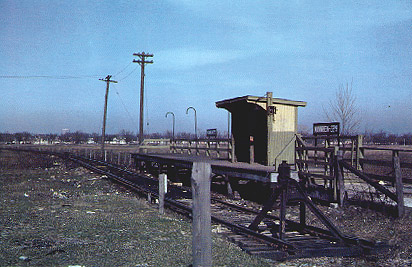
What a wonderful website! Thank you for all the information I was able locate about the CA&E! I am looking for any photo of the last stop at Mannheim & 22nd Street on the Westchester branch. My uncle lived in Wheaton on Electric Avenue. He somehow acquired the station signage from that last stop, and I have yet to confirm that the sign that I now have, as being from that end of line stop! Is there someone in your organization that might be able to confirm its existence with a picture of said sign? It’s a 14″ x 7′, deep blue with white block lettering, reading, MANNHEIM-22nd. Would appreciate any information to find its true history!

I found a picture of that station on Graham Garfield’s excellent web site. It is dated 1951, which was when service ended, and although it is not very sharp, you can see two signs.  The photo is credited to Bernard L. Stone:

https://www.chicago-l.org/stations/images/Westchester/mannheim-22nd01.jpg

On the other hand, Mitch Markovitz writes:

I saw the photo of the sign that reads “MANNHEIM 22nd STREET” in the latest Dodger. I don’t think it’s authentic at all. The type is way too contemporary, and doesn’t match anything else the “L” did as far as signs. Including the photos with the two signs at the platform. The blue is way too light as well.

Keep those cards and letters coming in, folks.

-David Sadowski

Finally, Jack Bejna writes:

Thanks for the kind comments and the forum to share my photographic efforts with the interurban/streetcar community. It’s nice to know that someday when I’m gone my collection will have been shared with the electric railroad enthusiasts that remain.

There are more Detroit United Railway photos to be posted as well as photographs from the Michigan interurbans that vanished long ago so stay tuned to this great blog!

Pre-Order Our New Book Building Chicago’s Subways

There are three subway anniversaries this year in Chicago:
60 years since the West Side Subway opened (June 22, 1958)
75 years since the State Street Subway opened (October 17, 1943)
80 years since subway construction started (December 17, 1938)

To commemorate these anniversaries, we have written a new book, Building Chicago’s Subways.

While the elevated Chicago Loop is justly famous as a symbol of the city, the fascinating history of its subways is less well known. The City of Chicago broke ground on what would become the “Initial System of Subways” during the Great Depression and finished 20 years later. This gigantic construction project, a part of the New Deal, would overcome many obstacles while tunneling through Chicago’s soft blue clay, under congested downtown streets, and even beneath the mighty Chicago River. Chicago’s first rapid transit subway opened in 1943 after decades of wrangling over routes, financing, and logistics. It grew to encompass the State Street, Dearborn-Milwaukee, and West Side Subways, with the latter modernizing the old Garfield Park “L” into the median of Chicago’s first expressway. Take a trip underground and see how Chicago’s “I Will” spirit overcame challenges and persevered to help with the successful building of the subways that move millions. Building Chicago’s subways was national news and a matter of considerable civic pride–making it a “Second City” no more!

Bibliographic information:

Title Building Chicago’s Subways
Images of America
Author David Sadowski
Edition illustrated
Publisher Arcadia Publishing (SC), 2018
ISBN 1467129380, 9781467129381
Length 128 pages

Chapter Titles:
01. The River Tunnels
02. The Freight Tunnels
03. Make No Little Plans
04. The State Street Subway
05. The Dearborn-Milwaukee Subway
06. Displaced
07. Death of an Interurban
08. The Last Street Railway
09. Subways and Superhighways
10. Subways Since 1960

Building Chicago’s Subways will be published on October 1, 2018. Order your copy today, and it will be shipped on or about that date. All copies purchased through The Trolley Dodger will be signed by the author.

The price of $23.99 includes shipping within the United States.

For Shipping to US Addresses:

For Shipping to Canada:

For Shipping Elsewhere:

Redone tile at the Monroe and Dearborn CTA Blue Line subway station, showing how an original sign was incorporated into a newer design, May 25, 2018. (David Sadowski Photo)

Redone tile at the Monroe and Dearborn CTA Blue Line subway station, showing how an original sign was incorporated into a newer design, May 25, 2018. (David Sadowski Photo)

Help Support The Trolley Dodger

gh1

This is our 217th post, and we are gradually creating a body of work and an online resource for the benefit of all railfans, everywhere. To date, we have received over 428,000 page views, for which we are very grateful.

You can help us continue our original transit research by checking out the fine products in our Online Store.

As we have said before, “If you buy here, we will be here.”

We thank you for your support.

DONATIONS

In order to continue giving you the kinds of historic railroad images that you have come to expect from The Trolley Dodger, we need your help and support. It costs money to maintain this website, and to do the sort of historic research that is our specialty.

Your financial contributions help make this web site better, and are greatly appreciated.

Spring Forward

CTA 6151 is southbound at Halsted and Congress on October 5, 1953 running on Route 8. The bridge 6151 is on spanned the Congress Expressway construction site. The highway was not yet open, and service continued on the Halsted "L" station at rear (with two tracks instead of the original four) until June 1958. (William Shapotkin Collection)

CTA 6151 is southbound at Halsted and Congress on October 5, 1953 running on Route 8. The bridge 6151 is on spanned the Congress Expressway construction site. The highway was not yet open, and service continued on the Halsted “L” station at rear (with two tracks instead of the original four) until June 1958. (William Shapotkin Collection)

Spring is here again, at least sort of, since we are expecting snow today here in Chicago. It’s been some time since our last post, but we have been busy collecting more streetcar and interurban pictures for your enjoyment. Plus, there are important contributions from some of our readers, for which we are thankful.

Each year, we turn our clocks forward one hour in the spring. But many of us wish we could simply turn back the clock instead, although hindsight is always 20/20 and we should always keep our eyes on the future.

But regardless, let’s “spring forward” with some great traction images from days gone by! We also have a few bonus images for our bus and diesel fans as well.

-David Sadowski

PS- We are gratified that despite not having a new post for two months, our readers have continued to support us. In fact, we are still very much on track to show a 15% increase in page views this year.

Waterloo, Cedar Falls & Northern car 100 on the Southern Iowa Railway on October 13, 1963. Don's Rail Photos: "100 was built by McGuire-Cummings in 1914. It was built as a second motor to operate behind the 140s as a two car train. The baggage compartment was a kitchen, and the rear end was an open platform observation. The buffet section was replaced with coach seats in 1918. The car was then rebuilt with a control station and baggage compartment in 1928 and the rear platform was enclosed at that time. It was the last interurban left on the WCF&N when it became diesel freight, and it was donated to the Iowa Chapter of the NRHS in 1956. It was moved to Centerville and operated on the Southern Iowa Ry. When the SI cut back its operation and dieselized, the Iowa Chapter transferred the car to the Iowa Terminal RR in 1966. Shortly after it was repainted and put into charter service, it was destroyed in the carbarn fire early November 24, 1967. It had been the only car saved from the WCF&N roundhouse fire on October 31, 1954, when the other two cars of its class burned." This slide has "Q transfer" noted on it-- not sure what that means. (James J. Buckley Photo)

Waterloo, Cedar Falls & Northern car 100 on the Southern Iowa Railway on October 13, 1963. Don’s Rail Photos: “100 was built by McGuire-Cummings in 1914. It was built as a second motor to operate behind the 140s as a two car train. The baggage compartment was a kitchen, and the rear end was an open platform observation. The buffet section was replaced with coach seats in 1918. The car was then rebuilt with a control station and baggage compartment in 1928 and the rear platform was enclosed at that time. It was the last interurban left on the WCF&N when it became diesel freight, and it was donated to the Iowa Chapter of the NRHS in 1956. It was moved to Centerville and operated on the Southern Iowa Ry. When the SI cut back its operation and dieselized, the Iowa Chapter transferred the car to the Iowa Terminal RR in 1966. Shortly after it was repainted and put into charter service, it was destroyed in the carbarn fire early November 24, 1967. It had been the only car saved from the WCF&N roundhouse fire on October 31, 1954, when the other two cars of its class burned.” This slide has “Q transfer” noted on it– not sure what that means. (James J. Buckley Photo)

The new and the old. CTA 5007 and 2269 at Rosemont on August 26, 2010. The 2200s have since been retired. (Bruce Nelson Photo)

The new and the old. CTA 5007 and 2269 at Rosemont on August 26, 2010. The 2200s have since been retired. (Bruce Nelson Photo)

An Oshawa steeple cab with a Philadelphia & Reading coach at the Connecticut Trolley Museum in May 1967. (Gerald H. Landau Photo)

An Oshawa steeple cab with a Philadelphia & Reading coach at the Connecticut Trolley Museum in May 1967. (Gerald H. Landau Photo)

An Oshawa steeple cab at the Connecticut Trolley Museum in May 1967. (Gerald H. Landau Photo)

An Oshawa steeple cab at the Connecticut Trolley Museum in May 1967. (Gerald H. Landau Photo)

Montreal observation car #4 at the Connecticut Trolley Museum in May 1967. (Gerald H. Landau Photo)

Montreal observation car #4 at the Connecticut Trolley Museum in May 1967. (Gerald H. Landau Photo)

Connecticut Company Birney car 3001 at the Connecticut Trolley Museum in May 1967. (Gerald H. Landau Photo)

Connecticut Company Birney car 3001 at the Connecticut Trolley Museum in May 1967. (Gerald H. Landau Photo)

Illinois Terminal double-ended PCC 451 at the Connecticut Trolley Museum in May 1967. (Gerald H. Landau Photo)

Illinois Terminal double-ended PCC 451 at the Connecticut Trolley Museum in May 1967. (Gerald H. Landau Photo)

New Orleans #836 and Rio car #1850 at the Connecticut Trolley Museum in May 1967. (Gerald H. Landau Photo)

New Orleans #836 and Rio car #1850 at the Connecticut Trolley Museum in May 1967. (Gerald H. Landau Photo)

Rio car #1850 at the Connecticut Trolley Museum in May 1967. (Gerald H. Landau Photo)

Rio car #1850 at the Connecticut Trolley Museum in May 1967. (Gerald H. Landau Photo)

Connecticut Company open car 1414 was built by Osgood Bradley in 1911. Here, we see it at the Shore Line Trolley Museum located at Branford, Connecticut on June 18, 1966. (William C. Janssen Photo)

Connecticut Company open car 1414 was built by Osgood Bradley in 1911. Here, we see it at the Shore Line Trolley Museum located at Branford, Connecticut on June 18, 1966. (William C. Janssen Photo)

Connecticut Company open car 1414 at Branford on May 30, 1964. (J. W. Vigrass Photo)

Connecticut Company open car 1414 at Branford on May 30, 1964. (J. W. Vigrass Photo)

Connecticut Company open car 1414 was built by Osgood Bradley in 1911. Here, we see it at the Shore Line Trolley Museum located at Branford, Connecticut on June 18, 1966. (William C. Janssen Photo)

Connecticut Company open car 1414 was built by Osgood Bradley in 1911. Here, we see it at the Shore Line Trolley Museum located at Branford, Connecticut on June 18, 1966. (William C. Janssen Photo)

You would be forgiven for thinking this December 18, 1955 photo shows CTA Pullman 144. But this was actually the excursion where car 144 was promised, but 225 was substituted in its place-- renumbered with the help of a few pieces of oilcloth. Here, the fantrip car is seen at Broadway and Devon.

You would be forgiven for thinking this December 18, 1955 photo shows CTA Pullman 144. But this was actually the excursion where car 144 was promised, but 225 was substituted in its place– renumbered with the help of a few pieces of oilcloth. Here, the fantrip car is seen at Broadway and Devon.

CTA PCC 7138, a product of the St. Louis Car Company, at the State Street loop near 84th on February 11, 1950. This location is now occupied by the Dan Ryan expressway.

CTA PCC 7138, a product of the St. Louis Car Company, at the State Street loop near 84th on February 11, 1950. This location is now occupied by the Dan Ryan expressway.

CTA PCC 7070 at the Clark and Howard loop on July 4, 1954.

CTA PCC 7070 at the Clark and Howard loop on July 4, 1954.

Philadelphia & Western (aka Red Arrow) Bullet car 202 at Norristown in 1949. Behind 202, you can see the ramp leading down to street level, used by Lehigh Valley Transit's Liberty Bell route trains. (S. Bogen Photo)

Philadelphia & Western (aka Red Arrow) Bullet car 202 at Norristown in 1949. Behind 202, you can see the ramp leading down to street level, used by Lehigh Valley Transit’s Liberty Bell route trains. (S. Bogen Photo)

By May 1961, when this photo was taken in Norristown, Liberty Bell Limited trains had been gone for nearly a decade. As you can see at left, the ramp leading down to ground level was removed and blocked off with an advertising sign.

By May 1961, when this photo was taken in Norristown, Liberty Bell Limited trains had been gone for nearly a decade. As you can see at left, the ramp leading down to ground level was removed and blocked off with an advertising sign.

Philadelphia Suburban (aka Red Arrow) Brilliner car 3 at Gay and High Streets in West Chester on June 6, 1954, at the end of trolley service on this route. The longest Red Arrow line was mainly a single-track side-of-the-road operation, which had to give way for the widening of West Chester Pike. (Edward S. Miller Photo)

Philadelphia Suburban (aka Red Arrow) Brilliner car 3 at Gay and High Streets in West Chester on June 6, 1954, at the end of trolley service on this route. The longest Red Arrow line was mainly a single-track side-of-the-road operation, which had to give way for the widening of West Chester Pike. (Edward S. Miller Photo)

Philadelphia Suburban (aka Red Arrow) car 78 at Larchmont Station on West Chester Pike at Media Line Road, Newtown Township, PA on May 9, 1954. Photographer Edward S. Miller noted that he later operated this car at the Arden trolley museum.

Philadelphia Suburban (aka Red Arrow) car 78 at Larchmont Station on West Chester Pike at Media Line Road, Newtown Township, PA on May 9, 1954. Photographer Edward S. Miller noted that he later operated this car at the Arden trolley museum.

Philadelphia Suburban double-end car 19, which looked like a PCC but does not technically qualify as one, since it had standard interurban trucks and motors. It is captured on May 9, 1954 at Broomall Station on West Chester Pike at Sproul Road in Marple Township, PA. (Edward S. Miller Photo)

Philadelphia Suburban double-end car 19, which looked like a PCC but does not technically qualify as one, since it had standard interurban trucks and motors. It is captured on May 9, 1954 at Broomall Station on West Chester Pike at Sproul Road in Marple Township, PA. (Edward S. Miller Photo)

A pair of Bullet cars running in multiple units on the Red Arrow Norristown High Speed Line on September 9, 1958. (Clark Frazier Photo)

A pair of Bullet cars running in multiple units on the Red Arrow Norristown High Speed Line on September 9, 1958. (Clark Frazier Photo)

Philadelphia Suburban (aka red Arrow) car 11 at the end of the line on the short Ardmore branch on September 9, 1958. (Clark Frazier Photo)

Philadelphia Suburban (aka red Arrow) car 11 at the end of the line on the short Ardmore branch on September 9, 1958. (Clark Frazier Photo)

Philadelphia Suburban (aka red Arrow) car 13, a product of the St. Louis Car Company, on the Media line on September 9, 1958. Garrett Patterson says the location is "Drexelbrook, inbound." (Clark Frazier Photo)

Philadelphia Suburban (aka red Arrow) car 13, a product of the St. Louis Car Company, on the Media line on September 9, 1958. Garrett Patterson says the location is “Drexelbrook, inbound.” (Clark Frazier Photo)

Philadelphia Suburban double-ended car 15, built by St. Louis Car Company in 1949, is seen at Gay and High Streets in West Chester, at the end of the long West Chester trolley line.

Philadelphia Suburban double-ended car 15, built by St. Louis Car Company in 1949, is seen at Gay and High Streets in West Chester, at the end of the long West Chester trolley line.

To see many more Philadelphia pictures like the ones above,take a look at our previous post Red Arrow in West Chester (September 13, 2016).

Fairmount Park Transit closed car #1 on May 19, 1935.

Fairmount Park Transit closed car #1 on May 19, 1935.

Fairmount Park Transit open car 18 at the car barn.

Fairmount Park Transit open car 18 at the car barn.

For more pictures like the two above, check out our previous post The Fairmount Park Trolley (November 7, 2017).

CTA one-man car 1743 (signed for Route 21 - Cermak, but the photographer has written "Lake Street") entering Kedzie Station at 5th Avenue and Jackson Boulevard on July 21, 1952. This picture looks to have been taken at about the same time as another, which shows a PCC car, on page 102 of my book Chicago Trolleys. (Robert Selle Photo)

CTA one-man car 1743 (signed for Route 21 – Cermak, but the photographer has written “Lake Street”) entering Kedzie Station at 5th Avenue and Jackson Boulevard on July 21, 1952. This picture looks to have been taken at about the same time as another, which shows a PCC car, on page 102 of my book Chicago Trolleys. (Robert Selle Photo)

Indianapolis Railways "Peter Witt" car 173 is shown at the Broad Ripple loop on June 6, 1951. Broad Ripple Village is an Indy neighborhood that was once an independent municipality. It was annexed into Indianapolis in 1922. (Robert Selle Photo)

Indianapolis Railways “Peter Witt” car 173 is shown at the Broad Ripple loop on June 6, 1951. Broad Ripple Village is an Indy neighborhood that was once an independent municipality. It was annexed into Indianapolis in 1922. (Robert Selle Photo)

CSL "Matchbox" 1169 at Damen and Taylor on June 2, 1945. Don's Rail Photos says, "1169 was built by St Louis Car Co in 1903 as CUT 4698. It was renumbered 1169 in 1913 and became CSL 1169 in 1914. It was retired on September 16, 1944." Not sure about the discrepancy in dates, but some renumbering of these cars did take place.

CSL “Matchbox” 1169 at Damen and Taylor on June 2, 1945. Don’s Rail Photos says, “1169 was built by St Louis Car Co in 1903 as CUT 4698. It was renumbered 1169 in 1913 and became CSL 1169 in 1914. It was retired on September 16, 1944.” Not sure about the discrepancy in dates, but some renumbering of these cars did take place.

Chicago Aurora & Elgin cars 401 and 431 are crossing the DesPlaines River westbound on August 29, 1953, about a half mile west of the DesPlaines Avenue station. This is now the site of I-290. The CA&E tracks and bridge were moved north of the highway in 1959 but were never used by the interurban, which was subsequently abandoned. In this section, the CA&E ran parallel to Harrison Street, which has also been taken up by the highway. (Robert Selle Photo)

Chicago Aurora & Elgin cars 401 and 431 are crossing the DesPlaines River westbound on August 29, 1953, about a half mile west of the DesPlaines Avenue station. This is now the site of I-290. The CA&E tracks and bridge were moved north of the highway in 1959 but were never used by the interurban, which was subsequently abandoned. In this section, the CA&E ran parallel to Harrison Street, which has also been taken up by the highway. (Robert Selle Photo)

Three CTA arch-roof cars awaiting scrapping on May 16, 1954: two-man 6141, one-man cars 6167 and 3128 at South Shops. This was just two weeks before the end of all red car service in Chicago, and was also the date of a fantrip that ran on all the lines that were about to be "bustituted." (Robert Selle Photo)

Three CTA arch-roof cars awaiting scrapping on May 16, 1954: two-man 6141, one-man cars 6167 and 3128 at South Shops. This was just two weeks before the end of all red car service in Chicago, and was also the date of a fantrip that ran on all the lines that were about to be “bustituted.” (Robert Selle Photo)

Images From the Wien-Criss Archive

Our thanks to Jeffrey L. Wien for sharing these classic pictures with our readers.

A three-car train of Boston MTA PCCs, running on Commonwealth Avenue east of Summit Avenue on May 31, 1961. (Clark Frazier Photo, Wien-Criss Archive)

A three-car train of Boston MTA PCCs, running on Commonwealth Avenue east of Summit Avenue on May 31, 1961. (Clark Frazier Photo, Wien-Criss Archive)

The Chicago Great Western Railway merged with the Chicago & North Western in 1968, and most of its trackage was thereafter abandoned. But on February 21, 1965, we see CGW freight #91, running westbound on Baltimore & Ohio Chicago Terminal tracks, parallel to I-290 just west of Lombard in suburban Oak Park, Illinois. The motive power consisted of 104A, 105B, 106C, 116F, 1100, 112C, and 177. At right, you can see the secondary entrance to the CTA's Congress rapid transit line at Lombard. The main entrance at Austin Boulevard is two blocks east of there. The CGW split off from the B&OCT in Forest Park a few miles west of here, and then ran parallel to the Chicago Aurora & Elgin interurban through Bellwood. (James J. Buckley Photo, Wien-Criss Archive)

The Chicago Great Western Railway merged with the Chicago & North Western in 1968, and most of its trackage was thereafter abandoned. But on February 21, 1965, we see CGW freight #91, running westbound on Baltimore & Ohio Chicago Terminal tracks, parallel to I-290 just west of Lombard in suburban Oak Park, Illinois. The motive power consisted of 104A, 105B, 106C, 116F, 1100, 112C, and 177. At right, you can see the secondary entrance to the CTA’s Congress rapid transit line at Lombard. The main entrance at Austin Boulevard is two blocks east of there. The CGW split off from the B&OCT in Forest Park a few miles west of here, and then ran parallel to the Chicago Aurora & Elgin interurban through Bellwood. (James J. Buckley Photo, Wien-Criss Archive)

Kansas City Public Service PCCs 712 and 796 at the 48th and Harrison yard on October 16, 1956. PCCs last ran in Kansas City in 1957, but streetcars returned to Kansas City in 2016. (Robert Selle Photo, Wien-Criss Archive)

Kansas City Public Service PCCs 712 and 796 at the 48th and Harrison yard on October 16, 1956. PCCs last ran in Kansas City in 1957, but streetcars returned to Kansas City in 2016. (Robert Selle Photo, Wien-Criss Archive)

Chicago North Shore & Milwaukee city car 360 on Glen Flora Avenue in Waukegan, Illinois. This picture could not have been taken after 1947. (Robert Selle Photo, Wien-Criss Archive)

Chicago North Shore & Milwaukee city car 360 on Glen Flora Avenue in Waukegan, Illinois. This picture could not have been taken after 1947. (Robert Selle Photo, Wien-Criss Archive)

CTA Pullman 529, as seen from the Ashland station on the Lake Street "L", on May 7, 1953. (Robert Selle Photo, Wien-Criss Archive)

CTA Pullman 529, as seen from the Ashland station on the Lake Street “L”, on May 7, 1953. (Robert Selle Photo, Wien-Criss Archive)

CTA 1725 is operating as a one-man shuttle car on the Madison-Fifth branch line on Route 20 on February 15, 1953. The car is heading southwest on Fifth Avenue approaching Harrison Street and Pulaski Avenue, which was the end of the line near the adjacent Garfield Park "L" station. I thought at first that the date might actually have been 1954, but subsequent research shows the 1953 date to be correct (see correspondence with Tony Waller below). (Robert Selle Photo, Wien-Criss Archive)

CTA 1725 is operating as a one-man shuttle car on the Madison-Fifth branch line on Route 20 on February 15, 1953. The car is heading southwest on Fifth Avenue approaching Harrison Street and Pulaski Avenue, which was the end of the line near the adjacent Garfield Park “L” station. I thought at first that the date might actually have been 1954, but subsequent research shows the 1953 date to be correct (see correspondence with Tony Waller below). (Robert Selle Photo, Wien-Criss Archive)

CTA Pullman 540 at 70th and Ashland (69th Street Station) on May 23, 1953. The sign above the streetcar bays is now at the Illinois Railway Museum. (Robert Selle Photo, Wien-Criss Archive)

CTA Pullman 540 at 70th and Ashland (69th Street Station) on May 23, 1953. The sign above the streetcar bays is now at the Illinois Railway Museum. (Robert Selle Photo, Wien-Criss Archive)

Chicago Surface Lines 4118, built by Pullman, heads southbound on Clark at Wacker on June 13, 1947. We ran a version of this picture before, in our post More Chicago PCC Photos - Part Six (November 30, 2015), but this one is better, as it is a scan from the original medium format negative. (Wien-Criss Archive)

Chicago Surface Lines 4118, built by Pullman, heads southbound on Clark at Wacker on June 13, 1947. We ran a version of this picture before, in our post More Chicago PCC Photos – Part Six (November 30, 2015), but this one is better, as it is a scan from the original medium format negative. (Wien-Criss Archive)

CTA Pullman 230 is southbound on Clark Street, having just crossed the bridge over the Chicago River on May 18, 1954. This was less than two weeks before the end of red car service in Chicago. (Robert Selle Photo, Wien-Criss Archive)

CTA Pullman 230 is southbound on Clark Street, having just crossed the bridge over the Chicago River on May 18, 1954. This was less than two weeks before the end of red car service in Chicago. (Robert Selle Photo, Wien-Criss Archive)

In this November 4, 1952 view, CTA 593 is on Clark Street, heading south to the Limits car barn, while car 562 is on Southport, the north end of the Ashland route. (Robert Selle Photo, Wien-Criss Archive)

In this November 4, 1952 view, CTA 593 is on Clark Street, heading south to the Limits car barn, while car 562 is on Southport, the north end of the Ashland route. (Robert Selle Photo, Wien-Criss Archive)

On August 7, 1952, CTA 452 is at the north end of Route #9 - Ashland, on Southport just north of Irving Park Road. (Robert Selle Photo, Wien-Criss Archive)

On August 7, 1952, CTA 452 is at the north end of Route #9 – Ashland, on Southport just north of Irving Park Road. (Robert Selle Photo, Wien-Criss Archive)

On May 24, 1958 the Central Electric Railfans' Association operated a fantrip on the South Shore Line, using Illinois Central equipment. Normally, South Shore cars ran on the IC, but not the other way around. Here, they are having a photo stop at the "new" East Chicago station, parallel to the Indiana Toll Road, which opened in 1956. It replaced street running in East Chicago. The view looks east. (Robert Selle Photo, Wien-Criss Archive)

On May 24, 1958 the Central Electric Railfans’ Association operated a fantrip on the South Shore Line, using Illinois Central equipment. Normally, South Shore cars ran on the IC, but not the other way around. Here, they are having a photo stop at the “new” East Chicago station, parallel to the Indiana Toll Road, which opened in 1956. It replaced street running in East Chicago. The view looks east. (Robert Selle Photo, Wien-Criss Archive)

On July 13, 1955, a 700-series North Shore Line car is being converted into a Silverliner, while flanked by cars 419 and 746 at the Highwood Shops. (Robert Selle Photo, Wien-Criss Archive)

On July 13, 1955, a 700-series North Shore Line car is being converted into a Silverliner, while flanked by cars 419 and 746 at the Highwood Shops. (Robert Selle Photo, Wien-Criss Archive)

Clark in December 1951. Note the outdoor scale at left. (Robert Selle Photo, Wien-Criss Archive)

CTA one-man car 6171 is at Lawrence and Clark in December 1951. Note the outdoor scale at left. (Robert Selle Photo, Wien-Criss Archive)

CTA one-man car 1784 is heading southwest on Ogden (Route 58) at Van Buren and Honore. To the right, buildings are being cleared away for the Congress Expressway. To the north, you can see a Wieboldt's department store, which was located on Adams between Ogden and Ashland. The "L" to the rear is the Met branch leading to Logan Suare, already out of service for several months when this picture was taken in August 1951. The Garfield Park "L" would have been directly behind the photographer, smack dab in the middle of what became the expressway footprint. (Robert Selle Photo, Wien-Criss Archive)

CTA one-man car 1784 is heading southwest on Ogden (Route 58) at Van Buren and Honore. To the right, buildings are being cleared away for the Congress Expressway. To the north, you can see a Wieboldt’s department store, which was located on Adams between Ogden and Ashland. The “L” to the rear is the Met branch leading to Logan Suare, already out of service for several months when this picture was taken in August 1951. The Garfield Park “L” would have been directly behind the photographer, smack dab in the middle of what became the expressway footprint. (Robert Selle Photo, Wien-Criss Archive)

CTA Pullmans 546 and 553 cross near a safety island at 71st and Ashland on June 29, 1953. (Robert Selle Photo, Wien-Criss Archive)

CTA Pullmans 546 and 553 cross near a safety island at 71st and Ashland on June 29, 1953. (Robert Selle Photo, Wien-Criss Archive)

In this amazing June 22, 1953 view of the junction at Tower 18, on Chicago's Loop "L" at Lake and Wells, we see CTA Evanston Express and Garfield Park trains, with a North Shore Line train in the background. Until 1969, both Loop tracks ran in the same direction, so the two cars are heading towards the photographer, while the North Shore Line train is going away. The photographer was standing on the Randolph and Wells platform. That station has since been replaced by Washington and Wells. (Robert Selle Photo, Wien-Criss Archive)

In this amazing June 22, 1953 view of the junction at Tower 18, on Chicago’s Loop “L” at Lake and Wells, we see CTA Evanston Express and Garfield Park trains, with a North Shore Line train in the background. Until 1969, both Loop tracks ran in the same direction, so the two cars are heading towards the photographer, while the North Shore Line train is going away. The photographer was standing on the Randolph and Wells platform. That station has since been replaced by Washington and Wells. (Robert Selle Photo, Wien-Criss Archive)

On November 9, 1952, a two-car CTA "L" train, headed by car 1019, is on the trestle at Central on the Evanston branch. (Robert Selle Photo, Wien-Criss Archive)

On November 9, 1952, a two-car CTA “L” train, headed by car 1019, is on the trestle at Central on the Evanston branch. (Robert Selle Photo, Wien-Criss Archive)

CTA Pullman 643 is westbound at North and Halsted on August 14, 1948. That section of "L" at the rear, part of a section known as the "triple curve," is still there today, and is used by Brown and Purple Line trains. (Robert Selle Photo, Wien-Criss Archive)

CTA Pullman 643 is westbound at North and Halsted on August 14, 1948. That section of “L” at the rear, part of a section known as the “triple curve,” is still there today, and is used by Brown and Purple Line trains. (Robert Selle Photo, Wien-Criss Archive)

CTA Clark Street PCC 4361 and Broadway PCC 7175 meet at Clark, Broadway, and Diversey on November 8, 1953. (Robert Selle Photo, Wien-Criss Archive)

CTA Clark Street PCC 4361 and Broadway PCC 7175 meet at Clark, Broadway, and Diversey on November 8, 1953. (Robert Selle Photo, Wien-Criss Archive)

CTA Pullman 558, turning onto Ashland from Irving Park Road on May 19, 1953. (Robert Selle Photo, Wien-Criss Archive)

CTA Pullman 558, turning onto Ashland from Irving Park Road on May 19, 1953. (Robert Selle Photo, Wien-Criss Archive)

CTA one-man car 3276 on Route 50 - Damen at about 2300 North. (Robert Selle Photo, Wien-Criss Archive)

CTA one-man car 3276 on Route 50 – Damen at about 2300 North. (Robert Selle Photo, Wien-Criss Archive)

CTA 926 is a Lincoln-Peterson car at Division and Clark in June 1951. (Robert Selle Photo, Wien-Criss Archive)

CTA 926 is a Lincoln-Peterson car at Division and Clark in June 1951. (Robert Selle Photo, Wien-Criss Archive)

CTA Pullman 58 is running as a "tripper" on Broadway-State on May 18, 1954. Here, we see it southbound on State Street, crossing the Chicago River over the bridge that was put into service in 1949. (Robert Selle Photo, Wien-Criss Archive)

CTA Pullman 58 is running as a “tripper” on Broadway-State on May 18, 1954. Here, we see it southbound on State Street, crossing the Chicago River over the bridge that was put into service in 1949. (Robert Selle Photo, Wien-Criss Archive)

CTA 575 is southbound on Paulina near Washington Boulevard, running on Route 9 - Ashland on September 15, 1953. (Robert Selle Photo, Wien-Criss Archive)

CTA 575 is southbound on Paulina near Washington Boulevard, running on Route 9 – Ashland on September 15, 1953. (Robert Selle Photo, Wien-Criss Archive)

A green and cream "L" car passes a green and cream trolley. CTA 4327 is at the front of a Lake Street "L" train, running at ground level under trolley wire at Pine Street, while CTA 3141 prepares to turn and cross the tracks, heading to the other side of the Chicago & North Western embankment on September 26, 1953. (Robert Selle Photo, Wien-Criss Archive)

A green and cream “L” car passes a green and cream trolley. CTA 4327 is at the front of a Lake Street “L” train, running at ground level under trolley wire at Pine Street, while CTA 3141 prepares to turn and cross the tracks, heading to the other side of the Chicago & North Western embankment on September 26, 1953. (Robert Selle Photo, Wien-Criss Archive)

Trolley scrapping: except for a few stragglers, nearly all red cars were scrapped by the CTA after being taken out of regular service on May 30, 1954. On November 6, 1954, we see Big Pullmans 248 and 585 at right, and one of the cars at left is 604 in this scene at South Shops. (Robert Selle Photo, Wien-Criss Archive)

Trolley scrapping: except for a few stragglers, nearly all red cars were scrapped by the CTA after being taken out of regular service on May 30, 1954. On November 6, 1954, we see Big Pullmans 248 and 585 at right, and one of the cars at left is 604 in this scene at South Shops. (Robert Selle Photo, Wien-Criss Archive)

The late Robert Selle, a very gifted photographer, took his own picture inside CTA streetcar 3217 at 69th Street Station on July 12, 1952. (Wien-Criss Archive)

The late Robert Selle, a very gifted photographer, took his own picture inside CTA streetcar 3217 at 69th Street Station on July 12, 1952. (Wien-Criss Archive)

Bob Selle took a "fast shot" of CTA 681 just inside the gates at Limits Station on June 28, 1952. Limits was located at 2650 North Clark Street, which was the city limits in the late 1800s. (Wien-Criss Archive)

Bob Selle took a “fast shot” of CTA 681 just inside the gates at Limits Station on June 28, 1952. Limits was located at 2650 North Clark Street, which was the city limits in the late 1800s. (Wien-Criss Archive)

In this September 5, 1953 view, looking west from the CTA Racine Avenue station on the old Metropolitan main line, we see the Throop Street Shops at right. A CA&E train is approaching us, heading toward the Loop. (Robert Selle Photo, Wien-Criss Archive)

In this September 5, 1953 view, looking west from the CTA Racine Avenue station on the old Metropolitan main line, we see the Throop Street Shops at right. A CA&E train is approaching us, heading toward the Loop. (Robert Selle Photo, Wien-Criss Archive)

A 6-car CTA Ravenswood "A" train, made up of 200 and 300-series "L" cars, approaches Clark and Lake on September 15, 1953. (Robert Selle Photo, Wien-Criss Archive)

A 6-car CTA Ravenswood “A” train, made up of 200 and 300-series “L” cars, approaches Clark and Lake on September 15, 1953. (Robert Selle Photo, Wien-Criss Archive)

Chicago & North Western steam loco 555, a 4-6-2, heads up a northwest line commuter train at Kinzie and 400 West on August 20, 1953. (Robert Selle Photo, Wien-Criss Archive)

Chicago & North Western steam loco 555, a 4-6-2, heads up a northwest line commuter train at Kinzie and 400 West on August 20, 1953. (Robert Selle Photo, Wien-Criss Archive)

A two-car CTA train of railroad-roof cars is on the bridge over the North Shore Channel on the Evanston line on November 29, 1952. (Robert Selle Photo, Wien-Criss Archive)

A two-car CTA train of railroad-roof cars is on the bridge over the North Shore Channel on the Evanston line on November 29, 1952. (Robert Selle Photo, Wien-Criss Archive)

A view of the first 6400-series CTA "L" cars head into Chicago on a North Shore Line freight train on February 19, 1955. The location is just south of the Highmoor, Illinois station. Some of the parts used on these cars were recycled from scrapped CTA PCCs that had less than 10 years' service. (Robert Selle Photo, Wien-Criss Archive)

A view of the first 6400-series CTA “L” cars head into Chicago on a North Shore Line freight train on February 19, 1955. The location is just south of the Highmoor, Illinois station. Some of the parts used on these cars were recycled from scrapped CTA PCCs that had less than 10 years’ service. (Robert Selle Photo, Wien-Criss Archive)

CTA Pullman PCC 4063 is turning from Madison Street onto Franklin on its way into the Loop, running on Route 20 - Madison. In this September 16, 1953 view, car 4063 appears to have suffered some front-end damage that has gone unrepaired. This is probably due to the CTA's desire to scrap these cars within the next year or so. (Robert Selle Photo, Wien-Criss Archive)

CTA Pullman PCC 4063 is turning from Madison Street onto Franklin on its way into the Loop, running on Route 20 – Madison. In this September 16, 1953 view, car 4063 appears to have suffered some front-end damage that has gone unrepaired. This is probably due to the CTA’s desire to scrap these cars within the next year or so. (Robert Selle Photo, Wien-Criss Archive)

CTA PCC 4081, heading south on Route 22 - Clark-Wentworth, proceeds slowly through a work zone at Clark and Van Buren on July 17, 1954. For more pictures of this, see our previous post Track Work @Clark & Van Buren, 1954 (February 1, 2015). This negative was apparently sold by an "RJA" at one point, which may mean the photo was taken by railfan Richard J. Anderson. This track work was related to the conversion of Clark and Dearborn into one-way streets downtown. (Wien-Criss Archive)

CTA PCC 4081, heading south on Route 22 – Clark-Wentworth, proceeds slowly through a work zone at Clark and Van Buren on July 17, 1954. For more pictures of this, see our previous post Track Work @Clark & Van Buren, 1954 (February 1, 2015). This negative was apparently sold by an “RJA” at one point, which may mean the photo was taken by railfan Richard J. Anderson. This track work was related to the conversion of Clark and Dearborn into one-way streets downtown. (Wien-Criss Archive)

From the Collections of William Shapotkin

Again, our tanks to Bill for sharing these with us.

CTA PCCs 7182 and 4380 (or is it 4390?) are turning from Wentworth onto Vincennes at 73rd Street on Route 22. From the looks of the automobiles, this picture may have been taken in 1958. (William Shapotkin Collection)

CTA PCCs 7182 and 4380 (or is it 4390?) are turning from Wentworth onto Vincennes at 73rd Street on Route 22. From the looks of the automobiles, this picture may have been taken in 1958. (William Shapotkin Collection)

CSL/CTA 6213 at 93rd and Exchange Avenue. The slide said the cross street was Anthony, but as Tony Waller points out, "The photo of the red streetcar on route 95 captioned as being at 93rd and Anthony Ave. is actually at 93rd and Exchange Ave. The streetcar line westbound turned from Exchange onto 93rd. Anthony Ave. parallels the PRR/NYC viaducts (and now the Skyway bridge alignment) that is in the near distance; crossing the streetcar line at a perpendicular angle." (William Shapotkin Collection)

CSL/CTA 6213 at 93rd and Exchange Avenue. The slide said the cross street was Anthony, but as Tony Waller points out, “The photo of the red streetcar on route 95 captioned as being at 93rd and Anthony Ave. is actually at 93rd and Exchange Ave. The streetcar line westbound turned from Exchange onto 93rd. Anthony Ave. parallels the PRR/NYC viaducts (and now the Skyway bridge alignment) that is in the near distance; crossing the streetcar line at a perpendicular angle.” (William Shapotkin Collection)

CSL 5130, signed for 31st and Lake Park. Bill Shapotkin says this car "is at Archer/Pitney. The view looks N-N/W on Pitney. The car has just changed ends and will take the crossover to head east." (William Shapotkin Collection)

CSL 5130, signed for 31st and Lake Park. Bill Shapotkin says this car “is at Archer/Pitney. The view looks N-N/W on Pitney. The car has just changed ends and will take the crossover to head east.” (William Shapotkin Collection)

CSL 5083 is signed for Pitney and Archer. Bill Shapotkin say this location "is E/B in 31st, the car has just x/o South Park (now King Dr). The church on the S/E corner is still-standing and either is or has just undergone renovation." (William Shapotkin Collection)

CSL 5083 is signed for Pitney and Archer. Bill Shapotkin say this location “is E/B in 31st, the car has just x/o South Park (now King Dr). The church on the S/E corner is still-standing and either is or has just undergone renovation.” (William Shapotkin Collection)

CSL 5147, signed for Pitney and Archer. Bill Shapotkin says this location "is W/B at Wallace (note address of 556 on building at left and car tracks in Wallace). View looks E-N/E." (William Shapotkin Collection)

CSL 5147, signed for Pitney and Archer. Bill Shapotkin says this location “is W/B at Wallace (note address of 556 on building at left and car tracks in Wallace). View looks E-N/E.” (William Shapotkin Collection)

CTA 6199 is signed for Route 87A. (William Shapotkin Collection)

CTA 6199 is signed for Route 87A. (William Shapotkin Collection)

This close-up from the previous image, although not very sharp, does show that this car is a Frazer, a product of the Kaiser-Frazer company, If I had to guess, I would say it's a 1947 model, possibly a Frazer Manhattan. Most of the styling on this car is attributed to "Dutch" Darrin. Kaiser-Frazer was an independent automaker between 1946 and 1954, started by aluminum magnate Henry J. Kaiser.

This close-up from the previous image, although not very sharp, does show that this car is a Frazer, a product of the Kaiser-Frazer company, If I had to guess, I would say it’s a 1947 model, possibly a Frazer Manhattan. Most of the styling on this car is attributed to “Dutch” Darrin. Kaiser-Frazer was an independent automaker between 1946 and 1954, started by aluminum magnate Henry J. Kaiser.

CTA one-man car 3224 is at 92nd and Baltimore. That's a bus trailing behind. (William Shapotkin Collection)

CTA one-man car 3224 is at 92nd and Baltimore. That’s a bus trailing behind. (William Shapotkin Collection)

CTA Pullman 144, possibly on a late 1950s fantrip. This car is now at the Illinois Railway Museum. (William Shapotkin Collection)

CTA Pullman 144, possibly on a late 1950s fantrip. This car is now at the Illinois Railway Museum. (William Shapotkin Collection)

CTA one-man car 3219 is at 87th and Escanaba in May 1950, at the end of the line for Route 87A. The operator is changing ends. (William Shapotkin Collection)

CTA one-man car 3219 is at 87th and Escanaba in May 1950, at the end of the line for Route 87A. The operator is changing ends. (William Shapotkin Collection)

CTA one-man car 3220 is at 67th and Oglesby in June 1952, on Route 67. (William Shapotkin Collection)

CTA one-man car 3220 is at 67th and Oglesby in June 1952, on Route 67. (William Shapotkin Collection)

CTA 6153. (William Shapotkin Collection)

CTA 6153. (William Shapotkin Collection)

CTA 7191 is at 81st and Wallace on Route - Clark-Wentworth. (Robert W. Gibson Photo, William Shapotkin collection)

CTA 7191 is at 81st and Wallace on Route – Clark-Wentworth. (Robert W. Gibson Photo, William Shapotkin collection)

CTA Pullman 459 is at Ashland and 27th Street on Route 9 in February 1951. (William Shapotkin Collection)

CTA Pullman 459 is at Ashland and 27th Street on Route 9 in February 1951. (William Shapotkin Collection)

CSL 5147, signed for Pitney and Archer. Michael D. Franklin adds, "This picture shows 6181 heading south on Larrabee St between Crosby St and Kingsbury Street. Building with 'Adams Mfg. Co.' is still standing at 907 N. Larrabee Ave." (William Shapotkin Collection)

CSL 5147, signed for Pitney and Archer. Michael D. Franklin adds, “This picture shows 6181 heading south on Larrabee St between Crosby St and Kingsbury Street. Building with ‘Adams Mfg. Co.’ is still standing at 907 N. Larrabee Ave.” (William Shapotkin Collection)

CSL 5154, signed for Piney and Archer. Bill Shapotkin says, "This car is at East end-of-line in 26th east of Lake Park Ave -- note IC catenary in background. View looks N/E." (William Shapotkin Collection)

CSL 5154, signed for Piney and Archer. Bill Shapotkin says, “This car is at East end-of-line in 26th east of Lake Park Ave — note IC catenary in background. View looks N/E.” (William Shapotkin Collection)

CTA 5278 at 79th and Western in March 1948 on Route 79. (William Shapotkin Collection)

CTA 5278 at 79th and Western in March 1948 on Route 79. (William Shapotkin Collection)

CTA one-man car 6224 is at 92nd and Commercial in April 1948. (William Shapotkin Collection)

CTA one-man car 6224 is at 92nd and Commercial in April 1948. (William Shapotkin Collection)

CTA one-man car 6272 is at 89th and Buffalo on Route 93 in April 1948. (William Shapotkin Collection)

CTA one-man car 6272 is at 89th and Buffalo on Route 93 in April 1948. (William Shapotkin Collection)

CSL one-man car 6213 is at 89th and Avenue O in October 1946, on Route 93-95. (William Shapotkin Collection)

CSL one-man car 6213 is at 89th and Avenue O in October 1946, on Route 93-95. (William Shapotkin Collection)

CTA 6209 is at 94th on July 2, 1949, running on Route 93-95. (William Shapotkin Collection)

CTA 6209 is at 94th on July 2, 1949, running on Route 93-95. (William Shapotkin Collection)

CTA Pullman 677 is at Pulaski and Bryn Mawr in 1949 on Route 53. (William Shapotkin Collection)

CTA Pullman 677 is at Pulaski and Bryn Mawr in 1949 on Route 53. (William Shapotkin Collection)

Bill Shapotkin writes:

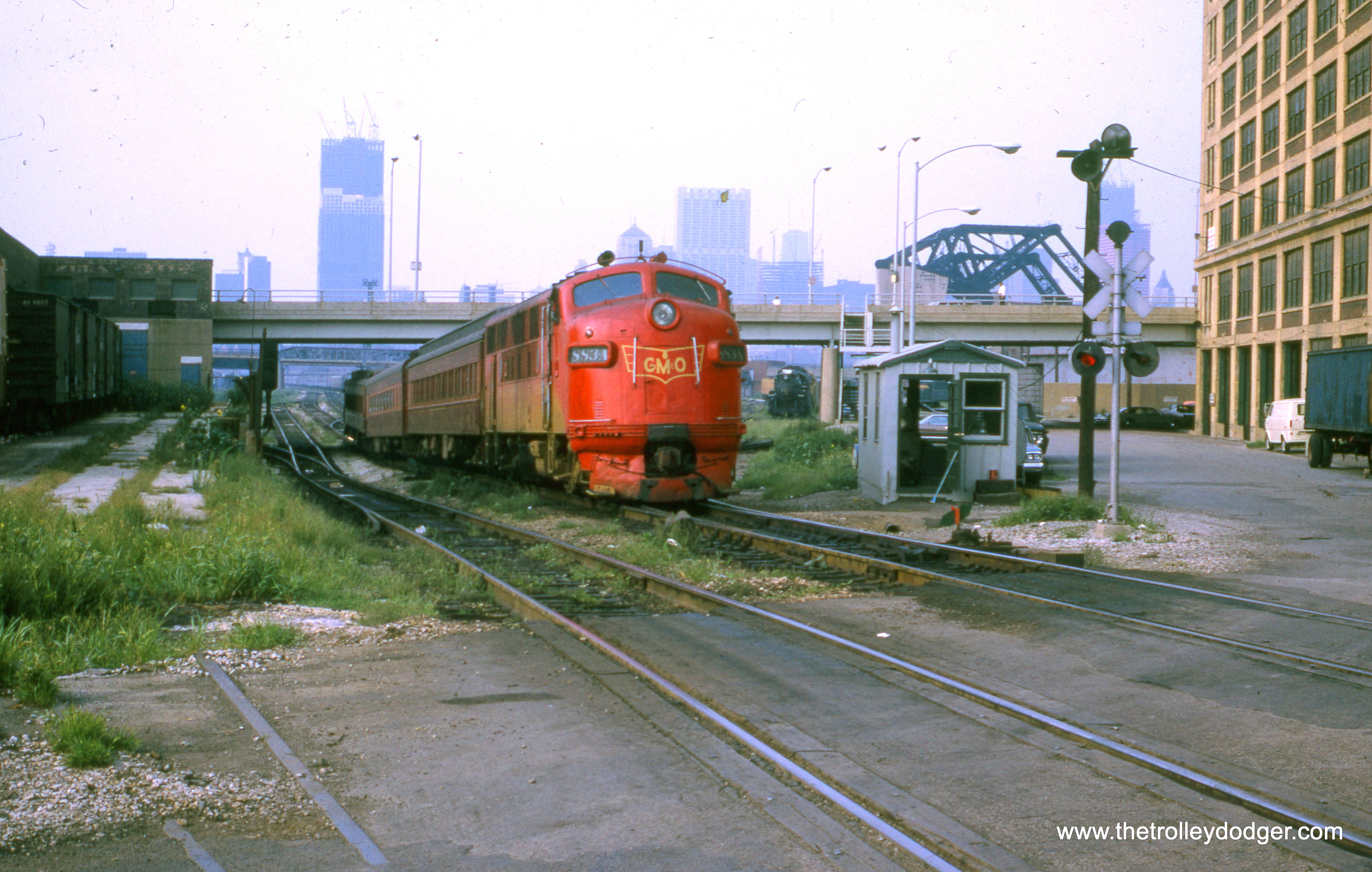
All the pix of a ‘GM&O” passenger train are of the southbound “Plug,” the Chicago-Joliet suburban train. Even after the ICG merger, the train continued to operate with GM&O equipment — and indeed, the loco (do not recall if it was 880-B or not), even got a new GM&O logo stenciled onto its nose. Bi-level equipment arrived (I believe) circa 1977-79, when a second “Plug” was added to the schedule.

A Gulf, Mobile & Ohio passenger train near Chicago's Loop. This slide was process in August 1972, right around the time that the GM&O was merged into the Illinois Central. (William Shapotkin Collection)

A Gulf, Mobile & Ohio passenger train near Chicago’s Loop. This slide was process in August 1972, right around the time that the GM&O was merged into the Illinois Central. (William Shapotkin Collection)

A GM&O diesel in August 1972, near some Penn Central motive power. (William Shapotkin Collection)

A GM&O diesel in August 1972, near some Penn Central motive power. (William Shapotkin Collection)

A diesel loco, still in GM&O colors, on August 15, 1978. (William Shapotkin Collection)

A diesel loco, still in GM&O colors, on August 15, 1978. (William Shapotkin Collection)

A GM&O loco heads up a passenger train in August 1975 and prepares to pass an Amtrak train. (William Shapotkin Collection)

A GM&O loco heads up a passenger train in August 1975 and prepares to pass an Amtrak train. (William Shapotkin Collection)

A Chicago & North Western commuter train near Chicago's Loop in August 1970. (William Shapotkin Collection)

A Chicago & North Western commuter train near Chicago’s Loop in August 1970. (William Shapotkin Collection)

A Chicago & North Western commuter train in Maywood on August 4, 1969. (William Shapotkin Collection)

A Chicago & North Western commuter train in Maywood on August 4, 1969. (William Shapotkin Collection)

CTA "Fishbowl" bus 1253 at Jefferson Park on June 25, 1978, running on Route 81. (Ronald J. Sullivan Photo, William Shapotkin Collection)

CTA “Fishbowl” bus 1253 at Jefferson Park on June 25, 1978, running on Route 81. (Ronald J. Sullivan Photo, William Shapotkin Collection)

CTA "Fishbowl" 1178 leaving Jefferson Park on Route 81 on March 10, 1980. (William Shapotkin Collection)

CTA “Fishbowl” 1178 leaving Jefferson Park on Route 81 on March 10, 1980. (William Shapotkin Collection)

CTA bus 6286 is turning from Clark onto Southport in April 2008. This is the north end for Route 9 - Ashland. (John J. Le Beau Photo, William Shapotkin Collection)

CTA bus 6286 is turning from Clark onto Southport in April 2008. This is the north end for Route 9 – Ashland. (John J. Le Beau Photo, William Shapotkin Collection)

Milwaukee County Transit System 4718 at the Mitchell International Airport cell phone parking lot on September 30, 2016. (William Shapotkin Collection)

Milwaukee County Transit System 4718 at the Mitchell International Airport cell phone parking lot on September 30, 2016. (William Shapotkin Collection)

Milwaukee County Transit System 5612 at the Mitchell International Airport cell phone parking lot on April 26, 2017. (William Shapotkin Collection)

Milwaukee County Transit System 5612 at the Mitchell International Airport cell phone parking lot on April 26, 2017. (William Shapotkin Collection)

Milwaukee County Transit System 5180 at the Bayshore loop on February 20, 2012, running the Green Line to Mitchell Airport. (William Shapotkin Collection)

Milwaukee County Transit System 5180 at the Bayshore loop on February 20, 2012, running the Green Line to Mitchell Airport. (William Shapotkin Collection)

Milwaukee County Transit System 5174 at the 60th and Vliet loop on May 27, 2012, running Route 33. (William Shapotkin Collection)

Milwaukee County Transit System 5174 at the 60th and Vliet loop on May 27, 2012, running Route 33. (William Shapotkin Collection)

Milwaukee County Transit System 5129 at 35th and Silver Spring on June 9, 2012, running Route 19. (William Shapotkin Collection)

Milwaukee County Transit System 5129 at 35th and Silver Spring on June 9, 2012, running Route 19. (William Shapotkin Collection)

Milwaukee County Transit System 5162 at the 60th and Vliet loop on February 19, 2012, running Route 33. (William Shapotkin Collection)

Milwaukee County Transit System 5162 at the 60th and Vliet loop on February 19, 2012, running Route 33. (William Shapotkin Collection)

Milwaukee County Transit System 5137 at the 60th and Vliet loop on March 5, 2012, running Route 33. (William Shapotkin Collection)

Milwaukee County Transit System 5137 at the 60th and Vliet loop on March 5, 2012, running Route 33. (William Shapotkin Collection)

Railroad Record Club News

From Kenneth Gear:

I just found an interesting RRC document on line. It is a list of all RRC records available at the time of RRC 12 the DM&IR record’s release. I found it on a British vinyl record website but the copy of RRC 12 it came with was already sold. Unfortunately the scan is low res and there wasn’t much I could do to fix it. I color corrected it and sharpened the image. It is readable and contains a little bit of info about the club membership.

Recent Correspondence

Barry Shanoff writes:

I haven’t seen any updates in a while. I hope all is well.

Thanks for writing.

I worked 15 out of 16 days in a row last month as an election judge, and that pretty much wore me out for a while. After that, it took me a couple weeks to get back up to speed.

Meanwhile, I have also been working hard on my next book, now scheduled for publication on October 1st. It’s close to being finished. I am also collecting material for what I hope will be next year’s book.

I have also been collecting lots of new images for the blog (see this post!).  There’s a major article coming soon by Larry Sakar about Milwaukee streetcars, plus lots of images that other people have shared with me, in addition to ones I have purchased.

So although there hasn’t been a post in a while, a lot of work, as always, has been going on behind the scenes.

Charlie Vlk writes:

In case you haven’t come across this site the Indiana Historical Society has photos of 4200s being built and North Shore and South Shore items.

http://images.indianahistory.org/cdm/search/collection/p16797coll21/searchterm/chicago/order/title

There is an excellent film of a North Shore Line wreck filmed on February 24, 1930 at https://mirc.sc.edu/islandora/object/usc%3A48292

PS- Still looking for photos of the Douglas Park CB&Q / El stations.

Thanks very much for sharing these links!

Thomas Kruse writes, regarding our previous post A Shoebox Full of Dreams (September 21, 2017)

A caregiver for my father sent this to me. My father is the Marvin C. Kruse you cited. A few corrections. My dad just celebrated his 96th birthday a few weeks ago, alive and well. Also he never said he was POW.

I LOVE what you have done with his photos that my brother sold. This is a real benefit for all. Very good memories; Dad enjoyed this blog, too.

Looks like some of the information I dug up applied to a different Marvin C. Kruse. We have corrected the post, thanks. Glad he likes it.

Jack Bejna writes:

Another great post! The time you spend in preparation of these posts has to be enormous and just want you to know that your efforts are appreciated!

More CA&E images to come!

Tony Waller writes:

While I commend you for keeping up the great work, I believe I detected some errors in your photos. In the photo of the Fifth Avenue shuttle’s one-man red car that you said must be 1954 and not the cited 1953. It could well have been 1953. When streetcars were replaced by weekend/holiday buses on Route 20 Madison and Madison/Fifth in March 1952, buses ran on the Fifth Avenue branch only on Saturdays (through to the Loop). One-man red cars instituted the shuttle service on Fifth Avenue on Sundays and major holidays. Following complete bus substitution on the main line of Madison in December 1953, the one-man red car shuttle provided all service (seven days per week) on Fifth Avenue until February 1954 when the branch was discontinued without replacement.

The photo of the IC electric suburban train does not appear to me to be at Halsted (West Pullman) station on the Blue Island branch. I can’t say where it is, however.

The photo of the two wooden “railroad roof” Chicago Rapid Transit cars are not on the Central St., Evanston elevation; but are on the bridge over the nearby North Shore Channel waterway.

The photo of the red streetcar on route 95 captioned as being at 93rd and Anthony Ave. is actually at 93rd and Exchange Ave. The streetcar line westbound turned from Exchange onto 93rd. Anthony Ave. parallels the PRR/NYC viaducts (and now the Skyway bridge alignment) that is in the near distance; crossing the streetcar line at a perpendicular angle.

But as I said above, keep up your great work!

Thanks for the corrections. I did already fix the caption for the IC picture, which was the result of the neg envelopes getting switched between two negs. Not sure whether Bob Selle did this, but in any event I purchased one neg and Jeff Wien the other. Once we swap neg envelopes, order will be restored in the universe.

The www.chicagorailfan.com web site gives May 11, 1952 as the date when buses were substituted for streetcars on weekends for Route 20, but did not say anything about the Madison-Fifth branch line still being operated with trolleys as a shuttle until December 13, 1953.  Admittedly, some of this minutiae does get a bit confusing.

However, this is all clarified on page 284 of Chicago Surface Lines: An Illustrated History (Third Edition), where author Alan R. Lind notes:

“CTA substituted buses for the Madison main line cars on weekends only starting May 11, 1952… (regarding the Madison-Fifth branch) On May 11, 1952 it remained a two-man car route on weekdays to downtown, but became a bus route to downtown on Saturdays only, and a one-man shuttle car route on Sundays only.”

One reason Madison-Fifth was eventually discontinued without bus replacement was the construction of the Congress (now Eisenhower) expressway. It was decided to simply truncate Fifth Avenue at the highway and no bridge was built crossing it. Other cutbacks to that street have followed, to the point where today it is perhaps a vestige of what it once was.

The other thing that cinches it is the calendar. February 15, 1953 was a Sunday, when shuttle cars would have been running, while the following year the 15th was a Monday.  Since Bob Selle marked on his neg envelope that this was a Sunday, the 1953 date must be correct after all.

Our resident South Side expert M. E. writes:

Missed you, wondered where you went. Glad you’re back.

https://thetrolleydodger.com/wp-content/uploads/2018/04/image616.jpg
Your caption says “signed for route 1 – Cermak.” Cermak was — and still is — route 21, as is displayed on the streetcar’s front sign.

https://thetrolleydodger.com/wp-content/uploads/2018/04/image742.jpg
The reason the original year given was 1953 is simple — everyone forgets to adjust for a new year until a few months into the new year. I’m sure you have written checks with the prior year’s date.

https://thetrolleydodger.com/wp-content/uploads/2018/04/image691.jpg
Behind the streetcar you see the tracks and the trolley wires curving to the left. Also, this streetcar is crossing a railroad. Also, the sign indicates the car is westbound to 95th and State. All of this tells me this is the area west of Stony Island Ave. where the 93rd/95th streetcar wiggled through several streets, heading west and south, before crossing the railroad seen in the picture. I also think the person in the front left window of the streetcar is its conductor. When the streetcar approached the railroad crossing, it stopped. The conductor had to get out of the streetcar, walk up to the railroad track, look both ways for trains, and then signal to the motorman if it was okay to cross the railroad tracks. The conductor probably re-boarded the streetcar at the front. He could stay there a while because the next streetcar stop was a fair distance west. By the way, this crossing required a two-man crew, which otherwise would have been only one man because of relatively light patronage on that line. The customers on this particular run were most likely steelworkers heading home.

https://thetrolleydodger.com/wp-content/uploads/2018/04/image688.jpg
I wondered why there was a Gulf, Mobile and Ohio passenger train in 1972, because most passenger railroads yielded to Amtrak in April 1971 (the only exceptions being the Rock Island, Southern, and Rio Grande). So I guessed this picture has to depict a commuter train. I looked up “GM&O commuter train” in Google, and sure enough, it was GM&O’s only commuter train of the day, called the Plug.

The “2” key on my computer keyboard has been malfunctioning recently, which explains why I typed 1 instead of 21.

Additional research seems to show the 1953 date is correct for image742. See my correspondence with Tony Waller, which I have posted to the main body of the post.

I will post your other corrections later today, thanks! Always great to hear from you.

George Trapp writes:

Great to see your latest post. I do have one small correction on one photo and a couple of observations on another.

The June 22, 1953 view of Tower 18 on the Loop Elevated: The train approaching on the left is an Evanston Express not a Ravenswood. The lead car is a former Northwestern Elevated 1000 series gate car, note left hand cab and trolley poles. The Ravenswood used former South Side gate cars that had been used on the Wilson-Kenwood locals at this time in addition to new 6000’s.. Also, run #509 is an Evanston run number, Ravenswood’s were in the 400’s. Train behind is a Ravenswood at Merchandise Mart with 6131-6200 series cars.

Photo of Air-Door Pullman #528 on State Street bridge running as a Broadway-State tripper on May 18, 1954. Interesting because some of these cars were retained for emergencies after Ashland was converted to bus in Feb., 1954. In your CERA bulletin 146, there’s a photo of a line of them at Devon next to PCC #7195. By May 1954 the Post War PCC fleet was down to 347 cars. One other thing is the former Chicago Motor Coach 1001-1008 series Mack C-50 on the Wabash bridge. Unusual because they were not GM’s CMC’s usual supplier. They were probably purchased at GM’s encouragement because of anti-trust pressure GM was feeling. CMC reverted back to GM for 50 more TDH5103’s delivered four months after the Macks.

It’s great to hear from you; thanks for writing.

Ravenswood was what Bob Selle, the photographer, wrote on his negative envelope, so I went with that. But as we know, no one is infallible, and sometimes what’s written on a neg, slide, or print can turn out to be wrong.

Mr. Selle was a stickler for details, often putting down the day of the week and even the time of day when his pictures were taken, so for him, it’s a rare mistake. I will correct the caption, thanks.

We have written about the last few red cars before, the ones that were kept after May 30, 1954 for emergency use. I am pretty sure we were able to determine which cars they were, and how many.

Adam Platt writes:

Thanks again for the wonderful posts. They keep me up way too late some nights.

You’re welcome!

Wally Weart writes:

A home run, really one of the best so far.

Thanks!!

Glad you like this post.  Again, special thanks to Jeff Wien and Bill Shapotkin for their contributions.

-David Sadowski

Chicago Trolleys

On the Cover: Car 1747 was built between 1885 and 1893 by the Chicago City Railway, which operated lines on the South Side starting in April 1859. This is a single-truck (one set of wheels) open electric car; most likely a cable car, retrofitted with a trolley and traction motor. The man at right is conductor William Stevely Atchison (1861-1921), and this image came from his granddaughter. (Courtesy of Debbie Becker.)

On the Cover: Car 1747 was built between 1885 and 1893 by the Chicago City Railway, which operated lines on the South Side starting in April 1859. This is a single-truck (one set of wheels) open electric car; most likely a cable car, retrofitted with a trolley and traction motor. The man at right is conductor William Stevely Atchison (1861-1921), and this image came from his granddaughter. (Courtesy of Debbie Becker.)

Check out our new book Chicago Trolleys. Signed copies are available through our Online Store.

This book makes an excellent gift and costs just $17.99 plus shipping. That’s $4.00 off the list price.

Help Support The Trolley Dodger

gh1

This is our 210th post, and we are gradually creating a body of work and an online resource for the benefit of all railfans, everywhere. To date, we have received over 395,000 page views, for which we are very grateful.

You can help us continue our original transit research by checking out the fine products in our Online Store.

As we have said before, “If you buy here, we will be here.”

We thank you for your support.

DONATIONS

In order to continue giving you the kinds of historic railroad images that you have come to expect from The Trolley Dodger, we need your help and support. It costs money to maintain this website, and to do the sort of historic research that is our specialty.

Your financial contributions help make this web site better, and are greatly appreciated.

A Chicago Traction Valentine

This "red border" Kodachrome shows CTA salt car AA-104 at South Shops on January 4, 1956. Don's Rail Photos says, "AA104, salt car, was built by South Chicago City Ry in 1907 as SCCRy 339. It was rebuilt in 1907 and became C&SCRy (Calumet and South Chicago Railway) 838 in 1908. It was renumbered 2853 in 1913 and became CSL 2853 in 1914. It was later converted as a salt car and renumbered AA104 in 1948. It was retired on December 14, 1956." This was one of the few railroad-roof cars on the Chicago system. The main color here is Pullman Green. (James J. Buckley Photo)

This “red border” Kodachrome shows CTA salt car AA-104 at South Shops on January 4, 1956. Don’s Rail Photos says, “AA104, salt car, was built by South Chicago City Ry in 1907 as SCCRy 339. It was rebuilt in 1907 and became C&SCRy (Calumet and South Chicago Railway) 838 in 1908. It was renumbered 2853 in 1913 and became CSL 2853 in 1914. It was later converted as a salt car and renumbered AA104 in 1948. It was retired on December 14, 1956.” This was one of the few railroad-roof cars on the Chicago system. The main color here is Pullman Green. (James J. Buckley Photo)

After our recent forays to the East Coast, part of a series by guest contributor Kenneth Gear, we are back in Sweet Home Chicago for this one. Watch this space for additional posts in Ken’s series.

Although we are a few days late for Valentine’s Day, we nonetheless have many photographic gifts for Chicago-area traction fans in today’s post, that constitute a virtual Valentine to our readers. First, we have some recent finds. Next, a few color slides courtesy of William Shapotkin. Then, a bevy of classic black-and-white images taken by the late Robert Selle, one of the greatest railfan photographers.

We also have a book review, and there are two new audio CD collections in our ongoing efforts to digitize 1950s steam railroad audio for the 21st Century.

Enjoy!

-David Sadowski

Recent Finds

When the CTA opened the five-mile long Skokie Swift branch in April 1964 (over a small portion of the former North Shore Line) ridership far exceeded expectations. So the four articulated 5000-series cars were quickly renovated and adapted for Swift service. These were experimental when built in 1947-48 and became "oddballs" on the CTA system. Here, we see car 51 (renumbered from 5001) in October 1964 at Kostner. These cars continued to run into the 1980s. Two of the four sets were saved, and this set is now at the Fox River Trolley Museum. (Color correction by J. J. Sedelmaier)

When the CTA opened the five-mile long Skokie Swift branch in April 1964 (over a small portion of the former North Shore Line) ridership far exceeded expectations. So the four articulated 5000-series cars were quickly renovated and adapted for Swift service. These were experimental when built in 1947-48 and became “oddballs” on the CTA system. Here, we see car 51 (renumbered from 5001) in October 1964 at Kostner. These cars continued to run into the 1980s. Two of the four sets were saved, and this set is now at the Fox River Trolley Museum. (Color correction by J. J. Sedelmaier)

Three CTA trains of 6000-series "L"/Subway cars are lined up by the old Tower 18 in the early 1950s. As you can see, with the tower in the middle of the junction, not all moves could be made. For example, eastbound trains coming from Lake Street could not go straight east, but had to turn south. At this time, traffic on both the inner and outer Loop tracks went in the same direction (counter-clockwise). This arrangement was changed in 1969 when the CTA wanted to through-route Lake with the new Dan Ryan line. The tower was moved and replaced with a new one, and new eastbound trackage was built where the old tower was. That was also the beginning of bi-directional operations on the Loop, which continue to this day.

Three CTA trains of 6000-series “L”/Subway cars are lined up by the old Tower 18 in the early 1950s. As you can see, with the tower in the middle of the junction, not all moves could be made. For example, eastbound trains coming from Lake Street could not go straight east, but had to turn south. At this time, traffic on both the inner and outer Loop tracks went in the same direction (counter-clockwise). This arrangement was changed in 1969 when the CTA wanted to through-route Lake with the new Dan Ryan line. The tower was moved and replaced with a new one, and new eastbound trackage was built where the old tower was. That was also the beginning of bi-directional operations on the Loop, which continue to this day.

One-man CSL 3117 is eastbound on 18th Street at Carpenter (approx. 1100 West) in the 1940s. Don's Rail Photos: "3117 was built by CSL in 1922. It was scrapped in 1948." This was part of a series known as CSL Safety Cars, aka "Sewing Machines." (Joe L. Diaz Photo)

One-man CSL 3117 is eastbound on 18th Street at Carpenter (approx. 1100 West) in the 1940s. Don’s Rail Photos: “3117 was built by CSL in 1922. It was scrapped in 1948.” This was part of a series known as CSL Safety Cars, aka “Sewing Machines.” (Joe L. Diaz Photo)

The same location today.

The same location today.

Two CTA PCCs (4064 and 4115) and red car 368, all Pullmans, at Kedzie Station (Fifth and Kedzie) on August 22, 1953. The main portion of Route 20 - Madison was converted to bus on December 13 of that year, and the Fifth Avenue branch continued for a few more months as a shuttle operation. The PCC at left is in its original colors (Mercury Green, Croydon Cream and Swamp Holly Orange), while the one in the center has been repainted in Everglade Green and Alpine White. (Robert Selle Photo)

Two CTA PCCs (4064 and 4115) and red car 368, all Pullmans, at Kedzie Station (Fifth and Kedzie) on August 22, 1953. The main portion of Route 20 – Madison was converted to bus on December 13 of that year, and the Fifth Avenue branch continued for a few more months as a shuttle operation. The PCC at left is in its original colors (Mercury Green, Croydon Cream and Swamp Holly Orange), while the one in the center has been repainted in Everglade Green and Alpine White. (Robert Selle Photo)

CTA Postwar PCC 7200, a product of the St. Louis Car Company, at 81st and Halsted on January 2, 1954. This was the south end of Route 22, Clark-Wentworth. It's been pointed out to me that fans took a lot of pictures at this location, but here we had the opportunity to purchase the original medium-format neg, and not just a print. Notice the dents on the front of 7200. (Robert Selle Photo)

CTA Postwar PCC 7200, a product of the St. Louis Car Company, at 81st and Halsted on January 2, 1954. This was the south end of Route 22, Clark-Wentworth. It’s been pointed out to me that fans took a lot of pictures at this location, but here we had the opportunity to purchase the original medium-format neg, and not just a print. Notice the dents on the front of 7200. (Robert Selle Photo)

"One-man PCC 4021, now northbound on the (private right-of-way) portion of the South Cottage Grove line." This was on May 30, 1955. 4021 is now the only preserved prewar PCC, and is now at the Illinois Railway Museum. (Robert Selle Photo)

“One-man PCC 4021, now northbound on the (private right-of-way) portion of the South Cottage Grove line.” This was on May 30, 1955. 4021 is now the only preserved prewar PCC, and is now at the Illinois Railway Museum. (Robert Selle Photo)

Color Slides, Courtesy of William Shapotkin:

"Looking westbound on (North) Lake Street toward Austin Boulevard., cars 3153 and 1757, woring CTA Lake Street line, lay over at west end-of-line. In distance (SW corner of Lake and Austin in Oak Park), a bus working the Chicago & West Towns Lake Street line takes its layover. May 15, 1954." (About two weeks before the end of streetcar service on Route 16).

“Looking westbound on (North) Lake Street toward Austin Boulevard., cars 3153 and 1757, woring CTA Lake Street line, lay over at west end-of-line. In distance (SW corner of Lake and Austin in Oak Park), a bus working the Chicago & West Towns Lake Street line takes its layover. May 15, 1954.” (About two weeks before the end of streetcar service on Route 16).

"Chicago, IL. CTA car #3153, working an eastbound trip on Route 16 - Lake, is eastbound in (North) Lake Street, having just crossed over Central Avenue. View looks west/northwest from the Chicago & North Western embankment. May 15, 1954."

“Chicago, IL. CTA car #3153, working an eastbound trip on Route 16 – Lake, is eastbound in (North) Lake Street, having just crossed over Central Avenue. View looks west/northwest from the Chicago & North Western embankment. May 15, 1954.”

CTA 1812 at Lake and Pine in February 1953, heading west on the ground-level portion of the Lake Street "L", which was elevated onto the adjacent embankment in 1962. Pine is where Route 16 streetcars crossed the "L" to go from what was then called South Lake Street to North Lake Street. In 1964, the South Lake Street portion in this area was renamed Corcoran Place, after the death of the local alderman. (Thanks to J. J. Sedelmaier for twerking, er "tweaking" this one to make it look better.)

CTA 1812 at Lake and Pine in February 1953, heading west on the ground-level portion of the Lake Street “L”, which was elevated onto the adjacent embankment in 1962. Pine is where Route 16 streetcars crossed the “L” to go from what was then called South Lake Street to North Lake Street. In 1964, the South Lake Street portion in this area was renamed Corcoran Place, after the death of the local alderman. (Thanks to J. J. Sedelmaier for twerking, er “tweaking” this one to make it look better.)

The same location today (Lake and Pine). This is where Lake Street takes a jog to the north side of the former Chicago & North Western embankment, and the CSL/CTA Route 16 streetcar went along with it. Since Lake Street pretty much split in two at this point, the section west of here (behind the photographer) was referred to as either North Lake or South Lake, depending on which side of the embankment you were on. This was a reasonable system, since there were no duplicate street numbers. But in 1964, the south portion between Pine and Austin (a distance of just over half a mile) was renamed Corcoran Place, after the local alderman, an ally of then-Mayor Richard J. Daley's, who died suddenly from a heart attack. The "L" was relocated onto the embankment in 1962 and the street it was in (either Lake Street, South Lake Street aka Corcoan Place, or South Boulevard in Oak Park) made wider, or made into parking lots.

The same location today (Lake and Pine). This is where Lake Street takes a jog to the north side of the former Chicago & North Western embankment, and the CSL/CTA Route 16 streetcar went along with it. Since Lake Street pretty much split in two at this point, the section west of here (behind the photographer) was referred to as either North Lake or South Lake, depending on which side of the embankment you were on. This was a reasonable system, since there were no duplicate street numbers. But in 1964, the south portion between Pine and Austin (a distance of just over half a mile) was renamed Corcoran Place, after the local alderman, an ally of then-Mayor Richard J. Daley’s, who died suddenly from a heart attack. The “L” was relocated onto the embankment in 1962 and the street it was in (either Lake Street, South Lake Street aka Corcoan Place, or South Boulevard in Oak Park) made wider, or made into parking lots.

"Chicago, IL. CTA car #4333 brings up the rear of an eastbound Lake Street "L" train. View looks east from Lake/Laramie station. Note pull-offs for overhead trolley wire, used west from Laramie station. June 23, 1959,"

“Chicago, IL. CTA car #4333 brings up the rear of an eastbound Lake Street “L” train. View looks east from Lake/Laramie station. Note pull-offs for overhead trolley wire, used west from Laramie station. June 23, 1959,”

"Chicago, IL. Looking westbound on CTA's Lake Street "L" at (South) Lake Street (now Corcoran Place), at Menard Avenue. Line car #S200 is seen doing wire work. In distance is the Austin/Lake "L" station. At right (on embankment) is one-time "Boulevard" Chicago & North Western station (located at Austin Boulevard). May 27, 1960." Don Ross: "S-200 was built by Barney & Smith in 1901 at M-WSER 783. It was renumbered in 1913 as 2783. In 1916 it was rebuilt as a work motor and numbered S-200. It became CRT S-200 in 1924."

“Chicago, IL. Looking westbound on CTA’s Lake Street “L” at (South) Lake Street (now Corcoran Place), at Menard Avenue. Line car #S200 is seen doing wire work. In distance is the Austin/Lake “L” station. At right (on embankment) is one-time “Boulevard” Chicago & North Western station (located at Austin Boulevard). May 27, 1960.” Don Ross: “S-200 was built by Barney & Smith in 1901 at M-WSER 783. It was renumbered in 1913 as 2783. In 1916 it was rebuilt as a work motor and numbered S-200. It became CRT S-200 in 1924.”

"Oak Park, IL. A pair of 4000s, working a westbound trip on CTA's Lake Street "L", are on South Boulevard at Kenilworth Avenue. Visible in distance (on embankment) is one-time "Avenue" Chicago & North Western passenger station, located at Oak Park Avenue. View looks east on January 18, 1962."

“Oak Park, IL. A pair of 4000s, working a westbound trip on CTA’s Lake Street “L”, are on South Boulevard at Kenilworth Avenue. Visible in distance (on embankment) is one-time “Avenue” Chicago & North Western passenger station, located at Oak Park Avenue. View looks east on January 18, 1962.”

In the center, we see the portal at the north end of the State Street subway, just south of Armitage. The two middle "L" tracks were moved to the outer edge of the structure when the subway was built. The "L" continued south from this point with four tracks to Chicago Avenue. In recent years, the two outer tracks have been removed, and just a siding remains at this point.

In the center, we see the portal at the north end of the State Street subway, just south of Armitage. The two middle “L” tracks were moved to the outer edge of the structure when the subway was built. The “L” continued south from this point with four tracks to Chicago Avenue. In recent years, the two outer tracks have been removed, and just a siding remains at this point.

Chicago, Burlington & Qunict locomotive 4978 in Mendota, IL on September 2, 2010 with a Metra Electric (ex-Illinois Central "Highliner" at left. Both are at the Union Depot Railroad Museum. (Mike Sosalla Photo)

Chicago, Burlington & Qunict locomotive 4978 in Mendota, IL on September 2, 2010 with a Metra Electric (ex-Illinois Central “Highliner” at left. Both are at the Union Depot Railroad Museum. (Mike Sosalla Photo)

Classic Bob Selle Images

If you are a regular reader of this blog, you probably already know that the late Robert Selle (1929-2013) was an excellent photographer who specialized in black-and-white. As with many other railfan photographers, his extensive collection of images got scattered after his death.

Now and again, some of them pop up on eBay, but not always identified as his work in the auction listings. Fortunately, Selle is one of those few photographers whose work can be recognized at a glance, as it is often a cut above the rest.

Over the years, we have purchased a few Bob Selle negatives, which have been featured on this blog (including three in today’s post).

In 2011, Jeff Wien and the late Bradley Criss visited Mr. Selle in Florida, and he generously allowed them to scan some of his negatives. Tragically, Bradley Criss passed away in 2016 (you can read an appreciation of him here). He would have been 55 years old on February 4th.

As a tribute to both Bob Selle and Bradley Criss, here is a selection from the images they scanned, courtesy of Jeff Wien and the Wien-Criss Archive.

CTA Pullman 495 at Limits Station (car barn), so named because it was once at the north end of the city limits when first built. (Robert Selle Photo, Wien-Criss Archive)

CTA Pullman 495 at Limits Station (car barn), so named because it was once at the north end of the city limits when first built. (Robert Selle Photo, Wien-Criss Archive)

CTA Pullman 581 at Milwaukee and Clinton, in front of Chicago & North Western steam loco 1564. (Robert Selle Photo, Wien-Criss Archive)

CTA Pullman 581 at Milwaukee and Clinton, in front of Chicago & North Western steam loco 1564. (Robert Selle Photo, Wien-Criss Archive)

CTA 4200 northbound on Clark near Montrose. (Robert Selle Photo, Wien-Criss Archive)

CTA 4200 northbound on Clark near Montrose. (Robert Selle Photo, Wien-Criss Archive)

CTA postwar PCC 4224 (a Pullman) at the Limits car barn. (Robert Selle Photo, Wien-Criss Archive)

CTA postwar PCC 4224 (a Pullman) at the Limits car barn. (Robert Selle Photo, Wien-Criss Archive)

The group photo from the last Chicago streetcar fantrip on May 25, 1958. This was less than a month before the end of streetcar service in Chicago. (Robert Selle Photo, Wien-Criss Archive)

The group photo from the last Chicago streetcar fantrip on May 25, 1958. This was less than a month before the end of streetcar service in Chicago. (Robert Selle Photo, Wien-Criss Archive)

CTA 6136 on the Museum Loop in Grant Park, just east of the Illinois Central Electric. (Robert Selle Photo, Wien-Criss Archive)

CTA 6136 on the Museum Loop in Grant Park, just east of the Illinois Central Electric. (Robert Selle Photo, Wien-Criss Archive)

CTA snow sweeper E223 was saved from destruction by Dick Lukin, and it is shown here in 1958, on its way to the Illinois Electric Railway Museum site in North Chicago. (Robert Selle Photo, Wien-Criss Archive)

CTA snow sweeper E223 was saved from destruction by Dick Lukin, and it is shown here in 1958, on its way to the Illinois Electric Railway Museum site in North Chicago. (Robert Selle Photo, Wien-Criss Archive)

A young (and shiirtless) Nick Kallas at the ERHS (Electric Railway Historical Society) site in Downers Grove, where streetcars such as Chicago & West Towns 141, shown here, were stored between 1959 and 1973, when the collection went to the Illinois Railway Museum. (Robert Selle Photo, Wien-Criss Archive)

A young (and shiirtless) Nick Kallas at the ERHS (Electric Railway Historical Society) site in Downers Grove, where streetcars such as Chicago & West Towns 141, shown here, were stored between 1959 and 1973, when the collection went to the Illinois Railway Museum. (Robert Selle Photo, Wien-Criss Archive)

Chicago Aurora & Elgin 433, built by the Cincinnati Car Company in 1927. The tower, just barely visible at rear, was part of Wheaton Yard. (Robert Selle Photo, Wien-Criss Archive)

Chicago Aurora & Elgin 433, built by the Cincinnati Car Company in 1927. The tower, just barely visible at rear, was part of Wheaton Yard. (Robert Selle Photo, Wien-Criss Archive)

CA&E 453, a 1945 product of St. Louis Car Company, at the Wheaton station. (Robert Selle Photo, Wien-Criss Archive)

CA&E 453, a 1945 product of St. Louis Car Company, at the Wheaton station. (Robert Selle Photo, Wien-Criss Archive)

A six-car CA&E train westbound at the Halsted curve. (Robert Selle Photo, Wien-Criss Archive)

A six-car CA&E train westbound at the Halsted curve. (Robert Selle Photo, Wien-Criss Archive)

CA&E 458 heads a three-car train westbound at Western Avenue. The CTA bus on Van Buren indicates that this picture was taken no earlier than August 12, 1951. The Van Buren Street temporary trackage appears to be in place already, but testing has not started yet, as there are barriers in place. "L" service shifted to the temporary trackage in September 1953 and the CA&E cut back service to Forest Park. At left you can see the imposing structure of Richard T. Crane Medical Preparatory High School, otherwise known as Crane Tech. We are looking to the east. (Robert Selle Photo, Wien-Criss Archive)

CA&E 458 heads a three-car train westbound at Western Avenue. The CTA bus on Van Buren indicates that this picture was taken no earlier than August 12, 1951. The Van Buren Street temporary trackage appears to be in place already, but testing has not started yet, as there are barriers in place. “L” service shifted to the temporary trackage in September 1953 and the CA&E cut back service to Forest Park. At left you can see the imposing structure of Richard T. Crane Medical Preparatory High School, otherwise known as Crane Tech. We are looking to the east. (Robert Selle Photo, Wien-Criss Archive)

Two North Shore Line trains pass at Ravinia on a 1953 Shore Line Route fantrip. This is not the same stop as Ravinia Park, which is some distance away. The area taken up by the NSL tracks is now a parking lot for the Metra station (former Chicago & North Western), whose tracks are at left. We are looking southeast. Presumably the Silverliner at right is the fantrip train as the other train is not flying flags. (Robert Selle Photo, Wien-Criss Archive)

Two North Shore Line trains pass at Ravinia on a 1953 Shore Line Route fantrip. This is not the same stop as Ravinia Park, which is some distance away. The area taken up by the NSL tracks is now a parking lot for the Metra station (former Chicago & North Western), whose tracks are at left. We are looking southeast. Presumably the Silverliner at right is the fantrip train as the other train is not flying flags. (Robert Selle Photo, Wien-Criss Archive)

The building just visible in the previous picture, located at 514 Roger Williams Avenue in Highland Park.

The building just visible in the previous picture, located at 514 Roger Williams Avenue in Highland Park.

Chicago & North Western loco 505 heads up at train at Kinzie Street. (Robert Selle Photo, Wien-Criss Archive)

Chicago & North Western loco 505 heads up at train at Kinzie Street. (Robert Selle Photo, Wien-Criss Archive)

C&NW loco 531 and train at Edison Park. (Robert Selle Photo, Wien-Criss Archive)

C&NW loco 531 and train at Edison Park. (Robert Selle Photo, Wien-Criss Archive)

C&NW 545 and train in Edison Park on Chicago's northwest side. (Robert Selle Photo, Wien-Criss Archive)

C&NW 545 and train in Edison Park on Chicago’s northwest side. (Robert Selle Photo, Wien-Criss Archive)

CTA Pullman 291 at 63rd and Narragansett, possibly during the period just before Route 63 was converted to bus on May 24, 1953. (Robert Selle Photo, Wien-Criss Archive)

CTA Pullman 291 at 63rd and Narragansett, possibly during the period just before Route 63 was converted to bus on May 24, 1953. (Robert Selle Photo, Wien-Criss Archive)

CTA Pullman 475, running on Route 56 - Milwaukee Avenue, emerges from the east portal of the Washington streetcar tunnel at Franklin Street, having traveled under the Chicago River. (Robert Selle Photo, Wien-Criss Archive)

CTA Pullman 475, running on Route 56 – Milwaukee Avenue, emerges from the east portal of the Washington streetcar tunnel at Franklin Street, having traveled under the Chicago River. (Robert Selle Photo, Wien-Criss Archive)

CTA Pullman 384 at Roosevelt and Paulina. Cars on Route 9 - Ashland took a jog here, as streetcars were not allowed to run on boulevards. (Robert Selle Photo, Wien-Criss Archive)

CTA Pullman 384 at Roosevelt and Paulina. Cars on Route 9 – Ashland took a jog here, as streetcars were not allowed to run on boulevards. (Robert Selle Photo, Wien-Criss Archive)

CTA Pullman 124 at Division and Wells on Route 6 - Van Buren. The latest this photo could have been taken is 1951. (Robert Selle Photo, Wien-Criss Archive)

CTA Pullman 124 at Division and Wells on Route 6 – Van Buren. The latest this photo could have been taken is 1951. (Robert Selle Photo, Wien-Criss Archive)

CTA Pullman 265 is northbound at State and Archer on Route 45 (Ashland-Downtown). At left, we see a Route 44 CTA bus. This helps date the picture to between July 7, 1951 (when 44 converted to bus) and February 14, 1954 (when routes 9 and 45 were converted). (Robert Selle Photo, Wien-Criss Archive)

CTA Pullman 265 is northbound at State and Archer on Route 45 (Ashland-Downtown). At left, we see a Route 44 CTA bus. This helps date the picture to between July 7, 1951 (when 44 converted to bus) and February 14, 1954 (when routes 9 and 45 were converted). (Robert Selle Photo, Wien-Criss Archive)

CTA 276 is eastbound at 63rd and Paulina on Route 63, probably in 1953 near the end of streetcar service on this line. (Robert Selle Photo, Wien-Criss Archive)

CTA 276 is eastbound at 63rd and Paulina on Route 63, probably in 1953 near the end of streetcar service on this line. (Robert Selle Photo, Wien-Criss Archive)

CTA Pullman 377, also at 63rd and Paulina. (Robert Selle Photo, Wien-Criss Archive)

CTA Pullman 377, also at 63rd and Paulina. (Robert Selle Photo, Wien-Criss Archive)

CTA Pullman 289 is eastbound on Grand near Milwaukee on Route 65. This route was converted to bus on April 1, 1951. (Robert Selle Photo, Wien-Criss Archive)

CTA Pullman 289 is eastbound on Grand near Milwaukee on Route 65. This route was converted to bus on April 1, 1951. (Robert Selle Photo, Wien-Criss Archive)

CTA Pullman 452 is on Southport at Clark, the north end of Route 9 - Ashland. (Robert Selle Photo, Wien-Criss Archive)

CTA Pullman 452 is on Southport at Clark, the north end of Route 9 – Ashland. (Robert Selle Photo, Wien-Criss Archive)

CTA Pullman 453 is heading west on diversion trackage on Route 8 - Halsted at Chicago Avenue in 1953. I believe the PCC at the rear is 7228, a product of the St. Louis Car Company. The diversion was between Division and Chicago, and was used when work was being done on the Halsted Street bridge over the Chicago River. The two streetcars are about to turn from eastbound Chicago Avenue onto southbound Halsted. PCCs were being phased out on Halsted during this period, as CTA had begun shipping the 310 Pullmans to the St. Louis Car Company for scrapping and parts reuse on a like number of 6000-series rapid transit cars. By the time streetcar service ended on Halsted in 1954, service was being provided entirely by the older red cars. (Robert Selle Photo, Wien-Criss Archive)

CTA Pullman 453 is heading west on diversion trackage on Route 8 – Halsted at Chicago Avenue in 1953. I believe the PCC at the rear is 7228, a product of the St. Louis Car Company. The diversion was between Division and Chicago, and was used when work was being done on the Halsted Street bridge over the Chicago River. The two streetcars are about to turn from eastbound Chicago Avenue onto southbound Halsted. PCCs were being phased out on Halsted during this period, as CTA had begun shipping the 310 Pullmans to the St. Louis Car Company for scrapping and parts reuse on a like number of 6000-series rapid transit cars. By the time streetcar service ended on Halsted in 1954, service was being provided entirely by the older red cars. (Robert Selle Photo, Wien-Criss Archive)

The note that came with this image of CTA Pullman 469 says it is on Kedzie near Chicago Avenue. But the sign on the streetcar says route 66, which is Chicago and not Kedzie. So perhaps we are on Chicago Avenue near Kedzie. (Robert Selle Photo, Wien-Criss Archive) Patrick Cunningham adds: "The Pullman 469 photo is on Chicago Ave. looking east from the CNW viaduct towards Sacramento. The building in the far background still exists."

The note that came with this image of CTA Pullman 469 says it is on Kedzie near Chicago Avenue. But the sign on the streetcar says route 66, which is Chicago and not Kedzie. So perhaps we are on Chicago Avenue near Kedzie. (Robert Selle Photo, Wien-Criss Archive) Patrick Cunningham adds: “The Pullman 469 photo is on Chicago Ave. looking east from the CNW viaduct towards Sacramento. The building in the far background still exists.”

The view looking east from about 3037 West Chicago Avenue, which is probably just a bit east of where the above photo was taken. You can see that the same building is at rear on Sacramento Boulevard.

The view looking east from about 3037 West Chicago Avenue, which is probably just a bit east of where the above photo was taken. You can see that the same building is at rear on Sacramento Boulevard.

CTA Pullman 381 at 63rd Place and Narragansett, the west end of Route 63. This picture may have been taken early in 1953, after PCCs had been replaced by older cars on this line, shortly before it was converted to bus. (Robert Selle Photo, Wien-Criss Archive)

CTA Pullman 381 at 63rd Place and Narragansett, the west end of Route 63. This picture may have been taken early in 1953, after PCCs had been replaced by older cars on this line, shortly before it was converted to bus. (Robert Selle Photo, Wien-Criss Archive)

CTA 409 is on Southport at Clark, the north end of Route 9 - Ashland. (Robert Selle Photo, Wien-Criss Archive)

CTA 409 is on Southport at Clark, the north end of Route 9 – Ashland. (Robert Selle Photo, Wien-Criss Archive)

CTA Pullman n 504 exiting the Washington Street tunnel, operating on Route 56 - Milwaukee Avenue. (Robert Selle Photo, Wien-Criss Archive)

CTA Pullman n 504 exiting the Washington Street tunnel, operating on Route 56 – Milwaukee Avenue. (Robert Selle Photo, Wien-Criss Archive)

CTA 523 at the same location. (Robert Selle Photo, Wien-Criss Archive)

CTA 523 at the same location. (Robert Selle Photo, Wien-Criss Archive)

CTA Pullman 540 at Southport and Clark, ready to head south on another trip on Route 9 - Ashland. (Robert Selle Photo, Wien-Criss Archive)

CTA Pullman 540 at Southport and Clark, ready to head south on another trip on Route 9 – Ashland. (Robert Selle Photo, Wien-Criss Archive)

CTA Pullman 610, an Ashland car, heads south on Clark at School Street. There is a similar photo on page 104 in my book Chicago Trolleys, showing car 144 at the same location. That picture is dated May 7, 1953 which may be when this picture was taken. That car was a pull-in to the Limits car barn, which may also be the case here. (Robert Selle Photo, Wien-Criss Archive)

CTA Pullman 610, an Ashland car, heads south on Clark at School Street. There is a similar photo on page 104 in my book Chicago Trolleys, showing car 144 at the same location. That picture is dated May 7, 1953 which may be when this picture was taken. That car was a pull-in to the Limits car barn, which may also be the case here. (Robert Selle Photo, Wien-Criss Archive)

CTA 669 at 63rd and Paulina, probably in early 1953. (Robert Selle Photo, Wien-Criss Archive)

CTA 669 at 63rd and Paulina, probably in early 1953. (Robert Selle Photo, Wien-Criss Archive)

CTA 675 is westbound on Chicago Avenue at Grand Avenue on Route 66. Note the cool Bowman Dairy truck. (Robert Selle Photo, Wien-Criss Archive)

CTA 675 is westbound on Chicago Avenue at Grand Avenue on Route 66. Note the cool Bowman Dairy truck. (Robert Selle Photo, Wien-Criss Archive)

CTA Pullman 839 is on Ashland at Chicago on Route 9. (Robert Selle Photo, Wien-Criss Archive)

CTA Pullman 839 is on Ashland at Chicago on Route 9. (Robert Selle Photo, Wien-Criss Archive)

Ther motorman of CTA Pullman 879 waves at the photographer as he rounds the turn from Wells onto Division, running Through Route 3 - Lincoln-Indiana, which was discontinued on March 11, 1951. (Robert Selle Photo, Wien-Criss Archive)

Ther motorman of CTA Pullman 879 waves at the photographer as he rounds the turn from Wells onto Division, running Through Route 3 – Lincoln-Indiana, which was discontinued on March 11, 1951. (Robert Selle Photo, Wien-Criss Archive)

The same location today. Things have sure changed a lot!

The same location today. Things have sure changed a lot!

CTA 171 on Ogden at Ashland, operating on Route 58. The white stripe indicates that this is a one-man car. 1721 was part of a series known as "169" or Broadway-State cars. (Robert Selle Photo, Wien-Criss Archive)

CTA 171 on Ogden at Ashland, operating on Route 58. The white stripe indicates that this is a one-man car. 1721 was part of a series known as “169” or Broadway-State cars. (Robert Selle Photo, Wien-Criss Archive)

CTA 173 is on Chicago Avenue near Ashland, on Route 66. Note the Goldblatt's nearby. Goldblatt's was a local department store chain that operated from 1914 until 2000. In 1946, they had 15 local stores, with annual sales of $62m. (Robert Selle Photo, Wien-Criss Archive)

CTA 173 is on Chicago Avenue near Ashland, on Route 66. Note the Goldblatt’s nearby. Goldblatt’s was a local department store chain that operated from 1914 until 2000. In 1946, they had 15 local stores, with annual sales of $62m. (Robert Selle Photo, Wien-Criss Archive)

CTA 1765 is at the west end of Route 16 - Lake, at Austin Boulevard, the city limits, in 1952. The old Park Theater is behind the streetcar. It closed around this time, although it may still have been open when this picture was taken. (Robert Selle Photo, Wien-Criss Archive)

CTA 1765 is at the west end of Route 16 – Lake, at Austin Boulevard, the city limits, in 1952. The old Park Theater is behind the streetcar. It closed around this time, although it may still have been open when this picture was taken. (Robert Selle Photo, Wien-Criss Archive)

Another view, a "roster shot," showing 1765 by the Park Theater. Note the movie theater is not boarded up, which probably means it was still open when this picture was taken in 1952. Chances are, it fell victim to competition from television. (Robert Selle Photo, Wien-Criss Archive)

Another view, a “roster shot,” showing 1765 by the Park Theater. Note the movie theater is not boarded up, which probably means it was still open when this picture was taken in 1952. Chances are, it fell victim to competition from television. (Robert Selle Photo, Wien-Criss Archive)

CTA 17778 is on Route 66 - Chicago Avenue at Ashland, passing by a Woolworth's dime store. (Robert Selle Photo, Wien-Criss Archive)

CTA 17778 is on Route 66 – Chicago Avenue at Ashland, passing by a Woolworth’s dime store. (Robert Selle Photo, Wien-Criss Archive)

CTA 1781 at the same location. The white stripe on the front let riders know that this was a one-man car, and therefore they should enter at the front, instead of the rear, as they would on a two-man car. (Robert Selle Photo, Wien-Criss Archive)

CTA 1781 at the same location. The white stripe on the front let riders know that this was a one-man car, and therefore they should enter at the front, instead of the rear, as they would on a two-man car. (Robert Selle Photo, Wien-Criss Archive)

Book Review: Chicago Streetcar Memories

Chicago Streetcar Memories
By Kenneth C. Springirth
Publisher: ???? (2018)
Softcover, 128 pages

A new Chicago streetcar book is always a welcome addition to one’s library. Someone recently gave me a copy of Chicago Streetcar Memories by Kenneth C. Springirth, which came out last month.

As the author of Chicago Trolleys (see below), and co-author of a Chicago PCC book, I probably have a different perspective on this type of work than many people who will read it. I’ll put in my two cents for what it’s worth, but feel free to make up your own mind on these matters.

Mr. Springirth, who is about 78 years old and lives in Erie, Pennsylvania, has written numerous traction picture books over the years. Looking him up on Amazon, I found at least two dozen titles going back to 1968, although, for whatever reason, I did not see this new one listed there. Another source credits him with 35 books.

This new volume does not have any ISBN information, and no publisher is listed. So, in the absence of knowledge to the contrary, I am going to assume that it is a self-published work. In recent years, Springirth has been prolific, putting out a few such picture books per year.

Usually an author collects a royalty, if he or she is lucky, from a publisher who is willing to take a chance on their work. This generally involves an editor, who works with the author. There is back-and-forth until both parties are satisfied they have done their best, and then the book is published. It is a partnership.

Self-publishing, by my way of looking at it, is a bit of a double-edged sword. On the one hand, for those authors with deep enough pockets to finance the production costs, there is the chance to keep a lot more of the profits– as long as you can find a way to sell your books in sufficient quantities to create a profit.

Having absolute creative control over your book can be the ideal situation. On the other hand, an editor is a useful sounding board, and can also elevate the quality of your writing by asking you to revise your work and do better. An editor tries to get your best work out of you. The goal of a publisher should be to take what the author has done and improve it, to make a better book.

Whether by coincidence or otherwise, this book has the same name as a DVD put out some years back by Chicago Transport Memories, LLC. However, titles cannot be copyrighted (although sometimes they may be trademarked), and any way you look at it, this is a good title. The same author also has a recent book out called Baltimore Streetcar Memories, so perhaps he envisions this as part of a series.

It is worth noting that there is no connection between the DVD put out by Chicago Transport Memories, LLC and this new book, even though they have the same exact title.  Complicating matters even further, the Chicago Streetcar Memories DVD was included along with copies of Chicago Streetcar Pictorial: The PCC Car Era, 1936-1958, Bulletin 146 from the Central Electric Railfans’ Association, which I co-authored.

All the pictures in this new book, except for the cover, are black-and-white. The overall effect, at 128 pages, is somewhat like an oversized Arcadia book in their Images of Rail series, perhaps not surprising as Mr. Springirth has written a few of those also.

Unfortunately, the larger format was not put to best use, as the images in general are not very sharp and a few are downright fuzzy. I do not know if this is due to the choice of dpi (dots per inch) when the original images were scanned, or whether this somehow relates to the printing process used, or both.  In general, it would be fair to say that the images in Chicago Trolleys are sharper and more detailed than those in the Chicago Streetcar Memories book, even though our book is somewhat smaller in overall dimensions.

I don’t know why this should be the case, but it is true.

Except for a few pictures taken by the author, the bulk of images between the covers come from a single source– the collections of the late Clifford R. Scholes (1927-2018), who died less than a month ago. For that reason, it practically makes Scholes a co-author of the book, although he is not named as such, for the book inevitably reflects Scholes’ viewpoint as much as Springirth’s.

Getting all your images from a single source makes writing such a book a lot more convenient, I am sure, but it is a practice that I do not subscribe to for my own book projects. My philosophy is to leave no stone unturned, making a thorough and exhaustive search for images that will provide the reader with enough variety to make things interesting.

I keep digging into a subject until I feel I have a foundation for a book, and then I keep digging deeper. There is always the chance that if you dig deep enough, you will reach a deeper understanding of your subject than you started with.

There is a danger in using photos from a single source, and that is they reflect a singular point of view. You run the risk of having too many similar-looking types of pictures, and miss out on different perspectives.

Having such a large collection to draw upon may be useful to an author who is trying to put out several books a year. But everyone is different, and as an author, it is not the path I have chosen for myself.

When you stop searching for new material, you run the risk that you also stop learning.  And there is a temptation to stop looking when you say, “I have enough material to make a book,” even though there still might be better information out there.

I notice that in this book, there is not one picture showing the interior of a streetcar. My own book Chicago Trolleys has several such interior shots. I based my own work on the idea that history is the story of people, so I made it a point to show the motormen, conductors and riders in various situations, including paying their fares on a two-man PCC.

Although the title would tell you this is a streetcar book, the final chapter features Chicago trolley buses (although, inexplicably, they are referred to as “trackless trolleys,” a term that may have been popular in other places, but was never commonly used by Chicagoans).

One of the first rules of writing is to write what you know.  I know Chicago, having lived my entire life here.  Therefore, I wouldn’t dream of writing a book about Erie, Pennsylvania or some other city, because that is not what I know the best.  But that is just me.

Perhaps inspired by some recent Dispatches from the Shore Line Interurban Historical Society, this book goes into some detail on various streetcar routes. But since this is mainly a picture book, a single page of text at the start of several chapters is not sufficient space to cover seven routes apiece, as the author tries to do.  The overall effect here is confusing, as the author tries to do too much in the limited amount of space available.

Personally, I found the maps in this book to be somewhat amateurish. They are hand-drawn, and scanned in such a way as to not be very sharp. In fact, you could say they are downright pixilated.

I chose not to use maps in Chicago Trolleys, since there were so many streetcar lines at one time that a Surface Lines map would look like a plate of spaghetti.  My book did not try to be a route history per se. But there are several maps in the book project I am working on now, and I had to look long and hard to find ones that will be easy to read, and convey the information I want the reader to have. It is not easy to do.

In my humble opinion, the text in such books should be more than a mere recitation of facts.  There are numerous sources for transit facts, such as how the Chicago Transit Authority took over operations of the “L” and surface systems on October 1, 1947 or that the last Chicago streetcar ran on June 21, 1958.  It is an author’s responsibility to provide insight as well as facts.  Yes, these things happened, but why did they happen?  What were the circumstances and influences that made this so?

Whether by sheer coincidence, or otherwise, the last two pictures in Chicago Streeetcar Memories are very similar to the ones that conclude Chicago Trolleys, and show a Chicago PCC and a Chicago trolley bus at the Illinois Railway Museum.

All in all, I was somewhat disappointed in the Chicago Streetcar Memories book. But far be it from me to discourage anyone from buying it, since a book about Chicago streetcars is better than no book at all. Reading is always something to be encouraged, and authors applauded for their efforts at preserving history for the benefit of future generations.

If you are looking for detailed Chicago route histories, I would suggest getting a copy of the third edition of the late Alan R. Lind’s Chicago Surface Lines: An Illustrated History, which will probably remain for all time the best-ever Chicago streetcar book, and the standard by which all others are judged. Since it was published four decades ago, important contributions have been made to route histories by some of the Shore Line Dispatches.

If you are interested in Chicago PCC cars, CERA B-146 is the ne plus ultra, and our intention in writing it was to provide, at least for this aspect, a kind of updated color descendant of the Lind book, which is only black-and-white.

Chicago’s streetcar system was once so vast that no single book could do full justice to it, but we authors must continue to try.

That being said, my own recent work Chicago Trolleys provides an overview, which in my case was anything electric that ran in the Chicago area and used overhead wire instead of third rail. I also cover horsecars and cable cars, which preceded electric streetcars. My intention was to introduce the novice to the subject, while at the same time provide enough new material and previously unseen photographs to entertain even the most diehard railfan. We will leave it to our readers to tell us whether we succeeded.

Whatever my own reservations might be about it, the fact remains that you may still enjoy this new book.

While Chicago Streetcar Memories is not available (yet) on Amazon, you can purchase a copy from either Ron’s Books or the Seashore Trolley Museum.  Expect to pay about 50% more for a copy, compared to Chicago Trolleys.

-David Sadowski

New 1950s Steam Train Audio CDs:

HF-123
The Howard Fogg Steam Train Collection
# of Discs- 3
Price: $24.99


The Howard Fogg Steam Train Collection

Howard Fogg (1917-1996) was a renaissance man, the dean of American railroad illustrators. But it is not as well-known that he recorded the sounds of steam trains in their waning mainline days starting in 1954.

These recordings were released on four LPs by the long-defunct Owl Records label between 1959 and 1969. They have since become collector’s items.

They are excellent recordings. Fogg knew everybody in the railroad industry, so he had access to railroad towers and places ordinary folks could not get to. In addition, he did his own narration, and had a great voice for it.

The four Fogg LPs are widely regarded as being classics, and the equal of anything put out by the Railroad Record Club. The titles were Power of the Past!, The Talking Giants, All Steamed Up! and The Big Steam…, Union Pacific.

These “orphan works” have been digitally remastered for the 21st century and are now available on a three-CD set for your listening pleasure. Railroads covered include the Baltimore & Ohio, Grand Trunk Western, Nickel Plate, Detroit Toledo & Ironton, Illinois Central, New York Central, Pennsylvania Railroad, Colorado & Southern, Rio Grande, and Union Pacific.

Total time – 174:59


HD
Highball
Doubleheader
# of Discs- 1
Price: $14.99

Highball, narrated by Jim Ameche (Don Ameche’s brother), was originally issued in 1959 on LP by a long-defunct record label. Railroads featured include Colorado & Southern, Great Western, Santa Maria Valley, Union Pacific, and Southern Pacific. Bonus tracks feature the Denver and Rio Grande Western, Canadian Pacific, and Pennsylvania Railroad.

Total time: 77:08

Chicago Trolleys

On the Cover: Car 1747 was built between 1885 and 1893 by the Chicago City Railway, which operated lines on the South Side starting in April 1859. This is a single-truck (one set of wheels) open electric car; most likely a cable car, retrofitted with a trolley and traction motor. The man at right is conductor William Stevely Atchison (1861-1921), and this image came from his granddaughter. (Courtesy of Debbie Becker.)

On the Cover: Car 1747 was built between 1885 and 1893 by the Chicago City Railway, which operated lines on the South Side starting in April 1859. This is a single-truck (one set of wheels) open electric car; most likely a cable car, retrofitted with a trolley and traction motor. The man at right is conductor William Stevely Atchison (1861-1921), and this image came from his granddaughter. (Courtesy of Debbie Becker.)

Check out our new book Chicago Trolleys. Signed copies are available through our Online Store.

This book makes an excellent gift and costs just $17.99 plus shipping. That’s $4.00 off the list price.

Help Support The Trolley Dodger

gh1

This is our 209th post, and we are gradually creating a body of work and an online resource for the benefit of all railfans, everywhere. To date, we have received over 373,000 page views, for which we are very grateful.

You can help us continue our original transit research by checking out the fine products in our Online Store.

As we have said before, “If you buy here, we will be here.”

We thank you for your support.

DONATIONS

In order to continue giving you the kinds of historic railroad images that you have come to expect from The Trolley Dodger, we need your help and support. It costs money to maintain this website, and to do the sort of historic research that is our specialty.

Your financial contributions help make this web site better, and are greatly appreciated.

Recent Finds, 1-12-2018

Lehigh Valley Transit express freight car C7. built by Jewett in 1913, is seen here at the Fairview car barn in the 1940s.

Lehigh Valley Transit express freight car C7. built by Jewett in 1913, is seen here at the Fairview car barn in the 1940s.

Here are some of our recent photographic finds, which include some very rare scenes. In addition, we have some interesting correspondence, and great Chicago Aurora & Elgin pictures courtesy of Jack Bejna.

Enjoy!

-David Sadowski

PS- We note with great regret the passing of Al Reinschmidt, who was an occasional poster on the Chicagotransit Yahoo discussion group (as “Buslist”), and also left a few comments on this blog. We learned of his passing from the Illinois Railway Museum Facebook page:

We are saddened to report the passing of one of our regular volunteers, Al Reinschmidt. Al was a civil engineer known as one of the foremost experts on rail design and performance and worked on high speed rail projects around the world. At IRM he volunteered in our restoration shop and as a streetcar motorman but he was probably best known to visitors as one of the regular announcers at our Day Out With Thomas event and as the reader of “‘Twas the Night Before Christmas” during Happy Holiday Railway. His kindness, geniality and vast store of knowledge will be missed.

Our deepest condolences go out to his family and friends. He will be missed by all who knew him.

Annual Fundraiser

In about 20 day’s time, our annual bill to fund this site and its web domain comes due.  That comes to $400, or just over $1 per day for the entire year.  So far, we have collected $60 of the required amount. If you have already contributed, we are particularly grateful.

If you enjoy reading this blog, and want to see it continue, we hope you will consider supporting it via a donation.  You can also purchase items from our Online Store. With your help, we cannot fail.

Recent Finds

Lehigh Valley Transit cars 701 (left) and 812 (right) on a fantrip, some time prior to the 1951 abandonment of interurban service on the Liberty Bell route.

Lehigh Valley Transit cars 701 (left) and 812 (right) on a fantrip, some time prior to the 1951 abandonment of interurban service on the Liberty Bell route.

CSL 6268 is at the east end of the 43rd - Root line (approximately 1146 E. 43rd Street) in the 1940s. In the background, you can see a pedestrian bridge over the nearby Illinois Central Electric tracks. 6268 was known as a Multiple Unit caar. Don's Rail Photos says, "6268 was built by Cummings Car Co in 1926. It was rebuilt as one man service in 1932." (Joe L. Diaz Photo)

CSL 6268 is at the east end of the 43rd – Root line (approximately 1146 E. 43rd Street) in the 1940s. In the background, you can see a pedestrian bridge over the nearby Illinois Central Electric tracks. 6268 was known as a Multiple Unit caar. Don’s Rail Photos says, “6268 was built by Cummings Car Co in 1926. It was rebuilt as one man service in 1932.” (Joe L. Diaz Photo)

The same location today.

The same location today.

John Smatlak writes:

I really enjoyed seeing that photo of CSL 6268 is at the east end of the 43rd – Root line. This location was of course just a block away from the terminus of the Kenwood branch of the L. Here is a photo your readers may enjoy taken 11-12-28 of the L terminal and the Chicago Junction freight tracks that passed under the L at that location. Thanks!

"Though still carrying a faded passenger car paint scheme, and sporting a South Chicago - Sheffield route sign, CSL #2828 has long since entered work service to pull cars around the shops." Don's Rail Photos: "2828 was built by Kuhlman Car Co in July 1904, #242, as CERy 123. It became C&SC Ry 813 in 1908 and renumbered 2828 in 1913. It became CSL 2828 in 1914 and scrapped in 1946." (Joe L. Diaz Photo)

“Though still carrying a faded passenger car paint scheme, and sporting a South Chicago – Sheffield route sign, CSL #2828 has long since entered work service to pull cars around the shops.” Don’s Rail Photos: “2828 was built by Kuhlman Car Co in July 1904, #242, as CERy 123. It became C&SC Ry 813 in 1908 and renumbered 2828 in 1913. It became CSL 2828 in 1914 and scrapped in 1946.” (Joe L. Diaz Photo)

CTA prewar PCC 7033 at 115th and Cottage Grove, the south end of Route 4, circa 1952-55. In the background, you can see the adjacent Illinois Central Electric embankment.

CTA prewar PCC 7033 at 115th and Cottage Grove, the south end of Route 4, circa 1952-55. In the background, you can see the adjacent Illinois Central Electric embankment.

CTA prewar PCC 4034, presumably at 71st and Ashland.

CTA prewar PCC 4034, presumably at 71st and Ashland.

The old Larrabee "L" station at North Avenue. This station was also called Larrabee and Ogden, after Ogden was extended north between 1926 and 1930. It was closed by the CTA in 1949 as part of a service revision.

The old Larrabee “L” station at North Avenue. This station was also called Larrabee and Ogden, after Ogden was extended north between 1926 and 1930. It was closed by the CTA in 1949 as part of a service revision.

These old wooden "L" cars may be in storage at Skokie Shops, before the facilities were expanded.

These old wooden “L” cars may be in storage at Skokie Shops, before the facilities were expanded.

This view looks north towards the Wilson "L" yard and shops. You can see the interlocking tower, and at left, part of the ramp down to Buena Yard, which was used for freight. Dan Cluley writes, "Looking at the Wilson Shops photo, am I correct that those are some of the piggyback flat cars in between the grass and the L structure?" I asked an expert. Here’s what J. J. Sedelmaier says: “It’s absolutely the NSL Ferry-Truck equipment! That’s the old Wilson Shops building in the background and that’s the north end of Montrose Yards and transfer station.” Bill Shapotkin says this is Montrose Tower.

This view looks north towards the Wilson “L” yard and shops. You can see the interlocking tower, and at left, part of the ramp down to Buena Yard, which was used for freight. Dan Cluley writes, “Looking at the Wilson Shops photo, am I correct that those are some of the piggyback flat cars in between the grass and the L structure?” I asked an expert. Here’s what J. J. Sedelmaier says: “It’s absolutely the NSL Ferry-Truck equipment! That’s the old Wilson Shops building in the background and that’s the north end of Montrose Yards and transfer station.” Bill Shapotkin says this is Montrose Tower.

Wilson Yard and Shops. Note the North Shore Line freight station at lower left. (J. J. Sedelmaier Collection)

Wilson Yard and Shops. Note the North Shore Line freight station at lower left. (J. J. Sedelmaier Collection)

Although this is not the sharpest picture, it does show the Austin Boulevard station on the Garfield park "L", probably circa 1954. We are looking east. To the left, you can see the southern edge of Columbus Park. At the far left, temporary tracks are already being built, which the "L" would shift to in this area on August 29, 1954. This is the present site of the Eisenhower Expressway.

Although this is not the sharpest picture, it does show the Austin Boulevard station on the Garfield park “L”, probably circa 1954. We are looking east. To the left, you can see the southern edge of Columbus Park. At the far left, temporary tracks are already being built, which the “L” would shift to in this area on August 29, 1954. This is the present site of the Eisenhower Expressway.

Here, we are looking east along Van Buren, just west of Paulina. The tracks in the foreground are the temporary Garfield Park "L" right of way. The Congress (later Eisenhower) expressway is under construction to the right, with the Douglas Park "L" in the background. This photo was probably taken in early 1954. The Garfield Park "L" west of Paulina has already been demolished, but the Marshfield station still appears intact. This could not be removed until the Douglas line was re-reouted over the Lake Street "L".

Here, we are looking east along Van Buren, just west of Paulina. The tracks in the foreground are the temporary Garfield Park “L” right of way. The Congress (later Eisenhower) expressway is under construction to the right, with the Douglas Park “L” in the background. This photo was probably taken in early 1954. The Garfield Park “L” west of Paulina has already been demolished, but the Marshfield station still appears intact. This could not be removed until the Douglas line was re-reouted over the Lake Street “L”.

CTA 6123-6124 on the outer end of the Douglas Park line, probably in the early 1950s.

CTA 6123-6124 on the outer end of the Douglas Park line, probably in the early 1950s.

This is an unusual picture, as it shows the Calvary "L" station in Evanston, which was a flag stop in both directions. Located opposite the entrance to Calvary cemetery, this station closed in 1931 and was replaced by South Boulevard a few blocks north. This view looks north from the southern edge of the cemetery. As you can see, the platforms appear relatively short. They were removed in the 1930s, but the rest of the station was not demolished until 1995. This photo probably dates to around 1930.

This is an unusual picture, as it shows the Calvary “L” station in Evanston, which was a flag stop in both directions. Located opposite the entrance to Calvary cemetery, this station closed in 1931 and was replaced by South Boulevard a few blocks north. This view looks north from the southern edge of the cemetery. As you can see, the platforms appear relatively short. They were removed in the 1930s, but the rest of the station was not demolished until 1995. This photo probably dates to around 1930.

A close-up of the Calvary station.

A close-up of the Calvary station.

J.J. Sedelmaier writes:

Does ANYone have shots of the Calvary stop on the “L” while still in service, prior to the opening of South Boulevard in 1930?

I think we may have something (see above).

J.J. replies:

YES !! I saw this last week ! So exciting ! The best shot so far, and I’ve been searching for decades !! Thanks for the heads-up David !!

The funny thing is, the photographer, whoever it was, doesn’t seem to have been trying to take a picture of the Calvary station at all. Otherwise, they surely would have moved in a lot closer first. It is a picture of a largely empty street, that just happens to show the station in the distance, which at the time was probably considered fairly unimportant.

J.J. continues:

Here are the shots I have here. I took the 1970’s pics. Bruce Moffat took the 1994 pics. The 1931 shot is a company photo that I got from Malcolm D. MacCarter in the mid-90s.

This January 12, 1931 photo shows the South Boulevard station under construction. It was in a better location from the standpoint of patronage, and replaced the Calvary station a few blocks away (which you can see in the distance). (Chicago Rapid Transit Company Photo)

This January 12, 1931 photo shows the South Boulevard station under construction. It was in a better location from the standpoint of patronage, and replaced the Calvary station a few blocks away (which you can see in the distance). (Chicago Rapid Transit Company Photo)

A close-up of the previous image, showing the Calvary station in the distance.

A close-up of the previous image, showing the Calvary station in the distance.

The entrance to the former Calvary station, as it appeared in 1970 when it was being used by a monument company. (J. J. Sedelmaier Photo)

The entrance to the former Calvary station, as it appeared in 1970 when it was being used by a monument company. (J. J. Sedelmaier Photo)

A side view of the former Calvary station in 1970. The platforms were removed in the 1930s and hardly any photos exist showing them in service. (J. J. Sedelmaier Photo)

A side view of the former Calvary station in 1970. The platforms were removed in the 1930s and hardly any photos exist showing them in service. (J. J. Sedelmaier Photo)

Bruce Moffat took this picture on February 15, 1994 just before the station entrance was demolished.

Bruce Moffat took this picture on February 15, 1994 just before the station entrance was demolished.

The interior of the former Calvary "L" station as it appeared on February 15, 1994. (Bruce Moffat Photo)

The interior of the former Calvary “L” station as it appeared on February 15, 1994. (Bruce Moffat Photo)

In addition, here is a classic shot that Mr. Sedelmaier shared with us:

On July 23, 1955, John D. Emery, then president of the Evanston Historical Society, purchased the last Shore Line ticket sold at the Church Street station from agent George Kennedy. The ticket window was closed the following day (Sunday), and the last Shore Line train ran in the early hours of July 25 (Monday). The ticket remains in the Historical Society collection. Emery was later (1962-1970) the mayor of Evanston, during which time he vetoed an anti-discrimination housing ordinance. (Evanston Photographic Service/J.J. Sedelmaier Collection Photo)

On July 23, 1955, John D. Emery, then president of the Evanston Historical Society, purchased the last Shore Line ticket sold at the Church Street station from agent George Kennedy. The ticket window was closed the following day (Sunday), and the last Shore Line train ran in the early hours of July 25 (Monday). The ticket remains in the Historical Society collection. Emery was later (1962-1970) the mayor of Evanston, during which time he vetoed an anti-discrimination housing ordinance. (Evanston Photographic Service/J.J. Sedelmaier Collection Photo)

(J.J. Sedelmaier Collection)

(J.J. Sedelmaier Collection)

Chicago & Calumet District Transit Company (aka Hammond, Whiting & East chicago) car 70 in Hammond. In our post More Hoosier Traction (September 2, 2015), we ran another photo that appears to have been taken at the same time as this. If so, the date is February 1939. There is some damage to this old print, in the area around car 70's headlight. Trolley service here ended in 1940. (Richard J. Anderson Photo)

Chicago & Calumet District Transit Company (aka Hammond, Whiting & East chicago) car 70 in Hammond. In our post More Hoosier Traction (September 2, 2015), we ran another photo that appears to have been taken at the same time as this. If so, the date is February 1939. There is some damage to this old print, in the area around car 70’s headlight. Trolley service here ended in 1940. (Richard J. Anderson Photo)

Chicago North Shore and Milwaukee wood car 300 on a fantrip on the streets of Waukegan circa 1940. From 1939 until 1942, the North Shore Line allowed Central Electric Railfans' Association to use 300 as their "club car." Here, we see it parked in front of Immaculate Conception school.

Chicago North Shore and Milwaukee wood car 300 on a fantrip on the streets of Waukegan circa 1940. From 1939 until 1942, the North Shore Line allowed Central Electric Railfans’ Association to use 300 as their “club car.” Here, we see it parked in front of Immaculate Conception school.

North Shore Line car 731 (and train) at the Wisconsin State Fair, possibly circa 1930. In order to access the fairgrounds, North Shore Line cars had to get there via the Milwaukee Electric. Incompatibilities between the two interurbans' wheel profiles resulted in wheel damage to the NSL.

North Shore Line car 731 (and train) at the Wisconsin State Fair, possibly circa 1930. In order to access the fairgrounds, North Shore Line cars had to get there via the Milwaukee Electric. Incompatibilities between the two interurbans’ wheel profiles resulted in wheel damage to the NSL.

The North Shore Line in Highland Park, circa 1930. Here, we are looking north along the Shore Line Route, which quit in 1955. NSL tracks ran parallel to the nearby Chicago & North Western commuter line, which would be to the left of this view.

The North Shore Line in Highland Park, circa 1930. Here, we are looking north along the Shore Line Route, which quit in 1955. NSL tracks ran parallel to the nearby Chicago & North Western commuter line, which would be to the left of this view.

The information on the back of this picture says we are looking south from Central Avenue in Highland Park. At right, there are North Shore Line tracks on the old Shore Line Route. A small shelter is visible at right. This picture is circa 1930. The area the North Shore Line once occupied is now a parking lot.

The information on the back of this picture says we are looking south from Central Avenue in Highland Park. At right, there are North Shore Line tracks on the old Shore Line Route. A small shelter is visible at right. This picture is circa 1930. The area the North Shore Line once occupied is now a parking lot.

The same location today.

The same location today.

These photos have been added to our post The Fairmount Park Trolley (November 7, 2017), which included several other photos of the Five Mile Beach Electric Railway in Wildwood, New Jersey:

Five Mile Beach electric Railway car 27 at Atlantic and Oak Avenues in Wildwood, on the Angelsea-Crest line, June 1945. A bus is also visible. (Walter Hulseweder Photo)

Five Mile Beach electric Railway car 27 at Atlantic and Oak Avenues in Wildwood, on the Angelsea-Crest line, June 1945. A bus is also visible. (Walter Hulseweder Photo)

Five Mile Beach electric Railway cars 22 and 27 at the Wildwood carhouse on May 30, 1945, shortly before abandonment. (Walter Hulseweder Photo)

Five Mile Beach electric Railway cars 22 and 27 at the Wildwood carhouse on May 30, 1945, shortly before abandonment. (Walter Hulseweder Photo)

Five Mile Beach Electric Railway car 30 in the car barn, circa the mid-1940s. (Walter Broschart Photo)

Five Mile Beach Electric Railway car 30 in the car barn, circa the mid-1940s. (Walter Broschart Photo)

Recent Correspondence

On June 26, 1960 a pair of CTA single-car units went out on a portion of the Lake Street "L", but apparently did not go on the ground-level portion of the route. Here, we see the train heading westbound at Clinton and Lake. (Charles L. Tauscher Photo)

On June 26, 1960 a pair of CTA single-car units went out on a portion of the Lake Street “L”, but apparently did not go on the ground-level portion of the route. Here, we see the train heading westbound at Clinton and Lake. (Charles L. Tauscher Photo)

Miles Beitler writes:

I was doing some online research recently and followed a link to a photo on your blog. The photo was posted under “Chicago Rapid Transit Photos, Part 6” and included the following in the caption:

“Here’s an interesting streetscape that could not be duplicated today. According to the back of the picture, it shows the view looking east from South Boulevard and Austin, on the eastern edge of Oak Park. The Lake Street “L”, where it ran on the ground, had a very narrow right-of-way that the 6000s, with their bulging sides, could not fit in.”

I have read similar comments posted by others, i.e., that the reason no 6000s were used on the Lake Street “L” is that the cars were too wide. While it’s true that the curved body 6000s were wider than the 4000s and wood cars, the difference was slight — not more than a foot at their widest point. So I don’t think that would explain why they weren’t used. I think a more logical explanation is that the ground level portion of the Lake Street “L” used trolley wire, and none of the original 6000s had trolley poles. (I believe that the only exception was one experimental high performance trainset (6127-6130) that was used in Evanston Express service.) You will note that the original “baldy” 4000s also were not used in Lake Street service for the same reason. The steel roofs of those 4000s made it very difficult to retrofit them with trolley poles.

By the time the western portion of the line was elevated and converted to third rail in 1962, the high performance 2000s were already ordered. So the CTA probably decided to just keep using the older cars until the 2000s arrived. Cars 1-50 did have trolley poles, but those cars were not received until shortly before the elevation of the Lake Street “L” at which time they would not have been needed anyway, so they were used on the Evanston line instead, and later some were used on the Skokie Swift.

Does this make sense, or am I all wet?

Either way, keep up your fantastic blog!

Thanks for writing. You have made an interesting hypothesis, which deserves consideration.

First of all, I have heard enough stories regarding the tight clearances on the ground-level portion of Lake to believe there was some sort of clearance problem that prevented the use of curved-sided rapid transit cars there. The most logical explanation so far is that this involved the gatemen’s shantys.

Having ridden the Lake Street “L” numerous times prior to the October 28, 1962 relocation of the outer portion of the route onto the C&NW embankment, I can assure you that clearances were very tight, as two tracks and platforms were shoehorned into a side street, which continued to have two-way auto traffic.

There was a fantrip on Lake during 1960 using one of the single-car units in the 1-50 series, and while this train did venture down to the lower level of Hamlin Yard, it apparently made no effort to go west of Laramie. You would think they would have done so had this been possible. (See photo above.)

Similar clearance restrictions have existed on other parts of the system. Skokie Swift cars that had pan trolleys fitted were not allowed to go downtown, and cars with poles cannot go into the Kimball subway. (At the moment, this restriction would only apply to 4271-4272.)

That being said, let us take a step back and review how the Lake Street “L” fit in with the strategic thinking of various planners over the decades.

In 1937, the City of Chicago proposed building an aerial highway on the Lake Street “L” structure, and some other “L”s such as Humboldt Park. In theory this would have been something like the West Side Elevated Highway in New York City, which was built between 1929 and 1951 and which partially collapsed in 1973.

Express bus service would have replaced the rapid transit line, as would have a beefed-up Garfield Park “L” in this plan. We can be glad this was not built.

By 1939, this plan was abandoned in favor of the Congress Parkway Expressway that was built starting a decade later, and opened in stages between 1955 and 1960.

The City was proposing various subways all over town, in addition to the State Street and Dearborn-Milwaukee tubes that were built starting in 1938. One goal was to tear down the Loop “L”, starting with the Lake and Wabash legs.

The Lake Street “L” would have been diverted into a subway connection just west of the Loop that of course was never built. Neither was a connection built to divert the Lake “L” into the Congress line via an elevated connection near Kedzie, or Kostner, although the CTA was still intent on doing these things as of 1948.

There is some question whether the entire Lake Street “L” might have been abandoned early in the CTA era, if not for the innovation of A/B “skip stop” service that was begun in 1948. This was so successful that it was gradually used on other parts of the CTA system.

When and how were curved-side “L” cars developed? It seems likely this idea, like many others, came from New York, where some experimental 1930s BMT railcars such as the so-called “Green Hornet” had mildly curved sides.

In Chicago, curved sides appeared on ten interurbans, #451-460 for the Chicago Aurora & Elgin, designed in 1941 but not built by St. Louis Car Company until 1945, as well as the two North Shore Line Electroliners.

These were followed by four experimental sets of articulated rapid transit cars $5001-5004, delivered in 1947-48. Except for the curved sides, largely patterned after the BMT “Bluebirds: from 1939-40.

Chicago’s Initial System of Subways was designed to allow for longer and wider cars, closer to New York standards. The City may have hoped these standards could gradually be applied to the entire system, but it was not to be.

When the Chicago Transit Authority took over from the Chicago Rapid Transit Company in 1947, one primary goal was to purchase enough new steel railcars to allow the Dearborn-Milwaukee subway to open. Another goal was to get rid of the wooden “L” cars, which were getting very old and were not permitted in the subways.

When the first 6000s were delivered starting in 1950, they were first used on Douglas, but that was for test purposes. After another year or two, CTA switched things around, so the new 6000s were used in the State Street subway, and the 4000s on the more lightly used Dearborn-Milwaukee.

Meanwhile, the last wood cars were used on Lake around 1955. The last wooden :”L” cars were used in service in 1957, by which time there were enough new 6000s on hand to permit their retirements.

But else what was happening on Lake during the 1950s? By 1951-5, CTA appears to have figured out that the “problem” portion of Lake was the outer end, not the parts east of Laramie. The first suggestion was to truncate the line to Laramie, but this did not go over well in Oak Park, so the various parties got together, and the embankment plan was the result.

These plans were finalized around 1958. The relocation took place in 1962, at which time the CTA probably hoped to have taken delivery on what became the 2000-series. But there were so many changes and innovations in these cars that delivery did not occur until 1964.

So yes, it does not appear that it was ever a high priority for the CTA to use 6000s on the ground-level portion of Lake. Wood cars were replaced by 4000s around 1955, which was considered a service improvement, and within three years from that, plans were afoot to relocate service anyway.

However, if the CTA had really wanted to run 6000s on Lake, I expect changes could have been made in the locations of whatever obstacles prevented it, and additional cars could have been equipped with trolley poles, as was done for Evanston.

I doubt these would have been single-car units, though, since those were intended for “off peak” one-man operation on Evanston, something which I don’t think would have been suitable on Lake.

As it was, I don’t recall seeing 6000s on Lake much before 1979. In the wake of that year’s blizzard, which shut down the line west of Laramie for a week, so many of the newer cars had burned-out motors that it became necessary to use the older 6000s.

I hope this answers your questions.

-David Sadowski

Miles Beitler again:

Dave, you obviously know FAR more about Chicago transit than I do. You could probably give Graham Garfield some stiff competition.

I believe you recently wrote a book about trolleys. I grew up not far from the terminal of the Clark Street car line at Howard Street and I remember riding the Green Hornets to the local branch of the Chicago public library. I also remember visiting my cousins who lived a block away from the Devon car barn and seeing all of the streetcars stored there. However, I’m more interested in the “L” and interurban history. I spent my childhood watching the North Shore Line trains, and I was fortunate enough to ride an Electroliner to Racine, Wisconsin about a year before the NSL folded.

Have you given or considered giving presentations about Chicago transit at schools, libraries, etc.? WTTW channel 11 might also like to use you as a resource on Chicago transit history or for the production of programs on the subject, similar to the ones produced by Geoffrey Baer over the past 25 years.

There are a number of people, several in fact, who qualify as experts on Chicago transit. We all tend to know each other to some extent, as we’re interested in many of the same things.

I don’t feel like I am competing with any of the other “experts.” We have each found our own niche, and have different contributions to make. In fact, this blog is only successful because it is based on sharing and cooperation.

Actually, I have given a number of presentations to various groups over the years.

WTTW actually did feature the Chicago PCC book I co-authored once on Chicago Tonight. You can read about it in our post A Window to the World of Streetcars (June 2, 2016).

Our pictures do get around. Several photos that I posted to the Internet ended up being featured in an article called Displaced, which tried to determine what happened to the people who were living in the path of the Congress expressway when it was built. (See our post Some Thoughts on Displaced, August 30, 2016.)

Who knows when or where our stuff will show up in the future. We’ll just have to wait and see.

Thanks.

Ron Smolen adds:

In your last post this comment was posted in the sections about 6000s on Lake street:

“You will note that the original “baldy” 4000s also were not used in Lake Street service for the same reason. The steel roofs of those 4000s made it very difficult to retrofit them with trolley poles.”

TRUE… however, near the end of the Baldies operations, I do recall seeing LIVE and in photos
some single baldies that were placed in trains with 4000 pole equipped cars that DID operate in regular service to Harlem under wire.

Ron adds that, according to www.chicago-l.org, “baldy” 4000s ran on Lake from 1959 to 1964, paired with pole-equipped “plushies.”

Jack Bejna writes:

A Tale of Two Pictures

A short time ago there was a question raised by a reader about changing original photographs with Photoshop, thereby eliminating the original intent of the image. As an example of what I do, refer to the first image of CA&E 209. From my experience of working with CA&E images, I believe that the image was captured at the Laramie Freight House area, but of course that is only a guess. My goal is to try to improve the original image and enhance the background while preserving the original intent of the photographer when the image was captured. With this image I decided to place Car 209 in a typical situation, that is, on one of the storage tracks behind the freight house. Further, I like the look of the Niles wood cars so I added the front of sister car 207 to present an unblocked image of Car 209. I spent the rest of my efforts on improving the photograph itself with Photoshop. The final result is pretty much the way I think it looked at the time and represents a cleaner roster shot of a classic Niles interurban.


Moving right along with the CA&E roster, here are some images of the work cars and locomotives that kept the railroad running.
-Jack

CA&E Express Cars – Line Cars – Locomotives – Tool Cars

CA&E rostered a variety of Motors to fit the job at hand. First, the Newspaper Special, obviously a motor that probably spent time doing whatever job was needed in addition to delivering newspapers. I’ve never found a number for this car or any record of when or how it was retired.

Next, express cars 9, 11, & 15 illustrate the differences in length, configuration, etc., in the CA&E roster. Line cars 11 and 45 are next. Car 45 was purchased from the Chicago & Interurban Traction when the line quit in 1927. When Car 45 was retired it was replaced by car 11, rebuilt as a line car.

Locomotive 3 was built as a double ended plow and was used as a work motor by removing the plows.

Next up are the CA&E locomotives, including 2001-2002 built by GE in 1920, 3003-3004 built by BLW-WH in 1923-4, and 4005-4006 built by Oklahoma Railway in 1929.

Finally, Tool Cars 7 and B are shown. Tool Car B was rebuilt from a boxcar.

Here are a few more CA&E freight motors. First is an image of 5-15 in a winter scene. Before the railroad purchased 2001-2002 these two cars were commonly used as locomotives on the freight trains. Second is tool car in an unusual paint scheme. I’m glad they didn’t paint all the motors like this! Finally, here is a scene of Line Car 45 in action on a line relocation in Aurora.

Here’s a real gem that I came across searching the Internet. CA&E had a fire in the early days that destroyed many of their records, photographs, etc., so much of the early days is lost forever. Somehow this image survived somewhere, and we are able to see what express car 4 looked like, albeit with a lot of Photoshop help. I have no idea who built it or when, and how long it lasted.

Enjoy!

Jack

As always, we thank Jack for sharing these wonderful photos.

Fernandes writes:

Hello. I’m doing some reading about bus history. In 1921, Fageol launched Safety Coach and then, Model 20 and 40. Then the Twin Coach style.

I found it very interesting that they always adopted a design style similar to trains and not cars.

Well, we are the product of our time. Back in 1920 when the Fageols designed their first bus, what style reference did they have? Trains, of course.

But it’s interesting because their first “bus”, the Safety Coach, had a vehicle body. Not related to train. Some years later, they created the Twin Coach with a train looking style.

Would you provide me some info about bus/train design inspiration?

I forwarded this to Andre Kristopans, who knows much more than I ever could about bus history. Here is his reply:

At least part of the deal was that early intercity coaches often replaced branch line trains or directly competed with them. So, why not make something sort of train-like? As for the 40s, they sort of mimic what a “modern” streetcar looked like in the 1920s. Why not? Imitation can be a big compliment. By the 930s some elements of streetcar design such as rear door in very rear were replaced by designs more practical for a bus like a rear door 3/4 way back. But then new streetcars like PCCs started mimicking buses!

Kenneth Gear writes:

Another Railroad Record Club mystery solved!

Remember a year or so ago we saw RRC records for sale on eBay that were stamped “This is an audition set record and is the property of the Railroad Record Club?” We speculated that Steventon may have sent records to radio stations in an attempt to get them played on air. Well, that was not the case.

Along with the RRC catalog I received with the RRC #10 record I recently purchased was a two page notice of an “audition set program” the club was offering. The notice explains the whole program so I won’t go into detail about it since you can read it right from the notice. Interesting stuff and another RRC question answered!

The catalog was the same one that you posted in the Trolley Dodger.

This audition thing couldn’t have worked out very well. For every new order that it generated, there were likely problems with people not returning the records or paying for them.

I can see how Steventon wanted to bend over backwards to get people to hear these things, but this seems like a lot of extra work, with probably not enough reward.

Thanks very much for your detective work.

Frank Kennedy writes:

Thank you so much for the trolley book, David. Not only is it a great gift, it is a work of such devotional power. There looks to be years of searching for appropriate photographs in all of this. I really don’t know what to say except thank you for the hours future spent in great reading.

This is probably the nicest thing anyone has ever said about me. I didn’t respond right away, because it left me speechless.

Work on the book, from the initial proposal to the book being published, was actually less than a year. But if I think about it, I spent much of my life preparing to write such a book.

-David Sadowski

PS- Frank Kennedy is the founder of the Chicagotransit Yahoo discussion group.

Chicago Trolleys

On the Cover: Car 1747 was built between 1885 and 1893 by the Chicago City Railway, which operated lines on the South Side starting in April 1859. This is a single-truck (one set of wheels) open electric car; most likely a cable car, retrofitted with a trolley and traction motor. The man at right is conductor William Stevely Atchison (1861-1921), and this image came from his granddaughter. (Courtesy of Debbie Becker.)

On the Cover: Car 1747 was built between 1885 and 1893 by the Chicago City Railway, which operated lines on the South Side starting in April 1859. This is a single-truck (one set of wheels) open electric car; most likely a cable car, retrofitted with a trolley and traction motor. The man at right is conductor William Stevely Atchison (1861-1921), and this image came from his granddaughter. (Courtesy of Debbie Becker.)

Check out our new book Chicago Trolleys. Signed copies are available through our Online Store.

This book makes an excellent gift and costs just $17.99 plus shipping. That’s $4.00 off the list price.

Help Support The Trolley Dodger

gh1

This is our 205th post, and we are gradually creating a body of work and an online resource for the benefit of all railfans, everywhere. To date, we have received over 358,000 page views, for which we are very grateful.

You can help us continue our original transit research by checking out the fine products in our Online Store.

As we have said before, “If you buy here, we will be here.”

We thank you for your support.

DONATIONS

In order to continue giving you the kinds of historic railroad images that you have come to expect from The Trolley Dodger, we need your help and support. It costs money to maintain this website, and to do the sort of historic research that is our specialty.

Your financial contributions help make this web site better, and are greatly appreciated.

Our 200th Post

CTA Pullman-built PCC 4281 on Route 36 - Broadway-State. Andre Kristopans: "4281 is on 119th east of Morgan."

CTA Pullman-built PCC 4281 on Route 36 – Broadway-State. Andre Kristopans: “4281 is on 119th east of Morgan.”

It is fitting that our 200th Trolley Dodger blog post should appear on Thanksgiving weekend. There is always so much in life to be thankful for.

We are thankful for our relative good health (knock on wood), and thankful for friends and family. Since we began this venture in January 2015, we have made many new friends among our readers.

I am thankful to be able to share these classic images with you.

After wandering far afield recently to such exotic places as Milwaukee and Fairmount Park in Philadelphia, we are home for the holidays with an all-new post chock full of Chicago transit pictures.

We wanted to make this one something special. But that is our goal with every post… we want #199 to be as good as #200, and #201 to be as good as this one. We may not always succeed, but it is not for lack of trying.

Enjoy!

-David Sadowski

PS- We threw in a few shots from outside the Chicago area, just because we liked them.

Meet the Author

Incredibly, this building, which served as the terminal for the Logan Square branch of Chicago's "L" until 1970, is still there, although heavily modified, and now serves as the home of City Lit Books at 2523 N. Kedzie. (Chicago Transit Authority Photo)

Incredibly, this building, which served as the terminal for the Logan Square branch of Chicago’s “L” until 1970, is still there, although heavily modified, and now serves as the home of City Lit Books at 2523 N. Kedzie. (Chicago Transit Authority Photo)

FYI, this Saturday at 5 pm (11-25) I will be at City Lit Books (2523 N. Kedzie Blvd., Chicago) to discuss my new book Chicago Trolleys. Additional authors will be there as well. Their books are Cycling in Chicago and The Great Chicago Fire. I hope to see you there.

More information here.

Recent Correspondence

Wally Weart writes:

David, I want to let you know how much I enjoy your postings. I grew up in Chicago during and after World War II and was able to ride a lot of the streetcar and “L” lines as well as those interurbans still in operation through the 50s and 60s.

Your pictures bring back a lot of memories and show me things that I missed during that period of time as well. Please do know how much your work is appreciated and keep it going.

I appreciate that, thanks! I will do my best.

Another of our regular readers writes:

Creative writing has always been your skill, whether it was the CERA blog, the Trolley Dodger blog, as well as several CERA publications. Some of your postings on the Trolley Dodger blog are mini stories in themselves. Writing seems to come easily to you and you do it well. Such has never been the case for me. Although I have done some writing, maintaining a blog like you do would be boring to me.

I was extremely impressed with your postings on the Fairmount Trolley, the CA&E 400 series Pullmans, and Andre Kristopan’s analysis of the end of the Red streetcars (see our post The Fairmount Park Trolley, November 7, 2017).

Thanks… I think that everyone has a unique contribution to make in life, and we all need to find that “niche” for ourselves. I seem to have found mine with this type of work. No doubt there are other things you excel at that would leave me clueless.

While some might think working on a blog such as this would be a burden, I consider it a privilege and a responsibility. Like many other things in life, you get back out of it what you put in. I hear from so many people who are grateful to see our posts. Like The Beatles famously sang, “And in the end, the love you take is equal to the love you make.”

It’s anything but boring to me, because in the process of researching these articles, I always learn so much. And when I do get things wrong, which does happen, our readers are quick to point that out, and I learn from that too. So, we all learn together and I feel that our readers are an integral part of what goes on here. So again, I am thankful to you.

If you challenge yourself to “think outside the box,” you can achieve more in life than you ever dreamed possible. There is so much to learn in life that I don’t see how it would ever be possible to be bored. There simply aren’t enough hours in the day to take it all in.

Recent Finds

A westbound Garfield Park "Met" car crosses the B&OCT tracks in Forest Park.

A westbound Garfield Park “Met” car crosses the B&OCT tracks in Forest Park.

In July 1965, a two-car train of flat-door CTA 6000s is on the ground-level portion of the Ravenswood route, todays' Brown Line. (Roger Puta Photo)

In July 1965, a two-car train of flat-door CTA 6000s is on the ground-level portion of the Ravenswood route, todays’ Brown Line. (Roger Puta Photo)

CSL Small Pullman 891 is on north Lincoln Avenue, running on Through route 3 (Lincoln-Indiana). Cliff Burnstein adds, "The CSL small Pullman 891 is on the northbound track at the end of the line on Lincoln at Peterson near Kedzie. . The poles have been reversed and 891 will shortly cross over to the southbound track. The north suburban gas tower is seen in the distance to the right."

CSL Small Pullman 891 is on north Lincoln Avenue, running on Through route 3 (Lincoln-Indiana). Cliff Burnstein adds, “The CSL small Pullman 891 is on the northbound track at the end of the line on Lincoln at Peterson near Kedzie. . The poles have been reversed and 891 will shortly cross over to the southbound track. The north suburban gas tower is seen in the distance to the right.”

CTA "Turtleback" 1702 is at Division and California.

CTA “Turtleback” 1702 is at Division and California.

CSL 584, a Milwaukee Avenue car, is at Madison and Canal, in front of the Chicago Daily News building.

CSL 584, a Milwaukee Avenue car, is at Madison and Canal, in front of the Chicago Daily News building.

CTA 6152 at Waveland and Halsted, north end of the Halsted car line in April 1952.

CTA 6152 at Waveland and Halsted, north end of the Halsted car line in April 1952.

CTA 1801 at Kedzie and 67th Streets on March 28, 1948.

CTA 1801 at Kedzie and 67th Streets on March 28, 1948.

CTA 407, signed for the Museum Loop, is on Roosevelt Road in August 1949.

CTA 407, signed for the Museum Loop, is on Roosevelt Road in August 1949.

CTA535 on Milwaukee at Paulina in April 1951 (this is the date that I received with this negative, however it must be wrong). Milwaukee was converted to buses on May 11, 1952. George Trapp: "The photo at Milwaukee and Paulina looks to me to be earlier than 1951, auto at far right looks like it dates to late 1920’s early 1930’s and no post war autos are in sight so I guess the photo is from the late 1930’s early 1940’s."

CTA535 on Milwaukee at Paulina in April 1951 (this is the date that I received with this negative, however it must be wrong). Milwaukee was converted to buses on May 11, 1952. George Trapp: “The photo at Milwaukee and Paulina looks to me to be earlier than 1951, auto at far right looks like it dates to late 1920’s early 1930’s and no post war autos are in sight so I guess the photo is from the late 1930’s early 1940’s.”

CTA 363 at the Pennsylvania Railroad viaduct at Ashland and Arbor in March 1951. Andre Kristopans notes, "363 Ashland north of Fulton – bridge has three railroads over it, closer behind car is PRR with Milwaukee Road also using the same tracks, beyond is C&NW. Note that street under bridge is much narrower than rest of street. Ashland was widened relatively late, and the bridges were never widened out to this day."

CTA 363 at the Pennsylvania Railroad viaduct at Ashland and Arbor in March 1951. Andre Kristopans notes, “363 Ashland north of Fulton – bridge has three railroads over it, closer behind car is PRR with Milwaukee Road also using the same tracks, beyond is C&NW. Note that street under bridge is much narrower than rest of street. Ashland was widened relatively late, and the bridges were never widened out to this day.”

CTA 415 at Cermak and Kenton. The date given is August 2, 1949, but that must be wrong, since there is a Chicago & West Towns streetcar at left and the 415 still has a CSL logo. So perhaps 1947 would be more like it as the West Towns streetcars quit in April 1948.

CTA 415 at Cermak and Kenton. The date given is August 2, 1949, but that must be wrong, since there is a Chicago & West Towns streetcar at left and the 415 still has a CSL logo. So perhaps 1947 would be more like it as the West Towns streetcars quit in April 1948.

CTA Sedan 3358, still sporting a CSL logo, is at Cottage Grove and 115th, south end of the Cottage Grove line, in May 1948.

CTA Sedan 3358, still sporting a CSL logo, is at Cottage Grove and 115th, south end of the Cottage Grove line, in May 1948.

CTA 6168, signed for Route 38, is on the Wabash Avenue bridge in October 1951.

CTA 6168, signed for Route 38, is on the Wabash Avenue bridge in October 1951.

CSL Sedan 6316 is on Wentworth and 73rd Street, running on Route 22, Clark-Wentworth.

CSL Sedan 6316 is on Wentworth and 73rd Street, running on Route 22, Clark-Wentworth.

CSL 3318 is at Damen and 74th on November 28, 1946.

CSL 3318 is at Damen and 74th on November 28, 1946.

CTA Pullman 585 is signed for Halsted and Waveland in February 1954, which suggests it is running on Route 8 - Halsted, which was bussed three months later. Andre Kristopans: "585 is on Emerald south of 79th."

CTA Pullman 585 is signed for Halsted and Waveland in February 1954, which suggests it is running on Route 8 – Halsted, which was bussed three months later. Andre Kristopans: “585 is on Emerald south of 79th.”

CTA 6172 is at Lawrence and Austin on February 26, 1950, running on Route 81.

CTA 6172 is at Lawrence and Austin on February 26, 1950, running on Route 81.

Some passengers are getting off CSL 3312, which is running on the Damen Avenue extension. This gives you an idea of how some men dressed back in the 1940s when it was cold out.

Some passengers are getting off CSL 3312, which is running on the Damen Avenue extension. This gives you an idea of how some men dressed back in the 1940s when it was cold out.

CSL work car S-53. Not sure of the location.

CSL work car S-53. Not sure of the location.

CTA 4380, signed for Clark-Wentworth, on June 30, 1955. This may be South Shops.

CTA 4380, signed for Clark-Wentworth, on June 30, 1955. This may be South Shops.

CTA Postwar PCC 7053 is signed for Route 38 in this November 1952 view. This designation was used for Route 4 - Cottage Grove cars to indicate they were terminating at Grand and Wabash. As you can see, some postwar cars were used on Cottage, and this one appears to have been converted to one-man operation.

CTA Postwar PCC 7053 is signed for Route 38 in this November 1952 view. This designation was used for Route 4 – Cottage Grove cars to indicate they were terminating at Grand and Wabash. As you can see, some postwar cars were used on Cottage, and this one appears to have been converted to one-man operation.

CSL 7054 in the late 1940s, running on Route 22, probably near the south end of the line. Andre Kristopans: "7054 is AT the south end of 22 – 81st and Halsted about to turn north into Halsted."

CSL 7054 in the late 1940s, running on Route 22, probably near the south end of the line. Andre Kristopans: “7054 is AT the south end of 22 – 81st and Halsted about to turn north into Halsted.”

CTA 4008, in "tiger stripes," is on Route 20 - Madison in March 1948. Notice the sign advertising the Chicago Herald-American, which at this time was owned by the Hearst Corporation. It was sold to the Chicago Tribune in 1956.

CTA 4008, in “tiger stripes,” is on Route 20 – Madison in March 1948. Notice the sign advertising the Chicago Herald-American, which at this time was owned by the Hearst Corporation. It was sold to the Chicago Tribune in 1956.

North Shore Line wood car 300,in the days circa 1939-42 when it was used as the "club car" for the fledgling Central Electric Railfans' Association.

North Shore Line wood car 300,in the days circa 1939-42 when it was used as the “club car” for the fledgling Central Electric Railfans’ Association.

North Shore Line "Birney" car 333 circa 1947. (Donald Ross Photo) Larry Sakar says this is "southbound at 5th & Chase."

North Shore Line “Birney” car 333 circa 1947. (Donald Ross Photo) Larry Sakar says this is “southbound at 5th & Chase.”

North Shore Line wood car 201, which looks like it is headed for the scrapper (probably in the late 1940s). (Donald Ross Photo)

North Shore Line wood car 201, which looks like it is headed for the scrapper (probably in the late 1940s). (Donald Ross Photo)

South Shore Line car 107 at the South Bend terminal near the LaSalle Hotel in 1954. (Walter Hulseweder Photo)

South Shore Line car 107 at the South Bend terminal near the LaSalle Hotel in 1954. (Walter Hulseweder Photo)

Chicago Rapid Transit Company "L" car 328 at Indiana Avenue in September 1936. It is signed as a Stock Yards local.

Chicago Rapid Transit Company “L” car 328 at Indiana Avenue in September 1936. It is signed as a Stock Yards local.

CRT "Met" car 2847 at Canal in August 1938. Riders could change here for Union Station. This station remained in service until June 1958, when the Congress rapid transit line opened.

CRT “Met” car 2847 at Canal in August 1938. Riders could change here for Union Station. This station remained in service until June 1958, when the Congress rapid transit line opened.

CTA Pullman 908 is at Navy Pier, east end of Route 65 - Grand.

CTA Pullman 908 is at Navy Pier, east end of Route 65 – Grand.

South Shore Line car 110 is in South Bend, not far from the LaSalle Hotel which was its east terminus until 1970. I presume it is heading into a storage yard.

South Shore Line car 110 is in South Bend, not far from the LaSalle Hotel which was its east terminus until 1970. I presume it is heading into a storage yard.

CSL experimental pre-PCC 4001 at South Shops in 1934. Like its counterpart 7001, it was used in service that year to bring people to A Century of Progress, the Chicago World's Fair.

CSL experimental pre-PCC 4001 at South Shops in 1934. Like its counterpart 7001, it was used in service that year to bring people to A Century of Progress, the Chicago World’s Fair.

CTA PCC 4168 is seen in 1949, signed for Route 42 - Halsted-Downtown (note the side sign says Halsted-Archer-Clark). There is a Route 8 - Halsted car behind it. The location is on Emerald south of 79th.

CTA PCC 4168 is seen in 1949, signed for Route 42 – Halsted-Downtown (note the side sign says Halsted-Archer-Clark). There is a Route 8 – Halsted car behind it. The location is on Emerald south of 79th.

CTA 7052 appears to be in dead storage at South Shops on June 30, 1955. Note the lack of overhead wire.

CTA 7052 appears to be in dead storage at South Shops on June 30, 1955. Note the lack of overhead wire.

CTA 4025 at South Shops on June 30, 1955.

CTA 4025 at South Shops on June 30, 1955.

A train of CRT steel 4000s emerges from the brand-new State Street subway in late 1943.

A train of CRT steel 4000s emerges from the brand-new State Street subway in late 1943.

Cable cars are shown here using the LaSalle Street tunnel under the Chicago River some time before they were replaced by streetcars in 1906.

Cable cars are shown here using the LaSalle Street tunnel under the Chicago River some time before they were replaced by streetcars in 1906.

CTA 4035 on Cottage Grove in 1953. Not sure of the exact location. (Walter Hulseweder Photo)

CTA 4035 on Cottage Grove in 1953. Not sure of the exact location. (Walter Hulseweder Photo)

CTA 4004 running on State Street, signed for Route 4 - Cottage Grove, in the early 1950s. (Walter Broschart Photo)

CTA 4004 running on State Street, signed for Route 4 – Cottage Grove, in the early 1950s. (Walter Broschart Photo)

CSL 4039 at the Madison and Austin Loop in August 1941.

CSL 4039 at the Madison and Austin Loop in August 1941.

CSL 7018, a Madison-Fifth car, heads west near Union Station in August 1941.

CSL 7018, a Madison-Fifth car, heads west near Union Station in August 1941.

CTA 7067 at South Shops on June 30, 1955. The "Enter at Rear" sign indicates this was a two-man car and was thus not one that had recently been assigned to Western Avenue. However, chances are the date I received is wrong, since George Trapp notes: " The photo of PCC #7067 at South Shops shows the car brand new, note CSL logo, so should be dated around May 18, 1947 when that car was delivered, for some reason St. Louis Car cranked the side signs to HALSTED on there first order of Post War cars when shipping. I have a photo of car #7089 just delivered with same side sign."

CTA 7067 at South Shops on June 30, 1955. The “Enter at Rear” sign indicates this was a two-man car and was thus not one that had recently been assigned to Western Avenue. However, chances are the date I received is wrong, since George Trapp notes: ” The photo of PCC #7067 at South Shops shows the car brand new, note CSL logo, so should be dated around May 18, 1947 when that car was delivered, for some reason St. Louis Car cranked the side signs to HALSTED on there first order of Post War cars when shipping. I have a photo of car #7089 just delivered with same side sign.”

CTA 7225 at South Shops in 1956.

CTA 7225 at South Shops in 1956.

Don's Rail Photos says that North shore Line wood car 131 "was built by Jewett Car in 1907. It was rebuilt in 1914 and rebuilt as a plow in 1930. It was retired in 1935 and scrapped in 1942."

Don’s Rail Photos says that North shore Line wood car 131 “was built by Jewett Car in 1907. It was rebuilt in 1914 and rebuilt as a plow in 1930. It was retired in 1935 and scrapped in 1942.”

CTA 7060 on June 30, 1955, possibly in dead storage.

CTA 7060 on June 30, 1955, possibly in dead storage.

CTA 7041, possibly in dead storage at South Shops on June 30, 1955.

CTA 7041, possibly in dead storage at South Shops on June 30, 1955.

CSL 7025 is downtown and signed for Madison-Fifth, which was a branch line of Route 20.

CSL 7025 is downtown and signed for Madison-Fifth, which was a branch line of Route 20.

CSL 7090 is at 81st and Halsted, south end of Route 22, in the late 1940s.

CSL 7090 is at 81st and Halsted, south end of Route 22, in the late 1940s.

CTA 7156 is signed as a one-man car (but appears to be convertible to two-man) at South Shops in October 1956. (Walter Hulseweder Photo)

CTA 7156 is signed as a one-man car (but appears to be convertible to two-man) at South Shops in October 1956. (Walter Hulseweder Photo)

CTA 4022 heading east on 63rd Street in the early 1950s.

CTA 4022 heading east on 63rd Street in the early 1950s.

CTA 4094 in dead storage at South Shops on June 30, 1955. Postwar Pullmans were an endangered species by then, practically all having been scrapped as part of the CTA's "PCC Conversion Program." I believe the date is correct; however George Trapp says, "Last Pullman PCC’s to be sent off to St. Louis were the oldest while the newest were sent first, 150 cars in series 4172-4371 went in 1953 with the rest in early 1954."

CTA 4094 in dead storage at South Shops on June 30, 1955. Postwar Pullmans were an endangered species by then, practically all having been scrapped as part of the CTA’s “PCC Conversion Program.” I believe the date is correct; however George Trapp says, “Last Pullman PCC’s to be sent off to St. Louis were the oldest while the newest were sent first, 150 cars in series 4172-4371 went in 1953 with the rest in early 1954.”

CTA 4401 on October 21, 1950.

CTA 4401 on October 21, 1950.

CTA 4401, with 4376 trailing, is heading north on Dearborn via Route 22 in 1955.

CTA 4401, with 4376 trailing, is heading north on Dearborn via Route 22 in 1955.

CTA 7268 is signed for Route 36 - Broadway-State and appears to be near Devon Station (car barn) in 1955. (Walter Hulseweder Photo)

CTA 7268 is signed for Route 36 – Broadway-State and appears to be near Devon Station (car barn) in 1955. (Walter Hulseweder Photo)

CTA side dump car N-1 at South Shops on May 16, 1954. A CERA fantrip was held on that day, over the last remaining streetcar lines that used the old red cars, which were retired from service two weeks later. (James C. Barrick Photo)

CTA side dump car N-1 at South Shops on May 16, 1954. A CERA fantrip was held on that day, over the last remaining streetcar lines that used the old red cars, which were retired from service two weeks later. (James C. Barrick Photo)

CTA side dump car N-1 at South Shops in October 1956. (Walter Hulseweder Photo)

CTA side dump car N-1 at South Shops in October 1956. (Walter Hulseweder Photo)

Capital Transit Company pre-PCC 1053 is on line 42 - Mt. Pleasant in Washington, D. C. on September 26, 1948. This was probably on a fantrip.

Capital Transit Company pre-PCC 1053 is on line 42 – Mt. Pleasant in Washington, D. C. on September 26, 1948. This was probably on a fantrip.

CTA 6163 is at Lake and Austin in the early 1950s. The Park Theater has already been closed, which would probably date this to circa 1952-54. (Walter Hulseweder Photo)

CTA 6163 is at Lake and Austin in the early 1950s. The Park Theater has already been closed, which would probably date this to circa 1952-54. (Walter Hulseweder Photo)

Lehigh Valley Transit car 702 is part of a three-car fantrip circa 1950 or 51 at stop #96 in Quakertown, Pennsylvania. This was in the waning days of the Liberty Bell Limited interurban between Allentown and Norristown. The "Bell" stopped running on the Philadelphia & Western's Norristown High-Speed Line in 1949.

Lehigh Valley Transit car 702 is part of a three-car fantrip circa 1950 or 51 at stop #96 in Quakertown, Pennsylvania. This was in the waning days of the Liberty Bell Limited interurban between Allentown and Norristown. The “Bell” stopped running on the Philadelphia & Western’s Norristown High-Speed Line in 1949.

CTA salt spreader AA-105 (ex-2854) at the North Avenue car barn in February 1952. Don's Rail Photos: "2854 was built by South Chicago City Ry in 1907 as SCCRy 340. It was rebuilt in 1907 and became C&SCRy 839 in 1908. It was renumbered 2854 in 1913 and became CSL 2854 in 1914. It was later converted as a salt car and renumbered AA105 in 1948. It was retired on February 17, 1954."

CTA salt spreader AA-105 (ex-2854) at the North Avenue car barn in February 1952. Don’s Rail Photos: “2854 was built by South Chicago City Ry in 1907 as SCCRy 340. It was rebuilt in 1907 and became C&SCRy 839 in 1908. It was renumbered 2854 in 1913 and became CSL 2854 in 1914. It was later converted as a salt car and renumbered AA105 in 1948. It was retired on February 17, 1954.”

CTA Pullmans 482, 584, and 518 on the scrap line at South Shops in March 1955. (Walter Hulseweder Photo)

CTA Pullmans 482, 584, and 518 on the scrap line at South Shops in March 1955. (Walter Hulseweder Photo)

CSL R-202 was a single-truck sand car. It is seen here on February 20, 1943.

CSL R-202 was a single-truck sand car. It is seen here on February 20, 1943.

CSL 4000 was a 1920s experiment in articulation that did not work out. It is seen here on the scrap track in the early 1940s.

CSL 4000 was a 1920s experiment in articulation that did not work out. It is seen here on the scrap track in the early 1940s.

With gas and tire rationing during World War II, CSL 2840, which had been in storage for ten years, was put back into service. Here, we see it on September 13, 1942.

With gas and tire rationing during World War II, CSL 2840, which had been in storage for ten years, was put back into service. Here, we see it on September 13, 1942.

CSL 2779 at South Shops on October 23, 1938. On this day, the Surface Lines held a fantrip that helped garner new members to the Central Electric Railfans' Association, which was just getting started. (LaMar M. Kelley Photo)

CSL 2779 at South Shops on October 23, 1938. On this day, the Surface Lines held a fantrip that helped garner new members to the Central Electric Railfans’ Association, which was just getting started. (LaMar M. Kelley Photo)

Chicago Aurora & Elgin 407 and 432 in Forest Park in April 1955.

Chicago Aurora & Elgin 407 and 432 in Forest Park in April 1955.

CA&E 413 at Wheaton on July 26, 1942.

CA&E 413 at Wheaton on July 26, 1942.

South Shore Line cars 109, 39, 353, and 103 are on west Chicago Avenue at Northcote Avenue in East Chicago, Indiana on July 16, 1956. Not long after this, street running in East Chicago came to an end, as the South Shore began using a new bypass route parallel to the Indiana Toll Road. (James C. Barrick Photo)

South Shore Line cars 109, 39, 353, and 103 are on west Chicago Avenue at Northcote Avenue in East Chicago, Indiana on July 16, 1956. Not long after this, street running in East Chicago came to an end, as the South Shore began using a new bypass route parallel to the Indiana Toll Road. (James C. Barrick Photo)

South Shore Line "Little Joe" freight loco 803, with a train of 25 cars, is in the 1100 block of west Chicago in East Chicago on July 9, 1956. (James C. Barrick Photo)

South Shore Line “Little Joe” freight loco 803, with a train of 25 cars, is in the 1100 block of west Chicago in East Chicago on July 9, 1956. (James C. Barrick Photo)

South Shore Line cars 107, 37, 27, and 5 are on east Chicago Avenue at Whiteoak Avenue in East Chicago on July 16, 1956. (James C. Barrick Photo)

South Shore Line cars 107, 37, 27, and 5 are on east Chicago Avenue at Whiteoak Avenue in East Chicago on July 16, 1956. (James C. Barrick Photo)

CRT 294 is signed as a Kenwood Local on July 21, 1934.

CRT 294 is signed as a Kenwood Local on July 21, 1934.

CTA 4109 at Madison and Austin in August 1948.

CTA 4109 at Madison and Austin in August 1948.

CTA 4383, I would assume, is turning from Clark onto westbound Devon as it is to run on Route 49 - Western.

CTA 4383, I would assume, is turning from Clark onto westbound Devon as it is to run on Route 49 – Western.

CTA Sedan 6317 is running on Route 4 - Cottage Grove in the south Loop.

CTA Sedan 6317 is running on Route 4 – Cottage Grove in the south Loop.

CSL Birney car 2000 in 1927.

CSL Birney car 2000 in 1927.

CRT 1048 is a Jackson Park Local on July 21, 1934.

CRT 1048 is a Jackson Park Local on July 21, 1934.

CRT 1763 is at Cermak Road on September 19, 1934.

CRT 1763 is at Cermak Road on September 19, 1934.

CRT 337 at Indiana Avenue in September 1936.

CRT 337 at Indiana Avenue in September 1936.

Queensboro Bridge car 534 on January 16, 1949.

Queensboro Bridge car 534 on January 16, 1949.

Queensboro Bridge car 534 on January 16, 1949.

Queensboro Bridge car 534 on January 16, 1949.

North Shore Line 719 is northbound on the Loop "L" at Adams and Wabash in June 1940.

North Shore Line 719 is northbound on the Loop “L” at Adams and Wabash in June 1940.

North Shore Line car 181 in Winnetka.

North Shore Line car 181 in Winnetka.

North Shore Line car 409 at the Milwaukee terminal yard in February 1952. (Donald Ross Photo) Don Ross adds, "North Shore 409 at the Milwaukee station yard is interesting. That car had no smoking area and it was completely open. We used that car for our ERA meetings and the North Shore people helped to make sure it was set up."

North Shore Line car 409 at the Milwaukee terminal yard in February 1952. (Donald Ross Photo) Don Ross adds, “North Shore 409 at the Milwaukee station yard is interesting. That car had no smoking area and it was completely open. We used that car for our ERA meetings and the North Shore people helped to make sure it was set up.”

North Shore Line cars 720 and 747 in Milwaukee on October 12, 1941.

North Shore Line cars 720 and 747 in Milwaukee on October 12, 1941.

North Shore Line car 725 in Milwaukee in June 1940.

North Shore Line car 725 in Milwaukee in June 1940.

North Shore Line 170 at the Highwood Shops on July 5, 1949.

North Shore Line 170 at the Highwood Shops on July 5, 1949.

North Shore Line 250 in Wilmette on July 11, 1939.

North Shore Line 250 in Wilmette on July 11, 1939.

CSL 3210 on the 51st-55th route, probably in the late 1930s.

CSL 3210 on the 51st-55th route, probably in the late 1930s.

North Shore Line Electroliner 803-804, which was new at the time, on a February 8, 1941 fantrip, making a photo stop at South Upton Junction.

North Shore Line Electroliner 803-804, which was new at the time, on a February 8, 1941 fantrip, making a photo stop at South Upton Junction.

Updated Posts

FYI, new material has been added to our post The Other Penn Central (May 9, 2016). Several additional pictures have also been added to The Fairmount Park Trolley (November 7, 2017).

Chicago Trolleys

On the Cover: Car 1747 was built between 1885 and 1893 by the Chicago City Railway, which operated lines on the South Side starting in April 1859. This is a single-truck (one set of wheels) open electric car; most likely a cable car, retrofitted with a trolley and traction motor. The man at right is conductor William Stevely Atchison (1861-1921), and this image came from his granddaughter. (Courtesy of Debbie Becker.)

On the Cover: Car 1747 was built between 1885 and 1893 by the Chicago City Railway, which operated lines on the South Side starting in April 1859. This is a single-truck (one set of wheels) open electric car; most likely a cable car, retrofitted with a trolley and traction motor. The man at right is conductor William Stevely Atchison (1861-1921), and this image came from his granddaughter. (Courtesy of Debbie Becker.)

Check out our new book Chicago Trolleys. Signed copies are available through our Online Store.

-David Sadowski

Help Support The Trolley Dodger

gh1

This is our 200th post, and we are gradually creating a body of work and an online resource for the benefit of all railfans, everywhere. To date, we have received over 341,000 page views, for which we are very grateful.

You can help us continue our original transit research by checking out the fine products in our Online Store.

As we have said before, “If you buy here, we will be here.”

We thank you for your support.

DONATIONS

In order to continue giving you the kinds of historic railroad images that you have come to expect from The Trolley Dodger, we need your help and support. It costs money to maintain this website, and to do the sort of historic research that is our specialty.

Your financial contributions help make this web site better, and are greatly appreciated.

The Fairmount Park Trolley

The Fairmount Park trolley, just prior to abandonment in 1946.

The Fairmount Park trolley, just prior to abandonment in 1946.

Many years ago, old-time railfans would compile “dossiers” or scrapbooks about their favorite lines. Eventually, some of these dossiers were used to help write books about those same properties.

Over the last three years or so, I have been collecting information about the Fairmount Park trolley operation in Philadelphia, Pennsylvania. Today’s post is my “dossier” for your enjoyment. Hopefully, it will give you some of the flavor of what it must have been like to ride that long-gone scenic trolley.

There are today, of course, other scenic trolleys with open cars in service, but these are latter-day recreations such as in Lowell, Massachusetts.

Photos of the Fairmount Park trolley are scarce, so it took quite some time to find this many. Pictures in color are even scarcer, as few people were using color film as early as 1946.

There are some books about this line that do not have as many pictures as we have in this post. Most of the images you see here are taken from the original medium-format negatives.

Some of those dark spots that you see in the sky in some of the pictures are actually birds flying around in the park.

Even finding a decent map of the line was not easy. I purchased one of the “broadsides” used for the 1946 auction, and this fortunately had a nice map in it. Apparently the electric cars were used one last time to give prospective bidders a tour of the line, just days before the end of the half-century long franchise agreement.

Reports indicate that many people refused to get off the cars at the end of the line, having enjoyed it so much they went for multiple rides. This created problems on busy days.

Dr. Harold E. Cox, in his 1970 book The Fairmount Park Trolley: A Unique Philadelphia Experiment, told the fascinating story of this self-contained trolley operation that ran in a very large public park for nearly 50 years, from November 1896 until September 1946. He called it an experiment, because a park trolley line was quite unusual. There was one other example that ran in Europe, but for a much shorter period of time.

The Fairmount Park Transportation Company used the same rolling stock, originally built by Brill in 1896-97, for the entire life of the 8-mile long trolley. This was also quite unusual. Nothing seems to have been updated or replaced with anything newer.

J. G. Brill was an obvious choice for a builder as they were located in Philadelphia, and were at that time the industry leader.

By 1946, Fairmount Park was a virtual rolling museum of vintage equipment. The trolley operated year-round, on a reduced schedule during the winter of course. Open cars were used in the summer and closed cars in the winter.

The line mainly ran on the west side of the park, on a long one-way single track loop entirely on private right-of-way. There was a Junction station if you wanted to take a short cut and not have to ride all the way around the loop.

There were some double-tracked sections too, which you can see on the map below.

The east and west halves of the park were connected by a long bridge, built by the trolley company. It was renovated in the 1990s and is still in use today.

The FPTC built Woodside Amusement Park in 1897 and this provided another reason to use the park trolley. Woodside actually outlasted the trolley and closed in 1955.

Through the years, one of the closed cars was converted to a rather bizarre-looking line car. Various models have been made of this car. It sticks in your mind, just as it does the first time you see Frankenstein’s monster cobbled together from parts of various cadavers.

After World War II, the park trolley was badly in need to new equipment and new track, but it had operated at a loss for many years, and there were no funds available. The Philadelphia chapter of the National Railway Historical Society drafted a proposal to save the line, suggesting that if fares were increased, additional monies could be used for renovations. Unfortunately, this came to naught, and the trolley was allowed to abandon service as of September 1946, about two months before the end of its 50-year franchise.

The trolley assets were sold at auction in November 1946, an event advertised using a large “broadside” printed brochure. All the cars were scrapped, and the rails, ties, wire, and line poles removed.

Eventually, it became difficult to tell just where the trolley had run through the park. In recent years, efforts have been made to turn the old trolley right-of-way into a trail. You can read about the Trolley Trail Demonstration Project here.

Some remnants of the trolley persist-  read about that here.

In spite of the winters in the northeast, there were a few streetcar lines that used open cars in warm weather for longer than practically anywhere else. Open cars were used in service to shuttle people to the Yale Bowl in Connecticut as late as 1948.

We are also featuring a few additional pictures from the Five Mile Beach Electric Railway, which ran open cars on the Jersey shore until 1945. We thank our resident New Jersey expert Kenneth Gear for helping research this obscure trolley line.

In addition, there is some interesting correspondence with Andre Kristopans and more great restored Chicago Aurora & Elgin pictures, courtesy of Jack Bejna.

Enjoy!

-David Sadowski

PS- The word “broadside,” meaning a large advertisement such as this, took on an additional meaning during the folk song revival of the late 1950s and early 1960s. It brings to mind Broadside magazine, which began publishing in 1962 and continued through the 1970s.

Some of the images in today’s post were taken by the Reverend W. Lupher Hay (1905-1984), who lived in Canton, Ohio. According to author George W. Hilton, W. Lupher Hay purchased an interurban car from the Toledo, Port Clinton and Lakeside in 1934 for use as a summer home; he sold it in 1941.* Interestingly, his wife Fay (nee Siebert) (1910-2010), who survived him, passed away one day short of her 100th birthday.

*From The Toledo, Port Clinton and Lakeside Railway, Bulletin 42 of the Electric Railway Historical Society (1964), page 32.

Our next post will be our 200th, and we have been saving up some great Chicago images for that. Watch this space.

Car 8.

Car 8.

Trailer 55 in the mid-1940s.

Trailer 55 in the mid-1940s.

Car 15.

Car 15.

Car 8. (Walter Broschart Photo)

Car 8. (Walter Broschart Photo)

Car 14.

Car 14.

Car 7.

Car 7.

Car 31 near a tunnel.

Car 31 near a tunnel.

Car 54, a 14-bench open car and two other cars in the same series at the Belmont Avenue car house in July 1934. (W. Lupher Hay Photo)

Car 54, a 14-bench open car and two other cars in the same series at the Belmont Avenue car house in July 1934. (W. Lupher Hay Photo)

Car 4 leaving the sation, moving away from the photographer in January 1935. (W. Lupher Hay Photo)

Car 4 leaving the sation, moving away from the photographer in January 1935. (W. Lupher Hay Photo)

Car 1 on October 13, 1935.

Car 1 on October 13, 1935.

Car 8, signed for Dauphin Street, is at 44th and Parkside on October 13, 1935.

Car 8, signed for Dauphin Street, is at 44th and Parkside on October 13, 1935.

Very much the same as the previous shot, same car and location (44th and Parkside) but two weeks later on October 27, 1935. (William Lichtenstern Photo)

Very much the same as the previous shot, same car and location (44th and Parkside) but two weeks later on October 27, 1935. (William Lichtenstern Photo)

The Strawberry Mansion Bridge, which connects the east and west sides of the park.

The Strawberry Mansion Bridge, which connects the east and west sides of the park.

Closed car 5, which was built by Brill in 1896 along with the rest of the fleet.

Closed car 5, which was built by Brill in 1896 along with the rest of the fleet.

Parkside station.

Parkside station.

A stock certificate.

A stock certificate.

A paper transfer.

A paper transfer.

A stock certificate.

A stock certificate.

A 1910 postcard, quite "colorized."

A 1910 postcard, quite “colorized.”

Car 18 at the Junction station. The date is given as December 12, 1935, but the time of the year seems unlikely from the way people are dressed, and the looks of the trees. If the date was 2035, this could possibly be the correct attire, but as of 1935, there hadn't been enough global warming just yet.

Car 18 at the Junction station. The date is given as December 12, 1935, but the time of the year seems unlikely from the way people are dressed, and the looks of the trees. If the date was 2035, this could possibly be the correct attire, but as of 1935, there hadn’t been enough global warming just yet.

Car 3 on January 23, 1937. (W. Lupher Hay Photo)

Car 3 on January 23, 1937. (W. Lupher Hay Photo)

Composite line or utility car 200 was made from closed passenger car 9. Here we see it at the Belmont Avenue car house on June 26, 1936. (W. Lupher Hay Photo)

Composite line or utility car 200 was made from closed passenger car 9. Here we see it at the Belmont Avenue car house on June 26, 1936. (W. Lupher Hay Photo)

Car 16 on April 19, 1937.

Car 16 on April 19, 1937.

Line car 200 on October 16, 1938.

Line car 200 on October 16, 1938.

Car 30 at the car house on September 17, 1939.

Car 30 at the car house on September 17, 1939.

Car 11 in 1939. (Duane Bearse Photo)

Car 11 in 1939. (Duane Bearse Photo)

Car 14 at the terminal near the Philadelphia Transportation Company terminal in 1940. They did not share any tracks.

Car 14 at the terminal near the Philadelphia Transportation Company terminal in 1940. They did not share any tracks.

You can tell this picture was taken at the same time and place as the last one in 1940. That's the same girl in both pictures.

You can tell this picture was taken at the same time and place as the last one in 1940. That’s the same girl in both pictures.

An open car at 44th Street in 1941.

An open car at 44th Street in 1941.

Car 18 in May 1941.

Car 18 in May 1941.

Car 32 "at speed" in May 1941.

Car 32 “at speed” in May 1941.

May 1941.

May 1941.

The interior of an open car in May 1941. This charming photo also appeared in Harold Cox's book, but here we see it scanned from the original negative.

The interior of an open car in May 1941. This charming photo also appeared in Harold Cox’s book, but here we see it scanned from the original negative.

Two open cars in May 1941.

Two open cars in May 1941.

Two open cars in May 1941.

Two open cars in May 1941.

#31 in May 1941, as seen from another car.

#31 in May 1941, as seen from another car.

#46 in May 1941.

#46 in May 1941.

#23, as seen from a passing car in May 1941.

#23, as seen from a passing car in May 1941.

#18 in May 1941.

#18 in May 1941.

#25 in May 1941.

#25 in May 1941.

#25 in May 1941.

#25 in May 1941.

#19 in May 1941.

#19 in May 1941.

#28 in May 1941.

#28 in May 1941.

#46 in May 1941.

#46 in May 1941.

Car #21 in May 1941.

Car #21 in May 1941.

#18 at the car house in September 1941.

#18 at the car house in September 1941.

Car 10, shown here at Woodside in September 1941, is signed for the Philadelphia chapter of the National Railway Historical Society, so perhaps this is a fantrip. Trailer #50 is at the rear out of view.

Car 10, shown here at Woodside in September 1941, is signed for the Philadelphia chapter of the National Railway Historical Society, so perhaps this is a fantrip. Trailer #50 is at the rear out of view.

#49, a trailer, seen here as the rear car of a two-car train at the Park Junction station in 1942.

#49, a trailer, seen here as the rear car of a two-car train at the Park Junction station in 1942.

#26 in the car house in 1944.

#26 in the car house in 1944.

Car 18 at the station in June 1945. (Walter Hulseweder Photo)

Car 18 at the station in June 1945. (Walter Hulseweder Photo)

Cars 19 and 36 on the Strawberry Mansion Bridge over the Schuykill River near Woodford Station on July 9, 1944. The bridge, built in 1896-97 for the trolley company, is still in use, but the section used by the streetcars has only recently been repurposed with a "pedestrian promenade."

Cars 19 and 36 on the Strawberry Mansion Bridge over the Schuykill River near Woodford Station on July 9, 1944. The bridge, built in 1896-97 for the trolley company, is still in use, but the section used by the streetcars has only recently been repurposed with a “pedestrian promenade.”

#7 inside the car house in June 1946.

#7 inside the car house in June 1946.

Car 25 at the Junction station on April 13, 1946. (Major G. F. Cunningham Photo)

Car 25 at the Junction station on April 13, 1946. (Major G. F. Cunningham Photo)

Car 11 at the 44th and Parkside terminal on April 14, 1946. (Major G. F. Cunningham Photo)

Car 11 at the 44th and Parkside terminal on April 14, 1946. (Major G. F. Cunningham Photo)

Car 3 on April 13, 1946. (Major G. F. Cunningham Photo)

Car 3 on April 13, 1946. (Major G. F. Cunningham Photo)

Car 20 on April 14, 1946. (Major G. F. Cunningham Photo)

Car 20 on April 14, 1946. (Major G. F. Cunningham Photo)

Car 5 at the car house.

Car 5 at the car house.

The November 6, 1946 auction.

The November 6, 1946 auction.

Dismantling the line in late 1946 or early 1947.

Dismantling the line in late 1946 or early 1947.

Dismantling the line in late 1946 or early 1947.

Dismantling the line in late 1946 or early 1947.

1946 Color Film by Gerhard Salomon:

Bill Volkmer Writes:

Might be of interest to you. I believe the Strawberry Mansion Bridge photos came in an estate collection I bought from Syd Walker who was a bus driver for Southern Penn. Bought them ca. 1960.

Thanks very much!

Car 15 on July 7, 1946. (Bill Volkmer Collection)

Car 15 on July 7, 1946. (Bill Volkmer Collection)

Car 10 at Woodside in 1945. (Bill Volkmer Collection)

Car 10 at Woodside in 1945. (Bill Volkmer Collection)

Car 31. (Bill Volkmer Collection)

Car 31. (Bill Volkmer Collection)

The Strawberry Mansion Bridge circa 1945. (Bill Volkmer Collection)

The Strawberry Mansion Bridge circa 1945. (Bill Volkmer Collection)

Car 10 circa 1945. (Bill Volkmer Collection)

Car 10 circa 1945. (Bill Volkmer Collection)

Five Mile Beach Electric Railway

Me, to Kenneth Gear:

I have collected a few photos of the Five Mile Beach Electric Railway in Wildwood, NJ. As a New Jersey-ite, I was wondering if you can tell me anything about it. There hardly seems to be any info about it online.

I get the impression that the trolleys ran until the mid-1940s. It seems the company is still in business, and runs tourist trolleys that are gas powered. They claim to be an “interurban” on their web site but offer no history.

Thanks.

Wow, “New Jersey-ite”! That’s probably the nicest thing we’ve been called in a long time!

As for the Five Mile Beach Electric Railway, I personally know very little but my “go to” reference book on NJ streetcar lines has 6 pages of information. The book is STREETCARS OF NEW JERSEY by Joseph F. Eid, Jr. & Barker Gummere.

I’ve scanned the pages and attached them. Hope this tells you all you want to know.

Hey, thanks very much!

So, what nicknames do people from NJ go by? Here, I guess we have Chicagoans, or Illinoisans.

We prefer “Jerseyian” or for us men, “Jersey Guys”.

OK, thanks… FYI, I organized your scans into a PDF.

So, the trolley quit in 1945 but the bus operation that succeeded it is still going. Apparently, the character of life on the Jersey Shore changed during World War II, as there were German U-Boats preying on shipping just off the coast. They used the lights from the boardwalks to outline ships they were hunting, so a nighttime blackout was instituted.

Incredibly, there are reports that sometimes sailors from the U-Boats would row ashore and buy food locally to take back to their submarines.

Unlike the Fairmount Park trolley, at least one car from Five Mile Beach was saved. Car 36 is now at the Connecticut Trolley Museum. Read more about it here.

In Wildwood. Not sure which car this is.

In Wildwood. Not sure which car this is.

Car 20, signed for "Crest."

Car 20, signed for “Crest.”

Car 36 in Wildwood.

Car 36 in Wildwood.

Car 30 at Anglesea in July 1935.

Car 30 at Anglesea in July 1935.

Car 25 at Wildwood in the mid-1940s.

Car 25 at Wildwood in the mid-1940s.

Five Mile Beach car 26 at Wildwood, NJ in 1944. (Walter Hulseweder Photo)

Five Mile Beach car 26 at Wildwood, NJ in 1944. (Walter Hulseweder Photo)

Five Mile Beach cars 22 and 27 at the Wildwood car house on May 30, 1945. (Walter Hulseweder Photo)

Five Mile Beach cars 22 and 27 at the Wildwood car house on May 30, 1945. (Walter Hulseweder Photo)

Car 36 at the Wildwood car house in 1944. (Walter Hulseweder Photo)

Car 36 at the Wildwood car house in 1944. (Walter Hulseweder Photo)

Car 36 on its way to the Connecticut Trolley Museum in 1945.

Car 36 on its way to the Connecticut Trolley Museum in 1945.

Five Mile Beach electric Railway car 27 at Atlantic and Oak Avenues in Wildwood, on the Angelsea-Crest line, June 1945. A bus is also visible. (Walter Hulseweder Photo)

Five Mile Beach electric Railway car 27 at Atlantic and Oak Avenues in Wildwood, on the Angelsea-Crest line, June 1945. A bus is also visible. (Walter Hulseweder Photo)

Five Mile Beach electric Railway cars 22 and 27 at the Wildwood carhouse on May 30, 1945, shortly before abandonment. (Walter Hulseweder Photo)

Five Mile Beach electric Railway cars 22 and 27 at the Wildwood carhouse on May 30, 1945, shortly before abandonment. (Walter Hulseweder Photo)

Five Mile Beach Electric Railway car 30 in the car barn, circa the mid-1940s. (Walter Broschart Photo)

Five Mile Beach Electric Railway car 30 in the car barn, circa the mid-1940s. (Walter Broschart Photo)

The Five Mile Beach Electric Railway line truck on May 30, 1945, at the Wildwood car house around the time of abandonment. (Walter Hulseweder Photo)

The Five Mile Beach Electric Railway line truck on May 30, 1945, at the Wildwood car house around the time of abandonment. (Walter Hulseweder Photo)

A former Five Mile Beach Electric Railway streetcar at Wildwood, New Jersey in the late 1940s. The sign at left says, "Barbecued chicken our specialty." (Walter Hulseweder Photo)

A former Five Mile Beach Electric Railway streetcar at Wildwood, New Jersey in the late 1940s. The sign at left says, “Barbecued chicken our specialty.” (Walter Hulseweder Photo)

Five Mile Beach Electric Railway car 36 at Warehouse Point, Connecticut on August 16, 1952.

Five Mile Beach Electric Railway car 36 at Warehouse Point, Connecticut on August 16, 1952.

Videos

Wildwood: The History of An American Resort

NJN Documentary Our Vanishing Past – Wildwood

Wildwoods by the Sea:

CA&E 1923 Pullman Cars

Here are more great Chicago Aurora & Elgin photo restorations, courtesy of Jack Bejna:

I recently received my copy of “Images of Rail: Chicago Trolleys”, just in time to take with on a flight from Florida to Los Angeles. I read it from cover to cover and enjoyed it immensely!

Glad you like it. Thanks!

In 1923 CA&E ordered 20 new cars (400­419) from Pullman. These cars were all steel and were state of the art when purchased. They were equipped with Tomlinson couplers and were not capable of training with any of the wood cars in the fleet. The new cars were put into limited service initially, but they eventually were used for all types of service.

Of these, the 409 at the Illinois Railway Museum is the lone survivor.

Recent Correspondence

The Last of the Red-Hot Pullmans

CTA 225 on October 12, 1956.

CTA 225 on October 12, 1956.

Me, to Andre Kristopans:

After the last of the red streetcars were taken out of service in May 1954, I read that the CTA planned to keep “about 10 or so” cars for emergency use.

It seems like the figure was actually nine cars. Looks like six were burned in March 1956, an event that was covered in the CTA Transit News. There is some film footage too:

From photos taken at that time, I see that some of the cars burned were 362, 453 (or is it 153), and 542. The three saved cars, of course, are 144, 225, and 460.

Any idea what numbers the other three cars might have been?

Thanks.

Actually, there seem to have been eight. There are 8 cars listed as off the books on 2/23/56:

144,225,288,362,453,460,507,542

They were part of a large group of 55 cars retired on AFR 16455R, comprising all remaining red cars. Rest were scrapped in 1955.

Thanks very much… but that CTA video sure seems to show six cars being torched.

This is somewhat strange, isn’t it? LOOKS like it might be six cars, but the scrap lists (which are contemporary records!) show only 8 cars with a 2/23/56 disposal date. Also, why do 144, 225, 460 show a “scrap date”? In fact 144 didn’t go to IRM until 1959, 460 sat around until 1985!. Only other departure was 225, supposedly in 1956 (but see below!). Apparently these are “removed from the books” dates. Another strange observation: Why are these cars so badly banged up? Especially the one at the north end of the lineup. Looks like it was chewed up by something. Were they pushing them around with forklifts? Even a forklift wouldn’t do THAT much damage. Looks like it was hit by a train!

Another tidbit – 2/1/56 roster on the IRM-CTA website has these same 8 cars listed as authorized for retirement but still around. 3/1/55 roster at same shows 60 cars in storage – scrap lists for 52 all come up April-May 1955. So unless there were some shenanigans – such as the 225 at Seashore isn’t the real 225, but another car sent to Seashore renumbered 225 and stricken off the books in 1955 under it’s real number and the real 225 was actually burned 2/56??? I can’t come up with another explanation. Can you?

I’ve been to Seashore, and that car is largely in original condition, more so than 144. There’s nothing to indicate any changes in numbering.

I think 225 might have left Chicago in 1957.

144 may have belonged to IERM while still being used in fantrip service.

I posted this on the chicagobus.org forum. This is the only thing that makes sense. If there are indeed six being burned in the video, I can’t come up with a better explanation.

Andre

You guys want to hear an interesting conspiracy theory? Well, I have one for you. First, a bit of background: I have in my possession a CTA list, hand-written and added-on to over they years, of scrapping dates for all streetcars. This can be considered a “contemporary record”. I also have in my possession a listing of which streetcars were retired under which Authorization for Retirement. Finally, the IRM-CTA website has on it various CTA rosters, with the pertinent dates being for 3/1/54 and 2/1/56.

According to the 3/1/54 roster, there were still 60 red streetcars sitting in storage. The 2/1/56 roster lists 8 left (144,225,288,362,453,460,507,542). The scrap list gives dates for the other 52 as in April and May of 1955, so this all comes out correct.

Now it gets interesting. CTA Connections has a video showing the burning of what is said to be the last red streetcars at 77th in the winter of 1956. The scrap list shows a 2/23/56 date for all eight cars listed above. HOWEVER — there is a problem. The video shows what appears to be six cars being burned. There should only have been five! Note of the above eight cars listed, three supposedly still exist – 144, 225, and 460. So what gives???

144 went to IRM in 1959. 460 sat at CTA for decades at Lincoln, Lawndale, etc. until it was finally shipped to IRM in 1985. 225 is at Seashore, and has been there since 1956, according to their website. It appears the dates in the scrap lists are actually the date a car was removed from inventory, not necessarily the actual date burned, though that date was probably soon after. So what would the sixth car scrapped in March of 1956 have been?

Here is a thought: Is it possible CTA did a number swap in 1955, and another car was actually shipped off to Seashore, lettered as 225? At this point, 61 years later, it would probably not be possible to determine if this is true, except maybe by a VERY detailed examination of the car at Seashore. However, if this is what happened, then the real 225 was the sixth car burned in 1956. Of the six cars being burned, you can only make out numbers on a couple, and in fact at least one has its number painted out. Maybe this swap was made because the real 225 had a major problem, and somebody at South Shops took it upon themselves to “send a better car?” CTA list does not note anything about 144 or 460 except a date, so if a car shown as off the inventory in 1955 was in fact shipped out, there would not likely be any note attached to it either.

Any better explanations??

Very interesting!

On the other hand, how about this scenario:

  1. The three saved cars 144, 225, and 460 have their original numbers.

2. Five other red cars were burned early in 1956.

3. One other car, not on the list of eight, was also burned at that time. This had been involved in a major wreck at some time previous, and therefore had an earlier retirement date, since there was no intention of fixing it.

This car sat around for some time until they got around to torching it with the others.

CTA was very good at scrapping what the paper said was scrapped. So definitely something marked 225 was burned that day in all likelihood, while whatever car went to Seashore while it might have been marked 225 on the car itself as it sat on the flatcar was written off as it’s “real” number, whatever it might have been. Or alternatively, the 225 burned wasn’t “really” 225 but something else in reality. No way to tell at this point, except that most likely the car at Seashore is most likely not really 225???

On the car at Seashore, I did not notice anything inside the car that would look as though the number got changed. Pretty sure I took some pictures of that too.

OK – this is what we know for sure: There are six cars burning. CTA 3/1/56 roster lists 8 cars. Scrap list corroborates these 8. 1954 roster lists 60. Scrap list corroborates that 52 scrapped 1955. So what conclusion can be drawn? A car that is listed as scrapped in 1955 at least on paper was renumbered 225 and burned 1956. Note we can make out 362, 542, 288, 507, 453 at various points, but not the sixth number. East lineup seems to be 362 (north), 453, unknown. West lineup is unknown, 288, 507?. 542 seems to be at the end of one of the rows. 542 is a smooth-side, the south car on the east row is not, but south car on west row is. Note south car on east row seems to have no visible numbers??? Only thing I can say is some number was retired in 1955 was actually 225 shipped out, while that number off the 1955 scrap list was actually burned in 1956. CTA was known to do number swapping to make reality match paperwork.

Got it, thanks.

225 was still on the property as of October 21, 1956. (It was used on a fantrip that date.)

Only thing I can say is somebody was fudging the paperwork. Were only 51 cars were burned in 1955 and the 52nd (number unknown) was actually burned in 1956? In that case somebody made a paperwork error, in multiple places, or was some other car previously written off as scrapped actually burned in 1956? This might be the case, if there is indeed a car with number painted out sitting in the fire line. Maybe another car was to go to Seashore and had been written off earlier, but then 225 was chosen instead and the original candidate burned? Like I said, it appears the dates are the day car was turned over to Materials Management for disposal, not the day something was actually burned. If somebody could come up with a specific date a specific car was burned, it might be possible to confirm this, but this is what it appears to be.

One car did seem to have the number painted out…

225 and 144 were both used for competing fantrips on February 10, 1957. Of the two, photos show 225’s number looking newer than 144. But of course that just may mean it had received a new paint job more recently than the other car. That does not necessarily indicate a renumbering of 225.

At least, that does confirm a 1957 date for 225 being moved to the Seashore Trolley Museum instead of 1956.

These car numbers only took on any significance when they were practically the only cars left. Before that, there were so many cars, one or two did not have particular importance. The May 16, 1954 “Farewell to the Red Cars” fantrip used 473 and 479, not 144 or 225.

Maybe the late Maury Klebolt was on to something when he “renumbered” the 144 into 225 for a December 1956 fantrip, eh?

Chicago Trolleys

On the Cover: Car 1747 was built between 1885 and 1893 by the Chicago City Railway, which operated lines on the South Side starting in April 1859. This is a single-truck (one set of wheels) open electric car; most likely a cable car, retrofitted with a trolley and traction motor. The man at right is conductor William Stevely Atchison (1861-1921), and this image came from his granddaughter. (Courtesy of Debbie Becker.)

On the Cover: Car 1747 was built between 1885 and 1893 by the Chicago City Railway, which operated lines on the South Side starting in April 1859. This is a single-truck (one set of wheels) open electric car; most likely a cable car, retrofitted with a trolley and traction motor. The man at right is conductor William Stevely Atchison (1861-1921), and this image came from his granddaughter. (Courtesy of Debbie Becker.)

Check out our new book Chicago Trolleys. Signed copies are available through our Online Store.

-David Sadowski

Help Support The Trolley Dodger

gh1

This is our 199th post, and we are gradually creating a body of work and an online resource for the benefit of all railfans, everywhere. To date, we have received over 336,000 page views, for which we are very grateful.

You can help us continue our original transit research by checking out the fine products in our Online Store.

As we have said before, “If you buy here, we will be here.”

We thank you for your support.

DONATIONS

In order to continue giving you the kinds of historic railroad images that you have come to expect from The Trolley Dodger, we need your help and support. It costs money to maintain this website, and to do the sort of historic research that is our specialty.

Your financial contributions help make this web site better, and are greatly appreciated.

The North Shore Line In Milwaukee – Then and Now

1A NSL 748 sb. on 6th St. Viaduct at Canal St. 8-12-51 Don Ross.

1A NSL 748 sb. on 6th St. Viaduct at Canal St. 8-12-51 Don Ross.

Editor’s Note: Today’s post is by guest contributor Larry Sakar, author of Speedrail: Milwaukee’s Last Rapid Transit? (published in 1991 by Interurbans Press).  We thank Larry, Chris Barney, and Don Ross for sharing their information with our readers.

January 21 of 2018 marks the sad 55th anniversary of the end of the North Shore Line. I was 12 years old when the line was abandoned and neither rode nor saw it in operation as I grew up on Milwaukee’s northwest side nowhere near the NSL. But as a traction fan it is one of my favorites.

Here is a group of photos of the North Shore Line in service mostly in the city of Milwaukee. Each “Then” photo will be followed by one or more photos showing that same location in 2017. In a few cases the only thing changed is that the North Shore Line is missing. In others, not even the abandoned right-of-way remains. “Then ” pictures were taken by the photographers credited. All present day photos were taken by my friend and colleague, Chris Barney.

There are 36 pictures total. One original “Then” for each location and several views of how that location looks today. In some cases just one “Now” shot in others-more.

There wasn’t room to put in details about the site of the Harrison St. shops (5th St & Harrison Ave.). After being vacant since the former shops building was torn down around 1968, a private school bought the entire property and began building a charter school along the west side of the property extending all the way to the southeast corner of 6th & Harrison. The school will open for students next Fall (2018).

Chris Barney took every one of the present day photos and did an excellent job of matching them to the “Then” shots.

There are about 3 or 4 pics that did not scan well. #’s 7B & 7C are light. Both are scans of photocopies. They are from a microfilm that Milwaukee Public Library received in 1995. One day out of the blue the librarian who was then in charge of the Local History room called me. They had received this microfilm (roll film) entitled, “Subways Along Milwaukee Rapid Transit Lines.” I couldn’t understand what that could be since there was only one subway which never got any further than about a half block east of 8th & Hibernia Sts. As it turned out “subways” was a term for the bridges the Rapid Transit Lines crossed at streets. The purpose seemed to be to determine the clearance height that could be posted on the bridge but if that is so why were shots included at 16th, 27th & 35th Sts. and other locations where the Rapid Transit passed under the road? You wouldn’t need any clearance signs there. The Port Washington, MRK and Local Rapid Transit Lines of TM and the North Shore as far as College Ave. were all included. I copied almost every image on the film.

At the time I was part of TMER&THS The Milwaukee Electric Railway & Transit Historical Society. I obtained permission to have the film copied for them. It came out bad. It had an old silver negative which did not copy well. I returned the film to MPL and kind of forgot about it. A few years sgo I asked about it and nobody knew anything about it. It just vanished without ever being cataloged into the MPL collection and no one there now was there then. What TMER&THS did with their copy I do not know. I left the organization 14 years ago.

I hope you’ll like Chris’ and my efforts. The pictures are arranged geographically from downtown Milwaukee to Howell & Rawson Aves. in the city of Oak Creek. Oak Creek is still Milwaukee county, so when we say “in Milwaukee” we mean Milwaukee County. Another thing I did not point out. The photos of the 6th St. cut show a tall, round building in some. That is the old Town of Lake water tower which is no longer a water tower. It’s a south side landmark on 6th & Norwich. If you have CERA Bulletin 107 – “Route of the Electroliners,” look on page 47. You’ll see a picture of the 1939 CERA fan trip going across the Lakeside Belt Line bridge above the 6th St. cut and at the bottom a northbound NSL train passing under Norwich Ave. The water tower is prominent in the picture. The Town of Lake was annexed by and became part of the city of Milwaukee in 1955.

PS- No doubt you’ve seen many photos of the Milwaukee North Shore station on 6th & Michigan Sts. In nearly every shot looking north you see a tall building looming up in the left corner of the photo. The building has a round sort of structure in the center of its roof which most people assume is either a radio or TV antenna. That is the Wisconsin Tower building on the northwest corner of N. 6th St. and W. Wisconsin Ave. It used to be an office building but it was converted to condos about 10 years ago. The item on the top of the 20 story tower? Believe it or not it is a mooring mast for dirigibles like the Hindenburg which tells you the building was built in the 1930’s. The mast was never used. The other tall building seen in many NSL Milwaukee terminal photos is what used to be the Schroeder Hotel. It the ’70’s it became the Marc Plaza hotel named for its owner Greek millionaire Ben Marcus. This guy owned everything from theatres to the local Big Boy Restaurant chain. I think the hotel was sold when Marcus died. Today it is the Hilton City Centre.

Thanks to Don Ross for allowing the use of his photographs.

-Larry Sakar

1B The 6th St. Viaduct in 1989. NSL rails still there. C.N.Barney

1B The 6th St. Viaduct in 1989. NSL rails still there. C.N.Barney

1C Looking north at 6th & Canal Sts on 10-18-17. The viaduct Was torn down in 2001 and replaced by 2 bridges which meet at street level at Canal St.

1C Looking north at 6th & Canal Sts on 10-18-17. The viaduct Was torn down in 2001 and replaced by 2 bridges which meet at street level at Canal St.

1D Looking slightly further north toward downtown Milwaukee. The tall building in the left background is the 20 story former Greyhound building on 7th & Wisconsin. C.N.Barney

1D Looking slightly further north toward downtown Milwaukee. The tall building in the left background is the 20 story former Greyhound building on 7th & Wisconsin. C.N.Barney

1E Bridge #2 looking south at 6th & Canal Sts. 10-18-17 C.N.Barney

1E Bridge #2 looking south at 6th & Canal Sts. 10-18-17 C.N.Barney

2A NSL 755 & 3 others going from 5th to 6th St. near Scott St. Bob Genack

2A NSL 755 & 3 others going from 5th to 6th St. near Scott St. Bob Genack

2B When the NSL was abandoned this part of the p.r.o.w. was made into S. Baraga St., which takes cars to the I-94 on-ramp at S. 5th St. & W. Greenfield Ave. Everything in the left side of the picture was torn down for The I-94 freeway. 10-18-17 C.N.Barney

2B When the NSL was abandoned this part of the p.r.o.w. was made into S. Baraga St., which takes cars to the I-94 on-ramp at S. 5th St. & W. Greenfield Ave. Everything in the left side of the picture was torn down for The I-94 freeway. 10-18-17 C.N.Barney

3A NSL 738 sb. At 5th & Mitchell Sts. Passing Notre Dame High School & St. Stanislaus Catholic Church. Frank Butts photo from the Don Ross collection.

3A NSL 738 sb. At 5th & Mitchell Sts. Passing Notre Dame High School & St. Stanislaus Catholic Church. Frank Butts photo from the Don Ross collection.

3B The same location on 10-17-18. Only the North Shore Line is gone. C.N.Barney

3B The same location on 10-17-18. Only the North Shore Line is gone. C.N.Barney

4A NSL 750 & 251 at 5th & Chase in 1955. Don Ross

4A NSL 750 & 251 at 5th & Chase in 1955. Don Ross

4B 5th & Chase on 9-22-17. C.N.Barney

4B 5th & Chase on 9-22-17. C.N.Barney

5A Electroliner sb. at Harrison St. Bob Genack

5A Electroliner sb. at Harrison St. Bob Genack

5B View lkg. North toward Harrison Ave. Note same houses in right background as previous photo. 9-15-17 C.N.Barney

5B View lkg. North toward Harrison Ave. Note same houses in right background as previous photo. 9-15-17 C.N.Barney

6A TM 878 nb. On Rt. 16 and NSL Birney at 6th & Oklahoma. Rt. 16 converted to buses in June 1947. Bob Genack

6A TM 878 nb. On Rt. 16 and NSL Birney at 6th & Oklahoma. Rt. 16 converted to buses in June 1947. Bob Genack

6B NSL city car 357 waits to head back to DT Milwaukee as car 704 leads a 6 car train also headed for downtown in 1948. Note streetcar tracks still in 6th St and Transport Co. buses at left. Don Ross collection

6B NSL city car 357 waits to head back to DT Milwaukee as car 704 leads a 6 car train also headed for downtown in 1948. Note streetcar tracks still in 6th St and Transport Co. buses at left. Don Ross collection

6C View of aband. NSL r.o.w. at 6th & Oklahoma 10-22-16 C.N.Barney

6C View of aband. NSL r.o.w. at 6th & Oklahoma 10-22-16 C.N.Barney

7A NSL 741 crossing Milwaukee Road tracks at 6th & Holt. 1941 Don Ross

7A NSL 741 crossing Milwaukee Road tracks at 6th & Holt. 1941 Don Ross

7B Looking north toward bridge crossing Milwaukee Road at top (Holt Ave.) City of Milwaukee Engineers Dept. photo

7B Looking north toward bridge crossing Milwaukee Road at top (Holt Ave.) City of Milwaukee Engineers Dept. photo

7C Tracks descending into 6th St. cut at Howard Ave. 11-3-37 City of Milwaukee Engineers Dept.

7C Tracks descending into 6th St. cut at Howard Ave. 11-3-37 City of Milwaukee Engineers Dept.

7D Holt Ave crossing on 9-22-17. Holt Ave. connected to Morgan Ave. west of 6th St. post NSL abandonment (1-20-63) in 1967-68. The grade of 6th & Holt was lowered and a bridge over those streets was constructed. What little remains of the abandoned NSL r.o.w. at this location can be seen in the trees in the background. C.N.Barney

7D Holt Ave crossing on 9-22-17. Holt Ave. connected to Morgan Ave. west of 6th St. post NSL abandonment (1-20-63) in 1967-68. The grade of 6th & Holt was lowered and a bridge over those streets was constructed. What little remains of the abandoned NSL r.o.w. at this location can be seen in the trees in the background. C.N.Barney

7E Another view of 6th & Holt. On and off ramps to I-94 out of picture at right. Cars are parked in the MCTS (Milwaukee County Transit System) Rt. 40 Freeway Flyer park ‘n’ ride lot. C.N.Barney 9-22-17

7E Another view of 6th & Holt. On and off ramps to I-94 out of picture at right. Cars are parked in the MCTS (Milwaukee County Transit System) Rt. 40 Freeway Flyer park ‘n’ ride lot. C.N.Barney 9-22-17

8A NSL 766 sb. at Norwich Ave. 10-2-49 Don Ross

8A NSL 766 sb. at Norwich Ave. 10-2-49 Don Ross

8B The 6th St. cut served as a reminder of the NSL until May of 1988 when it was filled-in. We are looking south beneath the Norwich Ave. bridge on May 14, 1988. C.N.Barney

8B The 6th St. cut served as a reminder of the NSL until May of 1988 when it was filled-in. We are looking south beneath the Norwich Ave. bridge on May 14, 1988. C.N.Barney

8C The cut looking south from atop the Norwich Ave. bridge. With no drainage or track ballast the cut would fill with water when it rained. C.N.Barney on 5-14-88

8C The cut looking south from atop the Norwich Ave. bridge. With no drainage or track ballast the cut would fill with water when it rained. C.N.Barney on 5-14-88

8D Looking north in the cut we see the Norwich Ave. underpass. The cut ended very abruptly at this point after the cut from Howard Ave. north was filled in some years earlier. Note Town of Lake water tower atop embankment at left.

8D Looking north in the cut we see the Norwich Ave. underpass. The cut ended very abruptly at this point after the cut from Howard Ave. north was filled in some years earlier. Note Town of Lake water tower atop embankment at left.

8E NSL 706 heads south passing under the TM Lakeside Belt Line bridge while a two-car CERA Fan trip (using two TM 1100-series cars) makes a photo stop. This 1939 Fan trip, and one in 1948 where car 1122 backed down the Belt Line a short distance from Greenwood Jct. are the only known passenger operations over this line.

8E NSL 706 heads south passing under the TM Lakeside Belt Line bridge while a two-car CERA Fan trip (using two TM 1100-series cars) makes a photo stop. This 1939 Fan trip, and one in 1948 where car 1122 backed down the Belt Line a short distance from Greenwood Jct. are the only known passenger operations over this line.

8F Abutments from the TM Lakeside Belt Line bridge near W. Waterford Ave. could still be seen in 1988. Here we see two of the piers that held legs of the bridge. C.N.Barney on 5-14-88

8F Abutments from the TM Lakeside Belt Line bridge near W. Waterford Ave. could still be seen in 1988. Here we see two of the piers that held legs of the bridge. C.N.Barney on 5-14-88

8G On May 14th, 1988 the cut was filled in and bridge at Norwich Ave. removed. View looks south from Howard Ave.

8G On May 14th, 1988 the cut was filled in and bridge at Norwich Ave. removed. View looks south from Howard Ave.

8H The 6th St. cut is gone without a trace as we see in this view looking west along the former TM Lakeside Belt Line route, south of Howard Ave. Garden plots are now sold and one can garden atop the grave of the NSL. C.N.Barney 9-22-17

8H The 6th St. cut is gone without a trace as we see in this view looking west along the former TM Lakeside Belt Line route, south of Howard Ave. Garden plots are now sold and one can garden atop the grave of the NSL. C.N.Barney 9-22-17

8I Looking north on S. 6th St. between Howard and W. Warnimont Aves. C.N. Barney 9-22-17

8I Looking north on S. 6th St. between Howard and W. Warnimont Aves. C.N. Barney 9-22-17

8J Looking south at the same location as previous. The fence at right was built by the NSL and is all that remains to remind us that it was once there. 9-22-17 C.N. Barney

8J Looking south at the same location as previous. The fence at right was built by the NSL and is all that remains to remind us that it was once there. 9-22-17 C.N. Barney

9A NSL 749 et al near Bolivar Ave. in “North Shore weather” 1955. Today this is where I-94 crosses the abandoned r.o.w. From this point south the r.o.w. embankment was removed and parts of it have now been built on. Don Ross

9A NSL 749 et al near Bolivar Ave. in “North Shore weather” 1955. Today this is where I-94 crosses the abandoned r.o.w. From this point south the r.o.w. embankment was removed and parts of it have now been built on. Don Ross

9B The literal ”end” of the abandoned r.o.w. in Milwaukee is at Plainfield Ave. C.N.Barney 9-15-17

9B The literal ”end” of the abandoned r.o.w. in Milwaukee is at Plainfield Ave. C.N.Barney 9-15-17

10A Two NSL Silverliners and other cars are southbound at College Ave. Portions of the abandoned r.o.w. were purchased for the south campus of the Milwaukee Area Technical College Oak Creek campus in the 1970s. Bob Genack

10A Two NSL Silverliners and other cars are southbound at College Ave. Portions of the abandoned r.o.w. were purchased for the south campus of the Milwaukee Area Technical College Oak Creek campus in the 1970s. Bob Genack

10B No trace of the College Ave. bridge or r.o.w. remains in 2017. Looking east on College Ave, the NSL crossed under College where the white building in the left background stands. March, 1988 C.N. Barney

10B No trace of the College Ave. bridge or r.o.w. remains in 2017. Looking east on College Ave, the NSL crossed under College where the white building in the left background stands. March, 1988 C.N. Barney

11A A 2 car train of Silverliners heads northwest toward Milwaukee beneath the Howell & Rawson Ave. bridges in 1955. Don Ross

11A A 2 car train of Silverliners heads northwest toward Milwaukee beneath the Howell & Rawson Ave. bridges in 1955. Don Ross

11B In 2017 there is virtually no trace of the North Shore at the intersection of Howell & Rawson Avenues as seen in this view also looking northwest. The bridges were removed in 1967 and the streets were rebuilt. C.N.Barney

11B In 2017 there is virtually no trace of the North Shore at the intersection of Howell & Rawson Avenues as seen in this view also looking northwest. The bridges were removed in 1967 and the streets were rebuilt. C.N.Barney

Don Ross just sent me these Milwaukee streetcar clippings. Sure brings back memories.

I don’t know who did the captioning for the Milwaukee Journal but some of those Milwaukee streetcar pictures were way off. The one from above of a car coming around a curve is in the Calvary Cemetery cut and the car is approaching the stop at what was then Hawley Rd. It is not in Wauwatosa. The shot of the cars lines up at the “Stadium stop” Is nowhere near Fairview Ave which ended at 60th St. It is on the private right-of-way going north toward Wells Street parallel to N. 52nd St. on the West Allis branch of Rt. 10. Cars turned north at the east end of the Calvary Cemetery cut while interurbans continued east to downtown. The shot that says the streetcar is nearing 9th Street is wrong. 9th Street is behind the photographer. Though you only see a fragment of it to the right of the streetcar that is Central Library’s 1957 addition which is called the annex. The car is almost at 8th St. Today the Milwaukee Public Museum would be on the left.

The viaduct stood for 2 years after streetcar service ended. The clever Transport Company donated it to the city. The powers that be fought over it trying to decide if they should attempt to convert it into a road, or maybe a bridge only for buses. Finally, they decided to just dismantle it since it was never a thru street to begin with. From the lakefront Wells goes west to just past 37th St. and dead-ends. It picks up again on the other side of the valley near 44th St and continues west to 68th. The Harwood Ave. station building was used first as an insurance company office, and later on as the sales office for a lot selling Christmas trees. TWERHS was supposedly going to save it but they didn’t. I remember it very well. It had a cement floor and at the back of the building there was a counter where you could buy candy, gum cigarettes, cigars, newspapers and weekly passes and ticket strips. My grandmother called the fare tickets “Car checks”. A week or two after streetcars ended we were going downtown again and she took a ticket out of her purse. I said, “Are we going to ride the streetcar again?” She said, No, there are no more streetcars. I said, “But how can that be? You still have car checks.” Of course she patiently explained that they could be used on the bus as well.

My grandfather worked at the original Harley-Davidson Plant across the Milwaukee Road tracks from Cold Spring shops. The only time I ever rode the Rt. 11 Vliet Street line was when my grandmother and I took it there and walked over from Vliet St. to the employee parking lot. In those days (ca. 1956) people seldom locked their cars. We waited for him to come out of work and “surprised.” Sure, he probably knew in advance. One time he did show my brother and I around the plant. He had to go up to the office on a top floor to collect his pay check. He took me to a window and said, “You see those buildings down there? That’s where they fix the streetcars.” I didn’t see any streetcars so I didn’t believe him.

The Milwaukee Road mainline from the Twin Cities ran right past the Harwood station and I Remember seeing the Hiawatha a couple of times. In 1965 my grandmother, mother and I rode it from Chicago to Milwaukee and sat in the Super Dome. I remember when we left Chicago and started going beneath those signal bridges around Western Avenue I ducked. Later on when Amtrak started up I rode the full length and half length GM and Burlington Dome cars they used on the Empire Builder. The present day Superliner lounge cars do not compare with the dome cars.

-Larry

Recent Finds

Illinois Terminal 277 in Edwardsville. Don's Ril Photos: "277 was built by St Louis Car in 1913, #966. It was rebuilt in October 1951 with new seats and other modernized features. It was sold to the Illinois Railway Museum on March 9, 1956." (Photo by Ward)

Illinois Terminal 277 in Edwardsville. Don’s Ril Photos: “277 was built by St Louis Car in 1913, #966. It was rebuilt in October 1951 with new seats and other modernized features. It was sold to the Illinois Railway Museum on March 9, 1956.” (Photo by Ward)

Boston double-end PCC 3338 on the Beacon Street line in February 1960. Don's Rail Photos: "3338 was built by Pullman-Standard in 1945, #W6699, as DR&T 603. It was sold as MTA 3338 in 1959 and acquired by Trolley Inc in 1983. It was purchased by Seashore Trolley Museum in 1994."

Boston double-end PCC 3338 on the Beacon Street line in February 1960. Don’s Rail Photos: “3338 was built by Pullman-Standard in 1945, #W6699, as DR&T 603. It was sold as MTA 3338 in 1959 and acquired by Trolley Inc in 1983. It was purchased by Seashore Trolley Museum in 1994.”

Chicago & West Towns 105 at the Riverside car barn in the 1930s. This car was built by McGuire-Cummings in 1915.

Chicago & West Towns 105 at the Riverside car barn in the 1930s. This car was built by McGuire-Cummings in 1915.

Portland Railway Light & Power "Master Unit" 810 in Portland, Oregon on July 3, 1948.

Portland Railway Light & Power “Master Unit” 810 in Portland, Oregon on July 3, 1948.

MBTA ex-Dallas "Texas Ranger" 3336 at Capen Street on the Ashmont-Mattapan "high speed trolley" on March 9, 1969. (Photo by McMurdo)

MBTA ex-Dallas “Texas Ranger” 3336 at Capen Street on the Ashmont-Mattapan “high speed trolley” on March 9, 1969. (Photo by McMurdo)

A classic view of Chicago, North Shore & Milwaukee 714 on the Skokie Valley Route. Don's Rail Photos: "714 was built by Cincinnati Car Co in 1926, #2890. It was modernized in 1939 and preserved in 1963 by the Illinois Railway Museum." (James C. Barrick Photo)

A classic view of Chicago, North Shore & Milwaukee 714 on the Skokie Valley Route. Don’s Rail Photos: “714 was built by Cincinnati Car Co in 1926, #2890. It was modernized in 1939 and preserved in 1963 by the Illinois Railway Museum.” (James C. Barrick Photo)

Chicago Trolleys

On the Cover: Car 1747 was built between 1885 and 1893 by the Chicago City Railway, which operated lines on the South Side starting in April 1859. This is a single-truck (one set of wheels) open electric car; most likely a cable car, retrofitted with a trolley and traction motor. The man at right is conductor William Stevely Atchison (1861-1921), and this image came from his granddaughter. (Courtesy of Debbie Becker.)

On the Cover: Car 1747 was built between 1885 and 1893 by the Chicago City Railway, which operated lines on the South Side starting in April 1859. This is a single-truck (one set of wheels) open electric car; most likely a cable car, retrofitted with a trolley and traction motor. The man at right is conductor William Stevely Atchison (1861-1921), and this image came from his granddaughter. (Courtesy of Debbie Becker.)

Check out our new book Chicago Trolleys. Signed copies are available through our Online Store.

We would like to thank everyone who turned out for our Chicago Trolleys slide presentation last week as part of the Chicago Authors series at the Museums at Lisle Station Park. Watch this space for information about upcoming events.

-David Sadowski

gh1

This is our 198th post, and we are gradually creating a body of work and an online resource for the benefit of all railfans, everywhere. To date, we have received over 333,000 page views, for which we are very grateful.

You can help us continue our original transit research by checking out the fine products in our Online Store.

As we have said before, “If you buy here, we will be here.”

We thank you for your support.

DONATIONS

In order to continue giving you the kinds of historic railroad images that you have come to expect from The Trolley Dodger, we need your help and support. It costs money to maintain this website, and to do the sort of historic research that is our specialty.

Your financial contributions help make this web site better, and are greatly appreciated.

Recent Finds, 10-14-2017

You would be forgiven if you think this is CTA red Pullman 144 heading north on Wentworth Avenue at Cermak Road in Chicago's Chinatown neighborhood. But it is actually car 225 with its number hidden by a piece of red oilcloth. This was a fantrip organized by the late Maury Klebolt in 1955. He had promised the fans that car 144 would be used. Car 225 was built in 1908 and was sold to Seashore Trolley Museum in 1957. I previously wrote a post about this fantrip in 2013.

You would be forgiven if you think this is CTA red Pullman 144 heading north on Wentworth Avenue at Cermak Road in Chicago’s Chinatown neighborhood. But it is actually car 225 with its number hidden by a piece of red oilcloth. This was a fantrip organized by the late Maury Klebolt in 1955. He had promised the fans that car 144 would be used. Car 225 was built in 1908 and was sold to Seashore Trolley Museum in 1957. I previously wrote a post about this fantrip in 2013.

This close-up of the previous picture shows how the "144" is on an oilcloth patch over the actual number 225.

This close-up of the previous picture shows how the “144” is on an oilcloth patch over the actual number 225.

Today, we are featuring many rare transit photographs that we recently collected. Most are from the Chicagoland area, but some are from Milwaukee and Philadelphia.

What they all have in common is I think they are interesting. I hope that you will agree.

October 17 is the 74th anniversary of the opening of Chicago’s first subway. We have included a few subway pictures to help commemorate that historic event.

-David Sadowski

PS- I will be making a personal appearance at 1:00 pm on Saturday, October 21, 2017 at The Museums at Lisle Station Park in Lisle, IL. This presentation is for my new book Chicago Trolleys, from Arcadia Publishing. You can purchase an autographed copy via our Online Store. We look forward to seeing you there.

Recent Finds

This is a very unusual picture. At first, I thought it might show the ramp at Sacramento on the Garfield Park "L", where the line descended to temporary trackage in Van Buren Street. Then, I noticed that this is single track. This makes it the loop at the west end of the line at DesPlaines Avenue, as it was configured in 1953 to allow the CA&E (not seen here) to pass underneath. There are lots of pictures showing this ramp taken from the ground. But to take this picture, the photographer either had to be in another railcar, or was standing on the walkway. At left, you can see the Altenhiem building, described in the next picture. The DesPlaines Avenue yard was reconfigured again in 1959 and this ramp was eliminated. We previously posted another picture of this crossover here.

This is a very unusual picture. At first, I thought it might show the ramp at Sacramento on the Garfield Park “L”, where the line descended to temporary trackage in Van Buren Street. Then, I noticed that this is single track. This makes it the loop at the west end of the line at DesPlaines Avenue, as it was configured in 1953 to allow the CA&E (not seen here) to pass underneath. There are lots of pictures showing this ramp taken from the ground. But to take this picture, the photographer either had to be in another railcar, or was standing on the walkway. At left, you can see the Altenhiem building, described in the next picture. The DesPlaines Avenue yard was reconfigured again in 1959 and this ramp was eliminated. We previously posted another picture of this crossover here.

Altenhiem, described here as an "old people's home," is still in business today.

Altenhiem, described here as an “old people’s home,” is still in business today.

Once CA&E trains were cut back to Forest Park in September 1953, joint timetables were issued for the benefit of passengers who wanted to continue to the Loop. These schedules were changed several times over the nearly four years before the CA&E abandoned passenger service. This is the 14th, and perhaps last such timetable. Over time, I assume there were fewer CA&E trains as ridership was declining. We previously posted timetable #7 here.

Once CA&E trains were cut back to Forest Park in September 1953, joint timetables were issued for the benefit of passengers who wanted to continue to the Loop. These schedules were changed several times over the nearly four years before the CA&E abandoned passenger service. This is the 14th, and perhaps last such timetable. Over time, I assume there were fewer CA&E trains as ridership was declining. We previously posted timetable #7 here.

WORK ON CHICAGO'S SUBWAY STARTED Chicago, Ill.: Above photo shows crowd on North State Street at Chicago Avenue during ceremonies marking the start of work on the new subway, which will run under State Street. Mayor Edward Kelly and Secy. of the Interior Harold Ickes used pneumatic spades to start the project. (Acme Press Photo, December 17, 1938)

WORK ON CHICAGO’S SUBWAY STARTED
Chicago, Ill.: Above photo shows crowd on North State Street at Chicago Avenue during ceremonies marking the start of work on the new subway, which will run under State Street. Mayor Edward Kelly and Secy. of the Interior Harold Ickes used pneumatic spades to start the project. (Acme Press Photo, December 17, 1938)

STREET CARS CRASH IN TUNNEL; 7 INJURED Chicago - Its brakes failing to hold as it attempted up-grade run in Chicago street car tunnel, trolley at left slid backward down incline, crashed into front end of following car. Seven passengers were taken to hospital, 100 others shaken up. (Acme Press Photo, November 6, 1941)

STREET CARS CRASH IN TUNNEL; 7 INJURED
Chicago – Its brakes failing to hold as it attempted up-grade run in Chicago street car tunnel, trolley at left slid backward down incline, crashed into front end of following car. Seven passengers were taken to hospital, 100 others shaken up. (Acme Press Photo, November 6, 1941)

AT LAST -- THE CHICAGO SUBWAY All-steel cars from the elevated lines enter the tubes on the north side near Armitage and Sheffield Avenues, about 2 1/2 miles north of the Loop. Overhead is the existing elevated structure still used by local trains. Hard rubber plates have been placed between the ties and the steel rails to cushion the subway ride. (Acme Press Photo, October 21, 1943)

AT LAST — THE CHICAGO SUBWAY
All-steel cars from the elevated lines enter the tubes on the north side near Armitage and Sheffield Avenues, about 2 1/2 miles north of the Loop. Overhead is the existing elevated structure still used by local trains. Hard rubber plates have been placed between the ties and the steel rails to cushion the subway ride. (Acme Press Photo, October 21, 1943)

NO AN ART GALLERY--BUT PART OF MOSCOW'S SUBWAY LINE Moscow, Russia-- Beautiful inverted bowls throw light to the paneled ceiling of this archway part of the lighting system of the Sokolniki station of Moscow's new subway. Indirect light is used in many parts of the system. The subway, thrown open to the public amidst scenes of great jubilation, is called the "Metro." All Moscow went joy riding on opening day. (Acme Press Photo, May 17, 1935) What interested me about his photo was how the general configuration looks a lot like the Chicago subway, which was built a few years later. Is it possible that the design was influenced by Moscow's?

NO AN ART GALLERY–BUT PART OF MOSCOW’S SUBWAY LINE
Moscow, Russia– Beautiful inverted bowls throw light to the paneled ceiling of this archway part of the lighting system of the Sokolniki station of Moscow’s new subway. Indirect light is used in many parts of the system. The subway, thrown open to the public amidst scenes of great jubilation, is called the “Metro.” All Moscow went joy riding on opening day. (Acme Press Photo, May 17, 1935) What interested me about his photo was how the general configuration looks a lot like the Chicago subway, which was built a few years later. Is it possible that the design was influenced by Moscow’s?

The interior of DC Transit car 766, during an October 8, 1961 fantrip just a few months before Washington's streetcar system was abandoned. This car is now preserved at the National Capital Trolley Museum as Capital Traction Company 27 (its original umber). We have an excellent CD featuring audio recordings of 766 in operation in Washington, DC in our Online Store.

The interior of DC Transit car 766, during an October 8, 1961 fantrip just a few months before Washington’s streetcar system was abandoned. This car is now preserved at the National Capital Trolley Museum as Capital Traction Company 27 (its original umber). We have an excellent CD featuring audio recordings of 766 in operation in Washington, DC in our Online Store.

This picture was taken on the Wells leg of Chicago's Loop on April 16, 1926. If this is Quincy and Wells, the scaffolding at left may be related to work being done on the nearby Wells Street Terminal, which started at this time. The terminal got a new facade and was expanded, reopening on August 27, 1927.

This picture was taken on the Wells leg of Chicago’s Loop on April 16, 1926. If this is Quincy and Wells, the scaffolding at left may be related to work being done on the nearby Wells Street Terminal, which started at this time. The terminal got a new facade and was expanded, reopening on August 27, 1927.

This picture shows the old Wells Street bridge, carrying the "L" across the Chicago River as it heads north-south in the early 1900s.

This picture shows the old Wells Street bridge, carrying the “L” across the Chicago River as it heads north-south in the early 1900s.

This is Racine Avenue on the Metropolitan "L" main line. The autos below the "L" would suggest this picture was taken in the 1940s.

This is Racine Avenue on the Metropolitan “L” main line. The autos below the “L” would suggest this picture was taken in the 1940s.

"L" trains at the north State Street subway portal, probably in the 1940s.

“L” trains at the north State Street subway portal, probably in the 1940s.

The view looking north from the Howard "L" station. We ran a very similar picture to this in a previous post Chicago Rapid Transit Photos, Part Eight (November 16, 2016), where George Trapp suggested in was taken in the late 1920s or 1930s. This photo is dated December 17, 1930.

The view looking north from the Howard “L” station. We ran a very similar picture to this in a previous post Chicago Rapid Transit Photos, Part Eight (November 16, 2016), where George Trapp suggested in was taken in the late 1920s or 1930s. This photo is dated December 17, 1930.

Michael Franklin has identified this picture as showing the Armour station on the Stock Yards branch. He notes, "(the) clue was a station on one side but not one on the other." See below for another view of the same station.

Michael Franklin has identified this picture as showing the Armour station on the Stock Yards branch. He notes, “(the) clue was a station on one side but not one on the other.” See below for another view of the same station.

http://www.chicago-l.org/operations/lines/images/StockYards/cta2906%40armour.jpg

The above image is from Graham Garfield’s excellent web site, and looks to the northeast. The original www.chicago-l.org caption reads:

Looking north on September 28, 1957, ex-Metropolitan Elevated car 2906 has left Armour station (seen at right) and it about to rejoin the Stock Yards main line to head east to its terminal at Indiana. The Sock Yards branch is only a week away from abandonment at this time. (Photo from the IRM Collection, courtesy of Peter Vesic)

This picture was taken on the Evanston branch of the "L", and the wooden "L" car is signed "Howard Only," which suggests this was taken during the CTA era. Previously, all Evanston trains continued south into the city. The nearby curve would indicate that this picture was taken just north of Howard, and may show the viaduct where the line crossed Chicago Avenue, which is a continuation of Clark Street.

This picture was taken on the Evanston branch of the “L”, and the wooden “L” car is signed “Howard Only,” which suggests this was taken during the CTA era. Previously, all Evanston trains continued south into the city. The nearby curve would indicate that this picture was taken just north of Howard, and may show the viaduct where the line crossed Chicago Avenue, which is a continuation of Clark Street.

This picture is identified as showing Chicago streetcar conductors and motormen, and probably dates to the early 1900s.

This picture is identified as showing Chicago streetcar conductors and motormen, and probably dates to the early 1900s.

Here, we have a westbound train of wooden Met cars at Laramie on the old Garfield Park line. This was replaced by the Congress line in 1958.

Here, we have a westbound train of wooden Met cars at Laramie on the old Garfield Park line. This was replaced by the Congress line in 1958.

Chicago Surface Lines 2779 at Cicero and Montrose in 1934. This was the north end of the Cicero Avenue line. This car is part of a series known as "Robertson Rebuilds," and was built by St. Louis Car Co. in 1903. (Edward Frank, Jr. Photo)

Chicago Surface Lines 2779 at Cicero and Montrose in 1934. This was the north end of the Cicero Avenue line. This car is part of a series known as “Robertson Rebuilds,” and was built by St. Louis Car Co. in 1903. (Edward Frank, Jr. Photo)

CSL 970 on Waveland between Broadway and Halsted in 1936. This was the north end of the Halsted line. 970 was part of a series known as the "little" Pullmans, since they were slightly shorter than cars 101-750. It was built in 1910. (Edward Frank, Jr. Photo)

CSL 970 on Waveland between Broadway and Halsted in 1936. This was the north end of the Halsted line. 970 was part of a series known as the “little” Pullmans, since they were slightly shorter than cars 101-750. It was built in 1910. (Edward Frank, Jr. Photo)

CSL experimental pre-PCC car 7001 is shown heading south on Clark Street at North Avenue, across the street from the Chicago Historical Society (now the Chicago History Museum). This picture was probably taken in the 1930s. 7001 went into service in 1934 and was repainted in 1941 before being retired around 1944. (Edward Frank, Jr. Photo)

CSL experimental pre-PCC car 7001 is shown heading south on Clark Street at North Avenue, across the street from the Chicago Historical Society (now the Chicago History Museum). This picture was probably taken in the 1930s. 7001 went into service in 1934 and was repainted in 1941 before being retired around 1944. (Edward Frank, Jr. Photo)

The view looking east at Lake Street and Ridgeland, when the Lake Street "L" ran on the ground. Many years ago, the Rapid Transit Company put advertisements on the steps leading into such ground-level stations. The "L" was relocated onto the nearby C&NW embankment in 1962. This picture may be circa 1930.

The view looking east at Lake Street and Ridgeland, when the Lake Street “L” ran on the ground. Many years ago, the Rapid Transit Company put advertisements on the steps leading into such ground-level stations. The “L” was relocated onto the nearby C&NW embankment in 1962. This picture may be circa 1930.

The north end of the Merchandise Mart "L" station. This has since been rebuilt and the curved area of the platform has been eliminated.

The north end of the Merchandise Mart “L” station. This has since been rebuilt and the curved area of the platform has been eliminated.

We are looking west along Harrison at Wabash on November 12, 1928. In 2003, the Chicago Transit Authority straightened out this jog with a section of new "L" structure, occupying the area where the building at left once was.

We are looking west along Harrison at Wabash on November 12, 1928. In 2003, the Chicago Transit Authority straightened out this jog with a section of new “L” structure, occupying the area where the building at left once was.

Oakton Street in Skokie on December 11, 1931. The tracks with overhead wire were used by the North Shore Line and the Chicago Rapid Transit Company's Niles Center branch. Both were running on the NSL's Skokie Valley Route, built in 1925. The other set of tracks belong to the Chicago & North Western and were used for freight.

Oakton Street in Skokie on December 11, 1931. The tracks with overhead wire were used by the North Shore Line and the Chicago Rapid Transit Company’s Niles Center branch. Both were running on the NSL’s Skokie Valley Route, built in 1925. The other set of tracks belong to the Chicago & North Western and were used for freight.

CSL 2601 was a Robertson Rebuild car built in 1901 by St. Louis Car Company. In this wintry scene, it is signed for the 111th Street route, presumably in the 1940s. (Joe L. Diaz Photo)

CSL 2601 was a Robertson Rebuild car built in 1901 by St. Louis Car Company. In this wintry scene, it is signed for the 111th Street route, presumably in the 1940s. (Joe L. Diaz Photo)

Here is an unusual view. This shows the ramp taking the Garfield Park "L" down to grade level between Cicero Avenue and Laramie. It must be an early picture, since the area around the "L" seems largely unbuilt. The Laramie Yard would be to the right just out of view. This "L" was torn down shortly after the CTA opened the Congress line in 1958.

Here is an unusual view. This shows the ramp taking the Garfield Park “L” down to grade level between Cicero Avenue and Laramie. It must be an early picture, since the area around the “L” seems largely unbuilt. The Laramie Yard would be to the right just out of view. This “L” was torn down shortly after the CTA opened the Congress line in 1958.

The old Cermak Road station on the south Side "L". Note there are three tracks here. This station was closed in 1977 and removed. A new station replaced it in 2015.

The old Cermak Road station on the south Side “L”. Note there are three tracks here. This station was closed in 1977 and removed. A new station replaced it in 2015.

Here. a wooden "L" car train descends the ramp near Laramie on the Lake Street "L". This must be an early photo, as it looks like Lake Street is unpaved. Streetcar service was extended west to Harlem Avenue here by the Cicero & Proviso in 1891. Chicago Railways took over the city portion in 1910. Service west of Austin Boulevard was provided by the West Towns Railways.

Here. a wooden “L” car train descends the ramp near Laramie on the Lake Street “L”. This must be an early photo, as it looks like Lake Street is unpaved. Streetcar service was extended west to Harlem Avenue here by the Cicero & Proviso in 1891. Chicago Railways took over the city portion in 1910. Service west of Austin Boulevard was provided by the West Towns Railways.

Wooden gate car 3105 and train in the Loop. This was originally built for the Lake Street "L". Don's Rail Photos says, "3103 thru 3118 were built by McGuire-Cummings in 1893 as LSERR 103 thru 118. In 1913 they were renumbered 3103 thru 3118 and became CRT 3103 thru 3118 in 1923."

Wooden gate car 3105 and train in the Loop. This was originally built for the Lake Street “L”. Don’s Rail Photos says, “3103 thru 3118 were built by McGuire-Cummings in 1893 as LSERR 103 thru 118. In 1913 they were renumbered 3103 thru 3118 and became CRT 3103 thru 3118 in 1923.”

The view looking west along the Douglas Park "L" at 49th Avenue in Cicero on February 4, 1944. The station we see in the background is 50th Avenue. After it closed in 1978, this station was moved to the Illinois Railway Museum in Union, where it is used to board the museum's fleet of retired "L" cars.

The view looking west along the Douglas Park “L” at 49th Avenue in Cicero on February 4, 1944. The station we see in the background is 50th Avenue. After it closed in 1978, this station was moved to the Illinois Railway Museum in Union, where it is used to board the museum’s fleet of retired “L” cars.

Here, we are looking south from Garfield (55th Street) on the South Side "L".

Here, we are looking south from Garfield (55th Street) on the South Side “L”.

61st Street on the South Side "L", looking north on November 13, 1944.

61st Street on the South Side “L”, looking north on November 13, 1944.

Photos of the old Humboldt Park "L" branch are quite rare. This photo looks west from Western Avenue on January 26, 1931. This branch closed in 1952, although portions of the structure remained into the early 1960s.

Photos of the old Humboldt Park “L” branch are quite rare. This photo looks west from Western Avenue on January 26, 1931. This branch closed in 1952, although portions of the structure remained into the early 1960s.

This picture looks south from Randolph and Wells on the Loop "L". The date is not known, but the construction of the building at right may provide a clue. Andre Kristopans writes, "The overhead shot on Wells showing platform construction is early 20’s, when platforms were extended to accommodate longer trains. For instance Randolph/Wells and Madison/Wells were once separate platforms, after the early 20’s they were a continuous platform. Also at that time, LaSalle/Van Buren and State/Van Buren were connected and the separate station at Dearborn/Van Buren became an auxiliary entrance to State, until a building next to it blew up in the very early 60’s and destroyed the Outer Loop side."

This picture looks south from Randolph and Wells on the Loop “L”. The date is not known, but the construction of the building at right may provide a clue. Andre Kristopans writes, “The overhead shot on Wells showing platform construction is early 20’s, when platforms were extended to accommodate longer trains. For instance Randolph/Wells and Madison/Wells were once separate platforms, after the early 20’s they were a continuous platform. Also at that time, LaSalle/Van Buren and State/Van Buren were connected and the separate station at Dearborn/Van Buren became an auxiliary entrance to State, until a building next to it blew up in the very early 60’s and destroyed the Outer Loop side.”

North Shore Line 156 and several others at Waukegan in December 1962. Since there are about a dozen cars visible, they are being stored on a siding which you will note is outside the area of the catenary. (George Niles, Jr. Photo)

North Shore Line 156 and several others at Waukegan in December 1962. Since there are about a dozen cars visible, they are being stored on a siding which you will note is outside the area of the catenary. (George Niles, Jr. Photo)

This shows TMER&T 1121 running on a 1949 fantrip on the North Shore Line at the Kenosha station. We ran a similar picture in our previous post Traction in Milwaukee (September 16, 2015).

This shows TMER&T 1121 running on a 1949 fantrip on the North Shore Line at the Kenosha station. We ran a similar picture in our previous post Traction in Milwaukee (September 16, 2015).

Speedrail car 60 at the Waukesha Quarry, date unknown but circa 1949-51.

Speedrail car 60 at the Waukesha Quarry, date unknown but circa 1949-51.


Larry Sakar
writes:

The photo of Speedrail car 60 in your latest postings at the Waukesha Gravel pit was taken on 10-16-49. The occasion was the inaugural fan trip using a 60-series curved side car. It was sponsored by the short lived Milwaukee Division of the Electric Railroaders Association and was run by Milwaukeean James P. Harper who authored CERA Bulletin 97, “The Electric Railways of Wisconsin” published in 1952.

At the start of the private right-of-way at 8th St., the motors on the rear truck began having problems. At Waukesha, the car pulled onto one of the 2 side tracks leading back into the gravel pit. George Krambles accessed the rear trucks via a panel in the floor and disconnected the motor leads to the troublesome rear trucks. From that point forward the car ran on only 2 motors for the remainder of the fan trip. Car 65 had been the car originally intended to do the trip, but it was down with mechanical problems of its own. This caused the trip to be postponed for a week and the substitution of car 60.

When the car pulled into gravel pit siding one of the fans on board remarked, “Wow, look at this. They’ve got it in the scrap line already!”.

In addition to George Krambles, Al Kalmbach was on the trip, as was well-known railfan and photographer Barney Neuberger. He can be seen siting in about the 4th row of the car on the left side wearing a pork pie hat.

I’ve attached a few items related to that fan trip including a photo of Jay Maeder walking alongside car 60. This was taken at the first photo stop which was 44th St. where Milwaukee County Stadium would be built starting a year later. Car 60 was doing a photo run-by by backing down the line. The fans formed a photo line facing the car.

Philadelphia Stories

Philadelphia Peter Witt 8534 in July 1996. Don's Rail Photos: "8534 was built by Brill Car in 1926, #22353." It is part of the Electric City Trolley Museum collection in Scranton, PA. Here, it is shown in Philadelphia, during the time it was leased to SEPTA for trolley tours.

Philadelphia Peter Witt 8534 in July 1996. Don’s Rail Photos: “8534 was built by Brill Car in 1926, #22353.” It is part of the Electric City Trolley Museum collection in Scranton, PA. Here, it is shown in Philadelphia, during the time it was leased to SEPTA for trolley tours.

SEPTA 2750 and 8534 on a fantrip in August 1996. Apparently 8534 has broken down and is being towed.

SEPTA 2750 and 8534 on a fantrip in August 1996. Apparently 8534 has broken down and is being towed.

SEPTA 2785 in November 2002.

SEPTA 2785 in November 2002.

SEPTA 2750 and 8534 in August 1996.

SEPTA 2750 and 8534 in August 1996.

Three generations of Philadelphia streetcars in May 1999.

Three generations of Philadelphia streetcars in May 1999.

2785 in November 2002.

2785 in November 2002.

SEPTA 2785 in November 2002, with a commuter train nearby. Kenneth Achtert writes, "The shot of SEPTA #2785 with the commuter train that you presumed to be in Chestnut Hill is actually approaching 11th and Susquehanna,southbound, a cut-back location for which the car is signed in the picture. The commuter train would be inbound toward Center City."

SEPTA 2785 in November 2002, with a commuter train nearby. Kenneth Achtert writes, “The shot of SEPTA #2785 with the commuter train that you presumed to be in Chestnut Hill is actually approaching 11th and Susquehanna,southbound, a cut-back location for which the car is signed in the picture. The commuter train would be inbound toward Center City.”

SEPTA 2785 in November 2002.

SEPTA 2785 in November 2002.

SEPTA PCC 2785 on the truncated route 23 in November 2002.

SEPTA PCC 2785 on the truncated route 23 in November 2002.

8534 in August 1996. Kenneth Achtert: "The view of #8534 being “manually switched” three photos later shows 8534 being coupled to its leader (2750) after apparently becoming disabled. Several of your other photos show the subsequent towing operation."

8534 in August 1996. Kenneth Achtert: “The view of #8534 being “manually switched” three photos later shows 8534 being coupled to its leader (2750) after apparently becoming disabled. Several of your other photos show the subsequent towing operation.”

The fantrip train is having trouble clearing this auto in August 1996.

The fantrip train is having trouble clearing this auto in August 1996.

Looks like an attempt was made to move the offending car out of the way. August 1996.

Looks like an attempt was made to move the offending car out of the way. August 1996.

Recent Correspondence

Kenneth Gear writes:

Look who is in the new HISTORIC RAIL & ROADS catalog!

Thanks!

In case you missed it, here is Kenneth Gear’s review of the book:

I just finished reading your book and I enjoyed it very much. Good, clear, concise, and informative writing.

I must compliment you on the choice and presentation of the photographs. It is obvious that you spent much time and effort to present these wonderful photos as perfectly restored as possible.

So many times the authors of books that are primarily “picture books” seem to have a complete disregard for the condition of the photos reproduced. I’ve often seen photos that are yellowed with age, water stained, ripped, folded, and scratched. Other times a book might contain photos that are not properly exposed, are crooked, out of focus, or the composition could have been easily corrected with a little cropping.

The photos in your book are absolutely fantastic! They are pristine, sharp, and have absolutely no blemishes at all. You also packed a lot of information into the captions as well. It’s a fine book and you should be proud, as I’m sure you are, to have your name on the cover.

Another reader writes:

Your book arrived and it is JUST AWESOME. I am completely taken by some of the imagery, and of course enjoy the way you seem to simplify historical writing. VERY nice work!! THANK YOU!!!

Help Support The Trolley Dodger

gh1

This is our 197th post, and we are gradually creating a body of work and an online resource for the benefit of all railfans, everywhere. To date, we have received over 329,000 page views, for which we are very grateful.

You can help us continue our original transit research by checking out the fine products in our Online Store.

As we have said before, “If you buy here, we will be here.”

We thank you for your support.

DONATIONS

In order to continue giving you the kinds of historic railroad images that you have come to expect from The Trolley Dodger, we need your help and support. It costs money to maintain this website, and to do the sort of historic research that is our specialty.

Your financial contributions help make this web site better, and are greatly appreciated.

A Shoebox Full of Dreams

A two-car train of PCCs near North Station in Boston August 31, 1976. The nearby Boston Garden has since been torn down and rebuilt.

A two-car train of PCCs near North Station in Boston August 31, 1976. The nearby Boston Garden has since been torn down and rebuilt.

One of my brothers called me recently from a garage sale, and asked if I had any interest in a shoebox full of train pictures. The cost was just $10. I figured it would have to be worth at least that much, so I said sure.

I went through the box when I got it, and discovered most of the pictures were faded color snapshots from the 1970s, probably taken with a Kodak Instamatic camera on size 126 film. Worse yet, nearly all the pictures have a textured surface.

However, it sure seems the photographer got around. He visited train museums all over the country. He went on steam train excursions. He took pictures of streetcars.

Eventually, I figured out who he was– Marvin C. Kruse.

Although, in looking up information on Mr. Kruse, I somehow got the mistaken idea he was deceased, his son wrote to me (see the Comments section below) and informs us that he is alive and well, aged 96! In fact, he has seen this post and enjoyed it. Nothing could make me happier.

When someone dies, or has to downsize, it is often up to their loved ones to go through their things and decide what to do with them. This can be a very traumatic process, for you feel as if you are dismantling someone’s life, piece by piece. And yet that is the way of the world, for life goes on. People’s belongings are often scattered to the four winds.

I decided to give an extra special effort to restore some of Mr. Kruse’s photos for the railfan community, to honor his efforts, and the sacrifices he made. I hope you like the results. They are mementos of someone’s life, from someone who should not be so easily forgotten.

-David Sadowski

PS- By the time you read this, we will have received a substantial shipment of our new book Chicago Trolleys (see below). It should only take us a short time to mail out books to all who have pre-ordered them, plus complementary copies for important contributors. We thank you all for your support. The book was completed on time and is now available for immediate shipment.

Picture caption: "1947 snow (2 ft.). This taken off Monongahela tracks just below our house. B&O yards across river."

Picture caption: “1947 snow (2 ft.). This taken off Monongahela tracks just below our house. B&O yards across river.”

Winter 1947-48. "Same as other, only vertical. Big building, left foreground, is Interstate Construction & Engineers... build coal tipples."

Winter 1947-48. “Same as other, only vertical. Big building, left foreground, is Interstate Construction & Engineers… build coal tipples.”

Photo caption: "New Have R. R. diesel passing Providence, RI engine house 12/21/47 with New York-bound train."

Photo caption: “New Have R. R. diesel passing Providence, RI engine house 12/21/47 with New York-bound train.”

A photo stop on a steam excursion, May 1961.

A photo stop on a steam excursion, May 1961.

South Shore Line "Little Joe" 801 in October 1960.

South Shore Line “Little Joe” 801 in October 1960.

South Shore Line electric locos 703 and 704 in October 1960.

South Shore Line electric locos 703 and 704 in October 1960.

This looks like Chicago Surface Lines red Pullman 144 at the Illinois Electric Railway Museum (North Chicago) in June 1961.

This looks like Chicago Surface Lines red Pullman 144 at the Illinois Electric Railway Museum (North Chicago) in June 1961.

Another scene from IERM in July 1961. At left is Milwaukee streetcar 966, built by St. Louis Car Company in 1927. At right is ex-CTA/CSL sweeper E223, which was purchased for the museum by Dick Lukin in 1956.

Another scene from IERM in July 1961. At left is Milwaukee streetcar 966, built by St. Louis Car Company in 1927. At right is ex-CTA/CSL sweeper E223, which was purchased for the museum by Dick Lukin in 1956.

Two 900-series South Shore Line freight locos in October 1960.

Two 900-series South Shore Line freight locos in October 1960.

Always remember...never step on any rails. Right? (Photo stop bedlam, September 1958.)

Always remember…never step on any rails. Right? (Photo stop bedlam, September 1958.)

If you've ever tried taking a picture at a photo stop on a fantrip, this is what happens. Invariably, someone runs right in front of you, oblivious to the fact you are trying to take a picture.

If you’ve ever tried taking a picture at a photo stop on a fantrip, this is what happens. Invariably, someone runs right in front of you, oblivious to the fact you are trying to take a picture.

People used to climb on just about anything, in their quest to take a picture.

People used to climb on just about anything, in their quest to take a picture.

This is the view from an engine cab... which makes sense, if you think about it, as the engine in front of you is massive.

This is the view from an engine cab… which makes sense, if you think about it, as the engine in front of you is massive.

I think what we are seeing here is new commuter rail bi-levels on display, probably the Milwaukee Road, in July 1961. The sign at left says, "Entrance," implying that they wanted you to walk through the cars in one direction only. At right are some vehicles from the Railway Express Agency (REA), which delivered small packages via the railway system between 1917 and the late 1960s. It was a national monopoly formed by the federal government during the First World War.

I think what we are seeing here is new commuter rail bi-levels on display, probably the Milwaukee Road, in July 1961. The sign at left says, “Entrance,” implying that they wanted you to walk through the cars in one direction only. At right are some vehicles from the Railway Express Agency (REA), which delivered small packages via the railway system between 1917 and the late 1960s. It was a national monopoly formed by the federal government during the First World War.

A Milwaukee Road commuter train in July 1961. This is about the time the railroad began introducing bi-levels, which the Chicago & North Western had been using for some years. I'd bet this is the same scene as in the previous picture, but from the other end. The train is on display at a station.

A Milwaukee Road commuter train in July 1961. This is about the time the railroad began introducing bi-levels, which the Chicago & North Western had been using for some years. I’d bet this is the same scene as in the previous picture, but from the other end. The train is on display at a station.

There wasn't much I could do about the scratches on this picture, but how often have you witnessed a steam locomotive on a turntable? (November 1958)

There wasn’t much I could do about the scratches on this picture, but how often have you witnessed a steam locomotive on a turntable? (November 1958)

Not sure of the location, but it's June 1958, and steam is still active here.

Not sure of the location, but it’s June 1958, and steam is still active here.

Several steam locos are on this property in June 1958, wherever it was.

Several steam locos are on this property in June 1958, wherever it was.

One thing about steam... as the song goes, smoke gets in your eyes. Note the small twin-lens reflex camera this shutterbug is holding. Perhaps a grey "Baby" Rolleiflex, which took size 127 film? (On the other hand, Carl Lantz thinks thinks he's holding a movie camera.)

One thing about steam… as the song goes, smoke gets in your eyes. Note the small twin-lens reflex camera this shutterbug is holding. Perhaps a grey “Baby” Rolleiflex, which took size 127 film? (On the other hand, Carl Lantz thinks thinks he’s holding a movie camera.)

More steam fantrip action.

More steam fantrip action.

There were many such excursions in the waning days of steam (late 1950s to early 1960s).

There were many such excursions in the waning days of steam (late 1950s to early 1960s).

Evidence of a Toronto trip in June 1959. This may be part of a PCC car.

Evidence of a Toronto trip in June 1959. This may be part of a PCC car.

The Mt. Washington Cog Railway still operates.

The Mt. Washington Cog Railway still operates.

CTA 6000s in Forest Park , December 22, 1976.

CTA 6000s in Forest Park , December 22, 1976.

The CTA DesPlaines Avenue yard in Forest Park, December 22, 1976. This was the 1959 configuration that was in use until the station was rebuilt circa 1980.

The CTA DesPlaines Avenue yard in Forest Park, December 22, 1976. This was the 1959 configuration that was in use until the station was rebuilt circa 1980.

CTA 6000s interior, December 22, 1976.

CTA 6000s interior, December 22, 1976.

Central City, Colorado, August 15, 1977.

Central City, Colorado, August 15, 1977.

What was a PCC doing in Golden, Colorado on July 8, 1976.

What was a PCC doing in Golden, Colorado on July 8, 1976.

My previous post did not mention the ill-fated Boston LRVs. But here is one of their SF Muni counterparts, being tested by the DOT at Pueblo on July 7, 1976.

My previous post did not mention the ill-fated Boston LRVs. But here is one of their SF Muni counterparts, being tested by the DOT at Pueblo on July 7, 1976.

North Shore Line car 160 at the Illinois Railway Museum in the mid-1970s.

North Shore Line car 160 at the Illinois Railway Museum in the mid-1970s.

Chicago red Pullman 144 at IRM, 1970s.

Chicago red Pullman 144 at IRM, 1970s.

Chicago Aurora & Elgin 431 at IRM, August 8, 1976.

Chicago Aurora & Elgin 431 at IRM, August 8, 1976.

Chicago postwar PCC 4391 at IRM in September 1975.

Chicago postwar PCC 4391 at IRM in September 1975.

Chicago postwar PCC 4391 at IRM in September 1975.

Chicago postwar PCC 4391 at IRM in September 1975.

San Francisco cable car 16(?) on May 27, 1974.

San Francisco cable car 16(?) on May 27, 1974.

Los Angeles streetcar 665 at Perris, California.

Los Angeles streetcar 665 at Perris, California.

North Shore Line city streetcar 354 at IRM in September 1975.

North Shore Line city streetcar 354 at IRM in September 1975.

North Shore Line city streetcar 354 at IRM in September 1975.

North Shore Line city streetcar 354 at IRM in September 1975.

North Shore Line city streetcar 354 at IRM on August 8, 1976.

North Shore Line city streetcar 354 at IRM on August 8, 1976.

North Shore Line city streetcar 354 at IRM on August 8, 1976.

North Shore Line city streetcar 354 at IRM on August 8, 1976.

SF cable car 4 on May 27, 1974.

SF cable car 4 on May 27, 1974.

SF cable car 4 on May 27, 1974.

SF cable car 4 on May 27, 1974.

BART on May 27, 1974.

BART on May 27, 1974.

When did they stop letting the passengers turn cable cars around in San Francisco? They were still doing it on May 27, 1974.

When did they stop letting the passengers turn cable cars around in San Francisco? They were still doing it on May 27, 1974.

BART at Balboa Park on May 27, 1974.

BART at Balboa Park on May 27, 1974.

BART at Balboa Park on May 27, 1974.

BART at Balboa Park on May 27, 1974.

An SF Muni PCC on Market Street, May 27, 1974.

An SF Muni PCC on Market Street, May 27, 1974.

An SF Muni PCC on Market Street, May 27, 1974.

An SF Muni PCC on Market Street, May 27, 1974.

An SF Muni trolley bus on Market Street, May 27, 1974. Looks like construction may already have been underway on the Muni Metro subway.

An SF Muni trolley bus on Market Street, May 27, 1974. Looks like construction may already have been underway on the Muni Metro subway.

An SF Muni PCC on Market Street, May 27, 1974.

An SF Muni PCC on Market Street, May 27, 1974.

An SF Muni PCC on Market Street, May 27, 1974.

An SF Muni PCC on Market Street, May 27, 1974.

Don's Rail Photos: "717 was built by Brill Co in 1925. It was rebuilt in 1939 and rebuilt in 1951 as 5167. It became LAMTA 1815 in 1958, It was retired and restored as717 at OERM in March 1960." Here, we see it at Orange Empire on May 31, 1974. Was it ever used in service with this color scheme?

Don’s Rail Photos: “717 was built by Brill Co in 1925. It was rebuilt in 1939 and rebuilt in 1951 as 5167. It became LAMTA 1815 in 1958, It was retired and restored as717 at OERM in March 1960.” Here, we see it at Orange Empire on May 31, 1974. Was it ever used in service with this color scheme?

I'm wondering if the streetcar at right is Key System 987. The steam loco is Western Pacific 334, a 2-8-2 built in 1929 by American Locomotive. We see both at the Western Railway Museum on May 26, 1972.

I’m wondering if the streetcar at right is Key System 987. The steam loco is Western Pacific 334, a 2-8-2 built in 1929 by American Locomotive. We see both at the Western Railway Museum on May 26, 1972.

A Toronto Peter Witt at Trolleyville USA, Olmstead Falls, Ohio, on August 23, 1975.

A Toronto Peter Witt at Trolleyville USA, Olmstead Falls, Ohio, on August 23, 1975.

A Toronto Peter Witt at Trolleyville USA, Olmstead Falls, Ohio, on August 23, 1975.

A Toronto Peter Witt at Trolleyville USA, Olmstead Falls, Ohio, on August 23, 1975.

I assume this is probably an ex-PE car at the Orange Empire Railway Museum on May 31, 1974.

I assume this is probably an ex-PE car at the Orange Empire Railway Museum on May 31, 1974.

A Los Angeles streetcar at OERM, Perris, California on July 6, 1976.

A Los Angeles streetcar at OERM, Perris, California on July 6, 1976.

Here, we see Brooklyn car 4573 at the Branford Trolley Museum. It was built by the Laconia Car Company in 1906 and was acquired by the museum on 1947. Here is how it looked on August 31, 1976.

Here, we see Brooklyn car 4573 at the Branford Trolley Museum. It was built by the Laconia Car Company in 1906 and was acquired by the museum on 1947. Here is how it looked on August 31, 1976.

Marvin C. Kruse on the Queen Mary in Long Beach, California on May 24, 1974.

Marvin C. Kruse on the Queen Mary in Long Beach, California on May 24, 1974.

Marvin C. Kruse at the Andrews Raiders Memorial in the Chattanooga Military Cemetery on October 23, 1907. According to Find-a-Grave: :"Memorial erected by the State of Ohio to the Andrews Raiders. In early April, 1862, a band of Union soldiers lead by civilian James Andrews infiltrated south from the Union lines near Shelbyville, Tennessee and met at Big Shanty, Georgia (near Marietta). On the morning of April 12, 1862, 20 of them (2 raiders never arrived and 2 others overslept and missed the adventure) stole the passenger train "The General" during its morning breakfast stop. With the farms and factories of Georgia supplying the Confederate Army fighting further west, the Raiders' mission was to burn the railroad bridges between Atlanta and Chattanooga, thus isolating the Confederate Armies from their supply sources and enabling the Union Army to seize Chattanooga. Due primarily to the persistency of William Fuller, conductor of the stolen train, and, secondarily to the rainy weather and unlucky miscoordination with the Union Army to the west, the Raiders failed. All 22 at Big Shanty that morning were captured. Eight, including James Andrews, were tried and hanged by the Confederate Army in Atlanta. In 1866, after the war, they were reburied in a semi-circle at the Chattanooga National Cemetery. On the imposing granite monument, erected in 1891, are the names of 22 of the raiders. The memorial is topped by a bronze likeness of the "General"." This story inspired the classic 1927 Buster Keaton film The General.

Marvin C. Kruse at the Andrews Raiders Memorial in the Chattanooga Military Cemetery on October 23, 1907. According to Find-a-Grave: :”Memorial erected by the State of Ohio to the Andrews Raiders. In early April, 1862, a band of Union soldiers lead by civilian James Andrews infiltrated south from the Union lines near Shelbyville, Tennessee and met at Big Shanty, Georgia (near Marietta). On the morning of April 12, 1862, 20 of them (2 raiders never arrived and 2 others overslept and missed the adventure) stole the passenger train “The General” during its morning breakfast stop. With the farms and factories of Georgia supplying the Confederate Army fighting further west, the Raiders’ mission was to burn the railroad bridges between Atlanta and Chattanooga, thus isolating the Confederate Armies from their supply sources and enabling the Union Army to seize Chattanooga. Due primarily to the persistency of William Fuller, conductor of the stolen train, and, secondarily to the rainy weather and unlucky miscoordination with the Union Army to the west, the Raiders failed. All 22 at Big Shanty that morning were captured. Eight, including James Andrews, were tried and hanged by the Confederate Army in Atlanta. In 1866, after the war, they were reburied in a semi-circle at the Chattanooga National Cemetery. On the imposing granite monument, erected in 1891, are the names of 22 of the raiders. The memorial is topped by a bronze likeness of the “General”.” This story inspired the classic 1927 Buster Keaton film The General.

Philadelphia PCC 2278, in bicentennial garb, on Route 53, September 2, 1976.

Philadelphia PCC 2278, in bicentennial garb, on Route 53, September 2, 1976.

SEPTA Red Arrow cars at 69th Street Terminal on September 2, 1976.

SEPTA Red Arrow cars at 69th Street Terminal on September 2, 1976.

An Amtrak GG-1 in Baltimore on August 31, 1977.

An Amtrak GG-1 in Baltimore on August 31, 1977.

This is not a very good picture, but it does show a Liberty Liner (ex-North Shore Line Electroliner) on September 2, 1976.

This is not a very good picture, but it does show a Liberty Liner (ex-North Shore Line Electroliner) on September 2, 1976.

SEPTA Red Arrow car 13, built by St. Louis Car Company in 1949, as it looked on September 2, 1976.

SEPTA Red Arrow car 13, built by St. Louis Car Company in 1949, as it looked on September 2, 1976.

Red Arrow car 18, also built in 1949. These double-ended interurban cars closely resembled PCCs but did not use PCC trucks.

Red Arrow car 18, also built in 1949. These double-ended interurban cars closely resembled PCCs but did not use PCC trucks.

A Washington, D.C. subway car at the Rhode Island Avenue station on September 1, 1977.

A Washington, D.C. subway car at the Rhode Island Avenue station on September 1, 1977.

A PCC car at the Roanoke, Virginia Transportation Museum on August 27, 1975.

A PCC car at the Roanoke, Virginia Transportation Museum on August 27, 1975.

A PCC car at the Virginia Museum of Transportation in Roanoke on August 27, 1975. This is DC Transit 1470, built by St. Louis Car Company in 1945.

A PCC car at the Virginia Museum of Transportation in Roanoke on August 27, 1975. This is DC Transit 1470, built by St. Louis Car Company in 1945.

J. G. Brill built car 249 for Oporto, Portugal in 1904 and features maximum traction trucks. It was retired in 1972 and is shown at the Rockhill Trolley Museum on August 24, 1975.

J. G. Brill built car 249 for Oporto, Portugal in 1904 and features maximum traction trucks. It was retired in 1972 and is shown at the Rockhill Trolley Museum on August 24, 1975.

A Washington, D.C. subway car at the Rhode Island Avenue station on September 1, 1977.

A Washington, D.C. subway car at the Rhode Island Avenue station on September 1, 1977.

A Washington, D.C. subway car at the Rhode Island Avenue station on September 1, 1977.

A Washington, D.C. subway car at the Rhode Island Avenue station on September 1, 1977.

A PCC car at the Virginia Museum of Transportation in Roanoke on August 27, 1975. This is DC Transit 1470, built by St. Louis Car Company in 1945.

A PCC car at the Virginia Museum of Transportation in Roanoke on August 27, 1975. This is DC Transit 1470, built by St. Louis Car Company in 1945.

This is Sacramento Northern 62, a Birney car built in 1920 by American Car Company. We see it here at the Western Railway Museum on May 26, 1974.

This is Sacramento Northern 62, a Birney car built in 1920 by American Car Company. We see it here at the Western Railway Museum on May 26, 1974.

San Francisco Municipal Railway "Magic Carpet" carr 1003 was one of five experimental double-end cars built in 1939 by the St. Louis Car Company. This lone survivor is seen at the Western Railway Museum on May 26, 1974.

San Francisco Municipal Railway “Magic Carpet” carr 1003 was one of five experimental double-end cars built in 1939 by the St. Louis Car Company. This lone survivor is seen at the Western Railway Museum on May 26, 1974.

At left, we see Muni car 178, and next to it is "Magic Carpet" car 1003, at the Western Railway Museum on May 26, 1974.

At left, we see Muni car 178, and next to it is “Magic Carpet” car 1003, at the Western Railway Museum on May 26, 1974.

This open car was built by Brill in 1912 and was used in Rio De Janeiro. It's shown at the Rockhill Trolley Museum on August 24, 1975.

This open car was built by Brill in 1912 and was used in Rio De Janeiro. It’s shown at the Rockhill Trolley Museum on August 24, 1975.

This looks like a Sacramento Northern electric freight loco (Western Railway Museum, May 26, 1974).

This looks like a Sacramento Northern electric freight loco (Western Railway Museum, May 26, 1974).

This San Francisco cable car was on display at the Santa Clara County Fairgrounds on May 26, 1973. Many children played on this car over the years. It was originally a California Street car using a side grip and was not updated when Muni took over the line. I read that in 2005 it was in storage, listed as being in poor condition with a broken frame. I am not sure if it still exists.

This San Francisco cable car was on display at the Santa Clara County Fairgrounds on May 26, 1973. Many children played on this car over the years. It was originally a California Street car using a side grip and was not updated when Muni took over the line. I read that in 2005 it was in storage, listed as being in poor condition with a broken frame. I am not sure if it still exists.

This equipment is at the Travel Town Museum at Griffith Park in Los Angeles on August 26, 1977.

This equipment is at the Travel Town Museum at Griffith Park in Los Angeles on August 26, 1977.

A Los Angeles streetcar and a Pacific electric "Blimp" interurban at Griffith Park on July 5, 1977.

A Los Angeles streetcar and a Pacific electric “Blimp” interurban at Griffith Park on July 5, 1977.

In the distance, we see a pair of Key System bridge units at the Western Railway Museum on May 26, 1974. These ran in Oakland over the bay Bridge, and were retired in 1958.

In the distance, we see a pair of Key System bridge units at the Western Railway Museum on May 26, 1974. These ran in Oakland over the bay Bridge, and were retired in 1958.

Toronto PCC 4394 on October 25, 1973.

Toronto PCC 4394 on October 25, 1973.

North Shore Line car 757 at East Troy, Wisconsin on June 23, 1974. This car has since gone to the Illinois Railway Museum.

North Shore Line car 757 at East Troy, Wisconsin on June 23, 1974. This car has since gone to the Illinois Railway Museum.

The East Troy Trolley Museum, June 23, 1974.

The East Troy Trolley Museum, June 23, 1974.

A Chicago Transit Authority 4000-series "L" car in Louisville, Kentucky on June 3, 1974.

A Chicago Transit Authority 4000-series “L” car in Louisville, Kentucky on June 3, 1974.

A pair of 700-series South Shore Line freight locos at the Gary, Indiana station in 1974.

A pair of 700-series South Shore Line freight locos at the Gary, Indiana station in 1974.

Chattanooga, Tennessee on June 2, 1974.

Chattanooga, Tennessee on June 2, 1974.

A New Orleans streetcar at Union Station in Chattanooga, June 2, 1974.

A New Orleans streetcar at Union Station in Chattanooga, June 2, 1974.

A New Orleans streetcar at Union Station in Chattanooga, June 2, 1974.

A New Orleans streetcar at Union Station in Chattanooga, June 2, 1974.

A pair of 700-series South Shore Line freight locos at the Gary, Indiana station in 1974.

A pair of 700-series South Shore Line freight locos at the Gary, Indiana station in 1974.

Steam at Union, Illinois, August 8, 1976.

Steam at Union, Illinois, August 8, 1976.

The Burlington Zephyr at IRM, 1976.

The Burlington Zephyr at IRM, 1976.

IRM, August 8, 1976.

IRM, August 8, 1976.

South Shore Line cars in storage at Michigan City, Indiana on July 17, 1977.

South Shore Line cars in storage at Michigan City, Indiana on July 17, 1977.

A "Little Joe" in Michigan City, July 17, 1977.

A “Little Joe” in Michigan City, July 17, 1977.

Illinois Terminal cars at IRM, July 1977.

Illinois Terminal cars at IRM, July 1977.

IRM, June 23, 1974.

IRM, June 23, 1974.

IRM, June 23, 1974.

IRM, June 23, 1974.

Illinois Terminal cars at IRM, June 23, 1974.

Illinois Terminal cars at IRM, June 23, 1974.

IRM, August 8, 1976.

IRM, August 8, 1976.

IRM, September 1975.

IRM, September 1975.

IRM, August 8, 1976.

IRM, August 8, 1976.

IRM, August 8, 1976.

IRM, August 8, 1976.

IRM, August 8, 1976.

IRM, August 8, 1976.

IRM, September 1975.

IRM, September 1975.

Recent Finds

Boston MTA 3292, signed for Braves Field, is on a double-track loop with the ball park at the right. The Boston Braves played there last game here on September 21, 1952 (exactly 65 years ago today), after which the team was moved to Milwaukee. Following the 1965 season, they became the Atlanta Braves. A portion of Braves Field still exists as part of Boston College's Nickerson Field. We discussed streetcar service to Braves Field in our previous post More Mystery Photos (July 29, 2016).

Boston MTA 3292, signed for Braves Field, is on a double-track loop with the ball park at the right. The Boston Braves played there last game here on September 21, 1952 (exactly 65 years ago today), after which the team was moved to Milwaukee. Following the 1965 season, they became the Atlanta Braves. A portion of Braves Field still exists as part of Boston College’s Nickerson Field. We discussed streetcar service to Braves Field in our previous post More Mystery Photos (July 29, 2016).

Hammond, Whiting & East Chicago car 67 was built by American Car in 1917 and was converted to one-man operation in 1932. Streetcar service ended in 1940. Notice how similar this car is to some operated by the Chicago Surface Lines. For much of its history, the HW&EC was run by the Calumet & South Chicago Railway, which became part of CSL in 1914.

Hammond, Whiting & East Chicago car 67 was built by American Car in 1917 and was converted to one-man operation in 1932. Streetcar service ended in 1940. Notice how similar this car is to some operated by the Chicago Surface Lines. For much of its history, the HW&EC was run by the Calumet & South Chicago Railway, which became part of CSL in 1914.

Chicago Surface Lines crane X-3 at Dearborn and Washington in 1942. Tracks were being put back in the street after construction of the Dearborn Subway, which was 80% completed when work stopped due to wartime materials shortages. The subway did not open until 1951.

Chicago Surface Lines crane X-3 at Dearborn and Washington in 1942. Tracks were being put back in the street after construction of the Dearborn Subway, which was 80% completed when work stopped due to wartime materials shortages. The subway did not open until 1951.

New Castle (Pennsylvania) Electric Street Railway "Birney" car 363 at Cascade Park loop on August 24, 1941. Streetcar service was abandoned on December 11th of that year. This car was formerly Penn-Ohio Power & Light 363 and was painted orange. (John A. Clark Photo)

New Castle (Pennsylvania) Electric Street Railway “Birney” car 363 at Cascade Park loop on August 24, 1941. Streetcar service was abandoned on December 11th of that year. This car was formerly Penn-Ohio Power & Light 363 and was painted orange. (John A. Clark Photo)

New Castle (Pennsylvania) Electric Street Railway "Birney" car 359 at Cascade Park loop on August 24, 1941. This car was ex=Penn-Ohio Power and Light 359, and was painted orange and cream. (John A. Clark Photo)

New Castle (Pennsylvania) Electric Street Railway “Birney” car 359 at Cascade Park loop on August 24, 1941. This car was ex=Penn-Ohio Power and Light 359, and was painted orange and cream. (John A. Clark Photo)

This odd, boxy streetcar is Black River Traction car #1 in Watertown, New York. This was a 1906 product of the Barber Car Co. Some consider this an ugly design, but apparently these cars were well-built. Apparently this line abandoned streetcar service on August 17, 1937, but this negative is dated June 20, 1938. The sign on the side of the car doesn't really solve this mystery-- there were two championship heavyweight bouts between Joe Louis and Max Schmeling, and these took place on June 19, 1936 and June 22, 1938. For more information on the Barber Car Company, click here.

This odd, boxy streetcar is Black River Traction car #1 in Watertown, New York. This was a 1906 product of the Barber Car Co. Some consider this an ugly design, but apparently these cars were well-built. Apparently this line abandoned streetcar service on August 17, 1937, but this negative is dated June 20, 1938. The sign on the side of the car doesn’t really solve this mystery– there were two championship heavyweight bouts between Joe Louis and Max Schmeling, and these took place on June 19, 1936 and June 22, 1938. For more information on the Barber Car Company, click here.

Black River Traction car 5, with a date given of June 20, 1938. Not sure whether this car was also built by the Barber Car Company.

Black River Traction car 5, with a date given of June 20, 1938. Not sure whether this car was also built by the Barber Car Company.

Recent Correspondence

Jack Bejna writes:

I recently came across this photo, and, after looking at it awhile I realized that this is an image of the CA&E crossing the Chicago River. It appears to have been taken from Franklin Street looking generally northeast. The train appears to be an eastbound train just entering the Wells Street Terminal. Look at the two cars and you’ll see Car 436 leading trailer 603. In addition, below the El structure there is the substation that provided the power for the terminal area. The picture was taken in 1939.

Jack continues:

I enjoyed your latest post about Boston’s great trolleys. Keep up the great work.

Here is the latest stuff, the CA&E and the CNS&M woodies. As usual, some of the images aren’t the best, but it’s all I could find in my continuing search for the best of the CA&E!

Increasing suburban traffic found the CA&E short of cars. In 1936, the CNS&M came to the rescue by making some of their older wooden cars available for lease.

In 1936, cars 129, 130, 133, 134, 137 (Jewett 1907), cars 138, 139, 140, 141, 144 (American 1910) and cars 142 and 143 (Jewett 1907) were leased for suburban service and returned to the CNS&M after World War II. These cars were later purchased in 1946 and finished their long careers in suburban work on the CA&E.

I know our readers appreciate your efforts in restoring and sharing these rare pictures with us. Thanks to you, they are looking better than ever.

After CA&E service was cut back to Forest Park in 1953, these cars were no longer needed and were soon scrapped. Interestingly, these old woods were the last passenger cars bought by the Aurora & Elgin.

CA&E 129.

CA&E 129.

CA&E 130.

CA&E 130.

CA&E 133.

CA&E 133.

CA&E 134.

CA&E 134.

CA&E 137.

CA&E 137.

CA&E 138.

CA&E 138.

CA&E 139.

CA&E 139.

CA&E 140.

CA&E 140.

CA&E 141 at Batavia Junction.

CA&E 141 at Batavia Junction.

CA&E 142 at the Wheaton Shops.

CA&E 142 at the Wheaton Shops.

CA&E 143.

CA&E 143.

CA&E 144.

CA&E 144.

Our New Book Chicago Trolleys— Now In Stock!

On the Cover: Car 1747 was built between 1885 and 1893 by the Chicago City Railway, which operated lines on the South Side starting in April 1859. This is a single-truck (one set of wheels) open electric car; most likely a cable car, retrofitted with a trolley and traction motor. The man at right is conductor William Stevely Atchison (1861-1921), and this image came from his granddaughter. (Courtesy of Debbie Becker.)

On the Cover: Car 1747 was built between 1885 and 1893 by the Chicago City Railway, which operated lines on the South Side starting in April 1859. This is a single-truck (one set of wheels) open electric car; most likely a cable car, retrofitted with a trolley and traction motor. The man at right is conductor William Stevely Atchison (1861-1921), and this image came from his granddaughter. (Courtesy of Debbie Becker.)

We are pleased to report that our new book Chicago Trolleys will be released on September 25th by Arcadia Publishing. You can pre-order an autographed copy through us today (see below). Chicago Trolleys will also be available wherever Arcadia books are sold.

Overview

Chicago’s extensive transit system first started in 1859, when horsecars ran on rails in city streets. Cable cars and electric streetcars came next. Where new trolley car lines were built, people, businesses, and neighborhoods followed. Chicago quickly became a world-class city. At its peak, Chicago had over 3,000 streetcars and 1,000 miles of track—the largest such system in the world. By the 1930s, there were also streamlined trolleys and trolley buses on rubber tires. Some parts of Chicago’s famous “L” system also used trolley wire instead of a third rail. Trolley cars once took people from the Loop to such faraway places as Aurora, Elgin, Milwaukee, and South Bend. A few still run today.

The book features 226 classic black-and-white images, each with detailed captions, in 10 chapters:

1. Early Traction
2. Consolidation and Growth
3. Trolleys to the Suburbs
4. Trolleys on the “L”
5. Interurbans Under Wire
6. The Streamlined Era
7. The War Years
8. Unification and Change
9. Trolley Buses
10. Preserving History

Product Details

ISBN-13: 9781467126816
Publisher: Arcadia Publishing SC
Publication date: 09/25/2017
Series: Images of Rail
Pages: 128

Meet the Author

David Sadowski has been interested in streetcars ever since his father took him for a ride on one of the last remaining lines in 1958. He grew up riding trolley buses and “L” trains all over Chicago. He coauthored Chicago Streetcar Pictorial: The PCC Car Era, 1936–1958, and runs the online Trolley Dodger blog. Come along for the ride as we travel from one side of the city to the other and see how trolley cars and buses moved Chicago’s millions of hardworking, diverse people.

Images of Rail

The Images of Rail series celebrates the history of rail, trolley, streetcar, and subway transportation across the country. Using archival photographs, each title presents the people, places, and events that helped revolutionize transportation and commerce in 19th- and 20th-century America. Arcadia is proud to play a part in the preservation of local heritage, making history available to all.

The book costs just $21.99 plus shipping.

Please note that Illinois residents must pay 10.00% sales tax on their purchases.

We appreciate your business!

For Shipping to US Addresses:

For Shipping to Canada:

For Shipping Elsewhere:

NEW – Chicago Trolleys Postcard Collection

We are pleased to report that selected images from our upcoming book Chicago Trolleys will be available on September 25th in a pack of 15 postcards, all for just $7.99. This is part of a series put out by Arcadia Publishing. Dimensions: 6″ wide x 4.25″ tall

The Postcards of America Series

Here in the 21st century, when everyone who’s anyone seems to do most of their communicating via Facebook and Twitter, it’s only natural to wax a little nostalgic when it comes to days gone by. What happened to more personal means of communication like hand-written letters on nice stationery? Why don’t people still send postcards when they move someplace new or go away on vacation?

If that line of thinking sounds familiar, then Arcadia Publishing’s Postcards of America was launched with you in mind. Each beautiful volume features a different collection of real vintage postcards that you can mail to your friends and family.

Pre-Order your Chicago Trolleys Postcard Pack today!

For Shipping to US Addresses:

For Shipping to Canada:

For Shipping Elsewhere:

street-railwayreview1895-002

Help Support The Trolley Dodger

gh1

This is our 195th post, and we are gradually creating a body of work and an online resource for the benefit of all railfans, everywhere. To date, we have received over 322,000 page views, for which we are very grateful.

You can help us continue our original transit research by checking out the fine products in our Online Store.

As we have said before, “If you buy here, we will be here.”

We thank you for your support.

DONATIONS

In order to continue giving you the kinds of historic railroad images that you have come to expect from The Trolley Dodger, we need your help and support. It costs money to maintain this website, and to do the sort of historic research that is our specialty.

Your financial contributions help make this web site better, and are greatly appreciated.

Back in Boston

This August marks 50 years since my first trip to Boston. This picture of MBTA 3295 was taken on Beacon Street on August 31, 1967, and shows the PCCs just as I remember them from that time. (Frederick F. Marder Photo)

This August marks 50 years since my first trip to Boston. This picture of MBTA 3295 was taken on Beacon Street on August 31, 1967, and shows the PCCs just as I remember them from that time. (Frederick F. Marder Photo)

This summer marks 50 years since my first trip to Boston, which quickly became one of my favorite cities. I came there as a 12-year-old, to attend my uncle Robert’s wedding along with my mother.

I was astonished to find that Boston still had PCC streetcars, of a type very similar to those Chicago had retired nearly a decade earlier. While my relatives were out making merry, I went off to ride all the various lines.

I have returned to Boston numerous times since then. Recently, I spent a few days there to help my uncle celebrate his 87th birthday.

While PCCs are long gone from the MBTA Green Line, a few still soldier on between Ashmont and Mattapan. This “high-speed trolley” has been running in an old railroad right-of-way since the 1920s, on private right-of-way with just a couple of grade crossings. Along with the MBTA’s Riverside line, which began service in 1959, it is considered a forerunner of modern light rail.

Although I did not have time to do as much railfanning as I might have hoped, here are some pictures from that trip.

-David Sadowski

PS- We expect to receive our shipment of Chicago Trolleys books by September 22nd, which should allow us to ship all copies that have been pre-ordered by the release date on the 25th. More information is at the end of this post.

This giant steaming teakettle has been a Boston landmark since 1873.

This giant steaming teakettle has been a Boston landmark since 1873.

The subway station at Government Center was closed for renovations when I last visited Boston three years ago, but has since reopened.

The subway station at Government Center was closed for renovations when I last visited Boston three years ago, but has since reopened.

The Green Line subway, oldest in the United States, first opened in 1897. I believe this is Government Center.

The Green Line subway, oldest in the United States, first opened in 1897. I believe this is Government Center.

The Red Line subway.

The Red Line subway.

It's incredible that this PCC is still in service. According to Don's Rail Photos, "3087 was built by Pullman-Standard in 1945, #W6710A. It was rebuilt in 2000 for service." Here, we see it pulling in to the Ashmont Terminal, where riders can switch to the Red Line subway. Unlike the other light rail lines, the Ashmont-Mattapan line is considered part of the Red Line. When we were there, it was operating as a free shuttle, although the trains had fare boxes.

It’s incredible that this PCC is still in service. According to Don’s Rail Photos, “3087 was built by Pullman-Standard in 1945, #W6710A. It was rebuilt in 2000 for service.” Here, we see it pulling in to the Ashmont Terminal, where riders can switch to the Red Line subway. Unlike the other light rail lines, the Ashmont-Mattapan line is considered part of the Red Line. When we were there, it was operating as a free shuttle, although the trains had fare boxes.

3087 at Mattapan.

3087 at Mattapan.

The turnaround loop at Mattapan.

The turnaround loop at Mattapan.

The PCCs are not air conditioned, but have forced-air ventilation and sealed windows.

The PCCs are not air conditioned, but have forced-air ventilation and sealed windows.

3087 at Ashmont.

3087 at Ashmont.

The Red Line at Ashmont.

The Red Line at Ashmont.

Out of Town News, which occupies the famed former Harvard Square subway kiosk built in 1928, may eventually be forced out as part of a redevelopment scheme.

Out of Town News, which occupies the famed former Harvard Square subway kiosk built in 1928, may eventually be forced out as part of a redevelopment scheme.

A trip to Harvard Square would not be complete without visiting Leavitt & Peirce, which has been there since 1884.

A trip to Harvard Square would not be complete without visiting Leavitt & Peirce, which has been there since 1884.

This "cigar store Indian" princess graces the store's entry way.

This “cigar store Indian” princess graces the store’s entry way.

Besides cigars, they sell chess sets at Leavitt and Peirce.

Besides cigars, they sell chess sets at Leavitt and Peirce.

The Green Line at Park Street, where you can switch between the B, C, D, and E branches or change to the Red Line.

The Green Line at Park Street, where you can switch between the B, C, D, and E branches or change to the Red Line.

Currently, the Green Line's northern end is at Lechmere, although there are plans to extend it another 4.7 miles to Somerville and Medford.

Currently, the Green Line’s northern end is at Lechmere, although there are plans to extend it another 4.7 miles to Somerville and Medford.

These "Type 7" LRVs were built between 1986 and 1997, and have been rehabbed since I was last in Boston three years ago. Now they are all paired in service with the newer Type 8s, which are handicapped accessible.

These “Type 7” LRVs were built between 1986 and 1997, and have been rehabbed since I was last in Boston three years ago. Now they are all paired in service with the newer Type 8s, which are handicapped accessible.

On our way to Logan airport, I had time to take a few shots at the west end of Green Line route "B," which goes to Boston College.

On our way to Logan airport, I had time to take a few shots at the west end of Green Line route “B,” which goes to Boston College.

My final MBTA shots were taken near the west end of Green Line route "C", which is Beacon Street. It is a bit confusing that the B line runs on Commonwealth Avenue, while the C line is on Beacon. But the lines were assigned letters due to their position on maps. Watertown was assigned "A" as it was furthest north, but rail service there was abandoned in 1969, before the letters were used on any roll signs. The best explanation for why Watertown got bussed is that streetcars had to go against traffic on a one-way expressway feeder ramp that became a real bottleneck. It was easier to re-route buses around this, although the tracks and wire remained for many years for access to Watertown Yard.

My final MBTA shots were taken near the west end of Green Line route “C”, which is Beacon Street. It is a bit confusing that the B line runs on Commonwealth Avenue, while the C line is on Beacon. But the lines were assigned letters due to their position on maps. Watertown was assigned “A” as it was furthest north, but rail service there was abandoned in 1969, before the letters were used on any roll signs. The best explanation for why Watertown got bussed is that streetcars had to go against traffic on a one-way expressway feeder ramp that became a real bottleneck. It was easier to re-route buses around this, although the tracks and wire remained for many years for access to Watertown Yard.

There is a station called Fenway on Boston's Green Line, but that's not where you want to go to see a ballgame. Kenmore Square is closer, and three of the four Green Line branches stop there.

There is a station called Fenway on Boston’s Green Line, but that’s not where you want to go to see a ballgame. Kenmore Square is closer, and three of the four Green Line branches stop there.

It's been 40 years since I first visited Fenway Park. On this night, the Red Sox defeated the Tampa Bay Rays, 9-3.

It’s been 40 years since I first visited Fenway Park. On this night, the Red Sox defeated the Tampa Bay Rays, 9-3.

Fenway is one of the most beloved ballparks in Major League Baseball, in part because of its 40-foot "Green Monster" wall in left field.

Fenway is one of the most beloved ballparks in Major League Baseball, in part because of its 40-foot “Green Monster” wall in left field.

Boston double-end PCC 3327, signed for Heath on the MBTA Green Line "E" branch (formerly called Arborway), is heading up the Northeastern Incline from the Huntington Avenue Subway in this March 1974 view.

Boston double-end PCC 3327, signed for Heath on the MBTA Green Line “E” branch (formerly called Arborway), is heading up the Northeastern Incline from the Huntington Avenue Subway in this March 1974 view.

A period illustration for the M.T.A. song (aka Charlie on the M.T.A.), see Comments below.

A period illustration for the M.T.A. song (aka Charlie on the M.T.A.), see Comments below.

Horsecars in Roxbury

While visting the Simon Willard House and Clock Museum, I was intrigued by this early photograph, which shows a horse car near the First Church of Roxbury. The picture was dated as "circa 1910," but must have been taken many years before that.

While visting the Simon Willard House and Clock Museum, I was intrigued by this early photograph, which shows a horse car near the First Church of Roxbury. The picture was dated as “circa 1910,” but must have been taken many years before that.

A close-up of the photo, showing a horse car on the line to Norfolk House, operated between Boston and Roxbury by the Metropolitan Railroad Co., which operated between 1856 and 1886.

A close-up of the photo, showing a horse car on the line to Norfolk House, operated between Boston and Roxbury by the Metropolitan Railroad Co., which operated between 1856 and 1886.

While researching when the above photograph could have been taken, I learned quite a bit about the early history of public transit in Boston. Roxbury was once its own municipality, but was annexed into Boston in 1868.

Before horse-drawn streetcars, there was the “Omnibus.” This was a large passenger coach, similar to a stagecoach, that ran on a fixed route between Boston and Roxbury, and offered frequent service (hourly, in some places). This ran from 1832 until 1856.

Streetcars offered some advantages, as they ran on tracks laid in city streets, which were frequently unpaved in this era and could be turned to a muddy mess when it rained. Often pedestrians would walk along the middle of the tracks.

One source says horse cars “began at Boylston Market to Norfolk House in Eliot Square, (and a) second line met at Tremont House, traveled over the neck to Norfolk House and then via Center Street over Hogs Bridge to West Roxbury.”

The Metropolitan Railroad Co. continued to operate horsecars until 1886, when it was bought out by the West End Street Railway Co. Thus, the dates when this photo could have been taken are probably between 1856 and 1886.

West End sought to improve service and reduce costs. After looking into the feasibility of building cable car lines, the railroad became aware of a new invention, electric streetcars. After examining Frank J. Sprague’s pioneering operation in Richmond, Virginia, the West End introduced electric streetcars to Boston in 1889.

I was unable to find a definitive date when horsecars stopped running in Boston. The various dates I did find were 1891, 1895, and 1900. But the latter seems unlikely.

During construction of the open-cut MBTA Orange Line in the 1980s, which replaced an elevated, the former site of a Metropolitan R. R. horsecar barn was excavated, and thousands of artifacts recovered. You can read a full report here, in someone’s masters thesis.

Interestingly, the First Church of Roxbury building, which dates to about 1804, is still there, although the steeple had to be replaced after it was damaged by rough weather in 1954.

Norfolk House was built in 1853 and is also still standing. The four-and-a-half story building has now been converted to condos.

-David Sadowski

The Right Here in Roxbury Wiki says: "The Norfolk House has served as a hotel and public house when Roxbury was a prominent stop on the road out of Boston. Later it was converted to a settlement house with a branch of the Boston Public library. Currently the first floor is retail space and the upper floors are condominiums."

The Right Here in Roxbury Wiki says: “The Norfolk House has served as a hotel and public house when Roxbury was a prominent stop on the road out of Boston. Later it was converted to a settlement house with a branch of the Boston Public library. Currently the first floor is retail space and the upper floors are condominiums.”

This early 19th century gallery clock is the original from the First Church of Roxbury, and is on loan to the Willard House. Meanwhile, an exact replica was made and hangs in the church.

This early 19th century gallery clock is the original from the First Church of Roxbury, and is on loan to the Willard House. Meanwhile, an exact replica was made and hangs in the church.

Recent Finds

This January 1962 image shows DC Transit pre-PCC car 1053, just prior to the end of streetcar service in our nation's capitol. Unfortunately, this historically important streetcar was later destroyed in a fire at the National Capital Trolley Museum in 2003.

This January 1962 image shows DC Transit pre-PCC car 1053, just prior to the end of streetcar service in our nation’s capitol. Unfortunately, this historically important streetcar was later destroyed in a fire at the National Capital Trolley Museum in 2003.

You might be mistaken for thinking this funicular was in a rural location, but this picture (and the next) shows the Angel's Flight Railway in Los Angeles in August 1968. By then, much of the surrounding area in the Bunker Hill neighborhood had been cleared for redevelopment. Angel's Flight itself was dismantled in 1969, as part of the hill was leveled. After being in storage for many years, it was finally relocated and has now once again resumed operations, with important new safety features after a series of accidents.

You might be mistaken for thinking this funicular was in a rural location, but this picture (and the next) shows the Angel’s Flight Railway in Los Angeles in August 1968. By then, much of the surrounding area in the Bunker Hill neighborhood had been cleared for redevelopment. Angel’s Flight itself was dismantled in 1969, as part of the hill was leveled. After being in storage for many years, it was finally relocated and has now once again resumed operations, with important new safety features after a series of accidents.

Sacramento Northern MW-302 on an early 1960s fantrip. Don's Rail Photos: "1020 was built by Hall-Scott Motor Car Co in 1913, as OA&E 1020. It became SF-S 1020 in 1920 and SN 1020 in 1928. It was renumbered as MW302 in 1941 and went to Western Railway Museum in 1962."

Sacramento Northern MW-302 on an early 1960s fantrip. Don’s Rail Photos: “1020 was built by Hall-Scott Motor Car Co in 1913, as OA&E 1020. It became SF-S 1020 in 1920 and SN 1020 in 1928. It was renumbered as MW302 in 1941 and went to Western Railway Museum in 1962.”

A postwar Pullman-built PCC prepares to cross the Chicago River on Madison Street, probably in the early 1950s. That's the old Chicago Daily News building in the background.

A postwar Pullman-built PCC prepares to cross the Chicago River on Madison Street, probably in the early 1950s. That’s the old Chicago Daily News building in the background.

Postwar Pullman PCC 4112, signed to go west on the Madison-Fifth branch of Route 20, turns onto Franklin Street, probably in the early 1950s.

Postwar Pullman PCC 4112, signed to go west on the Madison-Fifth branch of Route 20, turns onto Franklin Street, probably in the early 1950s.

This picture shows a CTA crane in operation on the old Metropolitan or Garfield Park "L" in the early 1950s. You can see how many nearby buildings have already been cleared away in order to build the Congress Expressway.

This picture shows a CTA crane in operation on the old Metropolitan or Garfield Park “L” in the early 1950s. You can see how many nearby buildings have already been cleared away in order to build the Congress Expressway.

A wooden Met car on the CTA's Kenwood shuttle in August 1957, just a few short moths before this branch line was abandoned. The CTA (and CRT before it) was a tenant and this complicated operation of the line. In addition, the CTA during this period closed several branch lines, in their efforts to consolidate and streamline service.

A wooden Met car on the CTA’s Kenwood shuttle in August 1957, just a few short moths before this branch line was abandoned. The CTA (and CRT before it) was a tenant and this complicated operation of the line. In addition, the CTA during this period closed several branch lines, in their efforts to consolidate and streamline service.

This picture of CTA postwar PCC (built by St. Louis Car Company) at South Shops was probably taken at around the same time (and by the same unknown photographer) as the Kenwood picture, i.e. August 1957. The nearby bus is 3625. If the date is correct, all the postwar Pullmans had been gone from the property for more than two years already.

This picture of CTA postwar PCC (built by St. Louis Car Company) at South Shops was probably taken at around the same time (and by the same unknown photographer) as the Kenwood picture, i.e. August 1957. The nearby bus is 3625. If the date is correct, all the postwar Pullmans had been gone from the property for more than two years already.

Quincy Station Landmarking Recommendation Approved by Commission on Chicago Landmarks

Alderman Brendan Reilly (42nd Ward) is very pleased to announce that the final recommendation for landmarking the Quincy Elevated Station at 220 S. Wells Street was recently approved at the September 7, 2017 meeting of the Commission on Chicago Landmarks.

Opened for service on October 3, 1897, the Quincy Elevated Station has served generations of Chicagoans and visitors to the City, and remains the best example of an original Loop “‘L’ Station.

More information here.

Pre-Order Our New Book Chicago Trolleys

On the Cover: Car 1747 was built between 1885 and 1893 by the Chicago City Railway, which operated lines on the South Side starting in April 1859. This is a single-truck (one set of wheels) open electric car; most likely a cable car, retrofitted with a trolley and traction motor. The man at right is conductor William Stevely Atchison (1861-1921), and this image came from his granddaughter. (Courtesy of Debbie Becker.)

On the Cover: Car 1747 was built between 1885 and 1893 by the Chicago City Railway, which operated lines on the South Side starting in April 1859. This is a single-truck (one set of wheels) open electric car; most likely a cable car, retrofitted with a trolley and traction motor. The man at right is conductor William Stevely Atchison (1861-1921), and this image came from his granddaughter. (Courtesy of Debbie Becker.)

We are pleased to report that our new book Chicago Trolleys will be released on September 25th by Arcadia Publishing. You can pre-order an autographed copy through us today (see below). Chicago Trolleys will also be available wherever Arcadia books are sold.

Overview

Chicago’s extensive transit system first started in 1859, when horsecars ran on rails in city streets. Cable cars and electric streetcars came next. Where new trolley car lines were built, people, businesses, and neighborhoods followed. Chicago quickly became a world-class city. At its peak, Chicago had over 3,000 streetcars and 1,000 miles of track—the largest such system in the world. By the 1930s, there were also streamlined trolleys and trolley buses on rubber tires. Some parts of Chicago’s famous “L” system also used trolley wire instead of a third rail. Trolley cars once took people from the Loop to such faraway places as Aurora, Elgin, Milwaukee, and South Bend. A few still run today.

The book features 226 classic black-and-white images, each with detailed captions, in 10 chapters:

1. Early Traction
2. Consolidation and Growth
3. Trolleys to the Suburbs
4. Trolleys on the “L”
5. Interurbans Under Wire
6. The Streamlined Era
7. The War Years
8. Unification and Change
9. Trolley Buses
10. Preserving History

Product Details

ISBN-13: 9781467126816
Publisher: Arcadia Publishing SC
Publication date: 09/25/2017
Series: Images of Rail
Pages: 128

Meet the Author

David Sadowski has been interested in streetcars ever since his father took him for a ride on one of the last remaining lines in 1958. He grew up riding trolley buses and “L” trains all over Chicago. He coauthored Chicago Streetcar Pictorial: The PCC Car Era, 1936–1958, and runs the online Trolley Dodger blog. Come along for the ride as we travel from one side of the city to the other and see how trolley cars and buses moved Chicago’s millions of hardworking, diverse people.

Images of Rail

The Images of Rail series celebrates the history of rail, trolley, streetcar, and subway transportation across the country. Using archival photographs, each title presents the people, places, and events that helped revolutionize transportation and commerce in 19th- and 20th-century America. Arcadia is proud to play a part in the preservation of local heritage, making history available to all.

The book costs just $21.99 plus shipping.

Please note that Illinois residents must pay 10.00% sales tax on their purchases.

We appreciate your business!

For Shipping to US Addresses:

For Shipping to Canada:

For Shipping Elsewhere:

NEW – Chicago Trolleys Postcard Collection

We are pleased to report that selected images from our upcoming book Chicago Trolleys will be available on September 25th in a pack of 15 postcards, all for just $7.99. This is part of a series put out by Arcadia Publishing. Dimensions: 6″ wide x 4.25″ tall

The Postcards of America Series

Here in the 21st century, when everyone who’s anyone seems to do most of their communicating via Facebook and Twitter, it’s only natural to wax a little nostalgic when it comes to days gone by. What happened to more personal means of communication like hand-written letters on nice stationery? Why don’t people still send postcards when they move someplace new or go away on vacation?

If that line of thinking sounds familiar, then Arcadia Publishing’s Postcards of America was launched with you in mind. Each beautiful volume features a different collection of real vintage postcards that you can mail to your friends and family.

Pre-Order your Chicago Trolleys Postcard Pack today!

For Shipping to US Addresses:

For Shipping to Canada:

For Shipping Elsewhere:

street-railwayreview1895-002

Help Support The Trolley Dodger

gh1

This is our 194th post, and we are gradually creating a body of work and an online resource for the benefit of all railfans, everywhere. To date, we have received over 320,000 page views, for which we are very grateful.

You can help us continue our original transit research by checking out the fine products in our Online Store.

As we have said before, “If you buy here, we will be here.”

We thank you for your support.

DONATIONS

In order to continue giving you the kinds of historic railroad images that you have come to expect from The Trolley Dodger, we need your help and support. It costs money to maintain this website, and to do the sort of historic research that is our specialty.

Your financial contributions help make this web site better, and are greatly appreciated.