Our 9th Anniversary

A six-car "L" train, made up of 6000-series rapid transit cars, is at the Kedzie station on June 21, 1958. The CTA was offering free rides on a portion of the new Congress line that day. Regular service began on June 22nd. (William C. Hoffman Photo) M. E. adds, "As for all your pictures dated June 21, 1958, that date also is infamous as the last day of Chicago streetcar service. That was truly a day when one era of Chicago transportation died and another era began."

A six-car “L” train, made up of 6000-series rapid transit cars, is at the Kedzie station on June 21, 1958. The CTA was offering free rides on a portion of the new Congress line that day. Regular service began on June 22nd. (William C. Hoffman Photo) M. E. adds, “As for all your pictures dated June 21, 1958, that date also is infamous as the last day of Chicago streetcar service. That was truly a day when one era of Chicago transportation died and another era began.”

This is our first post since early January, and a lot has happened since then. The Trolley Dodger blog turned nine years old on January 21st. We have a tradition of making our anniversary posts extra special. A lot of hard work has gone into this one, and I hope you will agree that we have found some excellent historical images for your consideration.

As we are in the Chicago area, and we made sure this post has a lot of exceptional local content. Enjoy!

Keep those cards and letters coming in, folks.

-David Sadowski

PS- You might also like our Trolley Dodger Facebook auxiliary, a private group that now has 1,606 members.

Our friend Kenneth Gear has a Facebook group for the Railroad Record Club. If you enjoy listening to audio recordings of classic railroad trains, whether steam, electric, or diesel, you might consider joining.

FYI, the Hoosier Traction Facebook Group celebrates electric transit in Indiana and the Midwest. It also supports the activities of the annual Hoosier Traction Meet (although not affiliated with the North American Transit Historical Society, which organizes that event).

Our Next Book Project

FYI, we are hard at work researching our next book about the Chicago Aurora and Elgin interurban. Although we already have thousands of images, we start out on these book projects with some of what we need, and then have to find the rest. Some have generously shared their images with us, and some we have to pay real money for. In case you would like to help contribute to this effort, either by sharing images or making a donation, we would like to hear from you. All contributors will be mentioned in the book, which will be dedicated to the memory of the late Robert D. Heinlein. The most difficult images to find are always the earliest ones. You can contact me via Facebook messenger, at thetrolleydodger@gmail.com or via my blog. I thank you for your time and consideration.

William D. Volkmer (1936-2024)

CTA trolley bus #9680 is at Chicago and Fairbanks on July 9, 1963. (William D. Volkmer Photo)

CTA trolley bus #9680 is at Chicago and Fairbanks on July 9, 1963. (William D. Volkmer Photo)

Sad news via Eric Bronsky. William D. Volkmer was an exceptional photographer whose work goes back to the late 1950s. Several of his pictures have been featured here. I did correspond with him a bit from time to time:

I am sad to inform our community of the passing of William D. Volkmer, railroad expert, enthusiast and historian par excellence. Bill had been struggling with cancer over the past 2 years. He lost the battle on the morning of Tuesday, March 5.
Bill was a longtime friend to many of us. Through his multifaceted career, he acquired a formidable knowledge together with hands-on experience in several areas of railroad design, planning, technology and operation. His life’s work is summed up in the following resume, which he shared with his friends back in 2013:
Bill Volkmer – Plantation, FL b. 1936
Born and raised – Pittsfield, MA. (to age 17 then moved to Rome, GA)
Educated – Georgia Tech 1958 BME (Ramblin Wreck Parade photos available on request)
Working Career (Note: Carried 35mm camera in pocket at all times. Retina IIIc folding camera)
PRR- Mechanical Dept. Altoona, Penn Coach Yard, Philadelphia, Enola, Chicago, Canton, Northumberland, & Renovo 1958-68 (worked with and for Watson and Goehring)
General Electric Co.- Diesel Engine Dept. Quality Assurance, Erie, PA1968-72
General Electric Co. MU Car Dept. Erie, PA Customer Service Rep to MN and LIRR 1972-75
Kaiser Engineers – Philadelphia Boeing Plant Resident Engineer LRT – Client MBTA LRV Proj. 1975-77
Kaiser Engineers – Miami, Metrorail Designed Yard and Shops and Fare Collection Specs. 1977-1985
Kaiser Engineers – LA Long Beach design work LRT 1986-91
LACMTA – Various transit projects 1991-94
Florida Tri-Rail – CMO 1994-97
Herzog Transit Services – Tri-Rail Contract Operator 1997-2007.
Retired 6-30-2007
Married for 51+ years, four children (3 gulls + 1 buoy), 3 grandchildren + 2 pure-bred dogs rescued from Hialeah Yard!
Authored 9 Morning Sun books on railroad and trolley subjects.
Editor Keystone Chronicles Magazine for PRRT&HS Philadelphia Chapter.
Following retirement, Bill was active with Electric Railway Clubs of Florida and for a time served as editor of their newsletter, The Live Overhead. Eager to share his knowledge and experience, he churned out an almost-daily email blog, often under the fictitious name of his alter ego, “Art Wheeler.” Bill’s emails were chock-full of interesting historic information and photos from his vast collection. Many of these were in the form of elaborate PowerPoint slide shows. And, yes, he had a terrific sense of humor.
A memorial service was held on Saturday, March 23rd 2024 from 2:00 PM to 3:00 PM at the Woodlawn Memorial Park & Funeral Home (400 Woodlawn Cemetery Rd, Gotha, FL 34734). Disposition of Bill’s collection is pending.

This is how the Congress expressway construction site looked on September 26, 1954, looking west from the ramp leading down to the temporary ground-level Garfield Park "L" alignment. (William C. Hoffman Photo)

This is how the Congress expressway construction site looked on September 26, 1954, looking west from the ramp leading down to the temporary ground-level Garfield Park “L” alignment. (William C. Hoffman Photo)

And here is the same view taken by William C. Hoffman on July 28, 1957. Parts of the expressway opened in 1955, going as far west as Laramie Avenue (5200 W.), and the Congress median rapid transit line was under construction and would open the following year.

And here is the same view taken by William C. Hoffman on July 28, 1957. Parts of the expressway opened in 1955, going as far west as Laramie Avenue (5200 W.), and the Congress median rapid transit line was under construction and would open the following year.

Here's how the Congress expressway construction site looked on February 7, 1954, looking east from Halsted. (William C. Hoffman Photo)

Here’s how the Congress expressway construction site looked on February 7, 1954, looking east from Halsted. (William C. Hoffman Photo)

William C. Hoffman took this picture looking east from Green Street along the Congress expressway construction area on October 3, 1954. The two portals at right are where the Congress rapid transit line eventually connected with the Congress-Dearborn-Milwaukee subway. The bridges over the new highway were usually built first.

William C. Hoffman took this picture looking east from Green Street along the Congress expressway construction area on October 3, 1954. The two portals at right are where the Congress rapid transit line eventually connected with the Congress-Dearborn-Milwaukee subway. The bridges over the new highway were usually built first.

This gadget was used to build the concrete walls of the subway along Congress Street. We are looking down from the bridge on Halsted Street on October 3, 1954. (William C. Hoffman Photo)

This gadget was used to build the concrete walls of the subway along Congress Street. We are looking down from the bridge on Halsted Street on October 3, 1954. (William C. Hoffman Photo)

This is the view looking east towards Halsted along the Congress expressway construction site on July 22, 1956. The highway was not yet open at this point, but parts of it west of here had opened in late 1955. The tracks have not yet been laid for the Congress rapid transit line, going into the two subway portals on the right. The ones on the left were intended for a Clinton Street subway that was never built. The CTA Halsted Street "L" station at left remained in use until the new median line opened in 1958. Note there is no Circle Interchange yet as the Kennedy and Dan Ryan expressways had not yet been built. (William C. Hoffman Photo)

This is the view looking east towards Halsted along the Congress expressway construction site on July 22, 1956. The highway was not yet open at this point, but parts of it west of here had opened in late 1955. The tracks have not yet been laid for the Congress rapid transit line, going into the two subway portals on the right. The ones on the left were intended for a Clinton Street subway that was never built. The CTA Halsted Street “L” station at left remained in use until the new median line opened in 1958. Note there is no Circle Interchange yet as the Kennedy and Dan Ryan expressways had not yet been built. (William C. Hoffman Photo)

William C. Hoffman took this picture showing a two-car CTA train of 4000-series "L" cars passing by the former Kilbourn station on April 21, 1957. That station had been closed in order to speed up service on the Garfield Park "L" during Congress expressway construction. Meanwhile, a crane on flanged wheels works on the new median right of way that went into service in 1958.

William C. Hoffman took this picture showing a two-car CTA train of 4000-series “L” cars passing by the former Kilbourn station on April 21, 1957. That station had been closed in order to speed up service on the Garfield Park “L” during Congress expressway construction. Meanwhile, a crane on flanged wheels works on the new median right of way that went into service in 1958.

This is the view looking east from Racine (1200 W.) on June 21, 1958. According to photographer William C. Hoffman, this is a westbound "free ride" train on what is now usually referred to as the Morgan Middle track in what was then the Congress expressway. The CTA offered free rides between Halsted and Cicero Avenue that day, and regular service on this new line officially began at 4:00 am on June 22nd. Meanwhile, this was also the final day of service via the Garfield Park "L" routing.

This is the view looking east from Racine (1200 W.) on June 21, 1958. According to photographer William C. Hoffman, this is a westbound “free ride” train on what is now usually referred to as the Morgan Middle track in what was then the Congress expressway. The CTA offered free rides between Halsted and Cicero Avenue that day, and regular service on this new line officially began at 4:00 am on June 22nd. Meanwhile, this was also the final day of service via the Garfield Park “L” routing.

The CTA offered service on both the old Garfield Park and new Congress "L" lines for just one day, June 21, 1958. You could ride the new median line for free that day between Halsted Street and Cicero Avenue. This picture was taken at Racine and Congress. (William C. Hoffman Photo)

The CTA offered service on both the old Garfield Park and new Congress “L” lines for just one day, June 21, 1958. You could ride the new median line for free that day between Halsted Street and Cicero Avenue. This picture was taken at Racine and Congress. (William C. Hoffman Photo)

On June 21, 1958, a six-car CTA Congress train heads west from the new Cicero Avenue station. We see the secondary station entrance on Lavergne Avenue (5000 W.). For a time, the CTA operated a park and ride lot just to the north, on a portion of the former site of the Laramie Yard. This closed sometime between 1965 and 1967. The secondary entrance was severely damaged by fire in 1972 and became an exit-only until it was finally closed in 1977. As the CTA was offering free rides between Halsted and Cicero on this day, the train is probably just going a short distance west, so it can head back east via the crossover. (William C. Hoffman Photo)

On June 21, 1958, a six-car CTA Congress train heads west from the new Cicero Avenue station. We see the secondary station entrance on Lavergne Avenue (5000 W.). For a time, the CTA operated a park and ride lot just to the north, on a portion of the former site of the Laramie Yard. This closed sometime between 1965 and 1967. The secondary entrance was severely damaged by fire in 1972 and became an exit-only until it was finally closed in 1977. As the CTA was offering free rides between Halsted and Cicero on this day, the train is probably just going a short distance west, so it can head back east via the crossover. (William C. Hoffman Photo)

We are looking northeast from Loomis on June 21, 1958. The six-car train on the new Congress line offered free rides between Halsted and Cicero, while regular service continued on the nearby Garfield Park "L" alignment on its last day. We see a two-car train there. (William C. Hoffman Photo)

We are looking northeast from Loomis on June 21, 1958. The six-car train on the new Congress line offered free rides between Halsted and Cicero, while regular service continued on the nearby Garfield Park “L” alignment on its last day. We see a two-car train there. (William C. Hoffman Photo)

The view looking east along the Congress expressway from Racine Avenue (1200 W.) on June 21, 1958. At left, we see a regular service Garfield Park "L" train, while a Congress train offers free rides on the new line. The ramp at left connected temporary trackage on Van Buren Street with the old Metropolitan main line "L" structure. (William C. Hoffman Photo)

The view looking east along the Congress expressway from Racine Avenue (1200 W.) on June 21, 1958. At left, we see a regular service Garfield Park “L” train, while a Congress train offers free rides on the new line. The ramp at left connected temporary trackage on Van Buren Street with the old Metropolitan main line “L” structure. (William C. Hoffman Photo)

On July 8, 1958, a flagman is waving a two-car CTA Congress train through switches at Loomis. Note how wide the right-of-way is here, as it was designed to have four tracks-- two for the Lake Street "L", which was originally planned to be rerouted here into a Clinton Subway. (William C. Hoffman Photo)

On July 8, 1958, a flagman is waving a two-car CTA Congress train through switches at Loomis. Note how wide the right-of-way is here, as it was designed to have four tracks– two for the Lake Street “L”, which was originally planned to be rerouted here into a Clinton Subway. (William C. Hoffman Photo)

A CTA two-car "L" train crosses DesPlaines Avenue in Forest Park over a new bridge on August 30, 1959. (William C. Hoffman Photo)

A CTA two-car “L” train crosses DesPlaines Avenue in Forest Park over a new bridge on August 30, 1959. (William C. Hoffman Photo)

A CTA two-car rapid transit train, made up of flat-door 6000s, heads east from California Avenue on April 10, 1960, with the tracks of the Chicago and North Western/Belt Line of Chicago in the distance. (William C. Hoffman Photo)

A CTA two-car rapid transit train, made up of flat-door 6000s, heads east from California Avenue on April 10, 1960, with the tracks of the Chicago and North Western/Belt Line of Chicago in the distance. (William C. Hoffman Photo)

William C. Hoffman captured this image looking west along the Congress expressway at Western Avenue on March 30, 1961. He noted that the translucent fiberglass on the ramp at right was soon going to be replaced. The lack of visibility on these ramps led to an increase in robberies. As it turned out, the CTA simply removed the upper halves of some of the panels.

William C. Hoffman captured this image looking west along the Congress expressway at Western Avenue on March 30, 1961. He noted that the translucent fiberglass on the ramp at right was soon going to be replaced. The lack of visibility on these ramps led to an increase in robberies. As it turned out, the CTA simply removed the upper halves of some of the panels.

A six-car CTA train heads west on the Congress line on March 30, 1961, in this view from the end of the Western Avenue station. (William C. Hoffman Photo)

A six-car CTA train heads west on the Congress line on March 30, 1961, in this view from the end of the Western Avenue station. (William C. Hoffman Photo)

By the time William C. Hoffman snapped this image on November 19, 1963, the CTA Congress line had been in service for more than five years, and all traces of the former Garfield Park "L" here had been removed. The Dan Ryan and Northwest (later Kennedy) expressways had both opened. The view looks north by northwest.

By the time William C. Hoffman snapped this image on November 19, 1963, the CTA Congress line had been in service for more than five years, and all traces of the former Garfield Park “L” here had been removed. The Dan Ryan and Northwest (later Kennedy) expressways had both opened. The view looks north by northwest.

One of the North Shore Line Electroliners at the Milwaukee Terminal.

One of the North Shore Line Electroliners at the Milwaukee Terminal.

I had to do a lot of work on this image to make it look like this, as the slide was somewhat overexposed and had more than 70 years of crud on it. We are looking to the southwest along the Chicago Aurora and Elgin right-of-way in Wheaton on June 9, 1952. Car 456, at left, is on a siding, while an eastbound train approaches, made up of vintage wood cars formerly from the North Shore Line. You can see the large CA&E station in the distance at Main Street and Liberty Drive, while the Chicago and North Western's tracks are at right. (Elwood C. McEllroy Photo)

I had to do a lot of work on this image to make it look like this, as the slide was somewhat overexposed and had more than 70 years of crud on it. We are looking to the southwest along the Chicago Aurora and Elgin right-of-way in Wheaton on June 9, 1952. Car 456, at left, is on a siding, while an eastbound train approaches, made up of vintage wood cars formerly from the North Shore Line. You can see the large CA&E station in the distance at Main Street and Liberty Drive, while the Chicago and North Western’s tracks are at right. (Elwood C. McEllroy Photo)

Chicago Surface Lines car 3268 is at the Navy Pier terminal, running on Route 38 - Indiana Avenue.

Chicago Surface Lines car 3268 is at the Navy Pier terminal, running on Route 38 – Indiana Avenue.

Chicago and Milwaukee Electric construction car #2. The C&ME was the predecessor of the North Shore Line (technically, the Chicago North Shore and Milwaukee). The railroad changed its name in 1916, so this must predate that.

Chicago and Milwaukee Electric construction car #2. The C&ME was the predecessor of the North Shore Line (technically, the Chicago North Shore and Milwaukee). The railroad changed its name in 1916, so this must predate that.

Nolan Mason, head of the Illini Railroad Club, writes: I was looking at a few older posts on your blog, and found a slide in my collection that matches one on the site. In a post about the Jewett Car Company, you posted a photo of CA&E cars headed to the Fox River Trolley Museum, it's near the top of the page: https://thetrolleydodger.com/tag/jewett-car-company/ (this image specifically: https://i0.wp.com/.../wp.../uploads/2023/07/aae396a.jpg...) I have a slide showing the car immediately to the left, I attached a scan to this email. Your blog does not list a photographer. I can't confirm a photographer either, but I purchased mine from Albert Reinschmidt's son. Albert was a volunteer at IRM, I'm not sure if you knew him. Normally my collection is limited to IRC subjects, but this slide was interesting. I got it on the off-chance I could research it later. I haven't been able to locate any records showing an IRC fan trip during that month, so it may not be IRC related. I'm not sure how copyright works for images like this, but if you want to use it in a future post, feel free. Better to share it with enthusiasts rather than keep it stored away. Anyways, just thought it was crazy how we have two adjacent slides. Small world

Nolan Mason, head of the Illini Railroad Club, writes:
I was looking at a few older posts on your blog, and found a slide in my collection that matches one on the site. In a post about the Jewett Car Company, you posted a photo of CA&E cars headed to the Fox River Trolley Museum, it’s near the top of the page: https://thetrolleydodger.com/tag/jewett-car-company/
(this image specifically: https://i0.wp.com/…/wp…/uploads/2023/07/aae396a.jpg…)
I have a slide showing the car immediately to the left, I attached a scan to this email. Your blog does not list a photographer. I can’t confirm a photographer either, but I purchased mine from Albert Reinschmidt’s son. Albert was a volunteer at IRM, I’m not sure if you knew him.
Normally my collection is limited to IRC subjects, but this slide was interesting. I got it on the off-chance I could research it later. I haven’t been able to locate any records showing an IRC fan trip during that month, so it may not be IRC related.
I’m not sure how copyright works for images like this, but if you want to use it in a future post, feel free. Better to share it with enthusiasts rather than keep it stored away.
Anyways, just thought it was crazy how we have two adjacent slides. Small world

At one time, there was a freight connection to the CTA's South Shops for perhaps half a mile or so to the south, where there was an interchange. The CTA (and CSL before it) had a few small electric locomotives which moved things (freight cars, streetcars) around the property. This is all long gone, but I recently got a request from someone for a picture, and I actually found one. Here is a view of the freight connection, looking south from 79th Street along what would now be the median of Wentworth Avenue, taken by William C. Hoffman on October 4, 1953. As you can see in the contemporary view, the neighborhood has changed quite a bit in 70 years.

At one time, there was a freight connection to the CTA’s South Shops for perhaps half a mile or so to the south, where there was an interchange. The CTA (and CSL before it) had a few small electric locomotives which moved things (freight cars, streetcars) around the property. This is all long gone, but I recently got a request from someone for a picture, and I actually found one. Here is a view of the freight connection, looking south from 79th Street along what would now be the median of Wentworth Avenue, taken by William C. Hoffman on October 4, 1953. As you can see in the contemporary view, the neighborhood has changed quite a bit in 70 years.

"P" looking north in Emerald Avenue from 39th Place on July 9, 1950. (William C. Hoffman Photo)

Looking north in Emerald Avenue from 39th Place on July 9, 1950. (William C. Hoffman Photo)

(July 9, 1950) "Looking north in Emerald to 39th Street. Steam tracks connected with streetcar track." (William C. Hoffman Photo)

(July 9, 1950) “Looking north in Emerald to 39th Street. Steam tracks connected with streetcar track.” (William C. Hoffman Photo)

(July 15, 1951) "View (looking) north in Emerald Avenue to 39th Street. Chicago Junction Railway track leads into CTA yards at 39th and Halsted." (William C. Hoffman Photo)

(July 15, 1951) “View (looking) north in Emerald Avenue to 39th Street. Chicago Junction Railway track leads into CTA yards at 39th and Halsted.” (William C. Hoffman Photo)

A contemporary view of the same location.

A contemporary view of the same location.

Chicago Surface Lines electric loco #201 is at the 39th and Halsted materials handling yard in this photo, which could date to the 1930s or 40s. Bohnett Tire, seen nearby, was located at 3843 S. Halsted. Andre Kristopans thinks this could be a lot older, maybe even the 1910s.

Chicago Surface Lines electric loco #201 is at the 39th and Halsted materials handling yard in this photo, which could date to the 1930s or 40s. Bohnett Tire, seen nearby, was located at 3843 S. Halsted. Andre Kristopans thinks this could be a lot older, maybe even the 1910s.

Chicago Surface Lines work car S53 at West Shops in the 1940s.

Chicago Surface Lines work car S53 at West Shops in the 1940s.

A Chicago Surface Lines work car at South Shops, possibly in the 1940s.

A Chicago Surface Lines work car at South Shops, possibly in the 1940s.

Chicago Surface Lines work car X-1. I presume this is at the materials handling yard at 39th and Halsted.

Chicago Surface Lines work car X-1. I presume this is at the materials handling yard at 39th and Halsted.

Chicago Surface Lines work car W-13.

Chicago Surface Lines work car W-13.

William C. Hoffman captured this picture of a four wheel revolving electric crane at the CTA South Shops on May 16, 1954.

William C. Hoffman captured this picture of a four wheel revolving electric crane at the CTA South Shops on May 16, 1954.

Chicago Transit Authority single-car unit #2 and one other are at the Merchandise Mart station in May 1963. These cars had experimental high-speed motors and are seen here in what the fans termed the "circus wagon" paint scheme. Since 1964, all Chicago rapid transit cars have been capable of high speeds. CTA cars #1-4 were assigned to the new Skokie Swift route (today's Yellow Line) when that opened in April 1964.

Chicago Transit Authority single-car unit #2 and one other are at the Merchandise Mart station in May 1963. These cars had experimental high-speed motors and are seen here in what the fans termed the “circus wagon” paint scheme. Since 1964, all Chicago rapid transit cars have been capable of high speeds. CTA cars #1-4 were assigned to the new Skokie Swift route (today’s Yellow Line) when that opened in April 1964.

Here are four pictures of Chicago Surface Lines prewar PCCs in the downtown area in August 1947. This was about a month prior to when the Chicago Transit Authority took over both CSL and the “L”. All were running on Route 20 – Madison or the Madison-Fifth branch line. (Tony Kozla Photos)

CSL 4014 is eastbound on Madison, about to pass by the Civic Opera House, with the Chicago Daily News background on the other side of the Chicago River. (Tony Kozla Photo)

CSL 4014 is eastbound on Madison, about to pass by the Civic Opera House, with the Chicago Daily News background on the other side of the Chicago River. (Tony Kozla Photo)

According to Mike Franklin, we are "looking northeast across Canal and Monroe." Westbound Madison PCCs had to use Monroe for a portion of their trip, since Madison was a one-way street downtown. (Tony Kozla Photo)

According to Mike Franklin, we are “looking northeast across Canal and Monroe.” Westbound Madison PCCs had to use Monroe for a portion of their trip, since Madison was a one-way street downtown. (Tony Kozla Photo)

The unsuccessful bidder on this slide wrote to me and says he lives in the building behind the Gulf station. I sent him a cleaned-up scan and he intends to display a print in the lobby of his building. Subject: DCT DC Transit PCC Streetcar Trolley #1491 Location: Washington, DC (Route 92 - U Street and Columbia Road) Date: September 1961 Photographer: Jeffrey L. Wien

The unsuccessful bidder on this slide wrote to me and says he lives in the building behind the Gulf station. I sent him a cleaned-up scan and he intends to display a print in the lobby of his building.
Subject: DCT DC Transit PCC Streetcar Trolley #1491
Location: Washington, DC (Route 92 – U Street and Columbia Road)
Date: September 1961
Photographer: Jeffrey L. Wien

CSS&SB South Shore Line Interurban Car #109 Location: Gary, Indiana Date: April 8, 1977 Photographer: Bob Schmidt

CSS&SB South Shore Line Interurban Car #109
Location: Gary, Indiana
Date: April 8, 1977
Photographer: Bob Schmidt

This negative is dated October 1936. Chicago Surface Lines car 7002 might have been the very first one to arrive, and this charter trip may have predated when it was put into service. The location is the intersection of Harrison Street and Fifth Avenue, meaning this PCC is operating on the Madison-Fifth line. The buildings visible here are all gone, as this is where I-290 runs today.

This negative is dated October 1936. Chicago Surface Lines car 7002 might have been the very first one to arrive, and this charter trip may have predated when it was put into service. The location is the intersection of Harrison Street and Fifth Avenue, meaning this PCC is operating on the Madison-Fifth line. The buildings visible here are all gone, as this is where I-290 runs today.

Chicago Surface Lines Route 20 - Madison had a branch line heading southwest along Fifth Avenue, an angle street that has lost much of its importance in recent decades. Starting in 1936, PCC streetcars went from Madison along Fifth to Pulaski and Harrison, where they looped near the Garfield Park "L" station. After buses replaced streetcars on Madison in 1953, Fifth was operated as a shuttle before being abandoned in early 1954. Construction of the Congress expressway truncated Fifth, as no bridge was built spanning the highway. Now, Fifth doesn't even connect with Madison-- there is a cul de sac.

Chicago Surface Lines Route 20 – Madison had a branch line heading southwest along Fifth Avenue, an angle street that has lost much of its importance in recent decades. Starting in 1936, PCC streetcars went from Madison along Fifth to Pulaski and Harrison, where they looped near the Garfield Park “L” station. After buses replaced streetcars on Madison in 1953, Fifth was operated as a shuttle before being abandoned in early 1954. Construction of the Congress expressway truncated Fifth, as no bridge was built spanning the highway. Now, Fifth doesn’t even connect with Madison– there is a cul de sac.

The border between Chicago and Cicero is at Cermak and Kenton, which became an important transfer point between Chicago Surface Lines streetcars and the buses and trolleys of the Chicago and West Towns Railway, as seen in this 1940s view. Here, we see C&WT #111 with CSL Pullman #117 behind it. Presumably that is a C&WT bus as well. Even today, this is the eastern terminus of some Pace bus routes, which lay over here before heading west. CSL was limited to operating within the City of Chicago, but the Chiago Transit Authority's Route 21 - Cermak bus extends from here to the North Riverside Mall, a short distance west of Harlem Avenue.

The border between Chicago and Cicero is at Cermak and Kenton, which became an important transfer point between Chicago Surface Lines streetcars and the buses and trolleys of the Chicago and West Towns Railway, as seen in this 1940s view. Here, we see C&WT #111 with CSL Pullman #117 behind it. Presumably that is a C&WT bus as well.
Even today, this is the eastern terminus of some Pace bus routes, which lay over here before heading west. CSL was limited to operating within the City of Chicago, but the Chiago Transit Authority’s Route 21 – Cermak bus extends from here to the North Riverside Mall, a short distance west of Harlem Avenue.

CTA PCC #7207 is on 81st at Normal on June 18, 1958, a few days before the end of streetcar service in Chicago. (Robert D. Heinlein Photo)

CTA PCC #7207 is on 81st at Normal on June 18, 1958, a few days before the end of streetcar service in Chicago. (Robert D. Heinlein Photo)

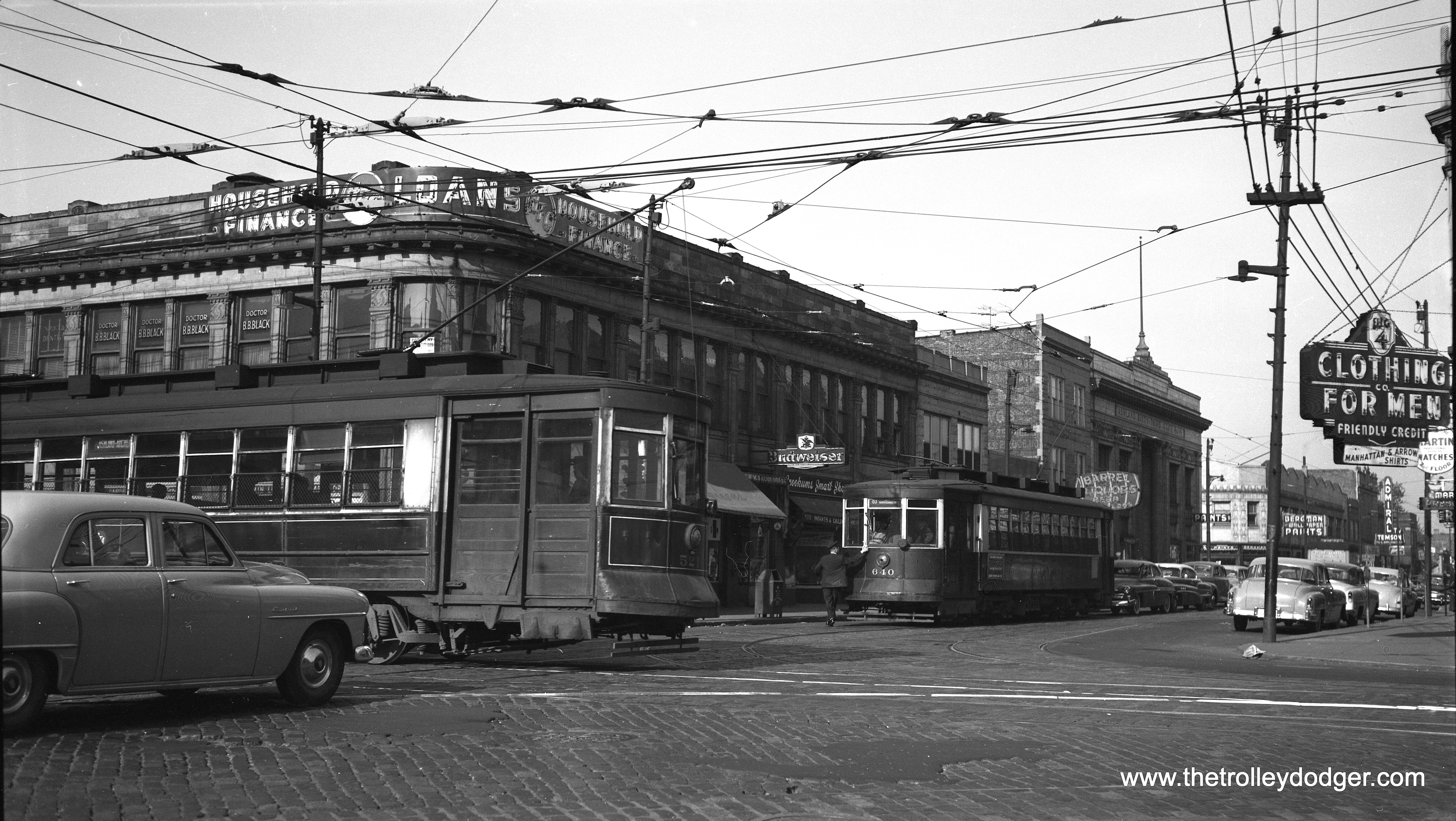
CTA red Pullman #674 is at the south end of Route 8 - Halsted, just south of 79th Street, on May 26, 1954. (John D. Koschwanez Photo) M. E. adds, "Toward the end of service on the 8 Halsted line, the old red cars supplanted the Green Hornets, which were probably being converted to L cars at the time. This terminal property was about a half dozen stores south of 79th St. on the east side of Halsted. Southbound 8 Halsted cars (as well as 42 Halsted-Archer-Clark cars) turned east on 79th to Emerald, south to the terminal, and west through the terminal. Judging by the grubby look of this car, it seems the CTA strove to discourage streetcar riders in favor of (shudder) buses."

CTA red Pullman #674 is at the south end of Route 8 – Halsted, just south of 79th Street, on May 26, 1954. (John D. Koschwanez Photo) M. E. adds, “Toward the end of service on the 8 Halsted line, the old red cars supplanted the Green Hornets, which were probably being converted to L cars at the time. This terminal property was about a half dozen stores south of 79th St. on the east side of Halsted. Southbound 8 Halsted cars (as well as 42 Halsted-Archer-Clark cars) turned east on 79th to Emerald, south to the terminal, and west through the terminal. Judging by the grubby look of this car, it seems the CTA strove to discourage streetcar riders in favor of (shudder) buses.”

CTA streetcar #1733 was one of a small number that got repainted into green and cream in the early 1950s. Here, we see it on Cermak Road near Canal Street on May 11, 1954. (John D. Koschwanez Photo)

CTA streetcar #1733 was one of a small number that got repainted into green and cream in the early 1950s. Here, we see it on Cermak Road near Canal Street on May 11, 1954. (John D. Koschwanez Photo)

CTA one-man red car #1752 is on Route 21 - Cermak on May 11, 1954. (John D. Koschwanez Photo)

CTA one-man red car #1752 is on Route 21 – Cermak on May 11, 1954. (John D. Koschwanez Photo)

We are looking north along Halsted at 63rd Street on May 26, 1954, just a few days before the end of red streetcar service in Chicago. CTA Pullman 324 heads south through what was then a busy shopping district in the Englewood neighborhood. (John D. Koschwanez Photo)

We are looking north along Halsted at 63rd Street on May 26, 1954, just a few days before the end of red streetcar service in Chicago. CTA Pullman 324 heads south through what was then a busy shopping district in the Englewood neighborhood. (John D. Koschwanez Photo)

Our resident south side expert M. E. writes, about the photo above:

63rd and Halsted L station was my “home” station. From there, I rode all over the L system.

The caption says “looking north along Halsted at 63rd St.” Not quite: This view was probably shot from halfway between 63rd and 64th Streets. The ugly CTA bus in the background ran on 63rd St. post-conversion.

The L station itself, where fares were collected at a manned booth, and where there was a news-and-sundries shop, was situated on the northeast corner of 63rd Place and Halsted. There were only stairs leading up to the platforms. A bell would ring when an eastbound L train was approaching the station. The pattern of the ring was actually the train wheels running over the contact. When people heard the bell, they hustled faster up to the eastbound platform.

63rd Place next to the L station had streetcar tracks used occasionally by streetcars not going all the way south to 79th St. Using the same track pattern as at 79th and Halsted, southbound 8 and 42 cars turned east on 63rd St. to Union Ave., south on Union to 63rd Place, west on 63rd Place to Halsted, then north.

The photo also shows a streetcar track from 63rd Place to the southbound track on Halsted St. That track was probably used only by the Kankakee interurban cars that began on 63rd Place, turned south on Halsted, to Summit Ave. (around 85th St.), northwest to Vincennes Ave. (just north of 87th St.), and out Vincennes into the town of Blue Island. That service ran a century ago.

Also, 63rd Place was the north terminal for the South Suburban Safeway Lines red-and-white buses that ran to Harvey and Chicago Heights, and the Suburban Transit System green-and-white buses that ran to Oak Lawn.

The Englewood business district was at one time the busiest outside the Loop. The shopping district ran along Halsted from 59th St to 67th St., and along 63rd St. from about Lowe St. (632 West) to Peoria St. (900 West). At the main corner of 63rd and Halsted, the principal stores were S. S. Kresge (forerunner of K-Mart) on the southwest corner; the Ace Department Store (which had huge fans to circulate the air) on the northwest corner; and a big Sears store on the northeast corner, which also housed a Hillman’s grocery store in its basement. Another big store, Wieboldt’s, was on the southwest corner of 63rd and Green (832 W.) Streets. The southeast corner of 63rd and Halsted consisted of several small stores, but at one time the corner store was a Stineway drug store.

Also surrounding 63rd and Halsted were many movie houses, primarily to the north and east. I actually remember seeing vaudeville acts at the Stratford Theater, on 63rd St. just west of Union. The most opulent movie house was the Southtown Theater at 63rd and Lowe, which was built in art-deco style and had a pond in the lobby with real swans. Unlike the other theaters, the Southtown even had a parking lot.

This photo brings back a lot of fond memories for me, but it especially shows everyone that Englewood was once a thriving, exciting place.

One of the ten Milwaukee Road Skytop Lounge observation cars in Columbus, Wisconsin in October 1967. M. E. adds, "Great photo of a Milwaukee Road Olympian observation car. Those cars ran mainly between Chicago and Minneapolis, but they also ran all the way to Seattle on the Olympian Hiawatha."

One of the ten Milwaukee Road Skytop Lounge observation cars in Columbus, Wisconsin in October 1967. M. E. adds, “Great photo of a Milwaukee Road Olympian observation car. Those cars ran mainly between Chicago and Minneapolis, but they also ran all the way to Seattle on the Olympian Hiawatha.”

On May 25, 1958, we see Chicago Transit Authority PCC #7142 mounted on a flatcar at South Shops for transport to the St. Louis Car Company. This was less than a month before the end of streetcar service in Chicago. Approximately 570 of the 600 postwar Chicago streetcars retired early and shipped to St. Louis as part of the so-called PCC Conversion Program, where they were scrapped and some of their parts (seats, motors, windows, etc.) were recycled for use in new rapid transit cars. The final two dozen PCCs were simply scrapped. (Robert D. Heinlein Photo)

On May 25, 1958, we see Chicago Transit Authority PCC #7142 mounted on a flatcar at South Shops for transport to the St. Louis Car Company. This was less than a month before the end of streetcar service in Chicago. Approximately 570 of the 600 postwar Chicago streetcars retired early and shipped to St. Louis as part of the so-called PCC Conversion Program, where they were scrapped and some of their parts (seats, motors, windows, etc.) were recycled for use in new rapid transit cars. The final two dozen PCCs were simply scrapped. (Robert D. Heinlein Photo)

Subject: Illinois Central Station Demolition Chicago 1974 Location: Chicago, Illinois Date: November 1974 (processing date) Photographer: Unknown From the Wikipedia: Central Station was an intercity passenger terminal in downtown Chicago, Illinois, at the southern end of Grant Park near Roosevelt Road and Michigan Avenue. Owned by the Illinois Central Railroad, it also served other companies via trackage rights. It opened in 1893, replacing Great Central Station (on the site of the current Millennium Station), and closed in 1972 when Amtrak rerouted services to Union Station. The station building was demolished in 1974. It is now the site of a redevelopment called Central Station, Chicago. Adjoining platforms at Roosevelt served the Illinois Central's suburban trains for both the Electric and West lines, in addition to the South Shore Line interurban railroad. All three lines continued north to Randolph Street.

Subject: Illinois Central Station Demolition Chicago 1974
Location: Chicago, Illinois
Date: November 1974 (processing date)
Photographer: Unknown
From the Wikipedia:
Central Station was an intercity passenger terminal in downtown Chicago, Illinois, at the southern end of Grant Park near Roosevelt Road and Michigan Avenue. Owned by the Illinois Central Railroad, it also served other companies via trackage rights. It opened in 1893, replacing Great Central Station (on the site of the current Millennium Station), and closed in 1972 when Amtrak rerouted services to Union Station. The station building was demolished in 1974. It is now the site of a redevelopment called Central Station, Chicago.
Adjoining platforms at Roosevelt served the Illinois Central’s suburban trains for both the Electric and West lines, in addition to the South Shore Line interurban railroad. All three lines continued north to Randolph Street.

Grand Central Station

Chicago’s Central Station and Grand Central Station were two different things.

From the Wikipedia:

Grand Central Station was a passenger railroad terminal in downtown Chicago, Illinois, from 1890 to 1969. It was located at 201 West Harrison Street on a block bounded by Harrison, Wells and Polk Streets and the Chicago River in the southwestern portion of the Chicago Loop. Grand Central Station was designed by architect Solon Spencer Beman for the Wisconsin Central Railroad (WC), and was completed by the Chicago and Northern Pacific Railroad.

The Baltimore and Ohio Railroad purchased the station in 1910 and used it as the Chicago terminus for its passenger rail service, including its Capitol Limited service to Washington, D.C. Major tenant railroads included the Soo Line Railroad, successor to the Wisconsin Central, the Chicago Great Western Railway, and the Pere Marquette Railway. The station opened December 8, 1890, closed November 8, 1969, and was demolished in 1971.

Subject: B&O/C&O Grand Central Station Location: Chicago, Illinois (Harrison and Wells) Photographer: Unknown Date: June 15, 1967

Subject: B&O/C&O Grand Central Station
Location: Chicago, Illinois (Harrison and Wells)
Photographer: Unknown
Date: June 15, 1967

Subject: C&O Chesapeake and Ohio Diesel Locomotive EMD E7(A) #4514 Location: Chicago, Illinois (Grand Central Station) Photographer: R. P. Olmstead Date: May 31, 1964 (4:45 pm)

Subject: C&O Chesapeake and Ohio Diesel Locomotive EMD E7(A) #4514
Location: Chicago, Illinois (Grand Central Station)
Photographer: R. P. Olmstead
Date: May 31, 1964 (4:45 pm)

Subject: C&O Chesapeake and Ohio Diesel Locomotive EMD E8(A) #4022 Location: Chicago, Illinois (Grand Central Station) Photographer: R. P. Olmstead Date: May 8, 1966 (5:08 pm)

Subject: C&O Chesapeake and Ohio Diesel Locomotive EMD E8(A) #4022
Location: Chicago, Illinois (Grand Central Station)
Photographer: R. P. Olmstead
Date: May 8, 1966 (5:08 pm)

Now here's something you don't see every day... an honest to goodness 1939 Kodachrome slide. That makes this image about 85 years old. This must have been taken when Lehigh Valley Transit put these renovated lightweight high-speed cars into service. They were originally built for the Cincinnati and Lake Erie in 1931. That interurban went out of business in 1938, and LVT purchased several cars, which were freshened up with the help of J. G. Brill's art department. The Liberty Bell interurban ran between Philadelphia and Allentown, Pennsylvania. These cars replaced some much older ones and helped keep things going through the war years and up until the 1951 abandonment. There was a very active NRHS (National Railway Historical Society) chapter in the area, and this is probably a fantrip they sponsored. Looks like the lead car is 1002.

Now here’s something you don’t see every day… an honest to goodness 1939 Kodachrome slide. That makes this image about 85 years old. This must have been taken when Lehigh Valley Transit put these renovated lightweight high-speed cars into service. They were originally built for the Cincinnati and Lake Erie in 1931. That interurban went out of business in 1938, and LVT purchased several cars, which were freshened up with the help of J. G. Brill’s art department. The Liberty Bell interurban ran between Philadelphia and Allentown, Pennsylvania. These cars replaced some much older ones and helped keep things going through the war years and up until the 1951 abandonment. There was a very active NRHS (National Railway Historical Society) chapter in the area, and this is probably a fantrip they sponsored. Looks like the lead car is 1002.

Subject: ICG Illinois Central Electric #1194 (Fantrip) Location: Chicago, Illinois (southbound on Exchange Avenue at 78th Street - South Chicago Branch) Date: February 1976 Photographer: Jeffrey L. Wien Illinois Central Electric car #1194 was built by Pullman in 1926. These cars were similar to those used on the Erie-Lackawanna in New Jersey. All the cars in the class were replaced by "Highliners" in the 1970s. The train we see here may have been on its final trip prior to retirement. Paul Jevert: "I.C. Railfans "Snowflake Special Feb. 1976" Extra class lights displayed at location 77th and Exchange between Windsor Park and Cheltenham Stations doing a photo run-by with Engineer Jim McCorkle leaning out of cab door and talking to fans at Muskegon Ave. corner advising them that they will be picked up in that area after the reverse move under flag. No snowflakes for this particular annual charter. Curt Seeliger was the Conductor on the 8 car train, Collector Joe Szabo, with Suburban Trainmaster escort of the annual Event." M. E. writes, "This view along Exchange Ave. shows a mainly residential area with some small stores. But further north, this branch ran east and west, in the middle of 71st St. for about 1.5 miles from Yates Ave. (2400 E.) to about Harper Ave. (1500 E.), where the branch joined the main Illinois Central line. That 1.5-mile stretch was another booming business area, called South Shore, centering at 71st and Jeffery Ave. (2000 E.) The residential area northeast of 71st and Jeffery, Jackson Park Highlands, is a beautiful area along the lines of Hyde Park and especially Kenwood, where some mansions dominate."

Subject: ICG Illinois Central Electric #1194 (Fantrip)
Location: Chicago, Illinois (southbound on Exchange Avenue at 78th Street – South Chicago Branch)
Date: February 1976
Photographer: Jeffrey L. Wien
Illinois Central Electric car #1194 was built by Pullman in 1926. These cars were similar to those used on the Erie-Lackawanna in New Jersey. All the cars in the class were replaced by “Highliners” in the 1970s. The train we see here may have been on its final trip prior to retirement. Paul Jevert: “I.C. Railfans “Snowflake Special Feb. 1976″ Extra class lights displayed at location 77th and Exchange between Windsor Park and Cheltenham Stations doing a photo run-by with Engineer Jim McCorkle leaning out of cab door and talking to fans at Muskegon Ave. corner advising them that they will be picked up in that area after the reverse move under flag. No snowflakes for this particular annual charter. Curt Seeliger was the Conductor on the 8 car train, Collector Joe Szabo, with Suburban Trainmaster escort of the annual Event.” M. E. writes, “This view along Exchange Ave. shows a mainly residential area with some small stores. But further north, this branch ran east and west, in the middle of 71st St. for about 1.5 miles from Yates Ave. (2400 E.) to about Harper Ave. (1500 E.), where the branch joined the main Illinois Central line. That 1.5-mile stretch was another booming business area, called South Shore, centering at 71st and Jeffery Ave. (2000 E.) The residential area northeast of 71st and Jeffery, Jackson Park Highlands, is a beautiful area along the lines of Hyde Park and especially Kenwood, where some mansions dominate.”

Chicago North Shore and Milwaukee #411 in New York City in May 1969. Don's Rail Photos (via Archive.org): "411 was built as a trailer observation car by Cincinnati Car in June 1923 (order) #2640. It was out of service in 1932. 411 (was converted to a coach) on February 25, 1943, and (was) sold to Trolley Museum of New York in 1963. It was sold to Wisconsin Electric Railway & Historical Society in 1973 and sold to Escanaba & Lake Superior in 1989."

Chicago North Shore and Milwaukee #411 in New York City in May 1969. Don’s Rail Photos (via Archive.org): “411 was built as a trailer observation car by Cincinnati Car in June 1923 (order) #2640. It was out of service in 1932. 411 (was converted to a coach) on February 25, 1943, and (was) sold to Trolley Museum of New York in 1963. It was sold to Wisconsin Electric Railway & Historical Society in 1973 and sold to Escanaba & Lake Superior in 1989.”

I did some restoration work on this medium format Ektachrome slide from April 1962, showing four Chicago Aurora and Elgin cars being moved off the property in Wheaton after the abandonment. Like some other early Ektachromes, this had unstable dyes and has shifted to red (due to fading of the other dye layers). We are looking to the northeast. (Robert D. Heinlein Photo) Bill Shapotkin adds, "It appears that this photo is of CA&E #11, 20, 316 and 317 enroute to what was then known as "RELIC" (now Fox River Trolley Museum) in South Elgin, IL."

I did some restoration work on this medium format Ektachrome slide from April 1962, showing four Chicago Aurora and Elgin cars being moved off the property in Wheaton after the abandonment. Like some other early Ektachromes, this had unstable dyes and has shifted to red (due to fading of the other dye layers). We are looking to the northeast. (Robert D. Heinlein Photo) Bill Shapotkin adds, “It appears that this photo is of CA&E #11, 20, 316 and 317 enroute to what was then known as “RELIC” (now Fox River Trolley Museum) in South Elgin, IL.”

I restored a couple more of these medium format Ektachromes, taken by the late Robert D. Heinlein at the Chicago Aurora and Elgin yards in Wheaton after the abandonment. I just noticed these are date stamped January 1962. Don's Rail Photos (via Archive.org): "315 was built by Kuhlman Car Co in 1909, (job) #404. It was modernized at an unknown date and sold to Rockhill Trolley Museum in 1962." Here, we see it boarded up for its journey to the east coast a few months later.

I restored a couple more of these medium format Ektachromes, taken by the late Robert D. Heinlein at the Chicago Aurora and Elgin yards in Wheaton after the abandonment. I just noticed these are date stamped January 1962. Don’s Rail Photos (via Archive.org): “315 was built by Kuhlman Car Co in 1909, (job) #404. It was modernized at an unknown date and sold to Rockhill Trolley Museum in 1962.” Here, we see it boarded up for its journey to the east coast a few months later.

Here's how they looked originally. Early Ektachrome film had unstable dyes. Apparently, only the red dye layer is stable, while the others have faded badly. Fortunately, modern technology can often correct for this.

Here’s how they looked originally. Early Ektachrome film had unstable dyes. Apparently, only the red dye layer is stable, while the others have faded badly.
Fortunately, modern technology can often correct for this.

CTA "Baldie" 4220 is part of a Ravenswood "A" train leaving the LaSalle and Van Buren station on August 14, 1964. We are looking west. (Douglas N. Grotjahn Photo)

CTA “Baldie” 4220 is part of a Ravenswood “A” train leaving the LaSalle and Van Buren station on August 14, 1964. We are looking west. (Douglas N. Grotjahn Photo)

A four-car train of CTA "Plushies" 4000-series "L" cars is at Main Street in Evanston on October 21, 1968. Note only two trolley poles are used, one for each pair of cars. 4253 is the rear car here. (Douglas N. Grotjahn Photo)

A four-car train of CTA “Plushies” 4000-series “L” cars is at Main Street in Evanston on October 21, 1968. Note only two trolley poles are used, one for each pair of cars. 4253 is the rear car here. (Douglas N. Grotjahn Photo)

On December 14, 1921, Chicago and West Towns Railways car #100 crashed through this barrier at 52nd Street (Laramie Avenue) and Ogden Avenue in suburban Cicero. This press photo was printed backwards, but I fixed that.

On December 14, 1921, Chicago and West Towns Railways car #100 crashed through this barrier at 52nd Street (Laramie Avenue) and Ogden Avenue in suburban Cicero. This press photo was printed backwards, but I fixed that.

This picture of Philadelphia PCC streetcar #2565 was taken on June 27, 1973. Here's what Cinema Treasures has to say about the Crest Theatre: The Crest Theatre opened November 23, 1937 on Rising Sun Avenue at Cheltenham Avenue to accommodate the late-1930’s housing expansion in the Lawncrest neighborhood of Philadelphia. The theatre was designed by Philadelphia architect David Supowitz in an Art Moderne style with an exterior of plastic and white glass (such as Vitrolite). The theatre seated 900. It opened for second and third run movies. By 1950 it was operated by the A.M. Ellis Theaters Co. chain. Until closing, a big sign rhymed ‘Welcome. See the BEST at the CREST’. The Crest closed the week before Christmas in 1986 with “Star Trek IV” as its last feature film. The marquee said ‘FAREWELL’. By the time it closed, a new owner of the building planned to demolish it to construct retail. The Crest has been demolished, and a convenience store was constructed on the site.

This picture of Philadelphia PCC streetcar #2565 was taken on June 27, 1973. Here’s what Cinema Treasures has to say about the Crest Theatre: The Crest Theatre opened November 23, 1937 on Rising Sun Avenue at Cheltenham Avenue to accommodate the late-1930’s housing expansion in the Lawncrest neighborhood of Philadelphia. The theatre was designed by Philadelphia architect David Supowitz in an Art Moderne style with an exterior of plastic and white glass (such as Vitrolite). The theatre seated 900. It opened for second and third run movies. By 1950 it was operated by the A.M. Ellis Theaters Co. chain.
Until closing, a big sign rhymed ‘Welcome. See the BEST at the CREST’. The Crest closed the week before Christmas in 1986 with “Star Trek IV” as its last feature film. The marquee said ‘FAREWELL’. By the time it closed, a new owner of the building planned to demolish it to construct retail. The Crest has been demolished, and a convenience store was constructed on the site.

The Fineview Line in Pittsburgh

Here are seven views of the Pittsburgh Railways Route 21 – Fineview line, taken by the late Jeffrey L. Wien shortly before it was abandoned. I found an excellent description of Fineview on trainorders.com:

Arguably the most unique streetcar line in North America was found in Pittsburgh, PA. Route 21-Fineview lasted until May 1, 1966. With a maximum 12 1/2% grade, Fineview also featured the steepest grade in Pittsburgh Railways’ system, if not the steepest in North America, as well.

21 Fineview originated in Downtown Pittsburgh. After traversing the 7th Street Bridge (in the latter years), and some shared track on the North Side, it became a very intimate, neighborly streetcar line, where passengers even had direct access to the streetcars from their front porches, driveways or private staircases. The summit was 455 feet above the downtown loop.

The last streetcar on the line was Interurban 1646, which followed the last scheduled car in the wee hours of May 1st, 1966. 1646 made the trip with its air horn blaring full blast, which even brought residents out to their front porches in their bathrobes to wave goodbye.

Due to its unique flavor, many streetcar charters found their way to this line during their trips.

Subject: Pittsburgh PAT PCC Streetcar Trolley #1624 Location: Pittsburgh, PA (Route 21 Fineview - Carrie and Warren) Date: April 30, 1966 Photographer: Jeffrey L. Wien

Subject: Pittsburgh PAT PCC Streetcar Trolley #1624
Location: Pittsburgh, PA (Route 21 Fineview – Carrie and Warren)
Date: April 30, 1966
Photographer: Jeffrey L. Wien

Subject: Pittsburgh PAT PCC Streetcar Trolley #1624 Location: Pittsburgh, PA (Route 21 Fineview - Carrie and Waldren) Date: April 30, 1966 Photographer: Jeffrey L. Wien

Subject: Pittsburgh PAT PCC Streetcar Trolley #1624
Location: Pittsburgh, PA (Route 21 Fineview – Carrie and Waldren)
Date: April 30, 1966
Photographer: Jeffrey L. Wien

Subject: Pittsburgh PAT PCC Streetcar Trolley #1624 Location: Pittsburgh, PA (Route 21 Fineview - Lanark and Catoma) Date: April 30, 1966 Photographer: Jeffrey L. Wien

Subject: Pittsburgh PAT PCC Streetcar Trolley #1624
Location: Pittsburgh, PA (Route 21 Fineview – Lanark and Catoma)
Date: April 30, 1966
Photographer: Jeffrey L. Wien

Subject: Pittsburgh PAT PCC Streetcar Trolley #1624 Location: Pittsburgh, PA (Route 21 Fineview - Lanark and Catoma) Date: April 30, 1966 Photographer: Jeffrey L. Wien

Subject: Pittsburgh PAT PCC Streetcar Trolley #1624
Location: Pittsburgh, PA (Route 21 Fineview – Lanark and Catoma)
Date: April 30, 1966
Photographer: Jeffrey L. Wien

Subject: Pittsburgh PAT PCC Streetcar Trolley #1624 Location: Pittsburgh, PA (Route 21 Fineview - Lanark and Catoma) Date: April 30, 1966 Photographer: Jeffrey L. Wien

Subject: Pittsburgh PAT PCC Streetcar Trolley #1624
Location: Pittsburgh, PA (Route 21 Fineview – Lanark and Catoma)
Date: April 30, 1966
Photographer: Jeffrey L. Wien

Subject: Pittsburgh PAT PCC Streetcar Trolley #1624 Location: Pittsburgh, PA (Route 21 Fineview - Lanark and Catoma) Date: April 30, 1966 Photographer: Jeffrey L. Wien

Subject: Pittsburgh PAT PCC Streetcar Trolley #1624
Location: Pittsburgh, PA (Route 21 Fineview – Lanark and Catoma)
Date: April 30, 1966
Photographer: Jeffrey L. Wien

Subject: Pittsburgh PAT PCC Streetcar Trolley #1624 Location: Pittsburgh, PA (Route 21 Fineview - Lanark and Cemetery) Date: April 30, 1966 Photographer: Jeffrey L. Wien

Subject: Pittsburgh PAT PCC Streetcar Trolley #1624
Location: Pittsburgh, PA (Route 21 Fineview – Lanark and Cemetery)
Date: April 30, 1966
Photographer: Jeffrey L. Wien

Our Latest Book, Now Available:

The North Shore Line

FYI, my new Arcadia Publishing book The North Shore Line is now available for immediate shipment. My publisher decided to expand it to 160 pages, instead of the usual 128. That’s a 25% increase, without any change to the $23.99 price. I am quite pleased with how this turned out.

From the back cover:

As late as 1963, it was possible to board high-speed electric trains on Chicago’s famous Loop “L” that ran 90 miles north to Milwaukee. This was the Chicago North Shore & Milwaukee Railroad, commonly known as the North Shore Line. It rose from humble origins in the 1890s as a local streetcar line in Waukegan to eventually become America’s fastest interurban under the visionary management of Midwest utilities tycoon Samuel Insull. The North Shore Line, under Insull, became a worthy competitor to the established steam railroads. Hobbled by the Great Depression, the road fought back in 1941 with two streamlined, air-conditioned, articulated trains called Electroliners, which included dining service. It regained its popularity during World War II, when gasoline and tires were rationed, but eventually, it fell victim to highways and the automobile. The North Shore Line had intercity rail, commuter rail, electric freight, city streetcars, and even buses. It has been gone for nearly 60 years, but it will always remain the Road of Service.

Each copy purchased here will be signed by the author, and you will also receive a bonus North Shore Line map.  Books will ship by USPS Media Mail.

Chapters:
01. Beginnings
02. The Milwaukee Division
03. The Shore Line Route
04. The Skokie Valley Route
05. The Mundelein Branch
06. On the “L”
07. City Streetcars
08. Trolley Freight
09. The Long Goodbye
10. The Legacy

Title The North Shore Line
Images of America
Author David Sadowski
Edition illustrated
Publisher Arcadia Publishing (SC), 2023
ISBN 1467108960, 978-1467108966
Length 160 pages

The price of $23.99 includes shipping within the United States.

For Shipping to US Addresses:

New Compact Disc Titles, Now Available:

HFIH
Hi-Fi Iron Horse
Price: $15.99

Hi-Fi Iron Horse is a unique collection of early steam recordings, made between 1949 and 1954. Portable tape recorders were not yet available when the earliest of these was made, but there was still another source for making high-quality audio– the optical sound track of motion picture film.

Featuring in-service steam of the Baltimore & Ohio, Bessemer & Lake Erie, Burlington, Canadian National, Delaware & Hudson, East Broad Top, Erie, Grand Trunk Western, Huntingdon & Broad Top Mountain, Western Maryland, and Rutland Railway.

Total time – 50:49

TSOS
The Sound of Steam
Reading 2124

Price: $19.99

Three very rare, out of print North Jersey Recordings LPs, now digitally remastered on two CDs at a special price.

The Sound of Steam offers a comprehensive overview of the twilight days of steam railroading in North America, with sounds recorded between 1957 and 1964. Railroads featured include the Denver & Rio Grande Western, Union Pacific, Canadian Pacific, Duluth, Missabe & Iron Range Railway, Gainesville Midland Railroad, Pennsylvania Railroad, Reading Railroad, Canadian National, Twin Seams Mining Company, Nickel Plate, Colorado & Southern, Norfolk & Western, Buffalo Creek & Gauley, Monadnock, Steamtown & Northern, Rockton & Rion Railway, and the National Railways of Mexico.

Reading 2124 features recordings made in 1959 and 1960 on a series of “Iron Horse Rambles,” excursion trips through eastern Pennsylvania.  The Reading Company had retained this class T-1 4-8-4 for emergency use after steam was retired on the railroad.  Seven years after the last Reading steam loco had hauled a passenger train, a series of 51 special excursion trips were held, ending in 1964.  These have since been revived, and the Rambles continue.

Total time – 69:54 (Disc 1) and 61:20 (Disc 2)

RWW-V103
Rods, Wheels, and Whistles
Voice of the 103

Price: $19.99

Two very rare, out of print North Jersey Recordings LPs, now digitally remastered on two CDs at a special price.

Rods, Wheels, and Whistles features the sounds of the Pennsylvania Railroad and the Norfolk and Western Railway, recorded in the twilight years of steam. This LP was originally issued in 1958, but our version is taken from the revised and expanded edition, which includes additional recordings from 1959.

Voice of the 103 documents the former Sumter and Choctaw Railroad #103, a 2-6-2 locomotive built in 1925 by the Baldwin Locomotive Works, after it was refurbished in 1962 to operate on the Middletown and New Jersey. This was an excursion service of the Empire State Railway Museum, which has since moved to a new location and no longer operates trains.  The 103 is now on static display.

Our collection is rounded out with three bonus tracks from the Strasbourg Railroad, when old number 31 ran excursion trains on the oldest short line railroad in the United States (chartered in June 1832), joining the Pennsylvania Dutch towns of Strasbourg and Paradise in the early 1960s.

Total time – 46:15 (RWW) and 49:26 (V103)

Help Support The Trolley Dodger

This is our 312th post, and we are gradually creating a body of work and an online resource for the benefit of all railfans, everywhere. To date, we have received over 1,066,000 page views, for which we are very grateful.

You can help us continue our original transit research by checking out the fine products in our Online Store.
As we have said before, “If you buy here, we will be here.”

We thank you for your support.

DONATIONS

In order to continue giving you the kinds of historic railroad images that you have come to expect from The Trolley Dodger, we need your help and support. It costs money to maintain this website, and to do the sort of historic research that is our specialty.

Your financial contributions help make this web site better, and are greatly appreciated.


The Gift That Keeps On Giving

This is a very well known shot of Chicago Aurora and Elgin wood cars 309 and 310 on a May 19, 1957 fantrip at the Glen Oak Country Club stop in Glen Ellyn. As this was a photo stop, there are lots of duplicate slides of this, although not necessarily by the same photographer. Robert D. Heinlein captured this classic picture about six weeks before the end of passenger service, and this was scanned from the original red border Kodachrome slide. We are looking mainly to the east.

This is a very well known shot of Chicago Aurora and Elgin wood cars 309 and 310 on a May 19, 1957 fantrip at the Glen Oak Country Club stop in Glen Ellyn. As this was a photo stop, there are lots of duplicate slides of this, although not necessarily by the same photographer. Robert D. Heinlein captured this classic picture about six weeks before the end of passenger service, and this was scanned from the original red border Kodachrome slide. We are looking mainly to the east.

The holiday season is once again upon us, and our thoughts naturally turn to gift giving. Then, it struck me. Here at the Trolley Dodger, we are engaged in historic preservation. History has a lot to teach us about our present and future. The past can shine light on many things, if we can only choose to look.

There is a lot of history in the images we present here. I have learned so much since starting this blog, nearly nine years ago. I hope my readers have too. Let’s all learn together.

It is truly a gift that keeps on giving.

Happy Holidays!

Our Annual Fundraiser

Since we started this blog in 2015, we have posted nearly 16,000 images. This is our 310th post.

In a few week’s time, we will need to renew our WordPress subscription, our domain registration, and pay other bills associated with maintaining this site, so it is time for our Annual Fundraiser.

The Trolley Dodger blog can only be kept going with the help of our devoted readers. Perhaps you count yourself among them.

If you have already contributed in the past, we thank you very much for your help. Meanwhile, our goal for this fundraiser is just $700, which is only a fraction of what it costs us each year. The rest is made up from either the profits from the items we sell, which are not large, or out of our own pocket, which is not very large either.

There are links at the top and bottom of this page, where you can click and make a donation that will help us meet our goal again for this coming year, so we can continue to offer you more classic images in the future, and keep this good thing we have going.

We thank you in advance for your time and consideration.

-David Sadowski

PS- You might also like our Trolley Dodger Facebook auxiliary, a private group that now has 1,478 members.

Our friend Kenneth Gear has a Facebook group for the Railroad Record Club. If you enjoy listening to audio recordings of classic railroad trains, whether steam, electric, or diesel, you might consider joining.

FYI, the Hoosier Traction Facebook Group celebrates electric transit in Indiana and the Midwest. It also supports the activities of the annual Hoosier Traction Meet (although not affiliated with the North American Transit Historical Society, which organizes that event).

Our Next Book Project

FYI, we are hard at work researching our next book about the Chicago Aurora and Elgin interurban. Although we already have thousands of images, we start out on these book projects with some of what we need, and then have to find the rest. Some have generously shared their images with us, and some we have to pay real money for. In case you would like to help contribute to this effort, either by sharing images or making a donation, we would like to hear from you. All contributors will be mentioned in the book, which will be dedicated to the memory of the late Robert D. Heinlein. The most difficult images to find are always the earliest ones. You can contact me via messenger, at thetrolleydodger@gmail.com or via my blog. I thank you for your time and consideration.

A real photo postcard (postmarked 1930) view of Front Street in Wheaton, looking east from Main Street, including the Chicago and North Western commuter station. It has since been replaced by a newer one nearby, served by Metra's UP-West Line. The Chicago Aurora and Elgin station was just south of here, out of view.

A real photo postcard (postmarked 1930) view of Front Street in Wheaton, looking east from Main Street, including the Chicago and North Western commuter station. It has since been replaced by a newer one nearby, served by Metra’s UP-West Line. The Chicago Aurora and Elgin station was just south of here, out of view.

Here's how it looks today.

Here’s how it looks today.

Chicago Aurora and Elgin car 418 is at the rear of a three-car train, heading east at Canal Street on the Metropolitan "L" main line. The building to the right is now known as the Old Post Office. The middle car is formerly from the Washington, Baltimore and Annapolis that CA&E bought in the late 1930s. They tapered the ends to fir the tight clearances on the "L" and made them into control trailers. This "L" stop had a walkway leading into Union Station. It was torn down after the Garfield Park line was replaced by the new Congress expressway median line in 1958-- but by that time, the CA&E had stopped running passenger service. this picture probably dates to between the mid-1940s and 1953, when the interurban cut back service to Forest Park.

Chicago Aurora and Elgin car 418 is at the rear of a three-car train, heading east at Canal Street on the Metropolitan “L” main line. The building to the right is now known as the Old Post Office. The middle car is formerly from the Washington, Baltimore and Annapolis that CA&E bought in the late 1930s. They tapered the ends to fir the tight clearances on the “L” and made them into control trailers. This “L” stop had a walkway leading into Union Station. It was torn down after the Garfield Park line was replaced by the new Congress expressway median line in 1958– but by that time, the CA&E had stopped running passenger service. this picture probably dates to between the mid-1940s and 1953, when the interurban cut back service to Forest Park.

Here's San Francisco cable car #507 in the early 1950s at the outer end of the Powell-Mason line (note the turntable). Here's what streetcar.org has to say about this car: "This cable car was built in 1893 in the East Bay town of Newark by Carter Brothers. It was numbered 507 until Muni dropped the first number on Powell cable cars in the 1970s. Car 507 served the Sacramento-Clay line until the 1906 earthquake and fire, and then was moved over to Powell Street, where it has run ever since, almost exclusively on the Powell-Mason line until 1956; on both the Mason and Hyde lines since 1957." It was overhauled in 1957 and is still in use today. This image was taken from an original red border Kodachrome.

Here’s San Francisco cable car #507 in the early 1950s at the outer end of the Powell-Mason line (note the turntable). Here’s what streetcar.org has to say about this car: “This cable car was built in 1893 in the East Bay town of Newark by Carter Brothers. It was numbered 507 until Muni dropped the first number on Powell cable cars in the 1970s. Car 507 served the Sacramento-Clay line until the 1906 earthquake and fire, and then was moved over to Powell Street, where it has run ever since, almost exclusively on the Powell-Mason line until 1956; on both the Mason and Hyde lines since 1957.” It was overhauled in 1957 and is still in use today. This image was taken from an original red border Kodachrome.

Chicago Aurora and Elgin wood car 300 at Wheaton on April 23, 1962, shortly before it was scrapped. (K. C. Henkels Photo)

Chicago Aurora and Elgin wood car 300 at Wheaton on April 23, 1962, shortly before it was scrapped. (K. C. Henkels Photo)

Chicago Aurora and Elgin car 457 at Wheaton on March 14, 1957. (M. Powell Photo)

Chicago Aurora and Elgin car 457 at Wheaton on March 14, 1957. (M. Powell Photo)

North Shore Line car 300 in 1940. The interurban had stopped using its older wood cars a few years before, and had generously allowed the Central Electric Railfans' Association to use it as their club car, for meetings and excursions. Color pictures from 1940 are rare indeed, and this red border Kodachrome has held up well. Unfortunately, none of the NSL woods have survived. This one was used as a locker room in Waukegan for the female employees the railroad hired during WWII. It was vandalized by some sailors at war's end, and then stripped for parts when the remaining wood cars were sold to the Chicago Aurora and Elgin in 1946. The body of car 300 was used as a diner for a few years.

North Shore Line car 300 in 1940. The interurban had stopped using its older wood cars a few years before, and had generously allowed the Central Electric Railfans’ Association to use it as their club car, for meetings and excursions. Color pictures from 1940 are rare indeed, and this red border Kodachrome has held up well. Unfortunately, none of the NSL woods have survived. This one was used as a locker room in Waukegan for the female employees the railroad hired during WWII. It was vandalized by some sailors at war’s end, and then stripped for parts when the remaining wood cars were sold to the Chicago Aurora and Elgin in 1946. The body of car 300 was used as a diner for a few years.

North Shore Line wood car 300 is on a fantrip, while it was used as the rolling clubhouse of the Central Electric Railfans' Association circa 1940. The presence of a city streetcar (I think it is 509) would suggest this picture was taken in Waukegan.

North Shore Line wood car 300 is on a fantrip, while it was used as the rolling clubhouse of the Central Electric Railfans’ Association circa 1940. The presence of a city streetcar (I think it is 509) would suggest this picture was taken in Waukegan.

A Chicago and Milwaukee Electric (later the North Shore Line) 300-series car at the Racine station in 1909.

A Chicago and Milwaukee Electric (later the North Shore Line) 300-series car at the Racine station in 1909.

Single-deck streetcar #105 is in Hobart, Tasmania, in Australia. This system had previously used doble-deck cars, but there were problems with them toppling over. As ridership on the system decreased over time, they were replaced with these home-built substitutes. The style of red border Kodachrome slide mount dates this picture to sometime between 1939 and 1949. The last Hobart tram ran in 1960.

Single-deck streetcar #105 is in Hobart, Tasmania, in Australia. This system had previously used doble-deck cars, but there were problems with them toppling over. As ridership on the system decreased over time, they were replaced with these home-built substitutes. The style of red border Kodachrome slide mount dates this picture to sometime between 1939 and 1949. The last Hobart tram ran in 1960.

The North Shore Line Freight Terminal in Milwaukee in 1925. This was just east of the passenger terminal. We are looking to the north-northwest. Car 401 is in the foreground. Don's Rail Photos (via Archive.org): "401 was built by Jewett Car in 1909 as parlor-buffet car. In 1917 it was converted to straight coach and retired in 1935. It was leased to Chicago Aurora & Elgin and renumbered 142 in 1936. It came back for a short time with the CA&E number in 1945 and sold to CA&E in 1946. It was retired in 1953." One of the cars at right is 122, a wooden coach. Again, from Don Ross: "122 was built by Jewett Car in 1906 and retired in 1937."

The North Shore Line Freight Terminal in Milwaukee in 1925. This was just east of the passenger terminal. We are looking to the north-northwest. Car 401 is in the foreground. Don’s Rail Photos (via Archive.org): “401 was built by Jewett Car in 1909 as parlor-buffet car. In 1917 it was converted to straight coach and retired in 1935. It was leased to Chicago Aurora & Elgin and renumbered 142 in 1936. It came back for a short time with the CA&E number in 1945 and sold to CA&E in 1946. It was retired in 1953.” One of the cars at right is 122, a wooden coach. Again, from Don Ross: “122 was built by Jewett Car in 1906 and retired in 1937.”

A North Shore Line lunch counter menu from March 1961. There are some pictures of the lunch counter at the Milwaukee Terminal in my book The North Shore Line.

A North Shore Line lunch counter menu from March 1961. There are some pictures of the lunch counter at the Milwaukee Terminal in my book The North Shore Line.

This rare photo was taken at Church Street in Evanston, where the North Shore Line had a station along the Evanston branch of the "L" (today's CTA Purple Line). The presence of observation car 411 would date this to between 1923 (when the car was delivered) and 1926 (when the Skokie Valley Route opened).

This rare photo was taken at Church Street in Evanston, where the North Shore Line had a station along the Evanston branch of the “L” (today’s CTA Purple Line). The presence of observation car 411 would date this to between 1923 (when the car was delivered) and 1926 (when the Skokie Valley Route opened).

This 1910 image is from a copy negative and shows a Chicago and Milwaukee Electric car that had derailed at Genesee and Washington Streets in downtown Waukegan. I believe this is car 121 and not 721 as the negative envelope had it. At this date, 721 had not yet been built. The C&ME was the predecessor of the North Shore Line (the name was changed in 1916).

This 1910 image is from a copy negative and shows a Chicago and Milwaukee Electric car that had derailed at Genesee and Washington Streets in downtown Waukegan. I believe this is car 121 and not 721 as the negative envelope had it. At this date, 721 had not yet been built. The C&ME was the predecessor of the North Shore Line (the name was changed in 1916).

A Brill builder's photo (1902) of Chicago and Milwaukee Electric car 11. This is called a combine car, as it could handle both passengers and some freight. It was rebuilt into an express trailer in 1917.

A Brill builder’s photo (1902) of Chicago and Milwaukee Electric car 11. This is called a combine car, as it could handle both passengers and some freight. It was rebuilt into an express trailer in 1917.

Chicago and Milwaukee Electric express car #1 was built by Brill in 1902, as the interurban started to get into the freight business. It was retired prior to 1910.

Chicago and Milwaukee Electric express car #1 was built by Brill in 1902, as the interurban started to get into the freight business. It was retired prior to 1910.

Chicago Aurora and Elgin car 454 was built in 1945 by the St. Louis Car Company and ran in service until the 1957 abandonment.

Chicago Aurora and Elgin car 454 was built in 1945 by the St. Louis Car Company and ran in service until the 1957 abandonment.

Chicago Aurora and Elgin line car #11 is shown at the Fox River Trolley Museum in South Elgin, Illinois on January 17, 1976. (William C. Hoffman Photo)

Chicago Aurora and Elgin line car #11 is shown at the Fox River Trolley Museum in South Elgin, Illinois on January 17, 1976. (William C. Hoffman Photo)

Now here's something else that's rare-- C&NW bilevels pulled by steam. Here, we see Chicago and North Western loco #566, a 4-6-2, with an outbound commuter "scoot" at Mayfair on August 12, 1955. Bilevels were just starting to be phased in and would eventually be used exclusively, while the last C&NW steam ran in 1956. The Burlington introduced bilevels in 1950, so they ran more under steam than the C&NW did. The Mayfair station is at 4737 W. Montrose in Chicago, and the tower visible here controlled the crossing of C&NW and Milwaukee Road trains. There is a Metra stop here for the Milwaukee District North Line. The former C&NW service here is now Metra's Union Pacific Northwest line. (James J. Buckley Photo)

Now here’s something else that’s rare– C&NW bilevels pulled by steam. Here, we see Chicago and North Western loco #566, a 4-6-2, with an outbound commuter “scoot” at Mayfair on August 12, 1955. Bilevels were just starting to be phased in and would eventually be used exclusively, while the last C&NW steam ran in 1956. The Burlington introduced bilevels in 1950, so they ran more under steam than the C&NW did. The Mayfair station is at 4737 W. Montrose in Chicago, and the tower visible here controlled the crossing of C&NW and Milwaukee Road trains. There is a Metra stop here for the Milwaukee District North Line. The former C&NW service here is now Metra’s Union Pacific Northwest line. (James J. Buckley Photo)

South Shore Line loco #704 is at the helm of a freight train in New Carlisle, Indiana on October 9, 1960. Don's Rail Photos (via Archive.org): "704 was built by Alco-General Electric in June 1931, #68271, 11194, as NYC 1243, Class R-2. It was renumbered 343 in August 1936 and sold to CSS&SB in 1955. It was rebuilt as 704 in 1956 and scrapped in April 1976."

South Shore Line loco #704 is at the helm of a freight train in New Carlisle, Indiana on October 9, 1960. Don’s Rail Photos (via Archive.org): “704 was built by Alco-General Electric in June 1931, #68271, 11194, as NYC 1243, Class R-2. It was renumbered 343 in August 1936 and sold to CSS&SB in 1955. It was rebuilt as 704 in 1956 and scrapped in April 1976.”

South Shore Line car 28 is at Wagner Siding on the "Ideal Section" east of Gary in June 1975. Mitch Markovitz adds, "At the east end crossing County Line (Fulton) Road."

South Shore Line car 28 is at Wagner Siding on the “Ideal Section” east of Gary in June 1975. Mitch Markovitz adds, “At the east end crossing County Line (Fulton) Road.”

The entrance to the South Shore Line train platforms at the Randolph Street Station on August 4, 1974. This station has since been completely redone, and the neon sign is at the Illinois Railway Museum. (Douglas N. Grotjahn Photo)

The entrance to the South Shore Line train platforms at the Randolph Street Station on August 4, 1974. This station has since been completely redone, and the neon sign is at the Illinois Railway Museum. (Douglas N. Grotjahn Photo)

On October 24, 1954 South Shore Line car #1 is at the Smith stop in Indiana on a fantrip. This car was built by Pullman in 1926. (William C. Hoffman Photo)

On October 24, 1954 South Shore Line car #1 is at the Smith stop in Indiana on a fantrip. This car was built by Pullman in 1926. (William C. Hoffman Photo)

South Shore Line car #111 is heading westbound in LaSalle Avenue in South Bend on October 13, 1957. Service was cut back to the outskirts of town in 1970, after there were a couple accidents where the brakes failed and there were runaway trains on South Bend streets. (William C. Hoffman Photo)

South Shore Line car #111 is heading westbound in LaSalle Avenue in South Bend on October 13, 1957. Service was cut back to the outskirts of town in 1970, after there were a couple accidents where the brakes failed and there were runaway trains on South Bend streets. (William C. Hoffman Photo)

Robert D. Heinlein captured this view of a westbound Lake Street "L" B train on October 27, 1962, the last full day of ground level service here. The following day, the "L" west of Laramie Avenue was relocated onto the adjacent Chicago and North Western embankment. The two car CTA 4000-series train is passing the gateman's shanty (these were all manually operated gates, 24/7), which shows why the newer 6000-series cars, with their curved sides, could not make these tight clearances. Not sure which cross street this is. Mike Franklin: "Smokestack above car is between Cuyler & Harvey, thus this is west of Ridgeland. West of Oak Park Ave, the concrete does not match, making this crossing between Oak Park Ave & Ridgeland. Euclid and East have brackets at the top level of the overhead girder, while Scoville does not; therefore, this is the only possible crossing. (Next gateman's shanty is at Elmwood, which controlled a pedestrian tunnel leading to Scoville Park.)"

Robert D. Heinlein captured this view of a westbound Lake Street “L” B train on October 27, 1962, the last full day of ground level service here. The following day, the “L” west of Laramie Avenue was relocated onto the adjacent Chicago and North Western embankment. The two car CTA 4000-series train is passing the gateman’s shanty (these were all manually operated gates, 24/7), which shows why the newer 6000-series cars, with their curved sides, could not make these tight clearances. Not sure which cross street this is. Mike Franklin: “Smokestack above car is between Cuyler & Harvey, thus this is west of Ridgeland. West of Oak Park Ave, the concrete does not match, making this crossing between Oak Park Ave & Ridgeland. Euclid and East have brackets at the top level of the overhead girder, while Scoville does not; therefore, this is the only possible crossing. (Next gateman’s shanty is at Elmwood, which controlled a pedestrian tunnel leading to Scoville Park.)”

Bantam (Size 828) Slides

All the images in this section are scanned from 1950s red border Kodachromes on 828 size film, with an image area slightly larger than 35mm. All the Chicago ones are marked 1955, but the actual dates are not known, as Kodak did not begin date-stamping slides until 1958.

Now here's something I don't see very often... a red border Kodachrome slide shot on size 828 film. This has an image area of 28x40mm, as opposed to size 135 that is 24x36mm. Kodak came up with this format in the late 1930s, as their answer to 35mm, which was just starting to become popular due to Leica and Contax. Kodak thought 36 pictures on a roll was just too many for most people, so they took 35mm film stock, eliminated the sprockets, and made paper backed roll film, in similar fashion to the popular film sizes of the time (127, 620, 120, 616, 116, etc.). Their innovation was to put a small notch in the film that would actuate an automatic frame counter in some models of the new cameras, which were branded as the Bantam line. There were still numbers on the back of the paper roll for use in cheaper cameras with the familiar little red window. It was a good idea, but ultimately didn't catch on. Kodak went on to use some of this technology in size 126, the Instamatic series, starting in 1963. 126 was nothing more than the same 828 type film stock, preloaded into a plastic cartridge. Proper loading and unloading of paper backed roll film was always a bit problematic and had resulted in lots of light leaks and fogged film up until then, and this solved the problem. Kodak went with a 26x26mm square format but unfortunately the film did not lie perfectly flat in this cartridge, and therefore overall sharpness suffered. For a time, though, 126 was all the rage, and was pretty much the death knell for amateur photographers using paper backed roll film. Toronto PCC 4441, pictured here, had a body shell built by the St. Louis Car Company, and the rest of the car was finished by the Canadian Car & Foundry Company in 1949. This picture was taken some time between then and 1955. Bill Robb adds, "Probably taken pre-1954 when the TTC was still the Toronto Transportation Commission. It has the old monogram logo and grey roof shrouds dating from the time of delivery. The TTC changed to Toronto Transit Commission on July 1, 1954 and adopted the keystone logo."

Now here’s something I don’t see very often… a red border Kodachrome slide shot on size 828 film. This has an image area of 28x40mm, as opposed to size 135 that is 24x36mm. Kodak came up with this format in the late 1930s, as their answer to 35mm, which was just starting to become popular due to Leica and Contax. Kodak thought 36 pictures on a roll was just too many for most people, so they took 35mm film stock, eliminated the sprockets, and made paper backed roll film, in similar fashion to the popular film sizes of the time (127, 620, 120, 616, 116, etc.). Their innovation was to put a small notch in the film that would actuate an automatic frame counter in some models of the new cameras, which were branded as the Bantam line. There were still numbers on the back of the paper roll for use in cheaper cameras with the familiar little red window. It was a good idea, but ultimately didn’t catch on. Kodak went on to use some of this technology in size 126, the Instamatic series, starting in 1963. 126 was nothing more than the same 828 type film stock, preloaded into a plastic cartridge. Proper loading and unloading of paper backed roll film was always a bit problematic and had resulted in lots of light leaks and fogged film up until then, and this solved the problem. Kodak went with a 26x26mm square format but unfortunately the film did not lie perfectly flat in this cartridge, and therefore overall sharpness suffered. For a time, though, 126 was all the rage, and was pretty much the death knell for amateur photographers using paper backed roll film. Toronto PCC 4441, pictured here, had a body shell built by the St. Louis Car Company, and the rest of the car was finished by the Canadian Car & Foundry Company in 1949. This picture was taken some time between then and 1955. Bill Robb adds, “Probably taken pre-1954 when the TTC was still the Toronto Transportation Commission. It has the old monogram logo and grey roof shrouds dating from the time of delivery. The TTC changed to Toronto Transit Commission on July 1, 1954 and adopted the keystone logo.”

CTA postwar PCC 4052, a product of St. Louis Car Company, is turning from St. Lawrence Avenue onto 111th Street in the Pullman neighborhood, near the Hotel Florence. The streetcar was heading northbound and was just a few blocks from the south end of Route 4 - Cottage Grove, located at 115th Street. Buses replaced streetcars on this line on June 19, 1955, and this picture was taken that year.

CTA postwar PCC 4052, a product of St. Louis Car Company, is turning from St. Lawrence Avenue onto 111th Street in the Pullman neighborhood, near the Hotel Florence. The streetcar was heading northbound and was just a few blocks from the south end of Route 4 – Cottage Grove, located at 115th Street. Buses replaced streetcars on this line on June 19, 1955, and this picture was taken that year.

CTA prewar PCC streetcar 7027 is on private right-of-way at the south end of the Cottage Grove route. This ran parallel to the Illinois Central Suburban Electric.

CTA prewar PCC streetcar 7027 is on private right-of-way at the south end of the Cottage Grove route. This ran parallel to the Illinois Central Suburban Electric.

This shows where the Cottage Grove line entered private right-of-way with open track around 96th Street. The sign warned motorists to steer clear of the open tracks.

This shows where the Cottage Grove line entered private right-of-way with open track around 96th Street. The sign warned motorists to steer clear of the open tracks.

A string of CTA red Pullmans are in the scrap line at South Shops in 1955.

A string of CTA red Pullmans are in the scrap line at South Shops in 1955.

A four-car South Shore Line train at 130th Street in 1955.

A four-car South Shore Line train at 130th Street in 1955.

The interior of a CTA red Pullman in the scrap line at South Shops in 1955.

The interior of a CTA red Pullman in the scrap line at South Shops in 1955.

CTA postwar PCC 7238 is a southbound Route 36 - Broadway-State car, signed for 119th and Morgan, in 1955. Not sure of the exact location, but if I had to guess, I would say we are on the south side. Mike Franklin: "Photo aaf569a, car 7238 has just crossed 95th St, heading south on Michigan Ave. While the 3-story building in the middle of the photo is gone, the neighboring bungalow to the east is still there at 124 E Michigan Ave."

CTA postwar PCC 7238 is a southbound Route 36 – Broadway-State car, signed for 119th and Morgan, in 1955. Not sure of the exact location, but if I had to guess, I would say we are on the south side. Mike Franklin: “Photo aaf569a, car 7238 has just crossed 95th St, heading south on Michigan Ave. While the 3-story building in the middle of the photo is gone, the neighboring bungalow to the east is still there at 124 E Michigan Ave.”

CTA red Pullman streetcars 510 and 288 are on the scrap line at South Shops in 1955.

CTA red Pullman streetcars 510 and 288 are on the scrap line at South Shops in 1955.

The motorman's section of a CTA red Pullman in the scrap line at South Shops in 1955. Scott Greig writes: "That view of the motorman’s controls inside a Pullman in the South Shops scrap line was taken inside an “air door” Pullman, cars 501-600. Where the air gauge would normally be, between the controller and brake valve, there is instead a National Pneumatic door light housing. This was interlocked with the rear doors, similar to a modern “L” car, and allowed the motorman to proceed without waiting for a bell signal from the conductor. At least two air-door cars (507 and 542) lasted long enough to be among the last six red streetcars that the CTA torched for a press event in February of 1956."

The motorman’s section of a CTA red Pullman in the scrap line at South Shops in 1955. Scott Greig writes: “That view of the motorman’s controls inside a Pullman in the South Shops scrap line was taken inside an “air door” Pullman, cars 501-600. Where the air gauge would normally be, between the controller and brake valve, there is instead a National Pneumatic door light housing. This was interlocked with the rear doors, similar to a modern “L” car, and allowed the motorman to proceed without waiting for a bell signal from the conductor. At least two air-door cars (507 and 542) lasted long enough to be among the last six red streetcars that the CTA torched for a press event in February of 1956.”

CTA D206 and D204 were sprinklers, shown here at South Shops in 1955. D206 is still sporting a Chicago Surface Lines logo. It was built by McGuire-Cummings and retired as of December 14, 1956. D204, behind it, made it to May 17, 1958.

CTA D206 and D204 were sprinklers, shown here at South Shops in 1955. D206 is still sporting a Chicago Surface Lines logo. It was built by McGuire-Cummings and retired as of December 14, 1956. D204, behind it, made it to May 17, 1958.

The front of an unidentified CTA streetcar on the scrap line at South Shops in 1955. Dan Cluley writes, "I think the unidentified car in pic aaf574a is the AA92 shown in the next photo. The remnants of the roll sign, the half open window & various scuffs in the paint all seem to match."

The front of an unidentified CTA streetcar on the scrap line at South Shops in 1955. Dan Cluley writes, “I think the unidentified car in pic aaf574a is the AA92 shown in the next photo. The remnants of the roll sign, the half open window & various scuffs in the paint all seem to match.”

CTA salt spreader AA92, shown here on the scrap line at South Shops in 1955, was originally car 2826. It was scrapped on December 27, 1955.

CTA salt spreader AA92, shown here on the scrap line at South Shops in 1955, was originally car 2826. It was scrapped on December 27, 1955.

CTA salt spreader AA86 was originally car 1498. It was scrapped on December 14, 1956.

CTA salt spreader AA86 was originally car 1498. It was scrapped on December 14, 1956.

A worker sweeps the sidewalk along 79th Street, by CTA's South Shops. A number of old red streetcars are seen in the scrap line in 1955, along with some retired trolley buses at left.

A worker sweeps the sidewalk along 79th Street, by CTA’s South Shops. A number of old red streetcars are seen in the scrap line in 1955, along with some retired trolley buses at left.

CTA salt spreader AA50 was originally car 1260. It was scrapped on December 27, 1955.

CTA salt spreader AA50 was originally car 1260. It was scrapped on December 27, 1955.

Experimental pre-PCC cars 7001 (left) and 4001 (right) at the CTA South Shops in 1955, where they were being used as storage sheds. 7001 was scrapped in 1959, but the body of 4001 is now at the Illinois Railway Museum.

Experimental pre-PCC cars 7001 (left) and 4001 (right) at the CTA South Shops in 1955, where they were being used as storage sheds. 7001 was scrapped in 1959, but the body of 4001 is now at the Illinois Railway Museum.

The view through the fence at CTA South Shops in 1955 shows red Pullman 518 at right, waiting to be scrapped, with salt spreader AA92 behind it.

The view through the fence at CTA South Shops in 1955 shows red Pullman 518 at right, waiting to be scrapped, with salt spreader AA92 behind it.

Chicago Trolley Buses

CTA trolley bus #9742 is westbound on Montrose at Western on Sunday, October 8, 1972. (Steve Zabel Photo) Zabel (1949-1989) lived in NYC and worked as a motorman on the subway system there for 20 years. He was an excellent photographer, and some of his pictures have ended up in books. Unfortunately, he was brutally murdered during a robbery. His killer was convicted and sent to prison.

CTA trolley bus #9742 is westbound on Montrose at Western on Sunday, October 8, 1972. (Steve Zabel Photo) Zabel (1949-1989) lived in NYC and worked as a motorman on the subway system there for 20 years. He was an excellent photographer, and some of his pictures have ended up in books. Unfortunately, he was brutally murdered during a robbery. His killer was convicted and sent to prison.

CTA trolley bus 9577 has the poles down in this June 1970 photo. Although signed for Route 72 - North Avenue, I have to wonder if the actual location is a wye located at Central Avenue and West End Avenue. This was an unusual arrangement where a bus would go head in, then back out to change direction. (Charles L. Tauscher Photo)

CTA trolley bus 9577 has the poles down in this June 1970 photo. Although signed for Route 72 – North Avenue, I have to wonder if the actual location is a wye located at Central Avenue and West End Avenue. This was an unusual arrangement where a bus would go head in, then back out to change direction. (Charles L. Tauscher Photo)

CTA trolley bus 9209 is eastbound on route 65 - Grand Avenue in October 1967, at Grand and Halsted and Milwaukee. The Como Inn, a well known restaurant, is partially visible at right. It was open from 1924 to 2001. (Charles L. Tauscher Photo)

CTA trolley bus 9209 is eastbound on route 65 – Grand Avenue in October 1967, at Grand and Halsted and Milwaukee. The Como Inn, a well known restaurant, is partially visible at right. It was open from 1924 to 2001. (Charles L. Tauscher Photo)

CTA trolley bus 9747 is westbound on Route 81 - Lawrence in May 1963. The Peter Pan restaurant, at right, was part of a chain that featured fountain creations and catered to families with children. They had several locations, including this one on the northeast corner of Lawrence and Broadway. (Charles L. Tauscher Photo)

CTA trolley bus 9747 is westbound on Route 81 – Lawrence in May 1963. The Peter Pan restaurant, at right, was part of a chain that featured fountain creations and catered to families with children. They had several locations, including this one on the northeast corner of Lawrence and Broadway. (Charles L. Tauscher Photo)

CTA trolley bus 9327 is heading northbound on Central Avenue at Montrose in May 1963. (Charles L. Tauscher Photo)

CTA trolley bus 9327 is heading northbound on Central Avenue at Montrose in May 1963. (Charles L. Tauscher Photo)

CTA trolley bus 9325 is at Irving Park and Neenah, the west end of Route 80, in October 1967. This turnaround loop was been eliminated after diesel buses replaced electric, and service west of here (previously Route 80A) was combined with the regular route. The buildings at rear were part of the Dunning mental health complex and have since been replaced by condos. The bus loop is now incorporated into a driveway. (Charles L. Tauscher Photo)

CTA trolley bus 9325 is at Irving Park and Neenah, the west end of Route 80, in October 1967. This turnaround loop was been eliminated after diesel buses replaced electric, and service west of here (previously Route 80A) was combined with the regular route. The buildings at rear were part of the Dunning mental health complex and have since been replaced by condos. The bus loop is now incorporated into a driveway. (Charles L. Tauscher Photo)

CTA trolley bus 9412 in July 1963. Andre Kristopans: "Lawrence and Lawler - the "incomplete wye" - wires didn't quite come together as they didn't go past the sidewalk. (Charles L. Tauscher Photo)

CTA trolley bus 9412 in July 1963. Andre Kristopans: “Lawrence and Lawler – the “incomplete wye” – wires didn’t quite come together as they didn’t go past the sidewalk. (Charles L. Tauscher Photo)

It's July 1963 (at least, that's the processing date), and CTA trolley bus 9412 appears to be on a fantrip. Despite being signed for Route 85, the bus stop indicates Route 52 - Kedzie-California. The Pilsen Drug Store at left would suggest which neighborhood we are in, which would make the street Kedzie at 26th Street. (Charles L. Tauscher Photo)

It’s July 1963 (at least, that’s the processing date), and CTA trolley bus 9412 appears to be on a fantrip. Despite being signed for Route 85, the bus stop indicates Route 52 – Kedzie-California. The Pilsen Drug Store at left would suggest which neighborhood we are in, which would make the street Kedzie at 26th Street. (Charles L. Tauscher Photo)

CTA trolley bus 9412 is signed for a short-turn on Route 85 - Central in August 1963. I am not sure if this is actually Central and Wabansia, however. (Charles L. Tauscher Photo) Mike Franklin: "In reply to: Photo aaf504a, car 9412 is facing east on Wabansia Ave immediately west of Central Ave. Building to the left is still there."

CTA trolley bus 9412 is signed for a short-turn on Route 85 – Central in August 1963. I am not sure if this is actually Central and Wabansia, however. (Charles L. Tauscher Photo) Mike Franklin: “In reply to: Photo aaf504a, car 9412 is facing east on Wabansia Ave immediately west of Central Ave. Building to the left is still there.”

CTA trolley bus 9745 is at the east end of Route 81 - Lawrence Avenue in January 1963. The hotel in the background is located at 1201 W. Leland Avenue. Instead of having an off-street loop, trolley buses turned around via local streets in the Uptown neighborhood. (Charles L. Tauscher Photo)

CTA trolley bus 9745 is at the east end of Route 81 – Lawrence Avenue in January 1963. The hotel in the background is located at 1201 W. Leland Avenue. Instead of having an off-street loop, trolley buses turned around via local streets in the Uptown neighborhood. (Charles L. Tauscher Photo)

It's July 1959, and CTA trolley bus 9597 is at the Navy Pier turnaround loop for Route 65 - Grand Avenue. The building has been wrapped for some festive occasion. (Charles L. Tauscher Photo) Kevin Doerksen adds, "Regarding the picture of CTA trolley bus 9597 at Navy Pier, in 1959, the event was the Chicago International Fair and Exposition. It was an international trade fair held in conjunction with the opening of the St Lawrence Seaway."

It’s July 1959, and CTA trolley bus 9597 is at the Navy Pier turnaround loop for Route 65 – Grand Avenue. The building has been wrapped for some festive occasion. (Charles L. Tauscher Photo) Kevin Doerksen adds, “Regarding the picture of CTA trolley bus 9597 at Navy Pier, in 1959, the event was the Chicago International Fair and Exposition. It was an international trade fair held in conjunction with the opening of the St Lawrence Seaway.”

On December 19, 1965, Cleveland Transit trolley bus 874 ran on a fantrip in Chicago, prior to going to the Illinois Railway Museum. It also ran on two fantrips in Johnstown, Pennsylvania. Here, it is at the back end of the Kedzie bus garage. (Charles L. Tauscher Photo)

On December 19, 1965, Cleveland Transit trolley bus 874 ran on a fantrip in Chicago, prior to going to the Illinois Railway Museum. It also ran on two fantrips in Johnstown, Pennsylvania. Here, it is at the back end of the Kedzie bus garage. (Charles L. Tauscher Photo)

East Troy in Early Days

The excellent trolley museum in East Troy, Wisconsin is the sole remaining remnant of the Milwaukee Electric interurban network. Although passenger service to East Troy ended in 1939, the electric line between that town and Mukwonago was retained for freight service and purchased by the Village of East Troy. As those operations began to wind down, it gradually morphed into a museum operation, starting in 1972. The original group that ran the museum was at loggerheads with the village, however, and left in the early 1980s, at which time the current group took over. They do a splendid job.

Here are some early shots of East Troy, taken by the late Robert D. Heinlein.

M15 in East Troy on May 18, 1958. (Robert D. Heinlein Photo)

M15 in East Troy on May 18, 1958. (Robert D. Heinlein Photo)

D13, circa 1956-58. (Robert D. Heinlein Photo)

D13, circa 1956-58. (Robert D. Heinlein Photo)

M15 in June 1959. (Robert D. Heinlein Photo)

M15 in June 1959. (Robert D. Heinlein Photo)

M15 on January 5, 1957. (Robert D. Heinlein Photo)

M15 on January 5, 1957. (Robert D. Heinlein Photo)

M15 on May 18, 1958. (Robert D. Heinlein Photo)

M15 on May 18, 1958. (Robert D. Heinlein Photo)

D13 on January 5, 1957. (Robert D. Heinlein Photo)

D13 on January 5, 1957. (Robert D. Heinlein Photo)

M15 on January 5, 1957. (Robert D. Heinlein Photo)

M15 on January 5, 1957. (Robert D. Heinlein Photo)

M15 on May 18, 1958. (Robert D. Heinlein Photo)

M15 on May 18, 1958. (Robert D. Heinlein Photo)

M15 on May 18, 1958. (Robert D. Heinlein Photo)

M15 on May 18, 1958. (Robert D. Heinlein Photo)

M15 on May 18, 1958. (Robert D. Heinlein Photo)

M15 on May 18, 1958. (Robert D. Heinlein Photo)

M15 on September 30, 1956. (Robert D. Heinlein Photo)

M15 on September 30, 1956. (Robert D. Heinlein Photo)

The right-of-way and substation in East Troy on May 18, 1958. (Robert D. Heinlein Photo)

The right-of-way and substation in East Troy on May 18, 1958. (Robert D. Heinlein Photo)

D13, circa 1956-58. (Robert D. Heinlein Photo)

D13, circa 1956-58. (Robert D. Heinlein Photo)

Phantom Siding on January 5, 1957. (Robert D. Heinlein Photo)

Phantom Siding on January 5, 1957. (Robert D. Heinlein Photo)

The Soo Line interchange in Mukwonago on January 5, 1957. (Robert D. Heinlein Photo)

The Soo Line interchange in Mukwonago on January 5, 1957. (Robert D. Heinlein Photo)

M15 in East Troy on January 5, 1957. (Robert D. Heinlein Photo)

M15 in East Troy on January 5, 1957. (Robert D. Heinlein Photo)

M15 in East Troy on May 17, 1962. (Robert D. Heinlein Photo)

M15 in East Troy on May 17, 1962. (Robert D. Heinlein Photo)

D13 in East Troy on May 18, 1958. (Robert D. Heinlein Photo)

D13 in East Troy on May 18, 1958. (Robert D. Heinlein Photo)

L9 in East Troy on October 14, 1991. (Robert D. Heinlein Photo)

L9 in East Troy on October 14, 1991. (Robert D. Heinlein Photo)

Keep those cards and letters coming in, folks.

Our Latest Book, Now Available:

The North Shore Line

FYI, my new Arcadia Publishing book The North Shore Line is now available for immediate shipment. My publisher decided to expand it to 160 pages, instead of the usual 128. That’s a 25% increase, without any change to the $23.99 price. I am quite pleased with how this turned out.

From the back cover:

As late as 1963, it was possible to board high-speed electric trains on Chicago’s famous Loop “L” that ran 90 miles north to Milwaukee. This was the Chicago North Shore & Milwaukee Railroad, commonly known as the North Shore Line. It rose from humble origins in the 1890s as a local streetcar line in Waukegan to eventually become America’s fastest interurban under the visionary management of Midwest utilities tycoon Samuel Insull. The North Shore Line, under Insull, became a worthy competitor to the established steam railroads. Hobbled by the Great Depression, the road fought back in 1941 with two streamlined, air-conditioned, articulated trains called Electroliners, which included dining service. It regained its popularity during World War II, when gasoline and tires were rationed, but eventually, it fell victim to highways and the automobile. The North Shore Line had intercity rail, commuter rail, electric freight, city streetcars, and even buses. It has been gone for nearly 60 years, but it will always remain the Road of Service.

Each copy purchased here will be signed by the author, and you will also receive a bonus North Shore Line map.  Books will ship by USPS Media Mail.

Chapters:
01. Beginnings
02. The Milwaukee Division
03. The Shore Line Route
04. The Skokie Valley Route
05. The Mundelein Branch
06. On the “L”
07. City Streetcars
08. Trolley Freight
09. The Long Goodbye
10. The Legacy

Title The North Shore Line
Images of America
Author David Sadowski
Edition illustrated
Publisher Arcadia Publishing (SC), 2023
ISBN 1467108960, 978-1467108966
Length 160 pages

The price of $23.99 includes shipping within the United States.

For Shipping to US Addresses:

New Compact Disc Titles, Now Available:

HFIH
Hi-Fi Iron Horse
Price: $15.99

Hi-Fi Iron Horse is a unique collection of early steam recordings, made between 1949 and 1954. Portable tape recorders were not yet available when the earliest of these was made, but there was still another source for making high-quality audio– the optical sound track of motion picture film.

Featuring in-service steam of the Baltimore & Ohio, Bessemer & Lake Erie, Burlington, Canadian National, Delaware & Hudson, East Broad Top, Erie, Grand Trunk Western, Huntingdon & Broad Top Mountain, Western Maryland, and Rutland Railway.

Total time – 50:49

TSOS
The Sound of Steam
Reading 2124

Price: $19.99

Three very rare, out of print North Jersey Recordings LPs, now digitally remastered on two CDs at a special price.

The Sound of Steam offers a comprehensive overview of the twilight days of steam railroading in North America, with sounds recorded between 1957 and 1964. Railroads featured include the Denver & Rio Grande Western, Union Pacific, Canadian Pacific, Duluth, Missabe & Iron Range Railway, Gainesville Midland Railroad, Pennsylvania Railroad, Reading Railroad, Canadian National, Twin Seams Mining Company, Nickel Plate, Colorado & Southern, Norfolk & Western, Buffalo Creek & Gauley, Monadnock, Steamtown & Northern, Rockton & Rion Railway, and the National Railways of Mexico.

Reading 2124 features recordings made in 1959 and 1960 on a series of “Iron Horse Rambles,” excursion trips through eastern Pennsylvania.  The Reading Company had retained this class T-1 4-8-4 for emergency use after steam was retired on the railroad.  Seven years after the last Reading steam loco had hauled a passenger train, a series of 51 special excursion trips were held, ending in 1964.  These have since been revived, and the Rambles continue.

Total time – 69:54 (Disc 1) and 61:20 (Disc 2)

RWW-V103
Rods, Wheels, and Whistles
Voice of the 103

Price: $19.99

Two very rare, out of print North Jersey Recordings LPs, now digitally remastered on two CDs at a special price.

Rods, Wheels, and Whistles features the sounds of the Pennsylvania Railroad and the Norfolk and Western Railway, recorded in the twilight years of steam. This LP was originally issued in 1958, but our version is taken from the revised and expanded edition, which includes additional recordings from 1959.

Voice of the 103 documents the former Sumter and Choctaw Railroad #103, a 2-6-2 locomotive built in 1925 by the Baldwin Locomotive Works, after it was refurbished in 1962 to operate on the Middletown and New Jersey. This was an excursion service of the Empire State Railway Museum, which has since moved to a new location and no longer operates trains.  The 103 is now on static display.

Our collection is rounded out with three bonus tracks from the Strasbourg Railroad, when old number 31 ran excursion trains on the oldest short line railroad in the United States (chartered in June 1832), joining the Pennsylvania Dutch towns of Strasbourg and Paradise in the early 1960s.

Total time – 46:15 (RWW) and 49:26 (V103)

Help Support The Trolley Dodger

This is our 310th post, and we are gradually creating a body of work and an online resource for the benefit of all railfans, everywhere. To date, we have received over 1,035,000 page views, for which we are very grateful.

You can help us continue our original transit research by checking out the fine products in our Online Store.
As we have said before, “If you buy here, we will be here.”

We thank you for your support.

DONATIONS

In order to continue giving you the kinds of historic railroad images that you have come to expect from The Trolley Dodger, we need your help and support. It costs money to maintain this website, and to do the sort of historic research that is our specialty.

Your financial contributions help make this web site better, and are greatly appreciated.


Loose Ends

CTA 7156 heads south on Broadway at Lawrence in Uptown on February 15, 1957, the last day of streetcar service on Broadway. The film Giant, starring James Dean, Rock Hudson, and Elizabeth Taylor, opened in the US on November 24, 1956, and was playing at the Uptown. You can see the Green Mill lounge a bit south of the Uptown. The Riviera Theater would be just out of view to the left here. A version of this image, taken from a duplicate slide, appears on page 244 of B-146, mistakenly credited to Charles L. Tauscher. (Robert Heinlein Photo)

CTA 7156 heads south on Broadway at Lawrence in Uptown on February 15, 1957, the last day of streetcar service on Broadway. The film Giant, starring James Dean, Rock Hudson, and Elizabeth Taylor, opened in the US on November 24, 1956, and was playing at the Uptown. You can see the Green Mill lounge a bit south of the Uptown. The Riviera Theater would be just out of view to the left here. A version of this image, taken from a duplicate slide, appears on page 244 of B-146, mistakenly credited to Charles L. Tauscher. (Robert Heinlein Photo)

Life is full of loose ends, and so is this post.  Let’s see if we can tie a few up.

Most of what you see in this post is a tribute to Robert Heinlein and the late Jeffrey L. Wien.  I spent a lot of time working on these images, because I wanted to give these gentlemen a 100% effort.

There were several slides that I scanned last year for Jeff, that I had not yet had a chance to work over in Photoshop at the time of his passing on January 6th. These were 35mm color slides he had purchased on eBay, to fill in holes in his collection. In his later years, he took great pleasure in buying images that he had not been able to take himself.

Jeff had told me on a number of occasions that I was free to post anything here from his vast collection. So I am sure he would not mind that I share these with you now, after I made them look better. In fact, I think he would be glad I followed through on this. Perhaps the best tribute I can give my friend is to continue the work of historic preservation, which meant so much to him.

Publication of CERA Bulletin 146, Chicago Streetcar Pictorial: The PCC Car Era, 1936-1958 in 2015 inadvertently created another loose end. Jeff had some duplicate slides he had acquired in 1959, several of which were used in the book. He was certain that these were pictures taken by Charles Tauscher, and this included the photo on the book’s front cover, showing a Clark-Wentworth PCC passing by Wrigley Field.

While we were working on the book, Jeff bought Tauscher’s photo collection, and was disappointed when the originals of these slides did not turn up there (although many other excellent slides did– Tauscher was a great photographer in his own right).

After the book came out, we found out the duplicate slides in question had actually been shot by Bob Heinlein. In 2016, Bob loaned us his original red border Kodachrome slides, so we could set the historical record straight. Now you can see them too, and we can finally give credit where credit is due. It seems an even dozen of these were used in B-146, but the ones that weren’t are every bit as good.

The 24 pictures of Bob’s that are here were all taken between October 1956 and September 1957, and nearly all on the north side of Chicago. By then, the only remaining streetcar lines in the city were Clark-Wentworth and Broadway. Western was replaced by buses a few months before Bob started taking these pictures.

Broadway had been de-coupled from its southerly half (State) in December 1955. Clark and Broadway shared a car barn (Devon) and a portion of their route south of Diversey, so their fates were tied together. By the end of 1957, there were no more north side streetcars, and the last remaining line (Wentworth) only made it until June 21, 1958, when 7213 became the last Chicago streetcar.

In our last post, we featured an extensive article about the Metropolitan West Side Elevated from an 1895 issue of Leslie’s Weekly. After I purchased the magazine, it took 35 days for it to show up. It spent some time, no doubt, buried in a USPS distribution center in December, probably at the bottom of the pile.

Because of the delay, the seller graciously offered to send me an 1894 Leslie’s with another article about the Chicago elevated. He did, but it turns out the article is not about the “L”, but actually details the start of the grade separation movement of steam railroads in the Chicago area, which is another subject I am interested in. You can read it here, from the September 20, 1894 issue of Leslie’s Weekly.

In addition, we have some new recent photo finds of our own. One of these was also a “loose end.” I recently received the negative of CTA streetcar 1743 downtown. I didn’t recall buying this recently. Then, I looked at the postmark on the envelope– June 15, 2020! Turns out I did buy this, and had forgotten all about it. Chances are, the envelope was put into the wrong PO Box by mistake, and whoever owns that box doesn’t regularly check their mail. But all’s well that ends well.

There are a couple of pictures from the collections of John Smatlak. We thank him for sharing these with our readers.

We are grateful for all our contributors. Keep those cards and letters coming in, folks!

-David Sadowski

Our Annual Fundraiser

We thank our readers for making 2020 our most successful yet, with 133,246 page views, surpassing our previous record of 2016, and a 30% increase over the previous year. Each January, we ask our readers to help defray the expenses involved with file storage, web hosting, domain registration and other overhead, the “nuts and bolts” things that make this blog possible. Fortunately, thanks to all of you, we have have received $705 to date, meeting our original goal. Additional donations are always welcome, and will be used to purchase more classic images for this site. If you enjoy what you see here, and would like it to continue, please consider making a donation by clicking on this link, or the one at the top or bottom of this post.

We thank you in advance for your time, consideration, and your generous support.

Robert Heinlein’s Chicago PCCs:

Wouldn't you just know it? Without even realizing it I am sure, someone walked right into Bob Heinlein's shot in this September 1957 view of CTA PCC 4390 (which would end up being one of the last cars used in June 1958). What to do, but wait for another car to come along, and take another picture (see Heinlein008).

Wouldn’t you just know it? Without even realizing it I am sure, someone walked right into Bob Heinlein’s shot in this September 1957 view of CTA PCC 4390 (which would end up being one of the last cars used in June 1958). What to do, but wait for another car to come along, and take another picture (see Heinlein008).

Although signed for the south portion of Route 36, which was replaced by buses in December 1955, PCC 4406 is actually on Clark and 16th Streets. Since 4406 was used (along with red car 225) on a fantrip on October 21, 1956, my guess is this picture was taken on that day. It was common practice to put incorrect signs up on trips, although on most of the pictures I have seen from that trip, it says "Chartered." (Robert Heinlein Photo)

Although signed for the south portion of Route 36, which was replaced by buses in December 1955, PCC 4406 is actually on Clark and 16th Streets. Since 4406 was used (along with red car 225) on a fantrip on October 21, 1956, my guess is this picture was taken on that day. It was common practice to put incorrect signs up on trips, although on most of the pictures I have seen from that trip, it says “Chartered.” (Robert Heinlein Photo)

In September 1957, CTA 7160 passes by the Rainbo building at left, located in the 4800 block of north Clark Street. A skating rink opened there that year. To the right, you see St. Boniface Catholic Cemetery. We are looking north. A version of this image, taken from a duplicate slide, appears on page 162 of B-146, where it was incorrectly credited to Charles L. Tauscher. (Robert Heinlein Photo)

In September 1957, CTA 7160 passes by the Rainbo building at left, located in the 4800 block of north Clark Street. A skating rink opened there that year. To the right, you see St. Boniface Catholic Cemetery. We are looking north. A version of this image, taken from a duplicate slide, appears on page 162 of B-146, where it was incorrectly credited to Charles L. Tauscher. (Robert Heinlein Photo)

CTA 7211, still in its original paint scheme, heads south at Clark Street and Irving Park Road in September 1957, near the entrance to Graceland Cemetery. A version of this image, taken from a duplicate slide, appears on page 164 of B-146, where it was incorrectly attributed to Charles L. Tauscher. (Robert Heinlein Photo)

CTA 7211, still in its original paint scheme, heads south at Clark Street and Irving Park Road in September 1957, near the entrance to Graceland Cemetery. A version of this image, taken from a duplicate slide, appears on page 164 of B-146, where it was incorrectly attributed to Charles L. Tauscher. (Robert Heinlein Photo)

CTA 7149, signed for Clark and Schreiber (Devon Station). Note that the route number is 22 with a red slash through it. (Robert Heinlein Photo)

CTA 7149, signed for Clark and Schreiber (Devon Station). Note that the route number is 22 with a red slash through it. (Robert Heinlein Photo)

CTA 7222 by Wrigley Field (Clark and Addison) in July 1957. This picture appears twice in CERA B-146, on the cover and on pages 134 and 167, taken from a duplicate slide. On page 167, it is incorrectly attributed to Charles L. Tauscher. This is the original Red Border Kodachrome. (Robert Heinlein Photo)

CTA 7222 by Wrigley Field (Clark and Addison) in July 1957. This picture appears twice in CERA B-146, on the cover and on pages 134 and 167, taken from a duplicate slide. On page 167, it is incorrectly attributed to Charles L. Tauscher. This is the original Red Border Kodachrome. (Robert Heinlein Photo)

CTA 7164 is northbound on Clark at Addison in July 1957, crossing the Milwaukee Road tracks near Wrigley Field. A version of this photo, taken from a duplicate slide, appears on page 166 of B-146, incorrectly attributed to Charles L. Tauscher. (Robert Heinlein Photo)

CTA 7164 is northbound on Clark at Addison in July 1957, crossing the Milwaukee Road tracks near Wrigley Field. A version of this photo, taken from a duplicate slide, appears on page 166 of B-146, incorrectly attributed to Charles L. Tauscher. (Robert Heinlein Photo)

In September 1957, CTA PCCs 7220 and 7211 pass each other on Clark Street at Delaware near the Newberry Library and Washington Square Park, also known locally as "Bughouse Square." A version of this image, taken from a duplicate slide, appears on page 181 of B-146, mistakenly attributed to Charles L. Tauscher. (Robert Heinlein Photo)

In September 1957, CTA PCCs 7220 and 7211 pass each other on Clark Street at Delaware near the Newberry Library and Washington Square Park, also known locally as “Bughouse Square.” A version of this image, taken from a duplicate slide, appears on page 181 of B-146, mistakenly attributed to Charles L. Tauscher. (Robert Heinlein Photo)

CTA 7200 is turning south from Devon onto Broadway in 1957. (Robert Heinlein Photo)

CTA 7200 is turning south from Devon onto Broadway in 1957. (Robert Heinlein Photo)

CTA 7190 heads south on State Street, crossing the Chicago River. Work on the new Chicago Sun-Times building is well underway. It opened in 1958. The following years, Field Enterprises bought the Daily News, and this building became its headquarters as well. It is now the site of the Trump International Hotel and Tower. (Robert Heinlein Photo)

CTA 7190 heads south on State Street, crossing the Chicago River. Work on the new Chicago Sun-Times building is well underway. It opened in 1958. The following years, Field Enterprises bought the Daily News, and this building became its headquarters as well. It is now the site of the Trump International Hotel and Tower. (Robert Heinlein Photo)

CTA 7178 heads south on Clark Street near Wrigley Field in September 1957. The Milwaukee Road railroad tracks running by the ballpark were used for freight and connected with the CTA "L" just north of Irving Park Road. A version of this image, taken from a duplicate slide, appears on page 166 of B-146, where it is incorrectly attributed to Charles L. Tauscher. (Robert Heinlein Photo)

CTA 7178 heads south on Clark Street near Wrigley Field in September 1957. The Milwaukee Road railroad tracks running by the ballpark were used for freight and connected with the CTA “L” just north of Irving Park Road. A version of this image, taken from a duplicate slide, appears on page 166 of B-146, where it is incorrectly attributed to Charles L. Tauscher. (Robert Heinlein Photo)

CTA 7190 at Clark and Seminary by Wrigley Field in July 1957. The "coke" advertised here wasn't Coca-Cola, but coal, used for heating homes and businesses then, but phased out soon afterwards. A version of this image, taken from a duplicate slide, appears on page 167 of B-146, incorrectly attributed to Charles L. Tauscher. (Robert Heinlein Photo)

CTA 7190 at Clark and Seminary by Wrigley Field in July 1957. The “coke” advertised here wasn’t Coca-Cola, but coal, used for heating homes and businesses then, but phased out soon afterwards. A version of this image, taken from a duplicate slide, appears on page 167 of B-146, incorrectly attributed to Charles L. Tauscher. (Robert Heinlein Photo)

CTA 7189 is southbound on Clark Street just south of Irving Park Road in July 1957. The Wunders Cemetery is at right. A version of this image, taken from a duplicate slide, appears on page 165 of B-146, where it is incorrectly attributed to Charles L. Tauscher. (Robert Heinlein Photo)

CTA 7189 is southbound on Clark Street just south of Irving Park Road in July 1957. The Wunders Cemetery is at right. A version of this image, taken from a duplicate slide, appears on page 165 of B-146, where it is incorrectly attributed to Charles L. Tauscher. (Robert Heinlein Photo)

CTA 7191 passing by Wrigley Field. (Robert Heinlein Photo)

CTA 7191 passing by Wrigley Field. (Robert Heinlein Photo)

CTA 7214 heads south on Route 22 - Clark-Wentworth. Since the Cubs were in the middle of a home stand, the date may very well have been September 4, 1957. The Cubbies would lose two of their three next games to the Cincinnati Redlegs ("Reds" was apparently too sensitive a name politically then) on their way to finishing the season with a record of 62 wins, 92 losses, and 2 ties. (Robert Heinlein Photo)

CTA 7214 heads south on Route 22 – Clark-Wentworth. Since the Cubs were in the middle of a home stand, the date may very well have been September 4, 1957. The Cubbies would lose two of their three next games to the Cincinnati Redlegs (“Reds” was apparently too sensitive a name politically then) on their way to finishing the season with a record of 62 wins, 92 losses, and 2 ties. (Robert Heinlein Photo)

CTA 7180 is southbound on Clark Street, passing by the coal company that was once located next to Wrigley Field. You get a good view of the Milwaukee Road freight tracks, since abandoned, that headed north of here. This was once part of a line that offered commuter rail service on the north side. The portion north of Wilson Avenue was taken over by the "L" in the early 1900s. Originally known as the Evanston Extension, it was gradually elevated as well. (Robert Heinlein Photo)

CTA 7180 is southbound on Clark Street, passing by the coal company that was once located next to Wrigley Field. You get a good view of the Milwaukee Road freight tracks, since abandoned, that headed north of here. This was once part of a line that offered commuter rail service on the north side. The portion north of Wilson Avenue was taken over by the “L” in the early 1900s. Originally known as the Evanston Extension, it was gradually elevated as well. (Robert Heinlein Photo)

CTA 7151 is southbound at Clark Street and Chicago Avenue, passing by what is now the former Cosmopolitan Bank Building, designed by the firm of Schmidt, Garden & Martin and built in 1920. The northern portion of the building was a 1930 addition, and was redone in 1995, in a style matching the original portion. (Robert Heinlein Photo)

CTA 7151 is southbound at Clark Street and Chicago Avenue, passing by what is now the former Cosmopolitan Bank Building, designed by the firm of Schmidt, Garden & Martin and built in 1920. The northern portion of the building was a 1930 addition, and was redone in 1995, in a style matching the original portion. (Robert Heinlein Photo)

CTA 7193 is northbound on Clark, just north of Ridge, at around 5961 N. Clark in July 1957. A version of this image, taken from a duplicate slide, was incorrectly credited to Charles L. Tauscher on page 158 of B-146. (Robert Heinlein Photo)

CTA 7193 is northbound on Clark, just north of Ridge, at around 5961 N. Clark in July 1957. A version of this image, taken from a duplicate slide, was incorrectly credited to Charles L. Tauscher on page 158 of B-146. (Robert Heinlein Photo)

CTA 7192 at Kinzie and Dearborn in 1957. (Robert Heinlein Photo)

CTA 7192 at Kinzie and Dearborn in 1957. (Robert Heinlein Photo)

I was curious about this car, shown in the previous photo, so I posted it to a Facebook group devoted to 1955-56 Packards and asked, "Is this a Packard?" Apparently, it is a 1956 Clipper, produced and sold by Packard. For that year and that year only, it was its own separate brand and not branded as a Packard. But I think you would be forgiven for calling it a 1956 Packard Clipper Constellation.

I was curious about this car, shown in the previous photo, so I posted it to a Facebook group devoted to 1955-56 Packards and asked, “Is this a Packard?” Apparently, it is a 1956 Clipper, produced and sold by Packard. For that year and that year only, it was its own separate brand and not branded as a Packard. But I think you would be forgiven for calling it a 1956 Packard Clipper Constellation.

The 1956 Clipper Constellation, made by Packard. From what I have read, there may only be one place, somewhere on the trunk, that identifies this as a Packard. They tried to make it a brand of its own, just for this one year. Packard merged with Studebaker, and the final two years of Packards (1957-58) were rebranded Studebakers. 1956 was the last year that Packard built its own cars.

The 1956 Clipper Constellation, made by Packard. From what I have read, there may only be one place, somewhere on the trunk, that identifies this as a Packard. They tried to make it a brand of its own, just for this one year. Packard merged with Studebaker, and the final two years of Packards (1957-58) were rebranded Studebakers. 1956 was the last year that Packard built its own cars.

CTA 7138 at Schreiber and Ravenswood, near Devon Station. (Robert Heinlein Photo)

CTA 7138 at Schreiber and Ravenswood, near Devon Station. (Robert Heinlein Photo)

CTA 7171 is northbound on Clark Street, passing Wrigley Field. (Robert Heinlein Photo)

CTA 7171 is northbound on Clark Street, passing Wrigley Field. (Robert Heinlein Photo)

CTA 7162 is southbound on Clark Street at LaSalle Drive in September 1957. A version of this photo, taken from a duplicate slide, appears on page 177 of B-146, mistakenly credited to Charles L. Tauscher. (Robert Heinlein Photo)

CTA 7162 is southbound on Clark Street at LaSalle Drive in September 1957. A version of this photo, taken from a duplicate slide, appears on page 177 of B-146, mistakenly credited to Charles L. Tauscher. (Robert Heinlein Photo)

CTA 7163 is southbound at Clark, Halsted, and Barry in July 1957. A version of this photo, taken from a duplicate slide, appears on page 170 of B-146, mistakenly credited to Charles L. Tauscher. (Robert Heinlein Photo)

CTA 7163 is southbound at Clark, Halsted, and Barry in July 1957. A version of this photo, taken from a duplicate slide, appears on page 170 of B-146, mistakenly credited to Charles L. Tauscher. (Robert Heinlein Photo)

From the Wien-Criss Archive:

The North Shore Line's Libertyville station on the Mundelein branch in January 1963. (Wien-Criss Archive)

The North Shore Line’s Libertyville station on the Mundelein branch in January 1963. (Wien-Criss Archive)

NJ Transit car 6 on the Newark City Subway in July 1975. After the PCCs were replaced in 2001, this car went to the Rockhill Trolley Museum. Sister car #4 (ex-Twin Cities Rapid Transit) is now at the Illinois Railway Museum. (Wien-Criss Archive)

NJ Transit car 6 on the Newark City Subway in July 1975. After the PCCs were replaced in 2001, this car went to the Rockhill Trolley Museum. Sister car #4 (ex-Twin Cities Rapid Transit) is now at the Illinois Railway Museum. (Wien-Criss Archive)

CTA 2554 on a westbound Douglas-Milwaukee B-train between Jefferson Park and Montrose on August 17, 1978. (Wien-Criss Archive)

CTA 2554 on a westbound Douglas-Milwaukee B-train between Jefferson Park and Montrose on August 17, 1978. (Wien-Criss Archive)

Chicago North Shore & Milwaukee 764 heads up a train at North Chicago Junction on January 16, 1960. (William D. Volkmer Photo, Wien-Criss Archive)

Chicago North Shore & Milwaukee 764 heads up a train at North Chicago Junction on January 16, 1960. (William D. Volkmer Photo, Wien-Criss Archive)

This is the "before" version of the following slide, the raw scan prior to my working it over in Photoshop.

This is the “before” version of the following slide, the raw scan prior to my working it over in Photoshop.

A North Shore Line employee's shanty at the Milwaukee Terminal on June 17, 1962. "Cream City" is a nickname for Milwaukee. I believe a fantrip was held on that day, which helps explain the photographer at left. (Wien-Criss Archive)

A North Shore Line employee’s shanty at the Milwaukee Terminal on June 17, 1962. “Cream City” is a nickname for Milwaukee. I believe a fantrip was held on that day, which helps explain the photographer at left. (Wien-Criss Archive)

The North Shore Line's Woodridge station in August 1962. This was one of several 1920s-era stations designed in "Insull Spanish." Only two such stations exist today, one of which is Beverly Shores on the South Shore Line. The Woodridge station was demolished after the North Shore Line shut down in 1963. (Wien-Criss Archive)

The North Shore Line’s Woodridge station in August 1962. This was one of several 1920s-era stations designed in “Insull Spanish.” Only two such stations exist today, one of which is Beverly Shores on the South Shore Line. The Woodridge station was demolished after the North Shore Line shut down in 1963. (Wien-Criss Archive)

North Shore Line 714 heads up a northbound train at Loyola on July 13, 1955. Car 714 is now at the Illinois Railway Museum. (Wien-Criss Archive)

North Shore Line 714 heads up a northbound train at Loyola on July 13, 1955. Car 714 is now at the Illinois Railway Museum. (Wien-Criss Archive)

A North Shore Line train on the Shore Line Route is southbound in Winnetka in September 1954. This section was grade-separated in 1940, along with the adjacent Chicago & North Western tracks, following a series of pedestrian accidents. Harold L. Ickes, Secretary of the Interior under President Franklin D. Roosevelt, approved Federal aid that paid for part of this work, in a similar fashion to Chicago's Initial System of Subways. Ickes had lived in the area for many years. The train is moving towards the photographer, and the front is blurred due to the shutter speed that had to be used, in the days when Kodachrome was ISO 10. (Wien-Criss Archive)

A North Shore Line train on the Shore Line Route is southbound in Winnetka in September 1954. This section was grade-separated in 1940, along with the adjacent Chicago & North Western tracks, following a series of pedestrian accidents. Harold L. Ickes, Secretary of the Interior under President Franklin D. Roosevelt, approved Federal aid that paid for part of this work, in a similar fashion to Chicago’s Initial System of Subways. Ickes had lived in the area for many years. The train is moving towards the photographer, and the front is blurred due to the shutter speed that had to be used, in the days when Kodachrome was ISO 10. (Wien-Criss Archive)

One of the two Electroliners crosses the North Shore Channel on October 21, 1950. After the abandonment of the North Shore Line in 1963, this became part of the route of the CTA Skokie Swift, today's Yellow Line. This is near the border between Skokie and Evanston. (Wien-Criss Archive)

One of the two Electroliners crosses the North Shore Channel on October 21, 1950. After the abandonment of the North Shore Line in 1963, this became part of the route of the CTA Skokie Swift, today’s Yellow Line. This is near the border between Skokie and Evanston. (Wien-Criss Archive)

The entrance to the South Shore Line platforms at Randolph Street Station on August 4, 1974. This has since been completely modernized, and the neon sign is now at the Illinois Railway Museum. (Douglas N. Grotjahn Photo, Wien-Criss Archive)

The entrance to the South Shore Line platforms at Randolph Street Station on August 4, 1974. This has since been completely modernized, and the neon sign is now at the Illinois Railway Museum. (Douglas N. Grotjahn Photo, Wien-Criss Archive)

Chicago South Shore and South Bend 23 is at the head of a westbound train at Miller, Indiana on October 1, 1990. (Bill McCoy Photo, Wien-Criss Archive)

Chicago South Shore and South Bend 23 is at the head of a westbound train at Miller, Indiana on October 1, 1990. (Bill McCoy Photo, Wien-Criss Archive)

Although this picture was originally identified as Franklin Street, north of the Loop, it's actually at 8th Street, south of the Loop. The clue is the Big 4 Advertising carriers storefront, which was located at 26 E. 8th Street. Thanks to John Suhayda for pointing this out. The head North Shore Line car is 420, and this photo was taken by Robert F. Collins on June 2, 1960. (Wien-Criss Archive)

Although this picture was originally identified as Franklin Street, north of the Loop, it’s actually at 8th Street, south of the Loop. The clue is the Big 4 Advertising carriers storefront, which was located at 26 E. 8th Street. Thanks to John Suhayda for pointing this out. The head North Shore Line car is 420, and this photo was taken by Robert F. Collins on June 2, 1960. (Wien-Criss Archive)

North Shore Line 727 and 729 are northbound at Belmont on the CTA north side "L" on May 20, 1962. Don's Rail Photos: "727 was built by Cincinnati Car Co in 1926, #2890. It was modernized in 1939 and sold to Iowa Chapter, National Railway Historical Society in 1963. It became Iowa Terminal RR 102 in 1967 and acquired by Iowa Trolley Museum in 1987. It was restored to some extent as CNS&M 727 and apparently returned to Iowa Terminal RR." (Wien-Criss Archive) John Nicholson: "Off to the right behind the "L" structure Benty Hobby Supplies was still a going concern. I remember it still being in operation into the early 1980s right around the time I moved into the Lake View neighborhood. Now hobby shops are becoming as scarce as interurbans."

North Shore Line 727 and 729 are northbound at Belmont on the CTA north side “L” on May 20, 1962. Don’s Rail Photos: “727 was built by Cincinnati Car Co in 1926, #2890. It was modernized in 1939 and sold to Iowa Chapter, National Railway Historical Society in 1963. It became Iowa Terminal RR 102 in 1967 and acquired by Iowa Trolley Museum in 1987. It was restored to some extent as CNS&M 727 and apparently returned to Iowa Terminal RR.” (Wien-Criss Archive) John Nicholson: “Off to the right behind the “L” structure Benty Hobby Supplies was still a going concern. I remember it still being in operation into the early 1980s right around the time I moved into the Lake View neighborhood. Now hobby shops are becoming as scarce as interurbans.”

North Shore Line Silverliners 770, 738, and 767 just north of Wilson Avenue on June 2, 1962. This is probably a "substitute Liner," meaning they were temporarily taking the place of an Electroliner when one of that pair was being serviced. (Wien-Criss Archive) John Nicholson adds: "I noticed you referred to the three Silverliners pictured just north of Wilson (taken On Saturday, June 2, 1962) as a possible "substitute Electroliner." The latest ruling from the recently-departed Mr. Horaheck was that "substitute Electroliner" is incorrect. The correct term should be "equipment substituting for a shopped Electroliner." Since the train did not have No. 415 in the consist, it was probably just a three-car train of Silverliners."

North Shore Line Silverliners 770, 738, and 767 just north of Wilson Avenue on June 2, 1962. This is probably a “substitute Liner,” meaning they were temporarily taking the place of an Electroliner when one of that pair was being serviced. (Wien-Criss Archive) John Nicholson adds: “I noticed you referred to the three Silverliners pictured just north of Wilson (taken On Saturday, June 2, 1962) as a possible “substitute Electroliner.” The latest ruling from the recently-departed Mr. Horaheck was that “substitute Electroliner” is incorrect. The correct term should be “equipment substituting for a shopped Electroliner.” Since the train did not have No. 415 in the consist, it was probably just a three-car train of Silverliners.”

North Shore Line car 754 gets a bath at the Milwaukee Terminal on May 14, 1961. (Gordon E. Lloyd Photo, Wien-Criss Archive)

North Shore Line car 754 gets a bath at the Milwaukee Terminal on May 14, 1961. (Gordon E. Lloyd Photo, Wien-Criss Archive)

North Shore Line car 758 is at the rear of a northbound train at Dempster Street in Skokie in August 1962. This is now where the CTA Yellow Line ends, and the historic station building has been moved a short distance away, but has been restored. (Wien-Criss Archive)

North Shore Line car 758 is at the rear of a northbound train at Dempster Street in Skokie in August 1962. This is now where the CTA Yellow Line ends, and the historic station building has been moved a short distance away, but has been restored. (Wien-Criss Archive)

This Seabord Coast Line streamlined diesel train #4900 was built in 1936 by St. Louis Car Company, and was an obvious influence on the design of the North Shore Line Electroliners, built five years later, The 4900 was scrapped in 1971 after Amtrak took over intercity passenger rail service. It is shown here in August 1969 and was originally Seaboard Air Line 2028. Like the Electroliners, it was one of a pair. (Wien-Criss Archive)

This Seabord Coast Line streamlined diesel train #4900 was built in 1936 by St. Louis Car Company, and was an obvious influence on the design of the North Shore Line Electroliners, built five years later, The 4900 was scrapped in 1971 after Amtrak took over intercity passenger rail service. It is shown here in August 1969 and was originally Seaboard Air Line 2028. Like the Electroliners, it was one of a pair. (Wien-Criss Archive)

Pennsylvania Railroad steam train 612 at the Parkway overpass, Sea Girt, NJ, October 20, 1957. #612 was a K-4S (4-6-2) "Pacific" built in Juniata during 1917 and retired in April 1958. (Wien-Criss Archive)

Pennsylvania Railroad steam train 612 at the Parkway overpass, Sea Girt, NJ, October 20, 1957. #612 was a K-4S (4-6-2) “Pacific” built in Juniata during 1917 and retired in April 1958. (Wien-Criss Archive)

Atlantic City Brilliner 205 on December 28, 1955. From www.nycsubway.org: "The third electrified service in Atlantic City lasted longer than the others and it was a streetcar line that made its way from a place called The Inlet at the north end of Atlantic City and operated largely along the city's major thoroughfare, Atlantic Avenue, southward and through the communities of Ventnor, Margate and Longport. Owned and operated by the Atlantic City Transportation Company, this service was distinctive, during its final decade-and-a-half, in that its basic fleet of cars consisted in twenty-five streamlined Brilliners, the Philadelphia-based Brill Company's competitive answer to the PCC car. Other properties purchased small fleets of similar Brilliners, but only in Atlantic City did this unique car serve as the basic rolling stock of a transit system. Until the very end of streetcar service in December of 1955, the Brilliners were supplemented by a small number of conventional Hog Island cars." So, this picture was taken just off the Boardwalk at The Inlet, near Captain Starn's Restaurant and Yacht Bar, one of the most famous seafood eateries in America in the 1940s, 50s, and 60s. It opened in 1940 and closed in 1979. This was part of a complex offering sailboat rides, speedboats, a fish market, and sea lions. It was featured in the 1972 film The King of Marvin Gardens. (Wien-Criss Archive)

Atlantic City Brilliner 205 on December 28, 1955. From http://www.nycsubway.org: “The third electrified service in Atlantic City lasted longer than the others and it was a streetcar line that made its way from a place called The Inlet at the north end of Atlantic City and operated largely along the city’s major thoroughfare, Atlantic Avenue, southward and through the communities of Ventnor, Margate and Longport. Owned and operated by the Atlantic City Transportation Company, this service was distinctive, during its final decade-and-a-half, in that its basic fleet of cars consisted in twenty-five streamlined Brilliners, the Philadelphia-based Brill Company’s competitive answer to the PCC car. Other properties purchased small fleets of similar Brilliners, but only in Atlantic City did this unique car serve as the basic rolling stock of a transit system. Until the very end of streetcar service in December of 1955, the Brilliners were supplemented by a small number of conventional Hog Island cars.” So, this picture was taken just off the Boardwalk at The Inlet, near Captain Starn’s Restaurant and Yacht Bar, one of the most famous seafood eateries in America in the 1940s, 50s, and 60s. It opened in 1940 and closed in 1979. This was part of a complex offering sailboat rides, speedboats, a fish market, and sea lions. It was featured in the 1972 film The King of Marvin Gardens. (Wien-Criss Archive)

Here is a video, with some shots of the Atlantic City Brilliners (built 1938-39), with their distinctive “tavern” doors (starts at about 9:38):

Baltimore Transit Company Brilliner 7501 on the Eastern Avenue route. It was built on December 19, 1938. Jeff was actually in Baltimore on the last day of streetcar service on November 3, 1963. Light rail transit returned to the Baltimore area in 1992. (Wien-Criss Archive)

Baltimore Transit Company Brilliner 7501 on the Eastern Avenue route. It was built on December 19, 1938. Jeff was actually in Baltimore on the last day of streetcar service on November 3, 1963. Light rail transit returned to the Baltimore area in 1992. (Wien-Criss Archive)

Philadelphia Transportation Company Brilliner 2023 is north of Olney Avenue in May 1953, on a fantrip. Don's Rail Photos: "2023 was built by Brill Car Co in April 1939, #23763-006. It was scrapped in August 1956." Brill had been part of the group that developed the PCC car, but refused to pay patent royalties to other companies and dropped out, preferring to go their own way. It was a fatal mistake. By the time Brill introduced their PCC-lookalike, the Brilliner, in 1938, St. Louis Car Company had the PCC market sewed up, and Brill's was viewed as an inferior product in some ways. Hence, few were sold-- one to Philadelphia, one to Baltimore, 24 to Atlantic City, and 10 to Red Arrow. Brill made its last streetcar in 1941. (Wien-Criss Archive)

Philadelphia Transportation Company Brilliner 2023 is north of Olney Avenue in May 1953, on a fantrip. Don’s Rail Photos: “2023 was built by Brill Car Co in April 1939, #23763-006. It was scrapped in August 1956.” Brill had been part of the group that developed the PCC car, but refused to pay patent royalties to other companies and dropped out, preferring to go their own way. It was a fatal mistake. By the time Brill introduced their PCC-lookalike, the Brilliner, in 1938, St. Louis Car Company had the PCC market sewed up, and Brill’s was viewed as an inferior product in some ways. Hence, few were sold– one to Philadelphia, one to Baltimore, 24 to Atlantic City, and 10 to Red Arrow. Brill made its last streetcar in 1941. (Wien-Criss Archive)

Philadelphia Transportation Company 6213 was known as a Nearside Peter Witt car. Here is an explanation from http://www.ectma.org/nearside.html : "The 1500 Nearside Cars represented the largest single group of cars in Philadelphia until 1948. They were aquired in five orders between 1911 and 1913 and were numbered 6000 - 7499. As originally built they had only a single double door in the front and a conductor's booth immediately behind the motorman. A small rear door existed for emergency use only. Previous practice with double end cars was for the car to stop at the far side of intersections so passengers could board the rear platform where the conductor was stationed. The name "Nearside" derives from the fact that these new single end cars stopped for passengers at the near side of each intersection. The double door was arranged with the front leaves opening in for incoming passengers and the rear leaves opening out for exiting passengers. Between 1919 and 1921 to solve the "muzzle loading" problem, 1160 of the 1500 cars were equipped with center doors and the "Peter Witt" fare collection system with the conductor stationed in the middle of the car." 6213 is on Route 15 - Girard Avenue, which still has a streetcar line, which is currently on hiatus while its small fleet of PCC II cars are being rebuilt. This is from a "half frame" slide. Half frame had a brief fad in the 1950s as a way to double the number of pictures on a roll, but it also had half the film area of 35mm, and therefore wasn't as sharp. The slide mount gives the location as "Richmond Street near the Ship Yards." This would be on the eastern portion of the line. This type of streetcar was retired here in 1957. (Wien-Criss Archive)

Philadelphia Transportation Company 6213 was known as a Nearside Peter Witt car. Here is an explanation from http://www.ectma.org/nearside.html : “The 1500 Nearside Cars represented the largest single group of cars in Philadelphia until 1948. They were aquired in five orders between 1911 and 1913 and were numbered 6000 – 7499. As originally built they had only a single double door in the front and a conductor’s booth immediately behind the motorman. A small rear door existed for emergency use only. Previous practice with double end cars was for the car to stop at the far side of intersections so passengers could board the rear platform where the conductor was stationed. The name “Nearside” derives from the fact that these new single end cars stopped for passengers at the near side of each intersection. The double door was arranged with the front leaves opening in for incoming passengers and the rear leaves opening out for exiting passengers. Between 1919 and 1921 to solve the “muzzle loading” problem, 1160 of the 1500 cars were equipped with center doors and the “Peter Witt” fare collection system with the conductor stationed in the middle of the car.” 6213 is on Route 15 – Girard Avenue, which still has a streetcar line, which is currently on hiatus while its small fleet of PCC II cars are being rebuilt. This is from a “half frame” slide. Half frame had a brief fad in the 1950s as a way to double the number of pictures on a roll, but it also had half the film area of 35mm, and therefore wasn’t as sharp. The slide mount gives the location as “Richmond Street near the Ship Yards.” This would be on the eastern portion of the line. This type of streetcar was retired here in 1957. (Wien-Criss Archive)

Atlantic City Brilliner 218. The movie poster advertises Welcome Stranger, a film starring Bing Crosby, John Garfield, and Barry Fitzgerald, released in June 1947, which may help date this photo. (Wien-Criss Archive)

Atlantic City Brilliner 218. The movie poster advertises Welcome Stranger, a film starring Bing Crosby, John Garfield, and Barry Fitzgerald, released in June 1947, which may help date this photo. (Wien-Criss Archive)

Philadelphia Transportation Company Brilliner 2023 is on a charter trip at Chelten and Yorr Roads. There is a notation on this half-frame slide of "Route 52." The Brilliner was scrapped in August 1956, so this must be before then. (Wien-Criss Archive)

Philadelphia Transportation Company Brilliner 2023 is on a charter trip at Chelten and Yorr Roads. There is a notation on this half-frame slide of “Route 52.” The Brilliner was scrapped in August 1956, so this must be before then. (Wien-Criss Archive)

Recent Finds

FYI, someone has based a painting on a picture from my blog: "A dramatic art illustration of a CTA Rapid Transit train on the Logan Square line at Damen in 1970. Illustration ©2021 Glenn Galen" The original photo is from our post Thankful (November 24, 2020). If you are interested in purchasing prints of his work, go here.

FYI, someone has based a painting on a picture from my blog: “A dramatic art illustration of a CTA Rapid Transit train on the Logan Square line at Damen in 1970. Illustration ©2021 Glenn Galen” The original photo is from our post Thankful (November 24, 2020). If you are interested in purchasing prints of his work, go here.

This is a real photo postcard I recently bought. Chicago Surface Lines 6031 was built by Brill in July 1914. The State line was originally numbered 34 by CSL, for internal accounting purposes. When merged with Broadway in 1937, it became Route 36 - Broadway-State. Dewey, I think, was later renamed Schubert Avenue, and is a short street located at 2720 North. So Clark and Dewey would be just south of Diversey. I got rid of some of the scratches via Photoshop.

This is a real photo postcard I recently bought. Chicago Surface Lines 6031 was built by Brill in July 1914. The State line was originally numbered 34 by CSL, for internal accounting purposes. When merged with Broadway in 1937, it became Route 36 – Broadway-State. Dewey, I think, was later renamed Schubert Avenue, and is a short street located at 2720 North. So Clark and Dewey would be just south of Diversey. I got rid of some of the scratches via Photoshop.

A three car train of northbound CTA woods on the Evanston Express in August 1957, just a few short months before the last of the woods was retired from regular service. Since the train is using third rail, and there are four tracks, this is somewhere south of Evanston.

A three car train of northbound CTA woods on the Evanston Express in August 1957, just a few short months before the last of the woods was retired from regular service. Since the train is using third rail, and there are four tracks, this is somewhere south of Evanston.

I can read the sign on the right (Evanston Wilmette via L) but I wonder what the sign in the middle says?

I can read the sign on the right (Evanston Wilmette via L) but I wonder what the sign in the middle says?

The CTA Linden Avenue Yard in Wilmette in July 1957. We see 5000s, 6000s, and wood cars present. To the left is where the North Shore Line's Shore Line Route continued north until the 1955 abandonment.

The CTA Linden Avenue Yard in Wilmette in July 1957. We see 5000s, 6000s, and wood cars present. To the left is where the North Shore Line’s Shore Line Route continued north until the 1955 abandonment.

This photo of a pair of Philadelphia streetcars has to be from the 1940s, since Birney car #1 is present, along with 8471. The occasion was a fantrip. From the original red border Kodachrome. (Charles R. Houser, Sr. Photo)

This photo of a pair of Philadelphia streetcars has to be from the 1940s, since Birney car #1 is present, along with 8471. The occasion was a fantrip. From the original red border Kodachrome. (Charles R. Houser, Sr. Photo)

Chicago & West Towns Railways streetcar 160 on Hillgrove Avenue at Brainard Avenue in the 1940s. This was the end of the long LaGrange line, which also served the Brookfield Zoo and had some private right-of-way.

Chicago & West Towns Railways streetcar 160 on Hillgrove Avenue at Brainard Avenue in the 1940s. This was the end of the long LaGrange line, which also served the Brookfield Zoo and had some private right-of-way.

NSL 725 at the Mundelein Terminal, which resembled the Dempster Street station in Skokie. Don's Rail Photos: "725 was built by Cincinnati Car Co in 1926, (order) #2890. It was modernized in 1939."

NSL 725 at the Mundelein Terminal, which resembled the Dempster Street station in Skokie. Don’s Rail Photos: “725 was built by Cincinnati Car Co in 1926, (order) #2890. It was modernized in 1939.”

NSL 710 at Libertyville on the Mundelein branch. Don's Rail Photos: "710 was built by Cincinnati Car Co in 1924, (order) #2725. It was purchased by American Museum of Electricity in 1963 and resold to Connecticut Trolley Museum in 1972."

NSL 710 at Libertyville on the Mundelein branch. Don’s Rail Photos: “710 was built by Cincinnati Car Co in 1924, (order) #2725. It was purchased by American Museum of Electricity in 1963 and resold to Connecticut Trolley Museum in 1972.”

A North Shore Line Electroliner... at North Chicago Junction?

A North Shore Line Electroliner… at North Chicago Junction?

CTA Lake Street car 1743 is turning north at Randolph and Franklin on April 18, 1953.

CTA Lake Street car 1743 is turning north at Randolph and Franklin on April 18, 1953.

A sign on the "L" station at Randolph and Wells, from the previous photo.

A sign on the “L” station at Randolph and Wells, from the previous photo.

Red Arrow (Philadelphia & West Chester Traction) car 78 in Media on December 2, 1935. This car was built circa 1931-32 by Brill and is known as a "Master Unit." It is now at the Pennsylvania Trolley Museum in Washington, PA.

Red Arrow (Philadelphia & West Chester Traction) car 78 in Media on December 2, 1935. This car was built circa 1931-32 by Brill and is known as a “Master Unit.” It is now at the Pennsylvania Trolley Museum in Washington, PA.

Chicago Rapid Transit "Baldy" 4000's SB at Armitage about to plunge into the subway. No date, but guessing mid-1940's based on the presence of the tower that was built here when the subway opened (you can see the tower roof at left above the platform canopy). (John Smatlak Collection)

Chicago Rapid Transit “Baldy” 4000’s SB at Armitage about to plunge into the subway. No date, but guessing mid-1940’s based on the presence of the tower that was built here when the subway opened (you can see the tower roof at left above the platform canopy). (John Smatlak Collection)

A two-car train of CTA woods makes a fantrip stop in the 1950s at the ground-level Buena Yard, which was an interchange point for freight between the "L" and the Milwaukee Road up until 1973. Under the "L", you can see remnants of the former Buena station, which closed in 1949. In the distance, there is a ramp leading up to the "L". This site is now the location of Challenger Park. (John Smatlak Collection)

A two-car train of CTA woods makes a fantrip stop in the 1950s at the ground-level Buena Yard, which was an interchange point for freight between the “L” and the Milwaukee Road up until 1973. Under the “L”, you can see remnants of the former Buena station, which closed in 1949. In the distance, there is a ramp leading up to the “L”. This site is now the location of Challenger Park. (John Smatlak Collection)

I recently bought this real photo postcard, circa 1910. This is how it looked before restoration. I think the developer was not properly fixed when this was made 110 years ago, so the image has faded and may continue to do so in the future. This is the Metropolitan West Side Elevated crossing the Chicago River, not the Northwestern "L". But perhaps the "N. W." refers to Met trains that went to Humboldt Park and Logan Square.

I recently bought this real photo postcard, circa 1910. This is how it looked before restoration. I think the developer was not properly fixed when this was made 110 years ago, so the image has faded and may continue to do so in the future. This is the Metropolitan West Side Elevated crossing the Chicago River, not the Northwestern “L”. But perhaps the “N. W.” refers to Met trains that went to Humboldt Park and Logan Square.

The same image after restoration in Photoshop.

The same image after restoration in Photoshop.

A close-up shows the train was probably stopped when this picture was taken.

A close-up shows the train was probably stopped when this picture was taken.

I recently purchased a CRT map (current as of July 7, 1925), and this useful bit of history, facts, and figures was on the back.

I recently purchased a CRT map (current as of July 7, 1925), and this useful bit of history, facts, and figures was on the back.

I spent some time cleaning up this map in Photoshop today. I think it's interesting and a bit unusual, in that is also shows the North Shore Line stops on 63rd Street (service was eventually cut back to Roosevelt Road). When my new book Chicago's Lost "L"s comes out, I think I will include a facsimile of this map, and the historical information on the backside, with every copy purchased directly from me.

I spent some time cleaning up this map in Photoshop today. I think it’s interesting and a bit unusual, in that is also shows the North Shore Line stops on 63rd Street (service was eventually cut back to Roosevelt Road). When my new book Chicago’s Lost “L”s comes out, I think I will include a facsimile of this map, and the historical information on the backside, with every copy purchased directly from me.

Someone on Facebook recently asked when the CTA added the “Metropolitan Transit” banner to its logo. The answer, courtesy of the CTA Transit News, is May 1958.

Erie Lackawanna 3442 at Hoboken on September 2, 1964, looking pretty spiffy, and much better than the other car in the next photo, taken 18 years later, near the end of its service life. (Dick Ganger Photo)

Erie Lackawanna 3442 at Hoboken on September 2, 1964, looking pretty spiffy, and much better than the other car in the next photo, taken 18 years later, near the end of its service life. (Dick Ganger Photo)

Erie Lackawanna coach 3515 at Hoboken, NJ on August 7, 1982. It was built by Pullman in 1930.

Erie Lackawanna coach 3515 at Hoboken, NJ on August 7, 1982. It was built by Pullman in 1930.

From the September 20, 1894 Leslie's Weekly. There is a link to the article "Track Elevation in Chicago" in the introduction to this post.

From the September 20, 1894 Leslie’s Weekly. There is a link to the article “Track Elevation in Chicago” in the introduction to this post.

South Shore Line freight loco 707. Don's Rail Photos: "707 was built by Alco-General Electric in June 1931, #68270, 11193, as NYC 1242, Class R-2. It was renumbered 342 in August 1936. In July 1967 it was rebuilt as CSS&SB 707. It was scrapped in April 1976."

South Shore Line freight loco 707. Don’s Rail Photos: “707 was built by Alco-General Electric in June 1931, #68270, 11193, as NYC 1242, Class R-2. It was renumbered 342 in August 1936. In July 1967 it was rebuilt as CSS&SB 707. It was scrapped in April 1976.”

A classic winter scene, with South Shore Line 103 at the helm.

A classic winter scene, with South Shore Line 103 at the helm.

South Shore Line "Little Joe" freight loco 803 in Michigan City.

South Shore Line “Little Joe” freight loco 803 in Michigan City.

South Shore Line 108 in Michigan City.

South Shore Line 108 in Michigan City.

South Shore Line 101 heads up a two-car train in Michigan City.

South Shore Line 101 heads up a two-car train in Michigan City.

South Shore Line 110 and train running on the street in Michigan City.

South Shore Line 110 and train running on the street in Michigan City.

South Shore Line car 100 and freight loco 706 are identifiable in this scene that I assume is Michigan City.

South Shore Line car 100 and freight loco 706 are identifiable in this scene that I assume is Michigan City.

South Shore Line caboose 1056.

South Shore Line caboose 1056.

I assume this is the South Shore yards at Michigan City.

I assume this is the South Shore yards at Michigan City.

South Shore Line car 7 in downtown Chicago.

South Shore Line car 7 in downtown Chicago.

South Shore Line car 38.

South Shore Line car 38.

You would be forgiven for thinking that this picture of South Shore freight running down a busy street could have been taken in East Chicago, Indiana, due to the double track seen here. But comparison with other photos proves this is 11th and Franklin in Michigan City, looking west, with a bit of the South Shore Line depot visible. As for the date, I am going to say this could be 1947, since Indiana license plates were yellow that year, and appear to be a lighter color than some years that followed. There were two tracks for a stretch near the station at that time.

You would be forgiven for thinking that this picture of South Shore freight running down a busy street could have been taken in East Chicago, Indiana, due to the double track seen here. But comparison with other photos proves this is 11th and Franklin in Michigan City, looking west, with a bit of the South Shore Line depot visible. As for the date, I am going to say this could be 1947, since Indiana license plates were yellow that year, and appear to be a lighter color than some years that followed. There were two tracks for a stretch near the station at that time.

It might help date the picture if I can figure out what year and model this car is. It definitely looks postwar, however.

It might help date the picture if I can figure out what year and model this car is. It definitely looks postwar, however.

This picture, from one of our previous posts, was taken at the same location, around the same time:

The way to distinguish South Shore Line street running photos from one city to another usually includes counting the number of tracks. Only East Chicago was double tracked. However, this is Michigan City, as there are two tracks for a short distance near the station seen at rear, since many runs begin and end here. This picture, showing car 105 and train, was taken on August 6, 1948. The station building still exists but is no longer in use.

The way to distinguish South Shore Line street running photos from one city to another usually includes counting the number of tracks. Only East Chicago was double tracked. However, this is Michigan City, as there are two tracks for a short distance near the station seen at rear, since many runs begin and end here. This picture, showing car 105 and train, was taken on August 6, 1948. The station building still exists but is no longer in use.

The same location today.

The same location today.

TMER&L 915.

TMER&L 915.

TMER&L 917.

TMER&L 917.

I unfortunately did not win the auction for this negative from 1961, but it does at least show that steam actually did operate over the new B&OCT tracks that were relocated next to I-290, the Eisenhower Expressway (during an excursion). Who knew? The loco is Grand Trunk Western #5629. The location is in Forest Park, just west of Circle Avenue (the bridge in the distance, with an auxiliary entrance to the CTA Congress median rapid transit line).

I unfortunately did not win the auction for this negative from 1961, but it does at least show that steam actually did operate over the new B&OCT tracks that were relocated next to I-290, the Eisenhower Expressway (during an excursion). Who knew? The loco is Grand Trunk Western #5629. The location is in Forest Park, just west of Circle Avenue (the bridge in the distance, with an auxiliary entrance to the CTA Congress median rapid transit line).

New Steam Audio CD:

FYI, we have digitally remastered another classic steam railroad audio LP to Compact Disc. Many additional titles, including the complete output of the Railroad Record Club, in our Online Store.

misc676-001

STEAM CDs:

RGTS
Rio Grande to Silverton:
A Sound Portrait of Mountain Railroading
Price: $14.99

These are vintage 1960 narrow gauge steam train recordings, in true stereo, and originally released on LP in 1961.  It is long out of print.
Includes:
01. Riding The Train To Silverton
02. Photo Run At Elk Park
03. Arriving At Silverton
04. Train Time At La Jara
05. Illini Special At Cumbres Pass
06. Doubleheader Starting At Monero
07. Eastbound Freight
08. Arriving At Chama
09. Whistles At Coxo
10. Freight With Pusher At Coxo

Gone are the nostalgic sounds of steam echoes and thundering exhausts, but the memory is immortal. May they live on in the locomotive lexicon, as a monument to the era when trains were pulled by STEAM POWER.

As with all of our recordings, this CD comes with the complete, original liner notes.

Total time – 45:49

The Trolley Dodger On the Air
We appeared on WGN radio in Chicago in November 2018, discussing our book Building Chicago’s Subways on the Dave Plier Show. You can hear our 19-minute conversation here.

Chicago, Illinois, December 17, 1938-- Secretary Harold Ickes, left, and Mayor Edward J. Kelly turn the first spadeful of earth to start the new $40,000,000 subway project. Many thousands gathered to celebrate the starting of work on the subway.

Chicago, Illinois, December 17, 1938– Secretary Harold Ickes, left, and Mayor Edward J. Kelly turn the first spadeful of earth to start the new $40,000,000 subway project. Many thousands gathered to celebrate the starting of work on the subway.
Order Our New Book Building Chicago’s Subways

There were three subway anniversaries in 2018 in Chicago:
60 years since the West Side Subway opened (June 22, 1958)
75 years since the State Street Subway opened (October 17, 1943)
80 years since subway construction started (December 17, 1938)
To commemorate these anniversaries, we have written a new book, Building Chicago’s Subways. While the elevated Chicago Loop is justly famous as a symbol of the city, the fascinating history of its subways is less well known. The City of Chicago broke ground on what would become the “Initial System of Subways” during the Great Depression and finished 20 years later. This gigantic construction project, a part of the New Deal, would overcome many obstacles while tunneling through Chicago’s soft blue clay, under congested downtown streets, and even beneath the mighty Chicago River. Chicago’s first rapid transit subway opened in 1943 after decades of wrangling over routes, financing, and logistics. It grew to encompass the State Street, Dearborn-Milwaukee, and West Side Subways, with the latter modernizing the old Garfield Park “L” into the median of Chicago’s first expressway. Take a trip underground and see how Chicago’s “I Will” spirit overcame challenges and persevered to help with the successful building of the subways that move millions. Building Chicago’s subways was national news and a matter of considerable civic pride–making it a “Second City” no more!

Bibliographic information:
Title Building Chicago’s Subways
Images of America
Author David Sadowski
Edition illustrated
Publisher Arcadia Publishing (SC), 2018
ISBN 1467129380, 9781467129381
Length 128 pages
Chapter Titles:
01. The River Tunnels
02. The Freight Tunnels
03. Make No Little Plans
04. The State Street Subway
05. The Dearborn-Milwaukee Subway
06. Displaced
07. Death of an Interurban
08. The Last Street Railway
09. Subways and Superhighways
10. Subways Since 1960
Building Chicago’s Subways is in stock and now available for immediate shipment. Order your copy today! All copies purchased through The Trolley Dodger will be signed by the author.
The price of $23.99 includes shipping within the United States.
For Shipping to US Addresses:

For Shipping to Canada:

For Shipping Elsewhere:

Redone tile at the Monroe and Dearborn CTA Blue Line subway station, showing how an original sign was incorporated into a newer design, May 25, 2018. (David Sadowski Photo) Redone tile at the Monroe and Dearborn CTA Blue Line subway station, showing how an original sign was incorporated into a newer design, May 25, 2018. (David Sadowski Photo)
Help Support The Trolley Dodger

This is our 263rd post, and we are gradually creating a body of work and an online resource for the benefit of all railfans, everywhere. To date, we have received over 724,000 page views, for which we are very grateful.
You can help us continue our original transit research by checking out the fine products in our Online Store.
As we have said before, “If you buy here, we will be here.”
We thank you for your support.
DONATIONS
In order to continue giving you the kinds of historic railroad images that you have come to expect from The Trolley Dodger, we need your help and support. It costs money to maintain this website, and to do the sort of historic research that is our specialty.
Your financial contributions help make this web site better, and are greatly appreciated.

Our 225th Post

A Ravenswood "L" train at State and Lake in April 1964. Trains ran counter-clockwise around the Loop in one direction until the opening of the Dan Ryan line in 1969. Fritzel's restaurant is at left. At right, you can just make out one of those "praying mantis" street lights, installed in 1959. Steve Felsenthal adds, "Ravenswood trains switched to the inner track after stopping on the outer track at Randolph & Wells except during weekdays rush hours during the CTA era from sometime in the early to mid 50s until 1969 when the direction of the inner loop track was reversed."

A Ravenswood “L” train at State and Lake in April 1964. Trains ran counter-clockwise around the Loop in one direction until the opening of the Dan Ryan line in 1969. Fritzel’s restaurant is at left. At right, you can just make out one of those “praying mantis” street lights, installed in 1959. Steve Felsenthal adds, “Ravenswood trains switched to the inner track after stopping on the outer track at Randolph & Wells except during weekdays rush hours during the CTA era from sometime in the early to mid 50s until 1969 when the direction of the inner loop track was reversed.”

Happy New Year! We begin 2019 with classic traction photos for our 225th post. William Shapotkin has generously shared more with us, and we have some recent finds of our own to round things out.

It costs real money to bring you these fine images, and soon the bill will come due for maintaining this site. It’s the time of year for our annual fundraiser, and our goal is to raise $436, to keep the Trolley Dodger blog around for another year. Can you help us?

We thank you in advance for your generosity in helping to keep this site going and free of advertising.  If you wish to contribute, there are links at the end of this post.

We finished 2018 with 122,358 page views from 38,469 visitors.  Page views increased by nearly 3% from the year before, making this our second-best year to date.  We had about 10% more visitors than the year before, and in that category, it was our best year yet.

January 21 marks our fourth anniversary, and we will have another new post for you then.

During 2018, we made 22 posts in all. While this was less than in previous years, several of these posts had more than 100 images apiece (as does this one). With 225 posts, we have achieved our initial goal of creating an online archive and resource for people who are interested in vintage transit images. Our current goal is to keep the quality high while avoiding repeating ourselves.

We also published Building Chicago’s Subways, our second book in two years. Information on that book can be found at the end of this post.

Enjoy!

-David Sadowski

From the William Shapotkin Collection

Classic South Shore Line Photos

Here are 49 great South Shore Line images, all from the William Shapotkin Collection. We are very grateful to Mr. Shapotkin for his generosity in sharing these photos with our readers and the railfan community.

#8 heads up train #511 at Miller on May 30, 1988. (Gordon E. Lloyd Photo)

#8 heads up train #511 at Miller on May 30, 1988. (Gordon E. Lloyd Photo)

#44 at Dune Park, headquarters of the Northern Indiana Commuter Transit District that funded the electric operation and the new cars. This was a charter train. (Walter Veilbaum Photo)

#44 at Dune Park, headquarters of the Northern Indiana Commuter Transit District that funded the electric operation and the new cars. This was a charter train. (Walter Veilbaum Photo)

#3 at Michigan City in 1938. (C. V. Hess Photo)

#3 at Michigan City in 1938. (C. V. Hess Photo)

#4 at Gary on June 16, 1946. (Gordon E. Lloyd Photo)

#4 at Gary on June 16, 1946. (Gordon E. Lloyd Photo)

#6 at Michigan City in 1938. (C. V. Hess Photo)

#6 at Michigan City in 1938. (C. V. Hess Photo)

#12 at Michigan City in 1939. (C. V. Hess Photo)

#12 at Michigan City in 1939. (C. V. Hess Photo)

#22 in East Chicago, Indiana in 1953. (Richard Brown Photo)

#22 in East Chicago, Indiana in 1953. (Richard Brown Photo)

#26 in Gary on October 29, 1949. (Gordon E. Lloyd Photo)

#26 in Gary on October 29, 1949. (Gordon E. Lloyd Photo)

#30 at South Bend in August 1938. (C. V. Hess Photo)

#30 at South Bend in August 1938. (C. V. Hess Photo)

#30 at Tremont on May 17, 1941. (Charles Savage Photo)

#30 at Tremont on May 17, 1941. (Charles Savage Photo)

#32 at South Bend on September 15, 1948. (Paul Stringham Photo)

#32 at South Bend on September 15, 1948. (Paul Stringham Photo)

#34 at Michigan City in September 1953. That's the note that came with the photo... on the other hand, Spence Ziegler says, "Looks more like CSS&SB Car #34 is in the South Bend coach yard." (Richard Brown Photo)

#34 at Michigan City in September 1953. That’s the note that came with the photo… on the other hand, Spence Ziegler says, “Looks more like CSS&SB Car #34 is in the South Bend coach yard.” (Richard Brown Photo)

#100 at Chicago on February 8, 1944. The only patriotic car of CSS&SB. (Gordon E. Lloyd Photo) (Editor's note: there is a different picture of car 100 in this paint scheme in my book Chicago Trolleys.)

#100 at Chicago on February 8, 1944. The only patriotic car of CSS&SB. (Gordon E. Lloyd Photo) (Editor’s note: there is a different picture of car 100 in this paint scheme in my book Chicago Trolleys.)

#100 at South Bend, apparently in the 1940s. (Charles Savage Photo)

#100 at South Bend, apparently in the 1940s. (Charles Savage Photo)

Another photo of #100 at South Bend, but not taken at the same time. Note how the windows have been changed, with the installation of air conditioning. This photo appears to date to the early 1950s. (Charles Savage Photo)

Another photo of #100 at South Bend, but not taken at the same time. Note how the windows have been changed, with the installation of air conditioning. This photo appears to date to the early 1950s. (Charles Savage Photo)

#100 at Wagner Siding, east of Gary, on May 30, 1940. (Eugene Van Dusen Photo)

#100 at Wagner Siding, east of Gary, on May 30, 1940. (Eugene Van Dusen Photo)

#100 at Wagner Siding, east of Gary, on May 30, 1940. (Eugene Van Dusen Photo)

#100 at Wagner Siding, east of Gary, on May 30, 1940. (Eugene Van Dusen Photo)

#103 on September 20, 1942. (Paul Stringham Photo)

#103 on September 20, 1942. (Paul Stringham Photo)

#106A at Chicago on August 22, 1968. (Will Whittaker Photo)

#106A at Chicago on August 22, 1968. (Will Whittaker Photo)

#102 at South Bend on July 8, 1947. At right, the auto appears to be a 1947 Studebaker, known as the "which way is it going" model. (Charles Savage Photo)

#102 at South Bend on July 8, 1947. At right, the auto appears to be a 1947 Studebaker, known as the “which way is it going” model. (Charles Savage Photo)

#201 at Michigan City in September 1953. (Richard Brown Photo)

#201 at Michigan City in September 1953. (Richard Brown Photo)

Trailer #203 at South Bend in October 1938. (C. V. Hess Photo)

Trailer #203 at South Bend in October 1938. (C. V. Hess Photo)

Dining car #301 in 1939. (Photo by A. Q.)

Dining car #301 in 1939. (Photo by A. Q.)

Parlor car #352 at Lydick, Indiana on September 20, 1942. It appears to have been rebuilt later and gone to the Canada Gulf & Terminal Railway. See their car 504 for comparison. (Paul Stringham Photo)

Parlor car #352 at Lydick, Indiana on September 20, 1942. It appears to have been rebuilt later and gone to the Canada Gulf & Terminal Railway. See their car 504 for comparison. (Paul Stringham Photo)

#354 was built by Pullman in 1927 as a parlor car trailer, and rebuilt as a passenger car trailer in 1939.

#354 was built by Pullman in 1927 as a parlor car trailer, and rebuilt as a passenger car trailer in 1939.

Loco #802 at Fremont, Indiana in June 1956. (Will Whittaker Photo)

Loco #802 at Fremont, Indiana in June 1956. (Will Whittaker Photo)

Loco #701 at Michigan City on August 22, 1968. (Gordon E. Lloyd Photo)

Loco #701 at Michigan City on August 22, 1968. (Gordon E. Lloyd Photo)

Loco 702, lettered for South Shore RR.

Loco 702, lettered for South Shore RR.

Loco #900. (R. Biermann Photo)

Loco #900. (R. Biermann Photo)

Loco #903 (ex-IC), and #503 (ex-Indiana Railroad #375.

Loco #903 (ex-IC), and #503 (ex-Indiana Railroad #375.

Loco #1005 at Michigan City in April 1940.

Loco #1005 at Michigan City in April 1940.

Locos #1009 and 1004 at Michigan City in June 1939. (Birney Miller Photo)

Locos #1009 and 1004 at Michigan City in June 1939. (Birney Miller Photo)

Loco #1013 at Michigan City. (Gordon E. Lloyd Photo)

Loco #1013 at Michigan City. (Gordon E. Lloyd Photo)

Loco #1014 at Michigan City. (C. V. Hess Photo)

Loco #1014 at Michigan City. (C. V. Hess Photo)

Line car #1100. (Gus Wilson Photo)

Line car #1100. (Gus Wilson Photo)

Line car #1100 at Chicago on June 28, 1986 (for a fantrip, which I also attended). (Gordon E. Lloyd Photo)

Line car #1100 at Chicago on June 28, 1986 (for a fantrip, which I also attended). (Gordon E. Lloyd Photo)

#1100 in Chicago on June 28, 1986. (Gordon E. Lloyd Photo)

#1100 in Chicago on June 28, 1986. (Gordon E. Lloyd Photo)

Don's Rail Photos says, "73 was built by Niles in 1908. In 1927 it was rebuilt into work motor 1126. In 1941 it was sold and converted to a house. In 1994 it was purchased for restoration from a buyer who had picked it up the month before for back taxes. He really did not want the car, just the land. Bob Harris began restoration in 2005. There were delays when Bob had a heart attack. There is a recent report on June 17, 2017."

Don’s Rail Photos says, “73 was built by Niles in 1908. In 1927 it was rebuilt into work motor 1126. In 1941 it was sold and converted to a house. In 1994 it was purchased for restoration from a buyer who had picked it up the month before for back taxes. He really did not want the car, just the land. Bob Harris began restoration in 2005. There were delays when Bob had a heart attack. There is a recent report on June 17, 2017.”

#1100 at Hudson Lake on June 28, 1986. (Gordon E. Lloyd Photo)

#1100 at Hudson Lake on June 28, 1986. (Gordon E. Lloyd Photo)

#1100 at Dune Park on June 28, 1986. (Gordon E. Lloyd Photo)

#1100 at Dune Park on June 28, 1986. (Gordon E. Lloyd Photo)

Loco #1014A at New Carlisle, Indiana on August 7, 1938, during an Illinois Central excursion. (Eugene Van Dusen Photo)

Loco #1014A at New Carlisle, Indiana on August 7, 1938, during an Illinois Central excursion. (Eugene Van Dusen Photo)

Line car #1101, formerly a passenger car, at Michigan City in April 1940. (Eugene Van Dusen Photo)

Line car #1101, formerly a passenger car, at Michigan City in April 1940. (Eugene Van Dusen Photo)

#1126 in August 1938. (Photo by R. S.)

#1126 in August 1938. (Photo by R. S.)

CSS&SB combo, used by railfans at South Bend on March 22, 1938.

CSS&SB combo, used by railfans at South Bend on March 22, 1938.

An 8-car train at Lake Park in Fall 1940.

An 8-car train at Lake Park in Fall 1940.

RTA loco #126 heads a leased 10-car train, which supplemented electric service for a time due to a car shortage. It made one round-trip a day out of Michigan City.

RTA loco #126 heads a leased 10-car train, which supplemented electric service for a time due to a car shortage. It made one round-trip a day out of Michigan City.

Loco #2000 at Michigan City in May 1988. (Walter H. Vielbaum Photo)

Loco #2000 at Michigan City in May 1988. (Walter H. Vielbaum Photo)

#2004 and caboose #003 at Michigan City in May 1988. (Walter H. Veilbaum Photo)

#2004 and caboose #003 at Michigan City in May 1988. (Walter H. Veilbaum Photo)

Misc. Photos From the Shapotkin Collection

On July 25, 1943 several railfans posed on the northbound platform of the as-yet unopened State Street Subway station at North and Clybourn. From left to right, we have John Goehst, O. Scheer, George Krambles, N. Strodte, John R. Williams, J. E. Merriken Jr., R. Burns, J. Hughes, and R. E. Geis. (William Shapotkin Collection)

On July 25, 1943 several railfans posed on the northbound platform of the as-yet unopened State Street Subway station at North and Clybourn. From left to right, we have J. Goehst, O. Scheer, George Krambles, N. Strodte, John R. Williams, J. E. Merriken Jr., R. Burns, J. Hughes, and R. E. Geis. (William Shapotkin Collection)

A train station at an unidentified location in February 1970. (William Shapotkin Collection)

A train station at an unidentified location in February 1970. (William Shapotkin Collection)

This is car #202 of the Chippewa Valley Electric in Eau Claire, Wisconsin. (William Shapotkin Collection)

This is car #202 of the Chippewa Valley Electric in Eau Claire, Wisconsin. (William Shapotkin Collection)

Grand River Railway (Canada) baggage car 622. (William Shapotkin Collection)

Grand River Railway (Canada) baggage car 622. (William Shapotkin Collection)

Yakima (Washington) trolley #1776 in 1976. (William Shapotkin Collection)

Yakima (Washington) trolley #1776 in 1976. (William Shapotkin Collection)

Two CTA 4000-series "L" cars in Sylvania, Ohio in August 1976. (William Shapotkin Collection)

Two CTA 4000-series “L” cars in Sylvania, Ohio in August 1976. (William Shapotkin Collection)

Recent Finds

We have a picture of South Shore Line car 100 of our own. This one was taken on October 15, 1967 at the shops in Michigan City.

We have a picture of South Shore Line car 100 of our own. This one was taken on October 15, 1967 at the shops in Michigan City.

This picture shows CTA trolleybus 234 (prior to the renumbering, where a "9" was added before all TB #s) running on the 51st-55th line. Perhaps the machine at left is removing streetcar track. Presumably this is the early 1950s. (William Hoffman Photo, Wien-Criss Archive)

This picture shows CTA trolleybus 234 (prior to the renumbering, where a “9” was added before all TB #s) running on the 51st-55th line. Perhaps the machine at left is removing streetcar track. Presumably this is the early 1950s. (William Hoffman Photo, Wien-Criss Archive)

CTA trolleybus 9672 and red Pullman 685 are near the Montgomery Wards complex at Chicago and Larrabee. This would be a Halsted streetcar, running on diversion trackage via Division to Crosby and Larrabee, then Chicago to Halsted, when work was being done on the Halsted Street bridge over the Chicago River. That dates the picture to 1953-- after Marmon trolleybuses were delivered, but before streetcars stopped running on Halsted in 1954. (William Hoffman Photo, Wien-Criss Archive)

CTA trolleybus 9672 and red Pullman 685 are near the Montgomery Wards complex at Chicago and Larrabee. This would be a Halsted streetcar, running on diversion trackage via Division to Crosby and Larrabee, then Chicago to Halsted, when work was being done on the Halsted Street bridge over the Chicago River. That dates the picture to 1953– after Marmon trolleybuses were delivered, but before streetcars stopped running on Halsted in 1954. (William Hoffman Photo, Wien-Criss Archive)

Chicago's Initial System of Subways originally had parcel lockers for public use. This picture helps explain why they were eliminated. In this April 17, 1962 photo, bomb squad detectives are carefully removing some hand grenades that were found in just such a locker at State and Randolph, along with machine gun ammunition.

Chicago’s Initial System of Subways originally had parcel lockers for public use. This picture helps explain why they were eliminated. In this April 17, 1962 photo, bomb squad detectives are carefully removing some hand grenades that were found in just such a locker at State and Randolph, along with machine gun ammunition.

Jim Huffman: Pix #564 & 565 (below) are SB Cottages returning from Grand and State on Wabash. The #38 Indiana north terminal was Navy Pier via Wabash and Grand, when it ended as a route, the #4 Cottage took its place north to Grand on State & south on Wabash, for awhile.

CTA 4056 is running on Route 4 - Cottage Grove in 1953. This is one of the postwar PCCs that was converted to one-man operation.

CTA 4056 is running on Route 4 – Cottage Grove in 1953. This is one of the postwar PCCs that was converted to one-man operation.

CTA 7013 running on Route 4 - Cottage Grove in 1953.

CTA 7013 running on Route 4 – Cottage Grove in 1953.

A colorized postcard view of a two-car Lake Street train crossing the Chicago River in the early 1900s. The postcard itself was mailed in 1907.

A colorized postcard view of a two-car Lake Street train crossing the Chicago River in the early 1900s. The postcard itself was mailed in 1907.

This transit worker is wearing a Chicago Union Traction cap, and a Chicago Railways jacket. This may help date the photo, as Chicago Railways acquired Chicago Union Traction in 1908.

This transit worker is wearing a Chicago Union Traction cap, and a Chicago Railways jacket. This may help date the photo, as Chicago Railways acquired Chicago Union Traction in 1908.

CSL 7003 on Madison.

CSL 7003 on Madison.

CSL 4018 in experimental colors, at Kedzie Station circa 1945-46. It's signed for the Madison-Fifth branch line. (Joe L. Diaz Photo)

CSL 4018 in experimental colors, at Kedzie Station circa 1945-46. It’s signed for the Madison-Fifth branch line. (Joe L. Diaz Photo)

CTA 4012 and 4090 at Kedzie Station. Since neither PCC has a logo, this is probably early in the CTA era that started on October 1, 1947. Both cars would have been running on Route 20 - Madison. (Joe L. Diaz Photo)

CTA 4012 and 4090 at Kedzie Station. Since neither PCC has a logo, this is probably early in the CTA era that started on October 1, 1947. Both cars would have been running on Route 20 – Madison. (Joe L. Diaz Photo)

CTA prewar PCC 4047 is running on the 10-cent Madison Shuttle.

CTA prewar PCC 4047 is running on the 10-cent Madison Shuttle.

CSL 7053, 4145, and follower, at the Vincennes and 80th turning loop.

CSL 7053, 4145, and follower, at the Vincennes and 80th turning loop.

CSL 3300 on Montrose. Note the old Divco milk truck at left. Jim Hufman adds that we are "looking west on Montrose from Ashland, the building on the right is on the NW corner." (Joe L. Diaz Photo)

CSL 3300 on Montrose. Note the old Divco milk truck at left. Jim Hufman adds that we are “looking west on Montrose from Ashland, the building on the right is on the NW corner.” (Joe L. Diaz Photo)

CTA prewar PCC 4007 at 63rd Place and Narragansett, west end of Route 63, on September 11, 1948.

CTA prewar PCC 4007 at 63rd Place and Narragansett, west end of Route 63, on September 11, 1948.

CSL 2730 and 2728, among others, at an unknown location. Jim Huffman: "Seems to be a Riverview-Larrabee car, could be Wrightwood car barn." (Joe L. Diaz Photo)

CSL 2730 and 2728, among others, at an unknown location. Jim Huffman: “Seems to be a Riverview-Larrabee car, could be Wrightwood car barn.” (Joe L. Diaz Photo)

CSL 4080, a Pullman PCC newly delivered at South Shops.

CSL 4080, a Pullman PCC newly delivered at South Shops.

CSL 3210 on Montrose at Milwaukee, west end of the line. Streetcars were replaced by buses on July 29, 1946. Trolley buses ran west o here. The entire line was converted to trolley bus on April 19, 1948, and they continued in used until January 13, 1973. Jim Huffman adds, "car #3310 is behind the car waiting to go east. This was always a problem with PM pull-out trippers at the end of line crossovers. The regular cars would have a longer layover/recovery time than the pull-outs would have. Often the tripper would arrive after their follower, hence the follower at the extreme end with its leader squeezed in so as to leave first. If two followers were there first, one would have to take the crossover & back up on the adjacent track. This I learned from observation when I was younger & also from CSL family members. Buses do not have this problem, they just go around." (Joe L. Diaz Photo)

CSL 3210 on Montrose at Milwaukee, west end of the line. Streetcars were replaced by buses on July 29, 1946. Trolley buses ran west o here. The entire line was converted to trolley bus on April 19, 1948, and they continued in used until January 13, 1973. Jim Huffman adds, “car #3310 is behind the car waiting to go east. This was always a problem with PM pull-out trippers at the end of line crossovers. The regular cars would have a longer layover/recovery time than the pull-outs would have. Often the tripper would arrive after their follower, hence the follower at the extreme end with its leader squeezed in so as to leave first. If two followers were there first, one would have to take the crossover & back up on the adjacent track. This I learned from observation when I was younger & also from CSL family members. Buses do not have this problem, they just go around.” (Joe L. Diaz Photo)

CSL 3298 on Montrose. (Joe L. Diaz Photo)

CSL 3298 on Montrose. (Joe L. Diaz Photo)

CSL 5702 on Archer. (Joe L. Diaz Photo)

CSL 5702 on Archer. (Joe L. Diaz Photo)

CSL 5731 on Route 5, South Chicago Avenue. Note two fans on the railroad embankment, taking pictures. (Joe L. Diaz Photo)

CSL 5731 on Route 5, South Chicago Avenue. Note two fans on the railroad embankment, taking pictures. (Joe L. Diaz Photo)

CTA 4036 is turning westbound on 63rd Place at Central. There was a section of nearly a mile of private right-of-way west of here. (Joe L. Diaz Photo)

CTA 4036 is turning westbound on 63rd Place at Central. There was a section of nearly a mile of private right-of-way west of here. (Joe L. Diaz Photo)

CSL 3287 on Montrose near Kedzie. (Joe L. Diaz Photo)

CSL 3287 on Montrose near Kedzie. (Joe L. Diaz Photo)

CSL 3307 on Montrose. (Joe L. Diaz Photo)

CSL 3307 on Montrose. (Joe L. Diaz Photo)

CSL 2616, signed for 115th and Halsted. (Joe L. Diaz Photo)

CSL 2616, signed for 115th and Halsted. (Joe L. Diaz Photo)

CSL 2733, signed for Downtown. Jim Huffman: "Riverview-Larrabee." (Joe L. Diaz Photo)

CSL 2733, signed for Downtown. Jim Huffman: “Riverview-Larrabee.” (Joe L. Diaz Photo)

CSL 5073, signed for Archer and Western. (Joe L. Diaz Photo)

CSL 5073, signed for Archer and Western. (Joe L. Diaz Photo)

CSL 2754 on a wintry day, signed or Roscoe and Western. Andre Kristopans writes, "I strongly suspect (2754 is) northbound on Larrabee at Clybourn on Route 40 Riverview-Larrabee." (Joe L. Diaz Photo)

CSL 2754 on a wintry day, signed or Roscoe and Western. Andre Kristopans writes, “I strongly suspect (2754 is) northbound on Larrabee at Clybourn on Route 40 Riverview-Larrabee.” (Joe L. Diaz Photo)

CSL 3298 on Montrose. (Joe L. Diaz Photo)

CSL 3298 on Montrose. (Joe L. Diaz Photo)

CSL 2816, signed or Cottage Grove and 38th.

CSL 2816, signed or Cottage Grove and 38th.

CTA 4330, a Pullman PCC, heads south on Halsted, crossing a brand-new bridge over the Congress Expressway, then under construction, in 1950. In the background is the Met "L" main line, which remained in use at this location until June 1958. The PCC is signed for Route 42, Halsted-Downtown. M. E. adds, "The streetcar's destination sign reads route 42, but route 42 did not run when and where the picture was taken (Halsted at Congress). At that spot, only route 8 ran. The correct sign would have said 8 Halsted-79." Jim Huffman adds, "The motorman saw the 79th thru the little view window & stopped there."

CTA 4330, a Pullman PCC, heads south on Halsted, crossing a brand-new bridge over the Congress Expressway, then under construction, in 1950. In the background is the Met “L” main line, which remained in use at this location until June 1958. The PCC is signed for Route 42, Halsted-Downtown. M. E. adds, “The streetcar’s destination sign reads route 42, but route 42 did not run when and where the picture was taken (Halsted at Congress). At that spot, only route 8 ran. The correct sign would have said 8 Halsted-79.” Jim Huffman adds, “The motorman saw the 79th thru the little view window & stopped there.”

CTA 282 and 285 at 63rd and Kedzie in August 1953.

CTA 282 and 285 at 63rd and Kedzie in August 1953.

The same location today, looking north on Kedzie at 63rd Street.

The same location today, looking north on Kedzie at 63rd Street.

CTA 6101-6102 on the Paulina Connector, crossing the Congress rapid transit line, on April 21, 1991. This trackage is now used by the CTA Pink Line. Ater being stored at the Fox River Trolley Museum for many years, these cars are now back on CTA property as part of their historical collection and it is hoped they will someday run again. (Albert J. Reinschmidt Photo)

CTA 6101-6102 on the Paulina Connector, crossing the Congress rapid transit line, on April 21, 1991. This trackage is now used by the CTA Pink Line. Ater being stored at the Fox River Trolley Museum for many years, these cars are now back on CTA property as part of their historical collection and it is hoped they will someday run again. (Albert J. Reinschmidt Photo)

CTA red Pullman 225 and PCC 4406 on an October 21, 1956 fantrip. M. E. adds, "This picture is at 16th and Clark, facing north. Streetcars had their own private right-of-way west of Clark going under the two railroad viaducts located here."

CTA red Pullman 225 and PCC 4406 on an October 21, 1956 fantrip. M. E. adds, “This picture is at 16th and Clark, facing north. Streetcars had their own private right-of-way west of Clark going under the two railroad viaducts located here.”

CA&E #321 is at the rear of an outbound train at Marshfield Junction.

CA&E #321 is at the rear of an outbound train at Marshfield Junction.

A train of CA&E woods near Wells Street Terminal in downtown Chicago.

A train of CA&E woods near Wells Street Terminal in downtown Chicago.

CTA 2067-2068 head up a westbound Lake Street train in June 1965.

CTA 2067-2068 head up a westbound Lake Street train in June 1965.

CTA 2175-2176, a northbound Lake-Dan Ryan "B" train, near Adams and Wabash station on August 2, 1974. (Douglas N. Grotjahn Photo)

CTA 2175-2176, a northbound Lake-Dan Ryan “B” train, near Adams and Wabash station on August 2, 1974. (Douglas N. Grotjahn Photo)

Chicago, Aurora & Elgin wood car #30. Don's Rail Photos notes, "These 15 motor cars and 5 trailers were built by Stephenson Car Co. in 1903 and were part of the original stock. 30 was built by Stephenson in 1903. It was retired in 1959."

Chicago, Aurora & Elgin wood car #30. Don’s Rail Photos notes, “These 15 motor cars and 5 trailers were built by Stephenson Car Co. in 1903 and were part of the original stock. 30 was built by Stephenson in 1903. It was retired in 1959.”

North Shore Line city streetcar #354, which once ran on the streets of Milwaukee and Waukegan, at the Illinois Electric Railway Museum in North Chicago, September 15, 1957.

North Shore Line city streetcar #354, which once ran on the streets of Milwaukee and Waukegan, at the Illinois Electric Railway Museum in North Chicago, September 15, 1957.

CTA Pullman PCC 4111 heads west on Monroe Street in 1950, running on Route 20 - Madison.

CTA Pullman PCC 4111 heads west on Monroe Street in 1950, running on Route 20 – Madison.

A two-car train of CTA 6000s heads east on Garfield Park temporary trackage at Paulina on April 3, 1954. The photographer was standing on the platform of the Met "L" station at Marshfield Junction, then still in use or Douglas Park trains.

A two-car train of CTA 6000s heads east on Garfield Park temporary trackage at Paulina on April 3, 1954. The photographer was standing on the platform of the Met “L” station at Marshfield Junction, then still in use or Douglas Park trains.

Red Arrow Brilliner #9 at the end of the Ardmore line in May 1965.

Red Arrow Brilliner #9 at the end of the Ardmore line in May 1965.

Philadelphia Suburban Transportation Co. (aka Red Arrow) #17, a double-ended interurban car built by St. Louis Car Co. in 1949, is at the west end of the long West Chester line, which was bussed in 1954 to facilitate the widening of West Chester Pike.

Philadelphia Suburban Transportation Co. (aka Red Arrow) #17, a double-ended interurban car built by St. Louis Car Co. in 1949, is at the west end of the long West Chester line, which was bussed in 1954 to facilitate the widening of West Chester Pike.

Philadelphia Transportation Co. PCC #2031 is on a section of private right-of-way at the end of Route 6 in the early 1950s. That looks like aa 1953 Cadillac at right. This section of route was eventually cut back due to highway construction. (Walter Broschart Photo)

Philadelphia Transportation Co. PCC #2031 is on a section of private right-of-way at the end of Route 6 in the early 1950s. That looks like aa 1953 Cadillac at right. This section of route was eventually cut back due to highway construction. (Walter Broschart Photo)

Public Service #2695 is inbound on the Hudson line on the old Hoboken elevated near the Summit turnoff at Palisade Avenue.

Public Service #2695 is inbound on the Hudson line on the old Hoboken elevated near the Summit turnoff at Palisade Avenue.

A Brooklyn-Manhattan Transit articulated "Bluebird" set of cars, on its inaugural run in 1939.

A Brooklyn-Manhattan Transit articulated “Bluebird” set of cars, on its inaugural run in 1939.

A set of articulated Brooklyn-Manhattan Transit "Bluebird" cars on Fulton Street at Tompkins Avenue.

A set of articulated Brooklyn-Manhattan Transit “Bluebird” cars on Fulton Street at Tompkins Avenue.

We recently purchased some original plans from the Initial System of Subways, which detail where various utilities were intended to be relocated at the subway station at Grand and State. This just goes to show the incredible level of detail required for a project of this sort. Interestingly, these plans were in London, England and have now been repatriated back to Chicago. They are dated October 1939, and this document was voided out in December of that same year (and no doubt replaced with an updated version, based on the actual locations of utilities).

Recent Correspondence

Ashley Koda writes:

I came across your website while researching the history of my apartment building. I have the attached photo reflecting a Chicago Surface Line Car No. 3098 on the corner of Erie & Bishop. I understand that this line was in operation between 1913-1947. I found a photo on your website of a 3098 car at Erie & Racine which looks identical to the one attached, so I was hoping you could please help me narrow the time frame of this photo or perhaps point me to some resources that may assist.

Thanks for writing.

Your note doesn’t mention which route the streetcar is on, and neither does the caption on the picture you found on my blog. However, it is probably this one, although the dates don’t quite match up with 1913-1947 (information from www.chicagorailfan.com):

23 Morgan-Racine
Horse car route introduced by Chicago Passenger Railway
Streetcar route introduced by West Chicago Street Railroad/Chicago Railways (north of 21st St.)
Streetcar route introduced by Southern Street Railway (21st St. to Archer)
Streetcar route introduced by Chicago City Railway (south of Archer)

1886 – horse car service introduced primarily on Erie between downtown and Ashland
1886 – horse car service introduced on Racine between downtown and 21st St.
1896 – service on Erie and Racine converted to electric streetcar
1898 – Racine streetcar extended south via Throop and Morgan to Union Stockyards
12/1/12 – Through Route streetcar introduced, combining Erie and Racine routes
7/25/48 – streetcar route converted to buses
9/13/81 – discontinued

Through Route operated between Union Stockyards and near northwest side. Segment between 21st St. and Archer actually introduced by Chicago General Railway Co., acquired by Southern Street Railway Co. in 1905.

Midday service discontinued 9/10/61

Car House: Noble (until 8/31/47)
Blue Island (8/31/47-7/25/48)
Bus Garage: Blue Island (7/25/48-1/16/55)
Archer (1/16/55-9/13/81)

As for the streetcar itself, Don’s Rail Photos gives the following information:

3098 was built by CSL in 1922. It was scrapped in 1948.

More pictures of streetcars were taken by fans in the 1940s than in the 1930s, perhaps in part because it was widely known that the older ones would soon be disappearing. So while there may not be much in the picture that can help date it, chances are it is from the period 1940-1948 than anything earlier than that, just due to statistics.

I hope this helps.

-David Sadowski

PS- Here is the other picture of 3098 that we previously ran.

Andre Kristopans: "3098 SB turning off Erie into Racine." (Railway Negative Exchange Photo)

Andre Kristopans: “3098 SB turning off Erie into Racine.” (Railway Negative Exchange Photo)

The Trolley Dodger On the Air

We appeared on WGN radio in Chicago last November, discussing our book Building Chicago’s Subways on the Dave Plier Show. You can hear our 19-minute conversation here.

Order Our New Book Building Chicago’s Subways

There were three subway anniversaries in 2018 in Chicago:
60 years since the West Side Subway opened (June 22, 1958)
75 years since the State Street Subway opened (October 17, 1943)
80 years since subway construction started (December 17, 1938)

To commemorate these anniversaries, we have written a new book, Building Chicago’s Subways.

While the elevated Chicago Loop is justly famous as a symbol of the city, the fascinating history of its subways is less well known. The City of Chicago broke ground on what would become the “Initial System of Subways” during the Great Depression and finished 20 years later. This gigantic construction project, a part of the New Deal, would overcome many obstacles while tunneling through Chicago’s soft blue clay, under congested downtown streets, and even beneath the mighty Chicago River. Chicago’s first rapid transit subway opened in 1943 after decades of wrangling over routes, financing, and logistics. It grew to encompass the State Street, Dearborn-Milwaukee, and West Side Subways, with the latter modernizing the old Garfield Park “L” into the median of Chicago’s first expressway. Take a trip underground and see how Chicago’s “I Will” spirit overcame challenges and persevered to help with the successful building of the subways that move millions. Building Chicago’s subways was national news and a matter of considerable civic pride–making it a “Second City” no more!

Bibliographic information:

Title Building Chicago’s Subways
Images of America
Author David Sadowski
Edition illustrated
Publisher Arcadia Publishing (SC), 2018
ISBN 1467129380, 9781467129381
Length 128 pages

Chapter Titles:
01. The River Tunnels
02. The Freight Tunnels
03. Make No Little Plans
04. The State Street Subway
05. The Dearborn-Milwaukee Subway
06. Displaced
07. Death of an Interurban
08. The Last Street Railway
09. Subways and Superhighways
10. Subways Since 1960

Building Chicago’s Subways is in stock and now available for immediate shipment. Order your copy today! All copies purchased through The Trolley Dodger will be signed by the author.

The price of $23.99 includes shipping within the United States.

For Shipping to US Addresses:

For Shipping to Canada:

For Shipping Elsewhere:

Redone tile at the Monroe and Dearborn CTA Blue Line subway station, showing how an original sign was incorporated into a newer design, May 25, 2018. (David Sadowski Photo)

Redone tile at the Monroe and Dearborn CTA Blue Line subway station, showing how an original sign was incorporated into a newer design, May 25, 2018. (David Sadowski Photo)

Help Support The Trolley Dodger

gh1

This is our 225th post, and we are gradually creating a body of work and an online resource for the benefit of all railfans, everywhere. To date, we have received over 480,000 page views, for which we are very grateful.

You can help us continue our original transit research by checking out the fine products in our Online Store.

As we have said before, “If you buy here, we will be here.”

We thank you for your support.

DONATIONS

In order to continue giving you the kinds of historic railroad images that you have come to expect from The Trolley Dodger, we need your help and support. It costs money to maintain this website, and to do the sort of historic research that is our specialty.

Your financial contributions help make this web site better, and are greatly appreciated.

A Long Time Gone

Chicago postwar PCC 7216 is shown heading south on Clark at Harrison on March 11, 1958. I was attracted to this shot since the woman and child who are about to board could just as well be me and my mother at that time. (Photo by A. Goddard)

Chicago postwar PCC 7216 is shown heading south on Clark at Harrison on March 11, 1958. I was attracted to this shot since the woman and child who are about to board could just as well be me and my mother at that time. (Photo by A. Goddard)

June 21st marks 60 years since the last Chicago streetcar ran. If you consider that 80 years is, perhaps, about an average lifespan, that means 3/4ths of such a time has now passed since that historic event.

The number of people still living who rode Chicago streetcars is dwindling, and is certainly only a small fraction of the current population. At age 63, I must be among the youngest people who can say they rode a Chicago streetcar on the streets of Chicago, much less remember it.

But the number of people who have taken a ride on a Chicago streetcar does increase, since there are a number of them that are operable at the Illinois Railway Museum in Union. The Seashore Trolley Museum (Kennebunkport, ME) has another car (225) that is operated infrequently.

The experience of riding at a railway museum is, of necessity, somewhat different than what people experienced 60+ years ago on the streets of Chicago. However, as a “streetcar renaissance” is underway across the country in various cities, the number of track miles in city streets has been increasing. In those places, it is possible to experience something more like what Chicago once had.

Milwaukee, Wisconsin will soon join that list, just 90 miles north of Chicago. After a similar 60-year gap in streetcar service, their first new line, aka “The Hop,” is expected to begin service mid-November. (You can read our recent update here. Since our article appeared, the new cars have begun testing out on the streets.)

Interestingly, a heritage trolley recently began service in Rockford, Illinois, which is also about 90 miles from Chicago.

For the past 18 years, Kenosha, Wisconsin (about 65 miles from Chicago) has operated a tourist trolley, which you can even reach using Metra‘s Union Pacific North Line.

Perhaps the streetcar line that would offer a ride closest to what Chicagoans could once experience, however, is the SEPTA #15 Girard Avenue line in Philadelphia, which is operated with modernized PCC cars.

I can also recommend the Muni F-Market and Wharves line in San Francisco, which operates using a variety of historic equipment.

Anyway you look at it, this anniversary is a good excuse to feature some classic Chicago traction photos, which we hope you will enjoy.

But wait– there’s more!

June 22, 1958 is another important date in Chicago transit history. 60 years ago, a new CTA rapid transit line opened in the median of the Congress (now Eisenhower) expressway. This line, also known as the “West Side Subway,” replaced the Garfield Park “L” and was the culmination of plans made 20 years before.

Another important anniversary is approaching on October 17th– the 75th anniversary of the opening of Chicago’s first subway. In December, it will be 80 years since subway construction began.

For these reasons, and more, we have written a new book called Building Chicago’s Subways, to be released by Arcadia Publishing this October 1st. Information about how to pre-order this book appears further down in this post.

The idea for Building Chicago’s Subways first came to me a few years ago, when I realized these important anniversaries were approaching. A few months after the publication of Chicago Trolleys last fall, I pitched the idea to Arcadia, and that is when the real work began.

Much additional research had to be done. I read everything I could find on the subject. Photos came from my own collections and those of other collectors, who have graciously permitted their use in this project.

Here is a short description of the book:

While the elevated Chicago Loop is justly famous as a symbol of the city, the fascinating history of its subways is less well known. The City of Chicago broke ground on what would become the “Initial System of Subways” during the Great Depression and finished 20 years later. This gigantic construction project, a part of the New Deal, would overcome many obstacles while tunneling through Chicago’s soft blue clay, under congested downtown streets, and even beneath the mighty Chicago River. Chicago’s first rapid transit subway opened in 1943 after decades of wrangling over routes, financing, and logistics. It grew to encompass the State Street, Dearborn-Milwaukee, and West Side Subways, with the latter modernizing the old Garfield Park “L” into the median of Chicago’s first expressway. Take a trip underground and see how Chicago’s “I Will” spirit overcame challenges and persevered to help with the successful building of the subways that move millions. Building Chicago’s subways was national news and a matter of considerable civic pride–making it a “Second City” no more!

The story goes back much further than that… before there were rapid transit tunnels, there were tunnels under the Chicago River, used by cable cars and streetcars. In the early 1900s, private enterprise built an extensive system of freight tunnels under the downtown area. And there was about 40 years of wrangling over what kind of subway to build, where to build it, and who should pay for it.

I found it a fascinating tale, and am gratified that I have been able to complete this new book in time for the anniversary, and within the living memory of Chicagoans who were here to witness these events 75 long years ago. The State Street, Dearborn-Milwaukee and West Side Subways have changed life for everyday Chicagoans forever.

-David Sadowski

PS- The Chicago Transit Authority posted this excellent video showing the last run of car 7213 in the early morning hours of June 21, 1958 (the June 22 date in the video is not correct):

Jeffrey L. Wien and I, along with the late Bradley Criss, collaborated on the book Chicago Streetcar Pictorial: The PCC Car Era, 1936-1958, published in 2015 as Bulletin 146 of the Central Electric Railfans’ Association.

For this anniversary, I asked Mr. Wien, who rode on the last Chicago streetcar, to reminisce for our readers:

Today, June 21, 2018, marks the 60th anniversary of my ride on the Last Chicago Streetcar with my high school friend Greer Nielsen. Thinking back 60 years I recall that it was a very melancholy event, one that remained in my mind for the rest of my life.

Thinking back 60 years can be a challenging task, but I do remember that it was a warm and muggy night on that last ride. CTA PCC 7213 was the last car on the shortened route 22 Wentworth line. The last run south from Clark and Kinzie began around 4am. There were probably at least 100 people crammed into that car so that they could say that they rode the Last Chicago Streetcar. As the car headed south through the Loop headed to 81st and Halsted, the group was quite loud and raucous, but as we went farther and farther south, the crowd quieted down, perhaps because we wanted to hear the sound of the streetcar in the streets of Chicago for the very last time.

When we arrived at 81st and Halsted, everyone got off the car for photos, private and official, and then reboarded the car for the last time for the short trip to Vincennes and 78th where the car pulled off of the street. It was about 6:15am by that point in time, and the Sun was just rising.

As the 7213 pulled away from Vincennes Avenue heading into the Rising Sun, we knew that we had witnessed an historic event in the history of Chicago. 99 years of traction history in Chicago ended at that moment. For me, it was a very sad moment for it was like losing a very good friend.

Jeff Wien

Chicago Area Recent Finds

Chicago's PCCs did not operate in multiple units, but you would be forgiven for thinking so from this photo. Car 4172 and a very close follower are heading south at Clark and Division circa 1950. Note there are not yet any advertising brackets on the sides of the PCCs. At right, there is an entrance to a CTA subway station, which is today part of the Red Line.

Chicago’s PCCs did not operate in multiple units, but you would be forgiven for thinking so from this photo. Car 4172 and a very close follower are heading south at Clark and Division circa 1950. Note there are not yet any advertising brackets on the sides of the PCCs. At right, there is an entrance to a CTA subway station, which is today part of the Red Line.

CTA PCC 4366, a Pullman, heads north on diversion trackage on Halsted at Congress in 1950. This was necessitated by construction of the bridge that would go over the Congress expressway (now the Eisenhower, I290). Bridges that crossed the highway were the first things built, since traffic could be routed around them. Once a bridge was finished, the area around it could be dug out.

CTA PCC 4366, a Pullman, heads north on diversion trackage on Halsted at Congress in 1950. This was necessitated by construction of the bridge that would go over the Congress expressway (now the Eisenhower, I290). Bridges that crossed the highway were the first things built, since traffic could be routed around them. Once a bridge was finished, the area around it could be dug out.

CTA PCC 7148, running northbound on Route 36 - Broadway, turns from Broadway onto westbound Devon in 1955, with the Howard line "L" in the background. The date written on this slide mount was 8-14-56, but the turning car has a 1955 Illinois license plate on it, so perhaps the correct date is 8-14-55. (William Shapotkin Collection)

CTA PCC 7148, running northbound on Route 36 – Broadway, turns from Broadway onto westbound Devon in 1955, with the Howard line “L” in the background. The date written on this slide mount is 8-14-56, but the turning car has a 1955 Illinois license plate on it, so perhaps the correct date is 8-14-55. (William Shapotkin Collection)

CTA Pullman-built PCC 4124 is eastbound on Route 20 - Madison at Cicero Avenue in 1953. The PCC is signed for Kedzie, so it is most likely a tripper, heading back to the barn. Streetcar service on the main portion of Madison ended on December 13, 1953.

CTA Pullman-built PCC 4124 is eastbound on Route 20 – Madison at Cicero Avenue in 1953. The PCC is signed for Kedzie, so it is most likely a tripper, heading back to the barn. Streetcar service on the main portion of Madison ended on December 13, 1953.

The same building as in the previous picture.

The same building as in the previous picture.

Rust never sleeps, as the saying goes, and that is evident in this picture of a Chicago Surface Lines (now CTA, but still sporting a CSL logo) electric loco as it looked in the 1950s. Behind it is one of the CSL trailers that were used during the 1920s, pulled along behind other streetcars. Once ridership dropped during the Great Depression, these were used for storage at various CSL yards.

Rust never sleeps, as the saying goes, and that is evident in this picture of a Chicago Surface Lines (now CTA, but still sporting a CSL logo) electric loco as it looked in the 1950s. Behind it is one of the CSL trailers that were used during the 1920s, pulled along behind other streetcars. Once ridership dropped during the Great Depression, these were used for storage at various CSL yards.

In August 1960, a four-car train of CTA 4000-series cars heads west on the ground-level portion of the Lake Street "L". Since it appears there are passengers waiting for a Chicago & North Western commuter train on the adjacent embankment, I would say it's possible the location is near Marion Street in suburban Oak Park. The outer 2.5 miles of the Lake route were relocated onto the embankment in October 1962.

In August 1960, a four-car train of CTA 4000-series cars heads west on the ground-level portion of the Lake Street “L”. Since it appears there are passengers waiting for a Chicago & North Western commuter train on the adjacent embankment, I would say it’s possible the location is near Marion Street in suburban Oak Park. The outer 2.5 miles of the Lake route were relocated onto the embankment in October 1962.

CTA 4295 heads up a train in Oak Park on the ground-level portion of the Lake Street "L" on August 7, 1954. (Photo by Mark D. Meyer)

CTA 4295 heads up a train in Oak Park on the ground-level portion of the Lake Street “L” on August 7, 1954. (Photo by Mark D. Meyer)

Two CTA 4000s go up the ramp on Lake Street, just west of Laramie, to rejoin the steel "L" structure east of here on November 30, 1952. (Robert Selle Photo)

Two CTA 4000s go up the ramp on Lake Street, just west of Laramie, to rejoin the steel “L” structure east of here on November 30, 1952. (Robert Selle Photo)

In September 1959, we see a two-car train of CTA 4000s, preparing to head east. I believe the location is Marion Street in Oak Park and not Marengo Avenue in Forest Park as written on the slide mount. Marengo is a short distance west of Harlem, and although Lake Street trains did go there, the buildings in this picture match Marion. We have another picture in this post showing what the area west of Harlem actually looked like. (William Shapotkin Collection)

In September 1959, we see a two-car train of CTA 4000s, preparing to head east. I believe the location is Marion Street in Oak Park and not Marengo Avenue in Forest Park as written on the slide mount. Marengo is a short distance west of Harlem, and although Lake Street trains did go there, the buildings in this picture match Marion. We have another picture in this post showing what the area west of Harlem actually looked like. (William Shapotkin Collection)

Photographer Bob Selle notes: Two-car "L" train (4420 at right) on Lake Street line just west of Harlem Avenue." In the distance, you can see the actual terminal. Not that many people boarded there, compared to the Marion Street station just east of Harlem Avenue. This picture was taken on May 1, 1955.

Photographer Bob Selle notes: Two-car “L” train (4420 at right) on Lake Street line just west of Harlem Avenue.” In the distance, you can see the actual terminal. Not that many people boarded there, compared to the Marion Street station just east of Harlem Avenue. This picture was taken on May 1, 1955.

A close-up of the previous picture, showing some wavy track and the actual station and bumper post (or is it turned-up rail?) at the west end of the Lake Street "L" prior to 1962. Riders could board trains at the station, which was located about two blocks west of Harlem Avenue.

A close-up of the previous picture, showing some wavy track and the actual station and bumper post (or is it turned-up rail?) at the west end of the Lake Street “L” prior to 1962. Riders could board trains at the station, which was located about two blocks west of Harlem Avenue.

CTA one-man car 3125, heading west on Route 16, is turning north from Lake Street onto Pine Street, where Lake takes a jog. In the process, it crosses the ground-level Lake Street "L". This picture was taken on September 26, 1953. (Robert Selle Photo)

CTA one-man car 3125, heading west on Route 16, is turning north from Lake Street onto Pine Street, where Lake takes a jog. In the process, it crosses the ground-level Lake Street “L”. This picture was taken on September 26, 1953. (Robert Selle Photo)

A two-car train of 4000s is on the Lake Street "L" during construction of the Northwest (now Kennedy) expressway on February 25, 1958. The new highway opened in 1960. Further south, the Garfield Park "L" also crossed the highway footprint and had to be shored up around the same time this photo was taken. But once the new Congress rapid transit line opened on June 22, 1958 the Garfield line was no longer needed and the structure was removed where it crossed the highway, cutting the line off from the rest of the system. The remaining portions of structure west of there were removed in 1959; east of there, parts remained until 1964. The Lake Street "L", on the other hand, rechristened the Green Line, is still here.

A two-car train of 4000s is on the Lake Street “L” during construction of the Northwest (now Kennedy) expressway on February 25, 1958. The new highway opened in 1960. Further south, the Garfield Park “L” also crossed the highway footprint and had to be shored up around the same time this photo was taken. But once the new Congress rapid transit line opened on June 22, 1958 the Garfield line was no longer needed and the structure was removed where it crossed the highway, cutting the line off from the rest of the system. The remaining portions of structure west of there were removed in 1959; east of there, parts remained until 1964. The Lake Street “L”, on the other hand, rechristened the Green Line, is still here.

In this picture, taken in April 1964, we see the back end of a CTA two-car train of 4000s as they head east at Halsted on the Lake Street "L". By this time, the western portion of the line had been relocated onto the C&NW embankment, and therefore there was no further need to use overhead wire. But the new 2000-series "L" cars had not yet replaced the 4000s in this line, which they would do shortly. This station, built in 1892-93, was closed in 1994 for the Green Line rehabilitation project, but never reopened. It was demolished in 1996 and the new Morgan station, two blocks to the west, more or less replaced it when it opened in 2012.

In this picture, taken in April 1964, we see the back end of a CTA two-car train of 4000s as they head east at Halsted on the Lake Street “L”. By this time, the western portion of the line had been relocated onto the C&NW embankment, and therefore there was no further need to use overhead wire. But the new 2000-series “L” cars had not yet replaced the 4000s in this line, which they would do shortly. This station, built in 1892-93, was closed in 1994 for the Green Line rehabilitation project, but never reopened. It was demolished in 1996 and the new Morgan station, two blocks to the west, more or less replaced it when it opened in 2012.

On August 13, 1964 CTA single-car unit 45 prepares to stop at Isabella station on the Evanston line. The car is signed as an Evanston Express, but I do not think it would have operated downtown as a single car. Therefore, it must be in Evanston shuttle service. (August 13, 1964 was a Thursday, so the Evanston Express was running that day, though.) (Photo by Douglas N. Grotjahn)

On August 13, 1964 CTA single-car unit 45 prepares to stop at Isabella station on the Evanston line. The car is signed as an Evanston Express, but I do not think it would have operated downtown as a single car. Therefore, it must be in Evanston shuttle service. (August 13, 1964 was a Thursday, so the Evanston Express was running that day, though.) (Photo by Douglas N. Grotjahn)

CTA red Pullmans 521 (on Ashland) and 640 (on 63rd Street) meet on May 14, 1953. This was near the end of streetcar service on 63rd. By then, PCC cars had been transferred from 63rd to Cottage Grove. The Curtis restaurant, located in this vicinity but behind the photographer, was a favorite of my parents. It is perhaps no coincidence that I have a brother named Curtis. (Robert Selle Photo)

CTA red Pullmans 521 (on Ashland) and 640 (on 63rd Street) meet on May 14, 1953. This was near the end of streetcar service on 63rd. By then, PCC cars had been transferred from 63rd to Cottage Grove. The Curtis restaurant, located in this vicinity but behind the photographer, was a favorite of my parents. It is perhaps no coincidence that I have a brother named Curtis. (Robert Selle Photo)

CTA PCC 4095, built by Pullman, has just left the Madison-Austin loop on the west end of Route 20 on June 1, 1953. Buses continue to use this loop today, although it has been somewhat reconfigured. (Robert Selle Photo)

CTA PCC 4095, built by Pullman, has just left the Madison-Austin loop on the west end of Route 20 on June 1, 1953. Buses continue to use this loop today, although it has been somewhat reconfigured. (Robert Selle Photo)

CTA 4271-4272 head up a northbound Evanston Express train passing through the Chicago Avenue station on June 26, 1958. These two cars, which were originally independent but were converted to semi-permanent "married pairs" in the 1950s, are still on CTA property and within a few years will celebrate their centennial. When the last of the 4000-series "L" cars were retired in 1973, these were chosen for preservation as historic cars. They are occasionally used for special events. (Robert Selle Photo)

CTA 4271-4272 head up a northbound Evanston Express train passing through the Chicago Avenue station on June 26, 1958. These two cars, which were originally independent but were converted to semi-permanent “married pairs” in the 1950s, are still on CTA property and within a few years will celebrate their centennial. When the last of the 4000-series “L” cars were retired in 1973, these were chosen for preservation as historic cars. They are occasionally used for special events. (Robert Selle Photo)

CTA red Pullman 270 is on Cicero at North Avenue, where Cicero took a bit of a jog which has since been somewhat straightened out. The date is July 19, 1948. (William Shapotkin Collection)

CTA red Pullman 270 is on Cicero at North Avenue, where Cicero took a bit of a jog which has since been somewhat straightened out. The date is July 19, 1948. (William Shapotkin Collection)

CTA trolleybus 9219 on Route 77 - Belmont, running eastbound at approximately 952 W. Belmont (near Sheffield). The photographer was up on the north-south "L" platform. (William Shapotkin Collection)

CTA trolleybus 9219 on Route 77 – Belmont, running eastbound at approximately 952 W. Belmont (near Sheffield). The photographer was up on the north-south “L” platform. (William Shapotkin Collection)

The building in the previous picture is still there. For several years, there was a club on the second floor, first called the Quiet Knight, later on Tut's. I attended many great concerts there in the 1970s and 80s.

The building in the previous picture is still there. For several years, there was a club on the second floor, first called the Quiet Knight, later on Tut’s. I attended many great concerts there in the 1970s and 80s.

Chicago Surface Lines 1775 crosses the Chicago River at Wabash Avenue on May 30, 1945, promoting the WAVES (Women Accepted for Volunteer Emergency Service). The nearby State Street bridge was out of service from 1939 to 1949 due to subway construction and wartime materials shortages.

Chicago Surface Lines 1775 crosses the Chicago River at Wabash Avenue on May 30, 1945, promoting the WAVES (Women Accepted for Volunteer Emergency Service). The nearby State Street bridge was out of service from 1939 to 1949 due to subway construction and wartime materials shortages.

CSL 1775, decorated to promote the SPARS*, is on 119th one block west of Halsted in August 1943. Car 1775 was chosen for patriotic duty because that was the year the Revolutionary War broke out, with the Battles of Lexington and Concord. *The United States Coast Guard (USCG) Women's Reserve, better known as the SPARS, was the World War II women's branch of the USCG Reserve. It was established by the United States Congress and signed into law by President Franklin D. Roosevelt on 23 November 1942.

CSL 1775, decorated to promote the SPARS*, is on 119th one block west of Halsted in August 1943. Car 1775 was chosen for patriotic duty because that was the year the Revolutionary War broke out, with the Battles of Lexington and Concord.
*The United States Coast Guard (USCG) Women’s Reserve, better known as the SPARS, was the World War II women’s branch of the USCG Reserve. It was established by the United States Congress and signed into law by President Franklin D. Roosevelt on 23 November 1942.

On August 25, 1946 CSL one-man car 3093 is running outbound on private right-of-way between Morgan and Throop on Route 23, Morgan-Racine-Sangamon.

On August 25, 1946 CSL one-man car 3093 is running outbound on private right-of-way between Morgan and Throop on Route 23, Morgan-Racine-Sangamon.

On May 25, 1958 we see CTA two-man PCCs 7206 and 4390 at 78th and Wentworth (South Shops). Both were products of St. Louis Car Company, as all 310 postwar Pullman PCCs had been scrapped by then for the "PCC conversion program" that used some of their parts in new 6000-series rapid transit cars. In spite of the roll signs shown here, Chicago streetcars were limited to running on a single route between downtown and the south side. The last northside car ran in 1957. (Robert Selle Photo)

On May 25, 1958 we see CTA two-man PCCs 7206 and 4390 at 78th and Wentworth (South Shops). Both were products of St. Louis Car Company, as all 310 postwar Pullman PCCs had been scrapped by then for the “PCC conversion program” that used some of their parts in new 6000-series rapid transit cars. In spite of the roll signs shown here, Chicago streetcars were limited to running on a single route between downtown and the south side. The last northside car ran in 1957. (Robert Selle Photo)

CTA PCC 7151, a product of St. Louis Car Company, heads south on Route 49 - Western at North Avenue in 1953. The "L" station behind it was part of the Humboldt Park branch, which was abandoned in 1952. Once the station was closed, signs advertising "L" service were removed although I don't believe this portion of the structure was removed until the early 1960s. Note that riders at this safety island are boarding at the rear, as this is a two-man car.

CTA PCC 7151, a product of St. Louis Car Company, heads south on Route 49 – Western at North Avenue in 1953. The “L” station behind it was part of the Humboldt Park branch, which was abandoned in 1952. Once the station was closed, signs advertising “L” service were removed although I don’t believe this portion of the structure was removed until the early 1960s. Note that riders at this safety island are boarding at the rear, as this is a two-man car.

CTA 4393 is at the 79th and Western loop, south end of Route 49, on July 19, 1954. (Robert Selle Photo)

CTA 4393 is at the 79th and Western loop, south end of Route 49, on July 19, 1954. (Robert Selle Photo)

CTA PCC 4376 is turning into the loop at 79th and Western, south end of Route 49, on July 19, 1954. (Robert Selle Photo)

CTA PCC 4376 is turning into the loop at 79th and Western, south end of Route 49, on July 19, 1954. (Robert Selle Photo)

On May 1, 1955 CERA held a fantrip using 2800-series wooden "L" cars. Here, the train makes a photo stop at DesPlaines Avenue in Forest Park, then the western end of the Garfield Park "L". The terminal had been reconfigured in 1953 when CA&E trains stopped running downtown. It would be reconfigured again in 1959. By 1960, the Congress expressway was extended through this area. (Robert Selle Photo)

On May 1, 1955 CERA held a fantrip using 2800-series wooden “L” cars. Here, the train makes a photo stop at DesPlaines Avenue in Forest Park, then the western end of the Garfield Park “L”. The terminal had been reconfigured in 1953 when CA&E trains stopped running downtown. It would be reconfigured again in 1959. By 1960, the Congress expressway was extended through this area. (Robert Selle Photo)

CTA two-man arch roof car 3189 is southbound on Halsted Street near the Garfield Park "L" overpass, south of Van Buren Street on September 17, 1953. As had previously happened with 63rd Street, PCCs had been taken off this route and replaced by older red cars for the final few months of service. 3189 is on the bridge that would eventually go over the Congress expressway, which was then under construction. (Robert Selle Photo)

CTA two-man arch roof car 3189 is southbound on Halsted Street near the Garfield Park “L” overpass, south of Van Buren Street on September 17, 1953. As had previously happened with 63rd Street, PCCs had been taken off this route and replaced by older red cars for the final few months of service. 3189 is on the bridge that would eventually go over the Congress expressway, which was then under construction. (Robert Selle Photo)

Here's what photographer Bob Selle wrote on this negative envelope: ""L" cars fresh from the paint shops, MU-coupled, for trip to South side "L" lines: deck roofer 2912 and steel car 4224 at Quincy and Wells platform. June 14th, 1955."

Here’s what photographer Bob Selle wrote on this negative envelope: “”L” cars fresh from the paint shops, MU-coupled, for trip to South side “L” lines: deck roofer 2912 and steel car 4224 at Quincy and Wells platform. June 14th, 1955.”

CSL 4062 was the first postwar PCC put into service. It was built by Pullman. Here, we see it as delivered at 78th and Vincennes on September 30, 1946. Note the different paint scheme the first cars had in the "standee" windows area.

CSL 4062 was the first postwar PCC put into service. It was built by Pullman. Here, we see it as delivered at 78th and Vincennes on September 30, 1946. Note the different paint scheme the first cars had in the “standee” windows area.

CSL 298 is on Wabash at Cermak on September 14, 1934.

CSL 298 is on Wabash at Cermak on September 14, 1934.

This picture of CTA one-man car 3236, taken on January 14, 1950 shows it crossing Maplewood Avenue on what is obviously an east-west trolley line. John F. Bromley, who sold me this negative, was unsure of the location. Jeff Wien writes, "I would guess that it is at 71st & Maplewood. Bill Hoffman lived all of his life at 6664 S. Maplewood which was a half mile north. Maplewood is a block or two west of Western. Route 67 covered 67th, 69th and 71st as far west as California (2800). Maplewood is around 2600 West. Check out the streets to see if I am correct. The one man cars were used on route 67." Looks like Jeff is correct, as further research shows that the house at left is still standing at 7053 S. Maplewood.

This picture of CTA one-man car 3236, taken on January 14, 1950 shows it crossing Maplewood Avenue on what is obviously an east-west trolley line. John F. Bromley, who sold me this negative, was unsure of the location. Jeff Wien writes, “I would guess that it is at 71st & Maplewood. Bill Hoffman lived all of his life at 6664 S. Maplewood which was a half mile north. Maplewood is a block or two west of Western. Route 67 covered 67th, 69th and 71st as far west as California (2800). Maplewood is around 2600 West. Check out the streets to see if I am correct. The one man cars were used on route 67.” Looks like Jeff is correct, as further research shows that the house at left is still standing at 7053 S. Maplewood.

Photographer Bob Selle writes, "CTA one-man car 6174 eastbound as it crosses Halsted Street on Root Street (43rd Street line), leaving west end of line. August 1, 1953."

Photographer Bob Selle writes, “CTA one-man car 6174 eastbound as it crosses Halsted Street on Root Street (43rd Street line), leaving west end of line. August 1, 1953.”

Photographer Bob Selle writes, "Car 6177 leaving south end of Kedzie barn for Cermak Road, February 14, 1953."

Photographer Bob Selle writes, “Car 6177 leaving south end of Kedzie barn for Cermak Road, February 14, 1953.”

CTA Pullman-built PCC 4084 leaving the Kedzie Station (car barn) on September 13, 1950. The car at right appears to be either a 1949 or 1950 Ford. My father had a 1949 model, and as cars were very much in demand after the end of World War II, the dealer put him on a waiting list. After being on the list for six months, he found that he had actually gone further down the list than he was at the start! So he wrote a letter complaining about this to Henry Ford II, and the next thing you know, they sold him a car. Presumably the PCC is heading out on Route 20 - Madison. (Robert Selle Photo)

CTA Pullman-built PCC 4084 leaving the Kedzie Station (car barn) on September 13, 1950. The car at right appears to be either a 1949 or 1950 Ford. My father had a 1949 model, and as cars were very much in demand after the end of World War II, the dealer put him on a waiting list. After being on the list for six months, he found that he had actually gone further down the list than he was at the start! So he wrote a letter complaining about this to Henry Ford II, and the next thing you know, they sold him a car. Presumably the PCC is heading out on Route 20 – Madison. (Robert Selle Photo)

This negative did not come with any identifying information, but it is obviously from a February 12, 1939 fantrip where the fledgling Central Electric Railfans' Association chartered Chicago Rapid Transit Company "L" cars 4317 and 4401 and took them out on parts of the CA&E including the Mount Carmel branch. However, since that line used overhead wire, that's not where this picture was taken. Instead, it appears to be out near the end of the line at Mannheim and 22nd Street on the CRT's lightly used Westchester line, which was built in anticipation of housing being built in this area (which did not come about until the 1950s). South of Roosevelt Road, the line was single-track, which appears to be the case here. If not for the Great Depression, more housing would have been built here. We have previously run two other pictures from the same fantrip, both taken on the Mt. Carmel branch. The CTA substituted bus service for "L" on the Westchester line in 1951 as it did not want to continue paying rent to the CA&E, which had already announced its intentions to truncate passenger service to Forest Park, which meant similar rent payments to the CTA were about to cease.

This negative did not come with any identifying information, but it is obviously from a February 12, 1939 fantrip where the fledgling Central Electric Railfans’ Association chartered Chicago Rapid Transit Company “L” cars 4317 and 4401 and took them out on parts of the CA&E including the Mount Carmel branch. However, since that line used overhead wire, that’s not where this picture was taken. Instead, it appears to be out near the end of the line at Mannheim and 22nd Street on the CRT’s lightly used Westchester line, which was built in anticipation of housing being built in this area (which did not come about until the 1950s). South of Roosevelt Road, the line was single-track, which appears to be the case here. If not for the Great Depression, more housing would have been built here. We have previously run two other pictures from the same fantrip, both taken on the Mt. Carmel branch. The CTA substituted bus service for “L” on the Westchester line in 1951 as it did not want to continue paying rent to the CA&E, which had already announced its intentions to truncate passenger service to Forest Park, which meant similar rent payments to the CTA were about to cease.

CTA PCC 4087 leaves the Kedzie car barn during the morning rush on July 1, 1953 and is signed for the Madison-Fifth branch line. (Robert Selle Photo)

CTA PCC 4087 leaves the Kedzie car barn during the morning rush on July 1, 1953 and is signed for the Madison-Fifth branch line. (Robert Selle Photo)

The end is near for CTA 4402 and the other couple dozen or so PCC cars that remained at the end of service. Ultimately, only car 4391, now at the Illinois Railway Museum, was saved. This picture was taken at 77th Street yards on June 15, 1958. (Robert Selle Photo)

The end is near for CTA 4402 and the other couple dozen or so PCC cars that remained at the end of service. Ultimately, only car 4391, now at the Illinois Railway Museum, was saved. This picture was taken at 77th Street yards on June 15, 1958. (Robert Selle Photo)

CSL 5387 is westbound at 63rd and Dorchester, having just gone under the Illinois Central viaduct on June 13, 1947. Even though this neg was lightstruck on the top edge (almost all of which I cropped out), I thought it was an interesting streetscape with the diner and what appears to be some sort of pawn shop or resale shop. The Jackson Park branch of the "L" went over the IC at this point, and has since been cut back.

CSL 5387 is westbound at 63rd and Dorchester, having just gone under the Illinois Central viaduct on June 13, 1947. Even though this neg was lightstruck on the top edge (almost all of which I cropped out), I thought it was an interesting streetscape with the diner and what appears to be some sort of pawn shop or resale shop. The Jackson Park branch of the “L” went over the IC at this point, and has since been cut back.

On August 28, 1955 Illinois Central Electric suburban 1161 and its trailer are crossing Halsted Street at 121st on their way to Blue Island. There was a fantrip that day (hence the fans,), but this was not the fantrip train apparently. (Robert Selle Photo)

On August 28, 1955 Illinois Central Electric suburban 1161 and its trailer are crossing Halsted Street at 121st on their way to Blue Island. There was a fantrip that day (hence the fans,), but this was not the fantrip train apparently. (Robert Selle Photo)

CSL 1872 is on Franklin at Jackson on June 13, 1947.

CSL 1872 is on Franklin at Jackson on June 13, 1947.

CSL red Pullman 293 is at Roosevelt and Wabash on June 13, 1947.

CSL red Pullman 293 is at Roosevelt and Wabash on June 13, 1947.

This Chicago, Aurora & Elgin image is from an original 1950s Kodachrome slide that was not processed by Kodak. I am not quite able to make out the car number, but it looks like it is one of the 420s. The location is downtown Elgin, along the Fox River. The Rialto Theater burned down in 1956.

This Chicago, Aurora & Elgin image is from an original 1950s Kodachrome slide that was not processed by Kodak. I am not quite able to make out the car number, but it looks like it is one of the 420s. The location is downtown Elgin, along the Fox River. The Rialto Theater burned down in 1956.

This picture is somewhat blurred, which makes one wonder why the late Edward Frank, Jr. printed it and sold it. But it does show CSL 1819 and a passing Chicago, Aurora & Elgin train. The curved section of track suggests this may have been taken near the Sacramento curve. That's probably Ed Frank's bicycle in the lower right hand corner.

This picture is somewhat blurred, which makes one wonder why the late Edward Frank, Jr. printed it and sold it. But it does show CSL 1819 and a passing Chicago, Aurora & Elgin train. The curved section of track suggests this may have been taken near the Sacramento curve. That’s probably Ed Frank’s bicycle in the lower right hand corner.

It is not often that individual employees can be identified in an old photo such as this, which shows CA&E express freight car #5 (presumably, the second #5, built by Cincinnati Car Company). But the man at left is Clyde Goodrich, a longtime engineer on the interurban. As far as I know, he was still employed there up to the final 1959 abandonment of service.

It is not often that individual employees can be identified in an old photo such as this, which shows CA&E express freight car #5 (presumably, the second #5, built by Cincinnati Car Company). But the man at left is Clyde Goodrich, a longtime engineer on the interurban. As far as I know, he was still employed there up to the final 1959 abandonment of service.

Clyde B. Goodrich, the man in the left, was born in DeKalb, Illinois on May 17, 1887 and died in Florida on September 1, 1970. His wife's name was Winifred (1882-1955). In 1920, Clyde lived in Aurora and was employed by the Chicago, Burlington & Quincy. In the 1940 census, he was living in Wheaton and worked as an engineer on the Chicago, Aurora & Elgin. Clyde B. Goodrich and his wife are buried in Wheaton Cemetery.

Clyde B. Goodrich, the man in the left, was born in DeKalb, Illinois on May 17, 1887 and died in Florida on September 1, 1970. His wife’s name was Winifred (1882-1955). In 1920, Clyde lived in Aurora and was employed by the Chicago, Burlington & Quincy. In the 1940 census, he was living in Wheaton and worked as an engineer on the Chicago, Aurora & Elgin. Clyde B. Goodrich and his wife are buried in Wheaton Cemetery.

The caption here reads, "North Western and electric lines stations, Wheaton." The CA&E is in the foreground. The photo is not dated, but it must be quite early.

The caption here reads, “North Western and electric lines stations, Wheaton.” The CA&E is in the foreground. The photo is not dated, but it must be quite early.

This photo, dated May 1966, shows the CA&E's Wheaton station being torn down.

This photo, dated May 1966, shows the CA&E’s Wheaton station being torn down.

Demolition is nearly complete in this photo, also dated May 1966.

Demolition is nearly complete in this photo, also dated May 1966.

CA&E wooden interurban car 54. Don's Rail Photos: "54 was built by Stephonsin in 1903. It was modernized in July 1946 and retired in 1959."

CA&E wooden interurban car 54. Don’s Rail Photos: “54 was built by Stephonsin in 1903. It was modernized in July 1946 and retired in 1959.”

CA&E wooden freight motor 9. Don's Rail Photos: "9 was built by Niles Car in 1907. It was scrapped in 1959."

CA&E wooden freight motor 9. Don’s Rail Photos: “9 was built by Niles Car in 1907. It was scrapped in 1959.”

A crane on a CA&E flat car. This appears to be Wheaton Yard.

A crane on a CA&E flat car. This appears to be Wheaton Yard.

North Shore Line car 182 is southbound on the Shore Line Route in North Chicago, Illinois on June 12, 1954. Don's Rail Photos: "182 was built by Cincinnati Car in September 1920, #2455." (Robert Selle Photo)

North Shore Line car 182 is southbound on the Shore Line Route in North Chicago, Illinois on June 12, 1954. Don’s Rail Photos: “182 was built by Cincinnati Car in September 1920, #2455.” (Robert Selle Photo)

While Chicago's Congress expressway (now the Eisenhower) is rightly considered its first, Lake Shore Drive preceded it as an "almost" expressway. Here. we see construction taking place on December 13, 1940. Until 1979 LSD had lanes that could be reversed in rush hour by raising and lowering these short barriers. Unfortunately, this resulted in a number of head-on collisions, and these were eventually deactivated. The photo caption reads, "Workmen install line of elevating curbs in new express highway on Chicago's lake front. The curbs, placed two lanes apart on the eight lane roadway, give extra lanes to rush hour traffic to ease traffic flow. The elevating jacks shown raise the curb to height of nine inches, exert pressure of 12 tons. The retracting springs, having a 10-ton pressure, pull the curbs down when the hydraulic jacks are released. The entire curb system is operated from one central control station." (Photo by Acme)

While Chicago’s Congress expressway (now the Eisenhower) is rightly considered its first, Lake Shore Drive preceded it as an “almost” expressway. Here. we see construction taking place on December 13, 1940. Until 1979 LSD had lanes that could be reversed in rush hour by raising and lowering these short barriers. Unfortunately, this resulted in a number of head-on collisions, and these were eventually deactivated. The photo caption reads, “Workmen install line of elevating curbs in new express highway on Chicago’s lake front. The curbs, placed two lanes apart on the eight lane roadway, give extra lanes to rush hour traffic to ease traffic flow. The elevating jacks shown raise the curb to height of nine inches, exert pressure of 12 tons. The retracting springs, having a 10-ton pressure, pull the curbs down when the hydraulic jacks are released. The entire curb system is operated from one central control station.” (Photo by Acme)

Chicago’s Loop in 1959

The following ten images are part of a larger batch we recently purchased. Several of the others show various downtown movie theaters (including the Clark and Garrick) and will be posted in the near future on our “sister” Clark Theater blog. By studying the various films that were playing, I have determined these pictures were taken during the summer of 1959.

Here's a rather unique view showing the front of the old Wells Street Terminal, or what was left of it anyway, as it appeared in 1959. This terminal was last used by the CA&E in 1953. Two years later, the upper portion of the attractive facade was removed and a new track connection was built so that Garfield Park trains could connect to the Loop "L". A new connection was needed, since the old one had to give way to construction on Wacker Drive. The remainder of the terminal, and the track connection, were no longer needed after the Congress rapid transit line replaced the Garfield Park "L" in 1958, and they were removed in 1964. Note there is a barber shop occupying part of the building.

Here’s a rather unique view showing the front of the old Wells Street Terminal, or what was left of it anyway, as it appeared in 1959. This terminal was last used by the CA&E in 1953. Two years later, the upper portion of the attractive facade was removed and a new track connection was built so that Garfield Park trains could connect to the Loop “L”. A new connection was needed, since the old one had to give way to construction on Wacker Drive. The remainder of the terminal, and the track connection, were no longer needed after the Congress rapid transit line replaced the Garfield Park “L” in 1958, and they were removed in 1964. Note there is a barber shop occupying part of the building.

A two-car train of CTA 4000s, running on the Lake Street "L", are at Wabash and Van Buren on the Loop. In the background, you can see the Auditorium Theater building.

A two-car train of CTA 4000s, running on the Lake Street “L”, are at Wabash and Van Buren on the Loop. In the background, you can see the Auditorium Theater building.

The old Epicurean restaurant, at left, was located at 316 S. Wabash and served Hugarian cuisine. A CTA Lake Street train rumbles by above.

The old Epicurean restaurant, at left, was located at 316 S. Wabash and served Hugarian cuisine. A CTA Lake Street train rumbles by above.

A street sign is just barely visible in this photo taken under the Loop "L", identifying the cross street as Dearborn. Since that is one way southbound downtown, and the arrow is pointing to the right, that implies we are in Lake Street and are looking to the east.

A street sign is just barely visible in this photo taken under the Loop “L”, identifying the cross street as Dearborn. Since that is one way southbound downtown, and the arrow is pointing to the right, that implies we are in Lake Street and are looking to the east.

The old Metropolitan "L" crossed the Chicago River just south of Union Station (just visible at left) and had four tracks, necessitating two bridges. After these tracks were taken out of service in June 1958, the bridges were permanently raised, and razed in 1964.

The old Metropolitan “L” crossed the Chicago River just south of Union Station (just visible at left) and had four tracks, necessitating two bridges. After these tracks were taken out of service in June 1958, the bridges were permanently raised, and razed in 1964.

Another view of the same two Met "L" bridges in 1959.

Another view of the same two Met “L” bridges in 1959.

Another photo of the two Met "L" bridges.

Another photo of the two Met “L” bridges.

It's not clear where this picture was taken. The two wires that cross the trolley bus wires are, I am told, "feeder span hangers." The last Chicago trolley bus ran in 1973. The CTA currently has two electric buses that run on batteries, and has just placed an order for 20 more.

It’s not clear where this picture was taken. The two wires that cross the trolley bus wires are, I am told, “feeder span hangers.” The last Chicago trolley bus ran in 1973. The CTA currently has two electric buses that run on batteries, and has just placed an order for 20 more.

Another view of the Loop "L" on south Wabash, probably taken near the locations if the other similar photos showing Lake Street trains.

Another view of the Loop “L” on south Wabash, probably taken near the locations if the other similar photos showing Lake Street trains.

This photo shows what State Street, that great street, looked like during the summer of 1959. We are looking north from about 400 S. State. The Goldblatt's department store is at right, and that's a CTA #36 bus heading south. Streetcar tracks on State have either been removed, or paved over. Note the "grasshopper" style street lights that were installed in 1959.

This photo shows what State Street, that great street, looked like during the summer of 1959. We are looking north from about 400 S. State. The Goldblatt’s department store is at right, and that’s a CTA #36 bus heading south. Streetcar tracks on State have either been removed, or paved over. Note the “grasshopper” style street lights that were installed in 1959.

FYI, here is another view from the same location, taken after streetcar tracks were removed, but before the 1959 installation of those unique street lights:

https://portal-ccc.s3.amazonaws.com/media/images/uic/26/j09wx3v.jpg

(See attribution information for this photo via the link provided above.)

Miscellaneous New Finds

This photo purports to show the actual last run on Milwaukee's ill-fated Speedrail interurban on June 30, 1951. However, according to Larry Sakar, author of Speedrail: Milwaukee's Last Rapid Transit?, "The last run to Waukesha which left Milwaukee at a little after 8:00 pm and returned to Milwaukee at 10:08 pm, 2 minutes ahead of schedule, was handled by duplex 37-38. The final round trip to Hales Corners was handled by curved side car 63, not 66. 66 did run on the last day, but it was by no means the final run." Chances are this photo was at least taken on the last day. The line could not survive the repercussions of a terrible head-on collision in 1950, and Milwaukee area officials wanted to use the interurban's right-of-way, which it did not own, for a new highway. Don's Rail Photos: "66 was built by Cincinnati Car in August 1929, #3025, as Dayton & Troy Ry 203. It was returned to Cincinnati Car in 1932, and in 1938 it was sold to Lehigh Valley Transit as 1102. In 1949 it was sold to Speedrail, but was not rehabilitated until March 1951. But it only ran for 3 months before the line was abandoned and then scrapped in 1952." (Photo by George Harris)

This photo purports to show the actual last run on Milwaukee’s ill-fated Speedrail interurban on June 30, 1951. However, according to Larry Sakar, author of Speedrail: Milwaukee’s Last Rapid Transit?, “The last run to Waukesha which left Milwaukee at a little after 8:00 pm and returned to Milwaukee at 10:08 pm, 2 minutes ahead of schedule, was handled by duplex 37-38. The final round trip to Hales Corners was handled by curved side car 63, not 66. 66 did run on the last day, but it was by no means the final run.” Chances are this photo was at least taken on the last day. The line could not survive the repercussions of a terrible head-on collision in 1950, and Milwaukee area officials wanted to use the interurban’s right-of-way, which it did not own, for a new highway. Don’s Rail Photos: “66 was built by Cincinnati Car in August 1929, #3025, as Dayton & Troy Ry 203. It was returned to Cincinnati Car in 1932, and in 1938 it was sold to Lehigh Valley Transit as 1102. In 1949 it was sold to Speedrail, but was not rehabilitated until March 1951. But it only ran for 3 months before the line was abandoned and then scrapped in 1952.” (Photo by George Harris)

Early Kodachrome images such as this are rare. Here, we see a San Francisco cable car (signed for Powell and Mason) in operation during the summer of 1945. When this picture was taken, the war in Europe had ended, but the US was still fighting Japan. According to the Cable Car Museum web site, this car is currently in service as #3: "Built by the Carter Bros. of Newark, California during 1893-1894 for the Market Street Railway's Sacramento-Clay cable car line. The United Railroads transferred it to the Powell Street cable car lines in 1907, after the Earthquake and Fire of 1906. Until 1973, numbered as No. 503. No. 3 is painted in Muni's green and cream paint scheme, which is based on the green and white scheme of the Muni's former rival between 1921-1944, the Market Street Railway. This was the basic paint scheme for Powell Street cable cars from 1947 to 1982. Extensive rebuilding, by Muni 1955."

Early Kodachrome images such as this are rare. Here, we see a San Francisco cable car (signed for Powell and Mason) in operation during the summer of 1945. When this picture was taken, the war in Europe had ended, but the US was still fighting Japan. According to the Cable Car Museum web site, this car is currently in service as #3: “Built by the Carter Bros. of Newark, California during 1893-1894 for the Market Street Railway’s Sacramento-Clay cable car line. The United Railroads transferred it to the Powell Street cable car lines in 1907, after the Earthquake and Fire of 1906. Until 1973, numbered as No. 503. No. 3 is painted in Muni’s green and cream paint scheme, which is based on the green and white scheme of the Muni’s former rival between 1921-1944, the Market Street Railway. This was the basic paint scheme for Powell Street cable cars from 1947 to 1982. Extensive rebuilding, by Muni 1955.”

PTC "Peter Witt" 8057 was built by Brill in 1923. Here it is seen on Route 34 in the 1950s. Michael T. Greene writes: "The picture of the Route 34 Peter Witt was taken at 38th and Locust Streets, on what’s now the campus of the University of Pennsylvania. (An alum now resides at 1600 Pennsylvania Avenue, NW, in Washington, but enough of that!). The trolley is using detour trackage onto Locust Street EB, as part of the subway-surface extension of the 1950’s…westbound trackage continued on Locust to 40th Street, where it hung a left turn. Today, 38th Street has been widened to a 2-way street, but still with a trolley track, used as a diversion route for subway-surface Routes 11, 13, 34, and 36. Locust Street was been turned into a pedestrian walkway, and a pedestrian bridge goes over 38th Street these days."

PTC “Peter Witt” 8057 was built by Brill in 1923. Here it is seen on Route 34 in the 1950s. Michael T. Greene writes: “The picture of the Route 34 Peter Witt was taken at 38th and Locust Streets, on what’s now the campus of the University of Pennsylvania. (An alum now resides at 1600 Pennsylvania Avenue, NW, in Washington, but enough of that!). The trolley is using detour trackage onto Locust Street EB, as part of the subway-surface extension of the 1950’s…westbound trackage continued on Locust to 40th Street, where it hung a left turn. Today, 38th Street has been widened to a 2-way street, but still with a trolley track, used as a diversion route for subway-surface Routes 11, 13, 34, and 36. Locust Street was been turned into a pedestrian walkway, and a pedestrian bridge goes over 38th Street these days.”

Philadelphia Transportation Company 7266 is on Route 9, sometime in the 1950s during street construction. Micheal T. Greene writes: "The Route 9 car is on 5th Street south of Market Street. At this time, 5th Street was being widened as part of Independence Mall. Independence Hall is out of this picture to the right."

Philadelphia Transportation Company 7266 is on Route 9, sometime in the 1950s during street construction. Micheal T. Greene writes: “The Route 9 car is on 5th Street south of Market Street. At this time, 5th Street was being widened as part of Independence Mall. Independence Hall is out of this picture to the right.”

Indianapolis Railways "Peter Witt" car 181, also known as a "Master Unit," a Brill trademark, is signed for College-Broad Ripple on April 16, 1952. This car was built in March 1934 and was one of the last streetcar orders filled before the PCC era. (Robert Selle Photo)

Indianapolis Railways “Peter Witt” car 181, also known as a “Master Unit,” a Brill trademark, is signed for College-Broad Ripple on April 16, 1952. This car was built in March 1934 and was one of the last streetcar orders filled before the PCC era. (Robert Selle Photo)

Indianapolis Railways 155 was built by Brill in September 1933. On May 21, 1950 it is at the east end of the Washington Street line on a fantrip.

Indianapolis Railways 155 was built by Brill in September 1933. On May 21, 1950 it is at the east end of the Washington Street line on a fantrip.

On August23, 1946, photographer Walter Hulseweder snapped this picture of Indianapolis Railways 131 on Washington Street at Illinois Avenue on the Washington-Sheridan line.

On August23, 1946, photographer Walter Hulseweder snapped this picture of Indianapolis Railways 131 on Washington Street at Illinois Avenue on the Washington-Sheridan line.

By strange coincidence, this photo showing a Rock Island Motor Transit Company bus was taken in June 21, 1958. Bill shapotkin adds, "The photo was taken at the joint CGW/Greyhound/Jefferson bus station in Rochester, MN. This bus provided connections from/to ROCK trains at Owatonna, MN." (William Shapotkin Collection)

By strange coincidence, this photo showing a Rock Island Motor Transit Company bus was taken in June 21, 1958. Bill shapotkin adds, “The photo was taken at the joint CGW/Greyhound/Jefferson bus station in Rochester, MN. This bus provided connections from/to ROCK trains at Owatonna, MN.” (William Shapotkin Collection)

Mystery Photo

This picture, which could be as old as the 1930s, was listed by the seller as being Chicago. However, I have my doubts, as I am unable to think of a location this could be around here, or what the construction project might be. The sign says "Detour to temporary bridge." Jeff Wien thinks this might be Philadelphia.

This picture, which could be as old as the 1930s, was listed by the seller as being Chicago. However, I have my doubts, as I am unable to think of a location this could be around here, or what the construction project might be. The sign says “Detour to temporary bridge.” Jeff Wien thinks this might be Philadelphia.

Updates

We’ve added another image to our previous post The Fairmount Park Trolley (November 7. 2017), which includes an extensive section about the Five Mile Beach Electric Railway in Wildwood, New Jersey:

Five Mile Beach Electric Railway car 36 at Warehouse Point, Connecticut on August 16, 1952.

Five Mile Beach Electric Railway car 36 at Warehouse Point, Connecticut on August 16, 1952.

These photos were added to our previous post Red Arrow in West Chester (September 13, 2016):

A SEPTA commuter train, ex-PRR, at West Chester in May 1979. SEPTA rail service to this station ended in 1986, but the West Chester Railroad began running a not-for-profit tourist operation of train service on weekends between West Chester and Glen Mills in 1997. (Photo by Paul Kutta)

A SEPTA commuter train, ex-PRR, at West Chester in May 1979. SEPTA rail service to this station ended in 1986, but the West Chester Railroad began running a not-for-profit tourist operation of train service on weekends between West Chester and Glen Mills in 1997. (Photo by Paul Kutta)

Red Arrow "Master Unit" 79 is inbound in 1949 on either the Media or Sharon Hill line, in spite of the sign saying Ardmore (thanks to Kenneth Achtert for that correction). He adds, "It was (still is) standard practice for Red Arrow operators, when changing ends at the outer end of their route, to set the sign on what would be the rear of the car for the inbound trip to read their next outbound destination. Thus, when the car arrived at 69th St. Terminal and went around the loop to the boarding platform the rear destination sign was already set. This was actually the more important sign, as most passengers approached the cars from the rear coming from the main terminal (and from the Market-Frankford Elevated line)." (Mark D. Meyer Photo)

Red Arrow “Master Unit” 79 is inbound in 1949 on either the Media or Sharon Hill line, in spite of the sign saying Ardmore (thanks to Kenneth Achtert for that correction). He adds, “It was (still is) standard practice for Red Arrow operators, when changing ends at the outer end of their route, to set the sign on what would be the rear of the car for the inbound trip to read their next outbound destination. Thus, when the car arrived at 69th St. Terminal and went around the loop to the boarding platform the rear destination sign was already set. This was actually the more important sign, as most passengers approached the cars from the rear coming from the main terminal (and from the Market-Frankford Elevated line).” (Mark D. Meyer Photo)

Red Arrow "Master Unit" 82 is at the 69th Street Terminal on August 8, 1948. (Walter Broschart Photo)

Red Arrow “Master Unit” 82 is at the 69th Street Terminal on August 8, 1948. (Walter Broschart Photo)

On September 12, 1959, Philadelphia Suburban Transportation 3, a 1941 "Brilliner," is on Lippincott Avenue north of County Line Road, on the short Ardmore line which was bussed in 1966.

On September 12, 1959, Philadelphia Suburban Transportation 3, a 1941 “Brilliner,” is on Lippincott Avenue north of County Line Road, on the short Ardmore line which was bussed in 1966.

Philadelphia Suburban Transportation Company (aka "Red Arrow") cars 5 and 14 pose at 69th Street Terminal on June 22, 1963. The car at left is a Brilliner, from the last batch of trolleys built by Brill in 1941. The car at right was built by the St. Louis Car Company in 949. Although it looks much like a PCC, it was not considered such as it had standard interurban trucks and motors. Both types of cars were double-ended.

Philadelphia Suburban Transportation Company (aka “Red Arrow”) cars 5 and 14 pose at 69th Street Terminal on June 22, 1963. The car at left is a Brilliner, from the last batch of trolleys built by Brill in 1941. The car at right was built by the St. Louis Car Company in 949. Although it looks much like a PCC, it was not considered such as it had standard interurban trucks and motors. Both types of cars were double-ended.

We’ve added this image to our extensive section about the Fort Collins (Colorado) Birney car operation in Our 150th Post (August 6, 2016):

Fort Collins Municipal Railway Birney car 22 in the city park on April 30, 1947.

Fort Collins Municipal Railway Birney car 22 in the city park on April 30, 1947.

Recent Correspondence

Our resident South Side expert M. E. writes:

Your latest post has a bunch of good stuff.

https://thetrolleydodger.com/wp-content/uploads/2018/06/proofs116.jpg
Interesting that you think this picture might be of your mother and you. In the book “In Search of Steam” by Joe Collias (which I do not have), there is a picture taken at Englewood Union Station of a young boy, bundled in winter clothing, watching a New York Central steam engine come into the station. I’d swear that young boy is me.

The movie of the last PCC streetcar almost made me cry. My last ride on a Chicago streetcar occurred in early June when my high-school best friend and I rode one car from 81st and Halsted to 63rd and Wentworth, then another car ack to 81st and Halsted. Also: Probably less than a week after the last streetcar ran, I graduated high school. So this time frame is especially meaningful to me. (Please don’t publish this, it’s just for your information.)

https://thetrolleydodger.com/wp-content/uploads/2018/06/proofs123.jpg
In this photo, did you notice the swell “woodie” station wagon?

https://thetrolleydodger.com/wp-content/uploads/2018/06/proofs139.jpg
Your text beneath this picture fascinates me. You say your parents frequented the Curtis restaurant at 63rd and Ashland. Does that mean you grew up around there? I grew up a mile east of this junction.

https://thetrolleydodger.com/wp-content/uploads/2018/06/proofs138.jpg
The text under this picture says the South Shops was at 78th and Wentworth. Not so. South Shops was at 77th and Vincennes on the east side of Vincennes. And the land it occupied was huge — from 77th and Vincennes east to about Perry (a block west of State St.) and south to 79th. I haven’t been there in a long time, but maybe the CTA still has all that land.

https://thetrolleydodger.com/wp-content/uploads/2018/06/proofs1611.jpg
I’d have to agree that this car is on 71st St. west of Western. Because you say 7053 S. Maplewood is at the left, I contend the streetcar is heading west to 71st and California. One small nit: The caption says “Bill Hoffmann lived all of his life at 6664 S. Maplewood.” Unless there was an extra-long block between 66th and
67th (Marquette Blvd.) on Maplewood, the address would have to be 6654. Normally there are 60 addresses to a block, from 00 to 59.

https://thetrolleydodger.com/wp-content/uploads/2018/06/proofs160.jpg
This is an interesting picture. As the caption indicates, the car had just left the west end of its line. That west end was west of Halsted between two buildings. It was a dead end, providing only a switch from westbound to eastbound track. Also: You previously published a photo taken here, on Halsted St. south of Root, looking north. In that photo was a 44 Wallace-Racine car turning from west on Root to south on Halsted. (In this current photo you can see the trackage for this turn.) Also in that previous photo was the Halsted St. station of the Stock Yards L.

https://thetrolleydodger.com/wp-content/uploads/2018/06/proofs160.jpg
This is your mystery photo. I agree that this can’t be a Chicago
scene, for the reason that I know of no elevated trackage in Chicago that was so low to the ground. Also, the elevated train does not look like any Chicago L train I remember.

M E

Thanks very much for your interesting observations!

I don’t think that the woman and boy actually are me, but they certainly resemble us in 1958. My mother dressed like that all the time, and the kid is about my age.

We lived on the west side, in Mont Clare. My mother’s parents lived in Englewood and that’s where she was living when my parents met. So naturally, they frequented restaurants in the neighborhood.

63rd and Ashland was bustling back then.

The June 18, 1958 Southtown Economist gives Dorothy Hoffman’s address as 6622 S. Maplewood.  I believe Bill Hoffman lived with his sister, so perhaps that is the correct address.

If you think 63rd and Ashland was busy, you should have seen 63rd and Halsted, which was the heart of Englewood. Somewhere I once read that 63rd and Halsted was the busiest commercial district in Chicago outside the Loop. It was a great place to grow up because there were three streetcar lines (8, 42, 63), the Englewood L (which I could see from our building), and railroad stations east on 63rd at Wallace and La Salle.

Good point! People tend to forget these things, as certain areas of the city became depopulated to some extent, and urban renewal leveled entire blocks.

We’ll let Jeff Wien have the last word:

Streetcars, streetcars, streetcars. They seem to be popping up all over the country. And who would have thought 60 years ago that there would be such a renaissance! I was called a trolley jolly because I favored streetcars. The Millenials like them.

Pre-Order Building Chicago’s Subways

Bibliographic information:

Title Building Chicago’s Subways
Images of America
Author David Sadowski
Edition illustrated
Publisher Arcadia Publishing (SC), 2018
ISBN 1467129380, 9781467129381
Length 128 pages

Chapter Titles:
01. The River Tunnels
02. The Freight Tunnels
03. Make No Little Plans
04. The State Street Subway
05. The Dearborn-Milwaukee Subway
06. Displaced
07. Death of an Interurban
08. The Last Street Railway
09. Subways and Superhighways
10. Subways Since 1960

Building Chicago’s Subways will be published on October 1, 2018. Order your copy today, and it will be shipped on or about that date. All copies purchased through The Trolley Dodger will be signed by the author.

The price of $23.99 includes shipping within the United States.

For Shipping to US Addresses:

For Shipping to Canada:

For Shipping Elsewhere:

Help Support The Trolley Dodger

gh1

This is our 214th post, and we are gradually creating a body of work and an online resource for the benefit of all railfans, everywhere. To date, we have received over 414,000 page views, for which we are very grateful.

You can help us continue our original transit research by checking out the fine products in our Online Store.

As we have said before, “If you buy here, we will be here.”

We thank you for your support.

DONATIONS

In order to continue giving you the kinds of historic railroad images that you have come to expect from The Trolley Dodger, we need your help and support. It costs money to maintain this website, and to do the sort of historic research that is our specialty.

Your financial contributions help make this web site better, and are greatly appreciated.