101 Dalmatians

CSL prewar PCC 4022 heads west on Madison Street in the late 1940s. It is signed for the Madison-Fifth branch line. Fifth Avenue is an angle street that heads southwest. Service on the branch line terminated at the Garfield Park

CSL prewar PCC 4022 heads west on Madison Street in the late 1940s. It is signed for the Madison-Fifth branch line. Fifth Avenue is an angle street that heads southwest. Service on the branch line terminated at the Garfield Park “L” station at Pulaski Road. Several parts of Fifth Avenue have been truncated since streetcars stopped running there in early 1954. (Edward Frank, Jr. Photo)

It has been nearly two months since our last post, but we are back with a bevy of classic traction photos for your consideration.

Things have been quite busy of late, as we worked as an election judge for two recent elections (three in the last six months). Although you have not seen a new post for a while, work behind the scenes continued. We scanned hundreds of images, and many needed extra help in Photoshop.

When you see as post such as this, it is like the tip of an iceberg. For every image we share, there are others that, for whatever reason, do not make the grade, as well as others that are being stored up in an inventory of images, waiting for their moment in the sun.

Leopards, they say, never change their spots… but I assume you can identify certain breeds of dogs, such as Dalmatians, by the location of their spots. Spots factor into our images in any number of ways. Our readers often help us determine just which spot a picture was taken at. And we often have to do spot removal, a tedious practice, on old images.

Brian Wilson has his Pet Sounds, and we have our own pet images. Today’s batch are particular favorites, but each one is a different animal– a horse of a different color, you could say. You should have seen some of these pictures before we got hold of them and gave them triage. On second thought, just stick to the finished product you see here.

There are many, many hours of work that go into each post, and money too. When you see an image here, figure that it cost at least $10 on average to obtain it. We are fortunate that some of our readers have shared images from their extensive collections with us.

In particular, today’s post benefited tremendously from the generosity of both William Shapotkin and Jeffrey L. Wien, both of whom recently celebrated birthdays.

So, we are calling this post 101 Dalmatians, as we have at least that many new pictures here, and after working on them for so long, we are starting to see spots everywhere we look. We hope you will appreciate our modest efforts, and we will be back soon with more posts.

-David Sadowski

Our best wishes also go out to Ray DeGroote, the dean of Chicago railfans at age 88, who was recently injured in a fall. We wish him a speedy recovery. If anyone can do it at that age, Ray can.

Recent Finds

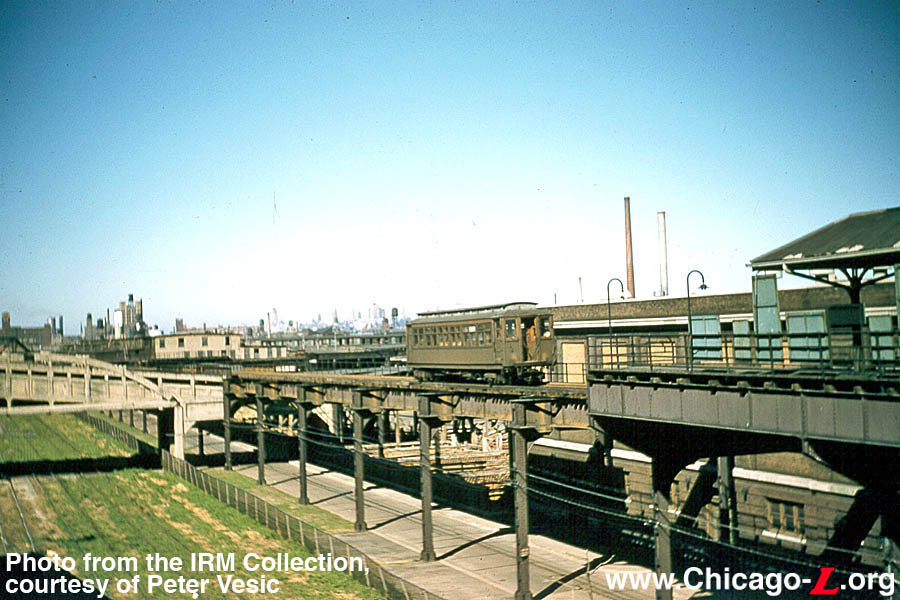
A bird's-eye view of the Wells Street Terminal used by the Chicago, Aurora and Elgin interurban on September 19, 1953. The following day, CA&E stopped running trains downtown, and their track connection with the CTA was severed forever in suburban Forest Park. There is a similar image, taken in 1960, showing the same terminal, or what was left after the CTA built a new track connection to the Loop elevated through it in 1955. You can find that in my book Building Chicago's Subways.

A bird’s-eye view of the Wells Street Terminal used by the Chicago, Aurora and Elgin interurban on September 19, 1953. The following day, CA&E stopped running trains downtown, and their track connection with the CTA was severed forever in suburban Forest Park. There is a similar image, taken in 1960, showing the same terminal, or what was left after the CTA built a new track connection to the Loop elevated through it in 1955. You can find that in my book Building Chicago’s Subways.

On July 27, 1962, a CTA Douglas Park “B” train pulls away from us at the Racine stop on the Congress rapid transit line., then only four years old. The train will go downtown through the Dearborn Subway, and then out to Logan Square via the Milwaukee Avenue tube.

On May 28, 1978, photographer William D. Lloyd caught this picture of CTA Historic cars 4271-4272 on the north side “L”. Now nearing the century mark, they are still on the property today. Here, they were only about five years out of regular service.

On January 26, 1964, approximately one year after the North Shore Line quit, the two Electroliners were rechristened as Liberty Liners on the Red Arrow's 13-mile line between Philadelphia and Norristown. In the distance, we see a pair of early 1930s Bullet cars, which had a storied history of their own.

On January 26, 1964, approximately one year after the North Shore Line quit, the two Electroliners were rechristened as Liberty Liners on the Red Arrow’s 13-mile line between Philadelphia and Norristown. In the distance, we see a pair of early 1930s Bullet cars, which had a storied history of their own.

MBTA (Boston) ex-Dallas double-end PCC 3336 at Mattapan yards on December 5, 1976. (Ed McKernan Photo)

MBTA (Boston) ex-Dallas double-end PCC 3336 at Mattapan yards on December 5, 1976. (Ed McKernan Photo)

picture255

Two CRT Met cars at the Laramie Shops in 1947. (John Gibb Smith, Jr. Photo)

In the last couple years of red car service in Chicago, which ended in 1954, the CTA painted a few of the older streetcars green. It was not an attractive color for them. Here, we see inbound car 6172 jogging from one side of Lake Street to another via Pine Avenue. To this day, tracks are still visible under the viaduct. At this point, streetcars crossed the Lake Street

In the last couple years of red car service in Chicago, which ended in 1954, the CTA painted a few of the older streetcars green. It was not an attractive color for them. Here, we see inbound car 6172 jogging from one side of Lake Street to another via Pine Avenue. To this day, tracks are still visible under the viaduct. At this point, streetcars crossed the Lake Street “L”, which ran on the ground here until 1962.

CSL 1466 was used as a training car for the three river tunnels. (Edward Frank, Jr. Photo)

CSL 1466 was used as a training car for the three river tunnels. (Edward Frank, Jr. Photo)

CSL 173X (full number not visible) is heading west on Madison Street in the 1930s. The Civic Opera House, built by Samuel Insull in 1929, is visible at rear. (Edward Frank, Jr. Photo)

CSL 173X (full number not visible) is heading west on Madison Street in the 1930s. The Civic Opera House, built by Samuel Insull in 1929, is visible at rear. (Edward Frank, Jr. Photo)

A maintenance of way car along the overhead section of the North Side “L”, exact date and location unknown. Jeff Wien adds that this is: “Wilson Avenue, freight connection to Buena Yards, probably in the early 50s.”

Laurel Line car 31 is at the Plains substation on August 3, 1952. Edward Skuchas writes: “I believe the locations of the two Laurel Line photos are incorrect. The top photo is Pittston. The lower photo may be the Plains sub-station. West Pittston is on the other side of the Susquehanna River, and the Laurel Line did not go there.”

Laurel Line car 39 is at the Plains sub-station on December 28, 1952, shortly before abandonment.

Laurel Line car 39 is at the Plains sub-station on December 28, 1952, shortly before abandonment.

The interior of Lehigh Valley Transit car 1007, showing its leather bucket seats, which were popular when this car was built for the Cincinnati and Lake Erie in the early 1930s.

The interior of Lehigh Valley Transit car 1007, showing its leather bucket seats, which were popular when this car was built for the Cincinnati and Lake Erie in the early 1930s.

Conductors on a Humboldt Park

Conductors on a Humboldt Park “L” train, circa 1907-15.

A Loop-bound Metropolitan

A Loop-bound Metropolitan “L” train, circa 1907-15.

The Chicago Surface Lines used trailers during the 1920s, as a way of dealing with increasing crowds of riders. But with the advent of the Great Depression, ridership fell sharply, and the trailers were no longer needed. Some thought was given to reviving them during World War II, but this did not happen. Here, 1756 pulls 8049. Don's Rail Photos notes,

The Chicago Surface Lines used trailers during the 1920s, as a way of dealing with increasing crowds of riders. But with the advent of the Great Depression, ridership fell sharply, and the trailers were no longer needed. Some thought was given to reviving them during World War II, but this did not happen. Here, 1756 pulls 8049. Don’s Rail Photos notes, “8056 was built by Brill in 1921, #21272. It became a shed at 77th and scrapped on July 17, 1957.” 1756 was a “169” or Broadway-State car. Again, Don Ross: “1756 was built by CSL in 1923. It was rebuilt as one-man in 1949.”

CTA prewar PCC 7028 on private right-of-way at the south end of Route 4 - Cottage Grove, in June 1953.

CTA prewar PCC 7028 on private right-of-way at the south end of Route 4 – Cottage Grove, in June 1953.

CTA Sedan (aka Peter Witt) 3848 on priate right-of-way at the south end of Route 4 - Cottage Grove in June 1952. Here, the line ran parallel to the Illinois Central Electric suburban service, now the Metra Electric.

CTA Sedan (aka Peter Witt) 3848 on priate right-of-way at the south end of Route 4 – Cottage Grove in June 1952. Here, the line ran parallel to the Illinois Central Electric suburban service, now the Metra Electric.

After the Chicago Transit Authority retired the last of the wooden

After the Chicago Transit Authority retired the last of the wooden “L” cars in 1957, some were used for a few more years in work service. Here, a Met car has been renumbered as S-308 at Skokie Shops.

CTA single cat unit 23 is outbound on the Skokie Swift at Niles Center Road on August 20, 1970.

CTA single cat unit 23 is outbound on the Skokie Swift at Niles Center Road on August 20, 1970.

CTA single car unit 26 on the open-cut section of the Skokie Swift in August 1978.

CTA single car unit 26 on the open-cut section of the Skokie Swift in August 1978.

CTA postwar PCC 4337, built by Pullman, heads south on State Street in the early 1950s.

CTA postwar PCC 4337, built by Pullman, heads south on State Street in the early 1950s.

An outbound CTA Douglas Park train ascends the ramp that will take from the Congress (now Eisenhower) Expressway to the old

An outbound CTA Douglas Park train ascends the ramp that will take from the Congress (now Eisenhower) Expressway to the old “L” structure in the mid-1960s. This ramp is not used much now, as Douglas trains, now renamed the Pink Line, have been rerouted to the Lake Street “L” via the Paulina Connector. (Mark D. Meyer Photo)

I ought this Red Border Kodachrome slide, which dates to the early 1950s, thinking perhaps it might e the old Park Theater on Chicago’s west side (on Lake near Austin). But after studying the image for a while, I am inclined to think it’s somewhere else. While the facade looks similar to the actual Park Theater, it is not identical. There should be streetcar tracks visible– the movie theater closed in 1952, about two years before the streetcar quit. And the theater on Lake Street at Austin Boulevard did not have a streetlight such as the one seen at right. There was a light attached to a line pole that held the trolley wire– a line pole not visible in this picture. That, plus the rounded nature of the signage, which I have never seen in any other pictures of the Park, tell me that this is not it. But we have in the past posted several pictures of streetcars near the actual theater. If you type “park theater” or “lake austin” in the search window on our page, these various pictures will come up.

CSL 1039 at Wabash and Lake in June 1947. Signed for the Indiana-Lincoln through route #3, it is southbound, and headed to Indiana and 51st.

CSL 1039 at Wabash and Lake in June 1947. Signed for the Indiana-Lincoln through route #3, it is southbound, and headed to Indiana and 51st.

CSL 6284 on Wabash at Roosevelt Road on June 13, 1947. Although the car is full of people, for some reason the side sign says Not In Service.

CSL 6284 on Wabash at Roosevelt Road on June 13, 1947. Although the car is full of people, for some reason the side sign says Not In Service.

A two-car CTA train of 4000s at right, in Evanston shuttle service, heads southbound approaching Howard in the 1950s.

A two-car CTA train of 4000s at right, in Evanston shuttle service, heads southbound approaching Howard in the 1950s.

TMER&T 1121, on a December 4, 1949 fantrip on the North Shore Line.

TMER&T 1121, on a December 4, 1949 fantrip on the North Shore Line.

CTA historic cars 4271-4272 at McCormick Boulevard (Yellow Line aka Skokie Swift) on July 16, 1989. (Bruce C. Nelson Photo)

CTA historic cars 4271-4272 at McCormick Boulevard (Yellow Line aka Skokie Swift) on July 16, 1989. (Bruce C. Nelson Photo)

The CTA has a yard for the Green Line (formerly the Lake Street

The CTA has a yard for the Green Line (formerly the Lake Street “L”) just west of the Harlem Avenue terminal in suburban Forest Park. Here, various cars in the 2000-series are seen, along with a Metra commuter train on the adjacent Union Pacific West Line. This picture was most likely taken during the 1990s. (Bruce C. Nelson Photo)

CTA gate car 2318 is parked along the outer portion of the Douglas Park line in February 1950.

CTA gate car 2318 is parked along the outer portion of the Douglas Park line in February 1950.

Chicago Rapid Transit Company gate car 305 is seen on the Loop

Chicago Rapid Transit Company gate car 305 is seen on the Loop “L” in the 1940s, signed as a Wilson Avenue Local.

The presence of double track would seem to indicate that this picture of a South Shore Line train was taken in East Chicago, Indiana in the 1950s. The street running through the middle of town was replaced by a new section running parallel to the Indiana Toll Road in 1956.

The presence of double track would seem to indicate that this picture of a South Shore Line train was taken in East Chicago, Indiana in the 1950s. The street running through the middle of town was replaced by a new section running parallel to the Indiana Toll Road in 1956.

CTA Holiday Trains have become an annual tradition. Photographer Bruce C. Nelson captured this one on December 2, 2017.

CTA Holiday Trains have become an annual tradition. Photographer Bruce C. Nelson captured this one on December 2, 2017.

Chicago Surface Lines red Pullman 426 is most likely running on Route 65 - Grand, as it is signed to go to Grand and Armitage. Chances are, this photo was taken circa 1939-40, and shows temporary trackage for construction of Chicago's first subways.

Chicago Surface Lines red Pullman 426 is most likely running on Route 65 – Grand, as it is signed to go to Grand and Armitage. Chances are, this photo was taken circa 1939-40, and shows temporary trackage for construction of Chicago’s first subways.

October 27, 1962 was the last day of ground-level operation on the CTA Lake Street

October 27, 1962 was the last day of ground-level operation on the CTA Lake Street “L”. The following day, service was relocated to the adjacent Chicago & North Western embankment. Here, we see a pair of 4000s heading west on South Boulevard at Kenilworth.

After serving Chicago for many years, some of the original CTA

After serving Chicago for many years, some of the original CTA “flat door” 6000s had a second life on Philadelphia’s Norristown High-Speed Line. 6089-6090 are approaching Radnor on April 10, 1987.

Here is a view of the old Tower 18 on Chicago's Loop

Here is a view of the old Tower 18 on Chicago’s Loop “L”, when this was the world’s busiest railroad crossing. The old Loop ran both tracks in only one direction, but this changed in 1969, when the CTA wanted to connect the Lake Street “L” with the new Dan Ryan line. Therefore, the old tower had to go, as it was situated right where the new tracks had to go.

Both CTA and CA&E trains are visible in this July 8, 1953 photo taken at Laramie on the Garfield Park

Both CTA and CA&E trains are visible in this July 8, 1953 photo taken at Laramie on the Garfield Park “L”. Just a little over two months later, the CA&E interurban cut back service to Forest Park, a few miles west of here (and behind the photographer).

The Milwaukee Rapid Transit & Speedrail Company's car 60, seen here in 1950, was a Cincinnati curved-side car. The ill-fated attempt to keep electric transit service going in Milwaukee was doomed to failure, once a horrific head-on collision took the lives of several people.

The Milwaukee Rapid Transit & Speedrail Company’s car 60, seen here in 1950, was a Cincinnati curved-side car. The ill-fated attempt to keep electric transit service going in Milwaukee was doomed to failure, once a horrific head-on collision took the lives of several people.

CA&E 425 is passing over Union Station in this undated photo. Trains going more or less straight would end up at the Wells Street Terminal, while the tracks in the background leading off to the right connected to the Loop

CA&E 425 is passing over Union Station in this undated photo. Trains going more or less straight would end up at the Wells Street Terminal, while the tracks in the background leading off to the right connected to the Loop “L” Van Buren. When Lower Wacker Drive was being built, this necessitated tearing down this second connection to thee Loop, and building a new one through the second floor of Wells Terminal. The switchover between the two took place in 1955.

Riders at the old Laramie stop on the CTA's Garfield Park

Riders at the old Laramie stop on the CTA’s Garfield Park “L” in 1947. Met cars are seen in storage in the background. (John Gibb Smith, Jr. Photo)

A CRT gate car, running in service on the old Garfield Park

A CRT gate car, running in service on the old Garfield Park “L” in 1947. This is the Laramie stop. (Charles R. Griffin Photo)

This CTA brochure, dated July 1949, explains the changes that were coming from the CTA's plan to revise north-south

This CTA brochure, dated July 1949, explains the changes that were coming from the CTA’s plan to revise north-south “L” and subway service. This included A/B “skip stop” service and making the Evanston branch a shuttle.

new935new936new937

From the Wien-Criss Archive:

One of the two North Shore Line Electroliners on Chicago's South Side

One of the two North Shore Line Electroliners on Chicago’s South Side “L” on February 17, 1962. (Wien-Criss Archive)

A North Shore Line Electroliner barrels through, having just crossed under the EJ&E, on January 12, 1963, a little over a week before the end of service. (Wien-Criss Archive)

A North Shore Line Electroliner barrels through, having just crossed under the EJ&E, on January 12, 1963, a little over a week before the end of service. (Wien-Criss Archive)

A North Shore Line Electroliner on June 1, 1962. (Wien-Criss Archive)

A North Shore Line Electroliner on June 1, 1962. (Wien-Criss Archive)

A North Shore Line Electroliner at Edison Court on February 17, 1962. (Wien-Criss Archive)

A North Shore Line Electroliner at Edison Court on February 17, 1962. (Wien-Criss Archive)

Chicago Surface Lines experimental pre-PCC car 7001 at 77th and Vincennes in October 1956. It is a shame that this historic car, which ran in Chicago from 1934 to 1944, was not saved. (Wien-Criss Archive)

Chicago Surface Lines experimental pre-PCC car 7001 at 77th and Vincennes in October 1956. It is a shame that this historic car, which ran in Chicago from 1934 to 1944, was not saved. (Wien-Criss Archive)

A Milwaukee streetcar, presumably on Route 10, in the 1950s. (Wien-Criss Archive)

A Milwaukee streetcar, presumably on Route 10, in the 1950s. (Wien-Criss Archive)

Interior shots were not easy for photographers on September 4, 1962, when Robert F. Collins took this picture of the North Shore Line's Milwaukee terminal. (Wien-Criss Archive)

Interior shots were not easy for photographers on September 4, 1962, when Robert F. Collins took this picture of the North Shore Line’s Milwaukee terminal. (Wien-Criss Archive)

Don's Rail Photos:

Don’s Rail Photos: “E223, sweeper, was built by McGuire-Cummings in 1908 as CCRys E23. It was renumbered E223 in 1913 and became CSL E223 in 1914. It was sold to Illinois Railway Museum on August 29, 1958.” (Wien-Criss Archive)

On March 17, 1957 the late James J. Buckley caught this terrific 3/4 view of a Chicago, Aurora & Elgin freight train at Lakewood. (Wien-Criss Archive)

On March 17, 1957 the late James J. Buckley caught this terrific 3/4 view of a Chicago, Aurora & Elgin freight train at Lakewood. (Wien-Criss Archive)

It's June 1963, several months after the CTA elevated the Lake Street

It’s June 1963, several months after the CTA elevated the Lake Street “L” onto the Chicago & North Western embankment. A four-car train made up of “circus wagons,” the fan’s name for experimental high-speed cars, is making a rare appearance at Harlem Avenue, the end of the line. This view looks east. (Wien-Criss Archive)

CTA postwar PCC 7237 is running southbound on Clark Street in the late 1950s. (Wien-Criss Archive)

CTA postwar PCC 7237 is running southbound on Clark Street in the late 1950s. (Wien-Criss Archive)

CTA postwar PCC 7196 is at 81st and Halsted, the southern end of Route 22 - Clark-Wentworth. (Wien-Criss Archive)

CTA postwar PCC 7196 is at 81st and Halsted, the southern end of Route 22 – Clark-Wentworth. (Wien-Criss Archive)

CTA 7195 is southbound on Clark at Washington. (Heier Industrial Photo, Wien-Criss Archive)

CTA 7195 is southbound on Clark at Washington. (Heier Industrial Photo, Wien-Criss Archive)

CTA red Pullman 144, which is now at the Illinois Railway Museum. (Wien-Criss Archive)

CTA red Pullman 144, which is now at the Illinois Railway Museum. (Wien-Criss Archive)

CTA red Pullman 144, which is now at the Illinois Railway Museum. (Wien-Criss Archive)

CTA red Pullman 144, which is now at the Illinois Railway Museum. (Wien-Criss Archive)

CTA PCC 7187 on Clark Street on September 6, 1957, the last day of street railway service on Chicago's north side. (Charles H. Thorpe Photo, Wien-Criss Archive)

CTA PCC 7187 on Clark Street on September 6, 1957, the last day of street railway service on Chicago’s north side. (Charles H. Thorpe Photo, Wien-Criss Archive)

On September 6, 1957, CTA 4372 pulls into the turnaround loop at Clark and Howard. (Charles H. Thorpe Photo, Wien-Criss Archive)

On September 6, 1957, CTA 4372 pulls into the turnaround loop at Clark and Howard. (Charles H. Thorpe Photo, Wien-Criss Archive)

CTA 7189 is southbound at Clark and Ohio on September 6, 1957. (Charles H. Thorpe Photo, Wien-Criss Archive) Daniel Joseph notes, "The Hotel Wacker was at Clark and Huron."

CTA 7189 is southbound at Clark and Ohio on September 6, 1957. (Charles H. Thorpe Photo, Wien-Criss Archive) Daniel Joseph notes, “The Hotel Wacker was at Clark and Huron.”

On September 6, 1957, Charles H. Thorpe took this picture of CTA 7139, the last pull-out from Devon Station (car barn). (Wien-Criss Archive)

On September 6, 1957, Charles H. Thorpe took this picture of CTA 7139, the last pull-out from Devon Station (car barn). (Wien-Criss Archive)

CTA 4379 is on north Clark Street on September 6, 1957. (Charles H. Thorpe Photo, Wien-Criss Archive) Daniel Joseph adds, "This streetcar is traveling southbound to 81st & Halsted (as the destination sign states) somewhere near Clark and Glenlake." (This is, however, on the northern portion of Clark Street as we stated.)

CTA 4379 is on north Clark Street on September 6, 1957. (Charles H. Thorpe Photo, Wien-Criss Archive) Daniel Joseph adds, “This streetcar is traveling southbound to 81st & Halsted (as the destination sign states) somewhere near Clark and Glenlake.” (This is, however, on the northern portion of Clark Street as we stated.)

CTA 7195 is on Halsted Street, near the south end of Route 22 - Clark-Wentworth. (Heier Industrial Photo, Wien-Criss Archive)

CTA 7195 is on Halsted Street, near the south end of Route 22 – Clark-Wentworth. (Heier Industrial Photo, Wien-Criss Archive)

CTA Sedan (aka Peter Witt) 3360 is running Route 4 - Cottage Grove, circa 1951-52. (Wien-Criss Archive)

CTA Sedan (aka Peter Witt) 3360 is running Route 4 – Cottage Grove, circa 1951-52. (Wien-Criss Archive)

CTA 7154 is near Limits Station (car barn), near 2700 N. Clark Street, on September 6, 1957. (Charles H. Thorpe Photo, Wien-Criss Archive)

CTA 7154 is near Limits Station (car barn), near 2700 N. Clark Street, on September 6, 1957. (Charles H. Thorpe Photo, Wien-Criss Archive)

CTA steeple cab S-343, a

CTA steeple cab S-343, a “yard shifter,” serving the rapid transit system, is at 64th and Prairie. Don’s Rail Photos notes, “S-343 was built by Chicago City Ry in 1909 as Chicago City Ry C50. It was renumbered L202 in 1913 and became CSL L202 in 1914. It was rebuilt as S-343 in 1959 and acquired by Railway Equipment Leasing & Investment Co in 1979. It was acquired by Fox River Trolley Museum in 1983 and restored as L202.” (Wien-Criss Archive)

Chicago Surface Lines crane car X-4 at the Illinois Railway Museum. Don's Rail Photos says,

Chicago Surface Lines crane car X-4 at the Illinois Railway Museum. Don’s Rail Photos says,”X4, derrick, was built by McGuire-Cummings in 1910 as CRys 2. It was renumbered N2 in 1913 and became CSL N2 in 1914. It was rebuilt as X4 in 1947 and rebuilt as S344 in 1958. It was sold to Electric Railway Historical Society in 1963 and donated to Illinois Railway Museum in 1973.” (Wien-Criss Archive)

CTA postwar PCC 7220, a product of the St. Louis Car Company, on Route 22. (Wien-Criss Archive)

CTA postwar PCC 7220, a product of the St. Louis Car Company, on Route 22. (Wien-Criss Archive)

From the William Shapotkin Collection:

CSL 5301 is at Lake and Ashland, running on Route 9, in April 1937. Streetcars were not permitted on boulevards, and the section of Ashland between Lake and Roosevelt was just such a boulevard. Therefore, in that stretch, Ashland streetcars jogged over the nearby Paulina. (William Shapotkin Collection)

CSL 5301 is at Lake and Ashland, running on Route 9, in April 1937. Streetcars were not permitted on boulevards, and the section of Ashland between Lake and Roosevelt was just such a boulevard. Therefore, in that stretch, Ashland streetcars jogged over the nearby Paulina. (William Shapotkin Collection)

This picture was taken on a Central Electric Railfans' Association fantrip on the Illinois Central Electric on April 24, 1966. (William Shapotkin Collection)

This picture was taken on a Central Electric Railfans’ Association fantrip on the Illinois Central Electric on April 24, 1966. (William Shapotkin Collection)

The slide mount for this had the word

The slide mount for this had the word “junk” written on it, but I don’t agree. This is also from that same April 24, 1966 fantrip. (William Shapotkin Collection)

picture056

A photo stop at Washington Park race track on the April 24, 1966 CERA fantrip on the IC. (William Shapotkin Collection)

Illinois Central Electric 1427 and 1186 on the Washington Park Branch on the April 24, 1966 CERA fantrip. Note that the motor unit in this pair faces north. (William Shapotkin Collection)

Illinois Central Electric 1427 and 1186 on the Washington Park Branch on the April 24, 1966 CERA fantrip. Note that the motor unit in this pair faces north. (William Shapotkin Collection)

The Illinois Central Electric at Blue Island in June 1978. (William Shapotkin Collection)

The Illinois Central Electric at Blue Island in June 1978. (William Shapotkin Collection)

This slide mount has George Strombeck written on it, but I am not sure whether that is the name of the photographer, or the man in the picture. Either way, this shows a Milwaukee Road commuter train in Downtown Chicago on April 21, 1973. (William Shapotkin Collection)

This slide mount has George Strombeck written on it, but I am not sure whether that is the name of the photographer, or the man in the picture. Either way, this shows a Milwaukee Road commuter train in Downtown Chicago on April 21, 1973. (William Shapotkin Collection)

The GM&O

The GM&O “Abe Lincoln” at 18th Street in Chicago on April 22, 1966. (William Shapotkin Collection)

Ryan Tower

Photos of Ryan Tower, where the North Shore Line crossed the Chicago & North Western, are scarce, as this was a somewhat remote location for fans. But thanks to the good offices of Bill Shapotkin, here are several such views, along with his usual contemporary photos showing what the area looks like today.

Milwaukee County, WI - A pair of CNS&M cars (the

Milwaukee County, WI – A pair of CNS&M cars (the “Silverliner” at left is on a fantrip) pass one another at Ryan Tower – crossing with the C&NW “New Line.” Note that the once-double-tracked C&NW is now ut a single-track line through here (the one-time westbound main has been removed). The view looks north. (William Shapotkin Collection)

Ryan Tower, WI - TM interurban #1121, in fantrip service, heads southbound on the CNS&M as it crosses over the C&NW

Ryan Tower, WI – TM interurban #1121, in fantrip service, heads southbound on the CNS&M as it crosses over the C&NW “New Line” at Ryan Tower on December 4, 1949. The view looks north. (William Shapotkin Collection)

Milwaukee County, WI - A southbound CNS&M

Milwaukee County, WI – A southbound CNS&M “Silverliner” (in fantrip service) is about to cross over the (now single-track) C&NW “New Line” at Ryan Tower. View looks north. (William Shapotkin Collection)

On the stretch between Milwaukee limits and Racine station, a North Shore train crosses North Western freight route at Ryan Road. (A. C. Kalmbach Photo, William Shapotkin Collection)

On the stretch between Milwaukee limits and Racine station, a North Shore train crosses North Western freight route at Ryan Road. (A. C. Kalmbach Photo, William Shapotkin Collection)

Milwaukee County, WI - In 1958, a southbound CNS&M passenger train approaches the crossing with C&NW

Milwaukee County, WI – In 1958, a southbound CNS&M passenger train approaches the crossing with C&NW “New Line” at Ryan Road (that’s Ryan Tower at left). The view looks north. (William Shapotkin Collection)

Near the Milwaukee County line, a North Shore car crosses the C&NW freight line at an acute angle. (A. C. Kalmbach Photo, William Shapotkin Collection)

Near the Milwaukee County line, a North Shore car crosses the C&NW freight line at an acute angle. (A. C. Kalmbach Photo, William Shapotkin Collection)

Milwaukee County, WI - Looking N/NW (timetable NB) on long-abandoned right-of-way of CNS&M from

Milwaukee County, WI – Looking N/NW (timetable NB) on long-abandoned right-of-way of CNS&M from “Old Ryan Road,” (formerly Ryan Road). The CNS&M once crossed the C&NW (now UP) “New Line” – visible at right at “Ryan Tower,” located behind the photographer on the south side of the road. Photo by William Shapotkin on September 20, 2003.

(William Shapotkin Photo)

(William Shapotkin Photo)

Milwaukee, WI - Looking SB on UP (ex-C&NW)

Milwaukee, WI – Looking SB on UP (ex-C&NW) “New Line” from “Old Ryan Road” (new Ryan Road is visible overhead in the distance). This once double-tracked line once crossed the long-abandoned CNS&M at “Ryan Tower,” located south of the Roadway. Photo by William Shapotkin on September 6, 2003.

C&WT 104 at the end of the line in LaGrange. (William Shapotkin Collection)

C&WT 104 at the end of the line in LaGrange. (William Shapotkin Collection)

C&WT 164 on Lake Street. (William Shapotkin Collection)

C&WT 164 on Lake Street. (William Shapotkin Collection)

C&WT 145 is westbound on Lake Street at Harlem Avenue. To the left is the Marshall Field & Company store, a local landmark. (William Shapotkin Collection)

C&WT 145 is westbound on Lake Street at Harlem Avenue. To the left is the Marshall Field & Company store, a local landmark. (William Shapotkin Collection)

This picture is not very sharp, but it does show a C&WT streetcar stopped at the south parking lot of Brookfield Zoo, sometime in the 1940s. (William Shapotkin Collection)

This picture is not very sharp, but it does show a C&WT streetcar stopped at the south parking lot of Brookfield Zoo, sometime in the 1940s. (William Shapotkin Collection)

C&WT 133 has changed ends at Madison and Austin, and is ready to head west. Across the street from Oak Park into Chicago, riders could change to a Chicago Surface Lines PCC for a fast ride into the city. (William Shapotkin Collection)

C&WT 133 has changed ends at Madison and Austin, and is ready to head west. Across the street from Oak Park into Chicago, riders could change to a Chicago Surface Lines PCC for a fast ride into the city. (William Shapotkin Collection)

This shows westbound C&WT car 108, signed Berwyn-Lyons, on Stanley having just passed Oak Park Avenue circa 1941. At right is the Berwyn stop on the Chicago Burlington & Quincy. Today, Pace bus route 302 runs here, and commuter train service is under the auspices of Metra. (William Shapotkin Collection)

This shows westbound C&WT car 108, signed Berwyn-Lyons, on Stanley having just passed Oak Park Avenue circa 1941. At right is the Berwyn stop on the Chicago Burlington & Quincy. Today, Pace bus route 302 runs here, and commuter train service is under the auspices of Metra. (William Shapotkin Collection)

I am not sure of where this C&WT photo was taken. (William Shapotkin Collection) Patrick Cunningham: “The unidentified C&WT photo looks like it was taken just east of the Stone Ave. station on the CB&Q in LaGrange. The view is east. If you look at the prior photo of the end of the C&WT in LaGrange (which was at Brainard Ave.), you’ll note that the line was single track. This appears to be a passing siding or layover point.” On the other hand. Michael Murray writes, “I believe the 7th C&WT picture is looking east at Harlem and Stanley Aves. Page 128 of the Buckley book shows the signal on the pole, the track alignment, the CBQ shelter, and the CBQ signal in a photo near where yours was taken. I originally thought the same about the C&WT picture, but it’s Berwyn, not La Grange. The Buckley book confirms the location. ” Charles R. Vlk: “The “I am not sure of where this C&WT photo was taken. (William Shapotkin Collection)” photo is looking East on Stanley Avenue where the single track line crossing the Burlington at Harlem Avenue goes to double track. Harlem Avenue is behind the camera to the West.”

C&WT 112 is eastbound at Stanley and Oak Park Avenue. The CB&Q Berwyn stop is at left. (William Shapotkin Collection)

C&WT 112 is eastbound at Stanley and Oak Park Avenue. The CB&Q Berwyn stop is at left. (William Shapotkin Collection)

We have seen this picture of C&WT 141 before (it is also in my book Chicago Trolleys), but why pass up another chance to see it again? This is the bridge where the LaGrange line crossed the DesPlaines River, and I believe we are looking the the southeast. (William Shapotkin Collection)

We have seen this picture of C&WT 141 before (it is also in my book Chicago Trolleys), but why pass up another chance to see it again? This is the bridge where the LaGrange line crossed the DesPlaines River, and I believe we are looking the the southeast. (William Shapotkin Collection)

I assume these are the C&WT tracks in LaGrange. (William Shapotkin Collection) Michael Murray: “I’m skeptical that photo 10 is on the La Grange line. There wasn’t any single track on the line similar to the one in the photo. My guess is perhaps the Berwyn-Lyons line? Ogden Ave. on the right, and this is the easternmost passing track, which, according to the Buckley book, was west of Harlem. Note that the line poles are only briefly wide of the main “march” of poles into the distance.”

A C&WT streetcar in LaGrange. (William Shapotkin Collection) Michael Murray: “Photo 11, which you have captioned as “A C&WT streetcar in LaGrange” is found on page 129 of the Buckley book, and is captioned: “Between Harlem Ave and the Des Plaines River, the Berwyn-Lyons streetcar line was built on private right-of-way on the south side of Ogden Ave. It was abandoned October 26, 1933 because the land was wanted to widen Ogden Ave. The railway here was single track with two passing sidings. Car 133 was photographed on the passing siding near the Des Plaines River in October 1933, a few days before abandonment.”

C&WT 111. (William Shapotkin Collection)

C&WT 111. (William Shapotkin Collection)

C&WT 105 on Cermak Road. (William Shapotkin Collection)

C&WT 105 on Cermak Road. (William Shapotkin Collection)

An unidentified C&WT car, probably in the 1930s. (William Shapotkin Collection)

An unidentified C&WT car, probably in the 1930s. (William Shapotkin Collection)

C&WT 107. (William Shapotkin Collection)

C&WT 107. (William Shapotkin Collection)

C&WT 165 is at Lake and Austin, the east end of the line, in suburban Oak Park. (William Shapotkin Collection)

C&WT 165 is at Lake and Austin, the east end of the line, in suburban Oak Park. (William Shapotkin Collection)

C&WT 158 in LaGrange. Not sure why this section of track is blocked off, except that perhaps it is due to the tracks being unstable, due to the nearby excavation going on. (William Shapotkin Collection) Patrick Cunningham adds, “C&WT 158 is just east of LaGrange Road. In the background, you can just make out the Jackson Moving and Storage sign on the building with the towers. The building is there, the towers are gone. Probably about here: https://www.google.com/maps/@41.8166104,-87.8687401,3a,75y,70.46h,80.48t/data=!3m6!1e1!3m4!1st0yuoCYe7FXm6EGEmBkuQA!2e0!7i16384!8i8192!5m1!1e1

From a high vantage point, here we see C&WT 112 has just turned from Ridgeland onto Stanley in suburban Berwyn, and is heading west, just north of the CB&Q, which it will cross at Harlem Avenue one mile west of here. (William Shapotkin Collection)

From a high vantage point, here we see C&WT 112 has just turned from Ridgeland onto Stanley in suburban Berwyn, and is heading west, just north of the CB&Q, which it will cross at Harlem Avenue one mile west of here. (William Shapotkin Collection)

C&WT 132 on Cermak Road in the late 1930s. (William Shapotkin Collection)

C&WT 132 on Cermak Road in the late 1930s. (William Shapotkin Collection)

C&WT 105 at the Harlem and Cermak car barn. (William Shapotkin Photo)

C&WT 105 at the Harlem and Cermak car barn. (William Shapotkin Photo)

C&WT 111 on Cermak Road. (William Shapotkin Photo)

C&WT 111 on Cermak Road. (William Shapotkin Photo)

The Trolley Dodger On the Air

We appeared on WGN radio in Chicago last November, discussing our book Building Chicago’s Subways on the Dave Plier Show. You can hear our 19-minute conversation here.

Order Our New Book Building Chicago’s Subways

There were three subway anniversaries in 2018 in Chicago:
60 years since the West Side Subway opened (June 22, 1958)
75 years since the State Street Subway opened (October 17, 1943)
80 years since subway construction started (December 17, 1938)

To commemorate these anniversaries, we have written a new book, Building Chicago’s Subways.

While the elevated Chicago Loop is justly famous as a symbol of the city, the fascinating history of its subways is less well known. The City of Chicago broke ground on what would become the “Initial System of Subways” during the Great Depression and finished 20 years later. This gigantic construction project, a part of the New Deal, would overcome many obstacles while tunneling through Chicago’s soft blue clay, under congested downtown streets, and even beneath the mighty Chicago River. Chicago’s first rapid transit subway opened in 1943 after decades of wrangling over routes, financing, and logistics. It grew to encompass the State Street, Dearborn-Milwaukee, and West Side Subways, with the latter modernizing the old Garfield Park “L” into the median of Chicago’s first expressway. Take a trip underground and see how Chicago’s “I Will” spirit overcame challenges and persevered to help with the successful building of the subways that move millions. Building Chicago’s subways was national news and a matter of considerable civic pride–making it a “Second City” no more!

Bibliographic information:

Title Building Chicago’s Subways
Images of America
Author David Sadowski
Edition illustrated
Publisher Arcadia Publishing (SC), 2018
ISBN 1467129380, 9781467129381
Length 128 pages

Chapter Titles:
01. The River Tunnels
02. The Freight Tunnels
03. Make No Little Plans
04. The State Street Subway
05. The Dearborn-Milwaukee Subway
06. Displaced
07. Death of an Interurban
08. The Last Street Railway
09. Subways and Superhighways
10. Subways Since 1960

Building Chicago’s Subways is in stock and now available for immediate shipment. Order your copy today! All copies purchased through The Trolley Dodger will be signed by the author.

The price of $23.99 includes shipping within the United States.

For Shipping to US Addresses:

For Shipping to Canada:

For Shipping Elsewhere:

Redone tile at the Monroe and Dearborn CTA Blue Line subway station, showing how an original sign was incorporated into a newer design, May 25, 2018. (David Sadowski Photo)

Redone tile at the Monroe and Dearborn CTA Blue Line subway station, showing how an original sign was incorporated into a newer design, May 25, 2018. (David Sadowski Photo)

Help Support The Trolley Dodger

gh1

This is our 228th post, and we are gradually creating a body of work and an online resource for the benefit of all railfans, everywhere. To date, we have received over 504,000 page views, for which we are very grateful.

You can help us continue our original transit research by checking out the fine products in our Online Store.

As we have said before, “If you buy here, we will be here.”

We thank you for your support.

DONATIONS

In order to continue giving you the kinds of historic railroad images that you have come to expect from The Trolley Dodger, we need your help and support. It costs money to maintain this website, and to do the sort of historic research that is our specialty.

Your financial contributions help make this web site better, and are greatly appreciated.

A Long Time Gone

Chicago postwar PCC 7216 is shown heading south on Clark at Harrison on March 11, 1958. I was attracted to this shot since the woman and child who are about to board could just as well be me and my mother at that time. (Photo by A. Goddard)

Chicago postwar PCC 7216 is shown heading south on Clark at Harrison on March 11, 1958. I was attracted to this shot since the woman and child who are about to board could just as well be me and my mother at that time. (Photo by A. Goddard)

June 21st marks 60 years since the last Chicago streetcar ran. If you consider that 80 years is, perhaps, about an average lifespan, that means 3/4ths of such a time has now passed since that historic event.

The number of people still living who rode Chicago streetcars is dwindling, and is certainly only a small fraction of the current population. At age 63, I must be among the youngest people who can say they rode a Chicago streetcar on the streets of Chicago, much less remember it.

But the number of people who have taken a ride on a Chicago streetcar does increase, since there are a number of them that are operable at the Illinois Railway Museum in Union. The Seashore Trolley Museum (Kennebunkport, ME) has another car (225) that is operated infrequently.

The experience of riding at a railway museum is, of necessity, somewhat different than what people experienced 60+ years ago on the streets of Chicago. However, as a “streetcar renaissance” is underway across the country in various cities, the number of track miles in city streets has been increasing. In those places, it is possible to experience something more like what Chicago once had.

Milwaukee, Wisconsin will soon join that list, just 90 miles north of Chicago. After a similar 60-year gap in streetcar service, their first new line, aka “The Hop,” is expected to begin service mid-November. (You can read our recent update here. Since our article appeared, the new cars have begun testing out on the streets.)

Interestingly, a heritage trolley recently began service in Rockford, Illinois, which is also about 90 miles from Chicago.

For the past 18 years, Kenosha, Wisconsin (about 65 miles from Chicago) has operated a tourist trolley, which you can even reach using Metra‘s Union Pacific North Line.

Perhaps the streetcar line that would offer a ride closest to what Chicagoans could once experience, however, is the SEPTA #15 Girard Avenue line in Philadelphia, which is operated with modernized PCC cars.

I can also recommend the Muni F-Market and Wharves line in San Francisco, which operates using a variety of historic equipment.

Anyway you look at it, this anniversary is a good excuse to feature some classic Chicago traction photos, which we hope you will enjoy.

But wait– there’s more!

June 22, 1958 is another important date in Chicago transit history. 60 years ago, a new CTA rapid transit line opened in the median of the Congress (now Eisenhower) expressway. This line, also known as the “West Side Subway,” replaced the Garfield Park “L” and was the culmination of plans made 20 years before.

Another important anniversary is approaching on October 17th– the 75th anniversary of the opening of Chicago’s first subway. In December, it will be 80 years since subway construction began.

For these reasons, and more, we have written a new book called Building Chicago’s Subways, to be released by Arcadia Publishing this October 1st. Information about how to pre-order this book appears further down in this post.

The idea for Building Chicago’s Subways first came to me a few years ago, when I realized these important anniversaries were approaching. A few months after the publication of Chicago Trolleys last fall, I pitched the idea to Arcadia, and that is when the real work began.

Much additional research had to be done. I read everything I could find on the subject. Photos came from my own collections and those of other collectors, who have graciously permitted their use in this project.

Here is a short description of the book:

While the elevated Chicago Loop is justly famous as a symbol of the city, the fascinating history of its subways is less well known. The City of Chicago broke ground on what would become the “Initial System of Subways” during the Great Depression and finished 20 years later. This gigantic construction project, a part of the New Deal, would overcome many obstacles while tunneling through Chicago’s soft blue clay, under congested downtown streets, and even beneath the mighty Chicago River. Chicago’s first rapid transit subway opened in 1943 after decades of wrangling over routes, financing, and logistics. It grew to encompass the State Street, Dearborn-Milwaukee, and West Side Subways, with the latter modernizing the old Garfield Park “L” into the median of Chicago’s first expressway. Take a trip underground and see how Chicago’s “I Will” spirit overcame challenges and persevered to help with the successful building of the subways that move millions. Building Chicago’s subways was national news and a matter of considerable civic pride–making it a “Second City” no more!

The story goes back much further than that… before there were rapid transit tunnels, there were tunnels under the Chicago River, used by cable cars and streetcars. In the early 1900s, private enterprise built an extensive system of freight tunnels under the downtown area. And there was about 40 years of wrangling over what kind of subway to build, where to build it, and who should pay for it.

I found it a fascinating tale, and am gratified that I have been able to complete this new book in time for the anniversary, and within the living memory of Chicagoans who were here to witness these events 75 long years ago. The State Street, Dearborn-Milwaukee and West Side Subways have changed life for everyday Chicagoans forever.

-David Sadowski

PS- The Chicago Transit Authority posted this excellent video showing the last run of car 7213 in the early morning hours of June 21, 1958 (the June 22 date in the video is not correct):

Jeffrey L. Wien and I, along with the late Bradley Criss, collaborated on the book Chicago Streetcar Pictorial: The PCC Car Era, 1936-1958, published in 2015 as Bulletin 146 of the Central Electric Railfans’ Association.

For this anniversary, I asked Mr. Wien, who rode on the last Chicago streetcar, to reminisce for our readers:

Today, June 21, 2018, marks the 60th anniversary of my ride on the Last Chicago Streetcar with my high school friend Greer Nielsen. Thinking back 60 years I recall that it was a very melancholy event, one that remained in my mind for the rest of my life.

Thinking back 60 years can be a challenging task, but I do remember that it was a warm and muggy night on that last ride. CTA PCC 7213 was the last car on the shortened route 22 Wentworth line. The last run south from Clark and Kinzie began around 4am. There were probably at least 100 people crammed into that car so that they could say that they rode the Last Chicago Streetcar. As the car headed south through the Loop headed to 81st and Halsted, the group was quite loud and raucous, but as we went farther and farther south, the crowd quieted down, perhaps because we wanted to hear the sound of the streetcar in the streets of Chicago for the very last time.

When we arrived at 81st and Halsted, everyone got off the car for photos, private and official, and then reboarded the car for the last time for the short trip to Vincennes and 78th where the car pulled off of the street. It was about 6:15am by that point in time, and the Sun was just rising.

As the 7213 pulled away from Vincennes Avenue heading into the Rising Sun, we knew that we had witnessed an historic event in the history of Chicago. 99 years of traction history in Chicago ended at that moment. For me, it was a very sad moment for it was like losing a very good friend.

Jeff Wien

Chicago Area Recent Finds

Chicago's PCCs did not operate in multiple units, but you would be forgiven for thinking so from this photo. Car 4172 and a very close follower are heading south at Clark and Division circa 1950. Note there are not yet any advertising brackets on the sides of the PCCs. At right, there is an entrance to a CTA subway station, which is today part of the Red Line.

Chicago’s PCCs did not operate in multiple units, but you would be forgiven for thinking so from this photo. Car 4172 and a very close follower are heading south at Clark and Division circa 1950. Note there are not yet any advertising brackets on the sides of the PCCs. At right, there is an entrance to a CTA subway station, which is today part of the Red Line.

CTA PCC 4366, a Pullman, heads north on diversion trackage on Halsted at Congress in 1950. This was necessitated by construction of the bridge that would go over the Congress expressway (now the Eisenhower, I290). Bridges that crossed the highway were the first things built, since traffic could be routed around them. Once a bridge was finished, the area around it could be dug out.

CTA PCC 4366, a Pullman, heads north on diversion trackage on Halsted at Congress in 1950. This was necessitated by construction of the bridge that would go over the Congress expressway (now the Eisenhower, I290). Bridges that crossed the highway were the first things built, since traffic could be routed around them. Once a bridge was finished, the area around it could be dug out.

CTA PCC 7148, running northbound on Route 36 - Broadway, turns from Broadway onto westbound Devon in 1955, with the Howard line "L" in the background. The date written on this slide mount was 8-14-56, but the turning car has a 1955 Illinois license plate on it, so perhaps the correct date is 8-14-55. (William Shapotkin Collection)

CTA PCC 7148, running northbound on Route 36 – Broadway, turns from Broadway onto westbound Devon in 1955, with the Howard line “L” in the background. The date written on this slide mount is 8-14-56, but the turning car has a 1955 Illinois license plate on it, so perhaps the correct date is 8-14-55. (William Shapotkin Collection)

CTA Pullman-built PCC 4124 is eastbound on Route 20 - Madison at Cicero Avenue in 1953. The PCC is signed for Kedzie, so it is most likely a tripper, heading back to the barn. Streetcar service on the main portion of Madison ended on December 13, 1953.

CTA Pullman-built PCC 4124 is eastbound on Route 20 – Madison at Cicero Avenue in 1953. The PCC is signed for Kedzie, so it is most likely a tripper, heading back to the barn. Streetcar service on the main portion of Madison ended on December 13, 1953.

The same building as in the previous picture.

The same building as in the previous picture.

Rust never sleeps, as the saying goes, and that is evident in this picture of a Chicago Surface Lines (now CTA, but still sporting a CSL logo) electric loco as it looked in the 1950s. Behind it is one of the CSL trailers that were used during the 1920s, pulled along behind other streetcars. Once ridership dropped during the Great Depression, these were used for storage at various CSL yards.

Rust never sleeps, as the saying goes, and that is evident in this picture of a Chicago Surface Lines (now CTA, but still sporting a CSL logo) electric loco as it looked in the 1950s. Behind it is one of the CSL trailers that were used during the 1920s, pulled along behind other streetcars. Once ridership dropped during the Great Depression, these were used for storage at various CSL yards.

In August 1960, a four-car train of CTA 4000-series cars heads west on the ground-level portion of the Lake Street "L". Since it appears there are passengers waiting for a Chicago & North Western commuter train on the adjacent embankment, I would say it's possible the location is near Marion Street in suburban Oak Park. The outer 2.5 miles of the Lake route were relocated onto the embankment in October 1962.

In August 1960, a four-car train of CTA 4000-series cars heads west on the ground-level portion of the Lake Street “L”. Since it appears there are passengers waiting for a Chicago & North Western commuter train on the adjacent embankment, I would say it’s possible the location is near Marion Street in suburban Oak Park. The outer 2.5 miles of the Lake route were relocated onto the embankment in October 1962.

CTA 4295 heads up a train in Oak Park on the ground-level portion of the Lake Street "L" on August 7, 1954. (Photo by Mark D. Meyer)

CTA 4295 heads up a train in Oak Park on the ground-level portion of the Lake Street “L” on August 7, 1954. (Photo by Mark D. Meyer)

Two CTA 4000s go up the ramp on Lake Street, just west of Laramie, to rejoin the steel "L" structure east of here on November 30, 1952. (Robert Selle Photo)

Two CTA 4000s go up the ramp on Lake Street, just west of Laramie, to rejoin the steel “L” structure east of here on November 30, 1952. (Robert Selle Photo)

In September 1959, we see a two-car train of CTA 4000s, preparing to head east. I believe the location is Marion Street in Oak Park and not Marengo Avenue in Forest Park as written on the slide mount. Marengo is a short distance west of Harlem, and although Lake Street trains did go there, the buildings in this picture match Marion. We have another picture in this post showing what the area west of Harlem actually looked like. (William Shapotkin Collection)

In September 1959, we see a two-car train of CTA 4000s, preparing to head east. I believe the location is Marion Street in Oak Park and not Marengo Avenue in Forest Park as written on the slide mount. Marengo is a short distance west of Harlem, and although Lake Street trains did go there, the buildings in this picture match Marion. We have another picture in this post showing what the area west of Harlem actually looked like. (William Shapotkin Collection)

Photographer Bob Selle notes: Two-car "L" train (4420 at right) on Lake Street line just west of Harlem Avenue." In the distance, you can see the actual terminal. Not that many people boarded there, compared to the Marion Street station just east of Harlem Avenue. This picture was taken on May 1, 1955.

Photographer Bob Selle notes: Two-car “L” train (4420 at right) on Lake Street line just west of Harlem Avenue.” In the distance, you can see the actual terminal. Not that many people boarded there, compared to the Marion Street station just east of Harlem Avenue. This picture was taken on May 1, 1955.

A close-up of the previous picture, showing some wavy track and the actual station and bumper post (or is it turned-up rail?) at the west end of the Lake Street "L" prior to 1962. Riders could board trains at the station, which was located about two blocks west of Harlem Avenue.

A close-up of the previous picture, showing some wavy track and the actual station and bumper post (or is it turned-up rail?) at the west end of the Lake Street “L” prior to 1962. Riders could board trains at the station, which was located about two blocks west of Harlem Avenue.

CTA one-man car 3125, heading west on Route 16, is turning north from Lake Street onto Pine Street, where Lake takes a jog. In the process, it crosses the ground-level Lake Street "L". This picture was taken on September 26, 1953. (Robert Selle Photo)

CTA one-man car 3125, heading west on Route 16, is turning north from Lake Street onto Pine Street, where Lake takes a jog. In the process, it crosses the ground-level Lake Street “L”. This picture was taken on September 26, 1953. (Robert Selle Photo)

A two-car train of 4000s is on the Lake Street "L" during construction of the Northwest (now Kennedy) expressway on February 25, 1958. The new highway opened in 1960. Further south, the Garfield Park "L" also crossed the highway footprint and had to be shored up around the same time this photo was taken. But once the new Congress rapid transit line opened on June 22, 1958 the Garfield line was no longer needed and the structure was removed where it crossed the highway, cutting the line off from the rest of the system. The remaining portions of structure west of there were removed in 1959; east of there, parts remained until 1964. The Lake Street "L", on the other hand, rechristened the Green Line, is still here.

A two-car train of 4000s is on the Lake Street “L” during construction of the Northwest (now Kennedy) expressway on February 25, 1958. The new highway opened in 1960. Further south, the Garfield Park “L” also crossed the highway footprint and had to be shored up around the same time this photo was taken. But once the new Congress rapid transit line opened on June 22, 1958 the Garfield line was no longer needed and the structure was removed where it crossed the highway, cutting the line off from the rest of the system. The remaining portions of structure west of there were removed in 1959; east of there, parts remained until 1964. The Lake Street “L”, on the other hand, rechristened the Green Line, is still here.

In this picture, taken in April 1964, we see the back end of a CTA two-car train of 4000s as they head east at Halsted on the Lake Street "L". By this time, the western portion of the line had been relocated onto the C&NW embankment, and therefore there was no further need to use overhead wire. But the new 2000-series "L" cars had not yet replaced the 4000s in this line, which they would do shortly. This station, built in 1892-93, was closed in 1994 for the Green Line rehabilitation project, but never reopened. It was demolished in 1996 and the new Morgan station, two blocks to the west, more or less replaced it when it opened in 2012.

In this picture, taken in April 1964, we see the back end of a CTA two-car train of 4000s as they head east at Halsted on the Lake Street “L”. By this time, the western portion of the line had been relocated onto the C&NW embankment, and therefore there was no further need to use overhead wire. But the new 2000-series “L” cars had not yet replaced the 4000s in this line, which they would do shortly. This station, built in 1892-93, was closed in 1994 for the Green Line rehabilitation project, but never reopened. It was demolished in 1996 and the new Morgan station, two blocks to the west, more or less replaced it when it opened in 2012.

On August 13, 1964 CTA single-car unit 45 prepares to stop at Isabella station on the Evanston line. The car is signed as an Evanston Express, but I do not think it would have operated downtown as a single car. Therefore, it must be in Evanston shuttle service. (August 13, 1964 was a Thursday, so the Evanston Express was running that day, though.) (Photo by Douglas N. Grotjahn)

On August 13, 1964 CTA single-car unit 45 prepares to stop at Isabella station on the Evanston line. The car is signed as an Evanston Express, but I do not think it would have operated downtown as a single car. Therefore, it must be in Evanston shuttle service. (August 13, 1964 was a Thursday, so the Evanston Express was running that day, though.) (Photo by Douglas N. Grotjahn)

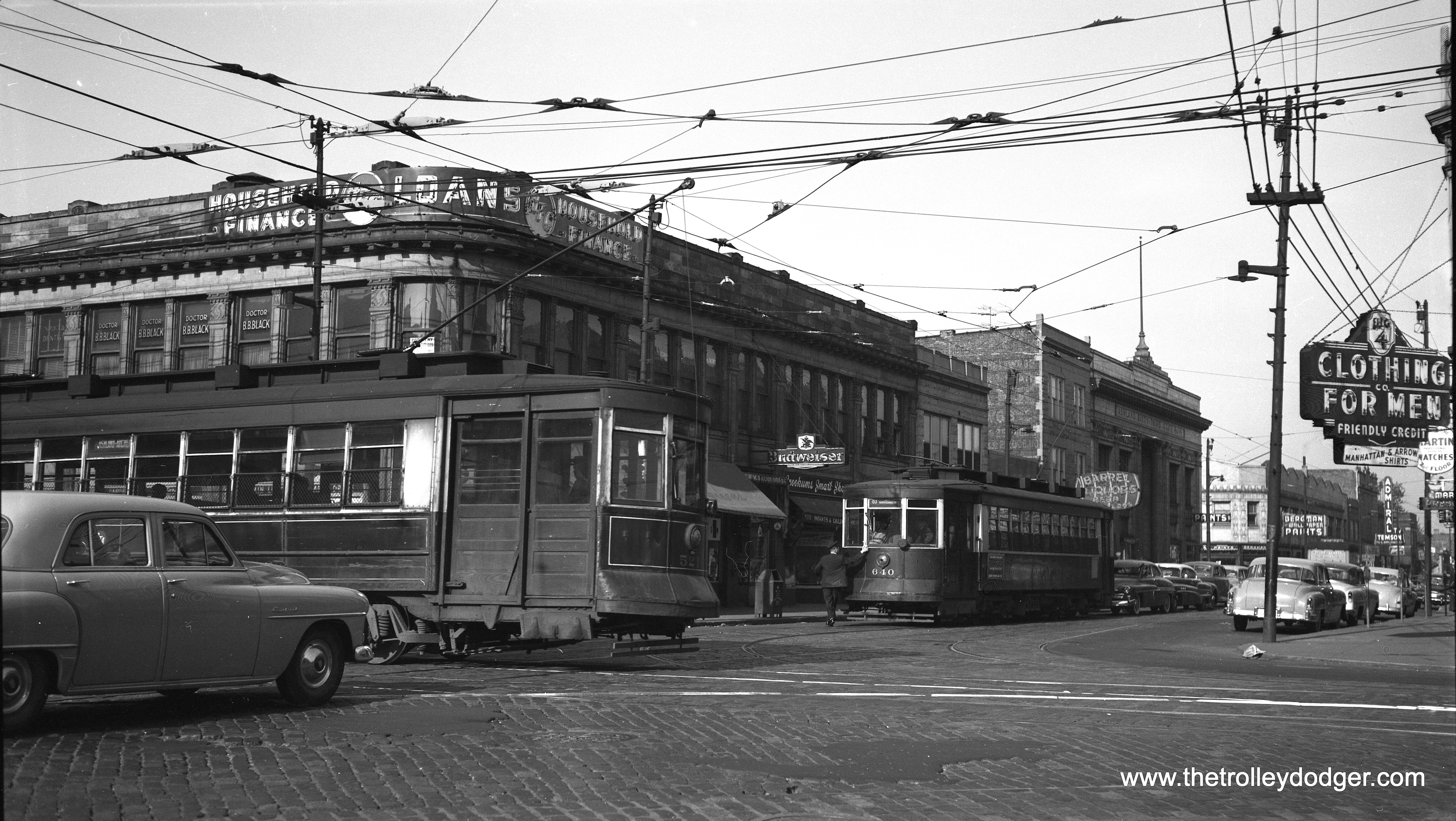
CTA red Pullmans 521 (on Ashland) and 640 (on 63rd Street) meet on May 14, 1953. This was near the end of streetcar service on 63rd. By then, PCC cars had been transferred from 63rd to Cottage Grove. The Curtis restaurant, located in this vicinity but behind the photographer, was a favorite of my parents. It is perhaps no coincidence that I have a brother named Curtis. (Robert Selle Photo)

CTA red Pullmans 521 (on Ashland) and 640 (on 63rd Street) meet on May 14, 1953. This was near the end of streetcar service on 63rd. By then, PCC cars had been transferred from 63rd to Cottage Grove. The Curtis restaurant, located in this vicinity but behind the photographer, was a favorite of my parents. It is perhaps no coincidence that I have a brother named Curtis. (Robert Selle Photo)

CTA PCC 4095, built by Pullman, has just left the Madison-Austin loop on the west end of Route 20 on June 1, 1953. Buses continue to use this loop today, although it has been somewhat reconfigured. (Robert Selle Photo)

CTA PCC 4095, built by Pullman, has just left the Madison-Austin loop on the west end of Route 20 on June 1, 1953. Buses continue to use this loop today, although it has been somewhat reconfigured. (Robert Selle Photo)

CTA 4271-4272 head up a northbound Evanston Express train passing through the Chicago Avenue station on June 26, 1958. These two cars, which were originally independent but were converted to semi-permanent "married pairs" in the 1950s, are still on CTA property and within a few years will celebrate their centennial. When the last of the 4000-series "L" cars were retired in 1973, these were chosen for preservation as historic cars. They are occasionally used for special events. (Robert Selle Photo)

CTA 4271-4272 head up a northbound Evanston Express train passing through the Chicago Avenue station on June 26, 1958. These two cars, which were originally independent but were converted to semi-permanent “married pairs” in the 1950s, are still on CTA property and within a few years will celebrate their centennial. When the last of the 4000-series “L” cars were retired in 1973, these were chosen for preservation as historic cars. They are occasionally used for special events. (Robert Selle Photo)

CTA red Pullman 270 is on Cicero at North Avenue, where Cicero took a bit of a jog which has since been somewhat straightened out. The date is July 19, 1948. (William Shapotkin Collection)

CTA red Pullman 270 is on Cicero at North Avenue, where Cicero took a bit of a jog which has since been somewhat straightened out. The date is July 19, 1948. (William Shapotkin Collection)

CTA trolleybus 9219 on Route 77 - Belmont, running eastbound at approximately 952 W. Belmont (near Sheffield). The photographer was up on the north-south "L" platform. (William Shapotkin Collection)

CTA trolleybus 9219 on Route 77 – Belmont, running eastbound at approximately 952 W. Belmont (near Sheffield). The photographer was up on the north-south “L” platform. (William Shapotkin Collection)

The building in the previous picture is still there. For several years, there was a club on the second floor, first called the Quiet Knight, later on Tut's. I attended many great concerts there in the 1970s and 80s.

The building in the previous picture is still there. For several years, there was a club on the second floor, first called the Quiet Knight, later on Tut’s. I attended many great concerts there in the 1970s and 80s.

Chicago Surface Lines 1775 crosses the Chicago River at Wabash Avenue on May 30, 1945, promoting the WAVES (Women Accepted for Volunteer Emergency Service). The nearby State Street bridge was out of service from 1939 to 1949 due to subway construction and wartime materials shortages.

Chicago Surface Lines 1775 crosses the Chicago River at Wabash Avenue on May 30, 1945, promoting the WAVES (Women Accepted for Volunteer Emergency Service). The nearby State Street bridge was out of service from 1939 to 1949 due to subway construction and wartime materials shortages.

CSL 1775, decorated to promote the SPARS*, is on 119th one block west of Halsted in August 1943. Car 1775 was chosen for patriotic duty because that was the year the Revolutionary War broke out, with the Battles of Lexington and Concord. *The United States Coast Guard (USCG) Women's Reserve, better known as the SPARS, was the World War II women's branch of the USCG Reserve. It was established by the United States Congress and signed into law by President Franklin D. Roosevelt on 23 November 1942.

CSL 1775, decorated to promote the SPARS*, is on 119th one block west of Halsted in August 1943. Car 1775 was chosen for patriotic duty because that was the year the Revolutionary War broke out, with the Battles of Lexington and Concord.
*The United States Coast Guard (USCG) Women’s Reserve, better known as the SPARS, was the World War II women’s branch of the USCG Reserve. It was established by the United States Congress and signed into law by President Franklin D. Roosevelt on 23 November 1942.

On August 25, 1946 CSL one-man car 3093 is running outbound on private right-of-way between Morgan and Throop on Route 23, Morgan-Racine-Sangamon.

On August 25, 1946 CSL one-man car 3093 is running outbound on private right-of-way between Morgan and Throop on Route 23, Morgan-Racine-Sangamon.

On May 25, 1958 we see CTA two-man PCCs 7206 and 4390 at 78th and Wentworth (South Shops). Both were products of St. Louis Car Company, as all 310 postwar Pullman PCCs had been scrapped by then for the "PCC conversion program" that used some of their parts in new 6000-series rapid transit cars. In spite of the roll signs shown here, Chicago streetcars were limited to running on a single route between downtown and the south side. The last northside car ran in 1957. (Robert Selle Photo)

On May 25, 1958 we see CTA two-man PCCs 7206 and 4390 at 78th and Wentworth (South Shops). Both were products of St. Louis Car Company, as all 310 postwar Pullman PCCs had been scrapped by then for the “PCC conversion program” that used some of their parts in new 6000-series rapid transit cars. In spite of the roll signs shown here, Chicago streetcars were limited to running on a single route between downtown and the south side. The last northside car ran in 1957. (Robert Selle Photo)

CTA PCC 7151, a product of St. Louis Car Company, heads south on Route 49 - Western at North Avenue in 1953. The "L" station behind it was part of the Humboldt Park branch, which was abandoned in 1952. Once the station was closed, signs advertising "L" service were removed although I don't believe this portion of the structure was removed until the early 1960s. Note that riders at this safety island are boarding at the rear, as this is a two-man car.

CTA PCC 7151, a product of St. Louis Car Company, heads south on Route 49 – Western at North Avenue in 1953. The “L” station behind it was part of the Humboldt Park branch, which was abandoned in 1952. Once the station was closed, signs advertising “L” service were removed although I don’t believe this portion of the structure was removed until the early 1960s. Note that riders at this safety island are boarding at the rear, as this is a two-man car.

CTA 4393 is at the 79th and Western loop, south end of Route 49, on July 19, 1954. (Robert Selle Photo)

CTA 4393 is at the 79th and Western loop, south end of Route 49, on July 19, 1954. (Robert Selle Photo)

CTA PCC 4376 is turning into the loop at 79th and Western, south end of Route 49, on July 19, 1954. (Robert Selle Photo)

CTA PCC 4376 is turning into the loop at 79th and Western, south end of Route 49, on July 19, 1954. (Robert Selle Photo)

On May 1, 1955 CERA held a fantrip using 2800-series wooden "L" cars. Here, the train makes a photo stop at DesPlaines Avenue in Forest Park, then the western end of the Garfield Park "L". The terminal had been reconfigured in 1953 when CA&E trains stopped running downtown. It would be reconfigured again in 1959. By 1960, the Congress expressway was extended through this area. (Robert Selle Photo)

On May 1, 1955 CERA held a fantrip using 2800-series wooden “L” cars. Here, the train makes a photo stop at DesPlaines Avenue in Forest Park, then the western end of the Garfield Park “L”. The terminal had been reconfigured in 1953 when CA&E trains stopped running downtown. It would be reconfigured again in 1959. By 1960, the Congress expressway was extended through this area. (Robert Selle Photo)

CTA two-man arch roof car 3189 is southbound on Halsted Street near the Garfield Park "L" overpass, south of Van Buren Street on September 17, 1953. As had previously happened with 63rd Street, PCCs had been taken off this route and replaced by older red cars for the final few months of service. 3189 is on the bridge that would eventually go over the Congress expressway, which was then under construction. (Robert Selle Photo)

CTA two-man arch roof car 3189 is southbound on Halsted Street near the Garfield Park “L” overpass, south of Van Buren Street on September 17, 1953. As had previously happened with 63rd Street, PCCs had been taken off this route and replaced by older red cars for the final few months of service. 3189 is on the bridge that would eventually go over the Congress expressway, which was then under construction. (Robert Selle Photo)

Here's what photographer Bob Selle wrote on this negative envelope: ""L" cars fresh from the paint shops, MU-coupled, for trip to South side "L" lines: deck roofer 2912 and steel car 4224 at Quincy and Wells platform. June 14th, 1955."

Here’s what photographer Bob Selle wrote on this negative envelope: “”L” cars fresh from the paint shops, MU-coupled, for trip to South side “L” lines: deck roofer 2912 and steel car 4224 at Quincy and Wells platform. June 14th, 1955.”

CSL 4062 was the first postwar PCC put into service. It was built by Pullman. Here, we see it as delivered at 78th and Vincennes on September 30, 1946. Note the different paint scheme the first cars had in the "standee" windows area.

CSL 4062 was the first postwar PCC put into service. It was built by Pullman. Here, we see it as delivered at 78th and Vincennes on September 30, 1946. Note the different paint scheme the first cars had in the “standee” windows area.

CSL 298 is on Wabash at Cermak on September 14, 1934.

CSL 298 is on Wabash at Cermak on September 14, 1934.

This picture of CTA one-man car 3236, taken on January 14, 1950 shows it crossing Maplewood Avenue on what is obviously an east-west trolley line. John F. Bromley, who sold me this negative, was unsure of the location. Jeff Wien writes, "I would guess that it is at 71st & Maplewood. Bill Hoffman lived all of his life at 6664 S. Maplewood which was a half mile north. Maplewood is a block or two west of Western. Route 67 covered 67th, 69th and 71st as far west as California (2800). Maplewood is around 2600 West. Check out the streets to see if I am correct. The one man cars were used on route 67." Looks like Jeff is correct, as further research shows that the house at left is still standing at 7053 S. Maplewood.

This picture of CTA one-man car 3236, taken on January 14, 1950 shows it crossing Maplewood Avenue on what is obviously an east-west trolley line. John F. Bromley, who sold me this negative, was unsure of the location. Jeff Wien writes, “I would guess that it is at 71st & Maplewood. Bill Hoffman lived all of his life at 6664 S. Maplewood which was a half mile north. Maplewood is a block or two west of Western. Route 67 covered 67th, 69th and 71st as far west as California (2800). Maplewood is around 2600 West. Check out the streets to see if I am correct. The one man cars were used on route 67.” Looks like Jeff is correct, as further research shows that the house at left is still standing at 7053 S. Maplewood.

Photographer Bob Selle writes, "CTA one-man car 6174 eastbound as it crosses Halsted Street on Root Street (43rd Street line), leaving west end of line. August 1, 1953."

Photographer Bob Selle writes, “CTA one-man car 6174 eastbound as it crosses Halsted Street on Root Street (43rd Street line), leaving west end of line. August 1, 1953.”

Photographer Bob Selle writes, "Car 6177 leaving south end of Kedzie barn for Cermak Road, February 14, 1953."

Photographer Bob Selle writes, “Car 6177 leaving south end of Kedzie barn for Cermak Road, February 14, 1953.”

CTA Pullman-built PCC 4084 leaving the Kedzie Station (car barn) on September 13, 1950. The car at right appears to be either a 1949 or 1950 Ford. My father had a 1949 model, and as cars were very much in demand after the end of World War II, the dealer put him on a waiting list. After being on the list for six months, he found that he had actually gone further down the list than he was at the start! So he wrote a letter complaining about this to Henry Ford II, and the next thing you know, they sold him a car. Presumably the PCC is heading out on Route 20 - Madison. (Robert Selle Photo)

CTA Pullman-built PCC 4084 leaving the Kedzie Station (car barn) on September 13, 1950. The car at right appears to be either a 1949 or 1950 Ford. My father had a 1949 model, and as cars were very much in demand after the end of World War II, the dealer put him on a waiting list. After being on the list for six months, he found that he had actually gone further down the list than he was at the start! So he wrote a letter complaining about this to Henry Ford II, and the next thing you know, they sold him a car. Presumably the PCC is heading out on Route 20 – Madison. (Robert Selle Photo)

This negative did not come with any identifying information, but it is obviously from a February 12, 1939 fantrip where the fledgling Central Electric Railfans' Association chartered Chicago Rapid Transit Company "L" cars 4317 and 4401 and took them out on parts of the CA&E including the Mount Carmel branch. However, since that line used overhead wire, that's not where this picture was taken. Instead, it appears to be out near the end of the line at Mannheim and 22nd Street on the CRT's lightly used Westchester line, which was built in anticipation of housing being built in this area (which did not come about until the 1950s). South of Roosevelt Road, the line was single-track, which appears to be the case here. If not for the Great Depression, more housing would have been built here. We have previously run two other pictures from the same fantrip, both taken on the Mt. Carmel branch. The CTA substituted bus service for "L" on the Westchester line in 1951 as it did not want to continue paying rent to the CA&E, which had already announced its intentions to truncate passenger service to Forest Park, which meant similar rent payments to the CTA were about to cease.

This negative did not come with any identifying information, but it is obviously from a February 12, 1939 fantrip where the fledgling Central Electric Railfans’ Association chartered Chicago Rapid Transit Company “L” cars 4317 and 4401 and took them out on parts of the CA&E including the Mount Carmel branch. However, since that line used overhead wire, that’s not where this picture was taken. Instead, it appears to be out near the end of the line at Mannheim and 22nd Street on the CRT’s lightly used Westchester line, which was built in anticipation of housing being built in this area (which did not come about until the 1950s). South of Roosevelt Road, the line was single-track, which appears to be the case here. If not for the Great Depression, more housing would have been built here. We have previously run two other pictures from the same fantrip, both taken on the Mt. Carmel branch. The CTA substituted bus service for “L” on the Westchester line in 1951 as it did not want to continue paying rent to the CA&E, which had already announced its intentions to truncate passenger service to Forest Park, which meant similar rent payments to the CTA were about to cease.

CTA PCC 4087 leaves the Kedzie car barn during the morning rush on July 1, 1953 and is signed for the Madison-Fifth branch line. (Robert Selle Photo)

CTA PCC 4087 leaves the Kedzie car barn during the morning rush on July 1, 1953 and is signed for the Madison-Fifth branch line. (Robert Selle Photo)

The end is near for CTA 4402 and the other couple dozen or so PCC cars that remained at the end of service. Ultimately, only car 4391, now at the Illinois Railway Museum, was saved. This picture was taken at 77th Street yards on June 15, 1958. (Robert Selle Photo)

The end is near for CTA 4402 and the other couple dozen or so PCC cars that remained at the end of service. Ultimately, only car 4391, now at the Illinois Railway Museum, was saved. This picture was taken at 77th Street yards on June 15, 1958. (Robert Selle Photo)

CSL 5387 is westbound at 63rd and Dorchester, having just gone under the Illinois Central viaduct on June 13, 1947. Even though this neg was lightstruck on the top edge (almost all of which I cropped out), I thought it was an interesting streetscape with the diner and what appears to be some sort of pawn shop or resale shop. The Jackson Park branch of the "L" went over the IC at this point, and has since been cut back.

CSL 5387 is westbound at 63rd and Dorchester, having just gone under the Illinois Central viaduct on June 13, 1947. Even though this neg was lightstruck on the top edge (almost all of which I cropped out), I thought it was an interesting streetscape with the diner and what appears to be some sort of pawn shop or resale shop. The Jackson Park branch of the “L” went over the IC at this point, and has since been cut back.

On August 28, 1955 Illinois Central Electric suburban 1161 and its trailer are crossing Halsted Street at 121st on their way to Blue Island. There was a fantrip that day (hence the fans,), but this was not the fantrip train apparently. (Robert Selle Photo)

On August 28, 1955 Illinois Central Electric suburban 1161 and its trailer are crossing Halsted Street at 121st on their way to Blue Island. There was a fantrip that day (hence the fans,), but this was not the fantrip train apparently. (Robert Selle Photo)

CSL 1872 is on Franklin at Jackson on June 13, 1947.

CSL 1872 is on Franklin at Jackson on June 13, 1947.

CSL red Pullman 293 is at Roosevelt and Wabash on June 13, 1947.

CSL red Pullman 293 is at Roosevelt and Wabash on June 13, 1947.

This Chicago, Aurora & Elgin image is from an original 1950s Kodachrome slide that was not processed by Kodak. I am not quite able to make out the car number, but it looks like it is one of the 420s. The location is downtown Elgin, along the Fox River. The Rialto Theater burned down in 1956.

This Chicago, Aurora & Elgin image is from an original 1950s Kodachrome slide that was not processed by Kodak. I am not quite able to make out the car number, but it looks like it is one of the 420s. The location is downtown Elgin, along the Fox River. The Rialto Theater burned down in 1956.

This picture is somewhat blurred, which makes one wonder why the late Edward Frank, Jr. printed it and sold it. But it does show CSL 1819 and a passing Chicago, Aurora & Elgin train. The curved section of track suggests this may have been taken near the Sacramento curve. That's probably Ed Frank's bicycle in the lower right hand corner.

This picture is somewhat blurred, which makes one wonder why the late Edward Frank, Jr. printed it and sold it. But it does show CSL 1819 and a passing Chicago, Aurora & Elgin train. The curved section of track suggests this may have been taken near the Sacramento curve. That’s probably Ed Frank’s bicycle in the lower right hand corner.

It is not often that individual employees can be identified in an old photo such as this, which shows CA&E express freight car #5 (presumably, the second #5, built by Cincinnati Car Company). But the man at left is Clyde Goodrich, a longtime engineer on the interurban. As far as I know, he was still employed there up to the final 1959 abandonment of service.

It is not often that individual employees can be identified in an old photo such as this, which shows CA&E express freight car #5 (presumably, the second #5, built by Cincinnati Car Company). But the man at left is Clyde Goodrich, a longtime engineer on the interurban. As far as I know, he was still employed there up to the final 1959 abandonment of service.

Clyde B. Goodrich, the man in the left, was born in DeKalb, Illinois on May 17, 1887 and died in Florida on September 1, 1970. His wife's name was Winifred (1882-1955). In 1920, Clyde lived in Aurora and was employed by the Chicago, Burlington & Quincy. In the 1940 census, he was living in Wheaton and worked as an engineer on the Chicago, Aurora & Elgin. Clyde B. Goodrich and his wife are buried in Wheaton Cemetery.

Clyde B. Goodrich, the man in the left, was born in DeKalb, Illinois on May 17, 1887 and died in Florida on September 1, 1970. His wife’s name was Winifred (1882-1955). In 1920, Clyde lived in Aurora and was employed by the Chicago, Burlington & Quincy. In the 1940 census, he was living in Wheaton and worked as an engineer on the Chicago, Aurora & Elgin. Clyde B. Goodrich and his wife are buried in Wheaton Cemetery.

The caption here reads, "North Western and electric lines stations, Wheaton." The CA&E is in the foreground. The photo is not dated, but it must be quite early.

The caption here reads, “North Western and electric lines stations, Wheaton.” The CA&E is in the foreground. The photo is not dated, but it must be quite early.

This photo, dated May 1966, shows the CA&E's Wheaton station being torn down.

This photo, dated May 1966, shows the CA&E’s Wheaton station being torn down.

Demolition is nearly complete in this photo, also dated May 1966.

Demolition is nearly complete in this photo, also dated May 1966.

CA&E wooden interurban car 54. Don's Rail Photos: "54 was built by Stephonsin in 1903. It was modernized in July 1946 and retired in 1959."

CA&E wooden interurban car 54. Don’s Rail Photos: “54 was built by Stephonsin in 1903. It was modernized in July 1946 and retired in 1959.”

CA&E wooden freight motor 9. Don's Rail Photos: "9 was built by Niles Car in 1907. It was scrapped in 1959."

CA&E wooden freight motor 9. Don’s Rail Photos: “9 was built by Niles Car in 1907. It was scrapped in 1959.”

A crane on a CA&E flat car. This appears to be Wheaton Yard.

A crane on a CA&E flat car. This appears to be Wheaton Yard.

North Shore Line car 182 is southbound on the Shore Line Route in North Chicago, Illinois on June 12, 1954. Don's Rail Photos: "182 was built by Cincinnati Car in September 1920, #2455." (Robert Selle Photo)

North Shore Line car 182 is southbound on the Shore Line Route in North Chicago, Illinois on June 12, 1954. Don’s Rail Photos: “182 was built by Cincinnati Car in September 1920, #2455.” (Robert Selle Photo)

While Chicago's Congress expressway (now the Eisenhower) is rightly considered its first, Lake Shore Drive preceded it as an "almost" expressway. Here. we see construction taking place on December 13, 1940. Until 1979 LSD had lanes that could be reversed in rush hour by raising and lowering these short barriers. Unfortunately, this resulted in a number of head-on collisions, and these were eventually deactivated. The photo caption reads, "Workmen install line of elevating curbs in new express highway on Chicago's lake front. The curbs, placed two lanes apart on the eight lane roadway, give extra lanes to rush hour traffic to ease traffic flow. The elevating jacks shown raise the curb to height of nine inches, exert pressure of 12 tons. The retracting springs, having a 10-ton pressure, pull the curbs down when the hydraulic jacks are released. The entire curb system is operated from one central control station." (Photo by Acme)

While Chicago’s Congress expressway (now the Eisenhower) is rightly considered its first, Lake Shore Drive preceded it as an “almost” expressway. Here. we see construction taking place on December 13, 1940. Until 1979 LSD had lanes that could be reversed in rush hour by raising and lowering these short barriers. Unfortunately, this resulted in a number of head-on collisions, and these were eventually deactivated. The photo caption reads, “Workmen install line of elevating curbs in new express highway on Chicago’s lake front. The curbs, placed two lanes apart on the eight lane roadway, give extra lanes to rush hour traffic to ease traffic flow. The elevating jacks shown raise the curb to height of nine inches, exert pressure of 12 tons. The retracting springs, having a 10-ton pressure, pull the curbs down when the hydraulic jacks are released. The entire curb system is operated from one central control station.” (Photo by Acme)

Chicago’s Loop in 1959

The following ten images are part of a larger batch we recently purchased. Several of the others show various downtown movie theaters (including the Clark and Garrick) and will be posted in the near future on our “sister” Clark Theater blog. By studying the various films that were playing, I have determined these pictures were taken during the summer of 1959.

Here's a rather unique view showing the front of the old Wells Street Terminal, or what was left of it anyway, as it appeared in 1959. This terminal was last used by the CA&E in 1953. Two years later, the upper portion of the attractive facade was removed and a new track connection was built so that Garfield Park trains could connect to the Loop "L". A new connection was needed, since the old one had to give way to construction on Wacker Drive. The remainder of the terminal, and the track connection, were no longer needed after the Congress rapid transit line replaced the Garfield Park "L" in 1958, and they were removed in 1964. Note there is a barber shop occupying part of the building.

Here’s a rather unique view showing the front of the old Wells Street Terminal, or what was left of it anyway, as it appeared in 1959. This terminal was last used by the CA&E in 1953. Two years later, the upper portion of the attractive facade was removed and a new track connection was built so that Garfield Park trains could connect to the Loop “L”. A new connection was needed, since the old one had to give way to construction on Wacker Drive. The remainder of the terminal, and the track connection, were no longer needed after the Congress rapid transit line replaced the Garfield Park “L” in 1958, and they were removed in 1964. Note there is a barber shop occupying part of the building.

A two-car train of CTA 4000s, running on the Lake Street "L", are at Wabash and Van Buren on the Loop. In the background, you can see the Auditorium Theater building.

A two-car train of CTA 4000s, running on the Lake Street “L”, are at Wabash and Van Buren on the Loop. In the background, you can see the Auditorium Theater building.

The old Epicurean restaurant, at left, was located at 316 S. Wabash and served Hugarian cuisine. A CTA Lake Street train rumbles by above.

The old Epicurean restaurant, at left, was located at 316 S. Wabash and served Hugarian cuisine. A CTA Lake Street train rumbles by above.

A street sign is just barely visible in this photo taken under the Loop "L", identifying the cross street as Dearborn. Since that is one way southbound downtown, and the arrow is pointing to the right, that implies we are in Lake Street and are looking to the east.

A street sign is just barely visible in this photo taken under the Loop “L”, identifying the cross street as Dearborn. Since that is one way southbound downtown, and the arrow is pointing to the right, that implies we are in Lake Street and are looking to the east.

The old Metropolitan "L" crossed the Chicago River just south of Union Station (just visible at left) and had four tracks, necessitating two bridges. After these tracks were taken out of service in June 1958, the bridges were permanently raised, and razed in 1964.

The old Metropolitan “L” crossed the Chicago River just south of Union Station (just visible at left) and had four tracks, necessitating two bridges. After these tracks were taken out of service in June 1958, the bridges were permanently raised, and razed in 1964.

Another view of the same two Met "L" bridges in 1959.

Another view of the same two Met “L” bridges in 1959.

Another photo of the two Met "L" bridges.

Another photo of the two Met “L” bridges.

It's not clear where this picture was taken. The two wires that cross the trolley bus wires are, I am told, "feeder span hangers." The last Chicago trolley bus ran in 1973. The CTA currently has two electric buses that run on batteries, and has just placed an order for 20 more.

It’s not clear where this picture was taken. The two wires that cross the trolley bus wires are, I am told, “feeder span hangers.” The last Chicago trolley bus ran in 1973. The CTA currently has two electric buses that run on batteries, and has just placed an order for 20 more.

Another view of the Loop "L" on south Wabash, probably taken near the locations if the other similar photos showing Lake Street trains.

Another view of the Loop “L” on south Wabash, probably taken near the locations if the other similar photos showing Lake Street trains.

This photo shows what State Street, that great street, looked like during the summer of 1959. We are looking north from about 400 S. State. The Goldblatt's department store is at right, and that's a CTA #36 bus heading south. Streetcar tracks on State have either been removed, or paved over. Note the "grasshopper" style street lights that were installed in 1959.

This photo shows what State Street, that great street, looked like during the summer of 1959. We are looking north from about 400 S. State. The Goldblatt’s department store is at right, and that’s a CTA #36 bus heading south. Streetcar tracks on State have either been removed, or paved over. Note the “grasshopper” style street lights that were installed in 1959.

FYI, here is another view from the same location, taken after streetcar tracks were removed, but before the 1959 installation of those unique street lights:

https://portal-ccc.s3.amazonaws.com/media/images/uic/26/j09wx3v.jpg

(See attribution information for this photo via the link provided above.)

Miscellaneous New Finds

This photo purports to show the actual last run on Milwaukee's ill-fated Speedrail interurban on June 30, 1951. However, according to Larry Sakar, author of Speedrail: Milwaukee's Last Rapid Transit?, "The last run to Waukesha which left Milwaukee at a little after 8:00 pm and returned to Milwaukee at 10:08 pm, 2 minutes ahead of schedule, was handled by duplex 37-38. The final round trip to Hales Corners was handled by curved side car 63, not 66. 66 did run on the last day, but it was by no means the final run." Chances are this photo was at least taken on the last day. The line could not survive the repercussions of a terrible head-on collision in 1950, and Milwaukee area officials wanted to use the interurban's right-of-way, which it did not own, for a new highway. Don's Rail Photos: "66 was built by Cincinnati Car in August 1929, #3025, as Dayton & Troy Ry 203. It was returned to Cincinnati Car in 1932, and in 1938 it was sold to Lehigh Valley Transit as 1102. In 1949 it was sold to Speedrail, but was not rehabilitated until March 1951. But it only ran for 3 months before the line was abandoned and then scrapped in 1952." (Photo by George Harris)

This photo purports to show the actual last run on Milwaukee’s ill-fated Speedrail interurban on June 30, 1951. However, according to Larry Sakar, author of Speedrail: Milwaukee’s Last Rapid Transit?, “The last run to Waukesha which left Milwaukee at a little after 8:00 pm and returned to Milwaukee at 10:08 pm, 2 minutes ahead of schedule, was handled by duplex 37-38. The final round trip to Hales Corners was handled by curved side car 63, not 66. 66 did run on the last day, but it was by no means the final run.” Chances are this photo was at least taken on the last day. The line could not survive the repercussions of a terrible head-on collision in 1950, and Milwaukee area officials wanted to use the interurban’s right-of-way, which it did not own, for a new highway. Don’s Rail Photos: “66 was built by Cincinnati Car in August 1929, #3025, as Dayton & Troy Ry 203. It was returned to Cincinnati Car in 1932, and in 1938 it was sold to Lehigh Valley Transit as 1102. In 1949 it was sold to Speedrail, but was not rehabilitated until March 1951. But it only ran for 3 months before the line was abandoned and then scrapped in 1952.” (Photo by George Harris)

Early Kodachrome images such as this are rare. Here, we see a San Francisco cable car (signed for Powell and Mason) in operation during the summer of 1945. When this picture was taken, the war in Europe had ended, but the US was still fighting Japan. According to the Cable Car Museum web site, this car is currently in service as #3: "Built by the Carter Bros. of Newark, California during 1893-1894 for the Market Street Railway's Sacramento-Clay cable car line. The United Railroads transferred it to the Powell Street cable car lines in 1907, after the Earthquake and Fire of 1906. Until 1973, numbered as No. 503. No. 3 is painted in Muni's green and cream paint scheme, which is based on the green and white scheme of the Muni's former rival between 1921-1944, the Market Street Railway. This was the basic paint scheme for Powell Street cable cars from 1947 to 1982. Extensive rebuilding, by Muni 1955."

Early Kodachrome images such as this are rare. Here, we see a San Francisco cable car (signed for Powell and Mason) in operation during the summer of 1945. When this picture was taken, the war in Europe had ended, but the US was still fighting Japan. According to the Cable Car Museum web site, this car is currently in service as #3: “Built by the Carter Bros. of Newark, California during 1893-1894 for the Market Street Railway’s Sacramento-Clay cable car line. The United Railroads transferred it to the Powell Street cable car lines in 1907, after the Earthquake and Fire of 1906. Until 1973, numbered as No. 503. No. 3 is painted in Muni’s green and cream paint scheme, which is based on the green and white scheme of the Muni’s former rival between 1921-1944, the Market Street Railway. This was the basic paint scheme for Powell Street cable cars from 1947 to 1982. Extensive rebuilding, by Muni 1955.”

PTC "Peter Witt" 8057 was built by Brill in 1923. Here it is seen on Route 34 in the 1950s. Michael T. Greene writes: "The picture of the Route 34 Peter Witt was taken at 38th and Locust Streets, on what’s now the campus of the University of Pennsylvania. (An alum now resides at 1600 Pennsylvania Avenue, NW, in Washington, but enough of that!). The trolley is using detour trackage onto Locust Street EB, as part of the subway-surface extension of the 1950’s…westbound trackage continued on Locust to 40th Street, where it hung a left turn. Today, 38th Street has been widened to a 2-way street, but still with a trolley track, used as a diversion route for subway-surface Routes 11, 13, 34, and 36. Locust Street was been turned into a pedestrian walkway, and a pedestrian bridge goes over 38th Street these days."

PTC “Peter Witt” 8057 was built by Brill in 1923. Here it is seen on Route 34 in the 1950s. Michael T. Greene writes: “The picture of the Route 34 Peter Witt was taken at 38th and Locust Streets, on what’s now the campus of the University of Pennsylvania. (An alum now resides at 1600 Pennsylvania Avenue, NW, in Washington, but enough of that!). The trolley is using detour trackage onto Locust Street EB, as part of the subway-surface extension of the 1950’s…westbound trackage continued on Locust to 40th Street, where it hung a left turn. Today, 38th Street has been widened to a 2-way street, but still with a trolley track, used as a diversion route for subway-surface Routes 11, 13, 34, and 36. Locust Street was been turned into a pedestrian walkway, and a pedestrian bridge goes over 38th Street these days.”

Philadelphia Transportation Company 7266 is on Route 9, sometime in the 1950s during street construction. Micheal T. Greene writes: "The Route 9 car is on 5th Street south of Market Street. At this time, 5th Street was being widened as part of Independence Mall. Independence Hall is out of this picture to the right."

Philadelphia Transportation Company 7266 is on Route 9, sometime in the 1950s during street construction. Micheal T. Greene writes: “The Route 9 car is on 5th Street south of Market Street. At this time, 5th Street was being widened as part of Independence Mall. Independence Hall is out of this picture to the right.”

Indianapolis Railways "Peter Witt" car 181, also known as a "Master Unit," a Brill trademark, is signed for College-Broad Ripple on April 16, 1952. This car was built in March 1934 and was one of the last streetcar orders filled before the PCC era. (Robert Selle Photo)

Indianapolis Railways “Peter Witt” car 181, also known as a “Master Unit,” a Brill trademark, is signed for College-Broad Ripple on April 16, 1952. This car was built in March 1934 and was one of the last streetcar orders filled before the PCC era. (Robert Selle Photo)

Indianapolis Railways 155 was built by Brill in September 1933. On May 21, 1950 it is at the east end of the Washington Street line on a fantrip.

Indianapolis Railways 155 was built by Brill in September 1933. On May 21, 1950 it is at the east end of the Washington Street line on a fantrip.

On August23, 1946, photographer Walter Hulseweder snapped this picture of Indianapolis Railways 131 on Washington Street at Illinois Avenue on the Washington-Sheridan line.

On August23, 1946, photographer Walter Hulseweder snapped this picture of Indianapolis Railways 131 on Washington Street at Illinois Avenue on the Washington-Sheridan line.

By strange coincidence, this photo showing a Rock Island Motor Transit Company bus was taken in June 21, 1958. Bill shapotkin adds, "The photo was taken at the joint CGW/Greyhound/Jefferson bus station in Rochester, MN. This bus provided connections from/to ROCK trains at Owatonna, MN." (William Shapotkin Collection)

By strange coincidence, this photo showing a Rock Island Motor Transit Company bus was taken in June 21, 1958. Bill shapotkin adds, “The photo was taken at the joint CGW/Greyhound/Jefferson bus station in Rochester, MN. This bus provided connections from/to ROCK trains at Owatonna, MN.” (William Shapotkin Collection)

Mystery Photo

This picture, which could be as old as the 1930s, was listed by the seller as being Chicago. However, I have my doubts, as I am unable to think of a location this could be around here, or what the construction project might be. The sign says "Detour to temporary bridge." Jeff Wien thinks this might be Philadelphia.

This picture, which could be as old as the 1930s, was listed by the seller as being Chicago. However, I have my doubts, as I am unable to think of a location this could be around here, or what the construction project might be. The sign says “Detour to temporary bridge.” Jeff Wien thinks this might be Philadelphia.

Updates

We’ve added another image to our previous post The Fairmount Park Trolley (November 7. 2017), which includes an extensive section about the Five Mile Beach Electric Railway in Wildwood, New Jersey:

Five Mile Beach Electric Railway car 36 at Warehouse Point, Connecticut on August 16, 1952.

Five Mile Beach Electric Railway car 36 at Warehouse Point, Connecticut on August 16, 1952.

These photos were added to our previous post Red Arrow in West Chester (September 13, 2016):

A SEPTA commuter train, ex-PRR, at West Chester in May 1979. SEPTA rail service to this station ended in 1986, but the West Chester Railroad began running a not-for-profit tourist operation of train service on weekends between West Chester and Glen Mills in 1997. (Photo by Paul Kutta)

A SEPTA commuter train, ex-PRR, at West Chester in May 1979. SEPTA rail service to this station ended in 1986, but the West Chester Railroad began running a not-for-profit tourist operation of train service on weekends between West Chester and Glen Mills in 1997. (Photo by Paul Kutta)

Red Arrow "Master Unit" 79 is inbound in 1949 on either the Media or Sharon Hill line, in spite of the sign saying Ardmore (thanks to Kenneth Achtert for that correction). He adds, "It was (still is) standard practice for Red Arrow operators, when changing ends at the outer end of their route, to set the sign on what would be the rear of the car for the inbound trip to read their next outbound destination. Thus, when the car arrived at 69th St. Terminal and went around the loop to the boarding platform the rear destination sign was already set. This was actually the more important sign, as most passengers approached the cars from the rear coming from the main terminal (and from the Market-Frankford Elevated line)." (Mark D. Meyer Photo)

Red Arrow “Master Unit” 79 is inbound in 1949 on either the Media or Sharon Hill line, in spite of the sign saying Ardmore (thanks to Kenneth Achtert for that correction). He adds, “It was (still is) standard practice for Red Arrow operators, when changing ends at the outer end of their route, to set the sign on what would be the rear of the car for the inbound trip to read their next outbound destination. Thus, when the car arrived at 69th St. Terminal and went around the loop to the boarding platform the rear destination sign was already set. This was actually the more important sign, as most passengers approached the cars from the rear coming from the main terminal (and from the Market-Frankford Elevated line).” (Mark D. Meyer Photo)

Red Arrow "Master Unit" 82 is at the 69th Street Terminal on August 8, 1948. (Walter Broschart Photo)

Red Arrow “Master Unit” 82 is at the 69th Street Terminal on August 8, 1948. (Walter Broschart Photo)

On September 12, 1959, Philadelphia Suburban Transportation 3, a 1941 "Brilliner," is on Lippincott Avenue north of County Line Road, on the short Ardmore line which was bussed in 1966.

On September 12, 1959, Philadelphia Suburban Transportation 3, a 1941 “Brilliner,” is on Lippincott Avenue north of County Line Road, on the short Ardmore line which was bussed in 1966.

Philadelphia Suburban Transportation Company (aka "Red Arrow") cars 5 and 14 pose at 69th Street Terminal on June 22, 1963. The car at left is a Brilliner, from the last batch of trolleys built by Brill in 1941. The car at right was built by the St. Louis Car Company in 949. Although it looks much like a PCC, it was not considered such as it had standard interurban trucks and motors. Both types of cars were double-ended.

Philadelphia Suburban Transportation Company (aka “Red Arrow”) cars 5 and 14 pose at 69th Street Terminal on June 22, 1963. The car at left is a Brilliner, from the last batch of trolleys built by Brill in 1941. The car at right was built by the St. Louis Car Company in 949. Although it looks much like a PCC, it was not considered such as it had standard interurban trucks and motors. Both types of cars were double-ended.

We’ve added this image to our extensive section about the Fort Collins (Colorado) Birney car operation in Our 150th Post (August 6, 2016):

Fort Collins Municipal Railway Birney car 22 in the city park on April 30, 1947.

Fort Collins Municipal Railway Birney car 22 in the city park on April 30, 1947.

Recent Correspondence

Our resident South Side expert M. E. writes:

Your latest post has a bunch of good stuff.

https://thetrolleydodger.com/wp-content/uploads/2018/06/proofs116.jpg
Interesting that you think this picture might be of your mother and you. In the book “In Search of Steam” by Joe Collias (which I do not have), there is a picture taken at Englewood Union Station of a young boy, bundled in winter clothing, watching a New York Central steam engine come into the station. I’d swear that young boy is me.

The movie of the last PCC streetcar almost made me cry. My last ride on a Chicago streetcar occurred in early June when my high-school best friend and I rode one car from 81st and Halsted to 63rd and Wentworth, then another car ack to 81st and Halsted. Also: Probably less than a week after the last streetcar ran, I graduated high school. So this time frame is especially meaningful to me. (Please don’t publish this, it’s just for your information.)

https://thetrolleydodger.com/wp-content/uploads/2018/06/proofs123.jpg
In this photo, did you notice the swell “woodie” station wagon?

https://thetrolleydodger.com/wp-content/uploads/2018/06/proofs139.jpg
Your text beneath this picture fascinates me. You say your parents frequented the Curtis restaurant at 63rd and Ashland. Does that mean you grew up around there? I grew up a mile east of this junction.

https://thetrolleydodger.com/wp-content/uploads/2018/06/proofs138.jpg
The text under this picture says the South Shops was at 78th and Wentworth. Not so. South Shops was at 77th and Vincennes on the east side of Vincennes. And the land it occupied was huge — from 77th and Vincennes east to about Perry (a block west of State St.) and south to 79th. I haven’t been there in a long time, but maybe the CTA still has all that land.

https://thetrolleydodger.com/wp-content/uploads/2018/06/proofs1611.jpg
I’d have to agree that this car is on 71st St. west of Western. Because you say 7053 S. Maplewood is at the left, I contend the streetcar is heading west to 71st and California. One small nit: The caption says “Bill Hoffmann lived all of his life at 6664 S. Maplewood.” Unless there was an extra-long block between 66th and
67th (Marquette Blvd.) on Maplewood, the address would have to be 6654. Normally there are 60 addresses to a block, from 00 to 59.

https://thetrolleydodger.com/wp-content/uploads/2018/06/proofs160.jpg
This is an interesting picture. As the caption indicates, the car had just left the west end of its line. That west end was west of Halsted between two buildings. It was a dead end, providing only a switch from westbound to eastbound track. Also: You previously published a photo taken here, on Halsted St. south of Root, looking north. In that photo was a 44 Wallace-Racine car turning from west on Root to south on Halsted. (In this current photo you can see the trackage for this turn.) Also in that previous photo was the Halsted St. station of the Stock Yards L.

https://thetrolleydodger.com/wp-content/uploads/2018/06/proofs160.jpg
This is your mystery photo. I agree that this can’t be a Chicago
scene, for the reason that I know of no elevated trackage in Chicago that was so low to the ground. Also, the elevated train does not look like any Chicago L train I remember.

M E

Thanks very much for your interesting observations!

I don’t think that the woman and boy actually are me, but they certainly resemble us in 1958. My mother dressed like that all the time, and the kid is about my age.

We lived on the west side, in Mont Clare. My mother’s parents lived in Englewood and that’s where she was living when my parents met. So naturally, they frequented restaurants in the neighborhood.

63rd and Ashland was bustling back then.

The June 18, 1958 Southtown Economist gives Dorothy Hoffman’s address as 6622 S. Maplewood.  I believe Bill Hoffman lived with his sister, so perhaps that is the correct address.

If you think 63rd and Ashland was busy, you should have seen 63rd and Halsted, which was the heart of Englewood. Somewhere I once read that 63rd and Halsted was the busiest commercial district in Chicago outside the Loop. It was a great place to grow up because there were three streetcar lines (8, 42, 63), the Englewood L (which I could see from our building), and railroad stations east on 63rd at Wallace and La Salle.

Good point! People tend to forget these things, as certain areas of the city became depopulated to some extent, and urban renewal leveled entire blocks.

We’ll let Jeff Wien have the last word:

Streetcars, streetcars, streetcars. They seem to be popping up all over the country. And who would have thought 60 years ago that there would be such a renaissance! I was called a trolley jolly because I favored streetcars. The Millenials like them.

Pre-Order Building Chicago’s Subways

Bibliographic information:

Title Building Chicago’s Subways
Images of America
Author David Sadowski
Edition illustrated
Publisher Arcadia Publishing (SC), 2018
ISBN 1467129380, 9781467129381
Length 128 pages

Chapter Titles:
01. The River Tunnels
02. The Freight Tunnels
03. Make No Little Plans
04. The State Street Subway
05. The Dearborn-Milwaukee Subway
06. Displaced
07. Death of an Interurban
08. The Last Street Railway
09. Subways and Superhighways
10. Subways Since 1960

Building Chicago’s Subways will be published on October 1, 2018. Order your copy today, and it will be shipped on or about that date. All copies purchased through The Trolley Dodger will be signed by the author.

The price of $23.99 includes shipping within the United States.

For Shipping to US Addresses:

For Shipping to Canada:

For Shipping Elsewhere:

Help Support The Trolley Dodger

gh1

This is our 214th post, and we are gradually creating a body of work and an online resource for the benefit of all railfans, everywhere. To date, we have received over 414,000 page views, for which we are very grateful.

You can help us continue our original transit research by checking out the fine products in our Online Store.

As we have said before, “If you buy here, we will be here.”

We thank you for your support.

DONATIONS

In order to continue giving you the kinds of historic railroad images that you have come to expect from The Trolley Dodger, we need your help and support. It costs money to maintain this website, and to do the sort of historic research that is our specialty.

Your financial contributions help make this web site better, and are greatly appreciated.

Recent Finds, 10-14-2017

You would be forgiven if you think this is CTA red Pullman 144 heading north on Wentworth Avenue at Cermak Road in Chicago's Chinatown neighborhood. But it is actually car 225 with its number hidden by a piece of red oilcloth. This was a fantrip organized by the late Maury Klebolt in 1955. He had promised the fans that car 144 would be used. Car 225 was built in 1908 and was sold to Seashore Trolley Museum in 1957. I previously wrote a post about this fantrip in 2013.

You would be forgiven if you think this is CTA red Pullman 144 heading north on Wentworth Avenue at Cermak Road in Chicago’s Chinatown neighborhood. But it is actually car 225 with its number hidden by a piece of red oilcloth. This was a fantrip organized by the late Maury Klebolt in 1955. He had promised the fans that car 144 would be used. Car 225 was built in 1908 and was sold to Seashore Trolley Museum in 1957. I previously wrote a post about this fantrip in 2013.

This close-up of the previous picture shows how the "144" is on an oilcloth patch over the actual number 225.

This close-up of the previous picture shows how the “144” is on an oilcloth patch over the actual number 225.

Today, we are featuring many rare transit photographs that we recently collected. Most are from the Chicagoland area, but some are from Milwaukee and Philadelphia.

What they all have in common is I think they are interesting. I hope that you will agree.

October 17 is the 74th anniversary of the opening of Chicago’s first subway. We have included a few subway pictures to help commemorate that historic event.

-David Sadowski

PS- I will be making a personal appearance at 1:00 pm on Saturday, October 21, 2017 at The Museums at Lisle Station Park in Lisle, IL. This presentation is for my new book Chicago Trolleys, from Arcadia Publishing. You can purchase an autographed copy via our Online Store. We look forward to seeing you there.

Recent Finds

This is a very unusual picture. At first, I thought it might show the ramp at Sacramento on the Garfield Park "L", where the line descended to temporary trackage in Van Buren Street. Then, I noticed that this is single track. This makes it the loop at the west end of the line at DesPlaines Avenue, as it was configured in 1953 to allow the CA&E (not seen here) to pass underneath. There are lots of pictures showing this ramp taken from the ground. But to take this picture, the photographer either had to be in another railcar, or was standing on the walkway. At left, you can see the Altenhiem building, described in the next picture. The DesPlaines Avenue yard was reconfigured again in 1959 and this ramp was eliminated. We previously posted another picture of this crossover here.

This is a very unusual picture. At first, I thought it might show the ramp at Sacramento on the Garfield Park “L”, where the line descended to temporary trackage in Van Buren Street. Then, I noticed that this is single track. This makes it the loop at the west end of the line at DesPlaines Avenue, as it was configured in 1953 to allow the CA&E (not seen here) to pass underneath. There are lots of pictures showing this ramp taken from the ground. But to take this picture, the photographer either had to be in another railcar, or was standing on the walkway. At left, you can see the Altenhiem building, described in the next picture. The DesPlaines Avenue yard was reconfigured again in 1959 and this ramp was eliminated. We previously posted another picture of this crossover here.

Altenhiem, described here as an "old people's home," is still in business today.

Altenhiem, described here as an “old people’s home,” is still in business today.

Once CA&E trains were cut back to Forest Park in September 1953, joint timetables were issued for the benefit of passengers who wanted to continue to the Loop. These schedules were changed several times over the nearly four years before the CA&E abandoned passenger service. This is the 14th, and perhaps last such timetable. Over time, I assume there were fewer CA&E trains as ridership was declining. We previously posted timetable #7 here.

Once CA&E trains were cut back to Forest Park in September 1953, joint timetables were issued for the benefit of passengers who wanted to continue to the Loop. These schedules were changed several times over the nearly four years before the CA&E abandoned passenger service. This is the 14th, and perhaps last such timetable. Over time, I assume there were fewer CA&E trains as ridership was declining. We previously posted timetable #7 here.

WORK ON CHICAGO'S SUBWAY STARTED Chicago, Ill.: Above photo shows crowd on North State Street at Chicago Avenue during ceremonies marking the start of work on the new subway, which will run under State Street. Mayor Edward Kelly and Secy. of the Interior Harold Ickes used pneumatic spades to start the project. (Acme Press Photo, December 17, 1938)

WORK ON CHICAGO’S SUBWAY STARTED
Chicago, Ill.: Above photo shows crowd on North State Street at Chicago Avenue during ceremonies marking the start of work on the new subway, which will run under State Street. Mayor Edward Kelly and Secy. of the Interior Harold Ickes used pneumatic spades to start the project. (Acme Press Photo, December 17, 1938)

STREET CARS CRASH IN TUNNEL; 7 INJURED Chicago - Its brakes failing to hold as it attempted up-grade run in Chicago street car tunnel, trolley at left slid backward down incline, crashed into front end of following car. Seven passengers were taken to hospital, 100 others shaken up. (Acme Press Photo, November 6, 1941)

STREET CARS CRASH IN TUNNEL; 7 INJURED
Chicago – Its brakes failing to hold as it attempted up-grade run in Chicago street car tunnel, trolley at left slid backward down incline, crashed into front end of following car. Seven passengers were taken to hospital, 100 others shaken up. (Acme Press Photo, November 6, 1941)

AT LAST -- THE CHICAGO SUBWAY All-steel cars from the elevated lines enter the tubes on the north side near Armitage and Sheffield Avenues, about 2 1/2 miles north of the Loop. Overhead is the existing elevated structure still used by local trains. Hard rubber plates have been placed between the ties and the steel rails to cushion the subway ride. (Acme Press Photo, October 21, 1943)

AT LAST — THE CHICAGO SUBWAY
All-steel cars from the elevated lines enter the tubes on the north side near Armitage and Sheffield Avenues, about 2 1/2 miles north of the Loop. Overhead is the existing elevated structure still used by local trains. Hard rubber plates have been placed between the ties and the steel rails to cushion the subway ride. (Acme Press Photo, October 21, 1943)

NO AN ART GALLERY--BUT PART OF MOSCOW'S SUBWAY LINE Moscow, Russia-- Beautiful inverted bowls throw light to the paneled ceiling of this archway part of the lighting system of the Sokolniki station of Moscow's new subway. Indirect light is used in many parts of the system. The subway, thrown open to the public amidst scenes of great jubilation, is called the "Metro." All Moscow went joy riding on opening day. (Acme Press Photo, May 17, 1935) What interested me about his photo was how the general configuration looks a lot like the Chicago subway, which was built a few years later. Is it possible that the design was influenced by Moscow's?

NO AN ART GALLERY–BUT PART OF MOSCOW’S SUBWAY LINE
Moscow, Russia– Beautiful inverted bowls throw light to the paneled ceiling of this archway part of the lighting system of the Sokolniki station of Moscow’s new subway. Indirect light is used in many parts of the system. The subway, thrown open to the public amidst scenes of great jubilation, is called the “Metro.” All Moscow went joy riding on opening day. (Acme Press Photo, May 17, 1935) What interested me about his photo was how the general configuration looks a lot like the Chicago subway, which was built a few years later. Is it possible that the design was influenced by Moscow’s?

The interior of DC Transit car 766, during an October 8, 1961 fantrip just a few months before Washington's streetcar system was abandoned. This car is now preserved at the National Capital Trolley Museum as Capital Traction Company 27 (its original umber). We have an excellent CD featuring audio recordings of 766 in operation in Washington, DC in our Online Store.

The interior of DC Transit car 766, during an October 8, 1961 fantrip just a few months before Washington’s streetcar system was abandoned. This car is now preserved at the National Capital Trolley Museum as Capital Traction Company 27 (its original umber). We have an excellent CD featuring audio recordings of 766 in operation in Washington, DC in our Online Store.

This picture was taken on the Wells leg of Chicago's Loop on April 16, 1926. If this is Quincy and Wells, the scaffolding at left may be related to work being done on the nearby Wells Street Terminal, which started at this time. The terminal got a new facade and was expanded, reopening on August 27, 1927.

This picture was taken on the Wells leg of Chicago’s Loop on April 16, 1926. If this is Quincy and Wells, the scaffolding at left may be related to work being done on the nearby Wells Street Terminal, which started at this time. The terminal got a new facade and was expanded, reopening on August 27, 1927.

This picture shows the old Wells Street bridge, carrying the "L" across the Chicago River as it heads north-south in the early 1900s.

This picture shows the old Wells Street bridge, carrying the “L” across the Chicago River as it heads north-south in the early 1900s.

This is Racine Avenue on the Metropolitan "L" main line. The autos below the "L" would suggest this picture was taken in the 1940s.

This is Racine Avenue on the Metropolitan “L” main line. The autos below the “L” would suggest this picture was taken in the 1940s.

"L" trains at the north State Street subway portal, probably in the 1940s.

“L” trains at the north State Street subway portal, probably in the 1940s.

The view looking north from the Howard "L" station. We ran a very similar picture to this in a previous post Chicago Rapid Transit Photos, Part Eight (November 16, 2016), where George Trapp suggested in was taken in the late 1920s or 1930s. This photo is dated December 17, 1930.

The view looking north from the Howard “L” station. We ran a very similar picture to this in a previous post Chicago Rapid Transit Photos, Part Eight (November 16, 2016), where George Trapp suggested in was taken in the late 1920s or 1930s. This photo is dated December 17, 1930.

Michael Franklin has identified this picture as showing the Armour station on the Stock Yards branch. He notes, "(the) clue was a station on one side but not one on the other." See below for another view of the same station.

Michael Franklin has identified this picture as showing the Armour station on the Stock Yards branch. He notes, “(the) clue was a station on one side but not one on the other.” See below for another view of the same station.

http://www.chicago-l.org/operations/lines/images/StockYards/cta2906%40armour.jpg

The above image is from Graham Garfield’s excellent web site, and looks to the northeast. The original www.chicago-l.org caption reads:

Looking north on September 28, 1957, ex-Metropolitan Elevated car 2906 has left Armour station (seen at right) and it about to rejoin the Stock Yards main line to head east to its terminal at Indiana. The Sock Yards branch is only a week away from abandonment at this time. (Photo from the IRM Collection, courtesy of Peter Vesic)

This picture was taken on the Evanston branch of the "L", and the wooden "L" car is signed "Howard Only," which suggests this was taken during the CTA era. Previously, all Evanston trains continued south into the city. The nearby curve would indicate that this picture was taken just north of Howard, and may show the viaduct where the line crossed Chicago Avenue, which is a continuation of Clark Street.

This picture was taken on the Evanston branch of the “L”, and the wooden “L” car is signed “Howard Only,” which suggests this was taken during the CTA era. Previously, all Evanston trains continued south into the city. The nearby curve would indicate that this picture was taken just north of Howard, and may show the viaduct where the line crossed Chicago Avenue, which is a continuation of Clark Street.

This picture is identified as showing Chicago streetcar conductors and motormen, and probably dates to the early 1900s.

This picture is identified as showing Chicago streetcar conductors and motormen, and probably dates to the early 1900s.

Here, we have a westbound train of wooden Met cars at Laramie on the old Garfield Park line. This was replaced by the Congress line in 1958.

Here, we have a westbound train of wooden Met cars at Laramie on the old Garfield Park line. This was replaced by the Congress line in 1958.

Chicago Surface Lines 2779 at Cicero and Montrose in 1934. This was the north end of the Cicero Avenue line. This car is part of a series known as "Robertson Rebuilds," and was built by St. Louis Car Co. in 1903. (Edward Frank, Jr. Photo)

Chicago Surface Lines 2779 at Cicero and Montrose in 1934. This was the north end of the Cicero Avenue line. This car is part of a series known as “Robertson Rebuilds,” and was built by St. Louis Car Co. in 1903. (Edward Frank, Jr. Photo)

CSL 970 on Waveland between Broadway and Halsted in 1936. This was the north end of the Halsted line. 970 was part of a series known as the "little" Pullmans, since they were slightly shorter than cars 101-750. It was built in 1910. (Edward Frank, Jr. Photo)

CSL 970 on Waveland between Broadway and Halsted in 1936. This was the north end of the Halsted line. 970 was part of a series known as the “little” Pullmans, since they were slightly shorter than cars 101-750. It was built in 1910. (Edward Frank, Jr. Photo)

CSL experimental pre-PCC car 7001 is shown heading south on Clark Street at North Avenue, across the street from the Chicago Historical Society (now the Chicago History Museum). This picture was probably taken in the 1930s. 7001 went into service in 1934 and was repainted in 1941 before being retired around 1944. (Edward Frank, Jr. Photo)

CSL experimental pre-PCC car 7001 is shown heading south on Clark Street at North Avenue, across the street from the Chicago Historical Society (now the Chicago History Museum). This picture was probably taken in the 1930s. 7001 went into service in 1934 and was repainted in 1941 before being retired around 1944. (Edward Frank, Jr. Photo)

The view looking east at Lake Street and Ridgeland, when the Lake Street "L" ran on the ground. Many years ago, the Rapid Transit Company put advertisements on the steps leading into such ground-level stations. The "L" was relocated onto the nearby C&NW embankment in 1962. This picture may be circa 1930.

The view looking east at Lake Street and Ridgeland, when the Lake Street “L” ran on the ground. Many years ago, the Rapid Transit Company put advertisements on the steps leading into such ground-level stations. The “L” was relocated onto the nearby C&NW embankment in 1962. This picture may be circa 1930.

The north end of the Merchandise Mart "L" station. This has since been rebuilt and the curved area of the platform has been eliminated.

The north end of the Merchandise Mart “L” station. This has since been rebuilt and the curved area of the platform has been eliminated.

We are looking west along Harrison at Wabash on November 12, 1928. In 2003, the Chicago Transit Authority straightened out this jog with a section of new "L" structure, occupying the area where the building at left once was.

We are looking west along Harrison at Wabash on November 12, 1928. In 2003, the Chicago Transit Authority straightened out this jog with a section of new “L” structure, occupying the area where the building at left once was.

Oakton Street in Skokie on December 11, 1931. The tracks with overhead wire were used by the North Shore Line and the Chicago Rapid Transit Company's Niles Center branch. Both were running on the NSL's Skokie Valley Route, built in 1925. The other set of tracks belong to the Chicago & North Western and were used for freight.

Oakton Street in Skokie on December 11, 1931. The tracks with overhead wire were used by the North Shore Line and the Chicago Rapid Transit Company’s Niles Center branch. Both were running on the NSL’s Skokie Valley Route, built in 1925. The other set of tracks belong to the Chicago & North Western and were used for freight.

CSL 2601 was a Robertson Rebuild car built in 1901 by St. Louis Car Company. In this wintry scene, it is signed for the 111th Street route, presumably in the 1940s. (Joe L. Diaz Photo)

CSL 2601 was a Robertson Rebuild car built in 1901 by St. Louis Car Company. In this wintry scene, it is signed for the 111th Street route, presumably in the 1940s. (Joe L. Diaz Photo)

Here is an unusual view. This shows the ramp taking the Garfield Park "L" down to grade level between Cicero Avenue and Laramie. It must be an early picture, since the area around the "L" seems largely unbuilt. The Laramie Yard would be to the right just out of view. This "L" was torn down shortly after the CTA opened the Congress line in 1958.

Here is an unusual view. This shows the ramp taking the Garfield Park “L” down to grade level between Cicero Avenue and Laramie. It must be an early picture, since the area around the “L” seems largely unbuilt. The Laramie Yard would be to the right just out of view. This “L” was torn down shortly after the CTA opened the Congress line in 1958.

The old Cermak Road station on the south Side "L". Note there are three tracks here. This station was closed in 1977 and removed. A new station replaced it in 2015.

The old Cermak Road station on the south Side “L”. Note there are three tracks here. This station was closed in 1977 and removed. A new station replaced it in 2015.

Here. a wooden "L" car train descends the ramp near Laramie on the Lake Street "L". This must be an early photo, as it looks like Lake Street is unpaved. Streetcar service was extended west to Harlem Avenue here by the Cicero & Proviso in 1891. Chicago Railways took over the city portion in 1910. Service west of Austin Boulevard was provided by the West Towns Railways.

Here. a wooden “L” car train descends the ramp near Laramie on the Lake Street “L”. This must be an early photo, as it looks like Lake Street is unpaved. Streetcar service was extended west to Harlem Avenue here by the Cicero & Proviso in 1891. Chicago Railways took over the city portion in 1910. Service west of Austin Boulevard was provided by the West Towns Railways.

Wooden gate car 3105 and train in the Loop. This was originally built for the Lake Street "L". Don's Rail Photos says, "3103 thru 3118 were built by McGuire-Cummings in 1893 as LSERR 103 thru 118. In 1913 they were renumbered 3103 thru 3118 and became CRT 3103 thru 3118 in 1923."

Wooden gate car 3105 and train in the Loop. This was originally built for the Lake Street “L”. Don’s Rail Photos says, “3103 thru 3118 were built by McGuire-Cummings in 1893 as LSERR 103 thru 118. In 1913 they were renumbered 3103 thru 3118 and became CRT 3103 thru 3118 in 1923.”

The view looking west along the Douglas Park "L" at 49th Avenue in Cicero on February 4, 1944. The station we see in the background is 50th Avenue. After it closed in 1978, this station was moved to the Illinois Railway Museum in Union, where it is used to board the museum's fleet of retired "L" cars.

The view looking west along the Douglas Park “L” at 49th Avenue in Cicero on February 4, 1944. The station we see in the background is 50th Avenue. After it closed in 1978, this station was moved to the Illinois Railway Museum in Union, where it is used to board the museum’s fleet of retired “L” cars.

Here, we are looking south from Garfield (55th Street) on the South Side "L".

Here, we are looking south from Garfield (55th Street) on the South Side “L”.

61st Street on the South Side "L", looking north on November 13, 1944.

61st Street on the South Side “L”, looking north on November 13, 1944.

Photos of the old Humboldt Park "L" branch are quite rare. This photo looks west from Western Avenue on January 26, 1931. This branch closed in 1952, although portions of the structure remained into the early 1960s.

Photos of the old Humboldt Park “L” branch are quite rare. This photo looks west from Western Avenue on January 26, 1931. This branch closed in 1952, although portions of the structure remained into the early 1960s.

This picture looks south from Randolph and Wells on the Loop "L". The date is not known, but the construction of the building at right may provide a clue. Andre Kristopans writes, "The overhead shot on Wells showing platform construction is early 20’s, when platforms were extended to accommodate longer trains. For instance Randolph/Wells and Madison/Wells were once separate platforms, after the early 20’s they were a continuous platform. Also at that time, LaSalle/Van Buren and State/Van Buren were connected and the separate station at Dearborn/Van Buren became an auxiliary entrance to State, until a building next to it blew up in the very early 60’s and destroyed the Outer Loop side."

This picture looks south from Randolph and Wells on the Loop “L”. The date is not known, but the construction of the building at right may provide a clue. Andre Kristopans writes, “The overhead shot on Wells showing platform construction is early 20’s, when platforms were extended to accommodate longer trains. For instance Randolph/Wells and Madison/Wells were once separate platforms, after the early 20’s they were a continuous platform. Also at that time, LaSalle/Van Buren and State/Van Buren were connected and the separate station at Dearborn/Van Buren became an auxiliary entrance to State, until a building next to it blew up in the very early 60’s and destroyed the Outer Loop side.”

North Shore Line 156 and several others at Waukegan in December 1962. Since there are about a dozen cars visible, they are being stored on a siding which you will note is outside the area of the catenary. (George Niles, Jr. Photo)

North Shore Line 156 and several others at Waukegan in December 1962. Since there are about a dozen cars visible, they are being stored on a siding which you will note is outside the area of the catenary. (George Niles, Jr. Photo)

This shows TMER&T 1121 running on a 1949 fantrip on the North Shore Line at the Kenosha station. We ran a similar picture in our previous post Traction in Milwaukee (September 16, 2015).

This shows TMER&T 1121 running on a 1949 fantrip on the North Shore Line at the Kenosha station. We ran a similar picture in our previous post Traction in Milwaukee (September 16, 2015).

Speedrail car 60 at the Waukesha Quarry, date unknown but circa 1949-51.

Speedrail car 60 at the Waukesha Quarry, date unknown but circa 1949-51.


Larry Sakar
writes:

The photo of Speedrail car 60 in your latest postings at the Waukesha Gravel pit was taken on 10-16-49. The occasion was the inaugural fan trip using a 60-series curved side car. It was sponsored by the short lived Milwaukee Division of the Electric Railroaders Association and was run by Milwaukeean James P. Harper who authored CERA Bulletin 97, “The Electric Railways of Wisconsin” published in 1952.

At the start of the private right-of-way at 8th St., the motors on the rear truck began having problems. At Waukesha, the car pulled onto one of the 2 side tracks leading back into the gravel pit. George Krambles accessed the rear trucks via a panel in the floor and disconnected the motor leads to the troublesome rear trucks. From that point forward the car ran on only 2 motors for the remainder of the fan trip. Car 65 had been the car originally intended to do the trip, but it was down with mechanical problems of its own. This caused the trip to be postponed for a week and the substitution of car 60.

When the car pulled into gravel pit siding one of the fans on board remarked, “Wow, look at this. They’ve got it in the scrap line already!”.

In addition to George Krambles, Al Kalmbach was on the trip, as was well-known railfan and photographer Barney Neuberger. He can be seen siting in about the 4th row of the car on the left side wearing a pork pie hat.

I’ve attached a few items related to that fan trip including a photo of Jay Maeder walking alongside car 60. This was taken at the first photo stop which was 44th St. where Milwaukee County Stadium would be built starting a year later. Car 60 was doing a photo run-by by backing down the line. The fans formed a photo line facing the car.

Philadelphia Stories

Philadelphia Peter Witt 8534 in July 1996. Don's Rail Photos: "8534 was built by Brill Car in 1926, #22353." It is part of the Electric City Trolley Museum collection in Scranton, PA. Here, it is shown in Philadelphia, during the time it was leased to SEPTA for trolley tours.

Philadelphia Peter Witt 8534 in July 1996. Don’s Rail Photos: “8534 was built by Brill Car in 1926, #22353.” It is part of the Electric City Trolley Museum collection in Scranton, PA. Here, it is shown in Philadelphia, during the time it was leased to SEPTA for trolley tours.

SEPTA 2750 and 8534 on a fantrip in August 1996. Apparently 8534 has broken down and is being towed.

SEPTA 2750 and 8534 on a fantrip in August 1996. Apparently 8534 has broken down and is being towed.

SEPTA 2785 in November 2002.

SEPTA 2785 in November 2002.

SEPTA 2750 and 8534 in August 1996.

SEPTA 2750 and 8534 in August 1996.

Three generations of Philadelphia streetcars in May 1999.

Three generations of Philadelphia streetcars in May 1999.

2785 in November 2002.

2785 in November 2002.

SEPTA 2785 in November 2002, with a commuter train nearby. Kenneth Achtert writes, "The shot of SEPTA #2785 with the commuter train that you presumed to be in Chestnut Hill is actually approaching 11th and Susquehanna,southbound, a cut-back location for which the car is signed in the picture. The commuter train would be inbound toward Center City."

SEPTA 2785 in November 2002, with a commuter train nearby. Kenneth Achtert writes, “The shot of SEPTA #2785 with the commuter train that you presumed to be in Chestnut Hill is actually approaching 11th and Susquehanna,southbound, a cut-back location for which the car is signed in the picture. The commuter train would be inbound toward Center City.”

SEPTA 2785 in November 2002.

SEPTA 2785 in November 2002.

SEPTA PCC 2785 on the truncated route 23 in November 2002.

SEPTA PCC 2785 on the truncated route 23 in November 2002.

8534 in August 1996. Kenneth Achtert: "The view of #8534 being “manually switched” three photos later shows 8534 being coupled to its leader (2750) after apparently becoming disabled. Several of your other photos show the subsequent towing operation."

8534 in August 1996. Kenneth Achtert: “The view of #8534 being “manually switched” three photos later shows 8534 being coupled to its leader (2750) after apparently becoming disabled. Several of your other photos show the subsequent towing operation.”

The fantrip train is having trouble clearing this auto in August 1996.

The fantrip train is having trouble clearing this auto in August 1996.

Looks like an attempt was made to move the offending car out of the way. August 1996.

Looks like an attempt was made to move the offending car out of the way. August 1996.

Recent Correspondence

Kenneth Gear writes:

Look who is in the new HISTORIC RAIL & ROADS catalog!

Thanks!

In case you missed it, here is Kenneth Gear’s review of the book:

I just finished reading your book and I enjoyed it very much. Good, clear, concise, and informative writing.

I must compliment you on the choice and presentation of the photographs. It is obvious that you spent much time and effort to present these wonderful photos as perfectly restored as possible.

So many times the authors of books that are primarily “picture books” seem to have a complete disregard for the condition of the photos reproduced. I’ve often seen photos that are yellowed with age, water stained, ripped, folded, and scratched. Other times a book might contain photos that are not properly exposed, are crooked, out of focus, or the composition could have been easily corrected with a little cropping.

The photos in your book are absolutely fantastic! They are pristine, sharp, and have absolutely no blemishes at all. You also packed a lot of information into the captions as well. It’s a fine book and you should be proud, as I’m sure you are, to have your name on the cover.

Another reader writes:

Your book arrived and it is JUST AWESOME. I am completely taken by some of the imagery, and of course enjoy the way you seem to simplify historical writing. VERY nice work!! THANK YOU!!!

Help Support The Trolley Dodger

gh1

This is our 197th post, and we are gradually creating a body of work and an online resource for the benefit of all railfans, everywhere. To date, we have received over 329,000 page views, for which we are very grateful.

You can help us continue our original transit research by checking out the fine products in our Online Store.

As we have said before, “If you buy here, we will be here.”

We thank you for your support.

DONATIONS

In order to continue giving you the kinds of historic railroad images that you have come to expect from The Trolley Dodger, we need your help and support. It costs money to maintain this website, and to do the sort of historic research that is our specialty.

Your financial contributions help make this web site better, and are greatly appreciated.

Recent Finds, 8-16-2017

Chicago Aurora & Elgin wood car 301 sports a new paint job at Wheaton Yard in August 1959, two years after the end of passenger service. It sits forlornly while waiting for a buyer that never came. Fortunately, some other cars were saved.

Chicago Aurora & Elgin wood car 301 sports a new paint job at Wheaton Yard in August 1959, two years after the end of passenger service. It sits forlornly while waiting for a buyer that never came. Fortunately, some other cars were saved.

We have been hard at work since our last post. Here are lots of great, classic pictures for your consideration.

In addition, we have new CD titles, which include about six hours of classic train audio. This means we have now digitized the complete Railroad Record Club collection and have made these long out-of-print recordings available to a new generation of fans. For each hour of CD audio, there is at least 10 hours of work involved. I hope that you will enjoy the results.

Our new book Chicago Trolleys is now 100% finished and has gone to press. There is also a set of 15 postcards available for a very reasonable price, using selected images from the book. The details are at the end of this post.

Enjoy!

-David Sadowski

CTA one-man streetcar 3144 heads east on Route 16 - Lake Street somewhere between Laramie and Pine Street, while a two-car train of 400-series "L" cars runs at ground level parallel to the streetcar. The time must be near the end of red car service here, which was May 30, 1954, as that is a 1953 or 1954 Cadillac at left. The C&NW signal tower on the embankment is still there today, at about Pine Street, which is where streetcars crossed the "L" to run north of the embankment for a few blocks before terminating at Austin Boulevard, the city limits.

CTA one-man streetcar 3144 heads east on Route 16 – Lake Street somewhere between Laramie and Pine Street, while a two-car train of 400-series “L” cars runs at ground level parallel to the streetcar. The time must be near the end of red car service here, which was May 30, 1954, as that is a 1953 or 1954 Cadillac at left. The C&NW signal tower on the embankment is still there today, at about Pine Street, which is where streetcars crossed the “L” to run north of the embankment for a few blocks before terminating at Austin Boulevard, the city limits.

CTA 1777 is on Lake Street heading east near Laramie, next to the ramp that once took the Lake Street "L" up to steel structure. A few of the older red trolleys were repainted in this color scheme by CTA, but I don't know anyone who found this very attractive when compared to what it replaced. The total distance where streetcars and "L" cars ran side-by-side was only a few blocks.

CTA 1777 is on Lake Street heading east near Laramie, next to the ramp that once took the Lake Street “L” up to steel structure. A few of the older red trolleys were repainted in this color scheme by CTA, but I don’t know anyone who found this very attractive when compared to what it replaced. The total distance where streetcars and “L” cars ran side-by-side was only a few blocks.

The same location today, at about 5450 West Lake Street.

The same location today, at about 5450 West Lake Street.

A two-car train of CTA 4000s at the west end of the Lake Street "L" in Forest Park. This picture was probably taken circa 1961-62, since you can see that at right, work is already underway on expanding the embankment to create space for a rail yard. On October 28, 1962, the out end of Lake was relocated to the C&NW embankment at left.

A two-car train of CTA 4000s at the west end of the Lake Street “L” in Forest Park. This picture was probably taken circa 1961-62, since you can see that at right, work is already underway on expanding the embankment to create space for a rail yard. On October 28, 1962, the out end of Lake was relocated to the C&NW embankment at left.

Here, we see the Garfield Park "L" temporary tracks on Van Buren at Loomis, looking east on July 1, 1956. Construction on the adjacent Congress Expressway (now Eisenhower) is pretty far along. This operation would continue until the opening of the Congress median line on June 22, 1958.

Here, we see the Garfield Park “L” temporary tracks on Van Buren at Loomis, looking east on July 1, 1956. Construction on the adjacent Congress Expressway (now Eisenhower) is pretty far along. This operation would continue until the opening of the Congress median line on June 22, 1958.

At left, we can see Chicago Pullman 225 under a makeshift shelter at the Seashore Trolley Museum. 225 went there in 1957, but offhand, I'm not sure when the UK double-decker tram made the trip across the Atlantic.

At left, we can see Chicago Pullman 225 under a makeshift shelter at the Seashore Trolley Museum. 225 went there in 1957, but offhand, I’m not sure when the UK double-decker tram made the trip across the Atlantic.

A night shot from the National Tramway Museum in Crich (UK), which is home to more than 60 trams built between 1900 and 1950.

A night shot from the National Tramway Museum in Crich (UK), which is home to more than 60 trams built between 1900 and 1950.

CTA's line car S-606 at the Dempster terminal of the Skokie Swift (today's Yellow Line). According to Don's Rail Photos, "S-606 was built by Cincinnati in January 1923, #2620, as Chicago North Shore & Milwaukee 606. In 1963 it became CTA S-606 and burned in 1978. The remains were sold to the Indiana Transportation Museum." (Photo by Bob Harris) Bob Harris adds, "By the way, the body of 606 is back in Illinois. When CLS&SB #73 comes out of the restoration shop, 606 goes in. We have the Cincinnati Car Company drawings. But since 606 was virtually destroyed in the November 26, 1977 fire, this will be more of a re-creation rather than a restoration."

CTA’s line car S-606 at the Dempster terminal of the Skokie Swift (today’s Yellow Line). According to Don’s Rail Photos, “S-606 was built by Cincinnati in January 1923, #2620, as Chicago North Shore & Milwaukee 606. In 1963 it became CTA S-606 and burned in 1978. The remains were sold to the Indiana Transportation Museum.” (Photo by Bob Harris) Bob Harris adds, “By the way, the body of 606 is back in Illinois. When CLS&SB #73 comes out of the restoration shop, 606 goes in. We have the Cincinnati Car Company drawings. But since 606 was virtually destroyed in the November 26, 1977 fire, this will be more of a re-creation rather than a restoration.”

Here, we are looking south on State Street from Monroe in 1942. Construction of the State Street Subway is being finished up, with the construction of stairway entrances. New streetcar tracks have been set in concrete, while it looks like some street paving work is still going on. The famous Palmer House is at left. There are a few references to WWII visible, meaning this picture was taken after Pearl Harbor. The subway was put into regular service on October 17, 1943.

Here, we are looking south on State Street from Monroe in 1942. Construction of the State Street Subway is being finished up, with the construction of stairway entrances. New streetcar tracks have been set in concrete, while it looks like some street paving work is still going on. The famous Palmer House is at left. There are a few references to WWII visible, meaning this picture was taken after Pearl Harbor. The subway was put into regular service on October 17, 1943.

A close-up of the previous picture.

A close-up of the previous picture.

This aerial view shows the old Main Chicago Post Office and the near west side in 1946, before work started on building the Congress Expressway (now Eisenhower), which now runs right through the center of the building. That will give you an idea of just what a massive project this was. The old Metropolitan "L", parts of which were displaced by the highway, has already curved off to the left, where it can be seen crossing the Union Station train sheds. Two side-by-side bridges carried the four tracks over the Chicago River. Then, tracks split, one part going to the Wells Street Terminal, the other continuing to a connection with the Loop structure at Wells and Van Buren. Now, the CTA Blue Line subway goes underneath the post office and river.

This aerial view shows the old Main Chicago Post Office and the near west side in 1946, before work started on building the Congress Expressway (now Eisenhower), which now runs right through the center of the building. That will give you an idea of just what a massive project this was. The old Metropolitan “L”, parts of which were displaced by the highway, has already curved off to the left, where it can be seen crossing the Union Station train sheds. Two side-by-side bridges carried the four tracks over the Chicago River. Then, tracks split, one part going to the Wells Street Terminal, the other continuing to a connection with the Loop structure at Wells and Van Buren. Now, the CTA Blue Line subway goes underneath the post office and river.

A close-up of the previous picture shows the Met "L" in greater detail. An eastbound two-car "L" train and a red CSL streetcar are visible.

A close-up of the previous picture shows the Met “L” in greater detail. An eastbound two-car “L” train and a red CSL streetcar are visible.

In this picture, it looks like the Congress Expressway (now Eisenhower) has just opened, which would date the picture to November 1960. We are looking east near Oak Park Avenue. Many things are unfinished, and traffic is limited to two lanes in each direction (and already very crowded). According to Graham Garfield's excellent web site, the new Oak Park station opened on March 19, 1960, and the station house was finished on March 27, 1961.

In this picture, it looks like the Congress Expressway (now Eisenhower) has just opened, which would date the picture to November 1960. We are looking east near Oak Park Avenue. Many things are unfinished, and traffic is limited to two lanes in each direction (and already very crowded). According to Graham Garfield’s excellent web site, the new Oak Park station opened on March 19, 1960, and the station house was finished on March 27, 1961.

Chicago, North Shore & Milwaukee car 772 in 1959 at the barn lead to the Harrison Street Shops in Milwaukee..

Chicago, North Shore & Milwaukee car 772 in 1959 at the barn lead to the Harrison Street Shops in Milwaukee..

North Shore Line car 158 is a northbound Waukegan Express on the Shore Line Route at North Chicago, July 4, 1949. This was the also date of an Electric Railroaders Association (ERA) fantrip. 158 was built by Brill in 1915.

North Shore Line car 158 is a northbound Waukegan Express on the Shore Line Route at North Chicago, July 4, 1949. This was the also date of an Electric Railroaders Association (ERA) fantrip. 158 was built by Brill in 1915.

North Shore Line city streetcar 356 in the 1940s. The consensus is this shows Waukegan, as there was no curve in Milwaukee that matches the buildings in this picture. Jerry Wiatrowski adds, "This is in Waukegan! The photographer is standing on the South side of Belvidere Street looking East/Northeast. The Westbound streetcar is turning off of Marion Street (now South Genesee Street) and will shortly turn right onto South Genesee Street as it travels North thru the center of downtown Waukegan. If I recall correctly, the “s-curve” this streetcar is on was known as “Merchants curve”. The sailors that can be seen in the windows of the car are going to downtown Waukegan from the Great Lakes Naval Base, the South end of the streetcar line."

North Shore Line city streetcar 356 in the 1940s. The consensus is this shows Waukegan, as there was no curve in Milwaukee that matches the buildings in this picture. Jerry Wiatrowski adds, “This is in Waukegan! The photographer is standing on the South side of Belvidere Street looking East/Northeast. The Westbound streetcar is turning off of Marion Street (now South Genesee Street) and will shortly turn right onto South Genesee Street as it travels North thru the center of downtown Waukegan. If I recall correctly, the “s-curve” this streetcar is on was known as “Merchants curve”. The sailors that can be seen in the windows of the car are going to downtown Waukegan from the Great Lakes Naval Base, the South end of the streetcar line.”

Randolph Street looking east in the late 1940s. The RKO Palace Theatre, located at 151 West Randolph, is now the Cadillac Palace.

Randolph Street looking east in the late 1940s. The RKO Palace Theatre, located at 151 West Randolph, is now the Cadillac Palace.

CTA Pullman 106 at South Shops on September 10, 1952.

CTA Pullman 106 at South Shops on September 10, 1952.

A view of the north side of CTA's South Shops on September 10, 1952. In a previous post, we ran a picture of car 4001 taken on this trackage. That picture was taken in the 1930s, and by 1952 it appears one track had been taken out of service.

A view of the north side of CTA’s South Shops on September 10, 1952. In a previous post, we ran a picture of car 4001 taken on this trackage. That picture was taken in the 1930s, and by 1952 it appears one track had been taken out of service.

PS- Here is that photo of 4001, which we previously ran in our post More Chicago PCC Photos – Part Four (10-12-2015):

CSL 4001 may be on non-revenue trackage at the north end of South Shops. (Edward Frank, Jr. Photo)

CSL 4001 may be on non-revenue trackage at the north end of South Shops. (Edward Frank, Jr. Photo)

This picture was taken on September 9, 1952, looking north from the Main Street station on CTA's Evanston branch.

This picture was taken on September 9, 1952, looking north from the Main Street station on CTA’s Evanston branch.

On September 9, 1952, a southbound North Shore Line train, running via the Shore Line Route, stops at Foster Street in Evanston. Here, NSL had its own platform to keep passengers from transferring to the "L" without paying another fare. The stairs descended to a free area. It was not necessary to have a similar platform for northbound riders, as North Shore Line conductors would check tickets on the train.

On September 9, 1952, a southbound North Shore Line train, running via the Shore Line Route, stops at Foster Street in Evanston. Here, NSL had its own platform to keep passengers from transferring to the “L” without paying another fare. The stairs descended to a free area. It was not necessary to have a similar platform for northbound riders, as North Shore Line conductors would check tickets on the train.

A view from the 15th floor of the YMCA Hotel on Wabash Avenue on September 9, 1952.

A view from the 15th floor of the YMCA Hotel on Wabash Avenue on September 9, 1952.

Another view from the same location.

Another view from the same location.

From the door configuration, you can tell that this prewar Chicago PCC has been converted to one-man operation. It is running on Route 4 - Cottage Grove in this blow-up of the previous image.

From the door configuration, you can tell that this prewar Chicago PCC has been converted to one-man operation. It is running on Route 4 – Cottage Grove in this blow-up of the previous image.

CTA work car L-203 and various PCCs parked behind South Shops on September 10, 1952.

CTA work car L-203 and various PCCs parked behind South Shops on September 10, 1952.

A CSL trailer being used as an office at South Shops on September 10, 1952.

A CSL trailer being used as an office at South Shops on September 10, 1952.

Here, one-man car 3266 is on the south side (Route 67). The car is at Harvard, heading westbound, and I believe the destination sign reads 79th and California. On the other hand, our resident south side expert M. E. writes: "In pict662.jpg , your caption says "I believe the destination sign reads 79th and California." No, it is 71st and California. Route 67 was known as 67th-69th-71st; abbreviated, just 69th, because that was the longest stretch. In fact, you might want to revise the caption to note that the photo is at 69th and Harvard."

Here, one-man car 3266 is on the south side (Route 67). The car is at Harvard, heading westbound, and I believe the destination sign reads 79th and California. On the other hand, our resident south side expert M. E. writes: “In pict662.jpg , your caption says “I believe the destination sign reads 79th and California.” No, it is 71st and California. Route 67 was known as 67th-69th-71st; abbreviated, just 69th, because that was the longest stretch. In fact, you might want to revise the caption to note that the photo is at 69th and Harvard.”

69th and Harvard today, looking east.

69th and Harvard today, looking east.

CTA 6193, a "169" or Broadway-State car, was built by Cummings in 1923. It was converted to one-man operation in 1949 and has suffered some damage in this September 10, 1952 view at South Shops.

CTA 6193, a “169” or Broadway-State car, was built by Cummings in 1923. It was converted to one-man operation in 1949 and has suffered some damage in this September 10, 1952 view at South Shops.

CTA 4314 and 4304 on the west side of South Shops, September 10, 1952. On the other hand, M. E. writes: "In pict664.jpg, you say "on the west side of South Shops." No, this has to be the east side of South Shops. That's because South Shops was on the east side of Vincennes, so its west side faced Vincennes. There is no Vincennes in this photo." We were just going by the information written in the negative envelope that came with this image, which turns out to be incorrect. Gosh darn those out-of-town photographers!!

CTA 4314 and 4304 on the west side of South Shops, September 10, 1952. On the other hand, M. E. writes: “In pict664.jpg, you say “on the west side of South Shops.” No, this has to be the east side of South Shops. That’s because South Shops was on the east side of Vincennes, so its west side faced Vincennes. There is no Vincennes in this photo.” We were just going by the information written in the negative envelope that came with this image, which turns out to be incorrect. Gosh darn those out-of-town photographers!!

CTA 4314 and 4304 on the east side of South Shops, September 10, 1952.

CTA 4314 and 4304 on the east side of South Shops, September 10, 1952.

CTA prewar PCC 4047 and postwar car 7038 at South Shops on September 10, 1952.

CTA prewar PCC 4047 and postwar car 7038 at South Shops on September 10, 1952.

Two CTA freight locos at South Shops, September 10, 1952.

Two CTA freight locos at South Shops, September 10, 1952.

A CTA freight loco, possibly L-201, at South Shops on September 10, 1952.

A CTA freight loco, possibly L-201, at South Shops on September 10, 1952.

A CTA wood car at 42nd Place, end of the Kenwood branch, during the 1950s. (Walter Broschart Photo)

A CTA wood car at 42nd Place, end of the Kenwood branch, during the 1950s. (Walter Broschart Photo)

A two car train of singles just north of Main Street in Evanston. #27 is the lead car.

A two car train of singles just north of Main Street in Evanston. #27 is the lead car.

A CTA single-car unit under wire on the Evanston branch, just north of Main Street. This might be car 47.

A CTA single-car unit under wire on the Evanston branch, just north of Main Street. This might be car 47.

A CTA single-car unit heads south from Isabella on the Evanston branch, sometime between 1961 and 1973.

A CTA single-car unit heads south from Isabella on the Evanston branch, sometime between 1961 and 1973.

A train of 4000s, signed for Jackson Park via the Subway, in 1947. If I am reading the sign correctly, this is 31st Street, a station the CTA closed in 1949. There was also apparently a Chicago White Sox home game when this picture was taken. M. E. writes: "pict673.jpg features a Jackson Park train at 31st St. Notice three tracks. The middle track was used, although I am unsure under what circumstances. One possibility that comes to mind is that the Kenwood line (until it became a shuttle out of Indiana Ave.) ran on this trackage into the Loop and up to Wilson. The Kenwood was a local. The Englewood and Jackson Park trains sometimes bypassed the Kenwood locals using the middle track. There were switches up and down the line to enable moving to and from the middle track. Another possibility is that at one point the North Shore ran trains south as far as 63rd and Dorchester (1400 East) on the Jackson Park line. Perhaps some CNS&M trains used the middle track. One impossibility is that the Englewood and Jackson Park trains used the middle track the whole way from south of Indiana Ave. to the Loop. I say this was not possible because all the stations on this line were on the outer sides of the outside tracks. I don't recall any Englewood or Jackson Park trains running express on the middle track along this stretch. By the way, prior to the 1949 changes, only the Jackson Park line ran north to Howard. The Englewood ran to Ravenswood (to Lawrence and Kimball)."

A train of 4000s, signed for Jackson Park via the Subway, in 1947. If I am reading the sign correctly, this is 31st Street, a station the CTA closed in 1949. There was also apparently a Chicago White Sox home game when this picture was taken. M. E. writes: “pict673.jpg features a Jackson Park train at 31st St. Notice three tracks. The middle track was used, although I am unsure under what circumstances. One possibility that comes to mind is that the Kenwood line (until it became a shuttle out of Indiana Ave.) ran on this trackage into the Loop and up to Wilson. The Kenwood was a local. The Englewood and Jackson Park trains sometimes bypassed the Kenwood locals using the middle track. There were switches up and down the line to enable moving to and from the middle track.
Another possibility is that at one point the North Shore ran trains south as far as 63rd and Dorchester (1400 East) on the Jackson Park line. Perhaps some CNS&M trains used the middle track.
One impossibility is that the Englewood and Jackson Park trains used the middle track the whole way from south of Indiana Ave. to the Loop. I say this was not possible because all the stations on this line were on the outer sides of the outside tracks. I don’t recall any Englewood or Jackson Park trains running express on the middle track along this stretch.
By the way, prior to the 1949 changes, only the Jackson Park line ran north to Howard. The Englewood ran to Ravenswood (to Lawrence and Kimball).”

A close-up of the previous picture.

A close-up of the previous picture.

North Shore Line city streetcar 509 in August 1941. Don's Rail Photos says, "509 was built by St Louis Car in 1909. It was rebuilt to one man and transferred to Waukegan on November 3, 1922. It was used as a waiting room at 10th Street, North Chicago, for a short time in 1947, until a new station could be built at the truncated north end of the Shore Line Route. It was sold for scrap in 1949."

North Shore Line city streetcar 509 in August 1941. Don’s Rail Photos says, “509 was built by St Louis Car in 1909. It was rebuilt to one man and transferred to Waukegan on November 3, 1922. It was used as a waiting room at 10th Street, North Chicago, for a short time in 1947, until a new station could be built at the truncated north end of the Shore Line Route. It was sold for scrap in 1949.”

North Shore Line wood car 304, built by American Car in 1910, as it looked in June 1938. It became a sleet cutter in 1939 and was scrapped the following year.

North Shore Line wood car 304, built by American Car in 1910, as it looked in June 1938. It became a sleet cutter in 1939 and was scrapped the following year.

Gary Railways 19 at Indiana Harbor on May 1, 1938 during the very first fantrip of Central Electric Railfans' Association. This car was built by Cummings in 1927. (LaMar M. Kelley Photo)

Gary Railways 19 at Indiana Harbor on May 1, 1938 during the very first fantrip of Central Electric Railfans’ Association. This car was built by Cummings in 1927. (LaMar M. Kelley Photo)

Gary Railways 22 on May 10, 1940.

Gary Railways 22 on May 10, 1940.

Gary Railways 21 in 1938, signed for 22nd Avenue. It was built by Cummings in 1927.

Gary Railways 21 in 1938, signed for 22nd Avenue. It was built by Cummings in 1927.

Northern Indiana Railways 216 in South Bend, Indiana on June 25, 1939. The occasion was Central Electric Railfans' Association fantrip #9, which brought people here via the South Shore Line. This deck roof car was built by Kuhlman in 1923.

Northern Indiana Railways 216 in South Bend, Indiana on June 25, 1939. The occasion was Central Electric Railfans’ Association fantrip #9, which brought people here via the South Shore Line. This deck roof car was built by Kuhlman in 1923.

Gary Railways 5, a 1925 Kuhlman product, is shown at Indiana Harbor on May 1, 1938, date of the very first Central Electric Railfans' Association fantrip. (LaMar M. Kelley Photo)

Gary Railways 5, a 1925 Kuhlman product, is shown at Indiana Harbor on May 1, 1938, date of the very first Central Electric Railfans’ Association fantrip. (LaMar M. Kelley Photo)

Here, we see New Castle Electric Street Railway 352 in Grant Street at the Erie/B&O/P&LE station in New Castle, PA on August 24, 1941. This was a Birney car, a 1919 National product that, to these eyes, reminds me of the Osgood-Bradley Electromobiles of ten years later. All streetcar service in this area was discontinued on December 11, 1941. (W. Lupher Hay Photo)

Here, we see New Castle Electric Street Railway 352 in Grant Street at the Erie/B&O/P&LE station in New Castle, PA on August 24, 1941. This was a Birney car, a 1919 National product that, to these eyes, reminds me of the Osgood-Bradley Electromobiles of ten years later. All streetcar service in this area was discontinued on December 11, 1941. (W. Lupher Hay Photo)

The Queensboro Bridge trolley, which last ran on April 7, 1957, making it New York City's final (to date) streetcar. Our new audio collection has a "mystery track" on it that may or may not be the Queensboro Bridge trolley. You be the judge. It takes a serious railfan to distinguish an Osgood Bradley Electromobile, as we see here, from the very similar Brill Master Unit. Parts from sister car 601 are now being used to help the Electric City Trolley Museum Association restore Scranton Transit car 505.

The Queensboro Bridge trolley, which last ran on April 7, 1957, making it New York City’s final (to date) streetcar. Our new audio collection has a “mystery track” on it that may or may not be the Queensboro Bridge trolley. You be the judge.
It takes a serious railfan to distinguish an Osgood Bradley Electromobile, as we see here, from the very similar Brill Master Unit. Parts from sister car 601 are now being used to help the Electric City Trolley Museum Association restore Scranton Transit car 505.

Indianapolis Railways 175 was a Brill "Master Unit" built in 1934. These were among the last cars built by Brill prior to the pre-PCCs. Brill's idea behind the "Master Unit" was to create a standardized car, but as it turned out, no two orders placed were exactly alike.

Indianapolis Railways 175 was a Brill “Master Unit” built in 1934. These were among the last cars built by Brill prior to the pre-PCCs. Brill’s idea behind the “Master Unit” was to create a standardized car, but as it turned out, no two orders placed were exactly alike.

North Shore Line city streetcar 352 at Harrison Street Shops in Milwaukee, June 1941.

North Shore Line city streetcar 352 at Harrison Street Shops in Milwaukee, June 1941.

Philadelphia Suburban Transportation Co. (aka Red Arrow) 13, a 1949 product of St. Louis Car Co., in side-of-the-road operation on West Chester Pike, June 2, 1954. Buses replaced trolleys a few days later to allow for the widening of this important thoroughfare.

Philadelphia Suburban Transportation Co. (aka Red Arrow) 13, a 1949 product of St. Louis Car Co., in side-of-the-road operation on West Chester Pike, June 2, 1954. Buses replaced trolleys a few days later to allow for the widening of this important thoroughfare.

Here, Red Arrow 61 approaches the 69th Street Terminal in Upper Darby, sometime in the 1930s. Car 61 was a Brill product from about 1927. Note the man wearing a straw hat, which is something people used to do on hot days.

Here, Red Arrow 61 approaches the 69th Street Terminal in Upper Darby, sometime in the 1930s. Car 61 was a Brill product from about 1927. Note the man wearing a straw hat, which is something people used to do on hot days.

North Shore Line car 760 in Milwaukee. Don's Rail Photos says: "760 was built by Standard Steel Car Co in 1930. It was modernized in 1945 and rebuilt as (a) Silverliner on September 23, 1952." Since photographer LaMar M. Kelley died on January 5, 1948 (see below), this picture cannot be later than that date.

North Shore Line car 760 in Milwaukee. Don’s Rail Photos says: “760 was built by Standard Steel Car Co in 1930. It was modernized in 1945 and rebuilt as (a) Silverliner on September 23, 1952.” Since photographer LaMar M. Kelley died on January 5, 1948 (see below), this picture cannot be later than that date.

We don't often know much about the people who took some of these historic photographs. But here is an obituary of LaMar M. Kelley appeared in the February 1948 issue of Central Headlight, an employee publication of the New York Central railroad. I also found this online (even though it gets the date wrong): "Lamar M. Kelly (d. 1947) of Elkhart IN worked as a helper at the sand house and coal pockets at Elkhart . He was crippled by polio and devoted most his time to rail photography. He traded negatives with Jerry Best who considered Kelley's work to be of varied quality. Kelley died suddenly in a workplace accident in 1947. His negative collection was sold piecemeal." I object to the author's use of the word "crippled," which implies limitations in someone's life that are more than just physical disabilities. Personally, I think LaMar M. Kelley's photography was quite good, and that he led a life of great accomplishment in his 50 short years.

We don’t often know much about the people who took some of these historic photographs. But here is an obituary of LaMar M. Kelley appeared in the February 1948 issue of Central Headlight, an employee publication of the New York Central railroad. I also found this online (even though it gets the date wrong): “Lamar M. Kelly (d. 1947) of Elkhart IN worked as a helper at the sand house and coal pockets at Elkhart . He was crippled by polio and devoted most his time to rail photography. He traded negatives with Jerry Best who considered Kelley’s work to be of varied quality. Kelley died suddenly in a workplace accident in 1947. His negative collection was sold piecemeal.” I object to the author’s use of the word “crippled,” which implies limitations in someone’s life that are more than just physical disabilities. Personally, I think LaMar M. Kelley’s photography was quite good, and that he led a life of great accomplishment in his 50 short years.

"View of two passenger interurban cars on side track for local southbound loading at Edison Court, Waukegan, Ill. Note sign on post, "Save Your North Shore Line." Photo taken circa 1960 by Richard H. Young. Ultimately, these efforts failed, but the demise of the North Shore Line (and the Chicago Aurora & Elgin) helped spur the Federal Government into action to begin subsidizing transit across the country.

“View of two passenger interurban cars on side track for local southbound loading at Edison Court, Waukegan, Ill. Note sign on post, “Save Your North Shore Line.” Photo taken circa 1960 by Richard H. Young. Ultimately, these efforts failed, but the demise of the North Shore Line (and the Chicago Aurora & Elgin) helped spur the Federal Government into action to begin subsidizing transit across the country.

As new streetcar tracks are being laid in Milwaukee, it is important to know what we once had that was lost. Here, the North Shore Line terminal in downtown Milwaukee is being reduced to rubble in 1964, a year after passenger service ended. If only we could have found some way to keep what we had, we wouldn't now need to build so much. An important lesson in life-- it is better to create than it is to destroy.

As new streetcar tracks are being laid in Milwaukee, it is important to know what we once had that was lost. Here, the North Shore Line terminal in downtown Milwaukee is being reduced to rubble in 1964, a year after passenger service ended. If only we could have found some way to keep what we had, we wouldn’t now need to build so much. An important lesson in life– it is better to create than it is to destroy.

Recent Correspondence

Jack Bejna writes:

Here’s the latest. The Chicago Aurora & Elgin Railway ordered 5 cars to be built by the G C Kuhlman Car Company in 1909, numbered 311-315. The wood siding extended down to cover the previously exposed side sill channel, enhancing the look of these classic beauties.

The final wooden car order was placed with the Jewett Car Company in 1914 for six cars numbered 316-321. Car 318 was unique, with the sides being steel up to the belt line, the only wood car built this way. In the 1920s cars 319-321 were upgraded with more powerful motors and thereafter they were used together and/or with trailers.

I don’t know how you manage to put out an interesting, informative post every month, so thanks again for your website and all of the interesting stories within.

And we, in turn, really enjoy seeing these wonderful pictures that you have managed to make look better than ever, using all your skills and hard work.

Larry Sakar writes:

Hi Dave,

I just returned from my 6500 mile Amtrak trip to San Francisco, LA & Portland. I took the Hiawatha from Milwaukee to Chicago and connected to #5 the California Zephyr. Spent 2 days in SFO then took train 710 the San Joaquin to Bakersfield where they bus you to LA. The bus takes I-5 for most of the 100 mile trip to LA. As we got close to LA we were coming into Glendale and looking to my right I saw the abandoned PE r.o.w. where it crossed Fletcher Dr. There’s a picture that has been reproduced numerous times of a 3 car train of PCC’s crossing the bridge over Fletcher Dr. I thought the abandoned North Shore Line r.o.w. here in Milwaukee was high up but the PE r.o.w. is twice as high. The LA Downtown Hotel where I stayed was a block away from what used to be the Subway Terminal Bldg. at 4th & Hill.

When I was leaving the next day I rode the Red Cap’s motorized vehicle to the platform from the Metropolitan lounge. the lounge which is exclusively for 1st Class (sleeping car) passengers is on the second floor of LAUPT (Los Angeles Union Passenger Terminal). They travel down a ramp and in the process cross the light rail tracks. We had to stop at the crossing for the passage of a Gold Line train headed to Pasadena and Cucamonga. Bit by bit LA is rebuilding the PE at a cost of billions! So far lines to Long Beach, Pasadena and Santa Monica have been rebuilt. Light rail has become very big in LA.

Two days later on my way back to Portland Union Station my taxi was traveling eight alongside a Portland MAX light rail train. In SFO the F-Line streetcars to Fisherman’s Wharf were packed to the rafters. Articulated buses were operating in place of the JKLM & N light rail lines that run in the Market St. subway. The new cars that are replacing the present BREDA cars were being tested. Saw BART when the Zephyr stopped in Richmond, CA. I know they have new cars coming but they don’t appear to be there as yet. BART is experiencing a significant increase in crime on its lines. Same holds true for Portland. In fact the Portland city council voted to ban anyone convicted of a serious crime on any of its light rail lines, buses or the Portland streetcar for life.

Coming home from Portland on the Portland section of the Empire Builder we heard that the previous day’s train was hit at a crossing (don’t know where) by a water truck. The 24 year old driver smashed thru the crossing gates and slammed into the second Genesis engine destroying it, the baggage car and part of the Superliner crew car behind it. No one was injured, luckily. The cause of the accident was the truck driver texting on his cell phone and not paying attention to driving. He’ll have lots of time to text now as I’m sure he’ll be fired. He’ll lose his CDL (Commercial Drivers License) and I’m sure the trucking company’s insurance carrier will be suing him for the damages they have to pay to Amtrak.

The day I was heading up the California coast from LA to Portland our train was held for almost an hour at LA for late connecting San Diego to LA (Pacific Surfliner) train 763 which is a guaranteed connection to #14. The train hit and killed some guy who was walking on the tracks north of San Diego and south of San Juan Capistrano.

It was a great trip and I’d do it again in a heartbeat.

Thanks for sharing!

FYI, Larry Sakar comments:

Hi Dave,

Fantastic posts! Those poor CA&E cars died a slow death rotting away in Wheaton yards until everything was finally scrapped in 1961.

I enjoyed the aerial shots of Canal St. station on the Metropolitan “L” (CTA). It’s not a station that seems to have been photographed a lot but there is a giant wall-sized shot of it on display in the Clinton St. CTA blue line subway station which replaced it. In the days of the “Met” there was a passageway from the south end of Union Station to the “L”. It’s still there and I understand it leads to the present day parking garage south of the station.

In the caption for that shot of the 2 car train of 4000’s on the Lake St. “L”, I don’t think the Lake St. “L” goes to Forest Park. The Green Line as it’s known today ends in Oak Park unless it’s been extended.

Looking at that North Shore Line city car photo I’d guess that is somewhere in Waukegan – Merchant’s curve perhaps? The only place in Milwaukee that had that kind of a curve was where the NSL went between 5th & 6th Sts. None of the buildings in this photo seem to match the ones that were along that curve. The curve was reconstructed after the NSL quit and is now the way you get on to southbound I-94 at Greenfield Ave. The factory building seen in so many of the photos of NSL trains on that curve still stands. Some sort of auto repair facility has been built in front of it. I just rode over that curve last Saturday in the taxi that was taking me home from the Milwaukee Intermodal station downtown. Here’s a Bob Genack photo I have showing that curve. Larry Sakar

Thanks… actually, the Lake Street “L” ground-level operation did cross Harlem Avenue into Forest Park, and there was actually a station there a short distance west which was technically the end of the line.  But few people got on there, the great majority using Marion Street instead.  The Harlem station on the embankment has entrances at Marion and on the west side of Harlem, and thus serves both Oak Park and Forest Park.

An Early History of the Railroad Record Club

Kenneth Gear and I have some new theories about the early history of the Railroad Record Club. This is based on careful study of the new material featured in our recent post Railroad Record Club Treasure Hunt (July 30, 2017).

One of the homemade 78 rpm records Ken recently bought was marked as having William A. Steventon‘s first recordings. These were dated March 24, 1953.

In a 1958 newspaper interview, Steventon said his wife had given him a tape recorder for Christmas in 1953. He probably meant to say 1952, and it took him a few months to get used to operating it.

Steventon always said that the club started in 1953. However, this seemed odd since he did not issue his first 10″ 33 1/3 rpm records until some years later. The 36 numbered discs came out at the rate of four per year from 1958 through 1966.

There was an Introductory Record, which was probably issued in 1957, and a few “special” releases, the most notable of which (SP-4) documents an entire 1962 trip of the South South Shore Line in real time on three 12″ discs as a box set. That was Steventon’s masterpiece.

In 1967, RCA Custom Records closed up shop, and it was not until some years later that Steventon began reissuing some of his recordings on 12″, using a different pressing plant in Nashville. But what was the Railroad Record Club doing from 1953 through 56?

Apparently, during those years, Steventon was distributing 78 rpm records made using a portable disc cutter. These had been available for home use starting in about 1929, and were often used to record things off the radio.

A few enterprising individuals like the late Jerry Newman took such machines to jazz clubs. This is how he made several recordings of Charlie Christian jamming at Minton’s Playhouse in Harlem in 1941.

In similar fashion, a portable disc cutter was used to record Duke Ellington and his Orchestra in Fargo, North Dakota in 1940. You can read about that here.

While Steventon was using a tape recorder, made portable by being hooked up to an auto battery, tape was not yet an effective way to distribute recordings in 1953. Very few people had such machines.

But most people did have record players, and the standard format of the time was 78 rpm, which yielded at most five minutes per side on 10″ aluminum discs covered with acetate. “Long Playing” 33 1/3 rpm records were a new format, just beginning to gain popularity.

No doubt Steventon dated the RRC’s beginnings to 1953, since that is when he began making recordings, but it is alsolikely that is when he started distributing them. Using a homemade disc cutter meant the records were made in real time. As things gained in popularity, this would have taken up more and more of his time.

To distill much longer recordings to fit the five minute limit, Steventon spliced together all sorts of bits and pieces, and recorded brief introductions later, to tell listeners what they were about to hear.

Some of the homemade discs that Ken purchased have numbers on them. Others have stamped titles, which would indicate to me that Steventon was making them in quantity, and had rubber stamps made for the most popular titles.

These early records were distributed using a number sequence that is totally different than the later one adopted for the 10″ records issued in 1958 or later. Here is a partial list of these early releases:

01. Potomac Edison (aka Hagerstown & Frederick)
02. Shenandoah Central
03. Capital Transit
04. Johnstown Traction
05. Altoona & Logan Valley
06. Baltimore & Ohio
07. Shaker Heights Rapid Transit
08. Claude Mahoney Radio Program about NRHS fantrip (1953)
09. Pennsylvania Railroad
10. Nickel Plate Road
11. St. Louis Public Service
15. Baltimore Transit
16. Norfolk & Western
17. Western Maryland Railway
22. East Broad Top
24. Chicago & Illinois Midland

In this period (1953-55), Steventon was living in Washington, D.C., so many of his recordings were made in that area. He was originally from Mount Carmel, Illinois, which is near the Indiana border. That explains his Hoosier accent as heard on his introductions.

Over time, Steventon branched out, making recordings in other cities when he was on vacation. Regarding his traction recordings, he generally preferred to tape the older equipment, since these made all the right noises. It was more difficult to make successful recordings of PCC cars, since they were much quieter by design, but he did do some.

The success of these records surely inspired Steventon to have records made in quantity by a pressing plant, the RCA Custom Records Division. By 1957, the 33 1/3 rpm format had become the norm, and this permitted about 15 minutes per side on a 10″ record. The resulting disc could hold as much sound as three of the 78s, and weighed a lot less, saving on postage.

Eventually, Steventon began including detailed liner notes with his records, and largely abandoned the spoken introductions.

The 1958 newspaper article mentioned above said that Steventon had sold 1000 records in the previous year. Without his previous experience with homemade records, it is unlikely that Steventon would have records pressed commercially.

We have now cleaned up and digitized many of these early recordings, which are now available under the title Railroad Record Club Rarities. The Traction recordings fill two discs, and the Steam and Diesel tracks are on a single disc. More details are below.

Sometimes, in the absence of written records, or spoken introductions, it is only possible to identify certain recordings through a bit of detective work. As an example, on one recording, the only clues we have are Steventon’s brief mention of riding cars 80 and 83.

This narrows down considerably the list of possible locations. The most likely is the Philadelphia Suburban Transporation Company, also known as the Red Arrow Lines. Cars 80 and 83, which fortunately have survived, were 1932 Brill-built “Master Units.”

We know that Steventon made recordings of similar cars. On one of the Altoona discs, he even refers to an Osgood Bradley Electromobile at one point as a “Master Unit.”

Car 80 still runs to this day at the Electric City Trolley Museum in Scranton, PA., so there are YouTube recordings that I compared with this one. They sound very much the same.

Finally, the Steventon recording shows cars 80 and 83 running at speed, frequently blowing the horn, very much in interurban mode. The longest Red Arrow route, and the most interurban in character, was the West Chester line, which was largely side-of-the-road operation along West Chester Pike.

The final trolley trips on West Chester took place on June 6, 1954. We have written about this before– see Red Arrow in West Chester, September 13, 2016. Buses replaced trolleys so that West chester Pike could be widened.

The National Railway Historical Society held a fantrip after the last revenue runs were made. We know that Steventon participated in NRHS events, since one of the 78 rpm records he distributed features a radio program that discusses a 1953 NRHS excursion.

So, the most logical conclusion is that this rare recording was made by Steventon in 1953 or 1954, and documents the Red Arrow line to West Chester. This recording is included on Railroad Record Club Rarities – Traction.

While we are happy to report that we have finally achieved our long-sought goal of digitizing the Railroad Record Club’s later output, it seems very likely there are still more of these early recordings waiting to be discovered.

-David Sadowski

Now Available on Compact Disc

RRC-RT
Railroad Record Club Rarities – Traction!
# of Discs – 2
Price: $19.95

Railroad Record Club Rarities – Traction!
These are rare recordings, which date to 1953-55 and predate the 10″ LPs later issued by the Railroad Record Club. Many are previously unissued, and some are available here in a different (and longer) format than later releases, often including William A. Steventon’s spoken introductions. We have used the best available sources, and while some recordings sound excellent, others have some imperfections. But all are rare, rare, rare!

Includes Altoona & Logan Valley, Baltimore Transit, Capital Transit (Washington D.C.), Johnstown Traction, Pennsylvania GG-1s, Potomac Edison (Hagerstown & Frederick), Red Arrow, St. Louis Public Service, Shaker Heights Rapid Transit, and South Shore Line Electric Freight.

Total time – 149:52


RRC-RSD
Railroad Record Club Rarities – Steam and Diesel!
# of Discs – 1
Price: $14.95

Railroad Record Club Rarities – Steam and Diesel
These are rare recordings, made by William A. Steventon between 1953 and 1955, and include his earliest recordings. These predate the regular output of the Railroad Record Club. Many are previously unissued, and some are available here in a different (and longer) format than later releases, often including William A. Steventon’s spoken introductions. In general, audio quality is good, but some recordings have imperfections. However, the best available sources have been used, and you won’t find them anywhere else. Much of this material has not been heard in over 60 years.

Includes: Baltimore & Ohio, Chicago & Illinois Midland, East Broad Top, Illinois Central, Nickel Plate road, Pennsylvania Railroad, Shenadoah Central, and even a 1953 radio broadcast by Claude Mahoney that discusses an NRHS fantrip.

Total time – 69:36


RRC #22 and 31
Buffalo Creek & Gauley
Sound Scrapbook – Steam!
# of Discs – 1
Price: $14.95

Railroad Record Club #22 and 31:

The Buffalo Creek and Gauley Railroad (BC&G) was a railroad chartered on April 1, 1904 and ran along Buffalo Creek in Clay County, West Virginia. The original Buffalo Creek and Gauley ended service in 1965.

The BC&G was one of the last all-steam railroads, never operating a diesel locomotive to the day it shut down in 1965. Its primary purpose was to bring coal out of the mountains above Widen to an interchange with the Baltimore and Ohio Railroad at Dundon. These recordings were made in 1960.

Sound Scrapbook – Steam! covers several different steam railroads, including Canadian National, National Railways of Mexico, McCloud River Railway, Union Pacific, Southern Pacific, Westside Lumber Company, Duluth Missabe & Iron Range, and Pickering Lumber Corp.

Total time – 62:43


RRC #32, Sampler for Years 3 & 4, and Steam Whistles and Bells
# of Discs – 1
Price: $14.95

RRC #32, Sampler for Years 3 & 4, and Steam Whistles and Bells
This disc features the New York Central, recorded in 1954-55. It’s mainly steam, but with some diesel. In addition, the Railroad Record Club Sampler for years 3 and 4 includes selections from discs 9 through 16. Finally, we have included a very rare circa 1955 recording, Steam Whistles and Bells, which covers several properties across the country.

Total time – 72:07


Pre-Order Our New Book Chicago Trolleys

On the Cover: Car 1747 was built between 1885 and 1893 by the Chicago City Railway, which operated lines on the South Side starting in April 1859. This is a single-truck (one set of wheels) open electric car; most likely a cable car, retrofitted with a trolley and traction motor. The man at right is conductor William Stevely Atchison (1861-1921), and this image came from his granddaughter. (Courtesy of Debbie Becker.)

On the Cover: Car 1747 was built between 1885 and 1893 by the Chicago City Railway, which operated lines on the South Side starting in April 1859. This is a single-truck (one set of wheels) open electric car; most likely a cable car, retrofitted with a trolley and traction motor. The man at right is conductor William Stevely Atchison (1861-1921), and this image came from his granddaughter. (Courtesy of Debbie Becker.)

We are pleased to report that our new book Chicago Trolleys will be released on September 25th by Arcadia Publishing. You can pre-order an autographed copy through us today (see below). Chicago Trolleys will also be available wherever Arcadia books are sold.

Overview

Chicago’s extensive transit system first started in 1859, when horsecars ran on rails in city streets. Cable cars and electric streetcars came next. Where new trolley car lines were built, people, businesses, and neighborhoods followed. Chicago quickly became a world-class city. At its peak, Chicago had over 3,000 streetcars and 1,000 miles of track—the largest such system in the world. By the 1930s, there were also streamlined trolleys and trolley buses on rubber tires. Some parts of Chicago’s famous “L” system also used trolley wire instead of a third rail. Trolley cars once took people from the Loop to such faraway places as Aurora, Elgin, Milwaukee, and South Bend. A few still run today.

The book features 226 classic black-and-white images, each with detailed captions, in 10 chapters:

1. Early Traction
2. Consolidation and Growth
3. Trolleys to the Suburbs
4. Trolleys on the “L”
5. Interurbans Under Wire
6. The Streamlined Era
7. The War Years
8. Unification and Change
9. Trolley Buses
10. Preserving History

Product Details

ISBN-13: 9781467126816
Publisher: Arcadia Publishing SC
Publication date: 09/25/2017
Series: Images of Rail
Pages: 128

Meet the Author

David Sadowski has been interested in streetcars ever since his father took him for a ride on one of the last remaining lines in 1958. He grew up riding trolley buses and “L” trains all over Chicago. He coauthored Chicago Streetcar Pictorial: The PCC Car Era, 1936–1958, and runs the online Trolley Dodger blog. Come along for the ride as we travel from one side of the city to the other and see how trolley cars and buses moved Chicago’s millions of hardworking, diverse people.

Images of Rail

The Images of Rail series celebrates the history of rail, trolley, streetcar, and subway transportation across the country. Using archival photographs, each title presents the people, places, and events that helped revolutionize transportation and commerce in 19th- and 20th-century America. Arcadia is proud to play a part in the preservation of local heritage, making history available to all.

The book costs just $21.99 plus shipping. Shipping within the US is included in the price. Shipping to Canada is just $5 additional, or $10 elsewhere.

Please note that Illinois residents must pay 10.00% sales tax on their purchases.

We appreciate your business!

For Shipping to US Addresses:

For Shipping to Canada:

For Shipping Elsewhere:

NEW – Chicago Trolleys Postcard Collection

We are pleased to report that selected images from our upcoming book Chicago Trolleys will be available on September 25th in a pack of 15 postcards, all for just $7.99. This is part of a series put out by Arcadia Publishing. Dimensions: 6″ wide x 4.25″ tall

The Postcards of America Series

Here in the 21st century, when everyone who’s anyone seems to do most of their communicating via Facebook and Twitter, it’s only natural to wax a little nostalgic when it comes to days gone by. What happened to more personal means of communication like hand-written letters on nice stationery? Why don’t people still send postcards when they move someplace new or go away on vacation?

If that line of thinking sounds familiar, then Arcadia Publishing’s Postcards of America was launched with you in mind. Each beautiful volume features a different collection of real vintage postcards that you can mail to your friends and family.

Pre-Order your Chicago Trolleys Postcard Pack today!

For Shipping to US Addresses:

For Shipping to Canada:

For Shipping Elsewhere:

street-railwayreview1895-002

Help Support The Trolley Dodger

gh1

This is our 191st post, and we are gradually creating a body of work and an online resource for the benefit of all railfans, everywhere. To date, we have received over 311,000 page views, for which we are very grateful.

You can help us continue our original transit research by checking out the fine products in our Online Store.

As we have said before, “If you buy here, we will be here.”

We thank you for your support.

DONATIONS

In order to continue giving you the kinds of historic railroad images that you have come to expect from The Trolley Dodger, we need your help and support. It costs money to maintain this website, and to do the sort of historic research that is our specialty.

Your financial contributions help make this web site better, and are greatly appreciated.

Points East, West and South

This remarkable Kodachrome image was taken on Canal Street in New Orleans on June 19, 1940. It was shot on size 828 film, which has an image area of 28x40mm, about 30% larger than 35mm. (828 film, which Kodak introduced in the late 1930s, was essentially 35mm film without sprocket holes, but with a paper backing like other roll film formats.) One of our regular readers writes, "The 4 tracks were taken out about 1948 when a number of the car lines that operated off of Canal were converted to trolley bus." The location is the intersection of Canal and St. Charles. Car 444 is looping at the end of the St. Charles route and will be turning to the left in the picture. WSMB (now WWWL) was an AM radio station at 1350 on the dial. Its old call letters reflect its original ownership by the Saenger theater chain and Maison Blanche department store. Its studios were located in the Maison Blanche department store building at right, now the Ritz-Carlton hotel. The Saenger Theatre, another local landmark, is also on the right side of the picture. In the days before air conditioning, men used to wear white suits, as you see here, since white reflects more heat than darker clothing. When this picture was taken, France had just fallen to Nazi Germany. The US did not enter World War II directly until 18 months later.

This remarkable Kodachrome image was taken on Canal Street in New Orleans on June 19, 1940. It was shot on size 828 film, which has an image area of 28x40mm, about 30% larger than 35mm. (828 film, which Kodak introduced in the late 1930s, was essentially 35mm film without sprocket holes, but with a paper backing like other roll film formats.)
One of our regular readers writes, “The 4 tracks were taken out about 1948 when a number of the car lines that operated off of Canal were converted to trolley bus.” The location is the intersection of Canal and St. Charles. Car 444 is looping at the end of the St. Charles route and will be turning to the left in the picture.
WSMB (now WWWL) was an AM radio station at 1350 on the dial. Its old call letters reflect its original ownership by the Saenger theater chain and Maison Blanche department store. Its studios were located in the Maison Blanche department store building at right, now the Ritz-Carlton hotel.
The Saenger Theatre, another local landmark, is also on the right side of the picture.
In the days before air conditioning, men used to wear white suits, as you see here, since white reflects more heat than darker clothing. When this picture was taken, France had just fallen to Nazi Germany. The US did not enter World War II directly until 18 months later.

Our theme today is points east, west, and south. We’re going off in three directions, every which way but north.

We are especially glad to feature both the Chicago & West Towns Railways and Gary Railways. These photos have been generously shared by George Trapp, long a friend of this blog.

The West Towns map and photos of other properties come from our own collections. As always, to see a larger version of each photo, just click on it with your mouse. And, if you have useful information to add, please be sure to contact us.

Enjoy!

-David Sadowski

NOLA

A streamlined Kodak Bantam camera, using size 828 roll film, of a type that may have taken the New Orleans picture.

A streamlined Kodak Bantam camera, using size 828 roll film, of a type that may have taken the New Orleans picture.

The same location today. The St. Charles line still loops as it did in the 1940 picture. Streetcars were absent from Canal Street for 40 years starting in 1964, but have returned. There is a crossover track, visible in this picture, connecting the two lines.

The same location today. The St. Charles line still loops as it did in the 1940 picture. Streetcars were absent from Canal Street for 40 years starting in 1964, but have returned. There is a crossover track, visible in this picture, connecting the two lines.

This close-up shows New Orleans Public Service car 444. One of our regular readers says, "It is not a Perley-Thomas built car but rather a Southern Car Company car built in 1914. Starting in 1914, all of the car bodies appeared the same starting with car #400 even though they were not all built by Perley-Thomas." It was part of a group of 50 cars, numbered 400-449. Behind the streetcar, you can see part of the marquee for the Loew's State Theatre (also known as the State Palace), at 1108 Canal Street. It opened in 1926, but is currently closed and awaiting restoration. You can see some pictures of that theater's interior here.

This close-up shows New Orleans Public Service car 444. One of our regular readers says, “It is not a Perley-Thomas built car but rather a Southern Car Company car built in 1914. Starting in 1914, all of the car bodies appeared the same starting with car #400 even though they were not all built by Perley-Thomas.” It was part of a group of 50 cars, numbered 400-449.
Behind the streetcar, you can see part of the marquee for the Loew’s State Theatre (also known as the State Palace), at 1108 Canal Street. It opened in 1926, but is currently closed and awaiting restoration. You can see some pictures of that theater’s interior here.

A bus crosses Canal.

A bus crosses Canal.

Loew's State circa 1930. From the Wikipedia: "The Rogue Song is a 1930 romantic musical film which tells the story of a Russian bandit who falls in love with a princess, but takes his revenge on her when her brother rapes and kills his sister. The Metro-Goldwyn-Mayer production was directed by Lionel Barrymore and released in two versions, with and without sound. Hal Roach wrote and directed the Laurel and Hardy sequences and was not credited. The film stars Metropolitan Opera singer Lawrence Tibbett— who was nominated for an Academy Award for Best Actor for his performance— and Catherine Dale Owen. Laurel and Hardy were third-billed; their sequences were filmed at the last minute and interspersed throughout the film in an attempt to boost its potential box office appeal. This film, which was MGM's first all-talking (two-color) Technicolor film, is partially lost, as there are no known complete prints of this film. Fragments do exist."

Loew’s State circa 1930. From the Wikipedia: “The Rogue Song is a 1930 romantic musical film which tells the story of a Russian bandit who falls in love with a princess, but takes his revenge on her when her brother rapes and kills his sister. The Metro-Goldwyn-Mayer production was directed by Lionel Barrymore and released in two versions, with and without sound. Hal Roach wrote and directed the Laurel and Hardy sequences and was not credited. The film stars Metropolitan Opera singer Lawrence Tibbett— who was nominated for an Academy Award for Best Actor for his performance— and Catherine Dale Owen. Laurel and Hardy were third-billed; their sequences were filmed at the last minute and interspersed throughout the film in an attempt to boost its potential box office appeal. This film, which was MGM’s first all-talking (two-color) Technicolor film, is partially lost, as there are no known complete prints of this film. Fragments do exist.”

Loew's circa 1940, showing I Love You Again, an MGM comedy starring William Powell and Myrna Loy, directed by W. S. Van Dyke. All three were associated with the Thin Man series of films, which were very popular.

Loew’s circa 1940, showing I Love You Again, an MGM comedy starring William Powell and Myrna Loy, directed by W. S. Van Dyke. All three were associated with the Thin Man series of films, which were very popular.

A postcard view of Canal Street, showing the same general area as the 1940 slide, but looking from the opposite direction.

A postcard view of Canal Street, showing the same general area as the 1940 slide, but looking from the opposite direction.

Chicago & West Towns

A Chicago & West Towns route map, from April 1942. By this time, only three streetcar lines were left: LaGrange, Lake, and Madison. The owner of the map crossed out (with hash marks) some routes that were abandoned later. There was, by 1942, no track connection between the two north side lines and the LaGrange line. When the Lake and Madison lines were finally bustituted, the remaining streetcar fleet was moved at night in 1947 on a circuitous route via Chicago Surface Lines trackage.

A Chicago & West Towns route map, from April 1942. By this time, only three streetcar lines were left: LaGrange, Lake, and Madison. The owner of the map crossed out (with hash marks) some routes that were abandoned later. There was, by 1942, no track connection between the two north side lines and the LaGrange line. When the Lake and Madison lines were finally bustituted, the remaining streetcar fleet was moved at night in 1947 on a circuitous route via Chicago Surface Lines trackage.

The Chicago & West Towns was a major streetcar operator in Chicago’s western suburbs until April 1948, when the last line was converted to bus. Bus operation continues today as part of Pace, a public agency.

C&WT 127 and 104 in Maywood. The grade crossing at rear may be a clue as to the exact location. Don's Rail Photos notes: "104 was built by McGuire-Cummings in 1917. It was scrapped in 1948." The 127 looks to be the older of the pair, built by McGuire-Cummings in 1914. (Joe L. Diaz Photo) Joe writes: "The photo of C&WT cars 127 and 104 is in Maywood at 19th and Railroad Avenue looking north."

C&WT 127 and 104 in Maywood. The grade crossing at rear may be a clue as to the exact location. Don’s Rail Photos notes: “104 was built by McGuire-Cummings in 1917. It was scrapped in 1948.” The 127 looks to be the older of the pair, built by McGuire-Cummings in 1914. (Joe L. Diaz Photo) Joe writes: “The photo of C&WT cars 127 and 104 is in Maywood at 19th and Railroad Avenue looking north.”

C&WT 135, making a turn, is signed for Melrose Park, possibly on the Lake or Madison lines. Don's Rail Photos: "135 was built by McGuire-Cummings in 1919. It was scrapped in 1947." (Joe L. Diaz Photo) Joe writes: "The photo of C&WT car 135 is looking east at Madison and 19th in Maywood. The apartment building is still there." Andre Kristopans: "CWT 135 turning from W on Madison to N on 19th Ave."

C&WT 135, making a turn, is signed for Melrose Park, possibly on the Lake or Madison lines. Don’s Rail Photos: “135 was built by McGuire-Cummings in 1919. It was scrapped in 1947.” (Joe L. Diaz Photo) Joe writes: “The photo of C&WT car 135 is looking east at Madison and 19th in Maywood. The apartment building is still there.” Andre Kristopans: “CWT 135 turning from W on Madison to N on 19th Ave.”

C&WT 134 at the North Riverside barn. (Joe L. Diaz Photo)

C&WT 134 at the North Riverside barn. (Joe L. Diaz Photo)

C&WT 153, 140 and 119 on the LaGrange line. Comparison with some other photos in this series shows this location is DesPlaines Avenue just south of 26th Street in Riverside. We are looking north. Don's Rail Photos: "153 was built by Cummings Car Co in 1927. It was scrapped in 1948. 140 was built by McGuire-Cummings in 1924. It was rebuilt in 1939 and scrapped in 1948. 119 was built by McGuire-Cummings in 1912. It was scrapped in 1948." (Joe L. Diaz Photo)

C&WT 153, 140 and 119 on the LaGrange line. Comparison with some other photos in this series shows this location is DesPlaines Avenue just south of 26th Street in Riverside. We are looking north. Don’s Rail Photos: “153 was built by Cummings Car Co in 1927. It was scrapped in 1948. 140 was built by McGuire-Cummings in 1924. It was rebuilt in 1939 and scrapped in 1948. 119 was built by McGuire-Cummings in 1912. It was scrapped in 1948.” (Joe L. Diaz Photo)

C&WT 116, 115, and 158 at Cermak and Kenton, east end of the LaGrange line. Riders heading east could change here for Chicago Surface Lines route 21 streetcars like the one shown at rear. (Joe L. Diaz Photo)

C&WT 116, 115, and 158 at Cermak and Kenton, east end of the LaGrange line. Riders heading east could change here for Chicago Surface Lines route 21 streetcars like the one shown at rear. (Joe L. Diaz Photo)

C&WT 152 is heading east on private right-of-way on the busy LaGrange route. The exact location is about 82 Park Place in Riverside. Car 152 has just crossed the DesPlaines River, passing through the Forest Preserves after stopping at the Brookfield Zoo. From here, it will turn north on Woodside Drive, which changes into DesPlaines Avenue, before heading east on 26th Street. (Joe L. Diaz Photo)

C&WT 152 is heading east on private right-of-way on the busy LaGrange route. The exact location is about 82 Park Place in Riverside. Car 152 has just crossed the DesPlaines River, passing through the Forest Preserves after stopping at the Brookfield Zoo. From here, it will turn north on Woodside Drive, which changes into DesPlaines Avenue, before heading east on 26th Street. (Joe L. Diaz Photo)

The same location today.

The same location today.

C&WT 112 crosses the Indiana Harbor Belt on the LaGrange line, with a steam train off in the distance. Don's Rail Photos: "112 was built by McGuire-Cummings in 1912. It was scrapped in 1948." (Joe L. Diaz Photo)

C&WT 112 crosses the Indiana Harbor Belt on the LaGrange line, with a steam train off in the distance. Don’s Rail Photos: “112 was built by McGuire-Cummings in 1912. It was scrapped in 1948.” (Joe L. Diaz Photo)

C&WT 101 is turning from 26th Street onto DesPlaines Avenue in Riverside on the LaGrange line. Don's Rail Photos: "101 was built by McGuire-Cummings in 1917. It was scrapped in 1948." (Joe L. Diaz Photo)

C&WT 101 is turning from 26th Street onto DesPlaines Avenue in Riverside on the LaGrange line. Don’s Rail Photos: “101 was built by McGuire-Cummings in 1917. It was scrapped in 1948.” (Joe L. Diaz Photo)

C&WT 134 and 124 meet at Madison and Harlem. Note how Madison took a jog when crossing between Oak Park and Forest Park. We are looking east. Don's Rail Photos: "124 was built by McGuire-Cummings in 1914. It was rebuilt in 1936 and scrapped in 1948." (Joe L. Diaz Photo)

C&WT 134 and 124 meet at Madison and Harlem. Note how Madison took a jog when crossing between Oak Park and Forest Park. We are looking east. Don’s Rail Photos: “124 was built by McGuire-Cummings in 1914. It was rebuilt in 1936 and scrapped in 1948.” (Joe L. Diaz Photo)

Madison and Harlem today. A route 318 Pace bus is turning from Harlem onto Madison. Pace is the successor to the West Towns. At some point, it appears that Madison was widened to eliminate the jog seen in the earlier photo.

Madison and Harlem today. A route 318 Pace bus is turning from Harlem onto Madison. Pace is the successor to the West Towns. At some point, it appears that Madison was widened to eliminate the jog seen in the earlier photo.

C&WT 101 is at Lake and Austin in Oak Park, the east end of its route. Two Chicago Surface Lines streetcars, including 1743, are across Austin Boulevard at the west end of route 16. Don's Rail Photos: "101 was built by McGuire-Cummings in 1917. It was scrapped in 1948. 1743 was built by CSL in 1923. It was rebuilt as one-man in 1949." The car at left looks like a 1941 Packard model One Twenty-- very stylish. (Joe L. Diaz Photo)

C&WT 101 is at Lake and Austin in Oak Park, the east end of its route. Two Chicago Surface Lines streetcars, including 1743, are across Austin Boulevard at the west end of route 16. Don’s Rail Photos: “101 was built by McGuire-Cummings in 1917. It was scrapped in 1948. 1743 was built by CSL in 1923. It was rebuilt as one-man in 1949.” The car at left looks like a 1941 Packard model One Twenty– very stylish. (Joe L. Diaz Photo)

A 1941 Packard One Twenty sedan.

A 1941 Packard One Twenty sedan.

C&WT 136 and 132 on Lake Street just west of Austin Boulevard in suburban Oak Park. This was the east end of the line. (Joe L. Diaz Photo)

C&WT 136 and 132 on Lake Street just west of Austin Boulevard in suburban Oak Park. This was the east end of the line. (Joe L. Diaz Photo)

Lake Street just west of Austin Boulevard today.

Lake Street just west of Austin Boulevard today.

Here, C&WT 119 appears to be crossing the Illinois Central at 26th Street, since that is an IC caboose at the rear of the passing freight train. Don's Rail Photos: "119 was built by McGuire-Cummings in 1912. It was scrapped in 1948." (Joe L. Diaz Photo)

Here, C&WT 119 appears to be crossing the Illinois Central at 26th Street, since that is an IC caboose at the rear of the passing freight train. Don’s Rail Photos: “119 was built by McGuire-Cummings in 1912. It was scrapped in 1948.” (Joe L. Diaz Photo)

Here, we are looking north along DesPlaines Avenue just south of 26th Street in Riverside. Cars from the LaGrange line turned east on 26th to Harlem, where they continued north to Cermak Road. Cars may be operating on a single track here due to track work. Southbound C&WT 107 waits for 161 to cross over to the northbound track, while a work car is on 26th. Don's Rail Photos: "107 was built by McGuire-Cummings in 1912. It was scrapped in 1948. 161 was built by Cummings Car Co in 1927. It was scrapped in 1948." (Joe L. Diaz Photo)

Here, we are looking north along DesPlaines Avenue just south of 26th Street in Riverside. Cars from the LaGrange line turned east on 26th to Harlem, where they continued north to Cermak Road. Cars may be operating on a single track here due to track work. Southbound C&WT 107 waits for 161 to cross over to the northbound track, while a work car is on 26th. Don’s Rail Photos: “107 was built by McGuire-Cummings in 1912. It was scrapped in 1948. 161 was built by Cummings Car Co in 1927. It was scrapped in 1948.” (Joe L. Diaz Photo)

A close-up of the previous image. This may be C&WT work car 12. Don's Rail Photos says, "12 was built by McGuire-Cummings in 1912. It was scrapped in 1948."

A close-up of the previous image. This may be C&WT work car 12. Don’s Rail Photos says, “12 was built by McGuire-Cummings in 1912. It was scrapped in 1948.”

The top of this building, on 26th Street just east of DesPlaines Avenue in North Riverside, has been altered, but it is still recognizable as the same building in the previous picture.

The top of this building, on 26th Street just east of DesPlaines Avenue in North Riverside, has been altered, but it is still recognizable as the same building in the previous picture.

C&WT 152 on the LaGrange line. (Joe L. Diaz Photo)

C&WT 152 on the LaGrange line. (Joe L. Diaz Photo)

C&WT 144 at the North Riverside car barn. Don's Rail Photos: "144 was built by McGuire-Cummings in 1924. It was scrapped in 1947." (Joe L. Diaz Photo)

C&WT 144 at the North Riverside car barn. Don’s Rail Photos: “144 was built by McGuire-Cummings in 1924. It was scrapped in 1947.” (Joe L. Diaz Photo)

C&WT 164 on Lake Street just west of Austin Boulevard in Oak Park. (Joe L. Diaz Photo)

C&WT 164 on Lake Street just west of Austin Boulevard in Oak Park. (Joe L. Diaz Photo)

C&WT 107 and a work car (12 or 13, hard to tell) plus a flat car on DesPlaines Avenue just south of 26th Street in Riverside. Don's Rail Photos: "107 was built by McGuire-Cummings in 1912. It was scrapped in 1948." (Joe L. Diaz Photo)

C&WT 107 and a work car (12 or 13, hard to tell) plus a flat car on DesPlaines Avenue just south of 26th Street in Riverside. Don’s Rail Photos: “107 was built by McGuire-Cummings in 1912. It was scrapped in 1948.” (Joe L. Diaz Photo)

C&WT 158 crossing the Illinois Central at 26th Street in Riverside. I believe the car is heading east. If it was heading west, the sign on the front of the car would probably advertise service direct to the Brookfield Zoo. (Joe L. Diaz Photo)

C&WT 158 crossing the Illinois Central at 26th Street in Riverside. I believe the car is heading east. If it was heading west, the sign on the front of the car would probably advertise service direct to the Brookfield Zoo. (Joe L. Diaz Photo)

C&WT 158 and 157 cross on the bridge over the DesPlaines River (LaGrange line). I believe we are looking south. (Joe L. Diaz Photo)

C&WT 158 and 157 cross on the bridge over the DesPlaines River (LaGrange line). I believe we are looking south. (Joe L. Diaz Photo)

C&WT 100, most likely at the North Riverside car barn. Car 130 is at right. Don's Rail Photos: "100 was built by McGuire-Cummings in 1917. It was scrapped in 1948. 130 was built by McGuire-Cummings in 1914. It was scrapped in 1948." (Joe L. Diaz Photo)

C&WT 100, most likely at the North Riverside car barn. Car 130 is at right. Don’s Rail Photos: “100 was built by McGuire-Cummings in 1917. It was scrapped in 1948. 130 was built by McGuire-Cummings in 1914. It was scrapped in 1948.” (Joe L. Diaz Photo)

C&WT 141 at the North Riverside car barn. Don's Rail Photos: "141 was built by McGuire-Cummings in 1924. It was rebuilt in 1939 and the body sold as a shed in 1948. It was purchased by Electric Railway Historical Society in 1958. It went to Illinois Railway Museum in 1973 and began restoring." The 141 is now in operating condition. (Joe L. Diaz Photo)

C&WT 141 at the North Riverside car barn. Don’s Rail Photos: “141 was built by McGuire-Cummings in 1924. It was rebuilt in 1939 and the body sold as a shed in 1948. It was purchased by Electric Railway Historical Society in 1958. It went to Illinois Railway Museum in 1973 and began restoring.” The 141 is now in operating condition. (Joe L. Diaz Photo)

C&WT 157 and 155 meet on DesPlaines Avenue and 26th street. Single track operation is in effect due to track work. (Joe L. Diaz Photo)

C&WT 157 and 155 meet on DesPlaines Avenue and 26th street. Single track operation is in effect due to track work. (Joe L. Diaz Photo)

C&WT line car 15 at an undetermined location. Don's Rail Photos: "15 was built by Pullman Car in 1897 as Suburban RR 512. It was renumbered 515 and rebuilt as 15 in 1927. It was rebuilt in 1940 and scrapped in 1948." (Joe L. Diaz Photo)

C&WT line car 15 at an undetermined location. Don’s Rail Photos: “15 was built by Pullman Car in 1897 as Suburban RR 512. It was renumbered 515 and rebuilt as 15 in 1927. It was rebuilt in 1940 and scrapped in 1948.” (Joe L. Diaz Photo)

C&WT 156 is on Cermak at Cicero Avenue. The Pinkert State Bank (built in 1919) at rear was located at 4810-12 W. Cerak (22nd Street) in Cicero. It featured prominently in the government's tax evasion cases against Al and Ralph Capone. Don's Rail Photos: "156 was built by Cummings Car Co in 1927. It was rebuilt in 1942 and scrapped in 1948." (Joe L. Diaz Photo)

C&WT 156 is on Cermak at Cicero Avenue. The Pinkert State Bank (built in 1919) at rear was located at 4810-12 W. Cerak (22nd Street) in Cicero. It featured prominently in the government’s tax evasion cases against Al and Ralph Capone. Don’s Rail Photos: “156 was built by Cummings Car Co in 1927. It was rebuilt in 1942 and scrapped in 1948.” (Joe L. Diaz Photo)

C&WT 140 on the LaGrange line. Don's Rail Photos: "140 was built by McGuire-Cummings in 1924. It was rebuilt in 1939 and scrapped in 1948." (Joe L. Diaz Photo)

C&WT 140 on the LaGrange line. Don’s Rail Photos: “140 was built by McGuire-Cummings in 1924. It was rebuilt in 1939 and scrapped in 1948.” (Joe L. Diaz Photo)

C&WT 136 and 132 are eastbound on one of the lines that terminated at Austin Boulevard (either Lake or Madison). (Joe L. Diaz Photo) Joe writes: "The photo of C&WT cars 132 and 136 may have been taken at Lake and 25th, the west end of the Lake Street line." Andre Kristopans: "CWT 132, 136 at west end of Lake St line at 25th Ave."

C&WT 136 and 132 are eastbound on one of the lines that terminated at Austin Boulevard (either Lake or Madison). (Joe L. Diaz Photo) Joe writes: “The photo of C&WT cars 132 and 136 may have been taken at Lake and 25th, the west end of the Lake Street line.” Andre Kristopans: “CWT 132, 136 at west end of Lake St line at 25th Ave.”

Three C&WT streetcars, including 103 and 104, are on Lake Street at Austin Boulevard. We are looking to the east, which explains why the head car is signed for Maywood. According to Don's Rail Photos, both 103 and 104 were built by McGuire-Cummings in 1917 and scrapped in 1948. (Joe L. Diaz Photo)

Three C&WT streetcars, including 103 and 104, are on Lake Street at Austin Boulevard. We are looking to the east, which explains why the head car is signed for Maywood. According to Don’s Rail Photos, both 103 and 104 were built by McGuire-Cummings in 1917 and scrapped in 1948. (Joe L. Diaz Photo)

The laundry in the previous photo is now a beauty parlor.

The laundry in the previous photo is now a beauty parlor.

C&WT 141 is westbound, crossing the DesPlaines River on the LaGrange line. This car, sole survivor of the fleet, has been restored and you can ride it at the Illinois Railway Museum. (Joe L. Diaz Photo)

C&WT 141 is westbound, crossing the DesPlaines River on the LaGrange line. This car, sole survivor of the fleet, has been restored and you can ride it at the Illinois Railway Museum. (Joe L. Diaz Photo)

C&WT 128, on either the Madison or Lake lines, is signed for Melrose Park. Not sure which railroad that tower belongs to. (Joe L. Diaz Photo) Andre Kristopans: "CWT 128 is crossing the Soo Line on Madison west of Jackson (a half mile west of Desplaines Av.)."

C&WT 128, on either the Madison or Lake lines, is signed for Melrose Park. Not sure which railroad that tower belongs to. (Joe L. Diaz Photo) Andre Kristopans: “CWT 128 is crossing the Soo Line on Madison west of Jackson (a half mile west of Desplaines Av.).”

C&WT snow sweepers 9 and 5 in their element at the North Riverside car barn. Don's Rail Photso: "5 was built by McGuire-Cummings in 1913. It was scrapped in 1948. 9 was built by McGuire-Cummings in 1928. It was sold to Sand Springs Ry in 1948." (Joe L. Diaz Photo)

C&WT snow sweepers 9 and 5 in their element at the North Riverside car barn. Don’s Rail Photso: “5 was built by McGuire-Cummings in 1913. It was scrapped in 1948. 9 was built by McGuire-Cummings in 1928. It was sold to Sand Springs Ry in 1948.” (Joe L. Diaz Photo)

C&WT 156 is eastbound on Cermak at Ridgeland in front of the old Berwyn Theatre, which opened in 1924. It was damaged by fire in 1990 and demolished. This picture was probably taken not long after the theatre was modernized in 1936. Don's Rail Photos: "156 was built by Cummings Car Co in 1927. It was rebuilt in 1942 and scrapped in 1948." (Edward Frank, Jr. Photo)

C&WT 156 is eastbound on Cermak at Ridgeland in front of the old Berwyn Theatre, which opened in 1924. It was damaged by fire in 1990 and demolished. This picture was probably taken not long after the theatre was modernized in 1936. Don’s Rail Photos: “156 was built by Cummings Car Co in 1927. It was rebuilt in 1942 and scrapped in 1948.” (Edward Frank, Jr. Photo)

C&WT 151 on the Lake line, possibly at the west end. Don's Rail Photos: "151 was built by McGuire and Cummings in 1924. It was scrapped in 1947." (Edward Frank, Jr. Photo)

C&WT 151 on the Lake line, possibly at the west end. Don’s Rail Photos: “151 was built by McGuire and Cummings in 1924. It was scrapped in 1947.” (Edward Frank, Jr. Photo)

C&WT 151 on the Lake Street line. Don's Rail Photos: "151 was built by McGuire and Cummings in 1924. It was scrapped in 1947." (Edward Frank, Jr. Photo)

C&WT 151 on the Lake Street line. Don’s Rail Photos: “151 was built by McGuire and Cummings in 1924. It was scrapped in 1947.” (Edward Frank, Jr. Photo)

South Shore Line

CSS&SB 10, signed for South Bend. (Photo by Anderson)

CSS&SB 10, signed for South Bend. (Photo by Anderson)

CSS&SB 24. Don's Rail Photos: "24 was built by Pullman in 1927. It was lengthened and air conditioned, and got picture windows in 1947." (Photo by Anderson)

CSS&SB 24. Don’s Rail Photos: “24 was built by Pullman in 1927. It was lengthened and air conditioned, and got picture windows in 1947.” (Photo by Anderson)

CSS&SB 109 in the yard at Chicago in the mid-1960s. Don's Rail Photos: "109 was built by Pullman in 1926. It was lengthened in 1944. Air conditioning and picture windows came in 1949." (Walter Broschart Photo)

CSS&SB 109 in the yard at Chicago in the mid-1960s. Don’s Rail Photos: “109 was built by Pullman in 1926. It was lengthened in 1944. Air conditioning and picture windows came in 1949.” (Walter Broschart Photo)

The way to distinguish South Shore Line street running photos from one city to another usually includes counting the number of tracks. Only East Chicago was double tracked. However, this is Michigan City, as there are two tracks for a short distance near the station seen at rear, since many runs begin and end here. This picture, showing car 105 and train, was taken on August 6, 1948. The station building still exists but is no longer in use.

The way to distinguish South Shore Line street running photos from one city to another usually includes counting the number of tracks. Only East Chicago was double tracked. However, this is Michigan City, as there are two tracks for a short distance near the station seen at rear, since many runs begin and end here. This picture, showing car 105 and train, was taken on August 6, 1948. The station building still exists but is no longer in use.

CSS&SB cars 2 and 504 at the Michigan City station on August 30, 1960 (note the 1960 Ford at left). Don's Rail Photos: "2 was built by Pullman in 1926." Frank Hicks writes: "This interurban freight trailer has a more unusual history than most. It was built for ISC as an interurban combine, and ran on that system's lines in Indiana for five years until ISC became part of the great Indiana Railroad system. IR rebuilt the three cars of the 375-377 series into railway post office cars and put them to use in this unusual capacity. The three RPO's survived on IR until the end of interurban service in 1941, at which time all three were sold to the only other interurban line then operating in Indiana: the South Shore. The South Shore converted 376 into a line car while 375 and 377 became express package trailers. These cars were designed to run in passenger trains and had control lines so that they could be run mid-train; they were often used to transport newspapers. Car 504 was retired in 1975 and acquired by IRM, which has repainted it and put it on display." (Photo by Meyer)

CSS&SB cars 2 and 504 at the Michigan City station on August 30, 1960 (note the 1960 Ford at left). Don’s Rail Photos: “2 was built by Pullman in 1926.” Frank Hicks writes: “This interurban freight trailer has a more unusual history than most. It was built for ISC as an interurban combine, and ran on that system’s lines in Indiana for five years until ISC became part of the great Indiana Railroad system. IR rebuilt the three cars of the 375-377 series into railway post office cars and put them to use in this unusual capacity. The three RPO’s survived on IR until the end of interurban service in 1941, at which time all three were sold to the only other interurban line then operating in Indiana: the South Shore. The South Shore converted 376 into a line car while 375 and 377 became express package trailers. These cars were designed to run in passenger trains and had control lines so that they could be run mid-train; they were often used to transport newspapers. Car 504 was retired in 1975 and acquired by IRM, which has repainted it and put it on display.” (Photo by Meyer)

Chicago Lake Shore & South Bend Ry. (predecessor of the South Shore Line) car 68 at an unknown location near a wooden Chicago "L" car. This photo is a real mystery, since, as far as I know, this car has not been preserved (although car 73 is being restored). Joe writes: "Car 68 is Lake Shore Electric, not CLS&SB, built by Brill in 1903. The car behind it is one of the LSE’s Barney & Smith interurban cars." That clears up the mystery. The information that came with this negative was incorrect.

Chicago Lake Shore & South Bend Ry. (predecessor of the South Shore Line) car 68 at an unknown location near a wooden Chicago “L” car. This photo is a real mystery, since, as far as I know, this car has not been preserved (although car 73 is being restored). Joe writes: “Car 68 is Lake Shore Electric, not CLS&SB, built by Brill in 1903. The car behind it is one of the LSE’s Barney & Smith interurban cars.” That clears up the mystery. The information that came with this negative was incorrect.

CSS&SB 27 near the Art Institute of Chicago on May 7, 1963. (Photo by Anderson)

CSS&SB 27 near the Art Institute of Chicago on May 7, 1963. (Photo by Anderson)

CSS&SB 111 at Randolph Street Terminal in downtown Chicago in May 1953. This station has since been rebuilt and is now underneath Millennium Park.

CSS&SB 111 at Randolph Street Terminal in downtown Chicago in May 1953. This station has since been rebuilt and is now underneath Millennium Park.

A three-car CSS&SB train, including car 31, makes a photo stop on an early Central Electric Railfans' Association fantrip near Wilson, Indiana.

A three-car CSS&SB train, including car 31, makes a photo stop on an early Central Electric Railfans’ Association fantrip near Wilson, Indiana.

CSS&SB 105 heads up a six-car train near Miller, Indiana on June 1, 1939. This appears to be a photo stop on a fantrip. (Photo by Anderson)

CSS&SB 105 heads up a six-car train near Miller, Indiana on June 1, 1939. This appears to be a photo stop on a fantrip. (Photo by Anderson)

Chicago, South Shore & South Bend freight locos 902 and 903 in Michigan City, Indiana. (Photo by Anderson)

Chicago, South Shore & South Bend freight locos 902 and 903 in Michigan City, Indiana. (Photo by Anderson)

Gary Railways

Even the city trolley lines of Gary Railways, operating between 1908 and 1947, had an interurbanish character. Industrial development in the area meant there were large tracts of land reserved for future use. In 1938-39, Central Electric Railfans’ Association (CERA) ran three fantrips on Gary Railways interurbans in their waning days. We have run pictures from some of those trips in previous posts.

Here is a timeline of transit developments in the Gary area.

Gary Railways 101. The sign says street railway service in Gary was inaugurated 21 years ago with this car. If service began in 1912, that would date this photo to 1933.

Gary Railways 101. The sign says street railway service in Gary was inaugurated 21 years ago with this car. If service began in 1912, that would date this photo to 1933.

Gary Railways 24.

Gary Railways 24.

Gary Railways 128.

Gary Railways 128.

Gary Railways 120.

Gary Railways 120.

Gary Railways 15 at Kennedy siding on the Hammond line on March 9, 1941. According to the photo information, this car was built by Cummings in 1926.

Gary Railways 15 at Kennedy siding on the Hammond line on March 9, 1941. According to the photo information, this car was built by Cummings in 1926.

Gary Railways 16, signed for Hammond.

Gary Railways 16, signed for Hammond.

Gary Railways 14, at a loop on the Hammond line, on October 27, 1940. According to the photo information, it was built by Cummings in 1926.

Gary Railways 14, at a loop on the Hammond line, on October 27, 1940. According to the photo information, it was built by Cummings in 1926.

Gary Railways 19 at Tolleston, with both poles up. This lightweight safety car was built by Cummings Car & Coach in 1927. This car body, sole survivor of the fleet, is now at the Illinois Railway Museum.

Gary Railways 19 at Tolleston, with both poles up. This lightweight safety car was built by Cummings Car & Coach in 1927. This car body, sole survivor of the fleet, is now at the Illinois Railway Museum.

Gary Railways 27.

Gary Railways 27.

Gary Railways 22 on May 16, 1940. (Gordon E. Lloyd Photo)

Gary Railways 22 on May 16, 1940. (Gordon E. Lloyd Photo)

Gary Railways 20 on July 21, 1946.

Gary Railways 20 on July 21, 1946.

Gary Railways 22.

Gary Railways 22.

Gary Railways 12. Don's Rail Photos: "12 was built by Cummings Car Co in 1926. It was scrapped in 1946." (Jack Beers Photo)

Gary Railways 12. Don’s Rail Photos: “12 was built by Cummings Car Co in 1926. It was scrapped in 1946.” (Jack Beers Photo)

Gary Railways car 19, the only car preserved, on a Central Electric Railfans' Association fantrip. This matches a picture we previously published in our previous post More Hoosier Traction (September 2, 2015). Bill Shapotkin said that other picture was taken "taken on March 19, 1939 -- the day AFTER the last day of service on the Indiana Harbor (and Hobart) lines." The difference in tonality between the two pictures may simply be the difference between panchromatic and orthochromatic film.

Gary Railways car 19, the only car preserved, on a Central Electric Railfans’ Association fantrip. This matches a picture we previously published in our previous post More Hoosier Traction (September 2, 2015). Bill Shapotkin said that other picture was taken “taken on March 19, 1939 — the day AFTER the last day of service on the Indiana Harbor (and Hobart) lines.” The difference in tonality between the two pictures may simply be the difference between panchromatic and orthochromatic film.

A close-up of the previous picture.

A close-up of the previous picture.

Gary Railways 9 at Hobart, Indiana in 1934.

Gary Railways 9 at Hobart, Indiana in 1934.

Gary Railways cars 12 and 9.

Gary Railways cars 12 and 9.

Gary Railways 14.

Gary Railways 14.

Gary Railways 19.

Gary Railways 19.

Gary Railways 17 at the North Broadway loop.

Gary Railways 17 at the North Broadway loop.

Gary Railways 51.

Gary Railways 51.

Birney Cars

Johnston Traction 311, a double-truck Birney car (ex-Bangor, Maine) on June 24, 1956. Don's Rail Photos: " 307 thru 311 came from Bangor Hydro Electric in 1941 where they were 10, 12, 14, 16, and 18. They were scrapped in 1957 except for 311 which was preserved at Rockhill Trolley Museum which acquired it in 1960." Audio recordings of car 311 in service in Johnstown are included on Railroad Record Club LP #23.

Johnston Traction 311, a double-truck Birney car (ex-Bangor, Maine) on June 24, 1956. Don’s Rail Photos: ” 307 thru 311 came from Bangor Hydro Electric in 1941 where they were 10, 12, 14, 16, and 18. They were scrapped in 1957 except for 311 which was preserved at Rockhill Trolley Museum which acquired it in 1960.” Audio recordings of car 311 in service in Johnstown are included on Railroad Record Club LP #23.

Fort Collins Municipal Railway Birney car 25 in October 1950. Don's Rail Photos: "2nd 25 was built by Brill Car Co in December 1922, #21530, as VR&P 1520. It was sold as FCM 25 in 1946. It was sold to James Stitzel in 1953 and resided next to the former Midland Terminal depot in Victor, CO, until it was sold to a South Carolina party about 1980. It was cosmetically restored. In 1998 it was sold to the Charlotte Trolley painted as South Carolina Public Service Co 407. It was sold to Fort Colins Municipal in 2008 and is being restored as 25." (Robert C. Gray Photo)

Fort Collins Municipal Railway Birney car 25 in October 1950. Don’s Rail Photos: “2nd 25 was built by Brill Car Co in December 1922, #21530, as VR&P 1520. It was sold as FCM 25 in 1946. It was sold to James Stitzel in 1953 and resided next to the former Midland Terminal depot in Victor, CO, until it was sold to a South Carolina party about 1980. It was cosmetically restored. In 1998 it was sold to the Charlotte Trolley painted as South Carolina Public Service Co 407. It was sold to Fort Colins Municipal in 2008 and is being restored as 25.” (Robert C. Gray Photo)

Fort Collins Municipal Railway 24 on the Mountain Street line in October 1950. Don's Rail Photos: "2nd 24 was built by Brill Car Co in December 1922, #21530, as Virginia Railway & Power Co 1530 It was sold as FCM 24 in 1946 but seldom operated. Parts kept second Car 25 operating." (Robert C. Gray Photo)

Fort Collins Municipal Railway 24 on the Mountain Street line in October 1950. Don’s Rail Photos: “2nd 24 was built by Brill Car Co in December 1922, #21530, as Virginia Railway & Power Co 1530 It was sold as FCM 24 in 1946 but seldom operated. Parts kept second Car 25 operating.” (Robert C. Gray Photo)

Fort Collins Municipal Railway 26 in 1946. Don's Rail Photos: "26 was built by American Car Co. in November 1922, #1324 as CERy 7. It was sold as FCM 26 it in 1924. It was sold to Henry Ford Museum and moved to Michigan in 1953 where it is on static display. It was operated several times on the trackage of the Department of Street Railways." (Richard H. Young Photo)

Fort Collins Municipal Railway 26 in 1946. Don’s Rail Photos: “26 was built by American Car Co. in November 1922, #1324 as CERy 7. It was sold as FCM 26 it in 1924. It was sold to Henry Ford Museum and moved to Michigan in 1953 where it is on static display. It was operated several times on the trackage of the Department of Street Railways.” (Richard H. Young Photo)

Keystone-State Traction

Lehigh Valley Transit 702 and 812 on a fantrip. Don's Rail Photos: "702 was built by Southern Car Co in 1916. It was rebuilt on August 8, 1931 and scrapped on January 8, 1952. 812 was built by St Louis Car in 1901 as 159. It was rebuilt as 999 in 1914 and rebuilt as 812 in 1921. It was scrapped in November 1951."

Lehigh Valley Transit 702 and 812 on a fantrip. Don’s Rail Photos: “702 was built by Southern Car Co in 1916. It was rebuilt on August 8, 1931 and scrapped on January 8, 1952. 812 was built by St Louis Car in 1901 as 159. It was rebuilt as 999 in 1914 and rebuilt as 812 in 1921. It was scrapped in November 1951.”

Lehigh Valley Transit 702 and 812 on a Liberty Bell route fantrip, probably not long before service ended in 1951. Ed Skuchas adds, "The LVT fan trip cars are sitting on the spur at the LVT station in Perkasie at Walnut and Penn St."

Lehigh Valley Transit 702 and 812 on a Liberty Bell route fantrip, probably not long before service ended in 1951. Ed Skuchas adds, “The LVT fan trip cars are sitting on the spur at the LVT station in Perkasie at Walnut and Penn St.”

The former LVT station in Perkasie is now the headquarters for the local historical society.

The former LVT station in Perkasie is now the headquarters for the local historical society.

Not sure offhand where this picture was taken, along the LVT Liberty Bell interurban route between Philadelphia and Allentown. Ed Skuchas: "The "tunnel" photo is the underpass in Perkasie under the Reading tracks. Location is Walnut and 7th. The photo was taken from a block back at about 6th and Walnut."

Not sure offhand where this picture was taken, along the LVT Liberty Bell interurban route between Philadelphia and Allentown. Ed Skuchas: “The “tunnel” photo is the underpass in Perkasie under the Reading tracks. Location is Walnut and 7th. The photo was taken from a block back at about 6th and Walnut.”

A close-up of the previous picture.

A close-up of the previous picture.

The former LVT underpass in Perkasie today.

The former LVT underpass in Perkasie today.

The ramp you see is at Norristown, and shows how Lehigh Valley Transit interurban cars descended to street level to continue north to Allentown. Service on the Liberty Bell Limited ended in September 1951. Service between Philadelphia and Norristown, started by the Philadelphia & Western, continues today under SEPTA.

The ramp you see is at Norristown, and shows how Lehigh Valley Transit interurban cars descended to street level to continue north to Allentown. Service on the Liberty Bell Limited ended in September 1951. Service between Philadelphia and Norristown, started by the Philadelphia & Western, continues today under SEPTA.

Philadelphia & West Chester Traction (later Philadelphia Suburban Transportation Co.) cars 86, 73 and 83 at 69th Street Terminal in 1936. Don's Rail Photos: "73 was built by Brill Car Co in April 1927, #22212. It became SEPTA 73 in 1970 and sold to Pennsylvania Trolley Museum in 1990. 83 was built by Brill Car Co in March 1932, #22980. It became SEPTA 83 in 1970 and sold to Middletown & Hummelstown in 1982."

Philadelphia & West Chester Traction (later Philadelphia Suburban Transportation Co.) cars 86, 73 and 83 at 69th Street Terminal in 1936. Don’s Rail Photos: “73 was built by Brill Car Co in April 1927, #22212. It became SEPTA 73 in 1970 and sold to Pennsylvania Trolley Museum in 1990. 83 was built by Brill Car Co in March 1932, #22980. It became SEPTA 83 in 1970 and sold to Middletown & Hummelstown in 1982.”

Philadelphia Suburban Transportation car 84, a 1932 Brill "Master Unit," on the West Chester line. This long line was mainly single-track with occasional passing siidngs such as this one.

Philadelphia Suburban Transportation car 84, a 1932 Brill “Master Unit,” on the West Chester line. This long line was mainly single-track with occasional passing siidngs such as this one.

Philadelphia Suburban double-end cars 14 and 18 on West Chester Pike, April 25, 1954. Buses replaced trolley cars in June so that West Chester Pike could be widened.

Philadelphia Suburban double-end cars 14 and 18 on West Chester Pike, April 25, 1954. Buses replaced trolley cars in June so that West Chester Pike could be widened.

Brilliner 10 is on side-of-the-road trackage on the Philadelphia Suburban's West Chester line, which was bustituted in 1954.

Brilliner 10 is on side-of-the-road trackage on the Philadelphia Suburban’s West Chester line, which was bustituted in 1954.

A close-up of the previous photo.

A close-up of the previous photo.

Philadelphia Suburban Transportation Co. double-ended car 12 at 69th Street and Garrett Road on April 14, 1951. It is outbound on the Ardmore line.

Philadelphia Suburban Transportation Co. double-ended car 12 at 69th Street and Garrett Road on April 14, 1951. It is outbound on the Ardmore line.

Lehigh Valley Transit high-speed, lightweight interurban car 1000 at the 69th Street Terminal in 1947. This car, formerly Cincinnati & Lake Erie 125, was sold to LVT in 1938 for use on the Liberty Bell Limited line between Philadelphia and Allentown, and was scrapped in 1952. (Cliff Scholes Photo)

Lehigh Valley Transit high-speed, lightweight interurban car 1000 at the 69th Street Terminal in 1947. This car, formerly Cincinnati & Lake Erie 125, was sold to LVT in 1938 for use on the Liberty Bell Limited line between Philadelphia and Allentown, and was scrapped in 1952. (Cliff Scholes Photo)

The double-end Bullet cars on the Philadelphia & Western were not the only Bullets. There were also some single-ended cars such as Bamberger 125, shown here in Ogden, Utah. Don's Rail Photos: "125 was built by Brill in 1932, #22961, as Fonda Johnstown & Gloversville 125. It was sold as Bamberger 125 in 1939 and retired in 1952. The body was sold to Utah Pickle Co."

The double-end Bullet cars on the Philadelphia & Western were not the only Bullets. There were also some single-ended cars such as Bamberger 125, shown here in Ogden, Utah. Don’s Rail Photos: “125 was built by Brill in 1932, #22961, as Fonda Johnstown & Gloversville 125. It was sold as Bamberger 125 in 1939 and retired in 1952. The body was sold to Utah Pickle Co.”

Boston

Boston double-end PCC 3327, signed for Heath on the MBTA Green Line "E" branch (formerly called Arborway), is heading up the Northeastern Incline from the Huntington Avenue Subway in this March 1974 view.

Boston double-end PCC 3327, signed for Heath on the MBTA Green Line “E” branch (formerly called Arborway), is heading up the Northeastern Incline from the Huntington Avenue Subway in this March 1974 view.

MBTA double-end PC 3346 at Mattapan on March 31, 1978. These cars were painted red, since the Ashmont-Mattapan branch line is considered an extension of the Red Line subway.

MBTA double-end PC 3346 at Mattapan on March 31, 1978. These cars were painted red, since the Ashmont-Mattapan branch line is considered an extension of the Red Line subway.

Outbound double-end PCC 3345 at Ashmont in August 1968.

Outbound double-end PCC 3345 at Ashmont in August 1968.

3345 at Ashmont in August 1968 with a standing room crowd. Despite the roll sign, the Ashmont-Mattapan tracks are separate from Boston's Green Line system.

3345 at Ashmont in August 1968 with a standing room crowd. Despite the roll sign, the Ashmont-Mattapan tracks are separate from Boston’s Green Line system.

3330 at Ashmont in August 1968.

3330 at Ashmont in August 1968.

MBTA 3296, operated in multiple units, at the old North Station on September 28, 1970.

MBTA 3296, operated in multiple units, at the old North Station on September 28, 1970.

Boston stretcar 5202 at Valley Road on the Ashmont-Mattapan line on February 11, 1935. This "light rail" line continues in service with PCC cars. (M. L. Young Photo)

Boston stretcar 5202 at Valley Road on the Ashmont-Mattapan line on February 11, 1935. This “light rail” line continues in service with PCC cars. (M. L. Young Photo)

Odds and Ends

A view of the Seattle monorail at its downtown terminal in 1975. The monorail was built to serve the 1962 Seattle World's Fair. (Walter Broschart Photo)

A view of the Seattle monorail at its downtown terminal in 1975. The monorail was built to serve the 1962 Seattle World’s Fair. (Walter Broschart Photo)

This 1958 picture shows the old Garfield Park "L" crossing the area now occupied by the Kennedy expressway. The "L" was replaced by the Congress Expressway median line on June 22, 1958, after which these tracks were removed. But prior to that, they had to be shored up with new supports due to excavation work for the new highway, which opened on November 5, 1960. We ran another picture taken at this location in our previous post Some Thoughts on “Displaced” (August 30, 2016). You can also see a 1957 Chevy in the picture, plus an early Volkswagen. The last year for the split rear window Beetles was 1953, so this one is later.

This 1958 picture shows the old Garfield Park “L” crossing the area now occupied by the Kennedy expressway. The “L” was replaced by the Congress Expressway median line on June 22, 1958, after which these tracks were removed. But prior to that, they had to be shored up with new supports due to excavation work for the new highway, which opened on November 5, 1960. We ran another picture taken at this location in our previous post Some Thoughts on “Displaced” (August 30, 2016). You can also see a 1957 Chevy in the picture, plus an early Volkswagen. The last year for the split rear window Beetles was 1953, so this one is later.

This picture of various Chicago, Aurora & Elgin trains was taken around September 1953 at DesPlaines Avenue in Forest Park. Construction is underway to reconfigure the terminal for a new track arrangement, where CA&E trains will no longer head downtown, but will terminate and loop here. The wooden ramp in the background was built so that CTA trains could loop without crossing CA&E tracks, which were no longer going to be connected to the CTA. This new arrangement continued until the CA&E quit operating passenger service on July 3, 1957.

This picture of various Chicago, Aurora & Elgin trains was taken around September 1953 at DesPlaines Avenue in Forest Park. Construction is underway to reconfigure the terminal for a new track arrangement, where CA&E trains will no longer head downtown, but will terminate and loop here. The wooden ramp in the background was built so that CTA trains could loop without crossing CA&E tracks, which were no longer going to be connected to the CTA. This new arrangement continued until the CA&E quit operating passenger service on July 3, 1957.

The three Chicago Rapid Transit cars shown here are at 22nd and Mannheim, the end of the Westchester branch. The occasion was a February 12, 1939 Central Electric Railfans' Association fantrip. We have posted other photos from this excursion in previous posts. There was a photo stop scheduled at this location from 1:15 to 1:30 p.m.

The three Chicago Rapid Transit cars shown here are at 22nd and Mannheim, the end of the Westchester branch. The occasion was a February 12, 1939 Central Electric Railfans’ Association fantrip. We have posted other photos from this excursion in previous posts. There was a photo stop scheduled at this location from 1:15 to 1:30 p.m.

Illinois Terminal 273 in Springfield. (Walter Broschart Photo)

Illinois Terminal 273 in Springfield. (Walter Broschart Photo)

Illinois Terminal 274 in Decatur at 9:25 a.m. on August 10, 1954. This interurban combine car was built by the St. Louis Car Company in 1913. This was westbound train #61. This picture was taken using Kodak Super-XX film (4" x 5" size). (John A. Rehor Photo)

Illinois Terminal 274 in Decatur at 9:25 a.m. on August 10, 1954. This interurban combine car was built by the St. Louis Car Company in 1913. This was westbound train #61. This picture was taken using Kodak Super-XX film (4″ x 5″ size). (John A. Rehor Photo)

Recent Correspondence

Jack Bejna writes:

Hi David, Here are two images that I think you’ll like. First, an eastbound CA&E train passes the tower at Laramie. In the left background is the CA&E freight station (I think), and the CA&E storage yard. The second image is a shot of CA&E 304 at the freight station after quite a bit of creative Photoshopping to improve an otherwise so so image taken in the 1920s. Enjoy, Jack

PS- My never ending search for CA&E was rewarded with this route map (circa 1940) that I had never seen before.

Recent Additions

We are pleased to report that hi-resolutions scans for 12 more issues* of Surface Service, the Chicago Surface Lines emplyee magazine, have been added to our E-book Chicago’s PCC Streetcars: The Rest of the Story (available in our Online Store). This totals 200 additional pages of information.

*October and November 1942, February and March 1943, October, November and December 1944, May, July and August 1945, April and May 1946

Chicago Trolleys

Work continues on our upcoming book Chicago Trolleys, which is now in the layout and proofreading stage. The expected publication date is September 25th of this year. We will keep you advised as things progress.

street-railwayreview1895-002

Help Support The Trolley Dodger

gh1

This is our 182nd post, and we are gradually creating a body of work and an online resource for the benefit of all railfans, everywhere. To date, we have received over 284,000 page views, for which we are very grateful.

You can help us continue our original transit research by checking out the fine products in our Online Store.

As we have said before, “If you buy here, we will be here.”

We thank you for your support.

DONATIONS

In order to continue giving you the kinds of historic railroad images that you have come to expect from The Trolley Dodger, we need your help and support. It costs money to maintain this website, and to do the sort of historic research that is our specialty.

Your financial contributions help make this web site better, and are greatly appreciated.

The Great Chicago Interurbans – Part Two (CNS&M)

This remarkable very early color picture shows NSL Birney car 332 and a variety of interurban cars in Milwaukee. In back, that’s car 300 in fantrip service. It was used by CERA as a club car circa 1939-42, which helps date the photo. Don’s Rail Photos: “332 was built by Cincinnati Car Co in December 1922, #2625. It was retired in 1947 and scrapped in April 1948… 300 thru 302 were built by Jewett in 1909 as mainline coaches. As the steel cars arrived, they were downgraded to local and school tripper service. In 1936 they became sleet cutters. In 1939 300 was turned over to the Central Electric Railfans’ Association as a private car. The ownership remained with the CNS&M, but the maintenance was taken over by CERA. During the war, with many members in service, CERA relinquished control, and the car was scrapped in 1947. 301 and 302 were retired in 1939 and scrapped in 1940.” CERA bulletins of the time say that fantrips, being non-essential travel were not allowed for much of the war, starting in 1942. By the time the war ended, car 300 had been stripped of some parts in order to keep other wood cars running. Several were sold to the Chicago, Aurora & Elgin in 1946. The North Shore Line had decided it no longer wanted to run wood cars in passenger service. Then, the 300 was vandalized and some windows were smashed. It was scrapped by CNS&M.

Today, we continue our look at the great Chicago interurbans* by featuring the North Shore Line. The Chicago, North Shore & Milwaukee last ran on January 21, 1963, just over 54 years ago.

This is widely considered the end of the Interurban Era.

But wait, there’s much more on offer in this, our 175th post. All of today’s black-and-white photos are scanned from the original negatives. This includes an original medium format neg taken by Edward Frank, Jr., which he traded with another collector. I don’t know what became of the rest of his negatives.

-David Sadowski

See our last post (January 28, 2017) for part one.

North Shore Line

<img class="size-large wp-image-9191" src="https://thetrolleydodger.com/wp-content/uploads/2017/01/dave588.jpg?w=665" alt="On a June 17, 1962 CERA fantrip, we see NSL car 744 posing for pictures on a section of track that was once part of the old Shore Line Route, abandoned in 1955. Don's Rail Photos: "744 was built by Pullman in 1928. It was modernized in 1940." We previously featured another picture taken at this location in our post More Color Restorations (August 9, 2016).” width=”665″ height=”407″ /> On a June 17, 1962 CERA fantrip, we see NSL car 744 posing for pictures on a section of track that was once part of the old Shore Line Route, abandoned in 1955. Don’s Rail Photos: “744 was built by Pullman in 1928. It was modernized in 1940.” We previously featured another picture taken at this location in our post More Color Restorations (August 9, 2016).

CNS&M wooden interurban car 303 in its days as a sleet cutter. Don’s Rail Photos: “303 thru 305 were built by American Car in 1910 and were almost identical. In 1939 they became sleet cutters and were retired and scrapped in 1940.”

CNS&M 704 getting washed at the Milwaukee terminal. Don’s Rail Photos: “704 was built by Cincinnati Car Co in May 1923, #2635.” (Walter Broschart Photo)

The information I received with this negative says that CNS&M 169 is a Special on the Shore Line Route in Wilmette in 1954. On the other hand, one of our long-time readers says this is actually Mundelein terminal on that branch line. Since this is apparently a fantrip car, the Shore Line Route sign may be incorrect. Don’s Rail Photos: “169 was built by Jewett in 1917.”

A not too sharp picture of a southbound train on the Shore Line Route at Wilmette.

A not too sharp picture of a southbound train on the Shore Line Route at Wilmette.

Richard H. Young took this picture on June 2, 1960 from the back of a moving North Shore car somewhere near Mundelein. We see a line car at work on the other track. One of our regular readers says that we are looking east toward South Upton tower, with Rt. 176 at left (north).

Richard H. Young took this picture on June 2, 1960 from the back of a moving North Shore car somewhere near Mundelein. We see a line car at work on the other track. One of our regular readers says that we are looking east toward South Upton tower, with Rt. 176 at left (north).

A close-up of the line car. Not sure whether this is the 604 or the 606.

A close-up of the line car. Not sure whether this is the 604 or the 606.

The same location today.

The same location today.

CNS&M 774 at the Milwaukee terminal. Don’s Rail Photos: “774 was built by Standard Steel Car Co in 1930, It was rebuilt as (a) Silverliner on May 9, 1950.” This photo appears to predate that.

CNS&M 761 at the Milwaukee terminal on May 29, 1950. Don’s Rail Photos: “761 was built by Standard Steel Car Co in 1930. It was modernized in 1949 and rebuilt as Silverliner in October 11, 1957.”

One of the two Electroliners passes a train of older cars in this wintry scene. Not sure of the exact location. The Electroliners entered service in 1941. Don Ross: “The Electroliner in the snow was at North Chicago. I have one similar from a different angle and no snow.” Jerry Wiatrowski: “The picture of the Southbound Electroliner is entering the curve to North Chicago Junction. The photographer is looking Northwest from North Chicago Junction. The bypass line continues South to the left.”

The same location today. We are looking north at about 2225 Commonwealth Avenue in North Chicago, IL. The cross-street, which was 22nd Street, is now Martin Luther King, Jr. Dr.

The same location today. We are looking north at about 2225 Commonwealth Avenue in North Chicago, IL. The cross-street, which was 22nd Street, is now Martin Luther King, Jr. Dr.

North Shore steeple cab 459 looks like it is backing up to connect with a couple of stalled cars. The information I got with this negative says this is Cudahy, Wisconsin in April 1954. That is just south of Milwaukee. However, it’s been pointed out to me that this municipality was a couple miles west of the right-of-way and the station in the picture looks more like Waukegan. Don’s Rail Photos: “459 was built by the SP&S in August 1941 as OERy 51. It was purchased by the North Shore in December 1947 and was completed as 459 on November 22, 1948.”

North Shore Birney car 335 in July 1947. Don’s Rail Photos: “335 was built by Cincinnati Car Co in December 1922, #2625. It was retired in 1947 and scrapped in April 1948.” The car is signed for Oklahoma Avenue in Milwaukee.

Car 409 on an early CERA fantrip, which may have been on June 4, 1939. It appears to be coupled to 716. The car at left may be 168. Car 255 is also supposed to have been used on that 1939 fantrip, but at that time, it was a full-length baggage car that had no seats and was often used to move musician’s instruments to and from Ravinia Park. The seats were not put in again until 1942. Don’s Rail Photos: “409 was built by Cincinnati Car in May 1923, #2465, as a dining car motor. In 1942 it was rebuilt as a coach and rebuilt as a Silverliner on March 30, 1955. Since it had no bulkhead between smoking and non-smoking sections, it was our favorite car to be used for meetings of the Milwaukee Division of the Electric Railroaders Association in Milwaukee. The North Shore was very cooperative in making sure that the car was in the location shown on meeting nights.”

I received no information with this negative, but this may show a bunch of North Shore Line cars in dead storage after the 1963 abandonment. Notice the destination sign is missing from combine 254. This car was not saved. Don’s Rail Photos: “254 was built by Jewett in 1917. The seating was changed to 28 on August 26, 1955.”

CNS&M 759 and train at South Upton on June 15, 1947. Don’s Rail Photos: “759 was built by Standard Steel Car Co in 1930. It was modernized in 1949.”

CNS&M 737 at Highwood in 1950. Don’s Rail Photos: “737 was built by Pullman in 1928. It was modernized in 1940 and rebuilt as Silverliner on June 30, 1950.” (Richard S. Short Photo)

CNS&M 739 near Glencoe. The date given is June 21, 1941; however, there was a CERA fantrip the following day, so the date may actually be June 22. The car is signed for charter service on the Shore Line Route. June 22, 1941 was also the day that Hitler invaded the Soviet Union. Don’s Rail Photos: “739 was built by Pullman in 1928. It was modernized in 1940 and rebuilt as (a) Silverliner on August 31, 1950.”

CNS&M 155 is a Skokie Valley Route Special at North Chicago on April 17, 1952. Don’s Rail Photos: “155 was built by Brill in 1915, #19605. It was damaged by fire at Highwood on August 11, 1955, and scrapped. One end from it was used to repair 735.”

South Shore Line

The other great Chicago interurban, of course, is the South Shore Line, which continues to operate between Chicago and South Bend, Indiana. We have just a couple vintage photos to show you today, but are sure to have more soon.

CSS&SB car 1 heads up a train at Randolph Street in downtown Chicago in 1946. Don’s Rail Photos: “1 was built by Pullman in 1926. It was later air-conditioned. It went to National Park Service in 1983 and (was) loaned to (the) Southern Michigan RR.” Spence Ziegler says, “The photo of CSS&SB #1 was more likely 1950-52; I have a slide from the Interurbans Slide set from 1983 showing #1 leaving Kensington in 1949 (on the rear of a train) still with the destination sign and train number sign on it’s end, though both were disused. Bill Wasik: “The CSS&SB car 1 at Randolph Street in downtown Chicago photo dated 1946 instead likely was taken between July 1952, when the giant Pabst sign on Randolph was dismantled, and mid-1953, when steel going up for the Prudential Building would have been visible in this view.”

CSS&SB freight motor 903 at Michigan City on July 17, 1956. Don’s Rail Photos: “903 was built by Baldwin-Westinghouse in September 1929, #61047, as IC 10001. It became CSS&SB 903 in July 1941.”

Chicago & West Towns Railways

The Chicago & West Towns Railways operated streetcars in Chicago’s western suburbs. But a 1942 Chicago guidebook referred to it as an “interurban,” probably referring to its longest and busiest line, which ran from Cicero to LaGrange and had sections of private right-of-way. Starting in 1934, it went to the Brookfield Zoo.

C&WT 163 at the Oak Park car barn on April 23, 1939. There was a CERA fantrip on the West Towns on this date. 163 was built by the Cummings Car Company in 1927. (LaMar M. Kelley Photo)

C&WT 163 at the Oak Park car barn on April 23, 1939. There was a CERA fantrip on the West Towns on this date. 163 was built by the Cummings Car Company in 1927. (LaMar M. Kelley Photo)

C&WT line car 15 at the Harlem and Cermak car barn. Don’s Rail Photos: “15 was built by Pullman Car in 1897 as Suburban RR 512. It was renumbered 515 and rebuilt as 15 in 1927. It was rebuilt in 1940 and scrapped in 1948.” (Edward Frank, Jr. Photo)

Edward Frank, Jr.'s famous bicycle, which appears in many of his pictures.

Edward Frank, Jr.’s famous bicycle, which appears in many of his pictures.

C&WT 146 at Lake and Austin, east end of the line. Riders could change across the street for a Chicago car. The Park Theater, at right, was showing Sutter's Gold, starring Edward Arnold. That film was released in 1936, which may be the date of this photo. This car was built by McGuire-Cummings in 1924.

C&WT 146 at Lake and Austin, east end of the line. Riders could change across the street for a Chicago car. The Park Theater, at right, was showing Sutter’s Gold, starring Edward Arnold. That film was released in 1936, which may be the date of this photo. This car was built by McGuire-Cummings in 1924.

C&WT 105, described as being tan in color, in front of the North Riverside car barn on April 28, 1939. (However, if the date was actually the 23rd, there was a CERA fantrip.) Don’s Rail Photos: “105 was built by McGuire-Cummings in 1915.” (Gordon E. Lloyd Photo) Gordon E. Lloyd grew up in the Chicago area and would have been 14 years old at the time. He later became a well-known railfan photographer and authored some books. He died aged 81 in 2006. Pretty good picture for a teenager!

C&WT 105 at Cermak and Kenton, probably in the late 1930s. This was the east end of the long LaGrange line and this car is signed for the Brookfield Zoo. Note the CSL car at rear. Riders could change here to go east on route 21 – Cermak. Don’s Rail Photos: “105 was built by McGuire-Cummings in 1915.”

Angel’s Flight

The Angel’s Flight Railway is a narrow gauge funicular in the Bunker Hill neighborhood in Los Angeles. A funicular is somewhat like an elevator that goes up the side of a hill; when one car goes up, the other goes down. I’ve been on three of these myself– two in Pittsburgh and one in Dubuque, Iowa.

Most of these have operated for over a century without major incidents, but Angel’s Flight has been plagued by bad luck for a long time. First, starting in the early 1960s, the area around it was slated for redevelopment, and the surrounding buildings were torn down. The hill it was on was partly leveled.

Fortunately, Angel’s Flight was disassembled after it stopped running in 1969, and put into storage. It was moved a half block south and reopened in 1996.

Unfortunately, there were some problems with how the thing was engineered as reconstructed, which led to some accidents. While Angel’s Flight has not run for a few years, these safety concerns have been addressed one by one, and now all that stands in the way of its reopening is the installation of an emergency walkway in case the thing breaks down on its 298-foot journey. Meanwhile, the not-for-profit group that operates it has to pay thousands of dollars each month for insurance.

Still, Angel’s Flight is an LA landmark and we hope that it will operate once again, and safely.

In the meantime, I was surprised to find it featured in a brief scene in the film La La Land. The two leads (Ryan Gosling and Emma Stone) are shown riding and kissing on the funicular.

Although Angel’s Flight is closed to the public, the operators thought it would be OK to use it in a film, and I’m sure they benefit a great deal from the publicity. But while they have been reprimanded (right now, no one is supposed to ride except employees), I am glad it appears in the film.

Angel’s Flight has been appearing in movies for nearly 100 years now. You can read an article about this here.

af1

af2

af3

Angel's Flight at its original location (3rd and Hill Streets) on July 5, 1962, before nearby buildings were torn down. (Leo Callos Photo)

Angel’s Flight at its original location (3rd and Hill Streets) on July 5, 1962, before nearby buildings were torn down. (Leo Callos Photo)

A view of Angel's Flight in 1964, showing the building at left demolished.

A view of Angel’s Flight in 1964, showing the building at left demolished.

A side view of Angel's Flight in 1964, after nearby buildings were being demolished. (Leo Callos Photo)

A side view of Angel’s Flight in 1964, after nearby buildings were being demolished. (Leo Callos Photo)

The Angel's Flight funicular on June 13, 1961. (George Basch Photo)

The Angel’s Flight funicular on June 13, 1961. (George Basch Photo)

Recent Correspondence

Jack Bejna writes:

I enjoy the Trolley Dodger immensely, especially anything CA&E! I grew up in Broadview and walked to Proviso High School every day along the CA&E right of way from 9th avenue to 5th Avenue. This month’s CA&E images are some that I haven’t seen before and are great, especially since they’re medium format images. I have a request….I would like to see a good image of the old dispatcher’s office (before it was repainted and the upper windows covered over. I’m sure someone took pictures of the office but I’ve never seen one.

Thanks for all you do; it sure makes my day!

I post these images practically as soon as I can buy them, but I can put this request in my next post, in hopes that someone might be able to help.

Glad you enjoy the blog.

Thanks David, I’ll be looking and hoping for a good shot. Again, thanks for all you do for us CA&E fanatics!

Bill Shapotkin writes:

Dave — in your January 2015 posting, this photo was included:

CTA 78 is shown at the east end of the Madison-Fifth shuttle in February, 1954. But wait-- wouldn't car 78 be on the Hammond, Whiting, and East Chicago? According to Alan R. Lind's CSL book, the CTA renumbered car 1780 to 78 in the waning days of red car service, in order to free up numbers in the 1780s for some buses. This was the only time a CSL streetcar was given a two-digit number, except for work cars. That's one school of thought. On the other hand, the number on the side of this car looks like 1781, and according to Andre Kristopans, it was still 1781 when scrapped. It may in fact not be a renumbering at all, just a case where either the car's paint got touched up and obscured part of the number, or part of the number fell off and did not get replaced, since red car service was ending in a few months anyway. At left in the background you can see Fohrman Motors, a Chicago car dealer from 1912 to 1979. Three people were killed at the dealership by a disgruntled customer on January 7, 1966. The neighborhood, not far from the construction site for the Congress (now Eisenhower) expressway, is already showing signs of urban decay. We discuss this in our post Some Thoughts on “Displaced” (August 30, 2016).

CTA 78 is shown at the east end of the Madison-Fifth shuttle in February, 1954. But wait– wouldn’t car 78 be on the Hammond, Whiting, and East Chicago? According to Alan R. Lind’s CSL book, the CTA renumbered car 1780 to 78 in the waning days of red car service, in order to free up numbers in the 1780s for some buses. This was the only time a CSL streetcar was given a two-digit number, except for work cars.
That’s one school of thought. On the other hand, the number on the side of this car looks like 1781, and according to Andre Kristopans, it was still 1781 when scrapped. It may in fact not be a renumbering at all, just a case where either the car’s paint got touched up and obscured part of the number, or part of the number fell off and did not get replaced, since red car service was ending in a few months anyway.
At left in the background you can see Fohrman Motors, a Chicago car dealer from 1912 to 1979. Three people were killed at the dealership by a disgruntled customer on January 7, 1966. The neighborhood, not far from the construction site for the Congress (now Eisenhower) expressway, is already showing signs of urban decay. We discuss this in our post Some Thoughts on “Displaced” (August 30, 2016).

Your caption read (in part):

“CTA 78 is shown at the east end of the Madison-Fifth shuttle in February, 1954. But wait– wouldn’t car 78 be on the Hammond, Whiting, and East Chicago? In actuality, I think this is car 1781. Perhaps part of the number has fallen off”

Well, I have an explanation (courtesy of Roy Benedict — who seems to recall that he heard this from Glen Anderson). It JUST SO HAPPENED, both car #1781 AND bus #1781 were assigned to Kedzie station at the time. To avoid confusion, the decals for the digit”1″ were removed off the streetcar — thus avoiding any confusion. Roy had ridden car #78 on the Fifth Ave Shuttle on at least two occasions (and noticed the strange two-digit car number) — only to find out years later (again, he recalls that it was via Glen) as to the reason.

That’s great to know, thanks. I recently bought another copy of the Lind book, and while it does mention the renumbering, offers no explanation. (I have owned several copies of Chicago Surface Lines, An Illustrated History over the years, but have given some of them away, and other copies are in storage.)

The only thing that would need to be double-checked is whether there really was a bus 1781 working out of the Kedzie car house. I suppose Andre would know that.

Andre Kristopans writes:

There was a bus 1781 in 1954, but not at Kedzie. 1700’s at the time were at North Av, North Park, and Limits. Best explanation I can give is that when 1781 was last repainted, they didn’t have any “1” decals, and so out it went as “78”, and the problem was never corrected. Note it does appear the side number is 78 also! However, CTA’s streetcar retirements documentation show 1781, both in the AFR and the scrap ledger.

Gina Sammis wrote us a while back, looking for information on Gustav Johnson, a longtime Chicago Surface Lines employee (born June 23, 1855 – died November 23, 1946). He retired around 1925, after having worked on streetcars for 35 years.

As it happens, I recently purchased a copy of the December 1946 Surface Service, the CSL employee magazine. These do not often come up for sale, in comparison with the later CTA Transit News.

Mr. Johnson is mentioned in two places. There is the one you already know about on page 15, in a section titled In Memoriam.

But there are also reports from individual car houses (barns), and on page 8 it says,”Retired Motorman Gus Johnson passed away November 24.”

So, at least that tells you that he was driving the streetcars, and not just the conductor taking fares.

I took the liberty of writing to George Trapp, in order to find out just what streetcar lines would have been operating out of Devon Station (car house) in the early 1900s. Here is his reply:

I would guess the Evanston cars before 1913 or so before the barn on Central Street in Evanston was built and after 1901 when the Devon barn was built. The North Shore & Western dinkey may also have been stored there in the Winter when the golf club was closed. The Devon shuttle and the Lawrence Avenue lines as well and possibly the North Western line before being through routed with Western which also used the barn for part of the service from sometime in the 1930’s and half the service in the PCC era.

His answer needs a bit of further explaining.  I did some additional research,  From 1901, when the Devon car house opened, until 1913, Evanston streetcars would have used the facility. After that, they had their own barn.

You need to consider that this area was just getting built up around this time. So, there were a lot of changes. In general, the dates of the changes will give you a clue to about when development was happening.

Here is what the Rogers Park/West Ridge Historical Society says about the North Shore and Western Railway:

The North Shore & Western Railway Company was formed and owned by the members of the Glen View Club in Golf, Illinois. It comprised two pieces of equipment, one streetcar and a snow plow. There were two employees, a motorman and conductor. The hours of operation were set for the convenience of the members of the golf club.

It operated from the golf club through a portion of Harms Woods crossing the North Branch of the Chicago River in the woods and ran straight east on what is now known as Old Orchard Road to Evanston, where the street becomes Harrison Street. It was nicknamed the Toonerville Trolley and a piece of a rail is on display at the Skokie Historical Society.

The membership tired of the trolley’s ownership and sold the line to the Evanston Railway Company.

George Trapp refers to their sole streetcar as a “dinky,” meaning it was small.

The “Devon Avenue Shuttle” would have run east-west. According to Alan R. Lind on page 254 of Chicago Surface Lines, An Illustrated History (Third Edition):

This short North Side shuttle started operation May 20, 1917 from Clark to Western. One-man cars took over the service March 13, 1921. A west extension opened December 14, 1925 from Western to Kedzie, and an east extension opened from Clark to Magnolia January 30, 1928. When Broadway cars began to run to Devon and Kedzie on July 10, 1932, the Devon shuttle car was discontinued.”

North Western Avenue is covered in the same book on page 312:

This extension of the regular Western route began October 18, 1915 between Lawrence and Bryn Mawr. Extensions brought the line to Devon on December 11, 1915, and to Howard on December 16, 1916. The line was through-routed with Western on May 1, 1923.

The busiest route working out of Devon station would have always been Clark, which started running downtown (from Howard) on October 21, 1906. It was through-routed with the south side Wentworth line on March 17, 1908.

Here is what Lind says about the Broadway route on page 231:

In 1906 this North Side trunk route ran from Clark and Howard at the city limits to a loop in downtown Chicago via Cark, Devon, Broadway, Clark, Randolph, LaSalle, Monroe, Dearborn, and Randolph. At this time streetcars to north suburban Evanston also ran on the Broadway route from the old Limits carbarn at Drummond and Clark to Central and Bennett in Evanston. The route was the same as the Broadway cars to Howard, then via Chicago, Dempster, Sherman, and Central to Bennett.

On July 24, 1907 the Evanston line was extended west from Bennett to Lincolnwood Dr. On the same day a single track extension line known as the North Shore & Western Railway began service via Lincolnwood and Harrison to the Glenview Golf Club west of the Chicago River.

The local Broadway cars and the Evanston service to Lincolnwood Dr. were operated by the Chicago Union Traction Company, a Yerkes property. The track north of Irving Park was owned by the Chicago Consolidated Traction Company. (The North Shore & Western was owned by some men with a stake in the golf club.) On February 25, 1908 CUT was reorganized as Chicago Railways Company. On December 27, 1910 Chicago Railways sold its suburban lines to the County Traction Company. At midnight on that date the track connection between the Broadway line, still under CRYs, and the Evanston line was cut at Clark and Howard. Through passengers had to walk across a 30-foot gap in the track from the Evanston cars, now in local Evanston service only under County Traction, to the Broadway cars, still under Chicago Railways.

Because of a franchise requirement of one of the underlying companies,, free transfers from Evanston to Broadway cars were issued starting December 31, 1910. County Traction was split into two companies on August 5, 1913: Evanston Traction and Chicago & West Towns Railway Co. Evanston Traction became (the Evanston Railways Company and in 1936) Evanston Bus Company.

In sum, if your relative worked at Devon station in the early 1900s, chances are most of his work would have been on the Clark and Broadway lines. On my blog, if you do a search on the words Clark or Broadway, you will turn up lots of photos showing service on those lines.

Gina replied:

You have been so helpful and I am very appreciative. Thank you David.

We have added a complete scan of the December 1946 Surface Service to our E-book Chicago's PCC Streetcars: The Rest of the Story, available in our Online Store.

We have added a complete scan of the December 1946 Surface Service to our E-book Chicago’s PCC Streetcars: The Rest of the Story, available in our Online Store.

dave763

dave771

Keep those cards and letters coming in, folks. But better yet, why not write us at:

thetrolleydodger@gmail.com

Thanks.

-David Sadowski

street-railwayreview1895-002

Help Support The Trolley Dodger

gh1

This is our 175th post, and we are gradually creating a body of work and an online resource for the benefit of all railfans, everywhere. To date, we have received over 248,000 page views, for which we are very grateful.

You can help us continue our original transit research by checking out the fine products in our Online Store.

As we have said before, “If you buy here, we will be here.”

We thank you for your support.

DONATIONS

In order to continue giving you the kinds of historic railroad images that you have come to expect from The Trolley Dodger, we need your help and support. It costs money to maintain this website, and to do the sort of historic research that is our specialty.

As we mentioned in a previous post, we also are on a tight deadline to finish our new book Chicago Trolleys. Your financial contributions will help make this book better, and are greatly appreciated.

The Great Chicago Interurbans – Part One (CA&E and AE&FRE)

Here is a very rare photo taken at Laramie Yards in 1936. At left we see North Shore Line car 722, heading up a four-car train and signed for Wheaton. CNS&M cars did, of course, operate on parts of the Chicago "L" system, of course, but this is the first picture I have seen showing them at this location, posed next to CA&E cars 421 and 401. 722 was buit by Cincinnati Car Co. in 1926. I wonder what the occasion was that brought four North Shore Line cars to Wheaton? (Edward Frank, Jr. Photo)

Here is a very rare photo taken at Laramie Yards in 1936. At left we see North Shore Line car 722, heading up a four-car train and signed for Wheaton. CNS&M cars did, of course, operate on parts of the Chicago “L” system, of course, but this is the first picture I have seen showing them at this location, posed next to CA&E cars 421 and 401. 722 was buit by Cincinnati Car Co. in 1926. I wonder what the occasion was that brought four North Shore Line cars to Wheaton? (Edward Frank, Jr. Photo)

The last Chicago, North Shore & Milwaukee interurban train ran in the early hours of a very cold January 21, 1963. George Hilton and John Due, in their classic book The Electric Interurban Railways in America called this the end of the Interurban Era in the United States. The 54th anniversary was just a few days ago.

Since this was also the second anniversary of this blog, we thought this an excellent opportunity to showcase the three great Chicago-area interurbans- the North Shore Line, South Shore Line, and Chicago, Aurora & Elgin.

We have been saving up images of these lines, and now find ourselves with enough for two posts. So today, we will begin with the “Roarin’ Elgin” and its one-time subsidiary, the Aurora, Elgin & Fox River Electric. The great majority of these images were scanned from the original medium-format negatives.

While we do lament the passing of the Interurban Era and two of the three major Chicago systems, we can celebrate them with these classic pictures. Some of these were made possible thanks to your recent generous donations.

We will round out January in a few days with our second installment of great Chicago interurbans, featuring the North Shore Line and South Shore Line. Watch this space!

-David Sadowski

A Bird’s Eye View

While visiting a friend at Rush hospital earlier this month, I took a few pictures from out the window. It just so happened his room had a spectacular view of where the Chicago Transit Authority’s Pink Line crosses over the Blue Line. There is a ramp at this location, which is also where the old Marshfied Junction was on the Met “L”. In previous posts, we have run pictures showing how this looked like before expressway construction in the early 1950s.

An inbound Blue Line train passes the point where part of an access ramp at the Damen-Ogden-Paulina station was damaged during a lightning storm. With the addition of chain-link fencing, it has since been reopened.

An inbound Blue Line train passes the point where part of an access ramp at the Damen-Ogden-Paulina station was damaged during a lightning storm. With the addition of chain-link fencing, it has since been reopened.

A southbound Pink Line train about to cross over the Blue Line.

A southbound Pink Line train about to cross over the Blue Line.

An inbound Blue Line train.

An inbound Blue Line train.

A northbound Pink Line train has just passed the location of the old Marshfield Junction on the Met "L".

A northbound Pink Line train has just passed the location of the old Marshfield Junction on the Met “L”.

The CA&E and AE&FRE

This is a rare photo, as it shows AE&FRE car 304 sometime prior to the abandonment of passenger service in 1935. Don's Rail Photos: "304 was built by St Louis Car in 1924. #1306. In 1936 it was sold CI/SHRT (aka Shaker Heights Rapid Transit) as 304 and in 1954 it was sold to CP&SW (Trolleyville USA) as 304. It was sold to Fox River Trolley Museum in 2009." I have had the pleasure of riding on this fine car at the Fox River Trolley Museum, as it has returned to its home rais after a 75-year absence. You can see pictures I took of it there on the previous blog that I worked on here. Long may it run.

This is a rare photo, as it shows AE&FRE car 304 sometime prior to the abandonment of passenger service in 1935. Don’s Rail Photos: “304 was built by St Louis Car in 1924. #1306. In 1936 it was sold CI/SHRT (aka Shaker Heights Rapid Transit) as 304 and in 1954 it was sold to CP&SW (Trolleyville USA) as 304. It was sold to Fox River Trolley Museum in 2009.” I have had the pleasure of riding on this fine car at the Fox River Trolley Museum, as it has returned to its home rais after a 75-year absence. You can see pictures I took of it there on the previous blog that I worked on here. Long may it run.

Here is an excellent model that shows AE&FRE 300's colors. (Bruce Moffat Photo)

Here is an excellent model that shows AE&FRE 300’s colors. (Bruce Moffat Photo)

CA&E wood car 138 at the Wheaton Yard on July 3, 1949. Don's Rail Photos says, "138 was built by American Car Co in March 1910, #844, as C&ME 138. It was rebuilt in 1914 and no retired date." This was one of several cars leased from the North Shore Line in 1936 and purchased from them a decade later. Ironically, this made them the last passenger cars bought by CA&E. They were considered surplus after service was cut back to Forest Park in 1953 and were scrapped shortly thereafter.

CA&E wood car 138 at the Wheaton Yard on July 3, 1949. Don’s Rail Photos says, “138 was built by American Car Co in March 1910, #844, as C&ME 138. It was rebuilt in 1914 and no retired date.” This was one of several cars leased from the North Shore Line in 1936 and purchased from them a decade later. Ironically, this made them the last passenger cars bought by CA&E. They were considered surplus after service was cut back to Forest Park in 1953 and were scrapped shortly thereafter.

Don's Rail Photos: "301 was built by Niles Car & Mfg Co in 1906. It was modernized in December 1940."

Don’s Rail Photos: “301 was built by Niles Car & Mfg Co in 1906. It was modernized in December 1940.”

Don's Rail Photos: "105 was built by Stephenson in 1903. It was modernized in August 1940 and retired in 1955. "

Don’s Rail Photos: “105 was built by Stephenson in 1903. It was modernized in August 1940 and retired in 1955. “

CA&E 302 at the Wheaton Yard in July 1948. Don's Rail Photos: "302 was built by Niles Car & Mfg Co in 1906. It was modernized in May 1940."

CA&E 302 at the Wheaton Yard in July 1948. Don’s Rail Photos: “302 was built by Niles Car & Mfg Co in 1906. It was modernized in May 1940.”

Express car 15 at Wheaton on June 18, 1947. Don's Rail Photos says, "15 was built by McGuire-Cummings in 1910. It was scrapped in 1953."

Express car 15 at Wheaton on June 18, 1947. Don’s Rail Photos says, “15 was built by McGuire-Cummings in 1910. It was scrapped in 1953.”

CA&E 458 at Wheaton on June 18, 1947. This was part of an order of 10 curved-sided cars built in 1945 by St. Louis Car Company. Some consider these the last standard interurban cars built.

CA&E 458 at Wheaton on June 18, 1947. This was part of an order of 10 curved-sided cars built in 1945 by St. Louis Car Company. Some consider these the last standard interurban cars built.

Don's Rail Photos: "11 was built by Brill in 1910, #16483. It was rebuilt to a line car in 1947 and replaced 45. It was acquired by Railway Equipment Leasing & Invenstment Co in 1962 and became Fox River Trolley Museum in 1984. It was lettered as Fox River & Eastern." Here we see it at Wheaton in July 1948.

Don’s Rail Photos: “11 was built by Brill in 1910, #16483. It was rebuilt to a line car in 1947 and replaced 45. It was acquired by Railway Equipment Leasing & Invenstment Co in 1962 and became Fox River Trolley Museum in 1984. It was lettered as Fox River & Eastern.” Here we see it at Wheaton in July 1948.

In the days before scanners, fans tried to document things as best they could. Here is a not-so-successful attempt to photograph the blueprint for car 451 in August 1949.

In the days before scanners, fans tried to document things as best they could. Here is a not-so-successful attempt to photograph the blueprint for car 451 in August 1949.

Don's Rai Photos: "9 was built by Niles Car in 1907. It was scrapped in 1959." This picture was taken at Wheaton in April 1952.

Don’s Rai Photos: “9 was built by Niles Car in 1907. It was scrapped in 1959.” This picture was taken at Wheaton in April 1952.

Here is 425 at the Aurora terminal in October 1949. While the CA&E used third rail extensively, the Aurora and Elgin terminals had overhead wire. This terminal replaced street running in downtown Aurora in the late 1930s. The 425 was built by Cincinnati Car Co. in 1927.

Here is 425 at the Aurora terminal in October 1949. While the CA&E used third rail extensively, the Aurora and Elgin terminals had overhead wire. This terminal replaced street running in downtown Aurora in the late 1930s. The 425 was built by Cincinnati Car Co. in 1927.

Here, we see freight motor 9 at Wheaton in 1947. (Walter Broschart Photo)

Here, we see freight motor 9 at Wheaton in 1947. (Walter Broschart Photo)

CA&E 38 at the CTA Laramie Avenue Yards on May 17, 1948. Trackage west of here was owned by CA&E. Don's Rail Photos: "38 was built by Stephenson in 1903. It was modernized in September 1939 and retired in 1959."

CA&E 38 at the CTA Laramie Avenue Yards on May 17, 1948. Trackage west of here was owned by CA&E. Don’s Rail Photos: “38 was built by Stephenson in 1903. It was modernized in September 1939 and retired in 1959.”

CA&E 139 heads up a five-car train of woods in the maroon and cream paint scheme. I don't know where this was taken. There is a siding with overhead wire, so perhaps that is a clue towards figuring it out. The water tower in the background may indicate that we are somewhere west of Laramie. Randall Hicks: "I believe the picture of 139 and train was taken facing north at Childs St. crossover. The train is pulling south off the west ladder. There was a short team track there under wire. And that is indeed somewhere west of Laramie. 🙂" Yes, Wheaton is indeed west of Laramie, thanks.

CA&E 139 heads up a five-car train of woods in the maroon and cream paint scheme. I don’t know where this was taken. There is a siding with overhead wire, so perhaps that is a clue towards figuring it out. The water tower in the background may indicate that we are somewhere west of Laramie. Randall Hicks: “I believe the picture of 139 and train was taken facing north at Childs St. crossover. The train is pulling south off the west ladder. There was a short team track there under wire. And that is indeed somewhere west of Laramie. 🙂” Yes, Wheaton is indeed west of Laramie, thanks.

CA&E 300 and 453 in Wheaton. Don's Rail Photos: "300 was built by Niles Car & Mfg Co in 1906. It was modernized in May 1942." (Anderson Photo)

CA&E 300 and 453 in Wheaton. Don’s Rail Photos: “300 was built by Niles Car & Mfg Co in 1906. It was modernized in May 1942.” (Anderson Photo)

CA&E 311 at the CTA Laramie Avenue Yards on May 17, 1948. This shows a small area in the yards where CA&E could store a few trains in mid-day for use in the afternoon rush hour. I am pretty sure those 1920s Chicago bungalows at left are still there. Don's Rail Photos adds, "311 was built by Kuhlman Car Co in 1909, #404. It was modernized at an unknown date."

CA&E 311 at the CTA Laramie Avenue Yards on May 17, 1948. This shows a small area in the yards where CA&E could store a few trains in mid-day for use in the afternoon rush hour. I am pretty sure those 1920s Chicago bungalows at left are still there. Don’s Rail Photos adds, “311 was built by Kuhlman Car Co in 1909, #404. It was modernized at an unknown date.”

The approximate location of the previous photo is 5413 W. Flournoy, on Chicago's west side. The area once occupied by the CA&E's storage tracks is now part of the Eisenhower expressway footprint.

The approximate location of the previous photo is 5413 W. Flournoy, on Chicago’s west side. The area once occupied by the CA&E’s storage tracks is now part of the Eisenhower expressway footprint.

A two-car train of 300-series woods on a July 8, 1949 fantrip. From the "side of the road" location under wire, I would guess this is the Mt. Carmel branch along Mannheim Road.

A two-car train of 300-series woods on a July 8, 1949 fantrip. From the “side of the road” location under wire, I would guess this is the Mt. Carmel branch along Mannheim Road.

Sunset Lines indeed! (Or sunrise, depending on the angle.) Here we see wood car 38 at an unknown location. (Walter Broschart Photo)

Sunset Lines indeed! (Or sunrise, depending on the angle.) Here we see wood car 38 at an unknown location. (Walter Broschart Photo)

CA&E 407, built by Pullman in 1923, at Wheaton Yard. (Walter Broschart Photo)

CA&E 407, built by Pullman in 1923, at Wheaton Yard. (Walter Broschart Photo)

CA&E 5 at Wheaton Yards in July 1948.

CA&E 5 at Wheaton Yards in July 1948.

CA&E 141 on single-track private right-of-way at Batavia Junction on August 13, 1952. This was one of several woods that CA&E bought from the North Shore Line in 1946, after the latter decided it no longer wanted to run wood cars in passenger service. CA&E ran wood cars right up until the end of service.

CA&E 141 on single-track private right-of-way at Batavia Junction on August 13, 1952. This was one of several woods that CA&E bought from the North Shore Line in 1946, after the latter decided it no longer wanted to run wood cars in passenger service. CA&E ran wood cars right up until the end of service.

CA&E 34 at the Wheaton Yards in June 1947. Don's Rail Photos: "34 was built by Stephenson in 1903. It was modernized in February 1940 and retired in 1959." (Walter Hulseweder Photo)

CA&E 34 at the Wheaton Yards in June 1947. Don’s Rail Photos: “34 was built by Stephenson in 1903. It was modernized in February 1940 and retired in 1959.” (Walter Hulseweder Photo)

Here, part of the caption information I received with this negative must be wrong. This is CA&E 431 at the Illinois (Electric) Railway Museum. The date is given as November 17, 1962 but the location is said to be Union. Since the date is so specific, I would venture this is actually North Chicago instead. Cars were not moved to Union until 1964. (Richard S. Short Photo)

Here, part of the caption information I received with this negative must be wrong. This is CA&E 431 at the Illinois (Electric) Railway Museum. The date is given as November 17, 1962 but the location is said to be Union. Since the date is so specific, I would venture this is actually North Chicago instead. Cars were not moved to Union until 1964. (Richard S. Short Photo)

CA&E wood car 26 in Aurora. Don's Rail Photos notes: "26 was built by Niles Car in 1902. It was modernized in June 1943 and retired in 1959."

CA&E wood car 26 in Aurora. Don’s Rail Photos notes: “26 was built by Niles Car in 1902. It was modernized in June 1943 and retired in 1959.”

CA&E 142 at Wheaton in July 1948. Some of these cars were used on the North Shore Line as late as 1946. We wrote about that on the previous blog we worked on. Check out the post A Mystery Solved (August 6, 2013) for more details.

CA&E 142 at Wheaton in July 1948. Some of these cars were used on the North Shore Line as late as 1946. We wrote about that on the previous blog we worked on. Check out the post A Mystery Solved (August 6, 2013) for more details.

AE&FRE loco 23. The caption gives the location as Aurora, but this may be in error. After passenger service ended in 1935, this line was reduced to three miles of track in the South Elgin area-- the current site of the Fox River Trolley Museum. Electric locos ran unti 1947, and the last freight move took place in 1972. Around 1940, there were a couple of fantrips.

AE&FRE loco 23. The caption gives the location as Aurora, but this may be in error. After passenger service ended in 1935, this line was reduced to three miles of track in the South Elgin area– the current site of the Fox River Trolley Museum. Electric locos ran unti 1947, and the last freight move took place in 1972. Around 1940, there were a couple of fantrips.

AE&FRE electric freight loco 49 in Elgin in November 1939. This was one of two that the railroad had in its latter days.

AE&FRE electric freight loco 49 in Elgin in November 1939. This was one of two that the railroad had in its latter days.

AE&FRE loco 49. The neg envelope says this is Aurora, but it is much more likely to be Elgin.

AE&FRE loco 49. The neg envelope says this is Aurora, but it is much more likely to be Elgin.

You may have seen this picture before, but here we now have it from the original medium format negative. It shows a two-car train of Chicago Rapid Transit Company 4000s on an early CERA fantrip (#6) that took place on February 12, 1939. The CA&E connection is that here we see the cars on the Mt. Carmel branch. These rapid transit cars did get around-- during World War II, some were operated on the North Shore Line to move service personnel around. (Anderson Photo)

You may have seen this picture before, but here we now have it from the original medium format negative. It shows a two-car train of Chicago Rapid Transit Company 4000s on an early CERA fantrip (#6) that took place on February 12, 1939. The CA&E connection is that here we see the cars on the Mt. Carmel branch. These rapid transit cars did get around– during World War II, some were operated on the North Shore Line to move service personnel around. (Anderson Photo)

This is a well-known photo showing the Wells Street Terminal, where CA&E cars ended up in downtown Chicago starting in 1905. CA&E trains did not go around the Loop, although this terminal was adjacent to it. There is some question as to whether all CA&E cars could actually make the Loop's tight clearances. To the best of my knowledge, some could and perhaps others could not.

This is a well-known photo showing the Wells Street Terminal, where CA&E cars ended up in downtown Chicago starting in 1905. CA&E trains did not go around the Loop, although this terminal was adjacent to it. There is some question as to whether all CA&E cars could actually make the Loop’s tight clearances. To the best of my knowledge, some could and perhaps others could not.

CA&E 428 at the Laramie Avenue Yards on November 3, 1940. This was built by the Cincinnati Car Co. in 1927. (Frank Krejcik Photo)

CA&E 428 at the Laramie Avenue Yards on November 3, 1940. This was built by the Cincinnati Car Co. in 1927. (Frank Krejcik Photo)

CA&E 426 at the Elgin terminal. Although this was the "Great Third Rail," overhead wire was used here.

CA&E 426 at the Elgin terminal. Although this was the “Great Third Rail,” overhead wire was used here.

The CA&E's Aurora terminal, after it was moved here in the late 1930s.

The CA&E’s Aurora terminal, after it was moved here in the late 1930s.

A 6-car train of CA&E woods near Laramie Avenue on May 7, 1937.

A 6-car train of CA&E woods near Laramie Avenue on May 7, 1937.

A two-car train of CA&E woods at the Bellwood station. (Edward Frank, Jr. Photo)

A two-car train of CA&E woods at the Bellwood station. (Edward Frank, Jr. Photo)

CA&E 134 and 137 under wire at State Road crossing on the Batavia branch, August 30, 1942. The flags would seem to indicate this was CERA fantrip #39. Wire was used here for a short distance instead of third rail, due to the width of the crossing.

CA&E 134 and 137 under wire at State Road crossing on the Batavia branch, August 30, 1942. The flags would seem to indicate this was CERA fantrip #39. Wire was used here for a short distance instead of third rail, due to the width of the crossing.

A four-car train of the woods that were (at that time) being leased to CA&E by the North Shore Line. We see them at York Road in 1937. (Edward Frank, Jr. Photo)

A four-car train of the woods that were (at that time) being leased to CA&E by the North Shore Line. We see them at York Road in 1937. (Edward Frank, Jr. Photo)

Recent Correspondence

Jade C. Huguenot writes:

I’d like to ask you a question about some historical research I’ve been doing about my hometown, Mystic, CT. I’ve got a very old postcard (1907) that features two trolleys and a utility pole with several black and white diagonal stripes at its base on our main street, just a few hundred feet away from our bascule drawbridge (it can be seen here on the left utility pole http://www.groton-ct.gov/history/detail.asp?bibid=1079).

At first, I wondered if this signaled a trolley stop, but I know from researching other postcards from my area in that time period that a trolley stop was designated by a thick band of white (several feet thick) painted onto the utility pole, usually several feet up from the ground.

Then I wondered if it could be some sort of safety alert with “black and white stripes” placed several hundred feet before a drawbridge, like the one Boston instituted after a trolley of theirs crashed into the river while the drawbridge was open, killing 47 people (https://www.bostonglobe.com/metro/2016/10/29/trolleydisaster/c451CX1qx9SpPo5tJAupFP/story.html). However, the original report from Boston’s Public Safety Commission in 1917 said that the black and white striped alert should be on a mechanized gate.

Do you have any clue if this is related to trolleys at all? I would greatly appreciate your help with this!!

I will put it in my next post, thanks. Got any pictures I can use?

Yes! Here is the picture of the trolleys on our main street. The striped utility pole is shown to the left. Trolleys first began running in Mystic in 1905, and this postcard is dated 1907. I have also included a picture of a woman waiting by a trolley stop- which looks very different from the striped pole seen in the postcard. If you need any more pictures, let me know!

Perhaps one of our readers may know, thanks. A few years ago, I had the pleasure of spending an evening in Mystic, CT and even ate at Mystic Pizza, which was made famous by a film of the same name.

Keep those cards and letters coming in, folks. But better yet, why not write us at:

thetrolleydodger@gmail.com

Thanks.

-David Sadowski

176-west-main-street-2-trolleys-1907-gpl

1907-trolley-stop

Help Support The Trolley Dodger

gh1

This is our 174th post, and we are gradually creating a body of work and an online resource for the benefit of all railfans, everywhere. To date, we have received over 244,000 page views, for which we are very grateful.

You can help us continue our original transit research by checking out the fine products in our Online Store.

As we have said before, “If you buy here, we will be here.”

We thank you for your support.

DONATIONS

In order to continue giving you the kinds of historic railroad images that you have come to expect from The Trolley Dodger, we need your help and support. It costs money to maintain this website, and to do the sort of historic research that is our specialty.

As we mentioned in a previous post, we are on a tight deadline to finish our new book Chicago Trolleys. Your financial contributions will help make this book better, and are greatly appreciated.

A New Beginning– A Renewed Commitment

April Blizzard Ripples Chicago Traffic (April 7, 1938): Chicago- Passengers, bystanders and a policeman pushing a Chicago trolley bus so it could get traction on a slippery street, after the city suffered a record April snowfall of more than 7 inches of wet snow that crippled traffic. (Editor's note: This picture was taken on Central Avenue, where CSL route 85 crossed the CRT's Lake Street "L" at ground level. You can see several CRT cars in the background. As far as I know, this was the only place in Chicago where a trolley bus crossed a trolley "L". The bus was heading south.)

April Blizzard Ripples Chicago Traffic (April 7, 1938): Chicago- Passengers, bystanders and a policeman pushing a Chicago trolley bus so it could get traction on a slippery street, after the city suffered a record April snowfall of more than 7 inches of wet snow that crippled traffic. (Editor’s note: This picture was taken on Central Avenue, where CSL route 85 crossed the CRT’s Lake Street “L” at ground level. You can see several CRT cars in the background. As far as I know, this was the only place in Chicago where a trolley bus crossed a trolley “L”. The bus was heading south.)

2016 in Review

We finished our second year with 127,545 page views, and increase of more than 20,000 (18%) over 2015. There were 35,315 individual visitors, up from 30,743 the year before.

Amazingly, this was done with fewer posts (63 vs. 108). This means the average number of page views per post more than doubled, to just over 2000.

What does that tell us? To me, it shows there is an avid and growing audience for this type of material, if you know how to connect with them.

To successfully reach this audience takes a lot of work. As 2017 begins, we make a renewed commitment to keep this going and do our very best. We are committed to excellence.

But of course, we are not really doing this alone, because all of you are an essential part of our success. As we have shared our material and information with our readers, you in turn have shared more and more with us.

To present this kind of original research does cost money, however. Right now, we are less than 30 days away from the expiration of our WordPress subscription, which costs $300 per year. Yes, $300 per year is a lot of money, but this includes not only an unlimited amount of online storage space for the more than 22gb of image files we have posted, but our domain registration as well.

$300 per year works out to about 82 cents per day during the course of one year, and that is for all our more than 35,000 readers. Of course, the great majority of people pay nothing, and we want to do our best to keep this site free of annoying third-party advertising and such.

Last year, our readers generously paid for half of the $300 subscription amount. Every dollar that you contribute is one more dollar that we will have available for our original research. Help us continue to provide uninterrupted service.

Your help is greatly appreciated as we look forward to another successful year. Here are more great classic photos for your enjoyment.

Happy New Year!

-David Sadowski

PS- The new Bob Selle photos have been added to our post Love For Selle (June 8, 2016).


Over-Age Streetcar Becomes Family's Home (April 16, 1946): Chicago- Mrs. Edith Sands prepares dinner on the small stove in the over-age streetcar where she and her husband, Arthur, and their five-months-old son, Jimmy, have just moved. The trolley car, which has seen nearly 50 years of service on Chicago streets, was purchased by the Sands at a recent public sale and propped up on a 5-acre site near Chicago's southern edge. The car is lighted by gasoline lamps. (Editor's Note: You can see the car number (1384) in this picture. This was part of the same series as the "Matchbox" 1374 that has been restored to running condition at the Illinois Railway Museum. The bodies of a couple other cars in this series have been found over the years and saved.)

Over-Age Streetcar Becomes Family’s Home (April 16, 1946): Chicago- Mrs. Edith Sands prepares dinner on the small stove in the over-age streetcar where she and her husband, Arthur, and their five-months-old son, Jimmy, have just moved. The trolley car, which has seen nearly 50 years of service on Chicago streets, was purchased by the Sands at a recent public sale and propped up on a 5-acre site near Chicago’s southern edge. The car is lighted by gasoline lamps. (Editor’s Note: You can see the car number (1384) in this picture. This was part of the same series as the “Matchbox” 1374 that has been restored to running condition at the Illinois Railway Museum. The bodies of a couple other cars in this series have been found over the years and saved.)

On January 23, 1965, the operator of CTA Marmon trolley bus 9572 has to get out at Grand and State and put the poles back on the wires. This was an occasional occurrence that CTA riders of a certain age will probably remember.

On January 23, 1965, the operator of CTA Marmon trolley bus 9572 has to get out at Grand and State and put the poles back on the wires. This was an occasional occurrence that CTA riders of a certain age will probably remember.

CTA 7260 is turning from westbound Devon onto northbound Ravenswood in the mid-1950s.

CTA 7260 is turning from westbound Devon onto northbound Ravenswood in the mid-1950s.

CTA Pullman 144 is heading southwest on Archer approaching Wentworth on June 15, 1958. This was four years after red cars were retired from active service, and less than a week before the end of all Chicago streetcars. The occasion was a fantrip sponsored by the Electric Railway Historical Society (ERHS). Car 144 now operates at the Illinois Railway Museum. (Bob Selle Photo)

CTA Pullman 144 is heading southwest on Archer approaching Wentworth on June 15, 1958. This was four years after red cars were retired from active service, and less than a week before the end of all Chicago streetcars. The occasion was a fantrip sponsored by the Electric Railway Historical Society (ERHS). Car 144 now operates at the Illinois Railway Museum. (Bob Selle Photo)

On Sunday, September 13, 1953, CTA one-man shuttle car 3175 is on Fifth Avenue at Pulaski (Crawford), the west end of the Fifth Avenue line. This had been a branch line from route 20 - Madison. From this point, the cars looped via Pulaski and Harrison before going back NE on Fifth. The photographer was on the Garfield Park "L" at Pulaski. The "L" was heading east and west at this point, just south of where the Eisenhower expressway is today. This "L" station remained in use until June 1958. Streetcar service on Fifth Avenue continued into early 1954. The Fifth Avenue line used gauntlet track on Pulaski, so as not to interfere with Pulaski streetcars. This is confirmed by studying the 1948 supervisor's track map. Danny Joseph adds, "As a child I lived near this triangle when both Pulaski and Fifth still operated street cars and Harrison did not. I was very fascinated by the gauntlet on Pulaski which was the first time I saw such construction." (Bob Selle Photo)

On Sunday, September 13, 1953, CTA one-man shuttle car 3175 is on Fifth Avenue at Pulaski (Crawford), the west end of the Fifth Avenue line. This had been a branch line from route 20 – Madison. From this point, the cars looped via Pulaski and Harrison before going back NE on Fifth. The photographer was on the Garfield Park “L” at Pulaski. The “L” was heading east and west at this point, just south of where the Eisenhower expressway is today. This “L” station remained in use until June 1958. Streetcar service on Fifth Avenue continued into early 1954. The Fifth Avenue line used gauntlet track on Pulaski, so as not to interfere with Pulaski streetcars. This is confirmed by studying the 1948 supervisor’s track map. Danny Joseph adds, “As a child I lived near this triangle when both Pulaski and Fifth still operated street cars and Harrison did not. I was very fascinated by the gauntlet on Pulaski which was the first time I saw such construction.” (Bob Selle Photo)

An overview of the Fifth-Pulaski-Harrison area as it appears today. When the Congress (now Eisenhower) expressway was built, Fifth Avenue was cut off at this point just out of the right of the picture. The Garfield Park "L", which ran east and west at this point, was replaced by the Congress median rapid transit line in 1958.

An overview of the Fifth-Pulaski-Harrison area as it appears today. When the Congress (now Eisenhower) expressway was built, Fifth Avenue was cut off at this point just out of the right of the picture. The Garfield Park “L”, which ran east and west at this point, was replaced by the Congress median rapid transit line in 1958.

On August 9, 1955 CTA wooden "L" car 345 is at the front of a northbound Ravenswood "A" train at Chicago Avenue. (Bob Selle Photo)

On August 9, 1955 CTA wooden “L” car 345 is at the front of a northbound Ravenswood “A” train at Chicago Avenue. (Bob Selle Photo)

Here, we see the lineup at 71st and Ashland on May 23, 1953. From left to rigth, we have CTA 572, sprinklers D-210, D-212, D-203 and 504. (Bob Selle Photo)

Here, we see the lineup at 71st and Ashland on May 23, 1953. From left to rigth, we have CTA 572, sprinklers D-210, D-212, D-203 and 504. (Bob Selle Photo)

CTA 4247 is southbound at Clark just north of Irving Park in March 1953.

CTA 4247 is southbound at Clark just north of Irving Park in March 1953.

Clark just north of Irving today. The building at right, shown in the 1953 photo, is still there.

Clark just north of Irving today. The building at right, shown in the 1953 photo, is still there.

CTA 4297 at Clark and Madison in the early 1950s. The PCC is on Clark. This must be winter, as some women are wearing fur coats. Back then, a fur coat was a real status symbol, mink especially. Clark was still a two-way street at this point. In the early 1950s, it was converted to one-way southbound, and Dearborn to northbound.

CTA 4297 at Clark and Madison in the early 1950s. The PCC is on Clark. This must be winter, as some women are wearing fur coats. Back then, a fur coat was a real status symbol, mink especially. Clark was still a two-way street at this point. In the early 1950s, it was converted to one-way southbound, and Dearborn to northbound.

Clark and Madison today, looking north.

Clark and Madison today, looking north.

CTA Sedan (Peter Witt) 6296 at Cottage Grove and 93rd on December 10, 1949. This was a short turn-- the usual end of route 4 was at 115th.

CTA Sedan (Peter Witt) 6296 at Cottage Grove and 93rd on December 10, 1949. This was a short turn– the usual end of route 4 was at 115th.

CSL 5639 on the Stony Island route, May 17, 1938.

CSL 5639 on the Stony Island route, May 17, 1938.

CTA Small Brill 5201 on May 27, 1950. Andre Kristopans: "5201 is at 111th and Sacramento. That is the Grand Trunk Western in the background, not the Illinois Central."

CTA Small Brill 5201 on May 27, 1950. Andre Kristopans: “5201 is at 111th and Sacramento. That is the Grand Trunk Western in the background, not the Illinois Central.”

CSL 5324 is a southbound Ashland car on Southport at Lincoln on August 17, 1947. The building at right was a funeral home.

CSL 5324 is a southbound Ashland car on Southport at Lincoln on August 17, 1947. The building at right was a funeral home.

Southport and Lincoln today.

Southport and Lincoln today.

CTA 4283 is southbound on Halsted at Cermak (22nd Street) in May 1954.

CTA 4283 is southbound on Halsted at Cermak (22nd Street) in May 1954.

Halsted and Cermak today. We are looking north.

Halsted and Cermak today. We are looking north.

Here, CTA 4232 is entering the loop at 80th and Vincennes in May 1953.

Here, CTA 4232 is entering the loop at 80th and Vincennes in May 1953.

CSL 5530 at 63rd Pace and Oak Park Avenue in December 1946. This was the west end of route 63 before PCCs took over the line in 1948. At that point, a turnback loop was built a half mile east of here at Narragansett. As you can see, the area was largely undeveloped at this point, but you could transfer here for service going farther west.

CSL 5530 at 63rd Pace and Oak Park Avenue in December 1946. This was the west end of route 63 before PCCs took over the line in 1948. At that point, a turnback loop was built a half mile east of here at Narragansett. As you can see, the area was largely undeveloped at this point, but you could transfer here for service going farther west.

The motorman of CTA 4051 poses with the prewar PCC at 63rd and Narragansett on May 5, 1950. This was the west end of route 63.

The motorman of CTA 4051 poses with the prewar PCC at 63rd and Narragansett on May 5, 1950. This was the west end of route 63.

CSL 1858 on North Avenue on July 3, 1940. Michael D. Franklin writes: "There’s enough here to say that this is North & Narragansett. The trolley bus wires are above the building to the right and angled onto Narragansett. The bus would have turned into the alley, gone around the bar with (Schlitz sign) and then make a left back onto North Ave heading east. Historical Aerials confirms all of this." The North Avenue cars turned back on the west side of Narragansett. Between Narragansett and Cicero Avenue, there was two miles of shared wire between streetcars and trolley buses, unusual in Chicago. That was to permit Narragansett trolley buses access to the garage at North and Cicero.

CSL 1858 on North Avenue on July 3, 1940. Michael D. Franklin writes: “There’s enough here to say that this is North & Narragansett. The trolley bus wires are above the building to the right and angled onto Narragansett. The bus would have turned into the alley, gone around the bar with (Schlitz sign) and then make a left back onto North Ave heading east. Historical Aerials confirms all of this.” The North Avenue cars turned back on the west side of Narragansett. Between Narragansett and Cicero Avenue, there was two miles of shared wire between streetcars and trolley buses, unusual in Chicago. That was to permit Narragansett trolley buses access to the garage at North and Cicero.

North and Narragansett today.

North and Narragansett today.

CSL 3010 is westbound on Randolph in Chicago's Loop. The film Holiday, starring Katherine Hepburn and Cary Grant, is on one of the theater marquees, which dates this picture to 1938. Besides the Hotel Sherman, we can see the Oriental, United Artists, and Woods theaters, plus Henrici's restaurant.

CSL 3010 is westbound on Randolph in Chicago’s Loop. The film Holiday, starring Katherine Hepburn and Cary Grant, is on one of the theater marquees, which dates this picture to 1938. Besides the Hotel Sherman, we can see the Oriental, United Artists, and Woods theaters, plus Henrici’s restaurant.

CTA 3381 is one of the few Sedans that got repainted green. This is on Cottage Grove, probably near 103rd.

CTA 3381 is one of the few Sedans that got repainted green. This is on Cottage Grove, probably near 103rd.

This picture shows a Logan Square train on the Met main line at Peoria, prior to the February 1951 opening of the Dearborn-Milwaukee subway.

This picture shows a Logan Square train on the Met main line at Peoria, prior to the February 1951 opening of the Dearborn-Milwaukee subway.

The same location today. The Met "L", at this point, ran just to the north of the expressway footprint.

The same location today. The Met “L”, at this point, ran just to the north of the expressway footprint.

CTA 7145 on route 36 - Broadway-State. (Chicagoland Hobby Collection)

CTA 7145 on route 36 – Broadway-State. (Chicagoland Hobby Collection)

Broadway and Irving Park Road looking NW in 1948. (Edward Frank, Jr. Photo)

Broadway and Irving Park Road looking NW in 1948. (Edward Frank, Jr. Photo)

Broadway, Sheridan Road, and Montrose looking north in 1955. (Edward Frank, Jr. Photo)

Broadway, Sheridan Road, and Montrose looking north in 1955. (Edward Frank, Jr. Photo)

Irving Park and Broadway looking east in 1948. Car 888 is at the east end of route 80 - Irving Park. (Edward Frank, Jr. Photo)

Irving Park and Broadway looking east in 1948. Car 888 is at the east end of route 80 – Irving Park. (Edward Frank, Jr. Photo)

CSL PCC 4067 is southbound on Clark just north of Belmont circa 1946-47. Note the standee windows on this car are in their original livery, which was soon changed. (Edward Frank, Jr. Photo)

CSL PCC 4067 is southbound on Clark just north of Belmont circa 1946-47. Note the standee windows on this car are in their original livery, which was soon changed. (Edward Frank, Jr. Photo)

Clark and Belmont today, looking north.

Clark and Belmont today, looking north.

Here, CSL 5558 is northbound at the intersection of Clark, Diversey, and Broadway. The southbound car is on Broadway. The time period is probably circa 1940. (Edward Frank, Jr. Photo)

Here, CSL 5558 is northbound at the intersection of Clark, Diversey, and Broadway. The southbound car is on Broadway. The time period is probably circa 1940. (Edward Frank, Jr. Photo)

The intersection of Clark, Diversey, and Broadway in the 1930s. That's the Century Theater on Clark. Behold My Wife was a 1934 film starring Sylvia Sidney and Gene Raymond. (Edward Frank, Jr. Photo)

The intersection of Clark, Diversey, and Broadway in the 1930s. That’s the Century Theater on Clark. Behold My Wife was a 1934 film starring Sylvia Sidney and Gene Raymond. (Edward Frank, Jr. Photo)

CSL 6152 is southbound at Clark and Division in the 1930s. (Edward Frank, Jr. Photo)

CSL 6152 is southbound at Clark and Division in the 1930s. (Edward Frank, Jr. Photo)

CSL 299 at Clark and Halsted in 1935. (Edward Frank, Jr. Photo)

CSL 299 at Clark and Halsted in 1935. (Edward Frank, Jr. Photo)

CSL Sedan 6306 is southbound at Clark and Wrightwood in the 1930s. (Edward Frank, Jr. Photo)

CSL Sedan 6306 is southbound at Clark and Wrightwood in the 1930s. (Edward Frank, Jr. Photo)

Clark and Wrightwood today.

Clark and Wrightwood today.

CSL 5589 is northbound at Clark and Wrightwood in the 1930s. (Edward Frank, Jr. Photo)

CSL 5589 is northbound at Clark and Wrightwood in the 1930s. (Edward Frank, Jr. Photo)

Clark (left) and Halsted (right) in 1948. (Edward Frank, Jr. Photo)

Clark (left) and Halsted (right) in 1948. (Edward Frank, Jr. Photo)


New Site Additions

The following pictures have been added to our previous post Red Arrow in West Chester (September 13, 2016):

Red Arrow 66 and 7t6 at St. Albans Siding in Newtown Square on June 6, 1954.

Red Arrow 66 and 7t6 at St. Albans Siding in Newtown Square on June 6, 1954.

Here, we see Red Arrow car 66 heading up a two-car train on May 6, 1962. This is the Clifton-Aldan stop on the Sharon Hill line.

Here, we see Red Arrow car 66 heading up a two-car train on May 6, 1962. This is the Clifton-Aldan stop on the Sharon Hill line.

The same location today.

The same location today.

Red Arrow car 21 on the private right-of-way section of the Ardmore line. Since Ardmore was converted to bus at the end of 1966, this area has been paved over to create a dedicated busway.

Red Arrow car 21 on the private right-of-way section of the Ardmore line. Since Ardmore was converted to bus at the end of 1966, this area has been paved over to create a dedicated busway.


Help Support The Trolley Dodger

gh1

This is our 172nd post, and we are gradually creating a body of work and an online resource for the benefit of all railfans, everywhere. To date, we have received over 232,000 page views, for which we are very grateful.

You can help us continue our original transit research by checking out the fine products in our Online Store.

As we have said before, “If you buy here, we will be here.”

We thank you for your support.

DONATIONS

In order to continue giving you the kinds of historic railroad images that you have come to expect from The Trolley Dodger, we need your help and support. It costs money to maintain this website, and to do the sort of historic research that is our specialty. Your financial contributions help make this possible and are greatly appreciated.


Recent Finds

On August 1, 1951, CTA surface system fares were increased to 17 cents. Here, on two-man PCC 4188, Miss Elma Parrssinen dutifully pays her fare to conductor James Long. According to information provided by Andre Kristopans, which we ran in a previous post, car 4188 had a retirement date of June 9, 1953, making it one of the first postwar cars scrapped as part of the so-called "PCC Conversion Program," whereby some parts from these cars were recycled into new 6000-series "L" cars.

On August 1, 1951, CTA surface system fares were increased to 17 cents. Here, on two-man PCC 4188, Miss Elma Parrssinen dutifully pays her fare to conductor James Long. According to information provided by Andre Kristopans, which we ran in a previous post, car 4188 had a retirement date of June 9, 1953, making it one of the first postwar cars scrapped as part of the so-called “PCC Conversion Program,” whereby some parts from these cars were recycled into new 6000-series “L” cars.

Here are lots of “new” old photos that we have recently unearthed for your viewing pleasure. As always, if you have interesting tidbits of information to add, including locations, do not hesitate to drop us a line, either by leaving a Comment on this post, or by writing us directly at:

thetrolleydodger@gmail.com

Thanks.

-David Sadowski


Chicago Transit

This photo of CTA streetcar 6149 was taken from an original red-border Kodachrome, which identifies the location as the "Campbell Avenue barn yard." However, to me it looks like 69th and Ashland. The slide mount is of a type used by Kodak between 1950 and 1955. I would say this is closer in date the the former.

This photo of CTA streetcar 6149 was taken from an original red-border Kodachrome, which identifies the location as the “Campbell Avenue barn yard.” However, to me it looks like 69th and Ashland. The slide mount is of a type used by Kodak between 1950 and 1955. I would say this is closer in date the the former.

M. E. writes:

Regarding https://thetrolleydodger.com/wp-content/uploads/2016/12/dave4891.jpg
which was labelled “Campbell Av. barn yard” but you think it is the 69th and Ashland carbarn:

Campbell is 2500 West, which puts it a block west of Western (2400 West). Suppose the original location statement was a mile off. Paulina is 1700 West, a block west of Ashland (1600 West), and at 69th St., Paulina was just west of the carbarn. So I agree with you that this is probably the 69th and Ashland carbarn.

As confirmation, the 67th-69th-71st St. line (route 67) went right past the carbarn, and the destination sign aboard the route 67 car says 71st and California, the western terminus, where the route 67 car will go after leaving the barn.

However, I cannot explain the presence of route 4 Cottage Grove cars at the 69th and Ashland carbarn. The readable destination sign on car 6149 says Cottage Grove and 79th, which is a lot closer to the big carbarn at 77th and Vincennes than it is to 69th and Ashland.

I consulted my Lind book to find out when the 79th Street line and the 67th-69th-71st Street line were converted to buses. Lind says 79th was converted in September 1951 and 67th-69th-71st was converted in May 1953.

So I think this photo was taken after September 1951 and before May 1953. Somehow Cottage Grove cars were able to get to the 69th and Ashland carbarn, even though the trackage diagrams in the Lind book show no switches at 67th and Cottage Grove. Maybe the CTA built switches at 67th and Cottage Grove after September 1951 just for this purpose.

The 69th and Ashland carbarn also housed Western Ave. cars. But that carbarn must have closed soon after May 1953, because after that date, PCC cars on Western used 69th St. trackage to go east to Wentworth, south to Vincennes, and southwest to the 77th and Vincennes carbarn. That lasted until Western was converted to buses in 1956.

Thanks… I will have to look up the closing date for the 69th station (car house).
M. E. replied:
As I recall, the 69th and Ashland carbarn served these lines in the 1950s:
 9 Ashland
49 Western
63 63rd
67 67th-69th-71stLind says both lines 63 and 67 converted to buses in May 1953. But Ashland did not convert until February 1954. And as I said earlier, Western converted in 1956.Therefore, the 69th and Ashland carbarn closed in February 1954, after which Western cars lived at 77th and Vincennes until 1956.

I looked it up on the Internet, and after streetcars left, 69th and Ashland continued to handle buses for many years:

69TH STREET
1601 W. 69th St. (at Ashland Ave.)
Opened in 1908
Capacity in 1911: 191 cars inside/25 cars outside
Capacity in 1943: 191 cars inside/133 cars outside
First used for buses in 1953
Used for propane buses 1953-1973
Last used for streetcars 1954
First diesel buses 1973
Closed June 18, 1995
Replaced by 74th Street Garage
Building demolished in 1998

Source: www.chicagorailfan.com

M. E.:

I moved out of Englewood in November 1954. I wasn’t aware that the 69th and Ashland carbarn became a bus barn and lasted another four decades. Live and learn.

The fact that the 69th and Ashland barn stayed open after May 1954 begs this question: Why didn’t the Western Ave. streetcars continue to use it, rather than travel all the way to 77th and Vincennes?

I think I have an answer. After May 1954 there were only a few remaining streetcar lines:

4 Cottage Grove
22 Clark-Wentworth
36 Broadway-State
49 Western

The CTA probably wanted to consolidate all streetcar operations in one or two barns. The 22 line ran right past the 77th and Vincennes barn; the 36 line was half a mile away; and the 49 line used 69th St. to reach the 77th and Vincennes barn. The 4 line continued to use the 38th and Cottage Grove barn until the 4 line was converted to bus in June 1955. (I found this on the same Web page you cited: http://chicagorailfan.com/rosctaxh.html .)

But herein lies a further question: If 38th and Cottage Grove was kept open until the Cottage Grove line was converted, then why were Cottage Grove cars in the photo of 69th and Ashland? I already mentioned that I saw no trackage that would allow Cottage Grove cars to reach 69th and Ashland.

I had the radical notion that perhaps the photo was not of 69th and Ashland, but instead of 38th and Cottage Grove. But then why would a 67 route streetcar be there? And the same lack of switches at 67th and Cottage Grove would preclude allowing 67th-69th-71st cars to travel to 38th and Cottage Grove.

All told, a mystery.

A mystery alright, and one that perhaps our readers might help solve, thanks.

CTA red cars 612 and 407 at 95th and Ashland in December 1951.

CTA red cars 612 and 407 at 95th and Ashland in December 1951.

Ashland and 95th today, looking north.

Ashland and 95th today, looking north.

In this September 14, 1960 view, we see a pair of CTA 4000s heading east on the ground-level portion of the Lake Street "L", running alongside South Boulevard just west of Oak Park Avenue in suburban Oak Park. Just over two years later, this portion of the line would be relocated to the adjacent Chicago & North Western embankment, where it continues to run today as the Green Line. (Clark Frazier Photo)

In this September 14, 1960 view, we see a pair of CTA 4000s heading east on the ground-level portion of the Lake Street “L”, running alongside South Boulevard just west of Oak Park Avenue in suburban Oak Park. Just over two years later, this portion of the line would be relocated to the adjacent Chicago & North Western embankment, where it continues to run today as the Green Line. (Clark Frazier Photo)

Here is what South Boulevard looks like today, at approximately the same spot.

Here is what South Boulevard looks like today, at approximately the same spot.

Here, we see CTA red Pullman 165 heading west on the private right-of-way portion of the 63rd Street route, a few blocks west of Central Avenue. The date is given as August 17, 1951, although some might argue for 1952 instead. These tracks ran in 63rd Place, which is now a completely built-up residential area a short distance south of 63rd Street.

Here, we see CTA red Pullman 165 heading west on the private right-of-way portion of the 63rd Street route, a few blocks west of Central Avenue. The date is given as August 17, 1951, although some might argue for 1952 instead. These tracks ran in 63rd Place, which is now a completely built-up residential area a short distance south of 63rd Street.

63rd Place today. After streetcars quit, the CTA bus was re-routed onto 63rd Street in this area.

63rd Place today. After streetcars quit, the CTA bus was re-routed onto 63rd Street in this area.

This picture of a 1926-vintage Illinois Central Electric suburban train was taken on September 9, 1959. I am not sure of the location, but it is marked as a Randolph Street Express, and the smokestack at right belongs to a laundry. Service continues today under the aegis of Metra Electric with modern bi-level cars. David Vartanoff writes: "The IC Electric pic is likely Kensington. Look at extreme magnification and one sees the r-o-w expand to 4 tracks." Jack Ferry adds: "The IC Suburban Train is heading northbound at 115th St. Kensington." This would be the same station near where the CTA route 4 - Cottage Grove streetcar ended. That was the site of many pictures over the years.(Clark Frazier Photo)

This picture of a 1926-vintage Illinois Central Electric suburban train was taken on September 9, 1959. I am not sure of the location, but it is marked as a Randolph Street Express, and the smokestack at right belongs to a laundry. Service continues today under the aegis of Metra Electric with modern bi-level cars. David Vartanoff writes: “The IC Electric pic is likely Kensington. Look at extreme magnification and one sees the r-o-w expand to 4 tracks.” Jack Ferry adds: “The IC Suburban Train is heading northbound at 115th St. Kensington.” This would be the same station near where the CTA route 4 – Cottage Grove streetcar ended. That was the site of many pictures over the years.(Clark Frazier Photo)

Here, we are at Cottage Grove and 115th, the south end of route 4. CTA red cars 3182 and 660 are visible. The date given is December 1952, but some might argue for an earlier date than that since there are no PCCs in sight here. The line ran parallel to the Illinois Central Electric suburban service embankment.

Here, we are at Cottage Grove and 115th, the south end of route 4. CTA red cars 3182 and 660 are visible. The date given is December 1952, but some might argue for an earlier date than that since there are no PCCs in sight here. The line ran parallel to the Illinois Central Electric suburban service embankment.

Cottage Grove and 115th today.

Cottage Grove and 115th today.

This wintry scene shows CTA red Pullman 636 on Cottage Grove near the 115th Street end of the line. The date is given as December 1952 but some might argue it should be earlier.

This wintry scene shows CTA red Pullman 636 on Cottage Grove near the 115th Street end of the line. The date is given as December 1952 but some might argue it should be earlier.

It's June 10, 1951, and CTA red Pullman 230 is heading west on Chicago Avenue in this view taken from the Ravenswood "L".

It’s June 10, 1951, and CTA red Pullman 230 is heading west on Chicago Avenue in this view taken from the Ravenswood “L”.

A contemporary view of Chicago Avenue looking east from the "L".

A contemporary view of Chicago Avenue looking east from the “L”.

Here, CSL car 19xx is heading eastbound on Chicago Avenue, having passed the north-south "L" and a safety island.

Here, CSL car 19xx is heading eastbound on Chicago Avenue, having passed the north-south “L” and a safety island.

Chicago Avenue looking west toward the "L".

Chicago Avenue looking west toward the “L”.

CSL 1433.

CSL 1433.

CSL 1724. I'm wondering if this is on Wabash, just north of the Chicago River. (Joe L. Diaz Photo)

CSL 1724. I’m wondering if this is on Wabash, just north of the Chicago River. (Joe L. Diaz Photo)

CSL 1856. Not sure of the exact location, but it appears to be one of Chicago's angle streets. Patrick writes: "CSL 1856 looks to be eastbound on Harrison (it appears signed for Harrison), crossing Ogden. The building on the northeast corner is still there." (Joe L. Diaz Photo)

CSL 1856. Not sure of the exact location, but it appears to be one of Chicago’s angle streets. Patrick writes: “CSL 1856 looks to be eastbound on Harrison (it appears signed for Harrison), crossing Ogden. The building on the northeast corner is still there.” (Joe L. Diaz Photo)

The J.L. Higgie building, at Ogden and Harrison, as it appears today.

The J.L. Higgie building, at Ogden and Harrison, as it appears today.

CSL 1300, signed for Cicero Avenue. (Edward Frank, Jr. Photo)

CSL 1300, signed for Cicero Avenue. (Edward Frank, Jr. Photo)

CSL 1301 on the 14-16th Street line. (Edward Frank, Jr. Photo)

CSL 1301 on the 14-16th Street line. (Edward Frank, Jr. Photo)

Madison and Wells in the early 1900s. Not sure if we are looking east or west. Mike Payne writes, "I believe the picture on Madison and Wells is looking west; in the distance you can see Market St, and the weird “L” stub structure ending on the south side of Madison."

Madison and Wells in the early 1900s. Not sure if we are looking east or west. Mike Payne writes, “I believe the picture on Madison and Wells is looking west; in the distance you can see Market St, and the weird “L” stub structure ending on the south side of Madison.”

The old Market Street stub-end "L" terminal, which was used by Lake Street trains until the late 1940s. It was demolished shortly thereafter, and Market Street itself was turned into the north-south portion of Wacker Drive in the 1950s.

The old Market Street stub-end “L” terminal, which was used by Lake Street trains until the late 1940s. It was demolished shortly thereafter, and Market Street itself was turned into the north-south portion of Wacker Drive in the 1950s.

CSL 1371, signed for Taylor-Sedgwick-Sheffield.

CSL 1371, signed for Taylor-Sedgwick-Sheffield.

CTA 1693 on the Division route, probably in the late 1940s. (Edward Frank, Jr. Photo)

CTA 1693 on the Division route, probably in the late 1940s. (Edward Frank, Jr. Photo)

CSL 1885 southbound on the Kedzie line. From the street addresses, I'd say we are on California Avenue. The sign on the from of the car advertises "1275 New Streetcars and Buses - Soon," so perhaps this is circa 1945-46. I recently came across a CTA document advertising the 1275 figure, and it was dated January 1946. (Joe L. Diaz Photo)

CSL 1885 southbound on the Kedzie line. From the street addresses, I’d say we are on California Avenue. The sign on the from of the car advertises “1275 New Streetcars and Buses – Soon,” so perhaps this is circa 1945-46. I recently came across a CTA document advertising the 1275 figure, and it was dated January 1946. (Joe L. Diaz Photo)

CSL 1459. (Edward Frank, Jr. Photo)

CSL 1459. (Edward Frank, Jr. Photo)

CSL 1076 is southbound in the 1940s, but on which line? Perhaps the sign, indicating a route via Larrabee and Wells, offers a clue. Phil Oellrich says, "CSL car 1076 is southbound on Damen Avenue about to turn south on Lincoln Avenue at Irving Park Blvd. The route is Lincoln-Rosehill . On August 1, 1948, the CTA discontinued Lincoln-Rosehill service, while extending the North Damen Bus to follow roughly the same route north of Irving Park. The white Terra-Cotta building behind car 1076 housed the North Center Theatre at 4031 N Lincoln, which opened on February 3, 1926 and closed in 1963. The building was demolished in 1966-67." (Edward Frank, Jr. Photo)

CSL 1076 is southbound in the 1940s, but on which line? Perhaps the sign, indicating a route via Larrabee and Wells, offers a clue. Phil Oellrich says, “CSL car 1076 is southbound on Damen Avenue about to turn south on Lincoln Avenue at Irving Park Blvd. The route is Lincoln-Rosehill . On August 1, 1948, the CTA discontinued Lincoln-Rosehill service, while extending the North Damen Bus to follow roughly the same route north of Irving Park. The white Terra-Cotta building behind car 1076 housed the North Center Theatre at 4031 N Lincoln, which opened on February 3, 1926 and closed in 1963. The building was demolished in 1966-67.” (Edward Frank, Jr. Photo)

The same corner today. Lincoln is to the left, Damen to the right, and Irving Park would be right behind us. We are looking north.

The same corner today. Lincoln is to the left, Damen to the right, and Irving Park would be right behind us. We are looking north.

CSL 3106. But which line is this, and which "L" is in the background? It's hard to make out for sure, but the side sign may say 18th Street. Patrick writes: "CSL 3106 is on Leavitt, northbound, at 21st Street. The buildings are still there. The Douglas L is in the background." (Joe L. Diaz Photo)

CSL 3106. But which line is this, and which “L” is in the background? It’s hard to make out for sure, but the side sign may say 18th Street. Patrick writes: “CSL 3106 is on Leavitt, northbound, at 21st Street. The buildings are still there. The Douglas L is in the background.” (Joe L. Diaz Photo)

21st and Leavitt today.

21st and Leavitt today.

CSL Pullman 620 is southbound on Western Avenue, while some track work goes on nearby. (Joe L. Diaz Photo)

CSL Pullman 620 is southbound on Western Avenue, while some track work goes on nearby. (Joe L. Diaz Photo)

The caption on this photo reads, "Westbound car 2623 passes under the Illinois Central main line at 75th and South Chicago Avenue, over the diagonal tracks of the busy South Chicago line." Bill Shapotkin notes, "Indeed, this car is on 75th St and has just x/o UNDER the IC. The car is W/B (note platform of IC's Grand Crossing station at left atop embankment)." (Joe L. Diaz Photo)

The caption on this photo reads, “Westbound car 2623 passes under the Illinois Central main line at 75th and South Chicago Avenue, over the diagonal tracks of the busy South Chicago line.” Bill Shapotkin notes, “Indeed, this car is on 75th St and has just x/o UNDER the IC. The car is W/B (note platform of IC’s Grand Crossing station at left atop embankment).” (Joe L. Diaz Photo)

CSL 2813 on the Hammond, Whiting, and East Chicago line, which was jointly through-routed by both the Surface Lines and the aforementioned Indiana operator. Streetcar service was eliminated on this line in 1940, but this picture looks older than that. Bill Shapotkin: "This picture (of which I have a copy myself) was taken in Exchange (JUST EAST of Indianapolis Blvd) looking west in East Chicago. Note the "Y" in the wire behind the car. As an aside, the tracks in Exchange are still in-place. David Stanley and I JUST HAPPENED to visit here when Exchange was being repaved. The pavement was removed up to the railhead -- with the rails left in-place and (within a few days) paved over AGAIN."

CSL 2813 on the Hammond, Whiting, and East Chicago line, which was jointly through-routed by both the Surface Lines and the aforementioned Indiana operator. Streetcar service was eliminated on this line in 1940, but this picture looks older than that. Bill Shapotkin: “This picture (of which I have a copy myself) was taken in Exchange (JUST EAST of Indianapolis Blvd) looking west in East Chicago. Note the “Y” in the wire behind the car. As an aside, the tracks in Exchange are still in-place. David Stanley and I JUST HAPPENED to visit here when Exchange was being repaved. The pavement was removed up to the railhead — with the rails left in-place and (within a few days) paved over AGAIN.”

The photo caption reads, "The open fields behind car 2701 notwithstanding, the corner of 79th and State was a busy transfer point. This eastbound 79th Street car clatters over the CSL tracks on State." (Joe L. Diaz Photo)

The photo caption reads, “The open fields behind car 2701 notwithstanding, the corner of 79th and State was a busy transfer point. This eastbound 79th Street car clatters over the CSL tracks on State.” (Joe L. Diaz Photo)

It's October 1871, shortly after the Great Chicago Fire. The view is of State and Madison, looking northeast. The various horse cars we see are serving the Madison, Blue Island, and State Street lines.

It’s October 1871, shortly after the Great Chicago Fire. The view is of State and Madison, looking northeast. The various horse cars we see are serving the Madison, Blue Island, and State Street lines.

Here, the caption reads, "43rd-Root. Westbound car 3280, about to cross Halsted Street to reach its west terminal at the Stock Yards. This line competed with the Stock Yards "L" and lasted until 1953." Andre Kristopans adds, "3280 turning from nb State into wb Root. Old Bowman dairy bldg still there." (Joe L. Diaz Photo)

Here, the caption reads, “43rd-Root. Westbound car 3280, about to cross Halsted Street to reach its west terminal at the Stock Yards. This line competed with the Stock Yards “L” and lasted until 1953.” Andre Kristopans adds, “3280 turning from nb State into wb Root. Old Bowman dairy bldg still there.” (Joe L. Diaz Photo)

The old Bowman Dairy building at 43rd and Root as it looks today.

The old Bowman Dairy building at 43rd and Root as it looks today.


Chicago Buses

CTA trolley bus 9713 is shown heading westbound on North Avenue at Cicero on April 26, 1970. The last Chicago trolley bus ran in 1973.

CTA trolley bus 9713 is shown heading westbound on North Avenue at Cicero on April 26, 1970. The last Chicago trolley bus ran in 1973.

CTA Flxible propane bus 8050, shown here on Central Avenue near the end of its service life in 1971, was part of a series delivered in 1956-57. These buses replaced some of the last Chicago streetcars, but they were woefully underpowered for the job they had to do. I believe we are just south of Belmont Avenue. Trolley buses last ran on Central on January 7, 1970. The old street lamps were holdovers from an earlier era, and were retained in some shopping areas of the city for some time, even after more modern lights were installed.

CTA Flxible propane bus 8050, shown here on Central Avenue near the end of its service life in 1971, was part of a series delivered in 1956-57. These buses replaced some of the last Chicago streetcars, but they were woefully underpowered for the job they had to do. I believe we are just south of Belmont Avenue. Trolley buses last ran on Central on January 7, 1970. The old street lamps were holdovers from an earlier era, and were retained in some shopping areas of the city for some time, even after more modern lights were installed.

The same area today. We are looking south on Central Avenue, just south of Belmont.

The same area today. We are looking south on Central Avenue, just south of Belmont.

After the Chicago Cubs won their first world championship since 1908, the Chicago Transit Authority put a special "wrap" on one bus (I think the number is 8305) for a limited time, and ran it on Addison, which passes right by Wrigley Field. The following two pictures were taken there on November 9, 2016. Bill Shapotkin adds, "While the Cub's victory was the first in 108 years, it was also the first since moving to Wrigley Field (formerly Weegman Park). When the Cub's won the 1908 series, they were still playing on the West Side grounds (roughly Wood/Polk, if I recall the location correctly)." Yes, that is also where games for the 1906 WS between the Cubs and White Sox were played (the Sox won, 4 games to 2). Legend has it there was an insane asylum located near West Side Grounds, which is supposedly the origin of the expression, "from out of left field."

After the Chicago Cubs won their first world championship since 1908, the Chicago Transit Authority put a special “wrap” on one bus (I think the number is 8305) for a limited time, and ran it on Addison, which passes right by Wrigley Field. The following two pictures were taken there on November 9, 2016.
Bill Shapotkin adds, “While the Cub’s victory was the first in 108 years, it was also the first since moving to Wrigley Field (formerly Weegman Park). When the Cub’s won the 1908 series, they were still playing on the West Side grounds (roughly Wood/Polk, if I recall the location correctly).” Yes, that is also where games for the 1906 WS between the Cubs and White Sox were played (the Sox won, 4 games to 2). Legend has it there was an insane asylum located near West Side Grounds, which is supposedly the origin of the expression, “from out of left field.”

Here, 8305 heads west on Addison. There is a lot of construction around the ballpark these days, as entire blocks have been cleared, and a couple of large hotels are going up.

Here, 8305 heads west on Addison. There is a lot of construction around the ballpark these days, as entire blocks have been cleared, and a couple of large hotels are going up.

I was lucky to get all of 8305 in the frame here, as it was "at speed" and I had to dodge traffic in the middle of the busy street to get this unobstructed shot.

I was lucky to get all of 8305 in the frame here, as it was “at speed” and I had to dodge traffic in the middle of the busy street to get this unobstructed shot.

CTA bus 700 is powered by Lithium batteries, and is one of two currently owned by the authority, although there are plans for 20 or 30 more. These are the first electric buses the CTA has had since the last trolley bus ran in 1973. I did not board this bus, but would expect it to provide a ride similar to a trolley bus.

CTA bus 700 is powered by Lithium batteries, and is one of two currently owned by the authority, although there are plans for 20 or 30 more. These are the first electric buses the CTA has had since the last trolley bus ran in 1973. I did not board this bus, but would expect it to provide a ride similar to a trolley bus.

CTA electric bus 700 at the west end of route 21 (Cermak), which is the North Riverside Mall, on November 29, 2016.

CTA electric bus 700 at the west end of route 21 (Cermak), which is the North Riverside Mall, on November 29, 2016.


Interurbans

It's June 1962 at Rondout, and we see a North Shore Line freight train, headed up by electric loco 455.

It’s June 1962 at Rondout, and we see a North Shore Line freight train, headed up by electric loco 455.

This June 1962 North Shore Line photo looks like it was taken at about the same time as one in our previous post More Color Restorations (August 9, 2016). As you can see from the sign on car 744, the occasion was a Central Electric Railfans' Association fantrip. This may be the excursion on June 22, 1962, which was billed as a farewell trip. As it turned out, a few additional fantrips were held before the interurban was abandoned on January 21, 1963. Don's Rail Photos says, "744 was built by Pullman in 1928. It was modernized in 1940." This car is on the wye at the Harrison Street Shops in Milwaukee.

This June 1962 North Shore Line photo looks like it was taken at about the same time as one in our previous post More Color Restorations (August 9, 2016). As you can see from the sign on car 744, the occasion was a Central Electric Railfans’ Association fantrip. This may be the excursion on June 22, 1962, which was billed as a farewell trip. As it turned out, a few additional fantrips were held before the interurban was abandoned on January 21, 1963. Don’s Rail Photos says, “744 was built by Pullman in 1928. It was modernized in 1940.” This car is on the wye at the Harrison Street Shops in Milwaukee.

cerafantrip2

This photo of North Shore Line 774 plus 3 looks to have been taken where the line shifted from 5th to 6th Street in Milwaukee. The date is January 13, 1963, just eight days before service ended. (J. W. Vigrass Photo)

This photo of North Shore Line 774 plus 3 looks to have been taken where the line shifted from 5th to 6th Street in Milwaukee. The date is January 13, 1963, just eight days before service ended. (J. W. Vigrass Photo)

A photo stop on the same January 13, 1963 fantrip. Perhaps one of our keen-eyed readers can help identify the location. Don's Rail Photos says, "774 was built by Standard Steel Car Co in 1930, It was rebuilt as Silverliner on May 9, 1950." Joey Morrow writes: "NSL 774 is west of Green Bay Jct. The line to the west leads to the Highwood shops and offices. In the distance you can see the bridge that is currently used by the Metra UP-N. You can still see where the NSL once ran under the bridge. The line to the east leads to The Lake Bluff station just across the street out of the shot. Not totally sure if the cement that once held the catenary supports is still there or not, but the telephone POLES behind the camera man are still there." (J. W. Vigrass Photo)

A photo stop on the same January 13, 1963 fantrip. Perhaps one of our keen-eyed readers can help identify the location. Don’s Rail Photos says, “774 was built by Standard Steel Car Co in 1930, It was rebuilt as Silverliner on May 9, 1950.” Joey Morrow writes: “NSL 774 is west of Green Bay Jct. The line to the west leads to the Highwood shops and offices. In the distance you can see the bridge that is currently used by the Metra UP-N. You can still see where the NSL once ran under the bridge. The line to the east leads to The Lake Bluff station just across the street out of the shot. Not totally sure if the cement that once held the catenary supports is still there or not, but the telephone POLES behind the camera man are still there.” (J. W. Vigrass Photo)

It's April 1964, more than a year after North Shore Line service ended. Car 251 is at the head of the line here, and has already been sold to the Illinois Railway Museum, where she runs today. This may also be a J. W. Vigrass photo, but it is not marked as such.

It’s April 1964, more than a year after North Shore Line service ended. Car 251 is at the head of the line here, and has already been sold to the Illinois Railway Museum, where she runs today. This may also be a J. W. Vigrass photo, but it is not marked as such.

A close-up of the last picture shows a sign: "Acq'd for Ill. Ry. Museum. Do not climb, tamper with, or remove parts from this car." Sound advice, indeed!

A close-up of the last picture shows a sign: “Acq’d for Ill. Ry. Museum. Do not climb, tamper with, or remove parts from this car.” Sound advice, indeed!

Our previous post The Littlest Hobo (November 27, 2016), which featured some pictures of scrapped Pacific Electric “Hollywood” cars stacked up like cordwood, inspired me to run this photo, showing one of the cars that actually was saved:

Pacific Electric "Hollywood" car 5112 in Watts local service on April 9, 1958. By then, the service was being operated by the Los Angeles Metropolitan Transit Authority. Don's Rail Photos says, "637 was built by St Louis Car Co in 1922. It was rebuilt in 1939 and rebuilt in 1950 as 5112. It became LAMTA 1801 in 1958. It was retired and restored as 637 at Orange Empire Railway Museum in March 1960."

Pacific Electric “Hollywood” car 5112 in Watts local service on April 9, 1958. By then, the service was being operated by the Los Angeles Metropolitan Transit Authority. Don’s Rail Photos says, “637 was built by St Louis Car Co in 1922. It was rebuilt in 1939 and rebuilt in 1950 as 5112. It became LAMTA 1801 in 1958. It was retired and restored as 637 at Orange Empire Railway Museum in March 1960.”

The following photo has been added to our post Red Arrow in Westchester (September 13, 2016):

Although the late Merritt Taylor, Jr. may have been, in some fashion, a "closet railfan," he was also responsible for the ill-fated Railbus experiment on the Red Arrow Lines in 1967-68. This was an attempt to replace rail with buses that could also run on railroad tracks. Fortunately, the effort proved to be a failure. Taylor had found that he couldn't simply convert all his rail lines to bus service, without losing much of the rights-of-way in turn due to the terms under which rail service had started many years earlier. It turns out that the requirements of a railcar and a bus are too much different to be combined into a single vehicle. Within a couple years of this experiment, Taylor sold Red Arrow to SEPTA, and the Norristown, Media and Sharon Hill lines remain rail to this day.

Although the late Merritt Taylor, Jr. may have been, in some fashion, a “closet railfan,” he was also responsible for the ill-fated Railbus experiment on the Red Arrow Lines in 1967-68. This was an attempt to replace rail with buses that could also run on railroad tracks. Fortunately, the effort proved to be a failure. Taylor had found that he couldn’t simply convert all his rail lines to bus service, without losing much of the rights-of-way in turn due to the terms under which rail service had started many years earlier. It turns out that the requirements of a railcar and a bus are too much different to be combined into a single vehicle. Within a couple years of this experiment, Taylor sold Red Arrow to SEPTA, and the Norristown, Media and Sharon Hill lines remain rail to this day.

PS- Here is a video with many additional pictures of the Red Arrow Railbus:


Recent Correspondence

The experimental Brill-built pre-PCC 7001 as it appeared at 77th and Vincennes on September 10, 1959, shortly before it was scrapped. (Clark Frazier Photo)

The experimental Brill-built pre-PCC 7001 as it appeared at 77th and Vincennes on September 10, 1959, shortly before it was scrapped. (Clark Frazier Photo)

Hampton Wayt writes:

I am trying to research the history of the design (industrial design or “styling”) of the PCC streetcars. Over the years, two different people have independently indicated to me that industrial designer Donald R. Dohner was responsible for the design of the PCC, but I have been unable to verify it. Dohner was the head of design for Westinghouse Electric and Manufacturing Company from 1930 through 1934 and would work on many transportation designs while employed there. He also had an industrial design firm in Pittsburgh after leaving Westinghouse.

Dohner was the unrecognized primary designer of the Pennsylvania Railroad’s iconic GG-1 electric locomotive for which Raymond Loewy got (or should I say, “took”) full credit. For years, retired industrial designers that I met told me that Dohner designed the GG-1 despite what Loewy claimed, and after doing some serious in depth research I was finally able to prove they were right (Loewy made some very minor changes to the GG-1 prior to manufacturing, but would take credit for much, much more than he actually did). Dohner never received credit for the design during his lifetime, and only began to receive recognition for it for the first time 75 years later after the fact, thanks to an article I wrote on the matter for Classic Trains magazine in 2009.

A couple of years ago I was also able to verify that Dohner designed the New Haven Comet Train with the Goodyear Zeppelin Corporation, his having worked heavily on the design in 1933. He never received credit for the design of this train either.

Neither of the two individuals who credited Dohner with the PCC design knew the name of the streetcar, but both stated that it was a design that was used universally all over the country. One of the men also stated that the cars were in Brooklyn first and then “all over.” That suggests the PCC to me, but I do not know where to begin to research it.

Do you happen to know if any of the original paperwork for the Presidents Conference Committee exists for researchers? If so, I would love visit the archives and take a close look and see if Dohner’s name appears anywhere in the record as it did in Pennsylvania Railroad paperwork found during my research on the GG-1.

It also occurred to me that Dohner could have been involved in the design of the experimental CSL 4001 car, which was developed with Westinghouse. Do you happen to know if there is any documentation on the development of this unit?

Any guidance you can give me would be greatly appreciated, and I look forward to your response.

Best Regards,
Hampton C. Wayt
http://www.hamptoncwayt.com

Thanks for writing. In one of my previous blog posts, I note the following:

Starting in 1929, CSL* was a very active participant in the Electric Railway Presidents’ Conference Committee, whose work developed the standardized PCC car, which soon dominated the industry.

The PCC patents were assigned to the Transit Research Corporation, whose stock was owned by the various transit operators who took part in the program. CSL apparently owned the largest amount of stock, which in turn was owned by the Chicago Transit Authority starting in 1947. Eventually Walter J. McCarter, first general manager of CTA, became the head of TRC, which I think has since been disbanded.

*Chicago Surface Lines

TRC’s successor, in turn, was the Institute for Rapid Transit, which merged with the American Public Transit Association, and is now called the American Public Transportation Association. So, you might try contacting them to see what they may know.

However, if Dr. Harold E. Cox is to be believed, TRC’s main focus was technical patents involving components such as truck and wheel design. (See his 1965 article, “What is a PCC Car?”)

Dr. Cox is, as far as I know, still living, so you might try contacting him as well. However, according to this news story from 2015, Dr. Cox is fighting a courageous public battle with Alzheimer’s.

It may be that a lot of the familiar PCC design “look” came from each individual car manufacturer, building on previous work done by others. The progression would be from the 1934 Brill car 7001, built for the Chicago Surface Lines, to the very similar cars built for Washington, D.C. in 1935 (the order split between Brill and St. Louis Car Company), to the 1936 PCCs from SLCC (Brooklyn, Chicago, et al) and the one car built by the Clark Equipment Co. (which has standee windows, not seen on many cars prior to the end of WWII).

The efforts from various manufacturers to develop a “type car” preceded the PCC effort, as can be seen in the Brill “Master Units” circa 1932. But these efforts were never 100% successful, although the PCC car did come the closest. Still, there were numerous variations between cities, Chicago’s being the most different of them all.

Even after the concept of a “standard” PCC car became the norm for North American cities, the PCCs made by SLCC competitor Pullman have subtle differences in styling, including a somewhat boxier overall appearance. This may have been the result of differences in manufacturing techniques between the two companies.

So, chances are the styling of the PCC cars cannot be ascribed to a single individual, but it is certainly possible that one person, such as your candidate, may have played a very important part.

There is also a complicating factor regarding Brill. While Brill built the CSL 7001, and part of the 1935 order for DC, the company had a policy of not paying any patent royalties to other firms. Thus, they parted ways with the PCC project at this point.

However, they did come up with their own PCC knock-off, which was called the Brilliner. They first started marketing these in 1938, and the last ones were sold in 1941. Very few were sold.

The Brilliner came too late to save Brill. By then, St. Louis Car Company had the bulk of the streetcar market to themselves, with Pullman taking a much smaller share.

Brill exited the streetcar market at this point, and merged with ACF in 1944 to form ACF-Brill. They made buses, including some trolley buses.

I hope other people who read this may be able to offer additional insights of their own. I am assuming you are familiar with the available literature, which includes various books such as PCC From Coast to Coast. There is at least one book about the St. Louis Car Company, written by the late Alan R. Lind. Some of the other PCC books, which you might find for cheap or in public libraries, include PCC: The Car That Fought Back, An American Original: The PCC Car, and Dr. Cox’s PCC Cars of North America.

Thanks.


Jay Maeder, Sr.

John Edward Maeder's 1925 high school yearbook picture. Hawken School is located in Cleveland, Ohio, and was founded in 1915.

John Edward Maeder’s 1925 high school yearbook picture. Hawken School is located in Cleveland, Ohio, and was founded in 1915.

We have written about the short-lived and ill-fated Speedrail project before. This was a 1949-51 attempt to continue interurban service between Milwaukee and Waukesha, Wisconsin, led by Jay Maeder, Sr. (1908-1975).

This was a noble effort. Maeder grew up in Cleveland, Ohio, where a former interurban still runs today as the Shaker Heights Rapid Transit line.

Milwaukee’s TMER&L (aka TMER&T) west line was known locally as the “Rapid Transit” line, and with a little less bad luck, could have evolved into something akin to what Cleveland has today. But alas, it was not to be, due to a horrific head-on collision in 1950 that killed several people.

Jay Maeder, Sr. was at the controls of one of the two cars involved in the collision, which remains controversial to this day. The question recently came up on one of the online transit forums I belong to, as to what Maeder’s background was. I did manage to come up with a few things:

His real name was John Edward Maeder. Jay was a nickname. In the 1930 census, the family was living in South Euclid, Ohio.

In a 1949 newspaper article, regarding the Speedrail purchase, Maeder is referred to as a “Cleveland industrial engineer.” Apparently, he was an efficiency expert.

“Jay” probably was a nickname based on his first initial. Perhaps, like many other people, he did not like his first name (cf. James Paul McCartney).

Here is his high school yearbook from 1925:

Click to access misc_112653.pdf

At that time, John Edward Maeder was nicknamed “Ed,” which is how they had him in some of the census records. Apparently, he did not like his first name.

John Edward Maeder’s birth certificate gives the same date of birth as that given for Jay Edward Maeder (March 11, 1908).

The 1910 US census says there was a two-year-old child named Edward in the household, but does not mention other siblings. Since his father’s name was also John, that may be why they were calling him Edward from an early age.

The 1920 census has him as J. Edward, but again mentions no siblings.

In the 1930 census, they have him as Edward J., but again there are no siblings listed. He was 22 years old then, and his occupation is listed as a newspaper solicitor (salesman?).

So, everything seems to indicate he was an only child. Haven’t found an obit for Jay Maeder Sr. yet though.

Jay Maeder Sr.’s wife Catherine died in Houston, Texas in 2009, aged about 99.

I don’t know if Jay Maeder Sr. ever lived in Texas, or if, sometime after the 1950 crash, he reverted to using John, his real name.  His son, Jay Maeder, Jr. lived from 1947 to 2014, and was the last writer for the Little Orphan Annie cartoon strip before it was retired in 2010.

If Speedrail had survived, it surely would have received a shot in the arm from the opening of County Stadium along its route in 1953. The Boston Braves moved to Milwaukee that year, and had good attendance for several years before moving to Atlanta in 1965. The Braves were in the World Series two years running (1957-58), winning the world championship in 1957 over the New York Yankees.


Bonus Photo

Pictures of the Grand Rapids (Michigan) streetcar system are rare, as it quit in 1935. Creating a roster would be difficult, as the cars had names rather than numbers. Here, we see the "F. W. Wurtzburg," built by St. Louis Car Company in 1926. This type of lightweight city car helped the Grand Rapids Railroad win the prestigious Coffin Medal in 1926. (James B. M. Johnson Photo)

Pictures of the Grand Rapids (Michigan) streetcar system are rare, as it quit in 1935. Creating a roster would be difficult, as the cars had names rather than numbers. Here, we see the “F. W. Wurtzburg,” built by St. Louis Car Company in 1926. This type of lightweight city car helped the Grand Rapids Railroad win the prestigious Coffin Medal in 1926. (James B. M. Johnson Photo)


New Book Project

We are now working on a new paperback book Chicago Trolleys, that we expect will be published in 2017. Original research does cost money, so please consider making a donation to cover our costs. We will keep you updated as we progress, and thank you in advance for your help.


Help Support The Trolley Dodger

gh1

This is our 168th post, and we are gradually creating a body of work and an online resource for the benefit of all railfans, everywhere. To date, we have received over 224,000 page views, for which we are very grateful.

You can help us continue our original transit research by checking out the fine products in our Online Store. You can make a contribution there as well.

As we have said before, “If you buy here, we will be here.”

We thank you for your support.

Chicago Rapid Transit Photos, Part Seven

CTA 6000s and gate cars in the early 1950s at Lawrence and Kimball, the terminus for Ravenswood trains. (Allen T. Zagel Photo, George Trapp Collection)

CTA 6000s and gate cars in the early 1950s at Lawrence and Kimball, the terminus for Ravenswood trains. (Allen T. Zagel Photo, George Trapp Collection)

Our latest post features another generous selection of Chicago rapid transit photos from the collections of George Trapp. We thank him again for sharing these with our readers.

There will be additional installments in this series. Today, we are featuring the North Side “L”, used by today’s CTA Red, Brown, and Purple lines.

As always, if you have anything interesting to add to the discussion, you can either leave a comment here on this post, or contact us directly at:

thetrolleydodger@gmail.com

Thanks.

-David Sadowski

PS- To find earlier posts in our series, just type “Chicago rapid transit” in the search window at the top of the page.


CTA single-car unit car 7 at Lawrence and Kimball. (Terrell Colson Photo, George Trapp Collection)

CTA single-car unit car 7 at Lawrence and Kimball. (Terrell Colson Photo, George Trapp Collection)

Using information on the back of the North Side "L" photo, we originally identified the train on the left as North Shore Line. But as Allen Breyer points out, " I think there may be an error on the caption of the 3rd photo in installment number 7. I think the train on the left is CRT 4000s, not a North Shore train. It would be unusual for a North Shore train to be using one of the inside tracks and there seem to be route sign(s) on the LH side of the front of the car, whereas North Shore steel cars have built-in signs on the right front." The train at right is a CRT wood car. (Allen T. Zagel Photo, George Trapp Collection)

Using information on the back of the North Side “L” photo, we originally identified the train on the left as North Shore Line. But as Allen Breyer points out, ” I think there may be an error on the caption of the 3rd photo in installment number 7. I think the train on the left is CRT 4000s, not a North Shore train. It would be unusual for a North Shore train to be using one of the inside tracks and there seem to be route sign(s) on the LH side of the front of the car, whereas North Shore steel cars have built-in signs on the right front.” The train at right is a CRT wood car. (Allen T. Zagel Photo, George Trapp Collection)

A close-up of the previous picture.

A close-up of the previous picture.

Ex-North Shore Line line car, here renumbered as S-606, on the CTA in early 1966. Don's Rail Photos: "S-606 was built by Cincinnati in January 1923, #2620, as Chicago North Shore & Milwaukee 606. In 1963 it became CTA S-606 and burned in 1978. The remains were sold to the Indiana Transportation Museum." (George Trapp Photo)

Ex-North Shore Line line car, here renumbered as S-606, on the CTA in early 1966. Don’s Rail Photos: “S-606 was built by Cincinnati in January 1923, #2620, as Chicago North Shore & Milwaukee 606. In 1963 it became CTA S-606 and burned in 1978. The remains were sold to the Indiana Transportation Museum.” (George Trapp Photo)

This photo shows the Wilson Avenue yard circa 1900, when it was the original northern terminal for the Northwestern Elevated Railway. Wilson Shops, shown here under construction, opened in 1901 and burned down on October 26, 1996. (George Trapp Collection)

This photo shows the Wilson Avenue yard circa 1900, when it was the original northern terminal for the Northwestern Elevated Railway. Wilson Shops, shown here under construction, opened in 1901 and burned down on October 26, 1996. (George Trapp Collection)

CTA single car unit 4 changing directions near Howard, in Skokie Swift service circa 1964. (George Trapp Photo)

CTA single car unit 4 changing directions near Howard, in Skokie Swift service circa 1964. (George Trapp Photo)

CTA S-354 and other work equipment at Howard in early 1966. It was rebuilt from a 1922-vintage 4000-series "L" car in 1965. (George Trapp Photo)

CTA S-354 and other work equipment at Howard in early 1966. It was rebuilt from a 1922-vintage 4000-series “L” car in 1965. (George Trapp Photo)

CTA 6554 at Loyola in its original paint, in December 1962. (George Trapp Photo)

CTA 6554 at Loyola in its original paint, in December 1962. (George Trapp Photo)

This photo of a CRT train was taken at the Willow station on the north side main line. This small station opened in 1905 and was one of the only stations that CRT ever closed. It was located just south of where the State Street Subway connection to the "L" was built, which necessitated Willow's closure on May 17, 1942 and subsequent demolition. (Allen T. Zagel Photo, George Trapp Collection)

This photo of a CRT train was taken at the Willow station on the north side main line. This small station opened in 1905 and was one of the only stations that CRT ever closed. It was located just south of where the State Street Subway connection to the “L” was built, which necessitated Willow’s closure on May 17, 1942 and subsequent demolition. (Allen T. Zagel Photo, George Trapp Collection)

A CTA Evanston Express train, made up from cars in the 25-28/39-50 series, at Loyola in December 1962. That's the Granada Theatre at rear. (George Trapp Photo)

A CTA Evanston Express train, made up from cars in the 25-28/39-50 series, at Loyola in December 1962. That’s the Granada Theatre at rear. (George Trapp Photo)

This photo, taken circa 1942-43, shows the "L" connection to the State Street Subway under construction. (George Trapp Collection)

This photo, taken circa 1942-43, shows the “L” connection to the State Street Subway under construction. (George Trapp Collection)

The subway ramp, just south of Armitage. (George Trapp Collection)

The subway ramp, just south of Armitage. (George Trapp Collection)

The North Side "L". Not sure of the exact location. (George Trapp Collection)

The North Side “L”. Not sure of the exact location. (George Trapp Collection)

Here, we are looking south from Wilson in early days. There is a ramp going down to ground level at right. Those tracks were part of the freight operations that CRT took over from the Milwaukee Road. Fantrip trains sometimes made it down to street level there. (George Trapp Collection)

Here, we are looking south from Wilson in early days. There is a ramp going down to ground level at right. Those tracks were part of the freight operations that CRT took over from the Milwaukee Road. Fantrip trains sometimes made it down to street level there. (George Trapp Collection)

Crane S-201 at Wilson. (George Trapp Collection)

Crane S-201 at Wilson. (George Trapp Collection)

Wilson Shops, showing the Lower Yard tracks. (George Trapp Collection)

Wilson Shops, showing the Lower Yard tracks. (George Trapp Collection)

Wilson Avenue looking west from Broadway on January 21, 1929. The track in the background was used for freight. (George Trapp Collection)

Wilson Avenue looking west from Broadway on January 21, 1929. The track in the background was used for freight. (George Trapp Collection)

The North Side "L", north of Lawrence Avenue. (George Trapp Collection)

The North Side “L”, north of Lawrence Avenue. (George Trapp Collection)

Eight cars of 4000s at Wilson. The head car (4439) is signed as an Evanston Express, but in actual practice, platform length limited those trains to six cars. (Allen T. Zagel Photo)

Eight cars of 4000s at Wilson. The head car (4439) is signed as an Evanston Express, but in actual practice, platform length limited those trains to six cars. (Allen T. Zagel Photo)

CTA S-104 and S-105 on the ground level Buena trackage south of Wilson. (Joe L. Diaz Photo, George Trapp Collection)

CTA S-104 and S-105 on the ground level Buena trackage south of Wilson. (Joe L. Diaz Photo, George Trapp Collection)

Wilson Avenue in early days. We are looking north. (Allen T. Zagel Photo, George Trapp Collection)

Wilson Avenue in early days. We are looking north. (Allen T. Zagel Photo, George Trapp Collection)

CRT 1149 is in the lead on a Howard-bound train that was also destined for the Niles Center (Skokie) branch. That probably dates this photo to the 1940s, prior to 1948 when the CTA abandoned the Niles Center branch. (Joe L. Diaz Photo)

CRT 1149 is in the lead on a Howard-bound train that was also destined for the Niles Center (Skokie) branch. That probably dates this photo to the 1940s, prior to 1948 when the CTA abandoned the Niles Center branch. (Joe L. Diaz Photo)

CRT 1813 is part of a two-car train at Sedgwick. The flags may indicate this was a fantrip. (George Trapp Collection)

CRT 1813 is part of a two-car train at Sedgwick. The flags may indicate this was a fantrip. (George Trapp Collection)

The Merchandise Mart station, looking south, on September 26, 1944. Those tracks at left went to the old North Water Terminal. (Allen T. Zagel Photo, George Trapp Collection)

The Merchandise Mart station, looking south, on September 26, 1944. Those tracks at left went to the old North Water Terminal. (Allen T. Zagel Photo, George Trapp Collection)

The Merchandise Mart station under construction on October 22, 1930. It opened on December 5th the same year. We are looking north. (George Trapp Collection)

The Merchandise Mart station under construction on October 22, 1930. It opened on December 5th the same year. We are looking north. (George Trapp Collection)

A northbound Ravenswood train comes out of the subway near Armitage in the 1940s. This picture had to have been taken between 1943 and 1949. (Joe L. Diaz Photo, George Trapp Collection)

A northbound Ravenswood train comes out of the subway near Armitage in the 1940s. This picture had to have been taken between 1943 and 1949. (Joe L. Diaz Photo, George Trapp Collection)

The old "L" station at Larrabee, Ogden and North Avenue, which closed in 1949 as part of the CTA's revision of North-South service. This was a "local" station, and did not fit in with the changeover to A/B "skip stop" service. (Allen T. Zagel Photo, George Trapp Collection)

The old “L” station at Larrabee, Ogden and North Avenue, which closed in 1949 as part of the CTA’s revision of North-South service. This was a “local” station, and did not fit in with the changeover to A/B “skip stop” service. (Allen T. Zagel Photo, George Trapp Collection)

A three-car "L" train at Sedgwick. (George Trapp Collection)

A three-car “L” train at Sedgwick. (George Trapp Collection)

Here, CRT 1790 is part of a Jackson Park Express at Addison. (George Trapp Collection)

Here, CRT 1790 is part of a Jackson Park Express at Addison. (George Trapp Collection)

Northwestern elevated Railroad car 755. Don's Rail Photos: "1755 was built by Jewett Car in 1903 as NWERy 755. It was renumbered 1755 in 1913 and became CRT 1755 in 1923. It was rebuilt as S-330 in June 1956." (George Trapp Collection)

Northwestern elevated Railroad car 755. Don’s Rail Photos: “1755 was built by Jewett Car in 1903 as NWERy 755. It was renumbered 1755 in 1913 and became CRT 1755 in 1923. It was rebuilt as S-330 in June 1956.” (George Trapp Collection)

CRT 4082 was part of the earlier batch of 4000s, built in 1913 by Cincinnati Car Company. They were originally intended to have a center door, but this was apparently considered unnecessary by the time they were put into service. The center doors on these cars were covered up and seating was increased instead. Fans called them the "baldys." (George Trapp Collection)

CRT 4082 was part of the earlier batch of 4000s, built in 1913 by Cincinnati Car Company. They were originally intended to have a center door, but this was apparently considered unnecessary by the time they were put into service. The center doors on these cars were covered up and seating was increased instead. Fans called them the “baldys.” (George Trapp Collection)

CRT 4138 is part of a Ravenswood Local train at Western. (George Trapp Collection)

CRT 4138 is part of a Ravenswood Local train at Western. (George Trapp Collection)

S-105 in CTA days. (Allen T. Zagel Photo, George Trapp Collection)

S-105 in CTA days. (Allen T. Zagel Photo, George Trapp Collection)

Here, a CRT 4000-series car is being used to haul a flatcar of some sort in work train service on the North Side, probably in the 1940s. (George Trapp Collection)

Here, a CRT 4000-series car is being used to haul a flatcar of some sort in work train service on the North Side, probably in the 1940s. (George Trapp Collection)

A close-up of the last picture.

A close-up of the last picture.

A nice side view of CRT 4406. Most of the signs identify it as a Howard Street Express, although one has it as a 61st Street Local. (Allen T. Zagel Photo, George Trapp Collection)

A nice side view of CRT 4406. Most of the signs identify it as a Howard Street Express, although one has it as a 61st Street Local. (Allen T. Zagel Photo, George Trapp Collection)

This picture is a bit washed out, but shows a two-car train of CTA "flat door" 6000s in Ravenswood service. (Allen T. Zagel Photo, George Trapp Collection)

This picture is a bit washed out, but shows a two-car train of CTA “flat door” 6000s in Ravenswood service. (Allen T. Zagel Photo, George Trapp Collection)

CTA articulated 5004 at Lawrence and Kimball. This predates when the four cars in this series were retrofitted with pan trolleys and assigned to the Skokie Swift. (Edward Frank, Jr. Photo, George Trapp Collection)

CTA articulated 5004 at Lawrence and Kimball. This predates when the four cars in this series were retrofitted with pan trolleys and assigned to the Skokie Swift. (Edward Frank, Jr. Photo, George Trapp Collection)

CTA 5004 being rebuilt at Skokie Shops for Swift service in February 1966. (George Trapp Photo)

CTA 5004 being rebuilt at Skokie Shops for Swift service in February 1966. (George Trapp Photo)

Experimental running gear under CTA single car unit 27, shown here at Wilson on March 27, 1961. Some improvements tried out on on some of the 6000s were later used on the 2000-series in 1964. (George Trapp Photo)

Experimental running gear under CTA single car unit 27, shown here at Wilson on March 27, 1961. Some improvements tried out on on some of the 6000s were later used on the 2000-series in 1964. (George Trapp Photo)

By the time this picture was taken (February 1966), the original "baldy" 4000s had been taken out of service and replaced by 2000s. (George Trapp Photo)

By the time this picture was taken (February 1966), the original “baldy” 4000s had been taken out of service and replaced by 2000s. (George Trapp Photo)

Here. we see CTA 5001, renumbered as 51, in Skokie Swift service in 1966. (George Trapp Photo)

Here. we see CTA 5001, renumbered as 51, in Skokie Swift service in 1966. (George Trapp Photo)

The remaining pair of 4000s kept by CTA after the rest were taken out of service in 1973, shown here at Wilson on a fantrip (probably in the late 1970s or early 1980s). We are looking south. (George Trapp Photo)

The remaining pair of 4000s kept by CTA after the rest were taken out of service in 1973, shown here at Wilson on a fantrip (probably in the late 1970s or early 1980s). We are looking south. (George Trapp Photo)

Another shot from the same trip. (George Trapp Photo)

Another shot from the same trip. (George Trapp Photo)

CTA 6279 and 6280 as delivered. These curved-door 6000s included some parts from scrapped Chicago PCC streetcars. (George Trapp Collection)

CTA 6279 and 6280 as delivered. These curved-door 6000s included some parts from scrapped Chicago PCC streetcars. (George Trapp Collection)

Don's Rail Photos: "S-105 was built by Baldwin-Westinghouse in August 1920, #53556, as NWER S-105. In 1923 it became CRT S-105 and CTA S-105 in 1948. In 1982 it was sold to TECo for parts and was sold to East Troy Electric RR in 1997. It was sold to Illinois Railway Museum in 2007." It is shown at the Wilson Avenue Yards on the north side. (George Trapp Collection)

Don’s Rail Photos: “S-105 was built by Baldwin-Westinghouse in August 1920, #53556, as NWER S-105. In 1923 it became CRT S-105 and CTA S-105 in 1948. In 1982 it was sold to TECo for parts and was sold to East Troy Electric RR in 1997. It was sold to Illinois Railway Museum in 2007.” It is shown at the Wilson Avenue Yards on the north side. (George Trapp Collection)

S-104 in CTA days. (George Trapp Collection)

S-104 in CTA days. (George Trapp Collection)

Another photo of S-104. (George Trapp Collection)

Another photo of S-104. (George Trapp Collection)

Don's Rail Photos says, "S-104 was built by Baldwin-Westinghouse in August 1920, #53555, as Northwestern Elevated RR S-104. In 1923 it became CRT S-104 and CTA S-104 in 1948. In 1978 it was sold to Toledo Edison Co as 4. It was sold to Rail Foundation in 1996." (Allen T. Zagel Photo, George Trapp Collection)

Don’s Rail Photos says, “S-104 was built by Baldwin-Westinghouse in August 1920, #53555, as Northwestern Elevated RR S-104. In 1923 it became CRT S-104 and CTA S-104 in 1948. In 1978 it was sold to Toledo Edison Co as 4. It was sold to Rail Foundation in 1996.” (Allen T. Zagel Photo, George Trapp Collection)

A CRT station on the North Side. Not sure of the exact location. I'm wondering of it could be Lawrence? (Allen T. Zagel Photo, George Trapp Collection) Miles Beitler writes, "this photo does appear to be Lawrence Ave station looking south. The ramp down to Buena yard appears on the far right, as well as the merging of four tracks into two on the approach to Wilson station."

A CRT station on the North Side. Not sure of the exact location. I’m wondering of it could be Lawrence? (Allen T. Zagel Photo, George Trapp Collection) Miles Beitler writes, “this photo does appear to be Lawrence Ave station looking south. The ramp down to Buena yard appears on the far right, as well as the merging of four tracks into two on the approach to Wilson station.”

An enlargement of the previous picture, showing a penny scale similar to one that was at the Laramie station on the Garfield Park "L".

An enlargement of the previous picture, showing a penny scale similar to one that was at the Laramie station on the Garfield Park “L”.


Recent Additions:

This picture has been added to our previous post Chicago Rapid Transit Photos, Part Four (September 20, 2016):

A two-car Met "L" train crosses the Chicago River just west of the Loop in July 1951.

A two-car Met “L” train crosses the Chicago River just west of the Loop in July 1951.

Here, we added this one to Chicago Rapid Transit Photos, Part Five (September 26, 2016):

On May 26, 1963, a Central Electric Railfans' Association fantrip train makes a photo stop on the CTA team track at South Boulevard in Evanston. This train consisted of 4259-4260 and 4287-4288. By this time, the 4000-series cars, which were originally designed to operate individually as well as in multiple units, were being used as semi-married pairs.

On May 26, 1963, a Central Electric Railfans’ Association fantrip train makes a photo stop on the CTA team track at South Boulevard in Evanston. This train consisted of 4259-4260 and 4287-4288. By this time, the 4000-series cars, which were originally designed to operate individually as well as in multiple units, were being used as semi-married pairs.

Finally, this one’s been added to More CA&E Jewels (February 9, 2016):

The CA&E station at Spring Road in Elmhurst in the 1950s.

The CA&E station at Spring Road in Elmhurst in the 1950s.


New From Trolley Dodger Press

VIDEOS ON DVD:

DVD05CoverA.pmd

The Guy Wicksall Traction Collection (1963-1975)

Our latest release, by special arrangement with Guy Wicksall, features video transfers of rare, high quality 16mm color films of electric railroads taken across the country between 1963 and 1975. These are much better quality than the more typical 8mm films railfans used back then. If you like classic railfan videos, you are sure to enjoy this collection, which features narration by the photographer. Mr. Wicksall receives a royalty on each disc sold.

Disc 1: 38 Chicago and New York Commuter Trains, 1963-1964 (18:24)
Includes Illinois Central Electric, South Shore Line, Chicago Transit Authority “L” trains in the Loop, on Lake Street, Howard, and Evanston lines, Chicago & North Western and Milwaukee Road commuters, Pennsylvania Railroad, New York Central, Long Island Rail Road, New Haven, and New York elevated trains.

Disc 2: 48 Commuter Trains, 1968-1975 (57:22)
Includes San Francisco Municipal Railway (Muni) PCCs (some double-ended), trolley buses, and cable cars, Philadelphia Suburban (Red Arrow Lines), including Straffords and Bullets), Penn Central, New Haven, Erie Lackawanna, South Shore Line, Illinois Central Electric, and more.

Total time – 75:46

# of Discs – 2
Price: $24.95


Help Support The Trolley Dodger

gh1

This is our 162nd post, and we are gradually creating a body of work and an online resource for the benefit of all railfans, everywhere. To date, we have received over 209,000 page views, for which we are very grateful.

You can help us continue our original transit research by checking out the fine products in our Online Store. You can make a contribution there as well.

As we have said before, “If you buy here, we will be here.”

We thank you for your support.