Our 11th Anniversary

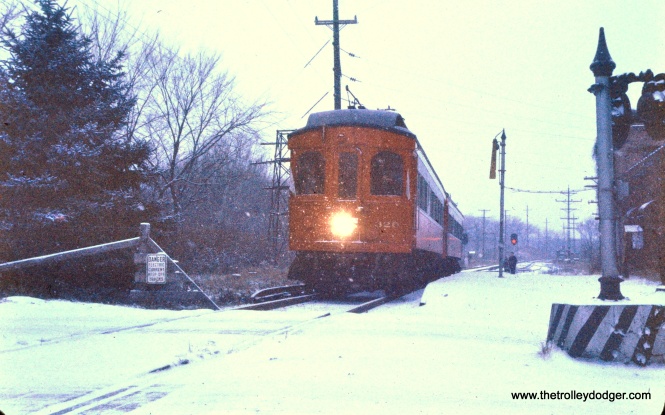
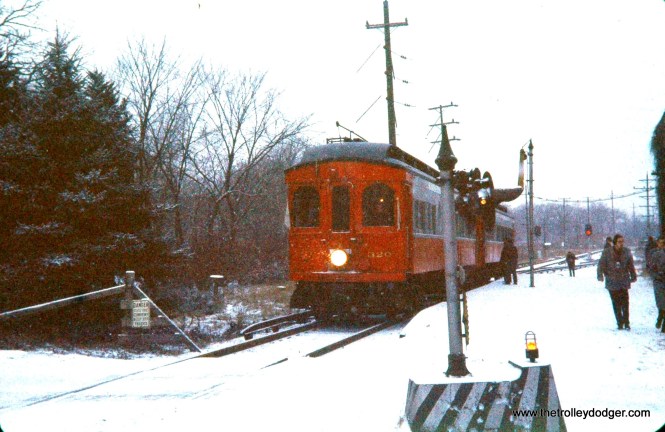
North Shore Line car #722 is at the Mundelein Terminal on a cold and snowy December 23, 1962 night. I purchased this original Kodachrome slide last October. I recently noticed it looks nearly identical to one of the duplicate slides in a set marketed in the late 1970s by photographer Tom Gildersleeve (see below), only with less cropping, taken at the same time. He says this is probably an extra he shot that night, when the temperature was just 3 degrees. Tom Gildersleeve: "Now that I get a better look at that slide I can tell you that my keeper, which was in the (duplicate slide) set, had flash utilized that was not utilized for this one."

North Shore Line car #722 is at the Mundelein Terminal on a cold and snowy December 23, 1962 night. I purchased this original Kodachrome slide last October. I recently noticed it looks nearly identical to one of the duplicate slides in a set marketed in the late 1970s by photographer Tom Gildersleeve (see below), only with less cropping, taken at the same time. He says this is probably an extra he shot that night, when the temperature was just 3 degrees. Tom Gildersleeve: “Now that I get a better look at that slide I can tell you that my keeper, which was in the (duplicate slide) set, had flash utilized that was not utilized for this one.”

Our first Trolley Dodger blog post went up on January 21, 2015, making this our 11th anniversary.

These past years have been quite an adventure. I like to think of this space as a dialogue between myself and other fans, where we can have a conversation about our past history of transit, and how this affects our present and future. There is much to learn from history, and one of the most important things is to learn how to avoid repeating mistakes made in the past.

To date, we have shared something like 16,000 transit images here. I see my work appearing in all sorts of places. It comes up frequently when I do Google searches. What you see here is only the tip of the iceberg, and we scan and correct thousands of images each year.

My original plan was to create an archive, accessible to anyone and everyone. This is in some ways to opposite approach to what many had done in the past. There have been people who hoarded their knowledge and had no interest in sharing it. But when I share what I know, others share back in turn, and everyone benefits. We can all learn together.

When I started my first transit blog, one wag said it was a “good idea, but lacking in execution.” Over the 11 years of the Trolley Dodger, I think we have gotten better at this. Our skills have improved.

At first, there were a lot of posts, as we had to establish ourselves. But over time, we are emphasizing quality over quantity. When we post an image, we are hoping it will be the best available version of that image for reference, and one that will establish a standard or benchmark for the future. It is our legacy.

This is an all-new Trolley Dodger blog post, our 317th. Our fifth book, The Chicago, Aurora and Elgin Railway, has arrived, to very positive reviews. Ordering information is below.

January 21, 1963 was the date that the fabled North Shore Line interurban quit. We have several NSL pictures to commemorate that in this post. I chose that date to start this blog, because I wanted it to symbolize new beginnings as well as endings.

On January 26-27, 1967, 23 inches of snow fell on Chicago. We have several pictures taken during the Big Snow of 1967 to share with you today. I had just turned 12 when this happened, and I remember it well.

Many of the pictures in today’s post were taken by William C. Hoffman (1910-1988), one of Chicago’s all-time great railfan photographers. I would also like to thank Tom Gildersleeve for sharing several of his photos with our readers.

Finally, this is the time for our Annual Fundraiser. It costs money to find all these pictures and share them with you here. Our goal is just $400, which represents just a bit more than one dollar for each day of the year. We depend on our readers for their support. We would like to continue to offer this site ad-free.

If you might consider making a donation, there is a link at the end of this post where you can do that. We thank everyone in advance for all your help and support. Together, we can keep this good thing going. There’s so much more we can learn.

Enjoy!

-David Sadowski

PS- You might also like our Trolley Dodger Facebook auxiliary, a private group that now has 2,351 members.

Our friend Kenneth Gear has a Facebook group for the Railroad Record Club. If you enjoy listening to audio recordings of classic railroad trains, whether steam, electric, or diesel, you might consider joining.

FYI, the Hoosier Traction Facebook Group celebrates electric transit in Indiana and the Midwest. It also supports the activities of the annual Hoosier Traction Meet (although not affiliated with the North American Transit Historical Society, which organizes that event).

Our Latest Book, Now Available for Immediate Shipment:

The Chicago Aurora and Elgin Railway

FYI, my latest book from Arcadia Publishing is now available for and in stock for immediate shipment.

The Chicago, Aurora & Elgin Railway (CA&E) ran electric passenger and freight service from 1902 until 1959. Although classed as an interurban, it was a hybrid of rapid transit and commuter rail. CA&E trains ran to downtown Chicago via the Metropolitan West Side “L,” ending at the Well Street Terminal. This was a high-tech endeavor funded by industrialists from Cleveland, Ohio, who wanted to open Chicago’s western suburbs for development. The result was a high-speed operation, built to steam road standards, with an electrified third rail powering the trains. It thrived until World War I, was modernized in the Roaring Twenties, weathered the Great Depression, and did its duty during World War II. A privately owned railroad, without subsidies, the CA&E began losing money in the 1950s due to highway construction that stopped it from running into Chicago. Efforts to save the railroad failed, and passenger service ended in 1957, with freight following two years later.

David Sadowski is the author of Chicago Trolleys, Building Chicago’s Subways, Chicago’s Lost “L”s, and The North Shore Line and runs the online Trolley Dodger blog. Photographs shown are from the author’s extensive collections and archival sources such as the Chicago History Museum, Forest Park Historical Society, and Lake States Railway Historical Association.

Each copy purchased here will be signed by the author, and you will also receive a bonus Chicago Aurora and Elgin track map.  Books will ship by USPS Media Mail.

Chapters:
01. The Fox River Line
02. The Third Rail Line
03. On the “L”
04. Main Line to Wheaton
05. Aurora and Batavia
06. Elgin and Geneva
07. Electric Freight
08. Forest Park
09. Into the Sunset
10. The Legacy

Title The Chicago Aurora and Elgin Railway
Images of Rail
Author David Sadowski
Edition illustrated
Publisher Arcadia Publishing (SC), 2025
ISBN-10: 146716254X
ISBN-13: ‎978-1467162548
Length 128 pages
The price of $24.99 includes shipping within the United States via USPS Media Mail.

For Shipping to US Addresses:

The North Shore Line in Winter by Tom Gildersleeve

Tom Gildersleeve has been a well-known railfan photographer for many years. In the late 1970s, he made a set of 16 duplicate slides of some of his work, featuring the North Shore Line in Winter. These were very high quality dupes, which he made himself.

I found one of these sets in the photo collection I inherited from the late Jeffrey L. Wien. With Mr. Gildersleeve’s permission, in honor of the 63rd anniversary of the NSL abandonment, here it is. The captions are his.

1. Leaving Milwaukee for Chicago, December 16, 1961. Note the billboard in the background. (Tom Gildersleeve Photo)

1. Leaving Milwaukee for Chicago, December 16, 1961. Note the billboard in the background. (Tom Gildersleeve Photo)

2. Arriving in Milwaukee from Chicago, December 16, 1961. (Tom Gildersleeve Photo)

2. Arriving in Milwaukee from Chicago, December 16, 1961. (Tom Gildersleeve Photo)

3. A southbound Electroliner at Racine, Wisconsin, December 16, 1961. (Tom Gildersleeve Photo)

3. A southbound Electroliner at Racine, Wisconsin, December 16, 1961. (Tom Gildersleeve Photo)

4. One of the ex-Oregon Electric freight motors powers a northbound freight at Racine, December 16, 1961. (Tom Gildersleeve Photo)

4. One of the ex-Oregon Electric freight motors powers a northbound freight at Racine, December 16, 1961. (Tom Gildersleeve Photo)

5. A northbound Electroliner at Racine, December 16, 1961. (Tom Gildersleeve Photo)

5. A northbound Electroliner at Racine, December 16, 1961. (Tom Gildersleeve Photo)

6. A three-car consist rolls into Racine, southbound at dusk, December 16, 1961. (Tom Gildersleeve Photo)

6. A three-car consist rolls into Racine, southbound at dusk, December 16, 1961. (Tom Gildersleeve Photo)

7. A trio of steeple cab motors handle a freight at Great Lakes, Illinois, December 23, 1962. (Tom Gildersleeve Photo)

7. A trio of steeple cab motors handle a freight at Great Lakes, Illinois, December 23, 1962. (Tom Gildersleeve Photo)

8. A pair of cars on the Mundelein Branch crosses the diamond at Lake Bluff heading east. December 23, 1962. (Tom Gildersleeve Photo)

8. A pair of cars on the Mundelein Branch crosses the diamond at Lake Bluff heading east. December 23, 1962. (Tom Gildersleeve Photo)

9. The same trio of steeple cabs in Shot No. 7 performs switching chores at Mundelein, Illinois, December 23, 1962. The snow on the poles leaves little doubt as to the direction of prevailing wind. (Tom Gildersleeve Photo)

9. The same trio of steeple cabs in Shot No. 7 performs switching chores at Mundelein, Illinois, December 23, 1962. The snow on the poles leaves little doubt as to the direction of prevailing wind. (Tom Gildersleeve Photo)

10. Mundelein, December 23, 1962. (Tom Gildersleeve Photo)

10. Mundelein, December 23, 1962. (Tom Gildersleeve Photo)

11. A trio of cars at Great Lakes Naval Training Station, December 23, 1962. (Tom Gildersleeve Photo)

11. A trio of cars at Great Lakes Naval Training Station, December 23, 1962. (Tom Gildersleeve Photo)

12. A southbound Electroliner rolls through Lake Bluff, December 23, 1962. (Tom Gildersleeve Photo)

12. A southbound Electroliner rolls through Lake Bluff, December 23, 1962. (Tom Gildersleeve Photo)

13. Rear view of the same train pictured in Shot No. 12. (Tom Gildersleeve Photo)

13. Rear view of the same train pictured in Shot No. 12. (Tom Gildersleeve Photo)

14. Late afternoon light catches a single car whisking up snow on the Mundelein Branch, a scene about as interurbanish as the North Shore offered. December 23, 1962. (Tom Gildersleeve Photo)

14. Late afternoon light catches a single car whisking up snow on the Mundelein Branch, a scene about as interurbanish as the North Shore offered. December 23, 1962. (Tom Gildersleeve Photo)

15. A night scene at Mundelein, with the temperature at 3 above zero. December 23, 1962. (Tom Gildersleeve Photo)

15. A night scene at Mundelein, with the temperature at 3 above zero. December 23, 1962. (Tom Gildersleeve Photo)

16. The date is January 20, 1963, and final abandonment of the North Shore is only hours away as a four-car train plows through a heavy snowstorm at dusk, Lake Bluff, Illinois. This shot, by Alvin LeRoy Schultze (1932-2016), has been a frequent contest prize winner, and is my nomination for the finest single photo ever taken of the North Shore. -Tom Gildersleeve

16. The date is January 20, 1963, and final abandonment of the North Shore is only hours away as a four-car train plows through a heavy snowstorm at dusk, Lake Bluff, Illinois. This shot, by Alvin LeRoy Schultze (1932-2016), has been a frequent contest prize winner, and is my nomination for the finest single photo ever taken of the North Shore. -Tom Gildersleeve

The Big Snow of 1967

When 23 inches of snow unexpectedly fell on Chicago during January 26 and 27, 1967, the city was paralysed for a week. Cars, buses, and trucks were abandoned in the streets, which became impassable. Nearly all cars then had rear-wheel drive, meaning less traction, and this is before radial tires. There was also a lot less snow fighting equipment.

But somehow, the Chicago Transit Authority managed to keep service running, experiencing fewer problems than occurred during the next major snowstorm in January 1979. Luckily for us, William C. Hoffman was out with his camera.

An inbound Englewood-Howard train approaches the "L" station at Wentworth and 59th on January 26, 1967. The median line in the Dan Ryan expressway was as of yet unbuilt, and did not open until September 28, 1969. (William C. Hoffman Photo)

An inbound Englewood-Howard train approaches the “L” station at Wentworth and 59th on January 26, 1967. The median line in the Dan Ryan expressway was as of yet unbuilt, and did not open until September 28, 1969. (William C. Hoffman Photo)

A train of 6000s approaches the 35th Street station on the South Side "L" on January 26, 1967. (William C. Hoffman Photo)

A train of 6000s approaches the 35th Street station on the South Side “L” on January 26, 1967. (William C. Hoffman Photo)

An Evanston Express train, made up of 4000-series "L" cars, is at State and Van Buren on January 26, 1967. This station closed in the early 1970s and was demolished, save for a small section of platform. A new station went up years later in approximately the same location to serve the new Harold Washington Library. (William C. Hoffman Photo)

An Evanston Express train, made up of 4000-series “L” cars, is at State and Van Buren on January 26, 1967. This station closed in the early 1970s and was demolished, save for a small section of platform. A new station went up years later in approximately the same location to serve the new Harold Washington Library. (William C. Hoffman Photo)

An inbound train of 2000-series cars stops at Clinton on the Lake Street "L" on January 26, 1967. (William C. Hoffman Photo)

An inbound train of 2000-series cars stops at Clinton on the Lake Street “L” on January 26, 1967. (William C. Hoffman Photo)

A train of 6000s prepares to stop at Halsted on the Congress "L" on January 27, 1967. You can see cars stranded on the Eisenhower expressway, and a bus stalled out on the Halsted Street bridge. (William C. Hoffman Photo)

A train of 6000s prepares to stop at Halsted on the Congress “L” on January 27, 1967. You can see cars stranded on the Eisenhower expressway, and a bus stalled out on the Halsted Street bridge. (William C. Hoffman Photo)

On January 27, 1967, we are looking west from the old Wentworth station on the Englewood "L" at 59th Street. The Dan Ryan expressway has been rendered impassable by the 23" snowfall that fell on Chicago starting on the 26th. (William C. Hoffman Photo)

On January 27, 1967, we are looking west from the old Wentworth station on the Englewood “L” at 59th Street. The Dan Ryan expressway has been rendered impassable by the 23″ snowfall that fell on Chicago starting on the 26th. (William C. Hoffman Photo)

We are looking southwest off the Englewood "L" platform at Wentworth and 59th Street on January 27, 1967. There are no cars on the Dan Ryan Expressway due to the 23" snowfall. (William C. Hoffman Photo)

We are looking southwest off the Englewood “L” platform at Wentworth and 59th Street on January 27, 1967. There are no cars on the Dan Ryan Expressway due to the 23″ snowfall. (William C. Hoffman Photo)

On January 27, 1967, a string of stalled 6000-series "L" cars are near 50th Street on the South Side "L". (William C. Hoffman Photo)

On January 27, 1967, a string of stalled 6000-series “L” cars are near 50th Street on the South Side “L”. (William C. Hoffman Photo)

Here's one more picture from the Big Snow of 1967, taken by William C. Hoffman on January 27. "Line of stalled southbound trains south of 51st Street (on the South Side "L"). Chicago Transit Authority."

Here’s one more picture from the Big Snow of 1967, taken by William C. Hoffman on January 27. “Line of stalled southbound trains south of 51st Street (on the South Side “L”). Chicago Transit Authority.”

On February 28, 1967, an eight-car train of CTA 6000s is at 34th Street on the South Side "L", next to a large mound of dirty snow left over from the Big Snow a month before. (William C. Hoffman Photo)

On February 28, 1967, an eight-car train of CTA 6000s is at 34th Street on the South Side “L”, next to a large mound of dirty snow left over from the Big Snow a month before. (William C. Hoffman Photo)

Signs of the Times

On April 22, 1951, William C. Hoffman took this picture of the CA&E neon sign outside of the Wells Street Terminal in downtown Chicago. There was a walkway connecting it with the Quincy and Wells station on the Loop "L". After the interurban cut back service to Forest Park in 1953, this sign was moved there. It is now at the Illinois Railway Museum.

On April 22, 1951, William C. Hoffman took this picture of the CA&E neon sign outside of the Wells Street Terminal in downtown Chicago. There was a walkway connecting it with the Quincy and Wells station on the Loop “L”. After the interurban cut back service to Forest Park in 1953, this sign was moved there. It is now at the Illinois Railway Museum.

Englewood Union Station RR Signage Location: Chicago, Illinois (Englewood Union Station, 63rd and Clark) Date: May 21, 1965 Photographer: William C. Hoffman From the Wikipedia: Englewood Union Station was a major rail junction and passenger depot in the Englewood neighborhood of Chicago, Illinois. Four railroads served the station in its prime – the Chicago, Rock Island and Pacific Railroad, the New York Central Railroad, the Pennsylvania Railroad, and New York, Chicago and St. Louis Railroad, which operated over the New York Central via trackage rights. The station closed in 1978 when the Rock Island closed intercity rail operations and intermediate stops between LaSalle Street and Gresham. There are presently no plans to reopen the station.

Englewood Union Station RR Signage
Location: Chicago, Illinois (Englewood Union Station, 63rd and Clark)
Date: May 21, 1965
Photographer: William C. Hoffman
From the Wikipedia: Englewood Union Station was a major rail junction and passenger depot in the Englewood neighborhood of Chicago, Illinois. Four railroads served the station in its prime – the Chicago, Rock Island and Pacific Railroad, the New York Central Railroad, the Pennsylvania Railroad, and New York, Chicago and St. Louis Railroad, which operated over the New York Central via trackage rights. The station closed in 1978 when the Rock Island closed intercity rail operations and intermediate stops between LaSalle Street and Gresham. There are presently no plans to reopen the station.

20th Century Limited/Golden State RR Signage Location: Chicago, Illinois (LaSalle Street Station, LaSalle and Van Buren) Date: November 16, 1966 Photographer: William C. Hoffman From the Wikipedia: The 20th Century Limited was an express passenger train on the New York Central Railroad (NYC) from 1902 to 1967. The train traveled between Grand Central Terminal in New York City and LaSalle Street Station in Chicago, Illinois, along the railroad's "Water Level Route". NYC inaugurated the 20th Century Limited as competition to the Pennsylvania Railroad, aimed at upper-class and business travelers. It made few station stops along the way and used track pans to take water at speed. On June 15, 1938, streamlined train sets designed by Henry Dreyfuss were added to the route. Widely considered to be one of the greatest American passenger trains of all time, the 20th Century Limited was the flagship train of the New York Central and was advertised as "The Most Famous Train in the World". It was described in The New York Times as having been "[...] known to railroad buffs for 65 years as the world's greatest train", and its style was described as "spectacularly understated". The phrase "red-carpet treatment" is derived from passengers' walking to the train on a specially designed crimson carpet.

20th Century Limited/Golden State RR Signage
Location: Chicago, Illinois (LaSalle Street Station, LaSalle and Van Buren)
Date: November 16, 1966
Photographer: William C. Hoffman
From the Wikipedia: The 20th Century Limited was an express passenger train on the New York Central Railroad (NYC) from 1902 to 1967. The train traveled between Grand Central Terminal in New York City and LaSalle Street Station in Chicago, Illinois, along the railroad’s “Water Level Route”.
NYC inaugurated the 20th Century Limited as competition to the Pennsylvania Railroad, aimed at upper-class and business travelers. It made few station stops along the way and used track pans to take water at speed. On June 15, 1938, streamlined train sets designed by Henry Dreyfuss were added to the route. Widely considered to be one of the greatest American passenger trains of all time, the 20th Century Limited was the flagship train of the New York Central and was advertised as “The Most Famous Train in the World”. It was described in The New York Times as having been “[…] known to railroad buffs for 65 years as the world’s greatest train”, and its style was described as “spectacularly understated”. The phrase “red-carpet treatment” is derived from passengers’ walking to the train on a specially designed crimson carpet.

New York Central/Rock Island Neon Signage Location: Chicago, Illinois (Main floor of LaSalle Street Station, LaSalle and Van Buren) Date: March 25, 1968 Photographer: William C. Hoffman This sign is now at the Illinois Railway Museum. From the Wikipedia: LaSalle Street Station is a commuter rail terminal at 414 South LaSalle Street in downtown Chicago. First used as a rail terminal in 1852, it was a major intercity rail terminal for the New York Central Railroad until 1968, and for the Chicago, Rock Island and Pacific Railroad until 1978, but now serves only Metra's Rock Island District. The present structure became the fifth station on the site when its predecessor was demolished in 1981 and replaced by the new station and the One Financial Place (now 425 South Financial Place) tower for the Chicago Stock Exchange. The Chicago Board of Trade Building, Willis Tower, and Harold Washington Library are nearby.

New York Central/Rock Island Neon Signage
Location: Chicago, Illinois (Main floor of LaSalle Street Station, LaSalle and Van Buren)
Date: March 25, 1968
Photographer: William C. Hoffman
This sign is now at the Illinois Railway Museum.
From the Wikipedia: LaSalle Street Station is a commuter rail terminal at 414 South LaSalle Street in downtown Chicago. First used as a rail terminal in 1852, it was a major intercity rail terminal for the New York Central Railroad until 1968, and for the Chicago, Rock Island and Pacific Railroad until 1978, but now serves only Metra’s Rock Island District. The present structure became the fifth station on the site when its predecessor was demolished in 1981 and replaced by the new station and the One Financial Place (now 425 South Financial Place) tower for the Chicago Stock Exchange. The Chicago Board of Trade Building, Willis Tower, and Harold Washington Library are nearby.

Chicago Union Station Railroad Terminal Neon Signage Location: Chicago, Illinois (Union Station) Date: November 30, 1965 Photographer: William C. Hoffman From the Wikipedia: Chicago Union Station is an intercity and commuter rail terminal located in the West Loop neighborhood of the Near West Side of Chicago, United States. Amtrak's flagship station in the Midwest, Union Station is the terminus of eight national long-distance routes and eight regional corridor routes. Six Metra commuter lines also terminate here. Union Station is just west of the Chicago River between West Adams Street and West Jackson Boulevard, adjacent to the Chicago Loop. Including approach and storage tracks, it covers about nine and a half city blocks (mostly underground, beneath streets and skyscrapers, some built with the earliest usage of railway air rights). The present station opened in 1925, replacing an earlier union station on this site built in 1881. The station is the fourth-busiest rail station in the United States, after Pennsylvania Station, Grand Central Terminal, and Jamaica station in New York City, and the busiest outside of the Northeast Corridor. It handles about 140,000 passengers on an average weekday (including 10,000 Amtrak passengers). It has Bedford limestone Beaux-Arts facades, and an interior with massive Corinthian columns, marble floors, and a Great Hall, highlighted by brass lamps. The station connects to multiple transit authorities including the Chicago Transit Authority bus and Chicago L lines, Metra, Pace, Greyhound, and more either within the station or within walking distance.

Chicago Union Station Railroad Terminal Neon Signage
Location: Chicago, Illinois (Union Station)
Date: November 30, 1965
Photographer: William C. Hoffman
From the Wikipedia: Chicago Union Station is an intercity and commuter rail terminal located in the West Loop neighborhood of the Near West Side of Chicago, United States. Amtrak’s flagship station in the Midwest, Union Station is the terminus of eight national long-distance routes and eight regional corridor routes. Six Metra commuter lines also terminate here. Union Station is just west of the Chicago River between West Adams Street and West Jackson Boulevard, adjacent to the Chicago Loop. Including approach and storage tracks, it covers about nine and a half city blocks (mostly underground, beneath streets and skyscrapers, some built with the earliest usage of railway air rights). The present station opened in 1925, replacing an earlier union station on this site built in 1881. The station is the fourth-busiest rail station in the United States, after Pennsylvania Station, Grand Central Terminal, and Jamaica station in New York City, and the busiest outside of the Northeast Corridor. It handles about 140,000 passengers on an average weekday (including 10,000 Amtrak passengers). It has Bedford limestone Beaux-Arts facades, and an interior with massive Corinthian columns, marble floors, and a Great Hall, highlighted by brass lamps. The station connects to multiple transit authorities including the Chicago Transit Authority bus and Chicago L lines, Metra, Pace, Greyhound, and more either within the station or within walking distance.

TTC New Toronto Subways Billboard Location: Toronto, Canada (Davisville Station) Date: September 2, 1955 Photographer: William C. Hoffman Toronto's first subway opened on March 30, 1954. The Chicago Transit Authority also used this type of advertising when the new Congress rapid transit line opened in 1958. Later, all such signs mentioning a specific time to reach the Loop were removed, most likely because they were unable to keep to these travel times. Looks like Toronto did the same thing, a few years earlier.

TTC New Toronto Subways Billboard
Location: Toronto, Canada (Davisville Station)
Date: September 2, 1955
Photographer: William C. Hoffman
Toronto’s first subway opened on March 30, 1954. The Chicago Transit Authority also used this type of advertising when the new Congress rapid transit line opened in 1958. Later, all such signs mentioning a specific time to reach the Loop were removed, most likely because they were unable to keep to these travel times. Looks like Toronto did the same thing, a few years earlier.

In the era of luxury train travel, the Chicago Burlington and Quincy advertised their Vista-Dome Zephyrs with this billboard at Ogden and Western in Chicago. William C. Hoffman took this picture of it on August 23, 1959.

In the era of luxury train travel, the Chicago Burlington and Quincy advertised their Vista-Dome Zephyrs with this billboard at Ogden and Western in Chicago. William C. Hoffman took this picture of it on August 23, 1959.

The Canal Street Barns of New Orleans Public Service once had this very attractive sign in front. Streetcar #912, built by the Perley A. Thomas car works in High Point, North Carolina in the early 1920s, was retired and scrapped in 1964, after the Canal Street line had been replaced by buses. It was reconverted to trolleys in 2004. Other 1920s-era streetcars continue to operate on the St. Charles line, which has been running since 1835. More modern streetcars are also used, built to resemble the older ones.

The Canal Street Barns of New Orleans Public Service once had this very attractive sign in front. Streetcar #912, built by the Perley A. Thomas car works in High Point, North Carolina in the early 1920s, was retired and scrapped in 1964, after the Canal Street line had been replaced by buses. It was reconverted to trolleys in 2004. Other 1920s-era streetcars continue to operate on the St. Charles line, which has been running since 1835. More modern streetcars are also used, built to resemble the older ones.

A sign at the old LaSalle Street train station in downtown Chicago directed people where to go to catch "L" trains at the LaSalle and Van Buren station on the Loop. I recall there was a direct entrance. William C. Hoffman took this picture on December 20, 1967.

A sign at the old LaSalle Street train station in downtown Chicago directed people where to go to catch “L” trains at the LaSalle and Van Buren station on the Loop. I recall there was a direct entrance. William C. Hoffman took this picture on December 20, 1967.

On March 6, 1955, this sign at the old Union Station Concourse building directed riders towards the nearby "L" station on the Metropolitan Main Line at Canal Street. I believe there was a dedicated walkway and we might have even included a map of that in a previous post. That "L" station was not in the direct path of Congress expressway construction, and remained open until it was replaced by the new Congress median line on June 22, 1958. This concourse building was demolished in 1969 and replaced by a taller office building with a concourse on the lower levels. Now the Clinton subway station on what is today the CTA Blue Line is the closest one to Union Station. (William C. Hoffman Photo)

On March 6, 1955, this sign at the old Union Station Concourse building directed riders towards the nearby “L” station on the Metropolitan Main Line at Canal Street. I believe there was a dedicated walkway and we might have even included a map of that in a previous post. That “L” station was not in the direct path of Congress expressway construction, and remained open until it was replaced by the new Congress median line on June 22, 1958. This concourse building was demolished in 1969 and replaced by a taller office building with a concourse on the lower levels. Now the Clinton subway station on what is today the CTA Blue Line is the closest one to Union Station. (William C. Hoffman Photo)

Here's another CTA neon sign at Union Station on March 6, 1955. (William C. Hoffman Photo)

Here’s another CTA neon sign at Union Station on March 6, 1955. (William C. Hoffman Photo)

Illinois Central

Subject: Illinois Central Railroad Station Location: Chicago, Illinois (11th Place and Michigan Avenue) Date: November 12, 1971 Photographer: William C. Hoffman From the Wikipedia: Central Station was an intercity passenger terminal in downtown Chicago, Illinois, at the southern end of Grant Park near Roosevelt Road and Michigan Avenue. Owned by the Illinois Central Railroad, it also served other companies via trackage rights. It opened in 1893, replacing Great Central Station (on the site of the current Millennium Station), and closed in 1972 when Amtrak rerouted services to Union Station. The station building was demolished in 1974. It is now the site of a redevelopment called Central Station, Chicago. Adjoining platforms at Roosevelt served the Illinois Central's suburban trains for both the Electric and West lines, in addition to the South Shore Line interurban railroad. All three lines continued north to Randolph Street.

Subject: Illinois Central Railroad Station
Location: Chicago, Illinois (11th Place and Michigan Avenue)
Date: November 12, 1971
Photographer: William C. Hoffman
From the Wikipedia: Central Station was an intercity passenger terminal in downtown Chicago, Illinois, at the southern end of Grant Park near Roosevelt Road and Michigan Avenue. Owned by the Illinois Central Railroad, it also served other companies via trackage rights. It opened in 1893, replacing Great Central Station (on the site of the current Millennium Station), and closed in 1972 when Amtrak rerouted services to Union Station. The station building was demolished in 1974. It is now the site of a redevelopment called Central Station, Chicago. Adjoining platforms at Roosevelt served the Illinois Central’s suburban trains for both the Electric and West lines, in addition to the South Shore Line interurban railroad. All three lines continued north to Randolph Street.

Chicago Illinois Central Railroad Station Location: Chicago, Illinois (Illinois Central Station) Date: July 13, 1966 Photographer: William C. Hoffman

Chicago Illinois Central Railroad Station
Location: Chicago, Illinois (Illinois Central Station)
Date: July 13, 1966
Photographer: William C. Hoffman

IC Illinois Central Electric Suburban Station Entrance Location: Chicago, Illinois (Randolph and Michigan) Date: July 11, 1957 Photographer: William C. Hoffman The Illinois Central Electric Suburban commuter train service was electrified in 1926, which is when the station entrance was built here. The entire station has since been redone and is now underneath Millennium Park. Jake Lingle, a corrupt newspaper reporter, was shot to death on these steps in 1930, in a mob hit.

IC Illinois Central Electric Suburban Station Entrance
Location: Chicago, Illinois (Randolph and Michigan)
Date: July 11, 1957
Photographer: William C. Hoffman
The Illinois Central Electric Suburban commuter train service was electrified in 1926, which is when the station entrance was built here. The entire station has since been redone and is now underneath Millennium Park. Jake Lingle, a corrupt newspaper reporter, was shot to death on these steps in 1930, in a mob hit.

IC Illinois Central Electric Suburban Station Entrance Location: Chicago, Illinois (Randolph and Michigan) Date: June 29, 1966 Photographer: William C. Hoffman The same location as the previous picture, but nine years later. Notice the same man working the newsstand, which was there for many years.

IC Illinois Central Electric Suburban Station Entrance
Location: Chicago, Illinois (Randolph and Michigan)
Date: June 29, 1966
Photographer: William C. Hoffman
The same location as the previous picture, but nine years later. Notice the same man working the newsstand, which was there for many years.

More North Shore Line

The Chicago North Shore and Milwaukee had its origins in Waukegan. Here, we see Chicago and Milwaukee Electric car #9 near a hospital in Waukegan. The picture dates to around 1907. Streetcar service continued in Waukegan until 1947.

The Chicago North Shore and Milwaukee had its origins in Waukegan. Here, we see Chicago and Milwaukee Electric car #9 near a hospital in Waukegan. The picture dates to around 1907. Streetcar service continued in Waukegan until 1947.

North Shore Line cars 436, 404, and 161 are operating as a Milwaukee Business Man's Special at 2nd and Grand in 1918. This was the end of the line prior to the opening of the interurban's new terminal at 6th and Michigan in 1920.

North Shore Line cars 436, 404, and 161 are operating as a Milwaukee Business Man’s Special at 2nd and Grand in 1918. This was the end of the line prior to the opening of the interurban’s new terminal at 6th and Michigan in 1920.

On March 25, 1962, a Central Electric Railfans' Association fantrip train has made a photo stop at 6th Street and Scott on the North Shore Line. This is where the interurban line made a jog from 5th to 6th, before heading north via street trackage to the terminal at 6th and Michigan. The fantrip train is the northbound one at left. A regular service train is southbound at right. Both cars are Silverliners. This is now the site of an expressway access road. Scanned from the original Anscochrome slide. (William C. Hoffman Photo)

On March 25, 1962, a Central Electric Railfans’ Association fantrip train has made a photo stop at 6th Street and Scott on the North Shore Line. This is where the interurban line made a jog from 5th to 6th, before heading north via street trackage to the terminal at 6th and Michigan. The fantrip train is the northbound one at left. A regular service train is southbound at right. Both cars are Silverliners. This is now the site of an expressway access road. Scanned from the original Anscochrome slide. (William C. Hoffman Photo)

A closeup of the previous picture. The fans have formed a photo line while a regular service train heads southbound.

A closeup of the previous picture. The fans have formed a photo line while a regular service train heads southbound.

The same location today. The two buildings at right appear to be the same ones in the 1962 picture. The North Shore Line tracks went in about the same location as where those autos are parked. Milwaukee's freeways were built in stages, and the segment near here opened in 1968, about five years after the abandonment of the interurban.

The same location today. The two buildings at right appear to be the same ones in the 1962 picture. The North Shore Line tracks went in about the same location as where those autos are parked. Milwaukee’s freeways were built in stages, and the segment near here opened in 1968, about five years after the abandonment of the interurban.

The interior of North Shore Line car #154 on October 24, 1962. This car, built in 1915, became the oldest survivor in the fleet for many years, but it could not survive decades of neglect at a museum that did not take care of it. It has since been scrapped.

The interior of North Shore Line car #154 on October 24, 1962. This car, built in 1915, became the oldest survivor in the fleet for many years, but it could not survive decades of neglect at a museum that did not take care of it. It has since been scrapped.

The interior of NSL 168.

The interior of NSL 168.

One of the North Shore Line Electroliners, looking a bit rusty after nearly a year without being used, has arrived at the Red Arrow Lines (Philadelphia Suburban Transportation Company) 69th Street Yard on November 17, 1963. Notice the emblem on the front is missing, having been removed prior to transport. After being fitted with different third rail shoes, it was tested on the Norristown High-Speed Line. Additional modifications were necessary. The Shops transformed it into a Liberty Liner, and put it into service just about a year after the NSL abandonment.

One of the North Shore Line Electroliners, looking a bit rusty after nearly a year without being used, has arrived at the Red Arrow Lines (Philadelphia Suburban Transportation Company) 69th Street Yard on November 17, 1963. Notice the emblem on the front is missing, having been removed prior to transport. After being fitted with different third rail shoes, it was tested on the Norristown High-Speed Line. Additional modifications were necessary. The Shops transformed it into a Liberty Liner, and put it into service just about a year after the NSL abandonment.

North Shore Line pocket calendars from 1947 and 1948.

North Shore Line pocket calendars from 1947 and 1948.

On January 4, 1963, North Shore Line car #162 is over an inspection pit and out of service at Waukegan. However, it survived the abandonment and with the scrapping of car 154 a few years ago, 162 became the oldest NSL car extant. (It was delivered ahead of 160.) Although it needs a lot of work, it is now at the East Troy Railroad Museum, where it is being restored.

On January 4, 1963, North Shore Line car #162 is over an inspection pit and out of service at Waukegan. However, it survived the abandonment and with the scrapping of car 154 a few years ago, 162 became the oldest NSL car extant. (It was delivered ahead of 160.) Although it needs a lot of work, it is now at the East Troy Railroad Museum, where it is being restored.

More Recent Finds

CTA Chicago Transit Authority "L" 6000s (Train coming up from State Street Subway - view looks north) Location: Chicago, Illinois (14th Street - South Side "L") Date: July 3, 1966 Photographer: William C. Hoffman This is an unusual photo for 1966. Bill Hoffman took this picture while looking out the window of a fantrip train. There were no regular service trains on this stretch of the "L"from 1949 until 1969. In 1949, the CTA revised North-South service, and hereafter, all trains ran through the State Street Subway. This changed with the inauguration of the new Dan Ryan "L" in 1969. The Roosevelt Road "L" station was served only by North Shore Line trains from 1949 until 1963. With the abandonment of the NSL, the station was closed. This may be the fantrip that had a photo stop at the closed station shortly before it was demolished. A new station has since been put there.

CTA Chicago Transit Authority “L” 6000s (Train coming up from State Street Subway – view looks north)
Location: Chicago, Illinois (14th Street – South Side “L”)
Date: July 3, 1966
Photographer: William C. Hoffman
This is an unusual photo for 1966. Bill Hoffman took this picture while looking out the window of a fantrip train. There were no regular service trains on this stretch of the “L”from 1949 until 1969. In 1949, the CTA revised North-South service, and hereafter, all trains ran through the State Street Subway. This changed with the inauguration of the new Dan Ryan “L” in 1969. The Roosevelt Road “L” station was served only by North Shore Line trains from 1949 until 1963. With the abandonment of the NSL, the station was closed. This may be the fantrip that had a photo stop at the closed station shortly before it was demolished. A new station has since been put there.

CTA Chicago Transit Authority "L" Subway Location: Chicago, Illinois (North and Clybourn Subway Station) Date: August 22, 1966 Photographer: William C. Hoffman This picture shows the CTA subway station at North and Clybourn, the only such subway station on the system built with an above-ground building entrance. This was part of the State Street Subway and opened in October 1943. In recent years, this station entrance has been renovated. But here, 23 years after opening, you can see how some of the lettering on the outside of the station has deteriorated. It was eventually removed. There was also a bus turnaround at the station which was eventually removed.

CTA Chicago Transit Authority “L” Subway
Location: Chicago, Illinois (North and Clybourn Subway Station)
Date: August 22, 1966
Photographer: William C. Hoffman
This picture shows the CTA subway station at North and Clybourn, the only such subway station on the system built with an above-ground building entrance. This was part of the State Street Subway and opened in October 1943. In recent years, this station entrance has been renovated. But here, 23 years after opening, you can see how some of the lettering on the outside of the station has deteriorated. It was eventually removed. There was also a bus turnaround at the station which was eventually removed.

On December 11, 1955 (a Sunday) a fantrip train made up of CTA high-performance cars 6129 and 6130 has posed for a photo stop at Sedgwick. The signage is for the Shopper's Special service, which was a mid-day version of the Evanston Express, which today only runs during weekday rush hours. There were other Shopper's Specials on various lines dating back to the 1920s, but the Evanston one ran from November 28, 1955 until July 4, 1957. As late as the 1980s, though, the Evanston Express ran until nearly noon. These cars, built in 1950, were fitted with trolley poles for use on the Evanston Branch, which did not use third rail until 1973. They were fitted with experimental high-speed motors in 1955. These tests paved the way for faster rapid transit cars, such as the 2000-series starting in 1964. On Sundays, Ravenswood "L" service in 1955 did not operate south of Armitage at night or on Sundays. This was later changed to Belmont in the early 1960s, but with increased ridership, today's Brown Line runs to the Loop during those times. (William C. Hoffman Photo)

On December 11, 1955 (a Sunday) a fantrip train made up of CTA high-performance cars 6129 and 6130 has posed for a photo stop at Sedgwick. The signage is for the Shopper’s Special service, which was a mid-day version of the Evanston Express, which today only runs during weekday rush hours. There were other Shopper’s Specials on various lines dating back to the 1920s, but the Evanston one ran from November 28, 1955 until July 4, 1957. As late as the 1980s, though, the Evanston Express ran until nearly noon. These cars, built in 1950, were fitted with trolley poles for use on the Evanston Branch, which did not use third rail until 1973. They were fitted with experimental high-speed motors in 1955. These tests paved the way for faster rapid transit cars, such as the 2000-series starting in 1964. On Sundays, Ravenswood “L” service in 1955 did not operate south of Armitage at night or on Sundays. This was later changed to Belmont in the early 1960s, but with increased ridership, today’s Brown Line runs to the Loop during those times. (William C. Hoffman Photo)

On August 22, 1957, a six-car Evanston Express "L"train heads southbound at Franklin and Erie. The last wood cars on the CTA ran in regular service on November 30, 1957, on the Kenwood Branch. Numerous mid-to-late 1950s autos, some with tail fins, are also present. (William C. Hoffman Photo)

On August 22, 1957, a six-car Evanston Express “L”train heads southbound at Franklin and Erie. The last wood cars on the CTA ran in regular service on November 30, 1957, on the Kenwood Branch. Numerous mid-to-late 1950s autos, some with tail fins, are also present. (William C. Hoffman Photo)

On August 30, 1959, when William C. Hoffman took this picture, the Chicago White Sox were in first place in the American League Pennant Race. The clinched a World Series berth by defeating the Cleveland Indians 4-2 on September 22nd, when Early Wynn won his 20th game of the season. The Pale Hose went on to lose the World Series to the Los Angeles Dodgers, four games to two. This shows the 35th Street station on the South Side "L", looking to the east. The large crowds encountered during the '59 Series helped inspire the CTA to renovate this station, which was then changed to a center island platform. Since the Dan Ryan "L" opened in 1969, closer to the ballparks (Comiskey Park was replaced after the 1990 season) most fans use that line instead of the South Side "L" (today's Green Line).

On August 30, 1959, when William C. Hoffman took this picture, the Chicago White Sox were in first place in the American League Pennant Race. The clinched a World Series berth by defeating the Cleveland Indians 4-2 on September 22nd, when Early Wynn won his 20th game of the season. The Pale Hose went on to lose the World Series to the Los Angeles Dodgers, four games to two. This shows the 35th Street station on the South Side “L”, looking to the east. The large crowds encountered during the ’59 Series helped inspire the CTA to renovate this station, which was then changed to a center island platform. Since the Dan Ryan “L” opened in 1969, closer to the ballparks (Comiskey Park was replaced after the 1990 season) most fans use that line instead of the South Side “L” (today’s Green Line).

TM Milwaukee Electric Trolley Streetcar #966 Location: North Chicago, Illinois (Illinois Railway Museum) Date: June 30, 1962 Photographer: William C. Hoffman Don's Rail Photos: "966 was built by St Louis Car Company in 1927, (Job) #1466. It was purchased by Illinois Railway Museum in 1958." A lightweight safety car, it is currently stored inoperable.

TM Milwaukee Electric Trolley Streetcar #966
Location: North Chicago, Illinois (Illinois Railway Museum)
Date: June 30, 1962
Photographer: William C. Hoffman
Don’s Rail Photos: “966 was built by St Louis Car Company in 1927, (Job) #1466. It was purchased by Illinois Railway Museum in 1958.” A lightweight safety car, it is currently stored inoperable.

On July 29, 1955, William C. Hoffman captured this view of Chicago's "L" looking east from the Chicago River along Van Buren Street. This leg of the "L" connected the Loop structure with the Metropolitan West Side Elevated, and was in use from 1897 to 1955. Market Street ran north and south here, but would soon be rebuilt into Upper and Lower Wacker Drive. The "L" was in the way, and soon, a new connection was built to relace this, running through the old Wells Street Terminal. This had last been used by the Chicago Aurora and Elgin in September 1953. By 1957, the structure running east from here to Wells Street had been removed. That's a Garfield Park train navigating the curve. Notice also, the Van Buren Street bridge is being replaced by a newer one, under construction. I have previously seen this image online, in a lo-res version, but this has been scanned from the original Anscochrome slide in my collection.

On July 29, 1955, William C. Hoffman captured this view of Chicago’s “L” looking east from the Chicago River along Van Buren Street. This leg of the “L” connected the Loop structure with the Metropolitan West Side Elevated, and was in use from 1897 to 1955. Market Street ran north and south here, but would soon be rebuilt into Upper and Lower Wacker Drive. The “L” was in the way, and soon, a new connection was built to relace this, running through the old Wells Street Terminal. This had last been used by the Chicago Aurora and Elgin in September 1953. By 1957, the structure running east from here to Wells Street had been removed. That’s a Garfield Park train navigating the curve. Notice also, the Van Buren Street bridge is being replaced by a newer one, under construction. I have previously seen this image online, in a lo-res version, but this has been scanned from the original Anscochrome slide in my collection.

After the opening of the Congress median line in June 1958, the "L" tracks leading to the old Wells Street Terminal were cut back to this point at Wacker Drive. On June 13, 1962, this is how it looked. The CTA used it to store maintenance equipment, and it appears there was a parking lot underneath part of it. All this was removed in 1964. (William C. Hoffman Photo)

After the opening of the Congress median line in June 1958, the “L” tracks leading to the old Wells Street Terminal were cut back to this point at Wacker Drive. On June 13, 1962, this is how it looked. The CTA used it to store maintenance equipment, and it appears there was a parking lot underneath part of it. All this was removed in 1964. (William C. Hoffman Photo)

This is an early Ektachrome slide that has shifted to red, due to unstable dyes in the other colors. In many instances, we are able to color-correct these using computer technology. But in this case it wasn't very successful, so we presented it as a black-and-white image instead. Kodak reformulated Ektachrome in 1963, and solved the problem of the unstable dyes.

This is an early Ektachrome slide that has shifted to red, due to unstable dyes in the other colors. In many instances, we are able to color-correct these using computer technology. But in this case it wasn’t very successful, so we presented it as a black-and-white image instead. Kodak reformulated Ektachrome in 1963, and solved the problem of the unstable dyes.

Here we see how a new connection was being built bridging the old Wells Street Terminal and the Loop "L" on June 5, 1955. The now-unused platforms were cut back as needed to create room for tracks that would curve in and out of the Loop. Once the top of the building facade was removed, new steel was added. The new connection, including Tower 22, went into service on October 11, 1955. (William C. Hoffman Photo)

Here we see how a new connection was being built bridging the old Wells Street Terminal and the Loop “L” on June 5, 1955. The now-unused platforms were cut back as needed to create room for tracks that would curve in and out of the Loop. Once the top of the building facade was removed, new steel was added. The new connection, including Tower 22, went into service on October 11, 1955. (William C. Hoffman Photo)

This picture was also taken on June 5, 1955 by William C. Hoffman.

This picture was also taken on June 5, 1955 by William C. Hoffman.

On June 21, 1956, a Garfield Park "L" train made up of 4000-series cars is turning from the Loop onto what had once been the Wells Street Terminal. This new very short track connection was put into place to allow for the demolition of a much larger stretch of "L" structure along Van Buren and what had once been Market Street, but was now becoming Wacker Drive. Behind the train, but almost entirely out of view, Tower 22 controlled these movements. The Loop "L" was uni-directional (counterclockwise) from 1913 to 1969, so this train was southbound prior to making this turn. Photographer William C. Hoffman took this picture to show how part of the platform had to be cut out to allow for the swing of the cars while switching. This arrangement continued through June 21, 1958, two years to the day after this picture was taken. In the distance, you can see Tower 8 at the intersection of Van Buren and Wells, which had previously handled switching at the old connection point. The clock tower belongs to Grand Central Station (1890-1971), located at Harrison and Wells.

On June 21, 1956, a Garfield Park “L” train made up of 4000-series cars is turning from the Loop onto what had once been the Wells Street Terminal. This new very short track connection was put into place to allow for the demolition of a much larger stretch of “L” structure along Van Buren and what had once been Market Street, but was now becoming Wacker Drive. Behind the train, but almost entirely out of view, Tower 22 controlled these movements. The Loop “L” was uni-directional (counterclockwise) from 1913 to 1969, so this train was southbound prior to making this turn. Photographer William C. Hoffman took this picture to show how part of the platform had to be cut out to allow for the swing of the cars while switching. This arrangement continued through June 21, 1958, two years to the day after this picture was taken. In the distance, you can see Tower 8 at the intersection of Van Buren and Wells, which had previously handled switching at the old connection point. The clock tower belongs to Grand Central Station (1890-1971), located at Harrison and Wells.

The crane seen in the distance in this July 29, 1964 view of the former Wells Street Terminal would suggest that demolition is underway. The terminal went through several distinct phases. From 1905 to 1927, it was in its original configuration-- a stub end terminal, not connected to the Loop directly at this point. It was renovated in 1927, with the addition of an attractive second-story facade and improved facilities. The CTA stopped using it in 1951, and the CA&E in 1953. In 1955, the facade was removed in favor of a new direct track connection to the Loop "L", replacing the former connection via Van Buren Street. Tower 22 controlled the movements of Garfield Park trains in and out of the Loop. This continued until the new Congress median line replaced Garfield in 1958. Soon cut back to Wacker Drive, these tracks were only used for storage. By the time this picture was taken, there was only one track leading to the Loop instead of two. And soon after William C. Hoffman took this picture, looking from the nearby Quincy and Wells station, the rest of it would soon be gone.

The crane seen in the distance in this July 29, 1964 view of the former Wells Street Terminal would suggest that demolition is underway. The terminal went through several distinct phases. From 1905 to 1927, it was in its original configuration– a stub end terminal, not connected to the Loop directly at this point. It was renovated in 1927, with the addition of an attractive second-story facade and improved facilities. The CTA stopped using it in 1951, and the CA&E in 1953. In 1955, the facade was removed in favor of a new direct track connection to the Loop “L”, replacing the former connection via Van Buren Street. Tower 22 controlled the movements of Garfield Park trains in and out of the Loop. This continued until the new Congress median line replaced Garfield in 1958. Soon cut back to Wacker Drive, these tracks were only used for storage. By the time this picture was taken, there was only one track leading to the Loop instead of two. And soon after William C. Hoffman took this picture, looking from the nearby Quincy and Wells station, the rest of it would soon be gone.

By August 19, 1964, further work had been done dismantling and removing the old Wells Street Terminal tracks and structure. Now, the platforms are gone, and you can see the electrical substation the "L" had once gone over. (William C. Hoffman Photo)

By August 19, 1964, further work had been done dismantling and removing the old Wells Street Terminal tracks and structure. Now, the platforms are gone, and you can see the electrical substation the “L” had once gone over. (William C. Hoffman Photo)

CTA Chicago Transit Authority "L" 6000s (8-car train) Location: Chicago, Illinois (Looking south from 33rd Street - South Side "L") Date: July 17, 1961 Photographer: William C. Hoffman The Chicago Transit Authority closed the 33rd Street station in 1949, as part of their rationalization of North-South "L" service in order to speed up service. A walkway connected with the 35th Street station, which had side platforms, for use by exiting students from the Illinois Institute of Technology. Riders could exit through the old 33rd station. After large crowds used the 35th Street station during the 1959 World Series, where the Chicago White Sox lost to the Los Angeles Dodgers, four games to two, the CTA decided to redo this station with a center island platform. This new station opened in June 1961. The northbound platform, although unused, was retained for a few months because it connected to the walkway, which closed on September 25, 1961. So, this picture was taken after the new center island platform had opened, but before the walkway to 33rd was closed. You can't see the walkway in this picture, as it was on the opposite side of the "L" structure. The new 35th Street station was only in use for just over one year when it was destroyed by fire on October 17, 1961. It had to be rebuilt yet again. Eventually, the old station at 33rd Street was removed.

CTA Chicago Transit Authority “L” 6000s (8-car train)
Location: Chicago, Illinois (Looking south from 33rd Street – South Side “L”)
Date: July 17, 1961
Photographer: William C. Hoffman
The Chicago Transit Authority closed the 33rd Street station in 1949, as part of their rationalization of North-South “L” service in order to speed up service. A walkway connected with the 35th Street station, which had side platforms, for use by exiting students from the Illinois Institute of Technology. Riders could exit through the old 33rd station.
After large crowds used the 35th Street station during the 1959 World Series, where the Chicago White Sox lost to the Los Angeles Dodgers, four games to two, the CTA decided to redo this station with a center island platform. This new station opened in June 1961. The northbound platform, although unused, was retained for a few months because it connected to the walkway, which closed on September 25, 1961.
So, this picture was taken after the new center island platform had opened, but before the walkway to 33rd was closed. You can’t see the walkway in this picture, as it was on the opposite side of the “L” structure.
The new 35th Street station was only in use for just over one year when it was destroyed by fire on October 17, 1961. It had to be rebuilt yet again. Eventually, the old station at 33rd Street was removed.

By July 18, 1963, the Chicago Transit Authority had already removed the Clark Street entrance to the old North Water Terminal which ran over Carroll Street, where freight once ran all the way to Navy Pier. This stub-end terminal dated back to the earliest days of the Northwestern Elevated at the turn of the century, but the last CTA trains ran there in 1949. It was a useful place for special runs, like the 1950 introduction of the North Shore Line's Silverliners, but at some point it was taken out of service completely. It was torn down the following year, when the CTA demolished a lot of unused structure and presumably made bank on the resulting scrap value. (William C. Hoffman Photo)

By July 18, 1963, the Chicago Transit Authority had already removed the Clark Street entrance to the old North Water Terminal which ran over Carroll Street, where freight once ran all the way to Navy Pier. This stub-end terminal dated back to the earliest days of the Northwestern Elevated at the turn of the century, but the last CTA trains ran there in 1949. It was a useful place for special runs, like the 1950 introduction of the North Shore Line’s Silverliners, but at some point it was taken out of service completely. It was torn down the following year, when the CTA demolished a lot of unused structure and presumably made bank on the resulting scrap value. (William C. Hoffman Photo)

When the CTA wanted to extend the northbound platform at the Merchandise Mart "L" station, the tracks leading to the North Water Terminal were in the way. So they came up with a creative solution-- a movable platform that could slide out of the way if needed. On August 19, 1964, William C. Hoffman took this picture showing how the track connection to the stub-end terminal had been cut. Soon the entire terminal would be demolished, as were several other "L" structures that were no longer in use. Perhaps this was motivated by the cost of scrap, or a reduction in the expenses of having to maintain things.

When the CTA wanted to extend the northbound platform at the Merchandise Mart “L” station, the tracks leading to the North Water Terminal were in the way. So they came up with a creative solution– a movable platform that could slide out of the way if needed. On August 19, 1964, William C. Hoffman took this picture showing how the track connection to the stub-end terminal had been cut. Soon the entire terminal would be demolished, as were several other “L” structures that were no longer in use. Perhaps this was motivated by the cost of scrap, or a reduction in the expenses of having to maintain things.

William C. Hoffman took this picture of the CTA's North Water Terminal being dismantled on September 23, 1964, looking west along Carroll Avenue from Clark Street. The tracks below are from the Chicago and North Western freight line that ran to Navy Pier.

William C. Hoffman took this picture of the CTA’s North Water Terminal being dismantled on September 23, 1964, looking west along Carroll Avenue from Clark Street. The tracks below are from the Chicago and North Western freight line that ran to Navy Pier.

CTA 6000s in old colors (right) and new colors (left) at Damen, Milwaukee and North Avenue in January 1970. We are looking northwest. (Jeffrey L. Wien Photo)

CTA 6000s in old colors (right) and new colors (left) at Damen, Milwaukee and North Avenue in January 1970. We are looking northwest. (Jeffrey L. Wien Photo)

Here's how the Red Arrow Lines terminal looked on a July 1963 night at the 69th Street Transportation Center in Upper Darby, just outside Philadelphia. Car #12, a double ender that has PCC car styling (but was technically not considered such) is signed for the Ardmore line. Ardmore trolleys were replaced by buses at the end of 1966. Riders can change here for the Market-Frankford elevated to go to downtown Philadelphia. The Red Arrow suburban trolley lines to Media and Sharon Hill continue today under SEPTA, a public agency. The ghostlike blue blur means the photographer took this picture using a long exposure, and someone moved while the shutter was open.

Here’s how the Red Arrow Lines terminal looked on a July 1963 night at the 69th Street Transportation Center in Upper Darby, just outside Philadelphia. Car #12, a double ender that has PCC car styling (but was technically not considered such) is signed for the Ardmore line. Ardmore trolleys were replaced by buses at the end of 1966. Riders can change here for the Market-Frankford elevated to go to downtown Philadelphia. The Red Arrow suburban trolley lines to Media and Sharon Hill continue today under SEPTA, a public agency. The ghostlike blue blur means the photographer took this picture using a long exposure, and someone moved while the shutter was open.

The last night of service on the Myrtle Avenue Elevated in Brooklyn. This line opened in 1888. While a small portion of this line is still in use, much of it closed on October 4, 1969. It was the last line in New York City that used wooden rapid transit cars. This was nearly 12 years after the last woods ran in Chicago, on the Kenwood "L". The Myrtle Avenue El structure wasn't sturdy enough to handle heavier rapid transit cars, which is why it was abandoned.

The last night of service on the Myrtle Avenue Elevated in Brooklyn. This line opened in 1888. While a small portion of this line is still in use, much of it closed on October 4, 1969. It was the last line in New York City that used wooden rapid transit cars. This was nearly 12 years after the last woods ran in Chicago, on the Kenwood “L”. The Myrtle Avenue El structure wasn’t sturdy enough to handle heavier rapid transit cars, which is why it was abandoned.

On August 23, 1954, we see the body of an old red Chicago streetcar being used as a lunchstand on the southeast corner of 33rd and Ashland. This was from the 1101-1423 series built by the St. Louis Car Company in 1903 and 1906-- the same as #1374 at the Illinois Railway Museum, the "Matchbox." This is also known as a Small St. Louis Car. These were retired in 1946 when the new postwar PCC cars started to come in. There was an empty lot here in 2019, but a new building has gone up since. (William C. Hoffman Photo)

On August 23, 1954, we see the body of an old red Chicago streetcar being used as a lunchstand on the southeast corner of 33rd and Ashland. This was from the 1101-1423 series built by the St. Louis Car Company in 1903 and 1906– the same as #1374 at the Illinois Railway Museum, the “Matchbox.” This is also known as a Small St. Louis Car. These were retired in 1946 when the new postwar PCC cars started to come in. There was an empty lot here in 2019, but a new building has gone up since. (William C. Hoffman Photo)

On July 28, 1957, construction was already underway in suburban Oak Park on the new Congress expressway (Now Eisenhower). We see a retaining wall at left, indicating an excavation. At right, new tracks are being installed, including a crossover. The location is just west of Oak Park Avenue. This would become the new location where the B&OCT tracks and the CTA would cross each other. Soon, the CTA tracks would be moved to the north, and the Baltimore and Ohio Chicago Terminal would also move north, occupying what had been the CTA right-of-way. Once the south end of the highway footprint got excavated, both sets of tracks were put there, and then the rest of the highway was completed. This view looks west, and we can see the Forest Park gas holder in the distance, located just east of First Avenue. (William C. Hoffman Photo)

On July 28, 1957, construction was already underway in suburban Oak Park on the new Congress expressway (Now Eisenhower). We see a retaining wall at left, indicating an excavation. At right, new tracks are being installed, including a crossover. The location is just west of Oak Park Avenue. This would become the new location where the B&OCT tracks and the CTA would cross each other. Soon, the CTA tracks would be moved to the north, and the Baltimore and Ohio Chicago Terminal would also move north, occupying what had been the CTA right-of-way. Once the south end of the highway footprint got excavated, both sets of tracks were put there, and then the rest of the highway was completed. This view looks west, and we can see the Forest Park gas holder in the distance, located just east of First Avenue. (William C. Hoffman Photo)

On September 8, 1957, a westbound two-car CTA Garfield Park "L" train approaches the new temporary station, while photographer William C. Hoffman looks to the east from the old station. Graham Garfield (from chicago-l.org): "Work on the Congress Expressway and "L" line west of Laramie Avenue resulted in some complicated staging and several temporary facilities along the at-grade portion of the Garfield Line. On September 6, 1957, westbound Garfield Line trains shifted to a set of temporary tracks from Austin to west of Oak Park, north than the previous alignment. Concurrent with the move to the temporary alignment west of Austin, a temporary island platform was opened on east side of Oak Park Avenue for westbound trains and the old westbound side platform on the west side of Oak Park Avenue was closed. Eastbound trains followed onto the temporary alignment and began using the temporary island platform on September 17, closing the old eastbound side platform and station house on the east side of Oak Park Avenue." Eventually, the Baltimore and Ohio Chicago Terminal trains were shifted north onto what had formerly been the CTA's tracks. This is now the site of the Eisenhower expressway, where it is below grade. This section of highway opened in October 1960.

On September 8, 1957, a westbound two-car CTA Garfield Park “L” train approaches the new temporary station, while photographer William C. Hoffman looks to the east from the old station. Graham Garfield (from chicago-l.org): “Work on the Congress Expressway and “L” line west of Laramie Avenue resulted in some complicated staging and several temporary facilities along the at-grade portion of the Garfield Line. On September 6, 1957, westbound Garfield Line trains shifted to a set of temporary tracks from Austin to west of Oak Park, north than the previous alignment. Concurrent with the move to the temporary alignment west of Austin, a temporary island platform was opened on east side of Oak Park Avenue for westbound trains and the old westbound side platform on the west side of Oak Park Avenue was closed. Eastbound trains followed onto the temporary alignment and began using the temporary island platform on September 17, closing the old eastbound side platform and station house on the east side of Oak Park Avenue.” Eventually, the Baltimore and Ohio Chicago Terminal trains were shifted north onto what had formerly been the CTA’s tracks. This is now the site of the Eisenhower expressway, where it is below grade. This section of highway opened in October 1960.

This picture was taken at the same location as the first one in the next section, but there is a world of difference. A six-car train of CTA wood cars has turned off the four-track Metropolitan Main Line to head south on the Douglas Park "L". This was taken on April 1, 1954, which the photographer indicated was the last day of operations on the old structure. Garfield Park "L" trains had last run here in September 1953, before being shifted onto a temporary right-of-way in Van Buren Street. Now, new connections (visible here at right) were built for Douglas trains-- first, to take them across the Congress expressway footprint, then connect up with part of the old "L" going to Logan Square and Humboldt Park, and finally, to a new connection with the Lake Street "L" for the trip downtown. This permitted the demolition of the remaining portions of the Met "L" structure that were in the path of the new highway. The tracks west of here had already been removed. This new route for Douglas continued in use until June 22, 1958, when the new Congress median line opened here. But decades later, it once again became the route for the Pink Line, successor to the Douglas service. (William C. Hoffman Photo)

This picture was taken at the same location as the first one in the next section, but there is a world of difference. A six-car train of CTA wood cars has turned off the four-track Metropolitan Main Line to head south on the Douglas Park “L”. This was taken on April 1, 1954, which the photographer indicated was the last day of operations on the old structure. Garfield Park “L” trains had last run here in September 1953, before being shifted onto a temporary right-of-way in Van Buren Street. Now, new connections (visible here at right) were built for Douglas trains– first, to take them across the Congress expressway footprint, then connect up with part of the old “L” going to Logan Square and Humboldt Park, and finally, to a new connection with the Lake Street “L” for the trip downtown. This permitted the demolition of the remaining portions of the Met “L” structure that were in the path of the new highway. The tracks west of here had already been removed. This new route for Douglas continued in use until June 22, 1958, when the new Congress median line opened here. But decades later, it once again became the route for the Pink Line, successor to the Douglas service. (William C. Hoffman Photo)

Chicago Aurora and Elgin

On July 21, 1950, an inbound Chicago Aurora and Elgin train, led by car #48, approaches the Marshfield "L" station, while a CTA Garfield Park train trails behind. This was the junction of all the Met lines-- Douglas Park, Garfield Park, Logan Square, and Humboldt Park. Douglas trains used the tracks here at left. Outbound CA&E trains could pick up passengers at the platform on the right. The tracks leading to the northwest side were just out of view to our right. Soon, practically all the buildings you see here would be removed, as construction of the long-awaited Congress expressway would soon be underway. Don's Rail photos: "48 was built by Stephenson in 1903. It was modernized in January 1940 and retired in 1955." (William C. Hoffman Photo)

On July 21, 1950, an inbound Chicago Aurora and Elgin train, led by car #48, approaches the Marshfield “L” station, while a CTA Garfield Park train trails behind. This was the junction of all the Met lines– Douglas Park, Garfield Park, Logan Square, and Humboldt Park. Douglas trains used the tracks here at left. Outbound CA&E trains could pick up passengers at the platform on the right. The tracks leading to the northwest side were just out of view to our right. Soon, practically all the buildings you see here would be removed, as construction of the long-awaited Congress expressway would soon be underway. Don’s Rail photos: “48 was built by Stephenson in 1903. It was modernized in January 1940 and retired in 1955.” (William C. Hoffman Photo)

This CA&E bus appears to date to the late 1920s-- but where did it operate?

This CA&E bus appears to date to the late 1920s– but where did it operate?

On August 13, 1950, an inbound two-car Chicago Aurora and Elgin train has just left the Lakewood station on the Elgin branch. This image was color-corrected from an Anscochrome slide that had shifted to red. (William C. Hoffman Photo)

On August 13, 1950, an inbound two-car Chicago Aurora and Elgin train has just left the Lakewood station on the Elgin branch. This image was color-corrected from an Anscochrome slide that had shifted to red. (William C. Hoffman Photo)

This Anscochrome slide, now 75 years old, has shifted to red due to unstable dyes, much like early Ektachrome has. But I don't think Ektachrome was introduced until 1955. The technology may be very similar, though, as both films were based on Agfa technology.

This Anscochrome slide, now 75 years old, has shifted to red due to unstable dyes, much like early Ektachrome has. But I don’t think Ektachrome was introduced until 1955. The technology may be very similar, though, as both films were based on Agfa technology.

On August 13, 1950, CA&E car #315 is at Wheaton. This original Anscochrome slide was so badly faded and shifted to red that it was not possible to fully color-correct. This car was not actually purple with cyan ends. Parts of the image have too much green and too much magenta at the same time. Those colors are opposites, so not matter which way you try to change the color, it's not going to look right. It's still a big improvement on the original (see below). (William C. Hoffman Photo)

On August 13, 1950, CA&E car #315 is at Wheaton. This original Anscochrome slide was so badly faded and shifted to red that it was not possible to fully color-correct. This car was not actually purple with cyan ends. Parts of the image have too much green and too much magenta at the same time. Those colors are opposites, so not matter which way you try to change the color, it’s not going to look right. It’s still a big improvement on the original (see below). (William C. Hoffman Photo)

The same considerations apply to this Anscochrome image from August 13, 1950 at Wheaton. It was not possible to fully restore the color. The grass looks right but the car was blue, not purple. (William C. Hoffman Photo)

The same considerations apply to this Anscochrome image from August 13, 1950 at Wheaton. It was not possible to fully restore the color. The grass looks right but the car was blue, not purple. (William C. Hoffman Photo)

This circa 1909 real photo postcard image produced some controversy online regarding its location. But the only place it can possibly be is the Batavia Terminal, which originally had two tracks and third rail. The Great Third Rail, the famous CERA publication, says third rail was replaced by overhead wire here in the 1930s. The second track was most likely removed as the light ridership on this branch made it unnecessary. Generally service was operated by a single shuttle car, going back and forth to Batavia Junction, where passengers could change to Aurora branch trains. An early timetable indicates there had once been direct service downtown. Even the terminal building was altered over time, as the canopy was removed.

This circa 1909 real photo postcard image produced some controversy online regarding its location. But the only place it can possibly be is the Batavia Terminal, which originally had two tracks and third rail. The Great Third Rail, the famous CERA publication, says third rail was replaced by overhead wire here in the 1930s. The second track was most likely removed as the light ridership on this branch made it unnecessary. Generally service was operated by a single shuttle car, going back and forth to Batavia Junction, where passengers could change to Aurora branch trains. An early timetable indicates there had once been direct service downtown. Even the terminal building was altered over time, as the canopy was removed.

Here's how the Batavia Terminal looked in later days.

Here’s how the Batavia Terminal looked in later days.

Once the CA&E and the Chicago Rapid Transit Company ended their joint funeral train service in 1934, the interurban's trackage along Roosevelt Road west of Mannheim in Hillside was cut back to Oak Ridge, adjacent to the Oak Ridge Cemetery. On May 19, 1957, we see CA&E wood car #309 on a fantrip. This branch had many names, including Cook County and Mt. Carmel, but unlike the other CA&E sections, it did not have any third rail. The man in the raincoat may in fact be William C. Hoffman, who took several of the other photos in this post. (Vic Wagner Photo)

Once the CA&E and the Chicago Rapid Transit Company ended their joint funeral train service in 1934, the interurban’s trackage along Roosevelt Road west of Mannheim in Hillside was cut back to Oak Ridge, adjacent to the Oak Ridge Cemetery. On May 19, 1957, we see CA&E wood car #309 on a fantrip. This branch had many names, including Cook County and Mt. Carmel, but unlike the other CA&E sections, it did not have any third rail. The man in the raincoat may in fact be William C. Hoffman, who took several of the other photos in this post. (Vic Wagner Photo)

Not all the rails were pulled up on the Mt. Carmel branch. Here at Oak Ridge Avenue, some were simply covered over with dirt.

Not all the rails were pulled up on the Mt. Carmel branch. Here at Oak Ridge Avenue, some were simply covered over with dirt.

The same location in 2024. This view looks east. The CA&E tracks curved off to the left, following those power lines.

The same location in 2024. This view looks east. The CA&E tracks curved off to the left, following those power lines.

CA&E 421 heads up a westbound train at the Glen Ellyn stop. That's the tower of the Glen Ellyn village hall at right. (Martin Brady Photo)

CA&E 421 heads up a westbound train at the Glen Ellyn stop. That’s the tower of the Glen Ellyn village hall at right. (Martin Brady Photo)

And here's how it looks today. A parking lot, with the Illinois Prairie Path at right.

And here’s how it looks today. A parking lot, with the Illinois Prairie Path at right.

CA&E car #455 is at the end of the line in downtown Elgin, circa 1955-57. This is one of the ten curved-sided interurban cars that did not get saved after the abandonment. It was built by the St. Louis Car Company in 1945.

CA&E car #455 is at the end of the line in downtown Elgin, circa 1955-57. This is one of the ten curved-sided interurban cars that did not get saved after the abandonment. It was built by the St. Louis Car Company in 1945.

Like everyone else, the Chicago Transit Authority was caught off guard by the Chicago Aurora and Elgin's sudden discontinuance of passenger service in the middle of the day on July 3, 1957. Thousands of downtown commuters had to scramble to find a way home that evening. A couple days later, the CTA posted this sign at some "L" stations. William C. Hoffman took this picture on July 10, 1957.

Like everyone else, the Chicago Transit Authority was caught off guard by the Chicago Aurora and Elgin’s sudden discontinuance of passenger service in the middle of the day on July 3, 1957. Thousands of downtown commuters had to scramble to find a way home that evening. A couple days later, the CTA posted this sign at some “L” stations. William C. Hoffman took this picture on July 10, 1957.

This press photo, showing CA&E cars 414, 308, and 418 at the Wheaton Yard, ran with a story dated November 7, 1957-- four months after the abandonment of passenger service. The view looks to the southwest.

This press photo, showing CA&E cars 414, 308, and 418 at the Wheaton Yard, ran with a story dated November 7, 1957– four months after the abandonment of passenger service. The view looks to the southwest.

An October 26, 1958 outing, which ultimately ran with four cars, was the last major fantrip held on the CA&E. The final fantrip on December 7, 1958 was not well attended and it snowed that day. Here, fantrip attendees, including Aurora Mayor Paul Egan (who famously offered to put up his house for collateral in a failed attempt to keep the CA&E running the year before) are at the Wheaton Yards. This is one of those early Ektachrome slides that has shifted to red. It was not possible to correct the color completely back to normal. (William C. Hoffman Photo)

An October 26, 1958 outing, which ultimately ran with four cars, was the last major fantrip held on the CA&E. The final fantrip on December 7, 1958 was not well attended and it snowed that day. Here, fantrip attendees, including Aurora Mayor Paul Egan (who famously offered to put up his house for collateral in a failed attempt to keep the CA&E running the year before) are at the Wheaton Yards. This is one of those early Ektachrome slides that has shifted to red. It was not possible to correct the color completely back to normal. (William C. Hoffman Photo)

On June 30, 1962, Chicago Aurora and Elgin car #309 was a recent arrival at the Illinois Electric Railway Museum in North Chicago. Don's Rail Photos: "309 was built by Hicks Locomotive Works in 1907. It was modernized in October 1941 and acquired by Illinois Railway Museum in 1962." Prior to purchasing it, the museum raised funds from its members, calling this car the "jewel of the fleet." (William C. Hoffman Photo)

On June 30, 1962, Chicago Aurora and Elgin car #309 was a recent arrival at the Illinois Electric Railway Museum in North Chicago. Don’s Rail Photos: “309 was built by Hicks Locomotive Works in 1907. It was modernized in October 1941 and acquired by Illinois Railway Museum in 1962.” Prior to purchasing it, the museum raised funds from its members, calling this car the “jewel of the fleet.” (William C. Hoffman Photo)

Chicago Aurora and Elgin car 320 is at Mount Pleasant, Iowa on September 13, 1975. Don's Rail Photos: "320 was built by Jewett Car Co in 1914. It was modernized at an unknown date and sold to Iowa Chapter NRHS in 1962. It was transferred to Midwest Electric Railway Museum in 1968." By now, it has been in Iowa longer than it ever was in Illinois. (William C. Hoffman Photo)

Chicago Aurora and Elgin car 320 is at Mount Pleasant, Iowa on September 13, 1975. Don’s Rail Photos: “320 was built by Jewett Car Co in 1914. It was modernized at an unknown date and sold to Iowa Chapter NRHS in 1962. It was transferred to Midwest Electric Railway Museum in 1968.” By now, it has been in Iowa longer than it ever was in Illinois. (William C. Hoffman Photo)

Keep those cards and letters coming in, folks!

-David Sadowski

Help Support The Trolley Dodger

This is our 317th post, and we are gradually creating a body of work and an online resource for the benefit of all railfans, everywhere. To date, we have received over 1,227,000 page views, for which we are very grateful.

You can help us continue our original transit research by checking out the fine products in our Online Store.
As we have said before, “If you buy here, we will be here.”

We thank you for your support.

DONATIONS

In order to continue giving you the kinds of historic railroad images that you have come to expect from The Trolley Dodger, we need your help and support. It costs money to maintain this website, and to do the sort of historic research that is our specialty.

Your financial contributions help make this web site better, and are greatly appreciated.


Copyrights

There is a popular impression that everything on the Internet is free, and that people can do whatever they want with the content. This is mistaken.

A lot of hard work goes into creating these posts. Everything you see here is my copyrighted work, and should not be reused without obtaining my permission. A scanner is a camera, and even in those cases where the copyright on what is being scanned may be in the public domain, the person who pushes the button to create that scan owns the copyright on the scan.

For example, if you went to the Art Institute and took a picture of Grant Wood’s American Gothic painting, you would not own the copyright to that. But you would own the photo itself and should have the rights to control what happens to your own photographs, no matter what the subject matter is. Someone else can take a picture of American Gothic and they would have control over what happens to their picture.

In addition, we have had additional creative input in using software such as Photoshop to interpret photos, slides, and negatives. These are derivative works and as I have exercised my creative input into how they look, regarding cropping, color, density, and restoration, they are also subject to copyright for those reasons.

This is similar to how a musician interprets a musical score. The score is created by the composer, and they own the copyright to it, but when someone plays the music, they put their own spin on it, and they have rights to what happens to a recording of it.

Please ask before reusing any of the images you see here. Proper credit must be given to both me and the original photographer, and any captions you see here should be included. You do not have permission to change or colorize any black-and-white images from the Trolley Dodger.

Under current copyright law, copyright exists without any registration or notice of same. Please be respectful of other people’s rights.

Thanks.

More Buses, Trolleys, and Trains

This amazing photo is from a glass plate negative we recently purchased, and shows a Chicago Union Traction streetcar RPO (railway post office) unpowered trailer car. CUT existed between 1899 and 1908, which helps date the photo. This car may previously have been a cable car trailer, before being pressed into mail service.

This amazing photo is from a glass plate negative we recently purchased, and shows a Chicago Union Traction streetcar RPO (railway post office) unpowered trailer car. CUT existed between 1899 and 1908, which helps date the photo. This car may previously have been a cable car trailer, before being pressed into mail service.

Instead of trains, planes, and automobiles, today we have a generous helping of classic bus, trolley, and train images courtesy of noted transit historian William Shapotkin. We thank Bill very much for sharing these with our readers. Even if you are not a huge fan of buses per se, and some electric traction fans aren’t, you still may appreciate seeing some of these locations, which offer views that you typically don’t see here on this blog. Many are contemporary to other streetcar pictures we have run, and show what types of equipment the CTA was running along with the “L” cars and streetcars that we often feature.

On the other hand, if you do like rubber-tired vehicles, then “hop on the bus, Gus!” And even if you don’t, chances are there are still plenty of railed vehicles here to keep you happy.

-David Sadowski

Please note: All photos in this section are from the collections of William Shapotkin.

This photo shows an old wooden Met car on the CTA's Kenwood shuttle in the 1950s. The view looks east from the Indiana Avenue station. The south side main line continues off to the right. Service on the Kenwood branch ended in 1957.

This photo shows an old wooden Met car on the CTA’s Kenwood shuttle in the 1950s. The view looks east from the Indiana Avenue station. The south side main line continues off to the right. Service on the Kenwood branch ended in 1957.

This image, showing CTA bus 3676 on Route 82A, was not identified, but it clearly shows the Logan Square "L" terminal with connecting bus transfer area in the early 1960s.

This image, showing CTA bus 3676 on Route 82A, was not identified, but it clearly shows the Logan Square “L” terminal with connecting bus transfer area in the early 1960s.

CTA buses at the Western and 79th loop.

CTA buses at the Western and 79th loop.

The old South Shore Line station in Gary, Indiana in July 1984. (Paul Johnsen Photo)

The old South Shore Line station in Gary, Indiana in July 1984. (Paul Johnsen Photo)

CTA Route 59 bus 5610 is at 59th and State on April 26, 1972.

CTA Route 59 bus 5610 is at 59th and State on April 26, 1972.

CTA trolley bus 9392 is at the Montrose and Narragansett loop in 1965. This loop has since been removed.

CTA trolley bus 9392 is at the Montrose and Narragansett loop in 1965. This loop has since been removed.

A Metra train stops at the Mont Clare station on the former Milwaukee Road West Line on April 13, 1999. The original station at this location was demolished in 1964, and my father and I sifted through the rubble. We found several tickets, some dating back to the 1880s, which we donated to a local historical society. As far as I know, these are still on display at the Elmwood Park Public Library.

A Metra train stops at the Mont Clare station on the former Milwaukee Road West Line on April 13, 1999. The original station at this location was demolished in 1964, and my father and I sifted through the rubble. We found several tickets, some dating back to the 1880s, which we donated to a local historical society. As far as I know, these are still on display at the Elmwood Park Public Library.

Chicao, IL: looking south on Holden Court (under teh south side "L") toward grade-separated crossing with the St. Charles Air Line from 15th Street in March 2000. (William Shapotkin Photo)

Chicao, IL: looking south on Holden Court (under the south side “L”) toward grade-separated crossing with the St. Charles Air Line from 15th Street in March 2000. (William Shapotkin Photo)

The Roosevelt Road streetcar extension, crossing the Illinois Central on its way back from the Field Museum and Soldier Field. The date is unknown, but service ended in 1953.

The Roosevelt Road streetcar extension, crossing the Illinois Central on its way back from the Field Museum and Soldier Field. The date is unknown, but service ended in 1953.

CTA 518 at Halsted and 75th on February 22, 1954. Streetcar service on Halsted ended three months later. (James J. Buckley Photo)

CTA 518 at Halsted and 75th on February 22, 1954. Streetcar service on Halsted ended three months later. (James J. Buckley Photo)

CTA 652 and 678 pass each other at Halsted and 75th on February 22, 1954. (James J. Buckley Photo)

CTA 652 and 678 pass each other at Halsted and 75th on February 22, 1954. (James J. Buckley Photo)

CTA 6148 at Halsted and 75th on February 22, 1954. (James J. Buckley Photo)

CTA 6148 at Halsted and 75th on February 22, 1954. (James J. Buckley Photo)

Chicago Aurora & Elgin 434 at the Seashore Trolley Museum in July 1963.

Chicago Aurora & Elgin 434 at the Seashore Trolley Museum in July 1963.

A Chicago Aurora & Elgin freight train at National Street in Elgin. The style of Kodachrome slide mount dates this picture to between 1955 and 1959. (Although passenger service ended in 1957, freight continued for nearly two more years.)

A Chicago Aurora & Elgin freight train at National Street in Elgin. The style of Kodachrome slide mount dates this picture to between 1955 and 1959. (Although passenger service ended in 1957, freight continued for nearly two more years.)

CSL 5130. Bill Shapotkin adds, "This is an E/B 31st car, having just crossing under the South Side 'L'. View looks west (from Wabash)." We ran another picture of 5130 on the same route on our previous post Spring Forward (April 19, 2018).

CSL 5130. Bill Shapotkin adds, “This is an E/B 31st car, having just crossing under the South Side ‘L’. View looks west (from Wabash).” We ran another picture of 5130 on the same route on our previous post Spring Forward (April 19, 2018).

CSL 5154. Bill Shapotkin adds, "This is a W/B 31st car at State St (South Side "L" in background). View looks east." Again, we previously ran another picture of this same car on the same route in our post Spring Forward (April 19, 2018).

CSL 5154. Bill Shapotkin adds, “This is a W/B 31st car at State St (South Side “L” in background). View looks east.” Again, we previously ran another picture of this same car on the same route in our post Spring Forward (April 19, 2018).

CTA bus 2566 is at 119th and Western, running on Route 49A.

CTA bus 2566 is at 119th and Western, running on Route 49A.

CTA bus 5723 is at the Western and 79th loop, probably in the 1960s.

CTA bus 5723 is at the Western and 79th loop, probably in the 1960s.

CTA bus 6541 is at the Western and 79th loop in 1953. Meanwhile, a postwar PCC (built by the St. Louis Car Co.) goes around the loop. Streetcar service on Western ended in June 1956. Jeff Wien writes, "The caption states that it is 1953 in this photo. I would guess 1948 not long after the loop opened. There is virtually no landscaping anywhere and the sidewalks look like they were recently laid. Later pictures of this loop showed green grass and bushes which was typical of CTA loops until they decided to asphalt over everything (ie: Clark-Arthur loop)." Andre Kristopans: "Bus 6541 at 79th/Western is definitely soon after loop opened. After 79th was converted, this spot is where 79th buses loaded, and 49A’s loaded about three bus lengths back, on the left side of the driveway (see 2578 shot following for new location)."

CTA bus 6541 is at the Western and 79th loop in 1953. Meanwhile, a postwar PCC (built by the St. Louis Car Co.) goes around the loop. Streetcar service on Western ended in June 1956. Jeff Wien writes, “The caption states that it is 1953 in this photo. I would guess 1948 not long after the loop opened. There is virtually no landscaping anywhere and the sidewalks look like they were recently laid. Later pictures of this loop showed green grass and bushes which was typical of CTA loops until they decided to asphalt over everything (ie: Clark-Arthur loop).” Andre Kristopans: “Bus 6541 at 79th/Western is definitely soon after loop opened. After 79th was converted, this spot is where 79th buses loaded, and 49A’s loaded about three bus lengths back, on the left side of the driveway (see 2578 shot following for new location).”

CTA bus 2578, running on Route 49A, is at the Western and 79th loop. When PCCs were introduced to Western Avenue in 1948, buses were substituted on the north and south ends of the line, which were spun off into extensions of Route 49. New loops were built, this being the one on the south end of the line.

CTA bus 2578, running on Route 49A, is at the Western and 79th loop. When PCCs were introduced to Western Avenue in 1948, buses were substituted on the north and south ends of the line, which were spun off into extensions of Route 49. New loops were built, this being the one on the south end of the line.

CTA bus 5066 is turning north from Leland onto Western, running Route 49B in 1958. Here, riders could change to the Ravenswood "L", today's Brown Line. The station has since been rebuilt. Jeff Wien adds, "I believe that the photo of CTA 5066 at Western & Leland was taken in 1956 rather than 1958 as stated in the caption. Route 49 was converted to motor bus in June 1956. The photo shows the streetcar tracks still exposed as well as the overhead wires in place. I would imagine that the wires would have been removed by 1958, and I seem to recall that the City paved Western Avenue not long after the streetcars were removed. The City built the obnoxious overpass at Western and Belmont shortly after the streetcars were removed in 1956."

CTA bus 5066 is turning north from Leland onto Western, running Route 49B in 1958. Here, riders could change to the Ravenswood “L”, today’s Brown Line. The station has since been rebuilt. Jeff Wien adds, “I believe that the photo of CTA 5066 at Western & Leland was taken in 1956 rather than 1958 as stated in the caption. Route 49 was converted to motor bus in June 1956. The photo shows the streetcar tracks still exposed as well as the overhead wires in place. I would imagine that the wires would have been removed by 1958, and I seem to recall that the City paved Western Avenue not long after the streetcars were removed. The City built the obnoxious overpass at Western and Belmont shortly after the streetcars were removed in 1956.”

Passengers board CTA bus 5470 at the Western and Berwyn loop on Chicago's north side. Route 49B was the northern extension of the Western line.

Passengers board CTA bus 5470 at the Western and Berwyn loop on Chicago’s north side. Route 49B was the northern extension of the Western line.

CTA bus 3528 is on Route 54B (South Cicero) on Cicero at 26th, circa the late 1950s.

CTA bus 3528 is on Route 54B (South Cicero) on Cicero at 26th, circa the late 1950s.

CTA bus 2543 is heading east on 103rd Street at Longwood Drive on Route 103 (103rd-106th Streets) in the late 1950s. The building directly behind the bus is now occupied by a Starbucks. Our resident south side expert M. E. writes, "Not showing in this picture (because of the trees) is Chicago's only castle, on the northwest corner of 103rd and Longwood. (Longwood is at the bottom of the "hill". Did you know: The land atop the "hill" is geologically called Blue Island? It begins north of 87th St. where the Dan Ryan's Woods toboggan slide was.)" On the other hand, Stu Slaymaker says, "The shot of ACF-Brill bus that is labeled, 103rd and Longwood, was actually taken at 111th and Longwood. My old neighborhood. Out of the picture behind the photographer, is the R. I. Suburban Line Morgan Park-111th station. The used car lot on the right corner, was a Texaco station in the 1960s. The trees are so lush, you can't see the Walker Branch Library, at the top of the hill."

CTA bus 2543 is heading east on 103rd Street at Longwood Drive on Route 103 (103rd-106th Streets) in the late 1950s. The building directly behind the bus is now occupied by a Starbucks. Our resident south side expert M. E. writes, “Not showing in this picture (because of the trees) is Chicago’s only castle, on the northwest corner of 103rd and Longwood. (Longwood is at the bottom of the “hill”. Did you know: The land atop the “hill” is geologically called Blue Island? It begins north of 87th St. where the Dan Ryan’s Woods toboggan slide was.)” On the other hand, Stu Slaymaker says, “The shot of ACF-Brill bus that is labeled, 103rd and Longwood, was actually taken at 111th and Longwood. My old neighborhood. Out of the picture behind the photographer, is the R. I. Suburban Line Morgan Park-111th station. The used car lot on the right corner, was a Texaco station in the 1960s. The trees are so lush, you can’t see the Walker Branch Library, at the top of the hill.”

CTA 3449 is on Route 31 (31st Street). Not sure which cross street the streetcar is on.

CTA 3449 is on Route 31 (31st Street). Not sure which cross street the streetcar is on.

CSL 3425 is on Route 31 (31st Street) at Pitney Court. However, the date provided (1946) must be wrong, since this line was not converted to bus until February 29, 1948. (Thanks to Daniel Joseph for pointing that out.)

CSL 3425 is on Route 31 (31st Street) at Pitney Court. However, the date provided (1946) must be wrong, since this line was not converted to bus until February 29, 1948. (Thanks to Daniel Joseph for pointing that out.)

CTA 5493 is heading south from the Western and Berwyn loop, on Route 49B (North Western). This picture was taken after streetcar service ended in 1956, as the tracks appear to already be paved over and overhead wires removed.

CTA 5493 is heading south from the Western and Berwyn loop, on Route 49B (North Western). This picture was taken after streetcar service ended in 1956, as the tracks appear to already be paved over and overhead wires removed.

On August 9, 1953 CTA bus 5306 heads west on Route 6 - Van Buren Street at Racine, next to new temporary Garfield Park "L" trackage that went into service the following month. at right, you can see the existing "L" structure, which was torn down the following year.

On August 9, 1953 CTA bus 5306 heads west on Route 6 – Van Buren Street at Racine, next to new temporary Garfield Park “L” trackage that went into service the following month. at right, you can see the existing “L” structure, which was torn down the following year.

CTA bus 5499 is at DesPlaines Avenue terminal in Forest Park, running on Route 17 - Westchester, which replaced the Westchester "L" in 1951.

CTA bus 5499 is at DesPlaines Avenue terminal in Forest Park, running on Route 17 – Westchester, which replaced the Westchester “L” in 1951.

CTA 2365 is operating on Route 58 - Ogden at 26th and Cicero Avenue in the late 1950s.

CTA 2365 is operating on Route 58 – Ogden at 26th and Cicero Avenue in the late 1950s.

CTA 6814 is on 115th Street at Michigan Avenue on Route 115 in the 1960s. Bill Shapotkin adds, "This view (correctly identified as 115th/Michigan) looks east."

CTA 6814 is on 115th Street at Michigan Avenue on Route 115 in the 1960s. Bill Shapotkin adds, “This view (correctly identified as 115th/Michigan) looks east.”

CTA 2718 and 2734 at 74th and Damen.

CTA 2718 and 2734 at 74th and Damen.

CTA 3620 at 54th Avenue in Cicero, the end of the line for the Douglas Park "L" (now the Pink Line).

CTA 3620 at 54th Avenue in
CTA 3620 at 54th Avenue in Cicero, the end of the line for the Douglas Park “L” (now the Pink Line).

CTA 2603 at 119th and Western, the south end of Route 49A.

CTA 2603 at 119th and Western, the south end of Route 49A.

CTA 6532 at the Western and 79th loop, running on Route 79.

CTA 6532 at the Western and 79th loop, running on Route 79.

Chicago & West Towns 848 at the DesPlaines Avenue CTA terminal on August 7, 1980. The second overpass, behind the bus, was for the Chicago Great Western freight line. That bridge and tracks have since been removed. (Ronald J. Sullivan Photo)

Chicago & West Towns 848 at the DesPlaines Avenue CTA terminal on August 7, 1980. The second overpass, behind the bus, was for the Chicago Great Western freight line. That bridge and tracks have since been removed. (Ronald J. Sullivan Photo)

Westbound Rock Island train #113 at the 91st Street depot on April 5, 1970. Our resident south side epert M. E. adds, "The caption says this view is "at the 91st Street depot." Not quite. The view faces north. The train is curving from west (along 89th St.) to south. Notice the railroad crossing signals and gates in the background. That trackage joined with the CRI&P traffic to the east. On that trackage ran the B&O Capitol Limited on its way to Washington DC, as captured in https://thetrolleydodger.com/wp-content/uploads/2018/07/proofs288.jpg , although in that photo the Capitol Limited is inbound to Chicago."

Westbound Rock Island train #113 at the 91st Street depot on April 5, 1970. Our resident south side epert M. E. adds, “The caption says this view is “at the 91st Street depot.” Not quite. The view faces north. The train is curving from west (along 89th St.) to south. Notice the railroad crossing signals and gates in the background. That trackage joined with the CRI&P traffic to the east. On that trackage ran the B&O Capitol Limited on its way to Washington DC, as captured in https://thetrolleydodger.com/wp-content/uploads/2018/07/proofs288.jpg , although in that photo the Capitol Limited is inbound to Chicago.”

The interlocking levers at the 91st Street Rock Island Tower on July 3, 1969.

The interlocking levers at the 91st Street Rock Island Tower on July 3, 1969.

The lineup board at the Rock Island 91st Street Tower on July 3, 1969.

The lineup board at the Rock Island 91st Street Tower on July 3, 1969.

The interlocking levers at the Rock Island's 61st Street Tower on January 5, 1969.

The interlocking levers at the Rock Island’s 61st Street Tower on January 5, 1969.

Tower man Roy Bliss and Assistant Tower man Jack Poehron are flagging all trains by the burned-out Rock Island 61st Street Tower on April 20, 1967. The wooden tower had opened in 1898.

Tower man Roy Bliss and Assistant Tower man Jack Poehron are flagging all trains by the burned-out Rock Island 61st Street Tower on April 20, 1967. The wooden tower had opened in 1898.

Rock Island train #11 (with engine #621) passes the burned-out 61st Street Tower on April 20, 1967, the day after the fire. 61st was the end of the four-track section running from LaSalle Street Station in downtown Chicago.

Rock Island train #11 (with engine #621) passes the burned-out 61st Street Tower on April 20, 1967, the day after the fire. 61st was the end of the four-track section running from LaSalle Street Station in downtown Chicago.

Rock Island train #19, as seen from the 61st Street Tower.

Rock Island train #19, as seen from the 61st Street Tower.

Rock Island 61st Street Tower on December 8, 1968. (Looking north at movable point crossing- RI "in" (L), NYC "out" (R).

Rock Island 61st Street Tower on December 8, 1968. (Looking north at movable point crossing- RI “in” (L), NYC “out” (R).

The Rock Island 91st Street Tower on April 5, 1970.

The Rock Island 91st Street Tower on April 5, 1970.

The Rock Island's 91st Street Tower, where the railroad crossed the PRR "Panhandle" route, as it looked on August 17, 1974. As you can see, the tower has received a new coat of paint since the last picture.

The Rock Island’s 91st Street Tower, where the railroad crossed the PRR “Panhandle” route, as it looked on August 17, 1974. As you can see, the tower has received a new coat of paint since the last picture.

Baltimore & Ohio #5, the Capitol Limited, passing by the Beverly Junction Tower one hour and 50 minutes late, on April 5, 1970.

Baltimore & Ohio #5, the Capitol Limited, passing by the Beverly Junction Tower one hour and 50 minutes late, on April 5, 1970.

CTA bus 8829 is at Ashland and 95th in 1973. Daniel Joseph adds, "If the destination sign is reliable, I believe this bus is on the #45 Ashland Downtown and not on #9 Ashland."

CTA bus 8829 is at Ashland and 95th in 1973. Daniel Joseph adds, “If the destination sign is reliable, I believe this bus is on the #45 Ashland Downtown and not on #9 Ashland.”

CTA 2528 is at Ogden and Cermak on Route 58 on April 29, 1961. Bill Shapotkin adds, "Yes, this is indeed Cermak/Ogden -- the view looks west."

CTA 2528 is at Ogden and Cermak on Route 58 on April 29, 1961. Bill Shapotkin adds, “Yes, this is indeed Cermak/Ogden — the view looks west.”

CTA 5863 at the Ashland and 95th Street terminal, south end of Route 9, on June 20, 1973. (John Le Beau Photo)

CTA 5863 at the Ashland and 95th Street terminal, south end of Route 9, on June 20, 1973. (John Le Beau Photo)

Chicago & West Towns bus 777 at the CTA DesPlaines Avenue terminal on March 17, 1974. The terminal has since been redone. The two sets of stairs on DesPlaines Avenue appear to provide a way for pedestrians to cross a busy street where there are no stoplights. (John Le Beau Photo)

Chicago & West Towns bus 777 at the CTA DesPlaines Avenue terminal on March 17, 1974. The terminal has since been redone. The two sets of stairs on DesPlaines Avenue appear to provide a way for pedestrians to cross a busy street where there are no stoplights. (John Le Beau Photo)

CTA "New Look" bus 9441, running on Route 17 - Westchester, is at the DesPlaines terminal on June 28, 1977. Since the previous picture was taken, the set of stairs on the west side of DesPlaines Avenue has been removed. Since the other stair still appears to be in use, it seems as though the CTA decided to extend the walkway to the platform area, so that commuters would not need to go up and down so many stairs.

CTA “New Look” bus 9441, running on Route 17 – Westchester, is at the DesPlaines terminal on June 28, 1977. Since the previous picture was taken, the set of stairs on the west side of DesPlaines Avenue has been removed. Since the other stair still appears to be in use, it seems as though the CTA decided to extend the walkway to the platform area, so that commuters would not need to go up and down so many stairs.

CTA 9461 is at Catalpa and Broadway, operating on Route 84 - Peterson on September 1, 1980. (Ronald J. Sullivan Photo)

CTA 9461 is at Catalpa and Broadway, operating on Route 84 – Peterson on September 1, 1980. (Ronald J. Sullivan Photo)

CTA 8417 is on Route 17 - Westchester in June 1971. (John Le Beau Photo)

CTA 8417 is on Route 17 – Westchester in June 1971. (John Le Beau Photo)

PACE 6338 is heading south on Harlem Avenue on Route 305, having just gone under the CTA Green Line "L" in December 2012. (Mel Bernero Photo)

PACE 6338 is heading south on Harlem Avenue on Route 305, having just gone under the CTA Green Line “L” in December 2012. (Mel Bernero Photo)

PACE 6225 heads west on Route 309 - Lake Street at Harlem Avenue. To the left, just out of view, is the former Marshall Field's store in Oak Park, a local landmark. It later housed a Border's bookstore, now also gone. This photo must have been taken a few years ago, as you would see some new tall buildings if you took the same picture today. Unable to move outward, Oak Park is moving "up." (John Le Beau Photo)

PACE 6225 heads west on Route 309 – Lake Street at Harlem Avenue. To the left, just out of view, is the former Marshall Field’s store in Oak Park, a local landmark. It later housed a Border’s bookstore, now also gone. This photo must have been taken a few years ago, as you would see some new tall buildings if you took the same picture today. Unable to move outward, Oak Park is moving “up.” (John Le Beau Photo)

CTA 2527 is at 25th and Laramie in Cicero, the west end of Route 58 - Ogden. The date appears to be the late 1950s.

CTA 2527 is at 25th and Laramie in Cicero, the west end of Route 58 – Ogden. The date appears to be the late 1950s.

Chicago & West Towns buses 839 and 804 are laying over in the middle of the street at Cermak and 47th Street in January 1979. This is near the border between Cicero and Chicago, and also adjacent to the old Western Electric plant.

Chicago & West Towns buses 839 and 804 are laying over in the middle of the street at Cermak and 47th Street in January 1979. This is near the border between Cicero and Chicago, and also adjacent to the old Western Electric plant.

RTA bus 8107 at the West Towns bus garage in oak Park on April 12, 1981. (John Le Beau Photo)

RTA bus 8107 at the West Towns bus garage in oak Park on April 12, 1981. (John Le Beau Photo)

RTA 8049 at the West Towns garage in Oak Park on May 28, 1978. This is now the site of a Pete's Fresh Market. (Ronald J. Sullivan Photo)

RTA 8049 at the West Towns garage in Oak Park on May 28, 1978. This is now the site of a Pete’s Fresh Market. (Ronald J. Sullivan Photo)

PACE bus 2092 is exiting from the CTA DesPlaines Avenue terminal in April 1992. Where the bus is, was once the approximate location of Chicago Great Western freight tracks, which spanned DesPlaines Avenue via a bridge and then connected with the Baltimore & Ohio Chicago Terminal tracks. That portion of the old CGW right-of-way between here and First Avenue has been paved, and provides a connection to the Prairie Path, which starts at First Avenue.

PACE bus 2092 is exiting from the CTA DesPlaines Avenue terminal in April 1992. Where the bus is, was once the approximate location of Chicago Great Western freight tracks, which spanned DesPlaines Avenue via a bridge and then connected with the Baltimore & Ohio Chicago Terminal tracks. That portion of the old CGW right-of-way between here and First Avenue has been paved, and provides a connection to the Prairie Path, which starts at First Avenue.

CTA 1806 is on Route 84 - Peterson at Western Avenue on April 21, 1957. (Michael N. Charnota Photo)

CTA 1806 is on Route 84 – Peterson at Western Avenue on April 21, 1957. (Michael N. Charnota Photo)

This slide was labeled "Oak Park," but actually, it's on the border between Elmwood Park and River Grove. PACE bus 22550 is heading east on Grand Avenue, going over the long crossing of the Metra Milwaukee District West Line on route 319 on May 8, 1993. There has een much talk over the years of grade-separating these tracks, where some accidents have occurred, but so far nothing has come of it. (Ronald J. Sullivan Photo)

This slide was labeled “Oak Park,” but actually, it’s on the border between Elmwood Park and River Grove. PACE bus 22550 is heading east on Grand Avenue, going over the long crossing of the Metra Milwaukee District West Line on route 319 on May 8, 1993. There has een much talk over the years of grade-separating these tracks, where some accidents have occurred, but so far nothing has come of it. (Ronald J. Sullivan Photo)

RTA bus 496 is at the Brookfield Zoo on December 11, 1977. Andre Kristopans adds, "Bus 496 is on an OSA (Omnibus Society of America) charter. Note the “9” covered with tape." (John Le Beau Photo)

RTA bus 496 is at the Brookfield Zoo on December 11, 1977. Andre Kristopans adds, “Bus 496 is on an OSA (Omnibus Society of America) charter. Note the “9” covered with tape.” (John Le Beau Photo)

RTA bus 8044 is at the old West Towns garage in Oak Park in March 1983.

RTA bus 8044 is at the old West Towns garage in Oak Park in March 1983.

CTA bus 4580 heads west on Harrison at Springfield on March 7, 1991.

CTA bus 4580 heads west on Harrison at Springfield on March 7, 1991.

CTA bus 1112 is at 115th and Perry in February 1983.

CTA bus 1112 is at 115th and Perry in February 1983.

South Suburban Safeway Lines bus 702 is northbound at 119th and Western, probably around 1970. Our resident south side expert M. E. adds, "South Suburban Safeway Lines went north on Western to 63rd, then east to Halsted, the heart of Englewood. Actually, east to Union, south to 63rd Place, and west to the L station at Halsted and 63rd Place, where it ended its northbound run. Southbound, it first took Halsted north to 63rd, then west to Western, etc. The other thing to notice in this picture is that Western Ave. was not as wide south of 119th. This is because the Chicago city limit is 119th, and south of that is Blue Island."

South Suburban Safeway Lines bus 702 is northbound at 119th and Western, probably around 1970. Our resident south side expert M. E. adds, “South Suburban Safeway Lines went north on Western to 63rd, then east to Halsted, the heart of Englewood. Actually, east to Union, south to 63rd Place, and west to the L station at Halsted and 63rd Place, where it ended its northbound run. Southbound, it first took Halsted north to 63rd, then west to Western, etc. The other thing to notice in this picture is that Western Ave. was not as wide south of 119th. This is because the Chicago city limit is 119th, and south of that is Blue Island.”

South Suburban Safeway Lines 714 on Western at 79th on October 4, 1975. (Michael N. Charnota Photo)

South Suburban Safeway Lines 714 on Western at 79th on October 4, 1975. (Michael N. Charnota Photo)

CTA 871, running on Route 49B North Western, is at the Western Avenue stop on the Ravenswood "L" in June 1973. (Michael N. Charnota Photo)

CTA 871, running on Route 49B North Western, is at the Western Avenue stop on the Ravenswood “L” in June 1973. (Michael N. Charnota Photo)

CTA 5567 is on Western near 63rd Street on April 20, 1972 (Route 49). Our resident south side expert M. E. adds, "Notice Cupid Candies on one corner and Fannie May Candies across the street." Jeff Weiner adds, "CTA 5567 appears to be at Western and 62nd, as the City maintained a traffic signal there for the Sears store. Until a closed-loop system was installed, the 62nd signal operated fixed-time during store hours, and went on yellow-red flash when the store was closed. After it was modernized, the operation was semiactuated, with coordination to the other signals on Western. Until it was modernized, the median signals were on concrete “blockbuster” foundations, replaced with mast arm signals afterwards."

CTA 5567 is on Western near 63rd Street on April 20, 1972 (Route 49). Our resident south side expert M. E. adds, “Notice Cupid Candies on one corner and Fannie May Candies across the street.” Jeff Weiner adds, “CTA 5567 appears to be at Western and 62nd, as the City maintained a traffic signal there for the Sears store. Until a closed-loop system was installed, the 62nd signal operated fixed-time during store hours, and went on yellow-red flash when the store was closed. After it was modernized, the operation was semiactuated, with coordination to the other signals on Western. Until it was modernized, the median signals were on concrete “blockbuster” foundations, replaced with mast arm signals afterwards.”

CTA 5978 is at the Western and 79th loop on June 20, 1973. (Ronald J. Sullivan Photo)

CTA 5978 is at the Western and 79th loop on June 20, 1973. (Ronald J. Sullivan Photo)

CTA Pullman 312 on Kedzie. Bill Shapotkin adds, "Car is working #52 -- Kedzie-California and is laying over in California at Roscoe. View looks north."

CTA Pullman 312 on Kedzie. Bill Shapotkin adds, “Car is working #52 — Kedzie-California and is laying over in California at Roscoe. View looks north.”

CTA Pullman 444 at Armitage and California in January 1950.

CTA Pullman 444 at Armitage and California in January 1950.

CTA one-man car 6184 at Lawrence and Luna in 1949.

CTA one-man car 6184 at Lawrence and Luna in 1949.

CTA 336, in June 1952, is on California Avenue at Logan Boulevard.

CTA 336, in June 1952, is on California Avenue at Logan Boulevard.

Chicago Surface Lines 474 is on Belmont at Clark in May 1947.

Chicago Surface Lines 474 is on Belmont at Clark in May 1947.

CSL 1644 is on Route 6 at Division and California in May 1942. The Divison and Van Buren car lines were through-routed starting in 1937.

CSL 1644 is on Route 6 at Division and California in May 1942. The Divison and Van Buren car lines were through-routed starting in 1937.

CTA 5574 at an unknown location. Jon Habermaas writes, "Photo appears to be on the Halsted route where the line is on private right of way along Vincennes Ave., paralleling the Rock Island mainline... in the background you can see the Washington Heights Rock Island depot and a cross buck along the Pennsy's Panhandle division, which crosses Vincennes Avenue and the Rock Island just south of 103rd Street. The car would be around 104th and Vincennes Ave." Our resident south side expert M. E. adds, "Mr. Habermaas's description is accurate. I will add that this private right of way started at 89th St., just south of the CRI&P Beverly branch viaduct, and ended around 107th St. where Vincennes veered farther west from the CRI&P main line. And more historically, this right-of-way originated for the Kankakee car, which had its barn at 88th and Vincennes and ran on Halsted as far north as Englewood." Andre Kristopans: "Car 5574 SB at 105th or so. You can just make out the 104th RI station in the back, and PRR crossbuck to the right in the distance." (Robert W. Gibson Photo)

CTA 5574 at an unknown location. Jon Habermaas writes, “Photo appears to be on the Halsted route where the line is on private right of way along Vincennes Ave., paralleling the Rock Island mainline… in the background you can see the Washington Heights Rock Island depot and a cross buck along the Pennsy’s Panhandle division, which crosses Vincennes Avenue and the Rock Island just south of 103rd Street. The car would be around 104th and Vincennes Ave.” Our resident south side expert M. E. adds, “Mr. Habermaas’s description is accurate. I will add that this private right of way started at 89th St., just south of the CRI&P Beverly branch viaduct, and ended around 107th St. where Vincennes veered farther west from the CRI&P main line. And more historically, this right-of-way originated for the Kankakee car, which had its barn at 88th and Vincennes and ran on Halsted as far north as Englewood.” Andre Kristopans: “Car 5574 SB at 105th or so. You can just make out the 104th RI station in the back, and PRR crossbuck to the right in the distance.” (Robert W. Gibson Photo)

CTA 1749, one of the few old streetcars repainted in green, is at Cermak and State in January 1954, running on Route 21. Note the steam engine in the background.

CTA 1749, one of the few old streetcars repainted in green, is at Cermak and State in January 1954, running on Route 21. Note the steam engine in the background.

CTA prewar PCC 4038 is eastbound on 63rd Street. PCCs ran on this line between 1948 and 1952. If the address on the building is any guide, this is probably 122 East 63rd Street.

CTA prewar PCC 4038 is eastbound on 63rd Street. PCCs ran on this line between 1948 and 1952. If the address on the building is any guide, this is probably 122 East 63rd Street.

Illinois Central Electric bi-level car 1514 at the Blue Island Yards on April 23, 1978.

Illinois Central Electric bi-level car 1514 at the Blue Island Yards on April 23, 1978.

CTA trolley bus 9553 is on its last run, a fan trip held on April 1, 1973. Here it is on Fullerton Avenue near the Milwaukee Road freight line. This was one week after trolley buses were taken out of service.

CTA trolley bus 9553 is on its last run, a fan trip held on April 1, 1973. Here it is on Fullerton Avenue near the Milwaukee Road freight line. This was one week after trolley buses were taken out of service.

CTA Marmon-Herrington trolley bus 535 at North and Cicero.

CTA Marmon-Herrington trolley bus 535 at North and Cicero.

Recent Site Addition

This photo was added to our previous post More Mystery Photos (July 29, 2016):

BEDT 0-6-0 #16 in Brooklyn, NY on October 9, 1982.

BEDT 0-6-0 #16 in Brooklyn, NY on October 9, 1982.

Chicago Subway Lecture

Samuel D. Polonetzky makes a point during his presentation at the Chicago Maritime Museum on July 25, 2018. (David Sadowski Photo)

Samuel D. Polonetzky makes a point during his presentation at the Chicago Maritime Museum on July 25, 2018. (David Sadowski Photo)

On July 25 2018, Samuel D. Polonetzky, P.E., B.Sc. gave a presentation before the Underwater Archaeological Society of Chicago, of which he is a member. The topic was “Crossing of the Chicago River by the State Street Subway.” He showed actual motion pictures of the construction of the Subway in 1938-40.

Mr. Polonetzky is a Civil Engineer who served the City of Chicago, Department of Streets & Sanitation for thirty five years, rising from Engineer-In-Training to Acting Chief Engineer. During this tenure he acquired a deep knowledge of Chicago’s public rights-of-way and the underground infrastructure. He is also an active member of the Illinois Railway Museum at Union IL and a Life Member of the American Public Works Association.

The Underwater Archaeological Society of Chicago meets in the Chicago Maritime Museum located in the Bridgeport Arts Center, 3400 S. Racine Av. Chicago Ill. 60609.

The film shown is called Streamlining Chicago (1940), and you can watch it here:

Pre-Order Our New Book Building Chicago’s Subways

There are three subway anniversaries this year in Chicago:
60 years since the West Side Subway opened (June 22, 1958)
75 years since the State Street Subway opened (October 17, 1943)
80 years since subway construction started (December 17, 1938)

To commemorate these anniversaries, we have written a new book, Building Chicago’s Subways.

While the elevated Chicago Loop is justly famous as a symbol of the city, the fascinating history of its subways is less well known. The City of Chicago broke ground on what would become the “Initial System of Subways” during the Great Depression and finished 20 years later. This gigantic construction project, a part of the New Deal, would overcome many obstacles while tunneling through Chicago’s soft blue clay, under congested downtown streets, and even beneath the mighty Chicago River. Chicago’s first rapid transit subway opened in 1943 after decades of wrangling over routes, financing, and logistics. It grew to encompass the State Street, Dearborn-Milwaukee, and West Side Subways, with the latter modernizing the old Garfield Park “L” into the median of Chicago’s first expressway. Take a trip underground and see how Chicago’s “I Will” spirit overcame challenges and persevered to help with the successful building of the subways that move millions. Building Chicago’s subways was national news and a matter of considerable civic pride–making it a “Second City” no more!

Bibliographic information:

Title Building Chicago’s Subways
Images of America
Author David Sadowski
Edition illustrated
Publisher Arcadia Publishing (SC), 2018
ISBN 1467129380, 9781467129381
Length 128 pages

Chapter Titles:
01. The River Tunnels
02. The Freight Tunnels
03. Make No Little Plans
04. The State Street Subway
05. The Dearborn-Milwaukee Subway
06. Displaced
07. Death of an Interurban
08. The Last Street Railway
09. Subways and Superhighways
10. Subways Since 1960

Building Chicago’s Subways will be published on October 1, 2018. Order your copy today, and it will be shipped on or about that date. All copies purchased through The Trolley Dodger will be signed by the author.

The price of $23.99 includes shipping within the United States.

For Shipping to US Addresses:

For Shipping to Canada:

For Shipping Elsewhere:

Redone tile at the Monroe and Dearborn CTA Blue Line subway station, showing how an original sign was incorporated into a newer design, May 25, 2018. (David Sadowski Photo)

Redone tile at the Monroe and Dearborn CTA Blue Line subway station, showing how an original sign was incorporated into a newer design, May 25, 2018. (David Sadowski Photo)

Help Support The Trolley Dodger

gh1

This is our 216th post, and we are gradually creating a body of work and an online resource for the benefit of all railfans, everywhere. To date, we have received over 425,000 page views, for which we are very grateful.

You can help us continue our original transit research by checking out the fine products in our Online Store.

As we have said before, “If you buy here, we will be here.”

We thank you for your support.

DONATIONS

In order to continue giving you the kinds of historic railroad images that you have come to expect from The Trolley Dodger, we need your help and support. It costs money to maintain this website, and to do the sort of historic research that is our specialty.

Your financial contributions help make this web site better, and are greatly appreciated.

More CA&E Jewels

CA&E 309 at Wheaton on a May 19, 1957 CERA fantrip. About two years later the fledgling Illinois Electric Railway Museum referred to this car as the "jewel of the fleet," when raising money for its purchase. We reproduced that flyer in our post Railfan Ephemera (August 26, 2015).

CA&E 309 at Wheaton on a May 19, 1957 CERA fantrip. About two years later the fledgling Illinois Electric Railway Museum referred to this car as the “jewel of the fleet,” when raising money for its purchase. We reproduced that flyer in our post Railfan Ephemera (August 26, 2015).

We’ve been on a bit of a Chicago, Aurora & Elgin kick lately, so here are some more great photos of that fabled interurban. Several of these were taken on Central Electric Railfans’ Association fantrips. There were many such trips in the sunset days of the “Sunset Lines.”

We also have some photos of city streetcars in Elgin in the early 20th century. As you can see from the photos, some of these were lightly built lines that I am sure did not offer up the riding quality generally associated with the CA&E.

We also tracked down a photo of a Commonwealth Edison electric loco in service, to satisfy a request made some time ago by one of our readers.

Enjoy!

-David Sadowski

PS- We have the unique and rare opportunity to buy nearly a dozen 7″ reels of 8mm railfan films shot between 1954 and 1971 at a very reasonable cost. These include Chicago rapid transit, streetcars in New Orleans, Toronto, Pittsburgh, Newark and Philadelphia, the Red Arrow lines (including the Ardmore branch), and several CERA fantrips. This opens up the possibility that at some future date, we may be able to offer DVDs of these films. But a lot of work and expense has to go into making that a reality. Your generous contributions towards that goal are greatly appreciated.


Help Support The Trolley Dodger

gh1

This is our 118th post, and we are gradually creating a body of work and an online resource for the benefit of all railfans, everywhere. To date, we have received over 122,000 page views, for which we are very grateful.

You can help us continue our original transit research by checking out the fine products in our Online Store. You can make a donation there as well.

As we have said before, “If you buy here, we will be here.”

We thank you for your support.


In our post Trolley Dodger Mailbag, 10-18-2015, Mike Murray asked for pictures of the Commonwealth Edison third rail operation on Chicago's north side (not far from the former location of Hot Doug's). Well, we finally found one. Here is electric loco S-4 at California and Addison on January 9, 1949. According to Don's Rail Photos, "4 was built in November 1911 by Alco, #50284, and General Electric, #3514. It was donated to Illinois (Electric) Railway Museum in 1962."

In our post Trolley Dodger Mailbag, 10-18-2015, Mike Murray asked for pictures of the Commonwealth Edison third rail operation on Chicago’s north side (not far from the former location of Hot Doug’s). Well, we finally found one. Here is electric loco S-4 at California and Addison on January 9, 1949. According to Don’s Rail Photos, “4 was built in November 1911 by Alco, #50284, and General Electric, #3514. It was donated to Illinois (Electric) Railway Museum in 1962.”

"CTA elevated train on loop over Aurora-Elgin track (Garfield Park line, Des Plaines Ave.), August 1955." (Roy Bruce Photo)

“CTA elevated train on loop over Aurora-Elgin track (Garfield Park line, Des Plaines Ave.), August 1955.” (Roy Bruce Photo)

CA&E 454 and 701 at Lakewood on a May 19, 1957 CERA fantrip. This is the same train shown in another picture at Elgin. (Roy Bruce Photo)

CA&E 454 and 701 at Lakewood on a May 19, 1957 CERA fantrip. This is the same train shown in another picture at Elgin. (Roy Bruce Photo)

CA&E Pullman 405. But is this Aurora or Batavia?

CA&E Pullman 405. But is this Aurora or Batavia?

This would appear to be a lineup of rapid transit cars in storage at Roosevelt Road on the Westchester branch, which was owned by CA&E. It was intended to be part of a bypass route that would have gone through what we know today as Oakbrook. Service on this branch ended in December 1951. The only car number I can make out in this photo is 2889. (Dick Rumbolz Photo)

This would appear to be a lineup of rapid transit cars in storage at Roosevelt Road on the Westchester branch, which was owned by CA&E. It was intended to be part of a bypass route that would have gone through what we know today as Oakbrook. Service on this branch ended in December 1951. The only car number I can make out in this photo is 2889. (Dick Rumbolz Photo)

CA&E 421 and 423 street running in Aurora. Since the street running was eliminated in 1939, this photo cannot be later than that date.

CA&E 421 and 423 street running in Aurora. Since the street running was eliminated in 1939, this photo cannot be later than that date.

A two-car CA&E train, headed up by 434, "at speed." Not sure of the exact location. (H. L. Younger Photo)

A two-car CA&E train, headed up by 434, “at speed.” Not sure of the exact location. (H. L. Younger Photo)

CA&E 314 and CTA 2833 at Laramie on March 12, 1953. I'm not sure whether the 314 is on a storage track. The photographer notes, "this section to be abandoned by CA&E." The interurban cut back service to Forest Park that September 20th. I believe we are looking east. (Roy Bruce Photo)

CA&E 314 and CTA 2833 at Laramie on March 12, 1953. I’m not sure whether the 314 is on a storage track. The photographer notes, “this section to be abandoned by CA&E.” The interurban cut back service to Forest Park that September 20th. I believe we are looking east. (Roy Bruce Photo)

CA&E freight locos 2001 and 2002 at Wheaton on March 14, 1957.

CA&E freight locos 2001 and 2002 at Wheaton on March 14, 1957.

CA&E 454 and 701 at Elgin, alongside the Fox River, on a May 19, 1957 CERA fantrip. 701 was a control trailer and had formerly been owned by the Washington, Baltimore & Annapolis. As Don's Rail Photos says, "701 was built by Cincinnati Car Co in 1913 as WB&A 81. It was sold as CA&E 701 in 1938." It and its brothers had their ends modified by CA&E to fit Chicago "L" clearances.

CA&E 454 and 701 at Elgin, alongside the Fox River, on a May 19, 1957 CERA fantrip. 701 was a control trailer and had formerly been owned by the Washington, Baltimore & Annapolis. As Don’s Rail Photos says, “701 was built by Cincinnati Car Co in 1913 as WB&A 81. It was sold as CA&E 701 in 1938.” It and its brothers had their ends modified by CA&E to fit Chicago “L” clearances.

CTA 6041-6042 at Western Avenue on the Van Buren temporary trackage, February 22, 1955. This rerouting, caused by Congress expressway construction, had a lot to do with the demise of the CA&E.

CTA 6041-6042 at Western Avenue on the Van Buren temporary trackage, February 22, 1955. This rerouting, caused by Congress expressway construction, had a lot to do with the demise of the CA&E.

CA&E 300 and 318 at Batavia on a July 4, 1956 CERA fantrip.

CA&E 300 and 318 at Batavia on a July 4, 1956 CERA fantrip.

CA&E Pullmans 419 and 403 are taking a photo stop at Glen Oak on a July 4, 1956 CERA fantrip.

CA&E Pullmans 419 and 403 are taking a photo stop at Glen Oak on a July 4, 1956 CERA fantrip.

A close-up view.

A close-up view.

CA&E 321 and 404 at Wheaton on July 4, 1956.

CA&E 321 and 404 at Wheaton on July 4, 1956.

An Elgin trolley.

An Elgin trolley.

Photo caption: "Elgin Illinois 1923. 10 cents from here to Elgin via the "Toonerville Trolley," trolley clog(?) 5 cents extra."

Photo caption: “Elgin Illinois 1923. 10 cents from here to Elgin via the “Toonerville Trolley,” trolley clog(?) 5 cents extra.”

Photo caption: "Next stop Trout Park."

Photo caption: “Next stop Trout Park.”

The Trout Park roller coaster. Trolley lines often built amusement parks in order to generate traffic.

The Trout Park roller coaster. Trolley lines often built amusement parks in order to generate traffic.

An Elgin trolley.

An Elgin trolley.

Elgin trolleys.

Elgin trolleys.

The Elgin Watch factory circa 1910. It closed in the 1960s.

The Elgin Watch factory circa 1910. It closed in the 1960s.

A couple of CA&E woods (including 308) head east, approaching the Des Plaines Avenue terminal in April 1957, a few months before abandonment of passenger service. Another CA&E train is in the terminal, while a train of CTA 4000s, including a "baldy" with the blocked-off center door, turns around on a wooden trestle. This arrangement began when the CA&E stopped running downtown in September 1953.

A couple of CA&E woods (including 308) head east, approaching the Des Plaines Avenue terminal in April 1957, a few months before abandonment of passenger service. Another CA&E train is in the terminal, while a train of CTA 4000s, including a “baldy” with the blocked-off center door, turns around on a wooden trestle. This arrangement began when the CA&E stopped running downtown in September 1953.

This undated 1950s photo shows a westbound Chicago, Aurora & Elgin train (cars 406 and 41x) at the Villa Park station. According to the Great Third Rail web site, "The station was rebuilt again in 1929. During this reconstruction, the eastbound platform was moved to the west side of Villa Avenue with the construction of an expansive Tudor Revival station designed by Samuel Insull’s staff architect, Arthur U. Gerber. The westbound platform remained in place and was outfitted with a flat roofed wooden passenger shelter. Villa Park was one of a few stations to survive the demise of the Chicago, Aurora and Elgin. Both it and Ardmore (the next station west) were purchased by the village of Villa Park and refurbished with an official dedication by the Villa Park Bicentennial Commission on July 5, 1976. It is now home to the Villa Park Historical Society which hosts an annual ice cream social on July 3, the anniversary of the day the CA&E ended passenger service."

This undated 1950s photo shows a westbound Chicago, Aurora & Elgin train (cars 406 and 41x) at the Villa Park station. According to the Great Third Rail web site, “The station was rebuilt again in 1929. During this reconstruction, the eastbound platform was moved to the west side of Villa Avenue with the construction of an expansive Tudor Revival station designed by Samuel Insull’s staff architect, Arthur U. Gerber. The westbound platform remained in place and was outfitted with a flat roofed wooden passenger shelter. Villa Park was one of a few stations to survive the demise of the Chicago, Aurora and Elgin. Both it and Ardmore (the next station west) were purchased by the village of Villa Park and refurbished with an official dedication by the Villa Park Bicentennial Commission on July 5, 1976. It is now home to the Villa Park Historical Society which hosts an annual ice cream social on July 3, the anniversary of the day the CA&E ended passenger service.”

I believe this photo shows CA&E freight loco 4006 on the Mt. Carmel branch.

I believe this photo shows CA&E freight loco 4006 on the Mt. Carmel branch.

The CA&E station at Spring Road in Elmhurst in the 1950s.

The CA&E station at Spring Road in Elmhurst in the 1950s.

Here is Lackawana & Wyoming Valley 31 as it appeared on August 3, 1952. Passenger service ended on this third-rail line at the end of that year. Some have wondered if the LL rolling stock could have benefited the Chicago, Aurora & Elgin, but the general consensus is these cars would have been too long to navigate the tight curves on the Loop "L", although perhaps they could have been used west of Forest Park. As it was, there were no takers and all were scrapped. Ironically, some thought was later given by a museum of adapting a CA&E curved-side car into an ersatz Laurel Line replica, but this idea was dropped.

Here is Lackawana & Wyoming Valley 31 as it appeared on August 3, 1952. Passenger service ended on this third-rail line at the end of that year. Some have wondered if the LL rolling stock could have benefited the Chicago, Aurora & Elgin, but the general consensus is these cars would have been too long to navigate the tight curves on the Loop “L”, although perhaps they could have been used west of Forest Park. As it was, there were no takers and all were scrapped. Ironically, some thought was later given by a museum of adapting a CA&E curved-side car into an ersatz Laurel Line replica, but this idea was dropped.

A Cold Last Ride

319-320 in Wheaton. (Mark Llanuza Collection)

319-320 in Wheaton. (Mark Llanuza Collection)

Thanks to the generosity of Mark Llanuza, we are today featuring photos from his collection that were taken on December 7, 1958, on the final passenger movement on the Chicago, Aurora & Elgin interurban. This was a fantrip sponsored by the Illini Railroad Club.

As you can see in the flyer reproduced below, the trip started and ended at 5th Avenue in Maywood. This was as far east as CA&E could go in 1958. To get there from the DesPlaines Avenue CTA terminal, fans would have taken the CTA #17 bus (which replaced the Westchester “L” in 1951), got off at Madison and First, and walked about three blocks south.

In a previous post (“The CTA, the CA&E, and “Political Influence,” Feb. 18, 2015) we delved into some of the issues surrounding efforts to save the CA&E, and why they ultimately failed.

In short, CA&E was allowed to “temporarily” abandon passenger service as of July 3, 1957 because, at that moment, it was in the best interests of all the various power brokers who were involved.

The State of Illinois wanted very much to begin expressway construction near the DesPlaines River, so that two segments of highway could be connected. CA&E owned a crucial piece of property where the highway was to be built, and if they had not agreed to sell it, this could have held up construction for two years.

CA&E, in turn, had been operating at a loss since they voluntarily stopped running their trains over CTA trackage in September 1953. They had received a lot of income, on the other hand, through the sale of various parts of their right-of-way. For example, the CTA bought CA&E’s infrastructure between Laramie and DesPlaines Avenue (but not, apparently, the terminal itself) for $1m. Instead of using this money to purchase new equipment, the railroad distributed the proceeds from this partial liquidation to their shareholders.

These kinds of actions invited speculators to purchase CA&E stock and helped hasten the eventual liquidation of the entire railroad. It was worth more dead than alive. Operating, it lost money, but liquidated, it meant a handsome profit to the shareholders.

A CA&E stock certificate issued in 1956 to Curtis M. Wylie (1890-1958), a Michigan businessman. The stock was redeemed in 1959 after his death. Wylie left a bequest of $6.2m to the Grand Rapids Foundation, which continues to benefit the community today.

A CA&E stock certificate issued in 1956 to Curtis M. Wylie (1890-1958), a Michigan businessman. The stock was redeemed in 1959 after his death. Wylie left a bequest of $6.2m to the Grand Rapids Foundation, which continues to benefit the community today.

caestock2

If CA&E had wanted to continue operating passenger service, it would have been possible to build a temporary track connection with the CTA Forest Park terminal via the Chicago Great Western starting at First Avenue using overhead wire. But CA&E was only interested in either selling the entire railroad (to the State or the CTA) or liquidating it. The highway project became an expedient excuse for abandonment. Meanwhile, CA&E insisted on being reimbursed for the operating losses they had incurred since 1953, and this appears to have been folded into the amount they were paid for their right-of-way between First Avenue and DesPlaines.

There were, in fact, additional portions of CA&E right-of-way that were needed for highway construction elsewhere. In retrospect, it would have saved the state money if they had simply purchased the entire railroad for $6m, as they nearly did in 1956. But this would have made the state responsible for maintaining service.

Likewise, it did not benefit the CTA to keep the CA&E running. Better to let them abandon service, in case it would have been possible for the CTA to resume service over a portion of the interurban (to Wheaton) later on. In any event, CTA did not want to operate any service over former CA&E trackage until and unless their additional operating expenses would be paid for. And nobody stepped forward to make that happen.

So, once CA&E had distributed the proceeds from various land sales to their shareholders, there was little or nothing left in the till to pay for a resumption of passenger service in 1959. And although there was a modest increase in freight traffic after the 1957 abandonment of passenger service, the railroad was still losing money. Without a firm sale or an additional funding source, the railroad’s choices were to either dissipate all their remaining assets, or simply go out of business.

It was hoped that the December 1958 fantrip would help generate interest in a resumption of passenger service on the CA&E. Unfortunately, this did not happen.

If service had been resumed, there likely would have been continued short-term losses in passengers due to completion of the Congress (now Eisenhower) expressway in the suburbs. But over time, this trend surely would have reversed itself and passenger counts would have once again increased as the western suburbs became more and more built up.

As it turned out, the state and CTA wanted to be the “good cops,” who would resume some partial level of service on the interurban if DuPage County would cover the costs, and were perfectly happy to let CA&E act as the “bad cop” who discontinued service. And in this, they rose to the occasion, with an abrupt midday shutdown that stranded thousands of riders on July 3, 1957. They were content to “take the money and run,” so to speak.

The great majority of images in this post were shot by one unknown photographer who went on the 1959 fantrip. Mark Llanuza purchased them from the man’s daughter after he died.

Film speeds were much slower in 1958 than they are today. Kodachrome was ISO 10, meaning it was mainly usable only on sunny days. However, Kodak had also introduced Ektachrome, another slide film with an initial speed of 32. I believe this is the film used on that day.

These images have a larger grain structure than is typical for Kodachrome, and are, in general, underexposed. This was a day when ISO 400 would have been a better choice, if such a thing had existed. Even the most popular black-and-white film of the time, Super-XX, only had a speed of 200 ISO.

Many railfan photographers were turned off to Ektachrome because the version available around 1956 faded badly to red in a short period of time. (Technically speaking, the red layer stayed the same, while the green and blue layers faded.) This problem appears to have been solved by 1958, when these pictures were taken.

Under the circumstances, we can be glad that the pictures turned out as well as they did. Since the film was somewhat underexposed, there are reciprocity shifts in color, which generally gave these images an overall blue cast which is unnatural. We have attempted to correct for these color shifts as best we could, but it was not always possible to eliminate all of them without increasing the contrast in each image to an excessive degree. In other words, if there is snow in the picture, you want the snow to look white and not blue, yellow, or gray.

Looking at these pictures, it’s possible to figure out somewhat the itinerary for the trip, including the photo stops and where there were staged run-bys for the benefit of motion picture cameras. Presumably, if there weren’t any freight movements on that Sunday, the fantrip had the entire railroad to itself and didn’t have to worry about any meets.

The flyer mentions a “speed run” back from Elgin but I do not know offhand to what extent CA&E’s automatic gates were still in use at this point. Freight service continued for but a few more months after this before it, too, was abandoned forever.

Thanks again to Mark for sharing these rare images with us, the last gasp of the legendary “Roarin’ Elgin.”

-David Sadowski

PS- You can hear rare audio recordings of the Chicago, Aurora & Elgin on Railroad Record Club LP #36. This recording has been digitally remastered onto compact disc, along with RRC 35, and is available in our Online Store. Along with the CA&E, this disc also features recordings of the CTA Garfield Park “L”, the North Shore Line, and Milwaukee city streetcars.

Mark Llanuza writes:

You did a really great job putting this together for your fans and members. I talked to Norm Carlson who rode this trip on a very cold December 7th 1958 trip. He said it was cold and damp, then started to rain and got colder and snow came. They ran five photo run bys– one at Elgin station, Lakewood, Wheaton Golf club, Price Crossing rd., Glen Oak, and a grand tour of the Wheaton shops in the snow storm.


Help Support The Trolley Dodger

gh1

This is our 114th post, and we are gradually creating a body of work and an online resource for the benefit of all railfans, everywhere. To date, we have received over 116,000 page views, for which we are very grateful.

You can help us continue our original transit research by checking out the fine products in our Online Store. You can make a donation there as well.

As we have said before, “If you buy here, we will be here.”

We thank you for your support.


http://www.greatthirdrail.org/images/ROW_despl_br.jpg
When the fantrip took place, the CA&E’s former right-of-way near the DesPlaines River was torn up for expressway construction. As you can see in this photo, the bridge was in the process of being shifted to the north, with a new track alignment. This process was not completed until the second half of 1959, by which time the railroad was unable to resume service even on a trial basis. The new track connection to the CTA Forest Park terminal was never used.

The Chicago Tribune weather forecast for December 7, 1958 called for cloudy and cold conditions, with a temperature between 12 and 20 degrees.

The Chicago Tribune weather forecast for December 7, 1958 called for cloudy and cold conditions, with a temperature between 12 and 20 degrees.

The flyer for what became the final passenger movement on the CA&E. Freight service lasted a few months into 1959 before it too was abandoned. Various efforts to revive the interurban failed, and it received government permission for complete abandonment in 1961. (William Barber Collection)

The flyer for what became the final passenger movement on the CA&E. Freight service lasted a few months into 1959 before it too was abandoned. Various efforts to revive the interurban failed, and it received government permission for complete abandonment in 1961. (William Barber Collection)

A CA&E pocket map made by Roy G. Benedict in 1958, when the "Roarin' Elgin" had already abandoned passenger service (except for charters) but was still running freight. Roy mimeographed these and sold them to aspiring railfans. He has made many additional maps since, and has had a successful career in the publishing industry.

A CA&E pocket map made by Roy G. Benedict in 1958, when the “Roarin’ Elgin” had already abandoned passenger service (except for charters) but was still running freight. Roy mimeographed these and sold them to aspiring railfans. He has made many additional maps since, and has had a successful career in the publishing industry.

photo016

When the fantrip began at 10:00 am, it had not started snowing yet. By the time it ended, at 5:00 pm, a substantial amount of snow was on the ground.

On December 7, 1958, CA&E wood cars 319 and 320 operated the last passenger train on that venerable railroad as a charter. Here, we are at Fifth Avenue station looking east. After the CTA abandoned the Westchester branch, this station was repainted in CA&E colors, and the interurban took over all service here from 1951-57.

On December 7, 1958, CA&E wood cars 319 and 320 operated the last passenger train on that venerable railroad as a charter. Here, we are at Fifth Avenue station looking east. After the CTA abandoned the Westchester branch, this station was repainted in CA&E colors, and the interurban took over all service here from 1951-57.

319-320 at the Aurora terminal. (Mark Llanuza Collection)

319-320 at the Aurora terminal. (Mark Llanuza Collection)

Aurora terminal. (Mark Llanuza Collection)

Aurora terminal. (Mark Llanuza Collection)

319-320 at Glen Oak. (Mark Llanuza Collection)

319-320 at Glen Oak. (Mark Llanuza Collection)

319-320 at Glen Oak. (Mark Llanuza Collection)

319-320 at Glen Oak. (Mark Llanuza Collection)

320-319 at Prince Crossing on the Elgin branch. (Mark Llanuza Collection)

320-319 at Prince Crossing on the Elgin branch. (Mark Llanuza Collection)

320-319 at Prince Crossing Road. (Mark Llanuza Collection)

320-319 at Prince Crossing Road. (Mark Llanuza Collection)

Chicago Golf Club at Wheaton. (Mark Llanuza Collection)

Chicago Golf Club at Wheaton. (Mark Llanuza Collection)

319-320 at the Chicago Golf Club in Wheaton. (Mark Llanuza Collection)

319-320 at the Chicago Golf Club in Wheaton. (Mark Llanuza Collection)

319 at Wheaton Shops. (Mark Llanuza Collection)

319 at Wheaton Shops. (Mark Llanuza Collection)

Freight motors at Wheaton Shops. (Mark Llanuza Collection)

Freight motors at Wheaton Shops. (Mark Llanuza Collection)

Wheaton Shops. (Mark Llanuza Collection)

Wheaton Shops. (Mark Llanuza Collection)

Wheaton Shops. (Mark Llanuza Collection)

Wheaton Shops. (Mark Llanuza Collection)

Wheaton Shops. (Mark Llanuza Collection)[/caption]

Wheaton Shops. (Mark Llanuza Collection)

[/caption]

Wheaton Shops. (Mark Llanuza Collection)[/caption]

Wheaton Shops. (Mark Llanuza Collection)

[/caption]

Wheaton Shops. (Mark Llanuza Collection)

Wheaton Shops. (Mark Llanuza Collection)

319-320 at Lakewood Station in West Chicago. (Mark Llanuza Collection)

319-320 at Lakewood Station in West Chicago. (Mark Llanuza Collection)

The former Lakewood station as it looked last summer. It is now part of the Illinois Prairie Path. (Mark Llanuza Photo)

The former Lakewood station as it looked last summer. It is now part of the Illinois Prairie Path. (Mark Llanuza Photo)

At speed near Lakewood Station, West Chicago. (Mark Llanuza Collection)

At speed near Lakewood Station, West Chicago. (Mark Llanuza Collection)

319-320 near the Clintonville Station on the Elgin branch, December 7, 1958. (Mark Llanuza Collection)

319-320 near the Clintonville Station on the Elgin branch, December 7, 1958. (Mark Llanuza Collection)

319-320 in Elgin. (Mark Llanuza Collection)

319-320 in Elgin. (Mark Llanuza Collection)

At the Corrugated Box Co., Elgin. (Mark Llanuza Collection)

At the Corrugated Box Co., Elgin. (Mark Llanuza Collection)

At the Corrugated Box Co., Elgin. (Mark Llanuza Collection)

At the Corrugated Box Co., Elgin. (Mark Llanuza Collection)

At the Corrugated Box Co., Elgin. (Mark Llanuza Collection)

At the Corrugated Box Co., Elgin. (Mark Llanuza Collection)

320-319 near the Corrugated Box Company on the Elgin branch, December 7, 1958. (Mark Llanuza Collection)

320-319 near the Corrugated Box Company on the Elgin branch, December 7, 1958. (Mark Llanuza Collection)

320-319 at the Elgin terminal. (Mark Llanuza Collection)

320-319 at the Elgin terminal. (Mark Llanuza Collection)

320 at the Elgin terminal. (Mark Llanuza Collection)

320 at the Elgin terminal. (Mark Llanuza Collection)

319-320 arcing in Maywood. (Mark Llanuza Collection)

319-320 arcing in Maywood. (Mark Llanuza Collection)

320-319 at 5th Avenue, Maywood. (Mark Llanuza Collection)

320-319 at 5th Avenue, Maywood. (Mark Llanuza Collection)


After Abandonment:

Dunham Road, Wayne IL, January 1960. (Mark Llanuza Collection)

Dunham Road, Wayne IL, January 1960. (Mark Llanuza Collection)

Dunham Road, Wayne IL, January 1960. (Mark Llanuza Collection)

Dunham Road, Wayne IL, January 1960. (Mark Llanuza Collection)

The former CA&E station at Wayne (Army Trail Road) as it looked in November 1961. (Mark Llanuza Collection)

The former CA&E station at Wayne (Army Trail Road) as it looked in November 1961. (Mark Llanuza Collection)

Glen Ellyn Station in 1961. (Mark Llanuza Collection)

Glen Ellyn Station in 1961. (Mark Llanuza Collection)

The Elgin Watch Factory in January 1963. It closed the following year. (Mark Llanuza Collection)

The Elgin Watch Factory in January 1963. It closed the following year. (Mark Llanuza Collection)