Our 10th Anniversary

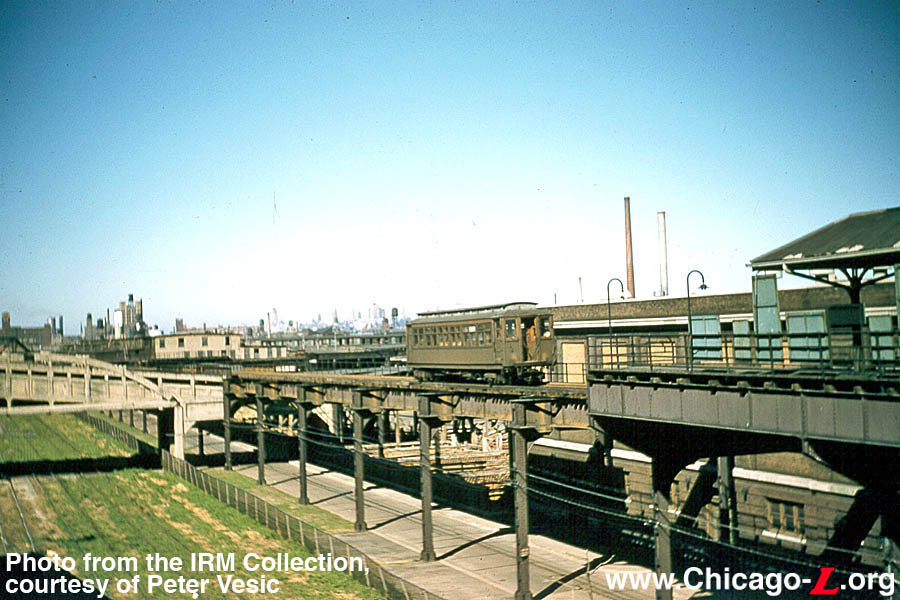
An westbound two-car CTA "L" train crosses over the Baltimore and Ohio Chicago Terminal tracks circa November 1959. We are by Kenilworth Avenue in Oak Park during construction of the Congress (now Eisenhower) expressway. The highway is depressed below grade in this area, and the two railroads are in the south portion of the expressway footprint. All the buildings seen here are still extant. (Jeffrey L. Wien Photo)

An westbound two-car CTA “L” train crosses over the Baltimore and Ohio Chicago Terminal tracks circa November 1959. We are by Kenilworth Avenue in Oak Park during construction of the Congress (now Eisenhower) expressway. The highway is depressed below grade in this area, and the two railroads are in the south portion of the expressway footprint. All the buildings seen here are still extant. (Jeffrey L. Wien Photo)

As of this January 21st, the Trolley Dodger blog is now ten years old. Each year since 1963, this date has commemorated the end of service on the North Shore Line interurban. I thought it would be a good date to associate with beginnings as well as endings.

It has been some months since our last post. We only had a few last year. This has led some people to ask about my health, or if I am still continuing with this.

Fact is, I am fine and have been busier than ever. In early December, we turned in our first draft of our next book, and this was accepted by our publisher. We have been scanning lots of images, and have added many important ones to our collection, some of which are featured here.

Acquiring new images costs money, and the research involved with our books is very expensive. Much of my work this past year has involved raising the funds to pay for all this. If you would like to help out, there is information further down in this post about our annual fundraiser.

We have been quite active on our Trolley Dodger Facebook group, which has added about 250 members since our last blog post. I realize that many of you are not on Facebook and therefore wouldn’t see any of that.

The Facebook group has been very useful as our members are very knowledgeable and are an aid to research. If I post something there that I am not sure about, I can often get locations identified quickly by someone on the group, along with finding out additional useful information.

My longtime friend Raymond DeGroote, Jr., who is 94, fell and broke his hip last November 1st. He needed partial hip replacement surgery, and contracted pneumonia while in the hospital. Ray went into a rehab facility, where he remained until January 22nd. Now he is back home once again, and is temporarily receiving round-the-clock care while he builds up his strength so he can negotiate those stairs. We wish him the best and hope he makes a full recovery.

I wanted this anniversary post to be extra special, and we have lots of exceptional, very rare images here for your consideration. Now that work on our new book is a lot further along, our hope is to have at least one new post every month for the rest of the year.

I have been interested in how the CTA transitioned the Garfield Park “L” into the Congress rapid transit line west of Laramie Avenue (5200 W.) for a long time. I was a small child when this construction was going on, and we lived in the area. Back in the 1980s, I wrote to the legendary George Krambles himself, asking how this was done. He replied there were at least three temporary rights-of-way, but that he was not clear on the details.

Since then, I have learned quite a bit about this, and some of that information (and many pictures) can be found in my 2018 Arcadia book Building Chicago’s Subways. Many more pictures have appeared on this blog.

Still, there were two remaining questions that needed answering. First, exactly where did the old Garfield Park alignment join up with the new Congress “L”? There was such a junction, we know, because service was offered on both lines simultaneously on June 21, 1958, and some maintenance work continued at the old Laramie Yard until around April 1959.

Second, where was the crossing between the Baltimore and Ohio Chicago Terminal tracks and the CTA moved to, while the new flyover was being built? They originally crossed each other at grade just east of DesPlaines Avenue in Forest Park. Now, there is a flyover that takes the freight line north of the CTA, and also carries both sets of tracks over the expressway (now I-290).

I recently discovered several photos by the late Jeffrey L. Wien that answer both questions. You will find them later in this post.

As I look back on our first ten years, I can honestly say that I have learned a lot. I thought I knew a few things when we started this journey, but it has been an educational experience for me. That is, in large part, due to our readers being so knowledgeable. So I have to thank all of you for that.

Another difference between now and then is our standards and capabilities for photo restoration have greatly improved. Experience is a great teacher, and we have worked on thousands and thousands of images since then.

My goal has always been to create a resource where people can find useful information about the history of electric railways. With over 1.1 million page views, I believe we have achieved that goal. When I do Google searches, doing my own research, the hits that come up often include things I have posted. Trolley Dodger pictures show up all the time on Facebook too.

I’m excited about the future as I look forward to the next ten years of the Trolley Dodger. And the best thing about this continued journey is we will do it together.

Enjoy!
-David Sadowski

PS- You might also like our Trolley Dodger Facebook auxiliary, a private group that now has 2,038 members.

Our friend Kenneth Gear has a Facebook group for the Railroad Record Club. If you enjoy listening to audio recordings of classic railroad trains, whether steam, electric, or diesel, you might consider joining.

FYI, the Hoosier Traction Facebook Group celebrates electric transit in Indiana and the Midwest. It also supports the activities of the annual Hoosier Traction Meet (although not affiliated with the North American Transit Historical Society, which organizes that event).

Department of Corrections

This real photo postcard shows a crash between two Metropolitan "L" cars on the Humboldt Park branch. There is a different picture of the same wreck (again, from a RPP) on page 60 of my 2021 book Chicago's Lost "L"s. The question was always, where was this taken? The best guess at the time was looking west from Kedzie Avenue (3200 W.) so that's what I put in the book. On the other hand, Andre Kristopans thought it was near the west end of the line (Lawndale Avenue, 3700 W.). Turns out it was near Ballou station. This was later renamed to St. Louis Avenue (3500 W.) meaning it's between where the two guesses were. Further research by Ron Tee turned up a March 15, 1909 article about the accident in the Herald News.

This real photo postcard shows a crash between two Metropolitan “L” cars on the Humboldt Park branch. There is a different picture of the same wreck (again, from a RPP) on page 60 of my 2021 book Chicago’s Lost “L”s. The question was always, where was this taken? The best guess at the time was looking west from Kedzie Avenue (3200 W.) so that’s what I put in the book. On the other hand, Andre Kristopans thought it was near the west end of the line (Lawndale Avenue, 3700 W.). Turns out it was near Ballou station. This was later renamed to St. Louis Avenue (3500 W.) meaning it’s between where the two guesses were. Further research by Ron Tee turned up a March 15, 1909 article about the accident in the Herald News.

Our Annual Fundraiser

Since we started this blog in 2015, we have posted more than 16,000 images. This is our 314th post.

In the near future, we will need to renew our WordPress subscription, our domain registration, and pay other bills associated with maintaining this site, so it is time for our Annual Fundraiser.

The Trolley Dodger blog can only be kept going with the help of our devoted readers. Perhaps you count yourself among them.

If you have already contributed in the past, we thank you very much for your help. Meanwhile, our goal for this fundraiser is just $700, which is only a fraction of what it costs us each year. The rest is made up from either the profits from the items we sell, or out of our own pocket.

There are links at the top and bottom of this page, where you can click and make a donation that will help us meet our goal again for this coming year, so we can continue to offer you more classic images in the future, and keep this good thing we have going.

We thank you in advance for your time and consideration.

Our Next Book Project

On December 7, 1958, CA&E wood cars 319 and 320 ran on a charter that became the last passenger movement on the railroad. Here, the fantrip train has reached the off-street Aurora terminal on a very wintry day. (Don Swanson Photo)

On December 7, 1958, CA&E wood cars 319 and 320 ran on a charter that became the last passenger movement on the railroad. Here, the fantrip train has reached the off-street Aurora terminal on a very wintry day. (Don Swanson Photo)

FYI, we are hard at work on our next book about the Chicago Aurora and Elgin interurban. Although we already have thousands of images, we start out on these book projects with some of what we need, and then have to find the rest. Some have generously shared their images with us, and some we have to pay real money for. In case you would like to help contribute to this effort, either by sharing images or making a donation, we would like to hear from you. All contributors will be mentioned in the book, which will be dedicated to the memory of the late Robert D. Heinlein. The most difficult images to find are always the earliest ones. You can contact me via Facebook messenger, at thetrolleydodger@gmail.com or via my blog. I thank you for your time and consideration.

CA&E locos 4005 and 4006 head up a freight train at Lakewood siding in June 1956. (Don Swanson Photo)

CA&E locos 4005 and 4006 head up a freight train at Lakewood siding in June 1956. (Don Swanson Photo)

James P. Shulman took this picture of Chicago Aurora and Elgin #456 on January 12, 1947 at Wheaton, when this car was just about one year old. It was still lettered in Futura type.

James P. Shulman took this picture of Chicago Aurora and Elgin #456 on January 12, 1947 at Wheaton, when this car was just about one year old. It was still lettered in Futura type.

Here is a picture of Chicago Aurora and Elgin #401 at the Wheaton station on March 18, 1956. (Raymond DeGroote, Jr. Photo)

Here is a picture of Chicago Aurora and Elgin #401 at the Wheaton station on March 18, 1956. (Raymond DeGroote, Jr. Photo)

Here is another picture of Chicago Aurora and Elgin #401 at the Wheaton station on March 18, 1956. We are looking to the east. (Raymond DeGroote, Jr. Photo)

Here is another picture of Chicago Aurora and Elgin #401 at the Wheaton station on March 18, 1956. We are looking to the east. (Raymond DeGroote, Jr. Photo)

This is how the abandoned Chicago Aurora and Elgin right-of-way looked in June 1960, nearly three years after the end of passenger service and one year after the last freight train. We are looking west from Fifth Avenue in Maywood. The gates have been removed but the tracks are still in place. Formal abandonment of the railroad was approved the following year.

This is how the abandoned Chicago Aurora and Elgin right-of-way looked in June 1960, nearly three years after the end of passenger service and one year after the last freight train. We are looking west from Fifth Avenue in Maywood. The gates have been removed but the tracks are still in place. Formal abandonment of the railroad was approved the following year.

Recent Finds

North Shore Line electric loco 456 is moving freight in North Chicago on the last full day of service, January 20, 1963. The weather was bitterly cold. There was no slacking off for the NSL's employees, even though everyone knew the storied interurban had come to the end of the line. The photographer is not known, but I do think it's very possible Jeffrey L. Wien is one of the three guys on the right... carrying a case that most likely has his movie camera in it. I think he's the guy in the middle, grinning, because he's in his element.

North Shore Line electric loco 456 is moving freight in North Chicago on the last full day of service, January 20, 1963. The weather was bitterly cold. There was no slacking off for the NSL’s employees, even though everyone knew the storied interurban had come to the end of the line. The photographer is not known, but I do think it’s very possible Jeffrey L. Wien is one of the three guys on the right… carrying a case that most likely has his movie camera in it. I think he’s the guy in the middle, grinning, because he’s in his element.

North Shore Line car #159 and an Electroliner are at the Mundelein Terminal in June 1961. The Liner was there on a fantrip, as they did not operate on this branch line in regular service. We are looking west.

North Shore Line car #159 and an Electroliner are at the Mundelein Terminal in June 1961. The Liner was there on a fantrip, as they did not operate on this branch line in regular service. We are looking west.

North Shore Line express motors 238 and 231 are at Pettibone Yard in the 1950s. 238 has been converted to a snow plow, as the interurban had ended less-than-carload freight in 1947. This image was scanned from an 838 Kodachrome slide-- which at 28x40mm is somewhat larger than 35mm's 24x36mm. Kodak had a series of Bantam cameras that took this size, but it did not catch on.

North Shore Line express motors 238 and 231 are at Pettibone Yard in the 1950s. 238 has been converted to a snow plow, as the interurban had ended less-than-carload freight in 1947. This image was scanned from an 838 Kodachrome slide– which at 28x40mm is somewhat larger than 35mm’s 24x36mm. Kodak had a series of Bantam cameras that took this size, but it did not catch on.

North Shore Line car #703 is parked at Roosevelt Road in Chicago on a very snowy February 11, 1960.

North Shore Line car #703 is parked at Roosevelt Road in Chicago on a very snowy February 11, 1960.

The photographer must have been riding on a North Shore Line train to capture this picture on August 23, 1959. We are looking west towards the former Niles Center "L" station at Asbury Street in Evanston, last used in 1948. After being rented out to local businesses, the station building was torn down in the 1970s. The Skokie Swift began using these tracks in 1964, just over a year after the North Shore Line quit. (William C. Hoffman Photo)

The photographer must have been riding on a North Shore Line train to capture this picture on August 23, 1959. We are looking west towards the former Niles Center “L” station at Asbury Street in Evanston, last used in 1948. After being rented out to local businesses, the station building was torn down in the 1970s. The Skokie Swift began using these tracks in 1964, just over a year after the North Shore Line quit. (William C. Hoffman Photo)

CTA trolley bus 9361 was built by Pullman-Standard in 1948, and was retired on December 15, 1966. On February 26, 1965, it is heading west on Route 80 - Irving Park Road. The bus has just gone under the four-track North Side "L". and is about to traverse the Milwaukee Road's freight track just west of there. Until 1973, this track brought interchange freight to the CTA via the ground-level Buena Yard. Further north from here, there was a ramp connecting with the "L". This was once a Milwaukee Road commuter line, but the Northwestern Elevated Railroad Company took over service north of Wilson Avenue in 1908. By 1912, this "Evanston Extension" of the "L" went as far north as Linden Avenue in Wilmette. (Jeffrey L. Wien Photo)

CTA trolley bus 9361 was built by Pullman-Standard in 1948, and was retired on December 15, 1966. On February 26, 1965, it is heading west on Route 80 – Irving Park Road. The bus has just gone under the four-track North Side “L”. and is about to traverse the Milwaukee Road’s freight track just west of there. Until 1973, this track brought interchange freight to the CTA via the ground-level Buena Yard. Further north from here, there was a ramp connecting with the “L”. This was once a Milwaukee Road commuter line, but the Northwestern Elevated Railroad Company took over service north of Wilson Avenue in 1908. By 1912, this “Evanston Extension” of the “L” went as far north as Linden Avenue in Wilmette. (Jeffrey L. Wien Photo)

On July 3, 1967, CTA trolley bus 9527 is eastbound on Irving Park Road, having just passed under the North-South "L". This bus was built by Marmon-Herrington in 1951-52. The last Chicago trolley bus ran in 1973. (Jeffrey L. Wien Photo)

On July 3, 1967, CTA trolley bus 9527 is eastbound on Irving Park Road, having just passed under the North-South “L”. This bus was built by Marmon-Herrington in 1951-52. The last Chicago trolley bus ran in 1973. (Jeffrey L. Wien Photo)

This looks north from the 35th Street station on the South Side "L" on November 6, 1950. The walkway led to the former 33rd Street station, which had been closed the year before. The photographer noted that this walkway was used by students at the Illinois Institute of Technology. The walkway was closed on September 25, 1961. (William C. Hoffman Photo) M.E. writes, "This photo shows the three tracks that ran from south of Indiana Ave. north to Roosevelt Rd. The middle track was used by express trains (obviously not going in both directions simultaneously), and probably by North Shore Line trains that ran as far south as 63rd and Dorchester on the Jackson Park line for a time. Your caption mentions the 33rd St. station. This trackage was the original South Side L from 1892, when the city was a lot smaller than today. So this trackage had a lot more stations, which (if I remember correctly) were at Congress, 12th St. (a.k.a. Roosevelt Rd.), 16th St., 18th St., 22nd St. (a.k.a. Cermak Rd.), 26th St., 29th St., 31st St., 33rd St., 35th St. and 39th St. (a.k.a. Pershing Rd.). Trains (other than express trains) on this structure stopped at all these stations (although after the State St. subway opened in 1943, mainline trains could serve L stations only as far north as 18th St.). This was before 1949, when the Kenwood line still used this trackage and before A/B skip-stop service began on the north/south mainline. After 1949, stations other than Cermak and 35th were closed to speed up service on this section. Cermak became a B (Jackson Park mainline) station and 35th an A (Englewood mainline) station. By the way, until the 1949 major change, Englewood trains went not to Howard St. but to Ravenswood. Only Jackson Park, Evanston Express, and North Shore Line trains went to Howard. Before the 1949 cutback, Kenwood trains went into the Loop and some went as far north as Wilson Ave. After 1949, the Ravenswood line got its own trains between Kimball and the Loop."

This looks north from the 35th Street station on the South Side “L” on November 6, 1950. The walkway led to the former 33rd Street station, which had been closed the year before. The photographer noted that this walkway was used by students at the Illinois Institute of Technology. The walkway was closed on September 25, 1961. (William C. Hoffman Photo) M.E. writes, “This photo shows the three tracks that ran from south of Indiana Ave. north to Roosevelt Rd. The middle track was used by express trains (obviously not going in both directions simultaneously), and probably by North Shore Line trains that ran as far south as 63rd and Dorchester on the Jackson Park line for a time.
Your caption mentions the 33rd St. station. This trackage was the original South Side L from 1892, when the city was a lot smaller than today. So this trackage had a lot more stations, which (if I remember correctly) were at Congress, 12th St. (a.k.a. Roosevelt Rd.), 16th St., 18th St., 22nd St. (a.k.a. Cermak Rd.), 26th St., 29th St., 31st St., 33rd St., 35th St. and 39th St. (a.k.a. Pershing Rd.). Trains (other than express trains) on this structure stopped at all these stations (although after the State St. subway opened in 1943, mainline trains could serve L stations only as far north as 18th St.). This was before 1949, when the Kenwood line still used this trackage and before A/B skip-stop service began on the north/south mainline. After 1949, stations other than Cermak and 35th were closed to speed up service on this section. Cermak became a B (Jackson Park mainline) station and 35th an A (Englewood mainline) station.
By the way, until the 1949 major change, Englewood trains went not to Howard St. but to Ravenswood. Only Jackson Park, Evanston Express, and North Shore Line trains went to Howard. Before the 1949 cutback, Kenwood trains went into the Loop and some went as far north as Wilson Ave. After 1949, the Ravenswood line got its own trains between Kimball and the Loop.”

When Jeff Wien took this picture looking north along Pulaski Road at Irving Park Road in March 1973, CTA trolley buses were in their very last days. Here, we see 9624, a Marmon-Herrington, built in 1951-52. The Buffalo ice cream parlor was a local landmark for decades. Established in 1902, they moved to this location in 1918. It closed in 1978 and a gas station replaced it.

When Jeff Wien took this picture looking north along Pulaski Road at Irving Park Road in March 1973, CTA trolley buses were in their very last days. Here, we see 9624, a Marmon-Herrington, built in 1951-52. The Buffalo ice cream parlor was a local landmark for decades. Established in 1902, they moved to this location in 1918. It closed in 1978 and a gas station replaced it.

CTA prewar PCC car 7019 is heading north on Cottage Grove at 93rd on September 23, 1954. Route 4 streetcar service ended the following year. Our resident south side expert M.E. adds, "This intersection had a lot of trackage, for two reasons: (1) The 93rd-95th St. car line used Cottage Grove Ave. to move between 95th St. and 93rd St.; (2) A car barn was situated a block east on 93rd St. at Drexel. Notice all the trolley wire, which also indicates how much trackage existed at this intersection."

CTA prewar PCC car 7019 is heading north on Cottage Grove at 93rd on September 23, 1954. Route 4 streetcar service ended the following year. Our resident south side expert M.E. adds, “This intersection had a lot of trackage, for two reasons: (1) The 93rd-95th St. car line used Cottage Grove Ave. to move between 95th St. and 93rd St.; (2) A car barn was situated a block east on 93rd St. at Drexel. Notice all the trolley wire, which also indicates how much trackage existed at this intersection.”

Here's the same location in October 2022.

Here’s the same location in October 2022.

On June 29, 1966, CTA single car unit 44 heads south from the Linden Avenue terminal, working an Evanston branch local. For a time, there was an automatic gate installed here to keep people and animals out of the yard. (Jeffrey L. Wien Photo)

On June 29, 1966, CTA single car unit 44 heads south from the Linden Avenue terminal, working an Evanston branch local. For a time, there was an automatic gate installed here to keep people and animals out of the yard. (Jeffrey L. Wien Photo)

On July 14, 1963, this is the view looking south at South Boulevard on the Evanston branch of the "L". As the sign at right notes, this was the changeover point from overhead wire to third rail. Evanston would not allow the "L" to use third rail north of here until 1973. (William C. Hoffman Photo)

On July 14, 1963, this is the view looking south at South Boulevard on the Evanston branch of the “L”. As the sign at right notes, this was the changeover point from overhead wire to third rail. Evanston would not allow the “L” to use third rail north of here until 1973. (William C. Hoffman Photo)

Chicago Surface Lines Nearside streetcar #5773 is on Through Route 5: Cottage Grove - South Chicago in the late 1930s. Don's Rail Photos: "5773 was built by Brill Car Co in 1912, #18322. It was retired on February 8, 1946."

Chicago Surface Lines Nearside streetcar #5773 is on Through Route 5: Cottage Grove – South Chicago in the late 1930s. Don’s Rail Photos: “5773 was built by Brill Car Co in 1912, #18322. It was retired on February 8, 1946.”

On May 11, 1958, William C. Hoffman captured this view, looking northwest towards the 43rd Street station on the Illinois Central Electric suburban service. You can see the former Kenwood "L" Terminal and Yard in the distance at 42nd and Oakenwald. That branch had closed on November 30, 1957, when its 50 year lease ran out with the Chicago Junction Railway, which owned it. This date also marked the end of wood cars on the "L". The Kenwood "L" was demolished within a few years, although remnants still exist.

On May 11, 1958, William C. Hoffman captured this view, looking northwest towards the 43rd Street station on the Illinois Central Electric suburban service. You can see the former Kenwood “L” Terminal and Yard in the distance at 42nd and Oakenwald. That branch had closed on November 30, 1957, when its 50 year lease ran out with the Chicago Junction Railway, which owned it. This date also marked the end of wood cars on the “L”. The Kenwood “L” was demolished within a few years, although remnants still exist.

I was recently contacted by someone working on the effort to turn the old Kenwood "L" right-of-way into a south side version of the 606 Trail. They were wondering when the bridges over various streets were removed after the line was abandoned in November 1957. They were certainly gone by September 5, 1960, when this picture was taken at Vincennes Avenue. (William C. Hoffman Photo)

I was recently contacted by someone working on the effort to turn the old Kenwood “L” right-of-way into a south side version of the 606 Trail. They were wondering when the bridges over various streets were removed after the line was abandoned in November 1957. They were certainly gone by September 5, 1960, when this picture was taken at Vincennes Avenue.
(William C. Hoffman Photo)

Here is the former Kenwood "L" embankment at Cottage Grove Avenue on September 5, 1960. The Chicago Junction Railway was still active at this point, adjacent to the former "L". (William C. Hoffman Photo)

Here is the former Kenwood “L” embankment at Cottage Grove Avenue on September 5, 1960. The Chicago Junction Railway was still active at this point, adjacent to the former “L”. (William C. Hoffman Photo)

A view of the old Kenwood "L" at Drexel Boulevard on September 5, 1960. (William C. Hoffman Photo)

A view of the old Kenwood “L” at Drexel Boulevard on September 5, 1960. (William C. Hoffman Photo)

This is where the old Ellis Avenue station was on the Kenwood "L", as of September 5, 1960. (William C. Hoffman Photo)

This is where the old Ellis Avenue station was on the Kenwood “L”, as of September 5, 1960. (William C. Hoffman Photo)

We are looking north along Stony Island at 63rd Street on May 19, 1961. The eastern end of the Jackson Park "L" is at left. During the 1893 World's Columbian Exposition, the "L" went further east of here. The Jackson Park branch has since been cut back to Cottage Grove. This image was restored from an early Ektachrome slide that had shifted to red. (William C. Hoffman Photo) M.E. writes, "In my early lifetime, the L structure over Stony Island Ave. was not there. The structure ended abutting Stony Island, but not spanning it. The streets here were a mini business district, there was a Greyhound bus station on Stony Island south of 63rd St., and Hyde Park High School was on Stony Island south of 62nd St. The 63rd St. streetcars traveled east to Stony Island, then turned right (south) to 64th St. to their terminal on 64th. To start their westbound trips, they went a block farther west on 64th St. to Harper, then north to 63rd St., then west. And of course Stony Island had its own streetcar line (and traffic ran in both directions)."

We are looking north along Stony Island at 63rd Street on May 19, 1961. The eastern end of the Jackson Park “L” is at left. During the 1893 World’s Columbian Exposition, the “L” went further east of here. The Jackson Park branch has since been cut back to Cottage Grove. This image was restored from an early Ektachrome slide that had shifted to red. (William C. Hoffman Photo) M.E. writes, “In my early lifetime, the L structure over Stony Island Ave. was not there. The structure ended abutting Stony Island, but not spanning it. The streets here were a mini business district, there was a Greyhound bus station on Stony Island south of 63rd St., and Hyde Park High School was on Stony Island south of 62nd St. The 63rd St. streetcars traveled east to Stony Island, then turned right (south) to 64th St. to their terminal on 64th. To start their westbound trips, they went a block farther west on 64th St. to Harper, then north to 63rd St., then west. And of course Stony Island had its own streetcar line (and traffic ran in both directions).”

Chicago Transit Authority streetcar 3137 is at Root and Halsted (end of the 43rd Street car line) in 1952. The bridge belonged to the Stock Yard branch of the "L". This was one of a few older trolleys that the CTA had painted in green and creme in the early 1950s. The sign at rear advertises the Chicago Daily Drovers Journal, founded in 1873 to report on the Union Stockyards. It is still in business today at: www.drovers.com (E. Rinke Photo)

Chicago Transit Authority streetcar 3137 is at Root and Halsted (end of the 43rd Street car line) in 1952. The bridge belonged to the Stock Yard branch of the “L”. This was one of a few older trolleys that the CTA had painted in green and creme in the early 1950s. The sign at rear advertises the Chicago Daily Drovers Journal, founded in 1873 to report on the Union Stockyards. It is still in business today at: http://www.drovers.com (E. Rinke Photo)

Here's how the Stock Yards "L" looked on Exchange Avenue near Racine Avenue on September 1, 1954. This "L" branchy was abandoned in 1957. (William C. Hoffman Photo)

Here’s how the Stock Yards “L” looked on Exchange Avenue near Racine Avenue on September 1, 1954. This “L” branchy was abandoned in 1957. (William C. Hoffman Photo)

We are looking west from the transfer bridge at the Indiana Avenue "L" station in the south side on November 6, 1950. By then, the Kenwood branch had become a shuttle. The CTA widened the platform so it could berth here, and northbound main line trains were relocated onto what had formerly been the express track (no longer in use, as the CTA had instituted A/B skip stop service). The Stock Yards branch always ran as a shuttle from the opposite platform. (William C. Hoffman Photo) M.E. notes: "This photo shows people on a wide platform. The space occupied by that platform was initially the third track that northbound mainline trains and northbound Kenwood trains used, before the Kenwood line was cut back to a shuttle from Indiana Ave. east. That change took place in 1949. This transfer bridge enabled passengers on: (1) northbound mainline and Kenwood trains to reach southbound mainline trains and Stock Yards trains, and (2) southbound mainline and Stock Yards trains to reach northbound mainline trains and Kenwood trains."

We are looking west from the transfer bridge at the Indiana Avenue “L” station in the south side on November 6, 1950. By then, the Kenwood branch had become a shuttle. The CTA widened the platform so it could berth here, and northbound main line trains were relocated onto what had formerly been the express track (no longer in use, as the CTA had instituted A/B skip stop service). The Stock Yards branch always ran as a shuttle from the opposite platform. (William C. Hoffman Photo) M.E. notes: “This photo shows people on a wide platform. The space occupied by that platform was initially the third track that northbound mainline trains and northbound Kenwood trains used, before the Kenwood line was cut back to a shuttle from Indiana Ave. east. That change took place in 1949. This transfer bridge enabled passengers on:
(1) northbound mainline and Kenwood trains to reach southbound mainline trains and Stock Yards trains, and
(2) southbound mainline and Stock Yards trains to reach northbound mainline trains and Kenwood trains.”

This looks north from the 35th Street station on the South Side "L" on November 6, 1950. The walkway led to the former 33rd Street station, which had been closed the year before. The photographer noted that this walkway was used by students at the Illinois Institute of Technology. The walkway was closed on September 25, 1961. (William C. Hoffman Photo)

This looks north from the 35th Street station on the South Side “L” on November 6, 1950.
The walkway led to the former 33rd Street station, which had been closed the year before. The photographer noted that this walkway was used by students at the Illinois Institute of Technology. The walkway was closed on September 25, 1961. (William C. Hoffman Photo)

On August 30, 1960, a southbound eight-car train is at 35th Street on the South Side "L". Construction of a new center-island platform has started. This turned out to be ill-fated, as the station was destroyed by fire not long after it opened. (William C. Hoffman Photo)

On August 30, 1960, a southbound eight-car train is at 35th Street on the South Side “L”.
Construction of a new center-island platform has started. This turned out to be ill-fated, as the station was destroyed by fire not long after it opened. (William C. Hoffman Photo)

The picture was taken on October 18, 1962, the day after the station fire at 35th Street. It shows the train with the burned up car and a crowd of people nearby, including the fire department. (Jeffrey L. Wien Photo)

The picture was taken on October 18, 1962, the day after the station fire at 35th Street. It shows the train with the burned up car and a crowd of people nearby, including the fire department. (Jeffrey L. Wien Photo)

Subject: CSS&SB South Shore Line Hegewisch Station 1970s Location: Chicago, Illinois (Hegewisch neighborhood) Date: Circa 1970s Photographer: Unknown This picture shows the old South Shore Line station at Hegewisch, near the Illinois-Indiana border. It was replaced by a newer station in 1992, and as this slide has square corners, it probably predates 1981.

Subject: CSS&SB South Shore Line Hegewisch Station 1970s
Location: Chicago, Illinois (Hegewisch neighborhood)
Date: Circa 1970s
Photographer: Unknown
This picture shows the old South Shore Line station at Hegewisch, near the Illinois-Indiana border. It was replaced by a newer station in 1992, and as this slide has square corners, it probably predates 1981.

Subject: CSS&SB South Shore Line Interurban #104 Location: Michigan City, Indiana Date: April 1963 (processing date) Photographer: Emery J. Gulash Emery J. Gulash (1918-2006) was a very well known railfan photographer. CSS&SB #104 was built by Pullman in 1926, job #4936. It was lengthened in 1943. Air conditioning and picture windows came in 1950. All cars in this series were retired by 1983, and many went to museums. The facade from the historic Michigan City station has been saved and is planned to be reused with a new building behind it. The South Shore Line street running has been replaced by new double track on private right-of-way.

Subject: CSS&SB South Shore Line Interurban #104
Location: Michigan City, Indiana
Date: April 1963 (processing date)
Photographer: Emery J. Gulash
Emery J. Gulash (1918-2006) was a very well known railfan photographer.
CSS&SB #104 was built by Pullman in 1926, job #4936. It was lengthened in 1943. Air conditioning and picture windows came in 1950. All cars in this series were retired by 1983, and many went to museums. The facade from the historic Michigan City station has been saved and is planned to be reused with a new building behind it. The South Shore Line street running has been replaced by new double track on private right-of-way.

Subject: CSS&SB South Shore Line Electric Loco #901 (and presumably #900) Location: Unknown Date: Circa 1950-55 (based on the style of slide mount Photographer: Unknown CSS&SB electric steeplecab #901 was built by Baldwin/Westinghouse in 1929 as IC #10001. The CSS acquired it in 1941. It appears to have been retired sometime in the 1960s.

Subject: CSS&SB South Shore Line Electric Loco #901 (and presumably #900)
Location: Unknown
Date: Circa 1950-55 (based on the style of slide mount
Photographer: Unknown
CSS&SB electric steeplecab #901 was built by Baldwin/Westinghouse in 1929 as IC #10001. The CSS acquired it in 1941. It appears to have been retired sometime in the 1960s.

Whenever a movie theatre pops up in one of these photos, I post it to Cinema Treasures. Pittsburgh Railways PCC streetcar #1724 passes the Art Cinema at 809 Liberty Avenue on March 23, 1968. The adult theatre was offering a double feature of Fanny Hill Meets Dr. Erotica and Unholy Matrimony. It opened in 1931 as the Avenue Cinema and was renamed the Art Cinema in 1935. Redeveloped in 1995, it is now the Harris Theatre. (Jeffrey L. Wien Photo)

Whenever a movie theatre pops up in one of these photos, I post it to Cinema Treasures. Pittsburgh Railways PCC streetcar #1724 passes the Art Cinema at 809 Liberty Avenue on March 23, 1968. The adult theatre was offering a double feature of Fanny Hill Meets Dr. Erotica and Unholy Matrimony. It opened in 1931 as the Avenue Cinema and was renamed the Art Cinema in 1935. Redeveloped in 1995, it is now the Harris Theatre. (Jeffrey L. Wien Photo)

On February 23, 1957, Queensboro Bridge streetcar #602 is posed by a BMT "A" train. The bridge train stopped running on April 7, 1957, as the last streetcar in New York City. Car 602 was built in 1929 by Osgood-Bradley for New Bedford, Massachusetts. Although similar in appearance to Brill Master Units, these cars were called Electromobiles. Several came to the bridge operation in 1948.

On February 23, 1957, Queensboro Bridge streetcar #602 is posed by a BMT “A” train. The bridge train stopped running on April 7, 1957, as the last streetcar in New York City. Car 602 was built in 1929 by Osgood-Bradley for New Bedford, Massachusetts. Although similar in appearance to Brill Master Units, these cars were called Electromobiles. Several came to the bridge operation in 1948.

This circa 1948 picture of CTA "Jitterbug" 5002 caused a lot of discussion on our Facebook group, namely, where is this? But the consensus is, this is the original turnaround loop at DesPlaines Avenue on the Garfield Park "L", looking east. William Shapotkin says the Chicago Great Western's control tower is just barely visible at left. The yard here, and the turnback loop, were reconfigured in 1953 when the Chicago Aurora and Elgin cut back service to here. It was rebuilt again in 1959 during construction of the adjacent expressway.

This circa 1948 picture of CTA “Jitterbug” 5002 caused a lot of discussion on our Facebook group, namely, where is this? But the consensus is, this is the original turnaround loop at DesPlaines Avenue on the Garfield Park “L”, looking east. William Shapotkin says the Chicago Great Western’s control tower is just barely visible at left. The yard here, and the turnback loop, were reconfigured in 1953 when the Chicago Aurora and Elgin cut back service to here. It was rebuilt again in 1959 during construction of the adjacent expressway.

From 1940 to 1952, the Pacific Electric ran in the median of the Hollywood Freeway (now U.S. Route 101) through Cahuenga Pass in Los Angeles. Here we see it during a 1948 fantrip. I can't quite make out the car number. The Chicago Transit Authority opened its Congress rapid transit line in an expressway median in 1958, but by then, this one was already gone, and the space is now occupied by additional highway lanes.

From 1940 to 1952, the Pacific Electric ran in the median of the Hollywood Freeway (now U.S. Route 101) through Cahuenga Pass in Los Angeles. Here we see it during a 1948 fantrip. I can’t quite make out the car number. The Chicago Transit Authority opened its Congress rapid transit line in an expressway median in 1958, but by then, this one was already gone, and the space is now occupied by additional highway lanes.

CTA #4410, built in the early 1920s, is part of a fantrip train at Lake and Homan on October 21, 1973. This was about a month before the 4000s were taken out of service. (Arthur H. Peterson Photo)

CTA #4410, built in the early 1920s, is part of a fantrip train at Lake and Homan on October 21, 1973. This was about a month before the 4000s were taken out of service. (Arthur H. Peterson Photo)

We are looking northwest from Marshfield Avenue towards the Lake and Paulina "L" junction on August 15, 1963. The Paulina "L" still crossed over the Lake Street "L", but the tracks north of here were only being used for shop moves, work trains, and charters by this point. A new connection to the Lake Street "L" was used by Douglas Park trains from 1954 to 1958, and is used by Pink Line trains today. The white structure was added during construction of this connection for use by the work crews. The upper level tracks here, along with the Lake Transfer station and trackage all the way north to the Milwaukee Subway was removed in 1964. (William C. Hoffman Photo) M.E. adds, "You may want to add to your caption that, after the Dearborn St. subway opened in 1951, this segment of trackage also provided the only way to move L cars between the Logan Square - Dearborn St. subway - Congress and LaSalle St. line and the rest of the system."

We are looking northwest from Marshfield Avenue towards the Lake and Paulina “L” junction on August 15, 1963. The Paulina “L” still crossed over the Lake Street “L”, but the tracks north of here were only being used for shop moves, work trains, and charters by this point. A new connection to the Lake Street “L” was used by Douglas Park trains from 1954 to 1958, and is used by Pink Line trains today. The white structure was added during construction of this connection for use by the work crews. The upper level tracks here, along with the Lake Transfer station and trackage all the way north to the Milwaukee Subway was removed in 1964. (William C. Hoffman Photo) M.E. adds, “You may want to add to your caption that, after the Dearborn St. subway opened in 1951, this segment of trackage also provided the only way to move L cars between the Logan Square – Dearborn St. subway – Congress and LaSalle St. line and the rest of the system.”

The view looking north from around Chicago Avenue along the old Paulina "L" on June 26, 1960 during a fantrip. New CTA single car units 41 and 42 were used. (William C. Hoffman Photo)

The view looking north from around Chicago Avenue along the old Paulina “L” on June 26, 1960 during a fantrip. New CTA single car units 41 and 42 were used. (William C. Hoffman Photo)

This is the old Paulina "L" bridge over what are now Metra tracks. On June 26, 1960, the "L" structure was still intact all the way between Lake Street and the Milwaukee Avenue Subway, but only the southbound track was in use for shop moves, equipment transfers, work cars, and fantrips like this. The bridge is still there, used for signals. (William C. Hoffman Photo)

This is the old Paulina “L” bridge over what are now Metra tracks. On June 26, 1960, the “L” structure was still intact all the way between Lake Street and the Milwaukee Avenue Subway, but only the southbound track was in use for shop moves, equipment transfers, work cars, and fantrips like this. The bridge is still there, used for signals. (William C. Hoffman Photo) (William C. Hoffman Photo)

To capture this view today, showing the north portal of the Milwaukee Avenue Subway, you would need a drone. But on June 26, 1960, you could take this picture while looking out the window of a fantrip train, turning sharply south onto the old Paulina "L". That structure was demolished in 1964. (William C. Hoffman Photo)

To capture this view today, showing the north portal of the Milwaukee Avenue Subway, you would need a drone. But on June 26, 1960, you could take this picture while looking out the window of a fantrip train, turning sharply south onto the old Paulina “L”. That structure was demolished in 1964. (William C. Hoffman Photo)

To get this shot, the photographer must have been on a boat in the Chicago River, passing under the Van Buren Street bridge. We see the two side-by-side bridges used by the Metropolitan "L". They were still in service for Garfield Park "L" trains when this picture was taken on May 12, 1957. (William C. Hoffman Photo)

To get this shot, the photographer must have been on a boat in the Chicago River, passing under the Van Buren Street bridge. We see the two side-by-side bridges used by the Metropolitan “L”. They were still in service for Garfield Park “L” trains when this picture was taken on May 12, 1957. (William C. Hoffman Photo)

By July 26, 1959, when this picture was taken, the Garfield Park "L" was no longer running, so the twin Met "L" bridges had been permanently raised. They were torn down around 1961. (William C. Hoffman Photo)

By July 26, 1959, when this picture was taken, the Garfield Park “L” was no longer running, so the twin Met “L” bridges had been permanently raised. They were torn down around 1961. (William C. Hoffman Photo)

Another view of the Met "L" bridges, also from July 26, 1959. It was taken from the east side of the Chicago River, as you can see the 547 W. Jackson building in the distance.(William C. Hoffman Photo)

Another view of the Met “L” bridges, also from July 26, 1959. It was taken from the east side of the Chicago River, as you can see the 547 W. Jackson building in the distance.(William C. Hoffman Photo)

On July 28, 1958, the old Metropolitan "L" structure, last used by the Garfield Park "L" the month before was being demolished in this view looking east from Morgan Street. The new Congress line, which replaced it, is at right. (William C. Hoffman Photo)

On July 28, 1958, the old Metropolitan “L” structure, last used by the Garfield Park “L” the month before was being demolished in this view looking east from Morgan Street. The new Congress line, which replaced it, is at right. (William C. Hoffman Photo)

By November 18, 1962, when this picture was taken, there were still a few remnants of the old Metropolitan "L". This is what's left of the old Canal Street "L" station after the structure here was torn down in 1961. (William C. Hoffman Photo)

By November 18, 1962, when this picture was taken, there were still a few remnants of the old Metropolitan “L”. This is what’s left of the old Canal Street “L” station after the structure here was torn down in 1961.
(William C. Hoffman Photo)

This is the view looking east along Van Buren Street at Ogden Avenue on June 17, 1958. We see the temporary Garfield Park "L" right-of-way, and the new Congress "L" at right, which would replace it five days later. Meanwhile, a Douglas Park "L" train rides along on the Paulina "L". (William C. Hoffman Photo)

This is the view looking east along Van Buren Street at Ogden Avenue on June 17, 1958. We see the temporary Garfield Park “L” right-of-way, and the new Congress “L” at right, which would replace it five days later. Meanwhile, a Douglas Park “L” train rides along on the Paulina “L”. (William C. Hoffman Photo)

The same location, looking the same way, but on July 9, 1957. (William C. Hoffman Photo)

The same location, looking the same way, but on July 9, 1957. (William C. Hoffman Photo)

On October 19, 1953, demolition of the Garfield Park "L" structure was well underway in this view looking northwest from Claremont (2332 W.) and the construction site of the Congress expressway. The portion crossing Western Avenue has been removed. (William C. Hoffman Photo)

On October 19, 1953, demolition of the Garfield Park “L” structure was well underway in this view looking northwest from Claremont (2332 W.) and the construction site of the Congress expressway. The portion crossing Western Avenue has been removed.
(William C. Hoffman Photo)

This is all that was left of the Western Avenue "L" station on the Garfield Park "L" on November 1, 1953. This station was last used on September 27, 1953. For nearly five years, Garfield Park trains ran on a ground-level temporary right-of-way on Van Buren Street, just north of the expressway footprint to the left. (William C. Hoffman Photo)

This is all that was left of the Western Avenue “L” station on the Garfield Park “L” on November 1, 1953. This station was last used on September 27, 1953. For nearly five years, Garfield Park trains ran on a ground-level temporary right-of-way on Van Buren Street, just north of the expressway footprint to the left. (William C. Hoffman Photo)

As of July 27, 1958, when this picture was taken, the new CTA Congress "L" had been running for a month, and the old Garfield Park structure was still there. This was near Kilbourn Avenue (4500 W.), one of two places where it crossed the highway. The "L" was finally removed by November 1959. (William C. Hoffman Photo)

As of July 27, 1958, when this picture was taken, the new CTA Congress “L” had been running for a month, and the old Garfield Park structure was still there. This was near Kilbourn Avenue (4500 W.), one of two places where it crossed the highway. The “L” was finally removed by November 1959. (William C. Hoffman Photo)

The solid gray line shows how the old Garfield Park "L" cut across the Congress (now Eisenhower) expressway just west of Kostner (4400 W.). Disregard the purple line, that's just marking different sections of the map.

The solid gray line shows how the old Garfield Park “L” cut across the Congress (now Eisenhower) expressway just west of Kostner (4400 W.). Disregard the purple line, that’s just marking different sections of the map.

Here is the partially demolished Garfield Park "L" structure. looking east at Kostner Avenue (4400 W.) from a slide processed in November 1959. (Jeffrey L. Wien Photo)

Here is the partially demolished Garfield Park “L” structure. looking east at Kostner Avenue (4400 W.) from a slide processed in November 1959. (Jeffrey L. Wien Photo)

The Congress (now Eisenhower) expressway was completely shut down during removal of the Garfield Park "L" structure, where it crossed the highway just west of Kostner (4400 W.). This slide was processed in November 1959. (Jeffrey L. Wien Photo)

The Congress (now Eisenhower) expressway was completely shut down during removal of the Garfield Park “L” structure, where it crossed the highway just west of Kostner (4400 W.). This slide was processed in November 1959. (Jeffrey L. Wien Photo)

When the Congress expressway was built, the Garfield Park "L" crossed its footprint at two locations-- here (4500 W.) and at Sacramento Boulevard (3000 W.). The existing "L" structures were retained, supported by additional steel called an "interlining." That is how the Englewood "L" is supported now, where it crosses the Dan Ryan expressway. I do not know if any of the steel supports there came from here. (Jeffrey L. Wien Photo)

When the Congress expressway was built, the Garfield Park “L” crossed its footprint at two locations– here (4500 W.) and at Sacramento Boulevard (3000 W.). The existing “L” structures were retained, supported by additional steel called an “interlining.” That is how the Englewood “L” is supported now, where it crosses the Dan Ryan expressway. I do not know if any of the steel supports there came from here. (Jeffrey L. Wien Photo)

Since the Congress expressway was shut down temporarily for removal of the old Garfield Park "L", it looks like photographer Jeffrey L. Wien walked over to the fence near the Congress "L" to get this shot near Kilbourn Avenue (4500 W.).

Since the Congress expressway was shut down temporarily for removal of the old Garfield Park “L”, it looks like photographer Jeffrey L. Wien walked over to the fence near the Congress “L” to get this shot near Kilbourn Avenue (4500 W.).

We are looking east from Cicero Avenue, as the Garfield Park "L" was being dismantled circa November 1959. (Jeffrey L. Wien Photo)

We are looking east from Cicero Avenue, as the Garfield Park “L” was being dismantled circa November 1959. (Jeffrey L. Wien Photo)

A contemporary view of the same location.

A contemporary view of the same location.

After taking the previous picture, it appears that photographer Jeffrey L. Wien walked west along the temporarily closed Congress expressway for this shot of a two-car westbound Congress train near Cicero Avenue. This slide was processed in November 1959.

After taking the previous picture, it appears that photographer Jeffrey L. Wien walked west along the temporarily closed Congress expressway for this shot of a two-car westbound Congress train near Cicero Avenue. This slide was processed in November 1959.

This pair of CTA flat-door 6000s is signed for Garfield Park in this circa 1955-58 photograph. But it's not entirely clear where the location is. My guess is this at Central Avenue, by comparison with the next picture, where the location was identified. This was scanned from an original Ektachrome slide that had faded to red. I had attempted to color-correct this same slide (or one just like it) ten years ago, without success, but now this one doesn't look too bad. It was a lot of work, though.

This pair of CTA flat-door 6000s is signed for Garfield Park in this circa 1955-58 photograph. But it’s not entirely clear where the location is. My guess is this at Central Avenue, by comparison with the next picture, where the location was identified. This was scanned from an original Ektachrome slide that had faded to red. I had attempted to color-correct this same slide (or one just like it) ten years ago, without success, but now this one doesn’t look too bad. It was a lot of work, though.

Here's how the slide looked before I started working on it.

Here’s how the slide looked before I started working on it.

CTA 6039-6040 are at Central Avenue on the Garfield Park "L" on March 25, 1958. This was another early Ektachrome slide that had faded to red. On June 22, 1958, the CTA opened the new Congress rapid transit line as far west as the Cicero Avenue station. The Congress expressway was only open as far as Laramie Avenue, and construction gradually headed west. The "L" used a variety of temporary rights-of-way until everything was finished in 1960. Presumably, the tracks at right connected to the new Congress median right-of-way, while the ones at left went to the old Garfield alignment (which included Laramie Yard).

CTA 6039-6040 are at Central Avenue on the Garfield Park “L” on March 25, 1958. This was another early Ektachrome slide that had faded to red. On June 22, 1958, the CTA opened the new Congress rapid transit line as far west as the Cicero Avenue station. The Congress expressway was only open as far as Laramie Avenue, and construction gradually headed west. The “L” used a variety of temporary rights-of-way until everything was finished in 1960. Presumably, the tracks at right connected to the new Congress median right-of-way, while the ones at left went to the old Garfield alignment (which included Laramie Yard).

If this map, made by a Google user, is accurate, it shows where the Garfield Park "L" ran at ground level in the area by Central Avenue (5600 W.). The Lotus Tunnel is not shown, but would be in approximately the same location as where the Garfield "L" ran, east of Central, bringing the current "L" into the expressway median. If true, this would suggest the Garfield tracks were temporarily relocated to the north of where the tunnel is, but I am not sure if that is what really happened.

If this map, made by a Google user, is accurate, it shows where the Garfield Park “L” ran at ground level in the area by Central Avenue (5600 W.). The Lotus Tunnel is not shown, but would be in approximately the same location as where the Garfield “L” ran, east of Central, bringing the current “L” into the expressway median. If true, this would suggest the Garfield tracks were temporarily relocated to the north of where the tunnel is, but I am not sure if that is what really happened.

This picture was taken at the same time as the previous one at Central Avenue. The crossing gate at left has been removed, which supports my theory that Central Avenue was closed for traffic. In earlier photos at this location, Garfield Park trains were using tracks that veered off to the left. Now, Congress trains headed off to the right. The two-car train of flat-door 6000s has a run number and is on the westbound track. In the next picture, the train has its headlight on and also seems to be heading west. This slide was processed in November 1959. (Jeffrey L. Wien Photo)

This picture was taken at the same time as the previous one at Central Avenue. The crossing gate at left has been removed, which supports my theory that Central Avenue was closed for traffic. In earlier photos at this location, Garfield Park trains were using tracks that veered off to the left. Now, Congress trains headed off to the right. The two-car train of flat-door 6000s has a run number and is on the westbound track. In the next picture, the train has its headlight on and also seems to be heading west. This slide was processed in November 1959. (Jeffrey L. Wien Photo)

While the Congress median line opened as far west as Cicero Avenue on June 22, 1958, service west of there remained on various temporary rights of way until 1960. Here, we are looking east at the temporary "L" station at Central Avenue, circa November 1959. Generally speaking, there were perhaps three different temporary alignments, and the progression was to keep moving the "L" farther north, until the permanent alignment was ready. Here, what had been an island platform was, by the time this photo was taken, only being used by one set of tracks. You can see where some of the rails on the south end of the platform have been removed. Central Avenue appears closed to traffic, as an underpass was being built, going underneath the highway. There is a control tower at Central Avenue, to switch trains to either the old Garfield alignment at left, or the Congress route at right. By November 1959, this tower probably wasn't in use. It was necessary to have continued access to Laramie Yard until about May 1959, as the new facilities in Forest Park were not ready yet. Graham Garfield's excellent chicago-l.org web site explains: "On October 16, 1959, the permanent eastbound Congress Line track was placed in service between Parkside and Pine avenues thru Lotus Tunnel. A temporary side platform was placed in service. Three days later, on October 19, the permanent westbound track and a temporary westbound side platform was placed in service, closing the previous temporary platform. Meanwhile, between the permanent tracks, the new, permanent island platform was constructed. The new Central station platform (with temporary fare controls) was placed in service on October 10, 1960, with westbound trains first using it, followed by eastbound trains the next day. On October 11, 1960, the third and final temporary Central station was closed." It's not clear how this photo fits into the sequence of events, unless the temporary island platform became a side platform as seen here. (Jeffrey L. Wien Photo)

While the Congress median line opened as far west as Cicero Avenue on June 22, 1958, service west of there remained on various temporary rights of way until 1960. Here, we are looking east at the temporary “L” station at Central Avenue, circa November 1959. Generally speaking, there were perhaps three different temporary alignments, and the progression was to keep moving the “L” farther north, until the permanent alignment was ready. Here, what had been an island platform was, by the time this photo was taken, only being used by one set of tracks. You can see where some of the rails on the south end of the platform have been removed. Central Avenue appears closed to traffic, as an underpass was being built, going underneath the highway. There is a control tower at Central Avenue, to switch trains to either the old Garfield alignment at left, or the Congress route at right. By November 1959, this tower probably wasn’t in use. It was necessary to have continued access to Laramie Yard until about May 1959, as the new facilities in Forest Park were not ready yet. Graham Garfield’s excellent chicago-l.org web site explains: “On October 16, 1959, the permanent eastbound Congress Line track was placed in service between Parkside and Pine avenues thru Lotus Tunnel. A temporary side platform was placed in service. Three days later, on October 19, the permanent westbound track and a temporary westbound side platform was placed in service, closing the previous temporary platform. Meanwhile, between the permanent tracks, the new, permanent island platform was constructed. The new Central station platform (with temporary fare controls) was placed in service on October 10, 1960, with westbound trains first using it, followed by eastbound trains the next day. On October 11, 1960, the third and final temporary Central station was closed.” It’s not clear how this photo fits into the sequence of events, unless the temporary island platform became a side platform as seen here. (Jeffrey L. Wien Photo)

This January 1960 view, looking northeast, shows the temporary Central Avenue side platform station during construction of the Congress expressway. The CTA Congress median line had opened as far west as Cicero Avenue in June 1958, but farther west, used a series of temporary ground level alignments while highway work continue. The temporary station here was in use from October 1959 until October 1960, when the permanent center platform station opened. You can see a stairway for the new platform, built into the concrete wall of the Central Avenue underpass. The side platforms allowed for simultaneous construction of the new station. The expressway originally ended at Laramie Avenue (5200 W.), but was extended to Central (5600 W.) in early 1960, and finally opened to Oak Park, Forest Park, and Maywood in October 1960. Newly delivered single car unit 22 heads up this westbound Congress-Milwaukee "A" train. East of here, the tracks curve off to go into the Lotus Tunnel, taking the line into the expressway median. Ultimately, this station did not develop much ridership, and closed in 1973, although it is still extant. (Jeffrey L. Wien Photo)

This January 1960 view, looking northeast, shows the temporary Central Avenue side platform station during construction of the Congress expressway. The CTA Congress median line had opened as far west as Cicero Avenue in June 1958, but farther west, used a series of temporary ground level alignments while highway work continue. The temporary station here was in use from October 1959 until October 1960, when the permanent center platform station opened. You can see a stairway for the new platform, built into the concrete wall of the Central Avenue underpass. The side platforms allowed for simultaneous construction of the new station. The expressway originally ended at Laramie Avenue (5200 W.), but was extended to Central (5600 W.) in early 1960, and finally opened to Oak Park, Forest Park, and Maywood in October 1960. Newly delivered single car unit 22 heads up this westbound Congress-Milwaukee “A” train. East of here, the tracks curve off to go into the Lotus Tunnel, taking the line into the expressway median. Ultimately, this station did not develop much ridership, and closed in 1973, although it is still extant. (Jeffrey L. Wien Photo)

CTA Congress (now Blue Line) "L" trains switch from the expressway median to an alignment at the south end of the highway via the Lotus Tunnel, seen here in March 1971 with a pair of westbound 6000s. We are just east of Central Avenue. (Jeffrey L. Wien Photo)

CTA Congress (now Blue Line) “L” trains switch from the expressway median to an alignment at the south end of the highway via the Lotus Tunnel, seen here in March 1971 with a pair of westbound 6000s. We are just east of Central Avenue. (Jeffrey L. Wien Photo)

This slide, processed in November 1959, shows an eastbound Congress-Milwaukee "L" train, made up of single-car units 39-40, at Austin on Chicago's west side. The Congress expressway was under construction, but hadn't reached this point quite yet. The train is running on temporary trackage at ground level. At left, that's Columbus Park. When the highway was built, a bit of the south end of the park got shaved off. In the distance you can see Loretta hospital and also the temporary station at Central Avenue. The B&OCT tracks are to the south of the CTA, and the crossover point was west of here. The temporary Central station was in the same location as the permanent one, but the temp station had two platforms on the outside of the tracks, while the permanent station has a central platform. When the Garfield Park "L" became the Congress line, the new portion only ran as far west as Cicero Avenue. Everything west of there was the same as before. There were a few different alignments of temporary tracks leading to DesPlaines Avenue, with the CTA and B&OCT leapfrogging each other at times. The current alignment was finished in 1960, which is also when this part of the highway opened. (Jeffrey L. Wien Photo)

This slide, processed in November 1959, shows an eastbound Congress-Milwaukee “L” train, made up of single-car units 39-40, at Austin on Chicago’s west side. The Congress expressway was under construction, but hadn’t reached this point quite yet. The train is running on temporary trackage at ground level.
At left, that’s Columbus Park. When the highway was built, a bit of the south end of the park got shaved off.
In the distance you can see Loretta hospital and also the temporary station at Central Avenue. The B&OCT tracks are to the south of the CTA, and the crossover point was west of here. The temporary Central station was in the same location as the permanent one, but the temp station had two platforms on the outside of the tracks, while the permanent station has a central platform.
When the Garfield Park “L” became the Congress line, the new portion only ran as far west as Cicero Avenue. Everything west of there was the same as before. There were a few different alignments of temporary tracks leading to DesPlaines Avenue, with the CTA and B&OCT leapfrogging each other at times. The current alignment was finished in 1960, which is also when this part of the highway opened. (Jeffrey L. Wien Photo)

We are looking mainly to the east from Austin Avenue, the borderline between Chicago and suburban Oak Park, in March 1971. This shows where the permanent alignment of the Congress (now Blue Line) "L" goes, compared to the previous picture. (Jeffrey L. Wien Photo)

We are looking mainly to the east from Austin Avenue, the borderline between Chicago and suburban Oak Park, in March 1971. This shows where the permanent alignment of the Congress (now Blue Line) “L” goes, compared to the previous picture. (Jeffrey L. Wien Photo)

We are looking east from Austin Avenue along the future site of the Congress expressway circa November 1959. The highway would slice off a small part of Columbus Park at left. The Baltimore and Ohio Chicago Terminal tracks are at right. Far in the distance, bulldozers are clearing the way for the expressway. (Jeffrey L. Wien Photo)

We are looking east from Austin Avenue along the future site of the Congress expressway circa November 1959. The highway would slice off a small part of Columbus Park at left. The Baltimore and Ohio Chicago Terminal tracks are at right. Far in the distance, bulldozers are clearing the way for the expressway. (Jeffrey L. Wien Photo)

In this slide, processed in November 1959 but possibly taken earlier, we see an eastbound Congress A train approaching the Austin Avenue station in the distance. A bridge is under construction that spans the portion of the highway footprint that has already been dug out. (Jeffrey L. Wien Photo)

In this slide, processed in November 1959 but possibly taken earlier, we see an eastbound Congress A train approaching the Austin Avenue station in the distance. A bridge is under construction that spans the portion of the highway footprint that has already been dug out. (Jeffrey L. Wien Photo)

The same location as the previous slide, but this time, with a westbound train. (Jeffrey L. Wien Photo)

The same location as the previous slide, but this time, with a westbound train. (Jeffrey L. Wien Photo)

This circa November 1959 view looks east just west of Lombard Avenue in Oak Park. A westbound train approaches. In the distance, you can just make out the "L" station at Austin Avenue. The orange bridge under construction is Lombard Avenue. (Jeffrey L. Wien Photo)

This circa November 1959 view looks east just west of Lombard Avenue in Oak Park. A westbound train approaches. In the distance, you can just make out the “L” station at Austin Avenue. The orange bridge under construction is Lombard Avenue. (Jeffrey L. Wien Photo)

The same location today. We are looking east along Flournoy Street at Lombard Avenue in Oak Park, In the distance, we see the same house as in the 1959 photo.

The same location today. We are looking east along Flournoy Street at Lombard Avenue in Oak Park, In the distance, we see the same house as in the 1959 photo.

This is the same location as the previous picture, with an eastbound train. (Jeffrey L. Wien Photo)

This is the same location as the previous picture, with an eastbound train. (Jeffrey L. Wien Photo)

Oak Park residents may be surprised to know there was once an "L" station at Ridgeland Avenue on what is today the CTA Blue Line. But it was short-lived, only open from September 1957 until March 1960. This slide was processed in November 1959. The Garfield Park "L" previously had a station at Gunderson Avenue, a side street a few blocks west of here. It was on a side street because that's where some new homes were built by a developer named Gunderson at the turn of the century. The CTA originally planned a permanent station here, but opted for secondary entrances to the stations at Austin (Lombard) and Oak Park Avenue (East Avenue) instead. You can see the bridge that crosses the highway at Austin Avenue under construction in the distance. (Jeffrey L. Wien Photo)

Oak Park residents may be surprised to know there was once an “L” station at Ridgeland Avenue on what is today the CTA Blue Line. But it was short-lived, only open from September 1957 until March 1960. This slide was processed in November 1959. The Garfield Park “L” previously had a station at Gunderson Avenue, a side street a few blocks west of here. It was on a side street because that’s where some new homes were built by a developer named Gunderson at the turn of the century. The CTA originally planned a permanent station here, but opted for secondary entrances to the stations at Austin (Lombard) and Oak Park Avenue (East Avenue) instead. You can see the bridge that crosses the highway at Austin Avenue under construction in the distance. (Jeffrey L. Wien Photo)

CTA 6123-6124 are heading eastbound at the temporary Oak Park Avenue station in Oak Park in March 1960. These cars formerly were used on the Evanston branch "L" and had trolley poles for use there (third rail was not permitted). These have been removed, as the Congress line was all third rail, but you can see remnants. (Jeffrey L. Wien Photo)

CTA 6123-6124 are heading eastbound at the temporary Oak Park Avenue station in Oak Park in March 1960. These cars formerly were used on the Evanston branch “L” and had trolley poles for use there (third rail was not permitted). These have been removed, as the Congress line was all third rail, but you can see remnants. (Jeffrey L. Wien Photo)

A westbound CTA two-car train is about to take the crossover at Kenilworth Avenue in Oak Park during a snowy March 1960. (Jeffrey L. Wien Photo)

A westbound CTA two-car train is about to take the crossover at Kenilworth Avenue in Oak Park during a snowy March 1960. (Jeffrey L. Wien Photo)

An eastbound CTA train has just crossed over the B&OCT tracks near Kenilworth Avenue in Oak Park in this circa November 1959 view. (Jeffrey L. Wien Photo)

An eastbound CTA train has just crossed over the B&OCT tracks near Kenilworth Avenue in Oak Park in this circa November 1959 view. (Jeffrey L. Wien Photo)

An eastbound two-car CTA train of flat-door 6000s has just crossed the B&OCT tracks at Kenilworth Avenue, a short distance west of Oak Park Avenue in March 1960. Near Central Avenue, the B&OCT tracks are south of the CTA. By the time they reach the Forest Park terminal, they are north of the CTA. Before the start of the highway project, the crossover point was just east of DesPlaines Avenue. While a new flyover was under construction near that location, the crossover was temporarily moved further east, as seen here. (Jeffrey L. Wien Photo)

An eastbound two-car CTA train of flat-door 6000s has just crossed the B&OCT tracks at Kenilworth Avenue, a short distance west of Oak Park Avenue in March 1960. Near Central Avenue, the B&OCT tracks are south of the CTA. By the time they reach the Forest Park terminal, they are north of the CTA. Before the start of the highway project, the crossover point was just east of DesPlaines Avenue. While a new flyover was under construction near that location, the crossover was temporarily moved further east, as seen here. (Jeffrey L. Wien Photo)

The bank building in the distance is still there today. It looks as though the bridge over the future highway may be under construction already, in this circa November 1959 view looking east towards Oak Park Avenue. (Jeffrey L. Wien Photo)

The bank building in the distance is still there today. It looks as though the bridge over the future highway may be under construction already, in this circa November 1959 view looking east towards Oak Park Avenue. (Jeffrey L. Wien Photo)

CTA 4235 (at left) is at the head of a westbound two-car CERA fantrip train in Oak Park, on temporary trackage during construction of the adjacent Congress (now Eisenhower) expressway. The date is September 14, 1958. By 1955, the new highway was already open as far west as Laramie Avenue. There were two parallel sets of tracks west of there, through Oak Park and Forest Park, the CTA and the Baltimore and Ohio Chicago Terminal. The tracks were moved in stages to the north end of the expressway footprint. Then, the area to the south was dug out and by 1960, the tracks were relocated to their present location just south of the highway, which opened the same year. The location was identified as Ridgeland but I believe it is actually west of Oak Park Avenue. You will note how the B&OCT tracks are north of the CTA in this 1958 photo. That would imply the temporary crossover that brought them there was located east of here at the time. Photos from November 1959 show this crossover was at Kenilworth Avenue, just west of Oak Park Avenue. (Robert Heinlein Photo)

CTA 4235 (at left) is at the head of a westbound two-car CERA fantrip train in Oak Park, on temporary trackage during construction of the adjacent Congress (now Eisenhower) expressway. The date is September 14, 1958. By 1955, the new highway was already open as far west as Laramie Avenue. There were two parallel sets of tracks west of there, through Oak Park and Forest Park, the CTA and the Baltimore and Ohio Chicago Terminal. The tracks were moved in stages to the north end of the expressway footprint. Then, the area to the south was dug out and by 1960, the tracks were relocated to their present location just south of the highway, which opened the same year. The location was identified as Ridgeland but I believe it is actually west of Oak Park Avenue. You will note how the B&OCT tracks are north of the CTA in this 1958 photo. That would imply the temporary crossover that brought them there was located east of here at the time. Photos from November 1959 show this crossover was at Kenilworth Avenue, just west of Oak Park Avenue. (Robert Heinlein Photo)

In March 1960, we are looking east along the expressway footprint from just east of Harlem Avenue. In the far distance, you can just make out where the CTA tracks curve to the north and cross the B&OCT at grade. A Chicago and West Towns bus is also just barely visible on Oak Park Avenue. The CTA train is heading westbound and is just about to stop at the temporary Harlem Avenue station. (Jeffrey L. Wien Photo)

In March 1960, we are looking east along the expressway footprint from just east of Harlem Avenue. In the far distance, you can just make out where the CTA tracks curve to the north and cross the B&OCT at grade. A Chicago and West Towns bus is also just barely visible on Oak Park Avenue. The CTA train is heading westbound and is just about to stop at the temporary Harlem Avenue station. (Jeffrey L. Wien Photo)

A pair of CTA single-car units heads east on temporary trackage at Harlem Avenue in March 1960. This was during construction of the Congress (now Eisenhower) expressway, which opened in this area later in the year. Notice how the CTA tracks veer off to the left in the distance, while the B&OCT tracks are already north of the "L". While the current flyover arrangement was being built west of here, the location of where the two railroads crossed was moved somewhere further east. Originally, they crossed at grade a short distance east of today's flyover. The single-car units were brand new and were first assigned to Congress-Milwaukee before some began being used on Evanston in 1961. (Jeffrey L. Wien Photo)

A pair of CTA single-car units heads east on temporary trackage at Harlem Avenue in March 1960. This was during construction of the Congress (now Eisenhower) expressway, which opened in this area later in the year. Notice how the CTA tracks veer off to the left in the distance, while the B&OCT tracks are already north of the “L”. While the current flyover arrangement was being built west of here, the location of where the two railroads crossed was moved somewhere further east. Originally, they crossed at grade a short distance east of today’s flyover. The single-car units were brand new and were first assigned to Congress-Milwaukee before some began being used on Evanston in 1961. (Jeffrey L. Wien Photo)

An eastbound Congress "L" train has just passed Harlem Avenue in March 1960. The two railroads here are on ground-level temporary tracks, while their eventual home is at right, below grade. Harlem Avenue is the dividing line here between Forest Park and Oak Park. There are below-grade traffic lanes where the railroads were. The Baltimore and Ohio Chicago Terminal tracks are, at this point, north of the CTA's. They crossed each other at a point further east of here while construction of a new flyover was underway a short distance west of Harlem. (Jeffrey L. Wien Photo)

An eastbound Congress “L” train has just passed Harlem Avenue in March 1960. The two railroads here are on ground-level temporary tracks, while their eventual home is at right, below grade. Harlem Avenue is the dividing line here between Forest Park and Oak Park. There are below-grade traffic lanes where the railroads were. The Baltimore and Ohio Chicago Terminal tracks are, at this point, north of the CTA’s. They crossed each other at a point further east of here while construction of a new flyover was underway a short distance west of Harlem. (Jeffrey L. Wien Photo)

It's March 1960, and CTA single car units #25 and 26 are heading westbound on the Congress route temporary trackage at Harlem Avenue. The expressway was still under construction here at this time, and would open later in the year. Here, the B&OCT tracks are north of the CTA. The crossing point between them appears to be off in the distance, where you can see the CTA veer off. Now there is a flyover west of Harlem Avenue that takes the B&O over the CTA. (Jeffrey L. Wien Photo)

It’s March 1960, and CTA single car units #25 and 26 are heading westbound on the Congress route temporary trackage at Harlem Avenue. The expressway was still under construction here at this time, and would open later in the year. Here, the B&OCT tracks are north of the CTA. The crossing point between them appears to be off in the distance, where you can see the CTA veer off. Now there is a flyover west of Harlem Avenue that takes the B&O over the CTA. (Jeffrey L. Wien Photo)

CTA 6041-6042 head east at the temporary Harlem Avenue station in March 1960. (Jeffrey L. Wien Photo)

CTA 6041-6042 head east at the temporary Harlem Avenue station in March 1960. (Jeffrey L. Wien Photo)

This March 1960 view looks northwest from Harlem Avenue, along the future site of the Congress expressway. The retaining wall at left may be for the eventual ramp used today by westbound traffic, which enters via the left lane. The CTA and B&OCT temporary tracks are at grade level, but were relocated later in the year into a cut at left of this picture, just out of view. In the distance, at left, you can see a large gas holder, then a local landmark, but which has since been removed. As this is west of Harlem, everything you see is in suburban Forest Park. DesPlaines Avenue is a half-mile west of here. (Jeffrey L. Wien Photo)

This March 1960 view looks northwest from Harlem Avenue, along the future site of the Congress expressway. The retaining wall at left may be for the eventual ramp used today by westbound traffic, which enters via the left lane. The CTA and B&OCT temporary tracks are at grade level, but were relocated later in the year into a cut at left of this picture, just out of view. In the distance, at left, you can see a large gas holder, then a local landmark, but which has since been removed. As this is west of Harlem, everything you see is in suburban Forest Park. DesPlaines Avenue is a half-mile west of here. (Jeffrey L. Wien Photo)

At noon on Sunday, October 12, 1958, a two-car CTA train made up of flat-door 6000s heads east from the DesPlaines Avenue terminal in Forest Park. There were three sets of tracks for motorists to cross on DesPlaines Avenue. From the looks of the tower at left, the CTA's may have been manually operated. After the highway project was completed, an underpass took traffic underneath all three. The concrete slab at left is probably where a temporary bypass road took DesPlaines Avenue traffic around the construction site, while the underpass was being built. The view looks northwest. (Robert A. Selle Photo)

At noon on Sunday, October 12, 1958, a two-car CTA train made up of flat-door 6000s heads east from the DesPlaines Avenue terminal in Forest Park. There were three sets of tracks for motorists to cross on DesPlaines Avenue. From the looks of the tower at left, the CTA’s may have been manually operated. After the highway project was completed, an underpass took traffic underneath all three. The concrete slab at left is probably where a temporary bypass road took DesPlaines Avenue traffic around the construction site, while the underpass was being built. The view looks northwest. (Robert A. Selle Photo)

CTA 6191-6192 approach the DesPlaines Avenue Terminal in Forest Park circa 1959, when the Congress expressway was being built nearby.

CTA 6191-6192 approach the DesPlaines Avenue Terminal in Forest Park circa 1959, when the Congress expressway was being built nearby.

Recent Correspondence

A Garfield/Westchester "L" train crosses the B&OCT tracks in Forest Park, circa 1948. This area has changed so much as to be virtually unrecognizable, but we are looking to the east. The freight tracks are turning to the north, while the "L" turns south towards DesPlaines Avenue. Behind the "L" train, out of view, is the Hannah Avenue station. East of here, the two trains ran parallel to each other to about Central Avenue, a distance of about two-and-a-half miles. The Eisenhower expressway runs through here today, with a flyover keeping the CTA Blue Line apart from the B&OCT as they cross each other (and the highway).

A Garfield/Westchester “L” train crosses the B&OCT tracks in Forest Park, circa 1948. This area has changed so much as to be virtually unrecognizable, but we are looking to the east. The freight tracks are turning to the north, while the “L” turns south towards DesPlaines Avenue. Behind the “L” train, out of view, is the Hannah Avenue station. East of here, the two trains ran parallel to each other to about Central Avenue, a distance of about two-and-a-half miles. The Eisenhower expressway runs through here today, with a flyover keeping the CTA Blue Line apart from the B&OCT as they cross each other (and the highway).

The Hannah Avenue "L" station (7400 W/700 S) in Forest Park, circa 1948.

The Hannah Avenue “L” station (7400 W/700 S) in Forest Park, circa 1948.

Jack Franklin writes:

This edition was especially meaningful to me. I was in middle and high schools on the west side of Chicago Austin area, when the Congress X-way was being built. I rode on the Garfield Park L all the time during the transition. From ground level to to elevated to street running and other modes. When I would go to the Forest Park pool (Now the Forest Park Aquatic Center) with my cousin Bob who lived down the street from it, I would watch the Garfield Park L cross the B&O tracks just north of the pool.

One day while we were hanging out at the pool and looking for girls, I saw an L train derail heading westbound toward the crossing. There were derails in place on the L tracks, so the train must have tried to go through an open one. Some scurrying around by wreck crews and the L train was quickly back on the rails again. Lots of excitement.

In 1959, I was working in the Horder’s Warehouse at Clinton and Jackson across from Union Station. From our office windows we could see the elevated structure being taken down and the bridges being dismantled. Your pictures brought back some memories for me.

Jon Roma writes:

David, this is apropos of my comment to your 10th anniversary post, regarding the Metropolitan “L” station labeled as Clinton St., but actually named Canal St. (see comments section)

It turns out that I have an image showing the actual front façade of that station, albeit from a bit more distance than I would have preferred. This is one of my favorite bought slides, and I think the CPD officer on foot patrol in the foreground adds a bit of color to this fascinating street scene that includes the Metropolitan “L” and Chicago Union Station.

The slide does not carry any identifying information, so, alas, there is no photographer to credit. Feel free to use this as you see fit.

Some of my recent replies are long-winded, but that’s a reflection of how thought-provoking the shared images are to me.

Great photo, thanks for sharing! I have updated the caption to the photo you refer to, changing it to Canal Street.

Again, Jon Roma:

Hi, David.

I just tried to post a reply to the comment about the street crossing just south of the Linden Ave. yard in Wilmette, but I think it may have gotten eaten by WordPress. I can try reposting if it is truly lost.

https://i0.wp.com/thetrolleydodger.com/wp-content/uploads/2025/01/ebf059a.jpg

My comment expressed doubt that the middle rail has anything to do with the crossing warning devices, but its purpose is a mystery. Incidentally, I also tried to share the morsel that the crossing still exists.

https://maps.app.goo.gl/XBSqEAJHiaoLNHuU6

The pictures of the various track alignments along the Congress Expressway in Oak Park and River Forest are fascinating, but they open up several cans of worms because we are forced to try to piece together the construction staging in the absence of factual details. Because public funds were used for the highway and subway work, the documents probably exist – albeit in some yet-to-be-uncovered location buried deep in a library – perhaps in Springfield, or even here in Urbana-Champaign.

It is revealing that the B&OCT/CTA crossing appears to have moved at least once before the permanent alignment and grade separation were put into service. To a signal historian like me, this begs the question about what they did with the interlocking in the interim. The old interlocking governed the crossings of CRT/CTA and the B&OCT in addition to the split where B&OCT became two separate main lines belonging to the Soo Line and CGW. Of course, once the CTA construction was complete, the interlocking devolved into just the split, as the CTA was by then no longer part of the plant.

It’s conceivable that there was a temporary interlocking when the tracks were relocated, though that would have been a somewhat expensive proposition. If the interim situation persisted for more than a few months, it would likely be documented in at least one B&OCT operating timetable.

As I mentioned in my public comment a few days ago, I am very happy that the Trolley Dodger is back. I will reiterate how happy I am to hear that you are hoping for shorter and more frequent posts, because I think they’re easier to follow and digest.

Regards.

Keep those cards and letters coming in, folks.

-David Sadowski

Our Latest Book, Now Available:

The North Shore Line

FYI, my new Arcadia Publishing book The North Shore Line is now available for immediate shipment. My publisher decided to expand it to 160 pages, instead of the usual 128. That’s a 25% increase, without any change to the $23.99 price. I am quite pleased with how this turned out.

From the back cover:

As late as 1963, it was possible to board high-speed electric trains on Chicago’s famous Loop “L” that ran 90 miles north to Milwaukee. This was the Chicago North Shore & Milwaukee Railroad, commonly known as the North Shore Line. It rose from humble origins in the 1890s as a local streetcar line in Waukegan to eventually become America’s fastest interurban under the visionary management of Midwest utilities tycoon Samuel Insull. The North Shore Line, under Insull, became a worthy competitor to the established steam railroads. Hobbled by the Great Depression, the road fought back in 1941 with two streamlined, air-conditioned, articulated trains called Electroliners, which included dining service. It regained its popularity during World War II, when gasoline and tires were rationed, but eventually, it fell victim to highways and the automobile. The North Shore Line had intercity rail, commuter rail, electric freight, city streetcars, and even buses. It has been gone for nearly 60 years, but it will always remain the Road of Service.

Each copy purchased here will be signed by the author, and you will also receive a bonus North Shore Line map.  Books will ship by USPS Media Mail.

Chapters:
01. Beginnings
02. The Milwaukee Division
03. The Shore Line Route
04. The Skokie Valley Route
05. The Mundelein Branch
06. On the “L”
07. City Streetcars
08. Trolley Freight
09. The Long Goodbye
10. The Legacy

Title The North Shore Line
Images of America
Author David Sadowski
Edition illustrated
Publisher Arcadia Publishing (SC), 2023
ISBN 1467108960, 978-1467108966
Length 160 pages

The price of $23.99 includes shipping within the United States.

For Shipping to US Addresses:

New Compact Disc Titles, Now Available:

HFIH
Hi-Fi Iron Horse
Price: $15.99

Hi-Fi Iron Horse is a unique collection of early steam recordings, made between 1949 and 1954. Portable tape recorders were not yet available when the earliest of these was made, but there was still another source for making high-quality audio– the optical sound track of motion picture film.

Featuring in-service steam of the Baltimore & Ohio, Bessemer & Lake Erie, Burlington, Canadian National, Delaware & Hudson, East Broad Top, Erie, Grand Trunk Western, Huntingdon & Broad Top Mountain, Western Maryland, and Rutland Railway.

Total time – 50:49

TSOS
The Sound of Steam
Reading 2124

Price: $19.99

Three very rare, out of print North Jersey Recordings LPs, now digitally remastered on two CDs at a special price.

The Sound of Steam offers a comprehensive overview of the twilight days of steam railroading in North America, with sounds recorded between 1957 and 1964. Railroads featured include the Denver & Rio Grande Western, Union Pacific, Canadian Pacific, Duluth, Missabe & Iron Range Railway, Gainesville Midland Railroad, Pennsylvania Railroad, Reading Railroad, Canadian National, Twin Seams Mining Company, Nickel Plate, Colorado & Southern, Norfolk & Western, Buffalo Creek & Gauley, Monadnock, Steamtown & Northern, Rockton & Rion Railway, and the National Railways of Mexico.

Reading 2124 features recordings made in 1959 and 1960 on a series of “Iron Horse Rambles,” excursion trips through eastern Pennsylvania.  The Reading Company had retained this class T-1 4-8-4 for emergency use after steam was retired on the railroad.  Seven years after the last Reading steam loco had hauled a passenger train, a series of 51 special excursion trips were held, ending in 1964.  These have since been revived, and the Rambles continue.

Total time – 69:54 (Disc 1) and 61:20 (Disc 2)

RWW-V103
Rods, Wheels, and Whistles
Voice of the 103

Price: $19.99

Two very rare, out of print North Jersey Recordings LPs, now digitally remastered on two CDs at a special price.

Rods, Wheels, and Whistles features the sounds of the Pennsylvania Railroad and the Norfolk and Western Railway, recorded in the twilight years of steam. This LP was originally issued in 1958, but our version is taken from the revised and expanded edition, which includes additional recordings from 1959.

Voice of the 103 documents the former Sumter and Choctaw Railroad #103, a 2-6-2 locomotive built in 1925 by the Baldwin Locomotive Works, after it was refurbished in 1962 to operate on the Middletown and New Jersey. This was an excursion service of the Empire State Railway Museum, which has since moved to a new location and no longer operates trains.  The 103 is now on static display.

Our collection is rounded out with three bonus tracks from the Strasbourg Railroad, when old number 31 ran excursion trains on the oldest short line railroad in the United States (chartered in June 1832), joining the Pennsylvania Dutch towns of Strasbourg and Paradise in the early 1960s.

Total time – 46:15 (RWW) and 49:26 (V103)

Help Support The Trolley Dodger

This is our 314th post, and we are gradually creating a body of work and an online resource for the benefit of all railfans, everywhere. To date, we have received over 1,142,000 page views, for which we are very grateful.

You can help us continue our original transit research by checking out the fine products in our Online Store.
As we have said before, “If you buy here, we will be here.”

We thank you for your support.

DONATIONS

In order to continue giving you the kinds of historic railroad images that you have come to expect from The Trolley Dodger, we need your help and support. It costs money to maintain this website, and to do the sort of historic research that is our specialty.

Your financial contributions help make this web site better, and are greatly appreciated.


Recent Finds, 10-14-2017

You would be forgiven if you think this is CTA red Pullman 144 heading north on Wentworth Avenue at Cermak Road in Chicago's Chinatown neighborhood. But it is actually car 225 with its number hidden by a piece of red oilcloth. This was a fantrip organized by the late Maury Klebolt in 1955. He had promised the fans that car 144 would be used. Car 225 was built in 1908 and was sold to Seashore Trolley Museum in 1957. I previously wrote a post about this fantrip in 2013.

You would be forgiven if you think this is CTA red Pullman 144 heading north on Wentworth Avenue at Cermak Road in Chicago’s Chinatown neighborhood. But it is actually car 225 with its number hidden by a piece of red oilcloth. This was a fantrip organized by the late Maury Klebolt in 1955. He had promised the fans that car 144 would be used. Car 225 was built in 1908 and was sold to Seashore Trolley Museum in 1957. I previously wrote a post about this fantrip in 2013.

This close-up of the previous picture shows how the "144" is on an oilcloth patch over the actual number 225.

This close-up of the previous picture shows how the “144” is on an oilcloth patch over the actual number 225.

Today, we are featuring many rare transit photographs that we recently collected. Most are from the Chicagoland area, but some are from Milwaukee and Philadelphia.

What they all have in common is I think they are interesting. I hope that you will agree.

October 17 is the 74th anniversary of the opening of Chicago’s first subway. We have included a few subway pictures to help commemorate that historic event.

-David Sadowski

PS- I will be making a personal appearance at 1:00 pm on Saturday, October 21, 2017 at The Museums at Lisle Station Park in Lisle, IL. This presentation is for my new book Chicago Trolleys, from Arcadia Publishing. You can purchase an autographed copy via our Online Store. We look forward to seeing you there.

Recent Finds

This is a very unusual picture. At first, I thought it might show the ramp at Sacramento on the Garfield Park "L", where the line descended to temporary trackage in Van Buren Street. Then, I noticed that this is single track. This makes it the loop at the west end of the line at DesPlaines Avenue, as it was configured in 1953 to allow the CA&E (not seen here) to pass underneath. There are lots of pictures showing this ramp taken from the ground. But to take this picture, the photographer either had to be in another railcar, or was standing on the walkway. At left, you can see the Altenhiem building, described in the next picture. The DesPlaines Avenue yard was reconfigured again in 1959 and this ramp was eliminated. We previously posted another picture of this crossover here.

This is a very unusual picture. At first, I thought it might show the ramp at Sacramento on the Garfield Park “L”, where the line descended to temporary trackage in Van Buren Street. Then, I noticed that this is single track. This makes it the loop at the west end of the line at DesPlaines Avenue, as it was configured in 1953 to allow the CA&E (not seen here) to pass underneath. There are lots of pictures showing this ramp taken from the ground. But to take this picture, the photographer either had to be in another railcar, or was standing on the walkway. At left, you can see the Altenhiem building, described in the next picture. The DesPlaines Avenue yard was reconfigured again in 1959 and this ramp was eliminated. We previously posted another picture of this crossover here.

Altenhiem, described here as an "old people's home," is still in business today.

Altenhiem, described here as an “old people’s home,” is still in business today.

Once CA&E trains were cut back to Forest Park in September 1953, joint timetables were issued for the benefit of passengers who wanted to continue to the Loop. These schedules were changed several times over the nearly four years before the CA&E abandoned passenger service. This is the 14th, and perhaps last such timetable. Over time, I assume there were fewer CA&E trains as ridership was declining. We previously posted timetable #7 here.

Once CA&E trains were cut back to Forest Park in September 1953, joint timetables were issued for the benefit of passengers who wanted to continue to the Loop. These schedules were changed several times over the nearly four years before the CA&E abandoned passenger service. This is the 14th, and perhaps last such timetable. Over time, I assume there were fewer CA&E trains as ridership was declining. We previously posted timetable #7 here.

WORK ON CHICAGO'S SUBWAY STARTED Chicago, Ill.: Above photo shows crowd on North State Street at Chicago Avenue during ceremonies marking the start of work on the new subway, which will run under State Street. Mayor Edward Kelly and Secy. of the Interior Harold Ickes used pneumatic spades to start the project. (Acme Press Photo, December 17, 1938)

WORK ON CHICAGO’S SUBWAY STARTED
Chicago, Ill.: Above photo shows crowd on North State Street at Chicago Avenue during ceremonies marking the start of work on the new subway, which will run under State Street. Mayor Edward Kelly and Secy. of the Interior Harold Ickes used pneumatic spades to start the project. (Acme Press Photo, December 17, 1938)

STREET CARS CRASH IN TUNNEL; 7 INJURED Chicago - Its brakes failing to hold as it attempted up-grade run in Chicago street car tunnel, trolley at left slid backward down incline, crashed into front end of following car. Seven passengers were taken to hospital, 100 others shaken up. (Acme Press Photo, November 6, 1941)

STREET CARS CRASH IN TUNNEL; 7 INJURED
Chicago – Its brakes failing to hold as it attempted up-grade run in Chicago street car tunnel, trolley at left slid backward down incline, crashed into front end of following car. Seven passengers were taken to hospital, 100 others shaken up. (Acme Press Photo, November 6, 1941)

AT LAST -- THE CHICAGO SUBWAY All-steel cars from the elevated lines enter the tubes on the north side near Armitage and Sheffield Avenues, about 2 1/2 miles north of the Loop. Overhead is the existing elevated structure still used by local trains. Hard rubber plates have been placed between the ties and the steel rails to cushion the subway ride. (Acme Press Photo, October 21, 1943)

AT LAST — THE CHICAGO SUBWAY
All-steel cars from the elevated lines enter the tubes on the north side near Armitage and Sheffield Avenues, about 2 1/2 miles north of the Loop. Overhead is the existing elevated structure still used by local trains. Hard rubber plates have been placed between the ties and the steel rails to cushion the subway ride. (Acme Press Photo, October 21, 1943)

NO AN ART GALLERY--BUT PART OF MOSCOW'S SUBWAY LINE Moscow, Russia-- Beautiful inverted bowls throw light to the paneled ceiling of this archway part of the lighting system of the Sokolniki station of Moscow's new subway. Indirect light is used in many parts of the system. The subway, thrown open to the public amidst scenes of great jubilation, is called the "Metro." All Moscow went joy riding on opening day. (Acme Press Photo, May 17, 1935) What interested me about his photo was how the general configuration looks a lot like the Chicago subway, which was built a few years later. Is it possible that the design was influenced by Moscow's?

NO AN ART GALLERY–BUT PART OF MOSCOW’S SUBWAY LINE
Moscow, Russia– Beautiful inverted bowls throw light to the paneled ceiling of this archway part of the lighting system of the Sokolniki station of Moscow’s new subway. Indirect light is used in many parts of the system. The subway, thrown open to the public amidst scenes of great jubilation, is called the “Metro.” All Moscow went joy riding on opening day. (Acme Press Photo, May 17, 1935) What interested me about his photo was how the general configuration looks a lot like the Chicago subway, which was built a few years later. Is it possible that the design was influenced by Moscow’s?

The interior of DC Transit car 766, during an October 8, 1961 fantrip just a few months before Washington's streetcar system was abandoned. This car is now preserved at the National Capital Trolley Museum as Capital Traction Company 27 (its original umber). We have an excellent CD featuring audio recordings of 766 in operation in Washington, DC in our Online Store.

The interior of DC Transit car 766, during an October 8, 1961 fantrip just a few months before Washington’s streetcar system was abandoned. This car is now preserved at the National Capital Trolley Museum as Capital Traction Company 27 (its original umber). We have an excellent CD featuring audio recordings of 766 in operation in Washington, DC in our Online Store.

This picture was taken on the Wells leg of Chicago's Loop on April 16, 1926. If this is Quincy and Wells, the scaffolding at left may be related to work being done on the nearby Wells Street Terminal, which started at this time. The terminal got a new facade and was expanded, reopening on August 27, 1927.

This picture was taken on the Wells leg of Chicago’s Loop on April 16, 1926. If this is Quincy and Wells, the scaffolding at left may be related to work being done on the nearby Wells Street Terminal, which started at this time. The terminal got a new facade and was expanded, reopening on August 27, 1927.

This picture shows the old Wells Street bridge, carrying the "L" across the Chicago River as it heads north-south in the early 1900s.

This picture shows the old Wells Street bridge, carrying the “L” across the Chicago River as it heads north-south in the early 1900s.

This is Racine Avenue on the Metropolitan "L" main line. The autos below the "L" would suggest this picture was taken in the 1940s.

This is Racine Avenue on the Metropolitan “L” main line. The autos below the “L” would suggest this picture was taken in the 1940s.

"L" trains at the north State Street subway portal, probably in the 1940s.

“L” trains at the north State Street subway portal, probably in the 1940s.

The view looking north from the Howard "L" station. We ran a very similar picture to this in a previous post Chicago Rapid Transit Photos, Part Eight (November 16, 2016), where George Trapp suggested in was taken in the late 1920s or 1930s. This photo is dated December 17, 1930.

The view looking north from the Howard “L” station. We ran a very similar picture to this in a previous post Chicago Rapid Transit Photos, Part Eight (November 16, 2016), where George Trapp suggested in was taken in the late 1920s or 1930s. This photo is dated December 17, 1930.

Michael Franklin has identified this picture as showing the Armour station on the Stock Yards branch. He notes, "(the) clue was a station on one side but not one on the other." See below for another view of the same station.

Michael Franklin has identified this picture as showing the Armour station on the Stock Yards branch. He notes, “(the) clue was a station on one side but not one on the other.” See below for another view of the same station.

http://www.chicago-l.org/operations/lines/images/StockYards/cta2906%40armour.jpg

The above image is from Graham Garfield’s excellent web site, and looks to the northeast. The original www.chicago-l.org caption reads:

Looking north on September 28, 1957, ex-Metropolitan Elevated car 2906 has left Armour station (seen at right) and it about to rejoin the Stock Yards main line to head east to its terminal at Indiana. The Sock Yards branch is only a week away from abandonment at this time. (Photo from the IRM Collection, courtesy of Peter Vesic)

This picture was taken on the Evanston branch of the "L", and the wooden "L" car is signed "Howard Only," which suggests this was taken during the CTA era. Previously, all Evanston trains continued south into the city. The nearby curve would indicate that this picture was taken just north of Howard, and may show the viaduct where the line crossed Chicago Avenue, which is a continuation of Clark Street.

This picture was taken on the Evanston branch of the “L”, and the wooden “L” car is signed “Howard Only,” which suggests this was taken during the CTA era. Previously, all Evanston trains continued south into the city. The nearby curve would indicate that this picture was taken just north of Howard, and may show the viaduct where the line crossed Chicago Avenue, which is a continuation of Clark Street.

This picture is identified as showing Chicago streetcar conductors and motormen, and probably dates to the early 1900s.

This picture is identified as showing Chicago streetcar conductors and motormen, and probably dates to the early 1900s.

Here, we have a westbound train of wooden Met cars at Laramie on the old Garfield Park line. This was replaced by the Congress line in 1958.

Here, we have a westbound train of wooden Met cars at Laramie on the old Garfield Park line. This was replaced by the Congress line in 1958.

Chicago Surface Lines 2779 at Cicero and Montrose in 1934. This was the north end of the Cicero Avenue line. This car is part of a series known as "Robertson Rebuilds," and was built by St. Louis Car Co. in 1903. (Edward Frank, Jr. Photo)

Chicago Surface Lines 2779 at Cicero and Montrose in 1934. This was the north end of the Cicero Avenue line. This car is part of a series known as “Robertson Rebuilds,” and was built by St. Louis Car Co. in 1903. (Edward Frank, Jr. Photo)

CSL 970 on Waveland between Broadway and Halsted in 1936. This was the north end of the Halsted line. 970 was part of a series known as the "little" Pullmans, since they were slightly shorter than cars 101-750. It was built in 1910. (Edward Frank, Jr. Photo)

CSL 970 on Waveland between Broadway and Halsted in 1936. This was the north end of the Halsted line. 970 was part of a series known as the “little” Pullmans, since they were slightly shorter than cars 101-750. It was built in 1910. (Edward Frank, Jr. Photo)

CSL experimental pre-PCC car 7001 is shown heading south on Clark Street at North Avenue, across the street from the Chicago Historical Society (now the Chicago History Museum). This picture was probably taken in the 1930s. 7001 went into service in 1934 and was repainted in 1941 before being retired around 1944. (Edward Frank, Jr. Photo)

CSL experimental pre-PCC car 7001 is shown heading south on Clark Street at North Avenue, across the street from the Chicago Historical Society (now the Chicago History Museum). This picture was probably taken in the 1930s. 7001 went into service in 1934 and was repainted in 1941 before being retired around 1944. (Edward Frank, Jr. Photo)

The view looking east at Lake Street and Ridgeland, when the Lake Street "L" ran on the ground. Many years ago, the Rapid Transit Company put advertisements on the steps leading into such ground-level stations. The "L" was relocated onto the nearby C&NW embankment in 1962. This picture may be circa 1930.

The view looking east at Lake Street and Ridgeland, when the Lake Street “L” ran on the ground. Many years ago, the Rapid Transit Company put advertisements on the steps leading into such ground-level stations. The “L” was relocated onto the nearby C&NW embankment in 1962. This picture may be circa 1930.

The north end of the Merchandise Mart "L" station. This has since been rebuilt and the curved area of the platform has been eliminated.

The north end of the Merchandise Mart “L” station. This has since been rebuilt and the curved area of the platform has been eliminated.

We are looking west along Harrison at Wabash on November 12, 1928. In 2003, the Chicago Transit Authority straightened out this jog with a section of new "L" structure, occupying the area where the building at left once was.

We are looking west along Harrison at Wabash on November 12, 1928. In 2003, the Chicago Transit Authority straightened out this jog with a section of new “L” structure, occupying the area where the building at left once was.

Oakton Street in Skokie on December 11, 1931. The tracks with overhead wire were used by the North Shore Line and the Chicago Rapid Transit Company's Niles Center branch. Both were running on the NSL's Skokie Valley Route, built in 1925. The other set of tracks belong to the Chicago & North Western and were used for freight.

Oakton Street in Skokie on December 11, 1931. The tracks with overhead wire were used by the North Shore Line and the Chicago Rapid Transit Company’s Niles Center branch. Both were running on the NSL’s Skokie Valley Route, built in 1925. The other set of tracks belong to the Chicago & North Western and were used for freight.

CSL 2601 was a Robertson Rebuild car built in 1901 by St. Louis Car Company. In this wintry scene, it is signed for the 111th Street route, presumably in the 1940s. (Joe L. Diaz Photo)

CSL 2601 was a Robertson Rebuild car built in 1901 by St. Louis Car Company. In this wintry scene, it is signed for the 111th Street route, presumably in the 1940s. (Joe L. Diaz Photo)

Here is an unusual view. This shows the ramp taking the Garfield Park "L" down to grade level between Cicero Avenue and Laramie. It must be an early picture, since the area around the "L" seems largely unbuilt. The Laramie Yard would be to the right just out of view. This "L" was torn down shortly after the CTA opened the Congress line in 1958.

Here is an unusual view. This shows the ramp taking the Garfield Park “L” down to grade level between Cicero Avenue and Laramie. It must be an early picture, since the area around the “L” seems largely unbuilt. The Laramie Yard would be to the right just out of view. This “L” was torn down shortly after the CTA opened the Congress line in 1958.

The old Cermak Road station on the south Side "L". Note there are three tracks here. This station was closed in 1977 and removed. A new station replaced it in 2015.

The old Cermak Road station on the south Side “L”. Note there are three tracks here. This station was closed in 1977 and removed. A new station replaced it in 2015.

Here. a wooden "L" car train descends the ramp near Laramie on the Lake Street "L". This must be an early photo, as it looks like Lake Street is unpaved. Streetcar service was extended west to Harlem Avenue here by the Cicero & Proviso in 1891. Chicago Railways took over the city portion in 1910. Service west of Austin Boulevard was provided by the West Towns Railways.

Here. a wooden “L” car train descends the ramp near Laramie on the Lake Street “L”. This must be an early photo, as it looks like Lake Street is unpaved. Streetcar service was extended west to Harlem Avenue here by the Cicero & Proviso in 1891. Chicago Railways took over the city portion in 1910. Service west of Austin Boulevard was provided by the West Towns Railways.

Wooden gate car 3105 and train in the Loop. This was originally built for the Lake Street "L". Don's Rail Photos says, "3103 thru 3118 were built by McGuire-Cummings in 1893 as LSERR 103 thru 118. In 1913 they were renumbered 3103 thru 3118 and became CRT 3103 thru 3118 in 1923."

Wooden gate car 3105 and train in the Loop. This was originally built for the Lake Street “L”. Don’s Rail Photos says, “3103 thru 3118 were built by McGuire-Cummings in 1893 as LSERR 103 thru 118. In 1913 they were renumbered 3103 thru 3118 and became CRT 3103 thru 3118 in 1923.”

The view looking west along the Douglas Park "L" at 49th Avenue in Cicero on February 4, 1944. The station we see in the background is 50th Avenue. After it closed in 1978, this station was moved to the Illinois Railway Museum in Union, where it is used to board the museum's fleet of retired "L" cars.

The view looking west along the Douglas Park “L” at 49th Avenue in Cicero on February 4, 1944. The station we see in the background is 50th Avenue. After it closed in 1978, this station was moved to the Illinois Railway Museum in Union, where it is used to board the museum’s fleet of retired “L” cars.

Here, we are looking south from Garfield (55th Street) on the South Side "L".

Here, we are looking south from Garfield (55th Street) on the South Side “L”.

61st Street on the South Side "L", looking north on November 13, 1944.

61st Street on the South Side “L”, looking north on November 13, 1944.

Photos of the old Humboldt Park "L" branch are quite rare. This photo looks west from Western Avenue on January 26, 1931. This branch closed in 1952, although portions of the structure remained into the early 1960s.

Photos of the old Humboldt Park “L” branch are quite rare. This photo looks west from Western Avenue on January 26, 1931. This branch closed in 1952, although portions of the structure remained into the early 1960s.

This picture looks south from Randolph and Wells on the Loop "L". The date is not known, but the construction of the building at right may provide a clue. Andre Kristopans writes, "The overhead shot on Wells showing platform construction is early 20’s, when platforms were extended to accommodate longer trains. For instance Randolph/Wells and Madison/Wells were once separate platforms, after the early 20’s they were a continuous platform. Also at that time, LaSalle/Van Buren and State/Van Buren were connected and the separate station at Dearborn/Van Buren became an auxiliary entrance to State, until a building next to it blew up in the very early 60’s and destroyed the Outer Loop side."

This picture looks south from Randolph and Wells on the Loop “L”. The date is not known, but the construction of the building at right may provide a clue. Andre Kristopans writes, “The overhead shot on Wells showing platform construction is early 20’s, when platforms were extended to accommodate longer trains. For instance Randolph/Wells and Madison/Wells were once separate platforms, after the early 20’s they were a continuous platform. Also at that time, LaSalle/Van Buren and State/Van Buren were connected and the separate station at Dearborn/Van Buren became an auxiliary entrance to State, until a building next to it blew up in the very early 60’s and destroyed the Outer Loop side.”

North Shore Line 156 and several others at Waukegan in December 1962. Since there are about a dozen cars visible, they are being stored on a siding which you will note is outside the area of the catenary. (George Niles, Jr. Photo)

North Shore Line 156 and several others at Waukegan in December 1962. Since there are about a dozen cars visible, they are being stored on a siding which you will note is outside the area of the catenary. (George Niles, Jr. Photo)

This shows TMER&T 1121 running on a 1949 fantrip on the North Shore Line at the Kenosha station. We ran a similar picture in our previous post Traction in Milwaukee (September 16, 2015).

This shows TMER&T 1121 running on a 1949 fantrip on the North Shore Line at the Kenosha station. We ran a similar picture in our previous post Traction in Milwaukee (September 16, 2015).

Speedrail car 60 at the Waukesha Quarry, date unknown but circa 1949-51.

Speedrail car 60 at the Waukesha Quarry, date unknown but circa 1949-51.


Larry Sakar
writes:

The photo of Speedrail car 60 in your latest postings at the Waukesha Gravel pit was taken on 10-16-49. The occasion was the inaugural fan trip using a 60-series curved side car. It was sponsored by the short lived Milwaukee Division of the Electric Railroaders Association and was run by Milwaukeean James P. Harper who authored CERA Bulletin 97, “The Electric Railways of Wisconsin” published in 1952.

At the start of the private right-of-way at 8th St., the motors on the rear truck began having problems. At Waukesha, the car pulled onto one of the 2 side tracks leading back into the gravel pit. George Krambles accessed the rear trucks via a panel in the floor and disconnected the motor leads to the troublesome rear trucks. From that point forward the car ran on only 2 motors for the remainder of the fan trip. Car 65 had been the car originally intended to do the trip, but it was down with mechanical problems of its own. This caused the trip to be postponed for a week and the substitution of car 60.

When the car pulled into gravel pit siding one of the fans on board remarked, “Wow, look at this. They’ve got it in the scrap line already!”.

In addition to George Krambles, Al Kalmbach was on the trip, as was well-known railfan and photographer Barney Neuberger. He can be seen siting in about the 4th row of the car on the left side wearing a pork pie hat.

I’ve attached a few items related to that fan trip including a photo of Jay Maeder walking alongside car 60. This was taken at the first photo stop which was 44th St. where Milwaukee County Stadium would be built starting a year later. Car 60 was doing a photo run-by by backing down the line. The fans formed a photo line facing the car.

Philadelphia Stories

Philadelphia Peter Witt 8534 in July 1996. Don's Rail Photos: "8534 was built by Brill Car in 1926, #22353." It is part of the Electric City Trolley Museum collection in Scranton, PA. Here, it is shown in Philadelphia, during the time it was leased to SEPTA for trolley tours.

Philadelphia Peter Witt 8534 in July 1996. Don’s Rail Photos: “8534 was built by Brill Car in 1926, #22353.” It is part of the Electric City Trolley Museum collection in Scranton, PA. Here, it is shown in Philadelphia, during the time it was leased to SEPTA for trolley tours.

SEPTA 2750 and 8534 on a fantrip in August 1996. Apparently 8534 has broken down and is being towed.

SEPTA 2750 and 8534 on a fantrip in August 1996. Apparently 8534 has broken down and is being towed.

SEPTA 2785 in November 2002.

SEPTA 2785 in November 2002.

SEPTA 2750 and 8534 in August 1996.

SEPTA 2750 and 8534 in August 1996.

Three generations of Philadelphia streetcars in May 1999.

Three generations of Philadelphia streetcars in May 1999.

2785 in November 2002.

2785 in November 2002.

SEPTA 2785 in November 2002, with a commuter train nearby. Kenneth Achtert writes, "The shot of SEPTA #2785 with the commuter train that you presumed to be in Chestnut Hill is actually approaching 11th and Susquehanna,southbound, a cut-back location for which the car is signed in the picture. The commuter train would be inbound toward Center City."

SEPTA 2785 in November 2002, with a commuter train nearby. Kenneth Achtert writes, “The shot of SEPTA #2785 with the commuter train that you presumed to be in Chestnut Hill is actually approaching 11th and Susquehanna,southbound, a cut-back location for which the car is signed in the picture. The commuter train would be inbound toward Center City.”

SEPTA 2785 in November 2002.

SEPTA 2785 in November 2002.

SEPTA PCC 2785 on the truncated route 23 in November 2002.

SEPTA PCC 2785 on the truncated route 23 in November 2002.

8534 in August 1996. Kenneth Achtert: "The view of #8534 being “manually switched” three photos later shows 8534 being coupled to its leader (2750) after apparently becoming disabled. Several of your other photos show the subsequent towing operation."

8534 in August 1996. Kenneth Achtert: “The view of #8534 being “manually switched” three photos later shows 8534 being coupled to its leader (2750) after apparently becoming disabled. Several of your other photos show the subsequent towing operation.”

The fantrip train is having trouble clearing this auto in August 1996.

The fantrip train is having trouble clearing this auto in August 1996.

Looks like an attempt was made to move the offending car out of the way. August 1996.

Looks like an attempt was made to move the offending car out of the way. August 1996.

Recent Correspondence

Kenneth Gear writes:

Look who is in the new HISTORIC RAIL & ROADS catalog!

Thanks!

In case you missed it, here is Kenneth Gear’s review of the book:

I just finished reading your book and I enjoyed it very much. Good, clear, concise, and informative writing.

I must compliment you on the choice and presentation of the photographs. It is obvious that you spent much time and effort to present these wonderful photos as perfectly restored as possible.

So many times the authors of books that are primarily “picture books” seem to have a complete disregard for the condition of the photos reproduced. I’ve often seen photos that are yellowed with age, water stained, ripped, folded, and scratched. Other times a book might contain photos that are not properly exposed, are crooked, out of focus, or the composition could have been easily corrected with a little cropping.

The photos in your book are absolutely fantastic! They are pristine, sharp, and have absolutely no blemishes at all. You also packed a lot of information into the captions as well. It’s a fine book and you should be proud, as I’m sure you are, to have your name on the cover.

Another reader writes:

Your book arrived and it is JUST AWESOME. I am completely taken by some of the imagery, and of course enjoy the way you seem to simplify historical writing. VERY nice work!! THANK YOU!!!

Help Support The Trolley Dodger

gh1

This is our 197th post, and we are gradually creating a body of work and an online resource for the benefit of all railfans, everywhere. To date, we have received over 329,000 page views, for which we are very grateful.

You can help us continue our original transit research by checking out the fine products in our Online Store.

As we have said before, “If you buy here, we will be here.”

We thank you for your support.

DONATIONS

In order to continue giving you the kinds of historic railroad images that you have come to expect from The Trolley Dodger, we need your help and support. It costs money to maintain this website, and to do the sort of historic research that is our specialty.

Your financial contributions help make this web site better, and are greatly appreciated.

Recent Finds, 8-16-2017

Chicago Aurora & Elgin wood car 301 sports a new paint job at Wheaton Yard in August 1959, two years after the end of passenger service. It sits forlornly while waiting for a buyer that never came. Fortunately, some other cars were saved.

Chicago Aurora & Elgin wood car 301 sports a new paint job at Wheaton Yard in August 1959, two years after the end of passenger service. It sits forlornly while waiting for a buyer that never came. Fortunately, some other cars were saved.

We have been hard at work since our last post. Here are lots of great, classic pictures for your consideration.

In addition, we have new CD titles, which include about six hours of classic train audio. This means we have now digitized the complete Railroad Record Club collection and have made these long out-of-print recordings available to a new generation of fans. For each hour of CD audio, there is at least 10 hours of work involved. I hope that you will enjoy the results.

Our new book Chicago Trolleys is now 100% finished and has gone to press. There is also a set of 15 postcards available for a very reasonable price, using selected images from the book. The details are at the end of this post.

Enjoy!

-David Sadowski

CTA one-man streetcar 3144 heads east on Route 16 - Lake Street somewhere between Laramie and Pine Street, while a two-car train of 400-series "L" cars runs at ground level parallel to the streetcar. The time must be near the end of red car service here, which was May 30, 1954, as that is a 1953 or 1954 Cadillac at left. The C&NW signal tower on the embankment is still there today, at about Pine Street, which is where streetcars crossed the "L" to run north of the embankment for a few blocks before terminating at Austin Boulevard, the city limits.

CTA one-man streetcar 3144 heads east on Route 16 – Lake Street somewhere between Laramie and Pine Street, while a two-car train of 400-series “L” cars runs at ground level parallel to the streetcar. The time must be near the end of red car service here, which was May 30, 1954, as that is a 1953 or 1954 Cadillac at left. The C&NW signal tower on the embankment is still there today, at about Pine Street, which is where streetcars crossed the “L” to run north of the embankment for a few blocks before terminating at Austin Boulevard, the city limits.

CTA 1777 is on Lake Street heading east near Laramie, next to the ramp that once took the Lake Street "L" up to steel structure. A few of the older red trolleys were repainted in this color scheme by CTA, but I don't know anyone who found this very attractive when compared to what it replaced. The total distance where streetcars and "L" cars ran side-by-side was only a few blocks.

CTA 1777 is on Lake Street heading east near Laramie, next to the ramp that once took the Lake Street “L” up to steel structure. A few of the older red trolleys were repainted in this color scheme by CTA, but I don’t know anyone who found this very attractive when compared to what it replaced. The total distance where streetcars and “L” cars ran side-by-side was only a few blocks.

The same location today, at about 5450 West Lake Street.

The same location today, at about 5450 West Lake Street.

A two-car train of CTA 4000s at the west end of the Lake Street "L" in Forest Park. This picture was probably taken circa 1961-62, since you can see that at right, work is already underway on expanding the embankment to create space for a rail yard. On October 28, 1962, the out end of Lake was relocated to the C&NW embankment at left.

A two-car train of CTA 4000s at the west end of the Lake Street “L” in Forest Park. This picture was probably taken circa 1961-62, since you can see that at right, work is already underway on expanding the embankment to create space for a rail yard. On October 28, 1962, the out end of Lake was relocated to the C&NW embankment at left.

Here, we see the Garfield Park "L" temporary tracks on Van Buren at Loomis, looking east on July 1, 1956. Construction on the adjacent Congress Expressway (now Eisenhower) is pretty far along. This operation would continue until the opening of the Congress median line on June 22, 1958.

Here, we see the Garfield Park “L” temporary tracks on Van Buren at Loomis, looking east on July 1, 1956. Construction on the adjacent Congress Expressway (now Eisenhower) is pretty far along. This operation would continue until the opening of the Congress median line on June 22, 1958.

At left, we can see Chicago Pullman 225 under a makeshift shelter at the Seashore Trolley Museum. 225 went there in 1957, but offhand, I'm not sure when the UK double-decker tram made the trip across the Atlantic.

At left, we can see Chicago Pullman 225 under a makeshift shelter at the Seashore Trolley Museum. 225 went there in 1957, but offhand, I’m not sure when the UK double-decker tram made the trip across the Atlantic.

A night shot from the National Tramway Museum in Crich (UK), which is home to more than 60 trams built between 1900 and 1950.

A night shot from the National Tramway Museum in Crich (UK), which is home to more than 60 trams built between 1900 and 1950.

CTA's line car S-606 at the Dempster terminal of the Skokie Swift (today's Yellow Line). According to Don's Rail Photos, "S-606 was built by Cincinnati in January 1923, #2620, as Chicago North Shore & Milwaukee 606. In 1963 it became CTA S-606 and burned in 1978. The remains were sold to the Indiana Transportation Museum." (Photo by Bob Harris) Bob Harris adds, "By the way, the body of 606 is back in Illinois. When CLS&SB #73 comes out of the restoration shop, 606 goes in. We have the Cincinnati Car Company drawings. But since 606 was virtually destroyed in the November 26, 1977 fire, this will be more of a re-creation rather than a restoration."

CTA’s line car S-606 at the Dempster terminal of the Skokie Swift (today’s Yellow Line). According to Don’s Rail Photos, “S-606 was built by Cincinnati in January 1923, #2620, as Chicago North Shore & Milwaukee 606. In 1963 it became CTA S-606 and burned in 1978. The remains were sold to the Indiana Transportation Museum.” (Photo by Bob Harris) Bob Harris adds, “By the way, the body of 606 is back in Illinois. When CLS&SB #73 comes out of the restoration shop, 606 goes in. We have the Cincinnati Car Company drawings. But since 606 was virtually destroyed in the November 26, 1977 fire, this will be more of a re-creation rather than a restoration.”

Here, we are looking south on State Street from Monroe in 1942. Construction of the State Street Subway is being finished up, with the construction of stairway entrances. New streetcar tracks have been set in concrete, while it looks like some street paving work is still going on. The famous Palmer House is at left. There are a few references to WWII visible, meaning this picture was taken after Pearl Harbor. The subway was put into regular service on October 17, 1943.

Here, we are looking south on State Street from Monroe in 1942. Construction of the State Street Subway is being finished up, with the construction of stairway entrances. New streetcar tracks have been set in concrete, while it looks like some street paving work is still going on. The famous Palmer House is at left. There are a few references to WWII visible, meaning this picture was taken after Pearl Harbor. The subway was put into regular service on October 17, 1943.

A close-up of the previous picture.

A close-up of the previous picture.

This aerial view shows the old Main Chicago Post Office and the near west side in 1946, before work started on building the Congress Expressway (now Eisenhower), which now runs right through the center of the building. That will give you an idea of just what a massive project this was. The old Metropolitan "L", parts of which were displaced by the highway, has already curved off to the left, where it can be seen crossing the Union Station train sheds. Two side-by-side bridges carried the four tracks over the Chicago River. Then, tracks split, one part going to the Wells Street Terminal, the other continuing to a connection with the Loop structure at Wells and Van Buren. Now, the CTA Blue Line subway goes underneath the post office and river.

This aerial view shows the old Main Chicago Post Office and the near west side in 1946, before work started on building the Congress Expressway (now Eisenhower), which now runs right through the center of the building. That will give you an idea of just what a massive project this was. The old Metropolitan “L”, parts of which were displaced by the highway, has already curved off to the left, where it can be seen crossing the Union Station train sheds. Two side-by-side bridges carried the four tracks over the Chicago River. Then, tracks split, one part going to the Wells Street Terminal, the other continuing to a connection with the Loop structure at Wells and Van Buren. Now, the CTA Blue Line subway goes underneath the post office and river.

A close-up of the previous picture shows the Met "L" in greater detail. An eastbound two-car "L" train and a red CSL streetcar are visible.

A close-up of the previous picture shows the Met “L” in greater detail. An eastbound two-car “L” train and a red CSL streetcar are visible.

In this picture, it looks like the Congress Expressway (now Eisenhower) has just opened, which would date the picture to November 1960. We are looking east near Oak Park Avenue. Many things are unfinished, and traffic is limited to two lanes in each direction (and already very crowded). According to Graham Garfield's excellent web site, the new Oak Park station opened on March 19, 1960, and the station house was finished on March 27, 1961.

In this picture, it looks like the Congress Expressway (now Eisenhower) has just opened, which would date the picture to November 1960. We are looking east near Oak Park Avenue. Many things are unfinished, and traffic is limited to two lanes in each direction (and already very crowded). According to Graham Garfield’s excellent web site, the new Oak Park station opened on March 19, 1960, and the station house was finished on March 27, 1961.

Chicago, North Shore & Milwaukee car 772 in 1959 at the barn lead to the Harrison Street Shops in Milwaukee..

Chicago, North Shore & Milwaukee car 772 in 1959 at the barn lead to the Harrison Street Shops in Milwaukee..

North Shore Line car 158 is a northbound Waukegan Express on the Shore Line Route at North Chicago, July 4, 1949. This was the also date of an Electric Railroaders Association (ERA) fantrip. 158 was built by Brill in 1915.

North Shore Line car 158 is a northbound Waukegan Express on the Shore Line Route at North Chicago, July 4, 1949. This was the also date of an Electric Railroaders Association (ERA) fantrip. 158 was built by Brill in 1915.

North Shore Line city streetcar 356 in the 1940s. The consensus is this shows Waukegan, as there was no curve in Milwaukee that matches the buildings in this picture. Jerry Wiatrowski adds, "This is in Waukegan! The photographer is standing on the South side of Belvidere Street looking East/Northeast. The Westbound streetcar is turning off of Marion Street (now South Genesee Street) and will shortly turn right onto South Genesee Street as it travels North thru the center of downtown Waukegan. If I recall correctly, the “s-curve” this streetcar is on was known as “Merchants curve”. The sailors that can be seen in the windows of the car are going to downtown Waukegan from the Great Lakes Naval Base, the South end of the streetcar line."

North Shore Line city streetcar 356 in the 1940s. The consensus is this shows Waukegan, as there was no curve in Milwaukee that matches the buildings in this picture. Jerry Wiatrowski adds, “This is in Waukegan! The photographer is standing on the South side of Belvidere Street looking East/Northeast. The Westbound streetcar is turning off of Marion Street (now South Genesee Street) and will shortly turn right onto South Genesee Street as it travels North thru the center of downtown Waukegan. If I recall correctly, the “s-curve” this streetcar is on was known as “Merchants curve”. The sailors that can be seen in the windows of the car are going to downtown Waukegan from the Great Lakes Naval Base, the South end of the streetcar line.”

Randolph Street looking east in the late 1940s. The RKO Palace Theatre, located at 151 West Randolph, is now the Cadillac Palace.

Randolph Street looking east in the late 1940s. The RKO Palace Theatre, located at 151 West Randolph, is now the Cadillac Palace.

CTA Pullman 106 at South Shops on September 10, 1952.

CTA Pullman 106 at South Shops on September 10, 1952.

A view of the north side of CTA's South Shops on September 10, 1952. In a previous post, we ran a picture of car 4001 taken on this trackage. That picture was taken in the 1930s, and by 1952 it appears one track had been taken out of service.

A view of the north side of CTA’s South Shops on September 10, 1952. In a previous post, we ran a picture of car 4001 taken on this trackage. That picture was taken in the 1930s, and by 1952 it appears one track had been taken out of service.

PS- Here is that photo of 4001, which we previously ran in our post More Chicago PCC Photos – Part Four (10-12-2015):

CSL 4001 may be on non-revenue trackage at the north end of South Shops. (Edward Frank, Jr. Photo)

CSL 4001 may be on non-revenue trackage at the north end of South Shops. (Edward Frank, Jr. Photo)

This picture was taken on September 9, 1952, looking north from the Main Street station on CTA's Evanston branch.

This picture was taken on September 9, 1952, looking north from the Main Street station on CTA’s Evanston branch.

On September 9, 1952, a southbound North Shore Line train, running via the Shore Line Route, stops at Foster Street in Evanston. Here, NSL had its own platform to keep passengers from transferring to the "L" without paying another fare. The stairs descended to a free area. It was not necessary to have a similar platform for northbound riders, as North Shore Line conductors would check tickets on the train.

On September 9, 1952, a southbound North Shore Line train, running via the Shore Line Route, stops at Foster Street in Evanston. Here, NSL had its own platform to keep passengers from transferring to the “L” without paying another fare. The stairs descended to a free area. It was not necessary to have a similar platform for northbound riders, as North Shore Line conductors would check tickets on the train.

A view from the 15th floor of the YMCA Hotel on Wabash Avenue on September 9, 1952.

A view from the 15th floor of the YMCA Hotel on Wabash Avenue on September 9, 1952.

Another view from the same location.

Another view from the same location.

From the door configuration, you can tell that this prewar Chicago PCC has been converted to one-man operation. It is running on Route 4 - Cottage Grove in this blow-up of the previous image.

From the door configuration, you can tell that this prewar Chicago PCC has been converted to one-man operation. It is running on Route 4 – Cottage Grove in this blow-up of the previous image.

CTA work car L-203 and various PCCs parked behind South Shops on September 10, 1952.

CTA work car L-203 and various PCCs parked behind South Shops on September 10, 1952.

A CSL trailer being used as an office at South Shops on September 10, 1952.

A CSL trailer being used as an office at South Shops on September 10, 1952.

Here, one-man car 3266 is on the south side (Route 67). The car is at Harvard, heading westbound, and I believe the destination sign reads 79th and California. On the other hand, our resident south side expert M. E. writes: "In pict662.jpg , your caption says "I believe the destination sign reads 79th and California." No, it is 71st and California. Route 67 was known as 67th-69th-71st; abbreviated, just 69th, because that was the longest stretch. In fact, you might want to revise the caption to note that the photo is at 69th and Harvard."

Here, one-man car 3266 is on the south side (Route 67). The car is at Harvard, heading westbound, and I believe the destination sign reads 79th and California. On the other hand, our resident south side expert M. E. writes: “In pict662.jpg , your caption says “I believe the destination sign reads 79th and California.” No, it is 71st and California. Route 67 was known as 67th-69th-71st; abbreviated, just 69th, because that was the longest stretch. In fact, you might want to revise the caption to note that the photo is at 69th and Harvard.”

69th and Harvard today, looking east.

69th and Harvard today, looking east.

CTA 6193, a "169" or Broadway-State car, was built by Cummings in 1923. It was converted to one-man operation in 1949 and has suffered some damage in this September 10, 1952 view at South Shops.

CTA 6193, a “169” or Broadway-State car, was built by Cummings in 1923. It was converted to one-man operation in 1949 and has suffered some damage in this September 10, 1952 view at South Shops.

CTA 4314 and 4304 on the west side of South Shops, September 10, 1952. On the other hand, M. E. writes: "In pict664.jpg, you say "on the west side of South Shops." No, this has to be the east side of South Shops. That's because South Shops was on the east side of Vincennes, so its west side faced Vincennes. There is no Vincennes in this photo." We were just going by the information written in the negative envelope that came with this image, which turns out to be incorrect. Gosh darn those out-of-town photographers!!

CTA 4314 and 4304 on the west side of South Shops, September 10, 1952. On the other hand, M. E. writes: “In pict664.jpg, you say “on the west side of South Shops.” No, this has to be the east side of South Shops. That’s because South Shops was on the east side of Vincennes, so its west side faced Vincennes. There is no Vincennes in this photo.” We were just going by the information written in the negative envelope that came with this image, which turns out to be incorrect. Gosh darn those out-of-town photographers!!

CTA 4314 and 4304 on the east side of South Shops, September 10, 1952.

CTA 4314 and 4304 on the east side of South Shops, September 10, 1952.

CTA prewar PCC 4047 and postwar car 7038 at South Shops on September 10, 1952.

CTA prewar PCC 4047 and postwar car 7038 at South Shops on September 10, 1952.

Two CTA freight locos at South Shops, September 10, 1952.

Two CTA freight locos at South Shops, September 10, 1952.

A CTA freight loco, possibly L-201, at South Shops on September 10, 1952.

A CTA freight loco, possibly L-201, at South Shops on September 10, 1952.

A CTA wood car at 42nd Place, end of the Kenwood branch, during the 1950s. (Walter Broschart Photo)

A CTA wood car at 42nd Place, end of the Kenwood branch, during the 1950s. (Walter Broschart Photo)

A two car train of singles just north of Main Street in Evanston. #27 is the lead car.

A two car train of singles just north of Main Street in Evanston. #27 is the lead car.

A CTA single-car unit under wire on the Evanston branch, just north of Main Street. This might be car 47.

A CTA single-car unit under wire on the Evanston branch, just north of Main Street. This might be car 47.

A CTA single-car unit heads south from Isabella on the Evanston branch, sometime between 1961 and 1973.

A CTA single-car unit heads south from Isabella on the Evanston branch, sometime between 1961 and 1973.

A train of 4000s, signed for Jackson Park via the Subway, in 1947. If I am reading the sign correctly, this is 31st Street, a station the CTA closed in 1949. There was also apparently a Chicago White Sox home game when this picture was taken. M. E. writes: "pict673.jpg features a Jackson Park train at 31st St. Notice three tracks. The middle track was used, although I am unsure under what circumstances. One possibility that comes to mind is that the Kenwood line (until it became a shuttle out of Indiana Ave.) ran on this trackage into the Loop and up to Wilson. The Kenwood was a local. The Englewood and Jackson Park trains sometimes bypassed the Kenwood locals using the middle track. There were switches up and down the line to enable moving to and from the middle track. Another possibility is that at one point the North Shore ran trains south as far as 63rd and Dorchester (1400 East) on the Jackson Park line. Perhaps some CNS&M trains used the middle track. One impossibility is that the Englewood and Jackson Park trains used the middle track the whole way from south of Indiana Ave. to the Loop. I say this was not possible because all the stations on this line were on the outer sides of the outside tracks. I don't recall any Englewood or Jackson Park trains running express on the middle track along this stretch. By the way, prior to the 1949 changes, only the Jackson Park line ran north to Howard. The Englewood ran to Ravenswood (to Lawrence and Kimball)."

A train of 4000s, signed for Jackson Park via the Subway, in 1947. If I am reading the sign correctly, this is 31st Street, a station the CTA closed in 1949. There was also apparently a Chicago White Sox home game when this picture was taken. M. E. writes: “pict673.jpg features a Jackson Park train at 31st St. Notice three tracks. The middle track was used, although I am unsure under what circumstances. One possibility that comes to mind is that the Kenwood line (until it became a shuttle out of Indiana Ave.) ran on this trackage into the Loop and up to Wilson. The Kenwood was a local. The Englewood and Jackson Park trains sometimes bypassed the Kenwood locals using the middle track. There were switches up and down the line to enable moving to and from the middle track.
Another possibility is that at one point the North Shore ran trains south as far as 63rd and Dorchester (1400 East) on the Jackson Park line. Perhaps some CNS&M trains used the middle track.
One impossibility is that the Englewood and Jackson Park trains used the middle track the whole way from south of Indiana Ave. to the Loop. I say this was not possible because all the stations on this line were on the outer sides of the outside tracks. I don’t recall any Englewood or Jackson Park trains running express on the middle track along this stretch.
By the way, prior to the 1949 changes, only the Jackson Park line ran north to Howard. The Englewood ran to Ravenswood (to Lawrence and Kimball).”

A close-up of the previous picture.

A close-up of the previous picture.

North Shore Line city streetcar 509 in August 1941. Don's Rail Photos says, "509 was built by St Louis Car in 1909. It was rebuilt to one man and transferred to Waukegan on November 3, 1922. It was used as a waiting room at 10th Street, North Chicago, for a short time in 1947, until a new station could be built at the truncated north end of the Shore Line Route. It was sold for scrap in 1949."

North Shore Line city streetcar 509 in August 1941. Don’s Rail Photos says, “509 was built by St Louis Car in 1909. It was rebuilt to one man and transferred to Waukegan on November 3, 1922. It was used as a waiting room at 10th Street, North Chicago, for a short time in 1947, until a new station could be built at the truncated north end of the Shore Line Route. It was sold for scrap in 1949.”

North Shore Line wood car 304, built by American Car in 1910, as it looked in June 1938. It became a sleet cutter in 1939 and was scrapped the following year.

North Shore Line wood car 304, built by American Car in 1910, as it looked in June 1938. It became a sleet cutter in 1939 and was scrapped the following year.

Gary Railways 19 at Indiana Harbor on May 1, 1938 during the very first fantrip of Central Electric Railfans' Association. This car was built by Cummings in 1927. (LaMar M. Kelley Photo)

Gary Railways 19 at Indiana Harbor on May 1, 1938 during the very first fantrip of Central Electric Railfans’ Association. This car was built by Cummings in 1927. (LaMar M. Kelley Photo)

Gary Railways 22 on May 10, 1940.

Gary Railways 22 on May 10, 1940.

Gary Railways 21 in 1938, signed for 22nd Avenue. It was built by Cummings in 1927.

Gary Railways 21 in 1938, signed for 22nd Avenue. It was built by Cummings in 1927.

Northern Indiana Railways 216 in South Bend, Indiana on June 25, 1939. The occasion was Central Electric Railfans' Association fantrip #9, which brought people here via the South Shore Line. This deck roof car was built by Kuhlman in 1923.

Northern Indiana Railways 216 in South Bend, Indiana on June 25, 1939. The occasion was Central Electric Railfans’ Association fantrip #9, which brought people here via the South Shore Line. This deck roof car was built by Kuhlman in 1923.

Gary Railways 5, a 1925 Kuhlman product, is shown at Indiana Harbor on May 1, 1938, date of the very first Central Electric Railfans' Association fantrip. (LaMar M. Kelley Photo)

Gary Railways 5, a 1925 Kuhlman product, is shown at Indiana Harbor on May 1, 1938, date of the very first Central Electric Railfans’ Association fantrip. (LaMar M. Kelley Photo)

Here, we see New Castle Electric Street Railway 352 in Grant Street at the Erie/B&O/P&LE station in New Castle, PA on August 24, 1941. This was a Birney car, a 1919 National product that, to these eyes, reminds me of the Osgood-Bradley Electromobiles of ten years later. All streetcar service in this area was discontinued on December 11, 1941. (W. Lupher Hay Photo)

Here, we see New Castle Electric Street Railway 352 in Grant Street at the Erie/B&O/P&LE station in New Castle, PA on August 24, 1941. This was a Birney car, a 1919 National product that, to these eyes, reminds me of the Osgood-Bradley Electromobiles of ten years later. All streetcar service in this area was discontinued on December 11, 1941. (W. Lupher Hay Photo)

The Queensboro Bridge trolley, which last ran on April 7, 1957, making it New York City's final (to date) streetcar. Our new audio collection has a "mystery track" on it that may or may not be the Queensboro Bridge trolley. You be the judge. It takes a serious railfan to distinguish an Osgood Bradley Electromobile, as we see here, from the very similar Brill Master Unit. Parts from sister car 601 are now being used to help the Electric City Trolley Museum Association restore Scranton Transit car 505.

The Queensboro Bridge trolley, which last ran on April 7, 1957, making it New York City’s final (to date) streetcar. Our new audio collection has a “mystery track” on it that may or may not be the Queensboro Bridge trolley. You be the judge.
It takes a serious railfan to distinguish an Osgood Bradley Electromobile, as we see here, from the very similar Brill Master Unit. Parts from sister car 601 are now being used to help the Electric City Trolley Museum Association restore Scranton Transit car 505.

Indianapolis Railways 175 was a Brill "Master Unit" built in 1934. These were among the last cars built by Brill prior to the pre-PCCs. Brill's idea behind the "Master Unit" was to create a standardized car, but as it turned out, no two orders placed were exactly alike.

Indianapolis Railways 175 was a Brill “Master Unit” built in 1934. These were among the last cars built by Brill prior to the pre-PCCs. Brill’s idea behind the “Master Unit” was to create a standardized car, but as it turned out, no two orders placed were exactly alike.

North Shore Line city streetcar 352 at Harrison Street Shops in Milwaukee, June 1941.

North Shore Line city streetcar 352 at Harrison Street Shops in Milwaukee, June 1941.

Philadelphia Suburban Transportation Co. (aka Red Arrow) 13, a 1949 product of St. Louis Car Co., in side-of-the-road operation on West Chester Pike, June 2, 1954. Buses replaced trolleys a few days later to allow for the widening of this important thoroughfare.

Philadelphia Suburban Transportation Co. (aka Red Arrow) 13, a 1949 product of St. Louis Car Co., in side-of-the-road operation on West Chester Pike, June 2, 1954. Buses replaced trolleys a few days later to allow for the widening of this important thoroughfare.

Here, Red Arrow 61 approaches the 69th Street Terminal in Upper Darby, sometime in the 1930s. Car 61 was a Brill product from about 1927. Note the man wearing a straw hat, which is something people used to do on hot days.

Here, Red Arrow 61 approaches the 69th Street Terminal in Upper Darby, sometime in the 1930s. Car 61 was a Brill product from about 1927. Note the man wearing a straw hat, which is something people used to do on hot days.

North Shore Line car 760 in Milwaukee. Don's Rail Photos says: "760 was built by Standard Steel Car Co in 1930. It was modernized in 1945 and rebuilt as (a) Silverliner on September 23, 1952." Since photographer LaMar M. Kelley died on January 5, 1948 (see below), this picture cannot be later than that date.

North Shore Line car 760 in Milwaukee. Don’s Rail Photos says: “760 was built by Standard Steel Car Co in 1930. It was modernized in 1945 and rebuilt as (a) Silverliner on September 23, 1952.” Since photographer LaMar M. Kelley died on January 5, 1948 (see below), this picture cannot be later than that date.

We don't often know much about the people who took some of these historic photographs. But here is an obituary of LaMar M. Kelley appeared in the February 1948 issue of Central Headlight, an employee publication of the New York Central railroad. I also found this online (even though it gets the date wrong): "Lamar M. Kelly (d. 1947) of Elkhart IN worked as a helper at the sand house and coal pockets at Elkhart . He was crippled by polio and devoted most his time to rail photography. He traded negatives with Jerry Best who considered Kelley's work to be of varied quality. Kelley died suddenly in a workplace accident in 1947. His negative collection was sold piecemeal." I object to the author's use of the word "crippled," which implies limitations in someone's life that are more than just physical disabilities. Personally, I think LaMar M. Kelley's photography was quite good, and that he led a life of great accomplishment in his 50 short years.

We don’t often know much about the people who took some of these historic photographs. But here is an obituary of LaMar M. Kelley appeared in the February 1948 issue of Central Headlight, an employee publication of the New York Central railroad. I also found this online (even though it gets the date wrong): “Lamar M. Kelly (d. 1947) of Elkhart IN worked as a helper at the sand house and coal pockets at Elkhart . He was crippled by polio and devoted most his time to rail photography. He traded negatives with Jerry Best who considered Kelley’s work to be of varied quality. Kelley died suddenly in a workplace accident in 1947. His negative collection was sold piecemeal.” I object to the author’s use of the word “crippled,” which implies limitations in someone’s life that are more than just physical disabilities. Personally, I think LaMar M. Kelley’s photography was quite good, and that he led a life of great accomplishment in his 50 short years.

"View of two passenger interurban cars on side track for local southbound loading at Edison Court, Waukegan, Ill. Note sign on post, "Save Your North Shore Line." Photo taken circa 1960 by Richard H. Young. Ultimately, these efforts failed, but the demise of the North Shore Line (and the Chicago Aurora & Elgin) helped spur the Federal Government into action to begin subsidizing transit across the country.

“View of two passenger interurban cars on side track for local southbound loading at Edison Court, Waukegan, Ill. Note sign on post, “Save Your North Shore Line.” Photo taken circa 1960 by Richard H. Young. Ultimately, these efforts failed, but the demise of the North Shore Line (and the Chicago Aurora & Elgin) helped spur the Federal Government into action to begin subsidizing transit across the country.

As new streetcar tracks are being laid in Milwaukee, it is important to know what we once had that was lost. Here, the North Shore Line terminal in downtown Milwaukee is being reduced to rubble in 1964, a year after passenger service ended. If only we could have found some way to keep what we had, we wouldn't now need to build so much. An important lesson in life-- it is better to create than it is to destroy.

As new streetcar tracks are being laid in Milwaukee, it is important to know what we once had that was lost. Here, the North Shore Line terminal in downtown Milwaukee is being reduced to rubble in 1964, a year after passenger service ended. If only we could have found some way to keep what we had, we wouldn’t now need to build so much. An important lesson in life– it is better to create than it is to destroy.

Recent Correspondence

Jack Bejna writes:

Here’s the latest. The Chicago Aurora & Elgin Railway ordered 5 cars to be built by the G C Kuhlman Car Company in 1909, numbered 311-315. The wood siding extended down to cover the previously exposed side sill channel, enhancing the look of these classic beauties.

The final wooden car order was placed with the Jewett Car Company in 1914 for six cars numbered 316-321. Car 318 was unique, with the sides being steel up to the belt line, the only wood car built this way. In the 1920s cars 319-321 were upgraded with more powerful motors and thereafter they were used together and/or with trailers.

I don’t know how you manage to put out an interesting, informative post every month, so thanks again for your website and all of the interesting stories within.

And we, in turn, really enjoy seeing these wonderful pictures that you have managed to make look better than ever, using all your skills and hard work.

Larry Sakar writes:

Hi Dave,

I just returned from my 6500 mile Amtrak trip to San Francisco, LA & Portland. I took the Hiawatha from Milwaukee to Chicago and connected to #5 the California Zephyr. Spent 2 days in SFO then took train 710 the San Joaquin to Bakersfield where they bus you to LA. The bus takes I-5 for most of the 100 mile trip to LA. As we got close to LA we were coming into Glendale and looking to my right I saw the abandoned PE r.o.w. where it crossed Fletcher Dr. There’s a picture that has been reproduced numerous times of a 3 car train of PCC’s crossing the bridge over Fletcher Dr. I thought the abandoned North Shore Line r.o.w. here in Milwaukee was high up but the PE r.o.w. is twice as high. The LA Downtown Hotel where I stayed was a block away from what used to be the Subway Terminal Bldg. at 4th & Hill.

When I was leaving the next day I rode the Red Cap’s motorized vehicle to the platform from the Metropolitan lounge. the lounge which is exclusively for 1st Class (sleeping car) passengers is on the second floor of LAUPT (Los Angeles Union Passenger Terminal). They travel down a ramp and in the process cross the light rail tracks. We had to stop at the crossing for the passage of a Gold Line train headed to Pasadena and Cucamonga. Bit by bit LA is rebuilding the PE at a cost of billions! So far lines to Long Beach, Pasadena and Santa Monica have been rebuilt. Light rail has become very big in LA.

Two days later on my way back to Portland Union Station my taxi was traveling eight alongside a Portland MAX light rail train. In SFO the F-Line streetcars to Fisherman’s Wharf were packed to the rafters. Articulated buses were operating in place of the JKLM & N light rail lines that run in the Market St. subway. The new cars that are replacing the present BREDA cars were being tested. Saw BART when the Zephyr stopped in Richmond, CA. I know they have new cars coming but they don’t appear to be there as yet. BART is experiencing a significant increase in crime on its lines. Same holds true for Portland. In fact the Portland city council voted to ban anyone convicted of a serious crime on any of its light rail lines, buses or the Portland streetcar for life.

Coming home from Portland on the Portland section of the Empire Builder we heard that the previous day’s train was hit at a crossing (don’t know where) by a water truck. The 24 year old driver smashed thru the crossing gates and slammed into the second Genesis engine destroying it, the baggage car and part of the Superliner crew car behind it. No one was injured, luckily. The cause of the accident was the truck driver texting on his cell phone and not paying attention to driving. He’ll have lots of time to text now as I’m sure he’ll be fired. He’ll lose his CDL (Commercial Drivers License) and I’m sure the trucking company’s insurance carrier will be suing him for the damages they have to pay to Amtrak.

The day I was heading up the California coast from LA to Portland our train was held for almost an hour at LA for late connecting San Diego to LA (Pacific Surfliner) train 763 which is a guaranteed connection to #14. The train hit and killed some guy who was walking on the tracks north of San Diego and south of San Juan Capistrano.

It was a great trip and I’d do it again in a heartbeat.

Thanks for sharing!

FYI, Larry Sakar comments:

Hi Dave,

Fantastic posts! Those poor CA&E cars died a slow death rotting away in Wheaton yards until everything was finally scrapped in 1961.

I enjoyed the aerial shots of Canal St. station on the Metropolitan “L” (CTA). It’s not a station that seems to have been photographed a lot but there is a giant wall-sized shot of it on display in the Clinton St. CTA blue line subway station which replaced it. In the days of the “Met” there was a passageway from the south end of Union Station to the “L”. It’s still there and I understand it leads to the present day parking garage south of the station.

In the caption for that shot of the 2 car train of 4000’s on the Lake St. “L”, I don’t think the Lake St. “L” goes to Forest Park. The Green Line as it’s known today ends in Oak Park unless it’s been extended.

Looking at that North Shore Line city car photo I’d guess that is somewhere in Waukegan – Merchant’s curve perhaps? The only place in Milwaukee that had that kind of a curve was where the NSL went between 5th & 6th Sts. None of the buildings in this photo seem to match the ones that were along that curve. The curve was reconstructed after the NSL quit and is now the way you get on to southbound I-94 at Greenfield Ave. The factory building seen in so many of the photos of NSL trains on that curve still stands. Some sort of auto repair facility has been built in front of it. I just rode over that curve last Saturday in the taxi that was taking me home from the Milwaukee Intermodal station downtown. Here’s a Bob Genack photo I have showing that curve. Larry Sakar

Thanks… actually, the Lake Street “L” ground-level operation did cross Harlem Avenue into Forest Park, and there was actually a station there a short distance west which was technically the end of the line.  But few people got on there, the great majority using Marion Street instead.  The Harlem station on the embankment has entrances at Marion and on the west side of Harlem, and thus serves both Oak Park and Forest Park.

An Early History of the Railroad Record Club

Kenneth Gear and I have some new theories about the early history of the Railroad Record Club. This is based on careful study of the new material featured in our recent post Railroad Record Club Treasure Hunt (July 30, 2017).

One of the homemade 78 rpm records Ken recently bought was marked as having William A. Steventon‘s first recordings. These were dated March 24, 1953.

In a 1958 newspaper interview, Steventon said his wife had given him a tape recorder for Christmas in 1953. He probably meant to say 1952, and it took him a few months to get used to operating it.

Steventon always said that the club started in 1953. However, this seemed odd since he did not issue his first 10″ 33 1/3 rpm records until some years later. The 36 numbered discs came out at the rate of four per year from 1958 through 1966.

There was an Introductory Record, which was probably issued in 1957, and a few “special” releases, the most notable of which (SP-4) documents an entire 1962 trip of the South South Shore Line in real time on three 12″ discs as a box set. That was Steventon’s masterpiece.

In 1967, RCA Custom Records closed up shop, and it was not until some years later that Steventon began reissuing some of his recordings on 12″, using a different pressing plant in Nashville. But what was the Railroad Record Club doing from 1953 through 56?

Apparently, during those years, Steventon was distributing 78 rpm records made using a portable disc cutter. These had been available for home use starting in about 1929, and were often used to record things off the radio.

A few enterprising individuals like the late Jerry Newman took such machines to jazz clubs. This is how he made several recordings of Charlie Christian jamming at Minton’s Playhouse in Harlem in 1941.

In similar fashion, a portable disc cutter was used to record Duke Ellington and his Orchestra in Fargo, North Dakota in 1940. You can read about that here.

While Steventon was using a tape recorder, made portable by being hooked up to an auto battery, tape was not yet an effective way to distribute recordings in 1953. Very few people had such machines.

But most people did have record players, and the standard format of the time was 78 rpm, which yielded at most five minutes per side on 10″ aluminum discs covered with acetate. “Long Playing” 33 1/3 rpm records were a new format, just beginning to gain popularity.

No doubt Steventon dated the RRC’s beginnings to 1953, since that is when he began making recordings, but it is alsolikely that is when he started distributing them. Using a homemade disc cutter meant the records were made in real time. As things gained in popularity, this would have taken up more and more of his time.

To distill much longer recordings to fit the five minute limit, Steventon spliced together all sorts of bits and pieces, and recorded brief introductions later, to tell listeners what they were about to hear.

Some of the homemade discs that Ken purchased have numbers on them. Others have stamped titles, which would indicate to me that Steventon was making them in quantity, and had rubber stamps made for the most popular titles.

These early records were distributed using a number sequence that is totally different than the later one adopted for the 10″ records issued in 1958 or later. Here is a partial list of these early releases:

01. Potomac Edison (aka Hagerstown & Frederick)
02. Shenandoah Central
03. Capital Transit
04. Johnstown Traction
05. Altoona & Logan Valley
06. Baltimore & Ohio
07. Shaker Heights Rapid Transit
08. Claude Mahoney Radio Program about NRHS fantrip (1953)
09. Pennsylvania Railroad
10. Nickel Plate Road
11. St. Louis Public Service
15. Baltimore Transit
16. Norfolk & Western
17. Western Maryland Railway
22. East Broad Top
24. Chicago & Illinois Midland

In this period (1953-55), Steventon was living in Washington, D.C., so many of his recordings were made in that area. He was originally from Mount Carmel, Illinois, which is near the Indiana border. That explains his Hoosier accent as heard on his introductions.

Over time, Steventon branched out, making recordings in other cities when he was on vacation. Regarding his traction recordings, he generally preferred to tape the older equipment, since these made all the right noises. It was more difficult to make successful recordings of PCC cars, since they were much quieter by design, but he did do some.

The success of these records surely inspired Steventon to have records made in quantity by a pressing plant, the RCA Custom Records Division. By 1957, the 33 1/3 rpm format had become the norm, and this permitted about 15 minutes per side on a 10″ record. The resulting disc could hold as much sound as three of the 78s, and weighed a lot less, saving on postage.

Eventually, Steventon began including detailed liner notes with his records, and largely abandoned the spoken introductions.

The 1958 newspaper article mentioned above said that Steventon had sold 1000 records in the previous year. Without his previous experience with homemade records, it is unlikely that Steventon would have records pressed commercially.

We have now cleaned up and digitized many of these early recordings, which are now available under the title Railroad Record Club Rarities. The Traction recordings fill two discs, and the Steam and Diesel tracks are on a single disc. More details are below.

Sometimes, in the absence of written records, or spoken introductions, it is only possible to identify certain recordings through a bit of detective work. As an example, on one recording, the only clues we have are Steventon’s brief mention of riding cars 80 and 83.

This narrows down considerably the list of possible locations. The most likely is the Philadelphia Suburban Transporation Company, also known as the Red Arrow Lines. Cars 80 and 83, which fortunately have survived, were 1932 Brill-built “Master Units.”

We know that Steventon made recordings of similar cars. On one of the Altoona discs, he even refers to an Osgood Bradley Electromobile at one point as a “Master Unit.”

Car 80 still runs to this day at the Electric City Trolley Museum in Scranton, PA., so there are YouTube recordings that I compared with this one. They sound very much the same.

Finally, the Steventon recording shows cars 80 and 83 running at speed, frequently blowing the horn, very much in interurban mode. The longest Red Arrow route, and the most interurban in character, was the West Chester line, which was largely side-of-the-road operation along West Chester Pike.

The final trolley trips on West Chester took place on June 6, 1954. We have written about this before– see Red Arrow in West Chester, September 13, 2016. Buses replaced trolleys so that West chester Pike could be widened.

The National Railway Historical Society held a fantrip after the last revenue runs were made. We know that Steventon participated in NRHS events, since one of the 78 rpm records he distributed features a radio program that discusses a 1953 NRHS excursion.

So, the most logical conclusion is that this rare recording was made by Steventon in 1953 or 1954, and documents the Red Arrow line to West Chester. This recording is included on Railroad Record Club Rarities – Traction.

While we are happy to report that we have finally achieved our long-sought goal of digitizing the Railroad Record Club’s later output, it seems very likely there are still more of these early recordings waiting to be discovered.

-David Sadowski

Now Available on Compact Disc

RRC-RT
Railroad Record Club Rarities – Traction!
# of Discs – 2
Price: $19.95

Railroad Record Club Rarities – Traction!
These are rare recordings, which date to 1953-55 and predate the 10″ LPs later issued by the Railroad Record Club. Many are previously unissued, and some are available here in a different (and longer) format than later releases, often including William A. Steventon’s spoken introductions. We have used the best available sources, and while some recordings sound excellent, others have some imperfections. But all are rare, rare, rare!

Includes Altoona & Logan Valley, Baltimore Transit, Capital Transit (Washington D.C.), Johnstown Traction, Pennsylvania GG-1s, Potomac Edison (Hagerstown & Frederick), Red Arrow, St. Louis Public Service, Shaker Heights Rapid Transit, and South Shore Line Electric Freight.

Total time – 149:52


RRC-RSD
Railroad Record Club Rarities – Steam and Diesel!
# of Discs – 1
Price: $14.95

Railroad Record Club Rarities – Steam and Diesel
These are rare recordings, made by William A. Steventon between 1953 and 1955, and include his earliest recordings. These predate the regular output of the Railroad Record Club. Many are previously unissued, and some are available here in a different (and longer) format than later releases, often including William A. Steventon’s spoken introductions. In general, audio quality is good, but some recordings have imperfections. However, the best available sources have been used, and you won’t find them anywhere else. Much of this material has not been heard in over 60 years.

Includes: Baltimore & Ohio, Chicago & Illinois Midland, East Broad Top, Illinois Central, Nickel Plate road, Pennsylvania Railroad, Shenadoah Central, and even a 1953 radio broadcast by Claude Mahoney that discusses an NRHS fantrip.

Total time – 69:36


RRC #22 and 31
Buffalo Creek & Gauley
Sound Scrapbook – Steam!
# of Discs – 1
Price: $14.95

Railroad Record Club #22 and 31:

The Buffalo Creek and Gauley Railroad (BC&G) was a railroad chartered on April 1, 1904 and ran along Buffalo Creek in Clay County, West Virginia. The original Buffalo Creek and Gauley ended service in 1965.

The BC&G was one of the last all-steam railroads, never operating a diesel locomotive to the day it shut down in 1965. Its primary purpose was to bring coal out of the mountains above Widen to an interchange with the Baltimore and Ohio Railroad at Dundon. These recordings were made in 1960.

Sound Scrapbook – Steam! covers several different steam railroads, including Canadian National, National Railways of Mexico, McCloud River Railway, Union Pacific, Southern Pacific, Westside Lumber Company, Duluth Missabe & Iron Range, and Pickering Lumber Corp.

Total time – 62:43


RRC #32, Sampler for Years 3 & 4, and Steam Whistles and Bells
# of Discs – 1
Price: $14.95

RRC #32, Sampler for Years 3 & 4, and Steam Whistles and Bells
This disc features the New York Central, recorded in 1954-55. It’s mainly steam, but with some diesel. In addition, the Railroad Record Club Sampler for years 3 and 4 includes selections from discs 9 through 16. Finally, we have included a very rare circa 1955 recording, Steam Whistles and Bells, which covers several properties across the country.

Total time – 72:07


Pre-Order Our New Book Chicago Trolleys

On the Cover: Car 1747 was built between 1885 and 1893 by the Chicago City Railway, which operated lines on the South Side starting in April 1859. This is a single-truck (one set of wheels) open electric car; most likely a cable car, retrofitted with a trolley and traction motor. The man at right is conductor William Stevely Atchison (1861-1921), and this image came from his granddaughter. (Courtesy of Debbie Becker.)

On the Cover: Car 1747 was built between 1885 and 1893 by the Chicago City Railway, which operated lines on the South Side starting in April 1859. This is a single-truck (one set of wheels) open electric car; most likely a cable car, retrofitted with a trolley and traction motor. The man at right is conductor William Stevely Atchison (1861-1921), and this image came from his granddaughter. (Courtesy of Debbie Becker.)

We are pleased to report that our new book Chicago Trolleys will be released on September 25th by Arcadia Publishing. You can pre-order an autographed copy through us today (see below). Chicago Trolleys will also be available wherever Arcadia books are sold.

Overview

Chicago’s extensive transit system first started in 1859, when horsecars ran on rails in city streets. Cable cars and electric streetcars came next. Where new trolley car lines were built, people, businesses, and neighborhoods followed. Chicago quickly became a world-class city. At its peak, Chicago had over 3,000 streetcars and 1,000 miles of track—the largest such system in the world. By the 1930s, there were also streamlined trolleys and trolley buses on rubber tires. Some parts of Chicago’s famous “L” system also used trolley wire instead of a third rail. Trolley cars once took people from the Loop to such faraway places as Aurora, Elgin, Milwaukee, and South Bend. A few still run today.

The book features 226 classic black-and-white images, each with detailed captions, in 10 chapters:

1. Early Traction
2. Consolidation and Growth
3. Trolleys to the Suburbs
4. Trolleys on the “L”
5. Interurbans Under Wire
6. The Streamlined Era
7. The War Years
8. Unification and Change
9. Trolley Buses
10. Preserving History

Product Details

ISBN-13: 9781467126816
Publisher: Arcadia Publishing SC
Publication date: 09/25/2017
Series: Images of Rail
Pages: 128

Meet the Author

David Sadowski has been interested in streetcars ever since his father took him for a ride on one of the last remaining lines in 1958. He grew up riding trolley buses and “L” trains all over Chicago. He coauthored Chicago Streetcar Pictorial: The PCC Car Era, 1936–1958, and runs the online Trolley Dodger blog. Come along for the ride as we travel from one side of the city to the other and see how trolley cars and buses moved Chicago’s millions of hardworking, diverse people.

Images of Rail

The Images of Rail series celebrates the history of rail, trolley, streetcar, and subway transportation across the country. Using archival photographs, each title presents the people, places, and events that helped revolutionize transportation and commerce in 19th- and 20th-century America. Arcadia is proud to play a part in the preservation of local heritage, making history available to all.

The book costs just $21.99 plus shipping. Shipping within the US is included in the price. Shipping to Canada is just $5 additional, or $10 elsewhere.

Please note that Illinois residents must pay 10.00% sales tax on their purchases.

We appreciate your business!

For Shipping to US Addresses:

For Shipping to Canada:

For Shipping Elsewhere:

NEW – Chicago Trolleys Postcard Collection

We are pleased to report that selected images from our upcoming book Chicago Trolleys will be available on September 25th in a pack of 15 postcards, all for just $7.99. This is part of a series put out by Arcadia Publishing. Dimensions: 6″ wide x 4.25″ tall

The Postcards of America Series

Here in the 21st century, when everyone who’s anyone seems to do most of their communicating via Facebook and Twitter, it’s only natural to wax a little nostalgic when it comes to days gone by. What happened to more personal means of communication like hand-written letters on nice stationery? Why don’t people still send postcards when they move someplace new or go away on vacation?

If that line of thinking sounds familiar, then Arcadia Publishing’s Postcards of America was launched with you in mind. Each beautiful volume features a different collection of real vintage postcards that you can mail to your friends and family.

Pre-Order your Chicago Trolleys Postcard Pack today!

For Shipping to US Addresses:

For Shipping to Canada:

For Shipping Elsewhere:

street-railwayreview1895-002

Help Support The Trolley Dodger

gh1

This is our 191st post, and we are gradually creating a body of work and an online resource for the benefit of all railfans, everywhere. To date, we have received over 311,000 page views, for which we are very grateful.

You can help us continue our original transit research by checking out the fine products in our Online Store.

As we have said before, “If you buy here, we will be here.”

We thank you for your support.

DONATIONS

In order to continue giving you the kinds of historic railroad images that you have come to expect from The Trolley Dodger, we need your help and support. It costs money to maintain this website, and to do the sort of historic research that is our specialty.

Your financial contributions help make this web site better, and are greatly appreciated.

Chicago Rapid Transit Photos, Part Five

A grade separation project in Evanston. Brian M. Hicks: "This is Foster Station in Evanston, looking north in Fall 1929." (Allen T. Zagel Photo, George Trapp Collection)

A grade separation project in Evanston. Brian M. Hicks: “This is Foster Station in Evanston, looking north in Fall 1929.” (Allen T. Zagel Photo, George Trapp Collection)

Our latest post features another generous selection of Chicago rapid transit photos from the collections of George Trapp. We thank him again for sharing these with our readers.

There will be additional installments in this series. Today, we have concentrated on the Evanston branch, today’s CTA Purple Line.

As always, if you have anything interesting to add to the discussion, you can either leave a comment here on this post, or contact us directly at:

thetrolleydodger@gmail.com

Thanks.

-David Sadowski

PS- To find earlier posts in our series, just type “Chicago rapid transit” in the search window at the top of the page. To find more Evanston pictures, type “Evanston” in the search window.

A map of the CTA Purple Line (Evanston) branch.

A map of the CTA Purple Line (Evanston) branch.


Wood cars under wire in Evanston in the 1950s. Howard yard is at left. George Trapp: "Note the variety of car types in the yard: 1000 series NW gate car at far left next to a St. Louis built Articulated with a Pullman unit coupled to it, Baldy 4000 in CTA Green, 6001-6130 series and two rows of Plushie 4000's one in CTA Green the other in CRT Brown. You can also make out 1st and 2nd series of flat door 6000's in station. Photo probably dates to 1952-53." (Allen T. Zagel Photo, George Trapp Collection)

Wood cars under wire in Evanston in the 1950s. Howard yard is at left. George Trapp: “Note the variety of car types in the yard: 1000 series NW gate car at far left next to a St. Louis built Articulated with a Pullman unit coupled to it, Baldy 4000 in CTA Green, 6001-6130 series and two rows of Plushie 4000’s one in CTA Green the other in CRT Brown. You can also make out 1st and 2nd series of flat door 6000’s in station. Photo probably dates to 1952-53.” (Allen T. Zagel Photo, George Trapp Collection)

The North Shore Channel bridge in 1961. (George Trapp Photo)

The North Shore Channel bridge in 1961. (George Trapp Photo)

During World War II, CRT 4427 was done up in patriotic garb to support the WAVES (Women Accepted for Volunteer Emergency Service). It is signed as a Jackson Park Express via the subway, so this probably dates the picture to 1943-44. (Joe L. Diaz Photo, George Trapp Collection)

During World War II, CRT 4427 was done up in patriotic garb to support the WAVES (Women Accepted for Volunteer Emergency Service). It is signed as a Jackson Park Express via the subway, so this probably dates the picture to 1943-44. (Joe L. Diaz Photo, George Trapp Collection)

Here, we have a difference of opinion. George Trapp: "2 car train on single track is probably circa 1938-1943 as the 4000 series is in Brown/Orange. Believe location is Emerson St. and bridge is being installed where none existed before." On the other hand, Brian M. Hicks says that this view "is from Central St. looking North. The 2700 Hampton Pkwy apartments can be seen in the background (1930-31)." (Allen T. Zagel Photo, George Trapp Collection)

Here, we have a difference of opinion. George Trapp: “2 car train on single track is probably circa 1938-1943 as the 4000 series is in Brown/Orange. Believe location is Emerson St. and bridge is being installed where none existed before.” On the other hand, Brian M. Hicks says that this view “is from Central St. looking North. The 2700 Hampton Pkwy apartments can be seen in the background (1930-31).” (Allen T. Zagel Photo, George Trapp Collection)

A close-up of the previous picture, showing the apartments in question.

A close-up of the previous picture, showing the apartments in question.

The viaduct at Emerson, which is between the Foster and Davis stations.

The viaduct at Emerson, which is between the Foster and Davis stations.

A one-man CTA car crosses the North Shore Channel in 1961. This view is from Central Street. (George Trapp Photo)

A one-man CTA car crosses the North Shore Channel in 1961. This view is from Central Street. (George Trapp Photo)

This appears to show a grade separation project in Evanston. Brian M. Hicks: "Noyes street looking south in the Fall of 1929." (Allen T. Zagel Photo, George Trapp Collection)

This appears to show a grade separation project in Evanston. Brian M. Hicks: “Noyes street looking south in the Fall of 1929.” (Allen T. Zagel Photo, George Trapp Collection)

Northwestern car 5 (later CRT 1005) at the Central Street yard, sometime between 1908 and 1912. (George Trapp Collection)

Northwestern car 5 (later CRT 1005) at the Central Street yard, sometime between 1908 and 1912. (George Trapp Collection)

The old Central Street yard in Evanston. According to www.chicago-l.org: "The Central Street terminal consisted of a simple high-level wooden island platform and small headhouse at the north end of the platform near the street. The tracks and station were at ground-level, as was the entire Evanston extension of the Northwestern, as the "L" simply electrified the existing ground-level steam railroad's tracks. A small yard was built at Central Street, south of the station, for car storage, although its capacity was modest. Central Street also served as the main transfer point between the "L" and the Chicago & Milwaukee Electric interurban (ancestor of the North Shore Line). The C&ME had already been leasing the St. Paul's tracks for a few years from Linden Avenue in Wilmette to Church Street in downtown Evanston, where their terminal was located just a block from the "L"'s Davis Street station. Transfer was also available to the Evanston Electric Railway Company's streetcar line, which ran along Central and then south on Sherman to downtown Evanston. (Later converted to motor buses, the line essentially became the Evanston Bus Company's Route #1, then the CTA's #201 Central-Sherman bus, now the #201 Central-Ridge.) By 1912, the Northwestern had outgrown its terminal at Central Street. There were also new riders to be had in the nearby suburb to the north, Wilmette. In February 1912, Northwestern President Britton I. Budd notified Wilmette officials of his extension intentions and, despite opposition that quickly developed, the line was extended on April 1, 1912. The Central Avenue yard was soon closed and the station's island platform was eventually replaced with a set of side platforms. A station house was located at the north end of the inbound platform." (George Trapp Collection)

The old Central Street yard in Evanston. According to http://www.chicago-l.org: “The Central Street terminal consisted of a simple high-level wooden island platform and small headhouse at the north end of the platform near the street. The tracks and station were at ground-level, as was the entire Evanston extension of the Northwestern, as the “L” simply electrified the existing ground-level steam railroad’s tracks. A small yard was built at Central Street, south of the station, for car storage, although its capacity was modest. Central Street also served as the main transfer point between the “L” and the Chicago & Milwaukee Electric interurban (ancestor of the North Shore Line). The C&ME had already been leasing the St. Paul’s tracks for a few years from Linden Avenue in Wilmette to Church Street in downtown Evanston, where their terminal was located just a block from the “L”‘s Davis Street station. Transfer was also available to the Evanston Electric Railway Company’s streetcar line, which ran along Central and then south on Sherman to downtown Evanston. (Later converted to motor buses, the line essentially became the Evanston Bus Company’s Route #1, then the CTA’s #201 Central-Sherman bus, now the #201 Central-Ridge.)
By 1912, the Northwestern had outgrown its terminal at Central Street. There were also new riders to be had in the nearby suburb to the north, Wilmette. In February 1912, Northwestern President Britton I. Budd notified Wilmette officials of his extension intentions and, despite opposition that quickly developed, the line was extended on April 1, 1912. The Central Avenue yard was soon closed and the station’s island platform was eventually replaced with a set of side platforms. A station house was located at the north end of the inbound platform.” (George Trapp Collection)

The Evanston embankment under construction. Brian M. Hicks says this is "the intersection of Lincoln and Ridge looking North in 1930." According to www.chicago-l.org: "The Purple Line shuttle is the suburban portion of the Northwestern Elevated Railroad, which opened an extension from Wilson Avenue in Chicago to Central Street, Evanston in 1908. In 1912, the line was extended to its current terminus at Linden Avenue, Wilmette. The extension opened as a ground-level line, but was elevated in sections over several decades. Of the portion of the extension now on the Purple Line, the section from Howard to University Place was elevated in 1908-10 and the remaining portion to Isabella Avenue on the Evanston-Wilmette city limits was raised in 1928-31. Unlike most parts of the "L", the Purple Line is elevated on a solid-fill embankment with concrete retaining walls." (George Trapp Collection)

The Evanston embankment under construction. Brian M. Hicks says this is “the intersection of Lincoln and Ridge looking North in 1930.” According to http://www.chicago-l.org: “The Purple Line shuttle is the suburban portion of the Northwestern Elevated Railroad, which opened an extension from Wilson Avenue in Chicago to Central Street, Evanston in 1908. In 1912, the line was extended to its current terminus at Linden Avenue, Wilmette. The extension opened as a ground-level line, but was elevated in sections over several decades. Of the portion of the extension now on the Purple Line, the section from Howard to University Place was elevated in 1908-10 and the remaining portion to Isabella Avenue on the Evanston-Wilmette city limits was raised in 1928-31. Unlike most parts of the “L”, the Purple Line is elevated on a solid-fill embankment with concrete retaining walls.” (George Trapp Collection)

One of the 5001-5004 "Doodlebugs" in Evanston. George Trapp says this is "car 5003, one of the St. Louis built pair. Compare with photo of car 5001 and notice different trolley shrouds, roof air intakes, end windows, end door windows and destination sign windows. St. Louis cars also had stainless steel grab irons as did 6001-6200." (Allen T. Zagel Photo, George Trap Collection)

One of the 5001-5004 “Doodlebugs” in Evanston. George Trapp says this is “car 5003, one of the St. Louis built pair. Compare with photo of car 5001 and notice different trolley shrouds, roof air intakes, end windows, end door windows and destination sign windows. St. Louis cars also had stainless steel grab irons as did 6001-6200.” (Allen T. Zagel Photo, George Trap Collection)

Two 4000s in Evanston, one repainted in CTA colors, and the other still in CRT brown. George Trapp says the repaintings began around 1952. (Allen T. Zagel Photo, George Trapp Collection)

Two 4000s in Evanston, one repainted in CTA colors, and the other still in CRT brown. George Trapp says the repaintings began around 1952. (Allen T. Zagel Photo, George Trapp Collection)

4000s near Howard. (Edward Frank, Jr. Photo, George Trapp Collection)

4000s near Howard. (Edward Frank, Jr. Photo, George Trapp Collection)

CTA 4447 plus one at Main Street in Evanston. (Edward Frank, Jr. Photo, George Trapp Collection)

CTA 4447 plus one at Main Street in Evanston. (Edward Frank, Jr. Photo, George Trapp Collection)

4000s on the Evanston Express. This looks like State and Lake to me. (Edward Frank, Jr. Photo, George Trapp Collection)

4000s on the Evanston Express. This looks like State and Lake to me. (Edward Frank, Jr. Photo, George Trapp Collection)

4000s in work car service on the old siding near South Boulevard. (Edward Frank, Jr. Photo, George Trapp Collection)

4000s in work car service on the old siding near South Boulevard. (Edward Frank, Jr. Photo, George Trapp Collection)

4000s downtown. (Edward Frank, Jr. Photo, George Trapp Collection)

4000s downtown. (Edward Frank, Jr. Photo, George Trapp Collection)

Miles Beitler writes: “Although these three photos are undated in your blog, I believe that the presence of trolley wire over the streetcar tracks dates the photos to 1935 or earlier. As far as I know, the Evanston streetcar line was abandoned in 1935, and while the tracks remained for some time, the trolley wire was likely removed soon after service ended.”

Dempster station in Evanston. (Edward Frank, Jr. Photo, George Trapp Collection)

Dempster station in Evanston. (Edward Frank, Jr. Photo, George Trapp Collection)

Chicago Avenue in Evanston. Bill Shapotkin adds, "Nice view of the Calvary C&NW passenger station in these two pix (this one and the next). Note that there was an elevator (not for ADA, but for funeral caskets)." (Edward Frank, Jr. Photo, George Trapp Collection) Miles Beitler adds,"This photo shows a four car CRT train."

Chicago Avenue in Evanston. Bill Shapotkin adds, “Nice view of the Calvary C&NW passenger station in these two pix (this one and the next). Note that there was an elevator (not for ADA, but for funeral caskets).” (Edward Frank, Jr. Photo, George Trapp Collection) Miles Beitler adds,”This photo shows a four car CRT train.”

Chicago Avenue in Evanston. (Edward Frank, Jr. Photo, George Trapp Collection) Miles Beitler adds, "This photo shows a two car North Shore Line train on the Shore Line route."

Chicago Avenue in Evanston. (Edward Frank, Jr. Photo, George Trapp Collection) Miles Beitler adds, “This photo shows a two car North Shore Line train on the Shore Line route.”

Dempster Street in Evanston in the 1930s. (Edward Frank, Jr. Photo, George Trapp Collection)

Dempster Street in Evanston in the 1930s. (Edward Frank, Jr. Photo, George Trapp Collection)

CTA 4441 at the front of a train of 4000s in Evanston Express service. Can this be Howard? (Edward Frank, Jr. Photo, George Trapp Collection)

CTA 4441 at the front of a train of 4000s in Evanston Express service. Can this be Howard? (Edward Frank, Jr. Photo, George Trapp Collection)

CTA 4296 heads up an Evanston Express train at Randolph and Wabash. (Edward Frank, Jr. Photo, George Trapp Collection)

CTA 4296 heads up an Evanston Express train at Randolph and Wabash. (Edward Frank, Jr. Photo, George Trapp Collection)

CTA single car unit #2 near Howard in 1964. George Trapp (this and next picture): "Cars 2 and 3 are Skokie Swift cars on Howard turn back loop going into service." (George Trapp Photo)

CTA single car unit #2 near Howard in 1964. George Trapp (this and next picture): “Cars 2 and 3 are Skokie Swift cars on Howard turn back loop going into service.” (George Trapp Photo)

CTA single car unit #2 on the turnback loop in Skokie service near Howard in 1964. (George Trapp Photo)

CTA single car unit #2 on the turnback loop in Skokie service near Howard in 1964. (George Trapp Photo)

CRT/CTA 5001 in Evanston shuttle service. Brian M. Hicks says that this is a southbound train at Dempster. He adds, "The dip in the platform canopy still exists!" (George Trapp Collection)

CRT/CTA 5001 in Evanston shuttle service. Brian M. Hicks says that this is a southbound train at Dempster. He adds, “The dip in the platform canopy still exists!” (George Trapp Collection)

A 1961 view of the North Shore Channel bridge from Isabella Street. (George Trapp Photo)

A 1961 view of the North Shore Channel bridge from Isabella Street. (George Trapp Photo)

CTA car 50 at South Boulevard in 1962. (George Trapp Photo)

CTA car 50 at South Boulevard in 1962. (George Trapp Photo)

An Evanston Express train at Loyola in December 1962. (George Trapp Photo)

An Evanston Express train at Loyola in December 1962. (George Trapp Photo)

The bridge over the North Shore Channel in July 1961. (George Trapp Photo)

The bridge over the North Shore Channel in July 1961. (George Trapp Photo)

CTA 5004 is shown northbound on the Evanston shuttle at Howard Street, in its original aluminum and red paint scheme. It was built by St. Louis Car company in 1948. George Trapp adds, "note row of 6000's is led by 6001-6004 with unique end paint jobs from later cars in series. Photo probably dates to late 1952 - 1953." (George Trapp Collection)

CTA 5004 is shown northbound on the Evanston shuttle at Howard Street, in its original aluminum and red paint scheme. It was built by St. Louis Car company in 1948. George Trapp adds, “note row of 6000’s is led by 6001-6004 with unique end paint jobs from later cars in series. Photo probably dates to late 1952 – 1953.” (George Trapp Collection)

This picture shows the old Central St. Evanston terminal. Note the large number of trailers. At the station, you can see a Chicago & Milwaukee Electric wood interurban. This was the predecessor of the North Shore Line. (George Trapp Collection)

This picture shows the old Central St. Evanston terminal. Note the large number of trailers. At the station, you can see a Chicago & Milwaukee Electric wood interurban. This was the predecessor of the North Shore Line. (George Trapp Collection)

CRT 1029, originally numbered 29, was built by Pullman in 1899 for the Northwestern Electric Railway. It is seen here on the Evanston branch. Brian M. Hicks says this is a southbound train at Dempster. (George Trapp Collection)

CRT 1029, originally numbered 29, was built by Pullman in 1899 for the Northwestern Electric Railway. It is seen here on the Evanston branch. Brian M. Hicks says this is a southbound train at Dempster. (George Trapp Collection)

CRT/CTA 1757, signed as an Evanston local. Don's Rail Photos: "1756 thru 1768 were built by Jewett Car in 1903 as NWERy 756 thru 768. They were renumbered 1756 thru 1768 in 1913 and became CRT 1756 thru 1768 in 1923." (Allen T. Zagel Photo, George Trapp Collection)

CRT/CTA 1757, signed as an Evanston local. Don’s Rail Photos: “1756 thru 1768 were built by Jewett Car in 1903 as NWERy 756 thru 768. They were renumbered 1756 thru 1768 in 1913 and became CRT 1756 thru 1768 in 1923.” (Allen T. Zagel Photo, George Trapp Collection)

Finally, here are some photos George Trapp took at the Linden terminal in Wilmette, on a 4000s fantrip. It looks like a trip I remember being on. This would have been after 1975 or so, since the two historic cars here have already been renovated:

dave240

dave241

dave242

dave243

dave244

FYI, that's the late Bill Hoffman at left. In his photographs and films, he preserved a great deal of transit history. There are many Hoffman photographs in CERA Bulletin 146.

FYI, that’s the late Bill Hoffman at left. In his photographs and films, he preserved a great deal of transit history. There are many Hoffman photographs in CERA Bulletin 146.

dave246

dave247

dave248

dave249


Bonus Photo:

Here is one from our own collections:

On May 26, 1963, a Central Electric Railfans' Association fantrip train makes a photo stop on the CTA team track at South Boulevard in Evanston. This train consisted of 4259-4260 and 4287-4288. By this time, the 4000-series cars, which were originally designed to operate individually as well as in multiple units, were being used as semi-married pairs.

On May 26, 1963, a Central Electric Railfans’ Association fantrip train makes a photo stop on the CTA team track at South Boulevard in Evanston. This train consisted of 4259-4260 and 4287-4288. By this time, the 4000-series cars, which were originally designed to operate individually as well as in multiple units, were being used as semi-married pairs.


Extracurricular Activity

FYI, we have started a new blog devoted to the old Clark Theater, which ran two different movies every day of the year from more than 20 years. To film buffs, it was sort of like the Ebbets Field of revival movie houses, something long gone but fondly remembered, an important part of the old Chicago Loop:

https://theclarktheater.wordpress.com/

Thanks.

-David Sadowski


Help Support The Trolley Dodger

gh1

This is our 159th post, and we are gradually creating a body of work and an online resource for the benefit of all railfans, everywhere. To date, we have received over 201,000 page views, for which we are very grateful.

You can help us continue our original transit research by checking out the fine products in our Online Store. You can make a contribution there as well.

As we have said before, “If you buy here, we will be here.”

We thank you for your support.

More Chicago Rapid Transit Photos

A two-car Garfield Park train, including car 2848, on the Loop “L”. (George Snyder Photo)

Our last major post on Chicago’s rapid transit lines was on April 28, so we figure it’s time for another look. In newspaper parlance, -30- means “the end,” (there was even a 1959 film by that title directed by Jack Webb) but here, we present 30 classic Chicago “L” photos that we think are the living end.

While we have some information for these pictures, if you can share something interesting about them that we might have missed, do not hesitate to contact us. You can leave a comment to this post, or write us directly at:

thetrolleydodger@gmail.com

-David Sadowski

A Ravenswood Local made up of “Baldy” 4000s (including car 4200) on the Loop “L”. (George Snyder Photo)

A Douglas Park Cicero-Berwyn Express on the Loop “L”. This picture must date to before December 9, 1951, when A/B service began on Douglas. (George Snyder Photo)

Articulated “Doodlebug” 5001 at Laramie Yard on the Garfield Park “L”, when this car was new (late 1940s). (George Snyder Photo)

The location of this photo would be hard to identify, if not for the presence of overhead wire instead of third rail. That makes it Isabella on the Evanston line. This station closed on July 16, 1973.

The location of this photo would be hard to identify, if not for the presence of overhead wire instead of third rail. That makes it Isabella on the Evanston line. This station closed on July 16, 1973.

Niles Center train 1045 in the pocket at the Dempster station, with North Shore Line track in the foreground. The Skokie Swift never used this terminal arrangement.

Niles Center train 1045 in the pocket at the Dempster station, with North Shore Line track in the foreground. The Skokie Swift never used this terminal arrangement.

A rare shot of the lower Wilson Avenue station on the north side “L”. This was once the terminal before the “L” was extended north. This station opened on March 5, 1907. The intent was to alleviate crowding at the upper Wilson station, already in use. Lower Wilson closed on August 1, 1949, early in the CTA era.

Skokie Shops, date unknown. Probably early in the CTA era.

Skokie Shops, date unknown. Probably early in the CTA era.

A single car Niles Center train in the open cut in Evanston.

A single car Niles Center train in the open cut in Evanston.

A six-car CRT “L” train on the Niles Center branch. Service on this line quit on March 26, 1948. This was part of the North Shore Line’s Skokie Valley Route. After the interurban quit in 1963, the CTA bought the line to Dempster and the Skokie Swift (today’s Yellow Line) was born. Service did not generally warrant the use of a six-car train in the 1940s when this picture was taken, but sometimes CRT trains were used on the North Shore Line to haul the military.

A two car CRT "L" train in December 1935. The location is given as Austin, but the photo does not indicate whether this is the Douglas Park branch or Garfield. Bill Shapotkin writes: "I can't tell you where this pic was actually taken, but I can tell you where is was NOT taken. This photo is NOT on Garfield Pk/Westchester. If it were anywhere on that line, the third rail chairs would be the CA&E's wooden third rail chairs -- the chairs shown in this photo are rapid transit third rail chairs. Additionally, if it were "Austin" (on Garfield Pk), we should see the B&OCT next door (and it is not). Now, as for where I think this photo was taken -- there appears to be an interlocking nearby (notice the piping next to outside rail). Thus, I believe the train is WB on DOUGLAS approaching Oak Park Ave (where, if I recall correctly) there was an interlocking. Therefore we would be looking east. At least that is my best guess."

A two car CRT “L” train in December 1935. The location is given as Austin, but the photo does not indicate whether this is the Douglas Park branch or Garfield.
Bill Shapotkin writes: “I can’t tell you where this pic was actually taken, but I can tell you where is was NOT taken. This photo is NOT on Garfield Pk/Westchester. If it were anywhere on that line, the third rail chairs would be the CA&E’s wooden third rail chairs — the chairs shown in this photo are rapid transit third rail chairs. Additionally, if it were “Austin” (on Garfield Pk), we should see the B&OCT next door (and it is not).
Now, as for where I think this photo was taken — there appears to be an interlocking nearby (notice the piping next to outside rail). Thus, I believe the train is WB on DOUGLAS approaching Oak Park Ave (where, if I recall correctly) there was an interlocking. Therefore we would be looking east. At least that is my best guess.”

The east end of the CTA’s Jackson Park “L” in July 1959. The “L” has been truncated west of here since and no longer crosses the Illinois Central (now Metra) Electric.

The DesPlaines Avenue terminal at the west end of the CTA Congress line in November 1959. Wooden “L” cars were no longer being used for passenger service by time, and the three cars were probably being used here for offices as the station was being somewhat reconfigured. Note the lack of a canopy.

A Kenwood shuttle car at 42nd Place terminal on June 12, 1957. November 30 was the last day of service on this branch. (Lawrence H. Boehuring Photo)

A Kenwood shuttle car at 42nd Place terminal on June 12, 1957. November 30 was the last day of service on this branch. (Lawrence H. Boehuring Photo)

A downtown-bound train at the old Logan Square “L” station on May 10, 1958, about 6 weeks before service on the Milwaukee-Dearborn subway was connected up with the Congress and Douglas branches. (Laurence H. Boehuring Photo)

Six old wooden “L” cars, including 1784, in the Linden Avenue yard in Wilmette on June 12, 1957. (Laurence H. Boehuring Photo)

The view looking south from the platform at the Linden Avenue station in Wilmette on June 12, 1957, showing two old wooden “L” cars in the yard, including 1793 and 3156(?). In the distance, we can see one of the four articulated 5001-5004 series cars. (Laurence H. Boehuring Photo)

The arcade at the old Logan Square “L” terminal on May 10, 1958. About a dozen years later, this station was replaced by a subway as part of the extension of this line to Jefferson Park. (Laurence H. Boehuring Photo)

Kedzie and Linden, the site of the old Logan Square "L" terminal, as it looks today. Andre Kristopans says,"The old Logan square station is still under there under the new façade. There is a substantial gap between the inside ceiling and roof of this building because of the supports for the shop above the north half of the building were part of the structure and were not removed, and for aesthetic reasons the high walls were extended all the way around."

Kedzie and Linden, the site of the old Logan Square “L” terminal, as it looks today. Andre Kristopans says,”The old Logan square station is still under there under the new façade. There is a substantial gap between the inside ceiling and roof of this building because of the supports for the shop above the north half of the building were part of the structure and were not removed, and for aesthetic reasons the high walls were extended all the way around.”

The view looking north at the Linden Avenue terminal in Wilmette, showing wooden “L” cars (including 1770 and 1736). A poster at right advertises Waterman fountain pens. The date is June 12, 1957. (Laurence H. Boehuring Photo)

A view looking east towards the Marion Street station on the Lake Street “L” on June 7, 1957. (Laurence H. Boehuring Photo)

A Kenwood shuttle car at the Indiana Avenue station on June 12, 1957. November 30 was the last day of service on this branch. (Lawrence H. Boehuring Photo)

A Kenwood shuttle car at the Indiana Avenue station on June 12, 1957. November 30 was the last day of service on this branch. (Lawrence H. Boehuring Photo)

This picture was taken at the Oak Park Avenue terminal along the outer end of the Douglas Park “L”, looking west. The apartment building at right is still standing. The line was cut back to 54th Avenue 1952. The train is a Cicero-Berwyn Express, ready to head downtown. It must be before December 9, 1951, when A/B skip-stop service was instituted. Note the Burma Shave sign at right.

CRT/CTA snow plow S220 at Laramie on the Garfield Park "L" in 1948.

CRT/CTA snow plow S220 at Laramie on the Garfield Park “L” in 1948.

A CTA Met “L” train crosses the Chicago River in 1950, on the double Scherzer rolling lift bridge that was there at the time. Now, just south of here, the CTA Blue Line passes underneath the river.

CTA 2703-2753 at the east side of Skokie Shops on May 1, 1955. This was a Central Electric Railfans' Association fantrip that included a shops tour.

CTA 2703-2753 at the east side of Skokie Shops on May 1, 1955. This was a Central Electric Railfans’ Association fantrip that included a shops tour.

An open platform/vestibule two-car Douglas Park train at Van Buren and Wells in September 1949. One of the cars is 2775. Contrast this with the later photo taken at this same location, after the removal of the “L” structure west of here for the construction of Lower Wacker Drive.

The same location as the last photo, but no earlier than 1955. The “L” structure and tower west of here have been removed. The Garfield Park “L’ connection to the Loop was moved slightly north of here via a new connection through the old Wells Street Terminal. The sign on the train says that the last stop is Clinton. The Insurance Exchange building is at right.

The Pulaski station on the Douglas Park “L” on May 10, 1958. There was a yard there at the time. (Lawrence H. Boehuring Photo)

Laramie Yard on the Garfield Park “L”, looking east. A few blocks back, the “L” went up a ramp onto steel structure. Today, the Eisenhower expressway would be somewhere off to the right.

CTA Met car 2819, signed for Garfield Park, at Laramie Yard in August, 1954.

CTA Met car 2819, signed for Garfield Park, at Laramie Yard in August, 1954.

Help Support The Trolley Dodger

This is our 80th post, and we are gradually creating a body of work and an online resource for the benefit of all railfans, everywhere.

You can help us continue our original transit research by checking out the fine products in our Online Store. You can make a donation there as well.

As we have said before, “If you buy here, we will be here.”

We thank you for your support.