Welcome 2023

An early (turn of the century) view of passengers boarding an Illinois Central Suburban train before the line was converted from steam to electric in 1926. I am not certain of the location, but it may be in Hyde Park.

An early (turn of the century) view of passengers boarding an Illinois Central Suburban train before the line was converted from steam to electric in 1926. I am not certain of the location, but it may be in Hyde Park.

Today, we are ringing in 2023 with a bevy of classic traction images from many far-flung places for your enjoyment.

Later this month, the Trolley Dodger blog will begin its ninth year. This year, we expect to make our 300th post, and will reach one million page views. When we began this journey, these things hardly seemed possible, but here we are, in large part thanks to you, our readers.

January is traditionally the month when we ask our readers for donations to keep this site going. If you enjoy what you see here, we hope you will consider making a contribution via the link at the end of this post. The expenses we incur, in order to bring you the finest and most interesting traction pictures, are considerable and ongoing. Our research costs a lot, but you see the results here and in our four Arcadia Publishing books, which we hope make a modest contribution to society. If you have contributed to our efforts, we are most appreciative, and if you have not, we hope you will consider it.

We are pleased to report that our latest book The North Shore Line is now 100% complete and has gone to press. The publication date is February 20, 2023, and we are now taking pre-orders. You will find more information about that at the end of this post (and our Online Store).  To date, we have received orders for 102 copies.

Keep those cards and letters coming in, folks.

-David Sadowski

PS- You might also like our Trolley Dodger Facebook auxiliary, a private group that now has 1,040 members.

Our friend Kenneth Gear now has a Facebook group for the Railroad Record Club. If you enjoy listening to audio recordings of classic railroad trains, whether steam, electric, or diesel, you might consider joining.

FYI, the Hoosier Traction Facebook Group celebrates electric transit in Indiana and the Midwest. It also supports the activities of the annual Hoosier Traction Meet in Dayton, OH (although not affiliated with the North American Transit Historical Society, which organizes that event).

Indiana Railroad lightweight high-speed car 71 is at the Indianapolis Terminal on August 11, 1940.

Indiana Railroad lightweight high-speed car 71 is at the Indianapolis Terminal on August 11, 1940.

Indiana Railroad high-speed car 58 (described as a "parlor car") is at the Indianapolis Terminal yards on August 11, 1940.

Indiana Railroad high-speed car 58 (described as a “parlor car”) is at the Indianapolis Terminal yards on August 11, 1940.

Philadelphia streetcar 8026 is at Church Road in Glenside, PA on February 22, 1941, operating on Route 6.

Philadelphia streetcar 8026 is at Church Road in Glenside, PA on February 22, 1941, operating on Route 6.

CTA/CSL 7001 and 4001 at South Shops, circa 1958. This was scanned from a red border Kodachrome slide, and by early 1958, those mounts were replaced by more modern ones. In the last days of Chicago streetcars, there were some PCCs in dead storage due to accidents or mechanical issues. The red car at right is a trailer in the 8000-series. The body of 4001 is now at the Illinois Railway Museum, but 7001 was scrapped in 1959.

CTA/CSL 7001 and 4001 at South Shops, circa 1958. This was scanned from a red border Kodachrome slide, and by early 1958, those mounts were replaced by more modern ones. In the last days of Chicago streetcars, there were some PCCs in dead storage due to accidents or mechanical issues. The red car at right is a trailer in the 8000-series. The body of 4001 is now at the Illinois Railway Museum, but 7001 was scrapped in 1959.

North shore Line 721 is at the back end of a Central Electric Railfans' Association fantrip that is making a photo stop at the Zion station.

North shore Line 721 is at the back end of a Central Electric Railfans’ Association fantrip that is making a photo stop at the Zion station.

North Shore Line freight loco 451. Don's Rail Photos notes, "451 was built in 1907 by Alco, #44387, and General Electric, #2697. It was retired in February 1948 and sold for scrap in March 1949."

North Shore Line freight loco 451. Don’s Rail Photos notes, “451 was built in 1907 by Alco, #44387, and General Electric, #2697. It was retired in February 1948 and sold for scrap in March 1949.”

Ravinia Park was built by the Chicago and Milwaukee Electric, predecessor of the North Shore Line. Here is a view of the original music pavilion.

Ravinia Park was built by the Chicago and Milwaukee Electric, predecessor of the North Shore Line. Here is a view of the original music pavilion.

There was once an A branch on the MBTA Green Line in Boston-- the Watertown line, which shared some trackage with the B branch to Boston College. PCC streetcars were replaced by buses on June 20, 1969, and this photo by Robert A. Newbegin was taken that same month. Various reasons have been cited for the change, including an equipment shortage. But this view in the Newton Corner neighborhood shows another issue-- the inbound PCC, shown crossing over a highway, is going against the flow of one way traffic. Still, this trackage remained in place until 1994, for non-revenue streetcar access to Watertown Yard.

There was once an A branch on the MBTA Green Line in Boston– the Watertown line, which shared some trackage with the B branch to Boston College. PCC streetcars were replaced by buses on June 20, 1969, and this photo by Robert A. Newbegin was taken that same month. Various reasons have been cited for the change, including an equipment shortage. But this view in the Newton Corner neighborhood shows another issue– the inbound PCC, shown crossing over a highway, is going against the flow of one way traffic. Still, this trackage remained in place until 1994, for non-revenue streetcar access to Watertown Yard.

Kansas City Public Service PCC 535 on the Dodson line. The type of slide mount for this red border Kodachrome dates it to circa 1955-57. Car 535 was built by the St. Louis Car Company in 1947, and Kansas City abandoned streetcars in 1957. They have since opened modern streetcar lines.

Kansas City Public Service PCC 535 on the Dodson line. The type of slide mount for this red border Kodachrome dates it to circa 1955-57. Car 535 was built by the St. Louis Car Company in 1947, and Kansas City abandoned streetcars in 1957. They have since opened modern streetcar lines.

Illinois Terminal car 415 at the Illinois Electric Railway Museum in North Chicago on February 21, 1960.

Illinois Terminal car 415 at the Illinois Electric Railway Museum in North Chicago on February 21, 1960.

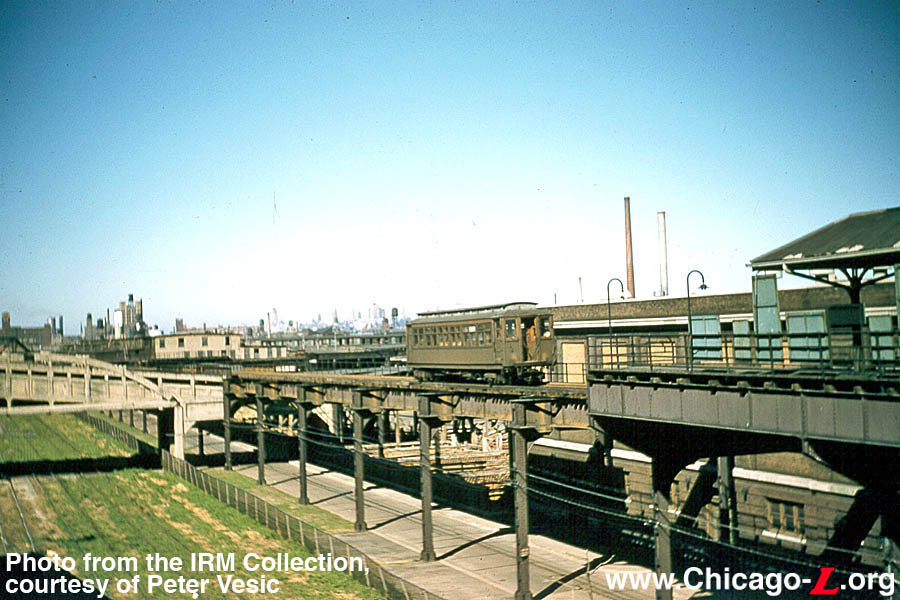
The view looking west along Van Bure Street under the Loop "L" on July 24, 1957. The "L" went further west from here until 1955, when a new connection was built through the old Wells Street Terminal a short distance north of here. The Insurance Exchange building is at right.

The view looking west along Van Bure Street under the Loop “L” on July 24, 1957. The “L” went further west from here until 1955, when a new connection was built through the old Wells Street Terminal a short distance north of here. The Insurance Exchange building is at right.

Philadelphia Suburban Transportation Company (aka Red Arrow) car 63 has turned north at Llanerch Junction on May 30, 1964.  It was most likely operating on the Ardmore line, which was converted to bus on December 30, 1966.  Kenneth Achtert adds, "PSTC #63 is indeed on the Ardmore Division (having just turned off of West Chester Pike) probably on a fantrip, as May 30, 1964, was a Saturday (and Memorial Day weekend)."

Philadelphia Suburban Transportation Company (aka Red Arrow) car 63 has turned north at Llanerch Junction on May 30, 1964. It was most likely operating on the Ardmore line, which was converted to bus on December 30, 1966. Kenneth Achtert adds, “PSTC #63 is indeed on the Ardmore Division (having just turned off of West Chester Pike) probably on a fantrip, as May 30, 1964, was a Saturday (and Memorial Day weekend).”

SEPTA (Red Arrow) double-ended car 19 at the 69th Street Terminal storage yard on August 9, 1971. It was built by the St. Louis Car Company in 1949, and although it looks like a PCC car, it is not considered one, as it has standard motor components.

SEPTA (Red Arrow) double-ended car 19 at the 69th Street Terminal storage yard on August 9, 1971. It was built by the St. Louis Car Company in 1949, and although it looks like a PCC car, it is not considered one, as it has standard motor components.

A North Shore Line Electroliner heads southbound at North Chicago Junction on January 12, 1963, just over a week prior to abandonment.

A North Shore Line Electroliner heads southbound at North Chicago Junction on January 12, 1963, just over a week prior to abandonment.

Chicago Aurora and Elgin freight loco 2002 at Wheaton on August 6, 1939. Scanned from the original negative. (LaMar M. Kelley Photo)

Chicago Aurora and Elgin freight loco 2002 at Wheaton on August 6, 1939. Scanned from the original negative. (LaMar M. Kelley Photo)

Chicago Aurora and Elgin car 130 (ex-North shore Line) on April 13, 1943. (Malcolm D. McCarter Photo)

Chicago Aurora and Elgin car 130 (ex-North shore Line) on April 13, 1943. (Malcolm D. McCarter Photo)

Chicago Aurora and Elgin 600 (ex-Washington, Baltimore & Annapolis) and line car 5, on a Central Electric Railfans' Association fantrip.

Chicago Aurora and Elgin 600 (ex-Washington, Baltimore & Annapolis) and line car 5, on a Central Electric Railfans’ Association fantrip.

This time card for the Batavia branch of the Aurora, Eglin and Chicago (predecessor of the CA&E) dates to 1905, when the interurban began running trains to downtown Chicago over the Metropolitan West side "L".

This time card for the Batavia branch of the Aurora, Eglin and Chicago (predecessor of the CA&E) dates to 1905, when the interurban began running trains to downtown Chicago over the Metropolitan West side “L”.

Chicago Aurora and Elgin steel cars 412 and 416 are at the DesPlaines Avenue Terminal in Forest Park on July 23, 1955. After CA&E cut back service to here in 1953, riders could make a cross-platform change to ride the CTA Garfield Park "L" downtown, after paying another fare.

Chicago Aurora and Elgin steel cars 412 and 416 are at the DesPlaines Avenue Terminal in Forest Park on July 23, 1955. After CA&E cut back service to here in 1953, riders could make a cross-platform change to ride the CTA Garfield Park “L” downtown, after paying another fare.

Chicago Aurora and Elgin 416 at the DesPlaines Avenue Terminal in Forest Park on July 23, 1955. This is the view from the opposite direction as the last photo. There were two sets of platforms. The CA&E dropped off passengers at one platform, then traveled a short distance to pick others up at the other platform. CTA trains looped via a wooden trestle that went over the CA&E just west of here. This arrangement continued until the CA&E abruptly abandoned passenger service in the middle of the day on July 3, 1957. The CTA reconfigured the terminal and yard area in 1959, in conjunction with construction of the nearby expressway.

Chicago Aurora and Elgin 416 at the DesPlaines Avenue Terminal in Forest Park on July 23, 1955. This is the view from the opposite direction as the last photo. There were two sets of platforms. The CA&E dropped off passengers at one platform, then traveled a short distance to pick others up at the other platform. CTA trains looped via a wooden trestle that went over the CA&E just west of here. This arrangement continued until the CA&E abruptly abandoned passenger service in the middle of the day on July 3, 1957. The CTA reconfigured the terminal and yard area in 1959, in conjunction with construction of the nearby expressway.

Lehigh Valley Transit

During the first half of the 20th century, Lehigh Valley Transit operated an interurban line known as teh Liberty Bell route between Allentown, Pennsylvania and Philadelphia. 42 miles of the route were on LVT trackage, with the remaining 13 miles going into Philadelphia via shared trackage on the Philadelphia and Western.

The line ran through a lot of farmland and open areas, with numerous stops in small towns along the way. Several of the station buildings still exist.

The Liberty Bell line is considered one of the classic American interurbans, and had somewhat of a Midwestern character despite being located in Pennsylvania. Like many other interurbans, it fell into a decline due to the Great Depression and the rise of the automobile, but rather than pack it in, LVT decided to modernize in 1938. Several lightweight high speed cars were purchased second hand and helped keep the line going for more than a dozen additional years.

Traffic was good during World War II, but went into an irreversible decline after the war. With new highways siphoning off traffic, the interurban had no future and was abandoned in 1951. Even the replacement bus service did not last.

Here are some classic views of LVT interurbans and city streetcars. Nearly all were scanned from original negatives or slides.

A Lehigh Valley Transit lightweight high-speed car is southbound on the Philadelphia and Western, crossing over Matson Ford Road, approaching Conshohocken Road station in January 1947. (David H. Cope Photo)

A Lehigh Valley Transit lightweight high-speed car is southbound on the Philadelphia and Western, crossing over Matson Ford Road, approaching Conshohocken Road station in January 1947. (David H. Cope Photo)

A Liberty Bell Limited train leaving Allentown, PA. The interurban ran to Philadelphia until 1949, partially via the Philadelphia and Western. For the last two years, service was cut back to Norristown until the 1951 abandonment.

A Liberty Bell Limited train leaving Allentown, PA. The interurban ran to Philadelphia until 1949, partially via the Philadelphia and Western. For the last two years, service was cut back to Norristown until the 1951 abandonment.

Some Lehigh Valley Transit freight motors are at the Philadelphia and Western's Norristown Terminal on a foggy day. The P&W connected with the Liberty Bell interurban route that continued to Allentown until 1951.

Some Lehigh Valley Transit freight motors are at the Philadelphia and Western’s Norristown Terminal on a foggy day. The P&W connected with the Liberty Bell interurban route that continued to Allentown until 1951.

LVT 1023 (at left) has just passed another car on the streets of Norristown. The Pennsylvania license plate on the auto would indicate we are in an odd-numbered year (1947, 1949, or 1951). Kenneth Achtert: "#1023 is on Marshall siding with the Reading Railroad Elm Street yard to the right."

LVT 1023 (at left) has just passed another car on the streets of Norristown. The Pennsylvania license plate on the auto would indicate we are in an odd-numbered year (1947, 1949, or 1951). Kenneth Achtert: “#1023 is on Marshall siding with the Reading Railroad Elm Street yard to the right.”

LVT 1030 at the Allentown depot.

LVT 1030 at the Allentown depot.

LVT 1023 at the Allentown depot.

LVT 1023 at the Allentown depot.

Lehigh Valley Transit's Liberty Bell interurban was abandoned in September 1951, but the company still had various streetcar lines in the Allentown and Bethlehem area that continued. Here, we see LVT 357, operating on a stretch of Gillmore Street line private right of way known as the "Race Track." This picture was taken on October 26, 1952, the last day of streetcar service on the South Bethlehem Division (and there is a notice of the service change on the telephone pole at right). The last LVT streetcar ran in 1953.

Lehigh Valley Transit’s Liberty Bell interurban was abandoned in September 1951, but the company still had various streetcar lines in the Allentown and Bethlehem area that continued. Here, we see LVT 357, operating on a stretch of Gillmore Street line private right of way known as the “Race Track.” This picture was taken on October 26, 1952, the last day of streetcar service on the South Bethlehem Division (and there is a notice of the service change on the telephone pole at right). The last LVT streetcar ran in 1953.

LVT 963 passes a Liberty Bell car at the Allentown depot, while passengers board for the trip to Philadelphia.

LVT 963 passes a Liberty Bell car at the Allentown depot, while passengers board for the trip to Philadelphia.

An LVT Liberty Bell car is on a passing siding in Norristown, adjacent to a Reading Railroad yard for its electrified commuter rail service to Philadelphia. While the Liberty Bell line is long gone, commuter rail service to Norristown continues under SEPTA. Kenneth Achtert adds, "on Marshall siding NB with (Reading Railroad) Elm Street yard to the right."

An LVT Liberty Bell car is on a passing siding in Norristown, adjacent to a Reading Railroad yard for its electrified commuter rail service to Philadelphia. While the Liberty Bell line is long gone, commuter rail service to Norristown continues under SEPTA. Kenneth Achtert adds, “on Marshall siding NB with (Reading Railroad) Elm Street yard to the right.”

LVT city streetcar 908, signed for Fullerton. Don's Rail Photos: "908 was built by Brill Car Co in February 1917, #20206. It was rebuilt."

LVT city streetcar 908, signed for Fullerton. Don’s Rail Photos: “908 was built by Brill Car Co in February 1917, #20206. It was rebuilt.”

LVT 917, signed for the South Bethlehem route. Don's Rail Photos: "917 was built by Brill Car Co in February 1917, #20206. It was rebuilt."

LVT 917, signed for the South Bethlehem route. Don’s Rail Photos: “917 was built by Brill Car Co in February 1917, #20206. It was rebuilt.”

A southbound LVT Liberty Bell car on 8th Street crosses Walnut Street in Allentown.

A southbound LVT Liberty Bell car on 8th Street crosses Walnut Street in Allentown.

LVT Liberty Bell car 1005. Don's Rail Photos: "1005 was built by Cincinnati Car in June 1930, #3050, as C&LE 123. It was sold to LVT as 1005 in 1938 and scrapped in 1952."

LVT Liberty Bell car 1005. Don’s Rail Photos: “1005 was built by Cincinnati Car in June 1930, #3050, as C&LE 123. It was sold to LVT as 1005 in 1938 and scrapped in 1952.”

LVT city streetcar 924. It was built by Brill, around the time 1917-1919.

LVT city streetcar 924. It was built by Brill, around the time 1917-1919.

LVT city streetcar 927, signed for Albright. Don's Rail Photos: "927 was built by Brill Car Co in February 1919, #20706. It was rebuilt."

LVT city streetcar 927, signed for Albright. Don’s Rail Photos: “927 was built by Brill Car Co in February 1919, #20706. It was rebuilt.”

LVT city streetcars 908 (at right), and possibly 413 at left.

LVT city streetcars 908 (at right), and possibly 413 at left.

LVT city streetcar 908, signed for Albright.

LVT city streetcar 908, signed for Albright.

This is an amazing photograph. LVT 1001 is northbound in Norristown, passing the Rambo House Hotel. I assume this was a short distance from where the Liberty Bell met the Philadelphia and Western line. There is a circa 1950-51 Ford parked at right. The car sign just says Express instead of Philadelphia Express, as LVT cut back passenger service to Norristown in 1949. Their fleet of second-hand high speed cars was wearing out, in part due to having to climb hills in Pennsylvania, instead of the flat Midwest prairies they were designed to traverse. The car at left may have a 1951 Pennsylvania license plate, indicating this picture may have been taken shortly before the abandonment of rail service.

This is an amazing photograph. LVT 1001 is northbound in Norristown, passing the Rambo House Hotel. I assume this was a short distance from where the Liberty Bell met the Philadelphia and Western line. There is a circa 1950-51 Ford parked at right. The car sign just says Express instead of Philadelphia Express, as LVT cut back passenger service to Norristown in 1949. Their fleet of second-hand high speed cars was wearing out, in part due to having to climb hills in Pennsylvania, instead of the flat Midwest prairies they were designed to traverse. The car at left may have a 1951 Pennsylvania license plate, indicating this picture may have been taken shortly before the abandonment of rail service.

This picture was taken at the same location, and same time, as the previous image. We are in Norristown on Swede St. with Airy St. in the background, not far from the point where the LVT Liberty Bell line met the Philadelphia and Western. LVT 1002 is an outbound Allentown Limited. Kenneth Achtert: "#1002 is not yet headed to Allentown, but is backing up on Swede St. about to turn onto Airy St. (note that the front-end pole is up). These single-ended cars would unload at the Norristown Terminal (after through operation was halted) then would back up the 3-4 blocks on Swede and Airy Streets to Rink Loop, back around the loop, then back to the Terminal (now facing north) for the trip to Allentown."

This picture was taken at the same location, and same time, as the previous image. We are in Norristown on Swede St. with Airy St. in the background, not far from the point where the LVT Liberty Bell line met the Philadelphia and Western. LVT 1002 is an outbound Allentown Limited. Kenneth Achtert: “#1002 is not yet headed to Allentown, but is backing up on Swede St. about to turn onto Airy St. (note that the front-end pole is up). These single-ended cars would unload at the Norristown Terminal (after through operation was halted) then would back up the 3-4 blocks on Swede and Airy Streets to Rink Loop, back around the loop, then back to the Terminal (now facing north) for the trip to Allentown.”

LVT 1021 is operating as a northbound Allentown Limited. Most of the Liberty Bell route was single tracked, with passing sidings. This is Acorn Siding, located by Normandy Farms in Blue Bell, PA.

LVT 1021 is operating as a northbound Allentown Limited. Most of the Liberty Bell route was single tracked, with passing sidings. This is Acorn Siding, located by Normandy Farms in Blue Bell, PA.

The photographer took this picture while riding in a southbound Liberty Bell train on Markley Street in Norristown. Most of this was single track and we are on a passing siding. The northbound car approaching us could be 1021, and the picture probably dates to 1949-51, as the sign on the approaching car does not say Philadelphia. The Reading Company's Elm Street commuter train station is off to the right.

The photographer took this picture while riding in a southbound Liberty Bell train on Markley Street in Norristown. Most of this was single track and we are on a passing siding. The northbound car approaching us could be 1021, and the picture probably dates to 1949-51, as the sign on the approaching car does not say Philadelphia. The Reading Company’s Elm Street commuter train station is off to the right.

This LVT Philadelphia Limited car is at Nace Siding, which Wikipedia says was "in open country just north of Souderton and the Souderton carbarn."

This LVT Philadelphia Limited car is at Nace Siding, which Wikipedia says was “in open country just north of Souderton and the Souderton carbarn.”

Another picture at Nace Siding. The car is LVT 1008.

Another picture at Nace Siding. The car is LVT 1008.

This LVT car is signed as a Norristown Local, which dates the picture to circa 1949-51. Not sure of the exact house number location on Airy Street in Norristown, but it has just crossed Cherry Street.

This LVT car is signed as a Norristown Local, which dates the picture to circa 1949-51. Not sure of the exact house number location on Airy Street in Norristown, but it has just crossed Cherry Street.

A rear end view of LVT 1030 on Airy Street in Norristown, about to turn onto Swede Street towards the Philadelphia and Western station. As this car originally came from the Indiana Railroad, it was slightly different than the other lightweight high-speed cars, which started out as Cincinnati and Lake Erie "Red Devils." The IR cars were designed for multiple-unit operation, while the C&LE cars were not. Therefore, car 1030 had a more squared off back end. The C&LE cars were more rounded.

A rear end view of LVT 1030 on Airy Street in Norristown, about to turn onto Swede Street towards the Philadelphia and Western station. As this car originally came from the Indiana Railroad, it was slightly different than the other lightweight high-speed cars, which started out as Cincinnati and Lake Erie “Red Devils.” The IR cars were designed for multiple-unit operation, while the C&LE cars were not. Therefore, car 1030 had a more squared off back end. The C&LE cars were more rounded.

Another shot of LVT 908, signed for Fullerton.

Another shot of LVT 908, signed for Fullerton.

Original Slides For Sale

My friend Jeff Wien passed away nearly two years ago, and I inherited his extensive slide collection, which takes up a lot of space. His interests were very wide-ranging, far more so than mine. One of my resolutions for 2023 is to start going through this collection systematically and decide what to keep, and add to my own collection. Simply leaving all these slides in boxes does not do anyone any good.

It is a fact of life that you can’t keep everything and you can’t take it with you. Since the Trolley Dodger blog has ongoing expenses, and my book projects cost real money, I have decided to sell some of these slides to help defray expenses and de-clutter. Here are the first 30 slides I have listed on eBay. The process of going through these will take several years. I can still post the scanned images to the blog, as I have done below.

Most of the slides below were taken by the late James J. Buckley (1918-1994), who was an excellent photographer.

We continue to purchase prints, slides, and negatives for what we consider our core collection, which we hope will eventually end up at a proper institution that can make good use of it. Those things that do not fit into our core collection can be sold, and the proceeds will help in our overall efforts.

-David Sadowski

Chicago, Rock Island and Pacific Railroad 1974 Original 35mm Kodachrome Slide Subject: CRI&P 652-610-654 and 14 cars on train 5, intercity service to Rock Island, IL Location: Chicago IL Date: May 4, 1974 Photographer: James J. Buckley This is slide EBA030 in our internal filing system. From the Wikipedia: By the time Amtrak was formed in 1971, the once-proud Rock Island was down to just two intercity trains, the Chicago-Peoria Peoria Rocket and the Chicago-Rock Island Quad Cities Rocket, both of which now operated entirely within the borders of Illinois. However, the Rock Island opted against joining Amtrak, in part because the government assessed the Amtrak entrance fee based upon passenger miles operated in 1970. After concluding that the cost of joining would be greater than remaining in the passenger business, the railroad decided to "perform a public service for the state of Illinois" and continue intercity passenger operations. To help manage the service, the Rock Island hired National Association of Railroad Passengers founder Anthony Haswell as managing director of passenger services. The last two trains plied the Rock Island's Illinois Division as the track quality declined from 1971 through 1977. The transit times, once a speedy 2½ hours in the 1950s, had lengthened to a 4½ hour run by 1975. The State of Illinois continued to subsidize the service to keep it running. The track program of 1978 helped with main-line timekeeping, although the Rock Island's management decreed that the two trains were not to delay freight traffic on the route. By this time, both once-proud trains were down to just two coaches, powered by EMD E8 locomotives entering their second decade of service. With the trains frequently running with as many paying passengers as coaches in the train, Illinois withdrew its subsidy, and the two trains made their final runs on December 31, 1978. Link to eBay Listing

Chicago, Rock Island and Pacific Railroad 1974 Original 35mm Kodachrome Slide
Subject: CRI&P 652-610-654 and 14 cars on train 5, intercity service to Rock Island, IL
Location: Chicago IL
Date: May 4, 1974
Photographer: James J. Buckley
This is slide EBA030 in our internal filing system.
From the Wikipedia:
By the time Amtrak was formed in 1971, the once-proud Rock Island was down to just two intercity trains, the Chicago-Peoria Peoria Rocket and the Chicago-Rock Island Quad Cities Rocket, both of which now operated entirely within the borders of Illinois. However, the Rock Island opted against joining Amtrak, in part because the government assessed the Amtrak entrance fee based upon passenger miles operated in 1970. After concluding that the cost of joining would be greater than remaining in the passenger business, the railroad decided to “perform a public service for the state of Illinois” and continue intercity passenger operations. To help manage the service, the Rock Island hired National Association of Railroad Passengers founder Anthony Haswell as managing director of passenger services.
The last two trains plied the Rock Island’s Illinois Division as the track quality declined from 1971 through 1977. The transit times, once a speedy 2½ hours in the 1950s, had lengthened to a 4½ hour run by 1975. The State of Illinois continued to subsidize the service to keep it running. The track program of 1978 helped with main-line timekeeping, although the Rock Island’s management decreed that the two trains were not to delay freight traffic on the route. By this time, both once-proud trains were down to just two coaches, powered by EMD E8 locomotives entering their second decade of service. With the trains frequently running with as many paying passengers as coaches in the train, Illinois withdrew its subsidy, and the two trains made their final runs on December 31, 1978.
Link to eBay Listing

Santa Teresa Tram Rio de Janeiro Original 1974 35mm Kodachrome Slide Subject: CTCG 6 Location: Carioca (R10) Date: March 17, 1974 Photographer: James J. Buckley Link to eBay Listing

Santa Teresa Tram Rio de Janeiro Original 1974 35mm Kodachrome Slide
Subject: CTCG 6
Location: Carioca (R10)
Date: March 17, 1974
Photographer: James J. Buckley
Link to eBay Listing

Amtrak Conrail Train Valpo Local 1971 Original 35mm Kodachrome Slide Subject: CR 5780-5603 plus 3 commuter train to Valparaiso, IN Location: Chicago IL Date: May 14, 1977 Photographer: James J. Buckley From the Wikipedia: The Calumet, also commonly called the Valpo Local, was a 43.6-mile (70.2 km) passenger train route operated by Amtrak between Chicago and Valparaiso, Indiana. Despite Amtrak's mandate to provide only intercity service, the Calumet was a commuter train. Transferred from Conrail in 1979, the full route was shared with Amtrak's Broadway Limited until 1990; the Calumet was discontinued the next year. Link to eBay Listing

Amtrak Conrail Train Valpo Local 1971 Original 35mm Kodachrome Slide
Subject: CR 5780-5603 plus 3 commuter train to Valparaiso, IN
Location: Chicago IL
Date: May 14, 1977
Photographer: James J. Buckley
From the Wikipedia:
The Calumet, also commonly called the Valpo Local, was a 43.6-mile (70.2 km) passenger train route operated by Amtrak between Chicago and Valparaiso, Indiana. Despite Amtrak’s mandate to provide only intercity service, the Calumet was a commuter train. Transferred from Conrail in 1979, the full route was shared with Amtrak’s Broadway Limited until 1990; the Calumet was discontinued the next year.
Link to eBay Listing

Bolton Tram 66 Original 1985 35mm Kodachrome Slide UK Subject: Bolton Tram 66 Location: Fleetwood (on Blackpool Tramway, UK) Date: July 14, 1985 Photographer: James J. Buckley From The Bolton News: The Bolton 66 tramcar was built in 1901 as an open top eight-wheel double deck bogie tram by the Electric Railway and Tramway Carriage Works in Preston. Bolton 66, the only tram in Blackpool Transport's Heritage Tramcar fleet which does not originate in Blackpool, is well over one hundred years old and is still in good running order but that has not always been the case. At the beginning of the 1960's, Alan Ralphs and Bolton-born Derek Shepherd took the decision to attempt to restore the Bolton tramcar. After more than 40 years serving the people of Bolton, the tramcar spent twenty years as a semi derelict bodyshell on a farm on the moors above Bolton. However, with lots of enthusiasm, a group led by the duo, professional electrical engineer Derek Shepherd and supported by Alan Ralphs, spent many hours to completely restore the tram to a new condition taking them 18 years to complete. In June 1981 the tram was moved to Blackpool and started to operate on the seafront, where it has remained for the last 41 years, due to Covid the 40th anniversary was postponed until this year. Link to eBay Listing

Bolton Tram 66 Original 1985 35mm Kodachrome Slide UK
Subject: Bolton Tram 66
Location: Fleetwood (on Blackpool Tramway, UK)
Date: July 14, 1985
Photographer: James J. Buckley
From The Bolton News:
The Bolton 66 tramcar was built in 1901 as an open top eight-wheel double deck bogie tram by the Electric Railway and Tramway Carriage Works in Preston.
Bolton 66, the only tram in Blackpool Transport’s Heritage Tramcar fleet which does not originate in Blackpool, is well over one hundred years old and is still in good running order but that has not always been the case.
At the beginning of the 1960’s, Alan Ralphs and Bolton-born Derek Shepherd took the decision to attempt to restore the Bolton tramcar.
After more than 40 years serving the people of Bolton, the tramcar spent twenty years as a semi derelict bodyshell on a farm on the moors above Bolton.
However, with lots of enthusiasm, a group led by the duo, professional electrical engineer Derek Shepherd and supported by Alan Ralphs, spent many hours to completely restore the tram to a new condition taking them 18 years to complete.
In June 1981 the tram was moved to Blackpool and started to operate on the seafront, where it has remained for the last 41 years, due to Covid the 40th anniversary was postponed until this year.
Link to eBay Listing

Chicago, Rock Island and Pacific Railroad 1971 Original 35mm Kodachrome Slide Subject: CRI&P 664 and 6 cars, commuter train to Blue Island Location: 47th Street, Chicago IL Date: September 8, 1971 Photographer: James J. Buckley From the Wikipedia: Chicago commuter service The Rock Island also operated an extensive commuter train service in the Chicago area. The primary route ran from LaSalle Street Station to Joliet along the main line, and a spur line, known as the "Suburban Line" to Blue Island. The main-line trains supplanted the long-distance services that did not stop at the numerous stations on that route. The Suburban Line served the Beverly Hills area of Chicago as a branch leaving the main line at Gresham and heading due west, paralleling the Baltimore and Ohio Chicago Terminal Railroad passenger line before turning south. The Suburban Line made stops every four blocks along the way before rejoining the main line at Western Avenue Junction in Blue Island. From the 1920s on, the suburban services were operated using Pacific-type 4-6-2 locomotives and specially designed light-heavyweight coaches that with their late 1920s build dates became known as the "Capone" cars. The suburban service became well known in the diesel era, as the steam power was replaced, first with new EMD FP7s and ALCO RS-3s, with two Fairbanks-Morse units added later. In 1949, Pullman-built 2700-series cars arrived as the first air-conditioned commuter cars on the line. In the 1960s, the Rock Island tried to upgrade the suburban service with newer equipment at lower cost. Second-hand Aerotrains, while less than successful in intercity service, were purchased to provide further air-conditioned accommodations that had proven popular with the 2700 series cars. When the Milwaukee Road purchased new Budd Company stainless-steel, bilevel cars in 1961, the Rock Island elected to add to a subsequent order and took delivery of its first bilevel equipment in 1964. Power for these new cars was provided by orphaned passenger units: three EMD F7s, an EMD E6, and the two EMD AB6s. The engines were rebuilt with head end power to provide heat, air conditioning, and lighting for the new cars. In 1970, another order, this time for Pullman-built bilevel cars arrived to further supplement the fleet. To provide the power for these cars, several former Union Pacific EMD E8 and EMD E9 diesels were also rebuilt with head end power and added to the commuter pool. The outdoor passenger concourse and platforms of LaSalle Street Station as built and operated by Metra. The trains shown are commuter runs to Blue Island and Joliet, Illinois. The commuter service was not exempt from the general decline of the Rock Island through the 1970s. Over time, deferred maintenance took its toll on both track and rolling stock. On the Rock Island, the Capone cars were entering their sixth decade of service and the nearly 30-year-old 2700s suffered from severe corrosion due to the steel used in their construction. LaSalle Street Station, the service's downtown terminal, suffered from neglect and urban decay with the slab roof of the train shed literally falling apart, requiring its removal. By this time, the Rock Island could not afford to replace the clearly worn-out equipment. In 1976, the entire Chicago commuter rail system began to receive financial support from the state of Illinois through the Regional Transportation Authority. Operating funds were disbursed to all commuter operators, and the Rock Island was to be provided with new equipment to replace the tired 2700 series and Capone cars. New Budd bilevels that were near copies of the 1961 Milwaukee Road cars arrived in 1978. New EMD F40PH units arrived in late 1977 and, in summer, 1978, briefly could be seen hauling Capone cars. The Rock Island's commuter F and E units were relegated to freight service or the scrapyard. With the 1980 end of the Rock Island, the RTA purchased the suburban territory and remaining Rock Island commuter equipment from the estate, while the Chicago and North Western Railway took over operations for a year before the RTA began operating it directly in 1981. LaSalle Street Station was torn down and replaced with the Chicago Stock Exchange building, with a smaller commuter station located one block south of the old station. The RTA gradually rebuilt the track and added more new equipment to the service, leaving the property in better shape than it was in the Rock Island's heyday, albeit with less track. The Rock Island District, as the Rock Island's suburban service is now known, now operates as part of Metra, the Chicago commuter rail agency. Our resident South Side expert M.E. adds, "Your (or maybe the Wikipedia) text says "The Suburban Line served the Beverly Hills area of Chicago as a branch leaving the main line at Gresham and heading due west, paralleling the Baltimore and Ohio Chicago Terminal Railroad passenger line before turning south." The wording "paralleling the B&OCT RR passenger line" is not precise. On a sheet of paper, maybe the CRI&P and the B&OCT ran parallel, but in reality, they shared the ground-level trackage for about a mile. The CRI&P's first station on the Suburban Line (after leaving the Main Line) was at 89th and Loomis (1400 W.). It was (and still is) called Brainerd. One block of Loomis, between 89th and 90th Sts., became a business district. Just as the commuter lines to the north and west saw the development of business districts around commuter train stations, the CRI&P Suburban Line brought about business districts at Brainerd, 95th St., 99th St., 103rd St., and 111th St. At the western end of that shared mile, about a block west of Ashland Ave. (1600 W.), the B&OCT turned north while the CRI&P turned south. At the eastern end of the shared mile, a few blocks west of Vincennes (which at that point was about 1000 W.), the B&OCT kept going east while the CRI&P Suburban Line ascended to the Main Line and turned north. Way back (I'm talking about 1950 and earlier), the Halsted St. streetcar line went south on Vincennes, eventually ending at 111th and Sacramento (3000 W.) where it served a row of cemeteries along 111th. Southbound along Vincennes, at 89th St., having just gone under the CRI&P overhead Suburban Line junction with the Main Line, the streetcar line diverged from the street itself onto its own private right-of-way adjacent to the CRI&P Main Line. So 89th and Vincennes was at one time a nice place to watch railroad and streetcar activity." Link to eBay Listing

Chicago, Rock Island and Pacific Railroad 1971 Original 35mm Kodachrome Slide
Subject: CRI&P 664 and 6 cars, commuter train to Blue Island
Location: 47th Street, Chicago IL
Date: September 8, 1971
Photographer: James J. Buckley
From the Wikipedia:
Chicago commuter service
The Rock Island also operated an extensive commuter train service in the Chicago area. The primary route ran from LaSalle Street Station to Joliet along the main line, and a spur line, known as the “Suburban Line” to Blue Island. The main-line trains supplanted the long-distance services that did not stop at the numerous stations on that route. The Suburban Line served the Beverly Hills area of Chicago as a branch leaving the main line at Gresham and heading due west, paralleling the Baltimore and Ohio Chicago Terminal Railroad passenger line before turning south. The Suburban Line made stops every four blocks along the way before rejoining the main line at Western Avenue Junction in Blue Island.
From the 1920s on, the suburban services were operated using Pacific-type 4-6-2 locomotives and specially designed light-heavyweight coaches that with their late 1920s build dates became known as the “Capone” cars. The suburban service became well known in the diesel era, as the steam power was replaced, first with new EMD FP7s and ALCO RS-3s, with two Fairbanks-Morse units added later. In 1949, Pullman-built 2700-series cars arrived as the first air-conditioned commuter cars on the line.
In the 1960s, the Rock Island tried to upgrade the suburban service with newer equipment at lower cost. Second-hand Aerotrains, while less than successful in intercity service, were purchased to provide further air-conditioned accommodations that had proven popular with the 2700 series cars.
When the Milwaukee Road purchased new Budd Company stainless-steel, bilevel cars in 1961, the Rock Island elected to add to a subsequent order and took delivery of its first bilevel equipment in 1964. Power for these new cars was provided by orphaned passenger units: three EMD F7s, an EMD E6, and the two EMD AB6s. The engines were rebuilt with head end power to provide heat, air conditioning, and lighting for the new cars. In 1970, another order, this time for Pullman-built bilevel cars arrived to further supplement the fleet. To provide the power for these cars, several former Union Pacific EMD E8 and EMD E9 diesels were also rebuilt with head end power and added to the commuter pool.
The outdoor passenger concourse and platforms of LaSalle Street Station as built and operated by Metra. The trains shown are commuter runs to Blue Island and Joliet, Illinois.
The commuter service was not exempt from the general decline of the Rock Island through the 1970s. Over time, deferred maintenance took its toll on both track and rolling stock. On the Rock Island, the Capone cars were entering their sixth decade of service and the nearly 30-year-old 2700s suffered from severe corrosion due to the steel used in their construction. LaSalle Street Station, the service’s downtown terminal, suffered from neglect and urban decay with the slab roof of the train shed literally falling apart, requiring its removal. By this time, the Rock Island could not afford to replace the clearly worn-out equipment.
In 1976, the entire Chicago commuter rail system began to receive financial support from the state of Illinois through the Regional Transportation Authority. Operating funds were disbursed to all commuter operators, and the Rock Island was to be provided with new equipment to replace the tired 2700 series and Capone cars. New Budd bilevels that were near copies of the 1961 Milwaukee Road cars arrived in 1978. New EMD F40PH units arrived in late 1977 and, in summer, 1978, briefly could be seen hauling Capone cars. The Rock Island’s commuter F and E units were relegated to freight service or the scrapyard.
With the 1980 end of the Rock Island, the RTA purchased the suburban territory and remaining Rock Island commuter equipment from the estate, while the Chicago and North Western Railway took over operations for a year before the RTA began operating it directly in 1981. LaSalle Street Station was torn down and replaced with the Chicago Stock Exchange building, with a smaller commuter station located one block south of the old station. The RTA gradually rebuilt the track and added more new equipment to the service, leaving the property in better shape than it was in the Rock Island’s heyday, albeit with less track. The Rock Island District, as the Rock Island’s suburban service is now known, now operates as part of Metra, the Chicago commuter rail agency.
Our resident South Side expert M.E. adds, “Your (or maybe the Wikipedia) text says
“The Suburban Line served the Beverly Hills area of Chicago as a branch leaving the main line at Gresham and heading due west, paralleling the Baltimore and Ohio Chicago Terminal Railroad passenger line before turning south.” The wording “paralleling the B&OCT RR passenger line” is not precise. On a sheet of paper, maybe the CRI&P and the B&OCT ran parallel, but in reality, they shared the ground-level trackage for about a mile. The CRI&P’s first station on the Suburban Line (after leaving the Main Line) was at 89th and Loomis (1400 W.). It was (and still is) called Brainerd. One block of Loomis, between 89th and 90th Sts., became a business district. Just as the commuter lines to the north and west saw the development of business districts around commuter train stations, the CRI&P Suburban Line brought about business districts at Brainerd, 95th St., 99th St., 103rd St., and 111th St.
At the western end of that shared mile, about a block west of Ashland Ave. (1600 W.), the B&OCT turned north while the CRI&P turned south. At the eastern end of the shared mile, a few blocks west of Vincennes (which at that point was about 1000 W.), the B&OCT kept going east while the CRI&P Suburban Line ascended to the Main Line and turned north.
Way back (I’m talking about 1950 and earlier), the Halsted St. streetcar line went south on Vincennes, eventually ending at 111th and Sacramento (3000 W.) where it served a row of cemeteries along 111th. Southbound along Vincennes, at 89th St., having just gone under the CRI&P overhead Suburban Line junction with the Main Line, the streetcar line diverged from the street itself onto its own private right-of-way adjacent to the CRI&P Main Line. So 89th and Vincennes was at one time a nice place to watch railroad and streetcar activity.”
Link to eBay Listing

Amtrak Turboliner RTG 1978 Original 35mm Kodachrome Slide Subject: Amtrak RTG 6715, train 334 Location: Chicago, IL on route to Milwaukee Date: April 15, 1978 Photographer: James J. Buckley Link to eBay Listing

Amtrak Turboliner RTG 1978 Original 35mm Kodachrome Slide
Subject: Amtrak RTG 6715, train 334
Location: Chicago, IL on route to Milwaukee
Date: April 15, 1978
Photographer: James J. Buckley
Link to eBay Listing

mtrak RDC Train 1974 Original 35mm Kodachrome Slide Subject: Amtrak RDCs 31-30-10, Train 370 Location: Cicero, IL (between Dubuque and Chicago) Date: June 24, 1974 Photographer: James J. Buckley Link to eBay Listing

mtrak RDC Train 1974 Original 35mm Kodachrome Slide
Subject: Amtrak RDCs 31-30-10, Train 370
Location: Cicero, IL (between Dubuque and Chicago)
Date: June 24, 1974
Photographer: James J. Buckley
Link to eBay Listing

Santa Teresa Tram Rio de Janeiro Original 1974 35mm Kodachrome Slide Subject: CTCG 7 Location: Carioca (R10) Date: March 17, 1974 Photographer: James J. Buckley From the Wikipedia: The Santa Teresa Tram, or Tramway (Portuguese: Bonde de Santa Teresa, IPA: [bõˈdʒi dʒi ˈsɐ̃tɐ teˈɾezɐ]), is a historic tram line in Rio de Janeiro, Brazil. It connects the city centre with the primarily residential, inner-city neighbourhood of Santa Teresa, in the hills immediately southwest of downtown. It is mainly maintained as a tourist attraction and is nowadays considered a heritage tramway system, having been designated a national historic monument in 1985. The line has a very unusual gauge: 1,100 mm (3 ft 7+5⁄16 in). The main line is 6.0 kilometres (3.7 miles) long. Having run continuously since its opening in 1877 (except for a 2011–15 suspension), it is one of the oldest street railway lines in the world and having been electrically powered since 1896, it is the oldest electric railway in all of Latin America. For many years it was also the only remaining metropolitan tram system in Brazil. The only other original tram systems in the country to have survived past 1971 are the Campos do Jordão interurban tram/light rail line, which continues to operate today, and the Itatinga line (near Bertioga), a rural and non-public tram line which had ceased operation as a tramway by 2017. All other cities closed their systems by 1971 (Santos being the last), but since that time, three towns, Belém, Campinas and Santos, have reinstated trams as heritage services. Rio de Janeiro opened a modern light rail/tram system in 2016. Link to eBay Listing

Santa Teresa Tram Rio de Janeiro Original 1974 35mm Kodachrome Slide
Subject: CTCG 7
Location: Carioca (R10)
Date: March 17, 1974
Photographer: James J. Buckley
From the Wikipedia:
The Santa Teresa Tram, or Tramway (Portuguese: Bonde de Santa Teresa, IPA: [bõˈdʒi dʒi ˈsɐ̃tɐ teˈɾezɐ]), is a historic tram line in Rio de Janeiro, Brazil. It connects the city centre with the primarily residential, inner-city neighbourhood of Santa Teresa, in the hills immediately southwest of downtown. It is mainly maintained as a tourist attraction and is nowadays considered a heritage tramway system, having been designated a national historic monument in 1985. The line has a very unusual gauge: 1,100 mm (3 ft 7+5⁄16 in). The main line is 6.0 kilometres (3.7 miles) long.
Having run continuously since its opening in 1877 (except for a 2011–15 suspension), it is one of the oldest street railway lines in the world and having been electrically powered since 1896, it is the oldest electric railway in all of Latin America. For many years it was also the only remaining metropolitan tram system in Brazil. The only other original tram systems in the country to have survived past 1971 are the Campos do Jordão interurban tram/light rail line, which continues to operate today, and the Itatinga line (near Bertioga), a rural and non-public tram line which had ceased operation as a tramway by 2017. All other cities closed their systems by 1971 (Santos being the last), but since that time, three towns, Belém, Campinas and Santos, have reinstated trams as heritage services. Rio de Janeiro opened a modern light rail/tram system in 2016.
Link to eBay Listing

Pittsburgh PAT PCC 1751 1974 35mm Kodachrome Slide Subject: Pittsburgh PAT PCC 1751 Location: Broadway near Neeld, Beechview, 42/38 route Date: May 21, 1974 Photographer: James J. Buckley Link to eBay Link

Pittsburgh PAT PCC 1751 1974 35mm Kodachrome Slide
Subject: Pittsburgh PAT PCC 1751
Location: Broadway near Neeld, Beechview, 42/38 route
Date: May 21, 1974
Photographer: James J. Buckley
Link to eBay Link

Santos Tramways São Paulo Brazil Original 1965 35mm Kodachrome Slide Subject: Serviço Municipal de Transportes Coletivos car 216 Location: Santos Date: March 12, 1965 Photographer: James J. Buckley Link to eBay Listing

Santos Tramways São Paulo Brazil Original 1965 35mm Kodachrome Slide
Subject: Serviço Municipal de Transportes Coletivos car 216
Location: Santos
Date: March 12, 1965
Photographer: James J. Buckley
Link to eBay Listing

Amtrak Turboliner RTG 1974 Original 35mm Kodachrome Slide Subject: Amtrak RTG 63-95-94-93-62 Location: Bloomington IL (on Chicago-St. Louis route) Date: November 2, 1974 Photographer: James J. Buckley Amtrak took over much of the nation's rail passenger service in 1971, and the Turboliners were an attempt to modernize. Ultimately, they proved unsuccessful for a variety of reasons, and were withdrawn from service in 1981. Some were rebuilt and were used in the Northeast Corridor from 1988-1994. Link to eBay Listing

Amtrak Turboliner RTG 1974 Original 35mm Kodachrome Slide
Subject: Amtrak RTG 63-95-94-93-62
Location: Bloomington IL (on Chicago-St. Louis route)
Date: November 2, 1974
Photographer: James J. Buckley
Amtrak took over much of the nation’s rail passenger service in 1971, and the Turboliners were an attempt to modernize. Ultimately, they proved unsuccessful for a variety of reasons, and were withdrawn from service in 1981. Some were rebuilt and were used in the Northeast Corridor from 1988-1994.
Link to eBay Listing

Milwaukee Road Electrification E71 1970 Original 35mm Kodachrome Slide Subject: Milwaukee Road E71 Location: East end of Butte, MT yard Date: October 2, 1970 Photographer: Unknown The Milwaukee Road operated an extensive system of electric freight in its Pacific Extension in the northwestern United States between 1914 and 1974. Link to eBay Listing

Milwaukee Road Electrification E71 1970 Original 35mm Kodachrome Slide
Subject: Milwaukee Road E71
Location: East end of Butte, MT yard
Date: October 2, 1970
Photographer: Unknown
The Milwaukee Road operated an extensive system of electric freight in its Pacific Extension in the northwestern United States between 1914 and 1974.
Link to eBay Listing

Southern Pacific 4449 Steam Loco "Daylight" 1991 Original 35mm Kodachrome Slide Subject: SP 4449 Location: Benecia Date: May 17, 1991 Photographer: Unknown From the Wikipedia: Southern Pacific 4449, also known as the Daylight, is the only surviving example of Southern Pacific Railroad's "GS-4" class of 4-8-4 "Northern" type steam locomotives and one of only two GS-class locomotives surviving, the other being "GS-6" 4460 at the National Museum of Transportation in St. Louis, Missouri. GS is an abbreviation of "General Service" or "Golden State," a nickname for California (where the locomotive was operated in regular service). The locomotive was built by Lima Locomotive Works in Lima, Ohio for the Southern Pacific in May 1941; it received the red-and-orange "Daylight" paint scheme for the passenger trains of the same name which it hauled for most of its service career. No. 4449 was retired from revenue service in 1956 and put into storage. In 1958, the Southern Pacific donated the locomotive to the City of Portland, Oregon. The City then put the locomotive on static display in Oaks Amusement Park, where it remained until 1974. After this, No. 4449 was then restored to operation for use in the American Freedom Train, which toured the 48 contiguous United States as part of the nation's 1976 Bicentennial celebration. The locomotive has operated in excursion service throughout that area since 1984. The locomotive's operations are based at the Oregon Rail Heritage Center in Portland, Oregon where it is maintained by a group of volunteers named the Friends of SP 4449. In 1983, a poll of Trains magazine readers selected 4449 as being the most popular locomotive in the United States. Link to eBay Listing

Southern Pacific 4449 Steam Loco “Daylight” 1991 Original 35mm Kodachrome Slide
Subject: SP 4449
Location: Benecia
Date: May 17, 1991
Photographer: Unknown
From the Wikipedia:
Southern Pacific 4449, also known as the Daylight, is the only surviving example of Southern Pacific Railroad’s “GS-4” class of 4-8-4 “Northern” type steam locomotives and one of only two GS-class locomotives surviving, the other being “GS-6” 4460 at the National Museum of Transportation in St. Louis, Missouri. GS is an abbreviation of “General Service” or “Golden State,” a nickname for California (where the locomotive was operated in regular service).
The locomotive was built by Lima Locomotive Works in Lima, Ohio for the Southern Pacific in May 1941; it received the red-and-orange “Daylight” paint scheme for the passenger trains of the same name which it hauled for most of its service career. No. 4449 was retired from revenue service in 1956 and put into storage. In 1958, the Southern Pacific donated the locomotive to the City of Portland, Oregon. The City then put the locomotive on static display in Oaks Amusement Park, where it remained until 1974.
After this, No. 4449 was then restored to operation for use in the American Freedom Train, which toured the 48 contiguous United States as part of the nation’s 1976 Bicentennial celebration. The locomotive has operated in excursion service throughout that area since 1984.
The locomotive’s operations are based at the Oregon Rail Heritage Center in Portland, Oregon where it is maintained by a group of volunteers named the Friends of SP 4449. In 1983, a poll of Trains magazine readers selected 4449 as being the most popular locomotive in the United States.
Link to eBay Listing

Southern Pacific 4449 Steam Loco "Daylight" 1984 Original 35mm Kodachrome Slide Subject: SP 4449 Location: Unknown Date: May 8, 1984 Photographer: Unknown Link to eBay Listing

Southern Pacific 4449 Steam Loco “Daylight” 1984 Original 35mm Kodachrome Slide
Subject: SP 4449
Location: Unknown
Date: May 8, 1984
Photographer: Unknown
Link to eBay Listing

Illinois Central City of New Orleans 1966 Original 35mm Kodachrome Slide Subject: IC 4020-4015 Location: Chicago IL Date: July 10, 1966 Photographer: James J. Buckley From the Wikipedia: The City of New Orleans is an Amtrak passenger train which operates on an overnight schedule between Chicago and New Orleans. The train is a successor to the Illinois Central Railroad's Panama Limited. The original City of New Orleans began in 1947 as part of the Illinois Central Railroad, and was the longest daylight run in the United States. The daylight train under that name ran through 1971, when it was moved to an overnight schedule as the Panama Limited. The present name was brought back in 1981, still on an overnight schedule. The train is the subject of the bittersweet 1971 song "City of New Orleans", written by Steve Goodman. The train operates along a route that has been served in one form or another for over a century. The Panama Limited originally ran from 1911 to 1971, though the IC ran Chicago-New Orleans trains since the turn of the century. Additional corridor service is provided between Chicago and Carbondale, Illinois–the northern leg of the route–by the Illini and Saluki. Link to eBay Listing

Illinois Central City of New Orleans 1966 Original 35mm Kodachrome Slide
Subject: IC 4020-4015
Location: Chicago IL
Date: July 10, 1966
Photographer: James J. Buckley
From the Wikipedia:
The City of New Orleans is an Amtrak passenger train which operates on an overnight schedule between Chicago and New Orleans. The train is a successor to the Illinois Central Railroad’s Panama Limited.
The original City of New Orleans began in 1947 as part of the Illinois Central Railroad, and was the longest daylight run in the United States. The daylight train under that name ran through 1971, when it was moved to an overnight schedule as the Panama Limited. The present name was brought back in 1981, still on an overnight schedule. The train is the subject of the bittersweet 1971 song “City of New Orleans”, written by Steve Goodman.
The train operates along a route that has been served in one form or another for over a century. The Panama Limited originally ran from 1911 to 1971, though the IC ran Chicago-New Orleans trains since the turn of the century. Additional corridor service is provided between Chicago and Carbondale, Illinois–the northern leg of the route–by the Illini and Saluki.
Link to eBay Listing

Sao Paulo Brazil CMTC Tram 1807 ex-NYC 1965 Original 35mm Kodachrome Slide Subject: CMTC 807 (ex-Third Avenue Railway System, NYC) Location: Sao Paulo, Brazil Date: March 11, 1965 Photographer: James J. Buckley From www.tramz.com: Additions in later years included 75 center-door cars, called centex in São Paulo, acquired second-hand in 1947 from the Third Avenue Transit System in New York. Third Avenue Railway had built them for conduit operation in 1938; trolley poles were added in São Paulo, doors were removed on one side and they were numbered 1701-1849. These "Huffliners" ran twice as long in São Paulo as in New York. In 1947 the São Paulo tramway system had 689 trams: 252 single-truck open motors, 28 single-truck open trailers, 153 double-truck open motors, In 1960 CMTC announced that it would rid the city completely of trams by 1968. The Santa Amaro route, which ran mostly on private right-of-way, would be converted to rapid transit. Several short routes were abandoned in the early 1960s: Barra Funda, Vila Prudente, Brésser, Bosque, Jardim Paulista. After 1963 open trams ran only on the Belém line - it had no turning loop, so required double-end cars. July and August 1966 saw the abandonment of most of the major tram routes in the city: Lapa, Penha, Belém, Pinheiros, Perdizes, Angélica, São Judas Tadeu. In January 1967 the end came to the others: Ipiranga, Fábrica, Casa Verde and Alto da Vila Maria. Only the Santo Amaro line remained. Its inner terminus was cut back to Vila Mariana and henceforth São Paulo, like Rio de Janeiro, had only one standard-gauge trolley line running in an obscure area at the edge of town. On 27 March 1968, with thousands of weeping paulistas lining the route, a cortège of 12 camarões made a final roundtrip to Santo Amaro and ended 96 years of tram service in the city. Link to eBay Listing

Sao Paulo Brazil CMTC Tram 1807 ex-NYC 1965 Original 35mm Kodachrome Slide
Subject: CMTC 807 (ex-Third Avenue Railway System, NYC)
Location: Sao Paulo, Brazil
Date: March 11, 1965
Photographer: James J. Buckley
From http://www.tramz.com:
Additions in later years included 75 center-door cars, called centex in São Paulo, acquired second-hand in 1947 from the Third Avenue Transit System in New York. Third Avenue Railway had built them for conduit operation in 1938; trolley poles were added in São Paulo, doors were removed on one side and they were numbered 1701-1849. These “Huffliners” ran twice as long in São Paulo as in New York. In 1947 the São Paulo tramway system had 689 trams: 252 single-truck open motors, 28 single-truck open trailers, 153 double-truck open motors,
In 1960 CMTC announced that it would rid the city completely of trams by 1968. The Santa Amaro route, which ran mostly on private right-of-way, would be converted to rapid transit. Several short routes were abandoned in the early 1960s: Barra Funda, Vila Prudente, Brésser, Bosque, Jardim Paulista. After 1963 open trams ran only on the Belém line – it had no turning loop, so required double-end cars. July and August 1966 saw the abandonment of most of the major tram routes in the city: Lapa, Penha, Belém, Pinheiros, Perdizes, Angélica, São Judas Tadeu. In January 1967 the end came to the others: Ipiranga, Fábrica, Casa Verde and Alto da Vila Maria. Only the Santo Amaro line remained. Its inner terminus was cut back to Vila Mariana and henceforth São Paulo, like Rio de Janeiro, had only one standard-gauge trolley line running in an obscure area at the edge of town. On 27 March 1968, with thousands of weeping paulistas lining the route, a cortège of 12 camarões made a final roundtrip to Santo Amaro and ended 96 years of tram service in the city.
Link to eBay Listing

Toronto Streetcar TTC ALRV 4201 1988 Original 35mm Kodachrome Slide Subject: TTC ALRV 4201 Location: Lake Shore and Symons, Etibicoke, Ontario Date: May 30, 1988 Photographer: James J. Buckley Link to eBay Listing

Toronto Streetcar TTC ALRV 4201 1988 Original 35mm Kodachrome Slide
Subject: TTC ALRV 4201
Location: Lake Shore and Symons, Etibicoke, Ontario
Date: May 30, 1988
Photographer: James J. Buckley
Link to eBay Listing

Illinois Central City of New Orleans 1966 Original 35mm Kodachrome Slide Subject: IC 4039-4104-4031-4021 Location: Chicago IL Date: July 10, 1966 Photographer: James J. Buckley Link to eBay Listing

Illinois Central City of New Orleans 1966 Original 35mm Kodachrome Slide
Subject: IC 4039-4104-4031-4021
Location: Chicago IL
Date: July 10, 1966
Photographer: James J. Buckley
Link to eBay Listing

Santa Teresa Open Tram 4 Rio de Janeiro Brazil Original 1974 35mm Kodachrome Slide Subject: CTCG 4 Location: Carioca, Rio de Janeiro Date: March 17, 1974 Photographer: James J. Buckley Link to eBay Listing

Santa Teresa Open Tram 4 Rio de Janeiro Brazil Original 1974 35mm Kodachrome Slide
Subject: CTCG 4
Location: Carioca, Rio de Janeiro
Date: March 17, 1974
Photographer: James J. Buckley
Link to eBay Listing

Baltimore and Ohio Capitol Limited 1967 Original 35mm Kodachrome Slide Subject: B&O 1419-2415/8 Location: Capitol Limited Train 6 departing Chicago Date: September 16, 1967 Photographer: James J. Buckley From the Wikipedia: The Capitol Limited was an American passenger train run by the Baltimore and Ohio Railroad, originally between New York City and Grand Central Station in Chicago, Illinois, via Union Station, Washington, D.C., Baltimore and Pittsburgh. For almost 48 years, it was the B&O's flagship passenger train, noted for personalized service and innovation. At the time of its discontinuation on May 1, 1971, when Amtrak took over most rail passenger service in the U.S., the Capitol Limited operated between Washington and Chicago. Link to eBay Listing

Baltimore and Ohio Capitol Limited 1967 Original 35mm Kodachrome Slide
Subject: B&O 1419-2415/8
Location: Capitol Limited Train 6 departing Chicago
Date: September 16, 1967
Photographer: James J. Buckley
From the Wikipedia:
The Capitol Limited was an American passenger train run by the Baltimore and Ohio Railroad, originally between New York City and Grand Central Station in Chicago, Illinois, via Union Station, Washington, D.C., Baltimore and Pittsburgh. For almost 48 years, it was the B&O’s flagship passenger train, noted for personalized service and innovation. At the time of its discontinuation on May 1, 1971, when Amtrak took over most rail passenger service in the U.S., the Capitol Limited operated between Washington and Chicago.
Link to eBay Listing

Santos Tramways São Paulo Brazil Original 1965 35mm Kodachrome Slide Subject: Serviço Municipal de Transportes Coletivos cars 90-223 Location: Santos Date: March 12, 1965 Photographer: James J. Buckley Link to eBay Listing

Santos Tramways São Paulo Brazil Original 1965 35mm Kodachrome Slide
Subject: Serviço Municipal de Transportes Coletivos cars 90-223
Location: Santos
Date: March 12, 1965
Photographer: James J. Buckley
Link to eBay Listing

Santa Teresa Tram Rio de Janeiro Original 1974 35mm Kodachrome Slide Subject: CTCG 18 Location: Carioca (R10) Date: March 17, 1974 Photographer: James J. Buckley Link to eBay Listing

Santa Teresa Tram Rio de Janeiro Original 1974 35mm Kodachrome Slide
Subject: CTCG 18
Location: Carioca (R10)
Date: March 17, 1974
Photographer: James J. Buckley
Link to eBay Listing

Santa Teresa Tram Rio de Janeiro Original 1974 35mm Kodachrome Slide Subject: CTCG 17 Location: Carioca (R10) Date: March 17, 1974 Photographer: James J. Buckley From the Wikipedia: The Santa Teresa Tram, or Tramway (Portuguese: Bonde de Santa Teresa, IPA: [bõˈdʒi dʒi ˈsɐ̃tɐ teˈɾezɐ]), is a historic tram line in Rio de Janeiro, Brazil. It connects the city centre with the primarily residential, inner-city neighbourhood of Santa Teresa, in the hills immediately southwest of downtown. It is mainly maintained as a tourist attraction and is nowadays considered a heritage tramway system, having been designated a national historic monument in 1985. The line has a very unusual gauge: 1,100 mm (3 ft 7+5⁄16 in). The main line is 6.0 kilometres (3.7 miles) long. Having run continuously since its opening in 1877 (except for a 2011–15 suspension), it is one of the oldest street railway lines in the world and having been electrically powered since 1896, it is the oldest electric railway in all of Latin America. For many years it was also the only remaining metropolitan tram system in Brazil. The only other original tram systems in the country to have survived past 1971 are the Campos do Jordão interurban tram/light rail line, which continues to operate today, and the Itatinga line (near Bertioga), a rural and non-public tram line which had ceased operation as a tramway by 2017. All other cities closed their systems by 1971 (Santos being the last), but since that time, three towns, Belém, Campinas and Santos, have reinstated trams as heritage services. Rio de Janeiro opened a modern light rail/tram system in 2016. Link to eBay Listing

Santa Teresa Tram Rio de Janeiro Original 1974 35mm Kodachrome Slide
Subject: CTCG 17
Location: Carioca (R10)
Date: March 17, 1974
Photographer: James J. Buckley
From the Wikipedia:
The Santa Teresa Tram, or Tramway (Portuguese: Bonde de Santa Teresa, IPA: [bõˈdʒi dʒi ˈsɐ̃tɐ teˈɾezɐ]), is a historic tram line in Rio de Janeiro, Brazil. It connects the city centre with the primarily residential, inner-city neighbourhood of Santa Teresa, in the hills immediately southwest of downtown. It is mainly maintained as a tourist attraction and is nowadays considered a heritage tramway system, having been designated a national historic monument in 1985. The line has a very unusual gauge: 1,100 mm (3 ft 7+5⁄16 in). The main line is 6.0 kilometres (3.7 miles) long.
Having run continuously since its opening in 1877 (except for a 2011–15 suspension), it is one of the oldest street railway lines in the world and having been electrically powered since 1896, it is the oldest electric railway in all of Latin America. For many years it was also the only remaining metropolitan tram system in Brazil. The only other original tram systems in the country to have survived past 1971 are the Campos do Jordão interurban tram/light rail line, which continues to operate today, and the Itatinga line (near Bertioga), a rural and non-public tram line which had ceased operation as a tramway by 2017. All other cities closed their systems by 1971 (Santos being the last), but since that time, three towns, Belém, Campinas and Santos, have reinstated trams as heritage services. Rio de Janeiro opened a modern light rail/tram system in 2016.
Link to eBay Listing

Shaker Heights Rapid Transit PCC 41 Original 1968 35mm Kodachrome Slide Subject: SHRT PCC 41 Location: 55th Street, Cleveland OH Date: May 25, 1968 Photographer: James J. Buckley From Don's Rail Photos: "41 was built by St. Louis Car (Company) in 1946, #1655, as SLPS (St. Louis Public Service) 1766. It was sold as SHRT 41 in 1959 and converted to MU (multiple unit) operation after purchase. It was sold to Buckeye Lake Trolley in 1984." Link to eBay Listing

Shaker Heights Rapid Transit PCC 41 Original 1968 35mm Kodachrome Slide
Subject: SHRT PCC 41
Location: 55th Street, Cleveland OH
Date: May 25, 1968
Photographer: James J. Buckley
From Don’s Rail Photos: “41 was built by St. Louis Car (Company) in 1946, #1655, as SLPS (St. Louis Public Service) 1766. It was sold as SHRT 41 in 1959 and converted to MU (multiple unit) operation after purchase. It was sold to Buckeye Lake Trolley in 1984.”
Link to eBay Listing

Blackpool Tramway 40 Original 1985 35mm Kodachrome Slide UK Subject: Blackpool Tramway 40 Location: Fleetwood UK Date: July 14, 1985 Photographer: James J. Buckley Blackpool Tramway 40 was built in 1926 and retired in 1963. It has since been part of the collection at the Crich Tramway Village museum. Here, it is shown operating briefly once again on the Blackpool Tramway in 1985. Link to eBay Listing

Blackpool Tramway 40 Original 1985 35mm Kodachrome Slide UK
Subject: Blackpool Tramway 40
Location: Fleetwood UK
Date: July 14, 1985
Photographer: James J. Buckley
Blackpool Tramway 40 was built in 1926 and retired in 1963. It has since been part of the collection at the Crich Tramway Village museum. Here, it is shown operating briefly once again on the Blackpool Tramway in 1985.
Link to eBay Listing

Glasgow Tram 1297 Original 1985 35mm Kodachrome Slide UK Subject: Glasgow Tram 1297 Location: Fleetwood (on Blackpool Tramway, UK) Date: July 14, 1985 Photographer: James J. Buckley Glasgow Tram 1297 was built in 1948 and retired in 1962. It is part of the collection at the Crich Tramway Village museum. Here, it is shown operating on the Blackpool Tramway briefly in 1985. Link to eBay Listing

Glasgow Tram 1297 Original 1985 35mm Kodachrome Slide UK
Subject: Glasgow Tram 1297
Location: Fleetwood (on Blackpool Tramway, UK)
Date: July 14, 1985
Photographer: James J. Buckley
Glasgow Tram 1297 was built in 1948 and retired in 1962. It is part of the collection at the Crich Tramway Village museum. Here, it is shown operating on the Blackpool Tramway briefly in 1985.
Link to eBay Listing
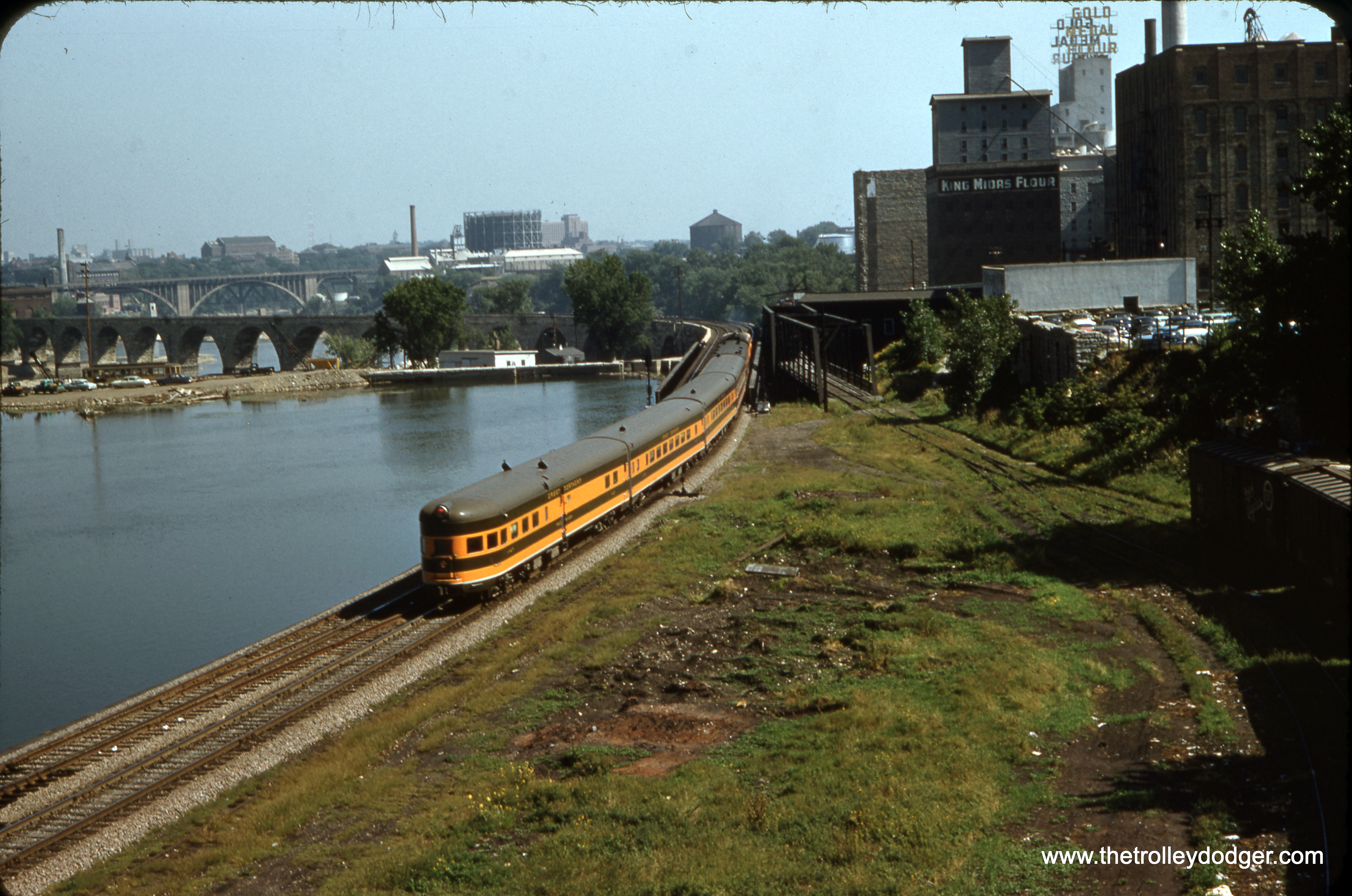
Great Northern Railway Red River 1954 Original 35mm Red Border Kodachrome Slide Subject: GNR 12 Location: Departing Minneapolis station for St. Paul Date: Fall 1954 Photographer: Unknown From the Wikipedia: The Red River was a passenger train operated by Great Northern Railway between Grand Forks, North Dakota, and Saint Paul, Minnesota (operating between 1950 and 1968). History Great Northern Railway's third new train set of 1950 was a new schedule named the Red River. The five-car streamliner built by American Car and Foundry Company began service June 25, 1950, operating a daily round trip 324 miles (521 km) each way between Grand Forks, North Dakota, and Saint Paul, Minnesota. The train went southbound in the morning returning northbound in the evening. The cars for the Red River streamliner were quite different than those built for the International (another 1950 introduction) in that the Red River's cars had extra insulation and the coaches were equipped with Baker Heaters as there was no steam heat available at the Grand Forks depot where the cars stood overnight. The locomotive was sent to the roundhouse each evening for any running repairs and service so the solution was the installation of the Baker Heaters in the cars. Link to eBay Listing

Great Northern Railway Red River 1954 Original 35mm Red Border Kodachrome Slide
Subject: GNR 12
Location: Departing Minneapolis station for St. Paul
Date: Fall 1954
Photographer: Unknown
From the Wikipedia:
The Red River was a passenger train operated by Great Northern Railway between Grand Forks, North Dakota, and Saint Paul, Minnesota (operating between 1950 and 1968).
History
Great Northern Railway’s third new train set of 1950 was a new schedule named the Red River. The five-car streamliner built by American Car and Foundry Company began service June 25, 1950, operating a daily round trip 324 miles (521 km) each way between Grand Forks, North Dakota, and Saint Paul, Minnesota. The train went southbound in the morning returning northbound in the evening.
The cars for the Red River streamliner were quite different than those built for the International (another 1950 introduction) in that the Red River’s cars had extra insulation and the coaches were equipped with Baker Heaters as there was no steam heat available at the Grand Forks depot where the cars stood overnight. The locomotive was sent to the roundhouse each evening for any running repairs and service so the solution was the installation of the Baker Heaters in the cars.
Link to eBay Listing

Amtrak RDC Train 1975 Original 35mm Kodachrome Slide Subject: Amtrak RDCs 30-32-15, Train 372 Blackhawk Location: Crawford (Chicago bound, between Dubuque and Chicago) Date: September 14, 1975 Photographer: James J. Buckley Link to eBay Listing

Amtrak RDC Train 1975 Original 35mm Kodachrome Slide
Subject: Amtrak RDCs 30-32-15, Train 372 Blackhawk
Location: Crawford (Chicago bound, between Dubuque and Chicago)
Date: September 14, 1975
Photographer: James J. Buckley
Link to eBay Listing

Milwaukee and Suburban Transport 1975 Original 35mm Kodachrome Slide Subject: M&ST 1466 Location: Wells-River (posed by the old Milwaukee Electric power plant) Date: June 29, 1975 Photographer: Jeff Wien Link to eBay Listing

Milwaukee and Suburban Transport 1975 Original 35mm Kodachrome Slide
Subject: M&ST 1466
Location: Wells-River (posed by the old Milwaukee Electric power plant)
Date: June 29, 1975
Photographer: Jeff Wien
Link to eBay Listing

Yakima Valley Transit Trolley 1975 Original 35mm Kodachrome Slide Subject: YVT 1776/1976 Location: 44th-Nob Hill, Yakima Date: June 1975 Photographer: Jeff Wien Link to eBay Listing

Yakima Valley Transit Trolley 1975 Original 35mm Kodachrome Slide
Subject: YVT 1776/1976
Location: 44th-Nob Hill, Yakima
Date: June 1975
Photographer: Jeff Wien
Link to eBay Listing

Our Latest Book, Now Available for Pre-Order:

The North Shore Line

Publication Date: February 20, 2023

FYI, my new Arcadia Publishing book The North Shore Line is now finished and has gone to press. My publisher decided to expand it to 160 pages, instead of the usual 128. That’s a 25% increase, without any change to the $23.99 price. I am quite pleased with how this turned out.

From the back cover:

As late as 1963, it was possible to board high-speed electric trains on Chicago’s famous Loop “L” that ran 90 miles north to Milwaukee. This was the Chicago North Shore & Milwaukee Railroad, commonly known as the North Shore Line. It rose from humble origins in the 1890s as a local streetcar line in Waukegan to eventually become America’s fastest interurban under the visionary management of Midwest utilities tycoon Samuel Insull. The North Shore Line, under Insull, became a worthy competitor to the established steam railroads. Hobbled by the Great Depression, the road fought back in 1941 with two streamlined, air-conditioned, articulated trains called Electroliners, which included dining service. It regained its popularity during World War II, when gasoline and tires were rationed, but eventually, it fell victim to highways and the automobile. The North Shore Line had intercity rail, commuter rail, electric freight, city streetcars, and even buses. It has been gone for nearly 60 years, but it will always remain the Road of Service.

Each copy purchased here will be signed by the author, and you will also receive a bonus North Shore Line map.  Books will ship by USPS Media Mail as soon as we receive them, on or before February 20, 2023.

Chapters:
01. Beginnings
02. The Milwaukee Division
03. The Shore Line Route
04. The Skokie Valley Route
05. The Mundelein Branch
06. On the “L”
07. City Streetcars
08. Trolley Freight
09. The Long Goodbye
10. The Legacy

Title The North Shore Line
Images of America
Author David Sadowski
Edition illustrated
Publisher Arcadia Publishing (SC), 2023
ISBN 1467108960, 978-1467108966
Length 160 pages

The price of $23.99 includes shipping within the United States.

For Shipping to US Addresses:

New Compact Disc, Now Available:

CTA-1
The Last Chicago Streetcars 1958
# of Discs – 1
Price: $15.99

Until now, it seemed as though audio recordings of Chicago streetcars were practically non-existent. For whatever reason, the late William A. Steventon does not appear to have made any for his Railroad Record Club, even though he did make other recordings in the Chicago area in 1956.

Now, audio recordings of the last runs of Chicago streetcars have been found, in the collections of the late Jeffrey L. Wien (who was one of the riders on that last car). We do not know who made these recordings, but this must have been done using a portable reel-to-reel machine.

These important recordings will finally fill a gap in transit history. The last Chicago Transit Authority streetcar finished its run in the early hours of June 21, 1958. Now you can experience these events just as Chicagoans did.

As a bonus, we have included Keeping Pace, a 1939 Chicago Surface Lines employee training program. This was digitally transferred from an original 16” transcription disc. These recordings were unheard for 80 years.

Total time – 74:38

Help Support The Trolley Dodger

This is our 295th post, and we are gradually creating a body of work and an online resource for the benefit of all railfans, everywhere. To date, we have received over 941,000 page views, for which we are very grateful.

You can help us continue our original transit research by checking out the fine products in our Online Store.
As we have said before, “If you buy here, we will be here.”

We thank you for your support.

DONATIONS

In order to continue giving you the kinds of historic railroad images that you have come to expect from The Trolley Dodger, we need your help and support. It costs money to maintain this website, and to do the sort of historic research that is our specialty.

Your financial contributions help make this web site better, and are greatly appreciated.


Catching Up

The photographer (possibly Emery Gulash) had but one chance to press the shutter button at precisely the right moment, and he nailed it with this classic view of westbound Electroliner train 803 at Lake Bluff in January 1963. This is what noted photographer Henri Cartier-Bresson had in mind when he wrote about the "decisive moment." Douglas Noble: "Northbound crossing Rockland Road / IL 176 in Lake Bluff."

The photographer (possibly Emery Gulash) had but one chance to press the shutter button at precisely the right moment, and he nailed it with this classic view of westbound Electroliner train 803 at Lake Bluff in January 1963. This is what noted photographer Henri Cartier-Bresson had in mind when he wrote about the “decisive moment.” Douglas Noble: “Northbound crossing Rockland Road / IL 176 in Lake Bluff.”

This is our first post in nearly two months. We have been hard at work on our next book, The North Shore Line. In addition, I worked 16 straight days as an election judge during the recent primary here.

Each of these posts involves a tremendous amount of hard work that may not be apparent to the causal observer. First, we have to scan the negatives, prints, and slides that you see here. Then, they have to be worked over in Photoshop to get the color and density right, and remove any scratches, crud, and other blemishes that have accumulated over the decades since these pictures were taken. This can take hours for just a single photograph, but we think the results are well worth it.

Our goal is to present definitive versions of these classic photos in an online archive for all to enjoy. We see our stuff showing up all over Facebook and other parts of the Internet all the time, and, recently, even in books and magazines put out by others.

It would be nice if, in all cases, we received some credit for our contributions. When people ask permission to use our work, it is freely granted, but all we ask is that we are properly credited, that the original photographer is credited, and that the small watermark we place on these images is not cropped out.

We don’t think this is too much to ask. Meanwhile, we hope you will enjoy this latest batch of classic photographs.

-David Sadowski

PS- You might also like our Trolley Dodger Facebook auxiliary, a private group that now has 862 members.

Our friend Kenneth Gear now has a Facebook group for the Railroad Record Club. If you enjoy listening to audio recordings of classic railroad trains, whether steam, electric, or diesel, you might consider joining.

Work on our North Shore Line book is ongoing. Donations are needed in order to bring this to a successful conclusion. You will find donation links at the top and bottom of each post. We thank you in advance for your time and consideration.

Recent Finds

The Chicago Surface Lines had a collection of historic streetcars, starting in the 1920s. These were used for parades and the opening of new lines. Some of the restoration work, such as this car, was more fanciful than authentic, as this car was never part of the West Chicago Street Railway, nor was it #4. Don's Rail Photos: "4 was built by Pullman in 1895, #840, as North Chicago Street RR 922. It became Chicago Union Traction Co 4022 in 1899 and became Chicago Surface Lines 4022 in 1914. It was rebuilt as WCStRy 4 in 1933. It went to Illinois Railway Museum in 1985." The CTA inherited this collection, and various cars were trotted out during shops tours in the 1950s. Once streetcar service ended in 1958, these cars were put into storage, and were finally donated to museums in the mid-1980s.

The Chicago Surface Lines had a collection of historic streetcars, starting in the 1920s.
These were used for parades and the opening of new lines. Some of the restoration work, such as this car, was more fanciful than authentic, as this car was never part of the West Chicago Street Railway, nor was it #4. Don’s Rail Photos: “4 was built by Pullman in 1895, #840, as North Chicago Street RR 922. It became Chicago Union Traction Co 4022 in 1899 and became Chicago Surface Lines 4022 in 1914. It was rebuilt as WCStRy 4 in 1933. It went to Illinois Railway Museum in 1985.” The CTA inherited this collection, and various cars were trotted out during shops tours in the 1950s. Once streetcar service ended in 1958, these cars were put into storage, and were finally donated to museums in the mid-1980s.

Brooklyn-Queens Transit PCC 1066 is signed for Coney Island in the early 1950s.

Brooklyn-Queens Transit PCC 1066 is signed for Coney Island in the early 1950s.

A train of CTA curved-door 6000s is at Howard Street in June 1977.

A train of CTA curved-door 6000s is at Howard Street in June 1977.

A southbound North Shore Line train, with 711 in the lead, is at Morse on the "L" in June 1959.

A southbound North Shore Line train, with 711 in the lead, is at Morse on the “L” in June 1959.

North Shore Line cars 157 and 252 are on a June 16, 1962 fantrip. Here, we see the train at the Root River bridge near Racine, Wisconsin. (Richard H. Young Photo)

North Shore Line cars 157 and 252 are on a June 16, 1962 fantrip. Here, we see the train at the Root River bridge near Racine, Wisconsin. (Richard H. Young Photo)

This is a South Shore Line portable substation at Michigan City, Indiana on July 10, 1977.

This is a South Shore Line portable substation at Michigan City, Indiana on July 10, 1977.

Philadelphia Suburban Transportation Company (aka Red Arrow) cars 16 and 20 in May 1965, signed for the Media line. Kenneth Achtert: "Appears to be outbound at Springfield Rd. I would assume this is on a fantrip from the number of random individuals around the right-of-way (most likely a run-by since they are scattered about); also, the Media destination would not be standard operating procedure for two-car trains. The trains were typically scheduled to Springfield (Woodland Ave.) with only single cars going all the way to Media." Jeff Didlake says, "I agree with Ken Achtert's thoughts that this is a fan trip, but I believe the location is the Scenic Rd. station on the Media Line. The track is on a slight curve and a hint of the red brick high rise Drexelline Apts. is in the background. I know this station well as I managed to ruin a good tire and wheel while pulling into the parking lot there on a poorly maintained Springfield Twp. sewer inlet grate."

Philadelphia Suburban Transportation Company (aka Red Arrow) cars 16 and 20 in May 1965, signed for the Media line. Kenneth Achtert: “Appears to be outbound at Springfield Rd. I would assume this is on a fantrip from the number of random individuals around the right-of-way (most likely a run-by since they are scattered about); also, the Media destination would not be standard operating procedure for two-car trains. The trains were typically scheduled to Springfield (Woodland Ave.) with only single cars going all the way to Media.” Jeff Didlake says, “I agree with Ken Achtert’s thoughts that this is a fan trip, but I believe the location is the Scenic Rd. station on the Media Line. The track is on a slight curve and a hint of the red brick high rise Drexelline Apts. is in the background. I know this station well as I managed to ruin a good tire and wheel while pulling into the parking lot there on a poorly maintained Springfield Twp. sewer inlet grate.”

On June 11, 1962, a two-car North Shore Line train, headed by 731, is bound for Mundelein near Lake Bluff. (Richard H. Young Photo)

On June 11, 1962, a two-car North Shore Line train, headed by 731, is bound for Mundelein near Lake Bluff. (Richard H. Young Photo)

North Shore Line combine 251 is near Racine, Wisconsin on February 6, 1962.

North Shore Line combine 251 is near Racine, Wisconsin on February 6, 1962.

The interior of Queensborough Bridge Railway car 601 in the mid-1950s. This was an Electromobile, built around 1929 by Osgood-Bradley.

The interior of Queensborough Bridge Railway car 601 in the mid-1950s. This was an Electromobile, built around 1929 by Osgood-Bradley.

North Shore Line car 733 awaiting scrapping at South Upton Junction on October 26, 1963, several months after abandonment.

North Shore Line car 733 awaiting scrapping at South Upton Junction on October 26, 1963, several months after abandonment.

North Shore Line Silverliner 758 is at Edison Court in Waukegan during the summer of 1958. This was an important station, where cars were routinely added and cut from trains.

North Shore Line Silverliner 758 is at Edison Court in Waukegan during the summer of 1958. This was an important station, where cars were routinely added and cut from trains.

Philadelphia PCC 2142 is signed for Route 6 on September 15, 1957. Mark A. Jones writes, "That picture is of the northbound terminus of route 6 across from Willow Grove Park. 2142 is headed south to Broad and Olney." Kenneth Achtert adds, "2142 is at Willow Grove Park, the end of the Route 6. The amusement park is hidden behind the trees."

Philadelphia PCC 2142 is signed for Route 6 on September 15, 1957. Mark A. Jones writes, “That picture is of the northbound terminus of route 6 across from Willow Grove Park. 2142 is headed south to Broad and Olney.” Kenneth Achtert adds, “2142 is at Willow Grove Park, the end of the Route 6. The amusement park is hidden behind the trees.”

North Shore Line loco 455 is working the Niles Gas Spur in the Weber Industrial District, Skokie, Illinois, probably in the late 1950s. (Bob Geis Photo)

North Shore Line loco 455 is working the Niles Gas Spur in the Weber Industrial District, Skokie, Illinois, probably in the late 1950s. (Bob Geis Photo)

Chicago Surface Lines one-man car 6241 is at the east end of Route 43 in the 1940s. You can see a pedestrian bridge leading to the nearby Illinois Central Electric commuter station behind the streetcar.

Chicago Surface Lines one-man car 6241 is at the east end of Route 43 in the 1940s. You can see a pedestrian bridge leading to the nearby Illinois Central Electric commuter station behind the streetcar.

A North Shore Line train at Winnetka Road on the Skokie Valley Route. The business at left is John H. Davies and Son, general contractors.

A North Shore Line train at Winnetka Road on the Skokie Valley Route. The business at left is John H. Davies and Son, general contractors.

A three-car North Shore Line train heads south over the 6th Street Bridge, probably in the 1940s.

A three-car North Shore Line train heads south over the 6th Street Bridge, probably in the 1940s.

North Shore Line cars 716 and 409 at Highwood, possibly in the early 1940s. 409 started out as a dining car motor before it was converted to coach in 1942.

North Shore Line cars 716 and 409 at Highwood, possibly in the early 1940s. 409 started out as a dining car motor before it was converted to coach in 1942.

North Shore Line loco 455 heads up a freight train that is crossing over to the northbound track near Oakton on the Skokie Valley Route.

North Shore Line loco 455 heads up a freight train that is crossing over to the northbound track near Oakton on the Skokie Valley Route.

A three-car train of North Shore Line Silverliners prepares to cross the North Shore Channel, probably in the 1950s.

A three-car train of North Shore Line Silverliners prepares to cross the North Shore Channel, probably in the 1950s.

To get a shot like this in the 1940s, a photographer had to be extremely lucky, patient, or both. While a two-car CRT Lake Street "L" train heads east, going up the ramp towards Laramie, it passes a westbound CSL Route 16 streetcar. Two conductors on the "L" are lowering the trolley poles, as this was the switchover point to third rail. Streetcar service on Lake Street ended in 1954, and the outer portion of the Lake Street "L" was shifted over to the nearby C&NW embankment in 1962.

To get a shot like this in the 1940s, a photographer had to be extremely lucky, patient, or both. While a two-car CRT Lake Street “L” train heads east, going up the ramp towards Laramie, it passes a westbound CSL Route 16 streetcar. Two conductors on the “L” are lowering the trolley poles, as this was the switchover point to third rail. Streetcar service on Lake Street ended in 1954, and the outer portion of the Lake Street “L” was shifted over to the nearby C&NW embankment in 1962.

CTA PCC 7148 is at 71st and Ashland in June 1953. (Vic Wagner Photo) Our resident south side expert M. E. notes, "I don't doubt this photo is at 71st and Ashland. (The street sign says Ashland.) So this photo is near the 69th and Ashland carbarn. I think this streetcar had been heading south on Ashland to 71st, and here it is turning west on 71st St. for what would be a short distance. Then it will turn north and into the carbarn."

CTA PCC 7148 is at 71st and Ashland in June 1953. (Vic Wagner Photo) Our resident south side expert M. E. notes, “I don’t doubt this photo is at 71st and Ashland. (The street sign says Ashland.) So this photo is near the 69th and Ashland carbarn. I think this streetcar had been heading south on Ashland to 71st, and here it is turning west on 71st St. for what would be a short distance. Then it will turn north and into the carbarn.”

CTA one-man streetcar 3228 is on 79th Street at the crossing with the Illinois Central in April 1951. (Vic Wagner Photo)

CTA one-man streetcar 3228 is on 79th Street at the crossing with the Illinois Central in April 1951. (Vic Wagner Photo)

The view looking north along State Street at 63rd in April 1953. The PCCs are running on Route 36, while the red Pullman is eastbound on Route 63. This was near the end of streetcar service on 63rd Street, and older red cars had replaced newer PCCs, which were shifted to run on Route 4 - Cottage Grove. At right, you can see where some buildings were destroyed by fire on May 25, 1950, after a PCC collided with a gasoline truck. 34 people were killed. The photographer was standing on a railroad viaduct and probably wanted to document the intersection of two streetcar lines before one of them changed to buses. (Vic Wagner Photo)

The view looking north along State Street at 63rd in April 1953. The PCCs are running on Route 36, while the red Pullman is eastbound on Route 63. This was near the end of streetcar service on 63rd Street, and older red cars had replaced newer PCCs, which were shifted to run on Route 4 – Cottage Grove. At right, you can see where some buildings were destroyed by fire on May 25, 1950, after a PCC collided with a gasoline truck. 34 people were killed. The photographer was standing on a railroad viaduct and probably wanted to document the intersection of two streetcar lines before one of them changed to buses. (Vic Wagner Photo)

About the image above, M. E. adds:

Your caption reads: “This was near the end of streetcar service on 63rd Street, and older red cars had replaced newer PCCs, which were shifted to run on Route 4 – Cottage Grove.” My hangup is with the term “newer PCCs”. Yes, they were newer than the red cars, but they were not newer than the PCCs on State St. in the photo. The PCCs that ran on 63rd St. were those that Chicago Surface Lines acquired in 1936 to run on Madison St. Those PCCs were also called “pre-war PCCs”. So perhaps your caption might better say “older red cars had replaced the pre-war PCCs, which were shifted …”

I give you credit for pointing out where a State St. PCC car collided with a gasoline truck. I remember that like it happened yesterday. I also credit the photographer for a terrific action photo.

Also, about this photo:

(1) In the distance is the State St. station on the Englewood L, situated south of 59th St. I spy two more State St. PCC cars at or near the L station. This illustrates how busy the north/south PCC car lines were. The Chicago Surface Lines, then the CTA, ordered a total of 600 post-war PCCs, and they were all needed on just five north/south lines — 36 Broadway/State, 22 Clark/Wentworth, 8 Halsted, 42 Halsted/Archer/Clark, and 49 Western. (The pre-war PCCs were still on 20 Madison.)

(2) You mentioned that the photographer was standing on a railroad viaduct. That viaduct spanned State St. just south of 63rd St. The photographer was at the eastern edge of a big freight yard paralleling the New York Central right of way. It is this same freight yard that was used, three blocks east, to deliver new PCC cars, then (later) L cars, to the CTA. The L cars were transferred to the CTA via the L track that ran from the southbound Jackson Park line south past 63rd St. and then down into a ground-level freight yard.

(3) That freight yard also spanned 63rd St., so the westbound red car shown in the photo is about to go underneath the freight yard until it emerges past the New York Central (and Nickel Plate) passenger train tracks, adjacent to the entrance to Englewood Union Station. Past the station, 63rd St. ran under more tracks, first the Rock Island, then the Pennsylvania, both of which also served Englewood Union Station. All told, the trip between State St. and almost to Wentworth Av. was mostly dark 24 hours a day.

(4) The billboard at the left in the photo advertises the ’53 Ford. Assuming this photo was taken in late spring or early summer of 1953 (judging by the clothing on pedestrians and the green foliage), I don’t see any ’53 Fords in the photo.

Buses replaced streetcars on 63rd Street on May 24, 1953, so the picture can’t be from after that, thanks.

The CTA off-street loop on Halsted Street, just south of 79th, in August 1953. Pullman PCC 4368 is operating on Route 8, while the red Pullman is signed for Halsted-Downtown (Route 42). By this stage, the Pullman PCCs, although no more than seven years old, were being retired and sent to St. Louis Car Company for scrapping and parts re-use in new PCC "L" cars. Service was being supplemented by older red cars. Streetcar service on Halsted ended in May 1954. (Vic Wagner Photo) Our resident south side expert M. E. adds, "Notice how busy this terminal was. I count at least four streetcars, and perhaps a fifth if I detect another trolley pole behind the last PCC car. This terminal also served South Halsted and Halsted / Vincennes / 111th St. buses, which used the paved lane in the terminal."

The CTA off-street loop on Halsted Street, just south of 79th, in August 1953. Pullman PCC 4368 is operating on Route 8, while the red Pullman is signed for Halsted-Downtown (Route 42). By this stage, the Pullman PCCs, although no more than seven years old, were being retired and sent to St. Louis Car Company for scrapping and parts re-use in new PCC “L” cars. Service was being supplemented by older red cars. Streetcar service on Halsted ended in May 1954. (Vic Wagner Photo) Our resident south side expert M. E. adds, “Notice how busy this terminal was. I count at least four streetcars, and perhaps a fifth if I detect another trolley pole behind the last PCC car. This terminal also served South Halsted and Halsted / Vincennes / 111th St. buses, which used the paved lane in the terminal.”

CTA one-man streetcar 3261 is at the east end of Route 79, at 79th and Brandon near Chicago's lakefront, in September 1951. (Vic Wagner Photo)

CTA one-man streetcar 3261 is at the east end of Route 79, at 79th and Brandon near Chicago’s lakefront, in September 1951. (Vic Wagner Photo)

Milwaukee Electric (Speedrail) car 1121 operated on a North Shore Line fantrip on December 4, 1949. Here it is with one of the Electroliners near Racine, Wisconsin.

Milwaukee Electric (Speedrail) car 1121 operated on a North Shore Line fantrip on December 4, 1949. Here it is with one of the Electroliners near Racine, Wisconsin.

The pass for Central Electric Railfans' Association fantrip #36, which used freight equipment on the Chicago Aurora and Elgin on August 10, 1941.

The pass for Central Electric Railfans’ Association fantrip #36, which used freight equipment on the Chicago Aurora and Elgin on August 10, 1941.

The Chicago and North Western station at Lake Forest in the early 1900s, from a real photo postcard. The Chicago and Milwaukee electric (which became the North Shore Line in 1916) ran just beyond those large trees, and had a handsome station of its own just out of view to the right.

The Chicago and North Western station at Lake Forest in the early 1900s, from a real photo postcard. The Chicago and Milwaukee electric (which became the North Shore Line in 1916) ran just beyond those large trees, and had a handsome station of its own just out of view to the right.

This picture was taken during Fall 1962, in the waning days of the ground-level operation of the Lake Street "L". The new elevated station on the nearby C&NW embankment has been built and the changeover took place on October 28th of that year. This view looks west along South Boulevard at Marion Street in Oak Park. Crossing gates were manually operated.

This picture was taken during Fall 1962, in the waning days of the ground-level operation of the Lake Street “L”. The new elevated station on the nearby C&NW embankment has been built and the changeover took place on October 28th of that year. This view looks west along South Boulevard at Marion Street in Oak Park. Crossing gates were manually operated.

On February 19, 1956, a northbound Electroliner has stopped at Kenosha and is presumably on a fantrip. (William C. Hoffman Photo)

On February 19, 1956, a northbound Electroliner has stopped at Kenosha and is presumably on a fantrip. (William C. Hoffman Photo)

Speedrail curved-side car 61 is on Michigan at 6th Street in Milwaukee on September 2, 1950, passing by the north side of the North Shore Line's Milwaukee Terminal. (William C. Hoffman Photo)

Speedrail curved-side car 61 is on Michigan at 6th Street in Milwaukee on September 2, 1950, passing by the north side of the North Shore Line’s Milwaukee Terminal. (William C. Hoffman Photo)

Milwaukee and Suburban Transport streetcar 954 is westbound on Route 10 at 68th and Fairview in August 1957.

Milwaukee and Suburban Transport streetcar 954 is westbound on Route 10 at 68th and Fairview in August 1957.

The same location in 2015. The streetcar tracks were just to the right of this alley.

The same location in 2015. The streetcar tracks were just to the right of this alley.

On June 12, 1955, Milwaukee and Suburban Transport streetcar 999 is on a bridge over the Chicago & North Western Railway at Howell Avenue. This was a Central Electric Railfans' Association fantrip. (William C. Hoffman Photo)

On June 12, 1955, Milwaukee and Suburban Transport streetcar 999 is on a bridge over the Chicago & North Western Railway at Howell Avenue. This was a Central Electric Railfans’ Association fantrip. (William C. Hoffman Photo)

North Shore Line Silverliner 766 is about to cross the Glencoe gauntlet, a short single-track section on the otherwise double-tracked Shore Line Route. The occasion was an August 9, 1953 fantrip. This short bridge over a ravine was not deemed strong enough to support the weight of two trains passing each other, so it was made single-tracked. This also permitted a tight curve to be straightened out a bit. (William C. Hoffman Photo)

North Shore Line Silverliner 766 is about to cross the Glencoe gauntlet, a short single-track section on the otherwise double-tracked Shore Line Route. The occasion was an August 9, 1953 fantrip. This short bridge over a ravine was not deemed strong enough to support the weight of two trains passing each other, so it was made single-tracked. This also permitted a tight curve to be straightened out a bit. (William C. Hoffman Photo)

North Shore Line car 155 is on the tail end of a fantrip train, turning onto Greenleaf Avenue in Wilmette, heading east on a July 24, 1955 Central Electric Railfans' Association fantrip. (William C. Hoffman Photo)

North Shore Line car 155 is on the tail end of a fantrip train, turning onto Greenleaf Avenue in Wilmette, heading east on a July 24, 1955 Central Electric Railfans’ Association fantrip. (William C. Hoffman Photo)

North Shore Line freight loco 456 and caboose 1002 are at the scale house in Rondout during January 1963. (Photo attributed to Emery Gulash)

North Shore Line freight loco 456 and caboose 1002 are at the scale house in Rondout during January 1963. (Photo attributed to Emery Gulash)

North Shore Line freight loco 456 and caboose 1002 are at the scale house in Rondout during January 1963. (Photo attributed to Emery Gulash)

North Shore Line freight loco 456 and caboose 1002 are at the scale house in Rondout during January 1963. (Photo attributed to Emery Gulash)

North Shore Line cars 157 and 252 are on a June 16, 1962 fantrip. We have posted pictures from this trip before. There is another in this post, taken by Richard H. Young, but this one may be by Emery Gulash.

North Shore Line cars 157 and 252 are on a June 16, 1962 fantrip. We have posted pictures from this trip before. There is another in this post, taken by Richard H. Young, but this one may be by Emery Gulash.

Don's Rail Photos: "1796 was built by American Car & Foundry in 1907 as NEWRy 287, #5098, as trailer. It was renumbered 1287 in 1913 and rebuilt as motor 1796. It became CRT 1796 in 1923 and was sold to Gaylord Container in Louisiana..." One side of this "L" car was removed, and it was used to transport large rolls of paper. Although Don's says this car was scrapped in 1966, that is incorrect and the date was actually 1973. Parts were salvaged from this car to help restore sister car 1797 at the Illinois Railway Museum. 1796 could not be saved since the body was no longer structurally sound. I have July 1958 as the date when the CTA sold this car, and this picture was taken by William C. Hoffman in October 1963.

Don’s Rail Photos: “1796 was built by American Car & Foundry in 1907 as NEWRy 287, #5098, as trailer. It was renumbered 1287 in 1913 and rebuilt as motor 1796. It became CRT 1796 in 1923 and was sold to Gaylord Container in Louisiana…” One side of this “L” car was removed, and it was used to transport large rolls of paper. Although Don’s says this car was scrapped in 1966, that is incorrect and the date was actually 1973. Parts were salvaged from this car to help restore sister car 1797 at the Illinois Railway Museum. 1796 could not be saved since the body was no longer structurally sound. I have July 1958 as the date when the CTA sold this car, and this picture was taken by William C. Hoffman in October 1963.

Mystery Photo

This was scanned from an original North Shore Line 8x10" nitrate negative, taken circa 1930, and in the collections of Robert Heinlein. Determining the location presented many challenges, yet this has now been determined with the aid of other fans. The car is 714, and it is signed as a Chicago Local on the Shore Line Route. Since the North Shore tracks are not adjacent to the Chicago and North Western, we must be north of North Chicago Junction. We cannot be south of Highland Park, as there is freight present here. A sign on the high-level platform indicates that freight trains have to come to a stop, most likely to make sure part of the platform gets flipped up for the sake of clearances. A similar arrangement existed at high-level stations of the Chicago Aurora and Elgin. As all the Shore Line tracks in Waukegan ran on the street, that pretty much narrows it down to North Chicago. The Thomas J. Killian Plumbing Supply company building at left clinches it, and the location is between 16th and 17th Streets, looking north. The Chicago and North Western's tracks were a short distance east of here, to the right out of view of this photo. (Courtesy of Kevin Heinlein)

This was scanned from an original North Shore Line 8×10″ nitrate negative, taken circa 1930, and in the collections of Robert Heinlein. Determining the location presented many challenges, yet this has now been determined with the aid of other fans. The car is 714, and it is signed as a Chicago Local on the Shore Line Route. Since the North Shore tracks are not adjacent to the Chicago and North Western, we must be north of North Chicago Junction. We cannot be south of Highland Park, as there is freight present here. A sign on the high-level platform indicates that freight trains have to come to a stop, most likely to make sure part of the platform gets flipped up for the sake of clearances. A similar arrangement existed at high-level stations of the Chicago Aurora and Elgin. As all the Shore Line tracks in Waukegan ran on the street, that pretty much narrows it down to North Chicago. The Thomas J. Killian Plumbing Supply company building at left clinches it, and the location is between 16th and 17th Streets, looking north. The Chicago and North Western’s tracks were a short distance east of here, to the right out of view of this photo. (Courtesy of Kevin Heinlein)

A close-up view of car 714, which seems to be painted orange.

A close-up view of car 714, which seems to be painted orange.

The freight siding for the Thomas J. Killian Plumbing Supply Company.

The freight siding for the Thomas J. Killian Plumbing Supply Company.

This was also scanned from an original North Shore Line 8x10" nitrate negative in the collections of Robert Heinlein, and was taken at the same time as the previous photo and shows a slightly different view of the same scene. (Courtesy of Kevin Heinlein)

This was also scanned from an original North Shore Line 8×10″ nitrate negative in the collections of Robert Heinlein, and was taken at the same time as the previous photo and shows a slightly different view of the same scene. (Courtesy of Kevin Heinlein)

Ray DeGroote Turns 92

Ray DeGroote celebrated his 92nd birthday on July 15th. Here he is about two weeks earlier, at our celebratory lunch.

Ray DeGroote celebrated his 92nd birthday on July 15th. Here he is about two weeks earlier, at our celebratory lunch.

I dedicated my last book Chicago’s Lost “L”s to my friend Raymond DeGroote, Jr., as the “Dean of Chicago Railfans.” He turned 92 recently. Ray has traveled the world, and has taken thousands of great photos, many of which have been used in books, magazines, and in his excellent slideshows over the years.

And he’s still at it– Ray recently returned from a trip to San Diego for the Electric Railroaders’ Association annual convention. Since returning, other friends have treated him to lunch, and he reports he is “well fed.”

Here are a few of Ray’s classic photos of the North Shore Line:

We are at Indian Hill on the Shore Line Route on July 24, 1955, just prior to abandonment. Cars 175 and 413 are in regular service, while 155 is on a Central Electric Railfans' Association fantrip, and has temporarily been shunted to a siding. The tracks in this area were grade-separated circa 1938-43 by a project partially funded by the Federal government. (Raymond DeGroote, Jr. Photo)

We are at Indian Hill on the Shore Line Route on July 24, 1955, just prior to abandonment. Cars 175 and 413 are in regular service, while 155 is on a Central Electric Railfans’ Association fantrip, and has temporarily been shunted to a siding. The tracks in this area were grade-separated circa 1938-43 by a project partially funded by the Federal government. (Raymond DeGroote, Jr. Photo)

A fantrip train made up of Silverliners is on Greenleaf Avenue in Wilmette on February 20, 1955. This trip was sponsored by the Illini Railroad Club. (Raymond DeGroote, Jr. Photo)

A fantrip train made up of Silverliners is on Greenleaf Avenue in Wilmette on February 20, 1955. This trip was sponsored by the Illini Railroad Club. (Raymond DeGroote, Jr. Photo)

North Shore Line loco 459 and caboose 1006 are at Lake Bluff on January 19, 1963. (Raymond DeGroote, Jr. Photo)

North Shore Line loco 459 and caboose 1006 are at Lake Bluff on January 19, 1963. (Raymond DeGroote, Jr. Photo)

The "KX" here most likely refers to Kodachrome X, first released by Kodak in 1962, with a film speed of 64. The original Kodachrome had a film speed of ASA/ISO 10, which was bumped up to 25 in 1961 with the release of Kodachrome II.

The “KX” here most likely refers to Kodachrome X, first released by Kodak in 1962, with a film speed of 64. The original Kodachrome had a film speed of ASA/ISO 10, which was bumped up to 25 in 1961 with the release of Kodachrome II.

The unrestored interior of North Shore Line car 151 on September 4, 1961. (Raymond DeGroote, Jr. Photo)

The unrestored interior of North Shore Line car 151 on September 4, 1961. (Raymond DeGroote, Jr. Photo)

The interior of North Shore Line car 160 on January 12, 1963. Interestingly, it had been refurbished in November 1962, even though abandonment was at hand. This car was purchased by the Illinois Railway Museum, where it remains today. (Raymond DeGroote, Jr. Photo)

The interior of North Shore Line car 160 on January 12, 1963. Interestingly, it had been refurbished in November 1962, even though abandonment was at hand. This car was purchased by the Illinois Railway Museum, where it remains today. (Raymond DeGroote, Jr. Photo)

North Shore Line car 714's interior on June 17, 1962. This car is now at the Illinois Railway Museum. (Raymond DeGroote, Jr. Photo)

North Shore Line car 714’s interior on June 17, 1962. This car is now at the Illinois Railway Museum. (Raymond DeGroote, Jr. Photo)

The interior of North Shore Line Silverliner 755 on September 4, 1961. After abandonment, this car went to the Seashore Trolley Museum in Maine. (Raymond DeGroote, Jr. Photo)

The interior of North Shore Line Silverliner 755 on September 4, 1961. After abandonment, this car went to the Seashore Trolley Museum in Maine. (Raymond DeGroote, Jr. Photo)

Recent Correspondence

Max Hensley sent us this scan of a 1890 specimen $1,000 bond for the West Chicago Street Railroad Tunnel Company. This cable car tunnel was built in 1893 and crossed the Chicago River near Van Buren Street. Like the other river tunnels, it was eventually enlarged and dug deeper around 1911 for streetcar use. But of the three such tunnels (the others being on Washington and LaSalle Streets), Van Buren was used the least, and does not seem to have seen much action after 1924, except for training use. These tunnels still exist but the approaches have been filled in.

The river tunnels are also discussed at length in my book Building Chicago’s Subways.

Milwaukee Streetcar

We were in Milwaukee on July 13th to help a friend move some things. We did stop by Burns Commons for a few minutes to catch a few pictures (and one video) of Milwaukee’s modern streetcar at its northern terminus:

Did Not Win

Try as we might, our resources are limited. Here are some interesting items that we were not able to purchase, but are still worth a second look:

This desktop ink blotter dates to circa 1919-20, as the North Shore Line is already running via the "L", but had not yet opened their new Milwaukee Terminal. The line to Mundelein is shown, as it had been extended there as of 1905. But prior to 1925, it was called Rockefeller, and later, the area was known rather generically as "Area." When using a fountain pen, you would wipe off excess ink on the backside of blotters such as this, which measured about 6" wide.

This desktop ink blotter dates to circa 1919-20, as the North Shore Line is already running via the “L”, but had not yet opened their new Milwaukee Terminal. The line to Mundelein is shown, as it had been extended there as of 1905. But prior to 1925, it was called Rockefeller, and later, the area was known rather generically as “Area.” When using a fountain pen, you would wipe off excess ink on the backside of blotters such as this, which measured about 6″ wide.

This real photo postcard view of the Elgin and Belvedere Electric Company was most likely taken on its inaugural run in early 1907. Mike Franklin has identified the location as Belvedere, as that is the First M. E. Church at rear. Car 201 was built by the St. Louis Car Company in 1906. (Thanks to J. J. Sedelmaier for tweaking this image.)

This real photo postcard view of the Elgin and Belvedere Electric Company was most likely taken on its inaugural run in early 1907. Mike Franklin has identified the location as Belvedere, as that is the First M. E. Church at rear. Car 201 was built by the St. Louis Car Company in 1906. (Thanks to J. J. Sedelmaier for tweaking this image.)

Here is what the late Don Ross wrote about the Elgin and Belvedere:

This line was built in 1906 and opened in 1907 between Elgin and Belvidere, 36 miles, to connect the Rockford lines with the Chicago lines. It was under the management of Bion J. Arnold, who was the most distinguished expert in city transit between 1900 and 1925. In 1927 the Rockford to Belvidere segment of the Rockford & Interurban was merged to form the Elgin Belvidere & Rockford. Rockford lightweight interurbans were used, but this was not financially satisfactory. The cars were returned to Rockford Public Service, and the old E&B cars were remodeled for one man service. But it was too late. Competition from the parallel Chicago & North Western and from the automobile caused the line to quit service on March 9, 1930. Arnold purchased two Manhattan Elevated steam locomotives and scrapped the line by himself. It was not completed until the mid to late 1930s.

In 1956, I was checking on ownership of an abandoned C&NW right-of-way for the Illinois Railway Museum, and I stopped in the county clerk’s office in Woodstock. The clerk became curious and then suggested that we might be interested in a piece of property which was on the delinquent tax rolls. It was 50 feet wide and 7 miles long. After paying the taxes for two years, a quit claim was filed and this has become the home of the IRM at Union, IL.

We ran some Elgin and Belvedere photos in a previous post, taken in the mid-1930s by the late Edward Frank, Jr., showing the interurban’s rolling stock in dead storage, waiting for buyers that never materialized.

Keep those cards and letters coming in, folks!

-David Sadowski

Now Available:

SGA-1
Stan Griffith Audio Recordings of the North Shore Line
# of Discs – 1
Price: $15.99

The late Stanwood C. Griffith (1926-2013) was an interesting character who is probably best known for building the two-foot gauge Rock River Valley Traction, a miniature electric railway that is large enough to ride on. He began building it on private property in a mysterious wooded area somewhere near Rockford, IL around 1950. Work continues on it to this day, and there are several videos of it on YouTube.

We only recently found out that he recorded some North Shore Line audio. Even better, what he did record is different than the other known recordings by William A. Steventon and Brad Miller.

Mr. Griffith made the only known recordings of the Shore Line Route, which quit in 1955. Steventon didn’t record NSL until the following year, and the Miller recordings are circa 1960.

This recording has some occasional narration. At one point, Griffith notes that the trolley bus wires in Kenosha are gone. Trolley buses ran there until 1952, so this dates the recordings to circa 1952-55.

He also recorded North Shore Line street running in Milwaukee, which is also unique as far as I am aware. There are also recordings of Milwaukee streetcars on this CD.

Total time – 52:36


Chicago’s Lost “L”s Online Presentation

We recently gave an online presentation about our book Chicago’s Lost “L”s for the Chicago Public Library, as part of their One Book, One Chicago series. You can watch it online by following this link.

The Trolley Dodger On the Air

We appeared on the Dave Plier Show on WGN radio on July 16, 2021, to discuss Chicago’s Lost “L”s. You can hear that discussion here.

Our Latest Book, Now Available:

Chicago’s Lost “L”s

From the back cover:

Chicago’s system of elevated railways, known locally as the “L,” has run continuously since 1892 and, like the city, has never stood still. It helped neighborhoods grow, brought their increasingly diverse populations together, and gave the famous Loop its name. But today’s system has changed radically over the years. Chicago’s Lost “L”s tells the story of former lines such as Garfield Park, Humboldt Park, Kenwood, Stockyards, Normal Park, Westchester, and Niles Center. It was once possible to take high-speed trains on the L directly to Aurora, Elgin, and Milwaukee, Wisconsin. The L started out as four different companies, two starting out using steam engines instead of electricity. Eventually, all four came together via the Union Loop. The L is more than a way of getting around. Its trains are a place where people meet and interact. Some say the best way to experience the city is via the L, with its second-story view. Chicago’s Lost “L”s is virtually a “secret history” of Chicago, and this is your ticket. David Sadowski grew up riding the L all over the city. He is the author of Chicago Trolleys and Building Chicago’s Subways and runs the online Trolley Dodger blog.

The Images of America series celebrates the history of neighborhoods, towns, and cities across the country. Using archival photographs, each title presents the distinctive stories from the past that shape the character of the community today. Arcadia is proud to play a part in the preservation of local heritage, making history available to all.

Title Chicago’s Lost “L”s
Images of America
Author David Sadowski
Edition illustrated
Publisher Arcadia Publishing (SC), 2021
ISBN 1467100007, 9781467100007
Length 128 pages

Chapters:
01. The South Side “L”
02. The Lake Street “L”
03. The Metropolitan “L”
04. The Northwestern “L”
05. The Union Loop
06. Lost Equipment
07. Lost Interurbans
08. Lost Terminals
09. Lost… and Found

Each copy purchased here will be signed by the author, and you will also receive a bonus facsimile of a 1926 Chicago Rapid Transit Company map, with interesting facts about the “L” on the reverse side.

The price of $23.99 includes shipping within the United States.

For Shipping to US Addresses:

For Shipping to Canada:

For Shipping Elsewhere:

Help Support The Trolley Dodger

This is our 290th post, and we are gradually creating a body of work and an online resource for the benefit of all railfans, everywhere. To date, we have received over 893,000 page views, for which we are very grateful.

You can help us continue our original transit research by checking out the fine products in our Online Store.
As we have said before, “If you buy here, we will be here.”

We thank you for your support.

DONATIONS

In order to continue giving you the kinds of historic railroad images that you have come to expect from The Trolley Dodger, we need your help and support. It costs money to maintain this website, and to do the sort of historic research that is our specialty.

Your financial contributions help make this web site better, and are greatly appreciated.


Work, Work, Work

This remarkable photo, taken circa 1955-57, shows a wooden CTA "L" car on the Stock Yards branch with cattle, and in color to boot. We are looking east from the Exchange station.

This remarkable photo, taken circa 1955-57, shows a wooden CTA “L” car on the Stock Yards branch with cattle, and in color to boot. We are looking east from the Exchange station.

It’s been a month since our last post, but it hasn’t been for lack of effort. Lately, it’s been work, work, work around here. We have been hard at work on our next book, which will be about the North Shore Line, doing research, scanning, and collecting images.

We also have many new photo finds of our own, including 24 snapshots that we purchased as a batch. The photographer is not known, but must have been someone who traveled a lot, as there are pictures from Chicago, the Pittsburgh area, Milwaukee, and one other unidentified city.

The Pittsburgh photos are intriguing, as some of them appear to show the Pittsburgh Railways  interurban to Washington, PA, which ran PCC cars. There are some mysteries about the Milwaukee pictures as well.

Perhaps some of our readers can help identify the locations.

We received another batch of negatives from John V. Engleman, many of which are 60 years old, and have scanned a few dozen of these, mostly from the North Shore Line. Mr. Engleman is an excellent photographer and like the other photos of his we have shared in previous posts, there are many great shots, both black-and-white and color.

According to Mr. Engleman, he rode the North Shore Line twice– first in the summer of 1961, and then on the last full day of service, January 20, 1963. The extreme difference in weather should make it easy to tell which photos are which.

60-year-old color negatives present many challenges when scanning. The film has a base coat which has itself faded, just as the other colors in the image have, and it took a bit longer than usual to color correct these.

Then, there were the inevitable plethora of scratches and spots that had to be painstakingly removed using Photoshop. Working over each one of those images took me at least an hour, and sometimes longer. I could only do a few of these each day.

The color negs were 127 size, which is about four times as large as 35mm. So while early 1960s color negative film was grainy, the larger film size makes up for this to some extent, and the results are quite acceptable.

Mr. Engleman’s black-and-whites were shot on 120 film, which is even larger than 127, and presented no difficulties. We thank him profusely for generously sharing these previously unseen photos with our readers.

If a picture is worth 1000 words, then I say let these pictures speak for themselves. To me, they speak volumes.

Keep those cards and letters coming in, folks.

-David Sadowski

PS- You might also like our Trolley Dodger Facebook auxiliary, a private group that now has 713 members.

Our friend Kenneth Gear now has a Facebook group for the Railroad Record Club. If you enjoy listening to audio recordings of classic railroad trains, whether steam, electric, or diesel, you might consider joining.

Remembering Don Ross

It’s come to my attention that R. Donald Ross passed away on January 18th, aged 90. His career as a railfan photographer and historian began in 1946, and stretched out for more than 75 years. He cast a long shadow.

He started out as an avid photographer, and occasionally I will run across one with his name stamped on the back. But he was also an early, and active volunteer at railway museums, and scouted out possible locations for the Illinois Railway Museum when they had to vacate from the Chicago Hardware Foundry site in North Chicago.

He helped identify the former Elgin and Belvedere interurban right-of-way in Union as a potential site for the museum, where it is today. Other potential sites included the Chicago Aurora & Elgin‘s former Batavia branch, and the current sites of both the Fox River Trolley Museum and East Troy Railroad Museum.

In recent years, he worked hard at developing Don’s Rail Photos, a vast resource for information about hundreds of different railroads. This was not his only web site, as his interests ranged far afield.

I have not found an obituary for Mr. Ross. Nowadays, it doesn’t seem like everyone gets one. I don’t know what sort of provisions he made to continue his web site in the future, but it would be a shame if everything he worked so hard to create eventually disappears.

He will definitely be missed.

-David Sadowski

Our Annual Fundraiser

We are pleased to report we have exceeded our annual fundraising goal, with a total of $1055 received to date. These funds have already been put to good use, paying for our annual hosting fees, WordPress subscriptions, material for our next book, and for this blog.

We are very grateful to everyone who contributed. We could not continue this site without your kind assistance.

We accept donations 365 days a year. If you wish to help, there are links at the top and bottom of this page.

We thank you in advance for your time and consideration.

Photos by John V. Engleman

Silverliners at the Milwaukee terminal. (John V. Engleman Photo)

Silverliners at the Milwaukee terminal. (John V. Engleman Photo)

Silverliners at the Milwaukee terminal. (John V. Engleman Photo)

Silverliners at the Milwaukee terminal. (John V. Engleman Photo)

A great night shot of an Electroliner at Roosevelt Road in Chicago. This was the southern terminus for the North Shore Line for many years, and from 1949 to 1963 the interurban had this CTA station all to themselves. (John V. Engleman Photo)

A great night shot of an Electroliner at Roosevelt Road in Chicago. This was the southern terminus for the North Shore Line for many years, and from 1949 to 1963 the interurban had this CTA station all to themselves. (John V. Engleman Photo)

A rather blurry shot of an Electroliner at Roosevelt Road. (John V. Engleman Photo)

A rather blurry shot of an Electroliner at Roosevelt Road. (John V. Engleman Photo)

This is North Chicago. (John V. Engleman Photo)

This is North Chicago. (John V. Engleman Photo)

This is North Chicago. (John V. Engleman Photo)

This is North Chicago. (John V. Engleman Photo)

This has been identified as North Chicago. (John V. Engleman Photo)

This has been identified as North Chicago. (John V. Engleman Photo)

A stately Electroliner on a snowy day in Milwaukee. (John V. Engleman Photo)

A stately Electroliner on a snowy day in Milwaukee. (John V. Engleman Photo)

Roosevelt Road with car 255 in the pocket. (John V. Engleman Photo)

Roosevelt Road with car 255 in the pocket. (John V. Engleman Photo)

CTA trolley bus 9648 heads west, as seen from the Belmont "L" station. (John V. Engleman Photo)

CTA trolley bus 9648 heads west, as seen from the Belmont “L” station. (John V. Engleman Photo)

A great shot of an Electroliner at Roosevelt Road on a winter's day. (John V. Engleman Photo)

A great shot of an Electroliner at Roosevelt Road on a winter’s day. (John V. Engleman Photo)

Roosevelt Road. (John V. Engleman Photo)

Roosevelt Road. (John V. Engleman Photo)

The Milwaukee Terminal. (John V. Engleman Photo)

The Milwaukee Terminal. (John V. Engleman Photo)

The Milwaukee Terminal. (John V. Engleman Photo)

The Milwaukee Terminal. (John V. Engleman Photo)

Although this image was spoiled by a double exposure, it is still a nice view of the Milwaukee Terminal in winter. (John V. Engleman Photo)

Although this image was spoiled by a double exposure, it is still a nice view of the Milwaukee Terminal in winter. (John V. Engleman Photo)

An Electroliner at the Milwaukee Terminal. (John V. Engleman Photo)

An Electroliner at the Milwaukee Terminal. (John V. Engleman Photo)

Here. we are looking north from the Belmont "L" station, and the platform at left was used only by southbound North Shore trains. As Graham Garfield's www.chicago-l.org website notes, "Beginning in 1919, North Shore Line interurban trains reached downtown Chicago over the North Side "L". Although the "L" and interurban services were separate and had different fares without free transfers, they shared a number of stops -- Belmont being one common stop -- with little effort to separate passengers. This was in large part because the North Shore Line and the "L" were both owned by common interests, led by Samuel Insull. This ended in 1947 when the CTA assumed ownership and operation of the "L", and thereafter the Authority was disinclined to allow free transfer of North Shore Line riders to the "L". Thus, from 1953 until the end of North Shore Line service in 1963, Belmont actually had three platforms: there was an additional very narrow North Shore Line exit-only platform built along the west side of the "L" structure, extending from the south side of Belmont Avenue to a point somewhat north of the ends of the center platforms. (Traffic-separation arrangements were also adopted at Howard and Wilson, but never at the other stations used by inbound North Shore trains.) Passengers could disembark on this platform only, and were deposited onto the sidewalk on Belmont. If they wanted to transfer to the "L", they had to reenter the station and pay another fare. Northbound North Shore Line trains continued to share the island platform used by "L" customers, although there was probably more boarding of the interurban northbound than alighting, and the North Shore Line had personnel aboard their trains to collect fares at all times." (John V. Engleman Photo)

Here. we are looking north from the Belmont “L” station, and the platform at left was used only by southbound North Shore trains.
As Graham Garfield’s http://www.chicago-l.org website notes, “Beginning in 1919, North Shore Line interurban trains reached downtown Chicago over the North Side “L”. Although the “L” and interurban services were separate and had different fares without free transfers, they shared a number of stops — Belmont being one common stop — with little effort to separate passengers. This was in large part because the North Shore Line and the “L” were both owned by common interests, led by Samuel Insull. This ended in 1947 when the CTA assumed ownership and operation of the “L”, and thereafter the Authority was disinclined to allow free transfer of North Shore Line riders to the “L”. Thus, from 1953 until the end of North Shore Line service in 1963, Belmont actually had three platforms: there was an additional very narrow North Shore Line exit-only platform built along the west side of the “L” structure, extending from the south side of Belmont Avenue to a point somewhat north of the ends of the center platforms. (Traffic-separation arrangements were also adopted at Howard and Wilson, but never at the other stations used by inbound North Shore trains.) Passengers could disembark on this platform only, and were deposited onto the sidewalk on Belmont. If they wanted to transfer to the “L”, they had to reenter the station and pay another fare. Northbound North Shore Line trains continued to share the island platform used by “L” customers, although there was probably more boarding of the interurban northbound than alighting, and the North Shore Line had personnel aboard their trains to collect fares at all times.” (John V. Engleman Photo)

NSL 771 and train are heading east at LaSalle and Van Buren on the Loop "L", making this a southbound train in the morning. (John V. Engleman Photo)

NSL 771 and train are heading east at LaSalle and Van Buren on the Loop “L”, making this a southbound train in the morning. (John V. Engleman Photo)

A Silverliner at the head of a train. Not sure of the location. (John V. Engleman Photo) Zach E. says this is 769 at Lake Bluff.

A Silverliner at the head of a train. Not sure of the location. (John V. Engleman Photo) Zach E. says this is 769 at Lake Bluff.

The Mundelein Terminal. (John V. Engleman Photo)

The Mundelein Terminal. (John V. Engleman Photo)

NSL 743 is northbound on the 6th Street Viaduct. (John V. Engleman Photo)

NSL 743 is northbound on the 6th Street Viaduct. (John V. Engleman Photo)

North Shore Line Silverliners at the Milwaukee Terminal. (John V. Engleman Photo)

North Shore Line Silverliners at the Milwaukee Terminal. (John V. Engleman Photo)

A southbound Silverliner at Belmont. (John V. Engleman Photo)

A southbound Silverliner at Belmont. (John V. Engleman Photo)

An Electroliner has arrived and its trolley pole hasn't yet been turned around. (John V. Engleman Photo)

An Electroliner has arrived and its trolley pole hasn’t yet been turned around. (John V. Engleman Photo)

Such a classic view of the Milwaukee Terminal. (John V. Engleman Photo)

Such a classic view of the Milwaukee Terminal.
(John V. Engleman Photo)

An Electroliner at the Milwaukee Terminal. (John V. Engleman Photo)

An Electroliner at the Milwaukee Terminal. (John V. Engleman Photo)

The Milwaukee Terminal. This picture, at least, could have been taken in 1962, judging by the nearby billboard. (John V. Engleman Photo)

The Milwaukee Terminal. This picture, at least, could have been taken in 1962, judging by the nearby billboard. (John V. Engleman Photo)

Red Pullman 460 at South Shops, as part of the CTA historical collection, possibly after the end of streetcar service, which ended in 1958. (John V. Engleman Photo)

Red Pullman 460 at South Shops, as part of the CTA historical collection, possibly after the end of streetcar service, which ended in 1958. (John V. Engleman Photo)

Prewar PCC 4021 and red Pullman 460 were part of the CTA's historical collection when this picture was taken at South Shops, possibly around 1959. Both cars are now at the Illinois Railway Museum. (John V. Engleman Photo)

Prewar PCC 4021 and red Pullman 460 were part of the CTA’s historical collection when this picture was taken at South Shops, possibly around 1959. Both cars are now at the Illinois Railway Museum. (John V. Engleman Photo)

This was scanned from a copy negative of an Electroliner in action. (John V. Engleman Collection)

This was scanned from a copy negative of an Electroliner in action. (John V. Engleman Collection)

The CTA Skokie Swift opened in April 1964, and it's possible this picture was taken not long after that at Dempster Street in Skokie. (John V. Engleman Photo) Spence Ziegler adds, "The Skokie Swift Car at Dempster St was taken after June, 1965 as the former North Shore Line catenary towers north of Dempster St. are gone."

The CTA Skokie Swift opened in April 1964, and it’s possible this picture was taken not long after that at Dempster Street in Skokie. (John V. Engleman Photo) Spence Ziegler adds, “The Skokie Swift Car at Dempster St was taken after June, 1965 as the former North Shore Line catenary towers north of Dempster St. are gone.”

It's not entirely clear just when this picture was taken at DesPlaines Avenue on the Congress line, but my guess is 1960-61. There are some CTA single-car units visible, and the first of these were delivered in 1960. But in this and the other shot, I don't see the shops building, which was completed in 1962. We are looking west, with the old Forest Park gas holder in the distance. (John V. Engleman Photo)

It’s not entirely clear just when this picture was taken at DesPlaines Avenue on the Congress line, but my guess is 1960-61. There are some CTA single-car units visible, and the first of these were delivered in 1960. But in this and the other shot, I don’t see the shops building, which was completed in 1962. We are looking west, with the old Forest Park gas holder in the distance. (John V. Engleman Photo)

The yard at the DesPlaines Avenue terminal, circa 1960-61. (John V. Engleman Photo)

The yard at the DesPlaines Avenue terminal, circa 1960-61. (John V. Engleman Photo)

CTA 5002 at Kimball in Lawrence, most likely in June 1962 (based on the platform signage). (John V. Engleman Photo)

CTA 5002 at Kimball in Lawrence, most likely in June 1962 (based on the platform signage). (John V. Engleman Photo)

CSL PCC 4050 is at Madison and Austin, and appears to have some front-end damage. The motorman does not look too happy about having his picture taken. (John V. Engleman Collection)

CSL PCC 4050 is at Madison and Austin, and appears to have some front-end damage. The motorman does not look too happy about having his picture taken. (John V. Engleman Collection)

CTA PCC 4110 exits the Washington streetcar tunnel in the early 1950s, with a Chicago Motor Coach bus at left. We are looking west. (John V. Engleman Collection)

CTA PCC 4110 exits the Washington streetcar tunnel in the early 1950s, with a Chicago Motor Coach bus at left. We are looking west. (John V. Engleman Collection)

The same location today. Note the building on the left matches.

The same location today. Note the building on the left matches.

Recent Finds

This is a North Shore Line city streetcar in Milwaukee. The caption that came with this one said, "Last day run past North Shore depot." If so, this would be 1951.

This is a North Shore Line city streetcar in Milwaukee. The caption that came with this one said, “Last day run past North Shore depot.” If so, this would be 1951.

CTA wooden "L" cars 390 and 280 make a fantrip photo stop at Austin Boulevard on the Garfield Park line on April 14, 1957. This was a temporary station due to ongoing construction of the Congress Expressway in this area.

CTA wooden “L” cars 390 and 280 make a fantrip photo stop at Austin Boulevard on the Garfield Park line on April 14, 1957. This was a temporary station due to ongoing construction of the Congress Expressway in this area.

North Shore Line car 154 survived the abandonment, only to succumb to the ravages of neglect many years later. Here, we see it in Anderson, IN on July 16, 1965, where it was pulled around by a locomotive. It eventually went to a museum in Worthington, OH where it was allowed to deteriorate. Considered in too bad shape to restore, it was purchased by another museum in Michigan, stripped of usable parts for the restoration of a different (non-NSL) car in their collection, and its carcass was unceremoniously dumped in a field, where it is now offered to anyone in need of a spare room or chicken coop.

North Shore Line car 154 survived the abandonment, only to succumb to the ravages of neglect many years later. Here, we see it in Anderson, IN on July 16, 1965, where it was pulled around by a locomotive. It eventually went to a museum in Worthington, OH where it was allowed to deteriorate. Considered in too bad shape to restore, it was purchased by another museum in Michigan, stripped of usable parts for the restoration of a different (non-NSL) car in their collection, and its carcass was unceremoniously dumped in a field, where it is now offered to anyone in need of a spare room or chicken coop.

From 1922 to 1938, North Shore Line cars ran to the south side. Here, we see a fantrip train, headed up by Silverliner 409, at 61st Street on one of those latter-day fantrips prior to the 1963 abandonment.

From 1922 to 1938, North Shore Line cars ran to the south side. Here, we see a fantrip train, headed up by Silverliner 409, at 61st Street on one of those latter-day fantrips prior to the 1963 abandonment.

CTA red Pullman streetcar 208 appears to be signed for Route 9 - Ashland, which would make this a car headed east between Paulina and Ashland, where it will turn north. Streetcars were not permitted on boulevards, which meant they could not travel on Ashland between Lake Street and Roosevelt Road. Buses replaced streetcars on the Ashland and Lake routes in 1954. (William C. Hoffman Photo)

CTA red Pullman streetcar 208 appears to be signed for Route 9 – Ashland, which would make this a car headed east between Paulina and Ashland, where it will turn north. Streetcars were not permitted on boulevards, which meant they could not travel on Ashland between Lake Street and Roosevelt Road. Buses replaced streetcars on the Ashland and Lake routes in 1954. (William C. Hoffman Photo)

CTA PCC 7240, signed for 77th and Vincennes (South Shops). (William C. Hoffman Photo) Mike Franklin: "Car 7240 is e/b on 69th St at Morgan St." Our resident South Side expert M.E. adds: "This photo needs further explanation. For many years, the 69th and Ashland barn housed Western Avenue PCC cars. After that barn closed in the early 1950s, the only remaining carbarn for PCC cars on the south side was at 77th and Vincennes. The CTA left the trackage alive on 69th St. between Western and Wentworth for the sole purpose of moving Western Avenue PCCs back and forth. (Trackage along Wentworth and Vincennes was still in use by route 22.) The car in this photo is heading home to the 77th and Vincennes barn."

CTA PCC 7240, signed for 77th and Vincennes (South Shops). (William C. Hoffman Photo) Mike Franklin: “Car 7240 is e/b on 69th St at Morgan St.” Our resident South Side expert M.E. adds: “This photo needs further explanation. For many years, the 69th and Ashland barn housed Western Avenue PCC cars. After that barn closed in the early 1950s, the only remaining carbarn for PCC cars on the south side was at 77th and Vincennes. The CTA left the trackage alive on 69th St. between Western and Wentworth for the sole purpose of moving Western Avenue PCCs back and forth. (Trackage along Wentworth and Vincennes was still in use by route 22.) The car in this photo is heading home to the 77th and Vincennes barn.”

CTA PCC 7180 is northbound on Dearborn at Congress in the mid-1950s.

CTA PCC 7180 is northbound on Dearborn at Congress in the mid-1950s.

The Garfield Park "L" temporary trackage at street level in Van Bure Street at Damen Avenue, some time around 1954 as the Congress Expressway is still under construction nearby (but the old "L" structure has already been removed).

The Garfield Park “L” temporary trackage at street level in Van Bure Street at Damen Avenue, some time around 1954 as the Congress Expressway is still under construction nearby (but the old “L” structure has already been removed).

The same location. A Buick heads south on Damen while an eastbound Garfield Park train waits for the lights to change before crossing.

The same location. A Buick heads south on Damen while an eastbound Garfield Park train waits for the lights to change before crossing.

North Shore Line 742 and a Silverliner at the Milwaukee Terminal in the early-to-mid 1950s.

North Shore Line 742 and a Silverliner at the Milwaukee Terminal in the early-to-mid 1950s.

This CTA preliminary study, circa 1954-55, shows plans for the Congress-Douglas-Milwaukee route that went into service in 1958. Planning for the section west of Cicero was somewhat tentative and differed from what was eventually built. At this stage, Laramie Yard was to be retained, and connected to the Congress line via a flyover. Eventually, it was decided to move the yard to DesPlaines Avenue, but at the time the land was not owned by the CTA. A platform area on the map at Laramie was not a station, but intended for use adding and cutting cars. The Austin-Menard station would have been located east of Austin Boulevard. Instead, it was built west of there, with a secondary entrance at Lombard. Once it was decided to add a secondary entrance to the Oak Park Avenue station at East Avenue, it was no longer necessary to have a new station at Ridgeland (as a replacement for Gunderson, which was located on a side street). During construction of the Congress Expressway in Oak Park and Forest Park, there were eventually three different temporary track configurations used.

This CTA preliminary study, circa 1954-55, shows plans for the Congress-Douglas-Milwaukee route that went into service in 1958. Planning for the section west of Cicero was somewhat tentative and differed from what was eventually built. At this stage, Laramie Yard was to be retained, and connected to the Congress line via a flyover. Eventually, it was decided to move the yard to DesPlaines Avenue, but at the time the land was not owned by the CTA. A platform area on the map at Laramie was not a station, but intended for use adding and cutting cars. The Austin-Menard station would have been located east of Austin Boulevard. Instead, it was built west of there, with a secondary entrance at Lombard. Once it was decided to add a secondary entrance to the Oak Park Avenue station at East Avenue, it was no longer necessary to have a new station at Ridgeland (as a replacement for Gunderson, which was located on a side street). During construction of the Congress Expressway in Oak Park and Forest Park, there were eventually three different temporary track configurations used.

A northbound NSL two-car train stops at Dempster Street in Skokie on March 26, 1960.

A northbound NSL two-car train stops at Dempster Street in Skokie on March 26, 1960.

North Shore Line conventional cars and an Electroliner meet at Edison Court in Waukegan on August 31, 1957. (Stephen D. Maguire Photo)

North Shore Line conventional cars and an Electroliner meet at Edison Court in Waukegan on August 31, 1957. (Stephen D. Maguire Photo)

On June 19, 1953, a three-car Chicago Auror and Elgin train approaches the Halsted "L" station in the four-track Met main line. We are looking to the northeast. The cars are 52, 317, and 304. (Robert Selle Photo)

On June 19, 1953, a three-car Chicago Auror and Elgin train approaches the Halsted “L” station in the four-track Met main line. We are looking to the northeast. The cars are 52, 317, and 304. (Robert Selle Photo)

Chicago Aurora and Elgin wood car 139 at Wheaton Yards on May 30, 1952. Don's Rail Photos: "138 thru 141 were built by American Car in 1910. They were rebuilt for Elevated compatibility in 1919. They were also leased to the CA&E in 1936, returned to the CNS&M in 1945, and sold to the CA&E in 1946." Once the CA&E stopped running downtown via CTA tracks in September 1953, the former North Shore cars were no longer needed and were scrapped the following year. (Robert Selle Photo)

Chicago Aurora and Elgin wood car 139 at Wheaton Yards on May 30, 1952. Don’s Rail Photos: “138 thru 141 were built by American Car in 1910. They were rebuilt for Elevated compatibility in 1919. They were also leased to the CA&E in 1936, returned to the CNS&M in 1945, and sold to the CA&E in 1946.” Once the CA&E stopped running downtown via CTA tracks in September 1953, the former North Shore cars were no longer needed and were scrapped the following year. (Robert Selle Photo)

CA&E car 129 at the Wheaton Yards on May 30, 1952. Don's Rail Photos: "129 was built by Jewett Car in 1907. It was rebuilt in 1914 and leased to Chicago Aurora & Elgin and modified in 1936. It was returned to CNS&M in 1945 and sold to CA&E in 1946. It was scrapped in 1951." (Note- the scrapping date is in error.) (Robert Selle Photo)

CA&E car 129 at the Wheaton Yards on May 30, 1952. Don’s Rail Photos: “129 was built by Jewett Car in 1907. It was rebuilt in 1914 and leased to Chicago Aurora & Elgin and modified in 1936. It was returned to CNS&M in 1945 and sold to CA&E in 1946. It was scrapped in 1951.” (Note- the scrapping date is in error.) (Robert Selle Photo)

CA&E wood car 318 is outbound on the Batavia branch on July 14, 1954, about one block from the Batavia station, on its way to Batavia Junction. Parts of the Batavia branch were somewhat similar to the main line at the Illinois Railway Museum, which you can see in this photo by Robert Selle. As with the rest of the CA&E, passenger service continued until the abrupt mid-day abandonment on July 3, 1957.

CA&E wood car 318 is outbound on the Batavia branch on July 14, 1954, about one block from the Batavia station, on its way to Batavia Junction. Parts of the Batavia branch were somewhat similar to the main line at the Illinois Railway Museum, which you can see in this photo by Robert Selle. As with the rest of the CA&E, passenger service continued until the abrupt mid-day abandonment on July 3, 1957.

CA&E cars 406 and 456 meet to pick up and discharge passengers at the Cicero Avenue station on the Garfield Park "L" on August 22, 1953, just less than a month before the interurban cut back service to Forest Park. (Robert Selle Photo)

CA&E cars 406 and 456 meet to pick up and discharge passengers at the Cicero Avenue station on the Garfield Park “L” on August 22, 1953, just less than a month before the interurban cut back service to Forest Park. (Robert Selle Photo)

CA&E car 418 is east of Laramie Avenue on the Garfield Park "L" on February 15, 1953, giving an unusual view of the ramp leading from ground level to the Cicero Avenue station. The middle part of the negative was partially light struck, which could happen with paper-backed roll film. Photographer Robert Selle shot size 616 Kodak Verichrome Pan film. 616 used the same film as 116, resulting in a large negative, but used slightly different spools. Both types were discontinued in 1984, as no cameras had been manufactured using these sizes in decades. Verichrome was designed to give maximum exposure latitude, as it was often used in box cameras that had only one shutter speed. It was discontinued in 2002.

CA&E car 418 is east of Laramie Avenue on the Garfield Park “L” on February 15, 1953, giving an unusual view of the ramp leading from ground level to the Cicero Avenue station. The middle part of the negative was partially light struck, which could happen with paper-backed roll film. Photographer Robert Selle shot size 616 Kodak Verichrome Pan film. 616 used the same film as 116, resulting in a large negative, but used slightly different spools. Both types were discontinued in 1984, as no cameras had been manufactured using these sizes in decades. Verichrome was designed to give maximum exposure latitude, as it was often used in box cameras that had only one shutter speed. It was discontinued in 2002.

Chicago Surface Lines one-man car 3100. Mike Franklin: "This would be looking north on Leavitt St from just south of Coulter St. Small building above Car 3100 is Chicago Railways Blue Island Ave Sub Station and the larger building further north is their 24th St Car Station."

Chicago Surface Lines one-man car 3100. Mike Franklin: “This would be looking north on Leavitt St from just south of Coulter St. Small building above Car 3100 is Chicago Railways Blue Island Ave Sub Station and the larger building further north is their 24th St Car Station.”

A Silverliner departs from the North Shore Line's Milwaukee Terminal, probably in the late 1950s. I can't quite make out the number, but it is in the 770s.

A Silverliner departs from the North Shore Line’s Milwaukee Terminal, probably in the late 1950s. I can’t quite make out the number, but it is in the 770s.

The North Shore Line shops at Highwood. Loco 456 pulls a freight train, while one of the line cars is at right.

The North Shore Line shops at Highwood. Loco 456 pulls a freight train, while one of the line cars is at right.

NSL 157 on a June 17, 1962 fantrip.

NSL 157 on a June 17, 1962 fantrip.

I recently purchased these three Ektachrome slides, all taken by the same photographer on June 17, 1962. Ektachrome film from the 1950s through the early 1960s has faded to red over the years. The red dye layer remained stable, while the other colors faded badly. Within a year or two of when these pictures were taken, Kodak had fixed the problem. With modern technology, it is often possible to bring the color back in these red Ektachromes, and restore them to look more like normal. The color-corrected versions follow.

I recently purchased these three Ektachrome slides, all taken by the same photographer on June 17, 1962. Ektachrome film from the 1950s through the early 1960s has faded to red over the years. The red dye layer remained stable, while the other colors faded badly. Within a year or two of when these pictures were taken, Kodak had fixed the problem. With modern technology, it is often possible to bring the color back in these red Ektachromes, and restore them to look more like normal. The color-corrected versions follow.

Two trains meet near South Upton Junction.

Two trains meet near South Upton Junction.

An Electroliner on June 17, 1962.

An Electroliner on June 17, 1962.

A northbound train at North Chicago Junction on June 17, 1962.

A northbound train at North Chicago Junction on June 17, 1962.

CTA prewar PCC 4005 at 63rd Place and Narragansett on July 30, 1948.

CTA prewar PCC 4005 at 63rd Place and Narragansett on July 30, 1948.

CSL 4018 kicking up a cloud of dust on 63rd Place west of Central Avenue, some time between 1948 and 1952. (Richard W. Tesch Photo)

CSL 4018 kicking up a cloud of dust on 63rd Place west of Central Avenue, some time between 1948 and 1952. (Richard W. Tesch Photo)

CSL red Pullman 93- is running on Route 35, so this appears to be the 35th Street "L" station on the south side, making the cross street State.

CSL red Pullman 93- is running on Route 35, so this appears to be the 35th Street “L” station on the south side, making the cross street State.

The same location today. The Illinois Institute of Technology campus is at left.

The same location today. The Illinois Institute of Technology campus is at left.

Philadelphia Transportation Company Peter Witt 8500 on September 12, 1955. It was built by Brill around 1926. Kenneth Achtert adds, "I am fairly certain that the photo of PTC #8500 (aab516) is SB on 17th St. just south of Market St., having just turned from westbound on Market St." Mike Franklin concurs: "Car 8500 is s/b on S 17th St, having just crossed Market St, Philadelphia, Pa." So, the testimony of two is true.

Philadelphia Transportation Company Peter Witt 8500 on September 12, 1955. It was built by Brill around 1926. Kenneth Achtert adds, “I am fairly certain that the photo of PTC #8500 (aab516) is SB on 17th St. just south of Market St., having just turned from westbound on Market St.” Mike Franklin concurs: “Car 8500 is s/b on S 17th St, having just crossed Market St, Philadelphia, Pa.” So, the testimony of two is true.

A train of CTA 4000s at Chicago Avenue on a fantrip around April 1974. By then, these cars had been retired from regular service. When Ravenswood service terminated at Belmont Avenue on Sundays, fans had the stations south of there all to themselves for leisurely photo stops, without worrying about getting in the way of regular service trains.

A train of CTA 4000s at Chicago Avenue on a fantrip around April 1974. By then, these cars had been retired from regular service. When Ravenswood service terminated at Belmont Avenue on Sundays, fans had the stations south of there all to themselves for leisurely photo stops, without worrying about getting in the way of regular service trains.

NSL 767 at the Milwaukee Terminal on May 7, 1942.

NSL 767 at the Milwaukee Terminal on May 7, 1942.

A North Shore Line ticket envelope.

A North Shore Line ticket envelope.

This is the Pittsburgh area in the summer of 1952, and quite possibly Washington, PA. Interurban service to here ended the following year. Larry Lovejoy: "All of the Pittsburgh photos are taken within a four block area in downtown Washington, Pennsylvania, aka: “Little Washington”, lest anybody be confused with Washington, DC. The local routes quit in May of 1953. The interurban lasted until August. Photo ab534: Southbound on Main Street at Beau Street. This is a Jefferson & Maiden car headed toward the route’s eastern terminal out East Maiden Street."

This is the Pittsburgh area in the summer of 1952, and quite possibly Washington, PA. Interurban service to here ended the following year. Larry Lovejoy: “All of the Pittsburgh photos are taken within a four block area in downtown Washington, Pennsylvania, aka: “Little Washington”, lest anybody be confused with Washington, DC. The local routes quit in May of 1953. The interurban lasted until August. Photo ab534: Southbound on Main Street at Beau Street. This is a Jefferson & Maiden car headed toward the route’s eastern terminal out East Maiden Street.”

Again, Washington, PA. Note there is a sign that says Washington. Larry Lovejoy: "Photo aab535: Northbound on Main at Chestnut. Not clear whether this a Jefferson & Maiden car or an East & West route car. In the far distance, a North Washington car is turning left from Main onto East Beau Street crossing the path of what appears to be an unknown bus. "

Again, Washington, PA. Note there is a sign that says Washington. Larry Lovejoy: “Photo aab535: Northbound on Main at Chestnut. Not clear whether this a Jefferson & Maiden car or an East & West route car. In the far distance, a North Washington car is turning left from Main onto East Beau Street crossing the path of what appears to be an unknown bus. “

The release date of Abbott and Costello's Lost in Alaska helps date this picture to summer 1952. Larry Lovejoy: "Photo aab536: North Washington car westbound on Chestnut about to turn south onto Main Street." (In Washington, PA.) The movie theater on the corner was called the Basle (later the Uptown). It is now used by a church.

The release date of Abbott and Costello’s Lost in Alaska helps date this picture to summer 1952. Larry Lovejoy: “Photo aab536: North Washington car westbound on Chestnut about to turn south onto Main Street.” (In Washington, PA.) The movie theater on the corner was called the Basle (later the Uptown). It is now used by a church.

The same location today.

The same location today.

Washington, PA. Larry Lovejoy: "Photo aab537: Jefferson & Maiden car northbound on Main Street at Wheeling Street."

Washington, PA. Larry Lovejoy: “Photo aab537: Jefferson & Maiden car northbound on Main Street at Wheeling Street.”

Pittsburgh PCCs, mounted with an extra headlight, operated on two interurbans, including to Washington, PA. Larry Lovejoy: "Photo aab538: Looking south on Main, with Chestnut Street behind the photographer. The interurban PCC facing us is heading northbound to Pittsburgh."

Pittsburgh PCCs, mounted with an extra headlight, operated on two interurbans, including to Washington, PA. Larry Lovejoy: “Photo aab538: Looking south on Main, with Chestnut Street behind the photographer. The interurban PCC facing us is heading northbound to Pittsburgh.”

(Map courtesy of Larry Lovejoy)

(Map courtesy of Larry Lovejoy)

Our readers have identified PCC 1760 as St. Louis, and not Pittsburgh as I originally thought. (See the Comments section.) Mike Franklin: "Car 1760 is w/b on Olive St in front of the Old Post Office between 8th & 9th Sts, St Louis, Mo."

Our readers have identified PCC 1760 as St. Louis, and not Pittsburgh as I originally thought. (See the Comments section.) Mike Franklin: “Car 1760 is w/b on Olive St in front of the Old Post Office between 8th & 9th Sts, St Louis, Mo.”

This, and the picture that follows, appear to be from the same city. The car at right in this picture has a 1951 Colorado license plate, but I don't believe there were any cities in Colorado that used PCC cars, and such a car is visible in the next picture. So that would indicate the vehicle was visiting from another state. Dan Cluley writes: "aab539 is definitely Detroit as suggested. Hudson’s department store is straight ahead with the sign & the flagpole and the skyscraper in the middle left is the Book Tower. Looking at a Detroit streetcar map and lining up those buildings suggests that this is Abbott Street looking NE probably around 2nd or 3rd st. Cars on the Baker line used Abbott one way headed downtown for about ¾ of mile. The newest car I can spot is the 1950 Chevy parked at left, the Baker line was converted to bus in 1952 and the Colorado license plate is either 1951 or 1954, so 1951 seems a good date for the photo."

This, and the picture that follows, appear to be from the same city. The car at right in this picture has a 1951 Colorado license plate, but I don’t believe there were any cities in Colorado that used PCC cars, and such a car is visible in the next picture. So that would indicate the vehicle was visiting from another state. Dan Cluley writes: “aab539 is definitely Detroit as suggested. Hudson’s department store is straight ahead with the sign & the flagpole and the skyscraper in the middle left is the Book Tower. Looking at a Detroit streetcar map and lining up those buildings suggests that this is Abbott Street looking NE probably around 2nd or 3rd st. Cars on the Baker line used Abbott one way headed downtown for about ¾ of mile. The newest car I can spot is the 1950 Chevy parked at left, the Baker line was converted to bus in 1952 and the Colorado license plate is either 1951 or 1954, so 1951 seems a good date for the photo.”

Dan Cluley: "aab540 is Highland Park MI, which is a separate community surrounded by the city of Detroit. It is the Woodward Ave carhouse looking east. The 5 stacks in the background are the power house for Ford’s Highland Park plant."

Dan Cluley: “aab540 is Highland Park MI, which is a separate community surrounded by the city of Detroit. It is the Woodward Ave carhouse looking east. The 5 stacks in the background are the power house for Ford’s Highland Park plant.”

This looks like the end of the line for a local streetcar. The unknown photographer may have taken this picture looking out the front window of a car that has changed ends.

This looks like the end of the line for a local streetcar. The unknown photographer may have taken this picture looking out the front window of a car that has changed ends.

I am not sure of this location, but that doesn't look like a Pittsburgh car. Based on the comment on the following picture, this is probably Altoona, PA.

I am not sure of this location, but that doesn’t look like a Pittsburgh car. Based on the comment on the following picture, this is probably Altoona, PA.

Mike Franklin: "Looking SW on 12th Ave between 13th & 14th Sts, Altoona, Pa."

Mike Franklin: “Looking SW on 12th Ave between 13th & 14th Sts, Altoona, Pa.”

The Chicago pictures appear to date to the period around March 1953. This is a southbound Clark-Wentworth PCC at the intersection of Clark and Lake.

The Chicago pictures appear to date to the period around March 1953. This is a southbound Clark-Wentworth PCC at the intersection of Clark and Lake.

In 1953, it was still possible for PCCs to meet at an intersection. One of these is a Madison Street car, and the other a Clark-Wentworth car.

In 1953, it was still possible for PCCs to meet at an intersection. One of these is a Madison Street car, and the other a Clark-Wentworth car.

Red Pullman 605 is signed to go to Ashland and 71st. It is turning from Dearborn onto Lake Street. I'm not sure what route it is operating on. Myron Cohen appeared at the Selwyn Theater in Farfel Follies in March 1953, which helps date the photo. Our resident South Side expert M.E. adds: "Because the destination sign reads Ashland - 71st, this streetcar is on route 45, Ashland - Downtown. But I'm not certain the destination sign reads 71st St. It may read 70th St., which was at the south end of the carbarn at 69th and Ashland -- the end where the cars entered the barn. Also, I believe route 45 actually ran to the south end of Ashland track at 95th St. There were two rush-hour routes from the south side into the Loop: 45, on Ashland, and 42, on Halsted. Both routes used Archer Ave. and State St. to reach the Loop. I believe the northbound cars turned west on Polk St. to Dearborn, then north to Lake St., then east to State St. and south to Archer."

Red Pullman 605 is signed to go to Ashland and 71st. It is turning from Dearborn onto Lake Street. I’m not sure what route it is operating on. Myron Cohen appeared at the Selwyn Theater in Farfel Follies in March 1953, which helps date the photo. Our resident South Side expert M.E. adds: “Because the destination sign reads Ashland – 71st, this streetcar is on route 45, Ashland – Downtown. But I’m not certain the destination sign reads 71st St. It may read 70th St., which was at the south end of the carbarn at 69th and Ashland — the end where the cars entered the barn. Also, I believe route 45 actually ran to the south end of Ashland track at 95th St. There were two rush-hour routes from the south side into the Loop: 45, on Ashland, and 42, on Halsted. Both routes used Archer Ave. and State St. to reach the Loop. I believe the northbound cars turned west on Polk St. to Dearborn, then north to Lake St., then east to State St. and south to Archer.”

Clark and Dearborn did not become one-way streets until November 16, 1953, so this picture was taken before then, looking south along Dearborn north of Lake Street.

Clark and Dearborn did not become one-way streets until November 16, 1953, so this picture was taken before then, looking south along Dearborn north of Lake Street.

The corner of State and Lake.

The corner of State and Lake.

State and Lake, would be my guess.

State and Lake, would be my guess.

Southbound PCCs on Clark Street at Lake.

Southbound PCCs on Clark Street at Lake.

CTA one-man car 1732 has just turned south onto Dearborn, so it can loop around the block before heading back out west on Route 16 - Lake. Again, most likely in March 1953.

CTA one-man car 1732 has just turned south onto Dearborn, so it can loop around the block before heading back out west on Route 16 – Lake. Again, most likely in March 1953.

CTA PCC 7059 heads south on Clark Street at Lake. Note a "woody" station wagon at right, with a 1953 Illinois license plate.

CTA PCC 7059 heads south on Clark Street at Lake. Note a “woody” station wagon at right, with a 1953 Illinois license plate.

A remake of the 1927 film the Jazz Singer, starring Danny Thomas, was playing at the Chicago Theater in March 1953. The Chicago Tribune reviewed it on the 9th, and it was still playing there on the 18th. They called it "lugubrious."

A remake of the 1927 film the Jazz Singer, starring Danny Thomas, was playing at the Chicago Theater in March 1953. The Chicago Tribune reviewed it on the 9th, and it was still playing there on the 18th. They called it “lugubrious.”

Here's what Don's Rail Photos has to say about Milwaukee Electric car 44, although I am not sure this is the same car: "41 thru 44 were built at Cold Spring in 1912 and 45 thru 51 were built in 1913. They were built primarily for Racine and Kenosha. In 1921 they were rebuilt for one-man service. They were retired in 1931 except for 44, which was retired in 1930 to become a safety discussion room at National Station, and 47, which became the training car at Fond du Lac Station in 1930 and was retired in 1932. They were scrapped in 1931 and 1932. 51 was scrapped on October 4, 1932." Perhaps the car in this picture is up on blocks because it was used as a safety discussion room? I'm not sure where this picture was taken. Also, this picture was taken more like 1951 than 1931. Michael Peters writes, "You're correct in your guess that #44 isn't the same car as the one built at TM's Cold Spring shops in 1912. The confusion comes from this car technically not being a TM car at this point in its life. Per CERA Bulletin 112, the car in the photo was built for TM in 1930 by St. Louis Car Company as part of an order for twenty articulated streetcars (1031 to 1050). Milwaukee practice was to give the lead unit the odd number, trailing unit the even. So in TM service, the car in question was the trailing unit for 1043-1044 and served until after World War II when all cars in the series were withdrawn and stored. In 1949 they were sold to Speedrail and renumbered by the simple expedient of eliminating the first two digits. This is how TM 1043-1044 wound up becoming Speedrail 43-44. It lasted in Speedrail service for about fourteen months until 43-44 was involved in a collision with curved-sider 65 in February 1950. As a result of the collision 43-44 was retired. Judging by the steel columns and "junk" visible in the TM photos, it seems like these were taken at the Milwaukee freight terminal (W. St. Paul Street between 8th and 10th) after Speedrail quit on June 30, 1951. The freight terminal was one of the locations cars were stored before going to Waukesha Gavel Pit for scrapping." On the other hand, Willie (no last name) writes: "Re: ab555, ab556 and ab557, the stranded Milwaukee Electric cars, I believe these were shot at the Cold Spring shops, at North 38th street and McKinley. The substantial industrial buildings in the background are Harley-Davidson’s main plant, still in use." Charles Kronenwetter: "Speedrail cars in storage in the 12th St yard prior to scrapping. Nice picture of the 44 up on blocks awaiting repairs that never came. The structure shown at the right is the western end of the Hibernia street elevated track. Notice the pile of what appear to be paving blocks often used between streetcar tracks."

Here’s what Don’s Rail Photos has to say about Milwaukee Electric car 44, although I am not sure this is the same car: “41 thru 44 were built at Cold Spring in 1912 and 45 thru 51 were built in 1913. They were built primarily for Racine and Kenosha. In 1921 they were rebuilt for one-man service. They were retired in 1931 except for 44, which was retired in 1930 to become a safety discussion room at National Station, and 47, which became the training car at Fond du Lac Station in 1930 and was retired in 1932. They were scrapped in 1931 and 1932. 51 was scrapped on October 4, 1932.” Perhaps the car in this picture is up on blocks because it was used as a safety discussion room? I’m not sure where this picture was taken. Also, this picture was taken more like 1951 than 1931.
Michael Peters writes, “You’re correct in your guess that #44 isn’t the same car as the one built at TM’s Cold Spring shops in 1912. The confusion comes from this car technically not being a TM car at this point in its life.
Per CERA Bulletin 112, the car in the photo was built for TM in 1930 by St. Louis Car Company as part of an order for twenty articulated streetcars (1031 to 1050). Milwaukee practice was to give the lead unit the odd number, trailing unit the even. So in TM service, the car in question was the trailing unit for 1043-1044 and served until after World War II when all cars in the series were withdrawn and stored.
In 1949 they were sold to Speedrail and renumbered by the simple expedient of eliminating the first two digits. This is how TM 1043-1044 wound up becoming Speedrail 43-44. It lasted in Speedrail service for about fourteen months until 43-44 was involved in a collision with curved-sider 65 in February 1950. As a result of the collision 43-44 was retired.
Judging by the steel columns and “junk” visible in the TM photos, it seems like these were taken at the Milwaukee freight terminal (W. St. Paul Street between 8th and 10th) after Speedrail quit on June 30, 1951. The freight terminal was one of the locations cars were stored before going to Waukesha Gavel Pit for scrapping.”
On the other hand, Willie (no last name) writes: “Re: ab555, ab556 and ab557, the stranded Milwaukee Electric cars, I believe these were shot at the Cold Spring shops, at North 38th street and McKinley. The substantial industrial buildings in the background are Harley-Davidson’s main plant, still in use.”
Charles Kronenwetter: “Speedrail cars in storage in the 12th St yard prior to scrapping. Nice picture of the 44 up on blocks awaiting repairs that never came. The structure shown at the right is the western end of the Hibernia street elevated track. Notice the pile of what appear to be paving blocks often used between streetcar tracks.”

Milwaukee Electric 1195, part of an articulated "duplex," possibly after the end of TM interurban service.

Milwaukee Electric 1195, part of an articulated “duplex,” possibly after the end of TM interurban service. Don’s Rail Photos: “
In 1923 Cincinnati Car built 12 steel interurban combines for the Indianapolis & Cincinnati Traction Co. In 1928 they were replaced by Cincinnati curved side lightweight cars and became surplus. 4 were sold to the nearby Union Traction of Indiana and the remaining 8 were purchased by the TM in 1929. At Cold Spring Shops they were cut in two just in front of the rear trucks. A new section was built which included an articulated joint which lengthened the cars to 90 feet, seating a total of 84 passengers. The trains were given two numbers per unit. They remained virtually unchanged until they were replaced by lightweight cars in 1950 under Speedrail ownership. 1194-1195 was rebuilt from I&C 612 in 1929 and scrapped in 1952.”

Milwaukee Electric 1195, possibly after the end of TM interurban service.

Milwaukee Electric 1195, possibly after the end of TM interurban service.

CRT 1128 heads up a 61st Street Express, heading southbound at Congress and Wabash. As this was just south of the Loop, the train at right is heading northbound. This station closed in 1949, when the CTA revamped north-south service, and was soon removed. This picture dates to before the State Street Subway opened in October 1943, since both wood and steel cars are operating in the same train.

CRT 1128 heads up a 61st Street Express, heading southbound at Congress and Wabash. As this was just south of the Loop, the train at right is heading northbound. This station closed in 1949, when the CTA revamped north-south service, and was soon removed. This picture dates to before the State Street Subway opened in October 1943, since both wood and steel cars are operating in the same train.

Did Not Win

Much as we try, we just don’t have the resources to purchase all the excellent images that come up for auction. Here are three that we could not get, that are still worth another look:

I did not bid on this negative, as I already had won one one similar to it. This one sold for $141.25, so I am not the only person who sees great value in these old negatives. In this one, you can see Tower 12 in the background, meaning we are south of there, and this station is Congress and Wabash, which closed in 1949. The two buildings at left are still there and the location matches. Photos of this station are quite rare, and like the other image, this one predates the opening of the State Street Subway in October 1943.

I did not bid on this negative, as I already had won one one similar to it. This one sold for $141.25, so I am not the only person who sees great value in these old negatives. In this one, you can see Tower 12 in the background, meaning we are south of there, and this station is Congress and Wabash, which closed in 1949. The two buildings at left are still there and the location matches. Photos of this station are quite rare, and like the other image, this one predates the opening of the State Street Subway in October 1943.

This is one I wished I had bid on. Again, it shows the old "L" station at Congress and Wabash. This was the second "L" station on Congress. The first one (later dubbed "Old Congress" was a stub-end terminal just west of here, left on this picture, just out of view. That predated construction of the Loop "L". This second station was sometimes referred to as "New Congress."

This is one I wished I had bid on. Again, it shows the old “L” station at Congress and Wabash. This was the second “L” station on Congress. The first one (later dubbed “Old Congress” was a stub-end terminal just west of here, left on this picture, just out of view. That predated construction of the Loop “L”. This second station was sometimes referred to as “New Congress.”

CSL PCC 4162 running by the Newberry Library and Washington Square Park, aka "Bughouse Square," where crackpots would jump up on soap boxes and harangue passers by. This car was built by Pullman-Standard. This wasn't the first postwar PCC, as that was 4062. But it is quite a nice picture.

CSL PCC 4162 running by the Newberry Library and Washington Square Park, aka “Bughouse Square,” where crackpots would jump up on soap boxes and harangue passers by. This car was built by Pullman-Standard. This wasn’t the first postwar PCC, as that was 4062. But it is quite a nice picture.

Recent Correspondence

Jim Schantz writes:

Wonderful selection of photos and congratulations on the Photoshop work! I respect that work as I have done much of it myself.

A couple of guesses: The rear ¾ view of PCC 1760 looks like St. Louis based on the unique-to-St. Louis window layout and the fact that all Pittsburgh 1700’s had roof fans like a Boston car. The shot two photos further down of the carbarn yard with conventional and PCC cars looks to be Detroit based on the livery. It couldn’t be Kansas City as their PCCs didn’t have standee windows, and it appears that these do. The following shot with the single to double track layout could be a Pittsburgh passing siding, such as on route 65, or any other city with passing sidings. It doesn’t look like a terminal to me.

Again thanks for posting these wonderful photos!

You are quite welcome. I hope this will help solve some of the mysteries.

A Guide to the Railroad Record Club E-Book

William A. Steventon recording the sounds of the North Shore Line in April 1956. (Kenneth Gear Collection)

William A. Steventon recording the sounds of the North Shore Line in April 1956. (Kenneth Gear Collection)

Our good friend Ken Gear has been hard at work on collecting all things related to the late William Steventon’s railroad audio recordings and releases. The result is a new book on disc, A Guide To the Railroad Record Club. This was quite a project and labor of love on Ken’s part!

Kenneth Gear has written and compiled a complete history of William Steventon‘s Railroad Record Club, which issued 42 different LPs of steam, electric, and diesel railroad audio, beginning with its origins in 1953.

This “book on disc” format allows us to present not only a detailed history of the club and an updated account of Kenneth Gear’s purchase of the William Steventon estate, but it also includes audio files, photo scans and movie files. Virtually all the Railroad Record Club archive is gathered in one place!

Price: $19.99

$10 from the sale of each RRC E-Book will go to Kenneth Gear to repay him for some of his costs in saving this important history.

Now Available on Compact Disc:

RRC08D
Railroad Record Club #08 Deluxe Edition: Canadian National: Canadian Railroading in the Days of Steam, Recorded by Elwin Purington
The Complete Recording From the Original Master Tapes
Price: $15.99

Kenneth Gear‘s doggedness and determination resulted in his tracking down and purchasing the surviving RRC master tapes a few years back, and he has been hard at work having them digitized, at considerable personal expense, so that you and many others can enjoy them with today’s technology. We have already released a few RRC Rarities CDs from Ken’s collection.

When Ken heard the digitized version of RRC LP #08, Canadian National: Canadian Railroading in the Days of Steam, recorded by the late Elwin Purington, he was surprised to find the original tapes were more than twice the length of the 10″ LP. The resulting LP had been considerably edited down to the limited space available, 15 minutes per side.

The scenes were the same, but each was greatly shortened. Now, on compact disc, it is possible to present the full length recordings of this classic LP, which was one of Steventon’s best sellers and an all-around favorite, for the very first time.

Canadian National. Steaming giants pound high iron on mountain trails, rumble over trestles, hit torpedos and whistle for many road crossings. Mountain railroading with heavy power and lingering whistles! Includes locomotives 3566, 4301, 6013, 3560.

Total time – 72:57

$5 from the sale of RRC08D CD will go to Kenneth Gear to repay him for some of his costs in saving this important history.

Chicago’s Lost “L”s Online Presentation

We recently gave an online presentation about our book Chicago’s Lost “L”s for the Chicago Public Library, as part of their One Book, One Chicago series. You can watch it online by following this link.

The Trolley Dodger On the Air

We appeared on the Dave Plier Show on WGN radio on July 16, 2021, to discuss Chicago’s Lost “L”s. You can hear that discussion here.

Our Latest Book, Now Available:

Chicago’s Lost “L”s

From the back cover:

Chicago’s system of elevated railways, known locally as the “L,” has run continuously since 1892 and, like the city, has never stood still. It helped neighborhoods grow, brought their increasingly diverse populations together, and gave the famous Loop its name. But today’s system has changed radically over the years. Chicago’s Lost “L”s tells the story of former lines such as Garfield Park, Humboldt Park, Kenwood, Stockyards, Normal Park, Westchester, and Niles Center. It was once possible to take high-speed trains on the L directly to Aurora, Elgin, and Milwaukee, Wisconsin. The L started out as four different companies, two starting out using steam engines instead of electricity. Eventually, all four came together via the Union Loop. The L is more than a way of getting around. Its trains are a place where people meet and interact. Some say the best way to experience the city is via the L, with its second-story view. Chicago’s Lost “L”s is virtually a “secret history” of Chicago, and this is your ticket. David Sadowski grew up riding the L all over the city. He is the author of Chicago Trolleys and Building Chicago’s Subways and runs the online Trolley Dodger blog.

The Images of America series celebrates the history of neighborhoods, towns, and cities across the country. Using archival photographs, each title presents the distinctive stories from the past that shape the character of the community today. Arcadia is proud to play a part in the preservation of local heritage, making history available to all.

Title Chicago’s Lost “L”s
Images of America
Author David Sadowski
Edition illustrated
Publisher Arcadia Publishing (SC), 2021
ISBN 1467100007, 9781467100007
Length 128 pages

Chapters:
01. The South Side “L”
02. The Lake Street “L”
03. The Metropolitan “L”
04. The Northwestern “L”
05. The Union Loop
06. Lost Equipment
07. Lost Interurbans
08. Lost Terminals
09. Lost… and Found

Each copy purchased here will be signed by the author, and you will also receive a bonus facsimile of a 1926 Chicago Rapid Transit Company map, with interesting facts about the “L” on the reverse side.

The price of $23.99 includes shipping within the United States.

For Shipping to US Addresses:

For Shipping to Canada:

For Shipping Elsewhere:

NEW DVD:

A Tribute to the North Shore Line

To commemorate the 50th anniversary of the demise of the fabled North Shore Line interurban in January 2013, Jeffrey L. Wien and Bradley Criss made a very thorough and professional video presentation, covering the entire route between Chicago and Milwaukee and then some. Sadly, both men are gone now, but their work remains, making this video a tribute to them, as much as it is a tribute to the Chicago North Shore & Milwaukee.

Jeff drew on his own vast collections of movie films, both his own and others such as the late William C. Hoffman, wrote and gave the narration. Bradley acted as video editor, and added authentic sound effects from archival recordings of the North Shore Line.

It was always Jeff’s intention to make this video available to the public, but unfortunately, this did not happen in his lifetime. Now, as the caretakers of Jeff’s railfan legacy, we are proud to offer this excellent two-hour program to you for the first time. The result is a fitting tribute to what Jeff called his “Perpetual Adoration,” which was the name of a stop on the interurban.

Jeff was a wholehearted supporter of our activities, and the proceeds from the sale of this disc will help defray some of the expenses of keeping the Trolley Dodger web site going.

Total time – 121:22

# of Discs – 1
Price: $19.99 (Includes shipping within the United States)

Help Support The Trolley Dodger

This is our 285th post, and we are gradually creating a body of work and an online resource for the benefit of all railfans, everywhere. To date, we have received over 851,000 page views, for which we are very grateful.

You can help us continue our original transit research by checking out the fine products in our Online Store.
As we have said before, “If you buy here, we will be here.”

We thank you for your support.

DONATIONS

In order to continue giving you the kinds of historic railroad images that you have come to expect from The Trolley Dodger, we need your help and support. It costs money to maintain this website, and to do the sort of historic research that is our specialty.

Your financial contributions help make this web site better, and are greatly appreciated.


A Fall Harvest

This picture of the old Met bridge over the Chicago River is undated, but probably dates to circa 1952-55 based on the type of red border Kodachrome mount it is in. But it is certainly after the the other picture in this post, taken at much the same location, since the building at rear, or part of it, was in the process of being torn down. This was not related to expressway construction, since the "L" at this point was north of there. Once the Congress rapid transit line opened in 1958, this section of "L" was taken out of service and by the early 1960s it had been torn down.

This picture of the old Met bridge over the Chicago River is undated, but probably dates to circa 1952-55 based on the type of red border Kodachrome mount it is in. But it is certainly after the the other picture in this post, taken at much the same location, since the building at rear, or part of it, was in the process of being torn down. This was not related to expressway construction, since the “L” at this point was north of there. Once the Congress rapid transit line opened in 1958, this section of “L” was taken out of service and by the early 1960s it had been torn down.

Cooler weather has moved into the Chicago area, and along with it, we have a Fall Harvest of classic rail images for you today, including many by three of the greatest railfan photographers of the 1950s– Clark Frazier, Truman Hefner, and William C. Hoffman.

Enjoy!
-David Sadowski

This video features streetcars and elevated trains in Chicago, Milwaukee, and New York City, mostly from the early 1950s– and originally shot on high quality 16mm film:

PS- You might also like our Trolley Dodger Facebook auxiliary, a private group that now has 482 members.

Recent Finds

CSL 4001 at South Shops, with 7001 in front of it, probably during the 1950s, when these two experimental cars were being used for storage.

CSL 4001 at South Shops, with 7001 in front of it, probably during the 1950s, when these two experimental cars were being used for storage.

CTA PCC 4371, built by Pullman, is on State Street heading south from Randolph, with the old State-Lake Theater in the background. The film "Lovely To Look At" was released on July 4, 1952, which is probably around when this picture was taken.

CTA PCC 4371, built by Pullman, is on State Street heading south from Randolph, with the old State-Lake Theater in the background. The film “Lovely To Look At” was released on July 4, 1952, which is probably around when this picture was taken.

North Shore Line 759 heads up a two-car train heading southbound at Harrison Street, leaving street running in favor of private right-of-way in Milwaukee on June 16, 1962. (Richard H. Young Photo)

North Shore Line 759 heads up a two-car train heading southbound at Harrison Street, leaving street running in favor of private right-of-way in Milwaukee on June 16, 1962. (Richard H. Young Photo)

A two-car CTA Kenwood shuttle train at Indiana Avenue, probably some time around 1949. I assume there must have been stairs leading up to the tower.

A two-car CTA Kenwood shuttle train at Indiana Avenue, probably some time around 1949. I assume there must have been stairs leading up to the tower.

A close-up of the previous image.

A close-up of the previous image.

CTA 6130-6129 are "at speed" near Jarvis "L" station on the north side, operating under wire on the southbound express track as a mid-day Evanston "Shopper's Special" on December 11, 1955. The picture is slightly blurred because Kodachrome back then was ASA 10 (until the introduction of Kodachrome II in 1961). The unique signage on the train indicates which stations this express train stopped at.

CTA 6130-6129 are “at speed” near Jarvis “L” station on the north side, operating under wire on the southbound express track as a mid-day Evanston “Shopper’s Special” on December 11, 1955. The picture is slightly blurred because Kodachrome back then was ASA 10 (until the introduction of Kodachrome II in 1961). The unique signage on the train indicates which stations this express train stopped at.

Chicago, Aurora & Elgin wood car 28 is at the head of a train in this picture I assume was taken in Wheaton, between 1952-55 (based on the slide mount).

Chicago, Aurora & Elgin wood car 28 is at the head of a train in this picture I assume was taken in Wheaton, between 1952-55 (based on the slide mount).

Red Arrow Strafford car 164 is on the high-speed line to Norristown in the early 1950s, perhaps near 69th Street Terminal. Kenneth Achtert adds: "Your picture of Strafford car #164, if the early 1950s date is accurate, was most likely not on a Norristown line trip, but is arriving at 69th St. Terminal likely coming from Strafford. Strafford service was not abandoned until 1956 and was what gave the 160-series cars their common name. The bullet cars could have been called Norristown cars, but they already had an even better name."

Red Arrow Strafford car 164 is on the high-speed line to Norristown in the early 1950s, perhaps near 69th Street Terminal. Kenneth Achtert adds: “Your picture of Strafford car #164, if the early 1950s date is accurate, was most likely not on a Norristown line trip, but is arriving at 69th St. Terminal likely coming from Strafford. Strafford service was not abandoned until 1956 and was what gave the 160-series cars their common name. The bullet cars could have been called Norristown cars, but they already had an even better name.”

Red Arrow double-ended car 20, which looks like a PCC but technically isn't, is running outbound on the Ardmore branch in 1953. Not sure what all the track work is about, although the West Chester branch itself was abandoned in favor of buses in 1954, so that West Chester Pike could be widened. I assume this is the intersection of West Chester Pike and Darby Road in Havertown, PA. The Ardmore trolley was replaced by buses at the end of 1966. Both trolley lines here are now SEPTA bus routes. Mark A. Jones adds: "Regarding the Red Arrow trackage on West Chester Pike west of the Ardmore turn-off, it continued in use after the West Chester line became a bus as the Llanerch car barn (which housed the Red Arrow trolleys at the time) was located Darby Rd. and West Chester Pike west of the Ardmore cut-off. That’s my memory of that."

Red Arrow double-ended car 20, which looks like a PCC but technically isn’t, is running outbound on the Ardmore branch in 1953. Not sure what all the track work is about, although the West Chester branch itself was abandoned in favor of buses in 1954, so that West Chester Pike could be widened. I assume this is the intersection of West Chester Pike and Darby Road in Havertown, PA. The Ardmore trolley was replaced by buses at the end of 1966. Both trolley lines here are now SEPTA bus routes. Mark A. Jones adds: “Regarding the Red Arrow trackage on West Chester Pike west of the Ardmore turn-off, it continued in use after the West Chester line became a bus as the Llanerch car barn (which housed the Red Arrow trolleys at the time) was located Darby Rd. and West Chester Pike west of the Ardmore cut-off. That’s my memory of that.”

Red Arrow double-ended St. Louis car 15, built circa 1949, is coming off the Ardmore line towards the 69th Street Terminal in 1953. The West Chester branch might still have been in operation then, as there is a car in the distance on West Chester Pike.

Red Arrow double-ended St. Louis car 15, built circa 1949, is coming off the Ardmore line towards the 69th Street Terminal in 1953. The West Chester branch might still have been in operation then, as there is a car in the distance on West Chester Pike.

Red Arrow Brilliner 9 is signed for the Media route in the early 1950s.

Red Arrow Brilliner 9 is signed for the Media route in the early 1950s.

Red Arrow Brilliner 6 is signed for the Media route in the early 1950s.

Red Arrow Brilliner 6 is signed for the Media route in the early 1950s.

On August 3, 1950, an eastbound Garfield Park "L" train approaches Western Avenue station. (William C. Hoffman Photo)

On August 3, 1950, an eastbound Garfield Park “L” train approaches Western Avenue station.
(William C. Hoffman Photo)

Deck roofed "L" cars, including 2908, are in Laramie Yard on July 2, 1950. (William C. Hoffman Photo)

Deck roofed “L” cars, including 2908, are in Laramie Yard on July 2, 1950. (William C. Hoffman Photo)

An eastbound train of wooden "L" cars (including 3210), with trolley poles up, heads east on the ground-level portion of the Lake Street "L" in Oak Park on October 12, 1953. I believe the location is a few blocks east of Marion Street, where the street (South Boulevard) narrows.

An eastbound train of wooden “L” cars (including 3210), with trolley poles up, heads east on the ground-level portion of the Lake Street “L” in Oak Park on October 12, 1953. I believe the location is a few blocks east of Marion Street, where the street (South Boulevard) narrows.

The subway entrance on State Street between Madison and Monroe, as it looked on December 5, 1954. PCCs were still operating on State at that time. (William C. Hoffman Photo)

The subway entrance on State Street between Madison and Monroe, as it looked on December 5, 1954. PCCs were still operating on State at that time. (William C. Hoffman Photo)

The view looking south from the 35th Street "L" station on August 23, 1963. A new center island station had opened here in 1961, taking up space formerly occupied by the center express track, which had been unused after 1949. A fire destroyed the new station in October 1962, and temporary facilities were used until the station was rebuilt in 1965. (William C. Hoffman Photo)

The view looking south from the 35th Street “L” station on August 23, 1963. A new center island station had opened here in 1961, taking up space formerly occupied by the center express track, which had been unused after 1949. A fire destroyed the new station in October 1962, and temporary facilities were used until the station was rebuilt in 1965. (William C. Hoffman Photo)

An 8-car train of CTA 4000s, still in the old tan color, approaches 35th Street on November 6, 1950. In this somewhat underxposed slide, you can still make out the long walkway at right, which connected to a stairway at the former 33rd Street "L" station, only used as an auxiliary entrance and exit for 35th after 1949. This walkway was closed on September 25, 1961 and removed thereafter. (William C. Hoffman Photo)

An 8-car train of CTA 4000s, still in the old tan color, approaches 35th Street on November 6, 1950. In this somewhat underxposed slide, you can still make out the long walkway at right, which connected to a stairway at the former 33rd Street “L” station, only used as an auxiliary entrance and exit for 35th after 1949. This walkway was closed on September 25, 1961 and removed thereafter. (William C. Hoffman Photo)

The view looking west from the transfer bridge at the CTA station at 40th and Indiana Avenue on July 7, 1953. A southbound train of 6000s heads into the station. (William C. Hoffman Photo)

The view looking west from the transfer bridge at the CTA station at 40th and Indiana Avenue on July 7, 1953. A southbound train of 6000s heads into the station. (William C. Hoffman Photo)

This slide, taken on Sunday, March 6, 1955, gives a good view of the direction sign on the transfer bridge at 40th and Indiana station. Our resident South Side expert M. E. adds, "Two-car trains were rare on the north/south main line. The destination sign explains why just two cars: It is an "all-stop" sign reading "Howard Street". Most days of the week, main line service was either "A" or "B". The only time the CTA ran just two cars on the main line as all-stop trains was on Sunday mornings." (William C. Hoffman Photo)

This slide, taken on Sunday, March 6, 1955, gives a good view of the direction sign on the transfer bridge at 40th and Indiana station. Our resident South Side expert M. E. adds, “Two-car trains were rare on the north/south main line. The destination sign explains why just two cars: It is an “all-stop” sign reading “Howard Street”. Most days of the week, main line service was either “A” or “B”. The only time the CTA ran just two cars on the main line as all-stop trains was on Sunday mornings.” (William C. Hoffman Photo)

The westbound view from the transfer bridge at 40th and Indiana on July 2, 1963 shows CTA 6047 at the rear of a northbound train, fitted with an experimental ventilation system. This was not shot on Kodachrome, which explains the somewhat funky color shift on this slide. (William C. Hoffman Photo)

The westbound view from the transfer bridge at 40th and Indiana on July 2, 1963 shows CTA 6047 at the rear of a northbound train, fitted with an experimental ventilation system. This was not shot on Kodachrome, which explains the somewhat funky color shift on this slide. (William C. Hoffman Photo)

The view west from the overhead transfer bridge at 40th and Indiana on July 7, 1953, looking west. We see a northbound train of 4000s, an approaching southbound train of 6000s, a Stock Yards shuttle train, and some additional Stock Yards cars being stored on the former express track, unused since 1949. (William C. Hoffman Photo)

The view west from the overhead transfer bridge at 40th and Indiana on July 7, 1953, looking west. We see a northbound train of 4000s, an approaching southbound train of 6000s, a Stock Yards shuttle train, and some additional Stock Yards cars being stored on the former express track, unused since 1949.
(William C. Hoffman Photo)

Looking west from the passenger overpass at Indiana Avenue on July 3, 1950, we see an 8-car train of steel cars, and a Stock Yards shuttle train. In the distance, that may be some additional Stock Yards cars being stored on the otherwise unused center track. (William C. Hoffman Photo) Our resident South Side expert M. E. writes: "Your caption needs correction. What you claim to be a Stock Yards shuttle is not on the Stock Yards tracks, which ran directly west from the switch building at the end of the platform. Instead, your "Stock Yards" train is on the main line heading east/south. Apparently the CTA still ran old cars on the main line at that time, although I don't remember that. Another, more remote, possibility is that this short train is dead-heading east (without passengers) toward the Kenwood line. But in the next photo, you see no track connection from the main line to the Kenwood line. The only way dead-headed cars destined for Kenwood could end up on the Kenwood line would have been to turn south on the main line to 43rd St. and use switches to go from the southbound main line to the northbound main line to the former northbound main line track, which joined the Kenwood shuttle track back at Indiana Ave. -- and which (in reverse) provided the only way to move Kenwood cars off the Kenwood tracks." We were only repeating the information that Mr. Hoffman wrote on the original slide mount, which, of course, could be wrong.

Looking west from the passenger overpass at Indiana Avenue on July 3, 1950, we see an 8-car train of steel cars, and a Stock Yards shuttle train. In the distance, that may be some additional Stock Yards cars being stored on the otherwise unused center track. (William C. Hoffman Photo) Our resident South Side expert M. E. writes: “Your caption needs correction. What you claim to be a Stock Yards shuttle is not on the Stock Yards tracks, which ran directly west from the switch building at the end of the platform. Instead, your “Stock Yards” train is on the main line heading east/south. Apparently the CTA still ran old cars on the main line at that time, although I don’t remember that. Another, more remote, possibility is that this short train is dead-heading east (without passengers) toward the Kenwood line. But in the next photo, you see no track connection from the main line to the Kenwood line. The only way dead-headed cars destined for Kenwood could end up on the Kenwood line would have been to turn south on the main line to 43rd St. and use switches to go from the southbound main line to the northbound main line to the former northbound main line track, which joined the Kenwood shuttle track back at Indiana Ave. — and which (in reverse) provided the only way to move Kenwood cars off the Kenwood tracks.” We were only repeating the information that Mr. Hoffman wrote on the original slide mount, which, of course, could be wrong.

Two "new" and two "old" 6000s enter the CTA station at 40th and Indiana on June 6, 1954. The Kenwood shuttle continued to operate for another three years after this. We are facing east. (William C. Hoffman Photo)

Two “new” and two “old” 6000s enter the CTA station at 40th and Indiana on June 6, 1954. The Kenwood shuttle continued to operate for another three years after this. We are facing east. (William C. Hoffman Photo)

SF Muni 170 on the N Line, entering the Sunset Tunnel in 1957. (Clark Frazier Photo)

SF Muni 170 on the N Line, entering the Sunset Tunnel in 1957. (Clark Frazier Photo)

SF Muni 130 on Ocean Avenue by Elkton Shops on September 16, 1957. According to the Market Street Railway web site: "Car No. 130 was among the the last ‘Iron Monsters’ to leave passenger service, in 1958. Muni shop foreman Charlie Smallwood saved it from the scrap heap by hiding it in the back of Geneva carhouse while its mates met their fates. He then talked his bosses into making it a ‘wrecker’. Stripped bare and painted yellow, it spent the next 25 years towing its replacements–PCC streetcars–back to the barn when they broke down. It was fully restored by Muni craft workers in 1983 for the Historic Trolley Festival, including original seats, which Charlie had kept all those years in his basement…just in case!" (Clark Frazier Photo)

SF Muni 130 on Ocean Avenue by Elkton Shops on September 16, 1957. According to the Market Street Railway web site: “Car No. 130 was among the the last ‘Iron Monsters’ to leave passenger service, in 1958. Muni shop foreman Charlie Smallwood saved it from the scrap heap by hiding it in the back of Geneva carhouse while its mates met their fates. He then talked his bosses into making it a ‘wrecker’. Stripped bare and painted yellow, it spent the next 25 years towing its replacements–PCC streetcars–back to the barn when they broke down. It was fully restored by Muni craft workers in 1983 for the Historic Trolley Festival, including original seats, which Charlie had kept all those years in his basement…just in case!” (Clark Frazier Photo)

Key System A Train 130 near Yerba Buena Island on the Bay Bridge on April 18, 1958. (Clark Frazier Photo)

Key System A Train 130 near Yerba Buena Island on the Bay Bridge on April 18, 1958. (Clark Frazier Photo)

Pittsburgh 1499 on Route 34/21 on Ladoga Street near Ingram in 1959. (Clark Frazier Photo)

Pittsburgh 1499 on Route 34/21 on Ladoga Street near Ingram in 1959. (Clark Frazier Photo)

Pittsburgh 1486 and 1485 rest at Ingram carhouse in 1959. (Clark Frazier Photo)

Pittsburgh 1486 and 1485 rest at Ingram carhouse in 1959. (Clark Frazier Photo)

SF Muni "Iron Monster" 162 at La Playa (48th), approaching the N Line terminus on December 16, 1956. (Clark Frazier Photo)

SF Muni “Iron Monster” 162 at La Playa (48th), approaching the N Line terminus on December 16, 1956. (Clark Frazier Photo)

The SF Muni Geary car house in 1956. (Clark Frazier Photo)

The SF Muni Geary car house in 1956. (Clark Frazier Photo)

Dresden 264 007 on Line 4 at Dresdner Schloss on June 3, 1978. At the time, Dresden was located in East Germany. (Clark Frazier Photo)

Dresden 264 007 on Line 4 at Dresdner Schloss on June 3, 1978. At the time, Dresden was located in East Germany. (Clark Frazier Photo)

Key System 167 is an A Train east of Yerba Buena Island on the Bay Bridge on April 18, 1958. (Clark Frazier Photo)

Key System 167 is an A Train east of Yerba Buena Island on the Bay Bridge on April 18, 1958. (Clark Frazier Photo)

SF Muni "Iron Monster" 178 on a fantrip on the J Line by SF Muni

SF Muni “Iron Monster” 178 on a fantrip on the J Line by SF Muni “Iron Monster” 178 on a fantrip on the J Line by Dolores Park in 1958. (Clark Frazier Photo)Park in 1958. (Clark Frazier Photo)

SF Muni "Iron Monster" 114 stops for passengers on the B Line in 1956. (Clark Frazier Photo)

SF Muni “Iron Monster” 114 stops for passengers on the B Line in 1956. (Clark Frazier Photo)

DC Transit 1553 at the Route 20 Plow Pit on February 7, 1959. This was a spot where overhead wire ended (by law) and streetcars changed over to collecting electricity through an underground conduit. (Clark Frazier Photo)

DC Transit 1553 at the Route 20 Plow Pit on February 7, 1959. This was a spot where overhead wire ended (by law) and streetcars changed over to collecting electricity through an underground conduit. (Clark Frazier Photo)

Boston MTA 3276 entering Reservoir Yard on June 5, 1959. (Clark Frazier Photo)

Boston MTA 3276 entering Reservoir Yard on June 5, 1959. (Clark Frazier Photo)

Boston MTA 3216 on Mass Avenue in North Cambridge on August 29, 1958. (Clark Frazier Photo)

Boston MTA 3216 on Mass Avenue in North Cambridge on August 29, 1958. (Clark Frazier Photo)

Boston MTA 3337 (ex-Dallas) near the Cedar Grove station on the Ashmont-Mattapan line on May 31, 1961. (Clark Frazier Photo)

Boston MTA 3337 (ex-Dallas) near the Cedar Grove station on the Ashmont-Mattapan line on May 31, 1961. (Clark Frazier Photo)

DC Transit 1543 on Route 20 in Georgetown on June 7, 1959. The Georgetown Theatre was located at 1351 Wisconsin Avenue NW, Washington, DC and opened in 1913. It closed in 1986 and was converted to retail. (Clark Frazier Photo)

DC Transit 1543 on Route 20 in Georgetown on June 7, 1959. The Georgetown Theatre was located at 1351 Wisconsin Avenue NW, Washington, DC and opened in 1913. It closed in 1986 and was converted to retail. (Clark Frazier Photo)

DC Transit 1159 at the Calvert Bridge on Route 92 on February 6, 1959. (Clark Frazier Photo)

DC Transit 1159 at the Calvert Bridge on Route 92 on February 6, 1959. (Clark Frazier Photo)

SF Muni "Iron Monster" 213 on the N Line, west of the Sunset Tunnel, in 1957. (Clark Frazier Photo)

SF Muni “Iron Monster” 213 on the N Line, west of the Sunset Tunnel, in 1957. (Clark Frazier Photo)

Key System (Oakland) E train 184 to Berkeley leaving 55th Street in 1958. This slide has a processing date of March 1958 stamped on it, one of the earliest I have seen. (Clark Frazier Photo)

Key System (Oakland) E train 184 to Berkeley leaving 55th Street in 1958. This slide has a processing date of March 1958 stamped on it, one of the earliest I have seen. (Clark Frazier Photo)

SF Muni "Iron Monster" 130 on the M Line by Parkmerced on September 16, 1957. (Clark Frazier Photo)

SF Muni “Iron Monster” 130 on the M Line by Parkmerced on September 16, 1957. (Clark Frazier Photo)

A Key System E train to San Francisco near Tower 3 in 1958. (Clark Frazier Photo)

A Key System E train to San Francisco near Tower 3 in 1958. (Clark Frazier Photo)

DC Transit 1136 on Route 54 at the Navy Yard car barn on September 1, 1958. (Clark Frazier Photo)

DC Transit 1136 on Route 54 at the Navy Yard car barn on September 1, 1958. (Clark Frazier Photo)

In May 1952, a CTA train of flat-door 6000s heads down an incline west of Pulaski Road on the Douglas Park "L". (Truman Hefner Photo)

In May 1952, a CTA train of flat-door 6000s heads down an incline west of Pulaski Road on the Douglas Park “L”. (Truman Hefner Photo)

A train of CTA 6000s on the Metropolitan main line, looking east from Marshfield Avenue. This probably dates to late 1950, since no work has yet been done building the temporary right-of-way in Van Buren Street to the left, later used by Garfield Park trains. The tag on the train indicates whether it stopped at some part-time stations on Douglas. (Truman Hefner Photo)

A train of CTA 6000s on the Metropolitan main line, looking east from Marshfield Avenue. This probably dates to late 1950, since no work has yet been done building the temporary right-of-way in Van Buren Street to the left, later used by Garfield Park trains. The tag on the train indicates whether it stopped at some part-time stations on Douglas. (Truman Hefner Photo)

A CTA two-car train of 6000s, running on the Douglas Park line, heads east onto the Metropolitan main line at Marshfield Junction. Since a train is visible on the Garfield Park portion, the date cannot be later than September 1953, and is likely a couple years before that. (Truman Hefner Photo)

A CTA two-car train of 6000s, running on the Douglas Park line, heads east onto the Metropolitan main line at Marshfield Junction. Since a train is visible on the Garfield Park portion, the date cannot be later than September 1953, and is likely a couple years before that. (Truman Hefner Photo)

CTA 6056-6057 crossing East Avenue in Berwyn, where a sign indicates that the crossing guard is off duty. This portion of "L" was abandoned in February 1952. (Truman Hefner Photo)

CTA 6056-6057 crossing East Avenue in Berwyn, where a sign indicates that the crossing guard is off duty. This portion of “L” was abandoned in February 1952. (Truman Hefner Photo)

6053-6054 near Oak Park Avenue on the Douglas Park "L". The date given here (December 1953) must be wrong, as the line had already been cut back to 54th Avenue by then. It may be December 1950, as Douglas was the first line to use the new 6000s. (Truman Hefner Photo)

6053-6054 near Oak Park Avenue on the Douglas Park “L”. The date given here (December 1953) must be wrong, as the line had already been cut back to 54th Avenue by then. It may be December 1950, as Douglas was the first line to use the new 6000s. (Truman Hefner Photo)

CTA 2725 at the Oak Park Avenue terminal of the Douglas Park "L" in December 1950. The line was cut back to 54th Avenue, nearly two miles east of here, in 1952. This area is now used as a parking lot in Berwyn, often referred to as the "L" strip. (Truman Hefner Photo)

CTA 2725 at the Oak Park Avenue terminal of the Douglas Park “L” in December 1950.
The line was cut back to 54th Avenue, nearly two miles east of here, in 1952. This area is now used as a parking lot in Berwyn, often referred to as the “L” strip. (Truman Hefner Photo)

CTA 6087 and train are running on the ground-level portion of the Douglas Park "L" at Kenton Avenue in May 1952. (Truman Hefner Photo)

CTA 6087 and train are running on the ground-level portion of the Douglas Park “L” at Kenton Avenue in May 1952. (Truman Hefner Photo)

CTA deck-roofed car 2891 is just south of Roosevelt Road on the Westchester "L" in April 1951. (Truman Hefner Photo)

CTA deck-roofed car 2891 is just south of Roosevelt Road on the Westchester “L” in April 1951. (Truman Hefner Photo)

A train of CTA 6000s (probably 6055-6056) crosses Austin Boulevard in Cicero on the Douglas Park "L" in February 1952, shortly before service was abandoned west of 54th Avenue. (Truman Hefner Photo)

A train of CTA 6000s (probably 6055-6056) crosses Austin Boulevard in Cicero on the Douglas Park “L” in February 1952, shortly before service was abandoned west of 54th Avenue. (Truman Hefner Photo)

A CTA train of 6000s is turning onto the Metropolitan main line from the Douglas Park "L" on April 3, 1954, while a CTA test train (with car 2276) is on the new, as yet unused connecting track between the Douglas "L" and the old Logan Square branch. Once Douglas trains began using this new "L" connection, they began running downtown via the Lake Street "L", and portions of the old "L" east of here were torn down for expressway construction. By 1958, there was a new ramp in place, approximately in the same place the 6000s are here, leading down to the Congress rapid transit line in the expressway median. (Truman Hefner Photo)

A CTA train of 6000s is turning onto the Metropolitan main line from the Douglas Park “L” on April 3, 1954, while a CTA test train (with car 2276) is on the new, as yet unused connecting track between the Douglas “L” and the old Logan Square branch. Once Douglas trains began using this new “L” connection, they began running downtown via the Lake Street “L”, and portions of the old “L” east of here were torn down for expressway construction. By 1958, there was a new ramp in place, approximately in the same place the 6000s are here, leading down to the Congress rapid transit line in the expressway median. (Truman Hefner Photo)

A CTA train of 6000s is turning from the Metropolitan main line onto the Douglas Park "L" on April 3, 1954, while a CTA test train (with car 2276) is on the new, as yet unused connecting track between the Douglas "L" and the old Logan Square branch. Once Douglas trains began using this new "L" connection, they began running downtown via the Lake Street "L", and portions of the old "L" east of here were torn down for expressway construction. By 1958, there was a new ramp in place, approximately in the same place the 6000s are here, leading down to the Congress rapid transit line in the expressway median. (Truman Hefner Photo)

A CTA train of 6000s is turning from the Metropolitan main line onto the Douglas Park “L” on April 3, 1954, while a CTA test train (with car 2276) is on the new, as yet unused connecting track between the Douglas “L” and the old Logan Square branch. Once Douglas trains began using this new “L” connection, they began running downtown via the Lake Street “L”, and portions of the old “L” east of here were torn down for expressway construction. By 1958, there was a new ramp in place, approximately in the same place the 6000s are here, leading down to the Congress rapid transit line in the expressway median. (Truman Hefner Photo)

In December 1950, CTA open platform, railroad-roofed car 2327 is westbound at Austin Boulevard on the Douglas Park "L". Here, the barrier is down. (Truman Hefner Photo)

In December 1950, CTA open platform, railroad-roofed car 2327 is westbound at Austin Boulevard on the Douglas Park “L”.
Here, the barrier is down. (Truman Hefner Photo)

CTA wooden open platform, railroad-roofed car 2330 is northbound on the Northwestern "L" near Berwyn Avenue, running on the Evanston line in July 1951. (Truman Hefner Photo)

CTA wooden open platform, railroad-roofed car 2330 is northbound on the Northwestern “L” near Berwyn Avenue, running on the Evanston line in July 1951. (Truman Hefner Photo)

CTA 2256 is part of a four-car Met train, turning from Market Street onto the double bridge over the Chicago River in March 1951. (Truman Hefner Photo)

CTA 2256 is part of a four-car Met train, turning from Market Street onto the double bridge over the Chicago River in March 1951.
(Truman Hefner Photo)

CTA railroad roofed, open platform car 2707 under the Belt Railway at Kenton Avenue on the Douglas Park "L". (Truman Hefner Photo)

CTA railroad roofed, open platform car 2707 under the Belt Railway at Kenton Avenue on the Douglas Park “L”. (Truman Hefner Photo)

CTA arched roof, open-platform car 2281 at 54th Avenue on the Douglas Park "L" in March 1951. (Truman Hefner Photo)

CTA arched roof, open-platform car 2281 at 54th Avenue on the Douglas Park “L” in March 1951. (Truman Hefner Photo)

Open platform, railroad roof car 2715 at 54th Avenue in Cicero, on the Douglas Park "L", in January 1951. (Truman Hefner Photo)

Open platform, railroad roof car 2715 at 54th Avenue in Cicero, on the Douglas Park “L”, in January 1951. (Truman Hefner Photo)

The CTA ground-level station at Austin Boulevard in Cicero, on the Douglas Park "L" in December 1950. Note the unusual raised barrier at the crossing. (Truman Hefner Photo)

The CTA ground-level station at Austin Boulevard in Cicero, on the Douglas Park “L” in December 1950. Note the unusual raised barrier at the crossing. (Truman Hefner Photo)

CTA open-platform, railroad roof car 2338 at Kenton on the Douglas Park line, where there was a connection to the Belt Railway of Chicago, in December 1950. (Truman Hefner Photo)

CTA open-platform, railroad roof car 2338 at Kenton on the Douglas Park line, where there was a connection to the Belt Railway of Chicago, in December 1950. (Truman Hefner Photo)

CTA open-platform, railroad roof car 2318 at Kenton on the Douglas Park line, where there was a connection to the Belt Railway of Chicago, in December 1950. (Truman Hefner Photo)

CTA open-platform, railroad roof car 2318 at Kenton on the Douglas Park line, where there was a connection to the Belt Railway of Chicago, in December 1950. (Truman Hefner Photo)

CTA PCC 7215, a product of the St. Louis Car Company, is signed to go to 80th and Vincennes, operating on Route 22 - Wentworth in 1958. But was this picture taken at 80th and Vincennes? M. E. writes: "Reason to think this photo was taken at 80th and Vincennes: There was a single loop track at 80th and Vincennes, and the terminal area was on the east side of a miniature "park" situated east of Vincennes between the terminal trackage and Vincennes Ave. proper. Reasons to think this photo was not taken at 80th and Vincennes: (1) The exit trackage in the photo makes no sense if it were indeed 80th and Vincennes. The exit trackage ran straight out of the loop and onto northbound Vincennes trackage. (2) As I recall, 80th and Vincennes was a residential area with no large buildings. If I had to hazard a guess, I'd say this photo was taken on the property of the 77th/Vincennes carbarn, and the streetcar in the photo had either just returned from 80th and Vincennes or was headed there. This scenario is also likely because there was never a "terminal" on line 22 at 77th St.; the closest was at 80th St. Consequently, streetcars in service coming from the north had to go to at least 80th St. before heading back to the barn at 77th St."

CTA PCC 7215, a product of the St. Louis Car Company, is signed to go to 80th and Vincennes, operating on Route 22 – Wentworth in 1958. But was this picture taken at 80th and Vincennes? M. E. writes: “Reason to think this photo was taken at 80th and Vincennes: There was a
single loop track at 80th and Vincennes, and the terminal area was on the east side of a miniature “park” situated east of Vincennes between the terminal trackage and Vincennes Ave. proper. Reasons to think this photo was not taken at 80th and Vincennes: (1) The exit trackage in the photo makes no sense if it were indeed 80th and Vincennes. The exit trackage ran straight out of the loop and onto northbound Vincennes trackage. (2) As I recall, 80th and Vincennes was a residential area with no large buildings. If I had to hazard a guess, I’d say this photo was taken on the property of the 77th/Vincennes carbarn, and the streetcar in the photo had either just returned from 80th and Vincennes or was headed there. This scenario is also likely because there was never a “terminal” on line 22 at 77th St.; the closest was at 80th St. Consequently, streetcars in service coming from the north had to go to at least 80th St. before heading back to the barn at 77th St.”

The Prince Crossing station on the Chicago, Aurora & Elgin, as it appeared on June 14, 1960, after abandonment.

The Prince Crossing station on the Chicago, Aurora & Elgin, as it appeared on June 14, 1960, after abandonment.

Did Not Win

Try as we might, our resources are always limited and there are photos that our beyond our means to afford. Yet many of them are worth another look anyway:

Chicago, South Shore and South Bend Railroad modernized interurban coach 28 and modernized steel interurban combine 107 at the end of the line station shared with Amtrak. The line was cut back from downtown South Bend in 1970. In 1992 the line would be diverted to the South Bend Airport. April 26, 1980, W Washington St & W Meade St, South Bend, Indiana. (Clark Frazier Photo)

Chicago, South Shore and South Bend Railroad modernized interurban coach 28 and modernized steel interurban combine 107 at the end of the line station shared with Amtrak. The line was cut back from downtown South Bend in 1970. In 1992 the line would be diverted to the South Bend Airport.
April 26, 1980, W Washington St & W Meade St, South Bend, Indiana. (Clark Frazier Photo)

This original glass plate negative, showing the last New York City horse car line circa 1907, recently sold on eBay for $539. The location is Broadway looking north just past Broome Street. The horse car line was abandoned in 1917, by which time it had few passengers as was a "franchise run."

This original glass plate negative, showing the last New York City horse car line circa 1907, recently sold on eBay for $539(!). The location is Broadway looking north just past Broome Street. The horse car line was abandoned in 1917, by which time it had few passengers as was a “franchise run.”

Angel's Flight in its original LA Bunker Hill location, probably circa 1969. The funicular opened in 1901, but was dismantled and put into storage for several years not long after this picture was taken, as the hill it climbed was razed. It has since reopened in a different location.

Angel’s Flight in its original LA Bunker Hill location, probably circa 1969. The funicular opened in 1901, but was dismantled and put into storage for several years not long after this picture was taken, as the hill it climbed was razed. It has since reopened in a different location.

A Hidden Freight Spur

Looking northwest.

Looking northwest.

I was somewhat surprised a few months ago when it appeared some freight car switching was taking place on the Union Pacific West Line (formerly Chicago & North Western) embankment in Forest Park, just east of Lathrop Avenue. The tracks here were raised around 1910 and not far east of here, the embankment is shared with the Chicago Transit Authority’s Green Line (aka the Lake Street “L”).

There isn’t much light industry left near the railroad in Forest Park, but apparently there is still at least one active customer, and behind a row of town houses, there is an active freight spur, with a ramp leading up to the embankment. I found a lone freight car on the spur. Presumably it will be hauled away prior to the next delivery, whenever that might be.

The freight spur is visible on this map. You can also see how the curved streets in this part of Forest Park got their shape. They once formed a "wye" used to turn trains around. Much of the CTA rail yard west of Harlem Avenue was built onto new embankment in the early 1960s.

The freight spur is visible on this map. You can also see how the curved streets in this part of Forest Park got their shape. They once formed a “wye” used to turn trains around. Much of the CTA rail yard west of Harlem Avenue was built onto new embankment in the early 1960s.

I drive by this area nearly every day, but all this is so completely hidden from view that I had no idea any of this still existed. It also sheds some light on the changes made to the “L” and the adjacent commuter rail line in the late 1950s.

When the CTA and C&NW were negotiating the relocation of the Lake Street “L” onto the embankment, at first it was thought that the “L” would run as far west as the DesPlaines River in River Forest. In 1958, the C&NW sought permission to close several commuter rail stations, ceding their close-in ridership to the CTA (and at the same time speeding up service to suburbs that were further out).

Originally, the River Forest station was one of the C&NW petitioned the Illinois Commerce Commission to close, but at some point, plans were changed, and the station is still there, serving riders on what is now the Metra Union Pacific West Line.

If the “L” had been extended through this area, it would have made it difficult for the C&NW to continue serving their freight customers in Forest Park with the spur line that is, apparently, still in use.

Looking west.

Looking west.

Looking west.

Looking west.

Looking southeast. Town houses have replaced light industry south of the railroad spur.

Looking southeast. Town houses have replaced light industry south of the railroad spur.

Looking northwest.

Looking northwest.

Recent Correspondence

Larry Sakar writes:

A three-car train in Lake Bluff by William D. Volkmer, 10/8/60.

A three-car train in Lake Bluff by William D. Volkmer, 10/8/60.

I was browsing through some of your newest pics on The Trolley Dodger. You have a great picture of a North Shore train NB at Lake Bluff taken by Bill Volkmer on 10/08/60 (5 days after my 10th birthday). They aren’t what I’m concerned with.

In the spring of 1992 I accompanied another NSL fan on a tour of the abandoned NSL from Lake Bluff to Mundelein, probably other spots on the NSL as well but I no longer remember. It may have been this trip, or another time but he was after a whistling post that was still embedded near one of the crossings on the Skokie Valley route. He brought along a sack of tools with which to extricate it. He discovered that it was anchored very deeply by a steel cord of some sort and did not get it.

I took the attached photo at Lake Bluff that day. What I would like to know is where the Lake Bluff station would have been in the 1992 photo and what direction I am facing. As you can obviously tell, it was a damp and foggy day. The second picture was taken at Mundelein. He told me that the NSL station was in the parking lot seen in my photo, which I seem to recall was for an apartment complex.

The individual in the photo was an avid NSL fan, having ridden the last northbound train from Chicago to Racine. He was a high school student at the time. The Racine station agent was a friend of the family. He was in the right place at the right time. The place was the Racine station on the day it was torn down. It was gone by the time he got there but he noticed a pile of items being burned. Among those items was the ticket agent’s rack and rubber stamps which he rescued from the pile.

No rush. I’ve just been wondering. He may have told me that where he was standing was where the trains stopped, but I honestly don’t remember. I ceased all contact with this individual in 2003 when I quit TMER&THS (The Milwaukee Electric Railway & Transit Historical Society).

Thanks.

The site of the former North Shore Line station in Lake Bluff in 1992.

The site of the former North Shore Line station in Lake Bluff in 1992.

The site of the former North Shore Line station in Mundelein in 1992.

The site of the former North Shore Line station in Mundelein in 1992.

The site (at right) of the former North Shore Line station in Waukegan in 1992.

The site (at right) of the former North Shore Line station in Waukegan in 1992.

Perhaps some of our readers can help Larry figure this out, thanks.

Keep those cards and letters coming in, folks.

-David Sadowski

The Trolley Dodger On the Air

I recently appeared on the Dave Plier Show on WGN radio, to discuss Chicago’s Lost “L”s. You can hear that discussion here.

Our Latest Book, Now Available:

Chicago’s Lost “L”s

From the back cover:

Chicago’s system of elevated railways, known locally as the “L,” has run continuously since 1892 and, like the city, has never stood still. It helped neighborhoods grow, brought their increasingly diverse populations together, and gave the famous Loop its name. But today’s system has changed radically over the years. Chicago’s Lost “L”s tells the story of former lines such as Garfield Park, Humboldt Park, Kenwood, Stockyards, Normal Park, Westchester, and Niles Center. It was once possible to take high-speed trains on the L directly to Aurora, Elgin, and Milwaukee, Wisconsin. The L started out as four different companies, two starting out using steam engines instead of electricity. Eventually, all four came together via the Union Loop. The L is more than a way of getting around. Its trains are a place where people meet and interact. Some say the best way to experience the city is via the L, with its second-story view. Chicago’s Lost “L”s is virtually a “secret history” of Chicago, and this is your ticket. David Sadowski grew up riding the L all over the city. He is the author of Chicago Trolleys and Building Chicago’s Subways and runs the online Trolley Dodger blog.

The Images of America series celebrates the history of neighborhoods, towns, and cities across the country. Using archival photographs, each title presents the distinctive stories from the past that shape the character of the community today. Arcadia is proud to play a part in the preservation of local heritage, making history available to all.

Title Chicago’s Lost “L”s
Images of America
Author David Sadowski
Edition illustrated
Publisher Arcadia Publishing (SC), 2021
ISBN 1467100007, 9781467100007
Length 128 pages

Chapters:
01. The South Side “L”
02. The Lake Street “L”
03. The Metropolitan “L”
04. The Northwestern “L”
05. The Union Loop
06. Lost Equipment
07. Lost Interurbans
08. Lost Terminals
09. Lost… and Found

Each copy purchased here will be signed by the author, and you will also receive a bonus facsimile of a 1926 Chicago Rapid Transit Company map, with interesting facts about the “L” on the reverse side.

The price of $23.99 includes shipping within the United States.

For Shipping to US Addresses:

For Shipping to Canada:

For Shipping Elsewhere:

NEW DVD:

A Tribute to the North Shore Line

To commemorate the 50th anniversary of the demise of the fabled North Shore Line interurban in January 2013, Jeffrey L. Wien and Bradley Criss made a very thorough and professional video presentation, covering the entire route between Chicago and Milwaukee and then some. Sadly, both men are gone now, but their work remains, making this video a tribute to them, as much as it is a tribute to the Chicago North Shore & Milwaukee.

Jeff drew on his own vast collections of movie films, both his own and others such as the late William C. Hoffman, wrote and gave the narration. Bradley acted as video editor, and added authentic sound effects from archival recordings of the North Shore Line.

It was always Jeff’s intention to make this video available to the public, but unfortunately, this did not happen in his lifetime. Now, as the caretakers of Jeff’s railfan legacy, we are proud to offer this excellent two-hour program to you for the first time. The result is a fitting tribute to what Jeff called his “Perpetual Adoration,” which was the name of a stop on the interurban.

Jeff was a wholehearted supporter of our activities, and the proceeds from the sale of this disc will help defray some of the expenses of keeping the Trolley Dodger web site going.

Total time – 121:22

# of Discs – 1
Price: $19.99 (Includes shipping within the United States)

Help Support The Trolley Dodger

This is our 278th post, and we are gradually creating a body of work and an online resource for the benefit of all railfans, everywhere. To date, we have received over 811,000 page views, for which we are very grateful.

You can help us continue our original transit research by checking out the fine products in our Online Store.
As we have said before, “If you buy here, we will be here.”

We thank you for your support.

DONATIONS

In order to continue giving you the kinds of historic railroad images that you have come to expect from The Trolley Dodger, we need your help and support. It costs money to maintain this website, and to do the sort of historic research that is our specialty.

Your financial contributions help make this web site better, and are greatly appreciated.


Recent Finds, 10-14-2017

You would be forgiven if you think this is CTA red Pullman 144 heading north on Wentworth Avenue at Cermak Road in Chicago's Chinatown neighborhood. But it is actually car 225 with its number hidden by a piece of red oilcloth. This was a fantrip organized by the late Maury Klebolt in 1955. He had promised the fans that car 144 would be used. Car 225 was built in 1908 and was sold to Seashore Trolley Museum in 1957. I previously wrote a post about this fantrip in 2013.

You would be forgiven if you think this is CTA red Pullman 144 heading north on Wentworth Avenue at Cermak Road in Chicago’s Chinatown neighborhood. But it is actually car 225 with its number hidden by a piece of red oilcloth. This was a fantrip organized by the late Maury Klebolt in 1955. He had promised the fans that car 144 would be used. Car 225 was built in 1908 and was sold to Seashore Trolley Museum in 1957. I previously wrote a post about this fantrip in 2013.

This close-up of the previous picture shows how the "144" is on an oilcloth patch over the actual number 225.

This close-up of the previous picture shows how the “144” is on an oilcloth patch over the actual number 225.

Today, we are featuring many rare transit photographs that we recently collected. Most are from the Chicagoland area, but some are from Milwaukee and Philadelphia.

What they all have in common is I think they are interesting. I hope that you will agree.

October 17 is the 74th anniversary of the opening of Chicago’s first subway. We have included a few subway pictures to help commemorate that historic event.

-David Sadowski

PS- I will be making a personal appearance at 1:00 pm on Saturday, October 21, 2017 at The Museums at Lisle Station Park in Lisle, IL. This presentation is for my new book Chicago Trolleys, from Arcadia Publishing. You can purchase an autographed copy via our Online Store. We look forward to seeing you there.

Recent Finds

This is a very unusual picture. At first, I thought it might show the ramp at Sacramento on the Garfield Park "L", where the line descended to temporary trackage in Van Buren Street. Then, I noticed that this is single track. This makes it the loop at the west end of the line at DesPlaines Avenue, as it was configured in 1953 to allow the CA&E (not seen here) to pass underneath. There are lots of pictures showing this ramp taken from the ground. But to take this picture, the photographer either had to be in another railcar, or was standing on the walkway. At left, you can see the Altenhiem building, described in the next picture. The DesPlaines Avenue yard was reconfigured again in 1959 and this ramp was eliminated. We previously posted another picture of this crossover here.

This is a very unusual picture. At first, I thought it might show the ramp at Sacramento on the Garfield Park “L”, where the line descended to temporary trackage in Van Buren Street. Then, I noticed that this is single track. This makes it the loop at the west end of the line at DesPlaines Avenue, as it was configured in 1953 to allow the CA&E (not seen here) to pass underneath. There are lots of pictures showing this ramp taken from the ground. But to take this picture, the photographer either had to be in another railcar, or was standing on the walkway. At left, you can see the Altenhiem building, described in the next picture. The DesPlaines Avenue yard was reconfigured again in 1959 and this ramp was eliminated. We previously posted another picture of this crossover here.

Altenhiem, described here as an "old people's home," is still in business today.

Altenhiem, described here as an “old people’s home,” is still in business today.

Once CA&E trains were cut back to Forest Park in September 1953, joint timetables were issued for the benefit of passengers who wanted to continue to the Loop. These schedules were changed several times over the nearly four years before the CA&E abandoned passenger service. This is the 14th, and perhaps last such timetable. Over time, I assume there were fewer CA&E trains as ridership was declining. We previously posted timetable #7 here.

Once CA&E trains were cut back to Forest Park in September 1953, joint timetables were issued for the benefit of passengers who wanted to continue to the Loop. These schedules were changed several times over the nearly four years before the CA&E abandoned passenger service. This is the 14th, and perhaps last such timetable. Over time, I assume there were fewer CA&E trains as ridership was declining. We previously posted timetable #7 here.

WORK ON CHICAGO'S SUBWAY STARTED Chicago, Ill.: Above photo shows crowd on North State Street at Chicago Avenue during ceremonies marking the start of work on the new subway, which will run under State Street. Mayor Edward Kelly and Secy. of the Interior Harold Ickes used pneumatic spades to start the project. (Acme Press Photo, December 17, 1938)

WORK ON CHICAGO’S SUBWAY STARTED
Chicago, Ill.: Above photo shows crowd on North State Street at Chicago Avenue during ceremonies marking the start of work on the new subway, which will run under State Street. Mayor Edward Kelly and Secy. of the Interior Harold Ickes used pneumatic spades to start the project. (Acme Press Photo, December 17, 1938)

STREET CARS CRASH IN TUNNEL; 7 INJURED Chicago - Its brakes failing to hold as it attempted up-grade run in Chicago street car tunnel, trolley at left slid backward down incline, crashed into front end of following car. Seven passengers were taken to hospital, 100 others shaken up. (Acme Press Photo, November 6, 1941)

STREET CARS CRASH IN TUNNEL; 7 INJURED
Chicago – Its brakes failing to hold as it attempted up-grade run in Chicago street car tunnel, trolley at left slid backward down incline, crashed into front end of following car. Seven passengers were taken to hospital, 100 others shaken up. (Acme Press Photo, November 6, 1941)

AT LAST -- THE CHICAGO SUBWAY All-steel cars from the elevated lines enter the tubes on the north side near Armitage and Sheffield Avenues, about 2 1/2 miles north of the Loop. Overhead is the existing elevated structure still used by local trains. Hard rubber plates have been placed between the ties and the steel rails to cushion the subway ride. (Acme Press Photo, October 21, 1943)

AT LAST — THE CHICAGO SUBWAY
All-steel cars from the elevated lines enter the tubes on the north side near Armitage and Sheffield Avenues, about 2 1/2 miles north of the Loop. Overhead is the existing elevated structure still used by local trains. Hard rubber plates have been placed between the ties and the steel rails to cushion the subway ride. (Acme Press Photo, October 21, 1943)

NO AN ART GALLERY--BUT PART OF MOSCOW'S SUBWAY LINE Moscow, Russia-- Beautiful inverted bowls throw light to the paneled ceiling of this archway part of the lighting system of the Sokolniki station of Moscow's new subway. Indirect light is used in many parts of the system. The subway, thrown open to the public amidst scenes of great jubilation, is called the "Metro." All Moscow went joy riding on opening day. (Acme Press Photo, May 17, 1935) What interested me about his photo was how the general configuration looks a lot like the Chicago subway, which was built a few years later. Is it possible that the design was influenced by Moscow's?

NO AN ART GALLERY–BUT PART OF MOSCOW’S SUBWAY LINE
Moscow, Russia– Beautiful inverted bowls throw light to the paneled ceiling of this archway part of the lighting system of the Sokolniki station of Moscow’s new subway. Indirect light is used in many parts of the system. The subway, thrown open to the public amidst scenes of great jubilation, is called the “Metro.” All Moscow went joy riding on opening day. (Acme Press Photo, May 17, 1935) What interested me about his photo was how the general configuration looks a lot like the Chicago subway, which was built a few years later. Is it possible that the design was influenced by Moscow’s?

The interior of DC Transit car 766, during an October 8, 1961 fantrip just a few months before Washington's streetcar system was abandoned. This car is now preserved at the National Capital Trolley Museum as Capital Traction Company 27 (its original umber). We have an excellent CD featuring audio recordings of 766 in operation in Washington, DC in our Online Store.

The interior of DC Transit car 766, during an October 8, 1961 fantrip just a few months before Washington’s streetcar system was abandoned. This car is now preserved at the National Capital Trolley Museum as Capital Traction Company 27 (its original umber). We have an excellent CD featuring audio recordings of 766 in operation in Washington, DC in our Online Store.

This picture was taken on the Wells leg of Chicago's Loop on April 16, 1926. If this is Quincy and Wells, the scaffolding at left may be related to work being done on the nearby Wells Street Terminal, which started at this time. The terminal got a new facade and was expanded, reopening on August 27, 1927.

This picture was taken on the Wells leg of Chicago’s Loop on April 16, 1926. If this is Quincy and Wells, the scaffolding at left may be related to work being done on the nearby Wells Street Terminal, which started at this time. The terminal got a new facade and was expanded, reopening on August 27, 1927.

This picture shows the old Wells Street bridge, carrying the "L" across the Chicago River as it heads north-south in the early 1900s.

This picture shows the old Wells Street bridge, carrying the “L” across the Chicago River as it heads north-south in the early 1900s.

This is Racine Avenue on the Metropolitan "L" main line. The autos below the "L" would suggest this picture was taken in the 1940s.

This is Racine Avenue on the Metropolitan “L” main line. The autos below the “L” would suggest this picture was taken in the 1940s.

"L" trains at the north State Street subway portal, probably in the 1940s.

“L” trains at the north State Street subway portal, probably in the 1940s.

The view looking north from the Howard "L" station. We ran a very similar picture to this in a previous post Chicago Rapid Transit Photos, Part Eight (November 16, 2016), where George Trapp suggested in was taken in the late 1920s or 1930s. This photo is dated December 17, 1930.

The view looking north from the Howard “L” station. We ran a very similar picture to this in a previous post Chicago Rapid Transit Photos, Part Eight (November 16, 2016), where George Trapp suggested in was taken in the late 1920s or 1930s. This photo is dated December 17, 1930.

Michael Franklin has identified this picture as showing the Armour station on the Stock Yards branch. He notes, "(the) clue was a station on one side but not one on the other." See below for another view of the same station.

Michael Franklin has identified this picture as showing the Armour station on the Stock Yards branch. He notes, “(the) clue was a station on one side but not one on the other.” See below for another view of the same station.

http://www.chicago-l.org/operations/lines/images/StockYards/cta2906%40armour.jpg

The above image is from Graham Garfield’s excellent web site, and looks to the northeast. The original www.chicago-l.org caption reads:

Looking north on September 28, 1957, ex-Metropolitan Elevated car 2906 has left Armour station (seen at right) and it about to rejoin the Stock Yards main line to head east to its terminal at Indiana. The Sock Yards branch is only a week away from abandonment at this time. (Photo from the IRM Collection, courtesy of Peter Vesic)

This picture was taken on the Evanston branch of the "L", and the wooden "L" car is signed "Howard Only," which suggests this was taken during the CTA era. Previously, all Evanston trains continued south into the city. The nearby curve would indicate that this picture was taken just north of Howard, and may show the viaduct where the line crossed Chicago Avenue, which is a continuation of Clark Street.

This picture was taken on the Evanston branch of the “L”, and the wooden “L” car is signed “Howard Only,” which suggests this was taken during the CTA era. Previously, all Evanston trains continued south into the city. The nearby curve would indicate that this picture was taken just north of Howard, and may show the viaduct where the line crossed Chicago Avenue, which is a continuation of Clark Street.

This picture is identified as showing Chicago streetcar conductors and motormen, and probably dates to the early 1900s.

This picture is identified as showing Chicago streetcar conductors and motormen, and probably dates to the early 1900s.

Here, we have a westbound train of wooden Met cars at Laramie on the old Garfield Park line. This was replaced by the Congress line in 1958.

Here, we have a westbound train of wooden Met cars at Laramie on the old Garfield Park line. This was replaced by the Congress line in 1958.

Chicago Surface Lines 2779 at Cicero and Montrose in 1934. This was the north end of the Cicero Avenue line. This car is part of a series known as "Robertson Rebuilds," and was built by St. Louis Car Co. in 1903. (Edward Frank, Jr. Photo)

Chicago Surface Lines 2779 at Cicero and Montrose in 1934. This was the north end of the Cicero Avenue line. This car is part of a series known as “Robertson Rebuilds,” and was built by St. Louis Car Co. in 1903. (Edward Frank, Jr. Photo)

CSL 970 on Waveland between Broadway and Halsted in 1936. This was the north end of the Halsted line. 970 was part of a series known as the "little" Pullmans, since they were slightly shorter than cars 101-750. It was built in 1910. (Edward Frank, Jr. Photo)

CSL 970 on Waveland between Broadway and Halsted in 1936. This was the north end of the Halsted line. 970 was part of a series known as the “little” Pullmans, since they were slightly shorter than cars 101-750. It was built in 1910. (Edward Frank, Jr. Photo)

CSL experimental pre-PCC car 7001 is shown heading south on Clark Street at North Avenue, across the street from the Chicago Historical Society (now the Chicago History Museum). This picture was probably taken in the 1930s. 7001 went into service in 1934 and was repainted in 1941 before being retired around 1944. (Edward Frank, Jr. Photo)

CSL experimental pre-PCC car 7001 is shown heading south on Clark Street at North Avenue, across the street from the Chicago Historical Society (now the Chicago History Museum). This picture was probably taken in the 1930s. 7001 went into service in 1934 and was repainted in 1941 before being retired around 1944. (Edward Frank, Jr. Photo)

The view looking east at Lake Street and Ridgeland, when the Lake Street "L" ran on the ground. Many years ago, the Rapid Transit Company put advertisements on the steps leading into such ground-level stations. The "L" was relocated onto the nearby C&NW embankment in 1962. This picture may be circa 1930.

The view looking east at Lake Street and Ridgeland, when the Lake Street “L” ran on the ground. Many years ago, the Rapid Transit Company put advertisements on the steps leading into such ground-level stations. The “L” was relocated onto the nearby C&NW embankment in 1962. This picture may be circa 1930.

The north end of the Merchandise Mart "L" station. This has since been rebuilt and the curved area of the platform has been eliminated.

The north end of the Merchandise Mart “L” station. This has since been rebuilt and the curved area of the platform has been eliminated.

We are looking west along Harrison at Wabash on November 12, 1928. In 2003, the Chicago Transit Authority straightened out this jog with a section of new "L" structure, occupying the area where the building at left once was.

We are looking west along Harrison at Wabash on November 12, 1928. In 2003, the Chicago Transit Authority straightened out this jog with a section of new “L” structure, occupying the area where the building at left once was.

Oakton Street in Skokie on December 11, 1931. The tracks with overhead wire were used by the North Shore Line and the Chicago Rapid Transit Company's Niles Center branch. Both were running on the NSL's Skokie Valley Route, built in 1925. The other set of tracks belong to the Chicago & North Western and were used for freight.

Oakton Street in Skokie on December 11, 1931. The tracks with overhead wire were used by the North Shore Line and the Chicago Rapid Transit Company’s Niles Center branch. Both were running on the NSL’s Skokie Valley Route, built in 1925. The other set of tracks belong to the Chicago & North Western and were used for freight.

CSL 2601 was a Robertson Rebuild car built in 1901 by St. Louis Car Company. In this wintry scene, it is signed for the 111th Street route, presumably in the 1940s. (Joe L. Diaz Photo)

CSL 2601 was a Robertson Rebuild car built in 1901 by St. Louis Car Company. In this wintry scene, it is signed for the 111th Street route, presumably in the 1940s. (Joe L. Diaz Photo)

Here is an unusual view. This shows the ramp taking the Garfield Park "L" down to grade level between Cicero Avenue and Laramie. It must be an early picture, since the area around the "L" seems largely unbuilt. The Laramie Yard would be to the right just out of view. This "L" was torn down shortly after the CTA opened the Congress line in 1958.

Here is an unusual view. This shows the ramp taking the Garfield Park “L” down to grade level between Cicero Avenue and Laramie. It must be an early picture, since the area around the “L” seems largely unbuilt. The Laramie Yard would be to the right just out of view. This “L” was torn down shortly after the CTA opened the Congress line in 1958.

The old Cermak Road station on the south Side "L". Note there are three tracks here. This station was closed in 1977 and removed. A new station replaced it in 2015.

The old Cermak Road station on the south Side “L”. Note there are three tracks here. This station was closed in 1977 and removed. A new station replaced it in 2015.

Here. a wooden "L" car train descends the ramp near Laramie on the Lake Street "L". This must be an early photo, as it looks like Lake Street is unpaved. Streetcar service was extended west to Harlem Avenue here by the Cicero & Proviso in 1891. Chicago Railways took over the city portion in 1910. Service west of Austin Boulevard was provided by the West Towns Railways.

Here. a wooden “L” car train descends the ramp near Laramie on the Lake Street “L”. This must be an early photo, as it looks like Lake Street is unpaved. Streetcar service was extended west to Harlem Avenue here by the Cicero & Proviso in 1891. Chicago Railways took over the city portion in 1910. Service west of Austin Boulevard was provided by the West Towns Railways.

Wooden gate car 3105 and train in the Loop. This was originally built for the Lake Street "L". Don's Rail Photos says, "3103 thru 3118 were built by McGuire-Cummings in 1893 as LSERR 103 thru 118. In 1913 they were renumbered 3103 thru 3118 and became CRT 3103 thru 3118 in 1923."

Wooden gate car 3105 and train in the Loop. This was originally built for the Lake Street “L”. Don’s Rail Photos says, “3103 thru 3118 were built by McGuire-Cummings in 1893 as LSERR 103 thru 118. In 1913 they were renumbered 3103 thru 3118 and became CRT 3103 thru 3118 in 1923.”

The view looking west along the Douglas Park "L" at 49th Avenue in Cicero on February 4, 1944. The station we see in the background is 50th Avenue. After it closed in 1978, this station was moved to the Illinois Railway Museum in Union, where it is used to board the museum's fleet of retired "L" cars.

The view looking west along the Douglas Park “L” at 49th Avenue in Cicero on February 4, 1944. The station we see in the background is 50th Avenue. After it closed in 1978, this station was moved to the Illinois Railway Museum in Union, where it is used to board the museum’s fleet of retired “L” cars.

Here, we are looking south from Garfield (55th Street) on the South Side "L".

Here, we are looking south from Garfield (55th Street) on the South Side “L”.

61st Street on the South Side "L", looking north on November 13, 1944.

61st Street on the South Side “L”, looking north on November 13, 1944.

Photos of the old Humboldt Park "L" branch are quite rare. This photo looks west from Western Avenue on January 26, 1931. This branch closed in 1952, although portions of the structure remained into the early 1960s.

Photos of the old Humboldt Park “L” branch are quite rare. This photo looks west from Western Avenue on January 26, 1931. This branch closed in 1952, although portions of the structure remained into the early 1960s.

This picture looks south from Randolph and Wells on the Loop "L". The date is not known, but the construction of the building at right may provide a clue. Andre Kristopans writes, "The overhead shot on Wells showing platform construction is early 20’s, when platforms were extended to accommodate longer trains. For instance Randolph/Wells and Madison/Wells were once separate platforms, after the early 20’s they were a continuous platform. Also at that time, LaSalle/Van Buren and State/Van Buren were connected and the separate station at Dearborn/Van Buren became an auxiliary entrance to State, until a building next to it blew up in the very early 60’s and destroyed the Outer Loop side."

This picture looks south from Randolph and Wells on the Loop “L”. The date is not known, but the construction of the building at right may provide a clue. Andre Kristopans writes, “The overhead shot on Wells showing platform construction is early 20’s, when platforms were extended to accommodate longer trains. For instance Randolph/Wells and Madison/Wells were once separate platforms, after the early 20’s they were a continuous platform. Also at that time, LaSalle/Van Buren and State/Van Buren were connected and the separate station at Dearborn/Van Buren became an auxiliary entrance to State, until a building next to it blew up in the very early 60’s and destroyed the Outer Loop side.”

North Shore Line 156 and several others at Waukegan in December 1962. Since there are about a dozen cars visible, they are being stored on a siding which you will note is outside the area of the catenary. (George Niles, Jr. Photo)

North Shore Line 156 and several others at Waukegan in December 1962. Since there are about a dozen cars visible, they are being stored on a siding which you will note is outside the area of the catenary. (George Niles, Jr. Photo)

This shows TMER&T 1121 running on a 1949 fantrip on the North Shore Line at the Kenosha station. We ran a similar picture in our previous post Traction in Milwaukee (September 16, 2015).

This shows TMER&T 1121 running on a 1949 fantrip on the North Shore Line at the Kenosha station. We ran a similar picture in our previous post Traction in Milwaukee (September 16, 2015).

Speedrail car 60 at the Waukesha Quarry, date unknown but circa 1949-51.

Speedrail car 60 at the Waukesha Quarry, date unknown but circa 1949-51.


Larry Sakar
writes:

The photo of Speedrail car 60 in your latest postings at the Waukesha Gravel pit was taken on 10-16-49. The occasion was the inaugural fan trip using a 60-series curved side car. It was sponsored by the short lived Milwaukee Division of the Electric Railroaders Association and was run by Milwaukeean James P. Harper who authored CERA Bulletin 97, “The Electric Railways of Wisconsin” published in 1952.

At the start of the private right-of-way at 8th St., the motors on the rear truck began having problems. At Waukesha, the car pulled onto one of the 2 side tracks leading back into the gravel pit. George Krambles accessed the rear trucks via a panel in the floor and disconnected the motor leads to the troublesome rear trucks. From that point forward the car ran on only 2 motors for the remainder of the fan trip. Car 65 had been the car originally intended to do the trip, but it was down with mechanical problems of its own. This caused the trip to be postponed for a week and the substitution of car 60.

When the car pulled into gravel pit siding one of the fans on board remarked, “Wow, look at this. They’ve got it in the scrap line already!”.

In addition to George Krambles, Al Kalmbach was on the trip, as was well-known railfan and photographer Barney Neuberger. He can be seen siting in about the 4th row of the car on the left side wearing a pork pie hat.

I’ve attached a few items related to that fan trip including a photo of Jay Maeder walking alongside car 60. This was taken at the first photo stop which was 44th St. where Milwaukee County Stadium would be built starting a year later. Car 60 was doing a photo run-by by backing down the line. The fans formed a photo line facing the car.

Philadelphia Stories

Philadelphia Peter Witt 8534 in July 1996. Don's Rail Photos: "8534 was built by Brill Car in 1926, #22353." It is part of the Electric City Trolley Museum collection in Scranton, PA. Here, it is shown in Philadelphia, during the time it was leased to SEPTA for trolley tours.

Philadelphia Peter Witt 8534 in July 1996. Don’s Rail Photos: “8534 was built by Brill Car in 1926, #22353.” It is part of the Electric City Trolley Museum collection in Scranton, PA. Here, it is shown in Philadelphia, during the time it was leased to SEPTA for trolley tours.

SEPTA 2750 and 8534 on a fantrip in August 1996. Apparently 8534 has broken down and is being towed.

SEPTA 2750 and 8534 on a fantrip in August 1996. Apparently 8534 has broken down and is being towed.

SEPTA 2785 in November 2002.

SEPTA 2785 in November 2002.

SEPTA 2750 and 8534 in August 1996.

SEPTA 2750 and 8534 in August 1996.

Three generations of Philadelphia streetcars in May 1999.

Three generations of Philadelphia streetcars in May 1999.

2785 in November 2002.

2785 in November 2002.

SEPTA 2785 in November 2002, with a commuter train nearby. Kenneth Achtert writes, "The shot of SEPTA #2785 with the commuter train that you presumed to be in Chestnut Hill is actually approaching 11th and Susquehanna,southbound, a cut-back location for which the car is signed in the picture. The commuter train would be inbound toward Center City."

SEPTA 2785 in November 2002, with a commuter train nearby. Kenneth Achtert writes, “The shot of SEPTA #2785 with the commuter train that you presumed to be in Chestnut Hill is actually approaching 11th and Susquehanna,southbound, a cut-back location for which the car is signed in the picture. The commuter train would be inbound toward Center City.”

SEPTA 2785 in November 2002.

SEPTA 2785 in November 2002.

SEPTA PCC 2785 on the truncated route 23 in November 2002.

SEPTA PCC 2785 on the truncated route 23 in November 2002.

8534 in August 1996. Kenneth Achtert: "The view of #8534 being “manually switched” three photos later shows 8534 being coupled to its leader (2750) after apparently becoming disabled. Several of your other photos show the subsequent towing operation."

8534 in August 1996. Kenneth Achtert: “The view of #8534 being “manually switched” three photos later shows 8534 being coupled to its leader (2750) after apparently becoming disabled. Several of your other photos show the subsequent towing operation.”

The fantrip train is having trouble clearing this auto in August 1996.

The fantrip train is having trouble clearing this auto in August 1996.

Looks like an attempt was made to move the offending car out of the way. August 1996.

Looks like an attempt was made to move the offending car out of the way. August 1996.

Recent Correspondence

Kenneth Gear writes:

Look who is in the new HISTORIC RAIL & ROADS catalog!

Thanks!

In case you missed it, here is Kenneth Gear’s review of the book:

I just finished reading your book and I enjoyed it very much. Good, clear, concise, and informative writing.

I must compliment you on the choice and presentation of the photographs. It is obvious that you spent much time and effort to present these wonderful photos as perfectly restored as possible.

So many times the authors of books that are primarily “picture books” seem to have a complete disregard for the condition of the photos reproduced. I’ve often seen photos that are yellowed with age, water stained, ripped, folded, and scratched. Other times a book might contain photos that are not properly exposed, are crooked, out of focus, or the composition could have been easily corrected with a little cropping.

The photos in your book are absolutely fantastic! They are pristine, sharp, and have absolutely no blemishes at all. You also packed a lot of information into the captions as well. It’s a fine book and you should be proud, as I’m sure you are, to have your name on the cover.

Another reader writes:

Your book arrived and it is JUST AWESOME. I am completely taken by some of the imagery, and of course enjoy the way you seem to simplify historical writing. VERY nice work!! THANK YOU!!!

Help Support The Trolley Dodger

gh1

This is our 197th post, and we are gradually creating a body of work and an online resource for the benefit of all railfans, everywhere. To date, we have received over 329,000 page views, for which we are very grateful.

You can help us continue our original transit research by checking out the fine products in our Online Store.

As we have said before, “If you buy here, we will be here.”

We thank you for your support.

DONATIONS

In order to continue giving you the kinds of historic railroad images that you have come to expect from The Trolley Dodger, we need your help and support. It costs money to maintain this website, and to do the sort of historic research that is our specialty.

Your financial contributions help make this web site better, and are greatly appreciated.