Recent Finds, 1-12-2018

Lehigh Valley Transit express freight car C7. built by Jewett in 1913, is seen here at the Fairview car barn in the 1940s.

Lehigh Valley Transit express freight car C7. built by Jewett in 1913, is seen here at the Fairview car barn in the 1940s.

Here are some of our recent photographic finds, which include some very rare scenes. In addition, we have some interesting correspondence, and great Chicago Aurora & Elgin pictures courtesy of Jack Bejna.

Enjoy!

-David Sadowski

PS- We note with great regret the passing of Al Reinschmidt, who was an occasional poster on the Chicagotransit Yahoo discussion group (as “Buslist”), and also left a few comments on this blog. We learned of his passing from the Illinois Railway Museum Facebook page:

We are saddened to report the passing of one of our regular volunteers, Al Reinschmidt. Al was a civil engineer known as one of the foremost experts on rail design and performance and worked on high speed rail projects around the world. At IRM he volunteered in our restoration shop and as a streetcar motorman but he was probably best known to visitors as one of the regular announcers at our Day Out With Thomas event and as the reader of “‘Twas the Night Before Christmas” during Happy Holiday Railway. His kindness, geniality and vast store of knowledge will be missed.

Our deepest condolences go out to his family and friends. He will be missed by all who knew him.

Annual Fundraiser

In about 20 day’s time, our annual bill to fund this site and its web domain comes due.  That comes to $400, or just over $1 per day for the entire year.  So far, we have collected $60 of the required amount. If you have already contributed, we are particularly grateful.

If you enjoy reading this blog, and want to see it continue, we hope you will consider supporting it via a donation.  You can also purchase items from our Online Store. With your help, we cannot fail.

Recent Finds

Lehigh Valley Transit cars 701 (left) and 812 (right) on a fantrip, some time prior to the 1951 abandonment of interurban service on the Liberty Bell route.

Lehigh Valley Transit cars 701 (left) and 812 (right) on a fantrip, some time prior to the 1951 abandonment of interurban service on the Liberty Bell route.

CSL 6268 is at the east end of the 43rd - Root line (approximately 1146 E. 43rd Street) in the 1940s. In the background, you can see a pedestrian bridge over the nearby Illinois Central Electric tracks. 6268 was known as a Multiple Unit caar. Don's Rail Photos says, "6268 was built by Cummings Car Co in 1926. It was rebuilt as one man service in 1932." (Joe L. Diaz Photo)

CSL 6268 is at the east end of the 43rd – Root line (approximately 1146 E. 43rd Street) in the 1940s. In the background, you can see a pedestrian bridge over the nearby Illinois Central Electric tracks. 6268 was known as a Multiple Unit caar. Don’s Rail Photos says, “6268 was built by Cummings Car Co in 1926. It was rebuilt as one man service in 1932.” (Joe L. Diaz Photo)

The same location today.

The same location today.

John Smatlak writes:

I really enjoyed seeing that photo of CSL 6268 is at the east end of the 43rd – Root line. This location was of course just a block away from the terminus of the Kenwood branch of the L. Here is a photo your readers may enjoy taken 11-12-28 of the L terminal and the Chicago Junction freight tracks that passed under the L at that location. Thanks!

"Though still carrying a faded passenger car paint scheme, and sporting a South Chicago - Sheffield route sign, CSL #2828 has long since entered work service to pull cars around the shops." Don's Rail Photos: "2828 was built by Kuhlman Car Co in July 1904, #242, as CERy 123. It became C&SC Ry 813 in 1908 and renumbered 2828 in 1913. It became CSL 2828 in 1914 and scrapped in 1946." (Joe L. Diaz Photo)

“Though still carrying a faded passenger car paint scheme, and sporting a South Chicago – Sheffield route sign, CSL #2828 has long since entered work service to pull cars around the shops.” Don’s Rail Photos: “2828 was built by Kuhlman Car Co in July 1904, #242, as CERy 123. It became C&SC Ry 813 in 1908 and renumbered 2828 in 1913. It became CSL 2828 in 1914 and scrapped in 1946.” (Joe L. Diaz Photo)

CTA prewar PCC 7033 at 115th and Cottage Grove, the south end of Route 4, circa 1952-55. In the background, you can see the adjacent Illinois Central Electric embankment.

CTA prewar PCC 7033 at 115th and Cottage Grove, the south end of Route 4, circa 1952-55. In the background, you can see the adjacent Illinois Central Electric embankment.

CTA prewar PCC 4034, presumably at 71st and Ashland.

CTA prewar PCC 4034, presumably at 71st and Ashland.

The old Larrabee "L" station at North Avenue. This station was also called Larrabee and Ogden, after Ogden was extended north between 1926 and 1930. It was closed by the CTA in 1949 as part of a service revision.

The old Larrabee “L” station at North Avenue. This station was also called Larrabee and Ogden, after Ogden was extended north between 1926 and 1930. It was closed by the CTA in 1949 as part of a service revision.

These old wooden "L" cars may be in storage at Skokie Shops, before the facilities were expanded.

These old wooden “L” cars may be in storage at Skokie Shops, before the facilities were expanded.

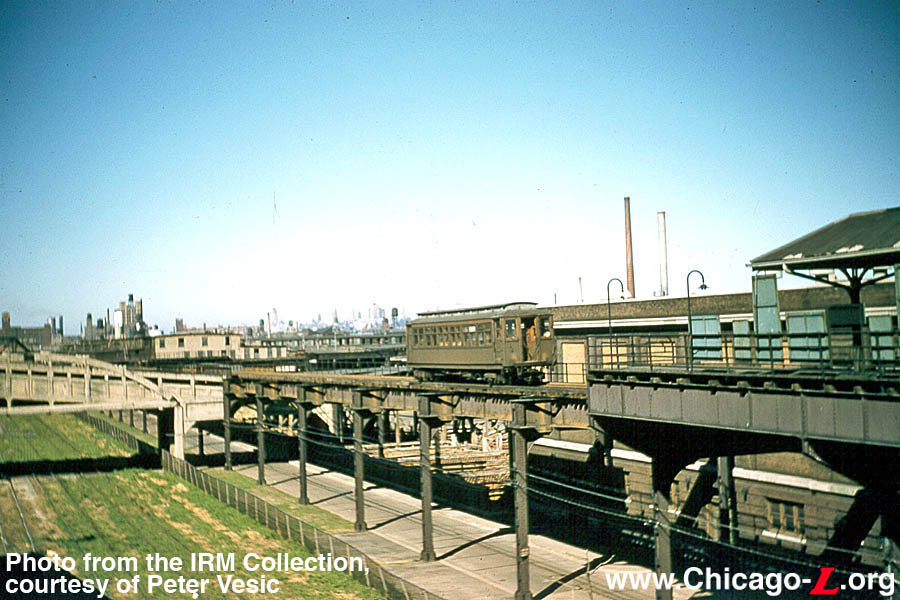
This view looks north towards the Wilson "L" yard and shops. You can see the interlocking tower, and at left, part of the ramp down to Buena Yard, which was used for freight. Dan Cluley writes, "Looking at the Wilson Shops photo, am I correct that those are some of the piggyback flat cars in between the grass and the L structure?" I asked an expert. Here’s what J. J. Sedelmaier says: “It’s absolutely the NSL Ferry-Truck equipment! That’s the old Wilson Shops building in the background and that’s the north end of Montrose Yards and transfer station.” Bill Shapotkin says this is Montrose Tower.

This view looks north towards the Wilson “L” yard and shops. You can see the interlocking tower, and at left, part of the ramp down to Buena Yard, which was used for freight. Dan Cluley writes, “Looking at the Wilson Shops photo, am I correct that those are some of the piggyback flat cars in between the grass and the L structure?” I asked an expert. Here’s what J. J. Sedelmaier says: “It’s absolutely the NSL Ferry-Truck equipment! That’s the old Wilson Shops building in the background and that’s the north end of Montrose Yards and transfer station.” Bill Shapotkin says this is Montrose Tower.

Wilson Yard and Shops. Note the North Shore Line freight station at lower left. (J. J. Sedelmaier Collection)

Wilson Yard and Shops. Note the North Shore Line freight station at lower left. (J. J. Sedelmaier Collection)

Although this is not the sharpest picture, it does show the Austin Boulevard station on the Garfield park "L", probably circa 1954. We are looking east. To the left, you can see the southern edge of Columbus Park. At the far left, temporary tracks are already being built, which the "L" would shift to in this area on August 29, 1954. This is the present site of the Eisenhower Expressway.

Although this is not the sharpest picture, it does show the Austin Boulevard station on the Garfield park “L”, probably circa 1954. We are looking east. To the left, you can see the southern edge of Columbus Park. At the far left, temporary tracks are already being built, which the “L” would shift to in this area on August 29, 1954. This is the present site of the Eisenhower Expressway.

Here, we are looking east along Van Buren, just west of Paulina. The tracks in the foreground are the temporary Garfield Park "L" right of way. The Congress (later Eisenhower) expressway is under construction to the right, with the Douglas Park "L" in the background. This photo was probably taken in early 1954. The Garfield Park "L" west of Paulina has already been demolished, but the Marshfield station still appears intact. This could not be removed until the Douglas line was re-reouted over the Lake Street "L".

Here, we are looking east along Van Buren, just west of Paulina. The tracks in the foreground are the temporary Garfield Park “L” right of way. The Congress (later Eisenhower) expressway is under construction to the right, with the Douglas Park “L” in the background. This photo was probably taken in early 1954. The Garfield Park “L” west of Paulina has already been demolished, but the Marshfield station still appears intact. This could not be removed until the Douglas line was re-reouted over the Lake Street “L”.

CTA 6123-6124 on the outer end of the Douglas Park line, probably in the early 1950s.

CTA 6123-6124 on the outer end of the Douglas Park line, probably in the early 1950s.

This is an unusual picture, as it shows the Calvary "L" station in Evanston, which was a flag stop in both directions. Located opposite the entrance to Calvary cemetery, this station closed in 1931 and was replaced by South Boulevard a few blocks north. This view looks north from the southern edge of the cemetery. As you can see, the platforms appear relatively short. They were removed in the 1930s, but the rest of the station was not demolished until 1995. This photo probably dates to around 1930.

This is an unusual picture, as it shows the Calvary “L” station in Evanston, which was a flag stop in both directions. Located opposite the entrance to Calvary cemetery, this station closed in 1931 and was replaced by South Boulevard a few blocks north. This view looks north from the southern edge of the cemetery. As you can see, the platforms appear relatively short. They were removed in the 1930s, but the rest of the station was not demolished until 1995. This photo probably dates to around 1930.

A close-up of the Calvary station.

A close-up of the Calvary station.

J.J. Sedelmaier writes:

Does ANYone have shots of the Calvary stop on the “L” while still in service, prior to the opening of South Boulevard in 1930?

I think we may have something (see above).

J.J. replies:

YES !! I saw this last week ! So exciting ! The best shot so far, and I’ve been searching for decades !! Thanks for the heads-up David !!

The funny thing is, the photographer, whoever it was, doesn’t seem to have been trying to take a picture of the Calvary station at all. Otherwise, they surely would have moved in a lot closer first. It is a picture of a largely empty street, that just happens to show the station in the distance, which at the time was probably considered fairly unimportant.

J.J. continues:

Here are the shots I have here. I took the 1970’s pics. Bruce Moffat took the 1994 pics. The 1931 shot is a company photo that I got from Malcolm D. MacCarter in the mid-90s.

This January 12, 1931 photo shows the South Boulevard station under construction. It was in a better location from the standpoint of patronage, and replaced the Calvary station a few blocks away (which you can see in the distance). (Chicago Rapid Transit Company Photo)

This January 12, 1931 photo shows the South Boulevard station under construction. It was in a better location from the standpoint of patronage, and replaced the Calvary station a few blocks away (which you can see in the distance). (Chicago Rapid Transit Company Photo)

A close-up of the previous image, showing the Calvary station in the distance.

A close-up of the previous image, showing the Calvary station in the distance.

The entrance to the former Calvary station, as it appeared in 1970 when it was being used by a monument company. (J. J. Sedelmaier Photo)

The entrance to the former Calvary station, as it appeared in 1970 when it was being used by a monument company. (J. J. Sedelmaier Photo)

A side view of the former Calvary station in 1970. The platforms were removed in the 1930s and hardly any photos exist showing them in service. (J. J. Sedelmaier Photo)

A side view of the former Calvary station in 1970. The platforms were removed in the 1930s and hardly any photos exist showing them in service. (J. J. Sedelmaier Photo)

Bruce Moffat took this picture on February 15, 1994 just before the station entrance was demolished.

Bruce Moffat took this picture on February 15, 1994 just before the station entrance was demolished.

The interior of the former Calvary "L" station as it appeared on February 15, 1994. (Bruce Moffat Photo)

The interior of the former Calvary “L” station as it appeared on February 15, 1994. (Bruce Moffat Photo)

In addition, here is a classic shot that Mr. Sedelmaier shared with us:

On July 23, 1955, John D. Emery, then president of the Evanston Historical Society, purchased the last Shore Line ticket sold at the Church Street station from agent George Kennedy. The ticket window was closed the following day (Sunday), and the last Shore Line train ran in the early hours of July 25 (Monday). The ticket remains in the Historical Society collection. Emery was later (1962-1970) the mayor of Evanston, during which time he vetoed an anti-discrimination housing ordinance. (Evanston Photographic Service/J.J. Sedelmaier Collection Photo)

On July 23, 1955, John D. Emery, then president of the Evanston Historical Society, purchased the last Shore Line ticket sold at the Church Street station from agent George Kennedy. The ticket window was closed the following day (Sunday), and the last Shore Line train ran in the early hours of July 25 (Monday). The ticket remains in the Historical Society collection. Emery was later (1962-1970) the mayor of Evanston, during which time he vetoed an anti-discrimination housing ordinance. (Evanston Photographic Service/J.J. Sedelmaier Collection Photo)

(J.J. Sedelmaier Collection)

(J.J. Sedelmaier Collection)

Chicago & Calumet District Transit Company (aka Hammond, Whiting & East chicago) car 70 in Hammond. In our post More Hoosier Traction (September 2, 2015), we ran another photo that appears to have been taken at the same time as this. If so, the date is February 1939. There is some damage to this old print, in the area around car 70's headlight. Trolley service here ended in 1940. (Richard J. Anderson Photo)

Chicago & Calumet District Transit Company (aka Hammond, Whiting & East chicago) car 70 in Hammond. In our post More Hoosier Traction (September 2, 2015), we ran another photo that appears to have been taken at the same time as this. If so, the date is February 1939. There is some damage to this old print, in the area around car 70’s headlight. Trolley service here ended in 1940. (Richard J. Anderson Photo)

Chicago North Shore and Milwaukee wood car 300 on a fantrip on the streets of Waukegan circa 1940. From 1939 until 1942, the North Shore Line allowed Central Electric Railfans' Association to use 300 as their "club car." Here, we see it parked in front of Immaculate Conception school.

Chicago North Shore and Milwaukee wood car 300 on a fantrip on the streets of Waukegan circa 1940. From 1939 until 1942, the North Shore Line allowed Central Electric Railfans’ Association to use 300 as their “club car.” Here, we see it parked in front of Immaculate Conception school.

North Shore Line car 731 (and train) at the Wisconsin State Fair, possibly circa 1930. In order to access the fairgrounds, North Shore Line cars had to get there via the Milwaukee Electric. Incompatibilities between the two interurbans' wheel profiles resulted in wheel damage to the NSL.

North Shore Line car 731 (and train) at the Wisconsin State Fair, possibly circa 1930. In order to access the fairgrounds, North Shore Line cars had to get there via the Milwaukee Electric. Incompatibilities between the two interurbans’ wheel profiles resulted in wheel damage to the NSL.

The North Shore Line in Highland Park, circa 1930. Here, we are looking north along the Shore Line Route, which quit in 1955. NSL tracks ran parallel to the nearby Chicago & North Western commuter line, which would be to the left of this view.

The North Shore Line in Highland Park, circa 1930. Here, we are looking north along the Shore Line Route, which quit in 1955. NSL tracks ran parallel to the nearby Chicago & North Western commuter line, which would be to the left of this view.

The information on the back of this picture says we are looking south from Central Avenue in Highland Park. At right, there are North Shore Line tracks on the old Shore Line Route. A small shelter is visible at right. This picture is circa 1930. The area the North Shore Line once occupied is now a parking lot.

The information on the back of this picture says we are looking south from Central Avenue in Highland Park. At right, there are North Shore Line tracks on the old Shore Line Route. A small shelter is visible at right. This picture is circa 1930. The area the North Shore Line once occupied is now a parking lot.

The same location today.

The same location today.

These photos have been added to our post The Fairmount Park Trolley (November 7, 2017), which included several other photos of the Five Mile Beach Electric Railway in Wildwood, New Jersey:

Five Mile Beach electric Railway car 27 at Atlantic and Oak Avenues in Wildwood, on the Angelsea-Crest line, June 1945. A bus is also visible. (Walter Hulseweder Photo)

Five Mile Beach electric Railway car 27 at Atlantic and Oak Avenues in Wildwood, on the Angelsea-Crest line, June 1945. A bus is also visible. (Walter Hulseweder Photo)

Five Mile Beach electric Railway cars 22 and 27 at the Wildwood carhouse on May 30, 1945, shortly before abandonment. (Walter Hulseweder Photo)

Five Mile Beach electric Railway cars 22 and 27 at the Wildwood carhouse on May 30, 1945, shortly before abandonment. (Walter Hulseweder Photo)

Five Mile Beach Electric Railway car 30 in the car barn, circa the mid-1940s. (Walter Broschart Photo)

Five Mile Beach Electric Railway car 30 in the car barn, circa the mid-1940s. (Walter Broschart Photo)

Recent Correspondence

On June 26, 1960 a pair of CTA single-car units went out on a portion of the Lake Street "L", but apparently did not go on the ground-level portion of the route. Here, we see the train heading westbound at Clinton and Lake. (Charles L. Tauscher Photo)

On June 26, 1960 a pair of CTA single-car units went out on a portion of the Lake Street “L”, but apparently did not go on the ground-level portion of the route. Here, we see the train heading westbound at Clinton and Lake. (Charles L. Tauscher Photo)

Miles Beitler writes:

I was doing some online research recently and followed a link to a photo on your blog. The photo was posted under “Chicago Rapid Transit Photos, Part 6” and included the following in the caption:

“Here’s an interesting streetscape that could not be duplicated today. According to the back of the picture, it shows the view looking east from South Boulevard and Austin, on the eastern edge of Oak Park. The Lake Street “L”, where it ran on the ground, had a very narrow right-of-way that the 6000s, with their bulging sides, could not fit in.”

I have read similar comments posted by others, i.e., that the reason no 6000s were used on the Lake Street “L” is that the cars were too wide. While it’s true that the curved body 6000s were wider than the 4000s and wood cars, the difference was slight — not more than a foot at their widest point. So I don’t think that would explain why they weren’t used. I think a more logical explanation is that the ground level portion of the Lake Street “L” used trolley wire, and none of the original 6000s had trolley poles. (I believe that the only exception was one experimental high performance trainset (6127-6130) that was used in Evanston Express service.) You will note that the original “baldy” 4000s also were not used in Lake Street service for the same reason. The steel roofs of those 4000s made it very difficult to retrofit them with trolley poles.

By the time the western portion of the line was elevated and converted to third rail in 1962, the high performance 2000s were already ordered. So the CTA probably decided to just keep using the older cars until the 2000s arrived. Cars 1-50 did have trolley poles, but those cars were not received until shortly before the elevation of the Lake Street “L” at which time they would not have been needed anyway, so they were used on the Evanston line instead, and later some were used on the Skokie Swift.

Does this make sense, or am I all wet?

Either way, keep up your fantastic blog!

Thanks for writing. You have made an interesting hypothesis, which deserves consideration.

First of all, I have heard enough stories regarding the tight clearances on the ground-level portion of Lake to believe there was some sort of clearance problem that prevented the use of curved-sided rapid transit cars there. The most logical explanation so far is that this involved the gatemen’s shantys.

Having ridden the Lake Street “L” numerous times prior to the October 28, 1962 relocation of the outer portion of the route onto the C&NW embankment, I can assure you that clearances were very tight, as two tracks and platforms were shoehorned into a side street, which continued to have two-way auto traffic.

There was a fantrip on Lake during 1960 using one of the single-car units in the 1-50 series, and while this train did venture down to the lower level of Hamlin Yard, it apparently made no effort to go west of Laramie. You would think they would have done so had this been possible. (See photo above.)

Similar clearance restrictions have existed on other parts of the system. Skokie Swift cars that had pan trolleys fitted were not allowed to go downtown, and cars with poles cannot go into the Kimball subway. (At the moment, this restriction would only apply to 4271-4272.)

That being said, let us take a step back and review how the Lake Street “L” fit in with the strategic thinking of various planners over the decades.

In 1937, the City of Chicago proposed building an aerial highway on the Lake Street “L” structure, and some other “L”s such as Humboldt Park. In theory this would have been something like the West Side Elevated Highway in New York City, which was built between 1929 and 1951 and which partially collapsed in 1973.

Express bus service would have replaced the rapid transit line, as would have a beefed-up Garfield Park “L” in this plan. We can be glad this was not built.

By 1939, this plan was abandoned in favor of the Congress Parkway Expressway that was built starting a decade later, and opened in stages between 1955 and 1960.

The City was proposing various subways all over town, in addition to the State Street and Dearborn-Milwaukee tubes that were built starting in 1938. One goal was to tear down the Loop “L”, starting with the Lake and Wabash legs.

The Lake Street “L” would have been diverted into a subway connection just west of the Loop that of course was never built. Neither was a connection built to divert the Lake “L” into the Congress line via an elevated connection near Kedzie, or Kostner, although the CTA was still intent on doing these things as of 1948.

There is some question whether the entire Lake Street “L” might have been abandoned early in the CTA era, if not for the innovation of A/B “skip stop” service that was begun in 1948. This was so successful that it was gradually used on other parts of the CTA system.

When and how were curved-side “L” cars developed? It seems likely this idea, like many others, came from New York, where some experimental 1930s BMT railcars such as the so-called “Green Hornet” had mildly curved sides.

In Chicago, curved sides appeared on ten interurbans, #451-460 for the Chicago Aurora & Elgin, designed in 1941 but not built by St. Louis Car Company until 1945, as well as the two North Shore Line Electroliners.

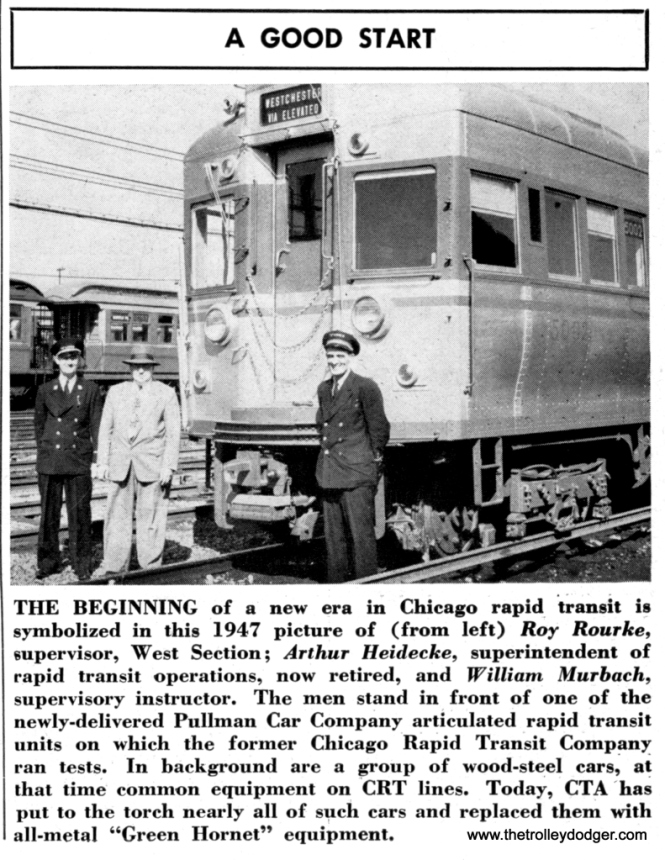
These were followed by four experimental sets of articulated rapid transit cars $5001-5004, delivered in 1947-48. Except for the curved sides, largely patterned after the BMT “Bluebirds: from 1939-40.

Chicago’s Initial System of Subways was designed to allow for longer and wider cars, closer to New York standards. The City may have hoped these standards could gradually be applied to the entire system, but it was not to be.

When the Chicago Transit Authority took over from the Chicago Rapid Transit Company in 1947, one primary goal was to purchase enough new steel railcars to allow the Dearborn-Milwaukee subway to open. Another goal was to get rid of the wooden “L” cars, which were getting very old and were not permitted in the subways.

When the first 6000s were delivered starting in 1950, they were first used on Douglas, but that was for test purposes. After another year or two, CTA switched things around, so the new 6000s were used in the State Street subway, and the 4000s on the more lightly used Dearborn-Milwaukee.

Meanwhile, the last wood cars were used on Lake around 1955. The last wooden :”L” cars were used in service in 1957, by which time there were enough new 6000s on hand to permit their retirements.

But else what was happening on Lake during the 1950s? By 1951-5, CTA appears to have figured out that the “problem” portion of Lake was the outer end, not the parts east of Laramie. The first suggestion was to truncate the line to Laramie, but this did not go over well in Oak Park, so the various parties got together, and the embankment plan was the result.

These plans were finalized around 1958. The relocation took place in 1962, at which time the CTA probably hoped to have taken delivery on what became the 2000-series. But there were so many changes and innovations in these cars that delivery did not occur until 1964.

So yes, it does not appear that it was ever a high priority for the CTA to use 6000s on the ground-level portion of Lake. Wood cars were replaced by 4000s around 1955, which was considered a service improvement, and within three years from that, plans were afoot to relocate service anyway.

However, if the CTA had really wanted to run 6000s on Lake, I expect changes could have been made in the locations of whatever obstacles prevented it, and additional cars could have been equipped with trolley poles, as was done for Evanston.

I doubt these would have been single-car units, though, since those were intended for “off peak” one-man operation on Evanston, something which I don’t think would have been suitable on Lake.

As it was, I don’t recall seeing 6000s on Lake much before 1979. In the wake of that year’s blizzard, which shut down the line west of Laramie for a week, so many of the newer cars had burned-out motors that it became necessary to use the older 6000s.

I hope this answers your questions.

-David Sadowski

Miles Beitler again:

Dave, you obviously know FAR more about Chicago transit than I do. You could probably give Graham Garfield some stiff competition.

I believe you recently wrote a book about trolleys. I grew up not far from the terminal of the Clark Street car line at Howard Street and I remember riding the Green Hornets to the local branch of the Chicago public library. I also remember visiting my cousins who lived a block away from the Devon car barn and seeing all of the streetcars stored there. However, I’m more interested in the “L” and interurban history. I spent my childhood watching the North Shore Line trains, and I was fortunate enough to ride an Electroliner to Racine, Wisconsin about a year before the NSL folded.

Have you given or considered giving presentations about Chicago transit at schools, libraries, etc.? WTTW channel 11 might also like to use you as a resource on Chicago transit history or for the production of programs on the subject, similar to the ones produced by Geoffrey Baer over the past 25 years.

There are a number of people, several in fact, who qualify as experts on Chicago transit. We all tend to know each other to some extent, as we’re interested in many of the same things.

I don’t feel like I am competing with any of the other “experts.” We have each found our own niche, and have different contributions to make. In fact, this blog is only successful because it is based on sharing and cooperation.

Actually, I have given a number of presentations to various groups over the years.

WTTW actually did feature the Chicago PCC book I co-authored once on Chicago Tonight. You can read about it in our post A Window to the World of Streetcars (June 2, 2016).

Our pictures do get around. Several photos that I posted to the Internet ended up being featured in an article called Displaced, which tried to determine what happened to the people who were living in the path of the Congress expressway when it was built. (See our post Some Thoughts on Displaced, August 30, 2016.)

Who knows when or where our stuff will show up in the future. We’ll just have to wait and see.

Thanks.

Ron Smolen adds:

In your last post this comment was posted in the sections about 6000s on Lake street:

“You will note that the original “baldy” 4000s also were not used in Lake Street service for the same reason. The steel roofs of those 4000s made it very difficult to retrofit them with trolley poles.”

TRUE… however, near the end of the Baldies operations, I do recall seeing LIVE and in photos
some single baldies that were placed in trains with 4000 pole equipped cars that DID operate in regular service to Harlem under wire.

Ron adds that, according to www.chicago-l.org, “baldy” 4000s ran on Lake from 1959 to 1964, paired with pole-equipped “plushies.”

Jack Bejna writes:

A Tale of Two Pictures

A short time ago there was a question raised by a reader about changing original photographs with Photoshop, thereby eliminating the original intent of the image. As an example of what I do, refer to the first image of CA&E 209. From my experience of working with CA&E images, I believe that the image was captured at the Laramie Freight House area, but of course that is only a guess. My goal is to try to improve the original image and enhance the background while preserving the original intent of the photographer when the image was captured. With this image I decided to place Car 209 in a typical situation, that is, on one of the storage tracks behind the freight house. Further, I like the look of the Niles wood cars so I added the front of sister car 207 to present an unblocked image of Car 209. I spent the rest of my efforts on improving the photograph itself with Photoshop. The final result is pretty much the way I think it looked at the time and represents a cleaner roster shot of a classic Niles interurban.


Moving right along with the CA&E roster, here are some images of the work cars and locomotives that kept the railroad running.
-Jack

CA&E Express Cars – Line Cars – Locomotives – Tool Cars

CA&E rostered a variety of Motors to fit the job at hand. First, the Newspaper Special, obviously a motor that probably spent time doing whatever job was needed in addition to delivering newspapers. I’ve never found a number for this car or any record of when or how it was retired.

Next, express cars 9, 11, & 15 illustrate the differences in length, configuration, etc., in the CA&E roster. Line cars 11 and 45 are next. Car 45 was purchased from the Chicago & Interurban Traction when the line quit in 1927. When Car 45 was retired it was replaced by car 11, rebuilt as a line car.

Locomotive 3 was built as a double ended plow and was used as a work motor by removing the plows.

Next up are the CA&E locomotives, including 2001-2002 built by GE in 1920, 3003-3004 built by BLW-WH in 1923-4, and 4005-4006 built by Oklahoma Railway in 1929.

Finally, Tool Cars 7 and B are shown. Tool Car B was rebuilt from a boxcar.

Here are a few more CA&E freight motors. First is an image of 5-15 in a winter scene. Before the railroad purchased 2001-2002 these two cars were commonly used as locomotives on the freight trains. Second is tool car in an unusual paint scheme. I’m glad they didn’t paint all the motors like this! Finally, here is a scene of Line Car 45 in action on a line relocation in Aurora.

Here’s a real gem that I came across searching the Internet. CA&E had a fire in the early days that destroyed many of their records, photographs, etc., so much of the early days is lost forever. Somehow this image survived somewhere, and we are able to see what express car 4 looked like, albeit with a lot of Photoshop help. I have no idea who built it or when, and how long it lasted.

Enjoy!

Jack

As always, we thank Jack for sharing these wonderful photos.

Fernandes writes:

Hello. I’m doing some reading about bus history. In 1921, Fageol launched Safety Coach and then, Model 20 and 40. Then the Twin Coach style.

I found it very interesting that they always adopted a design style similar to trains and not cars.

Well, we are the product of our time. Back in 1920 when the Fageols designed their first bus, what style reference did they have? Trains, of course.

But it’s interesting because their first “bus”, the Safety Coach, had a vehicle body. Not related to train. Some years later, they created the Twin Coach with a train looking style.

Would you provide me some info about bus/train design inspiration?

I forwarded this to Andre Kristopans, who knows much more than I ever could about bus history. Here is his reply:

At least part of the deal was that early intercity coaches often replaced branch line trains or directly competed with them. So, why not make something sort of train-like? As for the 40s, they sort of mimic what a “modern” streetcar looked like in the 1920s. Why not? Imitation can be a big compliment. By the 930s some elements of streetcar design such as rear door in very rear were replaced by designs more practical for a bus like a rear door 3/4 way back. But then new streetcars like PCCs started mimicking buses!

Kenneth Gear writes:

Another Railroad Record Club mystery solved!

Remember a year or so ago we saw RRC records for sale on eBay that were stamped “This is an audition set record and is the property of the Railroad Record Club?” We speculated that Steventon may have sent records to radio stations in an attempt to get them played on air. Well, that was not the case.

Along with the RRC catalog I received with the RRC #10 record I recently purchased was a two page notice of an “audition set program” the club was offering. The notice explains the whole program so I won’t go into detail about it since you can read it right from the notice. Interesting stuff and another RRC question answered!

The catalog was the same one that you posted in the Trolley Dodger.

This audition thing couldn’t have worked out very well. For every new order that it generated, there were likely problems with people not returning the records or paying for them.

I can see how Steventon wanted to bend over backwards to get people to hear these things, but this seems like a lot of extra work, with probably not enough reward.

Thanks very much for your detective work.

Frank Kennedy writes:

Thank you so much for the trolley book, David. Not only is it a great gift, it is a work of such devotional power. There looks to be years of searching for appropriate photographs in all of this. I really don’t know what to say except thank you for the hours future spent in great reading.

This is probably the nicest thing anyone has ever said about me. I didn’t respond right away, because it left me speechless.

Work on the book, from the initial proposal to the book being published, was actually less than a year. But if I think about it, I spent much of my life preparing to write such a book.

-David Sadowski

PS- Frank Kennedy is the founder of the Chicagotransit Yahoo discussion group.

Chicago Trolleys

On the Cover: Car 1747 was built between 1885 and 1893 by the Chicago City Railway, which operated lines on the South Side starting in April 1859. This is a single-truck (one set of wheels) open electric car; most likely a cable car, retrofitted with a trolley and traction motor. The man at right is conductor William Stevely Atchison (1861-1921), and this image came from his granddaughter. (Courtesy of Debbie Becker.)

On the Cover: Car 1747 was built between 1885 and 1893 by the Chicago City Railway, which operated lines on the South Side starting in April 1859. This is a single-truck (one set of wheels) open electric car; most likely a cable car, retrofitted with a trolley and traction motor. The man at right is conductor William Stevely Atchison (1861-1921), and this image came from his granddaughter. (Courtesy of Debbie Becker.)

Check out our new book Chicago Trolleys. Signed copies are available through our Online Store.

This book makes an excellent gift and costs just $17.99 plus shipping. That’s $4.00 off the list price.

Help Support The Trolley Dodger

gh1

This is our 205th post, and we are gradually creating a body of work and an online resource for the benefit of all railfans, everywhere. To date, we have received over 358,000 page views, for which we are very grateful.

You can help us continue our original transit research by checking out the fine products in our Online Store.

As we have said before, “If you buy here, we will be here.”

We thank you for your support.

DONATIONS

In order to continue giving you the kinds of historic railroad images that you have come to expect from The Trolley Dodger, we need your help and support. It costs money to maintain this website, and to do the sort of historic research that is our specialty.

Your financial contributions help make this web site better, and are greatly appreciated.

Recent Finds, 10-14-2017

You would be forgiven if you think this is CTA red Pullman 144 heading north on Wentworth Avenue at Cermak Road in Chicago's Chinatown neighborhood. But it is actually car 225 with its number hidden by a piece of red oilcloth. This was a fantrip organized by the late Maury Klebolt in 1955. He had promised the fans that car 144 would be used. Car 225 was built in 1908 and was sold to Seashore Trolley Museum in 1957. I previously wrote a post about this fantrip in 2013.

You would be forgiven if you think this is CTA red Pullman 144 heading north on Wentworth Avenue at Cermak Road in Chicago’s Chinatown neighborhood. But it is actually car 225 with its number hidden by a piece of red oilcloth. This was a fantrip organized by the late Maury Klebolt in 1955. He had promised the fans that car 144 would be used. Car 225 was built in 1908 and was sold to Seashore Trolley Museum in 1957. I previously wrote a post about this fantrip in 2013.

This close-up of the previous picture shows how the "144" is on an oilcloth patch over the actual number 225.

This close-up of the previous picture shows how the “144” is on an oilcloth patch over the actual number 225.

Today, we are featuring many rare transit photographs that we recently collected. Most are from the Chicagoland area, but some are from Milwaukee and Philadelphia.

What they all have in common is I think they are interesting. I hope that you will agree.

October 17 is the 74th anniversary of the opening of Chicago’s first subway. We have included a few subway pictures to help commemorate that historic event.

-David Sadowski

PS- I will be making a personal appearance at 1:00 pm on Saturday, October 21, 2017 at The Museums at Lisle Station Park in Lisle, IL. This presentation is for my new book Chicago Trolleys, from Arcadia Publishing. You can purchase an autographed copy via our Online Store. We look forward to seeing you there.

Recent Finds

This is a very unusual picture. At first, I thought it might show the ramp at Sacramento on the Garfield Park "L", where the line descended to temporary trackage in Van Buren Street. Then, I noticed that this is single track. This makes it the loop at the west end of the line at DesPlaines Avenue, as it was configured in 1953 to allow the CA&E (not seen here) to pass underneath. There are lots of pictures showing this ramp taken from the ground. But to take this picture, the photographer either had to be in another railcar, or was standing on the walkway. At left, you can see the Altenhiem building, described in the next picture. The DesPlaines Avenue yard was reconfigured again in 1959 and this ramp was eliminated. We previously posted another picture of this crossover here.

This is a very unusual picture. At first, I thought it might show the ramp at Sacramento on the Garfield Park “L”, where the line descended to temporary trackage in Van Buren Street. Then, I noticed that this is single track. This makes it the loop at the west end of the line at DesPlaines Avenue, as it was configured in 1953 to allow the CA&E (not seen here) to pass underneath. There are lots of pictures showing this ramp taken from the ground. But to take this picture, the photographer either had to be in another railcar, or was standing on the walkway. At left, you can see the Altenhiem building, described in the next picture. The DesPlaines Avenue yard was reconfigured again in 1959 and this ramp was eliminated. We previously posted another picture of this crossover here.

Altenhiem, described here as an "old people's home," is still in business today.

Altenhiem, described here as an “old people’s home,” is still in business today.

Once CA&E trains were cut back to Forest Park in September 1953, joint timetables were issued for the benefit of passengers who wanted to continue to the Loop. These schedules were changed several times over the nearly four years before the CA&E abandoned passenger service. This is the 14th, and perhaps last such timetable. Over time, I assume there were fewer CA&E trains as ridership was declining. We previously posted timetable #7 here.

Once CA&E trains were cut back to Forest Park in September 1953, joint timetables were issued for the benefit of passengers who wanted to continue to the Loop. These schedules were changed several times over the nearly four years before the CA&E abandoned passenger service. This is the 14th, and perhaps last such timetable. Over time, I assume there were fewer CA&E trains as ridership was declining. We previously posted timetable #7 here.

WORK ON CHICAGO'S SUBWAY STARTED Chicago, Ill.: Above photo shows crowd on North State Street at Chicago Avenue during ceremonies marking the start of work on the new subway, which will run under State Street. Mayor Edward Kelly and Secy. of the Interior Harold Ickes used pneumatic spades to start the project. (Acme Press Photo, December 17, 1938)

WORK ON CHICAGO’S SUBWAY STARTED
Chicago, Ill.: Above photo shows crowd on North State Street at Chicago Avenue during ceremonies marking the start of work on the new subway, which will run under State Street. Mayor Edward Kelly and Secy. of the Interior Harold Ickes used pneumatic spades to start the project. (Acme Press Photo, December 17, 1938)

STREET CARS CRASH IN TUNNEL; 7 INJURED Chicago - Its brakes failing to hold as it attempted up-grade run in Chicago street car tunnel, trolley at left slid backward down incline, crashed into front end of following car. Seven passengers were taken to hospital, 100 others shaken up. (Acme Press Photo, November 6, 1941)

STREET CARS CRASH IN TUNNEL; 7 INJURED
Chicago – Its brakes failing to hold as it attempted up-grade run in Chicago street car tunnel, trolley at left slid backward down incline, crashed into front end of following car. Seven passengers were taken to hospital, 100 others shaken up. (Acme Press Photo, November 6, 1941)

AT LAST -- THE CHICAGO SUBWAY All-steel cars from the elevated lines enter the tubes on the north side near Armitage and Sheffield Avenues, about 2 1/2 miles north of the Loop. Overhead is the existing elevated structure still used by local trains. Hard rubber plates have been placed between the ties and the steel rails to cushion the subway ride. (Acme Press Photo, October 21, 1943)

AT LAST — THE CHICAGO SUBWAY
All-steel cars from the elevated lines enter the tubes on the north side near Armitage and Sheffield Avenues, about 2 1/2 miles north of the Loop. Overhead is the existing elevated structure still used by local trains. Hard rubber plates have been placed between the ties and the steel rails to cushion the subway ride. (Acme Press Photo, October 21, 1943)

NO AN ART GALLERY--BUT PART OF MOSCOW'S SUBWAY LINE Moscow, Russia-- Beautiful inverted bowls throw light to the paneled ceiling of this archway part of the lighting system of the Sokolniki station of Moscow's new subway. Indirect light is used in many parts of the system. The subway, thrown open to the public amidst scenes of great jubilation, is called the "Metro." All Moscow went joy riding on opening day. (Acme Press Photo, May 17, 1935) What interested me about his photo was how the general configuration looks a lot like the Chicago subway, which was built a few years later. Is it possible that the design was influenced by Moscow's?

NO AN ART GALLERY–BUT PART OF MOSCOW’S SUBWAY LINE
Moscow, Russia– Beautiful inverted bowls throw light to the paneled ceiling of this archway part of the lighting system of the Sokolniki station of Moscow’s new subway. Indirect light is used in many parts of the system. The subway, thrown open to the public amidst scenes of great jubilation, is called the “Metro.” All Moscow went joy riding on opening day. (Acme Press Photo, May 17, 1935) What interested me about his photo was how the general configuration looks a lot like the Chicago subway, which was built a few years later. Is it possible that the design was influenced by Moscow’s?

The interior of DC Transit car 766, during an October 8, 1961 fantrip just a few months before Washington's streetcar system was abandoned. This car is now preserved at the National Capital Trolley Museum as Capital Traction Company 27 (its original umber). We have an excellent CD featuring audio recordings of 766 in operation in Washington, DC in our Online Store.

The interior of DC Transit car 766, during an October 8, 1961 fantrip just a few months before Washington’s streetcar system was abandoned. This car is now preserved at the National Capital Trolley Museum as Capital Traction Company 27 (its original umber). We have an excellent CD featuring audio recordings of 766 in operation in Washington, DC in our Online Store.

This picture was taken on the Wells leg of Chicago's Loop on April 16, 1926. If this is Quincy and Wells, the scaffolding at left may be related to work being done on the nearby Wells Street Terminal, which started at this time. The terminal got a new facade and was expanded, reopening on August 27, 1927.

This picture was taken on the Wells leg of Chicago’s Loop on April 16, 1926. If this is Quincy and Wells, the scaffolding at left may be related to work being done on the nearby Wells Street Terminal, which started at this time. The terminal got a new facade and was expanded, reopening on August 27, 1927.

This picture shows the old Wells Street bridge, carrying the "L" across the Chicago River as it heads north-south in the early 1900s.

This picture shows the old Wells Street bridge, carrying the “L” across the Chicago River as it heads north-south in the early 1900s.

This is Racine Avenue on the Metropolitan "L" main line. The autos below the "L" would suggest this picture was taken in the 1940s.

This is Racine Avenue on the Metropolitan “L” main line. The autos below the “L” would suggest this picture was taken in the 1940s.

"L" trains at the north State Street subway portal, probably in the 1940s.

“L” trains at the north State Street subway portal, probably in the 1940s.

The view looking north from the Howard "L" station. We ran a very similar picture to this in a previous post Chicago Rapid Transit Photos, Part Eight (November 16, 2016), where George Trapp suggested in was taken in the late 1920s or 1930s. This photo is dated December 17, 1930.

The view looking north from the Howard “L” station. We ran a very similar picture to this in a previous post Chicago Rapid Transit Photos, Part Eight (November 16, 2016), where George Trapp suggested in was taken in the late 1920s or 1930s. This photo is dated December 17, 1930.

Michael Franklin has identified this picture as showing the Armour station on the Stock Yards branch. He notes, "(the) clue was a station on one side but not one on the other." See below for another view of the same station.

Michael Franklin has identified this picture as showing the Armour station on the Stock Yards branch. He notes, “(the) clue was a station on one side but not one on the other.” See below for another view of the same station.

http://www.chicago-l.org/operations/lines/images/StockYards/cta2906%40armour.jpg

The above image is from Graham Garfield’s excellent web site, and looks to the northeast. The original www.chicago-l.org caption reads:

Looking north on September 28, 1957, ex-Metropolitan Elevated car 2906 has left Armour station (seen at right) and it about to rejoin the Stock Yards main line to head east to its terminal at Indiana. The Sock Yards branch is only a week away from abandonment at this time. (Photo from the IRM Collection, courtesy of Peter Vesic)

This picture was taken on the Evanston branch of the "L", and the wooden "L" car is signed "Howard Only," which suggests this was taken during the CTA era. Previously, all Evanston trains continued south into the city. The nearby curve would indicate that this picture was taken just north of Howard, and may show the viaduct where the line crossed Chicago Avenue, which is a continuation of Clark Street.

This picture was taken on the Evanston branch of the “L”, and the wooden “L” car is signed “Howard Only,” which suggests this was taken during the CTA era. Previously, all Evanston trains continued south into the city. The nearby curve would indicate that this picture was taken just north of Howard, and may show the viaduct where the line crossed Chicago Avenue, which is a continuation of Clark Street.

This picture is identified as showing Chicago streetcar conductors and motormen, and probably dates to the early 1900s.

This picture is identified as showing Chicago streetcar conductors and motormen, and probably dates to the early 1900s.

Here, we have a westbound train of wooden Met cars at Laramie on the old Garfield Park line. This was replaced by the Congress line in 1958.

Here, we have a westbound train of wooden Met cars at Laramie on the old Garfield Park line. This was replaced by the Congress line in 1958.

Chicago Surface Lines 2779 at Cicero and Montrose in 1934. This was the north end of the Cicero Avenue line. This car is part of a series known as "Robertson Rebuilds," and was built by St. Louis Car Co. in 1903. (Edward Frank, Jr. Photo)

Chicago Surface Lines 2779 at Cicero and Montrose in 1934. This was the north end of the Cicero Avenue line. This car is part of a series known as “Robertson Rebuilds,” and was built by St. Louis Car Co. in 1903. (Edward Frank, Jr. Photo)

CSL 970 on Waveland between Broadway and Halsted in 1936. This was the north end of the Halsted line. 970 was part of a series known as the "little" Pullmans, since they were slightly shorter than cars 101-750. It was built in 1910. (Edward Frank, Jr. Photo)

CSL 970 on Waveland between Broadway and Halsted in 1936. This was the north end of the Halsted line. 970 was part of a series known as the “little” Pullmans, since they were slightly shorter than cars 101-750. It was built in 1910. (Edward Frank, Jr. Photo)

CSL experimental pre-PCC car 7001 is shown heading south on Clark Street at North Avenue, across the street from the Chicago Historical Society (now the Chicago History Museum). This picture was probably taken in the 1930s. 7001 went into service in 1934 and was repainted in 1941 before being retired around 1944. (Edward Frank, Jr. Photo)

CSL experimental pre-PCC car 7001 is shown heading south on Clark Street at North Avenue, across the street from the Chicago Historical Society (now the Chicago History Museum). This picture was probably taken in the 1930s. 7001 went into service in 1934 and was repainted in 1941 before being retired around 1944. (Edward Frank, Jr. Photo)

The view looking east at Lake Street and Ridgeland, when the Lake Street "L" ran on the ground. Many years ago, the Rapid Transit Company put advertisements on the steps leading into such ground-level stations. The "L" was relocated onto the nearby C&NW embankment in 1962. This picture may be circa 1930.

The view looking east at Lake Street and Ridgeland, when the Lake Street “L” ran on the ground. Many years ago, the Rapid Transit Company put advertisements on the steps leading into such ground-level stations. The “L” was relocated onto the nearby C&NW embankment in 1962. This picture may be circa 1930.

The north end of the Merchandise Mart "L" station. This has since been rebuilt and the curved area of the platform has been eliminated.

The north end of the Merchandise Mart “L” station. This has since been rebuilt and the curved area of the platform has been eliminated.

We are looking west along Harrison at Wabash on November 12, 1928. In 2003, the Chicago Transit Authority straightened out this jog with a section of new "L" structure, occupying the area where the building at left once was.

We are looking west along Harrison at Wabash on November 12, 1928. In 2003, the Chicago Transit Authority straightened out this jog with a section of new “L” structure, occupying the area where the building at left once was.

Oakton Street in Skokie on December 11, 1931. The tracks with overhead wire were used by the North Shore Line and the Chicago Rapid Transit Company's Niles Center branch. Both were running on the NSL's Skokie Valley Route, built in 1925. The other set of tracks belong to the Chicago & North Western and were used for freight.

Oakton Street in Skokie on December 11, 1931. The tracks with overhead wire were used by the North Shore Line and the Chicago Rapid Transit Company’s Niles Center branch. Both were running on the NSL’s Skokie Valley Route, built in 1925. The other set of tracks belong to the Chicago & North Western and were used for freight.

CSL 2601 was a Robertson Rebuild car built in 1901 by St. Louis Car Company. In this wintry scene, it is signed for the 111th Street route, presumably in the 1940s. (Joe L. Diaz Photo)

CSL 2601 was a Robertson Rebuild car built in 1901 by St. Louis Car Company. In this wintry scene, it is signed for the 111th Street route, presumably in the 1940s. (Joe L. Diaz Photo)

Here is an unusual view. This shows the ramp taking the Garfield Park "L" down to grade level between Cicero Avenue and Laramie. It must be an early picture, since the area around the "L" seems largely unbuilt. The Laramie Yard would be to the right just out of view. This "L" was torn down shortly after the CTA opened the Congress line in 1958.

Here is an unusual view. This shows the ramp taking the Garfield Park “L” down to grade level between Cicero Avenue and Laramie. It must be an early picture, since the area around the “L” seems largely unbuilt. The Laramie Yard would be to the right just out of view. This “L” was torn down shortly after the CTA opened the Congress line in 1958.

The old Cermak Road station on the south Side "L". Note there are three tracks here. This station was closed in 1977 and removed. A new station replaced it in 2015.

The old Cermak Road station on the south Side “L”. Note there are three tracks here. This station was closed in 1977 and removed. A new station replaced it in 2015.

Here. a wooden "L" car train descends the ramp near Laramie on the Lake Street "L". This must be an early photo, as it looks like Lake Street is unpaved. Streetcar service was extended west to Harlem Avenue here by the Cicero & Proviso in 1891. Chicago Railways took over the city portion in 1910. Service west of Austin Boulevard was provided by the West Towns Railways.

Here. a wooden “L” car train descends the ramp near Laramie on the Lake Street “L”. This must be an early photo, as it looks like Lake Street is unpaved. Streetcar service was extended west to Harlem Avenue here by the Cicero & Proviso in 1891. Chicago Railways took over the city portion in 1910. Service west of Austin Boulevard was provided by the West Towns Railways.

Wooden gate car 3105 and train in the Loop. This was originally built for the Lake Street "L". Don's Rail Photos says, "3103 thru 3118 were built by McGuire-Cummings in 1893 as LSERR 103 thru 118. In 1913 they were renumbered 3103 thru 3118 and became CRT 3103 thru 3118 in 1923."

Wooden gate car 3105 and train in the Loop. This was originally built for the Lake Street “L”. Don’s Rail Photos says, “3103 thru 3118 were built by McGuire-Cummings in 1893 as LSERR 103 thru 118. In 1913 they were renumbered 3103 thru 3118 and became CRT 3103 thru 3118 in 1923.”

The view looking west along the Douglas Park "L" at 49th Avenue in Cicero on February 4, 1944. The station we see in the background is 50th Avenue. After it closed in 1978, this station was moved to the Illinois Railway Museum in Union, where it is used to board the museum's fleet of retired "L" cars.

The view looking west along the Douglas Park “L” at 49th Avenue in Cicero on February 4, 1944. The station we see in the background is 50th Avenue. After it closed in 1978, this station was moved to the Illinois Railway Museum in Union, where it is used to board the museum’s fleet of retired “L” cars.

Here, we are looking south from Garfield (55th Street) on the South Side "L".

Here, we are looking south from Garfield (55th Street) on the South Side “L”.

61st Street on the South Side "L", looking north on November 13, 1944.

61st Street on the South Side “L”, looking north on November 13, 1944.

Photos of the old Humboldt Park "L" branch are quite rare. This photo looks west from Western Avenue on January 26, 1931. This branch closed in 1952, although portions of the structure remained into the early 1960s.

Photos of the old Humboldt Park “L” branch are quite rare. This photo looks west from Western Avenue on January 26, 1931. This branch closed in 1952, although portions of the structure remained into the early 1960s.

This picture looks south from Randolph and Wells on the Loop "L". The date is not known, but the construction of the building at right may provide a clue. Andre Kristopans writes, "The overhead shot on Wells showing platform construction is early 20’s, when platforms were extended to accommodate longer trains. For instance Randolph/Wells and Madison/Wells were once separate platforms, after the early 20’s they were a continuous platform. Also at that time, LaSalle/Van Buren and State/Van Buren were connected and the separate station at Dearborn/Van Buren became an auxiliary entrance to State, until a building next to it blew up in the very early 60’s and destroyed the Outer Loop side."

This picture looks south from Randolph and Wells on the Loop “L”. The date is not known, but the construction of the building at right may provide a clue. Andre Kristopans writes, “The overhead shot on Wells showing platform construction is early 20’s, when platforms were extended to accommodate longer trains. For instance Randolph/Wells and Madison/Wells were once separate platforms, after the early 20’s they were a continuous platform. Also at that time, LaSalle/Van Buren and State/Van Buren were connected and the separate station at Dearborn/Van Buren became an auxiliary entrance to State, until a building next to it blew up in the very early 60’s and destroyed the Outer Loop side.”

North Shore Line 156 and several others at Waukegan in December 1962. Since there are about a dozen cars visible, they are being stored on a siding which you will note is outside the area of the catenary. (George Niles, Jr. Photo)

North Shore Line 156 and several others at Waukegan in December 1962. Since there are about a dozen cars visible, they are being stored on a siding which you will note is outside the area of the catenary. (George Niles, Jr. Photo)

This shows TMER&T 1121 running on a 1949 fantrip on the North Shore Line at the Kenosha station. We ran a similar picture in our previous post Traction in Milwaukee (September 16, 2015).

This shows TMER&T 1121 running on a 1949 fantrip on the North Shore Line at the Kenosha station. We ran a similar picture in our previous post Traction in Milwaukee (September 16, 2015).

Speedrail car 60 at the Waukesha Quarry, date unknown but circa 1949-51.

Speedrail car 60 at the Waukesha Quarry, date unknown but circa 1949-51.


Larry Sakar
writes:

The photo of Speedrail car 60 in your latest postings at the Waukesha Gravel pit was taken on 10-16-49. The occasion was the inaugural fan trip using a 60-series curved side car. It was sponsored by the short lived Milwaukee Division of the Electric Railroaders Association and was run by Milwaukeean James P. Harper who authored CERA Bulletin 97, “The Electric Railways of Wisconsin” published in 1952.

At the start of the private right-of-way at 8th St., the motors on the rear truck began having problems. At Waukesha, the car pulled onto one of the 2 side tracks leading back into the gravel pit. George Krambles accessed the rear trucks via a panel in the floor and disconnected the motor leads to the troublesome rear trucks. From that point forward the car ran on only 2 motors for the remainder of the fan trip. Car 65 had been the car originally intended to do the trip, but it was down with mechanical problems of its own. This caused the trip to be postponed for a week and the substitution of car 60.

When the car pulled into gravel pit siding one of the fans on board remarked, “Wow, look at this. They’ve got it in the scrap line already!”.

In addition to George Krambles, Al Kalmbach was on the trip, as was well-known railfan and photographer Barney Neuberger. He can be seen siting in about the 4th row of the car on the left side wearing a pork pie hat.

I’ve attached a few items related to that fan trip including a photo of Jay Maeder walking alongside car 60. This was taken at the first photo stop which was 44th St. where Milwaukee County Stadium would be built starting a year later. Car 60 was doing a photo run-by by backing down the line. The fans formed a photo line facing the car.

Philadelphia Stories

Philadelphia Peter Witt 8534 in July 1996. Don's Rail Photos: "8534 was built by Brill Car in 1926, #22353." It is part of the Electric City Trolley Museum collection in Scranton, PA. Here, it is shown in Philadelphia, during the time it was leased to SEPTA for trolley tours.

Philadelphia Peter Witt 8534 in July 1996. Don’s Rail Photos: “8534 was built by Brill Car in 1926, #22353.” It is part of the Electric City Trolley Museum collection in Scranton, PA. Here, it is shown in Philadelphia, during the time it was leased to SEPTA for trolley tours.

SEPTA 2750 and 8534 on a fantrip in August 1996. Apparently 8534 has broken down and is being towed.

SEPTA 2750 and 8534 on a fantrip in August 1996. Apparently 8534 has broken down and is being towed.

SEPTA 2785 in November 2002.

SEPTA 2785 in November 2002.

SEPTA 2750 and 8534 in August 1996.

SEPTA 2750 and 8534 in August 1996.

Three generations of Philadelphia streetcars in May 1999.

Three generations of Philadelphia streetcars in May 1999.

2785 in November 2002.

2785 in November 2002.

SEPTA 2785 in November 2002, with a commuter train nearby. Kenneth Achtert writes, "The shot of SEPTA #2785 with the commuter train that you presumed to be in Chestnut Hill is actually approaching 11th and Susquehanna,southbound, a cut-back location for which the car is signed in the picture. The commuter train would be inbound toward Center City."

SEPTA 2785 in November 2002, with a commuter train nearby. Kenneth Achtert writes, “The shot of SEPTA #2785 with the commuter train that you presumed to be in Chestnut Hill is actually approaching 11th and Susquehanna,southbound, a cut-back location for which the car is signed in the picture. The commuter train would be inbound toward Center City.”

SEPTA 2785 in November 2002.

SEPTA 2785 in November 2002.

SEPTA PCC 2785 on the truncated route 23 in November 2002.

SEPTA PCC 2785 on the truncated route 23 in November 2002.

8534 in August 1996. Kenneth Achtert: "The view of #8534 being “manually switched” three photos later shows 8534 being coupled to its leader (2750) after apparently becoming disabled. Several of your other photos show the subsequent towing operation."

8534 in August 1996. Kenneth Achtert: “The view of #8534 being “manually switched” three photos later shows 8534 being coupled to its leader (2750) after apparently becoming disabled. Several of your other photos show the subsequent towing operation.”

The fantrip train is having trouble clearing this auto in August 1996.

The fantrip train is having trouble clearing this auto in August 1996.

Looks like an attempt was made to move the offending car out of the way. August 1996.

Looks like an attempt was made to move the offending car out of the way. August 1996.

Recent Correspondence

Kenneth Gear writes:

Look who is in the new HISTORIC RAIL & ROADS catalog!

Thanks!

In case you missed it, here is Kenneth Gear’s review of the book:

I just finished reading your book and I enjoyed it very much. Good, clear, concise, and informative writing.

I must compliment you on the choice and presentation of the photographs. It is obvious that you spent much time and effort to present these wonderful photos as perfectly restored as possible.

So many times the authors of books that are primarily “picture books” seem to have a complete disregard for the condition of the photos reproduced. I’ve often seen photos that are yellowed with age, water stained, ripped, folded, and scratched. Other times a book might contain photos that are not properly exposed, are crooked, out of focus, or the composition could have been easily corrected with a little cropping.

The photos in your book are absolutely fantastic! They are pristine, sharp, and have absolutely no blemishes at all. You also packed a lot of information into the captions as well. It’s a fine book and you should be proud, as I’m sure you are, to have your name on the cover.

Another reader writes:

Your book arrived and it is JUST AWESOME. I am completely taken by some of the imagery, and of course enjoy the way you seem to simplify historical writing. VERY nice work!! THANK YOU!!!

Help Support The Trolley Dodger

gh1

This is our 197th post, and we are gradually creating a body of work and an online resource for the benefit of all railfans, everywhere. To date, we have received over 329,000 page views, for which we are very grateful.

You can help us continue our original transit research by checking out the fine products in our Online Store.

As we have said before, “If you buy here, we will be here.”

We thank you for your support.

DONATIONS

In order to continue giving you the kinds of historic railroad images that you have come to expect from The Trolley Dodger, we need your help and support. It costs money to maintain this website, and to do the sort of historic research that is our specialty.

Your financial contributions help make this web site better, and are greatly appreciated.

Recent Finds, 8-16-2017

Chicago Aurora & Elgin wood car 301 sports a new paint job at Wheaton Yard in August 1959, two years after the end of passenger service. It sits forlornly while waiting for a buyer that never came. Fortunately, some other cars were saved.

Chicago Aurora & Elgin wood car 301 sports a new paint job at Wheaton Yard in August 1959, two years after the end of passenger service. It sits forlornly while waiting for a buyer that never came. Fortunately, some other cars were saved.

We have been hard at work since our last post. Here are lots of great, classic pictures for your consideration.

In addition, we have new CD titles, which include about six hours of classic train audio. This means we have now digitized the complete Railroad Record Club collection and have made these long out-of-print recordings available to a new generation of fans. For each hour of CD audio, there is at least 10 hours of work involved. I hope that you will enjoy the results.

Our new book Chicago Trolleys is now 100% finished and has gone to press. There is also a set of 15 postcards available for a very reasonable price, using selected images from the book. The details are at the end of this post.

Enjoy!

-David Sadowski

CTA one-man streetcar 3144 heads east on Route 16 - Lake Street somewhere between Laramie and Pine Street, while a two-car train of 400-series "L" cars runs at ground level parallel to the streetcar. The time must be near the end of red car service here, which was May 30, 1954, as that is a 1953 or 1954 Cadillac at left. The C&NW signal tower on the embankment is still there today, at about Pine Street, which is where streetcars crossed the "L" to run north of the embankment for a few blocks before terminating at Austin Boulevard, the city limits.

CTA one-man streetcar 3144 heads east on Route 16 – Lake Street somewhere between Laramie and Pine Street, while a two-car train of 400-series “L” cars runs at ground level parallel to the streetcar. The time must be near the end of red car service here, which was May 30, 1954, as that is a 1953 or 1954 Cadillac at left. The C&NW signal tower on the embankment is still there today, at about Pine Street, which is where streetcars crossed the “L” to run north of the embankment for a few blocks before terminating at Austin Boulevard, the city limits.

CTA 1777 is on Lake Street heading east near Laramie, next to the ramp that once took the Lake Street "L" up to steel structure. A few of the older red trolleys were repainted in this color scheme by CTA, but I don't know anyone who found this very attractive when compared to what it replaced. The total distance where streetcars and "L" cars ran side-by-side was only a few blocks.

CTA 1777 is on Lake Street heading east near Laramie, next to the ramp that once took the Lake Street “L” up to steel structure. A few of the older red trolleys were repainted in this color scheme by CTA, but I don’t know anyone who found this very attractive when compared to what it replaced. The total distance where streetcars and “L” cars ran side-by-side was only a few blocks.

The same location today, at about 5450 West Lake Street.

The same location today, at about 5450 West Lake Street.

A two-car train of CTA 4000s at the west end of the Lake Street "L" in Forest Park. This picture was probably taken circa 1961-62, since you can see that at right, work is already underway on expanding the embankment to create space for a rail yard. On October 28, 1962, the out end of Lake was relocated to the C&NW embankment at left.

A two-car train of CTA 4000s at the west end of the Lake Street “L” in Forest Park. This picture was probably taken circa 1961-62, since you can see that at right, work is already underway on expanding the embankment to create space for a rail yard. On October 28, 1962, the out end of Lake was relocated to the C&NW embankment at left.

Here, we see the Garfield Park "L" temporary tracks on Van Buren at Loomis, looking east on July 1, 1956. Construction on the adjacent Congress Expressway (now Eisenhower) is pretty far along. This operation would continue until the opening of the Congress median line on June 22, 1958.

Here, we see the Garfield Park “L” temporary tracks on Van Buren at Loomis, looking east on July 1, 1956. Construction on the adjacent Congress Expressway (now Eisenhower) is pretty far along. This operation would continue until the opening of the Congress median line on June 22, 1958.

At left, we can see Chicago Pullman 225 under a makeshift shelter at the Seashore Trolley Museum. 225 went there in 1957, but offhand, I'm not sure when the UK double-decker tram made the trip across the Atlantic.

At left, we can see Chicago Pullman 225 under a makeshift shelter at the Seashore Trolley Museum. 225 went there in 1957, but offhand, I’m not sure when the UK double-decker tram made the trip across the Atlantic.

A night shot from the National Tramway Museum in Crich (UK), which is home to more than 60 trams built between 1900 and 1950.

A night shot from the National Tramway Museum in Crich (UK), which is home to more than 60 trams built between 1900 and 1950.

CTA's line car S-606 at the Dempster terminal of the Skokie Swift (today's Yellow Line). According to Don's Rail Photos, "S-606 was built by Cincinnati in January 1923, #2620, as Chicago North Shore & Milwaukee 606. In 1963 it became CTA S-606 and burned in 1978. The remains were sold to the Indiana Transportation Museum." (Photo by Bob Harris) Bob Harris adds, "By the way, the body of 606 is back in Illinois. When CLS&SB #73 comes out of the restoration shop, 606 goes in. We have the Cincinnati Car Company drawings. But since 606 was virtually destroyed in the November 26, 1977 fire, this will be more of a re-creation rather than a restoration."

CTA’s line car S-606 at the Dempster terminal of the Skokie Swift (today’s Yellow Line). According to Don’s Rail Photos, “S-606 was built by Cincinnati in January 1923, #2620, as Chicago North Shore & Milwaukee 606. In 1963 it became CTA S-606 and burned in 1978. The remains were sold to the Indiana Transportation Museum.” (Photo by Bob Harris) Bob Harris adds, “By the way, the body of 606 is back in Illinois. When CLS&SB #73 comes out of the restoration shop, 606 goes in. We have the Cincinnati Car Company drawings. But since 606 was virtually destroyed in the November 26, 1977 fire, this will be more of a re-creation rather than a restoration.”

Here, we are looking south on State Street from Monroe in 1942. Construction of the State Street Subway is being finished up, with the construction of stairway entrances. New streetcar tracks have been set in concrete, while it looks like some street paving work is still going on. The famous Palmer House is at left. There are a few references to WWII visible, meaning this picture was taken after Pearl Harbor. The subway was put into regular service on October 17, 1943.

Here, we are looking south on State Street from Monroe in 1942. Construction of the State Street Subway is being finished up, with the construction of stairway entrances. New streetcar tracks have been set in concrete, while it looks like some street paving work is still going on. The famous Palmer House is at left. There are a few references to WWII visible, meaning this picture was taken after Pearl Harbor. The subway was put into regular service on October 17, 1943.

A close-up of the previous picture.

A close-up of the previous picture.

This aerial view shows the old Main Chicago Post Office and the near west side in 1946, before work started on building the Congress Expressway (now Eisenhower), which now runs right through the center of the building. That will give you an idea of just what a massive project this was. The old Metropolitan "L", parts of which were displaced by the highway, has already curved off to the left, where it can be seen crossing the Union Station train sheds. Two side-by-side bridges carried the four tracks over the Chicago River. Then, tracks split, one part going to the Wells Street Terminal, the other continuing to a connection with the Loop structure at Wells and Van Buren. Now, the CTA Blue Line subway goes underneath the post office and river.

This aerial view shows the old Main Chicago Post Office and the near west side in 1946, before work started on building the Congress Expressway (now Eisenhower), which now runs right through the center of the building. That will give you an idea of just what a massive project this was. The old Metropolitan “L”, parts of which were displaced by the highway, has already curved off to the left, where it can be seen crossing the Union Station train sheds. Two side-by-side bridges carried the four tracks over the Chicago River. Then, tracks split, one part going to the Wells Street Terminal, the other continuing to a connection with the Loop structure at Wells and Van Buren. Now, the CTA Blue Line subway goes underneath the post office and river.

A close-up of the previous picture shows the Met "L" in greater detail. An eastbound two-car "L" train and a red CSL streetcar are visible.

A close-up of the previous picture shows the Met “L” in greater detail. An eastbound two-car “L” train and a red CSL streetcar are visible.

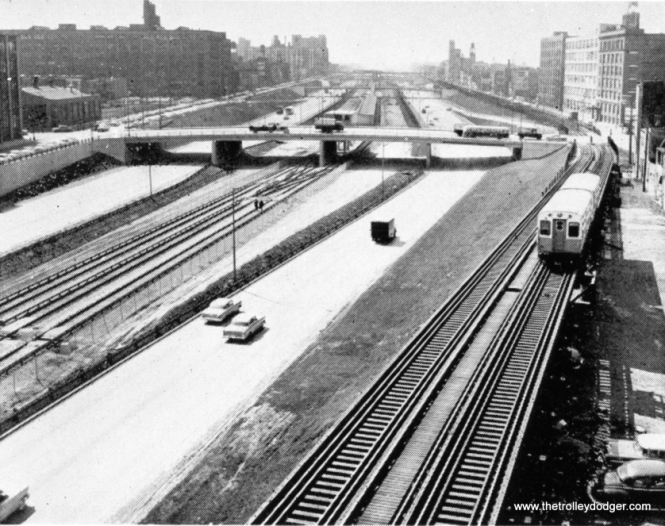
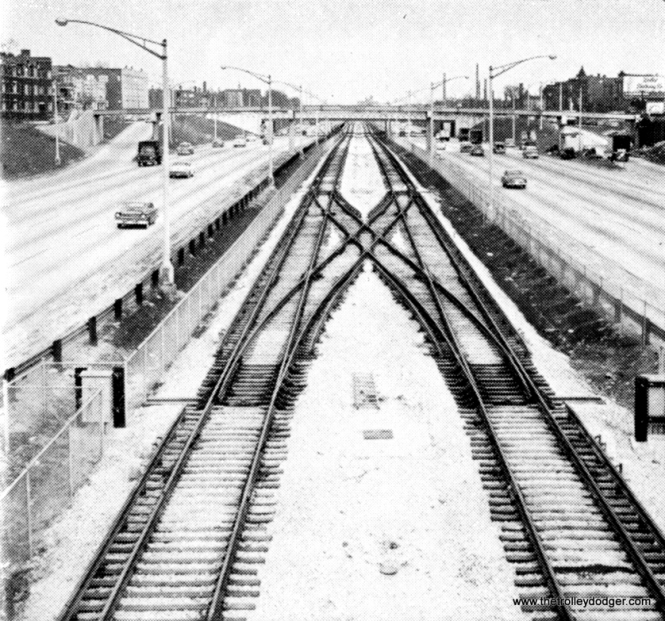
In this picture, it looks like the Congress Expressway (now Eisenhower) has just opened, which would date the picture to November 1960. We are looking east near Oak Park Avenue. Many things are unfinished, and traffic is limited to two lanes in each direction (and already very crowded). According to Graham Garfield's excellent web site, the new Oak Park station opened on March 19, 1960, and the station house was finished on March 27, 1961.

In this picture, it looks like the Congress Expressway (now Eisenhower) has just opened, which would date the picture to November 1960. We are looking east near Oak Park Avenue. Many things are unfinished, and traffic is limited to two lanes in each direction (and already very crowded). According to Graham Garfield’s excellent web site, the new Oak Park station opened on March 19, 1960, and the station house was finished on March 27, 1961.

Chicago, North Shore & Milwaukee car 772 in 1959 at the barn lead to the Harrison Street Shops in Milwaukee..

Chicago, North Shore & Milwaukee car 772 in 1959 at the barn lead to the Harrison Street Shops in Milwaukee..

North Shore Line car 158 is a northbound Waukegan Express on the Shore Line Route at North Chicago, July 4, 1949. This was the also date of an Electric Railroaders Association (ERA) fantrip. 158 was built by Brill in 1915.

North Shore Line car 158 is a northbound Waukegan Express on the Shore Line Route at North Chicago, July 4, 1949. This was the also date of an Electric Railroaders Association (ERA) fantrip. 158 was built by Brill in 1915.

North Shore Line city streetcar 356 in the 1940s. The consensus is this shows Waukegan, as there was no curve in Milwaukee that matches the buildings in this picture. Jerry Wiatrowski adds, "This is in Waukegan! The photographer is standing on the South side of Belvidere Street looking East/Northeast. The Westbound streetcar is turning off of Marion Street (now South Genesee Street) and will shortly turn right onto South Genesee Street as it travels North thru the center of downtown Waukegan. If I recall correctly, the “s-curve” this streetcar is on was known as “Merchants curve”. The sailors that can be seen in the windows of the car are going to downtown Waukegan from the Great Lakes Naval Base, the South end of the streetcar line."

North Shore Line city streetcar 356 in the 1940s. The consensus is this shows Waukegan, as there was no curve in Milwaukee that matches the buildings in this picture. Jerry Wiatrowski adds, “This is in Waukegan! The photographer is standing on the South side of Belvidere Street looking East/Northeast. The Westbound streetcar is turning off of Marion Street (now South Genesee Street) and will shortly turn right onto South Genesee Street as it travels North thru the center of downtown Waukegan. If I recall correctly, the “s-curve” this streetcar is on was known as “Merchants curve”. The sailors that can be seen in the windows of the car are going to downtown Waukegan from the Great Lakes Naval Base, the South end of the streetcar line.”

Randolph Street looking east in the late 1940s. The RKO Palace Theatre, located at 151 West Randolph, is now the Cadillac Palace.

Randolph Street looking east in the late 1940s. The RKO Palace Theatre, located at 151 West Randolph, is now the Cadillac Palace.

CTA Pullman 106 at South Shops on September 10, 1952.

CTA Pullman 106 at South Shops on September 10, 1952.

A view of the north side of CTA's South Shops on September 10, 1952. In a previous post, we ran a picture of car 4001 taken on this trackage. That picture was taken in the 1930s, and by 1952 it appears one track had been taken out of service.

A view of the north side of CTA’s South Shops on September 10, 1952. In a previous post, we ran a picture of car 4001 taken on this trackage. That picture was taken in the 1930s, and by 1952 it appears one track had been taken out of service.

PS- Here is that photo of 4001, which we previously ran in our post More Chicago PCC Photos – Part Four (10-12-2015):

CSL 4001 may be on non-revenue trackage at the north end of South Shops. (Edward Frank, Jr. Photo)

CSL 4001 may be on non-revenue trackage at the north end of South Shops. (Edward Frank, Jr. Photo)

This picture was taken on September 9, 1952, looking north from the Main Street station on CTA's Evanston branch.

This picture was taken on September 9, 1952, looking north from the Main Street station on CTA’s Evanston branch.

On September 9, 1952, a southbound North Shore Line train, running via the Shore Line Route, stops at Foster Street in Evanston. Here, NSL had its own platform to keep passengers from transferring to the "L" without paying another fare. The stairs descended to a free area. It was not necessary to have a similar platform for northbound riders, as North Shore Line conductors would check tickets on the train.

On September 9, 1952, a southbound North Shore Line train, running via the Shore Line Route, stops at Foster Street in Evanston. Here, NSL had its own platform to keep passengers from transferring to the “L” without paying another fare. The stairs descended to a free area. It was not necessary to have a similar platform for northbound riders, as North Shore Line conductors would check tickets on the train.

A view from the 15th floor of the YMCA Hotel on Wabash Avenue on September 9, 1952.

A view from the 15th floor of the YMCA Hotel on Wabash Avenue on September 9, 1952.

Another view from the same location.

Another view from the same location.

From the door configuration, you can tell that this prewar Chicago PCC has been converted to one-man operation. It is running on Route 4 - Cottage Grove in this blow-up of the previous image.

From the door configuration, you can tell that this prewar Chicago PCC has been converted to one-man operation. It is running on Route 4 – Cottage Grove in this blow-up of the previous image.

CTA work car L-203 and various PCCs parked behind South Shops on September 10, 1952.

CTA work car L-203 and various PCCs parked behind South Shops on September 10, 1952.

A CSL trailer being used as an office at South Shops on September 10, 1952.

A CSL trailer being used as an office at South Shops on September 10, 1952.

Here, one-man car 3266 is on the south side (Route 67). The car is at Harvard, heading westbound, and I believe the destination sign reads 79th and California. On the other hand, our resident south side expert M. E. writes: "In pict662.jpg , your caption says "I believe the destination sign reads 79th and California." No, it is 71st and California. Route 67 was known as 67th-69th-71st; abbreviated, just 69th, because that was the longest stretch. In fact, you might want to revise the caption to note that the photo is at 69th and Harvard."

Here, one-man car 3266 is on the south side (Route 67). The car is at Harvard, heading westbound, and I believe the destination sign reads 79th and California. On the other hand, our resident south side expert M. E. writes: “In pict662.jpg , your caption says “I believe the destination sign reads 79th and California.” No, it is 71st and California. Route 67 was known as 67th-69th-71st; abbreviated, just 69th, because that was the longest stretch. In fact, you might want to revise the caption to note that the photo is at 69th and Harvard.”

69th and Harvard today, looking east.

69th and Harvard today, looking east.

CTA 6193, a "169" or Broadway-State car, was built by Cummings in 1923. It was converted to one-man operation in 1949 and has suffered some damage in this September 10, 1952 view at South Shops.

CTA 6193, a “169” or Broadway-State car, was built by Cummings in 1923. It was converted to one-man operation in 1949 and has suffered some damage in this September 10, 1952 view at South Shops.

CTA 4314 and 4304 on the west side of South Shops, September 10, 1952. On the other hand, M. E. writes: "In pict664.jpg, you say "on the west side of South Shops." No, this has to be the east side of South Shops. That's because South Shops was on the east side of Vincennes, so its west side faced Vincennes. There is no Vincennes in this photo." We were just going by the information written in the negative envelope that came with this image, which turns out to be incorrect. Gosh darn those out-of-town photographers!!

CTA 4314 and 4304 on the west side of South Shops, September 10, 1952. On the other hand, M. E. writes: “In pict664.jpg, you say “on the west side of South Shops.” No, this has to be the east side of South Shops. That’s because South Shops was on the east side of Vincennes, so its west side faced Vincennes. There is no Vincennes in this photo.” We were just going by the information written in the negative envelope that came with this image, which turns out to be incorrect. Gosh darn those out-of-town photographers!!

CTA 4314 and 4304 on the east side of South Shops, September 10, 1952.

CTA 4314 and 4304 on the east side of South Shops, September 10, 1952.

CTA prewar PCC 4047 and postwar car 7038 at South Shops on September 10, 1952.

CTA prewar PCC 4047 and postwar car 7038 at South Shops on September 10, 1952.

Two CTA freight locos at South Shops, September 10, 1952.

Two CTA freight locos at South Shops, September 10, 1952.

A CTA freight loco, possibly L-201, at South Shops on September 10, 1952.

A CTA freight loco, possibly L-201, at South Shops on September 10, 1952.

A CTA wood car at 42nd Place, end of the Kenwood branch, during the 1950s. (Walter Broschart Photo)

A CTA wood car at 42nd Place, end of the Kenwood branch, during the 1950s. (Walter Broschart Photo)

A two car train of singles just north of Main Street in Evanston. #27 is the lead car.

A two car train of singles just north of Main Street in Evanston. #27 is the lead car.

A CTA single-car unit under wire on the Evanston branch, just north of Main Street. This might be car 47.

A CTA single-car unit under wire on the Evanston branch, just north of Main Street. This might be car 47.

A CTA single-car unit heads south from Isabella on the Evanston branch, sometime between 1961 and 1973.

A CTA single-car unit heads south from Isabella on the Evanston branch, sometime between 1961 and 1973.

A train of 4000s, signed for Jackson Park via the Subway, in 1947. If I am reading the sign correctly, this is 31st Street, a station the CTA closed in 1949. There was also apparently a Chicago White Sox home game when this picture was taken. M. E. writes: "pict673.jpg features a Jackson Park train at 31st St. Notice three tracks. The middle track was used, although I am unsure under what circumstances. One possibility that comes to mind is that the Kenwood line (until it became a shuttle out of Indiana Ave.) ran on this trackage into the Loop and up to Wilson. The Kenwood was a local. The Englewood and Jackson Park trains sometimes bypassed the Kenwood locals using the middle track. There were switches up and down the line to enable moving to and from the middle track. Another possibility is that at one point the North Shore ran trains south as far as 63rd and Dorchester (1400 East) on the Jackson Park line. Perhaps some CNS&M trains used the middle track. One impossibility is that the Englewood and Jackson Park trains used the middle track the whole way from south of Indiana Ave. to the Loop. I say this was not possible because all the stations on this line were on the outer sides of the outside tracks. I don't recall any Englewood or Jackson Park trains running express on the middle track along this stretch. By the way, prior to the 1949 changes, only the Jackson Park line ran north to Howard. The Englewood ran to Ravenswood (to Lawrence and Kimball)."

A train of 4000s, signed for Jackson Park via the Subway, in 1947. If I am reading the sign correctly, this is 31st Street, a station the CTA closed in 1949. There was also apparently a Chicago White Sox home game when this picture was taken. M. E. writes: “pict673.jpg features a Jackson Park train at 31st St. Notice three tracks. The middle track was used, although I am unsure under what circumstances. One possibility that comes to mind is that the Kenwood line (until it became a shuttle out of Indiana Ave.) ran on this trackage into the Loop and up to Wilson. The Kenwood was a local. The Englewood and Jackson Park trains sometimes bypassed the Kenwood locals using the middle track. There were switches up and down the line to enable moving to and from the middle track.
Another possibility is that at one point the North Shore ran trains south as far as 63rd and Dorchester (1400 East) on the Jackson Park line. Perhaps some CNS&M trains used the middle track.
One impossibility is that the Englewood and Jackson Park trains used the middle track the whole way from south of Indiana Ave. to the Loop. I say this was not possible because all the stations on this line were on the outer sides of the outside tracks. I don’t recall any Englewood or Jackson Park trains running express on the middle track along this stretch.
By the way, prior to the 1949 changes, only the Jackson Park line ran north to Howard. The Englewood ran to Ravenswood (to Lawrence and Kimball).”

A close-up of the previous picture.

A close-up of the previous picture.

North Shore Line city streetcar 509 in August 1941. Don's Rail Photos says, "509 was built by St Louis Car in 1909. It was rebuilt to one man and transferred to Waukegan on November 3, 1922. It was used as a waiting room at 10th Street, North Chicago, for a short time in 1947, until a new station could be built at the truncated north end of the Shore Line Route. It was sold for scrap in 1949."

North Shore Line city streetcar 509 in August 1941. Don’s Rail Photos says, “509 was built by St Louis Car in 1909. It was rebuilt to one man and transferred to Waukegan on November 3, 1922. It was used as a waiting room at 10th Street, North Chicago, for a short time in 1947, until a new station could be built at the truncated north end of the Shore Line Route. It was sold for scrap in 1949.”

North Shore Line wood car 304, built by American Car in 1910, as it looked in June 1938. It became a sleet cutter in 1939 and was scrapped the following year.

North Shore Line wood car 304, built by American Car in 1910, as it looked in June 1938. It became a sleet cutter in 1939 and was scrapped the following year.

Gary Railways 19 at Indiana Harbor on May 1, 1938 during the very first fantrip of Central Electric Railfans' Association. This car was built by Cummings in 1927. (LaMar M. Kelley Photo)

Gary Railways 19 at Indiana Harbor on May 1, 1938 during the very first fantrip of Central Electric Railfans’ Association. This car was built by Cummings in 1927. (LaMar M. Kelley Photo)

Gary Railways 22 on May 10, 1940.

Gary Railways 22 on May 10, 1940.

Gary Railways 21 in 1938, signed for 22nd Avenue. It was built by Cummings in 1927.

Gary Railways 21 in 1938, signed for 22nd Avenue. It was built by Cummings in 1927.

Northern Indiana Railways 216 in South Bend, Indiana on June 25, 1939. The occasion was Central Electric Railfans' Association fantrip #9, which brought people here via the South Shore Line. This deck roof car was built by Kuhlman in 1923.

Northern Indiana Railways 216 in South Bend, Indiana on June 25, 1939. The occasion was Central Electric Railfans’ Association fantrip #9, which brought people here via the South Shore Line. This deck roof car was built by Kuhlman in 1923.

Gary Railways 5, a 1925 Kuhlman product, is shown at Indiana Harbor on May 1, 1938, date of the very first Central Electric Railfans' Association fantrip. (LaMar M. Kelley Photo)

Gary Railways 5, a 1925 Kuhlman product, is shown at Indiana Harbor on May 1, 1938, date of the very first Central Electric Railfans’ Association fantrip. (LaMar M. Kelley Photo)

Here, we see New Castle Electric Street Railway 352 in Grant Street at the Erie/B&O/P&LE station in New Castle, PA on August 24, 1941. This was a Birney car, a 1919 National product that, to these eyes, reminds me of the Osgood-Bradley Electromobiles of ten years later. All streetcar service in this area was discontinued on December 11, 1941. (W. Lupher Hay Photo)

Here, we see New Castle Electric Street Railway 352 in Grant Street at the Erie/B&O/P&LE station in New Castle, PA on August 24, 1941. This was a Birney car, a 1919 National product that, to these eyes, reminds me of the Osgood-Bradley Electromobiles of ten years later. All streetcar service in this area was discontinued on December 11, 1941. (W. Lupher Hay Photo)

The Queensboro Bridge trolley, which last ran on April 7, 1957, making it New York City's final (to date) streetcar. Our new audio collection has a "mystery track" on it that may or may not be the Queensboro Bridge trolley. You be the judge. It takes a serious railfan to distinguish an Osgood Bradley Electromobile, as we see here, from the very similar Brill Master Unit. Parts from sister car 601 are now being used to help the Electric City Trolley Museum Association restore Scranton Transit car 505.

The Queensboro Bridge trolley, which last ran on April 7, 1957, making it New York City’s final (to date) streetcar. Our new audio collection has a “mystery track” on it that may or may not be the Queensboro Bridge trolley. You be the judge.
It takes a serious railfan to distinguish an Osgood Bradley Electromobile, as we see here, from the very similar Brill Master Unit. Parts from sister car 601 are now being used to help the Electric City Trolley Museum Association restore Scranton Transit car 505.

Indianapolis Railways 175 was a Brill "Master Unit" built in 1934. These were among the last cars built by Brill prior to the pre-PCCs. Brill's idea behind the "Master Unit" was to create a standardized car, but as it turned out, no two orders placed were exactly alike.

Indianapolis Railways 175 was a Brill “Master Unit” built in 1934. These were among the last cars built by Brill prior to the pre-PCCs. Brill’s idea behind the “Master Unit” was to create a standardized car, but as it turned out, no two orders placed were exactly alike.

North Shore Line city streetcar 352 at Harrison Street Shops in Milwaukee, June 1941.

North Shore Line city streetcar 352 at Harrison Street Shops in Milwaukee, June 1941.

Philadelphia Suburban Transportation Co. (aka Red Arrow) 13, a 1949 product of St. Louis Car Co., in side-of-the-road operation on West Chester Pike, June 2, 1954. Buses replaced trolleys a few days later to allow for the widening of this important thoroughfare.

Philadelphia Suburban Transportation Co. (aka Red Arrow) 13, a 1949 product of St. Louis Car Co., in side-of-the-road operation on West Chester Pike, June 2, 1954. Buses replaced trolleys a few days later to allow for the widening of this important thoroughfare.

Here, Red Arrow 61 approaches the 69th Street Terminal in Upper Darby, sometime in the 1930s. Car 61 was a Brill product from about 1927. Note the man wearing a straw hat, which is something people used to do on hot days.

Here, Red Arrow 61 approaches the 69th Street Terminal in Upper Darby, sometime in the 1930s. Car 61 was a Brill product from about 1927. Note the man wearing a straw hat, which is something people used to do on hot days.

North Shore Line car 760 in Milwaukee. Don's Rail Photos says: "760 was built by Standard Steel Car Co in 1930. It was modernized in 1945 and rebuilt as (a) Silverliner on September 23, 1952." Since photographer LaMar M. Kelley died on January 5, 1948 (see below), this picture cannot be later than that date.

North Shore Line car 760 in Milwaukee. Don’s Rail Photos says: “760 was built by Standard Steel Car Co in 1930. It was modernized in 1945 and rebuilt as (a) Silverliner on September 23, 1952.” Since photographer LaMar M. Kelley died on January 5, 1948 (see below), this picture cannot be later than that date.

We don't often know much about the people who took some of these historic photographs. But here is an obituary of LaMar M. Kelley appeared in the February 1948 issue of Central Headlight, an employee publication of the New York Central railroad. I also found this online (even though it gets the date wrong): "Lamar M. Kelly (d. 1947) of Elkhart IN worked as a helper at the sand house and coal pockets at Elkhart . He was crippled by polio and devoted most his time to rail photography. He traded negatives with Jerry Best who considered Kelley's work to be of varied quality. Kelley died suddenly in a workplace accident in 1947. His negative collection was sold piecemeal." I object to the author's use of the word "crippled," which implies limitations in someone's life that are more than just physical disabilities. Personally, I think LaMar M. Kelley's photography was quite good, and that he led a life of great accomplishment in his 50 short years.

We don’t often know much about the people who took some of these historic photographs. But here is an obituary of LaMar M. Kelley appeared in the February 1948 issue of Central Headlight, an employee publication of the New York Central railroad. I also found this online (even though it gets the date wrong): “Lamar M. Kelly (d. 1947) of Elkhart IN worked as a helper at the sand house and coal pockets at Elkhart . He was crippled by polio and devoted most his time to rail photography. He traded negatives with Jerry Best who considered Kelley’s work to be of varied quality. Kelley died suddenly in a workplace accident in 1947. His negative collection was sold piecemeal.” I object to the author’s use of the word “crippled,” which implies limitations in someone’s life that are more than just physical disabilities. Personally, I think LaMar M. Kelley’s photography was quite good, and that he led a life of great accomplishment in his 50 short years.

"View of two passenger interurban cars on side track for local southbound loading at Edison Court, Waukegan, Ill. Note sign on post, "Save Your North Shore Line." Photo taken circa 1960 by Richard H. Young. Ultimately, these efforts failed, but the demise of the North Shore Line (and the Chicago Aurora & Elgin) helped spur the Federal Government into action to begin subsidizing transit across the country.

“View of two passenger interurban cars on side track for local southbound loading at Edison Court, Waukegan, Ill. Note sign on post, “Save Your North Shore Line.” Photo taken circa 1960 by Richard H. Young. Ultimately, these efforts failed, but the demise of the North Shore Line (and the Chicago Aurora & Elgin) helped spur the Federal Government into action to begin subsidizing transit across the country.

As new streetcar tracks are being laid in Milwaukee, it is important to know what we once had that was lost. Here, the North Shore Line terminal in downtown Milwaukee is being reduced to rubble in 1964, a year after passenger service ended. If only we could have found some way to keep what we had, we wouldn't now need to build so much. An important lesson in life-- it is better to create than it is to destroy.

As new streetcar tracks are being laid in Milwaukee, it is important to know what we once had that was lost. Here, the North Shore Line terminal in downtown Milwaukee is being reduced to rubble in 1964, a year after passenger service ended. If only we could have found some way to keep what we had, we wouldn’t now need to build so much. An important lesson in life– it is better to create than it is to destroy.

Recent Correspondence

Jack Bejna writes:

Here’s the latest. The Chicago Aurora & Elgin Railway ordered 5 cars to be built by the G C Kuhlman Car Company in 1909, numbered 311-315. The wood siding extended down to cover the previously exposed side sill channel, enhancing the look of these classic beauties.

The final wooden car order was placed with the Jewett Car Company in 1914 for six cars numbered 316-321. Car 318 was unique, with the sides being steel up to the belt line, the only wood car built this way. In the 1920s cars 319-321 were upgraded with more powerful motors and thereafter they were used together and/or with trailers.

I don’t know how you manage to put out an interesting, informative post every month, so thanks again for your website and all of the interesting stories within.

And we, in turn, really enjoy seeing these wonderful pictures that you have managed to make look better than ever, using all your skills and hard work.

Larry Sakar writes:

Hi Dave,

I just returned from my 6500 mile Amtrak trip to San Francisco, LA & Portland. I took the Hiawatha from Milwaukee to Chicago and connected to #5 the California Zephyr. Spent 2 days in SFO then took train 710 the San Joaquin to Bakersfield where they bus you to LA. The bus takes I-5 for most of the 100 mile trip to LA. As we got close to LA we were coming into Glendale and looking to my right I saw the abandoned PE r.o.w. where it crossed Fletcher Dr. There’s a picture that has been reproduced numerous times of a 3 car train of PCC’s crossing the bridge over Fletcher Dr. I thought the abandoned North Shore Line r.o.w. here in Milwaukee was high up but the PE r.o.w. is twice as high. The LA Downtown Hotel where I stayed was a block away from what used to be the Subway Terminal Bldg. at 4th & Hill.

When I was leaving the next day I rode the Red Cap’s motorized vehicle to the platform from the Metropolitan lounge. the lounge which is exclusively for 1st Class (sleeping car) passengers is on the second floor of LAUPT (Los Angeles Union Passenger Terminal). They travel down a ramp and in the process cross the light rail tracks. We had to stop at the crossing for the passage of a Gold Line train headed to Pasadena and Cucamonga. Bit by bit LA is rebuilding the PE at a cost of billions! So far lines to Long Beach, Pasadena and Santa Monica have been rebuilt. Light rail has become very big in LA.

Two days later on my way back to Portland Union Station my taxi was traveling eight alongside a Portland MAX light rail train. In SFO the F-Line streetcars to Fisherman’s Wharf were packed to the rafters. Articulated buses were operating in place of the JKLM & N light rail lines that run in the Market St. subway. The new cars that are replacing the present BREDA cars were being tested. Saw BART when the Zephyr stopped in Richmond, CA. I know they have new cars coming but they don’t appear to be there as yet. BART is experiencing a significant increase in crime on its lines. Same holds true for Portland. In fact the Portland city council voted to ban anyone convicted of a serious crime on any of its light rail lines, buses or the Portland streetcar for life.

Coming home from Portland on the Portland section of the Empire Builder we heard that the previous day’s train was hit at a crossing (don’t know where) by a water truck. The 24 year old driver smashed thru the crossing gates and slammed into the second Genesis engine destroying it, the baggage car and part of the Superliner crew car behind it. No one was injured, luckily. The cause of the accident was the truck driver texting on his cell phone and not paying attention to driving. He’ll have lots of time to text now as I’m sure he’ll be fired. He’ll lose his CDL (Commercial Drivers License) and I’m sure the trucking company’s insurance carrier will be suing him for the damages they have to pay to Amtrak.

The day I was heading up the California coast from LA to Portland our train was held for almost an hour at LA for late connecting San Diego to LA (Pacific Surfliner) train 763 which is a guaranteed connection to #14. The train hit and killed some guy who was walking on the tracks north of San Diego and south of San Juan Capistrano.

It was a great trip and I’d do it again in a heartbeat.

Thanks for sharing!

FYI, Larry Sakar comments:

Hi Dave,

Fantastic posts! Those poor CA&E cars died a slow death rotting away in Wheaton yards until everything was finally scrapped in 1961.

I enjoyed the aerial shots of Canal St. station on the Metropolitan “L” (CTA). It’s not a station that seems to have been photographed a lot but there is a giant wall-sized shot of it on display in the Clinton St. CTA blue line subway station which replaced it. In the days of the “Met” there was a passageway from the south end of Union Station to the “L”. It’s still there and I understand it leads to the present day parking garage south of the station.

In the caption for that shot of the 2 car train of 4000’s on the Lake St. “L”, I don’t think the Lake St. “L” goes to Forest Park. The Green Line as it’s known today ends in Oak Park unless it’s been extended.

Looking at that North Shore Line city car photo I’d guess that is somewhere in Waukegan – Merchant’s curve perhaps? The only place in Milwaukee that had that kind of a curve was where the NSL went between 5th & 6th Sts. None of the buildings in this photo seem to match the ones that were along that curve. The curve was reconstructed after the NSL quit and is now the way you get on to southbound I-94 at Greenfield Ave. The factory building seen in so many of the photos of NSL trains on that curve still stands. Some sort of auto repair facility has been built in front of it. I just rode over that curve last Saturday in the taxi that was taking me home from the Milwaukee Intermodal station downtown. Here’s a Bob Genack photo I have showing that curve. Larry Sakar

Thanks… actually, the Lake Street “L” ground-level operation did cross Harlem Avenue into Forest Park, and there was actually a station there a short distance west which was technically the end of the line.  But few people got on there, the great majority using Marion Street instead.  The Harlem station on the embankment has entrances at Marion and on the west side of Harlem, and thus serves both Oak Park and Forest Park.

An Early History of the Railroad Record Club

Kenneth Gear and I have some new theories about the early history of the Railroad Record Club. This is based on careful study of the new material featured in our recent post Railroad Record Club Treasure Hunt (July 30, 2017).

One of the homemade 78 rpm records Ken recently bought was marked as having William A. Steventon‘s first recordings. These were dated March 24, 1953.

In a 1958 newspaper interview, Steventon said his wife had given him a tape recorder for Christmas in 1953. He probably meant to say 1952, and it took him a few months to get used to operating it.

Steventon always said that the club started in 1953. However, this seemed odd since he did not issue his first 10″ 33 1/3 rpm records until some years later. The 36 numbered discs came out at the rate of four per year from 1958 through 1966.

There was an Introductory Record, which was probably issued in 1957, and a few “special” releases, the most notable of which (SP-4) documents an entire 1962 trip of the South South Shore Line in real time on three 12″ discs as a box set. That was Steventon’s masterpiece.

In 1967, RCA Custom Records closed up shop, and it was not until some years later that Steventon began reissuing some of his recordings on 12″, using a different pressing plant in Nashville. But what was the Railroad Record Club doing from 1953 through 56?

Apparently, during those years, Steventon was distributing 78 rpm records made using a portable disc cutter. These had been available for home use starting in about 1929, and were often used to record things off the radio.

A few enterprising individuals like the late Jerry Newman took such machines to jazz clubs. This is how he made several recordings of Charlie Christian jamming at Minton’s Playhouse in Harlem in 1941.

In similar fashion, a portable disc cutter was used to record Duke Ellington and his Orchestra in Fargo, North Dakota in 1940. You can read about that here.

While Steventon was using a tape recorder, made portable by being hooked up to an auto battery, tape was not yet an effective way to distribute recordings in 1953. Very few people had such machines.

But most people did have record players, and the standard format of the time was 78 rpm, which yielded at most five minutes per side on 10″ aluminum discs covered with acetate. “Long Playing” 33 1/3 rpm records were a new format, just beginning to gain popularity.

No doubt Steventon dated the RRC’s beginnings to 1953, since that is when he began making recordings, but it is alsolikely that is when he started distributing them. Using a homemade disc cutter meant the records were made in real time. As things gained in popularity, this would have taken up more and more of his time.

To distill much longer recordings to fit the five minute limit, Steventon spliced together all sorts of bits and pieces, and recorded brief introductions later, to tell listeners what they were about to hear.

Some of the homemade discs that Ken purchased have numbers on them. Others have stamped titles, which would indicate to me that Steventon was making them in quantity, and had rubber stamps made for the most popular titles.

These early records were distributed using a number sequence that is totally different than the later one adopted for the 10″ records issued in 1958 or later. Here is a partial list of these early releases:

01. Potomac Edison (aka Hagerstown & Frederick)
02. Shenandoah Central
03. Capital Transit
04. Johnstown Traction
05. Altoona & Logan Valley
06. Baltimore & Ohio
07. Shaker Heights Rapid Transit
08. Claude Mahoney Radio Program about NRHS fantrip (1953)
09. Pennsylvania Railroad
10. Nickel Plate Road
11. St. Louis Public Service
15. Baltimore Transit
16. Norfolk & Western
17. Western Maryland Railway
22. East Broad Top
24. Chicago & Illinois Midland

In this period (1953-55), Steventon was living in Washington, D.C., so many of his recordings were made in that area. He was originally from Mount Carmel, Illinois, which is near the Indiana border. That explains his Hoosier accent as heard on his introductions.

Over time, Steventon branched out, making recordings in other cities when he was on vacation. Regarding his traction recordings, he generally preferred to tape the older equipment, since these made all the right noises. It was more difficult to make successful recordings of PCC cars, since they were much quieter by design, but he did do some.

The success of these records surely inspired Steventon to have records made in quantity by a pressing plant, the RCA Custom Records Division. By 1957, the 33 1/3 rpm format had become the norm, and this permitted about 15 minutes per side on a 10″ record. The resulting disc could hold as much sound as three of the 78s, and weighed a lot less, saving on postage.

Eventually, Steventon began including detailed liner notes with his records, and largely abandoned the spoken introductions.

The 1958 newspaper article mentioned above said that Steventon had sold 1000 records in the previous year. Without his previous experience with homemade records, it is unlikely that Steventon would have records pressed commercially.

We have now cleaned up and digitized many of these early recordings, which are now available under the title Railroad Record Club Rarities. The Traction recordings fill two discs, and the Steam and Diesel tracks are on a single disc. More details are below.

Sometimes, in the absence of written records, or spoken introductions, it is only possible to identify certain recordings through a bit of detective work. As an example, on one recording, the only clues we have are Steventon’s brief mention of riding cars 80 and 83.

This narrows down considerably the list of possible locations. The most likely is the Philadelphia Suburban Transporation Company, also known as the Red Arrow Lines. Cars 80 and 83, which fortunately have survived, were 1932 Brill-built “Master Units.”

We know that Steventon made recordings of similar cars. On one of the Altoona discs, he even refers to an Osgood Bradley Electromobile at one point as a “Master Unit.”

Car 80 still runs to this day at the Electric City Trolley Museum in Scranton, PA., so there are YouTube recordings that I compared with this one. They sound very much the same.

Finally, the Steventon recording shows cars 80 and 83 running at speed, frequently blowing the horn, very much in interurban mode. The longest Red Arrow route, and the most interurban in character, was the West Chester line, which was largely side-of-the-road operation along West Chester Pike.

The final trolley trips on West Chester took place on June 6, 1954. We have written about this before– see Red Arrow in West Chester, September 13, 2016. Buses replaced trolleys so that West chester Pike could be widened.

The National Railway Historical Society held a fantrip after the last revenue runs were made. We know that Steventon participated in NRHS events, since one of the 78 rpm records he distributed features a radio program that discusses a 1953 NRHS excursion.

So, the most logical conclusion is that this rare recording was made by Steventon in 1953 or 1954, and documents the Red Arrow line to West Chester. This recording is included on Railroad Record Club Rarities – Traction.

While we are happy to report that we have finally achieved our long-sought goal of digitizing the Railroad Record Club’s later output, it seems very likely there are still more of these early recordings waiting to be discovered.

-David Sadowski

Now Available on Compact Disc

RRC-RT
Railroad Record Club Rarities – Traction!
# of Discs – 2
Price: $19.95

Railroad Record Club Rarities – Traction!
These are rare recordings, which date to 1953-55 and predate the 10″ LPs later issued by the Railroad Record Club. Many are previously unissued, and some are available here in a different (and longer) format than later releases, often including William A. Steventon’s spoken introductions. We have used the best available sources, and while some recordings sound excellent, others have some imperfections. But all are rare, rare, rare!

Includes Altoona & Logan Valley, Baltimore Transit, Capital Transit (Washington D.C.), Johnstown Traction, Pennsylvania GG-1s, Potomac Edison (Hagerstown & Frederick), Red Arrow, St. Louis Public Service, Shaker Heights Rapid Transit, and South Shore Line Electric Freight.

Total time – 149:52


RRC-RSD
Railroad Record Club Rarities – Steam and Diesel!
# of Discs – 1
Price: $14.95

Railroad Record Club Rarities – Steam and Diesel
These are rare recordings, made by William A. Steventon between 1953 and 1955, and include his earliest recordings. These predate the regular output of the Railroad Record Club. Many are previously unissued, and some are available here in a different (and longer) format than later releases, often including William A. Steventon’s spoken introductions. In general, audio quality is good, but some recordings have imperfections. However, the best available sources have been used, and you won’t find them anywhere else. Much of this material has not been heard in over 60 years.

Includes: Baltimore & Ohio, Chicago & Illinois Midland, East Broad Top, Illinois Central, Nickel Plate road, Pennsylvania Railroad, Shenadoah Central, and even a 1953 radio broadcast by Claude Mahoney that discusses an NRHS fantrip.

Total time – 69:36


RRC #22 and 31
Buffalo Creek & Gauley
Sound Scrapbook – Steam!
# of Discs – 1
Price: $14.95

Railroad Record Club #22 and 31:

The Buffalo Creek and Gauley Railroad (BC&G) was a railroad chartered on April 1, 1904 and ran along Buffalo Creek in Clay County, West Virginia. The original Buffalo Creek and Gauley ended service in 1965.

The BC&G was one of the last all-steam railroads, never operating a diesel locomotive to the day it shut down in 1965. Its primary purpose was to bring coal out of the mountains above Widen to an interchange with the Baltimore and Ohio Railroad at Dundon. These recordings were made in 1960.

Sound Scrapbook – Steam! covers several different steam railroads, including Canadian National, National Railways of Mexico, McCloud River Railway, Union Pacific, Southern Pacific, Westside Lumber Company, Duluth Missabe & Iron Range, and Pickering Lumber Corp.

Total time – 62:43


RRC #32, Sampler for Years 3 & 4, and Steam Whistles and Bells
# of Discs – 1
Price: $14.95

RRC #32, Sampler for Years 3 & 4, and Steam Whistles and Bells
This disc features the New York Central, recorded in 1954-55. It’s mainly steam, but with some diesel. In addition, the Railroad Record Club Sampler for years 3 and 4 includes selections from discs 9 through 16. Finally, we have included a very rare circa 1955 recording, Steam Whistles and Bells, which covers several properties across the country.

Total time – 72:07


Pre-Order Our New Book Chicago Trolleys

On the Cover: Car 1747 was built between 1885 and 1893 by the Chicago City Railway, which operated lines on the South Side starting in April 1859. This is a single-truck (one set of wheels) open electric car; most likely a cable car, retrofitted with a trolley and traction motor. The man at right is conductor William Stevely Atchison (1861-1921), and this image came from his granddaughter. (Courtesy of Debbie Becker.)

On the Cover: Car 1747 was built between 1885 and 1893 by the Chicago City Railway, which operated lines on the South Side starting in April 1859. This is a single-truck (one set of wheels) open electric car; most likely a cable car, retrofitted with a trolley and traction motor. The man at right is conductor William Stevely Atchison (1861-1921), and this image came from his granddaughter. (Courtesy of Debbie Becker.)

We are pleased to report that our new book Chicago Trolleys will be released on September 25th by Arcadia Publishing. You can pre-order an autographed copy through us today (see below). Chicago Trolleys will also be available wherever Arcadia books are sold.

Overview

Chicago’s extensive transit system first started in 1859, when horsecars ran on rails in city streets. Cable cars and electric streetcars came next. Where new trolley car lines were built, people, businesses, and neighborhoods followed. Chicago quickly became a world-class city. At its peak, Chicago had over 3,000 streetcars and 1,000 miles of track—the largest such system in the world. By the 1930s, there were also streamlined trolleys and trolley buses on rubber tires. Some parts of Chicago’s famous “L” system also used trolley wire instead of a third rail. Trolley cars once took people from the Loop to such faraway places as Aurora, Elgin, Milwaukee, and South Bend. A few still run today.

The book features 226 classic black-and-white images, each with detailed captions, in 10 chapters:

1. Early Traction
2. Consolidation and Growth
3. Trolleys to the Suburbs
4. Trolleys on the “L”
5. Interurbans Under Wire
6. The Streamlined Era
7. The War Years
8. Unification and Change
9. Trolley Buses
10. Preserving History

Product Details

ISBN-13: 9781467126816
Publisher: Arcadia Publishing SC
Publication date: 09/25/2017
Series: Images of Rail
Pages: 128

Meet the Author

David Sadowski has been interested in streetcars ever since his father took him for a ride on one of the last remaining lines in 1958. He grew up riding trolley buses and “L” trains all over Chicago. He coauthored Chicago Streetcar Pictorial: The PCC Car Era, 1936–1958, and runs the online Trolley Dodger blog. Come along for the ride as we travel from one side of the city to the other and see how trolley cars and buses moved Chicago’s millions of hardworking, diverse people.

Images of Rail

The Images of Rail series celebrates the history of rail, trolley, streetcar, and subway transportation across the country. Using archival photographs, each title presents the people, places, and events that helped revolutionize transportation and commerce in 19th- and 20th-century America. Arcadia is proud to play a part in the preservation of local heritage, making history available to all.

The book costs just $21.99 plus shipping. Shipping within the US is included in the price. Shipping to Canada is just $5 additional, or $10 elsewhere.

Please note that Illinois residents must pay 10.00% sales tax on their purchases.

We appreciate your business!

For Shipping to US Addresses:

For Shipping to Canada:

For Shipping Elsewhere:

NEW – Chicago Trolleys Postcard Collection

We are pleased to report that selected images from our upcoming book Chicago Trolleys will be available on September 25th in a pack of 15 postcards, all for just $7.99. This is part of a series put out by Arcadia Publishing. Dimensions: 6″ wide x 4.25″ tall

The Postcards of America Series

Here in the 21st century, when everyone who’s anyone seems to do most of their communicating via Facebook and Twitter, it’s only natural to wax a little nostalgic when it comes to days gone by. What happened to more personal means of communication like hand-written letters on nice stationery? Why don’t people still send postcards when they move someplace new or go away on vacation?

If that line of thinking sounds familiar, then Arcadia Publishing’s Postcards of America was launched with you in mind. Each beautiful volume features a different collection of real vintage postcards that you can mail to your friends and family.

Pre-Order your Chicago Trolleys Postcard Pack today!

For Shipping to US Addresses:

For Shipping to Canada:

For Shipping Elsewhere:

street-railwayreview1895-002

Help Support The Trolley Dodger

gh1

This is our 191st post, and we are gradually creating a body of work and an online resource for the benefit of all railfans, everywhere. To date, we have received over 311,000 page views, for which we are very grateful.

You can help us continue our original transit research by checking out the fine products in our Online Store.

As we have said before, “If you buy here, we will be here.”

We thank you for your support.

DONATIONS

In order to continue giving you the kinds of historic railroad images that you have come to expect from The Trolley Dodger, we need your help and support. It costs money to maintain this website, and to do the sort of historic research that is our specialty.

Your financial contributions help make this web site better, and are greatly appreciated.

A Tale of Two Cities

This remarkable picture was taken at the North Shore Line's Milwaukee terminal in January 1963. for all we know, this may be the last night of operation. If so, the temperature was below zero.

This remarkable picture was taken at the North Shore Line’s Milwaukee terminal in January 1963. for all we know, this may be the last night of operation. If so, the temperature was below zero.

Today, we feature color slides taken in Chicago and Philadelphia. Those are the “two cities” in our title, but we also make brief side trips to Los Angeles and Mexico City. Somehow, though A Tale of Four Cities just doesn’t have the same ring.

Come to think of it, some of these pictures were taken in Milwaukee and South Bend, so that’s even more cities.

Chicago’s transit system and Philadelphia’s have shared a few things in common over the years. After the North Shore Line quit in 1963, the two articulated Electroliners (see one in our lead picture) were bought by the Philadelphia Suburban Transportation Company, better known as the Red Arrow Lines. Rechristened Liberty Liners, they continued in service from 1964 until about 1976.

Dr. Thomas Conway, Jr., who helped modernize the Chicago, Aurora & Elgin interurban in the 1920s, did the same with the Philadelphia & Western, which later became part of Red Arrow.

In the late 1980s, Red Arrow’s successor SEPTA purchased several pairs of used Chicago Transit Authority rapid transit cars (from the 6001-6200 series) to help keep service going, as their existing equipment (Bullets and Strafford cars) was really showing its age.

While the CA&E’s 1953 cutback in service to Forest Park helped speed its demise but a few years later, the P&W Norristown line, which survives today, has never had direct service to downtown Philly.

The CA&E’s 10 curved-sided cars, built in 1945, are often cited as the last “standard” interurbans built in this country. Depending on how you define the word standard, some double-ended cars built for Red Arrow by St. Louis Car Company (they also built the CA&E cars) in 1949 might take the prize instead. These closely resemble PCC cars but don’t qualify as “true” PCCs because they used standard trucks and motors.

The other contenders for last standard interurban are two series built for the Illinois Terminal in the late 1940s. Double-end PCCs were purchased for the St. Louis to Granite City line, and streamliners for longer inter-city use.

For that matter, Pittsburgh Railways used PCC cars (built in the late 1940s) on their interurban lines to Washington and Charleroi. These cars continued in service in Pittsburgh for many years after the last interurban ran in 1953.

Scanning these images was just a starting point. I put in many hours of work in Photoshop to remove imperfections and improve the color. As always, if you have location information you can give us, don’t hesitate to drop us a line.

We salute the many fine photographers, whose names are unfortunately not known to us, who took these exceptional pictures. It is important to give credit where credit is due, but in too many cases, when we receive a slide, negative, or print, there isn’t a name associated with it. We wish it were otherwise, but we are grateful that so many fine images have survived the decades in order to be shared with you. Our intentions are always to give these images, and the people who took them, the respect they deserve. When we have such information, we always give proper credit.

Enjoy!

-David Sadowski

PS- You can see more great night shots in our previous post Night Beat (June 21, 2016).

Chicago Area

South Shore Line car 110 laying over at South Bend, Indiana in July 1963. This was the east end of the line until 1970, when service was cut back to the outskirts of town, and South Bend street running was eliminated. In 1992, service was extended to the South Bend International Airport, 3 miles northwest of downtown South Bend.

South Shore Line car 110 laying over at South Bend, Indiana in July 1963. This was the east end of the line until 1970, when service was cut back to the outskirts of town, and South Bend street running was eliminated. In 1992, service was extended to the South Bend International Airport, 3 miles northwest of downtown South Bend.

Sailors board a North Shore Line train at Great Lakes on June 1, 1962. Car 751 is at rear.

Sailors board a North Shore Line train at Great Lakes on June 1, 1962. Car 751 is at rear.

North Shore Line 731 is at Libertyville on the Mundelein branch. We featured another picture at this location, taken in warmer weather, in Our 150th Post (August 6, 2016).

North Shore Line 731 is at Libertyville on the Mundelein branch. We featured another picture at this location, taken in warmer weather, in Our 150th Post (August 6, 2016).

North Shore Line 723 at the front of a three-car train at an unidentified location. Andre Kristopans: "NSL 723 is on the Evanston L, I would say between Central and Noyes." George Trapp: " I believe the train is Northbound on the Evanston "L" somewhere between the Foster Street and Central Street stations, probably closer to the latter on the last section of the line to be elevated starting in 1928."

North Shore Line 723 at the front of a three-car train at an unidentified location. Andre Kristopans: “NSL 723 is on the Evanston L, I would say between Central and Noyes.” George Trapp: ” I believe the train is Northbound on the Evanston “L” somewhere between the Foster Street and Central Street stations, probably closer to the latter on the last section of the line to be elevated starting in 1928.”

North Shore Line car 773 and train on the Loop "L". The car is signed as a Chicago Express on the Shore Line Route, which was abandoned in July 1955.

North Shore Line car 773 and train on the Loop “L”. The car is signed as a Chicago Express on the Shore Line Route, which was abandoned in July 1955.

We ran another version of this image in a previous post, but this one is better because there is less cropping. A northbound CNS&M Shore Line Route train, headed up by 413, at the downtown Wilmette station in June 1954. The Shore Line was abandoned not much more than one year later. We are looking to the southeast.

We ran another version of this image in a previous post, but this one is better because there is less cropping. A northbound CNS&M Shore Line Route train, headed up by 413, at the downtown Wilmette station in June 1954. The Shore Line was abandoned not much more than one year later. We are looking to the southeast.

An Illinois Central Electric suburban commuter train in 1963. (Fred Byerly Collection)

An Illinois Central Electric suburban commuter train in 1963. (Fred Byerly Collection)

This picture, taken in September 1958, appears to show the back end of a CTA Congress branch train heading east over temporary trackage just east of DesPlaines Avenue, where there was a crossing at grade. Construction work was underway for I290, and the previous June, the new rapid transit line in the Congress expressway median had opened as far west as Cicero Avenue.

This picture, taken in September 1958, appears to show the back end of a CTA Congress branch train heading east over temporary trackage just east of DesPlaines Avenue, where there was a crossing at grade. Construction work was underway for I290, and the previous June, the new rapid transit line in the Congress expressway median had opened as far west as Cicero Avenue.

CTA Pullman-built PCC 4223 on a shoo-fly at Halsted and Congress circa 1952. The Congress expressway was under construction, and the first thing built were the bridges. That is the Garfield Park "L" in the background, which continued to operate until June 1958. The temporary trackage in Van Buren Street was a short distance west of here. We are facing north. Those lines on the car are shadows from nearby telephone wires.

CTA Pullman-built PCC 4223 on a shoo-fly at Halsted and Congress circa 1952. The Congress expressway was under construction, and the first thing built were the bridges. That is the Garfield Park “L” in the background, which continued to operate until June 1958. The temporary trackage in Van Buren Street was a short distance west of here. We are facing north. Those lines on the car are shadows from nearby telephone wires.

A two-car train of CTA 4000s goes up the ramp toward the Laramie station on the Lake Street "L" on July 5, 1960. The portion of the line west of here was relocated onto the nearby Chicao & North Western embankment on October 28, 1962. Earlier that year, power on the ramp was changed from overhead wire to third rail, to facilitate the transition.

A two-car train of CTA 4000s goes up the ramp toward the Laramie station on the Lake Street “L” on July 5, 1960. The portion of the line west of here was relocated onto the nearby Chicao & North Western embankment on October 28, 1962. Earlier that year, power on the ramp was changed from overhead wire to third rail, to facilitate the transition.

CTA Red Pullmans 532 and 153 pass each other on Route 8 - Halsted at Chicago. We are looking north.

CTA Red Pullmans 532 and 153 pass each other on Route 8 – Halsted at Chicago. We are looking north.

A train of CTA 4000s on a fantrip on the Skokie Swift (today's Yellow Line). These were last used in regular service in 1973, but this slide is dated March 1975. (Rex K. Nelson Photo)

A train of CTA 4000s on a fantrip on the Skokie Swift (today’s Yellow Line). These were last used in regular service in 1973, but this slide is dated March 1975. (Rex K. Nelson Photo)

CTA prewar PCC 4018 on Cottage Grove at 13th in February 1955. (William C. Janssen Photo)

CTA prewar PCC 4018 on Cottage Grove at 113th in February 1955. (William C. Janssen Photo)

CTA Red Pullman 109 is heading westbound on Blue Island at Western.

CTA Red Pullman 109 is heading westbound on Blue Island at Western.

CA&E 422 at the head of a four-car train.

CA&E 422 at the head of a four-car train.

CA&E 317 and 316 on an Illini Railroad Club fantrip in the 1950s.

CA&E 317 and 316 on an Illini Railroad Club fantrip in the 1950s.

CA&E 432 in winter.

CA&E 432 in winter.

CA&E 317.

CA&E 317.

CA&E 406 at State Road on the Batavia branch.

CA&E 406 at State Road on the Batavia branch.

To me, this looks like CA&E 419 is approaching the Forest Park terminal at DesPlaines Avenue. CTA Garfield Park "L" trains would loop via the wooden flyover at rear. Construction is underway at the station, which make me wonder if this picture was taken around the time of the September 1953 cutback.

To me, this looks like CA&E 419 is approaching the Forest Park terminal at DesPlaines Avenue. CTA Garfield Park “L” trains would loop via the wooden flyover at rear. Construction is underway at the station, which make me wonder if this picture was taken around the time of the September 1953 cutback.

CA&E 454. Methinks this is Bellwood, near 25th Avenue, where the nearby Chicago Great Western had a freight yard.

CA&E 454. Methinks this is Bellwood, near 25th Avenue, where the nearby Chicago Great Western had a freight yard.

CA&E 430 at Batavia Junction in 1957. (Fred Byerly Collection)

CA&E 430 at Batavia Junction in 1957. (Fred Byerly Collection)

CA&E 319 heads up a train of woods.

CA&E 319 heads up a train of woods.

CA&E 316 and 317 have just departed Forest Park and are heading west in the 1950s. CTA Garfield Park "L" cars would loop using the wooden trestle at rear. This is the approximate location of I290 today.

CA&E 316 and 317 have just departed Forest Park and are heading west in the 1950s. CTA Garfield Park “L” cars would loop using the wooden trestle at rear. This is the approximate location of I290 today.

CA&E 406 on a 1950s fantrip, most likely on the Batavia branch.

CA&E 406 on a 1950s fantrip, most likely on the Batavia branch.

CA&E 314 is at the rear of a two-car train that has just crossed the B&OCT tracks just east of DesPlaines Avenue. The station at left would be DesPlaines Avenue, so we are looking to the west. Note the large gas holder that was a local landmark for years.

CA&E 314 is at the rear of a two-car train that has just crossed the B&OCT tracks just east of DesPlaines Avenue. The station at left would be DesPlaines Avenue, so we are looking to the west. Note the large gas holder that was a local landmark for years.

CA&E 402 and train.

CA&E 402 and train.

CA&E 307 at the Wheaton Shops.

CA&E 307 at the Wheaton Shops.

If I had to guess, I would say this picture of a CTA wooden "L" car and CA&E 422 was taken at DesPlaines Avenue, shortly before the September 1953 cutback in service. The old station was on the east side of DesPlaines Avenue.

If I had to guess, I would say this picture of a CTA wooden “L” car and CA&E 422 was taken at DesPlaines Avenue, shortly before the September 1953 cutback in service. The old station was on the east side of DesPlaines Avenue.

A short CA&E freight train, complete with caboose. Some other interurbans did not use cabooses.

A short CA&E freight train, complete with caboose. Some other interurbans did not use cabooses.

CA&E 408 heads up a train that appears to be heading eastbound, possibly just west of DesPlaines Avenue.

CA&E 408 heads up a train that appears to be heading eastbound, possibly just west of DesPlaines Avenue.

CA&E 316 and 317, possibly on the same Illini Railroad Club fantrip shown in a few other pictures in this post. The location may perhaps be the Mt. Carmel branch, which operated on overhead wire instead of third rail.

CA&E 316 and 317, possibly on the same Illini Railroad Club fantrip shown in a few other pictures in this post. The location may perhaps be the Mt. Carmel branch, which operated on overhead wire instead of third rail.

CA&E 460 is at Fifth Avenue in Maywood on March 6, 1958. This was one of a handful of fantrips that were run after passenger service was abandoned on July 3, 1957. The second car may be 417. This was about as far east as trains could go at this point, as the CA&E's suspension of service had facilitated construction of what we now know as I290 near the DesPlaines River. The CA&E tracks were relocated slightly north of where they had crossed the river, and were ready for service again in 1959, but by then the railroad had abandoned all service and no trains were run on the new alignment.

CA&E 460 is at Fifth Avenue in Maywood on March 6, 1958. This was one of a handful of fantrips that were run after passenger service was abandoned on July 3, 1957. The second car may be 417. This was about as far east as trains could go at this point, as the CA&E’s suspension of service had facilitated construction of what we now know as I290 near the DesPlaines River. The CA&E tracks were relocated slightly north of where they had crossed the river, and were ready for service again in 1959, but by then the railroad had abandoned all service and no trains were run on the new alignment.

A CA&E freight train. Tom writes: "The Unknown CAE with the two freight motors is an Eastbound Freight at Berkeley under the I 294 / Eisenhower Expressway . I grew up a block away from there in Elmhurst."

A CA&E freight train. Tom writes: “The Unknown CAE with the two freight motors is an Eastbound Freight at Berkeley under the I 294 / Eisenhower Expressway . I grew up a block away from there in Elmhurst.”

A pair of curved-sided CA&E cars, headed up by 452.

A pair of curved-sided CA&E cars, headed up by 452.

CA&E 452 at the DesPlaines Avenue Terminal in Forest Park, where passengers could transfer to eastbound CTA trains from 1953 to 1957.

CA&E 452 at the DesPlaines Avenue Terminal in Forest Park, where passengers could transfer to eastbound CTA trains from 1953 to 1957.

CA&E 432 and 459 on the Met "L" just west of the Loop, prior to the September 20, 1953 cutback in service to Forest Park.

CA&E 432 and 459 on the Met “L” just west of the Loop, prior to the September 20, 1953 cutback in service to Forest Park.

This picture may show CA&E 319 and 320 on a December 7, 1958 fantrip. This was the last passenger operation on the railroad. Freight service continued for a few more months before it too was abandoned.

This picture may show CA&E 319 and 320 on a December 7, 1958 fantrip. This was the last passenger operation on the railroad. Freight service continued for a few more months before it too was abandoned.

CA&E electric locos 2001 and 2002 and train.

CA&E electric locos 2001 and 2002 and train.

Looks like CA&E 458 and (I think) 434.

Looks like CA&E 458 and (I think) 434.

A CA&E freight train on the Mt. Carmel branch. I can't quite make out the loco's number (400x).

A CA&E freight train on the Mt. Carmel branch. I can’t quite make out the loco’s number (400x).

Philadelphia Area

SEPTA car 15 picks up a passenger across from the Media Theater (which is showing the film Taxi Driver) in May 1976.

SEPTA car 15 picks up a passenger across from the Media Theater (which is showing the film Taxi Driver) in May 1976.

A close-up of the previous picture. We are facing east.

A close-up of the previous picture. We are facing east.

SEPTA 19 on the Sharon Hill line in May 1976. Kenneth Achtert adds, "SEPTA 19 on the Sharon Hill line is outbound at Drexel Hill Junction."

SEPTA 19 on the Sharon Hill line in May 1976. Kenneth Achtert adds, “SEPTA 19 on the Sharon Hill line is outbound at Drexel Hill Junction.”

SEPTA double-ended car 15, built in 1949, in May 1976. Not sure whether this is the Media or the Sharon Hill line. Kenneth Achtert: "Car 15 is on the Media line at the east end of the Media street-running, crossing Providence Road about to reach Bowling Green station."

SEPTA double-ended car 15, built in 1949, in May 1976. Not sure whether this is the Media or the Sharon Hill line. Kenneth Achtert: “Car 15 is on the Media line at the east end of the Media street-running, crossing Providence Road about to reach Bowling Green station.”

SEPTA 22 near the 69th Street Terminal in May 1976.

SEPTA 22 near the 69th Street Terminal in May 1976.

SEPTA Brilliner 4, signed as an instruction vehicle, in downtown Media in May 1976. These cars continued in service into the early 1980s, when they were replaced by the current fleet of double-ended Kawasaki LRVs.

SEPTA Brilliner 4, signed as an instruction vehicle, in downtown Media in May 1976. These cars continued in service into the early 1980s, when they were replaced by the current fleet of double-ended Kawasaki LRVs.

A SEPTA Bullet car crosses the Schuylkill River in May 1976.

A SEPTA Bullet car crosses the Schuylkill River in May 1976.

SEPTA "Master Unit" 83 (left) and Brilliner 8 meet at Drexel Hill Junction on August 16, 1981. Kenneth Achtert: "The shot of 83 and 8 at Drexel Hill Junction is on a fantrip, with 83 inbound from Media and 8 on the pocket track."

SEPTA “Master Unit” 83 (left) and Brilliner 8 meet at Drexel Hill Junction on August 16, 1981. Kenneth Achtert: “The shot of 83 and 8 at Drexel Hill Junction is on a fantrip, with 83 inbound from Media and 8 on the pocket track.”

SEPTA Strafford car 160 in May 1976. This looks like the Norrsitown Terminal.

SEPTA Strafford car 160 in May 1976. This looks like the Norrsitown Terminal.

One of the Liberty Liners on the Schuylkill River bridge in May 1976.

One of the Liberty Liners on the Schuylkill River bridge in May 1976.

A berthed Liberty Liner in May 1976.

A berthed Liberty Liner in May 1976.

SEPTA Bullet car 7 (207?) in May 1976. Kenneth Achtert adds, "Bullet car 7 in May 1976 is, in fact, #207. The ten bullets were always numbered 200-209, but carried the single last digit on the roof over the ventilation scoop as an aid for the dispatcher located at Bryn Mawr above the track area. (The tracks were in a cut at that location.) The older cars also carried numbers on the roof, but this practice was discontinued on all but the bullets, no doubt since the bullets had no other number visible from the front."

SEPTA Bullet car 7 (207?) in May 1976. Kenneth Achtert adds, “Bullet car 7 in May 1976 is, in fact, #207. The ten bullets were always numbered 200-209, but carried the single last digit on the roof over the ventilation scoop as an aid for the dispatcher located at Bryn Mawr above the track area. (The tracks were in a cut at that location.) The older cars also carried numbers on the roof, but this practice was discontinued on all but the bullets, no doubt since the bullets had no other number visible from the front.”

SEPTA Brill Master Units 82 and 86 in May 1976. This may be the storage tracks near 69th Street Terminal, which are a short vestige of the old West Chester line. Kenneth Achtert: "82 and 86 are indeed on the storage tracks on West Chester Pike west of 69th St. Terminal."

SEPTA Brill Master Units 82 and 86 in May 1976. This may be the storage tracks near 69th Street Terminal, which are a short vestige of the old West Chester line. Kenneth Achtert: “82 and 86 are indeed on the storage tracks on West Chester Pike west of 69th St. Terminal.”

A "railfan seat" view out the front or back window of a Norristown train on the Schuylkill River bridge in May 1976.

A “railfan seat” view out the front or back window of a Norristown train on the Schuylkill River bridge in May 1976.

A Liberty Liner crosses the Schuylkill River on February 16, 1964, about a month after they were put in service on the Norristown line.

A Liberty Liner crosses the Schuylkill River on February 16, 1964, about a month after they were put in service on the Norristown line.

One of the SEPTA Liberty Liners in February 1972. Kenneth Achtert: "The Liberty Liner in February 1972 appears to be southbound leaving Wynnewood Road."

One of the SEPTA Liberty Liners in February 1972. Kenneth Achtert: “The Liberty Liner in February 1972 appears to be southbound leaving Wynnewood Road.”

Red Arrow car 24 at the 69th Street Terminal in August 1960.

Red Arrow car 24 at the 69th Street Terminal in August 1960.

Red Arrow Bullet car 8 on the Norristown High Speed Line. I'm not sure at what point this car was renumbered to 208. This picture may have been taken shortly after the SEPTA takeover in 1970. Kenneth Achtert: "Bullet car 8 was always 208 (see previous), and the picture was definitely after the SEPTA takeover as evidenced by the blue-backed patches for the logos."

Red Arrow Bullet car 8 on the Norristown High Speed Line. I’m not sure at what point this car was renumbered to 208. This picture may have been taken shortly after the SEPTA takeover in 1970. Kenneth Achtert: “Bullet car 8 was always 208 (see previous), and the picture was definitely after the SEPTA takeover as evidenced by the blue-backed patches for the logos.”

The control cab of one of the two Liberty Liners, as it looked in May 1976, near the end of service.

The control cab of one of the two Liberty Liners, as it looked in May 1976, near the end of service.

The interior of a Liberty Liner in May 1976.

The interior of a Liberty Liner in May 1976.

Bullet car 208 (left) and Strafford car 160 (right) in May 1976. I was fortunate to ride both such cars on this line in 1985.

Bullet car 208 (left) and Strafford car 160 (right) in May 1976. I was fortunate to ride both such cars on this line in 1985.

Red Arrow car 13 in downtown Media in May 1976.

Red Arrow car 13 in downtown Media in May 1976.

A SEPTA Bullet car crosses the Schuylkill River in May 1976.

A SEPTA Bullet car crosses the Schuylkill River in May 1976.

Besides the Brilliners and postwar St. Louis cars, older equipment continued in use on Red Arrow into the early 1980s. Here, we see Brill "Master Unit" 80, built in 1932, in SEPTA colors in May 1976 near the 69th Street Terminal.

Besides the Brilliners and postwar St. Louis cars, older equipment continued in use on Red Arrow into the early 1980s. Here, we see Brill “Master Unit” 80, built in 1932, in SEPTA colors in May 1976 near the 69th Street Terminal.

The next two scenes are from medium format transparancies, which were mounted in oversized mounts as seen here. Standard 35mm slide mounts are 2" x 2", and these are 2.75" x 2.75". I don't know if slide projectors were made that could handle these giants. You wouldn't exactly call these "super slides," since that term refers to size 127 or 828 film (which is larger than 35mm) mounted in 2x2 mounts.

The next two scenes are from medium format transparancies, which were mounted in oversized mounts as seen here. Standard 35mm slide mounts are 2″ x 2″, and these are 2.75″ x 2.75″. I don’t know if slide projectors were made that could handle these giants. You wouldn’t exactly call these “super slides,” since that term refers to size 127 or 828 film (which is larger than 35mm) mounted in 2×2 mounts.

SEPTA Brilliner 5 in February 1971. Kenneth Achtert: "Brilliner #5 in the medium format transparency is just past the Naylor’s Run trestle approaching the Congress Ave. stop."

SEPTA Brilliner 5 in February 1971. Kenneth Achtert: “Brilliner #5 in the medium format transparency is just past the Naylor’s Run trestle approaching the Congress Ave. stop.”

SEPTA Brilliners 9 and 3 meet in February 1971. Kenneth Achtert: "Brilliners 9 and 3 are at Lansdowne Ave. (#9 outbound). The teenagers are students from Monsignor Bonner HS (boys) and Archbishop Prendergast HS (girls), out of view to the left. The schools have since been combined."

SEPTA Brilliners 9 and 3 meet in February 1971. Kenneth Achtert: “Brilliners 9 and 3 are at Lansdowne Ave. (#9 outbound). The teenagers are students from Monsignor Bonner HS (boys) and Archbishop Prendergast HS (girls), out of view to the left. The schools have since been combined.”

A close-up of the previous scene.

A close-up of the previous scene.

Angel’s Flight (Los Angeles)

We have posted several pictures of Angel’s Flight before. To find those, type Angel’s Flight in the search window at the top of this page.

The view looking down the Angel's Flight Railway in August 1966. Nearby buildings had already been torn down as part of the redevelopment of this area, which included leveling part of Bunker Hill.

The view looking down the Angel’s Flight Railway in August 1966. Nearby buildings had already been torn down as part of the redevelopment of this area, which included leveling part of Bunker Hill.

A family rides the Angel's Flight funicular in Los Angeles' Bunker Hill neighborhood in May 1969. Service ended later that year, and Angel's Flight was dismantled and put into storage for many years before being reopened a short distance from here.

A family rides the Angel’s Flight funicular in Los Angeles’ Bunker Hill neighborhood in May 1969. Service ended later that year, and Angel’s Flight was dismantled and put into storage for many years before being reopened a short distance from here.

Angel's Flight, May 1969.

Angel’s Flight, May 1969.

Angel's Flight, May 1969.

Angel’s Flight, May 1969.

Angel's Flight, May 1969.

Angel’s Flight, May 1969.

Mexico City

This, and the three pictures that follow, were taken in Mexico City in May 1957, apparently by a pretty good photographer. Mexico's last remaining streetcar line (Tasqueña–Xochimilco) was converted to light rail in 1986. The PCCs were purchased second-hand from North American properties, including Detroit.

This, and the three pictures that follow, were taken in Mexico City in May 1957, apparently by a pretty good photographer. Mexico’s last remaining streetcar line (Tasqueña–Xochimilco) was converted to light rail in 1986. The PCCs were purchased second-hand from North American properties, including Detroit.

2017 Hoosier Traction Meet

Bill Shapotkin writes:

On September 8th-9th, a group of men and women will converge upon Indianapolis, IN for the annual gathering of the Hoosier Traction Meet. Considered by many to be the premier event of its kind, this conference of interested enthusiasts, historians, published authors and rail and transit professions consists of two complete days of audio/visual presentations on the history, operation and technology of electric railway and transit operations throughout the Midwest. In addition to the numerous auditorium events, there is an exhibition of electric rail and transit, where items of interest from transfers and photographs to fare boxes and operating models are for sale.

This year marks the 34th annual Hoosier Traction Meet. Founded by Dr. Howard Blackburn, the Hoosier Traction Meet features, in addition to its auditorium events and exhibition hall, a opportunity for those interested in electric railway and transit to exchange ideas and swap stories with old acquaintances and meet new friends.

Allow me to take this opportunity to cordially invite each and every one of you to this special event — an event which has been the rail and transit highlight of my year for nearly twenty years.

Click here for a Prospectus.

Note that by mailing in your reservation in advance, the admission price is half that paid at the door — now that’s a bargain in anybody’s book! In addition, there are numerous restaurants and shops nearby, allowing plenty of opportunities to and have lunch or supper with your fellow enthusiasts.

Please consider joining us for this year’s event.

Wm Shapotkin
Auditorium Manager
Hoosier Traction Meet

Chicago Trolleys

Work continues on our upcoming book Chicago Trolleys, which is now in the layout and proofreading stage. Lots of work has been done on the text, and the final selection of photos has been made. We will keep you advised as things progress.

street-railwayreview1895-002

Help Support The Trolley Dodger

gh1

This is our 179th post, and we are gradually creating a body of work and an online resource for the benefit of all railfans, everywhere. To date, we have received over 267,000 page views, for which we are very grateful.

You can help us continue our original transit research by checking out the fine products in our Online Store.

As we have said before, “If you buy here, we will be here.”

We thank you for your support.

DONATIONS

In order to continue giving you the kinds of historic railroad images that you have come to expect from The Trolley Dodger, we need your help and support. It costs money to maintain this website, and to do the sort of historic research that is our specialty.

Your financial contributions will help make this web site better, and are greatly appreciated.

Chicago Rapid Transit Photos, Part Six

This could be an "as new" photo showing Metropolitan West Side "L" car 876. Don's Rail Photos: "2873 thru 2887 were built by Pullman in 1906 as M-WSER 873 thru 887. In 1913 they were renumbered 2873 thru 2887 and in 1923 they became CRT 2873 thru 2987." (George Trapp Collection)

This could be an “as new” photo showing Metropolitan West Side “L” car 876. Don’s Rail Photos: “2873 thru 2887 were built by Pullman in 1906 as M-WSER 873 thru 887. In 1913 they were renumbered 2873 thru 2887 and in 1923 they became CRT 2873 thru 2987.” (George Trapp Collection)

Our latest post features another generous selection of Chicago rapid transit photos from the collections of George Trapp. We thank him again for sharing these with our readers.

There will be additional installments in this series. Today, we go back to the west side for some classic shots of the Lake Street and Metropolitan “L” branches, forerunners of today’s CTA Green, Blue and Pink Lines.

As always, if you have anything interesting to add to the discussion, you can either leave a comment here on this post, or contact us directly at:

thetrolleydodger@gmail.com

Thanks.

-David Sadowski

PS- To find earlier posts in our series, just type “Chicago rapid transit” in the search window at the top of the page.


The Metropolitan “L”:

This picture was taken at Wells and Van Buren, and shows the old connection between the Met lines and the Loop. The Insurance Exchange building is at right. In 1955, this connection was replaced by one that went right through the old Wells Street Terminal, last used by CA&E trains in 1953 (and CTA in 1951). The terminal can be seen in this picture on the left hand side, where there is a walkway connecting it to the Quincy and Wells station. Once the Congress median line opened in 1958, no such connections were needed, and they were removed by 1964. (Joe L. Diaz Photo, George Trapp Collection)

This picture was taken at Wells and Van Buren, and shows the old connection between the Met lines and the Loop. The Insurance Exchange building is at right. In 1955, this connection was replaced by one that went right through the old Wells Street Terminal, last used by CA&E trains in 1953 (and CTA in 1951). The terminal can be seen in this picture on the left hand side, where there is a walkway connecting it to the Quincy and Wells station. Once the Congress median line opened in 1958, no such connections were needed, and they were removed by 1964. (Joe L. Diaz Photo, George Trapp Collection)

I've zoomed in to show the old Wells Street Terminal.

I’ve zoomed in to show the old Wells Street Terminal.

This photo is rather curious, as a blow-up on the section behind CTA 6097-6098 (a Douglas Park train) appears to show tracks leading off to the right. That could possibly be the track connection, used from 1955-58, that ran through the old location of Wells Street Terminal. On the other hand, Myron Moyano says, "the shot was taken from the LaSalle and Van Buren platform, looking west towards the junction at Wells and Van Buren. The platform furthest away after the junction was Franklin Street." George Trapp adds, "6097-6098, photo is at LaSalle and Van Buren, Insurance Exchange Building is above car 6097 and rear half of 6098. Junction is with Wells Street leg of Loop "L" and station in distance is Franklin and Van Buren used by Met trains." He guesses the photo dates to about 1952. (Allen T. Zagel Photo, George Trapp Collection)

This photo is rather curious, as a blow-up on the section behind CTA 6097-6098 (a Douglas Park train) appears to show tracks leading off to the right. That could possibly be the track connection, used from 1955-58, that ran through the old location of Wells Street Terminal. On the other hand, Myron Moyano says, “the shot was taken from the LaSalle and Van Buren platform, looking west towards the junction at Wells and Van Buren. The platform furthest away after the junction was Franklin Street.” George Trapp adds, “6097-6098, photo is at LaSalle and Van Buren, Insurance Exchange Building is above car 6097 and rear half of 6098. Junction is with Wells Street leg of Loop “L” and station in distance is Franklin and Van Buren used by Met trains.” He guesses the photo dates to about 1952. (Allen T. Zagel Photo, George Trapp Collection)

A close-up of the previous picture.  Are those tracks leading off to the right?  Apparently they are, but just the ones leading to the Wells leg of the "L".  The station further in the distance is part of the Met main line.

A close-up of the previous picture. Are those tracks leading off to the right? Apparently they are, but just the ones leading to the Wells leg of the “L”. The station further in the distance is part of the Met main line.

CTA 6113-6114, signed for Douglas, on the Loop "L". If I had to guess, I would say this might be the Van Buren leg, but I'm not 100% sure about that. George Trapp: "6113-6114 at same location and probably same day (as photo with 6097-6098, which is on the Van Buren leg), further east closer to Clark Street. My guess is photo probably dates to 1952." (George Trapp Collection)

CTA 6113-6114, signed for Douglas, on the Loop “L”. If I had to guess, I would say this might be the Van Buren leg, but I’m not 100% sure about that. George Trapp: “6113-6114 at same location and probably same day (as photo with 6097-6098, which is on the Van Buren leg), further east closer to Clark Street. My guess is photo probably dates to 1952.” (George Trapp Collection)

CRT 4102 and its "plus one" are heading west, just after having crossed the Chicago River on the four-track Met main line. They are serving both Logan Square and Humboldt Park, meaning this two-car train will be split at Damen and North. The station is Canal, which also had walkways connecting directly to Union Station. It closed in June 1958 when the Congress median line opened. (George Trapp Collection)

CRT 4102 and its “plus one” are heading west, just after having crossed the Chicago River on the four-track Met main line. They are serving both Logan Square and Humboldt Park, meaning this two-car train will be split at Damen and North. The station is Canal, which also had walkways connecting directly to Union Station. It closed in June 1958 when the Congress median line opened. (George Trapp Collection)

The four-track Met bridge over the Chicago River (actually, two two-track bridges).

The four-track Met bridge over the Chicago River (actually, two two-track bridges).

This certainly has the appearance of a Met station. Looking at this photo under magnification shows the bridge in the background, and some of the buildings, match up with the old station at Madison and Paulina. The presence of 6000s here would date the picture to late 1950 or early 1951, before the Dearborn-Milwaukee subway went into service. We are looking north. We posted another photo taken towards the north end of this station in our post Chicago Rapid Transit Photos, Part Four (September 20, 2016). (George Trapp Collection)

This certainly has the appearance of a Met station. Looking at this photo under magnification shows the bridge in the background, and some of the buildings, match up with the old station at Madison and Paulina. The presence of 6000s here would date the picture to late 1950 or early 1951, before the Dearborn-Milwaukee subway went into service. We are looking north. We posted another photo taken towards the north end of this station in our post Chicago Rapid Transit Photos, Part Four (September 20, 2016). (George Trapp Collection)

A close-up of the previous picture. Note how there is something covering over the coupler. George Trapp: "6000's at Madison-Paulina, cars fitted with gloves over couplers like Illinois Terminal's PCC's to protect electrical contacts. By the time 6131-6200 series delivered, hinged covers were fitted."

A close-up of the previous picture. Note how there is something covering over the coupler. George Trapp: “6000’s at Madison-Paulina, cars fitted with gloves over couplers like Illinois Terminal’s PCC’s to protect electrical contacts. By the time 6131-6200 series delivered, hinged covers were fitted.”

Don's Rail Photos: "2756 was built by Barney & Smith in 1895 as M-WSERy 756. In 1913 it was renumbered 756. It became CRT 2756 in 1923. At an unknown date it was rebuilt as a medical car. It was primarily used for physical exams for employees, and occasionally even made it to Milwaukee on the CNS&M." This picture would seem to show it in funeral car configuration. (George Trapp Collection)

Don’s Rail Photos: “2756 was built by Barney & Smith in 1895 as M-WSERy 756. In 1913 it was renumbered 756. It became CRT 2756 in 1923. At an unknown date it was rebuilt as a medical car. It was primarily used for physical exams for employees, and occasionally even made it to Milwaukee on the CNS&M.” This picture would seem to show it in funeral car configuration. (George Trapp Collection)

Don's Rail Photos says, "2281 was built by Pullman in 1900 as M-WSER 281. It was rebuilt in 1912 and in 1913 it was renumbered 2281. It became CRT 2281 in 1923." The car is signed for 5th Avenue. This was the original name of Wells Street until 1916. So it is that 5th Avenue and not one of the stops used by Westchester Branch trains from 1926 to 1951 on the CA&E main line. Therefore, the picture dates to between 1913 and 1916. (George Trapp Collection)

Don’s Rail Photos says, “2281 was built by Pullman in 1900 as M-WSER 281. It was rebuilt in 1912 and in 1913 it was renumbered 2281. It became CRT 2281 in 1923.” The car is signed for 5th Avenue. This was the original name of Wells Street until 1916. So it is that 5th Avenue and not one of the stops used by Westchester Branch trains from 1926 to 1951 on the CA&E main line. Therefore, the picture dates to between 1913 and 1916. (George Trapp Collection)

CRT 2705, signed for Wells Street, so we know the photo is from 1916 or later. This picture was probably taken at Laramie Yard in the 1940s. Don's Rail Photos: "2701 thru 2756 were built by Barney & Smith in 1895 as M-WSER 701 thru 756. In 1913 they were renumbered 2701 thru 2756 and in 1923 they became CRT 2701 thru 2756." (Joe L. Diaz Photo, George Trapp Collection)

CRT 2705, signed for Wells Street, so we know the photo is from 1916 or later. This picture was probably taken at Laramie Yard in the 1940s. Don’s Rail Photos: “2701 thru 2756 were built by Barney & Smith in 1895 as M-WSER 701 thru 756. In 1913 they were renumbered 2701 thru 2756 and in 1923 they became CRT 2701 thru 2756.” (Joe L. Diaz Photo, George Trapp Collection)

Met car 2730, again signed for 5th Avenue, which limits this photo to 1916 or earlier. This time we are at the Logan Square yard. (George Trapp Collection)

Met car 2730, again signed for 5th Avenue, which limits this photo to 1916 or earlier. This time we are at the Logan Square yard. (George Trapp Collection)

CRTR 2866, most likely t Laramie Yard in the 1940s. Don's Rail Photos says, "2859 thru 2871 were built by Pullman in 1906 as M-WSER 859 thru 871. In 1913 they were renumbered 2859 thru 2871 and in 1923 they became CRT 2859 thru 2871." (Joe L. Diaz Photo, George Trapp Collection)

CRTR 2866, most likely t Laramie Yard in the 1940s. Don’s Rail Photos says, “2859 thru 2871 were built by Pullman in 1906 as M-WSER 859 thru 871. In 1913 they were renumbered 2859 thru 2871 and in 1923 they became CRT 2859 thru 2871.” (Joe L. Diaz Photo, George Trapp Collection)

CRT 2802, signed for 5th Avenue, which would date this picture to no later than 1916. (George Trapp Collection)

CRT 2802, signed for 5th Avenue, which would date this picture to no later than 1916. (George Trapp Collection)

Don's Rail Photos says, "2721 was built by Barney & Smith in 1895 as Metropolitan-West Side Elevated Ry 721. In 1913 it was renumbered 721. In 1919 it was rebuilt as a merchandise dispatch car to be leased to the North Shore line. After a short time it was replaced by new and similar MD cars built for the North Shore. It was then returned to the CRT and used in work service. It became CRT 2721 in 1923." The location is likely Laramie Yard. (Joe L. Diaz Photo, George Trapp Collection) We ran a different picture of 2721 in our post Chicago Rapid Transit Photos, Part Four (September 20, 2016).

Don’s Rail Photos says, “2721 was built by Barney & Smith in 1895 as Metropolitan-West Side Elevated Ry 721. In 1913 it was renumbered 721. In 1919 it was rebuilt as a merchandise dispatch car to be leased to the North Shore line. After a short time it was replaced by new and similar MD cars built for the North Shore. It was then returned to the CRT and used in work service. It became CRT 2721 in 1923.” The location is likely Laramie Yard. (Joe L. Diaz Photo, George Trapp Collection) We ran a different picture of 2721 in our post Chicago Rapid Transit Photos, Part Four (September 20, 2016).

CRT 4383 is signed as going to Maywood and Westchester via the Garfield Park "L". It is coupled to an older gate car. We are at one of the ground-level stations. (George Trapp Collection)

CRT 4383 is signed as going to Maywood and Westchester via the Garfield Park “L”. It is coupled to an older gate car. We are at one of the ground-level stations. (George Trapp Collection)

The Douglas Park Yards at 54th Avenue in the 1950s. (George Trapp Collection)

The Douglas Park Yards at 54th Avenue in the 1950s. (George Trapp Collection)

One of the 5001-5004 "doodlebugs" and a Met car at Logan Square along with a work car. George Trapp: "One of the Pullman built doodlebugs, 5001-5002 at Logan Square appears to be coupled to the Met's original steel dreadnought #2717. Odd for doodlebug to be at Logan Square at this time, 6000's in background with cream roofs date photo to 1950-51. Doodlebugs had been assigned to Evanston for over a year by this time." Coupling modern equipment to 2717, and the timeframe, may provide an answer. Perhaps these cars were being used for testing in the Dearborn-Milwaukee subway, which opened in February 1951. Wood cars were banned from the subway by city ordinance, due to fire safety concerns, but this did not apply to 2717, as it was an early experiment with an all-steel car. (Edward Frank, Jr. Photo, George Trapp Collection)

One of the 5001-5004 “doodlebugs” and a Met car at Logan Square along with a work car. George Trapp: “One of the Pullman built doodlebugs, 5001-5002 at Logan Square appears to be coupled to the Met’s original steel dreadnought #2717. Odd for doodlebug to be at Logan Square at this time, 6000’s in background with cream roofs date photo to 1950-51. Doodlebugs had been assigned to Evanston for over a year by this time.” Coupling modern equipment to 2717, and the timeframe, may provide an answer. Perhaps these cars were being used for testing in the Dearborn-Milwaukee subway, which opened in February 1951. Wood cars were banned from the subway by city ordinance, due to fire safety concerns, but this did not apply to 2717, as it was an early experiment with an all-steel car. (Edward Frank, Jr. Photo, George Trapp Collection)

CTA "flat door" cars 6003-6004 at Logan Square in the 1950s. Note the slightly different paint scheme compared to later cars in this series. George Trapp: "6003-6004 at Logan Square, in addition to the different paint scheme from 6005-6130, notice extra metal sheets riveted to large window posts between 1st and 2nd windows from each end. Only 6001-6004 had them." (George Trapp Collection)

CTA “flat door” cars 6003-6004 at Logan Square in the 1950s. Note the slightly different paint scheme compared to later cars in this series. George Trapp: “6003-6004 at Logan Square, in addition to the different paint scheme from 6005-6130, notice extra metal sheets riveted to large window posts between 1st and 2nd windows from each end. Only 6001-6004 had them.” (George Trapp Collection)

CTA 6007-6008. Note how the ends of these cars were painted differently than 6001-6004. (George Trapp Collection)

CTA 6007-6008. Note how the ends of these cars were painted differently than 6001-6004. (George Trapp Collection)

We have restored these four badly faded color prints as best we could. This one shows CTA single car unit 41 in 1959, as new, at Logan Square. Note it has not yet been fitted with trolley poles, which this car used when put into service in Evanston in 1961. (Robert Geis Photo, George Trapp Collection)

We have restored these four badly faded color prints as best we could. This one shows CTA single car unit 41 in 1959, as new, at Logan Square. Note it has not yet been fitted with trolley poles, which this car used when put into service in Evanston in 1961. (Robert Geis Photo, George Trapp Collection)

A lineup of 6000s at Logan Square in 1959. (Robert Geis Photo, George Trapp Collection)

A lineup of 6000s at Logan Square in 1959. (Robert Geis Photo, George Trapp Collection)

CTA 6151-6152, 17, and 18 at the Logan Square bumper post in 1959. The greenish blob in the lower left corner of the picture is lens flare caused by the sun, essentially internal reflections of the glass elements of the lens that occur when you shoot into the light. (Robert Geis Photo, George Trapp Collection)

CTA 6151-6152, 17, and 18 at the Logan Square bumper post in 1959. The greenish blob in the lower left corner of the picture is lens flare caused by the sun, essentially internal reflections of the glass elements of the lens that occur when you shoot into the light. (Robert Geis Photo, George Trapp Collection)

Brand new CTA single car unit 18 at Logan Square in 1959. (Robert Geis Photo, George Trapp Collection)

Brand new CTA single car unit 18 at Logan Square in 1959. (Robert Geis Photo, George Trapp Collection)


The Lake Street “L”:

CRT 3042 was a Lake Street car. According to Don's Rail Photos, "3001 thru 3100 were built by Gilbert in 1893 as Lake Street Elevated RR 1 thru 100. In 1913 they were renumbered 3001 thru 3100 and became Chicago Rapid Transit 3001 thru 3100 in 1923." (George Trapp Collection)

CRT 3042 was a Lake Street car. According to Don’s Rail Photos, “3001 thru 3100 were built by Gilbert in 1893 as Lake Street Elevated RR 1 thru 100. In 1913 they were renumbered 3001 thru 3100 and became Chicago Rapid Transit 3001 thru 3100 in 1923.” (George Trapp Collection)

A two-car Lake Street "A" train (one car is numbered 1708) on the Loop "L". Not sure of the exact location, but as you can see in back, this is an area where there was a continuous platform connection stations. This allowed for more trains to stop at the same time, and was likely the inspiration for the continuous platforms in Chicago's downtown subways. Myron Moyano adds, "Car 1708 under the Lake Street section is at Madison and Wells." (George Trapp Collection)

A two-car Lake Street “A” train (one car is numbered 1708) on the Loop “L”. Not sure of the exact location, but as you can see in back, this is an area where there was a continuous platform connection stations. This allowed for more trains to stop at the same time, and was likely the inspiration for the continuous platforms in Chicago’s downtown subways. Myron Moyano adds, “Car 1708 under the Lake Street section is at Madison and Wells.” (George Trapp Collection)

Brand new CTA cars 2003-2004 (paired with 2001-2002) in demonstration service at Randolph and Wabash in 1964. (George Trapp Photo)

Brand new CTA cars 2003-2004 (paired with 2001-2002) in demonstration service at Randolph and Wabash in 1964. (George Trapp Photo)

CTA 2003-4 and 2001-2 on demonstration runs on the Wabash leg of the Loop "L" in 1964. This was the first series of rapid transit cars to come with air conditioning as standard equipment, something we take for granted today. Unfortunately, the AC was underpowered for the job it had to do, and the ceiling-mounted units tended to drip water on people. (George Trapp Photo)

CTA 2003-4 and 2001-2 on demonstration runs on the Wabash leg of the Loop “L” in 1964. This was the first series of rapid transit cars to come with air conditioning as standard equipment, something we take for granted today. Unfortunately, the AC was underpowered for the job it had to do, and the ceiling-mounted units tended to drip water on people. (George Trapp Photo)

An ancient view of Lake and Market, showing where the Market Street stub branched off. (George Trapp Collection)

An ancient view of Lake and Market, showing where the Market Street stub branched off. (George Trapp Collection)

A rare photo of the old Market Street stub terminal, where some Lake Street "L" trains terminated in the days before A/B "skip stop" service. It was torn down in the late 1940s. (George Trapp Collection)

A rare photo of the old Market Street stub terminal, where some Lake Street “L” trains terminated in the days before A/B “skip stop” service. It was torn down in the late 1940s. (George Trapp Collection)

The old Lake Street "L" bridge over the Chicago River. (George Trapp Collection)

The old Lake Street “L” bridge over the Chicago River. (George Trapp Collection)

A pair of shiny new 5000s (first pair is 5001-5002) on the Lake Street "L" bridge over the Chicago River, circa 1947-48. (Allen T. Zagel Photo, George Trapp Collection)

A pair of shiny new 5000s (first pair is 5001-5002) on the Lake Street “L” bridge over the Chicago River, circa 1947-48. (Allen T. Zagel Photo, George Trapp Collection)

Here is the Lake Street view of Lake Transfer, with two woods in the station. Riders could change here for the Met "L" Logan Square and Humboldt Park trains. (George Trapp Collection)

Here is the Lake Street view of Lake Transfer, with two woods in the station. Riders could change here for the Met “L” Logan Square and Humboldt Park trains. (George Trapp Collection)

CRT 4338 heads up a Lake Street Local train somewhere on the west side. This photo is probably no later than 1943, since all the 4000s were shifted to the State Street subway then. (Allen T. Zagel Photo, George Trapp Collection)

CRT 4338 heads up a Lake Street Local train somewhere on the west side. This photo is probably no later than 1943, since all the 4000s were shifted to the State Street subway then. (Allen T. Zagel Photo, George Trapp Collection)

CRT S-200 in the Lake and Hamlin yard. Don's Rail Photos says, "S-200 was built by Barney & Smith in 1901 at M-WSER 783. It was renumbered in 1913 as 2783. In 1916 it was rebuilt as a work motor and numbered S-200. It became CRT S-200 in 1923." In this photo, it looks like it is being used to string trolley wire. You can see the ramp leading up to the "L" at right. (George Trapp Collection)

CRT S-200 in the Lake and Hamlin yard. Don’s Rail Photos says, “S-200 was built by Barney & Smith in 1901 at M-WSER 783. It was renumbered in 1913 as 2783. In 1916 it was rebuilt as a work motor and numbered S-200. It became CRT S-200 in 1923.” In this photo, it looks like it is being used to string trolley wire. You can see the ramp leading up to the “L” at right. (George Trapp Collection)

There was a short stretch, less than half a mile actually, where Lake Street trains ran parallel under wire right next to streetcars, as you can see here. The trolley is heading west, while the train of wood cars is going east, and just starting to head up the ramp. Route 16 streetcars crossed the "L" and turned north a block east of Central Avenue. (George Trapp Collection)

There was a short stretch, less than half a mile actually, where Lake Street trains ran parallel under wire right next to streetcars, as you can see here. The trolley is heading west, while the train of wood cars is going east, and just starting to head up the ramp. Route 16 streetcars crossed the “L” and turned north a block east of Central Avenue. (George Trapp Collection)

Editor’s note: Lake and Pine is perhaps the only place left in Chicago where streetcar tracks are still visible. Here are four pictures that I took there on July 7, 2016. The view is looking south:

p1070069

p1070068

p1070064

p1070063

Here's an interesting streetscape that could not be duplicated today. According to the back of the picture, it shows the view looking east from South Boulevard and Austin, on the eastern edge of Oak Park. The Lake Street "L", where it ran on the ground, had a very narrow right-of-way that the 6000s, with their bulging sides, could not fit in. So, looking for a place to build space for CRT/CTA employee use, there was nowhere to go but up. Not sure which bus routes are there in back, but this was the Chicago side of the street, which would argue against West Towns. It must be Chicago, since Oak Park was "dry" at the time and liquor is being sold. Bill Shapotkin adds: "If this is indeed at Austin (and I believe it is), the street is still called Lake (NOT South Blvd -- as I understand that is strictly an Oak Park name). There were de facto two Lake Streets at this point-- one north of the C&NW and one south of the C&NW. The name "Corcoran" (again as I understand it) did not come along until possibly the time the 'L' was rerouted onto the C&NW embankment). As for the bus -- probably a W/B E16 -- Lake. The bus looped via W/B Lake-N/B Austin-E/B Lake-S/B Mayfield-E/B Lake. That said, there appears to be a bus heading E/B as well -- and that I cannot explain." George Trapp adds, "Lake Street photo at South Blvd. and Austin, buses are Chicago Motor Coach TD-4502's at terminal of Route 31 Washington Blvd. Buses are in their original 1940 paint jobs so photo dates to 1940's." (George Trapp Collection)

Here’s an interesting streetscape that could not be duplicated today. According to the back of the picture, it shows the view looking east from South Boulevard and Austin, on the eastern edge of Oak Park. The Lake Street “L”, where it ran on the ground, had a very narrow right-of-way that the 6000s, with their bulging sides, could not fit in. So, looking for a place to build space for CRT/CTA employee use, there was nowhere to go but up. Not sure which bus routes are there in back, but this was the Chicago side of the street, which would argue against West Towns. It must be Chicago, since Oak Park was “dry” at the time and liquor is being sold. Bill Shapotkin adds: “If this is indeed at Austin (and I believe it is), the street is still called Lake (NOT South Blvd — as I understand that is strictly an Oak Park name). There were de facto two Lake Streets at this point– one north of the C&NW and one south of the C&NW. The name “Corcoran” (again as I understand it) did not come along until possibly the time the ‘L’ was rerouted onto the C&NW embankment). As for the bus — probably a W/B E16 — Lake. The bus looped via W/B Lake-N/B Austin-E/B Lake-S/B Mayfield-E/B Lake. That said, there appears to be a bus heading E/B as well — and that I cannot explain.” George Trapp adds, “Lake Street photo at South Blvd. and Austin, buses are Chicago Motor Coach TD-4502’s at terminal of Route 31 Washington Blvd. Buses are in their original 1940 paint jobs so photo dates to 1940’s.” (George Trapp Collection)

In this current map, it appears that Lake Street crosses over from south of the UP embankment to the north at Pine, where the CSL/CTA route 16 streetcar did. West of Pine, the street on the south side of the embankment is called Corcoran Place. (West of Austin, in suburban Oak Park, this is South Boulevard.) However, there is some question as to when the name was changed to Corcoran Place (see the next map).

In this current map, it appears that Lake Street crosses over from south of the UP embankment to the north at Pine, where the CSL/CTA route 16 streetcar did. West of Pine, the street on the south side of the embankment is called Corcoran Place. (West of Austin, in suburban Oak Park, this is South Boulevard.) However, there is some question as to when the name was changed to Corcoran Place (see the next map).

In this early 1940s Chicago street map, the street south of the embankment is labelled as Lake all the way to Austin Boulevard, where it apparently crosses over to the north of the embankment in Oak park. There is no sign of any Corcoran Place. The solid line, shown crossing over from north to the south of the tracks at Pine Street, is the route of the route 16 - Lake streetcar. However, the map does not really make it clear whether, technically, the street to the north of the tracks was called Lake in this section, or was a continuation of Kinzie, as it was east of Pine. Were there in fact two Lake Streets in this section? There wouldn't have been duplicate street numbers, since in this area, each half would've only had buildings on one side of the street. Perhaps a map expert can clarify all this.

In this early 1940s Chicago street map, the street south of the embankment is labelled as Lake all the way to Austin Boulevard, where it apparently crosses over to the north of the embankment in Oak park. There is no sign of any Corcoran Place. The solid line, shown crossing over from north to the south of the tracks at Pine Street, is the route of the route 16 – Lake streetcar. However, the map does not really make it clear whether, technically, the street to the north of the tracks was called Lake in this section, or was a continuation of Kinzie, as it was east of Pine. Were there in fact two Lake Streets in this section? There wouldn’t have been duplicate street numbers, since in this area, each half would’ve only had buildings on one side of the street. Perhaps a map expert can clarify all this.

The same view today.

The same view today.

This is a Lake Street local train, heading west on the ground level section, which was elevated in 1962. Since this photo predates A/B "skip stop" service, it must date to before April 5, 1948. (George Trapp Collection)

This is a Lake Street local train, heading west on the ground level section, which was elevated in 1962. Since this photo predates A/B “skip stop” service, it must date to before April 5, 1948. (George Trapp Collection)

A westbound Lake "A" train in 1950s Oak Park. (Joe L. Diaz Photo, George Trapp Collection)

A westbound Lake “A” train in 1950s Oak Park. (Joe L. Diaz Photo, George Trapp Collection)

An inbound Lake Street Local somewhere in Oak Park prior to the adoption of A/B service in 1948. The outer portion of the line, from about Oak Park Avenue west, did not have fencing. There were numerous manually operated grade crossings along the 2 1/2 miles where trains ran on the ground. (George Trapp Collection)

An inbound Lake Street Local somewhere in Oak Park prior to the adoption of A/B service in 1948. The outer portion of the line, from about Oak Park Avenue west, did not have fencing. There were numerous manually operated grade crossings along the 2 1/2 miles where trains ran on the ground. (George Trapp Collection)

Here, we see some Met cars in service on the Lake Street "L". In the days when the outer portion ran on the ground, there was a short stretch just west of Harlem Avenue, which is what we see here. There was actually a station just west of Harlem, which was not used very much, compared to the one at Harlem and Marion. Wood cars last ran on Lake on July 5, 1954. In 1962, the nearby embankment was expanded by CTA to create a new yard. (Joe L. Diaz Photo, George Trapp Collection)

Here, we see some Met cars in service on the Lake Street “L”. In the days when the outer portion ran on the ground, there was a short stretch just west of Harlem Avenue, which is what we see here. There was actually a station just west of Harlem, which was not used very much, compared to the one at Harlem and Marion. Wood cars last ran on Lake on July 5, 1954. In 1962, the nearby embankment was expanded by CTA to create a new yard. (Joe L. Diaz Photo, George Trapp Collection)


Bonus Photo:

This picture is not from George Trapp, but we thought you might find it interesting anyway:

In this 1950s photo, CTA bus 5602 is on route 6. Meanwhile, we see trains of 4000s and 6000s on the "L" at Wabash and Lake. From 1913 to 1969, trains on both tracks ran in a counterclockwise direction. George Trapp: "Bus 5602 is on route 6, Garfield Blvd not Van Buren. The 5500 series propane buses didn't start to arrive until late 1953. Garfield route was one of the first routes transferred away from a former CMC garage, 52nd to Ashland-69th. Propane 5500's were a downgrade from CMC Diesels which were faster, easier to see out of and had more comfortable mohair plush seats."

In this 1950s photo, CTA bus 5602 is on route 6. Meanwhile, we see trains of 4000s and 6000s on the “L” at Wabash and Lake. From 1913 to 1969, trains on both tracks ran in a counterclockwise direction. George Trapp: “Bus 5602 is on route 6, Garfield Blvd not Van Buren. The 5500 series propane buses didn’t start to arrive until late 1953. Garfield route was one of the first routes transferred away from a former CMC garage, 52nd to Ashland-69th. Propane 5500’s were a downgrade from CMC Diesels which were faster, easier to see out of and had more comfortable mohair plush seats.”


Recent Additions:

Here’s one more that we added to our previous post Chicago Rapid Transit Photos, Part Five (September 26, 2016):

CRT/CTA 1757, signed as an Evanston local. Don's Rail Photos: "1756 thru 1768 were built by Jewett Car in 1903 as NWERy 756 thru 768. They were renumbered 1756 thru 1768 in 1913 and became CRT 1756 thru 1768 in 1923." (Allen T. Zagel Photo, George Trapp Collection)

CRT/CTA 1757, signed as an Evanston local. Don’s Rail Photos: “1756 thru 1768 were built by Jewett Car in 1903 as NWERy 756 thru 768. They were renumbered 1756 thru 1768 in 1913 and became CRT 1756 thru 1768 in 1923.” (Allen T. Zagel Photo, George Trapp Collection)


Help Support The Trolley Dodger

gh1

This is our 160th post, and we are gradually creating a body of work and an online resource for the benefit of all railfans, everywhere. To date, we have received over 203,000 page views, for which we are very grateful.

You can help us continue our original transit research by checking out the fine products in our Online Store. You can make a contribution there as well.

As we have said before, “If you buy here, we will be here.”

We thank you for your support.

Chicago Rapid Transit Photos, Part Three

CTA articulated "Doodlebug" 5003 southbound at Main Street in Evanston. (C. Edward Hedstrom Photo)

CTA articulated “Doodlebug” 5003 southbound at Main Street in Evanston. (C. Edward Hedstrom Photo)

An aerial view, showing where the picture of 5003 was taken near Main and Chicago. There is a gap between the CTA Evanston branch and the Metra UP-North Line (formerly, the Chicago & North Western), large enough for a short paved road, now mainly used for parking.

An aerial view, showing where the picture of 5003 was taken near Main and Chicago. There is a gap between the CTA Evanston branch and the Metra UP-North Line (formerly, the Chicago & North Western), large enough for a short paved road, now mainly used for parking.

Today, we have another batch of classic Chicago rapid transit photos to share with you. These are not easy to come by, and as far as I can tell, this is only the third time we have devoted an entire post to them.

The two previous articles were Chicago Rapid Transit Mystery Photos – Solved (April 28, 2015) and More Chicago Rapid Transit Photos (September 21, 2015), although of course we have sprinkled plenty of other rapid transit photos into other postings.

We have some great pictures of the experimental articulated “Doodlebugs” ordered by the Chicago Rapid Transit Company, which were delivered in 1947-48. These were the first new Chicago rapid transit cars in nearly 25 years, and were inspired by the similar “Bluebird” compartment cars purchased by New York’s Brooklyn-Manhattan Transit in 1939-40.*

Chicago’s Loop “L” is famous world-wide. What is perhaps less known is how a few other cities had short stretches of elevateds, and we have included a couple pictures of those as well. In addition to Baltimore and Boston, shown here, there were also “els” of some sort in Kansas City and Hoboken, New Jersey. To this day, there is more elevated trackage in New York than in Chicago.

Some of today’s pictures were taken at much the same times and places as pictures in those two earlier posts. Sometimes we have been able to identify the times and places when these pictures could have been taken, other times not. As always, if you can help provide any information that might shed light on what’s going on here, we would definitely appreciate it.

You can either leave a comment on this post, or contact us directly at:

thetrolleydodger@gmail.com

Thanks.

-David Sadowski

PS- These images are being added to our E-book The New Look in Chicago Transit: 1938-1973, available through our Online Store.


Help Support The Trolley Dodger

gh1

This is our 129th post, and we are gradually creating a body of work and an online resource for the benefit of all railfans, everywhere. To date, we have received over 139,000 page views, for which we are very grateful.

You can help us continue our original transit research by checking out the fine products in our Online Store. You can make a donation there as well.

As we have said before, “If you buy here, we will be here.”

We thank you for your support.


*Here are some films of the Bluebirds in action circa 1954, shortly before they were retired:

CTA 5001 at Laramie on September 27, 1948. (Stephen D. Maguire Photo)

CTA 5001 at Laramie on September 27, 1948. (Stephen D. Maguire Photo)

CTA 5003 on the Met "L" near Throop Street Shops in 1948. (St. Louis Car Company Photo)

CTA 5003 on the Met “L” near Throop Street Shops in 1948. (St. Louis Car Company Photo)

Brand-new CTA 5003 on C&NW flatcars in 1948. (St. Louis Car Company Photo)

Brand-new CTA 5003 on C&NW flatcars in 1948. (St. Louis Car Company Photo)

CTA "L" car 3115 at West Shops in April 1949. This was one of the few places where CTA rapid transit cars and streetcars could operate on the same tracks, the other being at 63rd Street Lower Yard. The location is approximately 3900 W. Lake Street. There was a ramp, a rather steep grade in fact, connecting with the Lake Street "L", which lasted until 1987. Can that be a streetcar at right?

CTA “L” car 3115 at West Shops in April 1949. This was one of the few places where CTA rapid transit cars and streetcars could operate on the same tracks, the other being at 63rd Street Lower Yard. The location is approximately 3900 W. Lake Street. There was a ramp, a rather steep grade in fact, connecting with the Lake Street “L”, which lasted until 1987. Can that be a streetcar at right?

The approximate location of the previous picture. Since that photo was taken, CTA has built a substation here for the Lake Street "L".

The approximate location of the previous picture. Since that photo was taken, CTA has built a substation here for the Lake Street “L”.

Streetcar tracks are still visible today at CTA's West Shops, which was built by the West Chicago Street Railroad, which became part of Chicago Surface Lines in 1914. CTA used West Shops for rapid transit car work for a few years into the early 1950s, before such work was consolidated elsewhere. The tracks crossing Lake Street itself were only removed a couple years ago.

Streetcar tracks are still visible today at CTA’s West Shops, which was built by the West Chicago Street Railroad, which became part of Chicago Surface Lines in 1914. CTA used West Shops for rapid transit car work for a few years into the early 1950s, before such work was consolidated elsewhere. The tracks crossing Lake Street itself were only removed a couple years ago.

The first train of new 6000s on display at the North Water Street terminal on August 17, 1950. This terminal provided a convenient place to display a train without interfering with regular service.

The first train of new 6000s on display at the North Water Street terminal on August 17, 1950. This terminal provided a convenient place to display a train without interfering with regular service.

A rare CTA three-car train of singe car units on the Ravenswood (Brown Line) "L" on May 28, 1978. In general, three-car trains resulted from one of the cars in a four-car train being taken out of service. This picture was taken at Chicago Avenue. (Gordon E. Lloyd Photo) It's been pointed out to me that this picture was taken on a Sunday, during a time when the Ravenswood did not run on Sundays. So, this was a fantrip train that would have had the run of the Ravenswood south of Belmont. This picture looks like it was taken at track level. Now the Brown Line runs downtown seven days a week. Gordon Earl Lloyd (1924-2006) was a well-known railfan author and photographer.

A rare CTA three-car train of singe car units on the Ravenswood (Brown Line) “L” on May 28, 1978. In general, three-car trains resulted from one of the cars in a four-car train being taken out of service. This picture was taken at Chicago Avenue. (Gordon E. Lloyd Photo) It’s been pointed out to me that this picture was taken on a Sunday, during a time when the Ravenswood did not run on Sundays. So, this was a fantrip train that would have had the run of the Ravenswood south of Belmont. This picture looks like it was taken at track level. Now the Brown Line runs downtown seven days a week. Gordon Earl Lloyd (1924-2006) was a well-known railfan author and photographer.

The Guiford Avenue el in Baltimore, circa 1949. (Lester K. Wismer Photo)

The Guiford Avenue el in Baltimore, circa 1949. (Lester K. Wismer Photo)

A Boston Elevated Railway train of 0300-class cars , near Rowes Wharf station on the last day of the Atlantic Avenue el, September 28, 1938. (Robert Stanley Collection)

A Boston Elevated Railway train of 0300-class cars , near Rowes Wharf station on the last day of the Atlantic Avenue el, September 28, 1938. (Robert Stanley Collection)

The mount on this Kodachrome slide helps narrow down the time frame on this photo to 1955-57. We are at the Indiana Avenue station on the South Side "L", looking west. We posted a picture showing the view looking east at this station in a previous post. That picture shows a Kenwood shuttle train, but the wood cars in the distance here are very likely Stock Yards cars. Wooden "L" cars would not have been running on the Howard-Jackson Park-Englewood line, as that went through the State Street subway. According to Graham Garfield's excellent web site, Stock Yards shuttle cars would have stopped at the south platform (to the left in this picture) via a single track. Presumably, the two-car wood train in this picture is heading west, and the mainline train of 6000s is heading east. Running parallel to the "L" at this point, just to the north, is the Chicago Junction Railway, which built and owned the Kenwood branch of the "L." This part of the CJ was abandoned in the 1960s after the Union Stock Yards had dwindled down to next to nothing.

The mount on this Kodachrome slide helps narrow down the time frame on this photo to 1955-57. We are at the Indiana Avenue station on the South Side “L”, looking west. We posted a picture showing the view looking east at this station in a previous post. That picture shows a Kenwood shuttle train, but the wood cars in the distance here are very likely Stock Yards cars. Wooden “L” cars would not have been running on the Howard-Jackson Park-Englewood line, as that went through the State Street subway. According to Graham Garfield’s excellent web site, Stock Yards shuttle cars would have stopped at the south platform (to the left in this picture) via a single track. Presumably, the two-car wood train in this picture is heading west, and the mainline train of 6000s is heading east. Running parallel to the “L” at this point, just to the north, is the Chicago Junction Railway, which built and owned the Kenwood branch of the “L.” This part of the CJ was abandoned in the 1960s after the Union Stock Yards had dwindled down to next to nothing.

A close-up view of the previous scene.

A close-up view of the previous scene.

An early 1940s map of the Stock Yards branch of the "L". Indiana station is just to the right of the green line. You can see how the Chicago Junction ran parallel to the "L" just to the north. The Stock Yards branch was abandoned in 1957, shortly before Kenwood.

An early 1940s map of the Stock Yards branch of the “L”. Indiana station is just to the right of the green line. You can see how the Chicago Junction ran parallel to the “L” just to the north. The Stock Yards branch was abandoned in 1957, shortly before Kenwood.

An early 1940s map of the Kenwood branch of the "L", which was abandoned in 1957.

An early 1940s map of the Kenwood branch of the “L”, which was abandoned in 1957.

CTA 4357 at South Boulevard and Maple in October 1952, at the west end of the Lake Street "L" when it ran on the ground.

CTA 4357 at South Boulevard and Maple in October 1952, at the west end of the Lake Street “L” when it ran on the ground.

South Boulevard and Maple in Oak Park today. The Lake Street "L", today's Green Lin, was relocated to the Chicago & North Western embankment in 1962. That's the Harlem station at left, which has its main entrance at Marion Street.

South Boulevard and Maple in Oak Park today. The Lake Street “L”, today’s Green Lin, was relocated to the Chicago & North Western embankment in 1962. That’s the Harlem station at left, which has its main entrance at Marion Street.

There was only a brief period when this May 1969 photo could have been taken. What we see is the west end of the Englewood "L" yard near Loomis. The yard itself was renovated in the early 1960s, as evidenced by the concrete supports. We are standing on a newly built section of "L", soon to be connected to the rest of the structure, that extended this line to Ashland, a more practical terminus that provides a better place for bus transfers. We are looking east.

There was only a brief period when this May 1969 photo could have been taken. What we see is the west end of the Englewood “L” yard near Loomis. The yard itself was renovated in the early 1960s, as evidenced by the concrete supports. We are standing on a newly built section of “L”, soon to be connected to the rest of the structure, that extended this line to Ashland, a more practical terminus that provides a better place for bus transfers. We are looking east.

CTA Met car 2888 heads up a Garfield Park train on the Loop "L" circa 1950.

CTA Met car 2888 heads up a Garfield Park train on the Loop “L” circa 1950.

A Douglas Park local at the west end of the line at Oak Park Avenue in Berwyn, circa 1950. This is before A/B "skip stop" service began on this route, which was soon cut back to 54th Avenue, its present terminus.

A Douglas Park local at the west end of the line at Oak Park Avenue in Berwyn, circa 1950. This is before A/B “skip stop” service began on this route, which was soon cut back to 54th Avenue, its present terminus.

A CTA single car unit running under wire at the Linden terminal in Wilmette in 1964. We are looking south. The Evanston branch was changed over to third rail along with the retirement of 4000-series "L" cars in 1973.

A CTA single car unit running under wire at the Linden terminal in Wilmette in 1964. We are looking south. The Evanston branch was changed over to third rail along with the retirement of 4000-series “L” cars in 1973.

A woman on CTA "baldy" car 4031 notices her picture is being taken at an unidentified location. As you can see, these 1913 "L" cars featured sideways seating.

A woman on CTA “baldy” car 4031 notices her picture is being taken at an unidentified location. As you can see, these 1913 “L” cars featured sideways seating.

We previously ran a very similar picture in an earlier post. In fact, it seems likely both pictures were taken at much the same time, although they are not identical. In any case, the previous caption information will do just as well here: According to Andre Kristopans, it shows a “Normal Park shuttle between Harvard Englewood and Stewart Jct – appears inbound.” Edward Maurath notes that car “223 was made by Jewett in 1902 for the South Side Line, then known as the ”alley L’.”

We previously ran a very similar picture in an earlier post. In fact, it seems likely both pictures were taken at much the same time, although they are not identical. In any case, the previous caption information will do just as well here: According to Andre Kristopans, it shows a “Normal Park shuttle between Harvard Englewood and Stewart Jct – appears inbound.” Edward Maurath notes that car “223 was made by Jewett in 1902 for the South Side Line, then known as the ”alley L’.”

A Douglas Park "L" train, signed to go to Lawndale, at Randolph and Wabash. CTA had a small storage yard at Kenton, which was abandoned in the early 1950s.

A Douglas Park “L” train, signed to go to Lawndale, at Randolph and Wabash. CTA had a small storage yard at Kenton, which was abandoned in the early 1950s.

The same location as the last picture, and another Douglas Park train going to Lanwdale only, but this is a different car (2821) and run number (316 vs. 315). Interesting that consecutive runs would only be going that far. There must not have been much demand for outbound service when this picture was taken.

The same location as the last picture, and another Douglas Park train going to Lanwdale only, but this is a different car (2821) and run number (316 vs. 315). Interesting that consecutive runs would only be going that far. There must not have been much demand for outbound service when this picture was taken.

This is the old Clark and Lake "L" station and we are looking east. An outbound Ravenswood "A" train is stopped at the station. The signs at right are advertising a stage version of Mister Roberts at the Erlanger Theatre. A/B "skip stop" service was instituted on the Ravenswood on August 1, 1949, which is probably around the time this picture was taken. Prior to this, most Ravenswood service was operated by 4000s running via the subway. By Spring of 1951, base service on the Rave was being operated by new 6000s.

This is the old Clark and Lake “L” station and we are looking east. An outbound Ravenswood “A” train is stopped at the station. The signs at right are advertising a stage version of Mister Roberts at the Erlanger Theatre. A/B “skip stop” service was instituted on the Ravenswood on August 1, 1949, which is probably around the time this picture was taken. Prior to this, most Ravenswood service was operated by 4000s running via the subway. By Spring of 1951, base service on the Rave was being operated by new 6000s.

Where this picture could have been taken was somewhat of a mystery, but the one place that seems a good fit is the old Lawndale terminal on the Humboldt Park "L". There, only one track served the platform, while there were two tracks for storage. Gate cars such as these were used during the CTA era, and the "L" itself was shoehorned between buildings such as the one at left. There was a tower at the end of the platform, such as the one seen here. In that scenario, the "M" may simply stand for Metropolitan, as Humboldt Park was part of the Met "L".

Where this picture could have been taken was somewhat of a mystery, but the one place that seems a good fit is the old Lawndale terminal on the Humboldt Park “L”. There, only one track served the platform, while there were two tracks for storage. Gate cars such as these were used during the CTA era, and the “L” itself was shoehorned between buildings such as the one at left. There was a tower at the end of the platform, such as the one seen here. In that scenario, the “M” may simply stand for Metropolitan, as Humboldt Park was part of the Met “L”.

For the sake of comparison, Graham Garfield’s excellent web site shows a picture taken at Lawndale, but looking in the opposite direction (east):

http://www.chicago-l.org/stations/images/HumboldtPark/lawndale02.jpg

The building shown in the last picture, as it looks today on Lawndale just north of North Avenue. The buildings to the west of here have been torn down (there is a car wash on that site today), but note the similarity in construction to the building shown in our mystery photo.

The building shown in the last picture, as it looks today on Lawndale just north of North Avenue. The buildings to the west of here have been torn down (there is a car wash on that site today), but note the similarity in construction to the building shown in our mystery photo.

Highlights from The “New Look,” Part 2

The Forest Park CTA terminal in June 1959. CA&E had stopped running here nearly two years earlier, which facilitated expressway construction (it opened here in 1960). If CA&E had resumed it would have used the track and platform at the left of the CTA property, begging the question of why a temporary track wasn’t instead built using one of the nearby CGW tracks.

The Forest Park CTA terminal in June 1959. CA&E had stopped running here nearly two years earlier, which facilitated expressway construction (it opened here in 1960). If CA&E had resumed it would have used the track and platform at the left of the CTA property, begging the question of why a temporary track wasn’t instead built using one of the nearby CGW tracks.

In the second of two posts, our last for this year, we again feature highlights from our recent E-book collection, The “New Look” in Chicago Transit: 1938-1973. Today’s highlights are from the CTA Transit News and mainly cover the period 1958-61. You will find the first installment here.

There is a tremendous amount of useful information in the Transit News, and there are thousands of pages of material on this DVD data disc we are offering.

FYI, all current orders for The “New Look” have now shipped.

DVD03CoverA.PNG

The “New Look” in Chicago Transit: 1938-1973
Edited by David Sadowski

Over a period of 35 years, between 1938 and 1973, Chicago’s transit system was radically transformed, for better or for worse.

This transformation included the creation of the Chicago Transit Authority in 1945 by act of the state legislature. CTA represented public ownership and unification of Chicago’s mass transit system. The Chicago Rapid Transit Company, Chicago Surface Lines, and (later) Chicago Motor Coach Company were all merged.

The venerable Loop “L” was supplemented by two new subways, under State and Dearborn streets. Several “L” lines and dozens of stations were abandoned. New rapid transit lines were built in three different expressways.

Streetcars and trolley buses were eliminated, as were many grade crossings. Two of Chicago’s three major interurbans expired.

High-speed rapid transit cars were developed by the Chicago Transit Authority, and put into use on the new Skokie Swift service and, eventually, throughout the system. Air conditioning became standard on rapid transit cars.

By the early 1960s, the CTA began calling it a “New Look” in transit.

Now, to examine this transformation, we have collected many original CTA source documents from this revolution together in one place, as our third DVD data disc release, The “New Look” in Chicago Transit: 1938-1973, edited by David Sadowski.

Since our previous release Chicago’s PCC Streetcars: The Rest of the Story covered surface system changes, this new collection’s primary focus is rapid transit. Naturally, there is some overlap between the two E-books, but The “New Look” includes over 1000 pages of new material, including:

An introductory essay by transit historian David Sadowski, which puts the era into perspective

Special commemorative publications put out by the City of Chicago in 1943 and 1951, when the State Street and Dearborn subways opened

43 entire issues of CTA Transit News in hi-res (an employee publication, primarily covering the important transition period from 1958 through 1961), plus additional scans from 1964-65, 1967-68, and 1969-70

High-resolution scans of the 1958 and 1961 CTA Annual Reports (all reports from 1945-76 are also included in lower-res scans)

Rapid transit system track maps

A short book, The Story of the Chicago Rapid Transit Lines (circa 1938)

Numerous CTA pamphlets, covering A/B “skip stop” service, Rider’s Reader, opening of the Congress rapid transit line, “New Look” (aka “Fishbowl”) buses, bus overhaul shops, and the elevation of the outer end of the Lake Street “L”.

In addition, we have included a variety of CTA technical publications, including the operation of various old interlockings, signal systems, and troubleshooting manuals for the 4000-series rapid transit cars.

# of Discs – 1
Price: $19.95


Help Support The Trolley Dodger

This is our 108th post this year, and we are gradually creating a body of work and an online resource for the benefit of all railfans, everywhere. To date, we have received over 107,500 page views from 30,500 individuals.

You can help us continue our original transit research by checking out the fine products in our Online Store. You can make a donation there as well.

As we have said before, “If you buy here, we will be here.”

We thank you for your support.

PS- As we approach our one-year anniversary next month, the deadline for renewing our premium WordPress account comes due in less than 30 days. This includes out Internet domain www.thetrolleydodger.com, much of the storage space we use for the thousands of files posted here, and helps keep this an ads-free experience for our readers. Your contributions towards this goal are greatly appreciated, in any amount.


It's an uphill climb, keeping this thing going.  But we can do it with your help.

It’s an uphill climb, keeping this thing going. But we can do it with your help.

Space- The Final Frontier

One of our readers writes:

None of the pictures on this ‘thread’ are enlargeable, with the sole exception of the cover graphic piece. I don’t think it’s my PC as all the others readily enlarge.

We’ve just about run out of our 13 GB allotment of storage space for images. As a short-term fix, I started another free WordPress blog, which gives us an additional 3 GB. However, it seems that as a result, the pictures are not enlargeable.

This may be because they are links that are not pointed to the storage space for this blog, even though it’s just another WordPress blog. I’ll have to find out if there is a way to get around this issue, at least until more funds are available and we can purchase additional storage space from WordPress, thanks. Your contributions will help solve this issue, and we appreciate them.

2015 In Review

This blog started on January 21, 2015. During the year, we made 108 posts, which included a few thousand high quality images. For our first 107 posts, we have reached more than 107,000 page views, and average of more than 1000 per post, and this figure is gradually increasing.

This means that over time, we are building up a following. More people are looking at the new posts, and more people are in turn looking at the old posts. We welcome all of our visitors as guests to our virtual home and thank you for stopping by.

We also released nearly 30 new products, three important Ebook collections, and more than two dozen CD collections featuring the sounds of vintage streetcars, interurbans, and steam engines.

For 2016, we hope to finally complete our efforts to make the entire Railroad Record Club catalog available once again. We also hope to issue new recordings in the spirit of the RRC. Watch this space for further details.

1957 SF Muni PCC Leasing

FYI, we recently came across an interesting 1957 document from San Francisco’s Municipal Railway (Muni). The last new PCC streetcar built in America was made for Muni in 1952 (car #1040, and they still have it).

Anyhow, five years later they wanted to lease PCCs from other cities that still had them and no longer wanted them. While I know they eventually bought PCCs from other cities, I do not know whether they did on fact lease any.

However, the document is interesting because it specifies what Muni wanted in a standard PCC car. They had to be postwar cars and meet certain specifications made by the Transit Research Corporation. (TRC was the successor to the ERPCC, the Electric Railway Presidents’ Conference Committee, holder of the various PCC patents.)

This was the period where the CTA was finishing up dismantling the Chicago streetcar system. While 570 of the 600 postwar Chicago PCCs were scrapped for parts recycling, there were about two dozen cars that CTA tried to sell at the end of service.

A middleman purchased nearly all of them, with the idea of selling them to another city, such as Mexico City. Ultimately, no other city could be found that could use them, because they had non-standard dimensions.

Chicago had what you might call “Super PCCs.” These were longer than standard cars, had a unique third set of rear doors, and were designed for two-man operation, although some were eventually converted to one-man operation.

Although in the short run, this made it harder to sell the cars to another city, it was a prescient design. Since the 1950s, there has been a trend towards longer and longer streetcars, and the Flexitys now being delivered to Toronto dwarf even the Super PCCs that Chicago had.

We have added this 1957 document to our E-book collection Chicago’s PCC Streetcars: The Rest of the Story, available through our Online Store.

You can read it here.

Happy New Year! See you in 2016.

-David Sadowski


text027

CTA found creative ways for recycling many of the wooden “L” cars that were retired in the 1950s. A few dozen of such cars were lined up at Skokie Shops and used for storage, until a new building was built on the property.

CTA found creative ways for recycling many of the wooden “L” cars that were retired in the 1950s. A few dozen of such cars were lined up at Skokie Shops and used for storage, until a new building was built on the property.

This Transit News article offers a logical explanation of why the 51st-55th trolley bus route was converted to motor buses in 1959, almost exactly one year after the last streetcar ran in Chicago. The City turned part of a street over to developers, and rather than reroute the trolley bus line, which would have involved an expense, CTA at first wanted to cut service back. They soon decided it would be better to separate 51st and 55th into two separate motor bus routes instead. Similar considerations were involved previously when route 4 Cottage Grove streetcar line was converted to bus in 1955. For a while, Cottage Grove PCCs ran through a no man’s land of a street closed off to car traffic, where all nearby buildings had been torn down. The City Council granted this operation reprieves six months at a time until abandonment. Similarly, the timing of bus conversion on route 49 – Western was influenced by the City’s desire to build a flyover on Western at Belmont, near Riverview. If the CTA had been committed to electric surface transit, of course, they would have found a way to make these investments. Instead, all three examples were part of a gradual phase-out.

This Transit News article offers a logical explanation of why the 51st-55th trolley bus route was converted to motor buses in 1959, almost exactly one year after the last streetcar ran in Chicago. The City turned part of a street over to developers, and rather than reroute the trolley bus line, which would have involved an expense, CTA at first wanted to cut service back. They soon decided it would be better to separate 51st and 55th into two separate motor bus routes instead.
Similar considerations were involved previously when route 4 Cottage Grove streetcar line was converted to bus in 1955. For a while, Cottage Grove PCCs ran through a no man’s land of a street closed off to car traffic, where all nearby buildings had been torn down. The City Council granted this operation reprieves six months at a time until abandonment.
Similarly, the timing of bus conversion on route 49 – Western was influenced by the City’s desire to build a flyover on Western at Belmont, near Riverview.
If the CTA had been committed to electric surface transit, of course, they would have found a way to make these investments. Instead, all three examples were part of a gradual phase-out.

It’s unthinkable today, of course, to simply burn rail vehicles as a means of disposing of them, but air pollution was not such a concern in 1959 when this picture was taken. Neither was historic preservation—on some occasions railfans threw the matches and started the fires.

It’s unthinkable today, of course, to simply burn rail vehicles as a means of disposing of them, but air pollution was not such a concern in 1959 when this picture was taken. Neither was historic preservation—on some occasions railfans threw the matches and started the fires.

To this day, CTA trains on the Forest Park branch of the Blue Line use this bridge to cross over DesPlaines Avenue. But when the bridge was built, there was a crossing at grade behind the bridge. Typically, expressway bridges were dug out and built first, and the rest of the highway followed.

To this day, CTA trains on the Forest Park branch of the Blue Line use this bridge to cross over DesPlaines Avenue. But when the bridge was built, there was a crossing at grade behind the bridge. Typically, expressway bridges were dug out and built first, and the rest of the highway followed.

In 1959, CTA had fanciful ideas of operating a multiple unit bus train, and in fact there were other experiments with these concepts on the east coast that did not pan out. The Red Arrow Lines hoped such a vehicle would allow them to operate buses over tracks where their franchise required rail. Perhaps CTA hoped to operate such a service in the median of the Stevenson expressway, which never did receive a transit line.

In 1959, CTA had fanciful ideas of operating a multiple unit bus train, and in fact there were other experiments with these concepts on the east coast that did not pan out. The Red Arrow Lines hoped such a vehicle would allow them to operate buses over tracks where their franchise required rail. Perhaps CTA hoped to operate such a service in the median of the Stevenson expressway, which never did receive a transit line.

Another view of that 1959 wooden “L” car bonfire.

Another view of that 1959 wooden “L” car bonfire.

These terminal facilities, primitive by today’s standards, remained in use until the present DesPlaines Blue Line terminal was built in the 1980s.

These terminal facilities, primitive by today’s standards, remained in use until the present DesPlaines Blue Line terminal was built in the 1980s.

Throughout 1959, the old Garfield Park “L” structure was gradually being dismantled. This picture dates to around October. Meanwhile, the CTA finished working on the Congress line as far west as Central. This means that any connections that still remained with the old Laramie Yard were cut, which was necessary for the extension of the expressway at this point. Such tracks would have crossed the highway. If not for the DesPlaines terminal, an expensive permanent track connection, either via a subway or flyover, would have been needed between the Congress line and Laramie Yard.

Throughout 1959, the old Garfield Park “L” structure was gradually being dismantled. This picture dates to around October. Meanwhile, the CTA finished working on the Congress line as far west as Central. This means that any connections that still remained with the old Laramie Yard were cut, which was necessary for the extension of the expressway at this point. Such tracks would have crossed the highway. If not for the DesPlaines terminal, an expensive permanent track connection, either via a subway or flyover, would have been needed between the Congress line and Laramie Yard.

The view looking east from about 612 S. Kilpatrick today. If the location in the previous picture is correct, it looks like the old Garfield Park "L" structure occupied the space just to the right of the alley.

The view looking east from about 612 S. Kilpatrick today. If the location in the previous picture is correct, it looks like the old Garfield Park “L” structure occupied the space just to the right of the alley.

Use of concrete support columns here foreshadowed their later use for other latter-day CTA “L”s.

Use of concrete support columns here foreshadowed their later use for other latter-day CTA “L”s.

Work on elevating the outer portion of Lake, planned for several years, got underway early in 1960.

Work on elevating the outer portion of Lake, planned for several years, got underway early in 1960.

These experimental high-speed rapid transit cars were termed “circus wagons” by the fans, but they eventually formed the backbone of service on the Skokie Swift for many years and paved the way for the various series of cars that have followed.

These experimental high-speed rapid transit cars were termed “circus wagons” by the fans, but they eventually formed the backbone of service on the Skokie Swift for many years and paved the way for the various series of cars that have followed.

This is one of the very first CTA trains to use the permanent routing into the DesPlaines terminal on March 20, 1960. This bridge, originally designed for three tracks, is still in use. But with expressway construction far from finished, note the grade crossing right behind the bridge. That implies that the bridge was built first and then the area around it was later cleared out for the highway. Cars today go underneath the “L”. Behind the train, you can see a handsome 1939 field house, still in use today in a nearby park.

This is one of the very first CTA trains to use the permanent routing into the DesPlaines terminal on March 20, 1960. This bridge, originally designed for three tracks, is still in use. But with expressway construction far from finished, note the grade crossing right behind the bridge. That implies that the bridge was built first and then the area around it was later cleared out for the highway. Cars today go underneath the “L”. Behind the train, you can see a handsome 1939 field house, still in use today in a nearby park.

The temporary tracks veered off to the left at this point and seem to have continued at ground level. Meanwhile, the structures that carry the B&OCT over the CTA are at rear. Previously the two lines crossed at grade.

The temporary tracks veered off to the left at this point and seem to have continued at ground level. Meanwhile, the structures that carry the B&OCT over the CTA are at rear. Previously the two lines crossed at grade.

text041

text042

text043

Removing the old temporary CTA tracks.

Removing the old temporary CTA tracks.

text045

text046

text047

The CTA completed its project to have four tracks through the Wilson area around April, 1961.

The CTA completed its project to have four tracks through the Wilson area around April, 1961.

text049

What this blurb does not answer is why a two-block section of the old Humboldt Park “L” was even kept at all after the branch line was abandoned in the early 1950s. Rumor has it that a portion was kept in case it could be used for mid-day storage of trains from the Chicago, Aurora & Elgin in case it had resumed service. In that event, CA&E steel cars would have operated through the subway and deadheaded to North Avenue and storage tracks on this small portion of Humboldt. Alas, it was not to be. This picture was taken around September 1961, by which time the interurban was liquidating. By the following month, the Humboldt remnant was gone too.

What this blurb does not answer is why a two-block section of the old Humboldt Park “L” was even kept at all after the branch line was abandoned in the early 1950s. Rumor has it that a portion was kept in case it could be used for mid-day storage of trains from the Chicago, Aurora & Elgin in case it had resumed service. In that event, CA&E steel cars would have operated through the subway and deadheaded to North Avenue and storage tracks on this small portion of Humboldt. Alas, it was not to be. This picture was taken around September 1961, by which time the interurban was liquidating. By the following month, the Humboldt remnant was gone too.

text051

During the 1960-62 work to put the west end of Lake onto the C&NW embankment, we have a transitional view, showing the new ramp onto the embankment at right, and the reworked ramp down to street level at left.

During the 1960-62 work to put the west end of Lake onto the C&NW embankment, we have a transitional view, showing the new ramp onto the embankment at right, and the reworked ramp down to street level at left.

Highlights from The “New Look,” Part 1

This is one of the very first CTA trains to use the permanent routing into the DesPlaines terminal on March 20, 1960. This bridge, originally designed for three tracks, is still in use. But with expressway construction far from finished, note the grade crossing right behind the bridge. That implies that the bridge was built first and then the area around it was later cleared out for the highway. Cars today go underneath the “L”. Behind the train, you can see a handsome 1939 field house, still in use today in a nearby park.

This is one of the very first CTA trains to use the permanent routing into the DesPlaines terminal on March 20, 1960. This bridge, originally designed for three tracks, is still in use. But with expressway construction far from finished, note the grade crossing right behind the bridge. That implies that the bridge was built first and then the area around it was later cleared out for the highway. Cars today go underneath the “L”. Behind the train, you can see a handsome 1939 field house, still in use today in a nearby park.

In the first of two posts, as we close out 2015, we are featuring highlights from our recent E-book collection, The “New Look” in Chicago Transit: 1938-1973. Today’s highlights are from the CTA Transit News and mainly cover the period 1958-61. Watch this space for another helping in a few days.

There is a tremendous amount of useful information in the Transit News, and there are thousands of pages of material on this DVD data disc we are offering.

FYI, all current orders for The “New Look” have now shipped.

DVD03CoverA.PNG

The “New Look” in Chicago Transit: 1938-1973
Edited by David Sadowski

Over a period of 35 years, between 1938 and 1973, Chicago’s transit system was radically transformed, for better or for worse.

This transformation included the creation of the Chicago Transit Authority in 1945 by act of the state legislature. CTA represented public ownership and unification of Chicago’s mass transit system. The Chicago Rapid Transit Company, Chicago Surface Lines, and (later) Chicago Motor Coach Company were all merged.

The venerable Loop “L” was supplemented by two new subways, under State and Dearborn streets. Several “L” lines and dozens of stations were abandoned. New rapid transit lines were built in three different expressways.

Streetcars and trolley buses were eliminated, as were many grade crossings. Two of Chicago’s three major interurbans expired.

High-speed rapid transit cars were developed by the Chicago Transit Authority, and put into use on the new Skokie Swift service and, eventually, throughout the system. Air conditioning became standard on rapid transit cars.

By the early 1960s, the CTA began calling it a “New Look” in transit.

Now, to examine this transformation, we have collected many original CTA source documents from this revolution together in one place, as our third DVD data disc release, The “New Look” in Chicago Transit: 1938-1973, edited by David Sadowski.

Since our previous release Chicago’s PCC Streetcars: The Rest of the Story covered surface system changes, this new collection’s primary focus is rapid transit. Naturally, there is some overlap between the two E-books, but The “New Look” includes over 1000 pages of new material, including:

An introductory essay by transit historian David Sadowski, which puts the era into perspective

Special commemorative publications put out by the City of Chicago in 1943 and 1951, when the State Street and Dearborn subways opened

43 entire issues of CTA Transit News in hi-res (an employee publication, primarily covering the important transition period from 1958 through 1961), plus additional scans from 1964-65, 1967-68, and 1969-70

High-resolution scans of the 1958 and 1961 CTA Annual Reports (all reports from 1945-76 are also included in lower-res scans)

Rapid transit system track maps

A short book, The Story of the Chicago Rapid Transit Lines (circa 1938)

Numerous CTA pamphlets, covering A/B “skip stop” service, Rider’s Reader, opening of the Congress rapid transit line, “New Look” (aka “Fishbowl”) buses, bus overhaul shops, and the elevation of the outer end of the Lake Street “L”.

In addition, we have included a variety of CTA technical publications, including the operation of various old interlockings, signal systems, and troubleshooting manuals for the 4000-series rapid transit cars.

# of Discs – 1
Price: $19.95


Help Support The Trolley Dodger

This is our 107th post, and we are gradually creating a body of work and an online resource for the benefit of all railfans, everywhere. To date, we have received over 106,000 page views from 30,500 individuals.

You can help us continue our original transit research by checking out the fine products in our Online Store. You can make a donation there as well.

As we have said before, “If you buy here, we will be here.”

We thank you for your support.

PS- As we approach our one-year anniversary next month, the deadline for renewing our premium WordPress account comes due in less than 30 days. This includes out Internet domain www.thetrolleydodger.com, much of the storage space we use for the thousands of files posted here, and helps keep this an ads-free experience for our readers. Your contributions towards this goal are greatly appreciated, in any amount.


Transit historian and author Andre Kristopans has sent us a preliminary list, which still needs work, of the CSL/CTA off-street turning loops:

Root/Halsted 1/1895 out 8/9/53
Cable Ct/harper 7/08 out 1960
Wentworth/63 11/08 out 6/22/58
Western/Flournoy 6/09 out 7/18/65
Cottage Grove/72 11/10 out 9/28/56
State/63 01/11 out 1/9/57
Western/Roscoe 7/11 out 1/24/51
Vincennes/80 8/11 out 1990’s
Clark/Arthur 11/11 active
Halsted/79 12/12 active
63/King 6/13 out 6/28/69 (temporarily reactivated circa 1977 when Ryan L out of service at 18th)
Halsted/Waveland 3/15 active
Clark/Howard 4/15 out 12/3/61
75/Lakefront 5/15 active (cul-de-sac)
Broadway/Ardmore 12/15 out 12/26/63
Torrence/112 3/17 active
Devon/Sheridan 5/17 (CMC) out 10/18/53
Archer/Cicero 12/17 active (relocated 1955)
Navy Pier 6/21 active (relocated 1959, relocated again 1990’s)
Madison/Austin 7/21 active
Milwaukee/Imlay 9/27 active
Montrose/Milwaukee 1/31 out 1980’s
Montrose/Narragansett 1/31 out 1990’s
Belmont/Pacific 5/31 out 1/9/49
18th/Lake Shore 6/33 out 3/9/49
Roosevelt/Columbus 8/33 out 4/11/53
Hamlin/Fulton (CMC) 6/35 out 2/11/53
87/Western 7/35 active
Belmont/Central 9/35 out 1/9/49 (relocated across street 1930’s)
Diversey/Western 9/35 out 7/1/55
Diversey/Neva 10/38 active
Caldwell/Central 8/39 (relocated 1961)
83/Green Bay 5/40 out 10/30/63
Bell & Howell 12/42 out 1976
76/Keeler 7/43 out 3/16/53
76/Kilpatrick 7/43 out 6/21/59
115/Cottage Grove 9/24/63 out 6/16/63 (south of 115th)
Montrose/Broadway 7/29/46 out 1970’s
Monroe Parking Lot 8/15/46 out 1972
Soldier Field Parking Lot 8/15/46 out 1990’s
Merchandise mart plaza 9/16/46 out 1990’s
Torrence/128 10/21/46 relocated to 130th west of Torrence 1980’s, out 1990’s
Torrence/112 10/21/46 out 4/25/48 (south of RR)
74/Damen 11/1/46 active
Irving Park/Cumberland 2/4/47 active (moved 1/24/64)
Damen/Elston 6/19/47 out 9/30/63
84/State 6/28/47 out 11/26/58
116/Burley 6/30/47 out 1990’s
Cortland/Paulina 8/31/47 out 4/17/59
31/Ellis 2/29/48 out 9/27/56
Narragansett/63 Pl 4/25/48 active
63/Archer 4/25/48 active (relocated 1990’s)
Harlem/64 Pl 6/15/48 active
Western/79 7/31/48 active
Devon/Kedzie 9/13/48 active
Irving Pk/Neenah 11/17/48 (moved from S to N of Irving Pk 7/9/58) out 1980’s
16th/47th Ct 12/12/48 active
Belmont/Halsted 1/9/49 active
Belmont/Cumberland 1/9/49 active
Belmont/Octavia 1/9/49 active
Western/Berwyn 1/10/49 active
Western/Howard 2/17/49 active
North/Clybourn 7/3/49 out 2000’s
Lehigh/Touhy 7/14/49 out 2/20/55
Cermak/Harlem (West Towns Garage) 8/13/49 out 1/16/57
Harrison/Central 8/14/49 active
Addison/Pontiac (CMC) 8/17/49 active
Western/Leland 11/14/49 active
Fullerton/Parkside 12/4/49 out 1990’s
North/Clark 12/4/49 active
North/Narragansett 12/4/49 active
Jersey/Peterson 5/13/50 out 1973
31/California 5/17/50 out 1990’s
111/Harding 10/21/50 active
Central/Milwaukee 11/17/50 out 9/24/70
Grand/Nordica 4/1/51 active
47/Lake Park 4/15/51 active (moved from W of Lake Park to E 7/26/66)
Cicero/Pensacola 5/10/51 active
Lincoln/Wrightwood 7/2/51 out 4/27/60
Elston/Kentucky 7/19/51 out 7/8/55
Pulaski/Peterson 7/20/51 active
Archer/Neva 11/2/51 active
Lincoln Village 11/13/51 out 1/30/55 (McCormick N of Lincoln)
Lincoln/Whipple 11/23/51 out 1970’s
Cicero/24 Pl 11/25/51 active
31/Komensky 12/6/51 active
Logan Square 12/19/51 out 1/31/70
North/Winchester 5/5/52 out 1973
Grand/Latrobe 5/24/52 active
Cermak/54 Av 5/25/52 active (moved 2000’s)
Fairbanks/Ontario 7/20/52 out 1990’s, new built 2000’s
79/Lakefront 8/11/52 relocated 2012
Roosevelt/Monitor 9/7/52 out 2000’s
Pulaski/Foster 9/8/52 out 1990’s
95/Western Evergreen Plaza 9/28/52 out 2015
Chicago/Mayfield 12/13/52 active (moved to Austin 1980’s)
Roosevelt/Wabash 5/12/53 out 1972
Racine/87 5/28/53 active
26/Kenton 6/18/53 out 1970’s
Desplaines/Congress 10/9/53 active relocated numerous times
Jackson/Central Fieldhouse 10/29/53 out 7/8/55
Niles Center/Pratt 11/15/53 out 1/15/54
Kedzie/63 Pl 12/15/53 active
42/Packers 2/14/54 out 11/9/70 (moved 4/22/63)
87/Cicero 8/13/54 active moved to shopping center across Cicero 1980’s
Ashland/95 11/4/54 active
California/Addison 11/26/54 out 2015
Grand/Natchez 12/20/54 out 2/22/67
Western/119 2/9/55 active
Cermak/57 Ac 4/17/55 out 1980’s
Jackson/Austin 7/8/55 active
Forest Glen garage 12/4/55
Damen/87 12/9/55 active
Cottage Grove/Burnside 8/22/56 out 2000’s
North Park Garage 12/4/55 no longer used as turnaround since 1980’s
Brother Rice High School 9/10/56 active
Cermak Plaza 1/14/57 active relocated to N Riverside Park Mall 1975
59/Keating 5/5/57 out 1990’s
Howard/Kedzie 1/26/58 out 11/19/60 (east of Channel)
Jackson/Kedzie Garage 7/3/58 not used as turnaround since 1990’s
83/Wentworth 7/14/58 out 1990’s
Teletype Corp 9/8/58 out 1980’s
Pulaski/104 9/17/58 active
Cicero/64 11/27/58 out 1990’s
Pulaski/77 6/21/59 out 6/1/62
79/Kilpatrick 6/21/58 out 1990’s
Indianapolis/101 7/5/59 out 1970’s
Cumberland/Montrose 8/3/59 out 7/13/64
Howard/McCormick 11/3/60 active
Cermak/State 11/19/60 out 9/28/69
McCormick Place 11/19/60 replaced 1970, out 1970’s
115/Pulaski 12/4/60 out 8/3/64
67/Oglesby 12/15/60 active
Howard/Hermiatage 12/3/61 replaced 1990’s
Pulaski/75 6/1/62 out 7/21/63
Pulaski/81 7/21/63 active
Beverly Garage 2/10/64 not used as turnaround after 1990’s
Skokie Swift 4/19/64 active
Old Orchard 4/20/64 moved 1970’s
Marist High School 8/24/64 out 2000’s
Randolph/Lake Shore 9/14/64 active moved to Randolph/Harbor 1970’s
55/St Louis 11/11/64 active replaced 2000’s
51/St Louis 1/13/65 out 1990’s
115/Springfield 5/10/65 active
King Dr/Burnside 6/20/65 out 1970’s
Ford City 8/12/65 active relocated 1990’s
Luther High School (87/Sacramento) 11/24/65 out 1990’s
Pratt/Kedzie 8/1/66 out 1990’s
Mercy Hospital 2/1/68 out 1980’s
Ashland/63 5/6/69 active
95/Dan Ryan 9/28/69 active
79/Perry 9/28/69 active
69/Dan Ryan 9/28/69 active
Cermak/Clark 9/28/69 out 1980’s
Jefferson Park 2/1/70 active
Irving Park/Keystone 2/1/70 active
Belmont/Kimball 2/1/70 active
Logan Square 2/1/70 active
Olive/Harvey 2/8/71 active relocated 1970’s and 1990’s
International Towers 6/7/71 out 1973
King Dr/96 1970’s out 1970’s
95/St Lawrence 1970’s active
Archer/Halsted 1990’s active
Archer/Ashland 1990’s active
Lincoln Village (Lincoln/Jersey) 1980’s out 1990’s
103rd Garage 1990’s active
Limits Garage 1860’s out 1990’s
47/Laramie 1970’s out 1980’s
Western/49 1990’s active
Archer/Leavitt 1990’s active
Kedzie/49 1990’s active
Pulaski/51 1990’s active
Skokie Courthouse 1990’s active
73/Kostner 1990’s active
59/Kilpatrick 1990’s active
71/Pulaski 1980’s active
Division/Austin 1970’s active
Clark/Wisconsin 1970’s out 1990’s
Chicago-Read hospital 1970’s out 2015 (relocated across Oak park Av 1980’s)
River Rd/Kennedy 1980’s – CTA stopped using 1990’s
Cumberland/Bryn Mawr – 1980’s active
Pavilion Apts – 1970’s active (relocated 1980’s)
Lincolnwood Town Ctr – 1990’s active
Bryn Mawr/Lake Shore 1980’s active
Wright College 1990’s active
Higgins/Harlem 1980’s active
Touhy/Overhill 1970’s – CTA has not used since 2000’s (replaced last Y terminal)
Evanston Twp High School Parking Lot 1990’s out 2000’s
74th Garage first used as turnaround 2015 active
Avon @ Golf/Waukegan 1990’s active
Pullman Plaza parking lot (Doty W/109) 2000’s
Grand/Columbus 1970’s out 1990’s
Desplaines/Harrison 1990’s active
Field Museum turn-in on McFetridge 1980’s active
King/24th Pl 1980’s active
McCormick Place South driveway 1980’s out 1990’s
Wilson/E Ravenswood 1970’s out 1990’s
Nature Museum (Cannon/Fullerton) 1980’s active
South Blvd/Sheridan 1973 out 1990’s inherited from Evanston Bus Co.

From 1951 to 1958, the CTA Dearborn-Milwaukee subway ended at a stub-end terminal at the LaSalle Street station. The original plans were for an underground loop just east of the old Main Post Office, but that was given up in order to save money.

From 1951 to 1958, the CTA Dearborn-Milwaukee subway ended at a stub-end terminal at the LaSalle Street station. The original plans were for an underground loop just east of the old Main Post Office, but that was given up in order to save money.

In January 1951, a fire threatened CTA’s little-used North Water Street stub terminal, which managed to survive until 1963.

In January 1951, a fire threatened CTA’s little-used North Water Street stub terminal, which managed to survive until 1963.

The CTA Transit News included many rare photos of Congress rapid transit line construction. This picture was taken around January 1958 at the DesPlaines terminal and looks to the northeast. While most of the Congress line went into service in June 1958, the portion west of the Lotus tunnel was not finished until 1961. Work in the terminal area continued into 1962.

The CTA Transit News included many rare photos of Congress rapid transit line construction. This picture was taken around January 1958 at the DesPlaines terminal and looks to the northeast. While most of the Congress line went into service in June 1958, the portion west of the Lotus tunnel was not finished until 1961. Work in the terminal area continued into 1962.

text004

The ramp connecting Congress with Douglas was still being built in February 1958, four months before service began. If a similar ramp could have been built to the west of Marshfield, interurban trains of the Chicago, Aurora & Elgin would have been able to access the Loop via the Paulina Connector and the Lake Street “L”, just as the Pink Line (successor to the Douglas Park “L”) does today.

The ramp connecting Congress with Douglas was still being built in February 1958, four months before service began. If a similar ramp could have been built to the west of Marshfield, interurban trains of the Chicago, Aurora & Elgin would have been able to access the Loop via the Paulina Connector and the Lake Street “L”, just as the Pink Line (successor to the Douglas Park “L”) does today.

Until 1969, the Englewood branch of the south side “L” ended at Loomis, not a convenient place for bus transfers going north and south. CTA made some improvements, but the ultimate solution was a short extension of the line to nearby Ashland Avenue. This photo is from about February 1958.

Until 1969, the Englewood branch of the south side “L” ended at Loomis, not a convenient place for bus transfers going north and south. CTA made some improvements, but the ultimate solution was a short extension of the line to nearby Ashland Avenue. This photo is from about February 1958.

In May 1958, service continued uninterrupted during major projects.

In May 1958, service continued uninterrupted during major projects.

Among many other things, the CTA improved safety and reduced labor costs by replacing manually operated gates with automatic ones, as shown in this April 1958 photo. There was some resistance to automatic gates, since some people thought that manually operated ones were safer. Signal systems, which were primitive on the older “L” lines, were also gradually improved. Automatic block signals were installed in the new subways and the Congress expressway median line.

Among many other things, the CTA improved safety and reduced labor costs by replacing manually operated gates with automatic ones, as shown in this April 1958 photo. There was some resistance to automatic gates, since some people thought that manually operated ones were safer.
Signal systems, which were primitive on the older “L” lines, were also gradually improved. Automatic block signals were installed in the new subways and the Congress expressway median line.

The CTA added “Metropolitan Transit” to its logo early in 1958, to emphasize how their role extended outside the Chicago city limits. It was during this time that two of the three area interurbans were failing, and CTA unsuccessfully lobbied the Illinois legislature for financial aid that might have made it possible to incorporate larger parts of them into the CTA system. As it turned out, both the Chicago, Aurora & Elgin and Chicago, North Shore & Milwaukee railroads went out of business and were liquidated. Only a few miles of each line survives in the present rapid transit network.

The CTA added “Metropolitan Transit” to its logo early in 1958, to emphasize how their role extended outside the Chicago city limits. It was during this time that two of the three area interurbans were failing, and CTA unsuccessfully lobbied the Illinois legislature for financial aid that might have made it possible to incorporate larger parts of them into the CTA system. As it turned out, both the Chicago, Aurora & Elgin and Chicago, North Shore & Milwaukee railroads went out of business and were liquidated. Only a few miles of each line survives in the present rapid transit network.

By the time this picture was taken in May 1958, the four-track Metropolitan “L”, shown here near Aberdeen Street, had been shaved back to two, since part of the “L” footprint was needed for the expressway. Behind the two-car train of 6000s there is a ramp leading down to the temporary Van Buren trackage of about 2 ½ miles heading west.

By the time this picture was taken in May 1958, the four-track Metropolitan “L”, shown here near Aberdeen Street, had been shaved back to two, since part of the “L” footprint was needed for the expressway. Behind the two-car train of 6000s there is a ramp leading down to the temporary Van Buren trackage of about 2 ½ miles heading west.

The new Congress median rapid transit line shortly before being put into service.

The new Congress median rapid transit line shortly before being put into service.

By Spring 1958, work was nearly complete on the ramp connecting the Douglas and Congress lines.

By Spring 1958, work was nearly complete on the ramp connecting the Douglas and Congress lines.

The temporary “L” service in Van Buren Street, which operated from September 1953 to June 1958, shown here at Loomis prior to the demolition of the cavernous Throop street shops at right.

The temporary “L” service in Van Buren Street, which operated from September 1953 to June 1958, shown here at Loomis prior to the demolition of the cavernous Throop street shops at right.

CTA’s first new rapid transit line opened on June 22, 1958, at least as far as the Cicero Avenue station. Work continued west of there until 1961. While service was faster than the Garfield Park “L” it replaced, the project was a major factor in the abandonment of the “Roarin’ Elgin

CTA’s first new rapid transit line opened on June 22, 1958, at least as far as the Cicero Avenue station. Work continued west of there until 1961. While service was faster than the Garfield Park “L” it replaced, the project was a major factor in the abandonment of the “Roarin’ Elgin

The first section of the old Garfield Park “L” to be removed after the opening of the Congress line.

The first section of the old Garfield Park “L” to be removed after the opening of the Congress line.

The opening of the Congress line was a matter of considerable civic pride for Chicago, the CTA, and Mayor Richard J. Daley.

The opening of the Congress line was a matter of considerable civic pride for Chicago, the CTA, and Mayor Richard J. Daley.

Bob Heinlein, shown here at right during his CTA days, has been a well-known railfan for many years. He's a great guy.

Bob Heinlein, shown here at right during his CTA days, has been a well-known railfan for many years. He’s a great guy.

The Congress line, in the median of an expressway, inspired two additional rapid transit extensions in other local highways a decade later. However, such operations are not without problems caused by truck and auto accidents, road salt, noise, wind, poor drainage, or snow.

The Congress line, in the median of an expressway, inspired two additional rapid transit extensions in other local highways a decade later. However, such operations are not without problems caused by truck and auto accidents, road salt, noise, wind, poor drainage, or snow.

This picture was taken in May 1958 on what was indeed the final operation of a red Pullman (#144) on Chicago streetcar tracks.

This picture was taken in May 1958 on what was indeed the final operation of a red Pullman (#144) on Chicago streetcar tracks.

CTA opened a new bus turnaround loop at Irving Park and Neenah in July 1958. This was one of more than 100 such off-street loops. This particular loop is no longer in use and was sold to developers. It is now part of a driveway. It was originally used by the #80 Irving Park and #86 Narragansett routes. Over time, this loop became superfluous as the 86 was extended farther north and some of the short-turns were eliminated on 80.

CTA opened a new bus turnaround loop at Irving Park and Neenah in July 1958. This was one of more than 100 such off-street loops. This particular loop is no longer in use and was sold to developers. It is now part of a driveway.
It was originally used by the #80 Irving Park and #86 Narragansett routes. Over time, this loop became superfluous as the 86 was extended farther north and some of the short-turns were eliminated on 80.

The same location today.

The same location today.

July 1958. These sections of “L” were very close to the expressway.

July 1958. These sections of “L” were very close to the expressway.

Between 1959 and 1961, CTA embarked on a major construction project to fill a gap in the side “L”, where four tracks went down to two and then four again.

Between 1959 and 1961, CTA embarked on a major construction project to fill a gap in the side “L”, where four tracks went down to two and then four again.

October 1958.

October 1958.

November 1958.

November 1958.

text025

Many of CTA’s more than 100 off-street loops were beautifully landscaped, a tradition going back to the 1930s and the Chicago Surface Lines. Unfortunately, over the years many of these manicured green spaces have been replaced by asphalt.

Many of CTA’s more than 100 off-street loops were beautifully landscaped, a tradition going back to the 1930s and the Chicago Surface Lines. Unfortunately, over the years many of these manicured green spaces have been replaced by asphalt.

The loop at Western and Berwyn today. Those trees in the middle have grown a lot larger in the 56 years since the earlier photo was taken.

The loop at Western and Berwyn today. Those trees in the middle have grown a lot larger in the 56 years since the earlier photo was taken.

Chicago Surface Lines Photos, Part Five

CTA Pullman 143 changing ends at Grand and Harlem in July 1949. It appears that the motorman is just about ready to head east and switch over to the other track. Before the advent of shopping centers, this was one of the busiest shopping districts in the entire city. Note the 1949 Ford just to the right of the streetcar, with some sort of advertising sign on top. My Dad had a '49 Ford, but I doubt he ever put any advertising on it. (C. Edward Hedstrom Photo) CTA Pullman 143 changing ends at Grand and Harlem in July 1949. It appears that the motorman is just about ready to head east and switch over to the other track. Before the advent of shopping centers, this was one of the busiest shopping districts in the entire city. Note the 1949 Ford just to the right of the streetcar, with some sort of advertising sign on top. My Dad had a '49 Ford, but I doubt he ever put any advertising on it. (C. Edward Hedstrom Photo)

CTA Pullman 143 changing ends at Grand and Harlem in July 1949. It appears that the motorman is just about ready to head east and switch over to the other track. Before the advent of shopping centers, this was one of the busiest shopping districts in the entire city. Note the 1949 Ford just to the right of the streetcar, with some sort of advertising sign on top. My Dad had a ’49 Ford, but I doubt he ever put any advertising on it. (C. Edward Hedstrom Photo)

Everyone wants to go home for the holidays, even if just in spirit. So, for this, our latest batch of classic views of Chicago streetcars, we have made sure to include some pictures from our old stomping grounds.

I grew up near Grand and Harlem on Chicago’s west side, in the Mont Clare neighborhood, then one of the busier shopping areas outside of the Loop. The Grand Avenue streetcar stopped running in 1951, three years before I was born, so I don’t remember that. Today, however, we have not one but two photos showing the west end of the line. I can assure you that such pictures are rare indeed.

I do fondly recall the Grand trolley bus, which terminated at Grand and Noridca, an off-street loop about two blocks east of Harlem, which the CTA still uses for various bus routes (65 – Grand and 74 – Fullerton). The #90 – Harlem bus used to terminate here, but now goes south all the way to the CTA Green Line in Forest Park. I’ve been told that the CTA would have preferred to put the loop closer to Harlem, but this was the closest point at which the necessary land was available.

I recall walking over to Grand and Harlem along with my mother and siblings to go shopping on many occasions. With the rise of various shopping centers within easy driving distance, the Grand and Harlem area went into a gradual decline in the 1970s and 80s, resulting in many empty storefronts and, eventually, demolished buildings.

The great Montclare theatre opened around 1929, prospered for decades, and eventually sputtered into permanent closure in the mid-80s. It is now but a memory along with many other local landmarks of my youth. We saw films all the time at the Mont Clare, which at one time had an expensive organ. I even worked there for six weeks in 1970 as an usher, and some years later, my sister worked at the candy counter.

We also have a few pictures of the route 16 – Lake streetcar. Again, I am too young to remember this (it quit six months before I was born) but I certainly recall riding the Lake Street “L” many times when it still ran at ground level for the two-and-a-half miles west of Laramie.

Nowadays, the CTA doesn’t even offer bus service on Lake Street, which was at one time an important route. For a time, CTA used special narrow buses to navigate around the “L” support columns on Lake. Streetcars, of course, could operate on much closer clearances, since they were on rails.

Fortunately, we still have our memories and these great pictures, which date to the “red car” era in Chicago.

As always, if you can help identify locations, or have interesting facts or reminiscences to add, don’t hesitate to drop us a line. You can leave comments on this post, or write us directly at:

thetrolleydodger@gmail.com

FYI there will be additional posts in this series coming up in the near future, so watch this space. To see previous posts in this series, use the search window on this page.

Yesterday, we reached another milestone with 100,000 page views in less than 11 months since our first post on January 21st. We must be doing something right and hope to do even better in 2016. Thank you for spending time with us.

Happy Holidays!

-David Sadowski


gh1

Help Support The Trolley Dodger

This is our 103rd post, and we are gradually creating a body of work and an online resource for the benefit of all railfans, everywhere. To date, we have received over 100,000 page views from approximately 29,000 individuals.

You can help us continue our original transit research by checking out the fine products in our Online Store. You can make a donation there as well.

As we have said before, “If you buy here, we will be here.”

We thank you for your support.


New Addition to Our Collection of Traction Audio CDs – Toronto Streetcars

It’s always a good day when we can expand our offerings of traction audio CDs. We have several additional steam titles that are coming down the pike, but there just happen to have been a lot fewer audio recordings made of streetcars and interurbans in the classic era.

We thank collector Kenneth Gear for sharing a 1962 recording of Toronto streetcars (described below) with us. This features Peter Witts and PCCs.

It has been our intent to pair up traction LPs on CDs, to give our customers the best value for their money. The only traction CD in our collection that still was not paired up with another recording is Interurban Memories, which has audio from both Pacific Electric and the North Shore Line recorded circa 1959-60, the waning days of both these great interurbans.

Combining these two LPs onto a single CD results in a running time of more than 73 minutes, at no additional cost to you. All our traction CDs are new 2015 digital remasters, using the modern technology, from the best available sources. In some cases, we have compared multiple versions of the same recording in order to pick the best one to use.

We are glad to make these long out-of-print public domain recordings available once again at very reasonable prices. Many of these “orphan works” of long-gone enterprises like the Railroad Record Club have been rescued from the dustbin of history and are now sounding better than ever. Eventually, we hope to have all the Railroad Record Club recordings available once again.


Capture16SOTS.PNG

IM & TS
Interurban Memories
The Sounds of Toronto Streetcars
# of Discs – 1
Price: $14.95

Interurban Memories features Hi-Fi audio of the Pacific Electric and the North Shore Line in their twilight years 1959-1960. The Sounds of Toronto Streetcars was recorded in 1962.

You will hear sounds at trackside and on board trains. The North Shore Line portion, from 1960, includes a run from Skokie (Dempster Street) to Edison Court. The Pacific Electric recordings were made on the line between L. A. and Long Beach, including the Watts Local that quit in late 1959. You will hear both the Blimps and the Hollywood Cars.

The Toronto streetcar audio recordings include both a Peter Witt car and a PCC. While streetcars still do run in Toronto, both these types of cars have long since been replaced with more modern equipment.

Both these recordings were originally issued on LP by record companies that have long been out of business.

Total time – 73:42


CTA 927 at Grand and Harlem, then the west end of route 65 - Grand. Note the S. S. Kresge dime store at right. There were once three different dime stores in this shopping area (Kresge's, Neisner's, and Woolworth's). There were still two of these when I was growing up. All are long gone now. The buildings at right, which were probably built circa 1910-1915, have since been torn down and there is a Chase Bank facility there now. Behind the streetcar, you can just catch a glimpse of Ablin Drugs, a local landmark for many decades. There is an Alden's department store visible. They were considerably downmarket from stores like Marshall Field's. This picture was probably taken in July 1949. Alden's and Ablin's were in suburban Elmwood Park. There is a Caputo's Fresh Market on that corner now. (C. Edward Hedstrom Photo)

CTA 927 at Grand and Harlem, then the west end of route 65 – Grand. Note the S. S. Kresge dime store at right. There were once three different dime stores in this shopping area (Kresge’s, Neisner’s, and Woolworth’s). There were still two of these when I was growing up. All are long gone now. The buildings at right, which were probably built circa 1910-1915, have since been torn down and there is a Chase Bank facility there now. Behind the streetcar, you can just catch a glimpse of Ablin Drugs, a local landmark for many decades. There is an Alden’s department store visible. They were considerably downmarket from stores like Marshall Field’s. This picture was probably taken in July 1949. Alden’s and Ablin’s were in suburban Elmwood Park. There is a Caputo’s Fresh Market on that corner now. (C. Edward Hedstrom Photo)

The corner of Grand and Harlem, looking to the southwest into Elmwood Park. A West Towns bus is turning west on Grand; a double-ended CTA route 65 streetcar is parked in the street, and will soon head back east; and a CTA route 90 - Harlem bus is parked at the corner and will then make a right turn and head north. Note that the trolley seems to have parked far enough off from Harlem to permit cars to make left turns. In 1951, the streetcar was replaced with a trolley bus that terminated a couple blocks east of here at Grand and Nordica, which then became the transfer point for the CTA Harlem bus. In the 1980s, the West Towns was purchased by Pace and this bus route became today's route 307. Nowadays the CTA #90 bus continues south of here to the Green Line in Oak Park. (Illinois Digital Archives Photo)

The corner of Grand and Harlem, looking to the southwest into Elmwood Park. A West Towns bus is turning west on Grand; a double-ended CTA route 65 streetcar is parked in the street, and will soon head back east; and a CTA route 90 – Harlem bus is parked at the corner and will then make a right turn and head north. Note that the trolley seems to have parked far enough off from Harlem to permit cars to make left turns. In 1951, the streetcar was replaced with a trolley bus that terminated a couple blocks east of here at Grand and Nordica, which then became the transfer point for the CTA Harlem bus. In the 1980s, the West Towns was purchased by Pace and this bus route became today’s route 307. Nowadays the CTA #90 bus continues south of here to the Green Line in Oak Park. (Illinois Digital Archives Photo)

National was a popular grocery chain in postwar Chicago. This is how their new location at 1705 N. Harlem Avenue (a few blocks south of Grand ) looked on July 18, 1949, three days before opening. The building eventually became an Osco Drug and was torn down several years ago when Osco moved to a new building on the next block north. (Bob Kotalik Photo)

National was a popular grocery chain in postwar Chicago. This is how their new location at 1705 N. Harlem Avenue (a few blocks south of Grand ) looked on July 18, 1949, three days before opening. The building eventually became an Osco Drug and was torn down several years ago when Osco moved to a new building on the next block north. (Bob Kotalik Photo)

This is what the the area near Grand and Nordica looked like before things got very built up. Service was extended west to Harlem in 1911. The date given for this picture is 1916, but by then at least some of the retail buildings at Grand and Harlem had already been built. We are looking to the west. In the late 1800s, this area had been farmland. Local pioneer Harriet Sayre's house was located not far from here at the corner of Grand and Sayre. I recall seeing it demolished in 1960 to make way for a bank. A few blocks to the south, Sayre elementary school opened in 1929. My father went to school there, and I also went there through the fifth grade. (Illinois Digital Archives Photo)

This is what the the area near Grand and Nordica looked like before things got very built up. Service was extended west to Harlem in 1911. The date given for this picture is 1916, but by then at least some of the retail buildings at Grand and Harlem had already been built. We are looking to the west. In the late 1800s, this area had been farmland. Local pioneer Harriet Sayre’s house was located not far from here at the corner of Grand and Sayre. I recall seeing it demolished in 1960 to make way for a bank. A few blocks to the south, Sayre elementary school opened in 1929. My father went to school there, and I also went there through the fifth grade. (Illinois Digital Archives Photo)

The Grand Avenue streetcar at the end of the line in 1921. 72nd Avenue was later renamed Harlem. (Illinois Digital Archives Photo)

The Grand Avenue streetcar at the end of the line in 1921. 72nd Avenue was later renamed Harlem. (Illinois Digital Archives Photo)

A 1960 CTA photo of the Grand and Nordica off-street bus loop. Route 65 - Grand trolley buses began operating from here in 1951, as did route 90 - Harlem buses. 74B West Fullerton buses began using the loop on December 12, 1955.

A 1960 CTA photo of the Grand and Nordica off-street bus loop. Route 65 – Grand trolley buses began operating from here in 1951, as did route 90 – Harlem buses. 74B West Fullerton buses began using the loop on December 12, 1955.

This image from www.trolleybuses.net, credited to the Scalzo collection, shows a Grand trolleybus, Marmon 9437, at Grand and Nordica on October 12, 1968. There was a grocery next to the loop, which later became a thrift store.

This image from http://www.trolleybuses.net, credited to the Scalzo collection, shows a Grand trolleybus, Marmon 9437, at Grand and Nordica on October 12, 1968. There was a grocery next to the loop, which later became a thrift store.

Marmon 9437 westbound on Grand at Newland on September 7, 1969, again from www.trolleybuses.net and the Scalzo collection. From 1954 to 1964, my family lived just south of here on Medill. The Rambler dealer later became AMC, then Jeep, Chrysler-Jeep and is now demolished. We are a short distance from the Grand-Nordica loop.

Marmon 9437 westbound on Grand at Newland on September 7, 1969, again from http://www.trolleybuses.net and the Scalzo collection. From 1954 to 1964, my family lived just south of here on Medill. The Rambler dealer later became AMC, then Jeep, Chrysler-Jeep and is now demolished. We are a short distance from the Grand-Nordica loop.

The CTA bus loop at Grand and Noridca as it appears today. The two halves of the loop are bisected by retail, which once included the Terminal Grill, which had pictures of Grand Avenue streetcars hanging on the wall. From 1951 to 1973, CTA route 65 trolley buses turned back here.

The CTA bus loop at Grand and Noridca as it appears today. The two halves of the loop are bisected by retail, which once included the Terminal Grill, which had pictures of Grand Avenue streetcars hanging on the wall. From 1951 to 1973, CTA route 65 trolley buses turned back here.

CSL 1616 heads west towards Lake and Austin, while running parallel to a ramp just west of Laramie that will bring the Lake Street "L" down to ground level. Both lines will then run side-by-side for a few blocks. At rear, an eastbound "L" train is changing over from overhead wire to third rail. By 1961, the changeover point had been moved further west as part of the process that eventually relocated this portion of "L" to the nearby Chicago & North Western embankment. (Joe L. Diaz Photo)

CSL 1616 heads west towards Lake and Austin, while running parallel to a ramp just west of Laramie that will bring the Lake Street “L” down to ground level. Both lines will then run side-by-side for a few blocks. At rear, an eastbound “L” train is changing over from overhead wire to third rail. By 1961, the changeover point had been moved further west as part of the process that eventually relocated this portion of “L” to the nearby Chicago & North Western embankment. (Joe L. Diaz Photo)

A contemporary view looking east on Lake Stret just west of Laramie. Until October 1962, the "L" descended onto the left portion of Lake Street and ran at ground level to Forest Park.

A contemporary view looking east on Lake Stret just west of Laramie. Until October 1962, the “L” descended onto the left portion of Lake Street and ran at ground level to Forest Park.

CSL 1627, heading west on route 16 - Lake, prepares to cross the ground-level tracks of the Lake Street "L" at Pine Avenue, one block east of Central. It will then proceed just over half a mile before turning back at Austin Boulevard. This is also where Lake Street itself takes the same jog. (Joe L. Diaz Photo)

CSL 1627, heading west on route 16 – Lake, prepares to cross the ground-level tracks of the Lake Street “L” at Pine Avenue, one block east of Central. It will then proceed just over half a mile before turning back at Austin Boulevard. This is also where Lake Street itself takes the same jog. (Joe L. Diaz Photo)

Lake and Pine today, the same general view as the previous photo.

Lake and Pine today, the same general view as the previous photo.

CTA 6172 passes under the Chicago & North Western overpass near the west end of route 16 - Lake in June 1952. We are facing south, and the streetcar would also have just crossed the Lake Street "L" tracks on the other side of the viaduct. The ground-level portion of Lake was elevated onto the embankment in 1962. Route 16 ended a short distance west of here at Austin Boulevard, the city limits.

CTA 6172 passes under the Chicago & North Western overpass near the west end of route 16 – Lake in June 1952. We are facing south, and the streetcar would also have just crossed the Lake Street “L” tracks on the other side of the viaduct. The ground-level portion of Lake was elevated onto the embankment in 1962. Route 16 ended a short distance west of here at Austin Boulevard, the city limits.

Pine Avenue at Lake Street, looking south. This is the same view as in the previous photo showing where the Lake streetcar went under the C&NW embankment until the end of May, 1954.

Pine Avenue at Lake Street, looking south. This is the same view as in the previous photo showing where the Lake streetcar went under the C&NW embankment until the end of May, 1954.

CSL 3144 is eastbound on route 16 - Lake, just west of where the line passed under the C&NW.

CSL 3144 is eastbound on route 16 – Lake, just west of where the line passed under the C&NW.

The view today looking west on Lake Street at Pine Avenue, where Lake and its streetcar crossed under the C&NW embankment. This is approximately the same view as the previous photo.

The view today looking west on Lake Street at Pine Avenue, where Lake and its streetcar crossed under the C&NW embankment. This is approximately the same view as the previous photo.

In 1946, my grandparents on my mother's side bought a wooden frame house at 6226 South Honore Street in Chicago. Previously, they had lived in Lakeview on Newport starting in 1937. This is what their block on Honore looked like in 1946. The jalopy at left, which looks like a Model A Ford, was their car and must have been the oldest one on the block. The house remained in the family until the early 1970s when my uncle sold it. It has since been demolished, as have most of the other homes on this block. They lived just north of 63rd Street, which had a busy streetcar line, and less than a mile away from Loomis, west end of the Englewood branch of the south side "L". In 1969 the "L" was extended west a few blocks to Ashland, a more logical place to transfer to buses.

In 1946, my grandparents on my mother’s side bought a wooden frame house at 6226 South Honore Street in Chicago. Previously, they had lived in Lakeview on Newport starting in 1937. This is what their block on Honore looked like in 1946. The jalopy at left, which looks like a Model A Ford, was their car and must have been the oldest one on the block. The house remained in the family until the early 1970s when my uncle sold it. It has since been demolished, as have most of the other homes on this block. They lived just north of 63rd Street, which had a busy streetcar line, and less than a mile away from Loomis, west end of the Englewood branch of the south side “L”. In 1969 the “L” was extended west a few blocks to Ashland, a more logical place to transfer to buses.

CTA Pullman 133, eastbound on 63rd Place private right-of-way between Narrangansett and Central on the 63rd Street line.

CTA Pullman 133, eastbound on 63rd Place private right-of-way between Narrangansett and Central on the 63rd Street line.

PCC 7023 heads west on the mile-long private right-of-way at the west end of the 63rd Street line. This is a built-up residential neighborhood today.

PCC 7023 heads west on the mile-long private right-of-way at the west end of the 63rd Street line. This is a built-up residential neighborhood today.

CTA prewar PCC 7012 at the west end of the 63rd Street line (63rd Place and Narragansett). Not sure which direction we are facing.

CTA prewar PCC 7012 at the west end of the 63rd Street line (63rd Place and Narragansett). Not sure which direction we are facing.

A view of the CTA bus loop at 6400 West 63rd Place as it appears today. The wooden frame building at right looks very much like one in the previous prictrue. According to Andre Kristopans, the loop was reduced in size to make room for the new Chicago Public Library branch at rear.

A view of the CTA bus loop at 6400 West 63rd Place as it appears today. The wooden frame building at right looks very much like one in the previous prictrue. According to Andre Kristopans, the loop was reduced in size to make room for the new Chicago Public Library branch at rear.

CTA 3167 and 479 at Cermak and Kenton on May 16, 1954, by the massive Western Electric plant. 479 was there on a "farewell to red cars" fantrip sponsored by Central Electric Railfans' Association, which was organized by Bernard Rossbach.

CTA 3167 and 479 at Cermak and Kenton on May 16, 1954, by the massive Western Electric plant. 479 was there on a “farewell to red cars” fantrip sponsored by Central Electric Railfans’ Association, which was organized by Bernard Rossbach.

CTA regular service car 3167, painted green, is at Cermak and Kenton, west end of route 21. Red cars 479 and 473, at the rear, are on the famous CERA "farewell to red cars fantrip." The date is May 16, 1954, two weeks before the end of red car service in Chicago.

CTA regular service car 3167, painted green, is at Cermak and Kenton, west end of route 21. Red cars 479 and 473, at the rear, are on the famous CERA “farewell to red cars fantrip.” The date is May 16, 1954, two weeks before the end of red car service in Chicago.

CTA 1728 and 3127 at Cermak and Kenton in May 1952. This was the western end of route 21 - Cermak.

CTA 1728 and 3127 at Cermak and Kenton in May 1952. This was the western end of route 21 – Cermak.

CTA 1724 is westbound at Ogden and Cicero on June 24, 1951.

CTA 1724 is westbound at Ogden and Cicero on June 24, 1951.

CTA Pullman 144 in fantrip service, April 1956. Regular use of these cars had ended nearly two years before. This car is now preserved in operating condition at the Illinois Railway Museum. George Trapp adds, "144 is actually westbound on Devon at Ravenswood, (the) photographer must have been on the Chicago & NorthWestern's viaduct. Track curving off to the left was used by Route 36 Broadway cars, by this date the State end had been bustituted. Out of sight was a track curving from eastbound Devon to northbound Ravenswood used by Western pull ins to Devon Depot. Eastbound track on Devon between Ravenswood and Clark not used for regular service after Dec. 1947."

CTA Pullman 144 in fantrip service, April 1956. Regular use of these cars had ended nearly two years before. This car is now preserved in operating condition at the Illinois Railway Museum. George Trapp adds, “144 is actually westbound on Devon at Ravenswood, (the) photographer must have been on the
Chicago & NorthWestern’s viaduct. Track curving off to the left was used by Route 36 Broadway cars, by this date the State end had been bustituted. Out of sight was a track curving from eastbound Devon to northbound
Ravenswood used by Western pull ins to Devon Depot. Eastbound track on Devon between Ravenswood and Clark not used for regular service after Dec. 1947.”

CTA 3207 is signed for the 93rd-95th route on June 27, 1948. This was early in the CTA era, and this car does not appear to have either a CTA or CSL logo on its side. M. E. writes, "CTA 3207 is signed for the 93rd-95th route on June 27, 1948." The railroad on the right is the east-west line (I believe the Rock Island) that ran at about 94th Place. If this picture had been taken about a block behind the current camera location, it would show the north-south railroad that crosses the east-west railroad. So this view faces east and is situated at about 94th Place and a block west of Stony Island Ave. The streetcar is heading west. The 93rd-95th line wiggled a bit in this area. It went west on 93rd St. to Stony Island Ave., south on Stony Island to about 94th St., west a half-block or so, south another half-block (the streetcar trackage at the left of the picture), then west alongside the east-west railroad. It is this last-mentioned turn that is photographed." Andre Kristopans: "Regarding the PROW west of Stony Island – there are THREE railroads to the right – nearest is the Belt Ry of Chicago, furthest is the Rock Island, both heading for South Chicago, and coming into the middle from the right is the Chicago & Western Indiana from State Line. The CWI crossed the RI and the Nickel Plate (New York Chicago & St Louis) which headed north towards the NYC at 75th St at what was called Pullman Junction. Also, the reason for the PROW was because before Calumet Yard was built by the Nickel Plate about 1950, their yard was between 83rd and 93rd, and thus 93rd St was never put thru."

CTA 3207 is signed for the 93rd-95th route on June 27, 1948. This was early in the CTA era, and this car does not appear to have either a CTA or CSL logo on its side. M. E. writes, “CTA 3207 is signed for the 93rd-95th route on June 27, 1948.” The railroad on the right is the east-west line (I believe the Rock Island) that ran at about 94th Place. If this picture had been taken about a block behind the current camera location, it would show the north-south railroad that crosses the east-west railroad. So this view faces east and is situated at about 94th Place and a block west of Stony Island Ave. The streetcar is heading west. The 93rd-95th line wiggled a bit in this area. It went west on 93rd St. to Stony Island Ave., south on Stony Island to about 94th St., west a half-block or so, south another half-block (the streetcar trackage at the left of the picture), then west alongside the east-west railroad. It is this last-mentioned turn that is photographed.”
Andre Kristopans: “Regarding the PROW west of Stony Island – there are THREE railroads to the right – nearest is the Belt Ry of Chicago, furthest is the Rock Island, both heading for South Chicago, and coming into the middle from the right is the Chicago & Western Indiana from State Line. The CWI crossed the RI and the Nickel Plate (New York Chicago & St Louis) which headed north towards the NYC at 75th St at what was called Pullman Junction. Also, the reason for the PROW was because before Calumet Yard was built by the Nickel Plate about 1950, their yard was between 83rd and 93rd, and thus 93rd St was never put thru.”

CTA 5309 is running a charter on the 59th-61st Street line, July 4, 1949 (date of an ERA fantrip). (Charles K. Willhoft Photo) M. E. writes, "Based on the L in the background, this picture shows either the Englewood L station at State St. south of 59th St. or the Jackson Park L station at 61st St. and Prairie Ave. If the former, this view faces north on State St. from about 61st St. If the latter, this view faces west on 61st St. from about 600 east." Another reader says, "I do not believe that this is 61st and State because the street is too narrow to be State Street. Take a look at (Bill) Hoffman's photos of State & 62nd Place on route 36 (in CERA Bulletin 146) and you can see how wide State Street was and is today." Mike Franklin: "Car 5309 is headed west on 61st Street having just passed Indiana Avenue. Building to the far left is St. Anselm's, still standing at 110 E 61st St, Chicago."

CTA 5309 is running a charter on the 59th-61st Street line, July 4, 1949 (date of an ERA fantrip). (Charles K. Willhoft Photo) M. E. writes, “Based on the L in the background, this picture shows either the Englewood L station at State St. south of 59th St. or the Jackson Park L station at 61st St. and Prairie Ave. If the former, this view faces north on State St. from about 61st St. If the latter, this view faces west on 61st St. from about 600 east.” Another reader says, “I do not believe that this is 61st and State because the street is too narrow to be State Street. Take a look at (Bill) Hoffman’s photos of State & 62nd Place on route 36 (in CERA Bulletin 146) and you can see how wide State Street was and is today.” Mike Franklin: “Car 5309 is headed west on 61st Street having just passed Indiana Avenue. Building to the far left is St. Anselm’s, still standing at 110 E 61st St, Chicago.”

CTA 5257 at 79th and Western on July 31, 1948. (C. Edward Hedstrom Photo)

CTA 5257 at 79th and Western on July 31, 1948. (C. Edward Hedstrom Photo)

CTA 3262, signed for route 28, is at the Vincennes Avenue shops on July 4, 1949. (Charles K. Willhoft Photo) This picture may have been taken during an ERA fantrip. One of our readers opines, "Burnside Station at 93rd & Drexel (possibly)."

CTA 3262, signed for route 28, is at the Vincennes Avenue shops on July 4, 1949. (Charles K. Willhoft Photo) This picture may have been taken during an ERA fantrip. One of our readers opines, “Burnside Station at 93rd & Drexel (possibly).”

CTA 3232 is on route 67 at 71st and California, the west end of the line.

CTA 3232 is on route 67 at 71st and California, the west end of the line.

CTA Pullman 187 is southbound on route 9 - Ashland in a winter wonderland. M. E. writes, "The only at-grade railroad crossing I know of on Ashland Ave. is the one at 89th St., trackage used by Rock Island Beverly branch commuter trains (Metra trackage today) and the daily B&O Capitol Limited. Because the streetcar's destination sign reads Ashland and 69th, this car is probably heading north on Ashland."

CTA Pullman 187 is southbound on route 9 – Ashland in a winter wonderland. M. E. writes, “The only at-grade railroad crossing I know of on Ashland Ave. is the one at 89th St., trackage used by Rock Island Beverly branch commuter trains (Metra trackage today) and the daily B&O Capitol Limited. Because the streetcar’s destination sign reads Ashland and 69th, this car is probably heading north on Ashland.”

CTA 523 on a Madison Street shoo-fly, during construction of lower Wacker Drive in the early 1950s. (C. Edward Hedstrom Photo)

CTA 523 on a Madison Street shoo-fly, during construction of lower Wacker Drive in the early 1950s. (C. Edward Hedstrom Photo)

CSL 6234.

CSL 6234.

CTA Pullman 426 on route 52 - Kedzie-California on July 23, 1953, at California-Roscoe.

CTA Pullman 426 on route 52 – Kedzie-California on July 23, 1953, at California-Roscoe.

CTA 255 on Route 52 - Kedzie-California, with its two-man crew on July 23, 1953, at California-Roscoe.

CTA 255 on Route 52 – Kedzie-California, with its two-man crew on July 23, 1953, at California-Roscoe.

CTA Pullman 509, an Ashland car at Southport-Clark.

CTA Pullman 509, an Ashland car at Southport-Clark.

CSL 1731 at Armitage Station (car house) in War Bond livery, July 1942.

CSL 1731 at Armitage Station (car house) in War Bond livery, July 1942.

CTA 6297 stops to let off passengers just south of the Loop. The sign advertising the Stevens Hotel should provide a clue as to the location. This is now the Hilton Chicago, located at 720 S. Michigan, but of course no streetcars ran on Michigan downtown. (The second trolley pole you see at rear is on another streetcar that is hidden from view by this one.) M. E. writes, "These cars, called Sedans, ran on Cottage Grove Ave., sometimes in conjunction with the pre-war PCC cars. The Cottage Grove route downtown used Wabash Ave. Now let's talk about the big buildings. The two big buildings at the left are the back side of the Stevens Hotel, which fronted on Michigan Ave. The sign advertising the Stevens Hotel is on a separate building along Wabash. Another factor is the intersecting street, which must be Balbo (700 South). Balbo ran along the north side of the Stevens Hotel. Ergo, this picture is at Wabash and Balbo, facing southeast, and the streetcar is southbound."

CTA 6297 stops to let off passengers just south of the Loop. The sign advertising the Stevens Hotel should provide a clue as to the location. This is now the Hilton Chicago, located at 720 S. Michigan, but of course no streetcars ran on Michigan downtown. (The second trolley pole you see at rear is on another streetcar that is hidden from view by this one.) M. E. writes, “These cars, called Sedans, ran on Cottage Grove Ave., sometimes in conjunction with the pre-war PCC cars. The Cottage Grove route downtown used Wabash Ave. Now let’s talk about the big buildings. The two big buildings at the left are the back side of the Stevens Hotel, which fronted on Michigan Ave. The sign advertising the Stevens Hotel is on a separate building along Wabash. Another factor is the intersecting street, which must be Balbo (700 South). Balbo ran along the north side of the Stevens Hotel. Ergo, this picture is at Wabash and Balbo, facing southeast, and the streetcar is southbound.”

CSL 6177 southbound at State and Wacker on July 26, 1939. George Trapp: "Photo of car 6177 on State just south of Wacker, car is empty and is probably laying over as it's on the northbound track. After closure of old State Street bridge it was a good place for short turn State Downtown cars to lay over. Side sign says State-Michigan."

CSL 6177 southbound at State and Wacker on July 26, 1939. George Trapp: “Photo of car 6177 on State just south of Wacker, car is empty and is probably laying over as it’s on the northbound track. After closure of old State Street bridge it was a good place for short turn State Downtown cars to lay over. Side sign says State-Michigan.”

CSL 1910 at the eastern end of the Chicago Avenue line in April, 1941.

CSL 1910 at the eastern end of the Chicago Avenue line in April, 1941.

CTA 5457 at 79th and Western on May 29, 1949. Note the PCC in the nearby loop at rear. M. E. writes, "The PCC loop was at the south end of the Western Ave. streetcar line. The loop itself was on the east side of Western at about 78th Place. Car 5457 is at the end of the westbound track on 79th St. east of Western. The trolley has been reversed and the car is ready to head back east on 79th St. To the left of car 5457 is the intersection of 79th and Western."

CTA 5457 at 79th and Western on May 29, 1949. Note the PCC in the nearby loop at rear. M. E. writes, “The PCC loop was at the south end of the Western Ave. streetcar line. The loop itself was on the east side of Western at about 78th Place. Car 5457 is at the end of the westbound track on 79th St. east of Western. The trolley has been reversed and the car is ready to head back east on 79th St. To the left of car 5457 is the intersection of 79th and Western.”

C&IT stands for the Chicago & Interurban Traction Company. Don's Rail Photos says, "The Chicago & Interurban Traction Company was incorporated in February 1912, taking over all trackage outside Chicago in March 1912 (all trackage in the City of Chicago went to the Chicago City Railway Company). C&IT interurban service continued from the south side Engelwood Elevated Station at 63rd and Halsted (trackage in Chicago was leased along with the shops at 88th and Vincennes) to Kankakee." Samuel Insull took over the C&IT in 1922 and tried to revive the line, but when the competing Illinois Central elevated much of their line and electrified, the C&IT could not compete and interurban service was abandoned in 1927.

CSL 2802 on a charter, possibly a July 4, 1949 fantrip held by the Electric Railroaders’ Association on various south side lines. Bill Shapotkin writes: “Believe this pic is in the streetcar terminal next to the 63/Halsted ‘L’ station (where the C&IT cars and later busses of South Suburban Safeway and Suburban transit began their runs). View looks east.” M. E. adds, “Bill Shapotkin is correct. This view faces east along 63rd Place on the south side of the 63rd and Halsted (Englewood) L station, which was east of Halsted. One small nit about Bill’s text: The bus lines were named Suburban Transit System and South Suburban Safeway Lines.”
C&IT stands for the Chicago & Interurban Traction Company. Don’s Rail Photos says, “The Chicago & Interurban Traction Company was incorporated in February 1912, taking over all trackage outside Chicago in March 1912 (all trackage in the City of Chicago went to the Chicago City Railway Company). C&IT interurban service continued from the south side Engelwood Elevated Station at 63rd and Halsted (trackage in Chicago was leased along with the shops at 88th and Vincennes) to Kankakee.” Samuel Insull took over the C&IT in 1922 and tried to revive the line, but when the competing Illinois Central elevated much of their line and electrified, the C&IT could not compete and interurban service was abandoned in 1927.

The "L" station at 63rd and Halsted as it looks today.

The “L” station at 63rd and Halsted as it looks today.

Mulligan Stew

This amazing picture is taken from a postcard, which the seller identified as Chicago. The general consensus is that it's Herald Square in Manhattan, with the 33rd St. station on the old 6th Avenue El, and  that's a streetcar powered by conduit.

This amazing picture is taken from a postcard, which the seller identified as Chicago. The general consensus is that it’s Herald Square in Manhattan, with the 33rd St. station on the old 6th Avenue El, and that’s a streetcar powered by conduit.

Not every post has to have an over-arching theme. Today we offer a “Mulligan stew” of various pictures that interest us, in hopes they will have the same effect on you. (Mulligan stew was something hobos prepared. Anyone who wanted to eat had to put something into the pot.)

In golf parlance, to “take a Mulligan” means to get a do-over without penalty. How this term originated is not known, but perhaps you will be able to help us solve a few mysteries without needing more than one shot.

-David Sadowski

The next three images are from the Tipton Genealogy photostream on Flickr.

A Tipton interurban from the Indiana Union Traction of Indiana, June 29, 1909.

A Tipton interurban from the Indiana Union Traction of Indiana, June 29, 1909.

Indiana Railroad car 407, the

Indiana Railroad car 407, the “Winchester.” This heavyweight interurban was built by Cincinnati Car Co. in 1913 for the Union Traction of Indiana.

indiana01

Indiana Railroad lightweight high-speed car 55 in Indianapolis on June 29, 1940. The Indiana state capital is in the background. This car survives at the Seashore Trolley Museum as Lehigh Valley Transit car 1030. Railfan George F. Kuschel (1910-2010), who took this photo, was originally from Michigan.

Indiana Railroad lightweight high-speed car 55 in Indianapolis on June 29, 1940. The Indiana state capital is in the background. This car survives at the Seashore Trolley Museum as Lehigh Valley Transit car 1030. Railfan George F. Kuschel (1910-2010), who took this photo, was originally from Michigan.

What a difference a year makes.  The same car (but a different end), now restyled for LVT service on the Liberty Bell Limited in September 1941.

What a difference a year makes. The same car (but a different end), now restyled for LVT service on the Liberty Bell Limited in September 1941.

A turn-of-the-century view of Washington, D. C., showing how streetcars were powered by an underground conduit. From a glass plate negative.

A turn-of-the-century view of Washington, D. C., showing how streetcars were powered by an underground conduit. From a glass plate negative.

DC streetcars at Washington Union Station, designed by Daniel Burnham. It opened in 1907. From a glass plate negative.

DC streetcars at Washington Union Station, designed by Daniel Burnham. It opened in 1907. From a glass plate negative.

Before the invention of Kodachrome in the mid-1930s, sometimes the only way to tell what color some cars were painted is by looking at old postcards such as this one, showing the Lake Street

Before the invention of Kodachrome in the mid-1930s, sometimes the only way to tell what color some cars were painted is by looking at old postcards such as this one, showing the Lake Street “L” in Chicago.

A station along the Stockyards

A station along the Stockyards “L” branch in 1915. Note the use of signs to indicate where cars of different lengths should stop. Not sure how widespread this practice was at the time.

This old Chicago Daily News photo is identified as being at the end of a cable car route, where horses were used to move the cars around. However, the Chicago Auto Show is being advertised, which would help date this photo.

This old Chicago Daily News photo is identified as being at the end of a cable car route, where horses were used to move the cars around. However, the Chicago Auto Show is being advertised, which would help date this photo.

Not sure when this Chicago Surface Lines ticket dates from, but CSL only existed from 1914-1947 so that does narrow it down a bit.

Not sure when this Chicago Surface Lines ticket dates from, but CSL only existed from 1914-1947 so that does narrow it down a bit.

A new 5000-series Chicago rapid transit car being delivered by truck in March 2015. (Diana Koester Photo)

A new 5000-series Chicago rapid transit car being delivered by truck in March 2015. (Diana Koester Photo)