Our 9th Anniversary

A six-car "L" train, made up of 6000-series rapid transit cars, is at the Kedzie station on June 21, 1958. The CTA was offering free rides on a portion of the new Congress line that day. Regular service began on June 22nd. (William C. Hoffman Photo) M. E. adds, "As for all your pictures dated June 21, 1958, that date also is infamous as the last day of Chicago streetcar service. That was truly a day when one era of Chicago transportation died and another era began."

A six-car “L” train, made up of 6000-series rapid transit cars, is at the Kedzie station on June 21, 1958. The CTA was offering free rides on a portion of the new Congress line that day. Regular service began on June 22nd. (William C. Hoffman Photo) M. E. adds, “As for all your pictures dated June 21, 1958, that date also is infamous as the last day of Chicago streetcar service. That was truly a day when one era of Chicago transportation died and another era began.”

This is our first post since early January, and a lot has happened since then. The Trolley Dodger blog turned nine years old on January 21st. We have a tradition of making our anniversary posts extra special. A lot of hard work has gone into this one, and I hope you will agree that we have found some excellent historical images for your consideration.

As we are in the Chicago area, and we made sure this post has a lot of exceptional local content. Enjoy!

Keep those cards and letters coming in, folks.

-David Sadowski

PS- You might also like our Trolley Dodger Facebook auxiliary, a private group that now has 1,606 members.

Our friend Kenneth Gear has a Facebook group for the Railroad Record Club. If you enjoy listening to audio recordings of classic railroad trains, whether steam, electric, or diesel, you might consider joining.

FYI, the Hoosier Traction Facebook Group celebrates electric transit in Indiana and the Midwest. It also supports the activities of the annual Hoosier Traction Meet (although not affiliated with the North American Transit Historical Society, which organizes that event).

Our Next Book Project

FYI, we are hard at work researching our next book about the Chicago Aurora and Elgin interurban. Although we already have thousands of images, we start out on these book projects with some of what we need, and then have to find the rest. Some have generously shared their images with us, and some we have to pay real money for. In case you would like to help contribute to this effort, either by sharing images or making a donation, we would like to hear from you. All contributors will be mentioned in the book, which will be dedicated to the memory of the late Robert D. Heinlein. The most difficult images to find are always the earliest ones. You can contact me via Facebook messenger, at thetrolleydodger@gmail.com or via my blog. I thank you for your time and consideration.

William D. Volkmer (1936-2024)

CTA trolley bus #9680 is at Chicago and Fairbanks on July 9, 1963. (William D. Volkmer Photo)

CTA trolley bus #9680 is at Chicago and Fairbanks on July 9, 1963. (William D. Volkmer Photo)

Sad news via Eric Bronsky. William D. Volkmer was an exceptional photographer whose work goes back to the late 1950s. Several of his pictures have been featured here. I did correspond with him a bit from time to time:

I am sad to inform our community of the passing of William D. Volkmer, railroad expert, enthusiast and historian par excellence. Bill had been struggling with cancer over the past 2 years. He lost the battle on the morning of Tuesday, March 5.
Bill was a longtime friend to many of us. Through his multifaceted career, he acquired a formidable knowledge together with hands-on experience in several areas of railroad design, planning, technology and operation. His life’s work is summed up in the following resume, which he shared with his friends back in 2013:
Bill Volkmer – Plantation, FL b. 1936
Born and raised – Pittsfield, MA. (to age 17 then moved to Rome, GA)
Educated – Georgia Tech 1958 BME (Ramblin Wreck Parade photos available on request)
Working Career (Note: Carried 35mm camera in pocket at all times. Retina IIIc folding camera)
PRR- Mechanical Dept. Altoona, Penn Coach Yard, Philadelphia, Enola, Chicago, Canton, Northumberland, & Renovo 1958-68 (worked with and for Watson and Goehring)
General Electric Co.- Diesel Engine Dept. Quality Assurance, Erie, PA1968-72
General Electric Co. MU Car Dept. Erie, PA Customer Service Rep to MN and LIRR 1972-75
Kaiser Engineers – Philadelphia Boeing Plant Resident Engineer LRT – Client MBTA LRV Proj. 1975-77
Kaiser Engineers – Miami, Metrorail Designed Yard and Shops and Fare Collection Specs. 1977-1985
Kaiser Engineers – LA Long Beach design work LRT 1986-91
LACMTA – Various transit projects 1991-94
Florida Tri-Rail – CMO 1994-97
Herzog Transit Services – Tri-Rail Contract Operator 1997-2007.
Retired 6-30-2007
Married for 51+ years, four children (3 gulls + 1 buoy), 3 grandchildren + 2 pure-bred dogs rescued from Hialeah Yard!
Authored 9 Morning Sun books on railroad and trolley subjects.
Editor Keystone Chronicles Magazine for PRRT&HS Philadelphia Chapter.
Following retirement, Bill was active with Electric Railway Clubs of Florida and for a time served as editor of their newsletter, The Live Overhead. Eager to share his knowledge and experience, he churned out an almost-daily email blog, often under the fictitious name of his alter ego, “Art Wheeler.” Bill’s emails were chock-full of interesting historic information and photos from his vast collection. Many of these were in the form of elaborate PowerPoint slide shows. And, yes, he had a terrific sense of humor.
A memorial service was held on Saturday, March 23rd 2024 from 2:00 PM to 3:00 PM at the Woodlawn Memorial Park & Funeral Home (400 Woodlawn Cemetery Rd, Gotha, FL 34734). Disposition of Bill’s collection is pending.

This is how the Congress expressway construction site looked on September 26, 1954, looking west from the ramp leading down to the temporary ground-level Garfield Park "L" alignment. (William C. Hoffman Photo)

This is how the Congress expressway construction site looked on September 26, 1954, looking west from the ramp leading down to the temporary ground-level Garfield Park “L” alignment. (William C. Hoffman Photo)

And here is the same view taken by William C. Hoffman on July 28, 1957. Parts of the expressway opened in 1955, going as far west as Laramie Avenue (5200 W.), and the Congress median rapid transit line was under construction and would open the following year.

And here is the same view taken by William C. Hoffman on July 28, 1957. Parts of the expressway opened in 1955, going as far west as Laramie Avenue (5200 W.), and the Congress median rapid transit line was under construction and would open the following year.

Here's how the Congress expressway construction site looked on February 7, 1954, looking east from Halsted. (William C. Hoffman Photo)

Here’s how the Congress expressway construction site looked on February 7, 1954, looking east from Halsted. (William C. Hoffman Photo)

William C. Hoffman took this picture looking east from Green Street along the Congress expressway construction area on October 3, 1954. The two portals at right are where the Congress rapid transit line eventually connected with the Congress-Dearborn-Milwaukee subway. The bridges over the new highway were usually built first.

William C. Hoffman took this picture looking east from Green Street along the Congress expressway construction area on October 3, 1954. The two portals at right are where the Congress rapid transit line eventually connected with the Congress-Dearborn-Milwaukee subway. The bridges over the new highway were usually built first.

This gadget was used to build the concrete walls of the subway along Congress Street. We are looking down from the bridge on Halsted Street on October 3, 1954. (William C. Hoffman Photo)

This gadget was used to build the concrete walls of the subway along Congress Street. We are looking down from the bridge on Halsted Street on October 3, 1954. (William C. Hoffman Photo)

This is the view looking east towards Halsted along the Congress expressway construction site on July 22, 1956. The highway was not yet open at this point, but parts of it west of here had opened in late 1955. The tracks have not yet been laid for the Congress rapid transit line, going into the two subway portals on the right. The ones on the left were intended for a Clinton Street subway that was never built. The CTA Halsted Street "L" station at left remained in use until the new median line opened in 1958. Note there is no Circle Interchange yet as the Kennedy and Dan Ryan expressways had not yet been built. (William C. Hoffman Photo)

This is the view looking east towards Halsted along the Congress expressway construction site on July 22, 1956. The highway was not yet open at this point, but parts of it west of here had opened in late 1955. The tracks have not yet been laid for the Congress rapid transit line, going into the two subway portals on the right. The ones on the left were intended for a Clinton Street subway that was never built. The CTA Halsted Street “L” station at left remained in use until the new median line opened in 1958. Note there is no Circle Interchange yet as the Kennedy and Dan Ryan expressways had not yet been built. (William C. Hoffman Photo)

William C. Hoffman took this picture showing a two-car CTA train of 4000-series "L" cars passing by the former Kilbourn station on April 21, 1957. That station had been closed in order to speed up service on the Garfield Park "L" during Congress expressway construction. Meanwhile, a crane on flanged wheels works on the new median right of way that went into service in 1958.

William C. Hoffman took this picture showing a two-car CTA train of 4000-series “L” cars passing by the former Kilbourn station on April 21, 1957. That station had been closed in order to speed up service on the Garfield Park “L” during Congress expressway construction. Meanwhile, a crane on flanged wheels works on the new median right of way that went into service in 1958.

This is the view looking east from Racine (1200 W.) on June 21, 1958. According to photographer William C. Hoffman, this is a westbound "free ride" train on what is now usually referred to as the Morgan Middle track in what was then the Congress expressway. The CTA offered free rides between Halsted and Cicero Avenue that day, and regular service on this new line officially began at 4:00 am on June 22nd. Meanwhile, this was also the final day of service via the Garfield Park "L" routing.

This is the view looking east from Racine (1200 W.) on June 21, 1958. According to photographer William C. Hoffman, this is a westbound “free ride” train on what is now usually referred to as the Morgan Middle track in what was then the Congress expressway. The CTA offered free rides between Halsted and Cicero Avenue that day, and regular service on this new line officially began at 4:00 am on June 22nd. Meanwhile, this was also the final day of service via the Garfield Park “L” routing.

The CTA offered service on both the old Garfield Park and new Congress "L" lines for just one day, June 21, 1958. You could ride the new median line for free that day between Halsted Street and Cicero Avenue. This picture was taken at Racine and Congress. (William C. Hoffman Photo)

The CTA offered service on both the old Garfield Park and new Congress “L” lines for just one day, June 21, 1958. You could ride the new median line for free that day between Halsted Street and Cicero Avenue. This picture was taken at Racine and Congress. (William C. Hoffman Photo)

On June 21, 1958, a six-car CTA Congress train heads west from the new Cicero Avenue station. We see the secondary station entrance on Lavergne Avenue (5000 W.). For a time, the CTA operated a park and ride lot just to the north, on a portion of the former site of the Laramie Yard. This closed sometime between 1965 and 1967. The secondary entrance was severely damaged by fire in 1972 and became an exit-only until it was finally closed in 1977. As the CTA was offering free rides between Halsted and Cicero on this day, the train is probably just going a short distance west, so it can head back east via the crossover. (William C. Hoffman Photo)

On June 21, 1958, a six-car CTA Congress train heads west from the new Cicero Avenue station. We see the secondary station entrance on Lavergne Avenue (5000 W.). For a time, the CTA operated a park and ride lot just to the north, on a portion of the former site of the Laramie Yard. This closed sometime between 1965 and 1967. The secondary entrance was severely damaged by fire in 1972 and became an exit-only until it was finally closed in 1977. As the CTA was offering free rides between Halsted and Cicero on this day, the train is probably just going a short distance west, so it can head back east via the crossover. (William C. Hoffman Photo)

We are looking northeast from Loomis on June 21, 1958. The six-car train on the new Congress line offered free rides between Halsted and Cicero, while regular service continued on the nearby Garfield Park "L" alignment on its last day. We see a two-car train there. (William C. Hoffman Photo)

We are looking northeast from Loomis on June 21, 1958. The six-car train on the new Congress line offered free rides between Halsted and Cicero, while regular service continued on the nearby Garfield Park “L” alignment on its last day. We see a two-car train there. (William C. Hoffman Photo)

The view looking east along the Congress expressway from Racine Avenue (1200 W.) on June 21, 1958. At left, we see a regular service Garfield Park "L" train, while a Congress train offers free rides on the new line. The ramp at left connected temporary trackage on Van Buren Street with the old Metropolitan main line "L" structure. (William C. Hoffman Photo)

The view looking east along the Congress expressway from Racine Avenue (1200 W.) on June 21, 1958. At left, we see a regular service Garfield Park “L” train, while a Congress train offers free rides on the new line. The ramp at left connected temporary trackage on Van Buren Street with the old Metropolitan main line “L” structure. (William C. Hoffman Photo)

On July 8, 1958, a flagman is waving a two-car CTA Congress train through switches at Loomis. Note how wide the right-of-way is here, as it was designed to have four tracks-- two for the Lake Street "L", which was originally planned to be rerouted here into a Clinton Subway. (William C. Hoffman Photo)

On July 8, 1958, a flagman is waving a two-car CTA Congress train through switches at Loomis. Note how wide the right-of-way is here, as it was designed to have four tracks– two for the Lake Street “L”, which was originally planned to be rerouted here into a Clinton Subway. (William C. Hoffman Photo)

A CTA two-car "L" train crosses DesPlaines Avenue in Forest Park over a new bridge on August 30, 1959. (William C. Hoffman Photo)

A CTA two-car “L” train crosses DesPlaines Avenue in Forest Park over a new bridge on August 30, 1959. (William C. Hoffman Photo)

A CTA two-car rapid transit train, made up of flat-door 6000s, heads east from California Avenue on April 10, 1960, with the tracks of the Chicago and North Western/Belt Line of Chicago in the distance. (William C. Hoffman Photo)

A CTA two-car rapid transit train, made up of flat-door 6000s, heads east from California Avenue on April 10, 1960, with the tracks of the Chicago and North Western/Belt Line of Chicago in the distance. (William C. Hoffman Photo)

William C. Hoffman captured this image looking west along the Congress expressway at Western Avenue on March 30, 1961. He noted that the translucent fiberglass on the ramp at right was soon going to be replaced. The lack of visibility on these ramps led to an increase in robberies. As it turned out, the CTA simply removed the upper halves of some of the panels.

William C. Hoffman captured this image looking west along the Congress expressway at Western Avenue on March 30, 1961. He noted that the translucent fiberglass on the ramp at right was soon going to be replaced. The lack of visibility on these ramps led to an increase in robberies. As it turned out, the CTA simply removed the upper halves of some of the panels.

A six-car CTA train heads west on the Congress line on March 30, 1961, in this view from the end of the Western Avenue station. (William C. Hoffman Photo)

A six-car CTA train heads west on the Congress line on March 30, 1961, in this view from the end of the Western Avenue station. (William C. Hoffman Photo)

By the time William C. Hoffman snapped this image on November 19, 1963, the CTA Congress line had been in service for more than five years, and all traces of the former Garfield Park "L" here had been removed. The Dan Ryan and Northwest (later Kennedy) expressways had both opened. The view looks north by northwest.

By the time William C. Hoffman snapped this image on November 19, 1963, the CTA Congress line had been in service for more than five years, and all traces of the former Garfield Park “L” here had been removed. The Dan Ryan and Northwest (later Kennedy) expressways had both opened. The view looks north by northwest.

One of the North Shore Line Electroliners at the Milwaukee Terminal.

One of the North Shore Line Electroliners at the Milwaukee Terminal.

I had to do a lot of work on this image to make it look like this, as the slide was somewhat overexposed and had more than 70 years of crud on it. We are looking to the southwest along the Chicago Aurora and Elgin right-of-way in Wheaton on June 9, 1952. Car 456, at left, is on a siding, while an eastbound train approaches, made up of vintage wood cars formerly from the North Shore Line. You can see the large CA&E station in the distance at Main Street and Liberty Drive, while the Chicago and North Western's tracks are at right. (Elwood C. McEllroy Photo)

I had to do a lot of work on this image to make it look like this, as the slide was somewhat overexposed and had more than 70 years of crud on it. We are looking to the southwest along the Chicago Aurora and Elgin right-of-way in Wheaton on June 9, 1952. Car 456, at left, is on a siding, while an eastbound train approaches, made up of vintage wood cars formerly from the North Shore Line. You can see the large CA&E station in the distance at Main Street and Liberty Drive, while the Chicago and North Western’s tracks are at right. (Elwood C. McEllroy Photo)

Chicago Surface Lines car 3268 is at the Navy Pier terminal, running on Route 38 - Indiana Avenue.

Chicago Surface Lines car 3268 is at the Navy Pier terminal, running on Route 38 – Indiana Avenue.

Chicago and Milwaukee Electric construction car #2. The C&ME was the predecessor of the North Shore Line (technically, the Chicago North Shore and Milwaukee). The railroad changed its name in 1916, so this must predate that.

Chicago and Milwaukee Electric construction car #2. The C&ME was the predecessor of the North Shore Line (technically, the Chicago North Shore and Milwaukee). The railroad changed its name in 1916, so this must predate that.

Nolan Mason, head of the Illini Railroad Club, writes: I was looking at a few older posts on your blog, and found a slide in my collection that matches one on the site. In a post about the Jewett Car Company, you posted a photo of CA&E cars headed to the Fox River Trolley Museum, it's near the top of the page: https://thetrolleydodger.com/tag/jewett-car-company/ (this image specifically: https://i0.wp.com/.../wp.../uploads/2023/07/aae396a.jpg...) I have a slide showing the car immediately to the left, I attached a scan to this email. Your blog does not list a photographer. I can't confirm a photographer either, but I purchased mine from Albert Reinschmidt's son. Albert was a volunteer at IRM, I'm not sure if you knew him. Normally my collection is limited to IRC subjects, but this slide was interesting. I got it on the off-chance I could research it later. I haven't been able to locate any records showing an IRC fan trip during that month, so it may not be IRC related. I'm not sure how copyright works for images like this, but if you want to use it in a future post, feel free. Better to share it with enthusiasts rather than keep it stored away. Anyways, just thought it was crazy how we have two adjacent slides. Small world

Nolan Mason, head of the Illini Railroad Club, writes:
I was looking at a few older posts on your blog, and found a slide in my collection that matches one on the site. In a post about the Jewett Car Company, you posted a photo of CA&E cars headed to the Fox River Trolley Museum, it’s near the top of the page: https://thetrolleydodger.com/tag/jewett-car-company/
(this image specifically: https://i0.wp.com/…/wp…/uploads/2023/07/aae396a.jpg…)
I have a slide showing the car immediately to the left, I attached a scan to this email. Your blog does not list a photographer. I can’t confirm a photographer either, but I purchased mine from Albert Reinschmidt’s son. Albert was a volunteer at IRM, I’m not sure if you knew him.
Normally my collection is limited to IRC subjects, but this slide was interesting. I got it on the off-chance I could research it later. I haven’t been able to locate any records showing an IRC fan trip during that month, so it may not be IRC related.
I’m not sure how copyright works for images like this, but if you want to use it in a future post, feel free. Better to share it with enthusiasts rather than keep it stored away.
Anyways, just thought it was crazy how we have two adjacent slides. Small world

At one time, there was a freight connection to the CTA's South Shops for perhaps half a mile or so to the south, where there was an interchange. The CTA (and CSL before it) had a few small electric locomotives which moved things (freight cars, streetcars) around the property. This is all long gone, but I recently got a request from someone for a picture, and I actually found one. Here is a view of the freight connection, looking south from 79th Street along what would now be the median of Wentworth Avenue, taken by William C. Hoffman on October 4, 1953. As you can see in the contemporary view, the neighborhood has changed quite a bit in 70 years.

At one time, there was a freight connection to the CTA’s South Shops for perhaps half a mile or so to the south, where there was an interchange. The CTA (and CSL before it) had a few small electric locomotives which moved things (freight cars, streetcars) around the property. This is all long gone, but I recently got a request from someone for a picture, and I actually found one. Here is a view of the freight connection, looking south from 79th Street along what would now be the median of Wentworth Avenue, taken by William C. Hoffman on October 4, 1953. As you can see in the contemporary view, the neighborhood has changed quite a bit in 70 years.

"P" looking north in Emerald Avenue from 39th Place on July 9, 1950. (William C. Hoffman Photo)

Looking north in Emerald Avenue from 39th Place on July 9, 1950. (William C. Hoffman Photo)

(July 9, 1950) "Looking north in Emerald to 39th Street. Steam tracks connected with streetcar track." (William C. Hoffman Photo)

(July 9, 1950) “Looking north in Emerald to 39th Street. Steam tracks connected with streetcar track.” (William C. Hoffman Photo)

(July 15, 1951) "View (looking) north in Emerald Avenue to 39th Street. Chicago Junction Railway track leads into CTA yards at 39th and Halsted." (William C. Hoffman Photo)

(July 15, 1951) “View (looking) north in Emerald Avenue to 39th Street. Chicago Junction Railway track leads into CTA yards at 39th and Halsted.” (William C. Hoffman Photo)

A contemporary view of the same location.

A contemporary view of the same location.

Chicago Surface Lines electric loco #201 is at the 39th and Halsted materials handling yard in this photo, which could date to the 1930s or 40s. Bohnett Tire, seen nearby, was located at 3843 S. Halsted. Andre Kristopans thinks this could be a lot older, maybe even the 1910s.

Chicago Surface Lines electric loco #201 is at the 39th and Halsted materials handling yard in this photo, which could date to the 1930s or 40s. Bohnett Tire, seen nearby, was located at 3843 S. Halsted. Andre Kristopans thinks this could be a lot older, maybe even the 1910s.

Chicago Surface Lines work car S53 at West Shops in the 1940s.

Chicago Surface Lines work car S53 at West Shops in the 1940s.

A Chicago Surface Lines work car at South Shops, possibly in the 1940s.

A Chicago Surface Lines work car at South Shops, possibly in the 1940s.

Chicago Surface Lines work car X-1. I presume this is at the materials handling yard at 39th and Halsted.

Chicago Surface Lines work car X-1. I presume this is at the materials handling yard at 39th and Halsted.

Chicago Surface Lines work car W-13.

Chicago Surface Lines work car W-13.

William C. Hoffman captured this picture of a four wheel revolving electric crane at the CTA South Shops on May 16, 1954.

William C. Hoffman captured this picture of a four wheel revolving electric crane at the CTA South Shops on May 16, 1954.

Chicago Transit Authority single-car unit #2 and one other are at the Merchandise Mart station in May 1963. These cars had experimental high-speed motors and are seen here in what the fans termed the "circus wagon" paint scheme. Since 1964, all Chicago rapid transit cars have been capable of high speeds. CTA cars #1-4 were assigned to the new Skokie Swift route (today's Yellow Line) when that opened in April 1964.

Chicago Transit Authority single-car unit #2 and one other are at the Merchandise Mart station in May 1963. These cars had experimental high-speed motors and are seen here in what the fans termed the “circus wagon” paint scheme. Since 1964, all Chicago rapid transit cars have been capable of high speeds. CTA cars #1-4 were assigned to the new Skokie Swift route (today’s Yellow Line) when that opened in April 1964.

Here are four pictures of Chicago Surface Lines prewar PCCs in the downtown area in August 1947. This was about a month prior to when the Chicago Transit Authority took over both CSL and the “L”. All were running on Route 20 – Madison or the Madison-Fifth branch line. (Tony Kozla Photos)

CSL 4014 is eastbound on Madison, about to pass by the Civic Opera House, with the Chicago Daily News background on the other side of the Chicago River. (Tony Kozla Photo)

CSL 4014 is eastbound on Madison, about to pass by the Civic Opera House, with the Chicago Daily News background on the other side of the Chicago River. (Tony Kozla Photo)

According to Mike Franklin, we are "looking northeast across Canal and Monroe." Westbound Madison PCCs had to use Monroe for a portion of their trip, since Madison was a one-way street downtown. (Tony Kozla Photo)

According to Mike Franklin, we are “looking northeast across Canal and Monroe.” Westbound Madison PCCs had to use Monroe for a portion of their trip, since Madison was a one-way street downtown. (Tony Kozla Photo)

The unsuccessful bidder on this slide wrote to me and says he lives in the building behind the Gulf station. I sent him a cleaned-up scan and he intends to display a print in the lobby of his building. Subject: DCT DC Transit PCC Streetcar Trolley #1491 Location: Washington, DC (Route 92 - U Street and Columbia Road) Date: September 1961 Photographer: Jeffrey L. Wien

The unsuccessful bidder on this slide wrote to me and says he lives in the building behind the Gulf station. I sent him a cleaned-up scan and he intends to display a print in the lobby of his building.
Subject: DCT DC Transit PCC Streetcar Trolley #1491
Location: Washington, DC (Route 92 – U Street and Columbia Road)
Date: September 1961
Photographer: Jeffrey L. Wien

CSS&SB South Shore Line Interurban Car #109 Location: Gary, Indiana Date: April 8, 1977 Photographer: Bob Schmidt

CSS&SB South Shore Line Interurban Car #109
Location: Gary, Indiana
Date: April 8, 1977
Photographer: Bob Schmidt

This negative is dated October 1936. Chicago Surface Lines car 7002 might have been the very first one to arrive, and this charter trip may have predated when it was put into service. The location is the intersection of Harrison Street and Fifth Avenue, meaning this PCC is operating on the Madison-Fifth line. The buildings visible here are all gone, as this is where I-290 runs today.

This negative is dated October 1936. Chicago Surface Lines car 7002 might have been the very first one to arrive, and this charter trip may have predated when it was put into service. The location is the intersection of Harrison Street and Fifth Avenue, meaning this PCC is operating on the Madison-Fifth line. The buildings visible here are all gone, as this is where I-290 runs today.

Chicago Surface Lines Route 20 - Madison had a branch line heading southwest along Fifth Avenue, an angle street that has lost much of its importance in recent decades. Starting in 1936, PCC streetcars went from Madison along Fifth to Pulaski and Harrison, where they looped near the Garfield Park "L" station. After buses replaced streetcars on Madison in 1953, Fifth was operated as a shuttle before being abandoned in early 1954. Construction of the Congress expressway truncated Fifth, as no bridge was built spanning the highway. Now, Fifth doesn't even connect with Madison-- there is a cul de sac.

Chicago Surface Lines Route 20 – Madison had a branch line heading southwest along Fifth Avenue, an angle street that has lost much of its importance in recent decades. Starting in 1936, PCC streetcars went from Madison along Fifth to Pulaski and Harrison, where they looped near the Garfield Park “L” station. After buses replaced streetcars on Madison in 1953, Fifth was operated as a shuttle before being abandoned in early 1954. Construction of the Congress expressway truncated Fifth, as no bridge was built spanning the highway. Now, Fifth doesn’t even connect with Madison– there is a cul de sac.

The border between Chicago and Cicero is at Cermak and Kenton, which became an important transfer point between Chicago Surface Lines streetcars and the buses and trolleys of the Chicago and West Towns Railway, as seen in this 1940s view. Here, we see C&WT #111 with CSL Pullman #117 behind it. Presumably that is a C&WT bus as well. Even today, this is the eastern terminus of some Pace bus routes, which lay over here before heading west. CSL was limited to operating within the City of Chicago, but the Chiago Transit Authority's Route 21 - Cermak bus extends from here to the North Riverside Mall, a short distance west of Harlem Avenue.

The border between Chicago and Cicero is at Cermak and Kenton, which became an important transfer point between Chicago Surface Lines streetcars and the buses and trolleys of the Chicago and West Towns Railway, as seen in this 1940s view. Here, we see C&WT #111 with CSL Pullman #117 behind it. Presumably that is a C&WT bus as well.
Even today, this is the eastern terminus of some Pace bus routes, which lay over here before heading west. CSL was limited to operating within the City of Chicago, but the Chiago Transit Authority’s Route 21 – Cermak bus extends from here to the North Riverside Mall, a short distance west of Harlem Avenue.

CTA PCC #7207 is on 81st at Normal on June 18, 1958, a few days before the end of streetcar service in Chicago. (Robert D. Heinlein Photo)

CTA PCC #7207 is on 81st at Normal on June 18, 1958, a few days before the end of streetcar service in Chicago. (Robert D. Heinlein Photo)

CTA red Pullman #674 is at the south end of Route 8 - Halsted, just south of 79th Street, on May 26, 1954. (John D. Koschwanez Photo) M. E. adds, "Toward the end of service on the 8 Halsted line, the old red cars supplanted the Green Hornets, which were probably being converted to L cars at the time. This terminal property was about a half dozen stores south of 79th St. on the east side of Halsted. Southbound 8 Halsted cars (as well as 42 Halsted-Archer-Clark cars) turned east on 79th to Emerald, south to the terminal, and west through the terminal. Judging by the grubby look of this car, it seems the CTA strove to discourage streetcar riders in favor of (shudder) buses."

CTA red Pullman #674 is at the south end of Route 8 – Halsted, just south of 79th Street, on May 26, 1954. (John D. Koschwanez Photo) M. E. adds, “Toward the end of service on the 8 Halsted line, the old red cars supplanted the Green Hornets, which were probably being converted to L cars at the time. This terminal property was about a half dozen stores south of 79th St. on the east side of Halsted. Southbound 8 Halsted cars (as well as 42 Halsted-Archer-Clark cars) turned east on 79th to Emerald, south to the terminal, and west through the terminal. Judging by the grubby look of this car, it seems the CTA strove to discourage streetcar riders in favor of (shudder) buses.”

CTA streetcar #1733 was one of a small number that got repainted into green and cream in the early 1950s. Here, we see it on Cermak Road near Canal Street on May 11, 1954. (John D. Koschwanez Photo)

CTA streetcar #1733 was one of a small number that got repainted into green and cream in the early 1950s. Here, we see it on Cermak Road near Canal Street on May 11, 1954. (John D. Koschwanez Photo)

CTA one-man red car #1752 is on Route 21 - Cermak on May 11, 1954. (John D. Koschwanez Photo)

CTA one-man red car #1752 is on Route 21 – Cermak on May 11, 1954. (John D. Koschwanez Photo)

We are looking north along Halsted at 63rd Street on May 26, 1954, just a few days before the end of red streetcar service in Chicago. CTA Pullman 324 heads south through what was then a busy shopping district in the Englewood neighborhood. (John D. Koschwanez Photo)

We are looking north along Halsted at 63rd Street on May 26, 1954, just a few days before the end of red streetcar service in Chicago. CTA Pullman 324 heads south through what was then a busy shopping district in the Englewood neighborhood. (John D. Koschwanez Photo)

Our resident south side expert M. E. writes, about the photo above:

63rd and Halsted L station was my “home” station. From there, I rode all over the L system.

The caption says “looking north along Halsted at 63rd St.” Not quite: This view was probably shot from halfway between 63rd and 64th Streets. The ugly CTA bus in the background ran on 63rd St. post-conversion.

The L station itself, where fares were collected at a manned booth, and where there was a news-and-sundries shop, was situated on the northeast corner of 63rd Place and Halsted. There were only stairs leading up to the platforms. A bell would ring when an eastbound L train was approaching the station. The pattern of the ring was actually the train wheels running over the contact. When people heard the bell, they hustled faster up to the eastbound platform.

63rd Place next to the L station had streetcar tracks used occasionally by streetcars not going all the way south to 79th St. Using the same track pattern as at 79th and Halsted, southbound 8 and 42 cars turned east on 63rd St. to Union Ave., south on Union to 63rd Place, west on 63rd Place to Halsted, then north.

The photo also shows a streetcar track from 63rd Place to the southbound track on Halsted St. That track was probably used only by the Kankakee interurban cars that began on 63rd Place, turned south on Halsted, to Summit Ave. (around 85th St.), northwest to Vincennes Ave. (just north of 87th St.), and out Vincennes into the town of Blue Island. That service ran a century ago.

Also, 63rd Place was the north terminal for the South Suburban Safeway Lines red-and-white buses that ran to Harvey and Chicago Heights, and the Suburban Transit System green-and-white buses that ran to Oak Lawn.

The Englewood business district was at one time the busiest outside the Loop. The shopping district ran along Halsted from 59th St to 67th St., and along 63rd St. from about Lowe St. (632 West) to Peoria St. (900 West). At the main corner of 63rd and Halsted, the principal stores were S. S. Kresge (forerunner of K-Mart) on the southwest corner; the Ace Department Store (which had huge fans to circulate the air) on the northwest corner; and a big Sears store on the northeast corner, which also housed a Hillman’s grocery store in its basement. Another big store, Wieboldt’s, was on the southwest corner of 63rd and Green (832 W.) Streets. The southeast corner of 63rd and Halsted consisted of several small stores, but at one time the corner store was a Stineway drug store.

Also surrounding 63rd and Halsted were many movie houses, primarily to the north and east. I actually remember seeing vaudeville acts at the Stratford Theater, on 63rd St. just west of Union. The most opulent movie house was the Southtown Theater at 63rd and Lowe, which was built in art-deco style and had a pond in the lobby with real swans. Unlike the other theaters, the Southtown even had a parking lot.

This photo brings back a lot of fond memories for me, but it especially shows everyone that Englewood was once a thriving, exciting place.

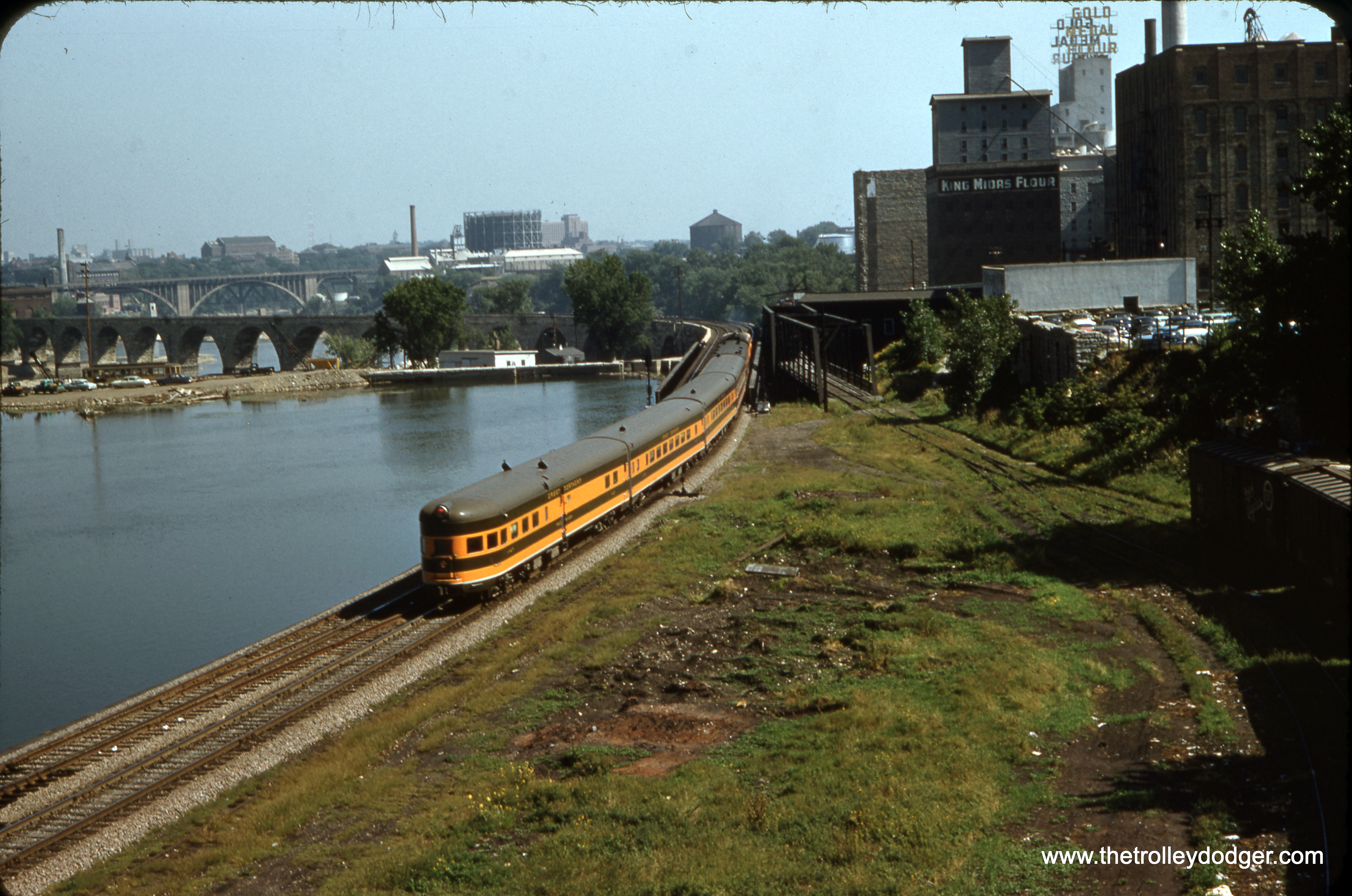
One of the ten Milwaukee Road Skytop Lounge observation cars in Columbus, Wisconsin in October 1967. M. E. adds, "Great photo of a Milwaukee Road Olympian observation car. Those cars ran mainly between Chicago and Minneapolis, but they also ran all the way to Seattle on the Olympian Hiawatha."

One of the ten Milwaukee Road Skytop Lounge observation cars in Columbus, Wisconsin in October 1967. M. E. adds, “Great photo of a Milwaukee Road Olympian observation car. Those cars ran mainly between Chicago and Minneapolis, but they also ran all the way to Seattle on the Olympian Hiawatha.”

On May 25, 1958, we see Chicago Transit Authority PCC #7142 mounted on a flatcar at South Shops for transport to the St. Louis Car Company. This was less than a month before the end of streetcar service in Chicago. Approximately 570 of the 600 postwar Chicago streetcars retired early and shipped to St. Louis as part of the so-called PCC Conversion Program, where they were scrapped and some of their parts (seats, motors, windows, etc.) were recycled for use in new rapid transit cars. The final two dozen PCCs were simply scrapped. (Robert D. Heinlein Photo)

On May 25, 1958, we see Chicago Transit Authority PCC #7142 mounted on a flatcar at South Shops for transport to the St. Louis Car Company. This was less than a month before the end of streetcar service in Chicago. Approximately 570 of the 600 postwar Chicago streetcars retired early and shipped to St. Louis as part of the so-called PCC Conversion Program, where they were scrapped and some of their parts (seats, motors, windows, etc.) were recycled for use in new rapid transit cars. The final two dozen PCCs were simply scrapped. (Robert D. Heinlein Photo)

Subject: Illinois Central Station Demolition Chicago 1974 Location: Chicago, Illinois Date: November 1974 (processing date) Photographer: Unknown From the Wikipedia: Central Station was an intercity passenger terminal in downtown Chicago, Illinois, at the southern end of Grant Park near Roosevelt Road and Michigan Avenue. Owned by the Illinois Central Railroad, it also served other companies via trackage rights. It opened in 1893, replacing Great Central Station (on the site of the current Millennium Station), and closed in 1972 when Amtrak rerouted services to Union Station. The station building was demolished in 1974. It is now the site of a redevelopment called Central Station, Chicago. Adjoining platforms at Roosevelt served the Illinois Central's suburban trains for both the Electric and West lines, in addition to the South Shore Line interurban railroad. All three lines continued north to Randolph Street.

Subject: Illinois Central Station Demolition Chicago 1974
Location: Chicago, Illinois
Date: November 1974 (processing date)
Photographer: Unknown
From the Wikipedia:
Central Station was an intercity passenger terminal in downtown Chicago, Illinois, at the southern end of Grant Park near Roosevelt Road and Michigan Avenue. Owned by the Illinois Central Railroad, it also served other companies via trackage rights. It opened in 1893, replacing Great Central Station (on the site of the current Millennium Station), and closed in 1972 when Amtrak rerouted services to Union Station. The station building was demolished in 1974. It is now the site of a redevelopment called Central Station, Chicago.
Adjoining platforms at Roosevelt served the Illinois Central’s suburban trains for both the Electric and West lines, in addition to the South Shore Line interurban railroad. All three lines continued north to Randolph Street.

Grand Central Station

Chicago’s Central Station and Grand Central Station were two different things.

From the Wikipedia:

Grand Central Station was a passenger railroad terminal in downtown Chicago, Illinois, from 1890 to 1969. It was located at 201 West Harrison Street on a block bounded by Harrison, Wells and Polk Streets and the Chicago River in the southwestern portion of the Chicago Loop. Grand Central Station was designed by architect Solon Spencer Beman for the Wisconsin Central Railroad (WC), and was completed by the Chicago and Northern Pacific Railroad.

The Baltimore and Ohio Railroad purchased the station in 1910 and used it as the Chicago terminus for its passenger rail service, including its Capitol Limited service to Washington, D.C. Major tenant railroads included the Soo Line Railroad, successor to the Wisconsin Central, the Chicago Great Western Railway, and the Pere Marquette Railway. The station opened December 8, 1890, closed November 8, 1969, and was demolished in 1971.

Subject: B&O/C&O Grand Central Station Location: Chicago, Illinois (Harrison and Wells) Photographer: Unknown Date: June 15, 1967

Subject: B&O/C&O Grand Central Station
Location: Chicago, Illinois (Harrison and Wells)
Photographer: Unknown
Date: June 15, 1967

Subject: C&O Chesapeake and Ohio Diesel Locomotive EMD E7(A) #4514 Location: Chicago, Illinois (Grand Central Station) Photographer: R. P. Olmstead Date: May 31, 1964 (4:45 pm)

Subject: C&O Chesapeake and Ohio Diesel Locomotive EMD E7(A) #4514
Location: Chicago, Illinois (Grand Central Station)
Photographer: R. P. Olmstead
Date: May 31, 1964 (4:45 pm)

Subject: C&O Chesapeake and Ohio Diesel Locomotive EMD E8(A) #4022 Location: Chicago, Illinois (Grand Central Station) Photographer: R. P. Olmstead Date: May 8, 1966 (5:08 pm)

Subject: C&O Chesapeake and Ohio Diesel Locomotive EMD E8(A) #4022
Location: Chicago, Illinois (Grand Central Station)
Photographer: R. P. Olmstead
Date: May 8, 1966 (5:08 pm)

Now here's something you don't see every day... an honest to goodness 1939 Kodachrome slide. That makes this image about 85 years old. This must have been taken when Lehigh Valley Transit put these renovated lightweight high-speed cars into service. They were originally built for the Cincinnati and Lake Erie in 1931. That interurban went out of business in 1938, and LVT purchased several cars, which were freshened up with the help of J. G. Brill's art department. The Liberty Bell interurban ran between Philadelphia and Allentown, Pennsylvania. These cars replaced some much older ones and helped keep things going through the war years and up until the 1951 abandonment. There was a very active NRHS (National Railway Historical Society) chapter in the area, and this is probably a fantrip they sponsored. Looks like the lead car is 1002.

Now here’s something you don’t see every day… an honest to goodness 1939 Kodachrome slide. That makes this image about 85 years old. This must have been taken when Lehigh Valley Transit put these renovated lightweight high-speed cars into service. They were originally built for the Cincinnati and Lake Erie in 1931. That interurban went out of business in 1938, and LVT purchased several cars, which were freshened up with the help of J. G. Brill’s art department. The Liberty Bell interurban ran between Philadelphia and Allentown, Pennsylvania. These cars replaced some much older ones and helped keep things going through the war years and up until the 1951 abandonment. There was a very active NRHS (National Railway Historical Society) chapter in the area, and this is probably a fantrip they sponsored. Looks like the lead car is 1002.

Subject: ICG Illinois Central Electric #1194 (Fantrip) Location: Chicago, Illinois (southbound on Exchange Avenue at 78th Street - South Chicago Branch) Date: February 1976 Photographer: Jeffrey L. Wien Illinois Central Electric car #1194 was built by Pullman in 1926. These cars were similar to those used on the Erie-Lackawanna in New Jersey. All the cars in the class were replaced by "Highliners" in the 1970s. The train we see here may have been on its final trip prior to retirement. Paul Jevert: "I.C. Railfans "Snowflake Special Feb. 1976" Extra class lights displayed at location 77th and Exchange between Windsor Park and Cheltenham Stations doing a photo run-by with Engineer Jim McCorkle leaning out of cab door and talking to fans at Muskegon Ave. corner advising them that they will be picked up in that area after the reverse move under flag. No snowflakes for this particular annual charter. Curt Seeliger was the Conductor on the 8 car train, Collector Joe Szabo, with Suburban Trainmaster escort of the annual Event." M. E. writes, "This view along Exchange Ave. shows a mainly residential area with some small stores. But further north, this branch ran east and west, in the middle of 71st St. for about 1.5 miles from Yates Ave. (2400 E.) to about Harper Ave. (1500 E.), where the branch joined the main Illinois Central line. That 1.5-mile stretch was another booming business area, called South Shore, centering at 71st and Jeffery Ave. (2000 E.) The residential area northeast of 71st and Jeffery, Jackson Park Highlands, is a beautiful area along the lines of Hyde Park and especially Kenwood, where some mansions dominate."

Subject: ICG Illinois Central Electric #1194 (Fantrip)
Location: Chicago, Illinois (southbound on Exchange Avenue at 78th Street – South Chicago Branch)
Date: February 1976
Photographer: Jeffrey L. Wien
Illinois Central Electric car #1194 was built by Pullman in 1926. These cars were similar to those used on the Erie-Lackawanna in New Jersey. All the cars in the class were replaced by “Highliners” in the 1970s. The train we see here may have been on its final trip prior to retirement. Paul Jevert: “I.C. Railfans “Snowflake Special Feb. 1976″ Extra class lights displayed at location 77th and Exchange between Windsor Park and Cheltenham Stations doing a photo run-by with Engineer Jim McCorkle leaning out of cab door and talking to fans at Muskegon Ave. corner advising them that they will be picked up in that area after the reverse move under flag. No snowflakes for this particular annual charter. Curt Seeliger was the Conductor on the 8 car train, Collector Joe Szabo, with Suburban Trainmaster escort of the annual Event.” M. E. writes, “This view along Exchange Ave. shows a mainly residential area with some small stores. But further north, this branch ran east and west, in the middle of 71st St. for about 1.5 miles from Yates Ave. (2400 E.) to about Harper Ave. (1500 E.), where the branch joined the main Illinois Central line. That 1.5-mile stretch was another booming business area, called South Shore, centering at 71st and Jeffery Ave. (2000 E.) The residential area northeast of 71st and Jeffery, Jackson Park Highlands, is a beautiful area along the lines of Hyde Park and especially Kenwood, where some mansions dominate.”

Chicago North Shore and Milwaukee #411 in New York City in May 1969. Don's Rail Photos (via Archive.org): "411 was built as a trailer observation car by Cincinnati Car in June 1923 (order) #2640. It was out of service in 1932. 411 (was converted to a coach) on February 25, 1943, and (was) sold to Trolley Museum of New York in 1963. It was sold to Wisconsin Electric Railway & Historical Society in 1973 and sold to Escanaba & Lake Superior in 1989."

Chicago North Shore and Milwaukee #411 in New York City in May 1969. Don’s Rail Photos (via Archive.org): “411 was built as a trailer observation car by Cincinnati Car in June 1923 (order) #2640. It was out of service in 1932. 411 (was converted to a coach) on February 25, 1943, and (was) sold to Trolley Museum of New York in 1963. It was sold to Wisconsin Electric Railway & Historical Society in 1973 and sold to Escanaba & Lake Superior in 1989.”

I did some restoration work on this medium format Ektachrome slide from April 1962, showing four Chicago Aurora and Elgin cars being moved off the property in Wheaton after the abandonment. Like some other early Ektachromes, this had unstable dyes and has shifted to red (due to fading of the other dye layers). We are looking to the northeast. (Robert D. Heinlein Photo) Bill Shapotkin adds, "It appears that this photo is of CA&E #11, 20, 316 and 317 enroute to what was then known as "RELIC" (now Fox River Trolley Museum) in South Elgin, IL."

I did some restoration work on this medium format Ektachrome slide from April 1962, showing four Chicago Aurora and Elgin cars being moved off the property in Wheaton after the abandonment. Like some other early Ektachromes, this had unstable dyes and has shifted to red (due to fading of the other dye layers). We are looking to the northeast. (Robert D. Heinlein Photo) Bill Shapotkin adds, “It appears that this photo is of CA&E #11, 20, 316 and 317 enroute to what was then known as “RELIC” (now Fox River Trolley Museum) in South Elgin, IL.”

I restored a couple more of these medium format Ektachromes, taken by the late Robert D. Heinlein at the Chicago Aurora and Elgin yards in Wheaton after the abandonment. I just noticed these are date stamped January 1962. Don's Rail Photos (via Archive.org): "315 was built by Kuhlman Car Co in 1909, (job) #404. It was modernized at an unknown date and sold to Rockhill Trolley Museum in 1962." Here, we see it boarded up for its journey to the east coast a few months later.

I restored a couple more of these medium format Ektachromes, taken by the late Robert D. Heinlein at the Chicago Aurora and Elgin yards in Wheaton after the abandonment. I just noticed these are date stamped January 1962. Don’s Rail Photos (via Archive.org): “315 was built by Kuhlman Car Co in 1909, (job) #404. It was modernized at an unknown date and sold to Rockhill Trolley Museum in 1962.” Here, we see it boarded up for its journey to the east coast a few months later.

Here's how they looked originally. Early Ektachrome film had unstable dyes. Apparently, only the red dye layer is stable, while the others have faded badly. Fortunately, modern technology can often correct for this.

Here’s how they looked originally. Early Ektachrome film had unstable dyes. Apparently, only the red dye layer is stable, while the others have faded badly.
Fortunately, modern technology can often correct for this.

CTA "Baldie" 4220 is part of a Ravenswood "A" train leaving the LaSalle and Van Buren station on August 14, 1964. We are looking west. (Douglas N. Grotjahn Photo)

CTA “Baldie” 4220 is part of a Ravenswood “A” train leaving the LaSalle and Van Buren station on August 14, 1964. We are looking west. (Douglas N. Grotjahn Photo)

A four-car train of CTA "Plushies" 4000-series "L" cars is at Main Street in Evanston on October 21, 1968. Note only two trolley poles are used, one for each pair of cars. 4253 is the rear car here. (Douglas N. Grotjahn Photo)

A four-car train of CTA “Plushies” 4000-series “L” cars is at Main Street in Evanston on October 21, 1968. Note only two trolley poles are used, one for each pair of cars. 4253 is the rear car here. (Douglas N. Grotjahn Photo)

On December 14, 1921, Chicago and West Towns Railways car #100 crashed through this barrier at 52nd Street (Laramie Avenue) and Ogden Avenue in suburban Cicero. This press photo was printed backwards, but I fixed that.

On December 14, 1921, Chicago and West Towns Railways car #100 crashed through this barrier at 52nd Street (Laramie Avenue) and Ogden Avenue in suburban Cicero. This press photo was printed backwards, but I fixed that.

This picture of Philadelphia PCC streetcar #2565 was taken on June 27, 1973. Here's what Cinema Treasures has to say about the Crest Theatre: The Crest Theatre opened November 23, 1937 on Rising Sun Avenue at Cheltenham Avenue to accommodate the late-1930’s housing expansion in the Lawncrest neighborhood of Philadelphia. The theatre was designed by Philadelphia architect David Supowitz in an Art Moderne style with an exterior of plastic and white glass (such as Vitrolite). The theatre seated 900. It opened for second and third run movies. By 1950 it was operated by the A.M. Ellis Theaters Co. chain. Until closing, a big sign rhymed ‘Welcome. See the BEST at the CREST’. The Crest closed the week before Christmas in 1986 with “Star Trek IV” as its last feature film. The marquee said ‘FAREWELL’. By the time it closed, a new owner of the building planned to demolish it to construct retail. The Crest has been demolished, and a convenience store was constructed on the site.

This picture of Philadelphia PCC streetcar #2565 was taken on June 27, 1973. Here’s what Cinema Treasures has to say about the Crest Theatre: The Crest Theatre opened November 23, 1937 on Rising Sun Avenue at Cheltenham Avenue to accommodate the late-1930’s housing expansion in the Lawncrest neighborhood of Philadelphia. The theatre was designed by Philadelphia architect David Supowitz in an Art Moderne style with an exterior of plastic and white glass (such as Vitrolite). The theatre seated 900. It opened for second and third run movies. By 1950 it was operated by the A.M. Ellis Theaters Co. chain.
Until closing, a big sign rhymed ‘Welcome. See the BEST at the CREST’. The Crest closed the week before Christmas in 1986 with “Star Trek IV” as its last feature film. The marquee said ‘FAREWELL’. By the time it closed, a new owner of the building planned to demolish it to construct retail. The Crest has been demolished, and a convenience store was constructed on the site.

The Fineview Line in Pittsburgh

Here are seven views of the Pittsburgh Railways Route 21 – Fineview line, taken by the late Jeffrey L. Wien shortly before it was abandoned. I found an excellent description of Fineview on trainorders.com:

Arguably the most unique streetcar line in North America was found in Pittsburgh, PA. Route 21-Fineview lasted until May 1, 1966. With a maximum 12 1/2% grade, Fineview also featured the steepest grade in Pittsburgh Railways’ system, if not the steepest in North America, as well.

21 Fineview originated in Downtown Pittsburgh. After traversing the 7th Street Bridge (in the latter years), and some shared track on the North Side, it became a very intimate, neighborly streetcar line, where passengers even had direct access to the streetcars from their front porches, driveways or private staircases. The summit was 455 feet above the downtown loop.

The last streetcar on the line was Interurban 1646, which followed the last scheduled car in the wee hours of May 1st, 1966. 1646 made the trip with its air horn blaring full blast, which even brought residents out to their front porches in their bathrobes to wave goodbye.

Due to its unique flavor, many streetcar charters found their way to this line during their trips.

Subject: Pittsburgh PAT PCC Streetcar Trolley #1624 Location: Pittsburgh, PA (Route 21 Fineview - Carrie and Warren) Date: April 30, 1966 Photographer: Jeffrey L. Wien

Subject: Pittsburgh PAT PCC Streetcar Trolley #1624
Location: Pittsburgh, PA (Route 21 Fineview – Carrie and Warren)
Date: April 30, 1966
Photographer: Jeffrey L. Wien

Subject: Pittsburgh PAT PCC Streetcar Trolley #1624 Location: Pittsburgh, PA (Route 21 Fineview - Carrie and Waldren) Date: April 30, 1966 Photographer: Jeffrey L. Wien

Subject: Pittsburgh PAT PCC Streetcar Trolley #1624
Location: Pittsburgh, PA (Route 21 Fineview – Carrie and Waldren)
Date: April 30, 1966
Photographer: Jeffrey L. Wien

Subject: Pittsburgh PAT PCC Streetcar Trolley #1624 Location: Pittsburgh, PA (Route 21 Fineview - Lanark and Catoma) Date: April 30, 1966 Photographer: Jeffrey L. Wien

Subject: Pittsburgh PAT PCC Streetcar Trolley #1624
Location: Pittsburgh, PA (Route 21 Fineview – Lanark and Catoma)
Date: April 30, 1966
Photographer: Jeffrey L. Wien

Subject: Pittsburgh PAT PCC Streetcar Trolley #1624 Location: Pittsburgh, PA (Route 21 Fineview - Lanark and Catoma) Date: April 30, 1966 Photographer: Jeffrey L. Wien

Subject: Pittsburgh PAT PCC Streetcar Trolley #1624
Location: Pittsburgh, PA (Route 21 Fineview – Lanark and Catoma)
Date: April 30, 1966
Photographer: Jeffrey L. Wien

Subject: Pittsburgh PAT PCC Streetcar Trolley #1624 Location: Pittsburgh, PA (Route 21 Fineview - Lanark and Catoma) Date: April 30, 1966 Photographer: Jeffrey L. Wien

Subject: Pittsburgh PAT PCC Streetcar Trolley #1624
Location: Pittsburgh, PA (Route 21 Fineview – Lanark and Catoma)
Date: April 30, 1966
Photographer: Jeffrey L. Wien

Subject: Pittsburgh PAT PCC Streetcar Trolley #1624 Location: Pittsburgh, PA (Route 21 Fineview - Lanark and Catoma) Date: April 30, 1966 Photographer: Jeffrey L. Wien

Subject: Pittsburgh PAT PCC Streetcar Trolley #1624
Location: Pittsburgh, PA (Route 21 Fineview – Lanark and Catoma)
Date: April 30, 1966
Photographer: Jeffrey L. Wien

Subject: Pittsburgh PAT PCC Streetcar Trolley #1624 Location: Pittsburgh, PA (Route 21 Fineview - Lanark and Cemetery) Date: April 30, 1966 Photographer: Jeffrey L. Wien

Subject: Pittsburgh PAT PCC Streetcar Trolley #1624
Location: Pittsburgh, PA (Route 21 Fineview – Lanark and Cemetery)
Date: April 30, 1966
Photographer: Jeffrey L. Wien

Our Latest Book, Now Available:

The North Shore Line

FYI, my new Arcadia Publishing book The North Shore Line is now available for immediate shipment. My publisher decided to expand it to 160 pages, instead of the usual 128. That’s a 25% increase, without any change to the $23.99 price. I am quite pleased with how this turned out.

From the back cover:

As late as 1963, it was possible to board high-speed electric trains on Chicago’s famous Loop “L” that ran 90 miles north to Milwaukee. This was the Chicago North Shore & Milwaukee Railroad, commonly known as the North Shore Line. It rose from humble origins in the 1890s as a local streetcar line in Waukegan to eventually become America’s fastest interurban under the visionary management of Midwest utilities tycoon Samuel Insull. The North Shore Line, under Insull, became a worthy competitor to the established steam railroads. Hobbled by the Great Depression, the road fought back in 1941 with two streamlined, air-conditioned, articulated trains called Electroliners, which included dining service. It regained its popularity during World War II, when gasoline and tires were rationed, but eventually, it fell victim to highways and the automobile. The North Shore Line had intercity rail, commuter rail, electric freight, city streetcars, and even buses. It has been gone for nearly 60 years, but it will always remain the Road of Service.

Each copy purchased here will be signed by the author, and you will also receive a bonus North Shore Line map.  Books will ship by USPS Media Mail.

Chapters:
01. Beginnings
02. The Milwaukee Division
03. The Shore Line Route
04. The Skokie Valley Route
05. The Mundelein Branch
06. On the “L”
07. City Streetcars
08. Trolley Freight
09. The Long Goodbye
10. The Legacy

Title The North Shore Line
Images of America
Author David Sadowski
Edition illustrated
Publisher Arcadia Publishing (SC), 2023
ISBN 1467108960, 978-1467108966
Length 160 pages

The price of $23.99 includes shipping within the United States.

For Shipping to US Addresses:

New Compact Disc Titles, Now Available:

HFIH
Hi-Fi Iron Horse
Price: $15.99

Hi-Fi Iron Horse is a unique collection of early steam recordings, made between 1949 and 1954. Portable tape recorders were not yet available when the earliest of these was made, but there was still another source for making high-quality audio– the optical sound track of motion picture film.

Featuring in-service steam of the Baltimore & Ohio, Bessemer & Lake Erie, Burlington, Canadian National, Delaware & Hudson, East Broad Top, Erie, Grand Trunk Western, Huntingdon & Broad Top Mountain, Western Maryland, and Rutland Railway.

Total time – 50:49

TSOS
The Sound of Steam
Reading 2124

Price: $19.99

Three very rare, out of print North Jersey Recordings LPs, now digitally remastered on two CDs at a special price.

The Sound of Steam offers a comprehensive overview of the twilight days of steam railroading in North America, with sounds recorded between 1957 and 1964. Railroads featured include the Denver & Rio Grande Western, Union Pacific, Canadian Pacific, Duluth, Missabe & Iron Range Railway, Gainesville Midland Railroad, Pennsylvania Railroad, Reading Railroad, Canadian National, Twin Seams Mining Company, Nickel Plate, Colorado & Southern, Norfolk & Western, Buffalo Creek & Gauley, Monadnock, Steamtown & Northern, Rockton & Rion Railway, and the National Railways of Mexico.

Reading 2124 features recordings made in 1959 and 1960 on a series of “Iron Horse Rambles,” excursion trips through eastern Pennsylvania.  The Reading Company had retained this class T-1 4-8-4 for emergency use after steam was retired on the railroad.  Seven years after the last Reading steam loco had hauled a passenger train, a series of 51 special excursion trips were held, ending in 1964.  These have since been revived, and the Rambles continue.

Total time – 69:54 (Disc 1) and 61:20 (Disc 2)

RWW-V103
Rods, Wheels, and Whistles
Voice of the 103

Price: $19.99

Two very rare, out of print North Jersey Recordings LPs, now digitally remastered on two CDs at a special price.

Rods, Wheels, and Whistles features the sounds of the Pennsylvania Railroad and the Norfolk and Western Railway, recorded in the twilight years of steam. This LP was originally issued in 1958, but our version is taken from the revised and expanded edition, which includes additional recordings from 1959.

Voice of the 103 documents the former Sumter and Choctaw Railroad #103, a 2-6-2 locomotive built in 1925 by the Baldwin Locomotive Works, after it was refurbished in 1962 to operate on the Middletown and New Jersey. This was an excursion service of the Empire State Railway Museum, which has since moved to a new location and no longer operates trains.  The 103 is now on static display.

Our collection is rounded out with three bonus tracks from the Strasbourg Railroad, when old number 31 ran excursion trains on the oldest short line railroad in the United States (chartered in June 1832), joining the Pennsylvania Dutch towns of Strasbourg and Paradise in the early 1960s.

Total time – 46:15 (RWW) and 49:26 (V103)

Help Support The Trolley Dodger

This is our 312th post, and we are gradually creating a body of work and an online resource for the benefit of all railfans, everywhere. To date, we have received over 1,066,000 page views, for which we are very grateful.

You can help us continue our original transit research by checking out the fine products in our Online Store.
As we have said before, “If you buy here, we will be here.”

We thank you for your support.

DONATIONS

In order to continue giving you the kinds of historic railroad images that you have come to expect from The Trolley Dodger, we need your help and support. It costs money to maintain this website, and to do the sort of historic research that is our specialty.

Your financial contributions help make this web site better, and are greatly appreciated.


70 for 70 at IRM (Part One)

The North Shore Line Electroliner has come a long way since it came to IRM in 1982. After the interurban abandoned service in 1963, it went to the Red Arrow Lines (aka the Philadelphia Suburban Transportation Company), where it continued to operate for another dozen years as a "Liberty Liner." It has certainly come a long way since its return. Here, we see it near IRM's 50th Avenue "L" station, which came from the Douglas Park line.

The North Shore Line Electroliner has come a long way since it came to IRM in 1982. After the interurban abandoned service in 1963, it went to the Red Arrow Lines (aka the Philadelphia Suburban Transportation Company), where it continued to operate for another dozen years as a “Liberty Liner.” It has certainly come a long way since its return. Here, we see it near IRM’s 50th Avenue “L” station, which came from the Douglas Park line.

This is the Illinois Railway Museum‘s 70th anniversary, and in that span, it has certainly become the largest such operation in the United States, and possibly the world. So it should be no surprise that IRM pulled out all the stops for this year’s Trolley Pageant, which featured at least 70 pieces of electric railway equipment in more than 30 consists.

There was a delay in getting started, as there had been a bit of rain in the morning, and in spite of a few hiccups (at one point the power went out, possibly because there were so many things using it), it was a remarkable and unique event that couldn’t have happened anywhere else but Union, Illinois.

We were there to document the event for all those who couldn’t be there in person. This is part one, because we took so many pictures and videos that it would simply be too much to put it all into a single post. This post will feature our still pictures, and part two will include the numerous videos we took.

Many thanks go out to all the hard working volunteers that have made the museum what it is today– a first class operation that is unrivaled, and just keeps getting better and better.

Enjoy!

-David Sadowski

PS- You might also like our Trolley Dodger Facebook auxiliary, a private group that now has 1,317 members.

Our friend Kenneth Gear has a Facebook group for the Railroad Record Club. If you enjoy listening to audio recordings of classic railroad trains, whether steam, electric, or diesel, you might consider joining.

FYI, the Hoosier Traction Facebook Group celebrates electric transit in Indiana and the Midwest. It also supports the activities of the annual Hoosier Traction Meet (although not affiliated with the North American Transit Historical Society, which organizes that event).

The 2023 IRM Trolley Pageant

Chicago Aurora and Elgin wood car 308, at the head of a four-car train. Don's Rail Photos (via archive.org): "308 was built by Niles Car & Mfg Co in 1906. It was modernized by unknown date and sold to Indiana Transportation Museum in 1962 and resold to Illinois Railway Museum in 1996."

Chicago Aurora and Elgin wood car 308, at the head of a four-car train. Don’s Rail Photos (via archive.org): “308 was built by Niles Car & Mfg Co in 1906. It was modernized by unknown date and sold to Indiana Transportation Museum in 1962 and resold to Illinois Railway Museum in 1996.”

CA&E 309. Don's Rail Photos (via archive.org): "309 was built by Hicks Locomotive Works in 1907. It was modernized in October 1941 and acquired by Illinois Railway Museum in 1962."

CA&E 309. Don’s Rail Photos (via archive.org): “309 was built by Hicks Locomotive Works in 1907. It was modernized in October 1941 and acquired by Illinois Railway Museum in 1962.”

CA&E 36. Don's Rail Photos (via archive.org): 36 was built by Stephenson in 1903. It was acquired by Trolleyville in 1961 and was painted as Columbia & Southwestern 36. It was sold to Illinois Railway Museum in December 2009."

CA&E 36. Don’s Rail Photos (via archive.org): 36 was built by Stephenson in 1903. It was acquired by Trolleyville in 1961 and was painted as Columbia & Southwestern 36. It was sold to Illinois Railway Museum in December 2009.”

CA&E 319. Don's Rail Photos (via archive.org): "319 was built by Jewett Car Co in 1914. It was modernized at an unknown date and sold to Columbia Park & Southwestern in 1962. It was resold to IRM in December 2009."

CA&E 319. Don’s Rail Photos (via archive.org): “319 was built by Jewett Car Co in 1914. It was modernized at an unknown date and sold to Columbia Park & Southwestern in 1962. It was resold to IRM in December 2009.”

Sand Springs (Oklahoma) Railway car 68 was built by the Cincinnati Car Company in 1918. It was originally delivered to the Cincinnati Lawrenceburg & Aurora in Ohio, and came to IRM in 1967.

Sand Springs (Oklahoma) Railway car 68 was built by the Cincinnati Car Company in 1918. It was originally delivered to the Cincinnati Lawrenceburg & Aurora in Ohio, and came to IRM in 1967.

Chicago and West Towns Railways 141 was built by McGuire-Cummings in 1924. After streetcar service ended in 1948, the body was stored on a farm. The Electric Railway Historical Society (ERHS) rescued it in 1959, and donated it to IRM in 1973. After a lengthy restoration, it was returned to operating condition in 2014.

Chicago and West Towns Railways 141 was built by McGuire-Cummings in 1924. After streetcar service ended in 1948, the body was stored on a farm. The Electric Railway Historical Society (ERHS) rescued it in 1959, and donated it to IRM in 1973. After a lengthy restoration, it was returned to operating condition in 2014.

Open car 19 was built by the J. G. Brill company in 1914, and operated in Veracruz, Mexico until 1961. It then went to Trolleyville USA in Ohio. IRM acquired it in 2009.

Open car 19 was built by the J. G. Brill company in 1914, and operated in Veracruz, Mexico until 1961. It then went to Trolleyville USA in Ohio. IRM acquired it in 2009.

Cleveland center-entrance car 18 was built by the G.C. Kuhlman Car Company in 1914, and ran on the Shaker Heights Rapid Transit line until 1961. It then went to Trolleyville USA, and IRM purchased it in 2013. Frank Hicks has worked to get this car back to operating condition, and this was the first time it ran at IRM.

Cleveland center-entrance car 18 was built by the G.C. Kuhlman Car Company in 1914, and ran on the Shaker Heights Rapid Transit line until 1961. It then went to Trolleyville USA, and IRM purchased it in 2013. Frank Hicks has worked to get this car back to operating condition, and this was the first time it ran at IRM.

Center-entrance streetcars had a brief vogue and the most successful of these were called Peter Witts. They were two-man cars, as there was a conductor who collected fares inside. Some systems used a "pay as you enter" system, and some preferred "pay as you pass." In order to exit through the front door, you had to walk by the conductor and would then pay your fare. The idea was to speed up loading, as fares could be collected while the car was in motion.

Center-entrance streetcars had a brief vogue and the most successful of these were called Peter Witts. They were two-man cars, as there was a conductor who collected fares inside. Some systems used a “pay as you enter” system, and some preferred “pay as you pass.” In order to exit through the front door, you had to walk by the conductor and would then pay your fare. The idea was to speed up loading, as fares could be collected while the car was in motion.

SHRT car 18 backs up to get into position for the Trolley Pageant. The conductor is making sure the pole stays on the wire while it is reversed, while the motorman is at the controls over in the other end of the car. Although this may originally have been a double-ended car, it seems to have been converted to single-end at some point in Cleveland.

SHRT car 18 backs up to get into position for the Trolley Pageant. The conductor is making sure the pole stays on the wire while it is reversed, while the motorman is at the controls over in the other end of the car. Although this may originally have been a double-ended car, it seems to have been converted to single-end at some point in Cleveland.

North Shore Line combine 251, at the head of a five-car train. Don's Rail Photos (via archive.org): "251 was built by Jewett in 1917, It had its seating reduced from 40 to 24 on October 3, 1925, and it was converted to a Silverliner on June 19, 1953. It was acquired by Illinois Railway Museum in 1963."

North Shore Line combine 251, at the head of a five-car train. Don’s Rail Photos (via archive.org): “251 was built by Jewett in 1917, It had its seating reduced from 40 to 24 on October 3, 1925, and it was converted to a Silverliner on June 19, 1953. It was acquired by Illinois Railway Museum in 1963.”

North Shore Line car 160 is now that interurban's second oldest surviving car, following 162, which was delivered earlier. Don's Rail Photos (via archive.org): "160 was built by Brill in 1915, (job) #19605. It was acquired by Illinois Railway Museum in 1963."

North Shore Line car 160 is now that interurban’s second oldest surviving car, following 162, which was delivered earlier. Don’s Rail Photos (via archive.org): “160 was built by Brill in 1915, (job) #19605. It was acquired by Illinois Railway Museum in 1963.”

North Shore Line coach 714. Don's Rail Photos (via archive.org): "714 was built by Cincinnati Car Co in 1926, (job) #2890. It is modernized in 1939 and preserved in 1963 by the Illinois Railway Museum."

North Shore Line coach 714. Don’s Rail Photos (via archive.org): “714 was built by Cincinnati Car Co in 1926, (job) #2890. It is modernized in 1939 and preserved in 1963 by the Illinois Railway Museum.”

North Shore Line car 757. Don's Rail Photos (via archive.org): "757 was built by Standard Steel Car Co in 1930. It was modernized in 1949 and rebuilt as Silverline on March 16, 1956. It was sold to Wisconsin Electric Railway Historical Society in 1963 and resold to Illinois Railway Museum in 1988."

North Shore Line car 757. Don’s Rail Photos (via archive.org): “757 was built by Standard Steel Car Co in 1930. It was modernized in 1949 and rebuilt as Silverline on March 16, 1956. It was sold to Wisconsin Electric Railway Historical Society in 1963 and resold to Illinois Railway Museum in 1988.”

North Shore Line coach 749. Don's Rail Photos (via archive.org): "749 was built by Pullman in 1928. It was modernized in 1940 and acquired by Illinois Railway Museum in 1963."

North Shore Line coach 749. Don’s Rail Photos (via archive.org): “749 was built by Pullman in 1928. It was modernized in 1940 and acquired by Illinois Railway Museum in 1963.”

North Shore Line city streetcar 354. The late Don Ross, from Don's Rail Photos (via archive.org): "354 was built by St Louis Car Co in January 1928, #1453. It became the last car on August 12, 1951. It was purchased by the president of the Chicago Hardware Foundry. It was painted into the green and red of CHF, but the motors were removed. The car was acquired by the Illinois Electric Railway Museum (now IRM). Restoration began in 1958 (I put many hours on the car), and it is now in operation in Union. When I visited the car in 1989, it brought back many happy memories."

North Shore Line city streetcar 354. The late Don Ross, from Don’s Rail Photos (via archive.org): “354 was built by St Louis Car Co in January 1928, #1453. It became the last car on August 12, 1951. It was purchased by the president of the Chicago Hardware Foundry. It was painted into the green and red of CHF, but the motors were removed. The car was acquired by the Illinois Electric Railway Museum (now IRM). Restoration began in 1958 (I put many hours on the car), and it is now in operation in Union. When I visited the car in 1989, it brought back many happy memories.”

Illinois Terminal interurban car 101. It ran between St. Louis and Alton. Don's Rail Photos (via archive.org): "101 was built by American Car in 1917 as AG&StL 61. In 1926 the car became StL&ARy 61 and in 1930 it became IT 101. On March 9, 1956, it was sold to the Illinois Electric Railway Museum and is now at Union, IL."

Illinois Terminal interurban car 101. It ran between St. Louis and Alton. Don’s Rail Photos (via archive.org): “101 was built by American Car in 1917 as AG&StL 61. In 1926 the car became StL&ARy 61 and in 1930 it became IT 101. On March 9, 1956, it was sold to the Illinois Electric Railway Museum and is now at Union, IL.”

Two Chicago streetcars for the price of one, here. "Matchbox" 1374 was built by St. Louis Car Company (order #715) in 1905. The Chicago Transit Authority turned it into a salt spreader in 1947. It was purchased by the ERHS in 1958 and donated to IRM in 1973. The 3142 was built by J.G. Brill Company (order #21686) in 1923. It too was purchased by ERHS in 1958 and came to IRM in 1973. The white stripe indicates it was used as a one-man car, letting riders know they should board at the front instead of the back.

Two Chicago streetcars for the price of one, here. “Matchbox” 1374 was built by St. Louis Car Company (order #715) in 1905. The Chicago Transit Authority turned it into a salt spreader in 1947. It was purchased by the ERHS in 1958 and donated to IRM in 1973. The 3142 was built by J.G. Brill Company (order #21686) in 1923. It too was purchased by ERHS in 1958 and came to IRM in 1973. The white stripe indicates it was used as a one-man car, letting riders know they should board at the front instead of the back.

Chicago Pullman 144 was built in 1908 and ran in regular service until 1954. Until the end of streetcar service four years later, it was only used on fantrips. IRM purchased it in 1959.

Chicago Pullman 144 was built in 1908 and ran in regular service until 1954. Until the end of streetcar service four years later, it was only used on fantrips. IRM purchased it in 1959.

CTA PCC streetcar 4391 is using the back-up controller to make its way to the parade staging area, as it is a single-ended car. Since the pole is reversed, the operator is trying to keep it from coming off the wire.

CTA PCC streetcar 4391 is using the back-up controller to make its way to the parade staging area, as it is a single-ended car. Since the pole is reversed, the operator is trying to keep it from coming off the wire.

CTA PCC 4391 was built by the St. Louis Car Company in 1948 and ran in Chicago until 1958. ERHS purchased it the following year and it came to IRM in 1973. It is the only surviving car of its type. This is a two-man streetcar-- you enter at the rear, pay the conductor, then exit via the middle or front.

CTA PCC 4391 was built by the St. Louis Car Company in 1948 and ran in Chicago until 1958. ERHS purchased it the following year and it came to IRM in 1973. It is the only surviving car of its type. This is a two-man streetcar– you enter at the rear, pay the conductor, then exit via the middle or front.

Indiana Railroad high-speed lightweight car 65 was built in 1931 by Pullman and ran for a decade in Indiana before making its way to the CRANDIC (Cedar Rapids and Iowa City) in Iowa. It was purchased in 1953 as the first acquisition of the Illinois Electric Railway Museum, then located in North Chicago. The original ten founders each contributed $100 towards the cost. The last survivor of the ten was Malcolm D. McCarter, who died in 2016.

Indiana Railroad high-speed lightweight car 65 was built in 1931 by Pullman and ran for a decade in Indiana before making its way to the CRANDIC (Cedar Rapids and Iowa City) in Iowa. It was purchased in 1953 as the first acquisition of the Illinois Electric Railway Museum, then located in North Chicago. The original ten founders each contributed $100 towards the cost. The last survivor of the ten was Malcolm D. McCarter, who died in 2016.

Indiana Railroad car 65 is similar to cars that were built around the same time for the Cincinnati and Lake Erie. After that line quit around 1938, several of those cars went to Lehigh Valley Transit in Pennsylvania, where they ran until 1951. Others made it to Iowa and ran on CRANDIC. The only other surviving Indiana Railroad high-speed car is 55, which was built by a different manufacturer. It survives at the Seashore Trolley Museum in Maine as LVT car 1030.

Indiana Railroad car 65 is similar to cars that were built around the same time for the Cincinnati and Lake Erie. After that line quit around 1938, several of those cars went to Lehigh Valley Transit in Pennsylvania, where they ran until 1951. Others made it to Iowa and ran on CRANDIC. The only other surviving Indiana Railroad high-speed car is 55, which was built by a different manufacturer. It survives at the Seashore Trolley Museum in Maine as LVT car 1030.

Two North Shore Line work cars (line car 604 and box motor 229) head west through the depot.

Two North Shore Line work cars (line car 604 and box motor 229) head west through the depot.

It was nice to see so many families with young children out at the museum for this event.

It was nice to see so many families with young children out at the museum for this event.

IRM's North Shore Line Electroliner, built in 1941 by the St. Louis Car Company, is still undergoing interior restoration, but can operate. It was certainly a welcome addition to the Trolley Pageant.

IRM’s North Shore Line Electroliner, built in 1941 by the St. Louis Car Company, is still undergoing interior restoration, but can operate. It was certainly a welcome addition to the Trolley Pageant.

One of the trolley poles on the Electroliner got snagged and had to be repositioned. Fortunately, no damage was done to the wire.

One of the trolley poles on the Electroliner got snagged and had to be repositioned. Fortunately, no damage was done to the wire.

Where else but IRM could you see not one, but TWO four-car trains, made up of Chicago Aurora and Elgin interurban coaches, side by side? Over the years, the museum has put together a unique and unrivaled collection.

Where else but IRM could you see not one, but TWO four-car trains, made up of Chicago Aurora and Elgin interurban coaches, side by side? Over the years, the museum has put together a unique and unrivaled collection.

Although not yet numbered, this is either Chicago Aurora and Elgin car 451 or 453, built in 1945 by the St. Louis Car Company. Don's Rail Photos (via archive.org): "451 was built by St Louis Car Co in September 1945, #1717. It was sold to Trolleyville in 1962 and lettered as Columbia Park & Southwestern. It was transferred as Lake Shore Electric Ry in 2006. It was sold to Illinois Railway Museum in December 2009." 453 was purchased in 1962 by Trolleyville USA in Ohio, and went to the Electric City Trolley Museum in Scranton, PA in 2009. They considered turning it into an ersatz Laurel Line car, as none of those were saved. Having decided against that, it was acquired by IRM in 2019 and is undergoing restoration. Thus, all four surviving cars of this type are back in Illinois-- three at IRM (451, 453, and 460) and 460 at the Fox River Trolley Museum. We recently posted pictures of that restoration. Spence Ziegler adds: "Dave, the unnumbered CA&E car is the 451, from what I understand it’s going to get the original “Futura” font lettering, which will look nice. That’s why the grey is darker also."

Although not yet numbered, this is either Chicago Aurora and Elgin car 451 or 453, built in 1945 by the St. Louis Car Company. Don’s Rail Photos (via archive.org): “451 was built by St Louis Car Co in September 1945, #1717. It was sold to Trolleyville in 1962 and lettered as Columbia Park & Southwestern. It was transferred as Lake Shore Electric Ry in 2006. It was sold to Illinois Railway Museum in December 2009.” 453 was purchased in 1962 by Trolleyville USA in Ohio, and went to the Electric City Trolley Museum in Scranton, PA in 2009. They considered turning it into an ersatz Laurel Line car, as none of those were saved. Having decided against that, it was acquired by IRM in 2019 and is undergoing restoration. Thus, all four surviving cars of this type are back in Illinois– three at IRM (451, 453, and 460) and 460 at the Fox River Trolley Museum. We recently posted pictures of that restoration. Spence Ziegler adds: “Dave, the unnumbered CA&E car is the 451, from what I understand it’s going to get the original “Futura” font lettering, which will look nice. That’s why the grey is darker also.”

A four-car train of Chicago wooden "L" cars, with 1754 at the rear. It was built by the Jewett Car Company in 1906 for the Northwestern Elevated. After the CTA stopped using wood cars in regular service in 1957, it was converted to a work car. IRM acquired it in 1971.

A four-car train of Chicago wooden “L” cars, with 1754 at the rear. It was built by the Jewett Car Company in 1906 for the Northwestern Elevated. After the CTA stopped using wood cars in regular service in 1957, it was converted to a work car. IRM acquired it in 1971.

Broad Street Subway (Philadelphia) car 55 was built by the J.G. Brill Company (order #22488) in 1927. IRM purchased it in 1985, and this was the first time it operated at the museum in 20 years. Notice how it is both wider and longer than a Chicago "L" car, and has three sets of doors for faster service.

Broad Street Subway (Philadelphia) car 55 was built by the J.G. Brill Company (order #22488) in 1927. IRM purchased it in 1985, and this was the first time it operated at the museum in 20 years. Notice how it is both wider and longer than a Chicago “L” car, and has three sets of doors for faster service.

I don't think any other museum besides IRM could field a seven-car Chicago "L" car train. This one consisted of two sets of married pairs and three single car units.

I don’t think any other museum besides IRM could field a seven-car Chicago “L” car train. This one consisted of two sets of married pairs and three single car units.

The "L" train makes its run-by, with car 41 in the lead. It was built in 1959 by the St. Louis Car Company and was designed to be operated as a single car for the Evanston line, where the CTA wanted to reduce operating expenses. For several years, riders would pay on the train at off-peak hours, and the train operator had a fare collection box. There was no conductor. Unfortunately, this really slowed down service, as the train could no proceed until everyone boarding had paid. Eventually, 41 was paired with car 28 but that car was eventually damaged and was not saved. 41 came to IRM in 1998.

The “L” train makes its run-by, with car 41 in the lead. It was built in 1959 by the St. Louis Car Company and was designed to be operated as a single car for the Evanston line, where the CTA wanted to reduce operating expenses. For several years, riders would pay on the train at off-peak hours, and the train operator had a fare collection box. There was no conductor. Unfortunately, this really slowed down service, as the train could no proceed until everyone boarding had paid. Eventually, 41 was paired with car 28 but that car was eventually damaged and was not saved. 41 came to IRM in 1998.

A Commonwealth Edison diesel switcher came out at one point, probably to help move a disable railcar.

A Commonwealth Edison diesel switcher came out at one point, probably to help move a disable railcar.

This rare Lake Shore Electric freight trailer was part of a train which included three electric locos, led by Commonwealth Edison 4, built in 1912 by Alco/General Electric (order #3514), which came to IRM in 1962.

This rare Lake Shore Electric freight trailer was part of a train which included three electric locos, led by Commonwealth Edison 4, built in 1912 by Alco/General Electric (order #3514), which came to IRM in 1962.

North Shore Line box motor 213 (aka a "Merchandise Despatch" car) was built in 1920 by the Cincinnati Car Company (order #2445), and was sold to the Chicago Hardware Foundry in 1955. That was also the original location of the Illinois Electric Railway Museum. When IRM moved to its current location in 1964, 213 went with it.

North Shore Line box motor 213 (aka a “Merchandise Despatch” car) was built in 1920 by the Cincinnati Car Company (order #2445), and was sold to the Chicago Hardware Foundry in 1955. That was also the original location of the Illinois Electric Railway Museum. When IRM moved to its current location in 1964, 213 went with it.

A Milwaukee Electric logo on a piece of freight equipment in the parade.

A Milwaukee Electric logo on a piece of freight equipment in the parade.

For a rather nondescript car, South Shore Line 504 has had an interesting life. It started out in 1925 on the Indiana Public Service as a baggage/coach car. This turned into the Indiana Railroad in 1931, and it became coach/RPO (railway post office) 377 for another decade before that interurban was abandoned. The South Shore Line purchased it, and used it until 1975 to haul newspapers and small packages. (It still has a sign on it advertising their "emergency package service." IRM bought it in 1975.

For a rather nondescript car, South Shore Line 504 has had an interesting life. It started out in 1925 on the Indiana Public Service as a baggage/coach car. This turned into the Indiana Railroad in 1931, and it became coach/RPO (railway post office) 377 for another decade before that interurban was abandoned. The South Shore Line purchased it, and used it until 1975 to haul newspapers and small packages. (It still has a sign on it advertising their “emergency package service.” IRM bought it in 1975.

South Shore Line line car 1100 was built in 1925 by the St. Louis Car Company for the Indiana Service Corporation, which became the Indiana Railroad in 1931. It began as baggage/coach car 376, and became a coach/RPO in 1935. After the Indiana Railroad abandonment in 1941, the South Shore Line purchased it, and it was converted to a line car in 1947. I actually rode on this car in 1988 on a fantrip for the George Krambles scholorship fund. GK had begun his storied career working for the Indiana Railroad in 1936. IRM acquired it in 2010.

South Shore Line line car 1100 was built in 1925 by the St. Louis Car Company for the Indiana Service Corporation, which became the Indiana Railroad in 1931. It began as baggage/coach car 376, and became a coach/RPO in 1935. After the Indiana Railroad abandonment in 1941, the South Shore Line purchased it, and it was converted to a line car in 1947. I actually rode on this car in 1988 on a fantrip for the George Krambles scholorship fund. GK had begun his storied career working for the Indiana Railroad in 1936. IRM acquired it in 2010.

Illinois Central cars 1198 (powered) and 1380 (unpowered) were built by Pullman in 1926 and were used in service until 1972 on the electric suburban service, which later became the Metra Electric. After their retirement, the pair came to IRM. These cars are somewhat similar to the Erie Lackawanna cars that were used in New Jersey.

Illinois Central cars 1198 (powered) and 1380 (unpowered) were built by Pullman in 1926 and were used in service until 1972 on the electric suburban service, which later became the Metra Electric. After their retirement, the pair came to IRM. These cars are somewhat similar to the Erie Lackawanna cars that were used in New Jersey.

The seven-car CTA "L" train stops briefly at the depot, before heading west to get into position for its run-by.

The seven-car CTA “L” train stops briefly at the depot, before heading west to get into position for its run-by.

CTA "L" cars 30 (left) and 6655 (right). With the two paired, you can see how the position of the doors differed.

CTA “L” cars 30 (left) and 6655 (right). With the two paired, you can see how the position of the doors differed.

And there are still plenty of other cars that hopefully will run in future Trolley Pageants at IRM.

And there are still plenty of other cars that hopefully will run in future Trolley Pageants at IRM.

Our Latest Book, Now Available:

The North Shore Line

FYI, my new Arcadia Publishing book The North Shore Line is now available for immediate shipment. My publisher decided to expand it to 160 pages, instead of the usual 128. That’s a 25% increase, without any change to the $23.99 price. I am quite pleased with how this turned out.

From the back cover:

As late as 1963, it was possible to board high-speed electric trains on Chicago’s famous Loop “L” that ran 90 miles north to Milwaukee. This was the Chicago North Shore & Milwaukee Railroad, commonly known as the North Shore Line. It rose from humble origins in the 1890s as a local streetcar line in Waukegan to eventually become America’s fastest interurban under the visionary management of Midwest utilities tycoon Samuel Insull. The North Shore Line, under Insull, became a worthy competitor to the established steam railroads. Hobbled by the Great Depression, the road fought back in 1941 with two streamlined, air-conditioned, articulated trains called Electroliners, which included dining service. It regained its popularity during World War II, when gasoline and tires were rationed, but eventually, it fell victim to highways and the automobile. The North Shore Line had intercity rail, commuter rail, electric freight, city streetcars, and even buses. It has been gone for nearly 60 years, but it will always remain the Road of Service.

Each copy purchased here will be signed by the author, and you will also receive a bonus North Shore Line map.  Books will ship by USPS Media Mail.

Chapters:
01. Beginnings
02. The Milwaukee Division
03. The Shore Line Route
04. The Skokie Valley Route
05. The Mundelein Branch
06. On the “L”
07. City Streetcars
08. Trolley Freight
09. The Long Goodbye
10. The Legacy

Title The North Shore Line
Images of America
Author David Sadowski
Edition illustrated
Publisher Arcadia Publishing (SC), 2023
ISBN 1467108960, 978-1467108966
Length 160 pages

The price of $23.99 includes shipping within the United States.

For Shipping to US Addresses:

New Compact Disc, Now Available:

CTA-1
The Last Chicago Streetcars 1958
# of Discs – 1
Price: $15.99

Until now, it seemed as though audio recordings of Chicago streetcars were practically non-existent. For whatever reason, the late William A. Steventon does not appear to have made any for his Railroad Record Club, even though he did make other recordings in the Chicago area in 1956.

Now, audio recordings of the last runs of Chicago streetcars have been found, in the collections of the late Jeffrey L. Wien (who was one of the riders on that last car). We do not know who made these recordings, but this must have been done using a portable reel-to-reel machine.

These important recordings will finally fill a gap in transit history. The last Chicago Transit Authority streetcar finished its run in the early hours of June 21, 1958. Now you can experience these events just as Chicagoans did.

As a bonus, we have included Keeping Pace, a 1939 Chicago Surface Lines employee training program. This was digitally transferred from an original 16” transcription disc. These recordings were unheard for 80 years.

Total time – 74:38

Help Support The Trolley Dodger

This is our 302nd post, and we are gradually creating a body of work and an online resource for the benefit of all railfans, everywhere. To date, we have received over 993,000 page views, for which we are very grateful.

You can help us continue our original transit research by checking out the fine products in our Online Store.
As we have said before, “If you buy here, we will be here.”

We thank you for your support.

DONATIONS

In order to continue giving you the kinds of historic railroad images that you have come to expect from The Trolley Dodger, we need your help and support. It costs money to maintain this website, and to do the sort of historic research that is our specialty.

Your financial contributions help make this web site better, and are greatly appreciated.


Postcards From the Bridge

This real photo postcard image shows the four-track Metropolitan "L" bridge (actually two separate bridges, side by side), but it also shows a small experimental lifeboat moored at left. One author's research into the history of this boat is featured in this post, and also sheds some further light on when this photo was taken.

This real photo postcard image shows the four-track Metropolitan “L” bridge (actually two separate bridges, side by side), but it also shows a small experimental lifeboat moored at left. One author’s research into the history of this boat is featured in this post, and also sheds some further light on when this photo was taken.

From the start of the Trolley Dodger in 2015, I hoped this blog would become a resource for others, and I am pleased that this has happened. Sometimes these inquiries take strange and unexpected turns, and that is certainly the case regarding the early real photo postcard shown above. This interesting tangent of Chicago history is covered in detail further down in this post. Research can raise just as many questions as it answers, and that is definitely what happened here regarding the small experimental boat visible in the lower left-hand corner of this and other postcards of the Met bridge.

We also have a goodly number of excellent images for your perusal, from some of the great traction photographers.

We regret the passing on April 30th of Robert Heinlein, aged 84. He was one of the giants in his field, and our next post will be a tribute to him. Some of Mr. Heinlein’s photos are in my recent book The North Shore Line, and I am glad he was able to see the finished product. He spent his entire career sharing his knowledge and helping others, and he will be sorely missed. You can read his obituary here.

Keep those cards and letters coming in, folks.

-David Sadowski

PS- You might also like our Trolley Dodger Facebook auxiliary, a private group that now has 1,162 members.

Our friend Kenneth Gear has a Facebook group for the Railroad Record Club. If you enjoy listening to audio recordings of classic railroad trains, whether steam, electric, or diesel, you might consider joining.

FYI, the Hoosier Traction Facebook Group celebrates electric transit in Indiana and the Midwest. It also supports the activities of the annual Hoosier Traction Meet (although not affiliated with the North American Transit Historical Society, which organizes that event).

I will be giving a program on my new North Shore Line book on 7:30 pm on Friday evening, May 19th, at Chicago Union Station for the Railroad & Shortlines Club of Chicago. There is no charge. Please do not arrive before 7:15 pm.

Chicago Union Station
Room 107A
500 W. Jackson Blvd.
Chicago, Illinois

Please enter at 500 W. Jackson Boulevard, between Clinton and Canal. Call 312 725-0432 during the meeting for assistance.

We gave two presentations in April that were well attended and received. First, we spoke at the Libertyville Historical Society on the 17th. You can view that presentation here. To date, there have been about 3500 views.

On the 20th, we were at the History Center of lake Bluff and Lake Forest. You can view that presentation here.

Postcards From the Bridge

Sandy Cleary writes:

Good morning! I hope this finds you well 🙂

I’ve been lost on the site for a few weeks since finding it—it scratches an itch I also have—and I’m really grateful for the work that you’ve done in documenting a lot of pretty niche historical artifacts. I’m very curious about one in particular. It’s mentioned in this post here, above the text “I recently bought this real photo postcard, circa 1910.”

I’m pretty certain it comes from the summer of 1907. The boat docked in the lower left of that photo is an obscure lifeboat designed by Robert Brown, of Chicago; it was tied up to the Chicago Sanitary District dock in 1907 but Brown stopped paying docking fees in March, 1908 and it’s absent in another 1908 photo of the bridge. Debris on the loading dock to the northeast of the bridge matches debris visible in Detroit Publishing Co. photo 070152 (here at the LOC), which was taken at the same time as 070153 (LOC link); based on the SS Pueblo’s transit records that photo must’ve been taken on July 30th, 1907.

I’ve been working on writing up the history of Robert Brown’s boat, which features in some other Chicago lore a few years later, and for which the photographic so far consists of only three photos: the two Detroit Publishing Co. ones, and whoever took the picture used in the postcard you found. It was reused in numerous postcards (colorized with the title “Elevated R. R. Jackknife Bridge over Chicago River, Chicago”—you can find examples on eBay).

The one you posted, though, is by far the clearest. I was wondering if you could tell me anything about the postcard’s copyright or who might have printed it? I’ve never been able to find what the photographic source might’ve been. A clearer example, one which might make the text on the white sign north of the boat legible and make it easier to fix the exact date the photo was taken, would be invaluable but I’m not sure where to start looking.

(Also, the version you’ve found is evidently a different crop—the colorized version shows more of the western bank and the dock itself).

I appreciate your time—any pointers on anything more about that postcard or the photo that was responsible for it would be incredibly helpful. The work you did on restoring the one you found was already enough for me to conclude when the boat was actually tied up at Van Buren St., which I’d been despairing of finding possible.

Kind regards
Sandy

Thanks for writing. It’s remarkable how small details in such photographs can be of so much use to researchers today.

In the meantime, what a remarkable piece of scholarship you have achieved!

As you can see, the reverse side of the postcard doesn’t identify the maker. But perhaps it can still be identified by comparison with other postcards with the same printing, whose manufacturers are known to experts.

Would it be alright for me to share your original note with the readers of my blog (and accompanying Facebook group)? You never know what useful information others might have to share.

Sandy Cleary:

Absolutely, you can share with whomever! The information I have is unfortunately pretty limited. From my boat-focused point of view, what’s known is:

1. Chicagoan carpenter Robert Brown designed and built an odd-shaped lifeboat in 1905, which was photographed for a magazine in ~1905/1906
2. His company, the International Automatic Lifeboat Company, paid the Chicago Sanitary District a $5/mo docking fee for the Van Buren St. dock between October, 1906 and March, 1908
3. Hans Behm took three photos of the Metropolitan West Side railroad bridge on July 30th, two of which depict the boat.
4. It’s gone by a September, 1908 photo of the bridge taken, I think, by the Chicago Sanitary District (because the MWRD has posted this picture a few times)
5. The only other photo is the one from the postcard, which must’ve been taken between October, 1906 and March, 1908. The overall bridge configuration seems to be the same between the postcard and the 1907 photos, as does the debris seen on the loading dock on the northeast side of the bridge:

After that the boat disappears for a few years, until it was found sunk in the north draw of the Wells Street Bridge (just south of the Chicago & North Western depot there. Then it was shown for a few months as “The Foolkiller,” putatively the world’s first submarine, after which it disappears again and is now only really relevant for weird Chicago lore.

Fortunately a lot of the Chicago Sanitary District records are online, and I was able to get in touch with someone from Commonwealth Edison who also had some useful information, but I have to imagine a lot of the information from the L companies pre-merger is gone. It seems to me that there might have been some reason why people were taking pictures of the Met’s bridge around the same time, but I’m not sure what that might have been.

I know that there was pressure to have it removed because of how significantly it impacted the channel by ~1911 or so—tracing over old Sanborn maps from 1906 really drives home how dramatic that constriction was:

At the time the western span of the Jackson Blvd. bridge and the Metropolitan West Side crossed what Sanborn identifies as property belonging to the Pacific, Fort Wayne & Chicago, during its period when it was not part of the Penn, I think—I am not a train girl. The Met’s viaduct would’ve crossed over the PFW&C freight house, before that whole west bank became Chicago & North Western property again. In any case the bridge wasn’t actually torn down until 1961 (by that point, as I understand it, the CTA hadn’t been using it to carry rail traffic since 1958).

Thank you so much again for your time and for your help with this. How these photo postcards worked has been something of a mystery to me. Numerous different versions seem to have been made, and I just don’t know whether these were the same company, or different companies skirting copyright because Google Images wasn’t a thing at the time, or what. But the fact that there is such a high-quality photo, anywhere, is extremely heartening.

I suspect the postcard that I have was very short-lived in the marketplace, as this was a transition period between real photo postcards and printed ones. Even if some of the colorized versions may have used the same original negative as a starting point, the eventual results look more and more like drawings rather than photographs.

As to the sudden popularity of pictures of the Met “L” bridge, starting in 1907, this coincided with a major change in how people could write messages on postcards:

DIVIDED BACK PERIOD: 1907-1915

“In 1907, a major change on the address side of postcards occurred. This change was prompted by the Universal Postal Congress, the legislative body of the Universal Postal Union. The convention decreed that postal cards produced by governments of member nations could have messages on the left half of the address side, effective October 1, 1907. The Universal Postal Congress also decreed that after March 1, 1907, government-produced cards in the United States could bear messages on the address side.2 Congress passed an act on March 1, 1907, in compliance with the Union’s decree, allowing privately produced postcards to bear messages on the left half of the card’s back. The next day, the Postmaster-General issued Order No. 146, granting privileges to privately produced postcards that were already granted in international mail, including the allowance of message space. On June 13, 1907, the Postmaster-General issued Order No. 539, which allowed government-produced postcards to bear messages on the left half of the address side.3 These changes to the backs of postcards ushered in the Divided Back Period, which spans from 1907 until 1915. The Divided Back Period is also known as the “Golden Age of Postcards,” due to the vast popularity of postcards during this time period.”

“Another type of postcard that began to be produced and popularly used during the Divided Back period and through the White Border period is the “real photo” postcard. “Real photo” postcards were first produced using the Kodak “postcard camera.” The postcard camera could take a picture and then print a postcard-size negative of the picture, complete with a divided back and place for postage.”

Source: https://siarchives.si.edu/history/featured-topics/postcard/postcard-history

Sandy Cleary:

I’ll be honest, I hadn’t heard “real photo post card” as a term before I read your blog, and then noticed “RPPC” everywhere on eBay.

There are, as far as I can tell, three versions of this postcard. The first two are the colorized ones, which are labeled on the back as no. 171 of the Franklin Post Card Co.—of Germany, although ironically the earliest example I can find, postmarked August 17th, 1909, says “Made in Germany.” There were two distinct crops of that. The first (type A) is the widest crop, and it’s the one where the “E” in “Elevated” is written more like a backwards 3.

The second (type B) is one that the UIC Library gives copyright to Copelin Commercial Photographers in a black-and-white photographic form. This seems to be more common; the earliest postmark so far I’ve found is from September 13, 1910. Both of these two show up with postmarks as late as 1915. They went through different print runs, though; the back variously says:

* Aug. 17 1909: “No. 171. Made in Germany” (Type A)
* Sep. 13 1910: “No. 171.” (Type B)
* Aug 16, 1911: “No. 171” (Type B)
* Nov. 3 1911: “171” (Type B) (it’s possible the “No.” has been scratched off)
* Oct. 14 1912: “No. 171. Publ. by Franklin Post Card Co., Chicago, Ill. Made in Germany” (Type A)
* Aug. 13 1915: “No. 171. Publ. by Franklin Post Card Co., Chicago, Ill.” (Type B)

…As I write this up I realize this means that the widest version is rarer because it’s the German version. The design on the back, with the more ornate “Post Card” lettering, is identical to other postcards published by (for example) M. Weixelbaum, of Lima, and Provincetown Advocate and the Cardinell-Vincent Co. in addition to Franklin. I don’t understand why some postcards were made in Germany and some were not. Apparently the early 1900s was “postcard mania” in Germany, according to Deutsche Welle. I’d never heard of that before.

Anyway, the third one is the one you’ve found, which has different writing, and is also a much closer crop. Here are all three, superimposed:

What is a little puzzling to me is that the postcard you found is of such high quality that implies (to me) that a medium-format negative was accessible to whomever wound up creating all of the derivatives, which I wouldn’t have expected if it was being held in, say, the Franklin vault. But if it was a Franklin photo, the reverse doesn’t look like the reverse of any Franklin postcards. I tried image-searching for postcard backs looking for something similar, and turned up these from Vermont, which use the same language but a different font in “Post Card.”

Given your link, that creates the unfortunate possibility that what you have is, in fact, the only copy of that postcard, because it was created by someone who was interested in the bridge (or liked the composition), had access to the original, and printed it as a one-off postcard, which is why so far as I can tell it’s never appeared elsewhere. The title is odd—as you note, this isn’t the Northwestern, and the bridge seems to have been well-known as a Metropolitan West Side bridge to locals. Or perhaps it dates from the 20s or 30s, and whoever was writing it just guessed. I don’t know.

I’m also not sure if it’s significant (beyond “postcard mania”) that the early examples are German. There was a big German population in Chicago at the time, and the Germans apparently did like postcards. Germans also liked bridges; Scherzer was born in Illinois, but his parents were German immigrants. One of the earlier photos of the Met bridge (I think it might be the oldest) is from a German postcard:

Text says: “‘Folding’ Bridge over the Chicago River (bridge closed)”; handwriting says (I think): “Dear Dad: Sent you today (payday) $1.00 worth of 1 and 2-cent post stamps. Let me know if these arrived safely.”

It has occurred to me that I could poke around here in Berlin to see if there’s anything promising, but if memory serves most Chicagoan immigrants came from further north (Pomerania and such). Here in Berlin our train esoterica is only the “ghost stations” from the Cold War and that some of our subway stops are mildly radioactive because they used uranium oxide glazing in the tile.

Anyway! Thank you again for your time, and for the link to that Smithsonian article!

This is all very interesting to me, and should also interest my readers. Thanks very much for sharing these wonderful images.

In the early years of photography, negatives were usually large enough to be contact printed onto photo paper, without using an enlarger. The “chicken scratch” writing on my postcard could have been inked onto a glass plate, on top of the negative, or it may have been applied to the negative itself. The proportions of postcards are more rectangular than many of the standard film formats of the time, which may help explain the cropping.

While doing further research into this story, I came across a series of blog posts.

Is this something you wrote?

Sandy Cleary:

Yeah, that’s me 🙂

The “Foolkiller” was originally covered by Cecil Adams in the “Straight Dope” column of the Chicago alternative weekly Chicago Reader, and then later by podcaster Mark Chrisler of The Constant. It’s been stuck in my head for about fifteen years, so I’ve been trying to pull together as much as I can rather than leaving things on various email threads or chat discussions, in case any one else ever goes searching. It’s also been a good way to start organizing my thoughts on the matter (I don’t think many people read that blog).

That’s an interesting steer, re: the negatives. The UIC holding is described as a “photographic print” although I understand the MWRD (the Chicago water authority) apparently found a number of glass plates in their archives. The Library of Congress also (I think) has the original Hans Behm photos, which are described as glass 8×10 negatives (here’s one of them below). I need to read up on that era of photography, apparently.

(The Detroit Publishing Co. photos taken by Behm were also turned into colorized photo postcards, although they don’t seem to have been as popular, or at least most of the Met depictions are not those. There’s an early one that the Central Electric Railfans’ Association wrote up about ten years ago; that’s given a copyright date of 1907 but it must be earlier because the bridge doesn’t have the circular pilings that it would retain for most of its life and were in place by 1907; on the other hand, the Palmer Building is visible (leftmost skyscraper) and that was built sometime between 1903 and 1906).

FYI, I wrote that CERA blog post you refer to.

Sandy Cleary:

I’ve also seen your name on the Industrial History page about the bridge, come to think of it.

And this brings the story up to date. Ms. Cleary’s blog posts, linked above, shed additional light on the story of this experimental boat, which I can summarize as follows. This was one of several attempts at creating a safer lifeboat, to be carried on ships, and for rescues. A number of such ideas were patented in the late 1800s and early 1900s, all very speculative, of course.

The International Automatic Lifeboat Company prototype, designed by Robert Brown, was moored in the Chicago River for some period of time, and not always near the Metropolitan West Side “L” bridge. The US Navy studied the concept and decided it was not practical, as it would have been too difficult to get people into this boat during rescues. This most likely doomed its prospects.

At some point, the boat sank, and was later pulled out of the river, whereupon some enterprising persons displayed it as a supposed submarine, which it was not.

The postcard we have mistakenly identifies this as the Northwestern “L”. In actuality, it was the Metropolitan West side Elevated, but some of its trains did go to Chicago’s northwest side. The Northwestern “L” actually ran to the north side, despite the name.

I hope that further information may shed more light on this story in the future. In the meantime, here are some additional examples of postcards showing the Met “L” bridge.

-David Sadowski

Trackwork near the Met bridge was somewhat complex. Tracks to the right fanned out, leading to the Wells Street Terminal. The tracks at left connected to the Loop "L" via Van Buren Street. (Robert Heinlein Collection)

Trackwork near the Met bridge was somewhat complex. Tracks to the right fanned out, leading to the Wells Street Terminal. The tracks at left connected to the Loop “L” via Van Buren Street. (Robert Heinlein Collection)

We are looking west from the Wells Street Terminal towards the dual bridges over the Chicago River. (Robert Heinlein Collection)

We are looking west from the Wells Street Terminal towards the dual bridges over the Chicago River. (Robert Heinlein Collection)

This is the only photo I have seen that shows the interior of the Met bridge interlocking tower. (Robert Heinlein Collection)

This is the only photo I have seen that shows the interior of the Met bridge interlocking tower. (Robert Heinlein Collection)

A 1906 postcard, made at a time when messages could only go on the front of the card.

A 1906 postcard, made at a time when messages could only go on the front of the card.

The back of the 1906 card. Only the address was permitted here.

The back of the 1906 card. Only the address was permitted here.

A 1908 postcard.

A 1908 postcard.

By 1908, messages were allowed on the left side of the card back.

By 1908, messages were allowed on the left side of the card back.

A 1909 postcard, based on the 1907 photo.

A 1909 postcard, based on the 1907 photo.

The rear of the 1909 postcard.

The rear of the 1909 postcard.

A 1911 postcard, based on the 1907 photo.

A 1911 postcard, based on the 1907 photo.

The back of a 1911 postcard.

The back of a 1911 postcard.

A 1912 postcard.

A 1912 postcard.

The back side of a 1912 postcard.

The back side of a 1912 postcard.

A 1915 postcard, clearly based on the 1907 photo.

A 1915 postcard, clearly based on the 1907 photo.

The back side of a 1915 postcard.

The back side of a 1915 postcard.

A 1919 postcard.

A 1919 postcard.

The back side of a 1919 postcard.

The back side of a 1919 postcard.

A 1920 postcard.

A 1920 postcard.

And here are some later views of the bridge, from various angles:

A view of the Metropolitan "L" crossing the Chicago River on July 10, 1949. We are looking to the northwest.

A view of the Metropolitan “L” crossing the Chicago River on July 10, 1949. We are looking to the northwest.

Over the years, I have seen many poor quality duplicate slides with this view, looking to the northwest, with a Garfield Park "L" train crossing the Met bridge over the Chicago River, with Union Station in the background. However, this was scanned from an original red border Kodachrome slide, circa 1955-58. The name of the photographer is not known. This must be a Garfield train, and the results are stunning. Douglas cars were re-routed over the Lake Street "L" in 1954. Logan Square trains began running via the Milwaukee-Dearborn Subway in 1951.

Over the years, I have seen many poor quality duplicate slides with this view, looking to the northwest, with a Garfield Park “L” train crossing the Met bridge over the Chicago River, with Union Station in the background. However, this was scanned from an original red border Kodachrome slide, circa 1955-58. The name of the photographer is not known. This must be a Garfield train, and the results are stunning. Douglas cars were re-routed over the Lake Street “L” in 1954. Logan Square trains began running via the Milwaukee-Dearborn Subway in 1951.

CTA 2256 is part of a four-car Met train, turning from Market Street onto the double bridge over the Chicago River in March 1951. (Truman Hefner Photo)

CTA 2256 is part of a four-car Met train, turning from Market Street onto the double bridge over the Chicago River in March 1951.
(Truman Hefner Photo)

This picture of the old Met bridge over the Chicago River is undated, but probably dates to circa 1952-55 based on the type of red border Kodachrome mount it is in. But it is certainly after the the other picture in this post, taken at much the same location, since the building at rear, or part of it, was in the process of being torn down. This was not related to expressway construction, since the "L" at this point was north of there. Once the Congress rapid transit line opened in 1958, this section of "L" was taken out of service and by the early 1960s it had been torn down.

This picture of the old Met bridge over the Chicago River is undated, but probably dates to circa 1952-55 based on the type of red border Kodachrome mount it is in. But it is certainly after the the other picture in this post, taken at much the same location, since the building at rear, or part of it, was in the process of being torn down. This was not related to expressway construction, since the “L” at this point was north of there. Once the Congress rapid transit line opened in 1958, this section of “L” was taken out of service and by the early 1960s it had been torn down.

Stylish Coit Tower sits atop Telegraph Hill in San Francisco, and has afforded an unparalleled view since its completion in 1933. In April 1987, when this picture was taken, the view included Muni streetcar 578, built in 1896. Although it resembles a cable car, it uses overhead wire. It is occasionally operated for special events and is the oldest streetcar in use in the country. In recent years wheelchair access was added.

Stylish Coit Tower sits atop Telegraph Hill in San Francisco, and has afforded an unparalleled view since its completion in 1933. In April 1987, when this picture was taken, the view included Muni streetcar 578, built in 1896. Although it resembles a cable car, it uses overhead wire. It is occasionally operated for special events and is the oldest streetcar in use in the country. In recent years wheelchair access was added.

A Milwaukee Road push-pull commuter train is at Rondout (an unincorporated area in Lake County, IL) on September 2, 1963. Bi-levels were introduced to the Milwaukee Road around 1961 and ridership was much lower than it is today, so often one car sufficed instead of seven or eight as you see today on Metra. The station here was removed around 1965 on what is now the Metra Milwaukee District North Line. I believe we are looking to the northwest, and that the overpass may be the former North Shore Line Mundelein branch, which had been abandoned on January 21, 1963. There was a tower located kitty-corner to the station, to the right and behind the photographer, which was last used in 2015. (William D. Volkmer Photo)

A Milwaukee Road push-pull commuter train is at Rondout (an unincorporated area in Lake County, IL) on September 2, 1963. Bi-levels were introduced to the Milwaukee Road around 1961 and ridership was much lower than it is today, so often one car sufficed instead of seven or eight as you see today on Metra. The station here was removed around 1965 on what is now the Metra Milwaukee District North Line. I believe we are looking to the northwest, and that the overpass may be the former North Shore Line Mundelein branch, which had been abandoned on January 21, 1963. There was a tower located kitty-corner to the station, to the right and behind the photographer, which was last used in 2015. (William D. Volkmer Photo)

Don's Rail Photos (via Archive.org): "410 was built as a trailer observation car by Cincinnati Car in June 1923, #2640. It was out of service in 1932. It was rebuilt on December 31, 1942, as a two motor coach by closing in the open platform and changing the seating." Here is how it looked in December 1958 at the Mundelein Terminal. (Russell D. Porter Photo)

Don’s Rail Photos (via Archive.org): “410 was built as a trailer observation car by Cincinnati Car in June 1923, #2640. It was out of service in 1932. It was rebuilt on December 31, 1942, as a two motor coach by closing in the open platform and changing the seating.” Here is how it looked in December 1958 at the Mundelein Terminal. (Russell D. Porter Photo)

North Shore Line Electroliner 801-802 is on the CTA "L" in August 1962.

North Shore Line Electroliner 801-802 is on the CTA “L” in August 1962.

This is a nice overhead view of a four-car train of North Shore Line Silverliners on Chicago's "L" in August 1962.

This is a nice overhead view of a four-car train of North Shore Line Silverliners on Chicago’s “L” in August 1962.

North Shore Line cars 157, 169, and 175 are heading southbound on the Sixth Street Viaduct in Milwaukee on April 19, 1959.

North Shore Line cars 157, 169, and 175 are heading southbound on the Sixth Street Viaduct in Milwaukee on April 19, 1959.

There are not many color photos showing this prewar paint scheme, seen here on North Shore Line coach 739 at the Milwaukee Terminal on June 25, 1942.

There are not many color photos showing this prewar paint scheme, seen here on North Shore Line coach 739 at the Milwaukee Terminal on June 25, 1942.

North Shore Line coach 173 is at the Mundelein Terminal in November 1962, just two months before the end of service. Car 160, now at the Illinois Railway Museum, is at right on a storage track. (Walter Schopp Photo)

North Shore Line coach 173 is at the Mundelein Terminal in November 1962, just two months before the end of service. Car 160, now at the Illinois Railway Museum, is at right on a storage track. (Walter Schopp Photo)

After the North Shore Line abandonment, car 727 went to the Southern Iowa Railway. Here it is shown on June 14, 1964, next to Waterloo, Cedar Falls, and Northern car 100. Within a few years, both cars ended up on the Iowa Terminal Railroad (now the Iowa Traction Railway), but unfortunately, car 100 was destroyed in a 1967 fire. 727 is still operable.

After the North Shore Line abandonment, car 727 went to the Southern Iowa Railway. Here it is shown on June 14, 1964, next to Waterloo, Cedar Falls, and Northern car 100. Within a few years, both cars ended up on the Iowa Terminal Railroad (now the Iowa Traction Railway), but unfortunately, car 100 was destroyed in a 1967 fire. 727 is still operable.

Chicago North Shore and Milwaukee #607 is at North Chicago Junction on November 16, 1941. "The 'Big Hook' operating as a loco, hauling a 12 car drag and caboose." The color is described as orange and black. (Vic Wagner Photo)

Chicago North Shore and Milwaukee #607 is at North Chicago Junction on November 16, 1941. “The ‘Big Hook’ operating as a loco, hauling a 12 car drag and caboose.” The color is described as orange and black. (Vic Wagner Photo)

North Shore Line city streetcar 359, a 1920s product of the St. Louis Car Company, is shown at North Chicago Junction on March 2, 1941. This was the south end of the line for Waukegan streetcars. (Vic Wagner Photo)

North Shore Line city streetcar 359, a 1920s product of the St. Louis Car Company, is shown at North Chicago Junction on March 2, 1941. This was the south end of the line for Waukegan streetcars. (Vic Wagner Photo)

North Shore Line Silverliner 771 at the Milwaukee Terinal.

North Shore Line Silverliner 771 at the Milwaukee Terinal.

A three car Chicago and Milwaukee Electric (predecessor of the North shore Line) express train, made up of woods including car 401, from an early colorized postcard. The location here may be Lake Forest. Don\s Rail Photos (via Archive.org): "401 was built by Jewett Car in 1909 as parlor-buffet car. In 1917 it was converted to straight coach and retired in 1935. It was leased to Chicago Aurora & Elgin and renumbered 142 in 1936. It came back for a short time with the CA&E number in 1945 and sold to CA&E in 1946. It was retired in 1953."

A three car Chicago and Milwaukee Electric (predecessor of the North shore Line) express train, made up of woods including car 401, from an early colorized postcard. The location here may be Lake Forest. Dons Rail Photos (via Archive.org): “401 was built by Jewett Car in 1909 as parlor-buffet car. In 1917 it was converted to straight coach and retired in 1935. It was leased to Chicago Aurora & Elgin and renumbered 142 in 1936. It came back for a short time with the CA&E number in 1945 and sold to CA&E in 1946. It was retired in 1953.”

As the song goes, they paved paradise and put up a parking lot at the former site of the North shore Line's Milwaukee Terminal, seen here on August 24, 1966. The former switchman's shanty was the only thing carried over. (Richard H. Young Photo)

As the song goes, they paved paradise and put up a parking lot at the former site of the North shore Line’s Milwaukee Terminal, seen here on August 24, 1966. The former switchman’s shanty was the only thing carried over. (Richard H. Young Photo)

On June 6, 1954, the National Railway Historical Society held a farewell fantrip on the Red Arrow interurban line to West Chester, PA. Here, the fantrip cars are stopped at the West Chester Water Works. Car 66 was built by Brill in 1926 and was declared surplus in 1970, after Red Arrow was taken over by SEPTA. It is now at the Pennsylvania Trolley Museum in Washington, PA.

On June 6, 1954, the National Railway Historical Society held a farewell fantrip on the Red Arrow interurban line to West Chester, PA. Here, the fantrip cars are stopped at the West Chester Water Works. Car 66 was built by Brill in 1926 and was declared surplus in 1970, after Red Arrow was taken over by SEPTA. It is now at the Pennsylvania Trolley Museum in Washington, PA.

Fairmount Park Transit car 10, built by Brill in 1896, as it appeared on April 6, 1946, not long before the line was abandoned. There are not many color photos of this operation. (David H. Cope Photo)

Fairmount Park Transit car 10, built by Brill in 1896, as it appeared on April 6, 1946, not long before the line was abandoned. There are not many color photos of this operation. (David H. Cope Photo)

Fairmount Park Transit was an interesting streetcar operation that ran from 1896 to 1946, all on the grounds of a public park in Philadelphia, completely separate from the rest of the local streetcar system. Here we see car #1.

Fairmount Park Transit was an interesting streetcar operation that ran from 1896 to 1946, all on the grounds of a public park in Philadelphia, completely separate from the rest of the local streetcar system. Here we see car #1.

This picture was taken on July 26, 1961 at the Red Arrow Lines (Philadelphia Suburban Transportation Company) 69th Street Terminal. Amazingly, the sign still mentions the Lehigh Valley Transit interurban, which stopped operating in 1951, and which hadn't operated to this station since 1949.

This picture was taken on July 26, 1961 at the Red Arrow Lines (Philadelphia Suburban Transportation Company) 69th Street Terminal. Amazingly, the sign still mentions the Lehigh Valley Transit interurban, which stopped operating in 1951, and which hadn’t operated to this station since 1949.

A Lehigh Valley Transit Liberty Bell Limited interurban car is heading northbound at West Point in Pennsylvania on September 18, 1948. Rail service ended three years later. (James P. Shuman Photo)

A Lehigh Valley Transit Liberty Bell Limited interurban car is heading northbound at West Point in Pennsylvania on September 18, 1948. Rail service ended three years later. (James P. Shuman Photo)

CTA PCC 4382 appears to be turning east from Clark Street onto Division Street. Close examination of the slide shows the streetcar is signed for Route 36 - Broadway-Downtown. As Steve De Rose notes, the south portion of Broadway-State was "bustituted " on December 5, 1955, and the Blatz ad campaign on the side of the car dates this picture to 1956.

CTA PCC 4382 appears to be turning east from Clark Street onto Division Street. Close examination of the slide shows the streetcar is signed for Route 36 – Broadway-Downtown. As Steve De Rose notes, the south portion of Broadway-State was “bustituted ” on December 5, 1955, and the Blatz ad campaign on the side of the car dates this picture to 1956.

Chicago Surface Lines PCC 4125 and red car 1403 are at 73rd Street and Vincennes Avenue in March 1947, as the newest and oldest streetcars in the CSL fleet. (Vic Wagner Photo)

Chicago Surface Lines PCC 4125 and red car 1403 are at 73rd Street and Vincennes Avenue in March 1947, as the newest and oldest streetcars in the CSL fleet. (Vic Wagner Photo)

The Union Stock Yards, as seen from the "L", probably circa 1908 when this branch line opened. From a real photo postcard.

The Union Stock Yards, as seen from the “L”, probably circa 1908 when this branch line opened. From a real photo postcard.

CTA 4409 is at the head of a two-car fantrip train at Francisco on the Ravenswood "L" on November 25, 1973. This was at the end of regular service for the 4000-series cars, built in the early 1920s. (Arthur H. Peterson Photo)

CTA 4409 is at the head of a two-car fantrip train at Francisco on the Ravenswood “L” on November 25, 1973. This was at the end of regular service for the 4000-series cars, built in the early 1920s. (Arthur H. Peterson Photo)

A view looking north at the CTA Linden Avenue "L" yard in Wilmette in June 1966 shows where the North Shore Line's Shore Line Route tracks branched off at right and continued north. After service ended in 1955, the CTA incorporated some of this trackage into its storage yard, which has since been reconfigured.

A view looking north at the CTA Linden Avenue “L” yard in Wilmette in June 1966 shows where the North Shore Line’s Shore Line Route tracks branched off at right and continued north. After service ended in 1955, the CTA incorporated some of this trackage into its storage yard, which has since been reconfigured.

This duplicate slide was described as showing the CTA Douglas Park "L" at Kenton Avenue in May 1952. That may be the correct date, but I believe it actually shows an eastbound Garfield Park train between Laramie and Central Avenue. West of here, the "L" turned to run parallel to the B&OCT. The area at left is where the Eisenhower expressway runs today, and this is approximately the location of the Lotus tunnel.

This duplicate slide was described as showing the CTA Douglas Park “L” at Kenton Avenue in May 1952. That may be the correct date, but I believe it actually shows an eastbound Garfield Park train between Laramie and Central Avenue. West of here, the “L” turned to run parallel to the B&OCT. The area at left is where the Eisenhower expressway runs today, and this is approximately the location of the Lotus tunnel.

CTA 2102 is at the tail end of a Lake-Dan Ryan train in April 1975, turning the sharp corner from Wabash to Lake. After the horrific crash here two years later, where some "L" cars fell off the structure, additional steel was added to help prevent a future reoccurrence.

CTA 2102 is at the tail end of a Lake-Dan Ryan train in April 1975, turning the sharp corner from Wabash to Lake. After the horrific crash here two years later, where some “L” cars fell off the structure, additional steel was added to help prevent a future reoccurrence.

Passengers are boarding an eastbound South Shore Line train, headed by car 107, at Michigan City, IN in May 1959. Now, the line is being double-tracked at this location, and the street turned into a private right-of-way. The facade of the old station is going to become part of a new redevelopment here. From left to right, the several cars visible include an early 50s Chevy, a '59 Chevy, a '55 Oldsmobile, a late '50s Cadillac, a 1956 Buick, and a 1959 Ford.

Passengers are boarding an eastbound South Shore Line train, headed by car 107, at Michigan City, IN in May 1959. Now, the line is being double-tracked at this location, and the street turned into a private right-of-way. The facade of the old station is going to become part of a new redevelopment here. From left to right, the several cars visible include an early 50s Chevy, a ’59 Chevy, a ’55 Oldsmobile, a late ’50s Cadillac, a 1956 Buick, and a 1959 Ford.

A South Shore Line train, with car 101 at the helm, is at the East Chicago station on February 8, 1953. In 1956 the street trackage here was replaced by a new bypass route, running parallel to the Indiana Toll Road. (James P. Shuman Photo)

A South Shore Line train, with car 101 at the helm, is at the East Chicago station on February 8, 1953. In 1956 the street trackage here was replaced by a new bypass route, running parallel to the Indiana Toll Road. (James P. Shuman Photo)

Chicago Aurora and Elgin 404 at Forest Park, circa 1955-57. We are looking north. After interurban service was cut back to here in 1953, the CA&E had a track for midday car storage, seen at left.

Chicago Aurora and Elgin 404 at Forest Park, circa 1955-57. We are looking north. After interurban service was cut back to here in 1953, the CA&E had a track for midday car storage, seen at left.

The final fantrip on the Chicago Aurora and Elgin took place on a wintry December 7, 1958, about six months prior to the complete abandonment of the interurban, which had stopped operating passenger service on July 3, 1957. I am not sure of this location in Chicago's western suburbs, although the sign at right would suggest it is at one of several Main Streets in the area. Wood cars 319 and 320 were used. By this time, automatic gates had been removed, and the train had to be flagged at each such crossing. Jason Learakos: "Glen Ellyn, Illinois. The photo is facing east across Main Street from the station there." Mike Franklin says we are "looking SE at Main St., Glen Ellyn."

The final fantrip on the Chicago Aurora and Elgin took place on a wintry December 7, 1958, about six months prior to the complete abandonment of the interurban, which had stopped operating passenger service on July 3, 1957. I am not sure of this location in Chicago’s western suburbs, although the sign at right would suggest it is at one of several Main Streets in the area. Wood cars 319 and 320 were used. By this time, automatic gates had been removed, and the train had to be flagged at each such crossing. Jason Learakos: “Glen Ellyn, Illinois. The photo is facing east across Main Street from the station there.” Mike Franklin says we are “looking SE at Main St., Glen Ellyn.”

Chicago Aurora and Elgin wood car #20, built in 1902, ran for 55 years on that interurban before heading to the Fox River Trolley Museum, where it remains. Here it is in October 1970, when this operation was still known as "RELIC." These are former tracks of the Aurora, Elgin, and Fox River Electric, which was affiliated with the CA&E.

Chicago Aurora and Elgin wood car #20, built in 1902, ran for 55 years on that interurban before heading to the Fox River Trolley Museum, where it remains. Here it is in October 1970, when this operation was still known as “RELIC.” These are former tracks of the Aurora, Elgin, and Fox River Electric, which was affiliated with the CA&E.

Chicago Aurora and Elgin car 409, the only Pullman saved from the fleet, is shown operating at "Trolleyville USA" in Olmstead Falls, OH on August 28, 1965. It is now at the Illinois Railway Museum.

Chicago Aurora and Elgin car 409, the only Pullman saved from the fleet, is shown operating at “Trolleyville USA” in Olmstead Falls, OH on August 28, 1965. It is now at the Illinois Railway Museum.

Chicago Aurora and Elgin car 20 at "RELIC" in South Elgin in August 1968.

Chicago Aurora and Elgin car 20 at “RELIC” in South Elgin in August 1968.

Chicago's Central Station opened in 1893 to serve trains to the World's Columbian Exposition site. Trains of the Illinois Central and the "Big Four" (the Cleveland, Cincinnati, Chicago and St. Louis Railway, which after 1906 was affiliated with the New York Central) used this station, which was adjacent to the tracks (electrified in 1926) now used by the Metra Electric and South Shore Line. After Amtrak took over intercity passenger train operations in 1971, they consolidated service to Union Station the following year, and Central Station closed. Demolition began on June 3, 1974, which is right around when this photo was taken.

Chicago’s Central Station opened in 1893 to serve trains to the World’s Columbian Exposition site. Trains of the Illinois Central and the “Big Four” (the Cleveland, Cincinnati, Chicago and St. Louis Railway, which after 1906 was affiliated with the New York Central) used this station, which was adjacent to the tracks (electrified in 1926) now used by the Metra Electric and South Shore Line. After Amtrak took over intercity passenger train operations in 1971, they consolidated service to Union Station the following year, and Central Station closed. Demolition began on June 3, 1974, which is right around when this photo was taken.

Another photo of the soon to be demolished Central Station in June 1974.

Another photo of the soon to be demolished Central Station in June 1974.

Don's Rail Photos (via Archive.org): "65 was built by Cincinnati Car in August 1928, #2985, as I&SE 230. In 1933 it was sold to ICRT as 230 and in 1941 it was sold to SHRT as 65. In 1949 it was sold to Ed Tennyson and leased as Speedrail 65 where it originally operated with a modified Shaker Heights paint scheme. When repainted, the Speedrail logo was omitted. It was scrapped in 1952." Based on that, my best guess is this picture may date to near the end of service in 1951. The location is at Sixth and Michigan in Milwaukee, by the North Shore Line Terminal. Transport Company bus 930 is also visible.

Don’s Rail Photos (via Archive.org): “65 was built by Cincinnati Car in August 1928, #2985, as I&SE 230. In 1933 it was sold to ICRT as 230 and in 1941 it was sold to SHRT as 65. In 1949 it was sold to Ed Tennyson and leased as Speedrail 65 where it originally operated with a modified Shaker Heights paint scheme. When repainted, the Speedrail logo was omitted. It was scrapped in 1952.” Based on that, my best guess is this picture may date to near the end of service in 1951. The location is at Sixth and Michigan in Milwaukee, by the North Shore Line Terminal. Transport Company bus 930 is also visible.

Don's Rail Photos (via Archive.org): "66 was built by Cincinnati Car in August 1929, #3025, as Dayton & Troy Ry 203. It was returned to Cincinnati Car in 1932, and in 1938 it was sold to Lehigh Valley Transit as 1102. In 1949 it was sold to Speedrail, but was not rehabilitated until March 1951. But it only ran for 3 months before the line was abandoned and then scrapped in 1952." Here it is seen during that brief period of operation in Waukesha. Larry Sakar: "aae249 is a photo I also have. The 66 is indeed laying over at the Waukesha loop/ Two questions remain to this day. 1. Was there any specific spot where the cars were supposed to stop? Seems to me I see photos of TM cars laying over parked in a variety of places on the loop. For instance that great single leading duplex shot which was the common lash-up during the WWII era is parked in a different spot than the 66. 2. I have never seen a photo of cars laying over on the Waukesha loop with passengers either boarding or waiting to board. I am inclined to think that passengers could not be carried the two blocks between the Waukesha station at Clinton Street & Broadway and the loop because when the line was cut back to Waukesha loop on 12-30-45 passenger service had been abandoned beyond downtown Waukesha. This is speculative on my part. I don't really know. Jay Maeder and the city of Waukesha tangled over the sale of the Waukesha loop. The city wanted to buy it from Speedrail to accommodate more cars. Maeder was willing to sell. Initially he asked something like $1100 until he saw the appraisal and quickly raised the asking price to $2500. The city accused him of trying to gouge him and refused to budge beyond $1500. Maeder said they were trying to cheat him and they were. When Hyman-Michaels had the property appraised the appraisal came in at $2200! Just where he planned to turn the cars around if he sold the loop I don't know. He publicly said there were "lots of places where Speedrail could turn the cars but I can't think of any!" In the end the city got it anyway and it became a parking lot until the 1980s. It is now the site of a very big Walgreens Drug Store. The Motor Transport Co. freight building was torn down shortly after Speedrail came to an end."

Don’s Rail Photos (via Archive.org): “66 was built by Cincinnati Car in August 1929, #3025, as Dayton & Troy Ry 203. It was returned to Cincinnati Car in 1932, and in 1938 it was sold to Lehigh Valley Transit as 1102. In 1949 it was sold to Speedrail, but was not rehabilitated until March 1951. But it only ran for 3 months before the line was abandoned and then scrapped in 1952.” Here it is seen during that brief period of operation in Waukesha. Larry Sakar: “aae249 is a photo I also have. The 66 is indeed laying over at the Waukesha loop/ Two questions remain to this day. 1. Was there any specific spot where the cars were supposed to stop? Seems to me I see photos of TM cars laying over parked in a variety of places on the loop. For instance that great single leading duplex shot which was the common lash-up during the WWII era is parked in a different spot than the 66. 2. I have never seen a photo of cars laying over on the Waukesha loop with passengers either boarding or waiting to board. I am inclined to think that passengers could not be carried the two blocks between the Waukesha station at Clinton Street & Broadway and the loop because when the line was cut back to Waukesha loop on 12-30-45 passenger service had been abandoned beyond downtown Waukesha. This is speculative on my part. I don’t really know. Jay Maeder and the city of Waukesha tangled over the sale of the Waukesha loop. The city wanted to buy it from Speedrail to accommodate more cars. Maeder was willing to sell. Initially he asked something like $1100 until he saw the appraisal and quickly raised the asking price to $2500. The city accused him of trying to gouge him and refused to budge beyond $1500. Maeder said they were trying to cheat him and they were. When Hyman-Michaels had the property appraised the appraisal came in at $2200! Just where he planned to turn the cars around if he sold the loop I don’t know. He publicly said there were “lots of places where Speedrail could turn the cars but I can’t think of any!” In the end the city got it anyway and it became a parking lot until the 1980s. It is now the site of a very big Walgreens Drug Store. The Motor Transport Co. freight building was torn down shortly after Speedrail came to an end.”

Don's Rail Photos (via Archive.org): "62 was built by Cincinnati Car in August 1928, #2985, as I&SE 245. In 1933 it was sold to ICRT as 245 and in 1941 it was sold to SHRT as 62. In 1949 it was sold to Ed Tennyson and leased as Speedrail 62 and was scrapped in 1952." This photo may have been taken in Waukesha and could date to just prior to the 1951 abandonment. Larry Sakar: "This is NOT toward the end of Speedrail. The lack of front stripes on the curved sider indicates that this is pre Summer 1950 when the two black stripes began to appear on the curved side cars. O'Brien photos took some great photos of the Waukesha loop including an aerial shot of it before it became the loop. They were located about a block or so east of the Waukesha station." Mike Franklin says we are "looking SE on Broadway from Clinton St, Waukesha, WI."

Don’s Rail Photos (via Archive.org): “62 was built by Cincinnati Car in August 1928, #2985, as I&SE 245. In 1933 it was sold to ICRT as 245 and in 1941 it was sold to SHRT as 62. In 1949 it was sold to Ed Tennyson and leased as Speedrail 62 and was scrapped in 1952.” This photo may have been taken in Waukesha and could date to just prior to the 1951 abandonment. Larry Sakar: “This is NOT toward the end of Speedrail. The lack of front stripes on the curved sider indicates that this is pre Summer 1950 when the two black stripes began to appear on the curved side cars. O’Brien photos took some great photos of the Waukesha loop including an aerial shot of it before it became the loop. They were located about a block or so east of the Waukesha station.” Mike Franklin says we are “looking SE on Broadway from Clinton St, Waukesha, WI.”

Milwaukee Electric M15 at an undetermined location. Stephen Karlson writes, "M15 is under the train shed at East Troy that was later removed. That stretch of the right of way remains off limits to boarding passengers at the preservation railway as the ground is on the same plot of land as the house that was once the station. Thus the loading platform for the electric cars is by the substation."

Milwaukee Electric M15 at an undetermined location. Stephen Karlson writes, “M15 is under the train shed at East Troy that was later removed. That stretch of the right of way remains off limits to boarding passengers at the preservation railway as the ground is on the same plot of land as the house that was once the station. Thus the loading platform for the electric cars is by the substation.”

Milwaukee Electric 1112 at Waukesha, WI on March 15, 1947. (Vic Wagner Photo) Don's Rail Photos (via Archive.org): "1112 was built by Kuhlman Car in February 1909, #405. It was rebuilt in 1926. It was one of three sold for scrap in January 1952, before the rest of the cars." Larry Sakar: "Fantastic shot of the typical Waukesha train during WWII. When first tried TM discovered that placing the single 1100 series car behind the duplex did not work. Because the door on a single 1100 was at the rear of the car and in the center of a duplex they quickly found that the door on the single 1100 did not reach the station platforms or designated loading zone. Thus, two stops had to be made. The solution was to place the single 1100 series car first. Trial and error I guess you'd say."

Milwaukee Electric 1112 at Waukesha, WI on March 15, 1947. (Vic Wagner Photo) Don’s Rail Photos (via Archive.org): “1112 was built by Kuhlman Car in February 1909, #405. It was rebuilt in 1926. It was one of three sold for scrap in January 1952, before the rest of the cars.” Larry Sakar: “Fantastic shot of the typical Waukesha train during WWII. When first tried TM discovered that placing the single 1100 series car behind the duplex did not work. Because the door on a single 1100 was at the rear of the car and in the center of a duplex they quickly found that the door on the single 1100 did not reach the station platforms or designated loading zone. Thus, two stops had to be made. The solution was to place the single 1100 series car first. Trial and error I guess you’d say.”

Milwaukee Electric interurban car 1106 is at Mukwonago, Wisconsin, on the line going out to East Troy. Passenger service was abandoned here in 1939, although freight service continued for decades. This is currently where the East Troy Railroad Museum operates. I've been told that this station was located near an interchange north of where the Elegant Farmer is now, and that the station itself was moved and turned into a residence, which still exists, although additions have been made to it.

Milwaukee Electric interurban car 1106 is at Mukwonago, Wisconsin, on the line going out to East Troy. Passenger service was abandoned here in 1939, although freight service continued for decades. This is currently where the East Troy Railroad Museum operates. I’ve been told that this station was located near an interchange north of where the Elegant Farmer is now, and that the station itself was moved and turned into a residence, which still exists, although additions have been made to it.

Milwaukee Electric 1105. Don's Rail Photos (via Archive.org): "The Milwaukee Northern Ry came under TM control in 1923 and was officially merged on April 30, 1928. Under TM management 4 of their cars were rebuilt in a fashion similar to the other TM rebuilt interurbans. After 1928, most of the cars were further rebuilt and renumbered to replace the original 1100s which had been renumbered when they were rebuilt. 1101 was to have been rebuilt from MN 20, but it became 1105 instead. Thus there was no 1101." It may originally have been built in 1907.

Milwaukee Electric 1105. Don’s Rail Photos (via Archive.org): “The Milwaukee Northern Ry came under TM control in 1923 and was officially merged on April 30, 1928. Under TM management 4 of their cars were rebuilt in a fashion similar to the other TM rebuilt interurbans. After 1928, most of the cars were further rebuilt and renumbered to replace the original 1100s which had been renumbered when they were rebuilt. 1101 was to have been rebuilt from MN 20, but it became 1105 instead. Thus there was no 1101.” It may originally have been built in 1907.

Milwaukee Electric streetcar 641 on route 19. Don's Rail Photos (via Archive.org): "641 was built at Cold Springs in 1913. It was reconditioned as a two man car in 1928."

Milwaukee Electric streetcar 641 on route 19. Don’s Rail Photos (via Archive.org): “641 was built at Cold Springs in 1913. It was reconditioned as a two man car in 1928.”

Milwaukee Rapid Transit and Speedrail car 61 is at an undetermined location (Waukesha?) and looks rather worse for the wear, with unrepaired collision damage, probably just prior to the 1951 abandonment. Larry Sakar adds: "This is at the Waukesha station. Wilbur Lumber was directly across the street from the station. Note the cement safety island to the left of the car. It was there to facilitate loading so that passengers didn't have to stand in the street. All traffic passed to the photo left of that island. Today a bank occupies the site of Wilbur Lumber Co. I guess the Wilburs were a prominent Waukesha family from what my friend John Schoenknecht who is the editor of Landmark, the official publication of the Waukesha County Historical Society, told me. Oh, by the way what you see in the background of that shot of the car at Wilbur Lumber is the Madison Street hill which is still there. There was a Milwaukee Road crossing that isn't visible in the photo and once across it Broadway becomes Madison." Mike Franklin says this "is indeed Waukesha. Looking NW across Madison St from Clinton St."

Milwaukee Rapid Transit and Speedrail car 61 is at an undetermined location (Waukesha?) and looks rather worse for the wear, with unrepaired collision damage, probably just prior to the 1951 abandonment. Larry Sakar adds: “This is at the Waukesha station. Wilbur Lumber was directly across the street from the station. Note the cement safety island to the left of the car. It was there to facilitate loading so that passengers didn’t have to stand in the street. All traffic passed to the photo left of that island. Today a bank occupies the site of Wilbur Lumber Co. I guess the Wilburs were a prominent Waukesha family from what my friend John Schoenknecht who is the editor of Landmark, the official publication of the Waukesha County Historical Society, told me. Oh, by the way what you see in the background of that shot of the car at Wilbur Lumber is the Madison Street hill which is still there. There was a Milwaukee Road crossing that isn’t visible in the photo and once across it Broadway becomes Madison.” Mike Franklin says this “is indeed Waukesha. Looking NW across Madison St from Clinton St.”

Milwaukee Rapid Transit and Speedrail car 60. Don's Rail Photos (via Archive.org): "60 was built by Cincinnati Car in August 1929, #3030, as Indianapolis & Southeastern Traction 260. It replaced the heavy-weight cars which became TMER&L 1180 series. In 1933 it was sold to Inter-City Rapid Transit as 260 and in 1941 it was sold to Shaker Heights Rapid Transit as 60. In 1949 it was sold to Ed Tennyson and leased as Speedrail 60 and was scrapped in 1952." Larry Sakar: "Car 60 is on the bridge over Brookdale Drive on the Hales Corners line on 10-16-49. This is the inaugural fan trip using car 60 that traveled over both lines. Both the bridge and embankment are gone. This is the location where the construction train used to take workers building the suburb of Greendale to and from cut off and went in a southeasterly direction thru what is now Root River Parkway. One of the dumbest things Jay Maeder ever said was that he "intended to restore passenger service to Greendale." There never was passenger service to Greendale. I'm about a mile or so north of Greendale. MCTS has a bus line (Rt. 76-76th St.) that serves Greendale. I've yet to see a single passenger on that part of the line. Greendale is wealth personified! By the way car 65 was supposed to have been used on the inaugural fan trip but it was on the "sick list". Another thing of interest regarding the 10-16-49 fan trip. Car 60 developed mechanical problems as soon as the car descended the "slide" onto the Rapid Transit line at 8th Street. At the Gravel Pit they put in to the siding. A fan with a vast knowledge of interurban cars opened the hatches in the floor and disconnected the motor leads on motors 3 and 4. Car 60 ran on two motors for the rest of that fan trip. The name of the knowledgeable railfan was George Krambles!! The late Lew Martin recalled that while stopped there a fan remarked, "The line has been in business for a little over a month and they have a car in the scrap line already!" Two other well known railfans were on that car. Barney Neuberger wearing his classic pork pie hat and one Mr. Albert C. Kalmbach, head of the publishing company that bore his name. Kalmbach was seated in the 4th row on the right side of car 60."

Milwaukee Rapid Transit and Speedrail car 60. Don’s Rail Photos (via Archive.org): “60 was built by Cincinnati Car in August 1929, #3030, as Indianapolis & Southeastern Traction 260. It replaced the heavy-weight cars which became TMER&L 1180 series. In 1933 it was sold to Inter-City Rapid Transit as 260 and in 1941 it was sold to Shaker Heights Rapid Transit as 60. In 1949 it was sold to Ed Tennyson and leased as Speedrail 60 and was scrapped in 1952.” Larry Sakar: “Car 60 is on the bridge over Brookdale Drive on the Hales Corners line on 10-16-49. This is the inaugural fan trip using car 60 that traveled over both lines. Both the bridge and embankment are gone. This is the location where the construction train used to take workers building the suburb of Greendale to and from cut off and went in a southeasterly direction thru what is now Root River Parkway. One of the dumbest things Jay Maeder ever said was that he “intended to restore passenger service to Greendale.” There never was passenger service to Greendale. I’m about a mile or so north of Greendale. MCTS has a bus line (Rt. 76-76th St.) that serves Greendale. I’ve yet to see a single passenger on that part of the line. Greendale is wealth personified! By the way car 65 was supposed to have been used on the inaugural fan trip but it was on the “sick list”. Another thing of interest regarding the 10-16-49 fan trip. Car 60 developed mechanical problems as soon as the car descended the “slide” onto the Rapid Transit line at 8th Street. At the Gravel Pit they put in to the siding. A fan with a vast knowledge of interurban cars opened the hatches in the floor and disconnected the motor leads on motors 3 and 4. Car 60 ran on two motors for the rest of that fan trip. The name of the knowledgeable railfan was George Krambles!! The late Lew Martin recalled that while stopped there a fan remarked, “The line has been in business for a little over a month and they have a car in the scrap line already!” Two other well known railfans were on that car. Barney Neuberger wearing his classic pork pie hat and one Mr. Albert C. Kalmbach, head of the publishing company that bore his name. Kalmbach was seated in the 4th row on the right side of car 60.”

Milwaukee Electric freight motor and utility car M15. Don's Rail Photos (via Archive.org): "M15 was built at Cold Spring Shops in 1920 as a trailer, but it was motorized almost immediately. It was transferred to the isolated East Troy operation in 1939, and sold to the Municipality of East Troy in 1949. It is sold to WERHS in 1982 and (is) now preserved at the IRM (since) 1989."

Milwaukee Electric freight motor and utility car M15. Don’s Rail Photos (via Archive.org): “M15 was built at Cold Spring Shops in 1920 as a trailer, but it was motorized almost immediately. It was transferred to the isolated East Troy operation in 1939, and sold to the Municipality of East Troy in 1949. It is sold to WERHS in 1982 and (is) now preserved at the IRM (since) 1989.”

Don's Rail Photos (via Archive.org): "61 was built by Cincinnati Car in August 1928, #2985, as I&SE 235. In 1933 it was sold to ICRT as 235 and in 1941 it was sold to SHRT as 61. In 1949 it was sold to Ed Tennyson and leased as Speedrail 61 and was scrapped in 1952." Here 61 is at an undetermined location. Since it is still signed for Milwaukee Rapid Transit and Speedrail, this may be circa 1949-50. Larry Sakar: "The car is westbound on West Michigan Street at North 5th Street. The building in the background (whitish and prominent) was the Boston Store, a department store that at one time was owned by the same company that owned Carson's in Chicago- P.A. Bergner. The building is still there but the Boston Store is not. I believe it is now housing for seniors. Note the traffic policeman standing in the middle of the intersection. Believe it or not there were no stop and go lights on Michigan Street until Speedrail was gone. Every intersection had a traffic policeman. The late Doug Traxler said the one place you did not want to get stopped was at the top of the hill at 6th and Michigan because half of your car was hanging downhill and making that turn by the NSL station was no picnic. Motorman Don Leistikow concurred and offered this tale: "Yes, I remember that traffic officer. I was one of several motormen who discovered that he had a good day when he had cigars so I, like some of the other motormen, always made sure he had a box of cigars. Things always seemed to go better for him when he had a box of cigars!" Traxler remembered him shouting at him, "Pull it Up. Pull it way up," when he got stopped there one time." Mike Franklin says we are "looking east on Michigan St. from 5th St. in Milwaukee."

Don’s Rail Photos (via Archive.org): “61 was built by Cincinnati Car in August 1928, #2985, as I&SE 235. In 1933 it was sold to ICRT as 235 and in 1941 it was sold to SHRT as 61. In 1949 it was sold to Ed Tennyson and leased as Speedrail 61 and was scrapped in 1952.” Here 61 is at an undetermined location. Since it is still signed for Milwaukee Rapid Transit and Speedrail, this may be circa 1949-50. Larry Sakar: “The car is westbound on West Michigan Street at North 5th Street. The building in the background (whitish and prominent) was the Boston Store, a department store that at one time was owned by the same company that owned Carson’s in Chicago- P.A. Bergner. The building is still there but the Boston Store is not. I believe it is now housing for seniors. Note the traffic policeman standing in the middle of the intersection. Believe it or not there were no stop and go lights on Michigan Street until Speedrail was gone. Every intersection had a traffic policeman. The late Doug Traxler said the one place you did not want to get stopped was at the top of the hill at 6th and Michigan because half of your car was hanging downhill and making that turn by the NSL station was no picnic. Motorman Don Leistikow concurred and offered this tale: “Yes, I remember that traffic officer. I was one of several motormen who discovered that he had a good day when he had cigars so I, like some of the other motormen, always made sure he had a box of cigars. Things always seemed to go better for him when he had a box of cigars!” Traxler remembered him shouting at him, “Pull it Up. Pull it way up,” when he got stopped there one time.” Mike Franklin says we are “looking east on Michigan St. from 5th St. in Milwaukee.”

Gary Railways car #1 at an undetermined location. William Shapotkin: "We are in downtown Valparaiso, IN. The car is laying over in Franklin St north of Main (now Lincolnway) taking its layover at the east end-of-line. View looks south. Building at right (N/W corner of intersection) is still standing today."

Gary Railways car #1 at an undetermined location. William Shapotkin: “We are in downtown Valparaiso, IN. The car is laying over in Franklin St north of Main (now Lincolnway) taking its layover at the east end-of-line. View looks south. Building at right (N/W corner of intersection) is still standing today.”

Gary Railways cars 16 and 19 on the May 1, 1938 fantrip which is considered the beginnings of the Central Electric Railfans' Association.

Gary Railways cars 16 and 19 on the May 1, 1938 fantrip which is considered the beginnings of the Central Electric Railfans’ Association.

Gary Railways line car #11 at the Garyton Loop. (Edward Frank, Jr. Photo)

Gary Railways line car #11 at the Garyton Loop. (Edward Frank, Jr. Photo)

A view of the right of way along the Gary Railways Indiana Harbor Division near Gary, IN by Edward Frank, Jr.

A view of the right of way along the Gary Railways Indiana Harbor Division near Gary, IN by Edward Frank, Jr.

A view of the right-of-way along the Gary Railways Hammond Division, near Hammond IN, by Edward Frank, Jr.

A view of the right-of-way along the Gary Railways Hammond Division, near Hammond IN, by Edward Frank, Jr.

A view of the Gary Railways right-of-way on the Indiana Harbor Division near Gary, IN by Edward Frank, Jr. Presumably that is his bicycle by the telephone pole. Rail service on the Indiana Harbor Division was abandoned in March 1939.

A view of the Gary Railways right-of-way on the Indiana Harbor Division near Gary, IN by Edward Frank, Jr. Presumably that is his bicycle by the telephone pole. Rail service on the Indiana Harbor Division was abandoned in March 1939.

Our Latest Book, Now Available:

The North Shore Line

FYI, my new Arcadia Publishing book The North Shore Line is now available for immediate shipment. My publisher decided to expand it to 160 pages, instead of the usual 128. That’s a 25% increase, without any change to the $23.99 price. I am quite pleased with how this turned out.

From the back cover:

As late as 1963, it was possible to board high-speed electric trains on Chicago’s famous Loop “L” that ran 90 miles north to Milwaukee. This was the Chicago North Shore & Milwaukee Railroad, commonly known as the North Shore Line. It rose from humble origins in the 1890s as a local streetcar line in Waukegan to eventually become America’s fastest interurban under the visionary management of Midwest utilities tycoon Samuel Insull. The North Shore Line, under Insull, became a worthy competitor to the established steam railroads. Hobbled by the Great Depression, the road fought back in 1941 with two streamlined, air-conditioned, articulated trains called Electroliners, which included dining service. It regained its popularity during World War II, when gasoline and tires were rationed, but eventually, it fell victim to highways and the automobile. The North Shore Line had intercity rail, commuter rail, electric freight, city streetcars, and even buses. It has been gone for nearly 60 years, but it will always remain the Road of Service.

Each copy purchased here will be signed by the author, and you will also receive a bonus North Shore Line map.  Books will ship by USPS Media Mail.

Chapters:
01. Beginnings
02. The Milwaukee Division
03. The Shore Line Route
04. The Skokie Valley Route
05. The Mundelein Branch
06. On the “L”
07. City Streetcars
08. Trolley Freight
09. The Long Goodbye
10. The Legacy

Title The North Shore Line
Images of America
Author David Sadowski
Edition illustrated
Publisher Arcadia Publishing (SC), 2023
ISBN 1467108960, 978-1467108966
Length 160 pages

The price of $23.99 includes shipping within the United States.

For Shipping to US Addresses:

New Compact Disc, Now Available:

CTA-1
The Last Chicago Streetcars 1958
# of Discs – 1
Price: $15.99

Until now, it seemed as though audio recordings of Chicago streetcars were practically non-existent. For whatever reason, the late William A. Steventon does not appear to have made any for his Railroad Record Club, even though he did make other recordings in the Chicago area in 1956.

Now, audio recordings of the last runs of Chicago streetcars have been found, in the collections of the late Jeffrey L. Wien (who was one of the riders on that last car). We do not know who made these recordings, but this must have been done using a portable reel-to-reel machine.

These important recordings will finally fill a gap in transit history. The last Chicago Transit Authority streetcar finished its run in the early hours of June 21, 1958. Now you can experience these events just as Chicagoans did.

As a bonus, we have included Keeping Pace, a 1939 Chicago Surface Lines employee training program. This was digitally transferred from an original 16” transcription disc. These recordings were unheard for 80 years.

Total time – 74:38

Help Support The Trolley Dodger

This is our 298th post, and we are gradually creating a body of work and an online resource for the benefit of all railfans, everywhere. To date, we have received over 980,000 page views, for which we are very grateful.

You can help us continue our original transit research by checking out the fine products in our Online Store.
As we have said before, “If you buy here, we will be here.”

We thank you for your support.

DONATIONS

In order to continue giving you the kinds of historic railroad images that you have come to expect from The Trolley Dodger, we need your help and support. It costs money to maintain this website, and to do the sort of historic research that is our specialty.

Your financial contributions help make this web site better, and are greatly appreciated.


Welcome 2023

An early (turn of the century) view of passengers boarding an Illinois Central Suburban train before the line was converted from steam to electric in 1926. I am not certain of the location, but it may be in Hyde Park.

An early (turn of the century) view of passengers boarding an Illinois Central Suburban train before the line was converted from steam to electric in 1926. I am not certain of the location, but it may be in Hyde Park.

Today, we are ringing in 2023 with a bevy of classic traction images from many far-flung places for your enjoyment.

Later this month, the Trolley Dodger blog will begin its ninth year. This year, we expect to make our 300th post, and will reach one million page views. When we began this journey, these things hardly seemed possible, but here we are, in large part thanks to you, our readers.

January is traditionally the month when we ask our readers for donations to keep this site going. If you enjoy what you see here, we hope you will consider making a contribution via the link at the end of this post. The expenses we incur, in order to bring you the finest and most interesting traction pictures, are considerable and ongoing. Our research costs a lot, but you see the results here and in our four Arcadia Publishing books, which we hope make a modest contribution to society. If you have contributed to our efforts, we are most appreciative, and if you have not, we hope you will consider it.

We are pleased to report that our latest book The North Shore Line is now 100% complete and has gone to press. The publication date is February 20, 2023, and we are now taking pre-orders. You will find more information about that at the end of this post (and our Online Store).  To date, we have received orders for 102 copies.

Keep those cards and letters coming in, folks.

-David Sadowski

PS- You might also like our Trolley Dodger Facebook auxiliary, a private group that now has 1,040 members.

Our friend Kenneth Gear now has a Facebook group for the Railroad Record Club. If you enjoy listening to audio recordings of classic railroad trains, whether steam, electric, or diesel, you might consider joining.

FYI, the Hoosier Traction Facebook Group celebrates electric transit in Indiana and the Midwest. It also supports the activities of the annual Hoosier Traction Meet in Dayton, OH (although not affiliated with the North American Transit Historical Society, which organizes that event).

Indiana Railroad lightweight high-speed car 71 is at the Indianapolis Terminal on August 11, 1940.

Indiana Railroad lightweight high-speed car 71 is at the Indianapolis Terminal on August 11, 1940.

Indiana Railroad high-speed car 58 (described as a "parlor car") is at the Indianapolis Terminal yards on August 11, 1940.

Indiana Railroad high-speed car 58 (described as a “parlor car”) is at the Indianapolis Terminal yards on August 11, 1940.

Philadelphia streetcar 8026 is at Church Road in Glenside, PA on February 22, 1941, operating on Route 6.

Philadelphia streetcar 8026 is at Church Road in Glenside, PA on February 22, 1941, operating on Route 6.

CTA/CSL 7001 and 4001 at South Shops, circa 1958. This was scanned from a red border Kodachrome slide, and by early 1958, those mounts were replaced by more modern ones. In the last days of Chicago streetcars, there were some PCCs in dead storage due to accidents or mechanical issues. The red car at right is a trailer in the 8000-series. The body of 4001 is now at the Illinois Railway Museum, but 7001 was scrapped in 1959.

CTA/CSL 7001 and 4001 at South Shops, circa 1958. This was scanned from a red border Kodachrome slide, and by early 1958, those mounts were replaced by more modern ones. In the last days of Chicago streetcars, there were some PCCs in dead storage due to accidents or mechanical issues. The red car at right is a trailer in the 8000-series. The body of 4001 is now at the Illinois Railway Museum, but 7001 was scrapped in 1959.

North shore Line 721 is at the back end of a Central Electric Railfans' Association fantrip that is making a photo stop at the Zion station.

North shore Line 721 is at the back end of a Central Electric Railfans’ Association fantrip that is making a photo stop at the Zion station.

North Shore Line freight loco 451. Don's Rail Photos notes, "451 was built in 1907 by Alco, #44387, and General Electric, #2697. It was retired in February 1948 and sold for scrap in March 1949."

North Shore Line freight loco 451. Don’s Rail Photos notes, “451 was built in 1907 by Alco, #44387, and General Electric, #2697. It was retired in February 1948 and sold for scrap in March 1949.”

Ravinia Park was built by the Chicago and Milwaukee Electric, predecessor of the North Shore Line. Here is a view of the original music pavilion.

Ravinia Park was built by the Chicago and Milwaukee Electric, predecessor of the North Shore Line. Here is a view of the original music pavilion.

There was once an A branch on the MBTA Green Line in Boston-- the Watertown line, which shared some trackage with the B branch to Boston College. PCC streetcars were replaced by buses on June 20, 1969, and this photo by Robert A. Newbegin was taken that same month. Various reasons have been cited for the change, including an equipment shortage. But this view in the Newton Corner neighborhood shows another issue-- the inbound PCC, shown crossing over a highway, is going against the flow of one way traffic. Still, this trackage remained in place until 1994, for non-revenue streetcar access to Watertown Yard.

There was once an A branch on the MBTA Green Line in Boston– the Watertown line, which shared some trackage with the B branch to Boston College. PCC streetcars were replaced by buses on June 20, 1969, and this photo by Robert A. Newbegin was taken that same month. Various reasons have been cited for the change, including an equipment shortage. But this view in the Newton Corner neighborhood shows another issue– the inbound PCC, shown crossing over a highway, is going against the flow of one way traffic. Still, this trackage remained in place until 1994, for non-revenue streetcar access to Watertown Yard.

Kansas City Public Service PCC 535 on the Dodson line. The type of slide mount for this red border Kodachrome dates it to circa 1955-57. Car 535 was built by the St. Louis Car Company in 1947, and Kansas City abandoned streetcars in 1957. They have since opened modern streetcar lines.

Kansas City Public Service PCC 535 on the Dodson line. The type of slide mount for this red border Kodachrome dates it to circa 1955-57. Car 535 was built by the St. Louis Car Company in 1947, and Kansas City abandoned streetcars in 1957. They have since opened modern streetcar lines.

Illinois Terminal car 415 at the Illinois Electric Railway Museum in North Chicago on February 21, 1960.

Illinois Terminal car 415 at the Illinois Electric Railway Museum in North Chicago on February 21, 1960.

The view looking west along Van Bure Street under the Loop "L" on July 24, 1957. The "L" went further west from here until 1955, when a new connection was built through the old Wells Street Terminal a short distance north of here. The Insurance Exchange building is at right.

The view looking west along Van Bure Street under the Loop “L” on July 24, 1957. The “L” went further west from here until 1955, when a new connection was built through the old Wells Street Terminal a short distance north of here. The Insurance Exchange building is at right.

Philadelphia Suburban Transportation Company (aka Red Arrow) car 63 has turned north at Llanerch Junction on May 30, 1964.  It was most likely operating on the Ardmore line, which was converted to bus on December 30, 1966.  Kenneth Achtert adds, "PSTC #63 is indeed on the Ardmore Division (having just turned off of West Chester Pike) probably on a fantrip, as May 30, 1964, was a Saturday (and Memorial Day weekend)."

Philadelphia Suburban Transportation Company (aka Red Arrow) car 63 has turned north at Llanerch Junction on May 30, 1964. It was most likely operating on the Ardmore line, which was converted to bus on December 30, 1966. Kenneth Achtert adds, “PSTC #63 is indeed on the Ardmore Division (having just turned off of West Chester Pike) probably on a fantrip, as May 30, 1964, was a Saturday (and Memorial Day weekend).”

SEPTA (Red Arrow) double-ended car 19 at the 69th Street Terminal storage yard on August 9, 1971. It was built by the St. Louis Car Company in 1949, and although it looks like a PCC car, it is not considered one, as it has standard motor components.

SEPTA (Red Arrow) double-ended car 19 at the 69th Street Terminal storage yard on August 9, 1971. It was built by the St. Louis Car Company in 1949, and although it looks like a PCC car, it is not considered one, as it has standard motor components.

A North Shore Line Electroliner heads southbound at North Chicago Junction on January 12, 1963, just over a week prior to abandonment.

A North Shore Line Electroliner heads southbound at North Chicago Junction on January 12, 1963, just over a week prior to abandonment.

Chicago Aurora and Elgin freight loco 2002 at Wheaton on August 6, 1939. Scanned from the original negative. (LaMar M. Kelley Photo)

Chicago Aurora and Elgin freight loco 2002 at Wheaton on August 6, 1939. Scanned from the original negative. (LaMar M. Kelley Photo)

Chicago Aurora and Elgin car 130 (ex-North shore Line) on April 13, 1943. (Malcolm D. McCarter Photo)

Chicago Aurora and Elgin car 130 (ex-North shore Line) on April 13, 1943. (Malcolm D. McCarter Photo)

Chicago Aurora and Elgin 600 (ex-Washington, Baltimore & Annapolis) and line car 5, on a Central Electric Railfans' Association fantrip.

Chicago Aurora and Elgin 600 (ex-Washington, Baltimore & Annapolis) and line car 5, on a Central Electric Railfans’ Association fantrip.

This time card for the Batavia branch of the Aurora, Eglin and Chicago (predecessor of the CA&E) dates to 1905, when the interurban began running trains to downtown Chicago over the Metropolitan West side "L".

This time card for the Batavia branch of the Aurora, Eglin and Chicago (predecessor of the CA&E) dates to 1905, when the interurban began running trains to downtown Chicago over the Metropolitan West side “L”.

Chicago Aurora and Elgin steel cars 412 and 416 are at the DesPlaines Avenue Terminal in Forest Park on July 23, 1955. After CA&E cut back service to here in 1953, riders could make a cross-platform change to ride the CTA Garfield Park "L" downtown, after paying another fare.

Chicago Aurora and Elgin steel cars 412 and 416 are at the DesPlaines Avenue Terminal in Forest Park on July 23, 1955. After CA&E cut back service to here in 1953, riders could make a cross-platform change to ride the CTA Garfield Park “L” downtown, after paying another fare.

Chicago Aurora and Elgin 416 at the DesPlaines Avenue Terminal in Forest Park on July 23, 1955. This is the view from the opposite direction as the last photo. There were two sets of platforms. The CA&E dropped off passengers at one platform, then traveled a short distance to pick others up at the other platform. CTA trains looped via a wooden trestle that went over the CA&E just west of here. This arrangement continued until the CA&E abruptly abandoned passenger service in the middle of the day on July 3, 1957. The CTA reconfigured the terminal and yard area in 1959, in conjunction with construction of the nearby expressway.

Chicago Aurora and Elgin 416 at the DesPlaines Avenue Terminal in Forest Park on July 23, 1955. This is the view from the opposite direction as the last photo. There were two sets of platforms. The CA&E dropped off passengers at one platform, then traveled a short distance to pick others up at the other platform. CTA trains looped via a wooden trestle that went over the CA&E just west of here. This arrangement continued until the CA&E abruptly abandoned passenger service in the middle of the day on July 3, 1957. The CTA reconfigured the terminal and yard area in 1959, in conjunction with construction of the nearby expressway.

Lehigh Valley Transit

During the first half of the 20th century, Lehigh Valley Transit operated an interurban line known as teh Liberty Bell route between Allentown, Pennsylvania and Philadelphia. 42 miles of the route were on LVT trackage, with the remaining 13 miles going into Philadelphia via shared trackage on the Philadelphia and Western.

The line ran through a lot of farmland and open areas, with numerous stops in small towns along the way. Several of the station buildings still exist.

The Liberty Bell line is considered one of the classic American interurbans, and had somewhat of a Midwestern character despite being located in Pennsylvania. Like many other interurbans, it fell into a decline due to the Great Depression and the rise of the automobile, but rather than pack it in, LVT decided to modernize in 1938. Several lightweight high speed cars were purchased second hand and helped keep the line going for more than a dozen additional years.

Traffic was good during World War II, but went into an irreversible decline after the war. With new highways siphoning off traffic, the interurban had no future and was abandoned in 1951. Even the replacement bus service did not last.

Here are some classic views of LVT interurbans and city streetcars. Nearly all were scanned from original negatives or slides.

A Lehigh Valley Transit lightweight high-speed car is southbound on the Philadelphia and Western, crossing over Matson Ford Road, approaching Conshohocken Road station in January 1947. (David H. Cope Photo)

A Lehigh Valley Transit lightweight high-speed car is southbound on the Philadelphia and Western, crossing over Matson Ford Road, approaching Conshohocken Road station in January 1947. (David H. Cope Photo)

A Liberty Bell Limited train leaving Allentown, PA. The interurban ran to Philadelphia until 1949, partially via the Philadelphia and Western. For the last two years, service was cut back to Norristown until the 1951 abandonment.

A Liberty Bell Limited train leaving Allentown, PA. The interurban ran to Philadelphia until 1949, partially via the Philadelphia and Western. For the last two years, service was cut back to Norristown until the 1951 abandonment.

Some Lehigh Valley Transit freight motors are at the Philadelphia and Western's Norristown Terminal on a foggy day. The P&W connected with the Liberty Bell interurban route that continued to Allentown until 1951.

Some Lehigh Valley Transit freight motors are at the Philadelphia and Western’s Norristown Terminal on a foggy day. The P&W connected with the Liberty Bell interurban route that continued to Allentown until 1951.

LVT 1023 (at left) has just passed another car on the streets of Norristown. The Pennsylvania license plate on the auto would indicate we are in an odd-numbered year (1947, 1949, or 1951). Kenneth Achtert: "#1023 is on Marshall siding with the Reading Railroad Elm Street yard to the right."

LVT 1023 (at left) has just passed another car on the streets of Norristown. The Pennsylvania license plate on the auto would indicate we are in an odd-numbered year (1947, 1949, or 1951). Kenneth Achtert: “#1023 is on Marshall siding with the Reading Railroad Elm Street yard to the right.”

LVT 1030 at the Allentown depot.

LVT 1030 at the Allentown depot.

LVT 1023 at the Allentown depot.

LVT 1023 at the Allentown depot.

Lehigh Valley Transit's Liberty Bell interurban was abandoned in September 1951, but the company still had various streetcar lines in the Allentown and Bethlehem area that continued. Here, we see LVT 357, operating on a stretch of Gillmore Street line private right of way known as the "Race Track." This picture was taken on October 26, 1952, the last day of streetcar service on the South Bethlehem Division (and there is a notice of the service change on the telephone pole at right). The last LVT streetcar ran in 1953.

Lehigh Valley Transit’s Liberty Bell interurban was abandoned in September 1951, but the company still had various streetcar lines in the Allentown and Bethlehem area that continued. Here, we see LVT 357, operating on a stretch of Gillmore Street line private right of way known as the “Race Track.” This picture was taken on October 26, 1952, the last day of streetcar service on the South Bethlehem Division (and there is a notice of the service change on the telephone pole at right). The last LVT streetcar ran in 1953.

LVT 963 passes a Liberty Bell car at the Allentown depot, while passengers board for the trip to Philadelphia.

LVT 963 passes a Liberty Bell car at the Allentown depot, while passengers board for the trip to Philadelphia.

An LVT Liberty Bell car is on a passing siding in Norristown, adjacent to a Reading Railroad yard for its electrified commuter rail service to Philadelphia. While the Liberty Bell line is long gone, commuter rail service to Norristown continues under SEPTA. Kenneth Achtert adds, "on Marshall siding NB with (Reading Railroad) Elm Street yard to the right."

An LVT Liberty Bell car is on a passing siding in Norristown, adjacent to a Reading Railroad yard for its electrified commuter rail service to Philadelphia. While the Liberty Bell line is long gone, commuter rail service to Norristown continues under SEPTA. Kenneth Achtert adds, “on Marshall siding NB with (Reading Railroad) Elm Street yard to the right.”

LVT city streetcar 908, signed for Fullerton. Don's Rail Photos: "908 was built by Brill Car Co in February 1917, #20206. It was rebuilt."

LVT city streetcar 908, signed for Fullerton. Don’s Rail Photos: “908 was built by Brill Car Co in February 1917, #20206. It was rebuilt.”

LVT 917, signed for the South Bethlehem route. Don's Rail Photos: "917 was built by Brill Car Co in February 1917, #20206. It was rebuilt."

LVT 917, signed for the South Bethlehem route. Don’s Rail Photos: “917 was built by Brill Car Co in February 1917, #20206. It was rebuilt.”

A southbound LVT Liberty Bell car on 8th Street crosses Walnut Street in Allentown.

A southbound LVT Liberty Bell car on 8th Street crosses Walnut Street in Allentown.

LVT Liberty Bell car 1005. Don's Rail Photos: "1005 was built by Cincinnati Car in June 1930, #3050, as C&LE 123. It was sold to LVT as 1005 in 1938 and scrapped in 1952."

LVT Liberty Bell car 1005. Don’s Rail Photos: “1005 was built by Cincinnati Car in June 1930, #3050, as C&LE 123. It was sold to LVT as 1005 in 1938 and scrapped in 1952.”

LVT city streetcar 924. It was built by Brill, around the time 1917-1919.

LVT city streetcar 924. It was built by Brill, around the time 1917-1919.

LVT city streetcar 927, signed for Albright. Don's Rail Photos: "927 was built by Brill Car Co in February 1919, #20706. It was rebuilt."

LVT city streetcar 927, signed for Albright. Don’s Rail Photos: “927 was built by Brill Car Co in February 1919, #20706. It was rebuilt.”

LVT city streetcars 908 (at right), and possibly 413 at left.

LVT city streetcars 908 (at right), and possibly 413 at left.

LVT city streetcar 908, signed for Albright.

LVT city streetcar 908, signed for Albright.

This is an amazing photograph. LVT 1001 is northbound in Norristown, passing the Rambo House Hotel. I assume this was a short distance from where the Liberty Bell met the Philadelphia and Western line. There is a circa 1950-51 Ford parked at right. The car sign just says Express instead of Philadelphia Express, as LVT cut back passenger service to Norristown in 1949. Their fleet of second-hand high speed cars was wearing out, in part due to having to climb hills in Pennsylvania, instead of the flat Midwest prairies they were designed to traverse. The car at left may have a 1951 Pennsylvania license plate, indicating this picture may have been taken shortly before the abandonment of rail service.

This is an amazing photograph. LVT 1001 is northbound in Norristown, passing the Rambo House Hotel. I assume this was a short distance from where the Liberty Bell met the Philadelphia and Western line. There is a circa 1950-51 Ford parked at right. The car sign just says Express instead of Philadelphia Express, as LVT cut back passenger service to Norristown in 1949. Their fleet of second-hand high speed cars was wearing out, in part due to having to climb hills in Pennsylvania, instead of the flat Midwest prairies they were designed to traverse. The car at left may have a 1951 Pennsylvania license plate, indicating this picture may have been taken shortly before the abandonment of rail service.

This picture was taken at the same location, and same time, as the previous image. We are in Norristown on Swede St. with Airy St. in the background, not far from the point where the LVT Liberty Bell line met the Philadelphia and Western. LVT 1002 is an outbound Allentown Limited. Kenneth Achtert: "#1002 is not yet headed to Allentown, but is backing up on Swede St. about to turn onto Airy St. (note that the front-end pole is up). These single-ended cars would unload at the Norristown Terminal (after through operation was halted) then would back up the 3-4 blocks on Swede and Airy Streets to Rink Loop, back around the loop, then back to the Terminal (now facing north) for the trip to Allentown."

This picture was taken at the same location, and same time, as the previous image. We are in Norristown on Swede St. with Airy St. in the background, not far from the point where the LVT Liberty Bell line met the Philadelphia and Western. LVT 1002 is an outbound Allentown Limited. Kenneth Achtert: “#1002 is not yet headed to Allentown, but is backing up on Swede St. about to turn onto Airy St. (note that the front-end pole is up). These single-ended cars would unload at the Norristown Terminal (after through operation was halted) then would back up the 3-4 blocks on Swede and Airy Streets to Rink Loop, back around the loop, then back to the Terminal (now facing north) for the trip to Allentown.”

LVT 1021 is operating as a northbound Allentown Limited. Most of the Liberty Bell route was single tracked, with passing sidings. This is Acorn Siding, located by Normandy Farms in Blue Bell, PA.

LVT 1021 is operating as a northbound Allentown Limited. Most of the Liberty Bell route was single tracked, with passing sidings. This is Acorn Siding, located by Normandy Farms in Blue Bell, PA.

The photographer took this picture while riding in a southbound Liberty Bell train on Markley Street in Norristown. Most of this was single track and we are on a passing siding. The northbound car approaching us could be 1021, and the picture probably dates to 1949-51, as the sign on the approaching car does not say Philadelphia. The Reading Company's Elm Street commuter train station is off to the right.

The photographer took this picture while riding in a southbound Liberty Bell train on Markley Street in Norristown. Most of this was single track and we are on a passing siding. The northbound car approaching us could be 1021, and the picture probably dates to 1949-51, as the sign on the approaching car does not say Philadelphia. The Reading Company’s Elm Street commuter train station is off to the right.

This LVT Philadelphia Limited car is at Nace Siding, which Wikipedia says was "in open country just north of Souderton and the Souderton carbarn."

This LVT Philadelphia Limited car is at Nace Siding, which Wikipedia says was “in open country just north of Souderton and the Souderton carbarn.”

Another picture at Nace Siding. The car is LVT 1008.

Another picture at Nace Siding. The car is LVT 1008.

This LVT car is signed as a Norristown Local, which dates the picture to circa 1949-51. Not sure of the exact house number location on Airy Street in Norristown, but it has just crossed Cherry Street.

This LVT car is signed as a Norristown Local, which dates the picture to circa 1949-51. Not sure of the exact house number location on Airy Street in Norristown, but it has just crossed Cherry Street.

A rear end view of LVT 1030 on Airy Street in Norristown, about to turn onto Swede Street towards the Philadelphia and Western station. As this car originally came from the Indiana Railroad, it was slightly different than the other lightweight high-speed cars, which started out as Cincinnati and Lake Erie "Red Devils." The IR cars were designed for multiple-unit operation, while the C&LE cars were not. Therefore, car 1030 had a more squared off back end. The C&LE cars were more rounded.

A rear end view of LVT 1030 on Airy Street in Norristown, about to turn onto Swede Street towards the Philadelphia and Western station. As this car originally came from the Indiana Railroad, it was slightly different than the other lightweight high-speed cars, which started out as Cincinnati and Lake Erie “Red Devils.” The IR cars were designed for multiple-unit operation, while the C&LE cars were not. Therefore, car 1030 had a more squared off back end. The C&LE cars were more rounded.

Another shot of LVT 908, signed for Fullerton.

Another shot of LVT 908, signed for Fullerton.

Original Slides For Sale

My friend Jeff Wien passed away nearly two years ago, and I inherited his extensive slide collection, which takes up a lot of space. His interests were very wide-ranging, far more so than mine. One of my resolutions for 2023 is to start going through this collection systematically and decide what to keep, and add to my own collection. Simply leaving all these slides in boxes does not do anyone any good.

It is a fact of life that you can’t keep everything and you can’t take it with you. Since the Trolley Dodger blog has ongoing expenses, and my book projects cost real money, I have decided to sell some of these slides to help defray expenses and de-clutter. Here are the first 30 slides I have listed on eBay. The process of going through these will take several years. I can still post the scanned images to the blog, as I have done below.

Most of the slides below were taken by the late James J. Buckley (1918-1994), who was an excellent photographer.

We continue to purchase prints, slides, and negatives for what we consider our core collection, which we hope will eventually end up at a proper institution that can make good use of it. Those things that do not fit into our core collection can be sold, and the proceeds will help in our overall efforts.

-David Sadowski

Chicago, Rock Island and Pacific Railroad 1974 Original 35mm Kodachrome Slide Subject: CRI&P 652-610-654 and 14 cars on train 5, intercity service to Rock Island, IL Location: Chicago IL Date: May 4, 1974 Photographer: James J. Buckley This is slide EBA030 in our internal filing system. From the Wikipedia: By the time Amtrak was formed in 1971, the once-proud Rock Island was down to just two intercity trains, the Chicago-Peoria Peoria Rocket and the Chicago-Rock Island Quad Cities Rocket, both of which now operated entirely within the borders of Illinois. However, the Rock Island opted against joining Amtrak, in part because the government assessed the Amtrak entrance fee based upon passenger miles operated in 1970. After concluding that the cost of joining would be greater than remaining in the passenger business, the railroad decided to "perform a public service for the state of Illinois" and continue intercity passenger operations. To help manage the service, the Rock Island hired National Association of Railroad Passengers founder Anthony Haswell as managing director of passenger services. The last two trains plied the Rock Island's Illinois Division as the track quality declined from 1971 through 1977. The transit times, once a speedy 2½ hours in the 1950s, had lengthened to a 4½ hour run by 1975. The State of Illinois continued to subsidize the service to keep it running. The track program of 1978 helped with main-line timekeeping, although the Rock Island's management decreed that the two trains were not to delay freight traffic on the route. By this time, both once-proud trains were down to just two coaches, powered by EMD E8 locomotives entering their second decade of service. With the trains frequently running with as many paying passengers as coaches in the train, Illinois withdrew its subsidy, and the two trains made their final runs on December 31, 1978. Link to eBay Listing

Chicago, Rock Island and Pacific Railroad 1974 Original 35mm Kodachrome Slide
Subject: CRI&P 652-610-654 and 14 cars on train 5, intercity service to Rock Island, IL
Location: Chicago IL
Date: May 4, 1974
Photographer: James J. Buckley
This is slide EBA030 in our internal filing system.
From the Wikipedia:
By the time Amtrak was formed in 1971, the once-proud Rock Island was down to just two intercity trains, the Chicago-Peoria Peoria Rocket and the Chicago-Rock Island Quad Cities Rocket, both of which now operated entirely within the borders of Illinois. However, the Rock Island opted against joining Amtrak, in part because the government assessed the Amtrak entrance fee based upon passenger miles operated in 1970. After concluding that the cost of joining would be greater than remaining in the passenger business, the railroad decided to “perform a public service for the state of Illinois” and continue intercity passenger operations. To help manage the service, the Rock Island hired National Association of Railroad Passengers founder Anthony Haswell as managing director of passenger services.
The last two trains plied the Rock Island’s Illinois Division as the track quality declined from 1971 through 1977. The transit times, once a speedy 2½ hours in the 1950s, had lengthened to a 4½ hour run by 1975. The State of Illinois continued to subsidize the service to keep it running. The track program of 1978 helped with main-line timekeeping, although the Rock Island’s management decreed that the two trains were not to delay freight traffic on the route. By this time, both once-proud trains were down to just two coaches, powered by EMD E8 locomotives entering their second decade of service. With the trains frequently running with as many paying passengers as coaches in the train, Illinois withdrew its subsidy, and the two trains made their final runs on December 31, 1978.
Link to eBay Listing

Santa Teresa Tram Rio de Janeiro Original 1974 35mm Kodachrome Slide Subject: CTCG 6 Location: Carioca (R10) Date: March 17, 1974 Photographer: James J. Buckley Link to eBay Listing

Santa Teresa Tram Rio de Janeiro Original 1974 35mm Kodachrome Slide
Subject: CTCG 6
Location: Carioca (R10)
Date: March 17, 1974
Photographer: James J. Buckley
Link to eBay Listing

Amtrak Conrail Train Valpo Local 1971 Original 35mm Kodachrome Slide Subject: CR 5780-5603 plus 3 commuter train to Valparaiso, IN Location: Chicago IL Date: May 14, 1977 Photographer: James J. Buckley From the Wikipedia: The Calumet, also commonly called the Valpo Local, was a 43.6-mile (70.2 km) passenger train route operated by Amtrak between Chicago and Valparaiso, Indiana. Despite Amtrak's mandate to provide only intercity service, the Calumet was a commuter train. Transferred from Conrail in 1979, the full route was shared with Amtrak's Broadway Limited until 1990; the Calumet was discontinued the next year. Link to eBay Listing

Amtrak Conrail Train Valpo Local 1971 Original 35mm Kodachrome Slide
Subject: CR 5780-5603 plus 3 commuter train to Valparaiso, IN
Location: Chicago IL
Date: May 14, 1977
Photographer: James J. Buckley
From the Wikipedia:
The Calumet, also commonly called the Valpo Local, was a 43.6-mile (70.2 km) passenger train route operated by Amtrak between Chicago and Valparaiso, Indiana. Despite Amtrak’s mandate to provide only intercity service, the Calumet was a commuter train. Transferred from Conrail in 1979, the full route was shared with Amtrak’s Broadway Limited until 1990; the Calumet was discontinued the next year.
Link to eBay Listing

Bolton Tram 66 Original 1985 35mm Kodachrome Slide UK Subject: Bolton Tram 66 Location: Fleetwood (on Blackpool Tramway, UK) Date: July 14, 1985 Photographer: James J. Buckley From The Bolton News: The Bolton 66 tramcar was built in 1901 as an open top eight-wheel double deck bogie tram by the Electric Railway and Tramway Carriage Works in Preston. Bolton 66, the only tram in Blackpool Transport's Heritage Tramcar fleet which does not originate in Blackpool, is well over one hundred years old and is still in good running order but that has not always been the case. At the beginning of the 1960's, Alan Ralphs and Bolton-born Derek Shepherd took the decision to attempt to restore the Bolton tramcar. After more than 40 years serving the people of Bolton, the tramcar spent twenty years as a semi derelict bodyshell on a farm on the moors above Bolton. However, with lots of enthusiasm, a group led by the duo, professional electrical engineer Derek Shepherd and supported by Alan Ralphs, spent many hours to completely restore the tram to a new condition taking them 18 years to complete. In June 1981 the tram was moved to Blackpool and started to operate on the seafront, where it has remained for the last 41 years, due to Covid the 40th anniversary was postponed until this year. Link to eBay Listing

Bolton Tram 66 Original 1985 35mm Kodachrome Slide UK
Subject: Bolton Tram 66
Location: Fleetwood (on Blackpool Tramway, UK)
Date: July 14, 1985
Photographer: James J. Buckley
From The Bolton News:
The Bolton 66 tramcar was built in 1901 as an open top eight-wheel double deck bogie tram by the Electric Railway and Tramway Carriage Works in Preston.
Bolton 66, the only tram in Blackpool Transport’s Heritage Tramcar fleet which does not originate in Blackpool, is well over one hundred years old and is still in good running order but that has not always been the case.
At the beginning of the 1960’s, Alan Ralphs and Bolton-born Derek Shepherd took the decision to attempt to restore the Bolton tramcar.
After more than 40 years serving the people of Bolton, the tramcar spent twenty years as a semi derelict bodyshell on a farm on the moors above Bolton.
However, with lots of enthusiasm, a group led by the duo, professional electrical engineer Derek Shepherd and supported by Alan Ralphs, spent many hours to completely restore the tram to a new condition taking them 18 years to complete.
In June 1981 the tram was moved to Blackpool and started to operate on the seafront, where it has remained for the last 41 years, due to Covid the 40th anniversary was postponed until this year.
Link to eBay Listing

Chicago, Rock Island and Pacific Railroad 1971 Original 35mm Kodachrome Slide Subject: CRI&P 664 and 6 cars, commuter train to Blue Island Location: 47th Street, Chicago IL Date: September 8, 1971 Photographer: James J. Buckley From the Wikipedia: Chicago commuter service The Rock Island also operated an extensive commuter train service in the Chicago area. The primary route ran from LaSalle Street Station to Joliet along the main line, and a spur line, known as the "Suburban Line" to Blue Island. The main-line trains supplanted the long-distance services that did not stop at the numerous stations on that route. The Suburban Line served the Beverly Hills area of Chicago as a branch leaving the main line at Gresham and heading due west, paralleling the Baltimore and Ohio Chicago Terminal Railroad passenger line before turning south. The Suburban Line made stops every four blocks along the way before rejoining the main line at Western Avenue Junction in Blue Island. From the 1920s on, the suburban services were operated using Pacific-type 4-6-2 locomotives and specially designed light-heavyweight coaches that with their late 1920s build dates became known as the "Capone" cars. The suburban service became well known in the diesel era, as the steam power was replaced, first with new EMD FP7s and ALCO RS-3s, with two Fairbanks-Morse units added later. In 1949, Pullman-built 2700-series cars arrived as the first air-conditioned commuter cars on the line. In the 1960s, the Rock Island tried to upgrade the suburban service with newer equipment at lower cost. Second-hand Aerotrains, while less than successful in intercity service, were purchased to provide further air-conditioned accommodations that had proven popular with the 2700 series cars. When the Milwaukee Road purchased new Budd Company stainless-steel, bilevel cars in 1961, the Rock Island elected to add to a subsequent order and took delivery of its first bilevel equipment in 1964. Power for these new cars was provided by orphaned passenger units: three EMD F7s, an EMD E6, and the two EMD AB6s. The engines were rebuilt with head end power to provide heat, air conditioning, and lighting for the new cars. In 1970, another order, this time for Pullman-built bilevel cars arrived to further supplement the fleet. To provide the power for these cars, several former Union Pacific EMD E8 and EMD E9 diesels were also rebuilt with head end power and added to the commuter pool. The outdoor passenger concourse and platforms of LaSalle Street Station as built and operated by Metra. The trains shown are commuter runs to Blue Island and Joliet, Illinois. The commuter service was not exempt from the general decline of the Rock Island through the 1970s. Over time, deferred maintenance took its toll on both track and rolling stock. On the Rock Island, the Capone cars were entering their sixth decade of service and the nearly 30-year-old 2700s suffered from severe corrosion due to the steel used in their construction. LaSalle Street Station, the service's downtown terminal, suffered from neglect and urban decay with the slab roof of the train shed literally falling apart, requiring its removal. By this time, the Rock Island could not afford to replace the clearly worn-out equipment. In 1976, the entire Chicago commuter rail system began to receive financial support from the state of Illinois through the Regional Transportation Authority. Operating funds were disbursed to all commuter operators, and the Rock Island was to be provided with new equipment to replace the tired 2700 series and Capone cars. New Budd bilevels that were near copies of the 1961 Milwaukee Road cars arrived in 1978. New EMD F40PH units arrived in late 1977 and, in summer, 1978, briefly could be seen hauling Capone cars. The Rock Island's commuter F and E units were relegated to freight service or the scrapyard. With the 1980 end of the Rock Island, the RTA purchased the suburban territory and remaining Rock Island commuter equipment from the estate, while the Chicago and North Western Railway took over operations for a year before the RTA began operating it directly in 1981. LaSalle Street Station was torn down and replaced with the Chicago Stock Exchange building, with a smaller commuter station located one block south of the old station. The RTA gradually rebuilt the track and added more new equipment to the service, leaving the property in better shape than it was in the Rock Island's heyday, albeit with less track. The Rock Island District, as the Rock Island's suburban service is now known, now operates as part of Metra, the Chicago commuter rail agency. Our resident South Side expert M.E. adds, "Your (or maybe the Wikipedia) text says "The Suburban Line served the Beverly Hills area of Chicago as a branch leaving the main line at Gresham and heading due west, paralleling the Baltimore and Ohio Chicago Terminal Railroad passenger line before turning south." The wording "paralleling the B&OCT RR passenger line" is not precise. On a sheet of paper, maybe the CRI&P and the B&OCT ran parallel, but in reality, they shared the ground-level trackage for about a mile. The CRI&P's first station on the Suburban Line (after leaving the Main Line) was at 89th and Loomis (1400 W.). It was (and still is) called Brainerd. One block of Loomis, between 89th and 90th Sts., became a business district. Just as the commuter lines to the north and west saw the development of business districts around commuter train stations, the CRI&P Suburban Line brought about business districts at Brainerd, 95th St., 99th St., 103rd St., and 111th St. At the western end of that shared mile, about a block west of Ashland Ave. (1600 W.), the B&OCT turned north while the CRI&P turned south. At the eastern end of the shared mile, a few blocks west of Vincennes (which at that point was about 1000 W.), the B&OCT kept going east while the CRI&P Suburban Line ascended to the Main Line and turned north. Way back (I'm talking about 1950 and earlier), the Halsted St. streetcar line went south on Vincennes, eventually ending at 111th and Sacramento (3000 W.) where it served a row of cemeteries along 111th. Southbound along Vincennes, at 89th St., having just gone under the CRI&P overhead Suburban Line junction with the Main Line, the streetcar line diverged from the street itself onto its own private right-of-way adjacent to the CRI&P Main Line. So 89th and Vincennes was at one time a nice place to watch railroad and streetcar activity." Link to eBay Listing

Chicago, Rock Island and Pacific Railroad 1971 Original 35mm Kodachrome Slide
Subject: CRI&P 664 and 6 cars, commuter train to Blue Island
Location: 47th Street, Chicago IL
Date: September 8, 1971
Photographer: James J. Buckley
From the Wikipedia:
Chicago commuter service
The Rock Island also operated an extensive commuter train service in the Chicago area. The primary route ran from LaSalle Street Station to Joliet along the main line, and a spur line, known as the “Suburban Line” to Blue Island. The main-line trains supplanted the long-distance services that did not stop at the numerous stations on that route. The Suburban Line served the Beverly Hills area of Chicago as a branch leaving the main line at Gresham and heading due west, paralleling the Baltimore and Ohio Chicago Terminal Railroad passenger line before turning south. The Suburban Line made stops every four blocks along the way before rejoining the main line at Western Avenue Junction in Blue Island.
From the 1920s on, the suburban services were operated using Pacific-type 4-6-2 locomotives and specially designed light-heavyweight coaches that with their late 1920s build dates became known as the “Capone” cars. The suburban service became well known in the diesel era, as the steam power was replaced, first with new EMD FP7s and ALCO RS-3s, with two Fairbanks-Morse units added later. In 1949, Pullman-built 2700-series cars arrived as the first air-conditioned commuter cars on the line.
In the 1960s, the Rock Island tried to upgrade the suburban service with newer equipment at lower cost. Second-hand Aerotrains, while less than successful in intercity service, were purchased to provide further air-conditioned accommodations that had proven popular with the 2700 series cars.
When the Milwaukee Road purchased new Budd Company stainless-steel, bilevel cars in 1961, the Rock Island elected to add to a subsequent order and took delivery of its first bilevel equipment in 1964. Power for these new cars was provided by orphaned passenger units: three EMD F7s, an EMD E6, and the two EMD AB6s. The engines were rebuilt with head end power to provide heat, air conditioning, and lighting for the new cars. In 1970, another order, this time for Pullman-built bilevel cars arrived to further supplement the fleet. To provide the power for these cars, several former Union Pacific EMD E8 and EMD E9 diesels were also rebuilt with head end power and added to the commuter pool.
The outdoor passenger concourse and platforms of LaSalle Street Station as built and operated by Metra. The trains shown are commuter runs to Blue Island and Joliet, Illinois.
The commuter service was not exempt from the general decline of the Rock Island through the 1970s. Over time, deferred maintenance took its toll on both track and rolling stock. On the Rock Island, the Capone cars were entering their sixth decade of service and the nearly 30-year-old 2700s suffered from severe corrosion due to the steel used in their construction. LaSalle Street Station, the service’s downtown terminal, suffered from neglect and urban decay with the slab roof of the train shed literally falling apart, requiring its removal. By this time, the Rock Island could not afford to replace the clearly worn-out equipment.
In 1976, the entire Chicago commuter rail system began to receive financial support from the state of Illinois through the Regional Transportation Authority. Operating funds were disbursed to all commuter operators, and the Rock Island was to be provided with new equipment to replace the tired 2700 series and Capone cars. New Budd bilevels that were near copies of the 1961 Milwaukee Road cars arrived in 1978. New EMD F40PH units arrived in late 1977 and, in summer, 1978, briefly could be seen hauling Capone cars. The Rock Island’s commuter F and E units were relegated to freight service or the scrapyard.
With the 1980 end of the Rock Island, the RTA purchased the suburban territory and remaining Rock Island commuter equipment from the estate, while the Chicago and North Western Railway took over operations for a year before the RTA began operating it directly in 1981. LaSalle Street Station was torn down and replaced with the Chicago Stock Exchange building, with a smaller commuter station located one block south of the old station. The RTA gradually rebuilt the track and added more new equipment to the service, leaving the property in better shape than it was in the Rock Island’s heyday, albeit with less track. The Rock Island District, as the Rock Island’s suburban service is now known, now operates as part of Metra, the Chicago commuter rail agency.
Our resident South Side expert M.E. adds, “Your (or maybe the Wikipedia) text says
“The Suburban Line served the Beverly Hills area of Chicago as a branch leaving the main line at Gresham and heading due west, paralleling the Baltimore and Ohio Chicago Terminal Railroad passenger line before turning south.” The wording “paralleling the B&OCT RR passenger line” is not precise. On a sheet of paper, maybe the CRI&P and the B&OCT ran parallel, but in reality, they shared the ground-level trackage for about a mile. The CRI&P’s first station on the Suburban Line (after leaving the Main Line) was at 89th and Loomis (1400 W.). It was (and still is) called Brainerd. One block of Loomis, between 89th and 90th Sts., became a business district. Just as the commuter lines to the north and west saw the development of business districts around commuter train stations, the CRI&P Suburban Line brought about business districts at Brainerd, 95th St., 99th St., 103rd St., and 111th St.
At the western end of that shared mile, about a block west of Ashland Ave. (1600 W.), the B&OCT turned north while the CRI&P turned south. At the eastern end of the shared mile, a few blocks west of Vincennes (which at that point was about 1000 W.), the B&OCT kept going east while the CRI&P Suburban Line ascended to the Main Line and turned north.
Way back (I’m talking about 1950 and earlier), the Halsted St. streetcar line went south on Vincennes, eventually ending at 111th and Sacramento (3000 W.) where it served a row of cemeteries along 111th. Southbound along Vincennes, at 89th St., having just gone under the CRI&P overhead Suburban Line junction with the Main Line, the streetcar line diverged from the street itself onto its own private right-of-way adjacent to the CRI&P Main Line. So 89th and Vincennes was at one time a nice place to watch railroad and streetcar activity.”
Link to eBay Listing

Amtrak Turboliner RTG 1978 Original 35mm Kodachrome Slide Subject: Amtrak RTG 6715, train 334 Location: Chicago, IL on route to Milwaukee Date: April 15, 1978 Photographer: James J. Buckley Link to eBay Listing

Amtrak Turboliner RTG 1978 Original 35mm Kodachrome Slide
Subject: Amtrak RTG 6715, train 334
Location: Chicago, IL on route to Milwaukee
Date: April 15, 1978
Photographer: James J. Buckley
Link to eBay Listing

mtrak RDC Train 1974 Original 35mm Kodachrome Slide Subject: Amtrak RDCs 31-30-10, Train 370 Location: Cicero, IL (between Dubuque and Chicago) Date: June 24, 1974 Photographer: James J. Buckley Link to eBay Listing

mtrak RDC Train 1974 Original 35mm Kodachrome Slide
Subject: Amtrak RDCs 31-30-10, Train 370
Location: Cicero, IL (between Dubuque and Chicago)
Date: June 24, 1974
Photographer: James J. Buckley
Link to eBay Listing

Santa Teresa Tram Rio de Janeiro Original 1974 35mm Kodachrome Slide Subject: CTCG 7 Location: Carioca (R10) Date: March 17, 1974 Photographer: James J. Buckley From the Wikipedia: The Santa Teresa Tram, or Tramway (Portuguese: Bonde de Santa Teresa, IPA: [bõˈdʒi dʒi ˈsɐ̃tɐ teˈɾezɐ]), is a historic tram line in Rio de Janeiro, Brazil. It connects the city centre with the primarily residential, inner-city neighbourhood of Santa Teresa, in the hills immediately southwest of downtown. It is mainly maintained as a tourist attraction and is nowadays considered a heritage tramway system, having been designated a national historic monument in 1985. The line has a very unusual gauge: 1,100 mm (3 ft 7+5⁄16 in). The main line is 6.0 kilometres (3.7 miles) long. Having run continuously since its opening in 1877 (except for a 2011–15 suspension), it is one of the oldest street railway lines in the world and having been electrically powered since 1896, it is the oldest electric railway in all of Latin America. For many years it was also the only remaining metropolitan tram system in Brazil. The only other original tram systems in the country to have survived past 1971 are the Campos do Jordão interurban tram/light rail line, which continues to operate today, and the Itatinga line (near Bertioga), a rural and non-public tram line which had ceased operation as a tramway by 2017. All other cities closed their systems by 1971 (Santos being the last), but since that time, three towns, Belém, Campinas and Santos, have reinstated trams as heritage services. Rio de Janeiro opened a modern light rail/tram system in 2016. Link to eBay Listing

Santa Teresa Tram Rio de Janeiro Original 1974 35mm Kodachrome Slide
Subject: CTCG 7
Location: Carioca (R10)
Date: March 17, 1974
Photographer: James J. Buckley
From the Wikipedia:
The Santa Teresa Tram, or Tramway (Portuguese: Bonde de Santa Teresa, IPA: [bõˈdʒi dʒi ˈsɐ̃tɐ teˈɾezɐ]), is a historic tram line in Rio de Janeiro, Brazil. It connects the city centre with the primarily residential, inner-city neighbourhood of Santa Teresa, in the hills immediately southwest of downtown. It is mainly maintained as a tourist attraction and is nowadays considered a heritage tramway system, having been designated a national historic monument in 1985. The line has a very unusual gauge: 1,100 mm (3 ft 7+5⁄16 in). The main line is 6.0 kilometres (3.7 miles) long.
Having run continuously since its opening in 1877 (except for a 2011–15 suspension), it is one of the oldest street railway lines in the world and having been electrically powered since 1896, it is the oldest electric railway in all of Latin America. For many years it was also the only remaining metropolitan tram system in Brazil. The only other original tram systems in the country to have survived past 1971 are the Campos do Jordão interurban tram/light rail line, which continues to operate today, and the Itatinga line (near Bertioga), a rural and non-public tram line which had ceased operation as a tramway by 2017. All other cities closed their systems by 1971 (Santos being the last), but since that time, three towns, Belém, Campinas and Santos, have reinstated trams as heritage services. Rio de Janeiro opened a modern light rail/tram system in 2016.
Link to eBay Listing

Pittsburgh PAT PCC 1751 1974 35mm Kodachrome Slide Subject: Pittsburgh PAT PCC 1751 Location: Broadway near Neeld, Beechview, 42/38 route Date: May 21, 1974 Photographer: James J. Buckley Link to eBay Link

Pittsburgh PAT PCC 1751 1974 35mm Kodachrome Slide
Subject: Pittsburgh PAT PCC 1751
Location: Broadway near Neeld, Beechview, 42/38 route
Date: May 21, 1974
Photographer: James J. Buckley
Link to eBay Link

Santos Tramways São Paulo Brazil Original 1965 35mm Kodachrome Slide Subject: Serviço Municipal de Transportes Coletivos car 216 Location: Santos Date: March 12, 1965 Photographer: James J. Buckley Link to eBay Listing

Santos Tramways São Paulo Brazil Original 1965 35mm Kodachrome Slide
Subject: Serviço Municipal de Transportes Coletivos car 216
Location: Santos
Date: March 12, 1965
Photographer: James J. Buckley
Link to eBay Listing

Amtrak Turboliner RTG 1974 Original 35mm Kodachrome Slide Subject: Amtrak RTG 63-95-94-93-62 Location: Bloomington IL (on Chicago-St. Louis route) Date: November 2, 1974 Photographer: James J. Buckley Amtrak took over much of the nation's rail passenger service in 1971, and the Turboliners were an attempt to modernize. Ultimately, they proved unsuccessful for a variety of reasons, and were withdrawn from service in 1981. Some were rebuilt and were used in the Northeast Corridor from 1988-1994. Link to eBay Listing

Amtrak Turboliner RTG 1974 Original 35mm Kodachrome Slide
Subject: Amtrak RTG 63-95-94-93-62
Location: Bloomington IL (on Chicago-St. Louis route)
Date: November 2, 1974
Photographer: James J. Buckley
Amtrak took over much of the nation’s rail passenger service in 1971, and the Turboliners were an attempt to modernize. Ultimately, they proved unsuccessful for a variety of reasons, and were withdrawn from service in 1981. Some were rebuilt and were used in the Northeast Corridor from 1988-1994.
Link to eBay Listing

Milwaukee Road Electrification E71 1970 Original 35mm Kodachrome Slide Subject: Milwaukee Road E71 Location: East end of Butte, MT yard Date: October 2, 1970 Photographer: Unknown The Milwaukee Road operated an extensive system of electric freight in its Pacific Extension in the northwestern United States between 1914 and 1974. Link to eBay Listing

Milwaukee Road Electrification E71 1970 Original 35mm Kodachrome Slide
Subject: Milwaukee Road E71
Location: East end of Butte, MT yard
Date: October 2, 1970
Photographer: Unknown
The Milwaukee Road operated an extensive system of electric freight in its Pacific Extension in the northwestern United States between 1914 and 1974.
Link to eBay Listing

Southern Pacific 4449 Steam Loco "Daylight" 1991 Original 35mm Kodachrome Slide Subject: SP 4449 Location: Benecia Date: May 17, 1991 Photographer: Unknown From the Wikipedia: Southern Pacific 4449, also known as the Daylight, is the only surviving example of Southern Pacific Railroad's "GS-4" class of 4-8-4 "Northern" type steam locomotives and one of only two GS-class locomotives surviving, the other being "GS-6" 4460 at the National Museum of Transportation in St. Louis, Missouri. GS is an abbreviation of "General Service" or "Golden State," a nickname for California (where the locomotive was operated in regular service). The locomotive was built by Lima Locomotive Works in Lima, Ohio for the Southern Pacific in May 1941; it received the red-and-orange "Daylight" paint scheme for the passenger trains of the same name which it hauled for most of its service career. No. 4449 was retired from revenue service in 1956 and put into storage. In 1958, the Southern Pacific donated the locomotive to the City of Portland, Oregon. The City then put the locomotive on static display in Oaks Amusement Park, where it remained until 1974. After this, No. 4449 was then restored to operation for use in the American Freedom Train, which toured the 48 contiguous United States as part of the nation's 1976 Bicentennial celebration. The locomotive has operated in excursion service throughout that area since 1984. The locomotive's operations are based at the Oregon Rail Heritage Center in Portland, Oregon where it is maintained by a group of volunteers named the Friends of SP 4449. In 1983, a poll of Trains magazine readers selected 4449 as being the most popular locomotive in the United States. Link to eBay Listing

Southern Pacific 4449 Steam Loco “Daylight” 1991 Original 35mm Kodachrome Slide
Subject: SP 4449
Location: Benecia
Date: May 17, 1991
Photographer: Unknown
From the Wikipedia:
Southern Pacific 4449, also known as the Daylight, is the only surviving example of Southern Pacific Railroad’s “GS-4” class of 4-8-4 “Northern” type steam locomotives and one of only two GS-class locomotives surviving, the other being “GS-6” 4460 at the National Museum of Transportation in St. Louis, Missouri. GS is an abbreviation of “General Service” or “Golden State,” a nickname for California (where the locomotive was operated in regular service).
The locomotive was built by Lima Locomotive Works in Lima, Ohio for the Southern Pacific in May 1941; it received the red-and-orange “Daylight” paint scheme for the passenger trains of the same name which it hauled for most of its service career. No. 4449 was retired from revenue service in 1956 and put into storage. In 1958, the Southern Pacific donated the locomotive to the City of Portland, Oregon. The City then put the locomotive on static display in Oaks Amusement Park, where it remained until 1974.
After this, No. 4449 was then restored to operation for use in the American Freedom Train, which toured the 48 contiguous United States as part of the nation’s 1976 Bicentennial celebration. The locomotive has operated in excursion service throughout that area since 1984.
The locomotive’s operations are based at the Oregon Rail Heritage Center in Portland, Oregon where it is maintained by a group of volunteers named the Friends of SP 4449. In 1983, a poll of Trains magazine readers selected 4449 as being the most popular locomotive in the United States.
Link to eBay Listing

Southern Pacific 4449 Steam Loco "Daylight" 1984 Original 35mm Kodachrome Slide Subject: SP 4449 Location: Unknown Date: May 8, 1984 Photographer: Unknown Link to eBay Listing

Southern Pacific 4449 Steam Loco “Daylight” 1984 Original 35mm Kodachrome Slide
Subject: SP 4449
Location: Unknown
Date: May 8, 1984
Photographer: Unknown
Link to eBay Listing

Illinois Central City of New Orleans 1966 Original 35mm Kodachrome Slide Subject: IC 4020-4015 Location: Chicago IL Date: July 10, 1966 Photographer: James J. Buckley From the Wikipedia: The City of New Orleans is an Amtrak passenger train which operates on an overnight schedule between Chicago and New Orleans. The train is a successor to the Illinois Central Railroad's Panama Limited. The original City of New Orleans began in 1947 as part of the Illinois Central Railroad, and was the longest daylight run in the United States. The daylight train under that name ran through 1971, when it was moved to an overnight schedule as the Panama Limited. The present name was brought back in 1981, still on an overnight schedule. The train is the subject of the bittersweet 1971 song "City of New Orleans", written by Steve Goodman. The train operates along a route that has been served in one form or another for over a century. The Panama Limited originally ran from 1911 to 1971, though the IC ran Chicago-New Orleans trains since the turn of the century. Additional corridor service is provided between Chicago and Carbondale, Illinois–the northern leg of the route–by the Illini and Saluki. Link to eBay Listing

Illinois Central City of New Orleans 1966 Original 35mm Kodachrome Slide
Subject: IC 4020-4015
Location: Chicago IL
Date: July 10, 1966
Photographer: James J. Buckley
From the Wikipedia:
The City of New Orleans is an Amtrak passenger train which operates on an overnight schedule between Chicago and New Orleans. The train is a successor to the Illinois Central Railroad’s Panama Limited.
The original City of New Orleans began in 1947 as part of the Illinois Central Railroad, and was the longest daylight run in the United States. The daylight train under that name ran through 1971, when it was moved to an overnight schedule as the Panama Limited. The present name was brought back in 1981, still on an overnight schedule. The train is the subject of the bittersweet 1971 song “City of New Orleans”, written by Steve Goodman.
The train operates along a route that has been served in one form or another for over a century. The Panama Limited originally ran from 1911 to 1971, though the IC ran Chicago-New Orleans trains since the turn of the century. Additional corridor service is provided between Chicago and Carbondale, Illinois–the northern leg of the route–by the Illini and Saluki.
Link to eBay Listing

Sao Paulo Brazil CMTC Tram 1807 ex-NYC 1965 Original 35mm Kodachrome Slide Subject: CMTC 807 (ex-Third Avenue Railway System, NYC) Location: Sao Paulo, Brazil Date: March 11, 1965 Photographer: James J. Buckley From www.tramz.com: Additions in later years included 75 center-door cars, called centex in São Paulo, acquired second-hand in 1947 from the Third Avenue Transit System in New York. Third Avenue Railway had built them for conduit operation in 1938; trolley poles were added in São Paulo, doors were removed on one side and they were numbered 1701-1849. These "Huffliners" ran twice as long in São Paulo as in New York. In 1947 the São Paulo tramway system had 689 trams: 252 single-truck open motors, 28 single-truck open trailers, 153 double-truck open motors, In 1960 CMTC announced that it would rid the city completely of trams by 1968. The Santa Amaro route, which ran mostly on private right-of-way, would be converted to rapid transit. Several short routes were abandoned in the early 1960s: Barra Funda, Vila Prudente, Brésser, Bosque, Jardim Paulista. After 1963 open trams ran only on the Belém line - it had no turning loop, so required double-end cars. July and August 1966 saw the abandonment of most of the major tram routes in the city: Lapa, Penha, Belém, Pinheiros, Perdizes, Angélica, São Judas Tadeu. In January 1967 the end came to the others: Ipiranga, Fábrica, Casa Verde and Alto da Vila Maria. Only the Santo Amaro line remained. Its inner terminus was cut back to Vila Mariana and henceforth São Paulo, like Rio de Janeiro, had only one standard-gauge trolley line running in an obscure area at the edge of town. On 27 March 1968, with thousands of weeping paulistas lining the route, a cortège of 12 camarões made a final roundtrip to Santo Amaro and ended 96 years of tram service in the city. Link to eBay Listing

Sao Paulo Brazil CMTC Tram 1807 ex-NYC 1965 Original 35mm Kodachrome Slide
Subject: CMTC 807 (ex-Third Avenue Railway System, NYC)
Location: Sao Paulo, Brazil
Date: March 11, 1965
Photographer: James J. Buckley
From http://www.tramz.com:
Additions in later years included 75 center-door cars, called centex in São Paulo, acquired second-hand in 1947 from the Third Avenue Transit System in New York. Third Avenue Railway had built them for conduit operation in 1938; trolley poles were added in São Paulo, doors were removed on one side and they were numbered 1701-1849. These “Huffliners” ran twice as long in São Paulo as in New York. In 1947 the São Paulo tramway system had 689 trams: 252 single-truck open motors, 28 single-truck open trailers, 153 double-truck open motors,
In 1960 CMTC announced that it would rid the city completely of trams by 1968. The Santa Amaro route, which ran mostly on private right-of-way, would be converted to rapid transit. Several short routes were abandoned in the early 1960s: Barra Funda, Vila Prudente, Brésser, Bosque, Jardim Paulista. After 1963 open trams ran only on the Belém line – it had no turning loop, so required double-end cars. July and August 1966 saw the abandonment of most of the major tram routes in the city: Lapa, Penha, Belém, Pinheiros, Perdizes, Angélica, São Judas Tadeu. In January 1967 the end came to the others: Ipiranga, Fábrica, Casa Verde and Alto da Vila Maria. Only the Santo Amaro line remained. Its inner terminus was cut back to Vila Mariana and henceforth São Paulo, like Rio de Janeiro, had only one standard-gauge trolley line running in an obscure area at the edge of town. On 27 March 1968, with thousands of weeping paulistas lining the route, a cortège of 12 camarões made a final roundtrip to Santo Amaro and ended 96 years of tram service in the city.
Link to eBay Listing

Toronto Streetcar TTC ALRV 4201 1988 Original 35mm Kodachrome Slide Subject: TTC ALRV 4201 Location: Lake Shore and Symons, Etibicoke, Ontario Date: May 30, 1988 Photographer: James J. Buckley Link to eBay Listing

Toronto Streetcar TTC ALRV 4201 1988 Original 35mm Kodachrome Slide
Subject: TTC ALRV 4201
Location: Lake Shore and Symons, Etibicoke, Ontario
Date: May 30, 1988
Photographer: James J. Buckley
Link to eBay Listing

Illinois Central City of New Orleans 1966 Original 35mm Kodachrome Slide Subject: IC 4039-4104-4031-4021 Location: Chicago IL Date: July 10, 1966 Photographer: James J. Buckley Link to eBay Listing

Illinois Central City of New Orleans 1966 Original 35mm Kodachrome Slide
Subject: IC 4039-4104-4031-4021
Location: Chicago IL
Date: July 10, 1966
Photographer: James J. Buckley
Link to eBay Listing

Santa Teresa Open Tram 4 Rio de Janeiro Brazil Original 1974 35mm Kodachrome Slide Subject: CTCG 4 Location: Carioca, Rio de Janeiro Date: March 17, 1974 Photographer: James J. Buckley Link to eBay Listing

Santa Teresa Open Tram 4 Rio de Janeiro Brazil Original 1974 35mm Kodachrome Slide
Subject: CTCG 4
Location: Carioca, Rio de Janeiro
Date: March 17, 1974
Photographer: James J. Buckley
Link to eBay Listing

Baltimore and Ohio Capitol Limited 1967 Original 35mm Kodachrome Slide Subject: B&O 1419-2415/8 Location: Capitol Limited Train 6 departing Chicago Date: September 16, 1967 Photographer: James J. Buckley From the Wikipedia: The Capitol Limited was an American passenger train run by the Baltimore and Ohio Railroad, originally between New York City and Grand Central Station in Chicago, Illinois, via Union Station, Washington, D.C., Baltimore and Pittsburgh. For almost 48 years, it was the B&O's flagship passenger train, noted for personalized service and innovation. At the time of its discontinuation on May 1, 1971, when Amtrak took over most rail passenger service in the U.S., the Capitol Limited operated between Washington and Chicago. Link to eBay Listing

Baltimore and Ohio Capitol Limited 1967 Original 35mm Kodachrome Slide
Subject: B&O 1419-2415/8
Location: Capitol Limited Train 6 departing Chicago
Date: September 16, 1967
Photographer: James J. Buckley
From the Wikipedia:
The Capitol Limited was an American passenger train run by the Baltimore and Ohio Railroad, originally between New York City and Grand Central Station in Chicago, Illinois, via Union Station, Washington, D.C., Baltimore and Pittsburgh. For almost 48 years, it was the B&O’s flagship passenger train, noted for personalized service and innovation. At the time of its discontinuation on May 1, 1971, when Amtrak took over most rail passenger service in the U.S., the Capitol Limited operated between Washington and Chicago.
Link to eBay Listing

Santos Tramways São Paulo Brazil Original 1965 35mm Kodachrome Slide Subject: Serviço Municipal de Transportes Coletivos cars 90-223 Location: Santos Date: March 12, 1965 Photographer: James J. Buckley Link to eBay Listing

Santos Tramways São Paulo Brazil Original 1965 35mm Kodachrome Slide
Subject: Serviço Municipal de Transportes Coletivos cars 90-223
Location: Santos
Date: March 12, 1965
Photographer: James J. Buckley
Link to eBay Listing

Santa Teresa Tram Rio de Janeiro Original 1974 35mm Kodachrome Slide Subject: CTCG 18 Location: Carioca (R10) Date: March 17, 1974 Photographer: James J. Buckley Link to eBay Listing

Santa Teresa Tram Rio de Janeiro Original 1974 35mm Kodachrome Slide
Subject: CTCG 18
Location: Carioca (R10)
Date: March 17, 1974
Photographer: James J. Buckley
Link to eBay Listing

Santa Teresa Tram Rio de Janeiro Original 1974 35mm Kodachrome Slide Subject: CTCG 17 Location: Carioca (R10) Date: March 17, 1974 Photographer: James J. Buckley From the Wikipedia: The Santa Teresa Tram, or Tramway (Portuguese: Bonde de Santa Teresa, IPA: [bõˈdʒi dʒi ˈsɐ̃tɐ teˈɾezɐ]), is a historic tram line in Rio de Janeiro, Brazil. It connects the city centre with the primarily residential, inner-city neighbourhood of Santa Teresa, in the hills immediately southwest of downtown. It is mainly maintained as a tourist attraction and is nowadays considered a heritage tramway system, having been designated a national historic monument in 1985. The line has a very unusual gauge: 1,100 mm (3 ft 7+5⁄16 in). The main line is 6.0 kilometres (3.7 miles) long. Having run continuously since its opening in 1877 (except for a 2011–15 suspension), it is one of the oldest street railway lines in the world and having been electrically powered since 1896, it is the oldest electric railway in all of Latin America. For many years it was also the only remaining metropolitan tram system in Brazil. The only other original tram systems in the country to have survived past 1971 are the Campos do Jordão interurban tram/light rail line, which continues to operate today, and the Itatinga line (near Bertioga), a rural and non-public tram line which had ceased operation as a tramway by 2017. All other cities closed their systems by 1971 (Santos being the last), but since that time, three towns, Belém, Campinas and Santos, have reinstated trams as heritage services. Rio de Janeiro opened a modern light rail/tram system in 2016. Link to eBay Listing

Santa Teresa Tram Rio de Janeiro Original 1974 35mm Kodachrome Slide
Subject: CTCG 17
Location: Carioca (R10)
Date: March 17, 1974
Photographer: James J. Buckley
From the Wikipedia:
The Santa Teresa Tram, or Tramway (Portuguese: Bonde de Santa Teresa, IPA: [bõˈdʒi dʒi ˈsɐ̃tɐ teˈɾezɐ]), is a historic tram line in Rio de Janeiro, Brazil. It connects the city centre with the primarily residential, inner-city neighbourhood of Santa Teresa, in the hills immediately southwest of downtown. It is mainly maintained as a tourist attraction and is nowadays considered a heritage tramway system, having been designated a national historic monument in 1985. The line has a very unusual gauge: 1,100 mm (3 ft 7+5⁄16 in). The main line is 6.0 kilometres (3.7 miles) long.
Having run continuously since its opening in 1877 (except for a 2011–15 suspension), it is one of the oldest street railway lines in the world and having been electrically powered since 1896, it is the oldest electric railway in all of Latin America. For many years it was also the only remaining metropolitan tram system in Brazil. The only other original tram systems in the country to have survived past 1971 are the Campos do Jordão interurban tram/light rail line, which continues to operate today, and the Itatinga line (near Bertioga), a rural and non-public tram line which had ceased operation as a tramway by 2017. All other cities closed their systems by 1971 (Santos being the last), but since that time, three towns, Belém, Campinas and Santos, have reinstated trams as heritage services. Rio de Janeiro opened a modern light rail/tram system in 2016.
Link to eBay Listing

Shaker Heights Rapid Transit PCC 41 Original 1968 35mm Kodachrome Slide Subject: SHRT PCC 41 Location: 55th Street, Cleveland OH Date: May 25, 1968 Photographer: James J. Buckley From Don's Rail Photos: "41 was built by St. Louis Car (Company) in 1946, #1655, as SLPS (St. Louis Public Service) 1766. It was sold as SHRT 41 in 1959 and converted to MU (multiple unit) operation after purchase. It was sold to Buckeye Lake Trolley in 1984." Link to eBay Listing

Shaker Heights Rapid Transit PCC 41 Original 1968 35mm Kodachrome Slide
Subject: SHRT PCC 41
Location: 55th Street, Cleveland OH
Date: May 25, 1968
Photographer: James J. Buckley
From Don’s Rail Photos: “41 was built by St. Louis Car (Company) in 1946, #1655, as SLPS (St. Louis Public Service) 1766. It was sold as SHRT 41 in 1959 and converted to MU (multiple unit) operation after purchase. It was sold to Buckeye Lake Trolley in 1984.”
Link to eBay Listing

Blackpool Tramway 40 Original 1985 35mm Kodachrome Slide UK Subject: Blackpool Tramway 40 Location: Fleetwood UK Date: July 14, 1985 Photographer: James J. Buckley Blackpool Tramway 40 was built in 1926 and retired in 1963. It has since been part of the collection at the Crich Tramway Village museum. Here, it is shown operating briefly once again on the Blackpool Tramway in 1985. Link to eBay Listing

Blackpool Tramway 40 Original 1985 35mm Kodachrome Slide UK
Subject: Blackpool Tramway 40
Location: Fleetwood UK
Date: July 14, 1985
Photographer: James J. Buckley
Blackpool Tramway 40 was built in 1926 and retired in 1963. It has since been part of the collection at the Crich Tramway Village museum. Here, it is shown operating briefly once again on the Blackpool Tramway in 1985.
Link to eBay Listing

Glasgow Tram 1297 Original 1985 35mm Kodachrome Slide UK Subject: Glasgow Tram 1297 Location: Fleetwood (on Blackpool Tramway, UK) Date: July 14, 1985 Photographer: James J. Buckley Glasgow Tram 1297 was built in 1948 and retired in 1962. It is part of the collection at the Crich Tramway Village museum. Here, it is shown operating on the Blackpool Tramway briefly in 1985. Link to eBay Listing

Glasgow Tram 1297 Original 1985 35mm Kodachrome Slide UK
Subject: Glasgow Tram 1297
Location: Fleetwood (on Blackpool Tramway, UK)
Date: July 14, 1985
Photographer: James J. Buckley
Glasgow Tram 1297 was built in 1948 and retired in 1962. It is part of the collection at the Crich Tramway Village museum. Here, it is shown operating on the Blackpool Tramway briefly in 1985.
Link to eBay Listing

Great Northern Railway Red River 1954 Original 35mm Red Border Kodachrome Slide Subject: GNR 12 Location: Departing Minneapolis station for St. Paul Date: Fall 1954 Photographer: Unknown From the Wikipedia: The Red River was a passenger train operated by Great Northern Railway between Grand Forks, North Dakota, and Saint Paul, Minnesota (operating between 1950 and 1968). History Great Northern Railway's third new train set of 1950 was a new schedule named the Red River. The five-car streamliner built by American Car and Foundry Company began service June 25, 1950, operating a daily round trip 324 miles (521 km) each way between Grand Forks, North Dakota, and Saint Paul, Minnesota. The train went southbound in the morning returning northbound in the evening. The cars for the Red River streamliner were quite different than those built for the International (another 1950 introduction) in that the Red River's cars had extra insulation and the coaches were equipped with Baker Heaters as there was no steam heat available at the Grand Forks depot where the cars stood overnight. The locomotive was sent to the roundhouse each evening for any running repairs and service so the solution was the installation of the Baker Heaters in the cars. Link to eBay Listing

Great Northern Railway Red River 1954 Original 35mm Red Border Kodachrome Slide
Subject: GNR 12
Location: Departing Minneapolis station for St. Paul
Date: Fall 1954
Photographer: Unknown
From the Wikipedia:
The Red River was a passenger train operated by Great Northern Railway between Grand Forks, North Dakota, and Saint Paul, Minnesota (operating between 1950 and 1968).
History
Great Northern Railway’s third new train set of 1950 was a new schedule named the Red River. The five-car streamliner built by American Car and Foundry Company began service June 25, 1950, operating a daily round trip 324 miles (521 km) each way between Grand Forks, North Dakota, and Saint Paul, Minnesota. The train went southbound in the morning returning northbound in the evening.
The cars for the Red River streamliner were quite different than those built for the International (another 1950 introduction) in that the Red River’s cars had extra insulation and the coaches were equipped with Baker Heaters as there was no steam heat available at the Grand Forks depot where the cars stood overnight. The locomotive was sent to the roundhouse each evening for any running repairs and service so the solution was the installation of the Baker Heaters in the cars.
Link to eBay Listing

Amtrak RDC Train 1975 Original 35mm Kodachrome Slide Subject: Amtrak RDCs 30-32-15, Train 372 Blackhawk Location: Crawford (Chicago bound, between Dubuque and Chicago) Date: September 14, 1975 Photographer: James J. Buckley Link to eBay Listing

Amtrak RDC Train 1975 Original 35mm Kodachrome Slide
Subject: Amtrak RDCs 30-32-15, Train 372 Blackhawk
Location: Crawford (Chicago bound, between Dubuque and Chicago)
Date: September 14, 1975
Photographer: James J. Buckley
Link to eBay Listing

Milwaukee and Suburban Transport 1975 Original 35mm Kodachrome Slide Subject: M&ST 1466 Location: Wells-River (posed by the old Milwaukee Electric power plant) Date: June 29, 1975 Photographer: Jeff Wien Link to eBay Listing

Milwaukee and Suburban Transport 1975 Original 35mm Kodachrome Slide
Subject: M&ST 1466
Location: Wells-River (posed by the old Milwaukee Electric power plant)
Date: June 29, 1975
Photographer: Jeff Wien
Link to eBay Listing

Yakima Valley Transit Trolley 1975 Original 35mm Kodachrome Slide Subject: YVT 1776/1976 Location: 44th-Nob Hill, Yakima Date: June 1975 Photographer: Jeff Wien Link to eBay Listing

Yakima Valley Transit Trolley 1975 Original 35mm Kodachrome Slide
Subject: YVT 1776/1976
Location: 44th-Nob Hill, Yakima
Date: June 1975
Photographer: Jeff Wien
Link to eBay Listing

Our Latest Book, Now Available for Pre-Order:

The North Shore Line

Publication Date: February 20, 2023

FYI, my new Arcadia Publishing book The North Shore Line is now finished and has gone to press. My publisher decided to expand it to 160 pages, instead of the usual 128. That’s a 25% increase, without any change to the $23.99 price. I am quite pleased with how this turned out.

From the back cover:

As late as 1963, it was possible to board high-speed electric trains on Chicago’s famous Loop “L” that ran 90 miles north to Milwaukee. This was the Chicago North Shore & Milwaukee Railroad, commonly known as the North Shore Line. It rose from humble origins in the 1890s as a local streetcar line in Waukegan to eventually become America’s fastest interurban under the visionary management of Midwest utilities tycoon Samuel Insull. The North Shore Line, under Insull, became a worthy competitor to the established steam railroads. Hobbled by the Great Depression, the road fought back in 1941 with two streamlined, air-conditioned, articulated trains called Electroliners, which included dining service. It regained its popularity during World War II, when gasoline and tires were rationed, but eventually, it fell victim to highways and the automobile. The North Shore Line had intercity rail, commuter rail, electric freight, city streetcars, and even buses. It has been gone for nearly 60 years, but it will always remain the Road of Service.

Each copy purchased here will be signed by the author, and you will also receive a bonus North Shore Line map.  Books will ship by USPS Media Mail as soon as we receive them, on or before February 20, 2023.

Chapters:
01. Beginnings
02. The Milwaukee Division
03. The Shore Line Route
04. The Skokie Valley Route
05. The Mundelein Branch
06. On the “L”
07. City Streetcars
08. Trolley Freight
09. The Long Goodbye
10. The Legacy

Title The North Shore Line
Images of America
Author David Sadowski
Edition illustrated
Publisher Arcadia Publishing (SC), 2023
ISBN 1467108960, 978-1467108966
Length 160 pages

The price of $23.99 includes shipping within the United States.

For Shipping to US Addresses:

New Compact Disc, Now Available:

CTA-1
The Last Chicago Streetcars 1958
# of Discs – 1
Price: $15.99

Until now, it seemed as though audio recordings of Chicago streetcars were practically non-existent. For whatever reason, the late William A. Steventon does not appear to have made any for his Railroad Record Club, even though he did make other recordings in the Chicago area in 1956.

Now, audio recordings of the last runs of Chicago streetcars have been found, in the collections of the late Jeffrey L. Wien (who was one of the riders on that last car). We do not know who made these recordings, but this must have been done using a portable reel-to-reel machine.

These important recordings will finally fill a gap in transit history. The last Chicago Transit Authority streetcar finished its run in the early hours of June 21, 1958. Now you can experience these events just as Chicagoans did.

As a bonus, we have included Keeping Pace, a 1939 Chicago Surface Lines employee training program. This was digitally transferred from an original 16” transcription disc. These recordings were unheard for 80 years.

Total time – 74:38

Help Support The Trolley Dodger

This is our 295th post, and we are gradually creating a body of work and an online resource for the benefit of all railfans, everywhere. To date, we have received over 941,000 page views, for which we are very grateful.

You can help us continue our original transit research by checking out the fine products in our Online Store.
As we have said before, “If you buy here, we will be here.”

We thank you for your support.

DONATIONS

In order to continue giving you the kinds of historic railroad images that you have come to expect from The Trolley Dodger, we need your help and support. It costs money to maintain this website, and to do the sort of historic research that is our specialty.

Your financial contributions help make this web site better, and are greatly appreciated.


Seven Years of Good Luck

Now here's something you don't see every day... the 69th Street station on the Normal Park "L", in color. This short branch closed in 1954.

Now here’s something you don’t see every day… the 69th Street station on the Normal Park “L”, in color. This short branch closed in 1954.

For most Chicago-area railfans, January 21, 1963 is a day, to paraphrase Franklin D. Roosevelt, that will “live in infamy,” for that is when the Chicago North Shore and Milwaukee, the North Shore Line, breathed its last.

But January 21 is also the date when we started this blog in 2015. This is our seventh anniversary, and I think we have had seven full years of good luck.

In that time, our posts have received 841,000 page views, and over time we have become more and more of a resource for those who are interested in the history of electric traction.

As this is our anniversary post, we pulled out all the stops, and have lots of classic images for you to enjoy. As the 21st is also the 59th anniversary of the North Shore Line abandonment, we have plenty of pictures that pay tribute to that lost interurban.

As we have shared our images with you, you in turn have shared many things with us. We have learned a lot by working together. It has been a great ride here so far, and we can only hope that the next seven years will turn out as well.

Keep those cards and letters coming in, folks.

-David Sadowski

PS- You might also like our Trolley Dodger Facebook auxiliary, a private group that now has 689 members.

Our friend Kenneth Gear now has a Facebook group for the Railroad Record Club. If you enjoy listening to audio recordings of classic railroad trains, whether steam, electric, or diesel, you might consider joining.

Our Next Book

FYI, I recently made a new book proposal to my publisher and it has been accepted. I signed the agreement on the 18th, and with any luck, it will come out later this year.

There is still a lot of hard work to be done, but I will do my best to produce something that is new and different than that which is already out there, and makes a real contribution to our understanding of the past.

One thing working in my favor is there are plenty of great pictures to choose from, and the subject is already legendary.

Here is a summary:

The North Shore Line

As late as 1963, you could take a high-speed streamlined train from Chicago’s Loop elevated, 90 miles north to Milwaukee. This was the Chicago, North Shore and Milwaukee, commonly known as the North Shore Line.

From humble beginnings in the 1890s, as a streetcar line in Waukegan, Illinois, the North Shore Line grew to become, in the words of historian William D. Middleton, a “super interurban.” It reached its peak in the 1920s, under Samuel Insull, when the railroad won the prestigious Charles A. Coffin medal no less than three times.

Besides connecting Milwaukee and Chicago, the North Shore Line served Racine, Kenosha, Waukegan, Lake Bluff, Winnetka, Wilmette, and Evanston. A new Skokie Valley Route, built by Insull, opened in 1926 and helped establish Skokie, Glenview, Northfield, and Northbrook.

The railroad had a branch line serving Libertyville and Mundelein, city streetcars in Waukegan and Milwaukee, and was a pioneer in offering “piggyback” freight service.

Hobbled by the Depression and forced into bankruptcy, the North Shore Line rebounded during the war years with two fast new trains called “Electroliners.” It was finally done in by the automobile, highways, and a lack of government subsidies—but it left a remarkable legacy.

Our Annual Fundraiser

Since we started this blog in 2015, we have posted over 13,500 images. This is our 284th post.

Each year, around this time, we must renew our WordPress subscription, our domain registration, and pay other bills associated with maintaining this site, so it is time for our Annual Fundraiser.

The Trolley Dodger blog can only be kept going with the help of our devoted readers. Perhaps you count yourself among them.

If you have already contributed in the past, we thank you very much for your help. Meanwhile, our goal for this fundraiser is just $700, which is only a fraction of what it costs us each year. The rest is made up from either the profits from the items we sell, which are not large, or out of our own pocket, which is not very large either.

There are links at the top and bottom of this page, where you can click and make a donation that will help us meet our goal again for this coming year, so we can continue to offer you more classic images in the future, and keep this good thing we have going.

We thank you in advance for your time and consideration. To date, we have raised $350, which is halfway to our goal. We will also have considerable expenses coming up relating to research for our next book.

Recent Finds

On May 11, 1958, William C. Hoffman took this picture looking north along Halsted at the (then) Congress Expressway. Service on the Garfield Park "L" would continue until June 22nd, when it was replaced by the new Congress rapid transit line at left. A passerby admires the new, as-yet unopened station entrance. The Met "L" here had been four tracks, but two were removed by the time this picture was taken, as they were in the highway footprint. The expressway opened in late 1955 in this area.

On May 11, 1958, William C. Hoffman took this picture looking north along Halsted at the (then) Congress Expressway. Service on the Garfield Park “L” would continue until June 22nd, when it was replaced by the new Congress rapid transit line at left. A passerby admires the new, as-yet unopened station entrance. The Met “L” here had been four tracks, but two were removed by the time this picture was taken, as they were in the highway footprint. The expressway opened in late 1955 in this area.

The old and the new are on display in this 1958 view of the Halsted station on the CTA's Congress median line. In the background, the old Met "L" is still standing, but would soon be demolished.

The old and the new are on display in this 1958 view of the Halsted station on the CTA’s Congress median line. In the background, the old Met “L” is still standing, but would soon be demolished.

North Shore Line 458 heads up a southbound freight train, probably in the early-to-mid 1950s. At first, I thought this location was in Skokie, from the sign on the building. But further research shows this picture was taken in Waukegan, between Washington and Cornelia Streets. The building at right was a former North Shore Line merchandise dispatch (they spelled it "despatch") station, by this time being rented out to a produce dealer. Don's Rail Photos: "458 was built by the Spokane Portland & Seattle in January 1941 as Oregon Electric Ry. 50. It was purchased by the North Shore in December 1947 and was completed as 458 on January 27, 1948."

North Shore Line 458 heads up a southbound freight train, probably in the early-to-mid 1950s. At first, I thought this location was in Skokie, from the sign on the building. But further research shows this picture was taken in Waukegan, between Washington and Cornelia Streets. The building at right was a former North Shore Line merchandise dispatch (they spelled it “despatch”) station, by this time being rented out to a produce dealer. Don’s Rail Photos: “458 was built by the Spokane Portland & Seattle in January 1941 as Oregon Electric Ry. 50. It was purchased by the North Shore in December 1947 and was completed as 458 on January 27, 1948.”

A northbound Electroliner heading away from the photographer in Waukegan, most likely in the early-to-mid 1950s. In the distance, you can see another North Shore car on a side track.

A northbound Electroliner heading away from the photographer in Waukegan, most likely in the early-to-mid 1950s. In the distance, you can see another North Shore car on a side track.

A close-up of the previous image. Zach E. writes: "Regarding the two photos of 458 and the Electroliner at Washington St. in Waukegan. The cars in the background are standard coaches, not MD cars. There was a storage track there often occupied by cars laying over on the east side of the mainline there between Cornelia and Brookside Ave."

A close-up of the previous image. Zach E. writes: “Regarding the two photos of 458 and the Electroliner at Washington St. in Waukegan. The cars in the background are standard coaches, not MD cars. There was a storage track there often occupied by cars laying over on the east side of the mainline there between Cornelia and Brookside Ave.”

CTA PCC 4057 is heading northbound on Western Avenue near Roscoe in June 1956, passing by the entrance to Riverview Park, shortly before the end of streetcar service on Route 49. (Robert Selle Photo)

CTA PCC 4057 is heading northbound on Western Avenue near Roscoe in June 1956, passing by the entrance to Riverview Park, shortly before the end of streetcar service on Route 49. (Robert Selle Photo)

The Chicago and Milwaukee Electric was the predecessor of the North Shore Line. Car 133 is at the Kenosha station in this early 1900s view.

The Chicago and Milwaukee Electric was the predecessor of the North Shore Line. Car 133 is at the Kenosha station in this early 1900s view.

The Chicago Aurora and Elgin began using this off-street terminal in Aurora in 1939. This picture was taken from a nearby bridge in 1951.

The Chicago Aurora and Elgin began using this off-street terminal in Aurora in 1939. This picture was taken from a nearby bridge in 1951.

Look at what we have here-- the Turtle Wax Turtle, a local landmark that stood on top of a building at Madison, Ogden, and Ashland from 1956 to 1963. The slide mount dates it to the late 50s, probably 1956-58. And which "L" is this taken from? Well, since it is daylight and it is 9:13, I would say that is AM, and we are looking south from the Lake Street "L" at Ashland. It would have been visible from the Paulina "L", which had closed in 1951, and from the Garfield Park "L", but that structure had already been torn down by 1956. I remember seeing this thing any number of times when I was a kid.

Look at what we have here– the Turtle Wax Turtle, a local landmark that stood on top of a building at Madison, Ogden, and Ashland from 1956 to 1963. The slide mount dates it to the late 50s, probably 1956-58. And which “L” is this taken from? Well, since it is daylight and it is 9:13, I would say that is AM, and we are looking south from the Lake Street “L” at Ashland. It would have been visible from the Paulina “L”, which had closed in 1951, and from the Garfield Park “L”, but that structure had already been torn down by 1956. I remember seeing this thing any number of times when I was a kid.

The Turtle Wax Turtle.

The Turtle Wax Turtle.

One of the two Liberty Liners (ex-Electroliners) on the Norristown High-Speed Line, where they ran from 1964 to 1976.

One of the two Liberty Liners (ex-Electroliners) on the Norristown High-Speed Line, where they ran from 1964 to 1976.

Britton I. Budd (1871-1965) was a talented and able executive who held many responsible positions in the transit industry, including president of the North Shore Line. When Samuel Insull took over the North Shore Line, he tapped Budd to implement a modernization program. And when the line fell into bankruptcy in 1932, Budd became one of the receivers, a position he held until 1937.

Britton I. Budd (1871-1965) was a talented and able executive who held many responsible positions in the transit industry, including president of the North Shore Line. When Samuel Insull took over the North Shore Line, he tapped Budd to implement a modernization program. And when the line fell into bankruptcy in 1932, Budd became one of the receivers, a position he held until 1937.

The North Shore logo from a 1942 timetable.

The North Shore logo from a 1942 timetable.

This appeared on the cover of a 1921 issue of the North Shore Bulletin, a small magazine given out to riders.

This appeared on the cover of a 1921 issue of the North Shore Bulletin, a small magazine given out to riders.

This is part of a number of photos someone took out of the front window of a CTA "L" train in the 1950s, along the Garfield Park line. We have published some of these in previous posts. Not all of them seem to have been taken at the same time. This one appears to be circa 1957, and the location is along the temporary right-of-way in Van Buren Street.

This is part of a number of photos someone took out of the front window of a CTA “L” train in the 1950s, along the Garfield Park line. We have published some of these in previous posts. Not all of them seem to have been taken at the same time. This one appears to be circa 1957, and the location is along the temporary right-of-way in Van Buren Street.

Here, the "L" train the photographer was riding in was descending a ramp towards the ground-level trackage in Van Buren Street. The cross street in the distance is California Avenue. There is a sign on the front of the oncoming train, which I believe indicates which Chicago Aurora and Elgin connecting train riders could catch in Forest Park.

Here, the “L” train the photographer was riding in was descending a ramp towards the ground-level trackage in Van Buren Street. The cross street in the distance is California Avenue. There is a sign on the front of the oncoming train, which I believe indicates which Chicago Aurora and Elgin connecting train riders could catch in Forest Park.

The Garfield Park "L" on Van Buren Street at California Avenue, but this time, circa 1954. The old "L" has already been removed, except for the bridge over a nearby railroad.

The Garfield Park “L” on Van Buren Street at California Avenue, but this time, circa 1954. The old “L” has already been removed, except for the bridge over a nearby railroad.

A close-up of the previous image, showing construction on the nearby railroad embankment that crosses the highway at 2600 West. The old Met "L" bridge had not yet been dismantled.

A close-up of the previous image, showing construction on the nearby railroad embankment that crosses the highway at 2600 West. The old Met “L” bridge had not yet been dismantled.

On the Illinois Railway Museum main line, North Shore Line cars can operate in something approximating their former lives in revenue service prior to the 1963 abandonment. We see car 251 in February 1991. (Mike Raia Photo)

On the Illinois Railway Museum main line, North Shore Line cars can operate in something approximating their former lives in revenue service prior to the 1963 abandonment. We see car 251 in February 1991. (Mike Raia Photo)

Lehigh Valley Transit ran freight as well as passenger service between Allentown, PA and Philadelphia. Even after passenger service was cut back to Norristown in 1949, they continued to operate freight via the Philadelphia and Western. Here we see car C16 in 1950, near the end of its days. Interurban service was abandoned the following year. Don's Rail Photos: "C16 was built by Jewett Car in 1912 as 800. It was rebuilt as C16 in 1935."

Lehigh Valley Transit ran freight as well as passenger service between Allentown, PA and Philadelphia. Even after passenger service was cut back to Norristown in 1949, they continued to operate freight via the Philadelphia and Western. Here we see car C16 in 1950, near the end of its days. Interurban service was abandoned the following year. Don’s Rail Photos: “C16 was built by Jewett Car in 1912 as 800. It was rebuilt as C16 in 1935.”

Lehigh Valley Transit car 1002, circa 1950. Don's Rail Photos: "1002 was built by Cincinnati Car in June 1930, #3050, as C&LE 126. It was sold to LVT as 1002 in 1938 and scrapped in 1952."

Lehigh Valley Transit car 1002, circa 1950. Don’s Rail Photos: “1002 was built by Cincinnati Car in June 1930, #3050, as C&LE 126. It was sold to LVT as 1002 in 1938 and scrapped in 1952.”

A pair of Lehigh Valley Transit cars meet a Philadelphia Bullet car at the Norristown terminal, circa 1951. LVT ceased running their Liberty Bell Limited cars there in 1949, for a variety of reasons. It reduced their expenses, but it probably also reduced revenues as their riders now had to change trains at Norristown. But the LVT cars were getting worn out and there were problems with the motors on the lightweight high-speed interurban cars LVT had acquired from the Cleveland and Lake Erie in 1938. Towards the end, LVT had to rely more and more on their older cars, such as the 700-series ones seen here. To the left (north), there was a ramp descending to ground level. This terminal has since been replaced by a newer one nearby.

A pair of Lehigh Valley Transit cars meet a Philadelphia Bullet car at the Norristown terminal, circa 1951. LVT ceased running their Liberty Bell Limited cars there in 1949, for a variety of reasons. It reduced their expenses, but it probably also reduced revenues as their riders now had to change trains at Norristown. But the LVT cars were getting worn out and there were problems with the motors on the lightweight high-speed interurban cars LVT had acquired from the Cleveland and Lake Erie in 1938. Towards the end, LVT had to rely more and more on their older cars, such as the 700-series ones seen here. To the left (north), there was a ramp descending to ground level. This terminal has since been replaced by a newer one nearby.

The Chicago and North Western station in Evanston, during steam days in the early 1900s.

The Chicago and North Western station in Evanston, during steam days in the early 1900s.

We ran another picture of this scene in a previous post, taken from a different view. The occasion was a Chicago streetcar fantrip using car 2802, and the location is at 63rd and Halsted on the Englewood branch of the "L". There was an off-street area where riders could change for buses to different locations and, in an older era, interurbans as well. I do not know precisely when this picture was taken, but if I had to guess, I would say sometime in the 1940s.

We ran another picture of this scene in a previous post, taken from a different view. The occasion was a Chicago streetcar fantrip using car 2802, and the location is at 63rd and Halsted on the Englewood branch of the “L”. There was an off-street area where riders could change for buses to different locations and, in an older era, interurbans as well. I do not know precisely when this picture was taken, but if I had to guess, I would say sometime in the 1940s.

Here is the other picture we previously ran of car 2802:

C&IT stands for the Chicago & Interurban Traction Company. Don's Rail Photos says, "The Chicago & Interurban Traction Company was incorporated in February 1912, taking over all trackage outside Chicago in March 1912 (all trackage in the City of Chicago went to the Chicago City Railway Company). C&IT interurban service continued from the south side Engelwood Elevated Station at 63rd and Halsted (trackage in Chicago was leased along with the shops at 88th and Vincennes) to Kankakee." Samuel Insull took over the C&IT in 1922 and tried to revive the line, but when the competing Illinois Central elevated much of their line and electrified, the C&IT could not compete and interurban service was abandoned in 1927.

CSL 2802 on a charter, possibly a July 4, 1949 fantrip held by the Electric Railroaders’ Association on various south side lines. Bill Shapotkin writes: “Believe this pic is in the streetcar terminal next to the 63/Halsted ‘L’ station (where the C&IT cars and later busses of South Suburban Safeway and Suburban transit began their runs). View looks east.” M. E. adds, “Bill Shapotkin is correct. This view faces east along 63rd Place on the south side of the 63rd and Halsted (Englewood) L station, which was east of Halsted. One small nit about Bill’s text: The bus lines were named Suburban Transit System and South Suburban Safeway Lines.”
C&IT stands for the Chicago & Interurban Traction Company. Don’s Rail Photos says, “The Chicago & Interurban Traction Company was incorporated in February 1912, taking over all trackage outside Chicago in March 1912 (all trackage in the City of Chicago went to the Chicago City Railway Company). C&IT interurban service continued from the south side Engelwood Elevated Station at 63rd and Halsted (trackage in Chicago was leased along with the shops at 88th and Vincennes) to Kankakee.” Samuel Insull took over the C&IT in 1922 and tried to revive the line, but when the competing Illinois Central elevated much of their line and electrified, the C&IT could not compete and interurban service was abandoned in 1927.

A Wabash Railroad display at the 1948-49 Chicago Railroad Fair along the lakefront.

A Wabash Railroad display at the 1948-49 Chicago Railroad Fair along the lakefront.

The Chicago and Eastern Illinois exhibit at the 1948-49 Chicago Railroad Fair.

The Chicago and Eastern Illinois exhibit at the 1948-49 Chicago Railroad Fair.

North Shore Line combine 255. Don's Rail Photos: "255 was built by Jewett in 1917. It had all of the seats removed in the 1920s to provide a full length baggage car which ran in passenger trains. It was used for the Chicago Symphony Orchestra to move equipment to Ravinia. On July 2, 1942, the 40 seats were replaced. Then on December 1, 1946, the seats were again removed. In addition to the Symphony, the car was used for sailors' baggage from Great Lakes." As there are seats visible, this picture dates to circa 1942-46.

North Shore Line combine 255. Don’s Rail Photos: “255 was built by Jewett in 1917. It had all of the seats removed in the 1920s to provide a full length baggage car which ran in passenger trains. It was used for the Chicago Symphony Orchestra to move equipment to Ravinia. On July 2, 1942, the 40 seats were replaced. Then on December 1, 1946, the seats were again removed. In addition to the Symphony, the car was used for sailors’ baggage from Great Lakes.” As there are seats visible, this picture dates to circa 1942-46.

Atlantic City Brilliner 215 at a traffic signal, while on private right-of-way, on October 13, 1955, which must be shortly before streetcar service ended there.

Atlantic City Brilliner 215 at a traffic signal, while on private right-of-way, on October 13, 1955, which must be shortly before streetcar service ended there.

Pittsburgh Railways PCC 1262 is on Wood Street in downtown Pittsburgh on September 19, 1962.

Pittsburgh Railways PCC 1262 is on Wood Street in downtown Pittsburgh on September 19, 1962.

Chicago Transit Authority PCC 4321 is on 77th Street on July 30, 1948.

Chicago Transit Authority PCC 4321 is on 77th Street on July 30, 1948.

This is the Ballston Terminal Railroad, which Frank Hicks calls "a fairly unusual little interurban in upstate New York," in the early 1900s. More info here.

This is the Ballston Terminal Railroad, which Frank Hicks calls “a fairly unusual little interurban in upstate New York,” in the early 1900s. More info here.

Here, we see Frank Cheney on CA&E car 434 at the Seashore Trolley Museum on October 12, 1963. From their web site: "No. 434 of the Chicago, Aurora & Elgin - "The Great Third Rail" - was outshopped by the Cincinnati Car Company in 1927 as one of a group of 15 ordered shortly after Insull acquired control of the railway. Of all steel construction, the car is 55 feet long overall, is powered by four 140 horsepower motors, and has a seating capacity of 52, including 10 in a smoking compartment. Interior appointments include rotating bucket seats, toilet facilities and neatly finished paneling. The car is equipped with trolley poles that were primarily for yard service and limited street running on the CA&E, since the line used third rail current collection not only on the elevated, but on its own cross country surface routes as well. Moved on its own wheels coupled in a freight train from the CA&E shops in Wheaton, Illinois, to Kennebunk in the fall of 1962, No. 434 was trucked to the Museum in the spring of 1963 and was quickly readied for operation, given its good condition."

Here, we see Frank Cheney on CA&E car 434 at the Seashore Trolley Museum on October 12, 1963. From their web site: “No. 434 of the Chicago, Aurora & Elgin – “The Great Third Rail” – was outshopped by the Cincinnati Car Company in 1927 as one of a group of 15 ordered shortly after Insull acquired control of the railway. Of all steel construction, the car is 55 feet long overall, is powered by four 140 horsepower motors, and has a seating capacity of 52, including 10 in a smoking compartment. Interior appointments include rotating bucket seats, toilet facilities and neatly finished paneling. The car is equipped with trolley poles that were primarily for yard service and limited street running on the CA&E, since the line used third rail current collection not only on the elevated, but on its own cross country surface routes as well. Moved on its own wheels coupled in a freight train from the CA&E shops in Wheaton, Illinois, to Kennebunk in the fall of 1962, No. 434 was trucked to the Museum in the spring of 1963 and was quickly readied for operation, given its good condition.”

North Shore Line car 168 is in North Chicago, being stored after abandonment, on October 19, 1963. It was built by Jewett in 1917. It did not survive.

North Shore Line car 168 is in North Chicago, being stored after abandonment, on October 19, 1963. It was built by Jewett in 1917. It did not survive.

Some of these interurban cars sure got around after they were retired from their original roads. Here we see North Shore Line car 411 on the Long Island Railroad. Don's Rail Photos: "411 was built as a trailer observation car by Cincinnati Car in June 1923 #2640. It was out of service in 1932. 411 It was rebuilt as a two motor coach by closing in the open platform and changing the seating on February 25, 1943, and sold to Trolley Museum of New York in 1963. It was sold to Wisconsin Electric Railway & Historical Society in 1973 and sold to Escanaba & Lake Superior in 1989."

Some of these interurban cars sure got around after they were retired from their original roads. Here we see North Shore Line car 411 on the Long Island Railroad. Don’s Rail Photos: “411 was built as a trailer observation car by Cincinnati Car in June 1923 #2640. It was out of service in 1932. 411 It was rebuilt as a two motor coach by closing in the open platform and changing the seating on February 25, 1943, and sold to Trolley Museum of New York in 1963. It was sold to Wisconsin Electric Railway & Historical Society in 1973 and sold to Escanaba & Lake Superior in 1989.”

An 0-series Shinkansen "Bullet" train in Tokyo, Japan in June 1968. The North Shore Line's Electroliners influenced the design of these high-speed trains.

An 0-series Shinkansen “Bullet” train in Tokyo, Japan in June 1968. The North Shore Line’s Electroliners influenced the design of these high-speed trains.

This is the Downey's station (West Great Lakes) in October 1961.

This is the Downey’s station (West Great Lakes) in October 1961.

I assume this may also be at Downeys, in October 1961.

I assume this may also be at Downeys, in October 1961.

Sailors and others aboard a North Shore Line train in October 1961.

Sailors and others aboard a North Shore Line train in October 1961.

A builder's photo of Chicago and Milwaukee Electric (later the North Shore Line) car 305. Don's Rail Photos: "303 thru 305 were built by American Car in 1910 and were almost identical. In 1939 they became sleet cutters and were retired and scrapped in 1940."

A builder’s photo of Chicago and Milwaukee Electric (later the North Shore Line) car 305. Don’s Rail Photos: “303 thru 305 were built by American Car in 1910 and were almost identical. In 1939 they became sleet cutters and were retired and scrapped in 1940.”

North Shore Line streetcar 510. Don's Rail Photos: "510 and 511 were not really city cars, but were purchased for use on the Mundelein line. They were typical Cincinnati Car lightweights built in 1922. After more of the steel interurbans were received in the next few years, they were replaced by the heavy cars which were thru routed to Chicago. The cars were stored until they were scrapped in 1940."

North Shore Line streetcar 510. Don’s Rail Photos: “510 and 511 were not really city cars, but were purchased for use on the Mundelein line. They were typical Cincinnati Car lightweights built in 1922. After more of the steel interurbans were received in the next few years, they were replaced by the heavy cars which were thru routed to Chicago. The cars were stored until they were scrapped in 1940.”

North Shore Line wood car 301 at the Highwood Shops in the 1930s. Don's Rail Photos: "300 thru 302 were built by Jewett in 1909 as mainline coaches. As the steel cars arrived, they were downgraded to local and school tripper service. In 1936 they became sleet cutters. 301 and 302 were retired in 1939 and scrapped in 1940." (Edward Frank, Jr. Photo)

North Shore Line wood car 301 at the Highwood Shops in the 1930s. Don’s Rail Photos: “300 thru 302 were built by Jewett in 1909 as mainline coaches. As the steel cars arrived, they were downgraded to local and school tripper service. In 1936 they became sleet cutters. 301 and 302 were retired in 1939 and scrapped in 1940.” (Edward Frank, Jr. Photo)

North Shore Line Birney car 334 in Milwaukee. Don's Rail Photos: "334 was built by Cincinnati Car Co in December 1922, #2625. It was retired in 1947 and scrapped in April 1948." (Donald Ross Photo)

North Shore Line Birney car 334 in Milwaukee. Don’s Rail Photos: “334 was built by Cincinnati Car Co in December 1922, #2625. It was retired in 1947 and scrapped in April 1948.” (Donald Ross Photo)

North Shore Line electric loco 458 at the Highwood Shops on September 3, 1963, several months after abandonment. None of the NSL locos were saved, due to the high scrap value they had. (Bill Volkmer Photo)

North Shore Line electric loco 458 at the Highwood Shops on September 3, 1963, several months after abandonment. None of the NSL locos were saved, due to the high scrap value they had. (Bill Volkmer Photo)

Chicago Aurora & Elgin wood car 137 at the Wheaton Shops on August 6, 1939, during which time it was leased from the North Shore Line. There were several such cars that were purchased by the CA&E in 1946, making them the last passenger cars acquired by the interurban. It was built by the Jewett Car Company in 1907. (La Mar M. Kelley Photo)

Chicago Aurora & Elgin wood car 137 at the Wheaton Shops on August 6, 1939, during which time it was leased from the North Shore Line. There were several such cars that were purchased by the CA&E in 1946, making them the last passenger cars acquired by the interurban. It was built by the Jewett Car Company in 1907. (La Mar M. Kelley Photo)

Recent Correspondence

Doug Iverson writes:

David, just heard about your latest adventure into the publishing arena. Hope everything goes well. I would be honored and extremely pleased if you could use this photo of my dad heading to board the North Shore in Racine in the 1940s.

My dad’s name was Nathan Norman Iverson. He was born in Forks, Washington on the Olympic Peninsula and traveled to Racine on the Chicago, Milwaukee, St. Paul and Pacific Railroad better known as The Milwaukee Road. As he did most of his traveling during the depression he “rode the rails” trying to cure his wanderlust. In Racine he met my mother and she calmed his wandering spirit. He loved to travel. He always said “Traveling was always more fun than being there.”

I grew up in Racine with The North Shore flying through town in both directions every hour on the half hour.

Thanks for sharing! A remarkable story.

Marty Robinson writes:

Thanks David for your anniversary post. It elicited several memories for me: riding the North Shore Line from Downey into Chicago numerous times while at Great Lakes in 1950/51 at boot camp and electronics school. And a mention of the Railroad Fair, where I worked as a 16-year-old as a conductor on the Deadwood Central.

Glad you enjoyed it, thanks! Marty is front row, center in this 1948 photo from the Chicago Railroad Fair.

Did Not Win

Resources are limited, and we can’t win all the auctions for interesting pictures. Here are some that are still worth another look:

The interior of a Silverliner in 1963.

The interior of a Silverliner in 1963.

This is apparently a Chicago area train, but which one? The type of slide mount would indicate a date in the range 1955-58. But the headline visible, on a copy of the Chicago Daily News, refers to the selection of a site for the University of Illinois campus in Chicago. That determination was not made final until 1961. It's been suggested that this may be the GM&O, but it could also be a Chicago & North Western train known as The 400, which ran between Chicago and Minneapolis. The 400 got its name because the travel time between cities was about 400 minutes. At any rate, it's an air conditioned car. Mitch Markovitz: "Regarding the parlor car interior. It’s definitely the interior of GM&O parlor “Bloomington,” and not a C&NW parlor. C&NW parlors had parlor chairs from Coach and Car, and the chairs seen in the photo are those from Heywood-Wakefield, in the “Sleepy Hallow model.”"

This is apparently a Chicago area train, but which one? The type of slide mount would indicate a date in the range 1955-58. But the headline visible, on a copy of the Chicago Daily News, refers to the selection of a site for the University of Illinois campus in Chicago. That determination was not made final until 1961. It’s been suggested that this may be the GM&O, but it could also be a Chicago & North Western train known as The 400, which ran between Chicago and Minneapolis. The 400 got its name because the travel time between cities was about 400 minutes. At any rate, it’s an air conditioned car. Mitch Markovitz: “Regarding the parlor car interior. It’s definitely the interior of GM&O parlor “Bloomington,” and not a C&NW parlor. C&NW parlors had parlor chairs from Coach and Car, and the chairs seen in the photo are those from Heywood-Wakefield, in the “Sleepy Hallow model.””

The original Kedzie Avenue station on the Ravenswood "L" (today's CTA Brown Line) in the early 1970s, not long before it was damaged by fire. We are looking west.

The original Kedzie Avenue station on the Ravenswood “L” (today’s CTA Brown Line) in the early 1970s, not long before it was damaged by fire. We are looking west.

Trolleys to Milwaukee by John Gruber

A copy of this long out-of-print 32-page book is being offered for sale on eBay for $50. One of the fans on the Facebook North Shore Line group lives in Australia and is interested in this book, but international shipping is expensive. So I offered to scan my copy for their benefit. You might enjoy it too.

John E. Gruber (1936-2018) was a notable and very talented photographer, as evidenced in these very striking pictures.

A Guide to the Railroad Record Club E-Book

William A. Steventon recording the sounds of the North Shore Line in April 1956. (Kenneth Gear Collection)

William A. Steventon recording the sounds of the North Shore Line in April 1956. (Kenneth Gear Collection)

Our good friend Ken Gear has been hard at work on collecting all things related to the late William Steventon’s railroad audio recordings and releases. The result is a new book on disc, A Guide To the Railroad Record Club. This was quite a project and labor of love on Ken’s part!

Kenneth Gear has written and compiled a complete history of William Steventon‘s Railroad Record Club, which issued 42 different LPs of steam, electric, and diesel railroad audio, beginning with its origins in 1953.

This “book on disc” format allows us to present not only a detailed history of the club and an updated account of Kenneth Gear’s purchase of the William Steventon estate, but it also includes audio files, photo scans and movie files. Virtually all the Railroad Record Club archive is gathered in one place!

Price: $19.99

$10 from the sale of each RRC E-Book will go to Kenneth Gear to repay him for some of his costs in saving this important history.

Now Available on Compact Disc:

RRC08D
Railroad Record Club #08 Deluxe Edition: Canadian National: Canadian Railroading in the Days of Steam, Recorded by Elwin Purington
The Complete Recording From the Original Master Tapes
Price: $15.99

Kenneth Gear‘s doggedness and determination resulted in his tracking down and purchasing the surviving RRC master tapes a few years back, and he has been hard at work having them digitized, at considerable personal expense, so that you and many others can enjoy them with today’s technology. We have already released a few RRC Rarities CDs from Ken’s collection.

When Ken heard the digitized version of RRC LP #08, Canadian National: Canadian Railroading in the Days of Steam, recorded by the late Elwin Purington, he was surprised to find the original tapes were more than twice the length of the 10″ LP. The resulting LP had been considerably edited down to the limited space available, 15 minutes per side.

The scenes were the same, but each was greatly shortened. Now, on compact disc, it is possible to present the full length recordings of this classic LP, which was one of Steventon’s best sellers and an all-around favorite, for the very first time.

Canadian National. Steaming giants pound high iron on mountain trails, rumble over trestles, hit torpedos and whistle for many road crossings. Mountain railroading with heavy power and lingering whistles! Includes locomotives 3566, 4301, 6013, 3560.

Total time – 72:57

$5 from the sale of RRC08D CD will go to Kenneth Gear to repay him for some of his costs in saving this important history.

Chicago’s Lost “L”s Online Presentation

We recently gave an online presentation about our book Chicago’s Lost “L”s for the Chicago Public Library, as part of their One Book, One Chicago series. You can watch it online by following this link.

The Trolley Dodger On the Air

We appeared on the Dave Plier Show on WGN radio on July 16, 2021, to discuss Chicago’s Lost “L”s. You can hear that discussion here.

Our Latest Book, Now Available:

Chicago’s Lost “L”s

From the back cover:

Chicago’s system of elevated railways, known locally as the “L,” has run continuously since 1892 and, like the city, has never stood still. It helped neighborhoods grow, brought their increasingly diverse populations together, and gave the famous Loop its name. But today’s system has changed radically over the years. Chicago’s Lost “L”s tells the story of former lines such as Garfield Park, Humboldt Park, Kenwood, Stockyards, Normal Park, Westchester, and Niles Center. It was once possible to take high-speed trains on the L directly to Aurora, Elgin, and Milwaukee, Wisconsin. The L started out as four different companies, two starting out using steam engines instead of electricity. Eventually, all four came together via the Union Loop. The L is more than a way of getting around. Its trains are a place where people meet and interact. Some say the best way to experience the city is via the L, with its second-story view. Chicago’s Lost “L”s is virtually a “secret history” of Chicago, and this is your ticket. David Sadowski grew up riding the L all over the city. He is the author of Chicago Trolleys and Building Chicago’s Subways and runs the online Trolley Dodger blog.

The Images of America series celebrates the history of neighborhoods, towns, and cities across the country. Using archival photographs, each title presents the distinctive stories from the past that shape the character of the community today. Arcadia is proud to play a part in the preservation of local heritage, making history available to all.

Title Chicago’s Lost “L”s
Images of America
Author David Sadowski
Edition illustrated
Publisher Arcadia Publishing (SC), 2021
ISBN 1467100007, 9781467100007
Length 128 pages

Chapters:
01. The South Side “L”
02. The Lake Street “L”
03. The Metropolitan “L”
04. The Northwestern “L”
05. The Union Loop
06. Lost Equipment
07. Lost Interurbans
08. Lost Terminals
09. Lost… and Found

Each copy purchased here will be signed by the author, and you will also receive a bonus facsimile of a 1926 Chicago Rapid Transit Company map, with interesting facts about the “L” on the reverse side.

The price of $23.99 includes shipping within the United States.

For Shipping to US Addresses:

For Shipping to Canada:

For Shipping Elsewhere:

NEW DVD:

A Tribute to the North Shore Line

To commemorate the 50th anniversary of the demise of the fabled North Shore Line interurban in January 2013, Jeffrey L. Wien and Bradley Criss made a very thorough and professional video presentation, covering the entire route between Chicago and Milwaukee and then some. Sadly, both men are gone now, but their work remains, making this video a tribute to them, as much as it is a tribute to the Chicago North Shore & Milwaukee.

Jeff drew on his own vast collections of movie films, both his own and others such as the late William C. Hoffman, wrote and gave the narration. Bradley acted as video editor, and added authentic sound effects from archival recordings of the North Shore Line.

It was always Jeff’s intention to make this video available to the public, but unfortunately, this did not happen in his lifetime. Now, as the caretakers of Jeff’s railfan legacy, we are proud to offer this excellent two-hour program to you for the first time. The result is a fitting tribute to what Jeff called his “Perpetual Adoration,” which was the name of a stop on the interurban.

Jeff was a wholehearted supporter of our activities, and the proceeds from the sale of this disc will help defray some of the expenses of keeping the Trolley Dodger web site going.

Total time – 121:22

# of Discs – 1
Price: $19.99 (Includes shipping within the United States)

Help Support The Trolley Dodger

This is our 284th post, and we are gradually creating a body of work and an online resource for the benefit of all railfans, everywhere. To date, we have received over 841,000 page views, for which we are very grateful.

You can help us continue our original transit research by checking out the fine products in our Online Store.
As we have said before, “If you buy here, we will be here.”

We thank you for your support.

DONATIONS

In order to continue giving you the kinds of historic railroad images that you have come to expect from The Trolley Dodger, we need your help and support. It costs money to maintain this website, and to do the sort of historic research that is our specialty.

Your financial contributions help make this web site better, and are greatly appreciated.


Gary Railways, Part One

An early railfan photographer (probably armed with a folding or box camera) captures Gary Railways cars 9 and 17 passing each other, probably circa 1938-39. According to Mitch Markovitz, this is "45th on the Crown Point Line."

An early railfan photographer (probably armed with a folding or box camera) captures Gary Railways cars 9 and 17 passing each other, probably circa 1938-39. According to Mitch Markovitz, this is “45th on the Crown Point Line.”

This post features many classic railfan pictures of Gary Railways in the Hoosier State, generously shared from the collections of William Shapotkin.

While it only existed as electric transit from 1906 to 1948, what eventually got reorganized under the name Gary Railways had some interesting characteristics that were of great interest to some of the earliest railfans. The area around Gary developed rapidly into an industrial powerhouse as soon as U.S. Steel built the Gary Works steel mill there. A vibrant and growing city rapidly emerged, but there were many surrounding areas that were kept vacant for future industrial development.

Therefore, Gary Railways had both urban and interurban characteristics. It also had quite a variety of equipment. The system was part of the Samuel Insull empire during the 1920s, and various generations of lightweight, modern cars were purchased.

As with many other electric railways, the system went into a decline during the Great Depression. There was a gradual abandonment and bus substitution, starting with the interurban portions. This, in turn, attracted the attention of many Chicago area railfans who wanted to ride and photograph these lines before they faded into oblivion.

Gary was easily reachable by car and via the South Shore Line. Fans chartered a trip on Gary Railways on May 1, 1938, which was later regarded as the beginning date of the Central Electric Railfans’ Association (CERA). The group wasn’t organized much until later, but that came to be regarded as the start of it all.

The Gary system also had an interesting connection to what was envisioned as the Chicago–New York Electric Air Line Railroad. This “air line” did not involve airplanes, but was meant to be high-speed rail that would travel in a straight line between Chicago and New York City.

Ultimately, only about twenty miles of this Air Line were ever built, before the entire scheme collapsed due to the tremendous cost of actually building it. Portions of what did get built were used by Gary Railways up until 1942.

John F. Humiston (1913-2003) was one of the early railfans photographers whose excellent work is featured here, along with other luminaries as Malcolm D. McCarter, Robert V. Mehlenbeck, Gordon E. Lloyd, Donald Idarius, William C. Janssen, and Edward Frank, Jr.

We will feature more photos from Gary Railways in a future post. In addition, as usual, we have some interesting recent photo finds for your enjoyment.

-David Sadowski

PS- You might also like our Trolley Dodger Facebook auxiliary, a private group that now has 658 members.

Our friend Kenneth Gear now has a Facebook group for the Railroad Record Club. If you enjoy listening to audio recordings of classic railroad trains, whether steam, electric, or diesel, you might consider joining.

Our Annual Fundraiser

Since we started this blog in 2015, we have posted over 13,500 images. This is our 283rd post.

In just about three week’s time, we will need to renew our WordPress subscription, our domain registration, and pay other bills associated with maintaining this site, so it is time for our Annual Fundraiser.

The Trolley Dodger blog can only be kept going with the help of our devoted readers. Perhaps you count yourself among them.

If you have already contributed in the past, we thank you very much for your help. Meanwhile, our goal for this fundraiser is just $700, which is only a fraction of what it costs us each year. The rest is made up from either the profits from the items we sell, which are not large, or out of our own pocket, which is not very large either.

There are links at the top and bottom of this page, where you can click and make a donation that will help us meet our goal again for this coming year, so we can continue to offer you more classic images in the future, and keep this good thing we have going.

We thank you in advance for your time and consideration.

-David Sadowski

Gary Railways

Gary Railways snow sweeper 4 on November 21, 1927. (William Shapotkin Collection)

Gary Railways snow sweeper 4 on November 21, 1927. (William Shapotkin Collection)

Gary Railways Valparaiso Division train 12, car #1, at the Pine Street Siding alongside Central Avenue in East Gary, Indiana on July 24, 1938. Don's Rail Photos: "1 was built by Kuhlman Car Co in May 1924, (order) #825, as Gary & Valparaiso Ry 1. It became GRy 1 in 1925 and retired in 1947." (John F. Humiston Photo, William Shapotkin Collection)

Gary Railways Valparaiso Division train 12, car #1, at the Pine Street Siding alongside Central Avenue in East Gary, Indiana on July 24, 1938. Don’s Rail Photos: “1 was built by Kuhlman Car Co in May 1924, (order) #825, as Gary & Valparaiso Ry 1. It became GRy 1 in 1925 and retired in 1947.” (John F. Humiston Photo, William Shapotkin Collection)

Gary Railways car 11, going eastward, meets car 14 heading in the opposite direction, on the Hammond Division at Kennedy Siding along 165th Street in Hammond. This picture was taken at 11:40 am on Friday, May 6, 1938. Don's Rail Photos: "14 was built by Cummings Car Co in 1926. It was scrapped in 1946." (John F. Humiston Photo, William Shapotkin Collection)

Gary Railways car 11, going eastward, meets car 14 heading in the opposite direction, on the Hammond Division at Kennedy Siding along 165th Street in Hammond. This picture was taken at 11:40 am on Friday, May 6, 1938. Don’s Rail Photos: “14 was built by Cummings Car Co in 1926. It was scrapped in 1946.” (John F. Humiston Photo, William Shapotkin Collection)

Gary Railways car 11 at Sibley and Oakley at the Hammond city street terminal in 1942. The view looks west from Oakley. (William Shapotkin Collection)

Gary Railways car 11 at Sibley and Oakley at the Hammond city street terminal in 1942. The view looks west from Oakley. (William Shapotkin Collection)

Gary Railways car 9 is on 11th Avenue, just west of Rutledge Street on the Hammond line on July 7, 1946. Don's Rail Photos: "1st 9 was built by Cummings Car Co in 1926. It was wrecked on 5th Avenue on April 28, 1927, colliding with 201. It was scrapped. 2nd 9 was built by Cummings Car Co in 1927. It replaced 1st 9 and retired in 1946." (Donald Idarius Photo, William Shapotkin Collection)

Gary Railways car 9 is on 11th Avenue, just west of Rutledge Street on the Hammond line on July 7, 1946. Don’s Rail Photos: “1st 9 was built by Cummings Car Co in 1926. It was wrecked on 5th Avenue on April 28, 1927, colliding with 201. It was scrapped. 2nd 9 was built by Cummings Car Co in 1927. It replaced 1st 9 and retired in 1946.” (Donald Idarius Photo, William Shapotkin Collection)

Gary Railways car 19 on an early CERA fantrip. This date might be March 19, 1939. The well-known CERA drumhead is not yet in evidence. According to the late John Marton, it was first used on a June 25, 1939 sojourn. Don's Rail Photos: "19 was built by Cummings Car Co in 1927. It was retired in 1946 and the body was acquired by Illinois Railway Museum in 1989." (William Shapotkin Collection)

Gary Railways car 19 on an early CERA fantrip. This date might be March 19, 1939. The well-known CERA drumhead is not yet in evidence. According to the late John Marton, it was first used on a June 25, 1939 sojourn. Don’s Rail Photos: “19 was built by Cummings Car Co in 1927. It was retired in 1946 and the body was acquired by Illinois Railway Museum in 1989.” (William Shapotkin Collection)

Gary Railways car 8 in storage in the yard east of the Gary car barn, on January 18, 1941. Don's Rail Photos: "8 was built by by Cummings Car Co in 1926. It was retired in 1946." (William Shapotkin Collection)

Gary Railways car 8 in storage in the yard east of the Gary car barn, on January 18, 1941. Don’s Rail Photos: “8 was built by by Cummings Car Co in 1926. It was retired in 1946.” (William Shapotkin Collection)

Gary Railways car 6 is heading west on 5th Avenue at Clarke Siding in Gary, IN on March 18, 1939. This was the last day of service on the Indiana Harbor Division. Don's Rail Photos: "6 was built by by Cummings Car Co in 1926. It was retired in 1946." (John F. Humiston Photo, William Shapotkin Collection)

Gary Railways car 6 is heading west on 5th Avenue at Clarke Siding in Gary, IN on March 18, 1939. This was the last day of service on the Indiana Harbor Division. Don’s Rail Photos: “6 was built by by Cummings Car Co in 1926. It was retired in 1946.” (John F. Humiston Photo, William Shapotkin Collection)

It's a bit blurred, but this looks like Gary Railways 12. Don's Rail Photos: "12 was built by Cummings Car Co in 1926. It was scrapped in 1946." (Edward Frank, Jr. Photo, William Shapotkin Collection)

It’s a bit blurred, but this looks like Gary Railways 12. Don’s Rail Photos: “12 was built by Cummings Car Co in 1926. It was scrapped in 1946.” (Edward Frank, Jr. Photo, William Shapotkin Collection)

(Edward Frank, Jr. Photo, William Shapotkin Collection) Mike Franklin: "This is looking west on Sibley St. across Oakley Ave. Oakley Hotel is on the corner to the right."

(Edward Frank, Jr. Photo, William Shapotkin Collection) Mike Franklin: “This is looking west on Sibley St. across Oakley Ave. Oakley Hotel is on the corner to the right.”

The interior of Gary Railways car 18. Don's Rail Photos: "18 was built by Cummings Car Co in 1927. It was scrapped in 1946." (Gordon E. Lloyd Photo, William Shapotkin Collection)

The interior of Gary Railways car 18. Don’s Rail Photos: “18 was built by Cummings Car Co in 1927. It was scrapped in 1946.” (Gordon E. Lloyd Photo, William Shapotkin Collection)

Gary Railways car 19 at 145th and Main in Indiana Harbor on Sunday, March 19, 1939 (the day after this line was abandoned). The view looks northwest, with St. Catherine's Hospital in the distance. (Donald Idarius Photo, William Shapotkin Collection)

Gary Railways car 19 at 145th and Main in Indiana Harbor on Sunday, March 19, 1939 (the day after this line was abandoned). The view looks northwest, with St. Catherine’s Hospital in the distance. (Donald Idarius Photo, William Shapotkin Collection)

Broadway looking north from 9th Avenue in Gary on July 8, 1909. This was the "state of the art" in streetcar and roadway construction at that time. (William Shapotkin Collection)

Broadway looking north from 9th Avenue in Gary on July 8, 1909. This was the “state of the art” in streetcar and roadway construction at that time. (William Shapotkin Collection)

Gary Railways car 18 is on Bridge Street in Gary, IN, crossing the South Shore Line, on Sunday, June 5, 1938. (John F. Humiston Photo, William Shapotkin Collection)

Gary Railways car 18 is on Bridge Street in Gary, IN, crossing the South Shore Line, on Sunday, June 5, 1938. (John F. Humiston Photo, William Shapotkin Collection)

Gary Railways 207 exiting the gate at the Tube Works onto 2nd Avenue in Gary on Saturday, June 18, 1938. Don's Rail Photos: "207 was built by Kuhlman Car Co in 1918, #681, as GSRy 207. It was rebuilt by Cummings Car Co in 1927 and scrapped in 1946." (John F. Humiston Photo, William Shapotkin Collection)

Gary Railways 207 exiting the gate at the Tube Works onto 2nd Avenue in Gary on Saturday, June 18, 1938. Don’s Rail Photos: “207 was built by Kuhlman Car Co in 1918, #681, as GSRy 207. It was rebuilt by Cummings Car Co in 1927 and scrapped in 1946.” (John F. Humiston Photo, William Shapotkin Collection)

Gary Railways 19, as a Glen Park local. (William Shapotkin Collection)

Gary Railways 19, as a Glen Park local. (William Shapotkin Collection)

Gary Railways car 120 at the Gary carbarn on May 1, 1938. I assume it was built by the McGuire-Cummins Manufacturing Company in 1911. (Donald Idarius Photo, William Shapotkin Collection)

Gary Railways car 120 at the Gary carbarn on May 1, 1938. I assume it was built by the McGuire-Cummins Manufacturing Company in 1911. (Donald Idarius Photo, William Shapotkin Collection)

Gary Railways car 8 at 5th Avenue and Broadway on May 8, 1932. (Robert V. Mehlenbeck Photo, William Shapotkin Collection)

Gary Railways car 8 at 5th Avenue and Broadway on May 8, 1932. (Robert V. Mehlenbeck Photo, William Shapotkin Collection)

Gary Railways car 14 at the Mill Gate in Gary, working the Hammond route, on August 18, 1946. (Donald Idarius Photo, William Shapotkin Collection)

Gary Railways car 14 at the Mill Gate in Gary, working the Hammond route, on August 18, 1946. (Donald Idarius Photo, William Shapotkin Collection)

Gary Railways car 16 in Hammond on August 18, 1946. Don's Rail Photos: "16 was built by Cummings Car Co in 1926. It was scrapped in 1946." (William C. Janssen Photo, William Shapotkin Collection) Mike Franklin adds: "This is looking east on Sibley St toward Oakley Ave. Oakley Hotel on the corner, the Labor Temple next to the east, and the First Baptist Church (larger dome) further down. All is gone except for the white building, once the Federal Building of Hammond, in front of the car located on NE corner of State St & Oakley Ave."

Gary Railways car 16 in Hammond on August 18, 1946. Don’s Rail Photos: “16 was built by Cummings Car Co in 1926. It was scrapped in 1946.” (William C. Janssen Photo, William Shapotkin Collection) Mike Franklin adds: “This is looking east on Sibley St toward Oakley Ave. Oakley Hotel on the corner, the Labor Temple next to the east, and the First Baptist Church (larger dome) further down. All is gone except for the white building, once the Federal Building of Hammond, in front of the car located on NE corner of State St & Oakley Ave.”

Gary Railways 17 at Mill Gate on March 19, 1939. (Donald Idarius Photo, William Shapotkin Collection)

Gary Railways 17 at Mill Gate on March 19, 1939. (Donald Idarius Photo, William Shapotkin Collection)

Gary Railways car 121. Don's Rail Photos: "121 was built by McGuire-Cummings Mfg Co in 1911 as G&IRy 121. It got a new roof in 1922 and retired in 1940." (William Shapotkin Collection)

Gary Railways car 121. Don’s Rail Photos: “121 was built by McGuire-Cummings Mfg Co in 1911 as G&IRy 121. It got a new roof in 1922 and retired in 1940.” (William Shapotkin Collection)

West 5th Avenue in Gary in 1924. That looks like Gary Railways car 206. If so, it was was built by Kuhlman Car Company in 1918. (William Shapotkin Collection)

West 5th Avenue in Gary in 1924. That looks like Gary Railways car 206. If so, it was was built by Kuhlman Car Company in 1918. (William Shapotkin Collection)

Gary Railways car 203. Don's Rail Photos: "203 was built by Kuhlman Car Co in 1918, #681, as Gary Street Ry 203. It was rebuilt by Cummings Car Co in 1927 and scrapped in 1946." (William Shapotkin Collection)

Gary Railways car 203. Don’s Rail Photos: “203 was built by Kuhlman Car Co in 1918, #681, as Gary Street Ry 203. It was rebuilt by Cummings Car Co in 1927 and scrapped in 1946.” (William Shapotkin Collection)

Gary Railways car 1 is turning into the carbarn off of 22nd Avenue on October 24, 1940. The view looks north from the apron of the car barn. (Donald Idarius Photo, William Shapotkin Collection)

Gary Railways car 1 is turning into the carbarn off of 22nd Avenue on October 24, 1940. The view looks north from the apron of the car barn. (Donald Idarius Photo, William Shapotkin Collection)

Gary Railways car 19, likely on one of those early late 1930s fantrips. (William Shapotkin Collection)

Gary Railways car 19, likely on one of those early late 1930s fantrips. (William Shapotkin Collection)

Gary Railways car 15 in storage at the Gary car barn on January 18, 1941. This car was likely built by Cummings Car Company in 1926. (Malcolm D. McCarter Photo, William Shapotkin Collection)

Gary Railways car 15 in storage at the Gary car barn on January 18, 1941. This car was likely built by Cummings Car Company in 1926. (Malcolm D. McCarter Photo, William Shapotkin Collection)

The former Gary Railways car 50 in service as a diner at 63rd Street and Central Avenue in Chicago on March 8, 1947. Don's Rail Photos: "50 was built by Cummings Car Co in 1929. It was scrapped in 1946." (Donald Idarius Photo, William Shapotkin Collection)

The former Gary Railways car 50 in service as a diner at 63rd Street and Central Avenue in Chicago on March 8, 1947. Don’s Rail Photos: “50 was built by Cummings Car Co in 1929. It was scrapped in 1946.” (Donald Idarius Photo, William Shapotkin Collection)

Gary, IN. The Central Electric Railfans' Association day-after abandonment fantrip on March 19, 1939. The view looks west on 37th Street at Michigan Central Crossing (Mississippi Street). (Gordon E. Lloyd Photo, William Shapotkin Collection)

Gary, IN. The Central Electric Railfans’ Association day-after abandonment fantrip on March 19, 1939. The view looks west on 37th Street at Michigan Central Crossing (Mississippi Street). (Gordon E. Lloyd Photo, William Shapotkin Collection)

Gary Railways car 3 at Mill Gate on May 1, 1938. Don's Rail Photos: "3 was built by Kuhlman Car Co in February 1925, #851 as Gary & Hobart Traction Co 3. It became GRy 3 in 1925 and scrapped in 1947." (Donald Idarius Photo, William Shapotkin Collection)

Gary Railways car 3 at Mill Gate on May 1, 1938. Don’s Rail Photos: “3 was built by Kuhlman Car Co in February 1925, #851 as Gary & Hobart Traction Co 3. It became GRy 3 in 1925 and scrapped in 1947.” (Donald Idarius Photo, William Shapotkin Collection)

Gary Railways car 5 is on a CERA fantrip, in front of the Hobart car barn on March 19, 1939, the day after regular service here ended. The Nickel Plate's tracks are visible at rear. Don's Rail Photos: "5 was built by Kuhlman Car Co in February 1925, #851, as G&HT 5. It became GRy 5 in 1925 and scrapped in 1947." (Donald Idarius Photo, William Shapotkin Collection)

Gary Railways car 5 is on a CERA fantrip, in front of the Hobart car barn on March 19, 1939, the day after regular service here ended. The Nickel Plate’s tracks are visible at rear. Don’s Rail Photos: “5 was built by Kuhlman Car Co in February 1925, #851, as G&HT 5. It became GRy 5 in 1925 and scrapped in 1947.” (Donald Idarius Photo, William Shapotkin Collection)

Gary Railways car 12 at Mill Gate (Gary) on May 1, 1938. The EJ&E embankment is visible at rear. (Donald Idarius Photo, William Shapotkin Collection)

Gary Railways car 12 at Mill Gate (Gary) on May 1, 1938. The EJ&E embankment is visible at rear. (Donald Idarius Photo, William Shapotkin Collection)

Gary Railways car 9 at Mill Gate terminal in 1942, about to pull a trip to Tolleston. (Malcolm D. McCarter Photo, William Shapotkin Collection)

Gary Railways car 9 at Mill Gate terminal in 1942, about to pull a trip to Tolleston. (Malcolm D. McCarter Photo, William Shapotkin Collection)

Gary Railways 213 at 45th and Grand on July 21, 1946. Don's Rail Photos: "213 was built by Kuhlman Car Co in 1919, #658, as Buffalo & Lake Erie Traction Co 231. It was sold as G&I 213 in 1923 and rebuilt by Cummings Car Co in 1927. It was scrapped in 1947." (Gordon E. Lloyd Photo, William Shapotkin Collection)

Gary Railways 213 at 45th and Grand on July 21, 1946. Don’s Rail Photos: “213 was built by Kuhlman Car Co in 1919, #658, as Buffalo & Lake Erie Traction Co 231. It was sold as G&I 213 in 1923 and rebuilt by Cummings Car Co in 1927. It was scrapped in 1947.” (Gordon E. Lloyd Photo, William Shapotkin Collection)

Gary Railways car 19. According to Bob Lalich, the location is Cline Avenue at the Grand Calumet River. He adds, "Photo 889 is looking south. The railroad crossing in the distance is the South Shore." I assume this photo was taken on the same day as Shapotkin875, also in this post, on March 19, 1939. (Edward Frank, Jr. Photo, William Shapotkin Collection)

Gary Railways car 19. According to Bob Lalich, the location is Cline Avenue at the Grand Calumet River. He adds, “Photo 889 is looking south. The railroad crossing in the distance is the South Shore.” I assume this photo was taken on the same day as Shapotkin875, also in this post, on March 19, 1939. (Edward Frank, Jr. Photo, William Shapotkin Collection)

The idea behind the "New York Air Line" was simple-- build a track in a straight path between Chicago and New York, reducing the distance traveled by a considerable amount, and use electric vehicles to compete with the steam railroads. It would have been an early form of high-speed rail. But engineering and fundraising challenges proved insurmountable, and the venture collapsed after only about 20 miles of track were built in the vicinity of Gary. Parts were incorporated into the Gary streetcar system. (William Shapotkin Collection)

The idea behind the “New York Air Line” was simple– build a track in a straight path between Chicago and New York, reducing the distance traveled by a considerable amount, and use electric vehicles to compete with the steam railroads. It would have been an early form of high-speed rail. But engineering and fundraising challenges proved insurmountable, and the venture collapsed after only about 20 miles of track were built in the vicinity of Gary. Parts were incorporated into the Gary streetcar system. (William Shapotkin Collection)

Gary in the early 1900s. I believe this is a part of the New York Air Line. (William Shapotkin Collection)

Gary in the early 1900s. I believe this is a part of the New York Air Line. (William Shapotkin Collection)

Gary was a boom town that sprung up practically overnight in the early 1900s. New roads and streetcar lines sprung up along with it. (William Shapotkin Collection)

Gary was a boom town that sprung up practically overnight in the early 1900s. New roads and streetcar lines sprung up along with it. (William Shapotkin Collection)

A streetcar line under construction in Gary in the early 1900s. (William Shapotkin Collection)

A streetcar line under construction in Gary in the early 1900s. (William Shapotkin Collection)

Gary Railways car 6 on the Indiana Harbor Division, west on Fifth Avenue at Colfax Siding in Gary, IN on Saturday, March 18, 1939. (John F. Humiston Photo, William Shapotkin Collection)

Gary Railways car 6 on the Indiana Harbor Division, west on Fifth Avenue at Colfax Siding in Gary, IN on Saturday, March 18, 1939. (John F. Humiston Photo, William Shapotkin Collection)

Breaking ground for grading at East Gary, five miles from Gary, on June 16, 1909. From the Air Line News, July 1909. (William Shapotkin Collection)

Breaking ground for grading at East Gary, five miles from Gary, on June 16, 1909. From the Air Line News, July 1909. (William Shapotkin Collection)

Gary Union Atation. Chris Cole says this "the former NYC/AMTRAK station in Gary. It still stands although in a derelict condition between the railroad tracks and the Indiana Toll Road."(William Shapotkin Collection)

Gary Union Atation. Chris Cole says this “the former NYC/AMTRAK station in Gary. It still stands although in a derelict condition between the railroad tracks and the Indiana Toll Road.”(William Shapotkin Collection)

(William Shapotkin Collection)

(William Shapotkin Collection)

Railroad dignitaries at Air Line Park. From the Air Line News, July 1909. (William Shapotkin Collection)

Railroad dignitaries at Air Line Park. From the Air Line News, July 1909. (William Shapotkin Collection)

(William Shapotkin Collection)

(William Shapotkin Collection)

The Lake Shore Depot in Gary in the early 1900s. (William Shapotkin Collection)

The Lake Shore Depot in Gary in the early 1900s. (William Shapotkin Collection)

(William Shapotkin Collection)

(William Shapotkin Collection)

Gary Railways 109 in storage at the Gary car barn in September 1938. Don's Rail Photos: "109 was built by McGuire-Cummins Mfg Co in 1910 as G&I Ry 109. It was made one man in 1927 and scrapped in 1939." (Donald Idarius Photo, William Shapotkin Collection)

Gary Railways 109 in storage at the Gary car barn in September 1938. Don’s Rail Photos: “109 was built by McGuire-Cummins Mfg Co in 1910 as G&I Ry 109. It was made one man in 1927 and scrapped in 1939.” (Donald Idarius Photo, William Shapotkin Collection)

Gary Railways car 102. According to the caption, street railway service in Gary was inaugurated with this car. (William Shapotkin Collection)

Gary Railways car 102. According to the caption, street railway service in Gary was inaugurated with this car. (William Shapotkin Collection)

Gary Railways car 17 at the Pennsylvania Railroad crossing in Tolleston on July 21, 1946. Don's Rail Photos: "17 was built by Cummings Car Co in 1926. It was scrapped in 1946." (Gordon E. Lloyd Photo, William Shapotkin Collection)

Gary Railways car 17 at the Pennsylvania Railroad crossing in Tolleston on July 21, 1946. Don’s Rail Photos: “17 was built by Cummings Car Co in 1926. It was scrapped in 1946.” (Gordon E. Lloyd Photo, William Shapotkin Collection)

Gary Railways car 19 on a trestle along a highway. This was a CERA Railfan Special on March 13, 1939 (IMHO, this date may actually have been the 19th, in which case the late Mr. McCarter had a typo in his photo database). According to Bob Lalich, the location is Cline Avenue at the Grand Calumet River. He continues, "Photo 875 is looking north. The factory on the left was a Cudahy soap plant that made Old Dutch Cleanser. I believe there was a car shop located there as well to service Cudahy’s refrigerator fleet. The first railroad crossing near the factory is the EJ&E line between Shearson and Cavanaugh. The distant crossing is the B&OCT/SLIC joint line." (M. D. McCarter Photo, William Shapotkin Collection)

Gary Railways car 19 on a trestle along a highway. This was a CERA Railfan Special on March 13, 1939 (IMHO, this date may actually have been the 19th, in which case the late Mr. McCarter had a typo in his photo database). According to Bob Lalich, the location is Cline Avenue at the Grand Calumet River. He continues, “Photo 875 is looking north. The factory on the left was a Cudahy soap plant that made Old Dutch Cleanser. I believe there was a car shop located there as well to service Cudahy’s refrigerator fleet. The first railroad crossing near the factory is the EJ&E line between Shearson and Cavanaugh. The distant crossing is the B&OCT/SLIC joint line.” (M. D. McCarter Photo, William Shapotkin Collection)

Air Line car 102. (William Shapotkin Collection)

Air Line car 102. (William Shapotkin Collection)

Looking west along the Air Line toward Monon Crossing on October 17, 1908. From the Air Line News, November 1908. (William Shapotkin Collection)

Looking west along the Air Line toward Monon Crossing on October 17, 1908. From the Air Line News, November 1908. (William Shapotkin Collection)

Laying track west of the Monon Railroad crossing on July 22, 1908. From the Air Line News, August 1908. (William Shapotkin Collection)

Laying track west of the Monon Railroad crossing on July 22, 1908. From the Air Line News, August 1908. (William Shapotkin Collection)

Gary Railways car 19 in downtown Gary, on one of those early fantrips, circa 1939. (William Shapotkin Collection)

Gary Railways car 19 in downtown Gary, on one of those early fantrips, circa 1939. (William Shapotkin Collection)

Gary Railways car 128 at the Gary car barn on May 1, 1938. (Donald Idarius Photo, William Shapotkin Collection)

Gary Railways car 128 at the Gary car barn on May 1, 1938. (Donald Idarius Photo, William Shapotkin Collection)

Gary Railways car 22 at the Mill Gate terminal in Gary on May 1, 1938. (Malcolm D. McCarter Photo, William Shapotkin Collection)

Gary Railways car 22 at the Mill Gate terminal in Gary on May 1, 1938. (Malcolm D. McCarter Photo, William Shapotkin Collection)

Gary Railways car 19 on a fantrip, circa 1939. (William Shapotkin Collection)

Gary Railways car 19 on a fantrip, circa 1939. (William Shapotkin Collection)

Gary Railways car 19, likely also on a 1939 CERA fantrip. (William Shapotkin Collection)

Gary Railways car 19, likely also on a 1939 CERA fantrip. (William Shapotkin Collection)

Recent Finds

South Side Elevated locomotive #22 on April 17, 1898, just as this "L" was converting from steam to electricity (note the third rail). This was scanned from a second-generation negative. The original was a 5x7 glass plate neg, and I believe this one was contact printed from that. Now, I took out some of the most obvious imperfections with Photoshop, and the result is probably the best you could hope for, from an image that is 123 years old. (Ralph D. Cleveland Photo)

South Side Elevated locomotive #22 on April 17, 1898, just as this “L” was converting from steam to electricity (note the third rail). This was scanned from a second-generation negative. The original was a 5×7 glass plate neg, and I believe this one was contact printed from that. Now, I took out some of the most obvious imperfections with Photoshop, and the result is probably the best you could hope for, from an image that is 123 years old. (Ralph D. Cleveland Photo)

The North Shore Line's massive Zion station, as it looked in the early 1960s.  The elders in what started out as a religious community insisted that the railroad build a station this size, anticipating rapid growth in their community that did not materialize.  The station was torn down within a few years of the interurban's 1963 abandonment.  The current population is about 23,500.

The North Shore Line’s massive Zion station, as it looked in the early 1960s. The elders in what started out as a religious community insisted that the railroad build a station this size, anticipating rapid growth in their community that did not materialize. The station was torn down within a few years of the interurban’s 1963 abandonment. The current population is about 23,500.

An early postcard view of the Chicago Stock Yards and the "L" branch by the same name.

An early postcard view of the Chicago Stock Yards and the “L” branch by the same name.

Did Not Win

Our resources are always limited, and therefore we do not win the auctions for everything we think will interest our readers. Still, these items we did not win are definitely worth a second look:

This early image of Chicago Aurora and Elgin cars 24, 10, and 20 recently sold for $100.99. It was described as being the original 4x5" negative, not a copy.

This early image of Chicago Aurora and Elgin cars 24, 10, and 20 recently sold for $100.99. It was described as being the original 4×5″ negative, not a copy.

A North Shore Line blueprint recently sold for $122.50 on eBay. Don's Rail Photos: "410 was built as a trailer observation car by Cincinnati Car in June 1923, #2640. It was out of service in 1932. It was rebuilt on December 31, 1942, as a two motor coach by closing in the open platform and changing the seating."

A North Shore Line blueprint recently sold for $122.50 on eBay. Don’s Rail Photos: “410 was built as a trailer observation car by Cincinnati Car in June 1923, #2640. It was out of service in 1932. It was rebuilt on December 31, 1942, as a two motor coach by closing in the open platform and changing the seating.”

Here is a really nice slide that I unfortunately did not win. Lehigh Valley Transit's Liberty Bell Limited, picking up passengers in Allentown, PA. This interurban quit in 1951.

Here is a really nice slide that I unfortunately did not win. Lehigh Valley Transit’s Liberty Bell Limited, picking up passengers in Allentown, PA. This interurban quit in 1951.

A Guide to the Railroad Record Club E-Book

William A. Steventon recording the sounds of the North Shore Line in April 1956. (Kenneth Gear Collection)

William A. Steventon recording the sounds of the North Shore Line in April 1956. (Kenneth Gear Collection)

Our good friend Ken Gear has been hard at work on collecting all things related to the late William Steventon’s railroad audio recordings and releases. The result is a new book on disc, A Guide To the Railroad Record Club. This was quite a project and labor of love on Ken’s part!

Kenneth Gear has written and compiled a complete history of William Steventon‘s Railroad Record Club, which issued 42 different LPs of steam, electric, and diesel railroad audio, beginning with its origins in 1953.

This “book on disc” format allows us to present not only a detailed history of the club and an updated account of Kenneth Gear’s purchase of the William Steventon estate, but it also includes audio files, photo scans and movie files. Virtually all the Railroad Record Club archive is gathered in one place!

Price: $19.99

$10 from the sale of each RRC E-Book will go to Kenneth Gear to repay him for some of his costs in saving this important history.

Now Available on Compact Disc:

RRC08D
Railroad Record Club #08 Deluxe Edition: Canadian National: Canadian Railroading in the Days of Steam, Recorded by Elwin Purington
The Complete Recording From the Original Master Tapes
Price: $15.99

Kenneth Gear‘s doggedness and determination resulted in his tracking down and purchasing the surviving RRC master tapes a few years back, and he has been hard at work having them digitized, at considerable personal expense, so that you and many others can enjoy them with today’s technology. We have already released a few RRC Rarities CDs from Ken’s collection.

When Ken heard the digitized version of RRC LP #08, Canadian National: Canadian Railroading in the Days of Steam, recorded by the late Elwin Purington, he was surprised to find the original tapes were more than twice the length of the 10″ LP. The resulting LP had been considerably edited down to the limited space available, 15 minutes per side.

The scenes were the same, but each was greatly shortened. Now, on compact disc, it is possible to present the full length recordings of this classic LP, which was one of Steventon’s best sellers and an all-around favorite, for the very first time.

Canadian National. Steaming giants pound high iron on mountain trails, rumble over trestles, hit torpedos and whistle for many road crossings. Mountain railroading with heavy power and lingering whistles! Includes locomotives 3566, 4301, 6013, 3560.

Total time – 72:57

$5 from the sale of RRC08D CD will go to Kenneth Gear to repay him for some of his costs in saving this important history.

Chicago’s Lost “L”s Online Presentation

We recently gave an online presentation about our book Chicago’s Lost “L”s for the Chicago Public Library, as part of their One Book, One Chicago series. You can watch it online by following this link.

The Trolley Dodger On the Air

We appeared on the Dave Plier Show on WGN radio on July 16, 2021, to discuss Chicago’s Lost “L”s. You can hear that discussion here.

Our Latest Book, Now Available:

Chicago’s Lost “L”s

From the back cover:

Chicago’s system of elevated railways, known locally as the “L,” has run continuously since 1892 and, like the city, has never stood still. It helped neighborhoods grow, brought their increasingly diverse populations together, and gave the famous Loop its name. But today’s system has changed radically over the years. Chicago’s Lost “L”s tells the story of former lines such as Garfield Park, Humboldt Park, Kenwood, Stockyards, Normal Park, Westchester, and Niles Center. It was once possible to take high-speed trains on the L directly to Aurora, Elgin, and Milwaukee, Wisconsin. The L started out as four different companies, two starting out using steam engines instead of electricity. Eventually, all four came together via the Union Loop. The L is more than a way of getting around. Its trains are a place where people meet and interact. Some say the best way to experience the city is via the L, with its second-story view. Chicago’s Lost “L”s is virtually a “secret history” of Chicago, and this is your ticket. David Sadowski grew up riding the L all over the city. He is the author of Chicago Trolleys and Building Chicago’s Subways and runs the online Trolley Dodger blog.

The Images of America series celebrates the history of neighborhoods, towns, and cities across the country. Using archival photographs, each title presents the distinctive stories from the past that shape the character of the community today. Arcadia is proud to play a part in the preservation of local heritage, making history available to all.

Title Chicago’s Lost “L”s
Images of America
Author David Sadowski
Edition illustrated
Publisher Arcadia Publishing (SC), 2021
ISBN 1467100007, 9781467100007
Length 128 pages

Chapters:
01. The South Side “L”
02. The Lake Street “L”
03. The Metropolitan “L”
04. The Northwestern “L”
05. The Union Loop
06. Lost Equipment
07. Lost Interurbans
08. Lost Terminals
09. Lost… and Found

Each copy purchased here will be signed by the author, and you will also receive a bonus facsimile of a 1926 Chicago Rapid Transit Company map, with interesting facts about the “L” on the reverse side.

The price of $23.99 includes shipping within the United States.

For Shipping to US Addresses:

For Shipping to Canada:

For Shipping Elsewhere:

NEW DVD:

A Tribute to the North Shore Line

To commemorate the 50th anniversary of the demise of the fabled North Shore Line interurban in January 2013, Jeffrey L. Wien and Bradley Criss made a very thorough and professional video presentation, covering the entire route between Chicago and Milwaukee and then some. Sadly, both men are gone now, but their work remains, making this video a tribute to them, as much as it is a tribute to the Chicago North Shore & Milwaukee.

Jeff drew on his own vast collections of movie films, both his own and others such as the late William C. Hoffman, wrote and gave the narration. Bradley acted as video editor, and added authentic sound effects from archival recordings of the North Shore Line.

It was always Jeff’s intention to make this video available to the public, but unfortunately, this did not happen in his lifetime. Now, as the caretakers of Jeff’s railfan legacy, we are proud to offer this excellent two-hour program to you for the first time. The result is a fitting tribute to what Jeff called his “Perpetual Adoration,” which was the name of a stop on the interurban.

Jeff was a wholehearted supporter of our activities, and the proceeds from the sale of this disc will help defray some of the expenses of keeping the Trolley Dodger web site going.

Total time – 121:22

# of Discs – 1
Price: $19.99 (Includes shipping within the United States)

Help Support The Trolley Dodger

This is our 283rd post, and we are gradually creating a body of work and an online resource for the benefit of all railfans, everywhere. To date, we have received over 833,000 page views, for which we are very grateful.

You can help us continue our original transit research by checking out the fine products in our Online Store.
As we have said before, “If you buy here, we will be here.”

We thank you for your support.

DONATIONS

In order to continue giving you the kinds of historic railroad images that you have come to expect from The Trolley Dodger, we need your help and support. It costs money to maintain this website, and to do the sort of historic research that is our specialty.

Your financial contributions help make this web site better, and are greatly appreciated.


Trick or Treat

Milwaukee Electric 948, as seen from the rear of car 900, on July 16, 1952. Darrick Vormann adds, "Great shot, looks like #10 turning off of 68th St. headed to West Allis." Larry Sakar: "Photo aaa756 showing the Wells-West Allis westbound streetcar completing the turn from southbound S. 68th Street onto the continuation of the private r.o.w. was also part of Phase III (in Milwaukee Rapid Transit construction in the late 1920s). The 68th Street Rapid Transit station would have been to the left of the streetcar atop the r.o.w. Where the streetcar is seen is today part of the 68th St. off ramp from eastbound I-94, the East-West Freeway. Look slightly left in the background and you can see a bit of the large abutment that carried the two bridges of the Rapid Transit line over S. 68th St. To the left of it, streetcars came down or climbed up a ramp on the embankment to or from the p.r.o.w. This was a favorite place for pranksters. They would soap or oil the track climbing up to the top of the embankment and then hide nearby and get their kicks watching the streetcar try to climb on the soaped or oiled rails."

Milwaukee Electric 948, as seen from the rear of car 900, on July 16, 1952. Darrick Vormann adds, “Great shot, looks like #10 turning off of 68th St. headed to West Allis.” Larry Sakar: “Photo aaa756 showing the Wells-West Allis westbound streetcar completing the turn from southbound S. 68th Street onto the continuation of the private r.o.w. was also part of Phase III (in Milwaukee Rapid Transit construction in the late 1920s). The 68th Street Rapid Transit station would have been to the left of the streetcar atop the r.o.w. Where the streetcar is seen is today part of the 68th St. off ramp from eastbound I-94, the East-West Freeway. Look slightly left in the background and you can see a bit of the large abutment that carried the two bridges of the Rapid Transit line over S. 68th St. To the left of it, streetcars came down or climbed up a ramp on the embankment to or from the p.r.o.w. This was a favorite place for pranksters. They would soap or oil the track climbing up to the top of the embankment and then hide nearby and get their kicks watching the streetcar try to climb on the soaped or oiled rails.”

As this is Halloween, we have lots of treats for you, and hopefully, not too many tricks. Our latest batch of classic traction pictures also features lots of trains in fall colors, both here in Chicago, and in Milwaukee.

-David Sadowski

PS- You might also like our Trolley Dodger Facebook auxiliary, a private group that now has 519 members.

Recent Finds

Chicago & West Towns car 161. The slide says this is in Brookfield.

Chicago & West Towns car 161. The slide says this is in Brookfield.

Chicago & West Towns 156. The slide says this is in Brookfield, but it looks like it could be on Woodside in Riverside.

Chicago & West Towns 156. The slide says this is in Brookfield, but it looks like it could be on Woodside in Riverside.

The caption on this slide mount says, "Dad, David, Bev and Mom entering the El on November 23, 1962." The location is the at 242-Van Cortlandt Park on the IRT Broadway Line in the Bronx. The station is still there.

The caption on this slide mount says, “Dad, David, Bev and Mom entering the El on November 23, 1962.” The location is the at 242-Van Cortlandt Park on the IRT Broadway Line in the Bronx. The station is still there.

Pittsburgh Railways 1693 on the Fineview line in September 1965.

Pittsburgh Railways 1693 on the Fineview line in September 1965.

A North Shore Line train at North Chicago Junction on January 20, 1963, the last full day of service before abandonment.

A North Shore Line train at North Chicago Junction on January 20, 1963, the last full day of service before abandonment.

The Aurora and Elgin station in Wheaton on June 14, 1960, nearly three years after passenger service ended, and a year after the last freight train ran.

The Aurora and Elgin station in Wheaton on June 14, 1960, nearly three years after passenger service ended, and a year after the last freight train ran.

The CA&E station at Lakewood on June 14, 1960. The line had been abandoned, but was still largely intact, yet could not be saved.

The CA&E station at Lakewood on June 14, 1960. The line had been abandoned, but was still largely intact, yet could not be saved.

One of the two former North Shore Line Electroliners, just after it had been delivered to the Red Arrow's Philadelphia & Western line at the 69th Street terminal. The slide was processed in January 1964, but by then, the two trainsets had been repainted and reconfigured into Liberty Liners and were put into service on the 13-mile line to Norristown. So this was taken a few months earlier. Notice the North Shore Line emblem on the front of the train has been removed.

One of the two former North Shore Line Electroliners, just after it had been delivered to the Red Arrow’s Philadelphia & Western line at the 69th Street terminal. The slide was processed in January 1964, but by then, the two trainsets had been repainted and reconfigured into Liberty Liners and were put into service on the 13-mile line to Norristown. So this was taken a few months earlier. Notice the North Shore Line emblem on the front of the train has been removed.

The interior of Milwaukee streetcar 918 on September 5, 1954. (William C. Hoffman Photo)

The interior of Milwaukee streetcar 918 on September 5, 1954. (William C. Hoffman Photo)

Milwaukee County Stadium on October 6, 1957, during Game 4 of the World Series between the Milwaukee Braves and New York Yankees. The Braves came from behind to win the game 7-5 in the bottom of the 10th inning, via what we now call a "walk off" home run by Eddie Mathews. Warren Spahn was the winning pitcher, and the Braves went on to win the series, four games to three. The same two teams faced off in the 1958 series, which was won by the Yankees in seven games. Attendance at this game was 45,804 and the park was still served by streetcars in 1957 (but not the following year). (William C. Hoffman Photo)

Milwaukee County Stadium on October 6, 1957, during Game 4 of the World Series between the Milwaukee Braves and New York Yankees. The Braves came from behind to win the game 7-5 in the bottom of the 10th inning, via what we now call a “walk off” home run by Eddie Mathews. Warren Spahn was the winning pitcher, and the Braves went on to win the series, four games to three. The same two teams faced off in the 1958 series, which was won by the Yankees in seven games. Attendance at this game was 45,804 and the park was still served by streetcars in 1957 (but not the following year). (William C. Hoffman Photo)

According to the slide mount, this shows an expansion joint in the streetcar tracks near County Stadium in Milwaukee, where several streetcars are parked during the fourth game of the World Series between the Milwaukee Braves and the New York Yankees on October 6, 1957. (William C. Hoffman Photo) Larry Sakar adds: "Great picture aaa732 of streetcars on the stadium spur in Calvary Cemetery cut. The cut was started in 1926 as part of Phase III of the Rapid Transit Line construction project officially known as the "Fairview Ave. Grade Separation Project." This phase was completed in late 1928, and construction on Phase IV The City of Milwaukee Rapid Transit Line between 8th & Hibernia Streets and 40th Street was started. It would take until 9-22-30 for it to be completed. As you know, Phase V, the subway to the Public Service Building had some preliminary work done but was never completed. Looking at the photo of the spur, I feel that the spur was a bit more to the south then when the Rapid Transit was running. The eastbound Rapid Transit track would have been next to the fence to the left but there doesn't look like there was enough room for a fourth track in this photo. The cut still exists but it is so overgrown with weeds and brush that it is barely recognizable. I have a photo taken by Mr. Dan Lee of the Milwaukee Public library Humanities Dept. in 2016 which I'll send you and you'll see what I mean about it being overgrown."

According to the slide mount, this shows an expansion joint in the streetcar tracks near County Stadium in Milwaukee, where several streetcars are parked during the fourth game of the World Series between the Milwaukee Braves and the New York Yankees on October 6, 1957. (William C. Hoffman Photo) Larry Sakar adds: “Great picture aaa732 of streetcars on the stadium spur in Calvary Cemetery cut. The cut was started in 1926 as part of Phase III of the Rapid Transit Line construction project officially known as the “Fairview Ave. Grade Separation Project.” This phase was completed in late 1928, and construction on Phase IV The City of Milwaukee Rapid Transit Line between 8th & Hibernia Streets and 40th Street was started. It would take until 9-22-30 for it to be completed. As you know, Phase V, the subway to the Public Service Building had some preliminary work done but was never completed. Looking at the photo of the spur, I feel that the spur was a bit more to the south then when the Rapid Transit was running. The eastbound Rapid Transit track would have been next to the fence to the left but there doesn’t look like there was enough room for a fourth track in this photo. The cut still exists but it is so overgrown with weeds and brush that it is barely recognizable. I have a photo taken by Mr. Dan Lee of the Milwaukee Public library Humanities Dept. in 2016 which I’ll send you and you’ll see what I mean about it being overgrown.”

A Milwaukee trolley bus is on National Avenue on May 30, 1963. We are looking north on 6th Street, where North Shore Line interurban trains had run until January 21, 1963. The last Milwaukee trolley bus operated in 1965. (William C. Hoffman Photo)

A Milwaukee trolley bus is on National Avenue on May 30, 1963. We are looking north on 6th Street, where North Shore Line interurban trains had run until January 21, 1963. The last Milwaukee trolley bus operated in 1965. (William C. Hoffman Photo)

Fans pushing bus 255 at the Cold Springs Shops at 35th and McKinley on November 4, 1962. (William C. Hoffman Photo)

Fans pushing bus 255 at the Cold Springs Shops at 35th and McKinley on November 4, 1962. (William C. Hoffman Photo)

Fans pushing bus 255 at the Cold Springs Shops at 35th and McKinley on November 4, 1962. (William C. Hoffman Photo)

Fans pushing bus 255 at the Cold Springs Shops at 35th and McKinley on November 4, 1962. (William C. Hoffman Photo)

"Streetliner" bus 886 at the National Railway Museum in Green Bay, WI on September 22, 1963. (William C. Hoffman Photo)

“Streetliner” bus 886 at the National Railway Museum in Green Bay, WI on September 22, 1963. (William C. Hoffman Photo)

The art glass window of the Flint and Pere Marquette Railroad at Fowler and Plankinton in Milwaukee on May 30, 1963. (William C. Hoffman Photo)

The art glass window of the Flint and Pere Marquette Railroad at Fowler and Plankinton in Milwaukee on May 30, 1963. (William C. Hoffman Photo)

On December 4, 1949, Milwaukee Electric car 1121 was operated on the North Shore Line for a fantrip. Here it is at the Oklahoma stop on an embankment in Milwaukee, WI. (William C. Hoffman Photo)

On December 4, 1949, Milwaukee Electric car 1121 was operated on the North Shore Line for a fantrip. Here it is at the Oklahoma stop on an embankment in Milwaukee, WI.
(William C. Hoffman Photo)

Speedrail car 66 at West Junction on June 14, 1951, not long before the entire interurban line was abandoned.

Speedrail car 66 at West Junction on June 14, 1951, not long before the entire interurban line was abandoned.

Speedrail car 66 in Milwaukee on June 14, 1951.  Larry Sakar adds, "car 66 is westbound about to cross the 8th Street bridge. Once across it will go down the ramp to the start of the private right of way."

Speedrail car 66 in Milwaukee on June 14, 1951. Larry Sakar adds, “car 66 is westbound about to cross the 8th Street bridge. Once across it will go down the ramp to the start of the private right of way.”

Speedrail car 66 at the Hales Corners loop on June 14, 1951. Larry Sakar: "It's hard to distinguish in this photo of car 66 rounding Hales Corners Hillcrest loop but in the right side background was the Hales Corners Speedway where they held car races well into the 70's and '80's. Today a Menards occupies the site of the HC loop."

Speedrail car 66 at the Hales Corners loop on June 14, 1951. Larry Sakar: “It’s hard to distinguish in this photo of car 66 rounding Hales Corners Hillcrest loop but in the right side background was the Hales Corners Speedway where they held car races well into the 70’s and ’80’s. Today a Menards occupies the site of the HC loop.”

Milwaukee Electric cars 979 and 914 on private right-of-way on the west side of Milwaukee on May 16, 1953. (William C. Hoffman Photo)

Milwaukee Electric cars 979 and 914 on private right-of-way on the west side of Milwaukee on May 16, 1953. (William C. Hoffman Photo)

Wisconsin Electric Power Company loco L-9 at the Lakeside power plant on June 12, 1955. (William C. Hoffman Photo)

Wisconsin Electric Power Company loco L-9 at the Lakeside power plant on June 12, 1955.
(William C. Hoffman Photo)

Milwaukee Rapid Transit and Speedrail articulated car 50 on Everett Street at the Milwaukee terminal on June 17, 1951. (William C. Hoffman Photo)

Milwaukee Rapid Transit and Speedrail articulated car 50 on Everett Street at the Milwaukee terminal on June 17, 1951.
(William C. Hoffman Photo)

Speedrail heavyweight cars 1193 and 1192 at the Milwaukee terminal on July 4, 1950. 1192 was wrecked less than two months later. The heavyweight cars were only used during rush hours. (William C. Hoffman Photo)

Speedrail heavyweight cars 1193 and 1192 at the Milwaukee terminal on July 4, 1950.
1192 was wrecked less than two months later. The heavyweight cars were only used during rush hours. (William C. Hoffman Photo)

The old interurban and rapid transit terminal at 2nd and Michigan Streets in Milwaukee on August 27, 1961. (William C. Hoffman Photo) Larry Sakar: "Great shot of the Public Service Building a decade after the Rapid Transit had been abandoned. I think you should say this is the southeast corner of N. 3rd & W. Michigan Streets. The caption gives the impression that it's 2nd Street. Greyhound would occupy the building for four more years before moving to its new terminal on the northeast corner of N. 7th & W. Michigan Streets in early February 1965. I don't know what's in there now. Greyhound moved to the new Intermodal station on the west end of the Amtrak station at 5th & St. Paul around 2006. Three years later Badger Coach which was directly across N. 7th Street. moved there in 2009. It is now the sole bus terminal in Milwaukee."

The old interurban and rapid transit terminal at 2nd and Michigan Streets in Milwaukee on August 27, 1961. (William C. Hoffman Photo) Larry Sakar: “Great shot of the Public Service Building a decade after the Rapid Transit had been abandoned. I think you should say this is the southeast corner of N. 3rd & W. Michigan Streets. The caption gives the impression that it’s 2nd Street. Greyhound would occupy the building for four more years before moving to its new terminal on the northeast corner of N. 7th & W. Michigan Streets in early February 1965. I don’t know what’s in there now. Greyhound moved to the new Intermodal station on the west end of the Amtrak station at 5th & St. Paul around 2006. Three years later Badger Coach which was directly across N. 7th Street. moved there in 2009. It is now the sole bus terminal in Milwaukee.”

Double-pole streetcar 801 is at the Fond Du Lac station in Milwaukee on May 4, 1958. (William C. Hoffman Photo)

Double-pole streetcar 801 is at the Fond Du Lac station in Milwaukee on May 4, 1958. (William C. Hoffman Photo)

On August 2, 1964, Milwaukee streetcar 978 is on static display at the Mid-Continent Railway Museum in North Freedom, WI. After moving around to several places after its 1958 retirement, car 978 is now at the East Troy Electric Railroad. (William C. Hoffman Photo)

On August 2, 1964, Milwaukee streetcar 978 is on static display at the Mid-Continent Railway Museum in North Freedom, WI. After moving around to several places after its 1958 retirement, car 978 is now at the East Troy Electric Railroad. (William C. Hoffman Photo)

The view west along the old Milwaukee Electric right-of-way over the North Shore Line in south Milwaukee on September 9, 1962. (William C. Hoffman Photo)

The view west along the old Milwaukee Electric right-of-way over the North Shore Line in south Milwaukee on September 9, 1962. (William C. Hoffman Photo)

Speedrail snow plow U-5 is at the Milwaukee terminal on June 17. 1951. (William C. Hoffman Photo)

Speedrail snow plow U-5 is at the Milwaukee terminal on June 17. 1951. (William C. Hoffman Photo)

Old heavyweight Milwaukee Electric steel car 1115, later operated under Speedrail, is shown at the Everett Street terminal in Milwaukee on June 17, 1951. (William C. Hoffman Photo)

Old heavyweight Milwaukee Electric steel car 1115, later operated under Speedrail, is shown at the Everett Street terminal in Milwaukee on June 17, 1951. (William C. Hoffman Photo)

On July 4, 1950, several Speedrail cars are shown at the Milwaukee terminal. Car 1192, at right, was involved in a head-on collision on September 2, 1950. (William C. Hoffman Photo)

On July 4, 1950, several Speedrail cars are shown at the Milwaukee terminal. Car 1192, at right, was involved in a head-on collision on September 2, 1950. (William C. Hoffman Photo)

Milwaukee Electric (aka Speedrail) car 1115 is at the Waukesha loop on July 16, 1950. Larry Sakar: "Car 1115 seen on the Waukesha loop on 7-16-50 was part two of a four-part fan trip. I do not know who sponsored it. The morning trip to Waukesha used lightweight duplex 31-32 to Waukesha. At Waukesha loop the fans boarded ex TM now Speedrail car 1115 for the return trip to Milwaukee. There are a number of pictures of it at West Junction, including that one I think I shared with you long ago where Speedrail VP of operations Ed Tennyson appears to be chewing out the conductor. The afternoon trip to Hales Corners Hillcrest loop used curved side car 65 to Hales Corners and ex AE&FR, ex SHRT 301 for the return to Milwaukee. While backing across the Honey Creek Parkway bridge for a photo run-by, the trolley pole came off the wire and struck the catenary arm, bending it like a pretzel. Those cars did not carry a spare pole. In fact, I'm not aware if TM or any of its successors ever did. They moved the front pole around and it got them back to the Public Service Building."

Milwaukee Electric (aka Speedrail) car 1115 is at the Waukesha loop on July 16, 1950. Larry Sakar: “Car 1115 seen on the Waukesha loop on 7-16-50 was part two of a four-part fan trip. I do not know who sponsored it. The morning trip to Waukesha used lightweight duplex 31-32 to Waukesha. At Waukesha loop the fans boarded ex TM now Speedrail car 1115 for the return trip to Milwaukee. There are a number of pictures of it at West Junction, including that one I think I shared with you long ago where Speedrail VP of operations Ed Tennyson appears to be chewing out the conductor. The afternoon trip to Hales Corners Hillcrest loop used curved side car 65 to Hales Corners and ex AE&FR, ex SHRT 301 for the return to Milwaukee. While backing across the Honey Creek Parkway bridge for a photo run-by, the trolley pole came off the wire and struck the catenary arm, bending it like a pretzel. Those cars did not carry a spare pole. In fact, I’m not aware if TM or any of its successors ever did. They moved the front pole around and it got them back to the Public Service Building.”

On June 14, 1951, Speedrail car 66 is at the Waukesha loop. Refurbishing this curved-sided car, originally built by the Cincinnati Car Company and purchased used from Lehigh Valley Transit, was a last-ditch effort to save the line. Unfortunately, this car only ran in Milwaukee for a few weeks before the line quit. Larry Sakar: "The caption says that car 66 operated for "just a few weeks" before the end of Speedrail on 6-30-51. The 66 made its debut on a fan trip on the Waukesha line on March 31, 1951. It operated in regular service over both the Waukesha and Hales Corners lines through the very last day. I have a color print from a slide of it stopping at Waukesha East Limits on 6-30-51. It is credited to the late George Krambles."

On June 14, 1951, Speedrail car 66 is at the Waukesha loop. Refurbishing this curved-sided car, originally built by the Cincinnati Car Company and purchased used from Lehigh Valley Transit, was a last-ditch effort to save the line. Unfortunately, this car only ran in Milwaukee for a few weeks before the line quit. Larry Sakar: “The caption says that car 66 operated for “just a few weeks” before the end of Speedrail on 6-30-51. The 66 made its debut on a fan trip on the Waukesha line on March 31, 1951. It operated in regular service over both the Waukesha and Hales Corners lines through the very last day. I have a color print from a slide of it stopping at Waukesha East Limits on 6-30-51. It is credited to the late George Krambles.”

Speedrail car 1192, which was heavily damaged in a horrific head-on collision, as it appeared in September 1951.

Speedrail car 1192, which was heavily damaged in a horrific head-on collision, as it appeared in September 1951.

Speedrail car 62 leaves the Milwaukee terminal on June 14, 1951.

Speedrail car 62 leaves the Milwaukee terminal on June 14, 1951.

Milwaukee Electric 801 is on the Wells Street trestle on May 6, 1950.

Milwaukee Electric 801 is on the Wells Street trestle on May 6, 1950.

Milwaukee Electric car 801, equipped with two trolley poles, is at the Fond Du Lac barns on September 5, 1954.

Milwaukee Electric car 801, equipped with two trolley poles, is at the Fond Du Lac barns on September 5, 1954.

On May 22, 1955, Milwaukee Electric loco L10 and some hopper cars are on the #10 route. Larry Sakar: "This is not the Route 10 line. No freight service ever crossed the Wells Street viaduct which I'm guessing is what whoever wrote the caption thought this was. It is actually the Lakeside Belt Line crossing South 60th Street, a short distance north of where I live. Today, you'd never know it was there!"

On May 22, 1955, Milwaukee Electric loco L10 and some hopper cars are on the #10 route. Larry Sakar: “This is not the Route 10 line. No freight service ever crossed the Wells Street viaduct which I’m guessing is what whoever wrote the caption thought this was. It is actually the Lakeside Belt Line crossing South 60th Street, a short distance north of where I live. Today, you’d never know it was there!”

On May 16, 1953, Milwaukee Electric 921 is on the long trestle on the line to Wauwatosa.

On May 16, 1953, Milwaukee Electric 921 is on the long trestle on the line to Wauwatosa.

Milwaukee Electric 994 is on the Howell line in Milwaukee on August 12, 1955.

Milwaukee Electric 994 is on the Howell line in Milwaukee on August 12, 1955.

Milwaukee streetcar 962 is on the West Allis route on September 14, 1953.

Milwaukee streetcar 962 is on the West Allis route on September 14, 1953.

Chicago Aurora and Elgin car 407 at Green Valley in Lombard at Brewster Avenue.

Chicago Aurora and Elgin car 407 at Green Valley in Lombard at Brewster Avenue.

CA&E car 411 heads up a train in Wheaton.

CA&E car 411 heads up a train in Wheaton.

CTA 2891 is heading west, crossing First Avenue in suburban Maywood in November 1951. The Refiner's Pride gas station at rear was run by "Montana Charlie" Reid. He operated a chain of such stations in the western suburbs here. He also owned Montana Charlie's Chuck Wagon, a restaurant in Villa Park. Although Charlie himself is long gone (he died in the early 1980s), his name is still used on a flea market in Bolingbrook, Montana Charlie's Little America. (Truman Hefner Photo)

CTA 2891 is heading west, crossing First Avenue in suburban Maywood in November 1951. The Refiner’s Pride gas station at rear was run by “Montana Charlie” Reid. He operated a chain of such stations in the western suburbs here. He also owned Montana Charlie’s Chuck Wagon, a restaurant in Villa Park. Although Charlie himself is long gone (he died in the early 1980s), his name is still used on a flea market in Bolingbrook, Montana Charlie’s Little America. (Truman Hefner Photo)

The Refiner's Pride gas station on first Avenue in Maywood was part of a chain that included this location in Forest Park, and included a small convenience store. The Forest Park location is still in business as Refiners Citgo. (Forest Park Review Photo)

The Refiner’s Pride gas station on first Avenue in Maywood was part of a chain that included this location in Forest Park, and included a small convenience store. The Forest Park location is still in business as Refiners Citgo. (Forest Park Review Photo)

From the Chicago Tribune, September 19, 2004: "As for the real Montana Charlie, he is described as an exciting character with a colorful, almost improbable background. Montana Charlie Reid "was born and raised on the North Side of Chicago but while in his early teens, during the previous turn of the century [19th to the 20th], he yearned to be a cowboy," Donahue says. "So he got on his horse and rode it all the way to Montana, where he got a job on a ranch. "He learned trick riding and became involved with traveling carnivals and circus acts. As he went through life, he tried his hand at various other things -- including chauffeuring an oil tycoon. When his employer died, he left his estate to Montana Charlie."

From the Chicago Tribune, September 19, 2004: “As for the real Montana Charlie, he is described as an exciting character with a colorful, almost improbable background. Montana Charlie Reid “was born and raised on the North Side of Chicago but while in his early teens, during the previous turn of the century [19th to the 20th], he yearned to be a cowboy,” Donahue says. “So he got on his horse and rode it all the way to Montana, where he got a job on a ranch.
“He learned trick riding and became involved with traveling carnivals and circus acts. As he went through life, he tried his hand at various other things — including chauffeuring an oil tycoon. When his employer died, he left his estate to Montana Charlie.”

CTA 2920 at the ground level Harrison Street station on the Westchester route in May 1951. (Truman Hefner Photo)

CTA 2920 at the ground level Harrison Street station on the Westchester route in May 1951.
(Truman Hefner Photo)

CTA 2889 heads south into an open cut near the Roosevelt Road station in March 1951, while passing several cars in storage nearby. (Truman Hefner Photo)

CTA 2889 heads south into an open cut near the Roosevelt Road station in March 1951, while passing several cars in storage nearby.
(Truman Hefner Photo)

CTA 2863 is at the Roosevelt Road station on the Westchester line in April 1951. (Truman Hefner Photo)

CTA 2863 is at the Roosevelt Road station on the Westchester line in April 1951. (Truman Hefner Photo)

CTA 2721 is eastbound, west of the DesPlaines Avenue station in April 1951. The gas holder at right was a longtime Forest Park landmark. (Truman Hefner Photo)

CTA 2721 is eastbound, west of the DesPlaines Avenue station in April 1951. The gas holder at right was a longtime Forest Park landmark. (Truman Hefner Photo)

CTA 2904 approaches the Roosevelt Road station in January 1951. (Truman Hefner Photo)

CTA 2904 approaches the Roosevelt Road station in January 1951. (Truman Hefner Photo)

CTA 2908 is eastbound, having crossed First Avenue in Maywood. The old Refiner's Pride gas station is in the background. The date given here (June 1952) must be wrong, as the Westchester branch quit in December 1951. (Truman Hefner Photo)

CTA 2908 is eastbound, having crossed First Avenue in Maywood. The old Refiner’s Pride gas station is in the background. The date given here (June 1952) must be wrong, as the Westchester branch quit in December 1951. (Truman Hefner Photo)

CTA 2823 is between First Avenue and DesPlaines Avenue, having just crossed over the DesPlaines River. The date given (October 1952) must be wrong, as the Westchester branch quit in December 1951. (Truman Hefner Photo)

CTA 2823 is between First Avenue and DesPlaines Avenue, having just crossed over the DesPlaines River. The date given (October 1952) must be wrong, as the Westchester branch quit in December 1951. (Truman Hefner Photo)

CTA 2922 crossing railroad tracks near DesPlaines Avenue. The date given is January 1952. (Truman Hefner Photo)

CTA 2922 crossing railroad tracks near DesPlaines Avenue. The date given is January 1952. (Truman Hefner Photo)

CTA 2859 and one additional car are southbound, having just stopped at the Roosevelt Road station on the Westchester route. The date given (March 1952) must be incorrect, as service on the Westchester "L" ended the previous December. Notice the two tracks went down to one here, for the rest of the line, which ended at Mannheim Road and 22nd Street. (Truman Hefner Photo)

CTA 2859 and one additional car are southbound, having just stopped at the Roosevelt Road station on the Westchester route. The date given (March 1952) must be incorrect, as service on the Westchester “L” ended the previous December. Notice the two tracks went down to one here, for the rest of the line, which ended at Mannheim Road and 22nd Street. (Truman Hefner Photo)

In April 1951, CTA 2731 heads south, about to cross Madison Street just west of Bellwood Avenue in suburban Bellwood. A black-and-white version of this picture appears in my book Chicago's Lost "L"s. Just north of here, the Westchester branch merged with the Chicago Aurora & Elgin main line. As far as I know, the house at right is still there.

In April 1951, CTA 2731 heads south, about to cross Madison Street just west of Bellwood Avenue in suburban Bellwood. A black-and-white version of this picture appears in my book Chicago’s Lost “L”s. Just north of here, the Westchester branch merged with the Chicago Aurora & Elgin main line. As far as I know, the house at right is still there.
(Truman Hefner Photo)

CTA 2820 is on the CA&E main line in Bellwood in February 1951. (Truman Hefner Photo)

CTA 2820 is on the CA&E main line in Bellwood in February 1951. (Truman Hefner Photo)

CTA 2834 is westbound, just west of DesPlaines Avenue, in April 1951. (Truman Hefner Photo)

CTA 2834 is westbound, just west of DesPlaines Avenue, in April 1951. (Truman Hefner Photo)

CTA 2899 is at the Roosevelt Road station in February 1951. (Truman Hefner Photo)

CTA 2899 is at the Roosevelt Road station in February 1951. (Truman Hefner Photo)

CTA 2806 and another car are in an open cut near the Roosevelt Road station in February 1951. (Truman Hefner Photo)

CTA 2806 and another car are in an open cut near the Roosevelt Road station in February 1951. (Truman Hefner Photo)

CTA 2814 crosses Harrison Street in April 1951. (Truman Hefner Photo)

CTA 2814 crosses Harrison Street in April 1951.
(Truman Hefner Photo)

This slide was definitely mislabeled. It was actually taken on the CA&E main line, just west of 25th Avenue. I believe the train is westbound. (Truman Hefner Photo)

This slide was definitely mislabeled. It was actually taken on the CA&E main line, just west of 25th Avenue. I believe the train is westbound. (Truman Hefner Photo)

CTA 2817 is just east of 25th Avenue, where the Chicago Great Western had a freight yard, on the CA&E main line. The train is eastbound. (Truman Hefner Photo)

CTA 2817 is just east of 25th Avenue, where the Chicago Great Western had a freight yard, on the CA&E main line. The train is eastbound. (Truman Hefner Photo)

Did Not Win

We have to compete with other people to purchase slides, prints, and negatives. As funds are always limited, we do not always win these auctions. Here are some photos that we did not win, but are still worth another look.

Here is a nice view of the Douglas Park yard at 54th Avenue in 1966, showing the old right-of-way that extended west of here until the line was cut back in 1952. The occasion was a fantrip.

Here is a nice view of the Douglas Park yard at 54th Avenue in 1966, showing the old right-of-way that extended west of here until the line was cut back in 1952. The occasion was a fantrip.

Here is an excellent early photo of the Met "L" station at Gunderson, courtesy of LeRoy Blommaert. Gunderson is a side street running north-south in Oak Park, located between East Avenue and Ridgeland. When the "L" came through here, it was a new development, and hence, got its own station. The East Avenue entrance to the Blue Line station at Oak Park Avenue is its nearest contemporary replacement.

Here is an excellent early photo of the Met “L” station at Gunderson, courtesy of LeRoy Blommaert. Gunderson is a side street running north-south in Oak Park, located between East Avenue and Ridgeland. When the “L” came through here, it was a new development, and hence, got its own station. The East Avenue entrance to the Blue Line station at Oak Park Avenue is its nearest contemporary replacement.

This real photo postcard recently sold for $60.99 on eBay. I did not win the auction. It shows a Chicago Union Traction streetcar signed for Evanston. Not sure if this was before or after service terminated at the city limits, so it could actually have terminated in Evanston itself.

This real photo postcard recently sold for $60.99 on eBay. I did not win the auction. It shows a Chicago Union Traction streetcar signed for Evanston. Not sure if this was before or after service terminated at the city limits, so it could actually have terminated in Evanston itself.

Here is a mystery photo for you. Where was this picture of North Shore Line car 420 taken? Zach E.: "The mystery photo of CNS&M 420 was taken at the Seashore Trolley Museum in Kennebunkport, Maine."

Here is a mystery photo for you. Where was this picture of North Shore Line car 420 taken? Zach E.: “The mystery photo of CNS&M 420 was taken at the Seashore Trolley Museum in Kennebunkport, Maine.”

There have been only a few times when "L" trains fell off the structure... this derailment, which happened on December 7, 1966, is one of them, at the curve near 40th and Indiana. David Harrison: "Yes... there were two things important about this incident... the last cars of an 8-car SB derailed. The two cars stayed on the structure for three blocks, after being derailed.... before they finally left the structure. That shows how 'L' cars are rather safe thanks to their weigh and low center of gravity, plus guard rails and timber guards. CTA rules at that time did not require to motorman to check his train after an emergency stop. The motorman testified he didn't feel his train's performance was different. Perhaps two blocks of running was at a low speed because of the curve at Wabash/40th. CTA rules were changed after this incident." Caron Stewart adds, "Two people died in this accident. The train was going southbound during the morning rush. If it was going north towards downtown during this time the injuries most likely would have been higher."

There have been only a few times when “L” trains fell off the structure… this derailment, which happened on December 7, 1966, is one of them, at the curve near 40th and Indiana. David Harrison: “Yes… there were two things important about this incident… the last cars of an 8-car SB derailed. The two cars stayed on the structure for three blocks, after being derailed…. before they finally left the structure. That shows how ‘L’ cars are rather safe thanks to their weigh and low center of gravity, plus guard rails and timber guards. CTA rules at that time did not require to motorman to check his train after an emergency stop. The motorman testified he didn’t feel his train’s performance was different. Perhaps two blocks of running was at a low speed because of the curve at Wabash/40th. CTA rules were changed after this incident.” Caron Stewart adds, “Two people died in this accident. The train was going southbound during the morning rush. If it was going north towards downtown during this time the injuries most likely would have been higher.”

Another slide I did not win. This was one of those fantrips held on the CA&E after passenger service was abandoned. Unfortunately the photographer used "grade Z" film (probably Anscochrome). Chicago Aurora and Elgin Electric Interurban Coach #453 Original Color Slide Photographer Credit: Unknown Maywood, Illinois 26 October 1958

Another slide I did not win. This was one of those fantrips held on the CA&E after passenger service was abandoned. Unfortunately the photographer used “grade Z” film (probably Anscochrome).
Chicago Aurora and Elgin Electric Interurban Coach #453
Original Color Slide Photographer Credit: Unknown
Maywood, Illinois 26 October 1958

Keep those cards and letters coming in, folks.

-David Sadowski

The Trolley Dodger On the Air

I recently appeared on the Dave Plier Show on WGN radio, to discuss Chicago’s Lost “L”s. You can hear that discussion here.

Our Latest Book, Now Available:

Chicago’s Lost “L”s

From the back cover:

Chicago’s system of elevated railways, known locally as the “L,” has run continuously since 1892 and, like the city, has never stood still. It helped neighborhoods grow, brought their increasingly diverse populations together, and gave the famous Loop its name. But today’s system has changed radically over the years. Chicago’s Lost “L”s tells the story of former lines such as Garfield Park, Humboldt Park, Kenwood, Stockyards, Normal Park, Westchester, and Niles Center. It was once possible to take high-speed trains on the L directly to Aurora, Elgin, and Milwaukee, Wisconsin. The L started out as four different companies, two starting out using steam engines instead of electricity. Eventually, all four came together via the Union Loop. The L is more than a way of getting around. Its trains are a place where people meet and interact. Some say the best way to experience the city is via the L, with its second-story view. Chicago’s Lost “L”s is virtually a “secret history” of Chicago, and this is your ticket. David Sadowski grew up riding the L all over the city. He is the author of Chicago Trolleys and Building Chicago’s Subways and runs the online Trolley Dodger blog.

The Images of America series celebrates the history of neighborhoods, towns, and cities across the country. Using archival photographs, each title presents the distinctive stories from the past that shape the character of the community today. Arcadia is proud to play a part in the preservation of local heritage, making history available to all.

Title Chicago’s Lost “L”s
Images of America
Author David Sadowski
Edition illustrated
Publisher Arcadia Publishing (SC), 2021
ISBN 1467100007, 9781467100007
Length 128 pages

Chapters:
01. The South Side “L”
02. The Lake Street “L”
03. The Metropolitan “L”
04. The Northwestern “L”
05. The Union Loop
06. Lost Equipment
07. Lost Interurbans
08. Lost Terminals
09. Lost… and Found

Each copy purchased here will be signed by the author, and you will also receive a bonus facsimile of a 1926 Chicago Rapid Transit Company map, with interesting facts about the “L” on the reverse side.

The price of $23.99 includes shipping within the United States.

For Shipping to US Addresses:

For Shipping to Canada:

For Shipping Elsewhere:

NEW DVD:

A Tribute to the North Shore Line

To commemorate the 50th anniversary of the demise of the fabled North Shore Line interurban in January 2013, Jeffrey L. Wien and Bradley Criss made a very thorough and professional video presentation, covering the entire route between Chicago and Milwaukee and then some. Sadly, both men are gone now, but their work remains, making this video a tribute to them, as much as it is a tribute to the Chicago North Shore & Milwaukee.

Jeff drew on his own vast collections of movie films, both his own and others such as the late William C. Hoffman, wrote and gave the narration. Bradley acted as video editor, and added authentic sound effects from archival recordings of the North Shore Line.

It was always Jeff’s intention to make this video available to the public, but unfortunately, this did not happen in his lifetime. Now, as the caretakers of Jeff’s railfan legacy, we are proud to offer this excellent two-hour program to you for the first time. The result is a fitting tribute to what Jeff called his “Perpetual Adoration,” which was the name of a stop on the interurban.

Jeff was a wholehearted supporter of our activities, and the proceeds from the sale of this disc will help defray some of the expenses of keeping the Trolley Dodger web site going.

Total time – 121:22

# of Discs – 1
Price: $19.99 (Includes shipping within the United States)

Help Support The Trolley Dodger

This is our 279th post, and we are gradually creating a body of work and an online resource for the benefit of all railfans, everywhere. To date, we have received over 815,000 page views, for which we are very grateful.

You can help us continue our original transit research by checking out the fine products in our Online Store.
As we have said before, “If you buy here, we will be here.”

We thank you for your support.

DONATIONS

In order to continue giving you the kinds of historic railroad images that you have come to expect from The Trolley Dodger, we need your help and support. It costs money to maintain this website, and to do the sort of historic research that is our specialty.

Your financial contributions help make this web site better, and are greatly appreciated.


A Tribute to Jeffrey L. Wien

In 2016, Jeff Wien hired Rick Foss to add realistic color to what had been a black-and-white image, a rare shot of a PCC streetcar passing the entrance of Riverview Amusement Park on Western just north of Belmont in 1956. The results were spectacular. (Wien-Criss Archive)

In 2016, Jeff Wien hired Rick Foss to add realistic color to what had been a black-and-white image, a rare shot of a PCC streetcar passing the entrance of Riverview Amusement Park on Western just north of Belmont in 1956. The results were spectacular. (Wien-Criss Archive)

Our Annual Fundraiser

We thank our readers for making 2020 our most successful yet, with 133,246 page views, surpassing our previous record of 2016, and a 30% increase over the previous year. Each January, we ask our readers to help defray the expenses involved with file storage, web hosting, domain registration and other overhead, the “nuts and bolts” things that make this blog possible. As of this writing, we have only raised $55 of this year’s $500 goal. If you enjoy what you see here, and would like it to continue, please consider making a donation by clicking on this link, or the one at the top or bottom of this post.

We thank you in advance for your time, consideration, and your generous support.

A Tribute to Jeffrey L. Wien

Like many, I was recently shocked and saddened to hear that longtime Chicago railfan Jeffrey L. Wien had died at the age of 79. I had known Jeff for more than 40 years. While I mourn his passing, this post celebrates his lifelong interest in electric railways, which was so important to him.

Some time ago, he had asked me to compose his obituary, and this is what I came up with:

Jeffrey Lawrence Wien of Chicago died from a heart attack at Rush University Medical Center on January 6, 2021 at the age of 79. He had been hospitalized for about ten days suffering from pneumonia. Jeff was born in Chicago on April 3, 1941, the son of Jerome Lester Wien and Helen Louise Kraus. He grew up on the south side of Chicago near 47th Street until 1950, when the family moved to Evanston. He was a graduate of Evanston Township High School (class of 1959) and Northwestern University (class of 1963). He served his country as a Lieutenant in Naval Intelligence from 1963 to 1967. By profession, he was an accountant, and worked for Blue Cross-Blue Shield and at Provident Hospital. He was smart, funny (with an acerbic wit), opinionated, and loyal to his friends. Although he was talented in many areas, he was very modest and never boastful. He did not suffer fools gladly, but if you knew him, he was your friend for life. He loved to travel and was an avid and accomplished photographer and filmmaker, whose work appeared in many publications. His interest in historic preservation, architecture, and nostalgia drew him to street railways, interurbans and railroads. He was a passenger on the last Chicago streetcar in 1958 and was one of the last living employees of the Chicago, North Shore and Milwaukee interurban. He was the author of Chicago Streetcar Memories, a DVD produced by Chicago Transport Memories LLC in 2009. Jeff was a co-author of the very comprehensive book Chicago Streetcar Pictorial: The PCC Car Era, 1936-1958, issued as Bulletin 146 of the Central Electric Railfans’ Association in 2015. Jeff was a voting member of the Illinois Railway Museum and a generous contributor to its activities. He was also a director and officer of Central Electric Railfans’ Association for 37 years. CERA is a not-for-profit technical and educational association founded in 1938. Along with Bradley Criss, he established the Wien-Criss Archive, an important photographic collection and resource that will continue to aid historical research in the future. Jeff will be very much missed and long remembered by everyone who knew him. He believed that life is the single most important thing, so you must protect it. He was predeceased by his spouse Bradley Scott Criss, and is survived by his sister Helen Jo Wien (Lotsoff), a niece and nephew. Interment is at the Abraham Lincoln National Cemetery in Elwood, Illinois. Donations can be made in Jeff’s memory to the Illinois Railway Museum CTA 4391 Restricted Fund.

Jeff became interested in streetcars at an early age. Ray DeGroote recalls answering a letter requesting more information from Jeff in 1955 while volunteering at CERA (Central Electric Railfans’ Association). They became lifelong friends, and brought Jeff in touch with what Ray has called the “intelligence network” of railfans, in those pre-Internet days. Jeff participated in his first fantrip in December 1956, one of several that were held in the declining years of Chicago streetcars, as the last lines were replaced by buses one by one.

His family lived at 48th and Woodlawn on Chicago’s south side until 1950, when they moved to the north end of Evanston. The closest “L” station was Isabella, a lightly patronized ground-level station that closed in 1973. It was made somewhat famous by being featured in the opening credits of the original Bob Newhart Show in the early 1970s.

Jeff’s initial interest was in taking 8mm color motion pictures. One roll would yield about three minutes of silent movie film. He taught himself photography by trial and error. Sometimes, people watching him would ask, incredulously, why he would want to take pictures of a streetcar?

Once Jeff discovered that the Western Avenue line would soon be replaced by buses, he did everything possible to document it, and the other remaining Chicago streetcar lines. Late in life, he could still recall how disappointed he was to discover that Western Avenue streetcars had been replaced by buses in June 1956.

This was followed by the loss of the final two north side lines in 1957 (Broadway and Clark), and finally Wentworth on the south side in 1958. In each case, Jeff rode the last car. By then, he had met other friends his own age who shared the same interest. Together, they decorated the last Chicago streetcar with crepe paper and a sign bidding farewell to Windy City trolleys. (This was no doubt inspired by “last cars” from other cities, some of which commemorated those events by decorating the cars, which the Chicago Transit Authority did not do.)

Until Jeff was 14, interurban trains of the Chicago, North Shore and Milwaukee (aka the North Shore Line) passed near to his house in Evanston on the Shore Line Route. The North Shore Line became another of Jeff’s great interests, and he rode the last southbound car on a very cold January 21, 1963 along with his sister, although not to the end of the line at Roosevelt Road. (As the hour was so late, Jeff and Helen Jo got off at Howard Street to take the Evanston shuttle back to Isabella.)

During the summer of 1961, Jeff had a summer job as a ticket-taker for the North Shore Line at the Adams and Wabash station downtown, making him one of the interurban’s last living employees. Several years ago, he purchased a rare North Shore Line ticket cabinet from the Dempster Street station on that line. It was one of his prized possessions, and I persuaded him to write an article about it, which you can read here.)

Jeff started shooting color 35mm slides in 1958. His favorite film was Kodachrome, which then had a film speed of 10, meaning it was largely restricted to sunny days. Jeff would say, “I worship the sun,” and his favorite type of photo was the “three quarter” view, taken on a sunny day. He became a master at this type of photo. He favored all-mechanical Pentax cameras, as he did not trust batteries. He learned how to expose film by using the tried and true “Sunny f/16” rule.

Many other “last rides” in different cities followed. From 1963 to 1967, Jeff served in the Navy, and was stationed in Washington, DC. He was in Baltimore when their last streetcars ran in 1963, and Los Angeles when they ended both streetcar and trolley bus service the same year. Pittsburgh and Philadelphia were also among Jeff’s favorite cities, as they both had extensive streetcar systems that were gradually reduced in size and scope over the years.

It was, for many years, a hobby with many “lasts,” but after reaching a low point in the mid-1970s, things began to turn around, with the start of the new San Diego Trolley in 1981. Soon this was joined by a host of other new “firsts,” light rail and streetcar lines across the country, and Jeff traveled to many of these places, to ride, photograph, and film them.

Jeff was an avid collector of other people’s photos in addition to his own. Ray DeGroote gave him the William C. Hoffman collection, after the latter’s death in 1988. Hoffman had extensively documented Chicago’s streetcar, interurban, and “L” lines in photographs and in movies during the 1950s, which are now invaluable historical artifacts. These, he freely shared with others.

Jeff was very active in the Central Electric Railfans’ Association, a not-for-profit technical and educational group, and served as a director for 37 years. This culminated in the 2015 publication of CERA Bulletin 146, Chicago Streetcar Pictorial: The PCC Car Era, 1936-1958, which I co-authored. For Jeff, this was the fulfillment of a lifelong dream, and the book was well received.

In the book, I wrote a tribute to Jeff, since I really thought of it as being his life’s work. I compared him to the late Richard Nickel, one of the pioneers of architectural preservation here in Chicago. Jeff was a pioneer as a transit preservationist. His influence was profound and extensive in his field. It’s fine that people will pay tribute to him now that he is gone, but I felt it was just as important to do this while he was still alive and able to read it himself.

Fantrips were one of Jeff’s major interests, and the last one he was involved with was on February 19, 2017, when CERA sponsored a trip on the CTA “L” system with four cars wrapped temporarily to celebrate the Cubs winning the 2016 World Series. This was made possible in large part by Jeff’s $2000 contribution.

He was also quite active at the Illinois Railway Museum, as one of only 100 voting members, and through his preservation activities. He helped bring Chicago Surface Lines motor coach 3407 to the museum, and in 2019, made a substantial contribution to bring Chicago Aurora & Elgin car 453 to IRM.

Along with his late partner Bradley Criss, Jeff produced two feature-length videos, Chicago Streetcar Memories, and A Tribute to the North Shore Line.

Jeff’s final activities were to add slides and negatives to his collection that either interested him, or filled gaps in his collection. Some of these were pictures that he was unable to take himself, and gave him immense pleasure. This included his purchase of a large portion of the late Bob Selle’s black-and-white negatives in 2018 and numerous rare Kodachrome slides taken by others, including the late Charles L. Tauscher.

Jeff’s was a life well lived, and a blessing to those who knew him. What follows are some highlights from Jeff’s life in our hobby. He will be sorely missed.

-David Sadowski

Here is Jeff at 15, taking part in a fantrip on a red Chicago streetcar on February 10, 1957.

Here is Jeff at 15, taking part in a fantrip on a red Chicago streetcar on February 10, 1957.

On February 16, 1957, CTA 7201 was the last streetcar to run on Route 36. Here it is seen at Clark and Devon. (Charles H. Thorpe Photo, Wien-Criss Archive)

On February 16, 1957, CTA 7201 was the last streetcar to run on Route 36. Here it is seen at Clark and Devon. (Charles H. Thorpe Photo, Wien-Criss Archive)

On February 16, 1957, CTA 7201 was the last streetcar to run on Route 36. Here it is seen at State and Madison. (Charles H. Thorpe Photo, Wien-Criss Archive)

On February 16, 1957, CTA 7201 was the last streetcar to run on Route 36. Here it is seen at State and Madison. (Charles H. Thorpe Photo, Wien-Criss Archive)

CTA PCC 7201 is heading northbound at Clark and Wells on February 16, 1957, in this photo by Charles H. Thorpe, from the Wien-Criss Archive. It was the last streetcar to operate on the State-Broadway portion of Route 36.

CTA PCC 7201 is heading northbound at Clark and Wells on February 16, 1957, in this photo by Charles H. Thorpe, from the Wien-Criss Archive. It was the last streetcar to operate on the State-Broadway portion of Route 36.

I believe this iconic picture of CTA 7213, leaving Clark and Kinzie on the last Chicago streetcar run in the early morning hours of June 21, 1958, is a CTA photo.

I believe this iconic picture of CTA 7213, leaving Clark and Kinzie on the last Chicago streetcar run in the early morning hours of June 21, 1958, is a CTA photo.

Jeff was amazed a few years ago, when he found out that the late Charles Keevil had shot 16mm film of the last Chicago streetcar in 1958. This was transferred to digital and released by the CTA:

Jeff and his young friends decorated car 7213, no doubt inspired by what other cities had previously done for their last runs:

LVT 912, dressed in bunting at Fairview car barn for the last run of an Allentown streetcar, on June 7 1953.

LVT 912, dressed in bunting at Fairview car barn for the last run of an Allentown streetcar, on June 7 1953.

A mother and her two kids have just gotten off a northbound Evanston train of 4000s at Isabella in January 1972. This station closed on July 16, 1973 and within a short period of time, all traces of it were removed, as it was a short distance from the Linden terminal and had low ridership. That same year, the Evanston branch was converted to third rail operation, and overhead wire was removed.

A mother and her two kids have just gotten off a northbound Evanston train of 4000s at Isabella in January 1972. This station closed on July 16, 1973 and within a short period of time, all traces of it were removed, as it was a short distance from the Linden terminal and had low ridership. That same year, the Evanston branch was converted to third rail operation, and overhead wire was removed.

CTA 9361 is westbound on Irving Park Road, passing under the north-south "L". The tracks it is about to cross belonged to the Milwaukee Road, and were used to interchange freight with the "L" until 1973. (Jeff Wien Photo, Wien-Criss Archive)

CTA 9361 is westbound on Irving Park Road, passing under the north-south “L”. The tracks it is about to cross belonged to the Milwaukee Road, and were used to interchange freight with the “L” until 1973. (Jeff Wien Photo, Wien-Criss Archive)

CTA 9378 is heading south on Broadway, about to turn west on Montrose (Route 78). (Jeff Wien Photo, Wien-Criss Archive)

CTA 9378 is heading south on Broadway, about to turn west on Montrose (Route 78). (Jeff Wien Photo, Wien-Criss Archive)

CTA 9375 at the east end of the Montrose trolley bus line, near the Wilson Avenue "L" station... about to turn south on Broadway. (Jeff Wien Photo, Wien-Criss Archive)

CTA 9375 at the east end of the Montrose trolley bus line, near the Wilson Avenue “L” station… about to turn south on Broadway. (Jeff Wien Photo, Wien-Criss Archive)

I believe we may have run a similar picture before. This shows the North Shore Line station adjacent to the CTA "L" station at Adams and Wabash. (William Shapotkin Collection)

I believe we may have run a similar picture before. This shows the North Shore Line station adjacent to the CTA “L” station at Adams and Wabash. (William Shapotkin Collection)

Jeff and his sister Helen rode the last southbound North Shore Line train as far as Howard Street. His friend Charles Tauscher continued with it to the end of the line, and snapped this historic picture:

A truly historic photo that probably hasn't seen the light in 57 years. The late Charles L. Tauscher rode the last North Shore Line train ever, which ended its run at Roosevelt Road in the early morning hours of a very cold January 21, 1963. Motorman Bill Livings has just taken off the headlight and poses for a few pictures. This must be a long exposure (this was Ektachrome, and the film speed was 32) and you can see some motion blur on other parts of the platform. Truly the end of an era. (Wien-Criss Archive)

A truly historic photo that probably hasn’t seen the light in 57 years. The late Charles L. Tauscher rode the last North Shore Line train ever, which ended its run at Roosevelt Road in the early morning hours of a very cold January 21, 1963. Motorman Bill Livings has just taken off the headlight and poses for a few pictures. This must be a long exposure (this was Ektachrome, and the film speed was 32) and you can see some motion blur on other parts of the platform. Truly the end of an era. (Wien-Criss Archive)

The North Shore Line's Milwaukee Terminal on a wintry night in January 1963. This is a remarkable photo for the time, as it surely involved a long exposure time of at least a few seconds, with the camera held perfectly still on a tripod. Film speeds for color slide film were very slow and those films were designed for use in bright sunlight. (Wien-Criss Archive)

The North Shore Line’s Milwaukee Terminal on a wintry night in January 1963. This is a remarkable photo for the time, as it surely involved a long exposure time of at least a few seconds, with the camera held perfectly still on a tripod. Film speeds for color slide film were very slow and those films were designed for use in bright sunlight. (Wien-Criss Archive)

A northbound North Shore Line train stops at Dempster in January 1963, the final month. Just over a year later, after the abandonment, the CTA resumed service between here and Howard as the Skokie Swift. Note the sign at left for a yarn store in the terminal building. (Wien-Criss Archive)

A northbound North Shore Line train stops at Dempster in January 1963, the final month. Just over a year later, after the abandonment, the CTA resumed service between here and Howard as the Skokie Swift. Note the sign at left for a yarn store in the terminal building. (Wien-Criss Archive)

This, and the next three images are from "superslides," meaning film larger than 35mm, but still able to fit in a regular 2x2 slide mount. This was possible with both 127 and 828 film, but it's the latter here, in this shot by W. H. Higginbotham showing an Electroliner at Grange Avenue in Milwaukee County. (Wien-Criss Archive)

This, and the next three images are from “superslides,” meaning film larger than 35mm, but still able to fit in a regular 2×2 slide mount. This was possible with both 127 and 828 film, but it’s the latter here, in this shot by W. H. Higginbotham showing an Electroliner at Grange Avenue in Milwaukee County. (Wien-Criss Archive)

NSL 741 creeps south along the old 6th Street viaduct in Milwaukee, next to a 1958 Chevy. (Wien-Criss Archive)

NSL 741 creeps south along the old 6th Street viaduct in Milwaukee, next to a 1958 Chevy. (Wien-Criss Archive)

An Electroliner at 6th and Oklahoma in Milwaukee in 1962. (W. N. Higginbotham Photo, Wien-Criss Archive)

An Electroliner at 6th and Oklahoma in Milwaukee in 1962. (W. N. Higginbotham Photo, Wien-Criss Archive)

An Electroliner at Edison Court in Waukegan on May 26, 1959. (Wien-Criss Archive)

An Electroliner at Edison Court in Waukegan on May 26, 1959. (Wien-Criss Archive)

This picture of the CTA Stockyards line was taken in September 1957, shortly before the line was abandoned. There is little in this picture that still exists today, except for the shuttered Stock Yards National Bank Building, at 4146 S. Halsted Street. (Wien-Criss Archive)

This picture of the CTA Stockyards line was taken in September 1957, shortly before the line was abandoned. There is little in this picture that still exists today, except for the shuttered Stock Yards National Bank Building, at 4146 S. Halsted Street. (Wien-Criss Archive)

A gate car (345) and a Met car are in the process of being scrapped at Skokie Shops in September 1957. (Wien-Criss Archive)

A gate car (345) and a Met car are in the process of being scrapped at Skokie Shops in September 1957. (Wien-Criss Archive)

Riverview Park at Western and Roscoe on June 10, 1956. (Wien-Criss Archive)

Riverview Park at Western and Roscoe on June 10, 1956. (Wien-Criss Archive)

PCC meets PCC in this famous Bill Hoffman photo, showing CTA PCC streetcar 4373 on Western Avenue, while a Garfield Park "L" train crosses on Van Buren temporary trackage. The date is June 16, 1954. (Wien-Criss Archive)

PCC meets PCC in this famous Bill Hoffman photo, showing CTA PCC streetcar 4373 on Western Avenue, while a Garfield Park “L” train crosses on Van Buren temporary trackage. The date is June 16, 1954. (Wien-Criss Archive)

The "Streetcar Waiting Room" at Archer and Western on November 15, 1954. (Wien-Criss Archive)

The “Streetcar Waiting Room” at Archer and Western on November 15, 1954. (Wien-Criss Archive)

CTA 153 is northbound at Halsted and Congress on October 5, 1953. (Wien-Criss Archive)

CTA 153 is northbound at Halsted and Congress on October 5, 1953. (Wien-Criss Archive)

CTA 4227 is on the turnback loop at Clark and Howard, the north end of Route 22. This is now the outdoor seating area for a restaurant. Buses terminate at the nearby Howard "L" station. (Wien-Criss Archive)

CTA 4227 is on the turnback loop at Clark and Howard, the north end of Route 22. This is now the outdoor seating area for a restaurant. Buses terminate at the nearby Howard “L” station. (Wien-Criss Archive)

Bill Hoffman and his sister Dorothy at their home at 6622 S. Maplewood Avenue in Chicago on December 26, 1981. Two nicer people, you will never meet. Both are sadly long gone. (Wien-Criss Archive)

Bill Hoffman and his sister Dorothy at their home at 6622 S. Maplewood Avenue in Chicago on December 26, 1981. Two nicer people, you will never meet. Both are sadly long gone. (Wien-Criss Archive)

On May 24, 1958 the Central Electric Railfans' Association operated a fantrip on the South Shore Line, using Illinois Central equipment. Normally, South Shore cars ran on the IC, but not the other way around. Here, they are having a photo stop at the "new" East Chicago station, parallel to the Indiana Toll Road, which opened in 1956. It replaced street running in East Chicago. The view looks east. (Robert Selle Photo, Wien-Criss Archive)

On May 24, 1958 the Central Electric Railfans’ Association operated a fantrip on the South Shore Line, using Illinois Central equipment. Normally, South Shore cars ran on the IC, but not the other way around. Here, they are having a photo stop at the “new” East Chicago station, parallel to the Indiana Toll Road, which opened in 1956. It replaced street running in East Chicago. The view looks east. (Robert Selle Photo, Wien-Criss Archive)

On November 9, 1952, a two-car CTA "L" train, headed by car 1019, is on the trestle at Central on the Evanston branch. (Robert Selle Photo, Wien-Criss Archive)

On November 9, 1952, a two-car CTA “L” train, headed by car 1019, is on the trestle at Central on the Evanston branch. (Robert Selle Photo, Wien-Criss Archive)

Chicago & North Western steam loco 555, a 4-6-2, heads up a northwest line commuter train at Kinzie and 400 West on August 20, 1953. (Robert Selle Photo, Wien-Criss Archive)

Chicago & North Western steam loco 555, a 4-6-2, heads up a northwest line commuter train at Kinzie and 400 West on August 20, 1953. (Robert Selle Photo, Wien-Criss Archive)

This and the following picture show DC Transit pre-PCC 1053 in June 1961. n This historic car survived for many years before being destroyed in a museum fire. (Charles L. Tauscher Photo)

This and the following picture show DC Transit pre-PCC 1053 in June 1961. n This historic car survived for many years before being destroyed in a museum fire. (Charles L. Tauscher Photo)

On June 26, 1960 a pair of CTA single-car units went out on a portion of the Lake Street "L", but apparently did not go on the ground-level portion of the route. Here, we see the train heading westbound at Clinton and Lake. (Charles L. Tauscher Photo)

On June 26, 1960 a pair of CTA single-car units went out on a portion of the Lake Street “L”, but apparently did not go on the ground-level portion of the route. Here, we see the train heading westbound at Clinton and Lake. (Charles L. Tauscher Photo)

This photo of CTA 4391 in Chinatown appears on CERA’s 2014 membership card. The only surviving Chicago postwar PCC car is now at the Illinois Railway Museum. (Photo by Charles L. Tauscher, Wien-Criss Archive)

This photo of CTA 4391 in Chinatown appears on CERA’s 2014 membership card. The only surviving Chicago postwar PCC car is now at the Illinois Railway Museum. (Photo by Charles L. Tauscher, Wien-Criss Archive)

Jeff purchased this slide in 2018. It was processed in September 1965, and shows Pittsburgh streetcars near the Edgar Thomson Steel Works in Braddock, east of Pittsburgh, along the Monongahela River. The location was a mystery until it was identified by some of our readers.

Jeff purchased this slide in 2018. It was processed in September 1965, and shows Pittsburgh streetcars near the Edgar Thomson Steel Works in Braddock, east of Pittsburgh, along the Monongahela River. The location was a mystery until it was identified by some of our readers.

Jeff bought his first Pentax MX camera at Helix in 1979, and continued using this model for the rest of his career.

Jeff bought his first Pentax MX camera at Helix in 1979, and continued using this model for the rest of his career.

Bradley Criss on March 3, 2012 at the end of the St. Charles Car Line at Carrollton and Claiborne Avenues in New Orleans. (Jeff Wien Photo, Wien-Criss Archive)

Bradley Criss on March 3, 2012 at the end of the St. Charles Car Line at Carrollton and Claiborne Avenues in New Orleans. (Jeff Wien Photo, Wien-Criss Archive)

Jeff Wien was, in large part, responsible for a fantrip on February 19, 2017, where four CTA rapid transit cars were posed at various places on the system for photo stops, wrapped to celebrate the first Cubs World Series championship since 1908. I purchased this original slide on the very day he died, with the intention of giving it to him on his upcoming 80th birthday. It is also an excellent example of the type of shot he excelled at himself-- a 3/4 view in sunlight. (Bruce C. Nelson Photo)

Jeff Wien was, in large part, responsible for a fantrip on February 19, 2017, where four CTA rapid transit cars were posed at various places on the system for photo stops, wrapped to celebrate the first Cubs World Series championship since 1908. I purchased this original slide on the very day he died, with the intention of giving it to him on his upcoming 80th birthday. It is also an excellent example of the type of shot he excelled at himself– a 3/4 view in sunlight. (Bruce C. Nelson Photo)

On September 5, 2020, Jeff made his last trip to the Illinois Railway Museum to participate in their annual meeting. Here he is with his beloved CTA 4391, the only surviving postwar Chicago streetcar. (Jose Martinez Photo)

On September 5, 2020, Jeff made his last trip to the Illinois Railway Museum to participate in their annual meeting. Here he is with his beloved CTA 4391, the only surviving postwar Chicago streetcar. (Jose Martinez Photo)

Recent Finds

Here are some of our own recent photo finds:

We are looking west along South Boulevard in Oak park on June 8, 1962, just west of Ridgeland Avenue. The CTA Lake Street "L" ran at ground level here, using overhead wire, until October of that year, when it was relocated to the nearby Chicago & North Western embankment. I assume the commuter station you see here closed in 1958 along with several other close-in stations, in part to make way for this relocation project.

We are looking west along South Boulevard in Oak park on June 8, 1962, just west of Ridgeland Avenue. The CTA Lake Street “L” ran at ground level here, using overhead wire, until October of that year, when it was relocated to the nearby Chicago & North Western embankment. I assume the commuter station you see here closed in 1958 along with several other close-in stations, in part to make way for this relocation project.

The same location today.

The same location today.

I thought this was interesting as it is an unusual view, one that you could only get by taking a picture on a moving train. This is near the Cermak station on the CTA Dan Ryan Line on May 14, 1979. A northbound train of 2000s approaches, and old Comiskey Park is visible to the south.

I thought this was interesting as it is an unusual view, one that you could only get by taking a picture on a moving train. This is near the Cermak station on the CTA Dan Ryan Line on May 14, 1979. A northbound train of 2000s approaches, and old Comiskey Park is visible to the south.

Mitch Markovitz: "Westbound (South Shore Line) train at Hammond. Has to be about 1949 as 108 has only been lengthened but not streamlined and air conditioned, and the gates are white and black but not yellow and black. The car behind it has been lengthened and streamlined."

Mitch Markovitz: “Westbound (South Shore Line) train at Hammond. Has to be about 1949 as 108 has only been lengthened but not streamlined and air conditioned, and the gates are white and black but not yellow and black. The car behind it has been lengthened and streamlined.”

CA&E 2001 and 2002 at Wayne on June 29, 1957.

CA&E 2001 and 2002 at Wayne on June 29, 1957.

CA&E 2001 and 2002 in Lombard in October 1955.

CA&E 2001 and 2002 in Lombard in October 1955.

CA&E freight locos 2001 and 2002 in Glen Ellyn in March 1959.

CA&E freight locos 2001 and 2002 in Glen Ellyn in March 1959.

A CA&E freight train in Maywood. If that is correct, I would guess this is westbound crossing First Avenue, where the Illinois Prairie Path starts today. The tracks at left belong to the Chicago Great Western. The date is April 8, 1951.

A CA&E freight train in Maywood. If that is correct, I would guess this is westbound crossing First Avenue, where the Illinois Prairie Path starts today. The tracks at left belong to the Chicago Great Western. The date is April 8, 1951.

CA&E freight locos 2001 and 2002 at an unknown location in the summer of 1957.

CA&E freight locos 2001 and 2002 at an unknown location in the summer of 1957.

CA&E freight locos 2001, 2002, and a caboose in Elgin on March 30, 1957. A passenger car is also visible.

CA&E freight locos 2001, 2002, and a caboose in Elgin on March 30, 1957. A passenger car is also visible.

CA&E freight in Oak Park on November 18, 1951, with locos 2001 and 2002. In the background, you can see apartment buildings at around 600 Harrison Street. The Eisenhower Expressway runs here now, but the buildings seen still remain.

CA&E freight in Oak Park on November 18, 1951, with locos 2001 and 2002. In the background, you can see apartment buildings at around 600 Harrison Street. The Eisenhower Expressway runs here now, but the buildings seen still remain.

The same buildings today.

The same buildings today.

CA&E freight in Lombard on November 23, 1957. John Nicholson points out that with a passenger train in the distance, most likely the date is wrong. Perhaps it was really 1956.

CA&E freight in Lombard on November 23, 1957. John Nicholson points out that with a passenger train in the distance, most likely the date is wrong. Perhaps it was really 1956.

CA&E freight in Maywood, with locos 2001 and 2002, on November 18, 1951.

CA&E freight in Maywood, with locos 2001 and 2002, on November 18, 1951.

The back end of the same train.

The back end of the same train.

A CTA train from the 5001-5004 series (not to be confused with the current 5000s) heads southbound approaching Central Street in Evanston on January 7, 1951, having just crossed the North Shore Channel, not far from where the Wien family was living.

A CTA train from the 5001-5004 series (not to be confused with the current 5000s) heads southbound approaching Central Street in Evanston on January 7, 1951, having just crossed the North Shore Channel, not far from where the Wien family was living.

I recently purchased this original medium format negative of the Travel and Transport Building, one of the most distinctive structures at A Century of Progress, the 1933-34 Chicago World's Fair.

I recently purchased this original medium format negative of the Travel and Transport Building, one of the most distinctive structures at A Century of Progress, the 1933-34 Chicago World’s Fair.

This brochure was issued by the Chicago Surface Lines a short time before the October 1, 1947 Takeover by the Chicago Transit Authority, and spells out the locations where “walking transfers” were available between various CSL routes that were not directly adjacent to each other, and included some Chicago Rapid Transit Company stations on the “L”/Subway. But notice they did not include any such transfers to the Chicago Motor Coach lines, which continued to be privately owned for another five years after this.

The former Asbury station on the Niles Center "L" branch (unused by transit since 1948), as it looked in July 1970. The picture was taken along the right of way of the CTA Skokie Swift (today's Yellow Line). The building has long since been demolished. A train in the 5001-5004 series is visible in the distance.

The former Asbury station on the Niles Center “L” branch (unused by transit since 1948), as it looked in July 1970. The picture was taken along the right of way of the CTA Skokie Swift (today’s Yellow Line). The building has long since been demolished. A train in the 5001-5004 series is visible in the distance.

This picture was taken around the time the CTA Dearborn-Milwaukee-Congress Subway opened in 1951, and shows where trains crossed over and turned back near LaSalle Street, which was the end of the line until 1958, when the Congress median line opened.

This picture was taken around the time the CTA Dearborn-Milwaukee-Congress Subway opened in 1951, and shows where trains crossed over and turned back near LaSalle Street, which was the end of the line until 1958, when the Congress median line opened.

We previously ran another version of this same image on a post in 2016, but I thought it was worth getting a second copy. This one has somewhat less contrast, so you get a better view of the platform. The original caption was: The CRT Westchester branch at Roosevelt Road, circa 1929-1930. Service along this line opened in 1926, and when the line was extended, local officials insisted that tracks not cross Roosevelt at grade, thereby necessitating this grade separation project. The platform at left was later moved into the open cut, although the original station house was retained. Service to Mannheim began in 1930. The line was abandoned in 1951. We are looking north.

We previously ran another version of this same image on a post in 2016, but I thought it was worth getting a second copy. This one has somewhat less contrast, so you get a better view of the platform. The original caption was: The CRT Westchester branch at Roosevelt Road, circa 1929-1930. Service along this line opened in 1926, and when the line was extended, local officials insisted that tracks not cross Roosevelt at grade, thereby necessitating this grade separation project. The platform at left was later moved into the open cut, although the original station house was retained. Service to Mannheim began in 1930. The line was abandoned in 1951. We are looking north.

I find this photo by Edward Frank, Jr. interesting for a number of reasons. It most likely is from before 1943, as a CRT steel car (4312) is coupled to a wood car (2157). This is along the Garfield Park line and the notation "XO" on the side probably means this train is turning back just west of the DesPlaines Avenue station in Forest Park (which would also explain why there is a cemetery visible behind the train). The platform that's visible may have been only for the use of train crews. The Eisenhower Expressway is located here now. It is unusual that Ed Frank put his name directly on the negative-- he generally rubber stamped it on the back. He was taking pictures as early as 1934.

I find this photo by Edward Frank, Jr. interesting for a number of reasons. It most likely is from before 1943, as a CRT steel car (4312) is coupled to a wood car (2157). This is along the Garfield Park line and the notation “XO” on the side probably means this train is turning back just west of the DesPlaines Avenue station in Forest Park (which would also explain why there is a cemetery visible behind the train). The platform that’s visible may have been only for the use of train crews. The Eisenhower Expressway is located here now. It is unusual that Ed Frank put his name directly on the negative– he generally rubber stamped it on the back. He was taking pictures as early as 1934.

The North Shore Line began running into Chicago via the "L" in 1919, and had phased out use of wood cars by 1936. This shows car 130 at Roosevelt Road in that time frame, signed for the Shore Line Route. During WWII, NSL leased this and some other wood cars to the Chicago Aurora & Elgin. A train of woods ran a fantrip on the North Shore Line in 1946, and then these cars were sold to the CA&E, which continued to operate them until service was cut back to Forest Park in 1954. The glare may indicate this picture was taken looking through the window of another train.

The North Shore Line began running into Chicago via the “L” in 1919, and had phased out use of wood cars by 1936. This shows car 130 at Roosevelt Road in that time frame, signed for the Shore Line Route. During WWII, NSL leased this and some other wood cars to the Chicago Aurora & Elgin. A train of woods ran a fantrip on the North Shore Line in 1946, and then these cars were sold to the CA&E, which continued to operate them until service was cut back to Forest Park in 1954. The glare may indicate this picture was taken looking through the window of another train.

A two-car CA&E train at the Wells Street Terminal. This might be car 412, built in 1923 by Pullman.

A two-car CA&E train at the Wells Street Terminal. This might be car 412, built in 1923 by Pullman.

New Steam Audio CD:

FYI, we have digitally remastered another classic steam railroad audio LP to Compact Disc. Many additional titles, including the complete output of the Railroad Record Club, in our Online Store.

misc676-001

STEAM CDs:

RGTS
Rio Grande to Silverton:
A Sound Portrait of Mountain Railroading
Price: $14.99

These are vintage 1960 narrow gauge steam train recordings, in true stereo, and originally released on LP in 1961.  It is long out of print.
Includes:
01. Riding The Train To Silverton
02. Photo Run At Elk Park
03. Arriving At Silverton
04. Train Time At La Jara
05. Illini Special At Cumbres Pass
06. Doubleheader Starting At Monero
07. Eastbound Freight
08. Arriving At Chama
09. Whistles At Coxo
10. Freight With Pusher At Coxo

Gone are the nostalgic sounds of steam echoes and thundering exhausts, but the memory is immortal. May they live on in the locomotive lexicon, as a monument to the era when trains were pulled by STEAM POWER.

As with all of our recordings, this CD comes with the complete, original liner notes.

Total time – 45:49

The Trolley Dodger On the Air
We appeared on WGN radio in Chicago in November 2018, discussing our book Building Chicago’s Subways on the Dave Plier Show. You can hear our 19-minute conversation here.

Chicago, Illinois, December 17, 1938-- Secretary Harold Ickes, left, and Mayor Edward J. Kelly turn the first spadeful of earth to start the new $40,000,000 subway project. Many thousands gathered to celebrate the starting of work on the subway.

Chicago, Illinois, December 17, 1938– Secretary Harold Ickes, left, and Mayor Edward J. Kelly turn the first spadeful of earth to start the new $40,000,000 subway project. Many thousands gathered to celebrate the starting of work on the subway.
Order Our New Book Building Chicago’s Subways

There were three subway anniversaries in 2018 in Chicago:
60 years since the West Side Subway opened (June 22, 1958)
75 years since the State Street Subway opened (October 17, 1943)
80 years since subway construction started (December 17, 1938)
To commemorate these anniversaries, we have written a new book, Building Chicago’s Subways. While the elevated Chicago Loop is justly famous as a symbol of the city, the fascinating history of its subways is less well known. The City of Chicago broke ground on what would become the “Initial System of Subways” during the Great Depression and finished 20 years later. This gigantic construction project, a part of the New Deal, would overcome many obstacles while tunneling through Chicago’s soft blue clay, under congested downtown streets, and even beneath the mighty Chicago River. Chicago’s first rapid transit subway opened in 1943 after decades of wrangling over routes, financing, and logistics. It grew to encompass the State Street, Dearborn-Milwaukee, and West Side Subways, with the latter modernizing the old Garfield Park “L” into the median of Chicago’s first expressway. Take a trip underground and see how Chicago’s “I Will” spirit overcame challenges and persevered to help with the successful building of the subways that move millions. Building Chicago’s subways was national news and a matter of considerable civic pride–making it a “Second City” no more!

Bibliographic information:
Title Building Chicago’s Subways
Images of America
Author David Sadowski
Edition illustrated
Publisher Arcadia Publishing (SC), 2018
ISBN 1467129380, 9781467129381
Length 128 pages
Chapter Titles:
01. The River Tunnels
02. The Freight Tunnels
03. Make No Little Plans
04. The State Street Subway
05. The Dearborn-Milwaukee Subway
06. Displaced
07. Death of an Interurban
08. The Last Street Railway
09. Subways and Superhighways
10. Subways Since 1960
Building Chicago’s Subways is in stock and now available for immediate shipment. Order your copy today! All copies purchased through The Trolley Dodger will be signed by the author.
The price of $23.99 includes shipping within the United States.
For Shipping to US Addresses:

For Shipping to Canada:

For Shipping Elsewhere:

Redone tile at the Monroe and Dearborn CTA Blue Line subway station, showing how an original sign was incorporated into a newer design, May 25, 2018. (David Sadowski Photo) Redone tile at the Monroe and Dearborn CTA Blue Line subway station, showing how an original sign was incorporated into a newer design, May 25, 2018. (David Sadowski Photo)
Help Support The Trolley Dodger
gh1
This is our 261st post, and we are gradually creating a body of work and an online resource for the benefit of all railfans, everywhere. To date, we have received over 714,000 page views, for which we are very grateful.
You can help us continue our original transit research by checking out the fine products in our Online Store.
As we have said before, “If you buy here, we will be here.”
We thank you for your support.
DONATIONS
In order to continue giving you the kinds of historic railroad images that you have come to expect from The Trolley Dodger, we need your help and support. It costs money to maintain this website, and to do the sort of historic research that is our specialty.
Your financial contributions help make this web site better, and are greatly appreciated.

The End of Summer

City Scene with Nuns (1947) by Robert W. Addison, in the collection of the Art Institute of Chicago.

City Scene with Nuns (1947) by Robert W. Addison, in the collection of the Art Institute of Chicago.

A long, hot summer is beginning to come to and end here in Chicago, and we have lots of great new images to share with you today. We thank all the original photographers, and our contributors.

We have many recent photo finds of our own, some great new ones thanks to Bill Shapotkin, and another batch that, for one reason or another, we were unable to purchase (but are still worth looking at).

We have been hard at work on our next book, Chicago’s Lost “L”s, and recently turned in all the text and images to our publisher. I am sure there will be additional changes (there always are), but I thought it would be useful to talk a bit about the process of making a book (see below).

We all have our ways of coping with situations. Working on a book has helped me keep focused during this pandemic.

Have a safe Labor Day weekend, everyone.

-David Sadowski

How a Book is Made

Technology may have changed since the 1950s, but you still have to go through your images one at a time.

Technology may have changed since the 1950s, but you still have to go through your images one at a time.

My new book Chicago’s Lost “L”s is the third part of a trilogy, along with Chicago Trolleys and Building Chicago’s Subways. I got the idea for all three books some years ago, and have been collecting images with this in mind for nearly six years.

Without an idea, there is no book. While there have been plenty of books about Chicago’s famed “L”, each one is different. The subject is so large, an author has to put their own unique “spin” on it. I decided my brief would be to showcase those aspects of the “L” that don’t exist any longer.

This, I believe, many people are interested in. Whenever the subject of various “L” lines that no longer exist comes up, I get the feeling people want to know more about this. So there is a need.

You make a proposal to your publisher, and if they like what they here, you enter into a contract that has specifics of what they need, and deadlines for when you give it to them. Books to be don’t come with instruction manuals of how to put them together, though.

There, you’re on your own, and I am sure the creative process is different for every author, and for every book.

I realized the project was doable when I had collected most of the images I would need. The first thing I did was to go through my entire image collection and look at everything. I started setting aside any images that I thought could be relevant, using an image editor. I went through 20,000 images, and I did this three times– at the beginning, middle, and near the end of the project. That was necessary, because each time I was looking for something different.

One of the most important things and author needs to determine is, how will things be organized? Chronologically, geographically, or thematically? Each approach has advantages and disadvantages, and the subject usually needs a combination of all these.

Once I decided on what the chapters in the book would be, I started a folder in my image editor for each one. Then, I started sorting the images in each folder in order, shuffling and reshuffling them until I was happy with the results.

Even after I had selected the proper number of images, I eventually ended up replacing about one-third of them. As time went on, my book’s narrative began to develop. As it did, some images fit, and others did not.

After I was satisfied with my image choices, I began writing the captions to go with them. If I couldn’t figure out a good caption for something, it had to go. Everything that stays in the book needs a good reason for being there. Writing means rewriting, over and over, as many times as necessary to say what you want to say in the most economic and efficient way possible.

Along the way, you find that no matter how much research you have done, the book needs more. You figure out what’s missing, and you do everything you can to find those things that can complete the story you are trying to tell. In general, it’s the oldest things that are hardest to find.

As you learn more while putting things together, the book tells you what it needs to be, and this is always going to be somewhat different than what you thought it was at the start. You always need to dig deeper.

The last thing I wrote was the introduction. That’s the opposite of how I approached my previous two books, but this time I wanted to see what would be included in the book first.

I also spent many, many long hours working over images in Photoshop. This includes the various maps I am using. I want everything to look its best when you open up your copy of Chicago’s Lost “L”s and start reading it.

One thing I noticed, when sorting through my images, is how sometimes, when I had duplicates of an image, they weren’t always identical. It occurs to me that when black-and-white prints were made from medium-format negatives, they were probably made in batches, and the same neg could have been printed multiple times over the years. Each time, the neg would be positioned a bit differently.

Now it is possible to combine those images using a program called Microsoft Image Composite Editor. The result is an image that is closer to the full size of the negative. I was able to do this for five or six images in the book.

More information about Chicago’s Lost “L”s will follow, as available. Once a book is published, it belongs to the readers, and you can decide whether or not it is worthwhile, but whatever the result, I have given this project 110%.

When you challenge yourself to reach a goal, it forces you to do better.  I learn so much every time I work on a new book– new skills, new methods, more efficiency, more organization, more knowledge.  And when someone reads one of my books, and appreciates it (if they do), that’s the icing on the cake.

Howard Terminal looking west in 1959. Ultimately, this picture did not make it into the book.

Howard Terminal looking west in 1959. Ultimately, this picture did not make it into the book.

The same location on June 6, 2020.

The same location on June 6, 2020.

I spent a lot of time cleaning up this image, but decided not to use it. The steam engines Chicago used on the "L" were similar to those in New York, but they weren't identical-- they were more robust. They didn't have the same specs.

I spent a lot of time cleaning up this image, but decided not to use it. The steam engines Chicago used on the “L” were similar to those in New York, but they weren’t identical– they were more robust. They didn’t have the same specs.

I took this picture of the former Linen Avenue station in Wilmette on June 6, 2020, but it didn't make the cut.

I took this picture of the former Linen Avenue station in Wilmette on June 6, 2020, but it didn’t make the cut.

I spent considerable time cleaning up this track map of the Kenwood "L" before I found something else I chose to use.

I spent considerable time cleaning up this track map of the Kenwood “L” before I found something else I chose to use.

The same goes for this map of the Stock Yards branch.

The same goes for this map of the Stock Yards branch.

In this case, after putting the two versions of this image together, only a small amount was missing at the top, not difficult to replace.

In this case, after putting the two versions of this image together, only a small amount was missing at the top, not difficult to replace.

You can see how the same negative was lined up slightly differently both times it was printed. It was not difficult to fill in the missing parts on the two corners and bottom.

You can see how the same negative was lined up slightly differently both times it was printed. It was not difficult to fill in the missing parts on the two corners and bottom.

Recent Finds

El Tracks (1949) by Robert W. Addison. The El looks like New York, but the streetcar seems more like Chicago.

El Tracks (1949) by Robert W. Addison. The El looks like New York, but the streetcar seems more like Chicago.

The Chicago Aurora & Elgin owned everything west of Laramie Avenue, and in June 1953, were storing cars mid-day at Lockwood Yard (5300 W.). Wood cars 28 and 207 are seen, among others. (Ray Mueller Photo)

The Chicago Aurora & Elgin owned everything west of Laramie Avenue, and in June 1953, were storing cars mid-day at Lockwood Yard (5300 W.). Wood cars 28 and 207 are seen, among others. (Ray Mueller Photo)

Mark Jesperson, who now lives in France, has written a Wilmette history article and is using one of our images. In turn, he sent us this nice picture, taken in the early 1950s at Linden Avenue, showing a gate car. Evanston became a shuttle to Howard starting in August 1949 (except for the Evanston Express).

Mark Jesperson, who now lives in France, has written a Wilmette history article and is using one of our images. In turn, he sent us this nice picture, taken in the early 1950s at Linden Avenue, showing a gate car. Evanston became a shuttle to Howard starting in August 1949 (except for the Evanston Express).

An early Loop photo looking north from Tower 12 at Wabash and Van Buren. I think this is pre-1913, meaning it's the left-hand-running bi-directional Loop. The Met car at left is going away from us on the Inner Loop, while that is probably a South Side car coming towards us, heading south.

An early Loop photo looking north from Tower 12 at Wabash and Van Buren. I think this is pre-1913, meaning it’s the left-hand-running bi-directional Loop. The Met car at left is going away from us on the Inner Loop, while that is probably a South Side car coming towards us, heading south.

Another early view of the Loop, again at Wabash and Van Buren, this time looking west.

Another early view of the Loop, again at Wabash and Van Buren, this time looking west.

When the Indiana Railroad interurban shut down in 1941, Lehigh Valley Transit bought high-speed car 55. Here, it's on a Pennsylvania Railroad flatcar. LVT turned it into car 1030, showcase of their fleet on the Liberty Bell Route between Allentown and Philadelphia. It is now at the Seashore Trolley Museum. (H. P. Sell Photo)

When the Indiana Railroad interurban shut down in 1941, Lehigh Valley Transit bought high-speed car 55. Here, it’s on a Pennsylvania Railroad flatcar. LVT turned it into car 1030, showcase of their fleet on the Liberty Bell Route between Allentown and Philadelphia. It is now at the Seashore Trolley Museum. (H. P. Sell Photo)

CTA PCC 7363 at Devon Station (car barn), possibly in 1957. Part of the building here was destroyed by fire years earlier.

CTA PCC 7363 at Devon Station (car barn), possibly in 1957. Part of the building here was destroyed by fire years earlier.

LVT high-speed 1022. Except for 1030, all the modern lightweight high-speed cars on the Liberty Bell Limited were ex-Cincinnati & Lake Erie.

LVT high-speed 1022. Except for 1030, all the modern lightweight high-speed cars on the Liberty Bell Limited were ex-Cincinnati & Lake Erie.

LVT 1008 in Allentown.

LVT 1008 in Allentown.

Cook County #1 was used to transport mental health patients between facilities such as Dunning on Chicago's northwest side. Don's Rail Photos: "1, hospital car, was built by CSL in 1918. It was retired on September 21, 1939."

Cook County #1 was used to transport mental health patients between facilities such as Dunning on Chicago’s northwest side. Don’s Rail Photos: “1, hospital car, was built by CSL in 1918. It was retired on September 21, 1939.”

June 21, 1958 was the day before the new Congress-Douglas-Milwaukee line went into regular service. It was also the last day the Douglas Park trains ran downtown over the Lake Street "L" . Photographer Bob Selle was riding a northbound Douglas train when he took this picture, showing the station at Madison and Paulina, which had not been used in over seven years.

June 21, 1958 was the day before the new Congress-Douglas-Milwaukee line went into regular service. It was also the last day the Douglas Park trains ran downtown over the Lake Street “L” . Photographer Bob Selle was riding a northbound Douglas train when he took this picture, showing the station at Madison and Paulina, which had not been used in over seven years.

CTA wood car 1712 is a Kenwood shuttle train at the Indiana Avenue stub terminal, probably circa 1953. It was built by St. Louis Car Company in 1903 for the Northwestern Elevated Railroad. (Robert Selle Photo)

CTA wood car 1712 is a Kenwood shuttle train at the Indiana Avenue stub terminal, probably circa 1953. It was built by St. Louis Car Company in 1903 for the Northwestern Elevated Railroad. (Robert Selle Photo)

A night shot of CTA 4219 at Laramie Avenue on the Garfield Park "L" on January 4, 1957. (Robert Selle Photo)

A night shot of CTA 4219 at Laramie Avenue on the Garfield Park “L” on January 4, 1957. (Robert Selle Photo)

A night shot of CTA 4434 at Laramie Avenue on the Garfield Park "L" on January 4,1957. (Robert Selle Photo)

A night shot of CTA 4434 at Laramie Avenue on the Garfield Park “L” on January 4,1957. (Robert Selle Photo)

CTA 2840, a Met car, at Laramie Yard on January 4, 1957. (Robert Selle Photo)

CTA 2840, a Met car, at Laramie Yard on January 4, 1957. (Robert Selle Photo)

A night shot of CTA 2810 and 2818 in the Laramie Yards on February 1, 1957. By then, the Congress Expressway was open as far as Laramie and was adjacent to the Garfield Park "L". It was still under construction west of here, and the "L" ran on temporary trackage. (Robert Selle Photo)

A night shot of CTA 2810 and 2818 in the Laramie Yards on February 1, 1957. By then, the Congress Expressway was open as far as Laramie and was adjacent to the Garfield Park “L”. It was still under construction west of here, and the “L” ran on temporary trackage. (Robert Selle Photo)

CTA 2802 at Laramie Yard (Garfield Park "L") on February 1, 1957. (Robert Selle Photo)

CTA 2802 at Laramie Yard (Garfield Park “L”) on February 1, 1957. (Robert Selle Photo)

The CTA temporarily stored many wood cars at Laramie Yard after they were retired and awaiting scrapping. Here, we see 1752, among others, on November 24, 1957. I assume these cars were last used on Evanston and Ravenswood. (Robert Selle Photo)

The CTA temporarily stored many wood cars at Laramie Yard after they were retired and awaiting scrapping. Here, we see 1752, among others, on November 24, 1957. I assume these cars were last used on Evanston and Ravenswood. (Robert Selle Photo)

CTA 1782 and 1785 at Laramie Yard on November 24, 1957. As far as I know, scrapping took place at Skokie Shops. (Robert Selle Photo)

CTA 1782 and 1785 at Laramie Yard on November 24, 1957. As far as I know, scrapping took place at Skokie Shops. (Robert Selle Photo)

CTA 3119, signed as a Lake Street local, is being stored on the third track at Hamlin in August 1948. By then, A/B "skip stop" service had been in effect for some months. It's possible this car was no longer being used on the line. Don's Rail Photos: "3119 was built by St. Louis Car in 1902 as LSERR 119. In 1913 it was renumbered 3119 and became CRT 3119 in 1923."

CTA 3119, signed as a Lake Street local, is being stored on the third track at Hamlin in August 1948. By then, A/B “skip stop” service had been in effect for some months. It’s possible this car was no longer being used on the line. Don’s Rail Photos: “3119 was built by St. Louis Car in 1902 as LSERR 119. In 1913 it was renumbered 3119 and became CRT 3119 in 1923.”

CTA Met car 2113 at Laramie Yard in August 1948. Don's Rail Photos: "2104 thru 2154 were built by Pullman in 1894 as M-WSER 104 thru 154. In 1913 they were renumbered 2104 thru 2154, and in 1923 they became CRT 2104 thru 2154." This would have been one of the original cars used on the Metropolitan West Side Elevated when it opened in 1895.

CTA Met car 2113 at Laramie Yard in August 1948. Don’s Rail Photos: “2104 thru 2154 were built by Pullman in 1894 as M-WSER 104 thru 154. In 1913 they were renumbered 2104 thru 2154, and in 1923 they became CRT 2104 thru 2154.” This would have been one of the original cars used on the Metropolitan West Side Elevated when it opened in 1895.

Chicago Rapid Transit Company medical car 2756 at Laramie Yards on September 19, 1934. It was built by Barney & Smith in 1895 and had been used as a funeral car. It could carry baggage as well as passengers.

Chicago Rapid Transit Company medical car 2756 at Laramie Yards on September 19, 1934. It was built by Barney & Smith in 1895 and had been used as a funeral car. It could carry baggage as well as passengers.

Chicago & West Towns 158 at Brookfield Zoo in the summer of 1939. This is the south entrance. The Zoo opened in 1934 and was just north of the C&WT line to LaGrange, which cut through the Forest Preserves on private right of way.

Chicago & West Towns 158 at Brookfield Zoo in the summer of 1939. This is the south entrance. The Zoo opened in 1934 and was just north of the C&WT line to LaGrange, which cut through the Forest Preserves on private right of way.

The back end of the West Towns car barn in Oak Park. The street sign identifies this as North Boulvard and Cuyler. This is undated but could be 1939. The Chicago & North Western embankment is just to the right out of view. After being used for buses into the 1980s, this building was demolished and replaced by a Dominick's Finer Foods store. After that chain went out of business, that building was remodeled into Pete's Fresh Market. We are looking to the northeast.

The back end of the West Towns car barn in Oak Park. The street sign identifies this as North Boulvard and Cuyler. This is undated but could be 1939. The Chicago & North Western embankment is just to the right out of view. After being used for buses into the 1980s, this building was demolished and replaced by a Dominick’s Finer Foods store. After that chain went out of business, that building was remodeled into Pete’s Fresh Market. We are looking to the northeast.

C&WT line car 15, probably at the car barn at Harlem and 22nd Street (Cermak), in North Riverside. On pictures, this was often mistakenly identified as Berwyn, but that's across Harlem Avenue just to the east.

C&WT line car 15, probably at the car barn at Harlem and 22nd Street (Cermak), in North Riverside. On pictures, this was often mistakenly identified as Berwyn, but that’s across Harlem Avenue just to the east.

Chicago Aurora & Elgin 406 makes a photo stop at State Road on the Batavia branch on August 8, 1954. The occasion was a Central Electric Railfans' Association fantrip. (Robert Selle Photo)

Chicago Aurora & Elgin 406 makes a photo stop at State Road on the Batavia branch on August 8, 1954. The occasion was a Central Electric Railfans’ Association fantrip. (Robert Selle Photo)

A two-car Garfield Park "L" train, just west of Laramie Avenue in August 1948.

A two-car Garfield Park “L” train, just west of Laramie Avenue in August 1948.

Caption: "Chicago El showing curve at Harrison and Wabash, taken from Congress Street station, April 2, 1939." This curve has since been straightened out. The view looks south. (Duncan L. Bryant Photo)

Caption: “Chicago El showing curve at Harrison and Wabash, taken from Congress Street station, April 2, 1939.” This curve has since been straightened out. The view looks south. (Duncan L. Bryant Photo)

A westbound Evanston Express train is on the Lake Street leg of the Loop near Clark.  The view looks east.  I assume this picture is from the 1940s, as the sign mentions Skokie instead of Niles Center.  Miles Beitler: "There appears to be a propane bus in RBK275, visible just below the motorman’s cab on the Evanston Train. If so, it dates the photo to 1950 or later."  If so, why does the sign say Skokie, as the Niles Center route was converted to bus in 1948?

A westbound Evanston Express train is on the Lake Street leg of the Loop near Clark. The view looks east. I assume this picture is from the 1940s, as the sign mentions Skokie instead of Niles Center. Miles Beitler: “There appears to be a propane bus in RBK275, visible just below the motorman’s cab on the Evanston Train. If so, it dates the photo to 1950 or later.” If so, why does the sign say Skokie, as the Niles Center route was converted to bus in 1948?

A Douglas Park "B" train heads west at (I think) Halsted on the Met main line, prior to the removal of two tracks for expressway construction.

A Douglas Park “B” train heads west at (I think) Halsted on the Met main line, prior to the removal of two tracks for expressway construction.

The two CTA freight locos, S-104 and S-105, at Howard Street.

The two CTA freight locos, S-104 and S-105, at Howard Street.

DesPlaines Avenue Yard in the 1960s, with a 2000, 6000s, and a couple of wood cars. The Met car looks like it has been converted to a snow plow, while the car on the right may have been used as an office or for storage.

DesPlaines Avenue Yard in the 1960s, with a 2000, 6000s, and a couple of wood cars. The Met car looks like it has been converted to a snow plow, while the car on the right may have been used as an office or for storage.

Chicago Aurora and Elgin 405, circa 1950, scanned from the original negative. (Railway Negative Exchange) "Railway Negative Exchange (REX), also referred to as RNE was run by Warren Miller who lived in Moraga, CA. Born in Oakland, CA--(1923) Warren was this nation's foremost authority on Western railroads and devoted virtually his entire life to assembling more than a quarter of a million negatives, most in glass plates, as well as over 200,000 photographs. Upon Warren's death (1989), his collection was left to his nephew, Bob Hall. Bob has continued his uncle's devotion to the railroad photographic hobby." (2008)

Chicago Aurora and Elgin 405, circa 1950, scanned from the original negative. (Railway Negative Exchange) “Railway Negative Exchange (REX), also referred to as RNE was run by Warren Miller who lived in Moraga, CA. Born in Oakland, CA–(1923) Warren was this nation’s foremost authority on Western railroads and devoted virtually his entire life to assembling more than a quarter of a million negatives, most in glass plates, as well as over 200,000 photographs. Upon Warren’s death (1989), his collection was left to his nephew, Bob Hall. Bob has continued his uncle’s devotion to the railroad photographic hobby.” (2008)

CA&E 411 at the Wheaton Shops. (Railway Negative Exchange)

CA&E 411 at the Wheaton Shops. (Railway Negative Exchange)

"CA&E Special #310 on the Mt. Carmel line, at the point where it switches off the main line from Chicago to Wheaton, IL (photo stop)." This was a Central Electric Railfans' Association fantrip on August 8, 1954. (Robert Selle Photo)

“CA&E Special #310 on the Mt. Carmel line, at the point where it switches off the main line from Chicago to Wheaton, IL (photo stop).” This was a Central Electric Railfans’ Association fantrip on August 8, 1954. (Robert Selle Photo)

CTA 398, D5, and 6148 at 70th and Ashland on June 28, 1952. (Robert Selle Photo)

CTA 398, D5, and 6148 at 70th and Ashland on June 28, 1952. (Robert Selle Photo)

"CTA car 649 on curve leading into south end of Limits barn (Clark and Schubert streets). 6148 at right (October 10, 1953)." (Robert Selle Photo)

“CTA car 649 on curve leading into south end of Limits barn (Clark and Schubert streets). 6148 at right (October 10, 1953).” (Robert Selle Photo)

CA&E 18 at Wheaton on August 15, 1952. Don's Rail Photos: "18 was built by Niles Car in 1902. It was modernized in March 1941 and retired in 1955."

CA&E 18 at Wheaton on August 15, 1952. Don’s Rail Photos: “18 was built by Niles Car in 1902. It was modernized in March 1941 and retired in 1955.”

"CTA "L" car lineup at DesPlaines Avenue yards, July 6, 1958." (Robert Selle Photo)

“CTA “L” car lineup at DesPlaines Avenue yards, July 6, 1958.” (Robert Selle Photo)

"CTA "L" cars view at DesPlaines Avenue yards, July 6, 1958." (Robert Selle Photo)

“CTA “L” cars view at DesPlaines Avenue yards, July 6, 1958.” (Robert Selle Photo)

"CTA-- one of the entrances to the Racine Avenue station on August 13, 1958." (Robert Selle Photo)

“CTA– one of the entrances to the Racine Avenue station on August 13, 1958.” (Robert Selle Photo)

CTA 4000s at Clark and Lake in January 1970.

CTA 4000s at Clark and Lake in January 1970.

Morning commuters on the Evanston Express in April 1970.

Morning commuters on the Evanston Express in April 1970.

Wood cars at Randolph and Wabash in July 1957. At right, the Kodak Store (133 N. Wabash Avenue) and Blackhawk Restaurant (home of the spinning salad bowl) are visible.

Wood cars at Randolph and Wabash in July 1957. At right, the Kodak Store (133 N. Wabash Avenue) and Blackhawk Restaurant (home of the spinning salad bowl) are visible.

Altman Camera, at 129 N. Wabash, was the Noah's Ark of camera stores from 1964 to 1975. Owner Ralph Altman kept two of everything in stock-- one to show, and one to go. This was literally the finest camera store in the United States. This was close to the location of the old Eastman Kodak Store, which I believe had to close in the mid-1950s due to anti-trust concerns. Here is Altman's in 1967.

Altman Camera, at 129 N. Wabash, was the Noah’s Ark of camera stores from 1964 to 1975. Owner Ralph Altman kept two of everything in stock– one to show, and one to go. This was literally the finest camera store in the United States. This was close to the location of the old Eastman Kodak Store, which I believe had to close in the mid-1950s due to anti-trust concerns. Here is Altman’s in 1967.

CTA 2519, among others, form a three-car train at Van Buren and Ogden. This must be in the early days of the temporary Garfield Park "L" operation, since the old "L" is still standing at left. The portion to Paulina (1700 W.) had to be kept until April 1954, as the Douglas Park "L" was still using it then. We are looking west at about 1800 W. Van Buren, and the "L" west of here was taken down pretty fast to facilitate expressway construction.

CTA 2519, among others, form a three-car train at Van Buren and Ogden. This must be in the early days of the temporary Garfield Park “L” operation, since the old “L” is still standing at left. The portion to Paulina (1700 W.) had to be kept until April 1954, as the Douglas Park “L” was still using it then. We are looking west at about 1800 W. Van Buren, and the “L” west of here was taken down pretty fast to facilitate expressway construction.

The same location today. The Eisenhower Expressway (formerly Congress) is behind those shrubs to the left.

The same location today. The Eisenhower Expressway (formerly Congress) is behind those shrubs to the left.

The Congress median right-of-way on November 9, 1959. I believe we are looking east.

The Congress median right-of-way on November 9, 1959. I believe we are looking east.

An Evanston Express train at Clark and Lake, possibly in the early 1970s.

An Evanston Express train at Clark and Lake, possibly in the early 1970s.

CTA 1706 is signed for Stock Yards, but is obviously a Kenwood train at Indiana Avenue. Not sure if this is before or after Kenwood became a shuttle in 1949. I assume it simply has the wrong sign on it. It's been suggested that in latter years, CTA may have through-routed Stock Yards and Kenwood trains. In actual practice, this wouldn't have been easy, as it would have involved a lot of switching across the main line here.

CTA 1706 is signed for Stock Yards, but is obviously a Kenwood train at Indiana Avenue. Not sure if this is before or after Kenwood became a shuttle in 1949. I assume it simply has the wrong sign on it. It’s been suggested that in latter years, CTA may have through-routed Stock Yards and Kenwood trains. In actual practice, this wouldn’t have been easy, as it would have involved a lot of switching across the main line here.

Miles Beitler writes:

Great photos on your newest post!

Regarding photo RBK 511, on which I left a comment, I have attached information from my 1944 Rand McNally guidebook which describes CRT operations and indicates that, during non-rush periods, Kenwood trains did run from 42nd Place all the way to the Stock Yards. Apparently the CRT had a way to run the trains straight through the Indiana station. (I long ago sent scans of my guidebook to Graham Garfield, who posted them to his website.)

Your “Lost L’s” book sounds interesting and I intend to purchase it when it’s released.

Thanks. This was in the pre-CTA era. Once the Authority took over, there was a real push to reduce the amount of such switching maneuvers, adding and cutting cars in stations, etc. as these things are quite labor intensive.

CRT 2322 on February 12, 1939. It was built for the Met in 1901 by American Car and Foundry. (La Mar M. Kelley Photo)

CRT 2322 on February 12, 1939. It was built for the Met in 1901 by American Car and Foundry. (La Mar M. Kelley Photo)

CSL "Matchbox" 1352 signed for Taylor-Sedgwick-Sheffield. I wonder where this could be? Paul Wallace identifies this as 1044 N. Orleans Street.

CSL “Matchbox” 1352 signed for Taylor-Sedgwick-Sheffield. I wonder where this could be? Paul Wallace identifies this as 1044 N. Orleans Street.

The same location today.

The same location today.

CTA 1674 on Division by the north side "L" on June 25, 1950. This station had been closed on August 1, 1949 as part of the CTA's major revision of north-south service. On the back of the print, it notes that these cars were "replaced by big Pullmans a few weeks later."

CTA 1674 on Division by the north side “L” on June 25, 1950. This station had been closed on August 1, 1949 as part of the CTA’s major revision of north-south service. On the back of the print, it notes that these cars were “replaced by big Pullmans a few weeks later.”

Elevated train tracks on Van Buren Street, looking west from Franklin Street, 1914. That's the Franklin and Van Buren station, used exclusively by the Metropolitan "L".

Elevated train tracks on Van Buren Street, looking west from Franklin Street, 1914. That’s the Franklin and Van Buren station, used exclusively by the Metropolitan “L”.

An early track arrangement, showing the four-track Metropolitan main line on the east side of the Chicago River.

An early track arrangement, showing the four-track Metropolitan main line on the east side of the Chicago River.

Figuring out which Loop tower this is took a bit of doing, but the Sterling Cycle Works was located on Wabash Avenue in 1897, making this Tower 12 at Wabash and Van Buren, looking east.

Figuring out which Loop tower this is took a bit of doing, but the Sterling Cycle Works was located on Wabash Avenue in 1897, making this Tower 12 at Wabash and Van Buren, looking east.

This circa 1897 ad shows Sterling Cycle Works on Wabash. However, this pre-dates the renumbering of Chicago streets, where the city shifted to a grid system, with numbers starting at State and Madison.

This circa 1897 ad shows Sterling Cycle Works on Wabash. However, this pre-dates the renumbering of Chicago streets, where the city shifted to a grid system, with numbers starting at State and Madison.

From the Collections of William Shapotkin

CTA 194 at Halsted and 64th in 1952.

CTA 194 at Halsted and 64th in 1952.

The Lake Street "L" in 1962, looking east at Ridgeland. This must be just before the "L" was relocated to the Chicago & North Western embankment. M&C Motors, at right, was located at 315 South Boulevard.

The Lake Street “L” in 1962, looking east at Ridgeland. This must be just before the “L” was relocated to the Chicago & North Western embankment. M&C Motors, at right, was located at 315 South Boulevard.

Ridgeland and South Boulevard today.

Ridgeland and South Boulevard today.

The Lake Street "L" ramp between Central Avenue and Laramie circa 1961-62. This was after the changeover point between third rail and overhead wire was moved west of here. I think this picture was taken looking north on Latrobe.

The Lake Street “L” ramp between Central Avenue and Laramie circa 1961-62. This was after the changeover point between third rail and overhead wire was moved west of here. I think this picture was taken looking north on Latrobe.

The same location today.

The same location today.

CTA 4227 in the shop (Skokie?) in 1956.

CTA 4227 in the shop (Skokie?) in 1956.

CTA 3073 on route 52 (Kedzie).

CTA 3073 on route 52 (Kedzie).

South Side Rapid Transit car #1 in 1962. It is now at the Chicago History Museum.

South Side Rapid Transit car #1 in 1962. It is now at the Chicago History Museum.

CTA 279.

CTA 279.

CTA 990 at 47th and Lake Park in March 1949. The Kenwood Hotel was located at 47th and Kenwood nearby.

CTA 990 at 47th and Lake Park in March 1949. The Kenwood Hotel was located at 47th and Kenwood nearby.

CTA 940.

CTA 940.

CTA 5315.

CTA 5315.

CTA 460 at 77th and Vincennes in March 1956, when it was part of the CTA Historical Collection. Looks like PCC 4021 is behind it. Both cars are now at the Illinois Railway Museum.

CTA 460 at 77th and Vincennes in March 1956, when it was part of the CTA Historical Collection. Looks like PCC 4021 is behind it. Both cars are now at the Illinois Railway Museum.

CTA 3093.

CTA 3093.

CTA 3095.

CTA 3095.

CTA 4244 on State Street in 1954.

CTA 4244 on State Street in 1954.

CTA 129. M.E.: "This scene has to be at the western end of the main 63rd St. line, at Narragansett and 63rd Place. The tight loop shown in the picture was built when one-ended PCC cars started running on 63rd. This picture had to be taken in 1952 or 1953 after the pre-war PCC cars were removed from 63rd and assigned to Cottage Grove. The last cars to run on 63rd were the old red Pullmans like this one."

CTA 129. M.E.: “This scene has to be at the western end of the main 63rd St. line, at Narragansett and 63rd Place. The tight loop shown in the picture was built when one-ended PCC cars started running on 63rd. This picture had to be taken in 1952 or 1953 after the pre-war PCC cars were removed from 63rd and assigned to Cottage Grove. The last cars to run on 63rd were the old red Pullmans like this one.”

A CTA 4000, most likely at a railway museum.

A CTA 4000, most likely at a railway museum.

CTA 7213. (Robert W. Gibson Photo) M.E.: "You might add to the caption that this car was the last one to run in Chicago. Refer to all the pictures taken at 81st and Halsted and then on the final trip to the 77th and Vincennes barn in June 1958."

CTA 7213. (Robert W. Gibson Photo) M.E.: “You might add to the caption that this car was the last one to run in Chicago. Refer to all the pictures taken at 81st and Halsted and then on the final trip to the 77th and Vincennes barn in June 1958.”

CTA 7263 at Harrison and State in 1954.

CTA 7263 at Harrison and State in 1954.

Experimental forced-air ventilation on a CTA 6000. Not sure if you could open the windows on this car or not.

Experimental forced-air ventilation on a CTA 6000. Not sure if you could open the windows on this car or not.

CTA 7023 at Clark and Van Buren on June 6, 1954.

CTA 7023 at Clark and Van Buren on June 6, 1954.

Scrapped streetcars, including work car AA57, at South Shops. Don's Rail Photos: "AA57, salt car, was built by St Louis Car Co in 1903 as CUTCo 4835. It was renumbered 1306 in 1913 and became CSL 1306 in 1914. It was rebuilt as salt car in January 1934 and renumbered AA57 on April 15, 1948. It was retired on December 14, 1956."

Scrapped streetcars, including work car AA57, at South Shops. Don’s Rail Photos: “AA57, salt car, was built by St Louis Car Co in 1903 as CUTCo 4835. It was renumbered 1306 in 1913 and became CSL 1306 in 1914. It was rebuilt as salt car in January 1934 and renumbered AA57 on April 15, 1948. It was retired on December 14, 1956.”

CTA 6669 with experimental roof-mounted air conditioning, in storage on the middle track at Western Avenue on the Ravenswood. Just about every new feature CTA introduced on the 2000s was first tried out on 6000s.

CTA 6669 with experimental roof-mounted air conditioning, in storage on the middle track at Western Avenue on the Ravenswood. Just about every new feature CTA introduced on the 2000s was first tried out on 6000s.

CTA 6151, 3196, and 554 at 69th and Ashland. M.E.: "Route 45 was the Ashland-Archer-Clark route, similar to route 42, Halsted-Archer-Clark, but different in that route 45 always used old Pullmans whereas (at this time) route 42 used postwar PCCs."

CTA 6151, 3196, and 554 at 69th and Ashland. M.E.: “Route 45 was the Ashland-Archer-Clark route, similar to route 42, Halsted-Archer-Clark, but different in that route 45 always used old Pullmans whereas (at this time) route 42 used postwar PCCs.”

CTA 3179 at Grand and Navy Pier in March 1950.

CTA 3179 at Grand and Navy Pier in March 1950.

CTA 7217 awaiting scrapping on June 30, 1959, at South Shops.

CTA 7217 awaiting scrapping on June 30, 1959, at South Shops.

CTA 3231, 369, 988, and AA103 at 69th and Ashland in May 1949. M.E.: "The Green Hornet PCC in this picture would have been assigned to Western Ave. When the 69th/Ashland barn closed, but Western still operated PCC streetcars, those cars were moved to the 77th and Vincennes barn. To get there, they traveled east on 69th St. to Wentworth, south to 73rd, then southwest on Vincennes to 77th St."

CTA 3231, 369, 988, and AA103 at 69th and Ashland in May 1949. M.E.: “The Green Hornet PCC in this picture would have been assigned to Western Ave. When the 69th/Ashland barn closed, but Western still operated PCC streetcars, those cars were moved to the 77th and Vincennes barn. To get there, they traveled east on 69th St. to Wentworth, south to 73rd, then southwest on Vincennes to 77th St.”

CTA 7113 at State and 62nd Place on November 9, 1955. This was where a PCC derailed and collided with a gasoline truck in 1950, a horrific crash that killed 34 people. M.E. "As I recall, the 1950 accident was not due to derailing, instead due to a misaligned switch on the southbound track which the motorman didn't see but put his streetcar in the path of the northbound gas truck." While that was the cause of the accident, since the PCC was going perhaps 35 mph at the time, it must have left the rails during the crash.

CTA 7113 at State and 62nd Place on November 9, 1955. This was where a PCC derailed and collided with a gasoline truck in 1950, a horrific crash that killed 34 people. M.E. “As I recall, the 1950 accident was not due to derailing, instead due to a misaligned switch on the southbound track which the motorman didn’t see but put his streetcar in the path of the northbound gas truck.” While that was the cause of the accident, since the PCC was going perhaps 35 mph at the time, it must have left the rails during the crash.

CTA 6413 at Skokie Shops on January 26, 1975. (Ronald J. Sullivan Photo)

CTA 6413 at Skokie Shops on January 26, 1975. (Ronald J. Sullivan Photo)

CSL 5177 at Archer and Cicero in March 1935. M.E.: "The building behind the streetcar has a sign for United Airlines. So this scene is at Midway Airport, most likely north of 62nd St., which is where the Cicero car line ended in front of the original Midway terminal building. The sign on the streetcar reads Archer-Cicero, which was likely its northern destination."

CSL 5177 at Archer and Cicero in March 1935. M.E.: “The building behind the streetcar has a sign for United Airlines. So this scene is at Midway Airport, most likely north of 62nd St., which is where the Cicero car line ended in front of the original Midway terminal building. The sign on the streetcar reads Archer-Cicero, which was likely its northern destination.”

CSL 5519 at Archer and Rockwell in May 1943.

CSL 5519 at Archer and Rockwell in May 1943.

CSL 5130.

CSL 5130.

CSL 5083. M.E.: "The sign on the car appears to read Pitney-Archer. I went to Google maps, entered Pitney St. Chicago, and up came a map showing that Pitney starts at Archer and heads southeast from there. (All of this is about a block east of Ashland.) So maybe there was a carbarn at Pitney and Archer, or a stub on Pitney."

CSL 5083. M.E.: “The sign on the car appears to read Pitney-Archer. I went to Google maps, entered Pitney St. Chicago, and up came a map showing that Pitney starts at Archer and heads southeast from there. (All of this is about a block east of Ashland.) So maybe there was a carbarn at Pitney and Archer, or a stub on Pitney.”

CTA 914 in March 1950. The location is given as Archer and 38th Place.

CTA 914 in March 1950. The location is given as Archer and 38th Place.

CSL 775 at 47th and Indiana in May 1945.

CSL 775 at 47th and Indiana in May 1945.

CTA 7218, 4378, and 4399 at South Shops in August 1959, more than a year after the last Chicago streetcar ran.

CTA 7218, 4378, and 4399 at South Shops in August 1959, more than a year after the last Chicago streetcar ran.

More Ones That Got Away

Both Jeff Marinoff and I regret not winning this auction, which sold for $131.32. That's a lot of money, but pictures of the Kinzie Street "L" station are rare indeed, It was located approximately where the Merchandise Mart station is now, and was open from 1900 to 1921, when it was replaced by a new station at Grand Avenue a few blocks north. Behind the "L". to the left, is the Chicago and North Western station, which closed in 1910, so the view looks west.

Both Jeff Marinoff and I regret not winning this auction, which sold for $131.32. That’s a lot of money, but pictures of the Kinzie Street “L” station are rare indeed, It was located approximately where the Merchandise Mart station is now, and was open from 1900 to 1921, when it was replaced by a new station at Grand Avenue a few blocks north. Behind the “L”. to the left, is the Chicago and North Western station, which closed in 1910, so the view looks west.

Chicago & North Western station in 1881.

Chicago & North Western station in 1881.

This, and the photos that follow, were offered as a batch of 11 original slides. I did bid on this but was not the top bidder, and they sold for about $100. That may seem like a lot, until you work out that it’s only about $9 per slide, and some of these are definitely keepers. All were taken between 1959 and 1963. Here are a pair of 6000s on the Congress line in Oak Park.

The old Lake Street Transfer station, closed since 1951. We are looking west. It was removed in 1964, along with that portion of the Paulina "L" north of here (excepting the bridge). I had originally said this was looking east. Graham Garfield: "We are looking west..." I believe we are actually looking east, from Wood St west of the station. The Met platforms began at Lake Street and projected northward (as seen in the attached Sanborn map), and in the photo they go to the left (which would be north, if we were facing east). Also, the building in the left foreground is still there today, located on the north side of Lake St near Wood St -- here is a Google Street View of it from 2009 (I chose an older one because more recently it has been repainted and had its windows changed; you can still tell it's the same building, but the older view makes it more obvious): https://goo.gl/maps/jb27nadEmRdf7BM16 "

The old Lake Street Transfer station, closed since 1951. We are looking west. It was removed in 1964, along with that portion of the Paulina “L” north of here (excepting the bridge). I had originally said this was looking east. Graham Garfield: “We are looking west…” I believe we are actually looking east, from Wood St west of the station. The Met platforms began at Lake Street and projected northward (as seen in the attached Sanborn map), and in the photo they go to the left (which would be north, if we were facing east). Also, the building in the left foreground is still there today, located on the north side of Lake St near Wood St — here is a Google Street View of it from 2009 (I chose an older one because more recently it has been repainted and had its windows changed; you can still tell it’s the same building, but the older view makes it more obvious): https://goo.gl/maps/jb27nadEmRdf7BM16

CTA single-car unit 35 at Forest Park.

CTA single-car unit 35 at Forest Park.

A two-car train of 4000s heads west on the Lake Street "L" when the outer portion still ran on the ground. I think the top of the building we see above the C&NW embankment is the Austin Town Hall, meaning we are between Laramie and Central circa 1961-62. The newspaper box at left is selling Chicago's American, an afternoon newspaper. Tracks here may be using third rail as the conversion point to overhead wire was moved to Central Avenue while work was being done to put the line onto the embankment.

A two-car train of 4000s heads west on the Lake Street “L” when the outer portion still ran on the ground. I think the top of the building we see above the C&NW embankment is the Austin Town Hall, meaning we are between Laramie and Central circa 1961-62. The newspaper box at left is selling Chicago’s American, an afternoon newspaper. Tracks here may be using third rail as the conversion point to overhead wire was moved to Central Avenue while work was being done to put the line onto the embankment.

a westbound Lake Street "L" train in Oak Park. That stairway may be where one of the other pictures in this series was taken from. I assume this was located at the east end of the C&NW's Oak Park station.

a westbound Lake Street “L” train in Oak Park. That stairway may be where one of the other pictures in this series was taken from. I assume this was located at the east end of the C&NW’s Oak Park station.

Looking east from Harlem Avenue in 1963. The Lake "L" is now on the embankment, but the old tracks and the Marion Street station are still in place. A train of CTA's high-speed cars is in the station. The fans called them "circus wagons."

Looking east from Harlem Avenue in 1963. The Lake “L” is now on the embankment, but the old tracks and the Marion Street station are still in place. A train of CTA’s high-speed cars is in the station. The fans called them “circus wagons.”

The ground-level Lake Street "L' in a somewhat underexposed shot. A "B" train heads east from the Marion Street station.

The ground-level Lake Street “L’ in a somewhat underexposed shot. A “B” train heads east from the Marion Street station.

A westbound Lake "A" train at Home Avenue in Oak Park.

A westbound Lake “A” train at Home Avenue in Oak Park.

Looking north towards the Howard "L" station.

Looking north towards the Howard “L” station.

A two-car train of CTA 6000s on the turnaround loop in Forest Park, west end of the Congress-Milwaukee line. That loop-shaped thing on the front of the train was used for route selection, since these trains shared tracks with Douglas-Milwaukee trains further east of here.

A two-car train of CTA 6000s on the turnaround loop in Forest Park, west end of the Congress-Milwaukee line. That loop-shaped thing on the front of the train was used for route selection, since these trains shared tracks with Douglas-Milwaukee trains further east of here.

An eastbound Lake Street "B" train heads east between Central and Laramie, and is about to head up the ramp to the "L" structure. This is just east of another picture in this series.

An eastbound Lake Street “B” train heads east between Central and Laramie, and is about to head up the ramp to the “L” structure. This is just east of another picture in this series.

This is Waterloo, Cedar Falls & Northern car 100, shortly before it was destroyed by fire in 1967. I was surprised when this original slide sold for very little. Don's Rail Photos: "100 was built by McGuire-Cummings in 1914. It was built as a second motor to operate behind the 140s as a two car train. The baggage compartment was a kitchen, and the rear end was an open platform observation. The buffet section was replaced with coach seats in 1918. The car was then rebuilt with a control station and baggage compartment in 1928 and the rear platform was enclosed at that time. It was the last interurban left on the WCF&N when it became diesel freight, and it was donated to the Iowa Chapter of the NRHS in 1956. It was moved to Centerville and operated on the Southern Iowa Ry. When the SI cut back its operation and dieselized, the Iowa Chapter transferred the car to the Iowa Terminal RR in 1966. Shortly after it was repainted and put into charter service, it was destroyed in the carbarn fire early November 24, 1967. It had been the only car saved from the WCF&N roundhouse fire on October 31, 1954, when the other two cars of its class burned."

This is Waterloo, Cedar Falls & Northern car 100, shortly before it was destroyed by fire in 1967. I was surprised when this original slide sold for very little. Don’s Rail Photos: “100 was built by McGuire-Cummings in 1914. It was built as a second motor to operate behind the 140s as a two car train. The baggage compartment was a kitchen, and the rear end was an open platform observation. The buffet section was replaced with coach seats in 1918. The car was then rebuilt with a control station and baggage compartment in 1928 and the rear platform was enclosed at that time. It was the last interurban left on the WCF&N when it became diesel freight, and it was donated to the Iowa Chapter of the NRHS in 1956. It was moved to Centerville and operated on the Southern Iowa Ry. When the SI cut back its operation and dieselized, the Iowa Chapter transferred the car to the Iowa Terminal RR in 1966. Shortly after it was repainted and put into charter service, it was destroyed in the carbarn fire early November 24, 1967. It had been the only car saved from the WCF&N roundhouse fire on October 31, 1954, when the other two cars of its class burned.”

The Liberty Bell Limited in 1951 at Sellersville.

The Liberty Bell Limited in 1951 at Sellersville.

4000s at Linden Avenue in 1967.

4000s at Linden Avenue in 1967.

Looks like a photo stop on the Illinois Terminal in 1956. Perhaps the final day for these lines?

Looks like a photo stop on the Illinois Terminal in 1956. Perhaps the final day for these lines?

2000s on the Lake Street "L" in 1965, looking west-southwest from the Chicago & North Western platform in Oak Park.

2000s on the Lake Street “L” in 1965, looking west-southwest from the Chicago & North Western platform in Oak Park.

6000s cross the Chicago River in 1968. We are looking east.

6000s cross the Chicago River in 1968. We are looking east.

The New York elevated, probably in the 1890s when steam was in use. Not sure which line this is.

The New York elevated, probably in the 1890s when steam was in use. Not sure which line this is.

The interior of Lehigh Valley Transit car 704 in 1951, used on the Liberty Bell interurban line in Philadelphia. The motorman would most likely punch a couple things in on that cash register and it would issue a ticket.

The interior of Lehigh Valley Transit car 704 in 1951, used on the Liberty Bell interurban line in Philadelphia. The motorman would most likely punch a couple things in on that cash register and it would issue a ticket.

Somewhere in Evanston. Graham Garfield: "This is at Madison Street, a block or so south of Main station. Here is a view of the same location today, in a video of the line posted by CTA: https://youtu.be/tag-0WOzn7o?t=6303 (pretty soon after the video starts you'll need to pause it to study the location) -- the building on the right is the back of old Evanston Fire Station #2 (now the Firehouse Grill restaurant), and although the windows have been bricked over, the brickwork along the top of the wall facing the the track and the clay tiled parapet perpendicular to the tracks are identifiable. "

Somewhere in Evanston. Graham Garfield: “This is at Madison Street, a block or so south of Main station. Here is a view of the same location today, in a video of the line posted by CTA: https://youtu.be/tag-0WOzn7o?t=6303 (pretty soon after the video starts you’ll need to pause it to study the location) — the building on the right is the back of old Evanston Fire Station #2 (now the Firehouse Grill restaurant), and although the windows have been bricked over, the brickwork along the top of the wall facing the the track and the clay tiled parapet perpendicular to the tracks are identifiable. “

This is the State Street Subway in August 1965. I would have bid on this one if it had been sharper.

This is the State Street Subway in August 1965. I would have bid on this one if it had been sharper.

The Chicago, Lake Shore and South Bend, predecessor of the South Shore Line, in East Chicago, Indiana prior to 1926.

The Chicago, Lake Shore and South Bend, predecessor of the South Shore Line, in East Chicago, Indiana prior to 1926.

The Chicago, Lake Shore and South Bend, predecessor of the South Shore Line, in East Chicago, Indiana prior to 1926.

The Chicago, Lake Shore and South Bend, predecessor of the South Shore Line, in East Chicago, Indiana prior to 1926.

North Shore Line line car 604, photo by Gordon E. Lloyd at Highwood on June 13, 1959. Another original slide.

North Shore Line line car 604, photo by Gordon E. Lloyd at Highwood on June 13, 1959. Another original slide.

I couldn't believe it when I saw that this original North Shore Line slide had sold for only $17.50. I expected it to go for a lot more and hence didn't bid on it. It was taken by Gordon E. Lloyd on October 17, 1958 at Highwood.

I couldn’t believe it when I saw that this original North Shore Line slide had sold for only $17.50. I expected it to go for a lot more and hence didn’t bid on it. It was taken by Gordon E. Lloyd on October 17, 1958 at Highwood.

A photo stop on the Hagerstown & Frederick interurban in Maryland.

A photo stop on the Hagerstown & Frederick interurban in Maryland.

Bill Shapotkin writes, "Both Andre Kristopans and I believe this is Main St. That said, he believes we are looking north (citing a curve in the distance). I am thinking we are looking south (lights to left are along Chicago Ave)." John McElroy: "I have lived in Evanston 60 years and rode the Evanston line all during this time. I believe the photo in question is taken at Davis Street, looking south, before the newer station was built here. The street visible is Benson Avenue, and the water tower is, I think, on the old building once occupied by Wieboldt’s. As you know, there is a curve south of Davis Street." Graham Garfield adds, "this isn't Main looking north, it's Davis looking south. Both stations have curves to the left right after them in the directions cited, but here are some clues as to why this is Davis: - The wooden "telephone" poles along both sides of the ROW have poles with no crossarms on the left and the ones with crossarms on the right. Photos of this part of the Evanston branch show that the crossarm poles were along the west side of the ROW, and the plain ones were along the east side of the ROW. - The water tank visible in the left background shows up in lots of shots of Davis station looking south. - They say the lights on the left under the platform are Chicago Ave, but if this was Main looking north Chicago Ave would be on the right, not the left. Also, Chicago Ave isn't that close to the ROW at Main St; it's about 60 feet from the ROW there. That's Benson Ave on the left under the platform, which does run right alongside the ROW at Davis station. - In this era, the station name signs varied in length, and were however long (or short) they needed to be to fit the station name on them. There is one visible on the left, right before the canopy, and while it is illegible we can see it is very long. While "Main" and "Davis" are short names, the ones at Main St just said the street name, but the ones at Davis were very long, reading, "Davis St - Downtown Evanston"."

Bill Shapotkin writes, “Both Andre Kristopans and I believe this is Main St. That said, he believes we are looking north (citing a curve in the distance). I am thinking we are looking south (lights to left are along Chicago Ave).” John McElroy: “I have lived in Evanston 60 years and rode the Evanston line all during this time. I believe the photo in question is taken at Davis Street, looking south, before the newer station was built here. The street visible is Benson Avenue, and the water tower is, I think, on the old building once occupied by Wieboldt’s. As you know, there is a curve south of Davis Street.” Graham Garfield adds, “this isn’t Main looking north, it’s Davis looking south. Both stations have curves to the left right after them in the directions cited, but here are some clues as to why this is Davis:
– The wooden “telephone” poles along both sides of the ROW have poles with no crossarms on the left and the ones with crossarms on the right. Photos of this part of the Evanston branch show that the crossarm poles were along the west side of the ROW, and the plain ones were along the east side of the ROW.
– The water tank visible in the left background shows up in lots of shots of Davis station looking south.
– They say the lights on the left under the platform are Chicago Ave, but if this was Main looking north Chicago Ave would be on the right, not the left. Also, Chicago Ave isn’t that close to the ROW at Main St; it’s about 60 feet from the ROW there. That’s Benson Ave on the left under the platform, which does run right alongside the ROW at Davis station.
– In this era, the station name signs varied in length, and were however long (or short) they needed to be to fit the station name on them. There is one visible on the left, right before the canopy, and while it is illegible we can see it is very long. While “Main” and “Davis” are short names, the ones at Main St just said the street name, but the ones at Davis were very long, reading, “Davis St – Downtown Evanston”.”

State and Van Buren in cable car days, between 1897 and 1906.

State and Van Buren in cable car days, between 1897 and 1906.

Congress looking west from Racine in 1967.

Congress looking west from Racine in 1967.

I think this one was undated, but I would guess maybe 1967 as 2000s are running on Douglas Park.

I think this one was undated, but I would guess maybe 1967 as 2000s are running on Douglas Park.

Looking south from Wilson Avenue in 1960.

Looking south from Wilson Avenue in 1960.

Listed as Howard, this looks like Chinatown on the Dan Ryan line, circa 1970.

Listed as Howard, this looks like Chinatown on the Dan Ryan line, circa 1970.

Could this be Isabella looking north?

Could this be Isabella looking north?

Jeff Marinoff: "It shows car #122 of the Chicago Consolidated Traction Company. The roof destination sign reads Halstead & Irving Park Blvd." CCT eventually became part of Chicago Railways Company. The photo dates to between 1900 and 1910.

Jeff Marinoff: “It shows car #122 of the Chicago Consolidated Traction Company. The roof destination sign reads Halstead & Irving Park Blvd.” CCT eventually became part of Chicago Railways Company. The photo dates to between 1900 and 1910.

This and the next picture show the aftermath of an "L" derailment at Wabash and Van Buren, which I assume took place on May 12, 1942. That's Tower 12.

This and the next picture show the aftermath of an “L” derailment at Wabash and Van Buren, which I assume took place on May 12, 1942. That’s Tower 12.

1939 Chicago Surface Lines Training Program

In 2016, we were fortunate to acquire a rare 16″ transcription disc, made in 1939 for the Chicago Surface Lines. This included an audio presentation called “Keeping Pace,” about 20 minutes long, that CSL used for employee training.

We were recently able to find someone who could play such a large disc, and now this program has been digitized and can be heard for the first time in more than 80 years. We have added it as a bonus feature to our Red Arrow Lines 1967 CD, available below and through our Online Store.

Screen Shot 03-16-16 at 06.58 PM.PNGScreen Shot 03-17-16 at 12.44 AM.PNG

RAL
Red Arrow Lines 1967: Straffords and Bullets
# of Discs – 1
Price: $14.99

This disc features rare, long out-of-print audio recordings of two 1967 round trips on the Philadelphia & Western (aka “Red Arrow Lines”) interurban between Philadelphia and Norristown, the famous third rail High-Speed Line.  One trip is by a Strafford car and the other by one of the beloved streamlined Bullets.  The line, about 13 miles long and still in operation today under SEPTA, bears many similarities to another former interurban line, the Chicago Transit Authority‘s Yellow Line (aka the “Skokie Swift”).  We have included two bonus features, audio of an entire ride along that five mile route, which was once part of the North Shore Line, and a 20-minute 1939 Chicago Surface Lines training program (“Keeping Pace”).  This was digitized from a rare original 16″ transcription disc and now can be heard again for the first time in over 80 years.

Total time – 73:32

The Trolley Dodger On the Air
We appeared on WGN radio in Chicago in November 2018, discussing our book Building Chicago’s Subways on the Dave Plier Show. You can hear our 19-minute conversation here.
Chicago, Illinois, December 17, 1938-- Secretary Harold Ickes, left, and Mayor Edward J. Kelly turn the first spadeful of earth to start the new $40,000,000 subway project. Many thousands gathered to celebrate the starting of work on the subway. Chicago, Illinois, December 17, 1938– Secretary Harold Ickes, left, and Mayor Edward J. Kelly turn the first spadeful of earth to start the new $40,000,000 subway project. Many thousands gathered to celebrate the starting of work on the subway.
Order Our New Book Building Chicago’s Subways

There were three subway anniversaries in 2018 in Chicago:
60 years since the West Side Subway opened (June 22, 1958)
75 years since the State Street Subway opened (October 17, 1943)
80 years since subway construction started (December 17, 1938)
To commemorate these anniversaries, we have written a new book, Building Chicago’s Subways.

While the elevated Chicago Loop is justly famous as a symbol of the city, the fascinating history of its subways is less well known. The City of Chicago broke ground on what would become the “Initial System of Subways” during the Great Depression and finished 20 years later. This gigantic construction project, a part of the New Deal, would overcome many obstacles while tunneling through Chicago’s soft blue clay, under congested downtown streets, and even beneath the mighty Chicago River. Chicago’s first rapid transit subway opened in 1943 after decades of wrangling over routes, financing, and logistics. It grew to encompass the State Street, Dearborn-Milwaukee, and West Side Subways, with the latter modernizing the old Garfield Park “L” into the median of Chicago’s first expressway. Take a trip underground and see how Chicago’s “I Will” spirit overcame challenges and persevered to help with the successful building of the subways that move millions. Building Chicago’s subways was national news and a matter of considerable civic pride–making it a “Second City” no more!

Bibliographic information:
Title Building Chicago’s Subways
Images of America
Author David Sadowski
Edition illustrated
Publisher Arcadia Publishing (SC), 2018
ISBN 1467129380, 9781467129381
Length 128 pages
Chapter Titles:
01. The River Tunnels
02. The Freight Tunnels
03. Make No Little Plans
04. The State Street Subway
05. The Dearborn-Milwaukee Subway
06. Displaced
07. Death of an Interurban
08. The Last Street Railway
09. Subways and Superhighways
10. Subways Since 1960
Building Chicago’s Subways is in stock and now available for immediate shipment. Order your copy today! All copies purchased through The Trolley Dodger will be signed by the author.
The price of $23.99 includes shipping within the United States.
For Shipping to US Addresses:

For Shipping to Canada:

For Shipping Elsewhere:

Redone tile at the Monroe and Dearborn CTA Blue Line subway station, showing how an original sign was incorporated into a newer design, May 25, 2018. (David Sadowski Photo) Redone tile at the Monroe and Dearborn CTA Blue Line subway station, showing how an original sign was incorporated into a newer design, May 25, 2018. (David Sadowski Photo)

Help Support The Trolley Dodger

gh1

This is our 255th post, and we are gradually creating a body of work and an online resource for the benefit of all railfans, everywhere. To date, we have received over 664,000 page views, for which we are very grateful.

You can help us continue our original transit research by checking out the fine products in our Online Store.

As we have said before, “If you buy here, we will be here.”

We thank you for your support.

DONATIONS

In order to continue giving you the kinds of historic railroad images that you have come to expect from The Trolley Dodger, we need your help and support. It costs money to maintain this website, and to do the sort of historic research that is our specialty.

Your financial contributions help make this web site better, and are greatly appreciated.

Ones That Got Away

A CTA Stock Yards shuttle car in September 1957, just prior to the abandonment of this branch line. Service withered away as the Stock Yards did. Both are long gone. A portion of this line used a single track, one-way loop.

A CTA Stock Yards shuttle car in September 1957, just prior to the abandonment of this branch line. Service withered away as the Stock Yards did. Both are long gone. A portion of this line used a single track, one-way loop.

We are back, after working 16 straight days as an election judge here in suburban Cook County, Illinois, just in time to shelter in place during a quarantine. We apologize for the length of time since our last post, but as always, much work has been going on behind the scenes.

We are happy to report that we have a new book project that we are very excited about. More details will be forthcoming in the future, but we are hard at work already and have been for some time.

We have to compete with everyone else when purchasing traction photos, and our finances do not permit us the luxury of winning all the auctions that interest us (and could interest you). For every excellent photo we win, there are many others that slip through our fingers.

We have collected some of these here, and present them for your consideration, along with some explanations of why our luck and finances fell short. It’s always possible that the winning bidders may choose to share some of these fine images with our readers in the future.

Prices on individual images may run as high, in some cases, as $100 for a single 35mm Red Border Kodachrome slide, depending on its quality, subject matter, and rarity.

In future posts, we will go back to showing more photos that we did actually win.

Stay safe.

-David Sadowski

This, and the next seven pictures that follow, were part of a very interesting and unusual auction that we were outbid on. There was a fad in the 1950s for 3-D movies and photos, and these pictures were shot in stereo, probably using a camera called a Stereo Realist, which would shoot two half-frame 35mm images, each offset by approximately the same distance as your eyes. When mounted in a special mount, and viewed with the proper viewer, the result was, lo and behold, 3-D pictures of the CA&E and CTA in mid-1950s Forest Park! This view looks east.

This, and the next seven pictures that follow, were part of a very interesting and unusual auction that we were outbid on. There was a fad in the 1950s for 3-D movies and photos, and these pictures were shot in stereo, probably using a camera called a Stereo Realist, which would shoot two half-frame 35mm images, each offset by approximately the same distance as your eyes. When mounted in a special mount, and viewed with the proper viewer, the result was, lo and behold, 3-D pictures of the CA&E and CTA in mid-1950s Forest Park! This view looks east.

Click this link for a complete rundown on Stereo Realist cameras.

A two-car CA&E train (460 and 421) loops in Forest Park. The 460 is now at the Illinois Railway Museum in Union.

A two-car CA&E train (460 and 421) loops in Forest Park. The 460 is now at the Illinois Railway Museum in Union.

The train seen in a previous picture approaches the terminal. During construction of the nearby expressway in the late 1950s, there were temporary tracks just to the right, and the stores on Des Plaines Avenue were demolished.

The train seen in a previous picture approaches the terminal. During construction of the nearby expressway in the late 1950s, there were temporary tracks just to the right, and the stores on Des Plaines Avenue were demolished.

From 1953 to 1957, passengers could change trains here between the CA&E and CTA. The gas holder shown was a long-time Forest Park landmark.

From 1953 to 1957, passengers could change trains here between the CA&E and CTA. The gas holder shown was a long-time Forest Park landmark.

A CTA wooden Met car on the temporary Van Buren Street right of way, circa early 1954 would be my guess. Note that a Garfield Park line bridge has not yet been dismantled at right, in the middle of the Congress Expressway construction site.

A CTA wooden Met car on the temporary Van Buren Street right of way, circa early 1954 would be my guess. Note that a Garfield Park line bridge has not yet been dismantled at right, in the middle of the Congress Expressway construction site.

The CA&E train loops around, in close proximity to a bus, which presumably would either be CTA's Route 17, going to Bellwood and Westchester (it replaced the Westchester branch of the "L" in 1951) or one of the various Chicago & West Towns routes.

The CA&E train loops around, in close proximity to a bus, which presumably would either be CTA’s Route 17, going to Bellwood and Westchester (it replaced the Westchester branch of the “L” in 1951) or one of the various Chicago & West Towns routes.

The CA&E train has looped and is now ready to pick up passengers for the trip west.

The CA&E train has looped and is now ready to pick up passengers for the trip west.

What are these strange looking freight cars on the Chicago Great Western, just north of the CTA tracks at DesPlaines Avenue? Thomas Kaufman: "That photo in the ones that got away showing a train on the Chicago Great Western appears to be some Maintenance of Way bunk cars used to hold sleeping quarters for the employees. Another giveaway is the orange paint as M of Way cars are generally painted different colors than the standard freight equipment." Andre Kristopans thinks some of those cars could date to the 1880s.

What are these strange looking freight cars on the Chicago Great Western, just north of the CTA tracks at DesPlaines Avenue? Thomas Kaufman: “That photo in the ones that got away showing a train on the Chicago Great Western appears to be some Maintenance of Way bunk cars used to hold sleeping quarters for the employees. Another giveaway is the orange paint as M of Way cars are generally painted different colors than the standard freight equipment.” Andre Kristopans thinks some of those cars could date to the 1880s.

A two-car CTA train of flat-door 6000s is running on the Logan Square route. This may be California Avenue. However, why is there a bag over the coupler? This picture was probably taken in the 1950s.

A two-car CTA train of flat-door 6000s is running on the Logan Square route. This may be California Avenue. However, why is there a bag over the coupler? This picture was probably taken in the 1950s.

What streetcar or interurban ran to Chicago Heights?

What streetcar or interurban ran to Chicago Heights?

I had expected a friend to possibly bid on this nice 1955 North Shore Line picture, but he demurred. We all have our standards for what constitutes a good photo. He said he already had other shots like this, and this shows the back of the train. At any rate, this is street running in Milwaukee.

I had expected a friend to possibly bid on this nice 1955 North Shore Line picture, but he demurred. We all have our standards for what constitutes a good photo. He said he already had other shots like this, and this shows the back of the train. At any rate, this is street running in Milwaukee.

I am not sure where these two views of a CTA "L" station were taken. Answer: two different places. The top picture is 42nd Place on the Kenwood branch of the "L", looking west. The lower picture was taken at Fullerton on the north-south main line.

I am not sure where these two views of a CTA “L” station were taken. Answer: two different places. The top picture is 42nd Place on the Kenwood branch of the “L”, looking west. The lower picture was taken at Fullerton on the north-south main line.

The top picture is the Belmont "L" station, and the bottom is the Illinois Central (now Metra) Electric.

The top picture is the Belmont “L” station, and the bottom is the Illinois Central (now Metra) Electric.

Two downtown shots on the Loop "L", probably 1950s.

Two downtown shots on the Loop “L”, probably 1950s.

This location is a mystery. Daniel Joseph thinks this may be Dorchester, on the Jackson Park branch of the "L".

This location is a mystery. Daniel Joseph thinks this may be Dorchester, on the Jackson Park branch of the “L”.

An IC Electric station.

An IC Electric station.

An original sign, indicating the abandonment of trolley service in Fairmount Park in Philadelphia. This was a unique line, which was about 8 miles long and was not connected to any other Philadelphia streetcar line. It ran only in the park and lasted for 50 years. Open cars were run in the summer, closed cars at other times. By the time it shut down, it was practically an operating museum.

An original sign, indicating the abandonment of trolley service in Fairmount Park in Philadelphia. This was a unique line, which was about 8 miles long and was not connected to any other Philadelphia streetcar line. It ran only in the park and lasted for 50 years. Open cars were run in the summer, closed cars at other times. By the time it shut down, it was practically an operating museum.

The Chicago & West Towns had a line to LaGrange that included some private right-of-way through the Forest Preserves. I assume this is the bridge over the DesPlaines River.

The Chicago & West Towns had a line to LaGrange that included some private right-of-way through the Forest Preserves. I assume this is the bridge over the DesPlaines River.

C&WT 152 on the LaGrange line, signed for the Brookfield Zoo.

C&WT 152 on the LaGrange line, signed for the Brookfield Zoo.

A nice early postcard view of the end of the Logan Square line. Unfortunately, the seller thinks this is worth $100, so I have taken a pass.

A nice early postcard view of the end of the Logan Square line. Unfortunately, the seller thinks this is worth $100, so I have taken a pass.

CTA postwar PCC 7101 (I think), but where? According to Jeff Wien, this is south State Street, between 88th and 92nd.

CTA postwar PCC 7101 (I think), but where? According to Jeff Wien, this is south State Street, between 88th and 92nd.

CTA 144 on one of those late 1950s fantrips... but where? The PCC further ahead is also likely part of the same fantrip, which took place on the weekend, when the CTA substituted buses for streetcars on the dwindling remaining routes prior to the 1958 abandonment. According to Jeff Wien, this picture was taken on May 25, 1958. The occasion was the final Chicago streetcar fantrip held by the Central Electric Railfans' Association. Note that the streetcars are heading north on Dearborn, crossing the Chicago River, using what had once been the southbound track, since this was once a two-way street.

CTA 144 on one of those late 1950s fantrips… but where? The PCC further ahead is also likely part of the same fantrip, which took place on the weekend, when the CTA substituted buses for streetcars on the dwindling remaining routes prior to the 1958 abandonment. According to Jeff Wien, this picture was taken on May 25, 1958. The occasion was the final Chicago streetcar fantrip held by the Central Electric Railfans’ Association. Note that the streetcars are heading north on Dearborn, crossing the Chicago River, using what had once been the southbound track, since this was once a two-way street.

C&WT 107 at, I am pretty sure, the south parking lot of Brookfield Zoo.

C&WT 107 at, I am pretty sure, the south parking lot of Brookfield Zoo.

C&WT 154 in what looks like a late 1930s paint scheme. I presume this is the barn at Cermak and Harlem.

C&WT 154 in what looks like a late 1930s paint scheme. I presume this is the barn at Cermak and Harlem.

Not sure where this picture of C&WT 124 was taken... Maywood? Or could this be Madison Street in Forest Park? Bill Shapotkin adds: "This photo was taken in Maywood. The car is in 19th Ave and the west end of the Madison St Line. The Grade crossing in the background is the C&NW-IHB (the "Melrose Park" C&NW station would be located to right). View looks north."

Not sure where this picture of C&WT 124 was taken… Maywood? Or could this be Madison Street in Forest Park? Bill Shapotkin adds: “This photo was taken in Maywood. The car is in 19th Ave and the west end of the Madison St Line. The Grade crossing in the background is the C&NW-IHB (the “Melrose Park” C&NW station would be located to right). View looks north.”

By comparing this picture of C&WT 100 with a different one, I have determined this was taken at Madison and Austin in Oak Park.

By comparing this picture of C&WT 100 with a different one, I have determined this was taken at Madison and Austin in Oak Park.

C&WT 111 at Madison and Austin in Oak Park.

C&WT 111 at Madison and Austin in Oak Park.

After what was supposed to be a "temporary" abandonment of the Lehigh Valley Transit's Liberty Bell route between Allentown and Norristown (PA) in September 1951, the railroad wasted no time in ripping up rails, so as to make it permanent. They were out there the very next morning.

After what was supposed to be a “temporary” abandonment of the Lehigh Valley Transit’s Liberty Bell route between Allentown and Norristown (PA) in September 1951, the railroad wasted no time in ripping up rails, so as to make it permanent. They were out there the very next morning.

Illinois Terminal interurban car 284 at an unknown location.

Illinois Terminal interurban car 284 at an unknown location.

CTA prewar PCC 7013 on the Cottage Grove line, circa 1952-55.

CTA prewar PCC 7013 on the Cottage Grove line, circa 1952-55.

In August 1957, a two-car CTA Garfield Park "L" train crosses the Chicago River near Union Station. Less than a year later, this line was replaced by the new Congress line, which connected to the Dearborn-Milwaukee Subway.

In August 1957, a two-car CTA Garfield Park “L” train crosses the Chicago River near Union Station. Less than a year later, this line was replaced by the new Congress line, which connected to the Dearborn-Milwaukee Subway.

CTA wooden "L" cars, including 345 at left, and a Met car at right, being scrapped at Skokie Shops in September 1957.

CTA wooden “L” cars, including 345 at left, and a Met car at right, being scrapped at Skokie Shops in September 1957.

Photos of streetcar company employees are always interesting. The car in this early 1900s photo is signed for Halsted Street.

Photos of streetcar company employees are always interesting. The car in this early 1900s photo is signed for Halsted Street.

Chicago Aurora & Elgin car 20 in South Elgin in August 1968. This is now called the Fox River Trolley Museum. It's original name was RELIC.

Chicago Aurora & Elgin car 20 in South Elgin in August 1968. This is now called the Fox River Trolley Museum. It’s original name was RELIC.

The North Shore Line's Highwood Shops on November 1, 1962, in a photo by R. W. Ferge. Car 767 is at left. Such interior photos are rare.

The North Shore Line’s Highwood Shops on November 1, 1962, in a photo by R. W. Ferge. Car 767 is at left. Such interior photos are rare.

On May 20, 1956, this is a view of the CTA's Metropolitan main line just west of the Loop. By this time, Chicago, Aurora & Elgin trains only ran as far as Forest Park, and 2.5 miles of the Garfield Park line ran in Van Buren Street. These tracks, or two of the four tracks, actually, continued in service for two more years, until the new Congress Expressway median line opened.

On May 20, 1956, this is a view of the CTA’s Metropolitan main line just west of the Loop. By this time, Chicago, Aurora & Elgin trains only ran as far as Forest Park, and 2.5 miles of the Garfield Park line ran in Van Buren Street. These tracks, or two of the four tracks, actually, continued in service for two more years, until the new Congress Expressway median line opened.

South Shore Line car 105 in South Bend, near the end of the line, in August 1955. Service was cut back to the outskirts of town in 1970, but there are plans to bring the line back downtown, although not via street running.

South Shore Line car 105 in South Bend, near the end of the line, in August 1955. Service was cut back to the outskirts of town in 1970, but there are plans to bring the line back downtown, although not via street running.

A CTA prewar PCC car at 77th and Vincennes on August 10, 1956, just prior to scrapping. Note how the seller has given this picture an extreme tilt, just to level it out. These cars were last used on Western Avenue.

A CTA prewar PCC car at 77th and Vincennes on August 10, 1956, just prior to scrapping. Note how the seller has given this picture an extreme tilt, just to level it out. These cars were last used on Western Avenue.

This very nice picture shows two of the CTA's new single car units on November 25, 1960, and was taken by Robert E. Bruneau. These were given high-speed motors and "circus wagon" colors for a time.

This very nice picture shows two of the CTA’s new single car units on November 25, 1960, and was taken by Robert E. Bruneau. These were given high-speed motors and “circus wagon” colors for a time.

This is the first time I can recall an original George Krambles slide being offered for sale. It shows a North Shore Line train "at speed" at Briergate in 1949. There are two schools of thought about such pictures. On the one hand, it's not technically perfect. It does not show a train posed in the sun. On the other hand, it does convey motion. These were moving trains, and boy, did they move!

This is the first time I can recall an original George Krambles slide being offered for sale. It shows a North Shore Line train “at speed” at Briergate in 1949. There are two schools of thought about such pictures. On the one hand, it’s not technically perfect. It does not show a train posed in the sun. On the other hand, it does convey motion. These were moving trains, and boy, did they move!

A Philadelphia PCC on Route 23 (Germantown) is at the Mermaid Loop on July 29, 1968.

A Philadelphia PCC on Route 23 (Germantown) is at the Mermaid Loop on July 29, 1968.

This picture of CTA 144, at the Illinois Electric Railway Museum at its original location in North Chicago, was taken on February 21, 1960. It's very interesting, but we already posted a very similar photo before, so we did not bid on this one.

This picture of CTA 144, at the Illinois Electric Railway Museum at its original location in North Chicago, was taken on February 21, 1960. It’s very interesting, but we already posted a very similar photo before, so we did not bid on this one.

If I had to guess, I would say this Chicago, Aurora & Elgin photo was taken at Wheaton. But so were a lot of such pictures, and the light was not shining the right way to illuminate the ends of the cars on this one.

If I had to guess, I would say this Chicago, Aurora & Elgin photo was taken at Wheaton. But so were a lot of such pictures, and the light was not shining the right way to illuminate the ends of the cars on this one.

A three-car North Shore Line train on June 16, 1962.

A three-car North Shore Line train on June 16, 1962.

One of the two North Shore Line Electroliners on June 17, 1962. Looks like a fantrip.

One of the two North Shore Line Electroliners on June 17, 1962. Looks like a fantrip.

A two-car CTA wooden "L" train on April 13, 1957. I would expect that we are not too far south of Howard Street.

A two-car CTA wooden “L” train on April 13, 1957. I would expect that we are not too far south of Howard Street.

Oak Parkers "of a certain age" might remember there was once a time (up to October 1962) when the outer portion of the Lake Street "L" ran on the ground, using overhead wire, running parallel to South Boulevard. This is an excellent example of such a photo. Note there is no fence on this portion. The "L" was relocated to the adjacent Chicago & North Western embankment.

Oak Parkers “of a certain age” might remember there was once a time (up to October 1962) when the outer portion of the Lake Street “L” ran on the ground, using overhead wire, running parallel to South Boulevard. This is an excellent example of such a photo. Note there is no fence on this portion. The “L” was relocated to the adjacent Chicago & North Western embankment.

Accident photos are a sensitive and controversial topic in the railfan field. Some don't think they should be shown at all, while others believe they are an important part of history. This is the aftermath of the 1977 accident where one CTA train ran into another, right at the corner of Wabash and Lake, and pushed some "L" cars off the structure. Since that tragedy, where several people lost their lives, additional steel has been added to the structure to prevent a reoccurence. This is a Mark Llanuza photo.

Accident photos are a sensitive and controversial topic in the railfan field. Some don’t think they should be shown at all, while others believe they are an important part of history. This is the aftermath of the 1977 accident where one CTA train ran into another, right at the corner of Wabash and Lake, and pushed some “L” cars off the structure. Since that tragedy, where several people lost their lives, additional steel has been added to the structure to prevent a reoccurence. This is a Mark Llanuza photo.

This Mark Llanuza picture from December 1982 says it is a "last run." I can't make out what the sign says, but at the very least, it's a six car CTA "L" train, made up of three sets of 6000-series cars, each painted different colors.

This Mark Llanuza picture from December 1982 says it is a “last run.” I can’t make out what the sign says, but at the very least, it’s a six car CTA “L” train, made up of three sets of 6000-series cars, each painted different colors.

This must be a fantrip train, and the date is August 6, 1972. But where was this taken? It can't be on the Evanston branch, as that was still powered by overhead wire, and there's no evidence of that here. According to Daniel Joseph, this actually is Noyes on the Evanston branch, and the picture must have been taken after third rail was installed. So the date provided could very well be wrong.

This must be a fantrip train, and the date is August 6, 1972. But where was this taken? It can’t be on the Evanston branch, as that was still powered by overhead wire, and there’s no evidence of that here. According to Daniel Joseph, this actually is Noyes on the Evanston branch, and the picture must have been taken after third rail was installed. So the date provided could very well be wrong.

CSL/CTA work car AA101 at 77th and Vincennes in 1955. Don's Rail Photos adds: "AA101, salt car, was built by South Chicago City Ry in 1907 as SCCRy 335. It was rebuilt in 1907 and became C&SCRy 834 in 1908. It was renumbered 2849 in 1913 and became CSL 2849 in 1914. It was later converted as a salt car and renumbered AA101 in 1948. It was retired on December 14, 1956.

CSL/CTA work car AA101 at 77th and Vincennes in 1955. Don’s Rail Photos adds: “AA101, salt car, was built by South Chicago City Ry in 1907 as SCCRy 335. It was rebuilt in 1907 and became C&SCRy 834 in 1908. It was renumbered 2849 in 1913 and became CSL 2849 in 1914. It was later converted as a salt car and renumbered AA101 in 1948. It was retired on December 14, 1956.

A 1958 date means this picture of a CTA PCC on Route 22 was taken on the last remaining streetcar line in Chicago, Wentworth. It is headed south. A few people have pointed out that 4385 is headed south on Clark Street, just north of the Chicago River, after passing over freight tracks.

A 1958 date means this picture of a CTA PCC on Route 22 was taken on the last remaining streetcar line in Chicago, Wentworth. It is headed south. A few people have pointed out that 4385 is headed south on Clark Street, just north of the Chicago River, after passing over freight tracks.

CTA trolley buses- are they coming or going? A June 25, 1974 date indicates they are going, towards Mexico and additional service there. This was just over a year since they last ran in Chicago.

CTA trolley buses- are they coming or going? A June 25, 1974 date indicates they are going, towards Mexico and additional service there. This was just over a year since they last ran in Chicago.

The Rochester (NY) Subway, 1956.

The Rochester (NY) Subway, 1956.

The Rochester (NY) Subway, 1956.

The Rochester (NY) Subway, 1956.

The Rochester (NY) Subway, 1956.

The Rochester (NY) Subway, 1956.

The Rochester (NY) Subway, 1956.

The Rochester (NY) Subway, 1956.

We haven't actually lost this auction yet, but this image is bundled with several others, and the price has already gone high. But this is an interesting picture, as it shows the temporary CTA Garfield Park/Congress right of way, somewhere west of the Lotus Tunnel, and presumably after a portion of the Congress median line opened in June 1958, but before the highway opened in 1960. Is this Austin Boulevard? At left, there is a residential street. At right, is the future site of the Congress (now Eisenhower) Expressway. In the distance, is perhaps a freight train, an industrial area, or maybe even part of Laramie Yard. A real mystery. We really do hope we will have the financial wherewithal to purchase this fascinating image.

We haven’t actually lost this auction yet, but this image is bundled with several others, and the price has already gone high. But this is an interesting picture, as it shows the temporary CTA Garfield Park/Congress right of way, somewhere west of the Lotus Tunnel, and presumably after a portion of the Congress median line opened in June 1958, but before the highway opened in 1960. Is this Austin Boulevard? At left, there is a residential street. At right, is the future site of the Congress (now Eisenhower) Expressway. In the distance, is perhaps a freight train, an industrial area, or maybe even part of Laramie Yard. A real mystery. We really do hope we will have the financial wherewithal to purchase this fascinating image.

Recent Correspondence

Our resident South side expert M. E. writes:

https://thetrolleydodger.com/wp-content/uploads/2020/03/10.jpg
I suspect you will find your answer (which interurban line is it?) in this map:
http://www.shore-line.org/images/JS_map.jpg
My two cents is that this is the Chicago and Interurban Traction Co. See
https://donsdepot.donrossgroup.net/dr3137.htm
which is the red line in the shore-line.org map.
I certainly remember the building that housed the barn at 88th and Vincennes. There was still trackage leading into it.

https://thetrolleydodger.com/wp-content/uploads/2020/03/52.jpg
The sign says Ravenswood. The maximum length of Ravenswood trains was 6 cars.

Thanks… the sign I meant in picture 52 is the one hanging from the chain. I assume this was a Sunday fantrip, during the time when the Rave only ran to Belmont. So they would have been the only train on this part of the line, with photo stops galore.

Tricia Parker writes:

I was writing with a quick inquiry about a recent found beach object, which I believe is a streetcar badge. (Attached) Awhile back, before I found the badge, a friend directed me to your IG page, which I much enjoy!

I am seeking any information, and would be willing to pay for research time. The badge reads (all caps) “S. Haehlen’s 117 Express.” I believe it might be a 1933 World’s Fair route, but it’s a guess.

I am looking to make a brief video about it for educational purposes, and would welcome any knowledge. Happy to give you credit for any information. Thanks so much!

Thank you for your kind words. Let’s see what our readers can make of this.

Glad you like the photos I post on IG, even though I hardly ever put any train pictures there (look for @thetrolleydodger).

Vernon Glover writes:

As a now aging kid from Chicago, I enjoy your efforts a lot. And have purchased some items. Today, however, I am fully engaged in southwestern rail and industrial history, especially the El Paso & Southwestern System, an arm of Phelps Dodge. I have a number of M. D. McCarter prints and I would like to ask properly for permissions in publication for a forthcoming book with the Southern Pacific Historical & Technical Society (SPH&TS).

Anything you have on the current status and address of the McCarter photo collection would be appreciated.

I am not sure what happened to his collection. Unfortunately, he died a few years ago. At one time, I tried calling the phone number listed for him, and there was no answer. I too had purchased some photos from him.

Sorry I can’t be of more assistance. Perhaps someone out there might know?

Todd Liebenauer writes:

Hello – Reaching out to see if you can help with a project I’m working on. My name is Todd Liebenauer, grandson of Karel Liebenauer. I think you may have used some of his pictures in your publications.

My father Karl and I both model O scale trolley cars and we both have a model of the Cleveland 5000 streetcar.

I’ve been researching the internet for every picture I can find of these cars to determine what equipment was on the underbodies of these cars. I have found a number pictures but none have given me a clear enough image of the left sides of the front and rear cars. What I have determined is not all the cars were the same. The pictures I found prove that. Would you happen to have anything you can share about these trolleys?

Attached is a picture of the model I have.

Thanks for any help you might be able to provide.

Another question I can’t answer… but maybe one of our readers might know? Thanks.

Allen Zagel writes:

I found your site while doing a search. Very interesting site.

Anyway, I seem to remember that a series of old Red CSL streetcars had unusual trucks featuring two different size wheels. In searching my Shore Line dispatches, especially #9, page 88, it appears that possibly it was High Side Brill #6063 but I can’t be sure.

Would there be any info or photos or drawings around?

Hopefully you might be able to help?

Thanks for writing. While I don’t know the answer to your question offhand, it’s likely that someone who reads my blog might.

Keep those cards and letters coming in, folks!

-David Sadowski

Now Available On Compact Disc
CDLayout33p85
RRCNSLR
Railroad Record Club – North Shore Line Rarities 1955-1963
# of Discs – 1
Price: $15.99

Railroad Record Club – North Shore Line Rarities 1955-1963
Newly rediscovered and digitized after 60 years, most of these audio recordings of Chicago, North Shore and Milwaukee interurban trains are previously unheard, and include on-train recordings, run-bys, and switching. Includes both Electroliners, standard cars, and locomotives. Recorded between 1955 and 1963 on the Skokie Valley Route and Mundelein branch. We are donating $5 from the sale of each disc to Kenneth Gear, who saved these and many other original Railroad Record Club master tapes from oblivion.
Total time – 73:14
[/caption]


Tape 4 switching at Roudout + Mundeline pic 3Tape 4 switching at Roudout + Mundeline pic 2Tape 4 switching at Roudout + Mundeline pic 1Tape 3 Mundeline Run pic 2Tape 3 Mundeline Run pic 1Tape 2 Mundeline pic 3Tape 2 Mundeline pic 2Tape 2 Mundeline pic 1Tape 1 ElectrolinerTape 1 Electroliner pic 3Tape 1 Electroliner pic 2Notes from tape 4Note from tape 2

RRC-OMTT
Railroad Record Club Traction Rarities – 1951-58
From the Original Master Tapes
# of Discs- 3
Price: $24.99


Railroad Record Club Traction Rarities – 1951-58
From the Original Master Tapes

Our friend Kenneth Gear recently acquired the original Railroad Record Club master tapes. These have been digitized, and we are now offering over three hours of 1950s traction audio recordings that have not been heard in 60 years.
Properties covered include:

Potomac Edison (Hagerstown & Frederick), Capital Transit, Altoona & Logan Valley, Shaker Heights Rapid Transit, Pennsylvania Railroad, Illinois Terminal, Baltimore Transit, Niagara St. Catharines & Toronto, St. Louis Public Transit, Queensboro Bridge, Third Avenue El, Southern Iowa Railway, IND Subway (NYC), Johnstown Traction, Cincinnati Street Railway, and the Toledo & Eastern
$5 from the sale of each set will go to Kenneth Gear, who has invested thousands of dollars to purchase all the remaining artifacts relating to William A. Steventon’s Railroad Record Club of Hawkins, WI. It is very unlikely that he will ever be able to recoup his investment, but we support his efforts at preserving this important history, and sharing it with railfans everywhere.
Disc One
Potomac Edison (Hagerstown & Frederick):
01. 3:45 Box motor #5
02. 3:32 Box motor #5, May 24, 1953
03. 4:53 Engine whistle signals, loco #12, January 17, 1954
04. 4:13 Loco #12
Capital Transit:
05. 0:56 PCC car 1557, Route 20 – Cabin John line, July 19, 1953
06. 1:43
Altoona & Logan Valley:
07. 4:00 Master Unit car #74, August 8, 1953
Shaker Heights Rapid Transit:
08. 4:17 Car 306 (ex-AE&FRE), September 27, 1953
09. 4:04
10. 1:39
Pennsylvania Railroad GG-1s:
11. 4:35 August 27, 1954
12. 4:51
Illinois Terminal:
13. 5:02 Streamliner #300, northward from Edwardsville, February 14, 1955
14. 12:40 Car #202 (ex-1202), between Springfield and Decatur, February 1955
Baltimore Transit:
15. 4:56 Car 5706, January 16, 1954
16. 4:45 Car 5727, January 16, 1954
Niagara, St. Catharines & Toronto:
17. 4:19 Interurbans #83 and #80, October 1954
18. 5:20 #80, October 1954
Total time: 79:30
Disc Two
St. Louis Public Service:
01. 4:34 PCCs #1708, 1752, 1727, 1739, December 6, 1953
Queensboro Bridge Company (New York City):
02. 5:37 Cars #606, 605, and 601, December 31, 1954
03. 5:17
Third Avenue El (New York City):
04. 5:07 December 31. 1954
05. 4:47 Cars #1797, 1759, and 1784 at 59th Street, December 31, 1954
Southern Iowa Railway:
06. 4:46 Loco #400, August 17, 1955
07. 5:09 Passenger interurban #9
IND Subway (New York City):
08. 8:40 Queens Plaza station, December 31, 1954
Last Run of the Hagerstown & Frederick:
09. 17:34 Car #172, February 20, 1954 – as broadcast on WJEJ, February 21, 1954, with host Carroll James, Sr.
Total time: 61:31
Disc Three
Altoona & Logan Valley/Johnstown Traction:
01. 29:34 (Johnstown Traction recordings were made August 9, 1953)
Cincinnati Street Railway:
02. 17:25 (Car 187, Brighton Car House, December 13, 1951– regular service abandoned April 29, 1951)
Toledo & Eastern:
03. 10:36 (recorded May 3-7, 1958– line abandoned July 1958)
Capital Transit:
04. 16:26 sounds recorded on board a PCC (early 1950s)
Total time: 74:02
Total time (3 discs) – 215:03


The Trolley Dodger On the Air
We appeared on WGN radio in Chicago in November 2018, discussing our book Building Chicago’s Subways on the Dave Plier Show. You can hear our 19-minute conversation here.
Chicago, Illinois, December 17, 1938-- Secretary Harold Ickes, left, and Mayor Edward J. Kelly turn the first spadeful of earth to start the new $40,000,000 subway project. Many thousands gathered to celebrate the starting of work on the subway. Chicago, Illinois, December 17, 1938– Secretary Harold Ickes, left, and Mayor Edward J. Kelly turn the first spadeful of earth to start the new $40,000,000 subway project. Many thousands gathered to celebrate the starting of work on the subway.
Order Our New Book Building Chicago’s Subways

There were three subway anniversaries in 2018 in Chicago:
60 years since the West Side Subway opened (June 22, 1958)
75 years since the State Street Subway opened (October 17, 1943)
80 years since subway construction started (December 17, 1938)
To commemorate these anniversaries, we have written a new book, Building Chicago’s Subways.

While the elevated Chicago Loop is justly famous as a symbol of the city, the fascinating history of its subways is less well known. The City of Chicago broke ground on what would become the “Initial System of Subways” during the Great Depression and finished 20 years later. This gigantic construction project, a part of the New Deal, would overcome many obstacles while tunneling through Chicago’s soft blue clay, under congested downtown streets, and even beneath the mighty Chicago River. Chicago’s first rapid transit subway opened in 1943 after decades of wrangling over routes, financing, and logistics. It grew to encompass the State Street, Dearborn-Milwaukee, and West Side Subways, with the latter modernizing the old Garfield Park “L” into the median of Chicago’s first expressway. Take a trip underground and see how Chicago’s “I Will” spirit overcame challenges and persevered to help with the successful building of the subways that move millions. Building Chicago’s subways was national news and a matter of considerable civic pride–making it a “Second City” no more!

Bibliographic information:
Title Building Chicago’s Subways
Images of America
Author David Sadowski
Edition illustrated
Publisher Arcadia Publishing (SC), 2018
ISBN 1467129380, 9781467129381
Length 128 pages
Chapter Titles:
01. The River Tunnels
02. The Freight Tunnels
03. Make No Little Plans
04. The State Street Subway
05. The Dearborn-Milwaukee Subway
06. Displaced
07. Death of an Interurban
08. The Last Street Railway
09. Subways and Superhighways
10. Subways Since 1960
Building Chicago’s Subways is in stock and now available for immediate shipment. Order your copy today! All copies purchased through The Trolley Dodger will be signed by the author.
The price of $23.99 includes shipping within the United States.
For Shipping to US Addresses:

For Shipping to Canada:

For Shipping Elsewhere:

Redone tile at the Monroe and Dearborn CTA Blue Line subway station, showing how an original sign was incorporated into a newer design, May 25, 2018. (David Sadowski Photo) Redone tile at the Monroe and Dearborn CTA Blue Line subway station, showing how an original sign was incorporated into a newer design, May 25, 2018. (David Sadowski Photo)

Help Support The Trolley Dodger

gh1

This is our 248th post, and we are gradually creating a body of work and an online resource for the benefit of all railfans, everywhere. To date, we have received over 605,000 page views, for which we are very grateful.

You can help us continue our original transit research by checking out the fine products in our Online Store.

As we have said before, “If you buy here, we will be here.”

We thank you for your support.

DONATIONS

In order to continue giving you the kinds of historic railroad images that you have come to expect from The Trolley Dodger, we need your help and support. It costs money to maintain this website, and to do the sort of historic research that is our specialty.

Your financial contributions help make this web site better, and are greatly appreciated.