Elevation

An eastbound six-car Lake Street "L" A train approaches Oak Park Avenue in suburban Oak Park on March 23, 1955. Trains ran adjacent to South Boulevard until October 28, 1962, when they were relocated to the Chicago and North Western embankment. (Robert A. Selle Photo)

An eastbound six-car Lake Street “L” A train approaches Oak Park Avenue in suburban Oak Park on March 23, 1955. Trains ran adjacent to South Boulevard until October 28, 1962, when they were relocated to the Chicago and North Western embankment. (Robert A. Selle Photo)

October 28, 2022 was the 60th anniversary of the elevation of the outer 2.5 miles of the Lake Street “L” (now the CTA Green Line). This was an important event in the history of suburban Oak Park and the Austin neighborhood in Chicago.

The steel Lake Street “L” structure, first opened in 1893, was only built as far west as Laramie Avenue (5200 W). Once the main “L” lines were built by the four original private companies, they extended service out to less populated areas at a greatly reduced cost by putting the tracks at ground level. The idea was to establish service, then wait until the surrounding area developed, and then elevate the tracks.

In some cases, this elevation never happened. To this day, portions of the Chicago Transit Authority’s Brown, Pink, Yellow, and Purple lines continue to run at ground level.

The Lake Street “L”‘s ground level extension opened in 1901. The Chicago and North Western’s tracks, which were adjacent to the “L”, were elevated circa 1909-1910, with extremely tight clearances the result. The ground level “L” operated much like a streetcar, using overhead wire instead of third rail, and used high-level platforms.

By the 1930s, the City of Chicago, under the influence of New York City, wanted to build subways to replace the Loop elevated. The subways that eventually were built (State Street, Milwaukee-Dearborn, and West Side) were very ambitious and costly projects which helped alleviate overcrowding on the Loop, but could not replace it outright.

City planners had ideas for putting portions of the Lake line into various subways, so portions of the elevated structure could be torn down. But once the Chicago Transit Authority took over operations in 1947, it was quickly determined that the outer portion of the line, the ground-level section, was the real difficulty.

There were 22 grade crossings in this section, all manually operated by a gateman 24 hours a day. In a similar situation, the City of Berwyn was uncooperative with the CTA’s plans to reduce the number of grade crossings and install automatic gates. As a result, service on the Douglas Park “L” was cut back from Oak Park Avenue (6800 W) to 54th Avenue (5400 W), where it remains today.

Faced with the possible truncation of the Lake Street “L” to Laramie Avenue, the Village of Oak Park took a different approach, working cooperatively with all the interested parties (the City of Chicago, Chicago Transit Authority, and the Chicago and North Western), and a plan came about that benefitted everyone.

The C&NW embankment had enough extra space on it to accommodate the CTA tracks, which permitted the Lake Street “L” to be elevated at last. Removing the tracks from the street eliminated all 22 grade crossings, reducing the CTA’s payroll.

“L” operations were speeded up, offering better service, and the North Western received new revenue from renting out the space. The railroad was allowed to close some lightly used commuter rail stations, ceding these customers to the CTA, which speeded up service for riders farther out.

Removing the ground-level tracks widened the street, reducing traffic congestion and increasing the amount of parking spaces available. It was a win-win for all.

Plans were finalized around 1958, but construction does not seem to have begun until 1961. Service was changed over to the embankment at 6:00pm on October 28, 1962 (see the newspaper article below).

I was seven years old when this transition took place, and rode the ground-level “L” many times. It was always a bit tense, as all 22 cross streets were blind crossings. Cars might come darting out from under a viaduct at the last second, and there were some collisions between “L” cars and autos.

The tight clearances also prevented the use of the CTA’s 6000-series “L” cars in the 1950s, as they had curved sides that stuck out farther than previous equipment. Once the line began running on the embankment, it was possible to use newer equipment, and the CTA assigned many of their new 2000-series rapid transit cars to the Lake line starting in 1964.

Now, the “L” has been running on the embankment for nearly the same length of time as the ground-level operation had. And practically every trace of that surface trackage and stations is long gone.

People who have grown up in the area since 1962 might not have any idea that the “L” ever ran anywhere but on the embankment, but this is an important part of Oak Park’s history, and it deserves to be remembered.

Fortunately, we recently collected various images showing both the construction work, and many taken on the very day of the ground-level operation, October 28, 1962. In addition to this, we have an excellent selection of other classic traction photos from around the country.

We are pleased to report that our latest book The North Shore Line is now 100% complete and has gone to press. The publication date is February 20, 2023, and we are now taking pre-orders. You will find more information about that at the end of this post (and our Online Store).

-David Sadowski

PS- You might also like our Trolley Dodger Facebook auxiliary, a private group that now has 1,016 members.

Our friend Kenneth Gear now has a Facebook group for the Railroad Record Club. If you enjoy listening to audio recordings of classic railroad trains, whether steam, electric, or diesel, you might consider joining.

FYI, the Hoosier Traction Facebook Group celebrates electric transit in Indiana and the Midwest. It also supports the activities of the annual Hoosier Traction Meet in Dayton, OH (although not affiliated with the North American Transit Historical Society, which organizes that event).

The Lake Street “L” in Transition

In this July 16, 1961 view, work has just started on connecting the "L" with the nearby Chicago and North Western embankment. But the changeover point between overhead wire and third rail has already been moved to the Central Avenue ground-level station. This would otherwise have been a complicating factor in the transition process, as both routes would need to be operational for a short time simultaneously.

In this July 16, 1961 view, work has just started on connecting the “L” with the nearby Chicago and North Western embankment. But the changeover point between overhead wire and third rail has already been moved to the Central Avenue ground-level station. This would otherwise have been a complicating factor in the transition process, as both routes would need to be operational for a short time simultaneously.

The view looking west from Laramie Avenue on August 27, 1961. A new temporary track has been built at left, supported by wooden pilings, to allow the ground-level operation to continue while the new "L" connection is being built. Note the Chicago and North Western freight train at right.

The view looking west from Laramie Avenue on August 27, 1961. A new temporary track has been built at left, supported by wooden pilings, to allow the ground-level operation to continue while the new “L” connection is being built. Note the Chicago and North Western freight train at right.

This picture, taken on August 27, 1961, shows how the "L" was shored up during construction of the new connection to the nearby railroad embankment.

This picture, taken on August 27, 1961, shows how the “L” was shored up during construction of the new connection to the nearby railroad embankment.

On August 27, 1961, new steel has been added to the "L" structure at Laramie Avenue. This section of "L" was eventually rebuilt in the 1990s, when the line was shut down for about two years.

On August 27, 1961, new steel has been added to the “L” structure at Laramie Avenue. This section of “L” was eventually rebuilt in the 1990s, when the line was shut down for about two years.

On September 10, 1961, new streel is being added to the "L" to support the additional tracks needed for the realignment.

On September 10, 1961, new streel is being added to the “L” to support the additional tracks needed for the realignment.

Looking west from the Laramie Avenue "L" station on September 17, 1961. New tracks will be added to create a junction between the old and new alignments.

Looking west from the Laramie Avenue “L” station on September 17, 1961. New tracks will be added to create a junction between the old and new alignments.

Third rail (here referred to as "trolley rail") was installed between Laramie and Parkside Avenues on the Lake Street "L" as of May 8, 1961. This was one of the first actions taken in the project to move the "L" onto the nearby railroad embankment.

Third rail (here referred to as “trolley rail”) was installed between Laramie and Parkside Avenues on the Lake Street “L” as of May 8, 1961. This was one of the first actions taken in the project to move the “L” onto the nearby railroad embankment.

Work on the CTA's new Congress "L" branch was finishing up just as work began on realigning the outer portion of the Lake Street "L". Once these projects were finished, all the CTA grade crossings in Oak Park and Forest Park were eliminated.

Work on the CTA’s new Congress “L” branch was finishing up just as work began on realigning the outer portion of the Lake Street “L”. Once these projects were finished, all the CTA grade crossings in Oak Park and Forest Park were eliminated.

The changeover point from third rail to overhead wire on the Lake Street "L" was moved from Laramie to Central Avenue on May 22, 1961, at the beginning of the relocation project.

The changeover point from third rail to overhead wire on the Lake Street “L” was moved from Laramie to Central Avenue on May 22, 1961, at the beginning of the relocation project.

Overhead wire was removed from the eastbound Lake Street "L" track between Central and Laramie on May 24, 1961.

Overhead wire was removed from the eastbound Lake Street “L” track between Central and Laramie on May 24, 1961.

Central Avenue and Lake Street on October 28, 1962. This was the only place on the "L" system where trains under wire crossed a trolley bus line. Motor buses replaced trolley buses on Central on January 17, 1970. This portion of Lake Street was renamed Corcoran Place a few years after this picture was taken, to honor a local alderman who had recently died.

Central Avenue and Lake Street on October 28, 1962. This was the only place on the “L” system where trains under wire crossed a trolley bus line. Motor buses replaced trolley buses on Central on January 17, 1970. This portion of Lake Street was renamed Corcoran Place a few years after this picture was taken, to honor a local alderman who had recently died.

We are looking east along what was then Lake Street at Mayfield Avenue on October 28, 1962. We are just east of where the dedication ceremony took place. The new Central Avenue "L" station can be seen in the distance.

We are looking east along what was then Lake Street at Mayfield Avenue on October 28, 1962. We are just east of where the dedication ceremony took place. The new Central Avenue “L” station can be seen in the distance.

We are looking to the northeast along what was then Lake Street (now Corcoran Place) just east of Austin Boulevard on October 28, 1962.

We are looking to the northeast along what was then Lake Street (now Corcoran Place) just east of Austin Boulevard on October 28, 1962.

Chicago's dedication ceremony for the new "L" alignment took place on what was then Lake Street (now Corcoran Place), between Austin Boulevard and Mason Avenue. Mayor Richard J, Daley and CTA chairman Virgil Gunlock presided. A similar ceremony was held in Oak Park.

Chicago’s dedication ceremony for the new “L” alignment took place on what was then Lake Street (now Corcoran Place), between Austin Boulevard and Mason Avenue. Mayor Richard J, Daley and CTA chairman Virgil Gunlock presided. A similar ceremony was held in Oak Park.

CTA "L" car 4407 appears to have been decorated for the dedication event near the Austin stop on October 28, 1962.

CTA “L” car 4407 appears to have been decorated for the dedication event near the Austin stop on October 28, 1962.

I believe we are just west of the Austin Boulevard "L" station on October 28, 1962.

I believe we are just west of the Austin Boulevard “L” station on October 28, 1962.

Clearances were extremely narrow on the ground level portion of the Lake Street "L", and therefore, when the line was elevated, temporary entrances were used. Once the old "L" had been cleared away, construction of the permanent entrances continued.

Clearances were extremely narrow on the ground level portion of the Lake Street “L”, and therefore, when the line was elevated, temporary entrances were used. Once the old “L” had been cleared away, construction of the permanent entrances continued.

Again, near Austin Boulevard on October 28, 1962. We are looking to the northeast.

Again, near Austin Boulevard on October 28, 1962. We are looking to the northeast.

An eastbound Lake Street "A" train is just east of Ridgeland Avenue on October 28, 1962.

An eastbound Lake Street “A” train is just east of Ridgeland Avenue on October 28, 1962.

We are looking west, just east of the Ridgeland Avenue "L" station on October 28, 1962. The building at left with the sign on it advertising a dry cleaner is now occupied by the Tayloe Glass Company.

We are looking west, just east of the Ridgeland Avenue “L” station on October 28, 1962. The building at left with the sign on it advertising a dry cleaner is now occupied by the Tayloe Glass Company.

We are looking west along South Boulevard at Marion Street in suburban Oak Park on October 28, 1962. A two-tone mid-50s Ford heads north on Marion, while an early 1960s Corvair is eastbound on South Boulevard. This is a rare opportunity to see "L" cars on both levels.

We are looking west along South Boulevard at Marion Street in suburban Oak Park on October 28, 1962. A two-tone mid-50s Ford heads north on Marion, while an early 1960s Corvair is eastbound on South Boulevard. This is a rare opportunity to see “L” cars on both levels.

We are looking west along South Boulevard at Marion Street on October 28, 1962. The sign at left advertises Blue Cab, and there is a cab waiting there to serve people getting off the "L".

We are looking west along South Boulevard at Marion Street on October 28, 1962. The sign at left advertises Blue Cab, and there is a cab waiting there to serve people getting off the “L”.

Looking west along South Boulevard at Marion Street on October 28, 1962. Due to the narrow width of South Boulevard in this area, it was a one-way street going east. This section is now a two-way street, although there is still a section that is one way westbound, between Oak Park Avenue and Home Avenue.

Looking west along South Boulevard at Marion Street on October 28, 1962. Due to the narrow width of South Boulevard in this area, it was a one-way street going east. This section is now a two-way street, although there is still a section that is one way westbound, between Oak Park Avenue and Home Avenue.

A closer view of the new and old "L" stations. The sign above the entrance advertises the all metal "L" cars the CTA had operated on Lake since the last wood cars were taken off this line in 1954.

A closer view of the new and old “L” stations. The sign above the entrance advertises the all metal “L” cars the CTA had operated on Lake since the last wood cars were taken off this line in 1954.

At one time, Blue Cab had their headquarters on South Boulevard, but I don't recall offhand whether they were located here. The Lake Street "L" ground-level trackage extended across Harlem Avenue a short distance west of here. In the distance, you can see construction is already underway on expanding the railroad embankment to create a new yard for Lake Street trains. It opened in 1964.

At one time, Blue Cab had their headquarters on South Boulevard, but I don’t recall offhand whether they were located here. The Lake Street “L” ground-level trackage extended across Harlem Avenue a short distance west of here. In the distance, you can see construction is already underway on expanding the railroad embankment to create a new yard for Lake Street trains. It opened in 1964.

This slide, taken by the same photographer, has a processing date of May 1963. Lake Street trains are running on the embankment, with their trolley poles removed. The old tracks are still in place but will soon be ripped up. The adjacent street was widened and parking spaces added.

This slide, taken by the same photographer, has a processing date of May 1963. Lake Street trains are running on the embankment, with their trolley poles removed. The old tracks are still in place but will soon be ripped up. The adjacent street was widened and parking spaces added.

The Congress Expressway is under construction at Homan Avenue on October 9, 1955, and would soon open as far west as Laramie Avenue. Tracks are already being laid for the new CTA Congress "L" line, which opened on June 22, 1958, replacing the old Garfield Park "L". Note the very flimsy barrier separating the "L" and highway. This soon proved completely inadequate and was eventually replaced by concrete barriers. Mayor Richard J. Daley drove the first spike for the new rails on July 8, 1955 near Pulaski Road. We are looking east. The entire story of the transition from the Garfield Park "L" to the Congress median line is told in my 2018 book Building Chicago's Subways.

The Congress Expressway is under construction at Homan Avenue on October 9, 1955, and would soon open as far west as Laramie Avenue. Tracks are already being laid for the new CTA Congress “L” line, which opened on June 22, 1958, replacing the old Garfield Park “L”. Note the very flimsy barrier separating the “L” and highway. This soon proved completely inadequate and was eventually replaced by concrete barriers. Mayor Richard J. Daley drove the first spike for the new rails on July 8, 1955 near Pulaski Road. We are looking east. The entire story of the transition from the Garfield Park “L” to the Congress median line is told in my 2018 book Building Chicago’s Subways.

We were fortunately to recently purchase this original early red border Kodachrome slide, taken on September 7, 1941. It shows a fan taking a picture of Connecticut Company car 500, built in 1904 and described as the pride of the fleet, equipped with a kitchen, bathroom, and dining tables. It was acquired by the Shore Line Trolley Museum in 1948.

We were fortunately to recently purchase this original early red border Kodachrome slide, taken on September 7, 1941. It shows a fan taking a picture of Connecticut Company car 500, built in 1904 and described as the pride of the fleet, equipped with a kitchen, bathroom, and dining tables. It was acquired by the Shore Line Trolley Museum in 1948.

A view of the Chicago Transit Authority's Stock Yards branch on September 16, 1956. Service was discontinued the following year, and it has now been 65 years since the last wooden "L" car ran in regular service in Chicago.

A view of the Chicago Transit Authority’s Stock Yards branch on September 16, 1956. Service was discontinued the following year, and it has now been 65 years since the last wooden “L” car ran in regular service in Chicago.

Some Milwaukee Electric interurban trains ran past the North Shore Line's Milwaukee Terminal, although there does not seem to have been a track connection here. This picture dates to the 1940s. A TM interurban car did operate on a North Shore Line fantrip in 1949, so there must have been a track connection somewhere. An Electroliner is berthed at the terminal.

Some Milwaukee Electric interurban trains ran past the North Shore Line’s Milwaukee Terminal, although there does not seem to have been a track connection here. This picture dates to the 1940s. A TM interurban car did operate on a North Shore Line fantrip in 1949, so there must have been a track connection somewhere. An Electroliner is berthed at the terminal.

The Logan Square “L” Terminal, right around the end of service in late January 1970. Service was extended on this line via the new Kimball Subway and a median line in the Kennedy Expressway. Service went only to Jefferson Park at first, but now continues all the way to O’Hare Airport.

Another view of the old Logan Square "L" station near the end of service.

Another view of the old Logan Square “L” station near the end of service.

On December 6, 1958, CTA salt car AA98 was still on a trailer at the Electric Railway Historical Society (ERHS) location in Downers Grove. It was formerly Chicago Surface Lines car 2846 and was built in 1908 by the South Chicago City Railway. It went to the Illinois Railway Museum in 1973. (Robert A. Selle Photo)

On December 6, 1958, CTA salt car AA98 was still on a trailer at the Electric Railway Historical Society (ERHS) location in Downers Grove. It was formerly Chicago Surface Lines car 2846 and was built in 1908 by the South Chicago City Railway. It went to the Illinois Railway Museum in 1973. (Robert A. Selle Photo)

The CTA Congress Expressway median line was not the first of its type, that distinction having been taken by the Pacific Electric in 1940. Here, we see a 600-series "Hollywood" car in Cahuenga Pass at Barham Boulevard. This print was made in 1946 but could have been taken earlier. PE service here ended in 1952 (this was part of the Van Nuys line) and the right-of-way was taken up by additional traffic lanes. (Stuart A. Liebman Photo)

The CTA Congress Expressway median line was not the first of its type, that distinction having been taken by the Pacific Electric in 1940. Here, we see a 600-series “Hollywood” car in Cahuenga Pass at Barham Boulevard. This print was made in 1946 but could have been taken earlier. PE service here ended in 1952 (this was part of the Van Nuys line) and the right-of-way was taken up by additional traffic lanes. (Stuart A. Liebman Photo)

Don's Rail Photos: "(North Shore Line) 420 was was built by Pullman in 1928 as an observation. It was out of service by 1932. On July 21, 1943, it reentered service as a motorized coach. It was sold to Seashore Trolley Museum in 1963." Here we see it prior to conversion.

Don’s Rail Photos: “(North Shore Line) 420 was was built by Pullman in 1928 as an observation. It was out of service by 1932. On July 21, 1943, it reentered service as a motorized coach. It was sold to Seashore Trolley Museum in 1963.” Here we see it prior to conversion.

North Shore Line diner 418 at the Milwaukee Terminal, when it was still in service as a diner. This print was made in 1945 but could have been taken earlier. Dining car service on the CNS&M ended in 1947, except for the Electroliners, and car 415, which was used in the "substitute Liner" and for charters.

North Shore Line diner 418 at the Milwaukee Terminal, when it was still in service as a diner. This print was made in 1945 but could have been taken earlier. Dining car service on the CNS&M ended in 1947, except for the Electroliners, and car 415, which was used in the “substitute Liner” and for charters.

A five-car train of Chicago Aurora and Elgin wood cars, including 312, in Wheaton. This print was made in 1945, but the picture was probably taken earlier. (Ewing Dale Photo)

A five-car train of Chicago Aurora and Elgin wood cars, including 312, in Wheaton. This print was made in 1945, but the picture was probably taken earlier. (Ewing Dale Photo)

Chicago Aurora and Elgin wood car 24 in Wheaton. This print was made in 1945, but the picture was probably taken earlier. (E. Dale Photo)

Chicago Aurora and Elgin wood car 24 in Wheaton. This print was made in 1945, but the picture was probably taken earlier. (E. Dale Photo)

Chicago Aurora and Elgin steel car 431, which was built by Pullman, in Wheaton. This print was made in 1945, but the picture was probably taken earlier. (E. Dale Photo)

Chicago Aurora and Elgin steel car 431, which was built by Pullman, in Wheaton. This print was made in 1945, but the picture was probably taken earlier. (E. Dale Photo)

A two-car Chicago Aurora and Elgin train, with 414 at the rear, heads west at Laramie Avenue as an Elgin Express. This picture was printed in 1945 but was probably taken earlier. (E. Dale Photo)

A two-car Chicago Aurora and Elgin train, with 414 at the rear, heads west at Laramie Avenue as an Elgin Express. This picture was printed in 1945 but was probably taken earlier. (E. Dale Photo)

Chicago Surface Lines pre-war PCC 7020 heads west on Madison Street at Central Park Avenue. This print was made in 1946 but could have been taken earlier. There is another picture taken at this location in my 2017 book Chicago Trolleys, showing a postwar PCC. (Ken Kidder Photo)

Chicago Surface Lines pre-war PCC 7020 heads west on Madison Street at Central Park Avenue. This print was made in 1946 but could have been taken earlier. There is another picture taken at this location in my 2017 book Chicago Trolleys, showing a postwar PCC. (Ken Kidder Photo)

Chicago Aurora and Elgin wood car 140, formerly from the North Shore Line. Don's Rail Photos: "138 thru 141 were built by American Car in 1910. They were rebuilt for Elevated compatibility in 1919. They were also leased to the CA&E in 1936, returned to the CNS&M in 1945, and sold to the CA&E in 1946." This print was made in 1945, but could have been taken earlier. (E. Dale Photo)

Chicago Aurora and Elgin wood car 140, formerly from the North Shore Line. Don’s Rail Photos: “138 thru 141 were built by American Car in 1910. They were rebuilt for Elevated compatibility in 1919. They were also leased to the CA&E in 1936, returned to the CNS&M in 1945, and sold to the CA&E in 1946.” This print was made in 1945, but could have been taken earlier. (E. Dale Photo)

Chicago Aurora and Elgin steel car 417 heads up a Chicago Express at Laramie Avenue. This print was made in 1945, but could have been taken earlier. (E. Dale Photo)

Chicago Aurora and Elgin steel car 417 heads up a Chicago Express at Laramie Avenue. This print was made in 1945, but could have been taken earlier. (E. Dale Photo)

Don's Rail Photos: "In 1937, the CA&E needed additional equipment. Much was available, but most of the cars suffered from extended lack of maintenance. Finally, 5 coaches were found on the Washington Baltimore & Annapolis which were just the ticket. 35 thru 39, built by Cincinnati Car in 1913, were purchased and remodeled for service as 600 thru 604. The ends were narrowed for service on the El. They had been motors, but came out as control trailers. Other modifications included drawbars, control, etc. A new paint scheme was devised. Blue and grey with red trim and tan roof was adopted from several selections. They entered service between July and October in 1937. The following year, three more cars were acquired. 80 thru 82 were combines built by Cincinnati in 1913. On the CA&E, they were rebuilt in much the same manner as the 600s. The baggage compartment was fitted with seats and the cars were operated as full coaches numbered 700 thru 702. 700 was built by Cincinnati Car Co in 1913 as WB&A 80. It was sold as CA&E 700 in 1938." This picture was printed in 1945, but could have been taken earlier. The location is the Wheaton Shops. (E. Dale Photo)

Don’s Rail Photos: “In 1937, the CA&E needed additional equipment. Much was available, but most of the cars suffered from extended lack of maintenance. Finally, 5 coaches were found on the Washington Baltimore & Annapolis which were just the ticket. 35 thru 39, built by Cincinnati Car in 1913, were purchased and remodeled for service as 600 thru 604. The ends were narrowed for service on the El. They had been motors, but came out as control trailers. Other modifications included drawbars, control, etc. A new paint scheme was devised. Blue and grey with red trim and tan roof was adopted from several selections. They entered service between July and October in 1937. The following year, three more cars were acquired. 80 thru 82 were combines built by Cincinnati in 1913. On the CA&E, they were rebuilt in much the same manner as the 600s. The baggage compartment was fitted with seats and the cars were operated as full coaches numbered 700 thru 702. 700 was built by Cincinnati Car Co in 1913 as WB&A 80. It was sold as CA&E 700 in 1938.” This picture was printed in 1945, but could have been taken earlier. The location is the Wheaton Shops. (E. Dale Photo)

Chicago Aurora and Elgin 435 is westbound at Laramie Avenue on an Aurora Express. This photo was printed in 1945, but could have been taken earlier. (E. Dale Photo)

Chicago Aurora and Elgin 435 is westbound at Laramie Avenue on an Aurora Express. This photo was printed in 1945, but could have been taken earlier. (E. Dale Photo)

Chicago Aurora and Elgin 423 is running on the streets of Aurora as an express. The terminal was relocated off the street at the end of 1939, and the license plate on the car at left is from 1934 or 1936 (probably the former). This print was made in 1945. (E. Dale Photo)

Chicago Aurora and Elgin 423 is running on the streets of Aurora as an express. The terminal was relocated off the street at the end of 1939, and the license plate on the car at left is from 1934 or 1936 (probably the former). This print was made in 1945. (E. Dale Photo)

Birney car 1501 is in Council Bluffs, Iowa in 1947. (Victor G. Wagner Photo)

Birney car 1501 is in Council Bluffs, Iowa in 1947. (Victor G. Wagner Photo)

This is the West Penn Railway in Greensburgh, Pennsylvania, which is 30 miles southeast of Pittsburgh.

This is the West Penn Railway in Greensburgh, Pennsylvania, which is 30 miles southeast of Pittsburgh.

North Shore Line 714 heads up a southbound Chicago Express on the Shore Line Route in North Chicago in 1947. This car was built in 1926 by the Cincinnati Car Company. After the North Shore Line was abandoned in 1963, 714 went to the Illinois Railway Museum, where it is today. (Victor G. Wagner Photo)

North Shore Line 714 heads up a southbound Chicago Express on the Shore Line Route in North Chicago in 1947. This car was built in 1926 by the Cincinnati Car Company. After the North Shore Line was abandoned in 1963, 714 went to the Illinois Railway Museum, where it is today. (Victor G. Wagner Photo)

A view of the Metropolitan "L" crossing the Chicago River on July 10, 1949. We are looking to the northwest.

A view of the Metropolitan “L” crossing the Chicago River on July 10, 1949. We are looking to the northwest.

Five Mile Beach Electric Railway car 32 in Wildwood, New Jersey in 1940. (G. Pilkington Photo)

Five Mile Beach Electric Railway car 32 in Wildwood, New Jersey in 1940. (G. Pilkington Photo)

CTA 2712 leads a two-car Douglas Park "L" train in the early 1950s. The train is headed towards Marshfield Junction, where Douglas Park, Garfield Park, Logan Square, and Humboldt Park lines converged into the Met "L" main line at Paulina. Construction is underway here for the Congress Expressway. A new north-south connection was built soon after this picture was taken, so that Douglas Park trains could be re-routed downtown via the former Logan Square tracks to a new connection with the Lake Street "L". This allowed the Met main line to be removed east of here in 1954, where the "L" was in the way of the new highway.

CTA 2712 leads a two-car Douglas Park “L” train in the early 1950s. The train is headed towards Marshfield Junction, where Douglas Park, Garfield Park, Logan Square, and Humboldt Park lines converged into the Met “L” main line at Paulina. Construction is underway here for the Congress Expressway. A new north-south connection was built soon after this picture was taken, so that Douglas Park trains could be re-routed downtown via the former Logan Square tracks to a new connection with the Lake Street “L”. This allowed the Met main line to be removed east of here in 1954, where the “L” was in the way of the new highway.

A four-car train of CTA 4000s is (I presume) near Howard in the 1950s. Miles Beitler adds, "Photo aad702a looks like a train of 4000s leaving Howard Street southbound on track 1. If I’m correct that that the overhead wire has been removed and the trolley poles on the 4000s are down, this must be after third rail was installed on track 1, which would date the photo to around 1964 or later."

A four-car train of CTA 4000s is (I presume) near Howard in the 1950s. Miles Beitler adds, “Photo aad702a looks like a train of 4000s leaving Howard Street southbound on track 1. If I’m correct that that the overhead wire has been removed and the trolley poles on the 4000s are down, this must be after third rail was installed on track 1, which would date the photo to around 1964 or later.”

Indiana Railroad high-speed car 69 is at Indianapolis on August 11, 1940.

Indiana Railroad high-speed car 69 is at Indianapolis on August 11, 1940.

A North Shore Line freight train is at the Rondout weigh station in January 1963.

A North Shore Line freight train is at the Rondout weigh station in January 1963.

North Shore Line combine 256 is at the front of a three-car train of "Greenliners" (a fan term) in a slide processed in June 1961.

North Shore Line combine 256 is at the front of a three-car train of “Greenliners” (a fan term) in a slide processed in June 1961.
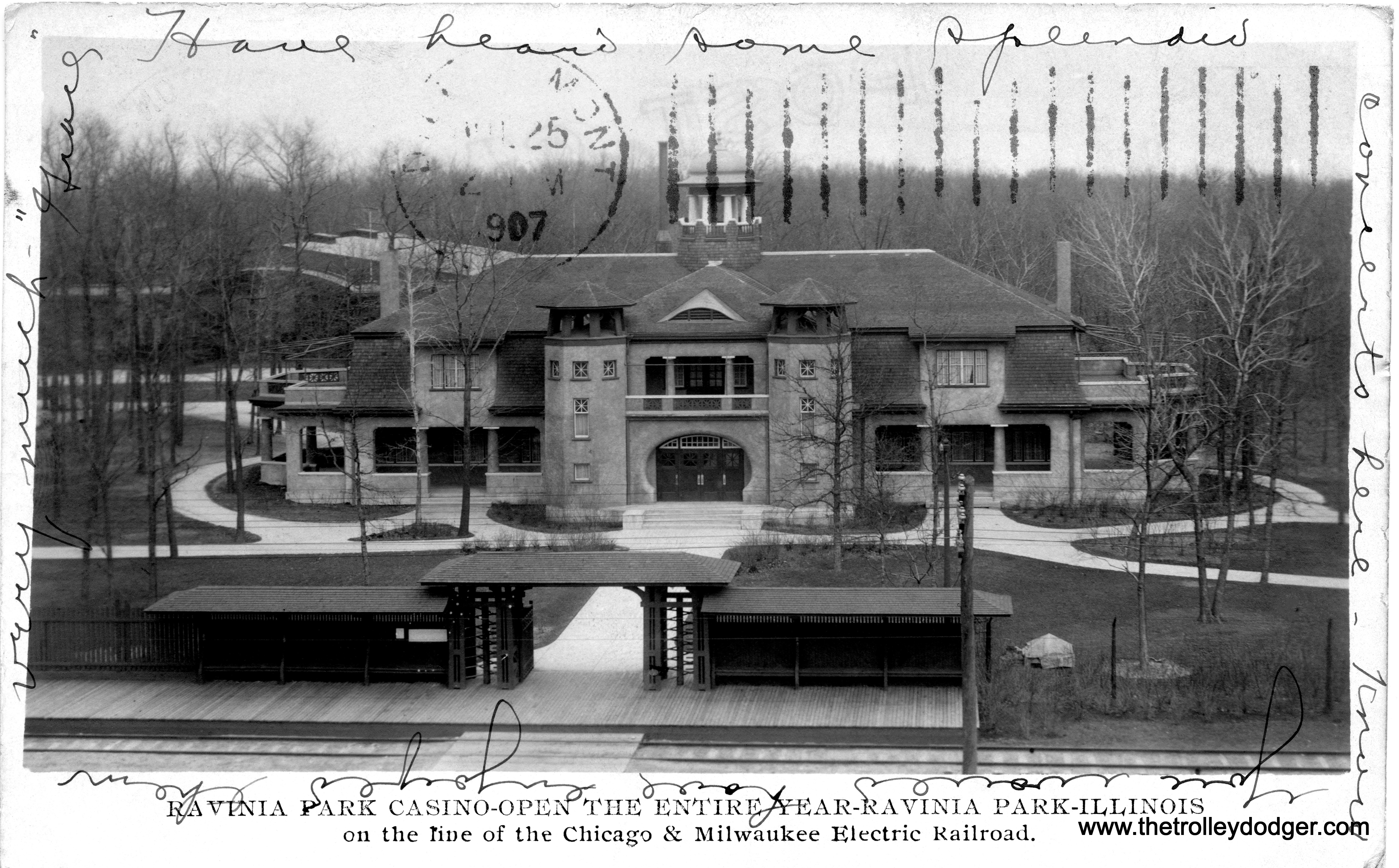
The Ravinia Park Casino was built in 1904 and demolished in 1985. Ravinia Park was built by the Chicago and Milwaukee electric, which became the North Shore Line in 1916.

The Ravinia Park Casino was built in 1904 and demolished in 1985. Ravinia Park was built by the Chicago and Milwaukee electric, which became the North Shore Line in 1916.

Indiana Railroad high-speed car 59 is at Indianapolis on August 11, 1940.

Indiana Railroad high-speed car 59 is at Indianapolis on August 11, 1940.

A Chicago Aurora and Elgin electric loco in Wheaton, where the lines diverged to go to either Aurora (shown here) or Elgin.

A Chicago Aurora and Elgin electric loco in Wheaton, where the lines diverged to go to either Aurora (shown here) or Elgin.

When I posted this circa 1954-55 Garfield Park "L" image to our Facebook group, it generated a lot of discussion as to whether or not this 4000-series "L" car was still in CRT brown paint. The CTA repainted these cars into green and cream starting around 1952. But after much consideration, my conclusion is that this is just a trick of the light, and the car is actually painted in the later CTA colors. It is in shadow and not in direct sunlight. By this time, all such cars should have been repainted and put into married pairs with various modifications (which are visible on this car). The car behind it, which is presumably its mate, is painted green and cream. We are at the east end of the Van Bure Street temporary trackage, which was used from 1953 to 1958. The photographer was apparently looking out the front end of a westbound train, and there was a ramp behind the photographer leading up to the old "L" structure heading to the Loop. The cross street here is Racine Avenue (1200 W).

When I posted this circa 1954-55 Garfield Park “L” image to our Facebook group, it generated a lot of discussion as to whether or not this 4000-series “L” car was still in CRT brown paint. The CTA repainted these cars into green and cream starting around 1952. But after much consideration, my conclusion is that this is just a trick of the light, and the car is actually painted in the later CTA colors. It is in shadow and not in direct sunlight. By this time, all such cars should have been repainted and put into married pairs with various modifications (which are visible on this car). The car behind it, which is presumably its mate, is painted green and cream. We are at the east end of the Van Bure Street temporary trackage, which was used from 1953 to 1958. The photographer was apparently looking out the front end of a westbound train, and there was a ramp behind the photographer leading up to the old “L” structure heading to the Loop. The cross street here is Racine Avenue (1200 W).

I assume this picture of Chicago Surface Lines Peter Witt car 6311 was taken at Devon station. The date given with the negative was January 6, 1941 but this hardly seems likely, given the foliage and the open door. Perhaps month and date were reversed, and a date of June 1, 1941 is correct.

I assume this picture of Chicago Surface Lines Peter Witt car 6311 was taken at Devon station. The date given with the negative was January 6, 1941 but this hardly seems likely, given the foliage and the open door. Perhaps month and date were reversed, and a date of June 1, 1941 is correct.

A view of the Indiana Railroad's Muncie Terminal on August 10, 1940. The photo is by WVK, although I don't know what those initials stand for.

A view of the Indiana Railroad’s Muncie Terminal on August 10, 1940. The photo is by WVK, although I don’t know what those initials stand for.

Indiana Railroad high-speed car 78 in Indianapolis in the late 1930s.

Indiana Railroad high-speed car 78 in Indianapolis in the late 1930s.

A night shot of the North Shore Line's Milwaukee Terminal in July 1962.

A night shot of the North Shore Line’s Milwaukee Terminal in July 1962.

North Shore Line car 748 is part of a two-car train near North Chicago Junction on September 4, 1961.

North Shore Line car 748 is part of a two-car train near North Chicago Junction on September 4, 1961.

This and the next picture shows a Aurora Elgin and Chicago (predecessor to the CA&E) monthly ticket book from June 1922.

This and the next picture shows a Aurora Elgin and Chicago (predecessor to the CA&E) monthly ticket book from June 1922.

The Chicago Aurora and Elgin used uncovered third rail in nearly all areas, including here, in Wheaton, where the Aurora and Elgin branches diverged. A small boy is playing in a nearby field, and people then were not terribly concerned with the danger posed by 600 volts of direct current. If the CA&E had survived, chances are additional protections would be in place.

The Chicago Aurora and Elgin used uncovered third rail in nearly all areas, including here, in Wheaton, where the Aurora and Elgin branches diverged. A small boy is playing in a nearby field, and people then were not terribly concerned with the danger posed by 600 volts of direct current. If the CA&E had survived, chances are additional protections would be in place.

North Shore Line wood car 132 and train at Ravinia Park in the early 1900s.

North Shore Line wood car 132 and train at Ravinia Park in the early 1900s.

Starting in the 1930s, enterprising railfans such as the late Barney Neuberger sold prints of streetcars and interurbans. The smallest such prints were what is now called wallet size, and the going rate was usually 10 cents. Mr. Neuberger had flyers and catalogs printed. There are thousands and thousands of such photos that still circulate, and enrich our knowledge of the past.

Starting in the 1930s, enterprising railfans such as the late Barney Neuberger sold prints of streetcars and interurbans. The smallest such prints were what is now called wallet size, and the going rate was usually 10 cents. Mr. Neuberger had flyers and catalogs printed. There are thousands and thousands of such photos that still circulate, and enrich our knowledge of the past.

CTA 2811 heads up a westbound Garfield Park "L" train of wood cars, circa 1953-54. The ramp connected to the temporary tracks on Van Buren Street/ We are near Sacramento Boulevard. For a time, these tracks crossed over the new Congress Expressway, which was built underneath it. Once the new Congress median line opened in 1958, this structure was removed.

CTA 2811 heads up a westbound Garfield Park “L” train of wood cars, circa 1953-54. The ramp connected to the temporary tracks on Van Buren Street/ We are near Sacramento Boulevard. For a time, these tracks crossed over the new Congress Expressway, which was built underneath it. Once the new Congress median line opened in 1958, this structure was removed.

A two-car Garfield Park "L" train, made up of 4000-series cars, heads west on temporary trackage in Van Buren Street on September 2, 1955. A portion of the Congress Expressway, then under construction, opened later that year.

A two-car Garfield Park “L” train, made up of 4000-series cars, heads west on temporary trackage in Van Buren Street on September 2, 1955. A portion of the Congress Expressway, then under construction, opened later that year.

A Philadelphia Suburban Transportation Company Brill Master Unit is on West Chester Pike at Paoli Road in February 1945. (David H. Cope Photo)

A Philadelphia Suburban Transportation Company Brill Master Unit is on West Chester Pike at Paoli Road in February 1945. (David H. Cope Photo)

The Chicago Aurora and Elgin station in Wheaton, probably in the 1920s.

The Chicago Aurora and Elgin station in Wheaton, probably in the 1920s.

CTA 6190-6189 is at Adams and Wabash on the Loop "L" in July 1954.

CTA 6190-6189 is at Adams and Wabash on the Loop “L” in July 1954.

A northbound CTA train of curved-door 6000s is on the South Side "L" just north of 35th Street in 1954. The middle track had been used for express trains until the CTA realigned north-south service in 1949.

A northbound CTA train of curved-door 6000s is on the South Side “L” just north of 35th Street in 1954. The middle track had been used for express trains until the CTA realigned north-south service in 1949.

This picture was taken from out of the front window of a Lake Street "L" train on July 17, 1954. We are near Garfield Park, and the 4000-series cars parked on the middle track are in mid-day storage. The middle track had been used by express trains prior to 1948, when the CTA inaugurated A/B "skip stop" service.

This picture was taken from out of the front window of a Lake Street “L” train on July 17, 1954. We are near Garfield Park, and the 4000-series cars parked on the middle track are in mid-day storage. The middle track had been used by express trains prior to 1948, when the CTA inaugurated A/B “skip stop” service.

CTA 6047-6048 are looping via a wooden structure at DesPlaines Avenue on July 14, 1954. This was necessary once Chicago Aurora and Elgin service was cut back to Forest Park, starting in September 1953. The direct connection between the two railroads was severed and this loop took CTA trains over the CA&E tracks. Once CA&E was allowed to discontinue passenger service in July 1957, the ramp was no longer necessary. The entire yard area was revamped in 1959 in conjunction with nearby expressway construction.

CTA 6047-6048 are looping via a wooden structure at DesPlaines Avenue on July 14, 1954. This was necessary once Chicago Aurora and Elgin service was cut back to Forest Park, starting in September 1953. The direct connection between the two railroads was severed and this loop took CTA trains over the CA&E tracks. Once CA&E was allowed to discontinue passenger service in July 1957, the ramp was no longer necessary. The entire yard area was revamped in 1959 in conjunction with nearby expressway construction.

Philadelphia Suburban Transportation Company (aka Red Arrow Lines) double-ended car 19 is outbound on West Chester Pike, headed for West Chester, in the early 1950s. Buses replaced trolleys on this line in 1954 so the road could be widened.

Philadelphia Suburban Transportation Company (aka Red Arrow Lines) double-ended car 19 is outbound on West Chester Pike, headed for West Chester, in the early 1950s. Buses replaced trolleys on this line in 1954 so the road could be widened.

Chicago and Illinois Valley (aka the Chicago Ottawa and Peoria, part of the Illinois Traction System) car 56 at Ottawa, Illinois. Don's Rail Photos: "In 1901, the Illinois Valley Traction was incorporated to build the first part of what later became the CO&P. Various other companies were involved in the construction until the CO&P consolidated them all by 1909. The CO&P became the Valley Division of Illinois Traction Inc. in 1923. In 1929, a new company, the Chicago & Illinois Valley, took over the Valley Division and operated it until abandonment on May 14, 1934. It was always considered a part of the Illinois Traction, and this can be seen in its rolling stock. 55 and 56 were built by St. Louis in 1903. 55 was retired in 1921. 56 was used in Peoria from 1920 thru 1927 when it was returned to the Valley. It was scrapped in 1934."

Chicago and Illinois Valley (aka the Chicago Ottawa and Peoria, part of the Illinois Traction System) car 56 at Ottawa, Illinois. Don’s Rail Photos: “In 1901, the Illinois Valley Traction was incorporated to build the first part of what later became the CO&P. Various other companies were involved in the construction until the CO&P consolidated them all by 1909. The CO&P became the Valley Division of Illinois Traction Inc. in 1923. In 1929, a new company, the Chicago & Illinois Valley, took over the Valley Division and operated it until abandonment on May 14, 1934. It was always considered a part of the Illinois Traction, and this can be seen in its rolling stock. 55 and 56 were built by St. Louis in 1903. 55 was retired in 1921. 56 was used in Peoria from 1920 thru 1927 when it was returned to the Valley. It was scrapped in 1934.”

The next-to-last North Shore Line fantrip took place on January 12, 1963, and used coaches 150 and 160. Here, the train has made a photo stop at the old Chicago Rapid Transit Company "L" station at Kostner Avenue, which was in use from 1925 to 1948 on the Niles Center branch. The station was designed by Insull staff architect Arthur U. Gerber. North Shore trains never stopped here in regular service. (William C. Hoffman Photo) Scott Greig adds: "By the way, the last charter on the North Shore was the day after the one pictured. It was a CERA charter with four Silverliners on Sunday, January 13, 1963. Illini Railroad Club announced that they would have a charter on the last day, but they finally had to settle for an extra car added to a regular train."

The next-to-last North Shore Line fantrip took place on January 12, 1963, and used coaches 150 and 160. Here, the train has made a photo stop at the old Chicago Rapid Transit Company “L” station at Kostner Avenue, which was in use from 1925 to 1948 on the Niles Center branch. The station was designed by Insull staff architect Arthur U. Gerber. North Shore trains never stopped here in regular service. (William C. Hoffman Photo) Scott Greig adds: “By the way, the last charter on the North Shore was the day after the one pictured. It was a CERA charter with four Silverliners on Sunday, January 13, 1963. Illini Railroad Club announced that they would have a charter on the last day, but they finally had to settle for an extra car added to a regular train.”

The two car fantrip train has stopped at the old Clark and Lake "L" station on January 12, 1963. (William C. Hoffman Photo)

The two car fantrip train has stopped at the old Clark and Lake “L” station on January 12, 1963. (William C. Hoffman Photo)

North Shore Line coach 772 is southbound at North Chicago Junction on July 4, 1955, operating on the Shore Line Route that would be abandoned later that month. Skokie Valley Route trains went to the other side of the station. (William C. Hoffman Photo)

North Shore Line coach 772 is southbound at North Chicago Junction on July 4, 1955, operating on the Shore Line Route that would be abandoned later that month. Skokie Valley Route trains went to the other side of the station. (William C. Hoffman Photo)

The North Shore Line Milwaukee Terminal on June 25, 1961.

The North Shore Line Milwaukee Terminal on June 25, 1961.

Electroliner 803-804 is northbound on Fifth Street in Milwaukee at Maple on January 13, 1963. All the buildings on the right are gone now, as this is now the location of an expressway. (Jeffrey L. Wien Photo)

Electroliner 803-804 is northbound on Fifth Street in Milwaukee at Maple on January 13, 1963. All the buildings on the right are gone now, as this is now the location of an expressway. (Jeffrey L. Wien Photo)

North Shore Line snow plow 605 at Pettibone Yards on August 29, 1964. Built by Russell in 1921, it became the last piece of NSL equipment to be scrapped on the property. David A. Myers Jr. says he found someone who was interested in taking it, but they procrastinated so long that the tracks were taken up around the car, and it was then scrapped in place. (Jeffrey L. Wien Photo)

North Shore Line snow plow 605 at Pettibone Yards on August 29, 1964. Built by Russell in 1921, it became the last piece of NSL equipment to be scrapped on the property. David A. Myers Jr. says he found someone who was interested in taking it, but they procrastinated so long that the tracks were taken up around the car, and it was then scrapped in place. (Jeffrey L. Wien Photo)

Chicago Surface Lines prewar PCC 4048 is downtown, signed for the Madison-Fifth route which was a branch of Route 20 - Madison. The 83 cars in this series were built in 1936 and retired in 1956. The sole survivor is 4021, which is now at the Illinois Railway Museum.

Chicago Surface Lines prewar PCC 4048 is downtown, signed for the Madison-Fifth route which was a branch of Route 20 – Madison. The 83 cars in this series were built in 1936 and retired in 1956. The sole survivor is 4021, which is now at the Illinois Railway Museum.

Chicago Surface Lines work car H7. Don's Rail Photos: "H7, mail car, was built by American Car Co in 1891, as a Cicero & Proviso Street Railway passenger car. It was rebuilt as Chicago Union Traction 8 in 1900 as a mail car and as Chicago Railways 8 in 1903. It was renumbered H7 in 1913 and became CSL H7 in 1914. It was retired on May 16, 1949."

Chicago Surface Lines work car H7. Don’s Rail Photos: “H7, mail car, was built by American Car Co in 1891, as a Cicero & Proviso Street Railway passenger car. It was rebuilt as Chicago Union Traction 8 in 1900 as a mail car and as Chicago Railways 8 in 1903. It was renumbered H7 in 1913 and became CSL H7 in 1914. It was retired on May 16, 1949.”

Indiana Railroad car 65. Don's Rail Photos: "65 was built by Pullman in 1931, #6399. The lounge section was replaced by a baggage section. 65 was sold to the Cedar Rapids & Iowa City as 120 in 1941. In 1954 it was purchased as the first car of the Illinois Railway Museum, which was known as the Illinois Electric Railway Museum at that time. I put in many enjoyable hours working on that car prior to 1960 when I moved to Peoria."

Indiana Railroad car 65. Don’s Rail Photos: “65 was built by Pullman in 1931, #6399. The lounge section was replaced by a baggage section. 65 was sold to the Cedar Rapids & Iowa City as 120 in 1941. In 1954 it was purchased as the first car of the Illinois Railway Museum, which was known as the Illinois Electric Railway Museum at that time. I put in many enjoyable hours working on that car prior to 1960 when I moved to Peoria.”

Our Latest Book, Now Available for Pre-Order:

The North Shore Line

Publication Date: February 20, 2023

FYI, my new Arcadia Publishing book The North Shore Line is now finished and has gone to press. My publisher decided to expand it to 160 pages, instead of the usual 128. That’s a 25% increase, without any change to the $23.99 price. I am quite pleased with how this turned out.

From the back cover:

As late as 1963, it was possible to board high-speed electric trains on Chicago’s famous Loop “L” that ran 90 miles north to Milwaukee. This was the Chicago North Shore & Milwaukee Railroad, commonly known as the North Shore Line. It rose from humble origins in the 1890s as a local streetcar line in Waukegan to eventually become America’s fastest interurban under the visionary management of Midwest utilities tycoon Samuel Insull. The North Shore Line, under Insull, became a worthy competitor to the established steam railroads. Hobbled by the Great Depression, the road fought back in 1941 with two streamlined, air-conditioned, articulated trains called Electroliners, which included dining service. It regained its popularity during World War II, when gasoline and tires were rationed, but eventually, it fell victim to highways and the automobile. The North Shore Line had intercity rail, commuter rail, electric freight, city streetcars, and even buses. It has been gone for nearly 60 years, but it will always remain the Road of Service.

Each copy purchased here will be signed by the author, and you will also receive a bonus North Shore Line map.  Books will ship by USPS Media Mail as soon as we receive them, on or before February 20, 2023.

Chapters:
01. Beginnings
02. The Milwaukee Division
03. The Shore Line Route
04. The Skokie Valley Route
05. The Mundelein Branch
06. On the “L”
07. City Streetcars
08. Trolley Freight
09. The Long Goodbye
10. The Legacy

Title The North Shore Line
Images of America
Author David Sadowski
Edition illustrated
Publisher Arcadia Publishing (SC), 2023
ISBN 1467108960, 978-1467108966
Length 160 pages

The price of $23.99 includes shipping within the United States.

For Shipping to US Addresses:

New Compact Disc, Now Available:

CTA-1
The Last Chicago Streetcars 1958
# of Discs – 1
Price: $15.99

Until now, it seemed as though audio recordings of Chicago streetcars were practically non-existent. For whatever reason, the late William A. Steventon does not appear to have made any for his Railroad Record Club, even though he did make other recordings in the Chicago area in 1956.

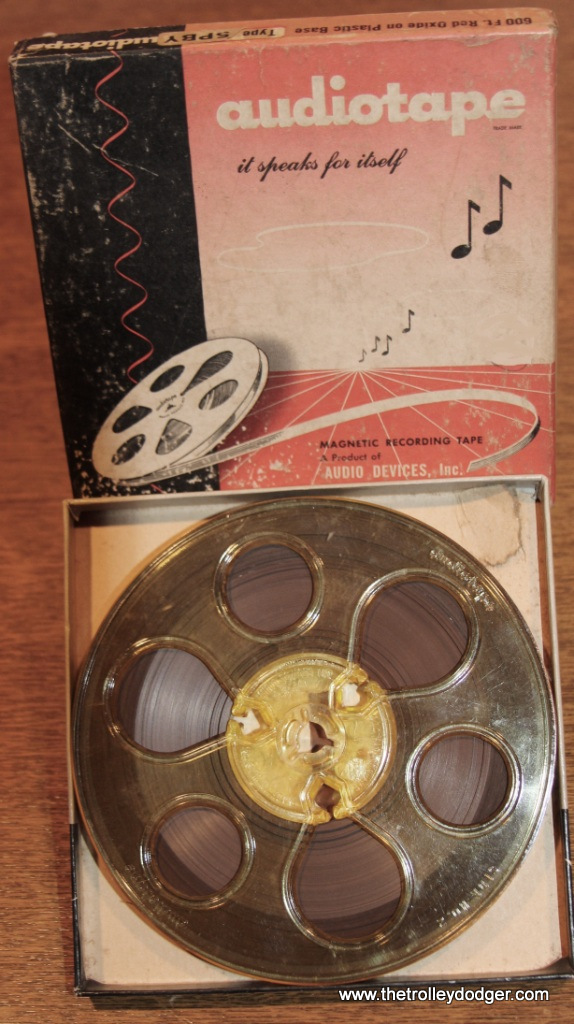
Now, audio recordings of the last runs of Chicago streetcars have been found, in the collections of the late Jeffrey L. Wien (who was one of the riders on that last car). We do not know who made these recordings, but this must have been done using a portable reel-to-reel machine.

These important recordings will finally fill a gap in transit history. The last Chicago Transit Authority streetcar finished its run in the early hours of June 21, 1958. Now you can experience these events just as Chicagoans did.

As a bonus, we have included Keeping Pace, a 1939 Chicago Surface Lines employee training program. This was digitally transferred from an original 16” transcription disc. These recordings were unheard for 80 years.

Total time – 74:38

Help Support The Trolley Dodger

This is our 294th post, and we are gradually creating a body of work and an online resource for the benefit of all railfans, everywhere. To date, we have received over 934,000 page views, for which we are very grateful.

You can help us continue our original transit research by checking out the fine products in our Online Store.
As we have said before, “If you buy here, we will be here.”

We thank you for your support.

DONATIONS

In order to continue giving you the kinds of historic railroad images that you have come to expect from The Trolley Dodger, we need your help and support. It costs money to maintain this website, and to do the sort of historic research that is our specialty.

Your financial contributions help make this web site better, and are greatly appreciated.


Shine a Light

Over the years, I have seen many poor quality duplicate slides with this view, looking to the northwest, with a Garfield Park "L" train crossing the Met bridge over the Chicago River, with Union Station in the background. However, this was scanned from an original red border Kodachrome slide, circa 1955-58. The name of the photographer is not known. This must be a Garfield train, and the results are stunning. Douglas cars were re-routed over the Lake Street "L" in 1954. Logan Square trains began running via the Milwaukee-Dearborn Subway in 1951.

Over the years, I have seen many poor quality duplicate slides with this view, looking to the northwest, with a Garfield Park “L” train crossing the Met bridge over the Chicago River, with Union Station in the background. However, this was scanned from an original red border Kodachrome slide, circa 1955-58. The name of the photographer is not known. This must be a Garfield train, and the results are stunning. Douglas cars were re-routed over the Lake Street “L” in 1954. Logan Square trains began running via the Milwaukee-Dearborn Subway in 1951.

Here we have another bevy of classic traction photos for your enjoyment. All are from our collections, and nearly all were scanned from the original slides and negatives. Then, they were painstakingly worked over in Photoshop to make them look their best.

These views shine a light on the past, but also help illuminate our present and our future. We chose these images because we think they are important. They show some things that still exist, and other things that don’t.

By studying the past, we can learn from it, and the lessons we learn will help us make the decisions that will determine what gets preserved and improved in the future– and what goes by the wayside, into the dustbin of history.

When faced with the darkness of the present times, we could all use more light.

We have an exciting new Compact Disc available now, with audio recorded on the last Chicago Streetcar in 1958. There is additional information about this towards the end of this post, and also in our Online Store.

Keep those cards and letters coming in, folks.

-David Sadowski

PS- You might also like our Trolley Dodger Facebook auxiliary, a private group that now has 931 members.

Our friend Kenneth Gear now has a Facebook group for the Railroad Record Club. If you enjoy listening to audio recordings of classic railroad trains, whether steam, electric, or diesel, you might consider joining.

Work on our North Shore Line book is ongoing. Donations are needed in order to bring this to a successful conclusion. You will find donation links at the top and bottom of each post. We thank you in advance for your time and consideration.

Recent Finds

A North Shore Line Electroliner stops on a curve during the early 1950s, while a woman wearing a long skirt and heels departs. This looks like North Chicago Junction.

A North Shore Line Electroliner stops on a curve during the early 1950s, while a woman wearing a long skirt and heels departs. This looks like North Chicago Junction.

Don's Rail Photos: (Caboose) "1003 was built by American Car & Foundry Co in 1926. It was rebuilt without a cupola but restored when it was acquired IRM." Here is how part of it looked in the early 1950s.

Don’s Rail Photos: (Caboose) “1003 was built by American Car & Foundry Co in 1926. It was rebuilt without a cupola but restored when it was acquired IRM.” Here is how part of it looked in the early 1950s.

One of the two ex-North Shore Line Electroliners is shown in Philadelphia in December 1963, prior to being repainted as a Red Arrow Liberty Liner.

One of the two ex-North Shore Line Electroliners is shown in Philadelphia in December 1963, prior to being repainted as a Red Arrow Liberty Liner.

Although this was scanned from a duplicate slide, this is an excellent and well known shot, showing the last day fantrip on the North Shore Line's Shore Line Route in July 1955. The location is Kenilworth, and we are looking mainly to the south, and a bit towards the west. The town's famous fountain, paid for by the Chicago and Milwaukee Electric, the NSL's predecessor, is at left. It was designed by noted architect George W. Maher (1864-1926), who lived in the area. The Chicago and North Western's tracks are at right (now Union Pacific).

Although this was scanned from a duplicate slide, this is an excellent and well known shot, showing the last day fantrip on the North Shore Line’s Shore Line Route in July 1955. The location is Kenilworth, and we are looking mainly to the south, and a bit towards the west. The town’s famous fountain, paid for by the Chicago and Milwaukee Electric, the NSL’s predecessor, is at left. It was designed by noted architect George W. Maher (1864-1926), who lived in the area. The Chicago and North Western’s tracks are at right (now Union Pacific).

A northbound Electroliner, just outside of Milwaukee in July 1962. (Jim Martin Photo)

A northbound Electroliner, just outside of Milwaukee in July 1962. (Jim Martin Photo)

Car 170 is an NSL Lake Bluff local at the east end of the line on December 23, 1962. The tracks going off to the right connected to what was left of the old Shore Line Route. After the 1955 abandonment, a single track was retained for freight and for access to the Highwood Shops. (Jim Martin Photo)

Car 170 is an NSL Lake Bluff local at the east end of the line on December 23, 1962. The tracks going off to the right connected to what was left of the old Shore Line Route. After the 1955 abandonment, a single track was retained for freight and for access to the Highwood Shops. (Jim Martin Photo)

Once the NSL abandonment was formally approved, in May 1962, there was a flurry of fantrip activity soon after. In June 1962, this trip was popular enough that two trains were used. Here they are on the Mundelein branch, posed side by side. One of the Liners made a rare appearance here. (Jim Martin Photo)

Once the NSL abandonment was formally approved, in May 1962, there was a flurry of fantrip activity soon after. In June 1962, this trip was popular enough that two trains were used. Here they are on the Mundelein branch, posed side by side. One of the Liners made a rare appearance here. (Jim Martin Photo)

An Electroliner has gone past the east end of the Mundelein branch on a June 1962 fantrip, and is now on the single remaining track of the old Shore Line Route, which continued to Highwood (and ended in Highland Park). (Jim Martin Photo)

An Electroliner has gone past the east end of the Mundelein branch on a June 1962 fantrip, and is now on the single remaining track of the old Shore Line Route, which continued to Highwood (and ended in Highland Park). (Jim Martin Photo)

A three-car North Shore Line train in Lake Bluff on a snowy day on December 23, 1962. (Jim Martin Photo)

A three-car North Shore Line train in Lake Bluff on a snowy day on December 23, 1962. (Jim Martin Photo)

North Shore Line car 714, freshly painted, is at the Milwaukee Terminal on June 16, 1962. (Richard H. Young Photo)

North Shore Line car 714, freshly painted, is at the Milwaukee Terminal on June 16, 1962. (Richard H. Young Photo)

The North Shore Line's Mundelein Terminal on September 7, 1959.

The North Shore Line’s Mundelein Terminal on September 7, 1959.

David A. Myers recently sent me this picture, which shows him making an audio recording during the last run of the North Shore Line, in the early morning hours of January 21, 1963. He still has the tape and I hope someday he will have it digitized.

David A. Myers recently sent me this picture, which shows him making an audio recording during the last run of the North Shore Line, in the early morning hours of January 21, 1963. He still has the tape and I hope someday he will have it digitized.

No information came with this black and white negative, but the location is Highwood. Diners 415 and 419 are present. 419 was out of service by 1949, and 415 was converted to a Silverliner the following year, so that helps date the picture. Car 150, built in 1915, is at the right, along with a Merchandise Despatch car. This picture could be from 1947 or even earlier.

No information came with this black and white negative, but the location is Highwood. Diners 415 and 419 are present. 419 was out of service by 1949, and 415 was converted to a Silverliner the following year, so that helps date the picture. Car 150, built in 1915, is at the right, along with a Merchandise Despatch car. This picture could be from 1947 or even earlier.

Jim Martin caught this meet between both Electroliners at North Chicago Junction in May 1962.

Jim Martin caught this meet between both Electroliners at North Chicago Junction in May 1962.

An Electroliner in Lake Bluff in January 1963. This and the following image were consecutive shots taken by the same (unknown) photographer.

An Electroliner in Lake Bluff in January 1963. This and the following image were consecutive shots taken by the same (unknown) photographer.

The photographer (possibly Emery Gulash) had but one chance to press the shutter button at precisely the right moment, and he nailed it with this classic view of westbound Electroliner train 803 at Lake Bluff in January 1963. This is what noted photographer Henri Cartier-Bresson had in mind when he wrote about the "decisive moment." Douglas Noble: "Northbound crossing Rockland Road / IL 176 in Lake Bluff."

The photographer (possibly Emery Gulash) had but one chance to press the shutter button at precisely the right moment, and he nailed it with this classic view of westbound Electroliner train 803 at Lake Bluff in January 1963. This is what noted photographer Henri Cartier-Bresson had in mind when he wrote about the “decisive moment.” Douglas Noble: “Northbound crossing Rockland Road / IL 176 in Lake Bluff.”

CTA 53 (originally 5003), seen here at Skokie Shops in July 1971, was one of four such articulated sets ordered by the Chicago Rapid Transit Company and delivered in 1947-48. They were the first tangible evidence of the postwar modernization yet to come, under the management of the new Chicago Transit Authority. They were important cars, as the bridge between the 4000 and 6000 series, but were not that successful operationally on their own, even though they were the first Chicago "L" cars to utilize PCC technology. As it turned out, articulation was more of a dead end than a new beginning here, but these cars did pave the way for further refinements that were realized in the 6000s. As oddball equipment, they were eventually relegated to the Skokie Swift, where they lived out their lives until their mid-1980s retirement.

CTA 53 (originally 5003), seen here at Skokie Shops in July 1971, was one of four such articulated sets ordered by the Chicago Rapid Transit Company and delivered in 1947-48. They were the first tangible evidence of the postwar modernization yet to come, under the management of the new Chicago Transit Authority. They were important cars, as the bridge between the 4000 and 6000 series, but were not that successful operationally on their own, even though they were the first Chicago “L” cars to utilize PCC technology. As it turned out, articulation was more of a dead end than a new beginning here, but these cars did pave the way for further refinements that were realized in the 6000s. As oddball equipment, they were eventually relegated to the Skokie Swift, where they lived out their lives until their mid-1980s retirement.

CTA trolleybus 9510 heads west on Roosevelt Road at Ogden Avenue at 6:50 pm on June 16, 1966.

CTA trolleybus 9510 heads west on Roosevelt Road at Ogden Avenue at 6:50 pm on June 16, 1966.

CTA trolleybus 9499 is southbound on Kedzie at 59th Street on September 10, 1963.

CTA trolleybus 9499 is southbound on Kedzie at 59th Street on September 10, 1963.

CTA 3311, a one-man car, is at the east end of one of the south side routes in the early 1950s. Andre Kristopans: "3311 is at 67th and South Shore on 67th/69th route."

CTA 3311, a one-man car, is at the east end of one of the south side routes in the early 1950s. Andre Kristopans: “3311 is at 67th and South Shore on 67th/69th route.”

A CTA single car unit heads north at Isabella Avenue in Evanston in September 1965. This station, closed in 1973, was a short distance from the end of the Evanston branch (Linden Avenue, Wilmette).

A CTA single car unit heads north at Isabella Avenue in Evanston in September 1965. This station, closed in 1973, was a short distance from the end of the Evanston branch (Linden Avenue, Wilmette).

CTA PCC 7101, a product of the St. Louis Car Company, on September 2, 1955. Not sure of the exact location. Our resident south side expert M.E. adds: "As for where this location is, I can more likely tell you where it isn't. It isn't on route 49, Western Ave., which was built up everywhere. It isn't on route 22, Clark-Wentworth, which was also built up everywhere. I thought it might be on route 4, Cottage Grove, just south of 95th, where the streetcar tracks ran in the street for a few blocks before entering private right-of-way. However, I see no sign of the Illinois Central railroad embankment that ran next to Cottage Grove Ave. So that leaves one possibility: Route 36, Broadway-State. Some of that route ran through sparse areas, particularly along 119th St. between Michigan Ave. and Morgan St. My best guess is that this view is on 119th St., looking east from east of Halsted St. Notice the building shadow at the bottom, which means the sun was behind the building, to the south. Ergo, the streetcar is going east. Another reason I think this is 119th St. is the presence of exactly one motor vehicle. 119th St. was far out in those days; buildings were few in number, not just along 119th St. but also route 8A South Halsted (bus). The only "bustling" area that far out was around 119th and Halsted (and west to Morgan), where there were industries like foundries, mills, etc. In fact, I think the only reasons the streetcar line continued to run that far south were (1) to accommodate the people who worked in those industries, and (2) to service the Roseland business district at 111th and Michigan."

CTA PCC 7101, a product of the St. Louis Car Company, on September 2, 1955. Not sure of the exact location. Our resident south side expert M.E. adds: “As for where this location is, I can more likely tell you where it isn’t. It isn’t on route 49, Western Ave., which was built up everywhere. It isn’t on route 22, Clark-Wentworth, which was also built up everywhere. I thought it might be on route 4, Cottage Grove, just south of 95th, where the streetcar tracks ran in the street for a few blocks before entering private right-of-way. However, I see no sign of the Illinois Central railroad embankment that ran next to Cottage Grove Ave. So that leaves one possibility: Route 36, Broadway-State. Some of that route ran through sparse areas, particularly along 119th St. between Michigan Ave. and Morgan St. My best guess is that this view is on 119th St., looking east from east of Halsted St. Notice the building shadow at the bottom, which means the sun was behind the building, to the south. Ergo, the streetcar is going east. Another reason I think this is 119th St. is the presence of exactly one motor vehicle. 119th St. was far out in those days; buildings were few in number, not just along 119th St. but also route 8A South Halsted (bus). The only “bustling” area that far out was around 119th and Halsted (and west to Morgan), where there were industries like foundries, mills, etc. In fact, I think the only reasons the streetcar line continued to run that far south were (1) to accommodate the people who worked in those industries, and (2) to service the Roseland business district at 111th and Michigan.”

CTA "L" car #1 is at the west end of the Green Line in Oak Park, probably in the 1990s. This car is now on display at the Chicago History Museum.

CTA “L” car #1 is at the west end of the Green Line in Oak Park, probably in the 1990s. This car is now on display at the Chicago History Museum.

CTA PCC 4385 is southbound on Clark Street at North Water Street in May 1958, running on Route 22A - Wentworth.

CTA PCC 4385 is southbound on Clark Street at North Water Street in May 1958, running on Route 22A – Wentworth.

A northbound CTA Englewood-Howard "A" train, made up of curved-door 6000-series "L" cars, heads into the State Street Subway at the south portal in August 1982.

A northbound CTA Englewood-Howard “A” train, made up of curved-door 6000-series “L” cars, heads into the State Street Subway at the south portal in August 1982.

A southbound CTA Ravenswood "B" train, made up of wooden "L" cars, approaches the Sedgwick station on April 10, 1957.

A southbound CTA Ravenswood “B” train, made up of wooden “L” cars, approaches the Sedgwick station on April 10, 1957.

A two-car mid-day CTA Evanston Express "L" train, made up of single-car units 39 and 47, heads east on Van Buren between LaSalle and State on August 14, 1964. During this period, Loop trains all ran counter-clockwise and there was a continuous platform running from LaSalle to State. The platform sections between stations were removed in 1968.

A two-car mid-day CTA Evanston Express “L” train, made up of single-car units 39 and 47, heads east on Van Buren between LaSalle and State on August 14, 1964. During this period, Loop trains all ran counter-clockwise and there was a continuous platform running from LaSalle to State. The platform sections between stations were removed in 1968.

A northbound CTA Evanston Express train, made up of 4000s, is north of Lawrence Avenue on July 22, 1968. Miles Beitler: "In photo aad017a, the Evanston Express is northbound on the local track between Rosemont Avenue and Sheridan Road (around 6300-6400 north). Granville tower is visible in the distance. PM northbound Evanston Express trains switched to the local track at Granville in order to serve Loyola and Morse stations. (AM trains did not do this.) I believe that sometime in the 1980s or 1990s, to speed up service, Loyola and Morse were no longer served by Evanston Expresses, and the trains remained on the outside express track all the way to Howard." Andre Kristopans adds, "For years after AM rush until noon Evanston trains used local tracks all the way as Granville tower only manned AM rush. Also AM rush expresses usually crossed over NB as express track was used to lay up trains midday south of Howard. SB expresses always used local tracks to Granville as SB express track did not have 3rd rail north of Granville until 1970s sometime." Miles Beitler replies, "That is not correct. Third rail was installed on the southbound express track between Howard and Granville at least by 1964, and even before that the expresses ran on that portion using overhead wire."

A northbound CTA Evanston Express train, made up of 4000s, is north of Lawrence Avenue on July 22, 1968. Miles Beitler: “In photo aad017a, the Evanston Express is northbound on the local track between Rosemont Avenue and Sheridan Road (around 6300-6400 north). Granville tower is visible in the distance. PM northbound Evanston Express trains switched to the local track at Granville in order to serve Loyola and Morse stations. (AM trains did not do this.) I believe that sometime in the 1980s or 1990s, to speed up service, Loyola and Morse were no longer served by Evanston Expresses, and the trains remained on the outside express track all the way to Howard.” Andre Kristopans adds, “For years after AM rush until noon Evanston trains used local tracks all the way as Granville tower only manned AM rush. Also AM rush expresses usually crossed over NB as express track was used to lay up trains midday south of Howard. SB expresses always used local tracks to Granville as SB express track did not have 3rd rail north of Granville until 1970s sometime.” Miles Beitler replies, “That is not correct. Third rail was installed on the southbound express track between Howard and Granville at least by 1964, and even before that the expresses ran on that portion using overhead wire.”

A close-up of the previous image, showing Granville Tower.

A close-up of the previous image, showing Granville Tower.

CTA PCC 7160 is northbound on Clark Street, approaching the loop at Howard Street, on July 5, 1957. (Edward S. Miller Photo)

CTA PCC 7160 is northbound on Clark Street, approaching the loop at Howard Street, on July 5, 1957. (Edward S. Miller Photo)

The Washington station in the State Street Subway in Chicago on July 6, 1975.

The Washington station in the State Street Subway in Chicago on July 6, 1975.

CTA single-car unit 39 is southbound at Isabella on August 13, 1964, operating on the Evanston Shuttle.

CTA single-car unit 39 is southbound at Isabella on August 13, 1964, operating on the Evanston Shuttle.

CTA red Pullman 281 is heading westbound into the turnaround loop at 63rd Place and Narragansett in early 1953. Towards the end of streetcar service on Route 63, older red cars replaced PCCs, which were shifted over to run on Cottage Grove. This residential neighborhood, sparsely populated then, is now completely built up.

CTA red Pullman 281 is heading westbound into the turnaround loop at 63rd Place and Narragansett in early 1953. Towards the end of streetcar service on Route 63, older red cars replaced PCCs, which were shifted over to run on Cottage Grove. This residential neighborhood, sparsely populated then, is now completely built up.

CTA salt car AA101 at South Shops, circa 1955-57. Don's Rail Photos: "AA101, salt car, was built by South Chicago City Ry in 1907 as SCCRy 335. It was rebuilt in 1907 and became C&SCRy 834 in 1908. It was renumbered 2849 in 1913 and became CSL 2849 in 1914. It was later converted as a salt car and renumbered AA101 in 1948. It was retired on December 14, 1956."

CTA salt car AA101 at South Shops, circa 1955-57. Don’s Rail Photos: “AA101, salt car, was built by South Chicago City Ry in 1907 as SCCRy 335. It was rebuilt in 1907 and became C&SCRy 834 in 1908. It was renumbered 2849 in 1913 and became CSL 2849 in 1914. It was later converted as a salt car and renumbered AA101 in 1948. It was retired on December 14, 1956.”

The view looking north along Halsted Street at 42nd Street on Chicago's south side, from a real photo postcard. The message on the back was dated August 24, 1910. Postal postcards were a new thing in the early 1900s and were very popular. Some, like this, were made by contact printing from the original photo negative. The Union Stock Yards were at left, and you can see the Halsted Station on then-new Stock Yards "L" branch (opened in 1908) in the distance. Automobiles were not yet common, and you can spot a man riding a horse to the left of streetcar 5150. This car was built by Brill in 1905, and was modernized in 1908. When this picture was taken, it was operated by the Chicago City Railway, as the Surface Lines did not come into existence until 1914.

The view looking north along Halsted Street at 42nd Street on Chicago’s south side, from a real photo postcard. The message on the back was dated August 24, 1910. Postal postcards were a new thing in the early 1900s and were very popular. Some, like this, were made by contact printing from the original photo negative. The Union Stock Yards were at left, and you can see the Halsted Station on then-new Stock Yards “L” branch (opened in 1908) in the distance. Automobiles were not yet common, and you can spot a man riding a horse to the left of streetcar 5150. This car was built by Brill in 1905, and was modernized in 1908. When this picture was taken, it was operated by the Chicago City Railway, as the Surface Lines did not come into existence until 1914.

A close-up from the previous photo.

A close-up from the previous photo.

This Skokie Swift sign graced the Dempster Street terminal of what is now the CTA Yellow Line for many years. It is now at the Illinois Railway Museum. Here is how it looked in September 1985. The original running time was more like 6 1/2 minutes when the line opened in 1964, but things got slowed down a bit in the interests of safety, since there are several grade crossings.

This Skokie Swift sign graced the Dempster Street terminal of what is now the CTA Yellow Line for many years. It is now at the Illinois Railway Museum. Here is how it looked in September 1985. The original running time was more like 6 1/2 minutes when the line opened in 1964, but things got slowed down a bit in the interests of safety, since there are several grade crossings.

CTA single-car unit #1 at the Skokie Swift terminal at Dempster on June 11, 1965. It was built by St. Louis Car Company in 1960 and had high-speed motors. It was sent to General Electric in 1974 and used to test equipment. Since 2016 it has been at the Seashore Trolley Museum in Maine, but it would require a lot of work (and parts) to restore.

CTA single-car unit #1 at the Skokie Swift terminal at Dempster on June 11, 1965. It was built by St. Louis Car Company in 1960 and had high-speed motors. It was sent to General Electric in 1974 and used to test equipment. Since 2016 it has been at the Seashore Trolley Museum in Maine, but it would require a lot of work (and parts) to restore.

We are looking east along the Indiana Avenue "L" station around 1955. The wooden "L" car at back is a spare, being stored on what had once been the main line track up until 1949. The Kenwood branch ran east from here until 1957. The Stockyards branch went west from here. (C. Foreman Photo)

We are looking east along the Indiana Avenue “L” station around 1955. The wooden “L” car at back is a spare, being stored on what had once been the main line track up until 1949. The Kenwood branch ran east from here until 1957. The Stockyards branch went west from here. (C. Foreman Photo)

We are looking east from the CTA's Indiana Avenue "L" station on September 2, 1955. A northbound Howard "B" train, made up of new curved-door 6000s, approaches on what had once been the middle express track. This was changed in 1949, when the CTA made a major revamp of north-south service. Numerous little-used stations were closed, and A/B "skip stop" service introduced, in an effort to speed things up. Since the express track was no longer needed, the CTA used part of it here to establish a pocket track for Kenwood branch trains, which became a shuttle operation. Sean Hunnicutt adds, "6405-06 are at the front." Andre Kristopans adds, "At Indiana the layup track was the old LOCAL track, the middle in use was the express." Northbound “L” trains switched over to what had been the express track (middle) just south of Indiana Avenue. I should have made that clear in the caption, thanks.

We are looking east from the CTA’s Indiana Avenue “L” station on September 2, 1955. A northbound Howard “B” train, made up of new curved-door 6000s, approaches on what had once been the middle express track. This was changed in 1949, when the CTA made a major revamp of north-south service. Numerous little-used stations were closed, and A/B “skip stop” service introduced, in an effort to speed things up. Since the express track was no longer needed, the CTA used part of it here to establish a pocket track for Kenwood branch trains, which became a shuttle operation. Sean Hunnicutt adds, “6405-06 are at the front.” Andre Kristopans adds, “At Indiana the layup track was the old LOCAL track, the middle in use was the express.” Northbound “L” trains switched over to what had been the express track (middle) just south of Indiana Avenue. I should have made that clear in the caption, thanks.

Milwaukee Electric articulated unit 1190 is on Main Street in Waukesha, Wisconsin on June 12, 1949. (William C. Hoffman Photo) One commenter adds, "Both photos taken by William C. Hoffman in Waukesha are actually on W. Broadway, just south of Main St. All buildings are still standing."

Milwaukee Electric articulated unit 1190 is on Main Street in Waukesha, Wisconsin on June 12, 1949. (William C. Hoffman Photo) One commenter adds, “Both photos taken by William C. Hoffman in Waukesha are actually on W. Broadway, just south of Main St. All buildings are still standing.”

Milwaukee Electric heavyweight car 1119 is on Main Street on June 12, 1949. (William C. Hoffman Photo) One commenter adds, "Both photos taken by William C. Hoffman in Waukesha are actually on W. Broadway, just south of Main St. All buildings are still standing."

Milwaukee Electric heavyweight car 1119 is on Main Street on June 12, 1949. (William C. Hoffman Photo) One commenter adds, “Both photos taken by William C. Hoffman in Waukesha are actually on W. Broadway, just south of Main St. All buildings are still standing.”

Milwaukee streetcar 972 at the Harwood Avenue terminal in Wauwatosa, circa 1955-58. (W. H. Higginbotham Photo)

Milwaukee streetcar 972 at the Harwood Avenue terminal in Wauwatosa, circa 1955-58. (W. H. Higginbotham Photo)

The Public Service Building in downtown Milwaukee, located at 4th and Michigan, had been the former rapid transit terminal until 1951. Here is how it appeared on August 23, 1964. (William C. Hoffman Photo) Larry Sakar: "this is the southeast corner of the PSB at 3rd (not 4th) and Michigan Sts. You are looking southeast. Greyhound would continue using the PSB until February, 1965 when it moved to its own, brand new terminal on the northeast corner of North 7th & W. Michigan Sts. In addition to the 3 story terminal on the Michigan St side (the station had about a dozen angled spaces that the buses pulled into. Spaces 1 and 2 were used solely by Wisconsin Coach Lines buses to Waukesha, Racine & Kenosha and for a short time Port Washington. Atop the bus terminal was (and still is) a 2 story parking garage. On the Wisconsin Avenue side Greyhound constructed a 20 story office building. In 2006 when the Amtrak station was remodeled and a bus area added to the west of it in what had been a freight yard (became) a new bus station (outdoor platforms only). Today the entire complex is the Milwaukee Intermodal station."

The Public Service Building in downtown Milwaukee, located at 4th and Michigan, had been the former rapid transit terminal until 1951. Here is how it appeared on August 23, 1964. (William C. Hoffman Photo) Larry Sakar: “this is the southeast corner of the PSB at 3rd (not 4th) and Michigan Sts. You are looking southeast. Greyhound would continue using the PSB until February, 1965 when it moved to its own, brand new terminal on the northeast corner of North 7th & W. Michigan Sts. In addition to the 3 story terminal on the Michigan St side (the station had about a dozen angled spaces that the buses pulled into. Spaces 1 and 2 were used solely by Wisconsin Coach Lines buses to Waukesha, Racine & Kenosha and for a short time Port Washington. Atop the bus terminal was (and still is) a 2 story parking garage. On the Wisconsin Avenue side Greyhound constructed a 20 story office building. In 2006 when the Amtrak station was remodeled and a bus area added to the west of it in what had been a freight yard (became) a new bus station (outdoor platforms only). Today the entire complex is the Milwaukee Intermodal station.”

Milwaukee streetcar 953 is at the west end of the long Wells Street viaduct (at 44th), circa 1955-58. (W. H. Higginbotham Photo)

Milwaukee streetcar 953 is at the west end of the long Wells Street viaduct (at 44th), circa 1955-58. (W. H. Higginbotham Photo)

A Milwaukee Route 10 streetcar is on the Wells Street viaduct on September 5, 1954. (William C. Hoffman Photo)

A Milwaukee Route 10 streetcar is on the Wells Street viaduct on September 5, 1954. (William C. Hoffman Photo)

A Miller Brewery Company beer wagon at the base of the Wells Street viaduct on September 6, 1954. (William C. Hoffman Photo)

A Miller Brewery Company beer wagon at the base of the Wells Street viaduct on September 6, 1954. (William C. Hoffman Photo)

Route 10 streetcar 953 heads east on Wells Street in Milwaukee, having just passed the Pabst theater, on June 25, 1956. (William C. Hoffman Photo)

Route 10 streetcar 953 heads east on Wells Street in Milwaukee, having just passed the Pabst theater, on June 25, 1956. (William C. Hoffman Photo)

The same location in 2019.

The same location in 2019.

The caption on this slide says, "M&S body replica at Fond du Lac station, August 4, 1957."

The caption on this slide says, “M&S body replica at Fond du Lac station, August 4, 1957.”

Two Milwaukee streetcars, including 861, on Howell during a National Railway Historical Society fantrip on September 3, 1955. (Paul Kutta Photo) Larry Sakar: "Photo aad021a is correct. That is Howell Avenue where the streetcar is laying over. More specifically, it is the intersection of South Howell Ave, and East Howard Ave which was the end of the line for Route 11 Vliet-Howell and later just Howell when streetcars came off of Vliet St. For a while in the 40's streetcars went about a mile farther south on Howell Avenue to the intersection of East Bolivar Ave. Before this became part of the city of Milwaukee this was the Town of Lake. This area was given the name Tippecanoe. If you would turn a bit more east, today on the southeast corner of Howell & Howard there is a branch of the Milwaukee Public Library appropriately called Tippecanoe. Library. MPL calls their branches, "Neighborhood libraries"."

Two Milwaukee streetcars, including 861, on Howell during a National Railway Historical Society fantrip on September 3, 1955. (Paul Kutta Photo) Larry Sakar: “Photo aad021a is correct. That is Howell Avenue where the streetcar is laying over. More specifically, it is the intersection of South Howell Ave, and East Howard Ave which was the end of the line for Route 11 Vliet-Howell and later just Howell when streetcars came off of Vliet St. For a while in the 40’s streetcars went about a mile farther south on Howell Avenue to the intersection of East Bolivar Ave. Before this became part of the city of Milwaukee this was the Town of Lake. This area was given the name Tippecanoe. If you would turn a bit more east, today on the southeast corner of Howell & Howard there is a branch of the Milwaukee Public Library appropriately called Tippecanoe. Library. MPL calls their branches, “Neighborhood libraries”.”

Milwaukee streetcar 903 is in white and green as the "Stay Alive" car on Route 10 on October 2, 1953. Larry Sakar: "This is car 943 the Milwaukee Safety Commission green and white car. Dave Stanley and some of the other Milwaukee TM fans I know have said that if streetcars had lasted until July of 1975 when the Milwaukee County Transit System took over M&STC this is what they'd have looked like sans the safety message. Here is the great irony involving car 943. It didn't practice what it preached. It was wrecked in 1955 at 4th & Wells Sts. downtown when it collided with a city of Milwaukee garbage truck. OOPS!"

Milwaukee streetcar 903 is in white and green as the “Stay Alive” car on Route 10 on October 2, 1953. Larry Sakar: “This is car 943 the Milwaukee Safety Commission green and white car. Dave Stanley and some of the other Milwaukee TM fans I know have said that if streetcars had lasted until July of 1975 when the Milwaukee County Transit System took over M&STC this is what they’d have looked like sans the safety message. Here is the great irony involving car 943. It didn’t practice what it preached. It was wrecked in 1955 at 4th & Wells Sts. downtown when it collided with a city of Milwaukee garbage truck. OOPS!”

A Milwaukee Road Hiawatha train in Milwaukee in 1954. Larry Sakar: "aad013a is the original Milwaukee Road station at North 4th & W. Everett Streets. The easternmost part of the trainshed was kiddie-corner from the southwest corner of the Public Service Bldg. but the station building was at 4th St. fAcing the park that is still there.Over the years that park has had lord knows how many different names. Today it is called Zeidler Union Park. However the Zeidler for whom it's named is not Frank who was Mayor of Milqwaukee from 1948-1960. The park is named for Frank's older brother, Carl who was Mayor for just two years 1940 to the outbreak of WWII on 12-7-41. He was in the U.S. Naval; Reserve and was called to Active Duty early in 1942. He was killed in action when the ship he was on was torpedoed and sunk by a Japanese submarine. in 1943. Carl was a Democrat. Frank was a Socialist. The site of the Everett St. Milwaukee Road station is now I794. That row of smaller buildings to the right of the train belonged to the Railway Express Agency. After he was no longer employed as a towerman, the late Don Ross went to work for REA. Remember, when express died out on passenger trains they became REA Air Express but they didn't last."

A Milwaukee Road Hiawatha train in Milwaukee in 1954. Larry Sakar: “aad013a is the original Milwaukee Road station at North 4th & W. Everett Streets. The easternmost part of the trainshed was kiddie-corner from the southwest corner of the Public Service Bldg. but the station building was at 4th St. fAcing the park that is still there.Over the years that park has had lord knows how many different names. Today it is called Zeidler Union Park. However the Zeidler for whom it’s named is not Frank who was Mayor of Milqwaukee from 1948-1960. The park is named for Frank’s older brother, Carl who was Mayor for just two years 1940 to the outbreak of WWII on 12-7-41. He was in the U.S. Naval; Reserve and was called to Active Duty early in 1942. He was killed in action when the ship he was on was torpedoed and sunk by a Japanese submarine. in 1943. Carl was a Democrat. Frank was a Socialist. The site of the Everett St. Milwaukee Road station is now I794. That row of smaller buildings to the right of the train belonged to the Railway Express Agency. After he was no longer employed as a towerman, the late Don Ross went to work for REA. Remember, when express died out on passenger trains they became REA Air Express but they didn’t last.”

A Chicago Aurora & Elgin freight train, led by electric locos 4005 and 4006, is at Lakewood on March 17, 1957. (James J. Buckley Photo)

A Chicago Aurora & Elgin freight train, led by electric locos 4005 and 4006, is at Lakewood on March 17, 1957. (James J. Buckley Photo)

Pacific Electric blimp car 401 is signed for San Pedro. We have no other information on this original red border Kodachrome slide, but PE service to San Pedro was replaced by bus on January 2, 1949.

Pacific Electric blimp car 401 is signed for San Pedro. We have no other information on this original red border Kodachrome slide, but PE service to San Pedro was replaced by bus on January 2, 1949.

The caption on this September 11, 1977 photo in New York City says, "Jamaica Avenue, 160th Street - Last train." Bill Wasik writes, "Re the 9/11/1977 NYC photo: Exploring New York City a few months after moving there in 1977, I entered an uptown-bound subway train at a station near the New York Stock Exchange, intending to take a short ride north to Midtown Manhattan. Minutes later, I had to change my plans when the train suddenly emerged in sunlight on the Lower East Side and began to cross the Williamsburg Bridge heading east to Brooklyn. With nothing better to do on a nice late summer afternoon, I decided to take this “J” train to the end of the line, which at the time was near where the car shown in this photo is stopped. The setting here was an ancient elevated structure that ran above the Jamaica Avenue shopping district in Queens, apparently on the day Jamaica Line service (once known as the Broadway Elevated) was cut back from 160th Street west to Queens Boulevard. The structure shown here was demolished around 1980, with bus service and the 1988 opening of the Archer Avenue rapid transit lines eventually replacing portions of the old Broadway El west to 121st Street in Queens."

The caption on this September 11, 1977 photo in New York City says, “Jamaica Avenue, 160th Street – Last train.” Bill Wasik writes, “Re the 9/11/1977 NYC photo: Exploring New York City a few months after moving there in 1977, I entered an uptown-bound subway train at a station near the New York Stock Exchange, intending to take a short ride north to Midtown Manhattan. Minutes later, I had to change my plans when the train suddenly emerged in sunlight on the Lower East Side and began to cross the Williamsburg Bridge heading east to Brooklyn. With nothing better to do on a nice late summer afternoon, I decided to take this “J” train to the end of the line, which at the time was near where the car shown in this photo is stopped. The setting here was an ancient elevated structure that ran above the Jamaica Avenue shopping district in Queens, apparently on the day Jamaica Line service (once known as the Broadway Elevated) was cut back from 160th Street west to Queens Boulevard. The structure shown here was demolished around 1980, with bus service and the 1988 opening of the Archer Avenue rapid transit lines eventually replacing portions of the old Broadway El west to 121st Street in Queens.”

Vintage District of Columbia streetcar 303 and trailer 1512 are on a May 1959 fantrip. There are no wires here, as underground conduit was used for power in DC. Don's Rail Photos: "303 was built by American Car Co in 1898 as Capital Traction Co 303. It is now at the Smithsonian."

Vintage District of Columbia streetcar 303 and trailer 1512 are on a May 1959 fantrip. There are no wires here, as underground conduit was used for power in DC. Don’s Rail Photos: “303 was built by American Car Co in 1898 as Capital Traction Co 303. It is now at the Smithsonian.”

Boston MTA PCC 3219 is about to descend into the Tremont subway entrance at Pleasant Street on April 23, 1960. This portal was closed on November 19, 1961 and sealed up. It is presently the location of Elliot Norton Park, although there have been proposals to reuse the portal.

Boston MTA PCC 3219 is about to descend into the Tremont subway entrance at Pleasant Street on April 23, 1960. This portal was closed on November 19, 1961 and sealed up. It is presently the location of Elliot Norton Park, although there have been proposals to reuse the portal.

The same location in 2020.

The same location in 2020.

Baltimore Transit PCC 7102 is on route 8 - Irvington on November 2, 1963, in a view taken out of the front window of a PCC going the opposite way. Streetcar service in Baltimore ended the next day, but light rail returned to the city in 1992.

Baltimore Transit PCC 7102 is on route 8 – Irvington on November 2, 1963, in a view taken out of the front window of a PCC going the opposite way. Streetcar service in Baltimore ended the next day, but light rail returned to the city in 1992.

One of the two Liberty Liners (ex-North Shore Line Electroliners) on the Red Arrow's Norristown High-Speed Line in March 1964. (David H. Cope Photo)

One of the two Liberty Liners (ex-North Shore Line Electroliners) on the Red Arrow’s Norristown High-Speed Line in March 1964. (David H. Cope Photo)

A two-car train of Bullets, near the Philadelphia city limits, in this October 26, 1946 photo by David H. Cope.

A two-car train of Bullets, near the Philadelphia city limits, in this October 26, 1946 photo by David H. Cope.

A Philadelphia and Western Bullet car is near the Norristown terminal on May 14, 1949.

A Philadelphia and Western Bullet car is near the Norristown terminal on May 14, 1949.

Open car 20 on the Five Mile Beach Electric Railway in Wildwood, New Jersey on August 26, 1934. This car still exists and is now owned by the Liberty Historic Railway. In 2019 the body of car 20 was sent to Gomaco for restoration, in hopes it can operation once again in the future.

Open car 20 on the Five Mile Beach Electric Railway in Wildwood, New Jersey on August 26, 1934. This car still exists and is now owned by the Liberty Historic Railway. In 2019 the body of car 20 was sent to Gomaco for restoration, in hopes it can operation once again in the future.

New Compact Disc, Now Available:

CTA-1
The Last Chicago Streetcars 1958
# of Discs – 1
Price: $15.99

Until now, it seemed as though audio recordings of Chicago streetcars were practically non-existent. For whatever reason, the late William A. Steventon does not appear to have made any for his Railroad Record Club, even though he did make other recordings in the Chicago area in 1956.

Now, audio recordings of the last runs of Chicago streetcars have been found, in the collections of the late Jeffrey L. Wien (who was one of the riders on that last car). We do not know who made these recordings, but this must have been done using a portable reel-to-reel machine.

These important recordings will finally fill a gap in transit history. The last Chicago Transit Authority streetcar finished its run in the early hours of June 21, 1958. Now you can experience these events just as Chicagoans did.

As a bonus, we have included Keeping Pace, a 1939 Chicago Surface Lines employee training program. This was digitally transferred from an original 16” transcription disc. These recordings were unheard for 80 years.

Total time – 74:38

Chicago’s Lost “L”s Online Presentation

We recently gave an online presentation about our book Chicago’s Lost “L”s for the Chicago Public Library, as part of their One Book, One Chicago series. You can watch it online by following this link.

The Trolley Dodger On the Air

We appeared on the Dave Plier Show on WGN radio on July 16, 2021, to discuss Chicago’s Lost “L”s. You can hear that discussion here.

Our Latest Book, Now Available:

Chicago’s Lost “L”s

From the back cover:

Chicago’s system of elevated railways, known locally as the “L,” has run continuously since 1892 and, like the city, has never stood still. It helped neighborhoods grow, brought their increasingly diverse populations together, and gave the famous Loop its name. But today’s system has changed radically over the years. Chicago’s Lost “L”s tells the story of former lines such as Garfield Park, Humboldt Park, Kenwood, Stockyards, Normal Park, Westchester, and Niles Center. It was once possible to take high-speed trains on the L directly to Aurora, Elgin, and Milwaukee, Wisconsin. The L started out as four different companies, two starting out using steam engines instead of electricity. Eventually, all four came together via the Union Loop. The L is more than a way of getting around. Its trains are a place where people meet and interact. Some say the best way to experience the city is via the L, with its second-story view. Chicago’s Lost “L”s is virtually a “secret history” of Chicago, and this is your ticket. David Sadowski grew up riding the L all over the city. He is the author of Chicago Trolleys and Building Chicago’s Subways and runs the online Trolley Dodger blog.

The Images of America series celebrates the history of neighborhoods, towns, and cities across the country. Using archival photographs, each title presents the distinctive stories from the past that shape the character of the community today. Arcadia is proud to play a part in the preservation of local heritage, making history available to all.

Title Chicago’s Lost “L”s
Images of America
Author David Sadowski
Edition illustrated
Publisher Arcadia Publishing (SC), 2021
ISBN 1467100007, 9781467100007
Length 128 pages

Chapters:
01. The South Side “L”
02. The Lake Street “L”
03. The Metropolitan “L”
04. The Northwestern “L”
05. The Union Loop
06. Lost Equipment
07. Lost Interurbans
08. Lost Terminals
09. Lost… and Found

Each copy purchased here will be signed by the author, and you will also receive a bonus facsimile of a 1926 Chicago Rapid Transit Company map, with interesting facts about the “L” on the reverse side.

The price of $23.99 includes shipping within the United States.

For Shipping to US Addresses:

For Shipping to Canada:

For Shipping Elsewhere:

Help Support The Trolley Dodger

This is our 291st post, and we are gradually creating a body of work and an online resource for the benefit of all railfans, everywhere. To date, we have received over 905,000 page views, for which we are very grateful.

You can help us continue our original transit research by checking out the fine products in our Online Store.
As we have said before, “If you buy here, we will be here.”

We thank you for your support.

DONATIONS

In order to continue giving you the kinds of historic railroad images that you have come to expect from The Trolley Dodger, we need your help and support. It costs money to maintain this website, and to do the sort of historic research that is our specialty.

Your financial contributions help make this web site better, and are greatly appreciated.


Seven Years of Good Luck

Now here's something you don't see every day... the 69th Street station on the Normal Park "L", in color. This short branch closed in 1954.

Now here’s something you don’t see every day… the 69th Street station on the Normal Park “L”, in color. This short branch closed in 1954.

For most Chicago-area railfans, January 21, 1963 is a day, to paraphrase Franklin D. Roosevelt, that will “live in infamy,” for that is when the Chicago North Shore and Milwaukee, the North Shore Line, breathed its last.

But January 21 is also the date when we started this blog in 2015. This is our seventh anniversary, and I think we have had seven full years of good luck.

In that time, our posts have received 841,000 page views, and over time we have become more and more of a resource for those who are interested in the history of electric traction.

As this is our anniversary post, we pulled out all the stops, and have lots of classic images for you to enjoy. As the 21st is also the 59th anniversary of the North Shore Line abandonment, we have plenty of pictures that pay tribute to that lost interurban.

As we have shared our images with you, you in turn have shared many things with us. We have learned a lot by working together. It has been a great ride here so far, and we can only hope that the next seven years will turn out as well.

Keep those cards and letters coming in, folks.

-David Sadowski

PS- You might also like our Trolley Dodger Facebook auxiliary, a private group that now has 689 members.

Our friend Kenneth Gear now has a Facebook group for the Railroad Record Club. If you enjoy listening to audio recordings of classic railroad trains, whether steam, electric, or diesel, you might consider joining.

Our Next Book

FYI, I recently made a new book proposal to my publisher and it has been accepted. I signed the agreement on the 18th, and with any luck, it will come out later this year.

There is still a lot of hard work to be done, but I will do my best to produce something that is new and different than that which is already out there, and makes a real contribution to our understanding of the past.

One thing working in my favor is there are plenty of great pictures to choose from, and the subject is already legendary.

Here is a summary:

The North Shore Line

As late as 1963, you could take a high-speed streamlined train from Chicago’s Loop elevated, 90 miles north to Milwaukee. This was the Chicago, North Shore and Milwaukee, commonly known as the North Shore Line.

From humble beginnings in the 1890s, as a streetcar line in Waukegan, Illinois, the North Shore Line grew to become, in the words of historian William D. Middleton, a “super interurban.” It reached its peak in the 1920s, under Samuel Insull, when the railroad won the prestigious Charles A. Coffin medal no less than three times.

Besides connecting Milwaukee and Chicago, the North Shore Line served Racine, Kenosha, Waukegan, Lake Bluff, Winnetka, Wilmette, and Evanston. A new Skokie Valley Route, built by Insull, opened in 1926 and helped establish Skokie, Glenview, Northfield, and Northbrook.

The railroad had a branch line serving Libertyville and Mundelein, city streetcars in Waukegan and Milwaukee, and was a pioneer in offering “piggyback” freight service.

Hobbled by the Depression and forced into bankruptcy, the North Shore Line rebounded during the war years with two fast new trains called “Electroliners.” It was finally done in by the automobile, highways, and a lack of government subsidies—but it left a remarkable legacy.

Our Annual Fundraiser

Since we started this blog in 2015, we have posted over 13,500 images. This is our 284th post.

Each year, around this time, we must renew our WordPress subscription, our domain registration, and pay other bills associated with maintaining this site, so it is time for our Annual Fundraiser.

The Trolley Dodger blog can only be kept going with the help of our devoted readers. Perhaps you count yourself among them.

If you have already contributed in the past, we thank you very much for your help. Meanwhile, our goal for this fundraiser is just $700, which is only a fraction of what it costs us each year. The rest is made up from either the profits from the items we sell, which are not large, or out of our own pocket, which is not very large either.

There are links at the top and bottom of this page, where you can click and make a donation that will help us meet our goal again for this coming year, so we can continue to offer you more classic images in the future, and keep this good thing we have going.

We thank you in advance for your time and consideration. To date, we have raised $350, which is halfway to our goal. We will also have considerable expenses coming up relating to research for our next book.

Recent Finds

On May 11, 1958, William C. Hoffman took this picture looking north along Halsted at the (then) Congress Expressway. Service on the Garfield Park "L" would continue until June 22nd, when it was replaced by the new Congress rapid transit line at left. A passerby admires the new, as-yet unopened station entrance. The Met "L" here had been four tracks, but two were removed by the time this picture was taken, as they were in the highway footprint. The expressway opened in late 1955 in this area.

On May 11, 1958, William C. Hoffman took this picture looking north along Halsted at the (then) Congress Expressway. Service on the Garfield Park “L” would continue until June 22nd, when it was replaced by the new Congress rapid transit line at left. A passerby admires the new, as-yet unopened station entrance. The Met “L” here had been four tracks, but two were removed by the time this picture was taken, as they were in the highway footprint. The expressway opened in late 1955 in this area.

The old and the new are on display in this 1958 view of the Halsted station on the CTA's Congress median line. In the background, the old Met "L" is still standing, but would soon be demolished.

The old and the new are on display in this 1958 view of the Halsted station on the CTA’s Congress median line. In the background, the old Met “L” is still standing, but would soon be demolished.

North Shore Line 458 heads up a southbound freight train, probably in the early-to-mid 1950s. At first, I thought this location was in Skokie, from the sign on the building. But further research shows this picture was taken in Waukegan, between Washington and Cornelia Streets. The building at right was a former North Shore Line merchandise dispatch (they spelled it "despatch") station, by this time being rented out to a produce dealer. Don's Rail Photos: "458 was built by the Spokane Portland & Seattle in January 1941 as Oregon Electric Ry. 50. It was purchased by the North Shore in December 1947 and was completed as 458 on January 27, 1948."

North Shore Line 458 heads up a southbound freight train, probably in the early-to-mid 1950s. At first, I thought this location was in Skokie, from the sign on the building. But further research shows this picture was taken in Waukegan, between Washington and Cornelia Streets. The building at right was a former North Shore Line merchandise dispatch (they spelled it “despatch”) station, by this time being rented out to a produce dealer. Don’s Rail Photos: “458 was built by the Spokane Portland & Seattle in January 1941 as Oregon Electric Ry. 50. It was purchased by the North Shore in December 1947 and was completed as 458 on January 27, 1948.”

A northbound Electroliner heading away from the photographer in Waukegan, most likely in the early-to-mid 1950s. In the distance, you can see another North Shore car on a side track.

A northbound Electroliner heading away from the photographer in Waukegan, most likely in the early-to-mid 1950s. In the distance, you can see another North Shore car on a side track.

A close-up of the previous image. Zach E. writes: "Regarding the two photos of 458 and the Electroliner at Washington St. in Waukegan. The cars in the background are standard coaches, not MD cars. There was a storage track there often occupied by cars laying over on the east side of the mainline there between Cornelia and Brookside Ave."

A close-up of the previous image. Zach E. writes: “Regarding the two photos of 458 and the Electroliner at Washington St. in Waukegan. The cars in the background are standard coaches, not MD cars. There was a storage track there often occupied by cars laying over on the east side of the mainline there between Cornelia and Brookside Ave.”

CTA PCC 4057 is heading northbound on Western Avenue near Roscoe in June 1956, passing by the entrance to Riverview Park, shortly before the end of streetcar service on Route 49. (Robert Selle Photo)

CTA PCC 4057 is heading northbound on Western Avenue near Roscoe in June 1956, passing by the entrance to Riverview Park, shortly before the end of streetcar service on Route 49. (Robert Selle Photo)

The Chicago and Milwaukee Electric was the predecessor of the North Shore Line. Car 133 is at the Kenosha station in this early 1900s view.

The Chicago and Milwaukee Electric was the predecessor of the North Shore Line. Car 133 is at the Kenosha station in this early 1900s view.

The Chicago Aurora and Elgin began using this off-street terminal in Aurora in 1939. This picture was taken from a nearby bridge in 1951.

The Chicago Aurora and Elgin began using this off-street terminal in Aurora in 1939. This picture was taken from a nearby bridge in 1951.

Look at what we have here-- the Turtle Wax Turtle, a local landmark that stood on top of a building at Madison, Ogden, and Ashland from 1956 to 1963. The slide mount dates it to the late 50s, probably 1956-58. And which "L" is this taken from? Well, since it is daylight and it is 9:13, I would say that is AM, and we are looking south from the Lake Street "L" at Ashland. It would have been visible from the Paulina "L", which had closed in 1951, and from the Garfield Park "L", but that structure had already been torn down by 1956. I remember seeing this thing any number of times when I was a kid.

Look at what we have here– the Turtle Wax Turtle, a local landmark that stood on top of a building at Madison, Ogden, and Ashland from 1956 to 1963. The slide mount dates it to the late 50s, probably 1956-58. And which “L” is this taken from? Well, since it is daylight and it is 9:13, I would say that is AM, and we are looking south from the Lake Street “L” at Ashland. It would have been visible from the Paulina “L”, which had closed in 1951, and from the Garfield Park “L”, but that structure had already been torn down by 1956. I remember seeing this thing any number of times when I was a kid.

The Turtle Wax Turtle.

The Turtle Wax Turtle.

One of the two Liberty Liners (ex-Electroliners) on the Norristown High-Speed Line, where they ran from 1964 to 1976.

One of the two Liberty Liners (ex-Electroliners) on the Norristown High-Speed Line, where they ran from 1964 to 1976.

Britton I. Budd (1871-1965) was a talented and able executive who held many responsible positions in the transit industry, including president of the North Shore Line. When Samuel Insull took over the North Shore Line, he tapped Budd to implement a modernization program. And when the line fell into bankruptcy in 1932, Budd became one of the receivers, a position he held until 1937.

Britton I. Budd (1871-1965) was a talented and able executive who held many responsible positions in the transit industry, including president of the North Shore Line. When Samuel Insull took over the North Shore Line, he tapped Budd to implement a modernization program. And when the line fell into bankruptcy in 1932, Budd became one of the receivers, a position he held until 1937.

The North Shore logo from a 1942 timetable.

The North Shore logo from a 1942 timetable.

This appeared on the cover of a 1921 issue of the North Shore Bulletin, a small magazine given out to riders.

This appeared on the cover of a 1921 issue of the North Shore Bulletin, a small magazine given out to riders.

This is part of a number of photos someone took out of the front window of a CTA "L" train in the 1950s, along the Garfield Park line. We have published some of these in previous posts. Not all of them seem to have been taken at the same time. This one appears to be circa 1957, and the location is along the temporary right-of-way in Van Buren Street.

This is part of a number of photos someone took out of the front window of a CTA “L” train in the 1950s, along the Garfield Park line. We have published some of these in previous posts. Not all of them seem to have been taken at the same time. This one appears to be circa 1957, and the location is along the temporary right-of-way in Van Buren Street.

Here, the "L" train the photographer was riding in was descending a ramp towards the ground-level trackage in Van Buren Street. The cross street in the distance is California Avenue. There is a sign on the front of the oncoming train, which I believe indicates which Chicago Aurora and Elgin connecting train riders could catch in Forest Park.

Here, the “L” train the photographer was riding in was descending a ramp towards the ground-level trackage in Van Buren Street. The cross street in the distance is California Avenue. There is a sign on the front of the oncoming train, which I believe indicates which Chicago Aurora and Elgin connecting train riders could catch in Forest Park.

The Garfield Park "L" on Van Buren Street at California Avenue, but this time, circa 1954. The old "L" has already been removed, except for the bridge over a nearby railroad.

The Garfield Park “L” on Van Buren Street at California Avenue, but this time, circa 1954. The old “L” has already been removed, except for the bridge over a nearby railroad.

A close-up of the previous image, showing construction on the nearby railroad embankment that crosses the highway at 2600 West. The old Met "L" bridge had not yet been dismantled.

A close-up of the previous image, showing construction on the nearby railroad embankment that crosses the highway at 2600 West. The old Met “L” bridge had not yet been dismantled.

On the Illinois Railway Museum main line, North Shore Line cars can operate in something approximating their former lives in revenue service prior to the 1963 abandonment. We see car 251 in February 1991. (Mike Raia Photo)

On the Illinois Railway Museum main line, North Shore Line cars can operate in something approximating their former lives in revenue service prior to the 1963 abandonment. We see car 251 in February 1991. (Mike Raia Photo)

Lehigh Valley Transit ran freight as well as passenger service between Allentown, PA and Philadelphia. Even after passenger service was cut back to Norristown in 1949, they continued to operate freight via the Philadelphia and Western. Here we see car C16 in 1950, near the end of its days. Interurban service was abandoned the following year. Don's Rail Photos: "C16 was built by Jewett Car in 1912 as 800. It was rebuilt as C16 in 1935."

Lehigh Valley Transit ran freight as well as passenger service between Allentown, PA and Philadelphia. Even after passenger service was cut back to Norristown in 1949, they continued to operate freight via the Philadelphia and Western. Here we see car C16 in 1950, near the end of its days. Interurban service was abandoned the following year. Don’s Rail Photos: “C16 was built by Jewett Car in 1912 as 800. It was rebuilt as C16 in 1935.”

Lehigh Valley Transit car 1002, circa 1950. Don's Rail Photos: "1002 was built by Cincinnati Car in June 1930, #3050, as C&LE 126. It was sold to LVT as 1002 in 1938 and scrapped in 1952."

Lehigh Valley Transit car 1002, circa 1950. Don’s Rail Photos: “1002 was built by Cincinnati Car in June 1930, #3050, as C&LE 126. It was sold to LVT as 1002 in 1938 and scrapped in 1952.”

A pair of Lehigh Valley Transit cars meet a Philadelphia Bullet car at the Norristown terminal, circa 1951. LVT ceased running their Liberty Bell Limited cars there in 1949, for a variety of reasons. It reduced their expenses, but it probably also reduced revenues as their riders now had to change trains at Norristown. But the LVT cars were getting worn out and there were problems with the motors on the lightweight high-speed interurban cars LVT had acquired from the Cleveland and Lake Erie in 1938. Towards the end, LVT had to rely more and more on their older cars, such as the 700-series ones seen here. To the left (north), there was a ramp descending to ground level. This terminal has since been replaced by a newer one nearby.

A pair of Lehigh Valley Transit cars meet a Philadelphia Bullet car at the Norristown terminal, circa 1951. LVT ceased running their Liberty Bell Limited cars there in 1949, for a variety of reasons. It reduced their expenses, but it probably also reduced revenues as their riders now had to change trains at Norristown. But the LVT cars were getting worn out and there were problems with the motors on the lightweight high-speed interurban cars LVT had acquired from the Cleveland and Lake Erie in 1938. Towards the end, LVT had to rely more and more on their older cars, such as the 700-series ones seen here. To the left (north), there was a ramp descending to ground level. This terminal has since been replaced by a newer one nearby.

The Chicago and North Western station in Evanston, during steam days in the early 1900s.

The Chicago and North Western station in Evanston, during steam days in the early 1900s.

We ran another picture of this scene in a previous post, taken from a different view. The occasion was a Chicago streetcar fantrip using car 2802, and the location is at 63rd and Halsted on the Englewood branch of the "L". There was an off-street area where riders could change for buses to different locations and, in an older era, interurbans as well. I do not know precisely when this picture was taken, but if I had to guess, I would say sometime in the 1940s.

We ran another picture of this scene in a previous post, taken from a different view. The occasion was a Chicago streetcar fantrip using car 2802, and the location is at 63rd and Halsted on the Englewood branch of the “L”. There was an off-street area where riders could change for buses to different locations and, in an older era, interurbans as well. I do not know precisely when this picture was taken, but if I had to guess, I would say sometime in the 1940s.

Here is the other picture we previously ran of car 2802:

C&IT stands for the Chicago & Interurban Traction Company. Don's Rail Photos says, "The Chicago & Interurban Traction Company was incorporated in February 1912, taking over all trackage outside Chicago in March 1912 (all trackage in the City of Chicago went to the Chicago City Railway Company). C&IT interurban service continued from the south side Engelwood Elevated Station at 63rd and Halsted (trackage in Chicago was leased along with the shops at 88th and Vincennes) to Kankakee." Samuel Insull took over the C&IT in 1922 and tried to revive the line, but when the competing Illinois Central elevated much of their line and electrified, the C&IT could not compete and interurban service was abandoned in 1927.

CSL 2802 on a charter, possibly a July 4, 1949 fantrip held by the Electric Railroaders’ Association on various south side lines. Bill Shapotkin writes: “Believe this pic is in the streetcar terminal next to the 63/Halsted ‘L’ station (where the C&IT cars and later busses of South Suburban Safeway and Suburban transit began their runs). View looks east.” M. E. adds, “Bill Shapotkin is correct. This view faces east along 63rd Place on the south side of the 63rd and Halsted (Englewood) L station, which was east of Halsted. One small nit about Bill’s text: The bus lines were named Suburban Transit System and South Suburban Safeway Lines.”
C&IT stands for the Chicago & Interurban Traction Company. Don’s Rail Photos says, “The Chicago & Interurban Traction Company was incorporated in February 1912, taking over all trackage outside Chicago in March 1912 (all trackage in the City of Chicago went to the Chicago City Railway Company). C&IT interurban service continued from the south side Engelwood Elevated Station at 63rd and Halsted (trackage in Chicago was leased along with the shops at 88th and Vincennes) to Kankakee.” Samuel Insull took over the C&IT in 1922 and tried to revive the line, but when the competing Illinois Central elevated much of their line and electrified, the C&IT could not compete and interurban service was abandoned in 1927.

A Wabash Railroad display at the 1948-49 Chicago Railroad Fair along the lakefront.

A Wabash Railroad display at the 1948-49 Chicago Railroad Fair along the lakefront.

The Chicago and Eastern Illinois exhibit at the 1948-49 Chicago Railroad Fair.

The Chicago and Eastern Illinois exhibit at the 1948-49 Chicago Railroad Fair.

North Shore Line combine 255. Don's Rail Photos: "255 was built by Jewett in 1917. It had all of the seats removed in the 1920s to provide a full length baggage car which ran in passenger trains. It was used for the Chicago Symphony Orchestra to move equipment to Ravinia. On July 2, 1942, the 40 seats were replaced. Then on December 1, 1946, the seats were again removed. In addition to the Symphony, the car was used for sailors' baggage from Great Lakes." As there are seats visible, this picture dates to circa 1942-46.

North Shore Line combine 255. Don’s Rail Photos: “255 was built by Jewett in 1917. It had all of the seats removed in the 1920s to provide a full length baggage car which ran in passenger trains. It was used for the Chicago Symphony Orchestra to move equipment to Ravinia. On July 2, 1942, the 40 seats were replaced. Then on December 1, 1946, the seats were again removed. In addition to the Symphony, the car was used for sailors’ baggage from Great Lakes.” As there are seats visible, this picture dates to circa 1942-46.

Atlantic City Brilliner 215 at a traffic signal, while on private right-of-way, on October 13, 1955, which must be shortly before streetcar service ended there.

Atlantic City Brilliner 215 at a traffic signal, while on private right-of-way, on October 13, 1955, which must be shortly before streetcar service ended there.

Pittsburgh Railways PCC 1262 is on Wood Street in downtown Pittsburgh on September 19, 1962.

Pittsburgh Railways PCC 1262 is on Wood Street in downtown Pittsburgh on September 19, 1962.

Chicago Transit Authority PCC 4321 is on 77th Street on July 30, 1948.

Chicago Transit Authority PCC 4321 is on 77th Street on July 30, 1948.

This is the Ballston Terminal Railroad, which Frank Hicks calls "a fairly unusual little interurban in upstate New York," in the early 1900s. More info here.

This is the Ballston Terminal Railroad, which Frank Hicks calls “a fairly unusual little interurban in upstate New York,” in the early 1900s. More info here.

Here, we see Frank Cheney on CA&E car 434 at the Seashore Trolley Museum on October 12, 1963. From their web site: "No. 434 of the Chicago, Aurora & Elgin - "The Great Third Rail" - was outshopped by the Cincinnati Car Company in 1927 as one of a group of 15 ordered shortly after Insull acquired control of the railway. Of all steel construction, the car is 55 feet long overall, is powered by four 140 horsepower motors, and has a seating capacity of 52, including 10 in a smoking compartment. Interior appointments include rotating bucket seats, toilet facilities and neatly finished paneling. The car is equipped with trolley poles that were primarily for yard service and limited street running on the CA&E, since the line used third rail current collection not only on the elevated, but on its own cross country surface routes as well. Moved on its own wheels coupled in a freight train from the CA&E shops in Wheaton, Illinois, to Kennebunk in the fall of 1962, No. 434 was trucked to the Museum in the spring of 1963 and was quickly readied for operation, given its good condition."

Here, we see Frank Cheney on CA&E car 434 at the Seashore Trolley Museum on October 12, 1963. From their web site: “No. 434 of the Chicago, Aurora & Elgin – “The Great Third Rail” – was outshopped by the Cincinnati Car Company in 1927 as one of a group of 15 ordered shortly after Insull acquired control of the railway. Of all steel construction, the car is 55 feet long overall, is powered by four 140 horsepower motors, and has a seating capacity of 52, including 10 in a smoking compartment. Interior appointments include rotating bucket seats, toilet facilities and neatly finished paneling. The car is equipped with trolley poles that were primarily for yard service and limited street running on the CA&E, since the line used third rail current collection not only on the elevated, but on its own cross country surface routes as well. Moved on its own wheels coupled in a freight train from the CA&E shops in Wheaton, Illinois, to Kennebunk in the fall of 1962, No. 434 was trucked to the Museum in the spring of 1963 and was quickly readied for operation, given its good condition.”

North Shore Line car 168 is in North Chicago, being stored after abandonment, on October 19, 1963. It was built by Jewett in 1917. It did not survive.

North Shore Line car 168 is in North Chicago, being stored after abandonment, on October 19, 1963. It was built by Jewett in 1917. It did not survive.

Some of these interurban cars sure got around after they were retired from their original roads. Here we see North Shore Line car 411 on the Long Island Railroad. Don's Rail Photos: "411 was built as a trailer observation car by Cincinnati Car in June 1923 #2640. It was out of service in 1932. 411 It was rebuilt as a two motor coach by closing in the open platform and changing the seating on February 25, 1943, and sold to Trolley Museum of New York in 1963. It was sold to Wisconsin Electric Railway & Historical Society in 1973 and sold to Escanaba & Lake Superior in 1989."

Some of these interurban cars sure got around after they were retired from their original roads. Here we see North Shore Line car 411 on the Long Island Railroad. Don’s Rail Photos: “411 was built as a trailer observation car by Cincinnati Car in June 1923 #2640. It was out of service in 1932. 411 It was rebuilt as a two motor coach by closing in the open platform and changing the seating on February 25, 1943, and sold to Trolley Museum of New York in 1963. It was sold to Wisconsin Electric Railway & Historical Society in 1973 and sold to Escanaba & Lake Superior in 1989.”

An 0-series Shinkansen "Bullet" train in Tokyo, Japan in June 1968. The North Shore Line's Electroliners influenced the design of these high-speed trains.

An 0-series Shinkansen “Bullet” train in Tokyo, Japan in June 1968. The North Shore Line’s Electroliners influenced the design of these high-speed trains.

This is the Downey's station (West Great Lakes) in October 1961.

This is the Downey’s station (West Great Lakes) in October 1961.

I assume this may also be at Downeys, in October 1961.

I assume this may also be at Downeys, in October 1961.

Sailors and others aboard a North Shore Line train in October 1961.

Sailors and others aboard a North Shore Line train in October 1961.

A builder's photo of Chicago and Milwaukee Electric (later the North Shore Line) car 305. Don's Rail Photos: "303 thru 305 were built by American Car in 1910 and were almost identical. In 1939 they became sleet cutters and were retired and scrapped in 1940."

A builder’s photo of Chicago and Milwaukee Electric (later the North Shore Line) car 305. Don’s Rail Photos: “303 thru 305 were built by American Car in 1910 and were almost identical. In 1939 they became sleet cutters and were retired and scrapped in 1940.”

North Shore Line streetcar 510. Don's Rail Photos: "510 and 511 were not really city cars, but were purchased for use on the Mundelein line. They were typical Cincinnati Car lightweights built in 1922. After more of the steel interurbans were received in the next few years, they were replaced by the heavy cars which were thru routed to Chicago. The cars were stored until they were scrapped in 1940."

North Shore Line streetcar 510. Don’s Rail Photos: “510 and 511 were not really city cars, but were purchased for use on the Mundelein line. They were typical Cincinnati Car lightweights built in 1922. After more of the steel interurbans were received in the next few years, they were replaced by the heavy cars which were thru routed to Chicago. The cars were stored until they were scrapped in 1940.”

North Shore Line wood car 301 at the Highwood Shops in the 1930s. Don's Rail Photos: "300 thru 302 were built by Jewett in 1909 as mainline coaches. As the steel cars arrived, they were downgraded to local and school tripper service. In 1936 they became sleet cutters. 301 and 302 were retired in 1939 and scrapped in 1940." (Edward Frank, Jr. Photo)

North Shore Line wood car 301 at the Highwood Shops in the 1930s. Don’s Rail Photos: “300 thru 302 were built by Jewett in 1909 as mainline coaches. As the steel cars arrived, they were downgraded to local and school tripper service. In 1936 they became sleet cutters. 301 and 302 were retired in 1939 and scrapped in 1940.” (Edward Frank, Jr. Photo)

North Shore Line Birney car 334 in Milwaukee. Don's Rail Photos: "334 was built by Cincinnati Car Co in December 1922, #2625. It was retired in 1947 and scrapped in April 1948." (Donald Ross Photo)

North Shore Line Birney car 334 in Milwaukee. Don’s Rail Photos: “334 was built by Cincinnati Car Co in December 1922, #2625. It was retired in 1947 and scrapped in April 1948.” (Donald Ross Photo)

North Shore Line electric loco 458 at the Highwood Shops on September 3, 1963, several months after abandonment. None of the NSL locos were saved, due to the high scrap value they had. (Bill Volkmer Photo)

North Shore Line electric loco 458 at the Highwood Shops on September 3, 1963, several months after abandonment. None of the NSL locos were saved, due to the high scrap value they had. (Bill Volkmer Photo)

Chicago Aurora & Elgin wood car 137 at the Wheaton Shops on August 6, 1939, during which time it was leased from the North Shore Line. There were several such cars that were purchased by the CA&E in 1946, making them the last passenger cars acquired by the interurban. It was built by the Jewett Car Company in 1907. (La Mar M. Kelley Photo)

Chicago Aurora & Elgin wood car 137 at the Wheaton Shops on August 6, 1939, during which time it was leased from the North Shore Line. There were several such cars that were purchased by the CA&E in 1946, making them the last passenger cars acquired by the interurban. It was built by the Jewett Car Company in 1907. (La Mar M. Kelley Photo)

Recent Correspondence

Doug Iverson writes:

David, just heard about your latest adventure into the publishing arena. Hope everything goes well. I would be honored and extremely pleased if you could use this photo of my dad heading to board the North Shore in Racine in the 1940s.

My dad’s name was Nathan Norman Iverson. He was born in Forks, Washington on the Olympic Peninsula and traveled to Racine on the Chicago, Milwaukee, St. Paul and Pacific Railroad better known as The Milwaukee Road. As he did most of his traveling during the depression he “rode the rails” trying to cure his wanderlust. In Racine he met my mother and she calmed his wandering spirit. He loved to travel. He always said “Traveling was always more fun than being there.”

I grew up in Racine with The North Shore flying through town in both directions every hour on the half hour.

Thanks for sharing! A remarkable story.

Marty Robinson writes:

Thanks David for your anniversary post. It elicited several memories for me: riding the North Shore Line from Downey into Chicago numerous times while at Great Lakes in 1950/51 at boot camp and electronics school. And a mention of the Railroad Fair, where I worked as a 16-year-old as a conductor on the Deadwood Central.

Glad you enjoyed it, thanks! Marty is front row, center in this 1948 photo from the Chicago Railroad Fair.

Did Not Win

Resources are limited, and we can’t win all the auctions for interesting pictures. Here are some that are still worth another look:

The interior of a Silverliner in 1963.

The interior of a Silverliner in 1963.

This is apparently a Chicago area train, but which one? The type of slide mount would indicate a date in the range 1955-58. But the headline visible, on a copy of the Chicago Daily News, refers to the selection of a site for the University of Illinois campus in Chicago. That determination was not made final until 1961. It's been suggested that this may be the GM&O, but it could also be a Chicago & North Western train known as The 400, which ran between Chicago and Minneapolis. The 400 got its name because the travel time between cities was about 400 minutes. At any rate, it's an air conditioned car. Mitch Markovitz: "Regarding the parlor car interior. It’s definitely the interior of GM&O parlor “Bloomington,” and not a C&NW parlor. C&NW parlors had parlor chairs from Coach and Car, and the chairs seen in the photo are those from Heywood-Wakefield, in the “Sleepy Hallow model.”"

This is apparently a Chicago area train, but which one? The type of slide mount would indicate a date in the range 1955-58. But the headline visible, on a copy of the Chicago Daily News, refers to the selection of a site for the University of Illinois campus in Chicago. That determination was not made final until 1961. It’s been suggested that this may be the GM&O, but it could also be a Chicago & North Western train known as The 400, which ran between Chicago and Minneapolis. The 400 got its name because the travel time between cities was about 400 minutes. At any rate, it’s an air conditioned car. Mitch Markovitz: “Regarding the parlor car interior. It’s definitely the interior of GM&O parlor “Bloomington,” and not a C&NW parlor. C&NW parlors had parlor chairs from Coach and Car, and the chairs seen in the photo are those from Heywood-Wakefield, in the “Sleepy Hallow model.””

The original Kedzie Avenue station on the Ravenswood "L" (today's CTA Brown Line) in the early 1970s, not long before it was damaged by fire. We are looking west.

The original Kedzie Avenue station on the Ravenswood “L” (today’s CTA Brown Line) in the early 1970s, not long before it was damaged by fire. We are looking west.

Trolleys to Milwaukee by John Gruber

A copy of this long out-of-print 32-page book is being offered for sale on eBay for $50. One of the fans on the Facebook North Shore Line group lives in Australia and is interested in this book, but international shipping is expensive. So I offered to scan my copy for their benefit. You might enjoy it too.

John E. Gruber (1936-2018) was a notable and very talented photographer, as evidenced in these very striking pictures.

A Guide to the Railroad Record Club E-Book

William A. Steventon recording the sounds of the North Shore Line in April 1956. (Kenneth Gear Collection)

William A. Steventon recording the sounds of the North Shore Line in April 1956. (Kenneth Gear Collection)

Our good friend Ken Gear has been hard at work on collecting all things related to the late William Steventon’s railroad audio recordings and releases. The result is a new book on disc, A Guide To the Railroad Record Club. This was quite a project and labor of love on Ken’s part!

Kenneth Gear has written and compiled a complete history of William Steventon‘s Railroad Record Club, which issued 42 different LPs of steam, electric, and diesel railroad audio, beginning with its origins in 1953.

This “book on disc” format allows us to present not only a detailed history of the club and an updated account of Kenneth Gear’s purchase of the William Steventon estate, but it also includes audio files, photo scans and movie files. Virtually all the Railroad Record Club archive is gathered in one place!

Price: $19.99

$10 from the sale of each RRC E-Book will go to Kenneth Gear to repay him for some of his costs in saving this important history.

Now Available on Compact Disc:

RRC08D
Railroad Record Club #08 Deluxe Edition: Canadian National: Canadian Railroading in the Days of Steam, Recorded by Elwin Purington
The Complete Recording From the Original Master Tapes
Price: $15.99

Kenneth Gear‘s doggedness and determination resulted in his tracking down and purchasing the surviving RRC master tapes a few years back, and he has been hard at work having them digitized, at considerable personal expense, so that you and many others can enjoy them with today’s technology. We have already released a few RRC Rarities CDs from Ken’s collection.

When Ken heard the digitized version of RRC LP #08, Canadian National: Canadian Railroading in the Days of Steam, recorded by the late Elwin Purington, he was surprised to find the original tapes were more than twice the length of the 10″ LP. The resulting LP had been considerably edited down to the limited space available, 15 minutes per side.

The scenes were the same, but each was greatly shortened. Now, on compact disc, it is possible to present the full length recordings of this classic LP, which was one of Steventon’s best sellers and an all-around favorite, for the very first time.

Canadian National. Steaming giants pound high iron on mountain trails, rumble over trestles, hit torpedos and whistle for many road crossings. Mountain railroading with heavy power and lingering whistles! Includes locomotives 3566, 4301, 6013, 3560.

Total time – 72:57

$5 from the sale of RRC08D CD will go to Kenneth Gear to repay him for some of his costs in saving this important history.

Chicago’s Lost “L”s Online Presentation

We recently gave an online presentation about our book Chicago’s Lost “L”s for the Chicago Public Library, as part of their One Book, One Chicago series. You can watch it online by following this link.

The Trolley Dodger On the Air

We appeared on the Dave Plier Show on WGN radio on July 16, 2021, to discuss Chicago’s Lost “L”s. You can hear that discussion here.

Our Latest Book, Now Available:

Chicago’s Lost “L”s

From the back cover:

Chicago’s system of elevated railways, known locally as the “L,” has run continuously since 1892 and, like the city, has never stood still. It helped neighborhoods grow, brought their increasingly diverse populations together, and gave the famous Loop its name. But today’s system has changed radically over the years. Chicago’s Lost “L”s tells the story of former lines such as Garfield Park, Humboldt Park, Kenwood, Stockyards, Normal Park, Westchester, and Niles Center. It was once possible to take high-speed trains on the L directly to Aurora, Elgin, and Milwaukee, Wisconsin. The L started out as four different companies, two starting out using steam engines instead of electricity. Eventually, all four came together via the Union Loop. The L is more than a way of getting around. Its trains are a place where people meet and interact. Some say the best way to experience the city is via the L, with its second-story view. Chicago’s Lost “L”s is virtually a “secret history” of Chicago, and this is your ticket. David Sadowski grew up riding the L all over the city. He is the author of Chicago Trolleys and Building Chicago’s Subways and runs the online Trolley Dodger blog.

The Images of America series celebrates the history of neighborhoods, towns, and cities across the country. Using archival photographs, each title presents the distinctive stories from the past that shape the character of the community today. Arcadia is proud to play a part in the preservation of local heritage, making history available to all.

Title Chicago’s Lost “L”s
Images of America
Author David Sadowski
Edition illustrated
Publisher Arcadia Publishing (SC), 2021
ISBN 1467100007, 9781467100007
Length 128 pages

Chapters:
01. The South Side “L”
02. The Lake Street “L”
03. The Metropolitan “L”
04. The Northwestern “L”
05. The Union Loop
06. Lost Equipment
07. Lost Interurbans
08. Lost Terminals
09. Lost… and Found

Each copy purchased here will be signed by the author, and you will also receive a bonus facsimile of a 1926 Chicago Rapid Transit Company map, with interesting facts about the “L” on the reverse side.

The price of $23.99 includes shipping within the United States.

For Shipping to US Addresses:

For Shipping to Canada:

For Shipping Elsewhere:

NEW DVD:

A Tribute to the North Shore Line

To commemorate the 50th anniversary of the demise of the fabled North Shore Line interurban in January 2013, Jeffrey L. Wien and Bradley Criss made a very thorough and professional video presentation, covering the entire route between Chicago and Milwaukee and then some. Sadly, both men are gone now, but their work remains, making this video a tribute to them, as much as it is a tribute to the Chicago North Shore & Milwaukee.

Jeff drew on his own vast collections of movie films, both his own and others such as the late William C. Hoffman, wrote and gave the narration. Bradley acted as video editor, and added authentic sound effects from archival recordings of the North Shore Line.

It was always Jeff’s intention to make this video available to the public, but unfortunately, this did not happen in his lifetime. Now, as the caretakers of Jeff’s railfan legacy, we are proud to offer this excellent two-hour program to you for the first time. The result is a fitting tribute to what Jeff called his “Perpetual Adoration,” which was the name of a stop on the interurban.

Jeff was a wholehearted supporter of our activities, and the proceeds from the sale of this disc will help defray some of the expenses of keeping the Trolley Dodger web site going.

Total time – 121:22

# of Discs – 1
Price: $19.99 (Includes shipping within the United States)

Help Support The Trolley Dodger

This is our 284th post, and we are gradually creating a body of work and an online resource for the benefit of all railfans, everywhere. To date, we have received over 841,000 page views, for which we are very grateful.

You can help us continue our original transit research by checking out the fine products in our Online Store.
As we have said before, “If you buy here, we will be here.”

We thank you for your support.

DONATIONS

In order to continue giving you the kinds of historic railroad images that you have come to expect from The Trolley Dodger, we need your help and support. It costs money to maintain this website, and to do the sort of historic research that is our specialty.

Your financial contributions help make this web site better, and are greatly appreciated.


Our Sixth Anniversary

North Shore Line car 413 heads up a southbound train under wire at the Loyola curve in June 1961, from a Kodachrome II slide. Kodachrome was first introduced in 1935, and it was reformulated in 1961 although still a very slow film at ISO 25. Prior to this it was ISO 10. Don's Rail Photos: "413 was built as a trailer observation car by Cincinnati Car in June 1924, #2765. It was out of service in 1932. 413 was rebuilt on May 28, 1943." (J. William Vigrass Photo)

North Shore Line car 413 heads up a southbound train under wire at the Loyola curve in June 1961, from a Kodachrome II slide. Kodachrome was first introduced in 1935, and it was reformulated in 1961 although still a very slow film at ISO 25. Prior to this it was ISO 10. Don’s Rail Photos: “413 was built as a trailer observation car by Cincinnati Car in June 1924, #2765. It was out of service in 1932. 413 was rebuilt on May 28, 1943.” (J. William Vigrass Photo)

The Trolley Dodger blog started on January 21, 2015, making this our sixth anniversary. We chose the date deliberately, as it was also the day when the fabled North Shore Line interurban ran its last. We wanted there to be beginnings, as well as endings, associated with that date.

In our six years, we have had 262 posts. Here is a breakdown of page views by year:

2015: 107,460
2016: 127,555
2017: 118,990
2018: 121,147
2019: 101,902
2020: 133,246
2021: 8,436 (21 days)
Total: 718,736

Add to that the 297,195 page views from my previous blog, and we are now over a million page views. We thank you for your support.

We have lots for you this go-round… plenty of new images, including many in color, a rare article about the Metropolitan West Side Elevated, some submissions from our readers, and more photos from the William Shapotkin collection, and even a product review. We also have some North Shore Line content.

Enjoy!

-David Sadowski

For more photos and discussions, consider joining the Trolley Dodger Facebook group, which, although new, already has 151 members.

Our Annual Fundraiser

We thank our readers for making 2020 our most successful yet, with 133,246 page views, surpassing our previous record of 2016, and a 30% increase over the previous year. Each January, we ask our readers to help defray the expenses involved with file storage, web hosting, domain registration and other overhead, the “nuts and bolts” things that make this blog possible. Fortunately, thanks to all of you, we have have received $565 to date, meeting our original goal. Additional donations are always welcome, and will be used to purchase more classic images for this site. If you enjoy what you see here, and would like it to continue, please consider making a donation by clicking on this link, or the one at the top or bottom of this post.

We thank you in advance for your time, consideration, and your generous support.

Recent Finds

CTA 979 is southbound on State, just south of Lake Street. Romance on the High Seas, playing at the State-Lake theater, was released on June 25, 1948, probably about the time when this picture was taken. The streetcar still has a CSL emblem as this was early in the CTA era.

CTA 979 is southbound on State, just south of Lake Street. Romance on the High Seas, playing at the State-Lake theater, was released on June 25, 1948, probably about the time when this picture was taken. The streetcar still has a CSL emblem as this was early in the CTA era.

A North Shore Line train at Randolph and Wabash.

A North Shore Line train at Randolph and Wabash.

The North Shore Line's headquarters in Highwood, with line car 604 out front. Not sure what caused the lightstruck portion of the neg, but I may try to repair the image in Photoshop at some future date since it is distracting.

The North Shore Line’s headquarters in Highwood, with line car 604 out front. Not sure what caused the lightstruck portion of the neg, but I may try to repair the image in Photoshop at some future date since it is distracting.

A close-up of the previous image. Don's Rail Photos: "604 was built by the C&ME in 1914. It was acquired by IRM in 1963."

A close-up of the previous image. Don’s Rail Photos: “604 was built by the C&ME in 1914. It was acquired by IRM in 1963.”

I was very fortunate to purchase this 1950s negative showing the CTA Stock Yards branch. Daniel Adams: "The view is facing east, at the intersection of Exchange and Packers Avenues. Racine Avenue Station, the first station encountered when a train consist pulls into the famed Stock Yards loop, can be seen in the distance. This train is beginning to make the first curve of the loop, to be heading south and soon pulling into Packers Station, which just a short distance away. Way back in the background, we can see the rather hazy tower of the Stock Yards National Bank, which stood on the west side of South Halsted Street." Andre Kristopans notes, "A correction re Stock Yards - the first station on the loop was Racine, the second SWIFT, then Packers, then Armour." So this train is between Racine and Swift.

I was very fortunate to purchase this 1950s negative showing the CTA Stock Yards branch. Daniel Adams: “The view is facing east, at the intersection of Exchange and Packers Avenues. Racine Avenue Station, the first station encountered when a train consist pulls into the famed Stock Yards loop, can be seen in the distance. This train is beginning to make the first curve of the loop, to be heading south and soon pulling into Packers Station, which just a short distance away. Way back in the background, we can see the rather hazy tower of the Stock Yards National Bank, which stood on the west side of South Halsted Street.” Andre Kristopans notes, “A correction re Stock Yards – the first station on the loop was Racine, the second SWIFT, then Packers, then Armour.” So this train is between Racine and Swift.

Philadelphia Suburban Transportation Company (aka Red Arrow) double-ended car 18 at 69th Street Terminal in July 1963. Don's Rail Photos: "18 was built by St Louis Car Co in 1949, #1755. It became SEPTA 18 in 1970 sold to BERA in 1982."

Philadelphia Suburban Transportation Company (aka Red Arrow) double-ended car 18 at 69th Street Terminal in July 1963. Don’s Rail Photos: “18 was built by St Louis Car Co in 1949, #1755. It became SEPTA 18 in 1970 sold to BERA in 1982.”

Philadelphia Suburban Transportation Company (formerly the Philadelphia & Western, aka Red Arrow) Bullet car 207 in July 1963. 207 was built by Brill in 1931, order #22932, as P&W 207. It became PST 207 in 1948 and SEPTA 207 in 1970. I understand it is now preserved at Seashore Trolley Museum in Maine. This car had extended wheelbase trucks and was tested up to 100 mph.

Philadelphia Suburban Transportation Company (formerly the Philadelphia & Western, aka Red Arrow) Bullet car 207 in July 1963. 207 was built by Brill in 1931, order #22932, as P&W 207. It became PST 207 in 1948 and SEPTA 207 in 1970. I understand it is now preserved at Seashore Trolley Museum in Maine. This car had extended wheelbase trucks and was tested up to 100 mph.

Chicago Aurora & Elgin wood car 28 in Forest Park in 1952. The front of the car is not in sharp focus because it was moving towards the photographer. Back then, film speeds, and therefore shutter speeds, were quite slow. The fastest film speed in use then was Kodak Super-XX, introduced in 1940, at ISO 200. But this is probably not that film. Panatomic-X, which Kodak began selling in 1933, was ISO 32, and Plus-X, introduced in 1938, was originally ISO 50 (later bumped up to 125). Photographers often dealt with the shutter speed problem by taking their pictures while a train was still at a distance. The tracks curve off to the right in the distance. I am not sure of the exact location, although the Eisenhower expressway is here now.

Chicago Aurora & Elgin wood car 28 in Forest Park in 1952. The front of the car is not in sharp focus because it was moving towards the photographer. Back then, film speeds, and therefore shutter speeds, were quite slow. The fastest film speed in use then was Kodak Super-XX, introduced in 1940, at ISO 200. But this is probably not that film. Panatomic-X, which Kodak began selling in 1933, was ISO 32, and Plus-X, introduced in 1938, was originally ISO 50 (later bumped up to 125). Photographers often dealt with the shutter speed problem by taking their pictures while a train was still at a distance. The tracks curve off to the right in the distance. I am not sure of the exact location, although the Eisenhower expressway is here now.

North Shore Line Silverliner 740 at Howard Street, probably in the late 1950s. This was an Ektachrome slide that was not date stamped, which means it is probably before 1958, but after 1955. It had faded to red, like many other such early Ektachromes that had unstable dyes. It was an attractive alternative to Kodachrome in that era, though, because the film speed was 32 instead of Kodachrome's 10.

North Shore Line Silverliner 740 at Howard Street, probably in the late 1950s. This was an Ektachrome slide that was not date stamped, which means it is probably before 1958, but after 1955. It had faded to red, like many other such early Ektachromes that had unstable dyes. It was an attractive alternative to Kodachrome in that era, though, because the film speed was 32 instead of Kodachrome’s 10.

While not the greatest photo, from a technical perspective, this is an original Kodachrome slide taken by George Krambles. This is perhaps only the second such slide I have purchased. It was shot at North Chicago Junction on January 20, 1952. Occasionally, railfan photographers would trade original slides, and this one was owned by J. William Vigrass.

While not the greatest photo, from a technical perspective, this is an original Kodachrome slide taken by George Krambles. This is perhaps only the second such slide I have purchased. It was shot at North Chicago Junction on January 20, 1952. Occasionally, railfan photographers would trade original slides, and this one was owned by J. William Vigrass.

NSL 707 heads up a northbound train crossing Dempster Street in Skokie in September 1958. Just behind the train, you can see a tiny bit of the station, which has been preserved and moved to a slightly different location. The southbound shelter was much more basic, and was approximately where the CTA built a new platform for Skokie Swift trains in 1964. Again, this was an early Ektachrome slide that had shifted to red (actually, it was the other color dyes that badly faded, leaving mostly the red visible) and was restored in Photoshop. (J. William Vigrass Photo)

NSL 707 heads up a northbound train crossing Dempster Street in Skokie in September 1958. Just behind the train, you can see a tiny bit of the station, which has been preserved and moved to a slightly different location. The southbound shelter was much more basic, and was approximately where the CTA built a new platform for Skokie Swift trains in 1964. Again, this was an early Ektachrome slide that had shifted to red (actually, it was the other color dyes that badly faded, leaving mostly the red visible) and was restored in Photoshop. (J. William Vigrass Photo)

A northbound North Shore Line train rounds the curve at Lake and Wabash in June 1961. We are looking to the east. This is an early Kodachrome II slide. The film had a faster ISO than the original Kodachrome, and was said to be sharper, with a thinner emulsion. But not all photographers were happy about the change, and it had a bit less contrast, and some missed the "Rembrandt blacks" of the old version. (J. William Vigrass Photo)

A northbound North Shore Line train rounds the curve at Lake and Wabash in June 1961. We are looking to the east. This is an early Kodachrome II slide. The film had a faster ISO than the original Kodachrome, and was said to be sharper, with a thinner emulsion. But not all photographers were happy about the change, and it had a bit less contrast, and some missed the “Rembrandt blacks” of the old version. (J. William Vigrass Photo)

A view of the North Shore Line's massive station at Zion, taken from the front of a train in July 1960 by J. William Vigrass. The city insisted on a large station, as they were confidant that their religious community would quickly grow, which it did not. It was torn down soon after the line quit in 1963. This is from an Ektachrome slide that had not faded, suggesting that Kodak had fixed the dye fading problem by 1960.

A view of the North Shore Line’s massive station at Zion, taken from the front of a train in July 1960 by J. William Vigrass. The city insisted on a large station, as they were confidant that their religious community would quickly grow, which it did not. It was torn down soon after the line quit in 1963. This is from an Ektachrome slide that had not faded, suggesting that Kodak had fixed the dye fading problem by 1960.

Milwaukee and Suburban Transport car 995 is on Route 10, the last Milwaukee streetcar line in the classic era, in August 1957. The 995 was one of the last two cars operated (along with 975) there on March 2, 1958. Streetcar service returned to Milwaukee on November 2, 2018, when a 2.1 mile route, known as "The Hop," opened.

Milwaukee and Suburban Transport car 995 is on Route 10, the last Milwaukee streetcar line in the classic era, in August 1957. The 995 was one of the last two cars operated (along with 975) there on March 2, 1958. Streetcar service returned to Milwaukee on November 2, 2018, when a 2.1 mile route, known as “The Hop,” opened.

The North Shore Line's Harrison Street Shops in July 1960. (J. William Vigrass Photo)

The North Shore Line’s Harrison Street Shops in July 1960. (J. William Vigrass Photo)

J. William Vigrass took this picture in July 1960 and marked it as "NSL" at Harrison (presumably, by the shops in Milwaukee). Edward Skuchas: "This is a Western 20 yard air dump car. They were used on railroads and trolley lines. Wilkes-Barre Railways had 2 or 3 and they adapted the ends for a radial drawbar. Car Works imported models in O & HO scale brass. They tilt and the sides lift." David Cole thinks this may be the remains of the NSL weed sprayer shown in CERA B-106.

J. William Vigrass took this picture in July 1960 and marked it as “NSL” at Harrison (presumably, by the shops in Milwaukee). Edward Skuchas: “This is a Western 20 yard air dump car. They were used on railroads and trolley lines. Wilkes-Barre Railways had 2 or 3 and they adapted the ends for a radial drawbar. Car Works imported models in O & HO scale brass. They tilt and the sides lift.” David Cole thinks this may be the remains of the NSL weed sprayer shown in CERA B-106.

A northbound Electroliner stops at Adams and Wabash on the Loop "L" in September 1959. While I am sure the sailors are about to board, chances are the woman in the blue dress is too, since she is carrying a small suitcase. (J. William Vigrass Photo)

A northbound Electroliner stops at Adams and Wabash on the Loop “L” in September 1959. While I am sure the sailors are about to board, chances are the woman in the blue dress is too, since she is carrying a small suitcase. (J. William Vigrass Photo)

A closer view of the last image. Carl Fischer Music, at 312 S. Wabash Avenue, was a place where you could buy sheet music for both popular and classical. They still sell online. This location closed on April 16, 1999. The Epicurean Restaurant, at 316 S. Wabash, served Hungarian food and may have closed in the 1970s.

A closer view of the last image. Carl Fischer Music, at 312 S. Wabash Avenue, was a place where you could buy sheet music for both popular and classical. They still sell online. This location closed on April 16, 1999. The Epicurean Restaurant, at 316 S. Wabash, served Hungarian food and may have closed in the 1970s.

Although photographer J. William Vigrass labelled this September 1960 slide as "NSL," readers on our TD Facebook group have identified it as the Chicago & North Western's Racine Depot, which still exists, although no longer used as a train station.

Although photographer J. William Vigrass labelled this September 1960 slide as “NSL,” readers on our TD Facebook group have identified it as the Chicago & North Western’s Racine Depot, which still exists, although no longer used as a train station.

This circa 1955-58 Ektachrome slide, with the color restored, shows an Electroliner on the four-track section of the north side "L". Not sure of the exact location. (J. William Vigrass Photo) Mike Franklin: "This is looking west from the Sedgwick Station on the North side L. (House to the right is still there at 1542 Hudson Ave.)"

This circa 1955-58 Ektachrome slide, with the color restored, shows an Electroliner on the four-track section of the north side “L”. Not sure of the exact location. (J. William Vigrass Photo) Mike Franklin: “This is looking west from the Sedgwick Station on the North side L. (House to the right is still there at 1542 Hudson Ave.)”

CA&E 410 awaits scrapping at Wheaton on April 23, 1962. It was built by Pullman in 1923. sister car 409 is now at the Illinois Railway Museum. (K. C. Henkels Photo)

CA&E 410 awaits scrapping at Wheaton on April 23, 1962. It was built by Pullman in 1923. sister car 409 is now at the Illinois Railway Museum. (K. C. Henkels Photo)

Red Arrow car 83 on the Media line in September 1959. The street sign says School Lane.

Red Arrow car 83 on the Media line in September 1959. The street sign says School Lane.

Red Arrow car 77, signed for the West Chester line, is at 69th Street Terminal in January 1954.

Red Arrow car 77, signed for the West Chester line, is at 69th Street Terminal in January 1954.

From the standpoint of classic railfan photography, this is perhaps the best shot in today's post, and shows Red Arrow car 24 on the Media line in May 1956.

From the standpoint of classic railfan photography, this is perhaps the best shot in today’s post, and shows Red Arrow car 24 on the Media line in May 1956.

Red Arrow car 13 on the Media line in November 1959.

Red Arrow car 13 on the Media line in November 1959.

Red Arrow Brilliner 5 on the Ardmore line in July 1959. This narrow street may be why this line was somewhat rerouted after being converted to bus at the end of 1966.

Red Arrow Brilliner 5 on the Ardmore line in July 1959. This narrow street may be why this line was somewhat rerouted after being converted to bus at the end of 1966.

This map, although not very clear, shows the track arrangement on the Loop "L" as it was in 1906, seven years before it was changed to run counter-clockwise, with all trains going in the same direction. That was done to facilitate through-routing north side and south side trains. North is down on this map. In 1906, the Loop was bi-directional with left-hand running. The Lake Street and Northwestern "L"s also ran left-handed, while the South Side and Met trains ran right-handed. From the October 19, 1906 edition of the Electric Railway Review.

This map, although not very clear, shows the track arrangement on the Loop “L” as it was in 1906, seven years before it was changed to run counter-clockwise, with all trains going in the same direction. That was done to facilitate through-routing north side and south side trains. North is down on this map. In 1906, the Loop was bi-directional with left-hand running. The Lake Street and Northwestern “L”s also ran left-handed, while the South Side and Met trains ran right-handed. From the October 19, 1906 edition of the Electric Railway Review.

Although this old real photo postcard identifies this as the "N. W. "L"," this is actually the Met crossing the Chicago River over two side-by-side bridges. According to Daniel Adams, this picture cannot have been taken after mid-1915, as swing bridge shown, on Jackson Boulevard, was replaced then. Once I receive the original of this in the mail, I will post a better version. Thanks to J. J. Sedelmaier for improving this one.

Although this old real photo postcard identifies this as the “N. W. “L”,” this is actually the Met crossing the Chicago River over two side-by-side bridges. According to Daniel Adams, this picture cannot have been taken after mid-1915, as swing bridge shown, on Jackson Boulevard, was replaced then. Once I receive the original of this in the mail, I will post a better version. Thanks to J. J. Sedelmaier for improving this one.

The Metropolitan West Side Elevated – 1895

We recently purchased the June 6, 1895 edition of Leslie’s Weekly, which has an extensive article, including numerous photographs and drawings, of the then-new Metropolitan West Side Elevated in Chicago:

The Normandy Flats was a large apartment building, purchased by the Met and moved to a new location. The 1894 Chicago Blue Book gave the Normandy Flats' address as 2300-2302 S. Indiana Avenue, presumably where the building was relocated during the construction of the Metropolitan West Side "L", as it was apparently in the way of something.

The Normandy Flats was a large apartment building, purchased by the Met and moved to a new location. The 1894 Chicago Blue Book gave the Normandy Flats’ address as 2300-2302 S. Indiana Avenue, presumably where the building was relocated during the construction of the Metropolitan West Side “L”, as it was apparently in the way of something.

The original Franklin Street Terminal was only open from 1895 to 1897, and this is the first time I have seen a description of what it looked like. As far as I am aware, no one has yet found a photo. It closed when the Union Loop opened. At the same time, a new "L" station was opened at Franklin and Van Buren. Another terminal was later built on this site, extending back to Wells Street. It opened in 1904.

The original Franklin Street Terminal was only open from 1895 to 1897, and this is the first time I have seen a description of what it looked like. As far as I am aware, no one has yet found a photo. It closed when the Union Loop opened. At the same time, a new “L” station was opened at Franklin and Van Buren. Another terminal was later built on this site, extending back to Wells Street. It opened in 1904.

Why aren’t there more images of the Franklin Street Terminal? Well, for one thing, it opened late, apparently too late to be photographed for the big publicity push that coincided with the opening of the Met “L”. Hence this illustration. There is a photo showing the other side of the building (or buildings– the accompanying article seems to indicate the terminal went through two buildings). Then, it closed little more than two years later, coinciding with the opening of the Union Loop, and any publicity surely concentrated on that, and not the terminal closing.

From the Collections of William Shapotkin:

A "meet" between a steam train and a Chicago & West Towns Railway streetcar in LaGrange in the late 1940s. You can see evidence of the postwar construction boom in the background. Not sure if this was a fantrip.

A “meet” between a steam train and a Chicago & West Towns Railway streetcar in LaGrange in the late 1940s. You can see evidence of the postwar construction boom in the background. Not sure if this was a fantrip.

This picture has been the subject of some discussion on Facebook. It's a Pennsylvania Railroad "Doodlebug," probably after 1948, at Baltimore, MD. It is apparently a Parkton local. John Engleman: "Actually, actually, it's just sitting in what was called "the sleeper yard" at Pennsylvania Station probably between morning inbound and afternoon outbound trips to Parkton. A and B tracks and the platform that served them can be seen just beyond the Charles Street bridge."

This picture has been the subject of some discussion on Facebook. It’s a Pennsylvania Railroad “Doodlebug,” probably after 1948, at Baltimore, MD. It is apparently a Parkton local. John Engleman: “Actually, actually, it’s just sitting in what was called “the sleeper yard” at Pennsylvania Station probably between morning inbound and afternoon outbound trips to Parkton. A and B tracks and the platform that served them can be seen just beyond the Charles Street bridge.”

A Delaware, Lackawanna and Western electric commuter train in New Jersey. This railroad merged with the Erie in 1960 to form the Erie Lackawanna. The commuter service continues under NJ Transit.

A Delaware, Lackawanna and Western electric commuter train in New Jersey. This railroad merged with the Erie in 1960 to form the Erie Lackawanna. The commuter service continues under NJ Transit.

Aurora, Elgin & Fox River Electric diesel switcher #5, which continued freight operations after the remaining remnant of the line was de-electrified. A section of this line is now the trackage of the Fox River Trolley Museum in South Elgin, IL.

Aurora, Elgin & Fox River Electric diesel switcher #5, which continued freight operations after the remaining remnant of the line was de-electrified. A section of this line is now the trackage of the Fox River Trolley Museum in South Elgin, IL.

Chicago & Eastern Illinois #4, the "Whippoorwill," arrives at 63rd Street (Little Englewood Station) in July 1947.

Chicago & Eastern Illinois #4, the “Whippoorwill,” arrives at 63rd Street (Little Englewood Station) in July 1947.

A Milwaukee Road diesel engine at Fox Lake, IL.

A Milwaukee Road diesel engine at Fox Lake, IL.

Milwaukee Road passenger trains at Fox Lake, IL.

Milwaukee Road passenger trains at Fox Lake, IL.

Louisville & Nashville Railroad passenger engine #241, taking water.

Louisville & Nashville Railroad passenger engine #241, taking water.

Louisville & Nashville Railroad freight engine #1827 after being overhauled at the South Louisville Shops.

Louisville & Nashville Railroad freight engine #1827 after being overhauled at the South Louisville Shops.

Wabash #21 Blue Bird at 63rd Street (Little Englewood Station) in July 1947.

Wabash #21 Blue Bird at 63rd Street (Little Englewood Station) in July 1947.

A Chicago & Interurban Traction Company car. This line operated between 63rd and Halsted and Kankakee, and was abandoned in 1927, due to increased competition from the Illinois Central Electric.

A Chicago & Interurban Traction Company car. This line operated between 63rd and Halsted and Kankakee, and was abandoned in 1927, due to increased competition from the Illinois Central Electric.

Chicago & Joliet Railway #212. This system ran from Archer and Cicero Avenues in Chicago and connected to the Chicago, Ottawa, & Peoria interurban. It was abandoned in 1933.

Chicago & Joliet Railway #212. This system ran from Archer and Cicero Avenues in Chicago and connected to the Chicago, Ottawa, & Peoria interurban. It was abandoned in 1933.

Chicago & Joliet Electric car 200. This car, the "Louis Joliet," was built by C&JE in the 1920s.

Chicago & Joliet Electric car 200. This car, the “Louis Joliet,” was built by C&JE in the 1920s.

Milwaukee Road #E-5.

Milwaukee Road #E-5.

Long Island Railroad snow plow #193.

Long Island Railroad snow plow #193.

Pittsburgh Railways at Resee-Charleroi. The car is signed for Riverview. Larry Lovejoy adds: "The picture of Pittsburgh Railways Company low floor car 3769 is on the Charleroi line northbound at White Barn Siding. The date is 27 July 1952 and the occasion is a fantrip sponsored by the Pittsburgh Electric Railway Club. The line was abandoned ten months later. Today’s Pennsylvania Trolley Museum is the direct descendant of PERC and preserves sister car 3756. While “Riverview” was a turnback point on the Charleroi line, that destination sign is actually inappropriate at this particular location."

Pittsburgh Railways at Resee-Charleroi. The car is signed for Riverview. Larry Lovejoy adds: “The picture of Pittsburgh Railways Company low floor car 3769 is on the Charleroi line northbound at White Barn Siding. The date is 27 July 1952 and the occasion is a fantrip sponsored by the Pittsburgh Electric Railway Club. The line was abandoned ten months later. Today’s Pennsylvania Trolley Museum is the direct descendant of PERC and preserves sister car 3756. While “Riverview” was a turnback point on the Charleroi line, that destination sign is actually inappropriate at this particular location.”

Pittsburgh Railways line car M212 at the Washington Junction Yard. Larry Lovejoy: "The photo of Pittsburgh Railways line car M212 is at Castle Shannon Car House. There was no yard at Washington Junction, which is about a mile south of Castle Shannon."

Pittsburgh Railways line car M212 at the Washington Junction Yard. Larry Lovejoy: “The photo of Pittsburgh Railways line car M212 is at Castle Shannon Car House. There was no yard at Washington Junction, which is about a mile south of Castle Shannon.”

Philadelphia & Western Strafford car 161 at Norristown on December 27, 1958. It was built by Brill in 1927 and continued to operate until sometime between 1888 and 1990. It is now owned by the New York Museum of Transportation.

Philadelphia & Western Strafford car 161 at Norristown on December 27, 1958. It was built by Brill in 1927 and continued to operate until sometime between 1888 and 1990. It is now owned by the New York Museum of Transportation.

P&W Strafford car 163 on June 24, 1955. After retirement in the 1990s, it was rebuilt into a gas-mechanical car and operated in Mt. Dora, Florida, but it is not certain whether it still exists.

P&W Strafford car 163 on June 24, 1955. After retirement in the 1990s, it was rebuilt into a gas-mechanical car and operated in Mt. Dora, Florida, but it is not certain whether it still exists.

P&W Strafford car 162 on September 28, 1958. Don's Rail Photos: "62 was built by Brill in June 1927, #22529. It was rebuilt as 162 in 1931 and became PST 162 in 1948. It became SEPTA 162 in 1970. It was sold to Rockhill Trolley Museum in 1991." Today it is the only survivor of the fleet preserved as a modernized 160 series car.

P&W Strafford car 162 on September 28, 1958. Don’s Rail Photos: “62 was built by Brill in June 1927, #22529. It was rebuilt as 162 in 1931 and became PST 162 in 1948. It became SEPTA 162 in 1970. It was sold to Rockhill Trolley Museum in 1991.” Today it is the only survivor of the fleet preserved as a modernized 160 series car.

Don's Rail Photos: "64 was built by Brill in June 1927, #22529. It was rebuilt as 164 in 1931 and became PST 164 in 1948. It became SEPTA 164 in 1970 and became a de-icing car in 1989. It was sold to Travel Northern Allegheny in 1992 but never used. It was sold to East Troy Electric Ry in 1994 and rebuilt as ETE Ry 64 in 2000. It was sold to Electric City Trolley Museum and will be restored as P&W 164." Here it is on September 28, 1958.

Don’s Rail Photos: “64 was built by Brill in June 1927, #22529. It was rebuilt as 164 in 1931 and became PST 164 in 1948. It became SEPTA 164 in 1970 and became a de-icing car in 1989. It was sold to Travel Northern Allegheny in 1992 but never used. It was sold to East Troy Electric Ry in 1994 and rebuilt as ETE Ry 64 in 2000. It was sold to Electric City Trolley Museum and will be restored as P&W 164.” Here it is on September 28, 1958.

P&W 165 at 69th Street Yards on November 12, 1958.

P&W 165 at 69th Street Yards on November 12, 1958.

Product Test – The Pixl-Latr

The Pixl-Latr is an interesting new product that may be useful to people who have film negatives, but no easy way to scan them. It was developed as a Kickstarter project.

I decided to purchase one, and here are my results.

The Pixl-Latr is a negative holder that can accommodate 35mm, medium format, and 4"x5" size films. It has a diffused backing to prevent the formation of Newton Rings on your scans. It pairs well with this LED light box. I practiced using it with a cellphone camera. The Pixl-Latr is not a substitute for a flatbed scanner, but is certainly more portable, and may come in handy in certain situations where a scanner is not available.

The Pixl-Latr is a negative holder that can accommodate 35mm, medium format, and 4″x5″ size films. It has a diffused backing to prevent the formation of Newton Rings on your scans. It pairs well with this LED light box. I practiced using it with a cellphone camera. The Pixl-Latr is not a substitute for a flatbed scanner, but is certainly more portable, and may come in handy in certain situations where a scanner is not available.

My cellphone picture, before working on it with an image editor.

My cellphone picture, before working on it with an image editor.

I reversed out the negative into a positive image.

I reversed out the negative into a positive image.

After cropping and adjusting both density and contrast. But the image is still technically a color image, and could be improved further by eliminating those subtle color casts.

After cropping and adjusting both density and contrast. But the image is still technically a color image, and could be improved further by eliminating those subtle color casts.

The finished product, as a black-and-white image. Not bad! Compare with the scanned image elsewhere in this post.

The finished product, as a black-and-white image. Not bad! Compare with the scanned image elsewhere in this post.

The only downside of my usual method of scanning negatives is the formation of Newton Rings, caused by the negative coming into direct contact with the bottom glass of the scanner. I do use ANR (anti-Newton Ring) glass on top of the negative, which diffuses the light and prevents their formation. Fortunately, these are only noticeable at high magnification.

The only downside of my usual method of scanning negatives is the formation of Newton Rings, caused by the negative coming into direct contact with the bottom glass of the scanner. I do use ANR (anti-Newton Ring) glass on top of the negative, which diffuses the light and prevents their formation. Fortunately, these are only noticeable at high magnification.

You can read more about Newton’s Rings here. They are an interference pattern, caused when one of the two items pressed together acts as a lens.

Recent Correspondence

LeRoy Blommaert writes:

How I met (and rode) the North Shore Line

I remember quite vividly the first time I saw the North Shore Line as well as the first time I rode it. It was the same time.

I was a sophomore in high school and I was on the debate team. We were to participate in a round robin tournament at St Mary’s in Evanston. We were given the address and told to take the L and change at Howard—but nothing beyond that.

While I had taken the L many times from Bryn Mawr to Wilson Ave, and downtown and to my grandmother’s on the west side, it was, with one exception, with my mother. I had never taken the L north. Neither apparently had my three companions.

We get to Howard; we get off; and we wait—but not too long. Soon something pulls in unlike anything I had ever seen before on the L. It was beautiful; it was powerful. I was entranced and I wanted to ride it. And not just sometime in the future. But now! Immediately! And I did. I persuaded my colleagues that this was the train we needed to take. They were somewhat skeptical but in the end they agreed.

I was generally a good boy (a very good boy in fact) who always followed the rules and rarely did anything I thought was wrong. But this time? This time was different! I wasn’t sure that it was not the train to take, but I had doubts that it was the right train. These doubts I dismissed.

We got on. It was one of the older cars. I remember it had a stove inside. I also remember how fast it went once we left the station and entered the cut. The conductor dutifully asked for our tickets. Obviously, we did not have them. I explained where we wanted to go; he said we got the wrong train, and we were left off at the first station—Skokie.

There we waited for the first train south. It was getting dark and no one was around. In those days, unlike today, there was very little around. We waited about an hour. Needless to say, we did not make it to the debate tournament.

The next time I rode the North Shore, the trip was much longer: to Milwaukee and back. It was a fan trip. I believe it was a Klebolt trip. I went with my father. How I found out about it, I don’t remember, as I did not know any railfans then. It was on this trip that I met Roy Benedict. I remember he wore a football helmet, not the kind we know today, but a leather one, the kind they wore in the 1920s. He had made some track maps that he either gave away or sold.

As fate would have it, in my freshman or sophomore year of college, we moved to Skokie—within walking distance of that same station. One summer I got a job in the Loop—in the Insurance Exchange Building. The best part of the job was riding the North Shore each week day. I got off at Quincy and Wells and for the trip back home, I walked to the station at Adams and Wabash. It was there I met Jeff Wien, who was a ticket agent for the summer. From there it was onto CERA meetings, to and from which I was able again to ride my favorite railroad in those early days. It is still my favorite railroad, except that sadly I can no longer ride it, except at the Illinois Railway Museum, but that is not the same. The speed is absent as is the distance and the varying landscapes.

FYI, a slightly edited version of this was published in the Edgewater Historical Society newsletter.

This prompted Jon Habermaas to write:

I first became aware of the North Shore from seeing the trains stored on the L south of Roosevelt Rd. Taking the Englewood L into the loop and as our train descended into the subway our tracks were straddled by the tracks holding the stored North Shore cars. My first trip on the North Shore was when I was in HS and needed to cut short my time with family on vacation and return to Chicago. I caught the first southbound train from Racine. I became a regular weekend rider when I was getting technical training as a new swabbie at the Great Lakes Naval Training Center. Getting off at LaSalle Street Station to catch a Rock Island commuter train I now realized that the large crowd of sailors we had often encountered coming down from the L platform had come from a North Shore train from Great Lakes.

LaSalle Street Station was the only one of the Chicago downtown railroad stations with direct access to the L. As a kid when we were downtown on shopping trips we often took the L to the department stores. Because the L trains were circling the loop in one direction it wasn’t possible to return that way and we would catch the Division/Van Buren streetcar on State for the return to LaSalle Street Station.

This prompted a discussion on the Trolley Dodger Facebook group about two other not-so-direct connections between the “L” and downtown train stations. Between 1970 and 1989, the Northwest Passage connected the C&NW terminal to the Clinton “L” station. It displaced Track 1 during those years.

The Canal Street station on the Met main line had a passageway leading to Union Station until the Garfield Park “L” was replaced by the new Congress median line in 1958. Here is a description from Graham Garfield’s excellent web site:

A new Union Station, serving several main line intercity railroads, was formally opened July 23, 1925, replacing an earlier railroad station on a similar site. The Chicago Daily Tribune on same day contained a paid advertisement stating, “A short enclosed passageway connects the station directly with the Canal Street Station of the Elevated Railroad.” Within the Canal “L” station a stairway went down to Union Station’s underground track level, then a walkway ran for half a block, separated from Union Station’s track area by an iron fence, and finally into the lobby of Union Station. The article “Chicago’s Stations: Gates to Everywhere” from the August 1948 issues of Trains magazine also discussed the “L”-Union Station tunnel:

“It’s kind of tough, also, that we can’t get out on the platform and look at the prow-pointed T1 at the head end of many Pennsy trains. But Union is all business, and frowns at folk who try to sneak by the gatemen ‘just to see the trains.’ Here’s a tip, though: if you go along ‘frustration walk’ — which is the entrance leading from the Canal Street ‘L’ station — you can get a squint of a train or two at the southwestern end of the terminal. Like as not, there will be some Burlington open-platform cars used on suburban runs out Aurora way.

“‘Frustration walk’ is so dubbed because commuters must walk along an iron-railed thoroughfare beside the tracks to enter the terminal. Then to go out to the train they are obliged to hike back from whence the came on the other side of the formidable railing. Short-cutting is verboten at Union. Many a commuter has seen his train pull out as he dashed madly down ‘frustration walk’ in an attempt to catch the train.”

There are some conflicting descriptions of how the tunnel actually connected to the “L” station. According to some accounts, the passage was accessed from within the Canal Street station building, suggesting the connection was to the station house. Others recall that the passage from Union Station deposited them on the Canal station platform, not in the station house, with fare collection in between.2 It is believed that there were, in fact, two access routes between the elevated platforms and the tunnel. Passengers en route from the elevated platform walked through the headhouse of the rapid transit station. While passengers from the tunnel went directly to the platforms after passing through a fare collection point.

Stuart B. Slaymaker adds:

The walkway was along Track 2. This would have been Track Zero. I seem to recall, it dumped you at or near the original outbound cab court. It was still there in 1979, when I worked at Station Services for Amtrak. Dark. Gate was locked with a big switch lock and an iron chain. In the dim light, I could see check-in desks from long-discontinued streamliners, like The Olympian Hiawatha and the Trail Blazer. All stored along the walkway, that formerly went to the Canal Street L Station. It must have been a LONG walk. The signs and ephemera behind the locked gate were covered with inches of black sooty dirt. I left CUS in September of 1979, and never saw this, again. I always wondered if any of the displays ever got saved.

Daniel Joseph found another one– Parnell on the Englewood branch. From www-chicago-l.org:

The Parnell station was adjacent to the Chicago & Western Indiana Railroad’s 63rd Street station, sometimes also called the “Little Englewood” station. Although the C&WI’s station fronted onto 63rd Street, there was also an enclosed pedestrian connection from the Parnell “L” station to the steam railroad’s facility.

Mike Jacob writes:

Hello. I came across your website while trying to find information on a print I have. Please see the attached. Have you seen it before or have any idea on the artist? Thank you in advance.

Thanks for writing. I can’t quite make out the signature, although the first name seems to be Jerome.

The artist is not familiar to me, but I would imagine they were copying an old photograph. There were two North Shore Line stations in Wilmette, and it’s not that easy to identify which one this is. This was part of the Shore Line Route, which was abandoned in 1955.

Perhaps our readers might know something more.

John G. Gaul writes:

Dempster Street- January 20, 1963.  Nine years old at the time and living in Evanston, my Dad took my brother and I to Dempster St one last time. They’re not very good, but I’m glad I brought my little old box camera with me. It was a very cold day I recall.

Photos by John G. Gaul:

We thank all our contributors. Keep those cards and letters coming in, folks!

-David Sadowski

New Steam Audio CD:

FYI, we have digitally remastered another classic steam railroad audio LP to Compact Disc. Many additional titles, including the complete output of the Railroad Record Club, in our Online Store.

misc676-001

STEAM CDs:

RGTS
Rio Grande to Silverton:
A Sound Portrait of Mountain Railroading
Price: $14.99

These are vintage 1960 narrow gauge steam train recordings, in true stereo, and originally released on LP in 1961.  It is long out of print.
Includes:
01. Riding The Train To Silverton
02. Photo Run At Elk Park
03. Arriving At Silverton
04. Train Time At La Jara
05. Illini Special At Cumbres Pass
06. Doubleheader Starting At Monero
07. Eastbound Freight
08. Arriving At Chama
09. Whistles At Coxo
10. Freight With Pusher At Coxo

Gone are the nostalgic sounds of steam echoes and thundering exhausts, but the memory is immortal. May they live on in the locomotive lexicon, as a monument to the era when trains were pulled by STEAM POWER.

As with all of our recordings, this CD comes with the complete, original liner notes.

Total time – 45:49

The Trolley Dodger On the Air
We appeared on WGN radio in Chicago in November 2018, discussing our book Building Chicago’s Subways on the Dave Plier Show. You can hear our 19-minute conversation here.

Chicago, Illinois, December 17, 1938-- Secretary Harold Ickes, left, and Mayor Edward J. Kelly turn the first spadeful of earth to start the new $40,000,000 subway project. Many thousands gathered to celebrate the starting of work on the subway.

Chicago, Illinois, December 17, 1938– Secretary Harold Ickes, left, and Mayor Edward J. Kelly turn the first spadeful of earth to start the new $40,000,000 subway project. Many thousands gathered to celebrate the starting of work on the subway.
Order Our New Book Building Chicago’s Subways

There were three subway anniversaries in 2018 in Chicago:
60 years since the West Side Subway opened (June 22, 1958)
75 years since the State Street Subway opened (October 17, 1943)
80 years since subway construction started (December 17, 1938)
To commemorate these anniversaries, we have written a new book, Building Chicago’s Subways. While the elevated Chicago Loop is justly famous as a symbol of the city, the fascinating history of its subways is less well known. The City of Chicago broke ground on what would become the “Initial System of Subways” during the Great Depression and finished 20 years later. This gigantic construction project, a part of the New Deal, would overcome many obstacles while tunneling through Chicago’s soft blue clay, under congested downtown streets, and even beneath the mighty Chicago River. Chicago’s first rapid transit subway opened in 1943 after decades of wrangling over routes, financing, and logistics. It grew to encompass the State Street, Dearborn-Milwaukee, and West Side Subways, with the latter modernizing the old Garfield Park “L” into the median of Chicago’s first expressway. Take a trip underground and see how Chicago’s “I Will” spirit overcame challenges and persevered to help with the successful building of the subways that move millions. Building Chicago’s subways was national news and a matter of considerable civic pride–making it a “Second City” no more!

Bibliographic information:
Title Building Chicago’s Subways
Images of America
Author David Sadowski
Edition illustrated
Publisher Arcadia Publishing (SC), 2018
ISBN 1467129380, 9781467129381
Length 128 pages
Chapter Titles:
01. The River Tunnels
02. The Freight Tunnels
03. Make No Little Plans
04. The State Street Subway
05. The Dearborn-Milwaukee Subway
06. Displaced
07. Death of an Interurban
08. The Last Street Railway
09. Subways and Superhighways
10. Subways Since 1960
Building Chicago’s Subways is in stock and now available for immediate shipment. Order your copy today! All copies purchased through The Trolley Dodger will be signed by the author.
The price of $23.99 includes shipping within the United States.
For Shipping to US Addresses:

For Shipping to Canada:

For Shipping Elsewhere:

Redone tile at the Monroe and Dearborn CTA Blue Line subway station, showing how an original sign was incorporated into a newer design, May 25, 2018. (David Sadowski Photo) Redone tile at the Monroe and Dearborn CTA Blue Line subway station, showing how an original sign was incorporated into a newer design, May 25, 2018. (David Sadowski Photo)
Help Support The Trolley Dodger

This is our 262nd post, and we are gradually creating a body of work and an online resource for the benefit of all railfans, everywhere. To date, we have received over 718,000 page views, for which we are very grateful.
You can help us continue our original transit research by checking out the fine products in our Online Store.
As we have said before, “If you buy here, we will be here.”
We thank you for your support.
DONATIONS
In order to continue giving you the kinds of historic railroad images that you have come to expect from The Trolley Dodger, we need your help and support. It costs money to maintain this website, and to do the sort of historic research that is our specialty.
Your financial contributions help make this web site better, and are greatly appreciated.

Ravenswood Rarities

CTA 4271-4272 head up a Ravenswood "A" train leaving Kimball and Lawrence on October 21, 1973. This shows how this pair of cars looked before they were renovated as part of CTA's historical fleet. (Apparently, in spite of the sign, this wasn't a regular service train, but was part of a CERA fantrip that day.)

CTA 4271-4272 head up a Ravenswood “A” train leaving Kimball and Lawrence on October 21, 1973. This shows how this pair of cars looked before they were renovated as part of CTA’s historical fleet. (Apparently, in spite of the sign, this wasn’t a regular service train, but was part of a CERA fantrip that day.)

This time around, we have lots of classic traction photos for your consideration. For whatever reason, many of them were taken in the vicinity of Lawrence and Kimball, terminus of the CTA Brown Line (formerly known as the Ravenswood “L”).

There was a recent fantrip on the CTA “L” system, using historic cars 4271-4272. This sold out quickly, and unfortunately, we were not able to participate. But it did help raise money for two very worthy causes. Besides helping to keep these early 1920s railcars running on the CTA, funds also went to assist the Fox River Trolley Museum recover from the vandalism they suffered last year. We encourage our readers to help with these efforts by contacting those organizations directly.

We do have several images of 4271-4272 from previous fantrips, however (and one, at the top of this page, from one of the last times they were used in regular service).

Many of these images come courtesy of Bill Shapotkin. We hope that you will support Mr. Shapotkin’s efforts by attending his programs, which include the upcoming Hoosier Traction Meet this September. More about that will be found further down in this post. We also have some additional recent photo finds of our own.

Just to dispel any notion that these images always looked this way, this time we have included some “before” shots that you can contrast with the “after” ones. There is a lot of work that goes into making these images look better.

As always, if you can help provide any additional information about these photos, we would love to hear from you.

Enjoy!

-David Sadowski

PS- A few of our readers have pointed out that in our last couple of posts, clicking on the various images with your mouse would not bring up a larger version of that picture, so you can study it more closely. We have fixed that issue in this new post, and promise we will go back soon and correct it on those two as well.

From the Collections of William Shapotkin:

CTA PCC 4380 on the Wentworth line on June 16, 1958, less than a week before the end of streetcar service in Chicago.

CTA PCC 4380 on the Wentworth line on June 16, 1958, less than a week before the end of streetcar service in Chicago.

This is a duplicate slide, but started out as a 1958 Ektachrome slide, where the color layers other than red were unstable and faded badly. This left very little to work with, but I did the best I could.

This is a duplicate slide, but started out as a 1958 Ektachrome slide, where the color layers other than red were unstable and faded badly. This left very little to work with, but I did the best I could.

Here it is again, tweaked by our good friend J. J. Sedelmaier.

Here it is again, tweaked by our good friend J. J. Sedelmaier.

CTA historic cars 4271-4272 on the Skokie Swift on December 11, 1976.

CTA historic cars 4271-4272 on the Skokie Swift on December 11, 1976.

This and several other similar photos were seriously underexposed.

This and several other similar photos were seriously underexposed.

CTA 2200-series "L" cars at Skokie Shops on December 11, 1976.

CTA 2200-series “L” cars at Skokie Shops on December 11, 1976.

CTA Wheel Car S-313 at Skokie Shops on December 11, 1976.

CTA Wheel Car S-313 at Skokie Shops on December 11, 1976.

CTA "Met" cars at Kimball Yard, being used either as offices or for storage, in August 1967. (Compare with the picture of these same cars a few years later, showing how they had deteriorated somewhat after being stored outdoors.)

CTA “Met” cars at Kimball Yard, being used either as offices or for storage, in August 1967. (Compare with the picture of these same cars a few years later, showing how they had deteriorated somewhat after being stored outdoors.)

CTA 5001 in the Kimball Yard on July 14, 1961.

CTA 5001 in the Kimball Yard on July 14, 1961.

Restoring this photo was particularly satisfying.

Restoring this photo was particularly satisfying.

CTA 2858 at Kimball on the Ravenswood line on April 14, 1957. I believe the occasion was a charter trip, held by the Illinois Electric Railway Museum. Don's Rail Photos: "2858 was built by Pullman in 1906 as M-WSER 858. In 1913 it was renumbered 2858 and in 1923 it became CRT 2858."

CTA 2858 at Kimball on the Ravenswood line on April 14, 1957. I believe the occasion was a charter trip, held by the Illinois Electric Railway Museum. Don’s Rail Photos: “2858 was built by Pullman in 1906 as M-WSER 858. In 1913 it was renumbered 2858 and in 1923 it became CRT 2858.”

CTA 4063 at Kimball and Lawrence on January 31, 1958.

CTA 4063 at Kimball and Lawrence on January 31, 1958.

CTA 6706 at the Kimball Yard on November 1, 1986. (Ronald J. Sullivan Photo)

CTA 6706 at the Kimball Yard on November 1, 1986. (Ronald J. Sullivan Photo)

CTA 6049-6050 at Kimball Yard on March 16, 1980.

CTA 6049-6050 at Kimball Yard on March 16, 1980.

CTA 6041-6042 at Kimball and Lawrence on March 2, 1977. (Ronald J. Sullivan Photo)

CTA 6041-6042 at Kimball and Lawrence on March 2, 1977. (Ronald J. Sullivan Photo)

CTA 4271-4272 and 3441-3442 at Lawrence and Kimball. These cars were used on a Central Electric Railfans' Association fantrip in 2000. (John Allen Photo)

CTA 4271-4272 and 3441-3442 at Lawrence and Kimball. These cars were used on a Central Electric Railfans’ Association fantrip in 2000. (John Allen Photo)

CTA 2411-2412 have derailed at Kimball Yard on August 25, 1978.

CTA 2411-2412 have derailed at Kimball Yard on August 25, 1978.

Here, a couple of old CTA "Met" cars are being used as either offices or storage at Kimball Yard in April 1974.

Here, a couple of old CTA “Met” cars are being used as either offices or storage at Kimball Yard in April 1974.

CTA 6643-6644 in the Kimball Yard on February 1, 1987.

CTA 6643-6644 in the Kimball Yard on February 1, 1987.

CTA 4387 and 4432 in the Kimball yard on July 25, 1970.

CTA 4387 and 4432 in the Kimball yard on July 25, 1970.

CTA 6165-6166 at Kimball, the outer terminal on the Ravenswood line (today's Brown Line), on May 21, 1977. (Ronald J. Sullivan Photo)

CTA 6165-6166 at Kimball, the outer terminal on the Ravenswood line (today’s Brown Line), on May 21, 1977. (Ronald J. Sullivan Photo)

CTA 6166-6165, working a westbound trip on CTA's Ravenswood Line, approaches the Kimball and Lawrence terminal on June 20, 1952.

CTA 6166-6165, working a westbound trip on CTA’s Ravenswood Line, approaches the Kimball and Lawrence terminal on June 20, 1952.

CTA 6139-6140 at Kimball and Lawrence on November 13, 1977. (Ronald J. Sullivan Photo)

CTA 6139-6140 at Kimball and Lawrence on November 13, 1977. (Ronald J. Sullivan Photo)

CTA 4271-4272 at Kimball and Lawrence., during an NRHS fantrip on December 13, 1998. During the fantrip, these cars were operated between the terminal and the storage yard, for the benefit of ticket-holders. (William Shapotkin Photo)

CTA 4271-4272 at Kimball and Lawrence., during an NRHS fantrip on December 13, 1998. During the fantrip, these cars were operated between the terminal and the storage yard, for the benefit of ticket-holders. (William Shapotkin Photo)

On December 13, 1998, CTA historic cars 4271-4272 are being operated as part of an NRHS fantrip. At left, 3455-3456 has just arrived as an in-service train, and is about to be moved to the yard. The view looks north, off the south end of track 3. (William Shapotkin Photo)

On December 13, 1998, CTA historic cars 4271-4272 are being operated as part of an NRHS fantrip. At left, 3455-3456 has just arrived as an in-service train, and is about to be moved to the yard. The view looks north, off the south end of track 3. (William Shapotkin Photo)

CTA gate car (either 280 or 390) at Kimball and Lawrence on a Central Electric Railfans' Associaiton fantrip in the 1950s. (Ken Rieger Photo)

CTA gate car (either 280 or 390) at Kimball and Lawrence on a Central Electric Railfans’ Associaiton fantrip in the 1950s. (Ken Rieger Photo)

As you can see, the original for this 1950s slide was somewhat washed out and devoid of much color.

As you can see, the original for this 1950s slide was somewhat washed out and devoid of much color.

CTA 2769-2770 at Kimball and Lawrence on a Central Electric Railfans' Association fantrip on August 29, 1994. (William Shapotkin Photo)

CTA 2769-2770 at Kimball and Lawrence on a Central Electric Railfans’ Association fantrip on August 29, 1994. (William Shapotkin Photo)

CTA 6101-6102 at Kimball and Lawrence in March 1993. (John J. Le Beau Photo)

CTA 6101-6102 at Kimball and Lawrence in March 1993. (John J. Le Beau Photo)

CTA 6139-6140 at Kimball and Lawrence on June 12, 1976. (Ronald J. Sullivan Photo)

CTA 6139-6140 at Kimball and Lawrence on June 12, 1976. (Ronald J. Sullivan Photo)

It appears CTA 6138 is at the tail end of a train that is approaching the Ravenswood terminal at Kimball and Lawrence in August 1978.

It appears CTA 6138 is at the tail end of a train that is approaching the Ravenswood terminal at Kimball and Lawrence in August 1978.

CTA articulated 5003 near Kimball and Lawrence on September 9, 1958.

CTA articulated 5003 near Kimball and Lawrence on September 9, 1958.

CTA gate car 270 at Kimball yard on September 13, 1953.

CTA gate car 270 at Kimball yard on September 13, 1953.

There is a difference between the faded-out brown here, and "Traction Orange."

There is a difference between the faded-out brown here, and “Traction Orange.”

CTA wooden "L" cars 361 and 257 in the Kimball Yard on February 4, 1951.

CTA wooden “L” cars 361 and 257 in the Kimball Yard on February 4, 1951.

CTA 6103-6104 are at the head of a 6-car Ravenswood train at Kimball and Lawrence on January 23, 1979. (Ronald J. Sullivan Photo)

CTA 6103-6104 are at the head of a 6-car Ravenswood train at Kimball and Lawrence on January 23, 1979. (Ronald J. Sullivan Photo)

A CTA single-car Skokie Swift train near Skokie Shops on December 11, 1976.

A CTA single-car Skokie Swift train near Skokie Shops on December 11, 1976.

CTA Flatcar S-300 at Skokie Shops on May 21, 1977.

CTA Flatcar S-300 at Skokie Shops on May 21, 1977.

CTA Flatcar S-324 at Skokie Shops on May 21, 1977.

CTA Flatcar S-324 at Skokie Shops on May 21, 1977.

CTA Flatcar S-329 at Skokie Shops on May 21, 1977.

CTA Flatcar S-329 at Skokie Shops on May 21, 1977.

CTA Flatcar S-1500 at Skokie Shops on May 21, 1977.

CTA Flatcar S-1500 at Skokie Shops on May 21, 1977.

A train of CTA 2000s (on the Lake-Dan Ryan line) are on the Loop "L" on September 13, 1976.

A train of CTA 2000s (on the Lake-Dan Ryan line) are on the Loop “L” on September 13, 1976.

The CTA Randolph and Wells station on September 13, 1976. This station has since been replaced by Washington and Wells.

The CTA Randolph and Wells station on September 13, 1976. This station has since been replaced by Washington and Wells.

I was particularly happy that I could improve this picture, which is practically monochrome.

I was particularly happy that I could improve this picture, which is practically monochrome.

At left, CTA's Tower 18, at the junction of Lake and Wells, on September 13, 1976. The view looks north.

At left, CTA’s Tower 18, at the junction of Lake and Wells, on September 13, 1976. The view looks north.

CTA articulated train at Skokie Shops in August 1986. Here, it has been repainted to its original Chicago Rapid Transit Company livery. Don's Rail Photos: '5001 was built by Pullman-Standard in 1947, #6747. It was renumbered 51 in 1963 and acquired by Fox River Trolley Museum in 1986. It was restored as 5001."

CTA articulated train at Skokie Shops in August 1986. Here, it has been repainted to its original Chicago Rapid Transit Company livery. Don’s Rail Photos: ‘5001 was built by Pullman-Standard in 1947, #6747. It was renumbered 51 in 1963 and acquired by Fox River Trolley Museum in 1986. It was restored as 5001.”

CTA Flatcar S-1501 at Skokie Shops on May 21, 1977.

CTA Flatcar S-1501 at Skokie Shops on May 21, 1977.

A CTA work train, powered by 6000-series "L" cars, including S-406, at Skokie Shops on May 21, 1977.

A CTA work train, powered by 6000-series “L” cars, including S-406, at Skokie Shops on May 21, 1977.

The CTA bridge over the Chicago & North Western, used by the Lake-Dan Ryan line, in September 1977.

The CTA bridge over the Chicago & North Western, used by the Lake-Dan Ryan line, in September 1977.

CTA 4271 at Skokie Shops on December 11, 1976.

CTA 4271 at Skokie Shops on December 11, 1976.

The front trucks of CTA 4271, at Skokie Shops on December 11, 1976.

The front trucks of CTA 4271, at Skokie Shops on December 11, 1976.

A CTA single-car unit, equipped with an airfoil pan trolley, on the Skokie Swift on December 11, 1976.

A CTA single-car unit, equipped with an airfoil pan trolley, on the Skokie Swift on December 11, 1976.

A CTA single-car unit, equipped with an airfoil pan trolley, on the Skokie Swift on December 11, 1976.

A CTA single-car unit, equipped with an airfoil pan trolley, on the Skokie Swift on December 11, 1976.

If you are used to seeing old slides that look this way, you may not realize that much of the original color has faded, or that it is even possible to bring it back now.

If you are used to seeing old slides that look this way, you may not realize that much of the original color has faded, or that it is even possible to bring it back now.

A train of CTA 2200-series "L" cars at Clinton on the Lake branch of the Lake-Dan Ryan line in September 1977. the view looks west.

A train of CTA 2200-series “L” cars at Clinton on the Lake branch of the Lake-Dan Ryan line in September 1977. the view looks west.

A train of CTA 2000-series "L" cars, running on the Lake-Dan Ryan line, approaches the bridge over the Chicago & North Western in September 1977, heading westbound.

A train of CTA 2000-series “L” cars, running on the Lake-Dan Ryan line, approaches the bridge over the Chicago & North Western in September 1977, heading westbound.

Bringing back the color in this shot made this photo into something special.

Bringing back the color in this shot made this photo into something special.

A train of CTA 2000-series "L" cars at Clinton on the Lake Street "L" (today's Green Line) in September 1977.

A train of CTA 2000-series “L” cars at Clinton on the Lake Street “L” (today’s Green Line) in September 1977.

A CTA single-car unit, equipped with trolley poles, is running on the Evanston branch near Howard on May 28, 1977. Although overhead wire was no longer being used on Evanston, poles were left on a few such cars to serve as backups on the Skokie Swift if needed.

A CTA single-car unit, equipped with trolley poles, is running on the Evanston branch near Howard on May 28, 1977. Although overhead wire was no longer being used on Evanston, poles were left on a few such cars to serve as backups on the Skokie Swift if needed.

CTA Line Car S-606 at Howard Yard on May 28, 1977. Don's Rail Photos: "S-606 was built by Cincinnati in January 1923, #2620, as Chicago North Shore & Milwaukee 606. In 1963 it became CTA S-606 and burned in 1978. The remains were sold to the Indiana Transportation Museum." With the demise of the ITM site in Noblesville, Indiana in 2018, the 606 was acquired by another group, with the intention of restoring it.

CTA Line Car S-606 at Howard Yard on May 28, 1977. Don’s Rail Photos: “S-606 was built by Cincinnati in January 1923, #2620, as Chicago North Shore & Milwaukee 606. In 1963 it became CTA S-606 and burned in 1978. The remains were sold to the Indiana Transportation Museum.” With the demise of the ITM site in Noblesville, Indiana in 2018, the 606 was acquired by another group, with the intention of restoring it.

CTA historic cars 4271-4272 on the Skokie Swift on December 11, 1976.

CTA historic cars 4271-4272 on the Skokie Swift on December 11, 1976.

The east side of Skokie Shops on December 11, 1976.

The east side of Skokie Shops on December 11, 1976.

The CTA junction of Lake and Wells, by Tower 18, on September 13, 1976.

The CTA junction of Lake and Wells, by Tower 18, on September 13, 1976.

CTA Wheel Car S-313 at Skokie Shops on December 11, 1976.

CTA Wheel Car S-313 at Skokie Shops on December 11, 1976.

CTA MoW car S-365 at Skokie Shops on December 11, 1976.

CTA MoW car S-365 at Skokie Shops on December 11, 1976.

CTA MoW car S-365 at Skokie Shops on December 11, 1976.

CTA MoW car S-365 at Skokie Shops on December 11, 1976.

CTA Wheel Car S-313 at Skokie Shops on December 11, 1976.

CTA Wheel Car S-313 at Skokie Shops on December 11, 1976.

The CTA Skokie Swift (today's Yellow Line) on December 11, 1976.

The CTA Skokie Swift (today’s Yellow Line) on December 11, 1976.

A CTA single car unit on the Skokie Swift (today's Yellow Line), on May 28, 1977.

A CTA single car unit on the Skokie Swift (today’s Yellow Line), on May 28, 1977.

CTA 6000s on the Evanston branch at Howard Yard on May 28, 1977.

CTA 6000s on the Evanston branch at Howard Yard on May 28, 1977.

A CTA 6000-series "L" car at Skokie Shops on December 11, 1976.

A CTA 6000-series “L” car at Skokie Shops on December 11, 1976.

Hoosier Traction 2019

This PDF file explains what’s happening in Indianapolis this September 6-7:

hoosiertractionmeet_2019_05_public

Recent Finds

Steinway Lines Birney car 1660 in September 1937, signed for the H line in Pelham Manor, NY. According to a knowledgable historian: "There's a rather long story behind this. Yes, it's a Steinway car, and yes, it's on the TARS line in Westchester County. (The specific line was the route from New Rochelle to Pelham Manor.) Fontaine Fox, a Pelham native and creator of the "Toonerville Trolley" cartoons, said that he used this line as his original inspiration for the cartoon. So when the line was discontinued in 1937, the locals put on a big celebration at which Fox held forth as honored guest. For the occasion, TARS imported the Birney from Queens as the closest thing to the Toonerville Trolley. (Normal service was TARS convertibles or 700s.) The photo shows the car some time before or after the ceremony."

Steinway Lines Birney car 1660 in September 1937, signed for the H line in Pelham Manor, NY. According to a knowledgable historian: “There’s a rather long story behind this. Yes, it’s a Steinway car, and yes, it’s on the TARS line in Westchester County. (The specific line was the route from New Rochelle to Pelham Manor.) Fontaine Fox, a Pelham native and creator of the “Toonerville Trolley” cartoons, said that he used this line as his original inspiration for the cartoon. So when the line was discontinued in 1937, the locals put on a big celebration at which Fox held forth as honored guest. For the occasion, TARS imported the Birney from Queens as the closest thing to the Toonerville Trolley. (Normal service was TARS convertibles or 700s.) The photo shows the car some time before or after the ceremony.”

Prewar Chicago PCC 7010 is at the western terminal of Route 63 - 63rd Street, located at 63rd Place and Narragansett Avenue. After streetcars were cut back to this loop in 1948 (double-ended cars had previously gone a half mile west to Oak Park Avenue) this became a transfer point for buses heading west. This bus is heading to Argo, which is not the name of a suburb, but the name of a factory in suburban Summit that produced Argo corn starch. If you could see the front of the PCC, there were "tiger stripes," intended to make the cars more visible to motorists and pedestrians. PCCs ran on 63rd Street from 1948-52. (William Hoffman Photo, Wien-Criss Archive)

Prewar Chicago PCC 7010 is at the western terminal of Route 63 – 63rd Street, located at 63rd Place and Narragansett Avenue. After streetcars were cut back to this loop in 1948 (double-ended cars had previously gone a half mile west to Oak Park Avenue) this became a transfer point for buses heading west. This bus is heading to Argo, which is not the name of a suburb, but the name of a factory in suburban Summit that produced Argo corn starch. If you could see the front of the PCC, there were “tiger stripes,” intended to make the cars more visible to motorists and pedestrians. PCCs ran on 63rd Street from 1948-52. (William Hoffman Photo, Wien-Criss Archive)

Here, we see CTA PCC 7236, a postwar product of the St. Louis Car Company. Jeff Wien: "It is on Western Avenue Avenue during the one man period 1955-56. Because of the grass in the foreground, it seems park-like, which was the case where Western Avenue was paralleled by Western Blvd., which I believe extended from Archer to Garfield. I would guess that the slide is on Western Ave south of Archer." (Wien-Criss Archive)

Here, we see CTA PCC 7236, a postwar product of the St. Louis Car Company. Jeff Wien: “It is on Western Avenue Avenue during the one man period 1955-56. Because of the grass in the foreground, it seems park-like, which was the case where Western Avenue was paralleled by Western Blvd., which I believe extended from Archer to Garfield. I would guess that the slide is on Western Ave south of Archer.” (Wien-Criss Archive)

Philadelphia Suburban Transportation Company (aka Red Arrow Lines) car 18, a double-ended product of St. Louis Car Company that closely resembled a PCC but had conventional running gear, at the end of the line in West Chester. Rail service on this long interurban line was replaced by buses in June 1954.

Philadelphia Suburban Transportation Company (aka Red Arrow Lines) car 18, a double-ended product of St. Louis Car Company that closely resembled a PCC but had conventional running gear, at the end of the line in West Chester. Rail service on this long interurban line was replaced by buses in June 1954.

CTA 4355 and it's semi-permanently attached mate (not sure of the #) at Marion Street, on the ground level portion of the Lake Street "L", on September 10, 1957.

CTA 4355 and it’s semi-permanently attached mate (not sure of the #) at Marion Street, on the ground level portion of the Lake Street “L”, on September 10, 1957.

Chicago Aurora & Elgin car 50 (with 44 at left) at the Wheaton yards on September 13, 1953. (Robert Selle Photo)

Chicago Aurora & Elgin car 50 (with 44 at left) at the Wheaton yards on September 13, 1953. (Robert Selle Photo)

Chicago Aurora & Elgin car 428 at the Forest Park loop at DesPlaines Avenue on October 10, 1953. Less than a month earlier, CA&E trains stopped running downtown, and a new terminal arrangement was hurriedly put into use, so riders could switch between CA&E and CTA trains. (Robert Selle Photo)

Chicago Aurora & Elgin car 428 at the Forest Park loop at DesPlaines Avenue on October 10, 1953. Less than a month earlier, CA&E trains stopped running downtown, and a new terminal arrangement was hurriedly put into use, so riders could switch between CA&E and CTA trains. (Robert Selle Photo)

A three-car Chicago Aurora & Elgin train, including cars 316 and 314, as seen from the Halsted Street platform of the Garfield Park "L". The view looks east on June 18, 1953, about three months before CA%E service was cut back to Forest Park. (Robert Selle Photo)

A three-car Chicago Aurora & Elgin train, including cars 316 and 314, as seen from the Halsted Street platform of the Garfield Park “L”. The view looks east on June 18, 1953, about three months before CA%E service was cut back to Forest Park. (Robert Selle Photo)

Someone gave me this slide. I am not sure of the circumstances, but it seems to show Blue Bird Coach Lines bus #1.

Someone gave me this slide. I am not sure of the circumstances, but it seems to show Blue Bird Coach Lines bus #1.

This is an interesting photo for several reasons. It shows the temporary ground-level operation on the Garfield Park "L" in the south portion of Van Buren Street, used from 1953-58 while construction of the new Congress rapid transit line was underway in the nearby expressway. But this is not a regular service train-- it's a fantrip for the Illinois Electric Railway Museum. By the time this photo was taken (1958), wooden "L" cars were no longer in use on this line. The second car has been repainted for use in work service. We are at Van Buren and Ogden. In the distance, you can see the old Paulina "L" crossing Ogden. By this time, it was being used by Douglas Park trains to reach the Lake Street "L", as the Pink Line does today.

This is an interesting photo for several reasons. It shows the temporary ground-level operation on the Garfield Park “L” in the south portion of Van Buren Street, used from 1953-58 while construction of the new Congress rapid transit line was underway in the nearby expressway. But this is not a regular service train– it’s a fantrip for the Illinois Electric Railway Museum. By the time this photo was taken (1958), wooden “L” cars were no longer in use on this line. The second car has been repainted for use in work service. We are at Van Buren and Ogden. In the distance, you can see the old Paulina “L” crossing Ogden. By this time, it was being used by Douglas Park trains to reach the Lake Street “L”, as the Pink Line does today.

Chicago Aurora & Elgin interurban box motor 5 at Wheaton in 1949.

Chicago Aurora & Elgin interurban box motor 5 at Wheaton in 1949.

A single CTA wooden "L" car heads east on the ground-level portion of the Lake Street "L" circa 1955. This was relocated onto the adjacent Chicago & North Western embankment in 1962.

A single CTA wooden “L” car heads east on the ground-level portion of the Lake Street “L” circa 1955. This was relocated onto the adjacent Chicago & North Western embankment in 1962.

A mother and her two kids have just gotten off a northbound Evanston train of 4000s at Isabella in June 1972. This station closed on July 16, 1973 and within a short period of time, all traces of it were removed, as it was a short distance from the Linden terminal and had low ridership. That same year, the Evanston branch was converted to third rail operation, and overhead wire was removed.

A mother and her two kids have just gotten off a northbound Evanston train of 4000s at Isabella in June 1972. This station closed on July 16, 1973 and within a short period of time, all traces of it were removed, as it was a short distance from the Linden terminal and had low ridership. That same year, the Evanston branch was converted to third rail operation, and overhead wire was removed.

Recent Correspondence

Andre Kristopans
writes:

In 1935 CSL and CRT began exchanging transfers. In 1936 CMC and CRT transfers followed.Some time soon, exact date unknown to me, CRT and West Towns transfers followed, but these were gone sometime after 1938. Each transfer type was its own color as follows:

CRT to CSL – yellow (actually “newsprint?”)
CRT to CMC – green
CRT to West Towns – pink
CSL to CRT – blue
CMC to CRT – unknown to me
CWT to CRT – unknown – any ideas what they looked like?

In 1943 CSL and CMC transfers began and colors were revised:

CRT – CSL – blue
CRT – CMC – green
CMC – CSL – pink

Around 1947 CMC to CSL and CRT became orange. Once CTA was formed all L transfers became blue, both to CTA durface system and to CMC, while surface to CMC remained green and CMC to CTA surface or L remained orange. In 1953 orange transfers were eliminated as former CMC routes were put on regular surface transfers. L transfers remained blue until about 1962 when they became green.

If anybody has any additional information or can offer any corrections, they would be very welcomed!

Jon Roma writes:

I can offer the attached color image of CNS&M/C&NW Ryan Tower, given your recent feature on the subject along with the statement that there are few shots of the location. This is digitized from a slide by unknown photographer that resides in my collection; it’s obviously a railfan excursion taken on or about March 1962. Please feel free to use if you’d like.

We thank all our contributors!

TRACTION AUDIO, NOW AVAILABLE ON COMPACT DISC:

CDLayout33p85

RRCNSLR
Railroad Record Club – North Shore Line Rarities 1955-1963
# of Discs – 1
Price: $15.99

Railroad Record Club – North Shore Line Rarities 1955-1963

Newly rediscovered and digitized after 60 years, most of these audio recordings of Chicago, North Shore and Milwaukee interurban trains are previously unheard, and include on-train recordings, run-bys, and switching. Includes both Electroliners, standard cars, and locomotives. Recorded between 1955 and 1963 on the Skokie Valley Route and Mundelein branch. We are donating $5 from the sale of each disc to Kenneth Gear, who saved these and many other original Railroad Record Club master tapes from oblivion.

Total time – 73:14


Tape 4 switching at Roudout + Mundeline pic 3Tape 4 switching at Roudout + Mundeline pic 2Tape 4 switching at Roudout + Mundeline pic 1Tape 3 Mundeline Run pic 2Tape 3 Mundeline Run pic 1Tape 2 Mundeline pic 3Tape 2 Mundeline pic 2Tape 2 Mundeline pic 1Tape 1 ElectrolinerTape 1 Electroliner pic 3Tape 1 Electroliner pic 2Notes from tape 4Note from tape 2

The Trolley Dodger On the Air

We appeared on WGN radio in Chicago last November, discussing our book Building Chicago’s Subways on the Dave Plier Show. You can hear our 19-minute conversation here.

Chicago, Illinois, December 17, 1938-- Secretary Harold Ickes, left, and Mayor Edward J. Kelly turn the first spadeful of earth to start the new $40,000,000 subway project. Many thousands gathered to celebrate the starting of work on the subway.

Chicago, Illinois, December 17, 1938– Secretary Harold Ickes, left, and Mayor Edward J. Kelly turn the first spadeful of earth to start the new $40,000,000 subway project. Many thousands gathered to celebrate the starting of work on the subway.

Order Our New Book Building Chicago’s Subways

There were three subway anniversaries in 2018 in Chicago:
60 years since the West Side Subway opened (June 22, 1958)
75 years since the State Street Subway opened (October 17, 1943)
80 years since subway construction started (December 17, 1938)

To commemorate these anniversaries, we have written a new book, Building Chicago’s Subways.

While the elevated Chicago Loop is justly famous as a symbol of the city, the fascinating history of its subways is less well known. The City of Chicago broke ground on what would become the “Initial System of Subways” during the Great Depression and finished 20 years later. This gigantic construction project, a part of the New Deal, would overcome many obstacles while tunneling through Chicago’s soft blue clay, under congested downtown streets, and even beneath the mighty Chicago River. Chicago’s first rapid transit subway opened in 1943 after decades of wrangling over routes, financing, and logistics. It grew to encompass the State Street, Dearborn-Milwaukee, and West Side Subways, with the latter modernizing the old Garfield Park “L” into the median of Chicago’s first expressway. Take a trip underground and see how Chicago’s “I Will” spirit overcame challenges and persevered to help with the successful building of the subways that move millions. Building Chicago’s subways was national news and a matter of considerable civic pride–making it a “Second City” no more!

Bibliographic information:

Title Building Chicago’s Subways
Images of America
Author David Sadowski
Edition illustrated
Publisher Arcadia Publishing (SC), 2018
ISBN 1467129380, 9781467129381
Length 128 pages

Chapter Titles:
01. The River Tunnels
02. The Freight Tunnels
03. Make No Little Plans
04. The State Street Subway
05. The Dearborn-Milwaukee Subway
06. Displaced
07. Death of an Interurban
08. The Last Street Railway
09. Subways and Superhighways
10. Subways Since 1960

Building Chicago’s Subways is in stock and now available for immediate shipment. Order your copy today! All copies purchased through The Trolley Dodger will be signed by the author.

The price of $23.99 includes shipping within the United States.

For Shipping to US Addresses:

For Shipping to Canada:

For Shipping Elsewhere:

Redone tile at the Monroe and Dearborn CTA Blue Line subway station, showing how an original sign was incorporated into a newer design, May 25, 2018. (David Sadowski Photo)

Redone tile at the Monroe and Dearborn CTA Blue Line subway station, showing how an original sign was incorporated into a newer design, May 25, 2018. (David Sadowski Photo)

Help Support The Trolley Dodger

gh1

This is our 230th post, and we are gradually creating a body of work and an online resource for the benefit of all railfans, everywhere. To date, we have received over 513,000 page views, for which we are very grateful.

You can help us continue our original transit research by checking out the fine products in our Online Store.

As we have said before, “If you buy here, we will be here.”

We thank you for your support.

DONATIONS

In order to continue giving you the kinds of historic railroad images that you have come to expect from The Trolley Dodger, we need your help and support. It costs money to maintain this website, and to do the sort of historic research that is our specialty.

Your financial contributions help make this web site better, and are greatly appreciated.

More Railroad Record Club Rarities

Waterloo Cedar Falls and Northern car 100. This car is featured on Railroad Record Club LP #2. Don’s Rail Photos: “100 was built by McGuire-Cummings in 1914. It was built as a second motor to operate behind the 140s as a two car train. The baggage compartment was a kitchen, and the rear end was an open platform observation. The buffet section was replaced with coach seats in 1918. The car was then rebuilt with a control station and baggage compartment in 1928 and the rear platform was enclosed at that time. It was the last interurban left on the WCF&N when it became diesel freight, and it was donated to the Iowa Chapter of the NRHS in 1956. It was moved to Centerville and operated on the Southern Iowa Ry. When the SI cut back its operation and dieselized, the Iowa Chapter transferred the car to the Iowa Terminal RR in 1966. Shortly after it was repainted and put into charter service, it was destroyed in the carbarn fire early November 24, 1967. It had been the only car saved from the WCF&N roundhouse fire on October 31, 1954, when the other two cars of its class burned.”

No one person has been more responsible for preserving the historic artifacts connected with William A. Steventon‘s Railroad Record Club than our good friend Kenneth Gear. A while back, Ken acquired many of the original RRC tape recordings, some of which were never issued.

I have referred before to the RRC output being the “tip of the iceberg,” so to speak, and thanks to Ken, we are beginning to see what the rest of the RRC archive consisted of. While we had already issued some “new” RRC recordings, taken from discs found in the Steventon archive, we have something even more exciting to announce today– newly uncovered audio recordings of the Chicago, North Shore and Milwaukee interurban, the fabled North Shore Line, unheard for perhaps as much as 60 years.

These recordings have been digitized from original RRC tapes that Ken purchased, and are now available for the first time on compact disc. More details about that will be found at the end of this post.

Because we feel it is important for Ken to get back at least some of the substantial investment he has made, in order to preserve these and other historic materials, we are paying Ken a royalty of $5 for each disc sold. Our humble offerings are already reasonably priced, and we don’t make much money from them. On top of that, the Trolley Dodger has, to date, operated at a loss for every year. Our original losses were in excess of $10k per year. This was reduced to $6k in 2017, and we recently did our taxes and are pleased to report that we cut the loss to just $1400 in 2018.

Our goal with this enterprise is historic preservation and education, to provide an archive where people can get, and exchange information about electric railways. In some ways it is the modern equivalent of what my friend Ray DeGroote calls the “intelligence network” of railfans, which has been around since the 1930s or even earlier, just updated for the Internet age.

It used to be that you had to know somebody to be part of this intelligence network, and information was passed from one person to another. Now, it is accessible to anyone and everyone who wants it, via the world wide web.

With that in mind, our goal has always been to break even, in order to make the Trolley Dodger a self-sustaining enterprise.

But we have to give credit where credit is due. Without Kenneth Gear’s personal sacrifices, it’s possible that these materials would have been lost forever, and would have ended up in a dumpster somewhere. You never would even have known they existed.

That’s why I hope you will help support Ken’s gallant efforts by purchasing a copy of this new CD offering.

Because we are not entirely mercenary, Ken is also sharing dozens of classic railfan photos which he purchased as part of the Railroad Record Club archive. Presumably, all or nearly all of these were taken by the late William A. Steventon (1921-1993) himself, as many reflect the areas he lived, worked, and traveled to in his career.

A few of these we already published, but most of these appear here for the first time.

As always, if you can help provide any additional information about these photos, we would love to hear from you.

Enjoy!

-David Sadowski

Altoona and Logan Valley car 74. Don’s Rail Photos: “74 was built by Osgood-Bradley Car Co in 1930.”

This photo was originally misidentified, but actually shows Indianapolis Railways Peter Witt car #132, apparently on a fantrip, probably circa 1950. The streetcar was a Master Unit (that was a Brill trade name), built circa 1932-33, making it one of the last such orders before the PCC era. Master Units were supposed to be a standardized car, but in actuality I believe no two orders were exactly the same.

This photo was originally misidentified, but actually shows Indianapolis Railways Peter Witt car #132, apparently on a fantrip, probably circa 1950. The streetcar was a Master Unit (that was a Brill trade name), built circa 1932-33, making it one of the last such orders before the PCC era. Master Units were supposed to be a standardized car, but in actuality I believe no two orders were exactly the same.

A Chicago, Aurora & Elgin train street running in Aurora in 1931. The CA&E was relocated off-street here in 1939.

A Chicago, Aurora & Elgin train street running in Aurora in 1931. The CA&E was relocated off-street here in 1939.

A Capital Transit PCC and bus at Catholic University in the Washington, DC area.

A Capital Transit PCC and bus at Catholic University in the Washington, DC area.

Denver and Rio Grande Western 476, which was featured on Railroad Record Club LP SP-1.

Denver and Rio Grande Western 476, which was featured on Railroad Record Club LP SP-1.

Denver and Rio Grande Western 481.

Denver and Rio Grande Western 481.

Des Moines and Central Iowa cars #1701 and 1704 in the scrap line, November 19, 1939.

Des Moines and Central Iowa cars #1701 and 1704 in the scrap line, November 19, 1939.

Des Moines and Central Iowa #1705 in October 1938.

Des Moines and Central Iowa #1705 in October 1938.

Des Moines and Central Iowa car 1710.

Des Moines and Central Iowa car 1710.

East Broad Top #15 on a rainy day, very likely while Railroad Record Club LP #3 was being recorded.

East Broad Top #15 on a rainy day, very likely while Railroad Record Club LP #3 was being recorded.

Evansville and Ohio Valley car #134.

Evansville and Ohio Valley car #134.

Hagerstown and Frederick #19 in Frederick, MD on May 30, 1939.

Hagerstown and Frederick #19 in Frederick, MD on May 30, 1939.

The same picture cropped.

The same picture cropped.

A Hagerstown and Frederick work car in Fredercik, MD on May 30, 1939.

A Hagerstown and Frederick work car in Fredercik, MD on May 30, 1939.

Hagerstown and Frederick 164.

Hagerstown and Frederick 164.

Illinois Terminal car 285. Don’s rail Photos: “285 was built by St Louis Car in 1914. It was rebuilt as a parlor car in 1024 and as a coach in December 1928. It was air conditioned in August 1938 and got new seating in December 1952. It was sold for scrap to Hyman Michaels Co. on May 16, 1956.”

An Illinois Terminal local on Caldwell Hill in East Peoria about 1936.

An Illinois Terminal local on Caldwell Hill in East Peoria about 1936.

A fuzzy picture of Illinois Power Company loco #1551.

A fuzzy picture of Illinois Power Company loco #1551.

A builder's photo of Illinois Terminal #207.

A builder’s photo of Illinois Terminal #207.

Illinois Terminal 1201 at Peoria. Don’s Rail Photos: “1201 was built by McGuire-Cummings in 1910 as an express motor with 20 seats at the rear. In 1919 it was rebuilt with a small baggage section at the front and the trucks were changed from Curtis to Baldwin.”

Indiana Railroad box car #550.

Indiana Railroad box car #550.

Indiana Railroad loco #752 waiting for loads at a mine scale.

Indiana Railroad loco #752 waiting for loads at a mine scale.

Indiana Railroad lightweight high-speed car #64. Howard Pletcher adds, “Indiana Railroad lightweight high-speed car #64 is at the Fort Wayne passenger terminal.”

The Indiana Railroad passenger terminal in Fort Wayne. (Howard Pletcher Collection)

The Indiana Railroad passenger terminal in Fort Wayne. (Howard Pletcher Collection)

Indiana Railroad #93 at Anderson, IN on September 4, 1938.

Indiana Railroad #93 at Anderson, IN on September 4, 1938.

Indiana Railroad box motor #722.

Indiana Railroad box motor #722.

Indiana Railroad lightweight high-speed car #80 on an Indianapolis local. It was built by Pullman in 1931 and scrapped in 1941.

Indiana Railroad lightweight high-speed car #80 on an Indianapolis local. It was built by Pullman in 1931 and scrapped in 1941.

Indiana Railroad box motor #115.

Indiana Railroad box motor #115.

Indiana Railroad car #375. Don’s Rail Photos: “375 was built by St Louis Car Co in 1926 as Indiana Service Corp 375. It was ass1gned to IRR as 375 in 1932 and rebuilt as a RPO-combine in 1935. It was sold to Chicago South Shore & South Bend in 1941 as 503 and used as a straight baggage car. It was rebuilt in 1952 with windows removed and doors changed.”

Indiana Railroad car #446.

Indiana Railroad car #446.

Indiana Railroad car #730.

Indiana Railroad car #730.

Indiana Railroad loco #792.

Indiana Railroad loco #792.

The same picture, restored.

The same picture, restored.

Indiana Railroad Vigo with rails ripped out.

Indiana Railroad Vigo with rails ripped out.

Indiana Service Corp., looking forward from car at speed on Spy Run Avenue showing car on #6 line, May 22, 1939.

Indiana Service Corp., looking forward from car at speed on Spy Run Avenue showing car on #6 line, May 22, 1939.

Indiana Service Corporation #820 at Wabash station on August 3, 1936.

Indiana Service Corporation #820 at Wabash station on August 3, 1936.

Indiana Service Corp View across the Broadway bridge, showing double truck car in distance, August 18, 1940. (But what city is this?) Mike Peters writes: “he ISC city car is in Fort Wayne, a block away from the south end of the Broadway line. The bridge carries Bluffton Road and the ISC interurban to Bluffton over the Saint Marys River. A good map of the Ft. Wayne system can be found in “Fort Wayne’s Trolleys” (George Bradley). ISC did provide service in several smaller cities, but these lines did not survive the 1930’s.”

Interstate car #711, ex-Indiana Public Service Corporation 427, on September 3, 1939.

Interstate car #711, ex-Indiana Public Service Corporation 427, on September 3, 1939.

Interstate car 711 on shop siding west of Greencastle on June 3 1939.

Interstate car 711 on shop siding west of Greencastle on June 3 1939.

Indiana Railroad lightweight car #94. Don’s Rail Photos: “90 thru 99 were built by Cummings in 1930 as Northern Indiana Ry 350 thru 359. In 1935, they were returned to Cummings, who rebuilt them and sold them to the IRR. They were retired in 1940.”

Indiana Railroad line car 763 at the Muncie station on May 19, 1940.

Indiana Railroad line car 763 at the Muncie station on May 19, 1940.

Indiana Railroad lightweight car 96.

Indiana Railroad lightweight car 96.

Indiana Railroad lightweight car #90 at New Castle, IN on July 4, 1936. Note the Woolworth's at right.

Indiana Railroad lightweight car #90 at New Castle, IN on July 4, 1936. Note the Woolworth’s at right.

Indiana Railroad lightweight car #95 at the Indianapolis terminal.

Indiana Railroad lightweight car #95 at the Indianapolis terminal.

Indiana Railroad lightweight car #99.

Indiana Railroad lightweight car #99.

Indiana Railroad #787.

Indiana Railroad #787.

Lake Erie and Northern car #795.

Lake Erie and Northern car #795.

Lake Erie and Northern car #797.

Lake Erie and Northern car #797.

Lake Erie and Northern car #939.

Lake Erie and Northern car #939.

A Lehigh Valley Transit Allentown Limited on the Liberty Bell Route, descending the ramp at Norristown (where LVT shared tracks with the Philadelphia & Western for access to Philadelphia, at least until 1949).

A Lehigh Valley Transit Allentown Limited on the Liberty Bell Route, descending the ramp at Norristown (where LVT shared tracks with the Philadelphia & Western for access to Philadelphia, at least until 1949).

Lehigh Valley Transit lightweight high-speed car 1002, presumably in Allentown PA.

Lehigh Valley Transit lightweight high-speed car 1002, presumably in Allentown PA.

Mason City and Clear Lake car #34 (photo restored).

Mason City and Clear Lake car #34 (photo restored).

Mason City and Clear Lake car #34 (unrestored photo).

Mason City and Clear Lake car #34 (unrestored photo).

Mason City and Clear Lake car #106.

Mason City and Clear Lake car #106.

Mason City and Clear Lake car #14.

Mason City and Clear Lake car #14.

Mason City and Clear Lake steeple cab #52.

Mason City and Clear Lake steeple cab #52.

Niagara St. Catharines and Toronto Railway yard.

Niagara St. Catharines and Toronto Railway yard.

A Niagara St. Catharines and Toronto Railway snow plow.

A Niagara St. Catharines and Toronto Railway snow plow.

A Niagara St. Catharines and Toronto Railway trolley.

A Niagara St. Catharines and Toronto Railway trolley.

A nice right-of-way photo with no information, other than the date-- March 31, 1936.

A nice right-of-way photo with no information, other than the date– March 31, 1936.

Jeff Wien: “TMER&T, route 13: Clybourn Downtown Milwaukee.”
.

No information.

No information.

This is a three-car train of Indiana Railroad lightweight high-speeds in multiple-unit service on a fantrip, circa 1938-40.

This is a three-car train of Indiana Railroad lightweight high-speeds in multiple-unit service on a fantrip, circa 1938-40.

No information (photo restored).

No information (photo restored).

No information (unrestored photo).

No information (unrestored photo).

Does ST F Co RR stand for Santa Fe? At any rate, this is car #54 at Farmington, MO.

Does ST F Co RR stand for Santa Fe? At any rate, this is car #54 at Farmington, MO.

Salt Lake and Utah loco #101.

Salt Lake and Utah loco #101.

Sand Springs Railway (Oklahoma) loco #1001.

Sand Springs Railway (Oklahoma) loco #1001.

Unidentified car and person. Mike Peters: “The photo of 817 and employee would also be Fort Wayne. After passenger operations ceased, this motor was retained for switching the Spy Run power plant and several nearby industries. The roster in “Fort Wayne and Wabash Valley Trolleys” (CERA #122) shows the 817 as being retired in 1952.”

Unidentified steeple cab locomotive.

Unidentified steeple cab locomotive.

Unidentified steeple cab locomotive.

Unidentified steeple cab locomotive.

Union Electric Railway loco #80.

Union Electric Railway loco #80.

Utah Idaho Central #905 in June 1945.

Utah Idaho Central #905 in June 1945.

Utah Idaho Central #905 in June 1945.

Utah Idaho Central #905 in June 1945.

Washington and Old Dominion car #44 and a Railway Express Agency truck in Rosslyn VA.

Washington and Old Dominion car #44 and a Railway Express Agency truck in Rosslyn VA.

A Washington and Old Dominion locomotive.

A Washington and Old Dominion locomotive.

A Washington and Old Dominion RPO (Railway Post Office) on a mail run outside Rosslyn VA.

A Washington and Old Dominion RPO (Railway Post Office) on a mail run outside Rosslyn VA.

The Washington and Old Dominion shops.

The Washington and Old Dominion shops.

Recent Finds

The CTA DesPlaines Avenue terminal in Forest Park in July 1955. This is an unusal view, looking west from Desplaines Avenue. At left, you can just barely see some streetcar tracks, which were used by West Towns Railways trolleys no later than 1948. That could be a CTA Route 17 bus, and you can also see some Chicago, Aurora & Elgin interurban cars in the station. The CA&E cut back service to here in 1953.

The CTA DesPlaines Avenue terminal in Forest Park in July 1955. This is an unusal view, looking west from Desplaines Avenue. At left, you can just barely see some streetcar tracks, which were used by West Towns Railways trolleys no later than 1948. That could be a CTA Route 17 bus, and you can also see some Chicago, Aurora & Elgin interurban cars in the station. The CA&E cut back service to here in 1953.

CTA 1775 at Cermak and Kostner on March 21, 1954, about two months before streetcar service ended on Route 21.

CTA 1775 at Cermak and Kostner on March 21, 1954, about two months before streetcar service ended on Route 21.

CTA 7213 on Route 49 - Western on August 2, 1949. This car would later become the last Chicago streetcar to operate.

CTA 7213 on Route 49 – Western on August 2, 1949. This car would later become the last Chicago streetcar to operate.

North Shore Line 254

North Shore Line 254 “at freight station on “L”structure near Loop – January 27, 1962.”

The North Shore Line shops interior in Milwaukee, September 24, 1961.

The North Shore Line shops interior in Milwaukee, September 24, 1961.

Chicago Surface Lines 5258 at Lowe Avenue in the 1940s (not sure of main street, perhaps 79th?).

Chicago Surface Lines 5258 at Lowe Avenue in the 1940s (not sure of main street, perhaps 79th?).

CTA 6180, a one-man car, picks up passengers at an

CTA 6180, a one-man car, picks up passengers at an “L” station in the early 1950s.

CTA 7216, a St. Louis Car Company PCC, is northbound on Route 36 – Broadway in the 1950s. Jeff Wien: “Cars laying over on 119th at Morgan.”

CTA 4362, a Pullman PCC, on Route 8 – Halsted, most likely in the late 1940s. Jeff Wien adds, “Rt. 8 car has just pulled off of Broadway onto Waveland to head south on Halsted to 79th Street loop. Photo ca 1951 when Halsted was operated with PCCs, most Pullmans.”

TRACTION AUDIO, NOW AVAILABLE ON COMPACT DISC:

CDLayout33p85

RRCNSLR
Railroad Record Club – North Shore Line Rarities 1955-1963
# of Discs – 1
Price: $15.99

Railroad Record Club – North Shore Line Rarities 1955-1963

Newly rediscovered and digitized after 60 years, most of these audio recordings of Chicago, North Shore and Milwaukee interurban trains are previously unheard, and include on-train recordings, run-bys, and switching. Includes both Electroliners, standard cars, and locomotives. Recorded between 1955 and 1963 on the Skokie Valley Route and Mundelein branch. We are donating $5 from the sale of each disc to Kenneth Gear, who saved these and many other original Railroad Record Club master tapes from oblivion.

Total time – 73:14


Tape 4 switching at Roudout + Mundeline pic 3Tape 4 switching at Roudout + Mundeline pic 2Tape 4 switching at Roudout + Mundeline pic 1Tape 3 Mundeline Run pic 2Tape 3 Mundeline Run pic 1Tape 2 Mundeline pic 3Tape 2 Mundeline pic 2Tape 2 Mundeline pic 1Tape 1 ElectrolinerTape 1 Electroliner pic 3Tape 1 Electroliner pic 2Notes from tape 4Note from tape 2

The Trolley Dodger On the Air

We appeared on WGN radio in Chicago last November, discussing our book Building Chicago’s Subways on the Dave Plier Show. You can hear our 19-minute conversation here.

Order Our New Book Building Chicago’s Subways

There were three subway anniversaries in 2018 in Chicago:
60 years since the West Side Subway opened (June 22, 1958)
75 years since the State Street Subway opened (October 17, 1943)
80 years since subway construction started (December 17, 1938)

To commemorate these anniversaries, we have written a new book, Building Chicago’s Subways.

While the elevated Chicago Loop is justly famous as a symbol of the city, the fascinating history of its subways is less well known. The City of Chicago broke ground on what would become the “Initial System of Subways” during the Great Depression and finished 20 years later. This gigantic construction project, a part of the New Deal, would overcome many obstacles while tunneling through Chicago’s soft blue clay, under congested downtown streets, and even beneath the mighty Chicago River. Chicago’s first rapid transit subway opened in 1943 after decades of wrangling over routes, financing, and logistics. It grew to encompass the State Street, Dearborn-Milwaukee, and West Side Subways, with the latter modernizing the old Garfield Park “L” into the median of Chicago’s first expressway. Take a trip underground and see how Chicago’s “I Will” spirit overcame challenges and persevered to help with the successful building of the subways that move millions. Building Chicago’s subways was national news and a matter of considerable civic pride–making it a “Second City” no more!

Bibliographic information:

Title Building Chicago’s Subways
Images of America
Author David Sadowski
Edition illustrated
Publisher Arcadia Publishing (SC), 2018
ISBN 1467129380, 9781467129381
Length 128 pages

Chapter Titles:
01. The River Tunnels
02. The Freight Tunnels
03. Make No Little Plans
04. The State Street Subway
05. The Dearborn-Milwaukee Subway
06. Displaced
07. Death of an Interurban
08. The Last Street Railway
09. Subways and Superhighways
10. Subways Since 1960

Building Chicago’s Subways is in stock and now available for immediate shipment. Order your copy today! All copies purchased through The Trolley Dodger will be signed by the author.

The price of $23.99 includes shipping within the United States.

For Shipping to US Addresses:

For Shipping to Canada:

For Shipping Elsewhere:

Redone tile at the Monroe and Dearborn CTA Blue Line subway station, showing how an original sign was incorporated into a newer design, May 25, 2018. (David Sadowski Photo)

Redone tile at the Monroe and Dearborn CTA Blue Line subway station, showing how an original sign was incorporated into a newer design, May 25, 2018. (David Sadowski Photo)

Help Support The Trolley Dodger

gh1

This is our 229th post, and we are gradually creating a body of work and an online resource for the benefit of all railfans, everywhere. To date, we have received over 507,000 page views, for which we are very grateful.

You can help us continue our original transit research by checking out the fine products in our Online Store.

As we have said before, “If you buy here, we will be here.”

We thank you for your support.

DONATIONS

In order to continue giving you the kinds of historic railroad images that you have come to expect from The Trolley Dodger, we need your help and support. It costs money to maintain this website, and to do the sort of historic research that is our specialty.

Your financial contributions help make this web site better, and are greatly appreciated.

Spring Forward

CTA 6151 is southbound at Halsted and Congress on October 5, 1953 running on Route 8. The bridge 6151 is on spanned the Congress Expressway construction site. The highway was not yet open, and service continued on the Halsted "L" station at rear (with two tracks instead of the original four) until June 1958. (William Shapotkin Collection)

CTA 6151 is southbound at Halsted and Congress on October 5, 1953 running on Route 8. The bridge 6151 is on spanned the Congress Expressway construction site. The highway was not yet open, and service continued on the Halsted “L” station at rear (with two tracks instead of the original four) until June 1958. (William Shapotkin Collection)

Spring is here again, at least sort of, since we are expecting snow today here in Chicago. It’s been some time since our last post, but we have been busy collecting more streetcar and interurban pictures for your enjoyment. Plus, there are important contributions from some of our readers, for which we are thankful.

Each year, we turn our clocks forward one hour in the spring. But many of us wish we could simply turn back the clock instead, although hindsight is always 20/20 and we should always keep our eyes on the future.

But regardless, let’s “spring forward” with some great traction images from days gone by! We also have a few bonus images for our bus and diesel fans as well.

-David Sadowski

PS- We are gratified that despite not having a new post for two months, our readers have continued to support us. In fact, we are still very much on track to show a 15% increase in page views this year.

Waterloo, Cedar Falls & Northern car 100 on the Southern Iowa Railway on October 13, 1963. Don's Rail Photos: "100 was built by McGuire-Cummings in 1914. It was built as a second motor to operate behind the 140s as a two car train. The baggage compartment was a kitchen, and the rear end was an open platform observation. The buffet section was replaced with coach seats in 1918. The car was then rebuilt with a control station and baggage compartment in 1928 and the rear platform was enclosed at that time. It was the last interurban left on the WCF&N when it became diesel freight, and it was donated to the Iowa Chapter of the NRHS in 1956. It was moved to Centerville and operated on the Southern Iowa Ry. When the SI cut back its operation and dieselized, the Iowa Chapter transferred the car to the Iowa Terminal RR in 1966. Shortly after it was repainted and put into charter service, it was destroyed in the carbarn fire early November 24, 1967. It had been the only car saved from the WCF&N roundhouse fire on October 31, 1954, when the other two cars of its class burned." This slide has "Q transfer" noted on it-- not sure what that means. (James J. Buckley Photo)

Waterloo, Cedar Falls & Northern car 100 on the Southern Iowa Railway on October 13, 1963. Don’s Rail Photos: “100 was built by McGuire-Cummings in 1914. It was built as a second motor to operate behind the 140s as a two car train. The baggage compartment was a kitchen, and the rear end was an open platform observation. The buffet section was replaced with coach seats in 1918. The car was then rebuilt with a control station and baggage compartment in 1928 and the rear platform was enclosed at that time. It was the last interurban left on the WCF&N when it became diesel freight, and it was donated to the Iowa Chapter of the NRHS in 1956. It was moved to Centerville and operated on the Southern Iowa Ry. When the SI cut back its operation and dieselized, the Iowa Chapter transferred the car to the Iowa Terminal RR in 1966. Shortly after it was repainted and put into charter service, it was destroyed in the carbarn fire early November 24, 1967. It had been the only car saved from the WCF&N roundhouse fire on October 31, 1954, when the other two cars of its class burned.” This slide has “Q transfer” noted on it– not sure what that means. (James J. Buckley Photo)

The new and the old. CTA 5007 and 2269 at Rosemont on August 26, 2010. The 2200s have since been retired. (Bruce Nelson Photo)

The new and the old. CTA 5007 and 2269 at Rosemont on August 26, 2010. The 2200s have since been retired. (Bruce Nelson Photo)

An Oshawa steeple cab with a Philadelphia & Reading coach at the Connecticut Trolley Museum in May 1967. (Gerald H. Landau Photo)

An Oshawa steeple cab with a Philadelphia & Reading coach at the Connecticut Trolley Museum in May 1967. (Gerald H. Landau Photo)

An Oshawa steeple cab at the Connecticut Trolley Museum in May 1967. (Gerald H. Landau Photo)

An Oshawa steeple cab at the Connecticut Trolley Museum in May 1967. (Gerald H. Landau Photo)

Montreal observation car #4 at the Connecticut Trolley Museum in May 1967. (Gerald H. Landau Photo)

Montreal observation car #4 at the Connecticut Trolley Museum in May 1967. (Gerald H. Landau Photo)

Connecticut Company Birney car 3001 at the Connecticut Trolley Museum in May 1967. (Gerald H. Landau Photo)

Connecticut Company Birney car 3001 at the Connecticut Trolley Museum in May 1967. (Gerald H. Landau Photo)

Illinois Terminal double-ended PCC 451 at the Connecticut Trolley Museum in May 1967. (Gerald H. Landau Photo)

Illinois Terminal double-ended PCC 451 at the Connecticut Trolley Museum in May 1967. (Gerald H. Landau Photo)

New Orleans #836 and Rio car #1850 at the Connecticut Trolley Museum in May 1967. (Gerald H. Landau Photo)

New Orleans #836 and Rio car #1850 at the Connecticut Trolley Museum in May 1967. (Gerald H. Landau Photo)

Rio car #1850 at the Connecticut Trolley Museum in May 1967. (Gerald H. Landau Photo)

Rio car #1850 at the Connecticut Trolley Museum in May 1967. (Gerald H. Landau Photo)

Connecticut Company open car 1414 was built by Osgood Bradley in 1911. Here, we see it at the Shore Line Trolley Museum located at Branford, Connecticut on June 18, 1966. (William C. Janssen Photo)

Connecticut Company open car 1414 was built by Osgood Bradley in 1911. Here, we see it at the Shore Line Trolley Museum located at Branford, Connecticut on June 18, 1966. (William C. Janssen Photo)

Connecticut Company open car 1414 at Branford on May 30, 1964. (J. W. Vigrass Photo)

Connecticut Company open car 1414 at Branford on May 30, 1964. (J. W. Vigrass Photo)

Connecticut Company open car 1414 was built by Osgood Bradley in 1911. Here, we see it at the Shore Line Trolley Museum located at Branford, Connecticut on June 18, 1966. (William C. Janssen Photo)

Connecticut Company open car 1414 was built by Osgood Bradley in 1911. Here, we see it at the Shore Line Trolley Museum located at Branford, Connecticut on June 18, 1966. (William C. Janssen Photo)

You would be forgiven for thinking this December 18, 1955 photo shows CTA Pullman 144. But this was actually the excursion where car 144 was promised, but 225 was substituted in its place-- renumbered with the help of a few pieces of oilcloth. Here, the fantrip car is seen at Broadway and Devon.

You would be forgiven for thinking this December 18, 1955 photo shows CTA Pullman 144. But this was actually the excursion where car 144 was promised, but 225 was substituted in its place– renumbered with the help of a few pieces of oilcloth. Here, the fantrip car is seen at Broadway and Devon.

CTA PCC 7138, a product of the St. Louis Car Company, at the State Street loop near 84th on February 11, 1950. This location is now occupied by the Dan Ryan expressway.

CTA PCC 7138, a product of the St. Louis Car Company, at the State Street loop near 84th on February 11, 1950. This location is now occupied by the Dan Ryan expressway.

CTA PCC 7070 at the Clark and Howard loop on July 4, 1954.

CTA PCC 7070 at the Clark and Howard loop on July 4, 1954.

Philadelphia & Western (aka Red Arrow) Bullet car 202 at Norristown in 1949. Behind 202, you can see the ramp leading down to street level, used by Lehigh Valley Transit's Liberty Bell route trains. (S. Bogen Photo)

Philadelphia & Western (aka Red Arrow) Bullet car 202 at Norristown in 1949. Behind 202, you can see the ramp leading down to street level, used by Lehigh Valley Transit’s Liberty Bell route trains. (S. Bogen Photo)

By May 1961, when this photo was taken in Norristown, Liberty Bell Limited trains had been gone for nearly a decade. As you can see at left, the ramp leading down to ground level was removed and blocked off with an advertising sign.

By May 1961, when this photo was taken in Norristown, Liberty Bell Limited trains had been gone for nearly a decade. As you can see at left, the ramp leading down to ground level was removed and blocked off with an advertising sign.

Philadelphia Suburban (aka Red Arrow) Brilliner car 3 at Gay and High Streets in West Chester on June 6, 1954, at the end of trolley service on this route. The longest Red Arrow line was mainly a single-track side-of-the-road operation, which had to give way for the widening of West Chester Pike. (Edward S. Miller Photo)

Philadelphia Suburban (aka Red Arrow) Brilliner car 3 at Gay and High Streets in West Chester on June 6, 1954, at the end of trolley service on this route. The longest Red Arrow line was mainly a single-track side-of-the-road operation, which had to give way for the widening of West Chester Pike. (Edward S. Miller Photo)

Philadelphia Suburban (aka Red Arrow) car 78 at Larchmont Station on West Chester Pike at Media Line Road, Newtown Township, PA on May 9, 1954. Photographer Edward S. Miller noted that he later operated this car at the Arden trolley museum.

Philadelphia Suburban (aka Red Arrow) car 78 at Larchmont Station on West Chester Pike at Media Line Road, Newtown Township, PA on May 9, 1954. Photographer Edward S. Miller noted that he later operated this car at the Arden trolley museum.

Philadelphia Suburban double-end car 19, which looked like a PCC but does not technically qualify as one, since it had standard interurban trucks and motors. It is captured on May 9, 1954 at Broomall Station on West Chester Pike at Sproul Road in Marple Township, PA. (Edward S. Miller Photo)

Philadelphia Suburban double-end car 19, which looked like a PCC but does not technically qualify as one, since it had standard interurban trucks and motors. It is captured on May 9, 1954 at Broomall Station on West Chester Pike at Sproul Road in Marple Township, PA. (Edward S. Miller Photo)

A pair of Bullet cars running in multiple units on the Red Arrow Norristown High Speed Line on September 9, 1958. (Clark Frazier Photo)

A pair of Bullet cars running in multiple units on the Red Arrow Norristown High Speed Line on September 9, 1958. (Clark Frazier Photo)

Philadelphia Suburban (aka red Arrow) car 11 at the end of the line on the short Ardmore branch on September 9, 1958. (Clark Frazier Photo)

Philadelphia Suburban (aka red Arrow) car 11 at the end of the line on the short Ardmore branch on September 9, 1958. (Clark Frazier Photo)

Philadelphia Suburban (aka red Arrow) car 13, a product of the St. Louis Car Company, on the Media line on September 9, 1958. Garrett Patterson says the location is "Drexelbrook, inbound." (Clark Frazier Photo)

Philadelphia Suburban (aka red Arrow) car 13, a product of the St. Louis Car Company, on the Media line on September 9, 1958. Garrett Patterson says the location is “Drexelbrook, inbound.” (Clark Frazier Photo)

Philadelphia Suburban double-ended car 15, built by St. Louis Car Company in 1949, is seen at Gay and High Streets in West Chester, at the end of the long West Chester trolley line.

Philadelphia Suburban double-ended car 15, built by St. Louis Car Company in 1949, is seen at Gay and High Streets in West Chester, at the end of the long West Chester trolley line.

To see many more Philadelphia pictures like the ones above,take a look at our previous post Red Arrow in West Chester (September 13, 2016).

Fairmount Park Transit closed car #1 on May 19, 1935.

Fairmount Park Transit closed car #1 on May 19, 1935.

Fairmount Park Transit open car 18 at the car barn.

Fairmount Park Transit open car 18 at the car barn.

For more pictures like the two above, check out our previous post The Fairmount Park Trolley (November 7, 2017).

CTA one-man car 1743 (signed for Route 21 - Cermak, but the photographer has written "Lake Street") entering Kedzie Station at 5th Avenue and Jackson Boulevard on July 21, 1952. This picture looks to have been taken at about the same time as another, which shows a PCC car, on page 102 of my book Chicago Trolleys. (Robert Selle Photo)

CTA one-man car 1743 (signed for Route 21 – Cermak, but the photographer has written “Lake Street”) entering Kedzie Station at 5th Avenue and Jackson Boulevard on July 21, 1952. This picture looks to have been taken at about the same time as another, which shows a PCC car, on page 102 of my book Chicago Trolleys. (Robert Selle Photo)

Indianapolis Railways "Peter Witt" car 173 is shown at the Broad Ripple loop on June 6, 1951. Broad Ripple Village is an Indy neighborhood that was once an independent municipality. It was annexed into Indianapolis in 1922. (Robert Selle Photo)

Indianapolis Railways “Peter Witt” car 173 is shown at the Broad Ripple loop on June 6, 1951. Broad Ripple Village is an Indy neighborhood that was once an independent municipality. It was annexed into Indianapolis in 1922. (Robert Selle Photo)

CSL "Matchbox" 1169 at Damen and Taylor on June 2, 1945. Don's Rail Photos says, "1169 was built by St Louis Car Co in 1903 as CUT 4698. It was renumbered 1169 in 1913 and became CSL 1169 in 1914. It was retired on September 16, 1944." Not sure about the discrepancy in dates, but some renumbering of these cars did take place.

CSL “Matchbox” 1169 at Damen and Taylor on June 2, 1945. Don’s Rail Photos says, “1169 was built by St Louis Car Co in 1903 as CUT 4698. It was renumbered 1169 in 1913 and became CSL 1169 in 1914. It was retired on September 16, 1944.” Not sure about the discrepancy in dates, but some renumbering of these cars did take place.

Chicago Aurora & Elgin cars 401 and 431 are crossing the DesPlaines River westbound on August 29, 1953, about a half mile west of the DesPlaines Avenue station. This is now the site of I-290. The CA&E tracks and bridge were moved north of the highway in 1959 but were never used by the interurban, which was subsequently abandoned. In this section, the CA&E ran parallel to Harrison Street, which has also been taken up by the highway. (Robert Selle Photo)

Chicago Aurora & Elgin cars 401 and 431 are crossing the DesPlaines River westbound on August 29, 1953, about a half mile west of the DesPlaines Avenue station. This is now the site of I-290. The CA&E tracks and bridge were moved north of the highway in 1959 but were never used by the interurban, which was subsequently abandoned. In this section, the CA&E ran parallel to Harrison Street, which has also been taken up by the highway. (Robert Selle Photo)

Three CTA arch-roof cars awaiting scrapping on May 16, 1954: two-man 6141, one-man cars 6167 and 3128 at South Shops. This was just two weeks before the end of all red car service in Chicago, and was also the date of a fantrip that ran on all the lines that were about to be "bustituted." (Robert Selle Photo)

Three CTA arch-roof cars awaiting scrapping on May 16, 1954: two-man 6141, one-man cars 6167 and 3128 at South Shops. This was just two weeks before the end of all red car service in Chicago, and was also the date of a fantrip that ran on all the lines that were about to be “bustituted.” (Robert Selle Photo)

Images From the Wien-Criss Archive

Our thanks to Jeffrey L. Wien for sharing these classic pictures with our readers.

A three-car train of Boston MTA PCCs, running on Commonwealth Avenue east of Summit Avenue on May 31, 1961. (Clark Frazier Photo, Wien-Criss Archive)

A three-car train of Boston MTA PCCs, running on Commonwealth Avenue east of Summit Avenue on May 31, 1961. (Clark Frazier Photo, Wien-Criss Archive)

The Chicago Great Western Railway merged with the Chicago & North Western in 1968, and most of its trackage was thereafter abandoned. But on February 21, 1965, we see CGW freight #91, running westbound on Baltimore & Ohio Chicago Terminal tracks, parallel to I-290 just west of Lombard in suburban Oak Park, Illinois. The motive power consisted of 104A, 105B, 106C, 116F, 1100, 112C, and 177. At right, you can see the secondary entrance to the CTA's Congress rapid transit line at Lombard. The main entrance at Austin Boulevard is two blocks east of there. The CGW split off from the B&OCT in Forest Park a few miles west of here, and then ran parallel to the Chicago Aurora & Elgin interurban through Bellwood. (James J. Buckley Photo, Wien-Criss Archive)

The Chicago Great Western Railway merged with the Chicago & North Western in 1968, and most of its trackage was thereafter abandoned. But on February 21, 1965, we see CGW freight #91, running westbound on Baltimore & Ohio Chicago Terminal tracks, parallel to I-290 just west of Lombard in suburban Oak Park, Illinois. The motive power consisted of 104A, 105B, 106C, 116F, 1100, 112C, and 177. At right, you can see the secondary entrance to the CTA’s Congress rapid transit line at Lombard. The main entrance at Austin Boulevard is two blocks east of there. The CGW split off from the B&OCT in Forest Park a few miles west of here, and then ran parallel to the Chicago Aurora & Elgin interurban through Bellwood. (James J. Buckley Photo, Wien-Criss Archive)

Kansas City Public Service PCCs 712 and 796 at the 48th and Harrison yard on October 16, 1956. PCCs last ran in Kansas City in 1957, but streetcars returned to Kansas City in 2016. (Robert Selle Photo, Wien-Criss Archive)

Kansas City Public Service PCCs 712 and 796 at the 48th and Harrison yard on October 16, 1956. PCCs last ran in Kansas City in 1957, but streetcars returned to Kansas City in 2016. (Robert Selle Photo, Wien-Criss Archive)

Chicago North Shore & Milwaukee city car 360 on Glen Flora Avenue in Waukegan, Illinois. This picture could not have been taken after 1947. (Robert Selle Photo, Wien-Criss Archive)

Chicago North Shore & Milwaukee city car 360 on Glen Flora Avenue in Waukegan, Illinois. This picture could not have been taken after 1947. (Robert Selle Photo, Wien-Criss Archive)

CTA Pullman 529, as seen from the Ashland station on the Lake Street "L", on May 7, 1953. (Robert Selle Photo, Wien-Criss Archive)

CTA Pullman 529, as seen from the Ashland station on the Lake Street “L”, on May 7, 1953. (Robert Selle Photo, Wien-Criss Archive)

CTA 1725 is operating as a one-man shuttle car on the Madison-Fifth branch line on Route 20 on February 15, 1953. The car is heading southwest on Fifth Avenue approaching Harrison Street and Pulaski Avenue, which was the end of the line near the adjacent Garfield Park "L" station. I thought at first that the date might actually have been 1954, but subsequent research shows the 1953 date to be correct (see correspondence with Tony Waller below). (Robert Selle Photo, Wien-Criss Archive)

CTA 1725 is operating as a one-man shuttle car on the Madison-Fifth branch line on Route 20 on February 15, 1953. The car is heading southwest on Fifth Avenue approaching Harrison Street and Pulaski Avenue, which was the end of the line near the adjacent Garfield Park “L” station. I thought at first that the date might actually have been 1954, but subsequent research shows the 1953 date to be correct (see correspondence with Tony Waller below). (Robert Selle Photo, Wien-Criss Archive)

CTA Pullman 540 at 70th and Ashland (69th Street Station) on May 23, 1953. The sign above the streetcar bays is now at the Illinois Railway Museum. (Robert Selle Photo, Wien-Criss Archive)

CTA Pullman 540 at 70th and Ashland (69th Street Station) on May 23, 1953. The sign above the streetcar bays is now at the Illinois Railway Museum. (Robert Selle Photo, Wien-Criss Archive)

Chicago Surface Lines 4118, built by Pullman, heads southbound on Clark at Wacker on June 13, 1947. We ran a version of this picture before, in our post More Chicago PCC Photos - Part Six (November 30, 2015), but this one is better, as it is a scan from the original medium format negative. (Wien-Criss Archive)

Chicago Surface Lines 4118, built by Pullman, heads southbound on Clark at Wacker on June 13, 1947. We ran a version of this picture before, in our post More Chicago PCC Photos – Part Six (November 30, 2015), but this one is better, as it is a scan from the original medium format negative. (Wien-Criss Archive)

CTA Pullman 230 is southbound on Clark Street, having just crossed the bridge over the Chicago River on May 18, 1954. This was less than two weeks before the end of red car service in Chicago. (Robert Selle Photo, Wien-Criss Archive)

CTA Pullman 230 is southbound on Clark Street, having just crossed the bridge over the Chicago River on May 18, 1954. This was less than two weeks before the end of red car service in Chicago. (Robert Selle Photo, Wien-Criss Archive)

In this November 4, 1952 view, CTA 593 is on Clark Street, heading south to the Limits car barn, while car 562 is on Southport, the north end of the Ashland route. (Robert Selle Photo, Wien-Criss Archive)

In this November 4, 1952 view, CTA 593 is on Clark Street, heading south to the Limits car barn, while car 562 is on Southport, the north end of the Ashland route. (Robert Selle Photo, Wien-Criss Archive)

On August 7, 1952, CTA 452 is at the north end of Route #9 - Ashland, on Southport just north of Irving Park Road. (Robert Selle Photo, Wien-Criss Archive)

On August 7, 1952, CTA 452 is at the north end of Route #9 – Ashland, on Southport just north of Irving Park Road. (Robert Selle Photo, Wien-Criss Archive)

On May 24, 1958 the Central Electric Railfans' Association operated a fantrip on the South Shore Line, using Illinois Central equipment. Normally, South Shore cars ran on the IC, but not the other way around. Here, they are having a photo stop at the "new" East Chicago station, parallel to the Indiana Toll Road, which opened in 1956. It replaced street running in East Chicago. The view looks east. (Robert Selle Photo, Wien-Criss Archive)

On May 24, 1958 the Central Electric Railfans’ Association operated a fantrip on the South Shore Line, using Illinois Central equipment. Normally, South Shore cars ran on the IC, but not the other way around. Here, they are having a photo stop at the “new” East Chicago station, parallel to the Indiana Toll Road, which opened in 1956. It replaced street running in East Chicago. The view looks east. (Robert Selle Photo, Wien-Criss Archive)

On July 13, 1955, a 700-series North Shore Line car is being converted into a Silverliner, while flanked by cars 419 and 746 at the Highwood Shops. (Robert Selle Photo, Wien-Criss Archive)

On July 13, 1955, a 700-series North Shore Line car is being converted into a Silverliner, while flanked by cars 419 and 746 at the Highwood Shops. (Robert Selle Photo, Wien-Criss Archive)

Clark in December 1951. Note the outdoor scale at left. (Robert Selle Photo, Wien-Criss Archive)

CTA one-man car 6171 is at Lawrence and Clark in December 1951. Note the outdoor scale at left. (Robert Selle Photo, Wien-Criss Archive)

CTA one-man car 1784 is heading southwest on Ogden (Route 58) at Van Buren and Honore. To the right, buildings are being cleared away for the Congress Expressway. To the north, you can see a Wieboldt's department store, which was located on Adams between Ogden and Ashland. The "L" to the rear is the Met branch leading to Logan Suare, already out of service for several months when this picture was taken in August 1951. The Garfield Park "L" would have been directly behind the photographer, smack dab in the middle of what became the expressway footprint. (Robert Selle Photo, Wien-Criss Archive)

CTA one-man car 1784 is heading southwest on Ogden (Route 58) at Van Buren and Honore. To the right, buildings are being cleared away for the Congress Expressway. To the north, you can see a Wieboldt’s department store, which was located on Adams between Ogden and Ashland. The “L” to the rear is the Met branch leading to Logan Suare, already out of service for several months when this picture was taken in August 1951. The Garfield Park “L” would have been directly behind the photographer, smack dab in the middle of what became the expressway footprint. (Robert Selle Photo, Wien-Criss Archive)

CTA Pullmans 546 and 553 cross near a safety island at 71st and Ashland on June 29, 1953. (Robert Selle Photo, Wien-Criss Archive)

CTA Pullmans 546 and 553 cross near a safety island at 71st and Ashland on June 29, 1953. (Robert Selle Photo, Wien-Criss Archive)

In this amazing June 22, 1953 view of the junction at Tower 18, on Chicago's Loop "L" at Lake and Wells, we see CTA Evanston Express and Garfield Park trains, with a North Shore Line train in the background. Until 1969, both Loop tracks ran in the same direction, so the two cars are heading towards the photographer, while the North Shore Line train is going away. The photographer was standing on the Randolph and Wells platform. That station has since been replaced by Washington and Wells. (Robert Selle Photo, Wien-Criss Archive)

In this amazing June 22, 1953 view of the junction at Tower 18, on Chicago’s Loop “L” at Lake and Wells, we see CTA Evanston Express and Garfield Park trains, with a North Shore Line train in the background. Until 1969, both Loop tracks ran in the same direction, so the two cars are heading towards the photographer, while the North Shore Line train is going away. The photographer was standing on the Randolph and Wells platform. That station has since been replaced by Washington and Wells. (Robert Selle Photo, Wien-Criss Archive)

On November 9, 1952, a two-car CTA "L" train, headed by car 1019, is on the trestle at Central on the Evanston branch. (Robert Selle Photo, Wien-Criss Archive)

On November 9, 1952, a two-car CTA “L” train, headed by car 1019, is on the trestle at Central on the Evanston branch. (Robert Selle Photo, Wien-Criss Archive)

CTA Pullman 643 is westbound at North and Halsted on August 14, 1948. That section of "L" at the rear, part of a section known as the "triple curve," is still there today, and is used by Brown and Purple Line trains. (Robert Selle Photo, Wien-Criss Archive)

CTA Pullman 643 is westbound at North and Halsted on August 14, 1948. That section of “L” at the rear, part of a section known as the “triple curve,” is still there today, and is used by Brown and Purple Line trains. (Robert Selle Photo, Wien-Criss Archive)

CTA Clark Street PCC 4361 and Broadway PCC 7175 meet at Clark, Broadway, and Diversey on November 8, 1953. (Robert Selle Photo, Wien-Criss Archive)

CTA Clark Street PCC 4361 and Broadway PCC 7175 meet at Clark, Broadway, and Diversey on November 8, 1953. (Robert Selle Photo, Wien-Criss Archive)

CTA Pullman 558, turning onto Ashland from Irving Park Road on May 19, 1953. (Robert Selle Photo, Wien-Criss Archive)

CTA Pullman 558, turning onto Ashland from Irving Park Road on May 19, 1953. (Robert Selle Photo, Wien-Criss Archive)

CTA one-man car 3276 on Route 50 - Damen at about 2300 North. (Robert Selle Photo, Wien-Criss Archive)

CTA one-man car 3276 on Route 50 – Damen at about 2300 North. (Robert Selle Photo, Wien-Criss Archive)

CTA 926 is a Lincoln-Peterson car at Division and Clark in June 1951. (Robert Selle Photo, Wien-Criss Archive)

CTA 926 is a Lincoln-Peterson car at Division and Clark in June 1951. (Robert Selle Photo, Wien-Criss Archive)

CTA Pullman 58 is running as a "tripper" on Broadway-State on May 18, 1954. Here, we see it southbound on State Street, crossing the Chicago River over the bridge that was put into service in 1949. (Robert Selle Photo, Wien-Criss Archive)

CTA Pullman 58 is running as a “tripper” on Broadway-State on May 18, 1954. Here, we see it southbound on State Street, crossing the Chicago River over the bridge that was put into service in 1949. (Robert Selle Photo, Wien-Criss Archive)

CTA 575 is southbound on Paulina near Washington Boulevard, running on Route 9 - Ashland on September 15, 1953. (Robert Selle Photo, Wien-Criss Archive)

CTA 575 is southbound on Paulina near Washington Boulevard, running on Route 9 – Ashland on September 15, 1953. (Robert Selle Photo, Wien-Criss Archive)

A green and cream "L" car passes a green and cream trolley. CTA 4327 is at the front of a Lake Street "L" train, running at ground level under trolley wire at Pine Street, while CTA 3141 prepares to turn and cross the tracks, heading to the other side of the Chicago & North Western embankment on September 26, 1953. (Robert Selle Photo, Wien-Criss Archive)

A green and cream “L” car passes a green and cream trolley. CTA 4327 is at the front of a Lake Street “L” train, running at ground level under trolley wire at Pine Street, while CTA 3141 prepares to turn and cross the tracks, heading to the other side of the Chicago & North Western embankment on September 26, 1953. (Robert Selle Photo, Wien-Criss Archive)

Trolley scrapping: except for a few stragglers, nearly all red cars were scrapped by the CTA after being taken out of regular service on May 30, 1954. On November 6, 1954, we see Big Pullmans 248 and 585 at right, and one of the cars at left is 604 in this scene at South Shops. (Robert Selle Photo, Wien-Criss Archive)

Trolley scrapping: except for a few stragglers, nearly all red cars were scrapped by the CTA after being taken out of regular service on May 30, 1954. On November 6, 1954, we see Big Pullmans 248 and 585 at right, and one of the cars at left is 604 in this scene at South Shops. (Robert Selle Photo, Wien-Criss Archive)

The late Robert Selle, a very gifted photographer, took his own picture inside CTA streetcar 3217 at 69th Street Station on July 12, 1952. (Wien-Criss Archive)

The late Robert Selle, a very gifted photographer, took his own picture inside CTA streetcar 3217 at 69th Street Station on July 12, 1952. (Wien-Criss Archive)

Bob Selle took a "fast shot" of CTA 681 just inside the gates at Limits Station on June 28, 1952. Limits was located at 2650 North Clark Street, which was the city limits in the late 1800s. (Wien-Criss Archive)

Bob Selle took a “fast shot” of CTA 681 just inside the gates at Limits Station on June 28, 1952. Limits was located at 2650 North Clark Street, which was the city limits in the late 1800s. (Wien-Criss Archive)

In this September 5, 1953 view, looking west from the CTA Racine Avenue station on the old Metropolitan main line, we see the Throop Street Shops at right. A CA&E train is approaching us, heading toward the Loop. (Robert Selle Photo, Wien-Criss Archive)

In this September 5, 1953 view, looking west from the CTA Racine Avenue station on the old Metropolitan main line, we see the Throop Street Shops at right. A CA&E train is approaching us, heading toward the Loop. (Robert Selle Photo, Wien-Criss Archive)

A 6-car CTA Ravenswood "A" train, made up of 200 and 300-series "L" cars, approaches Clark and Lake on September 15, 1953. (Robert Selle Photo, Wien-Criss Archive)

A 6-car CTA Ravenswood “A” train, made up of 200 and 300-series “L” cars, approaches Clark and Lake on September 15, 1953. (Robert Selle Photo, Wien-Criss Archive)

Chicago & North Western steam loco 555, a 4-6-2, heads up a northwest line commuter train at Kinzie and 400 West on August 20, 1953. (Robert Selle Photo, Wien-Criss Archive)

Chicago & North Western steam loco 555, a 4-6-2, heads up a northwest line commuter train at Kinzie and 400 West on August 20, 1953. (Robert Selle Photo, Wien-Criss Archive)

A two-car CTA train of railroad-roof cars is on the bridge over the North Shore Channel on the Evanston line on November 29, 1952. (Robert Selle Photo, Wien-Criss Archive)

A two-car CTA train of railroad-roof cars is on the bridge over the North Shore Channel on the Evanston line on November 29, 1952. (Robert Selle Photo, Wien-Criss Archive)

A view of the first 6400-series CTA "L" cars head into Chicago on a North Shore Line freight train on February 19, 1955. The location is just south of the Highmoor, Illinois station. Some of the parts used on these cars were recycled from scrapped CTA PCCs that had less than 10 years' service. (Robert Selle Photo, Wien-Criss Archive)

A view of the first 6400-series CTA “L” cars head into Chicago on a North Shore Line freight train on February 19, 1955. The location is just south of the Highmoor, Illinois station. Some of the parts used on these cars were recycled from scrapped CTA PCCs that had less than 10 years’ service. (Robert Selle Photo, Wien-Criss Archive)

CTA Pullman PCC 4063 is turning from Madison Street onto Franklin on its way into the Loop, running on Route 20 - Madison. In this September 16, 1953 view, car 4063 appears to have suffered some front-end damage that has gone unrepaired. This is probably due to the CTA's desire to scrap these cars within the next year or so. (Robert Selle Photo, Wien-Criss Archive)

CTA Pullman PCC 4063 is turning from Madison Street onto Franklin on its way into the Loop, running on Route 20 – Madison. In this September 16, 1953 view, car 4063 appears to have suffered some front-end damage that has gone unrepaired. This is probably due to the CTA’s desire to scrap these cars within the next year or so. (Robert Selle Photo, Wien-Criss Archive)

CTA PCC 4081, heading south on Route 22 - Clark-Wentworth, proceeds slowly through a work zone at Clark and Van Buren on July 17, 1954. For more pictures of this, see our previous post Track Work @Clark & Van Buren, 1954 (February 1, 2015). This negative was apparently sold by an "RJA" at one point, which may mean the photo was taken by railfan Richard J. Anderson. This track work was related to the conversion of Clark and Dearborn into one-way streets downtown. (Wien-Criss Archive)

CTA PCC 4081, heading south on Route 22 – Clark-Wentworth, proceeds slowly through a work zone at Clark and Van Buren on July 17, 1954. For more pictures of this, see our previous post Track Work @Clark & Van Buren, 1954 (February 1, 2015). This negative was apparently sold by an “RJA” at one point, which may mean the photo was taken by railfan Richard J. Anderson. This track work was related to the conversion of Clark and Dearborn into one-way streets downtown. (Wien-Criss Archive)

From the Collections of William Shapotkin

Again, our tanks to Bill for sharing these with us.

CTA PCCs 7182 and 4380 (or is it 4390?) are turning from Wentworth onto Vincennes at 73rd Street on Route 22. From the looks of the automobiles, this picture may have been taken in 1958. (William Shapotkin Collection)

CTA PCCs 7182 and 4380 (or is it 4390?) are turning from Wentworth onto Vincennes at 73rd Street on Route 22. From the looks of the automobiles, this picture may have been taken in 1958. (William Shapotkin Collection)

CSL/CTA 6213 at 93rd and Exchange Avenue. The slide said the cross street was Anthony, but as Tony Waller points out, "The photo of the red streetcar on route 95 captioned as being at 93rd and Anthony Ave. is actually at 93rd and Exchange Ave. The streetcar line westbound turned from Exchange onto 93rd. Anthony Ave. parallels the PRR/NYC viaducts (and now the Skyway bridge alignment) that is in the near distance; crossing the streetcar line at a perpendicular angle." (William Shapotkin Collection)

CSL/CTA 6213 at 93rd and Exchange Avenue. The slide said the cross street was Anthony, but as Tony Waller points out, “The photo of the red streetcar on route 95 captioned as being at 93rd and Anthony Ave. is actually at 93rd and Exchange Ave. The streetcar line westbound turned from Exchange onto 93rd. Anthony Ave. parallels the PRR/NYC viaducts (and now the Skyway bridge alignment) that is in the near distance; crossing the streetcar line at a perpendicular angle.” (William Shapotkin Collection)

CSL 5130, signed for 31st and Lake Park. Bill Shapotkin says this car "is at Archer/Pitney. The view looks N-N/W on Pitney. The car has just changed ends and will take the crossover to head east." (William Shapotkin Collection)

CSL 5130, signed for 31st and Lake Park. Bill Shapotkin says this car “is at Archer/Pitney. The view looks N-N/W on Pitney. The car has just changed ends and will take the crossover to head east.” (William Shapotkin Collection)

CSL 5083 is signed for Pitney and Archer. Bill Shapotkin say this location "is E/B in 31st, the car has just x/o South Park (now King Dr). The church on the S/E corner is still-standing and either is or has just undergone renovation." (William Shapotkin Collection)

CSL 5083 is signed for Pitney and Archer. Bill Shapotkin say this location “is E/B in 31st, the car has just x/o South Park (now King Dr). The church on the S/E corner is still-standing and either is or has just undergone renovation.” (William Shapotkin Collection)

CSL 5147, signed for Pitney and Archer. Bill Shapotkin says this location "is W/B at Wallace (note address of 556 on building at left and car tracks in Wallace). View looks E-N/E." (William Shapotkin Collection)

CSL 5147, signed for Pitney and Archer. Bill Shapotkin says this location “is W/B at Wallace (note address of 556 on building at left and car tracks in Wallace). View looks E-N/E.” (William Shapotkin Collection)

CTA 6199 is signed for Route 87A. (William Shapotkin Collection)

CTA 6199 is signed for Route 87A. (William Shapotkin Collection)

This close-up from the previous image, although not very sharp, does show that this car is a Frazer, a product of the Kaiser-Frazer company, If I had to guess, I would say it's a 1947 model, possibly a Frazer Manhattan. Most of the styling on this car is attributed to "Dutch" Darrin. Kaiser-Frazer was an independent automaker between 1946 and 1954, started by aluminum magnate Henry J. Kaiser.

This close-up from the previous image, although not very sharp, does show that this car is a Frazer, a product of the Kaiser-Frazer company, If I had to guess, I would say it’s a 1947 model, possibly a Frazer Manhattan. Most of the styling on this car is attributed to “Dutch” Darrin. Kaiser-Frazer was an independent automaker between 1946 and 1954, started by aluminum magnate Henry J. Kaiser.

CTA one-man car 3224 is at 92nd and Baltimore. That's a bus trailing behind. (William Shapotkin Collection)

CTA one-man car 3224 is at 92nd and Baltimore. That’s a bus trailing behind. (William Shapotkin Collection)

CTA Pullman 144, possibly on a late 1950s fantrip. This car is now at the Illinois Railway Museum. (William Shapotkin Collection)

CTA Pullman 144, possibly on a late 1950s fantrip. This car is now at the Illinois Railway Museum. (William Shapotkin Collection)

CTA one-man car 3219 is at 87th and Escanaba in May 1950, at the end of the line for Route 87A. The operator is changing ends. (William Shapotkin Collection)

CTA one-man car 3219 is at 87th and Escanaba in May 1950, at the end of the line for Route 87A. The operator is changing ends. (William Shapotkin Collection)

CTA one-man car 3220 is at 67th and Oglesby in June 1952, on Route 67. (William Shapotkin Collection)

CTA one-man car 3220 is at 67th and Oglesby in June 1952, on Route 67. (William Shapotkin Collection)

CTA 6153. (William Shapotkin Collection)

CTA 6153. (William Shapotkin Collection)

CTA 7191 is at 81st and Wallace on Route - Clark-Wentworth. (Robert W. Gibson Photo, William Shapotkin collection)

CTA 7191 is at 81st and Wallace on Route – Clark-Wentworth. (Robert W. Gibson Photo, William Shapotkin collection)

CTA Pullman 459 is at Ashland and 27th Street on Route 9 in February 1951. (William Shapotkin Collection)

CTA Pullman 459 is at Ashland and 27th Street on Route 9 in February 1951. (William Shapotkin Collection)

CSL 5147, signed for Pitney and Archer. Michael D. Franklin adds, "This picture shows 6181 heading south on Larrabee St between Crosby St and Kingsbury Street. Building with 'Adams Mfg. Co.' is still standing at 907 N. Larrabee Ave." (William Shapotkin Collection)

CSL 5147, signed for Pitney and Archer. Michael D. Franklin adds, “This picture shows 6181 heading south on Larrabee St between Crosby St and Kingsbury Street. Building with ‘Adams Mfg. Co.’ is still standing at 907 N. Larrabee Ave.” (William Shapotkin Collection)

CSL 5154, signed for Piney and Archer. Bill Shapotkin says, "This car is at East end-of-line in 26th east of Lake Park Ave -- note IC catenary in background. View looks N/E." (William Shapotkin Collection)

CSL 5154, signed for Piney and Archer. Bill Shapotkin says, “This car is at East end-of-line in 26th east of Lake Park Ave — note IC catenary in background. View looks N/E.” (William Shapotkin Collection)

CTA 5278 at 79th and Western in March 1948 on Route 79. (William Shapotkin Collection)

CTA 5278 at 79th and Western in March 1948 on Route 79. (William Shapotkin Collection)

CTA one-man car 6224 is at 92nd and Commercial in April 1948. (William Shapotkin Collection)

CTA one-man car 6224 is at 92nd and Commercial in April 1948. (William Shapotkin Collection)

CTA one-man car 6272 is at 89th and Buffalo on Route 93 in April 1948. (William Shapotkin Collection)

CTA one-man car 6272 is at 89th and Buffalo on Route 93 in April 1948. (William Shapotkin Collection)

CSL one-man car 6213 is at 89th and Avenue O in October 1946, on Route 93-95. (William Shapotkin Collection)

CSL one-man car 6213 is at 89th and Avenue O in October 1946, on Route 93-95. (William Shapotkin Collection)

CTA 6209 is at 94th on July 2, 1949, running on Route 93-95. (William Shapotkin Collection)

CTA 6209 is at 94th on July 2, 1949, running on Route 93-95. (William Shapotkin Collection)

CTA Pullman 677 is at Pulaski and Bryn Mawr in 1949 on Route 53. (William Shapotkin Collection)

CTA Pullman 677 is at Pulaski and Bryn Mawr in 1949 on Route 53. (William Shapotkin Collection)

Bill Shapotkin writes:

All the pix of a ‘GM&O” passenger train are of the southbound “Plug,” the Chicago-Joliet suburban train. Even after the ICG merger, the train continued to operate with GM&O equipment — and indeed, the loco (do not recall if it was 880-B or not), even got a new GM&O logo stenciled onto its nose. Bi-level equipment arrived (I believe) circa 1977-79, when a second “Plug” was added to the schedule.

A Gulf, Mobile & Ohio passenger train near Chicago's Loop. This slide was process in August 1972, right around the time that the GM&O was merged into the Illinois Central. (William Shapotkin Collection)

A Gulf, Mobile & Ohio passenger train near Chicago’s Loop. This slide was process in August 1972, right around the time that the GM&O was merged into the Illinois Central. (William Shapotkin Collection)

A GM&O diesel in August 1972, near some Penn Central motive power. (William Shapotkin Collection)

A GM&O diesel in August 1972, near some Penn Central motive power. (William Shapotkin Collection)

A diesel loco, still in GM&O colors, on August 15, 1978. (William Shapotkin Collection)

A diesel loco, still in GM&O colors, on August 15, 1978. (William Shapotkin Collection)

A GM&O loco heads up a passenger train in August 1975 and prepares to pass an Amtrak train. (William Shapotkin Collection)

A GM&O loco heads up a passenger train in August 1975 and prepares to pass an Amtrak train. (William Shapotkin Collection)

A Chicago & North Western commuter train near Chicago's Loop in August 1970. (William Shapotkin Collection)

A Chicago & North Western commuter train near Chicago’s Loop in August 1970. (William Shapotkin Collection)

A Chicago & North Western commuter train in Maywood on August 4, 1969. (William Shapotkin Collection)

A Chicago & North Western commuter train in Maywood on August 4, 1969. (William Shapotkin Collection)

CTA "Fishbowl" bus 1253 at Jefferson Park on June 25, 1978, running on Route 81. (Ronald J. Sullivan Photo, William Shapotkin Collection)

CTA “Fishbowl” bus 1253 at Jefferson Park on June 25, 1978, running on Route 81. (Ronald J. Sullivan Photo, William Shapotkin Collection)

CTA "Fishbowl" 1178 leaving Jefferson Park on Route 81 on March 10, 1980. (William Shapotkin Collection)

CTA “Fishbowl” 1178 leaving Jefferson Park on Route 81 on March 10, 1980. (William Shapotkin Collection)

CTA bus 6286 is turning from Clark onto Southport in April 2008. This is the north end for Route 9 - Ashland. (John J. Le Beau Photo, William Shapotkin Collection)

CTA bus 6286 is turning from Clark onto Southport in April 2008. This is the north end for Route 9 – Ashland. (John J. Le Beau Photo, William Shapotkin Collection)

Milwaukee County Transit System 4718 at the Mitchell International Airport cell phone parking lot on September 30, 2016. (William Shapotkin Collection)

Milwaukee County Transit System 4718 at the Mitchell International Airport cell phone parking lot on September 30, 2016. (William Shapotkin Collection)

Milwaukee County Transit System 5612 at the Mitchell International Airport cell phone parking lot on April 26, 2017. (William Shapotkin Collection)

Milwaukee County Transit System 5612 at the Mitchell International Airport cell phone parking lot on April 26, 2017. (William Shapotkin Collection)

Milwaukee County Transit System 5180 at the Bayshore loop on February 20, 2012, running the Green Line to Mitchell Airport. (William Shapotkin Collection)

Milwaukee County Transit System 5180 at the Bayshore loop on February 20, 2012, running the Green Line to Mitchell Airport. (William Shapotkin Collection)

Milwaukee County Transit System 5174 at the 60th and Vliet loop on May 27, 2012, running Route 33. (William Shapotkin Collection)

Milwaukee County Transit System 5174 at the 60th and Vliet loop on May 27, 2012, running Route 33. (William Shapotkin Collection)

Milwaukee County Transit System 5129 at 35th and Silver Spring on June 9, 2012, running Route 19. (William Shapotkin Collection)

Milwaukee County Transit System 5129 at 35th and Silver Spring on June 9, 2012, running Route 19. (William Shapotkin Collection)

Milwaukee County Transit System 5162 at the 60th and Vliet loop on February 19, 2012, running Route 33. (William Shapotkin Collection)

Milwaukee County Transit System 5162 at the 60th and Vliet loop on February 19, 2012, running Route 33. (William Shapotkin Collection)

Milwaukee County Transit System 5137 at the 60th and Vliet loop on March 5, 2012, running Route 33. (William Shapotkin Collection)

Milwaukee County Transit System 5137 at the 60th and Vliet loop on March 5, 2012, running Route 33. (William Shapotkin Collection)

Railroad Record Club News

From Kenneth Gear:

I just found an interesting RRC document on line. It is a list of all RRC records available at the time of RRC 12 the DM&IR record’s release. I found it on a British vinyl record website but the copy of RRC 12 it came with was already sold. Unfortunately the scan is low res and there wasn’t much I could do to fix it. I color corrected it and sharpened the image. It is readable and contains a little bit of info about the club membership.

Recent Correspondence

Barry Shanoff writes:

I haven’t seen any updates in a while. I hope all is well.

Thanks for writing.

I worked 15 out of 16 days in a row last month as an election judge, and that pretty much wore me out for a while. After that, it took me a couple weeks to get back up to speed.

Meanwhile, I have also been working hard on my next book, now scheduled for publication on October 1st. It’s close to being finished. I am also collecting material for what I hope will be next year’s book.

I have also been collecting lots of new images for the blog (see this post!).  There’s a major article coming soon by Larry Sakar about Milwaukee streetcars, plus lots of images that other people have shared with me, in addition to ones I have purchased.

So although there hasn’t been a post in a while, a lot of work, as always, has been going on behind the scenes.

Charlie Vlk writes:

In case you haven’t come across this site the Indiana Historical Society has photos of 4200s being built and North Shore and South Shore items.

http://images.indianahistory.org/cdm/search/collection/p16797coll21/searchterm/chicago/order/title

There is an excellent film of a North Shore Line wreck filmed on February 24, 1930 at https://mirc.sc.edu/islandora/object/usc%3A48292

PS- Still looking for photos of the Douglas Park CB&Q / El stations.

Thanks very much for sharing these links!

Thomas Kruse writes, regarding our previous post A Shoebox Full of Dreams (September 21, 2017)

A caregiver for my father sent this to me. My father is the Marvin C. Kruse you cited. A few corrections. My dad just celebrated his 96th birthday a few weeks ago, alive and well. Also he never said he was POW.

I LOVE what you have done with his photos that my brother sold. This is a real benefit for all. Very good memories; Dad enjoyed this blog, too.

Looks like some of the information I dug up applied to a different Marvin C. Kruse. We have corrected the post, thanks. Glad he likes it.

Jack Bejna writes:

Another great post! The time you spend in preparation of these posts has to be enormous and just want you to know that your efforts are appreciated!

More CA&E images to come!

Tony Waller writes:

While I commend you for keeping up the great work, I believe I detected some errors in your photos. In the photo of the Fifth Avenue shuttle’s one-man red car that you said must be 1954 and not the cited 1953. It could well have been 1953. When streetcars were replaced by weekend/holiday buses on Route 20 Madison and Madison/Fifth in March 1952, buses ran on the Fifth Avenue branch only on Saturdays (through to the Loop). One-man red cars instituted the shuttle service on Fifth Avenue on Sundays and major holidays. Following complete bus substitution on the main line of Madison in December 1953, the one-man red car shuttle provided all service (seven days per week) on Fifth Avenue until February 1954 when the branch was discontinued without replacement.

The photo of the IC electric suburban train does not appear to me to be at Halsted (West Pullman) station on the Blue Island branch. I can’t say where it is, however.

The photo of the two wooden “railroad roof” Chicago Rapid Transit cars are not on the Central St., Evanston elevation; but are on the bridge over the nearby North Shore Channel waterway.

The photo of the red streetcar on route 95 captioned as being at 93rd and Anthony Ave. is actually at 93rd and Exchange Ave. The streetcar line westbound turned from Exchange onto 93rd. Anthony Ave. parallels the PRR/NYC viaducts (and now the Skyway bridge alignment) that is in the near distance; crossing the streetcar line at a perpendicular angle.

But as I said above, keep up your great work!

Thanks for the corrections. I did already fix the caption for the IC picture, which was the result of the neg envelopes getting switched between two negs. Not sure whether Bob Selle did this, but in any event I purchased one neg and Jeff Wien the other. Once we swap neg envelopes, order will be restored in the universe.

The www.chicagorailfan.com web site gives May 11, 1952 as the date when buses were substituted for streetcars on weekends for Route 20, but did not say anything about the Madison-Fifth branch line still being operated with trolleys as a shuttle until December 13, 1953.  Admittedly, some of this minutiae does get a bit confusing.

However, this is all clarified on page 284 of Chicago Surface Lines: An Illustrated History (Third Edition), where author Alan R. Lind notes:

“CTA substituted buses for the Madison main line cars on weekends only starting May 11, 1952… (regarding the Madison-Fifth branch) On May 11, 1952 it remained a two-man car route on weekdays to downtown, but became a bus route to downtown on Saturdays only, and a one-man shuttle car route on Sundays only.”

One reason Madison-Fifth was eventually discontinued without bus replacement was the construction of the Congress (now Eisenhower) expressway. It was decided to simply truncate Fifth Avenue at the highway and no bridge was built crossing it. Other cutbacks to that street have followed, to the point where today it is perhaps a vestige of what it once was.

The other thing that cinches it is the calendar. February 15, 1953 was a Sunday, when shuttle cars would have been running, while the following year the 15th was a Monday.  Since Bob Selle marked on his neg envelope that this was a Sunday, the 1953 date must be correct after all.

Our resident South Side expert M. E. writes:

Missed you, wondered where you went. Glad you’re back.

https://thetrolleydodger.com/wp-content/uploads/2018/04/image616.jpg
Your caption says “signed for route 1 – Cermak.” Cermak was — and still is — route 21, as is displayed on the streetcar’s front sign.

https://thetrolleydodger.com/wp-content/uploads/2018/04/image742.jpg
The reason the original year given was 1953 is simple — everyone forgets to adjust for a new year until a few months into the new year. I’m sure you have written checks with the prior year’s date.

https://thetrolleydodger.com/wp-content/uploads/2018/04/image691.jpg
Behind the streetcar you see the tracks and the trolley wires curving to the left. Also, this streetcar is crossing a railroad. Also, the sign indicates the car is westbound to 95th and State. All of this tells me this is the area west of Stony Island Ave. where the 93rd/95th streetcar wiggled through several streets, heading west and south, before crossing the railroad seen in the picture. I also think the person in the front left window of the streetcar is its conductor. When the streetcar approached the railroad crossing, it stopped. The conductor had to get out of the streetcar, walk up to the railroad track, look both ways for trains, and then signal to the motorman if it was okay to cross the railroad tracks. The conductor probably re-boarded the streetcar at the front. He could stay there a while because the next streetcar stop was a fair distance west. By the way, this crossing required a two-man crew, which otherwise would have been only one man because of relatively light patronage on that line. The customers on this particular run were most likely steelworkers heading home.

https://thetrolleydodger.com/wp-content/uploads/2018/04/image688.jpg
I wondered why there was a Gulf, Mobile and Ohio passenger train in 1972, because most passenger railroads yielded to Amtrak in April 1971 (the only exceptions being the Rock Island, Southern, and Rio Grande). So I guessed this picture has to depict a commuter train. I looked up “GM&O commuter train” in Google, and sure enough, it was GM&O’s only commuter train of the day, called the Plug.

The “2” key on my computer keyboard has been malfunctioning recently, which explains why I typed 1 instead of 21.

Additional research seems to show the 1953 date is correct for image742. See my correspondence with Tony Waller, which I have posted to the main body of the post.

I will post your other corrections later today, thanks! Always great to hear from you.

George Trapp writes:

Great to see your latest post. I do have one small correction on one photo and a couple of observations on another.

The June 22, 1953 view of Tower 18 on the Loop Elevated: The train approaching on the left is an Evanston Express not a Ravenswood. The lead car is a former Northwestern Elevated 1000 series gate car, note left hand cab and trolley poles. The Ravenswood used former South Side gate cars that had been used on the Wilson-Kenwood locals at this time in addition to new 6000’s.. Also, run #509 is an Evanston run number, Ravenswood’s were in the 400’s. Train behind is a Ravenswood at Merchandise Mart with 6131-6200 series cars.

Photo of Air-Door Pullman #528 on State Street bridge running as a Broadway-State tripper on May 18, 1954. Interesting because some of these cars were retained for emergencies after Ashland was converted to bus in Feb., 1954. In your CERA bulletin 146, there’s a photo of a line of them at Devon next to PCC #7195. By May 1954 the Post War PCC fleet was down to 347 cars. One other thing is the former Chicago Motor Coach 1001-1008 series Mack C-50 on the Wabash bridge. Unusual because they were not GM’s CMC’s usual supplier. They were probably purchased at GM’s encouragement because of anti-trust pressure GM was feeling. CMC reverted back to GM for 50 more TDH5103’s delivered four months after the Macks.

It’s great to hear from you; thanks for writing.

Ravenswood was what Bob Selle, the photographer, wrote on his negative envelope, so I went with that. But as we know, no one is infallible, and sometimes what’s written on a neg, slide, or print can turn out to be wrong.

Mr. Selle was a stickler for details, often putting down the day of the week and even the time of day when his pictures were taken, so for him, it’s a rare mistake. I will correct the caption, thanks.

We have written about the last few red cars before, the ones that were kept after May 30, 1954 for emergency use. I am pretty sure we were able to determine which cars they were, and how many.

Adam Platt writes:

Thanks again for the wonderful posts. They keep me up way too late some nights.

You’re welcome!

Wally Weart writes:

A home run, really one of the best so far.

Thanks!!

Glad you like this post.  Again, special thanks to Jeff Wien and Bill Shapotkin for their contributions.

-David Sadowski

Chicago Trolleys

On the Cover: Car 1747 was built between 1885 and 1893 by the Chicago City Railway, which operated lines on the South Side starting in April 1859. This is a single-truck (one set of wheels) open electric car; most likely a cable car, retrofitted with a trolley and traction motor. The man at right is conductor William Stevely Atchison (1861-1921), and this image came from his granddaughter. (Courtesy of Debbie Becker.)

On the Cover: Car 1747 was built between 1885 and 1893 by the Chicago City Railway, which operated lines on the South Side starting in April 1859. This is a single-truck (one set of wheels) open electric car; most likely a cable car, retrofitted with a trolley and traction motor. The man at right is conductor William Stevely Atchison (1861-1921), and this image came from his granddaughter. (Courtesy of Debbie Becker.)

Check out our new book Chicago Trolleys. Signed copies are available through our Online Store.

This book makes an excellent gift and costs just $17.99 plus shipping. That’s $4.00 off the list price.

Help Support The Trolley Dodger

gh1

This is our 210th post, and we are gradually creating a body of work and an online resource for the benefit of all railfans, everywhere. To date, we have received over 395,000 page views, for which we are very grateful.

You can help us continue our original transit research by checking out the fine products in our Online Store.

As we have said before, “If you buy here, we will be here.”

We thank you for your support.

DONATIONS

In order to continue giving you the kinds of historic railroad images that you have come to expect from The Trolley Dodger, we need your help and support. It costs money to maintain this website, and to do the sort of historic research that is our specialty.

Your financial contributions help make this web site better, and are greatly appreciated.

A New Year- A New Beginning

2017 in Review

Another year has come and gone.  How quickly time flies.  For this blog, it was another successful year, with 118,985 page views from 34,503 visitors.  These numbers are more than 2015, but less than 2016.

We made fewer posts last during 2017, but they tended to be longer overall.  Some had more than 100 images, and there are over 100 in this post.  To date, we have posted over 30gb of classic images via this blog. It’s no coincidence that when I do Google searches on traction subjects, it seems like half the “hits” that come up are from The Trolley Dodger.

One of our goals has always been to provide a resource where people can find this type of information. I believe we have succeeded, and will continue to build on that success. There are some who think our hobby is on the decline, but I believe we have shown just the opposite.

Our average number of page views per post has continued to increase.  In 2015, it was 995 per post; in 2016, this increased to 1744, and in 2017 we reached 3718 page views per post.

2017 was also notable for the publication of our book Chicago Trolleys, which has been very well received.

While at this stage, it is impossible to know how many posts we will have this year, we are committed to maintaining a high standard of quality on whatever we do present.

Among our other recent posts, we are particularly proud of The Fairmount Park Trolley (November 7, 2017), which included dozens of rare images, most from the original medium format negatives. It took us nearly three years to collect all this material, which probably represents a total cost of about $1000- and this was just one post.

As an example of how we have inspired additional research, I would point to our post The “Other” Penn Central (May 29, 2016), which has gradually gotten longer and longer, thanks to additions from our ever-inquisitive readers.

In addition, as time goes on, we have more and more friends who share their material with our readers.  Today we feature the contributions of noted author Larry Sakar. The pictures are his, unless otherwise noted.

Happy New Year! May you and your family have health, wealth, and happiness in 2018.

-David Sadowski

PS- In about 30 day’s time, our annual bill to fund this site and its web domain comes due.  That comes to $400, or just over $1 per day.  If you enjoy reading this blog, and want to see it continue, we hope you will consider supporting it via a donation.  You can also purchase items from our Online Store. With your help, we cannot fail.

Early Trolley Museum Visits

Larry Sakar writes:

You’ve been posting a lot of photos of CA&E cars of late, which reminded me of a day 47 1/2 years ago when I went to a trolley museum for the very first time. For several years, I would see the ads for IRM in Trains, Railroad (before it became Railfan & Railroad) and Model Railroader and I wanted to go there. Asking my father would have been useless. He wouldn’t have taken me in a million years. Neither of my parents approved of my interest in trolleys.

Luckily I had met Bill Beaudot in 1967, when he was the librarian in charge of the Local History Room at the Central Library downtown. My regular visits to read and reread CERA B-97, “The Electric Railways of Wisconsin” got him wondering what that was all about. All the remaining CERA Bulletins and other traction books had been removed from circulation, and placed under lock and key in the Local History Room.

And so it was that on a warm Saturday afternoon in August of 1970, I went with Bill and his family to my first trolley museum. But it was not IRM, well not initially anyway. The first museum we visited was then called RELIC in South Elgin, IL. RELIC was an acronym for the Railway Equipment Leasing and Investment Corp. Today we know it as the Fox River Trolley Museum.

CA&E wood car 20 was in operation that day, and we rode it from South Elgin to the end of the line at the I.C. bridge over the Fox River at Coleman. When they told the history of the line, I remembered that this was the line from which Speedrail cars 300 and 301 originated.

Of course, they spent 25 years in Cleveland operating on the Shaker Heights Rapid Transit, but so what? It was still nice to see where those cars began their service lives. And sitting on a side track was a car I had heard and read about innumerable times: NSL Tavern Lounge 415. Some years later they sold the car to Seashore Trolley Museum in Kennebunkport, Maine.

CA&E car 20 at the RELIC museum, August 1970.

CA&E car 20 at the RELIC museum, August 1970.

The interior of CA&E car 20 in August 1970.

The interior of CA&E car 20 in August 1970.

CA&E 300-series car at the RELIC museum in August 1970.

CA&E 300-series car at the RELIC museum in August 1970.

CA&E 300-series car at the RELIC museum in August 1970.

CA&E 300-series car at the RELIC museum in August 1970.

The Illinois Central interchange at Coleman with the ex-AE&FRE right-of-way, at the RELIC museum in August 1970.

The Illinois Central interchange at Coleman with the ex-AE&FRE right-of-way, at the RELIC museum in August 1970.

North Shore Line tavern-lounge car 415 at the RELIC museum in August 1970.

North Shore Line tavern-lounge car 415 at the RELIC museum in August 1970.

Leaving South Elgin and RELIC we headed for Union, Illinois and IRM. As we crossed the museum line and entered the grounds, I saw Milwaukee streetcar 972 with CSL 144 behind it loading at the station. Instantly, I felt like a kid again, when I would get excited as my grandfather drove my grandmother and me to the Harwood Avenue terminus of the No. 10 Wells Streetcar line in Wauwatosa.

In those days you turned from Wauwatosa Ave. west to Harwood. You found yourself at the top of a very steep hill that dropped down into the Menomonee River Valley, and crossed the Milwaukee Road mainline at grade. And on the west side of those tracks sat the Harwood terminal and the No. 10 Wells streetcar line. A 100-car plus Milwaukee Road freight would cause a monumental traffic jam on both sides of the Harwood hill. In the ’80’s a bypass was built, and traffic no longer has access via the old route. Just as well. Both the streetcar and terminal are long gone.

Anyway, I did get to ride 972 and it felt like 1957-58 all over again. I even made sure to relive my childhood memory of streetcar rides with my grandmother by walking to the opposite end of 972 and sitting in the motorman’s seat. The only difference was I no longer needed someone to boost me up and hold me in the seat!

So here are scans of the prints from the pictures I took that day. I had a great shot of TM 972 speeding down the mainline, but I gave it away about 10 years ago, unfortunately.

While looking through some other pictures, I came across four pictures I took at IRM sometime in the 1980s or ’90s. Two are of my favorite car (after TM 972) Indiana RR 65 and 2 are of AE&FR 306 currently undergoing restoration. Car 65 was flying white flags and was not in regular service. It had been taken out for use in some movie.

I don’t remember much of the detail I heard, but it involved George Krambles in some way. That’s as much as I can recall. 306 was in the car barn parked next to IT 101. I did ride 65 on a member’s weekend once years ago. We reached the end of the line at the Kishwaukee River crossing. They threw whatever electric switches they had to in order to put control over to the back-up controller in the rear of the car, but it refused to budge. Our motorman had to radio for a car to come to our rescue. They sent down C&ME 354.

That was my first and to date only ride on that car. I’ve heard that 65 does not operate very often. While going thru a large group of my slides last Thursday that I had marked as “unidentified,” I found the interior photo I knew I’d taken of CRANDIC 111 at Rio Vista in 2000. I need to look thru the slides I have in my metal slide box #2 of 3. I’m sure I took at least one exterior of CRANDIC 111 that day.

Aurora Elgin & Fox River Electric 306 at the Illinois Railway Museum in the 1980s or 90s.

Aurora Elgin & Fox River Electric 306 at the Illinois Railway Museum in the 1980s or 90s.

Aurora Elgin & Fox River Electric 306 at the Illinois Railway Museum in the 1980s or 90s.

Aurora Elgin & Fox River Electric 306 at the Illinois Railway Museum in the 1980s or 90s.

CSL 144 at the IRM depot in August 1970.

CSL 144 at the IRM depot in August 1970.

CSL 144 with TM 972 ahead, August 1970.

CSL 144 with TM 972 ahead, August 1970.

Illinois Terminal 415 at speed on the IRM main line in August 1970.

Illinois Terminal 415 at speed on the IRM main line in August 1970.

The interior of Illinois Terminal 415 at IRM in August 1970.

The interior of Illinois Terminal 415 at IRM in August 1970.

Illinois Terminal 415 at the IRM depot in August 1970.

Illinois Terminal 415 at the IRM depot in August 1970.

Indiana Railroad 65 at IRM in the 1980s or 90s.

Indiana Railroad 65 at IRM in the 1980s or 90s.

Indiana Railroad 65 at IRM in the 1980s or 90s.

Indiana Railroad 65 at IRM in the 1980s or 90s.

A North Shore Line 700-series car at IRM in August 1970.

A North Shore Line 700-series car at IRM in August 1970.

Following the RELIC and IRM pix are a set of pictures taken on a PA Transit PCC in Pittsburgh in the winter of 1971-72. I did not take these pictures. My good friend Bill did, and gave them to me because he knew I liked PCCs.

Because I have never been to Pittsburgh, I am unable to tell the readers where these pictures were taken. PA Transit, for anyone not familiar with it, was the municipal agency that took over the Pittsburgh Railways Co. in 1967. PA stands for Port Authority, not Pennsylvania.

It has always struck me as unusual that streetcar service would be run by the Port Authority, but the Port Authority of Allegheny County was given the task of transit operations, odd though that may seem.

I can still remember the controversy in Railroad Magazine over how the Pittsburgh PCCs were painted in the late ’60s and perhaps early ’70s. Many were painted in three colors, each color being placed on one-third of the car. In keeping with the times one PCC was painted in this wild looking paint scheme and dubbed the “Psychedelic trolley.”

PA Transit 1727 in 1972. (Bill Beaudot Photo)

PA Transit 1727 in 1972. (Bill Beaudot Photo)

PA Transit 1727 in 1972. (Bill Beaudot Photo)

PA Transit 1727 in 1972. (Bill Beaudot Photo)

The interior of PA Transit 1727. (Bill Beaudot Photo)

The interior of PA Transit 1727. (Bill Beaudot Photo)

A PA Transit PCC with the motorman using a switch iron in 1972. (Bill Beaudot Photo)A PA Transit PCC with the motorman using a switch iron in 1972. (Bill Beaudot Photo)

A PA Transit PCC with the motorman using a switch iron in 1972. (Bill Beaudot Photo)

I’ll finish up with a few shots of the Illinois Central Electric (later METRA Electric) Highliners taken mostly as 115th St. Kensington station around 1975. I remember when I.C. first got them, and now they too are history.

-Larry

An ICG Highliner at Randolph Street in 1975.

An ICG Highliner at Randolph Street in 1975.

An ICG Highliner at 115th in Kensington in 1975.

An ICG Highliner at 115th in Kensington in 1975.

Looking north at the Kensington station, as a South Shore Line train approaches in 1975.

Looking north at the Kensington station, as a South Shore Line train approaches in 1975.

Looking north along the northbound track at Kensington station in 1975.

Looking north along the northbound track at Kensington station in 1975.

Looking south from the Kensington ICG station, with the tower to the left.

Looking south from the Kensington ICG station, with the tower to the left.

ICG Highliner interior.

ICG Highliner interior.

An ICG Highliner at 115th Street in Kensington in 1975.

An ICG Highliner at 115th Street in Kensington in 1975.

Sunny California

For all readers of The Trolley Dodger who are shivering in this arctic cold here’s a posting that will let you temporarily escape to a much warmer place; sunny California. During the 50s, 60s and 70s, California (except for San Francisco) shed its electric traction lines as fast as they could.

Much of this was due to a company called National City Lines. In city after city they bought up the rail lines (San Diego Electric Railway, Los Angeles Railway, Pacific Electric, Key System Transit), abandoned all rail service and replaced it with Mack or GM Buses running on Firestone Tires and probably burning diesel fuel supplied by Phillips Petroleum. And they didn’t limit their destructive efforts to just California.

Then came the 1980s, and slowly California began to wake up from its love affair with freeways. And it all started with the San Diego Trolley in 1981. So, it’s only appropriate that we begin our look at traction in the Golden State there.

The San Diego Trolley's original cars were built by Duewag of Dusseldorf, Germany with help from Siemens.

The San Diego Trolley’s original cars were built by Duewag of Dusseldorf, Germany with help from Siemens.

Originally, the San Diego Trolley line to the Mexican border started here.

Originally, the San Diego Trolley line to the Mexican border started here.

Self-service. Passengers entered the car by pressing the black button, seen to the lower right of the door.

Self-service. Passengers entered the car by pressing the black button, seen to the lower right of the door.

Trains bound for the Mexican border had a San Ysidro destination sign.

Trains bound for the Mexican border had a San Ysidro destination sign.

The interior of the beautifully restored ex-Santa Fe (now Amtrak) San Diego station.

The interior of the beautifully restored ex-Santa Fe (now Amtrak) San Diego station.

Look at that beautiful tile work, including the Santa Fe logo on the wall.

Look at that beautiful tile work, including the Santa Fe logo on the wall.

Interior of a Duewag car - spartan, but functional.

Interior of a Duewag car – spartan, but functional.

No controller, no brake handle - computerized push-button control.

No controller, no brake handle – computerized push-button control.

A typical stop on city streets.

A typical stop on city streets.

The maintenance facility on the line to San Ysidro.

The maintenance facility on the line to San Ysidro.

A modern-day Southern California car barn, San Diego style.

A modern-day Southern California car barn, San Diego style.

More of the maintenance facility.

More of the maintenance facility.

City College stop. Fare checkers board here.

City College stop. Fare checkers board here.

Amtrak Redondo engine maintenance facility.

Amtrak Redondo engine maintenance facility.

Arrival at San Diego. looking toward the rear of the train.

Arrival at San Diego. looking toward the rear of the train.

Arrival at San Diego. looking forward toward the front of the train.

Arrival at San Diego. looking forward toward the front of the train.

Curving southeast through an industrial area. Note signal at right.

Curving southeast through an industrial area. Note signal at right.

Curving southeast through an industrial area.

Curving southeast through an industrial area.

Leaving LAUPT, passing Mission Tower.

Leaving LAUPT, passing Mission Tower.

Now you know why the line was renamed the San Diego Surfliner.

Now you know why the line was renamed the San Diego Surfliner.

Oceanside, CA - quite literally.

Oceanside, CA – quite literally.

I can’t think of a city that so completely turned its back on electric rail transit and embraced freeways the way Los Angeles did except for Milwaukee.

In her 1969 Grammy Award winning song, composed by the magnificent team of Burt Bacharach and Hal David, Dionne Warwick asked the question, “Do you know the way to San Jose?” One of the lines in the song says, “LA is a great big freeway. Put a hundred down and buy a car.”

I can’t speak to “putting a hundred down to buy a car,” other than to say perhaps in 1969, but very unlikely in 2018! But I can attest to the sentiment that LA was and still is “a great big freeway.” There are two Amtrak routes between San Francisco and LA. The Coast Starlight is a long-distance train operating once daily between Seattle and LA. But like any long-distance train, it is often subject to delays. Even on time, arrival in LA is not until 9:00 pm.

The other San Francisco to LA train is a corridor train called the San Joaquin, operating between Jack London Square station in Oakland and Bakersfield. All Amtrak service between San Francisco and other cities arrives and departs from either Jack London Square station in Oakland or Emeryville station. Emeryville is a separate city, 12 miles north of Oakland.

And yes, it is the Emeryville where the Key System had its shops.

Passengers going to San Francisco are bused across the San Francisco-Oakland Bay Bridge via Amtrak Thru-Way buses. In the golden age of rail passenger service, trains such as SP’s San Joaquin Daylight, the Lark and the Owl plied the tracks between San Francisco and LA. But when Amtrak took over in 1971 the SP and later UP which now owns the tracks forbade Amtrak trains to continue over the Tehachapi Mountains from Bakersfield to LA.

Therefore, passengers such as me boarded an LA bound Amtrak Thru-Way bus on August 7th at Bakersfield for the two-and-a-half hour ride down I5 and the Hollywood Freeway to LAUPT. This was not my first trip between Bakersfield and LA, so I knew what to expect the closer we got to LA. From the Magic Mountain Amusement park in Valencia to Glendale, where my bus was making a stop, I5 was a sea of cars in both directions.

As bad as that seemed, the Hwy 1012 Hollywood Freeway to downtown LA was even worse. It made rush hours on the Kennedy and Eisenhower look like child’s play! I kept asking myself, “How does anyone put up with this, on a daily basis?” And gas prices in California were at least $1.00 per gallon higher than here in the Midwest. In fact, I think it safe to say everything costs more out there!

So, what brought about this miraculous turnaround from asphalt and concrete to rail? I could tell you, but as the saying goes, a picture is worth a thousand words. I took this photo from the Griffith Park Observatory which is perched some 1300+ feet above LA in the summer of 1980 just before the rail renaissance began. Note that orange cloud on the far horizon. That is smog and it coats LA like a blanket daily. It is unhealthy to say the least and extremely bad for people with asthma and other respiratory problems. I can only guess that one day, someone woke up and pondered, “How did we get ourselves into this mess?” That’s easily answered. You allowed National City Lines and Metropolitan Coach Lines to take over and destroy Los Angeles Railways and Pacific Electric the system that literally helped build southern California.

The last PE line from LA to Long Beach was abandoned by the LAMTA– an agency formed to save remaining rail transit in LA but which, because it was controlled by some of the same people who ran Metropolitan Coach Lines, did the exact opposite. That was in April1961, but luckily the right of way between LA and Long Beach was saved, as parts of it were used by Southern Pacific (of which PE was a part) for freight service.

So, it was only fitting that after an absence of almost 30 years, electric transit service between LA and Long Beach was reborn in the form of the new LA Metro Blue Line on July 14, 1990. And just two-and-a-half years after that, the new LA Metro Red Line subway between downtown and North Hollywood opened for service.

Ironically, the new subway was built just one block (in places) from the old PE Belmont Subway. (Note: Though often referred to as the Hollywood subway because PE trains headed there and to other locations in and near the San Fernando Valley such as Universal City and North Hollywood as well as Glendale and Burbank) operated thru it. But its official name was the Belmont subway, no relation to Belmont Avenue in Chicago.

LA from the Griffith Park Observatory in 1980.

LA from the Griffith Park Observatory in 1980.

The LA Red Line subway at the 7th Street/Union Station stop in 2001. The LA Red Line subway is used by passengers to reach the Blue Line to Long Beach. Long Beach trains end in their own subway a few blocks from the Staples Center (LA's version of the United Center). I believe these are Japanese Kawasaki-built cars.

The LA Red Line subway at the 7th Street/Union Station stop in 2001. The LA Red Line subway is used by passengers to reach the Blue Line to Long Beach. Long Beach trains end in their own subway a few blocks from the Staples Center (LA’s version of the United Center). I believe these are Japanese Kawasaki-built cars.

Long before BART (Bay Area Rapid Transit) began service between Oakland and Fremont in 1972, there was the Key System. Started in 1903 by a man called “Borax” Smith, who became a millionaire mining Borax. If you’re around my age perhaps you remember the 19670’s TV show “Death Valley Days” hosted by actor Dale Robertson which was sponsored by 20 Nuke Team Borax.

The line got its name because, when viewed on a map, the 5 East Bay lines were designated by letters:
A: Downtown Oakland later extended to East Oakland on the tracks of the Interurban Electric Ry. an SP subsidiary which was abandoned in 1941
B: Lakeshore and Trestle Glen
C: Piedmont
D: Never used. Reserved for a line to Montclair alongside the Sacramento Northern Interurban which was never built
E:Claremont
F: Berkeley

They resembled the top part of a skeleton key, the straight bottom portion represented by the Key Pier, which jutted out into the Bay 1.3 miles from the Oakland shore. San Francisco-bound passengers transferred to Key System Ferry boats at the Key pier for the trip to the San Francisco Ferry Building at the foot of Market St.

In January 1939 Key System trains began using the newly constructed San Francisco-Oakland Bay Bridge. Tracks were laid on the lower deck of the bridge which was reserved for trucks and buses. A newly constructed terminal at 1st & Mission Streets in San Francisco (initially called the “East Bay Terminal” and then the “Trans Bay Transit Terminal”) served as the station for Key System trains, as well as Sacramento Northern and Interurban Electric. The latter two systems both abandoned service in 1941. Key took over some on the former IER trackage in and around Berkeley.

In 1938 newly-built articulated trains replaced the original wood center-entrance cars. As the saying goes, looks can be deceiving, and such was the case with the new articulated trains. They were, in fact, a new body placed atop salvaged components from the original wood cars, which consisted of everything from trucks to controllers. Worse yet, the new bodies had a major design flaw. They lacked proper ventilation. They were not air conditioned and did not have openable windows. Cars ran on third rail between the Trans Bay Terminal and the Key Bridge Yards in Oakland which abutted the Oakland toll plaza.

The Bay Bridge, like the Golden Gate Bridge and every Transbay bridge in San Francisco, is a toll bridge operated by the California Toll Bridge Authority. Each of the companies running trains across the Bay Bridge were required to deed a certain number of cars to Toll Bridge Authority ownership. This would prove fortuitous as the cars now preserved at the Western Railway Museum in Suisun City, CA and the Orange Empire Railway Museum in Riverside, CA were ones deeded to the Toll Bridge Authority.

Key System 187 at the Western Railway Museum in 2000.

Key System 187 at the Western Railway Museum in 2000.

A Key System Transit train in the Trans Bay Terminal in 1953.

A Key System Transit train in the Trans Bay Terminal in 1953.

Key System 182 at the Western Railway Museum in 2000.

Key System 182 at the Western Railway Museum in 2000.

Key System 182 at the Western Railway Museum in 2000.

Key System 182 at the Western Railway Museum in 2000.

The Trans Bay Transit Terminal at 1st and Mission in San Francisco, razed in 2011.

The Trans Bay Transit Terminal at 1st and Mission in San Francisco, razed in 2011.

In 1946, the Lundeberg management sold its interest in the Key System to National City lines. As was almost always the case with any rail lines acquired by NCL, the streetcar lines in and around Oakland, operated by Key subsidiary East Bay Transit Company, were converted to bus operation in 1948. Key trains operated until April 1958 when the last trains crossed the Bay Bridge for the final time. The State of California spent huge sums of money to remove the overhead wires and rails from the Bay Bridge and Trans Bay Terminal to accommodate Key System Transit’s new Mack and GM Buses.

In 1960 Key System was acquired by A.C. Transit which still operates buses across the Bay Bridge to East Bay points to this day. A.C. stands for the two counties who operate the bus line, Alameda and Contra Costa.

The Transbay Transit Terminal was razed in 2011 and is being replaced by a new facility a few blocks away on Folsom Street. Unfortunately, the new terminal, which had been due to be completed in 2017, has been stopped from completion by a lawsuit filed by the nearby Millennium Towers Condos Building. The 58-story building with luxury condos, selling for upwards of $3 million and home to celebrities such as Joe Montana, is sinking into its foundation at an alarming rate and is also tilting as a result.

Its developers blame the contractor building the new Trans Bay Terminal claiming he drained out too much of the ground water causing the Millennium building foundation to shift in the sands which anchor it. The contractor for the new Trans Bay Terminal has counter-sued claiming that the Millennium Tower’s builder should have anchored the building’s foundation in the bed rock 200 feet below. Until the issue is resolved, a temporary Transit Terminal is open at 200 Folsom Street.

Santa Clara Valley Transportation Authority operates buses and one light rail line from Santa Teresa to Alum Rock in the San Mateo-San Jose area. It will connect with BART when the line is extended into San Mateo County. At least three major Silicon Valley companies will be served: Cisco Systems, eBay and Adobe.

The light rail line operates between Santa Teresa and Alum Rock. The car seen here, and its mates, were sold to the Sacramento RTD when VTA purchased new low-floor cars.

An VTA Santa Clara Valley Transportation Authority LRV at Santa Teresa station in 2000.

An VTA Santa Clara Valley Transportation Authority LRV at Santa Teresa station in 2000.

Sacramento RTD at Roseville Yards in 2004.

Sacramento RTD at Roseville Yards in 2004.

Sacramento RTD at Roseville Yards in 2004.

Sacramento RTD at Roseville Yards in 2004.

Sacramento RTD at Roseville Yards in 2004.

Sacramento RTD at Roseville Yards in 2004.

Sacramento RTD at Roseville Yards in 2004.

Sacramento RTD at Roseville Yards in 2004.

Sacramento RTD service started between Watt I-80 and the Historic Folsom District on 3-12-87.Within the past year a branch to Consumes River College was opened. The maintenance facility for the Sacramento RTD is located in adjacent Roseville, north of Sacramento, a city located at the southern base of the Sierras. The four photos seen here were taken from Amtrak Train #5, the California Zephyr, on the way to Emeryville in 2004.

A year before the Key System abandoned rail service in April 1958, planning for some sort of new Transbay rail line was being contemplated. That became the Bay Area Rapid Transit district. This was a county-based, special-purpose district formed to construct and operate a rail transit system in the five counties that initially formed the district: The city and county of San Francisco, Alameda, Contra Costa, Marin and San Mateo.

Though invited to participate, Santa Clara county declined to join until 2018 when BART will enter San Mateo County, with the extension to Milpitas and Berryessa. In 1962 San Mateo County supervisors voted to leave BART, claiming their voters would be paying taxes for riders primarily from Santa Clara County. San Mateo eventually formed its own transit agency called SAMTRANS. The departure of San Mateo County lead to the departure of Marin County as well.

Construction of BART began in 1964, but it would not be until 1972 that the first trains operating between Fremont and Oakland would begin service. Initially, there was a debate about how BART trains would cross the Bay. Would it be an above ground crossing or a subway tube? The decision was made to dig a trench in the floor of San Francisco Bay and construct a subway tube between San Francisco and Oakland. All other parts of the system would be elevated (parts of Oakland immediately after trains leave the Transbay tube), subway (through Berkeley) or private right-of-way, often in the median of existing expressways.

Author Harre Demoro frequently insisted, in his books, that BART was neither the modern day Key System or Sacramento Northern. I disagree. In my opinion it is both. It serves many of the same cities served by Key or SN, and even utilizes parts of the old SN right of way in Concord, Rockridge, and West Pittsburg.

When I visited the Western Railway Museum for the first time in 1996, I rode an interurban saved from a system I’d never heard of, called the Peninsular Railway. A Google search revealed that the line had run in the San Mateo/San Jose area now known as “Silicon Valley”. One of the stations served by the Peninsular Railway was Berryessa. In 2018 the new BART extension into San Mateo County will provide service to two new stations; Milpitas and Berryessa. The Peninsular Railway abandoned service in 1934. It has taken 84 years, but electric rail transit is back in Berryessa. Let’s go for a ride on BART.

-Larry

Along the right of way to Milbrae and the SFO International Airport.

Along the right of way to Milbrae and the SFO International Airport.

Another view of the BART Oakland yards.

Another view of the BART Oakland yards.

Approaching the station loading area.

Approaching the station loading area.

A BART C train, built by Alstom circa 1995.

A BART C train, built by Alstom circa 1995.

The BART SFO International Airport station in 2004.

The BART SFO International Airport station in 2004.

A BART train arriving at the SFO International Airport in 2004.

A BART train arriving at the SFO International Airport in 2004.

C car interior. Note the blue colors, versus brown for the Rohr-built cars.

C car interior. Note the blue colors, versus brown for the Rohr-built cars.

The BART Concord station, on the former Sacramento Northern right-of-way.

The BART Concord station, on the former Sacramento Northern right-of-way.

Concord station, close-up of BART train.

Concord station, close-up of BART train.

A BART C train at Civic Center station.

A BART C train at Civic Center station.

The interior of a Rohr-built BART car.

The interior of a Rohr-built BART car.

The interior of a Rohr-built BART car.

The interior of a Rohr-built BART car.

Oakland Yards near the MacArthur station.

Oakland Yards near the MacArthur station.

The operator of a BART car signs in.

The operator of a BART car signs in.

The operator's cab in a BART car, all computer controlled, like San Diego.

The operator’s cab in a BART car, all computer controlled, like San Diego.

An original Rohr-built BART train at Balboa Park station.

An original Rohr-built BART train at Balboa Park station.

The people mover at the SFO International Airport.

The people mover at the SFO International Airport.

Pittsburg Bay Point station, the farthest east point on BART.

Pittsburg Bay Point station, the farthest east point on BART.

The BART Pittsburg Bay Point station passageway to the park and ride lot.

The BART Pittsburg Bay Point station passageway to the park and ride lot.

Reflections of a railfan taking a picture of the people mover at the SFO International Airport.

Reflections of a railfan taking a picture of the people mover at the SFO International Airport.

A view of the opposite end of the BART Pittsburg Bay Point station passageway.

A view of the opposite end of the BART Pittsburg Bay Point station passageway.

The rear of the same train at the Balboa Park station.

The rear of the same train at the Balboa Park station.

Chris Barney writes:

HISTORIC BRIDGE DEMOLISHED

The last identifiable bridge from TM interurban operations in Milwaukee County fell to the wrecking ball November 9, 2017. The 1905 Milwaukee Light, Heat & Traction (MLH&T) spandrel-arch bridge over the Root River, near 98th & Layton, met its end after efforts to attain historic status and raising funds to preserve it failed. Robert Roesler, Greenfield Historical Society president, made a concerted effort in this regard and should be commended for it. A We Energies representative even arranged to donate the bridge structure to anyone willing to preserve it, but no one came forward.

The bridge last handled interurban traffic on June 30, 1951, when Speedrail Car 63 made its last inbound run from Hales Corners. Since then, it has weathered 66 years and had deteriorated to the point of being a danger to bicyclists and walkers traversing its span.

I spoke to a dog walker on December 12th who told me he has lived in the area his entire life and remembers when the Brookdale Bridge, which crossed Root River Parkway, was still standing. He lamented the demolition of the Root River span. “It reminded me of a simpler time when things were different – and better.”

February 9, 2017. (Chris Barney Photo)

February 9, 2017. (Chris Barney Photo)

December 12, 2017. (Chris Barney Photo)

December 12, 2017. (Chris Barney Photo)

Recent Finds

Here are a couple of our recent acquisitions, two classic views from the Philadelphia & Western, today’s SEPTA “Red Arrow” Norristown High-Speed Line:

Philadelphia & Western "Strafford" car 170, coming into a station circa 1938. Kenneth Achtert adds, "The photo of Philadelphia & Western 170 is arriving at Villanova station, outbound. This is the last station before the split where the Norristown line diverged from the Strafford line. The small platform between the two tracks was used to allow passengers from an inbound Norristown car to transfer directly to an outbound Strafford car without having to go up and over the overpass shown. This would also work from an inbound Strafford car to an outbound Norristown car. I don’t know how many passengers actually made such a trip, but I do remember seeing such transfers made." The last train ran on the Strafford Branch on March 23, 1956.

Philadelphia & Western “Strafford” car 170, coming into a station circa 1938. Kenneth Achtert adds, “The photo of Philadelphia & Western 170 is arriving at Villanova station, outbound. This is the last station before the split where the Norristown line diverged from the Strafford line. The small platform between the two tracks was used to allow passengers from an inbound Norristown car to transfer directly to an outbound Strafford car without having to go up and over the overpass shown. This would also work from an inbound Strafford car to an outbound Norristown car. I don’t know how many passengers actually made such a trip, but I do remember seeing such transfers made.” The last train ran on the Strafford Branch on March 23, 1956.

Philadelphia & Western "Bullet" car 200 at Conshohocken Road on October 12, 1938, "showing line country and streamlined car stopping at station."

Philadelphia & Western “Bullet” car 200 at Conshohocken Road on October 12, 1938, “showing line country and streamlined car stopping at station.”

W. C. Fields Filming Locations

John Bengston has a great blog, where he writes in great detail about the filming locations used in classic silent films by comedians like Charlie Chaplin, Harold Lloyd, and Buster Keaton.

We recently suggested he might look into the locations used in the chase sequence during the 1941 W. C. Fields film Never Give a Sucker an Even Break. He took the ball and ran with it, and his findings will feature in two posts.

You can read the first installment here.

Here are a few screenshots of our own from that film, which show the Pacific Electric:

During the chase sequence of the picture, Fields' car passes by a new Pacific Electric double-end PCC car. Filming took place in July and August 1941. PE put the first of 30 such PCCs in service the previous November.

During the chase sequence of the picture, Fields’ car passes by a new Pacific Electric double-end PCC car. Filming took place in July and August 1941. PE put the first of 30 such PCCs in service the previous November.

The brand-new Hollywood Freeway shows up in the movie. This is the portion (Cahuenga Pass) where the Pacific Electric ran in the expressway median from 1940 to 1952.

The brand-new Hollywood Freeway shows up in the movie. This is the portion (Cahuenga Pass) where the Pacific Electric ran in the expressway median from 1940 to 1952.

Another section of the Pacific Electric visible in the film.

Another section of the Pacific Electric visible in the film.

We end this post on a hopeful note for 2018. Work on the Milwaukee streetcar project, now called “The Hop,” is ahead of schedule,and the first phase of the line is scheduled to open by year’s end:

Chicago Trolleys

On the Cover: Car 1747 was built between 1885 and 1893 by the Chicago City Railway, which operated lines on the South Side starting in April 1859. This is a single-truck (one set of wheels) open electric car; most likely a cable car, retrofitted with a trolley and traction motor. The man at right is conductor William Stevely Atchison (1861-1921), and this image came from his granddaughter. (Courtesy of Debbie Becker.)

On the Cover: Car 1747 was built between 1885 and 1893 by the Chicago City Railway, which operated lines on the South Side starting in April 1859. This is a single-truck (one set of wheels) open electric car; most likely a cable car, retrofitted with a trolley and traction motor. The man at right is conductor William Stevely Atchison (1861-1921), and this image came from his granddaughter. (Courtesy of Debbie Becker.)

Check out our new book Chicago Trolleys. Signed copies are available through our Online Store.

HOLIDAY SPECIAL! This book makes an excellent gift. For a limited time only, we have reduced the price to just $17.99 plus shipping. That’s $4.00 off the regular price.

Help Support The Trolley Dodger

gh1

This is our 204th post, and we are gradually creating a body of work and an online resource for the benefit of all railfans, everywhere. To date, we have received over 354,000 page views, for which we are very grateful.

You can help us continue our original transit research by checking out the fine products in our Online Store.

As we have said before, “If you buy here, we will be here.”

We thank you for your support.

DONATIONS

In order to continue giving you the kinds of historic railroad images that you have come to expect from The Trolley Dodger, we need your help and support. It costs money to maintain this website, and to do the sort of historic research that is our specialty.

Your financial contributions help make this web site better, and are greatly appreciated.

Points East, West and South

This remarkable Kodachrome image was taken on Canal Street in New Orleans on June 19, 1940. It was shot on size 828 film, which has an image area of 28x40mm, about 30% larger than 35mm. (828 film, which Kodak introduced in the late 1930s, was essentially 35mm film without sprocket holes, but with a paper backing like other roll film formats.) One of our regular readers writes, "The 4 tracks were taken out about 1948 when a number of the car lines that operated off of Canal were converted to trolley bus." The location is the intersection of Canal and St. Charles. Car 444 is looping at the end of the St. Charles route and will be turning to the left in the picture. WSMB (now WWWL) was an AM radio station at 1350 on the dial. Its old call letters reflect its original ownership by the Saenger theater chain and Maison Blanche department store. Its studios were located in the Maison Blanche department store building at right, now the Ritz-Carlton hotel. The Saenger Theatre, another local landmark, is also on the right side of the picture. In the days before air conditioning, men used to wear white suits, as you see here, since white reflects more heat than darker clothing. When this picture was taken, France had just fallen to Nazi Germany. The US did not enter World War II directly until 18 months later.

This remarkable Kodachrome image was taken on Canal Street in New Orleans on June 19, 1940. It was shot on size 828 film, which has an image area of 28x40mm, about 30% larger than 35mm. (828 film, which Kodak introduced in the late 1930s, was essentially 35mm film without sprocket holes, but with a paper backing like other roll film formats.)
One of our regular readers writes, “The 4 tracks were taken out about 1948 when a number of the car lines that operated off of Canal were converted to trolley bus.” The location is the intersection of Canal and St. Charles. Car 444 is looping at the end of the St. Charles route and will be turning to the left in the picture.
WSMB (now WWWL) was an AM radio station at 1350 on the dial. Its old call letters reflect its original ownership by the Saenger theater chain and Maison Blanche department store. Its studios were located in the Maison Blanche department store building at right, now the Ritz-Carlton hotel.
The Saenger Theatre, another local landmark, is also on the right side of the picture.
In the days before air conditioning, men used to wear white suits, as you see here, since white reflects more heat than darker clothing. When this picture was taken, France had just fallen to Nazi Germany. The US did not enter World War II directly until 18 months later.

Our theme today is points east, west, and south. We’re going off in three directions, every which way but north.

We are especially glad to feature both the Chicago & West Towns Railways and Gary Railways. These photos have been generously shared by George Trapp, long a friend of this blog.

The West Towns map and photos of other properties come from our own collections. As always, to see a larger version of each photo, just click on it with your mouse. And, if you have useful information to add, please be sure to contact us.

Enjoy!

-David Sadowski

NOLA

A streamlined Kodak Bantam camera, using size 828 roll film, of a type that may have taken the New Orleans picture.

A streamlined Kodak Bantam camera, using size 828 roll film, of a type that may have taken the New Orleans picture.

The same location today. The St. Charles line still loops as it did in the 1940 picture. Streetcars were absent from Canal Street for 40 years starting in 1964, but have returned. There is a crossover track, visible in this picture, connecting the two lines.

The same location today. The St. Charles line still loops as it did in the 1940 picture. Streetcars were absent from Canal Street for 40 years starting in 1964, but have returned. There is a crossover track, visible in this picture, connecting the two lines.

This close-up shows New Orleans Public Service car 444. One of our regular readers says, "It is not a Perley-Thomas built car but rather a Southern Car Company car built in 1914. Starting in 1914, all of the car bodies appeared the same starting with car #400 even though they were not all built by Perley-Thomas." It was part of a group of 50 cars, numbered 400-449. Behind the streetcar, you can see part of the marquee for the Loew's State Theatre (also known as the State Palace), at 1108 Canal Street. It opened in 1926, but is currently closed and awaiting restoration. You can see some pictures of that theater's interior here.

This close-up shows New Orleans Public Service car 444. One of our regular readers says, “It is not a Perley-Thomas built car but rather a Southern Car Company car built in 1914. Starting in 1914, all of the car bodies appeared the same starting with car #400 even though they were not all built by Perley-Thomas.” It was part of a group of 50 cars, numbered 400-449.
Behind the streetcar, you can see part of the marquee for the Loew’s State Theatre (also known as the State Palace), at 1108 Canal Street. It opened in 1926, but is currently closed and awaiting restoration. You can see some pictures of that theater’s interior here.

A bus crosses Canal.

A bus crosses Canal.

Loew's State circa 1930. From the Wikipedia: "The Rogue Song is a 1930 romantic musical film which tells the story of a Russian bandit who falls in love with a princess, but takes his revenge on her when her brother rapes and kills his sister. The Metro-Goldwyn-Mayer production was directed by Lionel Barrymore and released in two versions, with and without sound. Hal Roach wrote and directed the Laurel and Hardy sequences and was not credited. The film stars Metropolitan Opera singer Lawrence Tibbett— who was nominated for an Academy Award for Best Actor for his performance— and Catherine Dale Owen. Laurel and Hardy were third-billed; their sequences were filmed at the last minute and interspersed throughout the film in an attempt to boost its potential box office appeal. This film, which was MGM's first all-talking (two-color) Technicolor film, is partially lost, as there are no known complete prints of this film. Fragments do exist."

Loew’s State circa 1930. From the Wikipedia: “The Rogue Song is a 1930 romantic musical film which tells the story of a Russian bandit who falls in love with a princess, but takes his revenge on her when her brother rapes and kills his sister. The Metro-Goldwyn-Mayer production was directed by Lionel Barrymore and released in two versions, with and without sound. Hal Roach wrote and directed the Laurel and Hardy sequences and was not credited. The film stars Metropolitan Opera singer Lawrence Tibbett— who was nominated for an Academy Award for Best Actor for his performance— and Catherine Dale Owen. Laurel and Hardy were third-billed; their sequences were filmed at the last minute and interspersed throughout the film in an attempt to boost its potential box office appeal. This film, which was MGM’s first all-talking (two-color) Technicolor film, is partially lost, as there are no known complete prints of this film. Fragments do exist.”

Loew's circa 1940, showing I Love You Again, an MGM comedy starring William Powell and Myrna Loy, directed by W. S. Van Dyke. All three were associated with the Thin Man series of films, which were very popular.

Loew’s circa 1940, showing I Love You Again, an MGM comedy starring William Powell and Myrna Loy, directed by W. S. Van Dyke. All three were associated with the Thin Man series of films, which were very popular.

A postcard view of Canal Street, showing the same general area as the 1940 slide, but looking from the opposite direction.

A postcard view of Canal Street, showing the same general area as the 1940 slide, but looking from the opposite direction.

Chicago & West Towns

A Chicago & West Towns route map, from April 1942. By this time, only three streetcar lines were left: LaGrange, Lake, and Madison. The owner of the map crossed out (with hash marks) some routes that were abandoned later. There was, by 1942, no track connection between the two north side lines and the LaGrange line. When the Lake and Madison lines were finally bustituted, the remaining streetcar fleet was moved at night in 1947 on a circuitous route via Chicago Surface Lines trackage.

A Chicago & West Towns route map, from April 1942. By this time, only three streetcar lines were left: LaGrange, Lake, and Madison. The owner of the map crossed out (with hash marks) some routes that were abandoned later. There was, by 1942, no track connection between the two north side lines and the LaGrange line. When the Lake and Madison lines were finally bustituted, the remaining streetcar fleet was moved at night in 1947 on a circuitous route via Chicago Surface Lines trackage.

The Chicago & West Towns was a major streetcar operator in Chicago’s western suburbs until April 1948, when the last line was converted to bus. Bus operation continues today as part of Pace, a public agency.

C&WT 127 and 104 in Maywood. The grade crossing at rear may be a clue as to the exact location. Don's Rail Photos notes: "104 was built by McGuire-Cummings in 1917. It was scrapped in 1948." The 127 looks to be the older of the pair, built by McGuire-Cummings in 1914. (Joe L. Diaz Photo) Joe writes: "The photo of C&WT cars 127 and 104 is in Maywood at 19th and Railroad Avenue looking north."

C&WT 127 and 104 in Maywood. The grade crossing at rear may be a clue as to the exact location. Don’s Rail Photos notes: “104 was built by McGuire-Cummings in 1917. It was scrapped in 1948.” The 127 looks to be the older of the pair, built by McGuire-Cummings in 1914. (Joe L. Diaz Photo) Joe writes: “The photo of C&WT cars 127 and 104 is in Maywood at 19th and Railroad Avenue looking north.”

C&WT 135, making a turn, is signed for Melrose Park, possibly on the Lake or Madison lines. Don's Rail Photos: "135 was built by McGuire-Cummings in 1919. It was scrapped in 1947." (Joe L. Diaz Photo) Joe writes: "The photo of C&WT car 135 is looking east at Madison and 19th in Maywood. The apartment building is still there." Andre Kristopans: "CWT 135 turning from W on Madison to N on 19th Ave."

C&WT 135, making a turn, is signed for Melrose Park, possibly on the Lake or Madison lines. Don’s Rail Photos: “135 was built by McGuire-Cummings in 1919. It was scrapped in 1947.” (Joe L. Diaz Photo) Joe writes: “The photo of C&WT car 135 is looking east at Madison and 19th in Maywood. The apartment building is still there.” Andre Kristopans: “CWT 135 turning from W on Madison to N on 19th Ave.”

C&WT 134 at the North Riverside barn. (Joe L. Diaz Photo)

C&WT 134 at the North Riverside barn. (Joe L. Diaz Photo)

C&WT 153, 140 and 119 on the LaGrange line. Comparison with some other photos in this series shows this location is DesPlaines Avenue just south of 26th Street in Riverside. We are looking north. Don's Rail Photos: "153 was built by Cummings Car Co in 1927. It was scrapped in 1948. 140 was built by McGuire-Cummings in 1924. It was rebuilt in 1939 and scrapped in 1948. 119 was built by McGuire-Cummings in 1912. It was scrapped in 1948." (Joe L. Diaz Photo)

C&WT 153, 140 and 119 on the LaGrange line. Comparison with some other photos in this series shows this location is DesPlaines Avenue just south of 26th Street in Riverside. We are looking north. Don’s Rail Photos: “153 was built by Cummings Car Co in 1927. It was scrapped in 1948. 140 was built by McGuire-Cummings in 1924. It was rebuilt in 1939 and scrapped in 1948. 119 was built by McGuire-Cummings in 1912. It was scrapped in 1948.” (Joe L. Diaz Photo)

C&WT 116, 115, and 158 at Cermak and Kenton, east end of the LaGrange line. Riders heading east could change here for Chicago Surface Lines route 21 streetcars like the one shown at rear. (Joe L. Diaz Photo)

C&WT 116, 115, and 158 at Cermak and Kenton, east end of the LaGrange line. Riders heading east could change here for Chicago Surface Lines route 21 streetcars like the one shown at rear. (Joe L. Diaz Photo)

C&WT 152 is heading east on private right-of-way on the busy LaGrange route. The exact location is about 82 Park Place in Riverside. Car 152 has just crossed the DesPlaines River, passing through the Forest Preserves after stopping at the Brookfield Zoo. From here, it will turn north on Woodside Drive, which changes into DesPlaines Avenue, before heading east on 26th Street. (Joe L. Diaz Photo)

C&WT 152 is heading east on private right-of-way on the busy LaGrange route. The exact location is about 82 Park Place in Riverside. Car 152 has just crossed the DesPlaines River, passing through the Forest Preserves after stopping at the Brookfield Zoo. From here, it will turn north on Woodside Drive, which changes into DesPlaines Avenue, before heading east on 26th Street. (Joe L. Diaz Photo)

The same location today.

The same location today.

C&WT 112 crosses the Indiana Harbor Belt on the LaGrange line, with a steam train off in the distance. Don's Rail Photos: "112 was built by McGuire-Cummings in 1912. It was scrapped in 1948." (Joe L. Diaz Photo)

C&WT 112 crosses the Indiana Harbor Belt on the LaGrange line, with a steam train off in the distance. Don’s Rail Photos: “112 was built by McGuire-Cummings in 1912. It was scrapped in 1948.” (Joe L. Diaz Photo)

C&WT 101 is turning from 26th Street onto DesPlaines Avenue in Riverside on the LaGrange line. Don's Rail Photos: "101 was built by McGuire-Cummings in 1917. It was scrapped in 1948." (Joe L. Diaz Photo)

C&WT 101 is turning from 26th Street onto DesPlaines Avenue in Riverside on the LaGrange line. Don’s Rail Photos: “101 was built by McGuire-Cummings in 1917. It was scrapped in 1948.” (Joe L. Diaz Photo)

C&WT 134 and 124 meet at Madison and Harlem. Note how Madison took a jog when crossing between Oak Park and Forest Park. We are looking east. Don's Rail Photos: "124 was built by McGuire-Cummings in 1914. It was rebuilt in 1936 and scrapped in 1948." (Joe L. Diaz Photo)

C&WT 134 and 124 meet at Madison and Harlem. Note how Madison took a jog when crossing between Oak Park and Forest Park. We are looking east. Don’s Rail Photos: “124 was built by McGuire-Cummings in 1914. It was rebuilt in 1936 and scrapped in 1948.” (Joe L. Diaz Photo)

Madison and Harlem today. A route 318 Pace bus is turning from Harlem onto Madison. Pace is the successor to the West Towns. At some point, it appears that Madison was widened to eliminate the jog seen in the earlier photo.

Madison and Harlem today. A route 318 Pace bus is turning from Harlem onto Madison. Pace is the successor to the West Towns. At some point, it appears that Madison was widened to eliminate the jog seen in the earlier photo.

C&WT 101 is at Lake and Austin in Oak Park, the east end of its route. Two Chicago Surface Lines streetcars, including 1743, are across Austin Boulevard at the west end of route 16. Don's Rail Photos: "101 was built by McGuire-Cummings in 1917. It was scrapped in 1948. 1743 was built by CSL in 1923. It was rebuilt as one-man in 1949." The car at left looks like a 1941 Packard model One Twenty-- very stylish. (Joe L. Diaz Photo)

C&WT 101 is at Lake and Austin in Oak Park, the east end of its route. Two Chicago Surface Lines streetcars, including 1743, are across Austin Boulevard at the west end of route 16. Don’s Rail Photos: “101 was built by McGuire-Cummings in 1917. It was scrapped in 1948. 1743 was built by CSL in 1923. It was rebuilt as one-man in 1949.” The car at left looks like a 1941 Packard model One Twenty– very stylish. (Joe L. Diaz Photo)

A 1941 Packard One Twenty sedan.

A 1941 Packard One Twenty sedan.

C&WT 136 and 132 on Lake Street just west of Austin Boulevard in suburban Oak Park. This was the east end of the line. (Joe L. Diaz Photo)

C&WT 136 and 132 on Lake Street just west of Austin Boulevard in suburban Oak Park. This was the east end of the line. (Joe L. Diaz Photo)

Lake Street just west of Austin Boulevard today.

Lake Street just west of Austin Boulevard today.

Here, C&WT 119 appears to be crossing the Illinois Central at 26th Street, since that is an IC caboose at the rear of the passing freight train. Don's Rail Photos: "119 was built by McGuire-Cummings in 1912. It was scrapped in 1948." (Joe L. Diaz Photo)

Here, C&WT 119 appears to be crossing the Illinois Central at 26th Street, since that is an IC caboose at the rear of the passing freight train. Don’s Rail Photos: “119 was built by McGuire-Cummings in 1912. It was scrapped in 1948.” (Joe L. Diaz Photo)

Here, we are looking north along DesPlaines Avenue just south of 26th Street in Riverside. Cars from the LaGrange line turned east on 26th to Harlem, where they continued north to Cermak Road. Cars may be operating on a single track here due to track work. Southbound C&WT 107 waits for 161 to cross over to the northbound track, while a work car is on 26th. Don's Rail Photos: "107 was built by McGuire-Cummings in 1912. It was scrapped in 1948. 161 was built by Cummings Car Co in 1927. It was scrapped in 1948." (Joe L. Diaz Photo)

Here, we are looking north along DesPlaines Avenue just south of 26th Street in Riverside. Cars from the LaGrange line turned east on 26th to Harlem, where they continued north to Cermak Road. Cars may be operating on a single track here due to track work. Southbound C&WT 107 waits for 161 to cross over to the northbound track, while a work car is on 26th. Don’s Rail Photos: “107 was built by McGuire-Cummings in 1912. It was scrapped in 1948. 161 was built by Cummings Car Co in 1927. It was scrapped in 1948.” (Joe L. Diaz Photo)

A close-up of the previous image. This may be C&WT work car 12. Don's Rail Photos says, "12 was built by McGuire-Cummings in 1912. It was scrapped in 1948."

A close-up of the previous image. This may be C&WT work car 12. Don’s Rail Photos says, “12 was built by McGuire-Cummings in 1912. It was scrapped in 1948.”

The top of this building, on 26th Street just east of DesPlaines Avenue in North Riverside, has been altered, but it is still recognizable as the same building in the previous picture.

The top of this building, on 26th Street just east of DesPlaines Avenue in North Riverside, has been altered, but it is still recognizable as the same building in the previous picture.

C&WT 152 on the LaGrange line. (Joe L. Diaz Photo)

C&WT 152 on the LaGrange line. (Joe L. Diaz Photo)

C&WT 144 at the North Riverside car barn. Don's Rail Photos: "144 was built by McGuire-Cummings in 1924. It was scrapped in 1947." (Joe L. Diaz Photo)

C&WT 144 at the North Riverside car barn. Don’s Rail Photos: “144 was built by McGuire-Cummings in 1924. It was scrapped in 1947.” (Joe L. Diaz Photo)

C&WT 164 on Lake Street just west of Austin Boulevard in Oak Park. (Joe L. Diaz Photo)

C&WT 164 on Lake Street just west of Austin Boulevard in Oak Park. (Joe L. Diaz Photo)

C&WT 107 and a work car (12 or 13, hard to tell) plus a flat car on DesPlaines Avenue just south of 26th Street in Riverside. Don's Rail Photos: "107 was built by McGuire-Cummings in 1912. It was scrapped in 1948." (Joe L. Diaz Photo)

C&WT 107 and a work car (12 or 13, hard to tell) plus a flat car on DesPlaines Avenue just south of 26th Street in Riverside. Don’s Rail Photos: “107 was built by McGuire-Cummings in 1912. It was scrapped in 1948.” (Joe L. Diaz Photo)

C&WT 158 crossing the Illinois Central at 26th Street in Riverside. I believe the car is heading east. If it was heading west, the sign on the front of the car would probably advertise service direct to the Brookfield Zoo. (Joe L. Diaz Photo)

C&WT 158 crossing the Illinois Central at 26th Street in Riverside. I believe the car is heading east. If it was heading west, the sign on the front of the car would probably advertise service direct to the Brookfield Zoo. (Joe L. Diaz Photo)

C&WT 158 and 157 cross on the bridge over the DesPlaines River (LaGrange line). I believe we are looking south. (Joe L. Diaz Photo)

C&WT 158 and 157 cross on the bridge over the DesPlaines River (LaGrange line). I believe we are looking south. (Joe L. Diaz Photo)

C&WT 100, most likely at the North Riverside car barn. Car 130 is at right. Don's Rail Photos: "100 was built by McGuire-Cummings in 1917. It was scrapped in 1948. 130 was built by McGuire-Cummings in 1914. It was scrapped in 1948." (Joe L. Diaz Photo)

C&WT 100, most likely at the North Riverside car barn. Car 130 is at right. Don’s Rail Photos: “100 was built by McGuire-Cummings in 1917. It was scrapped in 1948. 130 was built by McGuire-Cummings in 1914. It was scrapped in 1948.” (Joe L. Diaz Photo)

C&WT 141 at the North Riverside car barn. Don's Rail Photos: "141 was built by McGuire-Cummings in 1924. It was rebuilt in 1939 and the body sold as a shed in 1948. It was purchased by Electric Railway Historical Society in 1958. It went to Illinois Railway Museum in 1973 and began restoring." The 141 is now in operating condition. (Joe L. Diaz Photo)

C&WT 141 at the North Riverside car barn. Don’s Rail Photos: “141 was built by McGuire-Cummings in 1924. It was rebuilt in 1939 and the body sold as a shed in 1948. It was purchased by Electric Railway Historical Society in 1958. It went to Illinois Railway Museum in 1973 and began restoring.” The 141 is now in operating condition. (Joe L. Diaz Photo)

C&WT 157 and 155 meet on DesPlaines Avenue and 26th street. Single track operation is in effect due to track work. (Joe L. Diaz Photo)

C&WT 157 and 155 meet on DesPlaines Avenue and 26th street. Single track operation is in effect due to track work. (Joe L. Diaz Photo)

C&WT line car 15 at an undetermined location. Don's Rail Photos: "15 was built by Pullman Car in 1897 as Suburban RR 512. It was renumbered 515 and rebuilt as 15 in 1927. It was rebuilt in 1940 and scrapped in 1948." (Joe L. Diaz Photo)

C&WT line car 15 at an undetermined location. Don’s Rail Photos: “15 was built by Pullman Car in 1897 as Suburban RR 512. It was renumbered 515 and rebuilt as 15 in 1927. It was rebuilt in 1940 and scrapped in 1948.” (Joe L. Diaz Photo)

C&WT 156 is on Cermak at Cicero Avenue. The Pinkert State Bank (built in 1919) at rear was located at 4810-12 W. Cerak (22nd Street) in Cicero. It featured prominently in the government's tax evasion cases against Al and Ralph Capone. Don's Rail Photos: "156 was built by Cummings Car Co in 1927. It was rebuilt in 1942 and scrapped in 1948." (Joe L. Diaz Photo)

C&WT 156 is on Cermak at Cicero Avenue. The Pinkert State Bank (built in 1919) at rear was located at 4810-12 W. Cerak (22nd Street) in Cicero. It featured prominently in the government’s tax evasion cases against Al and Ralph Capone. Don’s Rail Photos: “156 was built by Cummings Car Co in 1927. It was rebuilt in 1942 and scrapped in 1948.” (Joe L. Diaz Photo)

C&WT 140 on the LaGrange line. Don's Rail Photos: "140 was built by McGuire-Cummings in 1924. It was rebuilt in 1939 and scrapped in 1948." (Joe L. Diaz Photo)

C&WT 140 on the LaGrange line. Don’s Rail Photos: “140 was built by McGuire-Cummings in 1924. It was rebuilt in 1939 and scrapped in 1948.” (Joe L. Diaz Photo)

C&WT 136 and 132 are eastbound on one of the lines that terminated at Austin Boulevard (either Lake or Madison). (Joe L. Diaz Photo) Joe writes: "The photo of C&WT cars 132 and 136 may have been taken at Lake and 25th, the west end of the Lake Street line." Andre Kristopans: "CWT 132, 136 at west end of Lake St line at 25th Ave."

C&WT 136 and 132 are eastbound on one of the lines that terminated at Austin Boulevard (either Lake or Madison). (Joe L. Diaz Photo) Joe writes: “The photo of C&WT cars 132 and 136 may have been taken at Lake and 25th, the west end of the Lake Street line.” Andre Kristopans: “CWT 132, 136 at west end of Lake St line at 25th Ave.”

Three C&WT streetcars, including 103 and 104, are on Lake Street at Austin Boulevard. We are looking to the east, which explains why the head car is signed for Maywood. According to Don's Rail Photos, both 103 and 104 were built by McGuire-Cummings in 1917 and scrapped in 1948. (Joe L. Diaz Photo)

Three C&WT streetcars, including 103 and 104, are on Lake Street at Austin Boulevard. We are looking to the east, which explains why the head car is signed for Maywood. According to Don’s Rail Photos, both 103 and 104 were built by McGuire-Cummings in 1917 and scrapped in 1948. (Joe L. Diaz Photo)

The laundry in the previous photo is now a beauty parlor.

The laundry in the previous photo is now a beauty parlor.

C&WT 141 is westbound, crossing the DesPlaines River on the LaGrange line. This car, sole survivor of the fleet, has been restored and you can ride it at the Illinois Railway Museum. (Joe L. Diaz Photo)

C&WT 141 is westbound, crossing the DesPlaines River on the LaGrange line. This car, sole survivor of the fleet, has been restored and you can ride it at the Illinois Railway Museum. (Joe L. Diaz Photo)

C&WT 128, on either the Madison or Lake lines, is signed for Melrose Park. Not sure which railroad that tower belongs to. (Joe L. Diaz Photo) Andre Kristopans: "CWT 128 is crossing the Soo Line on Madison west of Jackson (a half mile west of Desplaines Av.)."

C&WT 128, on either the Madison or Lake lines, is signed for Melrose Park. Not sure which railroad that tower belongs to. (Joe L. Diaz Photo) Andre Kristopans: “CWT 128 is crossing the Soo Line on Madison west of Jackson (a half mile west of Desplaines Av.).”

C&WT snow sweepers 9 and 5 in their element at the North Riverside car barn. Don's Rail Photso: "5 was built by McGuire-Cummings in 1913. It was scrapped in 1948. 9 was built by McGuire-Cummings in 1928. It was sold to Sand Springs Ry in 1948." (Joe L. Diaz Photo)

C&WT snow sweepers 9 and 5 in their element at the North Riverside car barn. Don’s Rail Photso: “5 was built by McGuire-Cummings in 1913. It was scrapped in 1948. 9 was built by McGuire-Cummings in 1928. It was sold to Sand Springs Ry in 1948.” (Joe L. Diaz Photo)

C&WT 156 is eastbound on Cermak at Ridgeland in front of the old Berwyn Theatre, which opened in 1924. It was damaged by fire in 1990 and demolished. This picture was probably taken not long after the theatre was modernized in 1936. Don's Rail Photos: "156 was built by Cummings Car Co in 1927. It was rebuilt in 1942 and scrapped in 1948." (Edward Frank, Jr. Photo)

C&WT 156 is eastbound on Cermak at Ridgeland in front of the old Berwyn Theatre, which opened in 1924. It was damaged by fire in 1990 and demolished. This picture was probably taken not long after the theatre was modernized in 1936. Don’s Rail Photos: “156 was built by Cummings Car Co in 1927. It was rebuilt in 1942 and scrapped in 1948.” (Edward Frank, Jr. Photo)

C&WT 151 on the Lake line, possibly at the west end. Don's Rail Photos: "151 was built by McGuire and Cummings in 1924. It was scrapped in 1947." (Edward Frank, Jr. Photo)

C&WT 151 on the Lake line, possibly at the west end. Don’s Rail Photos: “151 was built by McGuire and Cummings in 1924. It was scrapped in 1947.” (Edward Frank, Jr. Photo)

C&WT 151 on the Lake Street line. Don's Rail Photos: "151 was built by McGuire and Cummings in 1924. It was scrapped in 1947." (Edward Frank, Jr. Photo)

C&WT 151 on the Lake Street line. Don’s Rail Photos: “151 was built by McGuire and Cummings in 1924. It was scrapped in 1947.” (Edward Frank, Jr. Photo)

South Shore Line

CSS&SB 10, signed for South Bend. (Photo by Anderson)

CSS&SB 10, signed for South Bend. (Photo by Anderson)

CSS&SB 24. Don's Rail Photos: "24 was built by Pullman in 1927. It was lengthened and air conditioned, and got picture windows in 1947." (Photo by Anderson)

CSS&SB 24. Don’s Rail Photos: “24 was built by Pullman in 1927. It was lengthened and air conditioned, and got picture windows in 1947.” (Photo by Anderson)

CSS&SB 109 in the yard at Chicago in the mid-1960s. Don's Rail Photos: "109 was built by Pullman in 1926. It was lengthened in 1944. Air conditioning and picture windows came in 1949." (Walter Broschart Photo)

CSS&SB 109 in the yard at Chicago in the mid-1960s. Don’s Rail Photos: “109 was built by Pullman in 1926. It was lengthened in 1944. Air conditioning and picture windows came in 1949.” (Walter Broschart Photo)

The way to distinguish South Shore Line street running photos from one city to another usually includes counting the number of tracks. Only East Chicago was double tracked. However, this is Michigan City, as there are two tracks for a short distance near the station seen at rear, since many runs begin and end here. This picture, showing car 105 and train, was taken on August 6, 1948. The station building still exists but is no longer in use.

The way to distinguish South Shore Line street running photos from one city to another usually includes counting the number of tracks. Only East Chicago was double tracked. However, this is Michigan City, as there are two tracks for a short distance near the station seen at rear, since many runs begin and end here. This picture, showing car 105 and train, was taken on August 6, 1948. The station building still exists but is no longer in use.

CSS&SB cars 2 and 504 at the Michigan City station on August 30, 1960 (note the 1960 Ford at left). Don's Rail Photos: "2 was built by Pullman in 1926." Frank Hicks writes: "This interurban freight trailer has a more unusual history than most. It was built for ISC as an interurban combine, and ran on that system's lines in Indiana for five years until ISC became part of the great Indiana Railroad system. IR rebuilt the three cars of the 375-377 series into railway post office cars and put them to use in this unusual capacity. The three RPO's survived on IR until the end of interurban service in 1941, at which time all three were sold to the only other interurban line then operating in Indiana: the South Shore. The South Shore converted 376 into a line car while 375 and 377 became express package trailers. These cars were designed to run in passenger trains and had control lines so that they could be run mid-train; they were often used to transport newspapers. Car 504 was retired in 1975 and acquired by IRM, which has repainted it and put it on display." (Photo by Meyer)

CSS&SB cars 2 and 504 at the Michigan City station on August 30, 1960 (note the 1960 Ford at left). Don’s Rail Photos: “2 was built by Pullman in 1926.” Frank Hicks writes: “This interurban freight trailer has a more unusual history than most. It was built for ISC as an interurban combine, and ran on that system’s lines in Indiana for five years until ISC became part of the great Indiana Railroad system. IR rebuilt the three cars of the 375-377 series into railway post office cars and put them to use in this unusual capacity. The three RPO’s survived on IR until the end of interurban service in 1941, at which time all three were sold to the only other interurban line then operating in Indiana: the South Shore. The South Shore converted 376 into a line car while 375 and 377 became express package trailers. These cars were designed to run in passenger trains and had control lines so that they could be run mid-train; they were often used to transport newspapers. Car 504 was retired in 1975 and acquired by IRM, which has repainted it and put it on display.” (Photo by Meyer)

Chicago Lake Shore & South Bend Ry. (predecessor of the South Shore Line) car 68 at an unknown location near a wooden Chicago "L" car. This photo is a real mystery, since, as far as I know, this car has not been preserved (although car 73 is being restored). Joe writes: "Car 68 is Lake Shore Electric, not CLS&SB, built by Brill in 1903. The car behind it is one of the LSE’s Barney & Smith interurban cars." That clears up the mystery. The information that came with this negative was incorrect.

Chicago Lake Shore & South Bend Ry. (predecessor of the South Shore Line) car 68 at an unknown location near a wooden Chicago “L” car. This photo is a real mystery, since, as far as I know, this car has not been preserved (although car 73 is being restored). Joe writes: “Car 68 is Lake Shore Electric, not CLS&SB, built by Brill in 1903. The car behind it is one of the LSE’s Barney & Smith interurban cars.” That clears up the mystery. The information that came with this negative was incorrect.

CSS&SB 27 near the Art Institute of Chicago on May 7, 1963. (Photo by Anderson)

CSS&SB 27 near the Art Institute of Chicago on May 7, 1963. (Photo by Anderson)

CSS&SB 111 at Randolph Street Terminal in downtown Chicago in May 1953. This station has since been rebuilt and is now underneath Millennium Park.

CSS&SB 111 at Randolph Street Terminal in downtown Chicago in May 1953. This station has since been rebuilt and is now underneath Millennium Park.

A three-car CSS&SB train, including car 31, makes a photo stop on an early Central Electric Railfans' Association fantrip near Wilson, Indiana.

A three-car CSS&SB train, including car 31, makes a photo stop on an early Central Electric Railfans’ Association fantrip near Wilson, Indiana.

CSS&SB 105 heads up a six-car train near Miller, Indiana on June 1, 1939. This appears to be a photo stop on a fantrip. (Photo by Anderson)

CSS&SB 105 heads up a six-car train near Miller, Indiana on June 1, 1939. This appears to be a photo stop on a fantrip. (Photo by Anderson)

Chicago, South Shore & South Bend freight locos 902 and 903 in Michigan City, Indiana. (Photo by Anderson)

Chicago, South Shore & South Bend freight locos 902 and 903 in Michigan City, Indiana. (Photo by Anderson)

Gary Railways

Even the city trolley lines of Gary Railways, operating between 1908 and 1947, had an interurbanish character. Industrial development in the area meant there were large tracts of land reserved for future use. In 1938-39, Central Electric Railfans’ Association (CERA) ran three fantrips on Gary Railways interurbans in their waning days. We have run pictures from some of those trips in previous posts.

Here is a timeline of transit developments in the Gary area.

Gary Railways 101. The sign says street railway service in Gary was inaugurated 21 years ago with this car. If service began in 1912, that would date this photo to 1933.

Gary Railways 101. The sign says street railway service in Gary was inaugurated 21 years ago with this car. If service began in 1912, that would date this photo to 1933.

Gary Railways 24.

Gary Railways 24.

Gary Railways 128.

Gary Railways 128.

Gary Railways 120.

Gary Railways 120.

Gary Railways 15 at Kennedy siding on the Hammond line on March 9, 1941. According to the photo information, this car was built by Cummings in 1926.

Gary Railways 15 at Kennedy siding on the Hammond line on March 9, 1941. According to the photo information, this car was built by Cummings in 1926.

Gary Railways 16, signed for Hammond.

Gary Railways 16, signed for Hammond.

Gary Railways 14, at a loop on the Hammond line, on October 27, 1940. According to the photo information, it was built by Cummings in 1926.

Gary Railways 14, at a loop on the Hammond line, on October 27, 1940. According to the photo information, it was built by Cummings in 1926.

Gary Railways 19 at Tolleston, with both poles up. This lightweight safety car was built by Cummings Car & Coach in 1927. This car body, sole survivor of the fleet, is now at the Illinois Railway Museum.

Gary Railways 19 at Tolleston, with both poles up. This lightweight safety car was built by Cummings Car & Coach in 1927. This car body, sole survivor of the fleet, is now at the Illinois Railway Museum.

Gary Railways 27.

Gary Railways 27.

Gary Railways 22 on May 16, 1940. (Gordon E. Lloyd Photo)

Gary Railways 22 on May 16, 1940. (Gordon E. Lloyd Photo)

Gary Railways 20 on July 21, 1946.

Gary Railways 20 on July 21, 1946.

Gary Railways 22.

Gary Railways 22.

Gary Railways 12. Don's Rail Photos: "12 was built by Cummings Car Co in 1926. It was scrapped in 1946." (Jack Beers Photo)

Gary Railways 12. Don’s Rail Photos: “12 was built by Cummings Car Co in 1926. It was scrapped in 1946.” (Jack Beers Photo)

Gary Railways car 19, the only car preserved, on a Central Electric Railfans' Association fantrip. This matches a picture we previously published in our previous post More Hoosier Traction (September 2, 2015). Bill Shapotkin said that other picture was taken "taken on March 19, 1939 -- the day AFTER the last day of service on the Indiana Harbor (and Hobart) lines." The difference in tonality between the two pictures may simply be the difference between panchromatic and orthochromatic film.

Gary Railways car 19, the only car preserved, on a Central Electric Railfans’ Association fantrip. This matches a picture we previously published in our previous post More Hoosier Traction (September 2, 2015). Bill Shapotkin said that other picture was taken “taken on March 19, 1939 — the day AFTER the last day of service on the Indiana Harbor (and Hobart) lines.” The difference in tonality between the two pictures may simply be the difference between panchromatic and orthochromatic film.

A close-up of the previous picture.

A close-up of the previous picture.

Gary Railways 9 at Hobart, Indiana in 1934.

Gary Railways 9 at Hobart, Indiana in 1934.

Gary Railways cars 12 and 9.

Gary Railways cars 12 and 9.

Gary Railways 14.

Gary Railways 14.

Gary Railways 19.

Gary Railways 19.

Gary Railways 17 at the North Broadway loop.

Gary Railways 17 at the North Broadway loop.

Gary Railways 51.

Gary Railways 51.

Birney Cars

Johnston Traction 311, a double-truck Birney car (ex-Bangor, Maine) on June 24, 1956. Don's Rail Photos: " 307 thru 311 came from Bangor Hydro Electric in 1941 where they were 10, 12, 14, 16, and 18. They were scrapped in 1957 except for 311 which was preserved at Rockhill Trolley Museum which acquired it in 1960." Audio recordings of car 311 in service in Johnstown are included on Railroad Record Club LP #23.

Johnston Traction 311, a double-truck Birney car (ex-Bangor, Maine) on June 24, 1956. Don’s Rail Photos: ” 307 thru 311 came from Bangor Hydro Electric in 1941 where they were 10, 12, 14, 16, and 18. They were scrapped in 1957 except for 311 which was preserved at Rockhill Trolley Museum which acquired it in 1960.” Audio recordings of car 311 in service in Johnstown are included on Railroad Record Club LP #23.

Fort Collins Municipal Railway Birney car 25 in October 1950. Don's Rail Photos: "2nd 25 was built by Brill Car Co in December 1922, #21530, as VR&P 1520. It was sold as FCM 25 in 1946. It was sold to James Stitzel in 1953 and resided next to the former Midland Terminal depot in Victor, CO, until it was sold to a South Carolina party about 1980. It was cosmetically restored. In 1998 it was sold to the Charlotte Trolley painted as South Carolina Public Service Co 407. It was sold to Fort Colins Municipal in 2008 and is being restored as 25." (Robert C. Gray Photo)

Fort Collins Municipal Railway Birney car 25 in October 1950. Don’s Rail Photos: “2nd 25 was built by Brill Car Co in December 1922, #21530, as VR&P 1520. It was sold as FCM 25 in 1946. It was sold to James Stitzel in 1953 and resided next to the former Midland Terminal depot in Victor, CO, until it was sold to a South Carolina party about 1980. It was cosmetically restored. In 1998 it was sold to the Charlotte Trolley painted as South Carolina Public Service Co 407. It was sold to Fort Colins Municipal in 2008 and is being restored as 25.” (Robert C. Gray Photo)

Fort Collins Municipal Railway 24 on the Mountain Street line in October 1950. Don's Rail Photos: "2nd 24 was built by Brill Car Co in December 1922, #21530, as Virginia Railway & Power Co 1530 It was sold as FCM 24 in 1946 but seldom operated. Parts kept second Car 25 operating." (Robert C. Gray Photo)

Fort Collins Municipal Railway 24 on the Mountain Street line in October 1950. Don’s Rail Photos: “2nd 24 was built by Brill Car Co in December 1922, #21530, as Virginia Railway & Power Co 1530 It was sold as FCM 24 in 1946 but seldom operated. Parts kept second Car 25 operating.” (Robert C. Gray Photo)

Fort Collins Municipal Railway 26 in 1946. Don's Rail Photos: "26 was built by American Car Co. in November 1922, #1324 as CERy 7. It was sold as FCM 26 it in 1924. It was sold to Henry Ford Museum and moved to Michigan in 1953 where it is on static display. It was operated several times on the trackage of the Department of Street Railways." (Richard H. Young Photo)

Fort Collins Municipal Railway 26 in 1946. Don’s Rail Photos: “26 was built by American Car Co. in November 1922, #1324 as CERy 7. It was sold as FCM 26 it in 1924. It was sold to Henry Ford Museum and moved to Michigan in 1953 where it is on static display. It was operated several times on the trackage of the Department of Street Railways.” (Richard H. Young Photo)

Keystone-State Traction

Lehigh Valley Transit 702 and 812 on a fantrip. Don's Rail Photos: "702 was built by Southern Car Co in 1916. It was rebuilt on August 8, 1931 and scrapped on January 8, 1952. 812 was built by St Louis Car in 1901 as 159. It was rebuilt as 999 in 1914 and rebuilt as 812 in 1921. It was scrapped in November 1951."

Lehigh Valley Transit 702 and 812 on a fantrip. Don’s Rail Photos: “702 was built by Southern Car Co in 1916. It was rebuilt on August 8, 1931 and scrapped on January 8, 1952. 812 was built by St Louis Car in 1901 as 159. It was rebuilt as 999 in 1914 and rebuilt as 812 in 1921. It was scrapped in November 1951.”

Lehigh Valley Transit 702 and 812 on a Liberty Bell route fantrip, probably not long before service ended in 1951. Ed Skuchas adds, "The LVT fan trip cars are sitting on the spur at the LVT station in Perkasie at Walnut and Penn St."

Lehigh Valley Transit 702 and 812 on a Liberty Bell route fantrip, probably not long before service ended in 1951. Ed Skuchas adds, “The LVT fan trip cars are sitting on the spur at the LVT station in Perkasie at Walnut and Penn St.”

The former LVT station in Perkasie is now the headquarters for the local historical society.

The former LVT station in Perkasie is now the headquarters for the local historical society.

Not sure offhand where this picture was taken, along the LVT Liberty Bell interurban route between Philadelphia and Allentown. Ed Skuchas: "The "tunnel" photo is the underpass in Perkasie under the Reading tracks. Location is Walnut and 7th. The photo was taken from a block back at about 6th and Walnut."

Not sure offhand where this picture was taken, along the LVT Liberty Bell interurban route between Philadelphia and Allentown. Ed Skuchas: “The “tunnel” photo is the underpass in Perkasie under the Reading tracks. Location is Walnut and 7th. The photo was taken from a block back at about 6th and Walnut.”

A close-up of the previous picture.

A close-up of the previous picture.

The former LVT underpass in Perkasie today.

The former LVT underpass in Perkasie today.

The ramp you see is at Norristown, and shows how Lehigh Valley Transit interurban cars descended to street level to continue north to Allentown. Service on the Liberty Bell Limited ended in September 1951. Service between Philadelphia and Norristown, started by the Philadelphia & Western, continues today under SEPTA.

The ramp you see is at Norristown, and shows how Lehigh Valley Transit interurban cars descended to street level to continue north to Allentown. Service on the Liberty Bell Limited ended in September 1951. Service between Philadelphia and Norristown, started by the Philadelphia & Western, continues today under SEPTA.

Philadelphia & West Chester Traction (later Philadelphia Suburban Transportation Co.) cars 86, 73 and 83 at 69th Street Terminal in 1936. Don's Rail Photos: "73 was built by Brill Car Co in April 1927, #22212. It became SEPTA 73 in 1970 and sold to Pennsylvania Trolley Museum in 1990. 83 was built by Brill Car Co in March 1932, #22980. It became SEPTA 83 in 1970 and sold to Middletown & Hummelstown in 1982."

Philadelphia & West Chester Traction (later Philadelphia Suburban Transportation Co.) cars 86, 73 and 83 at 69th Street Terminal in 1936. Don’s Rail Photos: “73 was built by Brill Car Co in April 1927, #22212. It became SEPTA 73 in 1970 and sold to Pennsylvania Trolley Museum in 1990. 83 was built by Brill Car Co in March 1932, #22980. It became SEPTA 83 in 1970 and sold to Middletown & Hummelstown in 1982.”

Philadelphia Suburban Transportation car 84, a 1932 Brill "Master Unit," on the West Chester line. This long line was mainly single-track with occasional passing siidngs such as this one.

Philadelphia Suburban Transportation car 84, a 1932 Brill “Master Unit,” on the West Chester line. This long line was mainly single-track with occasional passing siidngs such as this one.

Philadelphia Suburban double-end cars 14 and 18 on West Chester Pike, April 25, 1954. Buses replaced trolley cars in June so that West Chester Pike could be widened.

Philadelphia Suburban double-end cars 14 and 18 on West Chester Pike, April 25, 1954. Buses replaced trolley cars in June so that West Chester Pike could be widened.

Brilliner 10 is on side-of-the-road trackage on the Philadelphia Suburban's West Chester line, which was bustituted in 1954.

Brilliner 10 is on side-of-the-road trackage on the Philadelphia Suburban’s West Chester line, which was bustituted in 1954.

A close-up of the previous photo.

A close-up of the previous photo.

Philadelphia Suburban Transportation Co. double-ended car 12 at 69th Street and Garrett Road on April 14, 1951. It is outbound on the Ardmore line.

Philadelphia Suburban Transportation Co. double-ended car 12 at 69th Street and Garrett Road on April 14, 1951. It is outbound on the Ardmore line.

Lehigh Valley Transit high-speed, lightweight interurban car 1000 at the 69th Street Terminal in 1947. This car, formerly Cincinnati & Lake Erie 125, was sold to LVT in 1938 for use on the Liberty Bell Limited line between Philadelphia and Allentown, and was scrapped in 1952. (Cliff Scholes Photo)

Lehigh Valley Transit high-speed, lightweight interurban car 1000 at the 69th Street Terminal in 1947. This car, formerly Cincinnati & Lake Erie 125, was sold to LVT in 1938 for use on the Liberty Bell Limited line between Philadelphia and Allentown, and was scrapped in 1952. (Cliff Scholes Photo)

The double-end Bullet cars on the Philadelphia & Western were not the only Bullets. There were also some single-ended cars such as Bamberger 125, shown here in Ogden, Utah. Don's Rail Photos: "125 was built by Brill in 1932, #22961, as Fonda Johnstown & Gloversville 125. It was sold as Bamberger 125 in 1939 and retired in 1952. The body was sold to Utah Pickle Co."

The double-end Bullet cars on the Philadelphia & Western were not the only Bullets. There were also some single-ended cars such as Bamberger 125, shown here in Ogden, Utah. Don’s Rail Photos: “125 was built by Brill in 1932, #22961, as Fonda Johnstown & Gloversville 125. It was sold as Bamberger 125 in 1939 and retired in 1952. The body was sold to Utah Pickle Co.”

Boston

Boston double-end PCC 3327, signed for Heath on the MBTA Green Line "E" branch (formerly called Arborway), is heading up the Northeastern Incline from the Huntington Avenue Subway in this March 1974 view.

Boston double-end PCC 3327, signed for Heath on the MBTA Green Line “E” branch (formerly called Arborway), is heading up the Northeastern Incline from the Huntington Avenue Subway in this March 1974 view.

MBTA double-end PC 3346 at Mattapan on March 31, 1978. These cars were painted red, since the Ashmont-Mattapan branch line is considered an extension of the Red Line subway.

MBTA double-end PC 3346 at Mattapan on March 31, 1978. These cars were painted red, since the Ashmont-Mattapan branch line is considered an extension of the Red Line subway.

Outbound double-end PCC 3345 at Ashmont in August 1968.

Outbound double-end PCC 3345 at Ashmont in August 1968.

3345 at Ashmont in August 1968 with a standing room crowd. Despite the roll sign, the Ashmont-Mattapan tracks are separate from Boston's Green Line system.

3345 at Ashmont in August 1968 with a standing room crowd. Despite the roll sign, the Ashmont-Mattapan tracks are separate from Boston’s Green Line system.

3330 at Ashmont in August 1968.

3330 at Ashmont in August 1968.

MBTA 3296, operated in multiple units, at the old North Station on September 28, 1970.

MBTA 3296, operated in multiple units, at the old North Station on September 28, 1970.

Boston stretcar 5202 at Valley Road on the Ashmont-Mattapan line on February 11, 1935. This "light rail" line continues in service with PCC cars. (M. L. Young Photo)

Boston stretcar 5202 at Valley Road on the Ashmont-Mattapan line on February 11, 1935. This “light rail” line continues in service with PCC cars. (M. L. Young Photo)

Odds and Ends

A view of the Seattle monorail at its downtown terminal in 1975. The monorail was built to serve the 1962 Seattle World's Fair. (Walter Broschart Photo)

A view of the Seattle monorail at its downtown terminal in 1975. The monorail was built to serve the 1962 Seattle World’s Fair. (Walter Broschart Photo)

This 1958 picture shows the old Garfield Park "L" crossing the area now occupied by the Kennedy expressway. The "L" was replaced by the Congress Expressway median line on June 22, 1958, after which these tracks were removed. But prior to that, they had to be shored up with new supports due to excavation work for the new highway, which opened on November 5, 1960. We ran another picture taken at this location in our previous post Some Thoughts on “Displaced” (August 30, 2016). You can also see a 1957 Chevy in the picture, plus an early Volkswagen. The last year for the split rear window Beetles was 1953, so this one is later.

This 1958 picture shows the old Garfield Park “L” crossing the area now occupied by the Kennedy expressway. The “L” was replaced by the Congress Expressway median line on June 22, 1958, after which these tracks were removed. But prior to that, they had to be shored up with new supports due to excavation work for the new highway, which opened on November 5, 1960. We ran another picture taken at this location in our previous post Some Thoughts on “Displaced” (August 30, 2016). You can also see a 1957 Chevy in the picture, plus an early Volkswagen. The last year for the split rear window Beetles was 1953, so this one is later.

This picture of various Chicago, Aurora & Elgin trains was taken around September 1953 at DesPlaines Avenue in Forest Park. Construction is underway to reconfigure the terminal for a new track arrangement, where CA&E trains will no longer head downtown, but will terminate and loop here. The wooden ramp in the background was built so that CTA trains could loop without crossing CA&E tracks, which were no longer going to be connected to the CTA. This new arrangement continued until the CA&E quit operating passenger service on July 3, 1957.

This picture of various Chicago, Aurora & Elgin trains was taken around September 1953 at DesPlaines Avenue in Forest Park. Construction is underway to reconfigure the terminal for a new track arrangement, where CA&E trains will no longer head downtown, but will terminate and loop here. The wooden ramp in the background was built so that CTA trains could loop without crossing CA&E tracks, which were no longer going to be connected to the CTA. This new arrangement continued until the CA&E quit operating passenger service on July 3, 1957.

The three Chicago Rapid Transit cars shown here are at 22nd and Mannheim, the end of the Westchester branch. The occasion was a February 12, 1939 Central Electric Railfans' Association fantrip. We have posted other photos from this excursion in previous posts. There was a photo stop scheduled at this location from 1:15 to 1:30 p.m.

The three Chicago Rapid Transit cars shown here are at 22nd and Mannheim, the end of the Westchester branch. The occasion was a February 12, 1939 Central Electric Railfans’ Association fantrip. We have posted other photos from this excursion in previous posts. There was a photo stop scheduled at this location from 1:15 to 1:30 p.m.

Illinois Terminal 273 in Springfield. (Walter Broschart Photo)

Illinois Terminal 273 in Springfield. (Walter Broschart Photo)

Illinois Terminal 274 in Decatur at 9:25 a.m. on August 10, 1954. This interurban combine car was built by the St. Louis Car Company in 1913. This was westbound train #61. This picture was taken using Kodak Super-XX film (4" x 5" size). (John A. Rehor Photo)

Illinois Terminal 274 in Decatur at 9:25 a.m. on August 10, 1954. This interurban combine car was built by the St. Louis Car Company in 1913. This was westbound train #61. This picture was taken using Kodak Super-XX film (4″ x 5″ size). (John A. Rehor Photo)

Recent Correspondence

Jack Bejna writes:

Hi David, Here are two images that I think you’ll like. First, an eastbound CA&E train passes the tower at Laramie. In the left background is the CA&E freight station (I think), and the CA&E storage yard. The second image is a shot of CA&E 304 at the freight station after quite a bit of creative Photoshopping to improve an otherwise so so image taken in the 1920s. Enjoy, Jack

PS- My never ending search for CA&E was rewarded with this route map (circa 1940) that I had never seen before.

Recent Additions

We are pleased to report that hi-resolutions scans for 12 more issues* of Surface Service, the Chicago Surface Lines emplyee magazine, have been added to our E-book Chicago’s PCC Streetcars: The Rest of the Story (available in our Online Store). This totals 200 additional pages of information.

*October and November 1942, February and March 1943, October, November and December 1944, May, July and August 1945, April and May 1946

Chicago Trolleys

Work continues on our upcoming book Chicago Trolleys, which is now in the layout and proofreading stage. The expected publication date is September 25th of this year. We will keep you advised as things progress.

street-railwayreview1895-002

Help Support The Trolley Dodger

gh1

This is our 182nd post, and we are gradually creating a body of work and an online resource for the benefit of all railfans, everywhere. To date, we have received over 284,000 page views, for which we are very grateful.

You can help us continue our original transit research by checking out the fine products in our Online Store.

As we have said before, “If you buy here, we will be here.”

We thank you for your support.

DONATIONS

In order to continue giving you the kinds of historic railroad images that you have come to expect from The Trolley Dodger, we need your help and support. It costs money to maintain this website, and to do the sort of historic research that is our specialty.

Your financial contributions help make this web site better, and are greatly appreciated.

A Tale of Two Cities

This remarkable picture was taken at the North Shore Line's Milwaukee terminal in January 1963. for all we know, this may be the last night of operation. If so, the temperature was below zero.

This remarkable picture was taken at the North Shore Line’s Milwaukee terminal in January 1963. for all we know, this may be the last night of operation. If so, the temperature was below zero.

Today, we feature color slides taken in Chicago and Philadelphia. Those are the “two cities” in our title, but we also make brief side trips to Los Angeles and Mexico City. Somehow, though A Tale of Four Cities just doesn’t have the same ring.

Come to think of it, some of these pictures were taken in Milwaukee and South Bend, so that’s even more cities.

Chicago’s transit system and Philadelphia’s have shared a few things in common over the years. After the North Shore Line quit in 1963, the two articulated Electroliners (see one in our lead picture) were bought by the Philadelphia Suburban Transportation Company, better known as the Red Arrow Lines. Rechristened Liberty Liners, they continued in service from 1964 until about 1976.

Dr. Thomas Conway, Jr., who helped modernize the Chicago, Aurora & Elgin interurban in the 1920s, did the same with the Philadelphia & Western, which later became part of Red Arrow.

In the late 1980s, Red Arrow’s successor SEPTA purchased several pairs of used Chicago Transit Authority rapid transit cars (from the 6001-6200 series) to help keep service going, as their existing equipment (Bullets and Strafford cars) was really showing its age.

While the CA&E’s 1953 cutback in service to Forest Park helped speed its demise but a few years later, the P&W Norristown line, which survives today, has never had direct service to downtown Philly.

The CA&E’s 10 curved-sided cars, built in 1945, are often cited as the last “standard” interurbans built in this country. Depending on how you define the word standard, some double-ended cars built for Red Arrow by St. Louis Car Company (they also built the CA&E cars) in 1949 might take the prize instead. These closely resemble PCC cars but don’t qualify as “true” PCCs because they used standard trucks and motors.

The other contenders for last standard interurban are two series built for the Illinois Terminal in the late 1940s. Double-end PCCs were purchased for the St. Louis to Granite City line, and streamliners for longer inter-city use.

For that matter, Pittsburgh Railways used PCC cars (built in the late 1940s) on their interurban lines to Washington and Charleroi. These cars continued in service in Pittsburgh for many years after the last interurban ran in 1953.

Scanning these images was just a starting point. I put in many hours of work in Photoshop to remove imperfections and improve the color. As always, if you have location information you can give us, don’t hesitate to drop us a line.

We salute the many fine photographers, whose names are unfortunately not known to us, who took these exceptional pictures. It is important to give credit where credit is due, but in too many cases, when we receive a slide, negative, or print, there isn’t a name associated with it. We wish it were otherwise, but we are grateful that so many fine images have survived the decades in order to be shared with you. Our intentions are always to give these images, and the people who took them, the respect they deserve. When we have such information, we always give proper credit.

Enjoy!

-David Sadowski

PS- You can see more great night shots in our previous post Night Beat (June 21, 2016).

Chicago Area

South Shore Line car 110 laying over at South Bend, Indiana in July 1963. This was the east end of the line until 1970, when service was cut back to the outskirts of town, and South Bend street running was eliminated. In 1992, service was extended to the South Bend International Airport, 3 miles northwest of downtown South Bend.

South Shore Line car 110 laying over at South Bend, Indiana in July 1963. This was the east end of the line until 1970, when service was cut back to the outskirts of town, and South Bend street running was eliminated. In 1992, service was extended to the South Bend International Airport, 3 miles northwest of downtown South Bend.

Sailors board a North Shore Line train at Great Lakes on June 1, 1962. Car 751 is at rear.

Sailors board a North Shore Line train at Great Lakes on June 1, 1962. Car 751 is at rear.

North Shore Line 731 is at Libertyville on the Mundelein branch. We featured another picture at this location, taken in warmer weather, in Our 150th Post (August 6, 2016).

North Shore Line 731 is at Libertyville on the Mundelein branch. We featured another picture at this location, taken in warmer weather, in Our 150th Post (August 6, 2016).

North Shore Line 723 at the front of a three-car train at an unidentified location. Andre Kristopans: "NSL 723 is on the Evanston L, I would say between Central and Noyes." George Trapp: " I believe the train is Northbound on the Evanston "L" somewhere between the Foster Street and Central Street stations, probably closer to the latter on the last section of the line to be elevated starting in 1928."

North Shore Line 723 at the front of a three-car train at an unidentified location. Andre Kristopans: “NSL 723 is on the Evanston L, I would say between Central and Noyes.” George Trapp: ” I believe the train is Northbound on the Evanston “L” somewhere between the Foster Street and Central Street stations, probably closer to the latter on the last section of the line to be elevated starting in 1928.”

North Shore Line car 773 and train on the Loop "L". The car is signed as a Chicago Express on the Shore Line Route, which was abandoned in July 1955.

North Shore Line car 773 and train on the Loop “L”. The car is signed as a Chicago Express on the Shore Line Route, which was abandoned in July 1955.

We ran another version of this image in a previous post, but this one is better because there is less cropping. A northbound CNS&M Shore Line Route train, headed up by 413, at the downtown Wilmette station in June 1954. The Shore Line was abandoned not much more than one year later. We are looking to the southeast.

We ran another version of this image in a previous post, but this one is better because there is less cropping. A northbound CNS&M Shore Line Route train, headed up by 413, at the downtown Wilmette station in June 1954. The Shore Line was abandoned not much more than one year later. We are looking to the southeast.

An Illinois Central Electric suburban commuter train in 1963. (Fred Byerly Collection)

An Illinois Central Electric suburban commuter train in 1963. (Fred Byerly Collection)

This picture, taken in September 1958, appears to show the back end of a CTA Congress branch train heading east over temporary trackage just east of DesPlaines Avenue, where there was a crossing at grade. Construction work was underway for I290, and the previous June, the new rapid transit line in the Congress expressway median had opened as far west as Cicero Avenue.

This picture, taken in September 1958, appears to show the back end of a CTA Congress branch train heading east over temporary trackage just east of DesPlaines Avenue, where there was a crossing at grade. Construction work was underway for I290, and the previous June, the new rapid transit line in the Congress expressway median had opened as far west as Cicero Avenue.

CTA Pullman-built PCC 4223 on a shoo-fly at Halsted and Congress circa 1952. The Congress expressway was under construction, and the first thing built were the bridges. That is the Garfield Park "L" in the background, which continued to operate until June 1958. The temporary trackage in Van Buren Street was a short distance west of here. We are facing north. Those lines on the car are shadows from nearby telephone wires.

CTA Pullman-built PCC 4223 on a shoo-fly at Halsted and Congress circa 1952. The Congress expressway was under construction, and the first thing built were the bridges. That is the Garfield Park “L” in the background, which continued to operate until June 1958. The temporary trackage in Van Buren Street was a short distance west of here. We are facing north. Those lines on the car are shadows from nearby telephone wires.

A two-car train of CTA 4000s goes up the ramp toward the Laramie station on the Lake Street "L" on July 5, 1960. The portion of the line west of here was relocated onto the nearby Chicao & North Western embankment on October 28, 1962. Earlier that year, power on the ramp was changed from overhead wire to third rail, to facilitate the transition.

A two-car train of CTA 4000s goes up the ramp toward the Laramie station on the Lake Street “L” on July 5, 1960. The portion of the line west of here was relocated onto the nearby Chicao & North Western embankment on October 28, 1962. Earlier that year, power on the ramp was changed from overhead wire to third rail, to facilitate the transition.

CTA Red Pullmans 532 and 153 pass each other on Route 8 - Halsted at Chicago. We are looking north.

CTA Red Pullmans 532 and 153 pass each other on Route 8 – Halsted at Chicago. We are looking north.

A train of CTA 4000s on a fantrip on the Skokie Swift (today's Yellow Line). These were last used in regular service in 1973, but this slide is dated March 1975. (Rex K. Nelson Photo)

A train of CTA 4000s on a fantrip on the Skokie Swift (today’s Yellow Line). These were last used in regular service in 1973, but this slide is dated March 1975. (Rex K. Nelson Photo)

CTA prewar PCC 4018 on Cottage Grove at 13th in February 1955. (William C. Janssen Photo)

CTA prewar PCC 4018 on Cottage Grove at 113th in February 1955. (William C. Janssen Photo)

CTA Red Pullman 109 is heading westbound on Blue Island at Western.

CTA Red Pullman 109 is heading westbound on Blue Island at Western.

CA&E 422 at the head of a four-car train.

CA&E 422 at the head of a four-car train.

CA&E 317 and 316 on an Illini Railroad Club fantrip in the 1950s.

CA&E 317 and 316 on an Illini Railroad Club fantrip in the 1950s.

CA&E 432 in winter.

CA&E 432 in winter.

CA&E 317.

CA&E 317.

CA&E 406 at State Road on the Batavia branch.

CA&E 406 at State Road on the Batavia branch.

To me, this looks like CA&E 419 is approaching the Forest Park terminal at DesPlaines Avenue. CTA Garfield Park "L" trains would loop via the wooden flyover at rear. Construction is underway at the station, which make me wonder if this picture was taken around the time of the September 1953 cutback.

To me, this looks like CA&E 419 is approaching the Forest Park terminal at DesPlaines Avenue. CTA Garfield Park “L” trains would loop via the wooden flyover at rear. Construction is underway at the station, which make me wonder if this picture was taken around the time of the September 1953 cutback.

CA&E 454. Methinks this is Bellwood, near 25th Avenue, where the nearby Chicago Great Western had a freight yard.

CA&E 454. Methinks this is Bellwood, near 25th Avenue, where the nearby Chicago Great Western had a freight yard.

CA&E 430 at Batavia Junction in 1957. (Fred Byerly Collection)

CA&E 430 at Batavia Junction in 1957. (Fred Byerly Collection)

CA&E 319 heads up a train of woods.

CA&E 319 heads up a train of woods.

CA&E 316 and 317 have just departed Forest Park and are heading west in the 1950s. CTA Garfield Park "L" cars would loop using the wooden trestle at rear. This is the approximate location of I290 today.

CA&E 316 and 317 have just departed Forest Park and are heading west in the 1950s. CTA Garfield Park “L” cars would loop using the wooden trestle at rear. This is the approximate location of I290 today.

CA&E 406 on a 1950s fantrip, most likely on the Batavia branch.

CA&E 406 on a 1950s fantrip, most likely on the Batavia branch.

CA&E 314 is at the rear of a two-car train that has just crossed the B&OCT tracks just east of DesPlaines Avenue. The station at left would be DesPlaines Avenue, so we are looking to the west. Note the large gas holder that was a local landmark for years.

CA&E 314 is at the rear of a two-car train that has just crossed the B&OCT tracks just east of DesPlaines Avenue. The station at left would be DesPlaines Avenue, so we are looking to the west. Note the large gas holder that was a local landmark for years.

CA&E 402 and train.

CA&E 402 and train.

CA&E 307 at the Wheaton Shops.

CA&E 307 at the Wheaton Shops.

If I had to guess, I would say this picture of a CTA wooden "L" car and CA&E 422 was taken at DesPlaines Avenue, shortly before the September 1953 cutback in service. The old station was on the east side of DesPlaines Avenue.

If I had to guess, I would say this picture of a CTA wooden “L” car and CA&E 422 was taken at DesPlaines Avenue, shortly before the September 1953 cutback in service. The old station was on the east side of DesPlaines Avenue.

A short CA&E freight train, complete with caboose. Some other interurbans did not use cabooses.

A short CA&E freight train, complete with caboose. Some other interurbans did not use cabooses.

CA&E 408 heads up a train that appears to be heading eastbound, possibly just west of DesPlaines Avenue.

CA&E 408 heads up a train that appears to be heading eastbound, possibly just west of DesPlaines Avenue.

CA&E 316 and 317, possibly on the same Illini Railroad Club fantrip shown in a few other pictures in this post. The location may perhaps be the Mt. Carmel branch, which operated on overhead wire instead of third rail.

CA&E 316 and 317, possibly on the same Illini Railroad Club fantrip shown in a few other pictures in this post. The location may perhaps be the Mt. Carmel branch, which operated on overhead wire instead of third rail.

CA&E 460 is at Fifth Avenue in Maywood on March 6, 1958. This was one of a handful of fantrips that were run after passenger service was abandoned on July 3, 1957. The second car may be 417. This was about as far east as trains could go at this point, as the CA&E's suspension of service had facilitated construction of what we now know as I290 near the DesPlaines River. The CA&E tracks were relocated slightly north of where they had crossed the river, and were ready for service again in 1959, but by then the railroad had abandoned all service and no trains were run on the new alignment.

CA&E 460 is at Fifth Avenue in Maywood on March 6, 1958. This was one of a handful of fantrips that were run after passenger service was abandoned on July 3, 1957. The second car may be 417. This was about as far east as trains could go at this point, as the CA&E’s suspension of service had facilitated construction of what we now know as I290 near the DesPlaines River. The CA&E tracks were relocated slightly north of where they had crossed the river, and were ready for service again in 1959, but by then the railroad had abandoned all service and no trains were run on the new alignment.

A CA&E freight train. Tom writes: "The Unknown CAE with the two freight motors is an Eastbound Freight at Berkeley under the I 294 / Eisenhower Expressway . I grew up a block away from there in Elmhurst."

A CA&E freight train. Tom writes: “The Unknown CAE with the two freight motors is an Eastbound Freight at Berkeley under the I 294 / Eisenhower Expressway . I grew up a block away from there in Elmhurst.”

A pair of curved-sided CA&E cars, headed up by 452.

A pair of curved-sided CA&E cars, headed up by 452.

CA&E 452 at the DesPlaines Avenue Terminal in Forest Park, where passengers could transfer to eastbound CTA trains from 1953 to 1957.

CA&E 452 at the DesPlaines Avenue Terminal in Forest Park, where passengers could transfer to eastbound CTA trains from 1953 to 1957.

CA&E 432 and 459 on the Met "L" just west of the Loop, prior to the September 20, 1953 cutback in service to Forest Park.

CA&E 432 and 459 on the Met “L” just west of the Loop, prior to the September 20, 1953 cutback in service to Forest Park.

This picture may show CA&E 319 and 320 on a December 7, 1958 fantrip. This was the last passenger operation on the railroad. Freight service continued for a few more months before it too was abandoned.

This picture may show CA&E 319 and 320 on a December 7, 1958 fantrip. This was the last passenger operation on the railroad. Freight service continued for a few more months before it too was abandoned.

CA&E electric locos 2001 and 2002 and train.

CA&E electric locos 2001 and 2002 and train.

Looks like CA&E 458 and (I think) 434.

Looks like CA&E 458 and (I think) 434.

A CA&E freight train on the Mt. Carmel branch. I can't quite make out the loco's number (400x).

A CA&E freight train on the Mt. Carmel branch. I can’t quite make out the loco’s number (400x).

Philadelphia Area

SEPTA car 15 picks up a passenger across from the Media Theater (which is showing the film Taxi Driver) in May 1976.

SEPTA car 15 picks up a passenger across from the Media Theater (which is showing the film Taxi Driver) in May 1976.

A close-up of the previous picture. We are facing east.

A close-up of the previous picture. We are facing east.

SEPTA 19 on the Sharon Hill line in May 1976. Kenneth Achtert adds, "SEPTA 19 on the Sharon Hill line is outbound at Drexel Hill Junction."

SEPTA 19 on the Sharon Hill line in May 1976. Kenneth Achtert adds, “SEPTA 19 on the Sharon Hill line is outbound at Drexel Hill Junction.”

SEPTA double-ended car 15, built in 1949, in May 1976. Not sure whether this is the Media or the Sharon Hill line. Kenneth Achtert: "Car 15 is on the Media line at the east end of the Media street-running, crossing Providence Road about to reach Bowling Green station."

SEPTA double-ended car 15, built in 1949, in May 1976. Not sure whether this is the Media or the Sharon Hill line. Kenneth Achtert: “Car 15 is on the Media line at the east end of the Media street-running, crossing Providence Road about to reach Bowling Green station.”

SEPTA 22 near the 69th Street Terminal in May 1976.

SEPTA 22 near the 69th Street Terminal in May 1976.

SEPTA Brilliner 4, signed as an instruction vehicle, in downtown Media in May 1976. These cars continued in service into the early 1980s, when they were replaced by the current fleet of double-ended Kawasaki LRVs.

SEPTA Brilliner 4, signed as an instruction vehicle, in downtown Media in May 1976. These cars continued in service into the early 1980s, when they were replaced by the current fleet of double-ended Kawasaki LRVs.

A SEPTA Bullet car crosses the Schuylkill River in May 1976.

A SEPTA Bullet car crosses the Schuylkill River in May 1976.

SEPTA "Master Unit" 83 (left) and Brilliner 8 meet at Drexel Hill Junction on August 16, 1981. Kenneth Achtert: "The shot of 83 and 8 at Drexel Hill Junction is on a fantrip, with 83 inbound from Media and 8 on the pocket track."

SEPTA “Master Unit” 83 (left) and Brilliner 8 meet at Drexel Hill Junction on August 16, 1981. Kenneth Achtert: “The shot of 83 and 8 at Drexel Hill Junction is on a fantrip, with 83 inbound from Media and 8 on the pocket track.”

SEPTA Strafford car 160 in May 1976. This looks like the Norrsitown Terminal.

SEPTA Strafford car 160 in May 1976. This looks like the Norrsitown Terminal.

One of the Liberty Liners on the Schuylkill River bridge in May 1976.

One of the Liberty Liners on the Schuylkill River bridge in May 1976.

A berthed Liberty Liner in May 1976.

A berthed Liberty Liner in May 1976.

SEPTA Bullet car 7 (207?) in May 1976. Kenneth Achtert adds, "Bullet car 7 in May 1976 is, in fact, #207. The ten bullets were always numbered 200-209, but carried the single last digit on the roof over the ventilation scoop as an aid for the dispatcher located at Bryn Mawr above the track area. (The tracks were in a cut at that location.) The older cars also carried numbers on the roof, but this practice was discontinued on all but the bullets, no doubt since the bullets had no other number visible from the front."

SEPTA Bullet car 7 (207?) in May 1976. Kenneth Achtert adds, “Bullet car 7 in May 1976 is, in fact, #207. The ten bullets were always numbered 200-209, but carried the single last digit on the roof over the ventilation scoop as an aid for the dispatcher located at Bryn Mawr above the track area. (The tracks were in a cut at that location.) The older cars also carried numbers on the roof, but this practice was discontinued on all but the bullets, no doubt since the bullets had no other number visible from the front.”

SEPTA Brill Master Units 82 and 86 in May 1976. This may be the storage tracks near 69th Street Terminal, which are a short vestige of the old West Chester line. Kenneth Achtert: "82 and 86 are indeed on the storage tracks on West Chester Pike west of 69th St. Terminal."

SEPTA Brill Master Units 82 and 86 in May 1976. This may be the storage tracks near 69th Street Terminal, which are a short vestige of the old West Chester line. Kenneth Achtert: “82 and 86 are indeed on the storage tracks on West Chester Pike west of 69th St. Terminal.”

A "railfan seat" view out the front or back window of a Norristown train on the Schuylkill River bridge in May 1976.

A “railfan seat” view out the front or back window of a Norristown train on the Schuylkill River bridge in May 1976.

A Liberty Liner crosses the Schuylkill River on February 16, 1964, about a month after they were put in service on the Norristown line.

A Liberty Liner crosses the Schuylkill River on February 16, 1964, about a month after they were put in service on the Norristown line.

One of the SEPTA Liberty Liners in February 1972. Kenneth Achtert: "The Liberty Liner in February 1972 appears to be southbound leaving Wynnewood Road."

One of the SEPTA Liberty Liners in February 1972. Kenneth Achtert: “The Liberty Liner in February 1972 appears to be southbound leaving Wynnewood Road.”

Red Arrow car 24 at the 69th Street Terminal in August 1960.

Red Arrow car 24 at the 69th Street Terminal in August 1960.

Red Arrow Bullet car 8 on the Norristown High Speed Line. I'm not sure at what point this car was renumbered to 208. This picture may have been taken shortly after the SEPTA takeover in 1970. Kenneth Achtert: "Bullet car 8 was always 208 (see previous), and the picture was definitely after the SEPTA takeover as evidenced by the blue-backed patches for the logos."

Red Arrow Bullet car 8 on the Norristown High Speed Line. I’m not sure at what point this car was renumbered to 208. This picture may have been taken shortly after the SEPTA takeover in 1970. Kenneth Achtert: “Bullet car 8 was always 208 (see previous), and the picture was definitely after the SEPTA takeover as evidenced by the blue-backed patches for the logos.”

The control cab of one of the two Liberty Liners, as it looked in May 1976, near the end of service.

The control cab of one of the two Liberty Liners, as it looked in May 1976, near the end of service.

The interior of a Liberty Liner in May 1976.

The interior of a Liberty Liner in May 1976.

Bullet car 208 (left) and Strafford car 160 (right) in May 1976. I was fortunate to ride both such cars on this line in 1985.

Bullet car 208 (left) and Strafford car 160 (right) in May 1976. I was fortunate to ride both such cars on this line in 1985.

Red Arrow car 13 in downtown Media in May 1976.

Red Arrow car 13 in downtown Media in May 1976.

A SEPTA Bullet car crosses the Schuylkill River in May 1976.

A SEPTA Bullet car crosses the Schuylkill River in May 1976.

Besides the Brilliners and postwar St. Louis cars, older equipment continued in use on Red Arrow into the early 1980s. Here, we see Brill "Master Unit" 80, built in 1932, in SEPTA colors in May 1976 near the 69th Street Terminal.

Besides the Brilliners and postwar St. Louis cars, older equipment continued in use on Red Arrow into the early 1980s. Here, we see Brill “Master Unit” 80, built in 1932, in SEPTA colors in May 1976 near the 69th Street Terminal.

The next two scenes are from medium format transparancies, which were mounted in oversized mounts as seen here. Standard 35mm slide mounts are 2" x 2", and these are 2.75" x 2.75". I don't know if slide projectors were made that could handle these giants. You wouldn't exactly call these "super slides," since that term refers to size 127 or 828 film (which is larger than 35mm) mounted in 2x2 mounts.

The next two scenes are from medium format transparancies, which were mounted in oversized mounts as seen here. Standard 35mm slide mounts are 2″ x 2″, and these are 2.75″ x 2.75″. I don’t know if slide projectors were made that could handle these giants. You wouldn’t exactly call these “super slides,” since that term refers to size 127 or 828 film (which is larger than 35mm) mounted in 2×2 mounts.

SEPTA Brilliner 5 in February 1971. Kenneth Achtert: "Brilliner #5 in the medium format transparency is just past the Naylor’s Run trestle approaching the Congress Ave. stop."

SEPTA Brilliner 5 in February 1971. Kenneth Achtert: “Brilliner #5 in the medium format transparency is just past the Naylor’s Run trestle approaching the Congress Ave. stop.”

SEPTA Brilliners 9 and 3 meet in February 1971. Kenneth Achtert: "Brilliners 9 and 3 are at Lansdowne Ave. (#9 outbound). The teenagers are students from Monsignor Bonner HS (boys) and Archbishop Prendergast HS (girls), out of view to the left. The schools have since been combined."

SEPTA Brilliners 9 and 3 meet in February 1971. Kenneth Achtert: “Brilliners 9 and 3 are at Lansdowne Ave. (#9 outbound). The teenagers are students from Monsignor Bonner HS (boys) and Archbishop Prendergast HS (girls), out of view to the left. The schools have since been combined.”

A close-up of the previous scene.

A close-up of the previous scene.

Angel’s Flight (Los Angeles)

We have posted several pictures of Angel’s Flight before. To find those, type Angel’s Flight in the search window at the top of this page.

The view looking down the Angel's Flight Railway in August 1966. Nearby buildings had already been torn down as part of the redevelopment of this area, which included leveling part of Bunker Hill.

The view looking down the Angel’s Flight Railway in August 1966. Nearby buildings had already been torn down as part of the redevelopment of this area, which included leveling part of Bunker Hill.

A family rides the Angel's Flight funicular in Los Angeles' Bunker Hill neighborhood in May 1969. Service ended later that year, and Angel's Flight was dismantled and put into storage for many years before being reopened a short distance from here.

A family rides the Angel’s Flight funicular in Los Angeles’ Bunker Hill neighborhood in May 1969. Service ended later that year, and Angel’s Flight was dismantled and put into storage for many years before being reopened a short distance from here.

Angel's Flight, May 1969.

Angel’s Flight, May 1969.

Angel's Flight, May 1969.

Angel’s Flight, May 1969.

Angel's Flight, May 1969.

Angel’s Flight, May 1969.

Mexico City

This, and the three pictures that follow, were taken in Mexico City in May 1957, apparently by a pretty good photographer. Mexico's last remaining streetcar line (Tasqueña–Xochimilco) was converted to light rail in 1986. The PCCs were purchased second-hand from North American properties, including Detroit.

This, and the three pictures that follow, were taken in Mexico City in May 1957, apparently by a pretty good photographer. Mexico’s last remaining streetcar line (Tasqueña–Xochimilco) was converted to light rail in 1986. The PCCs were purchased second-hand from North American properties, including Detroit.

2017 Hoosier Traction Meet

Bill Shapotkin writes:

On September 8th-9th, a group of men and women will converge upon Indianapolis, IN for the annual gathering of the Hoosier Traction Meet. Considered by many to be the premier event of its kind, this conference of interested enthusiasts, historians, published authors and rail and transit professions consists of two complete days of audio/visual presentations on the history, operation and technology of electric railway and transit operations throughout the Midwest. In addition to the numerous auditorium events, there is an exhibition of electric rail and transit, where items of interest from transfers and photographs to fare boxes and operating models are for sale.

This year marks the 34th annual Hoosier Traction Meet. Founded by Dr. Howard Blackburn, the Hoosier Traction Meet features, in addition to its auditorium events and exhibition hall, a opportunity for those interested in electric railway and transit to exchange ideas and swap stories with old acquaintances and meet new friends.

Allow me to take this opportunity to cordially invite each and every one of you to this special event — an event which has been the rail and transit highlight of my year for nearly twenty years.

Click here for a Prospectus.

Note that by mailing in your reservation in advance, the admission price is half that paid at the door — now that’s a bargain in anybody’s book! In addition, there are numerous restaurants and shops nearby, allowing plenty of opportunities to and have lunch or supper with your fellow enthusiasts.

Please consider joining us for this year’s event.

Wm Shapotkin
Auditorium Manager
Hoosier Traction Meet

Chicago Trolleys

Work continues on our upcoming book Chicago Trolleys, which is now in the layout and proofreading stage. Lots of work has been done on the text, and the final selection of photos has been made. We will keep you advised as things progress.

street-railwayreview1895-002

Help Support The Trolley Dodger

gh1

This is our 179th post, and we are gradually creating a body of work and an online resource for the benefit of all railfans, everywhere. To date, we have received over 267,000 page views, for which we are very grateful.

You can help us continue our original transit research by checking out the fine products in our Online Store.

As we have said before, “If you buy here, we will be here.”

We thank you for your support.

DONATIONS

In order to continue giving you the kinds of historic railroad images that you have come to expect from The Trolley Dodger, we need your help and support. It costs money to maintain this website, and to do the sort of historic research that is our specialty.

Your financial contributions will help make this web site better, and are greatly appreciated.