Welcome 2023

An early (turn of the century) view of passengers boarding an Illinois Central Suburban train before the line was converted from steam to electric in 1926. I am not certain of the location, but it may be in Hyde Park.

An early (turn of the century) view of passengers boarding an Illinois Central Suburban train before the line was converted from steam to electric in 1926. I am not certain of the location, but it may be in Hyde Park.

Today, we are ringing in 2023 with a bevy of classic traction images from many far-flung places for your enjoyment.

Later this month, the Trolley Dodger blog will begin its ninth year. This year, we expect to make our 300th post, and will reach one million page views. When we began this journey, these things hardly seemed possible, but here we are, in large part thanks to you, our readers.

January is traditionally the month when we ask our readers for donations to keep this site going. If you enjoy what you see here, we hope you will consider making a contribution via the link at the end of this post. The expenses we incur, in order to bring you the finest and most interesting traction pictures, are considerable and ongoing. Our research costs a lot, but you see the results here and in our four Arcadia Publishing books, which we hope make a modest contribution to society. If you have contributed to our efforts, we are most appreciative, and if you have not, we hope you will consider it.

We are pleased to report that our latest book The North Shore Line is now 100% complete and has gone to press. The publication date is February 20, 2023, and we are now taking pre-orders. You will find more information about that at the end of this post (and our Online Store).  To date, we have received orders for 102 copies.

Keep those cards and letters coming in, folks.

-David Sadowski

PS- You might also like our Trolley Dodger Facebook auxiliary, a private group that now has 1,040 members.

Our friend Kenneth Gear now has a Facebook group for the Railroad Record Club. If you enjoy listening to audio recordings of classic railroad trains, whether steam, electric, or diesel, you might consider joining.

FYI, the Hoosier Traction Facebook Group celebrates electric transit in Indiana and the Midwest. It also supports the activities of the annual Hoosier Traction Meet in Dayton, OH (although not affiliated with the North American Transit Historical Society, which organizes that event).

Indiana Railroad lightweight high-speed car 71 is at the Indianapolis Terminal on August 11, 1940.

Indiana Railroad lightweight high-speed car 71 is at the Indianapolis Terminal on August 11, 1940.

Indiana Railroad high-speed car 58 (described as a "parlor car") is at the Indianapolis Terminal yards on August 11, 1940.

Indiana Railroad high-speed car 58 (described as a “parlor car”) is at the Indianapolis Terminal yards on August 11, 1940.

Philadelphia streetcar 8026 is at Church Road in Glenside, PA on February 22, 1941, operating on Route 6.

Philadelphia streetcar 8026 is at Church Road in Glenside, PA on February 22, 1941, operating on Route 6.

CTA/CSL 7001 and 4001 at South Shops, circa 1958. This was scanned from a red border Kodachrome slide, and by early 1958, those mounts were replaced by more modern ones. In the last days of Chicago streetcars, there were some PCCs in dead storage due to accidents or mechanical issues. The red car at right is a trailer in the 8000-series. The body of 4001 is now at the Illinois Railway Museum, but 7001 was scrapped in 1959.

CTA/CSL 7001 and 4001 at South Shops, circa 1958. This was scanned from a red border Kodachrome slide, and by early 1958, those mounts were replaced by more modern ones. In the last days of Chicago streetcars, there were some PCCs in dead storage due to accidents or mechanical issues. The red car at right is a trailer in the 8000-series. The body of 4001 is now at the Illinois Railway Museum, but 7001 was scrapped in 1959.

North shore Line 721 is at the back end of a Central Electric Railfans' Association fantrip that is making a photo stop at the Zion station.

North shore Line 721 is at the back end of a Central Electric Railfans’ Association fantrip that is making a photo stop at the Zion station.

North Shore Line freight loco 451. Don's Rail Photos notes, "451 was built in 1907 by Alco, #44387, and General Electric, #2697. It was retired in February 1948 and sold for scrap in March 1949."

North Shore Line freight loco 451. Don’s Rail Photos notes, “451 was built in 1907 by Alco, #44387, and General Electric, #2697. It was retired in February 1948 and sold for scrap in March 1949.”

Ravinia Park was built by the Chicago and Milwaukee Electric, predecessor of the North Shore Line. Here is a view of the original music pavilion.

Ravinia Park was built by the Chicago and Milwaukee Electric, predecessor of the North Shore Line. Here is a view of the original music pavilion.

There was once an A branch on the MBTA Green Line in Boston-- the Watertown line, which shared some trackage with the B branch to Boston College. PCC streetcars were replaced by buses on June 20, 1969, and this photo by Robert A. Newbegin was taken that same month. Various reasons have been cited for the change, including an equipment shortage. But this view in the Newton Corner neighborhood shows another issue-- the inbound PCC, shown crossing over a highway, is going against the flow of one way traffic. Still, this trackage remained in place until 1994, for non-revenue streetcar access to Watertown Yard.

There was once an A branch on the MBTA Green Line in Boston– the Watertown line, which shared some trackage with the B branch to Boston College. PCC streetcars were replaced by buses on June 20, 1969, and this photo by Robert A. Newbegin was taken that same month. Various reasons have been cited for the change, including an equipment shortage. But this view in the Newton Corner neighborhood shows another issue– the inbound PCC, shown crossing over a highway, is going against the flow of one way traffic. Still, this trackage remained in place until 1994, for non-revenue streetcar access to Watertown Yard.

Kansas City Public Service PCC 535 on the Dodson line. The type of slide mount for this red border Kodachrome dates it to circa 1955-57. Car 535 was built by the St. Louis Car Company in 1947, and Kansas City abandoned streetcars in 1957. They have since opened modern streetcar lines.

Kansas City Public Service PCC 535 on the Dodson line. The type of slide mount for this red border Kodachrome dates it to circa 1955-57. Car 535 was built by the St. Louis Car Company in 1947, and Kansas City abandoned streetcars in 1957. They have since opened modern streetcar lines.

Illinois Terminal car 415 at the Illinois Electric Railway Museum in North Chicago on February 21, 1960.

Illinois Terminal car 415 at the Illinois Electric Railway Museum in North Chicago on February 21, 1960.

The view looking west along Van Bure Street under the Loop "L" on July 24, 1957. The "L" went further west from here until 1955, when a new connection was built through the old Wells Street Terminal a short distance north of here. The Insurance Exchange building is at right.

The view looking west along Van Bure Street under the Loop “L” on July 24, 1957. The “L” went further west from here until 1955, when a new connection was built through the old Wells Street Terminal a short distance north of here. The Insurance Exchange building is at right.

Philadelphia Suburban Transportation Company (aka Red Arrow) car 63 has turned north at Llanerch Junction on May 30, 1964.  It was most likely operating on the Ardmore line, which was converted to bus on December 30, 1966.  Kenneth Achtert adds, "PSTC #63 is indeed on the Ardmore Division (having just turned off of West Chester Pike) probably on a fantrip, as May 30, 1964, was a Saturday (and Memorial Day weekend)."

Philadelphia Suburban Transportation Company (aka Red Arrow) car 63 has turned north at Llanerch Junction on May 30, 1964. It was most likely operating on the Ardmore line, which was converted to bus on December 30, 1966. Kenneth Achtert adds, “PSTC #63 is indeed on the Ardmore Division (having just turned off of West Chester Pike) probably on a fantrip, as May 30, 1964, was a Saturday (and Memorial Day weekend).”

SEPTA (Red Arrow) double-ended car 19 at the 69th Street Terminal storage yard on August 9, 1971. It was built by the St. Louis Car Company in 1949, and although it looks like a PCC car, it is not considered one, as it has standard motor components.

SEPTA (Red Arrow) double-ended car 19 at the 69th Street Terminal storage yard on August 9, 1971. It was built by the St. Louis Car Company in 1949, and although it looks like a PCC car, it is not considered one, as it has standard motor components.

A North Shore Line Electroliner heads southbound at North Chicago Junction on January 12, 1963, just over a week prior to abandonment.

A North Shore Line Electroliner heads southbound at North Chicago Junction on January 12, 1963, just over a week prior to abandonment.

Chicago Aurora and Elgin freight loco 2002 at Wheaton on August 6, 1939. Scanned from the original negative. (LaMar M. Kelley Photo)

Chicago Aurora and Elgin freight loco 2002 at Wheaton on August 6, 1939. Scanned from the original negative. (LaMar M. Kelley Photo)

Chicago Aurora and Elgin car 130 (ex-North shore Line) on April 13, 1943. (Malcolm D. McCarter Photo)

Chicago Aurora and Elgin car 130 (ex-North shore Line) on April 13, 1943. (Malcolm D. McCarter Photo)

Chicago Aurora and Elgin 600 (ex-Washington, Baltimore & Annapolis) and line car 5, on a Central Electric Railfans' Association fantrip.

Chicago Aurora and Elgin 600 (ex-Washington, Baltimore & Annapolis) and line car 5, on a Central Electric Railfans’ Association fantrip.

This time card for the Batavia branch of the Aurora, Eglin and Chicago (predecessor of the CA&E) dates to 1905, when the interurban began running trains to downtown Chicago over the Metropolitan West side "L".

This time card for the Batavia branch of the Aurora, Eglin and Chicago (predecessor of the CA&E) dates to 1905, when the interurban began running trains to downtown Chicago over the Metropolitan West side “L”.

Chicago Aurora and Elgin steel cars 412 and 416 are at the DesPlaines Avenue Terminal in Forest Park on July 23, 1955. After CA&E cut back service to here in 1953, riders could make a cross-platform change to ride the CTA Garfield Park "L" downtown, after paying another fare.

Chicago Aurora and Elgin steel cars 412 and 416 are at the DesPlaines Avenue Terminal in Forest Park on July 23, 1955. After CA&E cut back service to here in 1953, riders could make a cross-platform change to ride the CTA Garfield Park “L” downtown, after paying another fare.

Chicago Aurora and Elgin 416 at the DesPlaines Avenue Terminal in Forest Park on July 23, 1955. This is the view from the opposite direction as the last photo. There were two sets of platforms. The CA&E dropped off passengers at one platform, then traveled a short distance to pick others up at the other platform. CTA trains looped via a wooden trestle that went over the CA&E just west of here. This arrangement continued until the CA&E abruptly abandoned passenger service in the middle of the day on July 3, 1957. The CTA reconfigured the terminal and yard area in 1959, in conjunction with construction of the nearby expressway.

Chicago Aurora and Elgin 416 at the DesPlaines Avenue Terminal in Forest Park on July 23, 1955. This is the view from the opposite direction as the last photo. There were two sets of platforms. The CA&E dropped off passengers at one platform, then traveled a short distance to pick others up at the other platform. CTA trains looped via a wooden trestle that went over the CA&E just west of here. This arrangement continued until the CA&E abruptly abandoned passenger service in the middle of the day on July 3, 1957. The CTA reconfigured the terminal and yard area in 1959, in conjunction with construction of the nearby expressway.

Lehigh Valley Transit

During the first half of the 20th century, Lehigh Valley Transit operated an interurban line known as teh Liberty Bell route between Allentown, Pennsylvania and Philadelphia. 42 miles of the route were on LVT trackage, with the remaining 13 miles going into Philadelphia via shared trackage on the Philadelphia and Western.

The line ran through a lot of farmland and open areas, with numerous stops in small towns along the way. Several of the station buildings still exist.

The Liberty Bell line is considered one of the classic American interurbans, and had somewhat of a Midwestern character despite being located in Pennsylvania. Like many other interurbans, it fell into a decline due to the Great Depression and the rise of the automobile, but rather than pack it in, LVT decided to modernize in 1938. Several lightweight high speed cars were purchased second hand and helped keep the line going for more than a dozen additional years.

Traffic was good during World War II, but went into an irreversible decline after the war. With new highways siphoning off traffic, the interurban had no future and was abandoned in 1951. Even the replacement bus service did not last.

Here are some classic views of LVT interurbans and city streetcars. Nearly all were scanned from original negatives or slides.

A Lehigh Valley Transit lightweight high-speed car is southbound on the Philadelphia and Western, crossing over Matson Ford Road, approaching Conshohocken Road station in January 1947. (David H. Cope Photo)

A Lehigh Valley Transit lightweight high-speed car is southbound on the Philadelphia and Western, crossing over Matson Ford Road, approaching Conshohocken Road station in January 1947. (David H. Cope Photo)

A Liberty Bell Limited train leaving Allentown, PA. The interurban ran to Philadelphia until 1949, partially via the Philadelphia and Western. For the last two years, service was cut back to Norristown until the 1951 abandonment.

A Liberty Bell Limited train leaving Allentown, PA. The interurban ran to Philadelphia until 1949, partially via the Philadelphia and Western. For the last two years, service was cut back to Norristown until the 1951 abandonment.

Some Lehigh Valley Transit freight motors are at the Philadelphia and Western's Norristown Terminal on a foggy day. The P&W connected with the Liberty Bell interurban route that continued to Allentown until 1951.

Some Lehigh Valley Transit freight motors are at the Philadelphia and Western’s Norristown Terminal on a foggy day. The P&W connected with the Liberty Bell interurban route that continued to Allentown until 1951.

LVT 1023 (at left) has just passed another car on the streets of Norristown. The Pennsylvania license plate on the auto would indicate we are in an odd-numbered year (1947, 1949, or 1951). Kenneth Achtert: "#1023 is on Marshall siding with the Reading Railroad Elm Street yard to the right."

LVT 1023 (at left) has just passed another car on the streets of Norristown. The Pennsylvania license plate on the auto would indicate we are in an odd-numbered year (1947, 1949, or 1951). Kenneth Achtert: “#1023 is on Marshall siding with the Reading Railroad Elm Street yard to the right.”

LVT 1030 at the Allentown depot.

LVT 1030 at the Allentown depot.

LVT 1023 at the Allentown depot.

LVT 1023 at the Allentown depot.

Lehigh Valley Transit's Liberty Bell interurban was abandoned in September 1951, but the company still had various streetcar lines in the Allentown and Bethlehem area that continued. Here, we see LVT 357, operating on a stretch of Gillmore Street line private right of way known as the "Race Track." This picture was taken on October 26, 1952, the last day of streetcar service on the South Bethlehem Division (and there is a notice of the service change on the telephone pole at right). The last LVT streetcar ran in 1953.

Lehigh Valley Transit’s Liberty Bell interurban was abandoned in September 1951, but the company still had various streetcar lines in the Allentown and Bethlehem area that continued. Here, we see LVT 357, operating on a stretch of Gillmore Street line private right of way known as the “Race Track.” This picture was taken on October 26, 1952, the last day of streetcar service on the South Bethlehem Division (and there is a notice of the service change on the telephone pole at right). The last LVT streetcar ran in 1953.

LVT 963 passes a Liberty Bell car at the Allentown depot, while passengers board for the trip to Philadelphia.

LVT 963 passes a Liberty Bell car at the Allentown depot, while passengers board for the trip to Philadelphia.

An LVT Liberty Bell car is on a passing siding in Norristown, adjacent to a Reading Railroad yard for its electrified commuter rail service to Philadelphia. While the Liberty Bell line is long gone, commuter rail service to Norristown continues under SEPTA. Kenneth Achtert adds, "on Marshall siding NB with (Reading Railroad) Elm Street yard to the right."

An LVT Liberty Bell car is on a passing siding in Norristown, adjacent to a Reading Railroad yard for its electrified commuter rail service to Philadelphia. While the Liberty Bell line is long gone, commuter rail service to Norristown continues under SEPTA. Kenneth Achtert adds, “on Marshall siding NB with (Reading Railroad) Elm Street yard to the right.”

LVT city streetcar 908, signed for Fullerton. Don's Rail Photos: "908 was built by Brill Car Co in February 1917, #20206. It was rebuilt."

LVT city streetcar 908, signed for Fullerton. Don’s Rail Photos: “908 was built by Brill Car Co in February 1917, #20206. It was rebuilt.”

LVT 917, signed for the South Bethlehem route. Don's Rail Photos: "917 was built by Brill Car Co in February 1917, #20206. It was rebuilt."

LVT 917, signed for the South Bethlehem route. Don’s Rail Photos: “917 was built by Brill Car Co in February 1917, #20206. It was rebuilt.”

A southbound LVT Liberty Bell car on 8th Street crosses Walnut Street in Allentown.

A southbound LVT Liberty Bell car on 8th Street crosses Walnut Street in Allentown.

LVT Liberty Bell car 1005. Don's Rail Photos: "1005 was built by Cincinnati Car in June 1930, #3050, as C&LE 123. It was sold to LVT as 1005 in 1938 and scrapped in 1952."

LVT Liberty Bell car 1005. Don’s Rail Photos: “1005 was built by Cincinnati Car in June 1930, #3050, as C&LE 123. It was sold to LVT as 1005 in 1938 and scrapped in 1952.”

LVT city streetcar 924. It was built by Brill, around the time 1917-1919.

LVT city streetcar 924. It was built by Brill, around the time 1917-1919.

LVT city streetcar 927, signed for Albright. Don's Rail Photos: "927 was built by Brill Car Co in February 1919, #20706. It was rebuilt."

LVT city streetcar 927, signed for Albright. Don’s Rail Photos: “927 was built by Brill Car Co in February 1919, #20706. It was rebuilt.”

LVT city streetcars 908 (at right), and possibly 413 at left.

LVT city streetcars 908 (at right), and possibly 413 at left.

LVT city streetcar 908, signed for Albright.

LVT city streetcar 908, signed for Albright.

This is an amazing photograph. LVT 1001 is northbound in Norristown, passing the Rambo House Hotel. I assume this was a short distance from where the Liberty Bell met the Philadelphia and Western line. There is a circa 1950-51 Ford parked at right. The car sign just says Express instead of Philadelphia Express, as LVT cut back passenger service to Norristown in 1949. Their fleet of second-hand high speed cars was wearing out, in part due to having to climb hills in Pennsylvania, instead of the flat Midwest prairies they were designed to traverse. The car at left may have a 1951 Pennsylvania license plate, indicating this picture may have been taken shortly before the abandonment of rail service.

This is an amazing photograph. LVT 1001 is northbound in Norristown, passing the Rambo House Hotel. I assume this was a short distance from where the Liberty Bell met the Philadelphia and Western line. There is a circa 1950-51 Ford parked at right. The car sign just says Express instead of Philadelphia Express, as LVT cut back passenger service to Norristown in 1949. Their fleet of second-hand high speed cars was wearing out, in part due to having to climb hills in Pennsylvania, instead of the flat Midwest prairies they were designed to traverse. The car at left may have a 1951 Pennsylvania license plate, indicating this picture may have been taken shortly before the abandonment of rail service.

This picture was taken at the same location, and same time, as the previous image. We are in Norristown on Swede St. with Airy St. in the background, not far from the point where the LVT Liberty Bell line met the Philadelphia and Western. LVT 1002 is an outbound Allentown Limited. Kenneth Achtert: "#1002 is not yet headed to Allentown, but is backing up on Swede St. about to turn onto Airy St. (note that the front-end pole is up). These single-ended cars would unload at the Norristown Terminal (after through operation was halted) then would back up the 3-4 blocks on Swede and Airy Streets to Rink Loop, back around the loop, then back to the Terminal (now facing north) for the trip to Allentown."

This picture was taken at the same location, and same time, as the previous image. We are in Norristown on Swede St. with Airy St. in the background, not far from the point where the LVT Liberty Bell line met the Philadelphia and Western. LVT 1002 is an outbound Allentown Limited. Kenneth Achtert: “#1002 is not yet headed to Allentown, but is backing up on Swede St. about to turn onto Airy St. (note that the front-end pole is up). These single-ended cars would unload at the Norristown Terminal (after through operation was halted) then would back up the 3-4 blocks on Swede and Airy Streets to Rink Loop, back around the loop, then back to the Terminal (now facing north) for the trip to Allentown.”

LVT 1021 is operating as a northbound Allentown Limited. Most of the Liberty Bell route was single tracked, with passing sidings. This is Acorn Siding, located by Normandy Farms in Blue Bell, PA.

LVT 1021 is operating as a northbound Allentown Limited. Most of the Liberty Bell route was single tracked, with passing sidings. This is Acorn Siding, located by Normandy Farms in Blue Bell, PA.

The photographer took this picture while riding in a southbound Liberty Bell train on Markley Street in Norristown. Most of this was single track and we are on a passing siding. The northbound car approaching us could be 1021, and the picture probably dates to 1949-51, as the sign on the approaching car does not say Philadelphia. The Reading Company's Elm Street commuter train station is off to the right.

The photographer took this picture while riding in a southbound Liberty Bell train on Markley Street in Norristown. Most of this was single track and we are on a passing siding. The northbound car approaching us could be 1021, and the picture probably dates to 1949-51, as the sign on the approaching car does not say Philadelphia. The Reading Company’s Elm Street commuter train station is off to the right.

This LVT Philadelphia Limited car is at Nace Siding, which Wikipedia says was "in open country just north of Souderton and the Souderton carbarn."

This LVT Philadelphia Limited car is at Nace Siding, which Wikipedia says was “in open country just north of Souderton and the Souderton carbarn.”

Another picture at Nace Siding. The car is LVT 1008.

Another picture at Nace Siding. The car is LVT 1008.

This LVT car is signed as a Norristown Local, which dates the picture to circa 1949-51. Not sure of the exact house number location on Airy Street in Norristown, but it has just crossed Cherry Street.

This LVT car is signed as a Norristown Local, which dates the picture to circa 1949-51. Not sure of the exact house number location on Airy Street in Norristown, but it has just crossed Cherry Street.

A rear end view of LVT 1030 on Airy Street in Norristown, about to turn onto Swede Street towards the Philadelphia and Western station. As this car originally came from the Indiana Railroad, it was slightly different than the other lightweight high-speed cars, which started out as Cincinnati and Lake Erie "Red Devils." The IR cars were designed for multiple-unit operation, while the C&LE cars were not. Therefore, car 1030 had a more squared off back end. The C&LE cars were more rounded.

A rear end view of LVT 1030 on Airy Street in Norristown, about to turn onto Swede Street towards the Philadelphia and Western station. As this car originally came from the Indiana Railroad, it was slightly different than the other lightweight high-speed cars, which started out as Cincinnati and Lake Erie “Red Devils.” The IR cars were designed for multiple-unit operation, while the C&LE cars were not. Therefore, car 1030 had a more squared off back end. The C&LE cars were more rounded.

Another shot of LVT 908, signed for Fullerton.

Another shot of LVT 908, signed for Fullerton.

Original Slides For Sale

My friend Jeff Wien passed away nearly two years ago, and I inherited his extensive slide collection, which takes up a lot of space. His interests were very wide-ranging, far more so than mine. One of my resolutions for 2023 is to start going through this collection systematically and decide what to keep, and add to my own collection. Simply leaving all these slides in boxes does not do anyone any good.

It is a fact of life that you can’t keep everything and you can’t take it with you. Since the Trolley Dodger blog has ongoing expenses, and my book projects cost real money, I have decided to sell some of these slides to help defray expenses and de-clutter. Here are the first 30 slides I have listed on eBay. The process of going through these will take several years. I can still post the scanned images to the blog, as I have done below.

Most of the slides below were taken by the late James J. Buckley (1918-1994), who was an excellent photographer.

We continue to purchase prints, slides, and negatives for what we consider our core collection, which we hope will eventually end up at a proper institution that can make good use of it. Those things that do not fit into our core collection can be sold, and the proceeds will help in our overall efforts.

-David Sadowski

Chicago, Rock Island and Pacific Railroad 1974 Original 35mm Kodachrome Slide Subject: CRI&P 652-610-654 and 14 cars on train 5, intercity service to Rock Island, IL Location: Chicago IL Date: May 4, 1974 Photographer: James J. Buckley This is slide EBA030 in our internal filing system. From the Wikipedia: By the time Amtrak was formed in 1971, the once-proud Rock Island was down to just two intercity trains, the Chicago-Peoria Peoria Rocket and the Chicago-Rock Island Quad Cities Rocket, both of which now operated entirely within the borders of Illinois. However, the Rock Island opted against joining Amtrak, in part because the government assessed the Amtrak entrance fee based upon passenger miles operated in 1970. After concluding that the cost of joining would be greater than remaining in the passenger business, the railroad decided to "perform a public service for the state of Illinois" and continue intercity passenger operations. To help manage the service, the Rock Island hired National Association of Railroad Passengers founder Anthony Haswell as managing director of passenger services. The last two trains plied the Rock Island's Illinois Division as the track quality declined from 1971 through 1977. The transit times, once a speedy 2½ hours in the 1950s, had lengthened to a 4½ hour run by 1975. The State of Illinois continued to subsidize the service to keep it running. The track program of 1978 helped with main-line timekeeping, although the Rock Island's management decreed that the two trains were not to delay freight traffic on the route. By this time, both once-proud trains were down to just two coaches, powered by EMD E8 locomotives entering their second decade of service. With the trains frequently running with as many paying passengers as coaches in the train, Illinois withdrew its subsidy, and the two trains made their final runs on December 31, 1978. Link to eBay Listing

Chicago, Rock Island and Pacific Railroad 1974 Original 35mm Kodachrome Slide
Subject: CRI&P 652-610-654 and 14 cars on train 5, intercity service to Rock Island, IL
Location: Chicago IL
Date: May 4, 1974
Photographer: James J. Buckley
This is slide EBA030 in our internal filing system.
From the Wikipedia:
By the time Amtrak was formed in 1971, the once-proud Rock Island was down to just two intercity trains, the Chicago-Peoria Peoria Rocket and the Chicago-Rock Island Quad Cities Rocket, both of which now operated entirely within the borders of Illinois. However, the Rock Island opted against joining Amtrak, in part because the government assessed the Amtrak entrance fee based upon passenger miles operated in 1970. After concluding that the cost of joining would be greater than remaining in the passenger business, the railroad decided to “perform a public service for the state of Illinois” and continue intercity passenger operations. To help manage the service, the Rock Island hired National Association of Railroad Passengers founder Anthony Haswell as managing director of passenger services.
The last two trains plied the Rock Island’s Illinois Division as the track quality declined from 1971 through 1977. The transit times, once a speedy 2½ hours in the 1950s, had lengthened to a 4½ hour run by 1975. The State of Illinois continued to subsidize the service to keep it running. The track program of 1978 helped with main-line timekeeping, although the Rock Island’s management decreed that the two trains were not to delay freight traffic on the route. By this time, both once-proud trains were down to just two coaches, powered by EMD E8 locomotives entering their second decade of service. With the trains frequently running with as many paying passengers as coaches in the train, Illinois withdrew its subsidy, and the two trains made their final runs on December 31, 1978.
Link to eBay Listing

Santa Teresa Tram Rio de Janeiro Original 1974 35mm Kodachrome Slide Subject: CTCG 6 Location: Carioca (R10) Date: March 17, 1974 Photographer: James J. Buckley Link to eBay Listing

Santa Teresa Tram Rio de Janeiro Original 1974 35mm Kodachrome Slide
Subject: CTCG 6
Location: Carioca (R10)
Date: March 17, 1974
Photographer: James J. Buckley
Link to eBay Listing

Amtrak Conrail Train Valpo Local 1971 Original 35mm Kodachrome Slide Subject: CR 5780-5603 plus 3 commuter train to Valparaiso, IN Location: Chicago IL Date: May 14, 1977 Photographer: James J. Buckley From the Wikipedia: The Calumet, also commonly called the Valpo Local, was a 43.6-mile (70.2 km) passenger train route operated by Amtrak between Chicago and Valparaiso, Indiana. Despite Amtrak's mandate to provide only intercity service, the Calumet was a commuter train. Transferred from Conrail in 1979, the full route was shared with Amtrak's Broadway Limited until 1990; the Calumet was discontinued the next year. Link to eBay Listing

Amtrak Conrail Train Valpo Local 1971 Original 35mm Kodachrome Slide
Subject: CR 5780-5603 plus 3 commuter train to Valparaiso, IN
Location: Chicago IL
Date: May 14, 1977
Photographer: James J. Buckley
From the Wikipedia:
The Calumet, also commonly called the Valpo Local, was a 43.6-mile (70.2 km) passenger train route operated by Amtrak between Chicago and Valparaiso, Indiana. Despite Amtrak’s mandate to provide only intercity service, the Calumet was a commuter train. Transferred from Conrail in 1979, the full route was shared with Amtrak’s Broadway Limited until 1990; the Calumet was discontinued the next year.
Link to eBay Listing

Bolton Tram 66 Original 1985 35mm Kodachrome Slide UK Subject: Bolton Tram 66 Location: Fleetwood (on Blackpool Tramway, UK) Date: July 14, 1985 Photographer: James J. Buckley From The Bolton News: The Bolton 66 tramcar was built in 1901 as an open top eight-wheel double deck bogie tram by the Electric Railway and Tramway Carriage Works in Preston. Bolton 66, the only tram in Blackpool Transport's Heritage Tramcar fleet which does not originate in Blackpool, is well over one hundred years old and is still in good running order but that has not always been the case. At the beginning of the 1960's, Alan Ralphs and Bolton-born Derek Shepherd took the decision to attempt to restore the Bolton tramcar. After more than 40 years serving the people of Bolton, the tramcar spent twenty years as a semi derelict bodyshell on a farm on the moors above Bolton. However, with lots of enthusiasm, a group led by the duo, professional electrical engineer Derek Shepherd and supported by Alan Ralphs, spent many hours to completely restore the tram to a new condition taking them 18 years to complete. In June 1981 the tram was moved to Blackpool and started to operate on the seafront, where it has remained for the last 41 years, due to Covid the 40th anniversary was postponed until this year. Link to eBay Listing

Bolton Tram 66 Original 1985 35mm Kodachrome Slide UK
Subject: Bolton Tram 66
Location: Fleetwood (on Blackpool Tramway, UK)
Date: July 14, 1985
Photographer: James J. Buckley
From The Bolton News:
The Bolton 66 tramcar was built in 1901 as an open top eight-wheel double deck bogie tram by the Electric Railway and Tramway Carriage Works in Preston.
Bolton 66, the only tram in Blackpool Transport’s Heritage Tramcar fleet which does not originate in Blackpool, is well over one hundred years old and is still in good running order but that has not always been the case.
At the beginning of the 1960’s, Alan Ralphs and Bolton-born Derek Shepherd took the decision to attempt to restore the Bolton tramcar.
After more than 40 years serving the people of Bolton, the tramcar spent twenty years as a semi derelict bodyshell on a farm on the moors above Bolton.
However, with lots of enthusiasm, a group led by the duo, professional electrical engineer Derek Shepherd and supported by Alan Ralphs, spent many hours to completely restore the tram to a new condition taking them 18 years to complete.
In June 1981 the tram was moved to Blackpool and started to operate on the seafront, where it has remained for the last 41 years, due to Covid the 40th anniversary was postponed until this year.
Link to eBay Listing

Chicago, Rock Island and Pacific Railroad 1971 Original 35mm Kodachrome Slide Subject: CRI&P 664 and 6 cars, commuter train to Blue Island Location: 47th Street, Chicago IL Date: September 8, 1971 Photographer: James J. Buckley From the Wikipedia: Chicago commuter service The Rock Island also operated an extensive commuter train service in the Chicago area. The primary route ran from LaSalle Street Station to Joliet along the main line, and a spur line, known as the "Suburban Line" to Blue Island. The main-line trains supplanted the long-distance services that did not stop at the numerous stations on that route. The Suburban Line served the Beverly Hills area of Chicago as a branch leaving the main line at Gresham and heading due west, paralleling the Baltimore and Ohio Chicago Terminal Railroad passenger line before turning south. The Suburban Line made stops every four blocks along the way before rejoining the main line at Western Avenue Junction in Blue Island. From the 1920s on, the suburban services were operated using Pacific-type 4-6-2 locomotives and specially designed light-heavyweight coaches that with their late 1920s build dates became known as the "Capone" cars. The suburban service became well known in the diesel era, as the steam power was replaced, first with new EMD FP7s and ALCO RS-3s, with two Fairbanks-Morse units added later. In 1949, Pullman-built 2700-series cars arrived as the first air-conditioned commuter cars on the line. In the 1960s, the Rock Island tried to upgrade the suburban service with newer equipment at lower cost. Second-hand Aerotrains, while less than successful in intercity service, were purchased to provide further air-conditioned accommodations that had proven popular with the 2700 series cars. When the Milwaukee Road purchased new Budd Company stainless-steel, bilevel cars in 1961, the Rock Island elected to add to a subsequent order and took delivery of its first bilevel equipment in 1964. Power for these new cars was provided by orphaned passenger units: three EMD F7s, an EMD E6, and the two EMD AB6s. The engines were rebuilt with head end power to provide heat, air conditioning, and lighting for the new cars. In 1970, another order, this time for Pullman-built bilevel cars arrived to further supplement the fleet. To provide the power for these cars, several former Union Pacific EMD E8 and EMD E9 diesels were also rebuilt with head end power and added to the commuter pool. The outdoor passenger concourse and platforms of LaSalle Street Station as built and operated by Metra. The trains shown are commuter runs to Blue Island and Joliet, Illinois. The commuter service was not exempt from the general decline of the Rock Island through the 1970s. Over time, deferred maintenance took its toll on both track and rolling stock. On the Rock Island, the Capone cars were entering their sixth decade of service and the nearly 30-year-old 2700s suffered from severe corrosion due to the steel used in their construction. LaSalle Street Station, the service's downtown terminal, suffered from neglect and urban decay with the slab roof of the train shed literally falling apart, requiring its removal. By this time, the Rock Island could not afford to replace the clearly worn-out equipment. In 1976, the entire Chicago commuter rail system began to receive financial support from the state of Illinois through the Regional Transportation Authority. Operating funds were disbursed to all commuter operators, and the Rock Island was to be provided with new equipment to replace the tired 2700 series and Capone cars. New Budd bilevels that were near copies of the 1961 Milwaukee Road cars arrived in 1978. New EMD F40PH units arrived in late 1977 and, in summer, 1978, briefly could be seen hauling Capone cars. The Rock Island's commuter F and E units were relegated to freight service or the scrapyard. With the 1980 end of the Rock Island, the RTA purchased the suburban territory and remaining Rock Island commuter equipment from the estate, while the Chicago and North Western Railway took over operations for a year before the RTA began operating it directly in 1981. LaSalle Street Station was torn down and replaced with the Chicago Stock Exchange building, with a smaller commuter station located one block south of the old station. The RTA gradually rebuilt the track and added more new equipment to the service, leaving the property in better shape than it was in the Rock Island's heyday, albeit with less track. The Rock Island District, as the Rock Island's suburban service is now known, now operates as part of Metra, the Chicago commuter rail agency. Our resident South Side expert M.E. adds, "Your (or maybe the Wikipedia) text says "The Suburban Line served the Beverly Hills area of Chicago as a branch leaving the main line at Gresham and heading due west, paralleling the Baltimore and Ohio Chicago Terminal Railroad passenger line before turning south." The wording "paralleling the B&OCT RR passenger line" is not precise. On a sheet of paper, maybe the CRI&P and the B&OCT ran parallel, but in reality, they shared the ground-level trackage for about a mile. The CRI&P's first station on the Suburban Line (after leaving the Main Line) was at 89th and Loomis (1400 W.). It was (and still is) called Brainerd. One block of Loomis, between 89th and 90th Sts., became a business district. Just as the commuter lines to the north and west saw the development of business districts around commuter train stations, the CRI&P Suburban Line brought about business districts at Brainerd, 95th St., 99th St., 103rd St., and 111th St. At the western end of that shared mile, about a block west of Ashland Ave. (1600 W.), the B&OCT turned north while the CRI&P turned south. At the eastern end of the shared mile, a few blocks west of Vincennes (which at that point was about 1000 W.), the B&OCT kept going east while the CRI&P Suburban Line ascended to the Main Line and turned north. Way back (I'm talking about 1950 and earlier), the Halsted St. streetcar line went south on Vincennes, eventually ending at 111th and Sacramento (3000 W.) where it served a row of cemeteries along 111th. Southbound along Vincennes, at 89th St., having just gone under the CRI&P overhead Suburban Line junction with the Main Line, the streetcar line diverged from the street itself onto its own private right-of-way adjacent to the CRI&P Main Line. So 89th and Vincennes was at one time a nice place to watch railroad and streetcar activity." Link to eBay Listing

Chicago, Rock Island and Pacific Railroad 1971 Original 35mm Kodachrome Slide
Subject: CRI&P 664 and 6 cars, commuter train to Blue Island
Location: 47th Street, Chicago IL
Date: September 8, 1971
Photographer: James J. Buckley
From the Wikipedia:
Chicago commuter service
The Rock Island also operated an extensive commuter train service in the Chicago area. The primary route ran from LaSalle Street Station to Joliet along the main line, and a spur line, known as the “Suburban Line” to Blue Island. The main-line trains supplanted the long-distance services that did not stop at the numerous stations on that route. The Suburban Line served the Beverly Hills area of Chicago as a branch leaving the main line at Gresham and heading due west, paralleling the Baltimore and Ohio Chicago Terminal Railroad passenger line before turning south. The Suburban Line made stops every four blocks along the way before rejoining the main line at Western Avenue Junction in Blue Island.
From the 1920s on, the suburban services were operated using Pacific-type 4-6-2 locomotives and specially designed light-heavyweight coaches that with their late 1920s build dates became known as the “Capone” cars. The suburban service became well known in the diesel era, as the steam power was replaced, first with new EMD FP7s and ALCO RS-3s, with two Fairbanks-Morse units added later. In 1949, Pullman-built 2700-series cars arrived as the first air-conditioned commuter cars on the line.
In the 1960s, the Rock Island tried to upgrade the suburban service with newer equipment at lower cost. Second-hand Aerotrains, while less than successful in intercity service, were purchased to provide further air-conditioned accommodations that had proven popular with the 2700 series cars.
When the Milwaukee Road purchased new Budd Company stainless-steel, bilevel cars in 1961, the Rock Island elected to add to a subsequent order and took delivery of its first bilevel equipment in 1964. Power for these new cars was provided by orphaned passenger units: three EMD F7s, an EMD E6, and the two EMD AB6s. The engines were rebuilt with head end power to provide heat, air conditioning, and lighting for the new cars. In 1970, another order, this time for Pullman-built bilevel cars arrived to further supplement the fleet. To provide the power for these cars, several former Union Pacific EMD E8 and EMD E9 diesels were also rebuilt with head end power and added to the commuter pool.
The outdoor passenger concourse and platforms of LaSalle Street Station as built and operated by Metra. The trains shown are commuter runs to Blue Island and Joliet, Illinois.
The commuter service was not exempt from the general decline of the Rock Island through the 1970s. Over time, deferred maintenance took its toll on both track and rolling stock. On the Rock Island, the Capone cars were entering their sixth decade of service and the nearly 30-year-old 2700s suffered from severe corrosion due to the steel used in their construction. LaSalle Street Station, the service’s downtown terminal, suffered from neglect and urban decay with the slab roof of the train shed literally falling apart, requiring its removal. By this time, the Rock Island could not afford to replace the clearly worn-out equipment.
In 1976, the entire Chicago commuter rail system began to receive financial support from the state of Illinois through the Regional Transportation Authority. Operating funds were disbursed to all commuter operators, and the Rock Island was to be provided with new equipment to replace the tired 2700 series and Capone cars. New Budd bilevels that were near copies of the 1961 Milwaukee Road cars arrived in 1978. New EMD F40PH units arrived in late 1977 and, in summer, 1978, briefly could be seen hauling Capone cars. The Rock Island’s commuter F and E units were relegated to freight service or the scrapyard.
With the 1980 end of the Rock Island, the RTA purchased the suburban territory and remaining Rock Island commuter equipment from the estate, while the Chicago and North Western Railway took over operations for a year before the RTA began operating it directly in 1981. LaSalle Street Station was torn down and replaced with the Chicago Stock Exchange building, with a smaller commuter station located one block south of the old station. The RTA gradually rebuilt the track and added more new equipment to the service, leaving the property in better shape than it was in the Rock Island’s heyday, albeit with less track. The Rock Island District, as the Rock Island’s suburban service is now known, now operates as part of Metra, the Chicago commuter rail agency.
Our resident South Side expert M.E. adds, “Your (or maybe the Wikipedia) text says
“The Suburban Line served the Beverly Hills area of Chicago as a branch leaving the main line at Gresham and heading due west, paralleling the Baltimore and Ohio Chicago Terminal Railroad passenger line before turning south.” The wording “paralleling the B&OCT RR passenger line” is not precise. On a sheet of paper, maybe the CRI&P and the B&OCT ran parallel, but in reality, they shared the ground-level trackage for about a mile. The CRI&P’s first station on the Suburban Line (after leaving the Main Line) was at 89th and Loomis (1400 W.). It was (and still is) called Brainerd. One block of Loomis, between 89th and 90th Sts., became a business district. Just as the commuter lines to the north and west saw the development of business districts around commuter train stations, the CRI&P Suburban Line brought about business districts at Brainerd, 95th St., 99th St., 103rd St., and 111th St.
At the western end of that shared mile, about a block west of Ashland Ave. (1600 W.), the B&OCT turned north while the CRI&P turned south. At the eastern end of the shared mile, a few blocks west of Vincennes (which at that point was about 1000 W.), the B&OCT kept going east while the CRI&P Suburban Line ascended to the Main Line and turned north.
Way back (I’m talking about 1950 and earlier), the Halsted St. streetcar line went south on Vincennes, eventually ending at 111th and Sacramento (3000 W.) where it served a row of cemeteries along 111th. Southbound along Vincennes, at 89th St., having just gone under the CRI&P overhead Suburban Line junction with the Main Line, the streetcar line diverged from the street itself onto its own private right-of-way adjacent to the CRI&P Main Line. So 89th and Vincennes was at one time a nice place to watch railroad and streetcar activity.”
Link to eBay Listing

Amtrak Turboliner RTG 1978 Original 35mm Kodachrome Slide Subject: Amtrak RTG 6715, train 334 Location: Chicago, IL on route to Milwaukee Date: April 15, 1978 Photographer: James J. Buckley Link to eBay Listing

Amtrak Turboliner RTG 1978 Original 35mm Kodachrome Slide
Subject: Amtrak RTG 6715, train 334
Location: Chicago, IL on route to Milwaukee
Date: April 15, 1978
Photographer: James J. Buckley
Link to eBay Listing

mtrak RDC Train 1974 Original 35mm Kodachrome Slide Subject: Amtrak RDCs 31-30-10, Train 370 Location: Cicero, IL (between Dubuque and Chicago) Date: June 24, 1974 Photographer: James J. Buckley Link to eBay Listing

mtrak RDC Train 1974 Original 35mm Kodachrome Slide
Subject: Amtrak RDCs 31-30-10, Train 370
Location: Cicero, IL (between Dubuque and Chicago)
Date: June 24, 1974
Photographer: James J. Buckley
Link to eBay Listing

Santa Teresa Tram Rio de Janeiro Original 1974 35mm Kodachrome Slide Subject: CTCG 7 Location: Carioca (R10) Date: March 17, 1974 Photographer: James J. Buckley From the Wikipedia: The Santa Teresa Tram, or Tramway (Portuguese: Bonde de Santa Teresa, IPA: [bõˈdʒi dʒi ˈsɐ̃tɐ teˈɾezɐ]), is a historic tram line in Rio de Janeiro, Brazil. It connects the city centre with the primarily residential, inner-city neighbourhood of Santa Teresa, in the hills immediately southwest of downtown. It is mainly maintained as a tourist attraction and is nowadays considered a heritage tramway system, having been designated a national historic monument in 1985. The line has a very unusual gauge: 1,100 mm (3 ft 7+5⁄16 in). The main line is 6.0 kilometres (3.7 miles) long. Having run continuously since its opening in 1877 (except for a 2011–15 suspension), it is one of the oldest street railway lines in the world and having been electrically powered since 1896, it is the oldest electric railway in all of Latin America. For many years it was also the only remaining metropolitan tram system in Brazil. The only other original tram systems in the country to have survived past 1971 are the Campos do Jordão interurban tram/light rail line, which continues to operate today, and the Itatinga line (near Bertioga), a rural and non-public tram line which had ceased operation as a tramway by 2017. All other cities closed their systems by 1971 (Santos being the last), but since that time, three towns, Belém, Campinas and Santos, have reinstated trams as heritage services. Rio de Janeiro opened a modern light rail/tram system in 2016. Link to eBay Listing

Santa Teresa Tram Rio de Janeiro Original 1974 35mm Kodachrome Slide
Subject: CTCG 7
Location: Carioca (R10)
Date: March 17, 1974
Photographer: James J. Buckley
From the Wikipedia:
The Santa Teresa Tram, or Tramway (Portuguese: Bonde de Santa Teresa, IPA: [bõˈdʒi dʒi ˈsɐ̃tɐ teˈɾezɐ]), is a historic tram line in Rio de Janeiro, Brazil. It connects the city centre with the primarily residential, inner-city neighbourhood of Santa Teresa, in the hills immediately southwest of downtown. It is mainly maintained as a tourist attraction and is nowadays considered a heritage tramway system, having been designated a national historic monument in 1985. The line has a very unusual gauge: 1,100 mm (3 ft 7+5⁄16 in). The main line is 6.0 kilometres (3.7 miles) long.
Having run continuously since its opening in 1877 (except for a 2011–15 suspension), it is one of the oldest street railway lines in the world and having been electrically powered since 1896, it is the oldest electric railway in all of Latin America. For many years it was also the only remaining metropolitan tram system in Brazil. The only other original tram systems in the country to have survived past 1971 are the Campos do Jordão interurban tram/light rail line, which continues to operate today, and the Itatinga line (near Bertioga), a rural and non-public tram line which had ceased operation as a tramway by 2017. All other cities closed their systems by 1971 (Santos being the last), but since that time, three towns, Belém, Campinas and Santos, have reinstated trams as heritage services. Rio de Janeiro opened a modern light rail/tram system in 2016.
Link to eBay Listing

Pittsburgh PAT PCC 1751 1974 35mm Kodachrome Slide Subject: Pittsburgh PAT PCC 1751 Location: Broadway near Neeld, Beechview, 42/38 route Date: May 21, 1974 Photographer: James J. Buckley Link to eBay Link

Pittsburgh PAT PCC 1751 1974 35mm Kodachrome Slide
Subject: Pittsburgh PAT PCC 1751
Location: Broadway near Neeld, Beechview, 42/38 route
Date: May 21, 1974
Photographer: James J. Buckley
Link to eBay Link

Santos Tramways São Paulo Brazil Original 1965 35mm Kodachrome Slide Subject: Serviço Municipal de Transportes Coletivos car 216 Location: Santos Date: March 12, 1965 Photographer: James J. Buckley Link to eBay Listing

Santos Tramways São Paulo Brazil Original 1965 35mm Kodachrome Slide
Subject: Serviço Municipal de Transportes Coletivos car 216
Location: Santos
Date: March 12, 1965
Photographer: James J. Buckley
Link to eBay Listing

Amtrak Turboliner RTG 1974 Original 35mm Kodachrome Slide Subject: Amtrak RTG 63-95-94-93-62 Location: Bloomington IL (on Chicago-St. Louis route) Date: November 2, 1974 Photographer: James J. Buckley Amtrak took over much of the nation's rail passenger service in 1971, and the Turboliners were an attempt to modernize. Ultimately, they proved unsuccessful for a variety of reasons, and were withdrawn from service in 1981. Some were rebuilt and were used in the Northeast Corridor from 1988-1994. Link to eBay Listing

Amtrak Turboliner RTG 1974 Original 35mm Kodachrome Slide
Subject: Amtrak RTG 63-95-94-93-62
Location: Bloomington IL (on Chicago-St. Louis route)
Date: November 2, 1974
Photographer: James J. Buckley
Amtrak took over much of the nation’s rail passenger service in 1971, and the Turboliners were an attempt to modernize. Ultimately, they proved unsuccessful for a variety of reasons, and were withdrawn from service in 1981. Some were rebuilt and were used in the Northeast Corridor from 1988-1994.
Link to eBay Listing

Milwaukee Road Electrification E71 1970 Original 35mm Kodachrome Slide Subject: Milwaukee Road E71 Location: East end of Butte, MT yard Date: October 2, 1970 Photographer: Unknown The Milwaukee Road operated an extensive system of electric freight in its Pacific Extension in the northwestern United States between 1914 and 1974. Link to eBay Listing

Milwaukee Road Electrification E71 1970 Original 35mm Kodachrome Slide
Subject: Milwaukee Road E71
Location: East end of Butte, MT yard
Date: October 2, 1970
Photographer: Unknown
The Milwaukee Road operated an extensive system of electric freight in its Pacific Extension in the northwestern United States between 1914 and 1974.
Link to eBay Listing

Southern Pacific 4449 Steam Loco "Daylight" 1991 Original 35mm Kodachrome Slide Subject: SP 4449 Location: Benecia Date: May 17, 1991 Photographer: Unknown From the Wikipedia: Southern Pacific 4449, also known as the Daylight, is the only surviving example of Southern Pacific Railroad's "GS-4" class of 4-8-4 "Northern" type steam locomotives and one of only two GS-class locomotives surviving, the other being "GS-6" 4460 at the National Museum of Transportation in St. Louis, Missouri. GS is an abbreviation of "General Service" or "Golden State," a nickname for California (where the locomotive was operated in regular service). The locomotive was built by Lima Locomotive Works in Lima, Ohio for the Southern Pacific in May 1941; it received the red-and-orange "Daylight" paint scheme for the passenger trains of the same name which it hauled for most of its service career. No. 4449 was retired from revenue service in 1956 and put into storage. In 1958, the Southern Pacific donated the locomotive to the City of Portland, Oregon. The City then put the locomotive on static display in Oaks Amusement Park, where it remained until 1974. After this, No. 4449 was then restored to operation for use in the American Freedom Train, which toured the 48 contiguous United States as part of the nation's 1976 Bicentennial celebration. The locomotive has operated in excursion service throughout that area since 1984. The locomotive's operations are based at the Oregon Rail Heritage Center in Portland, Oregon where it is maintained by a group of volunteers named the Friends of SP 4449. In 1983, a poll of Trains magazine readers selected 4449 as being the most popular locomotive in the United States. Link to eBay Listing

Southern Pacific 4449 Steam Loco “Daylight” 1991 Original 35mm Kodachrome Slide
Subject: SP 4449
Location: Benecia
Date: May 17, 1991
Photographer: Unknown
From the Wikipedia:
Southern Pacific 4449, also known as the Daylight, is the only surviving example of Southern Pacific Railroad’s “GS-4” class of 4-8-4 “Northern” type steam locomotives and one of only two GS-class locomotives surviving, the other being “GS-6” 4460 at the National Museum of Transportation in St. Louis, Missouri. GS is an abbreviation of “General Service” or “Golden State,” a nickname for California (where the locomotive was operated in regular service).
The locomotive was built by Lima Locomotive Works in Lima, Ohio for the Southern Pacific in May 1941; it received the red-and-orange “Daylight” paint scheme for the passenger trains of the same name which it hauled for most of its service career. No. 4449 was retired from revenue service in 1956 and put into storage. In 1958, the Southern Pacific donated the locomotive to the City of Portland, Oregon. The City then put the locomotive on static display in Oaks Amusement Park, where it remained until 1974.
After this, No. 4449 was then restored to operation for use in the American Freedom Train, which toured the 48 contiguous United States as part of the nation’s 1976 Bicentennial celebration. The locomotive has operated in excursion service throughout that area since 1984.
The locomotive’s operations are based at the Oregon Rail Heritage Center in Portland, Oregon where it is maintained by a group of volunteers named the Friends of SP 4449. In 1983, a poll of Trains magazine readers selected 4449 as being the most popular locomotive in the United States.
Link to eBay Listing

Southern Pacific 4449 Steam Loco "Daylight" 1984 Original 35mm Kodachrome Slide Subject: SP 4449 Location: Unknown Date: May 8, 1984 Photographer: Unknown Link to eBay Listing

Southern Pacific 4449 Steam Loco “Daylight” 1984 Original 35mm Kodachrome Slide
Subject: SP 4449
Location: Unknown
Date: May 8, 1984
Photographer: Unknown
Link to eBay Listing

Illinois Central City of New Orleans 1966 Original 35mm Kodachrome Slide Subject: IC 4020-4015 Location: Chicago IL Date: July 10, 1966 Photographer: James J. Buckley From the Wikipedia: The City of New Orleans is an Amtrak passenger train which operates on an overnight schedule between Chicago and New Orleans. The train is a successor to the Illinois Central Railroad's Panama Limited. The original City of New Orleans began in 1947 as part of the Illinois Central Railroad, and was the longest daylight run in the United States. The daylight train under that name ran through 1971, when it was moved to an overnight schedule as the Panama Limited. The present name was brought back in 1981, still on an overnight schedule. The train is the subject of the bittersweet 1971 song "City of New Orleans", written by Steve Goodman. The train operates along a route that has been served in one form or another for over a century. The Panama Limited originally ran from 1911 to 1971, though the IC ran Chicago-New Orleans trains since the turn of the century. Additional corridor service is provided between Chicago and Carbondale, Illinois–the northern leg of the route–by the Illini and Saluki. Link to eBay Listing

Illinois Central City of New Orleans 1966 Original 35mm Kodachrome Slide
Subject: IC 4020-4015
Location: Chicago IL
Date: July 10, 1966
Photographer: James J. Buckley
From the Wikipedia:
The City of New Orleans is an Amtrak passenger train which operates on an overnight schedule between Chicago and New Orleans. The train is a successor to the Illinois Central Railroad’s Panama Limited.
The original City of New Orleans began in 1947 as part of the Illinois Central Railroad, and was the longest daylight run in the United States. The daylight train under that name ran through 1971, when it was moved to an overnight schedule as the Panama Limited. The present name was brought back in 1981, still on an overnight schedule. The train is the subject of the bittersweet 1971 song “City of New Orleans”, written by Steve Goodman.
The train operates along a route that has been served in one form or another for over a century. The Panama Limited originally ran from 1911 to 1971, though the IC ran Chicago-New Orleans trains since the turn of the century. Additional corridor service is provided between Chicago and Carbondale, Illinois–the northern leg of the route–by the Illini and Saluki.
Link to eBay Listing

Sao Paulo Brazil CMTC Tram 1807 ex-NYC 1965 Original 35mm Kodachrome Slide Subject: CMTC 807 (ex-Third Avenue Railway System, NYC) Location: Sao Paulo, Brazil Date: March 11, 1965 Photographer: James J. Buckley From www.tramz.com: Additions in later years included 75 center-door cars, called centex in São Paulo, acquired second-hand in 1947 from the Third Avenue Transit System in New York. Third Avenue Railway had built them for conduit operation in 1938; trolley poles were added in São Paulo, doors were removed on one side and they were numbered 1701-1849. These "Huffliners" ran twice as long in São Paulo as in New York. In 1947 the São Paulo tramway system had 689 trams: 252 single-truck open motors, 28 single-truck open trailers, 153 double-truck open motors, In 1960 CMTC announced that it would rid the city completely of trams by 1968. The Santa Amaro route, which ran mostly on private right-of-way, would be converted to rapid transit. Several short routes were abandoned in the early 1960s: Barra Funda, Vila Prudente, Brésser, Bosque, Jardim Paulista. After 1963 open trams ran only on the Belém line - it had no turning loop, so required double-end cars. July and August 1966 saw the abandonment of most of the major tram routes in the city: Lapa, Penha, Belém, Pinheiros, Perdizes, Angélica, São Judas Tadeu. In January 1967 the end came to the others: Ipiranga, Fábrica, Casa Verde and Alto da Vila Maria. Only the Santo Amaro line remained. Its inner terminus was cut back to Vila Mariana and henceforth São Paulo, like Rio de Janeiro, had only one standard-gauge trolley line running in an obscure area at the edge of town. On 27 March 1968, with thousands of weeping paulistas lining the route, a cortège of 12 camarões made a final roundtrip to Santo Amaro and ended 96 years of tram service in the city. Link to eBay Listing

Sao Paulo Brazil CMTC Tram 1807 ex-NYC 1965 Original 35mm Kodachrome Slide
Subject: CMTC 807 (ex-Third Avenue Railway System, NYC)
Location: Sao Paulo, Brazil
Date: March 11, 1965
Photographer: James J. Buckley
From http://www.tramz.com:
Additions in later years included 75 center-door cars, called centex in São Paulo, acquired second-hand in 1947 from the Third Avenue Transit System in New York. Third Avenue Railway had built them for conduit operation in 1938; trolley poles were added in São Paulo, doors were removed on one side and they were numbered 1701-1849. These “Huffliners” ran twice as long in São Paulo as in New York. In 1947 the São Paulo tramway system had 689 trams: 252 single-truck open motors, 28 single-truck open trailers, 153 double-truck open motors,
In 1960 CMTC announced that it would rid the city completely of trams by 1968. The Santa Amaro route, which ran mostly on private right-of-way, would be converted to rapid transit. Several short routes were abandoned in the early 1960s: Barra Funda, Vila Prudente, Brésser, Bosque, Jardim Paulista. After 1963 open trams ran only on the Belém line – it had no turning loop, so required double-end cars. July and August 1966 saw the abandonment of most of the major tram routes in the city: Lapa, Penha, Belém, Pinheiros, Perdizes, Angélica, São Judas Tadeu. In January 1967 the end came to the others: Ipiranga, Fábrica, Casa Verde and Alto da Vila Maria. Only the Santo Amaro line remained. Its inner terminus was cut back to Vila Mariana and henceforth São Paulo, like Rio de Janeiro, had only one standard-gauge trolley line running in an obscure area at the edge of town. On 27 March 1968, with thousands of weeping paulistas lining the route, a cortège of 12 camarões made a final roundtrip to Santo Amaro and ended 96 years of tram service in the city.
Link to eBay Listing

Toronto Streetcar TTC ALRV 4201 1988 Original 35mm Kodachrome Slide Subject: TTC ALRV 4201 Location: Lake Shore and Symons, Etibicoke, Ontario Date: May 30, 1988 Photographer: James J. Buckley Link to eBay Listing

Toronto Streetcar TTC ALRV 4201 1988 Original 35mm Kodachrome Slide
Subject: TTC ALRV 4201
Location: Lake Shore and Symons, Etibicoke, Ontario
Date: May 30, 1988
Photographer: James J. Buckley
Link to eBay Listing

Illinois Central City of New Orleans 1966 Original 35mm Kodachrome Slide Subject: IC 4039-4104-4031-4021 Location: Chicago IL Date: July 10, 1966 Photographer: James J. Buckley Link to eBay Listing

Illinois Central City of New Orleans 1966 Original 35mm Kodachrome Slide
Subject: IC 4039-4104-4031-4021
Location: Chicago IL
Date: July 10, 1966
Photographer: James J. Buckley
Link to eBay Listing

Santa Teresa Open Tram 4 Rio de Janeiro Brazil Original 1974 35mm Kodachrome Slide Subject: CTCG 4 Location: Carioca, Rio de Janeiro Date: March 17, 1974 Photographer: James J. Buckley Link to eBay Listing

Santa Teresa Open Tram 4 Rio de Janeiro Brazil Original 1974 35mm Kodachrome Slide
Subject: CTCG 4
Location: Carioca, Rio de Janeiro
Date: March 17, 1974
Photographer: James J. Buckley
Link to eBay Listing

Baltimore and Ohio Capitol Limited 1967 Original 35mm Kodachrome Slide Subject: B&O 1419-2415/8 Location: Capitol Limited Train 6 departing Chicago Date: September 16, 1967 Photographer: James J. Buckley From the Wikipedia: The Capitol Limited was an American passenger train run by the Baltimore and Ohio Railroad, originally between New York City and Grand Central Station in Chicago, Illinois, via Union Station, Washington, D.C., Baltimore and Pittsburgh. For almost 48 years, it was the B&O's flagship passenger train, noted for personalized service and innovation. At the time of its discontinuation on May 1, 1971, when Amtrak took over most rail passenger service in the U.S., the Capitol Limited operated between Washington and Chicago. Link to eBay Listing

Baltimore and Ohio Capitol Limited 1967 Original 35mm Kodachrome Slide
Subject: B&O 1419-2415/8
Location: Capitol Limited Train 6 departing Chicago
Date: September 16, 1967
Photographer: James J. Buckley
From the Wikipedia:
The Capitol Limited was an American passenger train run by the Baltimore and Ohio Railroad, originally between New York City and Grand Central Station in Chicago, Illinois, via Union Station, Washington, D.C., Baltimore and Pittsburgh. For almost 48 years, it was the B&O’s flagship passenger train, noted for personalized service and innovation. At the time of its discontinuation on May 1, 1971, when Amtrak took over most rail passenger service in the U.S., the Capitol Limited operated between Washington and Chicago.
Link to eBay Listing

Santos Tramways São Paulo Brazil Original 1965 35mm Kodachrome Slide Subject: Serviço Municipal de Transportes Coletivos cars 90-223 Location: Santos Date: March 12, 1965 Photographer: James J. Buckley Link to eBay Listing

Santos Tramways São Paulo Brazil Original 1965 35mm Kodachrome Slide
Subject: Serviço Municipal de Transportes Coletivos cars 90-223
Location: Santos
Date: March 12, 1965
Photographer: James J. Buckley
Link to eBay Listing

Santa Teresa Tram Rio de Janeiro Original 1974 35mm Kodachrome Slide Subject: CTCG 18 Location: Carioca (R10) Date: March 17, 1974 Photographer: James J. Buckley Link to eBay Listing

Santa Teresa Tram Rio de Janeiro Original 1974 35mm Kodachrome Slide
Subject: CTCG 18
Location: Carioca (R10)
Date: March 17, 1974
Photographer: James J. Buckley
Link to eBay Listing

Santa Teresa Tram Rio de Janeiro Original 1974 35mm Kodachrome Slide Subject: CTCG 17 Location: Carioca (R10) Date: March 17, 1974 Photographer: James J. Buckley From the Wikipedia: The Santa Teresa Tram, or Tramway (Portuguese: Bonde de Santa Teresa, IPA: [bõˈdʒi dʒi ˈsɐ̃tɐ teˈɾezɐ]), is a historic tram line in Rio de Janeiro, Brazil. It connects the city centre with the primarily residential, inner-city neighbourhood of Santa Teresa, in the hills immediately southwest of downtown. It is mainly maintained as a tourist attraction and is nowadays considered a heritage tramway system, having been designated a national historic monument in 1985. The line has a very unusual gauge: 1,100 mm (3 ft 7+5⁄16 in). The main line is 6.0 kilometres (3.7 miles) long. Having run continuously since its opening in 1877 (except for a 2011–15 suspension), it is one of the oldest street railway lines in the world and having been electrically powered since 1896, it is the oldest electric railway in all of Latin America. For many years it was also the only remaining metropolitan tram system in Brazil. The only other original tram systems in the country to have survived past 1971 are the Campos do Jordão interurban tram/light rail line, which continues to operate today, and the Itatinga line (near Bertioga), a rural and non-public tram line which had ceased operation as a tramway by 2017. All other cities closed their systems by 1971 (Santos being the last), but since that time, three towns, Belém, Campinas and Santos, have reinstated trams as heritage services. Rio de Janeiro opened a modern light rail/tram system in 2016. Link to eBay Listing

Santa Teresa Tram Rio de Janeiro Original 1974 35mm Kodachrome Slide
Subject: CTCG 17
Location: Carioca (R10)
Date: March 17, 1974
Photographer: James J. Buckley
From the Wikipedia:
The Santa Teresa Tram, or Tramway (Portuguese: Bonde de Santa Teresa, IPA: [bõˈdʒi dʒi ˈsɐ̃tɐ teˈɾezɐ]), is a historic tram line in Rio de Janeiro, Brazil. It connects the city centre with the primarily residential, inner-city neighbourhood of Santa Teresa, in the hills immediately southwest of downtown. It is mainly maintained as a tourist attraction and is nowadays considered a heritage tramway system, having been designated a national historic monument in 1985. The line has a very unusual gauge: 1,100 mm (3 ft 7+5⁄16 in). The main line is 6.0 kilometres (3.7 miles) long.
Having run continuously since its opening in 1877 (except for a 2011–15 suspension), it is one of the oldest street railway lines in the world and having been electrically powered since 1896, it is the oldest electric railway in all of Latin America. For many years it was also the only remaining metropolitan tram system in Brazil. The only other original tram systems in the country to have survived past 1971 are the Campos do Jordão interurban tram/light rail line, which continues to operate today, and the Itatinga line (near Bertioga), a rural and non-public tram line which had ceased operation as a tramway by 2017. All other cities closed their systems by 1971 (Santos being the last), but since that time, three towns, Belém, Campinas and Santos, have reinstated trams as heritage services. Rio de Janeiro opened a modern light rail/tram system in 2016.
Link to eBay Listing

Shaker Heights Rapid Transit PCC 41 Original 1968 35mm Kodachrome Slide Subject: SHRT PCC 41 Location: 55th Street, Cleveland OH Date: May 25, 1968 Photographer: James J. Buckley From Don's Rail Photos: "41 was built by St. Louis Car (Company) in 1946, #1655, as SLPS (St. Louis Public Service) 1766. It was sold as SHRT 41 in 1959 and converted to MU (multiple unit) operation after purchase. It was sold to Buckeye Lake Trolley in 1984." Link to eBay Listing

Shaker Heights Rapid Transit PCC 41 Original 1968 35mm Kodachrome Slide
Subject: SHRT PCC 41
Location: 55th Street, Cleveland OH
Date: May 25, 1968
Photographer: James J. Buckley
From Don’s Rail Photos: “41 was built by St. Louis Car (Company) in 1946, #1655, as SLPS (St. Louis Public Service) 1766. It was sold as SHRT 41 in 1959 and converted to MU (multiple unit) operation after purchase. It was sold to Buckeye Lake Trolley in 1984.”
Link to eBay Listing

Blackpool Tramway 40 Original 1985 35mm Kodachrome Slide UK Subject: Blackpool Tramway 40 Location: Fleetwood UK Date: July 14, 1985 Photographer: James J. Buckley Blackpool Tramway 40 was built in 1926 and retired in 1963. It has since been part of the collection at the Crich Tramway Village museum. Here, it is shown operating briefly once again on the Blackpool Tramway in 1985. Link to eBay Listing

Blackpool Tramway 40 Original 1985 35mm Kodachrome Slide UK
Subject: Blackpool Tramway 40
Location: Fleetwood UK
Date: July 14, 1985
Photographer: James J. Buckley
Blackpool Tramway 40 was built in 1926 and retired in 1963. It has since been part of the collection at the Crich Tramway Village museum. Here, it is shown operating briefly once again on the Blackpool Tramway in 1985.
Link to eBay Listing

Glasgow Tram 1297 Original 1985 35mm Kodachrome Slide UK Subject: Glasgow Tram 1297 Location: Fleetwood (on Blackpool Tramway, UK) Date: July 14, 1985 Photographer: James J. Buckley Glasgow Tram 1297 was built in 1948 and retired in 1962. It is part of the collection at the Crich Tramway Village museum. Here, it is shown operating on the Blackpool Tramway briefly in 1985. Link to eBay Listing

Glasgow Tram 1297 Original 1985 35mm Kodachrome Slide UK
Subject: Glasgow Tram 1297
Location: Fleetwood (on Blackpool Tramway, UK)
Date: July 14, 1985
Photographer: James J. Buckley
Glasgow Tram 1297 was built in 1948 and retired in 1962. It is part of the collection at the Crich Tramway Village museum. Here, it is shown operating on the Blackpool Tramway briefly in 1985.
Link to eBay Listing
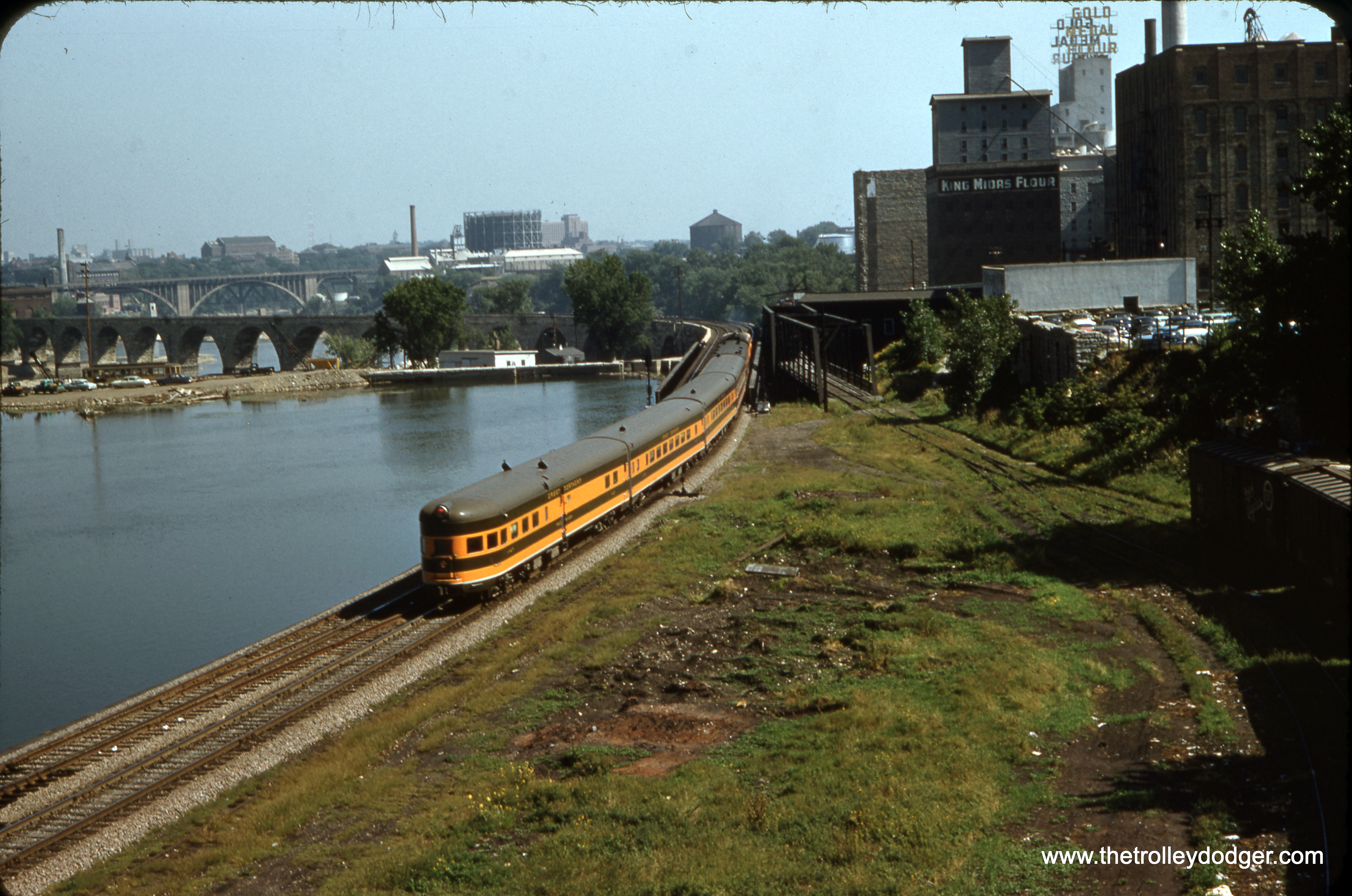
Great Northern Railway Red River 1954 Original 35mm Red Border Kodachrome Slide Subject: GNR 12 Location: Departing Minneapolis station for St. Paul Date: Fall 1954 Photographer: Unknown From the Wikipedia: The Red River was a passenger train operated by Great Northern Railway between Grand Forks, North Dakota, and Saint Paul, Minnesota (operating between 1950 and 1968). History Great Northern Railway's third new train set of 1950 was a new schedule named the Red River. The five-car streamliner built by American Car and Foundry Company began service June 25, 1950, operating a daily round trip 324 miles (521 km) each way between Grand Forks, North Dakota, and Saint Paul, Minnesota. The train went southbound in the morning returning northbound in the evening. The cars for the Red River streamliner were quite different than those built for the International (another 1950 introduction) in that the Red River's cars had extra insulation and the coaches were equipped with Baker Heaters as there was no steam heat available at the Grand Forks depot where the cars stood overnight. The locomotive was sent to the roundhouse each evening for any running repairs and service so the solution was the installation of the Baker Heaters in the cars. Link to eBay Listing

Great Northern Railway Red River 1954 Original 35mm Red Border Kodachrome Slide
Subject: GNR 12
Location: Departing Minneapolis station for St. Paul
Date: Fall 1954
Photographer: Unknown
From the Wikipedia:
The Red River was a passenger train operated by Great Northern Railway between Grand Forks, North Dakota, and Saint Paul, Minnesota (operating between 1950 and 1968).
History
Great Northern Railway’s third new train set of 1950 was a new schedule named the Red River. The five-car streamliner built by American Car and Foundry Company began service June 25, 1950, operating a daily round trip 324 miles (521 km) each way between Grand Forks, North Dakota, and Saint Paul, Minnesota. The train went southbound in the morning returning northbound in the evening.
The cars for the Red River streamliner were quite different than those built for the International (another 1950 introduction) in that the Red River’s cars had extra insulation and the coaches were equipped with Baker Heaters as there was no steam heat available at the Grand Forks depot where the cars stood overnight. The locomotive was sent to the roundhouse each evening for any running repairs and service so the solution was the installation of the Baker Heaters in the cars.
Link to eBay Listing

Amtrak RDC Train 1975 Original 35mm Kodachrome Slide Subject: Amtrak RDCs 30-32-15, Train 372 Blackhawk Location: Crawford (Chicago bound, between Dubuque and Chicago) Date: September 14, 1975 Photographer: James J. Buckley Link to eBay Listing

Amtrak RDC Train 1975 Original 35mm Kodachrome Slide
Subject: Amtrak RDCs 30-32-15, Train 372 Blackhawk
Location: Crawford (Chicago bound, between Dubuque and Chicago)
Date: September 14, 1975
Photographer: James J. Buckley
Link to eBay Listing

Milwaukee and Suburban Transport 1975 Original 35mm Kodachrome Slide Subject: M&ST 1466 Location: Wells-River (posed by the old Milwaukee Electric power plant) Date: June 29, 1975 Photographer: Jeff Wien Link to eBay Listing

Milwaukee and Suburban Transport 1975 Original 35mm Kodachrome Slide
Subject: M&ST 1466
Location: Wells-River (posed by the old Milwaukee Electric power plant)
Date: June 29, 1975
Photographer: Jeff Wien
Link to eBay Listing

Yakima Valley Transit Trolley 1975 Original 35mm Kodachrome Slide Subject: YVT 1776/1976 Location: 44th-Nob Hill, Yakima Date: June 1975 Photographer: Jeff Wien Link to eBay Listing

Yakima Valley Transit Trolley 1975 Original 35mm Kodachrome Slide
Subject: YVT 1776/1976
Location: 44th-Nob Hill, Yakima
Date: June 1975
Photographer: Jeff Wien
Link to eBay Listing

Our Latest Book, Now Available for Pre-Order:

The North Shore Line

Publication Date: February 20, 2023

FYI, my new Arcadia Publishing book The North Shore Line is now finished and has gone to press. My publisher decided to expand it to 160 pages, instead of the usual 128. That’s a 25% increase, without any change to the $23.99 price. I am quite pleased with how this turned out.

From the back cover:

As late as 1963, it was possible to board high-speed electric trains on Chicago’s famous Loop “L” that ran 90 miles north to Milwaukee. This was the Chicago North Shore & Milwaukee Railroad, commonly known as the North Shore Line. It rose from humble origins in the 1890s as a local streetcar line in Waukegan to eventually become America’s fastest interurban under the visionary management of Midwest utilities tycoon Samuel Insull. The North Shore Line, under Insull, became a worthy competitor to the established steam railroads. Hobbled by the Great Depression, the road fought back in 1941 with two streamlined, air-conditioned, articulated trains called Electroliners, which included dining service. It regained its popularity during World War II, when gasoline and tires were rationed, but eventually, it fell victim to highways and the automobile. The North Shore Line had intercity rail, commuter rail, electric freight, city streetcars, and even buses. It has been gone for nearly 60 years, but it will always remain the Road of Service.

Each copy purchased here will be signed by the author, and you will also receive a bonus North Shore Line map.  Books will ship by USPS Media Mail as soon as we receive them, on or before February 20, 2023.

Chapters:
01. Beginnings
02. The Milwaukee Division
03. The Shore Line Route
04. The Skokie Valley Route
05. The Mundelein Branch
06. On the “L”
07. City Streetcars
08. Trolley Freight
09. The Long Goodbye
10. The Legacy

Title The North Shore Line
Images of America
Author David Sadowski
Edition illustrated
Publisher Arcadia Publishing (SC), 2023
ISBN 1467108960, 978-1467108966
Length 160 pages

The price of $23.99 includes shipping within the United States.

For Shipping to US Addresses:

New Compact Disc, Now Available:

CTA-1
The Last Chicago Streetcars 1958
# of Discs – 1
Price: $15.99

Until now, it seemed as though audio recordings of Chicago streetcars were practically non-existent. For whatever reason, the late William A. Steventon does not appear to have made any for his Railroad Record Club, even though he did make other recordings in the Chicago area in 1956.

Now, audio recordings of the last runs of Chicago streetcars have been found, in the collections of the late Jeffrey L. Wien (who was one of the riders on that last car). We do not know who made these recordings, but this must have been done using a portable reel-to-reel machine.

These important recordings will finally fill a gap in transit history. The last Chicago Transit Authority streetcar finished its run in the early hours of June 21, 1958. Now you can experience these events just as Chicagoans did.

As a bonus, we have included Keeping Pace, a 1939 Chicago Surface Lines employee training program. This was digitally transferred from an original 16” transcription disc. These recordings were unheard for 80 years.

Total time – 74:38

Help Support The Trolley Dodger

This is our 295th post, and we are gradually creating a body of work and an online resource for the benefit of all railfans, everywhere. To date, we have received over 941,000 page views, for which we are very grateful.

You can help us continue our original transit research by checking out the fine products in our Online Store.
As we have said before, “If you buy here, we will be here.”

We thank you for your support.

DONATIONS

In order to continue giving you the kinds of historic railroad images that you have come to expect from The Trolley Dodger, we need your help and support. It costs money to maintain this website, and to do the sort of historic research that is our specialty.

Your financial contributions help make this web site better, and are greatly appreciated.


A New Year- A New Beginning

2017 in Review

Another year has come and gone.  How quickly time flies.  For this blog, it was another successful year, with 118,985 page views from 34,503 visitors.  These numbers are more than 2015, but less than 2016.

We made fewer posts last during 2017, but they tended to be longer overall.  Some had more than 100 images, and there are over 100 in this post.  To date, we have posted over 30gb of classic images via this blog. It’s no coincidence that when I do Google searches on traction subjects, it seems like half the “hits” that come up are from The Trolley Dodger.

One of our goals has always been to provide a resource where people can find this type of information. I believe we have succeeded, and will continue to build on that success. There are some who think our hobby is on the decline, but I believe we have shown just the opposite.

Our average number of page views per post has continued to increase.  In 2015, it was 995 per post; in 2016, this increased to 1744, and in 2017 we reached 3718 page views per post.

2017 was also notable for the publication of our book Chicago Trolleys, which has been very well received.

While at this stage, it is impossible to know how many posts we will have this year, we are committed to maintaining a high standard of quality on whatever we do present.

Among our other recent posts, we are particularly proud of The Fairmount Park Trolley (November 7, 2017), which included dozens of rare images, most from the original medium format negatives. It took us nearly three years to collect all this material, which probably represents a total cost of about $1000- and this was just one post.

As an example of how we have inspired additional research, I would point to our post The “Other” Penn Central (May 29, 2016), which has gradually gotten longer and longer, thanks to additions from our ever-inquisitive readers.

In addition, as time goes on, we have more and more friends who share their material with our readers.  Today we feature the contributions of noted author Larry Sakar. The pictures are his, unless otherwise noted.

Happy New Year! May you and your family have health, wealth, and happiness in 2018.

-David Sadowski

PS- In about 30 day’s time, our annual bill to fund this site and its web domain comes due.  That comes to $400, or just over $1 per day.  If you enjoy reading this blog, and want to see it continue, we hope you will consider supporting it via a donation.  You can also purchase items from our Online Store. With your help, we cannot fail.

Early Trolley Museum Visits

Larry Sakar writes:

You’ve been posting a lot of photos of CA&E cars of late, which reminded me of a day 47 1/2 years ago when I went to a trolley museum for the very first time. For several years, I would see the ads for IRM in Trains, Railroad (before it became Railfan & Railroad) and Model Railroader and I wanted to go there. Asking my father would have been useless. He wouldn’t have taken me in a million years. Neither of my parents approved of my interest in trolleys.

Luckily I had met Bill Beaudot in 1967, when he was the librarian in charge of the Local History Room at the Central Library downtown. My regular visits to read and reread CERA B-97, “The Electric Railways of Wisconsin” got him wondering what that was all about. All the remaining CERA Bulletins and other traction books had been removed from circulation, and placed under lock and key in the Local History Room.

And so it was that on a warm Saturday afternoon in August of 1970, I went with Bill and his family to my first trolley museum. But it was not IRM, well not initially anyway. The first museum we visited was then called RELIC in South Elgin, IL. RELIC was an acronym for the Railway Equipment Leasing and Investment Corp. Today we know it as the Fox River Trolley Museum.

CA&E wood car 20 was in operation that day, and we rode it from South Elgin to the end of the line at the I.C. bridge over the Fox River at Coleman. When they told the history of the line, I remembered that this was the line from which Speedrail cars 300 and 301 originated.

Of course, they spent 25 years in Cleveland operating on the Shaker Heights Rapid Transit, but so what? It was still nice to see where those cars began their service lives. And sitting on a side track was a car I had heard and read about innumerable times: NSL Tavern Lounge 415. Some years later they sold the car to Seashore Trolley Museum in Kennebunkport, Maine.

CA&E car 20 at the RELIC museum, August 1970.

CA&E car 20 at the RELIC museum, August 1970.

The interior of CA&E car 20 in August 1970.

The interior of CA&E car 20 in August 1970.

CA&E 300-series car at the RELIC museum in August 1970.

CA&E 300-series car at the RELIC museum in August 1970.

CA&E 300-series car at the RELIC museum in August 1970.

CA&E 300-series car at the RELIC museum in August 1970.

The Illinois Central interchange at Coleman with the ex-AE&FRE right-of-way, at the RELIC museum in August 1970.

The Illinois Central interchange at Coleman with the ex-AE&FRE right-of-way, at the RELIC museum in August 1970.

North Shore Line tavern-lounge car 415 at the RELIC museum in August 1970.

North Shore Line tavern-lounge car 415 at the RELIC museum in August 1970.

Leaving South Elgin and RELIC we headed for Union, Illinois and IRM. As we crossed the museum line and entered the grounds, I saw Milwaukee streetcar 972 with CSL 144 behind it loading at the station. Instantly, I felt like a kid again, when I would get excited as my grandfather drove my grandmother and me to the Harwood Avenue terminus of the No. 10 Wells Streetcar line in Wauwatosa.

In those days you turned from Wauwatosa Ave. west to Harwood. You found yourself at the top of a very steep hill that dropped down into the Menomonee River Valley, and crossed the Milwaukee Road mainline at grade. And on the west side of those tracks sat the Harwood terminal and the No. 10 Wells streetcar line. A 100-car plus Milwaukee Road freight would cause a monumental traffic jam on both sides of the Harwood hill. In the ’80’s a bypass was built, and traffic no longer has access via the old route. Just as well. Both the streetcar and terminal are long gone.

Anyway, I did get to ride 972 and it felt like 1957-58 all over again. I even made sure to relive my childhood memory of streetcar rides with my grandmother by walking to the opposite end of 972 and sitting in the motorman’s seat. The only difference was I no longer needed someone to boost me up and hold me in the seat!

So here are scans of the prints from the pictures I took that day. I had a great shot of TM 972 speeding down the mainline, but I gave it away about 10 years ago, unfortunately.

While looking through some other pictures, I came across four pictures I took at IRM sometime in the 1980s or ’90s. Two are of my favorite car (after TM 972) Indiana RR 65 and 2 are of AE&FR 306 currently undergoing restoration. Car 65 was flying white flags and was not in regular service. It had been taken out for use in some movie.

I don’t remember much of the detail I heard, but it involved George Krambles in some way. That’s as much as I can recall. 306 was in the car barn parked next to IT 101. I did ride 65 on a member’s weekend once years ago. We reached the end of the line at the Kishwaukee River crossing. They threw whatever electric switches they had to in order to put control over to the back-up controller in the rear of the car, but it refused to budge. Our motorman had to radio for a car to come to our rescue. They sent down C&ME 354.

That was my first and to date only ride on that car. I’ve heard that 65 does not operate very often. While going thru a large group of my slides last Thursday that I had marked as “unidentified,” I found the interior photo I knew I’d taken of CRANDIC 111 at Rio Vista in 2000. I need to look thru the slides I have in my metal slide box #2 of 3. I’m sure I took at least one exterior of CRANDIC 111 that day.

Aurora Elgin & Fox River Electric 306 at the Illinois Railway Museum in the 1980s or 90s.

Aurora Elgin & Fox River Electric 306 at the Illinois Railway Museum in the 1980s or 90s.

Aurora Elgin & Fox River Electric 306 at the Illinois Railway Museum in the 1980s or 90s.

Aurora Elgin & Fox River Electric 306 at the Illinois Railway Museum in the 1980s or 90s.

CSL 144 at the IRM depot in August 1970.

CSL 144 at the IRM depot in August 1970.

CSL 144 with TM 972 ahead, August 1970.

CSL 144 with TM 972 ahead, August 1970.

Illinois Terminal 415 at speed on the IRM main line in August 1970.

Illinois Terminal 415 at speed on the IRM main line in August 1970.

The interior of Illinois Terminal 415 at IRM in August 1970.

The interior of Illinois Terminal 415 at IRM in August 1970.

Illinois Terminal 415 at the IRM depot in August 1970.

Illinois Terminal 415 at the IRM depot in August 1970.

Indiana Railroad 65 at IRM in the 1980s or 90s.

Indiana Railroad 65 at IRM in the 1980s or 90s.

Indiana Railroad 65 at IRM in the 1980s or 90s.

Indiana Railroad 65 at IRM in the 1980s or 90s.

A North Shore Line 700-series car at IRM in August 1970.

A North Shore Line 700-series car at IRM in August 1970.

Following the RELIC and IRM pix are a set of pictures taken on a PA Transit PCC in Pittsburgh in the winter of 1971-72. I did not take these pictures. My good friend Bill did, and gave them to me because he knew I liked PCCs.

Because I have never been to Pittsburgh, I am unable to tell the readers where these pictures were taken. PA Transit, for anyone not familiar with it, was the municipal agency that took over the Pittsburgh Railways Co. in 1967. PA stands for Port Authority, not Pennsylvania.

It has always struck me as unusual that streetcar service would be run by the Port Authority, but the Port Authority of Allegheny County was given the task of transit operations, odd though that may seem.

I can still remember the controversy in Railroad Magazine over how the Pittsburgh PCCs were painted in the late ’60s and perhaps early ’70s. Many were painted in three colors, each color being placed on one-third of the car. In keeping with the times one PCC was painted in this wild looking paint scheme and dubbed the “Psychedelic trolley.”

PA Transit 1727 in 1972. (Bill Beaudot Photo)

PA Transit 1727 in 1972. (Bill Beaudot Photo)

PA Transit 1727 in 1972. (Bill Beaudot Photo)

PA Transit 1727 in 1972. (Bill Beaudot Photo)

The interior of PA Transit 1727. (Bill Beaudot Photo)

The interior of PA Transit 1727. (Bill Beaudot Photo)

A PA Transit PCC with the motorman using a switch iron in 1972. (Bill Beaudot Photo)A PA Transit PCC with the motorman using a switch iron in 1972. (Bill Beaudot Photo)

A PA Transit PCC with the motorman using a switch iron in 1972. (Bill Beaudot Photo)

I’ll finish up with a few shots of the Illinois Central Electric (later METRA Electric) Highliners taken mostly as 115th St. Kensington station around 1975. I remember when I.C. first got them, and now they too are history.

-Larry

An ICG Highliner at Randolph Street in 1975.

An ICG Highliner at Randolph Street in 1975.

An ICG Highliner at 115th in Kensington in 1975.

An ICG Highliner at 115th in Kensington in 1975.

Looking north at the Kensington station, as a South Shore Line train approaches in 1975.

Looking north at the Kensington station, as a South Shore Line train approaches in 1975.

Looking north along the northbound track at Kensington station in 1975.

Looking north along the northbound track at Kensington station in 1975.

Looking south from the Kensington ICG station, with the tower to the left.

Looking south from the Kensington ICG station, with the tower to the left.

ICG Highliner interior.

ICG Highliner interior.

An ICG Highliner at 115th Street in Kensington in 1975.

An ICG Highliner at 115th Street in Kensington in 1975.

Sunny California

For all readers of The Trolley Dodger who are shivering in this arctic cold here’s a posting that will let you temporarily escape to a much warmer place; sunny California. During the 50s, 60s and 70s, California (except for San Francisco) shed its electric traction lines as fast as they could.

Much of this was due to a company called National City Lines. In city after city they bought up the rail lines (San Diego Electric Railway, Los Angeles Railway, Pacific Electric, Key System Transit), abandoned all rail service and replaced it with Mack or GM Buses running on Firestone Tires and probably burning diesel fuel supplied by Phillips Petroleum. And they didn’t limit their destructive efforts to just California.

Then came the 1980s, and slowly California began to wake up from its love affair with freeways. And it all started with the San Diego Trolley in 1981. So, it’s only appropriate that we begin our look at traction in the Golden State there.

The San Diego Trolley's original cars were built by Duewag of Dusseldorf, Germany with help from Siemens.

The San Diego Trolley’s original cars were built by Duewag of Dusseldorf, Germany with help from Siemens.

Originally, the San Diego Trolley line to the Mexican border started here.

Originally, the San Diego Trolley line to the Mexican border started here.

Self-service. Passengers entered the car by pressing the black button, seen to the lower right of the door.

Self-service. Passengers entered the car by pressing the black button, seen to the lower right of the door.

Trains bound for the Mexican border had a San Ysidro destination sign.

Trains bound for the Mexican border had a San Ysidro destination sign.

The interior of the beautifully restored ex-Santa Fe (now Amtrak) San Diego station.

The interior of the beautifully restored ex-Santa Fe (now Amtrak) San Diego station.

Look at that beautiful tile work, including the Santa Fe logo on the wall.

Look at that beautiful tile work, including the Santa Fe logo on the wall.

Interior of a Duewag car - spartan, but functional.

Interior of a Duewag car – spartan, but functional.

No controller, no brake handle - computerized push-button control.

No controller, no brake handle – computerized push-button control.

A typical stop on city streets.

A typical stop on city streets.

The maintenance facility on the line to San Ysidro.

The maintenance facility on the line to San Ysidro.

A modern-day Southern California car barn, San Diego style.

A modern-day Southern California car barn, San Diego style.

More of the maintenance facility.

More of the maintenance facility.

City College stop. Fare checkers board here.

City College stop. Fare checkers board here.

Amtrak Redondo engine maintenance facility.

Amtrak Redondo engine maintenance facility.

Arrival at San Diego. looking toward the rear of the train.

Arrival at San Diego. looking toward the rear of the train.

Arrival at San Diego. looking forward toward the front of the train.

Arrival at San Diego. looking forward toward the front of the train.

Curving southeast through an industrial area. Note signal at right.

Curving southeast through an industrial area. Note signal at right.

Curving southeast through an industrial area.

Curving southeast through an industrial area.

Leaving LAUPT, passing Mission Tower.

Leaving LAUPT, passing Mission Tower.

Now you know why the line was renamed the San Diego Surfliner.

Now you know why the line was renamed the San Diego Surfliner.

Oceanside, CA - quite literally.

Oceanside, CA – quite literally.

I can’t think of a city that so completely turned its back on electric rail transit and embraced freeways the way Los Angeles did except for Milwaukee.

In her 1969 Grammy Award winning song, composed by the magnificent team of Burt Bacharach and Hal David, Dionne Warwick asked the question, “Do you know the way to San Jose?” One of the lines in the song says, “LA is a great big freeway. Put a hundred down and buy a car.”

I can’t speak to “putting a hundred down to buy a car,” other than to say perhaps in 1969, but very unlikely in 2018! But I can attest to the sentiment that LA was and still is “a great big freeway.” There are two Amtrak routes between San Francisco and LA. The Coast Starlight is a long-distance train operating once daily between Seattle and LA. But like any long-distance train, it is often subject to delays. Even on time, arrival in LA is not until 9:00 pm.

The other San Francisco to LA train is a corridor train called the San Joaquin, operating between Jack London Square station in Oakland and Bakersfield. All Amtrak service between San Francisco and other cities arrives and departs from either Jack London Square station in Oakland or Emeryville station. Emeryville is a separate city, 12 miles north of Oakland.

And yes, it is the Emeryville where the Key System had its shops.

Passengers going to San Francisco are bused across the San Francisco-Oakland Bay Bridge via Amtrak Thru-Way buses. In the golden age of rail passenger service, trains such as SP’s San Joaquin Daylight, the Lark and the Owl plied the tracks between San Francisco and LA. But when Amtrak took over in 1971 the SP and later UP which now owns the tracks forbade Amtrak trains to continue over the Tehachapi Mountains from Bakersfield to LA.

Therefore, passengers such as me boarded an LA bound Amtrak Thru-Way bus on August 7th at Bakersfield for the two-and-a-half hour ride down I5 and the Hollywood Freeway to LAUPT. This was not my first trip between Bakersfield and LA, so I knew what to expect the closer we got to LA. From the Magic Mountain Amusement park in Valencia to Glendale, where my bus was making a stop, I5 was a sea of cars in both directions.

As bad as that seemed, the Hwy 1012 Hollywood Freeway to downtown LA was even worse. It made rush hours on the Kennedy and Eisenhower look like child’s play! I kept asking myself, “How does anyone put up with this, on a daily basis?” And gas prices in California were at least $1.00 per gallon higher than here in the Midwest. In fact, I think it safe to say everything costs more out there!

So, what brought about this miraculous turnaround from asphalt and concrete to rail? I could tell you, but as the saying goes, a picture is worth a thousand words. I took this photo from the Griffith Park Observatory which is perched some 1300+ feet above LA in the summer of 1980 just before the rail renaissance began. Note that orange cloud on the far horizon. That is smog and it coats LA like a blanket daily. It is unhealthy to say the least and extremely bad for people with asthma and other respiratory problems. I can only guess that one day, someone woke up and pondered, “How did we get ourselves into this mess?” That’s easily answered. You allowed National City Lines and Metropolitan Coach Lines to take over and destroy Los Angeles Railways and Pacific Electric the system that literally helped build southern California.

The last PE line from LA to Long Beach was abandoned by the LAMTA– an agency formed to save remaining rail transit in LA but which, because it was controlled by some of the same people who ran Metropolitan Coach Lines, did the exact opposite. That was in April1961, but luckily the right of way between LA and Long Beach was saved, as parts of it were used by Southern Pacific (of which PE was a part) for freight service.

So, it was only fitting that after an absence of almost 30 years, electric transit service between LA and Long Beach was reborn in the form of the new LA Metro Blue Line on July 14, 1990. And just two-and-a-half years after that, the new LA Metro Red Line subway between downtown and North Hollywood opened for service.

Ironically, the new subway was built just one block (in places) from the old PE Belmont Subway. (Note: Though often referred to as the Hollywood subway because PE trains headed there and to other locations in and near the San Fernando Valley such as Universal City and North Hollywood as well as Glendale and Burbank) operated thru it. But its official name was the Belmont subway, no relation to Belmont Avenue in Chicago.

LA from the Griffith Park Observatory in 1980.

LA from the Griffith Park Observatory in 1980.

The LA Red Line subway at the 7th Street/Union Station stop in 2001. The LA Red Line subway is used by passengers to reach the Blue Line to Long Beach. Long Beach trains end in their own subway a few blocks from the Staples Center (LA's version of the United Center). I believe these are Japanese Kawasaki-built cars.

The LA Red Line subway at the 7th Street/Union Station stop in 2001. The LA Red Line subway is used by passengers to reach the Blue Line to Long Beach. Long Beach trains end in their own subway a few blocks from the Staples Center (LA’s version of the United Center). I believe these are Japanese Kawasaki-built cars.

Long before BART (Bay Area Rapid Transit) began service between Oakland and Fremont in 1972, there was the Key System. Started in 1903 by a man called “Borax” Smith, who became a millionaire mining Borax. If you’re around my age perhaps you remember the 19670’s TV show “Death Valley Days” hosted by actor Dale Robertson which was sponsored by 20 Nuke Team Borax.

The line got its name because, when viewed on a map, the 5 East Bay lines were designated by letters:
A: Downtown Oakland later extended to East Oakland on the tracks of the Interurban Electric Ry. an SP subsidiary which was abandoned in 1941
B: Lakeshore and Trestle Glen
C: Piedmont
D: Never used. Reserved for a line to Montclair alongside the Sacramento Northern Interurban which was never built
E:Claremont
F: Berkeley

They resembled the top part of a skeleton key, the straight bottom portion represented by the Key Pier, which jutted out into the Bay 1.3 miles from the Oakland shore. San Francisco-bound passengers transferred to Key System Ferry boats at the Key pier for the trip to the San Francisco Ferry Building at the foot of Market St.

In January 1939 Key System trains began using the newly constructed San Francisco-Oakland Bay Bridge. Tracks were laid on the lower deck of the bridge which was reserved for trucks and buses. A newly constructed terminal at 1st & Mission Streets in San Francisco (initially called the “East Bay Terminal” and then the “Trans Bay Transit Terminal”) served as the station for Key System trains, as well as Sacramento Northern and Interurban Electric. The latter two systems both abandoned service in 1941. Key took over some on the former IER trackage in and around Berkeley.

In 1938 newly-built articulated trains replaced the original wood center-entrance cars. As the saying goes, looks can be deceiving, and such was the case with the new articulated trains. They were, in fact, a new body placed atop salvaged components from the original wood cars, which consisted of everything from trucks to controllers. Worse yet, the new bodies had a major design flaw. They lacked proper ventilation. They were not air conditioned and did not have openable windows. Cars ran on third rail between the Trans Bay Terminal and the Key Bridge Yards in Oakland which abutted the Oakland toll plaza.

The Bay Bridge, like the Golden Gate Bridge and every Transbay bridge in San Francisco, is a toll bridge operated by the California Toll Bridge Authority. Each of the companies running trains across the Bay Bridge were required to deed a certain number of cars to Toll Bridge Authority ownership. This would prove fortuitous as the cars now preserved at the Western Railway Museum in Suisun City, CA and the Orange Empire Railway Museum in Riverside, CA were ones deeded to the Toll Bridge Authority.

Key System 187 at the Western Railway Museum in 2000.

Key System 187 at the Western Railway Museum in 2000.

A Key System Transit train in the Trans Bay Terminal in 1953.

A Key System Transit train in the Trans Bay Terminal in 1953.

Key System 182 at the Western Railway Museum in 2000.

Key System 182 at the Western Railway Museum in 2000.

Key System 182 at the Western Railway Museum in 2000.

Key System 182 at the Western Railway Museum in 2000.

The Trans Bay Transit Terminal at 1st and Mission in San Francisco, razed in 2011.

The Trans Bay Transit Terminal at 1st and Mission in San Francisco, razed in 2011.

In 1946, the Lundeberg management sold its interest in the Key System to National City lines. As was almost always the case with any rail lines acquired by NCL, the streetcar lines in and around Oakland, operated by Key subsidiary East Bay Transit Company, were converted to bus operation in 1948. Key trains operated until April 1958 when the last trains crossed the Bay Bridge for the final time. The State of California spent huge sums of money to remove the overhead wires and rails from the Bay Bridge and Trans Bay Terminal to accommodate Key System Transit’s new Mack and GM Buses.

In 1960 Key System was acquired by A.C. Transit which still operates buses across the Bay Bridge to East Bay points to this day. A.C. stands for the two counties who operate the bus line, Alameda and Contra Costa.

The Transbay Transit Terminal was razed in 2011 and is being replaced by a new facility a few blocks away on Folsom Street. Unfortunately, the new terminal, which had been due to be completed in 2017, has been stopped from completion by a lawsuit filed by the nearby Millennium Towers Condos Building. The 58-story building with luxury condos, selling for upwards of $3 million and home to celebrities such as Joe Montana, is sinking into its foundation at an alarming rate and is also tilting as a result.

Its developers blame the contractor building the new Trans Bay Terminal claiming he drained out too much of the ground water causing the Millennium building foundation to shift in the sands which anchor it. The contractor for the new Trans Bay Terminal has counter-sued claiming that the Millennium Tower’s builder should have anchored the building’s foundation in the bed rock 200 feet below. Until the issue is resolved, a temporary Transit Terminal is open at 200 Folsom Street.

Santa Clara Valley Transportation Authority operates buses and one light rail line from Santa Teresa to Alum Rock in the San Mateo-San Jose area. It will connect with BART when the line is extended into San Mateo County. At least three major Silicon Valley companies will be served: Cisco Systems, eBay and Adobe.

The light rail line operates between Santa Teresa and Alum Rock. The car seen here, and its mates, were sold to the Sacramento RTD when VTA purchased new low-floor cars.

An VTA Santa Clara Valley Transportation Authority LRV at Santa Teresa station in 2000.

An VTA Santa Clara Valley Transportation Authority LRV at Santa Teresa station in 2000.

Sacramento RTD at Roseville Yards in 2004.

Sacramento RTD at Roseville Yards in 2004.

Sacramento RTD at Roseville Yards in 2004.

Sacramento RTD at Roseville Yards in 2004.

Sacramento RTD at Roseville Yards in 2004.

Sacramento RTD at Roseville Yards in 2004.

Sacramento RTD at Roseville Yards in 2004.

Sacramento RTD at Roseville Yards in 2004.

Sacramento RTD service started between Watt I-80 and the Historic Folsom District on 3-12-87.Within the past year a branch to Consumes River College was opened. The maintenance facility for the Sacramento RTD is located in adjacent Roseville, north of Sacramento, a city located at the southern base of the Sierras. The four photos seen here were taken from Amtrak Train #5, the California Zephyr, on the way to Emeryville in 2004.

A year before the Key System abandoned rail service in April 1958, planning for some sort of new Transbay rail line was being contemplated. That became the Bay Area Rapid Transit district. This was a county-based, special-purpose district formed to construct and operate a rail transit system in the five counties that initially formed the district: The city and county of San Francisco, Alameda, Contra Costa, Marin and San Mateo.

Though invited to participate, Santa Clara county declined to join until 2018 when BART will enter San Mateo County, with the extension to Milpitas and Berryessa. In 1962 San Mateo County supervisors voted to leave BART, claiming their voters would be paying taxes for riders primarily from Santa Clara County. San Mateo eventually formed its own transit agency called SAMTRANS. The departure of San Mateo County lead to the departure of Marin County as well.

Construction of BART began in 1964, but it would not be until 1972 that the first trains operating between Fremont and Oakland would begin service. Initially, there was a debate about how BART trains would cross the Bay. Would it be an above ground crossing or a subway tube? The decision was made to dig a trench in the floor of San Francisco Bay and construct a subway tube between San Francisco and Oakland. All other parts of the system would be elevated (parts of Oakland immediately after trains leave the Transbay tube), subway (through Berkeley) or private right-of-way, often in the median of existing expressways.

Author Harre Demoro frequently insisted, in his books, that BART was neither the modern day Key System or Sacramento Northern. I disagree. In my opinion it is both. It serves many of the same cities served by Key or SN, and even utilizes parts of the old SN right of way in Concord, Rockridge, and West Pittsburg.

When I visited the Western Railway Museum for the first time in 1996, I rode an interurban saved from a system I’d never heard of, called the Peninsular Railway. A Google search revealed that the line had run in the San Mateo/San Jose area now known as “Silicon Valley”. One of the stations served by the Peninsular Railway was Berryessa. In 2018 the new BART extension into San Mateo County will provide service to two new stations; Milpitas and Berryessa. The Peninsular Railway abandoned service in 1934. It has taken 84 years, but electric rail transit is back in Berryessa. Let’s go for a ride on BART.

-Larry

Along the right of way to Milbrae and the SFO International Airport.

Along the right of way to Milbrae and the SFO International Airport.

Another view of the BART Oakland yards.

Another view of the BART Oakland yards.

Approaching the station loading area.

Approaching the station loading area.

A BART C train, built by Alstom circa 1995.

A BART C train, built by Alstom circa 1995.

The BART SFO International Airport station in 2004.

The BART SFO International Airport station in 2004.

A BART train arriving at the SFO International Airport in 2004.

A BART train arriving at the SFO International Airport in 2004.

C car interior. Note the blue colors, versus brown for the Rohr-built cars.

C car interior. Note the blue colors, versus brown for the Rohr-built cars.

The BART Concord station, on the former Sacramento Northern right-of-way.

The BART Concord station, on the former Sacramento Northern right-of-way.

Concord station, close-up of BART train.

Concord station, close-up of BART train.

A BART C train at Civic Center station.

A BART C train at Civic Center station.

The interior of a Rohr-built BART car.

The interior of a Rohr-built BART car.

The interior of a Rohr-built BART car.

The interior of a Rohr-built BART car.

Oakland Yards near the MacArthur station.

Oakland Yards near the MacArthur station.

The operator of a BART car signs in.

The operator of a BART car signs in.

The operator's cab in a BART car, all computer controlled, like San Diego.

The operator’s cab in a BART car, all computer controlled, like San Diego.

An original Rohr-built BART train at Balboa Park station.

An original Rohr-built BART train at Balboa Park station.

The people mover at the SFO International Airport.

The people mover at the SFO International Airport.

Pittsburg Bay Point station, the farthest east point on BART.

Pittsburg Bay Point station, the farthest east point on BART.

The BART Pittsburg Bay Point station passageway to the park and ride lot.

The BART Pittsburg Bay Point station passageway to the park and ride lot.

Reflections of a railfan taking a picture of the people mover at the SFO International Airport.

Reflections of a railfan taking a picture of the people mover at the SFO International Airport.

A view of the opposite end of the BART Pittsburg Bay Point station passageway.

A view of the opposite end of the BART Pittsburg Bay Point station passageway.

The rear of the same train at the Balboa Park station.

The rear of the same train at the Balboa Park station.

Chris Barney writes:

HISTORIC BRIDGE DEMOLISHED

The last identifiable bridge from TM interurban operations in Milwaukee County fell to the wrecking ball November 9, 2017. The 1905 Milwaukee Light, Heat & Traction (MLH&T) spandrel-arch bridge over the Root River, near 98th & Layton, met its end after efforts to attain historic status and raising funds to preserve it failed. Robert Roesler, Greenfield Historical Society president, made a concerted effort in this regard and should be commended for it. A We Energies representative even arranged to donate the bridge structure to anyone willing to preserve it, but no one came forward.

The bridge last handled interurban traffic on June 30, 1951, when Speedrail Car 63 made its last inbound run from Hales Corners. Since then, it has weathered 66 years and had deteriorated to the point of being a danger to bicyclists and walkers traversing its span.

I spoke to a dog walker on December 12th who told me he has lived in the area his entire life and remembers when the Brookdale Bridge, which crossed Root River Parkway, was still standing. He lamented the demolition of the Root River span. “It reminded me of a simpler time when things were different – and better.”

February 9, 2017. (Chris Barney Photo)

February 9, 2017. (Chris Barney Photo)

December 12, 2017. (Chris Barney Photo)

December 12, 2017. (Chris Barney Photo)

Recent Finds

Here are a couple of our recent acquisitions, two classic views from the Philadelphia & Western, today’s SEPTA “Red Arrow” Norristown High-Speed Line:

Philadelphia & Western "Strafford" car 170, coming into a station circa 1938. Kenneth Achtert adds, "The photo of Philadelphia & Western 170 is arriving at Villanova station, outbound. This is the last station before the split where the Norristown line diverged from the Strafford line. The small platform between the two tracks was used to allow passengers from an inbound Norristown car to transfer directly to an outbound Strafford car without having to go up and over the overpass shown. This would also work from an inbound Strafford car to an outbound Norristown car. I don’t know how many passengers actually made such a trip, but I do remember seeing such transfers made." The last train ran on the Strafford Branch on March 23, 1956.

Philadelphia & Western “Strafford” car 170, coming into a station circa 1938. Kenneth Achtert adds, “The photo of Philadelphia & Western 170 is arriving at Villanova station, outbound. This is the last station before the split where the Norristown line diverged from the Strafford line. The small platform between the two tracks was used to allow passengers from an inbound Norristown car to transfer directly to an outbound Strafford car without having to go up and over the overpass shown. This would also work from an inbound Strafford car to an outbound Norristown car. I don’t know how many passengers actually made such a trip, but I do remember seeing such transfers made.” The last train ran on the Strafford Branch on March 23, 1956.

Philadelphia & Western "Bullet" car 200 at Conshohocken Road on October 12, 1938, "showing line country and streamlined car stopping at station."

Philadelphia & Western “Bullet” car 200 at Conshohocken Road on October 12, 1938, “showing line country and streamlined car stopping at station.”

W. C. Fields Filming Locations

John Bengston has a great blog, where he writes in great detail about the filming locations used in classic silent films by comedians like Charlie Chaplin, Harold Lloyd, and Buster Keaton.

We recently suggested he might look into the locations used in the chase sequence during the 1941 W. C. Fields film Never Give a Sucker an Even Break. He took the ball and ran with it, and his findings will feature in two posts.

You can read the first installment here.

Here are a few screenshots of our own from that film, which show the Pacific Electric:

During the chase sequence of the picture, Fields' car passes by a new Pacific Electric double-end PCC car. Filming took place in July and August 1941. PE put the first of 30 such PCCs in service the previous November.

During the chase sequence of the picture, Fields’ car passes by a new Pacific Electric double-end PCC car. Filming took place in July and August 1941. PE put the first of 30 such PCCs in service the previous November.

The brand-new Hollywood Freeway shows up in the movie. This is the portion (Cahuenga Pass) where the Pacific Electric ran in the expressway median from 1940 to 1952.

The brand-new Hollywood Freeway shows up in the movie. This is the portion (Cahuenga Pass) where the Pacific Electric ran in the expressway median from 1940 to 1952.

Another section of the Pacific Electric visible in the film.

Another section of the Pacific Electric visible in the film.

We end this post on a hopeful note for 2018. Work on the Milwaukee streetcar project, now called “The Hop,” is ahead of schedule,and the first phase of the line is scheduled to open by year’s end:

Chicago Trolleys

On the Cover: Car 1747 was built between 1885 and 1893 by the Chicago City Railway, which operated lines on the South Side starting in April 1859. This is a single-truck (one set of wheels) open electric car; most likely a cable car, retrofitted with a trolley and traction motor. The man at right is conductor William Stevely Atchison (1861-1921), and this image came from his granddaughter. (Courtesy of Debbie Becker.)

On the Cover: Car 1747 was built between 1885 and 1893 by the Chicago City Railway, which operated lines on the South Side starting in April 1859. This is a single-truck (one set of wheels) open electric car; most likely a cable car, retrofitted with a trolley and traction motor. The man at right is conductor William Stevely Atchison (1861-1921), and this image came from his granddaughter. (Courtesy of Debbie Becker.)

Check out our new book Chicago Trolleys. Signed copies are available through our Online Store.

HOLIDAY SPECIAL! This book makes an excellent gift. For a limited time only, we have reduced the price to just $17.99 plus shipping. That’s $4.00 off the regular price.

Help Support The Trolley Dodger

gh1

This is our 204th post, and we are gradually creating a body of work and an online resource for the benefit of all railfans, everywhere. To date, we have received over 354,000 page views, for which we are very grateful.

You can help us continue our original transit research by checking out the fine products in our Online Store.

As we have said before, “If you buy here, we will be here.”

We thank you for your support.

DONATIONS

In order to continue giving you the kinds of historic railroad images that you have come to expect from The Trolley Dodger, we need your help and support. It costs money to maintain this website, and to do the sort of historic research that is our specialty.

Your financial contributions help make this web site better, and are greatly appreciated.