Our 300th Post

CTA PCC 7195 is southbound on Clark Street at Van Buren Street on June 20, 1958-- the last full day of streetcar operation in Chicago. Bob Heinlein took this picture from the Loop "L" station, offering a good look at the "old" downtown. This was color corrected from an early Ektachrome slide that had shifted to red.

CTA PCC 7195 is southbound on Clark Street at Van Buren Street on June 20, 1958– the last full day of streetcar operation in Chicago. Bob Heinlein took this picture from the Loop “L” station, offering a good look at the “old” downtown. This was color corrected from an early Ektachrome slide that had shifted to red.

The Trolley Dodger blog has reached a new milestone, as this is our 300th post. We always try to do our best with every post, but hope we have made this one even more special.

Among many other things, we have begun scanning some of the pictures we have collected for our next book, featuring the Chicago Aurora and Elgin interurban. Our work on that is ongoing, and our research is expected to take the rest of this year. Your contributions to this effort are greatly appreciated, as we have already spent over $2500 on research since January.

We hope that you will enjoy it. Keep those cards and letters coming in, folks.

-David Sadowski

PS- You might also like our Trolley Dodger Facebook auxiliary, a private group that now has 1,272 members.

Our friend Kenneth Gear has a Facebook group for the Railroad Record Club. If you enjoy listening to audio recordings of classic railroad trains, whether steam, electric, or diesel, you might consider joining.

FYI, the Hoosier Traction Facebook Group celebrates electric transit in Indiana and the Midwest. It also supports the activities of the annual Hoosier Traction Meet (although not affiliated with the North American Transit Historical Society, which organizes that event).

Here's North Shore Line (technically Chicago and Milwaukee Electric) city streetcar 354 changing ends in front of the Milwaukee Terminal, circa 1950-51. This line had previously run to 2nd and Wisconsin, a few blocks away, which was the original end of the line for the interurban as well. But for the last year or so of streetcar operation, the lone NSL Milwaukee line ended here. Car 354, a product of the St. Louis Car Company, is now at the Illinois Railway Museum.

Here’s North Shore Line (technically Chicago and Milwaukee Electric) city streetcar 354 changing ends in front of the Milwaukee Terminal, circa 1950-51. This line had previously run to 2nd and Wisconsin, a few blocks away, which was the original end of the line for the interurban as well. But for the last year or so of streetcar operation, the lone NSL Milwaukee line ended here. Car 354, a product of the St. Louis Car Company, is now at the Illinois Railway Museum.

On Saturday, March 7, 1953, CTA one-man streetcar 1780 is operating on the Fifth Avenue shuttle. The Hotel Hoover was located at 3358 W. Jackson Boulevard, so we are looking west along Jackson. This was originally a branch line from Route 20 - Madison, but as of May 11, 1952, buses replaced streetcars on the weekends on Madison. At those times, Fifth became a shuttle using some of the older red streetcars that were set up for one-man (and they were all men, back then) operation. On December 13, 1953, buses replaced PCCs on Madison, and Fifth became a seven-day-a-week shuttle, until February 22, 1954, when the shuttle was discontinued. It was not replaced by buses because part of Fifth Avenue was truncated due to construction of the Congress expressway. Fifth wasn't going to cross the highway, since this would have been an expensive bridge to build, crossing at an angle. Since then, other parts of Fifth have been cut off as well. (William Shapotkin Collection)

On Saturday, March 7, 1953, CTA one-man streetcar 1780 is operating on the Fifth Avenue shuttle. The Hotel Hoover was located at 3358 W. Jackson Boulevard, so we are looking west along Jackson. This was originally a branch line from Route 20 – Madison, but as of May 11, 1952, buses replaced streetcars on the weekends on Madison. At those times, Fifth became a shuttle using some of the older red streetcars that were set up for one-man (and they were all men, back then) operation. On December 13, 1953, buses replaced PCCs on Madison, and Fifth became a seven-day-a-week shuttle, until February 22, 1954, when the shuttle was discontinued. It was not replaced by buses because part of Fifth Avenue was truncated due to construction of the Congress expressway. Fifth wasn’t going to cross the highway, since this would have been an expensive bridge to build, crossing at an angle. Since then, other parts of Fifth have been cut off as well. (William Shapotkin Collection)

CTA crane X-201 is at 71st Street and Wentworth in the 1950s. (William Shapotkin Collection)

CTA crane X-201 is at 71st Street and Wentworth in the 1950s. (William Shapotkin Collection)

This photo cost me less than $5, but I consider it an excellent find. We are looking west along the Garfield Park "L" right-of-way (actually owned by the Chicago Aurora & Elgin) in suburban Oak Park. This is the first picture I have seen of a CA&E freight train this far east-- CA&E freight did not operate east of Laramie Avenue. CA&E loco 2001 is at the head of the train. The platforms at these stations had extensions that flipped up, to allow freight trains to clear. I presume that someone at the head of the train flipped them up, and the man on the caboose is flipping them back down again. Meanwhile, there is a much longer freight train on the adjacent Baltimore & Ohio Chicago Terminal tracks at left. This picture can't be any later than 1953, when the CA&E cut back service to Forest Park, yet the style of auto at the crossing in the distance doesn't look much older than that. Which station is this? Bruce Moffat has identified it as Home Avenue in Oak Park, which is a short distance east of Harlem Avenue. Dan Cluley adds, "It is hard to tell at that distance, but my guess is the mystery auto is a 1950 or 51 Ford Sedan."

This photo cost me less than $5, but I consider it an excellent find. We are looking west along the Garfield Park “L” right-of-way (actually owned by the Chicago Aurora & Elgin) in suburban Oak Park. This is the first picture I have seen of a CA&E freight train this far east– CA&E freight did not operate east of Laramie Avenue. CA&E loco 2001 is at the head of the train. The platforms at these stations had extensions that flipped up, to allow freight trains to clear. I presume that someone at the head of the train flipped them up, and the man on the caboose is flipping them back down again. Meanwhile, there is a much longer freight train on the adjacent Baltimore & Ohio Chicago Terminal tracks at left. This picture can’t be any later than 1953, when the CA&E cut back service to Forest Park, yet the style of auto at the crossing in the distance doesn’t look much older than that. Which station is this? Bruce Moffat has identified it as Home Avenue in Oak Park, which is a short distance east of Harlem Avenue. Dan Cluley adds, “It is hard to tell at that distance, but my guess is the mystery auto is a 1950 or 51 Ford Sedan.”

A close-up view of the previous image, showing the car, which may be a 1950 or 1951 Ford.

A close-up view of the previous image, showing the car, which may be a 1950 or 1951 Ford.

The last Chicago streetcar at 78th and Vincennes, on its last run (June 21, 1958). (Robert Heinlein Photo)

The last Chicago streetcar at 78th and Vincennes, on its last run (June 21, 1958). (Robert Heinlein Photo)

CTA PCC streetcar 4407 is at Clark and Schubert on September 6, 1957, not long before the last northside car line was replaced by buses. The building at 2643 N. Clark, at left, is still a post office, but the Jewel has been replaced by a McDonald's. Time was, there were small Jewel Food Stores all over the city. Note the sign saying "serve yourself." Self-service grocery stores were a relatively new thing in the 1950s. Previously, you told the grocer what you wanted, and they picked the order for you. The last small Jewel I recall seeing was at Clark and Webster, just a few blocks south of here. It was replaced by a Tower Records in the 1980s-- and now that's gone too. This was shot on Anscochrome film, which was not of the same quality as Kodak. The film speed of Kodachrome was ISO/ASA 10, only useful on sunny days. On cloudy days, photographers often used this, or Ektachrome, which had a film speed of 32. This film is rather grainy, such that it starts to look like an impressionist painting when viewed under high magnification. (Robert Heinlein Photo)

CTA PCC streetcar 4407 is at Clark and Schubert on September 6, 1957, not long before the last northside car line was replaced by buses. The building at 2643 N. Clark, at left, is still a post office, but the Jewel has been replaced by a McDonald’s. Time was, there were small Jewel Food Stores all over the city. Note the sign saying “serve yourself.” Self-service grocery stores were a relatively new thing in the 1950s. Previously, you told the grocer what you wanted, and they picked the order for you. The last small Jewel I recall seeing was at Clark and Webster, just a few blocks south of here. It was replaced by a Tower Records in the 1980s– and now that’s gone too. This was shot on Anscochrome film, which was not of the same quality as Kodak. The film speed of Kodachrome was ISO/ASA 10, only useful on sunny days. On cloudy days, photographers often used this, or Ektachrome, which had a film speed of 32. This film is rather grainy, such that it starts to look like an impressionist painting when viewed under high magnification. (Robert Heinlein Photo)

CTA red Pullman 144 is at Clark and 16th Street on May 25, 1958, on one of those Sunday fantrips (when buses replaced streetcars on the last remaining lines). That way, fans could have plenty of photo stops, without getting in the way of regular service. The PCC running behind 144 was there as backup, and was also part of the fantrip. The view looks north. (Robert Heinlein Photo)

CTA red Pullman 144 is at Clark and 16th Street on May 25, 1958, on one of those Sunday fantrips (when buses replaced streetcars on the last remaining lines). That way, fans could have plenty of photo stops, without getting in the way of regular service. The PCC running behind 144 was there as backup, and was also part of the fantrip. The view looks north. (Robert Heinlein Photo)

CTA high-speed single car units 1-4 made up the original rolling stock of the new Skokie Swift line. Here, car #1 is at Skokie Shops on March 24, 1964, newly fitted with a pan trolley. (William Shapotkin Collection)

CTA high-speed single car units 1-4 made up the original rolling stock of the new Skokie Swift line. Here, car #1 is at Skokie Shops on March 24, 1964, newly fitted with a pan trolley. (William Shapotkin Collection)

CTA PCC 7160 is heading eastbound on Devon Avenue at Bosworth (about 1530 W, one block east of Clark Street) on July 27, 1956. The streetcar is operating on Route 36 - Broadway-Downtown. (William Shapotkin Collection)

CTA PCC 7160 is heading eastbound on Devon Avenue at Bosworth (about 1530 W, one block east of Clark Street) on July 27, 1956. The streetcar is operating on Route 36 – Broadway-Downtown. (William Shapotkin Collection)

One that got away... CSL/CTA 2605 at the Devon car barn (station) on September 27, 1953. (William Shapotkin Collection)

One that got away… CSL/CTA 2605 at the Devon car barn (station) on September 27, 1953. (William Shapotkin Collection)

CTA PCC 7213, the last Chicago streetcar, begins its final run in the early morning hours of June 21, 1958 at Kinzie and Clark, the north terminus of the Wentworth line. (Robert Heinlein Photo)

CTA PCC 7213, the last Chicago streetcar, begins its final run in the early morning hours of June 21, 1958 at Kinzie and Clark, the north terminus of the Wentworth line. (Robert Heinlein Photo)

A westbound two-car Lake Street "A" train is between Laramie and Central Avenues in a slide processed in February 1966. We are looking west. (Robert Heinlein Collection)

A westbound two-car Lake Street “A” train is between Laramie and Central Avenues in a slide processed in February 1966. We are looking west. (Robert Heinlein Collection)

CTA PCC 7224 is southbound on Wentworth Avenue at 23rd Street (in Chinatown) on June 20, 1958-- the last full day of streetcar operation in Chicago. (Robert Heinlein Photo)

CTA PCC 7224 is southbound on Wentworth Avenue at 23rd Street (in Chinatown) on June 20, 1958– the last full day of streetcar operation in Chicago. (Robert Heinlein Photo)

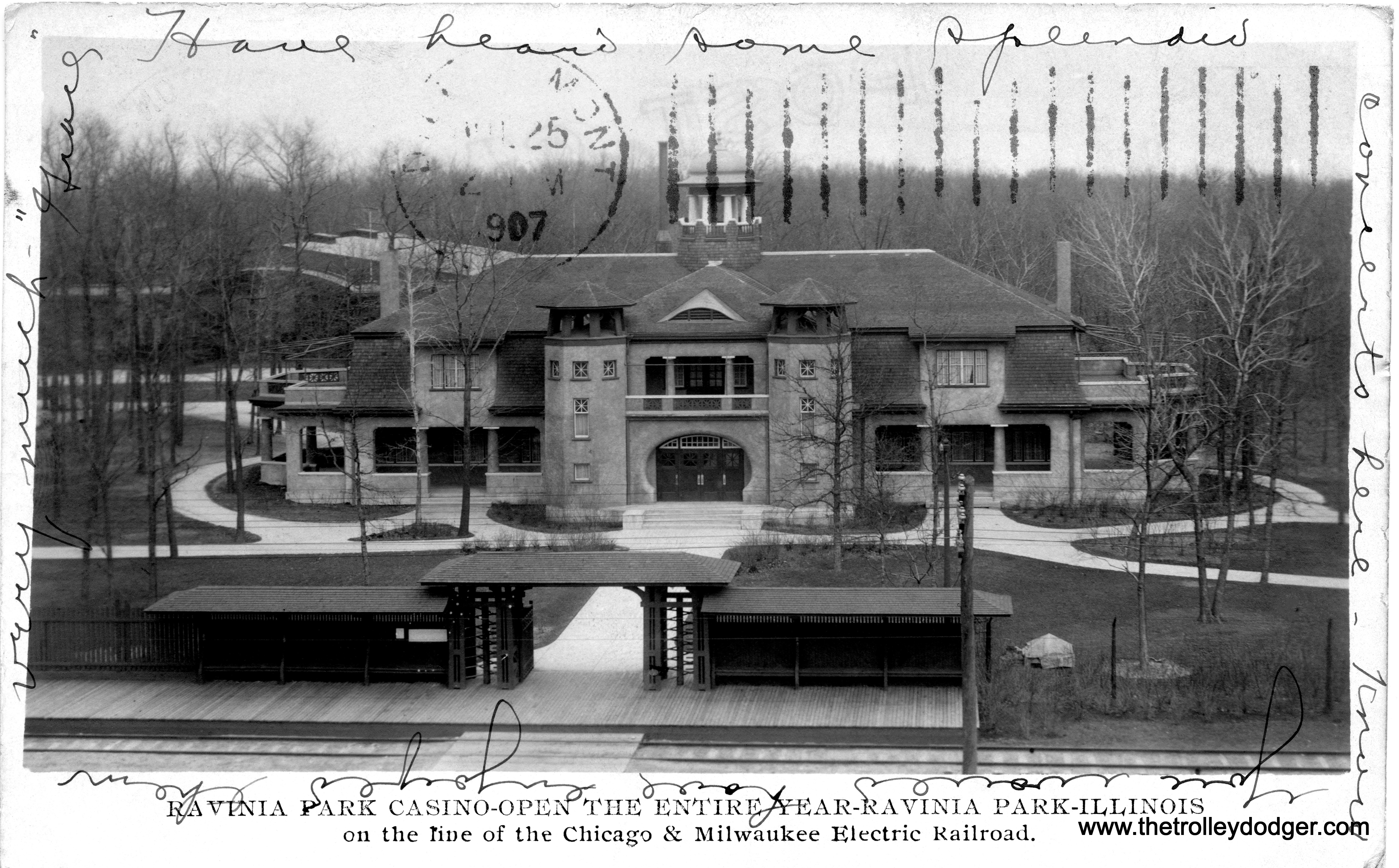
A slightly different version of this image appears on page 20 in my book The North Shore Line, sourced from an archive. This version is from an original real photo postcard I recently purchased. Ravinia Park was built by the Chicago and Milwaukee Electric (later the North Shore Line) in 1904, and the concertgoers here are crossing its tracks. The postcard most likely dates to before 1907, as it had a space on the front for writing a message. Until that year, the backs of postcards were reserved for the address only. Thew cropping is slightly different between the two versions of this image because both were made from the original negative, and in each case, either neg or the printing paper was positioned a bit differently.

A slightly different version of this image appears on page 20 in my book The North Shore Line, sourced from an archive. This version is from an original real photo postcard I recently purchased. Ravinia Park was built by the Chicago and Milwaukee Electric (later the North Shore Line) in 1904, and the concertgoers here are crossing its tracks. The postcard most likely dates to before 1907, as it had a space on the front for writing a message. Until that year, the backs of postcards were reserved for the address only. Thew cropping is slightly different between the two versions of this image because both were made from the original negative, and in each case, either neg or the printing paper was positioned a bit differently.

This postcard image, showing the north portal to the State Street Subway, probably dates to around the time it opened in October 1943. The three-car "L" train, made up of 4000-series cars, is northbound, heading for Howard Street. There were two series of 4000s, and the middle car is of the earlier type, possibly an unpowered trailer.

This postcard image, showing the north portal to the State Street Subway, probably dates to around the time it opened in October 1943. The three-car “L” train, made up of 4000-series cars, is northbound, heading for Howard Street. There were two series of 4000s, and the middle car is of the earlier type, possibly an unpowered trailer.

A close-up view.

A close-up view.

Wooden CTA "L" car 1797 at the Illinois Electric Railway Museum in North Chicago, in a slide processed in January 1963. IRM moved to Union the following year. This was shot on Dynachrome film, which was supposedly based on expired Kodachrome patents. It was later taken over by 3M.

Wooden CTA “L” car 1797 at the Illinois Electric Railway Museum in North Chicago, in a slide processed in January 1963. IRM moved to Union the following year. This was shot on Dynachrome film, which was supposedly based on expired Kodachrome patents. It was later taken over by 3M.

Construction of Chicago's first subways eventually led to the development of the Pedway, an extensive network of tunnels connecting many downtown stores and buildings. Here, excavation work on a pedestrian tunnel connecting the State and Dearborn subways has just started on Court Place between Randolph and Washington on January 31, 1942. It was built using the "cut and cover" method. The State Street Subway opened in 1943, but this connection was not put into service until the Dearborn Street Subway opened in 1951.

Construction of Chicago’s first subways eventually led to the development of the Pedway, an extensive network of tunnels connecting many downtown stores and buildings. Here, excavation work on a pedestrian tunnel connecting the State and Dearborn subways has just started on Court Place between Randolph and Washington on January 31, 1942. It was built using the “cut and cover” method. The State Street Subway opened in 1943, but this connection was not put into service until the Dearborn Street Subway opened in 1951.

(This and the next picture) The CA&E St. Charles-Geneva branch was abandoned in 1937, and here it is being torn up in 1938.

(This and the next picture) The CA&E St. Charles-Geneva branch was abandoned in 1937, and here it is being torn up in 1938.

The CA&E Main Line, looking east from Bellwood. The Westchester "L" branch split off from here at right.

The CA&E Main Line, looking east from Bellwood. The Westchester “L” branch split off from here at right.

The CA&E Wheaton Yards and Elgin Junction in the late 1930s.

The CA&E Wheaton Yards and Elgin Junction in the late 1930s.

The CA&E in Wheaton, looking in the other direction from the previous photo.

The CA&E in Wheaton, looking in the other direction from the previous photo.

CA&E wood car 141, when it was being leased from the North Shore Line, circa 1936-45. It, and several other wood cars, briefly returned to the NSL but were purchased outright by CA&E in 1946. They were all scrapped in 1954 after the interurban cut back service to Forest Park. Don's Rail Photos (via archive.org): "141 was built by American Car Co in March 1910, #844, as C&ME 141. It was rebuilt in 1914 and retired in 1954."

CA&E wood car 141, when it was being leased from the North Shore Line, circa 1936-45. It, and several other wood cars, briefly returned to the NSL but were purchased outright by CA&E in 1946. They were all scrapped in 1954 after the interurban cut back service to Forest Park. Don’s Rail Photos (via archive.org): “141 was built by American Car Co in March 1910, #844, as C&ME 141. It was rebuilt in 1914 and retired in 1954.”

The CA&E station (and substation) at Prince Crossing in the late 1930s. This building has survived the abandonment of the railroad, but is now threatened with demolition.

The CA&E station (and substation) at Prince Crossing in the late 1930s. This building has survived the abandonment of the railroad, but is now threatened with demolition.

North Shore Line 716 (modernized) and 409 (repainted) on new right-of-way in Glencoe on the Shore Line Route, circa 1940.

North Shore Line 716 (modernized) and 409 (repainted) on new right-of-way in Glencoe on the Shore Line Route, circa 1940.

North Shore Line Birney car 335 in Milwaukee in the late 1940s. (Don Ross Photo)

North Shore Line Birney car 335 in Milwaukee in the late 1940s. (Don Ross Photo)

A two-car train of CTA 4000-series "L" cars is at the Marion Street station in Oak Park, circa 1959. We are looking west along South Boulevard. This portion of the Lake Street "L" was moved onto the adjacent Chicago & North Western embankment in 1962.

A two-car train of CTA 4000-series “L” cars is at the Marion Street station in Oak Park, circa 1959. We are looking west along South Boulevard. This portion of the Lake Street “L” was moved onto the adjacent Chicago & North Western embankment in 1962.

Don's Rail Photos (via archive.org): "(North Shore Line) 500 was built by St Louis Car Co in 1909. It was rebuilt to one man and transferred to Waukegan on November 23, 1923. It was retired in 1948 and sold for scrap in 1949." Here it is at Naval Station Great Lakes on June 4, 1939. (La Mar M. Kelley Photo)

Don’s Rail Photos (via archive.org): “(North Shore Line) 500 was built by St Louis Car Co in 1909. It was rebuilt to one man and transferred to Waukegan on November 23, 1923. It was retired in 1948 and sold for scrap in 1949.” Here it is at Naval Station Great Lakes on June 4, 1939. (La Mar M. Kelley Photo)

Milwaukee Rapid Transit and Speedrail car 65. Don's Rail Photos (via archive.org): "65 was built by Cincinnati Car in August 1928, #2985, as I&SE 230. In 1933 it was sold to ICRT as 230 and in 1941 it was sold to SHRT as 65. In 1949 it was sold to Ed Tennyson and leased as Speedrail 65 where it originally operated with a modified Shaker Heights paint scheme. When repainted, the Speedrail logo was omitted. It was scrapped in 1952."

Milwaukee Rapid Transit and Speedrail car 65. Don’s Rail Photos (via archive.org): “65 was built by Cincinnati Car in August 1928, #2985, as I&SE 230. In 1933 it was sold to ICRT as 230 and in 1941 it was sold to SHRT as 65. In 1949 it was sold to Ed Tennyson and leased as Speedrail 65 where it originally operated with a modified Shaker Heights paint scheme. When repainted, the Speedrail logo was omitted. It was scrapped in 1952.”

Bankruptcies were rife among interurbans and railroads in general. This letter, to an apparent shareholder of the AE&C, predecessor of the CA&E, advises him that the stock of the earlier firm was worthless. When the CA&E emerged from bankruptcy in the late 1940s, it owned substantial land assets, and had discharged its debts. This set the stage, in the postwar era, for its eventual abandonment and liquidation.

Bankruptcies were rife among interurbans and railroads in general. This letter, to an apparent shareholder of the AE&C, predecessor of the CA&E, advises him that the stock of the earlier firm was worthless. When the CA&E emerged from bankruptcy in the late 1940s, it owned substantial land assets, and had discharged its debts. This set the stage, in the postwar era, for its eventual abandonment and liquidation.

This famous photo of Tower 18, located at the intersection of Lake Street and Wells Street on the Loop "L", was taken when it was the busiest railroad junction in the world.

This famous photo of Tower 18, located at the intersection of Lake Street and Wells Street on the Loop “L”, was taken when it was the busiest railroad junction in the world.

CA&E suburban streetcar 500, built by St. Louis Car Company in 1927. Here, it has seen better days. It was not the same car as North Shore Line streetcar 500, but was eventually sold to the NSL and renumbered as 361. Don's Rail Photos (via archive.org): "There was one additional car which almost fits into this series. Car 361 was built by St. Louis Car in 1927, just like the 350s, but it had different motors, control, and braking equipment. It was built as 500 for the Chicago Aurora & Elgin. It was used to replace standard interurban cars on the Batavia branch, but it quickly proved to be unsatisfactory. It was retired and placed in storage until June 1942, when it was leased to the North Shore. It was repainted and renumbered and put into Waukegan service. After the war, it was purchased by the North Shore in March 1947. It was quickly retired and scrapped in 1948."

CA&E suburban streetcar 500, built by St. Louis Car Company in 1927. Here, it has seen better days. It was not the same car as North Shore Line streetcar 500, but was eventually sold to the NSL and renumbered as 361. Don’s Rail Photos (via archive.org): “There was one additional car which almost fits into this series. Car 361 was built by St. Louis Car in 1927, just like the 350s, but it had different motors, control, and braking equipment. It was built as 500 for the Chicago Aurora & Elgin. It was used to replace standard interurban cars on the Batavia branch, but it quickly proved to be unsatisfactory. It was retired and placed in storage until June 1942, when it was leased to the North Shore. It was repainted and renumbered and put into Waukegan service. After the war, it was purchased by the North Shore in March 1947. It was quickly retired and scrapped in 1948.”

The interior of CA&E streetcar 500, which later became North Shore Line 361. The photo number dates this to around 1931.

The interior of CA&E streetcar 500, which later became North Shore Line 361. The photo number dates this to around 1931.

The CA&E right-of-way in Wheaton is at right, with the Chicago & North Western at left, in the 1950s.

The CA&E right-of-way in Wheaton is at right, with the Chicago & North Western at left, in the 1950s.

The Chicago Rapid Transit Company's Wells Street Terminal was the CA&E's hub and just steps away from the Loop "L" via a direct connection walkway. It received a major renovation and a new façade, seen here upon completion on October 28, 1927. That looks like a 1927 Chevrolet parked out front.

The Chicago Rapid Transit Company’s Wells Street Terminal was the CA&E’s hub and just steps away from the Loop “L” via a direct connection walkway. It received a major renovation and a new façade, seen here upon completion on October 28, 1927. That looks like a 1927 Chevrolet parked out front.

This and the next image give a good idea of the CA&E fares and service to Elmhurst as of 1936.

This and the next image give a good idea of the CA&E fares and service to Elmhurst as of 1936.

The view looking east into the Wells Street Terminal. That's the Insurance Exchange Building in the background. This picture probably dates to sometime between 1912 and 1927.

The view looking east into the Wells Street Terminal. That’s the Insurance Exchange Building in the background. This picture probably dates to sometime between 1912 and 1927.

The view along the CA&E main line, looking east from Poplar Avenue in Elmhurst on July 13, 1931.

The view along the CA&E main line, looking east from Poplar Avenue in Elmhurst on July 13, 1931.

Don's Rail Photos (via archive.org): "144 was built by American Car in August 1910, #846, as C&ME 403, a parlor-buffet car. In March 1918 it was rebuilt as a straight coach. It was retired in 1935 and leased to the CA&E as 144. It came back in 1945 and then was sold to the CA&E in 1946. It was retired in 1953."

Don’s Rail Photos (via archive.org): “144 was built by American Car in August 1910, #846, as C&ME 403, a parlor-buffet car. In March 1918 it was rebuilt as a straight coach. It was retired in 1935 and leased to the CA&E as 144. It came back in 1945 and then was sold to the CA&E in 1946. It was retired in 1953.”

The CA&E "flag stop" at the Glen Oak Country Club in Glen Ellyn. Anyone who wanted the train to stop would need to use the signal to get trains to stop. From the Wikipedia: "Glen Oak Country Club is a country club and private golf course in Glen Ellyn, Illinois that was designed by Tom Bendelow and established in 1911. On January 7, 1909, the Pickwick Country Club was created. It had a 9-hole golf course, eventually expanded to 18 holes. Within a year, the club went bankrupt. In 1911, the property was purchased and reopened as the current Glen Oak Country Club. In the past bordering the club to the north- which is the Prairie Path today, was an interurban train stop. Many members lived in Chicago and would take the train out of the city to this club. Upon exit, a carriage would take the members along Hill Ave to the club house." The number on this photo would date it to circa 1927.

The CA&E “flag stop” at the Glen Oak Country Club in Glen Ellyn. Anyone who wanted the train to stop would need to use the signal to get trains to stop. From the Wikipedia: “Glen Oak Country Club is a country club and private golf course in Glen Ellyn, Illinois that was designed by Tom Bendelow and established in 1911. On January 7, 1909, the Pickwick Country Club was created. It had a 9-hole golf course, eventually expanded to 18 holes. Within a year, the club went bankrupt. In 1911, the property was purchased and reopened as the current Glen Oak Country Club. In the past bordering the club to the north- which is the Prairie Path today, was an interurban train stop. Many members lived in Chicago and would take the train out of the city to this club. Upon exit, a carriage would take the members along Hill Ave to the club house.” The number on this photo would date it to circa 1927.

A close-up of the previous image. The sign touts "frequent high-speed electrically powered trains to the western suburbs and Fox River Valley cities."

A close-up of the previous image. The sign touts “frequent high-speed electrically powered trains to the western suburbs and Fox River Valley cities.”

The CA&E's Lockwood Yard was a short distance west of Laramie Avenue (5200 W) in Chicago, where the interurban's tracks ended and the Chicago Rapid Transit Company's began. This was a convenient place for the CA&E to store railcars in mid-day. 418 and 431 were among the ones stored here on April 18, 1938, when this picture was taken. The view looks west, with Loretto Hospital in the distance. The CA&E main line, also used by CRT "L" trains to Forest Park and Westchester, is at left. The area to the left is now occupied by I-290, the Eisenhower expressway. At this stage, the small yard used overhead wire, but this was later converted to third rail. After the Chicago Transit Authority purchased the fixed CA&E's fixed assets between here and Forest Park in 1953, the CTA stored wooden "L" cars here after they were retired.

The CA&E’s Lockwood Yard was a short distance west of Laramie Avenue (5200 W) in Chicago, where the interurban’s tracks ended and the Chicago Rapid Transit Company’s began. This was a convenient place for the CA&E to store railcars in mid-day. 418 and 431 were among the ones stored here on April 18, 1938, when this picture was taken. The view looks west, with Loretto Hospital in the distance. The CA&E main line, also used by CRT “L” trains to Forest Park and Westchester, is at left. The area to the left is now occupied by I-290, the Eisenhower expressway. At this stage, the small yard used overhead wire, but this was later converted to third rail. After the Chicago Transit Authority purchased the fixed CA&E’s fixed assets between here and Forest Park in 1953, the CTA stored wooden “L” cars here after they were retired.

CA&E 403 picks up passengers on the streets of downtown Aurora on April 18, 1938. By the end of the following year, the trains were relocated to an off-street terminal by the Fox River.

CA&E 403 picks up passengers on the streets of downtown Aurora on April 18, 1938. By the end of the following year, the trains were relocated to an off-street terminal by the Fox River.

The CA&E interurban terminal in Aurora on April 18, 1938.

The CA&E interurban terminal in Aurora on April 18, 1938.

A close-up of the previous picture.

A close-up of the previous picture.

A view of the Metropolitan West Side Elevated Terminal at Wells Street on April 16, 1926, just prior to renovation, The facade was redone, and a couple of additional stories added to it to improve the station amenities. This picture was taken from the nearby Loop "L" station at Quincy and Wells. CA&E car 408 is at left.

A view of the Metropolitan West Side Elevated Terminal at Wells Street on April 16, 1926, just prior to renovation, The facade was redone, and a couple of additional stories added to it to improve the station amenities. This picture was taken from the nearby Loop “L” station at Quincy and Wells. CA&E car 408 is at left.

CA&E 421 on September 23, 1927. It was built by the Cincinnati Car Company in 1927, so this is how it looked when new.

CA&E 421 on September 23, 1927. It was built by the Cincinnati Car Company in 1927, so this is how it looked when new.

A side view of CA&E 402, 400, and 405. These were among the first steel cars on the Roarin' Elgin and were built by Pullman in 1923. That may also be the date of this photo. (A. F. Scholz Photo)

A side view of CA&E 402, 400, and 405. These were among the first steel cars on the Roarin’ Elgin and were built by Pullman in 1923. That may also be the date of this photo. (A. F. Scholz Photo)

Finally, here is an image that for whatever reason got uploaded in 2019, yet never got used in a blog post… until now:

CTA 4362, a Pullman PCC, on Route 8 - Halsted, most likely in the late 1940s. The late Jeff Wien adds, "Rt. 8 car has just pulled off of Broadway onto Waveland to head south on Halsted to 79th Street loop. Photo ca 1951 when Halsted was operated with PCCs, most Pullmans."

CTA 4362, a Pullman PCC, on Route 8 – Halsted, most likely in the late 1940s. The late Jeff Wien adds, “Rt. 8 car has just pulled off of Broadway onto Waveland to head south on Halsted to 79th Street loop. Photo ca 1951 when Halsted was operated with PCCs, most Pullmans.”

Day Trip to Wisconsin

I spent the day in southern Wisconsin on May 27. After having brunch at the historic Franks Diner in Kenosha, I spent time at the East Troy Railroad Museum, where I rode North Shore Line car 761 for the first time. Later on, I drove to Milwaukee, and took a few pictures of The Hop streetcar.

The weather that day was perfect, which made for some great pictures.

The Franks Diner started out as a prefabricated building, towed there by horses. It was later expanded with an addition. It is a popular place.

The Franks Diner started out as a prefabricated building, towed there by horses. It was later expanded with an addition. It is a popular place.

East Troy sells two of my books in their gift shop.

East Troy sells two of my books in their gift shop.

Our Latest Book, Now Available:

The North Shore Line

FYI, my new Arcadia Publishing book The North Shore Line is now available for immediate shipment. My publisher decided to expand it to 160 pages, instead of the usual 128. That’s a 25% increase, without any change to the $23.99 price. I am quite pleased with how this turned out.

From the back cover:

As late as 1963, it was possible to board high-speed electric trains on Chicago’s famous Loop “L” that ran 90 miles north to Milwaukee. This was the Chicago North Shore & Milwaukee Railroad, commonly known as the North Shore Line. It rose from humble origins in the 1890s as a local streetcar line in Waukegan to eventually become America’s fastest interurban under the visionary management of Midwest utilities tycoon Samuel Insull. The North Shore Line, under Insull, became a worthy competitor to the established steam railroads. Hobbled by the Great Depression, the road fought back in 1941 with two streamlined, air-conditioned, articulated trains called Electroliners, which included dining service. It regained its popularity during World War II, when gasoline and tires were rationed, but eventually, it fell victim to highways and the automobile. The North Shore Line had intercity rail, commuter rail, electric freight, city streetcars, and even buses. It has been gone for nearly 60 years, but it will always remain the Road of Service.

Each copy purchased here will be signed by the author, and you will also receive a bonus North Shore Line map.  Books will ship by USPS Media Mail.

Chapters:
01. Beginnings
02. The Milwaukee Division
03. The Shore Line Route
04. The Skokie Valley Route
05. The Mundelein Branch
06. On the “L”
07. City Streetcars
08. Trolley Freight
09. The Long Goodbye
10. The Legacy

Title The North Shore Line
Images of America
Author David Sadowski
Edition illustrated
Publisher Arcadia Publishing (SC), 2023
ISBN 1467108960, 978-1467108966
Length 160 pages

The price of $23.99 includes shipping within the United States.

For Shipping to US Addresses:

New Compact Disc, Now Available:

CTA-1
The Last Chicago Streetcars 1958
# of Discs – 1
Price: $15.99

Until now, it seemed as though audio recordings of Chicago streetcars were practically non-existent. For whatever reason, the late William A. Steventon does not appear to have made any for his Railroad Record Club, even though he did make other recordings in the Chicago area in 1956.

Now, audio recordings of the last runs of Chicago streetcars have been found, in the collections of the late Jeffrey L. Wien (who was one of the riders on that last car). We do not know who made these recordings, but this must have been done using a portable reel-to-reel machine.

These important recordings will finally fill a gap in transit history. The last Chicago Transit Authority streetcar finished its run in the early hours of June 21, 1958. Now you can experience these events just as Chicagoans did.

As a bonus, we have included Keeping Pace, a 1939 Chicago Surface Lines employee training program. This was digitally transferred from an original 16” transcription disc. These recordings were unheard for 80 years.

Total time – 74:38

Help Support The Trolley Dodger

This is our 300th post, and we are gradually creating a body of work and an online resource for the benefit of all railfans, everywhere. To date, we have received over 988,000 page views, for which we are very grateful.

You can help us continue our original transit research by checking out the fine products in our Online Store.
As we have said before, “If you buy here, we will be here.”

We thank you for your support.

DONATIONS

In order to continue giving you the kinds of historic railroad images that you have come to expect from The Trolley Dodger, we need your help and support. It costs money to maintain this website, and to do the sort of historic research that is our specialty.

Your financial contributions help make this web site better, and are greatly appreciated.


Postcards From the Bridge

This real photo postcard image shows the four-track Metropolitan "L" bridge (actually two separate bridges, side by side), but it also shows a small experimental lifeboat moored at left. One author's research into the history of this boat is featured in this post, and also sheds some further light on when this photo was taken.

This real photo postcard image shows the four-track Metropolitan “L” bridge (actually two separate bridges, side by side), but it also shows a small experimental lifeboat moored at left. One author’s research into the history of this boat is featured in this post, and also sheds some further light on when this photo was taken.

From the start of the Trolley Dodger in 2015, I hoped this blog would become a resource for others, and I am pleased that this has happened. Sometimes these inquiries take strange and unexpected turns, and that is certainly the case regarding the early real photo postcard shown above. This interesting tangent of Chicago history is covered in detail further down in this post. Research can raise just as many questions as it answers, and that is definitely what happened here regarding the small experimental boat visible in the lower left-hand corner of this and other postcards of the Met bridge.

We also have a goodly number of excellent images for your perusal, from some of the great traction photographers.

We regret the passing on April 30th of Robert Heinlein, aged 84. He was one of the giants in his field, and our next post will be a tribute to him. Some of Mr. Heinlein’s photos are in my recent book The North Shore Line, and I am glad he was able to see the finished product. He spent his entire career sharing his knowledge and helping others, and he will be sorely missed. You can read his obituary here.

Keep those cards and letters coming in, folks.

-David Sadowski

PS- You might also like our Trolley Dodger Facebook auxiliary, a private group that now has 1,162 members.

Our friend Kenneth Gear has a Facebook group for the Railroad Record Club. If you enjoy listening to audio recordings of classic railroad trains, whether steam, electric, or diesel, you might consider joining.

FYI, the Hoosier Traction Facebook Group celebrates electric transit in Indiana and the Midwest. It also supports the activities of the annual Hoosier Traction Meet (although not affiliated with the North American Transit Historical Society, which organizes that event).

I will be giving a program on my new North Shore Line book on 7:30 pm on Friday evening, May 19th, at Chicago Union Station for the Railroad & Shortlines Club of Chicago. There is no charge. Please do not arrive before 7:15 pm.

Chicago Union Station
Room 107A
500 W. Jackson Blvd.
Chicago, Illinois

Please enter at 500 W. Jackson Boulevard, between Clinton and Canal. Call 312 725-0432 during the meeting for assistance.

We gave two presentations in April that were well attended and received. First, we spoke at the Libertyville Historical Society on the 17th. You can view that presentation here. To date, there have been about 3500 views.

On the 20th, we were at the History Center of lake Bluff and Lake Forest. You can view that presentation here.

Postcards From the Bridge

Sandy Cleary writes:

Good morning! I hope this finds you well 🙂

I’ve been lost on the site for a few weeks since finding it—it scratches an itch I also have—and I’m really grateful for the work that you’ve done in documenting a lot of pretty niche historical artifacts. I’m very curious about one in particular. It’s mentioned in this post here, above the text “I recently bought this real photo postcard, circa 1910.”

I’m pretty certain it comes from the summer of 1907. The boat docked in the lower left of that photo is an obscure lifeboat designed by Robert Brown, of Chicago; it was tied up to the Chicago Sanitary District dock in 1907 but Brown stopped paying docking fees in March, 1908 and it’s absent in another 1908 photo of the bridge. Debris on the loading dock to the northeast of the bridge matches debris visible in Detroit Publishing Co. photo 070152 (here at the LOC), which was taken at the same time as 070153 (LOC link); based on the SS Pueblo’s transit records that photo must’ve been taken on July 30th, 1907.

I’ve been working on writing up the history of Robert Brown’s boat, which features in some other Chicago lore a few years later, and for which the photographic so far consists of only three photos: the two Detroit Publishing Co. ones, and whoever took the picture used in the postcard you found. It was reused in numerous postcards (colorized with the title “Elevated R. R. Jackknife Bridge over Chicago River, Chicago”—you can find examples on eBay).

The one you posted, though, is by far the clearest. I was wondering if you could tell me anything about the postcard’s copyright or who might have printed it? I’ve never been able to find what the photographic source might’ve been. A clearer example, one which might make the text on the white sign north of the boat legible and make it easier to fix the exact date the photo was taken, would be invaluable but I’m not sure where to start looking.

(Also, the version you’ve found is evidently a different crop—the colorized version shows more of the western bank and the dock itself).

I appreciate your time—any pointers on anything more about that postcard or the photo that was responsible for it would be incredibly helpful. The work you did on restoring the one you found was already enough for me to conclude when the boat was actually tied up at Van Buren St., which I’d been despairing of finding possible.

Kind regards
Sandy

Thanks for writing. It’s remarkable how small details in such photographs can be of so much use to researchers today.

In the meantime, what a remarkable piece of scholarship you have achieved!

As you can see, the reverse side of the postcard doesn’t identify the maker. But perhaps it can still be identified by comparison with other postcards with the same printing, whose manufacturers are known to experts.

Would it be alright for me to share your original note with the readers of my blog (and accompanying Facebook group)? You never know what useful information others might have to share.

Sandy Cleary:

Absolutely, you can share with whomever! The information I have is unfortunately pretty limited. From my boat-focused point of view, what’s known is:

1. Chicagoan carpenter Robert Brown designed and built an odd-shaped lifeboat in 1905, which was photographed for a magazine in ~1905/1906
2. His company, the International Automatic Lifeboat Company, paid the Chicago Sanitary District a $5/mo docking fee for the Van Buren St. dock between October, 1906 and March, 1908
3. Hans Behm took three photos of the Metropolitan West Side railroad bridge on July 30th, two of which depict the boat.
4. It’s gone by a September, 1908 photo of the bridge taken, I think, by the Chicago Sanitary District (because the MWRD has posted this picture a few times)
5. The only other photo is the one from the postcard, which must’ve been taken between October, 1906 and March, 1908. The overall bridge configuration seems to be the same between the postcard and the 1907 photos, as does the debris seen on the loading dock on the northeast side of the bridge:

After that the boat disappears for a few years, until it was found sunk in the north draw of the Wells Street Bridge (just south of the Chicago & North Western depot there. Then it was shown for a few months as “The Foolkiller,” putatively the world’s first submarine, after which it disappears again and is now only really relevant for weird Chicago lore.

Fortunately a lot of the Chicago Sanitary District records are online, and I was able to get in touch with someone from Commonwealth Edison who also had some useful information, but I have to imagine a lot of the information from the L companies pre-merger is gone. It seems to me that there might have been some reason why people were taking pictures of the Met’s bridge around the same time, but I’m not sure what that might have been.

I know that there was pressure to have it removed because of how significantly it impacted the channel by ~1911 or so—tracing over old Sanborn maps from 1906 really drives home how dramatic that constriction was:

At the time the western span of the Jackson Blvd. bridge and the Metropolitan West Side crossed what Sanborn identifies as property belonging to the Pacific, Fort Wayne & Chicago, during its period when it was not part of the Penn, I think—I am not a train girl. The Met’s viaduct would’ve crossed over the PFW&C freight house, before that whole west bank became Chicago & North Western property again. In any case the bridge wasn’t actually torn down until 1961 (by that point, as I understand it, the CTA hadn’t been using it to carry rail traffic since 1958).

Thank you so much again for your time and for your help with this. How these photo postcards worked has been something of a mystery to me. Numerous different versions seem to have been made, and I just don’t know whether these were the same company, or different companies skirting copyright because Google Images wasn’t a thing at the time, or what. But the fact that there is such a high-quality photo, anywhere, is extremely heartening.

I suspect the postcard that I have was very short-lived in the marketplace, as this was a transition period between real photo postcards and printed ones. Even if some of the colorized versions may have used the same original negative as a starting point, the eventual results look more and more like drawings rather than photographs.

As to the sudden popularity of pictures of the Met “L” bridge, starting in 1907, this coincided with a major change in how people could write messages on postcards:

DIVIDED BACK PERIOD: 1907-1915

“In 1907, a major change on the address side of postcards occurred. This change was prompted by the Universal Postal Congress, the legislative body of the Universal Postal Union. The convention decreed that postal cards produced by governments of member nations could have messages on the left half of the address side, effective October 1, 1907. The Universal Postal Congress also decreed that after March 1, 1907, government-produced cards in the United States could bear messages on the address side.2 Congress passed an act on March 1, 1907, in compliance with the Union’s decree, allowing privately produced postcards to bear messages on the left half of the card’s back. The next day, the Postmaster-General issued Order No. 146, granting privileges to privately produced postcards that were already granted in international mail, including the allowance of message space. On June 13, 1907, the Postmaster-General issued Order No. 539, which allowed government-produced postcards to bear messages on the left half of the address side.3 These changes to the backs of postcards ushered in the Divided Back Period, which spans from 1907 until 1915. The Divided Back Period is also known as the “Golden Age of Postcards,” due to the vast popularity of postcards during this time period.”

“Another type of postcard that began to be produced and popularly used during the Divided Back period and through the White Border period is the “real photo” postcard. “Real photo” postcards were first produced using the Kodak “postcard camera.” The postcard camera could take a picture and then print a postcard-size negative of the picture, complete with a divided back and place for postage.”

Source: https://siarchives.si.edu/history/featured-topics/postcard/postcard-history

Sandy Cleary:

I’ll be honest, I hadn’t heard “real photo post card” as a term before I read your blog, and then noticed “RPPC” everywhere on eBay.

There are, as far as I can tell, three versions of this postcard. The first two are the colorized ones, which are labeled on the back as no. 171 of the Franklin Post Card Co.—of Germany, although ironically the earliest example I can find, postmarked August 17th, 1909, says “Made in Germany.” There were two distinct crops of that. The first (type A) is the widest crop, and it’s the one where the “E” in “Elevated” is written more like a backwards 3.

The second (type B) is one that the UIC Library gives copyright to Copelin Commercial Photographers in a black-and-white photographic form. This seems to be more common; the earliest postmark so far I’ve found is from September 13, 1910. Both of these two show up with postmarks as late as 1915. They went through different print runs, though; the back variously says:

* Aug. 17 1909: “No. 171. Made in Germany” (Type A)
* Sep. 13 1910: “No. 171.” (Type B)
* Aug 16, 1911: “No. 171” (Type B)
* Nov. 3 1911: “171” (Type B) (it’s possible the “No.” has been scratched off)
* Oct. 14 1912: “No. 171. Publ. by Franklin Post Card Co., Chicago, Ill. Made in Germany” (Type A)
* Aug. 13 1915: “No. 171. Publ. by Franklin Post Card Co., Chicago, Ill.” (Type B)

…As I write this up I realize this means that the widest version is rarer because it’s the German version. The design on the back, with the more ornate “Post Card” lettering, is identical to other postcards published by (for example) M. Weixelbaum, of Lima, and Provincetown Advocate and the Cardinell-Vincent Co. in addition to Franklin. I don’t understand why some postcards were made in Germany and some were not. Apparently the early 1900s was “postcard mania” in Germany, according to Deutsche Welle. I’d never heard of that before.

Anyway, the third one is the one you’ve found, which has different writing, and is also a much closer crop. Here are all three, superimposed:

What is a little puzzling to me is that the postcard you found is of such high quality that implies (to me) that a medium-format negative was accessible to whomever wound up creating all of the derivatives, which I wouldn’t have expected if it was being held in, say, the Franklin vault. But if it was a Franklin photo, the reverse doesn’t look like the reverse of any Franklin postcards. I tried image-searching for postcard backs looking for something similar, and turned up these from Vermont, which use the same language but a different font in “Post Card.”

Given your link, that creates the unfortunate possibility that what you have is, in fact, the only copy of that postcard, because it was created by someone who was interested in the bridge (or liked the composition), had access to the original, and printed it as a one-off postcard, which is why so far as I can tell it’s never appeared elsewhere. The title is odd—as you note, this isn’t the Northwestern, and the bridge seems to have been well-known as a Metropolitan West Side bridge to locals. Or perhaps it dates from the 20s or 30s, and whoever was writing it just guessed. I don’t know.

I’m also not sure if it’s significant (beyond “postcard mania”) that the early examples are German. There was a big German population in Chicago at the time, and the Germans apparently did like postcards. Germans also liked bridges; Scherzer was born in Illinois, but his parents were German immigrants. One of the earlier photos of the Met bridge (I think it might be the oldest) is from a German postcard:

Text says: “‘Folding’ Bridge over the Chicago River (bridge closed)”; handwriting says (I think): “Dear Dad: Sent you today (payday) $1.00 worth of 1 and 2-cent post stamps. Let me know if these arrived safely.”

It has occurred to me that I could poke around here in Berlin to see if there’s anything promising, but if memory serves most Chicagoan immigrants came from further north (Pomerania and such). Here in Berlin our train esoterica is only the “ghost stations” from the Cold War and that some of our subway stops are mildly radioactive because they used uranium oxide glazing in the tile.

Anyway! Thank you again for your time, and for the link to that Smithsonian article!

This is all very interesting to me, and should also interest my readers. Thanks very much for sharing these wonderful images.

In the early years of photography, negatives were usually large enough to be contact printed onto photo paper, without using an enlarger. The “chicken scratch” writing on my postcard could have been inked onto a glass plate, on top of the negative, or it may have been applied to the negative itself. The proportions of postcards are more rectangular than many of the standard film formats of the time, which may help explain the cropping.

While doing further research into this story, I came across a series of blog posts.

Is this something you wrote?

Sandy Cleary:

Yeah, that’s me 🙂

The “Foolkiller” was originally covered by Cecil Adams in the “Straight Dope” column of the Chicago alternative weekly Chicago Reader, and then later by podcaster Mark Chrisler of The Constant. It’s been stuck in my head for about fifteen years, so I’ve been trying to pull together as much as I can rather than leaving things on various email threads or chat discussions, in case any one else ever goes searching. It’s also been a good way to start organizing my thoughts on the matter (I don’t think many people read that blog).

That’s an interesting steer, re: the negatives. The UIC holding is described as a “photographic print” although I understand the MWRD (the Chicago water authority) apparently found a number of glass plates in their archives. The Library of Congress also (I think) has the original Hans Behm photos, which are described as glass 8×10 negatives (here’s one of them below). I need to read up on that era of photography, apparently.

(The Detroit Publishing Co. photos taken by Behm were also turned into colorized photo postcards, although they don’t seem to have been as popular, or at least most of the Met depictions are not those. There’s an early one that the Central Electric Railfans’ Association wrote up about ten years ago; that’s given a copyright date of 1907 but it must be earlier because the bridge doesn’t have the circular pilings that it would retain for most of its life and were in place by 1907; on the other hand, the Palmer Building is visible (leftmost skyscraper) and that was built sometime between 1903 and 1906).

FYI, I wrote that CERA blog post you refer to.

Sandy Cleary:

I’ve also seen your name on the Industrial History page about the bridge, come to think of it.

And this brings the story up to date. Ms. Cleary’s blog posts, linked above, shed additional light on the story of this experimental boat, which I can summarize as follows. This was one of several attempts at creating a safer lifeboat, to be carried on ships, and for rescues. A number of such ideas were patented in the late 1800s and early 1900s, all very speculative, of course.

The International Automatic Lifeboat Company prototype, designed by Robert Brown, was moored in the Chicago River for some period of time, and not always near the Metropolitan West Side “L” bridge. The US Navy studied the concept and decided it was not practical, as it would have been too difficult to get people into this boat during rescues. This most likely doomed its prospects.

At some point, the boat sank, and was later pulled out of the river, whereupon some enterprising persons displayed it as a supposed submarine, which it was not.

The postcard we have mistakenly identifies this as the Northwestern “L”. In actuality, it was the Metropolitan West side Elevated, but some of its trains did go to Chicago’s northwest side. The Northwestern “L” actually ran to the north side, despite the name.

I hope that further information may shed more light on this story in the future. In the meantime, here are some additional examples of postcards showing the Met “L” bridge.

-David Sadowski

Trackwork near the Met bridge was somewhat complex. Tracks to the right fanned out, leading to the Wells Street Terminal. The tracks at left connected to the Loop "L" via Van Buren Street. (Robert Heinlein Collection)

Trackwork near the Met bridge was somewhat complex. Tracks to the right fanned out, leading to the Wells Street Terminal. The tracks at left connected to the Loop “L” via Van Buren Street. (Robert Heinlein Collection)

We are looking west from the Wells Street Terminal towards the dual bridges over the Chicago River. (Robert Heinlein Collection)

We are looking west from the Wells Street Terminal towards the dual bridges over the Chicago River. (Robert Heinlein Collection)

This is the only photo I have seen that shows the interior of the Met bridge interlocking tower. (Robert Heinlein Collection)

This is the only photo I have seen that shows the interior of the Met bridge interlocking tower. (Robert Heinlein Collection)

A 1906 postcard, made at a time when messages could only go on the front of the card.

A 1906 postcard, made at a time when messages could only go on the front of the card.

The back of the 1906 card. Only the address was permitted here.

The back of the 1906 card. Only the address was permitted here.

A 1908 postcard.

A 1908 postcard.

By 1908, messages were allowed on the left side of the card back.

By 1908, messages were allowed on the left side of the card back.

A 1909 postcard, based on the 1907 photo.

A 1909 postcard, based on the 1907 photo.

The rear of the 1909 postcard.

The rear of the 1909 postcard.

A 1911 postcard, based on the 1907 photo.

A 1911 postcard, based on the 1907 photo.

The back of a 1911 postcard.

The back of a 1911 postcard.

A 1912 postcard.

A 1912 postcard.

The back side of a 1912 postcard.

The back side of a 1912 postcard.

A 1915 postcard, clearly based on the 1907 photo.

A 1915 postcard, clearly based on the 1907 photo.

The back side of a 1915 postcard.

The back side of a 1915 postcard.

A 1919 postcard.

A 1919 postcard.

The back side of a 1919 postcard.

The back side of a 1919 postcard.

A 1920 postcard.

A 1920 postcard.

And here are some later views of the bridge, from various angles:

A view of the Metropolitan "L" crossing the Chicago River on July 10, 1949. We are looking to the northwest.

A view of the Metropolitan “L” crossing the Chicago River on July 10, 1949. We are looking to the northwest.

Over the years, I have seen many poor quality duplicate slides with this view, looking to the northwest, with a Garfield Park "L" train crossing the Met bridge over the Chicago River, with Union Station in the background. However, this was scanned from an original red border Kodachrome slide, circa 1955-58. The name of the photographer is not known. This must be a Garfield train, and the results are stunning. Douglas cars were re-routed over the Lake Street "L" in 1954. Logan Square trains began running via the Milwaukee-Dearborn Subway in 1951.

Over the years, I have seen many poor quality duplicate slides with this view, looking to the northwest, with a Garfield Park “L” train crossing the Met bridge over the Chicago River, with Union Station in the background. However, this was scanned from an original red border Kodachrome slide, circa 1955-58. The name of the photographer is not known. This must be a Garfield train, and the results are stunning. Douglas cars were re-routed over the Lake Street “L” in 1954. Logan Square trains began running via the Milwaukee-Dearborn Subway in 1951.

CTA 2256 is part of a four-car Met train, turning from Market Street onto the double bridge over the Chicago River in March 1951. (Truman Hefner Photo)

CTA 2256 is part of a four-car Met train, turning from Market Street onto the double bridge over the Chicago River in March 1951.
(Truman Hefner Photo)

This picture of the old Met bridge over the Chicago River is undated, but probably dates to circa 1952-55 based on the type of red border Kodachrome mount it is in. But it is certainly after the the other picture in this post, taken at much the same location, since the building at rear, or part of it, was in the process of being torn down. This was not related to expressway construction, since the "L" at this point was north of there. Once the Congress rapid transit line opened in 1958, this section of "L" was taken out of service and by the early 1960s it had been torn down.

This picture of the old Met bridge over the Chicago River is undated, but probably dates to circa 1952-55 based on the type of red border Kodachrome mount it is in. But it is certainly after the the other picture in this post, taken at much the same location, since the building at rear, or part of it, was in the process of being torn down. This was not related to expressway construction, since the “L” at this point was north of there. Once the Congress rapid transit line opened in 1958, this section of “L” was taken out of service and by the early 1960s it had been torn down.

Stylish Coit Tower sits atop Telegraph Hill in San Francisco, and has afforded an unparalleled view since its completion in 1933. In April 1987, when this picture was taken, the view included Muni streetcar 578, built in 1896. Although it resembles a cable car, it uses overhead wire. It is occasionally operated for special events and is the oldest streetcar in use in the country. In recent years wheelchair access was added.

Stylish Coit Tower sits atop Telegraph Hill in San Francisco, and has afforded an unparalleled view since its completion in 1933. In April 1987, when this picture was taken, the view included Muni streetcar 578, built in 1896. Although it resembles a cable car, it uses overhead wire. It is occasionally operated for special events and is the oldest streetcar in use in the country. In recent years wheelchair access was added.

A Milwaukee Road push-pull commuter train is at Rondout (an unincorporated area in Lake County, IL) on September 2, 1963. Bi-levels were introduced to the Milwaukee Road around 1961 and ridership was much lower than it is today, so often one car sufficed instead of seven or eight as you see today on Metra. The station here was removed around 1965 on what is now the Metra Milwaukee District North Line. I believe we are looking to the northwest, and that the overpass may be the former North Shore Line Mundelein branch, which had been abandoned on January 21, 1963. There was a tower located kitty-corner to the station, to the right and behind the photographer, which was last used in 2015. (William D. Volkmer Photo)

A Milwaukee Road push-pull commuter train is at Rondout (an unincorporated area in Lake County, IL) on September 2, 1963. Bi-levels were introduced to the Milwaukee Road around 1961 and ridership was much lower than it is today, so often one car sufficed instead of seven or eight as you see today on Metra. The station here was removed around 1965 on what is now the Metra Milwaukee District North Line. I believe we are looking to the northwest, and that the overpass may be the former North Shore Line Mundelein branch, which had been abandoned on January 21, 1963. There was a tower located kitty-corner to the station, to the right and behind the photographer, which was last used in 2015. (William D. Volkmer Photo)

Don's Rail Photos (via Archive.org): "410 was built as a trailer observation car by Cincinnati Car in June 1923, #2640. It was out of service in 1932. It was rebuilt on December 31, 1942, as a two motor coach by closing in the open platform and changing the seating." Here is how it looked in December 1958 at the Mundelein Terminal. (Russell D. Porter Photo)

Don’s Rail Photos (via Archive.org): “410 was built as a trailer observation car by Cincinnati Car in June 1923, #2640. It was out of service in 1932. It was rebuilt on December 31, 1942, as a two motor coach by closing in the open platform and changing the seating.” Here is how it looked in December 1958 at the Mundelein Terminal. (Russell D. Porter Photo)

North Shore Line Electroliner 801-802 is on the CTA "L" in August 1962.

North Shore Line Electroliner 801-802 is on the CTA “L” in August 1962.

This is a nice overhead view of a four-car train of North Shore Line Silverliners on Chicago's "L" in August 1962.

This is a nice overhead view of a four-car train of North Shore Line Silverliners on Chicago’s “L” in August 1962.

North Shore Line cars 157, 169, and 175 are heading southbound on the Sixth Street Viaduct in Milwaukee on April 19, 1959.

North Shore Line cars 157, 169, and 175 are heading southbound on the Sixth Street Viaduct in Milwaukee on April 19, 1959.

There are not many color photos showing this prewar paint scheme, seen here on North Shore Line coach 739 at the Milwaukee Terminal on June 25, 1942.

There are not many color photos showing this prewar paint scheme, seen here on North Shore Line coach 739 at the Milwaukee Terminal on June 25, 1942.

North Shore Line coach 173 is at the Mundelein Terminal in November 1962, just two months before the end of service. Car 160, now at the Illinois Railway Museum, is at right on a storage track. (Walter Schopp Photo)

North Shore Line coach 173 is at the Mundelein Terminal in November 1962, just two months before the end of service. Car 160, now at the Illinois Railway Museum, is at right on a storage track. (Walter Schopp Photo)

After the North Shore Line abandonment, car 727 went to the Southern Iowa Railway. Here it is shown on June 14, 1964, next to Waterloo, Cedar Falls, and Northern car 100. Within a few years, both cars ended up on the Iowa Terminal Railroad (now the Iowa Traction Railway), but unfortunately, car 100 was destroyed in a 1967 fire. 727 is still operable.

After the North Shore Line abandonment, car 727 went to the Southern Iowa Railway. Here it is shown on June 14, 1964, next to Waterloo, Cedar Falls, and Northern car 100. Within a few years, both cars ended up on the Iowa Terminal Railroad (now the Iowa Traction Railway), but unfortunately, car 100 was destroyed in a 1967 fire. 727 is still operable.

Chicago North Shore and Milwaukee #607 is at North Chicago Junction on November 16, 1941. "The 'Big Hook' operating as a loco, hauling a 12 car drag and caboose." The color is described as orange and black. (Vic Wagner Photo)

Chicago North Shore and Milwaukee #607 is at North Chicago Junction on November 16, 1941. “The ‘Big Hook’ operating as a loco, hauling a 12 car drag and caboose.” The color is described as orange and black. (Vic Wagner Photo)

North Shore Line city streetcar 359, a 1920s product of the St. Louis Car Company, is shown at North Chicago Junction on March 2, 1941. This was the south end of the line for Waukegan streetcars. (Vic Wagner Photo)

North Shore Line city streetcar 359, a 1920s product of the St. Louis Car Company, is shown at North Chicago Junction on March 2, 1941. This was the south end of the line for Waukegan streetcars. (Vic Wagner Photo)

North Shore Line Silverliner 771 at the Milwaukee Terinal.

North Shore Line Silverliner 771 at the Milwaukee Terinal.

A three car Chicago and Milwaukee Electric (predecessor of the North shore Line) express train, made up of woods including car 401, from an early colorized postcard. The location here may be Lake Forest. Don\s Rail Photos (via Archive.org): "401 was built by Jewett Car in 1909 as parlor-buffet car. In 1917 it was converted to straight coach and retired in 1935. It was leased to Chicago Aurora & Elgin and renumbered 142 in 1936. It came back for a short time with the CA&E number in 1945 and sold to CA&E in 1946. It was retired in 1953."

A three car Chicago and Milwaukee Electric (predecessor of the North shore Line) express train, made up of woods including car 401, from an early colorized postcard. The location here may be Lake Forest. Dons Rail Photos (via Archive.org): “401 was built by Jewett Car in 1909 as parlor-buffet car. In 1917 it was converted to straight coach and retired in 1935. It was leased to Chicago Aurora & Elgin and renumbered 142 in 1936. It came back for a short time with the CA&E number in 1945 and sold to CA&E in 1946. It was retired in 1953.”

As the song goes, they paved paradise and put up a parking lot at the former site of the North shore Line's Milwaukee Terminal, seen here on August 24, 1966. The former switchman's shanty was the only thing carried over. (Richard H. Young Photo)

As the song goes, they paved paradise and put up a parking lot at the former site of the North shore Line’s Milwaukee Terminal, seen here on August 24, 1966. The former switchman’s shanty was the only thing carried over. (Richard H. Young Photo)

On June 6, 1954, the National Railway Historical Society held a farewell fantrip on the Red Arrow interurban line to West Chester, PA. Here, the fantrip cars are stopped at the West Chester Water Works. Car 66 was built by Brill in 1926 and was declared surplus in 1970, after Red Arrow was taken over by SEPTA. It is now at the Pennsylvania Trolley Museum in Washington, PA.

On June 6, 1954, the National Railway Historical Society held a farewell fantrip on the Red Arrow interurban line to West Chester, PA. Here, the fantrip cars are stopped at the West Chester Water Works. Car 66 was built by Brill in 1926 and was declared surplus in 1970, after Red Arrow was taken over by SEPTA. It is now at the Pennsylvania Trolley Museum in Washington, PA.

Fairmount Park Transit car 10, built by Brill in 1896, as it appeared on April 6, 1946, not long before the line was abandoned. There are not many color photos of this operation. (David H. Cope Photo)

Fairmount Park Transit car 10, built by Brill in 1896, as it appeared on April 6, 1946, not long before the line was abandoned. There are not many color photos of this operation. (David H. Cope Photo)

Fairmount Park Transit was an interesting streetcar operation that ran from 1896 to 1946, all on the grounds of a public park in Philadelphia, completely separate from the rest of the local streetcar system. Here we see car #1.

Fairmount Park Transit was an interesting streetcar operation that ran from 1896 to 1946, all on the grounds of a public park in Philadelphia, completely separate from the rest of the local streetcar system. Here we see car #1.

This picture was taken on July 26, 1961 at the Red Arrow Lines (Philadelphia Suburban Transportation Company) 69th Street Terminal. Amazingly, the sign still mentions the Lehigh Valley Transit interurban, which stopped operating in 1951, and which hadn't operated to this station since 1949.

This picture was taken on July 26, 1961 at the Red Arrow Lines (Philadelphia Suburban Transportation Company) 69th Street Terminal. Amazingly, the sign still mentions the Lehigh Valley Transit interurban, which stopped operating in 1951, and which hadn’t operated to this station since 1949.

A Lehigh Valley Transit Liberty Bell Limited interurban car is heading northbound at West Point in Pennsylvania on September 18, 1948. Rail service ended three years later. (James P. Shuman Photo)

A Lehigh Valley Transit Liberty Bell Limited interurban car is heading northbound at West Point in Pennsylvania on September 18, 1948. Rail service ended three years later. (James P. Shuman Photo)

CTA PCC 4382 appears to be turning east from Clark Street onto Division Street. Close examination of the slide shows the streetcar is signed for Route 36 - Broadway-Downtown. As Steve De Rose notes, the south portion of Broadway-State was "bustituted " on December 5, 1955, and the Blatz ad campaign on the side of the car dates this picture to 1956.

CTA PCC 4382 appears to be turning east from Clark Street onto Division Street. Close examination of the slide shows the streetcar is signed for Route 36 – Broadway-Downtown. As Steve De Rose notes, the south portion of Broadway-State was “bustituted ” on December 5, 1955, and the Blatz ad campaign on the side of the car dates this picture to 1956.

Chicago Surface Lines PCC 4125 and red car 1403 are at 73rd Street and Vincennes Avenue in March 1947, as the newest and oldest streetcars in the CSL fleet. (Vic Wagner Photo)

Chicago Surface Lines PCC 4125 and red car 1403 are at 73rd Street and Vincennes Avenue in March 1947, as the newest and oldest streetcars in the CSL fleet. (Vic Wagner Photo)

The Union Stock Yards, as seen from the "L", probably circa 1908 when this branch line opened. From a real photo postcard.

The Union Stock Yards, as seen from the “L”, probably circa 1908 when this branch line opened. From a real photo postcard.

CTA 4409 is at the head of a two-car fantrip train at Francisco on the Ravenswood "L" on November 25, 1973. This was at the end of regular service for the 4000-series cars, built in the early 1920s. (Arthur H. Peterson Photo)

CTA 4409 is at the head of a two-car fantrip train at Francisco on the Ravenswood “L” on November 25, 1973. This was at the end of regular service for the 4000-series cars, built in the early 1920s. (Arthur H. Peterson Photo)

A view looking north at the CTA Linden Avenue "L" yard in Wilmette in June 1966 shows where the North Shore Line's Shore Line Route tracks branched off at right and continued north. After service ended in 1955, the CTA incorporated some of this trackage into its storage yard, which has since been reconfigured.

A view looking north at the CTA Linden Avenue “L” yard in Wilmette in June 1966 shows where the North Shore Line’s Shore Line Route tracks branched off at right and continued north. After service ended in 1955, the CTA incorporated some of this trackage into its storage yard, which has since been reconfigured.

This duplicate slide was described as showing the CTA Douglas Park "L" at Kenton Avenue in May 1952. That may be the correct date, but I believe it actually shows an eastbound Garfield Park train between Laramie and Central Avenue. West of here, the "L" turned to run parallel to the B&OCT. The area at left is where the Eisenhower expressway runs today, and this is approximately the location of the Lotus tunnel.

This duplicate slide was described as showing the CTA Douglas Park “L” at Kenton Avenue in May 1952. That may be the correct date, but I believe it actually shows an eastbound Garfield Park train between Laramie and Central Avenue. West of here, the “L” turned to run parallel to the B&OCT. The area at left is where the Eisenhower expressway runs today, and this is approximately the location of the Lotus tunnel.

CTA 2102 is at the tail end of a Lake-Dan Ryan train in April 1975, turning the sharp corner from Wabash to Lake. After the horrific crash here two years later, where some "L" cars fell off the structure, additional steel was added to help prevent a future reoccurrence.

CTA 2102 is at the tail end of a Lake-Dan Ryan train in April 1975, turning the sharp corner from Wabash to Lake. After the horrific crash here two years later, where some “L” cars fell off the structure, additional steel was added to help prevent a future reoccurrence.

Passengers are boarding an eastbound South Shore Line train, headed by car 107, at Michigan City, IN in May 1959. Now, the line is being double-tracked at this location, and the street turned into a private right-of-way. The facade of the old station is going to become part of a new redevelopment here. From left to right, the several cars visible include an early 50s Chevy, a '59 Chevy, a '55 Oldsmobile, a late '50s Cadillac, a 1956 Buick, and a 1959 Ford.

Passengers are boarding an eastbound South Shore Line train, headed by car 107, at Michigan City, IN in May 1959. Now, the line is being double-tracked at this location, and the street turned into a private right-of-way. The facade of the old station is going to become part of a new redevelopment here. From left to right, the several cars visible include an early 50s Chevy, a ’59 Chevy, a ’55 Oldsmobile, a late ’50s Cadillac, a 1956 Buick, and a 1959 Ford.

A South Shore Line train, with car 101 at the helm, is at the East Chicago station on February 8, 1953. In 1956 the street trackage here was replaced by a new bypass route, running parallel to the Indiana Toll Road. (James P. Shuman Photo)

A South Shore Line train, with car 101 at the helm, is at the East Chicago station on February 8, 1953. In 1956 the street trackage here was replaced by a new bypass route, running parallel to the Indiana Toll Road. (James P. Shuman Photo)

Chicago Aurora and Elgin 404 at Forest Park, circa 1955-57. We are looking north. After interurban service was cut back to here in 1953, the CA&E had a track for midday car storage, seen at left.

Chicago Aurora and Elgin 404 at Forest Park, circa 1955-57. We are looking north. After interurban service was cut back to here in 1953, the CA&E had a track for midday car storage, seen at left.

The final fantrip on the Chicago Aurora and Elgin took place on a wintry December 7, 1958, about six months prior to the complete abandonment of the interurban, which had stopped operating passenger service on July 3, 1957. I am not sure of this location in Chicago's western suburbs, although the sign at right would suggest it is at one of several Main Streets in the area. Wood cars 319 and 320 were used. By this time, automatic gates had been removed, and the train had to be flagged at each such crossing. Jason Learakos: "Glen Ellyn, Illinois. The photo is facing east across Main Street from the station there." Mike Franklin says we are "looking SE at Main St., Glen Ellyn."

The final fantrip on the Chicago Aurora and Elgin took place on a wintry December 7, 1958, about six months prior to the complete abandonment of the interurban, which had stopped operating passenger service on July 3, 1957. I am not sure of this location in Chicago’s western suburbs, although the sign at right would suggest it is at one of several Main Streets in the area. Wood cars 319 and 320 were used. By this time, automatic gates had been removed, and the train had to be flagged at each such crossing. Jason Learakos: “Glen Ellyn, Illinois. The photo is facing east across Main Street from the station there.” Mike Franklin says we are “looking SE at Main St., Glen Ellyn.”

Chicago Aurora and Elgin wood car #20, built in 1902, ran for 55 years on that interurban before heading to the Fox River Trolley Museum, where it remains. Here it is in October 1970, when this operation was still known as "RELIC." These are former tracks of the Aurora, Elgin, and Fox River Electric, which was affiliated with the CA&E.

Chicago Aurora and Elgin wood car #20, built in 1902, ran for 55 years on that interurban before heading to the Fox River Trolley Museum, where it remains. Here it is in October 1970, when this operation was still known as “RELIC.” These are former tracks of the Aurora, Elgin, and Fox River Electric, which was affiliated with the CA&E.

Chicago Aurora and Elgin car 409, the only Pullman saved from the fleet, is shown operating at "Trolleyville USA" in Olmstead Falls, OH on August 28, 1965. It is now at the Illinois Railway Museum.

Chicago Aurora and Elgin car 409, the only Pullman saved from the fleet, is shown operating at “Trolleyville USA” in Olmstead Falls, OH on August 28, 1965. It is now at the Illinois Railway Museum.

Chicago Aurora and Elgin car 20 at "RELIC" in South Elgin in August 1968.

Chicago Aurora and Elgin car 20 at “RELIC” in South Elgin in August 1968.

Chicago's Central Station opened in 1893 to serve trains to the World's Columbian Exposition site. Trains of the Illinois Central and the "Big Four" (the Cleveland, Cincinnati, Chicago and St. Louis Railway, which after 1906 was affiliated with the New York Central) used this station, which was adjacent to the tracks (electrified in 1926) now used by the Metra Electric and South Shore Line. After Amtrak took over intercity passenger train operations in 1971, they consolidated service to Union Station the following year, and Central Station closed. Demolition began on June 3, 1974, which is right around when this photo was taken.

Chicago’s Central Station opened in 1893 to serve trains to the World’s Columbian Exposition site. Trains of the Illinois Central and the “Big Four” (the Cleveland, Cincinnati, Chicago and St. Louis Railway, which after 1906 was affiliated with the New York Central) used this station, which was adjacent to the tracks (electrified in 1926) now used by the Metra Electric and South Shore Line. After Amtrak took over intercity passenger train operations in 1971, they consolidated service to Union Station the following year, and Central Station closed. Demolition began on June 3, 1974, which is right around when this photo was taken.

Another photo of the soon to be demolished Central Station in June 1974.

Another photo of the soon to be demolished Central Station in June 1974.

Don's Rail Photos (via Archive.org): "65 was built by Cincinnati Car in August 1928, #2985, as I&SE 230. In 1933 it was sold to ICRT as 230 and in 1941 it was sold to SHRT as 65. In 1949 it was sold to Ed Tennyson and leased as Speedrail 65 where it originally operated with a modified Shaker Heights paint scheme. When repainted, the Speedrail logo was omitted. It was scrapped in 1952." Based on that, my best guess is this picture may date to near the end of service in 1951. The location is at Sixth and Michigan in Milwaukee, by the North Shore Line Terminal. Transport Company bus 930 is also visible.

Don’s Rail Photos (via Archive.org): “65 was built by Cincinnati Car in August 1928, #2985, as I&SE 230. In 1933 it was sold to ICRT as 230 and in 1941 it was sold to SHRT as 65. In 1949 it was sold to Ed Tennyson and leased as Speedrail 65 where it originally operated with a modified Shaker Heights paint scheme. When repainted, the Speedrail logo was omitted. It was scrapped in 1952.” Based on that, my best guess is this picture may date to near the end of service in 1951. The location is at Sixth and Michigan in Milwaukee, by the North Shore Line Terminal. Transport Company bus 930 is also visible.

Don's Rail Photos (via Archive.org): "66 was built by Cincinnati Car in August 1929, #3025, as Dayton & Troy Ry 203. It was returned to Cincinnati Car in 1932, and in 1938 it was sold to Lehigh Valley Transit as 1102. In 1949 it was sold to Speedrail, but was not rehabilitated until March 1951. But it only ran for 3 months before the line was abandoned and then scrapped in 1952." Here it is seen during that brief period of operation in Waukesha. Larry Sakar: "aae249 is a photo I also have. The 66 is indeed laying over at the Waukesha loop/ Two questions remain to this day. 1. Was there any specific spot where the cars were supposed to stop? Seems to me I see photos of TM cars laying over parked in a variety of places on the loop. For instance that great single leading duplex shot which was the common lash-up during the WWII era is parked in a different spot than the 66. 2. I have never seen a photo of cars laying over on the Waukesha loop with passengers either boarding or waiting to board. I am inclined to think that passengers could not be carried the two blocks between the Waukesha station at Clinton Street & Broadway and the loop because when the line was cut back to Waukesha loop on 12-30-45 passenger service had been abandoned beyond downtown Waukesha. This is speculative on my part. I don't really know. Jay Maeder and the city of Waukesha tangled over the sale of the Waukesha loop. The city wanted to buy it from Speedrail to accommodate more cars. Maeder was willing to sell. Initially he asked something like $1100 until he saw the appraisal and quickly raised the asking price to $2500. The city accused him of trying to gouge him and refused to budge beyond $1500. Maeder said they were trying to cheat him and they were. When Hyman-Michaels had the property appraised the appraisal came in at $2200! Just where he planned to turn the cars around if he sold the loop I don't know. He publicly said there were "lots of places where Speedrail could turn the cars but I can't think of any!" In the end the city got it anyway and it became a parking lot until the 1980s. It is now the site of a very big Walgreens Drug Store. The Motor Transport Co. freight building was torn down shortly after Speedrail came to an end."

Don’s Rail Photos (via Archive.org): “66 was built by Cincinnati Car in August 1929, #3025, as Dayton & Troy Ry 203. It was returned to Cincinnati Car in 1932, and in 1938 it was sold to Lehigh Valley Transit as 1102. In 1949 it was sold to Speedrail, but was not rehabilitated until March 1951. But it only ran for 3 months before the line was abandoned and then scrapped in 1952.” Here it is seen during that brief period of operation in Waukesha. Larry Sakar: “aae249 is a photo I also have. The 66 is indeed laying over at the Waukesha loop/ Two questions remain to this day. 1. Was there any specific spot where the cars were supposed to stop? Seems to me I see photos of TM cars laying over parked in a variety of places on the loop. For instance that great single leading duplex shot which was the common lash-up during the WWII era is parked in a different spot than the 66. 2. I have never seen a photo of cars laying over on the Waukesha loop with passengers either boarding or waiting to board. I am inclined to think that passengers could not be carried the two blocks between the Waukesha station at Clinton Street & Broadway and the loop because when the line was cut back to Waukesha loop on 12-30-45 passenger service had been abandoned beyond downtown Waukesha. This is speculative on my part. I don’t really know. Jay Maeder and the city of Waukesha tangled over the sale of the Waukesha loop. The city wanted to buy it from Speedrail to accommodate more cars. Maeder was willing to sell. Initially he asked something like $1100 until he saw the appraisal and quickly raised the asking price to $2500. The city accused him of trying to gouge him and refused to budge beyond $1500. Maeder said they were trying to cheat him and they were. When Hyman-Michaels had the property appraised the appraisal came in at $2200! Just where he planned to turn the cars around if he sold the loop I don’t know. He publicly said there were “lots of places where Speedrail could turn the cars but I can’t think of any!” In the end the city got it anyway and it became a parking lot until the 1980s. It is now the site of a very big Walgreens Drug Store. The Motor Transport Co. freight building was torn down shortly after Speedrail came to an end.”

Don's Rail Photos (via Archive.org): "62 was built by Cincinnati Car in August 1928, #2985, as I&SE 245. In 1933 it was sold to ICRT as 245 and in 1941 it was sold to SHRT as 62. In 1949 it was sold to Ed Tennyson and leased as Speedrail 62 and was scrapped in 1952." This photo may have been taken in Waukesha and could date to just prior to the 1951 abandonment. Larry Sakar: "This is NOT toward the end of Speedrail. The lack of front stripes on the curved sider indicates that this is pre Summer 1950 when the two black stripes began to appear on the curved side cars. O'Brien photos took some great photos of the Waukesha loop including an aerial shot of it before it became the loop. They were located about a block or so east of the Waukesha station." Mike Franklin says we are "looking SE on Broadway from Clinton St, Waukesha, WI."

Don’s Rail Photos (via Archive.org): “62 was built by Cincinnati Car in August 1928, #2985, as I&SE 245. In 1933 it was sold to ICRT as 245 and in 1941 it was sold to SHRT as 62. In 1949 it was sold to Ed Tennyson and leased as Speedrail 62 and was scrapped in 1952.” This photo may have been taken in Waukesha and could date to just prior to the 1951 abandonment. Larry Sakar: “This is NOT toward the end of Speedrail. The lack of front stripes on the curved sider indicates that this is pre Summer 1950 when the two black stripes began to appear on the curved side cars. O’Brien photos took some great photos of the Waukesha loop including an aerial shot of it before it became the loop. They were located about a block or so east of the Waukesha station.” Mike Franklin says we are “looking SE on Broadway from Clinton St, Waukesha, WI.”

Milwaukee Electric M15 at an undetermined location. Stephen Karlson writes, "M15 is under the train shed at East Troy that was later removed. That stretch of the right of way remains off limits to boarding passengers at the preservation railway as the ground is on the same plot of land as the house that was once the station. Thus the loading platform for the electric cars is by the substation."

Milwaukee Electric M15 at an undetermined location. Stephen Karlson writes, “M15 is under the train shed at East Troy that was later removed. That stretch of the right of way remains off limits to boarding passengers at the preservation railway as the ground is on the same plot of land as the house that was once the station. Thus the loading platform for the electric cars is by the substation.”

Milwaukee Electric 1112 at Waukesha, WI on March 15, 1947. (Vic Wagner Photo) Don's Rail Photos (via Archive.org): "1112 was built by Kuhlman Car in February 1909, #405. It was rebuilt in 1926. It was one of three sold for scrap in January 1952, before the rest of the cars." Larry Sakar: "Fantastic shot of the typical Waukesha train during WWII. When first tried TM discovered that placing the single 1100 series car behind the duplex did not work. Because the door on a single 1100 was at the rear of the car and in the center of a duplex they quickly found that the door on the single 1100 did not reach the station platforms or designated loading zone. Thus, two stops had to be made. The solution was to place the single 1100 series car first. Trial and error I guess you'd say."

Milwaukee Electric 1112 at Waukesha, WI on March 15, 1947. (Vic Wagner Photo) Don’s Rail Photos (via Archive.org): “1112 was built by Kuhlman Car in February 1909, #405. It was rebuilt in 1926. It was one of three sold for scrap in January 1952, before the rest of the cars.” Larry Sakar: “Fantastic shot of the typical Waukesha train during WWII. When first tried TM discovered that placing the single 1100 series car behind the duplex did not work. Because the door on a single 1100 was at the rear of the car and in the center of a duplex they quickly found that the door on the single 1100 did not reach the station platforms or designated loading zone. Thus, two stops had to be made. The solution was to place the single 1100 series car first. Trial and error I guess you’d say.”

Milwaukee Electric interurban car 1106 is at Mukwonago, Wisconsin, on the line going out to East Troy. Passenger service was abandoned here in 1939, although freight service continued for decades. This is currently where the East Troy Railroad Museum operates. I've been told that this station was located near an interchange north of where the Elegant Farmer is now, and that the station itself was moved and turned into a residence, which still exists, although additions have been made to it.

Milwaukee Electric interurban car 1106 is at Mukwonago, Wisconsin, on the line going out to East Troy. Passenger service was abandoned here in 1939, although freight service continued for decades. This is currently where the East Troy Railroad Museum operates. I’ve been told that this station was located near an interchange north of where the Elegant Farmer is now, and that the station itself was moved and turned into a residence, which still exists, although additions have been made to it.

Milwaukee Electric 1105. Don's Rail Photos (via Archive.org): "The Milwaukee Northern Ry came under TM control in 1923 and was officially merged on April 30, 1928. Under TM management 4 of their cars were rebuilt in a fashion similar to the other TM rebuilt interurbans. After 1928, most of the cars were further rebuilt and renumbered to replace the original 1100s which had been renumbered when they were rebuilt. 1101 was to have been rebuilt from MN 20, but it became 1105 instead. Thus there was no 1101." It may originally have been built in 1907.

Milwaukee Electric 1105. Don’s Rail Photos (via Archive.org): “The Milwaukee Northern Ry came under TM control in 1923 and was officially merged on April 30, 1928. Under TM management 4 of their cars were rebuilt in a fashion similar to the other TM rebuilt interurbans. After 1928, most of the cars were further rebuilt and renumbered to replace the original 1100s which had been renumbered when they were rebuilt. 1101 was to have been rebuilt from MN 20, but it became 1105 instead. Thus there was no 1101.” It may originally have been built in 1907.

Milwaukee Electric streetcar 641 on route 19. Don's Rail Photos (via Archive.org): "641 was built at Cold Springs in 1913. It was reconditioned as a two man car in 1928."

Milwaukee Electric streetcar 641 on route 19. Don’s Rail Photos (via Archive.org): “641 was built at Cold Springs in 1913. It was reconditioned as a two man car in 1928.”

Milwaukee Rapid Transit and Speedrail car 61 is at an undetermined location (Waukesha?) and looks rather worse for the wear, with unrepaired collision damage, probably just prior to the 1951 abandonment. Larry Sakar adds: "This is at the Waukesha station. Wilbur Lumber was directly across the street from the station. Note the cement safety island to the left of the car. It was there to facilitate loading so that passengers didn't have to stand in the street. All traffic passed to the photo left of that island. Today a bank occupies the site of Wilbur Lumber Co. I guess the Wilburs were a prominent Waukesha family from what my friend John Schoenknecht who is the editor of Landmark, the official publication of the Waukesha County Historical Society, told me. Oh, by the way what you see in the background of that shot of the car at Wilbur Lumber is the Madison Street hill which is still there. There was a Milwaukee Road crossing that isn't visible in the photo and once across it Broadway becomes Madison." Mike Franklin says this "is indeed Waukesha. Looking NW across Madison St from Clinton St."

Milwaukee Rapid Transit and Speedrail car 61 is at an undetermined location (Waukesha?) and looks rather worse for the wear, with unrepaired collision damage, probably just prior to the 1951 abandonment. Larry Sakar adds: “This is at the Waukesha station. Wilbur Lumber was directly across the street from the station. Note the cement safety island to the left of the car. It was there to facilitate loading so that passengers didn’t have to stand in the street. All traffic passed to the photo left of that island. Today a bank occupies the site of Wilbur Lumber Co. I guess the Wilburs were a prominent Waukesha family from what my friend John Schoenknecht who is the editor of Landmark, the official publication of the Waukesha County Historical Society, told me. Oh, by the way what you see in the background of that shot of the car at Wilbur Lumber is the Madison Street hill which is still there. There was a Milwaukee Road crossing that isn’t visible in the photo and once across it Broadway becomes Madison.” Mike Franklin says this “is indeed Waukesha. Looking NW across Madison St from Clinton St.”

Milwaukee Rapid Transit and Speedrail car 60. Don's Rail Photos (via Archive.org): "60 was built by Cincinnati Car in August 1929, #3030, as Indianapolis & Southeastern Traction 260. It replaced the heavy-weight cars which became TMER&L 1180 series. In 1933 it was sold to Inter-City Rapid Transit as 260 and in 1941 it was sold to Shaker Heights Rapid Transit as 60. In 1949 it was sold to Ed Tennyson and leased as Speedrail 60 and was scrapped in 1952." Larry Sakar: "Car 60 is on the bridge over Brookdale Drive on the Hales Corners line on 10-16-49. This is the inaugural fan trip using car 60 that traveled over both lines. Both the bridge and embankment are gone. This is the location where the construction train used to take workers building the suburb of Greendale to and from cut off and went in a southeasterly direction thru what is now Root River Parkway. One of the dumbest things Jay Maeder ever said was that he "intended to restore passenger service to Greendale." There never was passenger service to Greendale. I'm about a mile or so north of Greendale. MCTS has a bus line (Rt. 76-76th St.) that serves Greendale. I've yet to see a single passenger on that part of the line. Greendale is wealth personified! By the way car 65 was supposed to have been used on the inaugural fan trip but it was on the "sick list". Another thing of interest regarding the 10-16-49 fan trip. Car 60 developed mechanical problems as soon as the car descended the "slide" onto the Rapid Transit line at 8th Street. At the Gravel Pit they put in to the siding. A fan with a vast knowledge of interurban cars opened the hatches in the floor and disconnected the motor leads on motors 3 and 4. Car 60 ran on two motors for the rest of that fan trip. The name of the knowledgeable railfan was George Krambles!! The late Lew Martin recalled that while stopped there a fan remarked, "The line has been in business for a little over a month and they have a car in the scrap line already!" Two other well known railfans were on that car. Barney Neuberger wearing his classic pork pie hat and one Mr. Albert C. Kalmbach, head of the publishing company that bore his name. Kalmbach was seated in the 4th row on the right side of car 60."

Milwaukee Rapid Transit and Speedrail car 60. Don’s Rail Photos (via Archive.org): “60 was built by Cincinnati Car in August 1929, #3030, as Indianapolis & Southeastern Traction 260. It replaced the heavy-weight cars which became TMER&L 1180 series. In 1933 it was sold to Inter-City Rapid Transit as 260 and in 1941 it was sold to Shaker Heights Rapid Transit as 60. In 1949 it was sold to Ed Tennyson and leased as Speedrail 60 and was scrapped in 1952.” Larry Sakar: “Car 60 is on the bridge over Brookdale Drive on the Hales Corners line on 10-16-49. This is the inaugural fan trip using car 60 that traveled over both lines. Both the bridge and embankment are gone. This is the location where the construction train used to take workers building the suburb of Greendale to and from cut off and went in a southeasterly direction thru what is now Root River Parkway. One of the dumbest things Jay Maeder ever said was that he “intended to restore passenger service to Greendale.” There never was passenger service to Greendale. I’m about a mile or so north of Greendale. MCTS has a bus line (Rt. 76-76th St.) that serves Greendale. I’ve yet to see a single passenger on that part of the line. Greendale is wealth personified! By the way car 65 was supposed to have been used on the inaugural fan trip but it was on the “sick list”. Another thing of interest regarding the 10-16-49 fan trip. Car 60 developed mechanical problems as soon as the car descended the “slide” onto the Rapid Transit line at 8th Street. At the Gravel Pit they put in to the siding. A fan with a vast knowledge of interurban cars opened the hatches in the floor and disconnected the motor leads on motors 3 and 4. Car 60 ran on two motors for the rest of that fan trip. The name of the knowledgeable railfan was George Krambles!! The late Lew Martin recalled that while stopped there a fan remarked, “The line has been in business for a little over a month and they have a car in the scrap line already!” Two other well known railfans were on that car. Barney Neuberger wearing his classic pork pie hat and one Mr. Albert C. Kalmbach, head of the publishing company that bore his name. Kalmbach was seated in the 4th row on the right side of car 60.”

Milwaukee Electric freight motor and utility car M15. Don's Rail Photos (via Archive.org): "M15 was built at Cold Spring Shops in 1920 as a trailer, but it was motorized almost immediately. It was transferred to the isolated East Troy operation in 1939, and sold to the Municipality of East Troy in 1949. It is sold to WERHS in 1982 and (is) now preserved at the IRM (since) 1989."

Milwaukee Electric freight motor and utility car M15. Don’s Rail Photos (via Archive.org): “M15 was built at Cold Spring Shops in 1920 as a trailer, but it was motorized almost immediately. It was transferred to the isolated East Troy operation in 1939, and sold to the Municipality of East Troy in 1949. It is sold to WERHS in 1982 and (is) now preserved at the IRM (since) 1989.”

Don's Rail Photos (via Archive.org): "61 was built by Cincinnati Car in August 1928, #2985, as I&SE 235. In 1933 it was sold to ICRT as 235 and in 1941 it was sold to SHRT as 61. In 1949 it was sold to Ed Tennyson and leased as Speedrail 61 and was scrapped in 1952." Here 61 is at an undetermined location. Since it is still signed for Milwaukee Rapid Transit and Speedrail, this may be circa 1949-50. Larry Sakar: "The car is westbound on West Michigan Street at North 5th Street. The building in the background (whitish and prominent) was the Boston Store, a department store that at one time was owned by the same company that owned Carson's in Chicago- P.A. Bergner. The building is still there but the Boston Store is not. I believe it is now housing for seniors. Note the traffic policeman standing in the middle of the intersection. Believe it or not there were no stop and go lights on Michigan Street until Speedrail was gone. Every intersection had a traffic policeman. The late Doug Traxler said the one place you did not want to get stopped was at the top of the hill at 6th and Michigan because half of your car was hanging downhill and making that turn by the NSL station was no picnic. Motorman Don Leistikow concurred and offered this tale: "Yes, I remember that traffic officer. I was one of several motormen who discovered that he had a good day when he had cigars so I, like some of the other motormen, always made sure he had a box of cigars. Things always seemed to go better for him when he had a box of cigars!" Traxler remembered him shouting at him, "Pull it Up. Pull it way up," when he got stopped there one time." Mike Franklin says we are "looking east on Michigan St. from 5th St. in Milwaukee."

Don’s Rail Photos (via Archive.org): “61 was built by Cincinnati Car in August 1928, #2985, as I&SE 235. In 1933 it was sold to ICRT as 235 and in 1941 it was sold to SHRT as 61. In 1949 it was sold to Ed Tennyson and leased as Speedrail 61 and was scrapped in 1952.” Here 61 is at an undetermined location. Since it is still signed for Milwaukee Rapid Transit and Speedrail, this may be circa 1949-50. Larry Sakar: “The car is westbound on West Michigan Street at North 5th Street. The building in the background (whitish and prominent) was the Boston Store, a department store that at one time was owned by the same company that owned Carson’s in Chicago- P.A. Bergner. The building is still there but the Boston Store is not. I believe it is now housing for seniors. Note the traffic policeman standing in the middle of the intersection. Believe it or not there were no stop and go lights on Michigan Street until Speedrail was gone. Every intersection had a traffic policeman. The late Doug Traxler said the one place you did not want to get stopped was at the top of the hill at 6th and Michigan because half of your car was hanging downhill and making that turn by the NSL station was no picnic. Motorman Don Leistikow concurred and offered this tale: “Yes, I remember that traffic officer. I was one of several motormen who discovered that he had a good day when he had cigars so I, like some of the other motormen, always made sure he had a box of cigars. Things always seemed to go better for him when he had a box of cigars!” Traxler remembered him shouting at him, “Pull it Up. Pull it way up,” when he got stopped there one time.” Mike Franklin says we are “looking east on Michigan St. from 5th St. in Milwaukee.”

Gary Railways car #1 at an undetermined location. William Shapotkin: "We are in downtown Valparaiso, IN. The car is laying over in Franklin St north of Main (now Lincolnway) taking its layover at the east end-of-line. View looks south. Building at right (N/W corner of intersection) is still standing today."

Gary Railways car #1 at an undetermined location. William Shapotkin: “We are in downtown Valparaiso, IN. The car is laying over in Franklin St north of Main (now Lincolnway) taking its layover at the east end-of-line. View looks south. Building at right (N/W corner of intersection) is still standing today.”

Gary Railways cars 16 and 19 on the May 1, 1938 fantrip which is considered the beginnings of the Central Electric Railfans' Association.

Gary Railways cars 16 and 19 on the May 1, 1938 fantrip which is considered the beginnings of the Central Electric Railfans’ Association.

Gary Railways line car #11 at the Garyton Loop. (Edward Frank, Jr. Photo)

Gary Railways line car #11 at the Garyton Loop. (Edward Frank, Jr. Photo)

A view of the right of way along the Gary Railways Indiana Harbor Division near Gary, IN by Edward Frank, Jr.

A view of the right of way along the Gary Railways Indiana Harbor Division near Gary, IN by Edward Frank, Jr.

A view of the right-of-way along the Gary Railways Hammond Division, near Hammond IN, by Edward Frank, Jr.

A view of the right-of-way along the Gary Railways Hammond Division, near Hammond IN, by Edward Frank, Jr.

A view of the Gary Railways right-of-way on the Indiana Harbor Division near Gary, IN by Edward Frank, Jr. Presumably that is his bicycle by the telephone pole. Rail service on the Indiana Harbor Division was abandoned in March 1939.

A view of the Gary Railways right-of-way on the Indiana Harbor Division near Gary, IN by Edward Frank, Jr. Presumably that is his bicycle by the telephone pole. Rail service on the Indiana Harbor Division was abandoned in March 1939.

Our Latest Book, Now Available:

The North Shore Line

FYI, my new Arcadia Publishing book The North Shore Line is now available for immediate shipment. My publisher decided to expand it to 160 pages, instead of the usual 128. That’s a 25% increase, without any change to the $23.99 price. I am quite pleased with how this turned out.

From the back cover:

As late as 1963, it was possible to board high-speed electric trains on Chicago’s famous Loop “L” that ran 90 miles north to Milwaukee. This was the Chicago North Shore & Milwaukee Railroad, commonly known as the North Shore Line. It rose from humble origins in the 1890s as a local streetcar line in Waukegan to eventually become America’s fastest interurban under the visionary management of Midwest utilities tycoon Samuel Insull. The North Shore Line, under Insull, became a worthy competitor to the established steam railroads. Hobbled by the Great Depression, the road fought back in 1941 with two streamlined, air-conditioned, articulated trains called Electroliners, which included dining service. It regained its popularity during World War II, when gasoline and tires were rationed, but eventually, it fell victim to highways and the automobile. The North Shore Line had intercity rail, commuter rail, electric freight, city streetcars, and even buses. It has been gone for nearly 60 years, but it will always remain the Road of Service.

Each copy purchased here will be signed by the author, and you will also receive a bonus North Shore Line map.  Books will ship by USPS Media Mail.

Chapters:
01. Beginnings
02. The Milwaukee Division
03. The Shore Line Route
04. The Skokie Valley Route
05. The Mundelein Branch
06. On the “L”
07. City Streetcars
08. Trolley Freight
09. The Long Goodbye
10. The Legacy

Title The North Shore Line
Images of America
Author David Sadowski
Edition illustrated
Publisher Arcadia Publishing (SC), 2023
ISBN 1467108960, 978-1467108966
Length 160 pages

The price of $23.99 includes shipping within the United States.

For Shipping to US Addresses:

New Compact Disc, Now Available:

CTA-1
The Last Chicago Streetcars 1958
# of Discs – 1
Price: $15.99

Until now, it seemed as though audio recordings of Chicago streetcars were practically non-existent. For whatever reason, the late William A. Steventon does not appear to have made any for his Railroad Record Club, even though he did make other recordings in the Chicago area in 1956.

Now, audio recordings of the last runs of Chicago streetcars have been found, in the collections of the late Jeffrey L. Wien (who was one of the riders on that last car). We do not know who made these recordings, but this must have been done using a portable reel-to-reel machine.

These important recordings will finally fill a gap in transit history. The last Chicago Transit Authority streetcar finished its run in the early hours of June 21, 1958. Now you can experience these events just as Chicagoans did.

As a bonus, we have included Keeping Pace, a 1939 Chicago Surface Lines employee training program. This was digitally transferred from an original 16” transcription disc. These recordings were unheard for 80 years.

Total time – 74:38

Help Support The Trolley Dodger

This is our 298th post, and we are gradually creating a body of work and an online resource for the benefit of all railfans, everywhere. To date, we have received over 980,000 page views, for which we are very grateful.

You can help us continue our original transit research by checking out the fine products in our Online Store.
As we have said before, “If you buy here, we will be here.”

We thank you for your support.

DONATIONS

In order to continue giving you the kinds of historic railroad images that you have come to expect from The Trolley Dodger, we need your help and support. It costs money to maintain this website, and to do the sort of historic research that is our specialty.

Your financial contributions help make this web site better, and are greatly appreciated.


Elevation

An eastbound six-car Lake Street "L" A train approaches Oak Park Avenue in suburban Oak Park on March 23, 1955. Trains ran adjacent to South Boulevard until October 28, 1962, when they were relocated to the Chicago and North Western embankment. (Robert A. Selle Photo)

An eastbound six-car Lake Street “L” A train approaches Oak Park Avenue in suburban Oak Park on March 23, 1955. Trains ran adjacent to South Boulevard until October 28, 1962, when they were relocated to the Chicago and North Western embankment. (Robert A. Selle Photo)

October 28, 2022 was the 60th anniversary of the elevation of the outer 2.5 miles of the Lake Street “L” (now the CTA Green Line). This was an important event in the history of suburban Oak Park and the Austin neighborhood in Chicago.

The steel Lake Street “L” structure, first opened in 1893, was only built as far west as Laramie Avenue (5200 W). Once the main “L” lines were built by the four original private companies, they extended service out to less populated areas at a greatly reduced cost by putting the tracks at ground level. The idea was to establish service, then wait until the surrounding area developed, and then elevate the tracks.

In some cases, this elevation never happened. To this day, portions of the Chicago Transit Authority’s Brown, Pink, Yellow, and Purple lines continue to run at ground level.

The Lake Street “L”‘s ground level extension opened in 1901. The Chicago and North Western’s tracks, which were adjacent to the “L”, were elevated circa 1909-1910, with extremely tight clearances the result. The ground level “L” operated much like a streetcar, using overhead wire instead of third rail, and used high-level platforms.

By the 1930s, the City of Chicago, under the influence of New York City, wanted to build subways to replace the Loop elevated. The subways that eventually were built (State Street, Milwaukee-Dearborn, and West Side) were very ambitious and costly projects which helped alleviate overcrowding on the Loop, but could not replace it outright.

City planners had ideas for putting portions of the Lake line into various subways, so portions of the elevated structure could be torn down. But once the Chicago Transit Authority took over operations in 1947, it was quickly determined that the outer portion of the line, the ground-level section, was the real difficulty.

There were 22 grade crossings in this section, all manually operated by a gateman 24 hours a day. In a similar situation, the City of Berwyn was uncooperative with the CTA’s plans to reduce the number of grade crossings and install automatic gates. As a result, service on the Douglas Park “L” was cut back from Oak Park Avenue (6800 W) to 54th Avenue (5400 W), where it remains today.

Faced with the possible truncation of the Lake Street “L” to Laramie Avenue, the Village of Oak Park took a different approach, working cooperatively with all the interested parties (the City of Chicago, Chicago Transit Authority, and the Chicago and North Western), and a plan came about that benefitted everyone.

The C&NW embankment had enough extra space on it to accommodate the CTA tracks, which permitted the Lake Street “L” to be elevated at last. Removing the tracks from the street eliminated all 22 grade crossings, reducing the CTA’s payroll.

“L” operations were speeded up, offering better service, and the North Western received new revenue from renting out the space. The railroad was allowed to close some lightly used commuter rail stations, ceding these customers to the CTA, which speeded up service for riders farther out.

Removing the ground-level tracks widened the street, reducing traffic congestion and increasing the amount of parking spaces available. It was a win-win for all.

Plans were finalized around 1958, but construction does not seem to have begun until 1961. Service was changed over to the embankment at 6:00pm on October 28, 1962 (see the newspaper article below).

I was seven years old when this transition took place, and rode the ground-level “L” many times. It was always a bit tense, as all 22 cross streets were blind crossings. Cars might come darting out from under a viaduct at the last second, and there were some collisions between “L” cars and autos.

The tight clearances also prevented the use of the CTA’s 6000-series “L” cars in the 1950s, as they had curved sides that stuck out farther than previous equipment. Once the line began running on the embankment, it was possible to use newer equipment, and the CTA assigned many of their new 2000-series rapid transit cars to the Lake line starting in 1964.

Now, the “L” has been running on the embankment for nearly the same length of time as the ground-level operation had. And practically every trace of that surface trackage and stations is long gone.

People who have grown up in the area since 1962 might not have any idea that the “L” ever ran anywhere but on the embankment, but this is an important part of Oak Park’s history, and it deserves to be remembered.

Fortunately, we recently collected various images showing both the construction work, and many taken on the very day of the ground-level operation, October 28, 1962. In addition to this, we have an excellent selection of other classic traction photos from around the country.

We are pleased to report that our latest book The North Shore Line is now 100% complete and has gone to press. The publication date is February 20, 2023, and we are now taking pre-orders. You will find more information about that at the end of this post (and our Online Store).

-David Sadowski

PS- You might also like our Trolley Dodger Facebook auxiliary, a private group that now has 1,016 members.

Our friend Kenneth Gear now has a Facebook group for the Railroad Record Club. If you enjoy listening to audio recordings of classic railroad trains, whether steam, electric, or diesel, you might consider joining.

FYI, the Hoosier Traction Facebook Group celebrates electric transit in Indiana and the Midwest. It also supports the activities of the annual Hoosier Traction Meet in Dayton, OH (although not affiliated with the North American Transit Historical Society, which organizes that event).

The Lake Street “L” in Transition

In this July 16, 1961 view, work has just started on connecting the "L" with the nearby Chicago and North Western embankment. But the changeover point between overhead wire and third rail has already been moved to the Central Avenue ground-level station. This would otherwise have been a complicating factor in the transition process, as both routes would need to be operational for a short time simultaneously.

In this July 16, 1961 view, work has just started on connecting the “L” with the nearby Chicago and North Western embankment. But the changeover point between overhead wire and third rail has already been moved to the Central Avenue ground-level station. This would otherwise have been a complicating factor in the transition process, as both routes would need to be operational for a short time simultaneously.

The view looking west from Laramie Avenue on August 27, 1961. A new temporary track has been built at left, supported by wooden pilings, to allow the ground-level operation to continue while the new "L" connection is being built. Note the Chicago and North Western freight train at right.

The view looking west from Laramie Avenue on August 27, 1961. A new temporary track has been built at left, supported by wooden pilings, to allow the ground-level operation to continue while the new “L” connection is being built. Note the Chicago and North Western freight train at right.

This picture, taken on August 27, 1961, shows how the "L" was shored up during construction of the new connection to the nearby railroad embankment.

This picture, taken on August 27, 1961, shows how the “L” was shored up during construction of the new connection to the nearby railroad embankment.

On August 27, 1961, new steel has been added to the "L" structure at Laramie Avenue. This section of "L" was eventually rebuilt in the 1990s, when the line was shut down for about two years.

On August 27, 1961, new steel has been added to the “L” structure at Laramie Avenue. This section of “L” was eventually rebuilt in the 1990s, when the line was shut down for about two years.

On September 10, 1961, new streel is being added to the "L" to support the additional tracks needed for the realignment.

On September 10, 1961, new streel is being added to the “L” to support the additional tracks needed for the realignment.

Looking west from the Laramie Avenue "L" station on September 17, 1961. New tracks will be added to create a junction between the old and new alignments.

Looking west from the Laramie Avenue “L” station on September 17, 1961. New tracks will be added to create a junction between the old and new alignments.

Third rail (here referred to as "trolley rail") was installed between Laramie and Parkside Avenues on the Lake Street "L" as of May 8, 1961. This was one of the first actions taken in the project to move the "L" onto the nearby railroad embankment.

Third rail (here referred to as “trolley rail”) was installed between Laramie and Parkside Avenues on the Lake Street “L” as of May 8, 1961. This was one of the first actions taken in the project to move the “L” onto the nearby railroad embankment.

Work on the CTA's new Congress "L" branch was finishing up just as work began on realigning the outer portion of the Lake Street "L". Once these projects were finished, all the CTA grade crossings in Oak Park and Forest Park were eliminated.

Work on the CTA’s new Congress “L” branch was finishing up just as work began on realigning the outer portion of the Lake Street “L”. Once these projects were finished, all the CTA grade crossings in Oak Park and Forest Park were eliminated.

The changeover point from third rail to overhead wire on the Lake Street "L" was moved from Laramie to Central Avenue on May 22, 1961, at the beginning of the relocation project.

The changeover point from third rail to overhead wire on the Lake Street “L” was moved from Laramie to Central Avenue on May 22, 1961, at the beginning of the relocation project.

Overhead wire was removed from the eastbound Lake Street "L" track between Central and Laramie on May 24, 1961.

Overhead wire was removed from the eastbound Lake Street “L” track between Central and Laramie on May 24, 1961.

Central Avenue and Lake Street on October 28, 1962. This was the only place on the "L" system where trains under wire crossed a trolley bus line. Motor buses replaced trolley buses on Central on January 17, 1970. This portion of Lake Street was renamed Corcoran Place a few years after this picture was taken, to honor a local alderman who had recently died.

Central Avenue and Lake Street on October 28, 1962. This was the only place on the “L” system where trains under wire crossed a trolley bus line. Motor buses replaced trolley buses on Central on January 17, 1970. This portion of Lake Street was renamed Corcoran Place a few years after this picture was taken, to honor a local alderman who had recently died.

We are looking east along what was then Lake Street at Mayfield Avenue on October 28, 1962. We are just east of where the dedication ceremony took place. The new Central Avenue "L" station can be seen in the distance.

We are looking east along what was then Lake Street at Mayfield Avenue on October 28, 1962. We are just east of where the dedication ceremony took place. The new Central Avenue “L” station can be seen in the distance.

We are looking to the northeast along what was then Lake Street (now Corcoran Place) just east of Austin Boulevard on October 28, 1962.

We are looking to the northeast along what was then Lake Street (now Corcoran Place) just east of Austin Boulevard on October 28, 1962.

Chicago's dedication ceremony for the new "L" alignment took place on what was then Lake Street (now Corcoran Place), between Austin Boulevard and Mason Avenue. Mayor Richard J, Daley and CTA chairman Virgil Gunlock presided. A similar ceremony was held in Oak Park.

Chicago’s dedication ceremony for the new “L” alignment took place on what was then Lake Street (now Corcoran Place), between Austin Boulevard and Mason Avenue. Mayor Richard J, Daley and CTA chairman Virgil Gunlock presided. A similar ceremony was held in Oak Park.

CTA "L" car 4407 appears to have been decorated for the dedication event near the Austin stop on October 28, 1962.

CTA “L” car 4407 appears to have been decorated for the dedication event near the Austin stop on October 28, 1962.

I believe we are just west of the Austin Boulevard "L" station on October 28, 1962.

I believe we are just west of the Austin Boulevard “L” station on October 28, 1962.

Clearances were extremely narrow on the ground level portion of the Lake Street "L", and therefore, when the line was elevated, temporary entrances were used. Once the old "L" had been cleared away, construction of the permanent entrances continued.

Clearances were extremely narrow on the ground level portion of the Lake Street “L”, and therefore, when the line was elevated, temporary entrances were used. Once the old “L” had been cleared away, construction of the permanent entrances continued.

Again, near Austin Boulevard on October 28, 1962. We are looking to the northeast.

Again, near Austin Boulevard on October 28, 1962. We are looking to the northeast.

An eastbound Lake Street "A" train is just east of Ridgeland Avenue on October 28, 1962.

An eastbound Lake Street “A” train is just east of Ridgeland Avenue on October 28, 1962.

We are looking west, just east of the Ridgeland Avenue "L" station on October 28, 1962. The building at left with the sign on it advertising a dry cleaner is now occupied by the Tayloe Glass Company.

We are looking west, just east of the Ridgeland Avenue “L” station on October 28, 1962. The building at left with the sign on it advertising a dry cleaner is now occupied by the Tayloe Glass Company.

We are looking west along South Boulevard at Marion Street in suburban Oak Park on October 28, 1962. A two-tone mid-50s Ford heads north on Marion, while an early 1960s Corvair is eastbound on South Boulevard. This is a rare opportunity to see "L" cars on both levels.

We are looking west along South Boulevard at Marion Street in suburban Oak Park on October 28, 1962. A two-tone mid-50s Ford heads north on Marion, while an early 1960s Corvair is eastbound on South Boulevard. This is a rare opportunity to see “L” cars on both levels.

We are looking west along South Boulevard at Marion Street on October 28, 1962. The sign at left advertises Blue Cab, and there is a cab waiting there to serve people getting off the "L".

We are looking west along South Boulevard at Marion Street on October 28, 1962. The sign at left advertises Blue Cab, and there is a cab waiting there to serve people getting off the “L”.

Looking west along South Boulevard at Marion Street on October 28, 1962. Due to the narrow width of South Boulevard in this area, it was a one-way street going east. This section is now a two-way street, although there is still a section that is one way westbound, between Oak Park Avenue and Home Avenue.

Looking west along South Boulevard at Marion Street on October 28, 1962. Due to the narrow width of South Boulevard in this area, it was a one-way street going east. This section is now a two-way street, although there is still a section that is one way westbound, between Oak Park Avenue and Home Avenue.

A closer view of the new and old "L" stations. The sign above the entrance advertises the all metal "L" cars the CTA had operated on Lake since the last wood cars were taken off this line in 1954.

A closer view of the new and old “L” stations. The sign above the entrance advertises the all metal “L” cars the CTA had operated on Lake since the last wood cars were taken off this line in 1954.

At one time, Blue Cab had their headquarters on South Boulevard, but I don't recall offhand whether they were located here. The Lake Street "L" ground-level trackage extended across Harlem Avenue a short distance west of here. In the distance, you can see construction is already underway on expanding the railroad embankment to create a new yard for Lake Street trains. It opened in 1964.

At one time, Blue Cab had their headquarters on South Boulevard, but I don’t recall offhand whether they were located here. The Lake Street “L” ground-level trackage extended across Harlem Avenue a short distance west of here. In the distance, you can see construction is already underway on expanding the railroad embankment to create a new yard for Lake Street trains. It opened in 1964.

This slide, taken by the same photographer, has a processing date of May 1963. Lake Street trains are running on the embankment, with their trolley poles removed. The old tracks are still in place but will soon be ripped up. The adjacent street was widened and parking spaces added.

This slide, taken by the same photographer, has a processing date of May 1963. Lake Street trains are running on the embankment, with their trolley poles removed. The old tracks are still in place but will soon be ripped up. The adjacent street was widened and parking spaces added.

The Congress Expressway is under construction at Homan Avenue on October 9, 1955, and would soon open as far west as Laramie Avenue. Tracks are already being laid for the new CTA Congress "L" line, which opened on June 22, 1958, replacing the old Garfield Park "L". Note the very flimsy barrier separating the "L" and highway. This soon proved completely inadequate and was eventually replaced by concrete barriers. Mayor Richard J. Daley drove the first spike for the new rails on July 8, 1955 near Pulaski Road. We are looking east. The entire story of the transition from the Garfield Park "L" to the Congress median line is told in my 2018 book Building Chicago's Subways.

The Congress Expressway is under construction at Homan Avenue on October 9, 1955, and would soon open as far west as Laramie Avenue. Tracks are already being laid for the new CTA Congress “L” line, which opened on June 22, 1958, replacing the old Garfield Park “L”. Note the very flimsy barrier separating the “L” and highway. This soon proved completely inadequate and was eventually replaced by concrete barriers. Mayor Richard J. Daley drove the first spike for the new rails on July 8, 1955 near Pulaski Road. We are looking east. The entire story of the transition from the Garfield Park “L” to the Congress median line is told in my 2018 book Building Chicago’s Subways.

We were fortunately to recently purchase this original early red border Kodachrome slide, taken on September 7, 1941. It shows a fan taking a picture of Connecticut Company car 500, built in 1904 and described as the pride of the fleet, equipped with a kitchen, bathroom, and dining tables. It was acquired by the Shore Line Trolley Museum in 1948.

We were fortunately to recently purchase this original early red border Kodachrome slide, taken on September 7, 1941. It shows a fan taking a picture of Connecticut Company car 500, built in 1904 and described as the pride of the fleet, equipped with a kitchen, bathroom, and dining tables. It was acquired by the Shore Line Trolley Museum in 1948.

A view of the Chicago Transit Authority's Stock Yards branch on September 16, 1956. Service was discontinued the following year, and it has now been 65 years since the last wooden "L" car ran in regular service in Chicago.

A view of the Chicago Transit Authority’s Stock Yards branch on September 16, 1956. Service was discontinued the following year, and it has now been 65 years since the last wooden “L” car ran in regular service in Chicago.

Some Milwaukee Electric interurban trains ran past the North Shore Line's Milwaukee Terminal, although there does not seem to have been a track connection here. This picture dates to the 1940s. A TM interurban car did operate on a North Shore Line fantrip in 1949, so there must have been a track connection somewhere. An Electroliner is berthed at the terminal.

Some Milwaukee Electric interurban trains ran past the North Shore Line’s Milwaukee Terminal, although there does not seem to have been a track connection here. This picture dates to the 1940s. A TM interurban car did operate on a North Shore Line fantrip in 1949, so there must have been a track connection somewhere. An Electroliner is berthed at the terminal.

The Logan Square “L” Terminal, right around the end of service in late January 1970. Service was extended on this line via the new Kimball Subway and a median line in the Kennedy Expressway. Service went only to Jefferson Park at first, but now continues all the way to O’Hare Airport.

Another view of the old Logan Square "L" station near the end of service.

Another view of the old Logan Square “L” station near the end of service.

On December 6, 1958, CTA salt car AA98 was still on a trailer at the Electric Railway Historical Society (ERHS) location in Downers Grove. It was formerly Chicago Surface Lines car 2846 and was built in 1908 by the South Chicago City Railway. It went to the Illinois Railway Museum in 1973. (Robert A. Selle Photo)

On December 6, 1958, CTA salt car AA98 was still on a trailer at the Electric Railway Historical Society (ERHS) location in Downers Grove. It was formerly Chicago Surface Lines car 2846 and was built in 1908 by the South Chicago City Railway. It went to the Illinois Railway Museum in 1973. (Robert A. Selle Photo)

The CTA Congress Expressway median line was not the first of its type, that distinction having been taken by the Pacific Electric in 1940. Here, we see a 600-series "Hollywood" car in Cahuenga Pass at Barham Boulevard. This print was made in 1946 but could have been taken earlier. PE service here ended in 1952 (this was part of the Van Nuys line) and the right-of-way was taken up by additional traffic lanes. (Stuart A. Liebman Photo)

The CTA Congress Expressway median line was not the first of its type, that distinction having been taken by the Pacific Electric in 1940. Here, we see a 600-series “Hollywood” car in Cahuenga Pass at Barham Boulevard. This print was made in 1946 but could have been taken earlier. PE service here ended in 1952 (this was part of the Van Nuys line) and the right-of-way was taken up by additional traffic lanes. (Stuart A. Liebman Photo)

Don's Rail Photos: "(North Shore Line) 420 was was built by Pullman in 1928 as an observation. It was out of service by 1932. On July 21, 1943, it reentered service as a motorized coach. It was sold to Seashore Trolley Museum in 1963." Here we see it prior to conversion.

Don’s Rail Photos: “(North Shore Line) 420 was was built by Pullman in 1928 as an observation. It was out of service by 1932. On July 21, 1943, it reentered service as a motorized coach. It was sold to Seashore Trolley Museum in 1963.” Here we see it prior to conversion.

North Shore Line diner 418 at the Milwaukee Terminal, when it was still in service as a diner. This print was made in 1945 but could have been taken earlier. Dining car service on the CNS&M ended in 1947, except for the Electroliners, and car 415, which was used in the "substitute Liner" and for charters.

North Shore Line diner 418 at the Milwaukee Terminal, when it was still in service as a diner. This print was made in 1945 but could have been taken earlier. Dining car service on the CNS&M ended in 1947, except for the Electroliners, and car 415, which was used in the “substitute Liner” and for charters.

A five-car train of Chicago Aurora and Elgin wood cars, including 312, in Wheaton. This print was made in 1945, but the picture was probably taken earlier. (Ewing Dale Photo)

A five-car train of Chicago Aurora and Elgin wood cars, including 312, in Wheaton. This print was made in 1945, but the picture was probably taken earlier. (Ewing Dale Photo)

Chicago Aurora and Elgin wood car 24 in Wheaton. This print was made in 1945, but the picture was probably taken earlier. (E. Dale Photo)

Chicago Aurora and Elgin wood car 24 in Wheaton. This print was made in 1945, but the picture was probably taken earlier. (E. Dale Photo)

Chicago Aurora and Elgin steel car 431, which was built by Pullman, in Wheaton. This print was made in 1945, but the picture was probably taken earlier. (E. Dale Photo)

Chicago Aurora and Elgin steel car 431, which was built by Pullman, in Wheaton. This print was made in 1945, but the picture was probably taken earlier. (E. Dale Photo)

A two-car Chicago Aurora and Elgin train, with 414 at the rear, heads west at Laramie Avenue as an Elgin Express. This picture was printed in 1945 but was probably taken earlier. (E. Dale Photo)

A two-car Chicago Aurora and Elgin train, with 414 at the rear, heads west at Laramie Avenue as an Elgin Express. This picture was printed in 1945 but was probably taken earlier. (E. Dale Photo)

Chicago Surface Lines pre-war PCC 7020 heads west on Madison Street at Central Park Avenue. This print was made in 1946 but could have been taken earlier. There is another picture taken at this location in my 2017 book Chicago Trolleys, showing a postwar PCC. (Ken Kidder Photo)

Chicago Surface Lines pre-war PCC 7020 heads west on Madison Street at Central Park Avenue. This print was made in 1946 but could have been taken earlier. There is another picture taken at this location in my 2017 book Chicago Trolleys, showing a postwar PCC. (Ken Kidder Photo)

Chicago Aurora and Elgin wood car 140, formerly from the North Shore Line. Don's Rail Photos: "138 thru 141 were built by American Car in 1910. They were rebuilt for Elevated compatibility in 1919. They were also leased to the CA&E in 1936, returned to the CNS&M in 1945, and sold to the CA&E in 1946." This print was made in 1945, but could have been taken earlier. (E. Dale Photo)

Chicago Aurora and Elgin wood car 140, formerly from the North Shore Line. Don’s Rail Photos: “138 thru 141 were built by American Car in 1910. They were rebuilt for Elevated compatibility in 1919. They were also leased to the CA&E in 1936, returned to the CNS&M in 1945, and sold to the CA&E in 1946.” This print was made in 1945, but could have been taken earlier. (E. Dale Photo)

Chicago Aurora and Elgin steel car 417 heads up a Chicago Express at Laramie Avenue. This print was made in 1945, but could have been taken earlier. (E. Dale Photo)

Chicago Aurora and Elgin steel car 417 heads up a Chicago Express at Laramie Avenue. This print was made in 1945, but could have been taken earlier. (E. Dale Photo)

Don's Rail Photos: "In 1937, the CA&E needed additional equipment. Much was available, but most of the cars suffered from extended lack of maintenance. Finally, 5 coaches were found on the Washington Baltimore & Annapolis which were just the ticket. 35 thru 39, built by Cincinnati Car in 1913, were purchased and remodeled for service as 600 thru 604. The ends were narrowed for service on the El. They had been motors, but came out as control trailers. Other modifications included drawbars, control, etc. A new paint scheme was devised. Blue and grey with red trim and tan roof was adopted from several selections. They entered service between July and October in 1937. The following year, three more cars were acquired. 80 thru 82 were combines built by Cincinnati in 1913. On the CA&E, they were rebuilt in much the same manner as the 600s. The baggage compartment was fitted with seats and the cars were operated as full coaches numbered 700 thru 702. 700 was built by Cincinnati Car Co in 1913 as WB&A 80. It was sold as CA&E 700 in 1938." This picture was printed in 1945, but could have been taken earlier. The location is the Wheaton Shops. (E. Dale Photo)

Don’s Rail Photos: “In 1937, the CA&E needed additional equipment. Much was available, but most of the cars suffered from extended lack of maintenance. Finally, 5 coaches were found on the Washington Baltimore & Annapolis which were just the ticket. 35 thru 39, built by Cincinnati Car in 1913, were purchased and remodeled for service as 600 thru 604. The ends were narrowed for service on the El. They had been motors, but came out as control trailers. Other modifications included drawbars, control, etc. A new paint scheme was devised. Blue and grey with red trim and tan roof was adopted from several selections. They entered service between July and October in 1937. The following year, three more cars were acquired. 80 thru 82 were combines built by Cincinnati in 1913. On the CA&E, they were rebuilt in much the same manner as the 600s. The baggage compartment was fitted with seats and the cars were operated as full coaches numbered 700 thru 702. 700 was built by Cincinnati Car Co in 1913 as WB&A 80. It was sold as CA&E 700 in 1938.” This picture was printed in 1945, but could have been taken earlier. The location is the Wheaton Shops. (E. Dale Photo)

Chicago Aurora and Elgin 435 is westbound at Laramie Avenue on an Aurora Express. This photo was printed in 1945, but could have been taken earlier. (E. Dale Photo)

Chicago Aurora and Elgin 435 is westbound at Laramie Avenue on an Aurora Express. This photo was printed in 1945, but could have been taken earlier. (E. Dale Photo)

Chicago Aurora and Elgin 423 is running on the streets of Aurora as an express. The terminal was relocated off the street at the end of 1939, and the license plate on the car at left is from 1934 or 1936 (probably the former). This print was made in 1945. (E. Dale Photo)

Chicago Aurora and Elgin 423 is running on the streets of Aurora as an express. The terminal was relocated off the street at the end of 1939, and the license plate on the car at left is from 1934 or 1936 (probably the former). This print was made in 1945. (E. Dale Photo)

Birney car 1501 is in Council Bluffs, Iowa in 1947. (Victor G. Wagner Photo)

Birney car 1501 is in Council Bluffs, Iowa in 1947. (Victor G. Wagner Photo)

This is the West Penn Railway in Greensburgh, Pennsylvania, which is 30 miles southeast of Pittsburgh.

This is the West Penn Railway in Greensburgh, Pennsylvania, which is 30 miles southeast of Pittsburgh.

North Shore Line 714 heads up a southbound Chicago Express on the Shore Line Route in North Chicago in 1947. This car was built in 1926 by the Cincinnati Car Company. After the North Shore Line was abandoned in 1963, 714 went to the Illinois Railway Museum, where it is today. (Victor G. Wagner Photo)

North Shore Line 714 heads up a southbound Chicago Express on the Shore Line Route in North Chicago in 1947. This car was built in 1926 by the Cincinnati Car Company. After the North Shore Line was abandoned in 1963, 714 went to the Illinois Railway Museum, where it is today. (Victor G. Wagner Photo)

A view of the Metropolitan "L" crossing the Chicago River on July 10, 1949. We are looking to the northwest.

A view of the Metropolitan “L” crossing the Chicago River on July 10, 1949. We are looking to the northwest.

Five Mile Beach Electric Railway car 32 in Wildwood, New Jersey in 1940. (G. Pilkington Photo)

Five Mile Beach Electric Railway car 32 in Wildwood, New Jersey in 1940. (G. Pilkington Photo)

CTA 2712 leads a two-car Douglas Park "L" train in the early 1950s. The train is headed towards Marshfield Junction, where Douglas Park, Garfield Park, Logan Square, and Humboldt Park lines converged into the Met "L" main line at Paulina. Construction is underway here for the Congress Expressway. A new north-south connection was built soon after this picture was taken, so that Douglas Park trains could be re-routed downtown via the former Logan Square tracks to a new connection with the Lake Street "L". This allowed the Met main line to be removed east of here in 1954, where the "L" was in the way of the new highway.

CTA 2712 leads a two-car Douglas Park “L” train in the early 1950s. The train is headed towards Marshfield Junction, where Douglas Park, Garfield Park, Logan Square, and Humboldt Park lines converged into the Met “L” main line at Paulina. Construction is underway here for the Congress Expressway. A new north-south connection was built soon after this picture was taken, so that Douglas Park trains could be re-routed downtown via the former Logan Square tracks to a new connection with the Lake Street “L”. This allowed the Met main line to be removed east of here in 1954, where the “L” was in the way of the new highway.

A four-car train of CTA 4000s is (I presume) near Howard in the 1950s. Miles Beitler adds, "Photo aad702a looks like a train of 4000s leaving Howard Street southbound on track 1. If I’m correct that that the overhead wire has been removed and the trolley poles on the 4000s are down, this must be after third rail was installed on track 1, which would date the photo to around 1964 or later."

A four-car train of CTA 4000s is (I presume) near Howard in the 1950s. Miles Beitler adds, “Photo aad702a looks like a train of 4000s leaving Howard Street southbound on track 1. If I’m correct that that the overhead wire has been removed and the trolley poles on the 4000s are down, this must be after third rail was installed on track 1, which would date the photo to around 1964 or later.”

Indiana Railroad high-speed car 69 is at Indianapolis on August 11, 1940.

Indiana Railroad high-speed car 69 is at Indianapolis on August 11, 1940.

A North Shore Line freight train is at the Rondout weigh station in January 1963.

A North Shore Line freight train is at the Rondout weigh station in January 1963.

North Shore Line combine 256 is at the front of a three-car train of "Greenliners" (a fan term) in a slide processed in June 1961.

North Shore Line combine 256 is at the front of a three-car train of “Greenliners” (a fan term) in a slide processed in June 1961.

The Ravinia Park Casino was built in 1904 and demolished in 1985. Ravinia Park was built by the Chicago and Milwaukee electric, which became the North Shore Line in 1916.

The Ravinia Park Casino was built in 1904 and demolished in 1985. Ravinia Park was built by the Chicago and Milwaukee electric, which became the North Shore Line in 1916.

Indiana Railroad high-speed car 59 is at Indianapolis on August 11, 1940.

Indiana Railroad high-speed car 59 is at Indianapolis on August 11, 1940.

A Chicago Aurora and Elgin electric loco in Wheaton, where the lines diverged to go to either Aurora (shown here) or Elgin.

A Chicago Aurora and Elgin electric loco in Wheaton, where the lines diverged to go to either Aurora (shown here) or Elgin.

When I posted this circa 1954-55 Garfield Park "L" image to our Facebook group, it generated a lot of discussion as to whether or not this 4000-series "L" car was still in CRT brown paint. The CTA repainted these cars into green and cream starting around 1952. But after much consideration, my conclusion is that this is just a trick of the light, and the car is actually painted in the later CTA colors. It is in shadow and not in direct sunlight. By this time, all such cars should have been repainted and put into married pairs with various modifications (which are visible on this car). The car behind it, which is presumably its mate, is painted green and cream. We are at the east end of the Van Bure Street temporary trackage, which was used from 1953 to 1958. The photographer was apparently looking out the front end of a westbound train, and there was a ramp behind the photographer leading up to the old "L" structure heading to the Loop. The cross street here is Racine Avenue (1200 W).

When I posted this circa 1954-55 Garfield Park “L” image to our Facebook group, it generated a lot of discussion as to whether or not this 4000-series “L” car was still in CRT brown paint. The CTA repainted these cars into green and cream starting around 1952. But after much consideration, my conclusion is that this is just a trick of the light, and the car is actually painted in the later CTA colors. It is in shadow and not in direct sunlight. By this time, all such cars should have been repainted and put into married pairs with various modifications (which are visible on this car). The car behind it, which is presumably its mate, is painted green and cream. We are at the east end of the Van Bure Street temporary trackage, which was used from 1953 to 1958. The photographer was apparently looking out the front end of a westbound train, and there was a ramp behind the photographer leading up to the old “L” structure heading to the Loop. The cross street here is Racine Avenue (1200 W).

I assume this picture of Chicago Surface Lines Peter Witt car 6311 was taken at Devon station. The date given with the negative was January 6, 1941 but this hardly seems likely, given the foliage and the open door. Perhaps month and date were reversed, and a date of June 1, 1941 is correct.

I assume this picture of Chicago Surface Lines Peter Witt car 6311 was taken at Devon station. The date given with the negative was January 6, 1941 but this hardly seems likely, given the foliage and the open door. Perhaps month and date were reversed, and a date of June 1, 1941 is correct.

A view of the Indiana Railroad's Muncie Terminal on August 10, 1940. The photo is by WVK, although I don't know what those initials stand for.

A view of the Indiana Railroad’s Muncie Terminal on August 10, 1940. The photo is by WVK, although I don’t know what those initials stand for.

Indiana Railroad high-speed car 78 in Indianapolis in the late 1930s.

Indiana Railroad high-speed car 78 in Indianapolis in the late 1930s.

A night shot of the North Shore Line's Milwaukee Terminal in July 1962.

A night shot of the North Shore Line’s Milwaukee Terminal in July 1962.

North Shore Line car 748 is part of a two-car train near North Chicago Junction on September 4, 1961.

North Shore Line car 748 is part of a two-car train near North Chicago Junction on September 4, 1961.

This and the next picture shows a Aurora Elgin and Chicago (predecessor to the CA&E) monthly ticket book from June 1922.

This and the next picture shows a Aurora Elgin and Chicago (predecessor to the CA&E) monthly ticket book from June 1922.

The Chicago Aurora and Elgin used uncovered third rail in nearly all areas, including here, in Wheaton, where the Aurora and Elgin branches diverged. A small boy is playing in a nearby field, and people then were not terribly concerned with the danger posed by 600 volts of direct current. If the CA&E had survived, chances are additional protections would be in place.

The Chicago Aurora and Elgin used uncovered third rail in nearly all areas, including here, in Wheaton, where the Aurora and Elgin branches diverged. A small boy is playing in a nearby field, and people then were not terribly concerned with the danger posed by 600 volts of direct current. If the CA&E had survived, chances are additional protections would be in place.

North Shore Line wood car 132 and train at Ravinia Park in the early 1900s.

North Shore Line wood car 132 and train at Ravinia Park in the early 1900s.

Starting in the 1930s, enterprising railfans such as the late Barney Neuberger sold prints of streetcars and interurbans. The smallest such prints were what is now called wallet size, and the going rate was usually 10 cents. Mr. Neuberger had flyers and catalogs printed. There are thousands and thousands of such photos that still circulate, and enrich our knowledge of the past.

Starting in the 1930s, enterprising railfans such as the late Barney Neuberger sold prints of streetcars and interurbans. The smallest such prints were what is now called wallet size, and the going rate was usually 10 cents. Mr. Neuberger had flyers and catalogs printed. There are thousands and thousands of such photos that still circulate, and enrich our knowledge of the past.

CTA 2811 heads up a westbound Garfield Park "L" train of wood cars, circa 1953-54. The ramp connected to the temporary tracks on Van Buren Street/ We are near Sacramento Boulevard. For a time, these tracks crossed over the new Congress Expressway, which was built underneath it. Once the new Congress median line opened in 1958, this structure was removed.

CTA 2811 heads up a westbound Garfield Park “L” train of wood cars, circa 1953-54. The ramp connected to the temporary tracks on Van Buren Street/ We are near Sacramento Boulevard. For a time, these tracks crossed over the new Congress Expressway, which was built underneath it. Once the new Congress median line opened in 1958, this structure was removed.

A two-car Garfield Park "L" train, made up of 4000-series cars, heads west on temporary trackage in Van Buren Street on September 2, 1955. A portion of the Congress Expressway, then under construction, opened later that year.

A two-car Garfield Park “L” train, made up of 4000-series cars, heads west on temporary trackage in Van Buren Street on September 2, 1955. A portion of the Congress Expressway, then under construction, opened later that year.

A Philadelphia Suburban Transportation Company Brill Master Unit is on West Chester Pike at Paoli Road in February 1945. (David H. Cope Photo)

A Philadelphia Suburban Transportation Company Brill Master Unit is on West Chester Pike at Paoli Road in February 1945. (David H. Cope Photo)

The Chicago Aurora and Elgin station in Wheaton, probably in the 1920s.

The Chicago Aurora and Elgin station in Wheaton, probably in the 1920s.

CTA 6190-6189 is at Adams and Wabash on the Loop "L" in July 1954.

CTA 6190-6189 is at Adams and Wabash on the Loop “L” in July 1954.

A northbound CTA train of curved-door 6000s is on the South Side "L" just north of 35th Street in 1954. The middle track had been used for express trains until the CTA realigned north-south service in 1949.

A northbound CTA train of curved-door 6000s is on the South Side “L” just north of 35th Street in 1954. The middle track had been used for express trains until the CTA realigned north-south service in 1949.

This picture was taken from out of the front window of a Lake Street "L" train on July 17, 1954. We are near Garfield Park, and the 4000-series cars parked on the middle track are in mid-day storage. The middle track had been used by express trains prior to 1948, when the CTA inaugurated A/B "skip stop" service.

This picture was taken from out of the front window of a Lake Street “L” train on July 17, 1954. We are near Garfield Park, and the 4000-series cars parked on the middle track are in mid-day storage. The middle track had been used by express trains prior to 1948, when the CTA inaugurated A/B “skip stop” service.

CTA 6047-6048 are looping via a wooden structure at DesPlaines Avenue on July 14, 1954. This was necessary once Chicago Aurora and Elgin service was cut back to Forest Park, starting in September 1953. The direct connection between the two railroads was severed and this loop took CTA trains over the CA&E tracks. Once CA&E was allowed to discontinue passenger service in July 1957, the ramp was no longer necessary. The entire yard area was revamped in 1959 in conjunction with nearby expressway construction.

CTA 6047-6048 are looping via a wooden structure at DesPlaines Avenue on July 14, 1954. This was necessary once Chicago Aurora and Elgin service was cut back to Forest Park, starting in September 1953. The direct connection between the two railroads was severed and this loop took CTA trains over the CA&E tracks. Once CA&E was allowed to discontinue passenger service in July 1957, the ramp was no longer necessary. The entire yard area was revamped in 1959 in conjunction with nearby expressway construction.

Philadelphia Suburban Transportation Company (aka Red Arrow Lines) double-ended car 19 is outbound on West Chester Pike, headed for West Chester, in the early 1950s. Buses replaced trolleys on this line in 1954 so the road could be widened.

Philadelphia Suburban Transportation Company (aka Red Arrow Lines) double-ended car 19 is outbound on West Chester Pike, headed for West Chester, in the early 1950s. Buses replaced trolleys on this line in 1954 so the road could be widened.

Chicago and Illinois Valley (aka the Chicago Ottawa and Peoria, part of the Illinois Traction System) car 56 at Ottawa, Illinois. Don's Rail Photos: "In 1901, the Illinois Valley Traction was incorporated to build the first part of what later became the CO&P. Various other companies were involved in the construction until the CO&P consolidated them all by 1909. The CO&P became the Valley Division of Illinois Traction Inc. in 1923. In 1929, a new company, the Chicago & Illinois Valley, took over the Valley Division and operated it until abandonment on May 14, 1934. It was always considered a part of the Illinois Traction, and this can be seen in its rolling stock. 55 and 56 were built by St. Louis in 1903. 55 was retired in 1921. 56 was used in Peoria from 1920 thru 1927 when it was returned to the Valley. It was scrapped in 1934."

Chicago and Illinois Valley (aka the Chicago Ottawa and Peoria, part of the Illinois Traction System) car 56 at Ottawa, Illinois. Don’s Rail Photos: “In 1901, the Illinois Valley Traction was incorporated to build the first part of what later became the CO&P. Various other companies were involved in the construction until the CO&P consolidated them all by 1909. The CO&P became the Valley Division of Illinois Traction Inc. in 1923. In 1929, a new company, the Chicago & Illinois Valley, took over the Valley Division and operated it until abandonment on May 14, 1934. It was always considered a part of the Illinois Traction, and this can be seen in its rolling stock. 55 and 56 were built by St. Louis in 1903. 55 was retired in 1921. 56 was used in Peoria from 1920 thru 1927 when it was returned to the Valley. It was scrapped in 1934.”

The next-to-last North Shore Line fantrip took place on January 12, 1963, and used coaches 150 and 160. Here, the train has made a photo stop at the old Chicago Rapid Transit Company "L" station at Kostner Avenue, which was in use from 1925 to 1948 on the Niles Center branch. The station was designed by Insull staff architect Arthur U. Gerber. North Shore trains never stopped here in regular service. (William C. Hoffman Photo) Scott Greig adds: "By the way, the last charter on the North Shore was the day after the one pictured. It was a CERA charter with four Silverliners on Sunday, January 13, 1963. Illini Railroad Club announced that they would have a charter on the last day, but they finally had to settle for an extra car added to a regular train."

The next-to-last North Shore Line fantrip took place on January 12, 1963, and used coaches 150 and 160. Here, the train has made a photo stop at the old Chicago Rapid Transit Company “L” station at Kostner Avenue, which was in use from 1925 to 1948 on the Niles Center branch. The station was designed by Insull staff architect Arthur U. Gerber. North Shore trains never stopped here in regular service. (William C. Hoffman Photo) Scott Greig adds: “By the way, the last charter on the North Shore was the day after the one pictured. It was a CERA charter with four Silverliners on Sunday, January 13, 1963. Illini Railroad Club announced that they would have a charter on the last day, but they finally had to settle for an extra car added to a regular train.”

The two car fantrip train has stopped at the old Clark and Lake "L" station on January 12, 1963. (William C. Hoffman Photo)

The two car fantrip train has stopped at the old Clark and Lake “L” station on January 12, 1963. (William C. Hoffman Photo)

North Shore Line coach 772 is southbound at North Chicago Junction on July 4, 1955, operating on the Shore Line Route that would be abandoned later that month. Skokie Valley Route trains went to the other side of the station. (William C. Hoffman Photo)

North Shore Line coach 772 is southbound at North Chicago Junction on July 4, 1955, operating on the Shore Line Route that would be abandoned later that month. Skokie Valley Route trains went to the other side of the station. (William C. Hoffman Photo)

The North Shore Line Milwaukee Terminal on June 25, 1961.

The North Shore Line Milwaukee Terminal on June 25, 1961.

Electroliner 803-804 is northbound on Fifth Street in Milwaukee at Maple on January 13, 1963. All the buildings on the right are gone now, as this is now the location of an expressway. (Jeffrey L. Wien Photo)

Electroliner 803-804 is northbound on Fifth Street in Milwaukee at Maple on January 13, 1963. All the buildings on the right are gone now, as this is now the location of an expressway. (Jeffrey L. Wien Photo)

North Shore Line snow plow 605 at Pettibone Yards on August 29, 1964. Built by Russell in 1921, it became the last piece of NSL equipment to be scrapped on the property. David A. Myers Jr. says he found someone who was interested in taking it, but they procrastinated so long that the tracks were taken up around the car, and it was then scrapped in place. (Jeffrey L. Wien Photo)

North Shore Line snow plow 605 at Pettibone Yards on August 29, 1964. Built by Russell in 1921, it became the last piece of NSL equipment to be scrapped on the property. David A. Myers Jr. says he found someone who was interested in taking it, but they procrastinated so long that the tracks were taken up around the car, and it was then scrapped in place. (Jeffrey L. Wien Photo)

Chicago Surface Lines prewar PCC 4048 is downtown, signed for the Madison-Fifth route which was a branch of Route 20 - Madison. The 83 cars in this series were built in 1936 and retired in 1956. The sole survivor is 4021, which is now at the Illinois Railway Museum.

Chicago Surface Lines prewar PCC 4048 is downtown, signed for the Madison-Fifth route which was a branch of Route 20 – Madison. The 83 cars in this series were built in 1936 and retired in 1956. The sole survivor is 4021, which is now at the Illinois Railway Museum.

Chicago Surface Lines work car H7. Don's Rail Photos: "H7, mail car, was built by American Car Co in 1891, as a Cicero & Proviso Street Railway passenger car. It was rebuilt as Chicago Union Traction 8 in 1900 as a mail car and as Chicago Railways 8 in 1903. It was renumbered H7 in 1913 and became CSL H7 in 1914. It was retired on May 16, 1949."

Chicago Surface Lines work car H7. Don’s Rail Photos: “H7, mail car, was built by American Car Co in 1891, as a Cicero & Proviso Street Railway passenger car. It was rebuilt as Chicago Union Traction 8 in 1900 as a mail car and as Chicago Railways 8 in 1903. It was renumbered H7 in 1913 and became CSL H7 in 1914. It was retired on May 16, 1949.”

Indiana Railroad car 65. Don's Rail Photos: "65 was built by Pullman in 1931, #6399. The lounge section was replaced by a baggage section. 65 was sold to the Cedar Rapids & Iowa City as 120 in 1941. In 1954 it was purchased as the first car of the Illinois Railway Museum, which was known as the Illinois Electric Railway Museum at that time. I put in many enjoyable hours working on that car prior to 1960 when I moved to Peoria."

Indiana Railroad car 65. Don’s Rail Photos: “65 was built by Pullman in 1931, #6399. The lounge section was replaced by a baggage section. 65 was sold to the Cedar Rapids & Iowa City as 120 in 1941. In 1954 it was purchased as the first car of the Illinois Railway Museum, which was known as the Illinois Electric Railway Museum at that time. I put in many enjoyable hours working on that car prior to 1960 when I moved to Peoria.”

Our Latest Book, Now Available for Pre-Order:

The North Shore Line

Publication Date: February 20, 2023

FYI, my new Arcadia Publishing book The North Shore Line is now finished and has gone to press. My publisher decided to expand it to 160 pages, instead of the usual 128. That’s a 25% increase, without any change to the $23.99 price. I am quite pleased with how this turned out.

From the back cover:

As late as 1963, it was possible to board high-speed electric trains on Chicago’s famous Loop “L” that ran 90 miles north to Milwaukee. This was the Chicago North Shore & Milwaukee Railroad, commonly known as the North Shore Line. It rose from humble origins in the 1890s as a local streetcar line in Waukegan to eventually become America’s fastest interurban under the visionary management of Midwest utilities tycoon Samuel Insull. The North Shore Line, under Insull, became a worthy competitor to the established steam railroads. Hobbled by the Great Depression, the road fought back in 1941 with two streamlined, air-conditioned, articulated trains called Electroliners, which included dining service. It regained its popularity during World War II, when gasoline and tires were rationed, but eventually, it fell victim to highways and the automobile. The North Shore Line had intercity rail, commuter rail, electric freight, city streetcars, and even buses. It has been gone for nearly 60 years, but it will always remain the Road of Service.

Each copy purchased here will be signed by the author, and you will also receive a bonus North Shore Line map.  Books will ship by USPS Media Mail as soon as we receive them, on or before February 20, 2023.

Chapters:
01. Beginnings
02. The Milwaukee Division
03. The Shore Line Route
04. The Skokie Valley Route
05. The Mundelein Branch
06. On the “L”
07. City Streetcars
08. Trolley Freight
09. The Long Goodbye
10. The Legacy

Title The North Shore Line
Images of America
Author David Sadowski
Edition illustrated
Publisher Arcadia Publishing (SC), 2023
ISBN 1467108960, 978-1467108966
Length 160 pages

The price of $23.99 includes shipping within the United States.

For Shipping to US Addresses:

New Compact Disc, Now Available:

CTA-1
The Last Chicago Streetcars 1958
# of Discs – 1
Price: $15.99

Until now, it seemed as though audio recordings of Chicago streetcars were practically non-existent. For whatever reason, the late William A. Steventon does not appear to have made any for his Railroad Record Club, even though he did make other recordings in the Chicago area in 1956.

Now, audio recordings of the last runs of Chicago streetcars have been found, in the collections of the late Jeffrey L. Wien (who was one of the riders on that last car). We do not know who made these recordings, but this must have been done using a portable reel-to-reel machine.

These important recordings will finally fill a gap in transit history. The last Chicago Transit Authority streetcar finished its run in the early hours of June 21, 1958. Now you can experience these events just as Chicagoans did.

As a bonus, we have included Keeping Pace, a 1939 Chicago Surface Lines employee training program. This was digitally transferred from an original 16” transcription disc. These recordings were unheard for 80 years.

Total time – 74:38

Help Support The Trolley Dodger

This is our 294th post, and we are gradually creating a body of work and an online resource for the benefit of all railfans, everywhere. To date, we have received over 934,000 page views, for which we are very grateful.

You can help us continue our original transit research by checking out the fine products in our Online Store.
As we have said before, “If you buy here, we will be here.”

We thank you for your support.

DONATIONS

In order to continue giving you the kinds of historic railroad images that you have come to expect from The Trolley Dodger, we need your help and support. It costs money to maintain this website, and to do the sort of historic research that is our specialty.

Your financial contributions help make this web site better, and are greatly appreciated.


Catching Up

The photographer (possibly Emery Gulash) had but one chance to press the shutter button at precisely the right moment, and he nailed it with this classic view of westbound Electroliner train 803 at Lake Bluff in January 1963. This is what noted photographer Henri Cartier-Bresson had in mind when he wrote about the "decisive moment." Douglas Noble: "Northbound crossing Rockland Road / IL 176 in Lake Bluff."

The photographer (possibly Emery Gulash) had but one chance to press the shutter button at precisely the right moment, and he nailed it with this classic view of westbound Electroliner train 803 at Lake Bluff in January 1963. This is what noted photographer Henri Cartier-Bresson had in mind when he wrote about the “decisive moment.” Douglas Noble: “Northbound crossing Rockland Road / IL 176 in Lake Bluff.”

This is our first post in nearly two months. We have been hard at work on our next book, The North Shore Line. In addition, I worked 16 straight days as an election judge during the recent primary here.

Each of these posts involves a tremendous amount of hard work that may not be apparent to the causal observer. First, we have to scan the negatives, prints, and slides that you see here. Then, they have to be worked over in Photoshop to get the color and density right, and remove any scratches, crud, and other blemishes that have accumulated over the decades since these pictures were taken. This can take hours for just a single photograph, but we think the results are well worth it.

Our goal is to present definitive versions of these classic photos in an online archive for all to enjoy. We see our stuff showing up all over Facebook and other parts of the Internet all the time, and, recently, even in books and magazines put out by others.

It would be nice if, in all cases, we received some credit for our contributions. When people ask permission to use our work, it is freely granted, but all we ask is that we are properly credited, that the original photographer is credited, and that the small watermark we place on these images is not cropped out.

We don’t think this is too much to ask. Meanwhile, we hope you will enjoy this latest batch of classic photographs.

-David Sadowski

PS- You might also like our Trolley Dodger Facebook auxiliary, a private group that now has 862 members.

Our friend Kenneth Gear now has a Facebook group for the Railroad Record Club. If you enjoy listening to audio recordings of classic railroad trains, whether steam, electric, or diesel, you might consider joining.

Work on our North Shore Line book is ongoing. Donations are needed in order to bring this to a successful conclusion. You will find donation links at the top and bottom of each post. We thank you in advance for your time and consideration.

Recent Finds

The Chicago Surface Lines had a collection of historic streetcars, starting in the 1920s. These were used for parades and the opening of new lines. Some of the restoration work, such as this car, was more fanciful than authentic, as this car was never part of the West Chicago Street Railway, nor was it #4. Don's Rail Photos: "4 was built by Pullman in 1895, #840, as North Chicago Street RR 922. It became Chicago Union Traction Co 4022 in 1899 and became Chicago Surface Lines 4022 in 1914. It was rebuilt as WCStRy 4 in 1933. It went to Illinois Railway Museum in 1985." The CTA inherited this collection, and various cars were trotted out during shops tours in the 1950s. Once streetcar service ended in 1958, these cars were put into storage, and were finally donated to museums in the mid-1980s.

The Chicago Surface Lines had a collection of historic streetcars, starting in the 1920s.
These were used for parades and the opening of new lines. Some of the restoration work, such as this car, was more fanciful than authentic, as this car was never part of the West Chicago Street Railway, nor was it #4. Don’s Rail Photos: “4 was built by Pullman in 1895, #840, as North Chicago Street RR 922. It became Chicago Union Traction Co 4022 in 1899 and became Chicago Surface Lines 4022 in 1914. It was rebuilt as WCStRy 4 in 1933. It went to Illinois Railway Museum in 1985.” The CTA inherited this collection, and various cars were trotted out during shops tours in the 1950s. Once streetcar service ended in 1958, these cars were put into storage, and were finally donated to museums in the mid-1980s.

Brooklyn-Queens Transit PCC 1066 is signed for Coney Island in the early 1950s.

Brooklyn-Queens Transit PCC 1066 is signed for Coney Island in the early 1950s.

A train of CTA curved-door 6000s is at Howard Street in June 1977.

A train of CTA curved-door 6000s is at Howard Street in June 1977.

A southbound North Shore Line train, with 711 in the lead, is at Morse on the "L" in June 1959.

A southbound North Shore Line train, with 711 in the lead, is at Morse on the “L” in June 1959.

North Shore Line cars 157 and 252 are on a June 16, 1962 fantrip. Here, we see the train at the Root River bridge near Racine, Wisconsin. (Richard H. Young Photo)

North Shore Line cars 157 and 252 are on a June 16, 1962 fantrip. Here, we see the train at the Root River bridge near Racine, Wisconsin. (Richard H. Young Photo)

This is a South Shore Line portable substation at Michigan City, Indiana on July 10, 1977.

This is a South Shore Line portable substation at Michigan City, Indiana on July 10, 1977.

Philadelphia Suburban Transportation Company (aka Red Arrow) cars 16 and 20 in May 1965, signed for the Media line. Kenneth Achtert: "Appears to be outbound at Springfield Rd. I would assume this is on a fantrip from the number of random individuals around the right-of-way (most likely a run-by since they are scattered about); also, the Media destination would not be standard operating procedure for two-car trains. The trains were typically scheduled to Springfield (Woodland Ave.) with only single cars going all the way to Media." Jeff Didlake says, "I agree with Ken Achtert's thoughts that this is a fan trip, but I believe the location is the Scenic Rd. station on the Media Line. The track is on a slight curve and a hint of the red brick high rise Drexelline Apts. is in the background. I know this station well as I managed to ruin a good tire and wheel while pulling into the parking lot there on a poorly maintained Springfield Twp. sewer inlet grate."

Philadelphia Suburban Transportation Company (aka Red Arrow) cars 16 and 20 in May 1965, signed for the Media line. Kenneth Achtert: “Appears to be outbound at Springfield Rd. I would assume this is on a fantrip from the number of random individuals around the right-of-way (most likely a run-by since they are scattered about); also, the Media destination would not be standard operating procedure for two-car trains. The trains were typically scheduled to Springfield (Woodland Ave.) with only single cars going all the way to Media.” Jeff Didlake says, “I agree with Ken Achtert’s thoughts that this is a fan trip, but I believe the location is the Scenic Rd. station on the Media Line. The track is on a slight curve and a hint of the red brick high rise Drexelline Apts. is in the background. I know this station well as I managed to ruin a good tire and wheel while pulling into the parking lot there on a poorly maintained Springfield Twp. sewer inlet grate.”

On June 11, 1962, a two-car North Shore Line train, headed by 731, is bound for Mundelein near Lake Bluff. (Richard H. Young Photo)

On June 11, 1962, a two-car North Shore Line train, headed by 731, is bound for Mundelein near Lake Bluff. (Richard H. Young Photo)

North Shore Line combine 251 is near Racine, Wisconsin on February 6, 1962.

North Shore Line combine 251 is near Racine, Wisconsin on February 6, 1962.

The interior of Queensborough Bridge Railway car 601 in the mid-1950s. This was an Electromobile, built around 1929 by Osgood-Bradley.

The interior of Queensborough Bridge Railway car 601 in the mid-1950s. This was an Electromobile, built around 1929 by Osgood-Bradley.

North Shore Line car 733 awaiting scrapping at South Upton Junction on October 26, 1963, several months after abandonment.

North Shore Line car 733 awaiting scrapping at South Upton Junction on October 26, 1963, several months after abandonment.

North Shore Line Silverliner 758 is at Edison Court in Waukegan during the summer of 1958. This was an important station, where cars were routinely added and cut from trains.

North Shore Line Silverliner 758 is at Edison Court in Waukegan during the summer of 1958. This was an important station, where cars were routinely added and cut from trains.

Philadelphia PCC 2142 is signed for Route 6 on September 15, 1957. Mark A. Jones writes, "That picture is of the northbound terminus of route 6 across from Willow Grove Park. 2142 is headed south to Broad and Olney." Kenneth Achtert adds, "2142 is at Willow Grove Park, the end of the Route 6. The amusement park is hidden behind the trees."

Philadelphia PCC 2142 is signed for Route 6 on September 15, 1957. Mark A. Jones writes, “That picture is of the northbound terminus of route 6 across from Willow Grove Park. 2142 is headed south to Broad and Olney.” Kenneth Achtert adds, “2142 is at Willow Grove Park, the end of the Route 6. The amusement park is hidden behind the trees.”

North Shore Line loco 455 is working the Niles Gas Spur in the Weber Industrial District, Skokie, Illinois, probably in the late 1950s. (Bob Geis Photo)

North Shore Line loco 455 is working the Niles Gas Spur in the Weber Industrial District, Skokie, Illinois, probably in the late 1950s. (Bob Geis Photo)

Chicago Surface Lines one-man car 6241 is at the east end of Route 43 in the 1940s. You can see a pedestrian bridge leading to the nearby Illinois Central Electric commuter station behind the streetcar.

Chicago Surface Lines one-man car 6241 is at the east end of Route 43 in the 1940s. You can see a pedestrian bridge leading to the nearby Illinois Central Electric commuter station behind the streetcar.

A North Shore Line train at Winnetka Road on the Skokie Valley Route. The business at left is John H. Davies and Son, general contractors.

A North Shore Line train at Winnetka Road on the Skokie Valley Route. The business at left is John H. Davies and Son, general contractors.

A three-car North Shore Line train heads south over the 6th Street Bridge, probably in the 1940s.

A three-car North Shore Line train heads south over the 6th Street Bridge, probably in the 1940s.

North Shore Line cars 716 and 409 at Highwood, possibly in the early 1940s. 409 started out as a dining car motor before it was converted to coach in 1942.

North Shore Line cars 716 and 409 at Highwood, possibly in the early 1940s. 409 started out as a dining car motor before it was converted to coach in 1942.

North Shore Line loco 455 heads up a freight train that is crossing over to the northbound track near Oakton on the Skokie Valley Route.

North Shore Line loco 455 heads up a freight train that is crossing over to the northbound track near Oakton on the Skokie Valley Route.

A three-car train of North Shore Line Silverliners prepares to cross the North Shore Channel, probably in the 1950s.

A three-car train of North Shore Line Silverliners prepares to cross the North Shore Channel, probably in the 1950s.

To get a shot like this in the 1940s, a photographer had to be extremely lucky, patient, or both. While a two-car CRT Lake Street "L" train heads east, going up the ramp towards Laramie, it passes a westbound CSL Route 16 streetcar. Two conductors on the "L" are lowering the trolley poles, as this was the switchover point to third rail. Streetcar service on Lake Street ended in 1954, and the outer portion of the Lake Street "L" was shifted over to the nearby C&NW embankment in 1962.

To get a shot like this in the 1940s, a photographer had to be extremely lucky, patient, or both. While a two-car CRT Lake Street “L” train heads east, going up the ramp towards Laramie, it passes a westbound CSL Route 16 streetcar. Two conductors on the “L” are lowering the trolley poles, as this was the switchover point to third rail. Streetcar service on Lake Street ended in 1954, and the outer portion of the Lake Street “L” was shifted over to the nearby C&NW embankment in 1962.

CTA PCC 7148 is at 71st and Ashland in June 1953. (Vic Wagner Photo) Our resident south side expert M. E. notes, "I don't doubt this photo is at 71st and Ashland. (The street sign says Ashland.) So this photo is near the 69th and Ashland carbarn. I think this streetcar had been heading south on Ashland to 71st, and here it is turning west on 71st St. for what would be a short distance. Then it will turn north and into the carbarn."

CTA PCC 7148 is at 71st and Ashland in June 1953. (Vic Wagner Photo) Our resident south side expert M. E. notes, “I don’t doubt this photo is at 71st and Ashland. (The street sign says Ashland.) So this photo is near the 69th and Ashland carbarn. I think this streetcar had been heading south on Ashland to 71st, and here it is turning west on 71st St. for what would be a short distance. Then it will turn north and into the carbarn.”

CTA one-man streetcar 3228 is on 79th Street at the crossing with the Illinois Central in April 1951. (Vic Wagner Photo)

CTA one-man streetcar 3228 is on 79th Street at the crossing with the Illinois Central in April 1951. (Vic Wagner Photo)

The view looking north along State Street at 63rd in April 1953. The PCCs are running on Route 36, while the red Pullman is eastbound on Route 63. This was near the end of streetcar service on 63rd Street, and older red cars had replaced newer PCCs, which were shifted to run on Route 4 - Cottage Grove. At right, you can see where some buildings were destroyed by fire on May 25, 1950, after a PCC collided with a gasoline truck. 34 people were killed. The photographer was standing on a railroad viaduct and probably wanted to document the intersection of two streetcar lines before one of them changed to buses. (Vic Wagner Photo)

The view looking north along State Street at 63rd in April 1953. The PCCs are running on Route 36, while the red Pullman is eastbound on Route 63. This was near the end of streetcar service on 63rd Street, and older red cars had replaced newer PCCs, which were shifted to run on Route 4 – Cottage Grove. At right, you can see where some buildings were destroyed by fire on May 25, 1950, after a PCC collided with a gasoline truck. 34 people were killed. The photographer was standing on a railroad viaduct and probably wanted to document the intersection of two streetcar lines before one of them changed to buses. (Vic Wagner Photo)

About the image above, M. E. adds:

Your caption reads: “This was near the end of streetcar service on 63rd Street, and older red cars had replaced newer PCCs, which were shifted to run on Route 4 – Cottage Grove.” My hangup is with the term “newer PCCs”. Yes, they were newer than the red cars, but they were not newer than the PCCs on State St. in the photo. The PCCs that ran on 63rd St. were those that Chicago Surface Lines acquired in 1936 to run on Madison St. Those PCCs were also called “pre-war PCCs”. So perhaps your caption might better say “older red cars had replaced the pre-war PCCs, which were shifted …”

I give you credit for pointing out where a State St. PCC car collided with a gasoline truck. I remember that like it happened yesterday. I also credit the photographer for a terrific action photo.

Also, about this photo:

(1) In the distance is the State St. station on the Englewood L, situated south of 59th St. I spy two more State St. PCC cars at or near the L station. This illustrates how busy the north/south PCC car lines were. The Chicago Surface Lines, then the CTA, ordered a total of 600 post-war PCCs, and they were all needed on just five north/south lines — 36 Broadway/State, 22 Clark/Wentworth, 8 Halsted, 42 Halsted/Archer/Clark, and 49 Western. (The pre-war PCCs were still on 20 Madison.)

(2) You mentioned that the photographer was standing on a railroad viaduct. That viaduct spanned State St. just south of 63rd St. The photographer was at the eastern edge of a big freight yard paralleling the New York Central right of way. It is this same freight yard that was used, three blocks east, to deliver new PCC cars, then (later) L cars, to the CTA. The L cars were transferred to the CTA via the L track that ran from the southbound Jackson Park line south past 63rd St. and then down into a ground-level freight yard.

(3) That freight yard also spanned 63rd St., so the westbound red car shown in the photo is about to go underneath the freight yard until it emerges past the New York Central (and Nickel Plate) passenger train tracks, adjacent to the entrance to Englewood Union Station. Past the station, 63rd St. ran under more tracks, first the Rock Island, then the Pennsylvania, both of which also served Englewood Union Station. All told, the trip between State St. and almost to Wentworth Av. was mostly dark 24 hours a day.

(4) The billboard at the left in the photo advertises the ’53 Ford. Assuming this photo was taken in late spring or early summer of 1953 (judging by the clothing on pedestrians and the green foliage), I don’t see any ’53 Fords in the photo.

Buses replaced streetcars on 63rd Street on May 24, 1953, so the picture can’t be from after that, thanks.

The CTA off-street loop on Halsted Street, just south of 79th, in August 1953. Pullman PCC 4368 is operating on Route 8, while the red Pullman is signed for Halsted-Downtown (Route 42). By this stage, the Pullman PCCs, although no more than seven years old, were being retired and sent to St. Louis Car Company for scrapping and parts re-use in new PCC "L" cars. Service was being supplemented by older red cars. Streetcar service on Halsted ended in May 1954. (Vic Wagner Photo) Our resident south side expert M. E. adds, "Notice how busy this terminal was. I count at least four streetcars, and perhaps a fifth if I detect another trolley pole behind the last PCC car. This terminal also served South Halsted and Halsted / Vincennes / 111th St. buses, which used the paved lane in the terminal."

The CTA off-street loop on Halsted Street, just south of 79th, in August 1953. Pullman PCC 4368 is operating on Route 8, while the red Pullman is signed for Halsted-Downtown (Route 42). By this stage, the Pullman PCCs, although no more than seven years old, were being retired and sent to St. Louis Car Company for scrapping and parts re-use in new PCC “L” cars. Service was being supplemented by older red cars. Streetcar service on Halsted ended in May 1954. (Vic Wagner Photo) Our resident south side expert M. E. adds, “Notice how busy this terminal was. I count at least four streetcars, and perhaps a fifth if I detect another trolley pole behind the last PCC car. This terminal also served South Halsted and Halsted / Vincennes / 111th St. buses, which used the paved lane in the terminal.”

CTA one-man streetcar 3261 is at the east end of Route 79, at 79th and Brandon near Chicago's lakefront, in September 1951. (Vic Wagner Photo)

CTA one-man streetcar 3261 is at the east end of Route 79, at 79th and Brandon near Chicago’s lakefront, in September 1951. (Vic Wagner Photo)

Milwaukee Electric (Speedrail) car 1121 operated on a North Shore Line fantrip on December 4, 1949. Here it is with one of the Electroliners near Racine, Wisconsin.

Milwaukee Electric (Speedrail) car 1121 operated on a North Shore Line fantrip on December 4, 1949. Here it is with one of the Electroliners near Racine, Wisconsin.

The pass for Central Electric Railfans' Association fantrip #36, which used freight equipment on the Chicago Aurora and Elgin on August 10, 1941.

The pass for Central Electric Railfans’ Association fantrip #36, which used freight equipment on the Chicago Aurora and Elgin on August 10, 1941.

The Chicago and North Western station at Lake Forest in the early 1900s, from a real photo postcard. The Chicago and Milwaukee electric (which became the North Shore Line in 1916) ran just beyond those large trees, and had a handsome station of its own just out of view to the right.

The Chicago and North Western station at Lake Forest in the early 1900s, from a real photo postcard. The Chicago and Milwaukee electric (which became the North Shore Line in 1916) ran just beyond those large trees, and had a handsome station of its own just out of view to the right.

This picture was taken during Fall 1962, in the waning days of the ground-level operation of the Lake Street "L". The new elevated station on the nearby C&NW embankment has been built and the changeover took place on October 28th of that year. This view looks west along South Boulevard at Marion Street in Oak Park. Crossing gates were manually operated.

This picture was taken during Fall 1962, in the waning days of the ground-level operation of the Lake Street “L”. The new elevated station on the nearby C&NW embankment has been built and the changeover took place on October 28th of that year. This view looks west along South Boulevard at Marion Street in Oak Park. Crossing gates were manually operated.

On February 19, 1956, a northbound Electroliner has stopped at Kenosha and is presumably on a fantrip. (William C. Hoffman Photo)

On February 19, 1956, a northbound Electroliner has stopped at Kenosha and is presumably on a fantrip. (William C. Hoffman Photo)

Speedrail curved-side car 61 is on Michigan at 6th Street in Milwaukee on September 2, 1950, passing by the north side of the North Shore Line's Milwaukee Terminal. (William C. Hoffman Photo)

Speedrail curved-side car 61 is on Michigan at 6th Street in Milwaukee on September 2, 1950, passing by the north side of the North Shore Line’s Milwaukee Terminal. (William C. Hoffman Photo)

Milwaukee and Suburban Transport streetcar 954 is westbound on Route 10 at 68th and Fairview in August 1957.

Milwaukee and Suburban Transport streetcar 954 is westbound on Route 10 at 68th and Fairview in August 1957.

The same location in 2015. The streetcar tracks were just to the right of this alley.

The same location in 2015. The streetcar tracks were just to the right of this alley.

On June 12, 1955, Milwaukee and Suburban Transport streetcar 999 is on a bridge over the Chicago & North Western Railway at Howell Avenue. This was a Central Electric Railfans' Association fantrip. (William C. Hoffman Photo)

On June 12, 1955, Milwaukee and Suburban Transport streetcar 999 is on a bridge over the Chicago & North Western Railway at Howell Avenue. This was a Central Electric Railfans’ Association fantrip. (William C. Hoffman Photo)

North Shore Line Silverliner 766 is about to cross the Glencoe gauntlet, a short single-track section on the otherwise double-tracked Shore Line Route. The occasion was an August 9, 1953 fantrip. This short bridge over a ravine was not deemed strong enough to support the weight of two trains passing each other, so it was made single-tracked. This also permitted a tight curve to be straightened out a bit. (William C. Hoffman Photo)

North Shore Line Silverliner 766 is about to cross the Glencoe gauntlet, a short single-track section on the otherwise double-tracked Shore Line Route. The occasion was an August 9, 1953 fantrip. This short bridge over a ravine was not deemed strong enough to support the weight of two trains passing each other, so it was made single-tracked. This also permitted a tight curve to be straightened out a bit. (William C. Hoffman Photo)

North Shore Line car 155 is on the tail end of a fantrip train, turning onto Greenleaf Avenue in Wilmette, heading east on a July 24, 1955 Central Electric Railfans' Association fantrip. (William C. Hoffman Photo)

North Shore Line car 155 is on the tail end of a fantrip train, turning onto Greenleaf Avenue in Wilmette, heading east on a July 24, 1955 Central Electric Railfans’ Association fantrip. (William C. Hoffman Photo)

North Shore Line freight loco 456 and caboose 1002 are at the scale house in Rondout during January 1963. (Photo attributed to Emery Gulash)

North Shore Line freight loco 456 and caboose 1002 are at the scale house in Rondout during January 1963. (Photo attributed to Emery Gulash)

North Shore Line freight loco 456 and caboose 1002 are at the scale house in Rondout during January 1963. (Photo attributed to Emery Gulash)

North Shore Line freight loco 456 and caboose 1002 are at the scale house in Rondout during January 1963. (Photo attributed to Emery Gulash)

North Shore Line cars 157 and 252 are on a June 16, 1962 fantrip. We have posted pictures from this trip before. There is another in this post, taken by Richard H. Young, but this one may be by Emery Gulash.

North Shore Line cars 157 and 252 are on a June 16, 1962 fantrip. We have posted pictures from this trip before. There is another in this post, taken by Richard H. Young, but this one may be by Emery Gulash.

Don's Rail Photos: "1796 was built by American Car & Foundry in 1907 as NEWRy 287, #5098, as trailer. It was renumbered 1287 in 1913 and rebuilt as motor 1796. It became CRT 1796 in 1923 and was sold to Gaylord Container in Louisiana..." One side of this "L" car was removed, and it was used to transport large rolls of paper. Although Don's says this car was scrapped in 1966, that is incorrect and the date was actually 1973. Parts were salvaged from this car to help restore sister car 1797 at the Illinois Railway Museum. 1796 could not be saved since the body was no longer structurally sound. I have July 1958 as the date when the CTA sold this car, and this picture was taken by William C. Hoffman in October 1963.

Don’s Rail Photos: “1796 was built by American Car & Foundry in 1907 as NEWRy 287, #5098, as trailer. It was renumbered 1287 in 1913 and rebuilt as motor 1796. It became CRT 1796 in 1923 and was sold to Gaylord Container in Louisiana…” One side of this “L” car was removed, and it was used to transport large rolls of paper. Although Don’s says this car was scrapped in 1966, that is incorrect and the date was actually 1973. Parts were salvaged from this car to help restore sister car 1797 at the Illinois Railway Museum. 1796 could not be saved since the body was no longer structurally sound. I have July 1958 as the date when the CTA sold this car, and this picture was taken by William C. Hoffman in October 1963.

Mystery Photo

This was scanned from an original North Shore Line 8x10" nitrate negative, taken circa 1930, and in the collections of Robert Heinlein. Determining the location presented many challenges, yet this has now been determined with the aid of other fans. The car is 714, and it is signed as a Chicago Local on the Shore Line Route. Since the North Shore tracks are not adjacent to the Chicago and North Western, we must be north of North Chicago Junction. We cannot be south of Highland Park, as there is freight present here. A sign on the high-level platform indicates that freight trains have to come to a stop, most likely to make sure part of the platform gets flipped up for the sake of clearances. A similar arrangement existed at high-level stations of the Chicago Aurora and Elgin. As all the Shore Line tracks in Waukegan ran on the street, that pretty much narrows it down to North Chicago. The Thomas J. Killian Plumbing Supply company building at left clinches it, and the location is between 16th and 17th Streets, looking north. The Chicago and North Western's tracks were a short distance east of here, to the right out of view of this photo. (Courtesy of Kevin Heinlein)

This was scanned from an original North Shore Line 8×10″ nitrate negative, taken circa 1930, and in the collections of Robert Heinlein. Determining the location presented many challenges, yet this has now been determined with the aid of other fans. The car is 714, and it is signed as a Chicago Local on the Shore Line Route. Since the North Shore tracks are not adjacent to the Chicago and North Western, we must be north of North Chicago Junction. We cannot be south of Highland Park, as there is freight present here. A sign on the high-level platform indicates that freight trains have to come to a stop, most likely to make sure part of the platform gets flipped up for the sake of clearances. A similar arrangement existed at high-level stations of the Chicago Aurora and Elgin. As all the Shore Line tracks in Waukegan ran on the street, that pretty much narrows it down to North Chicago. The Thomas J. Killian Plumbing Supply company building at left clinches it, and the location is between 16th and 17th Streets, looking north. The Chicago and North Western’s tracks were a short distance east of here, to the right out of view of this photo. (Courtesy of Kevin Heinlein)

A close-up view of car 714, which seems to be painted orange.

A close-up view of car 714, which seems to be painted orange.

The freight siding for the Thomas J. Killian Plumbing Supply Company.

The freight siding for the Thomas J. Killian Plumbing Supply Company.

This was also scanned from an original North Shore Line 8x10" nitrate negative in the collections of Robert Heinlein, and was taken at the same time as the previous photo and shows a slightly different view of the same scene. (Courtesy of Kevin Heinlein)

This was also scanned from an original North Shore Line 8×10″ nitrate negative in the collections of Robert Heinlein, and was taken at the same time as the previous photo and shows a slightly different view of the same scene. (Courtesy of Kevin Heinlein)

Ray DeGroote Turns 92

Ray DeGroote celebrated his 92nd birthday on July 15th. Here he is about two weeks earlier, at our celebratory lunch.

Ray DeGroote celebrated his 92nd birthday on July 15th. Here he is about two weeks earlier, at our celebratory lunch.

I dedicated my last book Chicago’s Lost “L”s to my friend Raymond DeGroote, Jr., as the “Dean of Chicago Railfans.” He turned 92 recently. Ray has traveled the world, and has taken thousands of great photos, many of which have been used in books, magazines, and in his excellent slideshows over the years.

And he’s still at it– Ray recently returned from a trip to San Diego for the Electric Railroaders’ Association annual convention. Since returning, other friends have treated him to lunch, and he reports he is “well fed.”

Here are a few of Ray’s classic photos of the North Shore Line:

We are at Indian Hill on the Shore Line Route on July 24, 1955, just prior to abandonment. Cars 175 and 413 are in regular service, while 155 is on a Central Electric Railfans' Association fantrip, and has temporarily been shunted to a siding. The tracks in this area were grade-separated circa 1938-43 by a project partially funded by the Federal government. (Raymond DeGroote, Jr. Photo)

We are at Indian Hill on the Shore Line Route on July 24, 1955, just prior to abandonment. Cars 175 and 413 are in regular service, while 155 is on a Central Electric Railfans’ Association fantrip, and has temporarily been shunted to a siding. The tracks in this area were grade-separated circa 1938-43 by a project partially funded by the Federal government. (Raymond DeGroote, Jr. Photo)

A fantrip train made up of Silverliners is on Greenleaf Avenue in Wilmette on February 20, 1955. This trip was sponsored by the Illini Railroad Club. (Raymond DeGroote, Jr. Photo)

A fantrip train made up of Silverliners is on Greenleaf Avenue in Wilmette on February 20, 1955. This trip was sponsored by the Illini Railroad Club. (Raymond DeGroote, Jr. Photo)

North Shore Line loco 459 and caboose 1006 are at Lake Bluff on January 19, 1963. (Raymond DeGroote, Jr. Photo)

North Shore Line loco 459 and caboose 1006 are at Lake Bluff on January 19, 1963. (Raymond DeGroote, Jr. Photo)

The "KX" here most likely refers to Kodachrome X, first released by Kodak in 1962, with a film speed of 64. The original Kodachrome had a film speed of ASA/ISO 10, which was bumped up to 25 in 1961 with the release of Kodachrome II.

The “KX” here most likely refers to Kodachrome X, first released by Kodak in 1962, with a film speed of 64. The original Kodachrome had a film speed of ASA/ISO 10, which was bumped up to 25 in 1961 with the release of Kodachrome II.

The unrestored interior of North Shore Line car 151 on September 4, 1961. (Raymond DeGroote, Jr. Photo)

The unrestored interior of North Shore Line car 151 on September 4, 1961. (Raymond DeGroote, Jr. Photo)

The interior of North Shore Line car 160 on January 12, 1963. Interestingly, it had been refurbished in November 1962, even though abandonment was at hand. This car was purchased by the Illinois Railway Museum, where it remains today. (Raymond DeGroote, Jr. Photo)

The interior of North Shore Line car 160 on January 12, 1963. Interestingly, it had been refurbished in November 1962, even though abandonment was at hand. This car was purchased by the Illinois Railway Museum, where it remains today. (Raymond DeGroote, Jr. Photo)

North Shore Line car 714's interior on June 17, 1962. This car is now at the Illinois Railway Museum. (Raymond DeGroote, Jr. Photo)

North Shore Line car 714’s interior on June 17, 1962. This car is now at the Illinois Railway Museum. (Raymond DeGroote, Jr. Photo)

The interior of North Shore Line Silverliner 755 on September 4, 1961. After abandonment, this car went to the Seashore Trolley Museum in Maine. (Raymond DeGroote, Jr. Photo)

The interior of North Shore Line Silverliner 755 on September 4, 1961. After abandonment, this car went to the Seashore Trolley Museum in Maine. (Raymond DeGroote, Jr. Photo)

Recent Correspondence

Max Hensley sent us this scan of a 1890 specimen $1,000 bond for the West Chicago Street Railroad Tunnel Company. This cable car tunnel was built in 1893 and crossed the Chicago River near Van Buren Street. Like the other river tunnels, it was eventually enlarged and dug deeper around 1911 for streetcar use. But of the three such tunnels (the others being on Washington and LaSalle Streets), Van Buren was used the least, and does not seem to have seen much action after 1924, except for training use. These tunnels still exist but the approaches have been filled in.

The river tunnels are also discussed at length in my book Building Chicago’s Subways.

Milwaukee Streetcar

We were in Milwaukee on July 13th to help a friend move some things. We did stop by Burns Commons for a few minutes to catch a few pictures (and one video) of Milwaukee’s modern streetcar at its northern terminus:

Did Not Win

Try as we might, our resources are limited. Here are some interesting items that we were not able to purchase, but are still worth a second look:

This desktop ink blotter dates to circa 1919-20, as the North Shore Line is already running via the "L", but had not yet opened their new Milwaukee Terminal. The line to Mundelein is shown, as it had been extended there as of 1905. But prior to 1925, it was called Rockefeller, and later, the area was known rather generically as "Area." When using a fountain pen, you would wipe off excess ink on the backside of blotters such as this, which measured about 6" wide.

This desktop ink blotter dates to circa 1919-20, as the North Shore Line is already running via the “L”, but had not yet opened their new Milwaukee Terminal. The line to Mundelein is shown, as it had been extended there as of 1905. But prior to 1925, it was called Rockefeller, and later, the area was known rather generically as “Area.” When using a fountain pen, you would wipe off excess ink on the backside of blotters such as this, which measured about 6″ wide.

This real photo postcard view of the Elgin and Belvedere Electric Company was most likely taken on its inaugural run in early 1907. Mike Franklin has identified the location as Belvedere, as that is the First M. E. Church at rear. Car 201 was built by the St. Louis Car Company in 1906. (Thanks to J. J. Sedelmaier for tweaking this image.)

This real photo postcard view of the Elgin and Belvedere Electric Company was most likely taken on its inaugural run in early 1907. Mike Franklin has identified the location as Belvedere, as that is the First M. E. Church at rear. Car 201 was built by the St. Louis Car Company in 1906. (Thanks to J. J. Sedelmaier for tweaking this image.)

Here is what the late Don Ross wrote about the Elgin and Belvedere:

This line was built in 1906 and opened in 1907 between Elgin and Belvidere, 36 miles, to connect the Rockford lines with the Chicago lines. It was under the management of Bion J. Arnold, who was the most distinguished expert in city transit between 1900 and 1925. In 1927 the Rockford to Belvidere segment of the Rockford & Interurban was merged to form the Elgin Belvidere & Rockford. Rockford lightweight interurbans were used, but this was not financially satisfactory. The cars were returned to Rockford Public Service, and the old E&B cars were remodeled for one man service. But it was too late. Competition from the parallel Chicago & North Western and from the automobile caused the line to quit service on March 9, 1930. Arnold purchased two Manhattan Elevated steam locomotives and scrapped the line by himself. It was not completed until the mid to late 1930s.

In 1956, I was checking on ownership of an abandoned C&NW right-of-way for the Illinois Railway Museum, and I stopped in the county clerk’s office in Woodstock. The clerk became curious and then suggested that we might be interested in a piece of property which was on the delinquent tax rolls. It was 50 feet wide and 7 miles long. After paying the taxes for two years, a quit claim was filed and this has become the home of the IRM at Union, IL.

We ran some Elgin and Belvedere photos in a previous post, taken in the mid-1930s by the late Edward Frank, Jr., showing the interurban’s rolling stock in dead storage, waiting for buyers that never materialized.

Keep those cards and letters coming in, folks!

-David Sadowski

Now Available:

SGA-1
Stan Griffith Audio Recordings of the North Shore Line
# of Discs – 1
Price: $15.99

The late Stanwood C. Griffith (1926-2013) was an interesting character who is probably best known for building the two-foot gauge Rock River Valley Traction, a miniature electric railway that is large enough to ride on. He began building it on private property in a mysterious wooded area somewhere near Rockford, IL around 1950. Work continues on it to this day, and there are several videos of it on YouTube.

We only recently found out that he recorded some North Shore Line audio. Even better, what he did record is different than the other known recordings by William A. Steventon and Brad Miller.

Mr. Griffith made the only known recordings of the Shore Line Route, which quit in 1955. Steventon didn’t record NSL until the following year, and the Miller recordings are circa 1960.

This recording has some occasional narration. At one point, Griffith notes that the trolley bus wires in Kenosha are gone. Trolley buses ran there until 1952, so this dates the recordings to circa 1952-55.

He also recorded North Shore Line street running in Milwaukee, which is also unique as far as I am aware. There are also recordings of Milwaukee streetcars on this CD.

Total time – 52:36


Chicago’s Lost “L”s Online Presentation

We recently gave an online presentation about our book Chicago’s Lost “L”s for the Chicago Public Library, as part of their One Book, One Chicago series. You can watch it online by following this link.

The Trolley Dodger On the Air

We appeared on the Dave Plier Show on WGN radio on July 16, 2021, to discuss Chicago’s Lost “L”s. You can hear that discussion here.

Our Latest Book, Now Available:

Chicago’s Lost “L”s

From the back cover:

Chicago’s system of elevated railways, known locally as the “L,” has run continuously since 1892 and, like the city, has never stood still. It helped neighborhoods grow, brought their increasingly diverse populations together, and gave the famous Loop its name. But today’s system has changed radically over the years. Chicago’s Lost “L”s tells the story of former lines such as Garfield Park, Humboldt Park, Kenwood, Stockyards, Normal Park, Westchester, and Niles Center. It was once possible to take high-speed trains on the L directly to Aurora, Elgin, and Milwaukee, Wisconsin. The L started out as four different companies, two starting out using steam engines instead of electricity. Eventually, all four came together via the Union Loop. The L is more than a way of getting around. Its trains are a place where people meet and interact. Some say the best way to experience the city is via the L, with its second-story view. Chicago’s Lost “L”s is virtually a “secret history” of Chicago, and this is your ticket. David Sadowski grew up riding the L all over the city. He is the author of Chicago Trolleys and Building Chicago’s Subways and runs the online Trolley Dodger blog.

The Images of America series celebrates the history of neighborhoods, towns, and cities across the country. Using archival photographs, each title presents the distinctive stories from the past that shape the character of the community today. Arcadia is proud to play a part in the preservation of local heritage, making history available to all.

Title Chicago’s Lost “L”s
Images of America
Author David Sadowski
Edition illustrated
Publisher Arcadia Publishing (SC), 2021
ISBN 1467100007, 9781467100007
Length 128 pages

Chapters:
01. The South Side “L”
02. The Lake Street “L”
03. The Metropolitan “L”
04. The Northwestern “L”
05. The Union Loop
06. Lost Equipment
07. Lost Interurbans
08. Lost Terminals
09. Lost… and Found

Each copy purchased here will be signed by the author, and you will also receive a bonus facsimile of a 1926 Chicago Rapid Transit Company map, with interesting facts about the “L” on the reverse side.

The price of $23.99 includes shipping within the United States.

For Shipping to US Addresses:

For Shipping to Canada:

For Shipping Elsewhere:

Help Support The Trolley Dodger

This is our 290th post, and we are gradually creating a body of work and an online resource for the benefit of all railfans, everywhere. To date, we have received over 893,000 page views, for which we are very grateful.

You can help us continue our original transit research by checking out the fine products in our Online Store.
As we have said before, “If you buy here, we will be here.”

We thank you for your support.

DONATIONS

In order to continue giving you the kinds of historic railroad images that you have come to expect from The Trolley Dodger, we need your help and support. It costs money to maintain this website, and to do the sort of historic research that is our specialty.

Your financial contributions help make this web site better, and are greatly appreciated.


Twilight Time

This slide, taken in March 1959, is marked as showing the first train (a diesel) that went east of the DesPlaines River via the bridge that had been relocated during expressway construction. As we now know, CA&E passenger service did not resume, and eventually this new track connection was cut back to east of the river, and became the tail track for the CTA yard. The bridge remained in place for many years, but was eventually removed. This picture appears to have been taken west of the river, by the Commonwealth Edison facilities. The ballast appears fresh. (Zaiman Gaibel Photo)

This slide, taken in March 1959, is marked as showing the first train (a diesel) that went east of the DesPlaines River via the bridge that had been relocated during expressway construction. As we now know, CA&E passenger service did not resume, and eventually this new track connection was cut back to east of the river, and became the tail track for the CTA yard. The bridge remained in place for many years, but was eventually removed. This picture appears to have been taken west of the river, by the Commonwealth Edison facilities. The ballast appears fresh. (Zalman Gaibel Photo)

Most of the pictures in today’s post come from the collection I inherited from my late friend Jeffrey L. Wien and feature the Chicago, Aurora & Elgin interurban in its twilight days.

Some 30 of these images show some late electric freight moves in March 1959, nearly two years after the abandonment of passenger service, and just a few months before the CA&E gave up the ghost. I don’t recall ever seeing any photos of such late operations on the CA&E, much less this many of them.

Once passenger service ended, the bulk of CA&E employees were let go, but some were retained on the basis of seniority. This means only the oldest of the “old timers” remained, and some of them were well past what is now considered retirement age.

There are also views of the former passenger stations at 17th Avenue in Maywood, Bellwood, and Wheaton.

There is one other remarkable photo, showing what is said to be the first train on the newly rebuilt CA&E tracks leading to the DesPlaines Avenue CTA Terminal in March 1959. While this is a diesel train, it does show that at least one train ran on the new tracks, which were relocated during expressway construction.

Apparently, part of the deal that CA&E made when they sold their right of way crossing the DesPlaines River, was that their tracks would be “made whole” so that it could be possible to restore running passenger service. Although the tracks were restored, service never resumed. The assumption has been that “no trains ever ran on them,” but the photo shown above indicates otherwise.

These historic photos, plus some others taken in August and September 1959 (after the final abandonment) at Wheaton were taken by the late Zalman Gaibel (1943-1995). I wasn’t able to find much information about him online, other than that he graduated from MIT in 1963. There is a slide show tribute that you can see here.

We have rounded these CA&E photos with a few others, taken in the latter days of interurban service over the “L”, most by William C. Hoffman, and one by Truman Hefner.

We are also featuring many wonderful photos, both black and white and color, taken by John V. Engleman in the late 1950s and early 1960s, mostly in Boston, but some in Chicago.

We hope that you will enjoy them, and we than Mr. Engleman for his generosity in sharing them with our readers.

Keep those cards and letters coming in, folks.

-David Sadowski

PS- You might also like our Trolley Dodger Facebook auxiliary, a private group that now has 800 members.

Our friend Kenneth Gear now has a Facebook group for the Railroad Record Club. If you enjoy listening to audio recordings of classic railroad trains, whether steam, electric, or diesel, you might consider joining.

Work on our North Shore Line book is ongoing. Donations are needed in order to bring this to a successful conclusion. You will find donation links at the top and bottom of each post. We thank you in advance for your time and consideration.

CA&E Freight Moves in March 1959

All the photos in this section were taken by Zalman Gaibel.

17th Avenue.

17th Avenue.

Eastbound at Mannheim.

Eastbound at Mannheim.

Bellwood Station.

Bellwood Station.

Bellwood.

Bellwood.

Bellwood/Mannheim, looking west.

Bellwood/Mannheim, looking west.

Bellwood Interchange.

Bellwood Interchange.

Bellwood/Mannheim.

Bellwood/Mannheim.

Bellwood/Mannheim.

Bellwood/Mannheim.

Bellwood/Mannheim.

Bellwood/Mannheim.

Westbound at Bellwood/Mannheim.

Westbound at Bellwood/Mannheim.

Southbound into Cook County.

Southbound into Cook County.

Southbound into Cook County.

Southbound into Cook County.

Mannheim Interchange.

Mannheim Interchange.

Mannheim Interchange.

Mannheim Interchange.

Bellwood/Mannheim.

Bellwood/Mannheim.

Bellwood Station.

Bellwood Station.

Mannheim-Cook County.

Mannheim-Cook County.

Bellwood/Mannheim.

Bellwood/Mannheim.

The CA&E Wheaton Yards in August and September 1959

All the photos in this section were taken by Zalman Gaibel.

The lineup at Wheaton.

The lineup at Wheaton.

Cars 407, 411, and 417. Don's Rail Photos: "Pullman Cars 400-419. These 20 cars were the first steel cars on the Roaring Elgin and were built by Pullman in 1923."

Cars 407, 411, and 417. Don’s Rail Photos: “Pullman Cars 400-419. These 20 cars were the first steel cars on the Roaring Elgin and were built by Pullman in 1923.”

Car 301. Don's Rail Photos: "301 was built by Niles Car & Mfg Co in 1906. It was modernized in December 1940."

Car 301. Don’s Rail Photos: “301 was built by Niles Car & Mfg Co in 1906. It was modernized in December 1940.”

Car 307. Don's Rail Photos: "307 was built by Niles Car & Mfg Co in 1906, It was modernized in July 1939."

Car 307. Don’s Rail Photos: “307 was built by Niles Car & Mfg Co in 1906, It was modernized in July 1939.”

Car 20. Don's Rail Photos: "20 was built by Niles Car in 1902. It was preserved by Railway Electric Leasing & Investing Corp in 1962. It was then transferred to Fox River Trolley Museum in 1984. It is the oldest operating interurban in the United States."

Car 20. Don’s Rail Photos: “20 was built by Niles Car in 1902. It was preserved by Railway Electric Leasing & Investing Corp in 1962. It was then transferred to Fox River Trolley Museum in 1984. It is the oldest operating interurban in the United States.”

Cars 456, 455, 452, and 460. Don's Rail Photos: "St. Louis Cars 451-460. These 10 cars were the last cars and were built by St. Louis Car in October 1945. They had been ordered in 1941 but were held up by World War II. They had to be able to operate with older equipment, and this precluded any radical design. They were highly improved over earlier cars." Of the ten cars, only four were saved, all originally purchased by Trolleyville USA (cars 451, 453, 458, and 460). Of these, 458 is at the Fox River Trolley Museum, and the rest are at the Illinois Railway Museum.

Cars 456, 455, 452, and 460. Don’s Rail Photos: “St. Louis Cars 451-460. These 10 cars were the last cars and were built by St. Louis Car in October 1945. They had been ordered in 1941 but were held up by World War II. They had to be able to operate with older equipment, and this precluded any radical design. They were highly improved over earlier cars.” Of the ten cars, only four were saved, all originally purchased by Trolleyville USA (cars 451, 453, 458, and 460). Of these, 458 is at the Fox River Trolley Museum, and the rest are at the Illinois Railway Museum.

Car 603. Don's Rail Photos: "In 1937, the CA&E needed additional equipment. Much was available, but most of the cars suffered from extended lack of maintenance. Finally, 5 coaches were found on the Washington Baltimore & Annapolis which were just the ticket. 35 thru 39, built by Cincinnati Car in 1913, were purchased and remodeled for service as 600 thru 604. The ends were narrowed for service on the El. They had been motors, but came out as control trailers. Other modifications included drawbars, control, etc. A new paint scheme was devised. Blue and grey with red trim and tan roof was adopted from several selections. They entered service between July and October in 1937. 603 was built by Cincinnati Car Co in 1913 as WB&A 38. It was sold as CA&E 603 in September 1937."

Car 603. Don’s Rail Photos: “In 1937, the CA&E needed additional equipment. Much was available, but most of the cars suffered from extended lack of maintenance. Finally, 5 coaches were found on the Washington Baltimore & Annapolis which were just the ticket. 35 thru 39, built by Cincinnati Car in 1913, were purchased and remodeled for service as 600 thru 604. The ends were narrowed for service on the El. They had been motors, but came out as control trailers. Other modifications included drawbars, control, etc. A new paint scheme was devised. Blue and grey with red trim and tan roof was adopted from several selections. They entered service between July and October in 1937. 603 was built by Cincinnati Car Co in 1913 as WB&A 38. It was sold as CA&E 603 in September 1937.”

Car 20.

Cars 603, 604, 410, and 424. Don's Rail Photos: "424 was built by Cincinnati Car Co in 1927, #2055."

Cars 603, 604, 410, and 424. Don’s Rail Photos: “424 was built by Cincinnati Car Co in 1927, #2055.”

Wheaton station. It was demolished in May 1966, and we ran some pictures showing that in a previous post.

Wheaton station. It was demolished in May 1966, and we ran some pictures showing that in a previous post.

Car 600.

Line car 11. Don's Rail Photos: "11 was built by Brill in 1910, #16483. It was rebuilt to a line car in 1947 and replaced 45. It was acquired by Railway Equipment Leasing & Investment Co in 1962 and became Fox River Trolley Museum in 1984. It was lettered as Fox River & Eastern."

Line car 11. Don’s Rail Photos: “11 was built by Brill in 1910, #16483. It was rebuilt to a line car in 1947 and replaced 45. It was acquired by Railway Equipment Leasing & Investment Co in 1962 and became Fox River Trolley Museum in 1984. It was lettered as Fox River & Eastern.”

Caboose 1004, the same one seen in action in a different photo.

Caboose 1004, the same one seen in action in a different photo.

Cars 402 and 600.

Tool car 7, plus cars 458, 459, 306, 318, and 317, among others. Don's Rail Photos: "7 was built by Jewett Car in 1906. In 1941 it was rebuilt as a tool car."

Tool car 7, plus cars 458, 459, 306, 318, and 317, among others. Don’s Rail Photos: “7 was built by Jewett Car in 1906. In 1941 it was rebuilt as a tool car.”

Cars 451, 458, 459, 306, 318, and 317. Don's Rail Photos: "306 was built by Niles Car & Mfg Co in 1906. It was modernized in July 1941. 317 was built by Jewett Car Co in 1913. It was sold to RELIC in 1962 and transferred as FRT in 1984. 318 was built by Jewett Car Co in 1914. It had steel sheathing and was modernized in 1944. It was sold to Wisconsin Electric Raiway Historical Society in 1962. It was wrecked in transit and the parts were sold to IRM to restore 321."

Cars 451, 458, 459, 306, 318, and 317. Don’s Rail Photos: “306 was built by Niles Car & Mfg Co in 1906. It was modernized in July 1941. 317 was built by Jewett Car Co in 1913. It was sold to RELIC in 1962 and transferred as FRT in 1984. 318 was built by Jewett Car Co in 1914. It had steel sheathing and was modernized in 1944. It was sold to Wisconsin Electric Raiway Historical Society in 1962. It was wrecked in transit and the parts were sold to IRM to restore 321.”

Car 307.

Car 417.

Car 417.

Car 318.

Car 318.

Cars 603 and 604.

Cars 603 and 604.

The Wheaton Yards.

The Wheaton Yards.

Car 307.

Car 307.

Miscellaneous CA&E Photos

The view looking west from the Western Avenue "L" platform on the Garfield Park line on June 9, 1953. An eastbound "L" train approaches, while passing a westbound CA&E train. (William C. Hoffman Photo)

The view looking west from the Western Avenue “L” platform on the Garfield Park line on June 9, 1953. An eastbound “L” train approaches, while passing a westbound CA&E train. (William C. Hoffman Photo)

The view looking west from Marshfield Avenue on August 23, 1953 shows a westbound three-car CA&E train. It appears that the ground at left is being prepared for the construction of a new "L" span, running north and south at this point. Once the Garfield Park structure was removed, after September 27, 1953, this new span allowed Douglas Park trains to go to the Loop via the Lake Street "L" about one mile north of here. (William C. Hoffman Photo)

The view looking west from Marshfield Avenue on August 23, 1953 shows a westbound three-car CA&E train. It appears that the ground at left is being prepared for the construction of a new “L” span, running north and south at this point. Once the Garfield Park structure was removed, after September 27, 1953, this new span allowed Douglas Park trains to go to the Loop via the Lake Street “L” about one mile north of here. (William C. Hoffman Photo)

CA&E 319 is at the back end of a westbound five-car train at Marshfield Avenue on November 30, 1950. (William C. Hoffman Photo)

CA&E 319 is at the back end of a westbound five-car train at Marshfield Avenue on November 30, 1950. (William C. Hoffman Photo)

CA&E 426 is at the back end of a westbound four-car train just west of Western Avenue on August 9, 1950. (William C. Hoffman Photo)

CA&E 426 is at the back end of a westbound four-car train just west of Western Avenue on August 9, 1950. (William C. Hoffman Photo)

CA&E 48 heads up an eastbound five-car train near Western Avenue on August 9, 1950. (William C. Hoffman Photo)

CA&E 48 heads up an eastbound five-car train near Western Avenue on August 9, 1950. (William C. Hoffman Photo)

We have run a different version of this same image a couple times before, but this was scanned from a duplicate slide made in the 1950s, and has less cropping than the later versions. CA&E 460 heads up a westbound train at Sacramento Avenue in January 1952. The other cars are 422 and 428. (Truman Hefner Photo)

We have run a different version of this same image a couple times before, but this was scanned from a duplicate slide made in the 1950s, and has less cropping than the later versions. CA&E 460 heads up a westbound train at Sacramento Avenue in January 1952. The other cars are 422 and 428. (Truman Hefner Photo)

It's hard to make out the number. Is this car 26, or 28? Don's Rail Photos: "28 was built by Niles Car in 1902. It was modernized at an unknown date and retired in 1959." Not sure who took this photo, but it was not part of the Zalman Gaibel batch.

It’s hard to make out the number. Is this car 26, or 28? Don’s Rail Photos: “28 was built by Niles Car in 1902. It was modernized at an unknown date and retired in 1959.” Not sure who took this photo, but it was not part of the Zalman Gaibel batch.

Wells Street Terminal Photo

While we are on the subject of the CA&E, I finally got a better quality version of this excellent photo thanks to Rex Butler. It which appeared in the August 1927 issue of the North Shore Bulletin. It shows the newly renovated Wells Street Terminal. While North Shore trains were only occasional visitors there, Insull owned the CA&E, North Shore Line, and the Chicago Rapid Transit Company, so one hand washes the other. The terminal remained in use until the CA&E stopped using it in September 1953.

Photos by John V. Engleman

Car 3283 and PCC 3187. Don's Rail Photos: "3179 thru 3196 were built by Pullman-Standard in 1945, #W6710B."

Car 3283 and PCC 3187. Don’s Rail Photos: “3179 thru 3196 were built by Pullman-Standard in 1945, #W6710B.”

This is on the Blue Line.

This is on the Blue Line.

PCC 3056. Don's Rail Photos: "3055 thru 3062 were built by Pullman-Standard in 1944, #W6697."

PCC 3056. Don’s Rail Photos: “3055 thru 3062 were built by Pullman-Standard in 1944, #W6697.”

The end of the Ashmont-Mattapan line.

The end of the Ashmont-Mattapan line.

PCC 3304. This is a "picture window" PCC, built in 1951 by Pullman-Standard. Starting in 1959, these cars were assigned to the new Riverside branch.

PCC 3304. This is a “picture window” PCC, built in 1951 by Pullman-Standard. Starting in 1959, these cars were assigned to the new Riverside branch.

PCC 3208, among others, at the end of the Ashmont-Mattapan line.

PCC 3208, among others, at the end of the Ashmont-Mattapan line.

PCC 3210.

PCC 3210.

PCC 3018. This was part of the first batch of PCCs ordered for Boston in 1940. Don's Rail Photos: "3018 was built by Pullman-Standard in 1940, #W6629. It was scrapped in 1974."

PCC 3018. This was part of the first batch of PCCs ordered for Boston in 1940. Don’s Rail Photos: “3018 was built by Pullman-Standard in 1940, #W6629. It was scrapped in 1974.”

Service car 6321.

Service car 6321.

Snow plow 5164.

Snow plow 5164.

PCC 3197.

PCC 3197.

PCC 3004. Don's Rail Photos: "3004 was built by Pullman-Standard in 1940, #W6629. It was scrapped in 1991."

PCC 3004. Don’s Rail Photos: “3004 was built by Pullman-Standard in 1940, #W6629. It was scrapped in 1991.”

Test car 396.

Test car 396.

The interior of a PCC.

The interior of a PCC.

CTA trolley bus 9510,

CTA trolley bus 9510,

Unfortunately, this medium format negative was partially light struck. I made another version in black-and-white so this wouldn't be so noticeable.

Unfortunately, this medium format negative was partially light struck. I made another version in black-and-white so this wouldn’t be so noticeable.

PCC 3338, an ex-Dallas double-ended "Texas Ranger." Don's Rail Photos: 3338 was built by Pullman-Standard in 1945, #W6699, as DR&T 603. It was sold as MTA 3338 in 1959 and acquired by Trolley Inc in 1983. It was purchased by Seashore Trolley Museum in 1994." This is at the old surface station at North Station. This line has since been relocated into a subway. There was also an elevated platform at this station.

PCC 3338, an ex-Dallas double-ended “Texas Ranger.” Don’s Rail Photos: 3338 was built by Pullman-Standard in 1945, #W6699, as DR&T 603. It was sold as MTA 3338 in 1959 and acquired by Trolley Inc in 1983. It was purchased by Seashore Trolley Museum in 1994.” This is at the old surface station at North Station. This line has since been relocated into a subway. There was also an elevated platform at this station.

PCC 3014.

PCC 3014.

PCC 3198.

PCC 3198.

PCC 285 is running heads a two-car train, headed for Cleveland Circle on what is now the MBTA Green Line "C" branch.

PCC 285 is running heads a two-car train, headed for Cleveland Circle on what is now the MBTA Green Line “C” branch.

Chicago in the early-to-mid 1960s. Note the Marina Towers are under construction.

Chicago in the early-to-mid 1960s. Note the Marina Towers are under construction.

Chicago in the early-to-mid 1960s. The Prudential Building was never Chicago's tallest, being slightly shorter than the Board of Trade building, but it did have a popular observation deck in the 1960s, before being eclipsed by the Hancock building and Sear Tower.

Chicago in the early-to-mid 1960s. The Prudential Building was never Chicago’s tallest, being slightly shorter than the Board of Trade building, but it did have a popular observation deck in the 1960s, before being eclipsed by the Hancock building and Sear Tower.

CTA trolley bus 9521.

CTA trolley bus 9521.

CTA trolley bus 9221. This is on North Avenue at Humboldt Park.

CTA trolley bus 9221. This is on North Avenue at Humboldt Park.

CTA 6205-6206, among the first "curved door" PCCs.

CTA 6205-6206, among the first “curved door” PCCs.

CTA trolley bus 9448 is running on Route 52 - Kedzie.

CTA trolley bus 9448 is running on Route 52 – Kedzie.

A Guide to the Railroad Record Club E-Book

William A. Steventon recording the sounds of the North Shore Line in April 1956. (Kenneth Gear Collection)

William A. Steventon recording the sounds of the North Shore Line in April 1956. (Kenneth Gear Collection)

Our good friend Ken Gear has been hard at work on collecting all things related to the late William Steventon’s railroad audio recordings and releases. The result is a new book on disc, A Guide To the Railroad Record Club. This was quite a project and labor of love on Ken’s part!

Kenneth Gear has written and compiled a complete history of William Steventon‘s Railroad Record Club, which issued 42 different LPs of steam, electric, and diesel railroad audio, beginning with its origins in 1953.

This “book on disc” format allows us to present not only a detailed history of the club and an updated account of Kenneth Gear’s purchase of the William Steventon estate, but it also includes audio files, photo scans and movie files. Virtually all the Railroad Record Club archive is gathered in one place!

Price: $19.99

$10 from the sale of each RRC E-Book will go to Kenneth Gear to repay him for some of his costs in saving this important history.

Now Available on Compact Disc:

RRC08D
Railroad Record Club #08 Deluxe Edition: Canadian National: Canadian Railroading in the Days of Steam, Recorded by Elwin Purington
The Complete Recording From the Original Master Tapes
Price: $15.99

Kenneth Gear‘s doggedness and determination resulted in his tracking down and purchasing the surviving RRC master tapes a few years back, and he has been hard at work having them digitized, at considerable personal expense, so that you and many others can enjoy them with today’s technology. We have already released a few RRC Rarities CDs from Ken’s collection.

When Ken heard the digitized version of RRC LP #08, Canadian National: Canadian Railroading in the Days of Steam, recorded by the late Elwin Purington, he was surprised to find the original tapes were more than twice the length of the 10″ LP. The resulting LP had been considerably edited down to the limited space available, 15 minutes per side.

The scenes were the same, but each was greatly shortened. Now, on compact disc, it is possible to present the full length recordings of this classic LP, which was one of Steventon’s best sellers and an all-around favorite, for the very first time.

Canadian National. Steaming giants pound high iron on mountain trails, rumble over trestles, hit torpedos and whistle for many road crossings. Mountain railroading with heavy power and lingering whistles! Includes locomotives 3566, 4301, 6013, 3560.

Total time – 72:57

$5 from the sale of RRC08D CD will go to Kenneth Gear to repay him for some of his costs in saving this important history.

Chicago’s Lost “L”s Online Presentation

We recently gave an online presentation about our book Chicago’s Lost “L”s for the Chicago Public Library, as part of their One Book, One Chicago series. You can watch it online by following this link.

The Trolley Dodger On the Air

We appeared on the Dave Plier Show on WGN radio on July 16, 2021, to discuss Chicago’s Lost “L”s. You can hear that discussion here.

Our Latest Book, Now Available:

Chicago’s Lost “L”s

From the back cover:

Chicago’s system of elevated railways, known locally as the “L,” has run continuously since 1892 and, like the city, has never stood still. It helped neighborhoods grow, brought their increasingly diverse populations together, and gave the famous Loop its name. But today’s system has changed radically over the years. Chicago’s Lost “L”s tells the story of former lines such as Garfield Park, Humboldt Park, Kenwood, Stockyards, Normal Park, Westchester, and Niles Center. It was once possible to take high-speed trains on the L directly to Aurora, Elgin, and Milwaukee, Wisconsin. The L started out as four different companies, two starting out using steam engines instead of electricity. Eventually, all four came together via the Union Loop. The L is more than a way of getting around. Its trains are a place where people meet and interact. Some say the best way to experience the city is via the L, with its second-story view. Chicago’s Lost “L”s is virtually a “secret history” of Chicago, and this is your ticket. David Sadowski grew up riding the L all over the city. He is the author of Chicago Trolleys and Building Chicago’s Subways and runs the online Trolley Dodger blog.

The Images of America series celebrates the history of neighborhoods, towns, and cities across the country. Using archival photographs, each title presents the distinctive stories from the past that shape the character of the community today. Arcadia is proud to play a part in the preservation of local heritage, making history available to all.

Title Chicago’s Lost “L”s
Images of America
Author David Sadowski
Edition illustrated
Publisher Arcadia Publishing (SC), 2021
ISBN 1467100007, 9781467100007
Length 128 pages

Chapters:
01. The South Side “L”
02. The Lake Street “L”
03. The Metropolitan “L”
04. The Northwestern “L”
05. The Union Loop
06. Lost Equipment
07. Lost Interurbans
08. Lost Terminals
09. Lost… and Found

Each copy purchased here will be signed by the author, and you will also receive a bonus facsimile of a 1926 Chicago Rapid Transit Company map, with interesting facts about the “L” on the reverse side.

The price of $23.99 includes shipping within the United States.

For Shipping to US Addresses:

For Shipping to Canada:

For Shipping Elsewhere:

NEW DVD:

A Tribute to the North Shore Line

To commemorate the 50th anniversary of the demise of the fabled North Shore Line interurban in January 2013, Jeffrey L. Wien and Bradley Criss made a very thorough and professional video presentation, covering the entire route between Chicago and Milwaukee and then some. Sadly, both men are gone now, but their work remains, making this video a tribute to them, as much as it is a tribute to the Chicago North Shore & Milwaukee.

Jeff drew on his own vast collections of movie films, both his own and others such as the late William C. Hoffman, wrote and gave the narration. Bradley acted as video editor, and added authentic sound effects from archival recordings of the North Shore Line.

It was always Jeff’s intention to make this video available to the public, but unfortunately, this did not happen in his lifetime. Now, as the caretakers of Jeff’s railfan legacy, we are proud to offer this excellent two-hour program to you for the first time. The result is a fitting tribute to what Jeff called his “Perpetual Adoration,” which was the name of a stop on the interurban.

Jeff was a wholehearted supporter of our activities, and the proceeds from the sale of this disc will help defray some of the expenses of keeping the Trolley Dodger web site going.

Total time – 121:22

# of Discs – 1
Price: $19.99 (Includes shipping within the United States)

Help Support The Trolley Dodger

This is our 288th post, and we are gradually creating a body of work and an online resource for the benefit of all railfans, everywhere. To date, we have received over 869,000 page views, for which we are very grateful.

You can help us continue our original transit research by checking out the fine products in our Online Store.
As we have said before, “If you buy here, we will be here.”

We thank you for your support.

DONATIONS

In order to continue giving you the kinds of historic railroad images that you have come to expect from The Trolley Dodger, we need your help and support. It costs money to maintain this website, and to do the sort of historic research that is our specialty.

Your financial contributions help make this web site better, and are greatly appreciated.


Work, Work, Work

This remarkable photo, taken circa 1955-57, shows a wooden CTA "L" car on the Stock Yards branch with cattle, and in color to boot. We are looking east from the Exchange station.

This remarkable photo, taken circa 1955-57, shows a wooden CTA “L” car on the Stock Yards branch with cattle, and in color to boot. We are looking east from the Exchange station.

It’s been a month since our last post, but it hasn’t been for lack of effort. Lately, it’s been work, work, work around here. We have been hard at work on our next book, which will be about the North Shore Line, doing research, scanning, and collecting images.

We also have many new photo finds of our own, including 24 snapshots that we purchased as a batch. The photographer is not known, but must have been someone who traveled a lot, as there are pictures from Chicago, the Pittsburgh area, Milwaukee, and one other unidentified city.

The Pittsburgh photos are intriguing, as some of them appear to show the Pittsburgh Railways  interurban to Washington, PA, which ran PCC cars. There are some mysteries about the Milwaukee pictures as well.

Perhaps some of our readers can help identify the locations.

We received another batch of negatives from John V. Engleman, many of which are 60 years old, and have scanned a few dozen of these, mostly from the North Shore Line. Mr. Engleman is an excellent photographer and like the other photos of his we have shared in previous posts, there are many great shots, both black-and-white and color.

According to Mr. Engleman, he rode the North Shore Line twice– first in the summer of 1961, and then on the last full day of service, January 20, 1963. The extreme difference in weather should make it easy to tell which photos are which.

60-year-old color negatives present many challenges when scanning. The film has a base coat which has itself faded, just as the other colors in the image have, and it took a bit longer than usual to color correct these.

Then, there were the inevitable plethora of scratches and spots that had to be painstakingly removed using Photoshop. Working over each one of those images took me at least an hour, and sometimes longer. I could only do a few of these each day.

The color negs were 127 size, which is about four times as large as 35mm. So while early 1960s color negative film was grainy, the larger film size makes up for this to some extent, and the results are quite acceptable.

Mr. Engleman’s black-and-whites were shot on 120 film, which is even larger than 127, and presented no difficulties. We thank him profusely for generously sharing these previously unseen photos with our readers.

If a picture is worth 1000 words, then I say let these pictures speak for themselves. To me, they speak volumes.

Keep those cards and letters coming in, folks.

-David Sadowski

PS- You might also like our Trolley Dodger Facebook auxiliary, a private group that now has 713 members.

Our friend Kenneth Gear now has a Facebook group for the Railroad Record Club. If you enjoy listening to audio recordings of classic railroad trains, whether steam, electric, or diesel, you might consider joining.

Remembering Don Ross

It’s come to my attention that R. Donald Ross passed away on January 18th, aged 90. His career as a railfan photographer and historian began in 1946, and stretched out for more than 75 years. He cast a long shadow.

He started out as an avid photographer, and occasionally I will run across one with his name stamped on the back. But he was also an early, and active volunteer at railway museums, and scouted out possible locations for the Illinois Railway Museum when they had to vacate from the Chicago Hardware Foundry site in North Chicago.

He helped identify the former Elgin and Belvedere interurban right-of-way in Union as a potential site for the museum, where it is today. Other potential sites included the Chicago Aurora & Elgin‘s former Batavia branch, and the current sites of both the Fox River Trolley Museum and East Troy Railroad Museum.

In recent years, he worked hard at developing Don’s Rail Photos, a vast resource for information about hundreds of different railroads. This was not his only web site, as his interests ranged far afield.

I have not found an obituary for Mr. Ross. Nowadays, it doesn’t seem like everyone gets one. I don’t know what sort of provisions he made to continue his web site in the future, but it would be a shame if everything he worked so hard to create eventually disappears.

He will definitely be missed.

-David Sadowski

Our Annual Fundraiser

We are pleased to report we have exceeded our annual fundraising goal, with a total of $1055 received to date. These funds have already been put to good use, paying for our annual hosting fees, WordPress subscriptions, material for our next book, and for this blog.

We are very grateful to everyone who contributed. We could not continue this site without your kind assistance.

We accept donations 365 days a year. If you wish to help, there are links at the top and bottom of this page.

We thank you in advance for your time and consideration.

Photos by John V. Engleman

Silverliners at the Milwaukee terminal. (John V. Engleman Photo)

Silverliners at the Milwaukee terminal. (John V. Engleman Photo)

Silverliners at the Milwaukee terminal. (John V. Engleman Photo)

Silverliners at the Milwaukee terminal. (John V. Engleman Photo)

A great night shot of an Electroliner at Roosevelt Road in Chicago. This was the southern terminus for the North Shore Line for many years, and from 1949 to 1963 the interurban had this CTA station all to themselves. (John V. Engleman Photo)

A great night shot of an Electroliner at Roosevelt Road in Chicago. This was the southern terminus for the North Shore Line for many years, and from 1949 to 1963 the interurban had this CTA station all to themselves. (John V. Engleman Photo)

A rather blurry shot of an Electroliner at Roosevelt Road. (John V. Engleman Photo)

A rather blurry shot of an Electroliner at Roosevelt Road. (John V. Engleman Photo)

This is North Chicago. (John V. Engleman Photo)

This is North Chicago. (John V. Engleman Photo)

This is North Chicago. (John V. Engleman Photo)

This is North Chicago. (John V. Engleman Photo)

This has been identified as North Chicago. (John V. Engleman Photo)

This has been identified as North Chicago. (John V. Engleman Photo)

A stately Electroliner on a snowy day in Milwaukee. (John V. Engleman Photo)

A stately Electroliner on a snowy day in Milwaukee. (John V. Engleman Photo)

Roosevelt Road with car 255 in the pocket. (John V. Engleman Photo)

Roosevelt Road with car 255 in the pocket. (John V. Engleman Photo)

CTA trolley bus 9648 heads west, as seen from the Belmont "L" station. (John V. Engleman Photo)

CTA trolley bus 9648 heads west, as seen from the Belmont “L” station. (John V. Engleman Photo)

A great shot of an Electroliner at Roosevelt Road on a winter's day. (John V. Engleman Photo)

A great shot of an Electroliner at Roosevelt Road on a winter’s day. (John V. Engleman Photo)

Roosevelt Road. (John V. Engleman Photo)

Roosevelt Road. (John V. Engleman Photo)

The Milwaukee Terminal. (John V. Engleman Photo)

The Milwaukee Terminal. (John V. Engleman Photo)

The Milwaukee Terminal. (John V. Engleman Photo)

The Milwaukee Terminal. (John V. Engleman Photo)

Although this image was spoiled by a double exposure, it is still a nice view of the Milwaukee Terminal in winter. (John V. Engleman Photo)

Although this image was spoiled by a double exposure, it is still a nice view of the Milwaukee Terminal in winter. (John V. Engleman Photo)

An Electroliner at the Milwaukee Terminal. (John V. Engleman Photo)

An Electroliner at the Milwaukee Terminal. (John V. Engleman Photo)

Here. we are looking north from the Belmont "L" station, and the platform at left was used only by southbound North Shore trains. As Graham Garfield's www.chicago-l.org website notes, "Beginning in 1919, North Shore Line interurban trains reached downtown Chicago over the North Side "L". Although the "L" and interurban services were separate and had different fares without free transfers, they shared a number of stops -- Belmont being one common stop -- with little effort to separate passengers. This was in large part because the North Shore Line and the "L" were both owned by common interests, led by Samuel Insull. This ended in 1947 when the CTA assumed ownership and operation of the "L", and thereafter the Authority was disinclined to allow free transfer of North Shore Line riders to the "L". Thus, from 1953 until the end of North Shore Line service in 1963, Belmont actually had three platforms: there was an additional very narrow North Shore Line exit-only platform built along the west side of the "L" structure, extending from the south side of Belmont Avenue to a point somewhat north of the ends of the center platforms. (Traffic-separation arrangements were also adopted at Howard and Wilson, but never at the other stations used by inbound North Shore trains.) Passengers could disembark on this platform only, and were deposited onto the sidewalk on Belmont. If they wanted to transfer to the "L", they had to reenter the station and pay another fare. Northbound North Shore Line trains continued to share the island platform used by "L" customers, although there was probably more boarding of the interurban northbound than alighting, and the North Shore Line had personnel aboard their trains to collect fares at all times." (John V. Engleman Photo)

Here. we are looking north from the Belmont “L” station, and the platform at left was used only by southbound North Shore trains.
As Graham Garfield’s http://www.chicago-l.org website notes, “Beginning in 1919, North Shore Line interurban trains reached downtown Chicago over the North Side “L”. Although the “L” and interurban services were separate and had different fares without free transfers, they shared a number of stops — Belmont being one common stop — with little effort to separate passengers. This was in large part because the North Shore Line and the “L” were both owned by common interests, led by Samuel Insull. This ended in 1947 when the CTA assumed ownership and operation of the “L”, and thereafter the Authority was disinclined to allow free transfer of North Shore Line riders to the “L”. Thus, from 1953 until the end of North Shore Line service in 1963, Belmont actually had three platforms: there was an additional very narrow North Shore Line exit-only platform built along the west side of the “L” structure, extending from the south side of Belmont Avenue to a point somewhat north of the ends of the center platforms. (Traffic-separation arrangements were also adopted at Howard and Wilson, but never at the other stations used by inbound North Shore trains.) Passengers could disembark on this platform only, and were deposited onto the sidewalk on Belmont. If they wanted to transfer to the “L”, they had to reenter the station and pay another fare. Northbound North Shore Line trains continued to share the island platform used by “L” customers, although there was probably more boarding of the interurban northbound than alighting, and the North Shore Line had personnel aboard their trains to collect fares at all times.” (John V. Engleman Photo)

NSL 771 and train are heading east at LaSalle and Van Buren on the Loop "L", making this a southbound train in the morning. (John V. Engleman Photo)

NSL 771 and train are heading east at LaSalle and Van Buren on the Loop “L”, making this a southbound train in the morning. (John V. Engleman Photo)

A Silverliner at the head of a train. Not sure of the location. (John V. Engleman Photo) Zach E. says this is 769 at Lake Bluff.

A Silverliner at the head of a train. Not sure of the location. (John V. Engleman Photo) Zach E. says this is 769 at Lake Bluff.

The Mundelein Terminal. (John V. Engleman Photo)

The Mundelein Terminal. (John V. Engleman Photo)

NSL 743 is northbound on the 6th Street Viaduct. (John V. Engleman Photo)

NSL 743 is northbound on the 6th Street Viaduct. (John V. Engleman Photo)

North Shore Line Silverliners at the Milwaukee Terminal. (John V. Engleman Photo)

North Shore Line Silverliners at the Milwaukee Terminal. (John V. Engleman Photo)

A southbound Silverliner at Belmont. (John V. Engleman Photo)

A southbound Silverliner at Belmont. (John V. Engleman Photo)

An Electroliner has arrived and its trolley pole hasn't yet been turned around. (John V. Engleman Photo)

An Electroliner has arrived and its trolley pole hasn’t yet been turned around. (John V. Engleman Photo)

Such a classic view of the Milwaukee Terminal. (John V. Engleman Photo)

Such a classic view of the Milwaukee Terminal.
(John V. Engleman Photo)

An Electroliner at the Milwaukee Terminal. (John V. Engleman Photo)

An Electroliner at the Milwaukee Terminal. (John V. Engleman Photo)

The Milwaukee Terminal. This picture, at least, could have been taken in 1962, judging by the nearby billboard. (John V. Engleman Photo)

The Milwaukee Terminal. This picture, at least, could have been taken in 1962, judging by the nearby billboard. (John V. Engleman Photo)

Red Pullman 460 at South Shops, as part of the CTA historical collection, possibly after the end of streetcar service, which ended in 1958. (John V. Engleman Photo)

Red Pullman 460 at South Shops, as part of the CTA historical collection, possibly after the end of streetcar service, which ended in 1958. (John V. Engleman Photo)

Prewar PCC 4021 and red Pullman 460 were part of the CTA's historical collection when this picture was taken at South Shops, possibly around 1959. Both cars are now at the Illinois Railway Museum. (John V. Engleman Photo)

Prewar PCC 4021 and red Pullman 460 were part of the CTA’s historical collection when this picture was taken at South Shops, possibly around 1959. Both cars are now at the Illinois Railway Museum. (John V. Engleman Photo)

This was scanned from a copy negative of an Electroliner in action. (John V. Engleman Collection)

This was scanned from a copy negative of an Electroliner in action. (John V. Engleman Collection)

The CTA Skokie Swift opened in April 1964, and it's possible this picture was taken not long after that at Dempster Street in Skokie. (John V. Engleman Photo) Spence Ziegler adds, "The Skokie Swift Car at Dempster St was taken after June, 1965 as the former North Shore Line catenary towers north of Dempster St. are gone."

The CTA Skokie Swift opened in April 1964, and it’s possible this picture was taken not long after that at Dempster Street in Skokie. (John V. Engleman Photo) Spence Ziegler adds, “The Skokie Swift Car at Dempster St was taken after June, 1965 as the former North Shore Line catenary towers north of Dempster St. are gone.”

It's not entirely clear just when this picture was taken at DesPlaines Avenue on the Congress line, but my guess is 1960-61. There are some CTA single-car units visible, and the first of these were delivered in 1960. But in this and the other shot, I don't see the shops building, which was completed in 1962. We are looking west, with the old Forest Park gas holder in the distance. (John V. Engleman Photo)

It’s not entirely clear just when this picture was taken at DesPlaines Avenue on the Congress line, but my guess is 1960-61. There are some CTA single-car units visible, and the first of these were delivered in 1960. But in this and the other shot, I don’t see the shops building, which was completed in 1962. We are looking west, with the old Forest Park gas holder in the distance. (John V. Engleman Photo)

The yard at the DesPlaines Avenue terminal, circa 1960-61. (John V. Engleman Photo)

The yard at the DesPlaines Avenue terminal, circa 1960-61. (John V. Engleman Photo)

CTA 5002 at Kimball in Lawrence, most likely in June 1962 (based on the platform signage). (John V. Engleman Photo)

CTA 5002 at Kimball in Lawrence, most likely in June 1962 (based on the platform signage). (John V. Engleman Photo)

CSL PCC 4050 is at Madison and Austin, and appears to have some front-end damage. The motorman does not look too happy about having his picture taken. (John V. Engleman Collection)

CSL PCC 4050 is at Madison and Austin, and appears to have some front-end damage. The motorman does not look too happy about having his picture taken. (John V. Engleman Collection)

CTA PCC 4110 exits the Washington streetcar tunnel in the early 1950s, with a Chicago Motor Coach bus at left. We are looking west. (John V. Engleman Collection)

CTA PCC 4110 exits the Washington streetcar tunnel in the early 1950s, with a Chicago Motor Coach bus at left. We are looking west. (John V. Engleman Collection)

The same location today. Note the building on the left matches.

The same location today. Note the building on the left matches.

Recent Finds

This is a North Shore Line city streetcar in Milwaukee. The caption that came with this one said, "Last day run past North Shore depot." If so, this would be 1951.

This is a North Shore Line city streetcar in Milwaukee. The caption that came with this one said, “Last day run past North Shore depot.” If so, this would be 1951.

CTA wooden "L" cars 390 and 280 make a fantrip photo stop at Austin Boulevard on the Garfield Park line on April 14, 1957. This was a temporary station due to ongoing construction of the Congress Expressway in this area.

CTA wooden “L” cars 390 and 280 make a fantrip photo stop at Austin Boulevard on the Garfield Park line on April 14, 1957. This was a temporary station due to ongoing construction of the Congress Expressway in this area.

North Shore Line car 154 survived the abandonment, only to succumb to the ravages of neglect many years later. Here, we see it in Anderson, IN on July 16, 1965, where it was pulled around by a locomotive. It eventually went to a museum in Worthington, OH where it was allowed to deteriorate. Considered in too bad shape to restore, it was purchased by another museum in Michigan, stripped of usable parts for the restoration of a different (non-NSL) car in their collection, and its carcass was unceremoniously dumped in a field, where it is now offered to anyone in need of a spare room or chicken coop.

North Shore Line car 154 survived the abandonment, only to succumb to the ravages of neglect many years later. Here, we see it in Anderson, IN on July 16, 1965, where it was pulled around by a locomotive. It eventually went to a museum in Worthington, OH where it was allowed to deteriorate. Considered in too bad shape to restore, it was purchased by another museum in Michigan, stripped of usable parts for the restoration of a different (non-NSL) car in their collection, and its carcass was unceremoniously dumped in a field, where it is now offered to anyone in need of a spare room or chicken coop.

From 1922 to 1938, North Shore Line cars ran to the south side. Here, we see a fantrip train, headed up by Silverliner 409, at 61st Street on one of those latter-day fantrips prior to the 1963 abandonment.

From 1922 to 1938, North Shore Line cars ran to the south side. Here, we see a fantrip train, headed up by Silverliner 409, at 61st Street on one of those latter-day fantrips prior to the 1963 abandonment.

CTA red Pullman streetcar 208 appears to be signed for Route 9 - Ashland, which would make this a car headed east between Paulina and Ashland, where it will turn north. Streetcars were not permitted on boulevards, which meant they could not travel on Ashland between Lake Street and Roosevelt Road. Buses replaced streetcars on the Ashland and Lake routes in 1954. (William C. Hoffman Photo)

CTA red Pullman streetcar 208 appears to be signed for Route 9 – Ashland, which would make this a car headed east between Paulina and Ashland, where it will turn north. Streetcars were not permitted on boulevards, which meant they could not travel on Ashland between Lake Street and Roosevelt Road. Buses replaced streetcars on the Ashland and Lake routes in 1954. (William C. Hoffman Photo)

CTA PCC 7240, signed for 77th and Vincennes (South Shops). (William C. Hoffman Photo) Mike Franklin: "Car 7240 is e/b on 69th St at Morgan St." Our resident South Side expert M.E. adds: "This photo needs further explanation. For many years, the 69th and Ashland barn housed Western Avenue PCC cars. After that barn closed in the early 1950s, the only remaining carbarn for PCC cars on the south side was at 77th and Vincennes. The CTA left the trackage alive on 69th St. between Western and Wentworth for the sole purpose of moving Western Avenue PCCs back and forth. (Trackage along Wentworth and Vincennes was still in use by route 22.) The car in this photo is heading home to the 77th and Vincennes barn."

CTA PCC 7240, signed for 77th and Vincennes (South Shops). (William C. Hoffman Photo) Mike Franklin: “Car 7240 is e/b on 69th St at Morgan St.” Our resident South Side expert M.E. adds: “This photo needs further explanation. For many years, the 69th and Ashland barn housed Western Avenue PCC cars. After that barn closed in the early 1950s, the only remaining carbarn for PCC cars on the south side was at 77th and Vincennes. The CTA left the trackage alive on 69th St. between Western and Wentworth for the sole purpose of moving Western Avenue PCCs back and forth. (Trackage along Wentworth and Vincennes was still in use by route 22.) The car in this photo is heading home to the 77th and Vincennes barn.”

CTA PCC 7180 is northbound on Dearborn at Congress in the mid-1950s.

CTA PCC 7180 is northbound on Dearborn at Congress in the mid-1950s.

The Garfield Park "L" temporary trackage at street level in Van Bure Street at Damen Avenue, some time around 1954 as the Congress Expressway is still under construction nearby (but the old "L" structure has already been removed).

The Garfield Park “L” temporary trackage at street level in Van Bure Street at Damen Avenue, some time around 1954 as the Congress Expressway is still under construction nearby (but the old “L” structure has already been removed).

The same location. A Buick heads south on Damen while an eastbound Garfield Park train waits for the lights to change before crossing.

The same location. A Buick heads south on Damen while an eastbound Garfield Park train waits for the lights to change before crossing.

North Shore Line 742 and a Silverliner at the Milwaukee Terminal in the early-to-mid 1950s.

North Shore Line 742 and a Silverliner at the Milwaukee Terminal in the early-to-mid 1950s.

This CTA preliminary study, circa 1954-55, shows plans for the Congress-Douglas-Milwaukee route that went into service in 1958. Planning for the section west of Cicero was somewhat tentative and differed from what was eventually built. At this stage, Laramie Yard was to be retained, and connected to the Congress line via a flyover. Eventually, it was decided to move the yard to DesPlaines Avenue, but at the time the land was not owned by the CTA. A platform area on the map at Laramie was not a station, but intended for use adding and cutting cars. The Austin-Menard station would have been located east of Austin Boulevard. Instead, it was built west of there, with a secondary entrance at Lombard. Once it was decided to add a secondary entrance to the Oak Park Avenue station at East Avenue, it was no longer necessary to have a new station at Ridgeland (as a replacement for Gunderson, which was located on a side street). During construction of the Congress Expressway in Oak Park and Forest Park, there were eventually three different temporary track configurations used.

This CTA preliminary study, circa 1954-55, shows plans for the Congress-Douglas-Milwaukee route that went into service in 1958. Planning for the section west of Cicero was somewhat tentative and differed from what was eventually built. At this stage, Laramie Yard was to be retained, and connected to the Congress line via a flyover. Eventually, it was decided to move the yard to DesPlaines Avenue, but at the time the land was not owned by the CTA. A platform area on the map at Laramie was not a station, but intended for use adding and cutting cars. The Austin-Menard station would have been located east of Austin Boulevard. Instead, it was built west of there, with a secondary entrance at Lombard. Once it was decided to add a secondary entrance to the Oak Park Avenue station at East Avenue, it was no longer necessary to have a new station at Ridgeland (as a replacement for Gunderson, which was located on a side street). During construction of the Congress Expressway in Oak Park and Forest Park, there were eventually three different temporary track configurations used.

A northbound NSL two-car train stops at Dempster Street in Skokie on March 26, 1960.

A northbound NSL two-car train stops at Dempster Street in Skokie on March 26, 1960.

North Shore Line conventional cars and an Electroliner meet at Edison Court in Waukegan on August 31, 1957. (Stephen D. Maguire Photo)

North Shore Line conventional cars and an Electroliner meet at Edison Court in Waukegan on August 31, 1957. (Stephen D. Maguire Photo)

On June 19, 1953, a three-car Chicago Auror and Elgin train approaches the Halsted "L" station in the four-track Met main line. We are looking to the northeast. The cars are 52, 317, and 304. (Robert Selle Photo)

On June 19, 1953, a three-car Chicago Auror and Elgin train approaches the Halsted “L” station in the four-track Met main line. We are looking to the northeast. The cars are 52, 317, and 304. (Robert Selle Photo)

Chicago Aurora and Elgin wood car 139 at Wheaton Yards on May 30, 1952. Don's Rail Photos: "138 thru 141 were built by American Car in 1910. They were rebuilt for Elevated compatibility in 1919. They were also leased to the CA&E in 1936, returned to the CNS&M in 1945, and sold to the CA&E in 1946." Once the CA&E stopped running downtown via CTA tracks in September 1953, the former North Shore cars were no longer needed and were scrapped the following year. (Robert Selle Photo)

Chicago Aurora and Elgin wood car 139 at Wheaton Yards on May 30, 1952. Don’s Rail Photos: “138 thru 141 were built by American Car in 1910. They were rebuilt for Elevated compatibility in 1919. They were also leased to the CA&E in 1936, returned to the CNS&M in 1945, and sold to the CA&E in 1946.” Once the CA&E stopped running downtown via CTA tracks in September 1953, the former North Shore cars were no longer needed and were scrapped the following year. (Robert Selle Photo)

CA&E car 129 at the Wheaton Yards on May 30, 1952. Don's Rail Photos: "129 was built by Jewett Car in 1907. It was rebuilt in 1914 and leased to Chicago Aurora & Elgin and modified in 1936. It was returned to CNS&M in 1945 and sold to CA&E in 1946. It was scrapped in 1951." (Note- the scrapping date is in error.) (Robert Selle Photo)

CA&E car 129 at the Wheaton Yards on May 30, 1952. Don’s Rail Photos: “129 was built by Jewett Car in 1907. It was rebuilt in 1914 and leased to Chicago Aurora & Elgin and modified in 1936. It was returned to CNS&M in 1945 and sold to CA&E in 1946. It was scrapped in 1951.” (Note- the scrapping date is in error.) (Robert Selle Photo)

CA&E wood car 318 is outbound on the Batavia branch on July 14, 1954, about one block from the Batavia station, on its way to Batavia Junction. Parts of the Batavia branch were somewhat similar to the main line at the Illinois Railway Museum, which you can see in this photo by Robert Selle. As with the rest of the CA&E, passenger service continued until the abrupt mid-day abandonment on July 3, 1957.

CA&E wood car 318 is outbound on the Batavia branch on July 14, 1954, about one block from the Batavia station, on its way to Batavia Junction. Parts of the Batavia branch were somewhat similar to the main line at the Illinois Railway Museum, which you can see in this photo by Robert Selle. As with the rest of the CA&E, passenger service continued until the abrupt mid-day abandonment on July 3, 1957.

CA&E cars 406 and 456 meet to pick up and discharge passengers at the Cicero Avenue station on the Garfield Park "L" on August 22, 1953, just less than a month before the interurban cut back service to Forest Park. (Robert Selle Photo)

CA&E cars 406 and 456 meet to pick up and discharge passengers at the Cicero Avenue station on the Garfield Park “L” on August 22, 1953, just less than a month before the interurban cut back service to Forest Park. (Robert Selle Photo)

CA&E car 418 is east of Laramie Avenue on the Garfield Park "L" on February 15, 1953, giving an unusual view of the ramp leading from ground level to the Cicero Avenue station. The middle part of the negative was partially light struck, which could happen with paper-backed roll film. Photographer Robert Selle shot size 616 Kodak Verichrome Pan film. 616 used the same film as 116, resulting in a large negative, but used slightly different spools. Both types were discontinued in 1984, as no cameras had been manufactured using these sizes in decades. Verichrome was designed to give maximum exposure latitude, as it was often used in box cameras that had only one shutter speed. It was discontinued in 2002.

CA&E car 418 is east of Laramie Avenue on the Garfield Park “L” on February 15, 1953, giving an unusual view of the ramp leading from ground level to the Cicero Avenue station. The middle part of the negative was partially light struck, which could happen with paper-backed roll film. Photographer Robert Selle shot size 616 Kodak Verichrome Pan film. 616 used the same film as 116, resulting in a large negative, but used slightly different spools. Both types were discontinued in 1984, as no cameras had been manufactured using these sizes in decades. Verichrome was designed to give maximum exposure latitude, as it was often used in box cameras that had only one shutter speed. It was discontinued in 2002.

Chicago Surface Lines one-man car 3100. Mike Franklin: "This would be looking north on Leavitt St from just south of Coulter St. Small building above Car 3100 is Chicago Railways Blue Island Ave Sub Station and the larger building further north is their 24th St Car Station."

Chicago Surface Lines one-man car 3100. Mike Franklin: “This would be looking north on Leavitt St from just south of Coulter St. Small building above Car 3100 is Chicago Railways Blue Island Ave Sub Station and the larger building further north is their 24th St Car Station.”

A Silverliner departs from the North Shore Line's Milwaukee Terminal, probably in the late 1950s. I can't quite make out the number, but it is in the 770s.

A Silverliner departs from the North Shore Line’s Milwaukee Terminal, probably in the late 1950s. I can’t quite make out the number, but it is in the 770s.

The North Shore Line shops at Highwood. Loco 456 pulls a freight train, while one of the line cars is at right.

The North Shore Line shops at Highwood. Loco 456 pulls a freight train, while one of the line cars is at right.

NSL 157 on a June 17, 1962 fantrip.

NSL 157 on a June 17, 1962 fantrip.

I recently purchased these three Ektachrome slides, all taken by the same photographer on June 17, 1962. Ektachrome film from the 1950s through the early 1960s has faded to red over the years. The red dye layer remained stable, while the other colors faded badly. Within a year or two of when these pictures were taken, Kodak had fixed the problem. With modern technology, it is often possible to bring the color back in these red Ektachromes, and restore them to look more like normal. The color-corrected versions follow.

I recently purchased these three Ektachrome slides, all taken by the same photographer on June 17, 1962. Ektachrome film from the 1950s through the early 1960s has faded to red over the years. The red dye layer remained stable, while the other colors faded badly. Within a year or two of when these pictures were taken, Kodak had fixed the problem. With modern technology, it is often possible to bring the color back in these red Ektachromes, and restore them to look more like normal. The color-corrected versions follow.

Two trains meet near South Upton Junction.

Two trains meet near South Upton Junction.

An Electroliner on June 17, 1962.

An Electroliner on June 17, 1962.

A northbound train at North Chicago Junction on June 17, 1962.

A northbound train at North Chicago Junction on June 17, 1962.

CTA prewar PCC 4005 at 63rd Place and Narragansett on July 30, 1948.

CTA prewar PCC 4005 at 63rd Place and Narragansett on July 30, 1948.

CSL 4018 kicking up a cloud of dust on 63rd Place west of Central Avenue, some time between 1948 and 1952. (Richard W. Tesch Photo)

CSL 4018 kicking up a cloud of dust on 63rd Place west of Central Avenue, some time between 1948 and 1952. (Richard W. Tesch Photo)

CSL red Pullman 93- is running on Route 35, so this appears to be the 35th Street "L" station on the south side, making the cross street State.

CSL red Pullman 93- is running on Route 35, so this appears to be the 35th Street “L” station on the south side, making the cross street State.

The same location today. The Illinois Institute of Technology campus is at left.

The same location today. The Illinois Institute of Technology campus is at left.

Philadelphia Transportation Company Peter Witt 8500 on September 12, 1955. It was built by Brill around 1926. Kenneth Achtert adds, "I am fairly certain that the photo of PTC #8500 (aab516) is SB on 17th St. just south of Market St., having just turned from westbound on Market St." Mike Franklin concurs: "Car 8500 is s/b on S 17th St, having just crossed Market St, Philadelphia, Pa." So, the testimony of two is true.

Philadelphia Transportation Company Peter Witt 8500 on September 12, 1955. It was built by Brill around 1926. Kenneth Achtert adds, “I am fairly certain that the photo of PTC #8500 (aab516) is SB on 17th St. just south of Market St., having just turned from westbound on Market St.” Mike Franklin concurs: “Car 8500 is s/b on S 17th St, having just crossed Market St, Philadelphia, Pa.” So, the testimony of two is true.

A train of CTA 4000s at Chicago Avenue on a fantrip around April 1974. By then, these cars had been retired from regular service. When Ravenswood service terminated at Belmont Avenue on Sundays, fans had the stations south of there all to themselves for leisurely photo stops, without worrying about getting in the way of regular service trains.

A train of CTA 4000s at Chicago Avenue on a fantrip around April 1974. By then, these cars had been retired from regular service. When Ravenswood service terminated at Belmont Avenue on Sundays, fans had the stations south of there all to themselves for leisurely photo stops, without worrying about getting in the way of regular service trains.

NSL 767 at the Milwaukee Terminal on May 7, 1942.

NSL 767 at the Milwaukee Terminal on May 7, 1942.

A North Shore Line ticket envelope.

A North Shore Line ticket envelope.

This is the Pittsburgh area in the summer of 1952, and quite possibly Washington, PA. Interurban service to here ended the following year. Larry Lovejoy: "All of the Pittsburgh photos are taken within a four block area in downtown Washington, Pennsylvania, aka: “Little Washington”, lest anybody be confused with Washington, DC. The local routes quit in May of 1953. The interurban lasted until August. Photo ab534: Southbound on Main Street at Beau Street. This is a Jefferson & Maiden car headed toward the route’s eastern terminal out East Maiden Street."

This is the Pittsburgh area in the summer of 1952, and quite possibly Washington, PA. Interurban service to here ended the following year. Larry Lovejoy: “All of the Pittsburgh photos are taken within a four block area in downtown Washington, Pennsylvania, aka: “Little Washington”, lest anybody be confused with Washington, DC. The local routes quit in May of 1953. The interurban lasted until August. Photo ab534: Southbound on Main Street at Beau Street. This is a Jefferson & Maiden car headed toward the route’s eastern terminal out East Maiden Street.”

Again, Washington, PA. Note there is a sign that says Washington. Larry Lovejoy: "Photo aab535: Northbound on Main at Chestnut. Not clear whether this a Jefferson & Maiden car or an East & West route car. In the far distance, a North Washington car is turning left from Main onto East Beau Street crossing the path of what appears to be an unknown bus. "

Again, Washington, PA. Note there is a sign that says Washington. Larry Lovejoy: “Photo aab535: Northbound on Main at Chestnut. Not clear whether this a Jefferson & Maiden car or an East & West route car. In the far distance, a North Washington car is turning left from Main onto East Beau Street crossing the path of what appears to be an unknown bus. “

The release date of Abbott and Costello's Lost in Alaska helps date this picture to summer 1952. Larry Lovejoy: "Photo aab536: North Washington car westbound on Chestnut about to turn south onto Main Street." (In Washington, PA.) The movie theater on the corner was called the Basle (later the Uptown). It is now used by a church.

The release date of Abbott and Costello’s Lost in Alaska helps date this picture to summer 1952. Larry Lovejoy: “Photo aab536: North Washington car westbound on Chestnut about to turn south onto Main Street.” (In Washington, PA.) The movie theater on the corner was called the Basle (later the Uptown). It is now used by a church.

The same location today.

The same location today.

Washington, PA. Larry Lovejoy: "Photo aab537: Jefferson & Maiden car northbound on Main Street at Wheeling Street."

Washington, PA. Larry Lovejoy: “Photo aab537: Jefferson & Maiden car northbound on Main Street at Wheeling Street.”

Pittsburgh PCCs, mounted with an extra headlight, operated on two interurbans, including to Washington, PA. Larry Lovejoy: "Photo aab538: Looking south on Main, with Chestnut Street behind the photographer. The interurban PCC facing us is heading northbound to Pittsburgh."

Pittsburgh PCCs, mounted with an extra headlight, operated on two interurbans, including to Washington, PA. Larry Lovejoy: “Photo aab538: Looking south on Main, with Chestnut Street behind the photographer. The interurban PCC facing us is heading northbound to Pittsburgh.”

(Map courtesy of Larry Lovejoy)

(Map courtesy of Larry Lovejoy)

Our readers have identified PCC 1760 as St. Louis, and not Pittsburgh as I originally thought. (See the Comments section.) Mike Franklin: "Car 1760 is w/b on Olive St in front of the Old Post Office between 8th & 9th Sts, St Louis, Mo."

Our readers have identified PCC 1760 as St. Louis, and not Pittsburgh as I originally thought. (See the Comments section.) Mike Franklin: “Car 1760 is w/b on Olive St in front of the Old Post Office between 8th & 9th Sts, St Louis, Mo.”

This, and the picture that follows, appear to be from the same city. The car at right in this picture has a 1951 Colorado license plate, but I don't believe there were any cities in Colorado that used PCC cars, and such a car is visible in the next picture. So that would indicate the vehicle was visiting from another state. Dan Cluley writes: "aab539 is definitely Detroit as suggested. Hudson’s department store is straight ahead with the sign & the flagpole and the skyscraper in the middle left is the Book Tower. Looking at a Detroit streetcar map and lining up those buildings suggests that this is Abbott Street looking NE probably around 2nd or 3rd st. Cars on the Baker line used Abbott one way headed downtown for about ¾ of mile. The newest car I can spot is the 1950 Chevy parked at left, the Baker line was converted to bus in 1952 and the Colorado license plate is either 1951 or 1954, so 1951 seems a good date for the photo."

This, and the picture that follows, appear to be from the same city. The car at right in this picture has a 1951 Colorado license plate, but I don’t believe there were any cities in Colorado that used PCC cars, and such a car is visible in the next picture. So that would indicate the vehicle was visiting from another state. Dan Cluley writes: “aab539 is definitely Detroit as suggested. Hudson’s department store is straight ahead with the sign & the flagpole and the skyscraper in the middle left is the Book Tower. Looking at a Detroit streetcar map and lining up those buildings suggests that this is Abbott Street looking NE probably around 2nd or 3rd st. Cars on the Baker line used Abbott one way headed downtown for about ¾ of mile. The newest car I can spot is the 1950 Chevy parked at left, the Baker line was converted to bus in 1952 and the Colorado license plate is either 1951 or 1954, so 1951 seems a good date for the photo.”

Dan Cluley: "aab540 is Highland Park MI, which is a separate community surrounded by the city of Detroit. It is the Woodward Ave carhouse looking east. The 5 stacks in the background are the power house for Ford’s Highland Park plant."

Dan Cluley: “aab540 is Highland Park MI, which is a separate community surrounded by the city of Detroit. It is the Woodward Ave carhouse looking east. The 5 stacks in the background are the power house for Ford’s Highland Park plant.”

This looks like the end of the line for a local streetcar. The unknown photographer may have taken this picture looking out the front window of a car that has changed ends.

This looks like the end of the line for a local streetcar. The unknown photographer may have taken this picture looking out the front window of a car that has changed ends.

I am not sure of this location, but that doesn't look like a Pittsburgh car. Based on the comment on the following picture, this is probably Altoona, PA.

I am not sure of this location, but that doesn’t look like a Pittsburgh car. Based on the comment on the following picture, this is probably Altoona, PA.

Mike Franklin: "Looking SW on 12th Ave between 13th & 14th Sts, Altoona, Pa."

Mike Franklin: “Looking SW on 12th Ave between 13th & 14th Sts, Altoona, Pa.”

The Chicago pictures appear to date to the period around March 1953. This is a southbound Clark-Wentworth PCC at the intersection of Clark and Lake.

The Chicago pictures appear to date to the period around March 1953. This is a southbound Clark-Wentworth PCC at the intersection of Clark and Lake.

In 1953, it was still possible for PCCs to meet at an intersection. One of these is a Madison Street car, and the other a Clark-Wentworth car.

In 1953, it was still possible for PCCs to meet at an intersection. One of these is a Madison Street car, and the other a Clark-Wentworth car.

Red Pullman 605 is signed to go to Ashland and 71st. It is turning from Dearborn onto Lake Street. I'm not sure what route it is operating on. Myron Cohen appeared at the Selwyn Theater in Farfel Follies in March 1953, which helps date the photo. Our resident South Side expert M.E. adds: "Because the destination sign reads Ashland - 71st, this streetcar is on route 45, Ashland - Downtown. But I'm not certain the destination sign reads 71st St. It may read 70th St., which was at the south end of the carbarn at 69th and Ashland -- the end where the cars entered the barn. Also, I believe route 45 actually ran to the south end of Ashland track at 95th St. There were two rush-hour routes from the south side into the Loop: 45, on Ashland, and 42, on Halsted. Both routes used Archer Ave. and State St. to reach the Loop. I believe the northbound cars turned west on Polk St. to Dearborn, then north to Lake St., then east to State St. and south to Archer."

Red Pullman 605 is signed to go to Ashland and 71st. It is turning from Dearborn onto Lake Street. I’m not sure what route it is operating on. Myron Cohen appeared at the Selwyn Theater in Farfel Follies in March 1953, which helps date the photo. Our resident South Side expert M.E. adds: “Because the destination sign reads Ashland – 71st, this streetcar is on route 45, Ashland – Downtown. But I’m not certain the destination sign reads 71st St. It may read 70th St., which was at the south end of the carbarn at 69th and Ashland — the end where the cars entered the barn. Also, I believe route 45 actually ran to the south end of Ashland track at 95th St. There were two rush-hour routes from the south side into the Loop: 45, on Ashland, and 42, on Halsted. Both routes used Archer Ave. and State St. to reach the Loop. I believe the northbound cars turned west on Polk St. to Dearborn, then north to Lake St., then east to State St. and south to Archer.”

Clark and Dearborn did not become one-way streets until November 16, 1953, so this picture was taken before then, looking south along Dearborn north of Lake Street.

Clark and Dearborn did not become one-way streets until November 16, 1953, so this picture was taken before then, looking south along Dearborn north of Lake Street.

The corner of State and Lake.

The corner of State and Lake.

State and Lake, would be my guess.

State and Lake, would be my guess.

Southbound PCCs on Clark Street at Lake.

Southbound PCCs on Clark Street at Lake.

CTA one-man car 1732 has just turned south onto Dearborn, so it can loop around the block before heading back out west on Route 16 - Lake. Again, most likely in March 1953.

CTA one-man car 1732 has just turned south onto Dearborn, so it can loop around the block before heading back out west on Route 16 – Lake. Again, most likely in March 1953.

CTA PCC 7059 heads south on Clark Street at Lake. Note a "woody" station wagon at right, with a 1953 Illinois license plate.

CTA PCC 7059 heads south on Clark Street at Lake. Note a “woody” station wagon at right, with a 1953 Illinois license plate.

A remake of the 1927 film the Jazz Singer, starring Danny Thomas, was playing at the Chicago Theater in March 1953. The Chicago Tribune reviewed it on the 9th, and it was still playing there on the 18th. They called it "lugubrious."

A remake of the 1927 film the Jazz Singer, starring Danny Thomas, was playing at the Chicago Theater in March 1953. The Chicago Tribune reviewed it on the 9th, and it was still playing there on the 18th. They called it “lugubrious.”

Here's what Don's Rail Photos has to say about Milwaukee Electric car 44, although I am not sure this is the same car: "41 thru 44 were built at Cold Spring in 1912 and 45 thru 51 were built in 1913. They were built primarily for Racine and Kenosha. In 1921 they were rebuilt for one-man service. They were retired in 1931 except for 44, which was retired in 1930 to become a safety discussion room at National Station, and 47, which became the training car at Fond du Lac Station in 1930 and was retired in 1932. They were scrapped in 1931 and 1932. 51 was scrapped on October 4, 1932." Perhaps the car in this picture is up on blocks because it was used as a safety discussion room? I'm not sure where this picture was taken. Also, this picture was taken more like 1951 than 1931. Michael Peters writes, "You're correct in your guess that #44 isn't the same car as the one built at TM's Cold Spring shops in 1912. The confusion comes from this car technically not being a TM car at this point in its life. Per CERA Bulletin 112, the car in the photo was built for TM in 1930 by St. Louis Car Company as part of an order for twenty articulated streetcars (1031 to 1050). Milwaukee practice was to give the lead unit the odd number, trailing unit the even. So in TM service, the car in question was the trailing unit for 1043-1044 and served until after World War II when all cars in the series were withdrawn and stored. In 1949 they were sold to Speedrail and renumbered by the simple expedient of eliminating the first two digits. This is how TM 1043-1044 wound up becoming Speedrail 43-44. It lasted in Speedrail service for about fourteen months until 43-44 was involved in a collision with curved-sider 65 in February 1950. As a result of the collision 43-44 was retired. Judging by the steel columns and "junk" visible in the TM photos, it seems like these were taken at the Milwaukee freight terminal (W. St. Paul Street between 8th and 10th) after Speedrail quit on June 30, 1951. The freight terminal was one of the locations cars were stored before going to Waukesha Gavel Pit for scrapping." On the other hand, Willie (no last name) writes: "Re: ab555, ab556 and ab557, the stranded Milwaukee Electric cars, I believe these were shot at the Cold Spring shops, at North 38th street and McKinley. The substantial industrial buildings in the background are Harley-Davidson’s main plant, still in use." Charles Kronenwetter: "Speedrail cars in storage in the 12th St yard prior to scrapping. Nice picture of the 44 up on blocks awaiting repairs that never came. The structure shown at the right is the western end of the Hibernia street elevated track. Notice the pile of what appear to be paving blocks often used between streetcar tracks."

Here’s what Don’s Rail Photos has to say about Milwaukee Electric car 44, although I am not sure this is the same car: “41 thru 44 were built at Cold Spring in 1912 and 45 thru 51 were built in 1913. They were built primarily for Racine and Kenosha. In 1921 they were rebuilt for one-man service. They were retired in 1931 except for 44, which was retired in 1930 to become a safety discussion room at National Station, and 47, which became the training car at Fond du Lac Station in 1930 and was retired in 1932. They were scrapped in 1931 and 1932. 51 was scrapped on October 4, 1932.” Perhaps the car in this picture is up on blocks because it was used as a safety discussion room? I’m not sure where this picture was taken. Also, this picture was taken more like 1951 than 1931.
Michael Peters writes, “You’re correct in your guess that #44 isn’t the same car as the one built at TM’s Cold Spring shops in 1912. The confusion comes from this car technically not being a TM car at this point in its life.
Per CERA Bulletin 112, the car in the photo was built for TM in 1930 by St. Louis Car Company as part of an order for twenty articulated streetcars (1031 to 1050). Milwaukee practice was to give the lead unit the odd number, trailing unit the even. So in TM service, the car in question was the trailing unit for 1043-1044 and served until after World War II when all cars in the series were withdrawn and stored.
In 1949 they were sold to Speedrail and renumbered by the simple expedient of eliminating the first two digits. This is how TM 1043-1044 wound up becoming Speedrail 43-44. It lasted in Speedrail service for about fourteen months until 43-44 was involved in a collision with curved-sider 65 in February 1950. As a result of the collision 43-44 was retired.
Judging by the steel columns and “junk” visible in the TM photos, it seems like these were taken at the Milwaukee freight terminal (W. St. Paul Street between 8th and 10th) after Speedrail quit on June 30, 1951. The freight terminal was one of the locations cars were stored before going to Waukesha Gavel Pit for scrapping.”
On the other hand, Willie (no last name) writes: “Re: ab555, ab556 and ab557, the stranded Milwaukee Electric cars, I believe these were shot at the Cold Spring shops, at North 38th street and McKinley. The substantial industrial buildings in the background are Harley-Davidson’s main plant, still in use.”
Charles Kronenwetter: “Speedrail cars in storage in the 12th St yard prior to scrapping. Nice picture of the 44 up on blocks awaiting repairs that never came. The structure shown at the right is the western end of the Hibernia street elevated track. Notice the pile of what appear to be paving blocks often used between streetcar tracks.”

Milwaukee Electric 1195, part of an articulated "duplex," possibly after the end of TM interurban service.

Milwaukee Electric 1195, part of an articulated “duplex,” possibly after the end of TM interurban service. Don’s Rail Photos: “
In 1923 Cincinnati Car built 12 steel interurban combines for the Indianapolis & Cincinnati Traction Co. In 1928 they were replaced by Cincinnati curved side lightweight cars and became surplus. 4 were sold to the nearby Union Traction of Indiana and the remaining 8 were purchased by the TM in 1929. At Cold Spring Shops they were cut in two just in front of the rear trucks. A new section was built which included an articulated joint which lengthened the cars to 90 feet, seating a total of 84 passengers. The trains were given two numbers per unit. They remained virtually unchanged until they were replaced by lightweight cars in 1950 under Speedrail ownership. 1194-1195 was rebuilt from I&C 612 in 1929 and scrapped in 1952.”

Milwaukee Electric 1195, possibly after the end of TM interurban service.

Milwaukee Electric 1195, possibly after the end of TM interurban service.

CRT 1128 heads up a 61st Street Express, heading southbound at Congress and Wabash. As this was just south of the Loop, the train at right is heading northbound. This station closed in 1949, when the CTA revamped north-south service, and was soon removed. This picture dates to before the State Street Subway opened in October 1943, since both wood and steel cars are operating in the same train.

CRT 1128 heads up a 61st Street Express, heading southbound at Congress and Wabash. As this was just south of the Loop, the train at right is heading northbound. This station closed in 1949, when the CTA revamped north-south service, and was soon removed. This picture dates to before the State Street Subway opened in October 1943, since both wood and steel cars are operating in the same train.

Did Not Win

Much as we try, we just don’t have the resources to purchase all the excellent images that come up for auction. Here are three that we could not get, that are still worth another look:

I did not bid on this negative, as I already had won one one similar to it. This one sold for $141.25, so I am not the only person who sees great value in these old negatives. In this one, you can see Tower 12 in the background, meaning we are south of there, and this station is Congress and Wabash, which closed in 1949. The two buildings at left are still there and the location matches. Photos of this station are quite rare, and like the other image, this one predates the opening of the State Street Subway in October 1943.

I did not bid on this negative, as I already had won one one similar to it. This one sold for $141.25, so I am not the only person who sees great value in these old negatives. In this one, you can see Tower 12 in the background, meaning we are south of there, and this station is Congress and Wabash, which closed in 1949. The two buildings at left are still there and the location matches. Photos of this station are quite rare, and like the other image, this one predates the opening of the State Street Subway in October 1943.

This is one I wished I had bid on. Again, it shows the old "L" station at Congress and Wabash. This was the second "L" station on Congress. The first one (later dubbed "Old Congress" was a stub-end terminal just west of here, left on this picture, just out of view. That predated construction of the Loop "L". This second station was sometimes referred to as "New Congress."

This is one I wished I had bid on. Again, it shows the old “L” station at Congress and Wabash. This was the second “L” station on Congress. The first one (later dubbed “Old Congress” was a stub-end terminal just west of here, left on this picture, just out of view. That predated construction of the Loop “L”. This second station was sometimes referred to as “New Congress.”

CSL PCC 4162 running by the Newberry Library and Washington Square Park, aka "Bughouse Square," where crackpots would jump up on soap boxes and harangue passers by. This car was built by Pullman-Standard. This wasn't the first postwar PCC, as that was 4062. But it is quite a nice picture.

CSL PCC 4162 running by the Newberry Library and Washington Square Park, aka “Bughouse Square,” where crackpots would jump up on soap boxes and harangue passers by. This car was built by Pullman-Standard. This wasn’t the first postwar PCC, as that was 4062. But it is quite a nice picture.

Recent Correspondence

Jim Schantz writes:

Wonderful selection of photos and congratulations on the Photoshop work! I respect that work as I have done much of it myself.

A couple of guesses: The rear ¾ view of PCC 1760 looks like St. Louis based on the unique-to-St. Louis window layout and the fact that all Pittsburgh 1700’s had roof fans like a Boston car. The shot two photos further down of the carbarn yard with conventional and PCC cars looks to be Detroit based on the livery. It couldn’t be Kansas City as their PCCs didn’t have standee windows, and it appears that these do. The following shot with the single to double track layout could be a Pittsburgh passing siding, such as on route 65, or any other city with passing sidings. It doesn’t look like a terminal to me.

Again thanks for posting these wonderful photos!

You are quite welcome. I hope this will help solve some of the mysteries.

A Guide to the Railroad Record Club E-Book

William A. Steventon recording the sounds of the North Shore Line in April 1956. (Kenneth Gear Collection)

William A. Steventon recording the sounds of the North Shore Line in April 1956. (Kenneth Gear Collection)

Our good friend Ken Gear has been hard at work on collecting all things related to the late William Steventon’s railroad audio recordings and releases. The result is a new book on disc, A Guide To the Railroad Record Club. This was quite a project and labor of love on Ken’s part!

Kenneth Gear has written and compiled a complete history of William Steventon‘s Railroad Record Club, which issued 42 different LPs of steam, electric, and diesel railroad audio, beginning with its origins in 1953.

This “book on disc” format allows us to present not only a detailed history of the club and an updated account of Kenneth Gear’s purchase of the William Steventon estate, but it also includes audio files, photo scans and movie files. Virtually all the Railroad Record Club archive is gathered in one place!

Price: $19.99

$10 from the sale of each RRC E-Book will go to Kenneth Gear to repay him for some of his costs in saving this important history.

Now Available on Compact Disc:

RRC08D
Railroad Record Club #08 Deluxe Edition: Canadian National: Canadian Railroading in the Days of Steam, Recorded by Elwin Purington
The Complete Recording From the Original Master Tapes
Price: $15.99

Kenneth Gear‘s doggedness and determination resulted in his tracking down and purchasing the surviving RRC master tapes a few years back, and he has been hard at work having them digitized, at considerable personal expense, so that you and many others can enjoy them with today’s technology. We have already released a few RRC Rarities CDs from Ken’s collection.

When Ken heard the digitized version of RRC LP #08, Canadian National: Canadian Railroading in the Days of Steam, recorded by the late Elwin Purington, he was surprised to find the original tapes were more than twice the length of the 10″ LP. The resulting LP had been considerably edited down to the limited space available, 15 minutes per side.

The scenes were the same, but each was greatly shortened. Now, on compact disc, it is possible to present the full length recordings of this classic LP, which was one of Steventon’s best sellers and an all-around favorite, for the very first time.

Canadian National. Steaming giants pound high iron on mountain trails, rumble over trestles, hit torpedos and whistle for many road crossings. Mountain railroading with heavy power and lingering whistles! Includes locomotives 3566, 4301, 6013, 3560.

Total time – 72:57

$5 from the sale of RRC08D CD will go to Kenneth Gear to repay him for some of his costs in saving this important history.

Chicago’s Lost “L”s Online Presentation

We recently gave an online presentation about our book Chicago’s Lost “L”s for the Chicago Public Library, as part of their One Book, One Chicago series. You can watch it online by following this link.

The Trolley Dodger On the Air

We appeared on the Dave Plier Show on WGN radio on July 16, 2021, to discuss Chicago’s Lost “L”s. You can hear that discussion here.

Our Latest Book, Now Available:

Chicago’s Lost “L”s

From the back cover:

Chicago’s system of elevated railways, known locally as the “L,” has run continuously since 1892 and, like the city, has never stood still. It helped neighborhoods grow, brought their increasingly diverse populations together, and gave the famous Loop its name. But today’s system has changed radically over the years. Chicago’s Lost “L”s tells the story of former lines such as Garfield Park, Humboldt Park, Kenwood, Stockyards, Normal Park, Westchester, and Niles Center. It was once possible to take high-speed trains on the L directly to Aurora, Elgin, and Milwaukee, Wisconsin. The L started out as four different companies, two starting out using steam engines instead of electricity. Eventually, all four came together via the Union Loop. The L is more than a way of getting around. Its trains are a place where people meet and interact. Some say the best way to experience the city is via the L, with its second-story view. Chicago’s Lost “L”s is virtually a “secret history” of Chicago, and this is your ticket. David Sadowski grew up riding the L all over the city. He is the author of Chicago Trolleys and Building Chicago’s Subways and runs the online Trolley Dodger blog.

The Images of America series celebrates the history of neighborhoods, towns, and cities across the country. Using archival photographs, each title presents the distinctive stories from the past that shape the character of the community today. Arcadia is proud to play a part in the preservation of local heritage, making history available to all.

Title Chicago’s Lost “L”s
Images of America
Author David Sadowski
Edition illustrated
Publisher Arcadia Publishing (SC), 2021
ISBN 1467100007, 9781467100007
Length 128 pages

Chapters:
01. The South Side “L”
02. The Lake Street “L”
03. The Metropolitan “L”
04. The Northwestern “L”
05. The Union Loop
06. Lost Equipment
07. Lost Interurbans
08. Lost Terminals
09. Lost… and Found

Each copy purchased here will be signed by the author, and you will also receive a bonus facsimile of a 1926 Chicago Rapid Transit Company map, with interesting facts about the “L” on the reverse side.

The price of $23.99 includes shipping within the United States.

For Shipping to US Addresses:

For Shipping to Canada:

For Shipping Elsewhere:

NEW DVD:

A Tribute to the North Shore Line

To commemorate the 50th anniversary of the demise of the fabled North Shore Line interurban in January 2013, Jeffrey L. Wien and Bradley Criss made a very thorough and professional video presentation, covering the entire route between Chicago and Milwaukee and then some. Sadly, both men are gone now, but their work remains, making this video a tribute to them, as much as it is a tribute to the Chicago North Shore & Milwaukee.

Jeff drew on his own vast collections of movie films, both his own and others such as the late William C. Hoffman, wrote and gave the narration. Bradley acted as video editor, and added authentic sound effects from archival recordings of the North Shore Line.

It was always Jeff’s intention to make this video available to the public, but unfortunately, this did not happen in his lifetime. Now, as the caretakers of Jeff’s railfan legacy, we are proud to offer this excellent two-hour program to you for the first time. The result is a fitting tribute to what Jeff called his “Perpetual Adoration,” which was the name of a stop on the interurban.

Jeff was a wholehearted supporter of our activities, and the proceeds from the sale of this disc will help defray some of the expenses of keeping the Trolley Dodger web site going.

Total time – 121:22

# of Discs – 1
Price: $19.99 (Includes shipping within the United States)

Help Support The Trolley Dodger

This is our 285th post, and we are gradually creating a body of work and an online resource for the benefit of all railfans, everywhere. To date, we have received over 851,000 page views, for which we are very grateful.

You can help us continue our original transit research by checking out the fine products in our Online Store.
As we have said before, “If you buy here, we will be here.”

We thank you for your support.

DONATIONS

In order to continue giving you the kinds of historic railroad images that you have come to expect from The Trolley Dodger, we need your help and support. It costs money to maintain this website, and to do the sort of historic research that is our specialty.

Your financial contributions help make this web site better, and are greatly appreciated.


Cool Places

In street railway parlance, when there are tracks on cross streets such as this, and cars can turn in any direction, that is called a Grand Union. Chicago had several of these, and this is the one at Madison and Clinton Streets. (Clinton is running left-right in this picture.) Bill Hoffman took this picture on September 17, 1954 from a nearby sixth-floor fire escape.

In street railway parlance, when there are tracks on cross streets such as this, and cars can turn in any direction, that is called a Grand Union. Chicago had several of these, and this is the one at Madison and Clinton Streets. (Clinton is running left-right in this picture.) Bill Hoffman took this picture on September 17, 1954 from a nearby sixth-floor fire escape.

Photographers like Bill Hoffman, Truman Hefner, Joe Diaz, and Edward Frank, Jr. took their cameras with them everywhere back in the 1940s and 1950s. They were able to go to lots of interesting places, many which no longer exist. Today’s post features some of their work, plus that of other railfan shutterbugs. Most are from our own collections, and some have been generously shared by William Shapotkin.

Many of these pictures were taken at the CTA’s South Shops. 1950s streetcar fantrips often included a shops tour, and Hoffman took many pictures of whatever was out on the scrap track at that time. In addition, historic cars that had been saved were trotted out for pictures. This tradition ended after the last Chicago streetcars ran in 1958. In the mid-1980s, the CTA’s collection was parsed out between the Illinois Railway Museum and Fox River Trolley Museum, where these historic vehicles can be appreciated today.

-Enjoy!

-David Sadowski

PS- You might also like our Trolley Dodger Facebook auxiliary, a private group that now has 564 members.

Postage Costs Are Up

Since 2015, we have offered an ever-expanding catalog of classic out-of-print railroad audio from the 1950s and 60s, remastered to CDs. This includes the entire Railroad Record Club output, some of which has now been remastered from the original source tapes. The proceeds from these sales help underwrite the costs of maintaining the Trolley Dodger blog. Postage costs have gone up by a lot, so as of November 15, 2021, we will have no choice but to raise the prices of our single disc CDs by $1. The price of multi-disc sets, DVDs, and books will be unaffected. Until then, you can still purchase discs through our Online Store and via eBay at current prices.

Recent Finds

According to the information I received with this slide, this Jackson Park "L" train is going to the Metropolitan "L" Shops at Racine. But the date given (December 1950) must be wrong, as I doubt whether cars 6149-6150 had yet been delivered to the CTA, much less assigned to the North-South "L". Perhaps a date of 1952 is more likely. (Truman Hefner Photo) George Trapp writes: "The photo of CTA 6149-6150 just east of Throop Street shops on the old Met Mainline I think was taken in September/October of 1951 judging by the brand new look of the cars. The first 200 of the 6000’s (the two orders of flat door cars) and the articulated 5000’s were delivered to 63rd lower yard then sent to Throop Street shops to be readied for service. Jackson Park reading is probably just the reading the factory sent them displaying as this series were first assigned to the Ravenswood line."

According to the information I received with this slide, this Jackson Park “L” train is going to the Metropolitan “L” Shops at Racine. But the date given (December 1950) must be wrong, as I doubt whether cars 6149-6150 had yet been delivered to the CTA, much less assigned to the North-South “L”. Perhaps a date of 1952 is more likely. (Truman Hefner Photo) George Trapp writes: “The photo of CTA 6149-6150 just east of Throop Street shops on the old Met Mainline I think was taken in September/October of 1951 judging by the brand new look of the cars. The first 200 of the 6000’s (the two orders of flat door cars) and the articulated 5000’s were delivered to 63rd lower yard then sent to Throop Street shops to be readied for service. Jackson Park reading is probably just the reading the factory sent them displaying as this series were first assigned to the Ravenswood line.”

This is the view looking east from out of the back of a westbound Stock Yards "L" train near the Indiana Avenue station. We see, at left, a northbound train of 4000s on the North-South main line, and, at right, an eastbound Stock Yards train, also made up of 4000s. There were five tracks in all here-- two for the Stock Yards, and three on the main line. The date given was June 1951, but the presence of steel cars on Stock Yards could mean this picture was taken during one of the two political conventions at the International Amphitheatre in July 1952 instead. (Truman Hefner Photo)

This is the view looking east from out of the back of a westbound Stock Yards “L” train near the Indiana Avenue station. We see, at left, a northbound train of 4000s on the North-South main line, and, at right, an eastbound Stock Yards train, also made up of 4000s. There were five tracks in all here– two for the Stock Yards, and three on the main line. The date given was June 1951, but the presence of steel cars on Stock Yards could mean this picture was taken during one of the two political conventions at the International Amphitheatre in July 1952 instead. (Truman Hefner Photo)

CTA 4270 is on the single-track Stock Yards loop. The date provided (June 1950) may not be correct, as 4000s were only used on this line when there were major events happening at the nearby International Amphitheatre at 4220 S. Halsted Street, which seems to be visible at right and has a bunch of flags flying over it. In that case, the date could be July 1952, when both major political parties held their nominating conventions there. (Truman Hefner Photo)

CTA 4270 is on the single-track Stock Yards loop. The date provided (June 1950) may not be correct, as 4000s were only used on this line when there were major events happening at the nearby International Amphitheatre at 4220 S. Halsted Street, which seems to be visible at right and has a bunch of flags flying over it. In that case, the date could be July 1952, when both major political parties held their nominating conventions there. (Truman Hefner Photo)

CTA 4241 and train are on a double-track portion of the Stock Yards line. The presence of a multi-car train of 4000s would suggest that a major event was taking place at the nearby International Amphitheatre. But I am not sure about the June 1950 date-- there were two major conventions in July 1952, so that's a possibility. I'm also not certain that the car number provided with this slide is correct. (Truman Hefner Photo)

CTA 4241 and train are on a double-track portion of the Stock Yards line. The presence of a multi-car train of 4000s would suggest that a major event was taking place at the nearby International Amphitheatre. But I am not sure about the June 1950 date– there were two major conventions in July 1952, so that’s a possibility. I’m also not certain that the car number provided with this slide is correct. (Truman Hefner Photo)

On February 12, 1950, CTA 3148 plus one are westbound at Laramie Avenue on the Lake Street "L", about to descend to ground level. This is where the changeover from third rail to overhead wire took place back then. The changeover point was later moved to the bottom of the ramp circa 1961, when a section of temporary ramp was installed, as part of the project that resulted in the "L" being shifted onto the nearby C&NW embankment west of here in October 1962. This station was removed during the early 1990s rehab the Lake Street line received, but it was replaced by a new station within a few short years. (Truman Hefner Photo)

On February 12, 1950, CTA 3148 plus one are westbound at Laramie Avenue on the Lake Street “L”, about to descend to ground level. This is where the changeover from third rail to overhead wire took place back then. The changeover point was later moved to the bottom of the ramp circa 1961, when a section of temporary ramp was installed, as part of the project that resulted in the “L” being shifted onto the nearby C&NW embankment west of here in October 1962. This station was removed during the early 1990s rehab the Lake Street line received, but it was replaced by a new station within a few short years. (Truman Hefner Photo)

Work car W226 and a Western Pacific box car at the CTA materials handling yard at 39th and Halsted on April 8, 1951. (William C. Hoffman Photo)

Work car W226 and a Western Pacific box car at the CTA materials handling yard at 39th and Halsted on April 8, 1951. (William C. Hoffman Photo)

Don's Rail Photos: "W226, work car, was built by Chicago City Ry in 1908 as CCRy C33. It was renumbered W226 in 1913 and became CSL W226 in 1914. It was retired on January 12, 1955." Here, we see W226 in the CTA yards at 39th and Halsted on April 8, 1951. (William C. Hoffman Photo)

Don’s Rail Photos: “W226, work car, was built by Chicago City Ry in 1908 as CCRy C33. It was renumbered W226 in 1913 and became CSL W226 in 1914. It was retired on January 12, 1955.” Here, we see W226 in the CTA yards at 39th and Halsted on April 8, 1951. (William C. Hoffman Photo)

CTA supply car S201 at South Shops on July 2, 1949. Don's Rail Photos: "S201, supply car, was built by Chicago City Ry in 1908 as CCRy C45. It was renumbered S201 in 1913 and became CSL S201 in 1914. It was retired on September 27, 1956." (William C. Hoffman Photo)

CTA supply car S201 at South Shops on July 2, 1949. Don’s Rail Photos: “S201, supply car, was built by Chicago City Ry in 1908 as CCRy C45. It was renumbered S201 in 1913 and became CSL S201 in 1914. It was retired on September 27, 1956.” (William C. Hoffman Photo)

The view looking northwest at 71st and Marshfield on October 21, 1953, through Bill Hoffman's lens, shows CTA salt cars AA103 and AA89. Don's Rail Photos: "AA103, salt car, was built by South Chicago City Ry in 1907 as SCCRy 338. It was rebuilt in 1907 and became C&SCRy 837 in 1908. It was renumbered 2852 in 1913 and became CSL 2852 in 1914. It was later converted as a salt car and renumbered AA103 in 1948. It was retired on February 17, 1954." And: "AA89, salt car, was built by CUT in 1900 as CUT 4552. It was rebuilt as 1503 in 1911 and became CSL 1503 in 1914. It was rebuilt as salt car and renumbered AA89 on April 15, 1948. It was retired on September 9, 1954."

The view looking northwest at 71st and Marshfield on October 21, 1953, through Bill Hoffman’s lens, shows CTA salt cars AA103 and AA89. Don’s Rail Photos: “AA103, salt car, was built by South Chicago City Ry in 1907 as SCCRy 338. It was rebuilt in 1907 and became C&SCRy 837 in 1908. It was renumbered 2852 in 1913 and became CSL 2852 in 1914. It was later converted as a salt car and renumbered AA103 in 1948. It was retired on February 17, 1954.” And: “AA89, salt car, was built by CUT in 1900 as CUT 4552. It was rebuilt as 1503 in 1911 and became CSL 1503 in 1914. It was rebuilt as salt car and renumbered AA89 on April 15, 1948. It was retired on September 9, 1954.”

Salt cars and snow plows at South Shops on June 15, 1958. Don's Rail Photos: "E57, sweeper, was built by Russell in 1930. It was retired on March 11, 1959." (William C. Hoffman Photo)

Salt cars and snow plows at South Shops on June 15, 1958. Don’s Rail Photos: “E57, sweeper, was built by Russell in 1930. It was retired on March 11, 1959.” (William C. Hoffman Photo)

CTA freight motor Y303 and Western Pacific box car 40077 at the materials handling yard at 39th and Halsted on April 8, 1951. Don's Rail Photos: "Y303. baggage car, was built by C&ST in 1911 as 59. It was renumbered Y303 in 1913 and became CSL Y303 in 1914. It was retired on September 27, 1956." (William C. Hoffman Photo)

CTA freight motor Y303 and Western Pacific box car 40077 at the materials handling yard at 39th and Halsted on April 8, 1951. Don’s Rail Photos: “Y303. baggage car, was built by C&ST in 1911 as 59. It was renumbered Y303 in 1913 and became CSL Y303 in 1914. It was retired on September 27, 1956.” (William C. Hoffman Photo)

Damaged CTA PCC 4055, built by the St. Louis Car Company in 1947, at South Shops on November 11, 1956. (William C. Hoffman Photo)

Damaged CTA PCC 4055, built by the St. Louis Car Company in 1947, at South Shops on November 11, 1956. (William C. Hoffman Photo)

The late William C. Hoffman took this picture of the scrap line at South Shops on June 17, 1955. Most of these cars are Pullman-built PCCs that had recently been retired from service, and were destined to be shipped to the St. Louis Car Company for scrapping and parts recycling, as part of the so-called "PCC Conversion Program" whereby some parts were used in new 6000-series rapid transit cars. Here's what Don's Rail Photos has to say about work car AA104, seen at front: "AA104, salt car, was built by South Chicago City Ry in 1907 as SCCRy 339. It was rebuilt in 1907 and became C&SCRy 838 in 1908. It was renumbered 2853 in 1913 and became CSL 2853 in 1914. It was later converted as a salt car and renumbered AA104 in 1948. It was retired on December 14, 1956." Somehow, 2843 survived, and is now in the Illinois Railway Museum collection.

The late William C. Hoffman took this picture of the scrap line at South Shops on June 17, 1955. Most of these cars are Pullman-built PCCs that had recently been retired from service, and were destined to be shipped to the St. Louis Car Company for scrapping and parts recycling, as part of the so-called “PCC Conversion Program” whereby some parts were used in new 6000-series rapid transit cars. Here’s what Don’s Rail Photos has to say about work car AA104, seen at front: “AA104, salt car, was built by South Chicago City Ry in 1907 as SCCRy 339. It was rebuilt in 1907 and became C&SCRy 838 in 1908. It was renumbered 2853 in 1913 and became CSL 2853 in 1914. It was later converted as a salt car and renumbered AA104 in 1948. It was retired on December 14, 1956.” Somehow, 2843 survived, and is now in the Illinois Railway Museum collection.

North Shore Line car 718 at Lake Bluff on October 19, 1963, having been vandalized several months after the interurban was abandoned.

North Shore Line car 718 at Lake Bluff on October 19, 1963, having been vandalized several months after the interurban was abandoned.

North Shore Line car 712 at Lake Bluff on October 19, 1963, having been vandalized several months after the interurban was abandoned.

North Shore Line car 712 at Lake Bluff on October 19, 1963, having been vandalized several months after the interurban was abandoned.

The old Chicago & North Western station, torn down in the 1980s. (William Shapotkin Collection)

The old Chicago & North Western station, torn down in the 1980s. (William Shapotkin Collection)

I'm not sure who the Swift is in this picture, but it isn't the Skokie Swift. This picture appears much older than 1964, when the Swift started. Perhaps the Swift here was part of the meat-packing family. (William Shapotkin Collection)

I’m not sure who the Swift is in this picture, but it isn’t the Skokie Swift. This picture appears much older than 1964, when the Swift started. Perhaps the Swift here was part of the meat-packing family. (William Shapotkin Collection)

Got that?

Got that?

Chicago Aurora & Elgin express motor 9 at Wheaton on April 2, 1957. Don's Rail Photos: "9 was built by Niles Car in 1907. It was scrapped in 1959." (William Shapotkin Collection)

Chicago Aurora & Elgin express motor 9 at Wheaton on April 2, 1957. Don’s Rail Photos: “9 was built by Niles Car in 1907. It was scrapped in 1959.” (William Shapotkin Collection)

CSL 2564, signed to go to Torrence and 124th. (Edward Frank, Jr. Photo, William Shapotkin Collection) Andre Kristopans: "2564 - Torrence Shuttle south of CWI crossing at 112th looking ne."

CSL 2564, signed to go to Torrence and 124th. (Edward Frank, Jr. Photo, William Shapotkin Collection) Andre Kristopans: “2564 – Torrence Shuttle south of CWI crossing at 112th looking ne.”

CSL 2773 is running northbound on the Cottage Grove route, next to the Illinois Central Electric commuter rail embankment. (William Shapotkin Collection) Mike Franklin adds: "CSL 2773 is northbound on Lake Park Ave at 55th St." And our resident South Side expert M.E. chimes in: "The destination sign reads State-Lake, which leads you to think this car is running northbound. But Cottage Grove Ave. south of 95th St. was on the east side of the Illinois Central tracks. Therefore this car has to be heading south, despite the destination sign. Also, I see only one streetcar track on the street. Ergo, I think this photo was taken at 115th and Cottage Grove, looking north. 115th was the end of the streetcar line, so the motorman had already changed the destination sign for the northbound trip. To return north, the streetcar will turn left on 115th (into the picture), east on 115th to St. Lawrence, north to 111th, west to Cottage Grove, then north." Andre Kristopans: "2773 - Lake Park/56th looking SE."

CSL 2773 is running northbound on the Cottage Grove route, next to the Illinois Central Electric commuter rail embankment. (William Shapotkin Collection) Mike Franklin adds: “CSL 2773 is northbound on Lake Park Ave at 55th St.” And our resident South Side expert M.E. chimes in: “The destination sign reads State-Lake, which leads you to think this car is running northbound. But Cottage Grove Ave. south of 95th St. was on the east side of the Illinois Central tracks. Therefore this car has to be heading south, despite the destination sign. Also, I see only one streetcar track on the street. Ergo, I think this photo was taken at 115th and Cottage Grove, looking north. 115th was the end of the streetcar line, so the motorman had already changed the destination sign for the northbound trip. To return north, the streetcar will turn left on 115th (into the picture), east on 115th to St. Lawrence, north to 111th, west to Cottage Grove, then north.” Andre Kristopans: “2773 – Lake Park/56th looking SE.”

FYI, the picture above seems to be a better match to 55th than 115th. Compare with this picture, from one of our previous posts:

CTA trolley bus 9440, northbound on Lake Park at 56th, in October 1958. Trolley bus service ended on the 51st-55th route on June 21, 1959, exactly one year after the last Chicago streetcar ran. This was the beginning of a 14-year phase out of electric bus service.

CTA trolley bus 9440, northbound on Lake Park at 56th, in October 1958. Trolley bus service ended on the 51st-55th route on June 21, 1959, exactly one year after the last Chicago streetcar ran. This was the beginning of a 14-year phase out of electric bus service.

This enlarged section of the CSL 1941 track map helps explain why there was but one streetcar track on Lake Park near 55th. M.E. writes: "The 1941 CSL track map you sent explains everything. It tells me I was correct to assume there was some sort of loop south and west of the 55th / Lake Park intersection. Keep in mind, though, that the Cottage Grove / 55th St. photo was taken earlier than 1941. The 1941 CSL map shows double trackage along Lake Park Ave., and even to the north and south. All that "new" trackage was put in place to accommodate the 28 Stony Island streetcar route, which by 1941 was running as far north and west as 47th and Cottage Grove (or maybe as far west as the mainline north/south L station at 47th and Prairie. I'm not certain). Route 28 started at 93rd and Stony Island, ran north on Stony Island to 56th St., turned left to duck under the IC tracks, then turned right on Lake Park Ave., north to 47th St., and west from there. Eventually route 28 ran even farther north, all the way into downtown, using Indiana Ave. to Cermak, west to Wabash, north to Grand, and east to Navy Pier. The 1941 CSL map segment also shows the 59th / 61st St. line, which ended at 60th St. and Blackstone Av. The route had to turn north on Blackstone because there was no viaduct on 61st St. under the IC tracks. And the route could not go north of 60th because no road crossed the Midway Plaisance (part of the city's boulevard system) between Dorchester (1400 E.) and Stony Island (1600 E.). So the CSL did what it could to deliver its route 59 passengers as close as possible to the IC's 59th - 60th St. station."

This enlarged section of the CSL 1941 track map helps explain why there was but one streetcar track on Lake Park near 55th. M.E. writes: “The 1941 CSL track map you sent explains everything. It tells me I was correct to assume there was some sort of loop south and west of the 55th / Lake Park intersection. Keep in mind, though, that the Cottage Grove / 55th St. photo was taken earlier than 1941. The 1941 CSL map shows double trackage along Lake Park Ave., and even to the north and south. All that “new” trackage was put in place to accommodate the 28 Stony Island streetcar route, which by 1941 was running as far north and west as 47th and Cottage Grove (or maybe as far west as the mainline north/south L station at 47th and Prairie. I’m not certain). Route 28 started at 93rd and Stony Island, ran north on Stony Island to 56th St., turned left to duck under the IC tracks, then turned right on Lake Park Ave., north to 47th St., and west from there. Eventually route 28 ran even farther north, all the way into downtown, using Indiana Ave. to Cermak, west to Wabash, north to Grand, and east to Navy Pier. The 1941 CSL map segment also shows the 59th / 61st St. line, which ended at 60th St. and Blackstone Av. The route had to turn north on Blackstone because there was no viaduct on 61st St. under the IC tracks. And the route could not go north of 60th because no road crossed the Midway Plaisance (part of the city’s boulevard system) between Dorchester (1400 E.) and Stony Island (1600 E.). So the CSL did what it could to deliver its route 59 passengers as close as possible to the IC’s 59th – 60th St. station.”

CSL 5074, signed to go to both the old Dearborn Street train station and Racine and 87th. (Joe L. Diaz Photo, William Shapotkin Collection) Mike Franklin adds: "CSL 5074 is southbound on Canal St at 24th St." Our resident South Side expert M.E. adds, "As I remember this route (44), southbound, it took Archer Ave. southwest to Canal St., south on Canal to 29th, west a block to Wallace, south to Root St., west to Halsted, south to 47th, west to Racine, south to 87th. Because it parallels a railroad; because the Pennsylvania Railroad headed straight south out of Union Station (which was also on Canal); and because the Pennsy used a bridge that looks like the one in the background, I think this scene is along Canal, somewhere between Archer and 29th." Andre Kristopans: "5074 - Canal/24th looking n."

CSL 5074, signed to go to both the old Dearborn Street train station and Racine and 87th. (Joe L. Diaz Photo, William Shapotkin Collection) Mike Franklin adds: “CSL 5074 is southbound on Canal St at 24th St.” Our resident South Side expert M.E. adds, “As I remember this route (44), southbound, it took Archer Ave. southwest to Canal St., south on Canal to 29th, west a block to Wallace, south to Root St., west to Halsted, south to 47th, west to Racine, south to 87th. Because it parallels a railroad; because the Pennsylvania Railroad headed straight south out of Union Station (which was also on Canal); and because the Pennsy used a bridge that looks like the one in the background, I think this scene is along Canal, somewhere between Archer and 29th.” Andre Kristopans: “5074 – Canal/24th looking n.”

CSL 2512 and another unidentified streetcar. (Edward Frank, Jr. Photo, William Shapotkin Collection) Andre Kristopans: "2512 - 106th/Indianapolis looking E."

CSL 2512 and another unidentified streetcar. (Edward Frank, Jr. Photo, William Shapotkin Collection) Andre Kristopans: “2512 – 106th/Indianapolis looking E.”

CSL 2518 on the far southeast side of Chicago, signed to go to Brandon and Brainard. (Joe L. Diaz Photo, William Shapotkin Collection) Andre Kristopans: "2518 - Calumet Western crossing about 129th looking N."

CSL 2518 on the far southeast side of Chicago, signed to go to Brandon and Brainard. (Joe L. Diaz Photo, William Shapotkin Collection) Andre Kristopans: “2518 – Calumet Western crossing about 129th looking N.”

Hammond, Whiting, & East Chicago car 76 is signed here to go from Indiana into the City of Chicago, an arrangement that ended in 1940. These cars were just about identical to CSL Pullmans. (William Shapotkin Collection) Andre Kristopans: "HWEC 76 - most likely Indianapolis and Exchange at end of line in East Chicago."

Hammond, Whiting, & East Chicago car 76 is signed here to go from Indiana into the City of Chicago, an arrangement that ended in 1940. These cars were just about identical to CSL Pullmans. (William Shapotkin Collection) Andre Kristopans: “HWEC 76 – most likely Indianapolis and Exchange at end of line in East Chicago.”

Chicago & West Towns 124 is at the east end of the Madison Street line, at Austin Boulevard. Riders going into the city could change here for CSL PCC cars. (Joe L. Diaz Photo, William Shapotkin Collection)

Chicago & West Towns 124 is at the east end of the Madison Street line, at Austin Boulevard. Riders going into the city could change here for CSL PCC cars. (Joe L. Diaz Photo, William Shapotkin Collection)

Hammond, Whiting, & East Chicago car 74. (Edward Frank, Jr. Photo, William Shapotkin Collection) Andre Kristopans: "HWEC 74 - further study suggests Hohman near Michigan looking S - note big buildings in distance, seem to match downtown Hammond in street view, and how the power lines go way up in distance, such as crossing a railroad." Mike Franklin writes: "Hammond, Whiting, & East Chicago car 74 is heading west bound on 119th St at New York Ave, Whiting, Indiana. Building behind the car is the Whiting Post Office (still there)."

Hammond, Whiting, & East Chicago car 74. (Edward Frank, Jr. Photo, William Shapotkin Collection) Andre Kristopans: “HWEC 74 – further study suggests Hohman near Michigan looking S – note big buildings in distance, seem to match downtown Hammond in street view, and how the power lines go way up in distance, such as crossing a railroad.” Mike Franklin writes: “Hammond, Whiting, & East Chicago car 74 is heading west bound on 119th St at New York Ave, Whiting, Indiana. Building behind the car is the Whiting Post Office (still there).”

CSL 2594. Don's Rail Photos notes that this car, nicknamed a Robertson, was "built by St Louis Car Co in 1901. It was retired on August 1, 1947." (Edward Frank, Jr. Photo, William Shapotkin Collection) Andre Kristopans: "2594 - 106th crossing BRC and PRR 106th east of Torrence looking E."

CSL 2594. Don’s Rail Photos notes that this car, nicknamed a Robertson, was “built by St Louis Car Co in 1901. It was retired on August 1, 1947.” (Edward Frank, Jr. Photo, William Shapotkin Collection) Andre Kristopans: “2594 – 106th crossing BRC and PRR 106th east of Torrence looking E.”

Chicago & West Towns Railways car 122 is eastbound on Cermak Road at Oak Park Avenue in suburban Berwyn in 1947. (William Shapotkin Collection)

Chicago & West Towns Railways car 122 is eastbound on Cermak Road at Oak Park Avenue in suburban Berwyn in 1947. (William Shapotkin Collection)

CTA one-man streetcar 1781 has just gone under the Chicago & North Western embankment at Lake Street and Pine Avenue, probably not long before the end of trolley service on Route 16 in 1954. 1781 will head west for a few blocks before reaching the end of the line at Austin Boulevard, the city limits. This picture gives a good view of the C&NW signal tower, which apparently served four tracks at that time. The tower is still there, but just with three tracks on the successor Union Pacific, as the CTA Green Line (former Lake Street "L") has shared space there since 1962. (William Shapotkin Collection)

CTA one-man streetcar 1781 has just gone under the Chicago & North Western embankment at Lake Street and Pine Avenue, probably not long before the end of trolley service on Route 16 in 1954. 1781 will head west for a few blocks before reaching the end of the line at Austin Boulevard, the city limits. This picture gives a good view of the C&NW signal tower, which apparently served four tracks at that time. The tower is still there, but just with three tracks on the successor Union Pacific, as the CTA Green Line (former Lake Street “L”) has shared space there since 1962. (William Shapotkin Collection)

The same location in 2019, when the streetcar tracks were finally being removed, after having been unused for 65 years.

The same location in 2019, when the streetcar tracks were finally being removed, after having been unused for 65 years.

Chicago Surface Lines one-man car 3205. I can't make out the route sign. (Joe L. Diaz Photo, William Shapotkin Collection) Andre Kristopans: "3205 - 51st west of Stewart - sign "55th-LAKE PARK" looking W."

Chicago Surface Lines one-man car 3205. I can’t make out the route sign. (Joe L. Diaz Photo, William Shapotkin Collection) Andre Kristopans: “3205 – 51st west of Stewart – sign “55th-LAKE PARK” looking W.”

Philadelphia Transportation Company 8027 on route 38 at the Pennsylvania Railroad's 30th Street Station. (William Shapotkin Collection) Michael Greene writes: "The picture of PTC 8027 was taken on a weekend between June 1955 and September 10 1955. From September 11 1955 to Route 38’s conversion to bus on October 17 1955, PCCs were used on the 38. The car seen on the 38 was what PTC referred to internally as an SER, an 8000-series car that had been redone inside with chrome stanchions, PCC-style lighting, cross seats up front, the wooden seats getting springing and imitation leather covering, and herringbone gearing. The cars that were not redone were called by PTC, internally, as SE, basically staying the same way as they were delivered in 1923 and 1925, aside from having a PTC logo. Those cars were used on the 38, and, after April 11 1948, on the 37, on weekdays. On Sundays (and Saturdays, at some point) remodeled cars were used on the 37 and 38, in both cases, it was until September 11 1955 that PCCs also came to the 37. Their run ended on November 6 1955 when the 37 and 36, an all-surface route, were merged."

Philadelphia Transportation Company 8027 on route 38 at the Pennsylvania Railroad’s 30th Street Station. (William Shapotkin Collection) Michael Greene writes: “The picture of PTC 8027 was taken on a weekend between June 1955 and September 10 1955. From September 11 1955 to Route 38’s conversion to bus on October 17 1955, PCCs were used on the 38. The car seen on the 38 was what PTC referred to internally as an SER, an 8000-series car that had been redone inside with chrome stanchions, PCC-style lighting, cross seats up front, the wooden seats getting springing and imitation leather covering, and herringbone gearing. The cars that were not redone were called by PTC, internally, as SE, basically staying the same way as they were delivered in 1923 and 1925, aside from having a PTC logo. Those cars were used on the 38, and, after April 11 1948, on the 37, on weekdays. On Sundays (and Saturdays, at some point) remodeled cars were used on the 37 and 38, in both cases, it was until September 11 1955 that PCCs also came to the 37. Their run ended on November 6 1955 when the 37 and 36, an all-surface route, were merged.”

A Chicago & North Western train on the Northwest Line at Mayfair on Chicago's northwest side, during construction of the Northwest (now Kennedy) Expressway on February 3, 1960. (William Shapotkin Collection) Andre Kristopans: "CNW on shoofly - Addison looking N." (Mayfair is a neighborhood located within Albany Park on Chicago's northwest side.) Richmond Bates: "The train on the shoofly at Mayfair has a Milwaukee Road diesel, not North Western. Train 15 was the Olympian Hiawatha. I can't identify the specific photo location. The Milwaukee and the C&NW Wisconsin Division crossed at Mayfair which is near Montrose and the Kennedy Expressway. The photo caption mentions Addison which is about a mile away and might be considered the Irving Park neighborhood. If the photo is near the Mayfair crossing, it could be Milwaukee tracks; if it is Addison, then it must be C&NW tracks."

A Chicago & North Western train on the Northwest Line at Mayfair on Chicago’s northwest side, during construction of the Northwest (now Kennedy) Expressway on February 3, 1960. (William Shapotkin Collection) Andre Kristopans: “CNW on shoofly – Addison looking N.” (Mayfair is a neighborhood located within Albany Park on Chicago’s northwest side.) Richmond Bates: “The train on the shoofly at Mayfair has a Milwaukee Road diesel, not North Western. Train 15 was the Olympian Hiawatha. I can’t identify the specific photo location. The Milwaukee and the C&NW Wisconsin Division crossed at Mayfair which is near Montrose and the Kennedy Expressway. The photo caption mentions Addison which is about a mile away and might be considered the Irving Park neighborhood. If the photo is near the Mayfair crossing, it could be Milwaukee tracks; if it is Addison, then it must be C&NW tracks.”

I don't know for certain, but I think this photo of one of the CTA Skokie Swift cars might date to the Blizzard of '79. (William Shapotkin Collection)

I don’t know for certain, but I think this photo of one of the CTA Skokie Swift cars might date to the Blizzard of ’79. (William Shapotkin Collection)

This shows the Met main line at Halsted and Congress, during expressway construction. Here, the bridge over the highway was being built, and Halsted streetcars were using a shoofly. It looks as though a portion of the CTA "L" station is being removed here, as two of the four tracks at this location were in the expressway footprint. The station itself remained in use by Garfield Park trains until June 1958. This picture is from the early 1950s. (Edward Frank, Jr. Photo, William Shapotkin Collection)

This shows the Met main line at Halsted and Congress, during expressway construction. Here, the bridge over the highway was being built, and Halsted streetcars were using a shoofly. It looks as though a portion of the CTA “L” station is being removed here, as two of the four tracks at this location were in the expressway footprint. The station itself remained in use by Garfield Park trains until June 1958. This picture is from the early 1950s. (Edward Frank, Jr. Photo, William Shapotkin Collection)

CTA red car 3200 is on the scrap track at South Shops on January 30, 1954. Don's Rail Photos: "3200 was built by CSL in 1923. It was given experimental multiple-unit equipment. It was rebuilt as (a) one-two man convertible car in 1936." (William C. Hoffman Photo)

CTA red car 3200 is on the scrap track at South Shops on January 30, 1954. Don’s Rail Photos: “3200 was built by CSL in 1923. It was given experimental multiple-unit equipment. It was rebuilt as (a) one-two man convertible car in 1936.” (William C. Hoffman Photo)

West Chicago Street Railway car 4 at South Shops on October 21, 1956. Historical cars were often trotted out for photos during fantrips, and this was no exception. This car was originally built as Chicago Union Traction 4022 in 1895. CSL had it repainted and renumbered in 1934 for the Chicago World's Fair (A Century of Progress). This car is now at the Illinois Railway Museum. (William C. Hoffman Photo)

West Chicago Street Railway car 4 at South Shops on October 21, 1956. Historical cars were often trotted out for photos during fantrips, and this was no exception. This car was originally built as Chicago Union Traction 4022 in 1895. CSL had it repainted and renumbered in 1934 for the Chicago World’s Fair (A Century of Progress). This car is now at the Illinois Railway Museum. (William C. Hoffman Photo)

The interior of West Chicago Street Railway car 4, as it looked on October 21, 1956. It was originally Chicago Union Traction car 4022 and never actually operated on the West Chicago Street Railway. It was renumbered and painted this way by the Chicago Surface Lines in the 1930s. It is now at the Illinois Railway Museum. (William C. Hoffman Photo)

The interior of West Chicago Street Railway car 4, as it looked on October 21, 1956. It was originally Chicago Union Traction car 4022 and never actually operated on the West Chicago Street Railway. It was renumbered and painted this way by the Chicago Surface Lines in the 1930s. It is now at the Illinois Railway Museum. (William C. Hoffman Photo)

North Chicago Street Railway 8 was built in 1859 and pulled by horses. The last horsecars in Chicago were retired in 1906, and thereafter, this car was only used for ceremonial occasions, like parades or the opening of streetcar extensions. While CSL did build some replicas of old cars in the early 1930s, this one is the real deal, and one of the oldest such cars in existence. To show you how confusing some of this history can be, photographer Bill Hoffman wrote on the mount of this October 21, 1956 slide that this was a "replica," which is incorrect.

North Chicago Street Railway 8 was built in 1859 and pulled by horses. The last horsecars in Chicago were retired in 1906, and thereafter, this car was only used for ceremonial occasions, like parades or the opening of streetcar extensions. While CSL did build some replicas of old cars in the early 1930s, this one is the real deal, and one of the oldest such cars in existence. To show you how confusing some of this history can be, photographer Bill Hoffman wrote on the mount of this October 21, 1956 slide that this was a “replica,” which is incorrect.

The interior of replica cable car trailer 209, as it looked on October 21, 1956. While the sign inside the car says it was used on State Street between 1880 and 1906, in actuality, this was built by the Chicago Surface Lines in the early 1930s, although it includes original parts. Mail car 6 is behind this car. That one is original, but may have been renumbered. (William C. Hoffman Photo)

The interior of replica cable car trailer 209, as it looked on October 21, 1956. While the sign inside the car says it was used on State Street between 1880 and 1906, in actuality, this was built by the Chicago Surface Lines in the early 1930s, although it includes original parts. Mail car 6 is behind this car. That one is original, but may have been renumbered. (William C. Hoffman Photo)

The Humboldt Park "L" crossing Humboldt Boulevard in 1949. Where the "L" crossed a boulevard, the Park Board insisted that the structure should be fancier than normal, and so it was here. The view looks to the northeast. (William Shapotkin Collection)

The Humboldt Park “L” crossing Humboldt Boulevard in 1949. Where the “L” crossed a boulevard, the Park Board insisted that the structure should be fancier than normal, and so it was here. The view looks to the northeast. (William Shapotkin Collection)

The Humboldt Park "L" at Western Avenue in 1949. The picture can be dated by one of the posters at the station. (William Shapotkin Collection)

The Humboldt Park “L” at Western Avenue in 1949. The picture can be dated by one of the posters at the station. (William Shapotkin Collection)

The second annual Television and Electrical Living show took place in Chicago in October 1949. This poster is visible in the previous picture.

The second annual Television and Electrical Living show took place in Chicago in October 1949. This poster is visible in the previous picture.

A 2700-series Met car at the St. Louis Avenue station on the Humboldt Park "L", possibly circa 1949. The view looks east. (William Shapotkin Collection)

A 2700-series Met car at the St. Louis Avenue station on the Humboldt Park “L”, possibly circa 1949. The view looks east. (William Shapotkin Collection)

Bill Hoffman's attempt to get a shot of bot a CTA "L" car on Van Buren and red Pullman #531 on Paulina was thwarted in this instance by a passing truck on October 20, 1953. Edward J. Maurath writes: "This picture shows the Van Buren temporary tracks used by the Garfield Park 'L' from 1953-1958. The front of car 2831 is partially obscured by the infamous stop light erected by the CTA to save the expense of installing crossing gates and other crossing signals. I wonder how many of your readers know how frustrating an experience riding on these temporary tracks for approximately 2½ miles was. The system worked like this. For the 2½ miles of temporary tracks there were 15 street crossings. Chicago blocked 5 of them, leaving 10 with these stop-light control systems. They worked like this: normally the light was red and the traffic light systems for the two streets (Van Buren and the cross street) worked normally. When a CTA train stooped for the red light, both street were given a normal cycle and then both streets were given a red light. Then the CTA train light turned to green and remained so until the train had crossed the street. Then the street traffic lights returned to normal use and the CTA train light turned red and remained red until the next train approached. This meant ten lengthy waits at each cross street over the 2½ miles of temporary tracks. To avoid further delays, there were no stops on this 2½ miles of track, but still the constant waiting at each of the ten cross streets was annoying, to say the least. Notice the yellow color of the stop sign for the train. That was the standard color for stop signs until 1954. Also note the color of the train which had not been painted for about 14 years, and has been described as 'two shades of mud'." It's worth noting that the CTA claimed to simply be following the example of the Chicago Aurora & Elgin interurban, which ran in many places without crossing gate protection, although not in an urban area such as this. The CTA was able to speed up the Garfield Park "L" between 1953 and 1958, however, by eliminating several stops, and using faster railcars, to the point where, by the end of the operation, running time from Forest Park to Downtown was the same as it had been before the ground-level operation started.

Bill Hoffman’s attempt to get a shot of bot a CTA “L” car on Van Buren and red Pullman #531 on Paulina was thwarted in this instance by a passing truck on October 20, 1953. Edward J. Maurath writes: “This picture shows the Van Buren temporary tracks used by the Garfield Park ‘L’ from 1953-1958. The front of car 2831 is partially obscured by the infamous stop light erected by the CTA to save the expense of installing crossing gates and other crossing signals. I wonder how many of your readers know how frustrating an experience riding on these temporary tracks for approximately 2½ miles was. The system worked like this. For the 2½ miles of temporary tracks there were 15 street crossings. Chicago blocked 5 of them, leaving 10 with these stop-light control systems. They worked like this: normally the light was red and the traffic light systems for the two streets (Van Buren and the cross street) worked normally. When a CTA train stooped for the red light, both street were given a normal cycle and then both streets were given a red light. Then the CTA train light turned to green and remained so until the train had crossed the street. Then the street traffic lights returned to normal use and the CTA train light turned red and remained red until the next train approached. This meant ten lengthy waits at each cross street over the 2½ miles of temporary tracks. To avoid further delays, there were no stops on this 2½ miles of track, but still the constant waiting at each of the ten cross streets was annoying, to say the least. Notice the yellow color of the stop sign for the train. That was the standard color for stop signs until 1954. Also note the color of the train which had not been painted for about 14 years, and has been described as ‘two shades of mud’.” It’s worth noting that the CTA claimed to simply be following the example of the Chicago Aurora & Elgin interurban, which ran in many places without crossing gate protection, although not in an urban area such as this. The CTA was able to speed up the Garfield Park “L” between 1953 and 1958, however, by eliminating several stops, and using faster railcars, to the point where, by the end of the operation, running time from Forest Park to Downtown was the same as it had been before the ground-level operation started.

For a few months (September 1953 to January 1954), it was possible to catch CTA red cars crossing the temporary Garfield Park "L" right-of-way at Paulina and Van Burn Streets. Photographer William C. Hoffman tried to do just that, with varying degrees of success. Here, on October 20, 1953, we see CTA Pullman 597 heading south. As you can see, the "L" on Paulina was just west of here, but was not then in use. "L" cars last ran there in February 1951, when the Milwaukee-Dearborn Subway opened. But they would soon run there again, when Douglas Park trains were rerouted via a new connection to the Lake Street "L" starting in April 1954-- a connection used now by Pink Line trains. The streetcar is running on Route 9 - Ashland, but is seen on Paulina at this point, because streetcars were not permitted to operate on boulevards, which part of Ashland (between Roosevelt Road and Lake Street) was.

For a few months (September 1953 to January 1954), it was possible to catch CTA red cars crossing the temporary Garfield Park “L” right-of-way at Paulina and Van Burn Streets. Photographer William C. Hoffman tried to do just that, with varying degrees of success. Here, on October 20, 1953, we see CTA Pullman 597 heading south. As you can see, the “L” on Paulina was just west of here, but was not then in use. “L” cars last ran there in February 1951, when the Milwaukee-Dearborn Subway opened. But they would soon run there again, when Douglas Park trains were rerouted via a new connection to the Lake Street “L” starting in April 1954– a connection used now by Pink Line trains. The streetcar is running on Route 9 – Ashland, but is seen on Paulina at this point, because streetcars were not permitted to operate on boulevards, which part of Ashland (between Roosevelt Road and Lake Street) was.

The two CSL experimental pre-PCC cars (4001 and 7001), used as storage sheds, at South Shops in May 16, 1954. (William C. Hoffman Photo)

The two CSL experimental pre-PCC cars (4001 and 7001), used as storage sheds, at South Shops in May 16, 1954. (William C. Hoffman Photo)

This is the portal to the old Van Buren streetcar tunnel at Franklin Street on July 26, 1959. That's a 1957 Chevy, possibly a Bel Air model. (William C. Hoffman Photo)

This is the portal to the old Van Buren streetcar tunnel at Franklin Street on July 26, 1959. That’s a 1957 Chevy, possibly a Bel Air model. (William C. Hoffman Photo)

CSL 2605, built by St. Louis Car Company in 1902, was damaged by fire, and is shown at South Shops on May 16, 1954. (William C. Hoffman Photo)

CSL 2605, built by St. Louis Car Company in 1902, was damaged by fire, and is shown at South Shops on May 16, 1954. (William C. Hoffman Photo)

Looking west from 78th and Perry on April 25, 1954, photographer Bill Hoffman captured this view of streetcars on the scrap line at South Shops. From left to right, a Pullman, car 2605 in bluish green, and a streetcar trailer.

Looking west from 78th and Perry on April 25, 1954, photographer Bill Hoffman captured this view of streetcars on the scrap line at South Shops. From left to right, a Pullman, car 2605 in bluish green, and a streetcar trailer.

CTA red Pullman 460 at South Shops in March 1958. It had been retired in 1954 and was saved for the CTA Historical Collection. In the 1980s, it went to the Illinois Railway Museum. (William C. Hoffman Photo)

CTA red Pullman 460 at South Shops in March 1958. It had been retired in 1954 and was saved for the CTA Historical Collection. In the 1980s, it went to the Illinois Railway Museum. (William C. Hoffman Photo)

The interior of CTA red Pullman 460 in March 1958. By then, it was being stored as part of the CTA Historical Collection, but now it is at the Illinois Railway Museum. (William C. Hoffman Photo)

The interior of CTA red Pullman 460 in March 1958. By then, it was being stored as part of the CTA Historical Collection, but now it is at the Illinois Railway Museum. (William C. Hoffman Photo)

CTA St. Louis-built PCC 7200 at 81st and Halsted in March 1958. (William C. Hoffman Photo) Andre Kristopans: "PCC 7200 - Vincennes at 81st looking NE."

CTA St. Louis-built PCC 7200 at 81st and Halsted in March 1958. (William C. Hoffman Photo) Andre Kristopans: “PCC 7200 – Vincennes at 81st looking NE.”

We are looking east into the lower level of Navy Pier on June 25, 1956. The tracks at right belonged to the Chicago & North Western. At one time, they were joined by Grand Avenue streetcar tracks. (William C. Hoffman Photo)

We are looking east into the lower level of Navy Pier on June 25, 1956. The tracks at right belonged to the Chicago & North Western. At one time, they were joined by Grand Avenue streetcar tracks. (William C. Hoffman Photo)

Northbound CTA 5573, built by Kuhlman in 1907, is on Paulina at Van Buren on October 29, 1950. Just short of three years later, Garfield Park "L" trains would be re-routed into the south half of Van Buren Street. The streetcar is operating on Route 9 - Ashland. (William C. Hoffman Photo)

Northbound CTA 5573, built by Kuhlman in 1907, is on Paulina at Van Buren on October 29, 1950. Just short of three years later, Garfield Park “L” trains would be re-routed into the south half of Van Buren Street. The streetcar is operating on Route 9 – Ashland. (William C. Hoffman Photo)

The color films available in 1958 were very slow compared to today, and not well suited for night photography. But that didn't stop Bill Hoffman from using Ektachrome for this shot of CTA PCC 7216 on Wentworth at Cermak in Chinatown on April 30, 1958.

The color films available in 1958 were very slow compared to today, and not well suited for night photography. But that didn’t stop Bill Hoffman from using Ektachrome for this shot of CTA PCC 7216 on Wentworth at Cermak in Chinatown on April 30, 1958.

CTA 4408 is on the loop at 80th and Vincennes in March 1958. (William C. Hoffman Photo)

CTA 4408 is on the loop at 80th and Vincennes in March 1958. (William C. Hoffman Photo)

The same location today.

The same location today.

William C. Hoffman captured this view looking east along 63rd Place from Mulligan Avenue on May 19, 1953. He noted on this slide that the last streetcar ran on 63rd on May 23rd. CTA had wanted to convert this line to one-man operation, but there was local opposition on the west end of the line, so buses were substituted instead. This is now a residential area, and the buses ran on 63rd Street a short distance north of here.

William C. Hoffman captured this view looking east along 63rd Place from Mulligan Avenue on May 19, 1953. He noted on this slide that the last streetcar ran on 63rd on May 23rd. CTA had wanted to convert this line to one-man operation, but there was local opposition on the west end of the line, so buses were substituted instead. This is now a residential area, and the buses ran on 63rd Street a short distance north of here.

The same location today.

The same location today.

The view looking east from 63rd Place and Nagle on May 19, 1953. Red Pullman 321 is on the loop at the west end of the 63rd Street line. Until 1948, streetcar service had continued west from here, as you can see from the tracks. (William C. Hoffman Photo)

The view looking east from 63rd Place and Nagle on May 19, 1953. Red Pullman 321 is on the loop at the west end of the 63rd Street line. Until 1948, streetcar service had continued west from here, as you can see from the tracks. (William C. Hoffman Photo)

The view looking east from 63rd Place and Natchez on May 19, 1953. The tracks in the foreground ran to nearby Summit/Argo a mile or so west of here. (William C. Hoffman Photo)

The view looking east from 63rd Place and Natchez on May 19, 1953. The tracks in the foreground ran to nearby Summit/Argo a mile or so west of here. (William C. Hoffman Photo)

CTA red Pullman 225 at Limits car barn at Clark and Schubert on a November 11, 1956 fantrip. (William C. Hoffman Photo)

CTA red Pullman 225 at Limits car barn at Clark and Schubert on a November 11, 1956 fantrip. (William C. Hoffman Photo)

The herald of Central Electric Railfans' Association, hanging on CTA red Pullman 225 on an October 21, 1956 fantrip. When last seen, this item was in the possession of the late John Marton. Car 225 went to Seashore Trolley Museum in Maine in 1957. (William C. Hoffman Photo)

The herald of Central Electric Railfans’ Association, hanging on CTA red Pullman 225 on an October 21, 1956 fantrip. When last seen, this item was in the possession of the late John Marton. Car 225 went to Seashore Trolley Museum in Maine in 1957. (William C. Hoffman Photo)

William C. Hoffman called this photo, taken at South Shops on November 11, 1956, the "twilight of the trolley."

William C. Hoffman called this photo, taken at South Shops on November 11, 1956, the “twilight of the trolley.”

CTA red Pullman 225 at South Shops on October 21, 1956. This was an early Ektachrome slide that had faded to red, and I wasn't able to bring the color back completely to normal. Ektachrome was not as sharp as Kodachrome in these days, but had a film speed of 32, faster than Kodachrome's ASA 10. (William C. Hoffman Photo)

CTA red Pullman 225 at South Shops on October 21, 1956. This was an early Ektachrome slide that had faded to red, and I wasn’t able to bring the color back completely to normal. Ektachrome was not as sharp as Kodachrome in these days, but had a film speed of 32, faster than Kodachrome’s ASA 10. (William C. Hoffman Photo)

The interior of CTA red Pullman 225, as it looked on an October 21, 1956 fantrip. (William C. Hoffman Photo)

The interior of CTA red Pullman 225, as it looked on an October 21, 1956 fantrip. (William C. Hoffman Photo)

Don's Rail Photos: "AA94, salt car, was built by Jewett in 1903. #148, as SCCRy 322. It became Calumet & South Chicago Ry 827 in 1908 and renumbered 2842 in 1913. It became CSL 2842 in 1914 and rebuilt as one man service in 1926. It was later converted as a salt car. It was renumbered AA94 in 1948 and retired on August 17, 1951." Here it is at South Shops on July 2, 1949. (William C. Hoffman Photo)

Don’s Rail Photos: “AA94, salt car, was built by Jewett in 1903. #148, as SCCRy 322. It became Calumet & South Chicago Ry 827 in 1908 and renumbered 2842 in 1913. It became CSL 2842 in 1914 and rebuilt as one man service in 1926. It was later converted as a salt car. It was renumbered AA94 in 1948 and retired on August 17, 1951.” Here it is at South Shops on July 2, 1949. (William C. Hoffman Photo)

"Old retired CTA streetcars at 78th and Vincennes on June 26, 1958." When streetcar service ended in Chicago, there were approximately 26 PCCs left, none of which were used in the so-called "conversion program" that stripped parts from streetcars for use on 6000-series rapid transit cars. These PCCs, with the sole exception of 4391, we simply scrapped outright. And despite the perception that they were "old," these cars were only between 10 and 12 years old when taken out of service. (William C. Hoffman Photo)

“Old retired CTA streetcars at 78th and Vincennes on June 26, 1958.” When streetcar service ended in Chicago, there were approximately 26 PCCs left, none of which were used in the so-called “conversion program” that stripped parts from streetcars for use on 6000-series rapid transit cars. These PCCs, with the sole exception of 4391, we simply scrapped outright. And despite the perception that they were “old,” these cars were only between 10 and 12 years old when taken out of service. (William C. Hoffman Photo)

CTA PCC 7175 on Western Avenue on October 31, 1950. (William C. Hoffman Photo)

CTA PCC 7175 on Western Avenue on October 31, 1950. (William C. Hoffman Photo)

William C. Hoffman took this picture looking northeast into the CTA yards at South Shops on December 21, 1958, six months after the last Chicago streetcar ran. Red Pullman 144 (now at the Illinois Railway Museum) is in the distance.

William C. Hoffman took this picture looking northeast into the CTA yards at South Shops on December 21, 1958, six months after the last Chicago streetcar ran. Red Pullman 144 (now at the Illinois Railway Museum) is in the distance.

Bill Hoffman took this picture of the Chicago Surface Lines logo on a work streetcar on June 15, 1958 at South Shops, less than a week before the last Chicago streetcar ran.

Bill Hoffman took this picture of the Chicago Surface Lines logo on a work streetcar on June 15, 1958 at South Shops, less than a week before the last Chicago streetcar ran.

Experimental CSL pre-PCC streetcar 4001 being used for storage at South Shops on December 18, 1955. It is now at the Illinois Railway Museum. (William C. Hoffman Photo)

Experimental CSL pre-PCC streetcar 4001 being used for storage at South Shops on December 18, 1955. It is now at the Illinois Railway Museum. (William C. Hoffman Photo)

Old CTA/CSL buses and trailers awaiting scrapping at South Shops on April 10, 1955, including (from left to right) trolley bus 9114, gas bus RA-308(?), trolley bus 9071, and streetcar trailer 8013. (William C. Hoffman Photo) Andre Kristopans: "Red salt/sleet bus BA108."

Old CTA/CSL buses and trailers awaiting scrapping at South Shops on April 10, 1955, including (from left to right) trolley bus 9114, gas bus RA-308(?), trolley bus 9071, and streetcar trailer 8013. (William C. Hoffman Photo) Andre Kristopans: “Red salt/sleet bus BA108.”

CSL trailer 9020 at South Shops on October 21, 1956. (William C. Hoffman Photo)

CSL trailer 9020 at South Shops on October 21, 1956. (William C. Hoffman Photo)

CSL trailer 9020 at South Shops on October 21, 1956. (William C. Hoffman Photo)

CSL trailer 9020 at South Shops on October 21, 1956. (William C. Hoffman Photo)

CSL trailer 8013 at South Shops in March 1958. (William C. Hoffman Photo)

CSL trailer 8013 at South Shops in March 1958. (William C. Hoffman Photo)

CSL trailer 8023 at South Shops on November 11, 1956. (William C. Hoffman Photo)

CSL trailer 8023 at South Shops on November 11, 1956. (William C. Hoffman Photo)

BMT 8000 was the prototype of an intended series of 50 such articulated compartment cars, intended to be built by Clark Manufacturing in Michigan for the Brooklyn-Manhattan Transit Company in 1939. These "Bluebirds" were planned for use as "fast locals" on BMT's elevated and subway lines, that could easily keep up with older cars running in express service. However, when the City of New York purchased BMT in 1940, they cancelled the contract, only taking delivery on this prototype and the five sets that were already under construction. They were retired and scrapped in 1956, but were the first rapid transit cars that used PCC technology, and inspired the first postwar cars built for Chicago.

BMT 8000 was the prototype of an intended series of 50 such articulated compartment cars, intended to be built by Clark Manufacturing in Michigan for the Brooklyn-Manhattan Transit Company in 1939. These “Bluebirds” were planned for use as “fast locals” on BMT’s elevated and subway lines, that could easily keep up with older cars running in express service. However, when the City of New York purchased BMT in 1940, they cancelled the contract, only taking delivery on this prototype and the five sets that were already under construction. They were retired and scrapped in 1956, but were the first rapid transit cars that used PCC technology, and inspired the first postwar cars built for Chicago.

Keep those cards and letters coming in, folks!

-David Sadowski

Chicago’s Lost “L”s Online Presentation

We recently gave an online presentation about our book Chicago’s Lost “L”s for the Chicago Public Library, as part of their One Book, One Chicago series. You can watch this online by following this link.

The Trolley Dodger On the Air

We appeared on the Dave Plier Show on WGN radio on July 16, 2021, to discuss Chicago’s Lost “L”s. You can hear that discussion here.

Our Latest Book, Now Available:

Chicago’s Lost “L”s

From the back cover:

Chicago’s system of elevated railways, known locally as the “L,” has run continuously since 1892 and, like the city, has never stood still. It helped neighborhoods grow, brought their increasingly diverse populations together, and gave the famous Loop its name. But today’s system has changed radically over the years. Chicago’s Lost “L”s tells the story of former lines such as Garfield Park, Humboldt Park, Kenwood, Stockyards, Normal Park, Westchester, and Niles Center. It was once possible to take high-speed trains on the L directly to Aurora, Elgin, and Milwaukee, Wisconsin. The L started out as four different companies, two starting out using steam engines instead of electricity. Eventually, all four came together via the Union Loop. The L is more than a way of getting around. Its trains are a place where people meet and interact. Some say the best way to experience the city is via the L, with its second-story view. Chicago’s Lost “L”s is virtually a “secret history” of Chicago, and this is your ticket. David Sadowski grew up riding the L all over the city. He is the author of Chicago Trolleys and Building Chicago’s Subways and runs the online Trolley Dodger blog.

The Images of America series celebrates the history of neighborhoods, towns, and cities across the country. Using archival photographs, each title presents the distinctive stories from the past that shape the character of the community today. Arcadia is proud to play a part in the preservation of local heritage, making history available to all.

Title Chicago’s Lost “L”s
Images of America
Author David Sadowski
Edition illustrated
Publisher Arcadia Publishing (SC), 2021
ISBN 1467100007, 9781467100007
Length 128 pages

Chapters:
01. The South Side “L”
02. The Lake Street “L”
03. The Metropolitan “L”
04. The Northwestern “L”
05. The Union Loop
06. Lost Equipment
07. Lost Interurbans
08. Lost Terminals
09. Lost… and Found

Each copy purchased here will be signed by the author, and you will also receive a bonus facsimile of a 1926 Chicago Rapid Transit Company map, with interesting facts about the “L” on the reverse side.

The price of $23.99 includes shipping within the United States.

For Shipping to US Addresses:

For Shipping to Canada:

For Shipping Elsewhere:

NEW DVD:

A Tribute to the North Shore Line

To commemorate the 50th anniversary of the demise of the fabled North Shore Line interurban in January 2013, Jeffrey L. Wien and Bradley Criss made a very thorough and professional video presentation, covering the entire route between Chicago and Milwaukee and then some. Sadly, both men are gone now, but their work remains, making this video a tribute to them, as much as it is a tribute to the Chicago North Shore & Milwaukee.

Jeff drew on his own vast collections of movie films, both his own and others such as the late William C. Hoffman, wrote and gave the narration. Bradley acted as video editor, and added authentic sound effects from archival recordings of the North Shore Line.

It was always Jeff’s intention to make this video available to the public, but unfortunately, this did not happen in his lifetime. Now, as the caretakers of Jeff’s railfan legacy, we are proud to offer this excellent two-hour program to you for the first time. The result is a fitting tribute to what Jeff called his “Perpetual Adoration,” which was the name of a stop on the interurban.

Jeff was a wholehearted supporter of our activities, and the proceeds from the sale of this disc will help defray some of the expenses of keeping the Trolley Dodger web site going.

Total time – 121:22

# of Discs – 1
Price: $19.99 (Includes shipping within the United States)

Help Support The Trolley Dodger

This is our 280th post, and we are gradually creating a body of work and an online resource for the benefit of all railfans, everywhere. To date, we have received over 818,000 page views, for which we are very grateful.

You can help us continue our original transit research by checking out the fine products in our Online Store.
As we have said before, “If you buy here, we will be here.”

We thank you for your support.

DONATIONS

In order to continue giving you the kinds of historic railroad images that you have come to expect from The Trolley Dodger, we need your help and support. It costs money to maintain this website, and to do the sort of historic research that is our specialty.

Your financial contributions help make this web site better, and are greatly appreciated.


A Fall Harvest

This picture of the old Met bridge over the Chicago River is undated, but probably dates to circa 1952-55 based on the type of red border Kodachrome mount it is in. But it is certainly after the the other picture in this post, taken at much the same location, since the building at rear, or part of it, was in the process of being torn down. This was not related to expressway construction, since the "L" at this point was north of there. Once the Congress rapid transit line opened in 1958, this section of "L" was taken out of service and by the early 1960s it had been torn down.

This picture of the old Met bridge over the Chicago River is undated, but probably dates to circa 1952-55 based on the type of red border Kodachrome mount it is in. But it is certainly after the the other picture in this post, taken at much the same location, since the building at rear, or part of it, was in the process of being torn down. This was not related to expressway construction, since the “L” at this point was north of there. Once the Congress rapid transit line opened in 1958, this section of “L” was taken out of service and by the early 1960s it had been torn down.

Cooler weather has moved into the Chicago area, and along with it, we have a Fall Harvest of classic rail images for you today, including many by three of the greatest railfan photographers of the 1950s– Clark Frazier, Truman Hefner, and William C. Hoffman.

Enjoy!
-David Sadowski

This video features streetcars and elevated trains in Chicago, Milwaukee, and New York City, mostly from the early 1950s– and originally shot on high quality 16mm film:

PS- You might also like our Trolley Dodger Facebook auxiliary, a private group that now has 482 members.

Recent Finds

CSL 4001 at South Shops, with 7001 in front of it, probably during the 1950s, when these two experimental cars were being used for storage.

CSL 4001 at South Shops, with 7001 in front of it, probably during the 1950s, when these two experimental cars were being used for storage.

CTA PCC 4371, built by Pullman, is on State Street heading south from Randolph, with the old State-Lake Theater in the background. The film "Lovely To Look At" was released on July 4, 1952, which is probably around when this picture was taken.

CTA PCC 4371, built by Pullman, is on State Street heading south from Randolph, with the old State-Lake Theater in the background. The film “Lovely To Look At” was released on July 4, 1952, which is probably around when this picture was taken.

North Shore Line 759 heads up a two-car train heading southbound at Harrison Street, leaving street running in favor of private right-of-way in Milwaukee on June 16, 1962. (Richard H. Young Photo)

North Shore Line 759 heads up a two-car train heading southbound at Harrison Street, leaving street running in favor of private right-of-way in Milwaukee on June 16, 1962. (Richard H. Young Photo)

A two-car CTA Kenwood shuttle train at Indiana Avenue, probably some time around 1949. I assume there must have been stairs leading up to the tower.

A two-car CTA Kenwood shuttle train at Indiana Avenue, probably some time around 1949. I assume there must have been stairs leading up to the tower.

A close-up of the previous image.

A close-up of the previous image.

CTA 6130-6129 are "at speed" near Jarvis "L" station on the north side, operating under wire on the southbound express track as a mid-day Evanston "Shopper's Special" on December 11, 1955. The picture is slightly blurred because Kodachrome back then was ASA 10 (until the introduction of Kodachrome II in 1961). The unique signage on the train indicates which stations this express train stopped at.

CTA 6130-6129 are “at speed” near Jarvis “L” station on the north side, operating under wire on the southbound express track as a mid-day Evanston “Shopper’s Special” on December 11, 1955. The picture is slightly blurred because Kodachrome back then was ASA 10 (until the introduction of Kodachrome II in 1961). The unique signage on the train indicates which stations this express train stopped at.

Chicago, Aurora & Elgin wood car 28 is at the head of a train in this picture I assume was taken in Wheaton, between 1952-55 (based on the slide mount).

Chicago, Aurora & Elgin wood car 28 is at the head of a train in this picture I assume was taken in Wheaton, between 1952-55 (based on the slide mount).

Red Arrow Strafford car 164 is on the high-speed line to Norristown in the early 1950s, perhaps near 69th Street Terminal. Kenneth Achtert adds: "Your picture of Strafford car #164, if the early 1950s date is accurate, was most likely not on a Norristown line trip, but is arriving at 69th St. Terminal likely coming from Strafford. Strafford service was not abandoned until 1956 and was what gave the 160-series cars their common name. The bullet cars could have been called Norristown cars, but they already had an even better name."

Red Arrow Strafford car 164 is on the high-speed line to Norristown in the early 1950s, perhaps near 69th Street Terminal. Kenneth Achtert adds: “Your picture of Strafford car #164, if the early 1950s date is accurate, was most likely not on a Norristown line trip, but is arriving at 69th St. Terminal likely coming from Strafford. Strafford service was not abandoned until 1956 and was what gave the 160-series cars their common name. The bullet cars could have been called Norristown cars, but they already had an even better name.”

Red Arrow double-ended car 20, which looks like a PCC but technically isn't, is running outbound on the Ardmore branch in 1953. Not sure what all the track work is about, although the West Chester branch itself was abandoned in favor of buses in 1954, so that West Chester Pike could be widened. I assume this is the intersection of West Chester Pike and Darby Road in Havertown, PA. The Ardmore trolley was replaced by buses at the end of 1966. Both trolley lines here are now SEPTA bus routes. Mark A. Jones adds: "Regarding the Red Arrow trackage on West Chester Pike west of the Ardmore turn-off, it continued in use after the West Chester line became a bus as the Llanerch car barn (which housed the Red Arrow trolleys at the time) was located Darby Rd. and West Chester Pike west of the Ardmore cut-off. That’s my memory of that."

Red Arrow double-ended car 20, which looks like a PCC but technically isn’t, is running outbound on the Ardmore branch in 1953. Not sure what all the track work is about, although the West Chester branch itself was abandoned in favor of buses in 1954, so that West Chester Pike could be widened. I assume this is the intersection of West Chester Pike and Darby Road in Havertown, PA. The Ardmore trolley was replaced by buses at the end of 1966. Both trolley lines here are now SEPTA bus routes. Mark A. Jones adds: “Regarding the Red Arrow trackage on West Chester Pike west of the Ardmore turn-off, it continued in use after the West Chester line became a bus as the Llanerch car barn (which housed the Red Arrow trolleys at the time) was located Darby Rd. and West Chester Pike west of the Ardmore cut-off. That’s my memory of that.”

Red Arrow double-ended St. Louis car 15, built circa 1949, is coming off the Ardmore line towards the 69th Street Terminal in 1953. The West Chester branch might still have been in operation then, as there is a car in the distance on West Chester Pike.

Red Arrow double-ended St. Louis car 15, built circa 1949, is coming off the Ardmore line towards the 69th Street Terminal in 1953. The West Chester branch might still have been in operation then, as there is a car in the distance on West Chester Pike.

Red Arrow Brilliner 9 is signed for the Media route in the early 1950s.

Red Arrow Brilliner 9 is signed for the Media route in the early 1950s.

Red Arrow Brilliner 6 is signed for the Media route in the early 1950s.

Red Arrow Brilliner 6 is signed for the Media route in the early 1950s.

On August 3, 1950, an eastbound Garfield Park "L" train approaches Western Avenue station. (William C. Hoffman Photo)

On August 3, 1950, an eastbound Garfield Park “L” train approaches Western Avenue station.
(William C. Hoffman Photo)

Deck roofed "L" cars, including 2908, are in Laramie Yard on July 2, 1950. (William C. Hoffman Photo)

Deck roofed “L” cars, including 2908, are in Laramie Yard on July 2, 1950. (William C. Hoffman Photo)

An eastbound train of wooden "L" cars (including 3210), with trolley poles up, heads east on the ground-level portion of the Lake Street "L" in Oak Park on October 12, 1953. I believe the location is a few blocks east of Marion Street, where the street (South Boulevard) narrows.

An eastbound train of wooden “L” cars (including 3210), with trolley poles up, heads east on the ground-level portion of the Lake Street “L” in Oak Park on October 12, 1953. I believe the location is a few blocks east of Marion Street, where the street (South Boulevard) narrows.

The subway entrance on State Street between Madison and Monroe, as it looked on December 5, 1954. PCCs were still operating on State at that time. (William C. Hoffman Photo)

The subway entrance on State Street between Madison and Monroe, as it looked on December 5, 1954. PCCs were still operating on State at that time. (William C. Hoffman Photo)

The view looking south from the 35th Street "L" station on August 23, 1963. A new center island station had opened here in 1961, taking up space formerly occupied by the center express track, which had been unused after 1949. A fire destroyed the new station in October 1962, and temporary facilities were used until the station was rebuilt in 1965. (William C. Hoffman Photo)

The view looking south from the 35th Street “L” station on August 23, 1963. A new center island station had opened here in 1961, taking up space formerly occupied by the center express track, which had been unused after 1949. A fire destroyed the new station in October 1962, and temporary facilities were used until the station was rebuilt in 1965. (William C. Hoffman Photo)

An 8-car train of CTA 4000s, still in the old tan color, approaches 35th Street on November 6, 1950. In this somewhat underxposed slide, you can still make out the long walkway at right, which connected to a stairway at the former 33rd Street "L" station, only used as an auxiliary entrance and exit for 35th after 1949. This walkway was closed on September 25, 1961 and removed thereafter. (William C. Hoffman Photo)

An 8-car train of CTA 4000s, still in the old tan color, approaches 35th Street on November 6, 1950. In this somewhat underxposed slide, you can still make out the long walkway at right, which connected to a stairway at the former 33rd Street “L” station, only used as an auxiliary entrance and exit for 35th after 1949. This walkway was closed on September 25, 1961 and removed thereafter. (William C. Hoffman Photo)

The view looking west from the transfer bridge at the CTA station at 40th and Indiana Avenue on July 7, 1953. A southbound train of 6000s heads into the station. (William C. Hoffman Photo)

The view looking west from the transfer bridge at the CTA station at 40th and Indiana Avenue on July 7, 1953. A southbound train of 6000s heads into the station. (William C. Hoffman Photo)

This slide, taken on Sunday, March 6, 1955, gives a good view of the direction sign on the transfer bridge at 40th and Indiana station. Our resident South Side expert M. E. adds, "Two-car trains were rare on the north/south main line. The destination sign explains why just two cars: It is an "all-stop" sign reading "Howard Street". Most days of the week, main line service was either "A" or "B". The only time the CTA ran just two cars on the main line as all-stop trains was on Sunday mornings." (William C. Hoffman Photo)

This slide, taken on Sunday, March 6, 1955, gives a good view of the direction sign on the transfer bridge at 40th and Indiana station. Our resident South Side expert M. E. adds, “Two-car trains were rare on the north/south main line. The destination sign explains why just two cars: It is an “all-stop” sign reading “Howard Street”. Most days of the week, main line service was either “A” or “B”. The only time the CTA ran just two cars on the main line as all-stop trains was on Sunday mornings.” (William C. Hoffman Photo)

The westbound view from the transfer bridge at 40th and Indiana on July 2, 1963 shows CTA 6047 at the rear of a northbound train, fitted with an experimental ventilation system. This was not shot on Kodachrome, which explains the somewhat funky color shift on this slide. (William C. Hoffman Photo)

The westbound view from the transfer bridge at 40th and Indiana on July 2, 1963 shows CTA 6047 at the rear of a northbound train, fitted with an experimental ventilation system. This was not shot on Kodachrome, which explains the somewhat funky color shift on this slide. (William C. Hoffman Photo)

The view west from the overhead transfer bridge at 40th and Indiana on July 7, 1953, looking west. We see a northbound train of 4000s, an approaching southbound train of 6000s, a Stock Yards shuttle train, and some additional Stock Yards cars being stored on the former express track, unused since 1949. (William C. Hoffman Photo)

The view west from the overhead transfer bridge at 40th and Indiana on July 7, 1953, looking west. We see a northbound train of 4000s, an approaching southbound train of 6000s, a Stock Yards shuttle train, and some additional Stock Yards cars being stored on the former express track, unused since 1949.
(William C. Hoffman Photo)

Looking west from the passenger overpass at Indiana Avenue on July 3, 1950, we see an 8-car train of steel cars, and a Stock Yards shuttle train. In the distance, that may be some additional Stock Yards cars being stored on the otherwise unused center track. (William C. Hoffman Photo) Our resident South Side expert M. E. writes: "Your caption needs correction. What you claim to be a Stock Yards shuttle is not on the Stock Yards tracks, which ran directly west from the switch building at the end of the platform. Instead, your "Stock Yards" train is on the main line heading east/south. Apparently the CTA still ran old cars on the main line at that time, although I don't remember that. Another, more remote, possibility is that this short train is dead-heading east (without passengers) toward the Kenwood line. But in the next photo, you see no track connection from the main line to the Kenwood line. The only way dead-headed cars destined for Kenwood could end up on the Kenwood line would have been to turn south on the main line to 43rd St. and use switches to go from the southbound main line to the northbound main line to the former northbound main line track, which joined the Kenwood shuttle track back at Indiana Ave. -- and which (in reverse) provided the only way to move Kenwood cars off the Kenwood tracks." We were only repeating the information that Mr. Hoffman wrote on the original slide mount, which, of course, could be wrong.

Looking west from the passenger overpass at Indiana Avenue on July 3, 1950, we see an 8-car train of steel cars, and a Stock Yards shuttle train. In the distance, that may be some additional Stock Yards cars being stored on the otherwise unused center track. (William C. Hoffman Photo) Our resident South Side expert M. E. writes: “Your caption needs correction. What you claim to be a Stock Yards shuttle is not on the Stock Yards tracks, which ran directly west from the switch building at the end of the platform. Instead, your “Stock Yards” train is on the main line heading east/south. Apparently the CTA still ran old cars on the main line at that time, although I don’t remember that. Another, more remote, possibility is that this short train is dead-heading east (without passengers) toward the Kenwood line. But in the next photo, you see no track connection from the main line to the Kenwood line. The only way dead-headed cars destined for Kenwood could end up on the Kenwood line would have been to turn south on the main line to 43rd St. and use switches to go from the southbound main line to the northbound main line to the former northbound main line track, which joined the Kenwood shuttle track back at Indiana Ave. — and which (in reverse) provided the only way to move Kenwood cars off the Kenwood tracks.” We were only repeating the information that Mr. Hoffman wrote on the original slide mount, which, of course, could be wrong.

Two "new" and two "old" 6000s enter the CTA station at 40th and Indiana on June 6, 1954. The Kenwood shuttle continued to operate for another three years after this. We are facing east. (William C. Hoffman Photo)

Two “new” and two “old” 6000s enter the CTA station at 40th and Indiana on June 6, 1954. The Kenwood shuttle continued to operate for another three years after this. We are facing east. (William C. Hoffman Photo)

SF Muni 170 on the N Line, entering the Sunset Tunnel in 1957. (Clark Frazier Photo)

SF Muni 170 on the N Line, entering the Sunset Tunnel in 1957. (Clark Frazier Photo)

SF Muni 130 on Ocean Avenue by Elkton Shops on September 16, 1957. According to the Market Street Railway web site: "Car No. 130 was among the the last ‘Iron Monsters’ to leave passenger service, in 1958. Muni shop foreman Charlie Smallwood saved it from the scrap heap by hiding it in the back of Geneva carhouse while its mates met their fates. He then talked his bosses into making it a ‘wrecker’. Stripped bare and painted yellow, it spent the next 25 years towing its replacements–PCC streetcars–back to the barn when they broke down. It was fully restored by Muni craft workers in 1983 for the Historic Trolley Festival, including original seats, which Charlie had kept all those years in his basement…just in case!" (Clark Frazier Photo)

SF Muni 130 on Ocean Avenue by Elkton Shops on September 16, 1957. According to the Market Street Railway web site: “Car No. 130 was among the the last ‘Iron Monsters’ to leave passenger service, in 1958. Muni shop foreman Charlie Smallwood saved it from the scrap heap by hiding it in the back of Geneva carhouse while its mates met their fates. He then talked his bosses into making it a ‘wrecker’. Stripped bare and painted yellow, it spent the next 25 years towing its replacements–PCC streetcars–back to the barn when they broke down. It was fully restored by Muni craft workers in 1983 for the Historic Trolley Festival, including original seats, which Charlie had kept all those years in his basement…just in case!” (Clark Frazier Photo)

Key System A Train 130 near Yerba Buena Island on the Bay Bridge on April 18, 1958. (Clark Frazier Photo)

Key System A Train 130 near Yerba Buena Island on the Bay Bridge on April 18, 1958. (Clark Frazier Photo)

Pittsburgh 1499 on Route 34/21 on Ladoga Street near Ingram in 1959. (Clark Frazier Photo)

Pittsburgh 1499 on Route 34/21 on Ladoga Street near Ingram in 1959. (Clark Frazier Photo)

Pittsburgh 1486 and 1485 rest at Ingram carhouse in 1959. (Clark Frazier Photo)

Pittsburgh 1486 and 1485 rest at Ingram carhouse in 1959. (Clark Frazier Photo)

SF Muni "Iron Monster" 162 at La Playa (48th), approaching the N Line terminus on December 16, 1956. (Clark Frazier Photo)

SF Muni “Iron Monster” 162 at La Playa (48th), approaching the N Line terminus on December 16, 1956. (Clark Frazier Photo)

The SF Muni Geary car house in 1956. (Clark Frazier Photo)

The SF Muni Geary car house in 1956. (Clark Frazier Photo)

Dresden 264 007 on Line 4 at Dresdner Schloss on June 3, 1978. At the time, Dresden was located in East Germany. (Clark Frazier Photo)

Dresden 264 007 on Line 4 at Dresdner Schloss on June 3, 1978. At the time, Dresden was located in East Germany. (Clark Frazier Photo)

Key System 167 is an A Train east of Yerba Buena Island on the Bay Bridge on April 18, 1958. (Clark Frazier Photo)

Key System 167 is an A Train east of Yerba Buena Island on the Bay Bridge on April 18, 1958. (Clark Frazier Photo)

SF Muni "Iron Monster" 178 on a fantrip on the J Line by SF Muni

SF Muni “Iron Monster” 178 on a fantrip on the J Line by SF Muni “Iron Monster” 178 on a fantrip on the J Line by Dolores Park in 1958. (Clark Frazier Photo)Park in 1958. (Clark Frazier Photo)

SF Muni "Iron Monster" 114 stops for passengers on the B Line in 1956. (Clark Frazier Photo)

SF Muni “Iron Monster” 114 stops for passengers on the B Line in 1956. (Clark Frazier Photo)

DC Transit 1553 at the Route 20 Plow Pit on February 7, 1959. This was a spot where overhead wire ended (by law) and streetcars changed over to collecting electricity through an underground conduit. (Clark Frazier Photo)

DC Transit 1553 at the Route 20 Plow Pit on February 7, 1959. This was a spot where overhead wire ended (by law) and streetcars changed over to collecting electricity through an underground conduit. (Clark Frazier Photo)

Boston MTA 3276 entering Reservoir Yard on June 5, 1959. (Clark Frazier Photo)

Boston MTA 3276 entering Reservoir Yard on June 5, 1959. (Clark Frazier Photo)

Boston MTA 3216 on Mass Avenue in North Cambridge on August 29, 1958. (Clark Frazier Photo)

Boston MTA 3216 on Mass Avenue in North Cambridge on August 29, 1958. (Clark Frazier Photo)

Boston MTA 3337 (ex-Dallas) near the Cedar Grove station on the Ashmont-Mattapan line on May 31, 1961. (Clark Frazier Photo)

Boston MTA 3337 (ex-Dallas) near the Cedar Grove station on the Ashmont-Mattapan line on May 31, 1961. (Clark Frazier Photo)

DC Transit 1543 on Route 20 in Georgetown on June 7, 1959. The Georgetown Theatre was located at 1351 Wisconsin Avenue NW, Washington, DC and opened in 1913. It closed in 1986 and was converted to retail. (Clark Frazier Photo)

DC Transit 1543 on Route 20 in Georgetown on June 7, 1959. The Georgetown Theatre was located at 1351 Wisconsin Avenue NW, Washington, DC and opened in 1913. It closed in 1986 and was converted to retail. (Clark Frazier Photo)

DC Transit 1159 at the Calvert Bridge on Route 92 on February 6, 1959. (Clark Frazier Photo)

DC Transit 1159 at the Calvert Bridge on Route 92 on February 6, 1959. (Clark Frazier Photo)

SF Muni "Iron Monster" 213 on the N Line, west of the Sunset Tunnel, in 1957. (Clark Frazier Photo)

SF Muni “Iron Monster” 213 on the N Line, west of the Sunset Tunnel, in 1957. (Clark Frazier Photo)

Key System (Oakland) E train 184 to Berkeley leaving 55th Street in 1958. This slide has a processing date of March 1958 stamped on it, one of the earliest I have seen. (Clark Frazier Photo)

Key System (Oakland) E train 184 to Berkeley leaving 55th Street in 1958. This slide has a processing date of March 1958 stamped on it, one of the earliest I have seen. (Clark Frazier Photo)

SF Muni "Iron Monster" 130 on the M Line by Parkmerced on September 16, 1957. (Clark Frazier Photo)

SF Muni “Iron Monster” 130 on the M Line by Parkmerced on September 16, 1957. (Clark Frazier Photo)

A Key System E train to San Francisco near Tower 3 in 1958. (Clark Frazier Photo)

A Key System E train to San Francisco near Tower 3 in 1958. (Clark Frazier Photo)

DC Transit 1136 on Route 54 at the Navy Yard car barn on September 1, 1958. (Clark Frazier Photo)

DC Transit 1136 on Route 54 at the Navy Yard car barn on September 1, 1958. (Clark Frazier Photo)

In May 1952, a CTA train of flat-door 6000s heads down an incline west of Pulaski Road on the Douglas Park "L". (Truman Hefner Photo)

In May 1952, a CTA train of flat-door 6000s heads down an incline west of Pulaski Road on the Douglas Park “L”. (Truman Hefner Photo)

A train of CTA 6000s on the Metropolitan main line, looking east from Marshfield Avenue. This probably dates to late 1950, since no work has yet been done building the temporary right-of-way in Van Buren Street to the left, later used by Garfield Park trains. The tag on the train indicates whether it stopped at some part-time stations on Douglas. (Truman Hefner Photo)

A train of CTA 6000s on the Metropolitan main line, looking east from Marshfield Avenue. This probably dates to late 1950, since no work has yet been done building the temporary right-of-way in Van Buren Street to the left, later used by Garfield Park trains. The tag on the train indicates whether it stopped at some part-time stations on Douglas. (Truman Hefner Photo)

A CTA two-car train of 6000s, running on the Douglas Park line, heads east onto the Metropolitan main line at Marshfield Junction. Since a train is visible on the Garfield Park portion, the date cannot be later than September 1953, and is likely a couple years before that. (Truman Hefner Photo)

A CTA two-car train of 6000s, running on the Douglas Park line, heads east onto the Metropolitan main line at Marshfield Junction. Since a train is visible on the Garfield Park portion, the date cannot be later than September 1953, and is likely a couple years before that. (Truman Hefner Photo)

CTA 6056-6057 crossing East Avenue in Berwyn, where a sign indicates that the crossing guard is off duty. This portion of "L" was abandoned in February 1952. (Truman Hefner Photo)

CTA 6056-6057 crossing East Avenue in Berwyn, where a sign indicates that the crossing guard is off duty. This portion of “L” was abandoned in February 1952. (Truman Hefner Photo)

6053-6054 near Oak Park Avenue on the Douglas Park "L". The date given here (December 1953) must be wrong, as the line had already been cut back to 54th Avenue by then. It may be December 1950, as Douglas was the first line to use the new 6000s. (Truman Hefner Photo)

6053-6054 near Oak Park Avenue on the Douglas Park “L”. The date given here (December 1953) must be wrong, as the line had already been cut back to 54th Avenue by then. It may be December 1950, as Douglas was the first line to use the new 6000s. (Truman Hefner Photo)

CTA 2725 at the Oak Park Avenue terminal of the Douglas Park "L" in December 1950. The line was cut back to 54th Avenue, nearly two miles east of here, in 1952. This area is now used as a parking lot in Berwyn, often referred to as the "L" strip. (Truman Hefner Photo)

CTA 2725 at the Oak Park Avenue terminal of the Douglas Park “L” in December 1950.
The line was cut back to 54th Avenue, nearly two miles east of here, in 1952. This area is now used as a parking lot in Berwyn, often referred to as the “L” strip. (Truman Hefner Photo)

CTA 6087 and train are running on the ground-level portion of the Douglas Park "L" at Kenton Avenue in May 1952. (Truman Hefner Photo)

CTA 6087 and train are running on the ground-level portion of the Douglas Park “L” at Kenton Avenue in May 1952. (Truman Hefner Photo)

CTA deck-roofed car 2891 is just south of Roosevelt Road on the Westchester "L" in April 1951. (Truman Hefner Photo)

CTA deck-roofed car 2891 is just south of Roosevelt Road on the Westchester “L” in April 1951. (Truman Hefner Photo)

A train of CTA 6000s (probably 6055-6056) crosses Austin Boulevard in Cicero on the Douglas Park "L" in February 1952, shortly before service was abandoned west of 54th Avenue. (Truman Hefner Photo)

A train of CTA 6000s (probably 6055-6056) crosses Austin Boulevard in Cicero on the Douglas Park “L” in February 1952, shortly before service was abandoned west of 54th Avenue. (Truman Hefner Photo)

A CTA train of 6000s is turning onto the Metropolitan main line from the Douglas Park "L" on April 3, 1954, while a CTA test train (with car 2276) is on the new, as yet unused connecting track between the Douglas "L" and the old Logan Square branch. Once Douglas trains began using this new "L" connection, they began running downtown via the Lake Street "L", and portions of the old "L" east of here were torn down for expressway construction. By 1958, there was a new ramp in place, approximately in the same place the 6000s are here, leading down to the Congress rapid transit line in the expressway median. (Truman Hefner Photo)

A CTA train of 6000s is turning onto the Metropolitan main line from the Douglas Park “L” on April 3, 1954, while a CTA test train (with car 2276) is on the new, as yet unused connecting track between the Douglas “L” and the old Logan Square branch. Once Douglas trains began using this new “L” connection, they began running downtown via the Lake Street “L”, and portions of the old “L” east of here were torn down for expressway construction. By 1958, there was a new ramp in place, approximately in the same place the 6000s are here, leading down to the Congress rapid transit line in the expressway median. (Truman Hefner Photo)

A CTA train of 6000s is turning from the Metropolitan main line onto the Douglas Park "L" on April 3, 1954, while a CTA test train (with car 2276) is on the new, as yet unused connecting track between the Douglas "L" and the old Logan Square branch. Once Douglas trains began using this new "L" connection, they began running downtown via the Lake Street "L", and portions of the old "L" east of here were torn down for expressway construction. By 1958, there was a new ramp in place, approximately in the same place the 6000s are here, leading down to the Congress rapid transit line in the expressway median. (Truman Hefner Photo)

A CTA train of 6000s is turning from the Metropolitan main line onto the Douglas Park “L” on April 3, 1954, while a CTA test train (with car 2276) is on the new, as yet unused connecting track between the Douglas “L” and the old Logan Square branch. Once Douglas trains began using this new “L” connection, they began running downtown via the Lake Street “L”, and portions of the old “L” east of here were torn down for expressway construction. By 1958, there was a new ramp in place, approximately in the same place the 6000s are here, leading down to the Congress rapid transit line in the expressway median. (Truman Hefner Photo)

In December 1950, CTA open platform, railroad-roofed car 2327 is westbound at Austin Boulevard on the Douglas Park "L". Here, the barrier is down. (Truman Hefner Photo)

In December 1950, CTA open platform, railroad-roofed car 2327 is westbound at Austin Boulevard on the Douglas Park “L”.
Here, the barrier is down. (Truman Hefner Photo)

CTA wooden open platform, railroad-roofed car 2330 is northbound on the Northwestern "L" near Berwyn Avenue, running on the Evanston line in July 1951. (Truman Hefner Photo)

CTA wooden open platform, railroad-roofed car 2330 is northbound on the Northwestern “L” near Berwyn Avenue, running on the Evanston line in July 1951. (Truman Hefner Photo)

CTA 2256 is part of a four-car Met train, turning from Market Street onto the double bridge over the Chicago River in March 1951. (Truman Hefner Photo)

CTA 2256 is part of a four-car Met train, turning from Market Street onto the double bridge over the Chicago River in March 1951.
(Truman Hefner Photo)

CTA railroad roofed, open platform car 2707 under the Belt Railway at Kenton Avenue on the Douglas Park "L". (Truman Hefner Photo)

CTA railroad roofed, open platform car 2707 under the Belt Railway at Kenton Avenue on the Douglas Park “L”. (Truman Hefner Photo)

CTA arched roof, open-platform car 2281 at 54th Avenue on the Douglas Park "L" in March 1951. (Truman Hefner Photo)

CTA arched roof, open-platform car 2281 at 54th Avenue on the Douglas Park “L” in March 1951. (Truman Hefner Photo)

Open platform, railroad roof car 2715 at 54th Avenue in Cicero, on the Douglas Park "L", in January 1951. (Truman Hefner Photo)

Open platform, railroad roof car 2715 at 54th Avenue in Cicero, on the Douglas Park “L”, in January 1951. (Truman Hefner Photo)

The CTA ground-level station at Austin Boulevard in Cicero, on the Douglas Park "L" in December 1950. Note the unusual raised barrier at the crossing. (Truman Hefner Photo)

The CTA ground-level station at Austin Boulevard in Cicero, on the Douglas Park “L” in December 1950. Note the unusual raised barrier at the crossing. (Truman Hefner Photo)

CTA open-platform, railroad roof car 2338 at Kenton on the Douglas Park line, where there was a connection to the Belt Railway of Chicago, in December 1950. (Truman Hefner Photo)

CTA open-platform, railroad roof car 2338 at Kenton on the Douglas Park line, where there was a connection to the Belt Railway of Chicago, in December 1950. (Truman Hefner Photo)

CTA open-platform, railroad roof car 2318 at Kenton on the Douglas Park line, where there was a connection to the Belt Railway of Chicago, in December 1950. (Truman Hefner Photo)

CTA open-platform, railroad roof car 2318 at Kenton on the Douglas Park line, where there was a connection to the Belt Railway of Chicago, in December 1950. (Truman Hefner Photo)

CTA PCC 7215, a product of the St. Louis Car Company, is signed to go to 80th and Vincennes, operating on Route 22 - Wentworth in 1958. But was this picture taken at 80th and Vincennes? M. E. writes: "Reason to think this photo was taken at 80th and Vincennes: There was a single loop track at 80th and Vincennes, and the terminal area was on the east side of a miniature "park" situated east of Vincennes between the terminal trackage and Vincennes Ave. proper. Reasons to think this photo was not taken at 80th and Vincennes: (1) The exit trackage in the photo makes no sense if it were indeed 80th and Vincennes. The exit trackage ran straight out of the loop and onto northbound Vincennes trackage. (2) As I recall, 80th and Vincennes was a residential area with no large buildings. If I had to hazard a guess, I'd say this photo was taken on the property of the 77th/Vincennes carbarn, and the streetcar in the photo had either just returned from 80th and Vincennes or was headed there. This scenario is also likely because there was never a "terminal" on line 22 at 77th St.; the closest was at 80th St. Consequently, streetcars in service coming from the north had to go to at least 80th St. before heading back to the barn at 77th St."

CTA PCC 7215, a product of the St. Louis Car Company, is signed to go to 80th and Vincennes, operating on Route 22 – Wentworth in 1958. But was this picture taken at 80th and Vincennes? M. E. writes: “Reason to think this photo was taken at 80th and Vincennes: There was a
single loop track at 80th and Vincennes, and the terminal area was on the east side of a miniature “park” situated east of Vincennes between the terminal trackage and Vincennes Ave. proper. Reasons to think this photo was not taken at 80th and Vincennes: (1) The exit trackage in the photo makes no sense if it were indeed 80th and Vincennes. The exit trackage ran straight out of the loop and onto northbound Vincennes trackage. (2) As I recall, 80th and Vincennes was a residential area with no large buildings. If I had to hazard a guess, I’d say this photo was taken on the property of the 77th/Vincennes carbarn, and the streetcar in the photo had either just returned from 80th and Vincennes or was headed there. This scenario is also likely because there was never a “terminal” on line 22 at 77th St.; the closest was at 80th St. Consequently, streetcars in service coming from the north had to go to at least 80th St. before heading back to the barn at 77th St.”

The Prince Crossing station on the Chicago, Aurora & Elgin, as it appeared on June 14, 1960, after abandonment.

The Prince Crossing station on the Chicago, Aurora & Elgin, as it appeared on June 14, 1960, after abandonment.

Did Not Win

Try as we might, our resources are always limited and there are photos that our beyond our means to afford. Yet many of them are worth another look anyway:

Chicago, South Shore and South Bend Railroad modernized interurban coach 28 and modernized steel interurban combine 107 at the end of the line station shared with Amtrak. The line was cut back from downtown South Bend in 1970. In 1992 the line would be diverted to the South Bend Airport. April 26, 1980, W Washington St & W Meade St, South Bend, Indiana. (Clark Frazier Photo)

Chicago, South Shore and South Bend Railroad modernized interurban coach 28 and modernized steel interurban combine 107 at the end of the line station shared with Amtrak. The line was cut back from downtown South Bend in 1970. In 1992 the line would be diverted to the South Bend Airport.
April 26, 1980, W Washington St & W Meade St, South Bend, Indiana. (Clark Frazier Photo)

This original glass plate negative, showing the last New York City horse car line circa 1907, recently sold on eBay for $539. The location is Broadway looking north just past Broome Street. The horse car line was abandoned in 1917, by which time it had few passengers as was a "franchise run."

This original glass plate negative, showing the last New York City horse car line circa 1907, recently sold on eBay for $539(!). The location is Broadway looking north just past Broome Street. The horse car line was abandoned in 1917, by which time it had few passengers as was a “franchise run.”

Angel's Flight in its original LA Bunker Hill location, probably circa 1969. The funicular opened in 1901, but was dismantled and put into storage for several years not long after this picture was taken, as the hill it climbed was razed. It has since reopened in a different location.

Angel’s Flight in its original LA Bunker Hill location, probably circa 1969. The funicular opened in 1901, but was dismantled and put into storage for several years not long after this picture was taken, as the hill it climbed was razed. It has since reopened in a different location.

A Hidden Freight Spur

Looking northwest.

Looking northwest.

I was somewhat surprised a few months ago when it appeared some freight car switching was taking place on the Union Pacific West Line (formerly Chicago & North Western) embankment in Forest Park, just east of Lathrop Avenue. The tracks here were raised around 1910 and not far east of here, the embankment is shared with the Chicago Transit Authority’s Green Line (aka the Lake Street “L”).

There isn’t much light industry left near the railroad in Forest Park, but apparently there is still at least one active customer, and behind a row of town houses, there is an active freight spur, with a ramp leading up to the embankment. I found a lone freight car on the spur. Presumably it will be hauled away prior to the next delivery, whenever that might be.

The freight spur is visible on this map. You can also see how the curved streets in this part of Forest Park got their shape. They once formed a "wye" used to turn trains around. Much of the CTA rail yard west of Harlem Avenue was built onto new embankment in the early 1960s.

The freight spur is visible on this map. You can also see how the curved streets in this part of Forest Park got their shape. They once formed a “wye” used to turn trains around. Much of the CTA rail yard west of Harlem Avenue was built onto new embankment in the early 1960s.

I drive by this area nearly every day, but all this is so completely hidden from view that I had no idea any of this still existed. It also sheds some light on the changes made to the “L” and the adjacent commuter rail line in the late 1950s.

When the CTA and C&NW were negotiating the relocation of the Lake Street “L” onto the embankment, at first it was thought that the “L” would run as far west as the DesPlaines River in River Forest. In 1958, the C&NW sought permission to close several commuter rail stations, ceding their close-in ridership to the CTA (and at the same time speeding up service to suburbs that were further out).

Originally, the River Forest station was one of the C&NW petitioned the Illinois Commerce Commission to close, but at some point, plans were changed, and the station is still there, serving riders on what is now the Metra Union Pacific West Line.

If the “L” had been extended through this area, it would have made it difficult for the C&NW to continue serving their freight customers in Forest Park with the spur line that is, apparently, still in use.

Looking west.

Looking west.

Looking west.

Looking west.

Looking southeast. Town houses have replaced light industry south of the railroad spur.

Looking southeast. Town houses have replaced light industry south of the railroad spur.

Looking northwest.

Looking northwest.

Recent Correspondence

Larry Sakar writes:

A three-car train in Lake Bluff by William D. Volkmer, 10/8/60.

A three-car train in Lake Bluff by William D. Volkmer, 10/8/60.

I was browsing through some of your newest pics on The Trolley Dodger. You have a great picture of a North Shore train NB at Lake Bluff taken by Bill Volkmer on 10/08/60 (5 days after my 10th birthday). They aren’t what I’m concerned with.

In the spring of 1992 I accompanied another NSL fan on a tour of the abandoned NSL from Lake Bluff to Mundelein, probably other spots on the NSL as well but I no longer remember. It may have been this trip, or another time but he was after a whistling post that was still embedded near one of the crossings on the Skokie Valley route. He brought along a sack of tools with which to extricate it. He discovered that it was anchored very deeply by a steel cord of some sort and did not get it.

I took the attached photo at Lake Bluff that day. What I would like to know is where the Lake Bluff station would have been in the 1992 photo and what direction I am facing. As you can obviously tell, it was a damp and foggy day. The second picture was taken at Mundelein. He told me that the NSL station was in the parking lot seen in my photo, which I seem to recall was for an apartment complex.

The individual in the photo was an avid NSL fan, having ridden the last northbound train from Chicago to Racine. He was a high school student at the time. The Racine station agent was a friend of the family. He was in the right place at the right time. The place was the Racine station on the day it was torn down. It was gone by the time he got there but he noticed a pile of items being burned. Among those items was the ticket agent’s rack and rubber stamps which he rescued from the pile.

No rush. I’ve just been wondering. He may have told me that where he was standing was where the trains stopped, but I honestly don’t remember. I ceased all contact with this individual in 2003 when I quit TMER&THS (The Milwaukee Electric Railway & Transit Historical Society).

Thanks.

The site of the former North Shore Line station in Lake Bluff in 1992.

The site of the former North Shore Line station in Lake Bluff in 1992.

The site of the former North Shore Line station in Mundelein in 1992.

The site of the former North Shore Line station in Mundelein in 1992.

The site (at right) of the former North Shore Line station in Waukegan in 1992.

The site (at right) of the former North Shore Line station in Waukegan in 1992.

Perhaps some of our readers can help Larry figure this out, thanks.

Keep those cards and letters coming in, folks.

-David Sadowski

The Trolley Dodger On the Air

I recently appeared on the Dave Plier Show on WGN radio, to discuss Chicago’s Lost “L”s. You can hear that discussion here.

Our Latest Book, Now Available:

Chicago’s Lost “L”s

From the back cover:

Chicago’s system of elevated railways, known locally as the “L,” has run continuously since 1892 and, like the city, has never stood still. It helped neighborhoods grow, brought their increasingly diverse populations together, and gave the famous Loop its name. But today’s system has changed radically over the years. Chicago’s Lost “L”s tells the story of former lines such as Garfield Park, Humboldt Park, Kenwood, Stockyards, Normal Park, Westchester, and Niles Center. It was once possible to take high-speed trains on the L directly to Aurora, Elgin, and Milwaukee, Wisconsin. The L started out as four different companies, two starting out using steam engines instead of electricity. Eventually, all four came together via the Union Loop. The L is more than a way of getting around. Its trains are a place where people meet and interact. Some say the best way to experience the city is via the L, with its second-story view. Chicago’s Lost “L”s is virtually a “secret history” of Chicago, and this is your ticket. David Sadowski grew up riding the L all over the city. He is the author of Chicago Trolleys and Building Chicago’s Subways and runs the online Trolley Dodger blog.

The Images of America series celebrates the history of neighborhoods, towns, and cities across the country. Using archival photographs, each title presents the distinctive stories from the past that shape the character of the community today. Arcadia is proud to play a part in the preservation of local heritage, making history available to all.

Title Chicago’s Lost “L”s
Images of America
Author David Sadowski
Edition illustrated
Publisher Arcadia Publishing (SC), 2021
ISBN 1467100007, 9781467100007
Length 128 pages

Chapters:
01. The South Side “L”
02. The Lake Street “L”
03. The Metropolitan “L”
04. The Northwestern “L”
05. The Union Loop
06. Lost Equipment
07. Lost Interurbans
08. Lost Terminals
09. Lost… and Found

Each copy purchased here will be signed by the author, and you will also receive a bonus facsimile of a 1926 Chicago Rapid Transit Company map, with interesting facts about the “L” on the reverse side.

The price of $23.99 includes shipping within the United States.

For Shipping to US Addresses:

For Shipping to Canada:

For Shipping Elsewhere:

NEW DVD:

A Tribute to the North Shore Line

To commemorate the 50th anniversary of the demise of the fabled North Shore Line interurban in January 2013, Jeffrey L. Wien and Bradley Criss made a very thorough and professional video presentation, covering the entire route between Chicago and Milwaukee and then some. Sadly, both men are gone now, but their work remains, making this video a tribute to them, as much as it is a tribute to the Chicago North Shore & Milwaukee.

Jeff drew on his own vast collections of movie films, both his own and others such as the late William C. Hoffman, wrote and gave the narration. Bradley acted as video editor, and added authentic sound effects from archival recordings of the North Shore Line.

It was always Jeff’s intention to make this video available to the public, but unfortunately, this did not happen in his lifetime. Now, as the caretakers of Jeff’s railfan legacy, we are proud to offer this excellent two-hour program to you for the first time. The result is a fitting tribute to what Jeff called his “Perpetual Adoration,” which was the name of a stop on the interurban.

Jeff was a wholehearted supporter of our activities, and the proceeds from the sale of this disc will help defray some of the expenses of keeping the Trolley Dodger web site going.

Total time – 121:22

# of Discs – 1
Price: $19.99 (Includes shipping within the United States)

Help Support The Trolley Dodger

This is our 278th post, and we are gradually creating a body of work and an online resource for the benefit of all railfans, everywhere. To date, we have received over 811,000 page views, for which we are very grateful.

You can help us continue our original transit research by checking out the fine products in our Online Store.
As we have said before, “If you buy here, we will be here.”

We thank you for your support.

DONATIONS

In order to continue giving you the kinds of historic railroad images that you have come to expect from The Trolley Dodger, we need your help and support. It costs money to maintain this website, and to do the sort of historic research that is our specialty.

Your financial contributions help make this web site better, and are greatly appreciated.


Old and Improved

The view of the Lake Street "L", looking northwest at Paulina on October 20, 1953. The station that is partly visible was called Lake Street Transfer, and had not been used since 1951. Meanwhile, there is new steel added to the "L" structure here to create a new connection with the old Met "L". This was used by Douglas Park trains from 1954-58, and Pink Line trains today. (William C. Hoffman Photo)

The view of the Lake Street “L”, looking northwest at Paulina on October 20, 1953.
The station that is partly visible was called Lake Street Transfer, and had not been used since 1951. Meanwhile, there is new steel added to the “L” structure here to create a new connection with the old Met “L”.
This was used by Douglas Park trains from 1954-58, and Pink Line trains today. (William C. Hoffman Photo)

Life is full of things that are touted as new and improved, but today we present some things that are both old and improved– images made better through use of today’s improved technology.

Some railfans remain wedded to film technology and are suspicious of digital. Often, they say that a film image is permanent, while a digital image is not– that is represents something intangible, while a 35mm slide is something you can hold in your hand.

While it would be wonderful if film images were permanent, especially color images, after scanning tens of thousands of them, I can assure you that such is not the case. Nearly all vintage color slides show some evidence of fading over time, even Kodachrome slides. In addition, they can be scratched, become dirty, lost, or damaged.

Digital has other important advantages– you can see the picture right away, so there is a much shorter learning curve, and once you have the camera, there is no need to buy film, which can be expensive.

Earlier this year I became the custodian of my late friend Jeff Wien‘s image collection, which included those taken by the late William C. Hoffman. Some of the Hoffman slides have been circulating for many years in the form of duplicates, many of which are now 25 years old themselves.

A digital image will look the same 100 years from now as it does today. It won’t get scratched, fingerprinted, or fade over time. It can be copied numerous times, and each copy will be an exact replica of the original, perfect in every detail. On the other hand, when a slide is copied by conventional means, there is always a loss of quality with each succeeding generation.

When taken by a high quality digital camera, in general your results will also be better than with a film camera today. Chances are it will be sharper and have better color.

It will take a long time to digitize the original Hoffman slides and others now in my collection. But I have worked on some. Each of the original slides I have scanned has improved sharpness over the duplicates, but in one or two instances, I have been unable to improve the color, because the original has continued to fade or color shift in the 25 years or more since the duplicates were made. This was most evident in early Ektachrome slides from the late 1950s to early 60s, which are known for having unstable dyes.

Many of these have color shifted to red. What actually has happened is the dyes that are not red have faded badly.

This was a problem that Kodak worked quickly to solve more than 55 years ago, and should not make you concerned about the color films available today.

One of my goals is to share definitive versions of the Hoffman slides, that I hope will stand the test of time, preserving their important historical information for future generations to come.

We also have many other recent photo finds to share today, and others from the collections of William Shapotkin.

Keep those cards and letters coming in, folks!

-David Sadowski

Recent Finds

The Chicago Surface Lines put the first of 83 prewar PCCs into service in November 1936, and all ended service in June 1956 on Route 49 - Western. This picture, showing 4004 loaded onto a flat car, with the trucks and pole removed, was probably taken in either late 1956 or early 1957, when the car was taken from South Shops to a local scrapyard.

The Chicago Surface Lines put the first of 83 prewar PCCs into service in November 1936, and all ended service in June 1956 on Route 49 – Western. This picture, showing 4004 loaded onto a flat car, with the trucks and pole removed, was probably taken in either late 1956 or early 1957, when the car was taken from South Shops to a local scrapyard.

We received no information with this medium format negative, but it shows Washington, D.C. streetcar 1557 and one other near the Capitol Building in the early 1950s. The last DC streetcar (of its original era) ran in 1962, but a new line has since started.

We received no information with this medium format negative, but it shows Washington, D.C. streetcar 1557 and one other near the Capitol Building in the early 1950s. The last DC streetcar (of its original era) ran in 1962, but a new line has since started.

A close-up of 1557, showing it was signed for the Cabin John line.

A close-up of 1557, showing it was signed for the Cabin John line.

One of the two North Shore Line Electroliners on its February 8, 1941 inaugural trip. This image is taken from the original negative. The location is Harmswoods.

One of the two North Shore Line Electroliners on its February 8, 1941 inaugural trip. This image is taken from the original negative. The location is Harmswoods.

NSL freight loco 459 at work.

NSL freight loco 459 at work.

An Electroliner at the Milwaukee Terminal, possibly circa 1942-46.

An Electroliner at the Milwaukee Terminal, possibly circa 1942-46.

The view looking east along the Metropolitan "L" at Marshfield on June 6, 1950. (William C. Hoffman Photo)

The view looking east along the Metropolitan “L” at Marshfield on June 6, 1950. (William C. Hoffman Photo)

The "L" and bridge on this portion of the Jackson Park branch has since been cut back to Cottage Grove. (William C. Hoffman Photo)

North Shore Line car 251 crosses the CTA bridge over the Illinois Central tracks on May 15, 1960 on a fantrip. North Shore Line cars had traveled here as late as 1938 before they terminated at Roosevelt Road instead.
The old Tower Theater is visible at left.
The “L” and bridge on this portion of the Jackson Park branch has since been cut back to Cottage Grove. (William C. Hoffman Photo)

On May 15, 1960, a northbound CTA Jackson Park train is at 61st Street, while North Shore Line car 251, at left, is on a fantrip, running to places where NSL cars had not been since 1938. (William C. Hoffman Photo)

On May 15, 1960, a northbound CTA Jackson Park train is at 61st Street, while North Shore Line car 251, at left, is on a fantrip, running to places where NSL cars had not been since 1938. (William C. Hoffman Photo)

Carl Edward Hedstrom Jr. (1918-2009) congratulating Carl Edward Hedstrom Sr. (1889-1978) on his retirement as a South Shore Line engineer in Michigan City, Indiana on October 30, 1960. Senior worked for the railroad from 1921 to 1960, while Junior also worked as a motorman there from 1939 to 1983. (Michigan City News Dispatch Photo)

Carl Edward Hedstrom Jr. (1918-2009) congratulating Carl Edward Hedstrom Sr. (1889-1978) on his retirement as a South Shore Line engineer in Michigan City, Indiana on October 30, 1960. Senior worked for the railroad from 1921 to 1960, while Junior also worked as a motorman there from 1939 to 1983. (Michigan City News Dispatch Photo)

South Shore Line #100 at Van Buren Street, bound for South Bend.

South Shore Line #100 at Van Buren Street, bound for South Bend.

An unidentified South Shore engineer.

An unidentified South Shore engineer.

South Shore Line coach #5 at Randolph Street Station in Chicago, Illinois on April 20, 1949. The motorman is Carl Edward Hedstrom, Sr. (Carl Edward Hedstrom, Jr. Photo)

South Shore Line coach #5 at Randolph Street Station in Chicago, Illinois on April 20, 1949. The motorman is Carl Edward Hedstrom, Sr. (Carl Edward Hedstrom, Jr. Photo)

A South Shore Line float in a Michigan City parade.

A South Shore Line float in a Michigan City parade.

South Shore Line dispatcher Al Kams.

South Shore Line dispatcher Al Kams.

A pair of 4000s are departing from the old Randolph and Wabash "L" station on the Loop. The picture isn't older than 1959, as the Sun-Times/Daily News Building is in the background. It could be dated further, depending on whether those cars still have their trolley poles, which I think they do. Those were only needed until 1962. The 4000s were replaced by 2000s on Lake Street starting in 1964. Until 1969, the Loop was unidirectional, running counterclockwise, so these cars are heading away from us.

A pair of 4000s are departing from the old Randolph and Wabash “L” station on the Loop. The picture isn’t older than 1959, as the Sun-Times/Daily News Building is in the background. It could be dated further, depending on whether those cars still have their trolley poles, which I think they do. Those were only needed until 1962. The 4000s were replaced by 2000s on Lake Street starting in 1964. Until 1969, the Loop was unidirectional, running counterclockwise, so these cars are heading away from us.

CTA red Pullman 144, which is now at the Illinois Railway Museum. Not sure whether this photo was taken during a 1950s fantrip, as so many other pictures were. Mike Franklin: "Heading west on Kinzie Street just west of Dearborn. Tribune Building in the distance."

CTA red Pullman 144, which is now at the Illinois Railway Museum. Not sure whether this photo was taken during a 1950s fantrip, as so many other pictures were. Mike Franklin: “Heading west on Kinzie Street just west of Dearborn. Tribune Building in the distance.”

CTA 3146 at Marion Street in Oak Park, running on the (then) ground-level portion of the Lake Street "L". Don's Rail Photos: "3146 was built by St. Louis Car in 1901 as LSERR 146. It was renumbered 3146 in 1913 and became CRT 3146 in 1923."

CTA 3146 at Marion Street in Oak Park, running on the (then) ground-level portion of the Lake Street “L”. Don’s Rail Photos: “3146 was built by St. Louis Car in 1901 as LSERR 146. It was renumbered 3146 in 1913 and became CRT 3146 in 1923.”

This looks like a Met "L" line, but which one? The sign on the train is too fuzzy to read, but I can make out the word "Park," which narrows it down to Garfield Park, Humboldt Park, or Douglas Park, and excludes Logan Square. Daniel Joseph: "My guess (is) this is at Independence Boulevard with the Garfield Park station in the background."

This looks like a Met “L” line, but which one? The sign on the train is too fuzzy to read, but I can make out the word “Park,” which narrows it down to Garfield Park, Humboldt Park, or Douglas Park, and excludes Logan Square. Daniel Joseph: “My guess (is) this is at Independence Boulevard with the Garfield Park station in the background.”

This is the old Ogden Avenue station on the Garfield Park "L", on August 22, 1953. This station closed on September 27 and the structure here was demolished soon thereafter. Garfield trains were temporarily relocated to run on ground level in Van Buren Street.

This is the old Ogden Avenue station on the Garfield Park “L”, on August 22, 1953. This station closed on September 27 and the structure here was demolished soon thereafter. Garfield trains were temporarily relocated to run on ground level in Van Buren Street.

6000s at Chicago Avenue on the Ravenswood.

6000s at Chicago Avenue on the Ravenswood.

From the Collections of William Shapotkin

On March 25, 1962, NSL cars 771, 415, 753, and 251 are on a Central Electric Railfans' Association fantrip at the Isabella station in Evanston, where no North Shore cars had been since the Shore Line Route was abandoned in 1955. (William C. Hoffman Photo, William Shapotkin Collection)

On March 25, 1962, NSL cars 771, 415, 753, and 251 are on a Central Electric Railfans’ Association fantrip at the Isabella station in Evanston, where no North Shore cars had been since the Shore Line Route was abandoned in 1955. (William C. Hoffman Photo, William Shapotkin Collection)

CSL 1266, when it was being used as a salt car.(William Shapotkin Collection)

CSL 1266, when it was being used as a salt car.(William Shapotkin Collection)

CSL 205 is on Route 6, and is apparently westbound, heading to Van Buren and Kedzie. Streetcars were replaced by buses on this route in 1951, and from 1953-58, Garfield Park "L" trains ran on Van Buren, between Sacramento Boulevard and Aberdeen (William Shapotkin Collection) Daniel Joseph adds: "My uneducated guess this may be at Kedzie and Douglas with a #12-Roosevelt heading to the car barn. Note the divided boulevard with a parkway and West Side Park District street lamps. But I do not see a traffic signal for the part of the boulevard traveling to the left. If that street is not part of the boulevard, this could be Van Buren and Sacramento." Since the car is signed for Route 6 - Van Buren, I am going to go with Van Buren and Sacramento.

CSL 205 is on Route 6, and is apparently westbound, heading to Van Buren and Kedzie. Streetcars were replaced by buses on this route in 1951, and from 1953-58, Garfield Park “L” trains ran on Van Buren, between Sacramento Boulevard and Aberdeen (William Shapotkin Collection) Daniel Joseph adds: “My uneducated guess this may be at Kedzie and Douglas with a #12-Roosevelt heading to the car barn. Note the divided boulevard with a parkway and West Side Park District street lamps. But I do not see a traffic signal for the part of the boulevard traveling to the left. If that street is not part of the boulevard, this could be Van Buren and Sacramento.” Since the car is signed for Route 6 – Van Buren, I am going to go with Van Buren and Sacramento.

CTA red Pullman 249 on the Kedzie route. (William Shapotkin Collection)

CTA red Pullman 249 on the Kedzie route.
(William Shapotkin Collection)

CSL 3245 is signed for Pershing Road (39th Street). (William Shapotkin Collection)

CSL 3245 is signed for Pershing Road (39th Street). (William Shapotkin Collection)

CSL 1682 is at Lake and Austin, west end of Route 16, with a West Towns streetcar across the border in suburban Oak Park. The Park Theater, at right, closed around 1952. (William Shapotkin Collection)

CSL 1682 is at Lake and Austin, west end of Route 16, with a West Towns streetcar across the border in suburban Oak Park. The Park Theater, at right, closed around 1952. (William Shapotkin Collection)

CSL 2821, signed to go to 115th and Halsted. (William Shapotkin Collection)

CSL 2821, signed to go to 115th and Halsted.
(William Shapotkin Collection)

The Route 22 streetcar means this is Clark Street, and I believe that's the old Astor Theater at right, so this is Clark and Madison looking south. The film Murder in the Fleet was released in 1935, but from the looks of the autos, this is a few years later, so most likely about 1938. (William Shapotkin Collection)

The Route 22 streetcar means this is Clark Street, and I believe that’s the old Astor Theater at right, so this is Clark and Madison looking south. The film Murder in the Fleet was released in 1935, but from the looks of the autos, this is a few years later, so most likely about 1938. (William Shapotkin Collection)

A nice colorized postcard view of the Met "L" twin bridges over the Chicago River. (William Shapotkin Collection)

A nice colorized postcard view of the Met “L” twin bridges over the Chicago River. (William Shapotkin Collection)

Oddly enough, the Chicago Transit Authority used a CSL bus sign when it extended service to Skokie via Route 97 in 1948. This was CTA's first suburban bus route, and replaced the Niles Center branch of the "L". This picture was taken on June 4, 1950. (William C. Hoffman Photo, William Shapotkin Collection)

Oddly enough, the Chicago Transit Authority used a CSL bus sign when it extended service to Skokie via Route 97 in 1948. This was CTA’s first suburban bus route, and replaced the Niles Center branch of the “L”. This picture was taken on June 4, 1950. (William C. Hoffman Photo, William Shapotkin Collection)

The view looking north along Michigan Avenue at Madison Street on December 12, 1949, shows no less than four Chicago Motor Coach buses, including a double-decker. The CTA purchased the CMC assets on October 1, 1952. (William C. Hoffman Photo, William Shapotkin Collection)

The view looking north along Michigan Avenue at Madison Street on December 12, 1949, shows no less than four Chicago Motor Coach buses, including a double-decker. The CTA purchased the CMC assets on October 1, 1952. (William C. Hoffman Photo, William Shapotkin Collection)

Washington and Wells, looking east, on June 8, 1950. Milwaukee Avenue buses share the street with a Chicago Motor Coach double-decker. (William C. Hoffman Photo, William Shapotkin Collection)

Washington and Wells, looking east, on June 8, 1950. Milwaukee Avenue buses share the street with a Chicago Motor Coach double-decker. (William C. Hoffman Photo, William Shapotkin Collection)

Washington and Clark on June 8, 1950. (William C. Hoffman Photo, William Shapotkin Collection)

Washington and Clark on June 8, 1950. (William C. Hoffman Photo, William Shapotkin Collection)

On May 18, 1954, a Route 8 - Halsted streetcar shares wire with a Chicago Avenue trolley bus by the Montgomery Wards complex. We are looking west. The Halsted car is on diversion trackage. (William C. Hoffman Photo, William Shapotkin Collection)

On May 18, 1954, a Route 8 – Halsted streetcar shares wire with a Chicago Avenue trolley bus by the Montgomery Wards complex. We are looking west. The Halsted car is on diversion trackage. (William C. Hoffman Photo, William Shapotkin Collection)

The view looking north along Larrabee Street at Chicago Avenue, by the Montgomery Wards complex. The tower is for switching Milwaukee Road freight trains. (William C. Hoffman Photo, William Shapotkin Collection)

The view looking north along Larrabee Street at Chicago Avenue, by the Montgomery Wards complex. The tower is for switching Milwaukee Road freight trains. (William C. Hoffman Photo, William Shapotkin Collection)

On May 16, 1954, red Pullmans 473 and 479 were used on a fantrip, two weeks before red cars were retired from service and replaced with buses on several routes. Streetcars were able to use trackage here on Irving Park Road in emergencies, since Route 80 had already been converted to use trolley buses.(William C. Hoffman Photo, William Shapotkin Collection)

On May 16, 1954, red Pullmans 473 and 479 were used on a fantrip, two weeks before red cars were retired from service and replaced with buses on several routes. Streetcars were able to use trackage here on Irving Park Road in emergencies, since Route 80 had already been converted to use trolley buses.(William C. Hoffman Photo, William Shapotkin Collection)

On July 3, 1950, a CTA trolley bus operates on the 51-55 Route on 51st Street near the South Side "L". (William C. Hoffman Photo, William Shapotkin Collection)

On July 3, 1950, a CTA trolley bus operates on the 51-55 Route on 51st Street near the South Side “L”. (William C. Hoffman Photo, William Shapotkin Collection)

CTA trolley bus 234 is on Route 51-55 at 51st and Campbell on June 12, 1950, while streetcar tracks here are actually being removed. In most places they were simply paved over. The CTA later renumbered all their trolley buses, with the addition of a "9" before their existing digits. (William C. Hoffman Photo, William Shapotkin Collection)

CTA trolley bus 234 is on Route 51-55 at 51st and Campbell on June 12, 1950, while streetcar tracks here are actually being removed. In most places they were simply paved over. The CTA later renumbered all their trolley buses, with the addition of a “9” before their existing digits. (William C. Hoffman Photo, William Shapotkin Collection)

The view looking north from the old Loop "L" station at State and Van Buren on July 25, 1954. (William C. Hoffman Photo, William Shapotkin Collection)

The view looking north from the old Loop “L” station at State and Van Buren on July 25, 1954. (William C. Hoffman Photo, William Shapotkin Collection)

CTA PCC 7240 is on State Street at Van Buren, heading south on Route 36. (William C. Hoffman Photo, William Shapotkin Collection)

CTA PCC 7240 is on State Street at Van Buren, heading south on Route 36. (William C. Hoffman Photo, William Shapotkin Collection)

CTA PCC 7162 turns from south State Street to westbound Polk on April 19, 1956, on the very last piece of new streetcar track built in Chicago. (William C. Hoffman Photo, William Shapotkin Collection)

CTA PCC 7162 turns from south State Street to westbound Polk on April 19, 1956, on the very last piece of new streetcar track built in Chicago. (William C. Hoffman Photo, William Shapotkin Collection)

Polk and Dearborn on April 19, 1956. (William C. Hoffman Photo, William Shapotkin Collection)

Polk and Dearborn on April 19, 1956. (William C. Hoffman Photo, William Shapotkin Collection)

Looking north along Dearborn Street on November 26, 1954, after both Clark and Dearborn were converted to one-way streets. The Monadnock Building is at left. (William C. Hoffman Photo, William Shapotkin Collection)

Looking north along Dearborn Street on November 26, 1954, after both Clark and Dearborn were converted to one-way streets. The Monadnock Building is at left. (William C. Hoffman Photo, William Shapotkin Collection)

The off-street loop at 63rd Place and Narragansett on July 1, 1951, used by Route 63 streetcars and the bus that went west of there to Argo-Summit. (William C. Hoffman Photo, William Shapotkin Collection)

The off-street loop at 63rd Place and Narragansett on July 1, 1951, used by Route 63 streetcars and the bus that went west of there to Argo-Summit. (William C. Hoffman Photo, William Shapotkin Collection)

On May 16, 1954, CTA red Pullman 579 is at the Western and 79th turnaround loop on a CERA fantrip. During this period, streetcars were used on Western during weekdays only, so the fantrip cars did not impede regular traffic. (William C. Hoffman Photo, William Shapotkin Collection)

On May 16, 1954, CTA red Pullman 579 is at the Western and 79th turnaround loop on a CERA fantrip. During this period, streetcars were used on Western during weekdays only, so the fantrip cars did not impede regular traffic. (William C. Hoffman Photo, William Shapotkin Collection)

CTA PCC 7235 at Western and 41st on August 14, 1955. (William C. Hoffman Photo, William Shapotkin Collection)

CTA PCC 7235 at Western and 41st on August 14, 1955. (William C. Hoffman Photo, William Shapotkin Collection)

Retired CSL bus BW-18 and trolley bus 9186, on the scrap line at South Shops on June 15, 1958. (William C. Hoffman Photo, William Shapotkin Collection)

Retired CSL bus BW-18 and trolley bus 9186, on the scrap line at South Shops on June 15, 1958. (William C. Hoffman Photo, William Shapotkin Collection)

On April 10, 1955, we see various vehicles awaiting scrap at South Shops, including a streetcar trailer in the 8000-series, trolley buses 9114, 9071, and sleet cutter bus BW-108. (William C. Hoffman Photo, William Shapotkin Collection)

On April 10, 1955, we see various vehicles awaiting scrap at South Shops, including a streetcar trailer in the 8000-series, trolley buses 9114, 9071, and sleet cutter bus BW-108. (William C. Hoffman Photo, William Shapotkin Collection)

On October 31, 1954, we see some older trolley buses, including 9114, ready for scrapping at South Shops, along with some red Pullman streetcars. (William C. Hoffman Photo, William Shapotkin Collection)

On October 31, 1954, we see some older trolley buses, including 9114, ready for scrapping at South Shops, along with some red Pullman streetcars. (William C. Hoffman Photo, William Shapotkin Collection)

Kenosha Trip

I recently visited Kenosha, Wisconsin, rode the two-mile trolley there, and sought out the former North Shore Line station. After the interurban was abandoned in 1963, the building became the Spaghetti Station for some years, and is now a school. Additions have been added to the north and west sides. Trains did not run in the side street here, but behind the part of the building that is visible now.

A Sign of the Times

This sign from the Poplar Avenue station in Elmhurst on the Chicago Aurora & Elgin, recently sold on eBay for $1424. Yes, that is a lot of money, but it is also an expression of its historical importance. Note the expert brush work, done by hand. Hopefully the sign will eventually make its way to a museum for the benefit of all.

Did Not Win

Resources are always limited, and for every image we are the successful bidders on, there are others that slip through our fingers. Here are a few that fell into the latter category.

I am not sure just where this picture was taken, showing a westbound four-car train of CA&E woods, headed up by 317. The C&NW is at left. Guesses have so far included Glen Ellyn, Lombard, and Wheaton.

I am not sure just where this picture was taken, showing a westbound four-car train of CA&E woods, headed up by 317. The C&NW is at left. Guesses have so far included Glen Ellyn, Lombard, and Wheaton.

Two Electroliners meet in Waukegan by William D. Volkmer, 1/16/60.

Two Electroliners meet in Waukegan by William D. Volkmer, 1/16/60.

Dempster Street, Skokie 1/16/60, photographer unknown (probably also taken by William D. Volkmer, it just wasn't marked as such).

Dempster Street, Skokie 1/16/60, photographer unknown (probably also taken by William D. Volkmer, it just wasn’t marked as such).

A three-car train in Lake Bluff by William D. Volkmer, 10/8/60.

A three-car train in Lake Bluff by William D. Volkmer, 10/8/60.

NSL 420 in Mundelein by Robert E. Bruneau, 8/20/61. Don's Rail Photos: "420 was was built by Pullman in 1928 as an observation. It was out of service by 1932. On July 21, 1943, it reentered service as a motorized coach. It was sold to Seashore Trolley Museum in 1963."

NSL 420 in Mundelein by Robert E. Bruneau, 8/20/61. Don’s Rail Photos: “420 was was built by Pullman in 1928 as an observation. It was out of service by 1932. On July 21, 1943, it reentered service as a motorized coach. It was sold to Seashore Trolley Museum in 1963.”

This postcard (with a 1910 postmark) shows that the use of "L" for elevated railway was not confined exclusively to Chicago.

This postcard (with a 1910 postmark) shows that the use of “L” for elevated railway was not confined exclusively to Chicago.

A train of CTA 6000s at the old Stony Island terminal on the Jackson Park branch.

A train of CTA 6000s at the old Stony Island terminal on the Jackson Park branch.

The Trolley Dodger On the Air

I recently appeared on the Dave Plier Show on WGN radio, to discuss Chicago’s Lost “L”s. You can hear that discussion here.

Our Latest Book, Now Available:

Chicago’s Lost “L”s

From the back cover:

Chicago’s system of elevated railways, known locally as the “L,” has run continuously since 1892 and, like the city, has never stood still. It helped neighborhoods grow, brought their increasingly diverse populations together, and gave the famous Loop its name. But today’s system has changed radically over the years. Chicago’s Lost “L”s tells the story of former lines such as Garfield Park, Humboldt Park, Kenwood, Stockyards, Normal Park, Westchester, and Niles Center. It was once possible to take high-speed trains on the L directly to Aurora, Elgin, and Milwaukee, Wisconsin. The L started out as four different companies, two starting out using steam engines instead of electricity. Eventually, all four came together via the Union Loop. The L is more than a way of getting around. Its trains are a place where people meet and interact. Some say the best way to experience the city is via the L, with its second-story view. Chicago’s Lost “L”s is virtually a “secret history” of Chicago, and this is your ticket. David Sadowski grew up riding the L all over the city. He is the author of Chicago Trolleys and Building Chicago’s Subways and runs the online Trolley Dodger blog.

The Images of America series celebrates the history of neighborhoods, towns, and cities across the country. Using archival photographs, each title presents the distinctive stories from the past that shape the character of the community today. Arcadia is proud to play a part in the preservation of local heritage, making history available to all.

Title Chicago’s Lost “L”s
Images of America
Author David Sadowski
Edition illustrated
Publisher Arcadia Publishing (SC), 2021
ISBN 1467100007, 9781467100007
Length 128 pages

Chapters:
01. The South Side “L”
02. The Lake Street “L”
03. The Metropolitan “L”
04. The Northwestern “L”
05. The Union Loop
06. Lost Equipment
07. Lost Interurbans
08. Lost Terminals
09. Lost… and Found

Each copy purchased here will be signed by the author, and you will also receive a bonus facsimile of a 1926 Chicago Rapid Transit Company map, with interesting facts about the “L” on the reverse side.

The price of $23.99 includes shipping within the United States.

For Shipping to US Addresses:

For Shipping to Canada:

For Shipping Elsewhere:

NEW DVD:

A Tribute to the North Shore Line

To commemorate the 50th anniversary of the demise of the fabled North Shore Line interurban in January 2013, Jeffrey L. Wien and Bradley Criss made a very thorough and professional video presentation, covering the entire route between Chicago and Milwaukee and then some. Sadly, both men are gone now, but their work remains, making this video a tribute to them, as much as it is a tribute to the Chicago North Shore & Milwaukee.

Jeff drew on his own vast collections of movie films, both his own and others such as the late William C. Hoffman, wrote and gave the narration. Bradley acted as video editor, and added authentic sound effects from archival recordings of the North Shore Line.

It was always Jeff’s intention to make this video available to the public, but unfortunately, this did not happen in his lifetime. Now, as the caretakers of Jeff’s railfan legacy, we are proud to offer this excellent two-hour program to you for the first time. The result is a fitting tribute to what Jeff called his “Perpetual Adoration,” which was the name of a stop on the interurban.

Jeff was a wholehearted supporter of our activities, and the proceeds from the sale of this disc will help defray some of the expenses of keeping the Trolley Dodger web site going.

Total time – 121:22

# of Discs – 1
Price: $19.99 (Includes shipping within the United States)

Help Support The Trolley Dodger

This is our 276th post, and we are gradually creating a body of work and an online resource for the benefit of all railfans, everywhere. To date, we have received over 802,000 page views, for which we are very grateful.

You can help us continue our original transit research by checking out the fine products in our Online Store.
As we have said before, “If you buy here, we will be here.”

We thank you for your support.

DONATIONS

In order to continue giving you the kinds of historic railroad images that you have come to expect from The Trolley Dodger, we need your help and support. It costs money to maintain this website, and to do the sort of historic research that is our specialty.

Your financial contributions help make this web site better, and are greatly appreciated.


Reflections in a Golden Wye

This photo, showing a mirror at the North Shore Line's Milwaukee terminal, was taken on January 21, 1963 (after abandonment) by Allan Y. Scott for the Milwaukee Journal. You can see the photographer in the picture, apparently using a Leica M2 or M3. This picture came from the collection of the late John Horachek. Rather than being a double exposure, it seems like the ghostly image of an Electroliner was applied to the mirror using a stencil and a product known as Glass Wax.

This photo, showing a mirror at the North Shore Line’s Milwaukee terminal, was taken on January 21, 1963 (after abandonment) by Allan Y. Scott for the Milwaukee Journal. You can see the photographer in the picture, apparently using a Leica M2 or M3. This picture came from the collection of the late John Horachek. Rather than being a double exposure, it seems like the ghostly image of an Electroliner was applied to the mirror using a stencil and a product known as Glass Wax.

For today’s post, we are going back in time, often even further back in time than we usually do, to feature some important historical images. Each one is like a small ray of light, that form a beacon when taken together, illuminating the past, like the reflections in a mirror.

It’s the earliest, and oldest pictures that are the hardest to find. So, we’ve had to redouble our efforts to seek them out.

In addition, we have important news about our new book Chicago’s Lost “L”s. We recently received a small number of “author’s copies” from the publisher, and the book is now a reality. We hope you will like the results.

Our initial order is on the way to us, and we are confident that we will soon begin shipping out books to our contributors and everyone who has ordered one in our pre-sale. All such books should be in the post prior to the July 12 release date.

More information about Chicago’s Lost “L”s, including how to order, can be found at the end of this post, or you can click on the link at the top of this page to go to our Online Store.

We would like to thank Kevin Horachek, Andre Kristopans, and William Shapotkin for their contributions to this post.

Enjoy!

-David Sadowski

Recent Finds

As a practical matter, color photography didn't exist in 1910, which is the postmark date of this postcard showing the Lake Street "L" at ground level in the Austin neighborhood on Chicago's west side. The view looks west from Central Avenue along South Boulevard (or, more appropriately, Lake Street, since the name did not change until the line reached suburban Oak Park). The "L" was extended there in 1901. This colorized photo may date to a bit before 1910, though, as by then, the Chicago & North Western trains, which ran parallel to the "L", had already been raised onto the embankment where the "L" joined them in 1962. This is a westbound train, as Lake Street ran left handed in those days (as did the C&NW).

As a practical matter, color photography didn’t exist in 1910, which is the postmark date of this postcard showing the Lake Street “L” at ground level in the Austin neighborhood on Chicago’s west side. The view looks west from Central Avenue along South Boulevard (or, more appropriately, Lake Street, since the name did not change until the line reached suburban Oak Park). The “L” was extended there in 1901. This colorized photo may date to a bit before 1910, though, as by then, the Chicago & North Western trains, which ran parallel to the “L”, had already been raised onto the embankment where the “L” joined them in 1962. This is a westbound train, as Lake Street ran left handed in those days (as did the C&NW).

The same location today. This portion of Lake Street was renamed to Corcoran Place in the mid-1960s, to honor the late Chicago Alderman in this area, who was a close friend of Mayor Richard J. Daley. Lake Street used to run north and south of the two railroads here for a few blocks between Pine Avenue and Austin Boulevard. There were no duplicate street numbers.

The same location today. This portion of Lake Street was renamed to Corcoran Place in the mid-1960s, to honor the late Chicago Alderman in this area, who was a close friend of Mayor Richard J. Daley. Lake Street used to run north and south of the two railroads here for a few blocks between Pine Avenue and Austin Boulevard. There were no duplicate street numbers.

I recently purchased this turn-of-the-century photo showing a Chicago Union Traction streetcar on the Lincoln Avenue line. CUT existed from 1899 to 1908, when it was absorbed into Chicago Railways. Sharpshooter's Park is where Riverview Amusement Park opened in 1904, which narrows down the time of this photo to circa 1899-1903. But the car itself looks like the "Matchbox" type, which was built by St. Louis Car Company in 1903. Car 1374 in this series has been restored and is at the Illinois Railway Museum. In 2015, the body of car 1137 was found in Wisconsin, where it had been used as an addition to someone's house. It is now in Grass Lake, MI.

I recently purchased this turn-of-the-century photo showing a Chicago Union Traction streetcar on the Lincoln Avenue line. CUT existed from 1899 to 1908, when it was absorbed into Chicago Railways. Sharpshooter’s Park is where Riverview Amusement Park opened in 1904, which narrows down the time of this photo to circa 1899-1903. But the car itself looks like the “Matchbox” type, which was built by St. Louis Car Company in 1903. Car 1374 in this series has been restored and is at the Illinois Railway Museum. In 2015, the body of car 1137 was found in Wisconsin, where it had been used as an addition to someone’s house. It is now in Grass Lake, MI.

CSL "Sedan" (aka Peter Witt) 6283 appears to be southbound on Clark, just south of downtown, in this circa 1940 photo. Don's Rail Photos: "6283 was built by CSL in 1929." This might seem unusual, that the Surface Lines had the capability or even the desire to build their own streetcars. But CSL was very much involved with the project that eventually created the PCC car just a few years after this, and it was CSL and not the ERPCC that had the two experimental pre-PCCs (4001 and 7001) built in 1934. Eventually, the CTA became the largest stockholder in the Transit Research Corporation, the successor to the ERPCC.

CSL “Sedan” (aka Peter Witt) 6283 appears to be southbound on Clark, just south of downtown, in this circa 1940 photo. Don’s Rail Photos: “6283 was built by CSL in 1929.” This might seem unusual, that the Surface Lines had the capability or even the desire to build their own streetcars. But CSL was very much involved with the project that eventually created the PCC car just a few years after this, and it was CSL and not the ERPCC that had the two experimental pre-PCCs (4001 and 7001) built in 1934. Eventually, the CTA became the largest stockholder in the Transit Research Corporation, the successor to the ERPCC.

Chicago Surface Line experimental pre-PCC 4001 in 1935, running on Route 22 - Clark-Wentworth. 40001 was built in 1934 by Pullman-Standard and was retired in 1944. The body has survived and is now at the Illinois Railway Museum. Here, it still has the striped trolley pole.

Chicago Surface Line experimental pre-PCC 4001 in 1935, running on Route 22 – Clark-Wentworth. 40001 was built in 1934 by Pullman-Standard and was retired in 1944. The body has survived and is now at the Illinois Railway Museum. Here, it still has the striped trolley pole.

Chicago Surface Lines experimental pre-PCC 7001 on Route 22 - Clark-Wentworth in 1935. It was built by Brill in 1934 and retired in 1944, scrapped in 1959. Here, it already appears to have a dent on the front end.

Chicago Surface Lines experimental pre-PCC 7001 on Route 22 – Clark-Wentworth in 1935. It was built by Brill in 1934 and retired in 1944, scrapped in 1959. Here, it already appears to have a dent on the front end.

Don's Rail Photos: "51 was built by the SP&S in August 1941. It was purchased by the North Shore in December 1947 and was completed as 459 on November 22, 1948." Here it is at the Portland yard on September 9, 1946.

Don’s Rail Photos: “51 was built by the SP&S in August 1941. It was purchased by the North Shore in December 1947 and was completed as 459 on November 22, 1948.” Here it is at the Portland yard on September 9, 1946.

A two-car train of North Shore Line Silverliners in Milwaukee in 1962. Larry Sakar writes: "The train is northbound at the north end of the 6th Street viaduct (which no longer exists). Below it on the right of the train is what was then Fowler Street. Today, that is St. Paul Ave which in NSL days used to end at 6th St. All of that changed when The Milwaukee Road built their new station at 5th St. Impending construction of the Marquette interchange and the end of the Milwaukee Road's 4th & everett St. station gave the city the opportunity to continue St. Paul Ave. beneath 6th St. to connect with then Fowler St. which then became the continuation of W. St. Paul Ave. The warehouse next to the train is also long gone. If you were standing here today you would be looking at the Milwaukee Intermodal station on the right and the main Post Office immediately next door east. If you look two blocks down on the left that is where the present day HOP Streetcar terminates. The train is northbound at the north end of the 6th Street viaduct (which no longer exists). Below it on the right of the train is what was then Fowler Street. Today, that is St. Paul Ave which in NSL days used to end at 6th St. All of that changed when The Milwaukee Road built their new station at 5th St. Impending construction of the Marquette interchange and the end of the Milwaukee Road's 4th & everett St. station gave the city the opportunity to continue St. Paul Ave. beneath 6th St. to connect with then Fowler St. which then became the continuation of W. St. Paul Ave. The warehouse next to the train is also long gone. If you were standing here today you would be looking at the Milwaukee Intermodal station on the right and the main Post Office immediately next door east. If you look two blocks down on the left that is where the present day HOP Streetcar terminates."

A two-car train of North Shore Line Silverliners in Milwaukee in 1962. Larry Sakar writes: “The train is northbound at the north end of the 6th Street viaduct (which no longer exists). Below it on the right of the train is what was then Fowler Street. Today, that is St. Paul Ave which in NSL days used to end at 6th St. All of that changed when The Milwaukee Road built their new station at 5th St. Impending construction of the Marquette interchange and the end of the Milwaukee Road’s 4th & everett St. station gave the city the opportunity to continue St. Paul Ave. beneath 6th St. to connect with then Fowler St. which then became the continuation of W. St. Paul Ave. The warehouse next to the train is also long gone. If you were standing here today you would be looking at the Milwaukee Intermodal station on the right and the main Post Office immediately next door east. If you look two blocks down on the left that is where the present day HOP Streetcar terminates. The train is northbound at the north end of the 6th Street viaduct (which no longer exists). Below it on the right of the train is what was then Fowler Street. Today, that is St. Paul Ave which in NSL days used to end at 6th St. All of that changed when The Milwaukee Road built their new station at 5th St. Impending construction of the Marquette interchange and the end of the Milwaukee Road’s 4th & everett St. station gave the city the opportunity to continue St. Paul Ave. beneath 6th St. to connect with then Fowler St. which then became the continuation of W. St. Paul Ave. The warehouse next to the train is also long gone. If you were standing here today you would be looking at the Milwaukee Intermodal station on the right and the main Post Office immediately next door east. If you look two blocks down on the left that is where the present day HOP Streetcar terminates.”

A Chicago & North Western train of bi-levels at the Milwaukee station on the Lakefront in 1962.

A Chicago & North Western train of bi-levels at the Milwaukee station on the Lakefront in 1962.

This is how the Chicago & North Western's right-of-way looked in Winnetka in July 1964. We are looking south from Elm Street. This area was grade-separated around 1940, with some financial help from the federal government through the PWA agency, in a similar fashion to how Chicago's Initial System of Subways was built. The North Shore Line's Shore Line Route ran at left until July 1955. (William Shapotkin Collection)

This is how the Chicago & North Western’s right-of-way looked in Winnetka in July 1964. We are looking south from Elm Street. This area was grade-separated around 1940, with some financial help from the federal government through the PWA agency, in a similar fashion to how Chicago’s Initial System of Subways was built. The North Shore Line’s Shore Line Route ran at left until July 1955. (William Shapotkin Collection)

An eastbound Lake Street "L" train is in Oak Park in July 1960, running alongside South Boulevard. (William Shapotkin Collection)

An eastbound Lake Street “L” train is in Oak Park in July 1960, running alongside South Boulevard. (William Shapotkin Collection)

A westbound C&NW commuter train stops in Oak Park in July 1960. (William Shapotkin Collection)

A westbound C&NW commuter train stops in Oak Park in July 1960. (William Shapotkin Collection)

A westbound Chicago & North Western commuter train departs from Oak Park in July 1960. Note the ground-level Lake Street "L" station at Marion Street at left. Just over two years later, the "L" was moved to this embankment. (William Shapotkin Collection)

A westbound Chicago & North Western commuter train departs from Oak Park in July 1960. Note the ground-level Lake Street “L” station at Marion Street at left. Just over two years later, the “L” was moved to this embankment. (William Shapotkin Collection)

An eastbound C&NW "scoot" (commuter train) has just departed the Elmhurst station and is seen crossing York Road. The view looks west. (William Shapotkin Collection)

An eastbound C&NW “scoot” (commuter train) has just departed the Elmhurst station and is seen crossing York Road. The view looks west. (William Shapotkin Collection)

What was billed as Manhattan's last elevated train heads north on the Third Avenue El on May 12, 1955.

What was billed as Manhattan’s last elevated train heads north on the Third Avenue El on May 12, 1955.

CSL 5769 on Route 5 - Cottage Grove-South Chicago circa 1940. According to Don's Rail Photos, Nearside 5769 "was built by Brill Car Co in 1912, (order) #18322, It was retired on November 8, 1948."

CSL 5769 on Route 5 – Cottage Grove-South Chicago circa 1940. According to Don’s Rail Photos, Nearside 5769 “was built by Brill Car Co in 1912, (order) #18322, It was retired on November 8, 1948.”

CSL Pullman 621, signed for Clark and Devon, is apparently running on Route 22 and headed north on Clark, having just passed Lake Street in this circa 1940 scene. The Shreve Building, built in 1875, was located at the northwest corner of Clark and Lake. Its construction was supervised by William Warren Boyington (1818-1898), who designed the landmark Chicago Water Tower. Not sure when it was demolished.

CSL Pullman 621, signed for Clark and Devon, is apparently running on Route 22 and headed north on Clark, having just passed Lake Street in this circa 1940 scene. The Shreve Building, built in 1875, was located at the northwest corner of Clark and Lake. Its construction was supervised by William Warren Boyington (1818-1898), who designed the landmark Chicago Water Tower. Not sure when it was demolished.

CSL pre-war PCC 7024 is eastbound on Madison Street at Mayfield Avenue (5900 W.) circa 1940.

CSL pre-war PCC 7024 is eastbound on Madison Street at Mayfield Avenue (5900 W.) circa 1940.

CSL Pullman 329 is on Route 21 - Cermak Road, possibly at the west end of the line, circa 1940.

CSL Pullman 329 is on Route 21 – Cermak Road, possibly at the west end of the line, circa 1940.

CSL 1801 is signed for Adams-Downtown in this circa 1940 photo. Part of Route 7 - Harrison Street went downtown via Adams Street. A nearby truck is delivering Ogden's Milk.

CSL 1801 is signed for Adams-Downtown in this circa 1940 photo. Part of Route 7 – Harrison Street went downtown via Adams Street. A nearby truck is delivering Ogden’s Milk.

The U.S. Patent Office in Washington, DC in the 1920s, with a streetcar out front, apparently powered by conduit via a electric plow running in a trough between the two rails.

The U.S. Patent Office in Washington, DC in the 1920s, with a streetcar out front, apparently powered by conduit via a electric plow running in a trough between the two rails.

Chicago Aurora & Elgin car 403 at Laramie Avenue on July 19, 1933. It was described as "red with gold trim." 403 was a Pullman product, built in 1923. Sister car 409 is at the Illinois Railway Museum. The view looks to the northeast.

Chicago Aurora & Elgin car 403 at Laramie Avenue on July 19, 1933. It was described as “red with gold trim.” 403 was a Pullman product, built in 1923. Sister car 409 is at the Illinois Railway Museum. The view looks to the northeast.

CTA trolley bus 9421 on February 12, 1973. Andre Kristopans adds, "Trolley bus 9421 SB on Pulaski at Sunnyside (4500 N). Old police station, now community center, on right." William Shapotkin Collection)

CTA trolley bus 9421 on February 12, 1973. Andre Kristopans adds, “Trolley bus 9421 SB on Pulaski at Sunnyside (4500 N). Old police station, now community center, on right.”
William Shapotkin Collection)

CTA trolley bus 9458 on February 10, 1973. (Michael N. Charnota Photo, William Shapotkin Collection) Bill Jas: "The pic of the Pulaski trolley bus is just North of Grand. You can see the old streetcar power house on the right. The same building that later collapsed onto Jimmy’s Hot Dog Stand."

CTA trolley bus 9458 on February 10, 1973. (Michael N. Charnota Photo, William Shapotkin Collection) Bill Jas: “The pic of the Pulaski trolley bus is just North of Grand. You can see the old streetcar power house on the right. The same building that later collapsed onto Jimmy’s Hot Dog Stand.”

The Chicago & Milwaukee Electric

The North Shore Line started out as the Chicago & Milwaukee Electric, before it was reorganized by Samuel Insull in 1916. Here are some early photos that reflect that history.

The Chicago & Milwaukee Electric station in Lake Forest. It was torn down around 1970, 15 years after the last North Shore Line trains ran here on the Shore Line Route.

The Chicago & Milwaukee Electric station in Lake Forest. It was torn down around 1970, 15 years after the last North Shore Line trains ran here on the Shore Line Route.

A close-up of the previous image, showing Chicago & Milwaukee Electric car 10. It was built by Pullman in 1899.

A close-up of the previous image, showing Chicago & Milwaukee Electric car 10. It was built by Pullman in 1899.

After the North Shore Line abandoned service on the Shore Line Route in 1955, their former Lake Forest station was used as a campaign headquarters in the 1956 presidential election. (Chicago Tribune Photo)

After the North Shore Line abandoned service on the Shore Line Route in 1955, their former Lake Forest station was used as a campaign headquarters in the 1956 presidential election. (Chicago Tribune Photo)

A Chicago & Milwaukee electric buffet observation car, from an undated postcard. Don's Rail Photos: "401 was built by Jewett Car in 1909 as parlor-buffet car. In 1917 it was converted to straight coach and retired in 1935. It was leased to Chicago Aurora & Elgin and renumbered 142 in 1936. It came back for a short time with the CA&E number in 1945 and sold to CA&E in 1946. It was retired in 1953."

A Chicago & Milwaukee electric buffet observation car, from an undated postcard. Don’s Rail Photos: “401 was built by Jewett Car in 1909 as parlor-buffet car. In 1917 it was converted to straight coach and retired in 1935. It was leased to Chicago Aurora & Elgin and renumbered 142 in 1936. It came back for a short time with the CA&E number in 1945 and sold to CA&E in 1946. It was retired in 1953.”

The Chicago & Milwaukee Electric's Zion station, from a postcard postmarked 1911. The religious fanatics who started this town made the interurban build a large station, in anticipation of rapid growth that did not occur.

The Chicago & Milwaukee Electric’s Zion station, from a postcard postmarked 1911. The religious fanatics who started this town made the interurban build a large station, in anticipation of rapid growth that did not occur.

The Chicago & Milwaukee electric station in Libertyville, from a real photo postcard postmarked 1906.

The Chicago & Milwaukee electric station in Libertyville, from a real photo postcard postmarked 1906.

Chicago & Milwaukee Electric Birney car 334 at 6th and Clybourn in Milwaukee. Don's Rail Photos: "334 was built by Cincinnati Car Co in December 1922, #2625. It was retired in 1947 and scrapped in April 1948." The C&ME name was used on these North Shore Line city streetcars, since that was the franchise holder in Milwaukee.

Chicago & Milwaukee Electric Birney car 334 at 6th and Clybourn in Milwaukee. Don’s Rail Photos: “334 was built by Cincinnati Car Co in December 1922, #2625. It was retired in 1947 and scrapped in April 1948.” The C&ME name was used on these North Shore Line city streetcars, since that was the franchise holder in Milwaukee.

North Shore Line wood car 305 (former Chicago & Milwaukee Electric) in Kenilworth circa 1930, running as a Chicago local on the Shore Line Route. Don's Rail Photos: " 303 thru 305 were built by American Car in 1910 and were almost identical. In 1939 they became sleet cutters and were retired and scrapped in 1940." (Kenilworth Historical Society)

North Shore Line wood car 305 (former Chicago & Milwaukee Electric) in Kenilworth circa 1930, running as a Chicago local on the Shore Line Route. Don’s Rail Photos: ” 303 thru 305 were built by American Car in 1910 and were almost identical. In 1939 they became sleet cutters and were retired and scrapped in 1940.” (Kenilworth Historical Society)

Did Not Win

They say you can’t win ’em all, and we certainly don’t. But while we did not win the auctions for these images, they definitely still worth looking at:

1899 New York City Shopping @ 22nd St & 6th Avenue L Train Glass Photo Negative recently sold for $247.50. Looks like the 6th Avenue line was still using steam power then.

1899 New York City Shopping @ 22nd St & 6th Avenue L Train Glass Photo Negative recently sold for $247.50. Looks like the 6th Avenue line was still using steam power then.

I did not win this auction, but I still think this is a pretty neat picture, of a four-car train of CTA 4000s southbound at Bryn Mawr in 1970. This is a southbound Evanston Express. By then, only freight locos were using the overhead wire here.

I did not win this auction, but I still think this is a pretty neat picture, of a four-car train of CTA 4000s southbound at Bryn Mawr in 1970. This is a southbound Evanston Express. By then, only freight locos were using the overhead wire here.

The following three glass plate negatives were identified as “1915 New York 7th Ave Subway Explosion Collapse 7 Dead.”

The next three glass plate images show women working as streetcar conductors on the New York Railways during World War I:

North Shore Line box motor 230 at the Milwaukee Terminal in 1941. By the late 1950s, the apartment building at rear had been torn down.

North Shore Line box motor 230 at the Milwaukee Terminal in 1941. By the late 1950s, the apartment building at rear had been torn down.

Book Review:

From Garfield ‘L’ to Blue Line Rapid Transit
by David A. Wilson
Dispatch Number 11 of the Shore Line Interurban Historical Society

Congratulations to David Wilson on his excellent new book From Garfield ‘L’ to Blue Line Rapid Transit. I would naturally like this book, since these are subjects I have written about extensively, in my own books and blogs.

Like many other people my age, I became fascinated with the extensive changes going on in the west side during the late 1950s, as construction of the Congress Expressway proceeded west and approached suburban Oak Park. I recall seeing the Garfield Park “L” and Chicago Aurora & Elgin interurban trains, but I never rode on them. We mostly took the Lake Street “L” downtown, and until 1962, that still ran on the ground west of Laramie.

I recall seeing “L” cars parked in Lockwood Yard, and I vividly remember our first drives on the new Congress Expressway, which partially opened in 1955, although it only went as far as Laramie Avenue (5200 W.). It was extended in stages in 1960, first to Central Avenue (5600 W.), and then all the way through Oak Park and Forest Park, to connect with existing highways west of there. I have naturally been a frequent rider on the Congress line (today’s Forest Park branch of the Blue Line) my whole life.

So, I have been interested in learning the details of how all this came to be for a long time, and I have been researching this subject ever since I was a small child. This interest culminated in my 2018 Arcadia book Building Chicago’s Subways, which is available from our Online Store and elsewhere.

The approach I took with that book was a comprehensive overview of the entire subject of Chicago Subways, starting with the river tunnels, first opened in 1869, the extensive downtown freight tunnel system, the various subway plans that were hashed out over 40 years, the Initial System of Subways (first started in 1938), and its culmination in the West Side Subway in 1958, as the Congress rapid transit line was originally known.

This is a large topic, and therefore it should hardly be possible for anyone to have the “last word” on these matters. Chances are, after we are all long gone, others will still find new things to say.

Dave Wilson has lived in Oak Park for a long time, and is also fascinated with this history.  His new book concentrates on just the transition from the Garfield “L” to the current Blue Line setup, and therefore it goes into greater detail than it was possible to do in my book. It will answer just about any questions that anyone might have had about how this all happened, excepting fanatics like me, who are constantly trying to learn more. (In fact, I bring up a few additional related topics later on in this post.)

Now that I have a few volumes under my belt, I tend to pay close attention to editorial decisions that others make, in their own works. This book packs a lot of information into its pages, and it should be no surprise that a few compromises had to be made.  There are only so many pages to fill in any book, something I know from personal experience.

Unfortunately there is no biographical information about the author, and I wish there were. I have known Dave Wilson for a long time, and he has been an avid railfan photographer since his teenage years. He has scanned thousands of his images, and has posted them to Flickr, for all to enjoy. You would do well to check them out.

For a time he worked for the Wisconsin Central railroad, and later, in bus planning for the Chicago Transit Authority.

The maps in this new book are excellent, and were made by Dennis McClendon, who always does fine work. In fact, he also did the book layout, which is attractive and skillfully done.

The photo selection is excellent. While there are a few images that also appear in Building Chicago’s Subways, they are great images in both books.

Another editorial decision was to include some lo-res images in the book. One in particular is rather pixilated, but in general when the image quality suffers, those images are made smaller in turn, so this is less noticeable. I am probably the only person who would notice this, though.  Any author has to collect the best images that are available, and they are not all going to be of the same resolution.

There is yet another book I can recommend, if you are still interested in learning why it was not possible to save the Chicago Aurora & Elgin interurban, despite the best efforts of three powerful Illinois politicians (Mayor Richard J. Daley, Governor William Stratton, and Cook County Board President Dan Ryan): Political Influence by Edward C. Banfield, originally published in 1961 by the Free Press of Glencoe.  I covered that book extensively in a 2015 blog post that you can read here.

In the meantime, I can wholeheartedly recommend David Wilson’s book, which is available anywhere that Shore Line products are sold. They are called Dispatches, even though the North Shore Line used the unusual spelling “despatch” back in the day.

Garfield Park, Where Are You?

A portion of a CTA track map dated October 1955. The tracks curved south west of Lockwood, unlike the way it appears here.

A portion of a CTA track map dated October 1955. The tracks curved south west of Lockwood, unlike the way it appears here.

As you can see here, the Garfield "L" ran straight east and west through Laramie Yard between Laramie (5200 W.) and Lavergne (5000 W.). (From a CTA track map dated October 1955.)

As you can see here, the Garfield “L” ran straight east and west through Laramie Yard between Laramie (5200 W.) and Lavergne (5000 W.). (From a CTA track map dated October 1955.)

For many years, I have been interested in just where the old Garfield Park “L” once ran. By 1960, it was completely replaced by the current Forest Park branch of the Blue Line (formerly the Congress line), most of which runs in the median of I-290.

The Chicago Tribune reported on June 4, 1928 that the Chicago Rapid Transit Company wanted to expand the Garfield Park “L” from two tracks to four between Marshfield and Cicero Avenues. The article states that CRT had already purchased 60% of the necessary land for expansion via private sale.

This expansion never took place (perhaps due to the Great Depression), but naturally the idea behind it may have been a factor in planning for the Congress median line, which has space for four tracks in approximately the same locations as the 1928 CRT plan, in addition to the section east of Marshfield, which leads to four subway portals near Halsted, only two of which have ever been used.

As noted in my book Building Chicago’s Subways (Arcadia Publishing, 2018), when the highway plans were being formulated, the idea was to relocate the Lake Street “L” into the median of the expressway, via a connection either at 4600 West, or near Kedzie (3200 W.).  Lake trains would have then run next to, but separate from, regular Congress rapid transit trains.

At the subway portal, Lake trains would have continued into a new Clinton Street Subway, which would have formed a subway “Loop,” connecting with the sections on Lake, Dearborn, and Congress.  Presumably, Lake trains were intended to circle this subway Loop before heading back out towards the west side.

The City of Chicago’s goal in all this was to tear down the Loop “L”, inspired by New York City’s gradual elimination of all the elevated lines in Manhattan.  This remained the City’s plan until Mayor Jane Byrne decided the Loop “L” was worth saving after all.  Chicago eventually built a new “L” line, the Orange Line, which opened in 1993 and connects to the Loop.

I traced the old right-of-way of the Garfield Park “L” on Google Street View recently, and came to a few interesting conclusions.  Although the “L” ran pretty much in a straight line between Kedzie Avenue (3200 W.) and Lockwood Avenue (5300 W.), heading west, at times, the “L’ is south of the adjacent alleyway, and at other times, it is north of it.

In general, the Garfield line was built mid-block, but at times, the location is about 620 South, and at other times, it is more like 650 South.  Maps seem to show a slight jog just west of Tripp Avenue (4232 W.), but this doesn’t seem like a definitive explanation for the change in alignment relative to the alleys.

The “L” crossed a railroad at around 4600 West, and it’s likely that the areas west of there were not yet developed when the “L” was built.  Early photos seem to show a rather barren area.  Perhaps the alleys preceded the “L” east of here, while they were built after the “L” in the western section.

Interestingly, there weren’t alleys for the entire stretch between Kedzie and Lockwood, because Fifth Avenue, an angle street that was once an important thoroughfare, crossed through near Pulaski Road (4000 W.).  The block narrows near that location, and alleys come to an end.

In general, it seems as though the “L” ran mostly south of the alley east of Cicero Avenue (4800 W.), which was the original end-of-the-line starting in 1895.  It was extended to Laramie (5200 W.) in 1902, and west of Cicero, the “L” seems to run north of the alley.  But of course, there were no alleys in the Laramie Yard area until after the “L” was demolished and the yard removed.  There is an alley where parts of Lockwood Yard once were, but it’s possible there were still tracks in place there for perhaps a year or so after the Congress line opened in June 1958.

Here are some pictures from Google Street View:

649 S. Homan (3400 W.), looking east. Here, the "L" was definitely south of the alley.

649 S. Homan (3400 W.), looking east. Here, the “L” was definitely south of the alley.

649 S. Homan (3400 W.), looking west, showing the area south of the alley, once occupied by the Garfield Park "L".

649 S. Homan (3400 W.), looking west, showing the area south of the alley, once occupied by the Garfield Park “L”.

648 S. St. Louis (3500 W.), looking west. The "L" was south of the alley here.

648 S. St. Louis (3500 W.), looking west. The “L” was south of the alley here.

617 S. Pulaski, looking east. The cross street is Fifth Avenue, which is at an angle running northeast/southwest. The Garfield Park "L" ran east-west here, and crossed Pulaski and Fifth at the same time. The "L" ran right over the area occupied by the building near the mailbox. Not sure if it was the same building then, but parts of it do look similar. There is no alley here, due to the narrowing of this block, as Fifth Avenue approaches from the north.

617 S. Pulaski, looking east. The cross street is Fifth Avenue, which is at an angle running northeast/southwest. The Garfield Park “L” ran east-west here, and crossed Pulaski and Fifth at the same time. The “L” ran right over the area occupied by the building near the mailbox. Not sure if it was the same building then, but parts of it do look similar. There is no alley here, due to the narrowing of this block, as Fifth Avenue approaches from the north.

614 S. Karlov (4100 W.), looking west. The "L" ran south of the alley here.

614 S. Karlov (4100 W.), looking west. The “L” ran south of the alley here.

This is around 650 S. Kilbourn (4500 W.), looking southwest. There was a Garfield Park "L" station at Kilbourn, and it appears to have been south of the alley.

This is around 650 S. Kilbourn (4500 W.), looking southwest. There was a Garfield Park “L” station at Kilbourn, and it appears to have been south of the alley.

At approximately 650 S. Kolmar (4532 W.), the Chicago Transit Authority has a building. Not sure what it is used for, or if the Garfield Park "L" ran over head. It's possible that the "L" ran in the area just north of the alley here. This view looks west.

At approximately 650 S. Kolmar (4532 W.), the Chicago Transit Authority has a building. Not sure what it is used for, or if the Garfield Park “L” ran over head. It’s possible that the “L” ran in the area just north of the alley here. This view looks west.

At around 620 S. Kilpatrick (4700 W.), the Garfield Park "L" ran south of the alley. This view looks east.

At around 620 S. Kilpatrick (4700 W.), the Garfield Park “L” ran south of the alley. This view looks east.

At 650 S. Lavergne (5000 W.), the Garfield Park "L" ran just north of the alley. Laramie Yard was just west of here, and the "L" at this point was descending to ground level from the Cicero Avenue "L" station, two blocks east. This view looks east.

At 650 S. Lavergne (5000 W.), the Garfield Park “L” ran just north of the alley. Laramie Yard was just west of here, and the “L” at this point was descending to ground level from the Cicero Avenue “L” station, two blocks east. This view looks east.

The Garfield Park "L" tracks crossed Lockwood at about 650 South. A short distance west of here, they made a sweeping curve and went a bit to the south, and ran parallel to the B&OCT railroad tracks through Oak Park and Forest Park.

The Garfield Park “L” tracks crossed Lockwood at about 650 South. A short distance west of here, they made a sweeping curve and went a bit to the south, and ran parallel to the B&OCT railroad tracks through Oak Park and Forest Park.

The view looking south at 646 S. Lockwood Avenue (5300 W.), showing the hump where the Garfield Park "L" crossed here. There was no alley to the right until after the "L" was removed, as that was where Lockwood Yard had been.

The view looking south at 646 S. Lockwood Avenue (5300 W.), showing the hump where the Garfield Park “L” crossed here. There was no alley to the right until after the “L” was removed, as that was where Lockwood Yard had been.

And here are some additional clues from the CTA Transit News, reporting on the demolition of the Garfield Park (and Metropolitan main line) “L” after the Congress line opened in June 1958. They show that the “L” ran south of the alley at Kilpatrick Avenue (4700 W.) but at Lavergne Avenue (5000 W.), it was north of the alley.

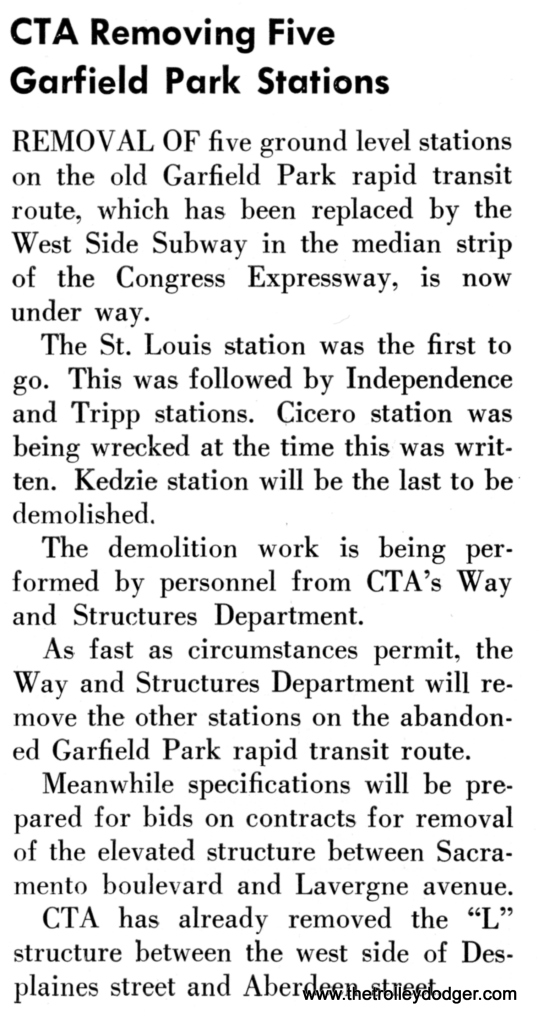
The Garfield Park "L" crossed over railroad tracks at about 4600 West. Interestingly, note that between the two sides of the railroad embankment, the alley between Harrison and Flournoy is not quite in the same location.

The Garfield Park “L” crossed over railroad tracks at about 4600 West. Interestingly, note that between the two sides of the railroad embankment, the alley between Harrison and Flournoy is not quite in the same location.

Recent Correspondence

We recently wrote to fellow historian Andres Kristopans:

It has been my understanding for many years that the CTA right-of-way between the Lotus Tunnel (5400 W.) and Forest Park was planned for three tracks.

This is a self-evident fact; the tunnel has portals on both sides, there is room for a third track north of the existing two west of there, and the bridge over DesPlaines Avenue was obviously designed for three tracks.

The question of what this third track was intended for recently came up in a discussion on the Facebook Chicago Elevated group. My source on that point, that the third track was intended for use by the Chicago Aurora & Elgin interurban, was my discussions and correspondence with George Krambles some 40 years ago).

But that did get me interested in looking into the matter further.

By 1940, planning for the new Congress expressway envisioned replacing the Garfield Park “L” with a line in the expressway median to Laramie Avenue (5200 W.), at least according to the film Streamlining Chicago.

This raises the question, when was the Lotus Tunnel planned, and why are there three tunnels?

The Congress median right-of-way was, to some extent, based on the existing Garfield setup. Garfield had four tracks as far as Paulina (1700 W.), although there had been plans to add two more tracks west of there in the late 1920s.

The three branches of the Met came together at Marshfield Junction, and this was undoubtedly seen as an undesirable situation, one that should be avoided in the future. By routing abandoning the Humboldt Park branch, and re-routing Logan Square into the new Milwaukee-Dearborn subway, this problem was solved.

But another goal of city planners was the gradual elimination of all the “L”s and their replacement by subways. The Lake Street “L” was targeted for this process, first with a plan to connect it to the Milwaukee-Dearborn subway just west of the Loop, and later by diverting it to the Congress median via a mile-long subway or elevated connection, either at Kedzie (3200 W.) or later, at 4600 W.

The Lake Street tracks were to be kept separate from other Congress line trains, therefore requiring a four-track right-of-way all the way to the subway portals just east of Halsted Street. The two unused portals were intended for a Clinton Street subway, a north-south branch that would have created a downtown subway loop in conjunction with the portions on Lake, Dearborn, and Congress.

Lake Street trains could have circled this loop, since otherwise, there was no obvious way to through-route them with another line at that time. It was thought that this change would have made it possible to tear down half of the Loop “L”, namely the Lake Street and Wabash Avenue legs, the exact opposite of what the City hoped to do in the 1970s.

So, the Congress median line, in the planning stages, had space enough for four tracks from Halsted to wherever the Lake line could have been brought in, which could have been as far as 4600 W.

This still does not explain why planners thought there should be three tracks starting at the Lotus Tunnel (5400 W.) and heading west.

As far back as 1945, it was expected that the CA&E tracks running through Forest Park, and the B&OCT, would run in an open cut in the expressway through suburban Oak Park. There are Cook County plans with such illustrations.

CRT leased CA&E’s tracks west of Laramie, and CA&E leased CRT’s tracks east of there, an arrangement that largely resulted in a wash financially for both companies (and, later, CRT’s successor, the CTA).

In the stretch between Forest Park and Laramie, the CA&E operated what amounted to an express service, and CRT, locals. There was a passing track at Gunderson, where express trains could pass slower locals.

That was the “old” way of operating a railroad, one increasingly at odds with the more modern way of doing things. It was labor-intensive and required a high level of competence; split-second timing, in fact.

IMHO, the solution to this in the new plan was simply to keep the locals and expresses separated. There would be two tracks for the CRT locals and one for the CA&E expresses.

As the highway plans neared fruition, the CA&E reported in 1950 that they lacked the funds to build new tracks in a highway right-of-way west of Austin Boulevard. CA&E owned the current trackage west of Laramie Avenue. The City of Chicago only had responsibility to build the Congress expressway as far as the city limits (Austin, 6000 W.).

The Lotus Tunnel was needed all along, because there needed to be some way to connect the CA&E tracks with CRT’s, and it made sense to have the new track alignment run on the south side of the highway footprint, parallel to the B&OCT. It must have been planned early on, perhaps as far back as 1945.

The CTA proposed taking over the right-of-way to Forest Park in 1952, as a way to solve the problems with CA&E. By then, the interurban had already decided not to run downtown on CTA’s tracks. The CTA had abandoned the Westchester branch in December 1951, as a means of saving money. So, CA&E no longer had income to offset the cost of using CTA’s tracks. Continuing operations into the City would be a drain of CA&E’s coffers, whatever the merits pro and con would have been for running on the Van Buren Street temporary trackage.

The highway planners, in the early 1950s, understood that if CA&E had been unable to connect with the CTA somewhere, this would have immediately put them out of business. Hence the county was very much interested in a solution to this problem. CA&E said they could not afford to build new tracks and facilities in the two miles or so of the relocated right-of-way between Austin Boulevard and DesPlaines Avenue.

All the more reason not to change the plans, likely made circa 1945, for three tracks in the new section. Cook County government did not want to be the cause of CA&E’s demise.

It was fortunate that the CTA stepped in and offered a creative solution to this problem, which also allowed them, as a result, to continue operating service to Forest Park.

So, in 1953 CA&E sold their right-of-way to the county as far west as DesPlaines Avenue (but not the river crossing, not until 1957), and the CTA purchased their fixed assets, the tracks, signals, stations, etc., which would all need to be replaced anyway.

This gave the CTA “skin in the game” to continue operating service to Forest Park. The plan to hand off CA&E riders to the CTA at DesPlaines Avenue did not come about until 1953. This is evidenced both in contemporary newspaper reports, and in how the Forest Park Terminal was hurriedly altered at practically the last minute to adopt the new arrangements.

Until then, it was expected that this handoff would take place at Laramie Avenue, where CA&E’s tracks ended and CTA’s began. There was also an intermediate plan to make Central Avenue the changeover point instead, as the CTA briefly considered building a bus-rail facility there instead of Forest Park. CTA made an artist’s rendering of this, which I have seen.

So, in sum, the plan for three tracks west of Laramie probably dated as far back as 1945, when engineering was being done for the expressway extension into the western suburbs. This plan was not changed when the facilities were built. The Lotus Tunnel has three tunnels, the right-of-way has space for three tracks (north of the existing two), and the steel bridge over the DesPlaines Avenue underpass was designed for three tracks.

By the time the final design work was done for the stations in this section, in the late 1950s, the CA&E was no longer an issue. The CTA had built what they needed built, and did the minimum that was necessary just in case it might have been possible for the CA&E to resume operations downtown.

And this is something that CA&E went back and forth on. Both CTA and CA&E seemed perfectly happy to separate their tracks from each other in 1953. It is my belief that, early on, the CA&E decided on a policy of a gradual or piecemeal abandonment, selling off parts of their line, and distributing the proceeds to their shareholders, instead of using it to buy new equipment.

This is based on the notion that the new highway itself had doomed the interurban, which in an era where there were no government subsidies, was likely the only logical conclusion.

The CTA still had to figure out where their yard would be for the new Congress service. In the late 1950s, they were still considering using Laramie Yard, which would need to be connected to the median line by an elevated connection, estimated to cost $1m.

Building a new yard at DesPlaines Avenue was a cost-saving alternative. But there was still the question of who owned the terminal there, as CA&E hadn’t sold it as part of the 1953 deal. It wasn’t part of the highway project, and in fact, in 1957, CA&E had filed suit to evict the CTA from the Forest Park terminal, as a way of putting pressure on the powers-that-be to get more money for the river crossing (which they did) and get the courts to agree to a “temporary” abandonment of passenger service (which they did).

That those two events happened almost simultaneously makes one wonder if perhaps there was a “quid pro quo” involved, although at this stage, there is probably no way to prove it.

Andre replies:

I will go along with your analysis. The whole problem was a lack of money. CTA in 1945 was set up on the premise of taking over all local transportation in the metro area, but there was a fatal flaw in that CTA had no outside income except by selling bonds. When the suburban bus and rail lines were found to be more highly valued than expected, CTA could not come up with enough money to buy them out. There were ideas to take over CA&E to Wheaton and North Shore to Waukegan, but nothing came of them because the various towns along the lines could not agree on financial assistance. Those directly on line demanded those further, especially along CA&E, kick in as they would also benefit, but places like Addison and Bloomingdale refused, so nothing could be agreed to and the idea died. It took until RTA in 1982 to finally do this, with federal money.

In many ways, CTA was an idea way ahead of its time. Remember CTA was the very first “transit authority”. Before you had municipal operations like Cleveland where city took over failing private operations, but this was the first “independent governmental body” with jurisdiction not based on municipal boundaries. Too bad nobody thought to give it taxing authority at the time, as everyone thought once relieved of regulation and duplication, transit would be profitable again, and in fact the idea was that CTA would only be a “temporary” owner, who after restructuring Chicago area transit into profitability would then sell the system to a private operator and use the proceeds to retire the bonds sold to buy and modernize the system. But because nothing could be done with the suburban operators, CTA became the permanent owner of the city system, for 74 years now.

There was the negative example of municipal ownership in New York City, where building the IND subway practically bankrupted the city. So it is no wonder that Chicago had to be dragged, kicking and screaming, into it.

The City of Chicago resisted the idea of public ownership for years, until all the various schemes for unifying CSL and CRT had failed, and there was no other viable option (by 1943). The situation might have festered, but the city had pledged to push through transit unification as a condition of accepting federal funds to pay for 45% of the Initial System of Subways (which ended up being more like 33% by the time the Milwaukee-Dearborn subway opened).

When WWII ended, the City resumed work on the unfinished Dearborn-Milwaukee subway, and soon work began in earnest on building the Congress superhighway. But there was no more federal money in the offing, and it was a struggle just to get the subway open by 1951.

The City had to float a $25m bond issue, which in essence reimbursed the transit improvement fund for monies that were taken from it during the Great Depression.

The scope of projects had to be scaled back. It seems as though the idea of re-routing Lake onto Congress was still alive as of 1948, but got put off into an indefinite future, due to the cost of building a mile long connection between the two lines, plus the Clinton subway.

Once CTA was in charge, they quickly identified the Lake Street “L”s problem area as the grade-level outer end, and not the elevated portion. And service was speeded up by using A/B skip-stop service, which became a model for the rest of the system.

The ultimate solution to Lake’s problems was not realized until 1962, when the line was elevated onto the Chicago & North Western embankment, followed by a proper yard west of Harlem.

The Van Buren temporary trackage gummed things up on Garfield for a few years, but inadvertently helped turn the eventual Congress line into something more like an express service. The CTA responded to the slow running times on Van Buren by closing some of the more minor stations on the line west of there, to the point where Garfield travel times in 1958 were largely the same as they had been prior to the September 1953 change.

This, in turn, influenced the locations of stations on the new Congress line. Whereas at first, plans called for merely replacing the old Garfield stations with new ones on Congress, over time, fewer new stations were planned.

The one glaring exception, of course, was Kostner, which was mandated by the City Council for political reasons, as there were three Aldermen lobbying for it (their wards were nearby). This one example of the “old” way of doing things turned out to be a dismal failure, and the station barely lasted a decade.

Andre:

Actually since 1913 CSL was a strange situation of private ownership but municipal operation. Chicago Surface Lines Joint Board of Management and Operation (the full name) was a city agency that directed day to day operations while CRys, CCRy, C&SCRys, all stock companies, were the actual owners. Probably only such arrangement anywhere. So in fact in 1945 city ceded control to an independent agency, though ownership transfer of assets took two more years to arrange.

CSL was not in trouble per se. Bankruptcy was more to keep franchise from expiring than any real financial collapse, whereas CRT was basically barely able to make payroll, with nothing left over for maintenance, etc. If CRT could not be foisted off on CSL, it would have been abandoned soon.

The Dean of Chicago Railfans

Raymond DeGroote, Jr. waits for DC Transit pre-PCC streetcar 1053 to descend a viaduct in Washington, DC on October 15, 1961, so he can get his picture. Streetcars in portions of the District of Columbia were forbidden to use overhead wire, and were powered by an underground conduit instead. (William C. Hoffman Photo)

Raymond DeGroote, Jr. waits for DC Transit pre-PCC streetcar 1053 to descend a viaduct in Washington, DC on October 15, 1961, so he can get his picture. Streetcars in portions of the District of Columbia were forbidden to use overhead wire, and were powered by an underground conduit instead. (William C. Hoffman Photo)

My friend Raymond DeGroote, Jr. will turn 91 years old on July 15th. He has been very active in Chicago’s railfan community since the 1940s. He was most likely a first-day rider when Chicago’s first subway opened on October 17, 1943, over 77 years ago.

He has taken thousands of photos over the years, starting in about 1948 with black-and-white, and color slides since 1954. Ray is a world traveler, has written numerous articles, and has given numerous presentations on a wide range of railfan subjects. His work has appeared in many books, and he has been a mentor to me in this field since we first met in the late 1970s.  He has worked tirelessly for many of the leading railfan organizations over the years.

Thanks to Ray, I became part of what he likes to call the “intelligence network” of railfans, in an era before the Internet made it possible to have a world of information at your fingertips.

Therefore, when I started work on my new book Chicago’s Lost “L”s, I could not think of anyone more deserving to dedicate the book to than Ray, who I consider the Dean of Chicago railfans. Once I received a small number of “author’s copies,” I sent one to him.

Here is his reply:

Thank you very much for my copy of Chicago’s Lost “L”s. The book is much appreciated and will provide many hours of pleasure reading and looking at the pictures.

I already found several very interesting ones. For example, I had never seen a picture of Willow or Calvary, the latter going even before my time, and the former just as I was becoming interested in the hobby. Also the view of Lower Level Wilson looking southeast (interesting angle) before the structure was above it, and Merchandise Mart under construction. Both must be relatively rare pictures.

On page 17 you had a view of a Robertson streetcar at 63rd. I remember those cars on South Side lines such as Riverdale, but we also had them up north on Riverview-Larrabee– slow cars, but with a commanding presence.

I am glad you included the Lost Interurbans section and also the Lost Terminals section. I vaguely remember Market Street, but know I rode out of Congress Street a few times, and many times out of North Water. That was even used as a display area to introduce and show off the new North Shore Silverliner paint scheme.

This is another good book to your credit. Keep up the good work.

Apparently, he did not initially notice that the book is dedicated to him, so I had to bring that to his attention.

He then wrote:

I am terribly embarrassed that I did not notice my name on the dedication page. I remember looking at the top of the page and seeing the Library of Congress data, and then going right to the Table of Contents. When I saw Northwestern “L” I turned right there to see what pictures you had included.

This is the first time anyone has dedicated a book to me, and I am very surprised and honored. It was totally unexpected. Thank you very much for this recognition, although I do not think I merit the title of “Dean”. “Old Man” might have been more appropriate as there are many others who deserve to be called “Dean.”

So, thank you again for the book dedication. It is a fine book, and I hope it will generate many sales.

Sincerely, Ray

When I can slip a few pictures in there that Ray DeGroote hasn’t seen before, I think I have done pretty well, because Ray has seen just about everything before.  And, he is characteristically modest about his accomplishments.  I can only hope for a small fraction of his wisdom, if I am lucky enough to reach his years.

Keep those cards and letters coming in, folks!

-David Sadowski

Our Latest Book, Now Available for Pre-Order:

Chicago’s Lost “L”s

Arcadia Publishing will release our new book Chicago’s Lost “L”s on July 12, 2021. Reserve your copy today!

From the back cover:

Chicago’s system of elevated railways, known locally as the “L,” has run continuously since 1892 and, like the city, has never stood still. It helped neighborhoods grow, brought their increasingly diverse populations together, and gave the famous Loop its name. But today’s system has changed radically over the years. Chicago’s Lost “L”s tells the story of former lines such as Garfield Park, Humboldt Park, Kenwood, Stockyards, Normal Park, Westchester, and Niles Center. It was once possible to take high-speed trains on the L directly to Aurora, Elgin, and Milwaukee, Wisconsin. The L started out as four different companies, two starting out using steam engines instead of electricity. Eventually, all four came together via the Union Loop. The L is more than a way of getting around. Its trains are a place where people meet and interact. Some say the best way to experience the city is via the L, with its second-story view. Chicago’s Lost “L”s is virtually a “secret history” of Chicago, and this is your ticket. David Sadowski grew up riding the L all over the city. He is the author of Chicago Trolleys and Building Chicago’s Subways and runs the online Trolley Dodger blog.

The Images of America series celebrates the history of neighborhoods, towns, and cities across the country. Using archival photographs, each title presents the distinctive stories from the past that shape the character of the community today. Arcadia is proud to play a part in the preservation of local heritage, making history available to all.

Title Chicago’s Lost “L”s
Images of America
Author David Sadowski
Edition illustrated
Publisher Arcadia Publishing (SC), 2021
ISBN 1467100007, 9781467100007
Length 128 pages

Chapters:
01. The South Side “L”
02. The Lake Street “L”
03. The Metropolitan “L”
04. The Northwestern “L”
05. The Union Loop
06. Lost Equipment
07. Lost Interurbans
08. Lost Terminals
09. Lost… and Found

Each copy purchased here will be signed by the author, and you will also receive a bonus facsimile of a 1926 Chicago Rapid Transit Company map, with interesting facts about the “L” on the reverse side.

The price of $23.99 includes shipping within the United States.

For Shipping to US Addresses:

For Shipping to Canada:

For Shipping Elsewhere:

NEW DVD:

A Tribute to the North Shore Line

To commemorate the 50th anniversary of the demise of the fabled North Shore Line interurban in January 2013, Jeffrey L. Wien and Bradley Criss made a very thorough and professional video presentation, covering the entire route between Chicago and Milwaukee and then some. Sadly, both men are gone now, but their work remains, making this video a tribute to them, as much as it is a tribute to the Chicago North Shore & Milwaukee.

Jeff drew on his own vast collections of movie films, both his own and others such as the late William C. Hoffman, wrote and gave the narration. Bradley acted as video editor, and added authentic sound effects from archival recordings of the North Shore Line.

It was always Jeff’s intention to make this video available to the public, but unfortunately, this did not happen in his lifetime. Now, as the caretakers of Jeff’s railfan legacy, we are proud to offer this excellent two-hour program to you for the first time.  The result is a fitting tribute to what Jeff called his “Perpetual Adoration,” which was the name of a stop on the interurban.

Jeff was a wholehearted supporter of our activities, and the proceeds from the sale of this disc will help defray some of the expenses of keeping the Trolley Dodger web site going.

Total time – 121:22

# of Discs – 1
Price: $19.99 (Includes shipping within the United States)

Keep those cards and letters coming in, folks!

-David Sadowski

Help Support The Trolley Dodger

This is our 269th post, and we are gradually creating a body of work and an online resource for the benefit of all railfans, everywhere. To date, we have received over 777,000 page views, for which we are very grateful.
You can help us continue our original transit research by checking out the fine products in our Online Store.
As we have said before, “If you buy here, we will be here.”
We thank you for your support.
DONATIONS
In order to continue giving you the kinds of historic railroad images that you have come to expect from The Trolley Dodger, we need your help and support. It costs money to maintain this website, and to do the sort of historic research that is our specialty.
Your financial contributions help make this web site better, and are greatly appreciated.