Thanks a Million

North Shore Line car 154 makes a photo stop at the Glencoe gauntlet on a July 24, 1955 "farewell to the Shore Line Route" fantrip.

North Shore Line car 154 makes a photo stop at the Glencoe gauntlet on a July 24, 1955 “farewell to the Shore Line Route” fantrip.

The Trolley Dodger blog reached another milestone on July 22, 2023, with one million page views. So, I am not exaggerating when I say thanks a million to all our readers over the last eight-and-a-half years!

We have a fine batch of classic traction photos for your enjoyment today. We acquired some of them as part of our research for our next book about the fabled Chicago Aurora and Elgin interurban.

All this research does cost money, however, so we hop you will consider making a donation. You can find links to do just that at the top of this post, and also at the end. We thank everyone who has already contributed.

In addition, we have coverage of the Chicago Transit Authority‘s celebration of the 100th anniversary of Heritage cars 4271 and 4272, which gave rides around the Loop for several hours on July 29th.

Enjoy!

-David Sadowski

PS- You might also like our Trolley Dodger Facebook auxiliary, a private group that now has 1,394 members.

Our friend Kenneth Gear has a Facebook group for the Railroad Record Club. If you enjoy listening to audio recordings of classic railroad trains, whether steam, electric, or diesel, you might consider joining.

FYI, the Hoosier Traction Facebook Group celebrates electric transit in Indiana and the Midwest. It also supports the activities of the annual Hoosier Traction Meet (although not affiliated with the North American Transit Historical Society, which organizes that event).

100 Years of the CTA 4000s

To get downtown, I took an inbound Metra commuter train. Running on the Burlington Northern Santa Fe, it stops at the Riverside station on July 29, 2023.

The 4000s arrive at Washington and Wabash.

What it was like to ride the 4000s around the Loop.

The 4000s berthed at the south end of the Washington and Wabash platform, as the lines of people waiting to board were quite long.

The 4000s berthed at the south end of the Washington and Wabash platform, as the lines of people waiting to board were quite long.

CTA 2400-series cars, which were retired some years back, made up the other Heritage Fleet train being used that day.

CTA 2400-series cars, which were retired some years back, made up the other Heritage Fleet train being used that day.

The various advertising wraps on "L" trains break up the monotony of having everything be gray.

The various advertising wraps on “L” trains break up the monotony of having everything be gray.

Fred Lonnes, a retired CTA employee, stands near the train.

Fred Lonnes, a retired CTA employee, stands near the train.

The original plans were to make all stops around the Loop after the first few trips. But that had to be revised due to the large crowds. As far as I am aware, nearly all trips began and ended at Washington and Wabash.

The original plans were to make all stops around the Loop after the first few trips. But that had to be revised due to the large crowds. As far as I am aware, nearly all trips began and ended at Washington and Wabash.

Lots of pictures are videos were taken.

Lots of pictures are videos were taken.

People were excited to ride the old cars.

People were excited to ride the old cars.

There was a long line to ride the 4000s at Washington and Wabash.

There was a long line to ride the 4000s at Washington and Wabash.

Recent Finds

The miniature railway and electric wheel at Chicago's White City amusement park, which was located on the south side on 63rd Street in the early 1900s.

The miniature railway and electric wheel at Chicago’s White City amusement park, which was located on the south side on 63rd Street in the early 1900s.

The back of the postcard, mailed in 1909.

The back of the postcard, mailed in 1909.

Chicago Aurora and Elgin car 320 makes a photo stop on an early "Railfan Special" fantrip, probably circa 1939-40. Don's Rail Photos (via Archive.org): "320 was built by Jewett Car Co in 1914. It was modernized at an unknown date and sold to Iowa Chapter NRHS in 1962. It was transferred to Midwest Electric Railway Museum in 1968."

Chicago Aurora and Elgin car 320 makes a photo stop on an early “Railfan Special” fantrip, probably circa 1939-40. Don’s Rail Photos (via Archive.org): “320 was built by Jewett Car Co in 1914. It was modernized at an unknown date and sold to Iowa Chapter NRHS in 1962. It was transferred to Midwest Electric Railway Museum in 1968.”

Chicago Aurora and Elgin car 320 was the last to leave the property, and the first to return to service elsewhere. Here, it is in Centerville, Iowa (on the Southern Iowa Railway) on October 20, 1962. (Don Christenson Photo)

Chicago Aurora and Elgin car 320 was the last to leave the property, and the first to return to service elsewhere. Here, it is in Centerville, Iowa (on the Southern Iowa Railway) on October 20, 1962. (Don Christenson Photo)

A group of Aurora Elgin and Chicago employees posed for a picture at the Dispatch Tower in Wheaton, circa 1920. The AE&C was reorganized into the CA&E in 1922.

A group of Aurora Elgin and Chicago employees posed for a picture at the Dispatch Tower in Wheaton, circa 1920. The AE&C was reorganized into the CA&E in 1922.

Chicago Aurora and Elgin wood car 316 at the Fox River Trolley Museum on June 1, 1969. Don's Rail Photos (via Archive.org): "316 was built by Jewett Car Co in 1913. It was sold to Railway Equipment Leasing & Investment Co. in 1962 and transferred to Fox River Trolley Museum in 1984." (Don Christenson Photo)

Chicago Aurora and Elgin wood car 316 at the Fox River Trolley Museum on June 1, 1969. Don’s Rail Photos (via Archive.org): “316 was built by Jewett Car Co in 1913. It was sold to Railway Equipment Leasing & Investment Co. in 1962 and transferred to Fox River Trolley Museum in 1984.” (Don Christenson Photo)

Chicago Aurora and Elgin wood car 315 at Orbisonia, Pennsylvania on February 10, 1968. Don's Rail Photos (via Archive.org): "315 was built by Kuhlman Car Co in 1909, #404. It was modernized at an unknown date and sold to Rockhill Trolley Museum in 1962." (William D. Volkmer Photo)

Chicago Aurora and Elgin wood car 315 at Orbisonia, Pennsylvania on February 10, 1968. Don’s Rail Photos (via Archive.org): “315 was built by Kuhlman Car Co in 1909, #404. It was modernized at an unknown date and sold to Rockhill Trolley Museum in 1962.” (William D. Volkmer Photo)

Chicago Aurora and Elgin center cab locos 3003 and 3004 are in Elgin on July 15, 1954. They were built by Baldwin-Westinghouse in 1923-1924 and rebuilt in 1930. Both were scrapped in August 1963.

Chicago Aurora and Elgin center cab locos 3003 and 3004 are in Elgin on July 15, 1954. They were built by Baldwin-Westinghouse in 1923-1924 and rebuilt in 1930. Both were scrapped in August 1963.

CA&E loco 3003 at the Wheaton Shops. (S. Palmer Photo)

CA&E loco 3003 at the Wheaton Shops. (S. Palmer Photo)

A J. G. Brill builder's photo of Aurora and Geneva Railway Company car 4. The line had only four cars in all.

A J. G. Brill builder’s photo of Aurora and Geneva Railway Company car 4. The line had only four cars in all.

Aurora and Geneva Railway car 1. This was a predecessor of the Aurora Elgin and Fox River Electric and was merged into another company by 1901.

Aurora and Geneva Railway car 1. This was a predecessor of the Aurora Elgin and Fox River Electric and was merged into another company by 1901.

Chicago Aurora and Elgin express car 15 on the scrap track at Wheaton on February 1, 1953. It was built by McGuire-Cummings in 1910.

Chicago Aurora and Elgin express car 15 on the scrap track at Wheaton on February 1, 1953. It was built by McGuire-Cummings in 1910.

CA&E express motor 5 in the scrap line at Wheaton. Don's Rail Photos (via Archive.org): "5 was built by Cincinnati Car in 1921 to replace 1st 5 which was built by American Car in 1909 and wrecked in 1920. It was retired in 1953."

CA&E express motor 5 in the scrap line at Wheaton. Don’s Rail Photos (via Archive.org): “5 was built by Cincinnati Car in 1921 to replace 1st 5 which was built by American Car in 1909 and wrecked in 1920. It was retired in 1953.”

These plans are for 15 CA&E cars built by the Cincinnati Car Company in 1927, numbered 420-434.

These plans are for 15 CA&E cars built by the Cincinnati Car Company in 1927, numbered 420-434.

Chicago Aurora and Elgin 137 was originally a North Shore Line car. Don's Rail Photos (via Archive.org): "137 was built by Jewett Car Company in 1907 as Chicago & Milwaukee Electric 137. It was rebuilt in 1914 retired in 1954." The CA&E leased it from the North Shore Line from 1936 to 1945. it was briefly returned to the NSL and was then purchased by CA&E in 1946. Here, we see it on August 31, 1942 in Wheaton.

Chicago Aurora and Elgin 137 was originally a North Shore Line car. Don’s Rail Photos (via Archive.org): “137 was built by Jewett Car Company in 1907 as Chicago & Milwaukee Electric 137. It was rebuilt in 1914 retired in 1954.” The CA&E leased it from the North Shore Line from 1936 to 1945. it was briefly returned to the NSL and was then purchased by CA&E in 1946. Here, we see it on August 31, 1942 in Wheaton.

Chicago Aurora and Elgin control trailer 604 is at Wheaton in August 1948. It originally came from the Washington, Baltimore and Annapolis. Don's Rail Photos (via Archive.org): "604 was built by Cincinnati Car Co in 1913 as WB&A 39. It was sold as CA&E 604 in October 1937."

Chicago Aurora and Elgin control trailer 604 is at Wheaton in August 1948. It originally came from the Washington, Baltimore and Annapolis. Don’s Rail Photos (via Archive.org): “604 was built by Cincinnati Car Co in 1913 as WB&A 39. It was sold as CA&E 604 in October 1937.”

Chicago Aurora and Elgin cars 452, 453, and 451 were new arrivals in November 1945, when this picture was taken.

Chicago Aurora and Elgin cars 452, 453, and 451 were new arrivals in November 1945, when this picture was taken.

Chicago Aurora and Elgin cars 309 and 310 are on a May 19, 1957 fantrip, as a westbound train at Ardmore in Villa Park.

Chicago Aurora and Elgin cars 309 and 310 are on a May 19, 1957 fantrip, as a westbound train at Ardmore in Villa Park.

The fresh ballast, ties, and construction in this picture date it to around September 20, 1953, when the Chicago Aurora and Elgin cut back service to Forest Park. Their passengers then had to change trains and ride the CTA Garfield Park "L" the rest of the way into the city-- at times, a rather slow and ponderous ride via 2.5 miles of temporary trackage in Van Buren Street, due to construction of the Congress (now Eisenhower) expressway. Here, we see cars 451 and 425, just after they have dropped off their riders. This arrangement continued until the CA&E suspended passenger service on July 3, 1957. The view looks to the northeast. William Shapotkin adds, "I see the Forest Park CGW station in the background. The CGW continued operating passenger service out of Chicago (stopping at Forest Park) until Sept 5-6, 1956. The SOO station (located at Madison St) continued serving passenger trains until Jan 1963 (when the remaining train, the LAKER was moved from Grand Central Station to Central Station in Chicago)."

The fresh ballast, ties, and construction in this picture date it to around September 20, 1953, when the Chicago Aurora and Elgin cut back service to Forest Park. Their passengers then had to change trains and ride the CTA Garfield Park “L” the rest of the way into the city– at times, a rather slow and ponderous ride via 2.5 miles of temporary trackage in Van Buren Street, due to construction of the Congress (now Eisenhower) expressway. Here, we see cars 451 and 425, just after they have dropped off their riders. This arrangement continued until the CA&E suspended passenger service on July 3, 1957. The view looks to the northeast. William Shapotkin adds, “I see the Forest Park CGW station in the background. The CGW continued operating passenger service out of Chicago (stopping at Forest Park) until Sept 5-6, 1956. The SOO station (located at Madison St) continued serving passenger trains until Jan 1963 (when the remaining train, the LAKER was moved from Grand Central Station to Central Station in Chicago).”

Chicago Aurora and Elgin car 320 is at the end of the line in Aurora, most likely in the 1940s. This was a fantrip for the Central Electric Railfans' Association. Now, this is where the Illinois Prairie Path terminates.

Chicago Aurora and Elgin car 320 is at the end of the line in Aurora, most likely in the 1940s. This was a fantrip for the Central Electric Railfans’ Association. Now, this is where the Illinois Prairie Path terminates.

CA&E 414 is on the Aurora branch just east of Eola Road (near Batavia Junction) on July 3, 1949. The crossing with the EJ&E is in the distance, and the Commonwealth Edison substation at left is still in use.

CA&E 414 is on the Aurora branch just east of Eola Road (near Batavia Junction) on July 3, 1949. The crossing with the EJ&E is in the distance, and the Commonwealth Edison substation at left is still in use.

Chicago Aurora and Elgin car 316 as it was being moved off the interurban via the Chicago and North Western in April 1962. Car 20 is behind it. Both cars went to what is now the Fox River Trolley Museum.

Chicago Aurora and Elgin car 316 as it was being moved off the interurban via the Chicago and North Western in April 1962. Car 20 is behind it. Both cars went to what is now the Fox River Trolley Museum.

CA&E 453, most likely just after it was delivered in late 1945.

CA&E 453, most likely just after it was delivered in late 1945.

CA&E 451 in Wheaton.

CA&E 451 in Wheaton.

The CA&E Wheaton Yards.

The CA&E Wheaton Yards.

CA&E 303 at Trolleyville USA in Olmstead Falls, OH in August 1991. Don's Rail Photos (via Archive.org): "303 was built by Niles Car & Mfg Co in 1906. It was modernized in March 1945 and sold to Trolleyville in 1962. It was sold to Connecticut Trolley Museum in December 2009."

CA&E 303 at Trolleyville USA in Olmstead Falls, OH in August 1991. Don’s Rail Photos (via Archive.org): “303 was built by Niles Car & Mfg Co in 1906. It was modernized in March 1945 and sold to Trolleyville in 1962. It was sold to Connecticut Trolley Museum in December 2009.”

Chicago Aurora and Elgin wood car 317, taken at the Batavia Terminal on an October 16, 1955 fantrip. (Raymond DeGroote, Jr. Photo)

Chicago Aurora and Elgin wood car 317, taken at the Batavia Terminal on an October 16, 1955 fantrip. (Raymond DeGroote, Jr. Photo)

A westbound Chicago Aurora and Elgin train, with car 32 at the helm, stops at Glen Ellyn circa 1926. The station building for eastbound trains appears to be brand new. It was torn down around 1966. The two buildings visible next to the telephone pole are still extant. (Chapek Photo)

A westbound Chicago Aurora and Elgin train, with car 32 at the helm, stops at Glen Ellyn circa 1926. The station building for eastbound trains appears to be brand new. It was torn down around 1966. The two buildings visible next to the telephone pole are still extant. (Chapek Photo)

Chicago Aurora and Elgin wood car 300 on January 13, 1962 at Wheaton, a few weeks before scrapping started on the bulk of the fleet. (Raymond DeGroote, Jr. Photo)

Chicago Aurora and Elgin wood car 300 on January 13, 1962 at Wheaton, a few weeks before scrapping started on the bulk of the fleet. (Raymond DeGroote, Jr. Photo)

CA&E car 300 looks much the worse for wear at Wheaton on May 18, 1963. It was not one of the cars saved. (Raymond DeGroote, Jr. Photo)

CA&E car 300 looks much the worse for wear at Wheaton on May 18, 1963. It was not one of the cars saved. (Raymond DeGroote, Jr. Photo)

CA&E control trailer 700 at the Wheaton Shops. This car originally came from the Washington, Baltimore and Annapolis, and the ends were modified to fit the tight clearances on the "L" system. (S. Palmer Photo)

CA&E control trailer 700 at the Wheaton Shops. This car originally came from the Washington, Baltimore and Annapolis, and the ends were modified to fit the tight clearances on the “L” system. (S. Palmer Photo)

Chicago Aurora and Elgin express motor 9 at the Wheaton Shops. Don's Rail Photos (via Archive.org): "9 was built by Niles Car in 1907. It was scrapped in 1959." (S. Palmer Photo)

Chicago Aurora and Elgin express motor 9 at the Wheaton Shops. Don’s Rail Photos (via Archive.org): “9 was built by Niles Car in 1907. It was scrapped in 1959.” (S. Palmer Photo)

This and the next image are early postcards of the Met "L" bridge (actually two bridges, side by side) over the Chicago River.

This and the next image are early postcards of the Met “L” bridge (actually two bridges, side by side) over the Chicago River.

CTA 6439-40 are at an unknown location in the 1950s, marked as a special run. The photographer is not known for certain, but I suspect this was taken by Vic Wagner.

CTA 6439-40 are at an unknown location in the 1950s, marked as a special run. The photographer is not known for certain, but I suspect this was taken by Vic Wagner.

A Central Electric Railfans' Association special made a photo stop at the Sedgwick CTA "L" station on Sunday, December 11, 1955, using cars 6129 and 6130, which were equipped with trolley poles for use on the Evanston branch (which did not switch to third rail until 1973). Many fantrips in this era ran on Sundays, as there were fewer regular service trains to get in their way. In this case, Ravenswood "L" service did not operate south of Armitage at night or on Sundays, so leisurely photo stops were possible on the stations which had no service that day. The hanging sign on the front of the train is contemporary and was used by Evanston "Shopper's Special" trains, a late morning version of the Evanston Express, which ran only in rush hours, for a premium fare of 40 cents. The CTA charged an extra amount north of Howard Street for a "zoned" fare for many years, unlike today where riders pay the same amount throughout the rapid transit system. These cars were also equipped with high-speed motors at the time, as the CTA was experimenting-- which eventually led to their use on the 2000-series cars delivered in 1964. (Vic Wagner Photo)

A Central Electric Railfans’ Association special made a photo stop at the Sedgwick CTA “L” station on Sunday, December 11, 1955, using cars 6129 and 6130, which were equipped with trolley poles for use on the Evanston branch (which did not switch to third rail until 1973). Many fantrips in this era ran on Sundays, as there were fewer regular service trains to get in their way. In this case, Ravenswood “L” service did not operate south of Armitage at night or on Sundays, so leisurely photo stops were possible on the stations which had no service that day. The hanging sign on the front of the train is contemporary and was used by Evanston “Shopper’s Special” trains, a late morning version of the Evanston Express, which ran only in rush hours, for a premium fare of 40 cents. The CTA charged an extra amount north of Howard Street for a “zoned” fare for many years, unlike today where riders pay the same amount throughout the rapid transit system. These cars were also equipped with high-speed motors at the time, as the CTA was experimenting– which eventually led to their use on the 2000-series cars delivered in 1964. (Vic Wagner Photo)

This postcard, mailed in 1908, shows the Chicago and Milwaukee Electric (predecessor of the North Shore Line) station in Lake Bluff, where the branch line to Libertyville and what is now called Mundelein crossed under the Chicago and North Western.

This postcard, mailed in 1908, shows the Chicago and Milwaukee Electric (predecessor of the North Shore Line) station in Lake Bluff, where the branch line to Libertyville and what is now called Mundelein crossed under the Chicago and North Western.

The back side of the postcard.

The back side of the postcard.

A three-car North Shore Line train of Silverliners is at Valley Junction in North Chicago on January 20, 1963, the last full day of operations.

A three-car North Shore Line train of Silverliners is at Valley Junction in North Chicago on January 20, 1963, the last full day of operations.

North Shore Line 721 heads west on the Mundelein branch in June 1962. (Laurence Veysey Photo) I looked up the photographer, whose name was new to me. I found this online: "Laurence R. Veysey (1932-2004) was an eccentric, a hermit, and an ardent nudist — and author of one of the foundational texts on the history of higher education."

North Shore Line 721 heads west on the Mundelein branch in June 1962. (Laurence Veysey Photo) I looked up the photographer, whose name was new to me. I found this online: “Laurence R. Veysey (1932-2004) was an eccentric, a hermit, and an ardent nudist — and author of one of the foundational texts on the history of higher education.”

At the time of the 1963 abandonment, North Shore Line car 154 became the oldest survivor of the fleet. Unfortunately, it has not survived to the present time. Here, we see it in Anderson, Indiana in November 1964, when it was owned by a railroad club there, which had it pulled around by a diesel locomotive. A sign in the window says "Dixie Flyer," which was an Indiana Railroad train. Within a few years, 154 ended up at a railway museum in Ohio, which stored it outdoors and allowed the car to slowly deteriorate. It was finally purchased by a Michigan museum, which stripped it for parts to restore an unrelated car, then dumped the body in a field.

At the time of the 1963 abandonment, North Shore Line car 154 became the oldest survivor of the fleet. Unfortunately, it has not survived to the present time. Here, we see it in Anderson, Indiana in November 1964, when it was owned by a railroad club there, which had it pulled around by a diesel locomotive. A sign in the window says “Dixie Flyer,” which was an Indiana Railroad train. Within a few years, 154 ended up at a railway museum in Ohio, which stored it outdoors and allowed the car to slowly deteriorate. It was finally purchased by a Michigan museum, which stripped it for parts to restore an unrelated car, then dumped the body in a field.

A view of the North Shore Line's Mundelein Terminal in July, 1962, looking northwest. (George Niles Photo)

A view of the North Shore Line’s Mundelein Terminal in July, 1962, looking northwest. (George Niles Photo)

George Niles took this picture of the North Shore Line's Mundelein Terminal in July 1962, looking west. Past the terminal, there was a freight interchange with the Soo Line.

George Niles took this picture of the North Shore Line’s Mundelein Terminal in July 1962, looking west. Past the terminal, there was a freight interchange with the Soo Line.

North Shore Line car 735 and others are at the Mundelein Terminal in July 1962. (George Niles Photo)

North Shore Line car 735 and others are at the Mundelein Terminal in July 1962. (George Niles Photo)

North Shore Line former Merchandise Despatch car 228 at Pettibone Yard in July 1962. It is now undergoing restoration at the East Troy Railroad Museum. (George Niles Photo)

North Shore Line former Merchandise Despatch car 228 at Pettibone Yard in July 1962. It is now undergoing restoration at the East Troy Railroad Museum. (George Niles Photo)

North Shore Line freight loco 458 is at the Pettibone Yard in July 1962. (George Niles Photo)

North Shore Line freight loco 458 is at the Pettibone Yard in July 1962. (George Niles Photo)

North Shore Line 752 is part of a two-car train at Edison Court in Waukegan in July 1962. We are looking south. (George Niles Photo)

North Shore Line 752 is part of a two-car train at Edison Court in Waukegan in July 1962. We are looking south. (George Niles Photo)

The Rynksel Oil and Coal Company was located in Waukegan, which is where this picture of the North Shore Line was taken (along the Skokie Valley Route) in July 1962. We are looking south from the south end of the Edison Court station. Waukegan was where the NSL originated in the late 1890s, and as there was a lot less ridership north of here, there were storage tracks, and cars were added and cut going north and south as needed. (George Niles Photo)

The Rynksel Oil and Coal Company was located in Waukegan, which is where this picture of the North Shore Line was taken (along the Skokie Valley Route) in July 1962. We are looking south from the south end of the Edison Court station. Waukegan was where the NSL originated in the late 1890s, and as there was a lot less ridership north of here, there were storage tracks, and cars were added and cut going north and south as needed. (George Niles Photo)

North Shore Line 752 is at Edison Court in July 1962. (George Niles Photo)

North Shore Line 752 is at Edison Court in July 1962. (George Niles Photo)

The "38 Fast Trains Daily" sign at the North Shore Line's Milwaukee Terminal on June 18, 1962.

The “38 Fast Trains Daily” sign at the North Shore Line’s Milwaukee Terminal on June 18, 1962.

Finally, here are some black and white photos that the late Robert Heinlein took in the mid-1950s:

The Milwaukee Terminal. (Robert Heinlein Photo)

The Milwaukee Terminal. (Robert Heinlein Photo)

A two-car train leaves the Milwaukee Terminal. (Robert Heinlein Photo)

A two-car train leaves the Milwaukee Terminal.
(Robert Heinlein Photo)

The Shore Line Route. (Robert Heinlein Photo)

The Shore Line Route. (Robert Heinlein Photo)

Winnetka on the Shore Line Route. (Robert Heinlein Photo)

Winnetka on the Shore Line Route. (Robert Heinlein Photo)

Ravinia Park on the Shore Line Route. (Robert Heinlein Photo)

Ravinia Park on the Shore Line Route. (Robert Heinlein Photo)

Street running on Greenleaf Avenue in Wilmette. (Robert Heinlein Photo)

Street running on Greenleaf Avenue in Wilmette. (Robert Heinlein Photo)

Greenleaf Avenue in Wilmette. (Robert Heinlein Photo)

Greenleaf Avenue in Wilmette. (Robert Heinlein Photo)

The 10th Street station in Waukegan on the Shore Line Route. After 1947, this was where the Shore Line Route ended. (Robert Heinlein Photo)

The 10th Street station in Waukegan on the Shore Line Route. After 1947, this was where the Shore Line Route ended. (Robert Heinlein Photo)

Our Latest Book, Now Available:

The North Shore Line

FYI, my new Arcadia Publishing book The North Shore Line is now available for immediate shipment. My publisher decided to expand it to 160 pages, instead of the usual 128. That’s a 25% increase, without any change to the $23.99 price. I am quite pleased with how this turned out.

From the back cover:

As late as 1963, it was possible to board high-speed electric trains on Chicago’s famous Loop “L” that ran 90 miles north to Milwaukee. This was the Chicago North Shore & Milwaukee Railroad, commonly known as the North Shore Line. It rose from humble origins in the 1890s as a local streetcar line in Waukegan to eventually become America’s fastest interurban under the visionary management of Midwest utilities tycoon Samuel Insull. The North Shore Line, under Insull, became a worthy competitor to the established steam railroads. Hobbled by the Great Depression, the road fought back in 1941 with two streamlined, air-conditioned, articulated trains called Electroliners, which included dining service. It regained its popularity during World War II, when gasoline and tires were rationed, but eventually, it fell victim to highways and the automobile. The North Shore Line had intercity rail, commuter rail, electric freight, city streetcars, and even buses. It has been gone for nearly 60 years, but it will always remain the Road of Service.

Each copy purchased here will be signed by the author, and you will also receive a bonus North Shore Line map.  Books will ship by USPS Media Mail.

Chapters:
01. Beginnings
02. The Milwaukee Division
03. The Shore Line Route
04. The Skokie Valley Route
05. The Mundelein Branch
06. On the “L”
07. City Streetcars
08. Trolley Freight
09. The Long Goodbye
10. The Legacy

Title The North Shore Line
Images of America
Author David Sadowski
Edition illustrated
Publisher Arcadia Publishing (SC), 2023
ISBN 1467108960, 978-1467108966
Length 160 pages

The price of $23.99 includes shipping within the United States.

For Shipping to US Addresses:

New Compact Disc, Now Available:

CTA-1
The Last Chicago Streetcars 1958
# of Discs – 1
Price: $15.99

Until now, it seemed as though audio recordings of Chicago streetcars were practically non-existent. For whatever reason, the late William A. Steventon does not appear to have made any for his Railroad Record Club, even though he did make other recordings in the Chicago area in 1956.

Now, audio recordings of the last runs of Chicago streetcars have been found, in the collections of the late Jeffrey L. Wien (who was one of the riders on that last car). We do not know who made these recordings, but this must have been done using a portable reel-to-reel machine.

These important recordings will finally fill a gap in transit history. The last Chicago Transit Authority streetcar finished its run in the early hours of June 21, 1958. Now you can experience these events just as Chicagoans did.

As a bonus, we have included Keeping Pace, a 1939 Chicago Surface Lines employee training program. This was digitally transferred from an original 16” transcription disc. These recordings were unheard for 80 years.

Total time – 74:38

Help Support The Trolley Dodger

This is our 304th post, and we are gradually creating a body of work and an online resource for the benefit of all railfans, everywhere. To date, we have received over 1,005,000 page views, for which we are very grateful.

You can help us continue our original transit research by checking out the fine products in our Online Store.
As we have said before, “If you buy here, we will be here.”

We thank you for your support.

DONATIONS

In order to continue giving you the kinds of historic railroad images that you have come to expect from The Trolley Dodger, we need your help and support. It costs money to maintain this website, and to do the sort of historic research that is our specialty.

Your financial contributions help make this web site better, and are greatly appreciated.


A Tribute to Robert Heinlein

Robert Heinlein volunteered at the Illinois Railway Museum for many years.

Robert Heinlein volunteered at the Illinois Railway Museum for many years.

Robert Heinlein, one of the giants in the railfan community, passed away on April 30, 2023, at the age of 84. You can read his obituary here.

Bob Heinlein was very knowledgeable, always cheerful, and continually went out of his way to share what he had learned to help others. He will be sorely missed.

Mr. Heinlein was a contributor to Central Electric Railfans’ Association Bulletin B-146, Chicago Streetcar Pictorial: The PCC Car Era, 1936-1958, of which I was a co-author. Unfortunately, he was not properly credited for several of his photographs, which were mistakenly attributed to the late Charles L. Tauscher (who was also an excellent photographer).

My co-author, the late Jeff Wien used twelve duplicate slides he had obtained in 1959 for the book, including the image on the cover. He was under the impression he had gotten these from Tauscher, but they were actually photos taken by Bob Heinlein. After the book was published, Bob informed Jeff of the error and loaned him the original slides, which I scanned. These images appeared in our previous post Loose Ends (February 2, 2021) with proper attribution.

Some of Mr. Heinlein’s images also appeared in my book The North Shore Line, which appeared earlier this year. Fortunately, he did see the book and I am told he enjoyed it.

The last time I met Mr. Heinlein was about a year ago, when I happened to run into him and his family by chance at the East Troy Railroad Museum. He was enjoying a ride on one of their restored trolley cars, and remarked how it would have been even more fun if they were running on the “L” twenty feet off the ground. That is how I would like to remember him.

He was an excellent photographer, going back to the early 1950s. In this post, we are sharing some of his own work, and other pictures from his vast collection, as a way of offering our condolences to his family, and as a tribute to the memory of a life well lived. We thank his son Kevin Heinlein for sharing these pictures with our readers.

I also would like to thank everyone who attended our recent program for my book The North Shore Line at Union Station on May 19th for the Railroad and Shortlines Club of Chicago.

Keep those cards and letters coming in, folks.

-David Sadowski

PS- You might also like our Trolley Dodger Facebook auxiliary, a private group that now has 1,205 members.

Our friend Kenneth Gear has a Facebook group for the Railroad Record Club. If you enjoy listening to audio recordings of classic railroad trains, whether steam, electric, or diesel, you might consider joining.

FYI, the Hoosier Traction Facebook Group celebrates electric transit in Indiana and the Midwest. It also supports the activities of the annual Hoosier Traction Meet (although not affiliated with the North American Transit Historical Society, which organizes that event).

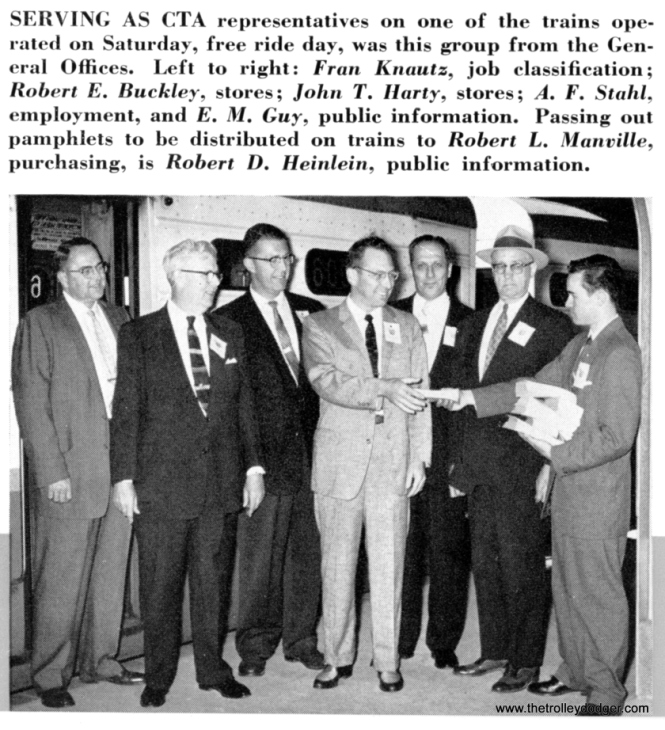
On June 21, 1958, the Chicago Transit Authority offered free rides between Halsted Street and Cicero Avenue on its new rapid transit line in the median of the Congress (now Eisenhower) expressway. Robert Heinlein, then 20 years old, was working in the Public Information department and helps pass out literature. The new line opened the next day, replacing the Garfield Park "L". This picture appeared in the July 1958 issue of the CTA Transit News, an employee publication.

On June 21, 1958, the Chicago Transit Authority offered free rides between Halsted Street and Cicero Avenue on its new rapid transit line in the median of the Congress (now Eisenhower) expressway. Robert Heinlein, then 20 years old, was working in the Public Information department and helps pass out literature. The new line opened the next day, replacing the Garfield Park “L”. This picture appeared in the July 1958 issue of the CTA Transit News, an employee publication.

CTA 7163 is southbound at Clark, Halsted, and Barry in July 1957. A version of this photo, taken from a duplicate slide, appears on page 170 of B-146, mistakenly credited to Charles L. Tauscher. (Robert Heinlein Photo)

CTA 7163 is southbound at Clark, Halsted, and Barry in July 1957. A version of this photo, taken from a duplicate slide, appears on page 170 of B-146, mistakenly credited to Charles L. Tauscher. (Robert Heinlein Photo)

CTA 7162 is southbound on Clark Street at LaSalle Drive in September 1957. A version of this photo, taken from a duplicate slide, appears on page 177 of B-146, mistakenly credited to Charles L. Tauscher. (Robert Heinlein Photo)

CTA 7162 is southbound on Clark Street at LaSalle Drive in September 1957. A version of this photo, taken from a duplicate slide, appears on page 177 of B-146, mistakenly credited to Charles L. Tauscher. (Robert Heinlein Photo)

CTA 7171 is northbound on Clark Street, passing Wrigley Field. (Robert Heinlein Photo)

CTA 7171 is northbound on Clark Street, passing Wrigley Field. (Robert Heinlein Photo)

CTA 7138 at Schreiber and Ravenswood, near Devon Station. (Robert Heinlein Photo)

CTA 7138 at Schreiber and Ravenswood, near Devon Station. (Robert Heinlein Photo)

CTA 7192 at Kinzie and Dearborn in 1957. The yellow car behind the PCC, while commonly considered a Packard, is technically a 1956 Clipper Constellation hardtop, made by the Studebaker-Packard Corporation. (Robert Heinlein Photo)

CTA 7192 at Kinzie and Dearborn in 1957. The yellow car behind the PCC, while commonly considered a Packard, is technically a 1956 Clipper Constellation hardtop, made by the Studebaker-Packard Corporation. (Robert Heinlein Photo)

CTA 7193 is northbound on Clark, just north of Ridge, at around 5961 N. Clark in July 1957. A version of this image, taken from a duplicate slide, was incorrectly credited to Charles L. Tauscher on page 158 of B-146. (Robert Heinlein Photo)

CTA 7193 is northbound on Clark, just north of Ridge, at around 5961 N. Clark in July 1957. A version of this image, taken from a duplicate slide, was incorrectly credited to Charles L. Tauscher on page 158 of B-146. (Robert Heinlein Photo)

CTA 7151 is southbound at Clark Street and Chicago Avenue, passing by what is now the former Cosmopolitan Bank Building, designed by the firm of Schmidt, Garden & Martin and built in 1920. The northern portion of the building was a 1930 addition, and was redone in 1995, in a style matching the original portion. (Robert Heinlein Photo)

CTA 7151 is southbound at Clark Street and Chicago Avenue, passing by what is now the former Cosmopolitan Bank Building, designed by the firm of Schmidt, Garden & Martin and built in 1920. The northern portion of the building was a 1930 addition, and was redone in 1995, in a style matching the original portion. (Robert Heinlein Photo)

CTA 7180 is southbound on Clark Street, passing by the coal company that was once located next to Wrigley Field. You get a good view of the Milwaukee Road freight tracks, since abandoned, that headed north of here. This was once part of a line that offered commuter rail service on the north side. The portion north of Wilson Avenue was taken over by the "L" in the early 1900s. Originally known as the Evanston Extension, it was gradually elevated as well. (Robert Heinlein Photo)

CTA 7180 is southbound on Clark Street, passing by the coal company that was once located next to Wrigley Field. You get a good view of the Milwaukee Road freight tracks, since abandoned, that headed north of here. This was once part of a line that offered commuter rail service on the north side. The portion north of Wilson Avenue was taken over by the “L” in the early 1900s. Originally known as the Evanston Extension, it was gradually elevated as well. (Robert Heinlein Photo)

CTA 7214 heads south on Route 22 - Clark-Wentworth. Since the Cubs were in the middle of a home stand, the date may very well have been September 4, 1957. The Cubbies would lose two of their three next games to the Cincinnati Redlegs ("Reds" was apparently too sensitive a name politically then) on their way to finishing the season with a record of 62 wins, 92 losses, and 2 ties. (Robert Heinlein Photo)

CTA 7214 heads south on Route 22 – Clark-Wentworth. Since the Cubs were in the middle of a home stand, the date may very well have been September 4, 1957. The Cubbies would lose two of their three next games to the Cincinnati Redlegs (“Reds” was apparently too sensitive a name politically then) on their way to finishing the season with a record of 62 wins, 92 losses, and 2 ties. (Robert Heinlein Photo)

CTA 7191 passing by Wrigley Field. (Robert Heinlein Photo)

CTA 7191 passing by Wrigley Field. (Robert Heinlein Photo)

CTA 7189 is southbound on Clark Street just south of Irving Park Road in July 1957. The Wunders Cemetery is at right. A version of this image, taken from a duplicate slide, appears on page 165 of B-146, where it is incorrectly attributed to Charles L. Tauscher. (Robert Heinlein Photo)

CTA 7189 is southbound on Clark Street just south of Irving Park Road in July 1957. The Wunders Cemetery is at right. A version of this image, taken from a duplicate slide, appears on page 165 of B-146, where it is incorrectly attributed to Charles L. Tauscher. (Robert Heinlein Photo)

CTA 7190 at Clark and Seminary by Wrigley Field in July 1957. The "coke" advertised here wasn't Coca-Cola, but coal, used for heating homes and businesses then, but phased out soon afterwards. A version of this image, taken from a duplicate slide, appears on page 167 of B-146, incorrectly attributed to Charles L. Tauscher. (Robert Heinlein Photo)

CTA 7190 at Clark and Seminary by Wrigley Field in July 1957. The “coke” advertised here wasn’t Coca-Cola, but coal, used for heating homes and businesses then, but phased out soon afterwards. A version of this image, taken from a duplicate slide, appears on page 167 of B-146, incorrectly attributed to Charles L. Tauscher. (Robert Heinlein Photo)

CTA 7178 heads south on Clark Street near Wrigley Field in September 1957. The Milwaukee Road railroad tracks running by the ballpark were used for freight and connected with the CTA "L" just north of Irving Park Road. A version of this image, taken from a duplicate slide, appears on page 166 of B-146, where it is incorrectly attributed to Charles L. Tauscher. (Robert Heinlein Photo)

CTA 7178 heads south on Clark Street near Wrigley Field in September 1957. The Milwaukee Road railroad tracks running by the ballpark were used for freight and connected with the CTA “L” just north of Irving Park Road. A version of this image, taken from a duplicate slide, appears on page 166 of B-146, where it is incorrectly attributed to Charles L. Tauscher. (Robert Heinlein Photo)

CTA 7190 heads south on State Street, crossing the Chicago River. Work on the new Chicago Sun-Times building is well underway. It opened in 1958. The following years, Field Enterprises bought the Daily News, and this building became its headquarters as well. It is now the site of the Trump International Hotel and Tower. (Robert Heinlein Photo)

CTA 7190 heads south on State Street, crossing the Chicago River. Work on the new Chicago Sun-Times building is well underway. It opened in 1958. The following years, Field Enterprises bought the Daily News, and this building became its headquarters as well. It is now the site of the Trump International Hotel and Tower. (Robert Heinlein Photo)

CTA 7200 is turning south from Devon onto Broadway in 1957. (Robert Heinlein Photo)

CTA 7200 is turning south from Devon onto Broadway in 1957. (Robert Heinlein Photo)

In September 1957, CTA PCCs 7220 and 7211 pass each other on Clark Street at Delaware near the Newberry Library and Washington Square Park, also known locally as "Bughouse Square." A version of this image, taken from a duplicate slide, appears on page 181 of B-146, mistakenly attributed to Charles L. Tauscher. (Robert Heinlein Photo)

In September 1957, CTA PCCs 7220 and 7211 pass each other on Clark Street at Delaware near the Newberry Library and Washington Square Park, also known locally as “Bughouse Square.” A version of this image, taken from a duplicate slide, appears on page 181 of B-146, mistakenly attributed to Charles L. Tauscher. (Robert Heinlein Photo)

CTA 7156 heads south on Broadway at Lawrence in Uptown on February 15, 1957, the last day of streetcar service on Broadway. The film Giant, starring James Dean, Rock Hudson, and Elizabeth Taylor, opened in the US on November 24, 1956, and was playing at the Uptown. You can see the Green Mill lounge a bit south of the Uptown. The Riviera Theater would be just out of view to the left here. A version of this image, taken from a duplicate slide, appears on page 244 of B-146, mistakenly credited to Charles L. Tauscher. (Robert Heinlein Photo)

CTA 7156 heads south on Broadway at Lawrence in Uptown on February 15, 1957, the last day of streetcar service on Broadway. The film Giant, starring James Dean, Rock Hudson, and Elizabeth Taylor, opened in the US on November 24, 1956, and was playing at the Uptown. You can see the Green Mill lounge a bit south of the Uptown. The Riviera Theater would be just out of view to the left here. A version of this image, taken from a duplicate slide, appears on page 244 of B-146, mistakenly credited to Charles L. Tauscher. (Robert Heinlein Photo)

CTA 7164 is northbound on Clark at Addison in July 1957, crossing the Milwaukee Road tracks near Wrigley Field. A version of this photo, taken from a duplicate slide, appears on page 166 of B-146, incorrectly attributed to Charles L. Tauscher. (Robert Heinlein Photo)

CTA 7164 is northbound on Clark at Addison in July 1957, crossing the Milwaukee Road tracks near Wrigley Field. A version of this photo, taken from a duplicate slide, appears on page 166 of B-146, incorrectly attributed to Charles L. Tauscher. (Robert Heinlein Photo)

CTA 7222 by Wrigley Field (Clark and Addison) in July 1957. This picture appears twice in CERA B-146, on the cover and on pages 134 and 167, taken from a duplicate slide. On page 167, it is incorrectly attributed to Charles L. Tauscher. This is the original Red Border Kodachrome. (Robert Heinlein Photo)

CTA 7222 by Wrigley Field (Clark and Addison) in July 1957. This picture appears twice in CERA B-146, on the cover and on pages 134 and 167, taken from a duplicate slide. On page 167, it is incorrectly attributed to Charles L. Tauscher. This is the original Red Border Kodachrome. (Robert Heinlein Photo)

CTA 7149, signed for Clark and Schreiber (Devon Station). Note that the route number is 22 with a red slash through it. (Robert Heinlein Photo)

CTA 7149, signed for Clark and Schreiber (Devon Station). Note that the route number is 22 with a red slash through it. (Robert Heinlein Photo)

CTA 7211, still in its original paint scheme, heads south at Clark Street and Irving Park Road in September 1957, near the entrance to Graceland Cemetery. A version of this image, taken from a duplicate slide, appears on page 164 of B-146, where it was incorrectly attributed to Charles L. Tauscher. (Robert Heinlein Photo)

CTA 7211, still in its original paint scheme, heads south at Clark Street and Irving Park Road in September 1957, near the entrance to Graceland Cemetery. A version of this image, taken from a duplicate slide, appears on page 164 of B-146, where it was incorrectly attributed to Charles L. Tauscher. (Robert Heinlein Photo)

In September 1957, CTA 7160 passes by the Rainbo building at left, located in the 4800 block of north Clark Street. A skating rink opened there that year. To the right, you see St. Boniface Catholic Cemetery. We are looking north. A version of this image, taken from a duplicate slide, appears on page 162 of B-146, where it was incorrectly credited to Charles L. Tauscher. (Robert Heinlein Photo)

In September 1957, CTA 7160 passes by the Rainbo building at left, located in the 4800 block of north Clark Street. A skating rink opened there that year. To the right, you see St. Boniface Catholic Cemetery. We are looking north. A version of this image, taken from a duplicate slide, appears on page 162 of B-146, where it was incorrectly credited to Charles L. Tauscher. (Robert Heinlein Photo)

Although signed for the south portion of Route 36, which was replaced by buses in December 1955, PCC 4406 is actually on Clark and 16th Streets. Since 4406 was used (along with red car 225) on a fantrip on October 21, 1956, my guess is this picture was taken on that day. It was common practice to put incorrect signs up on trips, although on most of the pictures I have seen from that trip, it says "Chartered." (Robert Heinlein Photo)

Although signed for the south portion of Route 36, which was replaced by buses in December 1955, PCC 4406 is actually on Clark and 16th Streets. Since 4406 was used (along with red car 225) on a fantrip on October 21, 1956, my guess is this picture was taken on that day. It was common practice to put incorrect signs up on trips, although on most of the pictures I have seen from that trip, it says “Chartered.” (Robert Heinlein Photo)

Wouldn't you just know it? Without even realizing it I am sure, someone walked right into Bob Heinlein's shot in this September 1957 view of CTA PCC 4390 (which would end up being one of the last cars used in June 1958). What to do, but wait for another car to come along, and take another picture (see Heinlein008).

Wouldn’t you just know it? Without even realizing it I am sure, someone walked right into Bob Heinlein’s shot in this September 1957 view of CTA PCC 4390 (which would end up being one of the last cars used in June 1958). What to do, but wait for another car to come along, and take another picture (see Heinlein008).

Chicago Aurora and Elgin cars 413 and 453 are looping at the DesPlaines Avenue Terminal, sometime between 1953 and 1957. (Robert Heinlein Photo)

Chicago Aurora and Elgin cars 413 and 453 are looping at the DesPlaines Avenue Terminal, sometime between 1953 and 1957. (Robert Heinlein Photo)

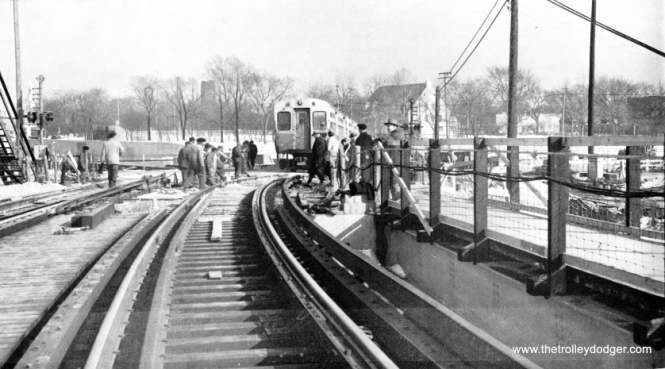
We are looking west from the Wells Street Terminal towards the dual bridges over the Chicago River. (Robert Heinlein Collection)

We are looking west from the Wells Street Terminal towards the dual bridges over the Chicago River. (Robert Heinlein Collection)

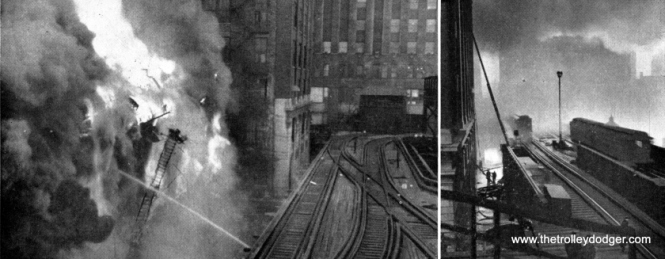
Trackwork near the Met bridge was somewhat complex. Tracks to the right fanned out, leading to the Wells Street Terminal. The tracks at left connected to the Loop "L" via Van Buren Street. (Robert Heinlein Collection)

Trackwork near the Met bridge was somewhat complex. Tracks to the right fanned out, leading to the Wells Street Terminal. The tracks at left connected to the Loop “L” via Van Buren Street. (Robert Heinlein Collection)

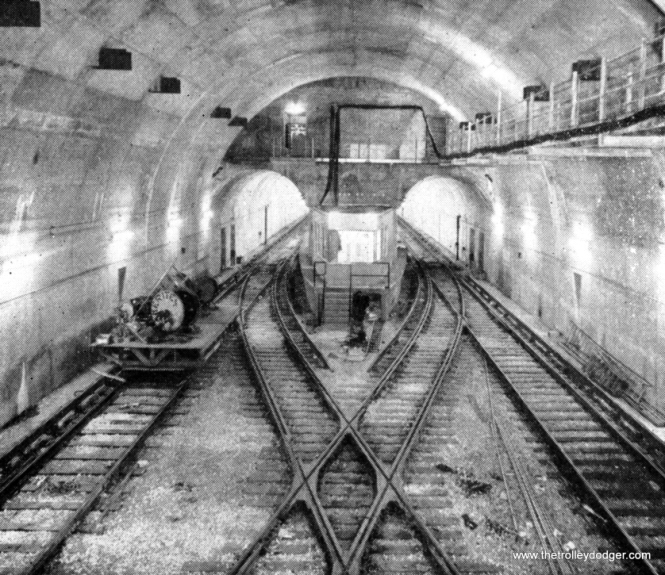
This is the only photo I have seen that shows the interior of the Met bridge interlocking tower. (Robert Heinlein Collection)

This is the only photo I have seen that shows the interior of the Met bridge interlocking tower. (Robert Heinlein Collection)

This was scanned from an original North Shore Line 8x10" nitrate negative, taken circa 1930. Determining the location presented many challenges, yet this has now been determined with the aid of other fans. The car is 714, and it is signed as a Chicago Local on the Shore Line Route. Since the North Shore tracks are not adjacent to the Chicago and North Western, we must be north of North Chicago Junction. We cannot be south of Highland Park, as there is freight present here. A sign on the high-level platform indicates that freight trains have to come to a stop, most likely to make sure part of the platform gets flipped up for the sake of clearances. A similar arrangement existed at high-level stations of the Chicago Aurora and Elgin. As all the Shore Line tracks in Waukegan ran on the street, that pretty much narrows it down to North Chicago. The Thomas J. Killian Plumbing Supply company building at left clinches it, and the location is between 16th and 17th Streets, looking north. The Chicago and North Western's tracks were a short distance east of here, to the right out of view of this photo. (Robert Heinlein Collection)

This was scanned from an original North Shore Line 8×10″ nitrate negative, taken circa 1930. Determining the location presented many challenges, yet this has now been determined with the aid of other fans. The car is 714, and it is signed as a Chicago Local on the Shore Line Route. Since the North Shore tracks are not adjacent to the Chicago and North Western, we must be north of North Chicago Junction. We cannot be south of Highland Park, as there is freight present here. A sign on the high-level platform indicates that freight trains have to come to a stop, most likely to make sure part of the platform gets flipped up for the sake of clearances. A similar arrangement existed at high-level stations of the Chicago Aurora and Elgin. As all the Shore Line tracks in Waukegan ran on the street, that pretty much narrows it down to North Chicago. The Thomas J. Killian Plumbing Supply company building at left clinches it, and the location is between 16th and 17th Streets, looking north. The Chicago and North Western’s tracks were a short distance east of here, to the right out of view of this photo. (Robert Heinlein Collection)

This was also scanned from an original North Shore Line 8x10" nitrate negative, taken at the same time as the previous photo and shows a slightly different view of the same scene. (Robert Heinlein Collection)

This was also scanned from an original North Shore Line 8×10″ nitrate negative, taken at the same time as the previous photo and shows a slightly different view of the same scene. (Robert Heinlein Collection)

The North Shore Line grade crossing at Taylor Avenue in Racine, WI on December 16, 1931. You can see the shadow of the photographer, his view camera, and an assistant. This was scanned from the original 8x10" negative. (NSL Photo, Robert D. Heinlein Collection)

The North Shore Line grade crossing at Taylor Avenue in Racine, WI on December 16, 1931. You can see the shadow of the photographer, his view camera, and an assistant. This was scanned from the original 8×10″ negative. (NSL Photo, Robert D. Heinlein Collection)

The view of the North Shore Line tracks, looking south towards 21st Street in Racine, WI on March 11, 1930. Scanned from the original 8x10" negative. (NSL Photo, Robert D. Heinlein Collection)

The view of the North Shore Line tracks, looking south towards 21st Street in Racine, WI on March 11, 1930. Scanned from the original 8×10″ negative. (NSL Photo, Robert D. Heinlein Collection)

A view of the North Shore Line tracks looking north along the Skokie Valley Route near 16th Street in North Chicago on March 22, 1934. Scanned from the original 8x10" negative. (NSL Photo, Robert D. Heinlein Collection)

A view of the North Shore Line tracks looking north along the Skokie Valley Route near 16th Street in North Chicago on March 22, 1934. Scanned from the original 8×10″ negative. (NSL Photo, Robert D. Heinlein Collection)

The number 4391, in railfan circles, is most widely known as that of the only surviving postwar Chicago PCC streetcar. But this is a different 4391, namely a Chicago Rapid Transit Company "L" car, built circa 1923-24. We see the interior, complete with ads for Kellogg's Corn Flakes and Bayer Aspirin, as it looked on May 27, 1937. Scanned from the original 8x10" negative. (CRT Photo, Robert D. Heinlein Collection)

The number 4391, in railfan circles, is most widely known as that of the only surviving postwar Chicago PCC streetcar. But this is a different 4391, namely a Chicago Rapid Transit Company “L” car, built circa 1923-24. We see the interior, complete with ads for Kellogg’s Corn Flakes and Bayer Aspirin, as it looked on May 27, 1937. Scanned from the original 8×10″ negative. (CRT Photo, Robert D. Heinlein Collection)

The view looking northeast along Lawrence Avenue (4800 N.) at Kimball Avenue (3400 W.) on January 28, 1929, in the Albany Park neighborhood. The Chicago Rapid Transit Company's Ravenswood "L" Terminal is at right. The Terminal Theater, seen in the distance, was located at 3315 W. Lawrence, and had 2,389 seats. Presumably it took its name from the nearby "L" terminal. It was built by the Ascher Brothers chain and opened on January 7, 1926. It eventually became part of the Balaban and Katz chain, and closed on April 18, 1963. It was also known as the New Terminal, as it had replaced a smaller Terminal Theater nearby, built in 1915. Scanned from the original 8x10" negative. (CRT Photo, Robert D. Heinlein collection)

The view looking northeast along Lawrence Avenue (4800 N.) at Kimball Avenue (3400 W.) on January 28, 1929, in the Albany Park neighborhood. The Chicago Rapid Transit Company’s Ravenswood “L” Terminal is at right. The Terminal Theater, seen in the distance, was located at 3315 W. Lawrence, and had 2,389 seats. Presumably it took its name from the nearby “L” terminal. It was built by the Ascher Brothers chain and opened on January 7, 1926. It eventually became part of the Balaban and Katz chain, and closed on April 18, 1963. It was also known as the New Terminal, as it had replaced a smaller Terminal Theater nearby, built in 1915. Scanned from the original 8×10″ negative. (CRT Photo, Robert D. Heinlein collection)

It's not clear exactly where this early 1900s photo was taken, but Greenwood, Franklin, Edinburgh, Columbus, and Seymour are all Indiana communities, located south of Indianapolis. Presumably the interurban shown was the Indiana Public Service, a predecessor of the Indiana Railroad, formed by Samuel Insull in 1930, combining five electric railways. (Robert D. Heinlein Collection)

It’s not clear exactly where this early 1900s photo was taken, but Greenwood, Franklin, Edinburgh, Columbus, and Seymour are all Indiana communities, located south of Indianapolis. Presumably the interurban shown was the Indiana Public Service, a predecessor of the Indiana Railroad, formed by Samuel Insull in 1930, combining five electric railways. (Robert D. Heinlein Collection)

North Shore Line coach 178 at the Highwood Shops in the mid-1950s. (Robert D. Heinlein Photo)

North Shore Line coach 178 at the Highwood Shops in the mid-1950s. (Robert D. Heinlein Photo)

North Shore Line car 169 is northbound at the Wilmette station in the early-to-mid 1950s. This is now the site of a Panera parking lot. (Robert D. Heinlein Photo)

North Shore Line car 169 is northbound at the Wilmette station in the early-to-mid 1950s. This is now the site of a Panera parking lot. (Robert D. Heinlein Photo)

North Shore Line cars 154, 190, and 155 are stopped by the Lake Forest station on July 24, 1955. This was a Central Electric Railfans' Association fantrip just prior to the abandonment of the Shore Line Route. (Robert D. Heinlein Photo)

North Shore Line cars 154, 190, and 155 are stopped by the Lake Forest station on July 24, 1955. This was a Central Electric Railfans’ Association fantrip just prior to the abandonment of the Shore Line Route. (Robert D. Heinlein Photo)

This, and the following photo, were taken at the Mundelein Terminal in December 1960, showing different views of a two-car Skokie Valley Route train with 701 and 719. (Robert D. Heinlein Collection)

This, and the following photo, were taken at the Mundelein Terminal in December 1960, showing different views of a two-car Skokie Valley Route train with 701 and 719. (Robert D. Heinlein Collection)

A northbound two-car North Shore Line train at Kenosha, WI in December 1960. (Robert D. Heinlein Collection)

A northbound two-car North Shore Line train at Kenosha, WI in December 1960. (Robert D. Heinlein Collection)

North Shore Line 724 heads up a two-car train at 5th Street and Harrison Avenue in Milwaukee on September 24, 1961. (Robert D. Heinlein Photo)

North Shore Line 724 heads up a two-car train at 5th Street and Harrison Avenue in Milwaukee on September 24, 1961. (Robert D. Heinlein Photo)

North Shore Line 772 is a southbound Chicago Express on June 9, 1955, on a short stretch of street running in Highland Park. Service on the Shore Line Route would end about six weeks later. (Robert D. Heinlein Photo)

North Shore Line 772 is a southbound Chicago Express on June 9, 1955, on a short stretch of street running in Highland Park. Service on the Shore Line Route would end about six weeks later. (Robert D. Heinlein Photo)

On July 10, 1955, North Shore Line car 409 is at the north end of the Shore Line Route, on the border between North Chicago and Waukegan. This car is now at the Illinois Railway Museum. Service on the Shore Line Route ended about two weeks after this picture was taken. (Robert D. Heinlein Photo)

On July 10, 1955, North Shore Line car 409 is at the north end of the Shore Line Route, on the border between North Chicago and Waukegan. This car is now at the Illinois Railway Museum. Service on the Shore Line Route ended about two weeks after this picture was taken. (Robert D. Heinlein Photo)

Family was very important to Robert Heinlein, and often accompanied him on his railroad excursions. Here, his young daughter Donna poses for him on a North Shore coach at the Mundelein Terminal on December 1, 1962.

Family was very important to Robert Heinlein, and often accompanied him on his railroad excursions. Here, his young daughter Donna poses for him on a North Shore coach at the Mundelein Terminal on December 1, 1962.

Although this photo has motion blur, it does help identify the location of the next picture, taken right after it. North Shore car 163 is at the front of a two-car train in Kenilworth, about a block north of the historic fountain designed by George W. Maher. It is leaving street running and entering private right-of-way where it will run parallel to the Chicago and North Western. (Robert D. Heinlein Photos)

Although this photo has motion blur, it does help identify the location of the next picture, taken right after it. North Shore car 163 is at the front of a two-car train in Kenilworth, about a block north of the historic fountain designed by George W. Maher. It is leaving street running and entering private right-of-way where it will run parallel to the Chicago and North Western. (Robert D. Heinlein Photos)

North Shore Line Silverliner 756 is on the Skokie Valley Route, but where? The Kutten Oil Company was located at 3510 Wilmette Avenue in Wilmette, near Glenview. Robert D. Heinlein took this picture on September 1, 1958.

North Shore Line Silverliner 756 is on the Skokie Valley Route, but where? The Kutten Oil Company was located at 3510 Wilmette Avenue in Wilmette, near Glenview. Robert D. Heinlein took this picture on September 1, 1958.

Knollwood was a stop along the Libertyville-Mundelein branch, named for a nearby farm. This is in an unincorporated area of Lake County, just west of Lake Bluff, at the intersection of Waukegan Road and Rockland Road. The train, which includes car 712, is heading east. The popular Silo restaurant is not too far east of here in Lake Bluff. Photographer Robert D. Heinlein captured this view on June 17, 1962.

Knollwood was a stop along the Libertyville-Mundelein branch, named for a nearby farm. This is in an unincorporated area of Lake County, just west of Lake Bluff, at the intersection of Waukegan Road and Rockland Road. The train, which includes car 712, is heading east. The popular Silo restaurant is not too far east of here in Lake Bluff. Photographer Robert D. Heinlein captured this view on June 17, 1962.

The same location today.

The same location today.

This slide was taken early in the morning, and had to be lightened considerably. It was dated January 21, 1963 on the mount, but may actually have been taken on the 20th (the film was not processed until the following month). As such it was one of the final opportunities to shoot an Electroliner at the Milwaukee Terminal, which prompted one fan to jump into the inspection pit for his shot. (Robert D. Heinlein Photo)

This slide was taken early in the morning, and had to be lightened considerably. It was dated January 21, 1963 on the mount, but may actually have been taken on the 20th (the film was not processed until the following month). As such it was one of the final opportunities to shoot an Electroliner at the Milwaukee Terminal, which prompted one fan to jump into the inspection pit for his shot. (Robert D. Heinlein Photo)

This slide, showing a southbound North Shore Line Electroliner at speed, was marked as having been taken January 21, 1963 at Washington Street in Waukegan. That would place it after the abandonment the night before, but it seems likely to have been taken on the last full day prior to the shutdown, January 20th. Research shows the two Electroliners were moved back to the Highwood Shops one last time at night. Since this roll of film was not developed until the following month, the date was stamped on the slide mount some time after the fact. (Robert D. Heinlein Photo)

This slide, showing a southbound North Shore Line Electroliner at speed, was marked as having been taken January 21, 1963 at Washington Street in Waukegan. That would place it after the abandonment the night before, but it seems likely to have been taken on the last full day prior to the shutdown, January 20th. Research shows the two Electroliners were moved back to the Highwood Shops one last time at night. Since this roll of film was not developed until the following month, the date was stamped on the slide mount some time after the fact. (Robert D. Heinlein Photo)

North Shore Line 747 is at the head of a train at Lake Bluff, signed as a Skokie Valley Route Chicago Limited. This slide was marked January 21, 1963, but is more likely to have been taken the day before. (Robert D. Heinlein Photo)

North Shore Line 747 is at the head of a train at Lake Bluff, signed as a Skokie Valley Route Chicago Limited. This slide was marked January 21, 1963, but is more likely to have been taken the day before. (Robert D. Heinlein Photo)

Illinois Terminal car 285 is on the last trip at Champaign, IL on June 11, 1955. Don's Rail Photos (via Archive.org): "285 was built by St Louis Car in 1914. It was rebuilt as a parlor car in 1924 and restored as a coach in December 1928. It was air conditioned in August 1938 and (received) new seating in December 1952. It was sold for scrap to Hyman Michaels Co. on May 16, 1956." (John F. Humiston Photo, Robert D. Heinlein Collection)

Illinois Terminal car 285 is on the last trip at Champaign, IL on June 11, 1955. Don’s Rail Photos (via Archive.org): “285 was built by St Louis Car in 1914. It was rebuilt as a parlor car in 1924 and restored as a coach in December 1928. It was air conditioned in August 1938 and (received) new seating in December 1952. It was sold for scrap to Hyman Michaels Co. on May 16, 1956.” (John F. Humiston Photo, Robert D. Heinlein Collection)

Illinois Terminal 285 is at Cerro Gordo, IL on its last trip prior to abandonment of this interurban route on June 11, 1955. For the occasion, locals dressed up in turn-of-the-century costumes. Some of the riders may have been old enough to remember when interurban service began here. (John F. Humiston Photo, Robert Heinlein Collection)

Illinois Terminal 285 is at Cerro Gordo, IL on its last trip prior to abandonment of this interurban route on June 11, 1955. For the occasion, locals dressed up in turn-of-the-century costumes. Some of the riders may have been old enough to remember when interurban service began here. (John F. Humiston Photo, Robert Heinlein Collection)

Illinois Terminal 285 is at Champaign, IL on its last trip on June 11, 1955. (John F. Humiston Photo, Robert Heinlein Collection)

Illinois Terminal 285 is at Champaign, IL on its last trip on June 11, 1955. (John F. Humiston Photo, Robert Heinlein Collection)

This and the next picture: The Elgin and Belvidere Electric Company interurban operated from 1907 to 1930, connecting those two cities. It was extended to Rockford in 1927 but fell victim to the Great Depression and the rise of the automobile. When the Illinois Railway Museum (originally based in North Chicago) needed a new home in the early 1960s, they based their new main line on this former interurban right-of-way (and were able to purchase most, but not all of it by paying the back taxes). Amazingly, one of the original Elgin and Belvidere motormen lived long enough to operate a trolley at IRM. (Robert D. Heinlein Collection)

This and the next picture: The Elgin and Belvidere Electric Company interurban operated from 1907 to 1930, connecting those two cities. It was extended to Rockford in 1927 but fell victim to the Great Depression and the rise of the automobile. When the Illinois Railway Museum (originally based in North Chicago) needed a new home in the early 1960s, they based their new main line on this former interurban right-of-way (and were able to purchase most, but not all of it by paying the back taxes). Amazingly, one of the original Elgin and Belvidere motormen lived long enough to operate a trolley at IRM. (Robert D. Heinlein Collection)

Work is underway erecting trolley poles at the Illinois Railway Museum site in Union. The time frame here could date from the mid-1960s to the early 1970s. (Robert D. Heinlein Photo)

Work is underway erecting trolley poles at the Illinois Railway Museum site in Union. The time frame here could date from the mid-1960s to the early 1970s. (Robert D. Heinlein Photo)

Former North Shore Line line car 604 at work one wintry day at the Illinois Railway Museum. (Robert D. Heinlein Photo)

Former North Shore Line line car 604 at work one wintry day at the Illinois Railway Museum. (Robert D. Heinlein Photo)

Indiana Railroad high-speed lightweight interurban car 65 at the Illinois Railway Museum. (Robert D. Heinlein Photo)

Indiana Railroad high-speed lightweight interurban car 65 at the Illinois Railway Museum. (Robert D. Heinlein Photo)

Two trains running at the Illinois Railway Museum, circa 1971. At left, North Shore Line cars 160 and 714. The steam loco at right is labeled Tuskegee, but I am not sure if this is the Tuskegee Railroad 101 in the museum's collection. (Robert D. Heinlein Photo)

Two trains running at the Illinois Railway Museum, circa 1971. At left, North Shore Line cars 160 and 714. The steam loco at right is labeled Tuskegee, but I am not sure if this is the Tuskegee Railroad 101 in the museum’s collection. (Robert D. Heinlein Photo)

Bob Heinlein and his brother Don at East Troy in May 2022.

Bob Heinlein and his brother Don at East Troy in May 2022.

Our Latest Book, Now Available:

The North Shore Line

FYI, my new Arcadia Publishing book The North Shore Line is now available for immediate shipment. My publisher decided to expand it to 160 pages, instead of the usual 128. That’s a 25% increase, without any change to the $23.99 price. I am quite pleased with how this turned out.

From the back cover:

As late as 1963, it was possible to board high-speed electric trains on Chicago’s famous Loop “L” that ran 90 miles north to Milwaukee. This was the Chicago North Shore & Milwaukee Railroad, commonly known as the North Shore Line. It rose from humble origins in the 1890s as a local streetcar line in Waukegan to eventually become America’s fastest interurban under the visionary management of Midwest utilities tycoon Samuel Insull. The North Shore Line, under Insull, became a worthy competitor to the established steam railroads. Hobbled by the Great Depression, the road fought back in 1941 with two streamlined, air-conditioned, articulated trains called Electroliners, which included dining service. It regained its popularity during World War II, when gasoline and tires were rationed, but eventually, it fell victim to highways and the automobile. The North Shore Line had intercity rail, commuter rail, electric freight, city streetcars, and even buses. It has been gone for nearly 60 years, but it will always remain the Road of Service.

Each copy purchased here will be signed by the author, and you will also receive a bonus North Shore Line map.  Books will ship by USPS Media Mail.

Chapters:
01. Beginnings
02. The Milwaukee Division
03. The Shore Line Route
04. The Skokie Valley Route
05. The Mundelein Branch
06. On the “L”
07. City Streetcars
08. Trolley Freight
09. The Long Goodbye
10. The Legacy

Title The North Shore Line
Images of America
Author David Sadowski
Edition illustrated
Publisher Arcadia Publishing (SC), 2023
ISBN 1467108960, 978-1467108966
Length 160 pages

The price of $23.99 includes shipping within the United States.

For Shipping to US Addresses:

New Compact Disc, Now Available:

CTA-1
The Last Chicago Streetcars 1958
# of Discs – 1
Price: $15.99

Until now, it seemed as though audio recordings of Chicago streetcars were practically non-existent. For whatever reason, the late William A. Steventon does not appear to have made any for his Railroad Record Club, even though he did make other recordings in the Chicago area in 1956.

Now, audio recordings of the last runs of Chicago streetcars have been found, in the collections of the late Jeffrey L. Wien (who was one of the riders on that last car). We do not know who made these recordings, but this must have been done using a portable reel-to-reel machine.

These important recordings will finally fill a gap in transit history. The last Chicago Transit Authority streetcar finished its run in the early hours of June 21, 1958. Now you can experience these events just as Chicagoans did.

As a bonus, we have included Keeping Pace, a 1939 Chicago Surface Lines employee training program. This was digitally transferred from an original 16” transcription disc. These recordings were unheard for 80 years.

Total time – 74:38

Help Support The Trolley Dodger

This is our 299th post, and we are gradually creating a body of work and an online resource for the benefit of all railfans, everywhere. To date, we have received over 983,000 page views, for which we are very grateful.

You can help us continue our original transit research by checking out the fine products in our Online Store.
As we have said before, “If you buy here, we will be here.”

We thank you for your support.

DONATIONS

In order to continue giving you the kinds of historic railroad images that you have come to expect from The Trolley Dodger, we need your help and support. It costs money to maintain this website, and to do the sort of historic research that is our specialty.

Your financial contributions help make this web site better, and are greatly appreciated.


Back in Business

North Shore Line cars 155, 190, and 154 are stopped by the historic Kenilworth fountain on July 24, 1955. The occasion was a Central Electric Railfans' Association fantrip just prior to the abandonment of the Shore Line Route. A similar picture, taken by Ray DeGroote, is in my book The North Shore Line.

North Shore Line cars 155, 190, and 154 are stopped by the historic Kenilworth fountain on July 24, 1955. The occasion was a Central Electric Railfans’ Association fantrip just prior to the abandonment of the Shore Line Route. A similar picture, taken by Ray DeGroote, is in my book The North Shore Line.

While this is our first new post in nearly three months, we have been hard at work this entire time. Since January 21st we took delivery on our new book The North Shore Line (see below), and shipped out over 200 copies to our purchasers and contributors. The book has been very well received by our readers.

We also gave a presentation on March 8th at the Schaumburg Township Public Library for our 2021 book Chicago’s Lost “L”s.  This was a “hybrid” (in-person and on Zoom) program, but it was not recorded.

FYI, I will be giving a presentation on Monday, April 17th at the Libertyville Historical Society for my new book The North Shore Line. This is a “hybrid” program (both in person and on Zoom). More information here.

Three days later, on April 20th, I have another presentation scheduled (in Lake Forest) at the History Center Lake Forest-Lake Bluff. This one is in-person only. More information here.

Meanwhile, we have already begun doing research on our next book, which will be about the Chicago Aurora and Elgin interurban. This is a process that we expect will take the rest of this year. More than $2500 has been spent collecting materials for possible use.

Research does take both time and money, and the expenses are ongoing. If you support our efforts, we hope that you will consider making a donation. There are links to do just that in this post.  Any and all contributions are very much appreciated, and we are very thankful for all the help we get from our readers.  We can’t do it without you.

Keep those cards and letters coming in, folks.

-David Sadowski

PS- You might also like our Trolley Dodger Facebook auxiliary, a private group that now has 1,117 members.

Our friend Kenneth Gear now has a Facebook group for the Railroad Record Club. If you enjoy listening to audio recordings of classic railroad trains, whether steam, electric, or diesel, you might consider joining.

FYI, the Hoosier Traction Facebook Group celebrates electric transit in Indiana and the Midwest. It also supports the activities of the annual Hoosier Traction Meet (although not affiliated with the North American Transit Historical Society, which organizes that event).

The Lake Street “L” in Transition

We recently scanned several original slides taken by the late William C. Hoffman, documenting the transition made by the Lake Street “L”. For more than 60 years, the line ran at ground level west of Laramie Avenue (5200 West). On October 28, 1962, it switched to a new alignment on the adjacent Chicago and North Western embankment, where it has remained for more than 60 years.

We previously ran some other pictures showing this transition in our post Elevation (December 5, 2022).

This September 1959 view looks west along South Boulevard in Oak Park, and shows the Marion Street station on the Lake Street "L", when it still ran at ground level west of Laramie Avenue. The "L" was relocated to the adjacent Chicago and North Western embankment in October 1962, and the buildings to the left are gone. The side street (Maple Avenue) shown in the picture has been truncated, and a large high-rise residential building occupies this space now.

This September 1959 view looks west along South Boulevard in Oak Park, and shows the Marion Street station on the Lake Street “L”, when it still ran at ground level west of Laramie Avenue. The “L” was relocated to the adjacent Chicago and North Western embankment in October 1962, and the buildings to the left are gone. The side street (Maple Avenue) shown in the picture has been truncated, and a large high-rise residential building occupies this space now.

The same location today.

The same location today.

William C. Hoffman took this picture from the back end of an "L" train on June 28, 1962 just west of the Laramie station. This offers a good view of the construction work underway at left, preparing the new embankment line which opened on October 28th. He referred to this as the "Laramie Avenue interchange."

William C. Hoffman took this picture from the back end of an “L” train on June 28, 1962 just west of the Laramie station. This offers a good view of the construction work underway at left, preparing the new embankment line which opened on October 28th. He referred to this as the “Laramie Avenue interchange.”

Here, we are looking east toward the Laramie Avenue station on the Lake Street "L" on June 28, 1962. According to photographer William C. Hoffman, the westbound track to the new embankment alignment was tied in on this date, and the first cars ran there.

Here, we are looking east toward the Laramie Avenue station on the Lake Street “L” on June 28, 1962. According to photographer William C. Hoffman, the westbound track to the new embankment alignment was tied in on this date, and the first cars ran there.

A CTA diesel crane and work gondola are on the new connecting track leading to the Chicago and North Western embankment on August 22, 1962. At this time, there was a connection between the "L" and the new alignment via the westbound track, but not the eastbound one. For a time, it was necessary to have connections leading to both the ground-level trackage as well as the embankment, until service was switched over on October 28th. I am not sure when the new connection was made with the eastbound track. (William C. Hoffman Photo)

A CTA diesel crane and work gondola are on the new connecting track leading to the Chicago and North Western embankment on August 22, 1962. At this time, there was a connection between the “L” and the new alignment via the westbound track, but not the eastbound one. For a time, it was necessary to have connections leading to both the ground-level trackage as well as the embankment, until service was switched over on October 28th. I am not sure when the new connection was made with the eastbound track. (William C. Hoffman Photo)

This photo by the late William C. Hoffman was taken on October 28, 1962 at the Central Avenue station on the Lake Street "L", and shows how the transition was made from the ground level operation to the new alignment on the C&NW embankment. Unlike the situation in 1958, when the new Congress rapid transit line and the old Garfield Park "L" both ran on the same day, that was not possible here, due to the tight clearances at the station entrances. The new entrances could not be finished until the old line was torn out. So on October 28, 1962, which was a Sunday, the ceremonies dedicating the new 2.5 mile "L" realignment were held in the morning, and then, until 6 pm, trains only ran as far as Laramie Avenue, where the steel "L" structure ended. While workers put wooden platforms over the old tracks, riders west of Laramie had to take shuttle buses on Lake Street, as the signs here indicate. Passengers still had to enter via the old station entrances for a time.

This photo by the late William C. Hoffman was taken on October 28, 1962 at the Central Avenue station on the Lake Street “L”, and shows how the transition was made from the ground level operation to the new alignment on the C&NW embankment. Unlike the situation in 1958, when the new Congress rapid transit line and the old Garfield Park “L” both ran on the same day, that was not possible here, due to the tight clearances at the station entrances. The new entrances could not be finished until the old line was torn out. So on October 28, 1962, which was a Sunday, the ceremonies dedicating the new 2.5 mile “L” realignment were held in the morning, and then, until 6 pm, trains only ran as far as Laramie Avenue, where the steel “L” structure ended. While workers put wooden platforms over the old tracks, riders west of Laramie had to take shuttle buses on Lake Street, as the signs here indicate. Passengers still had to enter via the old station entrances for a time.

A 6-car eastbound Lake Street "L" test train is on the new embankment on October 28, 1962, shortly before the new service began at 6 pm. Although the photographer did not indicate which station this was, I believe it is Ridgeland Avenue in Oak Park. (William C. Hoffman Photo)

A 6-car eastbound Lake Street “L” test train is on the new embankment on October 28, 1962, shortly before the new service began at 6 pm. Although the photographer did not indicate which station this was, I believe it is Ridgeland Avenue in Oak Park. (William C. Hoffman Photo)

The view looking east along the new Lake Street "L" embankment alignment at Marion Street on October 28, 1962, shortly before service began. A work train heads east. Photographer William C. Hoffman accessed this area via the Chicago and North Western Oak Park commuter train station, as the "L" station wasn't yet open until 6 pm.

The view looking east along the new Lake Street “L” embankment alignment at Marion Street on October 28, 1962, shortly before service began. A work train heads east. Photographer William C. Hoffman accessed this area via the Chicago and North Western Oak Park commuter train station, as the “L” station wasn’t yet open until 6 pm.

A 6-car train of CTA 4000-series "L" cars is heading eastbound near Ridgeland Avenue on the new embankment trackage on October 28, 1962, as the ground-level operation has finally been replaced. (William C. Hoffman Photo)

A 6-car train of CTA 4000-series “L” cars is heading eastbound near Ridgeland Avenue on the new embankment trackage on October 28, 1962, as the ground-level operation has finally been replaced. (William C. Hoffman Photo)

A westbound train of 4000s is on the new Lake Street "L" embankment alignment on November 11, 1962. A track welder's car is on the eastbound track. The photographer notes, "Bub Lindgren on "L" train." (William C. Hoffman Photo)

A westbound train of 4000s is on the new Lake Street “L” embankment alignment on November 11, 1962. A track welder’s car is on the eastbound track. The photographer notes, “Bub Lindgren on “L” train.” (William C. Hoffman Photo)

The view looking east along the old ground-level Lake Street "L" right-of-way at Menard Avenue on November 11, 1962. An eastbound two-car "L" train is on the new alignment on the embankment. (William C. Hoffman Photo)

The view looking east along the old ground-level Lake Street “L” right-of-way at Menard Avenue on November 11, 1962. An eastbound two-car “L” train is on the new alignment on the embankment. (William C. Hoffman Photo)

A 4000-series "L" train is stopped at the Harlem and Lake station on November 11, 1962. Note how there are some transparent portions of the station canopy, to let more light in. (William C. Hoffman Photo)

A 4000-series “L” train is stopped at the Harlem and Lake station on November 11, 1962. Note how there are some transparent portions of the station canopy, to let more light in. (William C. Hoffman Photo)

The view looking west/northwest at Lake and Central on November 11, 1962. Riders still entered the station via a temporary connection to the old ground-level station. (William C. Hoffman Photo)

The view looking west/northwest at Lake and Central on November 11, 1962. Riders still entered the station via a temporary connection to the old ground-level station. (William C. Hoffman Photo)

A westbound Lake Street "L" train has just left the Laramie Avenue station on November 11, 1962. This photo gives a good view of how the tracks were shifted over to connect with the nearby embankment. (William C. Hoffman Photo)

A westbound Lake Street “L” train has just left the Laramie Avenue station on November 11, 1962. This photo gives a good view of how the tracks were shifted over to connect with the nearby embankment. (William C. Hoffman Photo)

The view looking east/northeast along Lake Street (now Corcoran Place) at Austin Boulevard on August 12, 1963. The new station entrance has been finished. (William C. Hoffman Photo)

The view looking east/northeast along Lake Street (now Corcoran Place) at Austin Boulevard on August 12, 1963. The new station entrance has been finished. (William C. Hoffman Photo)

The view east along Mansfield Avenue at Lake Street on August 12, 1963. The old ground level tracks and ties have been removed, while a two-car train of 4000s is on the new embankment alignment. (William C. Hoffman Photo)

The view east along Mansfield Avenue at Lake Street on August 12, 1963. The old ground level tracks and ties have been removed, while a two-car train of 4000s is on the new embankment alignment. (William C. Hoffman Photo)

The view east at Lake and Parkside, showing the auxiliary entrance to the new Central Avenue "L" station on August 12, 1963. By now, the old ground-level tracks have been removed, except at street crossings. (William C. Hoffman Photo)

The view east at Lake and Parkside, showing the auxiliary entrance to the new Central Avenue “L” station on August 12, 1963. By now, the old ground-level tracks have been removed, except at street crossings. (William C. Hoffman Photo)

An eastbound two-car Lake Street "L" train heads east on November 24, 1963, after having left the terminal at Harlem Avenue. South Boulevard has been resurfaced, and parking spaces (with meters) added where the tracks used to be. (William C. Hoffman Photo)

An eastbound two-car Lake Street “L” train heads east on November 24, 1963, after having left the terminal at Harlem Avenue. South Boulevard has been resurfaced, and parking spaces (with meters) added where the tracks used to be. (William C. Hoffman Photo)

A southbound Western Avenue PCC car prepares to cross the Garfield Park "L" temporary trackage on September 24, 1953. The view looks west. (William C. Hoffman Photo)

A southbound Western Avenue PCC car prepares to cross the Garfield Park “L” temporary trackage on September 24, 1953. The view looks west. (William C. Hoffman Photo)

Several Chicago Aurora and Elgin interurban cars are visible at the entrance to the Wells Street "L" Terminal on April 6, 1953. The substation under the "L" is still there today and powers the Loop "L". This was the very first color slide my friend Ray DeGroote took (with an Argus C3 camera) on April 6, 1953. He was standing on the platform of the old Franklin Street "L" station.

Several Chicago Aurora and Elgin interurban cars are visible at the entrance to the Wells Street “L” Terminal on April 6, 1953. The substation under the “L” is still there today and powers the Loop “L”. This was the very first color slide my friend Ray DeGroote took (with an Argus C3 camera) on April 6, 1953. He was standing on the platform of the old Franklin Street “L” station.

This is how the northwest corner of 21st Street and 3rd Avenue looked in Manhattan on August 5, 1937. The Third Avenue El was abandoned in 1955 without replacement subway service. In the 68 years since, only a small portion of the Second Avenue Subway has been built.

This is how the northwest corner of 21st Street and 3rd Avenue looked in Manhattan on August 5, 1937. The Third Avenue El was abandoned in 1955 without replacement subway service. In the 68 years since, only a small portion of the Second Avenue Subway has been built.

Photographer Arthur H. Peterson captured this image of a southbound Evanston Express "L" train, including car 4409, near the Berwyn Avenue station on November 25, 1973. The 4000s were ending their more than 50 years of passenger service on the "L". Miles Beitler writes: "There is a third rail in photo aae109a, so why would the trolley pole be raised? The only reason I can think of is that it’s a fantrip, and the train might be on the gauntlet track (to access Buena Yard), but that is not apparent in the photo. Also, 4000s in Evanston Express service were usually at least four cars long." November 25, 1973 was a Sunday, and since the Evanston Express only runs on weekdays (then and now), this must be a fantrip. But there were two-car Evanston Express trains in mid-day service, when the EE ran until almost noon (which it no longer does). I rode on one myself. As for the overhead wire, they may have simply preferred operating the fantrip train using the overhead, as it was about to be eliminated in Evanston, and would no longer be needed south of Howard (as the last CTA freight train had operated several months prior). It's not entirely clear to me exactly when there was third rail available on the entire length of track 1, but the overhead was officially taken out of service in 1975. This left the Skokie Swift as the only CTA that continued to use any overhead wire, and even that was eliminated in the early 2000s.

Photographer Arthur H. Peterson captured this image of a southbound Evanston Express “L” train, including car 4409, near the Berwyn Avenue station on November 25, 1973. The 4000s were ending their more than 50 years of passenger service on the “L”. Miles Beitler writes: “There is a third rail in photo aae109a, so why would the trolley pole be raised? The only reason I can think of is that it’s a fantrip, and the train might be on the gauntlet track (to access Buena Yard), but that is not apparent in the photo. Also, 4000s in Evanston Express service were usually at least four cars long.” November 25, 1973 was a Sunday, and since the Evanston Express only runs on weekdays (then and now), this must be a fantrip. But there were two-car Evanston Express trains in mid-day service, when the EE ran until almost noon (which it no longer does). I rode on one myself. As for the overhead wire, they may have simply preferred operating the fantrip train using the overhead, as it was about to be eliminated in Evanston, and would no longer be needed south of Howard (as the last CTA freight train had operated several months prior). It’s not entirely clear to me exactly when there was third rail available on the entire length of track 1, but the overhead was officially taken out of service in 1975. This left the Skokie Swift as the only CTA that continued to use any overhead wire, and even that was eliminated in the early 2000s.

Although partially double exposed, this rare image shows Hammond Whiting and East Chicago car 79 in service and in color. These streetcars were nearly identical to the Chicago Pullmans. Chicago Surface Lines streetcars shared trackage with these cars, which also went into Chicago as far as 63rd Street until 1940. That is the latest date when this Kodachrome slide could have been taken. Andre Kristopans: "Calumet 79 is NB on Ewing at 95th."

Although partially double exposed, this rare image shows Hammond Whiting and East Chicago car 79 in service and in color. These streetcars were nearly identical to the Chicago Pullmans. Chicago Surface Lines streetcars shared trackage with these cars, which also went into Chicago as far as 63rd Street until 1940. That is the latest date when this Kodachrome slide could have been taken. Andre Kristopans: “Calumet 79 is NB on Ewing at 95th.”

Chicago Aurora and Elgin cars 455 ad 460 are looping at the DesPlaines Avenue Terminal in Forest Park on July 23, 1955. This view looks east.

Chicago Aurora and Elgin cars 455 ad 460 are looping at the DesPlaines Avenue Terminal in Forest Park on July 23, 1955. This view looks east.

Indiana Railroad lightweight high-speed car 58 is at Eaton on October 20, 1940 on a fantrip.

Indiana Railroad lightweight high-speed car 58 is at Eaton on October 20, 1940 on a fantrip.

Indiana Railroad car 50 is in Fort Wayne on April 16, 1939.

Indiana Railroad car 50 is in Fort Wayne on April 16, 1939.

Indiana Railroad car 71 is in New Castle. (Charles Able Photo)

Indiana Railroad car 71 is in New Castle. (Charles Able Photo)

Milwaukee Electric interurban car 1116, a West Junction car, is southbound on 6th Street in Milwaukee on October 10, 1948, passing by the North Shore Line Terminal.

Milwaukee Electric interurban car 1116, a West Junction car, is southbound on 6th Street in Milwaukee on October 10, 1948, passing by the North Shore Line Terminal.

Chicago Aurora and Elgin cars 413 and 453 are looping at the DesPlaines Avenue Terminal, sometime between 1953 and 1957. (Robert Heinlein Photo)

Chicago Aurora and Elgin cars 413 and 453 are looping at the DesPlaines Avenue Terminal, sometime between 1953 and 1957. (Robert Heinlein Photo)

An Electroliner leaves the North Shore Line's Edison Court station in Waukegan, probably in the late 1950s. (A. C. Kalmbach Photo)

An Electroliner leaves the North Shore Line’s Edison Court station in Waukegan, probably in the late 1950s. (A. C. Kalmbach Photo)

Here is how the abandoned Chicago Aurora and Elgin Terminal looked like in Aurora in March 1974, fifteen years after the interurban was abandoned. It has since been removed.

Here is how the abandoned Chicago Aurora and Elgin Terminal looked like in Aurora in March 1974, fifteen years after the interurban was abandoned. It has since been removed.

North Shore Line line car 606 is at Orchard and 5th in Milwaukee on October 20, 1951.

North Shore Line line car 606 is at Orchard and 5th in Milwaukee on October 20, 1951.

The Metropolitan West Side Elevated's Logan Square Terminal, as it appeared in the early 1900s. This station was open from 1895 until 1970, when it was replaced by a subway station. From a C. R. Childs real photo postcard.

The Metropolitan West Side Elevated’s Logan Square Terminal, as it appeared in the early 1900s. This station was open from 1895 until 1970, when it was replaced by a subway station. From a C. R. Childs real photo postcard.

Capital Transit (Washington D.C.) ordered 25 pre-PCC cars in 1935. Here is how cars 1002, 1010, 1006, 1009, and 1004 looked on May 13, 1958. By then, they were presumably in dead storage. Only car 1053 from this series was still in service by the time buses replaced streetcars in 1962. This image was shot on type 828 film, with an image size slightly larger than 35mm.

Capital Transit (Washington D.C.) ordered 25 pre-PCC cars in 1935. Here is how cars 1002, 1010, 1006, 1009, and 1004 looked on May 13, 1958. By then, they were presumably in dead storage. Only car 1053 from this series was still in service by the time buses replaced streetcars in 1962. This image was shot on type 828 film, with an image size slightly larger than 35mm.

The view looking east from Narragansett Avenue along 63rd Place on May 19, 1953. This was around the time that buses replaced streetcars on the CTA 63rd Street route, which ran here. The buses ran on 63rd Street west of Central Avenue. 63rd Place became a street after streetcars were abandoned, and there is now a fully developed residential neighborhood (known as Clearing) here. (William C. Hoffman Photo)

The view looking east from Narragansett Avenue along 63rd Place on May 19, 1953. This was around the time that buses replaced streetcars on the CTA 63rd Street route, which ran here. The buses ran on 63rd Street west of Central Avenue. 63rd Place became a street after streetcars were abandoned, and there is now a fully developed residential neighborhood (known as Clearing) here. (William C. Hoffman Photo)

CTA streetcar 6209 crosses the Nickel Plate railroad at 94th and Dorchester on July 2, 1949, operating on the 93-95 line. (William C. Hoffman Photo) Our resident South Side expert M.E. writes: "Your caption says the streetcar is crossing the Nickel Plate railroad. I had always thought these railroad tracks belonged to the Chicago and Western Indiana, which was basically a commuter line to towns near the Illinois / Indiana border. Fortunately I have a copy of the 1975 issue of "Train Watchers Guide to Chicago", by John Szwajkart. That book came with a terrific map of Chicago-area railroads and their owners. Right near the junction in your picture, the map lists the track thus: "C&WI (NKP)". So the C&WI owned it and the NKP used it. Also: Note in the picture there are two crewmen. Before the streetcar could cross the railroad track, the conductor had to get off the streetcar, walk to the railroad track, look both ways, and only then signal the streetcar to proceed across the tracks. So the motorman picked up the conductor right next to the track, and the conductor kept the motorman company for this short segment. Several streetcar lines that ran east/west on the far south side required two crewmen because those streetcars crossed railroad tracks at grade. Also: Note all the arms in the side windows. This route was busy because the eastern terminal was near the big steel mills in South Chicago. All those arms tell me it was time for a shift change."

CTA streetcar 6209 crosses the Nickel Plate railroad at 94th and Dorchester on July 2, 1949, operating on the 93-95 line. (William C. Hoffman Photo) Our resident South Side expert M.E. writes: “Your caption says the streetcar is crossing the Nickel Plate railroad. I had always thought these railroad tracks belonged to the Chicago and Western Indiana, which was basically a commuter line to towns near the Illinois / Indiana border. Fortunately I have a copy of the 1975 issue of “Train Watchers Guide to Chicago”, by John Szwajkart. That book came with a terrific map of Chicago-area railroads and their owners. Right near the junction in your picture, the map lists the track thus: “C&WI (NKP)”. So the C&WI owned it and the NKP used it.
Also: Note in the picture there are two crewmen. Before the streetcar could cross the railroad track, the conductor had to get off the streetcar, walk to the railroad track, look both ways, and only then signal the streetcar to proceed across the tracks. So the motorman picked up the conductor right next to the track, and the conductor kept the motorman company for this short segment. Several streetcar lines that ran east/west on the far south side required two crewmen because those streetcars crossed railroad tracks at grade.
Also: Note all the arms in the side windows. This route was busy because the eastern terminal was near the big steel mills in South Chicago. All those arms tell me it was time for a shift change.”

The view looking east along 63rd Street from Prairie Avenue on June 18, 1953. This is where the Jackson Park branch of the "L" turned east. The tracks at right ramped down to ground level and the 63rd Street Lower Yard. (William C. Hoffman Photo)

The view looking east along 63rd Street from Prairie Avenue on June 18, 1953. This is where the Jackson Park branch of the “L” turned east. The tracks at right ramped down to ground level and the 63rd Street Lower Yard. (William C. Hoffman Photo)

Northbound CTA pre-war PCC streetcar 4015 crosses the Garfield Park "L" temporary tracks at Western And Van Buren on August 4, 1955. Streetcars last ran on Western Avenue in June 1956. (William C. Hoffman Photo)

Northbound CTA pre-war PCC streetcar 4015 crosses the Garfield Park “L” temporary tracks at Western And Van Buren on August 4, 1955. Streetcars last ran on Western Avenue in June 1956. (William C. Hoffman Photo)

Photographer William C. Hoffman described this as a segment of old Chicago Surface Lines track in Exchange Avenue and Indianapolis Boulevard in East Chicago, Indiana on May 30, 1956. Streetcars last ran here in 1940. Andre Kristopans: "Indianapolis & Exchange “y” was (at the) south end of Whiting line."

Photographer William C. Hoffman described this as a segment of old Chicago Surface Lines track in Exchange Avenue and Indianapolis Boulevard in East Chicago, Indiana on May 30, 1956. Streetcars last ran here in 1940. Andre Kristopans: “Indianapolis & Exchange “y” was (at the) south end of Whiting line.”

The late William C. Hoffman took pictures that no one else bothered to take. Here, he captured a danger sign at the northwest corner of Madison and Dearborn on June 6, 1954, warning motorists not to park where their cars would not clear turning Madison and Milwaukee streetcars.

The late William C. Hoffman took pictures that no one else bothered to take. Here, he captured a danger sign at the northwest corner of Madison and Dearborn on June 6, 1954, warning motorists not to park where their cars would not clear turning Madison and Milwaukee streetcars.

On November 11, 1956, CTA red Pullman car 225 is in 81st Street at Emerald Avenue, on an Illini Railroad Club fantrip. This car was soon purchased by the Seashore Trolley Museum in Kennebunkport, Maine, where it remains today in much the same condition as when it last ran in Chicago. (William C. Hoffman Photo)

On November 11, 1956, CTA red Pullman car 225 is in 81st Street at Emerald Avenue, on an Illini Railroad Club fantrip. This car was soon purchased by the Seashore Trolley Museum in Kennebunkport, Maine, where it remains today in much the same condition as when it last ran in Chicago. (William C. Hoffman Photo)

CTA "L" cars 4375 and 4376 are in the State Street Subway at Jackson Boulevard on an October 26, 1969 fantrip. (Ray DeGroote Photo)

CTA “L” cars 4375 and 4376 are in the State Street Subway at Jackson Boulevard on an October 26, 1969 fantrip. (Ray DeGroote Photo)

One of the original CTA entrances to the Dearborn Street Subway at Quincy on May 28, 1961. I assume the building at left is the old post office. (William C. Hoffman Photo) Chris Cole writes: "The Dearborn Subway entrance was on the west side of Dearborn between Adams and Jackson. The building on the left is the old federal courthouse. The Fair Store was at the NE Corner of Adams and Dearborn. They were later replaced by Montgomery Wards who re-skinned the building to make it look “modern”."

One of the original CTA entrances to the Dearborn Street Subway at Quincy on May 28, 1961. I assume the building at left is the old post office. (William C. Hoffman Photo) Chris Cole writes: “The Dearborn Subway entrance was on the west side of Dearborn between Adams and Jackson. The building on the left is the old federal courthouse. The Fair Store was at the NE Corner of Adams and Dearborn. They were later replaced by Montgomery Wards who re-skinned the building to make it look “modern”.”

This appears to be Post Street in San Francisco, circa 1915. Taken from a real photo postcard.

This appears to be Post Street in San Francisco, circa 1915. Taken from a real photo postcard.

A southbound Lake-Dan Ryan "L" train negotiate the curve at Wabash and Harrison in November 1969. The new Dan Ryan line had only recently opened in September, and was joined up with the Lake Street "L". It was eventually linked with the Howard line, which was a better match for ridership than Lake. The view looks north.

A southbound Lake-Dan Ryan “L” train negotiate the curve at Wabash and Harrison in November 1969. The new Dan Ryan line had only recently opened in September, and was joined up with the Lake Street “L”. It was eventually linked with the Howard line, which was a better match for ridership than Lake. The view looks north.

The new Kimball Subway opened on February 1, 1970, as an extension of the Logan Square "L", and connected to tracks in the Kennedy Expressway median. This picture was taken at the Logan Square station on January 29, one day prior to the dedication ceremony.

The new Kimball Subway opened on February 1, 1970, as an extension of the Logan Square “L”, and connected to tracks in the Kennedy Expressway median. This picture was taken at the Logan Square station on January 29, one day prior to the dedication ceremony.

West Penn Railways car 739 is on a fantrip at an unknown time. Interestingly, the car survives. After being used as a residence, after retirement in 1952, it ended up at the Pennsylvania Trolley Museum, where it is being restored. Larry Lovejoy adds: "The photo of West Penn Railways 739 is northbound at Mt. Pleasant, on Center Avenue, just about to cross West Main Street, the latter which is now Pennsylvania Route 31 but back then had a different highway number. The date is August 10, 1952 and this is an “after the last day” fantrip charter by the Pittsburgh Electric Railway Club. PERC was the direct corporate predecessor of Pennsylvania Trolley Museum. The car behind 739 is the 733. Sorry I can’t identify any of the recognizable faces."

West Penn Railways car 739 is on a fantrip at an unknown time. Interestingly, the car survives. After being used as a residence, after retirement in 1952, it ended up at the Pennsylvania Trolley Museum, where it is being restored. Larry Lovejoy adds: “The photo of West Penn Railways 739 is northbound at Mt. Pleasant, on Center Avenue, just about to cross West Main Street, the latter which is now Pennsylvania Route 31 but back then had a different highway number. The date is August 10, 1952 and this is an “after the last day” fantrip charter by the Pittsburgh Electric Railway Club. PERC was the direct corporate predecessor of Pennsylvania Trolley Museum. The car behind 739 is the 733. Sorry I can’t identify any of the recognizable faces.”

Milwaukee and Suburban Transport car 943 received a unique paint job as a "safety car," and is shown on February 20, 1955 at the National Avenue station. Ironically, this car was later damaged in an accident.

Milwaukee and Suburban Transport car 943 received a unique paint job as a “safety car,” and is shown on February 20, 1955 at the National Avenue station. Ironically, this car was later damaged in an accident.

North Shore Line loco 459 is northbound at Edison Court in Waukegan in May 1962. Also visible are a late 1950s Plymouth (left) and two Chevys. (E. R. Burke Photo) Fred Hilgenberg adds, "For dating verification purposes (and the photo caption appears accurate), the license plates on the cars are white lettering on red. Illinois used that scheme starting in 1961 (and I think 1962) as a nod to North Central College. It was changed to John Deere colors in 1963. The Plymouth appears to be a 1959 (possibly 1958). The two-tone Chevy is a 1956 Bel Air, the other Chevy is a 1961 Impala."

North Shore Line loco 459 is northbound at Edison Court in Waukegan in May 1962. Also visible are a late 1950s Plymouth (left) and two Chevys. (E. R. Burke Photo) Fred Hilgenberg adds, “For dating verification purposes (and the photo caption appears accurate), the license plates on the cars are white lettering on red. Illinois used that scheme starting in 1961 (and I think 1962) as a nod to North Central College. It was changed to John Deere colors in 1963. The Plymouth appears to be a 1959 (possibly 1958). The two-tone Chevy is a 1956 Bel Air, the other Chevy is a 1961 Impala.”

North Shore Line Silverliner 776 was the final conventional coach ordered by the interurban in 1930. Merchandise Despatch car 232 is at right in this November 19, 1960 view at the Harrison Street Shops.

North Shore Line Silverliner 776 was the final conventional coach ordered by the interurban in 1930. Merchandise Despatch car 232 is at right in this November 19, 1960 view at the Harrison Street Shops.

This picture, taken on January 2, 1961, gives an excellent overview of the North Shore Line's Milwaukee Terminal. The view looks south.

This picture, taken on January 2, 1961, gives an excellent overview of the North Shore Line’s Milwaukee Terminal. The view looks south.

North Shore Line combine 250 has just left the Milwaukee Terminal in June 1962.

North Shore Line combine 250 has just left the Milwaukee Terminal in June 1962.

CTA "L" car number 1 in May 1963. Don's rail Photos: "1 was built by Jackson & Sharpe in 1892 as South Side Rapid Transit Co 1 as a steam trailer. It was rebuilt as a MU motor car in 1898. It became Chicago Elevated Railway 1 in 1913 and became CRT 1 in 1924. It was preserved by CTA in 1947 and donated to Chicago History Museum in 2005."

CTA “L” car number 1 in May 1963. Don’s rail Photos: “1 was built by Jackson & Sharpe in 1892 as South Side Rapid Transit Co 1 as a steam trailer. It was rebuilt as a MU motor car in 1898. It became Chicago Elevated Railway 1 in 1913 and became CRT 1 in 1924. It was preserved by CTA in 1947 and donated to Chicago History Museum in 2005.”

Philadelphia Suburban Transportation Company double-ended car 13 has just left the 69th Street Terminal and is signed for Westchester in this early 1950s view. The long Westchester line was replaced by buses in June 1954.

Philadelphia Suburban Transportation Company double-ended car 13 has just left the 69th Street Terminal and is signed for Westchester in this early 1950s view. The long Westchester line was replaced by buses in June 1954.

Three old Metropolitan "L" cars are at Indiana Avenue on September 2, 1955, and appear to be operating on the Stock Yards branch. Our resident South Side expert M.E. notes: "This time your caption is absolutely correct -- this is the Stock Yards line's terminal at Indiana Ave. on the southernmost platform. The other side of the platform was for southbound mainline trains to Jackson Park and Englewood."

Three old Metropolitan “L” cars are at Indiana Avenue on September 2, 1955, and appear to be operating on the Stock Yards branch. Our resident South Side expert M.E. notes: “This time your caption is absolutely correct — this is the Stock Yards line’s terminal at Indiana Ave. on the southernmost platform. The other side of the platform was for southbound mainline trains to Jackson Park and Englewood.”

This picture was taken on a North Shore Line fantrip using the Electroliner, but the time and place are not evident. Nick Jenkins: "Photo of Electroliner (aae053) is on the interchange track with the Milwaukee Road at Racine."

This picture was taken on a North Shore Line fantrip using the Electroliner, but the time and place are not evident. Nick Jenkins: “Photo of Electroliner (aae053) is on the interchange track with the Milwaukee Road at Racine.”

North Shore Line car 719 is part of a westbound two-car train on the Mundelein branch in November 1962. The Perpetual Adoration stop was an obvious fan favorite, as it expressed their thoughts about the legendary interurban.

North Shore Line car 719 is part of a westbound two-car train on the Mundelein branch in November 1962. The Perpetual Adoration stop was an obvious fan favorite, as it expressed their thoughts about the legendary interurban.

North Shore Line caboose 1003 is part of a freight train at an unknown location.

North Shore Line caboose 1003 is part of a freight train at an unknown location.

North Shore Line caboose 1003 is at the back end of a freight train on the Skokie Valley Route in June 1962.

North Shore Line caboose 1003 is at the back end of a freight train on the Skokie Valley Route in June 1962.

A two-car train of North Shore Line Silverliners is in North Chicago in January 1963.

A two-car train of North Shore Line Silverliners is in North Chicago in January 1963.

Although there was never a chance that Chicago would be subjected to a Blitz during World War II, part of our war preparedness involved a practice blackout on August 12, 1942. Both "L" and interurban service was suspended for 30 minutes.

Although there was never a chance that Chicago would be subjected to a Blitz during World War II, part of our war preparedness involved a practice blackout on August 12, 1942. Both “L” and interurban service was suspended for 30 minutes.

This rare poster (framed) recently sold for $338.34 on eBay. This was the CTA's attempt to help riders get around after the North Shore Line abandonment. But there wasn't much they really could do, since the NSL served many communities far beyond the reach of the CTA. In 1963, the CTA served Skokie with the #97 bus, but starting in April 1964, offered "L" service to Dempster Street via the new Skokie Swift (on the former NSL right-of-way).

This rare poster (framed) recently sold for $338.34 on eBay. This was the CTA’s attempt to help riders get around after the North Shore Line abandonment. But there wasn’t much they really could do, since the NSL served many communities far beyond the reach of the CTA. In 1963, the CTA served Skokie with the #97 bus, but starting in April 1964, offered “L” service to Dempster Street via the new Skokie Swift (on the former NSL right-of-way).

This is the North Shore Line on February 6, 1949, and the photographer was Charles A. Brown. The Briergate station was built in 1926 on the new Skokie Valley Route, in a style generally referred to as "Insull Spanish." There were nine such stations on the SVR and Briergate is the only one that still exists. There is a more recent picture of it in my new book The North Shore Line. Briergate station is in west Highland Park, IL and the car number is 157. (Courtesy of Larry Miller III)

This is the North Shore Line on February 6, 1949, and the photographer was Charles A. Brown. The Briergate station was built in 1926 on the new Skokie Valley Route, in a style generally referred to as “Insull Spanish.” There were nine such stations on the SVR and Briergate is the only one that still exists. There is a more recent picture of it in my new book The North Shore Line. Briergate station is in west Highland Park, IL and the car number is 157. (Courtesy of Larry Miller III)

North Shore Line electric loco 459 is an eastbound freight in Kenosha, Wisconsin on June 29, 1962.

North Shore Line electric loco 459 is an eastbound freight in Kenosha, Wisconsin on June 29, 1962.

The North Shore Line's Milwaukee Terminal as it appeared on June 29, 1962.

The North Shore Line’s Milwaukee Terminal as it appeared on June 29, 1962.

North Shore Line wooden coach 302. Don's Rail Photos: "300 thru 302 were built by Jewett in 1909 as mainline coaches. As the steel cars arrived, they were downgraded to local and school tripper service. In 1936 they became sleet cutters. In 1939 300 was turned over to the Central Electric Railfans Association as a private car. The ownership remained with the CNS&M, but the maintenance was taken over by CERA. During the war, with many members in service, CERA relinquished control, and the car was scrapped in 1947. 301 and 302 were retired in 1939 and scrapped in 1940."

North Shore Line wooden coach 302. Don’s Rail Photos: “300 thru 302 were built by Jewett in 1909 as mainline coaches. As the steel cars arrived, they were downgraded to local and school tripper service. In 1936 they became sleet cutters. In 1939 300 was turned over to the Central Electric Railfans Association as a private car. The ownership remained with the CNS&M, but the maintenance was taken over by CERA. During the war, with many members in service, CERA relinquished control, and the car was scrapped in 1947. 301 and 302 were retired in 1939 and scrapped in 1940.”

North Shore Line wooden coach 140. Don's Rail Photos: "138 thru 141 were built by American Car in 1910. They were rebuilt for Elevated compatibility in 1919. They were also leased to the CA&E in 1936, returned to the CNS&M in 1945, and sold to the CA&E in 1946."

North Shore Line wooden coach 140. Don’s Rail Photos: “138 thru 141 were built by American Car in 1910. They were rebuilt for Elevated compatibility in 1919. They were also leased to the CA&E in 1936, returned to the CNS&M in 1945, and sold to the CA&E in 1946.”

North Shore Line wooden coach 303. Don's Rail Photos: "303 thru 305 were built by American Car in 1910 and were almost identical. In 1939 they became sleet cutters and were retired and scrapped in 1940."

North Shore Line wooden coach 303. Don’s Rail Photos: “303 thru 305 were built by American Car in 1910 and were almost identical. In 1939 they became sleet cutters and were retired and scrapped in 1940.”

North Shore Line car 162. Don's Rail Photos: "162 was built by Brill in 1915, (job) #19605. It was acquired by American Museum of Electricity in 1963 and resold to Connecticut Trolley Museum in 1971." Car 162 is now at the East Troy Railroad Museum, where it is undergoing restoration. It is now the oldest surviving car in the fleet.

North Shore Line car 162. Don’s Rail Photos: “162 was built by Brill in 1915, (job) #19605. It was acquired by American Museum of Electricity in 1963 and resold to Connecticut Trolley Museum in 1971.” Car 162 is now at the East Troy Railroad Museum, where it is undergoing restoration. It is now the oldest surviving car in the fleet.

North Shore Line car 748 is part of a two-car train heading northbound at Adams and Wabash on September 4, 1961. The view looks south, and you can see CTA Tower 12 in the distance.

North Shore Line car 748 is part of a two-car train heading northbound at Adams and Wabash on September 4, 1961. The view looks south, and you can see CTA Tower 12 in the distance.

A North Shore Line Electroliner is at the Adams and Wabash station on the Loop "L" on September 4, 1961. The interurban had a station here that was connected directly to the "L".

A North Shore Line Electroliner is at the Adams and Wabash station on the Loop “L” on September 4, 1961. The interurban had a station here that was connected directly to the “L”.

Here is North Shore Line Merchandise Despatch car 228 as it appeared on Sunday afternoon, August 9, 1953, at the Highwood Shops. It is now undergoing restoration at the East Troy Railroad Museum in Wisconsin. (Bob Selle Photo on Ansco 616 film)

Here is North Shore Line Merchandise Despatch car 228 as it appeared on Sunday afternoon, August 9, 1953, at the Highwood Shops. It is now undergoing restoration at the East Troy Railroad Museum in Wisconsin. (Bob Selle Photo on Ansco 616 film)

North Shore Line car 730 at Edison Court in Waukegan. This must be right before the end, as this Kodachrome slide (by Walter Schopp) wasn't processed until March 1963, two months after the abandonment. Looks like someone has already swiped the destination sign.

North Shore Line car 730 at Edison Court in Waukegan. This must be right before the end, as this Kodachrome slide (by Walter Schopp) wasn’t processed until March 1963, two months after the abandonment. Looks like someone has already swiped the destination sign.

Our Latest Book, Now Available:

The North Shore Line

Publication Date: February 20, 2023

FYI, my new Arcadia Publishing book The North Shore Line is now available. My publisher decided to expand it to 160 pages, instead of the usual 128. That’s a 25% increase, without any change to the $23.99 price. I am quite pleased with how this turned out.

From the back cover:

As late as 1963, it was possible to board high-speed electric trains on Chicago’s famous Loop “L” that ran 90 miles north to Milwaukee. This was the Chicago North Shore & Milwaukee Railroad, commonly known as the North Shore Line. It rose from humble origins in the 1890s as a local streetcar line in Waukegan to eventually become America’s fastest interurban under the visionary management of Midwest utilities tycoon Samuel Insull. The North Shore Line, under Insull, became a worthy competitor to the established steam railroads. Hobbled by the Great Depression, the road fought back in 1941 with two streamlined, air-conditioned, articulated trains called Electroliners, which included dining service. It regained its popularity during World War II, when gasoline and tires were rationed, but eventually, it fell victim to highways and the automobile. The North Shore Line had intercity rail, commuter rail, electric freight, city streetcars, and even buses. It has been gone for nearly 60 years, but it will always remain the Road of Service.

Each copy purchased here will be signed by the author, and you will also receive a bonus North Shore Line map.  Books will ship by USPS Media Mail.

Chapters:
01. Beginnings
02. The Milwaukee Division
03. The Shore Line Route
04. The Skokie Valley Route
05. The Mundelein Branch
06. On the “L”
07. City Streetcars
08. Trolley Freight
09. The Long Goodbye
10. The Legacy

Title The North Shore Line
Images of America
Author David Sadowski
Edition illustrated
Publisher Arcadia Publishing (SC), 2023
ISBN 1467108960, 978-1467108966
Length 160 pages

The price of $23.99 includes shipping within the United States.

For Shipping to US Addresses:

New Compact Disc, Now Available:

CTA-1
The Last Chicago Streetcars 1958
# of Discs – 1
Price: $15.99

Until now, it seemed as though audio recordings of Chicago streetcars were practically non-existent. For whatever reason, the late William A. Steventon does not appear to have made any for his Railroad Record Club, even though he did make other recordings in the Chicago area in 1956.

Now, audio recordings of the last runs of Chicago streetcars have been found, in the collections of the late Jeffrey L. Wien (who was one of the riders on that last car). We do not know who made these recordings, but this must have been done using a portable reel-to-reel machine.

These important recordings will finally fill a gap in transit history. The last Chicago Transit Authority streetcar finished its run in the early hours of June 21, 1958. Now you can experience these events just as Chicagoans did.

As a bonus, we have included Keeping Pace, a 1939 Chicago Surface Lines employee training program. This was digitally transferred from an original 16” transcription disc. These recordings were unheard for 80 years.

Total time – 74:38

Help Support The Trolley Dodger

This is our 297th post, and we are gradually creating a body of work and an online resource for the benefit of all railfans, everywhere. To date, we have received over 972,000 page views, for which we are very grateful.

You can help us continue our original transit research by checking out the fine products in our Online Store.
As we have said before, “If you buy here, we will be here.”

We thank you for your support.

DONATIONS

In order to continue giving you the kinds of historic railroad images that you have come to expect from The Trolley Dodger, we need your help and support. It costs money to maintain this website, and to do the sort of historic research that is our specialty.

Your financial contributions help make this web site better, and are greatly appreciated.


Highlights from The “New Look,” Part 1

This is one of the very first CTA trains to use the permanent routing into the DesPlaines terminal on March 20, 1960. This bridge, originally designed for three tracks, is still in use. But with expressway construction far from finished, note the grade crossing right behind the bridge. That implies that the bridge was built first and then the area around it was later cleared out for the highway. Cars today go underneath the “L”. Behind the train, you can see a handsome 1939 field house, still in use today in a nearby park.

This is one of the very first CTA trains to use the permanent routing into the DesPlaines terminal on March 20, 1960. This bridge, originally designed for three tracks, is still in use. But with expressway construction far from finished, note the grade crossing right behind the bridge. That implies that the bridge was built first and then the area around it was later cleared out for the highway. Cars today go underneath the “L”. Behind the train, you can see a handsome 1939 field house, still in use today in a nearby park.

In the first of two posts, as we close out 2015, we are featuring highlights from our recent E-book collection, The “New Look” in Chicago Transit: 1938-1973. Today’s highlights are from the CTA Transit News and mainly cover the period 1958-61. Watch this space for another helping in a few days.

There is a tremendous amount of useful information in the Transit News, and there are thousands of pages of material on this DVD data disc we are offering.

FYI, all current orders for The “New Look” have now shipped.

DVD03CoverA.PNG

The “New Look” in Chicago Transit: 1938-1973
Edited by David Sadowski

Over a period of 35 years, between 1938 and 1973, Chicago’s transit system was radically transformed, for better or for worse.

This transformation included the creation of the Chicago Transit Authority in 1945 by act of the state legislature. CTA represented public ownership and unification of Chicago’s mass transit system. The Chicago Rapid Transit Company, Chicago Surface Lines, and (later) Chicago Motor Coach Company were all merged.

The venerable Loop “L” was supplemented by two new subways, under State and Dearborn streets. Several “L” lines and dozens of stations were abandoned. New rapid transit lines were built in three different expressways.

Streetcars and trolley buses were eliminated, as were many grade crossings. Two of Chicago’s three major interurbans expired.

High-speed rapid transit cars were developed by the Chicago Transit Authority, and put into use on the new Skokie Swift service and, eventually, throughout the system. Air conditioning became standard on rapid transit cars.

By the early 1960s, the CTA began calling it a “New Look” in transit.

Now, to examine this transformation, we have collected many original CTA source documents from this revolution together in one place, as our third DVD data disc release, The “New Look” in Chicago Transit: 1938-1973, edited by David Sadowski.

Since our previous release Chicago’s PCC Streetcars: The Rest of the Story covered surface system changes, this new collection’s primary focus is rapid transit. Naturally, there is some overlap between the two E-books, but The “New Look” includes over 1000 pages of new material, including:

An introductory essay by transit historian David Sadowski, which puts the era into perspective

Special commemorative publications put out by the City of Chicago in 1943 and 1951, when the State Street and Dearborn subways opened

43 entire issues of CTA Transit News in hi-res (an employee publication, primarily covering the important transition period from 1958 through 1961), plus additional scans from 1964-65, 1967-68, and 1969-70

High-resolution scans of the 1958 and 1961 CTA Annual Reports (all reports from 1945-76 are also included in lower-res scans)

Rapid transit system track maps

A short book, The Story of the Chicago Rapid Transit Lines (circa 1938)

Numerous CTA pamphlets, covering A/B “skip stop” service, Rider’s Reader, opening of the Congress rapid transit line, “New Look” (aka “Fishbowl”) buses, bus overhaul shops, and the elevation of the outer end of the Lake Street “L”.

In addition, we have included a variety of CTA technical publications, including the operation of various old interlockings, signal systems, and troubleshooting manuals for the 4000-series rapid transit cars.

# of Discs – 1
Price: $19.95


Help Support The Trolley Dodger

This is our 107th post, and we are gradually creating a body of work and an online resource for the benefit of all railfans, everywhere. To date, we have received over 106,000 page views from 30,500 individuals.

You can help us continue our original transit research by checking out the fine products in our Online Store. You can make a donation there as well.

As we have said before, “If you buy here, we will be here.”

We thank you for your support.

PS- As we approach our one-year anniversary next month, the deadline for renewing our premium WordPress account comes due in less than 30 days. This includes out Internet domain www.thetrolleydodger.com, much of the storage space we use for the thousands of files posted here, and helps keep this an ads-free experience for our readers. Your contributions towards this goal are greatly appreciated, in any amount.


Transit historian and author Andre Kristopans has sent us a preliminary list, which still needs work, of the CSL/CTA off-street turning loops:

Root/Halsted 1/1895 out 8/9/53
Cable Ct/harper 7/08 out 1960
Wentworth/63 11/08 out 6/22/58
Western/Flournoy 6/09 out 7/18/65
Cottage Grove/72 11/10 out 9/28/56
State/63 01/11 out 1/9/57
Western/Roscoe 7/11 out 1/24/51
Vincennes/80 8/11 out 1990’s
Clark/Arthur 11/11 active
Halsted/79 12/12 active
63/King 6/13 out 6/28/69 (temporarily reactivated circa 1977 when Ryan L out of service at 18th)
Halsted/Waveland 3/15 active
Clark/Howard 4/15 out 12/3/61
75/Lakefront 5/15 active (cul-de-sac)
Broadway/Ardmore 12/15 out 12/26/63
Torrence/112 3/17 active
Devon/Sheridan 5/17 (CMC) out 10/18/53
Archer/Cicero 12/17 active (relocated 1955)
Navy Pier 6/21 active (relocated 1959, relocated again 1990’s)
Madison/Austin 7/21 active
Milwaukee/Imlay 9/27 active
Montrose/Milwaukee 1/31 out 1980’s
Montrose/Narragansett 1/31 out 1990’s
Belmont/Pacific 5/31 out 1/9/49
18th/Lake Shore 6/33 out 3/9/49
Roosevelt/Columbus 8/33 out 4/11/53
Hamlin/Fulton (CMC) 6/35 out 2/11/53
87/Western 7/35 active
Belmont/Central 9/35 out 1/9/49 (relocated across street 1930’s)
Diversey/Western 9/35 out 7/1/55
Diversey/Neva 10/38 active
Caldwell/Central 8/39 (relocated 1961)
83/Green Bay 5/40 out 10/30/63
Bell & Howell 12/42 out 1976
76/Keeler 7/43 out 3/16/53
76/Kilpatrick 7/43 out 6/21/59
115/Cottage Grove 9/24/63 out 6/16/63 (south of 115th)
Montrose/Broadway 7/29/46 out 1970’s
Monroe Parking Lot 8/15/46 out 1972
Soldier Field Parking Lot 8/15/46 out 1990’s
Merchandise mart plaza 9/16/46 out 1990’s
Torrence/128 10/21/46 relocated to 130th west of Torrence 1980’s, out 1990’s
Torrence/112 10/21/46 out 4/25/48 (south of RR)
74/Damen 11/1/46 active
Irving Park/Cumberland 2/4/47 active (moved 1/24/64)
Damen/Elston 6/19/47 out 9/30/63
84/State 6/28/47 out 11/26/58
116/Burley 6/30/47 out 1990’s
Cortland/Paulina 8/31/47 out 4/17/59
31/Ellis 2/29/48 out 9/27/56
Narragansett/63 Pl 4/25/48 active
63/Archer 4/25/48 active (relocated 1990’s)
Harlem/64 Pl 6/15/48 active
Western/79 7/31/48 active
Devon/Kedzie 9/13/48 active
Irving Pk/Neenah 11/17/48 (moved from S to N of Irving Pk 7/9/58) out 1980’s
16th/47th Ct 12/12/48 active
Belmont/Halsted 1/9/49 active
Belmont/Cumberland 1/9/49 active
Belmont/Octavia 1/9/49 active
Western/Berwyn 1/10/49 active
Western/Howard 2/17/49 active
North/Clybourn 7/3/49 out 2000’s
Lehigh/Touhy 7/14/49 out 2/20/55
Cermak/Harlem (West Towns Garage) 8/13/49 out 1/16/57
Harrison/Central 8/14/49 active
Addison/Pontiac (CMC) 8/17/49 active
Western/Leland 11/14/49 active
Fullerton/Parkside 12/4/49 out 1990’s
North/Clark 12/4/49 active
North/Narragansett 12/4/49 active
Jersey/Peterson 5/13/50 out 1973
31/California 5/17/50 out 1990’s
111/Harding 10/21/50 active
Central/Milwaukee 11/17/50 out 9/24/70
Grand/Nordica 4/1/51 active
47/Lake Park 4/15/51 active (moved from W of Lake Park to E 7/26/66)
Cicero/Pensacola 5/10/51 active
Lincoln/Wrightwood 7/2/51 out 4/27/60
Elston/Kentucky 7/19/51 out 7/8/55
Pulaski/Peterson 7/20/51 active
Archer/Neva 11/2/51 active
Lincoln Village 11/13/51 out 1/30/55 (McCormick N of Lincoln)
Lincoln/Whipple 11/23/51 out 1970’s
Cicero/24 Pl 11/25/51 active
31/Komensky 12/6/51 active
Logan Square 12/19/51 out 1/31/70
North/Winchester 5/5/52 out 1973
Grand/Latrobe 5/24/52 active
Cermak/54 Av 5/25/52 active (moved 2000’s)
Fairbanks/Ontario 7/20/52 out 1990’s, new built 2000’s
79/Lakefront 8/11/52 relocated 2012
Roosevelt/Monitor 9/7/52 out 2000’s
Pulaski/Foster 9/8/52 out 1990’s
95/Western Evergreen Plaza 9/28/52 out 2015
Chicago/Mayfield 12/13/52 active (moved to Austin 1980’s)
Roosevelt/Wabash 5/12/53 out 1972
Racine/87 5/28/53 active
26/Kenton 6/18/53 out 1970’s
Desplaines/Congress 10/9/53 active relocated numerous times
Jackson/Central Fieldhouse 10/29/53 out 7/8/55
Niles Center/Pratt 11/15/53 out 1/15/54
Kedzie/63 Pl 12/15/53 active
42/Packers 2/14/54 out 11/9/70 (moved 4/22/63)
87/Cicero 8/13/54 active moved to shopping center across Cicero 1980’s
Ashland/95 11/4/54 active
California/Addison 11/26/54 out 2015
Grand/Natchez 12/20/54 out 2/22/67
Western/119 2/9/55 active
Cermak/57 Ac 4/17/55 out 1980’s
Jackson/Austin 7/8/55 active
Forest Glen garage 12/4/55
Damen/87 12/9/55 active
Cottage Grove/Burnside 8/22/56 out 2000’s
North Park Garage 12/4/55 no longer used as turnaround since 1980’s
Brother Rice High School 9/10/56 active
Cermak Plaza 1/14/57 active relocated to N Riverside Park Mall 1975
59/Keating 5/5/57 out 1990’s
Howard/Kedzie 1/26/58 out 11/19/60 (east of Channel)
Jackson/Kedzie Garage 7/3/58 not used as turnaround since 1990’s
83/Wentworth 7/14/58 out 1990’s
Teletype Corp 9/8/58 out 1980’s
Pulaski/104 9/17/58 active
Cicero/64 11/27/58 out 1990’s
Pulaski/77 6/21/59 out 6/1/62
79/Kilpatrick 6/21/58 out 1990’s
Indianapolis/101 7/5/59 out 1970’s
Cumberland/Montrose 8/3/59 out 7/13/64
Howard/McCormick 11/3/60 active
Cermak/State 11/19/60 out 9/28/69
McCormick Place 11/19/60 replaced 1970, out 1970’s
115/Pulaski 12/4/60 out 8/3/64
67/Oglesby 12/15/60 active
Howard/Hermiatage 12/3/61 replaced 1990’s
Pulaski/75 6/1/62 out 7/21/63
Pulaski/81 7/21/63 active
Beverly Garage 2/10/64 not used as turnaround after 1990’s
Skokie Swift 4/19/64 active
Old Orchard 4/20/64 moved 1970’s
Marist High School 8/24/64 out 2000’s
Randolph/Lake Shore 9/14/64 active moved to Randolph/Harbor 1970’s
55/St Louis 11/11/64 active replaced 2000’s
51/St Louis 1/13/65 out 1990’s
115/Springfield 5/10/65 active
King Dr/Burnside 6/20/65 out 1970’s
Ford City 8/12/65 active relocated 1990’s
Luther High School (87/Sacramento) 11/24/65 out 1990’s
Pratt/Kedzie 8/1/66 out 1990’s
Mercy Hospital 2/1/68 out 1980’s
Ashland/63 5/6/69 active
95/Dan Ryan 9/28/69 active
79/Perry 9/28/69 active
69/Dan Ryan 9/28/69 active
Cermak/Clark 9/28/69 out 1980’s
Jefferson Park 2/1/70 active
Irving Park/Keystone 2/1/70 active
Belmont/Kimball 2/1/70 active
Logan Square 2/1/70 active
Olive/Harvey 2/8/71 active relocated 1970’s and 1990’s
International Towers 6/7/71 out 1973
King Dr/96 1970’s out 1970’s
95/St Lawrence 1970’s active
Archer/Halsted 1990’s active
Archer/Ashland 1990’s active
Lincoln Village (Lincoln/Jersey) 1980’s out 1990’s
103rd Garage 1990’s active
Limits Garage 1860’s out 1990’s
47/Laramie 1970’s out 1980’s
Western/49 1990’s active
Archer/Leavitt 1990’s active
Kedzie/49 1990’s active
Pulaski/51 1990’s active
Skokie Courthouse 1990’s active
73/Kostner 1990’s active
59/Kilpatrick 1990’s active
71/Pulaski 1980’s active
Division/Austin 1970’s active
Clark/Wisconsin 1970’s out 1990’s
Chicago-Read hospital 1970’s out 2015 (relocated across Oak park Av 1980’s)
River Rd/Kennedy 1980’s – CTA stopped using 1990’s
Cumberland/Bryn Mawr – 1980’s active
Pavilion Apts – 1970’s active (relocated 1980’s)
Lincolnwood Town Ctr – 1990’s active
Bryn Mawr/Lake Shore 1980’s active
Wright College 1990’s active
Higgins/Harlem 1980’s active
Touhy/Overhill 1970’s – CTA has not used since 2000’s (replaced last Y terminal)
Evanston Twp High School Parking Lot 1990’s out 2000’s
74th Garage first used as turnaround 2015 active
Avon @ Golf/Waukegan 1990’s active
Pullman Plaza parking lot (Doty W/109) 2000’s
Grand/Columbus 1970’s out 1990’s
Desplaines/Harrison 1990’s active
Field Museum turn-in on McFetridge 1980’s active
King/24th Pl 1980’s active
McCormick Place South driveway 1980’s out 1990’s
Wilson/E Ravenswood 1970’s out 1990’s
Nature Museum (Cannon/Fullerton) 1980’s active
South Blvd/Sheridan 1973 out 1990’s inherited from Evanston Bus Co.

From 1951 to 1958, the CTA Dearborn-Milwaukee subway ended at a stub-end terminal at the LaSalle Street station. The original plans were for an underground loop just east of the old Main Post Office, but that was given up in order to save money.

From 1951 to 1958, the CTA Dearborn-Milwaukee subway ended at a stub-end terminal at the LaSalle Street station. The original plans were for an underground loop just east of the old Main Post Office, but that was given up in order to save money.

In January 1951, a fire threatened CTA’s little-used North Water Street stub terminal, which managed to survive until 1963.

In January 1951, a fire threatened CTA’s little-used North Water Street stub terminal, which managed to survive until 1963.

The CTA Transit News included many rare photos of Congress rapid transit line construction. This picture was taken around January 1958 at the DesPlaines terminal and looks to the northeast. While most of the Congress line went into service in June 1958, the portion west of the Lotus tunnel was not finished until 1961. Work in the terminal area continued into 1962.

The CTA Transit News included many rare photos of Congress rapid transit line construction. This picture was taken around January 1958 at the DesPlaines terminal and looks to the northeast. While most of the Congress line went into service in June 1958, the portion west of the Lotus tunnel was not finished until 1961. Work in the terminal area continued into 1962.

text004

The ramp connecting Congress with Douglas was still being built in February 1958, four months before service began. If a similar ramp could have been built to the west of Marshfield, interurban trains of the Chicago, Aurora & Elgin would have been able to access the Loop via the Paulina Connector and the Lake Street “L”, just as the Pink Line (successor to the Douglas Park “L”) does today.

The ramp connecting Congress with Douglas was still being built in February 1958, four months before service began. If a similar ramp could have been built to the west of Marshfield, interurban trains of the Chicago, Aurora & Elgin would have been able to access the Loop via the Paulina Connector and the Lake Street “L”, just as the Pink Line (successor to the Douglas Park “L”) does today.

Until 1969, the Englewood branch of the south side “L” ended at Loomis, not a convenient place for bus transfers going north and south. CTA made some improvements, but the ultimate solution was a short extension of the line to nearby Ashland Avenue. This photo is from about February 1958.

Until 1969, the Englewood branch of the south side “L” ended at Loomis, not a convenient place for bus transfers going north and south. CTA made some improvements, but the ultimate solution was a short extension of the line to nearby Ashland Avenue. This photo is from about February 1958.

In May 1958, service continued uninterrupted during major projects.

In May 1958, service continued uninterrupted during major projects.

Among many other things, the CTA improved safety and reduced labor costs by replacing manually operated gates with automatic ones, as shown in this April 1958 photo. There was some resistance to automatic gates, since some people thought that manually operated ones were safer. Signal systems, which were primitive on the older “L” lines, were also gradually improved. Automatic block signals were installed in the new subways and the Congress expressway median line.

Among many other things, the CTA improved safety and reduced labor costs by replacing manually operated gates with automatic ones, as shown in this April 1958 photo. There was some resistance to automatic gates, since some people thought that manually operated ones were safer.
Signal systems, which were primitive on the older “L” lines, were also gradually improved. Automatic block signals were installed in the new subways and the Congress expressway median line.

The CTA added “Metropolitan Transit” to its logo early in 1958, to emphasize how their role extended outside the Chicago city limits. It was during this time that two of the three area interurbans were failing, and CTA unsuccessfully lobbied the Illinois legislature for financial aid that might have made it possible to incorporate larger parts of them into the CTA system. As it turned out, both the Chicago, Aurora & Elgin and Chicago, North Shore & Milwaukee railroads went out of business and were liquidated. Only a few miles of each line survives in the present rapid transit network.

The CTA added “Metropolitan Transit” to its logo early in 1958, to emphasize how their role extended outside the Chicago city limits. It was during this time that two of the three area interurbans were failing, and CTA unsuccessfully lobbied the Illinois legislature for financial aid that might have made it possible to incorporate larger parts of them into the CTA system. As it turned out, both the Chicago, Aurora & Elgin and Chicago, North Shore & Milwaukee railroads went out of business and were liquidated. Only a few miles of each line survives in the present rapid transit network.

By the time this picture was taken in May 1958, the four-track Metropolitan “L”, shown here near Aberdeen Street, had been shaved back to two, since part of the “L” footprint was needed for the expressway. Behind the two-car train of 6000s there is a ramp leading down to the temporary Van Buren trackage of about 2 ½ miles heading west.

By the time this picture was taken in May 1958, the four-track Metropolitan “L”, shown here near Aberdeen Street, had been shaved back to two, since part of the “L” footprint was needed for the expressway. Behind the two-car train of 6000s there is a ramp leading down to the temporary Van Buren trackage of about 2 ½ miles heading west.

The new Congress median rapid transit line shortly before being put into service.

The new Congress median rapid transit line shortly before being put into service.

By Spring 1958, work was nearly complete on the ramp connecting the Douglas and Congress lines.

By Spring 1958, work was nearly complete on the ramp connecting the Douglas and Congress lines.

The temporary “L” service in Van Buren Street, which operated from September 1953 to June 1958, shown here at Loomis prior to the demolition of the cavernous Throop street shops at right.

The temporary “L” service in Van Buren Street, which operated from September 1953 to June 1958, shown here at Loomis prior to the demolition of the cavernous Throop street shops at right.

CTA’s first new rapid transit line opened on June 22, 1958, at least as far as the Cicero Avenue station. Work continued west of there until 1961. While service was faster than the Garfield Park “L” it replaced, the project was a major factor in the abandonment of the “Roarin’ Elgin

CTA’s first new rapid transit line opened on June 22, 1958, at least as far as the Cicero Avenue station. Work continued west of there until 1961. While service was faster than the Garfield Park “L” it replaced, the project was a major factor in the abandonment of the “Roarin’ Elgin

The first section of the old Garfield Park “L” to be removed after the opening of the Congress line.

The first section of the old Garfield Park “L” to be removed after the opening of the Congress line.

The opening of the Congress line was a matter of considerable civic pride for Chicago, the CTA, and Mayor Richard J. Daley.

The opening of the Congress line was a matter of considerable civic pride for Chicago, the CTA, and Mayor Richard J. Daley.

Bob Heinlein, shown here at right during his CTA days, has been a well-known railfan for many years. He's a great guy.

Bob Heinlein, shown here at right during his CTA days, has been a well-known railfan for many years. He’s a great guy.

The Congress line, in the median of an expressway, inspired two additional rapid transit extensions in other local highways a decade later. However, such operations are not without problems caused by truck and auto accidents, road salt, noise, wind, poor drainage, or snow.

The Congress line, in the median of an expressway, inspired two additional rapid transit extensions in other local highways a decade later. However, such operations are not without problems caused by truck and auto accidents, road salt, noise, wind, poor drainage, or snow.

This picture was taken in May 1958 on what was indeed the final operation of a red Pullman (#144) on Chicago streetcar tracks.

This picture was taken in May 1958 on what was indeed the final operation of a red Pullman (#144) on Chicago streetcar tracks.

CTA opened a new bus turnaround loop at Irving Park and Neenah in July 1958. This was one of more than 100 such off-street loops. This particular loop is no longer in use and was sold to developers. It is now part of a driveway. It was originally used by the #80 Irving Park and #86 Narragansett routes. Over time, this loop became superfluous as the 86 was extended farther north and some of the short-turns were eliminated on 80.

CTA opened a new bus turnaround loop at Irving Park and Neenah in July 1958. This was one of more than 100 such off-street loops. This particular loop is no longer in use and was sold to developers. It is now part of a driveway.
It was originally used by the #80 Irving Park and #86 Narragansett routes. Over time, this loop became superfluous as the 86 was extended farther north and some of the short-turns were eliminated on 80.

The same location today.

The same location today.

July 1958. These sections of “L” were very close to the expressway.

July 1958. These sections of “L” were very close to the expressway.

Between 1959 and 1961, CTA embarked on a major construction project to fill a gap in the side “L”, where four tracks went down to two and then four again.

Between 1959 and 1961, CTA embarked on a major construction project to fill a gap in the side “L”, where four tracks went down to two and then four again.

October 1958.

October 1958.

November 1958.

November 1958.

text025

Many of CTA’s more than 100 off-street loops were beautifully landscaped, a tradition going back to the 1930s and the Chicago Surface Lines. Unfortunately, over the years many of these manicured green spaces have been replaced by asphalt.

Many of CTA’s more than 100 off-street loops were beautifully landscaped, a tradition going back to the 1930s and the Chicago Surface Lines. Unfortunately, over the years many of these manicured green spaces have been replaced by asphalt.

The loop at Western and Berwyn today. Those trees in the middle have grown a lot larger in the 56 years since the earlier photo was taken.

The loop at Western and Berwyn today. Those trees in the middle have grown a lot larger in the 56 years since the earlier photo was taken.