Our 300th Post

CTA PCC 7195 is southbound on Clark Street at Van Buren Street on June 20, 1958-- the last full day of streetcar operation in Chicago. Bob Heinlein took this picture from the Loop "L" station, offering a good look at the "old" downtown. This was color corrected from an early Ektachrome slide that had shifted to red.

CTA PCC 7195 is southbound on Clark Street at Van Buren Street on June 20, 1958– the last full day of streetcar operation in Chicago. Bob Heinlein took this picture from the Loop “L” station, offering a good look at the “old” downtown. This was color corrected from an early Ektachrome slide that had shifted to red.

The Trolley Dodger blog has reached a new milestone, as this is our 300th post. We always try to do our best with every post, but hope we have made this one even more special.

Among many other things, we have begun scanning some of the pictures we have collected for our next book, featuring the Chicago Aurora and Elgin interurban. Our work on that is ongoing, and our research is expected to take the rest of this year. Your contributions to this effort are greatly appreciated, as we have already spent over $2500 on research since January.

We hope that you will enjoy it. Keep those cards and letters coming in, folks.

-David Sadowski

PS- You might also like our Trolley Dodger Facebook auxiliary, a private group that now has 1,272 members.

Our friend Kenneth Gear has a Facebook group for the Railroad Record Club. If you enjoy listening to audio recordings of classic railroad trains, whether steam, electric, or diesel, you might consider joining.

FYI, the Hoosier Traction Facebook Group celebrates electric transit in Indiana and the Midwest. It also supports the activities of the annual Hoosier Traction Meet (although not affiliated with the North American Transit Historical Society, which organizes that event).

Here's North Shore Line (technically Chicago and Milwaukee Electric) city streetcar 354 changing ends in front of the Milwaukee Terminal, circa 1950-51. This line had previously run to 2nd and Wisconsin, a few blocks away, which was the original end of the line for the interurban as well. But for the last year or so of streetcar operation, the lone NSL Milwaukee line ended here. Car 354, a product of the St. Louis Car Company, is now at the Illinois Railway Museum.

Here’s North Shore Line (technically Chicago and Milwaukee Electric) city streetcar 354 changing ends in front of the Milwaukee Terminal, circa 1950-51. This line had previously run to 2nd and Wisconsin, a few blocks away, which was the original end of the line for the interurban as well. But for the last year or so of streetcar operation, the lone NSL Milwaukee line ended here. Car 354, a product of the St. Louis Car Company, is now at the Illinois Railway Museum.

On Saturday, March 7, 1953, CTA one-man streetcar 1780 is operating on the Fifth Avenue shuttle. The Hotel Hoover was located at 3358 W. Jackson Boulevard, so we are looking west along Jackson. This was originally a branch line from Route 20 - Madison, but as of May 11, 1952, buses replaced streetcars on the weekends on Madison. At those times, Fifth became a shuttle using some of the older red streetcars that were set up for one-man (and they were all men, back then) operation. On December 13, 1953, buses replaced PCCs on Madison, and Fifth became a seven-day-a-week shuttle, until February 22, 1954, when the shuttle was discontinued. It was not replaced by buses because part of Fifth Avenue was truncated due to construction of the Congress expressway. Fifth wasn't going to cross the highway, since this would have been an expensive bridge to build, crossing at an angle. Since then, other parts of Fifth have been cut off as well. (William Shapotkin Collection)

On Saturday, March 7, 1953, CTA one-man streetcar 1780 is operating on the Fifth Avenue shuttle. The Hotel Hoover was located at 3358 W. Jackson Boulevard, so we are looking west along Jackson. This was originally a branch line from Route 20 – Madison, but as of May 11, 1952, buses replaced streetcars on the weekends on Madison. At those times, Fifth became a shuttle using some of the older red streetcars that were set up for one-man (and they were all men, back then) operation. On December 13, 1953, buses replaced PCCs on Madison, and Fifth became a seven-day-a-week shuttle, until February 22, 1954, when the shuttle was discontinued. It was not replaced by buses because part of Fifth Avenue was truncated due to construction of the Congress expressway. Fifth wasn’t going to cross the highway, since this would have been an expensive bridge to build, crossing at an angle. Since then, other parts of Fifth have been cut off as well. (William Shapotkin Collection)

CTA crane X-201 is at 71st Street and Wentworth in the 1950s. (William Shapotkin Collection)

CTA crane X-201 is at 71st Street and Wentworth in the 1950s. (William Shapotkin Collection)

This photo cost me less than $5, but I consider it an excellent find. We are looking west along the Garfield Park "L" right-of-way (actually owned by the Chicago Aurora & Elgin) in suburban Oak Park. This is the first picture I have seen of a CA&E freight train this far east-- CA&E freight did not operate east of Laramie Avenue. CA&E loco 2001 is at the head of the train. The platforms at these stations had extensions that flipped up, to allow freight trains to clear. I presume that someone at the head of the train flipped them up, and the man on the caboose is flipping them back down again. Meanwhile, there is a much longer freight train on the adjacent Baltimore & Ohio Chicago Terminal tracks at left. This picture can't be any later than 1953, when the CA&E cut back service to Forest Park, yet the style of auto at the crossing in the distance doesn't look much older than that. Which station is this? Bruce Moffat has identified it as Home Avenue in Oak Park, which is a short distance east of Harlem Avenue. Dan Cluley adds, "It is hard to tell at that distance, but my guess is the mystery auto is a 1950 or 51 Ford Sedan."

This photo cost me less than $5, but I consider it an excellent find. We are looking west along the Garfield Park “L” right-of-way (actually owned by the Chicago Aurora & Elgin) in suburban Oak Park. This is the first picture I have seen of a CA&E freight train this far east– CA&E freight did not operate east of Laramie Avenue. CA&E loco 2001 is at the head of the train. The platforms at these stations had extensions that flipped up, to allow freight trains to clear. I presume that someone at the head of the train flipped them up, and the man on the caboose is flipping them back down again. Meanwhile, there is a much longer freight train on the adjacent Baltimore & Ohio Chicago Terminal tracks at left. This picture can’t be any later than 1953, when the CA&E cut back service to Forest Park, yet the style of auto at the crossing in the distance doesn’t look much older than that. Which station is this? Bruce Moffat has identified it as Home Avenue in Oak Park, which is a short distance east of Harlem Avenue. Dan Cluley adds, “It is hard to tell at that distance, but my guess is the mystery auto is a 1950 or 51 Ford Sedan.”

A close-up view of the previous image, showing the car, which may be a 1950 or 1951 Ford.

A close-up view of the previous image, showing the car, which may be a 1950 or 1951 Ford.

The last Chicago streetcar at 78th and Vincennes, on its last run (June 21, 1958). (Robert Heinlein Photo)

The last Chicago streetcar at 78th and Vincennes, on its last run (June 21, 1958). (Robert Heinlein Photo)

CTA PCC streetcar 4407 is at Clark and Schubert on September 6, 1957, not long before the last northside car line was replaced by buses. The building at 2643 N. Clark, at left, is still a post office, but the Jewel has been replaced by a McDonald's. Time was, there were small Jewel Food Stores all over the city. Note the sign saying "serve yourself." Self-service grocery stores were a relatively new thing in the 1950s. Previously, you told the grocer what you wanted, and they picked the order for you. The last small Jewel I recall seeing was at Clark and Webster, just a few blocks south of here. It was replaced by a Tower Records in the 1980s-- and now that's gone too. This was shot on Anscochrome film, which was not of the same quality as Kodak. The film speed of Kodachrome was ISO/ASA 10, only useful on sunny days. On cloudy days, photographers often used this, or Ektachrome, which had a film speed of 32. This film is rather grainy, such that it starts to look like an impressionist painting when viewed under high magnification. (Robert Heinlein Photo)

CTA PCC streetcar 4407 is at Clark and Schubert on September 6, 1957, not long before the last northside car line was replaced by buses. The building at 2643 N. Clark, at left, is still a post office, but the Jewel has been replaced by a McDonald’s. Time was, there were small Jewel Food Stores all over the city. Note the sign saying “serve yourself.” Self-service grocery stores were a relatively new thing in the 1950s. Previously, you told the grocer what you wanted, and they picked the order for you. The last small Jewel I recall seeing was at Clark and Webster, just a few blocks south of here. It was replaced by a Tower Records in the 1980s– and now that’s gone too. This was shot on Anscochrome film, which was not of the same quality as Kodak. The film speed of Kodachrome was ISO/ASA 10, only useful on sunny days. On cloudy days, photographers often used this, or Ektachrome, which had a film speed of 32. This film is rather grainy, such that it starts to look like an impressionist painting when viewed under high magnification. (Robert Heinlein Photo)

CTA red Pullman 144 is at Clark and 16th Street on May 25, 1958, on one of those Sunday fantrips (when buses replaced streetcars on the last remaining lines). That way, fans could have plenty of photo stops, without getting in the way of regular service. The PCC running behind 144 was there as backup, and was also part of the fantrip. The view looks north. (Robert Heinlein Photo)

CTA red Pullman 144 is at Clark and 16th Street on May 25, 1958, on one of those Sunday fantrips (when buses replaced streetcars on the last remaining lines). That way, fans could have plenty of photo stops, without getting in the way of regular service. The PCC running behind 144 was there as backup, and was also part of the fantrip. The view looks north. (Robert Heinlein Photo)

CTA high-speed single car units 1-4 made up the original rolling stock of the new Skokie Swift line. Here, car #1 is at Skokie Shops on March 24, 1964, newly fitted with a pan trolley. (William Shapotkin Collection)

CTA high-speed single car units 1-4 made up the original rolling stock of the new Skokie Swift line. Here, car #1 is at Skokie Shops on March 24, 1964, newly fitted with a pan trolley. (William Shapotkin Collection)

CTA PCC 7160 is heading eastbound on Devon Avenue at Bosworth (about 1530 W, one block east of Clark Street) on July 27, 1956. The streetcar is operating on Route 36 - Broadway-Downtown. (William Shapotkin Collection)

CTA PCC 7160 is heading eastbound on Devon Avenue at Bosworth (about 1530 W, one block east of Clark Street) on July 27, 1956. The streetcar is operating on Route 36 – Broadway-Downtown. (William Shapotkin Collection)

One that got away... CSL/CTA 2605 at the Devon car barn (station) on September 27, 1953. (William Shapotkin Collection)

One that got away… CSL/CTA 2605 at the Devon car barn (station) on September 27, 1953. (William Shapotkin Collection)

CTA PCC 7213, the last Chicago streetcar, begins its final run in the early morning hours of June 21, 1958 at Kinzie and Clark, the north terminus of the Wentworth line. (Robert Heinlein Photo)

CTA PCC 7213, the last Chicago streetcar, begins its final run in the early morning hours of June 21, 1958 at Kinzie and Clark, the north terminus of the Wentworth line. (Robert Heinlein Photo)

A westbound two-car Lake Street "A" train is between Laramie and Central Avenues in a slide processed in February 1966. We are looking west. (Robert Heinlein Collection)

A westbound two-car Lake Street “A” train is between Laramie and Central Avenues in a slide processed in February 1966. We are looking west. (Robert Heinlein Collection)

CTA PCC 7224 is southbound on Wentworth Avenue at 23rd Street (in Chinatown) on June 20, 1958-- the last full day of streetcar operation in Chicago. (Robert Heinlein Photo)

CTA PCC 7224 is southbound on Wentworth Avenue at 23rd Street (in Chinatown) on June 20, 1958– the last full day of streetcar operation in Chicago. (Robert Heinlein Photo)

A slightly different version of this image appears on page 20 in my book The North Shore Line, sourced from an archive. This version is from an original real photo postcard I recently purchased. Ravinia Park was built by the Chicago and Milwaukee Electric (later the North Shore Line) in 1904, and the concertgoers here are crossing its tracks. The postcard most likely dates to before 1907, as it had a space on the front for writing a message. Until that year, the backs of postcards were reserved for the address only. Thew cropping is slightly different between the two versions of this image because both were made from the original negative, and in each case, either neg or the printing paper was positioned a bit differently.

A slightly different version of this image appears on page 20 in my book The North Shore Line, sourced from an archive. This version is from an original real photo postcard I recently purchased. Ravinia Park was built by the Chicago and Milwaukee Electric (later the North Shore Line) in 1904, and the concertgoers here are crossing its tracks. The postcard most likely dates to before 1907, as it had a space on the front for writing a message. Until that year, the backs of postcards were reserved for the address only. Thew cropping is slightly different between the two versions of this image because both were made from the original negative, and in each case, either neg or the printing paper was positioned a bit differently.

This postcard image, showing the north portal to the State Street Subway, probably dates to around the time it opened in October 1943. The three-car "L" train, made up of 4000-series cars, is northbound, heading for Howard Street. There were two series of 4000s, and the middle car is of the earlier type, possibly an unpowered trailer.

This postcard image, showing the north portal to the State Street Subway, probably dates to around the time it opened in October 1943. The three-car “L” train, made up of 4000-series cars, is northbound, heading for Howard Street. There were two series of 4000s, and the middle car is of the earlier type, possibly an unpowered trailer.

A close-up view.

A close-up view.

Wooden CTA "L" car 1797 at the Illinois Electric Railway Museum in North Chicago, in a slide processed in January 1963. IRM moved to Union the following year. This was shot on Dynachrome film, which was supposedly based on expired Kodachrome patents. It was later taken over by 3M.

Wooden CTA “L” car 1797 at the Illinois Electric Railway Museum in North Chicago, in a slide processed in January 1963. IRM moved to Union the following year. This was shot on Dynachrome film, which was supposedly based on expired Kodachrome patents. It was later taken over by 3M.

Construction of Chicago's first subways eventually led to the development of the Pedway, an extensive network of tunnels connecting many downtown stores and buildings. Here, excavation work on a pedestrian tunnel connecting the State and Dearborn subways has just started on Court Place between Randolph and Washington on January 31, 1942. It was built using the "cut and cover" method. The State Street Subway opened in 1943, but this connection was not put into service until the Dearborn Street Subway opened in 1951.

Construction of Chicago’s first subways eventually led to the development of the Pedway, an extensive network of tunnels connecting many downtown stores and buildings. Here, excavation work on a pedestrian tunnel connecting the State and Dearborn subways has just started on Court Place between Randolph and Washington on January 31, 1942. It was built using the “cut and cover” method. The State Street Subway opened in 1943, but this connection was not put into service until the Dearborn Street Subway opened in 1951.

(This and the next picture) The CA&E St. Charles-Geneva branch was abandoned in 1937, and here it is being torn up in 1938.

(This and the next picture) The CA&E St. Charles-Geneva branch was abandoned in 1937, and here it is being torn up in 1938.

The CA&E Main Line, looking east from Bellwood. The Westchester "L" branch split off from here at right.

The CA&E Main Line, looking east from Bellwood. The Westchester “L” branch split off from here at right.

The CA&E Wheaton Yards and Elgin Junction in the late 1930s.

The CA&E Wheaton Yards and Elgin Junction in the late 1930s.

The CA&E in Wheaton, looking in the other direction from the previous photo.

The CA&E in Wheaton, looking in the other direction from the previous photo.

CA&E wood car 141, when it was being leased from the North Shore Line, circa 1936-45. It, and several other wood cars, briefly returned to the NSL but were purchased outright by CA&E in 1946. They were all scrapped in 1954 after the interurban cut back service to Forest Park. Don's Rail Photos (via archive.org): "141 was built by American Car Co in March 1910, #844, as C&ME 141. It was rebuilt in 1914 and retired in 1954."

CA&E wood car 141, when it was being leased from the North Shore Line, circa 1936-45. It, and several other wood cars, briefly returned to the NSL but were purchased outright by CA&E in 1946. They were all scrapped in 1954 after the interurban cut back service to Forest Park. Don’s Rail Photos (via archive.org): “141 was built by American Car Co in March 1910, #844, as C&ME 141. It was rebuilt in 1914 and retired in 1954.”

The CA&E station (and substation) at Prince Crossing in the late 1930s. This building has survived the abandonment of the railroad, but is now threatened with demolition.

The CA&E station (and substation) at Prince Crossing in the late 1930s. This building has survived the abandonment of the railroad, but is now threatened with demolition.

North Shore Line 716 (modernized) and 409 (repainted) on new right-of-way in Glencoe on the Shore Line Route, circa 1940.

North Shore Line 716 (modernized) and 409 (repainted) on new right-of-way in Glencoe on the Shore Line Route, circa 1940.

North Shore Line Birney car 335 in Milwaukee in the late 1940s. (Don Ross Photo)

North Shore Line Birney car 335 in Milwaukee in the late 1940s. (Don Ross Photo)

A two-car train of CTA 4000-series "L" cars is at the Marion Street station in Oak Park, circa 1959. We are looking west along South Boulevard. This portion of the Lake Street "L" was moved onto the adjacent Chicago & North Western embankment in 1962.

A two-car train of CTA 4000-series “L” cars is at the Marion Street station in Oak Park, circa 1959. We are looking west along South Boulevard. This portion of the Lake Street “L” was moved onto the adjacent Chicago & North Western embankment in 1962.

Don's Rail Photos (via archive.org): "(North Shore Line) 500 was built by St Louis Car Co in 1909. It was rebuilt to one man and transferred to Waukegan on November 23, 1923. It was retired in 1948 and sold for scrap in 1949." Here it is at Naval Station Great Lakes on June 4, 1939. (La Mar M. Kelley Photo)

Don’s Rail Photos (via archive.org): “(North Shore Line) 500 was built by St Louis Car Co in 1909. It was rebuilt to one man and transferred to Waukegan on November 23, 1923. It was retired in 1948 and sold for scrap in 1949.” Here it is at Naval Station Great Lakes on June 4, 1939. (La Mar M. Kelley Photo)

Milwaukee Rapid Transit and Speedrail car 65. Don's Rail Photos (via archive.org): "65 was built by Cincinnati Car in August 1928, #2985, as I&SE 230. In 1933 it was sold to ICRT as 230 and in 1941 it was sold to SHRT as 65. In 1949 it was sold to Ed Tennyson and leased as Speedrail 65 where it originally operated with a modified Shaker Heights paint scheme. When repainted, the Speedrail logo was omitted. It was scrapped in 1952."

Milwaukee Rapid Transit and Speedrail car 65. Don’s Rail Photos (via archive.org): “65 was built by Cincinnati Car in August 1928, #2985, as I&SE 230. In 1933 it was sold to ICRT as 230 and in 1941 it was sold to SHRT as 65. In 1949 it was sold to Ed Tennyson and leased as Speedrail 65 where it originally operated with a modified Shaker Heights paint scheme. When repainted, the Speedrail logo was omitted. It was scrapped in 1952.”

Bankruptcies were rife among interurbans and railroads in general. This letter, to an apparent shareholder of the AE&C, predecessor of the CA&E, advises him that the stock of the earlier firm was worthless. When the CA&E emerged from bankruptcy in the late 1940s, it owned substantial land assets, and had discharged its debts. This set the stage, in the postwar era, for its eventual abandonment and liquidation.

Bankruptcies were rife among interurbans and railroads in general. This letter, to an apparent shareholder of the AE&C, predecessor of the CA&E, advises him that the stock of the earlier firm was worthless. When the CA&E emerged from bankruptcy in the late 1940s, it owned substantial land assets, and had discharged its debts. This set the stage, in the postwar era, for its eventual abandonment and liquidation.

This famous photo of Tower 18, located at the intersection of Lake Street and Wells Street on the Loop "L", was taken when it was the busiest railroad junction in the world.

This famous photo of Tower 18, located at the intersection of Lake Street and Wells Street on the Loop “L”, was taken when it was the busiest railroad junction in the world.

CA&E suburban streetcar 500, built by St. Louis Car Company in 1927. Here, it has seen better days. It was not the same car as North Shore Line streetcar 500, but was eventually sold to the NSL and renumbered as 361. Don's Rail Photos (via archive.org): "There was one additional car which almost fits into this series. Car 361 was built by St. Louis Car in 1927, just like the 350s, but it had different motors, control, and braking equipment. It was built as 500 for the Chicago Aurora & Elgin. It was used to replace standard interurban cars on the Batavia branch, but it quickly proved to be unsatisfactory. It was retired and placed in storage until June 1942, when it was leased to the North Shore. It was repainted and renumbered and put into Waukegan service. After the war, it was purchased by the North Shore in March 1947. It was quickly retired and scrapped in 1948."

CA&E suburban streetcar 500, built by St. Louis Car Company in 1927. Here, it has seen better days. It was not the same car as North Shore Line streetcar 500, but was eventually sold to the NSL and renumbered as 361. Don’s Rail Photos (via archive.org): “There was one additional car which almost fits into this series. Car 361 was built by St. Louis Car in 1927, just like the 350s, but it had different motors, control, and braking equipment. It was built as 500 for the Chicago Aurora & Elgin. It was used to replace standard interurban cars on the Batavia branch, but it quickly proved to be unsatisfactory. It was retired and placed in storage until June 1942, when it was leased to the North Shore. It was repainted and renumbered and put into Waukegan service. After the war, it was purchased by the North Shore in March 1947. It was quickly retired and scrapped in 1948.”

The interior of CA&E streetcar 500, which later became North Shore Line 361. The photo number dates this to around 1931.

The interior of CA&E streetcar 500, which later became North Shore Line 361. The photo number dates this to around 1931.

The CA&E right-of-way in Wheaton is at right, with the Chicago & North Western at left, in the 1950s.

The CA&E right-of-way in Wheaton is at right, with the Chicago & North Western at left, in the 1950s.

The Chicago Rapid Transit Company's Wells Street Terminal was the CA&E's hub and just steps away from the Loop "L" via a direct connection walkway. It received a major renovation and a new façade, seen here upon completion on October 28, 1927. That looks like a 1927 Chevrolet parked out front.

The Chicago Rapid Transit Company’s Wells Street Terminal was the CA&E’s hub and just steps away from the Loop “L” via a direct connection walkway. It received a major renovation and a new façade, seen here upon completion on October 28, 1927. That looks like a 1927 Chevrolet parked out front.

This and the next image give a good idea of the CA&E fares and service to Elmhurst as of 1936.

This and the next image give a good idea of the CA&E fares and service to Elmhurst as of 1936.

The view looking east into the Wells Street Terminal. That's the Insurance Exchange Building in the background. This picture probably dates to sometime between 1912 and 1927.

The view looking east into the Wells Street Terminal. That’s the Insurance Exchange Building in the background. This picture probably dates to sometime between 1912 and 1927.

The view along the CA&E main line, looking east from Poplar Avenue in Elmhurst on July 13, 1931.

The view along the CA&E main line, looking east from Poplar Avenue in Elmhurst on July 13, 1931.

Don's Rail Photos (via archive.org): "144 was built by American Car in August 1910, #846, as C&ME 403, a parlor-buffet car. In March 1918 it was rebuilt as a straight coach. It was retired in 1935 and leased to the CA&E as 144. It came back in 1945 and then was sold to the CA&E in 1946. It was retired in 1953."

Don’s Rail Photos (via archive.org): “144 was built by American Car in August 1910, #846, as C&ME 403, a parlor-buffet car. In March 1918 it was rebuilt as a straight coach. It was retired in 1935 and leased to the CA&E as 144. It came back in 1945 and then was sold to the CA&E in 1946. It was retired in 1953.”

The CA&E "flag stop" at the Glen Oak Country Club in Glen Ellyn. Anyone who wanted the train to stop would need to use the signal to get trains to stop. From the Wikipedia: "Glen Oak Country Club is a country club and private golf course in Glen Ellyn, Illinois that was designed by Tom Bendelow and established in 1911. On January 7, 1909, the Pickwick Country Club was created. It had a 9-hole golf course, eventually expanded to 18 holes. Within a year, the club went bankrupt. In 1911, the property was purchased and reopened as the current Glen Oak Country Club. In the past bordering the club to the north- which is the Prairie Path today, was an interurban train stop. Many members lived in Chicago and would take the train out of the city to this club. Upon exit, a carriage would take the members along Hill Ave to the club house." The number on this photo would date it to circa 1927.

The CA&E “flag stop” at the Glen Oak Country Club in Glen Ellyn. Anyone who wanted the train to stop would need to use the signal to get trains to stop. From the Wikipedia: “Glen Oak Country Club is a country club and private golf course in Glen Ellyn, Illinois that was designed by Tom Bendelow and established in 1911. On January 7, 1909, the Pickwick Country Club was created. It had a 9-hole golf course, eventually expanded to 18 holes. Within a year, the club went bankrupt. In 1911, the property was purchased and reopened as the current Glen Oak Country Club. In the past bordering the club to the north- which is the Prairie Path today, was an interurban train stop. Many members lived in Chicago and would take the train out of the city to this club. Upon exit, a carriage would take the members along Hill Ave to the club house.” The number on this photo would date it to circa 1927.

A close-up of the previous image. The sign touts "frequent high-speed electrically powered trains to the western suburbs and Fox River Valley cities."

A close-up of the previous image. The sign touts “frequent high-speed electrically powered trains to the western suburbs and Fox River Valley cities.”

The CA&E's Lockwood Yard was a short distance west of Laramie Avenue (5200 W) in Chicago, where the interurban's tracks ended and the Chicago Rapid Transit Company's began. This was a convenient place for the CA&E to store railcars in mid-day. 418 and 431 were among the ones stored here on April 18, 1938, when this picture was taken. The view looks west, with Loretto Hospital in the distance. The CA&E main line, also used by CRT "L" trains to Forest Park and Westchester, is at left. The area to the left is now occupied by I-290, the Eisenhower expressway. At this stage, the small yard used overhead wire, but this was later converted to third rail. After the Chicago Transit Authority purchased the fixed CA&E's fixed assets between here and Forest Park in 1953, the CTA stored wooden "L" cars here after they were retired.

The CA&E’s Lockwood Yard was a short distance west of Laramie Avenue (5200 W) in Chicago, where the interurban’s tracks ended and the Chicago Rapid Transit Company’s began. This was a convenient place for the CA&E to store railcars in mid-day. 418 and 431 were among the ones stored here on April 18, 1938, when this picture was taken. The view looks west, with Loretto Hospital in the distance. The CA&E main line, also used by CRT “L” trains to Forest Park and Westchester, is at left. The area to the left is now occupied by I-290, the Eisenhower expressway. At this stage, the small yard used overhead wire, but this was later converted to third rail. After the Chicago Transit Authority purchased the fixed CA&E’s fixed assets between here and Forest Park in 1953, the CTA stored wooden “L” cars here after they were retired.

CA&E 403 picks up passengers on the streets of downtown Aurora on April 18, 1938. By the end of the following year, the trains were relocated to an off-street terminal by the Fox River.

CA&E 403 picks up passengers on the streets of downtown Aurora on April 18, 1938. By the end of the following year, the trains were relocated to an off-street terminal by the Fox River.

The CA&E interurban terminal in Aurora on April 18, 1938.

The CA&E interurban terminal in Aurora on April 18, 1938.

A close-up of the previous picture.

A close-up of the previous picture.

A view of the Metropolitan West Side Elevated Terminal at Wells Street on April 16, 1926, just prior to renovation, The facade was redone, and a couple of additional stories added to it to improve the station amenities. This picture was taken from the nearby Loop "L" station at Quincy and Wells. CA&E car 408 is at left.

A view of the Metropolitan West Side Elevated Terminal at Wells Street on April 16, 1926, just prior to renovation, The facade was redone, and a couple of additional stories added to it to improve the station amenities. This picture was taken from the nearby Loop “L” station at Quincy and Wells. CA&E car 408 is at left.

CA&E 421 on September 23, 1927. It was built by the Cincinnati Car Company in 1927, so this is how it looked when new.

CA&E 421 on September 23, 1927. It was built by the Cincinnati Car Company in 1927, so this is how it looked when new.

A side view of CA&E 402, 400, and 405. These were among the first steel cars on the Roarin' Elgin and were built by Pullman in 1923. That may also be the date of this photo. (A. F. Scholz Photo)

A side view of CA&E 402, 400, and 405. These were among the first steel cars on the Roarin’ Elgin and were built by Pullman in 1923. That may also be the date of this photo. (A. F. Scholz Photo)

Finally, here is an image that for whatever reason got uploaded in 2019, yet never got used in a blog post… until now:

CTA 4362, a Pullman PCC, on Route 8 - Halsted, most likely in the late 1940s. The late Jeff Wien adds, "Rt. 8 car has just pulled off of Broadway onto Waveland to head south on Halsted to 79th Street loop. Photo ca 1951 when Halsted was operated with PCCs, most Pullmans."

CTA 4362, a Pullman PCC, on Route 8 – Halsted, most likely in the late 1940s. The late Jeff Wien adds, “Rt. 8 car has just pulled off of Broadway onto Waveland to head south on Halsted to 79th Street loop. Photo ca 1951 when Halsted was operated with PCCs, most Pullmans.”

Day Trip to Wisconsin

I spent the day in southern Wisconsin on May 27. After having brunch at the historic Franks Diner in Kenosha, I spent time at the East Troy Railroad Museum, where I rode North Shore Line car 761 for the first time. Later on, I drove to Milwaukee, and took a few pictures of The Hop streetcar.

The weather that day was perfect, which made for some great pictures.

The Franks Diner started out as a prefabricated building, towed there by horses. It was later expanded with an addition. It is a popular place.

The Franks Diner started out as a prefabricated building, towed there by horses. It was later expanded with an addition. It is a popular place.

East Troy sells two of my books in their gift shop.

East Troy sells two of my books in their gift shop.

Our Latest Book, Now Available:

The North Shore Line

FYI, my new Arcadia Publishing book The North Shore Line is now available for immediate shipment. My publisher decided to expand it to 160 pages, instead of the usual 128. That’s a 25% increase, without any change to the $23.99 price. I am quite pleased with how this turned out.

From the back cover:

As late as 1963, it was possible to board high-speed electric trains on Chicago’s famous Loop “L” that ran 90 miles north to Milwaukee. This was the Chicago North Shore & Milwaukee Railroad, commonly known as the North Shore Line. It rose from humble origins in the 1890s as a local streetcar line in Waukegan to eventually become America’s fastest interurban under the visionary management of Midwest utilities tycoon Samuel Insull. The North Shore Line, under Insull, became a worthy competitor to the established steam railroads. Hobbled by the Great Depression, the road fought back in 1941 with two streamlined, air-conditioned, articulated trains called Electroliners, which included dining service. It regained its popularity during World War II, when gasoline and tires were rationed, but eventually, it fell victim to highways and the automobile. The North Shore Line had intercity rail, commuter rail, electric freight, city streetcars, and even buses. It has been gone for nearly 60 years, but it will always remain the Road of Service.

Each copy purchased here will be signed by the author, and you will also receive a bonus North Shore Line map.  Books will ship by USPS Media Mail.

Chapters:
01. Beginnings
02. The Milwaukee Division
03. The Shore Line Route
04. The Skokie Valley Route
05. The Mundelein Branch
06. On the “L”
07. City Streetcars
08. Trolley Freight
09. The Long Goodbye
10. The Legacy

Title The North Shore Line
Images of America
Author David Sadowski
Edition illustrated
Publisher Arcadia Publishing (SC), 2023
ISBN 1467108960, 978-1467108966
Length 160 pages

The price of $23.99 includes shipping within the United States.

For Shipping to US Addresses:

New Compact Disc, Now Available:

CTA-1
The Last Chicago Streetcars 1958
# of Discs – 1
Price: $15.99

Until now, it seemed as though audio recordings of Chicago streetcars were practically non-existent. For whatever reason, the late William A. Steventon does not appear to have made any for his Railroad Record Club, even though he did make other recordings in the Chicago area in 1956.

Now, audio recordings of the last runs of Chicago streetcars have been found, in the collections of the late Jeffrey L. Wien (who was one of the riders on that last car). We do not know who made these recordings, but this must have been done using a portable reel-to-reel machine.

These important recordings will finally fill a gap in transit history. The last Chicago Transit Authority streetcar finished its run in the early hours of June 21, 1958. Now you can experience these events just as Chicagoans did.

As a bonus, we have included Keeping Pace, a 1939 Chicago Surface Lines employee training program. This was digitally transferred from an original 16” transcription disc. These recordings were unheard for 80 years.

Total time – 74:38

Help Support The Trolley Dodger

This is our 300th post, and we are gradually creating a body of work and an online resource for the benefit of all railfans, everywhere. To date, we have received over 988,000 page views, for which we are very grateful.

You can help us continue our original transit research by checking out the fine products in our Online Store.
As we have said before, “If you buy here, we will be here.”

We thank you for your support.

DONATIONS

In order to continue giving you the kinds of historic railroad images that you have come to expect from The Trolley Dodger, we need your help and support. It costs money to maintain this website, and to do the sort of historic research that is our specialty.

Your financial contributions help make this web site better, and are greatly appreciated.


Postcards From the Bridge

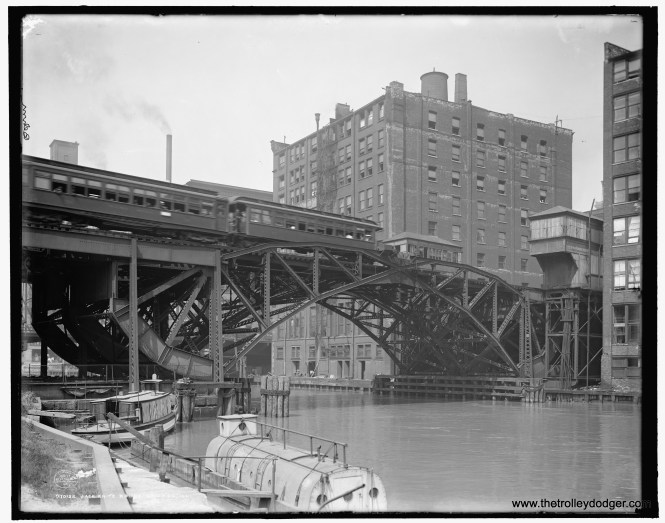
This real photo postcard image shows the four-track Metropolitan "L" bridge (actually two separate bridges, side by side), but it also shows a small experimental lifeboat moored at left. One author's research into the history of this boat is featured in this post, and also sheds some further light on when this photo was taken.

This real photo postcard image shows the four-track Metropolitan “L” bridge (actually two separate bridges, side by side), but it also shows a small experimental lifeboat moored at left. One author’s research into the history of this boat is featured in this post, and also sheds some further light on when this photo was taken.

From the start of the Trolley Dodger in 2015, I hoped this blog would become a resource for others, and I am pleased that this has happened. Sometimes these inquiries take strange and unexpected turns, and that is certainly the case regarding the early real photo postcard shown above. This interesting tangent of Chicago history is covered in detail further down in this post. Research can raise just as many questions as it answers, and that is definitely what happened here regarding the small experimental boat visible in the lower left-hand corner of this and other postcards of the Met bridge.

We also have a goodly number of excellent images for your perusal, from some of the great traction photographers.

We regret the passing on April 30th of Robert Heinlein, aged 84. He was one of the giants in his field, and our next post will be a tribute to him. Some of Mr. Heinlein’s photos are in my recent book The North Shore Line, and I am glad he was able to see the finished product. He spent his entire career sharing his knowledge and helping others, and he will be sorely missed. You can read his obituary here.

Keep those cards and letters coming in, folks.

-David Sadowski

PS- You might also like our Trolley Dodger Facebook auxiliary, a private group that now has 1,162 members.

Our friend Kenneth Gear has a Facebook group for the Railroad Record Club. If you enjoy listening to audio recordings of classic railroad trains, whether steam, electric, or diesel, you might consider joining.

FYI, the Hoosier Traction Facebook Group celebrates electric transit in Indiana and the Midwest. It also supports the activities of the annual Hoosier Traction Meet (although not affiliated with the North American Transit Historical Society, which organizes that event).

I will be giving a program on my new North Shore Line book on 7:30 pm on Friday evening, May 19th, at Chicago Union Station for the Railroad & Shortlines Club of Chicago. There is no charge. Please do not arrive before 7:15 pm.

Chicago Union Station
Room 107A
500 W. Jackson Blvd.
Chicago, Illinois

Please enter at 500 W. Jackson Boulevard, between Clinton and Canal. Call 312 725-0432 during the meeting for assistance.

We gave two presentations in April that were well attended and received. First, we spoke at the Libertyville Historical Society on the 17th. You can view that presentation here. To date, there have been about 3500 views.

On the 20th, we were at the History Center of lake Bluff and Lake Forest. You can view that presentation here.

Postcards From the Bridge
Sandy Cleary writes:

Good morning! I hope this finds you well 🙂

I’ve been lost on the site for a few weeks since finding it—it scratches an itch I also have—and I’m really grateful for the work that you’ve done in documenting a lot of pretty niche historical artifacts. I’m very curious about one in particular. It’s mentioned in this post here, above the text “I recently bought this real photo postcard, circa 1910.”

I’m pretty certain it comes from the summer of 1907. The boat docked in the lower left of that photo is an obscure lifeboat designed by Robert Brown, of Chicago; it was tied up to the Chicago Sanitary District dock in 1907 but Brown stopped paying docking fees in March, 1908 and it’s absent in another 1908 photo of the bridge. Debris on the loading dock to the northeast of the bridge matches debris visible in Detroit Publishing Co. photo 070152 (here at the LOC), which was taken at the same time as 070153 (LOC link); based on the SS Pueblo’s transit records that photo must’ve been taken on July 30th, 1907.

I’ve been working on writing up the history of Robert Brown’s boat, which features in some other Chicago lore a few years later, and for which the photographic so far consists of only three photos: the two Detroit Publishing Co. ones, and whoever took the picture used in the postcard you found. It was reused in numerous postcards (colorized with the title “Elevated R. R. Jackknife Bridge over Chicago River, Chicago”—you can find examples on eBay).

The one you posted, though, is by far the clearest. I was wondering if you could tell me anything about the postcard’s copyright or who might have printed it? I’ve never been able to find what the photographic source might’ve been. A clearer example, one which might make the text on the white sign north of the boat legible and make it easier to fix the exact date the photo was taken, would be invaluable but I’m not sure where to start looking.

(Also, the version you’ve found is evidently a different crop—the colorized version shows more of the western bank and the dock itself).

I appreciate your time—any pointers on anything more about that postcard or the photo that was responsible for it would be incredibly helpful. The work you did on restoring the one you found was already enough for me to conclude when the boat was actually tied up at Van Buren St., which I’d been despairing of finding possible.

Kind regards
Sandy

Thanks for writing. It’s remarkable how small details in such photographs can be of so much use to researchers today.

In the meantime, what a remarkable piece of scholarship you have achieved!

As you can see, the reverse side of the postcard doesn’t identify the maker. But perhaps it can still be identified by comparison with other postcards with the same printing, whose manufacturers are known to experts.

Would it be alright for me to share your original note with the readers of my blog (and accompanying Facebook group)? You never know what useful information others might have to share.

Sandy Cleary:

Absolutely, you can share with whomever! The information I have is unfortunately pretty limited. From my boat-focused point of view, what’s known is:

1. Chicagoan carpenter Robert Brown designed and built an odd-shaped lifeboat in 1905, which was photographed for a magazine in ~1905/1906
2. His company, the International Automatic Lifeboat Company, paid the Chicago Sanitary District a $5/mo docking fee for the Van Buren St. dock between October, 1906 and March, 1908
3. Hans Behm took three photos of the Metropolitan West Side railroad bridge on July 30th, two of which depict the boat.
4. It’s gone by a September, 1908 photo of the bridge taken, I think, by the Chicago Sanitary District (because the MWRD has posted this picture a few times)
5. The only other photo is the one from the postcard, which must’ve been taken between October, 1906 and March, 1908. The overall bridge configuration seems to be the same between the postcard and the 1907 photos, as does the debris seen on the loading dock on the northeast side of the bridge:

After that the boat disappears for a few years, until it was found sunk in the north draw of the Wells Street Bridge (just south of the Chicago & North Western depot there. Then it was shown for a few months as “The Foolkiller,” putatively the world’s first submarine, after which it disappears again and is now only really relevant for weird Chicago lore.

Fortunately a lot of the Chicago Sanitary District records are online, and I was able to get in touch with someone from Commonwealth Edison who also had some useful information, but I have to imagine a lot of the information from the L companies pre-merger is gone. It seems to me that there might have been some reason why people were taking pictures of the Met’s bridge around the same time, but I’m not sure what that might have been.

I know that there was pressure to have it removed because of how significantly it impacted the channel by ~1911 or so—tracing over old Sanborn maps from 1906 really drives home how dramatic that constriction was:

At the time the western span of the Jackson Blvd. bridge and the Metropolitan West Side crossed what Sanborn identifies as property belonging to the Pacific, Fort Wayne & Chicago, during its period when it was not part of the Penn, I think—I am not a train girl. The Met’s viaduct would’ve crossed over the PFW&C freight house, before that whole west bank became Chicago & North Western property again. In any case the bridge wasn’t actually torn down until 1961 (by that point, as I understand it, the CTA hadn’t been using it to carry rail traffic since 1958).

Thank you so much again for your time and for your help with this. How these photo postcards worked has been something of a mystery to me. Numerous different versions seem to have been made, and I just don’t know whether these were the same company, or different companies skirting copyright because Google Images wasn’t a thing at the time, or what. But the fact that there is such a high-quality photo, anywhere, is extremely heartening.

I suspect the postcard that I have was very short-lived in the marketplace, as this was a transition period between real photo postcards and printed ones. Even if some of the colorized versions may have used the same original negative as a starting point, the eventual results look more and more like drawings rather than photographs.

As to the sudden popularity of pictures of the Met “L” bridge, starting in 1907, this coincided with a major change in how people could write messages on postcards:

DIVIDED BACK PERIOD: 1907-1915

“In 1907, a major change on the address side of postcards occurred. This change was prompted by the Universal Postal Congress, the legislative body of the Universal Postal Union. The convention decreed that postal cards produced by governments of member nations could have messages on the left half of the address side, effective October 1, 1907. The Universal Postal Congress also decreed that after March 1, 1907, government-produced cards in the United States could bear messages on the address side.2 Congress passed an act on March 1, 1907, in compliance with the Union’s decree, allowing privately produced postcards to bear messages on the left half of the card’s back. The next day, the Postmaster-General issued Order No. 146, granting privileges to privately produced postcards that were already granted in international mail, including the allowance of message space. On June 13, 1907, the Postmaster-General issued Order No. 539, which allowed government-produced postcards to bear messages on the left half of the address side.3 These changes to the backs of postcards ushered in the Divided Back Period, which spans from 1907 until 1915. The Divided Back Period is also known as the “Golden Age of Postcards,” due to the vast popularity of postcards during this time period.”

“Another type of postcard that began to be produced and popularly used during the Divided Back period and through the White Border period is the “real photo” postcard. “Real photo” postcards were first produced using the Kodak “postcard camera.” The postcard camera could take a picture and then print a postcard-size negative of the picture, complete with a divided back and place for postage.”

Source: https://siarchives.si.edu/history/featured-topics/postcard/postcard-history

Sandy Cleary:

I’ll be honest, I hadn’t heard “real photo post card” as a term before I read your blog, and then noticed “RPPC” everywhere on eBay.

There are, as far as I can tell, three versions of this postcard. The first two are the colorized ones, which are labeled on the back as no. 171 of the Franklin Post Card Co.—of Germany, although ironically the earliest example I can find, postmarked August 17th, 1909, says “Made in Germany.” There were two distinct crops of that. The first (type A) is the widest crop, and it’s the one where the “E” in “Elevated” is written more like a backwards 3.

The second (type B) is one that the UIC Library gives copyright to Copelin Commercial Photographers in a black-and-white photographic form. This seems to be more common; the earliest postmark so far I’ve found is from September 13, 1910. Both of these two show up with postmarks as late as 1915. They went through different print runs, though; the back variously says:

* Aug. 17 1909: “No. 171. Made in Germany” (Type A)
* Sep. 13 1910: “No. 171.” (Type B)
* Aug 16, 1911: “No. 171” (Type B)
* Nov. 3 1911: “171” (Type B) (it’s possible the “No.” has been scratched off)
* Oct. 14 1912: “No. 171. Publ. by Franklin Post Card Co., Chicago, Ill. Made in Germany” (Type A)
* Aug. 13 1915: “No. 171. Publ. by Franklin Post Card Co., Chicago, Ill.” (Type B)

…As I write this up I realize this means that the widest version is rarer because it’s the German version. The design on the back, with the more ornate “Post Card” lettering, is identical to other postcards published by (for example) M. Weixelbaum, of Lima, and Provincetown Advocate and the Cardinell-Vincent Co. in addition to Franklin. I don’t understand why some postcards were made in Germany and some were not. Apparently the early 1900s was “postcard mania” in Germany, according to Deutsche Welle. I’d never heard of that before.

Anyway, the third one is the one you’ve found, which has different writing, and is also a much closer crop. Here are all three, superimposed:

What is a little puzzling to me is that the postcard you found is of such high quality that implies (to me) that a medium-format negative was accessible to whomever wound up creating all of the derivatives, which I wouldn’t have expected if it was being held in, say, the Franklin vault. But if it was a Franklin photo, the reverse doesn’t look like the reverse of any Franklin postcards. I tried image-searching for postcard backs looking for something similar, and turned up these from Vermont, which use the same language but a different font in “Post Card.”

Given your link, that creates the unfortunate possibility that what you have is, in fact, the only copy of that postcard, because it was created by someone who was interested in the bridge (or liked the composition), had access to the original, and printed it as a one-off postcard, which is why so far as I can tell it’s never appeared elsewhere. The title is odd—as you note, this isn’t the Northwestern, and the bridge seems to have been well-known as a Metropolitan West Side bridge to locals. Or perhaps it dates from the 20s or 30s, and whoever was writing it just guessed. I don’t know.

I’m also not sure if it’s significant (beyond “postcard mania”) that the early examples are German. There was a big German population in Chicago at the time, and the Germans apparently did like postcards. Germans also liked bridges; Scherzer was born in Illinois, but his parents were German immigrants. One of the earlier photos of the Met bridge (I think it might be the oldest) is from a German postcard:

Text says: “‘Folding’ Bridge over the Chicago River (bridge closed)”; handwriting says (I think): “Dear Dad: Sent you today (payday) $1.00 worth of 1 and 2-cent post stamps. Let me know if these arrived safely.”

It has occurred to me that I could poke around here in Berlin to see if there’s anything promising, but if memory serves most Chicagoan immigrants came from further north (Pomerania and such). Here in Berlin our train esoterica is only the “ghost stations” from the Cold War and that some of our subway stops are mildly radioactive because they used uranium oxide glazing in the tile.

Anyway! Thank you again for your time, and for the link to that Smithsonian article!

This is all very interesting to me, and should also interest my readers. Thanks very much for sharing these wonderful images.

In the early years of photography, negatives were usually large enough to be contact printed onto photo paper, without using an enlarger. The “chicken scratch” writing on my postcard could have been inked onto a glass plate, on top of the negative, or it may have been applied to the negative itself. The proportions of postcards are more rectangular than many of the standard film formats of the time, which may help explain the cropping.

While doing further research into this story, I came across a series of blog posts.

Is this something you wrote?

Sandy Cleary:

Yeah, that’s me 🙂

The “Foolkiller” was originally covered by Cecil Adams in the “Straight Dope” column of the Chicago alternative weekly Chicago Reader, and then later by podcaster Mark Chrisler of The Constant. It’s been stuck in my head for about fifteen years, so I’ve been trying to pull together as much as I can rather than leaving things on various email threads or chat discussions, in case any one else ever goes searching. It’s also been a good way to start organizing my thoughts on the matter (I don’t think many people read that blog).

That’s an interesting steer, re: the negatives. The UIC holding is described as a “photographic print” although I understand the MWRD (the Chicago water authority) apparently found a number of glass plates in their archives. The Library of Congress also (I think) has the original Hans Behm photos, which are described as glass 8×10 negatives (here’s one of them below). I need to read up on that era of photography, apparently.

(The Detroit Publishing Co. photos taken by Behm were also turned into colorized photo postcards, although they don’t seem to have been as popular, or at least most of the Met depictions are not those. There’s an early one that the Central Electric Railfans’ Association wrote up about ten years ago; that’s given a copyright date of 1907 but it must be earlier because the bridge doesn’t have the circular pilings that it would retain for most of its life and were in place by 1907; on the other hand, the Palmer Building is visible (leftmost skyscraper) and that was built sometime between 1903 and 1906).

FYI, I wrote that CERA blog post you refer to.

Sandy Cleary:

I’ve also seen your name on the Industrial History page about the bridge, come to think of it.

And this brings the story up to date. Ms. Cleary’s blog posts, linked above, shed additional light on the story of this experimental boat, which I can summarize as follows. This was one of several attempts at creating a safer lifeboat, to be carried on ships, and for rescues. A number of such ideas were patented in the late 1800s and early 1900s, all very speculative, of course.

The International Automatic Lifeboat Company prototype, designed by Robert Brown, was moored in the Chicago River for some period of time, and not always near the Metropolitan West Side “L” bridge. The US Navy studied the concept and decided it was not practical, as it would have been too difficult to get people into this boat during rescues. This most likely doomed its prospects.

At some point, the boat sank, and was later pulled out of the river, whereupon some enterprising persons displayed it as a supposed submarine, which it was not.

The postcard we have mistakenly identifies this as the Northwestern “L”. In actuality, it was the Metropolitan West side Elevated, but some of its trains did go to Chicago’s northwest side. The Northwestern “L” actually ran to the north side, despite the name.

I hope that further information may shed more light on this story in the future. In the meantime, here are some additional examples of postcards showing the Met “L” bridge.

-David Sadowski

Trackwork near the Met bridge was somewhat complex. Tracks to the right fanned out, leading to the Wells Street Terminal. The tracks at left connected to the Loop "L" via Van Buren Street. (Robert Heinlein Collection)

Trackwork near the Met bridge was somewhat complex. Tracks to the right fanned out, leading to the Wells Street Terminal. The tracks at left connected to the Loop “L” via Van Buren Street. (Robert Heinlein Collection)

We are looking west from the Wells Street Terminal towards the dual bridges over the Chicago River. (Robert Heinlein Collection)

We are looking west from the Wells Street Terminal towards the dual bridges over the Chicago River. (Robert Heinlein Collection)

This is the only photo I have seen that shows the interior of the Met bridge interlocking tower. (Robert Heinlein Collection)

This is the only photo I have seen that shows the interior of the Met bridge interlocking tower. (Robert Heinlein Collection)

A 1906 postcard, made at a time when messages could only go on the front of the card.

A 1906 postcard, made at a time when messages could only go on the front of the card.

The back of the 1906 card. Only the address was permitted here.

The back of the 1906 card. Only the address was permitted here.

A 1908 postcard.

A 1908 postcard.

By 1908, messages were allowed on the left side of the card back.

By 1908, messages were allowed on the left side of the card back.

A 1909 postcard, based on the 1907 photo.

A 1909 postcard, based on the 1907 photo.

The rear of the 1909 postcard.

The rear of the 1909 postcard.

A 1911 postcard, based on the 1907 photo.

A 1911 postcard, based on the 1907 photo.

The back of a 1911 postcard.

The back of a 1911 postcard.

A 1912 postcard.

A 1912 postcard.

The back side of a 1912 postcard.

The back side of a 1912 postcard.

A 1915 postcard, clearly based on the 1907 photo.

A 1915 postcard, clearly based on the 1907 photo.

The back side of a 1915 postcard.

The back side of a 1915 postcard.

A 1919 postcard.

A 1919 postcard.

The back side of a 1919 postcard.

The back side of a 1919 postcard.

A 1920 postcard.

A 1920 postcard.

And here are some later views of the bridge, from various angles:

A view of the Metropolitan "L" crossing the Chicago River on July 10, 1949. We are looking to the northwest.

A view of the Metropolitan “L” crossing the Chicago River on July 10, 1949. We are looking to the northwest.

Over the years, I have seen many poor quality duplicate slides with this view, looking to the northwest, with a Garfield Park "L" train crossing the Met bridge over the Chicago River, with Union Station in the background. However, this was scanned from an original red border Kodachrome slide, circa 1955-58. The name of the photographer is not known. This must be a Garfield train, and the results are stunning. Douglas cars were re-routed over the Lake Street "L" in 1954. Logan Square trains began running via the Milwaukee-Dearborn Subway in 1951.

Over the years, I have seen many poor quality duplicate slides with this view, looking to the northwest, with a Garfield Park “L” train crossing the Met bridge over the Chicago River, with Union Station in the background. However, this was scanned from an original red border Kodachrome slide, circa 1955-58. The name of the photographer is not known. This must be a Garfield train, and the results are stunning. Douglas cars were re-routed over the Lake Street “L” in 1954. Logan Square trains began running via the Milwaukee-Dearborn Subway in 1951.

CTA 2256 is part of a four-car Met train, turning from Market Street onto the double bridge over the Chicago River in March 1951. (Truman Hefner Photo)

CTA 2256 is part of a four-car Met train, turning from Market Street onto the double bridge over the Chicago River in March 1951.
(Truman Hefner Photo)

This picture of the old Met bridge over the Chicago River is undated, but probably dates to circa 1952-55 based on the type of red border Kodachrome mount it is in. But it is certainly after the the other picture in this post, taken at much the same location, since the building at rear, or part of it, was in the process of being torn down. This was not related to expressway construction, since the "L" at this point was north of there. Once the Congress rapid transit line opened in 1958, this section of "L" was taken out of service and by the early 1960s it had been torn down.

This picture of the old Met bridge over the Chicago River is undated, but probably dates to circa 1952-55 based on the type of red border Kodachrome mount it is in. But it is certainly after the the other picture in this post, taken at much the same location, since the building at rear, or part of it, was in the process of being torn down. This was not related to expressway construction, since the “L” at this point was north of there. Once the Congress rapid transit line opened in 1958, this section of “L” was taken out of service and by the early 1960s it had been torn down.

Stylish Coit Tower sits atop Telegraph Hill in San Francisco, and has afforded an unparalleled view since its completion in 1933. In April 1987, when this picture was taken, the view included Muni streetcar 578, built in 1896. Although it resembles a cable car, it uses overhead wire. It is occasionally operated for special events and is the oldest streetcar in use in the country. In recent years wheelchair access was added.

Stylish Coit Tower sits atop Telegraph Hill in San Francisco, and has afforded an unparalleled view since its completion in 1933. In April 1987, when this picture was taken, the view included Muni streetcar 578, built in 1896. Although it resembles a cable car, it uses overhead wire. It is occasionally operated for special events and is the oldest streetcar in use in the country. In recent years wheelchair access was added.

A Milwaukee Road push-pull commuter train is at Rondout (an unincorporated area in Lake County, IL) on September 2, 1963. Bi-levels were introduced to the Milwaukee Road around 1961 and ridership was much lower than it is today, so often one car sufficed instead of seven or eight as you see today on Metra. The station here was removed around 1965 on what is now the Metra Milwaukee District North Line. I believe we are looking to the northwest, and that the overpass may be the former North Shore Line Mundelein branch, which had been abandoned on January 21, 1963. There was a tower located kitty-corner to the station, to the right and behind the photographer, which was last used in 2015. (William D. Volkmer Photo)

A Milwaukee Road push-pull commuter train is at Rondout (an unincorporated area in Lake County, IL) on September 2, 1963. Bi-levels were introduced to the Milwaukee Road around 1961 and ridership was much lower than it is today, so often one car sufficed instead of seven or eight as you see today on Metra. The station here was removed around 1965 on what is now the Metra Milwaukee District North Line. I believe we are looking to the northwest, and that the overpass may be the former North Shore Line Mundelein branch, which had been abandoned on January 21, 1963. There was a tower located kitty-corner to the station, to the right and behind the photographer, which was last used in 2015. (William D. Volkmer Photo)

Don's Rail Photos (via Archive.org): "410 was built as a trailer observation car by Cincinnati Car in June 1923, #2640. It was out of service in 1932. It was rebuilt on December 31, 1942, as a two motor coach by closing in the open platform and changing the seating." Here is how it looked in December 1958 at the Mundelein Terminal. (Russell D. Porter Photo)

Don’s Rail Photos (via Archive.org): “410 was built as a trailer observation car by Cincinnati Car in June 1923, #2640. It was out of service in 1932. It was rebuilt on December 31, 1942, as a two motor coach by closing in the open platform and changing the seating.” Here is how it looked in December 1958 at the Mundelein Terminal. (Russell D. Porter Photo)

North Shore Line Electroliner 801-802 is on the CTA "L" in August 1962.

North Shore Line Electroliner 801-802 is on the CTA “L” in August 1962.

This is a nice overhead view of a four-car train of North Shore Line Silverliners on Chicago's "L" in August 1962.

This is a nice overhead view of a four-car train of North Shore Line Silverliners on Chicago’s “L” in August 1962.

North Shore Line cars 157, 169, and 175 are heading southbound on the Sixth Street Viaduct in Milwaukee on April 19, 1959.

North Shore Line cars 157, 169, and 175 are heading southbound on the Sixth Street Viaduct in Milwaukee on April 19, 1959.

There are not many color photos showing this prewar paint scheme, seen here on North Shore Line coach 739 at the Milwaukee Terminal on June 25, 1942.

There are not many color photos showing this prewar paint scheme, seen here on North Shore Line coach 739 at the Milwaukee Terminal on June 25, 1942.

North Shore Line coach 173 is at the Mundelein Terminal in November 1962, just two months before the end of service. Car 160, now at the Illinois Railway Museum, is at right on a storage track. (Walter Schopp Photo)

North Shore Line coach 173 is at the Mundelein Terminal in November 1962, just two months before the end of service. Car 160, now at the Illinois Railway Museum, is at right on a storage track. (Walter Schopp Photo)

After the North Shore Line abandonment, car 727 went to the Southern Iowa Railway. Here it is shown on June 14, 1964, next to Waterloo, Cedar Falls, and Northern car 100. Within a few years, both cars ended up on the Iowa Terminal Railroad (now the Iowa Traction Railway), but unfortunately, car 100 was destroyed in a 1967 fire. 727 is still operable.

After the North Shore Line abandonment, car 727 went to the Southern Iowa Railway. Here it is shown on June 14, 1964, next to Waterloo, Cedar Falls, and Northern car 100. Within a few years, both cars ended up on the Iowa Terminal Railroad (now the Iowa Traction Railway), but unfortunately, car 100 was destroyed in a 1967 fire. 727 is still operable.

Chicago North Shore and Milwaukee #607 is at North Chicago Junction on November 16, 1941. "The 'Big Hook' operating as a loco, hauling a 12 car drag and caboose." The color is described as orange and black. (Vic Wagner Photo)

Chicago North Shore and Milwaukee #607 is at North Chicago Junction on November 16, 1941. “The ‘Big Hook’ operating as a loco, hauling a 12 car drag and caboose.” The color is described as orange and black. (Vic Wagner Photo)

North Shore Line city streetcar 359, a 1920s product of the St. Louis Car Company, is shown at North Chicago Junction on March 2, 1941. This was the south end of the line for Waukegan streetcars. (Vic Wagner Photo)

North Shore Line city streetcar 359, a 1920s product of the St. Louis Car Company, is shown at North Chicago Junction on March 2, 1941. This was the south end of the line for Waukegan streetcars. (Vic Wagner Photo)

North Shore Line Silverliner 771 at the Milwaukee Terinal.

North Shore Line Silverliner 771 at the Milwaukee Terinal.

A three car Chicago and Milwaukee Electric (predecessor of the North shore Line) express train, made up of woods including car 401, from an early colorized postcard. The location here may be Lake Forest. Don\s Rail Photos (via Archive.org): "401 was built by Jewett Car in 1909 as parlor-buffet car. In 1917 it was converted to straight coach and retired in 1935. It was leased to Chicago Aurora & Elgin and renumbered 142 in 1936. It came back for a short time with the CA&E number in 1945 and sold to CA&E in 1946. It was retired in 1953."

A three car Chicago and Milwaukee Electric (predecessor of the North shore Line) express train, made up of woods including car 401, from an early colorized postcard. The location here may be Lake Forest. Dons Rail Photos (via Archive.org): “401 was built by Jewett Car in 1909 as parlor-buffet car. In 1917 it was converted to straight coach and retired in 1935. It was leased to Chicago Aurora & Elgin and renumbered 142 in 1936. It came back for a short time with the CA&E number in 1945 and sold to CA&E in 1946. It was retired in 1953.”

As the song goes, they paved paradise and put up a parking lot at the former site of the North shore Line's Milwaukee Terminal, seen here on August 24, 1966. The former switchman's shanty was the only thing carried over. (Richard H. Young Photo)

As the song goes, they paved paradise and put up a parking lot at the former site of the North shore Line’s Milwaukee Terminal, seen here on August 24, 1966. The former switchman’s shanty was the only thing carried over. (Richard H. Young Photo)

On June 6, 1954, the National Railway Historical Society held a farewell fantrip on the Red Arrow interurban line to West Chester, PA. Here, the fantrip cars are stopped at the West Chester Water Works. Car 66 was built by Brill in 1926 and was declared surplus in 1970, after Red Arrow was taken over by SEPTA. It is now at the Pennsylvania Trolley Museum in Washington, PA.

On June 6, 1954, the National Railway Historical Society held a farewell fantrip on the Red Arrow interurban line to West Chester, PA. Here, the fantrip cars are stopped at the West Chester Water Works. Car 66 was built by Brill in 1926 and was declared surplus in 1970, after Red Arrow was taken over by SEPTA. It is now at the Pennsylvania Trolley Museum in Washington, PA.

Fairmount Park Transit car 10, built by Brill in 1896, as it appeared on April 6, 1946, not long before the line was abandoned. There are not many color photos of this operation. (David H. Cope Photo)

Fairmount Park Transit car 10, built by Brill in 1896, as it appeared on April 6, 1946, not long before the line was abandoned. There are not many color photos of this operation. (David H. Cope Photo)

Fairmount Park Transit was an interesting streetcar operation that ran from 1896 to 1946, all on the grounds of a public park in Philadelphia, completely separate from the rest of the local streetcar system. Here we see car #1.

Fairmount Park Transit was an interesting streetcar operation that ran from 1896 to 1946, all on the grounds of a public park in Philadelphia, completely separate from the rest of the local streetcar system. Here we see car #1.

This picture was taken on July 26, 1961 at the Red Arrow Lines (Philadelphia Suburban Transportation Company) 69th Street Terminal. Amazingly, the sign still mentions the Lehigh Valley Transit interurban, which stopped operating in 1951, and which hadn't operated to this station since 1949.

This picture was taken on July 26, 1961 at the Red Arrow Lines (Philadelphia Suburban Transportation Company) 69th Street Terminal. Amazingly, the sign still mentions the Lehigh Valley Transit interurban, which stopped operating in 1951, and which hadn’t operated to this station since 1949.

A Lehigh Valley Transit Liberty Bell Limited interurban car is heading northbound at West Point in Pennsylvania on September 18, 1948. Rail service ended three years later. (James P. Shuman Photo)

A Lehigh Valley Transit Liberty Bell Limited interurban car is heading northbound at West Point in Pennsylvania on September 18, 1948. Rail service ended three years later. (James P. Shuman Photo)

CTA PCC 4382 appears to be turning east from Clark Street onto Division Street. Close examination of the slide shows the streetcar is signed for Route 36 - Broadway-Downtown. As Steve De Rose notes, the south portion of Broadway-State was "bustituted " on December 5, 1955, and the Blatz ad campaign on the side of the car dates this picture to 1956.

CTA PCC 4382 appears to be turning east from Clark Street onto Division Street. Close examination of the slide shows the streetcar is signed for Route 36 – Broadway-Downtown. As Steve De Rose notes, the south portion of Broadway-State was “bustituted ” on December 5, 1955, and the Blatz ad campaign on the side of the car dates this picture to 1956.

Chicago Surface Lines PCC 4125 and red car 1403 are at 73rd Street and Vincennes Avenue in March 1947, as the newest and oldest streetcars in the CSL fleet. (Vic Wagner Photo)

Chicago Surface Lines PCC 4125 and red car 1403 are at 73rd Street and Vincennes Avenue in March 1947, as the newest and oldest streetcars in the CSL fleet. (Vic Wagner Photo)

The Union Stock Yards, as seen from the "L", probably circa 1908 when this branch line opened. From a real photo postcard.

The Union Stock Yards, as seen from the “L”, probably circa 1908 when this branch line opened. From a real photo postcard.

CTA 4409 is at the head of a two-car fantrip train at Francisco on the Ravenswood "L" on November 25, 1973. This was at the end of regular service for the 4000-series cars, built in the early 1920s. (Arthur H. Peterson Photo)

CTA 4409 is at the head of a two-car fantrip train at Francisco on the Ravenswood “L” on November 25, 1973. This was at the end of regular service for the 4000-series cars, built in the early 1920s. (Arthur H. Peterson Photo)

A view looking north at the CTA Linden Avenue "L" yard in Wilmette in June 1966 shows where the North Shore Line's Shore Line Route tracks branched off at right and continued north. After service ended in 1955, the CTA incorporated some of this trackage into its storage yard, which has since been reconfigured.

A view looking north at the CTA Linden Avenue “L” yard in Wilmette in June 1966 shows where the North Shore Line’s Shore Line Route tracks branched off at right and continued north. After service ended in 1955, the CTA incorporated some of this trackage into its storage yard, which has since been reconfigured.

This duplicate slide was described as showing the CTA Douglas Park "L" at Kenton Avenue in May 1952. That may be the correct date, but I believe it actually shows an eastbound Garfield Park train between Laramie and Central Avenue. West of here, the "L" turned to run parallel to the B&OCT. The area at left is where the Eisenhower expressway runs today, and this is approximately the location of the Lotus tunnel.

This duplicate slide was described as showing the CTA Douglas Park “L” at Kenton Avenue in May 1952. That may be the correct date, but I believe it actually shows an eastbound Garfield Park train between Laramie and Central Avenue. West of here, the “L” turned to run parallel to the B&OCT. The area at left is where the Eisenhower expressway runs today, and this is approximately the location of the Lotus tunnel.

CTA 2102 is at the tail end of a Lake-Dan Ryan train in April 1975, turning the sharp corner from Wabash to Lake. After the horrific crash here two years later, where some "L" cars fell off the structure, additional steel was added to help prevent a future reoccurrence.

CTA 2102 is at the tail end of a Lake-Dan Ryan train in April 1975, turning the sharp corner from Wabash to Lake. After the horrific crash here two years later, where some “L” cars fell off the structure, additional steel was added to help prevent a future reoccurrence.

Passengers are boarding an eastbound South Shore Line train, headed by car 107, at Michigan City, IN in May 1959. Now, the line is being double-tracked at this location, and the street turned into a private right-of-way. The facade of the old station is going to become part of a new redevelopment here. From left to right, the several cars visible include an early 50s Chevy, a '59 Chevy, a '55 Oldsmobile, a late '50s Cadillac, a 1956 Buick, and a 1959 Ford.

Passengers are boarding an eastbound South Shore Line train, headed by car 107, at Michigan City, IN in May 1959. Now, the line is being double-tracked at this location, and the street turned into a private right-of-way. The facade of the old station is going to become part of a new redevelopment here. From left to right, the several cars visible include an early 50s Chevy, a ’59 Chevy, a ’55 Oldsmobile, a late ’50s Cadillac, a 1956 Buick, and a 1959 Ford.

A South Shore Line train, with car 101 at the helm, is at the East Chicago station on February 8, 1953. In 1956 the street trackage here was replaced by a new bypass route, running parallel to the Indiana Toll Road. (James P. Shuman Photo)

A South Shore Line train, with car 101 at the helm, is at the East Chicago station on February 8, 1953. In 1956 the street trackage here was replaced by a new bypass route, running parallel to the Indiana Toll Road. (James P. Shuman Photo)

Chicago Aurora and Elgin 404 at Forest Park, circa 1955-57. We are looking north. After interurban service was cut back to here in 1953, the CA&E had a track for midday car storage, seen at left.

Chicago Aurora and Elgin 404 at Forest Park, circa 1955-57. We are looking north. After interurban service was cut back to here in 1953, the CA&E had a track for midday car storage, seen at left.

The final fantrip on the Chicago Aurora and Elgin took place on a wintry December 7, 1958, about six months prior to the complete abandonment of the interurban, which had stopped operating passenger service on July 3, 1957. I am not sure of this location in Chicago's western suburbs, although the sign at right would suggest it is at one of several Main Streets in the area. Wood cars 319 and 320 were used. By this time, automatic gates had been removed, and the train had to be flagged at each such crossing. Jason Learakos: "Glen Ellyn, Illinois. The photo is facing east across Main Street from the station there." Mike Franklin says we are "looking SE at Main St., Glen Ellyn."

The final fantrip on the Chicago Aurora and Elgin took place on a wintry December 7, 1958, about six months prior to the complete abandonment of the interurban, which had stopped operating passenger service on July 3, 1957. I am not sure of this location in Chicago’s western suburbs, although the sign at right would suggest it is at one of several Main Streets in the area. Wood cars 319 and 320 were used. By this time, automatic gates had been removed, and the train had to be flagged at each such crossing. Jason Learakos: “Glen Ellyn, Illinois. The photo is facing east across Main Street from the station there.” Mike Franklin says we are “looking SE at Main St., Glen Ellyn.”

Chicago Aurora and Elgin wood car #20, built in 1902, ran for 55 years on that interurban before heading to the Fox River Trolley Museum, where it remains. Here it is in October 1970, when this operation was still known as "RELIC." These are former tracks of the Aurora, Elgin, and Fox River Electric, which was affiliated with the CA&E.

Chicago Aurora and Elgin wood car #20, built in 1902, ran for 55 years on that interurban before heading to the Fox River Trolley Museum, where it remains. Here it is in October 1970, when this operation was still known as “RELIC.” These are former tracks of the Aurora, Elgin, and Fox River Electric, which was affiliated with the CA&E.

Chicago Aurora and Elgin car 409, the only Pullman saved from the fleet, is shown operating at "Trolleyville USA" in Olmstead Falls, OH on August 28, 1965. It is now at the Illinois Railway Museum.

Chicago Aurora and Elgin car 409, the only Pullman saved from the fleet, is shown operating at “Trolleyville USA” in Olmstead Falls, OH on August 28, 1965. It is now at the Illinois Railway Museum.

Chicago Aurora and Elgin car 20 at "RELIC" in South Elgin in August 1968.

Chicago Aurora and Elgin car 20 at “RELIC” in South Elgin in August 1968.

Chicago's Central Station opened in 1893 to serve trains to the World's Columbian Exposition site. Trains of the Illinois Central and the "Big Four" (the Cleveland, Cincinnati, Chicago and St. Louis Railway, which after 1906 was affiliated with the New York Central) used this station, which was adjacent to the tracks (electrified in 1926) now used by the Metra Electric and South Shore Line. After Amtrak took over intercity passenger train operations in 1971, they consolidated service to Union Station the following year, and Central Station closed. Demolition began on June 3, 1974, which is right around when this photo was taken.

Chicago’s Central Station opened in 1893 to serve trains to the World’s Columbian Exposition site. Trains of the Illinois Central and the “Big Four” (the Cleveland, Cincinnati, Chicago and St. Louis Railway, which after 1906 was affiliated with the New York Central) used this station, which was adjacent to the tracks (electrified in 1926) now used by the Metra Electric and South Shore Line. After Amtrak took over intercity passenger train operations in 1971, they consolidated service to Union Station the following year, and Central Station closed. Demolition began on June 3, 1974, which is right around when this photo was taken.

Another photo of the soon to be demolished Central Station in June 1974.

Another photo of the soon to be demolished Central Station in June 1974.

Don's Rail Photos (via Archive.org): "65 was built by Cincinnati Car in August 1928, #2985, as I&SE 230. In 1933 it was sold to ICRT as 230 and in 1941 it was sold to SHRT as 65. In 1949 it was sold to Ed Tennyson and leased as Speedrail 65 where it originally operated with a modified Shaker Heights paint scheme. When repainted, the Speedrail logo was omitted. It was scrapped in 1952." Based on that, my best guess is this picture may date to near the end of service in 1951. The location is at Sixth and Michigan in Milwaukee, by the North Shore Line Terminal. Transport Company bus 930 is also visible.

Don’s Rail Photos (via Archive.org): “65 was built by Cincinnati Car in August 1928, #2985, as I&SE 230. In 1933 it was sold to ICRT as 230 and in 1941 it was sold to SHRT as 65. In 1949 it was sold to Ed Tennyson and leased as Speedrail 65 where it originally operated with a modified Shaker Heights paint scheme. When repainted, the Speedrail logo was omitted. It was scrapped in 1952.” Based on that, my best guess is this picture may date to near the end of service in 1951. The location is at Sixth and Michigan in Milwaukee, by the North Shore Line Terminal. Transport Company bus 930 is also visible.

Don's Rail Photos (via Archive.org): "66 was built by Cincinnati Car in August 1929, #3025, as Dayton & Troy Ry 203. It was returned to Cincinnati Car in 1932, and in 1938 it was sold to Lehigh Valley Transit as 1102. In 1949 it was sold to Speedrail, but was not rehabilitated until March 1951. But it only ran for 3 months before the line was abandoned and then scrapped in 1952." Here it is seen during that brief period of operation in Waukesha. Larry Sakar: "aae249 is a photo I also have. The 66 is indeed laying over at the Waukesha loop/ Two questions remain to this day. 1. Was there any specific spot where the cars were supposed to stop? Seems to me I see photos of TM cars laying over parked in a variety of places on the loop. For instance that great single leading duplex shot which was the common lash-up during the WWII era is parked in a different spot than the 66. 2. I have never seen a photo of cars laying over on the Waukesha loop with passengers either boarding or waiting to board. I am inclined to think that passengers could not be carried the two blocks between the Waukesha station at Clinton Street & Broadway and the loop because when the line was cut back to Waukesha loop on 12-30-45 passenger service had been abandoned beyond downtown Waukesha. This is speculative on my part. I don't really know. Jay Maeder and the city of Waukesha tangled over the sale of the Waukesha loop. The city wanted to buy it from Speedrail to accommodate more cars. Maeder was willing to sell. Initially he asked something like $1100 until he saw the appraisal and quickly raised the asking price to $2500. The city accused him of trying to gouge him and refused to budge beyond $1500. Maeder said they were trying to cheat him and they were. When Hyman-Michaels had the property appraised the appraisal came in at $2200! Just where he planned to turn the cars around if he sold the loop I don't know. He publicly said there were "lots of places where Speedrail could turn the cars but I can't think of any!" In the end the city got it anyway and it became a parking lot until the 1980s. It is now the site of a very big Walgreens Drug Store. The Motor Transport Co. freight building was torn down shortly after Speedrail came to an end."

Don’s Rail Photos (via Archive.org): “66 was built by Cincinnati Car in August 1929, #3025, as Dayton & Troy Ry 203. It was returned to Cincinnati Car in 1932, and in 1938 it was sold to Lehigh Valley Transit as 1102. In 1949 it was sold to Speedrail, but was not rehabilitated until March 1951. But it only ran for 3 months before the line was abandoned and then scrapped in 1952.” Here it is seen during that brief period of operation in Waukesha. Larry Sakar: “aae249 is a photo I also have. The 66 is indeed laying over at the Waukesha loop/ Two questions remain to this day. 1. Was there any specific spot where the cars were supposed to stop? Seems to me I see photos of TM cars laying over parked in a variety of places on the loop. For instance that great single leading duplex shot which was the common lash-up during the WWII era is parked in a different spot than the 66. 2. I have never seen a photo of cars laying over on the Waukesha loop with passengers either boarding or waiting to board. I am inclined to think that passengers could not be carried the two blocks between the Waukesha station at Clinton Street & Broadway and the loop because when the line was cut back to Waukesha loop on 12-30-45 passenger service had been abandoned beyond downtown Waukesha. This is speculative on my part. I don’t really know. Jay Maeder and the city of Waukesha tangled over the sale of the Waukesha loop. The city wanted to buy it from Speedrail to accommodate more cars. Maeder was willing to sell. Initially he asked something like $1100 until he saw the appraisal and quickly raised the asking price to $2500. The city accused him of trying to gouge him and refused to budge beyond $1500. Maeder said they were trying to cheat him and they were. When Hyman-Michaels had the property appraised the appraisal came in at $2200! Just where he planned to turn the cars around if he sold the loop I don’t know. He publicly said there were “lots of places where Speedrail could turn the cars but I can’t think of any!” In the end the city got it anyway and it became a parking lot until the 1980s. It is now the site of a very big Walgreens Drug Store. The Motor Transport Co. freight building was torn down shortly after Speedrail came to an end.”

Don's Rail Photos (via Archive.org): "62 was built by Cincinnati Car in August 1928, #2985, as I&SE 245. In 1933 it was sold to ICRT as 245 and in 1941 it was sold to SHRT as 62. In 1949 it was sold to Ed Tennyson and leased as Speedrail 62 and was scrapped in 1952." This photo may have been taken in Waukesha and could date to just prior to the 1951 abandonment. Larry Sakar: "This is NOT toward the end of Speedrail. The lack of front stripes on the curved sider indicates that this is pre Summer 1950 when the two black stripes began to appear on the curved side cars. O'Brien photos took some great photos of the Waukesha loop including an aerial shot of it before it became the loop. They were located about a block or so east of the Waukesha station." Mike Franklin says we are "looking SE on Broadway from Clinton St, Waukesha, WI."

Don’s Rail Photos (via Archive.org): “62 was built by Cincinnati Car in August 1928, #2985, as I&SE 245. In 1933 it was sold to ICRT as 245 and in 1941 it was sold to SHRT as 62. In 1949 it was sold to Ed Tennyson and leased as Speedrail 62 and was scrapped in 1952.” This photo may have been taken in Waukesha and could date to just prior to the 1951 abandonment. Larry Sakar: “This is NOT toward the end of Speedrail. The lack of front stripes on the curved sider indicates that this is pre Summer 1950 when the two black stripes began to appear on the curved side cars. O’Brien photos took some great photos of the Waukesha loop including an aerial shot of it before it became the loop. They were located about a block or so east of the Waukesha station.” Mike Franklin says we are “looking SE on Broadway from Clinton St, Waukesha, WI.”

Milwaukee Electric M15 at an undetermined location. Stephen Karlson writes, "M15 is under the train shed at East Troy that was later removed. That stretch of the right of way remains off limits to boarding passengers at the preservation railway as the ground is on the same plot of land as the house that was once the station. Thus the loading platform for the electric cars is by the substation."

Milwaukee Electric M15 at an undetermined location. Stephen Karlson writes, “M15 is under the train shed at East Troy that was later removed. That stretch of the right of way remains off limits to boarding passengers at the preservation railway as the ground is on the same plot of land as the house that was once the station. Thus the loading platform for the electric cars is by the substation.”

Milwaukee Electric 1112 at Waukesha, WI on March 15, 1947. (Vic Wagner Photo) Don's Rail Photos (via Archive.org): "1112 was built by Kuhlman Car in February 1909, #405. It was rebuilt in 1926. It was one of three sold for scrap in January 1952, before the rest of the cars." Larry Sakar: "Fantastic shot of the typical Waukesha train during WWII. When first tried TM discovered that placing the single 1100 series car behind the duplex did not work. Because the door on a single 1100 was at the rear of the car and in the center of a duplex they quickly found that the door on the single 1100 did not reach the station platforms or designated loading zone. Thus, two stops had to be made. The solution was to place the single 1100 series car first. Trial and error I guess you'd say."

Milwaukee Electric 1112 at Waukesha, WI on March 15, 1947. (Vic Wagner Photo) Don’s Rail Photos (via Archive.org): “1112 was built by Kuhlman Car in February 1909, #405. It was rebuilt in 1926. It was one of three sold for scrap in January 1952, before the rest of the cars.” Larry Sakar: “Fantastic shot of the typical Waukesha train during WWII. When first tried TM discovered that placing the single 1100 series car behind the duplex did not work. Because the door on a single 1100 was at the rear of the car and in the center of a duplex they quickly found that the door on the single 1100 did not reach the station platforms or designated loading zone. Thus, two stops had to be made. The solution was to place the single 1100 series car first. Trial and error I guess you’d say.”

Milwaukee Electric interurban car 1106 is at Mukwonago, Wisconsin, on the line going out to East Troy. Passenger service was abandoned here in 1939, although freight service continued for decades. This is currently where the East Troy Railroad Museum operates. I've been told that this station was located near an interchange north of where the Elegant Farmer is now, and that the station itself was moved and turned into a residence, which still exists, although additions have been made to it.

Milwaukee Electric interurban car 1106 is at Mukwonago, Wisconsin, on the line going out to East Troy. Passenger service was abandoned here in 1939, although freight service continued for decades. This is currently where the East Troy Railroad Museum operates. I’ve been told that this station was located near an interchange north of where the Elegant Farmer is now, and that the station itself was moved and turned into a residence, which still exists, although additions have been made to it.

Milwaukee Electric 1105. Don's Rail Photos (via Archive.org): "The Milwaukee Northern Ry came under TM control in 1923 and was officially merged on April 30, 1928. Under TM management 4 of their cars were rebuilt in a fashion similar to the other TM rebuilt interurbans. After 1928, most of the cars were further rebuilt and renumbered to replace the original 1100s which had been renumbered when they were rebuilt. 1101 was to have been rebuilt from MN 20, but it became 1105 instead. Thus there was no 1101." It may originally have been built in 1907.

Milwaukee Electric 1105. Don’s Rail Photos (via Archive.org): “The Milwaukee Northern Ry came under TM control in 1923 and was officially merged on April 30, 1928. Under TM management 4 of their cars were rebuilt in a fashion similar to the other TM rebuilt interurbans. After 1928, most of the cars were further rebuilt and renumbered to replace the original 1100s which had been renumbered when they were rebuilt. 1101 was to have been rebuilt from MN 20, but it became 1105 instead. Thus there was no 1101.” It may originally have been built in 1907.

Milwaukee Electric streetcar 641 on route 19. Don's Rail Photos (via Archive.org): "641 was built at Cold Springs in 1913. It was reconditioned as a two man car in 1928."

Milwaukee Electric streetcar 641 on route 19. Don’s Rail Photos (via Archive.org): “641 was built at Cold Springs in 1913. It was reconditioned as a two man car in 1928.”

Milwaukee Rapid Transit and Speedrail car 61 is at an undetermined location (Waukesha?) and looks rather worse for the wear, with unrepaired collision damage, probably just prior to the 1951 abandonment. Larry Sakar adds: "This is at the Waukesha station. Wilbur Lumber was directly across the street from the station. Note the cement safety island to the left of the car. It was there to facilitate loading so that passengers didn't have to stand in the street. All traffic passed to the photo left of that island. Today a bank occupies the site of Wilbur Lumber Co. I guess the Wilburs were a prominent Waukesha family from what my friend John Schoenknecht who is the editor of Landmark, the official publication of the Waukesha County Historical Society, told me. Oh, by the way what you see in the background of that shot of the car at Wilbur Lumber is the Madison Street hill which is still there. There was a Milwaukee Road crossing that isn't visible in the photo and once across it Broadway becomes Madison." Mike Franklin says this "is indeed Waukesha. Looking NW across Madison St from Clinton St."

Milwaukee Rapid Transit and Speedrail car 61 is at an undetermined location (Waukesha?) and looks rather worse for the wear, with unrepaired collision damage, probably just prior to the 1951 abandonment. Larry Sakar adds: “This is at the Waukesha station. Wilbur Lumber was directly across the street from the station. Note the cement safety island to the left of the car. It was there to facilitate loading so that passengers didn’t have to stand in the street. All traffic passed to the photo left of that island. Today a bank occupies the site of Wilbur Lumber Co. I guess the Wilburs were a prominent Waukesha family from what my friend John Schoenknecht who is the editor of Landmark, the official publication of the Waukesha County Historical Society, told me. Oh, by the way what you see in the background of that shot of the car at Wilbur Lumber is the Madison Street hill which is still there. There was a Milwaukee Road crossing that isn’t visible in the photo and once across it Broadway becomes Madison.” Mike Franklin says this “is indeed Waukesha. Looking NW across Madison St from Clinton St.”

Milwaukee Rapid Transit and Speedrail car 60. Don's Rail Photos (via Archive.org): "60 was built by Cincinnati Car in August 1929, #3030, as Indianapolis & Southeastern Traction 260. It replaced the heavy-weight cars which became TMER&L 1180 series. In 1933 it was sold to Inter-City Rapid Transit as 260 and in 1941 it was sold to Shaker Heights Rapid Transit as 60. In 1949 it was sold to Ed Tennyson and leased as Speedrail 60 and was scrapped in 1952." Larry Sakar: "Car 60 is on the bridge over Brookdale Drive on the Hales Corners line on 10-16-49. This is the inaugural fan trip using car 60 that traveled over both lines. Both the bridge and embankment are gone. This is the location where the construction train used to take workers building the suburb of Greendale to and from cut off and went in a southeasterly direction thru what is now Root River Parkway. One of the dumbest things Jay Maeder ever said was that he "intended to restore passenger service to Greendale." There never was passenger service to Greendale. I'm about a mile or so north of Greendale. MCTS has a bus line (Rt. 76-76th St.) that serves Greendale. I've yet to see a single passenger on that part of the line. Greendale is wealth personified! By the way car 65 was supposed to have been used on the inaugural fan trip but it was on the "sick list". Another thing of interest regarding the 10-16-49 fan trip. Car 60 developed mechanical problems as soon as the car descended the "slide" onto the Rapid Transit line at 8th Street. At the Gravel Pit they put in to the siding. A fan with a vast knowledge of interurban cars opened the hatches in the floor and disconnected the motor leads on motors 3 and 4. Car 60 ran on two motors for the rest of that fan trip. The name of the knowledgeable railfan was George Krambles!! The late Lew Martin recalled that while stopped there a fan remarked, "The line has been in business for a little over a month and they have a car in the scrap line already!" Two other well known railfans were on that car. Barney Neuberger wearing his classic pork pie hat and one Mr. Albert C. Kalmbach, head of the publishing company that bore his name. Kalmbach was seated in the 4th row on the right side of car 60."

Milwaukee Rapid Transit and Speedrail car 60. Don’s Rail Photos (via Archive.org): “60 was built by Cincinnati Car in August 1929, #3030, as Indianapolis & Southeastern Traction 260. It replaced the heavy-weight cars which became TMER&L 1180 series. In 1933 it was sold to Inter-City Rapid Transit as 260 and in 1941 it was sold to Shaker Heights Rapid Transit as 60. In 1949 it was sold to Ed Tennyson and leased as Speedrail 60 and was scrapped in 1952.” Larry Sakar: “Car 60 is on the bridge over Brookdale Drive on the Hales Corners line on 10-16-49. This is the inaugural fan trip using car 60 that traveled over both lines. Both the bridge and embankment are gone. This is the location where the construction train used to take workers building the suburb of Greendale to and from cut off and went in a southeasterly direction thru what is now Root River Parkway. One of the dumbest things Jay Maeder ever said was that he “intended to restore passenger service to Greendale.” There never was passenger service to Greendale. I’m about a mile or so north of Greendale. MCTS has a bus line (Rt. 76-76th St.) that serves Greendale. I’ve yet to see a single passenger on that part of the line. Greendale is wealth personified! By the way car 65 was supposed to have been used on the inaugural fan trip but it was on the “sick list”. Another thing of interest regarding the 10-16-49 fan trip. Car 60 developed mechanical problems as soon as the car descended the “slide” onto the Rapid Transit line at 8th Street. At the Gravel Pit they put in to the siding. A fan with a vast knowledge of interurban cars opened the hatches in the floor and disconnected the motor leads on motors 3 and 4. Car 60 ran on two motors for the rest of that fan trip. The name of the knowledgeable railfan was George Krambles!! The late Lew Martin recalled that while stopped there a fan remarked, “The line has been in business for a little over a month and they have a car in the scrap line already!” Two other well known railfans were on that car. Barney Neuberger wearing his classic pork pie hat and one Mr. Albert C. Kalmbach, head of the publishing company that bore his name. Kalmbach was seated in the 4th row on the right side of car 60.”

Milwaukee Electric freight motor and utility car M15. Don's Rail Photos (via Archive.org): "M15 was built at Cold Spring Shops in 1920 as a trailer, but it was motorized almost immediately. It was transferred to the isolated East Troy operation in 1939, and sold to the Municipality of East Troy in 1949. It is sold to WERHS in 1982 and (is) now preserved at the IRM (since) 1989."

Milwaukee Electric freight motor and utility car M15. Don’s Rail Photos (via Archive.org): “M15 was built at Cold Spring Shops in 1920 as a trailer, but it was motorized almost immediately. It was transferred to the isolated East Troy operation in 1939, and sold to the Municipality of East Troy in 1949. It is sold to WERHS in 1982 and (is) now preserved at the IRM (since) 1989.”

Don's Rail Photos (via Archive.org): "61 was built by Cincinnati Car in August 1928, #2985, as I&SE 235. In 1933 it was sold to ICRT as 235 and in 1941 it was sold to SHRT as 61. In 1949 it was sold to Ed Tennyson and leased as Speedrail 61 and was scrapped in 1952." Here 61 is at an undetermined location. Since it is still signed for Milwaukee Rapid Transit and Speedrail, this may be circa 1949-50. Larry Sakar: "The car is westbound on West Michigan Street at North 5th Street. The building in the background (whitish and prominent) was the Boston Store, a department store that at one time was owned by the same company that owned Carson's in Chicago- P.A. Bergner. The building is still there but the Boston Store is not. I believe it is now housing for seniors. Note the traffic policeman standing in the middle of the intersection. Believe it or not there were no stop and go lights on Michigan Street until Speedrail was gone. Every intersection had a traffic policeman. The late Doug Traxler said the one place you did not want to get stopped was at the top of the hill at 6th and Michigan because half of your car was hanging downhill and making that turn by the NSL station was no picnic. Motorman Don Leistikow concurred and offered this tale: "Yes, I remember that traffic officer. I was one of several motormen who discovered that he had a good day when he had cigars so I, like some of the other motormen, always made sure he had a box of cigars. Things always seemed to go better for him when he had a box of cigars!" Traxler remembered him shouting at him, "Pull it Up. Pull it way up," when he got stopped there one time." Mike Franklin says we are "looking east on Michigan St. from 5th St. in Milwaukee."

Don’s Rail Photos (via Archive.org): “61 was built by Cincinnati Car in August 1928, #2985, as I&SE 235. In 1933 it was sold to ICRT as 235 and in 1941 it was sold to SHRT as 61. In 1949 it was sold to Ed Tennyson and leased as Speedrail 61 and was scrapped in 1952.” Here 61 is at an undetermined location. Since it is still signed for Milwaukee Rapid Transit and Speedrail, this may be circa 1949-50. Larry Sakar: “The car is westbound on West Michigan Street at North 5th Street. The building in the background (whitish and prominent) was the Boston Store, a department store that at one time was owned by the same company that owned Carson’s in Chicago- P.A. Bergner. The building is still there but the Boston Store is not. I believe it is now housing for seniors. Note the traffic policeman standing in the middle of the intersection. Believe it or not there were no stop and go lights on Michigan Street until Speedrail was gone. Every intersection had a traffic policeman. The late Doug Traxler said the one place you did not want to get stopped was at the top of the hill at 6th and Michigan because half of your car was hanging downhill and making that turn by the NSL station was no picnic. Motorman Don Leistikow concurred and offered this tale: “Yes, I remember that traffic officer. I was one of several motormen who discovered that he had a good day when he had cigars so I, like some of the other motormen, always made sure he had a box of cigars. Things always seemed to go better for him when he had a box of cigars!” Traxler remembered him shouting at him, “Pull it Up. Pull it way up,” when he got stopped there one time.” Mike Franklin says we are “looking east on Michigan St. from 5th St. in Milwaukee.”

Gary Railways car #1 at an undetermined location. William Shapotkin: "We are in downtown Valparaiso, IN. The car is laying over in Franklin St north of Main (now Lincolnway) taking its layover at the east end-of-line. View looks south. Building at right (N/W corner of intersection) is still standing today."

Gary Railways car #1 at an undetermined location. William Shapotkin: “We are in downtown Valparaiso, IN. The car is laying over in Franklin St north of Main (now Lincolnway) taking its layover at the east end-of-line. View looks south. Building at right (N/W corner of intersection) is still standing today.”

Gary Railways cars 16 and 19 on the May 1, 1938 fantrip which is considered the beginnings of the Central Electric Railfans' Association.

Gary Railways cars 16 and 19 on the May 1, 1938 fantrip which is considered the beginnings of the Central Electric Railfans’ Association.

Gary Railways line car #11 at the Garyton Loop. (Edward Frank, Jr. Photo)

Gary Railways line car #11 at the Garyton Loop. (Edward Frank, Jr. Photo)

A view of the right of way along the Gary Railways Indiana Harbor Division near Gary, IN by Edward Frank, Jr.

A view of the right of way along the Gary Railways Indiana Harbor Division near Gary, IN by Edward Frank, Jr.

A view of the right-of-way along the Gary Railways Hammond Division, near Hammond IN, by Edward Frank, Jr.

A view of the right-of-way along the Gary Railways Hammond Division, near Hammond IN, by Edward Frank, Jr.

A view of the Gary Railways right-of-way on the Indiana Harbor Division near Gary, IN by Edward Frank, Jr. Presumably that is his bicycle by the telephone pole. Rail service on the Indiana Harbor Division was abandoned in March 1939.

A view of the Gary Railways right-of-way on the Indiana Harbor Division near Gary, IN by Edward Frank, Jr. Presumably that is his bicycle by the telephone pole. Rail service on the Indiana Harbor Division was abandoned in March 1939.

Our Latest Book, Now Available:

The North Shore Line

FYI, my new Arcadia Publishing book The North Shore Line is now available for immediate shipment. My publisher decided to expand it to 160 pages, instead of the usual 128. That’s a 25% increase, without any change to the $23.99 price. I am quite pleased with how this turned out.

From the back cover:

As late as 1963, it was possible to board high-speed electric trains on Chicago’s famous Loop “L” that ran 90 miles north to Milwaukee. This was the Chicago North Shore & Milwaukee Railroad, commonly known as the North Shore Line. It rose from humble origins in the 1890s as a local streetcar line in Waukegan to eventually become America’s fastest interurban under the visionary management of Midwest utilities tycoon Samuel Insull. The North Shore Line, under Insull, became a worthy competitor to the established steam railroads. Hobbled by the Great Depression, the road fought back in 1941 with two streamlined, air-conditioned, articulated trains called Electroliners, which included dining service. It regained its popularity during World War II, when gasoline and tires were rationed, but eventually, it fell victim to highways and the automobile. The North Shore Line had intercity rail, commuter rail, electric freight, city streetcars, and even buses. It has been gone for nearly 60 years, but it will always remain the Road of Service.

Each copy purchased here will be signed by the author, and you will also receive a bonus North Shore Line map.  Books will ship by USPS Media Mail.

Chapters:
01. Beginnings
02. The Milwaukee Division
03. The Shore Line Route
04. The Skokie Valley Route
05. The Mundelein Branch
06. On the “L”
07. City Streetcars
08. Trolley Freight
09. The Long Goodbye
10. The Legacy

Title The North Shore Line
Images of America
Author David Sadowski
Edition illustrated
Publisher Arcadia Publishing (SC), 2023
ISBN 1467108960, 978-1467108966
Length 160 pages

The price of $23.99 includes shipping within the United States.

For Shipping to US Addresses:

New Compact Disc, Now Available:

CTA-1
The Last Chicago Streetcars 1958
# of Discs – 1
Price: $15.99

Until now, it seemed as though audio recordings of Chicago streetcars were practically non-existent. For whatever reason, the late William A. Steventon does not appear to have made any for his Railroad Record Club, even though he did make other recordings in the Chicago area in 1956.

Now, audio recordings of the last runs of Chicago streetcars have been found, in the collections of the late Jeffrey L. Wien (who was one of the riders on that last car). We do not know who made these recordings, but this must have been done using a portable reel-to-reel machine.

These important recordings will finally fill a gap in transit history. The last Chicago Transit Authority streetcar finished its run in the early hours of June 21, 1958. Now you can experience these events just as Chicagoans did.

As a bonus, we have included Keeping Pace, a 1939 Chicago Surface Lines employee training program. This was digitally transferred from an original 16” transcription disc. These recordings were unheard for 80 years.

Total time – 74:38

Help Support The Trolley Dodger

This is our 298th post, and we are gradually creating a body of work and an online resource for the benefit of all railfans, everywhere. To date, we have received over 980,000 page views, for which we are very grateful.

You can help us continue our original transit research by checking out the fine products in our Online Store.
As we have said before, “If you buy here, we will be here.”

We thank you for your support.

DONATIONS

In order to continue giving you the kinds of historic railroad images that you have come to expect from The Trolley Dodger, we need your help and support. It costs money to maintain this website, and to do the sort of historic research that is our specialty.

Your financial contributions help make this web site better, and are greatly appreciated.


Catching Up

The photographer (possibly Emery Gulash) had but one chance to press the shutter button at precisely the right moment, and he nailed it with this classic view of westbound Electroliner train 803 at Lake Bluff in January 1963. This is what noted photographer Henri Cartier-Bresson had in mind when he wrote about the "decisive moment." Douglas Noble: "Northbound crossing Rockland Road / IL 176 in Lake Bluff."

The photographer (possibly Emery Gulash) had but one chance to press the shutter button at precisely the right moment, and he nailed it with this classic view of westbound Electroliner train 803 at Lake Bluff in January 1963. This is what noted photographer Henri Cartier-Bresson had in mind when he wrote about the “decisive moment.” Douglas Noble: “Northbound crossing Rockland Road / IL 176 in Lake Bluff.”

This is our first post in nearly two months. We have been hard at work on our next book, The North Shore Line. In addition, I worked 16 straight days as an election judge during the recent primary here.

Each of these posts involves a tremendous amount of hard work that may not be apparent to the causal observer. First, we have to scan the negatives, prints, and slides that you see here. Then, they have to be worked over in Photoshop to get the color and density right, and remove any scratches, crud, and other blemishes that have accumulated over the decades since these pictures were taken. This can take hours for just a single photograph, but we think the results are well worth it.

Our goal is to present definitive versions of these classic photos in an online archive for all to enjoy. We see our stuff showing up all over Facebook and other parts of the Internet all the time, and, recently, even in books and magazines put out by others.

It would be nice if, in all cases, we received some credit for our contributions. When people ask permission to use our work, it is freely granted, but all we ask is that we are properly credited, that the original photographer is credited, and that the small watermark we place on these images is not cropped out.

We don’t think this is too much to ask. Meanwhile, we hope you will enjoy this latest batch of classic photographs.

-David Sadowski

PS- You might also like our Trolley Dodger Facebook auxiliary, a private group that now has 862 members.

Our friend Kenneth Gear now has a Facebook group for the Railroad Record Club. If you enjoy listening to audio recordings of classic railroad trains, whether steam, electric, or diesel, you might consider joining.

Work on our North Shore Line book is ongoing. Donations are needed in order to bring this to a successful conclusion. You will find donation links at the top and bottom of each post. We thank you in advance for your time and consideration.

Recent Finds

The Chicago Surface Lines had a collection of historic streetcars, starting in the 1920s. These were used for parades and the opening of new lines. Some of the restoration work, such as this car, was more fanciful than authentic, as this car was never part of the West Chicago Street Railway, nor was it #4. Don's Rail Photos: "4 was built by Pullman in 1895, #840, as North Chicago Street RR 922. It became Chicago Union Traction Co 4022 in 1899 and became Chicago Surface Lines 4022 in 1914. It was rebuilt as WCStRy 4 in 1933. It went to Illinois Railway Museum in 1985." The CTA inherited this collection, and various cars were trotted out during shops tours in the 1950s. Once streetcar service ended in 1958, these cars were put into storage, and were finally donated to museums in the mid-1980s.

The Chicago Surface Lines had a collection of historic streetcars, starting in the 1920s.
These were used for parades and the opening of new lines. Some of the restoration work, such as this car, was more fanciful than authentic, as this car was never part of the West Chicago Street Railway, nor was it #4. Don’s Rail Photos: “4 was built by Pullman in 1895, #840, as North Chicago Street RR 922. It became Chicago Union Traction Co 4022 in 1899 and became Chicago Surface Lines 4022 in 1914. It was rebuilt as WCStRy 4 in 1933. It went to Illinois Railway Museum in 1985.” The CTA inherited this collection, and various cars were trotted out during shops tours in the 1950s. Once streetcar service ended in 1958, these cars were put into storage, and were finally donated to museums in the mid-1980s.

Brooklyn-Queens Transit PCC 1066 is signed for Coney Island in the early 1950s.

Brooklyn-Queens Transit PCC 1066 is signed for Coney Island in the early 1950s.

A train of CTA curved-door 6000s is at Howard Street in June 1977.

A train of CTA curved-door 6000s is at Howard Street in June 1977.

A southbound North Shore Line train, with 711 in the lead, is at Morse on the "L" in June 1959.

A southbound North Shore Line train, with 711 in the lead, is at Morse on the “L” in June 1959.

North Shore Line cars 157 and 252 are on a June 16, 1962 fantrip. Here, we see the train at the Root River bridge near Racine, Wisconsin. (Richard H. Young Photo)

North Shore Line cars 157 and 252 are on a June 16, 1962 fantrip. Here, we see the train at the Root River bridge near Racine, Wisconsin. (Richard H. Young Photo)

This is a South Shore Line portable substation at Michigan City, Indiana on July 10, 1977.

This is a South Shore Line portable substation at Michigan City, Indiana on July 10, 1977.

Philadelphia Suburban Transportation Company (aka Red Arrow) cars 16 and 20 in May 1965, signed for the Media line. Kenneth Achtert: "Appears to be outbound at Springfield Rd. I would assume this is on a fantrip from the number of random individuals around the right-of-way (most likely a run-by since they are scattered about); also, the Media destination would not be standard operating procedure for two-car trains. The trains were typically scheduled to Springfield (Woodland Ave.) with only single cars going all the way to Media." Jeff Didlake says, "I agree with Ken Achtert's thoughts that this is a fan trip, but I believe the location is the Scenic Rd. station on the Media Line. The track is on a slight curve and a hint of the red brick high rise Drexelline Apts. is in the background. I know this station well as I managed to ruin a good tire and wheel while pulling into the parking lot there on a poorly maintained Springfield Twp. sewer inlet grate."

Philadelphia Suburban Transportation Company (aka Red Arrow) cars 16 and 20 in May 1965, signed for the Media line. Kenneth Achtert: “Appears to be outbound at Springfield Rd. I would assume this is on a fantrip from the number of random individuals around the right-of-way (most likely a run-by since they are scattered about); also, the Media destination would not be standard operating procedure for two-car trains. The trains were typically scheduled to Springfield (Woodland Ave.) with only single cars going all the way to Media.” Jeff Didlake says, “I agree with Ken Achtert’s thoughts that this is a fan trip, but I believe the location is the Scenic Rd. station on the Media Line. The track is on a slight curve and a hint of the red brick high rise Drexelline Apts. is in the background. I know this station well as I managed to ruin a good tire and wheel while pulling into the parking lot there on a poorly maintained Springfield Twp. sewer inlet grate.”

On June 11, 1962, a two-car North Shore Line train, headed by 731, is bound for Mundelein near Lake Bluff. (Richard H. Young Photo)

On June 11, 1962, a two-car North Shore Line train, headed by 731, is bound for Mundelein near Lake Bluff. (Richard H. Young Photo)

North Shore Line combine 251 is near Racine, Wisconsin on February 6, 1962.

North Shore Line combine 251 is near Racine, Wisconsin on February 6, 1962.

The interior of Queensborough Bridge Railway car 601 in the mid-1950s. This was an Electromobile, built around 1929 by Osgood-Bradley.

The interior of Queensborough Bridge Railway car 601 in the mid-1950s. This was an Electromobile, built around 1929 by Osgood-Bradley.

North Shore Line car 733 awaiting scrapping at South Upton Junction on October 26, 1963, several months after abandonment.

North Shore Line car 733 awaiting scrapping at South Upton Junction on October 26, 1963, several months after abandonment.

North Shore Line Silverliner 758 is at Edison Court in Waukegan during the summer of 1958. This was an important station, where cars were routinely added and cut from trains.

North Shore Line Silverliner 758 is at Edison Court in Waukegan during the summer of 1958. This was an important station, where cars were routinely added and cut from trains.

Philadelphia PCC 2142 is signed for Route 6 on September 15, 1957. Mark A. Jones writes, "That picture is of the northbound terminus of route 6 across from Willow Grove Park. 2142 is headed south to Broad and Olney." Kenneth Achtert adds, "2142 is at Willow Grove Park, the end of the Route 6. The amusement park is hidden behind the trees."

Philadelphia PCC 2142 is signed for Route 6 on September 15, 1957. Mark A. Jones writes, “That picture is of the northbound terminus of route 6 across from Willow Grove Park. 2142 is headed south to Broad and Olney.” Kenneth Achtert adds, “2142 is at Willow Grove Park, the end of the Route 6. The amusement park is hidden behind the trees.”

North Shore Line loco 455 is working the Niles Gas Spur in the Weber Industrial District, Skokie, Illinois, probably in the late 1950s. (Bob Geis Photo)

North Shore Line loco 455 is working the Niles Gas Spur in the Weber Industrial District, Skokie, Illinois, probably in the late 1950s. (Bob Geis Photo)

Chicago Surface Lines one-man car 6241 is at the east end of Route 43 in the 1940s. You can see a pedestrian bridge leading to the nearby Illinois Central Electric commuter station behind the streetcar.

Chicago Surface Lines one-man car 6241 is at the east end of Route 43 in the 1940s. You can see a pedestrian bridge leading to the nearby Illinois Central Electric commuter station behind the streetcar.

A North Shore Line train at Winnetka Road on the Skokie Valley Route. The business at left is John H. Davies and Son, general contractors.

A North Shore Line train at Winnetka Road on the Skokie Valley Route. The business at left is John H. Davies and Son, general contractors.

A three-car North Shore Line train heads south over the 6th Street Bridge, probably in the 1940s.

A three-car North Shore Line train heads south over the 6th Street Bridge, probably in the 1940s.

North Shore Line cars 716 and 409 at Highwood, possibly in the early 1940s. 409 started out as a dining car motor before it was converted to coach in 1942.

North Shore Line cars 716 and 409 at Highwood, possibly in the early 1940s. 409 started out as a dining car motor before it was converted to coach in 1942.

North Shore Line loco 455 heads up a freight train that is crossing over to the northbound track near Oakton on the Skokie Valley Route.

North Shore Line loco 455 heads up a freight train that is crossing over to the northbound track near Oakton on the Skokie Valley Route.

A three-car train of North Shore Line Silverliners prepares to cross the North Shore Channel, probably in the 1950s.

A three-car train of North Shore Line Silverliners prepares to cross the North Shore Channel, probably in the 1950s.

To get a shot like this in the 1940s, a photographer had to be extremely lucky, patient, or both. While a two-car CRT Lake Street "L" train heads east, going up the ramp towards Laramie, it passes a westbound CSL Route 16 streetcar. Two conductors on the "L" are lowering the trolley poles, as this was the switchover point to third rail. Streetcar service on Lake Street ended in 1954, and the outer portion of the Lake Street "L" was shifted over to the nearby C&NW embankment in 1962.

To get a shot like this in the 1940s, a photographer had to be extremely lucky, patient, or both. While a two-car CRT Lake Street “L” train heads east, going up the ramp towards Laramie, it passes a westbound CSL Route 16 streetcar. Two conductors on the “L” are lowering the trolley poles, as this was the switchover point to third rail. Streetcar service on Lake Street ended in 1954, and the outer portion of the Lake Street “L” was shifted over to the nearby C&NW embankment in 1962.

CTA PCC 7148 is at 71st and Ashland in June 1953. (Vic Wagner Photo) Our resident south side expert M. E. notes, "I don't doubt this photo is at 71st and Ashland. (The street sign says Ashland.) So this photo is near the 69th and Ashland carbarn. I think this streetcar had been heading south on Ashland to 71st, and here it is turning west on 71st St. for what would be a short distance. Then it will turn north and into the carbarn."

CTA PCC 7148 is at 71st and Ashland in June 1953. (Vic Wagner Photo) Our resident south side expert M. E. notes, “I don’t doubt this photo is at 71st and Ashland. (The street sign says Ashland.) So this photo is near the 69th and Ashland carbarn. I think this streetcar had been heading south on Ashland to 71st, and here it is turning west on 71st St. for what would be a short distance. Then it will turn north and into the carbarn.”

CTA one-man streetcar 3228 is on 79th Street at the crossing with the Illinois Central in April 1951. (Vic Wagner Photo)

CTA one-man streetcar 3228 is on 79th Street at the crossing with the Illinois Central in April 1951. (Vic Wagner Photo)

The view looking north along State Street at 63rd in April 1953. The PCCs are running on Route 36, while the red Pullman is eastbound on Route 63. This was near the end of streetcar service on 63rd Street, and older red cars had replaced newer PCCs, which were shifted to run on Route 4 - Cottage Grove. At right, you can see where some buildings were destroyed by fire on May 25, 1950, after a PCC collided with a gasoline truck. 34 people were killed. The photographer was standing on a railroad viaduct and probably wanted to document the intersection of two streetcar lines before one of them changed to buses. (Vic Wagner Photo)

The view looking north along State Street at 63rd in April 1953. The PCCs are running on Route 36, while the red Pullman is eastbound on Route 63. This was near the end of streetcar service on 63rd Street, and older red cars had replaced newer PCCs, which were shifted to run on Route 4 – Cottage Grove. At right, you can see where some buildings were destroyed by fire on May 25, 1950, after a PCC collided with a gasoline truck. 34 people were killed. The photographer was standing on a railroad viaduct and probably wanted to document the intersection of two streetcar lines before one of them changed to buses. (Vic Wagner Photo)

About the image above, M. E. adds:

Your caption reads: “This was near the end of streetcar service on 63rd Street, and older red cars had replaced newer PCCs, which were shifted to run on Route 4 – Cottage Grove.” My hangup is with the term “newer PCCs”. Yes, they were newer than the red cars, but they were not newer than the PCCs on State St. in the photo. The PCCs that ran on 63rd St. were those that Chicago Surface Lines acquired in 1936 to run on Madison St. Those PCCs were also called “pre-war PCCs”. So perhaps your caption might better say “older red cars had replaced the pre-war PCCs, which were shifted …”

I give you credit for pointing out where a State St. PCC car collided with a gasoline truck. I remember that like it happened yesterday. I also credit the photographer for a terrific action photo.

Also, about this photo:

(1) In the distance is the State St. station on the Englewood L, situated south of 59th St. I spy two more State St. PCC cars at or near the L station. This illustrates how busy the north/south PCC car lines were. The Chicago Surface Lines, then the CTA, ordered a total of 600 post-war PCCs, and they were all needed on just five north/south lines — 36 Broadway/State, 22 Clark/Wentworth, 8 Halsted, 42 Halsted/Archer/Clark, and 49 Western. (The pre-war PCCs were still on 20 Madison.)

(2) You mentioned that the photographer was standing on a railroad viaduct. That viaduct spanned State St. just south of 63rd St. The photographer was at the eastern edge of a big freight yard paralleling the New York Central right of way. It is this same freight yard that was used, three blocks east, to deliver new PCC cars, then (later) L cars, to the CTA. The L cars were transferred to the CTA via the L track that ran from the southbound Jackson Park line south past 63rd St. and then down into a ground-level freight yard.

(3) That freight yard also spanned 63rd St., so the westbound red car shown in the photo is about to go underneath the freight yard until it emerges past the New York Central (and Nickel Plate) passenger train tracks, adjacent to the entrance to Englewood Union Station. Past the station, 63rd St. ran under more tracks, first the Rock Island, then the Pennsylvania, both of which also served Englewood Union Station. All told, the trip between State St. and almost to Wentworth Av. was mostly dark 24 hours a day.

(4) The billboard at the left in the photo advertises the ’53 Ford. Assuming this photo was taken in late spring or early summer of 1953 (judging by the clothing on pedestrians and the green foliage), I don’t see any ’53 Fords in the photo.

Buses replaced streetcars on 63rd Street on May 24, 1953, so the picture can’t be from after that, thanks.

The CTA off-street loop on Halsted Street, just south of 79th, in August 1953. Pullman PCC 4368 is operating on Route 8, while the red Pullman is signed for Halsted-Downtown (Route 42). By this stage, the Pullman PCCs, although no more than seven years old, were being retired and sent to St. Louis Car Company for scrapping and parts re-use in new PCC "L" cars. Service was being supplemented by older red cars. Streetcar service on Halsted ended in May 1954. (Vic Wagner Photo) Our resident south side expert M. E. adds, "Notice how busy this terminal was. I count at least four streetcars, and perhaps a fifth if I detect another trolley pole behind the last PCC car. This terminal also served South Halsted and Halsted / Vincennes / 111th St. buses, which used the paved lane in the terminal."

The CTA off-street loop on Halsted Street, just south of 79th, in August 1953. Pullman PCC 4368 is operating on Route 8, while the red Pullman is signed for Halsted-Downtown (Route 42). By this stage, the Pullman PCCs, although no more than seven years old, were being retired and sent to St. Louis Car Company for scrapping and parts re-use in new PCC “L” cars. Service was being supplemented by older red cars. Streetcar service on Halsted ended in May 1954. (Vic Wagner Photo) Our resident south side expert M. E. adds, “Notice how busy this terminal was. I count at least four streetcars, and perhaps a fifth if I detect another trolley pole behind the last PCC car. This terminal also served South Halsted and Halsted / Vincennes / 111th St. buses, which used the paved lane in the terminal.”

CTA one-man streetcar 3261 is at the east end of Route 79, at 79th and Brandon near Chicago's lakefront, in September 1951. (Vic Wagner Photo)

CTA one-man streetcar 3261 is at the east end of Route 79, at 79th and Brandon near Chicago’s lakefront, in September 1951. (Vic Wagner Photo)

Milwaukee Electric (Speedrail) car 1121 operated on a North Shore Line fantrip on December 4, 1949. Here it is with one of the Electroliners near Racine, Wisconsin.

Milwaukee Electric (Speedrail) car 1121 operated on a North Shore Line fantrip on December 4, 1949. Here it is with one of the Electroliners near Racine, Wisconsin.

The pass for Central Electric Railfans' Association fantrip #36, which used freight equipment on the Chicago Aurora and Elgin on August 10, 1941.

The pass for Central Electric Railfans’ Association fantrip #36, which used freight equipment on the Chicago Aurora and Elgin on August 10, 1941.

The Chicago and North Western station at Lake Forest in the early 1900s, from a real photo postcard. The Chicago and Milwaukee electric (which became the North Shore Line in 1916) ran just beyond those large trees, and had a handsome station of its own just out of view to the right.

The Chicago and North Western station at Lake Forest in the early 1900s, from a real photo postcard. The Chicago and Milwaukee electric (which became the North Shore Line in 1916) ran just beyond those large trees, and had a handsome station of its own just out of view to the right.

This picture was taken during Fall 1962, in the waning days of the ground-level operation of the Lake Street "L". The new elevated station on the nearby C&NW embankment has been built and the changeover took place on October 28th of that year. This view looks west along South Boulevard at Marion Street in Oak Park. Crossing gates were manually operated.

This picture was taken during Fall 1962, in the waning days of the ground-level operation of the Lake Street “L”. The new elevated station on the nearby C&NW embankment has been built and the changeover took place on October 28th of that year. This view looks west along South Boulevard at Marion Street in Oak Park. Crossing gates were manually operated.

On February 19, 1956, a northbound Electroliner has stopped at Kenosha and is presumably on a fantrip. (William C. Hoffman Photo)

On February 19, 1956, a northbound Electroliner has stopped at Kenosha and is presumably on a fantrip. (William C. Hoffman Photo)

Speedrail curved-side car 61 is on Michigan at 6th Street in Milwaukee on September 2, 1950, passing by the north side of the North Shore Line's Milwaukee Terminal. (William C. Hoffman Photo)

Speedrail curved-side car 61 is on Michigan at 6th Street in Milwaukee on September 2, 1950, passing by the north side of the North Shore Line’s Milwaukee Terminal. (William C. Hoffman Photo)

Milwaukee and Suburban Transport streetcar 954 is westbound on Route 10 at 68th and Fairview in August 1957.

Milwaukee and Suburban Transport streetcar 954 is westbound on Route 10 at 68th and Fairview in August 1957.

The same location in 2015. The streetcar tracks were just to the right of this alley.

The same location in 2015. The streetcar tracks were just to the right of this alley.

On June 12, 1955, Milwaukee and Suburban Transport streetcar 999 is on a bridge over the Chicago & North Western Railway at Howell Avenue. This was a Central Electric Railfans' Association fantrip. (William C. Hoffman Photo)

On June 12, 1955, Milwaukee and Suburban Transport streetcar 999 is on a bridge over the Chicago & North Western Railway at Howell Avenue. This was a Central Electric Railfans’ Association fantrip. (William C. Hoffman Photo)

North Shore Line Silverliner 766 is about to cross the Glencoe gauntlet, a short single-track section on the otherwise double-tracked Shore Line Route. The occasion was an August 9, 1953 fantrip. This short bridge over a ravine was not deemed strong enough to support the weight of two trains passing each other, so it was made single-tracked. This also permitted a tight curve to be straightened out a bit. (William C. Hoffman Photo)

North Shore Line Silverliner 766 is about to cross the Glencoe gauntlet, a short single-track section on the otherwise double-tracked Shore Line Route. The occasion was an August 9, 1953 fantrip. This short bridge over a ravine was not deemed strong enough to support the weight of two trains passing each other, so it was made single-tracked. This also permitted a tight curve to be straightened out a bit. (William C. Hoffman Photo)

North Shore Line car 155 is on the tail end of a fantrip train, turning onto Greenleaf Avenue in Wilmette, heading east on a July 24, 1955 Central Electric Railfans' Association fantrip. (William C. Hoffman Photo)

North Shore Line car 155 is on the tail end of a fantrip train, turning onto Greenleaf Avenue in Wilmette, heading east on a July 24, 1955 Central Electric Railfans’ Association fantrip. (William C. Hoffman Photo)

North Shore Line freight loco 456 and caboose 1002 are at the scale house in Rondout during January 1963. (Photo attributed to Emery Gulash)

North Shore Line freight loco 456 and caboose 1002 are at the scale house in Rondout during January 1963. (Photo attributed to Emery Gulash)

North Shore Line freight loco 456 and caboose 1002 are at the scale house in Rondout during January 1963. (Photo attributed to Emery Gulash)

North Shore Line freight loco 456 and caboose 1002 are at the scale house in Rondout during January 1963. (Photo attributed to Emery Gulash)

North Shore Line cars 157 and 252 are on a June 16, 1962 fantrip. We have posted pictures from this trip before. There is another in this post, taken by Richard H. Young, but this one may be by Emery Gulash.

North Shore Line cars 157 and 252 are on a June 16, 1962 fantrip. We have posted pictures from this trip before. There is another in this post, taken by Richard H. Young, but this one may be by Emery Gulash.

Don's Rail Photos: "1796 was built by American Car & Foundry in 1907 as NEWRy 287, #5098, as trailer. It was renumbered 1287 in 1913 and rebuilt as motor 1796. It became CRT 1796 in 1923 and was sold to Gaylord Container in Louisiana..." One side of this "L" car was removed, and it was used to transport large rolls of paper. Although Don's says this car was scrapped in 1966, that is incorrect and the date was actually 1973. Parts were salvaged from this car to help restore sister car 1797 at the Illinois Railway Museum. 1796 could not be saved since the body was no longer structurally sound. I have July 1958 as the date when the CTA sold this car, and this picture was taken by William C. Hoffman in October 1963.

Don’s Rail Photos: “1796 was built by American Car & Foundry in 1907 as NEWRy 287, #5098, as trailer. It was renumbered 1287 in 1913 and rebuilt as motor 1796. It became CRT 1796 in 1923 and was sold to Gaylord Container in Louisiana…” One side of this “L” car was removed, and it was used to transport large rolls of paper. Although Don’s says this car was scrapped in 1966, that is incorrect and the date was actually 1973. Parts were salvaged from this car to help restore sister car 1797 at the Illinois Railway Museum. 1796 could not be saved since the body was no longer structurally sound. I have July 1958 as the date when the CTA sold this car, and this picture was taken by William C. Hoffman in October 1963.

Mystery Photo

This was scanned from an original North Shore Line 8x10" nitrate negative, taken circa 1930, and in the collections of Robert Heinlein. Determining the location presented many challenges, yet this has now been determined with the aid of other fans. The car is 714, and it is signed as a Chicago Local on the Shore Line Route. Since the North Shore tracks are not adjacent to the Chicago and North Western, we must be north of North Chicago Junction. We cannot be south of Highland Park, as there is freight present here. A sign on the high-level platform indicates that freight trains have to come to a stop, most likely to make sure part of the platform gets flipped up for the sake of clearances. A similar arrangement existed at high-level stations of the Chicago Aurora and Elgin. As all the Shore Line tracks in Waukegan ran on the street, that pretty much narrows it down to North Chicago. The Thomas J. Killian Plumbing Supply company building at left clinches it, and the location is between 16th and 17th Streets, looking north. The Chicago and North Western's tracks were a short distance east of here, to the right out of view of this photo. (Courtesy of Kevin Heinlein)

This was scanned from an original North Shore Line 8×10″ nitrate negative, taken circa 1930, and in the collections of Robert Heinlein. Determining the location presented many challenges, yet this has now been determined with the aid of other fans. The car is 714, and it is signed as a Chicago Local on the Shore Line Route. Since the North Shore tracks are not adjacent to the Chicago and North Western, we must be north of North Chicago Junction. We cannot be south of Highland Park, as there is freight present here. A sign on the high-level platform indicates that freight trains have to come to a stop, most likely to make sure part of the platform gets flipped up for the sake of clearances. A similar arrangement existed at high-level stations of the Chicago Aurora and Elgin. As all the Shore Line tracks in Waukegan ran on the street, that pretty much narrows it down to North Chicago. The Thomas J. Killian Plumbing Supply company building at left clinches it, and the location is between 16th and 17th Streets, looking north. The Chicago and North Western’s tracks were a short distance east of here, to the right out of view of this photo. (Courtesy of Kevin Heinlein)

A close-up view of car 714, which seems to be painted orange.

A close-up view of car 714, which seems to be painted orange.

The freight siding for the Thomas J. Killian Plumbing Supply Company.

The freight siding for the Thomas J. Killian Plumbing Supply Company.

This was also scanned from an original North Shore Line 8x10" nitrate negative in the collections of Robert Heinlein, and was taken at the same time as the previous photo and shows a slightly different view of the same scene. (Courtesy of Kevin Heinlein)

This was also scanned from an original North Shore Line 8×10″ nitrate negative in the collections of Robert Heinlein, and was taken at the same time as the previous photo and shows a slightly different view of the same scene. (Courtesy of Kevin Heinlein)

Ray DeGroote Turns 92

Ray DeGroote celebrated his 92nd birthday on July 15th. Here he is about two weeks earlier, at our celebratory lunch.

Ray DeGroote celebrated his 92nd birthday on July 15th. Here he is about two weeks earlier, at our celebratory lunch.

I dedicated my last book Chicago’s Lost “L”s to my friend Raymond DeGroote, Jr., as the “Dean of Chicago Railfans.” He turned 92 recently. Ray has traveled the world, and has taken thousands of great photos, many of which have been used in books, magazines, and in his excellent slideshows over the years.

And he’s still at it– Ray recently returned from a trip to San Diego for the Electric Railroaders’ Association annual convention. Since returning, other friends have treated him to lunch, and he reports he is “well fed.”

Here are a few of Ray’s classic photos of the North Shore Line:

We are at Indian Hill on the Shore Line Route on July 24, 1955, just prior to abandonment. Cars 175 and 413 are in regular service, while 155 is on a Central Electric Railfans' Association fantrip, and has temporarily been shunted to a siding. The tracks in this area were grade-separated circa 1938-43 by a project partially funded by the Federal government. (Raymond DeGroote, Jr. Photo)

We are at Indian Hill on the Shore Line Route on July 24, 1955, just prior to abandonment. Cars 175 and 413 are in regular service, while 155 is on a Central Electric Railfans’ Association fantrip, and has temporarily been shunted to a siding. The tracks in this area were grade-separated circa 1938-43 by a project partially funded by the Federal government. (Raymond DeGroote, Jr. Photo)

A fantrip train made up of Silverliners is on Greenleaf Avenue in Wilmette on February 20, 1955. This trip was sponsored by the Illini Railroad Club. (Raymond DeGroote, Jr. Photo)

A fantrip train made up of Silverliners is on Greenleaf Avenue in Wilmette on February 20, 1955. This trip was sponsored by the Illini Railroad Club. (Raymond DeGroote, Jr. Photo)

North Shore Line loco 459 and caboose 1006 are at Lake Bluff on January 19, 1963. (Raymond DeGroote, Jr. Photo)

North Shore Line loco 459 and caboose 1006 are at Lake Bluff on January 19, 1963. (Raymond DeGroote, Jr. Photo)

The "KX" here most likely refers to Kodachrome X, first released by Kodak in 1962, with a film speed of 64. The original Kodachrome had a film speed of ASA/ISO 10, which was bumped up to 25 in 1961 with the release of Kodachrome II.

The “KX” here most likely refers to Kodachrome X, first released by Kodak in 1962, with a film speed of 64. The original Kodachrome had a film speed of ASA/ISO 10, which was bumped up to 25 in 1961 with the release of Kodachrome II.

The unrestored interior of North Shore Line car 151 on September 4, 1961. (Raymond DeGroote, Jr. Photo)

The unrestored interior of North Shore Line car 151 on September 4, 1961. (Raymond DeGroote, Jr. Photo)

The interior of North Shore Line car 160 on January 12, 1963. Interestingly, it had been refurbished in November 1962, even though abandonment was at hand. This car was purchased by the Illinois Railway Museum, where it remains today. (Raymond DeGroote, Jr. Photo)

The interior of North Shore Line car 160 on January 12, 1963. Interestingly, it had been refurbished in November 1962, even though abandonment was at hand. This car was purchased by the Illinois Railway Museum, where it remains today. (Raymond DeGroote, Jr. Photo)

North Shore Line car 714's interior on June 17, 1962. This car is now at the Illinois Railway Museum. (Raymond DeGroote, Jr. Photo)

North Shore Line car 714’s interior on June 17, 1962. This car is now at the Illinois Railway Museum. (Raymond DeGroote, Jr. Photo)

The interior of North Shore Line Silverliner 755 on September 4, 1961. After abandonment, this car went to the Seashore Trolley Museum in Maine. (Raymond DeGroote, Jr. Photo)

The interior of North Shore Line Silverliner 755 on September 4, 1961. After abandonment, this car went to the Seashore Trolley Museum in Maine. (Raymond DeGroote, Jr. Photo)

Recent Correspondence

Max Hensley sent us this scan of a 1890 specimen $1,000 bond for the West Chicago Street Railroad Tunnel Company. This cable car tunnel was built in 1893 and crossed the Chicago River near Van Buren Street. Like the other river tunnels, it was eventually enlarged and dug deeper around 1911 for streetcar use. But of the three such tunnels (the others being on Washington and LaSalle Streets), Van Buren was used the least, and does not seem to have seen much action after 1924, except for training use. These tunnels still exist but the approaches have been filled in.

The river tunnels are also discussed at length in my book Building Chicago’s Subways.

Milwaukee Streetcar

We were in Milwaukee on July 13th to help a friend move some things. We did stop by Burns Commons for a few minutes to catch a few pictures (and one video) of Milwaukee’s modern streetcar at its northern terminus:

Did Not Win

Try as we might, our resources are limited. Here are some interesting items that we were not able to purchase, but are still worth a second look:

This desktop ink blotter dates to circa 1919-20, as the North Shore Line is already running via the "L", but had not yet opened their new Milwaukee Terminal. The line to Mundelein is shown, as it had been extended there as of 1905. But prior to 1925, it was called Rockefeller, and later, the area was known rather generically as "Area." When using a fountain pen, you would wipe off excess ink on the backside of blotters such as this, which measured about 6" wide.

This desktop ink blotter dates to circa 1919-20, as the North Shore Line is already running via the “L”, but had not yet opened their new Milwaukee Terminal. The line to Mundelein is shown, as it had been extended there as of 1905. But prior to 1925, it was called Rockefeller, and later, the area was known rather generically as “Area.” When using a fountain pen, you would wipe off excess ink on the backside of blotters such as this, which measured about 6″ wide.

This real photo postcard view of the Elgin and Belvedere Electric Company was most likely taken on its inaugural run in early 1907. Mike Franklin has identified the location as Belvedere, as that is the First M. E. Church at rear. Car 201 was built by the St. Louis Car Company in 1906. (Thanks to J. J. Sedelmaier for tweaking this image.)

This real photo postcard view of the Elgin and Belvedere Electric Company was most likely taken on its inaugural run in early 1907. Mike Franklin has identified the location as Belvedere, as that is the First M. E. Church at rear. Car 201 was built by the St. Louis Car Company in 1906. (Thanks to J. J. Sedelmaier for tweaking this image.)

Here is what the late Don Ross wrote about the Elgin and Belvedere:

This line was built in 1906 and opened in 1907 between Elgin and Belvidere, 36 miles, to connect the Rockford lines with the Chicago lines. It was under the management of Bion J. Arnold, who was the most distinguished expert in city transit between 1900 and 1925. In 1927 the Rockford to Belvidere segment of the Rockford & Interurban was merged to form the Elgin Belvidere & Rockford. Rockford lightweight interurbans were used, but this was not financially satisfactory. The cars were returned to Rockford Public Service, and the old E&B cars were remodeled for one man service. But it was too late. Competition from the parallel Chicago & North Western and from the automobile caused the line to quit service on March 9, 1930. Arnold purchased two Manhattan Elevated steam locomotives and scrapped the line by himself. It was not completed until the mid to late 1930s.

In 1956, I was checking on ownership of an abandoned C&NW right-of-way for the Illinois Railway Museum, and I stopped in the county clerk’s office in Woodstock. The clerk became curious and then suggested that we might be interested in a piece of property which was on the delinquent tax rolls. It was 50 feet wide and 7 miles long. After paying the taxes for two years, a quit claim was filed and this has become the home of the IRM at Union, IL.

We ran some Elgin and Belvedere photos in a previous post, taken in the mid-1930s by the late Edward Frank, Jr., showing the interurban’s rolling stock in dead storage, waiting for buyers that never materialized.

Keep those cards and letters coming in, folks!

-David Sadowski

Now Available:

SGA-1
Stan Griffith Audio Recordings of the North Shore Line
# of Discs – 1
Price: $15.99

The late Stanwood C. Griffith (1926-2013) was an interesting character who is probably best known for building the two-foot gauge Rock River Valley Traction, a miniature electric railway that is large enough to ride on. He began building it on private property in a mysterious wooded area somewhere near Rockford, IL around 1950. Work continues on it to this day, and there are several videos of it on YouTube.

We only recently found out that he recorded some North Shore Line audio. Even better, what he did record is different than the other known recordings by William A. Steventon and Brad Miller.

Mr. Griffith made the only known recordings of the Shore Line Route, which quit in 1955. Steventon didn’t record NSL until the following year, and the Miller recordings are circa 1960.

This recording has some occasional narration. At one point, Griffith notes that the trolley bus wires in Kenosha are gone. Trolley buses ran there until 1952, so this dates the recordings to circa 1952-55.

He also recorded North Shore Line street running in Milwaukee, which is also unique as far as I am aware. There are also recordings of Milwaukee streetcars on this CD.

Total time – 52:36


Chicago’s Lost “L”s Online Presentation

We recently gave an online presentation about our book Chicago’s Lost “L”s for the Chicago Public Library, as part of their One Book, One Chicago series. You can watch it online by following this link.

The Trolley Dodger On the Air

We appeared on the Dave Plier Show on WGN radio on July 16, 2021, to discuss Chicago’s Lost “L”s. You can hear that discussion here.

Our Latest Book, Now Available:

Chicago’s Lost “L”s

From the back cover:

Chicago’s system of elevated railways, known locally as the “L,” has run continuously since 1892 and, like the city, has never stood still. It helped neighborhoods grow, brought their increasingly diverse populations together, and gave the famous Loop its name. But today’s system has changed radically over the years. Chicago’s Lost “L”s tells the story of former lines such as Garfield Park, Humboldt Park, Kenwood, Stockyards, Normal Park, Westchester, and Niles Center. It was once possible to take high-speed trains on the L directly to Aurora, Elgin, and Milwaukee, Wisconsin. The L started out as four different companies, two starting out using steam engines instead of electricity. Eventually, all four came together via the Union Loop. The L is more than a way of getting around. Its trains are a place where people meet and interact. Some say the best way to experience the city is via the L, with its second-story view. Chicago’s Lost “L”s is virtually a “secret history” of Chicago, and this is your ticket. David Sadowski grew up riding the L all over the city. He is the author of Chicago Trolleys and Building Chicago’s Subways and runs the online Trolley Dodger blog.

The Images of America series celebrates the history of neighborhoods, towns, and cities across the country. Using archival photographs, each title presents the distinctive stories from the past that shape the character of the community today. Arcadia is proud to play a part in the preservation of local heritage, making history available to all.

Title Chicago’s Lost “L”s
Images of America
Author David Sadowski
Edition illustrated
Publisher Arcadia Publishing (SC), 2021
ISBN 1467100007, 9781467100007
Length 128 pages

Chapters:
01. The South Side “L”
02. The Lake Street “L”
03. The Metropolitan “L”
04. The Northwestern “L”
05. The Union Loop
06. Lost Equipment
07. Lost Interurbans
08. Lost Terminals
09. Lost… and Found

Each copy purchased here will be signed by the author, and you will also receive a bonus facsimile of a 1926 Chicago Rapid Transit Company map, with interesting facts about the “L” on the reverse side.

The price of $23.99 includes shipping within the United States.

For Shipping to US Addresses:

For Shipping to Canada:

For Shipping Elsewhere:

Help Support The Trolley Dodger

This is our 290th post, and we are gradually creating a body of work and an online resource for the benefit of all railfans, everywhere. To date, we have received over 893,000 page views, for which we are very grateful.

You can help us continue our original transit research by checking out the fine products in our Online Store.
As we have said before, “If you buy here, we will be here.”

We thank you for your support.

DONATIONS

In order to continue giving you the kinds of historic railroad images that you have come to expect from The Trolley Dodger, we need your help and support. It costs money to maintain this website, and to do the sort of historic research that is our specialty.

Your financial contributions help make this web site better, and are greatly appreciated.


Borrowed Time

This January 1960 view, looking northeast, shows the temporary Central Avenue side platform station during construction of the Congress expressway. The CTA Congress median line had opened as far west as Cicero Avenue in June 1958, but farther west, used a series of temporary ground level alignments while highway work continue. The temporary station here was in use from October 1959 until October 1960, when the permanent center platform station opened. You can see a stairway for the new platform, built into the concrete wall of the Central Avenue underpass. The side platforms allowed for simultaneous construction of the new station. The expressway originally ended at Laramie Avenue (5200 W.), but was extended to Central (5600 W. ) in early 1960, and finally opened to Oak Park, Forest Park, and Maywood in October 1960. Newly delivered single car unit 22 heads up this westbound Congress-Milwaukee "A" train. East of here, the tracks curve off to go into the Lotus Tunnel, taking the line into the expressway median. Ultimately, this station did not develop much ridership, and closed in 1973, although it is still extant. (Jeffrey L. Wien Photo)

This January 1960 view, looking northeast, shows the temporary Central Avenue side platform station during construction of the Congress expressway. The CTA Congress median line had opened as far west as Cicero Avenue in June 1958, but farther west, used a series of temporary ground level alignments while highway work continue. The temporary station here was in use from October 1959 until October 1960, when the permanent center platform station opened. You can see a stairway for the new platform, built into the concrete wall of the Central Avenue underpass. The side platforms allowed for simultaneous construction of the new station. The expressway originally ended at Laramie Avenue (5200 W.), but was extended to Central (5600 W. ) in early 1960, and finally opened to Oak Park, Forest Park, and Maywood in October 1960. Newly delivered single car unit 22 heads up this westbound Congress-Milwaukee “A” train. East of here, the tracks curve off to go into the Lotus Tunnel, taking the line into the expressway median. Ultimately, this station did not develop much ridership, and closed in 1973, although it is still extant. (Jeffrey L. Wien Photo)

I was thinking about the expression “living on borrowed time” recently. I guess all of us are doing that, in a sense, but it occurred to me that when we look at old photographs, they can transport us back into the past. It’s almost as if by looking at them, we can borrow back some of the past.

Here are lots of photos that do just that. We also have some pictures from our recent trip to the East Troy Railroad Museum in Wisconsin. This was our first chance to see North Shore Line car 761 since it was restored by the museum.

I can’t say enough good things about the museum and its volunteers. We were treated to a tour of the barn where 761 and several other cars are stored. Even better, we ran into the Heinlein family who just happened to be there that day.

Keep those cards and letters coming in, folks. And thanks for lending us some of your time.

-David Sadowski

PS- You might also like our Trolley Dodger Facebook auxiliary, a private group that now has 835 members.

Our friend Kenneth Gear now has a Facebook group for the Railroad Record Club. If you enjoy listening to audio recordings of classic railroad trains, whether steam, electric, or diesel, you might consider joining.

Work on our North Shore Line book is ongoing. Donations are needed in order to bring this to a successful conclusion. You will find donation links at the top and bottom of each post. We thank you in advance for your time and consideration.

Recent Finds

New York Central loco 5287, a 4-6-4, heads south at Roosevelt Road on August 24, 1954. (David R. Sweetland Photo)

New York Central loco 5287, a 4-6-4, heads south at Roosevelt Road on August 24, 1954. (David R. Sweetland Photo)

I recently purchased this "real photo postcard," and the seller said this was the Harvard station on the Englewood branch of the "L". However, closer inspection of the photo shows that this is actually the Princeton station, which opened in 1905, and closed in 1949 as part of the CTA's restructuring of north-south service.

I recently purchased this “real photo postcard,” and the seller said this was the Harvard station on the Englewood branch of the “L”. However, closer inspection of the photo shows that this is actually the Princeton station, which opened in 1905, and closed in 1949 as part of the CTA’s restructuring of north-south service.

Electroliner 803-804 at Red Arrow's 69th Street Shops on November 10, 1963, shortly after arriving from Chicago. (Jeffrey L. Wien Photo)

Electroliner 803-804 at Red Arrow’s 69th Street Shops on November 10, 1963, shortly after arriving from Chicago. (Jeffrey L. Wien Photo)

Liberty Liner "Valley Forge," formerly North Shore Line Electroliner 801-802, being put into service on Red Arrow's Norristown line on January 26, 1964. (Jeffrey L. Wien Photo)

Liberty Liner “Valley Forge,” formerly North Shore Line Electroliner 801-802, being put into service on Red Arrow’s Norristown line on January 26, 1964. (Jeffrey L. Wien Photo)

SEPTA Liberty Liner "Valley Forge" crosses the Schuylkill River in September 1976, near the end of service on the Red Arrow line to Norristown. (Jeffrey L. Wien Photo)

SEPTA Liberty Liner “Valley Forge” crosses the Schuylkill River in September 1976, near the end of service on the Red Arrow line to Norristown. (Jeffrey L. Wien Photo)

Liberty Liner "Valley Forge," formerly North Shore Line Electroliner 801-802, just after delivery to the Illinois Railway Museum on May 9, 1982. (Jeffrey L. Wien Photo)

Liberty Liner “Valley Forge,” formerly North Shore Line Electroliner 801-802, just after delivery to the Illinois Railway Museum on May 9, 1982. (Jeffrey L. Wien Photo)

Liberty Liner "Valley Forge," aka Electroliner 801-802, at the Illinois Railway Museum on October 2, 1982. (Jeffrey L. Wien Photo)

Liberty Liner “Valley Forge,” aka Electroliner 801-802, at the Illinois Railway Museum on October 2, 1982. (Jeffrey L. Wien Photo)

North Shore Line wood car 134 is on a siding, and may be possibly be in New Trier school tripper service on the Shore Line Route, before the late 1930s Winnetka Grade Separation project. Don's Rail Photos: "134 was built by Jewett Car Co in 1907 as C&ME 134. It was rebuilt in 1914 retired in 1948. In 1936, the CA&E leased 11 surplus cars from the CNS&M. These cars were modified for service by raising the coupler height, installing electric heat instead of the coal-fired hot water heaters, modifying the control, and adding jumper receptacles and other minor fittings to allow them to train with the other CA&E cars. Since these were 50 mile per hour cars, and the CA&E cars were 60 MPH cars, they were soon operated only in trains of their own kind rather than mixed in with other cars. In 1945 they were returned to the North Shore where they operated briefly. They were purchased in 1946 and last ran in regular service in September, 1953."

North Shore Line wood car 134 is on a siding, and may be possibly be in New Trier school tripper service on the Shore Line Route, before the late 1930s Winnetka Grade Separation project. Don’s Rail Photos: “134 was built by Jewett Car Co in 1907 as C&ME 134. It was rebuilt in 1914 retired in 1948. In 1936, the CA&E leased 11 surplus cars from the CNS&M. These cars were modified for service by raising the coupler height, installing electric heat instead of the coal-fired hot water heaters, modifying the control, and adding jumper receptacles and other minor fittings to allow them to train with the other CA&E cars. Since these were 50 mile per hour cars, and the CA&E cars were 60 MPH cars, they were soon operated only in trains of their own kind rather than mixed in with other cars. In 1945 they were returned to the North Shore where they operated briefly. They were purchased in 1946 and last ran in regular service in September, 1953.”

CTA gate car 390. Don's Rail Photos: "390 was built by American Car & Foundry Co in 1905 as SSRT 390. It became CERy 390 in 1913 and became CRT 390 in 1923. It was retired on June 20, 1957." Andre Kristopans: "390 I think is at North/Halsted. At first thought Sedgwick, but background does not match."

CTA gate car 390. Don’s Rail Photos: “390 was built by American Car & Foundry Co in 1905 as SSRT 390. It became CERy 390 in 1913 and became CRT 390 in 1923. It was retired on June 20, 1957.” Andre Kristopans: “390 I think is at North/Halsted. At first thought Sedgwick, but background does not match.”

On March 29, 1943, the first official Chicago Rapid Transit Company train heads into the north portal of the new State Street Subway, then still under construction. Only one track was in service, and the south portal was still being built. Test rides were being given to servicemen and war bond buyers. The official opening was on October 17th.

On March 29, 1943, the first official Chicago Rapid Transit Company train heads into the north portal of the new State Street Subway, then still under construction. Only one track was in service, and the south portal was still being built. Test rides were being given to servicemen and war bond buyers. The official opening was on October 17th.

Shaker Heights Rapid Transit car 302, formerly of the Aurora, Elgin & Fox River Electric, is inbound at Woodhill Road on September 6, 1951. Don's Rail Photos: "302 was built by St Louis Car in 1924, #1308. In 1936 it was sold to CI/SHRT as 302 and in 1954 it was sold to Gerald Brookins for the Columbia Park & Southwestern aka Trolleyville." Sounds like it was scrapped there for parts.

Shaker Heights Rapid Transit car 302, formerly of the Aurora, Elgin & Fox River Electric, is inbound at Woodhill Road on September 6, 1951. Don’s Rail Photos: “302 was built by St Louis Car in 1924, #1308. In 1936 it was sold to CI/SHRT as 302 and in 1954 it was sold to Gerald Brookins for the Columbia Park & Southwestern aka Trolleyville.” Sounds like it was scrapped there for parts.

North Shore Line city streetcar 354 at the Illinois Railway Museum in September 1972.

North Shore Line city streetcar 354 at the Illinois Railway Museum in September 1972.

The conventional view of the North Shore Line station in Lake Forest.

The conventional view of the North Shore Line station in Lake Forest.

A different view of the large North Shore Line station in Lake Forest that served the Shore Line Route. This can't be later than 1916, as the railroad is identified by its previous name, the Chicago and Milwaukee Electric. The station survived the 1955 Shore Line abandonment, but was torn down around 1970.

A different view of the large North Shore Line station in Lake Forest that served the Shore Line Route. This can’t be later than 1916, as the railroad is identified by its previous name, the Chicago and Milwaukee Electric. The station survived the 1955 Shore Line abandonment, but was torn down around 1970.

I believe we are looking north at the Chicago and North Western commuter train station in Highland Park. If so, the North Shore Line's tracks for the Shore Line Route would be at right in the adjacent street. Apparently the station footprint here did not allow for sufficient space to locate the NSL tracks on private right-of-way.

I believe we are looking north at the Chicago and North Western commuter train station in Highland Park. If so, the North Shore Line’s tracks for the Shore Line Route would be at right in the adjacent street. Apparently the station footprint here did not allow for sufficient space to locate the NSL tracks on private right-of-way.

Another view of the C&NW Highland Park station, again looking north with the NSL Shore Line tracks in the street at right.

Another view of the C&NW Highland Park station, again looking north with the NSL Shore Line tracks in the street at right.

The entrance to Ravinia Park around 1915. It was built by the Chicago and Milwaukee Electric to help generate more ridership.

The entrance to Ravinia Park around 1915. It was built by the Chicago and Milwaukee Electric to help generate more ridership.

This shows the wooden "L" ramp under construction for the CTA's Garfield Park temporary trackage that ran east of here in Van Buren Street during construction of the Congress expressway. You can see where the temporary structure was going to turn and head south, to rejoin the existing Garfield Park "L" near Sacramento Boulevard. The new alignment was used starting in September 1953, so this is some time before then. (Henryk Shafer Photo)

This shows the wooden “L” ramp under construction for the CTA’s Garfield Park temporary trackage that ran east of here in Van Buren Street during construction of the Congress expressway. You can see where the temporary structure was going to turn and head south, to rejoin the existing Garfield Park “L” near Sacramento Boulevard. The new alignment was used starting in September 1953, so this is some time before then. (Henryk Shafer Photo)

Philadelphia Suburban Transportation Company (aka Red Arrow) cars 77 and 8 in Media, PA on April 25, 1954. Brilliner 8 is still in its original 1941 paint scheme. (Russell E. Jackson Photo)

Philadelphia Suburban Transportation Company (aka Red Arrow) cars 77 and 8 in Media, PA on April 25, 1954. Brilliner 8 is still in its original 1941 paint scheme. (Russell E. Jackson Photo)

Philadelphia Suburban Transportation Company (aka Red Arrow) car 83 on the West Chester line in 1954. Buses replaced trolleys on this long route the same year, as part of a highway widening project. Don's Rail Photos: "83 was built by Brill Car Co in March 1932, #22980. It became SEPTA 83 in 1970 and sold to Middletown & Hummelstown in 1982." The M&H actually purchased car 86 in 1982, which was found to have some damage. So car 83 was renumbered as 86 by SEPTA and sold to them that way. The original car 86 also went along and was scrapped for parts. M&H is a diesel-powered tourist operation and the Red Arrow car is in storage there.

Philadelphia Suburban Transportation Company (aka Red Arrow) car 83 on the West Chester line in 1954. Buses replaced trolleys on this long route the same year, as part of a highway widening project. Don’s Rail Photos: “83 was built by Brill Car Co in March 1932, #22980. It became SEPTA 83 in 1970 and sold to Middletown & Hummelstown in 1982.” The M&H actually purchased car 86 in 1982, which was found to have some damage. So car 83 was renumbered as 86 by SEPTA and sold to them that way. The original car 86 also went along and was scrapped for parts. M&H is a diesel-powered tourist operation and the Red Arrow car is in storage there.

Laurel Line (Lackawanna and Wyoming Valley Railroad) cars 38, 114, and 35. I assume this is in Scranton, PA. Interurban passenger service quit on December 31, 1952.

Laurel Line (Lackawanna and Wyoming Valley Railroad) cars 38, 114, and 35. I assume this is in Scranton, PA. Interurban passenger service quit on December 31, 1952.

Laurel Line car 32.

Laurel Line car 32.

Laurel Line car 32.

Laurel Line car 32.

Laurel Line car 19 looks like it has seen better days.

Laurel Line car 19 looks like it has seen better days.

Laurel Line car 35.

Laurel Line car 35.

Laurel Line car 32.

Laurel Line car 32.

Another view of Laurel Line car 19.

Another view of Laurel Line car 19.

CTA single car units 41 and 42, equipped with trolley poles for use on the Evanston branch, are posed at Sedgwick on the Ravenswood line. The date may be June 26, 1960. Sunday fantrips were popular, when Ravenswood trains only went as far as Armitage, and the fans could have lengthy photo stops without interfering with regular service. North Shore Line trains were routed via the outer tracks at this time. (Richard J. Anderson Photo)

CTA single car units 41 and 42, equipped with trolley poles for use on the Evanston branch, are posed at Sedgwick on the Ravenswood line. The date may be June 26, 1960. Sunday fantrips were popular, when Ravenswood trains only went as far as Armitage, and the fans could have lengthy photo stops without interfering with regular service. North Shore Line trains were routed via the outer tracks at this time. (Richard J. Anderson Photo)

A CTA single car unit heads south just north of South Boulevard in Evanston on May 26, 1963.

A CTA single car unit heads south just north of South Boulevard in Evanston on May 26, 1963.

A train of 4000s at Armitage.

A train of 4000s at Armitage.

4000s at Wellington.

4000s at Wellington.

6000s at Wellington.

6000s at Wellington.

CTA 2041 at Hamlin on the Lake Street "L", signed as a "B" train, sometime between 1964 and 1969.

CTA 2041 at Hamlin on the Lake Street “L”, signed as a “B” train, sometime between 1964 and 1969.

6000s at Wellington.

6000s at Wellington.

6000s at Wellington.

6000s at Wellington.

CTA single car unit #2 at the Skokie Swift terminal at Dempster, some time in the 1960s.

CTA single car unit #2 at the Skokie Swift terminal at Dempster, some time in the 1960s.

4000s at Wellington.

4000s at Wellington.

Brooklyn and Queens Transit PCC 1070 is at Park Circle on November 11, 1955, running on the 68-C 1 Ave line.

Brooklyn and Queens Transit PCC 1070 is at Park Circle on November 11, 1955, running on the 68-C 1 Ave line.

Brooklyn and Queens Transit PCC 1001 is at the Bristol Street loop on line 35 - Church on May 30, 1956. The auto at right is in the "bathtub" style that was briefly popular around 1950.

Brooklyn and Queens Transit PCC 1001 is at the Bristol Street loop on line 35 – Church on May 30, 1956. The auto at right is in the “bathtub” style that was briefly popular around 1950.

Brooklyn and Queens Transit PCC 1031 in May 30, 1956. This is a Church Avenue car entering the underpass at Ocean Parkway.

Brooklyn and Queens Transit PCC 1031 in May 30, 1956. This is a Church Avenue car entering the underpass at Ocean Parkway.

Chicago Surface Lines work car S-53 on October 21, 1940. Don's Rail Photos: "S53, supply car, was built by Chicago Railways in 1909 as 10. It was renumbered S53 in 1913 and became CSL S53 in 1914. It was retired on November 25, 1949."

Chicago Surface Lines work car S-53 on October 21, 1940. Don’s Rail Photos: “S53, supply car, was built by Chicago Railways in 1909 as 10. It was renumbered S53 in 1913 and became CSL S53 in 1914. It was retired on November 25, 1949.”

Chicago Transit Authority snow plow S-319 (ex-3146) at Skokie Shops in April 1955. Don's Rail Photos: "3146 was built by St. Louis Car in 1901 as Lake Street Elevated RR 146. It was renumbered 3146 in 1913 and became CRT 3146 in 1923." Not sure when it was converted into a work car.

Chicago Transit Authority snow plow S-319 (ex-3146) at Skokie Shops in April 1955. Don’s Rail Photos: “3146 was built by St. Louis Car in 1901 as Lake Street Elevated RR 146. It was renumbered 3146 in 1913 and became CRT 3146 in 1923.” Not sure when it was converted into a work car.

North Shore Line city streetcar 357 is in Waukegan in 1946, signed for the Naval Station. Streetcar service ended the following year. Don's Rail Photos: "357 was built by St Louis Car Co in January 1928, #1453. It was retired in 1948 and scrapped in 1950. The last city cars purchased new by the North Shore were cars 351 thru 360. They came from St. Louis Car in 1927 and 1928 and were designed to operate as one or two man cars. 351 thru 358 went to Milwaukee, and 359 and 360 went to Waukegan. In 1942, 353 thru 358 were sent to Waukegan for wartime service. It is said that 351 and 352 were also sent to Waukegan, but if so, their stay was short. In 1947, with the abandonment of the Waukegan lines, the entire group was sent to Milwaukee to replace the Birneys. They ran until abandonment on August 12, 1951."

North Shore Line city streetcar 357 is in Waukegan in 1946, signed for the Naval Station. Streetcar service ended the following year. Don’s Rail Photos: “357 was built by St Louis Car Co in January 1928, #1453. It was retired in 1948 and scrapped in 1950. The last city cars purchased new by the North Shore were cars 351 thru 360. They came from St. Louis Car in 1927 and 1928 and were designed to operate as one or two man cars. 351 thru 358 went to Milwaukee, and 359 and 360 went to Waukegan. In 1942, 353 thru 358 were sent to Waukegan for wartime service. It is said that 351 and 352 were also sent to Waukegan, but if so, their stay was short. In 1947, with the abandonment of the Waukegan lines, the entire group was sent to Milwaukee to replace the Birneys. They ran until abandonment on August 12, 1951.”

NSL loco 458 at the Pettibone Yard in North Chicago on July 16, 1960. (Gordon E. Lloyd Photo)

NSL loco 458 at the Pettibone Yard in North Chicago on July 16, 1960. (Gordon E. Lloyd Photo)

A North Shore Line freight train, headed by loco 456, at North Chicago Junction on March 2, 1946. (Gordon E. Lloyd Photo)

A North Shore Line freight train, headed by loco 456, at North Chicago Junction on March 2, 1946. (Gordon E. Lloyd Photo)

The North Shore Line headquarters in Highwood, IL. (Gordon E. Lloyd Photo)

The North Shore Line headquarters in Highwood, IL. (Gordon E. Lloyd Photo)

NSL Silverliner756 at Highwood on April 15, 1950. (Gordon E. Lloyd Photo)

NSL Silverliner756 at Highwood on April 15, 1950. (Gordon E. Lloyd Photo)

A three-car North Shore Line train on the "L". (Gordon E. Lloyd Photo)

A three-car North Shore Line train on the “L”. (Gordon E. Lloyd Photo)

NSL 411 at Highwood on June 12, 1949. Don's Rail Photos: "411 was built as a trailer observation car by Cincinnati Car in June 1923 #2640. It was out of service in 1932. It was rebuilt on February 25, 1943 as a two motor coach by closing in the open platform and changing the seating, and was sold to Trolley Museum of New York in 1963. It was sold to Wisconsin Electric Railway & Historical Society in 1973 and sold to the Escanaba & Lake Superior in 1989." (Gordon E. Lloyd Photo)

NSL 411 at Highwood on June 12, 1949. Don’s Rail Photos: “411 was built as a trailer observation car by Cincinnati Car in June 1923 #2640. It was out of service in 1932. It was rebuilt on February 25, 1943 as a two motor coach by closing in the open platform and changing the seating, and was sold to Trolley Museum of New York in 1963. It was sold to Wisconsin Electric Railway & Historical Society in 1973 and sold to the Escanaba & Lake Superior in 1989.” (Gordon E. Lloyd Photo)

A four-car NSL train on Greenleaf Avenue in Wilmette on February 11, 1939. (Gordon E. Lloyd Photo)

A four-car NSL train on Greenleaf Avenue in Wilmette on February 11, 1939. (Gordon E. Lloyd Photo)

We have several pictures from this fantrip, which covered the Shore Line Route and then continued north to Milwaukee. I bought this, as I thought it might shed some light on the photo stops. But this "timetable" only gives the starting time of the trip. It does list points of interest, route mileage, safety rules, and has a complete roster of the equipment as of late 1954... including which 15 cars had already been converted to Silverliners by that time. (I think the total had reached 30 by 1963.)

We have several pictures from this fantrip, which covered the Shore Line Route and then continued north to Milwaukee. I bought this, as I thought it might shed some light on the photo stops. But this “timetable” only gives the starting time of the trip. It does list points of interest, route mileage, safety rules, and has a complete roster of the equipment as of late 1954… including which 15 cars had already been converted to Silverliners by that time. (I think the total had reached 30 by 1963.)

Original 1920s artwork for four North Shore Line posters... in the collection of David A. Myers, who bought them when the railroad was going out of business in 1963.

Original 1920s artwork for four North Shore Line posters… in the collection of David A. Myers, who bought them when the railroad was going out of business in 1963.

The North Shore Line Mundelein Terminal in December 1962.

The North Shore Line Mundelein Terminal in December 1962.

The same location today, looking east. The old terminal was located just to the right of that telephone pole. You can see where the old right-of-way was in that clearing at rear.

The same location today, looking east. The old terminal was located just to the right of that telephone pole. You can see where the old right-of-way was in that clearing at rear.

A North Shore Line train heads north at North Chicago Junction in June 1961. The tracks at left led to the old Shore Line Route. After the 1955 abandonment, one track was kept in service to connect with the headquarters at Highwood (and also for freight use). (William Shapotkin Collection)

A North Shore Line train heads north at North Chicago Junction in June 1961. The tracks at left led to the old Shore Line Route. After the 1955 abandonment, one track was kept in service to connect with the headquarters at Highwood (and also for freight use). (William Shapotkin Collection)

The late William C. Hoffman took this picture of an Electroliner menu on November 12, 1962.

The late William C. Hoffman took this picture of an Electroliner menu on November 12, 1962.

The East Troy Railroad Museum

Milwaukee streetcar 846 at East Troy. Don's Rail Photos: "846 was built by St Louis Car Co in 1920, #1239. It was one-manned in 1925 and was donated to the Kentucky Railway Museum in 1958. After two floods it went to the Appleton Trolley Museum in 1983. It was found to be severely damaged and was finally restored in 1998. In October 2002, the ATM merged with the East Troy Electric Railroad Museum and 846 was the first car moved."

Milwaukee streetcar 846 at East Troy. Don’s Rail Photos: “846 was built by St Louis Car Co in 1920, #1239. It was one-manned in 1925 and was donated to the Kentucky Railway Museum in 1958. After two floods it went to the Appleton Trolley Museum in 1983. It was found to be severely damaged and was finally restored in 1998. In October 2002, the ATM merged with the East Troy Electric Railroad Museum and 846 was the first car moved.”

South Shore Line car 24. Don's Rail Photos: "24 was built by Pullman in 1927. It was lengthened and air conditioned, and got picture windows in 1947." East Troy has turned it into a dining car.

South Shore Line car 24. Don’s Rail Photos: “24 was built by Pullman in 1927. It was lengthened and air conditioned, and got picture windows in 1947.” East Troy has turned it into a dining car.

South Shore Line car 33. Don's Rail Photos: "33 was built by Standard Car in 1929, #P-3340. It was air-conditioned and sold to National Park Service in 1983."

South Shore Line car 33. Don’s Rail Photos: “33 was built by Standard Car in 1929, #P-3340. It was air-conditioned and sold to National Park Service in 1983.”

These stickers were applied to South Shore Line cars in the mid-1970s and became a rallying cry against abandonment.

These stickers were applied to South Shore Line cars in the mid-1970s and became a rallying cry against abandonment.

South Shore Line car 9. Don's Rail Photos: "9 was built by Pullman in 1926."

South Shore Line car 9. Don’s Rail Photos: “9 was built by Pullman in 1926.”

South Shore Line car 13. Don's Rail Photos: "13 was built by Pullman in 1926 and was rebuilt in 1946."

South Shore Line car 13. Don’s Rail Photos: “13 was built by Pullman in 1926 and was rebuilt in 1946.”

CTA 4453. Don's Rail Photos: "4453 was built by Cincinnati Car in 1924, #2860. It was acquired by Indiana Transportation Museum in 1974 and sold to East Troy Electric Ry in 1995." George Trapp adds: "Enjoyed your latest post, but have a correction on the build dates for CRT/CTA 4420 and 4453 at East Troy. This order #2860 for cars 4356-4455 was placed in December of 1924 but the cars were actually built in 1925, being delivered in late summer, August and September. Car #4422 was photographed on September 4, 1925 by Cincinnati Car. The only cars built in 1924 were 4351-4355, order #2715 ordered in 1923 by Chicago Elevated prior to merger of January, 1924 of Northwestern, Metropolitan and South Side into CRT. Bankrupt Chicago & Oak Park purchased at foreclosure later in January, 1924."

CTA 4453. Don’s Rail Photos: “4453 was built by Cincinnati Car in 1924, #2860. It was acquired by Indiana Transportation Museum in 1974 and sold to East Troy Electric Ry in 1995.” George Trapp adds: “Enjoyed your latest post, but have a correction on the build dates for CRT/CTA 4420 and 4453 at East Troy. This order #2860 for cars 4356-4455 was placed in December of 1924 but the cars were actually built in 1925, being delivered in late summer, August and September. Car #4422 was photographed on September 4, 1925 by Cincinnati Car. The only cars built in 1924 were 4351-4355, order #2715 ordered in 1923 by Chicago Elevated prior to merger of January, 1924 of Northwestern, Metropolitan and South Side into CRT. Bankrupt Chicago & Oak Park purchased at foreclosure later in January, 1924.”

Sheboygan Light, Power and Railway Company car 26. Don's Rail Photos: "Sheboygan 26 was built by Cincinnati Car in 1908, #835. It was converted to one man operation. It later was used as a lake cabin for many years and was given full restoration to its original condition." This car was added to the National Register of Historic Places in 2006.

Sheboygan Light, Power and Railway Company car 26. Don’s Rail Photos: “Sheboygan 26 was built by Cincinnati Car in 1908, #835. It was converted to one man operation. It later was used as a lake cabin for many years and was given full restoration to its original condition.” This car was added to the National Register of Historic Places in 2006.

Milwaukee Electric Railway & Light Company locomotive L-9. Don's Rail Photos: "L9 was built at Cold Spring in 1944. It became WEPCo L9 in 1963 and was acquired by WERHS in 1979. It became East Troy Electric Ry L9 in 1989."

Milwaukee Electric Railway & Light Company locomotive L-9. Don’s Rail Photos: “L9 was built at Cold Spring in 1944. It became WEPCo L9 in 1963 and was acquired by WERHS in 1979. It became East Troy Electric Ry L9 in 1989.”

South Shore Line car 30. Don's Rail Photos: "30 was built by Standard Car in 1929, #P-3340. It was air conditioned and sold to Wisconsin Electric Railway Museum in 1984. It was sold to East Troy Electric Ry in 1984. It was later rebuilt without the humps and renumbered 1130."

South Shore Line car 30. Don’s Rail Photos: “30 was built by Standard Car in 1929, #P-3340. It was air conditioned and sold to Wisconsin Electric Railway Museum in 1984. It was sold to East Troy Electric Ry in 1984. It was later rebuilt without the humps and renumbered 1130.”

South Shore Line car 25. Don's Rail Photos: "25 was built by Pullman in 1927. It was lengthened and air conditioned, and got picture windows in 1947." East Troy has turned it into a dining car.

South Shore Line car 25. Don’s Rail Photos: “25 was built by Pullman in 1927. It was lengthened and air conditioned, and got picture windows in 1947.” East Troy has turned it into a dining car.

North Shore Line car 761 has recently been restored by East Troy and looks beautiful. Don's Rail Photos: "761 was built by Standard Steel Car Co in 1930. It was modernized in 1949 and rebuilt as a Silverliner in October 11, 1957." It has had a number of owners since 1963 but came to East Troy from the Michigan Transit Museum in 2001.

North Shore Line car 761 has recently been restored by East Troy and looks beautiful. Don’s Rail Photos: “761 was built by Standard Steel Car Co in 1930. It was modernized in 1949 and rebuilt as a Silverliner in October 11, 1957.” It has had a number of owners since 1963 but came to East Troy from the Michigan Transit Museum in 2001.

Watch your step. The car could board on either high-level or low-level platforms.

Watch your step. The car could board on either high-level or low-level platforms.

761's cab area.

761’s cab area.

This would have been the smoking compartment back in the day.

This would have been the smoking compartment back in the day.

The museum is justifiably proud of their restoration work.

The museum is justifiably proud of their restoration work.

The ticket booth at East Troy.

The ticket booth at East Troy.

Bob Heinlein and his brother at East Troy.

Bob Heinlein and his brother at East Troy.

Aboard 4420.

Aboard 4420.

CTA 4420 at the Elegant Farmer store in Mukwonago. Don's Rail Photos: "4420 was built by Cincinnati Car in 1924, #2860. It was acquired by Wisconsin Electric Historical Society on February 11, 1975, and sold to East Troy Electric Ry in 1988." George Trapp adds: "Enjoyed your latest post, but have a correction on the build dates for CRT/CTA 4420 and 4453 at East Troy. This order #2860 for cars 4356-4455 was placed in December of 1924 but the cars were actually built in 1925, being delivered in late summer, August and September. Car #4422 was photographed on September 4, 1925 by Cincinnati Car. The only cars built in 1924 were 4351-4355, order #2715 ordered in 1923 by Chicago Elevated prior to merger of January, 1924 of Northwestern, Metropolitan and South Side into CRT. Bankrupt Chicago & Oak Park purchased at foreclosure later in January, 1924."

CTA 4420 at the Elegant Farmer store in Mukwonago. Don’s Rail Photos: “4420 was built by Cincinnati Car in 1924, #2860. It was acquired by Wisconsin Electric Historical Society on February 11, 1975, and sold to East Troy Electric Ry in 1988.” George Trapp adds: “Enjoyed your latest post, but have a correction on the build dates for CRT/CTA 4420 and 4453 at East Troy. This order #2860 for cars 4356-4455 was placed in December of 1924 but the cars were actually built in 1925, being delivered in late summer, August and September. Car #4422 was photographed on September 4, 1925 by Cincinnati Car. The only cars built in 1924 were 4351-4355, order #2715 ordered in 1923 by Chicago Elevated prior to merger of January, 1924 of Northwestern, Metropolitan and South Side into CRT. Bankrupt Chicago & Oak Park purchased at foreclosure later in January, 1924.”

Recent Correspondence

We recently received these two photos from our good friend David Harrison:

CTA 3311 on June 19, 2006 charter, paying tribute to the 2005 World Champion Chicago White Sox. (Bruce C. Nelson Photo, courtesy of David Harrison)

CTA 3311 on June 19, 2006 charter, paying tribute to the 2005 World Champion Chicago White Sox. (Bruce C. Nelson Photo, courtesy of David Harrison)

David Harrison in his CTA uniform, near Loomis, in a photo taken by his mother. I couldn't quite make the processing date out on the slide-- it was either December '65 or '66, although this picture was obviously taken at a different time of the year.

David Harrison in his CTA uniform, near Loomis, in a photo taken by his mother. I couldn’t quite make the processing date out on the slide– it was either December ’65 or ’66, although this picture was obviously taken at a different time of the year.

North Shore Line Mystery Photo

If anyone knows who took this picture, taken at the North Shore Line’s Milwaukee Terminal, please let me know. I checked with the Center for Railroad Photography and Art, and it apparently was not taken by the late John E. Gruber, although it does look similar to his work.

Now Available:

SGA-1
Stan Griffith Audio Recordings of the North Shore Line
# of Discs – 1
Price: $15.99

The late Stanwood C. Griffith (1926-2013) was an interesting character who is probably best known for building the two-foot gauge Rock River Valley Traction, a miniature electric railway that is large enough to ride on. He began building it on private property in a mysterious wooded area somewhere near Rockford, IL around 1950. Work continues on it to this day, and there are several videos of it on YouTube.

We only recently found out that he recorded some North Shore Line audio. Even better, what he did record is different than the other known recordings by William A. Steventon and Brad Miller.

Mr. Griffith made the only known recordings of the Shore Line Route, which quit in 1955. Steventon didn’t record NSL until the following year, and the Miller recordings are circa 1960.

This recording has some occasional narration. At one point, Griffith notes that the trolley bus wires in Kenosha are gone. Trolley buses ran there until 1952, so this dates the recordings to circa 1952-55.

He also recorded North Shore Line street running in Milwaukee, which is also unique as far as I am aware. There are also recordings of Milwaukee streetcars on this CD.

Total time – 52:36


Chicago’s Lost “L”s Online Presentation

We recently gave an online presentation about our book Chicago’s Lost “L”s for the Chicago Public Library, as part of their One Book, One Chicago series. You can watch it online by following this link.

The Trolley Dodger On the Air

We appeared on the Dave Plier Show on WGN radio on July 16, 2021, to discuss Chicago’s Lost “L”s. You can hear that discussion here.

Our Latest Book, Now Available:

Chicago’s Lost “L”s

From the back cover:

Chicago’s system of elevated railways, known locally as the “L,” has run continuously since 1892 and, like the city, has never stood still. It helped neighborhoods grow, brought their increasingly diverse populations together, and gave the famous Loop its name. But today’s system has changed radically over the years. Chicago’s Lost “L”s tells the story of former lines such as Garfield Park, Humboldt Park, Kenwood, Stockyards, Normal Park, Westchester, and Niles Center. It was once possible to take high-speed trains on the L directly to Aurora, Elgin, and Milwaukee, Wisconsin. The L started out as four different companies, two starting out using steam engines instead of electricity. Eventually, all four came together via the Union Loop. The L is more than a way of getting around. Its trains are a place where people meet and interact. Some say the best way to experience the city is via the L, with its second-story view. Chicago’s Lost “L”s is virtually a “secret history” of Chicago, and this is your ticket. David Sadowski grew up riding the L all over the city. He is the author of Chicago Trolleys and Building Chicago’s Subways and runs the online Trolley Dodger blog.

The Images of America series celebrates the history of neighborhoods, towns, and cities across the country. Using archival photographs, each title presents the distinctive stories from the past that shape the character of the community today. Arcadia is proud to play a part in the preservation of local heritage, making history available to all.

Title Chicago’s Lost “L”s
Images of America
Author David Sadowski
Edition illustrated
Publisher Arcadia Publishing (SC), 2021
ISBN 1467100007, 9781467100007
Length 128 pages

Chapters:
01. The South Side “L”
02. The Lake Street “L”
03. The Metropolitan “L”
04. The Northwestern “L”
05. The Union Loop
06. Lost Equipment
07. Lost Interurbans
08. Lost Terminals
09. Lost… and Found

Each copy purchased here will be signed by the author, and you will also receive a bonus facsimile of a 1926 Chicago Rapid Transit Company map, with interesting facts about the “L” on the reverse side.

The price of $23.99 includes shipping within the United States.

For Shipping to US Addresses:

For Shipping to Canada:

For Shipping Elsewhere:

Help Support The Trolley Dodger

This is our 289th post, and we are gradually creating a body of work and an online resource for the benefit of all railfans, everywhere. To date, we have received over 879,000 page views, for which we are very grateful.

You can help us continue our original transit research by checking out the fine products in our Online Store.
As we have said before, “If you buy here, we will be here.”

We thank you for your support.

DONATIONS

In order to continue giving you the kinds of historic railroad images that you have come to expect from The Trolley Dodger, we need your help and support. It costs money to maintain this website, and to do the sort of historic research that is our specialty.

Your financial contributions help make this web site better, and are greatly appreciated.


Loose Ends

CTA 7156 heads south on Broadway at Lawrence in Uptown on February 15, 1957, the last day of streetcar service on Broadway. The film Giant, starring James Dean, Rock Hudson, and Elizabeth Taylor, opened in the US on November 24, 1956, and was playing at the Uptown. You can see the Green Mill lounge a bit south of the Uptown. The Riviera Theater would be just out of view to the left here. A version of this image, taken from a duplicate slide, appears on page 244 of B-146, mistakenly credited to Charles L. Tauscher. (Robert Heinlein Photo)

CTA 7156 heads south on Broadway at Lawrence in Uptown on February 15, 1957, the last day of streetcar service on Broadway. The film Giant, starring James Dean, Rock Hudson, and Elizabeth Taylor, opened in the US on November 24, 1956, and was playing at the Uptown. You can see the Green Mill lounge a bit south of the Uptown. The Riviera Theater would be just out of view to the left here. A version of this image, taken from a duplicate slide, appears on page 244 of B-146, mistakenly credited to Charles L. Tauscher. (Robert Heinlein Photo)

Life is full of loose ends, and so is this post.  Let’s see if we can tie a few up.

Most of what you see in this post is a tribute to Robert Heinlein and the late Jeffrey L. Wien.  I spent a lot of time working on these images, because I wanted to give these gentlemen a 100% effort.

There were several slides that I scanned last year for Jeff, that I had not yet had a chance to work over in Photoshop at the time of his passing on January 6th. These were 35mm color slides he had purchased on eBay, to fill in holes in his collection. In his later years, he took great pleasure in buying images that he had not been able to take himself.

Jeff had told me on a number of occasions that I was free to post anything here from his vast collection. So I am sure he would not mind that I share these with you now, after I made them look better. In fact, I think he would be glad I followed through on this. Perhaps the best tribute I can give my friend is to continue the work of historic preservation, which meant so much to him.

Publication of CERA Bulletin 146, Chicago Streetcar Pictorial: The PCC Car Era, 1936-1958 in 2015 inadvertently created another loose end. Jeff had some duplicate slides he had acquired in 1959, several of which were used in the book. He was certain that these were pictures taken by Charles Tauscher, and this included the photo on the book’s front cover, showing a Clark-Wentworth PCC passing by Wrigley Field.

While we were working on the book, Jeff bought Tauscher’s photo collection, and was disappointed when the originals of these slides did not turn up there (although many other excellent slides did– Tauscher was a great photographer in his own right).

After the book came out, we found out the duplicate slides in question had actually been shot by Bob Heinlein. In 2016, Bob loaned us his original red border Kodachrome slides, so we could set the historical record straight. Now you can see them too, and we can finally give credit where credit is due. It seems an even dozen of these were used in B-146, but the ones that weren’t are every bit as good.

The 24 pictures of Bob’s that are here were all taken between October 1956 and September 1957, and nearly all on the north side of Chicago. By then, the only remaining streetcar lines in the city were Clark-Wentworth and Broadway. Western was replaced by buses a few months before Bob started taking these pictures.

Broadway had been de-coupled from its southerly half (State) in December 1955. Clark and Broadway shared a car barn (Devon) and a portion of their route south of Diversey, so their fates were tied together. By the end of 1957, there were no more north side streetcars, and the last remaining line (Wentworth) only made it until June 21, 1958, when 7213 became the last Chicago streetcar.

In our last post, we featured an extensive article about the Metropolitan West Side Elevated from an 1895 issue of Leslie’s Weekly. After I purchased the magazine, it took 35 days for it to show up. It spent some time, no doubt, buried in a USPS distribution center in December, probably at the bottom of the pile.

Because of the delay, the seller graciously offered to send me an 1894 Leslie’s with another article about the Chicago elevated. He did, but it turns out the article is not about the “L”, but actually details the start of the grade separation movement of steam railroads in the Chicago area, which is another subject I am interested in. You can read it here, from the September 20, 1894 issue of Leslie’s Weekly.

In addition, we have some new recent photo finds of our own. One of these was also a “loose end.” I recently received the negative of CTA streetcar 1743 downtown. I didn’t recall buying this recently. Then, I looked at the postmark on the envelope– June 15, 2020! Turns out I did buy this, and had forgotten all about it. Chances are, the envelope was put into the wrong PO Box by mistake, and whoever owns that box doesn’t regularly check their mail. But all’s well that ends well.

There are a couple of pictures from the collections of John Smatlak. We thank him for sharing these with our readers.

We are grateful for all our contributors. Keep those cards and letters coming in, folks!

-David Sadowski

Our Annual Fundraiser

We thank our readers for making 2020 our most successful yet, with 133,246 page views, surpassing our previous record of 2016, and a 30% increase over the previous year. Each January, we ask our readers to help defray the expenses involved with file storage, web hosting, domain registration and other overhead, the “nuts and bolts” things that make this blog possible. Fortunately, thanks to all of you, we have have received $705 to date, meeting our original goal. Additional donations are always welcome, and will be used to purchase more classic images for this site. If you enjoy what you see here, and would like it to continue, please consider making a donation by clicking on this link, or the one at the top or bottom of this post.

We thank you in advance for your time, consideration, and your generous support.

Robert Heinlein’s Chicago PCCs:

Wouldn't you just know it? Without even realizing it I am sure, someone walked right into Bob Heinlein's shot in this September 1957 view of CTA PCC 4390 (which would end up being one of the last cars used in June 1958). What to do, but wait for another car to come along, and take another picture (see Heinlein008).

Wouldn’t you just know it? Without even realizing it I am sure, someone walked right into Bob Heinlein’s shot in this September 1957 view of CTA PCC 4390 (which would end up being one of the last cars used in June 1958). What to do, but wait for another car to come along, and take another picture (see Heinlein008).

Although signed for the south portion of Route 36, which was replaced by buses in December 1955, PCC 4406 is actually on Clark and 16th Streets. Since 4406 was used (along with red car 225) on a fantrip on October 21, 1956, my guess is this picture was taken on that day. It was common practice to put incorrect signs up on trips, although on most of the pictures I have seen from that trip, it says "Chartered." (Robert Heinlein Photo)

Although signed for the south portion of Route 36, which was replaced by buses in December 1955, PCC 4406 is actually on Clark and 16th Streets. Since 4406 was used (along with red car 225) on a fantrip on October 21, 1956, my guess is this picture was taken on that day. It was common practice to put incorrect signs up on trips, although on most of the pictures I have seen from that trip, it says “Chartered.” (Robert Heinlein Photo)

In September 1957, CTA 7160 passes by the Rainbo building at left, located in the 4800 block of north Clark Street. A skating rink opened there that year. To the right, you see St. Boniface Catholic Cemetery. We are looking north. A version of this image, taken from a duplicate slide, appears on page 162 of B-146, where it was incorrectly credited to Charles L. Tauscher. (Robert Heinlein Photo)

In September 1957, CTA 7160 passes by the Rainbo building at left, located in the 4800 block of north Clark Street. A skating rink opened there that year. To the right, you see St. Boniface Catholic Cemetery. We are looking north. A version of this image, taken from a duplicate slide, appears on page 162 of B-146, where it was incorrectly credited to Charles L. Tauscher. (Robert Heinlein Photo)

CTA 7211, still in its original paint scheme, heads south at Clark Street and Irving Park Road in September 1957, near the entrance to Graceland Cemetery. A version of this image, taken from a duplicate slide, appears on page 164 of B-146, where it was incorrectly attributed to Charles L. Tauscher. (Robert Heinlein Photo)

CTA 7211, still in its original paint scheme, heads south at Clark Street and Irving Park Road in September 1957, near the entrance to Graceland Cemetery. A version of this image, taken from a duplicate slide, appears on page 164 of B-146, where it was incorrectly attributed to Charles L. Tauscher. (Robert Heinlein Photo)

CTA 7149, signed for Clark and Schreiber (Devon Station). Note that the route number is 22 with a red slash through it. (Robert Heinlein Photo)

CTA 7149, signed for Clark and Schreiber (Devon Station). Note that the route number is 22 with a red slash through it. (Robert Heinlein Photo)

CTA 7222 by Wrigley Field (Clark and Addison) in July 1957. This picture appears twice in CERA B-146, on the cover and on pages 134 and 167, taken from a duplicate slide. On page 167, it is incorrectly attributed to Charles L. Tauscher. This is the original Red Border Kodachrome. (Robert Heinlein Photo)

CTA 7222 by Wrigley Field (Clark and Addison) in July 1957. This picture appears twice in CERA B-146, on the cover and on pages 134 and 167, taken from a duplicate slide. On page 167, it is incorrectly attributed to Charles L. Tauscher. This is the original Red Border Kodachrome. (Robert Heinlein Photo)

CTA 7164 is northbound on Clark at Addison in July 1957, crossing the Milwaukee Road tracks near Wrigley Field. A version of this photo, taken from a duplicate slide, appears on page 166 of B-146, incorrectly attributed to Charles L. Tauscher. (Robert Heinlein Photo)

CTA 7164 is northbound on Clark at Addison in July 1957, crossing the Milwaukee Road tracks near Wrigley Field. A version of this photo, taken from a duplicate slide, appears on page 166 of B-146, incorrectly attributed to Charles L. Tauscher. (Robert Heinlein Photo)

In September 1957, CTA PCCs 7220 and 7211 pass each other on Clark Street at Delaware near the Newberry Library and Washington Square Park, also known locally as "Bughouse Square." A version of this image, taken from a duplicate slide, appears on page 181 of B-146, mistakenly attributed to Charles L. Tauscher. (Robert Heinlein Photo)

In September 1957, CTA PCCs 7220 and 7211 pass each other on Clark Street at Delaware near the Newberry Library and Washington Square Park, also known locally as “Bughouse Square.” A version of this image, taken from a duplicate slide, appears on page 181 of B-146, mistakenly attributed to Charles L. Tauscher. (Robert Heinlein Photo)

CTA 7200 is turning south from Devon onto Broadway in 1957. (Robert Heinlein Photo)

CTA 7200 is turning south from Devon onto Broadway in 1957. (Robert Heinlein Photo)

CTA 7190 heads south on State Street, crossing the Chicago River. Work on the new Chicago Sun-Times building is well underway. It opened in 1958. The following years, Field Enterprises bought the Daily News, and this building became its headquarters as well. It is now the site of the Trump International Hotel and Tower. (Robert Heinlein Photo)

CTA 7190 heads south on State Street, crossing the Chicago River. Work on the new Chicago Sun-Times building is well underway. It opened in 1958. The following years, Field Enterprises bought the Daily News, and this building became its headquarters as well. It is now the site of the Trump International Hotel and Tower. (Robert Heinlein Photo)

CTA 7178 heads south on Clark Street near Wrigley Field in September 1957. The Milwaukee Road railroad tracks running by the ballpark were used for freight and connected with the CTA "L" just north of Irving Park Road. A version of this image, taken from a duplicate slide, appears on page 166 of B-146, where it is incorrectly attributed to Charles L. Tauscher. (Robert Heinlein Photo)

CTA 7178 heads south on Clark Street near Wrigley Field in September 1957. The Milwaukee Road railroad tracks running by the ballpark were used for freight and connected with the CTA “L” just north of Irving Park Road. A version of this image, taken from a duplicate slide, appears on page 166 of B-146, where it is incorrectly attributed to Charles L. Tauscher. (Robert Heinlein Photo)

CTA 7190 at Clark and Seminary by Wrigley Field in July 1957. The "coke" advertised here wasn't Coca-Cola, but coal, used for heating homes and businesses then, but phased out soon afterwards. A version of this image, taken from a duplicate slide, appears on page 167 of B-146, incorrectly attributed to Charles L. Tauscher. (Robert Heinlein Photo)

CTA 7190 at Clark and Seminary by Wrigley Field in July 1957. The “coke” advertised here wasn’t Coca-Cola, but coal, used for heating homes and businesses then, but phased out soon afterwards. A version of this image, taken from a duplicate slide, appears on page 167 of B-146, incorrectly attributed to Charles L. Tauscher. (Robert Heinlein Photo)

CTA 7189 is southbound on Clark Street just south of Irving Park Road in July 1957. The Wunders Cemetery is at right. A version of this image, taken from a duplicate slide, appears on page 165 of B-146, where it is incorrectly attributed to Charles L. Tauscher. (Robert Heinlein Photo)

CTA 7189 is southbound on Clark Street just south of Irving Park Road in July 1957. The Wunders Cemetery is at right. A version of this image, taken from a duplicate slide, appears on page 165 of B-146, where it is incorrectly attributed to Charles L. Tauscher. (Robert Heinlein Photo)

CTA 7191 passing by Wrigley Field. (Robert Heinlein Photo)

CTA 7191 passing by Wrigley Field. (Robert Heinlein Photo)

CTA 7214 heads south on Route 22 - Clark-Wentworth. Since the Cubs were in the middle of a home stand, the date may very well have been September 4, 1957. The Cubbies would lose two of their three next games to the Cincinnati Redlegs ("Reds" was apparently too sensitive a name politically then) on their way to finishing the season with a record of 62 wins, 92 losses, and 2 ties. (Robert Heinlein Photo)

CTA 7214 heads south on Route 22 – Clark-Wentworth. Since the Cubs were in the middle of a home stand, the date may very well have been September 4, 1957. The Cubbies would lose two of their three next games to the Cincinnati Redlegs (“Reds” was apparently too sensitive a name politically then) on their way to finishing the season with a record of 62 wins, 92 losses, and 2 ties. (Robert Heinlein Photo)

CTA 7180 is southbound on Clark Street, passing by the coal company that was once located next to Wrigley Field. You get a good view of the Milwaukee Road freight tracks, since abandoned, that headed north of here. This was once part of a line that offered commuter rail service on the north side. The portion north of Wilson Avenue was taken over by the "L" in the early 1900s. Originally known as the Evanston Extension, it was gradually elevated as well. (Robert Heinlein Photo)

CTA 7180 is southbound on Clark Street, passing by the coal company that was once located next to Wrigley Field. You get a good view of the Milwaukee Road freight tracks, since abandoned, that headed north of here. This was once part of a line that offered commuter rail service on the north side. The portion north of Wilson Avenue was taken over by the “L” in the early 1900s. Originally known as the Evanston Extension, it was gradually elevated as well. (Robert Heinlein Photo)

CTA 7151 is southbound at Clark Street and Chicago Avenue, passing by what is now the former Cosmopolitan Bank Building, designed by the firm of Schmidt, Garden & Martin and built in 1920. The northern portion of the building was a 1930 addition, and was redone in 1995, in a style matching the original portion. (Robert Heinlein Photo)

CTA 7151 is southbound at Clark Street and Chicago Avenue, passing by what is now the former Cosmopolitan Bank Building, designed by the firm of Schmidt, Garden & Martin and built in 1920. The northern portion of the building was a 1930 addition, and was redone in 1995, in a style matching the original portion. (Robert Heinlein Photo)

CTA 7193 is northbound on Clark, just north of Ridge, at around 5961 N. Clark in July 1957. A version of this image, taken from a duplicate slide, was incorrectly credited to Charles L. Tauscher on page 158 of B-146. (Robert Heinlein Photo)

CTA 7193 is northbound on Clark, just north of Ridge, at around 5961 N. Clark in July 1957. A version of this image, taken from a duplicate slide, was incorrectly credited to Charles L. Tauscher on page 158 of B-146. (Robert Heinlein Photo)

CTA 7192 at Kinzie and Dearborn in 1957. (Robert Heinlein Photo)

CTA 7192 at Kinzie and Dearborn in 1957. (Robert Heinlein Photo)

I was curious about this car, shown in the previous photo, so I posted it to a Facebook group devoted to 1955-56 Packards and asked, "Is this a Packard?" Apparently, it is a 1956 Clipper, produced and sold by Packard. For that year and that year only, it was its own separate brand and not branded as a Packard. But I think you would be forgiven for calling it a 1956 Packard Clipper Constellation.

I was curious about this car, shown in the previous photo, so I posted it to a Facebook group devoted to 1955-56 Packards and asked, “Is this a Packard?” Apparently, it is a 1956 Clipper, produced and sold by Packard. For that year and that year only, it was its own separate brand and not branded as a Packard. But I think you would be forgiven for calling it a 1956 Packard Clipper Constellation.

The 1956 Clipper Constellation, made by Packard. From what I have read, there may only be one place, somewhere on the trunk, that identifies this as a Packard. They tried to make it a brand of its own, just for this one year. Packard merged with Studebaker, and the final two years of Packards (1957-58) were rebranded Studebakers. 1956 was the last year that Packard built its own cars.

The 1956 Clipper Constellation, made by Packard. From what I have read, there may only be one place, somewhere on the trunk, that identifies this as a Packard. They tried to make it a brand of its own, just for this one year. Packard merged with Studebaker, and the final two years of Packards (1957-58) were rebranded Studebakers. 1956 was the last year that Packard built its own cars.

CTA 7138 at Schreiber and Ravenswood, near Devon Station. (Robert Heinlein Photo)

CTA 7138 at Schreiber and Ravenswood, near Devon Station. (Robert Heinlein Photo)

CTA 7171 is northbound on Clark Street, passing Wrigley Field. (Robert Heinlein Photo)

CTA 7171 is northbound on Clark Street, passing Wrigley Field. (Robert Heinlein Photo)

CTA 7162 is southbound on Clark Street at LaSalle Drive in September 1957. A version of this photo, taken from a duplicate slide, appears on page 177 of B-146, mistakenly credited to Charles L. Tauscher. (Robert Heinlein Photo)

CTA 7162 is southbound on Clark Street at LaSalle Drive in September 1957. A version of this photo, taken from a duplicate slide, appears on page 177 of B-146, mistakenly credited to Charles L. Tauscher. (Robert Heinlein Photo)

CTA 7163 is southbound at Clark, Halsted, and Barry in July 1957. A version of this photo, taken from a duplicate slide, appears on page 170 of B-146, mistakenly credited to Charles L. Tauscher. (Robert Heinlein Photo)

CTA 7163 is southbound at Clark, Halsted, and Barry in July 1957. A version of this photo, taken from a duplicate slide, appears on page 170 of B-146, mistakenly credited to Charles L. Tauscher. (Robert Heinlein Photo)

From the Wien-Criss Archive:

The North Shore Line's Libertyville station on the Mundelein branch in January 1963. (Wien-Criss Archive)

The North Shore Line’s Libertyville station on the Mundelein branch in January 1963. (Wien-Criss Archive)

NJ Transit car 6 on the Newark City Subway in July 1975. After the PCCs were replaced in 2001, this car went to the Rockhill Trolley Museum. Sister car #4 (ex-Twin Cities Rapid Transit) is now at the Illinois Railway Museum. (Wien-Criss Archive)

NJ Transit car 6 on the Newark City Subway in July 1975. After the PCCs were replaced in 2001, this car went to the Rockhill Trolley Museum. Sister car #4 (ex-Twin Cities Rapid Transit) is now at the Illinois Railway Museum. (Wien-Criss Archive)

CTA 2554 on a westbound Douglas-Milwaukee B-train between Jefferson Park and Montrose on August 17, 1978. (Wien-Criss Archive)

CTA 2554 on a westbound Douglas-Milwaukee B-train between Jefferson Park and Montrose on August 17, 1978. (Wien-Criss Archive)

Chicago North Shore & Milwaukee 764 heads up a train at North Chicago Junction on January 16, 1960. (William D. Volkmer Photo, Wien-Criss Archive)

Chicago North Shore & Milwaukee 764 heads up a train at North Chicago Junction on January 16, 1960. (William D. Volkmer Photo, Wien-Criss Archive)

This is the "before" version of the following slide, the raw scan prior to my working it over in Photoshop.

This is the “before” version of the following slide, the raw scan prior to my working it over in Photoshop.

A North Shore Line employee's shanty at the Milwaukee Terminal on June 17, 1962. "Cream City" is a nickname for Milwaukee. I believe a fantrip was held on that day, which helps explain the photographer at left. (Wien-Criss Archive)

A North Shore Line employee’s shanty at the Milwaukee Terminal on June 17, 1962. “Cream City” is a nickname for Milwaukee. I believe a fantrip was held on that day, which helps explain the photographer at left. (Wien-Criss Archive)

The North Shore Line's Woodridge station in August 1962. This was one of several 1920s-era stations designed in "Insull Spanish." Only two such stations exist today, one of which is Beverly Shores on the South Shore Line. The Woodridge station was demolished after the North Shore Line shut down in 1963. (Wien-Criss Archive)

The North Shore Line’s Woodridge station in August 1962. This was one of several 1920s-era stations designed in “Insull Spanish.” Only two such stations exist today, one of which is Beverly Shores on the South Shore Line. The Woodridge station was demolished after the North Shore Line shut down in 1963. (Wien-Criss Archive)

North Shore Line 714 heads up a northbound train at Loyola on July 13, 1955. Car 714 is now at the Illinois Railway Museum. (Wien-Criss Archive)

North Shore Line 714 heads up a northbound train at Loyola on July 13, 1955. Car 714 is now at the Illinois Railway Museum. (Wien-Criss Archive)

A North Shore Line train on the Shore Line Route is southbound in Winnetka in September 1954. This section was grade-separated in 1940, along with the adjacent Chicago & North Western tracks, following a series of pedestrian accidents. Harold L. Ickes, Secretary of the Interior under President Franklin D. Roosevelt, approved Federal aid that paid for part of this work, in a similar fashion to Chicago's Initial System of Subways. Ickes had lived in the area for many years. The train is moving towards the photographer, and the front is blurred due to the shutter speed that had to be used, in the days when Kodachrome was ISO 10. (Wien-Criss Archive)

A North Shore Line train on the Shore Line Route is southbound in Winnetka in September 1954. This section was grade-separated in 1940, along with the adjacent Chicago & North Western tracks, following a series of pedestrian accidents. Harold L. Ickes, Secretary of the Interior under President Franklin D. Roosevelt, approved Federal aid that paid for part of this work, in a similar fashion to Chicago’s Initial System of Subways. Ickes had lived in the area for many years. The train is moving towards the photographer, and the front is blurred due to the shutter speed that had to be used, in the days when Kodachrome was ISO 10. (Wien-Criss Archive)

One of the two Electroliners crosses the North Shore Channel on October 21, 1950. After the abandonment of the North Shore Line in 1963, this became part of the route of the CTA Skokie Swift, today's Yellow Line. This is near the border between Skokie and Evanston. (Wien-Criss Archive)

One of the two Electroliners crosses the North Shore Channel on October 21, 1950. After the abandonment of the North Shore Line in 1963, this became part of the route of the CTA Skokie Swift, today’s Yellow Line. This is near the border between Skokie and Evanston. (Wien-Criss Archive)

The entrance to the South Shore Line platforms at Randolph Street Station on August 4, 1974. This has since been completely modernized, and the neon sign is now at the Illinois Railway Museum. (Douglas N. Grotjahn Photo, Wien-Criss Archive)

The entrance to the South Shore Line platforms at Randolph Street Station on August 4, 1974. This has since been completely modernized, and the neon sign is now at the Illinois Railway Museum. (Douglas N. Grotjahn Photo, Wien-Criss Archive)

Chicago South Shore and South Bend 23 is at the head of a westbound train at Miller, Indiana on October 1, 1990. (Bill McCoy Photo, Wien-Criss Archive)

Chicago South Shore and South Bend 23 is at the head of a westbound train at Miller, Indiana on October 1, 1990. (Bill McCoy Photo, Wien-Criss Archive)

Although this picture was originally identified as Franklin Street, north of the Loop, it's actually at 8th Street, south of the Loop. The clue is the Big 4 Advertising carriers storefront, which was located at 26 E. 8th Street. Thanks to John Suhayda for pointing this out. The head North Shore Line car is 420, and this photo was taken by Robert F. Collins on June 2, 1960. (Wien-Criss Archive)

Although this picture was originally identified as Franklin Street, north of the Loop, it’s actually at 8th Street, south of the Loop. The clue is the Big 4 Advertising carriers storefront, which was located at 26 E. 8th Street. Thanks to John Suhayda for pointing this out. The head North Shore Line car is 420, and this photo was taken by Robert F. Collins on June 2, 1960. (Wien-Criss Archive)

North Shore Line 727 and 729 are northbound at Belmont on the CTA north side "L" on May 20, 1962. Don's Rail Photos: "727 was built by Cincinnati Car Co in 1926, #2890. It was modernized in 1939 and sold to Iowa Chapter, National Railway Historical Society in 1963. It became Iowa Terminal RR 102 in 1967 and acquired by Iowa Trolley Museum in 1987. It was restored to some extent as CNS&M 727 and apparently returned to Iowa Terminal RR." (Wien-Criss Archive) John Nicholson: "Off to the right behind the "L" structure Benty Hobby Supplies was still a going concern. I remember it still being in operation into the early 1980s right around the time I moved into the Lake View neighborhood. Now hobby shops are becoming as scarce as interurbans."

North Shore Line 727 and 729 are northbound at Belmont on the CTA north side “L” on May 20, 1962. Don’s Rail Photos: “727 was built by Cincinnati Car Co in 1926, #2890. It was modernized in 1939 and sold to Iowa Chapter, National Railway Historical Society in 1963. It became Iowa Terminal RR 102 in 1967 and acquired by Iowa Trolley Museum in 1987. It was restored to some extent as CNS&M 727 and apparently returned to Iowa Terminal RR.” (Wien-Criss Archive) John Nicholson: “Off to the right behind the “L” structure Benty Hobby Supplies was still a going concern. I remember it still being in operation into the early 1980s right around the time I moved into the Lake View neighborhood. Now hobby shops are becoming as scarce as interurbans.”

North Shore Line Silverliners 770, 738, and 767 just north of Wilson Avenue on June 2, 1962. This is probably a "substitute Liner," meaning they were temporarily taking the place of an Electroliner when one of that pair was being serviced. (Wien-Criss Archive) John Nicholson adds: "I noticed you referred to the three Silverliners pictured just north of Wilson (taken On Saturday, June 2, 1962) as a possible "substitute Electroliner." The latest ruling from the recently-departed Mr. Horaheck was that "substitute Electroliner" is incorrect. The correct term should be "equipment substituting for a shopped Electroliner." Since the train did not have No. 415 in the consist, it was probably just a three-car train of Silverliners."

North Shore Line Silverliners 770, 738, and 767 just north of Wilson Avenue on June 2, 1962. This is probably a “substitute Liner,” meaning they were temporarily taking the place of an Electroliner when one of that pair was being serviced. (Wien-Criss Archive) John Nicholson adds: “I noticed you referred to the three Silverliners pictured just north of Wilson (taken On Saturday, June 2, 1962) as a possible “substitute Electroliner.” The latest ruling from the recently-departed Mr. Horaheck was that “substitute Electroliner” is incorrect. The correct term should be “equipment substituting for a shopped Electroliner.” Since the train did not have No. 415 in the consist, it was probably just a three-car train of Silverliners.”

North Shore Line car 754 gets a bath at the Milwaukee Terminal on May 14, 1961. (Gordon E. Lloyd Photo, Wien-Criss Archive)

North Shore Line car 754 gets a bath at the Milwaukee Terminal on May 14, 1961. (Gordon E. Lloyd Photo, Wien-Criss Archive)

North Shore Line car 758 is at the rear of a northbound train at Dempster Street in Skokie in August 1962. This is now where the CTA Yellow Line ends, and the historic station building has been moved a short distance away, but has been restored. (Wien-Criss Archive)

North Shore Line car 758 is at the rear of a northbound train at Dempster Street in Skokie in August 1962. This is now where the CTA Yellow Line ends, and the historic station building has been moved a short distance away, but has been restored. (Wien-Criss Archive)

This Seabord Coast Line streamlined diesel train #4900 was built in 1936 by St. Louis Car Company, and was an obvious influence on the design of the North Shore Line Electroliners, built five years later, The 4900 was scrapped in 1971 after Amtrak took over intercity passenger rail service. It is shown here in August 1969 and was originally Seaboard Air Line 2028. Like the Electroliners, it was one of a pair. (Wien-Criss Archive)

This Seabord Coast Line streamlined diesel train #4900 was built in 1936 by St. Louis Car Company, and was an obvious influence on the design of the North Shore Line Electroliners, built five years later, The 4900 was scrapped in 1971 after Amtrak took over intercity passenger rail service. It is shown here in August 1969 and was originally Seaboard Air Line 2028. Like the Electroliners, it was one of a pair. (Wien-Criss Archive)

Pennsylvania Railroad steam train 612 at the Parkway overpass, Sea Girt, NJ, October 20, 1957. #612 was a K-4S (4-6-2) "Pacific" built in Juniata during 1917 and retired in April 1958. (Wien-Criss Archive)

Pennsylvania Railroad steam train 612 at the Parkway overpass, Sea Girt, NJ, October 20, 1957. #612 was a K-4S (4-6-2) “Pacific” built in Juniata during 1917 and retired in April 1958. (Wien-Criss Archive)

Atlantic City Brilliner 205 on December 28, 1955. From www.nycsubway.org: "The third electrified service in Atlantic City lasted longer than the others and it was a streetcar line that made its way from a place called The Inlet at the north end of Atlantic City and operated largely along the city's major thoroughfare, Atlantic Avenue, southward and through the communities of Ventnor, Margate and Longport. Owned and operated by the Atlantic City Transportation Company, this service was distinctive, during its final decade-and-a-half, in that its basic fleet of cars consisted in twenty-five streamlined Brilliners, the Philadelphia-based Brill Company's competitive answer to the PCC car. Other properties purchased small fleets of similar Brilliners, but only in Atlantic City did this unique car serve as the basic rolling stock of a transit system. Until the very end of streetcar service in December of 1955, the Brilliners were supplemented by a small number of conventional Hog Island cars." So, this picture was taken just off the Boardwalk at The Inlet, near Captain Starn's Restaurant and Yacht Bar, one of the most famous seafood eateries in America in the 1940s, 50s, and 60s. It opened in 1940 and closed in 1979. This was part of a complex offering sailboat rides, speedboats, a fish market, and sea lions. It was featured in the 1972 film The King of Marvin Gardens. (Wien-Criss Archive)

Atlantic City Brilliner 205 on December 28, 1955. From http://www.nycsubway.org: “The third electrified service in Atlantic City lasted longer than the others and it was a streetcar line that made its way from a place called The Inlet at the north end of Atlantic City and operated largely along the city’s major thoroughfare, Atlantic Avenue, southward and through the communities of Ventnor, Margate and Longport. Owned and operated by the Atlantic City Transportation Company, this service was distinctive, during its final decade-and-a-half, in that its basic fleet of cars consisted in twenty-five streamlined Brilliners, the Philadelphia-based Brill Company’s competitive answer to the PCC car. Other properties purchased small fleets of similar Brilliners, but only in Atlantic City did this unique car serve as the basic rolling stock of a transit system. Until the very end of streetcar service in December of 1955, the Brilliners were supplemented by a small number of conventional Hog Island cars.” So, this picture was taken just off the Boardwalk at The Inlet, near Captain Starn’s Restaurant and Yacht Bar, one of the most famous seafood eateries in America in the 1940s, 50s, and 60s. It opened in 1940 and closed in 1979. This was part of a complex offering sailboat rides, speedboats, a fish market, and sea lions. It was featured in the 1972 film The King of Marvin Gardens. (Wien-Criss Archive)

Here is a video, with some shots of the Atlantic City Brilliners (built 1938-39), with their distinctive “tavern” doors (starts at about 9:38):

Baltimore Transit Company Brilliner 7501 on the Eastern Avenue route. It was built on December 19, 1938. Jeff was actually in Baltimore on the last day of streetcar service on November 3, 1963. Light rail transit returned to the Baltimore area in 1992. (Wien-Criss Archive)

Baltimore Transit Company Brilliner 7501 on the Eastern Avenue route. It was built on December 19, 1938. Jeff was actually in Baltimore on the last day of streetcar service on November 3, 1963. Light rail transit returned to the Baltimore area in 1992. (Wien-Criss Archive)

Philadelphia Transportation Company Brilliner 2023 is north of Olney Avenue in May 1953, on a fantrip. Don's Rail Photos: "2023 was built by Brill Car Co in April 1939, #23763-006. It was scrapped in August 1956." Brill had been part of the group that developed the PCC car, but refused to pay patent royalties to other companies and dropped out, preferring to go their own way. It was a fatal mistake. By the time Brill introduced their PCC-lookalike, the Brilliner, in 1938, St. Louis Car Company had the PCC market sewed up, and Brill's was viewed as an inferior product in some ways. Hence, few were sold-- one to Philadelphia, one to Baltimore, 24 to Atlantic City, and 10 to Red Arrow. Brill made its last streetcar in 1941. (Wien-Criss Archive)

Philadelphia Transportation Company Brilliner 2023 is north of Olney Avenue in May 1953, on a fantrip. Don’s Rail Photos: “2023 was built by Brill Car Co in April 1939, #23763-006. It was scrapped in August 1956.” Brill had been part of the group that developed the PCC car, but refused to pay patent royalties to other companies and dropped out, preferring to go their own way. It was a fatal mistake. By the time Brill introduced their PCC-lookalike, the Brilliner, in 1938, St. Louis Car Company had the PCC market sewed up, and Brill’s was viewed as an inferior product in some ways. Hence, few were sold– one to Philadelphia, one to Baltimore, 24 to Atlantic City, and 10 to Red Arrow. Brill made its last streetcar in 1941. (Wien-Criss Archive)

Philadelphia Transportation Company 6213 was known as a Nearside Peter Witt car. Here is an explanation from http://www.ectma.org/nearside.html : "The 1500 Nearside Cars represented the largest single group of cars in Philadelphia until 1948. They were aquired in five orders between 1911 and 1913 and were numbered 6000 - 7499. As originally built they had only a single double door in the front and a conductor's booth immediately behind the motorman. A small rear door existed for emergency use only. Previous practice with double end cars was for the car to stop at the far side of intersections so passengers could board the rear platform where the conductor was stationed. The name "Nearside" derives from the fact that these new single end cars stopped for passengers at the near side of each intersection. The double door was arranged with the front leaves opening in for incoming passengers and the rear leaves opening out for exiting passengers. Between 1919 and 1921 to solve the "muzzle loading" problem, 1160 of the 1500 cars were equipped with center doors and the "Peter Witt" fare collection system with the conductor stationed in the middle of the car." 6213 is on Route 15 - Girard Avenue, which still has a streetcar line, which is currently on hiatus while its small fleet of PCC II cars are being rebuilt. This is from a "half frame" slide. Half frame had a brief fad in the 1950s as a way to double the number of pictures on a roll, but it also had half the film area of 35mm, and therefore wasn't as sharp. The slide mount gives the location as "Richmond Street near the Ship Yards." This would be on the eastern portion of the line. This type of streetcar was retired here in 1957. (Wien-Criss Archive)

Philadelphia Transportation Company 6213 was known as a Nearside Peter Witt car. Here is an explanation from http://www.ectma.org/nearside.html : “The 1500 Nearside Cars represented the largest single group of cars in Philadelphia until 1948. They were aquired in five orders between 1911 and 1913 and were numbered 6000 – 7499. As originally built they had only a single double door in the front and a conductor’s booth immediately behind the motorman. A small rear door existed for emergency use only. Previous practice with double end cars was for the car to stop at the far side of intersections so passengers could board the rear platform where the conductor was stationed. The name “Nearside” derives from the fact that these new single end cars stopped for passengers at the near side of each intersection. The double door was arranged with the front leaves opening in for incoming passengers and the rear leaves opening out for exiting passengers. Between 1919 and 1921 to solve the “muzzle loading” problem, 1160 of the 1500 cars were equipped with center doors and the “Peter Witt” fare collection system with the conductor stationed in the middle of the car.” 6213 is on Route 15 – Girard Avenue, which still has a streetcar line, which is currently on hiatus while its small fleet of PCC II cars are being rebuilt. This is from a “half frame” slide. Half frame had a brief fad in the 1950s as a way to double the number of pictures on a roll, but it also had half the film area of 35mm, and therefore wasn’t as sharp. The slide mount gives the location as “Richmond Street near the Ship Yards.” This would be on the eastern portion of the line. This type of streetcar was retired here in 1957. (Wien-Criss Archive)

Atlantic City Brilliner 218. The movie poster advertises Welcome Stranger, a film starring Bing Crosby, John Garfield, and Barry Fitzgerald, released in June 1947, which may help date this photo. (Wien-Criss Archive)

Atlantic City Brilliner 218. The movie poster advertises Welcome Stranger, a film starring Bing Crosby, John Garfield, and Barry Fitzgerald, released in June 1947, which may help date this photo. (Wien-Criss Archive)

Philadelphia Transportation Company Brilliner 2023 is on a charter trip at Chelten and Yorr Roads. There is a notation on this half-frame slide of "Route 52." The Brilliner was scrapped in August 1956, so this must be before then. (Wien-Criss Archive)

Philadelphia Transportation Company Brilliner 2023 is on a charter trip at Chelten and Yorr Roads. There is a notation on this half-frame slide of “Route 52.” The Brilliner was scrapped in August 1956, so this must be before then. (Wien-Criss Archive)

Recent Finds

FYI, someone has based a painting on a picture from my blog: "A dramatic art illustration of a CTA Rapid Transit train on the Logan Square line at Damen in 1970. Illustration ©2021 Glenn Galen" The original photo is from our post Thankful (November 24, 2020). If you are interested in purchasing prints of his work, go here.

FYI, someone has based a painting on a picture from my blog: “A dramatic art illustration of a CTA Rapid Transit train on the Logan Square line at Damen in 1970. Illustration ©2021 Glenn Galen” The original photo is from our post Thankful (November 24, 2020). If you are interested in purchasing prints of his work, go here.

This is a real photo postcard I recently bought. Chicago Surface Lines 6031 was built by Brill in July 1914. The State line was originally numbered 34 by CSL, for internal accounting purposes. When merged with Broadway in 1937, it became Route 36 - Broadway-State. Dewey, I think, was later renamed Schubert Avenue, and is a short street located at 2720 North. So Clark and Dewey would be just south of Diversey. I got rid of some of the scratches via Photoshop.

This is a real photo postcard I recently bought. Chicago Surface Lines 6031 was built by Brill in July 1914. The State line was originally numbered 34 by CSL, for internal accounting purposes. When merged with Broadway in 1937, it became Route 36 – Broadway-State. Dewey, I think, was later renamed Schubert Avenue, and is a short street located at 2720 North. So Clark and Dewey would be just south of Diversey. I got rid of some of the scratches via Photoshop.

A three car train of northbound CTA woods on the Evanston Express in August 1957, just a few short months before the last of the woods was retired from regular service. Since the train is using third rail, and there are four tracks, this is somewhere south of Evanston.

A three car train of northbound CTA woods on the Evanston Express in August 1957, just a few short months before the last of the woods was retired from regular service. Since the train is using third rail, and there are four tracks, this is somewhere south of Evanston.

I can read the sign on the right (Evanston Wilmette via L) but I wonder what the sign in the middle says?

I can read the sign on the right (Evanston Wilmette via L) but I wonder what the sign in the middle says?

The CTA Linden Avenue Yard in Wilmette in July 1957. We see 5000s, 6000s, and wood cars present. To the left is where the North Shore Line's Shore Line Route continued north until the 1955 abandonment.

The CTA Linden Avenue Yard in Wilmette in July 1957. We see 5000s, 6000s, and wood cars present. To the left is where the North Shore Line’s Shore Line Route continued north until the 1955 abandonment.

This photo of a pair of Philadelphia streetcars has to be from the 1940s, since Birney car #1 is present, along with 8471. The occasion was a fantrip. From the original red border Kodachrome. (Charles R. Houser, Sr. Photo)

This photo of a pair of Philadelphia streetcars has to be from the 1940s, since Birney car #1 is present, along with 8471. The occasion was a fantrip. From the original red border Kodachrome. (Charles R. Houser, Sr. Photo)

Chicago & West Towns Railways streetcar 160 on Hillgrove Avenue at Brainard Avenue in the 1940s. This was the end of the long LaGrange line, which also served the Brookfield Zoo and had some private right-of-way.

Chicago & West Towns Railways streetcar 160 on Hillgrove Avenue at Brainard Avenue in the 1940s. This was the end of the long LaGrange line, which also served the Brookfield Zoo and had some private right-of-way.

NSL 725 at the Mundelein Terminal, which resembled the Dempster Street station in Skokie. Don's Rail Photos: "725 was built by Cincinnati Car Co in 1926, (order) #2890. It was modernized in 1939."

NSL 725 at the Mundelein Terminal, which resembled the Dempster Street station in Skokie. Don’s Rail Photos: “725 was built by Cincinnati Car Co in 1926, (order) #2890. It was modernized in 1939.”

NSL 710 at Libertyville on the Mundelein branch. Don's Rail Photos: "710 was built by Cincinnati Car Co in 1924, (order) #2725. It was purchased by American Museum of Electricity in 1963 and resold to Connecticut Trolley Museum in 1972."

NSL 710 at Libertyville on the Mundelein branch. Don’s Rail Photos: “710 was built by Cincinnati Car Co in 1924, (order) #2725. It was purchased by American Museum of Electricity in 1963 and resold to Connecticut Trolley Museum in 1972.”

A North Shore Line Electroliner... at North Chicago Junction?

A North Shore Line Electroliner… at North Chicago Junction?

CTA Lake Street car 1743 is turning north at Randolph and Franklin on April 18, 1953.

CTA Lake Street car 1743 is turning north at Randolph and Franklin on April 18, 1953.

A sign on the "L" station at Randolph and Wells, from the previous photo.

A sign on the “L” station at Randolph and Wells, from the previous photo.

Red Arrow (Philadelphia & West Chester Traction) car 78 in Media on December 2, 1935. This car was built circa 1931-32 by Brill and is known as a "Master Unit." It is now at the Pennsylvania Trolley Museum in Washington, PA.

Red Arrow (Philadelphia & West Chester Traction) car 78 in Media on December 2, 1935. This car was built circa 1931-32 by Brill and is known as a “Master Unit.” It is now at the Pennsylvania Trolley Museum in Washington, PA.

Chicago Rapid Transit "Baldy" 4000's SB at Armitage about to plunge into the subway. No date, but guessing mid-1940's based on the presence of the tower that was built here when the subway opened (you can see the tower roof at left above the platform canopy). (John Smatlak Collection)

Chicago Rapid Transit “Baldy” 4000’s SB at Armitage about to plunge into the subway. No date, but guessing mid-1940’s based on the presence of the tower that was built here when the subway opened (you can see the tower roof at left above the platform canopy). (John Smatlak Collection)

A two-car train of CTA woods makes a fantrip stop in the 1950s at the ground-level Buena Yard, which was an interchange point for freight between the "L" and the Milwaukee Road up until 1973. Under the "L", you can see remnants of the former Buena station, which closed in 1949. In the distance, there is a ramp leading up to the "L". This site is now the location of Challenger Park. (John Smatlak Collection)

A two-car train of CTA woods makes a fantrip stop in the 1950s at the ground-level Buena Yard, which was an interchange point for freight between the “L” and the Milwaukee Road up until 1973. Under the “L”, you can see remnants of the former Buena station, which closed in 1949. In the distance, there is a ramp leading up to the “L”. This site is now the location of Challenger Park. (John Smatlak Collection)

I recently bought this real photo postcard, circa 1910. This is how it looked before restoration. I think the developer was not properly fixed when this was made 110 years ago, so the image has faded and may continue to do so in the future. This is the Metropolitan West Side Elevated crossing the Chicago River, not the Northwestern "L". But perhaps the "N. W." refers to Met trains that went to Humboldt Park and Logan Square.

I recently bought this real photo postcard, circa 1910. This is how it looked before restoration. I think the developer was not properly fixed when this was made 110 years ago, so the image has faded and may continue to do so in the future. This is the Metropolitan West Side Elevated crossing the Chicago River, not the Northwestern “L”. But perhaps the “N. W.” refers to Met trains that went to Humboldt Park and Logan Square.

The same image after restoration in Photoshop.

The same image after restoration in Photoshop.

A close-up shows the train was probably stopped when this picture was taken.

A close-up shows the train was probably stopped when this picture was taken.

I recently purchased a CRT map (current as of July 7, 1925), and this useful bit of history, facts, and figures was on the back.

I recently purchased a CRT map (current as of July 7, 1925), and this useful bit of history, facts, and figures was on the back.

I spent some time cleaning up this map in Photoshop today. I think it's interesting and a bit unusual, in that is also shows the North Shore Line stops on 63rd Street (service was eventually cut back to Roosevelt Road). When my new book Chicago's Lost "L"s comes out, I think I will include a facsimile of this map, and the historical information on the backside, with every copy purchased directly from me.

I spent some time cleaning up this map in Photoshop today. I think it’s interesting and a bit unusual, in that is also shows the North Shore Line stops on 63rd Street (service was eventually cut back to Roosevelt Road). When my new book Chicago’s Lost “L”s comes out, I think I will include a facsimile of this map, and the historical information on the backside, with every copy purchased directly from me.

Someone on Facebook recently asked when the CTA added the “Metropolitan Transit” banner to its logo. The answer, courtesy of the CTA Transit News, is May 1958.

Erie Lackawanna 3442 at Hoboken on September 2, 1964, looking pretty spiffy, and much better than the other car in the next photo, taken 18 years later, near the end of its service life. (Dick Ganger Photo)

Erie Lackawanna 3442 at Hoboken on September 2, 1964, looking pretty spiffy, and much better than the other car in the next photo, taken 18 years later, near the end of its service life. (Dick Ganger Photo)

Erie Lackawanna coach 3515 at Hoboken, NJ on August 7, 1982. It was built by Pullman in 1930.

Erie Lackawanna coach 3515 at Hoboken, NJ on August 7, 1982. It was built by Pullman in 1930.

From the September 20, 1894 Leslie's Weekly. There is a link to the article "Track Elevation in Chicago" in the introduction to this post.

From the September 20, 1894 Leslie’s Weekly. There is a link to the article “Track Elevation in Chicago” in the introduction to this post.

South Shore Line freight loco 707. Don's Rail Photos: "707 was built by Alco-General Electric in June 1931, #68270, 11193, as NYC 1242, Class R-2. It was renumbered 342 in August 1936. In July 1967 it was rebuilt as CSS&SB 707. It was scrapped in April 1976."

South Shore Line freight loco 707. Don’s Rail Photos: “707 was built by Alco-General Electric in June 1931, #68270, 11193, as NYC 1242, Class R-2. It was renumbered 342 in August 1936. In July 1967 it was rebuilt as CSS&SB 707. It was scrapped in April 1976.”

A classic winter scene, with South Shore Line 103 at the helm.

A classic winter scene, with South Shore Line 103 at the helm.

South Shore Line "Little Joe" freight loco 803 in Michigan City.

South Shore Line “Little Joe” freight loco 803 in Michigan City.

South Shore Line 108 in Michigan City.

South Shore Line 108 in Michigan City.

South Shore Line 101 heads up a two-car train in Michigan City.

South Shore Line 101 heads up a two-car train in Michigan City.

South Shore Line 110 and train running on the street in Michigan City.

South Shore Line 110 and train running on the street in Michigan City.

South Shore Line car 100 and freight loco 706 are identifiable in this scene that I assume is Michigan City.

South Shore Line car 100 and freight loco 706 are identifiable in this scene that I assume is Michigan City.

South Shore Line caboose 1056.

South Shore Line caboose 1056.

I assume this is the South Shore yards at Michigan City.

I assume this is the South Shore yards at Michigan City.

South Shore Line car 7 in downtown Chicago.

South Shore Line car 7 in downtown Chicago.

South Shore Line car 38.

South Shore Line car 38.

You would be forgiven for thinking that this picture of South Shore freight running down a busy street could have been taken in East Chicago, Indiana, due to the double track seen here. But comparison with other photos proves this is 11th and Franklin in Michigan City, looking west, with a bit of the South Shore Line depot visible. As for the date, I am going to say this could be 1947, since Indiana license plates were yellow that year, and appear to be a lighter color than some years that followed. There were two tracks for a stretch near the station at that time.

You would be forgiven for thinking that this picture of South Shore freight running down a busy street could have been taken in East Chicago, Indiana, due to the double track seen here. But comparison with other photos proves this is 11th and Franklin in Michigan City, looking west, with a bit of the South Shore Line depot visible. As for the date, I am going to say this could be 1947, since Indiana license plates were yellow that year, and appear to be a lighter color than some years that followed. There were two tracks for a stretch near the station at that time.

It might help date the picture if I can figure out what year and model this car is. It definitely looks postwar, however.

It might help date the picture if I can figure out what year and model this car is. It definitely looks postwar, however.

This picture, from one of our previous posts, was taken at the same location, around the same time:

The way to distinguish South Shore Line street running photos from one city to another usually includes counting the number of tracks. Only East Chicago was double tracked. However, this is Michigan City, as there are two tracks for a short distance near the station seen at rear, since many runs begin and end here. This picture, showing car 105 and train, was taken on August 6, 1948. The station building still exists but is no longer in use.

The way to distinguish South Shore Line street running photos from one city to another usually includes counting the number of tracks. Only East Chicago was double tracked. However, this is Michigan City, as there are two tracks for a short distance near the station seen at rear, since many runs begin and end here. This picture, showing car 105 and train, was taken on August 6, 1948. The station building still exists but is no longer in use.

The same location today.

The same location today.

TMER&L 915.

TMER&L 915.

TMER&L 917.

TMER&L 917.

I unfortunately did not win the auction for this negative from 1961, but it does at least show that steam actually did operate over the new B&OCT tracks that were relocated next to I-290, the Eisenhower Expressway (during an excursion). Who knew? The loco is Grand Trunk Western #5629. The location is in Forest Park, just west of Circle Avenue (the bridge in the distance, with an auxiliary entrance to the CTA Congress median rapid transit line).

I unfortunately did not win the auction for this negative from 1961, but it does at least show that steam actually did operate over the new B&OCT tracks that were relocated next to I-290, the Eisenhower Expressway (during an excursion). Who knew? The loco is Grand Trunk Western #5629. The location is in Forest Park, just west of Circle Avenue (the bridge in the distance, with an auxiliary entrance to the CTA Congress median rapid transit line).

New Steam Audio CD:

FYI, we have digitally remastered another classic steam railroad audio LP to Compact Disc. Many additional titles, including the complete output of the Railroad Record Club, in our Online Store.

misc676-001

STEAM CDs:

RGTS
Rio Grande to Silverton:
A Sound Portrait of Mountain Railroading
Price: $14.99

These are vintage 1960 narrow gauge steam train recordings, in true stereo, and originally released on LP in 1961.  It is long out of print.
Includes:
01. Riding The Train To Silverton
02. Photo Run At Elk Park
03. Arriving At Silverton
04. Train Time At La Jara
05. Illini Special At Cumbres Pass
06. Doubleheader Starting At Monero
07. Eastbound Freight
08. Arriving At Chama
09. Whistles At Coxo
10. Freight With Pusher At Coxo

Gone are the nostalgic sounds of steam echoes and thundering exhausts, but the memory is immortal. May they live on in the locomotive lexicon, as a monument to the era when trains were pulled by STEAM POWER.

As with all of our recordings, this CD comes with the complete, original liner notes.

Total time – 45:49

The Trolley Dodger On the Air
We appeared on WGN radio in Chicago in November 2018, discussing our book Building Chicago’s Subways on the Dave Plier Show. You can hear our 19-minute conversation here.

Chicago, Illinois, December 17, 1938-- Secretary Harold Ickes, left, and Mayor Edward J. Kelly turn the first spadeful of earth to start the new $40,000,000 subway project. Many thousands gathered to celebrate the starting of work on the subway.

Chicago, Illinois, December 17, 1938– Secretary Harold Ickes, left, and Mayor Edward J. Kelly turn the first spadeful of earth to start the new $40,000,000 subway project. Many thousands gathered to celebrate the starting of work on the subway.
Order Our New Book Building Chicago’s Subways

There were three subway anniversaries in 2018 in Chicago:
60 years since the West Side Subway opened (June 22, 1958)
75 years since the State Street Subway opened (October 17, 1943)
80 years since subway construction started (December 17, 1938)
To commemorate these anniversaries, we have written a new book, Building Chicago’s Subways. While the elevated Chicago Loop is justly famous as a symbol of the city, the fascinating history of its subways is less well known. The City of Chicago broke ground on what would become the “Initial System of Subways” during the Great Depression and finished 20 years later. This gigantic construction project, a part of the New Deal, would overcome many obstacles while tunneling through Chicago’s soft blue clay, under congested downtown streets, and even beneath the mighty Chicago River. Chicago’s first rapid transit subway opened in 1943 after decades of wrangling over routes, financing, and logistics. It grew to encompass the State Street, Dearborn-Milwaukee, and West Side Subways, with the latter modernizing the old Garfield Park “L” into the median of Chicago’s first expressway. Take a trip underground and see how Chicago’s “I Will” spirit overcame challenges and persevered to help with the successful building of the subways that move millions. Building Chicago’s subways was national news and a matter of considerable civic pride–making it a “Second City” no more!

Bibliographic information:
Title Building Chicago’s Subways
Images of America
Author David Sadowski
Edition illustrated
Publisher Arcadia Publishing (SC), 2018
ISBN 1467129380, 9781467129381
Length 128 pages
Chapter Titles:
01. The River Tunnels
02. The Freight Tunnels
03. Make No Little Plans
04. The State Street Subway
05. The Dearborn-Milwaukee Subway
06. Displaced
07. Death of an Interurban
08. The Last Street Railway
09. Subways and Superhighways
10. Subways Since 1960
Building Chicago’s Subways is in stock and now available for immediate shipment. Order your copy today! All copies purchased through The Trolley Dodger will be signed by the author.
The price of $23.99 includes shipping within the United States.
For Shipping to US Addresses:

For Shipping to Canada:

For Shipping Elsewhere:

Redone tile at the Monroe and Dearborn CTA Blue Line subway station, showing how an original sign was incorporated into a newer design, May 25, 2018. (David Sadowski Photo) Redone tile at the Monroe and Dearborn CTA Blue Line subway station, showing how an original sign was incorporated into a newer design, May 25, 2018. (David Sadowski Photo)
Help Support The Trolley Dodger

This is our 263rd post, and we are gradually creating a body of work and an online resource for the benefit of all railfans, everywhere. To date, we have received over 724,000 page views, for which we are very grateful.
You can help us continue our original transit research by checking out the fine products in our Online Store.
As we have said before, “If you buy here, we will be here.”
We thank you for your support.
DONATIONS
In order to continue giving you the kinds of historic railroad images that you have come to expect from The Trolley Dodger, we need your help and support. It costs money to maintain this website, and to do the sort of historic research that is our specialty.
Your financial contributions help make this web site better, and are greatly appreciated.

Reader Mailbag, 6-25-2017

Outbound Chicago, Aurora & Elgin 460 in Aurora on May 19, 1957. Near the terminal, overhead wire was used instead of third rail. Passenger service only lasted another six weeks before abandonment.

Outbound Chicago, Aurora & Elgin 460 in Aurora on May 19, 1957. Near the terminal, overhead wire was used instead of third rail. Passenger service only lasted another six weeks before abandonment.

A close-up of the previous picture.

A close-up of the previous picture.

The Trolley Dodger mailbag is overflowing this month. We also have some new photographic finds to share with you.

Along with our upcoming book Chicago Trolleys, we are pleased to report there will also be a related item– a pack of 15 postcards, showing selected classic images from the book. This is part of Arcadia Publishing’s Postcards of America series. More information below.

Enjoy!

-David Sadowski

Recent Finds

CA&E 427 (right) at the Wheaton Shops.

CA&E 427 (right) at the Wheaton Shops.

CA&E 428, an outbound Elgin Limited, passes over Union Station on the Met "L". Looks like this picture was taken from a passing car heading east.

CA&E 428, an outbound Elgin Limited, passes over Union Station on the Met “L”. Looks like this picture was taken from a passing car heading east.

Here, we see CA&E 425 at Glen Ellyn, a photo stop during an early Central Electric Railfans' Association fantrip. Notice how everyone is dressed up for the occasion.

Here, we see CA&E 425 at Glen Ellyn, a photo stop during an early Central Electric Railfans’ Association fantrip. Notice how everyone is dressed up for the occasion.

CA&E 459 is at the tail end of a three-car outbound train at Oak Park Avenue on the Garfield "L". The building at right is still there, now fronting the Eisenhower Expressway.

CA&E 459 is at the tail end of a three-car outbound train at Oak Park Avenue on the Garfield “L”. The building at right is still there, now fronting the Eisenhower Expressway.

CA&E 424 at Harlem Avenue on the Garfield "L". Since this station was located on the west side of Harlem, it follows that this car is heading east. Fare control was on the inbound platform only. It, and Harlem Avenue, would be behind the photographer in this view. This area is now taken up by the Eisenhower Expressway.

CA&E 424 at Harlem Avenue on the Garfield “L”. Since this station was located on the west side of Harlem, it follows that this car is heading east. Fare control was on the inbound platform only. It, and Harlem Avenue, would be behind the photographer in this view. This area is now taken up by the Eisenhower Expressway.

Here is a different angle than we are usually used to seeing of the CA&E Wheaton Yards. Cars 315 and 415, among others, are present. On the other hand, Jack Bejna writes: "The photo that you labled a different view of the Wheaton Yards is probably a view of the Laramie Yards taken from a different angle (looking northeast). The crossing is probably Lockwood Avenue and the view is generally toward the tower. Zoom in the image and under the short part of the gate you can see the top half of the tower. In addition, the dark building has 6 short windows and two long windows. The photo I've attached was labled Lockwood Yard and shows the same building as well as the top of a radio tower and a water tower in the background (you can see both in your recent photo)."

Here is a different angle than we are usually used to seeing of the CA&E Wheaton Yards. Cars 315 and 415, among others, are present. On the other hand, Jack Bejna writes: “The photo that you labled a different view of the Wheaton Yards is probably a view of the Laramie Yards taken from a different angle (looking northeast). The crossing is probably Lockwood Avenue and the view is generally toward the tower. Zoom in the image and under the short part of the gate you can see the top half of the tower. In addition, the dark building has 6 short windows and two long windows. The photo I’ve attached was labled Lockwood Yard and shows the same building as well as the top of a radio tower and a water tower in the background (you can see both in your recent photo).”

Here is the photo that Jack Bejna sent us:

Here is Lackawanna & Wyoming Valley (better known as the Laurel Line) car 34 at the Scranton (PA) station on September 21, 1941. Don's Rail Photos says, "34 was built by Osgood-Bradley Car Co in 1924. It was sold to John C Bauman in 1953 and scrapped in 1956." The question has been raised in the past, as to whether the Laurel Line fleet, retired in the early 1950s, could have been any use to the Chicago, Aurora & Elgin, which needed to replace their wood cars with steel. It would appear that these cars were too long for the CA&E and would have needed modification. However, such changes had been made in 1937-38 to eight ex-Washington, Baltimore & Annapolis cars, which were renumbered into the 600 and 700-series. What was lacking in 1953, unfortunately, was the will to keep operating and investing money in a railroad that management thought was worth more dead than alive.

Here is Lackawanna & Wyoming Valley (better known as the Laurel Line) car 34 at the Scranton (PA) station on September 21, 1941. Don’s Rail Photos says, “34 was built by Osgood-Bradley Car Co in 1924. It was sold to John C Bauman in 1953 and scrapped in 1956.” The question has been raised in the past, as to whether the Laurel Line fleet, retired in the early 1950s, could have been any use to the Chicago, Aurora & Elgin, which needed to replace their wood cars with steel. It would appear that these cars were too long for the CA&E and would have needed modification. However, such changes had been made in 1937-38 to eight ex-Washington, Baltimore & Annapolis cars, which were renumbered into the 600 and 700-series. What was lacking in 1953, unfortunately, was the will to keep operating and investing money in a railroad that management thought was worth more dead than alive.

South Shore Line freight loco 702 in Michigan City on September 5, 1966. It was originally built in 1930 by Alco-General Electric for the New York Central, and came to the South Shore Line in 1955. The 700-series locos were scrapped in 1976. (Photo by Leander)

South Shore Line freight loco 702 in Michigan City on September 5, 1966. It was originally built in 1930 by Alco-General Electric for the New York Central, and came to the South Shore Line in 1955. The 700-series locos were scrapped in 1976. (Photo by Leander)

We posted a New Orleans Public Service photo recently (see Points East, West, and South, May 17, 2017), and here is another. This 1940s shot shows car 438 on Canal Street, when it still had four tracks.

We posted a New Orleans Public Service photo recently (see Points East, West, and South, May 17, 2017), and here is another. This 1940s shot shows car 438 on Canal Street, when it still had four tracks.

Here, we see Lehigh Valley Transit car 1023 at Norristown on May 9, 1950. LVT interurban service to Philadelphia on the Liberty Bell route had been cut back to this point the previous year, and even this truncated version would only last about another year before abandonment. Riders would have changed trains to ride the Philadelphia & Western the rest of the way to the 69th Street Terminal. Through a great coincidence, the man at right has been identified as Ara Mesrobian, who is mentioned elsewhere in this post!

Here, we see Lehigh Valley Transit car 1023 at Norristown on May 9, 1950. LVT interurban service to Philadelphia on the Liberty Bell route had been cut back to this point the previous year, and even this truncated version would only last about another year before abandonment. Riders would have changed trains to ride the Philadelphia & Western the rest of the way to the 69th Street Terminal. Through a great coincidence, the man at right has been identified as Ara Mesrobian, who is mentioned elsewhere in this post!

North Shore Line car 300, during its days as the official club car of Central Electric Railfans' Association, in August 1941. At left is diner 414, which was out of service at the time. It was motorized and returned to service as a coach in 1942.

North Shore Line car 300, during its days as the official club car of Central Electric Railfans’ Association, in August 1941. At left is diner 414, which was out of service at the time. It was motorized and returned to service as a coach in 1942.

North Shore Line city streetcar 359 at Great Lakes. Don's Rail Photos: "359 was built by St Louis Car Co in January 1928, #1453. It was retired in 1949 and scrapped in 1950."

North Shore Line city streetcar 359 at Great Lakes. Don’s Rail Photos: “359 was built by St Louis Car Co in January 1928, #1453. It was retired in 1949 and scrapped in 1950.”

Recent Correspondence

Hagerstown & Frederick car 48 on June 24, 1939. Don's Rail Photos: "48 was built by Brill in 1926. It came from the CG&W (Chambersburg Greencastle & Waynesboro Street Ry.), since they were owned by Potomac Edison, too. It was retired in 1949 and disposition is unknown." (Al Seibel Photo)

Hagerstown & Frederick car 48 on June 24, 1939. Don’s Rail Photos: “48 was built by Brill in 1926. It came from the CG&W (Chambersburg Greencastle & Waynesboro Street Ry.), since they were owned by Potomac Edison, too. It was retired in 1949 and disposition is unknown.” (Al Seibel Photo)

Hagerstown & Frederick combine 172 on September 24, 1939. Don's Rail Photos: "172 was built by Brill in 1921. It was retired in 1954. The disposition is unknown." (Al Seibel Photo)

Hagerstown & Frederick combine 172 on September 24, 1939. Don’s Rail Photos: “172 was built by Brill in 1921. It was retired in 1954. The disposition is unknown.” (Al Seibel Photo)

Kenneth Gear writes:

In that Railroad Record Club paper I scanned and sent to you last week there is a list of books Steventon was selling. One of them, “BLUE RIDGE TROLLEY The Hagerstown & Frederick Railway” By Herbert H. Harwood interested me. I searched online and found a copy for sale and purchased it (at a much higher price than the $10 Steventon was asking).

Many of the photos in the book were taken by Ara Mesrobian. This is the same photographer who took the photos of William Steventon along the H&F in January of 1954. These photos, as you know, were used in the article Steventon wrote for TRACTION & MODELS magazine. Since it is a certainty that Mesrobian and Steventon were together (with several others) while some of the recordings were being made that were included on RRC LP #6, the possibility exists that some of the photographs Ara Mesrobian made at the time may have been used in this book.

Using some clues from the RRC liner notes, the T&M article, and the photo captions in the book, I found a few photos that may very well have been taken at the same time as the sound recordings. I’ve scanned and attached two of them.

The first one shows car # 172 near Lewiston, MD. We know sound recordings were made here because of the T&M photo of Steventon at this location. The photo shows a snowless winter landscape that matches the T&M photo. The date of the photo is not given in the book, but this could be the visual of one of the cuts on side one.

The second photo’s caption does not give the car number but it appears to be car # 172 again. The date is not given but again the winter landscape and weather conditions are not unlike the photos in T&M.

There are a few more photos by Mesrobian in the book that could have been taken during the recording sessions but to me, these two are the most likely. Cars 171 & 172 were the only two H&F cars in operation at the time so all passenger car photos taken in this time frame would be of them.

Pinning down dates would be difficult too. The RRC #6 record label has the years 1953 -55 printed on it so we have this to work from. Steventon was in Washington DC in July of 1953 according to the liner notes of RRC 27. He was recording cars of the Capital Transit, and being that close to the H&F (and that far from Wisconsin) it’s possible he made H&F recordings on that trip. I could not find any photos in the book taken by Mesrobian that look like they may have been taken in midsummer.

Perhaps he did not accompany Steventon on that H&F trip, if indeed Steventon made one. We know he made H&F recordings on January 3, 1954 because the photos in T&M are dated. All passenger service on the H&F ended on February 20, 1954 (Steventon made his recordings just six weeks earlier) so anything recorded in 1955 had to be of the freight motors. Steventon wrote in the liner notes of RRC 6 that the in cab recordings of locomotive #12 were “made on a very cold day in January, with drifts of snow across the rails”. The T&M photos show no snow on the ground and the coat Steventon is wearing does not seem to be very heavy. Additionally he is hatless and not wearing gloves or a scarf. This indicates to me that in all likelihood it was not extremely cold that day. However, there may have been snow at higher elevations. Electric freight operations lasted, according to the book, until “early 1955”. So my guess would be the cab ride in # 12 took place in January of 1955, one year and a month after the end of passenger service.

All of this is just conjecture on my part but it seems reasonable and was a fun exercise.

Another interesting photo in the book is an interior shot of H&F car 172. This is one of the Railroad Record Club photos that you got on eBay! The photo was taken by Steventon himself and it’s a safe bet that he took it at the same time he made the on train recording, where he placed the microphone under the car’s floor, that is band 4 on side 1. Of note, Steventon’s name is spelled incorrectly in the photo credit. He is credited as William A. Stevenson! I’ve scanned and attached the page.

Anyway if you have an interest in the H&F I would recommend this book. There are many used copies available online.

Well that’s how I spent my afternoon today, it sure beat cutting the grass.

This is great detective work on your part.  I will run this in my next post.

Of course, there may have been charters using the passenger cars even after the end of passenger service.

I know someone, now close to 87 years old, who rode one of those late H&F trips.*

The book didn’t have any photos or make any mention of fan trips after the end of regular passenger service, but It can’t be ruled out. It must be remembered that the wires came down in early 1955 so that only left a window of about 12-14 months for any fan trips to have run. Also in the book’s equipment roster it lists both 171 & 172 as having been retired in 1954 but does not give any disposition info. I look for fan trip photos online.


As long as the cars were still on the property, they could have been used for fantrip service. As the last operating interurban on the east coast, chances are there would have been a demand for such trips.

I will see what I can find out.

One other fairly interesting thing I thought of today. I watched a documentary about the H&F on Youtube  (I can send the link if you wish), and in the closing credits there was a list of people whose photographs were used for the still frames in the film. One of the photographers listed was Steventon’s friend Bob Crockett. He may have been along on one or more of these recording trips. He also my be one of the people in the T&E photos too. There aren’t any of Crockett’s photos in the book however, and I can’t find any H&F photos of his online.
Also in the acknowledgments of the book Ara Mesrobian is listed and said to live in Washington. He being so close to the H&F I’m sure he made many trips to the property without Steventon.


I believe that in 1953 Steventon was working for the Federal government in Washington, D. C., so he wasn’t living in Wisconsin yet. I think he grew up in Illinois, actually.

Good point, I hadn’t thought of that. I just always associate him with being in Wisconsin. You are right about him growing up in Illinois. RRC LP #20 liner notes he says he was born and raised in Mt. Carmel. I didn’t know of his government work, at least I don’t recall having read about it.


Pretty sure it is mentioned in that newspaper article about Steventon that I posted some time ago.

I re-read the newspaper article and you are correct, it states he was working in Washington DC in 1953. I overlooked this fact and it may put a little different spin on some of my assumptions as to the dates of the recordings. He could have made the trip easily to the H&F on many occasions during the time he worked for the government, and we don’t know the years he worked in DC.
He was in Wisconsin, and apparently for some years, by the time of the newspaper piece was written in 1958. At any rate, we can be sure of the January 3, 1954 date because we have the T&M photos which are dated. As I said, it was just a fun way to fill a free afternoon and avoid doing yard chores.


Thanks!

Tracing the Hagerstown & Frederick:

Howard Sell Films of Hershey Transit and the Hagerstown & Frederick:

C&WT 127 and 104 in Maywood. The grade crossing at rear may be a clue as to the exact location. Don's Rail Photos notes: "104 was built by McGuire-Cummings in 1917. It was scrapped in 1948." The 127 looks to be the older of the pair, built by McGuire-Cummings in 1914. (Joe L. Diaz Photo) Joe writes: "The photo of C&WT cars 127 and 104 is in Maywood at 19th and Railroad Avenue looking north."

C&WT 127 and 104 in Maywood. The grade crossing at rear may be a clue as to the exact location. Don’s Rail Photos notes: “104 was built by McGuire-Cummings in 1917. It was scrapped in 1948.” The 127 looks to be the older of the pair, built by McGuire-Cummings in 1914. (Joe L. Diaz Photo) Joe writes: “The photo of C&WT cars 127 and 104 is in Maywood at 19th and Railroad Avenue looking north.”

Bill Shapotkin writes:

In your most recent post (which covers your Chicago Streetcar book), there is this photo (above). Indeed, the pic is in Maywood (just barely). We are looking N/B on 19th Ave from a point just north of St Charles Rd. The Grd Xing is the C&NW (its Melrose Park station is out-of-view to right). Busses of PACE RT #303 continue to operate in 19th, passing this location.

Thanks!

Lou Astrella writes:

I was wondering if you had a picture of the trolley barn/garage that used to be at Division & Oakley in Chicago IL many years ago. Thank you.

I don’t have such a picture at present, but will keep an eye out for one in the future. Probably the best place to look for pictures of the car barn would be in the CSL employee magazine (Surface Service), from around May 1947 when it closed. Unfortunately, I do not have either the May or June 1947 issue in my collection at present. Perhaps the CTA might, however.

Here’s a partial view of it:

Hopefully, our readers may have other pictures to share.

Jack Bejna writes:

I have enjoyed your recent posts as always, and I find myself checking often, hoping to find another of your posts waiting for me. Good work! Here are some images of the second order of CA&E cars, built by Niles in 1905. Car 205 had its motors removed in the late years. Car 209 was rebuilt in 1924 by the company shops from parlor-buffet car Carolyn. The original photo of car 207 was an in-train image that I decide to modify to show the end details better. I spent way too much time on this one but I think the end result looks much better than the original image.

Thanks, Jack, once again for all your incredible work in making these cars look better than ever. I am sure our readers appreciate it as well.

CA&E 201 at Laramie Yard.

CA&E 201 at Laramie Yard.

CA&E 203.

CA&E 203.

CA&E 205.

CA&E 205.

CA&E 207.

CA&E 207.

CA&E 209 at Wheaton Shops in 1924.

CA&E 209 at Wheaton Shops in 1924.

CTA PCC 4384 at Archer and Wentworth.

CTA PCC 4384 at Archer and Wentworth.

Warren Kostelny writes:

I would like to express my satisfaction with your book Chicago Streetcar Pictorial: The PCC Car Era.**  It is really a great book to enjoy.

Thanks!

Are you planning to publish other books for the other cities that had PCC streetcars?

They say you should write what you know, and while I have learned a lot about Chicago’s PCCs over the years, this doesn’t necessarily carry over to other cities.  I will leave that to people who know those subject much better than I could.  I will always be a Chicagoan at heart.

Meanwhile, I have a new book coming out this September called Chicago Trolleys, via Arcadia Publishing (see below).  Chicago’s PCCs, and the experimental models that preceded them, are an important part of this tome.

I did find some discrepancies.  On page 15 PCC cars #7035-7114 is listed as 90 cars built and delivered.  If you add up the postwar PCCs it comes to 610 built.  It should be only 600 cars.

That is a typo and should say 80 cars.

On page 428, cars #7035-7114 is listed as 80 cars built and delivered.  When you add up postwar PCC cars built and delivered it is 600 cars.  Which is the correct number built?

600 cars– 310 by Pullman, and 290 from St. Louis Car Company.  No doubt the order was too much for either company to build in a timely fashion, so it was split.

Also on page 15, the 4 car lines were to get 182, 150, 171, and 75 PCC cars.  This only adds up to 578.   Where did the other 22 go so it totals 600 cars?

I would expect 22 cars were to be held in reserve to account for down time caused by accidents and mechanical issues. Having a total of 600 cars does not mean you have 600 cars available at all times.

On page 321, the picture is identified as July 1955.  The car is a 1956 Pontiac.  Next year’s new models usually came out in October, November, December.

Your point is well taken.  1955 and 1956 Pontiacs have the same basic body, but slightly different bumpers.  You are correct in noting that the picture shows a 1956 model.

I recall, as a kid, that new car models were introduced during September. So, in some cases, you could have a photo with a 1956 model car that was taken in 1955. This tradition began to fray when Ford introduced the Mustang in April 1964, as a “1964 1/2” model.

1956 license plates have white background and black numerals, which this car has.

You are correct.  Chances are this picture was taken shortly before the end of streetcar service on Western Avenue (June 1956).  In some cases, the information that comes with a photo turns out not to be completely accurate.  We do our best to catch such errors.  Good eye!

I used a similar strategy to help date the photo of the Third Avenue El in our recent post Badgered (June 12, 2017). There, New York used the same plate in 1955 and 1956, but in the latter year, there was a sticker in the upper right hand corner. That helped date the picture to 1955. The type of slide mount on this “red border Kodachrome” also indicated a date no earlier than 1955.

Other 1956 photos which show this are pages 355 bottom, 322 bottom, 319 top and bottom, 309 top and bottom, 195 bottom, and 351 top.

Yes, and in those cases, the photos are correctly identified as 1956.

1955 car plates had black backgrounds and light-colored numerals.  Pages 360 top, 334 top, 337 bottom, and 351 bottom.

And those photos are accurately listed as 1955.

It is a great book and hope there are more books to come on the PCC streetcars.

I’ll settle for partial credit regarding my new book, and hope it meets with your approval.  Meanwhile, I am working hard to ensure that minor errors do not creep into Chicago Trolleys.  Books such as this are full of complexities.  Since humans are not perfect, it shouldn’t be too surprising that the books they create aren’t perfect either.  But we do strive for perfection, naturally. To err is human; to forgive, divine!

A 1956 Pontiac.

A 1956 Pontiac.

The last #36 streetcar, February 16, 1957.

The last #36 streetcar, February 16, 1957.

Meanwhile, shortly after the PCC book was published, I received the following message from our resident South Side expert M. E.:

Yesterday I received B-146 and have been poring over it since then. B-146 is one heck of an achievement. I can only imagine how deteriorated the photos must have been. Your photo editor did a Herculean job restoring the photos.

The late Bradley Criss was an absolute master with Photoshop, a true magician. But instead of waving a magic wand, it took him endless hours of hard work, dedication, and attention to detail to make these pictures look as good as they do. My new book is dedicated to him.

I found a few booboos to tell you about:

(1) On page 38, the map you contend is from 1950. I knew the south side Surface Lines routes pretty well. Most of them are represented accurately in the map. But:

— Your own text, corroborated by Alan Lind’s book, says that streetcar service on Halsted south of 79th St. was eliminated in 1949. Therefore the route to 111th and Sacramento would have disappeared by 1950.

The map in question is correct as of early December 1949, and not 1950. We regret this error.

— Also, Lind’s book says the Halsted-Downtown route was the one that first ran to 111th and Sacramento. But by the late 1940s it was route 8. Lind’s book has a picture of a red streetcar on 111th St. with a destination sign showing route 8. From my personal experience, hanging around 63rd and Halsted as often as I did, I can state it really was route 8. Incidentally, I think the route 8 number itself was a rather late development. I remember destination signs on red streetcars that had no route numbers.

Route numbers were first used internally by CSL for accounting purposes, but gradually became public due to their use with the various Through Routes. So, for example, Lake-State was Through Route 16, and eventually the Lake route itself became 16.

— Also, that map shows route 8 between 79th and 81st Sts. The CTA may have retained trolley wire between 81st and 79th to connect routes 22 and 8/42, but there was no streetcar service south of 79th after 1949.

This map, produced by Dennis McClendon and Chicago Cartographics, is basically a color-coded version of one in a contemporary CTA Annual Report. Presumably their map showed wire between 79th and 81st since it was still there and available for car movements if needed, although not actually used as part of routes 8, 22, or 42.

(2) On page 211, the upper caption has the date October 1958.

That is, of course, a typo since the last car ran in June 1958. Possibly the correct date should be October 1957, based on the automobiles present.

(3) On page 381, the caption says the location is 63rd and Lowe. Not so. The view is facing west, and you can see the spire of the Southtown Theatre. The Southtown Theatre was at 63rd and Lowe, west of the railroad tracks. The true site of this photo is 63rd and Normal Parkway, which was 500 West. How do I know? In the photo is a sign for the 505 Grill. 505 is an address just west of Normal.

I wrote the caption for that photo, and mistakenly put down the cross street for the Southtown (Lowe) instead of the one for the photographer’s location (Normal).

The photo atop page 111 shows the 63rd Place short turn adjacent to the Halsted L station. For your information, the green and white bus belonged to the Suburban Transit System, based in Oak Lawn. Its route, starting at the L station, was north on Halsted to 63rd, west to Morgan St. (1000 west), south to 87th St., east to Vincennes (which at that point was about 900 west), south on Vincennes to 95th St., then west to any of several terminals along 95th St.

Also, there is a glimpse of a red and white bus in the distance. That one belonged to South Suburban Safeway Lines, which ran two routes into Englewood. One was the Harvey bus (currently route 349), which ran north on Halsted to 63rd, west to Western Ave., then south to Blue Island and Harvey. The other was the Chicago Heights/Crete bus (currently route 352), which turned south on Halsted and ran straight to the suburbs.

Thanks for all the great information!

The only other minor errors that I know about in B-146 involve some photos taken in the vicinity of Wrigley Field. These were mistakenly attributed to the late Charles Tauscher instead of Robert Heinlein. We regret this error, and thank Mr. Heinlein for taking such wonderful photographs.

It would be difficult to name a railfan book published within the last 50 years that did not have a few minor errors in it. This would include the legendary Lind book, which is rightfully considered the “gold standard” by which all other Chicago streetcar books should be judged.

I have seen the late Joe Saitta‘s personal copy of the CSL book, which included his own copious handwritten notes, for better or for worse, detailing what he regarded as corrections.  The handwriting was very difficult to read, but there were notations on nearly every page.

-David Sadowski

*Ray DeGroote writes:

Yes, I visited the H&F for a day at Thanksgiving time, 1952. I borrowed a camera from Tom Desnoyers since I did not have my own yet. I rode the line from Frederick, MD to Thurmond, about 20 miles, where the interurban connected with the Western Maryland RR. By that time they were down to just a few trips each day, and the rest of the system had been abandoned.

If there were any fan trips around that time, I did not hear about then. But it is possible either the Baltimore or Washington groups may have arranged something.

**Published in 2015 by Central Electric Railfans’ Association.  The Trolley Dodger blog is not affiliated with CERA.

Pre-Order Our New Book Chicago Trolleys

On the Cover: Car 1747 was built between 1885 and 1893 by the Chicago City Railway, which operated lines on the South Side starting in April 1859. This is a single-truck (one set of wheels) open electric car; most likely a cable car, retrofitted with a trolley and traction motor. The man at right is conductor William Stevely Atchison (1861-1921), and this image came from his granddaughter. (Courtesy of Debbie Becker.)

On the Cover: Car 1747 was built between 1885 and 1893 by the Chicago City Railway, which operated lines on the South Side starting in April 1859. This is a single-truck (one set of wheels) open electric car; most likely a cable car, retrofitted with a trolley and traction motor. The man at right is conductor William Stevely Atchison (1861-1921), and this image came from his granddaughter. (Courtesy of Debbie Becker.)

We are pleased to report that our new book Chicago Trolleys will be released on September 25th by Arcadia Publishing. You can pre-order an autographed copy through us today (see below). Chicago Trolleys will also be available wherever Arcadia books are sold.

Overview

Chicago’s extensive transit system first started in 1859, when horsecars ran on rails in city streets. Cable cars and electric streetcars came next. Where new trolley car lines were built, people, businesses, and neighborhoods followed. Chicago quickly became a world-class city. At its peak, Chicago had over 3,000 streetcars and 1,000 miles of track—the largest such system in the world. By the 1930s, there were also streamlined trolleys and trolley buses on rubber tires. Some parts of Chicago’s famous “L” system also used trolley wire instead of a third rail. Trolley cars once took people from the Loop to such faraway places as Aurora, Elgin, Milwaukee, and South Bend. A few still run today.

The book features 221 classic black-and-white images, each with detailed captions, in 10 chapters:

1. Early Traction
2. Consolidation and Growth
3. Trolleys to the Suburbs
4. Trolleys on the “L”
5. Interurbans under Wire
6. The Streamlined Era
7. The War Years
8. Unification and Change
9. Trolley Buses
10. Preserving History

Product Details

ISBN-13: 9781467126816
Publisher: Arcadia Publishing SC
Publication date: 09/25/2017
Series: Images of Rail
Pages: 128

Meet the Author

David Sadowski has been interested in streetcars ever since his father took him for a ride on one of the last remaining lines in 1958. He grew up riding trolley buses and “L” trains all over Chicago. He coauthored Chicago Streetcar Pictorial: The PCC Car Era, 1936–1958, and runs the online Trolley Dodger blog. Come along for the ride as we travel from one side of the city to the other and see how trolley cars and buses moved Chicago’s millions of hardworking, diverse people.

Images of Rail

The Images of Rail series celebrates the history of rail, trolley, streetcar, and subway transportation across the country. Using archival photographs, each title presents the people, places, and events that helped revolutionize transportation and commerce in 19th- and 20th-century America. Arcadia is proud to play a part in the preservation of local heritage, making history available to all.

The book costs just $21.99 plus shipping. Shipping within the US is included in the price. Shipping to Canada is just $5 additional, or $10 elsewhere.

Please note that Illinois residents must pay 10.00% sales tax on their purchases.

We appreciate your business!

For Shipping to US Addresses:

For Shipping to Canada:

For Shipping Elsewhere:

NEW – Chicago Trolleys Postcard Collection

We are pleased to report that selected images from our upcoming book Chicago Trolleys will be available in a pack of 15 postcards, all for just $7.99. This is part of a series put out by Arcadia Publishing. Dimensions: 6″ wide x 4.25″ tall

The Postcards of America Series

Here in the 21st century, when everyone who’s anyone seems to do most of their communicating via Facebook and Twitter, it’s only natural to wax a little nostalgic when it comes to days gone by. What happened to more personal means of communication like hand-written letters on nice stationery? Why don’t people still send postcards when they move someplace new or go away on vacation?

If that line of thinking sounds familiar, then Arcadia Publishing’s Postcards of America was launched with you in mind. Each beautiful volume features a different collection of real vintage postcards that you can mail to your friends and family.

Pre-Order your Chicago Trolleys Postcard Pack today!

For Shipping to US Addresses:

For Shipping to Canada:

For Shipping Elsewhere:

street-railwayreview1895-002

Help Support The Trolley Dodger

gh1

This is our 187th post, and we are gradually creating a body of work and an online resource for the benefit of all railfans, everywhere. To date, we have received over 297,000 page views, for which we are very grateful.

You can help us continue our original transit research by checking out the fine products in our Online Store.

As we have said before, “If you buy here, we will be here.”

We thank you for your support.

DONATIONS

In order to continue giving you the kinds of historic railroad images that you have come to expect from The Trolley Dodger, we need your help and support. It costs money to maintain this website, and to do the sort of historic research that is our specialty.

Your financial contributions help make this web site better, and are greatly appreciated.