The End of Summer

City Scene with Nuns (1947) by Robert W. Addison, in the collection of the Art Institute of Chicago.

City Scene with Nuns (1947) by Robert W. Addison, in the collection of the Art Institute of Chicago.

A long, hot summer is beginning to come to and end here in Chicago, and we have lots of great new images to share with you today. We thank all the original photographers, and our contributors.

We have many recent photo finds of our own, some great new ones thanks to Bill Shapotkin, and another batch that, for one reason or another, we were unable to purchase (but are still worth looking at).

We have been hard at work on our next book, Chicago’s Lost “L”s, and recently turned in all the text and images to our publisher. I am sure there will be additional changes (there always are), but I thought it would be useful to talk a bit about the process of making a book (see below).

We all have our ways of coping with situations. Working on a book has helped me keep focused during this pandemic.

Have a safe Labor Day weekend, everyone.

-David Sadowski

How a Book is Made

Technology may have changed since the 1950s, but you still have to go through your images one at a time.

Technology may have changed since the 1950s, but you still have to go through your images one at a time.

My new book Chicago’s Lost “L”s is the third part of a trilogy, along with Chicago Trolleys and Building Chicago’s Subways. I got the idea for all three books some years ago, and have been collecting images with this in mind for nearly six years.

Without an idea, there is no book. While there have been plenty of books about Chicago’s famed “L”, each one is different. The subject is so large, an author has to put their own unique “spin” on it. I decided my brief would be to showcase those aspects of the “L” that don’t exist any longer.

This, I believe, many people are interested in. Whenever the subject of various “L” lines that no longer exist comes up, I get the feeling people want to know more about this. So there is a need.

You make a proposal to your publisher, and if they like what they here, you enter into a contract that has specifics of what they need, and deadlines for when you give it to them. Books to be don’t come with instruction manuals of how to put them together, though.

There, you’re on your own, and I am sure the creative process is different for every author, and for every book.

I realized the project was doable when I had collected most of the images I would need. The first thing I did was to go through my entire image collection and look at everything. I started setting aside any images that I thought could be relevant, using an image editor. I went through 20,000 images, and I did this three times– at the beginning, middle, and near the end of the project. That was necessary, because each time I was looking for something different.

One of the most important things and author needs to determine is, how will things be organized? Chronologically, geographically, or thematically? Each approach has advantages and disadvantages, and the subject usually needs a combination of all these.

Once I decided on what the chapters in the book would be, I started a folder in my image editor for each one. Then, I started sorting the images in each folder in order, shuffling and reshuffling them until I was happy with the results.

Even after I had selected the proper number of images, I eventually ended up replacing about one-third of them. As time went on, my book’s narrative began to develop. As it did, some images fit, and others did not.

After I was satisfied with my image choices, I began writing the captions to go with them. If I couldn’t figure out a good caption for something, it had to go. Everything that stays in the book needs a good reason for being there. Writing means rewriting, over and over, as many times as necessary to say what you want to say in the most economic and efficient way possible.

Along the way, you find that no matter how much research you have done, the book needs more. You figure out what’s missing, and you do everything you can to find those things that can complete the story you are trying to tell. In general, it’s the oldest things that are hardest to find.

As you learn more while putting things together, the book tells you what it needs to be, and this is always going to be somewhat different than what you thought it was at the start. You always need to dig deeper.

The last thing I wrote was the introduction. That’s the opposite of how I approached my previous two books, but this time I wanted to see what would be included in the book first.

I also spent many, many long hours working over images in Photoshop. This includes the various maps I am using. I want everything to look its best when you open up your copy of Chicago’s Lost “L”s and start reading it.

One thing I noticed, when sorting through my images, is how sometimes, when I had duplicates of an image, they weren’t always identical. It occurs to me that when black-and-white prints were made from medium-format negatives, they were probably made in batches, and the same neg could have been printed multiple times over the years. Each time, the neg would be positioned a bit differently.

Now it is possible to combine those images using a program called Microsoft Image Composite Editor. The result is an image that is closer to the full size of the negative. I was able to do this for five or six images in the book.

More information about Chicago’s Lost “L”s will follow, as available. Once a book is published, it belongs to the readers, and you can decide whether or not it is worthwhile, but whatever the result, I have given this project 110%.

When you challenge yourself to reach a goal, it forces you to do better.  I learn so much every time I work on a new book– new skills, new methods, more efficiency, more organization, more knowledge.  And when someone reads one of my books, and appreciates it (if they do), that’s the icing on the cake.

Howard Terminal looking west in 1959. Ultimately, this picture did not make it into the book.

Howard Terminal looking west in 1959. Ultimately, this picture did not make it into the book.

The same location on June 6, 2020.

The same location on June 6, 2020.

I spent a lot of time cleaning up this image, but decided not to use it. The steam engines Chicago used on the "L" were similar to those in New York, but they weren't identical-- they were more robust. They didn't have the same specs.

I spent a lot of time cleaning up this image, but decided not to use it. The steam engines Chicago used on the “L” were similar to those in New York, but they weren’t identical– they were more robust. They didn’t have the same specs.

I took this picture of the former Linen Avenue station in Wilmette on June 6, 2020, but it didn't make the cut.

I took this picture of the former Linen Avenue station in Wilmette on June 6, 2020, but it didn’t make the cut.

I spent considerable time cleaning up this track map of the Kenwood "L" before I found something else I chose to use.

I spent considerable time cleaning up this track map of the Kenwood “L” before I found something else I chose to use.

The same goes for this map of the Stock Yards branch.

The same goes for this map of the Stock Yards branch.

In this case, after putting the two versions of this image together, only a small amount was missing at the top, not difficult to replace.

In this case, after putting the two versions of this image together, only a small amount was missing at the top, not difficult to replace.

You can see how the same negative was lined up slightly differently both times it was printed. It was not difficult to fill in the missing parts on the two corners and bottom.

You can see how the same negative was lined up slightly differently both times it was printed. It was not difficult to fill in the missing parts on the two corners and bottom.

Recent Finds

El Tracks (1949) by Robert W. Addison. The El looks like New York, but the streetcar seems more like Chicago.

El Tracks (1949) by Robert W. Addison. The El looks like New York, but the streetcar seems more like Chicago.

The Chicago Aurora & Elgin owned everything west of Laramie Avenue, and in June 1953, were storing cars mid-day at Lockwood Yard (5300 W.). Wood cars 28 and 207 are seen, among others. (Ray Mueller Photo)

The Chicago Aurora & Elgin owned everything west of Laramie Avenue, and in June 1953, were storing cars mid-day at Lockwood Yard (5300 W.). Wood cars 28 and 207 are seen, among others. (Ray Mueller Photo)

Mark Jesperson, who now lives in France, has written a Wilmette history article and is using one of our images. In turn, he sent us this nice picture, taken in the early 1950s at Linden Avenue, showing a gate car. Evanston became a shuttle to Howard starting in August 1949 (except for the Evanston Express).

Mark Jesperson, who now lives in France, has written a Wilmette history article and is using one of our images. In turn, he sent us this nice picture, taken in the early 1950s at Linden Avenue, showing a gate car. Evanston became a shuttle to Howard starting in August 1949 (except for the Evanston Express).

An early Loop photo looking north from Tower 12 at Wabash and Van Buren. I think this is pre-1913, meaning it's the left-hand-running bi-directional Loop. The Met car at left is going away from us on the Inner Loop, while that is probably a South Side car coming towards us, heading south.

An early Loop photo looking north from Tower 12 at Wabash and Van Buren. I think this is pre-1913, meaning it’s the left-hand-running bi-directional Loop. The Met car at left is going away from us on the Inner Loop, while that is probably a South Side car coming towards us, heading south.

Another early view of the Loop, again at Wabash and Van Buren, this time looking west.

Another early view of the Loop, again at Wabash and Van Buren, this time looking west.

When the Indiana Railroad interurban shut down in 1941, Lehigh Valley Transit bought high-speed car 55. Here, it's on a Pennsylvania Railroad flatcar. LVT turned it into car 1030, showcase of their fleet on the Liberty Bell Route between Allentown and Philadelphia. It is now at the Seashore Trolley Museum. (H. P. Sell Photo)

When the Indiana Railroad interurban shut down in 1941, Lehigh Valley Transit bought high-speed car 55. Here, it’s on a Pennsylvania Railroad flatcar. LVT turned it into car 1030, showcase of their fleet on the Liberty Bell Route between Allentown and Philadelphia. It is now at the Seashore Trolley Museum. (H. P. Sell Photo)

CTA PCC 7363 at Devon Station (car barn), possibly in 1957. Part of the building here was destroyed by fire years earlier.

CTA PCC 7363 at Devon Station (car barn), possibly in 1957. Part of the building here was destroyed by fire years earlier.

LVT high-speed 1022. Except for 1030, all the modern lightweight high-speed cars on the Liberty Bell Limited were ex-Cincinnati & Lake Erie.

LVT high-speed 1022. Except for 1030, all the modern lightweight high-speed cars on the Liberty Bell Limited were ex-Cincinnati & Lake Erie.

LVT 1008 in Allentown.

LVT 1008 in Allentown.

Cook County #1 was used to transport mental health patients between facilities such as Dunning on Chicago's northwest side. Don's Rail Photos: "1, hospital car, was built by CSL in 1918. It was retired on September 21, 1939."

Cook County #1 was used to transport mental health patients between facilities such as Dunning on Chicago’s northwest side. Don’s Rail Photos: “1, hospital car, was built by CSL in 1918. It was retired on September 21, 1939.”

June 21, 1958 was the day before the new Congress-Douglas-Milwaukee line went into regular service. It was also the last day the Douglas Park trains ran downtown over the Lake Street "L" . Photographer Bob Selle was riding a northbound Douglas train when he took this picture, showing the station at Madison and Paulina, which had not been used in over seven years.

June 21, 1958 was the day before the new Congress-Douglas-Milwaukee line went into regular service. It was also the last day the Douglas Park trains ran downtown over the Lake Street “L” . Photographer Bob Selle was riding a northbound Douglas train when he took this picture, showing the station at Madison and Paulina, which had not been used in over seven years.

CTA wood car 1712 is a Kenwood shuttle train at the Indiana Avenue stub terminal, probably circa 1953. It was built by St. Louis Car Company in 1903 for the Northwestern Elevated Railroad. (Robert Selle Photo)

CTA wood car 1712 is a Kenwood shuttle train at the Indiana Avenue stub terminal, probably circa 1953. It was built by St. Louis Car Company in 1903 for the Northwestern Elevated Railroad. (Robert Selle Photo)

A night shot of CTA 4219 at Laramie Avenue on the Garfield Park "L" on January 4, 1957. (Robert Selle Photo)

A night shot of CTA 4219 at Laramie Avenue on the Garfield Park “L” on January 4, 1957. (Robert Selle Photo)

A night shot of CTA 4434 at Laramie Avenue on the Garfield Park "L" on January 4,1957. (Robert Selle Photo)

A night shot of CTA 4434 at Laramie Avenue on the Garfield Park “L” on January 4,1957. (Robert Selle Photo)

CTA 2840, a Met car, at Laramie Yard on January 4, 1957. (Robert Selle Photo)

CTA 2840, a Met car, at Laramie Yard on January 4, 1957. (Robert Selle Photo)

A night shot of CTA 2810 and 2818 in the Laramie Yards on February 1, 1957. By then, the Congress Expressway was open as far as Laramie and was adjacent to the Garfield Park "L". It was still under construction west of here, and the "L" ran on temporary trackage. (Robert Selle Photo)

A night shot of CTA 2810 and 2818 in the Laramie Yards on February 1, 1957. By then, the Congress Expressway was open as far as Laramie and was adjacent to the Garfield Park “L”. It was still under construction west of here, and the “L” ran on temporary trackage. (Robert Selle Photo)

CTA 2802 at Laramie Yard (Garfield Park "L") on February 1, 1957. (Robert Selle Photo)

CTA 2802 at Laramie Yard (Garfield Park “L”) on February 1, 1957. (Robert Selle Photo)

The CTA temporarily stored many wood cars at Laramie Yard after they were retired and awaiting scrapping. Here, we see 1752, among others, on November 24, 1957. I assume these cars were last used on Evanston and Ravenswood. (Robert Selle Photo)

The CTA temporarily stored many wood cars at Laramie Yard after they were retired and awaiting scrapping. Here, we see 1752, among others, on November 24, 1957. I assume these cars were last used on Evanston and Ravenswood. (Robert Selle Photo)

CTA 1782 and 1785 at Laramie Yard on November 24, 1957. As far as I know, scrapping took place at Skokie Shops. (Robert Selle Photo)

CTA 1782 and 1785 at Laramie Yard on November 24, 1957. As far as I know, scrapping took place at Skokie Shops. (Robert Selle Photo)

CTA 3119, signed as a Lake Street local, is being stored on the third track at Hamlin in August 1948. By then, A/B "skip stop" service had been in effect for some months. It's possible this car was no longer being used on the line. Don's Rail Photos: "3119 was built by St. Louis Car in 1902 as LSERR 119. In 1913 it was renumbered 3119 and became CRT 3119 in 1923."

CTA 3119, signed as a Lake Street local, is being stored on the third track at Hamlin in August 1948. By then, A/B “skip stop” service had been in effect for some months. It’s possible this car was no longer being used on the line. Don’s Rail Photos: “3119 was built by St. Louis Car in 1902 as LSERR 119. In 1913 it was renumbered 3119 and became CRT 3119 in 1923.”

CTA Met car 2113 at Laramie Yard in August 1948. Don's Rail Photos: "2104 thru 2154 were built by Pullman in 1894 as M-WSER 104 thru 154. In 1913 they were renumbered 2104 thru 2154, and in 1923 they became CRT 2104 thru 2154." This would have been one of the original cars used on the Metropolitan West Side Elevated when it opened in 1895.

CTA Met car 2113 at Laramie Yard in August 1948. Don’s Rail Photos: “2104 thru 2154 were built by Pullman in 1894 as M-WSER 104 thru 154. In 1913 they were renumbered 2104 thru 2154, and in 1923 they became CRT 2104 thru 2154.” This would have been one of the original cars used on the Metropolitan West Side Elevated when it opened in 1895.

Chicago Rapid Transit Company medical car 2756 at Laramie Yards on September 19, 1934. It was built by Barney & Smith in 1895 and had been used as a funeral car. It could carry baggage as well as passengers.

Chicago Rapid Transit Company medical car 2756 at Laramie Yards on September 19, 1934. It was built by Barney & Smith in 1895 and had been used as a funeral car. It could carry baggage as well as passengers.

Chicago & West Towns 158 at Brookfield Zoo in the summer of 1939. This is the south entrance. The Zoo opened in 1934 and was just north of the C&WT line to LaGrange, which cut through the Forest Preserves on private right of way.

Chicago & West Towns 158 at Brookfield Zoo in the summer of 1939. This is the south entrance. The Zoo opened in 1934 and was just north of the C&WT line to LaGrange, which cut through the Forest Preserves on private right of way.

The back end of the West Towns car barn in Oak Park. The street sign identifies this as North Boulvard and Cuyler. This is undated but could be 1939. The Chicago & North Western embankment is just to the right out of view. After being used for buses into the 1980s, this building was demolished and replaced by a Dominick's Finer Foods store. After that chain went out of business, that building was remodeled into Pete's Fresh Market. We are looking to the northeast.

The back end of the West Towns car barn in Oak Park. The street sign identifies this as North Boulvard and Cuyler. This is undated but could be 1939. The Chicago & North Western embankment is just to the right out of view. After being used for buses into the 1980s, this building was demolished and replaced by a Dominick’s Finer Foods store. After that chain went out of business, that building was remodeled into Pete’s Fresh Market. We are looking to the northeast.

C&WT line car 15, probably at the car barn at Harlem and 22nd Street (Cermak), in North Riverside. On pictures, this was often mistakenly identified as Berwyn, but that's across Harlem Avenue just to the east.

C&WT line car 15, probably at the car barn at Harlem and 22nd Street (Cermak), in North Riverside. On pictures, this was often mistakenly identified as Berwyn, but that’s across Harlem Avenue just to the east.

Chicago Aurora & Elgin 406 makes a photo stop at State Road on the Batavia branch on August 8, 1954. The occasion was a Central Electric Railfans' Association fantrip. (Robert Selle Photo)

Chicago Aurora & Elgin 406 makes a photo stop at State Road on the Batavia branch on August 8, 1954. The occasion was a Central Electric Railfans’ Association fantrip. (Robert Selle Photo)

A two-car Garfield Park "L" train, just west of Laramie Avenue in August 1948.

A two-car Garfield Park “L” train, just west of Laramie Avenue in August 1948.

Caption: "Chicago El showing curve at Harrison and Wabash, taken from Congress Street station, April 2, 1939." This curve has since been straightened out. The view looks south. (Duncan L. Bryant Photo)

Caption: “Chicago El showing curve at Harrison and Wabash, taken from Congress Street station, April 2, 1939.” This curve has since been straightened out. The view looks south. (Duncan L. Bryant Photo)

A westbound Evanston Express train is on the Lake Street leg of the Loop near Clark.  The view looks east.  I assume this picture is from the 1940s, as the sign mentions Skokie instead of Niles Center.  Miles Beitler: "There appears to be a propane bus in RBK275, visible just below the motorman’s cab on the Evanston Train. If so, it dates the photo to 1950 or later."  If so, why does the sign say Skokie, as the Niles Center route was converted to bus in 1948?

A westbound Evanston Express train is on the Lake Street leg of the Loop near Clark. The view looks east. I assume this picture is from the 1940s, as the sign mentions Skokie instead of Niles Center. Miles Beitler: “There appears to be a propane bus in RBK275, visible just below the motorman’s cab on the Evanston Train. If so, it dates the photo to 1950 or later.” If so, why does the sign say Skokie, as the Niles Center route was converted to bus in 1948?

A Douglas Park "B" train heads west at (I think) Halsted on the Met main line, prior to the removal of two tracks for expressway construction.

A Douglas Park “B” train heads west at (I think) Halsted on the Met main line, prior to the removal of two tracks for expressway construction.

The two CTA freight locos, S-104 and S-105, at Howard Street.

The two CTA freight locos, S-104 and S-105, at Howard Street.

DesPlaines Avenue Yard in the 1960s, with a 2000, 6000s, and a couple of wood cars. The Met car looks like it has been converted to a snow plow, while the car on the right may have been used as an office or for storage.

DesPlaines Avenue Yard in the 1960s, with a 2000, 6000s, and a couple of wood cars. The Met car looks like it has been converted to a snow plow, while the car on the right may have been used as an office or for storage.

Chicago Aurora and Elgin 405, circa 1950, scanned from the original negative. (Railway Negative Exchange) "Railway Negative Exchange (REX), also referred to as RNE was run by Warren Miller who lived in Moraga, CA. Born in Oakland, CA--(1923) Warren was this nation's foremost authority on Western railroads and devoted virtually his entire life to assembling more than a quarter of a million negatives, most in glass plates, as well as over 200,000 photographs. Upon Warren's death (1989), his collection was left to his nephew, Bob Hall. Bob has continued his uncle's devotion to the railroad photographic hobby." (2008)

Chicago Aurora and Elgin 405, circa 1950, scanned from the original negative. (Railway Negative Exchange) “Railway Negative Exchange (REX), also referred to as RNE was run by Warren Miller who lived in Moraga, CA. Born in Oakland, CA–(1923) Warren was this nation’s foremost authority on Western railroads and devoted virtually his entire life to assembling more than a quarter of a million negatives, most in glass plates, as well as over 200,000 photographs. Upon Warren’s death (1989), his collection was left to his nephew, Bob Hall. Bob has continued his uncle’s devotion to the railroad photographic hobby.” (2008)

CA&E 411 at the Wheaton Shops. (Railway Negative Exchange)

CA&E 411 at the Wheaton Shops. (Railway Negative Exchange)

"CA&E Special #310 on the Mt. Carmel line, at the point where it switches off the main line from Chicago to Wheaton, IL (photo stop)." This was a Central Electric Railfans' Association fantrip on August 8, 1954. (Robert Selle Photo)

“CA&E Special #310 on the Mt. Carmel line, at the point where it switches off the main line from Chicago to Wheaton, IL (photo stop).” This was a Central Electric Railfans’ Association fantrip on August 8, 1954. (Robert Selle Photo)

CTA 398, D5, and 6148 at 70th and Ashland on June 28, 1952. (Robert Selle Photo)

CTA 398, D5, and 6148 at 70th and Ashland on June 28, 1952. (Robert Selle Photo)

"CTA car 649 on curve leading into south end of Limits barn (Clark and Schubert streets). 6148 at right (October 10, 1953)." (Robert Selle Photo)

“CTA car 649 on curve leading into south end of Limits barn (Clark and Schubert streets). 6148 at right (October 10, 1953).” (Robert Selle Photo)

CA&E 18 at Wheaton on August 15, 1952. Don's Rail Photos: "18 was built by Niles Car in 1902. It was modernized in March 1941 and retired in 1955."

CA&E 18 at Wheaton on August 15, 1952. Don’s Rail Photos: “18 was built by Niles Car in 1902. It was modernized in March 1941 and retired in 1955.”

"CTA "L" car lineup at DesPlaines Avenue yards, July 6, 1958." (Robert Selle Photo)

“CTA “L” car lineup at DesPlaines Avenue yards, July 6, 1958.” (Robert Selle Photo)

"CTA "L" cars view at DesPlaines Avenue yards, July 6, 1958." (Robert Selle Photo)

“CTA “L” cars view at DesPlaines Avenue yards, July 6, 1958.” (Robert Selle Photo)

"CTA-- one of the entrances to the Racine Avenue station on August 13, 1958." (Robert Selle Photo)

“CTA– one of the entrances to the Racine Avenue station on August 13, 1958.” (Robert Selle Photo)

CTA 4000s at Clark and Lake in January 1970.

CTA 4000s at Clark and Lake in January 1970.

Morning commuters on the Evanston Express in April 1970.

Morning commuters on the Evanston Express in April 1970.

Wood cars at Randolph and Wabash in July 1957. At right, the Kodak Store (133 N. Wabash Avenue) and Blackhawk Restaurant (home of the spinning salad bowl) are visible.

Wood cars at Randolph and Wabash in July 1957. At right, the Kodak Store (133 N. Wabash Avenue) and Blackhawk Restaurant (home of the spinning salad bowl) are visible.

Altman Camera, at 129 N. Wabash, was the Noah's Ark of camera stores from 1964 to 1975. Owner Ralph Altman kept two of everything in stock-- one to show, and one to go. This was literally the finest camera store in the United States. This was close to the location of the old Eastman Kodak Store, which I believe had to close in the mid-1950s due to anti-trust concerns. Here is Altman's in 1967.

Altman Camera, at 129 N. Wabash, was the Noah’s Ark of camera stores from 1964 to 1975. Owner Ralph Altman kept two of everything in stock– one to show, and one to go. This was literally the finest camera store in the United States. This was close to the location of the old Eastman Kodak Store, which I believe had to close in the mid-1950s due to anti-trust concerns. Here is Altman’s in 1967.

CTA 2519, among others, form a three-car train at Van Buren and Ogden. This must be in the early days of the temporary Garfield Park "L" operation, since the old "L" is still standing at left. The portion to Paulina (1700 W.) had to be kept until April 1954, as the Douglas Park "L" was still using it then. We are looking west at about 1800 W. Van Buren, and the "L" west of here was taken down pretty fast to facilitate expressway construction.

CTA 2519, among others, form a three-car train at Van Buren and Ogden. This must be in the early days of the temporary Garfield Park “L” operation, since the old “L” is still standing at left. The portion to Paulina (1700 W.) had to be kept until April 1954, as the Douglas Park “L” was still using it then. We are looking west at about 1800 W. Van Buren, and the “L” west of here was taken down pretty fast to facilitate expressway construction.

The same location today. The Eisenhower Expressway (formerly Congress) is behind those shrubs to the left.

The same location today. The Eisenhower Expressway (formerly Congress) is behind those shrubs to the left.

The Congress median right-of-way on November 9, 1959. I believe we are looking east.

The Congress median right-of-way on November 9, 1959. I believe we are looking east.

An Evanston Express train at Clark and Lake, possibly in the early 1970s.

An Evanston Express train at Clark and Lake, possibly in the early 1970s.

CTA 1706 is signed for Stock Yards, but is obviously a Kenwood train at Indiana Avenue. Not sure if this is before or after Kenwood became a shuttle in 1949. I assume it simply has the wrong sign on it. It's been suggested that in latter years, CTA may have through-routed Stock Yards and Kenwood trains. In actual practice, this wouldn't have been easy, as it would have involved a lot of switching across the main line here.

CTA 1706 is signed for Stock Yards, but is obviously a Kenwood train at Indiana Avenue. Not sure if this is before or after Kenwood became a shuttle in 1949. I assume it simply has the wrong sign on it. It’s been suggested that in latter years, CTA may have through-routed Stock Yards and Kenwood trains. In actual practice, this wouldn’t have been easy, as it would have involved a lot of switching across the main line here.

Miles Beitler writes:

Great photos on your newest post!

Regarding photo RBK 511, on which I left a comment, I have attached information from my 1944 Rand McNally guidebook which describes CRT operations and indicates that, during non-rush periods, Kenwood trains did run from 42nd Place all the way to the Stock Yards. Apparently the CRT had a way to run the trains straight through the Indiana station. (I long ago sent scans of my guidebook to Graham Garfield, who posted them to his website.)

Your “Lost L’s” book sounds interesting and I intend to purchase it when it’s released.

Thanks. This was in the pre-CTA era. Once the Authority took over, there was a real push to reduce the amount of such switching maneuvers, adding and cutting cars in stations, etc. as these things are quite labor intensive.

CRT 2322 on February 12, 1939. It was built for the Met in 1901 by American Car and Foundry. (La Mar M. Kelley Photo)

CRT 2322 on February 12, 1939. It was built for the Met in 1901 by American Car and Foundry. (La Mar M. Kelley Photo)

CSL "Matchbox" 1352 signed for Taylor-Sedgwick-Sheffield. I wonder where this could be? Paul Wallace identifies this as 1044 N. Orleans Street.

CSL “Matchbox” 1352 signed for Taylor-Sedgwick-Sheffield. I wonder where this could be? Paul Wallace identifies this as 1044 N. Orleans Street.

The same location today.

The same location today.

CTA 1674 on Division by the north side "L" on June 25, 1950. This station had been closed on August 1, 1949 as part of the CTA's major revision of north-south service. On the back of the print, it notes that these cars were "replaced by big Pullmans a few weeks later."

CTA 1674 on Division by the north side “L” on June 25, 1950. This station had been closed on August 1, 1949 as part of the CTA’s major revision of north-south service. On the back of the print, it notes that these cars were “replaced by big Pullmans a few weeks later.”

Elevated train tracks on Van Buren Street, looking west from Franklin Street, 1914. That's the Franklin and Van Buren station, used exclusively by the Metropolitan "L".

Elevated train tracks on Van Buren Street, looking west from Franklin Street, 1914. That’s the Franklin and Van Buren station, used exclusively by the Metropolitan “L”.

An early track arrangement, showing the four-track Metropolitan main line on the east side of the Chicago River.

An early track arrangement, showing the four-track Metropolitan main line on the east side of the Chicago River.

Figuring out which Loop tower this is took a bit of doing, but the Sterling Cycle Works was located on Wabash Avenue in 1897, making this Tower 12 at Wabash and Van Buren, looking east.

Figuring out which Loop tower this is took a bit of doing, but the Sterling Cycle Works was located on Wabash Avenue in 1897, making this Tower 12 at Wabash and Van Buren, looking east.

This circa 1897 ad shows Sterling Cycle Works on Wabash. However, this pre-dates the renumbering of Chicago streets, where the city shifted to a grid system, with numbers starting at State and Madison.

This circa 1897 ad shows Sterling Cycle Works on Wabash. However, this pre-dates the renumbering of Chicago streets, where the city shifted to a grid system, with numbers starting at State and Madison.

From the Collections of William Shapotkin

CTA 194 at Halsted and 64th in 1952.

CTA 194 at Halsted and 64th in 1952.

The Lake Street "L" in 1962, looking east at Ridgeland. This must be just before the "L" was relocated to the Chicago & North Western embankment. M&C Motors, at right, was located at 315 South Boulevard.

The Lake Street “L” in 1962, looking east at Ridgeland. This must be just before the “L” was relocated to the Chicago & North Western embankment. M&C Motors, at right, was located at 315 South Boulevard.

Ridgeland and South Boulevard today.

Ridgeland and South Boulevard today.

The Lake Street "L" ramp between Central Avenue and Laramie circa 1961-62. This was after the changeover point between third rail and overhead wire was moved west of here. I think this picture was taken looking north on Latrobe.

The Lake Street “L” ramp between Central Avenue and Laramie circa 1961-62. This was after the changeover point between third rail and overhead wire was moved west of here. I think this picture was taken looking north on Latrobe.

The same location today.

The same location today.

CTA 4227 in the shop (Skokie?) in 1956.

CTA 4227 in the shop (Skokie?) in 1956.

CTA 3073 on route 52 (Kedzie).

CTA 3073 on route 52 (Kedzie).

South Side Rapid Transit car #1 in 1962. It is now at the Chicago History Museum.

South Side Rapid Transit car #1 in 1962. It is now at the Chicago History Museum.

CTA 279.

CTA 279.

CTA 990 at 47th and Lake Park in March 1949. The Kenwood Hotel was located at 47th and Kenwood nearby.

CTA 990 at 47th and Lake Park in March 1949. The Kenwood Hotel was located at 47th and Kenwood nearby.

CTA 940.

CTA 940.

CTA 5315.

CTA 5315.

CTA 460 at 77th and Vincennes in March 1956, when it was part of the CTA Historical Collection. Looks like PCC 4021 is behind it. Both cars are now at the Illinois Railway Museum.

CTA 460 at 77th and Vincennes in March 1956, when it was part of the CTA Historical Collection. Looks like PCC 4021 is behind it. Both cars are now at the Illinois Railway Museum.

CTA 3093.

CTA 3093.

CTA 3095.

CTA 3095.

CTA 4244 on State Street in 1954.

CTA 4244 on State Street in 1954.

CTA 129. M.E.: "This scene has to be at the western end of the main 63rd St. line, at Narragansett and 63rd Place. The tight loop shown in the picture was built when one-ended PCC cars started running on 63rd. This picture had to be taken in 1952 or 1953 after the pre-war PCC cars were removed from 63rd and assigned to Cottage Grove. The last cars to run on 63rd were the old red Pullmans like this one."

CTA 129. M.E.: “This scene has to be at the western end of the main 63rd St. line, at Narragansett and 63rd Place. The tight loop shown in the picture was built when one-ended PCC cars started running on 63rd. This picture had to be taken in 1952 or 1953 after the pre-war PCC cars were removed from 63rd and assigned to Cottage Grove. The last cars to run on 63rd were the old red Pullmans like this one.”

A CTA 4000, most likely at a railway museum.

A CTA 4000, most likely at a railway museum.

CTA 7213. (Robert W. Gibson Photo) M.E.: "You might add to the caption that this car was the last one to run in Chicago. Refer to all the pictures taken at 81st and Halsted and then on the final trip to the 77th and Vincennes barn in June 1958."

CTA 7213. (Robert W. Gibson Photo) M.E.: “You might add to the caption that this car was the last one to run in Chicago. Refer to all the pictures taken at 81st and Halsted and then on the final trip to the 77th and Vincennes barn in June 1958.”

CTA 7263 at Harrison and State in 1954.

CTA 7263 at Harrison and State in 1954.

Experimental forced-air ventilation on a CTA 6000. Not sure if you could open the windows on this car or not.

Experimental forced-air ventilation on a CTA 6000. Not sure if you could open the windows on this car or not.

CTA 7023 at Clark and Van Buren on June 6, 1954.

CTA 7023 at Clark and Van Buren on June 6, 1954.

Scrapped streetcars, including work car AA57, at South Shops. Don's Rail Photos: "AA57, salt car, was built by St Louis Car Co in 1903 as CUTCo 4835. It was renumbered 1306 in 1913 and became CSL 1306 in 1914. It was rebuilt as salt car in January 1934 and renumbered AA57 on April 15, 1948. It was retired on December 14, 1956."

Scrapped streetcars, including work car AA57, at South Shops. Don’s Rail Photos: “AA57, salt car, was built by St Louis Car Co in 1903 as CUTCo 4835. It was renumbered 1306 in 1913 and became CSL 1306 in 1914. It was rebuilt as salt car in January 1934 and renumbered AA57 on April 15, 1948. It was retired on December 14, 1956.”

CTA 6669 with experimental roof-mounted air conditioning, in storage on the middle track at Western Avenue on the Ravenswood. Just about every new feature CTA introduced on the 2000s was first tried out on 6000s.

CTA 6669 with experimental roof-mounted air conditioning, in storage on the middle track at Western Avenue on the Ravenswood. Just about every new feature CTA introduced on the 2000s was first tried out on 6000s.

CTA 6151, 3196, and 554 at 69th and Ashland. M.E.: "Route 45 was the Ashland-Archer-Clark route, similar to route 42, Halsted-Archer-Clark, but different in that route 45 always used old Pullmans whereas (at this time) route 42 used postwar PCCs."

CTA 6151, 3196, and 554 at 69th and Ashland. M.E.: “Route 45 was the Ashland-Archer-Clark route, similar to route 42, Halsted-Archer-Clark, but different in that route 45 always used old Pullmans whereas (at this time) route 42 used postwar PCCs.”

CTA 3179 at Grand and Navy Pier in March 1950.

CTA 3179 at Grand and Navy Pier in March 1950.

CTA 7217 awaiting scrapping on June 30, 1959, at South Shops.

CTA 7217 awaiting scrapping on June 30, 1959, at South Shops.

CTA 3231, 369, 988, and AA103 at 69th and Ashland in May 1949. M.E.: "The Green Hornet PCC in this picture would have been assigned to Western Ave. When the 69th/Ashland barn closed, but Western still operated PCC streetcars, those cars were moved to the 77th and Vincennes barn. To get there, they traveled east on 69th St. to Wentworth, south to 73rd, then southwest on Vincennes to 77th St."

CTA 3231, 369, 988, and AA103 at 69th and Ashland in May 1949. M.E.: “The Green Hornet PCC in this picture would have been assigned to Western Ave. When the 69th/Ashland barn closed, but Western still operated PCC streetcars, those cars were moved to the 77th and Vincennes barn. To get there, they traveled east on 69th St. to Wentworth, south to 73rd, then southwest on Vincennes to 77th St.”

CTA 7113 at State and 62nd Place on November 9, 1955. This was where a PCC derailed and collided with a gasoline truck in 1950, a horrific crash that killed 34 people. M.E. "As I recall, the 1950 accident was not due to derailing, instead due to a misaligned switch on the southbound track which the motorman didn't see but put his streetcar in the path of the northbound gas truck." While that was the cause of the accident, since the PCC was going perhaps 35 mph at the time, it must have left the rails during the crash.

CTA 7113 at State and 62nd Place on November 9, 1955. This was where a PCC derailed and collided with a gasoline truck in 1950, a horrific crash that killed 34 people. M.E. “As I recall, the 1950 accident was not due to derailing, instead due to a misaligned switch on the southbound track which the motorman didn’t see but put his streetcar in the path of the northbound gas truck.” While that was the cause of the accident, since the PCC was going perhaps 35 mph at the time, it must have left the rails during the crash.

CTA 6413 at Skokie Shops on January 26, 1975. (Ronald J. Sullivan Photo)

CTA 6413 at Skokie Shops on January 26, 1975. (Ronald J. Sullivan Photo)

CSL 5177 at Archer and Cicero in March 1935. M.E.: "The building behind the streetcar has a sign for United Airlines. So this scene is at Midway Airport, most likely north of 62nd St., which is where the Cicero car line ended in front of the original Midway terminal building. The sign on the streetcar reads Archer-Cicero, which was likely its northern destination."

CSL 5177 at Archer and Cicero in March 1935. M.E.: “The building behind the streetcar has a sign for United Airlines. So this scene is at Midway Airport, most likely north of 62nd St., which is where the Cicero car line ended in front of the original Midway terminal building. The sign on the streetcar reads Archer-Cicero, which was likely its northern destination.”

CSL 5519 at Archer and Rockwell in May 1943.

CSL 5519 at Archer and Rockwell in May 1943.

CSL 5130.

CSL 5130.

CSL 5083. M.E.: "The sign on the car appears to read Pitney-Archer. I went to Google maps, entered Pitney St. Chicago, and up came a map showing that Pitney starts at Archer and heads southeast from there. (All of this is about a block east of Ashland.) So maybe there was a carbarn at Pitney and Archer, or a stub on Pitney."

CSL 5083. M.E.: “The sign on the car appears to read Pitney-Archer. I went to Google maps, entered Pitney St. Chicago, and up came a map showing that Pitney starts at Archer and heads southeast from there. (All of this is about a block east of Ashland.) So maybe there was a carbarn at Pitney and Archer, or a stub on Pitney.”

CTA 914 in March 1950. The location is given as Archer and 38th Place.

CTA 914 in March 1950. The location is given as Archer and 38th Place.

CSL 775 at 47th and Indiana in May 1945.

CSL 775 at 47th and Indiana in May 1945.

CTA 7218, 4378, and 4399 at South Shops in August 1959, more than a year after the last Chicago streetcar ran.

CTA 7218, 4378, and 4399 at South Shops in August 1959, more than a year after the last Chicago streetcar ran.

More Ones That Got Away

Both Jeff Marinoff and I regret not winning this auction, which sold for $131.32. That's a lot of money, but pictures of the Kinzie Street "L" station are rare indeed, It was located approximately where the Merchandise Mart station is now, and was open from 1900 to 1921, when it was replaced by a new station at Grand Avenue a few blocks north. Behind the "L". to the left, is the Chicago and North Western station, which closed in 1910, so the view looks west.

Both Jeff Marinoff and I regret not winning this auction, which sold for $131.32. That’s a lot of money, but pictures of the Kinzie Street “L” station are rare indeed, It was located approximately where the Merchandise Mart station is now, and was open from 1900 to 1921, when it was replaced by a new station at Grand Avenue a few blocks north. Behind the “L”. to the left, is the Chicago and North Western station, which closed in 1910, so the view looks west.

Chicago & North Western station in 1881.

Chicago & North Western station in 1881.

This, and the photos that follow, were offered as a batch of 11 original slides. I did bid on this but was not the top bidder, and they sold for about $100. That may seem like a lot, until you work out that it’s only about $9 per slide, and some of these are definitely keepers. All were taken between 1959 and 1963. Here are a pair of 6000s on the Congress line in Oak Park.

The old Lake Street Transfer station, closed since 1951. We are looking west. It was removed in 1964, along with that portion of the Paulina "L" north of here (excepting the bridge). I had originally said this was looking east. Graham Garfield: "We are looking west..." I believe we are actually looking east, from Wood St west of the station. The Met platforms began at Lake Street and projected northward (as seen in the attached Sanborn map), and in the photo they go to the left (which would be north, if we were facing east). Also, the building in the left foreground is still there today, located on the north side of Lake St near Wood St -- here is a Google Street View of it from 2009 (I chose an older one because more recently it has been repainted and had its windows changed; you can still tell it's the same building, but the older view makes it more obvious): https://goo.gl/maps/jb27nadEmRdf7BM16 "

The old Lake Street Transfer station, closed since 1951. We are looking west. It was removed in 1964, along with that portion of the Paulina “L” north of here (excepting the bridge). I had originally said this was looking east. Graham Garfield: “We are looking west…” I believe we are actually looking east, from Wood St west of the station. The Met platforms began at Lake Street and projected northward (as seen in the attached Sanborn map), and in the photo they go to the left (which would be north, if we were facing east). Also, the building in the left foreground is still there today, located on the north side of Lake St near Wood St — here is a Google Street View of it from 2009 (I chose an older one because more recently it has been repainted and had its windows changed; you can still tell it’s the same building, but the older view makes it more obvious): https://goo.gl/maps/jb27nadEmRdf7BM16

CTA single-car unit 35 at Forest Park.

CTA single-car unit 35 at Forest Park.

A two-car train of 4000s heads west on the Lake Street "L" when the outer portion still ran on the ground. I think the top of the building we see above the C&NW embankment is the Austin Town Hall, meaning we are between Laramie and Central circa 1961-62. The newspaper box at left is selling Chicago's American, an afternoon newspaper. Tracks here may be using third rail as the conversion point to overhead wire was moved to Central Avenue while work was being done to put the line onto the embankment.

A two-car train of 4000s heads west on the Lake Street “L” when the outer portion still ran on the ground. I think the top of the building we see above the C&NW embankment is the Austin Town Hall, meaning we are between Laramie and Central circa 1961-62. The newspaper box at left is selling Chicago’s American, an afternoon newspaper. Tracks here may be using third rail as the conversion point to overhead wire was moved to Central Avenue while work was being done to put the line onto the embankment.

a westbound Lake Street "L" train in Oak Park. That stairway may be where one of the other pictures in this series was taken from. I assume this was located at the east end of the C&NW's Oak Park station.

a westbound Lake Street “L” train in Oak Park. That stairway may be where one of the other pictures in this series was taken from. I assume this was located at the east end of the C&NW’s Oak Park station.

Looking east from Harlem Avenue in 1963. The Lake "L" is now on the embankment, but the old tracks and the Marion Street station are still in place. A train of CTA's high-speed cars is in the station. The fans called them "circus wagons."

Looking east from Harlem Avenue in 1963. The Lake “L” is now on the embankment, but the old tracks and the Marion Street station are still in place. A train of CTA’s high-speed cars is in the station. The fans called them “circus wagons.”

The ground-level Lake Street "L' in a somewhat underexposed shot. A "B" train heads east from the Marion Street station.

The ground-level Lake Street “L’ in a somewhat underexposed shot. A “B” train heads east from the Marion Street station.

A westbound Lake "A" train at Home Avenue in Oak Park.

A westbound Lake “A” train at Home Avenue in Oak Park.

Looking north towards the Howard "L" station.

Looking north towards the Howard “L” station.

A two-car train of CTA 6000s on the turnaround loop in Forest Park, west end of the Congress-Milwaukee line. That loop-shaped thing on the front of the train was used for route selection, since these trains shared tracks with Douglas-Milwaukee trains further east of here.

A two-car train of CTA 6000s on the turnaround loop in Forest Park, west end of the Congress-Milwaukee line. That loop-shaped thing on the front of the train was used for route selection, since these trains shared tracks with Douglas-Milwaukee trains further east of here.

An eastbound Lake Street "B" train heads east between Central and Laramie, and is about to head up the ramp to the "L" structure. This is just east of another picture in this series.

An eastbound Lake Street “B” train heads east between Central and Laramie, and is about to head up the ramp to the “L” structure. This is just east of another picture in this series.

This is Waterloo, Cedar Falls & Northern car 100, shortly before it was destroyed by fire in 1967. I was surprised when this original slide sold for very little. Don's Rail Photos: "100 was built by McGuire-Cummings in 1914. It was built as a second motor to operate behind the 140s as a two car train. The baggage compartment was a kitchen, and the rear end was an open platform observation. The buffet section was replaced with coach seats in 1918. The car was then rebuilt with a control station and baggage compartment in 1928 and the rear platform was enclosed at that time. It was the last interurban left on the WCF&N when it became diesel freight, and it was donated to the Iowa Chapter of the NRHS in 1956. It was moved to Centerville and operated on the Southern Iowa Ry. When the SI cut back its operation and dieselized, the Iowa Chapter transferred the car to the Iowa Terminal RR in 1966. Shortly after it was repainted and put into charter service, it was destroyed in the carbarn fire early November 24, 1967. It had been the only car saved from the WCF&N roundhouse fire on October 31, 1954, when the other two cars of its class burned."

This is Waterloo, Cedar Falls & Northern car 100, shortly before it was destroyed by fire in 1967. I was surprised when this original slide sold for very little. Don’s Rail Photos: “100 was built by McGuire-Cummings in 1914. It was built as a second motor to operate behind the 140s as a two car train. The baggage compartment was a kitchen, and the rear end was an open platform observation. The buffet section was replaced with coach seats in 1918. The car was then rebuilt with a control station and baggage compartment in 1928 and the rear platform was enclosed at that time. It was the last interurban left on the WCF&N when it became diesel freight, and it was donated to the Iowa Chapter of the NRHS in 1956. It was moved to Centerville and operated on the Southern Iowa Ry. When the SI cut back its operation and dieselized, the Iowa Chapter transferred the car to the Iowa Terminal RR in 1966. Shortly after it was repainted and put into charter service, it was destroyed in the carbarn fire early November 24, 1967. It had been the only car saved from the WCF&N roundhouse fire on October 31, 1954, when the other two cars of its class burned.”

The Liberty Bell Limited in 1951 at Sellersville.

The Liberty Bell Limited in 1951 at Sellersville.

4000s at Linden Avenue in 1967.

4000s at Linden Avenue in 1967.

Looks like a photo stop on the Illinois Terminal in 1956. Perhaps the final day for these lines?

Looks like a photo stop on the Illinois Terminal in 1956. Perhaps the final day for these lines?

2000s on the Lake Street "L" in 1965, looking west-southwest from the Chicago & North Western platform in Oak Park.

2000s on the Lake Street “L” in 1965, looking west-southwest from the Chicago & North Western platform in Oak Park.

6000s cross the Chicago River in 1968. We are looking east.

6000s cross the Chicago River in 1968. We are looking east.

The New York elevated, probably in the 1890s when steam was in use. Not sure which line this is.

The New York elevated, probably in the 1890s when steam was in use. Not sure which line this is.

The interior of Lehigh Valley Transit car 704 in 1951, used on the Liberty Bell interurban line in Philadelphia. The motorman would most likely punch a couple things in on that cash register and it would issue a ticket.

The interior of Lehigh Valley Transit car 704 in 1951, used on the Liberty Bell interurban line in Philadelphia. The motorman would most likely punch a couple things in on that cash register and it would issue a ticket.

Somewhere in Evanston. Graham Garfield: "This is at Madison Street, a block or so south of Main station. Here is a view of the same location today, in a video of the line posted by CTA: https://youtu.be/tag-0WOzn7o?t=6303 (pretty soon after the video starts you'll need to pause it to study the location) -- the building on the right is the back of old Evanston Fire Station #2 (now the Firehouse Grill restaurant), and although the windows have been bricked over, the brickwork along the top of the wall facing the the track and the clay tiled parapet perpendicular to the tracks are identifiable. "

Somewhere in Evanston. Graham Garfield: “This is at Madison Street, a block or so south of Main station. Here is a view of the same location today, in a video of the line posted by CTA: https://youtu.be/tag-0WOzn7o?t=6303 (pretty soon after the video starts you’ll need to pause it to study the location) — the building on the right is the back of old Evanston Fire Station #2 (now the Firehouse Grill restaurant), and although the windows have been bricked over, the brickwork along the top of the wall facing the the track and the clay tiled parapet perpendicular to the tracks are identifiable. “

This is the State Street Subway in August 1965. I would have bid on this one if it had been sharper.

This is the State Street Subway in August 1965. I would have bid on this one if it had been sharper.

The Chicago, Lake Shore and South Bend, predecessor of the South Shore Line, in East Chicago, Indiana prior to 1926.

The Chicago, Lake Shore and South Bend, predecessor of the South Shore Line, in East Chicago, Indiana prior to 1926.

The Chicago, Lake Shore and South Bend, predecessor of the South Shore Line, in East Chicago, Indiana prior to 1926.

The Chicago, Lake Shore and South Bend, predecessor of the South Shore Line, in East Chicago, Indiana prior to 1926.

North Shore Line line car 604, photo by Gordon E. Lloyd at Highwood on June 13, 1959. Another original slide.

North Shore Line line car 604, photo by Gordon E. Lloyd at Highwood on June 13, 1959. Another original slide.

I couldn't believe it when I saw that this original North Shore Line slide had sold for only $17.50. I expected it to go for a lot more and hence didn't bid on it. It was taken by Gordon E. Lloyd on October 17, 1958 at Highwood.

I couldn’t believe it when I saw that this original North Shore Line slide had sold for only $17.50. I expected it to go for a lot more and hence didn’t bid on it. It was taken by Gordon E. Lloyd on October 17, 1958 at Highwood.

A photo stop on the Hagerstown & Frederick interurban in Maryland.

A photo stop on the Hagerstown & Frederick interurban in Maryland.

Bill Shapotkin writes, "Both Andre Kristopans and I believe this is Main St. That said, he believes we are looking north (citing a curve in the distance). I am thinking we are looking south (lights to left are along Chicago Ave)." John McElroy: "I have lived in Evanston 60 years and rode the Evanston line all during this time. I believe the photo in question is taken at Davis Street, looking south, before the newer station was built here. The street visible is Benson Avenue, and the water tower is, I think, on the old building once occupied by Wieboldt’s. As you know, there is a curve south of Davis Street." Graham Garfield adds, "this isn't Main looking north, it's Davis looking south. Both stations have curves to the left right after them in the directions cited, but here are some clues as to why this is Davis: - The wooden "telephone" poles along both sides of the ROW have poles with no crossarms on the left and the ones with crossarms on the right. Photos of this part of the Evanston branch show that the crossarm poles were along the west side of the ROW, and the plain ones were along the east side of the ROW. - The water tank visible in the left background shows up in lots of shots of Davis station looking south. - They say the lights on the left under the platform are Chicago Ave, but if this was Main looking north Chicago Ave would be on the right, not the left. Also, Chicago Ave isn't that close to the ROW at Main St; it's about 60 feet from the ROW there. That's Benson Ave on the left under the platform, which does run right alongside the ROW at Davis station. - In this era, the station name signs varied in length, and were however long (or short) they needed to be to fit the station name on them. There is one visible on the left, right before the canopy, and while it is illegible we can see it is very long. While "Main" and "Davis" are short names, the ones at Main St just said the street name, but the ones at Davis were very long, reading, "Davis St - Downtown Evanston"."

Bill Shapotkin writes, “Both Andre Kristopans and I believe this is Main St. That said, he believes we are looking north (citing a curve in the distance). I am thinking we are looking south (lights to left are along Chicago Ave).” John McElroy: “I have lived in Evanston 60 years and rode the Evanston line all during this time. I believe the photo in question is taken at Davis Street, looking south, before the newer station was built here. The street visible is Benson Avenue, and the water tower is, I think, on the old building once occupied by Wieboldt’s. As you know, there is a curve south of Davis Street.” Graham Garfield adds, “this isn’t Main looking north, it’s Davis looking south. Both stations have curves to the left right after them in the directions cited, but here are some clues as to why this is Davis:
– The wooden “telephone” poles along both sides of the ROW have poles with no crossarms on the left and the ones with crossarms on the right. Photos of this part of the Evanston branch show that the crossarm poles were along the west side of the ROW, and the plain ones were along the east side of the ROW.
– The water tank visible in the left background shows up in lots of shots of Davis station looking south.
– They say the lights on the left under the platform are Chicago Ave, but if this was Main looking north Chicago Ave would be on the right, not the left. Also, Chicago Ave isn’t that close to the ROW at Main St; it’s about 60 feet from the ROW there. That’s Benson Ave on the left under the platform, which does run right alongside the ROW at Davis station.
– In this era, the station name signs varied in length, and were however long (or short) they needed to be to fit the station name on them. There is one visible on the left, right before the canopy, and while it is illegible we can see it is very long. While “Main” and “Davis” are short names, the ones at Main St just said the street name, but the ones at Davis were very long, reading, “Davis St – Downtown Evanston”.”

State and Van Buren in cable car days, between 1897 and 1906.

State and Van Buren in cable car days, between 1897 and 1906.

Congress looking west from Racine in 1967.

Congress looking west from Racine in 1967.

I think this one was undated, but I would guess maybe 1967 as 2000s are running on Douglas Park.

I think this one was undated, but I would guess maybe 1967 as 2000s are running on Douglas Park.

Looking south from Wilson Avenue in 1960.

Looking south from Wilson Avenue in 1960.

Listed as Howard, this looks like Chinatown on the Dan Ryan line, circa 1970.

Listed as Howard, this looks like Chinatown on the Dan Ryan line, circa 1970.

Could this be Isabella looking north?

Could this be Isabella looking north?

Jeff Marinoff: "It shows car #122 of the Chicago Consolidated Traction Company. The roof destination sign reads Halstead & Irving Park Blvd." CCT eventually became part of Chicago Railways Company. The photo dates to between 1900 and 1910.

Jeff Marinoff: “It shows car #122 of the Chicago Consolidated Traction Company. The roof destination sign reads Halstead & Irving Park Blvd.” CCT eventually became part of Chicago Railways Company. The photo dates to between 1900 and 1910.

This and the next picture show the aftermath of an "L" derailment at Wabash and Van Buren, which I assume took place on May 12, 1942. That's Tower 12.

This and the next picture show the aftermath of an “L” derailment at Wabash and Van Buren, which I assume took place on May 12, 1942. That’s Tower 12.

1939 Chicago Surface Lines Training Program

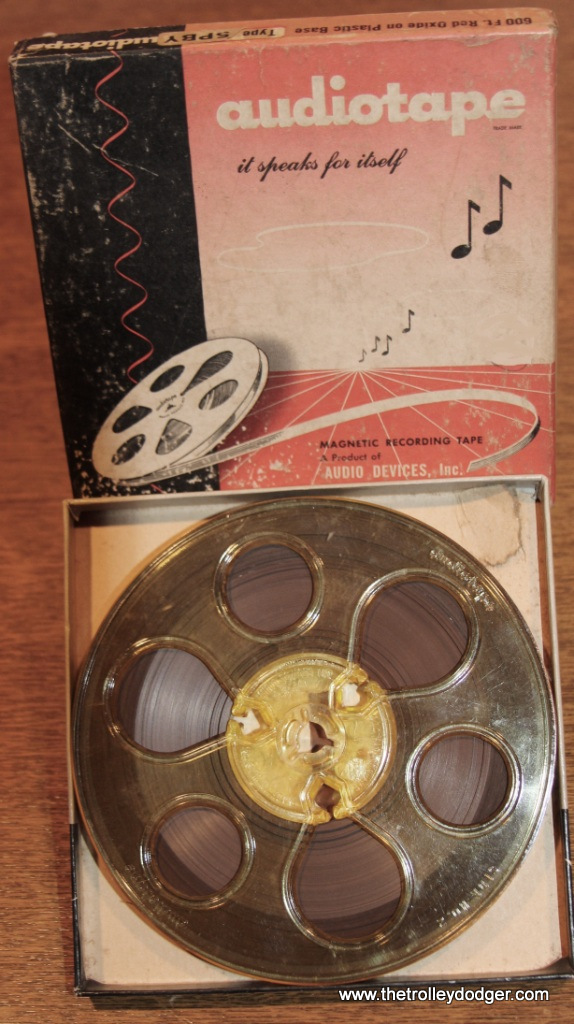
In 2016, we were fortunate to acquire a rare 16″ transcription disc, made in 1939 for the Chicago Surface Lines. This included an audio presentation called “Keeping Pace,” about 20 minutes long, that CSL used for employee training.

We were recently able to find someone who could play such a large disc, and now this program has been digitized and can be heard for the first time in more than 80 years. We have added it as a bonus feature to our Red Arrow Lines 1967 CD, available below and through our Online Store.

Screen Shot 03-16-16 at 06.58 PM.PNGScreen Shot 03-17-16 at 12.44 AM.PNG

RAL
Red Arrow Lines 1967: Straffords and Bullets
# of Discs – 1
Price: $14.99

This disc features rare, long out-of-print audio recordings of two 1967 round trips on the Philadelphia & Western (aka “Red Arrow Lines”) interurban between Philadelphia and Norristown, the famous third rail High-Speed Line.  One trip is by a Strafford car and the other by one of the beloved streamlined Bullets.  The line, about 13 miles long and still in operation today under SEPTA, bears many similarities to another former interurban line, the Chicago Transit Authority‘s Yellow Line (aka the “Skokie Swift”).  We have included two bonus features, audio of an entire ride along that five mile route, which was once part of the North Shore Line, and a 20-minute 1939 Chicago Surface Lines training program (“Keeping Pace”).  This was digitized from a rare original 16″ transcription disc and now can be heard again for the first time in over 80 years.

Total time – 73:32

The Trolley Dodger On the Air
We appeared on WGN radio in Chicago in November 2018, discussing our book Building Chicago’s Subways on the Dave Plier Show. You can hear our 19-minute conversation here.
Chicago, Illinois, December 17, 1938-- Secretary Harold Ickes, left, and Mayor Edward J. Kelly turn the first spadeful of earth to start the new $40,000,000 subway project. Many thousands gathered to celebrate the starting of work on the subway. Chicago, Illinois, December 17, 1938– Secretary Harold Ickes, left, and Mayor Edward J. Kelly turn the first spadeful of earth to start the new $40,000,000 subway project. Many thousands gathered to celebrate the starting of work on the subway.
Order Our New Book Building Chicago’s Subways

There were three subway anniversaries in 2018 in Chicago:
60 years since the West Side Subway opened (June 22, 1958)
75 years since the State Street Subway opened (October 17, 1943)
80 years since subway construction started (December 17, 1938)
To commemorate these anniversaries, we have written a new book, Building Chicago’s Subways.

While the elevated Chicago Loop is justly famous as a symbol of the city, the fascinating history of its subways is less well known. The City of Chicago broke ground on what would become the “Initial System of Subways” during the Great Depression and finished 20 years later. This gigantic construction project, a part of the New Deal, would overcome many obstacles while tunneling through Chicago’s soft blue clay, under congested downtown streets, and even beneath the mighty Chicago River. Chicago’s first rapid transit subway opened in 1943 after decades of wrangling over routes, financing, and logistics. It grew to encompass the State Street, Dearborn-Milwaukee, and West Side Subways, with the latter modernizing the old Garfield Park “L” into the median of Chicago’s first expressway. Take a trip underground and see how Chicago’s “I Will” spirit overcame challenges and persevered to help with the successful building of the subways that move millions. Building Chicago’s subways was national news and a matter of considerable civic pride–making it a “Second City” no more!

Bibliographic information:
Title Building Chicago’s Subways
Images of America
Author David Sadowski
Edition illustrated
Publisher Arcadia Publishing (SC), 2018
ISBN 1467129380, 9781467129381
Length 128 pages
Chapter Titles:
01. The River Tunnels
02. The Freight Tunnels
03. Make No Little Plans
04. The State Street Subway
05. The Dearborn-Milwaukee Subway
06. Displaced
07. Death of an Interurban
08. The Last Street Railway
09. Subways and Superhighways
10. Subways Since 1960
Building Chicago’s Subways is in stock and now available for immediate shipment. Order your copy today! All copies purchased through The Trolley Dodger will be signed by the author.
The price of $23.99 includes shipping within the United States.
For Shipping to US Addresses:

For Shipping to Canada:

For Shipping Elsewhere:

Redone tile at the Monroe and Dearborn CTA Blue Line subway station, showing how an original sign was incorporated into a newer design, May 25, 2018. (David Sadowski Photo) Redone tile at the Monroe and Dearborn CTA Blue Line subway station, showing how an original sign was incorporated into a newer design, May 25, 2018. (David Sadowski Photo)

Help Support The Trolley Dodger

gh1

This is our 255th post, and we are gradually creating a body of work and an online resource for the benefit of all railfans, everywhere. To date, we have received over 664,000 page views, for which we are very grateful.

You can help us continue our original transit research by checking out the fine products in our Online Store.

As we have said before, “If you buy here, we will be here.”

We thank you for your support.

DONATIONS

In order to continue giving you the kinds of historic railroad images that you have come to expect from The Trolley Dodger, we need your help and support. It costs money to maintain this website, and to do the sort of historic research that is our specialty.

Your financial contributions help make this web site better, and are greatly appreciated.

Ravenswood Rarities

CTA 4271-4272 head up a Ravenswood "A" train leaving Kimball and Lawrence on October 21, 1973. This shows how this pair of cars looked before they were renovated as part of CTA's historical fleet. (Apparently, in spite of the sign, this wasn't a regular service train, but was part of a CERA fantrip that day.)

CTA 4271-4272 head up a Ravenswood “A” train leaving Kimball and Lawrence on October 21, 1973. This shows how this pair of cars looked before they were renovated as part of CTA’s historical fleet. (Apparently, in spite of the sign, this wasn’t a regular service train, but was part of a CERA fantrip that day.)

This time around, we have lots of classic traction photos for your consideration. For whatever reason, many of them were taken in the vicinity of Lawrence and Kimball, terminus of the CTA Brown Line (formerly known as the Ravenswood “L”).

There was a recent fantrip on the CTA “L” system, using historic cars 4271-4272. This sold out quickly, and unfortunately, we were not able to participate. But it did help raise money for two very worthy causes. Besides helping to keep these early 1920s railcars running on the CTA, funds also went to assist the Fox River Trolley Museum recover from the vandalism they suffered last year. We encourage our readers to help with these efforts by contacting those organizations directly.

We do have several images of 4271-4272 from previous fantrips, however (and one, at the top of this page, from one of the last times they were used in regular service).

Many of these images come courtesy of Bill Shapotkin. We hope that you will support Mr. Shapotkin’s efforts by attending his programs, which include the upcoming Hoosier Traction Meet this September. More about that will be found further down in this post. We also have some additional recent photo finds of our own.

Just to dispel any notion that these images always looked this way, this time we have included some “before” shots that you can contrast with the “after” ones. There is a lot of work that goes into making these images look better.

As always, if you can help provide any additional information about these photos, we would love to hear from you.

Enjoy!

-David Sadowski

PS- A few of our readers have pointed out that in our last couple of posts, clicking on the various images with your mouse would not bring up a larger version of that picture, so you can study it more closely. We have fixed that issue in this new post, and promise we will go back soon and correct it on those two as well.

From the Collections of William Shapotkin:

CTA PCC 4380 on the Wentworth line on June 16, 1958, less than a week before the end of streetcar service in Chicago.

CTA PCC 4380 on the Wentworth line on June 16, 1958, less than a week before the end of streetcar service in Chicago.

This is a duplicate slide, but started out as a 1958 Ektachrome slide, where the color layers other than red were unstable and faded badly. This left very little to work with, but I did the best I could.

This is a duplicate slide, but started out as a 1958 Ektachrome slide, where the color layers other than red were unstable and faded badly. This left very little to work with, but I did the best I could.

Here it is again, tweaked by our good friend J. J. Sedelmaier.

Here it is again, tweaked by our good friend J. J. Sedelmaier.

CTA historic cars 4271-4272 on the Skokie Swift on December 11, 1976.

CTA historic cars 4271-4272 on the Skokie Swift on December 11, 1976.

This and several other similar photos were seriously underexposed.

This and several other similar photos were seriously underexposed.

CTA 2200-series "L" cars at Skokie Shops on December 11, 1976.

CTA 2200-series “L” cars at Skokie Shops on December 11, 1976.

CTA Wheel Car S-313 at Skokie Shops on December 11, 1976.

CTA Wheel Car S-313 at Skokie Shops on December 11, 1976.

CTA "Met" cars at Kimball Yard, being used either as offices or for storage, in August 1967. (Compare with the picture of these same cars a few years later, showing how they had deteriorated somewhat after being stored outdoors.)

CTA “Met” cars at Kimball Yard, being used either as offices or for storage, in August 1967. (Compare with the picture of these same cars a few years later, showing how they had deteriorated somewhat after being stored outdoors.)

CTA 5001 in the Kimball Yard on July 14, 1961.

CTA 5001 in the Kimball Yard on July 14, 1961.

Restoring this photo was particularly satisfying.

Restoring this photo was particularly satisfying.

CTA 2858 at Kimball on the Ravenswood line on April 14, 1957. I believe the occasion was a charter trip, held by the Illinois Electric Railway Museum. Don's Rail Photos: "2858 was built by Pullman in 1906 as M-WSER 858. In 1913 it was renumbered 2858 and in 1923 it became CRT 2858."

CTA 2858 at Kimball on the Ravenswood line on April 14, 1957. I believe the occasion was a charter trip, held by the Illinois Electric Railway Museum. Don’s Rail Photos: “2858 was built by Pullman in 1906 as M-WSER 858. In 1913 it was renumbered 2858 and in 1923 it became CRT 2858.”

CTA 4063 at Kimball and Lawrence on January 31, 1958.

CTA 4063 at Kimball and Lawrence on January 31, 1958.

CTA 6706 at the Kimball Yard on November 1, 1986. (Ronald J. Sullivan Photo)

CTA 6706 at the Kimball Yard on November 1, 1986. (Ronald J. Sullivan Photo)

CTA 6049-6050 at Kimball Yard on March 16, 1980.

CTA 6049-6050 at Kimball Yard on March 16, 1980.

CTA 6041-6042 at Kimball and Lawrence on March 2, 1977. (Ronald J. Sullivan Photo)

CTA 6041-6042 at Kimball and Lawrence on March 2, 1977. (Ronald J. Sullivan Photo)

CTA 4271-4272 and 3441-3442 at Lawrence and Kimball. These cars were used on a Central Electric Railfans' Association fantrip in 2000. (John Allen Photo)

CTA 4271-4272 and 3441-3442 at Lawrence and Kimball. These cars were used on a Central Electric Railfans’ Association fantrip in 2000. (John Allen Photo)

CTA 2411-2412 have derailed at Kimball Yard on August 25, 1978.

CTA 2411-2412 have derailed at Kimball Yard on August 25, 1978.

Here, a couple of old CTA "Met" cars are being used as either offices or storage at Kimball Yard in April 1974.

Here, a couple of old CTA “Met” cars are being used as either offices or storage at Kimball Yard in April 1974.

CTA 6643-6644 in the Kimball Yard on February 1, 1987.

CTA 6643-6644 in the Kimball Yard on February 1, 1987.

CTA 4387 and 4432 in the Kimball yard on July 25, 1970.

CTA 4387 and 4432 in the Kimball yard on July 25, 1970.

CTA 6165-6166 at Kimball, the outer terminal on the Ravenswood line (today's Brown Line), on May 21, 1977. (Ronald J. Sullivan Photo)

CTA 6165-6166 at Kimball, the outer terminal on the Ravenswood line (today’s Brown Line), on May 21, 1977. (Ronald J. Sullivan Photo)

CTA 6166-6165, working a westbound trip on CTA's Ravenswood Line, approaches the Kimball and Lawrence terminal on June 20, 1952.

CTA 6166-6165, working a westbound trip on CTA’s Ravenswood Line, approaches the Kimball and Lawrence terminal on June 20, 1952.

CTA 6139-6140 at Kimball and Lawrence on November 13, 1977. (Ronald J. Sullivan Photo)

CTA 6139-6140 at Kimball and Lawrence on November 13, 1977. (Ronald J. Sullivan Photo)

CTA 4271-4272 at Kimball and Lawrence., during an NRHS fantrip on December 13, 1998. During the fantrip, these cars were operated between the terminal and the storage yard, for the benefit of ticket-holders. (William Shapotkin Photo)

CTA 4271-4272 at Kimball and Lawrence., during an NRHS fantrip on December 13, 1998. During the fantrip, these cars were operated between the terminal and the storage yard, for the benefit of ticket-holders. (William Shapotkin Photo)

On December 13, 1998, CTA historic cars 4271-4272 are being operated as part of an NRHS fantrip. At left, 3455-3456 has just arrived as an in-service train, and is about to be moved to the yard. The view looks north, off the south end of track 3. (William Shapotkin Photo)

On December 13, 1998, CTA historic cars 4271-4272 are being operated as part of an NRHS fantrip. At left, 3455-3456 has just arrived as an in-service train, and is about to be moved to the yard. The view looks north, off the south end of track 3. (William Shapotkin Photo)

CTA gate car (either 280 or 390) at Kimball and Lawrence on a Central Electric Railfans' Associaiton fantrip in the 1950s. (Ken Rieger Photo)

CTA gate car (either 280 or 390) at Kimball and Lawrence on a Central Electric Railfans’ Associaiton fantrip in the 1950s. (Ken Rieger Photo)

As you can see, the original for this 1950s slide was somewhat washed out and devoid of much color.

As you can see, the original for this 1950s slide was somewhat washed out and devoid of much color.

CTA 2769-2770 at Kimball and Lawrence on a Central Electric Railfans' Association fantrip on August 29, 1994. (William Shapotkin Photo)

CTA 2769-2770 at Kimball and Lawrence on a Central Electric Railfans’ Association fantrip on August 29, 1994. (William Shapotkin Photo)

CTA 6101-6102 at Kimball and Lawrence in March 1993. (John J. Le Beau Photo)

CTA 6101-6102 at Kimball and Lawrence in March 1993. (John J. Le Beau Photo)

CTA 6139-6140 at Kimball and Lawrence on June 12, 1976. (Ronald J. Sullivan Photo)

CTA 6139-6140 at Kimball and Lawrence on June 12, 1976. (Ronald J. Sullivan Photo)

It appears CTA 6138 is at the tail end of a train that is approaching the Ravenswood terminal at Kimball and Lawrence in August 1978.

It appears CTA 6138 is at the tail end of a train that is approaching the Ravenswood terminal at Kimball and Lawrence in August 1978.

CTA articulated 5003 near Kimball and Lawrence on September 9, 1958.

CTA articulated 5003 near Kimball and Lawrence on September 9, 1958.

CTA gate car 270 at Kimball yard on September 13, 1953.

CTA gate car 270 at Kimball yard on September 13, 1953.

There is a difference between the faded-out brown here, and "Traction Orange."

There is a difference between the faded-out brown here, and “Traction Orange.”

CTA wooden "L" cars 361 and 257 in the Kimball Yard on February 4, 1951.

CTA wooden “L” cars 361 and 257 in the Kimball Yard on February 4, 1951.

CTA 6103-6104 are at the head of a 6-car Ravenswood train at Kimball and Lawrence on January 23, 1979. (Ronald J. Sullivan Photo)

CTA 6103-6104 are at the head of a 6-car Ravenswood train at Kimball and Lawrence on January 23, 1979. (Ronald J. Sullivan Photo)

A CTA single-car Skokie Swift train near Skokie Shops on December 11, 1976.

A CTA single-car Skokie Swift train near Skokie Shops on December 11, 1976.

CTA Flatcar S-300 at Skokie Shops on May 21, 1977.

CTA Flatcar S-300 at Skokie Shops on May 21, 1977.

CTA Flatcar S-324 at Skokie Shops on May 21, 1977.

CTA Flatcar S-324 at Skokie Shops on May 21, 1977.

CTA Flatcar S-329 at Skokie Shops on May 21, 1977.

CTA Flatcar S-329 at Skokie Shops on May 21, 1977.

CTA Flatcar S-1500 at Skokie Shops on May 21, 1977.

CTA Flatcar S-1500 at Skokie Shops on May 21, 1977.

A train of CTA 2000s (on the Lake-Dan Ryan line) are on the Loop "L" on September 13, 1976.

A train of CTA 2000s (on the Lake-Dan Ryan line) are on the Loop “L” on September 13, 1976.

The CTA Randolph and Wells station on September 13, 1976. This station has since been replaced by Washington and Wells.

The CTA Randolph and Wells station on September 13, 1976. This station has since been replaced by Washington and Wells.

I was particularly happy that I could improve this picture, which is practically monochrome.

I was particularly happy that I could improve this picture, which is practically monochrome.

At left, CTA's Tower 18, at the junction of Lake and Wells, on September 13, 1976. The view looks north.

At left, CTA’s Tower 18, at the junction of Lake and Wells, on September 13, 1976. The view looks north.

CTA articulated train at Skokie Shops in August 1986. Here, it has been repainted to its original Chicago Rapid Transit Company livery. Don's Rail Photos: '5001 was built by Pullman-Standard in 1947, #6747. It was renumbered 51 in 1963 and acquired by Fox River Trolley Museum in 1986. It was restored as 5001."

CTA articulated train at Skokie Shops in August 1986. Here, it has been repainted to its original Chicago Rapid Transit Company livery. Don’s Rail Photos: ‘5001 was built by Pullman-Standard in 1947, #6747. It was renumbered 51 in 1963 and acquired by Fox River Trolley Museum in 1986. It was restored as 5001.”

CTA Flatcar S-1501 at Skokie Shops on May 21, 1977.

CTA Flatcar S-1501 at Skokie Shops on May 21, 1977.

A CTA work train, powered by 6000-series "L" cars, including S-406, at Skokie Shops on May 21, 1977.

A CTA work train, powered by 6000-series “L” cars, including S-406, at Skokie Shops on May 21, 1977.

The CTA bridge over the Chicago & North Western, used by the Lake-Dan Ryan line, in September 1977.

The CTA bridge over the Chicago & North Western, used by the Lake-Dan Ryan line, in September 1977.

CTA 4271 at Skokie Shops on December 11, 1976.

CTA 4271 at Skokie Shops on December 11, 1976.

The front trucks of CTA 4271, at Skokie Shops on December 11, 1976.

The front trucks of CTA 4271, at Skokie Shops on December 11, 1976.

A CTA single-car unit, equipped with an airfoil pan trolley, on the Skokie Swift on December 11, 1976.

A CTA single-car unit, equipped with an airfoil pan trolley, on the Skokie Swift on December 11, 1976.

A CTA single-car unit, equipped with an airfoil pan trolley, on the Skokie Swift on December 11, 1976.

A CTA single-car unit, equipped with an airfoil pan trolley, on the Skokie Swift on December 11, 1976.

If you are used to seeing old slides that look this way, you may not realize that much of the original color has faded, or that it is even possible to bring it back now.

If you are used to seeing old slides that look this way, you may not realize that much of the original color has faded, or that it is even possible to bring it back now.

A train of CTA 2200-series "L" cars at Clinton on the Lake branch of the Lake-Dan Ryan line in September 1977. the view looks west.

A train of CTA 2200-series “L” cars at Clinton on the Lake branch of the Lake-Dan Ryan line in September 1977. the view looks west.

A train of CTA 2000-series "L" cars, running on the Lake-Dan Ryan line, approaches the bridge over the Chicago & North Western in September 1977, heading westbound.

A train of CTA 2000-series “L” cars, running on the Lake-Dan Ryan line, approaches the bridge over the Chicago & North Western in September 1977, heading westbound.

Bringing back the color in this shot made this photo into something special.

Bringing back the color in this shot made this photo into something special.

A train of CTA 2000-series "L" cars at Clinton on the Lake Street "L" (today's Green Line) in September 1977.

A train of CTA 2000-series “L” cars at Clinton on the Lake Street “L” (today’s Green Line) in September 1977.

A CTA single-car unit, equipped with trolley poles, is running on the Evanston branch near Howard on May 28, 1977. Although overhead wire was no longer being used on Evanston, poles were left on a few such cars to serve as backups on the Skokie Swift if needed.

A CTA single-car unit, equipped with trolley poles, is running on the Evanston branch near Howard on May 28, 1977. Although overhead wire was no longer being used on Evanston, poles were left on a few such cars to serve as backups on the Skokie Swift if needed.

CTA Line Car S-606 at Howard Yard on May 28, 1977. Don's Rail Photos: "S-606 was built by Cincinnati in January 1923, #2620, as Chicago North Shore & Milwaukee 606. In 1963 it became CTA S-606 and burned in 1978. The remains were sold to the Indiana Transportation Museum." With the demise of the ITM site in Noblesville, Indiana in 2018, the 606 was acquired by another group, with the intention of restoring it.

CTA Line Car S-606 at Howard Yard on May 28, 1977. Don’s Rail Photos: “S-606 was built by Cincinnati in January 1923, #2620, as Chicago North Shore & Milwaukee 606. In 1963 it became CTA S-606 and burned in 1978. The remains were sold to the Indiana Transportation Museum.” With the demise of the ITM site in Noblesville, Indiana in 2018, the 606 was acquired by another group, with the intention of restoring it.

CTA historic cars 4271-4272 on the Skokie Swift on December 11, 1976.

CTA historic cars 4271-4272 on the Skokie Swift on December 11, 1976.

The east side of Skokie Shops on December 11, 1976.

The east side of Skokie Shops on December 11, 1976.

The CTA junction of Lake and Wells, by Tower 18, on September 13, 1976.

The CTA junction of Lake and Wells, by Tower 18, on September 13, 1976.

CTA Wheel Car S-313 at Skokie Shops on December 11, 1976.

CTA Wheel Car S-313 at Skokie Shops on December 11, 1976.

CTA MoW car S-365 at Skokie Shops on December 11, 1976.

CTA MoW car S-365 at Skokie Shops on December 11, 1976.

CTA MoW car S-365 at Skokie Shops on December 11, 1976.

CTA MoW car S-365 at Skokie Shops on December 11, 1976.

CTA Wheel Car S-313 at Skokie Shops on December 11, 1976.

CTA Wheel Car S-313 at Skokie Shops on December 11, 1976.

The CTA Skokie Swift (today's Yellow Line) on December 11, 1976.

The CTA Skokie Swift (today’s Yellow Line) on December 11, 1976.

A CTA single car unit on the Skokie Swift (today's Yellow Line), on May 28, 1977.

A CTA single car unit on the Skokie Swift (today’s Yellow Line), on May 28, 1977.

CTA 6000s on the Evanston branch at Howard Yard on May 28, 1977.

CTA 6000s on the Evanston branch at Howard Yard on May 28, 1977.

A CTA 6000-series "L" car at Skokie Shops on December 11, 1976.

A CTA 6000-series “L” car at Skokie Shops on December 11, 1976.

Hoosier Traction 2019

This PDF file explains what’s happening in Indianapolis this September 6-7:

hoosiertractionmeet_2019_05_public

Recent Finds

Steinway Lines Birney car 1660 in September 1937, signed for the H line in Pelham Manor, NY. According to a knowledgable historian: "There's a rather long story behind this. Yes, it's a Steinway car, and yes, it's on the TARS line in Westchester County. (The specific line was the route from New Rochelle to Pelham Manor.) Fontaine Fox, a Pelham native and creator of the "Toonerville Trolley" cartoons, said that he used this line as his original inspiration for the cartoon. So when the line was discontinued in 1937, the locals put on a big celebration at which Fox held forth as honored guest. For the occasion, TARS imported the Birney from Queens as the closest thing to the Toonerville Trolley. (Normal service was TARS convertibles or 700s.) The photo shows the car some time before or after the ceremony."

Steinway Lines Birney car 1660 in September 1937, signed for the H line in Pelham Manor, NY. According to a knowledgable historian: “There’s a rather long story behind this. Yes, it’s a Steinway car, and yes, it’s on the TARS line in Westchester County. (The specific line was the route from New Rochelle to Pelham Manor.) Fontaine Fox, a Pelham native and creator of the “Toonerville Trolley” cartoons, said that he used this line as his original inspiration for the cartoon. So when the line was discontinued in 1937, the locals put on a big celebration at which Fox held forth as honored guest. For the occasion, TARS imported the Birney from Queens as the closest thing to the Toonerville Trolley. (Normal service was TARS convertibles or 700s.) The photo shows the car some time before or after the ceremony.”

Prewar Chicago PCC 7010 is at the western terminal of Route 63 - 63rd Street, located at 63rd Place and Narragansett Avenue. After streetcars were cut back to this loop in 1948 (double-ended cars had previously gone a half mile west to Oak Park Avenue) this became a transfer point for buses heading west. This bus is heading to Argo, which is not the name of a suburb, but the name of a factory in suburban Summit that produced Argo corn starch. If you could see the front of the PCC, there were "tiger stripes," intended to make the cars more visible to motorists and pedestrians. PCCs ran on 63rd Street from 1948-52. (William Hoffman Photo, Wien-Criss Archive)

Prewar Chicago PCC 7010 is at the western terminal of Route 63 – 63rd Street, located at 63rd Place and Narragansett Avenue. After streetcars were cut back to this loop in 1948 (double-ended cars had previously gone a half mile west to Oak Park Avenue) this became a transfer point for buses heading west. This bus is heading to Argo, which is not the name of a suburb, but the name of a factory in suburban Summit that produced Argo corn starch. If you could see the front of the PCC, there were “tiger stripes,” intended to make the cars more visible to motorists and pedestrians. PCCs ran on 63rd Street from 1948-52. (William Hoffman Photo, Wien-Criss Archive)

Here, we see CTA PCC 7236, a postwar product of the St. Louis Car Company. Jeff Wien: "It is on Western Avenue Avenue during the one man period 1955-56. Because of the grass in the foreground, it seems park-like, which was the case where Western Avenue was paralleled by Western Blvd., which I believe extended from Archer to Garfield. I would guess that the slide is on Western Ave south of Archer." (Wien-Criss Archive)

Here, we see CTA PCC 7236, a postwar product of the St. Louis Car Company. Jeff Wien: “It is on Western Avenue Avenue during the one man period 1955-56. Because of the grass in the foreground, it seems park-like, which was the case where Western Avenue was paralleled by Western Blvd., which I believe extended from Archer to Garfield. I would guess that the slide is on Western Ave south of Archer.” (Wien-Criss Archive)

Philadelphia Suburban Transportation Company (aka Red Arrow Lines) car 18, a double-ended product of St. Louis Car Company that closely resembled a PCC but had conventional running gear, at the end of the line in West Chester. Rail service on this long interurban line was replaced by buses in June 1954.

Philadelphia Suburban Transportation Company (aka Red Arrow Lines) car 18, a double-ended product of St. Louis Car Company that closely resembled a PCC but had conventional running gear, at the end of the line in West Chester. Rail service on this long interurban line was replaced by buses in June 1954.

CTA 4355 and it's semi-permanently attached mate (not sure of the #) at Marion Street, on the ground level portion of the Lake Street "L", on September 10, 1957.

CTA 4355 and it’s semi-permanently attached mate (not sure of the #) at Marion Street, on the ground level portion of the Lake Street “L”, on September 10, 1957.

Chicago Aurora & Elgin car 50 (with 44 at left) at the Wheaton yards on September 13, 1953. (Robert Selle Photo)

Chicago Aurora & Elgin car 50 (with 44 at left) at the Wheaton yards on September 13, 1953. (Robert Selle Photo)

Chicago Aurora & Elgin car 428 at the Forest Park loop at DesPlaines Avenue on October 10, 1953. Less than a month earlier, CA&E trains stopped running downtown, and a new terminal arrangement was hurriedly put into use, so riders could switch between CA&E and CTA trains. (Robert Selle Photo)

Chicago Aurora & Elgin car 428 at the Forest Park loop at DesPlaines Avenue on October 10, 1953. Less than a month earlier, CA&E trains stopped running downtown, and a new terminal arrangement was hurriedly put into use, so riders could switch between CA&E and CTA trains. (Robert Selle Photo)

A three-car Chicago Aurora & Elgin train, including cars 316 and 314, as seen from the Halsted Street platform of the Garfield Park "L". The view looks east on June 18, 1953, about three months before CA%E service was cut back to Forest Park. (Robert Selle Photo)

A three-car Chicago Aurora & Elgin train, including cars 316 and 314, as seen from the Halsted Street platform of the Garfield Park “L”. The view looks east on June 18, 1953, about three months before CA%E service was cut back to Forest Park. (Robert Selle Photo)

Someone gave me this slide. I am not sure of the circumstances, but it seems to show Blue Bird Coach Lines bus #1.

Someone gave me this slide. I am not sure of the circumstances, but it seems to show Blue Bird Coach Lines bus #1.

This is an interesting photo for several reasons. It shows the temporary ground-level operation on the Garfield Park "L" in the south portion of Van Buren Street, used from 1953-58 while construction of the new Congress rapid transit line was underway in the nearby expressway. But this is not a regular service train-- it's a fantrip for the Illinois Electric Railway Museum. By the time this photo was taken (1958), wooden "L" cars were no longer in use on this line. The second car has been repainted for use in work service. We are at Van Buren and Ogden. In the distance, you can see the old Paulina "L" crossing Ogden. By this time, it was being used by Douglas Park trains to reach the Lake Street "L", as the Pink Line does today.

This is an interesting photo for several reasons. It shows the temporary ground-level operation on the Garfield Park “L” in the south portion of Van Buren Street, used from 1953-58 while construction of the new Congress rapid transit line was underway in the nearby expressway. But this is not a regular service train– it’s a fantrip for the Illinois Electric Railway Museum. By the time this photo was taken (1958), wooden “L” cars were no longer in use on this line. The second car has been repainted for use in work service. We are at Van Buren and Ogden. In the distance, you can see the old Paulina “L” crossing Ogden. By this time, it was being used by Douglas Park trains to reach the Lake Street “L”, as the Pink Line does today.

Chicago Aurora & Elgin interurban box motor 5 at Wheaton in 1949.

Chicago Aurora & Elgin interurban box motor 5 at Wheaton in 1949.

A single CTA wooden "L" car heads east on the ground-level portion of the Lake Street "L" circa 1955. This was relocated onto the adjacent Chicago & North Western embankment in 1962.

A single CTA wooden “L” car heads east on the ground-level portion of the Lake Street “L” circa 1955. This was relocated onto the adjacent Chicago & North Western embankment in 1962.

A mother and her two kids have just gotten off a northbound Evanston train of 4000s at Isabella in June 1972. This station closed on July 16, 1973 and within a short period of time, all traces of it were removed, as it was a short distance from the Linden terminal and had low ridership. That same year, the Evanston branch was converted to third rail operation, and overhead wire was removed.

A mother and her two kids have just gotten off a northbound Evanston train of 4000s at Isabella in June 1972. This station closed on July 16, 1973 and within a short period of time, all traces of it were removed, as it was a short distance from the Linden terminal and had low ridership. That same year, the Evanston branch was converted to third rail operation, and overhead wire was removed.

Recent Correspondence

Andre Kristopans
writes:

In 1935 CSL and CRT began exchanging transfers. In 1936 CMC and CRT transfers followed.Some time soon, exact date unknown to me, CRT and West Towns transfers followed, but these were gone sometime after 1938. Each transfer type was its own color as follows:

CRT to CSL – yellow (actually “newsprint?”)
CRT to CMC – green
CRT to West Towns – pink
CSL to CRT – blue
CMC to CRT – unknown to me
CWT to CRT – unknown – any ideas what they looked like?

In 1943 CSL and CMC transfers began and colors were revised:

CRT – CSL – blue
CRT – CMC – green
CMC – CSL – pink

Around 1947 CMC to CSL and CRT became orange. Once CTA was formed all L transfers became blue, both to CTA durface system and to CMC, while surface to CMC remained green and CMC to CTA surface or L remained orange. In 1953 orange transfers were eliminated as former CMC routes were put on regular surface transfers. L transfers remained blue until about 1962 when they became green.

If anybody has any additional information or can offer any corrections, they would be very welcomed!

Jon Roma writes:

I can offer the attached color image of CNS&M/C&NW Ryan Tower, given your recent feature on the subject along with the statement that there are few shots of the location. This is digitized from a slide by unknown photographer that resides in my collection; it’s obviously a railfan excursion taken on or about March 1962. Please feel free to use if you’d like.

We thank all our contributors!

TRACTION AUDIO, NOW AVAILABLE ON COMPACT DISC:

CDLayout33p85

RRCNSLR
Railroad Record Club – North Shore Line Rarities 1955-1963
# of Discs – 1
Price: $15.99

Railroad Record Club – North Shore Line Rarities 1955-1963

Newly rediscovered and digitized after 60 years, most of these audio recordings of Chicago, North Shore and Milwaukee interurban trains are previously unheard, and include on-train recordings, run-bys, and switching. Includes both Electroliners, standard cars, and locomotives. Recorded between 1955 and 1963 on the Skokie Valley Route and Mundelein branch. We are donating $5 from the sale of each disc to Kenneth Gear, who saved these and many other original Railroad Record Club master tapes from oblivion.

Total time – 73:14


Tape 4 switching at Roudout + Mundeline pic 3Tape 4 switching at Roudout + Mundeline pic 2Tape 4 switching at Roudout + Mundeline pic 1Tape 3 Mundeline Run pic 2Tape 3 Mundeline Run pic 1Tape 2 Mundeline pic 3Tape 2 Mundeline pic 2Tape 2 Mundeline pic 1Tape 1 ElectrolinerTape 1 Electroliner pic 3Tape 1 Electroliner pic 2Notes from tape 4Note from tape 2

The Trolley Dodger On the Air

We appeared on WGN radio in Chicago last November, discussing our book Building Chicago’s Subways on the Dave Plier Show. You can hear our 19-minute conversation here.

Chicago, Illinois, December 17, 1938-- Secretary Harold Ickes, left, and Mayor Edward J. Kelly turn the first spadeful of earth to start the new $40,000,000 subway project. Many thousands gathered to celebrate the starting of work on the subway.

Chicago, Illinois, December 17, 1938– Secretary Harold Ickes, left, and Mayor Edward J. Kelly turn the first spadeful of earth to start the new $40,000,000 subway project. Many thousands gathered to celebrate the starting of work on the subway.

Order Our New Book Building Chicago’s Subways

There were three subway anniversaries in 2018 in Chicago:
60 years since the West Side Subway opened (June 22, 1958)
75 years since the State Street Subway opened (October 17, 1943)
80 years since subway construction started (December 17, 1938)

To commemorate these anniversaries, we have written a new book, Building Chicago’s Subways.

While the elevated Chicago Loop is justly famous as a symbol of the city, the fascinating history of its subways is less well known. The City of Chicago broke ground on what would become the “Initial System of Subways” during the Great Depression and finished 20 years later. This gigantic construction project, a part of the New Deal, would overcome many obstacles while tunneling through Chicago’s soft blue clay, under congested downtown streets, and even beneath the mighty Chicago River. Chicago’s first rapid transit subway opened in 1943 after decades of wrangling over routes, financing, and logistics. It grew to encompass the State Street, Dearborn-Milwaukee, and West Side Subways, with the latter modernizing the old Garfield Park “L” into the median of Chicago’s first expressway. Take a trip underground and see how Chicago’s “I Will” spirit overcame challenges and persevered to help with the successful building of the subways that move millions. Building Chicago’s subways was national news and a matter of considerable civic pride–making it a “Second City” no more!

Bibliographic information:

Title Building Chicago’s Subways
Images of America
Author David Sadowski
Edition illustrated
Publisher Arcadia Publishing (SC), 2018
ISBN 1467129380, 9781467129381
Length 128 pages

Chapter Titles:
01. The River Tunnels
02. The Freight Tunnels
03. Make No Little Plans
04. The State Street Subway
05. The Dearborn-Milwaukee Subway
06. Displaced
07. Death of an Interurban
08. The Last Street Railway
09. Subways and Superhighways
10. Subways Since 1960

Building Chicago’s Subways is in stock and now available for immediate shipment. Order your copy today! All copies purchased through The Trolley Dodger will be signed by the author.

The price of $23.99 includes shipping within the United States.

For Shipping to US Addresses:

For Shipping to Canada:

For Shipping Elsewhere:

Redone tile at the Monroe and Dearborn CTA Blue Line subway station, showing how an original sign was incorporated into a newer design, May 25, 2018. (David Sadowski Photo)

Redone tile at the Monroe and Dearborn CTA Blue Line subway station, showing how an original sign was incorporated into a newer design, May 25, 2018. (David Sadowski Photo)

Help Support The Trolley Dodger

gh1

This is our 230th post, and we are gradually creating a body of work and an online resource for the benefit of all railfans, everywhere. To date, we have received over 513,000 page views, for which we are very grateful.

You can help us continue our original transit research by checking out the fine products in our Online Store.

As we have said before, “If you buy here, we will be here.”

We thank you for your support.

DONATIONS

In order to continue giving you the kinds of historic railroad images that you have come to expect from The Trolley Dodger, we need your help and support. It costs money to maintain this website, and to do the sort of historic research that is our specialty.

Your financial contributions help make this web site better, and are greatly appreciated.

Traction Valentines

I believe this photo postcard of Chicago Surface Lines 5812 was taken at the 72nd and Cottage Grove loop. Don's Rail Photos says, "5712 was built by Brill Car Co in 1912, #18322. It was rebuilt as one man/two man service in 1933 and retired on August 25, 1947." This picture appears to date between 1914 and 1933.

I believe this photo postcard of Chicago Surface Lines 5812 was taken at the 72nd and Cottage Grove loop. Don’s Rail Photos says, “5712 was built by Brill Car Co in 1912, #18322. It was rebuilt as one man/two man service in 1933 and retired on August 25, 1947.” This picture appears to date between 1914 and 1933.

Valentine’s Day is fast approaching, and here we have some tasty traction Valentines for your consideration. First, we have some recent finds of our own, followed by many generously shared from the collections of William Shapotkin. We finish this post with an important find from J. J. Sedelmaier.

-David Sadowski

Recent Finds

LVT 812 in front of the Easton car barn on a June 30, 1947 fantrip. (James Maloney, Jr. Photo)

LVT 812 in front of the Easton car barn on a June 30, 1947 fantrip. (James Maloney, Jr. Photo)

LVT 710 at Philadelphia, PA on August 19, 1945. (James Maloney, Jr. Photo)

LVT 710 at Philadelphia, PA on August 19, 1945. (James Maloney, Jr. Photo)

LVT 1000 is on an ERA fantrip, "at the east end of the Ham Street Bridge," in Allentown on October 29, 1950. (James Maloney, Jr. Photo)

LVT 1000 is on an ERA fantrip, “at the east end of the Ham Street Bridge,” in Allentown on October 29, 1950. (James Maloney, Jr. Photo)

LVT 1003 is at the Allentown car barn in September, 1940. (James Maloney, Jr. Photo)

LVT 1003 is at the Allentown car barn in September, 1940. (James Maloney, Jr. Photo)

LVT 1004 in Allentown, October 1939. (James Maloney, Jr. Photo)

LVT 1004 in Allentown, October 1939. (James Maloney, Jr. Photo)

LT 1006 at Allentown on January 23, 1943. (James Maloney, Jr. Photo)

LT 1006 at Allentown on January 23, 1943. (James Maloney, Jr. Photo)

LVT 803, in dead storage awaiting scrapping in Allentown, on November 8, 1939. (James Maloney, Jr. Photo)

LVT 803, in dead storage awaiting scrapping in Allentown, on November 8, 1939. (James Maloney, Jr. Photo)

A single-car CTA Skokie Swift train leaves Howard Street in June 1977.

A single-car CTA Skokie Swift train leaves Howard Street in June 1977.

An artist's rendering of the high-level us subway the CTA envisioned for Washington Street between Canal and Michigan, 1961.

An artist’s rendering of the high-level us subway the CTA envisioned for Washington Street between Canal and Michigan, 1961.

Indiana Railroad #1150 is southbound at Springport station on the New Castle line on January 1, 1941 in the waning days of that storied Hoosier interurban. (Eugene Van Dusen Photo)

Indiana Railroad #1150 is southbound at Springport station on the New Castle line on January 1, 1941 in the waning days of that storied Hoosier interurban. (Eugene Van Dusen Photo)

SF Muni cable car 524 is at Powell and Market at 1 am on September 2, 1956.

SF Muni cable car 524 is at Powell and Market at 1 am on September 2, 1956.

SF Muni cable car 503 at Washington and Octavia on September 1, 1956.

SF Muni cable car 503 at Washington and Octavia on September 1, 1956.

Cable car track work at Powell and California on October 31, 1957.

Cable car track work at Powell and California on October 31, 1957.

Red Arrow Lines Brilliner #7 is running on the street, presumably on the Sharon Hill branch, on November 27, 1960.

Red Arrow Lines Brilliner #7 is running on the street, presumably on the Sharon Hill branch, on November 27, 1960.

On June 3, 1962 Red Arrow car 20 is turning onto a cobblestone street on the Sharon Hill line.

On June 3, 1962 Red Arrow car 20 is turning onto a cobblestone street on the Sharon Hill line.

At first, you might think this lineup of NSL cars in dead storage at Highwood (headed up by 158) is post-abandonment, but apparently not. The slide not only has a 1/20/63 date stamped on it (last full day of operations), the slide was processed by Kodak in January 1963.

At first, you might think this lineup of NSL cars in dead storage at Highwood (headed up by 158) is post-abandonment, but apparently not. The slide not only has a 1/20/63 date stamped on it (last full day of operations), the slide was processed by Kodak in January 1963.

In this April 11, 1964 view, one of the former North Shore Line Electroliners has been rechristened as a Red Arrow Liberty Liner on the Norristown High Speed Line in Philadelphia's suburbs. I would expect that the abandoned right-of-way at left is where the Strafford branch once was.

In this April 11, 1964 view, one of the former North Shore Line Electroliners has been rechristened as a Red Arrow Liberty Liner on the Norristown High Speed Line in Philadelphia’s suburbs. I would expect that the abandoned right-of-way at left is where the Strafford branch once was.

North Shore Line electric loco 456 heads up a short freight train on January 20, 1963-- the last full day of operations prior to abandonment.

North Shore Line electric loco 456 heads up a short freight train on January 20, 1963– the last full day of operations prior to abandonment.

CTA 7108, already signed for its northbound trip on Route 36, is near 120th and Halsted in the 1950s.

CTA 7108, already signed for its northbound trip on Route 36, is near 120th and Halsted in the 1950s.

CTA 4095 is eastbound at Lake and Ashland on June 24, 1961. In the background, you can see the old Lake Transfer station, where riders could change (up until February 1951) for Logan Square and Humboldt Park trains.

CTA 4095 is eastbound at Lake and Ashland on June 24, 1961. In the background, you can see the old Lake Transfer station, where riders could change (up until February 1951) for Logan Square and Humboldt Park trains.

A CTA two-car Lake Street "L" train heads east in this 1960 photo by Al Holtz.

A CTA two-car Lake Street “L” train heads east in this 1960 photo by Al Holtz.

April 1963.

April 1963.

From the Collections of William Shapotkin

CTA trolley us 9377 is at Irving Park and Neenah. This bus turnaround is no longer in use by CTA, and has now become part of a driveway for a development.

CTA trolley us 9377 is at Irving Park and Neenah. This bus turnaround is no longer in use by CTA, and has now become part of a driveway for a development.

At right, 2411-2412 are on the same fantrip mentioned in the revious photo. At left, a southbound Howard-Dan Ryan train passes the Diversey station on the Ravenswood "L". William Shapotkin took this picture on December 13, 1998.

At right, 2411-2412 are on the same fantrip mentioned in the revious photo. At left, a southbound Howard-Dan Ryan train passes the Diversey station on the Ravenswood “L”. William Shapotkin took this picture on December 13, 1998.

At right, CTA cars 2411-2412 are on an NRHS (National Railway Historical Society) fantrip. At left, a southbound Howard-Dan Ryan train blasts by the Armitage station on the Ravenswood "L". William Shapotkin took this photo on December 13, 1998.

At right, CTA cars 2411-2412 are on an NRHS (National Railway Historical Society) fantrip. At left, a southbound Howard-Dan Ryan train blasts by the Armitage station on the Ravenswood “L”. William Shapotkin took this photo on December 13, 1998.

CTA 2177 heads up an Evanston Express train at Armitage on July 10, 1989.

CTA 2177 heads up an Evanston Express train at Armitage on July 10, 1989.

CTA bus 8413 is southbound on Broadway at Lawrence in October 1973, running on Route 36. (Ronald J. Sullivan Photo)

CTA bus 8413 is southbound on Broadway at Lawrence in October 1973, running on Route 36. (Ronald J. Sullivan Photo)

CTA 3140, working a southbound trip on CTA Route 38 - Indiana, heads southbound on Wabash Avenue, crossing Roosevelt Road. Visible above the red car at right is the one-time Union Bus Deport. The view looks north.

CTA 3140, working a southbound trip on CTA Route 38 – Indiana, heads southbound on Wabash Avenue, crossing Roosevelt Road. Visible above the red car at right is the one-time Union Bus Deport. The view looks north.

CTA trolley bus 9537, working Route 12 - Roosevelt Road, departs its east end terminal at Roosevelt Road east of Wabash Avenue. the view looks north.

CTA trolley bus 9537, working Route 12 – Roosevelt Road, departs its east end terminal at Roosevelt Road east of Wabash Avenue. the view looks north.

CSL 5925 heads southbound on Wabash Avenue and crosses Roosevelt Road. The Union Bus Depot is on the northeast corner. The view looks northeast.

CSL 5925 heads southbound on Wabash Avenue and crosses Roosevelt Road. The Union Bus Depot is on the northeast corner. The view looks northeast.

CTA trolley bus 9453, working a westbound trip on Route 12 - Roosevelt Road, has just crossed Wabash Avenue. (The building on the northeast corner is the one-time Union Bus Depot.) The view looks northeast on May 27, 1967, taken from the CTA Roosevelt Road station.) Jeffrey L. Wien Photo, Wien-Criss Archive)

CTA trolley bus 9453, working a westbound trip on Route 12 – Roosevelt Road, has just crossed Wabash Avenue. (The building on the northeast corner is the one-time Union Bus Depot.) The view looks northeast on May 27, 1967, taken from the CTA Roosevelt Road station.) Jeffrey L. Wien Photo, Wien-Criss Archive)

A northbound Lake-Englewood "A" train of 2000-series cars approaches the "L" station at 40th and Indiana in September 1993. (Myron Lane Photo)

A northbound Lake-Englewood “A” train of 2000-series cars approaches the “L” station at 40th and Indiana in September 1993. (Myron Lane Photo)

A northbound CTA train approaches the Indiana "L" station on the south side of Chicago on June 28, 1992. The occasion was a Central Electric Railfans' Association fantrip, celebrating a century of rapid transit. (Jim Arvites Photo)

A northbound CTA train approaches the Indiana “L” station on the south side of Chicago on June 28, 1992. The occasion was a Central Electric Railfans’ Association fantrip, celebrating a century of rapid transit. (Jim Arvites Photo)

CTA 2821, a wooden Met car running northbound on the Kenwood shuttle circa 1956-57. These were the last type of cars used for that service, which ended in 1957.

CTA 2821, a wooden Met car running northbound on the Kenwood shuttle circa 1956-57. These were the last type of cars used for that service, which ended in 1957.

We are looking east off the CTA's Indiana Avenue "L" station in the early 1950s. At left, a Kenwood train has just departed en route to 42nd Place. At right, two 200-series cars (used as equipment on the Kenwood line) are in storage on what once had been the northbound local track of the South Side "L".

We are looking east off the CTA’s Indiana Avenue “L” station in the early 1950s. At left, a Kenwood train has just departed en route to 42nd Place. At right, two 200-series cars (used as equipment on the Kenwood line) are in storage on what once had been the northbound local track of the South Side “L”.

CTA gate car 268 at the Indiana Avenue station "pocket."

CTA gate car 268 at the Indiana Avenue station “pocket.”

CTA 268 is a Kenwood local, at the Indiana Avenue station.

CTA 268 is a Kenwood local, at the Indiana Avenue station.

A two-car train, including #227, is being stored for Kenwood service, on what had once been the northbound local track on the South Side "L", in the early 1950s.

A two-car train, including #227, is being stored for Kenwood service, on what had once been the northbound local track on the South Side “L”, in the early 1950s.

CTA 385 is at the Indiana Avenue station in July 1948,signed as a Wilson Avenue local via the elevated (instead of the State Street subway, which opened in 1943). The following year, the CTA introduced A/B "skip stop" service to North-South and the Kenwood and Stockyards branches became shuttles.

CTA 385 is at the Indiana Avenue station in July 1948,signed as a Wilson Avenue local via the elevated (instead of the State Street subway, which opened in 1943). The following year, the CTA introduced A/B “skip stop” service to North-South and the Kenwood and Stockyards branches became shuttles.

CTA car #273, working the Kenwood "L" shuttle, is seen at the 40th and Indiana Avenue station. The view looks northeast.

CTA car #273, working the Kenwood “L” shuttle, is seen at the 40th and Indiana Avenue station. The view looks northeast.

Once the Kenwood and Stockyards ranch lines became full-time shuttle operations, the CTA station at 40th and Indiana Avenue was reconfigured. Here is a Kenwood car in the "pocket."

Once the Kenwood and Stockyards ranch lines became full-time shuttle operations, the CTA station at 40th and Indiana Avenue was reconfigured. Here is a Kenwood car in the “pocket.”

Looking west from the west end of the Indiana Avenue "L" station, 4000-series "L" cars are laying over on the Stockyards "L". 4000s were used on this branch during the 1952 and 1956 political conventions held at the International Amphitheater. (Joseph N. Canfield Photo)

Looking west from the west end of the Indiana Avenue “L” station, 4000-series “L” cars are laying over on the Stockyards “L”. 4000s were used on this branch during the 1952 and 1956 political conventions held at the International Amphitheater. (Joseph N. Canfield Photo)

The Indiana Avenue station on the South Side "L" circa 1956. A northbound Englewood-Howard train departs the station, while a Stockyards shuttle train awaits departure time. The view looks east. (Joseph N. Canfield Photo)

The Indiana Avenue station on the South Side “L” circa 1956. A northbound Englewood-Howard train departs the station, while a Stockyards shuttle train awaits departure time. The view looks east. (Joseph N. Canfield Photo)

Looking east (timetable south) into 63rd and Cottage Grove station on the Jackson Park "L" on May 12, 1996. (William Shapotkin Photo)

Looking east (timetable south) into 63rd and Cottage Grove station on the Jackson Park “L” on May 12, 1996. (William Shapotkin Photo)

A Lake-Jackson Park train approaching 63rd and Cottage Grove on May 12, 1996. The train has crossed over to the northbound track and is arriving at the station. (William Shapotkin Photo)

A Lake-Jackson Park train approaching 63rd and Cottage Grove on May 12, 1996. The train has crossed over to the northbound track and is arriving at the station. (William Shapotkin Photo)

A southbound Jackson Park train approaches 63rd and Cottage Grove on May 12, 1996. The train is about to cross over and arrive at the station. The view looks west (timetable north) from the north platform. (William Shapotkin Photo)

A southbound Jackson Park train approaches 63rd and Cottage Grove on May 12, 1996. The train is about to cross over and arrive at the station. The view looks west (timetable north) from the north platform. (William Shapotkin Photo)

Chicago, IL. Looking westbound on O'Neil Street (now 23rd Place) from Halsted Street. Well into the 1900s, this was an important terminal/transfer point. Note cable slots-- the West Chicago Street Railroad Company's Halsted-Van Buren cable line terminated in the carbarn at left. This was also the south terminal of Chicago Union Traction's Halsted line. CUT car #4171 (Pullman 1898) prepares for its northward journey. (Fred J. Borchert Photo)

Chicago, IL. Looking westbound on O’Neil Street (now 23rd Place) from Halsted Street. Well into the 1900s, this was an important terminal/transfer point. Note cable slots– the West Chicago Street Railroad Company’s Halsted-Van Buren cable line terminated in the carbarn at left. This was also the south terminal of Chicago Union Traction’s Halsted line. CUT car #4171 (Pullman 1898) prepares for its northward journey. (Fred J. Borchert Photo)

Chicago, IL. Looking westbound on 23rd (O'Neil) Street from Halsted Street, once a busy street-- once a busy streetcar/cable car terminal (with a carbarn). The rails (along with a crossover) are still intact and visible in this July 30, 2004 photo by William Shapotkin.

Chicago, IL. Looking westbound on 23rd (O’Neil) Street from Halsted Street, once a busy street– once a busy streetcar/cable car terminal (with a carbarn). The rails (along with a crossover) are still intact and visible in this July 30, 2004 photo by William Shapotkin.

(William Shapotkin Photo)

(William Shapotkin Photo)

Bus stop sign at the northwest corner of 23rd (O'Neil) Street and Halsted Street. The view looks northeast on July 30, 2004. (William Shapotkin Photo)

Bus stop sign at the northwest corner of 23rd (O’Neil) Street and Halsted Street. The view looks northeast on July 30, 2004. (William Shapotkin Photo)

Chicago, IL. Looking eastbound on 3rd (O'Neil) Street towards Halsted Street, once a busy streetcar/cable car terminal. Both sets of rails (which head onto northbound Halsted) are still visible (as of July 30, 2004) lo these many years since the discontinuance of streetcar service. (William Shapotkin Photo)

Chicago, IL. Looking eastbound on 3rd (O’Neil) Street towards Halsted Street, once a busy streetcar/cable car terminal. Both sets of rails (which head onto northbound Halsted) are still visible (as of July 30, 2004) lo these many years since the discontinuance of streetcar service. (William Shapotkin Photo)

Indiana Avenue station on the South Side "L". Left-- a northbound Kenwood train arrives, while at right, a westbound Howard train also arrives. The view looks east off the overhead transfer ridge in 1950. (Joseph N. Canfield Photo)

Indiana Avenue station on the South Side “L”. Left– a northbound Kenwood train arrives, while at right, a westbound Howard train also arrives. The view looks east off the overhead transfer ridge in 1950. (Joseph N. Canfield Photo)


Another North Shore Line Poster

Following up on our previous post Anniversaries (January 24, 2019), here is an interesting find, courtesy of our friend J. J. Sedelmaier.

Looking north on Chicago's Michigan Avenue at Ohio Street circa mid-late 1920s. BTW - the billboard on the right was originally produced in 1925 as a South Shore Line one-sheet poster. (J. J. Sedelmaier Collection)

Looking north on Chicago’s Michigan Avenue at Ohio Street circa mid-late 1920s. BTW – the billboard on the right was originally produced in 1925 as a South Shore Line one-sheet poster. (J. J. Sedelmaier Collection)

The Trolley Dodger On the Air

We appeared on WGN radio in Chicago last November, discussing our book Building Chicago’s Subways on the Dave Plier Show. You can hear our 19-minute conversation here.

Order Our New Book Building Chicago’s Subways

There were three subway anniversaries in 2018 in Chicago:
60 years since the West Side Subway opened (June 22, 1958)
75 years since the State Street Subway opened (October 17, 1943)
80 years since subway construction started (December 17, 1938)

To commemorate these anniversaries, we have written a new book, Building Chicago’s Subways.

While the elevated Chicago Loop is justly famous as a symbol of the city, the fascinating history of its subways is less well known. The City of Chicago broke ground on what would become the “Initial System of Subways” during the Great Depression and finished 20 years later. This gigantic construction project, a part of the New Deal, would overcome many obstacles while tunneling through Chicago’s soft blue clay, under congested downtown streets, and even beneath the mighty Chicago River. Chicago’s first rapid transit subway opened in 1943 after decades of wrangling over routes, financing, and logistics. It grew to encompass the State Street, Dearborn-Milwaukee, and West Side Subways, with the latter modernizing the old Garfield Park “L” into the median of Chicago’s first expressway. Take a trip underground and see how Chicago’s “I Will” spirit overcame challenges and persevered to help with the successful building of the subways that move millions. Building Chicago’s subways was national news and a matter of considerable civic pride–making it a “Second City” no more!

Bibliographic information:

Title Building Chicago’s Subways
Images of America
Author David Sadowski
Edition illustrated
Publisher Arcadia Publishing (SC), 2018
ISBN 1467129380, 9781467129381
Length 128 pages

Chapter Titles:
01. The River Tunnels
02. The Freight Tunnels
03. Make No Little Plans
04. The State Street Subway
05. The Dearborn-Milwaukee Subway
06. Displaced
07. Death of an Interurban
08. The Last Street Railway
09. Subways and Superhighways
10. Subways Since 1960

Building Chicago’s Subways is in stock and now available for immediate shipment. Order your copy today! All copies purchased through The Trolley Dodger will be signed by the author.

The price of $23.99 includes shipping within the United States.

For Shipping to US Addresses:

For Shipping to Canada:

For Shipping Elsewhere:

Redone tile at the Monroe and Dearborn CTA Blue Line subway station, showing how an original sign was incorporated into a newer design, May 25, 2018. (David Sadowski Photo)

Redone tile at the Monroe and Dearborn CTA Blue Line subway station, showing how an original sign was incorporated into a newer design, May 25, 2018. (David Sadowski Photo)

Help Support The Trolley Dodger

gh1

This is our 227th post, and we are gradually creating a body of work and an online resource for the benefit of all railfans, everywhere. To date, we have received over 488,000 page views, for which we are very grateful.

You can help us continue our original transit research by checking out the fine products in our Online Store.

As we have said before, “If you buy here, we will be here.”

We thank you for your support.

DONATIONS

In order to continue giving you the kinds of historic railroad images that you have come to expect from The Trolley Dodger, we need your help and support. It costs money to maintain this website, and to do the sort of historic research that is our specialty.

Your financial contributions help make this web site better, and are greatly appreciated.

More Buses, Trolleys, and Trains

This amazing photo is from a glass plate negative we recently purchased, and shows a Chicago Union Traction streetcar RPO (railway post office) unpowered trailer car. CUT existed between 1899 and 1908, which helps date the photo. This car may previously have been a cable car trailer, before being pressed into mail service.

This amazing photo is from a glass plate negative we recently purchased, and shows a Chicago Union Traction streetcar RPO (railway post office) unpowered trailer car. CUT existed between 1899 and 1908, which helps date the photo. This car may previously have been a cable car trailer, before being pressed into mail service.

Instead of trains, planes, and automobiles, today we have a generous helping of classic bus, trolley, and train images courtesy of noted transit historian William Shapotkin. We thank Bill very much for sharing these with our readers. Even if you are not a huge fan of buses per se, and some electric traction fans aren’t, you still may appreciate seeing some of these locations, which offer views that you typically don’t see here on this blog. Many are contemporary to other streetcar pictures we have run, and show what types of equipment the CTA was running along with the “L” cars and streetcars that we often feature.

On the other hand, if you do like rubber-tired vehicles, then “hop on the bus, Gus!” And even if you don’t, chances are there are still plenty of railed vehicles here to keep you happy.

-David Sadowski

Please note: All photos in this section are from the collections of William Shapotkin.

This photo shows an old wooden Met car on the CTA's Kenwood shuttle in the 1950s. The view looks east from the Indiana Avenue station. The south side main line continues off to the right. Service on the Kenwood branch ended in 1957.

This photo shows an old wooden Met car on the CTA’s Kenwood shuttle in the 1950s. The view looks east from the Indiana Avenue station. The south side main line continues off to the right. Service on the Kenwood branch ended in 1957.

This image, showing CTA bus 3676 on Route 82A, was not identified, but it clearly shows the Logan Square "L" terminal with connecting bus transfer area in the early 1960s.

This image, showing CTA bus 3676 on Route 82A, was not identified, but it clearly shows the Logan Square “L” terminal with connecting bus transfer area in the early 1960s.

CTA buses at the Western and 79th loop.

CTA buses at the Western and 79th loop.

The old South Shore Line station in Gary, Indiana in July 1984. (Paul Johnsen Photo)

The old South Shore Line station in Gary, Indiana in July 1984. (Paul Johnsen Photo)

CTA Route 59 bus 5610 is at 59th and State on April 26, 1972.

CTA Route 59 bus 5610 is at 59th and State on April 26, 1972.

CTA trolley bus 9392 is at the Montrose and Narragansett loop in 1965. This loop has since been removed.

CTA trolley bus 9392 is at the Montrose and Narragansett loop in 1965. This loop has since been removed.

A Metra train stops at the Mont Clare station on the former Milwaukee Road West Line on April 13, 1999. The original station at this location was demolished in 1964, and my father and I sifted through the rubble. We found several tickets, some dating back to the 1880s, which we donated to a local historical society. As far as I know, these are still on display at the Elmwood Park Public Library.

A Metra train stops at the Mont Clare station on the former Milwaukee Road West Line on April 13, 1999. The original station at this location was demolished in 1964, and my father and I sifted through the rubble. We found several tickets, some dating back to the 1880s, which we donated to a local historical society. As far as I know, these are still on display at the Elmwood Park Public Library.

Chicao, IL: looking south on Holden Court (under teh south side "L") toward grade-separated crossing with the St. Charles Air Line from 15th Street in March 2000. (William Shapotkin Photo)

Chicao, IL: looking south on Holden Court (under the south side “L”) toward grade-separated crossing with the St. Charles Air Line from 15th Street in March 2000. (William Shapotkin Photo)

The Roosevelt Road streetcar extension, crossing the Illinois Central on its way back from the Field Museum and Soldier Field. The date is unknown, but service ended in 1953.

The Roosevelt Road streetcar extension, crossing the Illinois Central on its way back from the Field Museum and Soldier Field. The date is unknown, but service ended in 1953.

CTA 518 at Halsted and 75th on February 22, 1954. Streetcar service on Halsted ended three months later. (James J. Buckley Photo)

CTA 518 at Halsted and 75th on February 22, 1954. Streetcar service on Halsted ended three months later. (James J. Buckley Photo)

CTA 652 and 678 pass each other at Halsted and 75th on February 22, 1954. (James J. Buckley Photo)

CTA 652 and 678 pass each other at Halsted and 75th on February 22, 1954. (James J. Buckley Photo)

CTA 6148 at Halsted and 75th on February 22, 1954. (James J. Buckley Photo)

CTA 6148 at Halsted and 75th on February 22, 1954. (James J. Buckley Photo)

Chicago Aurora & Elgin 434 at the Seashore Trolley Museum in July 1963.

Chicago Aurora & Elgin 434 at the Seashore Trolley Museum in July 1963.

A Chicago Aurora & Elgin freight train at National Street in Elgin. The style of Kodachrome slide mount dates this picture to between 1955 and 1959. (Although passenger service ended in 1957, freight continued for nearly two more years.)

A Chicago Aurora & Elgin freight train at National Street in Elgin. The style of Kodachrome slide mount dates this picture to between 1955 and 1959. (Although passenger service ended in 1957, freight continued for nearly two more years.)

CSL 5130. Bill Shapotkin adds, "This is an E/B 31st car, having just crossing under the South Side 'L'. View looks west (from Wabash)." We ran another picture of 5130 on the same route on our previous post Spring Forward (April 19, 2018).

CSL 5130. Bill Shapotkin adds, “This is an E/B 31st car, having just crossing under the South Side ‘L’. View looks west (from Wabash).” We ran another picture of 5130 on the same route on our previous post Spring Forward (April 19, 2018).

CSL 5154. Bill Shapotkin adds, "This is a W/B 31st car at State St (South Side "L" in background). View looks east." Again, we previously ran another picture of this same car on the same route in our post Spring Forward (April 19, 2018).

CSL 5154. Bill Shapotkin adds, “This is a W/B 31st car at State St (South Side “L” in background). View looks east.” Again, we previously ran another picture of this same car on the same route in our post Spring Forward (April 19, 2018).

CTA bus 2566 is at 119th and Western, running on Route 49A.

CTA bus 2566 is at 119th and Western, running on Route 49A.

CTA bus 5723 is at the Western and 79th loop, probably in the 1960s.

CTA bus 5723 is at the Western and 79th loop, probably in the 1960s.

CTA bus 6541 is at the Western and 79th loop in 1953. Meanwhile, a postwar PCC (built by the St. Louis Car Co.) goes around the loop. Streetcar service on Western ended in June 1956. Jeff Wien writes, "The caption states that it is 1953 in this photo. I would guess 1948 not long after the loop opened. There is virtually no landscaping anywhere and the sidewalks look like they were recently laid. Later pictures of this loop showed green grass and bushes which was typical of CTA loops until they decided to asphalt over everything (ie: Clark-Arthur loop)." Andre Kristopans: "Bus 6541 at 79th/Western is definitely soon after loop opened. After 79th was converted, this spot is where 79th buses loaded, and 49A’s loaded about three bus lengths back, on the left side of the driveway (see 2578 shot following for new location)."

CTA bus 6541 is at the Western and 79th loop in 1953. Meanwhile, a postwar PCC (built by the St. Louis Car Co.) goes around the loop. Streetcar service on Western ended in June 1956. Jeff Wien writes, “The caption states that it is 1953 in this photo. I would guess 1948 not long after the loop opened. There is virtually no landscaping anywhere and the sidewalks look like they were recently laid. Later pictures of this loop showed green grass and bushes which was typical of CTA loops until they decided to asphalt over everything (ie: Clark-Arthur loop).” Andre Kristopans: “Bus 6541 at 79th/Western is definitely soon after loop opened. After 79th was converted, this spot is where 79th buses loaded, and 49A’s loaded about three bus lengths back, on the left side of the driveway (see 2578 shot following for new location).”

CTA bus 2578, running on Route 49A, is at the Western and 79th loop. When PCCs were introduced to Western Avenue in 1948, buses were substituted on the north and south ends of the line, which were spun off into extensions of Route 49. New loops were built, this being the one on the south end of the line.

CTA bus 2578, running on Route 49A, is at the Western and 79th loop. When PCCs were introduced to Western Avenue in 1948, buses were substituted on the north and south ends of the line, which were spun off into extensions of Route 49. New loops were built, this being the one on the south end of the line.

CTA bus 5066 is turning north from Leland onto Western, running Route 49B in 1958. Here, riders could change to the Ravenswood "L", today's Brown Line. The station has since been rebuilt. Jeff Wien adds, "I believe that the photo of CTA 5066 at Western & Leland was taken in 1956 rather than 1958 as stated in the caption. Route 49 was converted to motor bus in June 1956. The photo shows the streetcar tracks still exposed as well as the overhead wires in place. I would imagine that the wires would have been removed by 1958, and I seem to recall that the City paved Western Avenue not long after the streetcars were removed. The City built the obnoxious overpass at Western and Belmont shortly after the streetcars were removed in 1956."

CTA bus 5066 is turning north from Leland onto Western, running Route 49B in 1958. Here, riders could change to the Ravenswood “L”, today’s Brown Line. The station has since been rebuilt. Jeff Wien adds, “I believe that the photo of CTA 5066 at Western & Leland was taken in 1956 rather than 1958 as stated in the caption. Route 49 was converted to motor bus in June 1956. The photo shows the streetcar tracks still exposed as well as the overhead wires in place. I would imagine that the wires would have been removed by 1958, and I seem to recall that the City paved Western Avenue not long after the streetcars were removed. The City built the obnoxious overpass at Western and Belmont shortly after the streetcars were removed in 1956.”

Passengers board CTA bus 5470 at the Western and Berwyn loop on Chicago's north side. Route 49B was the northern extension of the Western line.

Passengers board CTA bus 5470 at the Western and Berwyn loop on Chicago’s north side. Route 49B was the northern extension of the Western line.

CTA bus 3528 is on Route 54B (South Cicero) on Cicero at 26th, circa the late 1950s.

CTA bus 3528 is on Route 54B (South Cicero) on Cicero at 26th, circa the late 1950s.

CTA bus 2543 is heading east on 103rd Street at Longwood Drive on Route 103 (103rd-106th Streets) in the late 1950s. The building directly behind the bus is now occupied by a Starbucks. Our resident south side expert M. E. writes, "Not showing in this picture (because of the trees) is Chicago's only castle, on the northwest corner of 103rd and Longwood. (Longwood is at the bottom of the "hill". Did you know: The land atop the "hill" is geologically called Blue Island? It begins north of 87th St. where the Dan Ryan's Woods toboggan slide was.)" On the other hand, Stu Slaymaker says, "The shot of ACF-Brill bus that is labeled, 103rd and Longwood, was actually taken at 111th and Longwood. My old neighborhood. Out of the picture behind the photographer, is the R. I. Suburban Line Morgan Park-111th station. The used car lot on the right corner, was a Texaco station in the 1960s. The trees are so lush, you can't see the Walker Branch Library, at the top of the hill."

CTA bus 2543 is heading east on 103rd Street at Longwood Drive on Route 103 (103rd-106th Streets) in the late 1950s. The building directly behind the bus is now occupied by a Starbucks. Our resident south side expert M. E. writes, “Not showing in this picture (because of the trees) is Chicago’s only castle, on the northwest corner of 103rd and Longwood. (Longwood is at the bottom of the “hill”. Did you know: The land atop the “hill” is geologically called Blue Island? It begins north of 87th St. where the Dan Ryan’s Woods toboggan slide was.)” On the other hand, Stu Slaymaker says, “The shot of ACF-Brill bus that is labeled, 103rd and Longwood, was actually taken at 111th and Longwood. My old neighborhood. Out of the picture behind the photographer, is the R. I. Suburban Line Morgan Park-111th station. The used car lot on the right corner, was a Texaco station in the 1960s. The trees are so lush, you can’t see the Walker Branch Library, at the top of the hill.”

CTA 3449 is on Route 31 (31st Street). Not sure which cross street the streetcar is on.

CTA 3449 is on Route 31 (31st Street). Not sure which cross street the streetcar is on.

CSL 3425 is on Route 31 (31st Street) at Pitney Court. However, the date provided (1946) must be wrong, since this line was not converted to bus until February 29, 1948. (Thanks to Daniel Joseph for pointing that out.)

CSL 3425 is on Route 31 (31st Street) at Pitney Court. However, the date provided (1946) must be wrong, since this line was not converted to bus until February 29, 1948. (Thanks to Daniel Joseph for pointing that out.)

CTA 5493 is heading south from the Western and Berwyn loop, on Route 49B (North Western). This picture was taken after streetcar service ended in 1956, as the tracks appear to already be paved over and overhead wires removed.

CTA 5493 is heading south from the Western and Berwyn loop, on Route 49B (North Western). This picture was taken after streetcar service ended in 1956, as the tracks appear to already be paved over and overhead wires removed.

On August 9, 1953 CTA bus 5306 heads west on Route 6 - Van Buren Street at Racine, next to new temporary Garfield Park "L" trackage that went into service the following month. at right, you can see the existing "L" structure, which was torn down the following year.

On August 9, 1953 CTA bus 5306 heads west on Route 6 – Van Buren Street at Racine, next to new temporary Garfield Park “L” trackage that went into service the following month. at right, you can see the existing “L” structure, which was torn down the following year.

CTA bus 5499 is at DesPlaines Avenue terminal in Forest Park, running on Route 17 - Westchester, which replaced the Westchester "L" in 1951.

CTA bus 5499 is at DesPlaines Avenue terminal in Forest Park, running on Route 17 – Westchester, which replaced the Westchester “L” in 1951.

CTA 2365 is operating on Route 58 - Ogden at 26th and Cicero Avenue in the late 1950s.

CTA 2365 is operating on Route 58 – Ogden at 26th and Cicero Avenue in the late 1950s.

CTA 6814 is on 115th Street at Michigan Avenue on Route 115 in the 1960s. Bill Shapotkin adds, "This view (correctly identified as 115th/Michigan) looks east."

CTA 6814 is on 115th Street at Michigan Avenue on Route 115 in the 1960s. Bill Shapotkin adds, “This view (correctly identified as 115th/Michigan) looks east.”

CTA 2718 and 2734 at 74th and Damen.

CTA 2718 and 2734 at 74th and Damen.

CTA 3620 at 54th Avenue in Cicero, the end of the line for the Douglas Park "L" (now the Pink Line).

CTA 3620 at 54th Avenue in
CTA 3620 at 54th Avenue in Cicero, the end of the line for the Douglas Park “L” (now the Pink Line).

CTA 2603 at 119th and Western, the south end of Route 49A.

CTA 2603 at 119th and Western, the south end of Route 49A.

CTA 6532 at the Western and 79th loop, running on Route 79.

CTA 6532 at the Western and 79th loop, running on Route 79.

Chicago & West Towns 848 at the DesPlaines Avenue CTA terminal on August 7, 1980. The second overpass, behind the bus, was for the Chicago Great Western freight line. That bridge and tracks have since been removed. (Ronald J. Sullivan Photo)

Chicago & West Towns 848 at the DesPlaines Avenue CTA terminal on August 7, 1980. The second overpass, behind the bus, was for the Chicago Great Western freight line. That bridge and tracks have since been removed. (Ronald J. Sullivan Photo)

Westbound Rock Island train #113 at the 91st Street depot on April 5, 1970. Our resident south side epert M. E. adds, "The caption says this view is "at the 91st Street depot." Not quite. The view faces north. The train is curving from west (along 89th St.) to south. Notice the railroad crossing signals and gates in the background. That trackage joined with the CRI&P traffic to the east. On that trackage ran the B&O Capitol Limited on its way to Washington DC, as captured in https://thetrolleydodger.com/wp-content/uploads/2018/07/proofs288.jpg , although in that photo the Capitol Limited is inbound to Chicago."

Westbound Rock Island train #113 at the 91st Street depot on April 5, 1970. Our resident south side epert M. E. adds, “The caption says this view is “at the 91st Street depot.” Not quite. The view faces north. The train is curving from west (along 89th St.) to south. Notice the railroad crossing signals and gates in the background. That trackage joined with the CRI&P traffic to the east. On that trackage ran the B&O Capitol Limited on its way to Washington DC, as captured in https://thetrolleydodger.com/wp-content/uploads/2018/07/proofs288.jpg , although in that photo the Capitol Limited is inbound to Chicago.”

The interlocking levers at the 91st Street Rock Island Tower on July 3, 1969.

The interlocking levers at the 91st Street Rock Island Tower on July 3, 1969.

The lineup board at the Rock Island 91st Street Tower on July 3, 1969.

The lineup board at the Rock Island 91st Street Tower on July 3, 1969.

The interlocking levers at the Rock Island's 61st Street Tower on January 5, 1969.

The interlocking levers at the Rock Island’s 61st Street Tower on January 5, 1969.

Tower man Roy Bliss and Assistant Tower man Jack Poehron are flagging all trains by the burned-out Rock Island 61st Street Tower on April 20, 1967. The wooden tower had opened in 1898.

Tower man Roy Bliss and Assistant Tower man Jack Poehron are flagging all trains by the burned-out Rock Island 61st Street Tower on April 20, 1967. The wooden tower had opened in 1898.

Rock Island train #11 (with engine #621) passes the burned-out 61st Street Tower on April 20, 1967, the day after the fire. 61st was the end of the four-track section running from LaSalle Street Station in downtown Chicago.

Rock Island train #11 (with engine #621) passes the burned-out 61st Street Tower on April 20, 1967, the day after the fire. 61st was the end of the four-track section running from LaSalle Street Station in downtown Chicago.

Rock Island train #19, as seen from the 61st Street Tower.

Rock Island train #19, as seen from the 61st Street Tower.

Rock Island 61st Street Tower on December 8, 1968. (Looking north at movable point crossing- RI "in" (L), NYC "out" (R).

Rock Island 61st Street Tower on December 8, 1968. (Looking north at movable point crossing- RI “in” (L), NYC “out” (R).

The Rock Island 91st Street Tower on April 5, 1970.

The Rock Island 91st Street Tower on April 5, 1970.

The Rock Island's 91st Street Tower, where the railroad crossed the PRR "Panhandle" route, as it looked on August 17, 1974. As you can see, the tower has received a new coat of paint since the last picture.

The Rock Island’s 91st Street Tower, where the railroad crossed the PRR “Panhandle” route, as it looked on August 17, 1974. As you can see, the tower has received a new coat of paint since the last picture.

Baltimore & Ohio #5, the Capitol Limited, passing by the Beverly Junction Tower one hour and 50 minutes late, on April 5, 1970.

Baltimore & Ohio #5, the Capitol Limited, passing by the Beverly Junction Tower one hour and 50 minutes late, on April 5, 1970.

CTA bus 8829 is at Ashland and 95th in 1973. Daniel Joseph adds, "If the destination sign is reliable, I believe this bus is on the #45 Ashland Downtown and not on #9 Ashland."

CTA bus 8829 is at Ashland and 95th in 1973. Daniel Joseph adds, “If the destination sign is reliable, I believe this bus is on the #45 Ashland Downtown and not on #9 Ashland.”

CTA 2528 is at Ogden and Cermak on Route 58 on April 29, 1961. Bill Shapotkin adds, "Yes, this is indeed Cermak/Ogden -- the view looks west."

CTA 2528 is at Ogden and Cermak on Route 58 on April 29, 1961. Bill Shapotkin adds, “Yes, this is indeed Cermak/Ogden — the view looks west.”

CTA 5863 at the Ashland and 95th Street terminal, south end of Route 9, on June 20, 1973. (John Le Beau Photo)

CTA 5863 at the Ashland and 95th Street terminal, south end of Route 9, on June 20, 1973. (John Le Beau Photo)

Chicago & West Towns bus 777 at the CTA DesPlaines Avenue terminal on March 17, 1974. The terminal has since been redone. The two sets of stairs on DesPlaines Avenue appear to provide a way for pedestrians to cross a busy street where there are no stoplights. (John Le Beau Photo)

Chicago & West Towns bus 777 at the CTA DesPlaines Avenue terminal on March 17, 1974. The terminal has since been redone. The two sets of stairs on DesPlaines Avenue appear to provide a way for pedestrians to cross a busy street where there are no stoplights. (John Le Beau Photo)

CTA "New Look" bus 9441, running on Route 17 - Westchester, is at the DesPlaines terminal on June 28, 1977. Since the previous picture was taken, the set of stairs on the west side of DesPlaines Avenue has been removed. Since the other stair still appears to be in use, it seems as though the CTA decided to extend the walkway to the platform area, so that commuters would not need to go up and down so many stairs.

CTA “New Look” bus 9441, running on Route 17 – Westchester, is at the DesPlaines terminal on June 28, 1977. Since the previous picture was taken, the set of stairs on the west side of DesPlaines Avenue has been removed. Since the other stair still appears to be in use, it seems as though the CTA decided to extend the walkway to the platform area, so that commuters would not need to go up and down so many stairs.

CTA 9461 is at Catalpa and Broadway, operating on Route 84 - Peterson on September 1, 1980. (Ronald J. Sullivan Photo)

CTA 9461 is at Catalpa and Broadway, operating on Route 84 – Peterson on September 1, 1980. (Ronald J. Sullivan Photo)

CTA 8417 is on Route 17 - Westchester in June 1971. (John Le Beau Photo)

CTA 8417 is on Route 17 – Westchester in June 1971. (John Le Beau Photo)

PACE 6338 is heading south on Harlem Avenue on Route 305, having just gone under the CTA Green Line "L" in December 2012. (Mel Bernero Photo)

PACE 6338 is heading south on Harlem Avenue on Route 305, having just gone under the CTA Green Line “L” in December 2012. (Mel Bernero Photo)

PACE 6225 heads west on Route 309 - Lake Street at Harlem Avenue. To the left, just out of view, is the former Marshall Field's store in Oak Park, a local landmark. It later housed a Border's bookstore, now also gone. This photo must have been taken a few years ago, as you would see some new tall buildings if you took the same picture today. Unable to move outward, Oak Park is moving "up." (John Le Beau Photo)

PACE 6225 heads west on Route 309 – Lake Street at Harlem Avenue. To the left, just out of view, is the former Marshall Field’s store in Oak Park, a local landmark. It later housed a Border’s bookstore, now also gone. This photo must have been taken a few years ago, as you would see some new tall buildings if you took the same picture today. Unable to move outward, Oak Park is moving “up.” (John Le Beau Photo)

CTA 2527 is at 25th and Laramie in Cicero, the west end of Route 58 - Ogden. The date appears to be the late 1950s.

CTA 2527 is at 25th and Laramie in Cicero, the west end of Route 58 – Ogden. The date appears to be the late 1950s.

Chicago & West Towns buses 839 and 804 are laying over in the middle of the street at Cermak and 47th Street in January 1979. This is near the border between Cicero and Chicago, and also adjacent to the old Western Electric plant.

Chicago & West Towns buses 839 and 804 are laying over in the middle of the street at Cermak and 47th Street in January 1979. This is near the border between Cicero and Chicago, and also adjacent to the old Western Electric plant.

RTA bus 8107 at the West Towns bus garage in oak Park on April 12, 1981. (John Le Beau Photo)

RTA bus 8107 at the West Towns bus garage in oak Park on April 12, 1981. (John Le Beau Photo)

RTA 8049 at the West Towns garage in Oak Park on May 28, 1978. This is now the site of a Pete's Fresh Market. (Ronald J. Sullivan Photo)

RTA 8049 at the West Towns garage in Oak Park on May 28, 1978. This is now the site of a Pete’s Fresh Market. (Ronald J. Sullivan Photo)

PACE bus 2092 is exiting from the CTA DesPlaines Avenue terminal in April 1992. Where the bus is, was once the approximate location of Chicago Great Western freight tracks, which spanned DesPlaines Avenue via a bridge and then connected with the Baltimore & Ohio Chicago Terminal tracks. That portion of the old CGW right-of-way between here and First Avenue has been paved, and provides a connection to the Prairie Path, which starts at First Avenue.

PACE bus 2092 is exiting from the CTA DesPlaines Avenue terminal in April 1992. Where the bus is, was once the approximate location of Chicago Great Western freight tracks, which spanned DesPlaines Avenue via a bridge and then connected with the Baltimore & Ohio Chicago Terminal tracks. That portion of the old CGW right-of-way between here and First Avenue has been paved, and provides a connection to the Prairie Path, which starts at First Avenue.

CTA 1806 is on Route 84 - Peterson at Western Avenue on April 21, 1957. (Michael N. Charnota Photo)

CTA 1806 is on Route 84 – Peterson at Western Avenue on April 21, 1957. (Michael N. Charnota Photo)

This slide was labeled "Oak Park," but actually, it's on the border between Elmwood Park and River Grove. PACE bus 22550 is heading east on Grand Avenue, going over the long crossing of the Metra Milwaukee District West Line on route 319 on May 8, 1993. There has een much talk over the years of grade-separating these tracks, where some accidents have occurred, but so far nothing has come of it. (Ronald J. Sullivan Photo)

This slide was labeled “Oak Park,” but actually, it’s on the border between Elmwood Park and River Grove. PACE bus 22550 is heading east on Grand Avenue, going over the long crossing of the Metra Milwaukee District West Line on route 319 on May 8, 1993. There has een much talk over the years of grade-separating these tracks, where some accidents have occurred, but so far nothing has come of it. (Ronald J. Sullivan Photo)

RTA bus 496 is at the Brookfield Zoo on December 11, 1977. Andre Kristopans adds, "Bus 496 is on an OSA (Omnibus Society of America) charter. Note the “9” covered with tape." (John Le Beau Photo)

RTA bus 496 is at the Brookfield Zoo on December 11, 1977. Andre Kristopans adds, “Bus 496 is on an OSA (Omnibus Society of America) charter. Note the “9” covered with tape.” (John Le Beau Photo)

RTA bus 8044 is at the old West Towns garage in Oak Park in March 1983.

RTA bus 8044 is at the old West Towns garage in Oak Park in March 1983.

CTA bus 4580 heads west on Harrison at Springfield on March 7, 1991.

CTA bus 4580 heads west on Harrison at Springfield on March 7, 1991.

CTA bus 1112 is at 115th and Perry in February 1983.

CTA bus 1112 is at 115th and Perry in February 1983.

South Suburban Safeway Lines bus 702 is northbound at 119th and Western, probably around 1970. Our resident south side expert M. E. adds, "South Suburban Safeway Lines went north on Western to 63rd, then east to Halsted, the heart of Englewood. Actually, east to Union, south to 63rd Place, and west to the L station at Halsted and 63rd Place, where it ended its northbound run. Southbound, it first took Halsted north to 63rd, then west to Western, etc. The other thing to notice in this picture is that Western Ave. was not as wide south of 119th. This is because the Chicago city limit is 119th, and south of that is Blue Island."

South Suburban Safeway Lines bus 702 is northbound at 119th and Western, probably around 1970. Our resident south side expert M. E. adds, “South Suburban Safeway Lines went north on Western to 63rd, then east to Halsted, the heart of Englewood. Actually, east to Union, south to 63rd Place, and west to the L station at Halsted and 63rd Place, where it ended its northbound run. Southbound, it first took Halsted north to 63rd, then west to Western, etc. The other thing to notice in this picture is that Western Ave. was not as wide south of 119th. This is because the Chicago city limit is 119th, and south of that is Blue Island.”

South Suburban Safeway Lines 714 on Western at 79th on October 4, 1975. (Michael N. Charnota Photo)

South Suburban Safeway Lines 714 on Western at 79th on October 4, 1975. (Michael N. Charnota Photo)

CTA 871, running on Route 49B North Western, is at the Western Avenue stop on the Ravenswood "L" in June 1973. (Michael N. Charnota Photo)

CTA 871, running on Route 49B North Western, is at the Western Avenue stop on the Ravenswood “L” in June 1973. (Michael N. Charnota Photo)

CTA 5567 is on Western near 63rd Street on April 20, 1972 (Route 49). Our resident south side expert M. E. adds, "Notice Cupid Candies on one corner and Fannie May Candies across the street." Jeff Weiner adds, "CTA 5567 appears to be at Western and 62nd, as the City maintained a traffic signal there for the Sears store. Until a closed-loop system was installed, the 62nd signal operated fixed-time during store hours, and went on yellow-red flash when the store was closed. After it was modernized, the operation was semiactuated, with coordination to the other signals on Western. Until it was modernized, the median signals were on concrete “blockbuster” foundations, replaced with mast arm signals afterwards."

CTA 5567 is on Western near 63rd Street on April 20, 1972 (Route 49). Our resident south side expert M. E. adds, “Notice Cupid Candies on one corner and Fannie May Candies across the street.” Jeff Weiner adds, “CTA 5567 appears to be at Western and 62nd, as the City maintained a traffic signal there for the Sears store. Until a closed-loop system was installed, the 62nd signal operated fixed-time during store hours, and went on yellow-red flash when the store was closed. After it was modernized, the operation was semiactuated, with coordination to the other signals on Western. Until it was modernized, the median signals were on concrete “blockbuster” foundations, replaced with mast arm signals afterwards.”

CTA 5978 is at the Western and 79th loop on June 20, 1973. (Ronald J. Sullivan Photo)

CTA 5978 is at the Western and 79th loop on June 20, 1973. (Ronald J. Sullivan Photo)

CTA Pullman 312 on Kedzie. Bill Shapotkin adds, "Car is working #52 -- Kedzie-California and is laying over in California at Roscoe. View looks north."

CTA Pullman 312 on Kedzie. Bill Shapotkin adds, “Car is working #52 — Kedzie-California and is laying over in California at Roscoe. View looks north.”

CTA Pullman 444 at Armitage and California in January 1950.

CTA Pullman 444 at Armitage and California in January 1950.

CTA one-man car 6184 at Lawrence and Luna in 1949.

CTA one-man car 6184 at Lawrence and Luna in 1949.

CTA 336, in June 1952, is on California Avenue at Logan Boulevard.

CTA 336, in June 1952, is on California Avenue at Logan Boulevard.

Chicago Surface Lines 474 is on Belmont at Clark in May 1947.

Chicago Surface Lines 474 is on Belmont at Clark in May 1947.

CSL 1644 is on Route 6 at Division and California in May 1942. The Divison and Van Buren car lines were through-routed starting in 1937.

CSL 1644 is on Route 6 at Division and California in May 1942. The Divison and Van Buren car lines were through-routed starting in 1937.

CTA 5574 at an unknown location. Jon Habermaas writes, "Photo appears to be on the Halsted route where the line is on private right of way along Vincennes Ave., paralleling the Rock Island mainline... in the background you can see the Washington Heights Rock Island depot and a cross buck along the Pennsy's Panhandle division, which crosses Vincennes Avenue and the Rock Island just south of 103rd Street. The car would be around 104th and Vincennes Ave." Our resident south side expert M. E. adds, "Mr. Habermaas's description is accurate. I will add that this private right of way started at 89th St., just south of the CRI&P Beverly branch viaduct, and ended around 107th St. where Vincennes veered farther west from the CRI&P main line. And more historically, this right-of-way originated for the Kankakee car, which had its barn at 88th and Vincennes and ran on Halsted as far north as Englewood." Andre Kristopans: "Car 5574 SB at 105th or so. You can just make out the 104th RI station in the back, and PRR crossbuck to the right in the distance." (Robert W. Gibson Photo)

CTA 5574 at an unknown location. Jon Habermaas writes, “Photo appears to be on the Halsted route where the line is on private right of way along Vincennes Ave., paralleling the Rock Island mainline… in the background you can see the Washington Heights Rock Island depot and a cross buck along the Pennsy’s Panhandle division, which crosses Vincennes Avenue and the Rock Island just south of 103rd Street. The car would be around 104th and Vincennes Ave.” Our resident south side expert M. E. adds, “Mr. Habermaas’s description is accurate. I will add that this private right of way started at 89th St., just south of the CRI&P Beverly branch viaduct, and ended around 107th St. where Vincennes veered farther west from the CRI&P main line. And more historically, this right-of-way originated for the Kankakee car, which had its barn at 88th and Vincennes and ran on Halsted as far north as Englewood.” Andre Kristopans: “Car 5574 SB at 105th or so. You can just make out the 104th RI station in the back, and PRR crossbuck to the right in the distance.” (Robert W. Gibson Photo)

CTA 1749, one of the few old streetcars repainted in green, is at Cermak and State in January 1954, running on Route 21. Note the steam engine in the background.

CTA 1749, one of the few old streetcars repainted in green, is at Cermak and State in January 1954, running on Route 21. Note the steam engine in the background.

CTA prewar PCC 4038 is eastbound on 63rd Street. PCCs ran on this line between 1948 and 1952. If the address on the building is any guide, this is probably 122 East 63rd Street.

CTA prewar PCC 4038 is eastbound on 63rd Street. PCCs ran on this line between 1948 and 1952. If the address on the building is any guide, this is probably 122 East 63rd Street.

Illinois Central Electric bi-level car 1514 at the Blue Island Yards on April 23, 1978.

Illinois Central Electric bi-level car 1514 at the Blue Island Yards on April 23, 1978.

CTA trolley bus 9553 is on its last run, a fan trip held on April 1, 1973. Here it is on Fullerton Avenue near the Milwaukee Road freight line. This was one week after trolley buses were taken out of service.

CTA trolley bus 9553 is on its last run, a fan trip held on April 1, 1973. Here it is on Fullerton Avenue near the Milwaukee Road freight line. This was one week after trolley buses were taken out of service.

CTA Marmon-Herrington trolley bus 535 at North and Cicero.

CTA Marmon-Herrington trolley bus 535 at North and Cicero.

Recent Site Addition

This photo was added to our previous post More Mystery Photos (July 29, 2016):

BEDT 0-6-0 #16 in Brooklyn, NY on October 9, 1982.

BEDT 0-6-0 #16 in Brooklyn, NY on October 9, 1982.

Chicago Subway Lecture

Samuel D. Polonetzky makes a point during his presentation at the Chicago Maritime Museum on July 25, 2018. (David Sadowski Photo)

Samuel D. Polonetzky makes a point during his presentation at the Chicago Maritime Museum on July 25, 2018. (David Sadowski Photo)

On July 25 2018, Samuel D. Polonetzky, P.E., B.Sc. gave a presentation before the Underwater Archaeological Society of Chicago, of which he is a member. The topic was “Crossing of the Chicago River by the State Street Subway.” He showed actual motion pictures of the construction of the Subway in 1938-40.

Mr. Polonetzky is a Civil Engineer who served the City of Chicago, Department of Streets & Sanitation for thirty five years, rising from Engineer-In-Training to Acting Chief Engineer. During this tenure he acquired a deep knowledge of Chicago’s public rights-of-way and the underground infrastructure. He is also an active member of the Illinois Railway Museum at Union IL and a Life Member of the American Public Works Association.

The Underwater Archaeological Society of Chicago meets in the Chicago Maritime Museum located in the Bridgeport Arts Center, 3400 S. Racine Av. Chicago Ill. 60609.

The film shown is called Streamlining Chicago (1940), and you can watch it here:

Pre-Order Our New Book Building Chicago’s Subways

There are three subway anniversaries this year in Chicago:
60 years since the West Side Subway opened (June 22, 1958)
75 years since the State Street Subway opened (October 17, 1943)
80 years since subway construction started (December 17, 1938)

To commemorate these anniversaries, we have written a new book, Building Chicago’s Subways.

While the elevated Chicago Loop is justly famous as a symbol of the city, the fascinating history of its subways is less well known. The City of Chicago broke ground on what would become the “Initial System of Subways” during the Great Depression and finished 20 years later. This gigantic construction project, a part of the New Deal, would overcome many obstacles while tunneling through Chicago’s soft blue clay, under congested downtown streets, and even beneath the mighty Chicago River. Chicago’s first rapid transit subway opened in 1943 after decades of wrangling over routes, financing, and logistics. It grew to encompass the State Street, Dearborn-Milwaukee, and West Side Subways, with the latter modernizing the old Garfield Park “L” into the median of Chicago’s first expressway. Take a trip underground and see how Chicago’s “I Will” spirit overcame challenges and persevered to help with the successful building of the subways that move millions. Building Chicago’s subways was national news and a matter of considerable civic pride–making it a “Second City” no more!

Bibliographic information:

Title Building Chicago’s Subways
Images of America
Author David Sadowski
Edition illustrated
Publisher Arcadia Publishing (SC), 2018
ISBN 1467129380, 9781467129381
Length 128 pages

Chapter Titles:
01. The River Tunnels
02. The Freight Tunnels
03. Make No Little Plans
04. The State Street Subway
05. The Dearborn-Milwaukee Subway
06. Displaced
07. Death of an Interurban
08. The Last Street Railway
09. Subways and Superhighways
10. Subways Since 1960

Building Chicago’s Subways will be published on October 1, 2018. Order your copy today, and it will be shipped on or about that date. All copies purchased through The Trolley Dodger will be signed by the author.

The price of $23.99 includes shipping within the United States.

For Shipping to US Addresses:

For Shipping to Canada:

For Shipping Elsewhere:

Redone tile at the Monroe and Dearborn CTA Blue Line subway station, showing how an original sign was incorporated into a newer design, May 25, 2018. (David Sadowski Photo)

Redone tile at the Monroe and Dearborn CTA Blue Line subway station, showing how an original sign was incorporated into a newer design, May 25, 2018. (David Sadowski Photo)

Help Support The Trolley Dodger

gh1

This is our 216th post, and we are gradually creating a body of work and an online resource for the benefit of all railfans, everywhere. To date, we have received over 425,000 page views, for which we are very grateful.

You can help us continue our original transit research by checking out the fine products in our Online Store.

As we have said before, “If you buy here, we will be here.”

We thank you for your support.

DONATIONS

In order to continue giving you the kinds of historic railroad images that you have come to expect from The Trolley Dodger, we need your help and support. It costs money to maintain this website, and to do the sort of historic research that is our specialty.

Your financial contributions help make this web site better, and are greatly appreciated.

Spring Forward

CTA 6151 is southbound at Halsted and Congress on October 5, 1953 running on Route 8. The bridge 6151 is on spanned the Congress Expressway construction site. The highway was not yet open, and service continued on the Halsted "L" station at rear (with two tracks instead of the original four) until June 1958. (William Shapotkin Collection)

CTA 6151 is southbound at Halsted and Congress on October 5, 1953 running on Route 8. The bridge 6151 is on spanned the Congress Expressway construction site. The highway was not yet open, and service continued on the Halsted “L” station at rear (with two tracks instead of the original four) until June 1958. (William Shapotkin Collection)

Spring is here again, at least sort of, since we are expecting snow today here in Chicago. It’s been some time since our last post, but we have been busy collecting more streetcar and interurban pictures for your enjoyment. Plus, there are important contributions from some of our readers, for which we are thankful.

Each year, we turn our clocks forward one hour in the spring. But many of us wish we could simply turn back the clock instead, although hindsight is always 20/20 and we should always keep our eyes on the future.

But regardless, let’s “spring forward” with some great traction images from days gone by! We also have a few bonus images for our bus and diesel fans as well.

-David Sadowski

PS- We are gratified that despite not having a new post for two months, our readers have continued to support us. In fact, we are still very much on track to show a 15% increase in page views this year.

Waterloo, Cedar Falls & Northern car 100 on the Southern Iowa Railway on October 13, 1963. Don's Rail Photos: "100 was built by McGuire-Cummings in 1914. It was built as a second motor to operate behind the 140s as a two car train. The baggage compartment was a kitchen, and the rear end was an open platform observation. The buffet section was replaced with coach seats in 1918. The car was then rebuilt with a control station and baggage compartment in 1928 and the rear platform was enclosed at that time. It was the last interurban left on the WCF&N when it became diesel freight, and it was donated to the Iowa Chapter of the NRHS in 1956. It was moved to Centerville and operated on the Southern Iowa Ry. When the SI cut back its operation and dieselized, the Iowa Chapter transferred the car to the Iowa Terminal RR in 1966. Shortly after it was repainted and put into charter service, it was destroyed in the carbarn fire early November 24, 1967. It had been the only car saved from the WCF&N roundhouse fire on October 31, 1954, when the other two cars of its class burned." This slide has "Q transfer" noted on it-- not sure what that means. (James J. Buckley Photo)

Waterloo, Cedar Falls & Northern car 100 on the Southern Iowa Railway on October 13, 1963. Don’s Rail Photos: “100 was built by McGuire-Cummings in 1914. It was built as a second motor to operate behind the 140s as a two car train. The baggage compartment was a kitchen, and the rear end was an open platform observation. The buffet section was replaced with coach seats in 1918. The car was then rebuilt with a control station and baggage compartment in 1928 and the rear platform was enclosed at that time. It was the last interurban left on the WCF&N when it became diesel freight, and it was donated to the Iowa Chapter of the NRHS in 1956. It was moved to Centerville and operated on the Southern Iowa Ry. When the SI cut back its operation and dieselized, the Iowa Chapter transferred the car to the Iowa Terminal RR in 1966. Shortly after it was repainted and put into charter service, it was destroyed in the carbarn fire early November 24, 1967. It had been the only car saved from the WCF&N roundhouse fire on October 31, 1954, when the other two cars of its class burned.” This slide has “Q transfer” noted on it– not sure what that means. (James J. Buckley Photo)

The new and the old. CTA 5007 and 2269 at Rosemont on August 26, 2010. The 2200s have since been retired. (Bruce Nelson Photo)

The new and the old. CTA 5007 and 2269 at Rosemont on August 26, 2010. The 2200s have since been retired. (Bruce Nelson Photo)

An Oshawa steeple cab with a Philadelphia & Reading coach at the Connecticut Trolley Museum in May 1967. (Gerald H. Landau Photo)

An Oshawa steeple cab with a Philadelphia & Reading coach at the Connecticut Trolley Museum in May 1967. (Gerald H. Landau Photo)

An Oshawa steeple cab at the Connecticut Trolley Museum in May 1967. (Gerald H. Landau Photo)

An Oshawa steeple cab at the Connecticut Trolley Museum in May 1967. (Gerald H. Landau Photo)

Montreal observation car #4 at the Connecticut Trolley Museum in May 1967. (Gerald H. Landau Photo)

Montreal observation car #4 at the Connecticut Trolley Museum in May 1967. (Gerald H. Landau Photo)

Connecticut Company Birney car 3001 at the Connecticut Trolley Museum in May 1967. (Gerald H. Landau Photo)

Connecticut Company Birney car 3001 at the Connecticut Trolley Museum in May 1967. (Gerald H. Landau Photo)

Illinois Terminal double-ended PCC 451 at the Connecticut Trolley Museum in May 1967. (Gerald H. Landau Photo)

Illinois Terminal double-ended PCC 451 at the Connecticut Trolley Museum in May 1967. (Gerald H. Landau Photo)

New Orleans #836 and Rio car #1850 at the Connecticut Trolley Museum in May 1967. (Gerald H. Landau Photo)

New Orleans #836 and Rio car #1850 at the Connecticut Trolley Museum in May 1967. (Gerald H. Landau Photo)

Rio car #1850 at the Connecticut Trolley Museum in May 1967. (Gerald H. Landau Photo)

Rio car #1850 at the Connecticut Trolley Museum in May 1967. (Gerald H. Landau Photo)

Connecticut Company open car 1414 was built by Osgood Bradley in 1911. Here, we see it at the Shore Line Trolley Museum located at Branford, Connecticut on June 18, 1966. (William C. Janssen Photo)

Connecticut Company open car 1414 was built by Osgood Bradley in 1911. Here, we see it at the Shore Line Trolley Museum located at Branford, Connecticut on June 18, 1966. (William C. Janssen Photo)

Connecticut Company open car 1414 at Branford on May 30, 1964. (J. W. Vigrass Photo)

Connecticut Company open car 1414 at Branford on May 30, 1964. (J. W. Vigrass Photo)

Connecticut Company open car 1414 was built by Osgood Bradley in 1911. Here, we see it at the Shore Line Trolley Museum located at Branford, Connecticut on June 18, 1966. (William C. Janssen Photo)

Connecticut Company open car 1414 was built by Osgood Bradley in 1911. Here, we see it at the Shore Line Trolley Museum located at Branford, Connecticut on June 18, 1966. (William C. Janssen Photo)

You would be forgiven for thinking this December 18, 1955 photo shows CTA Pullman 144. But this was actually the excursion where car 144 was promised, but 225 was substituted in its place-- renumbered with the help of a few pieces of oilcloth. Here, the fantrip car is seen at Broadway and Devon.

You would be forgiven for thinking this December 18, 1955 photo shows CTA Pullman 144. But this was actually the excursion where car 144 was promised, but 225 was substituted in its place– renumbered with the help of a few pieces of oilcloth. Here, the fantrip car is seen at Broadway and Devon.

CTA PCC 7138, a product of the St. Louis Car Company, at the State Street loop near 84th on February 11, 1950. This location is now occupied by the Dan Ryan expressway.

CTA PCC 7138, a product of the St. Louis Car Company, at the State Street loop near 84th on February 11, 1950. This location is now occupied by the Dan Ryan expressway.

CTA PCC 7070 at the Clark and Howard loop on July 4, 1954.

CTA PCC 7070 at the Clark and Howard loop on July 4, 1954.

Philadelphia & Western (aka Red Arrow) Bullet car 202 at Norristown in 1949. Behind 202, you can see the ramp leading down to street level, used by Lehigh Valley Transit's Liberty Bell route trains. (S. Bogen Photo)

Philadelphia & Western (aka Red Arrow) Bullet car 202 at Norristown in 1949. Behind 202, you can see the ramp leading down to street level, used by Lehigh Valley Transit’s Liberty Bell route trains. (S. Bogen Photo)

By May 1961, when this photo was taken in Norristown, Liberty Bell Limited trains had been gone for nearly a decade. As you can see at left, the ramp leading down to ground level was removed and blocked off with an advertising sign.

By May 1961, when this photo was taken in Norristown, Liberty Bell Limited trains had been gone for nearly a decade. As you can see at left, the ramp leading down to ground level was removed and blocked off with an advertising sign.

Philadelphia Suburban (aka Red Arrow) Brilliner car 3 at Gay and High Streets in West Chester on June 6, 1954, at the end of trolley service on this route. The longest Red Arrow line was mainly a single-track side-of-the-road operation, which had to give way for the widening of West Chester Pike. (Edward S. Miller Photo)

Philadelphia Suburban (aka Red Arrow) Brilliner car 3 at Gay and High Streets in West Chester on June 6, 1954, at the end of trolley service on this route. The longest Red Arrow line was mainly a single-track side-of-the-road operation, which had to give way for the widening of West Chester Pike. (Edward S. Miller Photo)

Philadelphia Suburban (aka Red Arrow) car 78 at Larchmont Station on West Chester Pike at Media Line Road, Newtown Township, PA on May 9, 1954. Photographer Edward S. Miller noted that he later operated this car at the Arden trolley museum.

Philadelphia Suburban (aka Red Arrow) car 78 at Larchmont Station on West Chester Pike at Media Line Road, Newtown Township, PA on May 9, 1954. Photographer Edward S. Miller noted that he later operated this car at the Arden trolley museum.

Philadelphia Suburban double-end car 19, which looked like a PCC but does not technically qualify as one, since it had standard interurban trucks and motors. It is captured on May 9, 1954 at Broomall Station on West Chester Pike at Sproul Road in Marple Township, PA. (Edward S. Miller Photo)

Philadelphia Suburban double-end car 19, which looked like a PCC but does not technically qualify as one, since it had standard interurban trucks and motors. It is captured on May 9, 1954 at Broomall Station on West Chester Pike at Sproul Road in Marple Township, PA. (Edward S. Miller Photo)

A pair of Bullet cars running in multiple units on the Red Arrow Norristown High Speed Line on September 9, 1958. (Clark Frazier Photo)

A pair of Bullet cars running in multiple units on the Red Arrow Norristown High Speed Line on September 9, 1958. (Clark Frazier Photo)

Philadelphia Suburban (aka red Arrow) car 11 at the end of the line on the short Ardmore branch on September 9, 1958. (Clark Frazier Photo)

Philadelphia Suburban (aka red Arrow) car 11 at the end of the line on the short Ardmore branch on September 9, 1958. (Clark Frazier Photo)

Philadelphia Suburban (aka red Arrow) car 13, a product of the St. Louis Car Company, on the Media line on September 9, 1958. Garrett Patterson says the location is "Drexelbrook, inbound." (Clark Frazier Photo)

Philadelphia Suburban (aka red Arrow) car 13, a product of the St. Louis Car Company, on the Media line on September 9, 1958. Garrett Patterson says the location is “Drexelbrook, inbound.” (Clark Frazier Photo)

Philadelphia Suburban double-ended car 15, built by St. Louis Car Company in 1949, is seen at Gay and High Streets in West Chester, at the end of the long West Chester trolley line.

Philadelphia Suburban double-ended car 15, built by St. Louis Car Company in 1949, is seen at Gay and High Streets in West Chester, at the end of the long West Chester trolley line.

To see many more Philadelphia pictures like the ones above,take a look at our previous post Red Arrow in West Chester (September 13, 2016).

Fairmount Park Transit closed car #1 on May 19, 1935.

Fairmount Park Transit closed car #1 on May 19, 1935.

Fairmount Park Transit open car 18 at the car barn.

Fairmount Park Transit open car 18 at the car barn.

For more pictures like the two above, check out our previous post The Fairmount Park Trolley (November 7, 2017).

CTA one-man car 1743 (signed for Route 21 - Cermak, but the photographer has written "Lake Street") entering Kedzie Station at 5th Avenue and Jackson Boulevard on July 21, 1952. This picture looks to have been taken at about the same time as another, which shows a PCC car, on page 102 of my book Chicago Trolleys. (Robert Selle Photo)

CTA one-man car 1743 (signed for Route 21 – Cermak, but the photographer has written “Lake Street”) entering Kedzie Station at 5th Avenue and Jackson Boulevard on July 21, 1952. This picture looks to have been taken at about the same time as another, which shows a PCC car, on page 102 of my book Chicago Trolleys. (Robert Selle Photo)

Indianapolis Railways "Peter Witt" car 173 is shown at the Broad Ripple loop on June 6, 1951. Broad Ripple Village is an Indy neighborhood that was once an independent municipality. It was annexed into Indianapolis in 1922. (Robert Selle Photo)

Indianapolis Railways “Peter Witt” car 173 is shown at the Broad Ripple loop on June 6, 1951. Broad Ripple Village is an Indy neighborhood that was once an independent municipality. It was annexed into Indianapolis in 1922. (Robert Selle Photo)

CSL "Matchbox" 1169 at Damen and Taylor on June 2, 1945. Don's Rail Photos says, "1169 was built by St Louis Car Co in 1903 as CUT 4698. It was renumbered 1169 in 1913 and became CSL 1169 in 1914. It was retired on September 16, 1944." Not sure about the discrepancy in dates, but some renumbering of these cars did take place.

CSL “Matchbox” 1169 at Damen and Taylor on June 2, 1945. Don’s Rail Photos says, “1169 was built by St Louis Car Co in 1903 as CUT 4698. It was renumbered 1169 in 1913 and became CSL 1169 in 1914. It was retired on September 16, 1944.” Not sure about the discrepancy in dates, but some renumbering of these cars did take place.

Chicago Aurora & Elgin cars 401 and 431 are crossing the DesPlaines River westbound on August 29, 1953, about a half mile west of the DesPlaines Avenue station. This is now the site of I-290. The CA&E tracks and bridge were moved north of the highway in 1959 but were never used by the interurban, which was subsequently abandoned. In this section, the CA&E ran parallel to Harrison Street, which has also been taken up by the highway. (Robert Selle Photo)

Chicago Aurora & Elgin cars 401 and 431 are crossing the DesPlaines River westbound on August 29, 1953, about a half mile west of the DesPlaines Avenue station. This is now the site of I-290. The CA&E tracks and bridge were moved north of the highway in 1959 but were never used by the interurban, which was subsequently abandoned. In this section, the CA&E ran parallel to Harrison Street, which has also been taken up by the highway. (Robert Selle Photo)

Three CTA arch-roof cars awaiting scrapping on May 16, 1954: two-man 6141, one-man cars 6167 and 3128 at South Shops. This was just two weeks before the end of all red car service in Chicago, and was also the date of a fantrip that ran on all the lines that were about to be "bustituted." (Robert Selle Photo)

Three CTA arch-roof cars awaiting scrapping on May 16, 1954: two-man 6141, one-man cars 6167 and 3128 at South Shops. This was just two weeks before the end of all red car service in Chicago, and was also the date of a fantrip that ran on all the lines that were about to be “bustituted.” (Robert Selle Photo)

Images From the Wien-Criss Archive

Our thanks to Jeffrey L. Wien for sharing these classic pictures with our readers.

A three-car train of Boston MTA PCCs, running on Commonwealth Avenue east of Summit Avenue on May 31, 1961. (Clark Frazier Photo, Wien-Criss Archive)

A three-car train of Boston MTA PCCs, running on Commonwealth Avenue east of Summit Avenue on May 31, 1961. (Clark Frazier Photo, Wien-Criss Archive)

The Chicago Great Western Railway merged with the Chicago & North Western in 1968, and most of its trackage was thereafter abandoned. But on February 21, 1965, we see CGW freight #91, running westbound on Baltimore & Ohio Chicago Terminal tracks, parallel to I-290 just west of Lombard in suburban Oak Park, Illinois. The motive power consisted of 104A, 105B, 106C, 116F, 1100, 112C, and 177. At right, you can see the secondary entrance to the CTA's Congress rapid transit line at Lombard. The main entrance at Austin Boulevard is two blocks east of there. The CGW split off from the B&OCT in Forest Park a few miles west of here, and then ran parallel to the Chicago Aurora & Elgin interurban through Bellwood. (James J. Buckley Photo, Wien-Criss Archive)

The Chicago Great Western Railway merged with the Chicago & North Western in 1968, and most of its trackage was thereafter abandoned. But on February 21, 1965, we see CGW freight #91, running westbound on Baltimore & Ohio Chicago Terminal tracks, parallel to I-290 just west of Lombard in suburban Oak Park, Illinois. The motive power consisted of 104A, 105B, 106C, 116F, 1100, 112C, and 177. At right, you can see the secondary entrance to the CTA’s Congress rapid transit line at Lombard. The main entrance at Austin Boulevard is two blocks east of there. The CGW split off from the B&OCT in Forest Park a few miles west of here, and then ran parallel to the Chicago Aurora & Elgin interurban through Bellwood. (James J. Buckley Photo, Wien-Criss Archive)

Kansas City Public Service PCCs 712 and 796 at the 48th and Harrison yard on October 16, 1956. PCCs last ran in Kansas City in 1957, but streetcars returned to Kansas City in 2016. (Robert Selle Photo, Wien-Criss Archive)

Kansas City Public Service PCCs 712 and 796 at the 48th and Harrison yard on October 16, 1956. PCCs last ran in Kansas City in 1957, but streetcars returned to Kansas City in 2016. (Robert Selle Photo, Wien-Criss Archive)

Chicago North Shore & Milwaukee city car 360 on Glen Flora Avenue in Waukegan, Illinois. This picture could not have been taken after 1947. (Robert Selle Photo, Wien-Criss Archive)

Chicago North Shore & Milwaukee city car 360 on Glen Flora Avenue in Waukegan, Illinois. This picture could not have been taken after 1947. (Robert Selle Photo, Wien-Criss Archive)

CTA Pullman 529, as seen from the Ashland station on the Lake Street "L", on May 7, 1953. (Robert Selle Photo, Wien-Criss Archive)

CTA Pullman 529, as seen from the Ashland station on the Lake Street “L”, on May 7, 1953. (Robert Selle Photo, Wien-Criss Archive)

CTA 1725 is operating as a one-man shuttle car on the Madison-Fifth branch line on Route 20 on February 15, 1953. The car is heading southwest on Fifth Avenue approaching Harrison Street and Pulaski Avenue, which was the end of the line near the adjacent Garfield Park "L" station. I thought at first that the date might actually have been 1954, but subsequent research shows the 1953 date to be correct (see correspondence with Tony Waller below). (Robert Selle Photo, Wien-Criss Archive)

CTA 1725 is operating as a one-man shuttle car on the Madison-Fifth branch line on Route 20 on February 15, 1953. The car is heading southwest on Fifth Avenue approaching Harrison Street and Pulaski Avenue, which was the end of the line near the adjacent Garfield Park “L” station. I thought at first that the date might actually have been 1954, but subsequent research shows the 1953 date to be correct (see correspondence with Tony Waller below). (Robert Selle Photo, Wien-Criss Archive)

CTA Pullman 540 at 70th and Ashland (69th Street Station) on May 23, 1953. The sign above the streetcar bays is now at the Illinois Railway Museum. (Robert Selle Photo, Wien-Criss Archive)

CTA Pullman 540 at 70th and Ashland (69th Street Station) on May 23, 1953. The sign above the streetcar bays is now at the Illinois Railway Museum. (Robert Selle Photo, Wien-Criss Archive)

Chicago Surface Lines 4118, built by Pullman, heads southbound on Clark at Wacker on June 13, 1947. We ran a version of this picture before, in our post More Chicago PCC Photos - Part Six (November 30, 2015), but this one is better, as it is a scan from the original medium format negative. (Wien-Criss Archive)

Chicago Surface Lines 4118, built by Pullman, heads southbound on Clark at Wacker on June 13, 1947. We ran a version of this picture before, in our post More Chicago PCC Photos – Part Six (November 30, 2015), but this one is better, as it is a scan from the original medium format negative. (Wien-Criss Archive)

CTA Pullman 230 is southbound on Clark Street, having just crossed the bridge over the Chicago River on May 18, 1954. This was less than two weeks before the end of red car service in Chicago. (Robert Selle Photo, Wien-Criss Archive)

CTA Pullman 230 is southbound on Clark Street, having just crossed the bridge over the Chicago River on May 18, 1954. This was less than two weeks before the end of red car service in Chicago. (Robert Selle Photo, Wien-Criss Archive)

In this November 4, 1952 view, CTA 593 is on Clark Street, heading south to the Limits car barn, while car 562 is on Southport, the north end of the Ashland route. (Robert Selle Photo, Wien-Criss Archive)

In this November 4, 1952 view, CTA 593 is on Clark Street, heading south to the Limits car barn, while car 562 is on Southport, the north end of the Ashland route. (Robert Selle Photo, Wien-Criss Archive)

On August 7, 1952, CTA 452 is at the north end of Route #9 - Ashland, on Southport just north of Irving Park Road. (Robert Selle Photo, Wien-Criss Archive)

On August 7, 1952, CTA 452 is at the north end of Route #9 – Ashland, on Southport just north of Irving Park Road. (Robert Selle Photo, Wien-Criss Archive)

On May 24, 1958 the Central Electric Railfans' Association operated a fantrip on the South Shore Line, using Illinois Central equipment. Normally, South Shore cars ran on the IC, but not the other way around. Here, they are having a photo stop at the "new" East Chicago station, parallel to the Indiana Toll Road, which opened in 1956. It replaced street running in East Chicago. The view looks east. (Robert Selle Photo, Wien-Criss Archive)

On May 24, 1958 the Central Electric Railfans’ Association operated a fantrip on the South Shore Line, using Illinois Central equipment. Normally, South Shore cars ran on the IC, but not the other way around. Here, they are having a photo stop at the “new” East Chicago station, parallel to the Indiana Toll Road, which opened in 1956. It replaced street running in East Chicago. The view looks east. (Robert Selle Photo, Wien-Criss Archive)

On July 13, 1955, a 700-series North Shore Line car is being converted into a Silverliner, while flanked by cars 419 and 746 at the Highwood Shops. (Robert Selle Photo, Wien-Criss Archive)

On July 13, 1955, a 700-series North Shore Line car is being converted into a Silverliner, while flanked by cars 419 and 746 at the Highwood Shops. (Robert Selle Photo, Wien-Criss Archive)

Clark in December 1951. Note the outdoor scale at left. (Robert Selle Photo, Wien-Criss Archive)

CTA one-man car 6171 is at Lawrence and Clark in December 1951. Note the outdoor scale at left. (Robert Selle Photo, Wien-Criss Archive)

CTA one-man car 1784 is heading southwest on Ogden (Route 58) at Van Buren and Honore. To the right, buildings are being cleared away for the Congress Expressway. To the north, you can see a Wieboldt's department store, which was located on Adams between Ogden and Ashland. The "L" to the rear is the Met branch leading to Logan Suare, already out of service for several months when this picture was taken in August 1951. The Garfield Park "L" would have been directly behind the photographer, smack dab in the middle of what became the expressway footprint. (Robert Selle Photo, Wien-Criss Archive)

CTA one-man car 1784 is heading southwest on Ogden (Route 58) at Van Buren and Honore. To the right, buildings are being cleared away for the Congress Expressway. To the north, you can see a Wieboldt’s department store, which was located on Adams between Ogden and Ashland. The “L” to the rear is the Met branch leading to Logan Suare, already out of service for several months when this picture was taken in August 1951. The Garfield Park “L” would have been directly behind the photographer, smack dab in the middle of what became the expressway footprint. (Robert Selle Photo, Wien-Criss Archive)

CTA Pullmans 546 and 553 cross near a safety island at 71st and Ashland on June 29, 1953. (Robert Selle Photo, Wien-Criss Archive)

CTA Pullmans 546 and 553 cross near a safety island at 71st and Ashland on June 29, 1953. (Robert Selle Photo, Wien-Criss Archive)

In this amazing June 22, 1953 view of the junction at Tower 18, on Chicago's Loop "L" at Lake and Wells, we see CTA Evanston Express and Garfield Park trains, with a North Shore Line train in the background. Until 1969, both Loop tracks ran in the same direction, so the two cars are heading towards the photographer, while the North Shore Line train is going away. The photographer was standing on the Randolph and Wells platform. That station has since been replaced by Washington and Wells. (Robert Selle Photo, Wien-Criss Archive)

In this amazing June 22, 1953 view of the junction at Tower 18, on Chicago’s Loop “L” at Lake and Wells, we see CTA Evanston Express and Garfield Park trains, with a North Shore Line train in the background. Until 1969, both Loop tracks ran in the same direction, so the two cars are heading towards the photographer, while the North Shore Line train is going away. The photographer was standing on the Randolph and Wells platform. That station has since been replaced by Washington and Wells. (Robert Selle Photo, Wien-Criss Archive)

On November 9, 1952, a two-car CTA "L" train, headed by car 1019, is on the trestle at Central on the Evanston branch. (Robert Selle Photo, Wien-Criss Archive)

On November 9, 1952, a two-car CTA “L” train, headed by car 1019, is on the trestle at Central on the Evanston branch. (Robert Selle Photo, Wien-Criss Archive)

CTA Pullman 643 is westbound at North and Halsted on August 14, 1948. That section of "L" at the rear, part of a section known as the "triple curve," is still there today, and is used by Brown and Purple Line trains. (Robert Selle Photo, Wien-Criss Archive)

CTA Pullman 643 is westbound at North and Halsted on August 14, 1948. That section of “L” at the rear, part of a section known as the “triple curve,” is still there today, and is used by Brown and Purple Line trains. (Robert Selle Photo, Wien-Criss Archive)

CTA Clark Street PCC 4361 and Broadway PCC 7175 meet at Clark, Broadway, and Diversey on November 8, 1953. (Robert Selle Photo, Wien-Criss Archive)

CTA Clark Street PCC 4361 and Broadway PCC 7175 meet at Clark, Broadway, and Diversey on November 8, 1953. (Robert Selle Photo, Wien-Criss Archive)

CTA Pullman 558, turning onto Ashland from Irving Park Road on May 19, 1953. (Robert Selle Photo, Wien-Criss Archive)

CTA Pullman 558, turning onto Ashland from Irving Park Road on May 19, 1953. (Robert Selle Photo, Wien-Criss Archive)

CTA one-man car 3276 on Route 50 - Damen at about 2300 North. (Robert Selle Photo, Wien-Criss Archive)

CTA one-man car 3276 on Route 50 – Damen at about 2300 North. (Robert Selle Photo, Wien-Criss Archive)

CTA 926 is a Lincoln-Peterson car at Division and Clark in June 1951. (Robert Selle Photo, Wien-Criss Archive)

CTA 926 is a Lincoln-Peterson car at Division and Clark in June 1951. (Robert Selle Photo, Wien-Criss Archive)

CTA Pullman 58 is running as a "tripper" on Broadway-State on May 18, 1954. Here, we see it southbound on State Street, crossing the Chicago River over the bridge that was put into service in 1949. (Robert Selle Photo, Wien-Criss Archive)

CTA Pullman 58 is running as a “tripper” on Broadway-State on May 18, 1954. Here, we see it southbound on State Street, crossing the Chicago River over the bridge that was put into service in 1949. (Robert Selle Photo, Wien-Criss Archive)

CTA 575 is southbound on Paulina near Washington Boulevard, running on Route 9 - Ashland on September 15, 1953. (Robert Selle Photo, Wien-Criss Archive)

CTA 575 is southbound on Paulina near Washington Boulevard, running on Route 9 – Ashland on September 15, 1953. (Robert Selle Photo, Wien-Criss Archive)

A green and cream "L" car passes a green and cream trolley. CTA 4327 is at the front of a Lake Street "L" train, running at ground level under trolley wire at Pine Street, while CTA 3141 prepares to turn and cross the tracks, heading to the other side of the Chicago & North Western embankment on September 26, 1953. (Robert Selle Photo, Wien-Criss Archive)

A green and cream “L” car passes a green and cream trolley. CTA 4327 is at the front of a Lake Street “L” train, running at ground level under trolley wire at Pine Street, while CTA 3141 prepares to turn and cross the tracks, heading to the other side of the Chicago & North Western embankment on September 26, 1953. (Robert Selle Photo, Wien-Criss Archive)

Trolley scrapping: except for a few stragglers, nearly all red cars were scrapped by the CTA after being taken out of regular service on May 30, 1954. On November 6, 1954, we see Big Pullmans 248 and 585 at right, and one of the cars at left is 604 in this scene at South Shops. (Robert Selle Photo, Wien-Criss Archive)

Trolley scrapping: except for a few stragglers, nearly all red cars were scrapped by the CTA after being taken out of regular service on May 30, 1954. On November 6, 1954, we see Big Pullmans 248 and 585 at right, and one of the cars at left is 604 in this scene at South Shops. (Robert Selle Photo, Wien-Criss Archive)

The late Robert Selle, a very gifted photographer, took his own picture inside CTA streetcar 3217 at 69th Street Station on July 12, 1952. (Wien-Criss Archive)

The late Robert Selle, a very gifted photographer, took his own picture inside CTA streetcar 3217 at 69th Street Station on July 12, 1952. (Wien-Criss Archive)

Bob Selle took a "fast shot" of CTA 681 just inside the gates at Limits Station on June 28, 1952. Limits was located at 2650 North Clark Street, which was the city limits in the late 1800s. (Wien-Criss Archive)

Bob Selle took a “fast shot” of CTA 681 just inside the gates at Limits Station on June 28, 1952. Limits was located at 2650 North Clark Street, which was the city limits in the late 1800s. (Wien-Criss Archive)

In this September 5, 1953 view, looking west from the CTA Racine Avenue station on the old Metropolitan main line, we see the Throop Street Shops at right. A CA&E train is approaching us, heading toward the Loop. (Robert Selle Photo, Wien-Criss Archive)

In this September 5, 1953 view, looking west from the CTA Racine Avenue station on the old Metropolitan main line, we see the Throop Street Shops at right. A CA&E train is approaching us, heading toward the Loop. (Robert Selle Photo, Wien-Criss Archive)

A 6-car CTA Ravenswood "A" train, made up of 200 and 300-series "L" cars, approaches Clark and Lake on September 15, 1953. (Robert Selle Photo, Wien-Criss Archive)

A 6-car CTA Ravenswood “A” train, made up of 200 and 300-series “L” cars, approaches Clark and Lake on September 15, 1953. (Robert Selle Photo, Wien-Criss Archive)

Chicago & North Western steam loco 555, a 4-6-2, heads up a northwest line commuter train at Kinzie and 400 West on August 20, 1953. (Robert Selle Photo, Wien-Criss Archive)

Chicago & North Western steam loco 555, a 4-6-2, heads up a northwest line commuter train at Kinzie and 400 West on August 20, 1953. (Robert Selle Photo, Wien-Criss Archive)

A two-car CTA train of railroad-roof cars is on the bridge over the North Shore Channel on the Evanston line on November 29, 1952. (Robert Selle Photo, Wien-Criss Archive)

A two-car CTA train of railroad-roof cars is on the bridge over the North Shore Channel on the Evanston line on November 29, 1952. (Robert Selle Photo, Wien-Criss Archive)

A view of the first 6400-series CTA "L" cars head into Chicago on a North Shore Line freight train on February 19, 1955. The location is just south of the Highmoor, Illinois station. Some of the parts used on these cars were recycled from scrapped CTA PCCs that had less than 10 years' service. (Robert Selle Photo, Wien-Criss Archive)

A view of the first 6400-series CTA “L” cars head into Chicago on a North Shore Line freight train on February 19, 1955. The location is just south of the Highmoor, Illinois station. Some of the parts used on these cars were recycled from scrapped CTA PCCs that had less than 10 years’ service. (Robert Selle Photo, Wien-Criss Archive)

CTA Pullman PCC 4063 is turning from Madison Street onto Franklin on its way into the Loop, running on Route 20 - Madison. In this September 16, 1953 view, car 4063 appears to have suffered some front-end damage that has gone unrepaired. This is probably due to the CTA's desire to scrap these cars within the next year or so. (Robert Selle Photo, Wien-Criss Archive)

CTA Pullman PCC 4063 is turning from Madison Street onto Franklin on its way into the Loop, running on Route 20 – Madison. In this September 16, 1953 view, car 4063 appears to have suffered some front-end damage that has gone unrepaired. This is probably due to the CTA’s desire to scrap these cars within the next year or so. (Robert Selle Photo, Wien-Criss Archive)

CTA PCC 4081, heading south on Route 22 - Clark-Wentworth, proceeds slowly through a work zone at Clark and Van Buren on July 17, 1954. For more pictures of this, see our previous post Track Work @Clark & Van Buren, 1954 (February 1, 2015). This negative was apparently sold by an "RJA" at one point, which may mean the photo was taken by railfan Richard J. Anderson. This track work was related to the conversion of Clark and Dearborn into one-way streets downtown. (Wien-Criss Archive)

CTA PCC 4081, heading south on Route 22 – Clark-Wentworth, proceeds slowly through a work zone at Clark and Van Buren on July 17, 1954. For more pictures of this, see our previous post Track Work @Clark & Van Buren, 1954 (February 1, 2015). This negative was apparently sold by an “RJA” at one point, which may mean the photo was taken by railfan Richard J. Anderson. This track work was related to the conversion of Clark and Dearborn into one-way streets downtown. (Wien-Criss Archive)

From the Collections of William Shapotkin

Again, our tanks to Bill for sharing these with us.

CTA PCCs 7182 and 4380 (or is it 4390?) are turning from Wentworth onto Vincennes at 73rd Street on Route 22. From the looks of the automobiles, this picture may have been taken in 1958. (William Shapotkin Collection)

CTA PCCs 7182 and 4380 (or is it 4390?) are turning from Wentworth onto Vincennes at 73rd Street on Route 22. From the looks of the automobiles, this picture may have been taken in 1958. (William Shapotkin Collection)

CSL/CTA 6213 at 93rd and Exchange Avenue. The slide said the cross street was Anthony, but as Tony Waller points out, "The photo of the red streetcar on route 95 captioned as being at 93rd and Anthony Ave. is actually at 93rd and Exchange Ave. The streetcar line westbound turned from Exchange onto 93rd. Anthony Ave. parallels the PRR/NYC viaducts (and now the Skyway bridge alignment) that is in the near distance; crossing the streetcar line at a perpendicular angle." (William Shapotkin Collection)

CSL/CTA 6213 at 93rd and Exchange Avenue. The slide said the cross street was Anthony, but as Tony Waller points out, “The photo of the red streetcar on route 95 captioned as being at 93rd and Anthony Ave. is actually at 93rd and Exchange Ave. The streetcar line westbound turned from Exchange onto 93rd. Anthony Ave. parallels the PRR/NYC viaducts (and now the Skyway bridge alignment) that is in the near distance; crossing the streetcar line at a perpendicular angle.” (William Shapotkin Collection)

CSL 5130, signed for 31st and Lake Park. Bill Shapotkin says this car "is at Archer/Pitney. The view looks N-N/W on Pitney. The car has just changed ends and will take the crossover to head east." (William Shapotkin Collection)

CSL 5130, signed for 31st and Lake Park. Bill Shapotkin says this car “is at Archer/Pitney. The view looks N-N/W on Pitney. The car has just changed ends and will take the crossover to head east.” (William Shapotkin Collection)

CSL 5083 is signed for Pitney and Archer. Bill Shapotkin say this location "is E/B in 31st, the car has just x/o South Park (now King Dr). The church on the S/E corner is still-standing and either is or has just undergone renovation." (William Shapotkin Collection)

CSL 5083 is signed for Pitney and Archer. Bill Shapotkin say this location “is E/B in 31st, the car has just x/o South Park (now King Dr). The church on the S/E corner is still-standing and either is or has just undergone renovation.” (William Shapotkin Collection)

CSL 5147, signed for Pitney and Archer. Bill Shapotkin says this location "is W/B at Wallace (note address of 556 on building at left and car tracks in Wallace). View looks E-N/E." (William Shapotkin Collection)

CSL 5147, signed for Pitney and Archer. Bill Shapotkin says this location “is W/B at Wallace (note address of 556 on building at left and car tracks in Wallace). View looks E-N/E.” (William Shapotkin Collection)

CTA 6199 is signed for Route 87A. (William Shapotkin Collection)

CTA 6199 is signed for Route 87A. (William Shapotkin Collection)

This close-up from the previous image, although not very sharp, does show that this car is a Frazer, a product of the Kaiser-Frazer company, If I had to guess, I would say it's a 1947 model, possibly a Frazer Manhattan. Most of the styling on this car is attributed to "Dutch" Darrin. Kaiser-Frazer was an independent automaker between 1946 and 1954, started by aluminum magnate Henry J. Kaiser.

This close-up from the previous image, although not very sharp, does show that this car is a Frazer, a product of the Kaiser-Frazer company, If I had to guess, I would say it’s a 1947 model, possibly a Frazer Manhattan. Most of the styling on this car is attributed to “Dutch” Darrin. Kaiser-Frazer was an independent automaker between 1946 and 1954, started by aluminum magnate Henry J. Kaiser.

CTA one-man car 3224 is at 92nd and Baltimore. That's a bus trailing behind. (William Shapotkin Collection)

CTA one-man car 3224 is at 92nd and Baltimore. That’s a bus trailing behind. (William Shapotkin Collection)

CTA Pullman 144, possibly on a late 1950s fantrip. This car is now at the Illinois Railway Museum. (William Shapotkin Collection)

CTA Pullman 144, possibly on a late 1950s fantrip. This car is now at the Illinois Railway Museum. (William Shapotkin Collection)

CTA one-man car 3219 is at 87th and Escanaba in May 1950, at the end of the line for Route 87A. The operator is changing ends. (William Shapotkin Collection)

CTA one-man car 3219 is at 87th and Escanaba in May 1950, at the end of the line for Route 87A. The operator is changing ends. (William Shapotkin Collection)

CTA one-man car 3220 is at 67th and Oglesby in June 1952, on Route 67. (William Shapotkin Collection)

CTA one-man car 3220 is at 67th and Oglesby in June 1952, on Route 67. (William Shapotkin Collection)

CTA 6153. (William Shapotkin Collection)

CTA 6153. (William Shapotkin Collection)

CTA 7191 is at 81st and Wallace on Route - Clark-Wentworth. (Robert W. Gibson Photo, William Shapotkin collection)

CTA 7191 is at 81st and Wallace on Route – Clark-Wentworth. (Robert W. Gibson Photo, William Shapotkin collection)

CTA Pullman 459 is at Ashland and 27th Street on Route 9 in February 1951. (William Shapotkin Collection)

CTA Pullman 459 is at Ashland and 27th Street on Route 9 in February 1951. (William Shapotkin Collection)

CSL 5147, signed for Pitney and Archer. Michael D. Franklin adds, "This picture shows 6181 heading south on Larrabee St between Crosby St and Kingsbury Street. Building with 'Adams Mfg. Co.' is still standing at 907 N. Larrabee Ave." (William Shapotkin Collection)

CSL 5147, signed for Pitney and Archer. Michael D. Franklin adds, “This picture shows 6181 heading south on Larrabee St between Crosby St and Kingsbury Street. Building with ‘Adams Mfg. Co.’ is still standing at 907 N. Larrabee Ave.” (William Shapotkin Collection)

CSL 5154, signed for Piney and Archer. Bill Shapotkin says, "This car is at East end-of-line in 26th east of Lake Park Ave -- note IC catenary in background. View looks N/E." (William Shapotkin Collection)

CSL 5154, signed for Piney and Archer. Bill Shapotkin says, “This car is at East end-of-line in 26th east of Lake Park Ave — note IC catenary in background. View looks N/E.” (William Shapotkin Collection)

CTA 5278 at 79th and Western in March 1948 on Route 79. (William Shapotkin Collection)

CTA 5278 at 79th and Western in March 1948 on Route 79. (William Shapotkin Collection)

CTA one-man car 6224 is at 92nd and Commercial in April 1948. (William Shapotkin Collection)

CTA one-man car 6224 is at 92nd and Commercial in April 1948. (William Shapotkin Collection)

CTA one-man car 6272 is at 89th and Buffalo on Route 93 in April 1948. (William Shapotkin Collection)

CTA one-man car 6272 is at 89th and Buffalo on Route 93 in April 1948. (William Shapotkin Collection)

CSL one-man car 6213 is at 89th and Avenue O in October 1946, on Route 93-95. (William Shapotkin Collection)

CSL one-man car 6213 is at 89th and Avenue O in October 1946, on Route 93-95. (William Shapotkin Collection)

CTA 6209 is at 94th on July 2, 1949, running on Route 93-95. (William Shapotkin Collection)

CTA 6209 is at 94th on July 2, 1949, running on Route 93-95. (William Shapotkin Collection)

CTA Pullman 677 is at Pulaski and Bryn Mawr in 1949 on Route 53. (William Shapotkin Collection)

CTA Pullman 677 is at Pulaski and Bryn Mawr in 1949 on Route 53. (William Shapotkin Collection)

Bill Shapotkin writes:

All the pix of a ‘GM&O” passenger train are of the southbound “Plug,” the Chicago-Joliet suburban train. Even after the ICG merger, the train continued to operate with GM&O equipment — and indeed, the loco (do not recall if it was 880-B or not), even got a new GM&O logo stenciled onto its nose. Bi-level equipment arrived (I believe) circa 1977-79, when a second “Plug” was added to the schedule.

A Gulf, Mobile & Ohio passenger train near Chicago's Loop. This slide was process in August 1972, right around the time that the GM&O was merged into the Illinois Central. (William Shapotkin Collection)

A Gulf, Mobile & Ohio passenger train near Chicago’s Loop. This slide was process in August 1972, right around the time that the GM&O was merged into the Illinois Central. (William Shapotkin Collection)

A GM&O diesel in August 1972, near some Penn Central motive power. (William Shapotkin Collection)

A GM&O diesel in August 1972, near some Penn Central motive power. (William Shapotkin Collection)

A diesel loco, still in GM&O colors, on August 15, 1978. (William Shapotkin Collection)

A diesel loco, still in GM&O colors, on August 15, 1978. (William Shapotkin Collection)

A GM&O loco heads up a passenger train in August 1975 and prepares to pass an Amtrak train. (William Shapotkin Collection)

A GM&O loco heads up a passenger train in August 1975 and prepares to pass an Amtrak train. (William Shapotkin Collection)

A Chicago & North Western commuter train near Chicago's Loop in August 1970. (William Shapotkin Collection)

A Chicago & North Western commuter train near Chicago’s Loop in August 1970. (William Shapotkin Collection)

A Chicago & North Western commuter train in Maywood on August 4, 1969. (William Shapotkin Collection)

A Chicago & North Western commuter train in Maywood on August 4, 1969. (William Shapotkin Collection)

CTA "Fishbowl" bus 1253 at Jefferson Park on June 25, 1978, running on Route 81. (Ronald J. Sullivan Photo, William Shapotkin Collection)

CTA “Fishbowl” bus 1253 at Jefferson Park on June 25, 1978, running on Route 81. (Ronald J. Sullivan Photo, William Shapotkin Collection)

CTA "Fishbowl" 1178 leaving Jefferson Park on Route 81 on March 10, 1980. (William Shapotkin Collection)

CTA “Fishbowl” 1178 leaving Jefferson Park on Route 81 on March 10, 1980. (William Shapotkin Collection)

CTA bus 6286 is turning from Clark onto Southport in April 2008. This is the north end for Route 9 - Ashland. (John J. Le Beau Photo, William Shapotkin Collection)

CTA bus 6286 is turning from Clark onto Southport in April 2008. This is the north end for Route 9 – Ashland. (John J. Le Beau Photo, William Shapotkin Collection)

Milwaukee County Transit System 4718 at the Mitchell International Airport cell phone parking lot on September 30, 2016. (William Shapotkin Collection)

Milwaukee County Transit System 4718 at the Mitchell International Airport cell phone parking lot on September 30, 2016. (William Shapotkin Collection)

Milwaukee County Transit System 5612 at the Mitchell International Airport cell phone parking lot on April 26, 2017. (William Shapotkin Collection)

Milwaukee County Transit System 5612 at the Mitchell International Airport cell phone parking lot on April 26, 2017. (William Shapotkin Collection)

Milwaukee County Transit System 5180 at the Bayshore loop on February 20, 2012, running the Green Line to Mitchell Airport. (William Shapotkin Collection)

Milwaukee County Transit System 5180 at the Bayshore loop on February 20, 2012, running the Green Line to Mitchell Airport. (William Shapotkin Collection)

Milwaukee County Transit System 5174 at the 60th and Vliet loop on May 27, 2012, running Route 33. (William Shapotkin Collection)

Milwaukee County Transit System 5174 at the 60th and Vliet loop on May 27, 2012, running Route 33. (William Shapotkin Collection)

Milwaukee County Transit System 5129 at 35th and Silver Spring on June 9, 2012, running Route 19. (William Shapotkin Collection)

Milwaukee County Transit System 5129 at 35th and Silver Spring on June 9, 2012, running Route 19. (William Shapotkin Collection)

Milwaukee County Transit System 5162 at the 60th and Vliet loop on February 19, 2012, running Route 33. (William Shapotkin Collection)

Milwaukee County Transit System 5162 at the 60th and Vliet loop on February 19, 2012, running Route 33. (William Shapotkin Collection)

Milwaukee County Transit System 5137 at the 60th and Vliet loop on March 5, 2012, running Route 33. (William Shapotkin Collection)

Milwaukee County Transit System 5137 at the 60th and Vliet loop on March 5, 2012, running Route 33. (William Shapotkin Collection)

Railroad Record Club News

From Kenneth Gear:

I just found an interesting RRC document on line. It is a list of all RRC records available at the time of RRC 12 the DM&IR record’s release. I found it on a British vinyl record website but the copy of RRC 12 it came with was already sold. Unfortunately the scan is low res and there wasn’t much I could do to fix it. I color corrected it and sharpened the image. It is readable and contains a little bit of info about the club membership.

Recent Correspondence

Barry Shanoff writes:

I haven’t seen any updates in a while. I hope all is well.

Thanks for writing.

I worked 15 out of 16 days in a row last month as an election judge, and that pretty much wore me out for a while. After that, it took me a couple weeks to get back up to speed.

Meanwhile, I have also been working hard on my next book, now scheduled for publication on October 1st. It’s close to being finished. I am also collecting material for what I hope will be next year’s book.

I have also been collecting lots of new images for the blog (see this post!).  There’s a major article coming soon by Larry Sakar about Milwaukee streetcars, plus lots of images that other people have shared with me, in addition to ones I have purchased.

So although there hasn’t been a post in a while, a lot of work, as always, has been going on behind the scenes.

Charlie Vlk writes:

In case you haven’t come across this site the Indiana Historical Society has photos of 4200s being built and North Shore and South Shore items.

http://images.indianahistory.org/cdm/search/collection/p16797coll21/searchterm/chicago/order/title

There is an excellent film of a North Shore Line wreck filmed on February 24, 1930 at https://mirc.sc.edu/islandora/object/usc%3A48292

PS- Still looking for photos of the Douglas Park CB&Q / El stations.

Thanks very much for sharing these links!

Thomas Kruse writes, regarding our previous post A Shoebox Full of Dreams (September 21, 2017)

A caregiver for my father sent this to me. My father is the Marvin C. Kruse you cited. A few corrections. My dad just celebrated his 96th birthday a few weeks ago, alive and well. Also he never said he was POW.

I LOVE what you have done with his photos that my brother sold. This is a real benefit for all. Very good memories; Dad enjoyed this blog, too.

Looks like some of the information I dug up applied to a different Marvin C. Kruse. We have corrected the post, thanks. Glad he likes it.

Jack Bejna writes:

Another great post! The time you spend in preparation of these posts has to be enormous and just want you to know that your efforts are appreciated!

More CA&E images to come!

Tony Waller writes:

While I commend you for keeping up the great work, I believe I detected some errors in your photos. In the photo of the Fifth Avenue shuttle’s one-man red car that you said must be 1954 and not the cited 1953. It could well have been 1953. When streetcars were replaced by weekend/holiday buses on Route 20 Madison and Madison/Fifth in March 1952, buses ran on the Fifth Avenue branch only on Saturdays (through to the Loop). One-man red cars instituted the shuttle service on Fifth Avenue on Sundays and major holidays. Following complete bus substitution on the main line of Madison in December 1953, the one-man red car shuttle provided all service (seven days per week) on Fifth Avenue until February 1954 when the branch was discontinued without replacement.

The photo of the IC electric suburban train does not appear to me to be at Halsted (West Pullman) station on the Blue Island branch. I can’t say where it is, however.

The photo of the two wooden “railroad roof” Chicago Rapid Transit cars are not on the Central St., Evanston elevation; but are on the bridge over the nearby North Shore Channel waterway.

The photo of the red streetcar on route 95 captioned as being at 93rd and Anthony Ave. is actually at 93rd and Exchange Ave. The streetcar line westbound turned from Exchange onto 93rd. Anthony Ave. parallels the PRR/NYC viaducts (and now the Skyway bridge alignment) that is in the near distance; crossing the streetcar line at a perpendicular angle.

But as I said above, keep up your great work!

Thanks for the corrections. I did already fix the caption for the IC picture, which was the result of the neg envelopes getting switched between two negs. Not sure whether Bob Selle did this, but in any event I purchased one neg and Jeff Wien the other. Once we swap neg envelopes, order will be restored in the universe.

The www.chicagorailfan.com web site gives May 11, 1952 as the date when buses were substituted for streetcars on weekends for Route 20, but did not say anything about the Madison-Fifth branch line still being operated with trolleys as a shuttle until December 13, 1953.  Admittedly, some of this minutiae does get a bit confusing.

However, this is all clarified on page 284 of Chicago Surface Lines: An Illustrated History (Third Edition), where author Alan R. Lind notes:

“CTA substituted buses for the Madison main line cars on weekends only starting May 11, 1952… (regarding the Madison-Fifth branch) On May 11, 1952 it remained a two-man car route on weekdays to downtown, but became a bus route to downtown on Saturdays only, and a one-man shuttle car route on Sundays only.”

One reason Madison-Fifth was eventually discontinued without bus replacement was the construction of the Congress (now Eisenhower) expressway. It was decided to simply truncate Fifth Avenue at the highway and no bridge was built crossing it. Other cutbacks to that street have followed, to the point where today it is perhaps a vestige of what it once was.

The other thing that cinches it is the calendar. February 15, 1953 was a Sunday, when shuttle cars would have been running, while the following year the 15th was a Monday.  Since Bob Selle marked on his neg envelope that this was a Sunday, the 1953 date must be correct after all.

Our resident South Side expert M. E. writes:

Missed you, wondered where you went. Glad you’re back.

https://thetrolleydodger.com/wp-content/uploads/2018/04/image616.jpg
Your caption says “signed for route 1 – Cermak.” Cermak was — and still is — route 21, as is displayed on the streetcar’s front sign.

https://thetrolleydodger.com/wp-content/uploads/2018/04/image742.jpg
The reason the original year given was 1953 is simple — everyone forgets to adjust for a new year until a few months into the new year. I’m sure you have written checks with the prior year’s date.

https://thetrolleydodger.com/wp-content/uploads/2018/04/image691.jpg
Behind the streetcar you see the tracks and the trolley wires curving to the left. Also, this streetcar is crossing a railroad. Also, the sign indicates the car is westbound to 95th and State. All of this tells me this is the area west of Stony Island Ave. where the 93rd/95th streetcar wiggled through several streets, heading west and south, before crossing the railroad seen in the picture. I also think the person in the front left window of the streetcar is its conductor. When the streetcar approached the railroad crossing, it stopped. The conductor had to get out of the streetcar, walk up to the railroad track, look both ways for trains, and then signal to the motorman if it was okay to cross the railroad tracks. The conductor probably re-boarded the streetcar at the front. He could stay there a while because the next streetcar stop was a fair distance west. By the way, this crossing required a two-man crew, which otherwise would have been only one man because of relatively light patronage on that line. The customers on this particular run were most likely steelworkers heading home.

https://thetrolleydodger.com/wp-content/uploads/2018/04/image688.jpg
I wondered why there was a Gulf, Mobile and Ohio passenger train in 1972, because most passenger railroads yielded to Amtrak in April 1971 (the only exceptions being the Rock Island, Southern, and Rio Grande). So I guessed this picture has to depict a commuter train. I looked up “GM&O commuter train” in Google, and sure enough, it was GM&O’s only commuter train of the day, called the Plug.

The “2” key on my computer keyboard has been malfunctioning recently, which explains why I typed 1 instead of 21.

Additional research seems to show the 1953 date is correct for image742. See my correspondence with Tony Waller, which I have posted to the main body of the post.

I will post your other corrections later today, thanks! Always great to hear from you.

George Trapp writes:

Great to see your latest post. I do have one small correction on one photo and a couple of observations on another.

The June 22, 1953 view of Tower 18 on the Loop Elevated: The train approaching on the left is an Evanston Express not a Ravenswood. The lead car is a former Northwestern Elevated 1000 series gate car, note left hand cab and trolley poles. The Ravenswood used former South Side gate cars that had been used on the Wilson-Kenwood locals at this time in addition to new 6000’s.. Also, run #509 is an Evanston run number, Ravenswood’s were in the 400’s. Train behind is a Ravenswood at Merchandise Mart with 6131-6200 series cars.

Photo of Air-Door Pullman #528 on State Street bridge running as a Broadway-State tripper on May 18, 1954. Interesting because some of these cars were retained for emergencies after Ashland was converted to bus in Feb., 1954. In your CERA bulletin 146, there’s a photo of a line of them at Devon next to PCC #7195. By May 1954 the Post War PCC fleet was down to 347 cars. One other thing is the former Chicago Motor Coach 1001-1008 series Mack C-50 on the Wabash bridge. Unusual because they were not GM’s CMC’s usual supplier. They were probably purchased at GM’s encouragement because of anti-trust pressure GM was feeling. CMC reverted back to GM for 50 more TDH5103’s delivered four months after the Macks.

It’s great to hear from you; thanks for writing.

Ravenswood was what Bob Selle, the photographer, wrote on his negative envelope, so I went with that. But as we know, no one is infallible, and sometimes what’s written on a neg, slide, or print can turn out to be wrong.

Mr. Selle was a stickler for details, often putting down the day of the week and even the time of day when his pictures were taken, so for him, it’s a rare mistake. I will correct the caption, thanks.

We have written about the last few red cars before, the ones that were kept after May 30, 1954 for emergency use. I am pretty sure we were able to determine which cars they were, and how many.

Adam Platt writes:

Thanks again for the wonderful posts. They keep me up way too late some nights.

You’re welcome!

Wally Weart writes:

A home run, really one of the best so far.

Thanks!!

Glad you like this post.  Again, special thanks to Jeff Wien and Bill Shapotkin for their contributions.

-David Sadowski

Chicago Trolleys

On the Cover: Car 1747 was built between 1885 and 1893 by the Chicago City Railway, which operated lines on the South Side starting in April 1859. This is a single-truck (one set of wheels) open electric car; most likely a cable car, retrofitted with a trolley and traction motor. The man at right is conductor William Stevely Atchison (1861-1921), and this image came from his granddaughter. (Courtesy of Debbie Becker.)

On the Cover: Car 1747 was built between 1885 and 1893 by the Chicago City Railway, which operated lines on the South Side starting in April 1859. This is a single-truck (one set of wheels) open electric car; most likely a cable car, retrofitted with a trolley and traction motor. The man at right is conductor William Stevely Atchison (1861-1921), and this image came from his granddaughter. (Courtesy of Debbie Becker.)

Check out our new book Chicago Trolleys. Signed copies are available through our Online Store.

This book makes an excellent gift and costs just $17.99 plus shipping. That’s $4.00 off the list price.

Help Support The Trolley Dodger

gh1

This is our 210th post, and we are gradually creating a body of work and an online resource for the benefit of all railfans, everywhere. To date, we have received over 395,000 page views, for which we are very grateful.

You can help us continue our original transit research by checking out the fine products in our Online Store.

As we have said before, “If you buy here, we will be here.”

We thank you for your support.

DONATIONS

In order to continue giving you the kinds of historic railroad images that you have come to expect from The Trolley Dodger, we need your help and support. It costs money to maintain this website, and to do the sort of historic research that is our specialty.

Your financial contributions help make this web site better, and are greatly appreciated.