Elevation

An eastbound six-car Lake Street "L" A train approaches Oak Park Avenue in suburban Oak Park on March 23, 1955. Trains ran adjacent to South Boulevard until October 28, 1962, when they were relocated to the Chicago and North Western embankment. (Robert A. Selle Photo)

An eastbound six-car Lake Street “L” A train approaches Oak Park Avenue in suburban Oak Park on March 23, 1955. Trains ran adjacent to South Boulevard until October 28, 1962, when they were relocated to the Chicago and North Western embankment. (Robert A. Selle Photo)

October 28, 2022 was the 60th anniversary of the elevation of the outer 2.5 miles of the Lake Street “L” (now the CTA Green Line). This was an important event in the history of suburban Oak Park and the Austin neighborhood in Chicago.

The steel Lake Street “L” structure, first opened in 1893, was only built as far west as Laramie Avenue (5200 W). Once the main “L” lines were built by the four original private companies, they extended service out to less populated areas at a greatly reduced cost by putting the tracks at ground level. The idea was to establish service, then wait until the surrounding area developed, and then elevate the tracks.

In some cases, this elevation never happened. To this day, portions of the Chicago Transit Authority’s Brown, Pink, Yellow, and Purple lines continue to run at ground level.

The Lake Street “L”‘s ground level extension opened in 1901. The Chicago and North Western’s tracks, which were adjacent to the “L”, were elevated circa 1909-1910, with extremely tight clearances the result. The ground level “L” operated much like a streetcar, using overhead wire instead of third rail, and used high-level platforms.

By the 1930s, the City of Chicago, under the influence of New York City, wanted to build subways to replace the Loop elevated. The subways that eventually were built (State Street, Milwaukee-Dearborn, and West Side) were very ambitious and costly projects which helped alleviate overcrowding on the Loop, but could not replace it outright.

City planners had ideas for putting portions of the Lake line into various subways, so portions of the elevated structure could be torn down. But once the Chicago Transit Authority took over operations in 1947, it was quickly determined that the outer portion of the line, the ground-level section, was the real difficulty.

There were 22 grade crossings in this section, all manually operated by a gateman 24 hours a day. In a similar situation, the City of Berwyn was uncooperative with the CTA’s plans to reduce the number of grade crossings and install automatic gates. As a result, service on the Douglas Park “L” was cut back from Oak Park Avenue (6800 W) to 54th Avenue (5400 W), where it remains today.

Faced with the possible truncation of the Lake Street “L” to Laramie Avenue, the Village of Oak Park took a different approach, working cooperatively with all the interested parties (the City of Chicago, Chicago Transit Authority, and the Chicago and North Western), and a plan came about that benefitted everyone.

The C&NW embankment had enough extra space on it to accommodate the CTA tracks, which permitted the Lake Street “L” to be elevated at last. Removing the tracks from the street eliminated all 22 grade crossings, reducing the CTA’s payroll.

“L” operations were speeded up, offering better service, and the North Western received new revenue from renting out the space. The railroad was allowed to close some lightly used commuter rail stations, ceding these customers to the CTA, which speeded up service for riders farther out.

Removing the ground-level tracks widened the street, reducing traffic congestion and increasing the amount of parking spaces available. It was a win-win for all.

Plans were finalized around 1958, but construction does not seem to have begun until 1961. Service was changed over to the embankment at 6:00pm on October 28, 1962 (see the newspaper article below).

I was seven years old when this transition took place, and rode the ground-level “L” many times. It was always a bit tense, as all 22 cross streets were blind crossings. Cars might come darting out from under a viaduct at the last second, and there were some collisions between “L” cars and autos.

The tight clearances also prevented the use of the CTA’s 6000-series “L” cars in the 1950s, as they had curved sides that stuck out farther than previous equipment. Once the line began running on the embankment, it was possible to use newer equipment, and the CTA assigned many of their new 2000-series rapid transit cars to the Lake line starting in 1964.

Now, the “L” has been running on the embankment for nearly the same length of time as the ground-level operation had. And practically every trace of that surface trackage and stations is long gone.

People who have grown up in the area since 1962 might not have any idea that the “L” ever ran anywhere but on the embankment, but this is an important part of Oak Park’s history, and it deserves to be remembered.

Fortunately, we recently collected various images showing both the construction work, and many taken on the very day of the ground-level operation, October 28, 1962. In addition to this, we have an excellent selection of other classic traction photos from around the country.

We are pleased to report that our latest book The North Shore Line is now 100% complete and has gone to press. The publication date is February 20, 2023, and we are now taking pre-orders. You will find more information about that at the end of this post (and our Online Store).

-David Sadowski

PS- You might also like our Trolley Dodger Facebook auxiliary, a private group that now has 1,016 members.

Our friend Kenneth Gear now has a Facebook group for the Railroad Record Club. If you enjoy listening to audio recordings of classic railroad trains, whether steam, electric, or diesel, you might consider joining.

FYI, the Hoosier Traction Facebook Group celebrates electric transit in Indiana and the Midwest. It also supports the activities of the annual Hoosier Traction Meet in Dayton, OH (although not affiliated with the North American Transit Historical Society, which organizes that event).

The Lake Street “L” in Transition

In this July 16, 1961 view, work has just started on connecting the "L" with the nearby Chicago and North Western embankment. But the changeover point between overhead wire and third rail has already been moved to the Central Avenue ground-level station. This would otherwise have been a complicating factor in the transition process, as both routes would need to be operational for a short time simultaneously.

In this July 16, 1961 view, work has just started on connecting the “L” with the nearby Chicago and North Western embankment. But the changeover point between overhead wire and third rail has already been moved to the Central Avenue ground-level station. This would otherwise have been a complicating factor in the transition process, as both routes would need to be operational for a short time simultaneously.

The view looking west from Laramie Avenue on August 27, 1961. A new temporary track has been built at left, supported by wooden pilings, to allow the ground-level operation to continue while the new "L" connection is being built. Note the Chicago and North Western freight train at right.

The view looking west from Laramie Avenue on August 27, 1961. A new temporary track has been built at left, supported by wooden pilings, to allow the ground-level operation to continue while the new “L” connection is being built. Note the Chicago and North Western freight train at right.

This picture, taken on August 27, 1961, shows how the "L" was shored up during construction of the new connection to the nearby railroad embankment.

This picture, taken on August 27, 1961, shows how the “L” was shored up during construction of the new connection to the nearby railroad embankment.

On August 27, 1961, new steel has been added to the "L" structure at Laramie Avenue. This section of "L" was eventually rebuilt in the 1990s, when the line was shut down for about two years.

On August 27, 1961, new steel has been added to the “L” structure at Laramie Avenue. This section of “L” was eventually rebuilt in the 1990s, when the line was shut down for about two years.

On September 10, 1961, new streel is being added to the "L" to support the additional tracks needed for the realignment.

On September 10, 1961, new streel is being added to the “L” to support the additional tracks needed for the realignment.

Looking west from the Laramie Avenue "L" station on September 17, 1961. New tracks will be added to create a junction between the old and new alignments.

Looking west from the Laramie Avenue “L” station on September 17, 1961. New tracks will be added to create a junction between the old and new alignments.

Third rail (here referred to as "trolley rail") was installed between Laramie and Parkside Avenues on the Lake Street "L" as of May 8, 1961. This was one of the first actions taken in the project to move the "L" onto the nearby railroad embankment.

Third rail (here referred to as “trolley rail”) was installed between Laramie and Parkside Avenues on the Lake Street “L” as of May 8, 1961. This was one of the first actions taken in the project to move the “L” onto the nearby railroad embankment.

Work on the CTA's new Congress "L" branch was finishing up just as work began on realigning the outer portion of the Lake Street "L". Once these projects were finished, all the CTA grade crossings in Oak Park and Forest Park were eliminated.

Work on the CTA’s new Congress “L” branch was finishing up just as work began on realigning the outer portion of the Lake Street “L”. Once these projects were finished, all the CTA grade crossings in Oak Park and Forest Park were eliminated.

The changeover point from third rail to overhead wire on the Lake Street "L" was moved from Laramie to Central Avenue on May 22, 1961, at the beginning of the relocation project.

The changeover point from third rail to overhead wire on the Lake Street “L” was moved from Laramie to Central Avenue on May 22, 1961, at the beginning of the relocation project.

Overhead wire was removed from the eastbound Lake Street "L" track between Central and Laramie on May 24, 1961.

Overhead wire was removed from the eastbound Lake Street “L” track between Central and Laramie on May 24, 1961.

Central Avenue and Lake Street on October 28, 1962. This was the only place on the "L" system where trains under wire crossed a trolley bus line. Motor buses replaced trolley buses on Central on January 17, 1970. This portion of Lake Street was renamed Corcoran Place a few years after this picture was taken, to honor a local alderman who had recently died.

Central Avenue and Lake Street on October 28, 1962. This was the only place on the “L” system where trains under wire crossed a trolley bus line. Motor buses replaced trolley buses on Central on January 17, 1970. This portion of Lake Street was renamed Corcoran Place a few years after this picture was taken, to honor a local alderman who had recently died.

We are looking east along what was then Lake Street at Mayfield Avenue on October 28, 1962. We are just east of where the dedication ceremony took place. The new Central Avenue "L" station can be seen in the distance.

We are looking east along what was then Lake Street at Mayfield Avenue on October 28, 1962. We are just east of where the dedication ceremony took place. The new Central Avenue “L” station can be seen in the distance.

We are looking to the northeast along what was then Lake Street (now Corcoran Place) just east of Austin Boulevard on October 28, 1962.

We are looking to the northeast along what was then Lake Street (now Corcoran Place) just east of Austin Boulevard on October 28, 1962.

Chicago's dedication ceremony for the new "L" alignment took place on what was then Lake Street (now Corcoran Place), between Austin Boulevard and Mason Avenue. Mayor Richard J, Daley and CTA chairman Virgil Gunlock presided. A similar ceremony was held in Oak Park.

Chicago’s dedication ceremony for the new “L” alignment took place on what was then Lake Street (now Corcoran Place), between Austin Boulevard and Mason Avenue. Mayor Richard J, Daley and CTA chairman Virgil Gunlock presided. A similar ceremony was held in Oak Park.

CTA "L" car 4407 appears to have been decorated for the dedication event near the Austin stop on October 28, 1962.

CTA “L” car 4407 appears to have been decorated for the dedication event near the Austin stop on October 28, 1962.

I believe we are just west of the Austin Boulevard "L" station on October 28, 1962.

I believe we are just west of the Austin Boulevard “L” station on October 28, 1962.

Clearances were extremely narrow on the ground level portion of the Lake Street "L", and therefore, when the line was elevated, temporary entrances were used. Once the old "L" had been cleared away, construction of the permanent entrances continued.

Clearances were extremely narrow on the ground level portion of the Lake Street “L”, and therefore, when the line was elevated, temporary entrances were used. Once the old “L” had been cleared away, construction of the permanent entrances continued.

Again, near Austin Boulevard on October 28, 1962. We are looking to the northeast.

Again, near Austin Boulevard on October 28, 1962. We are looking to the northeast.

An eastbound Lake Street "A" train is just east of Ridgeland Avenue on October 28, 1962.

An eastbound Lake Street “A” train is just east of Ridgeland Avenue on October 28, 1962.

We are looking west, just east of the Ridgeland Avenue "L" station on October 28, 1962. The building at left with the sign on it advertising a dry cleaner is now occupied by the Tayloe Glass Company.

We are looking west, just east of the Ridgeland Avenue “L” station on October 28, 1962. The building at left with the sign on it advertising a dry cleaner is now occupied by the Tayloe Glass Company.

We are looking west along South Boulevard at Marion Street in suburban Oak Park on October 28, 1962. A two-tone mid-50s Ford heads north on Marion, while an early 1960s Corvair is eastbound on South Boulevard. This is a rare opportunity to see "L" cars on both levels.

We are looking west along South Boulevard at Marion Street in suburban Oak Park on October 28, 1962. A two-tone mid-50s Ford heads north on Marion, while an early 1960s Corvair is eastbound on South Boulevard. This is a rare opportunity to see “L” cars on both levels.

We are looking west along South Boulevard at Marion Street on October 28, 1962. The sign at left advertises Blue Cab, and there is a cab waiting there to serve people getting off the "L".

We are looking west along South Boulevard at Marion Street on October 28, 1962. The sign at left advertises Blue Cab, and there is a cab waiting there to serve people getting off the “L”.

Looking west along South Boulevard at Marion Street on October 28, 1962. Due to the narrow width of South Boulevard in this area, it was a one-way street going east. This section is now a two-way street, although there is still a section that is one way westbound, between Oak Park Avenue and Home Avenue.

Looking west along South Boulevard at Marion Street on October 28, 1962. Due to the narrow width of South Boulevard in this area, it was a one-way street going east. This section is now a two-way street, although there is still a section that is one way westbound, between Oak Park Avenue and Home Avenue.

A closer view of the new and old "L" stations. The sign above the entrance advertises the all metal "L" cars the CTA had operated on Lake since the last wood cars were taken off this line in 1954.

A closer view of the new and old “L” stations. The sign above the entrance advertises the all metal “L” cars the CTA had operated on Lake since the last wood cars were taken off this line in 1954.

At one time, Blue Cab had their headquarters on South Boulevard, but I don't recall offhand whether they were located here. The Lake Street "L" ground-level trackage extended across Harlem Avenue a short distance west of here. In the distance, you can see construction is already underway on expanding the railroad embankment to create a new yard for Lake Street trains. It opened in 1964.

At one time, Blue Cab had their headquarters on South Boulevard, but I don’t recall offhand whether they were located here. The Lake Street “L” ground-level trackage extended across Harlem Avenue a short distance west of here. In the distance, you can see construction is already underway on expanding the railroad embankment to create a new yard for Lake Street trains. It opened in 1964.

This slide, taken by the same photographer, has a processing date of May 1963. Lake Street trains are running on the embankment, with their trolley poles removed. The old tracks are still in place but will soon be ripped up. The adjacent street was widened and parking spaces added.

This slide, taken by the same photographer, has a processing date of May 1963. Lake Street trains are running on the embankment, with their trolley poles removed. The old tracks are still in place but will soon be ripped up. The adjacent street was widened and parking spaces added.

The Congress Expressway is under construction at Homan Avenue on October 9, 1955, and would soon open as far west as Laramie Avenue. Tracks are already being laid for the new CTA Congress "L" line, which opened on June 22, 1958, replacing the old Garfield Park "L". Note the very flimsy barrier separating the "L" and highway. This soon proved completely inadequate and was eventually replaced by concrete barriers. Mayor Richard J. Daley drove the first spike for the new rails on July 8, 1955 near Pulaski Road. We are looking east. The entire story of the transition from the Garfield Park "L" to the Congress median line is told in my 2018 book Building Chicago's Subways.

The Congress Expressway is under construction at Homan Avenue on October 9, 1955, and would soon open as far west as Laramie Avenue. Tracks are already being laid for the new CTA Congress “L” line, which opened on June 22, 1958, replacing the old Garfield Park “L”. Note the very flimsy barrier separating the “L” and highway. This soon proved completely inadequate and was eventually replaced by concrete barriers. Mayor Richard J. Daley drove the first spike for the new rails on July 8, 1955 near Pulaski Road. We are looking east. The entire story of the transition from the Garfield Park “L” to the Congress median line is told in my 2018 book Building Chicago’s Subways.

We were fortunately to recently purchase this original early red border Kodachrome slide, taken on September 7, 1941. It shows a fan taking a picture of Connecticut Company car 500, built in 1904 and described as the pride of the fleet, equipped with a kitchen, bathroom, and dining tables. It was acquired by the Shore Line Trolley Museum in 1948.

We were fortunately to recently purchase this original early red border Kodachrome slide, taken on September 7, 1941. It shows a fan taking a picture of Connecticut Company car 500, built in 1904 and described as the pride of the fleet, equipped with a kitchen, bathroom, and dining tables. It was acquired by the Shore Line Trolley Museum in 1948.

A view of the Chicago Transit Authority's Stock Yards branch on September 16, 1956. Service was discontinued the following year, and it has now been 65 years since the last wooden "L" car ran in regular service in Chicago.

A view of the Chicago Transit Authority’s Stock Yards branch on September 16, 1956. Service was discontinued the following year, and it has now been 65 years since the last wooden “L” car ran in regular service in Chicago.

Some Milwaukee Electric interurban trains ran past the North Shore Line's Milwaukee Terminal, although there does not seem to have been a track connection here. This picture dates to the 1940s. A TM interurban car did operate on a North Shore Line fantrip in 1949, so there must have been a track connection somewhere. An Electroliner is berthed at the terminal.

Some Milwaukee Electric interurban trains ran past the North Shore Line’s Milwaukee Terminal, although there does not seem to have been a track connection here. This picture dates to the 1940s. A TM interurban car did operate on a North Shore Line fantrip in 1949, so there must have been a track connection somewhere. An Electroliner is berthed at the terminal.

The Logan Square “L” Terminal, right around the end of service in late January 1970. Service was extended on this line via the new Kimball Subway and a median line in the Kennedy Expressway. Service went only to Jefferson Park at first, but now continues all the way to O’Hare Airport.

Another view of the old Logan Square "L" station near the end of service.

Another view of the old Logan Square “L” station near the end of service.

On December 6, 1958, CTA salt car AA98 was still on a trailer at the Electric Railway Historical Society (ERHS) location in Downers Grove. It was formerly Chicago Surface Lines car 2846 and was built in 1908 by the South Chicago City Railway. It went to the Illinois Railway Museum in 1973. (Robert A. Selle Photo)

On December 6, 1958, CTA salt car AA98 was still on a trailer at the Electric Railway Historical Society (ERHS) location in Downers Grove. It was formerly Chicago Surface Lines car 2846 and was built in 1908 by the South Chicago City Railway. It went to the Illinois Railway Museum in 1973. (Robert A. Selle Photo)

The CTA Congress Expressway median line was not the first of its type, that distinction having been taken by the Pacific Electric in 1940. Here, we see a 600-series "Hollywood" car in Cahuenga Pass at Barham Boulevard. This print was made in 1946 but could have been taken earlier. PE service here ended in 1952 (this was part of the Van Nuys line) and the right-of-way was taken up by additional traffic lanes. (Stuart A. Liebman Photo)

The CTA Congress Expressway median line was not the first of its type, that distinction having been taken by the Pacific Electric in 1940. Here, we see a 600-series “Hollywood” car in Cahuenga Pass at Barham Boulevard. This print was made in 1946 but could have been taken earlier. PE service here ended in 1952 (this was part of the Van Nuys line) and the right-of-way was taken up by additional traffic lanes. (Stuart A. Liebman Photo)

Don's Rail Photos: "(North Shore Line) 420 was was built by Pullman in 1928 as an observation. It was out of service by 1932. On July 21, 1943, it reentered service as a motorized coach. It was sold to Seashore Trolley Museum in 1963." Here we see it prior to conversion.

Don’s Rail Photos: “(North Shore Line) 420 was was built by Pullman in 1928 as an observation. It was out of service by 1932. On July 21, 1943, it reentered service as a motorized coach. It was sold to Seashore Trolley Museum in 1963.” Here we see it prior to conversion.

North Shore Line diner 418 at the Milwaukee Terminal, when it was still in service as a diner. This print was made in 1945 but could have been taken earlier. Dining car service on the CNS&M ended in 1947, except for the Electroliners, and car 415, which was used in the "substitute Liner" and for charters.

North Shore Line diner 418 at the Milwaukee Terminal, when it was still in service as a diner. This print was made in 1945 but could have been taken earlier. Dining car service on the CNS&M ended in 1947, except for the Electroliners, and car 415, which was used in the “substitute Liner” and for charters.

A five-car train of Chicago Aurora and Elgin wood cars, including 312, in Wheaton. This print was made in 1945, but the picture was probably taken earlier. (Ewing Dale Photo)

A five-car train of Chicago Aurora and Elgin wood cars, including 312, in Wheaton. This print was made in 1945, but the picture was probably taken earlier. (Ewing Dale Photo)

Chicago Aurora and Elgin wood car 24 in Wheaton. This print was made in 1945, but the picture was probably taken earlier. (E. Dale Photo)

Chicago Aurora and Elgin wood car 24 in Wheaton. This print was made in 1945, but the picture was probably taken earlier. (E. Dale Photo)

Chicago Aurora and Elgin steel car 431, which was built by Pullman, in Wheaton. This print was made in 1945, but the picture was probably taken earlier. (E. Dale Photo)

Chicago Aurora and Elgin steel car 431, which was built by Pullman, in Wheaton. This print was made in 1945, but the picture was probably taken earlier. (E. Dale Photo)

A two-car Chicago Aurora and Elgin train, with 414 at the rear, heads west at Laramie Avenue as an Elgin Express. This picture was printed in 1945 but was probably taken earlier. (E. Dale Photo)

A two-car Chicago Aurora and Elgin train, with 414 at the rear, heads west at Laramie Avenue as an Elgin Express. This picture was printed in 1945 but was probably taken earlier. (E. Dale Photo)

Chicago Surface Lines pre-war PCC 7020 heads west on Madison Street at Central Park Avenue. This print was made in 1946 but could have been taken earlier. There is another picture taken at this location in my 2017 book Chicago Trolleys, showing a postwar PCC. (Ken Kidder Photo)

Chicago Surface Lines pre-war PCC 7020 heads west on Madison Street at Central Park Avenue. This print was made in 1946 but could have been taken earlier. There is another picture taken at this location in my 2017 book Chicago Trolleys, showing a postwar PCC. (Ken Kidder Photo)

Chicago Aurora and Elgin wood car 140, formerly from the North Shore Line. Don's Rail Photos: "138 thru 141 were built by American Car in 1910. They were rebuilt for Elevated compatibility in 1919. They were also leased to the CA&E in 1936, returned to the CNS&M in 1945, and sold to the CA&E in 1946." This print was made in 1945, but could have been taken earlier. (E. Dale Photo)

Chicago Aurora and Elgin wood car 140, formerly from the North Shore Line. Don’s Rail Photos: “138 thru 141 were built by American Car in 1910. They were rebuilt for Elevated compatibility in 1919. They were also leased to the CA&E in 1936, returned to the CNS&M in 1945, and sold to the CA&E in 1946.” This print was made in 1945, but could have been taken earlier. (E. Dale Photo)

Chicago Aurora and Elgin steel car 417 heads up a Chicago Express at Laramie Avenue. This print was made in 1945, but could have been taken earlier. (E. Dale Photo)

Chicago Aurora and Elgin steel car 417 heads up a Chicago Express at Laramie Avenue. This print was made in 1945, but could have been taken earlier. (E. Dale Photo)

Don's Rail Photos: "In 1937, the CA&E needed additional equipment. Much was available, but most of the cars suffered from extended lack of maintenance. Finally, 5 coaches were found on the Washington Baltimore & Annapolis which were just the ticket. 35 thru 39, built by Cincinnati Car in 1913, were purchased and remodeled for service as 600 thru 604. The ends were narrowed for service on the El. They had been motors, but came out as control trailers. Other modifications included drawbars, control, etc. A new paint scheme was devised. Blue and grey with red trim and tan roof was adopted from several selections. They entered service between July and October in 1937. The following year, three more cars were acquired. 80 thru 82 were combines built by Cincinnati in 1913. On the CA&E, they were rebuilt in much the same manner as the 600s. The baggage compartment was fitted with seats and the cars were operated as full coaches numbered 700 thru 702. 700 was built by Cincinnati Car Co in 1913 as WB&A 80. It was sold as CA&E 700 in 1938." This picture was printed in 1945, but could have been taken earlier. The location is the Wheaton Shops. (E. Dale Photo)

Don’s Rail Photos: “In 1937, the CA&E needed additional equipment. Much was available, but most of the cars suffered from extended lack of maintenance. Finally, 5 coaches were found on the Washington Baltimore & Annapolis which were just the ticket. 35 thru 39, built by Cincinnati Car in 1913, were purchased and remodeled for service as 600 thru 604. The ends were narrowed for service on the El. They had been motors, but came out as control trailers. Other modifications included drawbars, control, etc. A new paint scheme was devised. Blue and grey with red trim and tan roof was adopted from several selections. They entered service between July and October in 1937. The following year, three more cars were acquired. 80 thru 82 were combines built by Cincinnati in 1913. On the CA&E, they were rebuilt in much the same manner as the 600s. The baggage compartment was fitted with seats and the cars were operated as full coaches numbered 700 thru 702. 700 was built by Cincinnati Car Co in 1913 as WB&A 80. It was sold as CA&E 700 in 1938.” This picture was printed in 1945, but could have been taken earlier. The location is the Wheaton Shops. (E. Dale Photo)

Chicago Aurora and Elgin 435 is westbound at Laramie Avenue on an Aurora Express. This photo was printed in 1945, but could have been taken earlier. (E. Dale Photo)

Chicago Aurora and Elgin 435 is westbound at Laramie Avenue on an Aurora Express. This photo was printed in 1945, but could have been taken earlier. (E. Dale Photo)

Chicago Aurora and Elgin 423 is running on the streets of Aurora as an express. The terminal was relocated off the street at the end of 1939, and the license plate on the car at left is from 1934 or 1936 (probably the former). This print was made in 1945. (E. Dale Photo)

Chicago Aurora and Elgin 423 is running on the streets of Aurora as an express. The terminal was relocated off the street at the end of 1939, and the license plate on the car at left is from 1934 or 1936 (probably the former). This print was made in 1945. (E. Dale Photo)

Birney car 1501 is in Council Bluffs, Iowa in 1947. (Victor G. Wagner Photo)

Birney car 1501 is in Council Bluffs, Iowa in 1947. (Victor G. Wagner Photo)

This is the West Penn Railway in Greensburgh, Pennsylvania, which is 30 miles southeast of Pittsburgh.

This is the West Penn Railway in Greensburgh, Pennsylvania, which is 30 miles southeast of Pittsburgh.

North Shore Line 714 heads up a southbound Chicago Express on the Shore Line Route in North Chicago in 1947. This car was built in 1926 by the Cincinnati Car Company. After the North Shore Line was abandoned in 1963, 714 went to the Illinois Railway Museum, where it is today. (Victor G. Wagner Photo)

North Shore Line 714 heads up a southbound Chicago Express on the Shore Line Route in North Chicago in 1947. This car was built in 1926 by the Cincinnati Car Company. After the North Shore Line was abandoned in 1963, 714 went to the Illinois Railway Museum, where it is today. (Victor G. Wagner Photo)

A view of the Metropolitan "L" crossing the Chicago River on July 10, 1949. We are looking to the northwest.

A view of the Metropolitan “L” crossing the Chicago River on July 10, 1949. We are looking to the northwest.

Five Mile Beach Electric Railway car 32 in Wildwood, New Jersey in 1940. (G. Pilkington Photo)

Five Mile Beach Electric Railway car 32 in Wildwood, New Jersey in 1940. (G. Pilkington Photo)

CTA 2712 leads a two-car Douglas Park "L" train in the early 1950s. The train is headed towards Marshfield Junction, where Douglas Park, Garfield Park, Logan Square, and Humboldt Park lines converged into the Met "L" main line at Paulina. Construction is underway here for the Congress Expressway. A new north-south connection was built soon after this picture was taken, so that Douglas Park trains could be re-routed downtown via the former Logan Square tracks to a new connection with the Lake Street "L". This allowed the Met main line to be removed east of here in 1954, where the "L" was in the way of the new highway.

CTA 2712 leads a two-car Douglas Park “L” train in the early 1950s. The train is headed towards Marshfield Junction, where Douglas Park, Garfield Park, Logan Square, and Humboldt Park lines converged into the Met “L” main line at Paulina. Construction is underway here for the Congress Expressway. A new north-south connection was built soon after this picture was taken, so that Douglas Park trains could be re-routed downtown via the former Logan Square tracks to a new connection with the Lake Street “L”. This allowed the Met main line to be removed east of here in 1954, where the “L” was in the way of the new highway.

A four-car train of CTA 4000s is (I presume) near Howard in the 1950s. Miles Beitler adds, "Photo aad702a looks like a train of 4000s leaving Howard Street southbound on track 1. If I’m correct that that the overhead wire has been removed and the trolley poles on the 4000s are down, this must be after third rail was installed on track 1, which would date the photo to around 1964 or later."

A four-car train of CTA 4000s is (I presume) near Howard in the 1950s. Miles Beitler adds, “Photo aad702a looks like a train of 4000s leaving Howard Street southbound on track 1. If I’m correct that that the overhead wire has been removed and the trolley poles on the 4000s are down, this must be after third rail was installed on track 1, which would date the photo to around 1964 or later.”

Indiana Railroad high-speed car 69 is at Indianapolis on August 11, 1940.

Indiana Railroad high-speed car 69 is at Indianapolis on August 11, 1940.

A North Shore Line freight train is at the Rondout weigh station in January 1963.

A North Shore Line freight train is at the Rondout weigh station in January 1963.

North Shore Line combine 256 is at the front of a three-car train of "Greenliners" (a fan term) in a slide processed in June 1961.

North Shore Line combine 256 is at the front of a three-car train of “Greenliners” (a fan term) in a slide processed in June 1961.
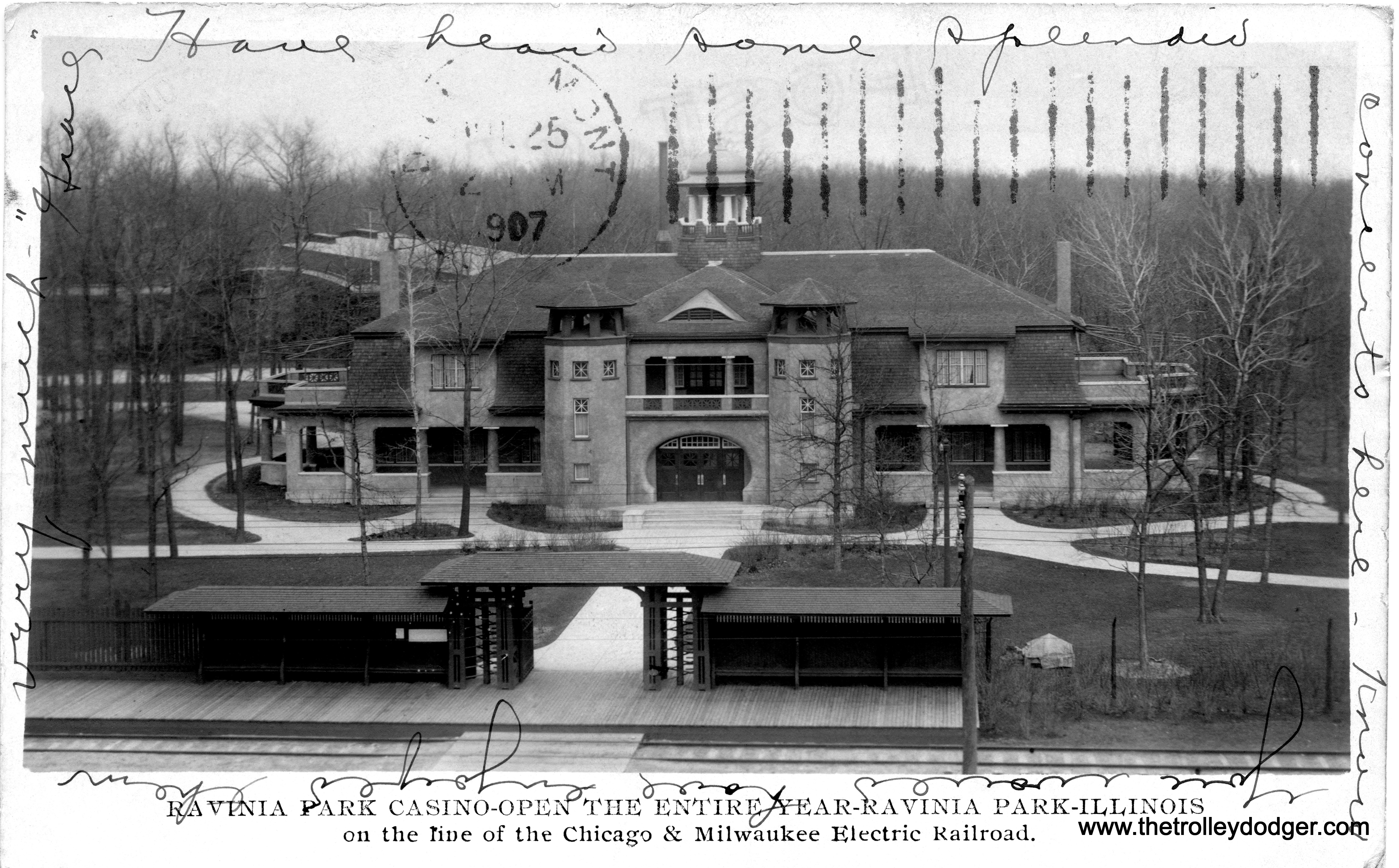
The Ravinia Park Casino was built in 1904 and demolished in 1985. Ravinia Park was built by the Chicago and Milwaukee electric, which became the North Shore Line in 1916.

The Ravinia Park Casino was built in 1904 and demolished in 1985. Ravinia Park was built by the Chicago and Milwaukee electric, which became the North Shore Line in 1916.

Indiana Railroad high-speed car 59 is at Indianapolis on August 11, 1940.

Indiana Railroad high-speed car 59 is at Indianapolis on August 11, 1940.

A Chicago Aurora and Elgin electric loco in Wheaton, where the lines diverged to go to either Aurora (shown here) or Elgin.

A Chicago Aurora and Elgin electric loco in Wheaton, where the lines diverged to go to either Aurora (shown here) or Elgin.

When I posted this circa 1954-55 Garfield Park "L" image to our Facebook group, it generated a lot of discussion as to whether or not this 4000-series "L" car was still in CRT brown paint. The CTA repainted these cars into green and cream starting around 1952. But after much consideration, my conclusion is that this is just a trick of the light, and the car is actually painted in the later CTA colors. It is in shadow and not in direct sunlight. By this time, all such cars should have been repainted and put into married pairs with various modifications (which are visible on this car). The car behind it, which is presumably its mate, is painted green and cream. We are at the east end of the Van Bure Street temporary trackage, which was used from 1953 to 1958. The photographer was apparently looking out the front end of a westbound train, and there was a ramp behind the photographer leading up to the old "L" structure heading to the Loop. The cross street here is Racine Avenue (1200 W).

When I posted this circa 1954-55 Garfield Park “L” image to our Facebook group, it generated a lot of discussion as to whether or not this 4000-series “L” car was still in CRT brown paint. The CTA repainted these cars into green and cream starting around 1952. But after much consideration, my conclusion is that this is just a trick of the light, and the car is actually painted in the later CTA colors. It is in shadow and not in direct sunlight. By this time, all such cars should have been repainted and put into married pairs with various modifications (which are visible on this car). The car behind it, which is presumably its mate, is painted green and cream. We are at the east end of the Van Bure Street temporary trackage, which was used from 1953 to 1958. The photographer was apparently looking out the front end of a westbound train, and there was a ramp behind the photographer leading up to the old “L” structure heading to the Loop. The cross street here is Racine Avenue (1200 W).

I assume this picture of Chicago Surface Lines Peter Witt car 6311 was taken at Devon station. The date given with the negative was January 6, 1941 but this hardly seems likely, given the foliage and the open door. Perhaps month and date were reversed, and a date of June 1, 1941 is correct.

I assume this picture of Chicago Surface Lines Peter Witt car 6311 was taken at Devon station. The date given with the negative was January 6, 1941 but this hardly seems likely, given the foliage and the open door. Perhaps month and date were reversed, and a date of June 1, 1941 is correct.

A view of the Indiana Railroad's Muncie Terminal on August 10, 1940. The photo is by WVK, although I don't know what those initials stand for.

A view of the Indiana Railroad’s Muncie Terminal on August 10, 1940. The photo is by WVK, although I don’t know what those initials stand for.

Indiana Railroad high-speed car 78 in Indianapolis in the late 1930s.

Indiana Railroad high-speed car 78 in Indianapolis in the late 1930s.

A night shot of the North Shore Line's Milwaukee Terminal in July 1962.

A night shot of the North Shore Line’s Milwaukee Terminal in July 1962.

North Shore Line car 748 is part of a two-car train near North Chicago Junction on September 4, 1961.

North Shore Line car 748 is part of a two-car train near North Chicago Junction on September 4, 1961.

This and the next picture shows a Aurora Elgin and Chicago (predecessor to the CA&E) monthly ticket book from June 1922.

This and the next picture shows a Aurora Elgin and Chicago (predecessor to the CA&E) monthly ticket book from June 1922.

The Chicago Aurora and Elgin used uncovered third rail in nearly all areas, including here, in Wheaton, where the Aurora and Elgin branches diverged. A small boy is playing in a nearby field, and people then were not terribly concerned with the danger posed by 600 volts of direct current. If the CA&E had survived, chances are additional protections would be in place.

The Chicago Aurora and Elgin used uncovered third rail in nearly all areas, including here, in Wheaton, where the Aurora and Elgin branches diverged. A small boy is playing in a nearby field, and people then were not terribly concerned with the danger posed by 600 volts of direct current. If the CA&E had survived, chances are additional protections would be in place.

North Shore Line wood car 132 and train at Ravinia Park in the early 1900s.

North Shore Line wood car 132 and train at Ravinia Park in the early 1900s.

Starting in the 1930s, enterprising railfans such as the late Barney Neuberger sold prints of streetcars and interurbans. The smallest such prints were what is now called wallet size, and the going rate was usually 10 cents. Mr. Neuberger had flyers and catalogs printed. There are thousands and thousands of such photos that still circulate, and enrich our knowledge of the past.

Starting in the 1930s, enterprising railfans such as the late Barney Neuberger sold prints of streetcars and interurbans. The smallest such prints were what is now called wallet size, and the going rate was usually 10 cents. Mr. Neuberger had flyers and catalogs printed. There are thousands and thousands of such photos that still circulate, and enrich our knowledge of the past.

CTA 2811 heads up a westbound Garfield Park "L" train of wood cars, circa 1953-54. The ramp connected to the temporary tracks on Van Buren Street/ We are near Sacramento Boulevard. For a time, these tracks crossed over the new Congress Expressway, which was built underneath it. Once the new Congress median line opened in 1958, this structure was removed.

CTA 2811 heads up a westbound Garfield Park “L” train of wood cars, circa 1953-54. The ramp connected to the temporary tracks on Van Buren Street/ We are near Sacramento Boulevard. For a time, these tracks crossed over the new Congress Expressway, which was built underneath it. Once the new Congress median line opened in 1958, this structure was removed.

A two-car Garfield Park "L" train, made up of 4000-series cars, heads west on temporary trackage in Van Buren Street on September 2, 1955. A portion of the Congress Expressway, then under construction, opened later that year.

A two-car Garfield Park “L” train, made up of 4000-series cars, heads west on temporary trackage in Van Buren Street on September 2, 1955. A portion of the Congress Expressway, then under construction, opened later that year.

A Philadelphia Suburban Transportation Company Brill Master Unit is on West Chester Pike at Paoli Road in February 1945. (David H. Cope Photo)

A Philadelphia Suburban Transportation Company Brill Master Unit is on West Chester Pike at Paoli Road in February 1945. (David H. Cope Photo)

The Chicago Aurora and Elgin station in Wheaton, probably in the 1920s.

The Chicago Aurora and Elgin station in Wheaton, probably in the 1920s.

CTA 6190-6189 is at Adams and Wabash on the Loop "L" in July 1954.

CTA 6190-6189 is at Adams and Wabash on the Loop “L” in July 1954.

A northbound CTA train of curved-door 6000s is on the South Side "L" just north of 35th Street in 1954. The middle track had been used for express trains until the CTA realigned north-south service in 1949.

A northbound CTA train of curved-door 6000s is on the South Side “L” just north of 35th Street in 1954. The middle track had been used for express trains until the CTA realigned north-south service in 1949.

This picture was taken from out of the front window of a Lake Street "L" train on July 17, 1954. We are near Garfield Park, and the 4000-series cars parked on the middle track are in mid-day storage. The middle track had been used by express trains prior to 1948, when the CTA inaugurated A/B "skip stop" service.

This picture was taken from out of the front window of a Lake Street “L” train on July 17, 1954. We are near Garfield Park, and the 4000-series cars parked on the middle track are in mid-day storage. The middle track had been used by express trains prior to 1948, when the CTA inaugurated A/B “skip stop” service.

CTA 6047-6048 are looping via a wooden structure at DesPlaines Avenue on July 14, 1954. This was necessary once Chicago Aurora and Elgin service was cut back to Forest Park, starting in September 1953. The direct connection between the two railroads was severed and this loop took CTA trains over the CA&E tracks. Once CA&E was allowed to discontinue passenger service in July 1957, the ramp was no longer necessary. The entire yard area was revamped in 1959 in conjunction with nearby expressway construction.

CTA 6047-6048 are looping via a wooden structure at DesPlaines Avenue on July 14, 1954. This was necessary once Chicago Aurora and Elgin service was cut back to Forest Park, starting in September 1953. The direct connection between the two railroads was severed and this loop took CTA trains over the CA&E tracks. Once CA&E was allowed to discontinue passenger service in July 1957, the ramp was no longer necessary. The entire yard area was revamped in 1959 in conjunction with nearby expressway construction.

Philadelphia Suburban Transportation Company (aka Red Arrow Lines) double-ended car 19 is outbound on West Chester Pike, headed for West Chester, in the early 1950s. Buses replaced trolleys on this line in 1954 so the road could be widened.

Philadelphia Suburban Transportation Company (aka Red Arrow Lines) double-ended car 19 is outbound on West Chester Pike, headed for West Chester, in the early 1950s. Buses replaced trolleys on this line in 1954 so the road could be widened.

Chicago and Illinois Valley (aka the Chicago Ottawa and Peoria, part of the Illinois Traction System) car 56 at Ottawa, Illinois. Don's Rail Photos: "In 1901, the Illinois Valley Traction was incorporated to build the first part of what later became the CO&P. Various other companies were involved in the construction until the CO&P consolidated them all by 1909. The CO&P became the Valley Division of Illinois Traction Inc. in 1923. In 1929, a new company, the Chicago & Illinois Valley, took over the Valley Division and operated it until abandonment on May 14, 1934. It was always considered a part of the Illinois Traction, and this can be seen in its rolling stock. 55 and 56 were built by St. Louis in 1903. 55 was retired in 1921. 56 was used in Peoria from 1920 thru 1927 when it was returned to the Valley. It was scrapped in 1934."

Chicago and Illinois Valley (aka the Chicago Ottawa and Peoria, part of the Illinois Traction System) car 56 at Ottawa, Illinois. Don’s Rail Photos: “In 1901, the Illinois Valley Traction was incorporated to build the first part of what later became the CO&P. Various other companies were involved in the construction until the CO&P consolidated them all by 1909. The CO&P became the Valley Division of Illinois Traction Inc. in 1923. In 1929, a new company, the Chicago & Illinois Valley, took over the Valley Division and operated it until abandonment on May 14, 1934. It was always considered a part of the Illinois Traction, and this can be seen in its rolling stock. 55 and 56 were built by St. Louis in 1903. 55 was retired in 1921. 56 was used in Peoria from 1920 thru 1927 when it was returned to the Valley. It was scrapped in 1934.”

The next-to-last North Shore Line fantrip took place on January 12, 1963, and used coaches 150 and 160. Here, the train has made a photo stop at the old Chicago Rapid Transit Company "L" station at Kostner Avenue, which was in use from 1925 to 1948 on the Niles Center branch. The station was designed by Insull staff architect Arthur U. Gerber. North Shore trains never stopped here in regular service. (William C. Hoffman Photo) Scott Greig adds: "By the way, the last charter on the North Shore was the day after the one pictured. It was a CERA charter with four Silverliners on Sunday, January 13, 1963. Illini Railroad Club announced that they would have a charter on the last day, but they finally had to settle for an extra car added to a regular train."

The next-to-last North Shore Line fantrip took place on January 12, 1963, and used coaches 150 and 160. Here, the train has made a photo stop at the old Chicago Rapid Transit Company “L” station at Kostner Avenue, which was in use from 1925 to 1948 on the Niles Center branch. The station was designed by Insull staff architect Arthur U. Gerber. North Shore trains never stopped here in regular service. (William C. Hoffman Photo) Scott Greig adds: “By the way, the last charter on the North Shore was the day after the one pictured. It was a CERA charter with four Silverliners on Sunday, January 13, 1963. Illini Railroad Club announced that they would have a charter on the last day, but they finally had to settle for an extra car added to a regular train.”

The two car fantrip train has stopped at the old Clark and Lake "L" station on January 12, 1963. (William C. Hoffman Photo)

The two car fantrip train has stopped at the old Clark and Lake “L” station on January 12, 1963. (William C. Hoffman Photo)

North Shore Line coach 772 is southbound at North Chicago Junction on July 4, 1955, operating on the Shore Line Route that would be abandoned later that month. Skokie Valley Route trains went to the other side of the station. (William C. Hoffman Photo)

North Shore Line coach 772 is southbound at North Chicago Junction on July 4, 1955, operating on the Shore Line Route that would be abandoned later that month. Skokie Valley Route trains went to the other side of the station. (William C. Hoffman Photo)

The North Shore Line Milwaukee Terminal on June 25, 1961.

The North Shore Line Milwaukee Terminal on June 25, 1961.

Electroliner 803-804 is northbound on Fifth Street in Milwaukee at Maple on January 13, 1963. All the buildings on the right are gone now, as this is now the location of an expressway. (Jeffrey L. Wien Photo)

Electroliner 803-804 is northbound on Fifth Street in Milwaukee at Maple on January 13, 1963. All the buildings on the right are gone now, as this is now the location of an expressway. (Jeffrey L. Wien Photo)

North Shore Line snow plow 605 at Pettibone Yards on August 29, 1964. Built by Russell in 1921, it became the last piece of NSL equipment to be scrapped on the property. David A. Myers Jr. says he found someone who was interested in taking it, but they procrastinated so long that the tracks were taken up around the car, and it was then scrapped in place. (Jeffrey L. Wien Photo)

North Shore Line snow plow 605 at Pettibone Yards on August 29, 1964. Built by Russell in 1921, it became the last piece of NSL equipment to be scrapped on the property. David A. Myers Jr. says he found someone who was interested in taking it, but they procrastinated so long that the tracks were taken up around the car, and it was then scrapped in place. (Jeffrey L. Wien Photo)

Chicago Surface Lines prewar PCC 4048 is downtown, signed for the Madison-Fifth route which was a branch of Route 20 - Madison. The 83 cars in this series were built in 1936 and retired in 1956. The sole survivor is 4021, which is now at the Illinois Railway Museum.

Chicago Surface Lines prewar PCC 4048 is downtown, signed for the Madison-Fifth route which was a branch of Route 20 – Madison. The 83 cars in this series were built in 1936 and retired in 1956. The sole survivor is 4021, which is now at the Illinois Railway Museum.

Chicago Surface Lines work car H7. Don's Rail Photos: "H7, mail car, was built by American Car Co in 1891, as a Cicero & Proviso Street Railway passenger car. It was rebuilt as Chicago Union Traction 8 in 1900 as a mail car and as Chicago Railways 8 in 1903. It was renumbered H7 in 1913 and became CSL H7 in 1914. It was retired on May 16, 1949."

Chicago Surface Lines work car H7. Don’s Rail Photos: “H7, mail car, was built by American Car Co in 1891, as a Cicero & Proviso Street Railway passenger car. It was rebuilt as Chicago Union Traction 8 in 1900 as a mail car and as Chicago Railways 8 in 1903. It was renumbered H7 in 1913 and became CSL H7 in 1914. It was retired on May 16, 1949.”

Indiana Railroad car 65. Don's Rail Photos: "65 was built by Pullman in 1931, #6399. The lounge section was replaced by a baggage section. 65 was sold to the Cedar Rapids & Iowa City as 120 in 1941. In 1954 it was purchased as the first car of the Illinois Railway Museum, which was known as the Illinois Electric Railway Museum at that time. I put in many enjoyable hours working on that car prior to 1960 when I moved to Peoria."

Indiana Railroad car 65. Don’s Rail Photos: “65 was built by Pullman in 1931, #6399. The lounge section was replaced by a baggage section. 65 was sold to the Cedar Rapids & Iowa City as 120 in 1941. In 1954 it was purchased as the first car of the Illinois Railway Museum, which was known as the Illinois Electric Railway Museum at that time. I put in many enjoyable hours working on that car prior to 1960 when I moved to Peoria.”

Our Latest Book, Now Available for Pre-Order:

The North Shore Line

Publication Date: February 20, 2023

FYI, my new Arcadia Publishing book The North Shore Line is now finished and has gone to press. My publisher decided to expand it to 160 pages, instead of the usual 128. That’s a 25% increase, without any change to the $23.99 price. I am quite pleased with how this turned out.

From the back cover:

As late as 1963, it was possible to board high-speed electric trains on Chicago’s famous Loop “L” that ran 90 miles north to Milwaukee. This was the Chicago North Shore & Milwaukee Railroad, commonly known as the North Shore Line. It rose from humble origins in the 1890s as a local streetcar line in Waukegan to eventually become America’s fastest interurban under the visionary management of Midwest utilities tycoon Samuel Insull. The North Shore Line, under Insull, became a worthy competitor to the established steam railroads. Hobbled by the Great Depression, the road fought back in 1941 with two streamlined, air-conditioned, articulated trains called Electroliners, which included dining service. It regained its popularity during World War II, when gasoline and tires were rationed, but eventually, it fell victim to highways and the automobile. The North Shore Line had intercity rail, commuter rail, electric freight, city streetcars, and even buses. It has been gone for nearly 60 years, but it will always remain the Road of Service.

Each copy purchased here will be signed by the author, and you will also receive a bonus North Shore Line map.  Books will ship by USPS Media Mail as soon as we receive them, on or before February 20, 2023.

Chapters:
01. Beginnings
02. The Milwaukee Division
03. The Shore Line Route
04. The Skokie Valley Route
05. The Mundelein Branch
06. On the “L”
07. City Streetcars
08. Trolley Freight
09. The Long Goodbye
10. The Legacy

Title The North Shore Line
Images of America
Author David Sadowski
Edition illustrated
Publisher Arcadia Publishing (SC), 2023
ISBN 1467108960, 978-1467108966
Length 160 pages

The price of $23.99 includes shipping within the United States.

For Shipping to US Addresses:

New Compact Disc, Now Available:

CTA-1
The Last Chicago Streetcars 1958
# of Discs – 1
Price: $15.99

Until now, it seemed as though audio recordings of Chicago streetcars were practically non-existent. For whatever reason, the late William A. Steventon does not appear to have made any for his Railroad Record Club, even though he did make other recordings in the Chicago area in 1956.

Now, audio recordings of the last runs of Chicago streetcars have been found, in the collections of the late Jeffrey L. Wien (who was one of the riders on that last car). We do not know who made these recordings, but this must have been done using a portable reel-to-reel machine.

These important recordings will finally fill a gap in transit history. The last Chicago Transit Authority streetcar finished its run in the early hours of June 21, 1958. Now you can experience these events just as Chicagoans did.

As a bonus, we have included Keeping Pace, a 1939 Chicago Surface Lines employee training program. This was digitally transferred from an original 16” transcription disc. These recordings were unheard for 80 years.

Total time – 74:38

Help Support The Trolley Dodger

This is our 294th post, and we are gradually creating a body of work and an online resource for the benefit of all railfans, everywhere. To date, we have received over 934,000 page views, for which we are very grateful.

You can help us continue our original transit research by checking out the fine products in our Online Store.
As we have said before, “If you buy here, we will be here.”

We thank you for your support.

DONATIONS

In order to continue giving you the kinds of historic railroad images that you have come to expect from The Trolley Dodger, we need your help and support. It costs money to maintain this website, and to do the sort of historic research that is our specialty.

Your financial contributions help make this web site better, and are greatly appreciated.


Spring Forward

CTA 6151 is southbound at Halsted and Congress on October 5, 1953 running on Route 8. The bridge 6151 is on spanned the Congress Expressway construction site. The highway was not yet open, and service continued on the Halsted "L" station at rear (with two tracks instead of the original four) until June 1958. (William Shapotkin Collection)

CTA 6151 is southbound at Halsted and Congress on October 5, 1953 running on Route 8. The bridge 6151 is on spanned the Congress Expressway construction site. The highway was not yet open, and service continued on the Halsted “L” station at rear (with two tracks instead of the original four) until June 1958. (William Shapotkin Collection)

Spring is here again, at least sort of, since we are expecting snow today here in Chicago. It’s been some time since our last post, but we have been busy collecting more streetcar and interurban pictures for your enjoyment. Plus, there are important contributions from some of our readers, for which we are thankful.

Each year, we turn our clocks forward one hour in the spring. But many of us wish we could simply turn back the clock instead, although hindsight is always 20/20 and we should always keep our eyes on the future.

But regardless, let’s “spring forward” with some great traction images from days gone by! We also have a few bonus images for our bus and diesel fans as well.

-David Sadowski

PS- We are gratified that despite not having a new post for two months, our readers have continued to support us. In fact, we are still very much on track to show a 15% increase in page views this year.

Waterloo, Cedar Falls & Northern car 100 on the Southern Iowa Railway on October 13, 1963. Don's Rail Photos: "100 was built by McGuire-Cummings in 1914. It was built as a second motor to operate behind the 140s as a two car train. The baggage compartment was a kitchen, and the rear end was an open platform observation. The buffet section was replaced with coach seats in 1918. The car was then rebuilt with a control station and baggage compartment in 1928 and the rear platform was enclosed at that time. It was the last interurban left on the WCF&N when it became diesel freight, and it was donated to the Iowa Chapter of the NRHS in 1956. It was moved to Centerville and operated on the Southern Iowa Ry. When the SI cut back its operation and dieselized, the Iowa Chapter transferred the car to the Iowa Terminal RR in 1966. Shortly after it was repainted and put into charter service, it was destroyed in the carbarn fire early November 24, 1967. It had been the only car saved from the WCF&N roundhouse fire on October 31, 1954, when the other two cars of its class burned." This slide has "Q transfer" noted on it-- not sure what that means. (James J. Buckley Photo)

Waterloo, Cedar Falls & Northern car 100 on the Southern Iowa Railway on October 13, 1963. Don’s Rail Photos: “100 was built by McGuire-Cummings in 1914. It was built as a second motor to operate behind the 140s as a two car train. The baggage compartment was a kitchen, and the rear end was an open platform observation. The buffet section was replaced with coach seats in 1918. The car was then rebuilt with a control station and baggage compartment in 1928 and the rear platform was enclosed at that time. It was the last interurban left on the WCF&N when it became diesel freight, and it was donated to the Iowa Chapter of the NRHS in 1956. It was moved to Centerville and operated on the Southern Iowa Ry. When the SI cut back its operation and dieselized, the Iowa Chapter transferred the car to the Iowa Terminal RR in 1966. Shortly after it was repainted and put into charter service, it was destroyed in the carbarn fire early November 24, 1967. It had been the only car saved from the WCF&N roundhouse fire on October 31, 1954, when the other two cars of its class burned.” This slide has “Q transfer” noted on it– not sure what that means. (James J. Buckley Photo)

The new and the old. CTA 5007 and 2269 at Rosemont on August 26, 2010. The 2200s have since been retired. (Bruce Nelson Photo)

The new and the old. CTA 5007 and 2269 at Rosemont on August 26, 2010. The 2200s have since been retired. (Bruce Nelson Photo)

An Oshawa steeple cab with a Philadelphia & Reading coach at the Connecticut Trolley Museum in May 1967. (Gerald H. Landau Photo)

An Oshawa steeple cab with a Philadelphia & Reading coach at the Connecticut Trolley Museum in May 1967. (Gerald H. Landau Photo)

An Oshawa steeple cab at the Connecticut Trolley Museum in May 1967. (Gerald H. Landau Photo)

An Oshawa steeple cab at the Connecticut Trolley Museum in May 1967. (Gerald H. Landau Photo)

Montreal observation car #4 at the Connecticut Trolley Museum in May 1967. (Gerald H. Landau Photo)

Montreal observation car #4 at the Connecticut Trolley Museum in May 1967. (Gerald H. Landau Photo)

Connecticut Company Birney car 3001 at the Connecticut Trolley Museum in May 1967. (Gerald H. Landau Photo)

Connecticut Company Birney car 3001 at the Connecticut Trolley Museum in May 1967. (Gerald H. Landau Photo)

Illinois Terminal double-ended PCC 451 at the Connecticut Trolley Museum in May 1967. (Gerald H. Landau Photo)

Illinois Terminal double-ended PCC 451 at the Connecticut Trolley Museum in May 1967. (Gerald H. Landau Photo)

New Orleans #836 and Rio car #1850 at the Connecticut Trolley Museum in May 1967. (Gerald H. Landau Photo)

New Orleans #836 and Rio car #1850 at the Connecticut Trolley Museum in May 1967. (Gerald H. Landau Photo)

Rio car #1850 at the Connecticut Trolley Museum in May 1967. (Gerald H. Landau Photo)

Rio car #1850 at the Connecticut Trolley Museum in May 1967. (Gerald H. Landau Photo)

Connecticut Company open car 1414 was built by Osgood Bradley in 1911. Here, we see it at the Shore Line Trolley Museum located at Branford, Connecticut on June 18, 1966. (William C. Janssen Photo)

Connecticut Company open car 1414 was built by Osgood Bradley in 1911. Here, we see it at the Shore Line Trolley Museum located at Branford, Connecticut on June 18, 1966. (William C. Janssen Photo)

Connecticut Company open car 1414 at Branford on May 30, 1964. (J. W. Vigrass Photo)

Connecticut Company open car 1414 at Branford on May 30, 1964. (J. W. Vigrass Photo)

Connecticut Company open car 1414 was built by Osgood Bradley in 1911. Here, we see it at the Shore Line Trolley Museum located at Branford, Connecticut on June 18, 1966. (William C. Janssen Photo)

Connecticut Company open car 1414 was built by Osgood Bradley in 1911. Here, we see it at the Shore Line Trolley Museum located at Branford, Connecticut on June 18, 1966. (William C. Janssen Photo)

You would be forgiven for thinking this December 18, 1955 photo shows CTA Pullman 144. But this was actually the excursion where car 144 was promised, but 225 was substituted in its place-- renumbered with the help of a few pieces of oilcloth. Here, the fantrip car is seen at Broadway and Devon.

You would be forgiven for thinking this December 18, 1955 photo shows CTA Pullman 144. But this was actually the excursion where car 144 was promised, but 225 was substituted in its place– renumbered with the help of a few pieces of oilcloth. Here, the fantrip car is seen at Broadway and Devon.

CTA PCC 7138, a product of the St. Louis Car Company, at the State Street loop near 84th on February 11, 1950. This location is now occupied by the Dan Ryan expressway.

CTA PCC 7138, a product of the St. Louis Car Company, at the State Street loop near 84th on February 11, 1950. This location is now occupied by the Dan Ryan expressway.

CTA PCC 7070 at the Clark and Howard loop on July 4, 1954.

CTA PCC 7070 at the Clark and Howard loop on July 4, 1954.

Philadelphia & Western (aka Red Arrow) Bullet car 202 at Norristown in 1949. Behind 202, you can see the ramp leading down to street level, used by Lehigh Valley Transit's Liberty Bell route trains. (S. Bogen Photo)

Philadelphia & Western (aka Red Arrow) Bullet car 202 at Norristown in 1949. Behind 202, you can see the ramp leading down to street level, used by Lehigh Valley Transit’s Liberty Bell route trains. (S. Bogen Photo)

By May 1961, when this photo was taken in Norristown, Liberty Bell Limited trains had been gone for nearly a decade. As you can see at left, the ramp leading down to ground level was removed and blocked off with an advertising sign.

By May 1961, when this photo was taken in Norristown, Liberty Bell Limited trains had been gone for nearly a decade. As you can see at left, the ramp leading down to ground level was removed and blocked off with an advertising sign.

Philadelphia Suburban (aka Red Arrow) Brilliner car 3 at Gay and High Streets in West Chester on June 6, 1954, at the end of trolley service on this route. The longest Red Arrow line was mainly a single-track side-of-the-road operation, which had to give way for the widening of West Chester Pike. (Edward S. Miller Photo)

Philadelphia Suburban (aka Red Arrow) Brilliner car 3 at Gay and High Streets in West Chester on June 6, 1954, at the end of trolley service on this route. The longest Red Arrow line was mainly a single-track side-of-the-road operation, which had to give way for the widening of West Chester Pike. (Edward S. Miller Photo)

Philadelphia Suburban (aka Red Arrow) car 78 at Larchmont Station on West Chester Pike at Media Line Road, Newtown Township, PA on May 9, 1954. Photographer Edward S. Miller noted that he later operated this car at the Arden trolley museum.

Philadelphia Suburban (aka Red Arrow) car 78 at Larchmont Station on West Chester Pike at Media Line Road, Newtown Township, PA on May 9, 1954. Photographer Edward S. Miller noted that he later operated this car at the Arden trolley museum.

Philadelphia Suburban double-end car 19, which looked like a PCC but does not technically qualify as one, since it had standard interurban trucks and motors. It is captured on May 9, 1954 at Broomall Station on West Chester Pike at Sproul Road in Marple Township, PA. (Edward S. Miller Photo)

Philadelphia Suburban double-end car 19, which looked like a PCC but does not technically qualify as one, since it had standard interurban trucks and motors. It is captured on May 9, 1954 at Broomall Station on West Chester Pike at Sproul Road in Marple Township, PA. (Edward S. Miller Photo)

A pair of Bullet cars running in multiple units on the Red Arrow Norristown High Speed Line on September 9, 1958. (Clark Frazier Photo)

A pair of Bullet cars running in multiple units on the Red Arrow Norristown High Speed Line on September 9, 1958. (Clark Frazier Photo)

Philadelphia Suburban (aka red Arrow) car 11 at the end of the line on the short Ardmore branch on September 9, 1958. (Clark Frazier Photo)

Philadelphia Suburban (aka red Arrow) car 11 at the end of the line on the short Ardmore branch on September 9, 1958. (Clark Frazier Photo)

Philadelphia Suburban (aka red Arrow) car 13, a product of the St. Louis Car Company, on the Media line on September 9, 1958. Garrett Patterson says the location is "Drexelbrook, inbound." (Clark Frazier Photo)

Philadelphia Suburban (aka red Arrow) car 13, a product of the St. Louis Car Company, on the Media line on September 9, 1958. Garrett Patterson says the location is “Drexelbrook, inbound.” (Clark Frazier Photo)

Philadelphia Suburban double-ended car 15, built by St. Louis Car Company in 1949, is seen at Gay and High Streets in West Chester, at the end of the long West Chester trolley line.

Philadelphia Suburban double-ended car 15, built by St. Louis Car Company in 1949, is seen at Gay and High Streets in West Chester, at the end of the long West Chester trolley line.

To see many more Philadelphia pictures like the ones above,take a look at our previous post Red Arrow in West Chester (September 13, 2016).

Fairmount Park Transit closed car #1 on May 19, 1935.

Fairmount Park Transit closed car #1 on May 19, 1935.

Fairmount Park Transit open car 18 at the car barn.

Fairmount Park Transit open car 18 at the car barn.

For more pictures like the two above, check out our previous post The Fairmount Park Trolley (November 7, 2017).

CTA one-man car 1743 (signed for Route 21 - Cermak, but the photographer has written "Lake Street") entering Kedzie Station at 5th Avenue and Jackson Boulevard on July 21, 1952. This picture looks to have been taken at about the same time as another, which shows a PCC car, on page 102 of my book Chicago Trolleys. (Robert Selle Photo)

CTA one-man car 1743 (signed for Route 21 – Cermak, but the photographer has written “Lake Street”) entering Kedzie Station at 5th Avenue and Jackson Boulevard on July 21, 1952. This picture looks to have been taken at about the same time as another, which shows a PCC car, on page 102 of my book Chicago Trolleys. (Robert Selle Photo)

Indianapolis Railways "Peter Witt" car 173 is shown at the Broad Ripple loop on June 6, 1951. Broad Ripple Village is an Indy neighborhood that was once an independent municipality. It was annexed into Indianapolis in 1922. (Robert Selle Photo)

Indianapolis Railways “Peter Witt” car 173 is shown at the Broad Ripple loop on June 6, 1951. Broad Ripple Village is an Indy neighborhood that was once an independent municipality. It was annexed into Indianapolis in 1922. (Robert Selle Photo)

CSL "Matchbox" 1169 at Damen and Taylor on June 2, 1945. Don's Rail Photos says, "1169 was built by St Louis Car Co in 1903 as CUT 4698. It was renumbered 1169 in 1913 and became CSL 1169 in 1914. It was retired on September 16, 1944." Not sure about the discrepancy in dates, but some renumbering of these cars did take place.

CSL “Matchbox” 1169 at Damen and Taylor on June 2, 1945. Don’s Rail Photos says, “1169 was built by St Louis Car Co in 1903 as CUT 4698. It was renumbered 1169 in 1913 and became CSL 1169 in 1914. It was retired on September 16, 1944.” Not sure about the discrepancy in dates, but some renumbering of these cars did take place.

Chicago Aurora & Elgin cars 401 and 431 are crossing the DesPlaines River westbound on August 29, 1953, about a half mile west of the DesPlaines Avenue station. This is now the site of I-290. The CA&E tracks and bridge were moved north of the highway in 1959 but were never used by the interurban, which was subsequently abandoned. In this section, the CA&E ran parallel to Harrison Street, which has also been taken up by the highway. (Robert Selle Photo)

Chicago Aurora & Elgin cars 401 and 431 are crossing the DesPlaines River westbound on August 29, 1953, about a half mile west of the DesPlaines Avenue station. This is now the site of I-290. The CA&E tracks and bridge were moved north of the highway in 1959 but were never used by the interurban, which was subsequently abandoned. In this section, the CA&E ran parallel to Harrison Street, which has also been taken up by the highway. (Robert Selle Photo)

Three CTA arch-roof cars awaiting scrapping on May 16, 1954: two-man 6141, one-man cars 6167 and 3128 at South Shops. This was just two weeks before the end of all red car service in Chicago, and was also the date of a fantrip that ran on all the lines that were about to be "bustituted." (Robert Selle Photo)

Three CTA arch-roof cars awaiting scrapping on May 16, 1954: two-man 6141, one-man cars 6167 and 3128 at South Shops. This was just two weeks before the end of all red car service in Chicago, and was also the date of a fantrip that ran on all the lines that were about to be “bustituted.” (Robert Selle Photo)

Images From the Wien-Criss Archive

Our thanks to Jeffrey L. Wien for sharing these classic pictures with our readers.

A three-car train of Boston MTA PCCs, running on Commonwealth Avenue east of Summit Avenue on May 31, 1961. (Clark Frazier Photo, Wien-Criss Archive)

A three-car train of Boston MTA PCCs, running on Commonwealth Avenue east of Summit Avenue on May 31, 1961. (Clark Frazier Photo, Wien-Criss Archive)

The Chicago Great Western Railway merged with the Chicago & North Western in 1968, and most of its trackage was thereafter abandoned. But on February 21, 1965, we see CGW freight #91, running westbound on Baltimore & Ohio Chicago Terminal tracks, parallel to I-290 just west of Lombard in suburban Oak Park, Illinois. The motive power consisted of 104A, 105B, 106C, 116F, 1100, 112C, and 177. At right, you can see the secondary entrance to the CTA's Congress rapid transit line at Lombard. The main entrance at Austin Boulevard is two blocks east of there. The CGW split off from the B&OCT in Forest Park a few miles west of here, and then ran parallel to the Chicago Aurora & Elgin interurban through Bellwood. (James J. Buckley Photo, Wien-Criss Archive)

The Chicago Great Western Railway merged with the Chicago & North Western in 1968, and most of its trackage was thereafter abandoned. But on February 21, 1965, we see CGW freight #91, running westbound on Baltimore & Ohio Chicago Terminal tracks, parallel to I-290 just west of Lombard in suburban Oak Park, Illinois. The motive power consisted of 104A, 105B, 106C, 116F, 1100, 112C, and 177. At right, you can see the secondary entrance to the CTA’s Congress rapid transit line at Lombard. The main entrance at Austin Boulevard is two blocks east of there. The CGW split off from the B&OCT in Forest Park a few miles west of here, and then ran parallel to the Chicago Aurora & Elgin interurban through Bellwood. (James J. Buckley Photo, Wien-Criss Archive)

Kansas City Public Service PCCs 712 and 796 at the 48th and Harrison yard on October 16, 1956. PCCs last ran in Kansas City in 1957, but streetcars returned to Kansas City in 2016. (Robert Selle Photo, Wien-Criss Archive)

Kansas City Public Service PCCs 712 and 796 at the 48th and Harrison yard on October 16, 1956. PCCs last ran in Kansas City in 1957, but streetcars returned to Kansas City in 2016. (Robert Selle Photo, Wien-Criss Archive)

Chicago North Shore & Milwaukee city car 360 on Glen Flora Avenue in Waukegan, Illinois. This picture could not have been taken after 1947. (Robert Selle Photo, Wien-Criss Archive)

Chicago North Shore & Milwaukee city car 360 on Glen Flora Avenue in Waukegan, Illinois. This picture could not have been taken after 1947. (Robert Selle Photo, Wien-Criss Archive)

CTA Pullman 529, as seen from the Ashland station on the Lake Street "L", on May 7, 1953. (Robert Selle Photo, Wien-Criss Archive)

CTA Pullman 529, as seen from the Ashland station on the Lake Street “L”, on May 7, 1953. (Robert Selle Photo, Wien-Criss Archive)

CTA 1725 is operating as a one-man shuttle car on the Madison-Fifth branch line on Route 20 on February 15, 1953. The car is heading southwest on Fifth Avenue approaching Harrison Street and Pulaski Avenue, which was the end of the line near the adjacent Garfield Park "L" station. I thought at first that the date might actually have been 1954, but subsequent research shows the 1953 date to be correct (see correspondence with Tony Waller below). (Robert Selle Photo, Wien-Criss Archive)

CTA 1725 is operating as a one-man shuttle car on the Madison-Fifth branch line on Route 20 on February 15, 1953. The car is heading southwest on Fifth Avenue approaching Harrison Street and Pulaski Avenue, which was the end of the line near the adjacent Garfield Park “L” station. I thought at first that the date might actually have been 1954, but subsequent research shows the 1953 date to be correct (see correspondence with Tony Waller below). (Robert Selle Photo, Wien-Criss Archive)

CTA Pullman 540 at 70th and Ashland (69th Street Station) on May 23, 1953. The sign above the streetcar bays is now at the Illinois Railway Museum. (Robert Selle Photo, Wien-Criss Archive)

CTA Pullman 540 at 70th and Ashland (69th Street Station) on May 23, 1953. The sign above the streetcar bays is now at the Illinois Railway Museum. (Robert Selle Photo, Wien-Criss Archive)

Chicago Surface Lines 4118, built by Pullman, heads southbound on Clark at Wacker on June 13, 1947. We ran a version of this picture before, in our post More Chicago PCC Photos - Part Six (November 30, 2015), but this one is better, as it is a scan from the original medium format negative. (Wien-Criss Archive)

Chicago Surface Lines 4118, built by Pullman, heads southbound on Clark at Wacker on June 13, 1947. We ran a version of this picture before, in our post More Chicago PCC Photos – Part Six (November 30, 2015), but this one is better, as it is a scan from the original medium format negative. (Wien-Criss Archive)

CTA Pullman 230 is southbound on Clark Street, having just crossed the bridge over the Chicago River on May 18, 1954. This was less than two weeks before the end of red car service in Chicago. (Robert Selle Photo, Wien-Criss Archive)

CTA Pullman 230 is southbound on Clark Street, having just crossed the bridge over the Chicago River on May 18, 1954. This was less than two weeks before the end of red car service in Chicago. (Robert Selle Photo, Wien-Criss Archive)

In this November 4, 1952 view, CTA 593 is on Clark Street, heading south to the Limits car barn, while car 562 is on Southport, the north end of the Ashland route. (Robert Selle Photo, Wien-Criss Archive)

In this November 4, 1952 view, CTA 593 is on Clark Street, heading south to the Limits car barn, while car 562 is on Southport, the north end of the Ashland route. (Robert Selle Photo, Wien-Criss Archive)

On August 7, 1952, CTA 452 is at the north end of Route #9 - Ashland, on Southport just north of Irving Park Road. (Robert Selle Photo, Wien-Criss Archive)

On August 7, 1952, CTA 452 is at the north end of Route #9 – Ashland, on Southport just north of Irving Park Road. (Robert Selle Photo, Wien-Criss Archive)

On May 24, 1958 the Central Electric Railfans' Association operated a fantrip on the South Shore Line, using Illinois Central equipment. Normally, South Shore cars ran on the IC, but not the other way around. Here, they are having a photo stop at the "new" East Chicago station, parallel to the Indiana Toll Road, which opened in 1956. It replaced street running in East Chicago. The view looks east. (Robert Selle Photo, Wien-Criss Archive)

On May 24, 1958 the Central Electric Railfans’ Association operated a fantrip on the South Shore Line, using Illinois Central equipment. Normally, South Shore cars ran on the IC, but not the other way around. Here, they are having a photo stop at the “new” East Chicago station, parallel to the Indiana Toll Road, which opened in 1956. It replaced street running in East Chicago. The view looks east. (Robert Selle Photo, Wien-Criss Archive)

On July 13, 1955, a 700-series North Shore Line car is being converted into a Silverliner, while flanked by cars 419 and 746 at the Highwood Shops. (Robert Selle Photo, Wien-Criss Archive)

On July 13, 1955, a 700-series North Shore Line car is being converted into a Silverliner, while flanked by cars 419 and 746 at the Highwood Shops. (Robert Selle Photo, Wien-Criss Archive)

Clark in December 1951. Note the outdoor scale at left. (Robert Selle Photo, Wien-Criss Archive)

CTA one-man car 6171 is at Lawrence and Clark in December 1951. Note the outdoor scale at left. (Robert Selle Photo, Wien-Criss Archive)

CTA one-man car 1784 is heading southwest on Ogden (Route 58) at Van Buren and Honore. To the right, buildings are being cleared away for the Congress Expressway. To the north, you can see a Wieboldt's department store, which was located on Adams between Ogden and Ashland. The "L" to the rear is the Met branch leading to Logan Suare, already out of service for several months when this picture was taken in August 1951. The Garfield Park "L" would have been directly behind the photographer, smack dab in the middle of what became the expressway footprint. (Robert Selle Photo, Wien-Criss Archive)

CTA one-man car 1784 is heading southwest on Ogden (Route 58) at Van Buren and Honore. To the right, buildings are being cleared away for the Congress Expressway. To the north, you can see a Wieboldt’s department store, which was located on Adams between Ogden and Ashland. The “L” to the rear is the Met branch leading to Logan Suare, already out of service for several months when this picture was taken in August 1951. The Garfield Park “L” would have been directly behind the photographer, smack dab in the middle of what became the expressway footprint. (Robert Selle Photo, Wien-Criss Archive)

CTA Pullmans 546 and 553 cross near a safety island at 71st and Ashland on June 29, 1953. (Robert Selle Photo, Wien-Criss Archive)

CTA Pullmans 546 and 553 cross near a safety island at 71st and Ashland on June 29, 1953. (Robert Selle Photo, Wien-Criss Archive)

In this amazing June 22, 1953 view of the junction at Tower 18, on Chicago's Loop "L" at Lake and Wells, we see CTA Evanston Express and Garfield Park trains, with a North Shore Line train in the background. Until 1969, both Loop tracks ran in the same direction, so the two cars are heading towards the photographer, while the North Shore Line train is going away. The photographer was standing on the Randolph and Wells platform. That station has since been replaced by Washington and Wells. (Robert Selle Photo, Wien-Criss Archive)

In this amazing June 22, 1953 view of the junction at Tower 18, on Chicago’s Loop “L” at Lake and Wells, we see CTA Evanston Express and Garfield Park trains, with a North Shore Line train in the background. Until 1969, both Loop tracks ran in the same direction, so the two cars are heading towards the photographer, while the North Shore Line train is going away. The photographer was standing on the Randolph and Wells platform. That station has since been replaced by Washington and Wells. (Robert Selle Photo, Wien-Criss Archive)

On November 9, 1952, a two-car CTA "L" train, headed by car 1019, is on the trestle at Central on the Evanston branch. (Robert Selle Photo, Wien-Criss Archive)

On November 9, 1952, a two-car CTA “L” train, headed by car 1019, is on the trestle at Central on the Evanston branch. (Robert Selle Photo, Wien-Criss Archive)

CTA Pullman 643 is westbound at North and Halsted on August 14, 1948. That section of "L" at the rear, part of a section known as the "triple curve," is still there today, and is used by Brown and Purple Line trains. (Robert Selle Photo, Wien-Criss Archive)

CTA Pullman 643 is westbound at North and Halsted on August 14, 1948. That section of “L” at the rear, part of a section known as the “triple curve,” is still there today, and is used by Brown and Purple Line trains. (Robert Selle Photo, Wien-Criss Archive)

CTA Clark Street PCC 4361 and Broadway PCC 7175 meet at Clark, Broadway, and Diversey on November 8, 1953. (Robert Selle Photo, Wien-Criss Archive)

CTA Clark Street PCC 4361 and Broadway PCC 7175 meet at Clark, Broadway, and Diversey on November 8, 1953. (Robert Selle Photo, Wien-Criss Archive)

CTA Pullman 558, turning onto Ashland from Irving Park Road on May 19, 1953. (Robert Selle Photo, Wien-Criss Archive)

CTA Pullman 558, turning onto Ashland from Irving Park Road on May 19, 1953. (Robert Selle Photo, Wien-Criss Archive)

CTA one-man car 3276 on Route 50 - Damen at about 2300 North. (Robert Selle Photo, Wien-Criss Archive)

CTA one-man car 3276 on Route 50 – Damen at about 2300 North. (Robert Selle Photo, Wien-Criss Archive)

CTA 926 is a Lincoln-Peterson car at Division and Clark in June 1951. (Robert Selle Photo, Wien-Criss Archive)

CTA 926 is a Lincoln-Peterson car at Division and Clark in June 1951. (Robert Selle Photo, Wien-Criss Archive)

CTA Pullman 58 is running as a "tripper" on Broadway-State on May 18, 1954. Here, we see it southbound on State Street, crossing the Chicago River over the bridge that was put into service in 1949. (Robert Selle Photo, Wien-Criss Archive)

CTA Pullman 58 is running as a “tripper” on Broadway-State on May 18, 1954. Here, we see it southbound on State Street, crossing the Chicago River over the bridge that was put into service in 1949. (Robert Selle Photo, Wien-Criss Archive)

CTA 575 is southbound on Paulina near Washington Boulevard, running on Route 9 - Ashland on September 15, 1953. (Robert Selle Photo, Wien-Criss Archive)

CTA 575 is southbound on Paulina near Washington Boulevard, running on Route 9 – Ashland on September 15, 1953. (Robert Selle Photo, Wien-Criss Archive)

A green and cream "L" car passes a green and cream trolley. CTA 4327 is at the front of a Lake Street "L" train, running at ground level under trolley wire at Pine Street, while CTA 3141 prepares to turn and cross the tracks, heading to the other side of the Chicago & North Western embankment on September 26, 1953. (Robert Selle Photo, Wien-Criss Archive)

A green and cream “L” car passes a green and cream trolley. CTA 4327 is at the front of a Lake Street “L” train, running at ground level under trolley wire at Pine Street, while CTA 3141 prepares to turn and cross the tracks, heading to the other side of the Chicago & North Western embankment on September 26, 1953. (Robert Selle Photo, Wien-Criss Archive)

Trolley scrapping: except for a few stragglers, nearly all red cars were scrapped by the CTA after being taken out of regular service on May 30, 1954. On November 6, 1954, we see Big Pullmans 248 and 585 at right, and one of the cars at left is 604 in this scene at South Shops. (Robert Selle Photo, Wien-Criss Archive)

Trolley scrapping: except for a few stragglers, nearly all red cars were scrapped by the CTA after being taken out of regular service on May 30, 1954. On November 6, 1954, we see Big Pullmans 248 and 585 at right, and one of the cars at left is 604 in this scene at South Shops. (Robert Selle Photo, Wien-Criss Archive)

The late Robert Selle, a very gifted photographer, took his own picture inside CTA streetcar 3217 at 69th Street Station on July 12, 1952. (Wien-Criss Archive)

The late Robert Selle, a very gifted photographer, took his own picture inside CTA streetcar 3217 at 69th Street Station on July 12, 1952. (Wien-Criss Archive)

Bob Selle took a "fast shot" of CTA 681 just inside the gates at Limits Station on June 28, 1952. Limits was located at 2650 North Clark Street, which was the city limits in the late 1800s. (Wien-Criss Archive)

Bob Selle took a “fast shot” of CTA 681 just inside the gates at Limits Station on June 28, 1952. Limits was located at 2650 North Clark Street, which was the city limits in the late 1800s. (Wien-Criss Archive)

In this September 5, 1953 view, looking west from the CTA Racine Avenue station on the old Metropolitan main line, we see the Throop Street Shops at right. A CA&E train is approaching us, heading toward the Loop. (Robert Selle Photo, Wien-Criss Archive)

In this September 5, 1953 view, looking west from the CTA Racine Avenue station on the old Metropolitan main line, we see the Throop Street Shops at right. A CA&E train is approaching us, heading toward the Loop. (Robert Selle Photo, Wien-Criss Archive)

A 6-car CTA Ravenswood "A" train, made up of 200 and 300-series "L" cars, approaches Clark and Lake on September 15, 1953. (Robert Selle Photo, Wien-Criss Archive)

A 6-car CTA Ravenswood “A” train, made up of 200 and 300-series “L” cars, approaches Clark and Lake on September 15, 1953. (Robert Selle Photo, Wien-Criss Archive)

Chicago & North Western steam loco 555, a 4-6-2, heads up a northwest line commuter train at Kinzie and 400 West on August 20, 1953. (Robert Selle Photo, Wien-Criss Archive)

Chicago & North Western steam loco 555, a 4-6-2, heads up a northwest line commuter train at Kinzie and 400 West on August 20, 1953. (Robert Selle Photo, Wien-Criss Archive)

A two-car CTA train of railroad-roof cars is on the bridge over the North Shore Channel on the Evanston line on November 29, 1952. (Robert Selle Photo, Wien-Criss Archive)

A two-car CTA train of railroad-roof cars is on the bridge over the North Shore Channel on the Evanston line on November 29, 1952. (Robert Selle Photo, Wien-Criss Archive)

A view of the first 6400-series CTA "L" cars head into Chicago on a North Shore Line freight train on February 19, 1955. The location is just south of the Highmoor, Illinois station. Some of the parts used on these cars were recycled from scrapped CTA PCCs that had less than 10 years' service. (Robert Selle Photo, Wien-Criss Archive)

A view of the first 6400-series CTA “L” cars head into Chicago on a North Shore Line freight train on February 19, 1955. The location is just south of the Highmoor, Illinois station. Some of the parts used on these cars were recycled from scrapped CTA PCCs that had less than 10 years’ service. (Robert Selle Photo, Wien-Criss Archive)

CTA Pullman PCC 4063 is turning from Madison Street onto Franklin on its way into the Loop, running on Route 20 - Madison. In this September 16, 1953 view, car 4063 appears to have suffered some front-end damage that has gone unrepaired. This is probably due to the CTA's desire to scrap these cars within the next year or so. (Robert Selle Photo, Wien-Criss Archive)

CTA Pullman PCC 4063 is turning from Madison Street onto Franklin on its way into the Loop, running on Route 20 – Madison. In this September 16, 1953 view, car 4063 appears to have suffered some front-end damage that has gone unrepaired. This is probably due to the CTA’s desire to scrap these cars within the next year or so. (Robert Selle Photo, Wien-Criss Archive)

CTA PCC 4081, heading south on Route 22 - Clark-Wentworth, proceeds slowly through a work zone at Clark and Van Buren on July 17, 1954. For more pictures of this, see our previous post Track Work @Clark & Van Buren, 1954 (February 1, 2015). This negative was apparently sold by an "RJA" at one point, which may mean the photo was taken by railfan Richard J. Anderson. This track work was related to the conversion of Clark and Dearborn into one-way streets downtown. (Wien-Criss Archive)

CTA PCC 4081, heading south on Route 22 – Clark-Wentworth, proceeds slowly through a work zone at Clark and Van Buren on July 17, 1954. For more pictures of this, see our previous post Track Work @Clark & Van Buren, 1954 (February 1, 2015). This negative was apparently sold by an “RJA” at one point, which may mean the photo was taken by railfan Richard J. Anderson. This track work was related to the conversion of Clark and Dearborn into one-way streets downtown. (Wien-Criss Archive)

From the Collections of William Shapotkin

Again, our tanks to Bill for sharing these with us.

CTA PCCs 7182 and 4380 (or is it 4390?) are turning from Wentworth onto Vincennes at 73rd Street on Route 22. From the looks of the automobiles, this picture may have been taken in 1958. (William Shapotkin Collection)

CTA PCCs 7182 and 4380 (or is it 4390?) are turning from Wentworth onto Vincennes at 73rd Street on Route 22. From the looks of the automobiles, this picture may have been taken in 1958. (William Shapotkin Collection)

CSL/CTA 6213 at 93rd and Exchange Avenue. The slide said the cross street was Anthony, but as Tony Waller points out, "The photo of the red streetcar on route 95 captioned as being at 93rd and Anthony Ave. is actually at 93rd and Exchange Ave. The streetcar line westbound turned from Exchange onto 93rd. Anthony Ave. parallels the PRR/NYC viaducts (and now the Skyway bridge alignment) that is in the near distance; crossing the streetcar line at a perpendicular angle." (William Shapotkin Collection)

CSL/CTA 6213 at 93rd and Exchange Avenue. The slide said the cross street was Anthony, but as Tony Waller points out, “The photo of the red streetcar on route 95 captioned as being at 93rd and Anthony Ave. is actually at 93rd and Exchange Ave. The streetcar line westbound turned from Exchange onto 93rd. Anthony Ave. parallels the PRR/NYC viaducts (and now the Skyway bridge alignment) that is in the near distance; crossing the streetcar line at a perpendicular angle.” (William Shapotkin Collection)

CSL 5130, signed for 31st and Lake Park. Bill Shapotkin says this car "is at Archer/Pitney. The view looks N-N/W on Pitney. The car has just changed ends and will take the crossover to head east." (William Shapotkin Collection)

CSL 5130, signed for 31st and Lake Park. Bill Shapotkin says this car “is at Archer/Pitney. The view looks N-N/W on Pitney. The car has just changed ends and will take the crossover to head east.” (William Shapotkin Collection)

CSL 5083 is signed for Pitney and Archer. Bill Shapotkin say this location "is E/B in 31st, the car has just x/o South Park (now King Dr). The church on the S/E corner is still-standing and either is or has just undergone renovation." (William Shapotkin Collection)

CSL 5083 is signed for Pitney and Archer. Bill Shapotkin say this location “is E/B in 31st, the car has just x/o South Park (now King Dr). The church on the S/E corner is still-standing and either is or has just undergone renovation.” (William Shapotkin Collection)

CSL 5147, signed for Pitney and Archer. Bill Shapotkin says this location "is W/B at Wallace (note address of 556 on building at left and car tracks in Wallace). View looks E-N/E." (William Shapotkin Collection)

CSL 5147, signed for Pitney and Archer. Bill Shapotkin says this location “is W/B at Wallace (note address of 556 on building at left and car tracks in Wallace). View looks E-N/E.” (William Shapotkin Collection)

CTA 6199 is signed for Route 87A. (William Shapotkin Collection)

CTA 6199 is signed for Route 87A. (William Shapotkin Collection)

This close-up from the previous image, although not very sharp, does show that this car is a Frazer, a product of the Kaiser-Frazer company, If I had to guess, I would say it's a 1947 model, possibly a Frazer Manhattan. Most of the styling on this car is attributed to "Dutch" Darrin. Kaiser-Frazer was an independent automaker between 1946 and 1954, started by aluminum magnate Henry J. Kaiser.

This close-up from the previous image, although not very sharp, does show that this car is a Frazer, a product of the Kaiser-Frazer company, If I had to guess, I would say it’s a 1947 model, possibly a Frazer Manhattan. Most of the styling on this car is attributed to “Dutch” Darrin. Kaiser-Frazer was an independent automaker between 1946 and 1954, started by aluminum magnate Henry J. Kaiser.

CTA one-man car 3224 is at 92nd and Baltimore. That's a bus trailing behind. (William Shapotkin Collection)

CTA one-man car 3224 is at 92nd and Baltimore. That’s a bus trailing behind. (William Shapotkin Collection)

CTA Pullman 144, possibly on a late 1950s fantrip. This car is now at the Illinois Railway Museum. (William Shapotkin Collection)

CTA Pullman 144, possibly on a late 1950s fantrip. This car is now at the Illinois Railway Museum. (William Shapotkin Collection)

CTA one-man car 3219 is at 87th and Escanaba in May 1950, at the end of the line for Route 87A. The operator is changing ends. (William Shapotkin Collection)

CTA one-man car 3219 is at 87th and Escanaba in May 1950, at the end of the line for Route 87A. The operator is changing ends. (William Shapotkin Collection)

CTA one-man car 3220 is at 67th and Oglesby in June 1952, on Route 67. (William Shapotkin Collection)

CTA one-man car 3220 is at 67th and Oglesby in June 1952, on Route 67. (William Shapotkin Collection)

CTA 6153. (William Shapotkin Collection)

CTA 6153. (William Shapotkin Collection)

CTA 7191 is at 81st and Wallace on Route - Clark-Wentworth. (Robert W. Gibson Photo, William Shapotkin collection)

CTA 7191 is at 81st and Wallace on Route – Clark-Wentworth. (Robert W. Gibson Photo, William Shapotkin collection)

CTA Pullman 459 is at Ashland and 27th Street on Route 9 in February 1951. (William Shapotkin Collection)

CTA Pullman 459 is at Ashland and 27th Street on Route 9 in February 1951. (William Shapotkin Collection)

CSL 5147, signed for Pitney and Archer. Michael D. Franklin adds, "This picture shows 6181 heading south on Larrabee St between Crosby St and Kingsbury Street. Building with 'Adams Mfg. Co.' is still standing at 907 N. Larrabee Ave." (William Shapotkin Collection)

CSL 5147, signed for Pitney and Archer. Michael D. Franklin adds, “This picture shows 6181 heading south on Larrabee St between Crosby St and Kingsbury Street. Building with ‘Adams Mfg. Co.’ is still standing at 907 N. Larrabee Ave.” (William Shapotkin Collection)

CSL 5154, signed for Piney and Archer. Bill Shapotkin says, "This car is at East end-of-line in 26th east of Lake Park Ave -- note IC catenary in background. View looks N/E." (William Shapotkin Collection)

CSL 5154, signed for Piney and Archer. Bill Shapotkin says, “This car is at East end-of-line in 26th east of Lake Park Ave — note IC catenary in background. View looks N/E.” (William Shapotkin Collection)

CTA 5278 at 79th and Western in March 1948 on Route 79. (William Shapotkin Collection)

CTA 5278 at 79th and Western in March 1948 on Route 79. (William Shapotkin Collection)

CTA one-man car 6224 is at 92nd and Commercial in April 1948. (William Shapotkin Collection)

CTA one-man car 6224 is at 92nd and Commercial in April 1948. (William Shapotkin Collection)

CTA one-man car 6272 is at 89th and Buffalo on Route 93 in April 1948. (William Shapotkin Collection)

CTA one-man car 6272 is at 89th and Buffalo on Route 93 in April 1948. (William Shapotkin Collection)

CSL one-man car 6213 is at 89th and Avenue O in October 1946, on Route 93-95. (William Shapotkin Collection)

CSL one-man car 6213 is at 89th and Avenue O in October 1946, on Route 93-95. (William Shapotkin Collection)

CTA 6209 is at 94th on July 2, 1949, running on Route 93-95. (William Shapotkin Collection)

CTA 6209 is at 94th on July 2, 1949, running on Route 93-95. (William Shapotkin Collection)

CTA Pullman 677 is at Pulaski and Bryn Mawr in 1949 on Route 53. (William Shapotkin Collection)

CTA Pullman 677 is at Pulaski and Bryn Mawr in 1949 on Route 53. (William Shapotkin Collection)

Bill Shapotkin writes:

All the pix of a ‘GM&O” passenger train are of the southbound “Plug,” the Chicago-Joliet suburban train. Even after the ICG merger, the train continued to operate with GM&O equipment — and indeed, the loco (do not recall if it was 880-B or not), even got a new GM&O logo stenciled onto its nose. Bi-level equipment arrived (I believe) circa 1977-79, when a second “Plug” was added to the schedule.

A Gulf, Mobile & Ohio passenger train near Chicago's Loop. This slide was process in August 1972, right around the time that the GM&O was merged into the Illinois Central. (William Shapotkin Collection)

A Gulf, Mobile & Ohio passenger train near Chicago’s Loop. This slide was process in August 1972, right around the time that the GM&O was merged into the Illinois Central. (William Shapotkin Collection)

A GM&O diesel in August 1972, near some Penn Central motive power. (William Shapotkin Collection)

A GM&O diesel in August 1972, near some Penn Central motive power. (William Shapotkin Collection)

A diesel loco, still in GM&O colors, on August 15, 1978. (William Shapotkin Collection)

A diesel loco, still in GM&O colors, on August 15, 1978. (William Shapotkin Collection)

A GM&O loco heads up a passenger train in August 1975 and prepares to pass an Amtrak train. (William Shapotkin Collection)

A GM&O loco heads up a passenger train in August 1975 and prepares to pass an Amtrak train. (William Shapotkin Collection)

A Chicago & North Western commuter train near Chicago's Loop in August 1970. (William Shapotkin Collection)

A Chicago & North Western commuter train near Chicago’s Loop in August 1970. (William Shapotkin Collection)

A Chicago & North Western commuter train in Maywood on August 4, 1969. (William Shapotkin Collection)

A Chicago & North Western commuter train in Maywood on August 4, 1969. (William Shapotkin Collection)

CTA "Fishbowl" bus 1253 at Jefferson Park on June 25, 1978, running on Route 81. (Ronald J. Sullivan Photo, William Shapotkin Collection)

CTA “Fishbowl” bus 1253 at Jefferson Park on June 25, 1978, running on Route 81. (Ronald J. Sullivan Photo, William Shapotkin Collection)

CTA "Fishbowl" 1178 leaving Jefferson Park on Route 81 on March 10, 1980. (William Shapotkin Collection)

CTA “Fishbowl” 1178 leaving Jefferson Park on Route 81 on March 10, 1980. (William Shapotkin Collection)

CTA bus 6286 is turning from Clark onto Southport in April 2008. This is the north end for Route 9 - Ashland. (John J. Le Beau Photo, William Shapotkin Collection)

CTA bus 6286 is turning from Clark onto Southport in April 2008. This is the north end for Route 9 – Ashland. (John J. Le Beau Photo, William Shapotkin Collection)

Milwaukee County Transit System 4718 at the Mitchell International Airport cell phone parking lot on September 30, 2016. (William Shapotkin Collection)

Milwaukee County Transit System 4718 at the Mitchell International Airport cell phone parking lot on September 30, 2016. (William Shapotkin Collection)

Milwaukee County Transit System 5612 at the Mitchell International Airport cell phone parking lot on April 26, 2017. (William Shapotkin Collection)

Milwaukee County Transit System 5612 at the Mitchell International Airport cell phone parking lot on April 26, 2017. (William Shapotkin Collection)

Milwaukee County Transit System 5180 at the Bayshore loop on February 20, 2012, running the Green Line to Mitchell Airport. (William Shapotkin Collection)

Milwaukee County Transit System 5180 at the Bayshore loop on February 20, 2012, running the Green Line to Mitchell Airport. (William Shapotkin Collection)

Milwaukee County Transit System 5174 at the 60th and Vliet loop on May 27, 2012, running Route 33. (William Shapotkin Collection)

Milwaukee County Transit System 5174 at the 60th and Vliet loop on May 27, 2012, running Route 33. (William Shapotkin Collection)

Milwaukee County Transit System 5129 at 35th and Silver Spring on June 9, 2012, running Route 19. (William Shapotkin Collection)

Milwaukee County Transit System 5129 at 35th and Silver Spring on June 9, 2012, running Route 19. (William Shapotkin Collection)

Milwaukee County Transit System 5162 at the 60th and Vliet loop on February 19, 2012, running Route 33. (William Shapotkin Collection)

Milwaukee County Transit System 5162 at the 60th and Vliet loop on February 19, 2012, running Route 33. (William Shapotkin Collection)

Milwaukee County Transit System 5137 at the 60th and Vliet loop on March 5, 2012, running Route 33. (William Shapotkin Collection)

Milwaukee County Transit System 5137 at the 60th and Vliet loop on March 5, 2012, running Route 33. (William Shapotkin Collection)

Railroad Record Club News

From Kenneth Gear:

I just found an interesting RRC document on line. It is a list of all RRC records available at the time of RRC 12 the DM&IR record’s release. I found it on a British vinyl record website but the copy of RRC 12 it came with was already sold. Unfortunately the scan is low res and there wasn’t much I could do to fix it. I color corrected it and sharpened the image. It is readable and contains a little bit of info about the club membership.

Recent Correspondence

Barry Shanoff writes:

I haven’t seen any updates in a while. I hope all is well.

Thanks for writing.

I worked 15 out of 16 days in a row last month as an election judge, and that pretty much wore me out for a while. After that, it took me a couple weeks to get back up to speed.

Meanwhile, I have also been working hard on my next book, now scheduled for publication on October 1st. It’s close to being finished. I am also collecting material for what I hope will be next year’s book.

I have also been collecting lots of new images for the blog (see this post!).  There’s a major article coming soon by Larry Sakar about Milwaukee streetcars, plus lots of images that other people have shared with me, in addition to ones I have purchased.

So although there hasn’t been a post in a while, a lot of work, as always, has been going on behind the scenes.

Charlie Vlk writes:

In case you haven’t come across this site the Indiana Historical Society has photos of 4200s being built and North Shore and South Shore items.

http://images.indianahistory.org/cdm/search/collection/p16797coll21/searchterm/chicago/order/title

There is an excellent film of a North Shore Line wreck filmed on February 24, 1930 at https://mirc.sc.edu/islandora/object/usc%3A48292

PS- Still looking for photos of the Douglas Park CB&Q / El stations.

Thanks very much for sharing these links!

Thomas Kruse writes, regarding our previous post A Shoebox Full of Dreams (September 21, 2017)

A caregiver for my father sent this to me. My father is the Marvin C. Kruse you cited. A few corrections. My dad just celebrated his 96th birthday a few weeks ago, alive and well. Also he never said he was POW.

I LOVE what you have done with his photos that my brother sold. This is a real benefit for all. Very good memories; Dad enjoyed this blog, too.

Looks like some of the information I dug up applied to a different Marvin C. Kruse. We have corrected the post, thanks. Glad he likes it.

Jack Bejna writes:

Another great post! The time you spend in preparation of these posts has to be enormous and just want you to know that your efforts are appreciated!

More CA&E images to come!

Tony Waller writes:

While I commend you for keeping up the great work, I believe I detected some errors in your photos. In the photo of the Fifth Avenue shuttle’s one-man red car that you said must be 1954 and not the cited 1953. It could well have been 1953. When streetcars were replaced by weekend/holiday buses on Route 20 Madison and Madison/Fifth in March 1952, buses ran on the Fifth Avenue branch only on Saturdays (through to the Loop). One-man red cars instituted the shuttle service on Fifth Avenue on Sundays and major holidays. Following complete bus substitution on the main line of Madison in December 1953, the one-man red car shuttle provided all service (seven days per week) on Fifth Avenue until February 1954 when the branch was discontinued without replacement.

The photo of the IC electric suburban train does not appear to me to be at Halsted (West Pullman) station on the Blue Island branch. I can’t say where it is, however.

The photo of the two wooden “railroad roof” Chicago Rapid Transit cars are not on the Central St., Evanston elevation; but are on the bridge over the nearby North Shore Channel waterway.

The photo of the red streetcar on route 95 captioned as being at 93rd and Anthony Ave. is actually at 93rd and Exchange Ave. The streetcar line westbound turned from Exchange onto 93rd. Anthony Ave. parallels the PRR/NYC viaducts (and now the Skyway bridge alignment) that is in the near distance; crossing the streetcar line at a perpendicular angle.

But as I said above, keep up your great work!

Thanks for the corrections. I did already fix the caption for the IC picture, which was the result of the neg envelopes getting switched between two negs. Not sure whether Bob Selle did this, but in any event I purchased one neg and Jeff Wien the other. Once we swap neg envelopes, order will be restored in the universe.

The www.chicagorailfan.com web site gives May 11, 1952 as the date when buses were substituted for streetcars on weekends for Route 20, but did not say anything about the Madison-Fifth branch line still being operated with trolleys as a shuttle until December 13, 1953.  Admittedly, some of this minutiae does get a bit confusing.

However, this is all clarified on page 284 of Chicago Surface Lines: An Illustrated History (Third Edition), where author Alan R. Lind notes:

“CTA substituted buses for the Madison main line cars on weekends only starting May 11, 1952… (regarding the Madison-Fifth branch) On May 11, 1952 it remained a two-man car route on weekdays to downtown, but became a bus route to downtown on Saturdays only, and a one-man shuttle car route on Sundays only.”

One reason Madison-Fifth was eventually discontinued without bus replacement was the construction of the Congress (now Eisenhower) expressway. It was decided to simply truncate Fifth Avenue at the highway and no bridge was built crossing it. Other cutbacks to that street have followed, to the point where today it is perhaps a vestige of what it once was.

The other thing that cinches it is the calendar. February 15, 1953 was a Sunday, when shuttle cars would have been running, while the following year the 15th was a Monday.  Since Bob Selle marked on his neg envelope that this was a Sunday, the 1953 date must be correct after all.

Our resident South Side expert M. E. writes:

Missed you, wondered where you went. Glad you’re back.

https://thetrolleydodger.com/wp-content/uploads/2018/04/image616.jpg
Your caption says “signed for route 1 – Cermak.” Cermak was — and still is — route 21, as is displayed on the streetcar’s front sign.

https://thetrolleydodger.com/wp-content/uploads/2018/04/image742.jpg
The reason the original year given was 1953 is simple — everyone forgets to adjust for a new year until a few months into the new year. I’m sure you have written checks with the prior year’s date.

https://thetrolleydodger.com/wp-content/uploads/2018/04/image691.jpg
Behind the streetcar you see the tracks and the trolley wires curving to the left. Also, this streetcar is crossing a railroad. Also, the sign indicates the car is westbound to 95th and State. All of this tells me this is the area west of Stony Island Ave. where the 93rd/95th streetcar wiggled through several streets, heading west and south, before crossing the railroad seen in the picture. I also think the person in the front left window of the streetcar is its conductor. When the streetcar approached the railroad crossing, it stopped. The conductor had to get out of the streetcar, walk up to the railroad track, look both ways for trains, and then signal to the motorman if it was okay to cross the railroad tracks. The conductor probably re-boarded the streetcar at the front. He could stay there a while because the next streetcar stop was a fair distance west. By the way, this crossing required a two-man crew, which otherwise would have been only one man because of relatively light patronage on that line. The customers on this particular run were most likely steelworkers heading home.

https://thetrolleydodger.com/wp-content/uploads/2018/04/image688.jpg
I wondered why there was a Gulf, Mobile and Ohio passenger train in 1972, because most passenger railroads yielded to Amtrak in April 1971 (the only exceptions being the Rock Island, Southern, and Rio Grande). So I guessed this picture has to depict a commuter train. I looked up “GM&O commuter train” in Google, and sure enough, it was GM&O’s only commuter train of the day, called the Plug.

The “2” key on my computer keyboard has been malfunctioning recently, which explains why I typed 1 instead of 21.

Additional research seems to show the 1953 date is correct for image742. See my correspondence with Tony Waller, which I have posted to the main body of the post.

I will post your other corrections later today, thanks! Always great to hear from you.

George Trapp writes:

Great to see your latest post. I do have one small correction on one photo and a couple of observations on another.

The June 22, 1953 view of Tower 18 on the Loop Elevated: The train approaching on the left is an Evanston Express not a Ravenswood. The lead car is a former Northwestern Elevated 1000 series gate car, note left hand cab and trolley poles. The Ravenswood used former South Side gate cars that had been used on the Wilson-Kenwood locals at this time in addition to new 6000’s.. Also, run #509 is an Evanston run number, Ravenswood’s were in the 400’s. Train behind is a Ravenswood at Merchandise Mart with 6131-6200 series cars.

Photo of Air-Door Pullman #528 on State Street bridge running as a Broadway-State tripper on May 18, 1954. Interesting because some of these cars were retained for emergencies after Ashland was converted to bus in Feb., 1954. In your CERA bulletin 146, there’s a photo of a line of them at Devon next to PCC #7195. By May 1954 the Post War PCC fleet was down to 347 cars. One other thing is the former Chicago Motor Coach 1001-1008 series Mack C-50 on the Wabash bridge. Unusual because they were not GM’s CMC’s usual supplier. They were probably purchased at GM’s encouragement because of anti-trust pressure GM was feeling. CMC reverted back to GM for 50 more TDH5103’s delivered four months after the Macks.

It’s great to hear from you; thanks for writing.

Ravenswood was what Bob Selle, the photographer, wrote on his negative envelope, so I went with that. But as we know, no one is infallible, and sometimes what’s written on a neg, slide, or print can turn out to be wrong.

Mr. Selle was a stickler for details, often putting down the day of the week and even the time of day when his pictures were taken, so for him, it’s a rare mistake. I will correct the caption, thanks.

We have written about the last few red cars before, the ones that were kept after May 30, 1954 for emergency use. I am pretty sure we were able to determine which cars they were, and how many.

Adam Platt writes:

Thanks again for the wonderful posts. They keep me up way too late some nights.

You’re welcome!

Wally Weart writes:

A home run, really one of the best so far.

Thanks!!

Glad you like this post.  Again, special thanks to Jeff Wien and Bill Shapotkin for their contributions.

-David Sadowski

Chicago Trolleys

On the Cover: Car 1747 was built between 1885 and 1893 by the Chicago City Railway, which operated lines on the South Side starting in April 1859. This is a single-truck (one set of wheels) open electric car; most likely a cable car, retrofitted with a trolley and traction motor. The man at right is conductor William Stevely Atchison (1861-1921), and this image came from his granddaughter. (Courtesy of Debbie Becker.)

On the Cover: Car 1747 was built between 1885 and 1893 by the Chicago City Railway, which operated lines on the South Side starting in April 1859. This is a single-truck (one set of wheels) open electric car; most likely a cable car, retrofitted with a trolley and traction motor. The man at right is conductor William Stevely Atchison (1861-1921), and this image came from his granddaughter. (Courtesy of Debbie Becker.)

Check out our new book Chicago Trolleys. Signed copies are available through our Online Store.

This book makes an excellent gift and costs just $17.99 plus shipping. That’s $4.00 off the list price.

Help Support The Trolley Dodger

gh1

This is our 210th post, and we are gradually creating a body of work and an online resource for the benefit of all railfans, everywhere. To date, we have received over 395,000 page views, for which we are very grateful.

You can help us continue our original transit research by checking out the fine products in our Online Store.

As we have said before, “If you buy here, we will be here.”

We thank you for your support.

DONATIONS

In order to continue giving you the kinds of historic railroad images that you have come to expect from The Trolley Dodger, we need your help and support. It costs money to maintain this website, and to do the sort of historic research that is our specialty.

Your financial contributions help make this web site better, and are greatly appreciated.