The 63rd Street Rumble

CTA Sedans (Peter Witts) 3360 and 3347 are shown here at south Shops in 1952, having been converted to one-man with the removal of some center doors. There were 25 cars so modified, but as far as I know, none ran in regular service in this setup. (Robert W. Gibson Photo, John F. Bromley Collection)

CTA Sedans (Peter Witts) 3360 and 3347 are shown here at south Shops in 1952, having been converted to one-man with the removal of some center doors. There were 25 cars so modified, but as far as I know, none ran in regular service in this setup. (Robert W. Gibson Photo, John F. Bromley Collection)

Recent Correspondence

Anthony Waller writes:

Re: The possible role played by the Sedans in the termination of Chicago streetcar operations

I was only seven when the Chicago streetcars quit, but I still have memories of riding them. Best of all was a 1957 excursion with my mother to Lincoln Park Zoo from 81st & Halsted. We came home via the 151 bus and the Rock Island commuter train, however.

While looking through the numerous Trolley Dodger photo sets, I came across one with several recently rebuilt and repainted Chicago “Sedan” cars sitting, apparently, at South Shops. Years ago I came across material whose source I can’t recall. It seemed to show that there was a battle within CTA between pro and anti-streetcar forces. I don’t know if you will have any of this material, but I’ll tell you here what I recall of it. I was reminded of it when I saw that photo of the Sedans rebuilt for one-man operations and painted Everglade green and cream.

The first point was the fact that some of the original CTA bond money went for new equipment for CSL in lieu of cash. This was for the 600 PCC cars and the simultaneous order of new motor and trolley buses. The thought that was expressed in my long-forgotten source was that CSL personnel moving into positions at CTA (remember this was pre-McCarter) were convinced that there was a future for streetcars to such an extent that they were confident that the entire rapid transit system could be replaced by fast-accelerating PCCs. Hence, very little new equipment for the Chicago Rapid Transit company was purchased with the bond money (only the four experimental articulated trainsets). The pro-streetcar people were proposing the “Social Good” of getting rid of the noisy, unsightly, blight-inducing elevated structure. That view of elevated structure was commonly held at the time.

The second point is more indicative of a battle within the CTA bureaucracy between McCarter and the pro-streetcar personnel. The source had stated that in addition to pre-and post-war PCCs, the Peter Witt cars or ”Sedans” as they were called in Chicago, also would have remained in service at least somewhat longer than all the pre-1929 red streetcars. They were shifted from Clark-Wentworth and Madison to Cottage Grove-Pullman when the first batch of post-war PCCs arrived (In James Johnson’s CSL book, there is a photo of one on Cottage Grove/South Chicago.).

The Sedans had leather seats inside, and much faster acceleration than the older red streetcars. Their only difference from PCCs was their noisier operation. The caption for the map on page 38 of the CERA book is in error, as there was no plan to put PCCs on Cottage Grove at that time (1950). The Sedans were regarded by CTA at the time as modern streetcars, having two of the three characteristics of a modern streetcar.

This source stated that it was a battle over the Sedans that held the fate of of Chicago’s streetcars! The conversion of the pre-war PCCs (and a few post-war cars) to one-man operation was a step embraced by the pro-streetcar people to reduce operating costs. Eventually, all of the post-war PCCs would have been rebuilt, as part of the program proposed by the Deleuw Cather consultant study.

However, the Sedans were included in the program by the pro-streetcar elements. They were to be assigned to 63rd St., which was being operated by old red streetcars after the pre-war PCCs were taken off to be rebuilt for one-man service. Reportedly there were howls from the community, first by the return of the old red cars after several years of modern service, and then seeing their PCCs assigned to Cottage Grove.

The conversion work on the Sedans began after they were replaced on Cottage Grove by the pre-war PCCs in May 1952. The caption on the photo said that 25 were so completed. The rebuild program halted after 25 or so had been so altered (the hand of McCarter?). Meanwhile the howls from the community along 63rd St. continued. Finally, CTA proposed a meeting with the 63rd St. businessmen’s group where they could vote on alternatives. The meeting was held in October of 1952.

Two Sedans thoroughly rebuilt on the interior, set up for one man operation, with additional seats replacing the conductor’s position and two of the center doors, and painted in CTA’s new darker Everglade green and cream color scheme were used to gather up all the members of the businessmen’s group in a special charter move. One car started at the east end of the route (Stony Island Ave.) and one from the west (Narragansett Ave.); picking up the business owners and bringing them to a private banquet hall centrally located along 63rd St. (Western Ave. is the central point, but it may have been in the then-busy 63rd & Halsted shopping district.)

At the luncheon meeting, the businessmen were offered the alternative of rebuilt Sedans similar to what they had ridden, or buses. PCCs were off the table. The businessmen voted for buses. No doubt Walter McCarter trumpeted the vote as a victory for his point of view.

The result of that October 1952 meeting was felt within CTA immediately. Two post-war PCCs were sent to Pullman and St. Louis Car Co. respectively; to determine if they could be directly rebuilt into rapid transit cars. An internal staff study at CTA commenced about the future of Chicago streetcars. Released in January 1953, it stated that street congestion was hampering streetcar operations and that buses replace them all as fast as possible. The 1,000 bus order was placed with Flexible for propane buses, and the back-up plan to use parts salvaged from the post-war PCCs for building new rapid transit cars was developed.

As for the Sedans? The 25 rebuilt for one-man operation never ran a mile in revenue service. Amazingly, some of the non-rebuilt cars were taken out of their five-month storage and placed in service on 63rd St.; running alongside Red Pullmans and a few post-war PCCs diverted from Western Ave. after peak periods (with buses taking over on weekends and holidays). They were used there until full bus service on the route began in May, 1953.

Any thoughts?


Thank you for your very interesting and detailed query. I actually have a lot of thoughts, and will try to respond point-by-point. There are things you say that I agree with, some I disagree with, and others that cannot be proven definitively one way or the other.

The map you refer to in CERA B-146, in the “key,” states correctly that Cottage Grove did not get PCCs until 1952. We wanted to choose a date that would still show a lot of the red car lines, so we chose 1950 as being representative with that caveat. However, as it turns out, the map shown is accurate as of early December 1949 and not 1950. It is a color-coded version of one found in the 1949 CTA Annual Report.

A Note on Source Documents

I did some additional research to check the facts, in order to establish a timeline for events. I studied contemporary newspaper articles and Chicago Transit Board minutes, and then compared these to various photographs from the period.

Having been on some boards myself over the years, I realize that there is a lot that does not appear in such minutes. In general, board minutes cover resolutions, and, if there are dissenting voices, may or may not document some of the discussion.

In the case of the CTA, much went on behind the scenes. Boards, generally speaking, set the policy and direction that management puts into practice. Oftentimes, the board was considering motions in light of management recommendations that are not always detailed in these minutes.

In particular, there is a reference to a CTA Five Year Plan that most likely covered the years 1953 through 1957. It is implied that this was something developed by General Manager Walter J. McCarter. It would be very interesting and informative to read this document, but I have not found a source for it at the present time.

If there were disagreements, these were almost always worked out behind the scenes. Most votes by the Chicago Transit Board in this era were unanimous. Even the most contentious issues CTA dealt with at these board meetings were generally resolved by a unanimous vote, although some members offered reservations before doing so.

There are two such instances from the 1950s that come to mind. First, there was the very controversial and much criticized CTA purchase of the Chicago Motor Coach Company assets in October 1952. Then, there was the rather rushed decision to cut the Broadway-State streetcar line in half in 1955 and substitute buses for the southern portion.

Now, it may be that the change in Broadway-State was rushed through intentionally, in order to stifle potential opposition. Board Chairman Virgil Gunlock stated that the employee “pick” for the revised route had already been made. A City of Chicago spokesman said that they had not been given enough time to properly study the issue.

Since Gunlock estimated that as many as 5,000 riders would have to transfer daily as a result of the elimination of the through-route, some board members were uneasy about the change. In fact, some claimed not to know very much about the so-called “PCC Conversion Program” that made the change necessary.

In 1960, there was an even more contentious internal debate on the CTA board regarding the relative merits of propane buses versus diesel. This actually spilled out into the public, as board members took sides. Although the cost differences between these types of fuels were small, CTA ultimately decided to abandon propane, and began purchasing “New Look” GM diesel buses.

Purchase of Postwar Cars

The Chicago Transit Authority was created in 1945 by an act of the Illinois legislature, and passage of a referendum. Although the CTA did not purchase the Chicago Surface Lines and the Chicago Rapid Transit Company until October 1, 1947, the fledgling Chicago Transit Board felt that it had been given a mandate to hit the ground running and make transit improvements immediately.

Therefore, the period from June 1945 through September 1947 can best be considered a transition period between private and public ownership. I have seen references to a CTA-CSL “joint operating committee,” and for all I know, there may have been one for CRT as well.

CSL management knew that a purchase was inevitable and thus cooperated with the CTA and the courts (they were under bankruptcy protection) to coordinate their efforts.

While the 600 postwar PCC streetcars were technically ordered by CSL, with judicial approval, it and other 1945-47 equipment purchases were “stage managed” by the CTA. Over the years, CSL had accumulated a large modernization fund, and the Chicago Transit Authority wanted to put it to use immediately. The CTA assured CSL that such purchases would have no effect on the buyout price ($75m) eventually paid. (In other words, the new cars were counted as assets for the purposes of the CTA buyout.)

In the mid-1950s, CTA board member Werner W, Schroeder, in his 12-chapter Metropolitan Transit Research Study, pointed out that the actual purchase price was far less than $75m, because it included $30m in cash (or the equivalent) that CSL had. It was some of this cash that was used to leverage the purchase of 600 postwar PCC streetcars that were delivered in 1946-48. (This cash amount had been reduced to about $25m by the October 1, 1947 takeover.)

Although the rapid transit system had needs of its own that were as great, or even greater than CSL’s, they were a financial basket case by 1945 and thus could not afford to buy large numbers of new all-steel rapid transit cars. As it was, four sets of articulated cars were ordered (the equivalent of about eight individual cars) at a cost of about $100,000.

While the PCC streetcar had been around for nearly a decade when the postwar order was made in November 1945, and specifications for the Chicago cars had been finalized in 1941 (and delayed by the defense buildup to WWII), the situation was different with regard to rapid transit cars.

By 1945, the only rapid transit cars that used PCC technology were the six sets of “Bluebird” compartment cars for the BMT (Brooklyn-Manhattan Transit), circa 1939-40. And while these were the “state of the art” for their time, once the BMT came under municipal ownership in 1940, the order was truncated and the cars were never utilized to their full potential on the New York system. They quickly became orphans.

Since there was no standardized PCC rapid transit car available, it is just as well that the Chicago order was limited to a small number of experimental cars. As it was, the CTA’s experience with these cars led to numerous improvements (including a change from articulated cars to “married pairs”) that were incorporated into the 6000s that were first ordered in 1948.

CTA Management

Various civic groups in Chicago had been pushing for a unified transit system since the World War I era. Although transit was provided by private companies, which by the 1920s included the Chicago Motor Coach Company, there was substantial involvement by the City of Chicago. The City and CSL jointly ran the Board of Supervising Engineers, Chicago Traction. During the 1930s the BoSE was very much involved in the development of the PCC streetcar.

The Chicago City Council passed a transit unification ordinance in 1930, and work nearly began on the State Street subway at this time, but this and other attempts to form a new private company (to be called the Chicago Local Transportation Co., and later the Chicago Transit Co.) were stillborn. Once it became clear that the Illinois Commerce Commission would not approve such an arrangement, since it did not make financial sense, the City decided that municipal ownership was the choice of last result in 1943.

Once the CTA became a reality in 1945, Philip Harrington, principal author of the 1937 “Green Book” plan to improve Chicago’s transportation system, became the first chairman. At first, the CTA was an offshoot of the city’s Department of Subways and Superhighways, and rented office space from them.

When the takeover finally did become a reality on October 1, 1947, the CTA had its own bureaucracy and management in place. It wasn’t simply a matter of using the existing CSL and CRT management.

As this was municipal ownership, the CTA’s interests were, in the beginning, pretty much the City of Chicago’s interests. The City Council was, for a time, micro-managing transit, voting on ordinances for things like converting a streetcar line to bus.

Things changed over time, with the CTA flexing its muscles and taking on more of an independent role. Eventually, local politicians found they could adopt a sort of “good cop, bad cop” stance towards the CTA, taking credit for themselves when things went right, and blaming the authority when things went wrong.

Mayor Martin H. Kennelly‘s response to the CTA’s impending purchase of the Chicago Motor Coach Company assets in 1952 is instructive. Privately, Kennelly is said to have supported the buyout. But he feared the GOP would try to use it against the Democrats in the upcoming elections, so he wrote a highly critical letter to the CTA just before the takeover became official, suggesting they were paying too much. Of course, the letter was widely reported in the newspapers, but came much too late to have any effect in stopping the sale.

The CTA hired Walter J. McCarter to be their first general manager on June 27, 1947, a few months prior to the operations takeover. He had been general manager of the Cleveland streetcar system when it became publicly owned in 1942. A 1947 Chicago Tribune article said he had been hired here because of his success in “rubberizing” the Cleveland system. In the same article. McCarter stated his opposition to any additional streetcar purchases.

This was at a time when only about 1/3rd of the 600-car order had been delivered.

Much of the CTA’s original Modernization Program originated years earlier. As far back as 1930, it anticipated buying 1000 new streetcars and 1000 new rapid transit cars. By the early 1940s, this amount was reduced to 800 streetcars, which is the number used in the 1947 CTA Modernization Plan. 600 cars were delivered in 1946-48 and an additional 200 were supposed to be purchased a few years later.

The same CTA 10-year plan, which covered the years 1946 through 1955, called for continual conversions of streetcar lines to bus, so that by 1955 only three PCC lines would still be operating. Presumably, even these were to be phased out eventually. For purposes of depreciation, the CTA assumed that streetcars had a 20-year useful life. Even without the PCC Conversion Program, this time would have been up by 1966-68.

The wholesale scrapping of PCCs speeded up the trolleys’ demise by about 8-10 years.  But many American cities have gotten way more than 20 years of life out of their PCCs, and some are still in daily use.

The CTA’s First Five Years

As I mentioned, the CTA’s Modernization Program had largely been developed some years before it was implemented. Meanwhile, due to the Great Depression and the war years, there was a lot of pent-up need for change in the system.

If not for these factors, it is likely that Chicago’s transition from streetcars to buses would have been more gradual than what did take place. But these types of changes were already occurring and had started as far back as 1930, when the Surface Lines established several successful new lines in Chicago’s northwest side using trolley buses.

At first, the CSL said these lines would eventually be converted to streetcars, but this never happened.

During the years 1947-52 the CTA attempted to put the Modernization Program into effect, and this included the 600 new PCC streetcars. However, with the end of the war, certain trends started to take place that would undermine their use here.

Surface system ridership declined as automakers began producing new cars in large quantities. The five-day workweek became standard, which reduced weekend ridership, as did increased automobile use.

The CTA was under a lot of pressure to increase wages, and fares doubled during the first five years, which further depressed ridership. One of the main ways that CTA tried to keep expenses down in this period was by reducing the number of employees.

This was largely done by replacing two-man streetcars with one-man buses. It is a process that was largely completed in 1954, when the last red streetcar ran. At that point, CTA estimated that there were no more such savings to be had– by then, some PCCs had already been converted to one-man, and the two-man cars were on the busiest lines, where they were still advantageous.

CTA estimated that it took 1.5 buses to replace each streetcar. The 600 postwar PCCs were eventually replaced by 900 buses, but as funds were tight, CTA ended up leasing 100 of these instead of outright purchase.

When a two-man streetcar was replaced by 1 1/2 buses, that was a labor savings, but when a one-man car was replaced by bus, that was a labor loss. In many cases, CTA could profitably replace streetcars with buses on the weekends, as they had surplus buses available then, and ridership was much reduced. The PCCs, with their higher capacity, were not needed as much.

The 1951 Consultant’s Report

In 1951, CTA retained the respected consulting firm of DeLeuw, Cather & Company to do a thorough review of the entire agency and its operations. Among their recommendations were the conversion of all PCC streetcars to one-man operation, and their indefinite retention.

On the other hand, the report argued against purchasing any additional electric vehicles, due to the high cost of electric power. According to documents associated with the 1952 CTA $23m bond sale, most of which went to purchase the Motor Coach, Commonwealth Edison had increased the cost of electricity by about 35% between 1948 and 1952.

During this same period, the CTA enthusiastically embraced propane as a very cheap fuel for buses. Many streetcar lines were replaced by propane buses, but their performance was poor and the buses were very much under-powered.

CTA ordered 349 trolley buses in 1951, the largest single order of its kind at the time, but those were the last such buses ordered. The trolley bus system began to be phased out starting in 1959 and the final such bus ran in 1973.

By October 1, 1951 CTA had purchased 551 propane buses, the largest fleet in the nation.

One-Man Conversions

In line with the 1951 consultant’s report, CTA began converting streetcars to one-man. The Chicago Transit Board authorized conversions of potentially all 683 PCCs and the 100 1929 Sedans in early 1952, although the actual numbers of cars converted was actually much less than this.

In early 1952, the CTA proposed converting both the Cottage Grove and 63rd Street car lines to one-man. The City of Chicago requested that public hearings be held. This is most likely due to the influence of 13th ward Alderman John E. Egan, whose territory covered a large part of route 63 (the entire portion west of Kedzie). He appears to have mobilized the business community against the conversion on the grounds that it would be ponderously slow and unsafe.

The Chicago Tribune reported on February 7 and 8 on community opposition to one-man PCCs on 63rd Street. In spite of this, CTA GM McCarter stated in the March 4th Trib that they still intended to convert both lines. He also said that about 110 cars would be needed, which works out to the 83 prewar PCCs and 25 of the 100 1929 Sedans. (Andre Kristopans has done some research, which you can read in the Comments section of this post, indicating this was the number of cars needed on Cottage Grove only.)

Similar opposition does not seem to have materialized along the Cottage Grove line. The public hearings were closed as of April 30, 1952, and the CTA board approved conversion of Cottage Grove the following day. No action was taken at the time regarding 63rd.

While I did not find any record of an October businessmen’s meeting with CTA, as described by Mr. Waller, there is nothing I found that would prevent such a meeting from having taken place. It’s very possible it did happen, as he described, and that local leaders were given the choice of one-man streetcars, or one-man buses. If so, they chose buses, perhaps Egan had feared that one operator would be hard pressed to handle fares, transfers, unruly passengers, and safely handle the very fast PCCs.

Another factor may have been the change in routing between Central and Narragansett that buses made possible.  The streetcars ran on private right-of-way for the westernmost mile of the route via 63rd Place, the next block south of 63rd Street.  The trolley line had been built at a time when the area was largely undeveloped, as numerous pictures show.

By 1952, development was underway, and once the bus began operating the following year, the route was shifted over to 63rd Street for this last mile, which would have been advantageous to local businesses.  63rd Place became a quiet residential street, which it remains today.

As it was, CTA took no further action until they had enough buses on hand to operate the replacement service. This was approved by the board on April 13, 1953 and went into effect on May 24th the same year.

By then it would seem that CTA was afraid of negative public reaction if the fast PCCs were replaced by slow propane buses. Therefore, it should perhaps be no surprise that PCCs were withdrawn months earlier and replaced by slower, much older red streetcars.

Although Mr. Waller says that some of these replacement cars were two-man Sedans, I was unable to find a picture showing any. All the pictures I have seen of this late trolley service show Pullmans. That does not mean, of course, that this did not happen.

In similar fashion, PCCs were later withdrawn from the busy Halsted line and replaced temporarily by older red cars before bus substitution went into effect on May 30, 1954. Likewise, red cars temporarily replaced PCCs on the Madison-Fifth portion of route 20 in December 1953 before that service was terminated the following year, a victim of expressway construction.

Effect of the Motor Coach Purchase

With the CTA’s controversial purchase of the Motor Coach lines, effective October 1, 1952, its first five years of operations came to an end. By then, the agency was awash in red ink and had to take drastic action to increase revenues and reduce expenses.

Buying out their only remaining competitor was seen as a necessary move, whatever the cost. Motor Coach was profitable, and its ridership was increasing, at a time when CTA’s was decreasing. It was natural that CTA would claim that CMC was siphoning off profits that should have been CTA’s. However, the privately owned Motor Coach balked at selling, and only agreed to it after getting CTA to substantially increase their offer.

As a result, the agency’s intended $20m bond issue was increased to $23m at the last minute.

The Motor Coach purchase was not popular with the general public, mainly because it meant an instant fare increase to CTA’s higher levels. That a public entity would put a profitable competitor out of business was also bothersome to many. Yet CTA had little choice, and previous transit unification plans had always anticipated including the Motor Coach along with CSL and CRT.

Perhaps because of this criticism, the CTA was very much in need of a public relations “coup,” one that would show the agency could achieve millions of dollars in future savings to atone for the CMC acquisition.

This is the climate in which the so-called PCC Conversion Program was hatched. In fact, the beginnings of this plan became the Chicago Transit Board’s first order of business after approving the Motor Coach purchase.

The February 1951 opening of the Dearborn-Milwaukee subway had been very successful in speeding up service and increasing ridership. Meanwhile, even with modern, fast PCC equipment on the streets, CTA operations were hampered by traffic congestion that it could not control.

This brought about a “sea change” in the agency’s priorities. From this point forward, with their last remaining competitor out of the way, CTA devoted 70% of their investments towards the rapid transit system, which had only represented about 15-20% of overall system ridership in 1947.

The agency became convinced that the best way for transit and traffic to coexist was via low-cost rapid transit lines in the medians of the new expressways that were then being planned. The Congress line was already under construction, and such lines were eventually opened in the south and northwest side expressways in 1969-70, once Federal funding became possible.

Once CTA had made this change in priorities, the surface system was downgraded, relatively speaking, in the overall scheme of things. After all, it no longer had any competitors, and the public would have no choice but to accept whatever type of service that CTA would offer. This had been upheld by the courts when activists had protested the CTA’s abandonment of the Humboldt Park “L” branch. If the CTA wanted riders to use trolley buses on North Avenue instead of the “L”, they were within their rights and the courts did not want to interfere. If transit problems were really a concern, the voters had remedies through their elected representatives and the legislature.

Once the cost of electricity increased, and propane became a cheap alternative, PCC cars were no more attractive to CTA than the old red streetcars were. Their days were numbered, since CTA did not have any taxing power and had to live out of the farebox.

A noted transit historian once pointed out to me that in the 1950s, the CTA did everything possible “on the cheap.”

This is the context in which CTA Chairman Virgil Gunlock’s 1959 statement should be viewed, when he remarked on a radio program that the PCCs were the finest transit vehicles ever to operate on the city streets, but they “cost too much to operate.”

Unintended Consequences

While these were the motivations that led to CTA’s decision, starting in October 1952, to abandon streetcar service as soon as possible, there were unintended negative consequences that undermined any advantages that might have been realized as a result.

From a labor standpoint, CTA knew that it would not realize any additional savings by eliminating PCCs, once the last of the two-man red cars was retired in 1954. In fact, if a one-man car was replaced by a one-man bus, that was a net loss in labor cost, since it took 1.5 buses to provide the same capacity.

I have analyzed the Conversion Program in great detail in my E-book Chicago’s PCC Streetcars: The Rest of the Story, available through our Online Store. But whatever grandiose claims were originally made for the $20k or $25k in savings per car that was originally claimed, in all likelihood little if any money was ultimately saved.

Numerous problems came up almost immediately. Two PCCs were sent out for potential conversion to “L” cars in late 1952, but when only St. Louis Car Company wanted to continue with the project, it was no longer being done on a competitive bidding basis.

Soon, CTA found out that the bodies would have to be scrapped, since floor heights were different, and there would be costs of $3,000 per car to modify controller equipment. Over the life of the program, costs rose due to the need to refurbish parts that had received more use, so that by 1958, when the last such order was placed, CTA was receiving just about scrap value for each PCC turned in.

One of the main benefits of the program, from the CTA’s viewpoint, was to take the only partly depreciated cars off of the books, and this is spelled out in Chicago Transit Board documents of the period. Once it became obvious that this was no “magic bullet” with $20k or $25k in savings per car, the goal changed to selling each car to St. Louis Car Company for the estimated depreciated value, and allowing the additional costs of parts reuse and conversion to simply be added in turn to each new rapid transit car purchased.

Since the 570 cars involved were purchased on a non-competitive basis, with specifications written so that St. Louis Car Company would be the only bidder (each bidder on the new car order was required to also be the purchaser of used PCCs, whih only SLCC would do), there is no way to know just how much additional cost was buried in the price of each car, but it was substantial.

Another unintended consequence was that, by offering a lesser quality service on city streets, and paving over the streetcar tracks, CTA actually made the streets more inviting to cars and trucks, which created more traffic congestion in turn, thus reducing ridership even more.

In retrospect, CTA’s best bet might have been to continue using PCCs on the major lines, with all cars converted to one-man. Additional standard PCC cars were readily available in the 1950s in good condition from other cities.

This is the approach that Toronto took, and it has served them well. Meanwhile, Chicago’s non-standard PCCs, the largest and widest single-ended cars of their type, were prescient of the changes in streetcar technology since their 1958 demise.

They are now small in comparison to the Flexitys that are gradually being introduced to Toronto streets.

Meanwhile, in some ways Chicago’s surface system has never recovered from being downgraded in 1952 at the expense of the rapid transit system. “L” ridership continues to grow while bus ridership continues to shrink.

To this day, the years of greatest decline in Chicago’s surface transit system are from 1947 to 1958, when Chicago’s once mighty streetcar system was dismantled bit by bit.

If Chicago had kept its PCCs, proposals such as the “bus rapid transit”line planned for Ashland Avenue might not be necessary, as there would still be effective crosstown transit that does not operate in a hub and spoke pattern with the center city, but instead would have helped keep Chicago’s many neighborhoods strong and vibrant.

-David Sadowski

PS- To see more pictures of Chicago’s Peter Witts, see our previous post The CSL Sedans (December 24, 2015).

The entire 48-page prospectus for the CTA’s 1952 $23m bond issue, and much more, has been added to our E-book Chicago’s PCC Streetcars: The Rest of the Story, available through our Online Store.


Correspondence

M. E. writes:

Observations about 63rd St. Rumble from someone who lived half a block from 63rd St.:

I don’t remember ever seeing a sedan car on 63rd St. The 63rd St. line migrated from red cars to the pre-war PCCs that came from Madison St. Although my memory isn’t precise, I believe there were still red cars during rush hour to augment the PCCs. All of this was two-man service. To my knowledge there were never any one-man cars on 63rd St. because it was a very busy line.

I do remember seeing lots of two-man sedans on the 4 Cottage Grove Ave. line. In 1952 the 63rd St. PCCs were moved to Cottage Grove as one-man cars. I’m unsure whether sedans augmented PCC rush-hour service on Cottage Grove. The CTA would not have mixed two-man and one-man cars on the same line, so any rush-hour sedans on Cottage Grove would have had to be one-man. Ergo, if one-man sedans were actually used someplace, it would have been on Cottage Grove.

When the pre-war PCCs moved from 63rd (two-man) to Cottage Grove (one-man), two-man red cars once again had to cover 63rd St. service. This lasted until 63rd was converted to a bus line in the spring of 1953. The one-man PCC service on Cottage Grove lasted until mid-1955, when the line was converted to bus.

I do not recall seeing post-war PCCs on 63rd St., although you have photos to prove it. Because the 69th and Ashland carbarn served both 63rd (pre-war PCCs) and Western (post-war PCCs), perhaps an occasional post-war PCC was sent to 63rd.


CTA Sedan 3377, showing the original door configuration, southbound on Cottage Grove at 95th Street on May 6, 1951. (John D. Koschwanez Photo, John F. Bromley Collection)

CTA Sedan 3377, showing the original door configuration, southbound on Cottage Grove at 95th Street on May 6, 1951. (John D. Koschwanez Photo, John F. Bromley Collection)

CTA 3381, now in CTA green, near the south end of route 4 - Cottage Grove, circa 1952. We cannot tell whether it had yet been converted to one man operation. (Earl Clark Photo)

CTA 3381, now in CTA green, near the south end of route 4 – Cottage Grove, circa 1952. We cannot tell whether it had yet been converted to one man operation. (Earl Clark Photo)

CTA 3381 at Cottage Grove and 111th, near the south end of route 4, on February 2, 1952. The landmark Hotel Florence is in the background, in Chicago's Pullman neighborhood. (Thomas H. Desnoyers Photo, Krambles-Peterson Archive)

CTA 3381 at Cottage Grove and 111th, near the south end of route 4, on February 2, 1952. The landmark Hotel Florence is in the background, in Chicago’s Pullman neighborhood. (Thomas H. Desnoyers Photo, Krambles-Peterson Archive)

CTA 3381 at Cottage Grove and 115th, south end of route 4, on April 2, 1952. (Thomas H. Desnoyers Photo, Krambles-Peterson Archive)

CTA 3381 at Cottage Grove and 115th, south end of route 4, on April 2, 1952. (Thomas H. Desnoyers Photo, Krambles-Peterson Archive)

Prewar PCC 4016, circa 1951, may very well be the first of the one-man conversions. The rear door here is completely blocked off, but soon the City of Chicago insisted on the addition of a rear emergency exit door. This was only a year after the terrible accident where a PCC collided with a gas truck and 33 people were killed. Notice how the middle door (for exit only) has been narrowed to try and keep people from sneaking on without paying. The location is Kedzie Station (car house). (Chicago Transit Authority Photo)

Prewar PCC 4016, circa 1951, may very well be the first of the one-man conversions. The rear door here is completely blocked off, but soon the City of Chicago insisted on the addition of a rear emergency exit door. This was only a year after the terrible accident where a PCC collided with a gas truck and 33 people were killed. Notice how the middle door (for exit only) has been narrowed to try and keep people from sneaking on without paying. The location is Kedzie Station (car house). (Chicago Transit Authority Photo)

CTA 4029 lays over on 64th Street near Stony Island on March 10, 1952. This was the east end of route 63. The sign says "Enter at Font," but we don't know whether this prewar PCC had been converted to one-man operation yet. However, this picture was taken around the time CTA held public hearings about converting 63rd to one-man operation.

CTA 4029 lays over on 64th Street near Stony Island on March 10, 1952. This was the east end of route 63. The sign says “Enter at Font,” but we don’t know whether this prewar PCC had been converted to one-man operation yet. However, this picture was taken around the time CTA held public hearings about converting 63rd to one-man operation.

CTA 7012 at the Narragansett Loop on the west end of route 63. Tony Waller adds, "In image 257, the pre-war PCC must have been photographed in December 1951. All pre-war PCCs were removed from 63rd St. in Spring 1952 and rebuilt for one man operations (with elimination of one of the center doors). They were then assigned to Cottage Grove."

CTA 7012 at the Narragansett Loop on the west end of route 63. Tony Waller adds, “In image 257, the pre-war PCC must have been photographed in December 1951. All pre-war PCCs were removed from 63rd St. in Spring 1952 and rebuilt for one man operations (with elimination of one of the center doors). They were then assigned to Cottage Grove.”

CTA 4022, with some obvious front end damage, eastbound on the 63rd Street line. There is an ad on the side of the car promoting Hawthorne Race Course, which opened in 1891. One of our readers writes, "I believe that this car is laying over on the wye at 63rd and Central Park waiting to head east to Stony Island. The car was still two man at the time, but being in Everglade Green, I would date it as mid 1952 before the cars were sent to Cottage Grove after being converted to one-man operation." (R. Alexander Photo, Krambles-Peterson Archive)

CTA 4022, with some obvious front end damage, eastbound on the 63rd Street line. There is an ad on the side of the car promoting Hawthorne Race Course, which opened in 1891. One of our readers writes, “I believe that this car is laying over on the wye at 63rd and Central Park waiting to head east to Stony Island. The car was still two man at the time, but being in Everglade Green, I would date it as mid 1952 before the cars were sent to Cottage Grove after being converted to one-man operation.” (R. Alexander Photo, Krambles-Peterson Archive)

CTA 4031 on 63rd Street.

CTA 4031 on 63rd Street.

CTA 7016 on 63rd Place near Narragansett.

CTA 7016 on 63rd Place near Narragansett.

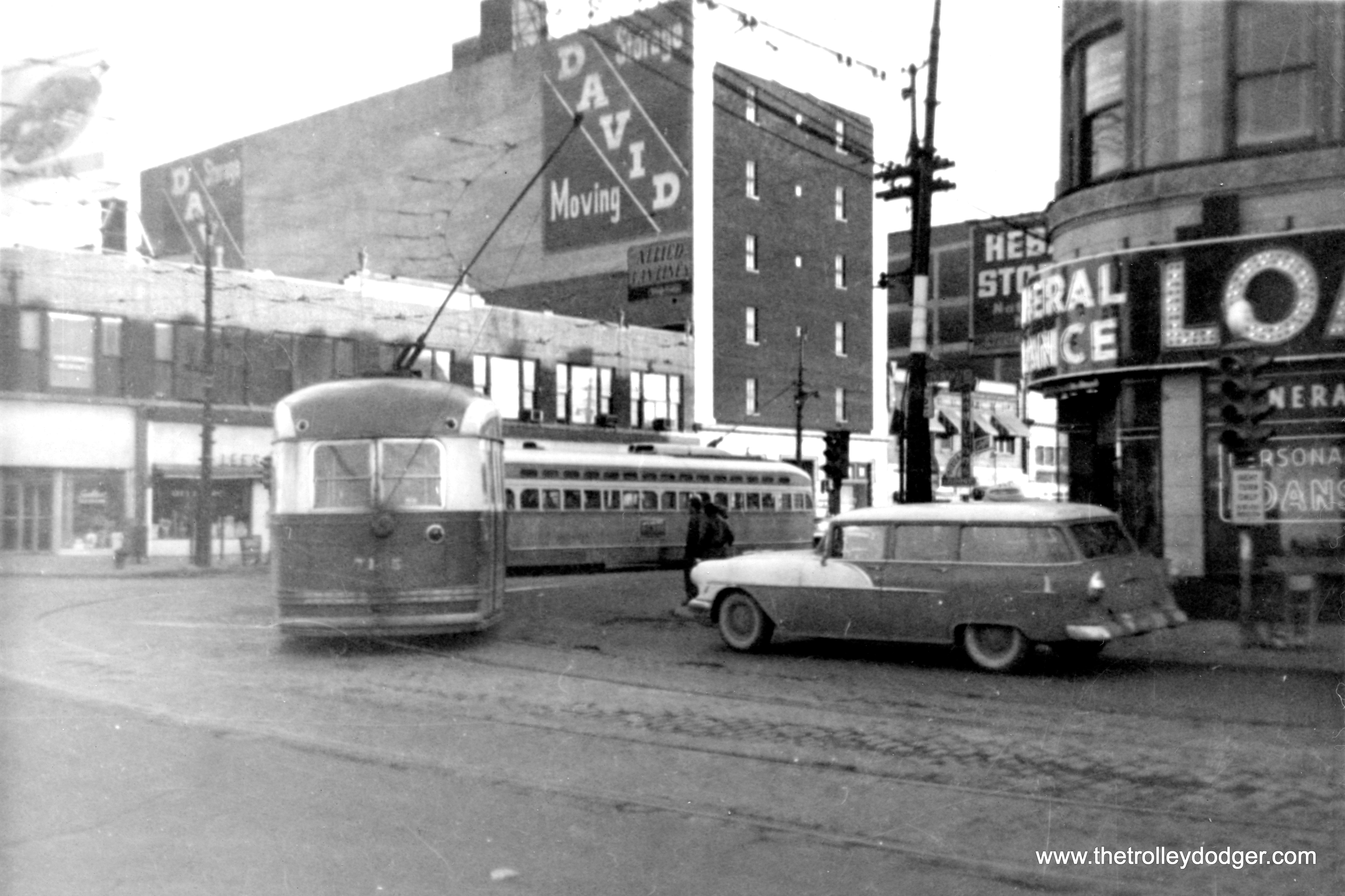
Postwar CTA 7269 at 63rd Place and Narragansett on November 23, 1952. (Thomas H. Desnoyers Photo)

Postwar CTA 7269 at 63rd Place and Narragansett on November 23, 1952. (Thomas H. Desnoyers Photo)

Prewar PCC 4027 at an unknown location. Likely possibilities are routes 4, 49, or 63. Tony Waller writes, "Image 243 is on 63rd St. Look at the pre-war PCC. It’s door arrangement is that of a two-man car. Cottage Grove and Western only had pre-war PCCs in one man operation."

Prewar PCC 4027 at an unknown location. Likely possibilities are routes 4, 49, or 63. Tony Waller writes, “Image 243 is on 63rd St. Look at the pre-war PCC. It’s door arrangement is that of a two-man car. Cottage Grove and Western only had pre-war PCCs in one man operation.”

CTA 248 at 63rd and Ashland in May 1953, shortly before the end of streetcar service on route 63. Note the safety island.

CTA 248 at 63rd and Ashland in May 1953, shortly before the end of streetcar service on route 63. Note the safety island.

CTA Sedan (aka "Peter Witt") 6310 appears to have been converted to one-man in this view circa 1952 view at South Shops. However, it may not have been used in service this way before being scrapped. (Roy W. Bruce Photo)

CTA Sedan (aka “Peter Witt”) 6310 appears to have been converted to one-man in this view circa 1952 view at South Shops. However, it may not have been used in service this way before being scrapped. (Roy W. Bruce Photo)

CTA prewar PCC 4021, last survivor of its type, in dead storage at South Shops in the late 1950s. This car is now preserved at the Illinois Railway Museum.

CTA prewar PCC 4021, last survivor of its type, in dead storage at South Shops in the late 1950s. This car is now preserved at the Illinois Railway Museum.

Excerpts from Chicago Transit Board Meeting Minutes:

StitchSCAN0178-SCAN0179

StitchSCAN0180-SCAN0181

StitchSCAN0182-SCAN0190

StitchSCAN0194-SCAN0195

StitchSCAN0196-SCAN0203

StitchSCAN0204-SCAN0207

StitchSCAN0208-SCAN0211

StitchSCAN0212-SCAN0213

StitchSCAN0214-SCAN0223

StitchSCAN0225-SCAN0230

StitchSCAN0231-SCAN0232

StitchSCAN0233-SCAN0238

StitchSCAN0239-SCAN0240

StitchSCAN0241-SCAN0244

StitchSCAN0245-SCAN0252

StitchSCAN0253-SCAN0256

StitchSCAN0257-SCAN0258

StitchSCAN0259-SCAN0263

StitchSCAN0264-SCAN0266

StitchSCAN0267-SCAN0270

Screen Shot 07-02-16 at 07.18 PM.PNG

Screen Shot 07-02-16 at 07.20 PM.PNG

Screen Shot 07-03-16 at 01.26 AM.PNG


Help Support The Trolley Dodger

gh1

This is our 145th post, and we are gradually creating a body of work and an online resource for the benefit of all railfans, everywhere. To date, we have received over 175,000 page views, for which we are very grateful.

You can help us continue our original transit research by checking out the fine products in our Online Store.

As we have said before, “If you buy here, we will be here.”

We thank you for your support.

Love for Selle

Chicago & North Western loco 608, a 4-6-2, heads an eastbound commuter train at Oak Park Avenue on March 23, 1955. This shows how the wide C&NW embankment made it possible, within a few years, to elevate the outer end of CTA's Lake Street "L". In the process, several close-in C&NW stations were closed. (Bob Selle Photo)

Chicago & North Western loco 608, a 4-6-2, heads an eastbound commuter train at Oak Park Avenue on March 23, 1955. This shows how the wide C&NW embankment made it possible, within a few years, to elevate the outer end of CTA’s Lake Street “L”. In the process, several close-in C&NW stations were closed. (Bob Selle Photo)

The building shown in the previous picture still stands on North Boulevard, just east of Oak Park Avenue, in Oak Park.

The building shown in the previous picture still stands on North Boulevard, just east of Oak Park Avenue, in Oak Park.

The late Robert A. Selle (1929-2013) was a notable railfan photographer who seems to have worked exclusively in black-and-white throughout his career. After his passing, his photo collection was sold, and recently some of his original negatives have hit the open market, where we have been fortunate enough to buy a few of them.

I know there are many people who are only interested in color photography, but personally, I appreciate great black-and-white work every bit as much. If you want to see pictures that date to before the 1940s or 1950s, that pretty much eliminates color. Even then, the early versions of Kodachrome were much more limited in how they could be used– after all, the original film speed was ISO 10.

By comparison, black-and-white films were “high speed” with ratings like 32, 64, or even 100. By the late 1950s, Kodak put out Super-XX which had a film speed of perhaps 200, depending on who you talk to.

We ran a couple of Bob Selle photos in older posts, which we are including here along with the others. We also posted a few some time back on the CERA Members Blog. To find those, just type “Selle” in the search window at the top of the page and the posts that include them will come up.

Anyhow, while I did not know the man personally, all the Bob Selle photos that I have seen have been pretty great, and I hope you think so too. Along with our tribute to Bob Selle, I am including some of our other recent photo finds that you may find interesting.

As always, if you have additional questions, comments, or other information you can add regarding what you see here, don’t hesitate to let us know. You can either leave a Comment on this post, or write us directly at:

thetrolleydodger@gmail.com

In addition to his shutterbug work, Bob Selle was also one of the founding members of the Electric Railway Historical Society, which published 49 important historical publications and preserved several electric railcars that are now at the Illinois Railway Museum. In 2014 I helped put together The Complete ERHS Collection, an E-book that includes all 49 publications. It is available from Central Electric Railfans Assocation.*

Keep those cards and letters coming in, folks.

-David Sadowski

PS- While in a sense it is a shame that when many railfan photographers pass on, their collections get scattered to the four winds, or determined by the highest bidder, that also presents us with an opportunity to try and collect some of these great images and pass them on to you. How many pictures we can save this way, and the quality of the ones we do present, is largely determined by the amount of financial support we can get from our readers.

*Trolley Dodger Press is not affiliated with Central Electric Railfans’ Association.


Help Support The Trolley Dodger

gh1

This is our 140th post, and we are gradually creating a body of work and an online resource for the benefit of all railfans, everywhere. To date, we have received over 167,000 page views, for which we are very grateful.

You can help us continue our original transit research by checking out the fine products in our Online Store.

As we have said before, “If you buy here, we will be here.”

We thank you for your support.

In the twilight days of steam, C&NW locomotive 532, a 4-6-2, heads a commuter train in February 1956. Although this negative is marked as having been taken at Euclid Avenue in Oak Park, where UP freight and Metra commuter trains now share space with the CTA's Green Line rapid transit, this certainly looks like it was taken somewhere else at ground level. (Bob Selle Photo) Andre Kristopans: "The CNW “Euclid Ave” shot most likely is about where Kilpatrick Av now crosses the tracks. If one blows up the photo, you see a railroad overpass in the background that certainly looks like the BRC bridge at Kenton. Box cars on right would be on one of the tracks at 40th St Yard, while the lower-level track in foreground would be an industrial lead. Train would be EB."

In the twilight days of steam, C&NW locomotive 532, a 4-6-2, heads a commuter train in February 1956. Although this negative is marked as having been taken at Euclid Avenue in Oak Park, where UP freight and Metra commuter trains now share space with the CTA’s Green Line rapid transit, this certainly looks like it was taken somewhere else at ground level. (Bob Selle Photo) Andre Kristopans: “The CNW “Euclid Ave” shot most likely is about where Kilpatrick Av now crosses the tracks. If one blows up the photo, you see a railroad overpass in the background that certainly looks like the BRC bridge at Kenton. Box cars on right would be on one of the tracks at 40th St Yard, while the lower-level track in foreground would be an industrial lead. Train would be EB.”

CTA salt spreader AA98 was former "Interstate" car 2846, shown here being operated for probably the last time ever on May 25, 1958 at CTA's South Shops. The occasion was a CERA fantrip on the last remaining Chicago streetcar line, so everything old that could run was trotted out for pictures. This car was soon purchased by the Electric Railway Historical Society, and eventually made its way to the Illinois Railway Museum, where it is preserved. (Bob Selle Photo)

CTA salt spreader AA98 was former “Interstate” car 2846, shown here being operated for probably the last time ever on May 25, 1958 at CTA’s South Shops. The occasion was a CERA fantrip on the last remaining Chicago streetcar line, so everything old that could run was trotted out for pictures. This car was soon purchased by the Electric Railway Historical Society, and eventually made its way to the Illinois Railway Museum, where it is preserved. (Bob Selle Photo)

There are a lot of pictures like this, showing CTA PCC 7142 and locomotive L-201 at South Shops on May 25, 1958. This was the occasion of one of the final fantrips on Chicago's last remaining streetcar line, organized by the Central Electric Railfans' Association, which was abandoned less than one month later. 7142 was on its way down to the St. Louis Car Company for scrapping so that parts could be reused in Chicago rapid transit cars. (Bob Selle Photo)

There are a lot of pictures like this, showing CTA PCC 7142 and locomotive L-201 at South Shops on May 25, 1958. This was the occasion of one of the final fantrips on Chicago’s last remaining streetcar line, organized by the Central Electric Railfans’ Association, which was abandoned less than one month later. 7142 was on its way down to the St. Louis Car Company for scrapping so that parts could be reused in Chicago rapid transit cars. (Bob Selle Photo)

CTA two-man arch roof 6141 coing off the south end of the Halsted Street bridge over the Milwaukee Road on November 16, 1953. This car was known as one of the "Odd 17" (actually 19), probably because it did not fit into some other series. Don's Rail Photos says, "6141 was built by American Car Co in February 1918, #1079." (Bob Selle Photo)

CTA two-man arch roof 6141 coing off the south end of the Halsted Street bridge over the Milwaukee Road on November 16, 1953. This car was known as one of the “Odd 17” (actually 19), probably because it did not fit into some other series. Don’s Rail Photos says, “6141 was built by American Car Co in February 1918, #1079.” (Bob Selle Photo)

CTA "Big Pullman" 511 at Lake and Paulina Streets on the Ashland Avenue line on August 26, 1953. (Bob Selle Photo)

CTA “Big Pullman” 511 at Lake and Paulina Streets on the Ashland Avenue line on August 26, 1953. (Bob Selle Photo)

It's the evening rush hour on June 3rd, 1959, and North Shore Line car 161 is on the tail end of a northbound train at Chicago Avenue on the "L". (Bob Selle Photo)

It’s the evening rush hour on June 3rd, 1959, and North Shore Line car 161 is on the tail end of a northbound train at Chicago Avenue on the “L”. (Bob Selle Photo)

The experimental pre-PCC car 4001 ended its days on CTA property as a storage shed. It is shown here at South Shops on December 18, 1955. The body shell of 4001 is now preserved at the Illinois Railway Museum. (Bob Selle Photo)

The experimental pre-PCC car 4001 ended its days on CTA property as a storage shed. It is shown here at South Shops on December 18, 1955. The body shell of 4001 is now preserved at the Illinois Railway Museum. (Bob Selle Photo)

The late Bob Selle took this great shot of an outbound Milwaukee Road commuter train leaving Union Station in Chicago on August 8, 1958. These were some of the consists I saw as a child, since I lived very close to what is now the Metra Milwaukee District West Line. Ridership was nothing compared to what it is today, and I believe bi-levels were not introduced here until around 1961-62. That's the Merchandise Mart across the Chicago River. This picture was taken from the Lake Street overpass. That looks like a 1957 Oldsmobile convertible at left.

The late Bob Selle took this great shot of an outbound Milwaukee Road commuter train leaving Union Station in Chicago on August 8, 1958. These were some of the consists I saw as a child, since I lived very close to what is now the Metra Milwaukee District West Line. Ridership was nothing compared to what it is today, and I believe bi-levels were not introduced here until around 1961-62. That’s the Merchandise Mart across the Chicago River. This picture was taken from the Lake Street overpass. That looks like a 1957 Oldsmobile convertible at left.

According to Don's Rail Photos, Chicago North Shore & Milwaukee 213 "was built by Cincinnati in March 1920, #2445, as a merchandise dispatch car. In 1940 it was rebuilt as a disc harrow ice cutter. It was retired in 1955 and sold to CHF as their 242. It was donated to Illinois Railway Museum in 1964." This photo by the late Bob Selle shows it newly delivered to the Chicago Hardware Foundry in North Chicago on August 7, 1955.

According to Don’s Rail Photos, Chicago North Shore & Milwaukee 213 “was built by Cincinnati in March 1920, #2445, as a merchandise dispatch car. In 1940 it was rebuilt as a disc harrow ice cutter. It was retired in 1955 and sold to CHF as their 242. It was donated to Illinois Railway Museum in 1964.” This photo by the late Bob Selle shows it newly delivered to the Chicago Hardware Foundry in North Chicago on August 7, 1955.

Caption: "3 cars on North Shore Line northbound at Kenilworth (714 on rear of train), July 13, 1955. This was shortly before the end of service on the Shore Line Route. (Bob Selle Photo) Don's Rail Photos: "714 was built by Cincinnati Car Co in 1926, #2890. It is modernized in 1939 and preserved in 1963 by the Illinois Railway Museum."

Caption: “3 cars on North Shore Line northbound at Kenilworth (714 on rear of train), July 13, 1955. This was shortly before the end of service on the Shore Line Route. (Bob Selle Photo) Don’s Rail Photos: “714 was built by Cincinnati Car Co in 1926, #2890. It is modernized in 1939 and preserved in 1963 by the Illinois Railway Museum.”

This looks like a 1952 Chevrolet 4-door Fleetline fastback to me, which would be a somewhat rare model with only a few thousand produced. The fastback, which had enjoyed a brief vogue starting around 1941, was dropped for the 1953 model year.

This looks like a 1952 Chevrolet 4-door Fleetline fastback to me, which would be a somewhat rare model with only a few thousand produced. The fastback, which had enjoyed a brief vogue starting around 1941, was dropped for the 1953 model year.

It's May 30, 1958 and Chicago Surface Lines car 1467 (former CTA salt car AA72) is at the Electric Railway Historical Society site on Plainfield Road in Downer's Grove. Don's Rail Photos says this "Bowling Alley" car "was built by CUTCo in 1900 as CUT 4516. It was rebuilt as 1467 in 1911 and became CSL 1467 in 1914. It was rebuilt as salt car and renumbered AA72 on April 15, 1948. It was retired on February 28, 1958. It was sold to Electric Railway Historical Society in 1959 and went to Illinois Railway Museum in 1973." Actually it must have been sold earlier, as the negative envelope has written on it "owned now by ERHS!" (Bob Selle Photo)

It’s May 30, 1958 and Chicago Surface Lines car 1467 (former CTA salt car AA72) is at the Electric Railway Historical Society site on Plainfield Road in Downer’s Grove. Don’s Rail Photos says this “Bowling Alley” car “was built by CUTCo in 1900 as CUT 4516. It was rebuilt as 1467 in 1911 and became CSL 1467 in 1914. It was rebuilt as salt car and renumbered AA72 on April 15, 1948. It was retired on February 28, 1958. It was sold to Electric Railway Historical Society in 1959 and went to Illinois Railway Museum in 1973.” Actually it must have been sold earlier, as the negative envelope has written on it “owned now by ERHS!” (Bob Selle Photo)

CTA 3025 is running inbound on Elston on June 30, 1949. (Bob Selle Photo) Neil Arsenty adds, "Although this is the Elston Avenue line, this is actually taken at Milwaukee and Kinzie going southeast. The building behind the streetcar still stands at the Northwest corner."

CTA 3025 is running inbound on Elston on June 30, 1949. (Bob Selle Photo) Neil Arsenty adds, “Although this is the Elston Avenue line, this is actually taken at Milwaukee and Kinzie going southeast. The building behind the streetcar still stands at the Northwest corner.”

Milwaukee and Kinzie today.

Milwaukee and Kinzie today.

CTA Pullman 144 is heading southwest on Archer approaching Wentworth on June 15, 1958. This was four years after red cars were retired from active service, and less than a week before the end of all Chicago streetcars. The occasion was a fantrip sponsored by the Electric Railway Historical Society (ERHS). (Bob Selle Photo)

CTA Pullman 144 is heading southwest on Archer approaching Wentworth on June 15, 1958. This was four years after red cars were retired from active service, and less than a week before the end of all Chicago streetcars. The occasion was a fantrip sponsored by the Electric Railway Historical Society (ERHS). (Bob Selle Photo)

On Sunday, September 13, 1953, CTA one-man shuttle car 3175 is on Fifth Avenue at Pulaski (Crawford), the west end of the Fifth Avenue line. This had been a branch line from route 20 - Madison. From this point, the cars looped via Pulaski and Harrison before going back NE on Fifth. The photographer was on the Garfield Park "L" at Pulaski. The "L" was heading east and west at this point, just south of where the Eisenhower expressway is today. This "L" station remained in use until June 1958. Streetcar service on Fifth Avenue continued into early 1954. (Bob Selle Photo)

On Sunday, September 13, 1953, CTA one-man shuttle car 3175 is on Fifth Avenue at Pulaski (Crawford), the west end of the Fifth Avenue line. This had been a branch line from route 20 – Madison. From this point, the cars looped via Pulaski and Harrison before going back NE on Fifth. The photographer was on the Garfield Park “L” at Pulaski. The “L” was heading east and west at this point, just south of where the Eisenhower expressway is today. This “L” station remained in use until June 1958. Streetcar service on Fifth Avenue continued into early 1954. (Bob Selle Photo)

An overview of the Fifth-Pulaski-Harrison area as it appears today. When the Congress (now Eisenhower) expressway was built, Fifth Avenue was cut off at this point just out of the right of the picture. The Garfield Park "L", which ran east and west at this point, was replaced by the Congress median rapid transit line in 1958.

An overview of the Fifth-Pulaski-Harrison area as it appears today. When the Congress (now Eisenhower) expressway was built, Fifth Avenue was cut off at this point just out of the right of the picture. The Garfield Park “L”, which ran east and west at this point, was replaced by the Congress median rapid transit line in 1958.

On August 9, 1955 CTA wooden "L" car 345 is at the front of a northbound Ravenswood "A" train at Chicago Avenue. (Bob Selle Photo)

On August 9, 1955 CTA wooden “L” car 345 is at the front of a northbound Ravenswood “A” train at Chicago Avenue. (Bob Selle Photo)

Here, we see the lineup at 71st and Ashland on May 23, 1953. From left to rigth, we have CTA 572, sprinklers D-210, D-212, D-203 and 504. (Bob Selle Photo)

Here, we see the lineup at 71st and Ashland on May 23, 1953. From left to rigth, we have CTA 572, sprinklers D-210, D-212, D-203 and 504. (Bob Selle Photo)


Recent Photo Finds

CTA 7095 heads south on State Street on route 36 Broadway-State on August 18, 1954. You can see the Mandel Brothers department store in the background. We discussed this retailer in our previous post Lifting the Lid in the Loop (April 12, 2016), which makes Madison the cross street. Mandel Brothers was bought out by Wieboldt's in 1960, and their store occupied this site into the 1980s. This image was taken on size 828 film, which was meant to be Kodak's answer to 35mm starting in the late 1930s. It offered 8 pictures on a roll, with an image area nearly 30% bigger than 35mm, and had notches in the film so that cameras could use an automatic frame counter/spacer, potentially eliminating the troublesome little red window on the back of the camera. Although Kodak promoted this format in the stylish Art Deco Bantam series of cameras, it did not catch on and 828 film was discontinued by Kodak in 1985. However, the technology behind 828 was later used in the very much more successful 126 cartridge format starting in 1963. It is actually still possible to get 828 film today that has been respooled and cut to size from larger formats.

CTA 7095 heads south on State Street on route 36 Broadway-State on August 18, 1954. You can see the Mandel Brothers department store in the background. We discussed this retailer in our previous post Lifting the Lid in the Loop (April 12, 2016), which makes Madison the cross street. Mandel Brothers was bought out by Wieboldt’s in 1960, and their store occupied this site into the 1980s. This image was taken on size 828 film, which was meant to be Kodak’s answer to 35mm starting in the late 1930s. It offered 8 pictures on a roll, with an image area nearly 30% bigger than 35mm, and had notches in the film so that cameras could use an automatic frame counter/spacer, potentially eliminating the troublesome little red window on the back of the camera. Although Kodak promoted this format in the stylish Art Deco Bantam series of cameras, it did not catch on and 828 film was discontinued by Kodak in 1985. However, the technology behind 828 was later used in the very much more successful 126 cartridge format starting in 1963. It is actually still possible to get 828 film today that has been respooled and cut to size from larger formats.

A comparison of a standard 35mm Kodachrome slide with a "superslide" in 828 film format. At 28x40mm as opposed to 24x36mm, the superslide has a nearly 30% larger surface area. Despite the different style of these two slide mounts, these pictures were taken only about one year apart (left 1956, right 1955). There were also 40x40mm superslides using size 127 roll film, taking up nearly the entire area of a standard 2x2" slide mount, but as far as I know Kodachrome was never made in that format, although Ektachrome certainly was. So, the term superslide can refer to either size 828 or 127 transparencies.

A comparison of a standard 35mm Kodachrome slide with a “superslide” in 828 film format. At 28x40mm as opposed to 24x36mm, the superslide has a nearly 30% larger surface area. Despite the different style of these two slide mounts, these pictures were taken only about one year apart (left 1956, right 1955). There were also 40x40mm superslides using size 127 roll film, taking up nearly the entire area of a standard 2×2″ slide mount, but as far as I know Kodachrome was never made in that format, although Ektachrome certainly was. So, the term superslide can refer to either size 828 or 127 transparencies.

CTA postwar PCC 7236 is shown northbound at Clark and Armitage on Sunday, December 18, 1955 in fantrip service. It was preferable in this period to run fantrips on weekends, since regular service on these lines was now being operated by buses, such as the ones shown in the background. We have run three other photos from this same fantrip in previous posts. Red car 225 was used ahead of this car. Since the trip organizers had advertised that car 144 would be used, they put a piece of oilcloth with that number on it over the Pullman's actual number. I also wrote about this same trip in the post The Old Math (144 = 225) March 13, 2013 on the CERA Members Blog. At that time, I thought the date of the trip was 1956, but a variety of sources since then say it was actually 1955. George Foelschow adds, "The tan building directly behind the car is the North Park Hotel, the apex of the Old Town Triangle, site of the Chandelier Room, where I cast my first vote in 1960, since I lived just south of there on Lincoln Avenue. Sadly, the streetcars and trolley wires were gone by then, and only the tracks remained for a time."

CTA postwar PCC 7236 is shown northbound at Clark and Armitage on Sunday, December 18, 1955 in fantrip service. It was preferable in this period to run fantrips on weekends, since regular service on these lines was now being operated by buses, such as the ones shown in the background. We have run three other photos from this same fantrip in previous posts. Red car 225 was used ahead of this car. Since the trip organizers had advertised that car 144 would be used, they put a piece of oilcloth with that number on it over the Pullman’s actual number. I also wrote about this same trip in the post The Old Math (144 = 225) March 13, 2013 on the CERA Members Blog. At that time, I thought the date of the trip was 1956, but a variety of sources since then say it was actually 1955. George Foelschow adds, “The tan building directly behind the car is the North Park Hotel, the apex of the Old Town Triangle, site of the Chandelier Room, where I cast my first vote in 1960, since I lived just south of there on Lincoln Avenue. Sadly, the streetcars and trolley wires were gone by then, and only the tracks remained for a time.”

CTA one-man prewar PCC 4032 is shown southbound on route 4 - Cottage Grove in the early 1950s, where the line ran parallel to the Illinois Central's electric suburban commuter service.

CTA one-man prewar PCC 4032 is shown southbound on route 4 – Cottage Grove in the early 1950s, where the line ran parallel to the Illinois Central’s electric suburban commuter service.

CTA 7012 at the Narragansett Loop on the west end of route 63. Tony Waller adds, "In image 257, the pre-war PCC must have been photographed in December 1951. All pre-war PCCs were removed from 63rd St. in Spring 1952 and rebuilt for one man operations (with elimination of one of the center doors). They were then assigned to Cottage Grove."

CTA 7012 at the Narragansett Loop on the west end of route 63. Tony Waller adds, “In image 257, the pre-war PCC must have been photographed in December 1951. All pre-war PCCs were removed from 63rd St. in Spring 1952 and rebuilt for one man operations (with elimination of one of the center doors). They were then assigned to Cottage Grove.”

Chicago, Aurora & Elgin wood car 318 under wire on a July 4, 1949 fantrip. The index card with this negative reads: Monitor roof double end steel interurban. Builder: Jewett 1909; Weight 100,000 lbs.; Motors 4 GE 66 HP 500; Seats 52; Length 54' Width 8' 8" Height 13' 6". On the same day, the New York-based Electric Railroader's Association held a Chicago fantrip on south side streetcar lines that were soon to be abandoned. You can see a picture from that trip in our post Chicago Surface Lines Photos, Part Five.

Chicago, Aurora & Elgin wood car 318 under wire on a July 4, 1949 fantrip. The index card with this negative reads: Monitor roof double end steel interurban. Builder: Jewett 1909; Weight 100,000 lbs.; Motors 4 GE 66 HP 500; Seats 52; Length 54′ Width 8′ 8″ Height 13′ 6″. On the same day, the New York-based Electric Railroader’s Association held a Chicago fantrip on south side streetcar lines that were soon to be abandoned. You can see a picture from that trip in our post Chicago Surface Lines Photos, Part Five.

Chicago, Aurora & Elgin wood car 319 heads west, having just left the CTA's Wells Street Terminal, sometime prior to the end of CA&E service downtown in September 1953. This was a stub-end terminal, and the tracks at right curved around to Van Buren and connected to the southwest corner of the Loop "L". In 1955, that connecting track was removed as part of the construction of lower Wacker Drive. A new connection to the Loop was made by extending two tracks through the old Wells Street Terminal, which was by then no longer in use. The CTA's Garfield Park trains continued to use this connection until June 1958, when the Congress median line opened. Parts of the old "L" structure here were not demolished until the early 1960s.

Chicago, Aurora & Elgin wood car 319 heads west, having just left the CTA’s Wells Street Terminal, sometime prior to the end of CA&E service downtown in September 1953. This was a stub-end terminal, and the tracks at right curved around to Van Buren and connected to the southwest corner of the Loop “L”. In 1955, that connecting track was removed as part of the construction of lower Wacker Drive. A new connection to the Loop was made by extending two tracks through the old Wells Street Terminal, which was by then no longer in use. The CTA’s Garfield Park trains continued to use this connection until June 1958, when the Congress median line opened. Parts of the old “L” structure here were not demolished until the early 1960s.

"Congress St. expressway under construction with rapid transit tracks in center strip, October 8, 1955." The Garfield Park "L" tracks, whether temporary or existing, are not visible in this picture. The first tracks in the median line were laid on July 28, 1955 at Pulaski Road, with Mayor Richard J. Daley driving the first spike. Matt Cajda adds, "In the Congress Expressway photo, the elevated Garfield Park tracks look visible to me just above the two bridges over the expressway. This would indicate that the photo could possibly be taken from the Homan Ave. or Kedzie Ave. bridge." Andre Kristopans: "The Congress construction is looking east at Kostner. Remember, Kostner station came later." (Yes, the short-lived Kostner station, built on a curve, opened in 1962 as the result of lobbying by three local aldermen whose wards were nearby. It closed in 1973.)

“Congress St. expressway under construction with rapid transit tracks in center strip, October 8, 1955.” The Garfield Park “L” tracks, whether temporary or existing, are not visible in this picture. The first tracks in the median line were laid on July 28, 1955 at Pulaski Road, with Mayor Richard J. Daley driving the first spike. Matt Cajda adds, “In the Congress Expressway photo, the elevated Garfield Park tracks look visible to me just above the two bridges over the expressway. This would indicate that the photo could possibly be taken from the Homan Ave. or Kedzie Ave. bridge.” Andre Kristopans: “The Congress construction is looking east at Kostner. Remember, Kostner station came later.” (Yes, the short-lived Kostner station, built on a curve, opened in 1962 as the result of lobbying by three local aldermen whose wards were nearby. It closed in 1973.)

This photo was marked as being taken in April 1951. Unfortunately, what the picture shows makes that date impossible. The buildings behind the ground level "L" show that this is Western Avenue at Van Buren, during the 1953-58 rerouting of part of the Garfield Park "L". Red car 473 is on a curve because the tracks are on a shoo-fly while the bridge that would go over the Congress (now Eisenhower) expressway was under construction to the left of this view, which looks north. This phase of construction, and the presence of car 473, would imply that this picture actually dates to May 16, 1954, when this car and 479 were used on a CERA "farewell to red cars" fantrip on Chicago's streetcar system. Meanwhile, a two-car train of flat door 6000-series "L" cars (6049-6050), with numbers painted on their roofs, proceeds on the ponderously slow 2.5 mile temporary trackage.

This photo was marked as being taken in April 1951. Unfortunately, what the picture shows makes that date impossible. The buildings behind the ground level “L” show that this is Western Avenue at Van Buren, during the 1953-58 rerouting of part of the Garfield Park “L”. Red car 473 is on a curve because the tracks are on a shoo-fly while the bridge that would go over the Congress (now Eisenhower) expressway was under construction to the left of this view, which looks north. This phase of construction, and the presence of car 473, would imply that this picture actually dates to May 16, 1954, when this car and 479 were used on a CERA “farewell to red cars” fantrip on Chicago’s streetcar system. Meanwhile, a two-car train of flat door 6000-series “L” cars (6049-6050), with numbers painted on their roofs, proceeds on the ponderously slow 2.5 mile temporary trackage.

Although CTA postwar PCC 4400 is not front and center in this September 1, 1955 press photograph, taken at Clark and Leland, looking northeast, that is actually part of its charm. This was part of a series showing neighborhood life in Uptown, during a time when streetcars were still a part of everyday life in Chicago. (Ralph Arvidson Photo)

Although CTA postwar PCC 4400 is not front and center in this September 1, 1955 press photograph, taken at Clark and Leland, looking northeast, that is actually part of its charm. This was part of a series showing neighborhood life in Uptown, during a time when streetcars were still a part of everyday life in Chicago. (Ralph Arvidson Photo)

The same location today. Leland is a block south of Lawrence.

The same location today. Leland is a block south of Lawrence.

Chicago Surface Lines "Sedan" (Peter Witt) 6281, southbound on route 22 - Clark-Wentworth, most likely in the late 1930s.

Chicago Surface Lines “Sedan” (Peter Witt) 6281, southbound on route 22 – Clark-Wentworth, most likely in the late 1930s.

CTA 4026 is eastbound on private right-of-way at the west end of route 63.

CTA 4026 is eastbound on private right-of-way at the west end of route 63.

Chicago Surface Lines Brill car 6072 at Kedzie Station on January 28, 1942. (John F. Bromley Collection) I believe this car was built in 1914. You can see part of a Sedan in the background. These were used for fill-in service on Madison along with the prewar PCCs.

Chicago Surface Lines Brill car 6072 at Kedzie Station on January 28, 1942. (John F. Bromley Collection) I believe this car was built in 1914. You can see part of a Sedan in the background. These were used for fill-in service on Madison along with the prewar PCCs.

The interior of CSL Pullman 616 during Surface Lines days. (Joe L. Diaz Collection)

The interior of CSL Pullman 616 during Surface Lines days. (Joe L. Diaz Collection)

CSL 2779 in a wintry scene, probably in the 1940s. The location is unknown, as the roll sign on the car simply reads "Downtown." According to Don's Rail Photos, this car was part of a series known as Robertson Rebuilds, built by St. Louis Car Company in 1903. Don Ross: "These cars were similar to 2501-2625 but were longer and heavier. They were built with McGuire 10-A trucks but were replaced with Brill 51-E-1 trucks in 1918. An additional 20 cars were ordered, 2781-2800, but they were delivered to St Louis & Suburban Ry as 600-619. It replaced most of their cars in a carbarn fire that destroyed most of their equipment." (Joe L. Diaz Photo) Michael Franklin: "Headed south on Damen Ave with Roscoe St. in the distance."

CSL 2779 in a wintry scene, probably in the 1940s. The location is unknown, as the roll sign on the car simply reads “Downtown.” According to Don’s Rail Photos, this car was part of a series known as Robertson Rebuilds, built by St. Louis Car Company in 1903. Don Ross: “These cars were similar to 2501-2625 but were longer and heavier. They were built with McGuire 10-A trucks but were replaced with Brill 51-E-1 trucks in 1918. An additional 20 cars were ordered, 2781-2800, but they were delivered to St Louis & Suburban Ry as 600-619. It replaced most of their cars in a carbarn fire that destroyed most of their equipment.” (Joe L. Diaz Photo) Michael Franklin: “Headed south on Damen Ave with Roscoe St. in the distance.”

I believe this is CSL car 2811 on the Riverdale line. If so, this car is part of a series (2801-2815) built by St. Louis Car Company in 1901. Don's Rail Photos says, "These cars were built for Chicago City Ry and sold to Calumet & South Chicago Railway in 1908. 2811 was built by St Louis Car Co in 1901 as CCRy 2586. It was sold as C&CS 711 in 1908 and renumbered 2811 in 1913. It became CSL 2811 in 1914." (Joe L. Diaz Photo) Michael Franklin: "Northbound on Indiana Ave turning west on 134th St."

I believe this is CSL car 2811 on the Riverdale line. If so, this car is part of a series (2801-2815) built by St. Louis Car Company in 1901. Don’s Rail Photos says, “These cars were built for Chicago City Ry and sold to Calumet & South Chicago Railway in 1908. 2811 was built by St Louis Car Co in 1901 as CCRy 2586. It was sold as C&CS 711 in 1908 and renumbered 2811 in 1913. It became CSL 2811 in 1914.” (Joe L. Diaz Photo) Michael Franklin: “Northbound on Indiana Ave turning west on 134th St.”

This photo is supposed to show the traction motor in CTA trolley bus 370. If so, it was built by St. Louis Car Company in 1948. This bus would have been renumbered to 9370 in 1952, to avoid duplication with bus numbers from the Chicago Motor Coach Company, which CTA purchased that year. A while back I asked our readers whether the North Shore Line Electroliner was fitted with trolley bus motors. I don't think I got a definitive answer, although in some sense, a traction motor is a traction motor.

This photo is supposed to show the traction motor in CTA trolley bus 370. If so, it was built by St. Louis Car Company in 1948. This bus would have been renumbered to 9370 in 1952, to avoid duplication with bus numbers from the Chicago Motor Coach Company, which CTA purchased that year. A while back I asked our readers whether the North Shore Line Electroliner was fitted with trolley bus motors. I don’t think I got a definitive answer, although in some sense, a traction motor is a traction motor.

CTA 384, a Pullman, sits at the west end of route 66 at Chicago Avenue and Austin Boulevard. That looks like a West Towns bus across the way in suburban Oak Park in the background.

CTA 384, a Pullman, sits at the west end of route 66 at Chicago Avenue and Austin Boulevard. That looks like a West Towns bus across the way in suburban Oak Park in the background.


Updates

It’s conclusively been shown that the following two “mystery” photos below show the Hammond, Whiting & East Chicago Railway, which operated a through service to Chicago with the Chicago Surface Lines. In its final years, the Indiana half of this operation was under the management of Chicago & Calumet District Transit. Chicago cars ran into Indiana, and Indiana cars ran into Illinois, up until the cessation of streetcar service in 1940. Operators were changed at the state line, and each car had two sets of fare boxes.

According to Don’s Rail Photos:

HW&EC was formed in 1892 in Hammond where 2 miles of track were built. It was then extended through East Chicago and Whiting to the state line and a connection to the South Chicago City Railway. It came under SCCRy control and service was extended to 63rd and Stony Island. In 1901 a fire destroyed the Hammond Packing Co which caused such a financial impact that all but 12 cars were sold. In 1908 the SCCRy merged with the Calumet Electric Street Ry as the Calumet & South Chicago Ry which retained control of the HW&EC. Joint service was maintained using cars of both companies. After World War I the line was plagued by private auto and jitney competition and finally filed for abandonment in 1929. A new company, Calumet Railways was formed, but it failed and was replaced by C&CDT. The Indiana Harbor line was abandoned in 1934 and the remainder of the system on June 9, 1940.

PS- Coincidentally, Frank Hicks has just posted an article called THE INTERSTATE: CSL 2846 and the Streetcar Service to Indiana on the excellent Hicks Car Works blog. It’s well worth reading, and we contributed a couple of pictures as well.

This is a higher-res version of a photo that originally appeared in our post The “Other” Penn Central (May 29, 2016). Bob Lalich writes, "The location of photo csl127 is East Chicago, IN. The road is Indianapolis Blvd and the bridge spans the west leg of the Indiana Harbor Canal. The car is SB."

This is a higher-res version of a photo that originally appeared in our post The “Other” Penn Central (May 29, 2016). Bob Lalich writes, “The location of photo csl127 is East Chicago, IN. The road is Indianapolis Blvd and the bridge spans the west leg of the Indiana Harbor Canal. The car is SB.”

A close-up of the previous photo. This appears to be Chicago and Calumet District car 78, built by American in 1919.

A close-up of the previous photo. This appears to be Chicago and Calumet District car 78, built by American in 1919.

This is a higher-res version of a photo that originally appeared in our post The “Other” Penn Central (May 29, 2016). Bob Lalich writes, "After studying photo csl26 several more times and the HW&EC map in James Buckley’s book I am convinced the location is Schrage Ave near Steiber St in Whiting. The car is SB and the crossing track is the IHB branch which connected to the B&OCT Whiting Branch, seen in the background. Everything fits."

This is a higher-res version of a photo that originally appeared in our post The “Other” Penn Central (May 29, 2016). Bob Lalich writes, “After studying photo csl26 several more times and the HW&EC map in James Buckley’s book I am convinced the location is Schrage Ave near Steiber St in Whiting. The car is SB and the crossing track is the IHB branch which connected to the B&OCT Whiting Branch, seen in the background. Everything fits.”

A close-up of the previous photo. This appears to be Chicago and Calumet District car 78, built by American in 1919.

A close-up of the previous photo. This appears to be Chicago and Calumet District car 78, built by American in 1919.

We previously ran another version of this photograph in our post Chicago Streetcars in Black-and-White, Part 3 (March 29, 2015), although that version was cropped somewhat. There, the caption read as follows: CSL 6200 by Hammond Station (car house), 1939. According to Andre Kristopans, this street is called Gostlin. (M.D. McCarter Collection)

We previously ran another version of this photograph in our post Chicago Streetcars in Black-and-White, Part 3 (March 29, 2015), although that version was cropped somewhat. There, the caption read as follows: CSL 6200 by Hammond Station (car house), 1939. According to Andre Kristopans, this street is called Gostlin. (M.D. McCarter Collection)

This is a higher-res version of a photo that originally appeared in our post The “Other” Penn Central (May 29, 2016). It shows Chicago Surface Lines prewar PCC 4003 at the Madison-Austin Loop.

This is a higher-res version of a photo that originally appeared in our post The “Other” Penn Central (May 29, 2016). It shows Chicago Surface Lines prewar PCC 4003 at the Madison-Austin Loop.

We now have a nearly complete set of hi-res scans of the CTA Transit News, an employee publication, covering the years from 1947 to 1973. That's an amazing 282 issues in all, on average 24 pages per copy. It's a wealth of information, covering several thousand pages of material, added to our E-Book The “New Look” in Chicago Transit: 1938-1973, available through our Online Store.

We now have a nearly complete set of hi-res scans of the CTA Transit News, an employee publication, covering the years from 1947 to 1973. That’s an amazing 282 issues in all, on average 24 pages per copy. It’s a wealth of information, covering several thousand pages of material, added to our E-Book The “New Look” in Chicago Transit: 1938-1973, available through our Online Store.

These issues of the CTA Transit News are full of interesting tidbits of information contained in theses publications, some of which are not to be found anywhere else.

The June 1956 issue, published 60 years ago, is no exception.

On page 20 of the June 1956 issue, we find the following:

On the preceding day, Sunday, June 17, the Western avenue one-man streetcar line was converted to bus operation… The conversion from streetcars to buses on Western was necessary to clear the way for the City of Chicago to proceed with its program of building vehicular traffic grade separations in heavily used intersections.

That was written 60 years ago, and the grade separation project they refer to was the flyover at Western, Belmont and Clybourn, which opened on November 22, 1961. This was mainly built due to traffic congestion from nearby Riverview amusement park, but that closed after the 1967 season. The flyover has long outlived its usefulness and was recently demolished.

On page 3, we find:

GARFIELD PARK TRACKS RELOCATED AGAIN– HERE’S WHY

In order to speed up construction work on the Congress street expressway, the section of CTA tracks on the Garfield Park line of the rapid transit system from east of Central avenue to Austin boulevard that was relocated last year has again been relocated and will be cut into service sometime in June.

This speed-up program will permit the highway building agencies to prepare simultaneously the permanent right-of-way and necessary facilities for CTA and B & O CT and the Chicago Great Western R. R. operations in this area. Originally the highway building agencies had planned to construct these permanent facilities in two stages, one after the other. This would have consumed considerably more time than the revised plan will require, even though this seems to duplicate the temporary work that was done a year ago.

Both of the temporary routings for CTA operations, as well as CTA permanent right-of-way and station facilities, are being paid for by the public agencies that are constructing the Congress street expressway.

The second relocation project involved the laying of two additional tracks approximately 40 feet to the north between Central avenue and Austin boulevard, It also involved the construction of a new station at Central avenue and alterations to the Austin boulevard station.

Work has already been completed on all operating facilities required for this relocation. The actual cutting in of service is contingent upon completion of new water main facilities through Oak Park and Forest Park.

After CTA service has been diverted to the temporary tracks, the existing CTA tracks will be taken over and used by the other two railroads in accomplishing their temporary relocation.

On page 7, some CTA employees were asked about their plans for the summer. Edward T. Mizerocki, a repairman at Wilson shops, replied:

Since I’m a rail fan, I will devote much of my spare time at the Illinois Electrical (sic) Railway Museum in North Chicago taking a lot of pictures. Another of my aims will be to help restore and preserve old streetcars and other electric railway equipment.

Ed Mizerocki is mentioned a couple of times in the June 2013 issue of Rail and Wire, the magazine of the Illinois Railway Museum, which you can read here.

We salute all those who helped to preserve transit history over the years, whether we know their names or not.

-David Sadowski

Upgrade Service

We strive to improve our E-books whenever we can, with the addition of new material. If you have already purchased a copy, and want to obtain the latest version, we would be happy to send you a new disc for just $5.00 within the United States. Drop us a line at thetrolleydodger@gmail.com for further details.

Bonus Feature:

The Bantamweight Division

A compendium of Kodak Bantam cameras and the size 828 roll film they used.

kodakflashbantam1

ek828c

ek828b-001

ek828

kodakbantam3

kodakbantam2

kodakbantam1

kodakbantam

k828b

k828a

k828

ekbantam1

More Chicago PCC Photos – Part Eight

On June 19, 1953, CTA Pullman-built PCC 4337 is at the Halsted and 79th loop, south end of route 8. But the car is signed for route 42, Halsted-Downtown, which was a variant on the line. CTA bus 2581 is at left. Soon, the Pullmans would begin disappearing from this route as they were sent off to St. Louis Car Company for scrapping in the "PCC Conversion Program." There are very few photos of PCCs on route 42, making this one a rarity.

On June 19, 1953, CTA Pullman-built PCC 4337 is at the Halsted and 79th loop, south end of route 8. But the car is signed for route 42, Halsted-Downtown, which was a variant on the line. CTA bus 2581 is at left. Soon, the Pullmans would begin disappearing from this route as they were sent off to St. Louis Car Company for scrapping in the “PCC Conversion Program.” There are very few photos of PCCs on route 42, making this one a rarity.

Also, in the early photo, all buses and cars went around the block via 79th and Emerald, and exited westbound. Later there was a large section added in the back, behind the buildings you see, so buses could enter directly off Halsted, loop around, and come back out onto Halsted."

The bus loop at Halsted and 79th as it appears today. Andre Kristopans: “Regarding 79th/Halsted loop, the driveway is actually just as wide in both photos. It is an optical illusion because where once there were three lanes, now there are only two, wider, lanes, and a single, wide, platform.
Also, in the early photo, all buses and cars went around the block via 79th and Emerald, and exited westbound. Later there was a large section added in the back, behind the buildings you see, so buses could enter directly off Halsted, loop around, and come back out onto Halsted.”

Here we have another bevy of Chicago PCC streetcar photos for your enjoyment. To see previous installments in this series, just use the search window at the top of this page.

As always, if you have interesting tidbits of information to add to what we have written here, don’t hesitate to add your comments or drop us a line to:

thetrolleydodger@gmail.com

-David Sadowski

PS- These photos are also being added to our E-book collection Chicago’s PCC Streetcars: The Rest of the Story, available in our Online Store.

If you are interested in PCC trucks, the motors that make these things go, there is an interesting article you can read about them, written by Bill Becwar, who is one of our readers. It explains how trucks from actual Chicago streetcars came to power ones used now In Kenosha, by way of scrapped 6000-series “L” cars.


Help Support The Trolley Dodger

gh1

This is our 135th post, and we are gradually creating a body of work and an online resource for the benefit of all railfans, everywhere. To date, we have received over 151,000 page views, for which we are very grateful.

You can help us continue our original transit research by checking out the fine products in our Online Store.

As we have said before, “If you buy here, we will be here.”

We thank you for your support.


Now Updated with 46 Pages of New Material:

StitchSCAN0109-SCAN0114rapidtransitnews1

Lifting the Lid in the Loop, 1915
The Chicago Freight Tunnels, 1928
Chicago Elevated Railroads Consolidation of Operations, 1913

The Chicago Tunnel Company (1906-1959) operated an elaborate network of 2 ft (610 mm) narrow gauge track in 7.5-by-6-foot (2.3 m × 1.8 m) tunnels running under the streets throughout the central business district including and surrounding the Loop, delivering freight, parcels, and coal, and disposed of ash and excavation debris.

Our E-book collection includes two short books issued by the Tunnel Company, detailing their operations. Lifting the Lid in the Loop is 46 pages long, has many great illustrations, and was published in 1915. To this we add a different 32-page illustrated book from 1928.

The third volume in this collection, Chicago Elevated Railroads Consolidation of Operations (60 pages) was published in 1913 to help facilitate the through-routing of the South Side and Northwestern elevated lines. As Britton I. Budd wrote in the introduction, “This book of instructions is issued for the purpose of familiarizing the employees of the South Side Elevated Railroad with the character, service, track arrangement, and general features of the system of the Northwestern Elevated Railroad, and to familiarize the employees of the Northwestern elevated Railroad with the same details of the South Side Elevated Railroad, before through-routed operation of cars is begun.”

Now The Trolley Dodger is making all three of these long-out-of-print works available once again on a single DVD data disc. Includes a Tribute to the late bookseller Owen Davies, who reprinted the “L” book in 1967, a 1966 Chicago Tribune profile of Davies, and reproductions of several Davies flyers. 177 pages in all.

This collection is a tremendous value, since an original copy of Lifting the Lid in the Loop alone recently sold for over $200 on eBay.

# of Discs – 1
Price: $14.95


It's November 14, 1948, and CTA PCC 4341 and its follower are on Southport at Clark Street, the north end of the #9 Ashland route-- a very unusual place for PCCs to be. That's Graceland cemetery on the east side of Clark. Andre Kristopans writes, "The Clark PCC’s parked on Southport are Cubs extras. Would have come down from Devon (note CLARK-LAWRENCE sign), and would be put away on normally-unused track on Southport. When game would let out, they would be backed back out onto Clark, and sent south." Which all sounds very plausible except for the date of the photograph. But as Andre pointed out in a later note, on November 14, 1948 the Chicago Bears played the Green Bay Packers, and that game took place in Wrigley Field. So these PCCs are being held back until the end of the game. The Bears won that day, 7-6.

It’s November 14, 1948, and CTA PCC 4341 and its follower are on Southport at Clark Street, the north end of the #9 Ashland route– a very unusual place for PCCs to be. That’s Graceland cemetery on the east side of Clark. Andre Kristopans writes, “The Clark PCC’s parked on Southport are Cubs extras. Would have come down from Devon (note CLARK-LAWRENCE sign), and would be put away on normally-unused track on Southport. When game would let out, they would be backed back out onto Clark, and sent south.” Which all sounds very plausible except for the date of the photograph. But as Andre pointed out in a later note, on November 14, 1948 the Chicago Bears played the Green Bay Packers, and that game took place in Wrigley Field. So these PCCs are being held back until the end of the game. The Bears won that day, 7-6.

Clark and Southport today.

Clark and Southport today.

Someone's just gotten off CTA PCC 4246 via the middle door on October 8, 1948. The car is heading southbound on route 36 - Broadway-State and is just north of Lake Street in this Mervin E. Borgnis photo. Borgnis wrote a number of different railfan books, and at one time worked as a motorman for the Lehigh Valley Transit Company in Allentown, Pennsylvania. Jim Huffman writes: "It does not look like State St, to me it looks like Wabash. The Broadway-State route used Wabash as a detour until the State St bridge was constructed. The new bridge was Dedicated on 5/28/1949, which precludes it being on State."

Someone’s just gotten off CTA PCC 4246 via the middle door on October 8, 1948. The car is heading southbound on route 36 – Broadway-State and is just north of Lake Street in this Mervin E. Borgnis photo. Borgnis wrote a number of different railfan books, and at one time worked as a motorman for the Lehigh Valley Transit Company in Allentown, Pennsylvania. Jim Huffman writes: “It does not look like State St, to me it looks like Wabash. The Broadway-State route used Wabash as a detour until the State St bridge was constructed. The new bridge was Dedicated on 5/28/1949, which precludes it being on State.”

Wabash and Lake today. We are looking north.

Wabash and Lake today. We are looking north.

CTA PCCS 4372 and 7261 are at 81st and Halsted, the south end of the busy Clark-Wentworth line.

CTA PCCS 4372 and 7261 are at 81st and Halsted, the south end of the busy Clark-Wentworth line.

CTA pre-war PCC 4007 speeds east on private right-of-way near the Narragansett terminal of the 63rd Street line. (Joe L. Diaz Photo)

CTA pre-war PCC 4007 speeds east on private right-of-way near the Narragansett terminal of the 63rd Street line. (Joe L. Diaz Photo)

CSL pre-war PCC 7002 is in the Madison-Austin loop, at the west end of busy route 20, circa 1945-46 in "tiger stripes" livery.

CSL pre-war PCC 7002 is in the Madison-Austin loop, at the west end of busy route 20, circa 1945-46 in “tiger stripes” livery.

In this posed press photo, probably taken in late 1936, two well-dressed models show how easy it is to get on the new "streamliners." This may be car 7002. (Chicago Architectural Photographing Company)

In this posed press photo, probably taken in late 1936, two well-dressed models show how easy it is to get on the new “streamliners.” This may be car 7002. (Chicago Architectural Photographing Company)

CSL PCC 4062, the first postwar car delivered, heads west on Madison just east of Laramie, probably in the fall of 1946. (Joe L. Diaz Photo)

CSL PCC 4062, the first postwar car delivered, heads west on Madison just east of Laramie, probably in the fall of 1946. (Joe L. Diaz Photo)

5146 W. Madison today.

5146 W. Madison today.

CTA 4010 and 4035 lay over at the expansive loop at 63rd Place and Narragansett in December 1952.

CTA 4010 and 4035 lay over at the expansive loop at 63rd Place and Narragansett in December 1952.

CTA 4029 lays over on 64th Street near Stony Island on March 10, 1952. This was the east end of route 63.

CTA 4029 lays over on 64th Street near Stony Island on March 10, 1952. This was the east end of route 63.

Dave Carlson asks:

Great pics, as always. What was that interesting building on the left side of the photo at 63rd and Stony? Is it still there?

63rd and Stony Island was once the eastern terminus of the Jackson Park branch of the South Side “L”, so it was an important transfer point to other places. Greyhound had a terminal there, and there were various other retail businesses.

However, now the Jackson Park “L” has been cut back to Cottage Grove and, in a reversal of sorts, part of the abandonment involved a local group who argued that removing the “L” would actually stimulate economic growth. Usually, it’s the opposite.

The first cutback of this branch involved the bridge over the Illinois Central, which was not as well built as some others. It was declared unsafe and the first cutback was supposed to be just west of the IC, where there was to be a transfer point with what is now the Metra Electric.

Some work was done on this station, using federal money, but ultimately it was never used as the line was cut back even further. Not sure whether CTA had to pay back the government for this.

So, no, the large retail building in the picture, which took up a square block, is gone. Besides the Greyhound station there was a golf shop (still in business, but elsewhere) and I think a bowling alley among other things.  A YMCA now occupies the site.

64th and Stony Island today. Jackson Park, site of the 1893 World's Columbian Exposition, is east of here. The "L", which once ran here, has been cut back to Cottage Grove. If anything is still here, it's probably the tracks under the pavement.

64th and Stony Island today. Jackson Park, site of the 1893 World’s Columbian Exposition, is east of here. The “L”, which once ran here, has been cut back to Cottage Grove. If anything is still here, it’s probably the tracks under the pavement.

It's winter, and CTA 7272 heads south. The local movie theater is showing The King and I, a musical starring Yul Brynner that was first released in June 1956. This picture probably dates to the winter of 1956-57, and there is a 1957 Plymouth visible at rear. One of our readers notes: "The movie theater was the CALO THEATER at Clark and Balmoral. It is now occupied by a thrift store called The Brown Elephant. Photo was probably taken in December 1956 because of the Christmas decorations hanging on the line poles. Car is heading south on Clark." You can read more about the Calo Theater here.

It’s winter, and CTA 7272 heads south. The local movie theater is showing The King and I, a musical starring Yul Brynner that was first released in June 1956. This picture probably dates to the winter of 1956-57, and there is a 1957 Plymouth visible at rear. One of our readers notes: “The movie theater was the CALO THEATER at Clark and Balmoral. It is now occupied by a thrift store called The Brown Elephant. Photo was probably taken in December 1956 because of the Christmas decorations hanging on the line poles. Car is heading south on Clark.” You can read more about the Calo Theater here.

Clark and Balmoral today. We are looking north.

Clark and Balmoral today. We are looking north.

CTA PCC 7174 heads south on route 36 at Broadway amd Wilson, with a three-car train of wooden "L" cars up above, probably in Evanston Express service. This historic Uptown "L" station also served the North Shore Line.

CTA PCC 7174 heads south on route 36 at Broadway amd Wilson, with a three-car train of wooden “L” cars up above, probably in Evanston Express service. This historic Uptown “L” station also served the North Shore Line.

Broadway and Wilson today. The CTA station is being completely rebuilt, at substantial cost. To read more about architect Arthur U. Gerber, who designed the original rapid transit station and many others, go here.

Broadway and Wilson today. The CTA station is being completely rebuilt, at substantial cost. To read more about architect Arthur U. Gerber, who designed the original rapid transit station and many others, go here.

CTA prewar PCC 4021, last survivor of its type, in dead storage at South Shops in the late 1950s. This car is now preserved at the Illinois Railway Museum.

CTA prewar PCC 4021, last survivor of its type, in dead storage at South Shops in the late 1950s. This car is now preserved at the Illinois Railway Museum.

We are looking north on Clark and Devon in 1957, and a southbound route 22 - Clark-Wentworth car heads our way. It's difficult to make out the car number, but this may be 4390.

We are looking north on Clark and Devon in 1957, and a southbound route 22 – Clark-Wentworth car heads our way. It’s difficult to make out the car number, but this may be 4390.

Clark and Devon today, looking north.

Clark and Devon today, looking north.

CTA 7165 at Broadway and Devon, circa 1956-57. (Jay Viena Photo)

CTA 7165 at Broadway and Devon, circa 1956-57. (Jay Viena Photo)

Broadway and Devon today. We are facing south.

Broadway and Devon today. We are facing south.

CTA 7169 at Clark and Schubert. (Jay Viena Photo)

CTA 7169 at Clark and Schubert. (Jay Viena Photo)

CTA 7142 is on a flatcar in August 1958, ready to be pulled by locomotive L-201 to an interchange for its trip to St. Louis for scrapping and parts recycling for rapid transit cars. (Jay Viena Photo)

CTA 7142 is on a flatcar in August 1958, ready to be pulled by locomotive L-201 to an interchange for its trip to St. Louis for scrapping and parts recycling for rapid transit cars. (Jay Viena Photo)

CTA 7189 at the Clark-Howard loop, circa 1956-57, northern terminus of busy route 22. (Jay Viena Photo)

CTA 7189 at the Clark-Howard loop, circa 1956-57, northern terminus of busy route 22. (Jay Viena Photo)

In this fantrip photo, which I believe is from December 1955, PCC 7236 follows red Pullman 225, which has been temporarily renumbered as 144 just for the day, thanks to the Illini Railroad Club. To read more about this fantrip, go here. This location may be on Irving Park just west of Sheridan Road.

In this fantrip photo, which I believe is from December 1955, PCC 7236 follows red Pullman 225, which has been temporarily renumbered as 144 just for the day, thanks to the Illini Railroad Club. To read more about this fantrip, go here. This location may be on Irving Park just west of Sheridan Road.

The St. Petersburg Tram Collection is now producing a very handsome model of the 1934 Chicago Surface Lines experimental pre-PCC car 4001.

The St. Petersburg Tram Collection is now producing a very handsome model of the 1934 Chicago Surface Lines experimental pre-PCC car 4001.

CTA 4377, a product of the St. Louis Car Company, is southbound on Clark Street at Harrison in June 1958. (Joe Testagrose Collection)

CTA 4377, a product of the St. Louis Car Company, is southbound on Clark Street at Harrison in June 1958. (Joe Testagrose Collection)

Andre Kristopans comments on this 1930s photo: "Look carefully at the shot of 7003 – it is a posed picture. Probably everybody is a CSL engineering department employee. Several things of note: 1) That is not trolley bus overhead. It is two positive wires side by side. Look at the street carefully. That is gauntlet track. Most carbarns had a gauntlet track so there would be fewer switches in the normal running rail. Besides, the TB wire on Pulaski existed as far as Maypole, then turned east into the shops in 1936. 2) Behind is a southbound Kedzie car. 3) Street is way too narrow to be anywhere on Madison. Conclusion – this is on Kedzie in front of Kedzie carhouse, and indeed 7003 is on the yard lead, loading up “dignitaries” for an inspection trip."

Andre Kristopans comments on this 1930s photo: “Look carefully at the shot of 7003 – it is a posed picture. Probably everybody is a CSL engineering department employee. Several things of note:
1) That is not trolley bus overhead. It is two positive wires side by side. Look at the street carefully. That is gauntlet track. Most carbarns had a gauntlet track so there would be fewer switches in the normal running rail. Besides, the TB wire on Pulaski existed as far as Maypole, then turned east into the shops in 1936.
2) Behind is a southbound Kedzie car.
3) Street is way too narrow to be anywhere on Madison.
Conclusion – this is on Kedzie in front of Kedzie carhouse, and indeed 7003 is on the yard lead, loading up “dignitaries” for an inspection trip.”

About the above picture, Bill Shapotkin writes:

This pic of a W/B Madison St car is unidentified. Believe view may be WB at Pulaski (note trolley bus wire overhead). Would this have been for pull-outs on Pulaski (from West Shops?). Do not see a corresponding trackless wire for E/B Madison.

Any such shared wire, between trolley buses and streetcars, does not seem to be noted on the track maps in my possession.  Perhaps one of our readers will know more, thanks.

Stan Nettis adds:

The picture of the pre war PCC is not at Pulaski. It is probably at Cicero as I don’t recognize any of those buildings at Pulaski.

Looks like Andre Kristopans has hit upon the answer (see the revised photo caption above).

CTA rapid transit cars 6199-6200, also known as "flat door" PCCs, were the final pair built with all-new parts before the wholesale recycling of Chicago's PCC streetcar fleet began. (St. Louis Car Company Photo)

CTA rapid transit cars 6199-6200, also known as “flat door” PCCs, were the final pair built with all-new parts before the wholesale recycling of Chicago’s PCC streetcar fleet began. (St. Louis Car Company Photo)

A St. Louis Car Company photo of CTA 4381. But you can't exactly call this a "builder's photo," since this car was sent to St. Louis in October 1952 to see if it would be feasible to convert streetcars into "L" cars. As it turned out, there were too many differences, in floor height for example. Thus it was decided to simply scrap the cars and reuse as many of the parts as possible, or, in some cases, resell them, as SLCC did with some of the backup controllers, which went to St. Louis Public Service.

A St. Louis Car Company photo of CTA 4381. But you can’t exactly call this a “builder’s photo,” since this car was sent to St. Louis in October 1952 to see if it would be feasible to convert streetcars into “L” cars. As it turned out, there were too many differences, in floor height for example. Thus it was decided to simply scrap the cars and reuse as many of the parts as possible, or, in some cases, resell them, as SLCC did with some of the backup controllers, which went to St. Louis Public Service.

Another shot of CTA 4381 at the St. Louis Car Company plant. This car was not officially retired by CTA until April 15, 1953. Another car was sent to Pullman for similar experiments.

Another shot of CTA 4381 at the St. Louis Car Company plant. This car was not officially retired by CTA until April 15, 1953. Another car was sent to Pullman for similar experiments.

CTA PCC 4094 near downtown. George Foelschow: "Car 4094 is making the turn from northbound Dearborn Street into Kinzie Street. When Clark and Dearborn were made one-way, northbound cars on Dearborn used the former southbound track. I have heard that after both Broadway and Clark were abandoned and only Wentworth remained, CTA briefly considered turning cars on Randolph Street, but the two river crossings persisted until the end."

CTA PCC 4094 near downtown. George Foelschow: “Car 4094 is making the turn from northbound Dearborn Street into Kinzie Street. When Clark and Dearborn were made one-way, northbound cars on Dearborn used the former southbound track. I have heard that after both Broadway and Clark were abandoned and only Wentworth remained, CTA briefly considered turning cars on Randolph Street, but the two river crossings persisted until the end.”

Dearborn and Kinzie today. We are looking south.

Dearborn and Kinzie today. We are looking south.

It's hard to make out the location of this Pullman-built postwar PCC. One of our readers writes: "I believe that this photo was taken on Dearborn Street just north of Adams. The building in the background on the far left looks like the Marquette Building. The front destination sign reads 42 and the side sign reads Halsted-Archer-Clark."

It’s hard to make out the location of this Pullman-built postwar PCC. One of our readers writes: “I believe that this photo was taken on Dearborn Street just north of Adams. The building in the background on the far left looks like the Marquette Building. The front destination sign reads 42 and the side sign reads Halsted-Archer-Clark.”

PCCs and buses share State Street in December 1954. The former State-Lake theater is now used by ABC station WLS-TV to tape live performances.

PCCs and buses share State Street in December 1954. The former State-Lake theater is now used by ABC station WLS-TV to tape live performances.

Following Up

This building, located at 6238 S. Wabash Avenue, is home (2003) to the Jitney Taxicab Association, a limousine service. The building was originally constructed as a wreck wagon barn for the Chicago City Railway Company. View looks west across Wabash Avenue. (William Shapotkin Photo)

This building, located at 6238 S. Wabash Avenue, is home (2003) to the Jitney Taxicab Association, a limousine service. The building was originally constructed as a wreck wagon barn for the Chicago City Railway Company. View looks west across Wabash Avenue. (William Shapotkin Photo)

Today, we are following up on three stories from previous Trolley Dodger posts.

First, guest contributor William Shapotkin shares some additional information with us about the former Chicago City Railway building we wrote about in Trolley Dodger Mailbag, 3-20-2016.

The “switch stand” mentioned also figured prominently in the May 25, 1950 catastrophic crash between Chicago PCC 7078 and a gasoline truck, which we wrote about here.  The collision occurred because the operator of 7078 thought he had been cleared to go straight, while the switch was set to divert streetcars into the loop to avoid a flooded viaduct.

CCRy Wreck Wagon Barn

Dave:

It has taken me some time to get around to writing you on this. Believe I can help with answering your questions about the CSL building at 6242 (although my slides indicate the building to be 6238) S. Wabash Ave.

The building, as I understand it, was constructed as a wagon barn — although it was unclear if it was for wreck wagons or those involved in overhead wire work. David Stanley and I visited the building on Oct 18, 2003. At the time, the structure housed vans of the “Jitney Taxicab Association.” We were allowed into the building. An inspection of the interior revealed that there were no rails in the floor and no signs of any overhead installation. The CSL call (telephone) box was still mounted on the outside of the building south of the doorways.

Rails of the one-time streetcar terminal (two tracks, extending east from State almost to Wabash) were still in-place on the north side of the building. Additionally, the rails leading into/out of the former streetcar loop at 62nd/State were still in-place thru the sidewalk along the east side of State St. The switch stand (perhaps not the correct term) for entry off of S/B State St into the 62nd/State loop (I believe) remains in-place under the pavement in State St. David Stanley photographed the switch stand in the 1970s and I recall seeing it in the 1980s.

Bill Shapotkin

Looking north on the east sidewalk if State Street from a point north of what would be 62nd Place. The rails are the northbound exit out of the 62nd Place streetcar loop-- used by PCCs in the post-World War II period. Amazingly, it's been sixty years since streetcars operated down this part of State Street. These rails still survive! (William Shapotkin Photo)

Looking north on the east sidewalk if State Street from a point north of what would be 62nd Place. The rails are the northbound exit out of the 62nd Place streetcar loop– used by PCCs in the post-World War II period. Amazingly, it’s been sixty years since streetcars operated down this part of State Street. These rails still survive! (William Shapotkin Photo)

Looking west across the east sidewalk of State, from a point north of what would be 62nd Place. The rails here are the northbound route out of the 62nd Place streetcar loop. (William Shapotkin Photo)

Looking west across the east sidewalk of State, from a point north of what would be 62nd Place. The rails here are the northbound route out of the 62nd Place streetcar loop. (William Shapotkin Photo)

Looking southeast across an empty lot between State and Wabash from a point south of 62nd Street. The CSL/CTA had a streetcar loop here (installed post-World War II). Prior to installation of the loop, the terminal consisted of a two-track stub facility located just north of the brick building with the smoke stack (center), which had originally been constructed as a Chicago City Railway wreck wagon barn. (William Shapotkin Photo)

Looking southeast across an empty lot between State and Wabash from a point south of 62nd Street. The CSL/CTA had a streetcar loop here (installed post-World War II). Prior to installation of the loop, the terminal consisted of a two-track stub facility located just north of the brick building with the smoke stack (center), which had originally been constructed as a Chicago City Railway wreck wagon barn. (William Shapotkin Photo)

Showing through the pavement in this 1970s view is a switch stand odd southbound State Street leading to the one-time 62nd Street streetcar loop. View looks south on State Street. (David S. Stanley Photo)

Showing through the pavement in this 1970s view is a switch stand odd southbound State Street leading to the one-time 62nd Street streetcar loop. View looks south on State Street. (David S. Stanley Photo)

CTA PCC car 7144, workign route 36 - Broadway-State, is seen heading southbound on State Street at the 62nd Place Loop in the 1950s. View looks north. (William C. Hoffman Photo, Wien-Criss Archive)

CTA PCC car 7144, workign route 36 – Broadway-State, is seen heading southbound on State Street at the 62nd Place Loop in the 1950s. View looks north. (William C. Hoffman Photo, Wien-Criss Archive)

CTA PCC car 7143, working route 36 - Broadway-State, is seen heading southbound on State Street as it passes the 62nd Place Loop in the 1950s. View looks north. (William C. Hoffman Photo, Wien-Criss Archive)

CTA PCC car 7143, working route 36 – Broadway-State, is seen heading southbound on State Street as it passes the 62nd Place Loop in the 1950s. View looks north. (William C. Hoffman Photo, Wien-Criss Archive)

CTA bus #6425, working route 29 - State, is seen heading southbound on State Street past one-time site of the infamous streetcar/gasoline truck collision of May 25, 1950. View looks north. (William Shapotkin Photo)

CTA bus #6425, working route 29 – State, is seen heading southbound on State Street past one-time site of the infamous streetcar/gasoline truck collision of May 25, 1950. View looks north. (William Shapotkin Photo)

This CSL call box is still standing on the south side of the east end of the building located at 6238 S. Wabash Avenue, now (2003) home to the Jitney Taxicab Association. The building was originally constructed as a wreck wagon barn for the Chicago City Railway Company. View looks west. (William Shapotkin Photo)

This CSL call box is still standing on the south side of the east end of the building located at 6238 S. Wabash Avenue, now (2003) home to the Jitney Taxicab Association. The building was originally constructed as a wreck wagon barn for the Chicago City Railway Company. View looks west. (William Shapotkin Photo)

This disturbed portion of the east sidewalk of State Street near what would be 62nd Street represents the entrance to the 62nd Place streetcar loop. View looks northwest. (William Shapotkin Photo)

This disturbed portion of the east sidewalk of State Street near what would be 62nd Street represents the entrance to the 62nd Place streetcar loop. View looks northwest. (William Shapotkin Photo)

In this 1970s view, we see the switch stand for the turnout into the 62nd Place and State Loop off the southbound track in State Street. View looks east. (David S. Stanley Photo)

In this 1970s view, we see the switch stand for the turnout into the 62nd Place and State Loop off the southbound track in State Street. View looks east. (David S. Stanley Photo)

This building, located at 6238 S. Wabash Avenue, is home (2003) to the Jitney Taxicab association-- a limousine service. The building was originally constructed as a wreck wagon barn for the Chicago City Railway Company. The one-time 6nd Place streetcar terminal had been located immediately south of the building at right-- in fact, both tracks of that terminal are still intact and surrounded by brick pavement. View looks southwest across Wabash Avenue. (William Shapotkin Photo)

This building, located at 6238 S. Wabash Avenue, is home (2003) to the Jitney Taxicab association– a limousine service. The building was originally constructed as a wreck wagon barn for the Chicago City Railway Company. The one-time 6nd Place streetcar terminal had been located immediately south of the building at right– in fact, both tracks of that terminal are still intact and surrounded by brick pavement. View looks southwest across Wabash Avenue. (William Shapotkin Photo)

This is the west end of the building located at 6238 S. Wabash Avenue, now home (2003) to the Jitney Taxicab Association-- a limousine service. The building was originally constructed as a wreck wagon barn for the Chicago City Railway Co. View looks east/southeast. (William Shapotkin Photo)

This is the west end of the building located at 6238 S. Wabash Avenue, now home (2003) to the Jitney Taxicab Association– a limousine service. The building was originally constructed as a wreck wagon barn for the Chicago City Railway Co. View looks east/southeast. (William Shapotkin Photo)

These rails, located between State Street and Wabash Avenue and north of the building at 6238 S. Wabash (the one-time CCRY Co. wreck wagon barn) had been the 62nd Street streetcar terminal. View looks northwest. (William Shapotkin Photo)

These rails, located between State Street and Wabash Avenue and north of the building at 6238 S. Wabash (the one-time CCRY Co. wreck wagon barn) had been the 62nd Street streetcar terminal. View looks northwest. (William Shapotkin Photo)

This building, located at 6238 S. Wabash Avenue, is home (2003) to the Jitney Taxicab Association, a limousine service. The building was originally constructed as a wreck wagon barn for the Chicago City Railway Company. View looks west across Wabash Avenue. (William Shapotkin Photo)

This building, located at 6238 S. Wabash Avenue, is home (2003) to the Jitney Taxicab Association, a limousine service. The building was originally constructed as a wreck wagon barn for the Chicago City Railway Company. View looks west across Wabash Avenue. (William Shapotkin Photo)


Next, we have happy news to report on the fate of Chicago Surface Lines car 1137, which was found last year in Wisconsin. We wrote about that car in our posts Lost and Found: Chicago Streetcar #1137 (June 5, 2015) and The Latest Thing in Houses (1946) (June 10, 2015).

CSL 1137 Is Saved

Frank Sirinek (left) and Jay Drouillard watch as preparations continue for moving the trolley out of Sharon and Bill Krapil's backyard in Weyauwega. (Angie Landsverk Photo)

Frank Sirinek (left) and Jay Drouillard watch as preparations continue for moving the trolley out of Sharon and Bill Krapil’s backyard in Weyauwega. (Angie Landsverk Photo)

From the Waupaca County News:

New home for Wega’s trolley

First acquisition for new museum

By Angie Landsverk

The trolley discovered almost a year ago in a Weyauwega backyard is the first acquisition for a museum being developed in a Michigan community.

“I’m so glad it went to something like this. To have something preserved that’s about 110 years old is amazing. I could not see it being destroyed,” said Sharon Krapil.

Last June 2, Krapil and her husband, Bill, watched as the walls of the brown shack in their backyard were removed, revealing a former Chicago electric streetcar behind them.

The couple bought the home at 300 W. South St. in April 2014 and wanted more space in their backyard.

That is why they hired a construction crew to dismantle the shack.

On March 29, they watched as a semi pulled the trolley, covered in shrink wrap as it sat on a trailer, out of their backyard and onto the street for its eight-hour drive to Grass Lake, Michigan.

The trolley, which the Chicago Surface Lines operated around 1905, is now being refurbished for the Lost Railway Museum.

Interurban railway

“The interurban (railway system) was part of the fabric of the country back then,” said Jay Drouillard, who is involved in Grass Lake’s Lost Railway Museum organization.

The system ran within and between cities and villages in the early 1900s.

“They didn’t have automobiles. If they could jump on an interuban car and ride to their destination, that was pretty good,” he said.

This year, a group of people in this Michigan community decided to open such a museum in a historic building in the community, he said.

“We acquired a building and will start transforming it into a museum later this year,” Drouillard said. “This is the first acquisition for the museum.”

The trolley, donated to the organization from the Krapils for $1, is a Chicago trolley car and never was used as an interurban, he said.

The Lost Railway Museum organization does have photographs of a trolley being used as an interurban to go to a nearby casino, Drouillard said.

“The photograph shows a car that was just like this. It is a sister car, part of a series,” he said. “We’re not going to pawn it (the Weyauwega trolley) off as an interurban. It’s a sister car. The only reason it still exists is because a structure was built around it.”

Most of those involved in the development of the new museum are retired, including Drouillard.

The group learned of the trolley and the Krapil’s desire to donate it to someone from Frank Sirinek, who for more than 50 years has been a volunteer at the Illinois Railway Museum, outside of Chicago.

That museum has a restored and operational trolley from the same series as the Krapil’s former trolley.

Trolley history

According to Sirinek, this type of car was the St. Louis Car Company’s first attempt, at the turn of the century, to manufacture a rubber stamp streetcar.

After 1908, other streetcar companies custom produced them on demand as cities ordered them.

The Chicago Surface Lines operated the electric streetcar from the 1100 series until about 1946, which is when cars like it became too small and slow for moving a lot of people, Sirinek said.

After World War II, the trolleys were sold to those wanting a place to live or stay, which is how they ended up throughout the Midwest, including in Weyauwega.

Sirinek became aware of the local trolley about 20 years ago, traveled to Weyauwega and took pictures of the structure built around it.

At that time, no one was living in it.

From about 1946 to 1948, the late Robert and Amanda (Mandy) Husberg lived in it with their three children – Amanda, Bob and William – before moving to Chicago.

News about the trolley being found behind the walls of the structure traveled to Brooklyn, New York, where Amanda saw a story about it on her local ABC newscast.

She recognized the brown siding and knew it was the trolley where she once lived after learning that it was found in the backyard of a small community in Wisconsin.

Last September, she stopped to see it on her way to visit family in the Plover area.

Both she and Krapil hoped a new home would be found for the trolley in Weyauwega, followed by its restoration.

“Weyauwega had a chance, but the city didn’t have the money,” Krapil said. “I was looking for any way to preserve it.”

Several others also expressed interest in it.

“In mid-March, we were contacted by the (Lost Railway) Museum. They said they wanted to come up and look at it,” she said.

Another person who had expressed interested in the trolley told the Krapils if someone wanted it, to give it away.

When representatives from the newly formed museum said they wanted the trolley, Krapil said she expected the move to take place in the summer.

“Then we got the call that they would be here March 28 to 29,” she said.

Sirinek also made the trip back to Weyauwega to watch the process.

A company that specializes in moving heavy items across the country accompanied members of the Lost Railway Museum organization.

“We’re going to restore it. We have a fantastic group of people involved,” Drouillard said. “The museum will be open by mid-year next year. This car will not be done by then.”

He said it will be restored for a static display.

“I’m so happy she’s going to be there with people who will respect her and take care of her,” Krapil said.

The Krapils look forward to visiting the museum in the future.

They have an open invitation to go there, as well as to the Illinois Railway Museum.

The couple plans to go to the Illinois museum this summer, where Sirinek told Krapil she “can even drive the trolley” and they will receive a personal tour.

Krapil said she is happy the trolley has a new home but also a bit sad.

When she looks out her kitchen window, she says, “It’s gone.”

However, she thinks about the many people she met because of the experience.

“They did a wonderful job,” she said.

Those involved in moving the trolley leveled off the backyard as best as they could and left grass seed for the Krapils to plant this spring.

Krapil called the trolley her “Grand Lady,” and said the story ended with a happy ending.

“It was an incredible journey with the trolley car, and I’ll treasure it for the rest of my life,” she said.

They wanted the trolley to be saved, appreciated and enjoyed by many.

“She’s gone to the right place, where she’ll get all of that and more,” she said.

The trolley is just about ready to be moved from Weyauwega to its new home in Grass Lake, Michigan. (Rosie Rowe Photo)

The trolley is just about ready to be moved from Weyauwega to its new home in Grass Lake, Michigan. (Rosie Rowe Photo)

This refurbished trolley from the same series as the one found in a Weyauwega backyard may be seen at the Illinois Railway Museum. (Photo courtesy of Frank Sirinek)

This refurbished trolley from the same series as the one found in a Weyauwega backyard may be seen at the Illinois Railway Museum. (Photo courtesy of Frank Sirinek)


bowen1

bowen2

bowen3

World’s Fair Buses

Finally, much new material regarding 1930s World’s Fair buses has been added to Trolley Dodger Mailbag, 3-27-2016. At this point, it is not entirely certain whether the buses used at A Century of Progress here in Chicago eventually made their way to Texas or not. Similar buses were used at the Texas Centennial Exposition in 1936. It’s possible that these were the Chicago buses, repainted and with the additional of some sheet metal. Or, they could just have been similar buses made for the Dallas fair.

-David Sadowski

World’s Fair Memorabilia Show

FYI, the 22nd Annual World’s Fair Memorabilia Show takes place on Sunday, April 17, 2016. The hours are 10am to 4pm and is being held at the Elk Grove Holiday Inn, 1000 Busse Road (Rt. 83 and Landmeier Rd.) in Elk Grove Village, Illinois. Admission is $6, $5 for seniors 65+. Early preview admission at 9am is available for $20. Tables are available for $100. ($110 after Feb. 1st) Please e-mail me if you would like a contract for a table.

There will be a special display of 1933 World’s Fair memorabilia. Collectors and dealers will meet to buy, sell and trade items related to World’s Fairs from 1876 to the present. The main focus will be on the 1933 & 1934 Chicago World’s Fair. There will also be items from the 1893 Chicago Columbian Exposition and other Chicago-related ephemera. There will be some items from other World’s Fairs including: 1904 St. Louis, 1939-40 New York, 1962 Seattle, 1964-65 New York, Expo ’67, etc. There will be over 20 tables of World’s Fair items for sale!

There will be continuous showings of home movies and newsreels on video from the 1933/34 Chicago A Century of Progress. World’s Fair collectors and fans of the fair are invited to come celebrate the 1933-34 Century of Progress and relive one of the brightest moments in Chicago’s history. (Two of the stars on Chicago’s flag commemorate the 1893 and 1933/34 Fairs!)


Help Support The Trolley Dodger

gh1

This is our 132nd post, and we are gradually creating a body of work and an online resource for the benefit of all railfans, everywhere. To date, we have received over 145,000 page views, for which we are very grateful.

You can help us continue our original transit research by checking out the fine products in our Online Store.

As we have said before, “If you buy here, we will be here.”

We thank you for your support.


DONATIONS

In order to continue giving you the kinds of historic railroad images that you have come to expect from The Trolley Dodger, we need your help and support. It costs money to maintain this website, and to do the sort of historic research that is our specialty. Your financial contributions help make this possible and are greatly appreciated.


Chicago Rapid Transit Photos, Part Three

CTA articulated "Doodlebug" 5003 southbound at Main Street in Evanston. (C. Edward Hedstrom Photo)

CTA articulated “Doodlebug” 5003 southbound at Main Street in Evanston. (C. Edward Hedstrom Photo)

An aerial view, showing where the picture of 5003 was taken near Main and Chicago. There is a gap between the CTA Evanston branch and the Metra UP-North Line (formerly, the Chicago & North Western), large enough for a short paved road, now mainly used for parking.

An aerial view, showing where the picture of 5003 was taken near Main and Chicago. There is a gap between the CTA Evanston branch and the Metra UP-North Line (formerly, the Chicago & North Western), large enough for a short paved road, now mainly used for parking.

Today, we have another batch of classic Chicago rapid transit photos to share with you. These are not easy to come by, and as far as I can tell, this is only the third time we have devoted an entire post to them.

The two previous articles were Chicago Rapid Transit Mystery Photos – Solved (April 28, 2015) and More Chicago Rapid Transit Photos (September 21, 2015), although of course we have sprinkled plenty of other rapid transit photos into other postings.

We have some great pictures of the experimental articulated “Doodlebugs” ordered by the Chicago Rapid Transit Company, which were delivered in 1947-48. These were the first new Chicago rapid transit cars in nearly 25 years, and were inspired by the similar “Bluebird” compartment cars purchased by New York’s Brooklyn-Manhattan Transit in 1939-40.*

Chicago’s Loop “L” is famous world-wide. What is perhaps less known is how a few other cities had short stretches of elevateds, and we have included a couple pictures of those as well. In addition to Baltimore and Boston, shown here, there were also “els” of some sort in Kansas City and Hoboken, New Jersey. To this day, there is more elevated trackage in New York than in Chicago.

Some of today’s pictures were taken at much the same times and places as pictures in those two earlier posts. Sometimes we have been able to identify the times and places when these pictures could have been taken, other times not. As always, if you can help provide any information that might shed light on what’s going on here, we would definitely appreciate it.

You can either leave a comment on this post, or contact us directly at:

thetrolleydodger@gmail.com

Thanks.

-David Sadowski

PS- These images are being added to our E-book The New Look in Chicago Transit: 1938-1973, available through our Online Store.


Help Support The Trolley Dodger

gh1

This is our 129th post, and we are gradually creating a body of work and an online resource for the benefit of all railfans, everywhere. To date, we have received over 139,000 page views, for which we are very grateful.

You can help us continue our original transit research by checking out the fine products in our Online Store. You can make a donation there as well.

As we have said before, “If you buy here, we will be here.”

We thank you for your support.


*Here are some films of the Bluebirds in action circa 1954, shortly before they were retired:

CTA 5001 at Laramie on September 27, 1948. (Stephen D. Maguire Photo)

CTA 5001 at Laramie on September 27, 1948. (Stephen D. Maguire Photo)

CTA 5003 on the Met "L" near Throop Street Shops in 1948. (St. Louis Car Company Photo)

CTA 5003 on the Met “L” near Throop Street Shops in 1948. (St. Louis Car Company Photo)

Brand-new CTA 5003 on C&NW flatcars in 1948. (St. Louis Car Company Photo)

Brand-new CTA 5003 on C&NW flatcars in 1948. (St. Louis Car Company Photo)

CTA "L" car 3115 at West Shops in April 1949. This was one of the few places where CTA rapid transit cars and streetcars could operate on the same tracks, the other being at 63rd Street Lower Yard. The location is approximately 3900 W. Lake Street. There was a ramp, a rather steep grade in fact, connecting with the Lake Street "L", which lasted until 1987. Can that be a streetcar at right?

CTA “L” car 3115 at West Shops in April 1949. This was one of the few places where CTA rapid transit cars and streetcars could operate on the same tracks, the other being at 63rd Street Lower Yard. The location is approximately 3900 W. Lake Street. There was a ramp, a rather steep grade in fact, connecting with the Lake Street “L”, which lasted until 1987. Can that be a streetcar at right?

The approximate location of the previous picture. Since that photo was taken, CTA has built a substation here for the Lake Street "L".

The approximate location of the previous picture. Since that photo was taken, CTA has built a substation here for the Lake Street “L”.

Streetcar tracks are still visible today at CTA's West Shops, which was built by the West Chicago Street Railroad, which became part of Chicago Surface Lines in 1914. CTA used West Shops for rapid transit car work for a few years into the early 1950s, before such work was consolidated elsewhere. The tracks crossing Lake Street itself were only removed a couple years ago.

Streetcar tracks are still visible today at CTA’s West Shops, which was built by the West Chicago Street Railroad, which became part of Chicago Surface Lines in 1914. CTA used West Shops for rapid transit car work for a few years into the early 1950s, before such work was consolidated elsewhere. The tracks crossing Lake Street itself were only removed a couple years ago.

The first train of new 6000s on display at the North Water Street terminal on August 17, 1950. This terminal provided a convenient place to display a train without interfering with regular service.

The first train of new 6000s on display at the North Water Street terminal on August 17, 1950. This terminal provided a convenient place to display a train without interfering with regular service.

A rare CTA three-car train of singe car units on the Ravenswood (Brown Line) "L" on May 28, 1978. In general, three-car trains resulted from one of the cars in a four-car train being taken out of service. This picture was taken at Chicago Avenue. (Gordon E. Lloyd Photo) It's been pointed out to me that this picture was taken on a Sunday, during a time when the Ravenswood did not run on Sundays. So, this was a fantrip train that would have had the run of the Ravenswood south of Belmont. This picture looks like it was taken at track level. Now the Brown Line runs downtown seven days a week. Gordon Earl Lloyd (1924-2006) was a well-known railfan author and photographer.

A rare CTA three-car train of singe car units on the Ravenswood (Brown Line) “L” on May 28, 1978. In general, three-car trains resulted from one of the cars in a four-car train being taken out of service. This picture was taken at Chicago Avenue. (Gordon E. Lloyd Photo) It’s been pointed out to me that this picture was taken on a Sunday, during a time when the Ravenswood did not run on Sundays. So, this was a fantrip train that would have had the run of the Ravenswood south of Belmont. This picture looks like it was taken at track level. Now the Brown Line runs downtown seven days a week. Gordon Earl Lloyd (1924-2006) was a well-known railfan author and photographer.

The Guiford Avenue el in Baltimore, circa 1949. (Lester K. Wismer Photo)

The Guiford Avenue el in Baltimore, circa 1949. (Lester K. Wismer Photo)

A Boston Elevated Railway train of 0300-class cars , near Rowes Wharf station on the last day of the Atlantic Avenue el, September 28, 1938. (Robert Stanley Collection)

A Boston Elevated Railway train of 0300-class cars , near Rowes Wharf station on the last day of the Atlantic Avenue el, September 28, 1938. (Robert Stanley Collection)

The mount on this Kodachrome slide helps narrow down the time frame on this photo to 1955-57. We are at the Indiana Avenue station on the South Side "L", looking west. We posted a picture showing the view looking east at this station in a previous post. That picture shows a Kenwood shuttle train, but the wood cars in the distance here are very likely Stock Yards cars. Wooden "L" cars would not have been running on the Howard-Jackson Park-Englewood line, as that went through the State Street subway. According to Graham Garfield's excellent web site, Stock Yards shuttle cars would have stopped at the south platform (to the left in this picture) via a single track. Presumably, the two-car wood train in this picture is heading west, and the mainline train of 6000s is heading east. Running parallel to the "L" at this point, just to the north, is the Chicago Junction Railway, which built and owned the Kenwood branch of the "L." This part of the CJ was abandoned in the 1960s after the Union Stock Yards had dwindled down to next to nothing.

The mount on this Kodachrome slide helps narrow down the time frame on this photo to 1955-57. We are at the Indiana Avenue station on the South Side “L”, looking west. We posted a picture showing the view looking east at this station in a previous post. That picture shows a Kenwood shuttle train, but the wood cars in the distance here are very likely Stock Yards cars. Wooden “L” cars would not have been running on the Howard-Jackson Park-Englewood line, as that went through the State Street subway. According to Graham Garfield’s excellent web site, Stock Yards shuttle cars would have stopped at the south platform (to the left in this picture) via a single track. Presumably, the two-car wood train in this picture is heading west, and the mainline train of 6000s is heading east. Running parallel to the “L” at this point, just to the north, is the Chicago Junction Railway, which built and owned the Kenwood branch of the “L.” This part of the CJ was abandoned in the 1960s after the Union Stock Yards had dwindled down to next to nothing.

A close-up view of the previous scene.

A close-up view of the previous scene.

An early 1940s map of the Stock Yards branch of the "L". Indiana station is just to the right of the green line. You can see how the Chicago Junction ran parallel to the "L" just to the north. The Stock Yards branch was abandoned in 1957, shortly before Kenwood.

An early 1940s map of the Stock Yards branch of the “L”. Indiana station is just to the right of the green line. You can see how the Chicago Junction ran parallel to the “L” just to the north. The Stock Yards branch was abandoned in 1957, shortly before Kenwood.

An early 1940s map of the Kenwood branch of the "L", which was abandoned in 1957.

An early 1940s map of the Kenwood branch of the “L”, which was abandoned in 1957.

CTA 4357 at South Boulevard and Maple in October 1952, at the west end of the Lake Street "L" when it ran on the ground.

CTA 4357 at South Boulevard and Maple in October 1952, at the west end of the Lake Street “L” when it ran on the ground.

South Boulevard and Maple in Oak Park today. The Lake Street "L", today's Green Lin, was relocated to the Chicago & North Western embankment in 1962. That's the Harlem station at left, which has its main entrance at Marion Street.

South Boulevard and Maple in Oak Park today. The Lake Street “L”, today’s Green Lin, was relocated to the Chicago & North Western embankment in 1962. That’s the Harlem station at left, which has its main entrance at Marion Street.

There was only a brief period when this May 1969 photo could have been taken. What we see is the west end of the Englewood "L" yard near Loomis. The yard itself was renovated in the early 1960s, as evidenced by the concrete supports. We are standing on a newly built section of "L", soon to be connected to the rest of the structure, that extended this line to Ashland, a more practical terminus that provides a better place for bus transfers. We are looking east.

There was only a brief period when this May 1969 photo could have been taken. What we see is the west end of the Englewood “L” yard near Loomis. The yard itself was renovated in the early 1960s, as evidenced by the concrete supports. We are standing on a newly built section of “L”, soon to be connected to the rest of the structure, that extended this line to Ashland, a more practical terminus that provides a better place for bus transfers. We are looking east.

CTA Met car 2888 heads up a Garfield Park train on the Loop "L" circa 1950.

CTA Met car 2888 heads up a Garfield Park train on the Loop “L” circa 1950.

A Douglas Park local at the west end of the line at Oak Park Avenue in Berwyn, circa 1950. This is before A/B "skip stop" service began on this route, which was soon cut back to 54th Avenue, its present terminus.

A Douglas Park local at the west end of the line at Oak Park Avenue in Berwyn, circa 1950. This is before A/B “skip stop” service began on this route, which was soon cut back to 54th Avenue, its present terminus.

A CTA single car unit running under wire at the Linden terminal in Wilmette in 1964. We are looking south. The Evanston branch was changed over to third rail along with the retirement of 4000-series "L" cars in 1973.

A CTA single car unit running under wire at the Linden terminal in Wilmette in 1964. We are looking south. The Evanston branch was changed over to third rail along with the retirement of 4000-series “L” cars in 1973.

A woman on CTA "baldy" car 4031 notices her picture is being taken at an unidentified location. As you can see, these 1913 "L" cars featured sideways seating.

A woman on CTA “baldy” car 4031 notices her picture is being taken at an unidentified location. As you can see, these 1913 “L” cars featured sideways seating.

We previously ran a very similar picture in an earlier post. In fact, it seems likely both pictures were taken at much the same time, although they are not identical. In any case, the previous caption information will do just as well here: According to Andre Kristopans, it shows a “Normal Park shuttle between Harvard Englewood and Stewart Jct – appears inbound.” Edward Maurath notes that car “223 was made by Jewett in 1902 for the South Side Line, then known as the ”alley L’.”

We previously ran a very similar picture in an earlier post. In fact, it seems likely both pictures were taken at much the same time, although they are not identical. In any case, the previous caption information will do just as well here: According to Andre Kristopans, it shows a “Normal Park shuttle between Harvard Englewood and Stewart Jct – appears inbound.” Edward Maurath notes that car “223 was made by Jewett in 1902 for the South Side Line, then known as the ”alley L’.”

A Douglas Park "L" train, signed to go to Lawndale, at Randolph and Wabash. CTA had a small storage yard at Kenton, which was abandoned in the early 1950s.

A Douglas Park “L” train, signed to go to Lawndale, at Randolph and Wabash. CTA had a small storage yard at Kenton, which was abandoned in the early 1950s.

The same location as the last picture, and another Douglas Park train going to Lanwdale only, but this is a different car (2821) and run number (316 vs. 315). Interesting that consecutive runs would only be going that far. There must not have been much demand for outbound service when this picture was taken.

The same location as the last picture, and another Douglas Park train going to Lanwdale only, but this is a different car (2821) and run number (316 vs. 315). Interesting that consecutive runs would only be going that far. There must not have been much demand for outbound service when this picture was taken.

This is the old Clark and Lake "L" station and we are looking east. An outbound Ravenswood "A" train is stopped at the station. The signs at right are advertising a stage version of Mister Roberts at the Erlanger Theatre. A/B "skip stop" service was instituted on the Ravenswood on August 1, 1949, which is probably around the time this picture was taken. Prior to this, most Ravenswood service was operated by 4000s running via the subway. By Spring of 1951, base service on the Rave was being operated by new 6000s.

This is the old Clark and Lake “L” station and we are looking east. An outbound Ravenswood “A” train is stopped at the station. The signs at right are advertising a stage version of Mister Roberts at the Erlanger Theatre. A/B “skip stop” service was instituted on the Ravenswood on August 1, 1949, which is probably around the time this picture was taken. Prior to this, most Ravenswood service was operated by 4000s running via the subway. By Spring of 1951, base service on the Rave was being operated by new 6000s.

Where this picture could have been taken was somewhat of a mystery, but the one place that seems a good fit is the old Lawndale terminal on the Humboldt Park "L". There, only one track served the platform, while there were two tracks for storage. Gate cars such as these were used during the CTA era, and the "L" itself was shoehorned between buildings such as the one at left. There was a tower at the end of the platform, such as the one seen here. In that scenario, the "M" may simply stand for Metropolitan, as Humboldt Park was part of the Met "L".

Where this picture could have been taken was somewhat of a mystery, but the one place that seems a good fit is the old Lawndale terminal on the Humboldt Park “L”. There, only one track served the platform, while there were two tracks for storage. Gate cars such as these were used during the CTA era, and the “L” itself was shoehorned between buildings such as the one at left. There was a tower at the end of the platform, such as the one seen here. In that scenario, the “M” may simply stand for Metropolitan, as Humboldt Park was part of the Met “L”.

For the sake of comparison, Graham Garfield’s excellent web site shows a picture taken at Lawndale, but looking in the opposite direction (east):

http://www.chicago-l.org/stations/images/HumboldtPark/lawndale02.jpg

The building shown in the last picture, as it looks today on Lawndale just north of North Avenue. The buildings to the west of here have been torn down (there is a car wash on that site today), but note the similarity in construction to the building shown in our mystery photo.

The building shown in the last picture, as it looks today on Lawndale just north of North Avenue. The buildings to the west of here have been torn down (there is a car wash on that site today), but note the similarity in construction to the building shown in our mystery photo.

Alphabet Soup

LVT 1030 at Acorn Siding on August 19, 1951, less than a month before the Liberty Bell Limited interurban was abandoned.

LVT 1030 at Acorn Siding on August 19, 1951, less than a month before the Liberty Bell Limited interurban was abandoned.

Today, we take a bit of a spring break from our usual Chicago-area posts to head for other parts. In fact, we have a veritable alphabet soup of other properties to offer, with the most notable letters being LVT, DCT, and CO&P.

LVT

LVT stands for Lehigh Valley Transit, a Pennsylvania streetcar and interurban operator based out of Allentown. We have featured LVT photos on a couple of other occasions, and there are many great ones, LVT being one of the most well-documented transit networks of its time, the first half of the 20th century.

I would say that anyone who is a fan of the Chicago, North Shore & Milwaukee, the fabled North Shore Line, might very well like LVT’s Liberty Bell Limited too. They both operated at high speeds over long distances, but there were significant differences too. While the North Shore Line ran largely on flat Midwest plains, LVT had to contend with various hills and mountains, which presented numerous challenges.

LVT pulled off a very successful modernization between 1938 and 1941, which served them well during the difficult war years that followed. It’s a shame that they were only able to buy one of the Indiana Railroad lightweight high-speeds to go along with a dozen or so ex-Cincinnati & Lake Erie “Red Devils.” The IR cars could be coupled together and sometimes ran as many as three in a train, which LVT could not do with the C&LE cars.

The C&LE interurban had no use for multiple unit operation, as they barely had enough power supply to run the cars one at a time. But LVT would have benefited from them, as during World War II it often had to run multiple cars closely following each other in order to meet demand. Since the Liberty Bell Limited was mainly single track with numerous passing sidings, this was an accident literally waiting to happen. Some bad accidents did take place, which signaled the beginning of the end for the storied interurban, which ceased running in September 1951.

In our post Ringing “The Bell” (December 7, 2015) we offered a glowing review of Central Electric Railfans’ Association bulletin 147, which is about the Liberty Bell interurban. If you have had any difficulty in obtaining a copy of this fine book, we are pleased to note that it is now back in stock and readily available from CERA. (Trolley Dodger Press is not affiliated with Central Electric Railfans’ Association.)

If you like these LVT photos, we posted more here back on December 14. Railfan and Railroad magazine also gave B-147 an excellent review in their March 2016 issue.

While few LVT cars were saved, 1030 is lovingly preserved at the Seashore Trolley Museum in Maine.

DCT

Streetcars have finally returned to the streets of Washington, D. C. after an absence of 54 years. While this has surely been controversial, mainly because of some very protracted delays and testing that ran on for years, they are back and that is a good thing, since people in general like streetcars. They are increasingly seen as an urban development tool, and more often than not, new systems soon lead to line extensions.

However, it’s also good to remember the fine system that the District of Columbia once had. If we could only have kept much of what there was, we would probably be better off today. And this is a lesson that must be learned in order to avoid repeating the mistakes of the past.

So, we offer some fine photos of both DC Transit and its predecessor, Capital Transit. DC Transit wanted to keep running streetcars but was forced to abandon by Act of Congress.

Here also are some rare films of Capital Transit from the 1950s:

C&OP

Our last bit of “alphabet soup” is the Chicago, Ottawa & Peoria, which never actually made it to Chicago, except via a connecting interurban. Once it lost this connection, it could not survive the Great Depression, and service went out in 1934.

Therefore, it should be no surprise that photos of the CO&P are extremely scarce and many of the pictures we do have are post-abandonment. The railfan movement was in its infancy in 1934.

The CO&P had another alphabet connection, and that is to the IT, or Illinois Terminal. It was a part of the Illinois Traction System, later reorganized as the Illinois Terminal Railroad, although its interurbans did not connect with the others owned by its parent. Some of its equipment did find later use on IT, however, including IT city streetcar 415, now at the Illinois Railway Museum.

Here are four rare CO&P photos for your enjoyment.

-David Sadowski

PS- We have three new audio CD collections available for your listening pleasure. See more details at the end of this post.

The former Indiana Railroad car 55, newly transformed into LVT 1030, at 8th and St. John streets on September 17, 1941. This is the rear of the car. Presumably, it's making a backup move. The success of LVT's 1938-39 modernization program encouraged management to buy one more car, which became the jewel of the fleet. Note the rounded rear end as opposed to the squared-off ends of the similar ex-Cincinnati & Lake Erie cars. The difference is that the IR lightweights could operate in multiple units, and hence needed more clearance for turning.

The former Indiana Railroad car 55, newly transformed into LVT 1030, at 8th and St. John streets on September 17, 1941. This is the rear of the car. Presumably, it’s making a backup move. The success of LVT’s 1938-39 modernization program encouraged management to buy one more car, which became the jewel of the fleet. Note the rounded rear end as opposed to the squared-off ends of the similar ex-Cincinnati & Lake Erie cars. The difference is that the IR lightweights could operate in multiple units, and hence needed more clearance for turning.

LVT 1002 picks up some passengers on Washington Street on April 1, 1951. Note the dent on the front of the car.

LVT 1002 picks up some passengers on Washington Street on April 1, 1951. Note the dent on the front of the car.

Don's Rail Photos says, "1102 was built by Cincinnati Car in August 1929, #3025, as D&TRy 203. It was returned to Cincinnati Car in 1932, and in 1938 it was sold to LVT as 1102. In 1949 it was sold to Speedrail, but was not rehabilitated until March 1951. But it only ran for 3 months as 66 before the line was abandoned and then scrapped in 1952." Here, LVT 1102 is shown on a flatcar at Riverside in late 1949 for its trip to Speedrail. This was a Cincinnati curved-side car, and had been used on LVT's "other" interurban, the Easton Limited, where these cars proved to be underpowered for the hilly terrain and had difficulty maintaining schedules kept by the cars they replaced.

Don’s Rail Photos says, “1102 was built by Cincinnati Car in August 1929, #3025, as D&TRy 203. It was returned to Cincinnati Car in 1932, and in 1938 it was sold to LVT as 1102. In 1949 it was sold to Speedrail, but was not rehabilitated until March 1951. But it only ran for 3 months as 66 before the line was abandoned and then scrapped in 1952.” Here, LVT 1102 is shown on a flatcar at Riverside in late 1949 for its trip to Speedrail. This was a Cincinnati curved-side car, and had been used on LVT’s “other” interurban, the Easton Limited, where these cars proved to be underpowered for the hilly terrain and had difficulty maintaining schedules kept by the cars they replaced.

LVT 702 is "at speed" southbound at West Point in this wintry February 11, 1951 view.

LVT 702 is “at speed” southbound at West Point in this wintry February 11, 1951 view.

Either this April 1, 1951 picture of LVT 1020 was taken with a fisheye lens, or it demonstrates the kind of hilly terrain that LVT had to navigate through, unlike the Midwest interurbans. This broadside was taken at Jordan and Washington streets.

Either this April 1, 1951 picture of LVT 1020 was taken with a fisheye lens, or it demonstrates the kind of hilly terrain that LVT had to navigate through, unlike the Midwest interurbans. This broadside was taken at Jordan and Washington streets.

It's April 21, 1952, seven months after abandonment of the Liberty Bell interurban, and work cars #1 and 548 are in the scrap line at Bethlehem Steel on Daly Avenue. By this point, anything not needed for the city streetcars, which continued to run for another year, was being gotten rid of.

It’s April 21, 1952, seven months after abandonment of the Liberty Bell interurban, and work cars #1 and 548 are in the scrap line at Bethlehem Steel on Daly Avenue. By this point, anything not needed for the city streetcars, which continued to run for another year, was being gotten rid of.

LVT 702 passes one of the ex-C&LE lightweights in the 1000-series at Seller's Siding on February 11, 1951.

LVT 702 passes one of the ex-C&LE lightweights in the 1000-series at Seller’s Siding on February 11, 1951.

LVT 812 at Allentown in August, 1947. (C. Edward Hedstrom Photo)

LVT 812 at Allentown in August, 1947. (C. Edward Hedstrom Photo)

An interior view of newly renovated LVT 812, as it looked on November 11, 1939. It is a shame that this car was not saved.

An interior view of newly renovated LVT 812, as it looked on November 11, 1939. It is a shame that this car was not saved.

Most of the Liberty Bell route was single track with numerous passing sidings, such as this one, where 1020, on a fantrip, has to telephone in to the dispatcher and wait for instructions before proceeding. This type of operation, once so common among early interurbans, resulted in some terrible collisions over the years.

Most of the Liberty Bell route was single track with numerous passing sidings, such as this one, where 1020, on a fantrip, has to telephone in to the dispatcher and wait for instructions before proceeding. This type of operation, once so common among early interurbans, resulted in some terrible collisions over the years.

LVT 912, dressed in bunting at Fairview car barn for the last run of an Allentown streetcar, on June 7 1953.

LVT 912, dressed in bunting at Fairview car barn for the last run of an Allentown streetcar, on June 7 1953.

LVT express freight motor C-16 near 69th Street terminal in January 1951. Even though LVT stopped running passenger service over the Red Arrow in 1949, freight service continued over the line as it helped pay the bills.

LVT express freight motor C-16 near 69th Street terminal in January 1951. Even though LVT stopped running passenger service over the Red Arrow in 1949, freight service continued over the line as it helped pay the bills.

LVT freight motor C-17 approaches Norristown terminal on the Philadelphia and Western in January 1951. Although the Liberty Bell Limited cars stopped running on the P&W in 1949, freight operations continued right up to the time of the September 1951 abandonment.

LVT freight motor C-17 approaches Norristown terminal on the Philadelphia and Western in January 1951. Although the Liberty Bell Limited cars stopped running on the P&W in 1949, freight operations continued right up to the time of the September 1951 abandonment.

LVT 1006 heads from Norristown to Philadelphia over the P&W in June 1949.

LVT 1006 heads from Norristown to Philadelphia over the P&W in June 1949.

DC Transit 1101 in front of the Capitol Building on January 21, 1962, shortly before the end of streetcar service, for 54 years, anyway. Sderailway adds: "car 1101 (St. Louis Car 1937) heads west on Pennsylvania Ave. NW from the Navy Yard at 8th and M sts SE. The car has just passed the Peace Monument seen between the back of the car and the US Capitol Building."

DC Transit 1101 in front of the Capitol Building on January 21, 1962, shortly before the end of streetcar service, for 54 years, anyway. Sderailway adds: “car 1101 (St. Louis Car 1937) heads west on Pennsylvania Ave. NW from the Navy Yard at 8th and M sts SE. The car has just passed the Peace Monument seen between the back of the car and the US Capitol Building.”

DC Transit 1122 on Pennsylvania Avenue at 14th St. NW on March 2, 1956. Sderailway writes: "car 1122 is completing its turn from south on 14th to south east on Pennsylvania Ave. NW on its way to the rt. 54 terminal at the Navy Yard carbarn. The ornate beaux-arts Willard hotel (1901) looms in the background."

DC Transit 1122 on Pennsylvania Avenue at 14th St. NW on March 2, 1956. Sderailway writes: “car 1122 is completing its turn from south on 14th to south east on Pennsylvania Ave. NW on its way to the rt. 54 terminal at the Navy Yard carbarn. The ornate beaux-arts Willard hotel (1901) looms in the background.”

Capitol Transit 1051, a 1935 pre-PCC car, stops for photos on a 1950s fantrip. Looks like the young man in front of the car has just taken a picture of the passing PCC. That odd line on the front of 1051's front window appears to be some sort of windshield wiper. Sderailway adds: "car 1051 and 1587, St. Louis Car 1935 and 1945 respectively are operating on overhead most likely somewhere on the Maryland lines, Rts 80-82. Note the automatic trolley pole retriever device mounted on car 1578. Only a few cars in the system were fitted with this device. This device would be activated when the car was spotted over the plow-pit on an outbound trip and the pit-man would remove the conduit current-collecting plow* and the trolley pole would automatically be raised until the trolley-shoe nested onto the underside of a flat tapered pan that would self engage the shoe onto the overhead as the car moved forward. On the inbound trip a plow would be attached from the plow-pit and the trolley pole lowered by the retriever. * when operating under overhead the cars carried no conduit plow."

Capitol Transit 1051, a 1935 pre-PCC car, stops for photos on a 1950s fantrip. Looks like the young man in front of the car has just taken a picture of the passing PCC. That odd line on the front of 1051’s front window appears to be some sort of windshield wiper. Sderailway adds: “car 1051 and 1587, St. Louis Car 1935 and 1945 respectively are operating on overhead most likely somewhere on the Maryland lines, Rts 80-82. Note the automatic trolley pole retriever device mounted on car 1578. Only a few cars in the system were fitted with this device. This device would be activated when the car was spotted over the plow-pit on an outbound trip and the pit-man would remove the conduit current-collecting plow* and the trolley pole would automatically be raised until the trolley-shoe nested onto the underside of a flat tapered pan that would self engage the shoe onto the overhead as the car moved forward. On the inbound trip a plow would be attached from the plow-pit and the trolley pole lowered by the retriever. * when operating under overhead the cars carried no conduit plow.”

Before Marvel Comics had a "silver Surfer," DC Transit had their own superhero, the "Silver Sightseer," the first air-conditioned streetcar. While 1512 managed to survive the 1962 shutdown, it was later damaged in a fire at the National Capital Trolley Museum and scrapped.

Before Marvel Comics had a “silver Surfer,” DC Transit had their own superhero, the “Silver Sightseer,” the first air-conditioned streetcar. While 1512 managed to survive the 1962 shutdown, it was later damaged in a fire at the National Capital Trolley Museum and scrapped.

chicago184

The Silver Sightseer began running in 1957. Washington, D. C. can get very hot in the summer, and I am sure this car was a welcome relief.

The Silver Sightseer began running in 1957. Washington, D. C. can get very hot in the summer, and I am sure this car was a welcome relief.

CO&P city car 112 at the La Salle car barns.

CO&P city car 112 at the La Salle car barns.

CO&P express freight motor 1050 at the La Salle car barns in 1934. According to Don's Rail Photos, "1050 was built by St. Louis in 1905 for the Illinois Traction. On September 11, 1928, it went to Ottawa, It appears that it was not relettered before retirement in 1934."

CO&P express freight motor 1050 at the La Salle car barns in 1934. According to Don’s Rail Photos, “1050 was built by St. Louis in 1905 for the Illinois Traction. On September 11, 1928, it went to Ottawa, It appears that it was not relettered before retirement in 1934.”

CO&P freight motor 1523 at the Ottawa shops in 1934. This was a so-called "pull car" that was used as a locomotive.

CO&P freight motor 1523 at the Ottawa shops in 1934. This was a so-called “pull car” that was used as a locomotive.

CO&P car 57, the "Western Special," at the Ottawa Shops in 1934.

CO&P car 57, the “Western Special,” at the Ottawa Shops in 1934.


Help Support The Trolley Dodger

gh1

This is our 127th post, and we are gradually creating a body of work and an online resource for the benefit of all railfans, everywhere. To date, we have received over 136,000 page views, for which we are very grateful.

You can help us continue our original transit research by checking out the fine products in our Online Store. You can make a donation there as well.

As we have said before, “If you buy here, we will be here.”

We thank you for your support.


New From Trolley Dodger Records

Screen Shot 03-16-16 at 06.58 PM.PNG Screen Shot 03-17-16 at 12.44 AM.PNG

Red Arrow Lines 1967: Straffords and Bullets
# of Discs – 1
Price: $14.95

This disc features rare, long out-of-print audio recordings of two 1967 round trips on the Philadelphia & Western (aka “Red Arrow Lines”) interurban between Philadelphia and Norristown, the famous third rail High-Speed Line. One trip is by a Strafford car and the other by one of the beloved streamlined Bullets. The line, about 13 miles long and still in operation today under SEPTA, bears many similarities to another former interurban line, the Chicago Transit Authority‘s Yellow Line (aka the “Skokie Swift”). As a bonus feature, we have included audio of an entire ride along that five mile route, which was once part of the North Shore Line.

Total time – 53:08


P1060550

AFR
Steam Sounds of America’s First Railroad
(Baltimore & Ohio)
# of Discs – 1
Price: $14.95

This set represents the only professionally produced audio recordings of a large assortment of Baltimore and Ohio steam locomotives. Every type of steam power operated by the B&O in the 1950s is included. This release is for the serious railfan and railroad historian who want to accurately hear regular revenue steam motive power operations. No excursion or railfan trips have been included. All recordings are from 1952-1955.

Total time – 66:54


P1060549 P1060551

RRC #21 and SIC
Duluth and Northeastern
Steam in Colorado
# of Discs – 1
Price: $14.95

Railroad Record Club #21:
The Duluth and Northeastern Railroad, as of 1961 when this recording was made, was an all steam short line operating from Cloquet to Saginaw, Minnesota, a distance of approximately 11.5 miles. Its primary industry was the Northwest Paper Company mill at Cloquet where it handled loads to and from the interchange at Saginaw with the Duluth, Missabe and Iron Range. It also connected with the N. P., G. N. and C. M. ST. P & P., at Cloquet. We hear from locomotives No. 27 (2-8-0) and 29 (0-8-0).

Record #SIC:
Steam in Colorado (1958) presents five great railroads, depicting the passing of an era. Roads represented are the Union Pacific, Burlington, Colorado & Southern, Rio Grande and Great Western. Steam in Colorado portrays the daily tasks of the “Iron Horse” in high country and each track has been carefully selected for the listener’s enjoyment. All aboard!

Total time – 61:55


Chicago Surface Lines Photos, Part Eight

CTA 192 at 63rd Place and Major (5700 W.) in June 1952, after the prewar PCCs had been removed from the 63rd Street route. Some postwar PCCs would also be used on this line before streetcars were abandoned in 1953. Major was the end of the private right-of-way on the west end of this route.

CTA 192 at 63rd Place and Major (5700 W.) in June 1952, after the prewar PCCs had been removed from the 63rd Street route. Some postwar PCCs would also be used on this line before streetcars were abandoned in 1953. Major was the end of the private right-of-way on the west end of this route.

63rd Place and Major today. After streetcars were abandoned, bus service on this portion of the line was relocated to 63rd Street. The same terminal at Narragansett and 63rd Place remained in use, however. We are looking west.

63rd Place and Major today. After streetcars were abandoned, bus service on this portion of the line was relocated to 63rd Street. The same terminal at Narragansett and 63rd Place remained in use, however. We are looking west.

The older house in the middle of the picture (5714 W. 63rd Place) also appears in the 1952 image.

The older house in the middle of the picture (5714 W. 63rd Place) also appears in the 1952 image.

Here is another generous helping of classic Chicago streetcar photos from the latter part of the Chicago Surface Lines era as well as the early days of its successor, the Chicago Transit Authority. We even have one picture from before CSL days.

As always, if you can help identify locations, or have interesting facts or reminiscences to add, don’t hesitate to drop us a line. You can leave comments on this post, or write us directly at:

thetrolleydodger@gmail.com

FYI, there will be additional posts in this series coming up in the near future, so watch this space. To see previous posts, use the search window on this page.

-David Sadowski


Help Support The Trolley Dodger

gh1

This is our 126th post, and we are gradually creating a body of work and an online resource for the benefit of all railfans, everywhere. To date, we have received over 134,000 page views, for which we are very grateful.

You can help us continue our original transit research by checking out the fine products in our Online Store. You can make a donation there as well.

As we have said before, “If you buy here, we will be here.”

We thank you for your support.


CSL 1812 at Harrison and Central, ready to head back downtown. That's Columbus Park at rear. (Joe L. Diaz Photo)

CSL 1812 at Harrison and Central, ready to head back downtown. That’s Columbus Park at rear. (Joe L. Diaz Photo)

Harrison and Central today. Now there is a turnaround loop for CTA buses just west of Central.

Harrison and Central today. Now there is a turnaround loop for CTA buses just west of Central.

75th and Vincennes in the 1940s. At left, CSL 241 heads south on through route 22 - Clark-Wentworth, while 2774 heads west on the 74-75 route. (Joe L. Diaz Photo)

75th and Vincennes in the 1940s. At left, CSL 241 heads south on through route 22 – Clark-Wentworth, while 2774 heads west on the 74-75 route. (Joe L. Diaz Photo)

Vincennes and 75th today. We are looking northeast.

Vincennes and 75th today. We are looking northeast.

CSL 3304 is heading westbound at Armitage and Cicero on route 73. This picture was originally identified as being at Grand, but the buildings do not match up, and there actually was no direct track connection between the Armitage and Grand streetcar lines. (Joe L. Diaz Photo)

CSL 3304 is heading westbound at Armitage and Cicero on route 73. This picture was originally identified as being at Grand, but the buildings do not match up, and there actually was no direct track connection between the Armitage and Grand streetcar lines. (Joe L. Diaz Photo)

Armitage and Cicero today. We are facing east.

Armitage and Cicero today. We are facing east.

CSL 3278 is identified as being at 51st and Western, on the 51-55 line. (Joe L. Diaz Photo)

CSL 3278 is identified as being at 51st and Western, on the 51-55 line. (Joe L. Diaz Photo)

CSL 2904, 3110, and 2908 at the Blue Island Station (car house), showing its fireproof concrete and brick construction. (Joe L. Diaz Photo)

CSL 2904, 3110, and 2908 at the Blue Island Station (car house), showing its fireproof concrete and brick construction. (Joe L. Diaz Photo)

CSL 5998 on the Archer line.

CSL 5998 on the Archer line.

This photo of CSL 2589 is at Michigan and 121st on the Riverdale line, crossing the Blue Island branch of the Illinois Central electric suburban service (today's Metra Electric). There is another picture of the same car in our post Chicago Streetcars in Black-and-White, Part 6 (May 11, 2015), which explains why 2589 has "keep to right" scrawled on it. That was to warn drivers not to try passing the car on the left while on the bridge over the Little Calumet River, where the line was single track. 2589 was a so-called "Robertson" car, built by St. Louis Car Company in 1901. (Joe L. Diaz Photo)

This photo of CSL 2589 is at Michigan and 121st on the Riverdale line, crossing the Blue Island branch of the Illinois Central electric suburban service (today’s Metra Electric). There is another picture of the same car in our post Chicago Streetcars in Black-and-White, Part 6 (May 11, 2015), which explains why 2589 has “keep to right” scrawled on it. That was to warn drivers not to try passing the car on the left while on the bridge over the Little Calumet River, where the line was single track. 2589 was a so-called “Robertson” car, built by St. Louis Car Company in 1901. (Joe L. Diaz Photo)

Michigan and 121st today.

Michigan and 121st today.

The interior of CTA 3034 as it appeared in March 1951. This car was built by Brill in 1914. You will find more than a dozen copies of the Rider's Reader in our E-book The “New Look” in Chicago Transit: 1938-1973, available in our Online Store. (Chicago Transit Authority Photo)

The interior of CTA 3034 as it appeared in March 1951. This car was built by Brill in 1914. You will find more than a dozen copies of the Rider’s Reader in our E-book The “New Look” in Chicago Transit: 1938-1973, available in our Online Store. (Chicago Transit Authority Photo)

CSL 3304 is westbound at Armitage and Campbell on route 73, having just passed under the Logan Square branch on the "L". That looks like a Model A Ford at left.

CSL 3304 is westbound at Armitage and Campbell on route 73, having just passed under the Logan Square branch on the “L”. That looks like a Model A Ford at left.

CSL 3111 is westbound at 18th and State, just west of the South Side "L". I see a 1940s Cadillac at left. Andre Kristopans: "Note also the nominal WB track has no overhead!" (Joe L. Diaz Photo) M. E. adds, "Andre Kristopans points out the westbound track has no trolley wire. That is because this photo shows the eastern terminal of the 18th St. line. The streetcar will switch over to the westbound track to continue west. Behind the streetcar is the 18th St. station on the South Side L. The streetcar's destination sign says Leavitt - Blue Island, which was the sign on a streetcar in an photo posted previously. You also have a photo at 18th and Sangamon. Together with your earlier photos, It seems the photographer was all over the 18th St. line that day."

CSL 3111 is westbound at 18th and State, just west of the South Side “L”. I see a 1940s Cadillac at left. Andre Kristopans: “Note also the nominal WB track has no overhead!” (Joe L. Diaz Photo) M. E. adds, “Andre Kristopans points out the westbound track has no trolley wire. That is because this photo shows the eastern terminal of the 18th St. line. The streetcar will switch over to the westbound track to continue west. Behind the streetcar is the 18th St. station on the South Side L. The streetcar’s destination sign says Leavitt – Blue Island, which was the sign on a streetcar in an photo posted previously. You also have a photo at 18th and Sangamon. Together with your earlier photos, It seems the photographer was all over the 18th St. line that day.”

CSL 1520 is southbound on Sheffield at Belmont. It's hard to make out the sign, but that's the Hotel Sheffield Manor. (Joe L. Diaz Photo) Steve adds, "Photograph chicago160 with car 1520, faces northwest from the southeast corner of Belmont and Sheffield; a location with which I am very familiar. "Ben Hartman Drugs" is now "Big City Tap" (a 4:00 am bar), occupies the edifice on the northwest corner there. A particularly intriguing bar, "Trader Todd’s", with a fun karaoke night, is on the ground floor of the Sheffield Manor hotel. The car is signed for Taylor-Western, which I believe means it is on the Taylor-Sedgwick-Sheffield line."

CSL 1520 is southbound on Sheffield at Belmont. It’s hard to make out the sign, but that’s the Hotel Sheffield Manor. (Joe L. Diaz Photo) Steve adds, “Photograph chicago160 with car 1520, faces northwest from the southeast corner of Belmont and Sheffield; a location with which I am very familiar. “Ben Hartman Drugs” is now “Big City Tap” (a 4:00 am bar), occupies the edifice on the northwest corner there. A particularly intriguing bar, “Trader Todd’s”, with a fun karaoke night, is on the ground floor of the Sheffield Manor hotel. The car is signed for Taylor-Western, which I believe means it is on the Taylor-Sedgwick-Sheffield line.”

Belmont and Sheffield today. We are looking northwest.

Belmont and Sheffield today. We are looking northwest.

CSL 3304 passes 3310 at Montrose and Western. (Joe L. Diaz Photo)

CSL 3304 passes 3310 at Montrose and Western. (Joe L. Diaz Photo)

CSL 2808 on the 74th-75th Street route. I spy a 1940s Ford at left. Andre Kristopans: "2808 is at 75th and Exchange. IC South Chicago branch is in background." (Joe L. Diaz Photo)

CSL 2808 on the 74th-75th Street route. I spy a 1940s Ford at left. Andre Kristopans: “2808 is at 75th and Exchange. IC South Chicago branch is in background.” (Joe L. Diaz Photo)

CSL 3192 is heading south on Wabash on route 4 - Cottage Grove. We are just south of Harrison. The building to the right of the streetcar has an interesting ironwork facade. It is now the Leviton Gallery, and is located at 619 S. Wabash. Jeff Wien adds, "CSL through Route Number 1 was BROADWAY-COTTAGE GROVE which terminated at Lake Park and 55th. CSL Route 4 was COTTAGE GROVE and it terminated at Cottage Grove and 115th. Prior to the CTA, many of the cars ran without route numbers, just route names and destinations. Since car 3192 is signed up to go to Lake Park & 55th, I would say that it is a Route 1 car, not a Route 4. I realize that I am being very trivial on this point. Meanwhile, the streetcar behind it is a Nearside which would be running on Route 4 Cottage Grove."

CSL 3192 is heading south on Wabash on route 4 – Cottage Grove. We are just south of Harrison. The building to the right of the streetcar has an interesting ironwork facade. It is now the Leviton Gallery, and is located at 619 S. Wabash. Jeff Wien adds, “CSL through Route Number 1 was BROADWAY-COTTAGE GROVE which terminated at Lake Park and 55th. CSL Route 4 was COTTAGE GROVE and it terminated at Cottage Grove and 115th. Prior to the CTA, many of the cars ran without route numbers, just route names and destinations. Since car 3192 is signed up to go to Lake Park & 55th, I would say that it is a Route 1 car, not a Route 4. I realize that I am being very trivial on this point. Meanwhile, the streetcar behind it is a Nearside which would be running on Route 4 Cottage Grove.”

Wabash just south of Harrison today. The "L" has been relocated just north of here to soften out a curve.

Wabash just south of Harrison today. The “L” has been relocated just north of here to soften out a curve.

CSL 3095 is heading west on the 18th Street line at Jefferson. (Joe L. Diaz Photo)

CSL 3095 is heading west on the 18th Street line at Jefferson. (Joe L. Diaz Photo)

CSL 3116 on the 18th Street line. Andre Kristopans: "3116 is at 18th and Sangamon. The railroad is a Burlington branch from the main at 15th down to the “Lumber District” branch along Blue island and Cermak, and was very recently (2015) torn out." (Joe L. Diaz Photo)

CSL 3116 on the 18th Street line. Andre Kristopans: “3116 is at 18th and Sangamon. The railroad is a Burlington branch from the main at 15th down to the “Lumber District” branch along Blue island and Cermak, and was very recently (2015) torn out.” (Joe L. Diaz Photo)

18th and Sangamon today. We are looking northeast.

18th and Sangamon today. We are looking northeast.

Chicago City Railway car 2169 on the 75th Street route. According to Central Electric Railfans' Association bulletin 27 (July 1941), this car was part of an order of 69 closed cable trailer cars (with double door in bulkheads) built by Wells-French in 1896. These cars were electrified in 1908, and most were renumbered. My guess is we are at 75th and South Chicago. This picture would have been taken between 1908 and 1914, when CCR became part of the Chicago Surface Lines. If I am reading B-27 correctly, this car would originally have been numbered 2129. It was scrapped after CSL was formed. Bob Lalich adds, "I agree, Chicago City Railway car 2169 is at 75th and South Chicago Ave. It appears that the Grand Crossing grade separation project was underway, judging by the construction shacks."

Chicago City Railway car 2169 on the 75th Street route. According to Central Electric Railfans’ Association bulletin 27 (July 1941), this car was part of an order of 69 closed cable trailer cars (with double door in bulkheads) built by Wells-French in 1896. These cars were electrified in 1908, and most were renumbered. My guess is we are at 75th and South Chicago. This picture would have been taken between 1908 and 1914, when CCR became part of the Chicago Surface Lines. If I am reading B-27 correctly, this car would originally have been numbered 2129. It was scrapped after CSL was formed. Bob Lalich adds, “I agree, Chicago City Railway car 2169 is at 75th and South Chicago Ave. It appears that the Grand Crossing grade separation project was underway, judging by the construction shacks.”

75th and South Chicago today.

75th and South Chicago today.

CTA 6167 on the 67-69-71 line. Andre Kristopans: "6167 is at (the) 71st/California terminal."

CTA 6167 on the 67-69-71 line. Andre Kristopans: “6167 is at (the) 71st/California terminal.”

CSL 3314 on the 67-69-71 line. Andre Kristopans: "3314 (is) WB at 67th at Rhodes."

CSL 3314 on the 67-69-71 line. Andre Kristopans: “3314 (is) WB at 67th at Rhodes.”

CSL 5637 on Stony Island on December 1, 1946. Bob Lalich: "CSL 5637 is a little north of 93rd St. The open space immediately east of Stony Island was a small quarry. CVS high school at 87th and Jeffery can be seen in the background to the right of the car."

CSL 5637 on Stony Island on December 1, 1946. Bob Lalich: “CSL 5637 is a little north of 93rd St. The open space immediately east of Stony Island was a small quarry. CVS high school at 87th and Jeffery can be seen in the background to the right of the car.”

CSL 2755 clatters over the Illinois Central's South Chicago branch at 79th and Exchange. (Joe L. Diaz Photo)

CSL 2755 clatters over the Illinois Central’s South Chicago branch at 79th and Exchange. (Joe L. Diaz Photo)

CSL 1401 on the 87th Street line by the Gresham station on the Rock Island. The line ended east of the station and there was no direct track connection to Vincennes on the other side of the RI. We published another photo taken at the same location in our previous post Chicago Surface Lines Photos, Part Four (November 27, 2015) (Joe L. Diaz Photo)

CSL 1401 on the 87th Street line by the Gresham station on the Rock Island. The line ended east of the station and there was no direct track connection to Vincennes on the other side of the RI. We published another photo taken at the same location in our previous post Chicago Surface Lines Photos, Part Four (November 27, 2015) (Joe L. Diaz Photo)

More Chicago PCC Photos – Part Seven

Pullman-built CTA PCC 4148 southbound at Clark and Thome on May 13, 1950. That is a safety island at right, to protect passengers from errant vehicles. (John D. Koschwanez Photo, John F. Bromley Collection)

Pullman-built CTA PCC 4148 southbound at Clark and Thome on May 13, 1950. That is a safety island at right, to protect passengers from errant vehicles. (John D. Koschwanez Photo, John F. Bromley Collection)

As a way of saying thank you to our readers, we have decided to pull out all the stops for this, our 125th Trolley Dodger blog post, with a bevy of Chicago PCC photos. We have been saving some up for a while now in anticipation of this milestone, and rather than break this batch into two, we have decided to give them all to you at once. Along with the prewar and postwar Chicago streamliners, we have thrown in a few rare shots of pre-PCCs and even a couple of Sedans as well.

The Sedans are sometimes overlooked, but these 100 cars, built in 1929, were fast and modern, and could have continued to serve alongside the PCCs for some years past their 1952 retirement date. They provided Chicago with a total of 785 modern cars, including the two experimental units.

This is part of a series of Chicago PCC posts, and to see the earlier ones, please use the search window on this page.

I would also like to thank all the photographers (including some of the greats) who took these great photos so that we could enjoy them today. Thanks also to John F. Bromley for sharing some excellent color photos from his vast collection with us.

As we look ahead to what will hopefully be our next 125 posts, keep in mind that “from little trees, do big acorns grow.” Or maybe it was the other way around?

-David Sadowski

PS- These photos are being added to our E-book collection Chicago’s PCC Streetcars: The Rest of the Story, available through our Online Store. If you have already purchased a copy, we offer a low-cost updating service. Write us at thetrolleydodger@gmail.com for more details.


Help Support The Trolley Dodger

gh1

This is our 125th post, and we are gradually creating a body of work and an online resource for the benefit of all railfans, everywhere. To date, we have received over 132,000 page views, for which we are very grateful.

You can help us continue our original transit research by checking out the fine products in our Online Store. You can make a donation there as well.

As we have said before, “If you buy here, we will be here.”

We thank you for your support.


New From Trolley Dodger Press:

P1060517

American Streetcar R.P.O.s: 1893-1929

Mainline Railway Post Offices were in use in the United States from 1862 to 1978 (with the final year being operated by boat instead of on rails), but for a much briefer era, cable cars and streetcars were also used for mail handling in the following 15 cities*:

Baltimore
Boston
Brooklyn
Chicago
Cincinnati
Cleveland
New Bedford, Massachusetts
New York City
Philadelphia
Pittsburgh
Rochester, New York
St. Louis
San Francisco
Seattle
Washington, D.C.


*As noted by some of our readers, this list does not include interurban RPOs.

Our latest E-book American Streetcar R.P.O.s collects 12 books on this subject (over 1000 pages in all) onto a DVD data disc that can be read on any computer using Adobe Acrobat Reader, which is free software. All have been out of print for decades and are hard to find. In addition, there is an introductory essay by David Sadowski.

The rolling stock, routes, operations, and cancellation markings of the various American street railway post office systems are covered in detail. The era of the streetcar R.P.O. was relatively brief, covering 1893 to 1929, but it represented an improvement in mail handling over what came before, and it moved a lot of mail. In many places, it was possible to deposit a letter into a mail slot on a streetcar or cable car and have it delivered across town within a short number of hours.

These operations present a very interesting history, but are not well-known to railfans. We feel they deserve greater scrutiny, and therefore we are donating $1 from each sale of this item to the Mobile Post Office Society, in support of their efforts.

# of Discs – 1
Price: $19.95


CTA 4409 and 4390 at the beautifully landscaped Western-Berwyn loop on May 13, 1950. (John D. Koschwanez Photo, John F. Bromley Collection)

CTA 4409 and 4390 at the beautifully landscaped Western-Berwyn loop on May 13, 1950. (John D. Koschwanez Photo, John F. Bromley Collection)

Prewar CTA PCC 7020, now converted to one-man operation, is southbound at Western and Maypole in May 1956, about a month before the end of streetcar service on route 49. The prewar cars were used for 364 days on this line. In the back, that is the Lake Street "L", which, oddly enough, does not have a stop on this busy street. (John F. Bromley Collection)

Prewar CTA PCC 7020, now converted to one-man operation, is southbound at Western and Maypole in May 1956, about a month before the end of streetcar service on route 49. The prewar cars were used for 364 days on this line. In the back, that is the Lake Street “L”, which, oddly enough, does not have a stop on this busy street. (John F. Bromley Collection)

Western and Maypole today. We are looking north.

Western and Maypole today. We are looking north.

CTA Sedan 3377, showing the original door configuration, southbound on Cottage Grove at 95th Street on May 6, 1951. (John D. Koschwanez Photo, John F. Bromley Collection)

CTA Sedan 3377, showing the original door configuration, southbound on Cottage Grove at 95th Street on May 6, 1951. (John D. Koschwanez Photo, John F. Bromley Collection)

CTA Sedans (Peter Witts) 3360 and 3347 are shown here at south Shops in 1952, having been converted to one-man with the removal of some center doors. There were 25 cars so modified, but as far as I know, only one ran in service in this setup. (Robert W. Gibson Photo, John F. Bromley Collection)

CTA Sedans (Peter Witts) 3360 and 3347 are shown here at south Shops in 1952, having been converted to one-man with the removal of some center doors. There were 25 cars so modified, but as far as I know, only one ran in service in this setup. (Robert W. Gibson Photo, John F. Bromley Collection)

CTA 4317 on Route 36 Broadway-State in March 1952.

CTA 4317 on Route 36 Broadway-State in March 1952.

CTA 7080 at State and 62nd in June 1950, near the site of the tragic collision between car 7078 and a gasoline truck, which took place on May 25.

CTA 7080 at State and 62nd in June 1950, near the site of the tragic collision between car 7078 and a gasoline truck, which took place on May 25.

The same general area today.

The same general area today.

This picture is a bit blurred due to motion, but it does show prewar CTA PCC in July 1948, heading west at Englewood Union Station, at that time an important train hub. M. E. writes: "Actually, the westbound streetcar is in the process of passing the Englewood Union Station, which is the building on the right. Behind the streetcar is the platform for New York Central and Nickel Plate trains. Behind the photographer is the platform for Rock Island trains. To the right of the station is the platform for Pennsylvania Railroad trains."

This picture is a bit blurred due to motion, but it does show prewar CTA PCC in July 1948, heading west at Englewood Union Station, at that time an important train hub. M. E. writes: “Actually, the westbound streetcar is in the process of passing the Englewood Union Station, which is the building on the right. Behind the streetcar is the platform for New York Central and Nickel Plate trains. Behind the photographer is the platform for Rock Island trains. To the right of the station is the platform for Pennsylvania Railroad trains.”

PCC 4393, "Another New CTA Streetcar," at the 79th and Western loop in 1948.

PCC 4393, “Another New CTA Streetcar,” at the 79th and Western loop in 1948.

According to George Trapp, CTA 7113 "appears to be at Devon Station at the southwest end of the south yard."

According to George Trapp, CTA 7113 “appears to be at Devon Station at the southwest end of the south yard.”

CTA 4031 in the wye at 63rd and Central Park, ready to head east.

CTA 4031 in the wye at 63rd and Central Park, ready to head east.

George Trapp: "CTA 7242 is on Schreiber just west of Clark laying over at the north end of Route 36."

George Trapp: “CTA 7242 is on Schreiber just west of Clark laying over at the north end of Route 36.”

This picture, most likely taken from an "L" platform, gives an excellent view contrasting the roof treatments on these two PCCs. 7203 is at right, in regular service, while the other car is being towed.

This picture, most likely taken from an “L” platform, gives an excellent view contrasting the roof treatments on these two PCCs. 7203 is at right, in regular service, while the other car is being towed.

Pullman-built CTA 4132 at the Madison-Austin loop on July 6, 1949.

Pullman-built CTA 4132 at the Madison-Austin loop on July 6, 1949.

CTA 4358 is on route 8 - Halsted at Congress in June 1952, during construction of the bridge that will go over the Congress expressway. The car at rear is on a shoo-fly.

CTA 4358 is on route 8 – Halsted at Congress in June 1952, during construction of the bridge that will go over the Congress expressway. The car at rear is on a shoo-fly.

CTA 7148 is next to sprinkler/plow D3 at Devon Station on May 16, 1954. D3 was scrapped on December 14, 1956.

CTA 7148 is next to sprinkler/plow D3 at Devon Station on May 16, 1954. D3 was scrapped on December 14, 1956.

Here is a rare shot of CSL experimental pre-PCC 7001 at 81st and Halsted, most likely in the 1930s.

Here is a rare shot of CSL experimental pre-PCC 7001 at 81st and Halsted, most likely in the 1930s.

In this November 1945 view at Kedzie Station (car barn), six cars in experimental paint schemes are lined up. From left, we have 4050, 4020, 4022, 4035, 4010, and 4018. To see what the color schemes were, go to page 12 of CERA Bulletin 146. (CSL Photo)

In this November 1945 view at Kedzie Station (car barn), six cars in experimental paint schemes are lined up. From left, we have 4050, 4020, 4022, 4035, 4010, and 4018. To see what the color schemes were, go to page 12 of CERA Bulletin 146. (CSL Photo)

A side view of the six experimental CSL paint schemes in November 1945. (CSL Photo)

A side view of the six experimental CSL paint schemes in November 1945. (CSL Photo)

Again, the six experimental paint schemes at Kedzie and Van Buren in November 1945. The eventual choice for the new postwar PCCs was not exactly like any of these, but fairly close to one. (CSL Photo)

Again, the six experimental paint schemes at Kedzie and Van Buren in November 1945. The eventual choice for the new postwar PCCs was not exactly like any of these, but fairly close to one. (CSL Photo)

CSL 7003 in front of the old Chicago & North Western station on Madison on July 25, 1939. In an earlier post, we have another picture of the same car at nearly the same location, taken around this time, but it has a different run number. (Charles A. Brown Photo)

CSL 7003 in front of the old Chicago & North Western station on Madison on July 25, 1939. In an earlier post, we have another picture of the same car at nearly the same location, taken around this time, but it has a different run number. (Charles A. Brown Photo)

CSL 7001 on route 22 at Clark and Adams. The Banker's Building at rear, now known as the Clark-Adams building, is located at 105 W. Adams. 476 feet tall, it is the tallest building ever built in Chicago to be clad entirely in brick. It was built in 1927 and this photo was probably taken in the 1930s.

CSL 7001 on route 22 at Clark and Adams. The Banker’s Building at rear, now known as the Clark-Adams building, is located at 105 W. Adams. 476 feet tall, it is the tallest building ever built in Chicago to be clad entirely in brick. It was built in 1927 and this photo was probably taken in the 1930s.

CSL 4037 is at Madison and Laramie. (Joe L. Diaz Photo)

CSL 4037 is at Madison and Laramie. (Joe L. Diaz Photo)

Brand-new PCC 7003 at Kedzie and Van Buren on November 23, 1936. (General Electric Photo)

Brand-new PCC 7003 at Kedzie and Van Buren on November 23, 1936. (General Electric Photo)

CSL 4098 at South Shops on January 8, 1947. (General Electric Photo)

CSL 4098 at South Shops on January 8, 1947. (General Electric Photo)

CSL 7029 at Madison and Austin on July 16, 1938. (M. D. McCarter Collection)

CSL 7029 at Madison and Austin on July 16, 1938. (M. D. McCarter Collection)

CSL 4051 at Kedzie and Van Buren on May 24, 1939. This is part of a series of photos of this car taken by CSL, possibly in preparation for the experimental modification of the doors on this car in 1940-41. This car helped determine the door arrangement used on the postwar PCCs. You will find another picture from this series in one of our earlier posts.

CSL 4051 at Kedzie and Van Buren on May 24, 1939. This is part of a series of photos of this car taken by CSL, possibly in preparation for the experimental modification of the doors on this car in 1940-41. This car helped determine the door arrangement used on the postwar PCCs. You will find another picture from this series in one of our earlier posts.

CSL 4051 is shown at Kedzie and Van Buren with an experimental door arrangement, which was tested on the busy Milwaukee Avenue car line. We ran another version of this same photo in a previous post, but this one has less cropping. (CSL Photo)

CSL 4051 is shown at Kedzie and Van Buren with an experimental door arrangement, which was tested on the busy Milwaukee Avenue car line. We ran another version of this same photo in a previous post, but this one has less cropping. (CSL Photo)

CSL 4051 at Madison and Austin, always a favorite spot for photographers. This photo was probably taken circa 1945-46 and by this time, the car had been returned to its original door arrangement. (Joe L. Diaz Photo)

CSL 4051 at Madison and Austin, always a favorite spot for photographers. This photo was probably taken circa 1945-46 and by this time, the car had been returned to its original door arrangement. (Joe L. Diaz Photo)

CSL 4051 at Milwaukee and Central on August 4, 1940, during the door arrangement test. This was the only PCC to run in regular service on route 56 - Milwaukee. (Frank E. Butts Collection)

CSL 4051 at Milwaukee and Central on August 4, 1940, during the door arrangement test. This was the only PCC to run in regular service on route 56 – Milwaukee. (Frank E. Butts Collection)

CTA 4120 eastbound at Madison and Franklin circa 1952-53. The newspaper trucks are advertising Lucille Ball and Desi Arnaz, then at the height of their popularity on I Love Lucy. (Roy W. Bruce Photo)

CTA 4120 eastbound at Madison and Franklin circa 1952-53. The newspaper trucks are advertising Lucille Ball and Desi Arnaz, then at the height of their popularity on I Love Lucy. (Roy W. Bruce Photo)

CTA 4106 at the same location. (Roy W. Bruce Photo)

CTA 4106 at the same location. (Roy W. Bruce Photo)

CTA 4071 at Madison and Franklin, circa 1952-53. (Roy W. Bruce Photo)

CTA 4071 at Madison and Franklin, circa 1952-53. (Roy W. Bruce Photo)

Since CTA 4109 is westbound in this Loop photo, it is most likely on either Dearborn, Washington, Franklin, or Monroe. (Eastbound cars used Madison.)

Since CTA 4109 is westbound in this Loop photo, it is most likely on either Dearborn, Washington, Franklin, or Monroe. (Eastbound cars used Madison.)

CTA 4125 is eastbound at Harrison and Fifth Avenue. We posted a different picture taken at this location here. This car was on the Madison-Fifth branch line on route 20. Oddly enough, streetcar service on the branch line lasted longer than the main line. The building behind the streetcar is the Kux Machine Company, located at 3924-44 W. Harrison St. We are facing west, and everything on the right side of the picture was cleared away in the early 1950s to build the Congress (Eisenhower) expressway. (Roy W. Bruce Photo)

CTA 4125 is eastbound at Harrison and Fifth Avenue. We posted a different picture taken at this location here. This car was on the Madison-Fifth branch line on route 20. Oddly enough, streetcar service on the branch line lasted longer than the main line. The building behind the streetcar is the Kux Machine Company, located at 3924-44 W. Harrison St. We are facing west, and everything on the right side of the picture was cleared away in the early 1950s to build the Congress (Eisenhower) expressway. (Roy W. Bruce Photo)

The same location today. Fifth Avenue is cut off by the expressway, probably because it would have crossed at an angle and wasn't considered that major of a street. It only goes just over a mile west of here anyway. Fifth Avenue has also been truncated at Madison Street, reducing its importance even further.

The same location today. Fifth Avenue is cut off by the expressway, probably because it would have crossed at an angle and wasn’t considered that major of a street. It only goes just over a mile west of here anyway. Fifth Avenue has also been truncated at Madison Street, reducing its importance even further.

This photo was marked as being at Cottage Grove and 103rd, but it is actually at 113th. By blowing up the image, I was able to read the street signs. CTA prewar car 4050 is shown in May 1953, after having been converted to one-man.

This photo was marked as being at Cottage Grove and 103rd, but it is actually at 113th. By blowing up the image, I was able to read the street signs. CTA prewar car 4050 is shown in May 1953, after having been converted to one-man.

Cottage Grove and 113th today.

Cottage Grove and 113th today.

CTA 4101 heads east on Madison after having crossed the Chicago River during construction of Lower Wacker Drive. That's the former Chicago Daily News building at rear. The date is July 4, 1951.

CTA 4101 heads east on Madison after having crossed the Chicago River during construction of Lower Wacker Drive. That’s the former Chicago Daily News building at rear. The date is July 4, 1951.

In this July 4, 1951 photo taken on Madison near Wacker, car 4132 is described as having a new paint job, the upper portion of which was different than any other car. There is a color picture of it in one of our previous posts.

In this July 4, 1951 photo taken on Madison near Wacker, car 4132 is described as having a new paint job, the upper portion of which was different than any other car. There is a color picture of it in one of our previous posts.

This picture of 7001 at Clark and Schreiber, with Devon Station at left, was taken just a few seconds after one you will find here. The pre-PCC car is in the same position in both shots but the automobile at left has pulled up in the other photo. That version gives the photo credit to R. J. Anderson, while this one gives the date-- February 29, 1940. The car's colors are listed as their original silver and green.

This picture of 7001 at Clark and Schreiber, with Devon Station at left, was taken just a few seconds after one you will find here. The pre-PCC car is in the same position in both shots but the automobile at left has pulled up in the other photo. That version gives the photo credit to R. J. Anderson, while this one gives the date– February 29, 1940. The car’s colors are listed as their original silver and green.

CSL's other experimental pre-PCC was streamlined car 4001, shown here at South Shops in 1936. Its colors are described as silver and blue. This car's aluminum body shell is preserved at the Illinois Railway Museum in Union.

CSL’s other experimental pre-PCC was streamlined car 4001, shown here at South Shops in 1936. Its colors are described as silver and blue. This car’s aluminum body shell is preserved at the Illinois Railway Museum in Union.

This picture is a bit blurred due to motion, but it does show prewar CTA PCC in July 1948, heading west after having just passed Englewood Union Station, at that time an important train hub.

This picture is a bit blurred due to motion, but it does show prewar CTA PCC in July 1948, heading west after having just passed Englewood Union Station, at that time an important train hub.

Although CSL prewar car 7008 is signed for Madison-Fifth, this photo appears to show the Madison-Austin loop. PCCs are probably being phased in late 1936 or early 1937, as evidenced by the older cars in the photo. Once the route was equipped with 83 PCCs, they still required a number of the fast 1929 Sedans to fill out the schedules. Those buildings in back are still there today. Maybe it's just a pull-in heading back to Kedzie Station. The car still has some shine on it.

Although CSL prewar car 7008 is signed for Madison-Fifth, this photo appears to show the Madison-Austin loop. PCCs are probably being phased in late 1936 or early 1937, as evidenced by the older cars in the photo. Once the route was equipped with 83 PCCs, they still required a number of the fast 1929 Sedans to fill out the schedules. Those buildings in back are still there today. Maybe it’s just a pull-in heading back to Kedzie Station. The car still has some shine on it.

The houses behind the Madison-Austin loop as they appear today.

The houses behind the Madison-Austin loop as they appear today.

CSL 4044 at Madison and Austin. The picture is dated 1941, but the "tiger stripes" on the car at rear would indicate it may be more like 1945-46.

CSL 4044 at Madison and Austin. The picture is dated 1941, but the “tiger stripes” on the car at rear would indicate it may be more like 1945-46.

CTA 4406, a product of St. Louis Car Company, in charter service on Clark Street north of Cermak Road, October 21, 1956. This may or may not be the same photo we posted here, it's hard to tell. However, this was apparently a photo stop on a fantrip where the PCC followed red Pullman 225, and it's likely there were a bunch of people taking this same photo. (Roy W. Bruce Photo)

CTA 4406, a product of St. Louis Car Company, in charter service on Clark Street north of Cermak Road, October 21, 1956. This may or may not be the same photo we posted here, it’s hard to tell. However, this was apparently a photo stop on a fantrip where the PCC followed red Pullman 225, and it’s likely there were a bunch of people taking this same photo. (Roy W. Bruce Photo)

In this August 1955 view, CTA 7106 is apparently heading northbound on route 36 - Broadway-State. Andre Kristopans adds, "7106 is NB at State and 91st about to go under C&WI/BRC/RI bridges. Note how street slopes downward. Everything on the right is gone, replaced by Dan Ryan Expressway." (Roy W. Bruce Photo)

In this August 1955 view, CTA 7106 is apparently heading northbound on route 36 – Broadway-State. Andre Kristopans adds, “7106 is NB at State and 91st about to go under C&WI/BRC/RI bridges. Note how street slopes downward. Everything on the right is gone, replaced by Dan Ryan Expressway.” (Roy W. Bruce Photo)

State and 91st today. We are looking south.

State and 91st today. We are looking south.

CTA 4203 at the Vincennes and 80th loop on May 20, 1951.

CTA 4203 at the Vincennes and 80th loop on May 20, 1951.

CTA 4228 at the Vincennes and 80th loop on May 20, 1951.

CTA 4228 at the Vincennes and 80th loop on May 20, 1951.

The location of the 80th and Vincennes loop today.

The location of the 80th and Vincennes loop today.

PS- Here is a short video showing Chicago PCCs in action in 1955-56. While this also purports to show red Pullman #144, it’s actually a fantrip with 225. Since the trip organizers had advertised that 144 would be used, they placed a piece of oilcloth with 144 on it over the car’s actual number. Fortunately, both cars were preserved, 144 at the Illinois Railway Museum and 225 at the Seashore Trolley Museum.

Trolley Dodger Mailbag, 2-28-2016

In 1957, CTA PCC 7271 and 7215 pass on Clark Street, just north of North Avenue. The old Plaza Hotel, located at 59 W. North Avenue, is in the background. A Hasty Tasty restaurant was located in the building, with a Pixley and Ehler's across the street. These were "greasy spoon" chains that were known for offering cheap eats. Local mobsters were known to hang out at the Plaza. The Chicago Historical Society, now known as the Chicago History Museum, would be just to the left, out of view in this picture. The Moody Bible Institute would be out of view on the right. (Russel Kriete Photo)

In 1957, CTA PCC 7271 and 7215 pass on Clark Street, just north of North Avenue. The old Plaza Hotel, located at 59 W. North Avenue, is in the background. A Hasty Tasty restaurant was located in the building, with a Pixley and Ehler’s across the street. These were “greasy spoon” chains that were known for offering cheap eats. Local mobsters were known to hang out at the Plaza. The Chicago Historical Society, now known as the Chicago History Museum, would be just to the left, out of view in this picture. The Moody Bible Institute would be out of view on the right. (Russel Kriete Photo)

In this close-up, that looks like 7215 at right. Photographer Russel A. Kreite (1923-2015), of Downers Grove, Illinois, was a member of the Photographic Society of America and had many of his photos published in books and magazines.

In this close-up, that looks like 7215 at right. Photographer Russel A. Kreite (1923-2015), of Downers Grove, Illinois, was a member of the Photographic Society of America and had many of his photos published in books and magazines.

Chicago PCC Station Assignments

Robert Dillon writes:

For the last several months I have been over and thoroughly enjoying CERA Bulletin 146 and your compendium “Chicago’s PCC Streetcars: The Rest of the Story”. It brings back a wealth of wonderful memories from my childhood growing up in Rogers Park. I was a frequent rider on the “Clark Street Car” and was immediately smitten with the post-war PCC from the day in 1947 that I first heard the gong and witnessed an otherwise unbelievably silent arrival and breathtaking appearance of a Howard bound PCC at Clark Street and Morse Avenue.

The trivia set forth on page 429 of Bulletin 146 indicates that 400 Pullman and St Louis post-war PCCs were assigned to the Clark-Wentworth and Broadway-State routes for runs out of the Clark-Devon and 77th-Vincennes Carbarns. What I have not been able to find in any of the literature is how those 400 cars were allocated by post-war PCC manufacturer and/or by car number series to those stations. Were there an equal number of Pullmans and St. Louis PCCs at each of Clark-Devon and 77th-Vincennes? I would imagine that after 49 Western was equipped exclusively with St.Louis PCCs in 1948 the St.Louis PCCs would have predominated at Clark-Devon.

There are several other car assignment questions that arise from the PCC Trivia Page. Thus, during 1948 and 1949 when the 69th St. Carbarn was handling both Western Ave and 63rd St. PCC-assigned runs, it presumably stabled all 83 of the pre-war PCCs, but how many St. Louis post-war PCCs were also then housed at 69th Street?

It is indicated that by the end of 1948, there were a few PCC cars assigned to the Cottage Grove-38th Street Carbarn Were these pre-war or post-war PCCs (Pullman or St.Louis) and what routes were they used on?

Finally, I am aware there were a number of 8 Halsted runs out of Limits Carbarn. And, maybe some Broadway-State runs as well. That suggests there were Pullman and/or St.Louis PCCs stationed at Limits, at least during the earlier 1950s. If that is true, is there any info as to the number of Pullmans vs St. Louis PCCs at Limits?

I would be very grateful for any illumination you could provide on the questions set forth above. Or, if you could point me toward resources where I might be able to find answers that would be very much appreciated as well.

Thanks very much for all of your terrific efforts on the Chicago PCCs. I can’t begin to express how much enjoyment it has given me.

There are a few different ways we can approach these questions. First of all, it’s possible that CTA records indicating which cars were assigned to which stations (car barns) and routes may still exist and can provide the necessary information.

In the absence of that, a lot can be learned by studying photographs. This would be a statistical approach. It would take some time and effort, but a lot could be learned that way. I would have to create a spreadsheet and compile data from a large number of images.

Over time, the number of cars required for each individual route changed. In general, the numbers declined since there were substantial ridership losses during the first decade of the CTA era. Some of the brochures CTA distributed when routes were changed over from streetcars to buses give the numbers of PCCs that were in use at the time of the switch to buses.

When Madison first got PCCs in late 1936, the route needed about 100 cars as I recall. Since there were only 83 prewar PCCs made, some of the 1929 Sedans filled out the schedule. These were fast cars and could keep up with the PCCs.

By the time PCCs were taken off Madison in 1953, I doubt this many cars were needed.

This reduction in the number of cars on individual routes also helps explain why it was possible for CTA to use the postwar PCCs on more routes than the four that were originally planned. Between 1947 and 1958, ridership on the CTA’s surface system was nearly cut in half.

I would be interested to know what information our readers can share with us. Hopefully, some of our frequent contributors can weigh in on this subject, thanks.

M. E. writes:

Your latest blog update contains a question about the 38th St. car barn: Which streetcar lines were served by the PCCs kept there?

It seems to me the answer is easy: Only 4 Cottage Grove. This line received some pre-war PCC cars a few years before it was converted to bus. (I have seen photos of post-war PCCs on Cottage Grove, but that would have been short-lived.)

The other south side PCC lines used south side barns as follows:

36 Broadway-State, 22 Clark-Wentworth, 8 Halsted, and 42 Halsted-Archer-Clark (all post-war PCC lines) used the barn at 77th and Vincennes. Line 22 ran in front of the barn. Line 36 ran behind the barn a few blocks on State St., and likely used 79th St. west to Vincennes to reach the barn.. I believe Halsted cars used 79th St. east to Vincennes to reach the barn (although I am not certain).

63 63rd St. (pre-war PCC) and 49 Western (post-war PCC) used the barn at 69th and Ashland. 63rd St. cars used Ashland south to 69th to reach the barn.

When the 69th and Ashland barn closed, I’m pretty sure 63rd was no longer a streetcar line, and Western Ave. cars used 69th St. east to Wentworth, south to Vincennes, southwest to 77th and Vincennes.

Andre Kristopans has a great answer:

Jan 1951:
Prewar – 75 69th, 8 Kedzie
St Louis 40 Limits, 50 69th, 199 Devon
Pullman 225 77th, 85 Kedzie

May 1953:

Prewar 83 Cottage Grove
St Louis 20 Cottage Grove, 66 77th, 41 69th, 160 Devon
Pullman 215 77th, 63 Kedzie, 31 Limits

March 1954:

Prewar 83 Cottage Grove
St Louis 20 Cottage Grove, 74 77th, 38 69th, 155 Devon
Pullman 87 77th

June 1957

4372-4411 77th
7136-7181 Devon
7182-7224 77th

Prior to 1957, assignment sheets only showed series by barn, not actual car numbers.

To get more specific than that, we would have to study photos to figure out where particular cars were assigned at various times. By 1957, all remaining cars in use were made by St. Louis Car Company in 1946-48.

Regarding 4391, the only postwar car saved, I know it spent time on Western Avenue before ending its days on Wentworth. According to the excellent Hicks Car Works blog, it was assigned to 69th station and later 77th. Therefore it was spared a lot of outdoor storage, which would have been the case at Devon.

There were various mechanical differences between the postwar Pullmans and the St. Louis cars. Some stations (car barns) were equipped to handle both types, and others were not.

These mechanical differences were spelled out in detail in a 24-page CTA troubleshooting manual for PCC operators. If anyone has a copy of this manual and can provide us with the information, we would very much appreciate it. This brochure was a greatly expanded version of one that CSL issued in 1946, which was only four pages.

The same location as above, perhaps taken a few years earlier.

The same location as above, perhaps taken a few years earlier.

plazahotel

Clark Street at North Avenue today. We are looking south. A bank has replaced the Pixley's, and the Latin School of Chicago now occupies the location of the old Plaza Hotel.

Clark Street at North Avenue today. We are looking south. A bank has replaced the Pixley’s, and the Latin School of Chicago now occupies the location of the old Plaza Hotel.


1920s Mystery Photos Redux

These two pictures appeared in The Rider’s Reader (January 31, 2016):

This picture, and the next, appear to have been taken in the late 1920s or early 1930s. The banners would indicate an event, but we are not sure of the occasion. One of our readers says this is "State and Washington looking south." This could also be circa 1926 at the time of the Eucharistic Congress.

This picture, and the next, appear to have been taken in the late 1920s or early 1930s. The banners would indicate an event, but we are not sure of the occasion. One of our readers says this is “State and Washington looking south.” This could also be circa 1926 at the time of the Eucharistic Congress.

Our readers have identified this as being "Holy Name Cathedral at State and Chicago." The occasion may be the Eucharistic Congress in 1926.

Our readers have identified this as being “Holy Name Cathedral at State and Chicago.” The occasion may be the Eucharistic Congress in 1926.

Miles Beitler writes:

I’m writing about two unidentified photos on your trolleydodger.com blog. The captions state that the photos appear to be of State Street in the loop in the 1920s or 1930s. One reader suggested that it was part of the 1926 Eucharistic Congress.

I don’t think it was the Eucharistic Congress (which I know was held that year in Mundelein) but I do think the year was 1926. All of the flags and patriotic decorations lead me to believe that it was the celebration of the United States sesquicentennial (150th birthday) which would have been July 4, 1926.

That’s an interesting suggestion, thanks. But one picture does show a large crowd outside Holy Name Cathedral. What would that have to do with the Fourth of July?

Miles replied:

The two photos might have nothing to do with each other except for the fact that both show patriotic decorations along State Street. I was referring to those decorations which I believe were there for the sesquicentennial.

The crowd outside Holy Name Cathedral could have been there for the Eucharistic Congress (although the Congress was held far away in Mundelein), or for a special Sesquicentennial Mass, or maybe even for the funeral of a prominent local politician or notorious gangster. But someone at Holy Name should be able to tell you.

Your blog also has a photo of a NSL Electroliner speeding through Skokie at “East Prairie Road circa 1960”, and a current photo of the CTA Yellow Line labeled “East Prairie Road looking east along the CTA Yellow Line today”. I believe the “today” photo is actually looking WEST; you can see the remnants of the Crawford Avenue station, as well as Crawford Avenue itself, one block to the west. As for the Electroliner photo, the eastbound and westbound mainline tracks are closer together near the CTA Skokie Shops than this photo indicates. So I think it might be just east of Kostner Avenue; there was a half-mile long siding along the westbound track which ended at that point, as well as a crossover between the two mainline tracks which is visible in the distance.

You may be correct about the North Shore Line picture. I will revise the caption accordingly.

The other two pictures appear to have been taken at one time and so I am inclined to think they relate to the same event, whatever it was.

Thanks.

Finally, Miles wrote:

I did some quick research and it seems clear that the photo of Holy Name Cathedral is indeed of the Eucharistic Congress procession. There was an outdoor mass at Soldier Field in addition to the larger one held in Mundelein. The photo of State and Washington Streets seems to depict similar decorations which may have been placed along the route to Soldier Field.

Thanks for your interesting blog and photos!

Well, thank you for all your help. As we have noted before, the information that comes with photos may or may not be correct. There were a couple of instances recently where the this info turned out not to be correct. This sometimes happened when the photographer was from out-of-town and thus was not as familiar with locations as one of the locals.

In the case of the North Shore Line photo, what’s written on the negative envelope actually matches what you say. I chose the opposite direction since I was unaware of the siding you mention. Now it all makes sense. However, further research has led me to think the photo was taken

Here is the photo in question, which originally appeared in Lost and Found (February 12, 2016):

An Electroliner at speed near Crawford looking west. This picture was taken from a passing train in 1960, three years before the North Shore Line quit. CTA's Skokie Swift began running in 1964. (Richard H. Young Photo)

An Electroliner at speed near Crawford looking west. This picture was taken from a passing train in 1960, three years before the North Shore Line quit. CTA’s Skokie Swift began running in 1964. (Richard H. Young Photo)

Today's CTA Yellow Line looking west from Crawford.

Today’s CTA Yellow Line looking west from Crawford.

Detail from an old CERA North Shore Line map, with the location of this photo indicated.

Detail from an old CERA North Shore Line map, with the location of this photo indicated.

The True Colors of Chicago’s Postwar PCCs

Although signed for Clark-Wentworth, this shot of 4160 is actually on Madison in Garfield Park. (CSL Photo) George Trapp says he got this picture from the late Robert Gibson.

Although signed for Clark-Wentworth, this shot of 4160 is actually on Madison in Garfield Park. (CSL Photo) George Trapp says he got this picture from the late Robert Gibson.

Pantone 151 is Swamp Holly Orange.

Pantone 151 is Swamp Holly Orange.

On the Chicagotransit Yahoo group, Damin Keenan writes:

What recommendations would you have for matching CTA’s colors using model paints?

Specifically I need Mercury Green, Croydon Cream, and Swamp Holly Orange and Mint Green and Alpine White.

Mercury Green, Croydon Cream, and Swamp Holly Orange are famous among railfans as the original color scheme adopted by the Chicago Surface Lines for their 600 postwar PCC streetcars. Some of these paints were also used on cars and trucks in that era.

FYI, I found a 1950 truck paint called Swamp Holly Orange:

http://paintref.com/cgi-bin/colorcodedisplay.cgi?color=Swamp%20Holly%20Orange

Ironically, this color was associated with the Yellow Freight Lines. According to the Wikipedia:

In 1929, A.J. Harrell enlisted the help of E. I. du Pont de Nemours and Company to improve highway safety by determining the vehicle color that would be the most visible on the nation’s highways. After the review was completed, it was determined that the color of the Swamp Holly Orange would be most visible from the greatest distance. Swamp Holly Orange became the color used on all company tractors.

There is also a commercially available enamel paint by that name:

https://www.imperialsupplies.com/item/0850700

However, to my eye these may look darker than what I recall seeing from photos. This was all in an era before the Pantone Matching System. Apparently, Swamp Holly Orange is Pantone 151.

You might try this for Mercury Green:

Click to access paintcodes.pdf

Croydon Cream is a color used on Harley-Davidson motorcycles:

Croyden Cream

Mint Green and Alpine White shouldn’t bee too hard to find, but then again, there are many variables that determine how color will look, which include indoor viewing, outdoor viewing, how many coats there are, etc. plus how much sun and weathering the paint got prior to when pictures were taken.

Even in the old days, you will notice how touch-up paints did not always match the original. That was one factor that led CTA to switch to a darker green on the PCCs in the early 1950s.

Modern paints are also, most likely, made of somewhat different ingredients than the original paints were.

You might do just as well to try and “eyeball” the color based on good quality photographs. Even in the old days, I expect there were variations in these colors, as there were in such things as “Traction Orange.”

I recall hearing a story that there was a heated argument out at IRM between some people who were wrangling over what constituted Traction Orange. Finally, they consulted an old-timer who told them that it was simply whatever was on sale at the paint store at that particular time.

Some of these issues were discussed in a blog post I wrote a while back:

Any Color You Like (Transit Trivia #1)

Pay particular attention to the comments, thanks.

PS- Here are a few formulas for Swamp Holly Orange, from the October 1988 issue of Model Railroader:

Accu-Paint: 2 parts AP-72 D&RGW Yellow, 1 part AP-73 Chessie Yellow

Floquil: 3 parts D&RGW Yellow, 1 part Reefer Yelow

Polly S: 2 parts Reefer Yellow, 1 part Reefer Orange

Scalecoat: 1 part 15 Reefer Yellow, 1 part 39 D&RGW Old Yellow

Keep those cards and letters coming in, folks! Especially if they have a streetcar RPO postmark (see below). You can reach us either by leaving a comment on this post, or at:

thetrolleydodger@gmail.com

-David Sadowski


Help Support The Trolley Dodger

gh1

This is our 124th post, and we are gradually creating a body of work and an online resource for the benefit of all railfans, everywhere. To date, we have received over 130,000 page views, for which we are very grateful.

You can help us continue our original transit research by checking out the fine products in our Online Store. You can make a donation there as well.

As we have said before, “If you buy here, we will be here.”

We thank you for your support.


New From Trolley Dodger Press:

P1060517

American Streetcar R.P.O.s: 1893-1929

Mainline Railway Post Offices were in use in the United States from 1862 to 1978 (with the final year being operated by boat instead of on rails), but for a much briefer era, cable cars and streetcars were also used for mail handling in the following 15 cities*:

Baltimore
Boston
Brooklyn
Chicago
Cincinnati
Cleveland
New Bedford, Massachusetts
New York City
Philadelphia
Pittsburgh
Rochester, New York
St. Louis
San Francisco
Seattle
Washington, D.C.


*As noted by some of our readers, this list does not include interurban RPOs.

Our latest E-book American Streetcar R.P.O.s collects 12 books on this subject (over 1000 pages in all) onto a DVD data disc that can be read on any computer using Adobe Acrobat Reader, which is free software. All have been out of print for decades and are hard to find. In addition, there is an introductory essay by David Sadowski.

The rolling stock, routes, operations, and cancellation markings of the various American street railway post office systems are covered in detail. The era of the streetcar R.P.O. was relatively brief, covering 1893 to 1929, but it represented an improvement in mail handling over what came before, and it moved a lot of mail. In many places, it was possible to deposit a letter into a mail slot on a streetcar or cable car and have it delivered across town within a short number of hours.

These operations present a very interesting history, but are not well-known to railfans. We feel they deserve greater scrutiny, and therefore we are donating $1 from each sale of this item to the Mobile Post Office Society, in support of their efforts.

# of Discs – 1
Price: $19.95


Chicago Surface Lines Photos, Part Seven

CSL Sedan 6317 at 10559 South Ewing. That bus at right is on the 103rd Street route. That's the old Eastside Theater behind the streetcar. According to Cinema Treasures, "The Eastside Theater opened in 1922, at Ewing Avenue between 105th Street and 106th Street, in the East Side neighborhood of Chicago, not far from the Illinois-Indiana border. The Eastside Theater closed in 1951. Today, a bank is located on the site of the Eastside Theater, in a building dating from the late-1970’s." (Joe L. Diaz Photo)

CSL Sedan 6317 at 10559 South Ewing. That bus at right is on the 103rd Street route. That’s the old Eastside Theater behind the streetcar. According to Cinema Treasures, “The Eastside Theater opened in 1922, at Ewing Avenue between 105th Street and 106th Street, in the East Side neighborhood of Chicago, not far from the Illinois-Indiana border. The Eastside Theater closed in 1951. Today, a bank is located on the site of the Eastside Theater, in a building dating from the late-1970’s.” (Joe L. Diaz Photo)

The same location today.

The same location today.

Here is another generous helping of classic Chicago streetcar photos from the latter part of the CSL era as well as the early days of its successor, the Chicago Transit Authority.

As always, if you can help identify locations, or have interesting facts or reminiscences to add, don’t hesitate to drop us a line. You can leave comments on this post, or write us directly at:

thetrolleydodger@gmail.com

FYI, there will be additional posts in this series coming up in the near future, so watch this space. To see previous posts, use the search window on this page.

-David Sadowski


Help Support The Trolley Dodger

gh1

This is our 123rd post, and we are gradually creating a body of work and an online resource for the benefit of all railfans, everywhere. To date, we have received over 129,000 page views, for which we are very grateful.

You can help us continue our original transit research by checking out the fine products in our Online Store. You can make a donation there as well.

As we have said before, “If you buy here, we will be here.”

We thank you for your support.


New From Trolley Dodger Press:

P1060517

American Streetcar R.P.O.s: 1893-1929

Mainline Railway Post Offices were in use in the United States from 1862 to 1978 (with the final year being operated by boat instead of on rails), but for a much briefer era, cable cars and streetcars were also used for mail handling in the following 15 cities*:

Baltimore
Boston
Brooklyn
Chicago
Cincinnati
Cleveland
New Bedford, Massachusetts
New York City
Philadelphia
Pittsburgh
Rochester, New York
St. Louis
San Francisco
Seattle
Washington, D.C.


*As noted by some of our readers, this list does not include interurban RPOs.

Our latest E-book American Streetcar R.P.O.s collects 12 books on this subject (over 1000 pages in all) onto a DVD data disc that can be read on any computer using Adobe Acrobat Reader, which is free software. All have been out of print for decades and are hard to find. In addition, there is an introductory essay by David Sadowski.

The rolling stock, routes, operations, and cancellation markings of the various American street railway post office systems are covered in detail. The era of the streetcar R.P.O. was relatively brief, covering 1893 to 1929, but it represented an improvement in mail handling over what came before, and it moved a lot of mail. In many places, it was possible to deposit a letter into a mail slot on a streetcar or cable car and have it delivered across town within a short number of hours.

These operations present a very interesting history, but are not well-known to railfans. We feel they deserve greater scrutiny, and therefore we are donating $1 from each sale of this item to the Mobile Post Office Society, in support of their efforts.

# of Discs – 1
Price: $19.95


CSL 702, shown here in 1951, was built by the Pressed Steel Car Company in 1909. The photo caption describes this as being the last car left in the 701-750 series. (C. Edward Hedstrom Photo) Andre Kristopans: "750 is at South Shops, on what would be 78th St just east of Vincennes."

CSL 702, shown here in 1951, was built by the Pressed Steel Car Company in 1909. The photo caption describes this as being the last car left in the 701-750 series. (C. Edward Hedstrom Photo) Andre Kristopans: “750 is at South Shops, on what would be 78th St just east of Vincennes.”

Westbound car 3109 crosses the 18th Street bridge. This CSL Safety Car, also known as a Sewing Machine(?), was built by CSL in 1922. It was scrapped in 1948. (Joe L. Diaz Photo)

Westbound car 3109 crosses the 18th Street bridge. This CSL Safety Car, also known as a Sewing Machine(?), was built by CSL in 1922. It was scrapped in 1948. (Joe L. Diaz Photo)

Blue Island car 3111 on the 18th Street line, at about 1738 West. (Joe L. Diaz Collection) Andre Kristopans: "3111 is on 18th Street WB, just west of Halsted where 18th had a major jog to the south. Leavitt/Blue Island was the west end of the 18th line."

Blue Island car 3111 on the 18th Street line, at about 1738 West. (Joe L. Diaz Collection) Andre Kristopans: “3111 is on 18th Street WB, just west of Halsted where 18th had a major jog to the south. Leavitt/Blue Island was the west end of the 18th line.”

CSL Sedan 6281 at South Shops,probably when new (1929). (Chicago Surface Lines Photo)

CSL Sedan 6281 at South Shops,probably when new (1929). (Chicago Surface Lines Photo)

CSL 6237 at 51st and State. (Joe L. Diaz Photo)

CSL 6237 at 51st and State. (Joe L. Diaz Photo)

51st and State today. The school in the background is now called the Crispus Attucks Community Academy.

51st and State today. The school in the background is now called the Crispus Attucks Community Academy.

CSL 1533, signed for 16th and Kenton, on September 27, 1947, just a few days before the CTA takeover.

CSL 1533, signed for 16th and Kenton, on September 27, 1947, just a few days before the CTA takeover.

CSL 6139 on the 35th Street route on April 27, 1951. This was one of the "Odd 17" cars (actually 19) in the two series 3090-3091 and 6138-6154. According to Don's Rail Photos, "6139 was built by American Car Co in February 1918, (job) #1079."

CSL 6139 on the 35th Street route on April 27, 1951. This was one of the “Odd 17” cars (actually 19) in the two series 3090-3091 and 6138-6154. According to Don’s Rail Photos, “6139 was built by American Car Co in February 1918, (job) #1079.”

CSL 5068 on the Wallace-Racine route, circa 1948-49, near the Santa Fe Hotel. This was a Brill-American-Kuhlman car. According to Don's Rail Photos, "5001 thru 5200 were built by Brill in 1905, #14318, for the Chicago City Ry. where they carried the same numbers. They were rebuilt in 1908 to bring them up to the standard of the later cars." George Foelschow: "I believe car 5068 is on Polk Street just west of State Street downtown, on the Wallace-Racine line. The Santa Fe was a modestly-appointed hotel in the South Loop and the restaurant carries a “10” on its awning. I don’t believe South Side Brills ever saw Webster Street on the North Side."

CSL 5068 on the Wallace-Racine route, circa 1948-49, near the Santa Fe Hotel. This was a Brill-American-Kuhlman car. According to Don’s Rail Photos, “5001 thru 5200 were built by Brill in 1905, #14318, for the Chicago City Ry. where they carried the same numbers. They were rebuilt in 1908 to bring them up to the standard of the later cars.” George Foelschow: “I believe car 5068 is on Polk Street just west of State Street downtown, on the Wallace-Racine line. The Santa Fe was a modestly-appointed hotel in the South Loop and the restaurant carries a “10” on its awning. I don’t believe South Side Brills ever saw Webster Street on the North Side.”

CTA 1599 at Van Buren and Damen on September 24, 1949. This car was built by Chicago Railways in 1912. Don's Rail Photos says, "These cars were improved versions of the Pullmans of a couple years earlier." We are looking to the east, and the Paulina "L" is visible at rear. During construction of the Congress expressway, half of Van Buren in this area was used for ground-level rapid transit service between 1953 and 1958.

CTA 1599 at Van Buren and Damen on September 24, 1949. This car was built by Chicago Railways in 1912. Don’s Rail Photos says, “These cars were improved versions of the Pullmans of a couple years earlier.” We are looking to the east, and the Paulina “L” is visible at rear. During construction of the Congress expressway, half of Van Buren in this area was used for ground-level rapid transit service between 1953 and 1958.

Van Buren and Damen today.

Van Buren and Damen today.

CTA Pullman 199, signed for Baltimore and 93rd.

CTA Pullman 199, signed for Baltimore and 93rd.

CSL 6021 at Archer and Pitney Court on September 6, 1947. To paraphrase Don's Rail Photos, It was "built by Brill Car Co in July 1914, (job) #19450. It was rebuilt as one-man in 1945 and restored as two-man in 1946."

CSL 6021 at Archer and Pitney Court on September 6, 1947. To paraphrase Don’s Rail Photos, It was “built by Brill Car Co in July 1914, (job) #19450. It was rebuilt as one-man in 1945 and restored as two-man in 1946.”

CTA 6070 on the California shuttle on December 31, 1948. Andre Kristopans: "6070 is at California and Belmont SB. The building to the left still stands, the old “Immel State Bank”, now a banquet hall."

CTA 6070 on the California shuttle on December 31, 1948. Andre Kristopans: “6070 is at California and Belmont SB. The building to the left still stands, the old “Immel State Bank”, now a banquet hall.”

California and Belmont today. We are looking north.

California and Belmont today. We are looking north.

CTA 5565 on September 10, 1949. This was known as a Brill-American-Kuhlman car. M. E. writes, "Methinks this photo is at Root St. (4130 South) and Halsted. Under that assumption, the view faces north, the L is the Stock Yards L, and the streetcar is on the 44 Wallace-Racine line, heading from westbound on Root to southbound on Halsted."

CTA 5565 on September 10, 1949. This was known as a Brill-American-Kuhlman car. M. E. writes, “Methinks this photo is at Root St. (4130 South) and Halsted. Under that assumption, the view faces north, the L is the Stock Yards L, and the streetcar is on the 44 Wallace-Racine line, heading from westbound on Root to southbound on Halsted.”

CTA 3105 at Leavitt and Cermak on April 9, 1948. This is another Safety Car, aka a "Sewing Machine."

CTA 3105 at Leavitt and Cermak on April 9, 1948. This is another Safety Car, aka a “Sewing Machine.”

Leavitt and Cermak today.

Leavitt and Cermak today.

CSL 1382. To paraphrase Don's Rail Photos, "1382 was built by St Louis Car Co in 1906 as CUT 4911. It became CSL 1382 in 1914."

CSL 1382. To paraphrase Don’s Rail Photos, “1382 was built by St Louis Car Co in 1906 as CUT 4911. It became CSL 1382 in 1914.”

CSL 6162 on the Broadway-State line. Don's Rail Photos says, "6162 was built by Brill Car Co in December 1922, #21686. It was rebuilt as one-man in 1949." This was part of a group known as "169" or Broadway-State cars.

CSL 6162 on the Broadway-State line. Don’s Rail Photos says, “6162 was built by Brill Car Co in December 1922, #21686. It was rebuilt as one-man in 1949.” This was part of a group known as “169” or Broadway-State cars.

1537 and 1559 on the Taylor Street shuttle, after the mid-section of this line had been abandoned. (Joe L. Diaz Photo)

1537 and 1559 on the Taylor Street shuttle, after the mid-section of this line had been abandoned. (Joe L. Diaz Photo)

CSL 2514 crossing the Rock Island at Givins station. According to www.chicagorailfan.com, the "earlier station was located on the north side of 111th St. west of Laflin Ave., on the east side of the tracks. A later station was constructed south of 111th St. on the west side of Marshfield Ave., on the east side of the tracks, discontinued in 1984. Construction of Interstate Highway 57 may have affected the station location." This was part of a series called "Robertson" Rebuild Cars, built in 1901 by St. Louis Car Company. (Joe L. Diaz Photo) Andre Kristopans adds, "RI Givins station at the end was a small (maybe 10×20) cinder block structure south of 111th. It hung around for many years after no more trains stopped there until being demolished circa 2000."

CSL 2514 crossing the Rock Island at Givins station. According to http://www.chicagorailfan.com, the “earlier station was located on the north side of 111th St. west of Laflin Ave., on the east side of the tracks. A later station was constructed south of 111th St. on the west side of Marshfield Ave., on the east side of the tracks, discontinued in 1984. Construction of Interstate Highway 57 may have affected the station location.” This was part of a series called “Robertson” Rebuild Cars, built in 1901 by St. Louis Car Company. (Joe L. Diaz Photo) Andre Kristopans adds, “RI Givins station at the end was a small (maybe 10×20) cinder block structure south of 111th. It hung around for many years after no more trains stopped there until being demolished circa 2000.”

Where the Rock Island crosses 111th today, just west of I-57.

Where the Rock Island crosses 111th today, just west of I-57.

CSL 5649 at Division and Western. This was another Brill-American-Kuhlman car. (Krambles-Peterson Archive)

CSL 5649 at Division and Western. This was another Brill-American-Kuhlman car. (Krambles-Peterson Archive)

CSL 3189 at Cottage Grove and 38th. This was known as a "Sun Parlor" car and was built by CSL in 1923.

CSL 3189 at Cottage Grove and 38th. This was known as a “Sun Parlor” car and was built by CSL in 1923.

CTA Pressed Steel car 730. It was built in 1909 to the same specs as the Pullmans.

CTA Pressed Steel car 730. It was built in 1909 to the same specs as the Pullmans.

CSL's Navy tribute car during World War II. (Seth Bramson Collection)

CSL’s Navy tribute car during World War II. (Seth Bramson Collection)

CSL's War Bond car during World War II. This picture was probably taken around 1942 on State Street while the streetcar tracks were being redone as part of the subway construction project.

CSL’s War Bond car during World War II. This picture was probably taken around 1942 on State Street while the streetcar tracks were being redone as part of the subway construction project.

CSL 922, probably circa 1915. This was known as a "Little" Pullman and was built in 1910. (Seth Bramson Collection) Andre Kristopans: "922 – very early shot indeed. Note car is still in all green, not red and cream. Also note a date that looks like “3-22-15”? date painted on panel under front door. I imagine this is a paint date. Also note car has no side route signs. It is sitting at West Shops."

CSL 922, probably circa 1915. This was known as a “Little” Pullman and was built in 1910. (Seth Bramson Collection) Andre Kristopans: “922 – very early shot indeed. Note car is still in all green, not red and cream. Also note a date that looks like “3-22-15”? date painted on panel under front door. I imagine this is a paint date. Also note car has no side route signs. It is sitting at West Shops.”

CSL Pullman 677 on the outer end of Milwaukee Avenue on March 4, 1946. (John F. Bromley Collection) Andre Kristopans: "677 – Most likely on Milwaukee north of Central where many cars turned back. Originally turnback point was Gale St, right where Jefferson Park terminal now is, but later was moved to Central."

CSL Pullman 677 on the outer end of Milwaukee Avenue on March 4, 1946. (John F. Bromley Collection) Andre Kristopans: “677 – Most likely on Milwaukee north of Central where many cars turned back. Originally turnback point was Gale St, right where Jefferson Park terminal now is, but later was moved to Central.”

CSL Pullman 696 at the Museum Loop in Grant Park in April 1940. (John F. Bromley Collection)

CSL Pullman 696 at the Museum Loop in Grant Park in April 1940. (John F. Bromley Collection)

CSL Pullman 431 on Cicero Avenue, February 22, 1940. (John F. Bromley Collection)

CSL Pullman 431 on Cicero Avenue, February 22, 1940. (John F. Bromley Collection)