Milwaukee Then and Now

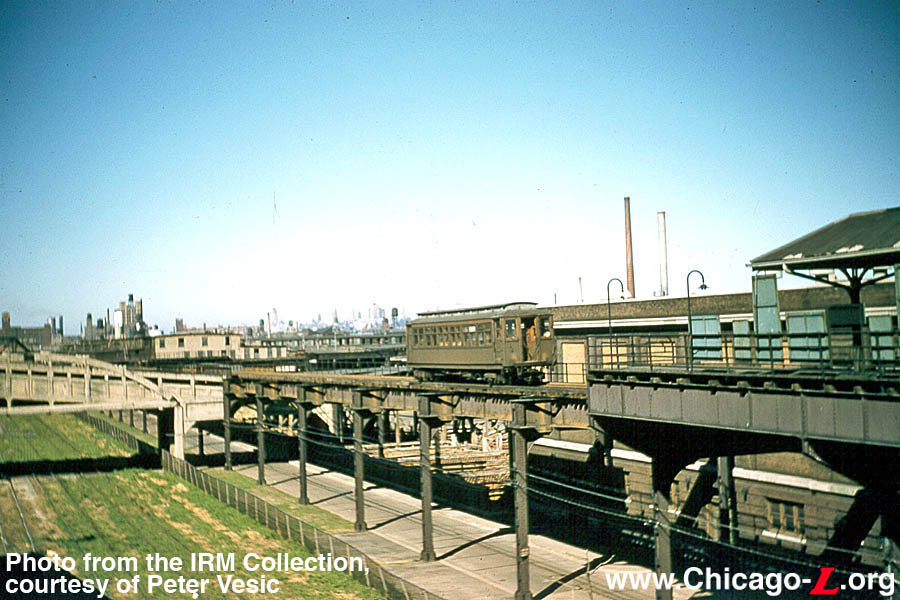
Photographer Richard H. Young took this picture of North Shore Line car 157 at the Milwaukee Terminal on June 16, 1962 during a fantrip. It must have been taken at nearly the exact same time as a photo we ran some time ago, which was somewhat controversial, and shows the same scene from a different angle, with the Milwaukee Road train shed off in the distance, behind car 157.

Photographer Richard H. Young took this picture of North Shore Line car 157 at the Milwaukee Terminal on June 16, 1962 during a fantrip. It must have been taken at nearly the exact same time as a photo we ran some time ago, which was somewhat controversial, and shows the same scene from a different angle, with the Milwaukee Road train shed off in the distance, behind car 157.

The same location today.

The same location today.

The other slide, also from the same June 16, 1962 fantrip.

The other slide, also from the same June 16, 1962 fantrip.

Looking east along Clybourn today.

Looking east along Clybourn today.

Most of today’s post is by guest author and historian Larry Sakar, who takes us on a journey following the North Shore Line interurban’s former path through Milwaukee. We hope that you will enjoy it.

Larry is the author of Speedrail: Milwaukee’s Last Rapid Transit? published in 1991 by Interurbans Press.  Used copies are available through Amazon and other booksellers.

Larry was inspired, in part, by some of the Milwaukee photos we ran in our recent post Trick or Treat (October 31 2021). We will have more such pictures in future posts.

-David Sadowski

PS- You might also like our Trolley Dodger Facebook auxiliary, a private group that now has 596 members.

Auction for Rare North Shore Line Ticket Cabinet From Dempster Street Station, Skokie

FYI, much as I would like to think otherwise, you can’t keep everything. And thus I have reluctantly decided to part with the original North Shore Line ticket cabinet from the Dempster Street Station in Skokie, which was willed to me earlier this year by my late friend Jeffrey L. Wien. The proceeds will help to underwrite the cost of the Trolley Dodger blog.

The auction ends the evening of Saturday, November 20th. Full details are here:
https://www.ebay.com/itm/125004938263

Milwaukee Then and Now by Larry Sakar

From sometime in 1920 until January 21 1963, the downtown (main) station of the Chicago North Shore & Milwaukee Railroad was on the southeast corner of North 6th and West Sycamore Streets. In the 1930 renaming of Milwaukee streets West Sycamore became West Michigan Streets. The first photo shows a train laying over at the station in the evening. Date and photographer unknown.

From sometime in 1920 until January 21 1963, the downtown (main) station of the Chicago North Shore & Milwaukee Railroad was on the southeast corner of North 6th and West Sycamore Streets. In the 1930 renaming of Milwaukee streets West Sycamore became West Michigan Streets. The first photo shows a train laying over at the station in the evening. Date and photographer unknown.

After the North Shore Line abandoned operations on January 21 1963, the former station sat vacant until late May into early June 1964 when it was razed to make way for another downtown Milwaukee parking lot. This Tom Manz aerial photo shows the southwest corner of track 1 or where track 1 used to be. You are looking west at the intersection of North 6th Street and West Clybourn Street. Note the start of the 6th Street viaduct at bottom left. The overhead catenary bridges stood for many years post-abandonment. West Clybourn Avenue continues across the intersection with North 6th Street. The angled street seen branching odd immediately left of Clybourn Avenue is the start of West Saint Paul Ave. In North Shore's day Saint Paul Avenue did not go east of North 6th Street, nor did it cross beneath the 6th Street viaduct. The street that is today Saint Paul Avenue east of North 6th Street was known as West Fowler Street in North Shore Line's day and contained nothing but warehouses. Saint Paul Avenue continued east of North 6th Street starting in 1965 when the new Milwaukee Road passenger station opened on now West Saint Paul Avenue and North 5th Street. Today it has become the Milwaukee Intermodal station serving Amtrak and several bus lines. Today (2021) the site of the Milwaukee North Shore line Station is occupied by Secura Insurance Company.

After the North Shore Line abandoned operations on January 21 1963, the former station sat vacant until late May into early June 1964 when it was razed to make way for another downtown Milwaukee parking lot. This Tom Manz aerial photo shows the southwest corner of track 1 or where track 1 used to be. You are looking west at the intersection of North 6th Street and West Clybourn Street. Note the start of the 6th Street viaduct at bottom left. The overhead catenary bridges stood for many years post-abandonment. West Clybourn Avenue continues across the intersection with North 6th Street. The angled street seen branching odd immediately left of Clybourn Avenue is the start of West Saint Paul Ave. In North Shore’s day Saint Paul Avenue did not go east of North 6th Street, nor did it cross beneath the 6th Street viaduct. The street that is today Saint Paul Avenue east of North 6th Street was known as West Fowler Street in North Shore Line’s day and contained nothing but warehouses. Saint Paul Avenue continued east of North 6th Street starting in 1965 when the new Milwaukee Road passenger station opened on now West Saint Paul Avenue and North 5th Street. Today it has become the Milwaukee Intermodal station serving Amtrak and several bus lines. Today (2021) the site of the Milwaukee North Shore line Station is occupied by Secura Insurance Company.

North Shore trains leaving the 6th & Michigan Streets Milwaukee station cut across the intersection of North 6th Street and West Clybourn Avenue, made a curve to the left and entered the north approach to the 6th Street viaduct. There are four viaducts across the Menomonee River Valley in Milwaukee. All of them run north-south. They are 6th Street, 16th Street, 27th Street, and 35th Street. The North Shore line had exclusive access to the 6th Street viaduct. North Shore Line's competitor The Milwaukee Electric Railway and Light Company operated streetcars over both the 16th and 27th Street viaducts. The 35th Street viaduct was the last of the four to be built. The Route 35 streetcar line ended at West Mount Vernon Avenue and did not cross the viaduct. After Route 35 was converted to Trackless trolley wire was erected and trolleybuses ran across the viaduct. Today Route 35 diesel buses of the Milwaukee County Transit System operate across all four viaducts. Post-NSL abandonment the North Shore Line's rails remained intact but the overhead catenary bridges were removed in later years. The condition of the bridge in the 1990s had become so bad that buses and trucks were banned. Traffic was confined to the inner two lanes. Pieces of the 6th Street viaduct were actually falling off. (1951 Don Ross Photo)

North Shore trains leaving the 6th & Michigan Streets Milwaukee station cut across the intersection of North 6th Street and West Clybourn Avenue, made a curve to the left and entered the north approach to the 6th Street viaduct. There are four viaducts across the Menomonee River Valley in Milwaukee. All of them run north-south. They are 6th Street, 16th Street, 27th Street, and 35th Street. The North Shore line had exclusive access to the 6th Street viaduct. North Shore Line’s competitor The Milwaukee Electric Railway and Light Company operated streetcars over both the 16th and 27th Street viaducts. The 35th Street viaduct was the last of the four to be built. The Route 35 streetcar line ended at West Mount Vernon Avenue and did not cross the viaduct. After Route 35 was converted to Trackless trolley wire was erected and trolleybuses ran across the viaduct. Today Route 35 diesel buses of the Milwaukee County Transit System operate across all four viaducts. Post-NSL abandonment the North Shore Line’s rails remained intact but the overhead catenary bridges were removed in later years. The condition of the bridge in the 1990s had become so bad that buses and trucks were banned. Traffic was confined to the inner two lanes. Pieces of the 6th Street viaduct were actually falling off. (1951 Don Ross Photo)

The 6th Street viaduct was torn down in 2000. The scrappers nwere selling sections of North Shore Line rail to anyone willing to pay their exorbitant asking price. It has been rebuilt into two separate bridges which meet at ground level at West Canal Street. The decision to make it into two bridges which meet at Canal Street was likely influenced by the opening of the Potawatomi Hotel and Bingo Casino at North 17th and West Canal Streets. (Christopher N. Barney Photo)

The 6th Street viaduct was torn down in 2000. The scrappers nwere selling sections of North Shore Line rail to anyone willing to pay their exorbitant asking price. It has been rebuilt into two separate bridges which meet at ground level at West Canal Street. The decision to make it into two bridges which meet at Canal Street was likely influenced by the opening of the Potawatomi Hotel and Bingo Casino at North 17th and West Canal Streets. (Christopher N. Barney Photo)

North Shore Line tracks on the 6th St. viaduct. (1989 Christopher N. Barney Photo)

North Shore Line tracks on the 6th St. viaduct. (1989 Christopher N. Barney Photo)

North Shore Line trains continued south on South 6th Street until West Scott Street. Here they made a left turn and followed West Scott Street south for one block on a curvy part of the right-of-way for one block east to South Fifth Street where they turned right onto South Fifth Street. Their next stop was West Greenfield Avenue.

North Shore Line trains continued south on South 6th Street until West Scott Street. Here they made a left turn and followed West Scott Street south for one block on a curvy part of the right-of-way for one block east to South Fifth Street where they turned right onto South Fifth Street. Their next stop was West Greenfield Avenue.

The city of Milwaukee or the county (I'm not sure which) purchased that one block. Today southbound traffic on South 6th Street turns onto what is left of that one block and makes the nearly identical turn to get to West Greenfield Avenue which is the first ramp to southbound Interstate Highway 94 south of downtown Milwaukee. The former factory seen in many photos of North Shore Line trains at this location still stands and is in use for low income housing. (Christopher N. Barney Photo)

The city of Milwaukee or the county (I’m not sure which) purchased that one block. Today southbound traffic on South 6th Street turns onto what is left of that one block and makes the nearly identical turn to get to West Greenfield Avenue which is the first ramp to southbound Interstate Highway 94 south of downtown Milwaukee. The former factory seen in many photos of North Shore Line trains at this location still stands and is in use for low income housing. (Christopher N. Barney Photo)

As our train continues plodding along on South Fifth Street we pass West Chase Avenue. where we see this rather odd shaped building. In the days of the North Shore Line, South 5th Street was a beautiful south side neighborhood all the way south to West Harrison Avenue. When the I-94 freeway was built every home and business along the east side of South Fifth Street was torn down to accommodate the expressway on and off ramps. Several homes and businesses on the street's west side also suffered the same fate. (1955 Don Ross Photo)

As our train continues plodding along on South Fifth Street we pass West Chase Avenue. where we see this rather odd shaped building. In the days of the North Shore Line, South 5th Street was a beautiful south side neighborhood all the way south to West Harrison Avenue. When the I-94 freeway was built every home and business along the east side of South Fifth Street was torn down to accommodate the expressway on and off ramps. Several homes and businesses on the street’s west side also suffered the same fate. (1955 Don Ross Photo)

The same location in 2016. A Chris Barney Photo.

The same location in 2016. A Chris Barney Photo.

At South Fifth and West Mitchell Streets we stop to pick-up passengers on the northwest corner. Our train passes Notre Dame Catholic High School and Saint Stanislaus Church. (Frank Butts Photo, January 1963)

At South Fifth and West Mitchell Streets we stop to pick-up passengers on the northwest corner. Our train passes Notre Dame Catholic High School and Saint Stanislaus Church. (Frank Butts Photo, January 1963)

Notre Dame Catholic High School and Saint Stanislaus Church are still there today, and look just as they did in North Shore's day. The automobiles are different, but nothing remains to show that North Shore Line trains once stopped here. (Christopher N. Barney Photo)

Notre Dame Catholic High School and Saint Stanislaus Church are still there today, and look just as they did in North Shore’s day. The automobiles are different, but nothing remains to show that North Shore Line trains once stopped here. (Christopher N. Barney Photo)

Let’s begin the rest of our southbound trip on the North Shore Line at Harrison Avenue (the NSL called it Harrison Street). Harrison Avenue marked the end of street running and the start of the private right-of-way. The Harrison Street shops building and yards sat along the east side of the property.

After the North Shore Line was abandoned in 1963, the track and wire was removed but the building remained standing. As the years went by its appearance worsened. All of the windows had the glass removed and were boarded up. But the front of the building continued to display its heritage. Above the door that opened into the shops was the original stone letterboard which said Chicago and Milwaukee Electric Railway 1908. According to TWERHS president Chuck Westerman, TWERHS obtained the letterboard and brought it with them when they moved out to East Troy in 1972. (This was the original East Troy Trolley Museum.) While lifting it to be moved one day it was accidentally dropped and shattered into pieces.

I vividly recall coming home from school one day in 1968. I would always read the Milwaukee Journal before dinner. The “Journal” as we called it for short was Milwaukee’s evening newspaper.

On the editorial page was a drawing of a decrepit looking building with the caption (as best I can recall) that read North Shore Line shops. The editorial urged the demolition of the building because it was located directly above Interstate 94. Southbound drivers did not see it because the highway is sort of “tucked-in” beneath a cement retaining wall. However, northbound drivers got a full view. The editorial said that this gave a bad impression to anyone coming into Milwaukee on I94 from the south.

Up to that point, I was not aware that the Harrison shops building was still standing. Armed with that information I went there that weekend. The building looked every bit as bad as the editorial cartoon had depicted it. The former right-of-way was just bare ground. There wasn’t a trace of any of the tracks that had been there.

The building was torn down but I don’t know when. If you looked in a Milwaukee City Directory from 1963 on, the shops complex was not even listed. It was as if it had vanished into thin air. I had expected the address to be listed with “Vacant” shown after.

In 2017 the former Harrison Street shops property was redeveloped into Saint Augustine’s Academy, a Christian college preparatory school complete with stadium and playing field. Chris Barney, who took the present day pictures, thought the shops were on the southbound side of the right-of-way and did not take any pictures of the stadium and playing field which now occupies the site of the Harrison Street shops.

Notice the houses in the background. You see the corner of the school in the left corner (upper corner) of Chris' photo. Now look to the right just slightly and on the northwest corner of 5th & Harrison you see a house with a window kind of dead center in the upper story. Also note the row of houses along S. 5th on the right side of the picture. Now look at the shots of the Electroliner arriving at 5th & Harrison before it. Every one of those houses, including the one on the northwest corner is still there. The only thing besides the shops that isn't was that one story building on the right with cars parked against it. It was some sort of machine shop but I don't think it was related to the North Shore Line. Those houses may not be there for much longer. The school is proposing to buy that entire block of S. 5th for one block north of Harrison Avenue. They want to construct a quad with a movie theater, an athletic building and other amenities for their students. The proposal including drawings of what it might look like appeared in the Milwaukee Journal about two or so months ago.

Notice the houses in the background. You see the corner of the school in the left corner (upper corner) of Chris’ photo. Now look to the right just slightly and on the northwest corner of 5th & Harrison you see a house with a window kind of dead center in the upper story. Also note the row of houses along S. 5th on the right side of the picture. Now look at the shots of the Electroliner arriving at 5th & Harrison before it. Every one of those houses, including the one on the northwest corner is still there. The only thing besides the shops that isn’t was that one story building on the right with cars parked against it. It was some sort of machine shop but I don’t think it was related to the North Shore Line. Those houses may not be there for much longer. The school is proposing to buy that entire block of S. 5th for one block north of Harrison Avenue. They want to construct a quad with a movie theater, an athletic building and other amenities for their students. The proposal including drawings of what it might look like appeared in the Milwaukee Journal about two or so months ago.

Next Stop: Oklahoma Avenue

For many years, TMER&L’s Route 16 streetcar line South 6th Street operated between North 60th and West Vliet Streets, all the way across town, via various routings. From downtown Milwaukee south, TM streetcars operated out of the downtown area via various streets to North Third Street and West Plankinton Avenue.

Here they turned south on and followed Plankinton Avenue, which becomes south Second Street after crossing the Menomonee River. Second Street was used as far as West Greenfield Avenue, where cars turned left and went one block east to South First Street. Another right turn took Route 16 streetcars to the intersection of S. Kinnickinnic Avenue and West Mitchell Streets.

This was and to this day is the location of MCTS’ (then TM’s) Kinnickinnic Avenue car [now bus] station. Streetcars turned west on West Mitchell Street and traveled west to its intersection with South Sixth Street. Cars turned left (southbound) and ran on South Sixth Street (South First Avenue before 1930) to West Euclid Street, where they turned west to South Ninth Place to reach the end of the line at West Morgan Avenue.

The “convoluted” route out of downtown Milwaukee was due to one factor- The North Shore Line. The 6th Street viaduct across the Menomonee River Valley was the exclusive property of the Chicago and Milwaukee Electric Railway and was used by both southbound and northbound North Shore Line interurbans, as well as the Birney cars and later St. Louis-built 350 series city cars on North Shore’s beloved “Nickel Dinky Line.”

TM streetcars had South Sixth Street all to themselves from West Mitchell Street south, because the North Shore’s cars operated on South Fifth Street. After getting onto the private right-of-way at Harrison Street the North Shore cars ran on an embankment high above South Sixth Street.

The “Dinky Line” ended at West Oklahoma Avenue, then traveled one block farther south to West Euclid Avenue, where they changed ends and laid over at a tiny platform just north of the Oklahoma Avenue crossing. It’s hard to believe that anyone would hike up the steep stairs from Sixth Street to the platform, but they did, many after walking blocks out of their way just to save five cents. TM streetcar fare was ten cents vs. the “Dinky” line which was a nickel. South side Milwaukeeans were notoriously frugal!

Today South Sixth Street and West Oklahoma Avenue is the one spot on the abandoned North Shore right of way that shows a hint on what used to be here.

A list of the ways in which the North Shore’s “Nickel Dinky Line” beat TM’s Route 16 streetcar line:

1. The “Dinky Line” was faster. TM streetcars on Route 16 had to stop every two blocks. The “Dinky Line” stopped only at major intersections, i.e. Fifth and Mitchell, Fifth and Greenfield and Fifth and National.
2. Between Harrison Avenue and Sixth and Oklahoma, the “Dinky” was on private right-of-way.
3. The North Shore “Dinky Line’s fare was a nickel for its entire life. TMER&L was steadily increasing fares.
4. The North Shore “Dinky Line” only crossed two short bridges on the Sixth Street viaduct. The one nearest the Sixth and Clybourn Streets end of the NSL station was over the Menomonee River, and the other just past W. Canal Street, (which as the name implies was the Menomonee River canal) a branch off the river. TM streetcars had to contend with crossings of the Milwaukee River, the Menomonee River and the Kinnickinnic River.

6th & Oklahoma in the 1940s. (Don Ross Photo)

6th & Oklahoma in the 1940s. (Don Ross Photo)

The remains of the abandoned right-of-way at 6th and Oklahoma. (Christopher N. Barney Photo)

The remains of the abandoned right-of-way at 6th and Oklahoma. (Christopher N. Barney Photo)

The End of the North Shore Line Right-of-Way

Continuing south on the private right-of-way above South Sixth Street, North Shore Line trains crossed over West Holt Avenue. In addition, the Milwaukee Road trains coming out of downtown Milwaukee and heading for points south such as Chicago or Bensenville crossed at grade. I do not have any pictures of that area.

After the North Shore Line was abandoned in 1963, the area saw a significant change in 1965. West of South Sixth Street, Holt Avenue was connected to West Morgan Avenue at South Ninth Street. This was done to expedite traffic heading to the entrance ramp to either southbound or northbound Interstate Highway 94.

The Milwaukee Road was grade separated by a long bridge across South Sixth Street. Seeking to take advantage of this, The Milwaukee and Suburban Transport Company (aka “The Transport Company ”) added a “Park ‘n’ Ride lot along the east side of the abandoned North Shore Line right-of-way. This lot is for riders on Bus Route 40- the Holt-College Freeway Flyer line.

Buses do not enter the parking lot, but stop on a bus-only section of the off ramp to pick-up or discharge passengers. As best as I have been able to tell, this ramp occupies at least part, if not all of the North Shore line’s northbound track. This could easily have been transformed into a Rapid Transit line between Mitchell International Airport and downtown Milwaukee.

Just before the abandoned right-of-way gets to its present day end at West Bolivar Avenue, it passes through what was once the Sixth Street cut. The cut began at West Howard Avenue and continued south to TMER & L’s Rapid Transit Line to Hales Corners at Greenwood Junction Lakeside Belt Line, which carried coal from Powereton Junction (approximately South 13th Street and West Waterford Avenue) to the Lakeside Power Plant.

This was strictly a freight line except for a 1939 CERA fan trip, which operated over it all the way west to the connection with TM’s Hales Corners Rapid Transit line at Greenwood Junction (South 100th Street one block south of West Howard Avenue.

North Shore trains emerged from the cut after crossing beneath West Waterford Avenue. CERA Bulletin 107, Route of the Electroliners states that the cut was three miles long. That is incorrect. It was three blocks long. The cut was filled in by the city of Milwaukee in March 1989. This area had once been the Town of Lake.

The tall, round tower seen across South Sixth Street is the former Town of Lake water tower which no longer holds water. The tower has been used for all sorts of things since being replaced by the water treatment plant almost next to its north face on the southwest corner of South Sixth Street and West Howard Avenue.

One additional piece of information that may be of interest to Trolley Dodger readers. You can now purchase a garden plot on the filled-in 6th Street cut and grow what you line. Quite a few people seem to have done just that. I do not know what it costs.

Finally, we come to the end of the North Shore Line’s abandoned right-of-way within the city of Milwaukee at West Bolivar Avenue. The high embankment ends suddenly and goes no further south. This is where present day I-94 coming from downtown and heading west to the Mitchell Interchange crosses over South 6th Street.

From the south side of I-94 south, the right-of-way is completely gone. The land is occupied by restaurants, hotels from the former crossing of West Layton Avenue to the Airport Business Park. If you weren’t previously aware of the wonderful interurban line that passed this way you would never know it now.

No trace of the North Shore exists anywhere south of this point, except for a tiny spot where it crossed beneath the intersection of South Howell and West Rawson Avenues. I end with a Then and Now view at Howell and Rawson. Post-abandonment the bridges above the NSL were removed and the grades of both streets lowered.

In case you might be wondering, the abandoned NSL right-of-way is posted in spots ‘NO TRESPASSING PROPERTY OF MILWAUKEE COUNTY EXPRESSWAY COMMISSION.”

A North Shore Line two-car train is southbound in the 6th Street cut at Norwich Ave. (Bob Genack Photo)

A North Shore Line two-car train is southbound in the 6th Street cut at Norwich Ave. (Bob Genack Photo)

The Old Town of Lake water tower at S. 6th & W. Norwich in 1989 (Christopher N. Barney Photo)

The Old Town of Lake water tower at S. 6th & W. Norwich in 1989 (Christopher N. Barney Photo)

North Shore Line 749 and three others, northbound at Bolivar Avenue in 1955. (Don Ross Photo)

North Shore Line 749 and three others, northbound at Bolivar Avenue in 1955. (Don Ross Photo)

The abandoned North Shore Line right-of-way at West Bolivar Ave. This is where the abandoned right-of-way now comes to an abrupt end within the city limits of Milwaukee.

The abandoned North Shore Line right-of-way at West Bolivar Ave. This is where the abandoned right-of-way now comes to an abrupt end within the city limits of Milwaukee.

North Shore Line 758 is northbound at Howell and Rawson in 1955. (Don Ross Photo)

North Shore Line 758 is northbound at Howell and Rawson in 1955. (Don Ross Photo)

Howell and Rawson, looking south on Howell (present day) (Christopher N. Barney Photo)

Howell and Rawson, looking south on Howell (present day) (Christopher N. Barney Photo)

Howell and Rawson, looking southeast (present day) (Christopher N. Barney Photo)

Howell and Rawson, looking southeast (present day) (Christopher N. Barney Photo)

Postscript

I thought you’d enjoy these two NSL pics. The first one is what we’ve been discussing about TM and NSL competing at 6th and Oklahoma. You have an 800-series car on TM route 16 northbound, and a Birney up on the embankment laying over ready to return to downtown Milwaukee. I don’t know who took it. The fact that the NSL car is a Birney and because you have a streetcar on Route 16 places this picture sometime before July 1947.

The second photo shows one of the “Liners” at full speed one block farther south at 6th and Euclid. It is southbound passing the Heil Company. Heil made things like garbage trucks and other types of municipal vehicles. The building is still there, next to the abandoned right-of-way, but the Heil Company is gone. The building now houses corporate offices for Aurora Health Care. If you look to the left, you get a pretty good idea of just how high up that right-of-way was above South Sixth Street. Don Ross took this picture. He must have had someone holding on to him because a “Liner” coming past you at full speed would have tossed you down to 6th Street. I don’t think I’d have ever tried anything like this!

-Larry Sakar

Thanks, Larry! Keep those cards and letters coming in, folks!

-David Sadowski

Recent Finds

CTA PCC 7202 is southbound on Clark Street near 15th Street and the St. Charles Air Line, possibly around 1956.

CTA PCC 7202 is southbound on Clark Street near 15th Street and the St. Charles Air Line, possibly around 1956.

CTA PCCs 7195 and 7180 at 81st and Halsted, south end of Route 22, possibly circa 1956.

CTA PCCs 7195 and 7180 at 81st and Halsted, south end of Route 22, possibly circa 1956.

CTA PCCs 7175 and 7160 at 81st and Halsted.

CTA PCCs 7175 and 7160 at 81st and Halsted.

CTA red Pullman 863 is northbound on Stony Island at 72nd Street, headed towards Navy Pier. Stuart B. Slaymaker: "Big Kaiser-Frazer dealer in the right background."

CTA red Pullman 863 is northbound on Stony Island at 72nd Street, headed towards Navy Pier. Stuart B. Slaymaker: “Big Kaiser-Frazer dealer in the right background.”

This picture of Milwaukee trolley buses was taken in March 1964. Here's what Larry Sakar says about it: "I know exactly what this is and where. After the last trolley buses ended service on June 30,1965, The Transport Company (The Milwaukee Suburban Transport Corp.) moved all of them (if not all then a lot of them) to Cold Spring shops. M&STC made a deal to sell them to Mexico City which is where they ended up. What you see here is one of them being brought down to lower Cold Spring where TM (M&STC's predecessor) had a connection directly to the Milwaukee Road. According to Russ Schultz, whom I consider to be the leading authority on Milwaukee trolley buses and Dave Stanley also, M&STC sold 50 Marmon-Herrington trolley buses to Mexico City on February 10, 1964. That was the first batch. In 1967 M&STC sold 51 additional Marmons to Mexico City and according to Russ they were shipped in August and September of that year."

This picture of Milwaukee trolley buses was taken in March 1964. Here’s what Larry Sakar says about it: “I know exactly what this is and where. After the last trolley buses ended service on June 30,1965, The Transport Company (The Milwaukee Suburban Transport Corp.) moved all of them (if not all then a lot of them) to Cold Spring shops. M&STC made a deal to sell them to Mexico City which is where they ended up. What you see here is one of them being brought down to lower Cold Spring where TM (M&STC’s predecessor) had a connection directly to the Milwaukee Road. According to Russ Schultz, whom I consider to be the leading authority on Milwaukee trolley buses and Dave Stanley also, M&STC sold 50 Marmon-Herrington trolley buses to Mexico City on February 10, 1964. That was the first batch. In 1967 M&STC sold 51 additional Marmons to Mexico City and according to Russ they were shipped in August and September of that year.”

Chicago’s Lost “L”s Online Presentation

We recently gave an online presentation about our book Chicago’s Lost “L”s for the Chicago Public Library, as part of their One Book, One Chicago series. You can watch it online by following this link.

The Trolley Dodger On the Air

We appeared on the Dave Plier Show on WGN radio on July 16, 2021, to discuss Chicago’s Lost “L”s. You can hear that discussion here.

Our Latest Book, Now Available:

Chicago’s Lost “L”s

From the back cover:

Chicago’s system of elevated railways, known locally as the “L,” has run continuously since 1892 and, like the city, has never stood still. It helped neighborhoods grow, brought their increasingly diverse populations together, and gave the famous Loop its name. But today’s system has changed radically over the years. Chicago’s Lost “L”s tells the story of former lines such as Garfield Park, Humboldt Park, Kenwood, Stockyards, Normal Park, Westchester, and Niles Center. It was once possible to take high-speed trains on the L directly to Aurora, Elgin, and Milwaukee, Wisconsin. The L started out as four different companies, two starting out using steam engines instead of electricity. Eventually, all four came together via the Union Loop. The L is more than a way of getting around. Its trains are a place where people meet and interact. Some say the best way to experience the city is via the L, with its second-story view. Chicago’s Lost “L”s is virtually a “secret history” of Chicago, and this is your ticket. David Sadowski grew up riding the L all over the city. He is the author of Chicago Trolleys and Building Chicago’s Subways and runs the online Trolley Dodger blog.

The Images of America series celebrates the history of neighborhoods, towns, and cities across the country. Using archival photographs, each title presents the distinctive stories from the past that shape the character of the community today. Arcadia is proud to play a part in the preservation of local heritage, making history available to all.

Title Chicago’s Lost “L”s
Images of America
Author David Sadowski
Edition illustrated
Publisher Arcadia Publishing (SC), 2021
ISBN 1467100007, 9781467100007
Length 128 pages

Chapters:
01. The South Side “L”
02. The Lake Street “L”
03. The Metropolitan “L”
04. The Northwestern “L”
05. The Union Loop
06. Lost Equipment
07. Lost Interurbans
08. Lost Terminals
09. Lost… and Found

Each copy purchased here will be signed by the author, and you will also receive a bonus facsimile of a 1926 Chicago Rapid Transit Company map, with interesting facts about the “L” on the reverse side.

The price of $23.99 includes shipping within the United States.

For Shipping to US Addresses:

For Shipping to Canada:

For Shipping Elsewhere:

NEW DVD:

A Tribute to the North Shore Line

To commemorate the 50th anniversary of the demise of the fabled North Shore Line interurban in January 2013, Jeffrey L. Wien and Bradley Criss made a very thorough and professional video presentation, covering the entire route between Chicago and Milwaukee and then some. Sadly, both men are gone now, but their work remains, making this video a tribute to them, as much as it is a tribute to the Chicago North Shore & Milwaukee.

Jeff drew on his own vast collections of movie films, both his own and others such as the late William C. Hoffman, wrote and gave the narration. Bradley acted as video editor, and added authentic sound effects from archival recordings of the North Shore Line.

It was always Jeff’s intention to make this video available to the public, but unfortunately, this did not happen in his lifetime. Now, as the caretakers of Jeff’s railfan legacy, we are proud to offer this excellent two-hour program to you for the first time. The result is a fitting tribute to what Jeff called his “Perpetual Adoration,” which was the name of a stop on the interurban.

Jeff was a wholehearted supporter of our activities, and the proceeds from the sale of this disc will help defray some of the expenses of keeping the Trolley Dodger web site going.

Total time – 121:22

# of Discs – 1
Price: $19.99 (Includes shipping within the United States)

Help Support The Trolley Dodger

This is our 281st post, and we are gradually creating a body of work and an online resource for the benefit of all railfans, everywhere. To date, we have received over 822,000 page views, for which we are very grateful.

You can help us continue our original transit research by checking out the fine products in our Online Store.
As we have said before, “If you buy here, we will be here.”

We thank you for your support.

DONATIONS

In order to continue giving you the kinds of historic railroad images that you have come to expect from The Trolley Dodger, we need your help and support. It costs money to maintain this website, and to do the sort of historic research that is our specialty.

Your financial contributions help make this web site better, and are greatly appreciated.


Legends and Legacies

All in all, I would have to say this is an amazing photograph. It shows Five Mile Beach Electric Railway car 22 on June 30, 1943, in the middle of World War II, and just two years before streetcars were abandoned in this coastal town (Wildwood) in New Jersey. From what I have read, the war and the resulting nightly blackouts negatively affected tourism and contributed to the demise of the streetcars here. With such an early abandonment, color photos of this operation are very rare, indeed, and the colors on this Red Border Kodachrome have held up quite well. A sign on the car advertises Marty Bohn and His Floor Show at the "Nut Club." The blackouts were not without reason, as German submarines were just offshore, and sometimes crew members would sneak ashore.

All in all, I would have to say this is an amazing photograph. It shows Five Mile Beach Electric Railway car 22 on June 30, 1943, in the middle of World War II, and just two years before streetcars were abandoned in this coastal town (Wildwood) in New Jersey. From what I have read, the war and the resulting nightly blackouts negatively affected tourism and contributed to the demise of the streetcars here. With such an early abandonment, color photos of this operation are very rare, indeed, and the colors on this Red Border Kodachrome have held up quite well. A sign on the car advertises Marty Bohn and His Floor Show at the “Nut Club.” The blackouts were not without reason, as German submarines were just offshore, and sometimes crew members would sneak ashore.

I am both humbled and grateful beyond measure that my late friend Jeffrey Wien made me the beneficiary of his extensive photographic collection (except for his motion picture films, which he donated to the Chicago Film Archives).

Naturally, I would rather that he still be around to enjoy his collection, comment on my posts, and point out where I got something wrong, or help identify some locations. But unfortunately, we don’t get to choose in these matters.

I think the best way I can honor his memory is to keep up the work of historic preservation and education that meant so much to him.

While this post may not have an overall theme, it is full of legends and legacies. It is thanks to the hard work and sacrifice of many people, Jeff included, that anything at all has been saved from the electric railways of the past. Some of the photos here were taken after the North Shore Line quit, and show various railcars sitting around, waiting to be saved or scrapped. There are also pictures of the fledgling and somewhat ramshackle early days of the Illinois Electric Railway Museum, at its original and temporary home in North Chicago.

You if had told one of the founders of what is now IRM back then all the progress that has been made since at Union, they hardly could have believed it possible. Institutions like IRM are saving this history and preserving it for future generations, while also making it possible to have some of the same experiences riding the equipment in the collection, that people enjoyed in the past.

If we can maintain the same spirit, all this important history will be our legacy to those who come after us. I am intent on doing my part.

-David Sadowski

PS- We thank Jack Bejna, Andre Kristopans, William Shapotkin, and Colin Wisner for contributing to this post.

We also have a Facebook auxiliary for The Trolley Dodger where you can participate further. It is a private group, so unfortunately you won’t be able to see the content unless you join. It is free. As of this writing, we have 183 members.

From Jeff Wien’s Collection

The North Shore Line ticket cabinet from the Dempster Street station in Skokie. It still has the tickets in it.

The North Shore Line ticket cabinet from the Dempster Street station in Skokie. It still has the tickets in it.

I will have to straighten this out, as the tickets were jostled when the cabinet was moved. The balls were apparently placed behind the tickets.

I will have to straighten this out, as the tickets were jostled when the cabinet was moved. The balls were apparently placed behind the tickets.

This metal route sign hung on the side of a wooden Metropolitan "L" car, and was of a type in use for a half-century prior to the opening of the Dearborn-Milwaukee Subway in 1951. Remarkably, it has survived for 70 years since it last could have been used in service. The sign was reversible, and the other side says Humboldt Park.

This metal route sign hung on the side of a wooden Metropolitan “L” car, and was of a type in use for a half-century prior to the opening of the Dearborn-Milwaukee Subway in 1951. Remarkably, it has survived for 70 years since it last could have been used in service. The sign was reversible, and the other side says Humboldt Park.

A fare counter from a Chicago streetcar. There was a Chicago streetcar 3351, a Peter Witt that was scrapped around 1952, but I am not certain that these didn't have their own numbers.

A fare counter from a Chicago streetcar. There was a Chicago streetcar 3351, a Peter Witt that was scrapped around 1952, but I am not certain that these didn’t have their own numbers.

This metal sign appears to show the original version of the CTA's "Metropolitan Transit" logo, first introduced in 1958. By then, the agency wanted the public to know that it served more than just Chicago.

This metal sign appears to show the original version of the CTA’s “Metropolitan Transit” logo, first introduced in 1958. By then, the agency wanted the public to know that it served more than just Chicago.

The North Shore Line eventually joined the Insull Empire that, by the mid-1920s, included all three major Chicago interurbans and the "L". So it should not be too much of a surprise that the North Shore had its own rider publication for a few years, with leaflet holders presumably made by the same firm as the "L"s. The North Shore Line version is said to be rare, as many were melted down for scrap during WWII.

The North Shore Line eventually joined the Insull Empire that, by the mid-1920s, included all three major Chicago interurbans and the “L”. So it should not be too much of a surprise that the North Shore had its own rider publication for a few years, with leaflet holders presumably made by the same firm as the “L”s. The North Shore Line version is said to be rare, as many were melted down for scrap during WWII.

Leaflet holders from 4000-series "L" cars. The Elevated News was published by the Chicago Elevated Railways Collateral Trust, formed in 1913 as a voluntary association by the four independent (or at least they started that way) "L" firms. The 4000-series, which eventually ran to 455 cars, was the first designed for use on all the various "L" lines. The title of their rider publication was changed to Rapid Transit News in 1924, coincident with the formation of the Chicago Rapid Transit Company. The Chicago Transit Authority had its own publication, the Rider's Reader, for a few years starting in 1948.

Leaflet holders from 4000-series “L” cars. The Elevated News was published by the Chicago Elevated Railways Collateral Trust, formed in 1913 as a voluntary association by the four independent (or at least they started that way) “L” firms. The 4000-series, which eventually ran to 455 cars, was the first designed for use on all the various “L” lines. The title of their rider publication was changed to Rapid Transit News in 1924, coincident with the formation of the Chicago Rapid Transit Company. The Chicago Transit Authority had its own publication, the Rider’s Reader, for a few years starting in 1948.

This leaflet holder is marked as having come from CTA PCC 7213, the last Chicago streetcar that ran on June 21, 1958.

This leaflet holder is marked as having come from CTA PCC 7213, the last Chicago streetcar that ran on June 21, 1958.

Although Chicago had a total of 600 postwar PCC streetcars, this was too much for a single manufacturer to produce in the immediate postwar era, so the order was divided between Pullman (310) and St. Louis Car Company (290). The "Read As You Ride" leaflet holder at left came from a St. Louis PCC (7213), while the one at right may have come from a Pullman. Their interiors were painted different colors.

Although Chicago had a total of 600 postwar PCC streetcars, this was too much for a single manufacturer to produce in the immediate postwar era, so the order was divided between Pullman (310) and St. Louis Car Company (290). The “Read As You Ride” leaflet holder at left came from a St. Louis PCC (7213), while the one at right may have come from a Pullman. Their interiors were painted different colors.

Jeff's collection included a leaflet holder from another city. Several cities had "Public Service" in their streetcar operator's names, so offhand, I am not sure which city this came from. (Frank J. Flörianz Jr. says it is from New Jersey.)

Jeff’s collection included a leaflet holder from another city. Several cities had “Public Service” in their streetcar operator’s names, so offhand, I am not sure which city this came from. (Frank J. Flörianz Jr. says it is from New Jersey.)

I found this clipping that Jeff cut out of the Chicago Tribune in 1978 inside the "Read As You Ride" leaflet holder from PCC 7213, the last Chicago streetcar.

I found this clipping that Jeff cut out of the Chicago Tribune in 1978 inside the “Read As You Ride” leaflet holder from PCC 7213, the last Chicago streetcar.

Recent Finds

There were a few cities besides New York, Chicago, Boston, and Philadelphia to have some sort of elevated electric railways, and Kansas City was among them. Here, Kansas City Public Service car 785 is descending from the 8th Street "L" at Baltimore Avenue on September 3, 1952. I was fortunate to win this original Red Border Kodachrome slide, because I had lost an auction for it once before when someone sold it. Kansas City abandoned streetcars in 1957, but has since reopened a modern streetcar line. (Edward S. Miller Photo)

There were a few cities besides New York, Chicago, Boston, and Philadelphia to have some sort of elevated electric railways, and Kansas City was among them. Here, Kansas City Public Service car 785 is descending from the 8th Street “L” at Baltimore Avenue on September 3, 1952. I was fortunate to win this original Red Border Kodachrome slide, because I had lost an auction for it once before when someone sold it. Kansas City abandoned streetcars in 1957, but has since reopened a modern streetcar line. (Edward S. Miller Photo)

A single CRT wooden "L" car is at the Dempster Street terminal in Skokie, probably in the 1940s. This "L" branch was replaced by buses in 1948, but returned in 1964 in the form of the Skokie Swift (today's Yellow Line), a year after the North Shore Line (who owned these tracks) ended all service.

A single CRT wooden “L” car is at the Dempster Street terminal in Skokie, probably in the 1940s. This “L” branch was replaced by buses in 1948, but returned in 1964 in the form of the Skokie Swift (today’s Yellow Line), a year after the North Shore Line (who owned these tracks) ended all service.

This is one of the experimental "Bluebird" articulated compartment car trains (probably the prototype) being tested on the Brooklyn-Manhattan Transit system circa 1939. BMT ordered 50 of these units from the Clark Equipment Company, intended to be "fast locals" to mix with slower express trains on El lines. But when the City of New York purchased BMT in 1940, they cancelled the order, except for five units that had already been built. They lived out the rest of their days as oddball equipment before being scrapped in 1956. But the Bluebirds were the first rapid transit cars to use PCC technology, and were a major influence on the four articulated 5000s that CRT ordered at the end of World War II.

This is one of the experimental “Bluebird” articulated compartment car trains (probably the prototype) being tested on the Brooklyn-Manhattan Transit system circa 1939. BMT ordered 50 of these units from the Clark Equipment Company, intended to be “fast locals” to mix with slower express trains on El lines. But when the City of New York purchased BMT in 1940, they cancelled the order, except for five units that had already been built. They lived out the rest of their days as oddball equipment before being scrapped in 1956. But the Bluebirds were the first rapid transit cars to use PCC technology, and were a major influence on the four articulated 5000s that CRT ordered at the end of World War II.

The former Chicago Aurora & Elgin station in Villa Park still exists and is a local landmark. But here we see it under construction in 1929. The Ovaltine plant at left has since been converted to residential.

The former Chicago Aurora & Elgin station in Villa Park still exists and is a local landmark. But here we see it under construction in 1929. The Ovaltine plant at left has since been converted to residential.

I spent some time cleaning up this image, which was part of a stereo pair meant to be viewed in 3-D using a handheld device called a "stereopticon." It shows Chicago's Loop "L" circa 1905, and this is the original left-hand running, bi-directional configuration, before it was changed in 1913. So the train at right is moving towards us, while the train at left is moving away from us. The view looks west along Van Buren Street, and that is the old Tower 12 at left. A Metropolitan "L" train is on the inner Loop, while a Lake Street train trails a Northwestern "L" train on the outer Loop. At this stage, only the Lake trains would have needed trolley poles. The station at Van Buren and State is visible in the distance.

I spent some time cleaning up this image, which was part of a stereo pair meant to be viewed in 3-D using a handheld device called a “stereopticon.” It shows Chicago’s Loop “L” circa 1905, and this is the original left-hand running, bi-directional configuration, before it was changed in 1913. So the train at right is moving towards us, while the train at left is moving away from us. The view looks west along Van Buren Street, and that is the old Tower 12 at left. A Metropolitan “L” train is on the inner Loop, while a Lake Street train trails a Northwestern “L” train on the outer Loop. At this stage, only the Lake trains would have needed trolley poles. The station at Van Buren and State is visible in the distance.

A Stereopticon viewer.

A Stereopticon viewer.

Chicago Surface Lines car 2802 is on a charter trip on June 12, 1940. This was apparently a fan favorite, as we have previously published a photo of the same car on a 1941 fantrip.

Chicago Surface Lines car 2802 is on a charter trip on June 12, 1940. This was apparently a fan favorite, as we have previously published a photo of the same car on a 1941 fantrip.

North Shore Line car 709 at the Branford Trolley Museum in Connecticut in October 30, 1966, just three and a half years after the interurban quit. The location given is Farm River Road. Don's Rail Photos: "709 was built by Cincinnati Car Co in 1924, #2725. It was sold to Branford Trolley Museum in 1963."

North Shore Line car 709 at the Branford Trolley Museum in Connecticut in October 30, 1966, just three and a half years after the interurban quit. The location given is Farm River Road. Don’s Rail Photos: “709 was built by Cincinnati Car Co in 1924, #2725. It was sold to Branford Trolley Museum in 1963.”

This is another remarkable photograph, showing Monongahela West Penn car 320 at night in June 1946. Such night shots were very difficult to achieve back then, due to the slow film speed of the time (this is Kodachrome 10, as in ASA/ISO 10). About the only way to take such a picture would have been with a very long exposure, with the camera resting on a tripod. (Dr. H. Blackbunn Photo)

This is another remarkable photograph, showing Monongahela West Penn car 320 at night in June 1946. Such night shots were very difficult to achieve back then, due to the slow film speed of the time (this is Kodachrome 10, as in ASA/ISO 10). About the only way to take such a picture would have been with a very long exposure, with the camera resting on a tripod. (Dr. H. Blackbunn Photo)

South Shore Line cars 105 and 1 in April 1963.

South Shore Line cars 105 and 1 in April 1963.

Another great night shot, this time it's Illinois Terminal 473 on the line that ran from St. Louis to Granite City in the 1950s. This was IT's final passenger line and was abandoned in June 1958, on the same weekend that the last Chicago streetcar ran.

Another great night shot, this time it’s Illinois Terminal 473 on the line that ran from St. Louis to Granite City in the 1950s. This was IT’s final passenger line and was abandoned in June 1958, on the same weekend that the last Chicago streetcar ran.

CTA PCC 4406, a product of the St. Louis Car Company, at Clark and Archer in April 1954. (William Shapotkin Collection)

CTA PCC 4406, a product of the St. Louis Car Company, at Clark and Archer in April 1954. (William Shapotkin Collection)

This is DesPlaines Avenue in Forest Park, the end of the CTA Congress rapid transit line. The license plates would indicate a date of 1961, perhaps in the Fall since that is a 1962 Chevy in the parking lot. The various signs on the Leyden Motor Coach bus might confuse you, but on the side, it is marked "OSA" meaning this is a fantrip. (William Shapotkin Collection) Bill Shapotkin writes: "Unable to read the bus number, bus OSA operated trips on 06/17/61 (trip #2) using Leyden bus #95 and on 03/18/62 (trip #10) using Leyden buses #90, 157 and 164. If you can identify the fleet number, that would cement down the details." This is bus #90, so that makes the date March 18, 1962.

This is DesPlaines Avenue in Forest Park, the end of the CTA Congress rapid transit line. The license plates would indicate a date of 1961, perhaps in the Fall since that is a 1962 Chevy in the parking lot. The various signs on the Leyden Motor Coach bus might confuse you, but on the side, it is marked “OSA” meaning this is a fantrip. (William Shapotkin Collection) Bill Shapotkin writes: “Unable to read the bus number, bus OSA operated trips on 06/17/61 (trip #2) using Leyden bus #95 and on 03/18/62 (trip #10) using Leyden buses #90, 157 and 164. If you can identify the fleet number, that would cement down the details.” This is bus #90, so that makes the date March 18, 1962.

CTA 6053 is at the rear of a northbound Ravenswood All-Stop train approaching Armitage in August 1986. The two center tracks lead down to the State Street Subway. (William Shapotkin Collection)

CTA 6053 is at the rear of a northbound Ravenswood All-Stop train approaching Armitage in August 1986. The two center tracks lead down to the State Street Subway. (William Shapotkin Collection)

A southbound CTA Englewood train (lead car: 2033) has met a northbound Howard train at Armitage station in April 1985, and is descending into the State Street Subway. (William Shapotkin Collection)

A southbound CTA Englewood train (lead car: 2033) has met a northbound Howard train at Armitage station in April 1985, and is descending into the State Street Subway. (William Shapotkin Collection)

North Shore Line former merchandise dispatch car 215 at the Harrison Shops in Milwaukee on July 7, 1953. Don's Rail Photos: "215 was built by Cincinnati Car in October 1922, #2605. The loading doors (were moved) from the ends to the center. It was demotorized and used as a tool car."

North Shore Line former merchandise dispatch car 215 at the Harrison Shops in Milwaukee on July 7, 1953. Don’s Rail Photos: “215 was built by Cincinnati Car in October 1922, #2605. The loading doors (were moved) from the ends to the center. It was demotorized and used as a tool car.”

On May 22, 1944, Illinois Governor Dwight H. Green (1897-1958) poses with officials from the Illinois State Militia, next to a 1700-series Chicago Surface Lines car promoting that branch of the military during World War II. Green served two terms as governor from 1941-49 before his defeat by Democrat Adlai Stevenson.

On May 22, 1944, Illinois Governor Dwight H. Green (1897-1958) poses with officials from the Illinois State Militia, next to a 1700-series Chicago Surface Lines car promoting that branch of the military during World War II. Green served two terms as governor from 1941-49 before his defeat by Democrat Adlai Stevenson.

While I don't have the negative that goes with this Chicago Sun photo file slip, it does at least identify some of the notables in the negative I do have. The Chicago Sun was a morning newspaper, started in 1941 by the Field family. It bought the Chicago Times in 1948 and the paper has been the Chicago Sun-Times ever since (although no longer owned by Field Enterprises).

While I don’t have the negative that goes with this Chicago Sun photo file slip, it does at least identify some of the notables in the negative I do have. The Chicago Sun was a morning newspaper, started in 1941 by the Field family. It bought the Chicago Times in 1948 and the paper has been the Chicago Sun-Times ever since (although no longer owned by Field Enterprises).

North Shore Line cars 192 and 187 at Highwood in September 1963, looking much worse the wear, nine months after abandonment. But in actuality, these cars had been retired some years earlier. Don's Rail Photos: "187 was built by Cincinnati Car in August 1920, (order) #2450. It was retired on December 31, 1955. It was scrapped at Rondout on January 29, 1964. 192 was built by Cincinnati Car in August 1920, #2450. It was retired on December 31, 1955. It was scrapped at Rondout on January 29, 1964." Apparently these cars were considered surplus after the abandonment of the Shore Line Route in 1955.

North Shore Line cars 192 and 187 at Highwood in September 1963, looking much worse the wear, nine months after abandonment. But in actuality, these cars had been retired some years earlier. Don’s Rail Photos: “187 was built by Cincinnati Car in August 1920, (order) #2450. It was retired on December 31, 1955. It was scrapped at Rondout on January 29, 1964. 192 was built by Cincinnati Car in August 1920, #2450. It was retired on December 31, 1955. It was scrapped at Rondout on January 29, 1964.” Apparently these cars were considered surplus after the abandonment of the Shore Line Route in 1955.

This photo is a bit of a mystery. It is dated September 1963, which means these are probably North Shore Line cars in dead storage at Highwood, awaiting disposition. However, that doesn't explain the Shore Line Route sign, as that portion of the Interurban had been abandoned in 1955. And after the 1963 abandonment, a lot of these signs were scarfed up by fans and were missing from the trains that were scrapped. Don's Rail Photos: "(Combine) 256 was built by Jewett in 1917. It seems to be the only one which retained its original configuration." It did not survive. The fate of the Silverliner at right is not known.

This photo is a bit of a mystery. It is dated September 1963, which means these are probably North Shore Line cars in dead storage at Highwood, awaiting disposition. However, that doesn’t explain the Shore Line Route sign, as that portion of the Interurban had been abandoned in 1955. And after the 1963 abandonment, a lot of these signs were scarfed up by fans and were missing from the trains that were scrapped. Don’s Rail Photos: “(Combine) 256 was built by Jewett in 1917. It seems to be the only one which retained its original configuration.” It did not survive. The fate of the Silverliner at right is not known.

On June 16, 1962, the late Maury Klebolt talks to the North Shore Line train crew during a fantrip at Harrison Street in Milwaukee. This must have been an Illini Railroad Club excursion. There were many such trips during the last year of the interurban's existence. (Richard H. Young Photo)

On June 16, 1962, the late Maury Klebolt talks to the North Shore Line train crew during a fantrip at Harrison Street in Milwaukee. This must have been an Illini Railroad Club excursion. There were many such trips during the last year of the interurban’s existence. (Richard H. Young Photo)

A close-up of Maury Klebolt (1930-1988). Not sure who is at left.

A close-up of Maury Klebolt (1930-1988). Not sure who is at left.

CTA Pullman PCC 4077 heads southbound at 2600 N. Clark Street in the early 1950s. It may be running on either Route 22 or 36. The Pullmans had almost entirely disappeared from service by the end of 1954, for the so-called "PCC Conversion Program."

CTA Pullman PCC 4077 heads southbound at 2600 N. Clark Street in the early 1950s. It may be running on either Route 22 or 36. The Pullmans had almost entirely disappeared from service by the end of 1954, for the so-called “PCC Conversion Program.”

The same location today.

The same location today.

The Illinois Electric Railway Museum in North Chicago in September 1963, shortly before the collection was moved to its permanent location in Union. From left to right, we see Milwaukee streetcar 966, a Milwaukee Electric interurban car (either 1129 or 1135), and Indiana Railroad car 65.

The Illinois Electric Railway Museum in North Chicago in September 1963, shortly before the collection was moved to its permanent location in Union. From left to right, we see Milwaukee streetcar 966, a Milwaukee Electric interurban car (either 1129 or 1135), and Indiana Railroad car 65.

This September 1963 (or at least, that's when the film was processed) view of the Illinois Electric Railway Museum is not the sharpest, but it does show, from left to right, CTA snow sweeper E223, Illinois Terminal 101, one of the Chicago Aurora & Elgin interurbans, and a Milwaukee Electric car.

This September 1963 (or at least, that’s when the film was processed) view of the Illinois Electric Railway Museum is not the sharpest, but it does show, from left to right, CTA snow sweeper E223, Illinois Terminal 101, one of the Chicago Aurora & Elgin interurbans, and a Milwaukee Electric car.

North Shore Line Silverliner 409 at Roosevelt Road on august 4, 1956. Don's Rail Photos: "409 was built by Cincinnati Car in May 1923, #2465, as a dining car motor. In 1942 it was rebuilt as a coach and rebuilt as a Silverliner on March 30, 1955. Since it had no bulkhead between smoking and non-smoking sections, it was our favorite car to be used for meetings of the Milwaukee Division of the Electric Railroaders Association in Milwaukee. The North Shore was very cooperative in making sure that the car was in the location shown on meeting nights." The 409 is now at the Illinois Railway Museum. (C. G. Parsons Photo)

North Shore Line Silverliner 409 at Roosevelt Road on august 4, 1956. Don’s Rail Photos: “409 was built by Cincinnati Car in May 1923, #2465, as a dining car motor. In 1942 it was rebuilt as a coach and rebuilt as a Silverliner on March 30, 1955. Since it had no bulkhead between smoking and non-smoking sections, it was our favorite car to be used for meetings of the Milwaukee Division of the Electric Railroaders Association in Milwaukee. The North Shore was very cooperative in making sure that the car was in the location shown on meeting nights.” The 409 is now at the Illinois Railway Museum. (C. G. Parsons Photo)

This amazing real photo postcard sold on eBay for $77.89. I unfortunately was not aware of the auction. It shows the Ridgeland "L" station on South Boulevard in Oak Park. The postcard was mailed in 1909 and hence can't be any later than that. Work is already underway to elevate the Chicago & North Western tracks at left. The Lake Street "L" itself would join it on the embankment in 1962.

This amazing real photo postcard sold on eBay for $77.89. I unfortunately was not aware of the auction. It shows the Ridgeland “L” station on South Boulevard in Oak Park. The postcard was mailed in 1909 and hence can’t be any later than that. Work is already underway to elevate the Chicago & North Western tracks at left. The Lake Street “L” itself would join it on the embankment in 1962.

NYCTA Brooklyn PCC 1049 is running on the 72 Smith Line to the Brooklyn Bridge in this undated photo, taken between 1946 and 1956. According to the information on the half frame slide mount, this is on 10th Avenue at 17th Street, at the 9th Avenue Depot. Half frame had a brief vogue in the early 1950s, as a way to double the number of pictures on a 35mm roll, while still maintaining some level of quality. But most photographers back then didn't need twice as many pictures on a roll. In the long run, it Kodak downsized their film over time, from sizes 126 to 110 and Disc, in order to make bigger profits. But sharpness was reduced in turn, and full-frame 25mm is still with us today. These 1950s Brooklyn PCCs appear to have had about as many dents as their Chicago cousins. (R. Fillman Photo)

NYCTA Brooklyn PCC 1049 is running on the 72 Smith Line to the Brooklyn Bridge in this undated photo, taken between 1946 and 1956. According to the information on the half frame slide mount, this is on 10th Avenue at 17th Street, at the 9th Avenue Depot. Half frame had a brief vogue in the early 1950s, as a way to double the number of pictures on a 35mm roll, while still maintaining some level of quality. But most photographers back then didn’t need twice as many pictures on a roll. In the long run, it Kodak downsized their film over time, from sizes 126 to 110 and Disc, in order to make bigger profits. But sharpness was reduced in turn, and full-frame 25mm is still with us today. These 1950s Brooklyn PCCs appear to have had about as many dents as their Chicago cousins. (R. Fillman Photo)

The Magic of Clark Frazier

Clark Frazier is an excellent photographer who has been active since around 1956. Among the first 35mm slides that I took home from Jeff’s collection were over 100 that he had purchased from Mr. Frazier over the last few years. Even better, Mr. Frazier did a lot of traveling, so his work covers many different cities. In his retired years, Jeff loved purchasing excellent slides that not only reflected his own type of shooting, but filled in gaps in his collection– views that he was unable to capture himself, or places he couldn’t get to before something ceased operating. For example, in this representative sampling, I am not certain that Jeff was able to visit Washington D.C. prior to the abandonment of streetcars there in 1962, and I don’t think he could get to San Francisco in time to ride the “Iron Monsters” before they were all taken out of service around 1957. So here they are.

All the photos in this section are © by Clark Frazier.

DC Transit 1572 on Route 70 at Georgia and Alaska on February 7, 1959. (Clark Frazier Photo)

DC Transit 1572 on Route 70 at Georgia and Alaska on February 7, 1959. (Clark Frazier Photo)

DC Transit 1566 inbound on Route 82 at Riverdale on September 1, 1958. (Clark Frazier Photo)

DC Transit 1566 inbound on Route 82 at Riverdale on September 1, 1958. (Clark Frazier Photo)

SF Muni 77 turn back meets 130 on Geary Boulevard in 1956. Hope that dog made it across the street safely. (Clark Frazier Photo)

SF Muni 77 turn back meets 130 on Geary Boulevard in 1956. Hope that dog made it across the street safely. (Clark Frazier Photo)

DC Transit 1322 at the Department of the Interior on Route 82, on September 2, 1958. (Clark Frazier Photo)

DC Transit 1322 at the Department of the Interior on Route 82, on September 2, 1958. (Clark Frazier Photo)

DC Transit 1567 on Route 82 on Rhode Island Avenue, September 1, 1958. (Clark Frazier Photo)

DC Transit 1567 on Route 82 on Rhode Island Avenue, September 1, 1958. (Clark Frazier Photo)

Boston MTA 3311 and 3305 are stuck in the snow at Riverside after a "Noreaster" on March 4, 1960. (Clark Frazier Photo)

Boston MTA 3311 and 3305 are stuck in the snow at Riverside after a “Noreaster” on March 4, 1960. (Clark Frazier Photo)

SF Muni 139 turns left from Geary onto 33rd Avenue in 1956. (Clark Frazier Photo)

SF Muni 139 turns left from Geary onto 33rd Avenue in 1956. (Clark Frazier Photo)

St. Louis Public Service PCC 1628 arrives at South Broadway carhouse on August 23, 1958. (Clark Frazier Photo)

St. Louis Public Service PCC 1628 arrives at South Broadway carhouse on August 23, 1958. (Clark Frazier Photo)

DC Transit 1555 from Cabin John in Brookmont on June 7, 1959. (Clark Frazier Photo)

DC Transit 1555 from Cabin John in Brookmont on June 7, 1959. (Clark Frazier Photo)

SF Muni 195 on the C Line at Geary and Van Ness in January 1957. (Clark Frazier Photo)

SF Muni 195 on the C Line at Geary and Van Ness in January 1957. (Clark Frazier Photo)

SF Muni 205 and 1014 at the end of the N Line in 1957. (Clark Frazier Photo)

SF Muni 205 and 1014 at the end of the N Line in 1957. (Clark Frazier Photo)

SF Muni 176 outbound on the N Line to the beach in 1957. (Clark Frazier Photo)

SF Muni 176 outbound on the N Line to the beach in 1957. (Clark Frazier Photo)

DC Transit 1469 is on Rhode Island Avenue (Route 82) in Maryland, August 11, 1958. (Clark Frazier Photo)

DC Transit 1469 is on Rhode Island Avenue (Route 82) in Maryland, August 11, 1958. (Clark Frazier Photo)

SF Muni 199 at 46th and Vicente on the L line on September 9, 1957. (Clark Frazier Photo)

SF Muni 199 at 46th and Vicente on the L line on September 9, 1957. (Clark Frazier Photo)

El Paso 1500 backs up at the Cotton Street Carbarn on June 12, 1959. (Clark Frazier Photo)

El Paso 1500 backs up at the Cotton Street Carbarn on June 12, 1959. (Clark Frazier Photo)

DC Transit 1321 at the Soldier's Home end of Route 74 on February 7, 1959. (Clark Frazier Photo)

DC Transit 1321 at the Soldier’s Home end of Route 74 on February 7, 1959. (Clark Frazier Photo)

SF Muni 156 is an inbound J Line car at Market and Duboce in 1957. (Clark Frazier Photo)

SF Muni 156 is an inbound J Line car at Market and Duboce in 1957. (Clark Frazier Photo)

SF Muni 178 is heading to the beach on Carl Street (N Line) in 1957. Don's Rail Photos: "178, K Type, was built by Bethlehem Shipbuilding Co in 1923." From wrm.org: "The Bay Area Electric Railway Association purchased the 178 from the Muni in February of 1959, and moved it to Marysville, California, for storage on a Sacramento Northern spur for occasional operation on the electrified trackage in the Marysville-Yuba City area. It was moved to Rio Vista Junction in August, 1964 to join the rest of the BAERA collection. 178 returned to San Francisco in 1982 to be part of the Trolley Festival on Market Street while the City rebuilt it’s cable cars lines. In 1983 the 178 returned to the Western Railway Museum and still operates today." (Clark Frazier Photo)

SF Muni 178 is heading to the beach on Carl Street (N Line) in 1957. Don’s Rail Photos: “178, K Type, was built by Bethlehem Shipbuilding Co in 1923.” From wrm.org: “The Bay Area Electric Railway Association purchased the 178 from the Muni in February of 1959, and moved it to Marysville, California, for storage on a Sacramento Northern spur for occasional operation on the electrified trackage in the Marysville-Yuba City area. It was moved to Rio Vista Junction in August, 1964 to join the rest of the BAERA collection. 178 returned to San Francisco in 1982 to be part of the Trolley Festival on Market Street while the City rebuilt it’s cable cars lines. In 1983 the 178 returned to the Western Railway Museum and still operates today.” (Clark Frazier Photo)

SF Muni 105 on the B (Geary) Line at Leavenworth Street in 1956. (Clark Frazier Photo)

SF Muni 105 on the B (Geary) Line at Leavenworth Street in 1956. (Clark Frazier Photo)

DC Transit (ex-Capital Traction) 303 at the Mt. Rainier Loop on September 1, 1958. Don's Rail Photos: "303 was built by American Car Co in 1898 as Capital Traction Co 303. It is now at the Smithsonian (National Museum of American History)." The 303 was retired from regular service in 1913 but was kept for charter use until the end of DC streetcar service in 1962. (Clark Frazier Photo)

DC Transit (ex-Capital Traction) 303 at the Mt. Rainier Loop on September 1, 1958. Don’s Rail Photos: “303 was built by American Car Co in 1898 as Capital Traction Co 303. It is now at the Smithsonian (National Museum of American History).” The 303 was retired from regular service in 1913 but was kept for charter use until the end of DC streetcar service in 1962. (Clark Frazier Photo)

SF Muni 206 is on the C Line at 2nd Avenue and Cornwall in 1956. (Clark Frazier Photo)

SF Muni 206 is on the C Line at 2nd Avenue and Cornwall in 1956. (Clark Frazier Photo)

SF Muni 188 is running on the K Line on Market Street between 5th and 6th in 1957. (Clark Frazier Photo)

SF Muni 188 is running on the K Line on Market Street between 5th and 6th in 1957. (Clark Frazier Photo)

DC Transit 1399 on Route 90, at Pennsylvania Avenue SE, on June 7, 1959. (Clark Frazier Photo)

DC Transit 1399 on Route 90, at Pennsylvania Avenue SE, on June 7, 1959. (Clark Frazier Photo)

DC Transit 1288 at Friendship Heights, running on Route 30, on June 7, 1959. (Clark Frazier Photo)

DC Transit 1288 at Friendship Heights, running on Route 30, on June 7, 1959. (Clark Frazier Photo)

Chicago Rapid Transit Route Descriptions

“L” operations were rather complex prior to the October 1, 1947 takeover by the Chicago Transit Authority, so much so that Chicago Rapid Transit Company maps typically made no attempt to explain them. There were pocket guides published over the years by third parties that included explanations, but often these were considerably out of date by the time of publication.

Here, courtesy of Andre Kristopans, are the various CRT route descriptions that describe the service in place at the time when CTA assumed control. The dates vary from 1940 to 1946 because service hadn’t been altered on those lines by October 1, 1947.

“L” service “grew like Topsy” in the early years, as the saying goes, reflecting its origins as four separate companies, operating independently. There were expresses and locals, and by 1913, some trains through-routed from the north and south sides, some trains ending or originating at the four downtown stub-end terminals, and the several branch lines. Trains were split at some locations, with one part going one way, the other part a different way.

Powering the Metropolitan West Side Elevated

We recently acquired the August, 1895 edition of Power magazine, which featured a three-page article describing the then-new Metropolitan West Side Elevated‘s Loomis Street power plant. The Met was the first of Chicago’s four “L”s to operate exclusively with electricity. The South Side and Lake Street “L”s began life with steam locomotives. The Met was greatly influenced by the success of the experimental Columbian Intramural Railway at the World’s Columbian Exposition in 1893.

In 1895, there was no such thing as commercially available electricity on this kind of scale. You had to make your own.

You can read the entire article here.

Recent Correspondence

Colin Wisner writes:

I spent the morning talking to a friend over zoom and doodling this, Indiana Railroad Car 65. I showed the drawing to him and he was kind of impressed.

Thanks! In case you don’t know him, Colin is a very talented young man who enjoys searching the former Chicago, Aurora & Elgin right-of-way in search of artifacts that have until now been overlooked. He has found, among many other things, a small section of third rail.

Jack Bejna writes:

I enjoyed the latest post as I always do. I really like the shot of the Highwood Shops and since I have some time this morning I decided to help out the image by getting rid of the bad portion. Hope you like it!

ps: I never took the time to get over to the shops and get some pictures, so I rely on you for keeping the memories of the North Shore alive! Thanks for your great work.

Thanks! Our regular readers are probably familiar with Jack’s great work, which has graced these pages many times in the past, and will hopefully do so in the future.

From our resident South Side expert M.E.:

First, Happy New Year, a bit late because your last few postings were so heavily weighted toward the north side, I had nothing to comment on. But I have a few things today.

https://thetrolleydodger.com/wp-content/uploads/2021/03/cci10302016_0011.jpg

This is the schedule sheet for south side service. At the bottom of the page is “Stock Yard Services”. Notice the heading “Jackson Pk.” and its associated train times. According to the route description, two morning trains ran from Jackson Park to Indiana Av., then onto the Stock Yards tracks. And two evening trains ran from the Stock Yards to Indiana Ave., then to Jackson Park. This is the first time I have heard of any trains doing that.

I had always thought the switches west of Indiana made it difficult to get between the main line and the Stock Yards line. But this schedule sheet piqued my curiosity, so I dug out my CERA Bulletin 115, which has great trackage maps toward the back. Plate 8, Detail 15, page 235, illustrating the trackage at Indiana Ave. in 1914, shows there were usable switches between the Stock Yards and main lines. Those switches could have still existed in April 1946 — the date of this schedule — because Plate 8 also shows the switch arrangement starting in 1949 (the one I remember), which would not have worked well to switch between the two lines.

The date April 1946 is after World War II, so even if this route was put in place during the war, it continued after the war. Interesting.

Thanks very much!

https://thetrolleydodger.com/wp-content/uploads/2021/03/cci10302016_0017.jpg

This sheet verifies that Englewood trains ran to Ravenswood. That is the route I first rode on the Rapid Transit Lines.

For Further Reading

Several issues of The Elevated News and Rapid Transit News from the 1920s can be read here via Google Books. You can even download the entire book.

These publications include important historical information that might not be available otherwise. To cite a couple of examples, here are excerpts from the May 1, 1926 issue of Rapid Transit News.

First, we had a recent discussion here (see Our Sixth Anniversary, January 21, 2021) that mentioned an underground passageway that connected Union Station to the Canal Street “L” station on the Met main line. Well, this is not only mentioned in Rapid Transit News, but there is both a map and a photo. We also learn that it was used by 8,000 people per day.

Second, there is a progress report on the new “L” service to Bellwood and Westchester, then set to open, including a picture of the tower that controlled movements on this branch off the Chicago, Aurora & Elgin main line.

Keep those cards and letters coming in, folks.

-David Sadowski

PS- We have added the two nocturnal shots to our previous post Night Beat (June 21, 2016). If you like this style of photography, you might want to check it out.

New Steam Audio CD:

FYI, we have digitally remastered another classic steam railroad audio LP to Compact Disc. Many additional titles, including the complete output of the Railroad Record Club, in our Online Store.

misc676-001

STEAM CDs:

RGTS
Rio Grande to Silverton:
A Sound Portrait of Mountain Railroading
Price: $14.99

These are vintage 1960 narrow gauge steam train recordings, in true stereo, and originally released on LP in 1961.  It is long out of print.
Includes:
01. Riding The Train To Silverton
02. Photo Run At Elk Park
03. Arriving At Silverton
04. Train Time At La Jara
05. Illini Special At Cumbres Pass
06. Doubleheader Starting At Monero
07. Eastbound Freight
08. Arriving At Chama
09. Whistles At Coxo
10. Freight With Pusher At Coxo

Gone are the nostalgic sounds of steam echoes and thundering exhausts, but the memory is immortal. May they live on in the locomotive lexicon, as a monument to the era when trains were pulled by STEAM POWER.

As with all of our recordings, this CD comes with the complete, original liner notes.

Total time – 45:49

The Trolley Dodger On the Air
We appeared on WGN radio in Chicago in November 2018, discussing our book Building Chicago’s Subways on the Dave Plier Show. You can hear our 19-minute conversation here.

Chicago, Illinois, December 17, 1938-- Secretary Harold Ickes, left, and Mayor Edward J. Kelly turn the first spadeful of earth to start the new $40,000,000 subway project. Many thousands gathered to celebrate the starting of work on the subway.

Chicago, Illinois, December 17, 1938– Secretary Harold Ickes, left, and Mayor Edward J. Kelly turn the first spadeful of earth to start the new $40,000,000 subway project. Many thousands gathered to celebrate the starting of work on the subway.
Order Our New Book Building Chicago’s Subways

There were three subway anniversaries in 2018 in Chicago:
60 years since the West Side Subway opened (June 22, 1958)
75 years since the State Street Subway opened (October 17, 1943)
80 years since subway construction started (December 17, 1938)
To commemorate these anniversaries, we have written a new book, Building Chicago’s Subways. While the elevated Chicago Loop is justly famous as a symbol of the city, the fascinating history of its subways is less well known. The City of Chicago broke ground on what would become the “Initial System of Subways” during the Great Depression and finished 20 years later. This gigantic construction project, a part of the New Deal, would overcome many obstacles while tunneling through Chicago’s soft blue clay, under congested downtown streets, and even beneath the mighty Chicago River. Chicago’s first rapid transit subway opened in 1943 after decades of wrangling over routes, financing, and logistics. It grew to encompass the State Street, Dearborn-Milwaukee, and West Side Subways, with the latter modernizing the old Garfield Park “L” into the median of Chicago’s first expressway. Take a trip underground and see how Chicago’s “I Will” spirit overcame challenges and persevered to help with the successful building of the subways that move millions. Building Chicago’s subways was national news and a matter of considerable civic pride–making it a “Second City” no more!

Bibliographic information:
Title Building Chicago’s Subways
Images of America
Author David Sadowski
Edition illustrated
Publisher Arcadia Publishing (SC), 2018
ISBN 1467129380, 9781467129381
Length 128 pages
Chapter Titles:
01. The River Tunnels
02. The Freight Tunnels
03. Make No Little Plans
04. The State Street Subway
05. The Dearborn-Milwaukee Subway
06. Displaced
07. Death of an Interurban
08. The Last Street Railway
09. Subways and Superhighways
10. Subways Since 1960
Building Chicago’s Subways is in stock and now available for immediate shipment. Order your copy today! All copies purchased through The Trolley Dodger will be signed by the author.
The price of $23.99 includes shipping within the United States.
For Shipping to US Addresses:

For Shipping to Canada:

For Shipping Elsewhere:

Redone tile at the Monroe and Dearborn CTA Blue Line subway station, showing how an original sign was incorporated into a newer design, May 25, 2018. (David Sadowski Photo) Redone tile at the Monroe and Dearborn CTA Blue Line subway station, showing how an original sign was incorporated into a newer design, May 25, 2018. (David Sadowski Photo)
Help Support The Trolley Dodger

This is our 264th post, and we are gradually creating a body of work and an online resource for the benefit of all railfans, everywhere. To date, we have received over 740,000 page views, for which we are very grateful.
You can help us continue our original transit research by checking out the fine products in our Online Store.
As we have said before, “If you buy here, we will be here.”
We thank you for your support.
DONATIONS
In order to continue giving you the kinds of historic railroad images that you have come to expect from The Trolley Dodger, we need your help and support. It costs money to maintain this website, and to do the sort of historic research that is our specialty.
Your financial contributions help make this web site better, and are greatly appreciated.

A Tribute to John F. Bromley

The Bromley holiday card from 2017.

The Bromley holiday card from 2017.

As we once again celebrate the holiday season, we all have many reasons to be thankful, including each other. I regret to inform you, if you have not already heard, of the recent passing of noted Canadian railfan historian and photographer John F. Bromley, who died on December 1st after a short illness. I believe he was about 80.

Mr. Bromley was a giant among Canadian railfans, and it is fair to say he was the preeminent historian of Toronto traction, for perhaps the last 50 years.

He authored TTC ’28: The Electric Railway Services of the Toronto Transportation Commission in 1928, published by Upper Canada Railway Society, Toronto (1979), and Fifty Years of Progressive Transit – A History of the Toronto Transit Commission, (with Jack May), published by the Electric Railroaders’ Association (1978). While these are both long out of print, you should have no difficulty in finding them on the used market.

In addition to being a friend of this blog, Mr. Bromley contributed to the various railfan books that I have worked on, including Chicago Streetcar Pictorial: The PCC Car Era, 1936-58 (CERA Bulletin 146), Chicago Trolleys, and Building Chicago’s Subways. Besides his own photographs, which are excellent, he had an extensive collection of many others, including some rare original 1942 Kodachrome slides of the Chicago Surface Lines. Those would be, as far as I know, among the very earliest color CSL images of any kind. Unfortunately, the name of the photographer is not known.

John Bromley specialized in night photography, as you will see in the tribute below, created by Bill Volkmer. This was oriiginally made as a PDF slideshow, and if you want, you can still view it that way here, but since not everyone would be able to see it, I have separated it out into images. We thank Mr. Volkmer for making this tribute, and for sharing it with our readers.

We follow after that with a selection of images from the John F. Bromley Collection that have previously appeared here.

We also have additional contributions from noted Milwaukee historian Larry Sakar, William Shapotkin, and a few recent finds of our own. We thank all our contributors.

Happy Holidays!

-David Sadowski

PS- You can see more pictures by John F. Bromley, or from his collection, here and here. If you ike his style of night shots, we have more in our previous posts Night Beat and Night Beat, Jersey Style.

CSL 4010 and 4035 in experimental paint at the Madison-Austin loop on November 24, 1945. (John F. Bromley Collection)

CSL 4010 and 4035 in experimental paint at the Madison-Austin loop on November 24, 1945. (John F. Bromley Collection)

CSL 7027 is southbound at Dearborn and Monroe, the east end of route 20 Madison, in June 1946. (Ohio Brass Photo, John F. Bromley Collection)

CSL 7027 is southbound at Dearborn and Monroe, the east end of route 20 Madison, in June 1946. (Ohio Brass Photo, John F. Bromley Collection)

CTA 4400 southbound on Clark at Arthur, August 15, 1956. (John F. Bromley Photo, M. D. McCarter Collection)

CTA 4400 southbound on Clark at Arthur, August 15, 1956. (John F. Bromley Photo, M. D. McCarter Collection)

CTA 7208 southbound on Clark at Van Buren, a view from the Loop "L", on August 15, 1956. (John F. Bromley Photo, M. D. McCarter Collection)

CTA 7208 southbound on Clark at Van Buren, a view from the Loop “L”, on August 15, 1956. (John F. Bromley Photo, M. D. McCarter Collection)

CTA 4218 at State and 95th on April 4, 1948 (route 36 - Broadway-State). (John F. Bromley Collection)

CTA 4218 at State and 95th on April 4, 1948 (route 36 – Broadway-State). (John F. Bromley Collection)

CSL 4039 at Madison and Austin on June 30, 1946. (Barney Neuburger Collection, Courtesy of John F. Bromley)

CSL 4039 at Madison and Austin on June 30, 1946. (Barney Neuburger Collection, Courtesy of John F. Bromley)

CSL 4051 at the Madison and Austin loop on February 22, 1942. This car had previously been modified with an experimental door arrangement later used on the 600 postwar Chicago PCCs. By the time this picture was taken, it had been partially returned to its original configuration. As John Bromley notes, "The car is not yet fully restored after the rear entrance experiment. It’s missing one front door and is thus in a hybrid state." (James J. Buckley Photo, Krambles-Peterson Archive)

CSL 4051 at the Madison and Austin loop on February 22, 1942. This car had previously been modified with an experimental door arrangement later used on the 600 postwar Chicago PCCs. By the time this picture was taken, it had been partially returned to its original configuration. As John Bromley notes, “The car is not yet fully restored after the rear entrance experiment. It’s missing one front door and is thus in a hybrid state.” (James J. Buckley Photo, Krambles-Peterson Archive)

CTA 818 by the Park Theatre at Lake and Austin on August 13, 1948. I don't believe the movie theatre stayed open much later than this. (John F. Bromley Collection)

CTA 818 by the Park Theatre at Lake and Austin on August 13, 1948. I don’t believe the movie theatre stayed open much later than this. (John F. Bromley Collection)

C&WT 155 on private right-of-way west of the Brookfield Zoo on April 11, 1948, on the CERA "day after abandonment" fantrip. (John F. Bromley Collection)

C&WT 155 on private right-of-way west of the Brookfield Zoo on April 11, 1948, on the CERA “day after abandonment” fantrip. (John F. Bromley Collection)

C&WT at 52nd and 36th on February 28, 1938. (John F. Bromley Collection)

C&WT at 52nd and 36th on February 28, 1938. (John F. Bromley Collection)

C&WT 119 on August 19, 1947. (John F. Bromley Collection)

C&WT 119 on August 19, 1947. (John F. Bromley Collection)

C&WT 138 at the Brookfield Zoo on July 22, 1938, on the busy LaGrange line. The zoo first opened in 1934. Within a year or two, all West Towns streetcars would be repainted blue. (John F. Bromley Collection)

C&WT 138 at the Brookfield Zoo on July 22, 1938, on the busy LaGrange line. The zoo first opened in 1934. Within a year or two, all West Towns streetcars would be repainted blue. (John F. Bromley Collection)

C&WT 15 on DesPlaines Avenue on April 11, 1948. The occasion was a Central Electric Railfans' Association fantrip, held the day after West Towns streetcar service came to an end. Note one of the distinctive C&WT shelters at rear. (John F. Bromley Collection)

C&WT 15 on DesPlaines Avenue on April 11, 1948. The occasion was a Central Electric Railfans’ Association fantrip, held the day after West Towns streetcar service came to an end. Note one of the distinctive C&WT shelters at rear. (John F. Bromley Collection)

C&WT line car 15 at Harlem and Cermak on August 19, 1947. (John F. Bromley Collection)

C&WT line car 15 at Harlem and Cermak on August 19, 1947. (John F. Bromley Collection)

CSL 1933 at Chicago Avenue and Lake Shore Drive on May 12, 1947. (John F. Bromley Collection)

CSL 1933 at Chicago Avenue and Lake Shore Drive on May 12, 1947. (John F. Bromley Collection)

CTA 6034 is at Kedzie and Bryn Mawr, the north end of route 17, on April 16, 1949. (John F. Bromley Collection)

CTA 6034 is at Kedzie and Bryn Mawr, the north end of route 17, on April 16, 1949. (John F. Bromley Collection)

CSL 3217 is on route 73 - Armitage on July 1, 1946. (John F. Bromley Collection) Andre Kristopans: "EB passing Mozart Park at Armitage and Avers."

CSL 3217 is on route 73 – Armitage on July 1, 1946. (John F. Bromley Collection) Andre Kristopans: “EB passing Mozart Park at Armitage and Avers.”

CSL 3212 heads up the line-up at Archer Station (car house) on October 16, 1946. (John F. Bromley Collection)

CSL 3212 heads up the line-up at Archer Station (car house) on October 16, 1946. (John F. Bromley Collection)

CSL 2802 is on Anthony Avenue at Commercial Avenue in this July 13, 1941 photo. Note the Pennsylvania Railroad station at rear. (John F. Bromley Collection) Bob Laich: "The building immediately behind CSL 2802 on Anthony Avenue was PRR’s South Chicago freight station, which was built at street level. The platform for the South Chicago passenger station can be seen on the elevation in the right background." Andre Kristopans adds, "something odd here – note “Special” sign in front window. Appears to be a charter waiting for its party off the PRR." This must be Central Electric Railfans' Association fantrip #35, which used this car on that date.

CSL 2802 is on Anthony Avenue at Commercial Avenue in this July 13, 1941 photo. Note the Pennsylvania Railroad station at rear. (John F. Bromley Collection) Bob Laich: “The building immediately behind CSL 2802 on Anthony Avenue was PRR’s South Chicago freight station, which was built at street level. The platform for the South Chicago passenger station can be seen on the elevation in the right background.” Andre Kristopans adds, “something odd here – note “Special” sign in front window. Appears to be a charter waiting for its party off the PRR.” This must be Central Electric Railfans’ Association fantrip #35, which used this car on that date.

CTA 3266 at 71st and California on the 67-69-71 route on May 29, 1949. (John F. Bromley Collection)

CTA 3266 at 71st and California on the 67-69-71 route on May 29, 1949. (John F. Bromley Collection)

CTA 6236 at 71st and California on the 67-69-71 route on May 29, 1949. (John F. Bromley Collection)

CTA 6236 at 71st and California on the 67-69-71 route on May 29, 1949. (John F. Bromley Collection)

CTA 5508 at 79th and Western on May 29, 1949. That looks like a 1948-50 Packard at left, which some have nicknamed the "pregnant elephant" styling. We can catch a glimpse of the nearby CTA turnback loop for route 49 - Western at right. (John F. Bromley Collection)

CTA 5508 at 79th and Western on May 29, 1949. That looks like a 1948-50 Packard at left, which some have nicknamed the “pregnant elephant” styling. We can catch a glimpse of the nearby CTA turnback loop for route 49 – Western at right. (John F. Bromley Collection)

CSL Pullman 677 on the outer end of Milwaukee Avenue on March 4, 1946. (John F. Bromley Collection) Andre Kristopans: "677 – Most likely on Milwaukee north of Central where many cars turned back. Originally turnback point was Gale St, right where Jefferson Park terminal now is, but later was moved to Central."

CSL Pullman 677 on the outer end of Milwaukee Avenue on March 4, 1946. (John F. Bromley Collection) Andre Kristopans: “677 – Most likely on Milwaukee north of Central where many cars turned back. Originally turnback point was Gale St, right where Jefferson Park terminal now is, but later was moved to Central.”

CSL Pullman 696 at the Museum Loop in Grant Park in April 1940. (John F. Bromley Collection)

CSL Pullman 696 at the Museum Loop in Grant Park in April 1940. (John F. Bromley Collection)

CSL Pullman 431 on Cicero Avenue, February 22, 1940. (John F. Bromley Collection)

CSL Pullman 431 on Cicero Avenue, February 22, 1940. (John F. Bromley Collection)

CTA Sedan 3377, showing the original door configuration, southbound on Cottage Grove at 95th Street on May 6, 1951. (John D. Koschwanez Photo, John F. Bromley Collection)

CTA Sedan 3377, showing the original door configuration, southbound on Cottage Grove at 95th Street on May 6, 1951. (John D. Koschwanez Photo, John F. Bromley Collection)

CTA Sedans (Peter Witts) 3360 and 3347 are shown here at south Shops in 1952, having been converted to one-man with the removal of some center doors. There were 25 cars so modified, but as far as I know, only one ran in service in this setup. (Robert W. Gibson Photo, John F. Bromley Collection)

CTA Sedans (Peter Witts) 3360 and 3347 are shown here at south Shops in 1952, having been converted to one-man with the removal of some center doors. There were 25 cars so modified, but as far as I know, only one ran in service in this setup. (Robert W. Gibson Photo, John F. Bromley Collection)

Prewar CTA PCC 7020, now converted to one-man operation, is southbound at Western and Maypole in May 1956, about a month before the end of streetcar service on route 49. The prewar cars were used for 364 days on this line. In the back, that is the Lake Street "L", which, oddly enough, does not have a stop on this busy street. (John F. Bromley Collection)

Prewar CTA PCC 7020, now converted to one-man operation, is southbound at Western and Maypole in May 1956, about a month before the end of streetcar service on route 49. The prewar cars were used for 364 days on this line. In the back, that is the Lake Street “L”, which, oddly enough, does not have a stop on this busy street. (John F. Bromley Collection)

CTA 4409 and 4390 at the beautifully landscaped Western-Berwyn loop on May 13, 1950. (John D. Koschwanez Photo, John F. Bromley Collection)

CTA 4409 and 4390 at the beautifully landscaped Western-Berwyn loop on May 13, 1950. (John D. Koschwanez Photo, John F. Bromley Collection)

Pullman-built CTA PCC 4148 southbound at Clark and Thome on May 13, 1950. That is a safety island at right, to protect passengers from errant vehicles. (John D. Koschwanez Photo, John F. Bromley Collection)

Pullman-built CTA PCC 4148 southbound at Clark and Thome on May 13, 1950. That is a safety island at right, to protect passengers from errant vehicles. (John D. Koschwanez Photo, John F. Bromley Collection)

Chicago Surface Lines Brill car 6072 at Kedzie Station on January 28, 1942. (John F. Bromley Collection) I believe this car was built in 1914. You can see part of a Sedan in the background. These were used for fill-in service on Madison along with the prewar PCCs.

Chicago Surface Lines Brill car 6072 at Kedzie Station on January 28, 1942. (John F. Bromley Collection) I believe this car was built in 1914. You can see part of a Sedan in the background. These were used for fill-in service on Madison along with the prewar PCCs.

Chicago Surface Lines 5241 on 111th Street near Vincennes on August 3, 1947. The sign on the front of the car indicates this was on through route 8. According to www.chicagrailfan.com, "Various Through Route combinations existed throughout the early history of this route. Original Through Route operated between Grace/Halsted and 63rd/Stony Island via Halsted and 63rd St. Beginning in 1912, some Halsted service, mainly route 42 Halsted-Downtown service, began operating south of 79th St. via Vincennes and 111th St. to Sacramento, over what now is the 112 route. While for most of through service continuing north on Halsted, the south terminal remained 79th St. Effective 5/24/31, the through Halsted service generally turned around at 111th/Sacramento, with the downtown service generally turning at 79th St. Through service south of 79th St. discontinued 12/4/49, when segment south of 79th St. was converted to buses." (John F. Bromley Collection) Our resident South Side expert M. E. adds, "The caption begins: "Chicago Surface Lines 5241 on 111th Street near Vincennes on August 3, 1947." Not quite. 111th St. approaches Vincennes Ave. only from the east. The car line on 111th St. was not route 8. Instead, route 8 was on Vincennes. Vincennes Ave. continued south of 111th one block to Monterey Ave., whereupon route 8 cars turned right onto Monterey, then about three blocks later, onto 111th St. heading west. (To see all this on a map, use maps.google.com and plug in '60643 post office'.) As for the photo, I'd say this car is on Vincennes, heading south, anywhere between 109th and Monterey. I say 109th because route 8 left its private right-of-way (which started at 89th St.) at 107th St. and ran south from 107th on the street."

Chicago Surface Lines 5241 on 111th Street near Vincennes on August 3, 1947. The sign on the front of the car indicates this was on through route 8. According to http://www.chicagrailfan.com, “Various Through Route combinations existed throughout the early history of this route. Original Through Route operated between Grace/Halsted and 63rd/Stony Island via Halsted and 63rd St. Beginning in 1912, some Halsted service, mainly route 42 Halsted-Downtown service, began operating south of 79th St. via Vincennes and 111th St. to Sacramento, over what now is the 112 route. While for most of through service continuing north on Halsted, the south terminal remained 79th St. Effective 5/24/31, the through Halsted service generally turned around at 111th/Sacramento, with the downtown service generally turning at 79th St. Through service south of 79th St. discontinued 12/4/49, when segment south of 79th St. was converted to buses.” (John F. Bromley Collection) Our resident South Side expert M. E. adds, “The caption begins: “Chicago Surface Lines 5241 on 111th Street near Vincennes on August 3, 1947.” Not quite. 111th St. approaches Vincennes Ave. only from the east. The car line on 111th St. was not route 8. Instead, route 8 was on Vincennes. Vincennes Ave. continued south of 111th one block to Monterey Ave., whereupon route 8 cars turned right onto Monterey, then about three blocks later, onto 111th St. heading west. (To see all this on a map, use maps.google.com and plug in ‘60643 post office’.) As for the photo, I’d say this car is on Vincennes, heading south, anywhere between 109th and Monterey. I say 109th because route 8 left its private right-of-way (which started at 89th St.) at 107th St. and ran south from 107th on the street.”

The picture above has sparked some controversy over where it was taken. Here is some additional correspondence from John Habermaas:

Merry Christmas… thanks for posting another treasure trove of Surface Lines photos. I am reasonably sure the photo of the Halsted car shown at 111th and Vincennes is on 111th east of Vincennes. Surface Lines parked trippers on 111th to operate to Sacramento to accommodate (the) rush of students from nearby Morgan Park High’s afternoon dismissal. Since the east 111th route was an early abandonment, I suspect the tracks east of that point were no longer used.

Often saw cars parked on this short section laying over until they were needed…often as trippers intended to run westbound to Sacramento. It was a long time ago so I could wrong about this car. The route on 111th between Cottage Grove and Vincennes was discontinued by the Surface Lines in SEP ’45 very likely because much of it was single track and though (it) had light usage, required a two man crew due the many RR grade crossings.

When I was in elementary school I often went to watch the cars climb the 111th street hill. Once in which awhile a HS prankster would reach out the rear window if was opened and pull the trolley rope to de-wire the pole stalling the car on the hill. Most of the Brills apparently could not restart the ascent up the hill, and would have to back down the hill to Longwood Drive for a fresh start, with I suspect the conductor guarding the window.

David took a closer look at picture, this car is definitely parked on the short section of active track between Vincennes and the Rock Island mainline. If you look closely you can see the gates at the crossing for the Rock Island mainline (not to be confused with the Rock Island suburban branch which the route 8 cars cross Hale… looks much different as the line made a jog from Monterey to W 111th).

Most of M. E.’s comments about the Halsted route are correct, except for his guess about the location of the streetcar. It is on 111th Street east of Vincennes. He may not be aware of the Surfaces Line’s practice using portion of the abandoned 111th Street line as layover point. I do remember seeing streetcars positioned there. The line on Vincennes was originally built by the C&IT (Chicago and Interurban Traction) which had (a) carbarn at 88th and Vincennes. That early traction ordinance made them divest their property within the city. The CSL used the 88th street carbarn for dead storage, until streetcar service on Halsted was abandoned south of 79th. The portion of the line west of Vincennes on Monterey and 111th was a branch line built to serve the cemeteries at 111th and Sacranento.

I am impressed with John Bromley’s photos. You can see, from these blow ups, the quality of his photos and how detailed it is. The one photo shows that the car is just standing with no motorman at the controls. The second shoes the stretch behind the car and you can clearly make out the Rock Island RR crossing gates. The location is definitely 111th east of Vincennes as John captioned it.

Thank you for sharing your excellent insights.

This picture of CTA one-man car 3236, taken on January 14, 1950 shows it crossing Maplewood Avenue on what is obviously an east-west trolley line. John F. Bromley, who sold me this negative, was unsure of the location. Jeff Wien writes, "I would guess that it is at 71st & Maplewood. Bill Hoffman lived all of his life at 6664 S. Maplewood which was a half mile north. Maplewood is a block or two west of Western. Route 67 covered 67th, 69th and 71st as far west as California (2800). Maplewood is around 2600 West. Check out the streets to see if I am correct. The one man cars were used on route 67." Looks like Jeff is correct, as further research shows that the house at left is still standing at 7053 S. Maplewood.

This picture of CTA one-man car 3236, taken on January 14, 1950 shows it crossing Maplewood Avenue on what is obviously an east-west trolley line. John F. Bromley, who sold me this negative, was unsure of the location. Jeff Wien writes, “I would guess that it is at 71st & Maplewood. Bill Hoffman lived all of his life at 6664 S. Maplewood which was a half mile north. Maplewood is a block or two west of Western. Route 67 covered 67th, 69th and 71st as far west as California (2800). Maplewood is around 2600 West. Check out the streets to see if I am correct. The one man cars were used on route 67.” Looks like Jeff is correct, as further research shows that the house at left is still standing at 7053 S. Maplewood.

John sent me this picture last year, but I didn’t get around to using it until now.

You might be interested in this, pulled off the Internet. Original caption noted this as ”Bronzeville”. CSL April 1941 47th ST looking west.

Cheers
John

Recent Correspondence

Larry Sakar writes:

Here’s a little bit of a mix of things for The Trolley Dodger if you’re interested. First, in keeping with the season here is a picture taken at the corner of N. 4th St. and W. Wisconsin Ave. ca. Xmas 1927. The photographer is facing northeast. The letters “RA” at the bottom of that large sign across the street (NE corner of 4th & Wisconsin) are the last two in the name “Alhambra”. The Alhambra was a movie theater that stood until about 1960 on the northeast corner of 4th & Wisconsin. Directly across the street as you can see was the Boston Store Dept. store. The building is still there but Boston Store went out of business either late last year or earlier this year. For anyone who ever shopped at Carson’s in Chicago, Boston Store was identical. At one time both were owned by P.A. Bergner Co. Note the TM 600 series car westbound on Wisconsin Ave. running on Rt. 12w – 12th St. Brouwer’s next door to the theater was a shoe company one of many shoe stores in downtown like Thom Mc Cann and Packard-Rellin. To the best of my knowledge they, like the movie theaters are now gone.

We know this has to be 1927 or later because of the movie playing at the Alhambra. “Swim Girl Swim” starring Bebe Daniels (1901-1971) was released in 1927. It was a silent movie. Ms.. Daniels was both a star of silent films and talkies. Her biography says she even made a few television appearances. The “Center” destination on the 600 is a bit curious. Rt. 12 streetcars ran all the way to N. Holton & E. Richards Sts. Perhaps it was short turning for some reason. The decorations atop the Boston Store marquee tell us this is Christmas season. Today, the Henry Reuss Federal Plaza occupies the entire north side of Wisconsin Ave. from N. 3rd to N. 4th Sts. Its blue exterior has earned it the nickname “Blue Whale.”

Now for two photographs I call “Foolers.” They’re not where their destination sign says they are. Both of these were real head-scratchers, until I finally determined where they are. The photo of car 651 with TM shorthand of WAU co BLDGS” and a route 10 in the route sign box made me think this was somewhere near the Muirdale Sanitorium (for patients with TB) which was served by Rt. 10 streetcars continuing west from the Harwood Ave. terminal in the heart of the Wauwatosa Village to the Sanitorium in Muirdale. This was out on Watertown Plank Rd. Service west of Harwood Ave. was converted to buses in 1937. WAU CO BLDGS meant Wauwatosa County Buildings. The former Sanitorium still stands today on Research Drive in the Milwaukee County Research Park adjacent to the massive Froedtert Hospital Campus. It is presently used as an office building. Dave Stanley helped me figure out where this really is. The car is laying over at S. 84th & W. Lapham Ave., the west end of RT 19. In all probability the photographer (unknown) talked the motorman into rolling up that sign which hadn’t been used in years. The last 600s ended service in early 1949 except for 607, which was saved by the Railroad Historical Foundation also known as the “607 Gang.” It is often seen in photographs amid the surplus ex TM 1100s stored on the tracks leading into the never completed Rapid Transit subway ca.1949-51 In 1952, The RHF received notice from Hyman-Michaels Scrap Co. that the car had to be removed from the Speedrail property or it would be scrapped. With all of the RHF members save one having been drafted (Korean War) there was nowhere to go with the streetcar, so it was sold to HM for scrap.

When I received the photo of car 943 I couldn’t figure out where the car was on 35th St. Rt 35 was the 35th St route. The 35th St. destination in the sign below the roof route sign made zero sense. If it was a northbound car the destination would say either Burleigh or Fond du lac as the tri-intersection of N. 35th , W. Burleigh St. and W. Fond du lac Ave. was the northern terminus (the west side of Fond du lac car station). If it was southbound the destination would be Mt. Vernon Ave. (the last street before heading across the 35th St. viaduct which streetcars never crossed). Upon closer examination I realized just where this is and what it is. It’s a TM publicity photo. Car 943 is westbound on W. Michigan St. between N. 3rd and N. 4th Sts. The “crowd” waiting to board are TM employees doubtlessly recruited from the Public Service Building out of the picture to the right of 943 . Now take a closer look between the “Front Entrance Safety Car” sign on 943’s right front dash and the “crowd”. This was obviously a time exposure. You see a “ghosted” 1100 series interurban probably headed into the PSB from Sheboygan. or perhaps headed the opposite way. It’s hard to tell.

Recently, I sent you a picture of Al Buetschle, who saved TM 978, holding up pieces from the shattered car 39 . This was at the site of the 9-2-50 fatal head-on collision post abandonment. Here are two more photos. In the first one Al holds up a roof ventilator and another piece of the shattered lightweight duplex. Car 1192 (duplex 1192-93) plowed thru 3/4ths of car 39 before stopping. Duplex 39-40 was so badly damaged that both were shoved off the r.o.w. into the drainage ditch along the east side of the r.o.w. The late Lew Martin, a member of the RHF, snapped this photo of people milling around in the wreckage of car 39. This is followed by a shot of duplex 45-46 enroute Hales Corners at the accident site some time later. I believe Lew Martin also took this photo. In addition to Al with the roof ventilator we see his friend Lee Bremer holding up one of the door panels from car 39. Neither of them owned a car in 1952 so taking the door home with them was not an option. It would have been a bit clumsy to haul on a Transport Co. bus!

I also recently sent a photo of the Port Washington station as it looked in service and in 1983. Here is a much better photo showing KMCL D3 (formerly D23) on the loop with the station at the left. The photo is from the Don Ross collection. In 1983 the QWIK Cement Co. and just about everything else that surrounded the loop was gone replaced by a Wisconsin Telephone Co. bldg. The former station did not appear to be in use.

Unfortunately, it appears that Al Buetschle passed away sometime in 2018. He was probably in his mid-80s.

Larry continues:

Here are two more photos of the 978. The first one is an Ed Wilson photo. I am guessing this is sometime in the 1940s. The location is East Wisconsin Ave near N. Van Buren St. The building with the tall columns rising above 978 is the Northwestern Mutual Life Insurance Co. headquarters. The C&NW lakefront depot would be behind the photographer photo left one block east. Unfortunately, Milwaukee could not see fit to save it, just as they couldn’t with the Milwaukee Road Everett St. station and the North Shore station. I believe it was author Jim Scribbins who said in one of his books, “Milwaukee does not practice urban renewal. In Milwaukee it’s urban removal!”

One thing seen in this photo is rather odd. Rt. 13-Clybourn-Michigan never ran 900 series cars. The ex-Racine city cars renumbered into the 750 series and the 800s were the cars that saw service on Rt. 13. Rt. 13 was an early victim of bustitution as I like to call it being converted to trolley bus on 9-14-41. The route was discontinued by MCTS several years ago due to lack of riders.

The second photo of the 978 was taken by the late Ernie Maragos of Racine, WI in the summer of 1957. Among newsworthy events that year the then Milwaukee Braves won the World Series. It would be the last summer for Milwaukee streetcars. In Ernie’s picture 978 has just crossed the Wells St. bridge over the Milwaukee River, and will soon stop for N. Water St. If Ernie had turned to his right you would be seeing the Oneida St. WEPCO power plant and the west end of the famous Pabst Theatre. Oneida St. was the original name of Wells St. and was named for the Native American tribe that lived in the area before Milwaukee became a city in 1850. The Power Plant was decommissioned some time ago and is now a theatre, like the Pabst next door presenting live stage performances. I believe they call it the “Powerhouse Theatre.”

When it comes to colossal mistakes the Milwaukee & Suburban Transport Company (which bought out TMER&T in late 1952) decided to move a group of surplus streetcars to the stadium spur in Calvary Cemetery cut in the winter of 1955-56. The cars were surplus, because by this time only two or three streetcar lines remained. Space needed to be created for new incoming GM Diesel buses. This was not a scrap line. The cars were stored here for lack of someplace better The photo of car 925 taken by TM interurban motorman Ed Wilson shows what happened. Vandals took full advantage. Note the holes in 925’s front window made by rocks probably taken from track ballast on the streetcar tracks. The spur had been laid on the abandoned Rapid Transit Line r.o.w. in 1953.

Al Buetschle, who saved car 978, recalled that one day while riding a RT. 10 Wells-West Allis streetcar through the cut he saw Transport Company employees laying ballast and rails where the Rapid Transit tracks had been just a year earlier. As he tells it, he immediately got off at the Hawley Rd. station (seen in back of the 925) and walked down the r.o.w. to where the construction crew was working. He thought that the Rapid Transit might be coming back but no such luck. The crew informed him that this was to be a new storage track for streetcars serving County Stadium about one-half mile east. When streetcar service ended on March 1, 1958 the spur was no longer needed and the tracks were taken up in May.

One other thing of note in Ed Wilson’s picture. The covered stairs leading up to the Hawley Rd. overpass were unique to this stop. The Calvary Cemetery cut was part of Phase 3 of the city of Milwaukee Rapid Transit project. This phase was known as the Fairview Ave. grade separation project, which removed streetcar and interurbans from street running on Fairview Ave. between 60th and 68th Sts. and placed them on a magnificent 4-track private right-of-way parallel to Fairview Ave. Streetcars stopped at Hawley Rd. 60th St., 62nd St., 65th St. and then descended to street level approaching 68th St. Rapid Transit trains stopped only at 68th St. Streetcars continued across 68th and turned south beneath the 68th St. station overpass, which was actually closer to 69th St. Upon going under the bridge they once again turned west for 1-1/2 blocs to S. 70th St. which they paralleled on a private right-of-way next to S. 70th St. The Wells-West Allis branch terminated at the intersection of S. 70th St. and W. Greenfield Ave. adjacent to the Allis Chalmers Co. Today both the streetcars and the Allis Chalmers Co. plant are gone.

TM 978 at N. Van Buren St. & E. Wisconsin Ave. Ed Wilson photo

TM 978 at N. Van Buren St. & E. Wisconsin Ave. Ed Wilson photo

M&STC 978 EB on Wells St. between Milw. River and N. Water St. Summer, '57 Ernie Maragos photo

M&STC 978 EB on Wells St. between Milw. River and N. Water St. Summer, ’57 Ernie Maragos photo

M&STC 933 et al stored on Stadium spur 1-56 Don Ross photo

M&STC 933 et al stored on Stadium spur 1-56 Don Ross photo

M&STC 925 stored at west of Stadium spur Winter 1955-56 Ed Wilson photo

M&STC 925 stored at west of Stadium spur Winter 1955-56 Ed Wilson photo

More from Larry:

Here are a few additional items I think Trolley Dodger readers might enjoy. In one of your recent posts you featured a photo of a TM 1100 near the 68th St. station. 68th was a major stop both westbound and eastbound. For westbound passengers this was the first point where they could transfer to continue to West Allis. In this case, you walked down the station stairs and waited for a RT 10-Wells-West Allis streetcar which stopped beneath the Rapid Transit overpass. It would take you all the way to S. 70th St. & W. Greenfield Ave., adjacent to the Allis Chalmers Co. plant. During State Fair week, streetcars turned west on Greenfield and continued to State Fair Park at S. 82nd St. The other West Allis transfer point was S. 84th St., where you boarded a Transport Co. Rt 67 bus to get to West Allis. West Allis car station was in the heart of West Allis at S. 84th & W. Lapham Ave. All trains stopped at 68th St.

The bridge over Brookdale Dr. on the Hales Corners line seemed to be a favorite spot for fans to take pictures of trains headed for Hales Corners, or in earlier years Burlington (until 1938 and West Troy (until 1939). The inaugural Speedrail fan trip of October 16, 1949 using car 60 was no exception. The car was posed on the Brookdale bridge, and it seems that almost every fan aboard it took almost the same picture. Brookdale siding, which stretched all the way from Brookdale Dr. siding to W. Layton Ave., was the point where the line built to carry workmen who were building the suburb of Greendale left the mainline and followed a single track r.o.w., built solely for that purpose. Once construction of Greendale was completed the tracks and wire came down. It was never intended to be a permanent, passenger carrying line.

In 2016, my colleague Chris Barney took these two photos showing what was left of the abandoned r.o.w. at Brookdale Dr. The r.o.w. was graded down some years ago, but the fancy stone bridge over the nearby culvert remains to this day. Look below the Rapid Transit bridge and to the left to see it in Speedrail’s day. Other bits and pieces of the Milwaukee Rapid Transit Line can still be found. West of the Red Star Yeast Plant at about N. 28th St. the r.o.w. was built to accommodate four tracks, though only two were ever built. When I-94, the East-West Expressway, was built through here in the mid-to-late 1960’s, it was built over what had been the Rapid Transit line though at a much higher elevation. That was probably done to reduce the length of the on and off ramps. The abandoned r.o.w. was bought by the city of Milwaukee (the initial phase of the East-West Freeway was a city and not Milwaukee County project). In 1953, then WEPCO sold the abandoned r.o.w. between N. 8th St and W. Hibernia St 4-1/2 miles west to Soldiers Home (52nd St.) for $1,000,800, supposedly the price they paid for it in 1925. The high tension electric transmission towers, like the one seen in the background (that’s the 35th St. viaduct in back of it) of my photo, were moved over to the never used portion of the r.o.w., costing the City of Milwaukee and additional $500,000. Consider that according to trustee Bruno V. Bitker, Speedrail needed at least $250,000 to be successfully reorganized. In the 68-1/2 years since abandonment of the Rapid Transit, time has amply demonstrated which of the two was better (hint; it’s not the East-West Freeway.) In February 1951, when Speedrail VP of Operations Ed Tennyson and Metropolitan Transit Committee Chairman Al Kalmbach met with Milwaukee city officials, they were turned down by the aldermen who claimed that the city could not show favoritism to just the two wards through which The Rapid Transit operated. Yet, they didn’t seem one bit concerned about it when the expressway was built on the Rapid Transit line r.o.w. through those same two wards!

The black and white 8×10 photo of the 68th St. station is from a book later placed on microfilm called “Subways Along Milwaukee Rapid Transit Lines.” No, not the never completed subway. In this case “subways” referred to streets over which the Rapid Transit crossed on a bridge. Its purpose was apparently to measure the clearances, so that the info could be placed on the bridge for cars and trucks passing beneath. Every bridge between Hibernia St. and 84th St. was photographed in all four directions. Also checked for clearances was the North Shore Line from Oklahoma Avenue south to Howell and Rawson Aves. in Oak Creek. Today, all traces of the Rapid Transit line west of the west end of Calvary Cemetery cut have vanished. The embankments from S. 70th St. west were all removed in the mid-1960s, and power lines similar to the ones that now occupy the former NSL Skokie Valley Route placed in the middle of the abandoned r.o.w. The recent rebuilding of the Zoo Interchange has obliterated all traces of West Jct. Widening of Highway 100 (S. 108th St. between W. Forest Home Ave. and W. Edgerton Ave. in Hales Corners has eliminated what remained of the abandoned Hales Corners line r.o.w.

Here’s a great “Then and Now” Speedrail photo for you. The small b&w shows car 60 on the Brookdale Dr. bridge. The date is 10-16-49, and this is the inaugural fan trip introducing the 60 series curved side cars. I think just about every fan on that trip snapped a picture of the car sitting on that bridge. Fast forward to 2016. My colleague, Chris Barney took these photos at Brookdale Dr.
(this is on the Hales Corners line by the way). First, look beneath the bridge on the left hand side. You’ll see a stone barrier in front of a culvert that ran alongside the r.o.w. Now look at the bottom photo. In the center of the picture you see that same stone bridge. The abandoned r.o.w. has been completely removed. The “bridge” to which Chris was referring was the one over the Root River built by the Milwaukee Light Heat & Traction Co. in 1905. WEnergies removed it in 2017 because it was deteriorated to the point where it was going to fall into the river. They could access the power lines on either side of the river so the bridge was no longer needed.

I drew an arrow to the stone bridge in the 1949 photo. It can be kind of hard to make out in the 1949 photo. This entire area is part of Root River Parkway and yes, this is the same Root River crossed by the NSL near 4 1/2 Mile Rd. just north of Racine.

Aband Rapid Transit r.o.w. @ 32nd St. lkg west in 2003 by Larry Sakar

Aband Rapid Transit r.o.w. @ 32nd St. lkg west in 2003 by Larry Sakar

SR 60 posed on Brookdale Bridge from Brookdale Dr. 10-16-49

SR 60 posed on Brookdale Bridge from Brookdale Dr. 10-16-49

SR 60 on Brookdale Dr. bridge 10-16-49 inaugural fan trip. Herb Danneman coll.

SR 60 on Brookdale Dr. bridge 10-16-49 inaugural fan trip. Herb Danneman coll.

Brookdale Dr. xing in 2016 by Chris Barney

Brookdale Dr. xing in 2016 by Chris Barney

Showing culvert bridge in 1949 photo

Showing culvert bridge in 1949 photo

Speedrail 60 WB at 68th St. ca. Summer, 1950. L. Sakar coll.

Speedrail 60 WB at 68th St. ca. Summer, 1950. L. Sakar coll.

68th St. sta. lkg NE in 1937 City of MKE. Survey

68th St. sta. lkg NE in 1937 City of MKE. Survey

Charles Kronenwetter comments:

Love the latest set of photos, especially those from Milwaukee. One comment though, I believe that the photo of the 943 shows it Southbound on 3rd St right in front of PSB. (You can see the tracks heading into the building just to the right of the 943.) The park to the left is the one that sat in front of the Milwaukee Road depot. The building to the rear of the car is, I think the Medford Hotel and the white building to the left is the Boston Store. I’ve seen this photo somewhere else and you are correct, it was a staged photo using volunteers from the PSB.

The photo showing the fan holding up the door from the wrecked 39 appears to have been taken after the tracks had been pulled up. I never did hear what became of the ties after that although I do recall seeing a bulldozer with some sort of plow on the front, maybe out around the gravel pit.

I did salvage and still have a seat cushion from one of the last 1100s being scrapped which my dad picked up for me. I don’t know what to do with it but hate to see it tossed after all those years 🙂

Thanks for the great photos, keep up the good work 🙂

From the Collections of William Shapotkin:

CTA trolley bus 9509, heading south on Route 52 - Kedzie, is at Kedzie and 51st . (Charles E. Keevil Photo, William Shapotkin Collection)

CTA trolley bus 9509, heading south on Route 52 – Kedzie, is at Kedzie and 51st . (Charles E. Keevil Photo, William Shapotkin Collection)

This early postcard shows the Chicago "L" at a time, in the 1890s, when steam provided the power. I would presume this view is of Lake Street, with Wolf Point in the distance. (William Shapotkin Collection)

This early postcard shows the Chicago “L” at a time, in the 1890s, when steam provided the power. I would presume this view is of Lake Street, with Wolf Point in the distance. (William Shapotkin Collection)

This picture was taken on November 24, 1955, at Western Avenue and 75th, with a PCC heading north, about to go under the Belt Railway of Chicago. A mid-50s Ford heads south. (William Shapotkin Collection)

This picture was taken on November 24, 1955, at Western Avenue and 75th, with a PCC heading north, about to go under the Belt Railway of Chicago. A mid-50s Ford heads south. (William Shapotkin Collection)

CTA prewar PCC cars 4041, 4028, and others are on what appears to be the brand new turnaround loop at 63rd Place and Narragansett, which became the west end of Route 63 in 1948. The bus at left offered connecting service west of here. Previously, red streetcars ran to Oak Park Avenue, where they could easily turn back using a crossover, as they were double-ended. There is still a bus loop, although smaller, on this location. The first PCC is wearing "tiger stripes," intended to improve motorist visibility, while its follower has the colors applied by CSL in 1941. (William Shapotkin Collection)

CTA prewar PCC cars 4041, 4028, and others are on what appears to be the brand new turnaround loop at 63rd Place and Narragansett, which became the west end of Route 63 in 1948. The bus at left offered connecting service west of here. Previously, red streetcars ran to Oak Park Avenue, where they could easily turn back using a crossover, as they were double-ended. There is still a bus loop, although smaller, on this location. The first PCC is wearing “tiger stripes,” intended to improve motorist visibility, while its follower has the colors applied by CSL in 1941. (William Shapotkin Collection)

Chicago Surface Lines "Matchbox" 1423 is heading towards Fulton and Western. The notation on the back of the photograph says Fulton-21st-Canal. (William Shapotkin Collection) Andre Kristopans adds, "The Fulton-21 shot looks to be 21st and Sangamon, crossing the Burlington branch that came off the main at 16th and followed Sangamon down to the Lumber District line at Cermak. Mostly ripped up maybe 10 years ago. Lumber District line itself is barely alive with only one or two customers left."

Chicago Surface Lines “Matchbox” 1423 is heading towards Fulton and Western. The notation on the back of the photograph says Fulton-21st-Canal. (William Shapotkin Collection) Andre Kristopans adds, “The Fulton-21 shot looks to be 21st and Sangamon, crossing the Burlington branch that came off the main at 16th and followed Sangamon down to the Lumber District line at Cermak. Mostly ripped up maybe 10 years ago. Lumber District line itself is barely alive with only one or two customers left.”

I believe we may have run a similar picture before. This shows the North Shore Line station adjacent to the CTA "L" station at Adams and Wabash. (William Shapotkin Collection)

I believe we may have run a similar picture before. This shows the North Shore Line station adjacent to the CTA “L” station at Adams and Wabash. (William Shapotkin Collection)

A westbound CTA Route 58 - Ogden streetcar descends into the Washington Street tunnel circa 1950, about to head under the Chicago River. (William Shapotkin Collection)

A westbound CTA Route 58 – Ogden streetcar descends into the Washington Street tunnel circa 1950, about to head under the Chicago River. (William Shapotkin Collection)

Roosevelt Road and Wabash Avenue in the late 1940s. (William Shapotkin Collection)

Roosevelt Road and Wabash Avenue in the late 1940s. (William Shapotkin Collection)

Recent Finds

This April 1975 view of Chicago's Loop "L" is notable, for three things in particular that are no longer there. The 2200-series railcars have been retired, the Sun-Times/Daily News building has been replaced by Trump Tower, and even the station where this photo was taken (Randolph and Wabash) is now gone.

This April 1975 view of Chicago’s Loop “L” is notable, for three things in particular that are no longer there. The 2200-series railcars have been retired, the Sun-Times/Daily News building has been replaced by Trump Tower, and even the station where this photo was taken (Randolph and Wabash) is now gone.

According to the notes the late Robert Selle made for this photograph, taken on October 26, 1958, this is the start of a Central Electric Railfans' Association fantrip. This was more than a year after passenger service had been abandoned on the Chicago Aurora and Elgin interurban. The location is a crossover just east of First Avenue in Maywood, and we are looking mainly to the east. Due to construction of the nearby Eisenhower Expressway, this would have been about as far east as CA&E trains could have gone at this time. Here, the line curved off to the right and headed southeast before crossing the DesPlaines River. Building the highway through that spot meant the CA&E tracks, and bridge, had to be moved slightly north of where they had been. This was all put back in place by 1959, but was never used since the interurban was abandoned. The fantrip train included cars 453 and 430. Mr. Selle did not identify the middle car in his notes, but no doubt it can be determined from other pictures taken on the same trip.

According to the notes the late Robert Selle made for this photograph, taken on October 26, 1958, this is the start of a Central Electric Railfans’ Association fantrip. This was more than a year after passenger service had been abandoned on the Chicago Aurora and Elgin interurban. The location is a crossover just east of First Avenue in Maywood, and we are looking mainly to the east. Due to construction of the nearby Eisenhower Expressway, this would have been about as far east as CA&E trains could have gone at this time. Here, the line curved off to the right and headed southeast before crossing the DesPlaines River. Building the highway through that spot meant the CA&E tracks, and bridge, had to be moved slightly north of where they had been. This was all put back in place by 1959, but was never used since the interurban was abandoned. The fantrip train included cars 453 and 430. Mr. Selle did not identify the middle car in his notes, but no doubt it can be determined from other pictures taken on the same trip.

Bob Selle took this picture on August 8, 1954, during a Central Electric Railfans' Association fantrip on the Chicago Aurora and Elgin interurban, using wood car 310. This was a photo stop on the freight-only Mt. Carmel branch, which ran alongside Mannheim Road. Mr. Selle identified this location as a quarry, but it would be interesting to know just how far south this was. It may be possible to determine this from the location of the houses at right, assuming they are still there. As far as I know, tracks at this time ended just south of Roosevelt Road and had once served the cemetery there.

Bob Selle took this picture on August 8, 1954, during a Central Electric Railfans’ Association fantrip on the Chicago Aurora and Elgin interurban, using wood car 310. This was a photo stop on the freight-only Mt. Carmel branch, which ran alongside Mannheim Road. Mr. Selle identified this location as a quarry, but it would be interesting to know just how far south this was. It may be possible to determine this from the location of the houses at right, assuming they are still there. As far as I know, tracks at this time ended just south of Roosevelt Road and had once served the cemetery there.

Recent Correspondence

Jeff Haertlein wanted to share this video with you that he found on YouTube, showing the extensive model train layout called a Minirama that was on display in the Wisconsin Dells for many years:

Graham Titley writes:

Firstly can I say how much I have enjoyed reading through many of the posts and how informative they are!

I am part of a Facebook group that have been ‘challenged’ to identify a photo of a interurban/streetcar/tram accident.

I have found several images of nearly similar trams (for simplicity I’ll only type this term), some in Chicago and Milwaukee in your posts, as well as early trams in Adelaide and Melbourne, Australia – without finding what I consider an exact match. The main issue is the low placement of the light on the front and the style of the ride board/bumper. The tram is clearly aluminium or steel as the frontage under the windows is a single curve.

There appears to be no identification numbers or names on the front.

It is possible that the image is of a crash in Northern Europe – however, I think the single arm connector makes it more likely that the location is North America.

I would be grateful for any thoughts that you may have.

In my gut I think the locale is North America, possibly Illinois, Connecticut or New England, or perhaps Canada – rather than being Europe.

I have found similarities with cars built by American Car Co, Brill Hicks, Cincinnati Car Co, Jewett and Wason – but nothing I consider an exact match to the configuration of the windows, bumper, horn/light at centre front, and the ‘railroad’ roof with clerestory windows.

I think the car may be more suburban and does not look as if there are any couplings for multi-car use. Due to the perspective it is difficult to estimate the length but the impression given is that it is a short car. I also wondered of it could be a freight trolley.

Unfortunately what I think is the destination board (which has fallen down in the left side window) cannot be enhanced sufficiently to become legible.

I have exhausted the sources, books, images and museum collection rosters that I can think of or find.

If you don’t have any thoughts this image will have to remain unidentified – for now!

Cheers

Graham (in UK).

Perhaps our readers may have some ideas, thanks.

Holiday Greetings

From Bill Volkmer:

From Eric Bronsky:

Eric writes:

This photo was taken in 1936. The USA was deep in the doldrums of the Great Depression. President Roosevelt was elected to a second term, Art Deco and Streamline Moderne were in fashion, the RMS Queen Mary made her maiden voyage, and a loaf of bread cost 8 cents.

On this snowy day, we’re shivering on a windswept ‘L’ platform, watching a Jackson Park-bound 4-car train of Chicago Rapid Transit Co. 4000-series “Baldies” grind out of the University station above 63rd Street. Completed in 1893, this station served South Siders until the mid-1990s, when the line was rebuilt and cut back to Cottage Grove. Express trains used the center track in the old days.

Photographed by Frank Butts, this image is now in the Bruce Moffat Collection. Though it’s spectacular in B&W, I thought that color would truly bring it to life. Bruce graciously provided a high-res scan of the B&W print for this purpose and I colorized it using Adobe Photoshop CS6.

But this scene still looked rather dreary for a Holiday card, so I decided to add a bit of cheer by making a few modifications. Some are fairly obvious but you might need to examine the image more closely to spot others (transit “purists” will note that the brown & orange paint scheme did not appear until 1938).

That’s all for now, folks. We will round out 2019 with one more post next week, featuring all new material.

-David Sadowski

Now Available On Compact Disc
CDLayout33p85
RRCNSLR
Railroad Record Club – North Shore Line Rarities 1955-1963
# of Discs – 1
Price: $15.99

Railroad Record Club – North Shore Line Rarities 1955-1963
Newly rediscovered and digitized after 60 years, most of these audio recordings of Chicago, North Shore and Milwaukee interurban trains are previously unheard, and include on-train recordings, run-bys, and switching. Includes both Electroliners, standard cars, and locomotives. Recorded between 1955 and 1963 on the Skokie Valley Route and Mundelein branch. We are donating $5 from the sale of each disc to Kenneth Gear, who saved these and many other original Railroad Record Club master tapes from oblivion.
Total time – 73:14
[/caption]


Tape 4 switching at Roudout + Mundeline pic 3Tape 4 switching at Roudout + Mundeline pic 2Tape 4 switching at Roudout + Mundeline pic 1Tape 3 Mundeline Run pic 2Tape 3 Mundeline Run pic 1Tape 2 Mundeline pic 3Tape 2 Mundeline pic 2Tape 2 Mundeline pic 1Tape 1 ElectrolinerTape 1 Electroliner pic 3Tape 1 Electroliner pic 2Notes from tape 4Note from tape 2

RRC-OMTT
Railroad Record Club Traction Rarities – 1951-58
From the Original Master Tapes
# of Discs- 3
Price: $24.99


Railroad Record Club Traction Rarities – 1951-58
From the Original Master Tapes

Our friend Kenneth Gear recently acquired the original Railroad Record Club master tapes. These have been digitized, and we are now offering over three hours of 1950s traction audio recordings that have not been heard in 60 years.
Properties covered include:

Potomac Edison (Hagerstown & Frederick), Capital Transit, Altoona & Logan Valley, Shaker Heights Rapid Transit, Pennsylvania Railroad, Illinois Terminal, Baltimore Transit, Niagara St. Catharines & Toronto, St. Louis Public Transit, Queensboro Bridge, Third Avenue El, Southern Iowa Railway, IND Subway (NYC), Johnstown Traction, Cincinnati Street Railway, and the Toledo & Eastern
$5 from the sale of each set will go to Kenneth Gear, who has invested thousands of dollars to purchase all the remaining artifacts relating to William A. Steventon’s Railroad Record Club of Hawkins, WI. It is very unlikely that he will ever be able to recoup his investment, but we support his efforts at preserving this important history, and sharing it with railfans everywhere.
Disc One
Potomac Edison (Hagerstown & Frederick):
01. 3:45 Box motor #5
02. 3:32 Box motor #5, May 24, 1953
03. 4:53 Engine whistle signals, loco #12, January 17, 1954
04. 4:13 Loco #12
Capital Transit:
05. 0:56 PCC car 1557, Route 20 – Cabin John line, July 19, 1953
06. 1:43
Altoona & Logan Valley:
07. 4:00 Master Unit car #74, August 8, 1953
Shaker Heights Rapid Transit:
08. 4:17 Car 306 (ex-AE&FRE), September 27, 1953
09. 4:04
10. 1:39
Pennsylvania Railroad GG-1s:
11. 4:35 August 27, 1954
12. 4:51
Illinois Terminal:
13. 5:02 Streamliner #300, northward from Edwardsville, February 14, 1955
14. 12:40 Car #202 (ex-1202), between Springfield and Decatur, February 1955
Baltimore Transit:
15. 4:56 Car 5706, January 16, 1954
16. 4:45 Car 5727, January 16, 1954
Niagara, St. Catharines & Toronto:
17. 4:19 Interurbans #83 and #80, October 1954
18. 5:20 #80, October 1954
Total time: 79:30
Disc Two
St. Louis Public Service:
01. 4:34 PCCs #1708, 1752, 1727, 1739, December 6, 1953
Queensboro Bridge Company (New York City):
02. 5:37 Cars #606, 605, and 601, December 31, 1954
03. 5:17
Third Avenue El (New York City):
04. 5:07 December 31. 1954
05. 4:47 Cars #1797, 1759, and 1784 at 59th Street, December 31, 1954
Southern Iowa Railway:
06. 4:46 Loco #400, August 17, 1955
07. 5:09 Passenger interurban #9
IND Subway (New York City):
08. 8:40 Queens Plaza station, December 31, 1954
Last Run of the Hagerstown & Frederick:
09. 17:34 Car #172, February 20, 1954 – as broadcast on WJEJ, February 21, 1954, with host Carroll James, Sr.
Total time: 61:31
Disc Three
Altoona & Logan Valley/Johnstown Traction:
01. 29:34 (Johnstown Traction recordings were made August 9, 1953)
Cincinnati Street Railway:
02. 17:25 (Car 187, Brighton Car House, December 13, 1951– regular service abandoned April 29, 1951)
Toledo & Eastern:
03. 10:36 (recorded May 3-7, 1958– line abandoned July 1958)
Capital Transit:
04. 16:26 sounds recorded on board a PCC (early 1950s)
Total time: 74:02
Total time (3 discs) – 215:03


The Trolley Dodger On the Air
We appeared on WGN radio in Chicago in November 2018, discussing our book Building Chicago’s Subways on the Dave Plier Show. You can hear our 19-minute conversation here.
Chicago, Illinois, December 17, 1938-- Secretary Harold Ickes, left, and Mayor Edward J. Kelly turn the first spadeful of earth to start the new $40,000,000 subway project. Many thousands gathered to celebrate the starting of work on the subway. Chicago, Illinois, December 17, 1938– Secretary Harold Ickes, left, and Mayor Edward J. Kelly turn the first spadeful of earth to start the new $40,000,000 subway project. Many thousands gathered to celebrate the starting of work on the subway.
Order Our New Book Building Chicago’s Subways

There were three subway anniversaries in 2018 in Chicago:
60 years since the West Side Subway opened (June 22, 1958)
75 years since the State Street Subway opened (October 17, 1943)
80 years since subway construction started (December 17, 1938)
To commemorate these anniversaries, we have written a new book, Building Chicago’s Subways.

While the elevated Chicago Loop is justly famous as a symbol of the city, the fascinating history of its subways is less well known. The City of Chicago broke ground on what would become the “Initial System of Subways” during the Great Depression and finished 20 years later. This gigantic construction project, a part of the New Deal, would overcome many obstacles while tunneling through Chicago’s soft blue clay, under congested downtown streets, and even beneath the mighty Chicago River. Chicago’s first rapid transit subway opened in 1943 after decades of wrangling over routes, financing, and logistics. It grew to encompass the State Street, Dearborn-Milwaukee, and West Side Subways, with the latter modernizing the old Garfield Park “L” into the median of Chicago’s first expressway. Take a trip underground and see how Chicago’s “I Will” spirit overcame challenges and persevered to help with the successful building of the subways that move millions. Building Chicago’s subways was national news and a matter of considerable civic pride–making it a “Second City” no more!

Bibliographic information:
Title Building Chicago’s Subways
Images of America
Author David Sadowski
Edition illustrated
Publisher Arcadia Publishing (SC), 2018
ISBN 1467129380, 9781467129381
Length 128 pages
Chapter Titles:
01. The River Tunnels
02. The Freight Tunnels
03. Make No Little Plans
04. The State Street Subway
05. The Dearborn-Milwaukee Subway
06. Displaced
07. Death of an Interurban
08. The Last Street Railway
09. Subways and Superhighways
10. Subways Since 1960
Building Chicago’s Subways is in stock and now available for immediate shipment. Order your copy today! All copies purchased through The Trolley Dodger will be signed by the author.
The price of $23.99 includes shipping within the United States.
For Shipping to US Addresses:

For Shipping to Canada:

For Shipping Elsewhere:

Redone tile at the Monroe and Dearborn CTA Blue Line subway station, showing how an original sign was incorporated into a newer design, May 25, 2018. (David Sadowski Photo) Redone tile at the Monroe and Dearborn CTA Blue Line subway station, showing how an original sign was incorporated into a newer design, May 25, 2018. (David Sadowski Photo)

Help Support The Trolley Dodger

gh1

This is our 243rd post, and we are gradually creating a body of work and an online resource for the benefit of all railfans, everywhere. To date, we have received over 574,000 page views, for which we are very grateful.

You can help us continue our original transit research by checking out the fine products in our Online Store.

As we have said before, “If you buy here, we will be here.”

We thank you for your support.

DONATIONS

In order to continue giving you the kinds of historic railroad images that you have come to expect from The Trolley Dodger, we need your help and support. It costs money to maintain this website, and to do the sort of historic research that is our specialty.

Your financial contributions help make this web site better, and are greatly appreciated.

Reader Showcase

On this Thanksgiving Day weekend, we here at the Trolley Dodger have many things to be thankful for… chiefly among them, our readers. This seems like a good time to feature recent correspondence with our very knowledgeable and astute readers.  We thank all our contributors.

I wish you the best in this upcoming holiday season.

-David Sadowski

Kim Bolan writes:

Just came across The Trolley Dodger and what a great and detailed work. It reminds me of my youth in Milwaukee riding No. 10 Line in Tosa (Wauwautosa) and also Speedrail. I have a question regarding #978. I lived in San Francisco but never saw this car in operation. Is it part of Muni’s heritage collection?

Just received this 35mm transparency (Kodak film and processing) from an unknown photographer taken September 1984 of car 978 at San Francisco, CA (see above).

Car 978 was loaned to San Francisco in the mid-1980s, intended for use in the SF Trolley Festival, but my understanding is it was damaged somehow and never operated there. As far as I know, the car is now at the East Troy Electric Railroad in Wisconsin, where it is stored inoperable.

There is a picture of it in SF in this post.

Here is the full story on what happened to 978, thanks to Larry Sakar:

Regarding the question about TM streetcar 978 in San Francisco, I know all about it. MUNI and TWERHS* worked out a deal whereby 978 was to be sent to San Francisco to participate in the very first Historic Streetcar Festival in 1983. It was not in the best of condition to begin with. En route, one of the truck bolsters (the 900’s were notorious for having bad bolsters) gave way and came through the floor (it was being trucked out there.) It was unloaded and brought to Geneva upper yard where it was parked in among some Boeing LRV’s. It made its way back to East Troy probably at the end of the festival in September and was never a part of the historic fleet. Now, here’s some additional info about it.

The 978 was saved by Mr. Al Buetschle, then of Milwaukee but since 1960 or 61 a resident of Oakley, CA. Oakley is in Contra Costa County about 60 miles NE of San Francisco. Oakley is a little “one-horse town” in what is known as the Tri-Delta region.

The streetcar was initially saved on behalf of the Wauwatosa Kiwanis Club who gave Al the money to buy it. It would take pages for me to provide all of the details of the day he bought it. Frederick J. Johnson head of M&STC personally handled the sale. Al had told them he wanted a 900 and one from that group of 10 because they were the only ones with that metal sun shade over the center window.

When he got to Col Spring shops sure enough they had an 800 waiting. He refused to accept it. The car he really wanted was the 975 but it was too far back in the scrap line in lower Cold Spring yard. To get the 978 meant moving 3 cars ahead of it. Johnson was plenty mad about having to do that. So they get on the first car to be moved. Johnson puts a fuse in the fuse box. But then he stupidly cranks up the controller and blows the fuse.

This happens a second time so Al says, “Here, I’ll show you what to do!” Johnson immediately wants to know, “How do you know how to operate a streetcar?” Al tells him he was friendly with a motorman who taught him to run a car on the Rt. 10 West Allis branch between Calvary Cemetery cut and 67th St. Murray, the motorman would then take it from there since it involved descending from the former Rapid Transit line and making a safety stop before crossing 68th St.

Well, Dave, Johnson has an absolute fit!! *&%%^( (expletives deleted) I want his name.” Al says, “No. He has retired now that streetcars are gone so it doesn’t matter “In the end he got the 978 and Johnson even gave him his money back admiring him for his tenacity. Al had a friend who had access to a flatbed truck. Johnson let him drive 978 up from lower Cold Spring. The car was loaded onto the flatbed truck and taken to a piece of track adjacent to the C&NW and a lumber company at North 91st Street and West Flag Avenue on Milwaukee’s northwest side.

By this time the Kiwanis Club decided they didn’t want it so Al now owned it. He took out all the seats and repainted the interior before putting them back. He would work on 978 as his time permitted. The Kiwanis Club had the “brainy” idea of displaying the car in Hart Park in Wauwatosa. Hart Park is just down the private right-of-way (now a driveway) parallel to West State Street, east of the Harwood Avenue streetcar terminal at Harwood and State Streets (long gone).

In 1961, Al got a job as a controller for a company and moved to the Bay Area. No, he didn’t take 978 with him. It then ended up at the Mid-Continent Railway museum in North Freedom. In the mid to late ’60’s the group that is now TWERHS was formed and the car went with them to their first home in North Lake, WI. In 1972 they opened the East Troy Trolley Museum which is now under a different organization.

None of us are really sure where 978 is. It is in need of major restoration. At one time the rumor was that it was going to be sent to Brookville Equipment out east. They’re the company that does all the refurbishing of MUNI’s historic PCC fleet.

Did Al see it when it was in San Francisco? Yes he did. He has a fantastic picture he took with 978 and his red sports car (convertible). He is putting the trolley pole on the wire. I f I recall correctly his red car was a T-Bird. It was totaled about 10 years ago when he was hit by a group of teenagers out joy riding and who as you can probably guess were not insured.

I snapped a picture of it sitting in among the Boeing cars in 1983. I had to climb up on a narrow cement ledge and shot thru the openings in a cyclone fence. I’ll have to see if I still have it and if I do I will scan it and send it.

By the way, as a little boy of maybe 9 or 10 my grandparents came over one day. They said they were taking me to see something but wouldn’t tell me what. It was a surprise. Yes, it was the 978 at the lumber company. The Milwaukee Journal had run a small story about it with a picture. It had to be when Al was doing the repainting because I remember looking thru the glass in the door (I came up about as far as the bottom of the glass in the door. All of the seats were piled at that end of the car and I thought they were going to junk it.

My grandmother who had taken me on my streetcar rides on RT. 10 between about 1955 and 3-1-58 said she didn’t know. Who could ever have imagined that 30 years later I would meet the person who saved 978. One other coincidence, David. From 1978 to 1997 I worked for Security Savings & Loan Association on 2nd and Wisconsin downtown. The Corporate Secretary was a man named Walter Bruno. As it happens he was Al’s Godfather!

Thanks, Larry, for sharing the complete story.  There is a database of saved North American electric railcars, last updated in 2014, and that is my source for saying that, as far as I know, the 978 is at East Troy.

*The Wisconsin Electric Railway Historical Society

Here’s more from Larry Sakar:

Here is the photo of 978 I took in September, 1983. The picture that follows was the Geneva car house which suffered severe damage in the 1989 Loma Prieta earthquake. I think I took this in 1987 because that is a train with MUNI’s then new BREDA cars. Now they have new ones which I’ve only seen in pictures in Trains and Railfan & Railroad. The Market Street subway for MUNI was closed when I was there in 2017 because they were testing the new cars. If you look at the right hand side of the picture there’s that concrete wall I mentioned having to climb on top of and the fence I had to shoot thru.

The most popular cars during the Trolley Festival and in the event they hold for one day in September of every year (forgot its name) are the two Blackpool, England boat trams #’s 228 and 232. Here are some shots I took while riding it in 1983. Last, here is an Al Buetschle shot. It was taken at the site of the Speedrail 9-2-50 accident post Speedrail abandonment. Those are remnants from duplex 39-40 that was demolished by 1192-93.

The Milwaukee Electric Rapid Transit Freight Terminal

Larry Sakar writes:

It stood for 76 years, had four different owners and was razed in 2006 as part of the Marquette Interchange reconstruction project. I am talking about the Rapid Transit freight terminal building constructed by TM and opened in 1930 at 940 W. St. Paul Avenue.

TM fully expected that freight would play an important role in operations over the Milwaukee Rapid Transit Line. Unfortunately, like the Rapid Transit Line itself which opened on Sept. 22, 1930 the timing couldn’t have been worse! As part of its planned freight operations TM acquired Motor Transport Company in 1930 from Yellow Trucking.

A decade later, TMER&T turned its back on all rail operations. Motor Transport Company was sold back to Yellow Trucking. Its trucks had a Transport Company orange cab and a silver trailer with the Transport Company diamond logo. But instead of saying The Transport Company, as the logo on busses and streetcars did, it said Motor Transport Company. I vividly recall seeing those trucks around Milwaukee. I always wondered how they could get away with using The Transport Company’s logo not knowing until years later that it had once been a part of the company.

TMER&T occupied offices on two floors of the eight-story terminal. Its successor, The Milwaukee & Suburban Transport Corp. which succeeded it in late 1952 continued to have its corporate offices there until 1962 when they moved to 4212 W. Highland Blvd. The former Cold Spring shops buildings still stand, and have been sold for adaptive reuse. MCTS corporate offices are on North 17th St. & West Fond du Lac Avenue.

I took the “Now” photos in 2003. In 1940, in addition to selling off Motor Transport Co. TMER&T sold the Rapid Transit freight terminal building to GE Holdings. Sometime after `1938, the electric sign on the roof was changed to read “The Transport Company”. GE owned the building until 1971 when they sold it to Aldrich Chemical. The electric sign was removed altogether after M&STC moved out in 1962. When GE took over in 1940, “General Electric Building” was painted on just below the roof. Looking at my 2003 photos it would appear that they sand blasted that off when Aldrich Chemical took over in 1971.

I bought this photo from Don Ross a few years back. It is from the collection of Tom Manz. I don’t know if he is the person who took the picture but I kind of doubt it. I’ve no idea who did or why. It could be that they were plotting out the area so they could determine where they wanted the ramps to and from the soon to be built “High Rise Bridge” over the Menomonee River Valley would be constructed.

These are the ramps that take you from eastbound I-94 either north on I-43 or south on I-94. I-94 turns south to cross the valley so from this point east the road becomes I-794 which takes you east and then south over the Hoan Bridge. The High Rise bridge was built over a three-year period beginning in the summer of 1966. I know because my brother got a job working on its construction during summer break from college (Michigan State U. in East Lansing). I vividly remember my mother having an absolute fit about him working up there.

The view is looking south and slightly east. The former freight terminal is on the right hand side of the picture about 1/3 of the way up from the bottom of the picture. Just put a finger on the right hand corner of the picture at the bottom and move it up and a bit left. That first visible street is North 10th Street. The Rapid Transit freight terminal is right at that corner. The factory directly across the street with the connecting pedestrian overpass is the Cutler-Hammer Company, still there today. The railroad tracks belong to the Milwaukee Road.

OK. Follow the street in front of the terminal to the left (east). Right where it dog-legs there is an open space. That is where Motor Transport Company was located. The intersection above and to the left is North 8th & W. St. Paul. Move your finger down slightly and that’s where the so called “temporary ramp” over the portal of the never completed subway had been. I’m not certain if any of that dark space beneath the 8th Street bridge could have been part of the unfinished subway. The street in the foreground with all of the traffic is Clybourn Street, which has been converted to the on and on ramp to I-94 which didn’t begin until 13th Street.

I have printed a copy of the first scan and with a ruler and magic marker put in the approximate route of the Rapid Transit from the turn off of Clybourn Street to the crossing of North 10th Street. The Hibernia Street one-block L began on the west side of North 10th Street. -Larry

More from Larry:

While browsing around on the “Net” recently I ran across this great picture credited to your Trolley Dodger website. I was wondering when it ran on your site as I don’t recall having seen it. Do you know where this is? I can tell you if you don’t. This is a northbound Port Washington train at the intersection of North 3rd and West Wells Streets. This is former dining car duplex 1196-97, which unlike its mate 1198-99 was never repainted in the yellow with green stripes paint scheme. The two trains were hated by both motormen and conductors alike, because their single door made them slow to load and unload passengers. Both became mainstays on the Port Washington line until it was abandoned in the KMCL ownership era on 3-28-48. The Port Washington destination sign dates the picture to sometime between 1940 and 1948. I do not recall the exact date but in 1940 service north of Port Washington was abandoned and a new loop installed in Port Washington west of the downtown area. Typical of TM’s notorious frugality, the bridge over Pike Creek just outside the new Port Washington Loop was the one that had once crossed the White River in Burlington.

I took these pictures in 1989 showing the ex TM Port Washington Station sitting on what little was left of the former loop. A Wisconsin Telephone Company building had been built over most of the loop. I’m not sure if it’s still there but the last picture I saw of it the building had undergone a complete remodeling and bore no resemblance to its original appearance.

Thanks for sharing the pictures and information. I am sure our readers will appreciate it.

The picture in question appeared here.

Don's Rail Photos says, "1196-1197 was built at Cold Spring in 1929. The second car was equipped with small dining facilities but it was shortly rebuilt with a baggage compartment at the rear end. It was stored at West Allis Station after a few years. In 1942 it was rebuilt with all coach and scrapped in 1952." This car is shown in downtown Milwaukee, signed for the Port Washington interurban line.

Don’s Rail Photos says, “1196-1197 was built at Cold Spring in 1929. The second car was equipped with small dining facilities but it was shortly rebuilt with a baggage compartment at the rear end. It was stored at West Allis Station after a few years. In 1942 it was rebuilt with all coach and scrapped in 1952.” This car is shown in downtown Milwaukee, signed for the Port Washington interurban line.

Steven G. writes:

Can anyone at Trolley Dodger help me out? I want to find photos of all FOUR sides of any of the Insull inspired Spanish stations. Don’t laugh… but I am actually going to have a 26′ x 70′ station built. I have a good photo of the Briergate station… but the other 3 sides: no present photos to look at.
THANKS!!!

I will look into this and see what I can do, thanks.

Dave…. Luck has it and I’m pretty happy with what I have for photos now. From the GEM (Lake Forest-Lake Bluff Historical publication)… I have a photo now of the back side of the Deeprpath station. Wasn’t sure what the “cube” on the back side was. Turns out – the Beverly Shores (Indiana) South Shore station has a sketch in it’s National Historic designation paperwork that shows the “cube” is the enclosure linking the back of the station with a basement under the station. (For some reason, none of the Insull Station’s had indoor stairs to their basements).

Anyway… with some Google earth street shots, I have the side of the station I was missing. Sooo… yes, I now have a view “all the way around” and can see what all four corners of the station looked like. Sadly, in comparing the Beverly Shores station with Briergate: the chimney at Briergate is gone and I suspect where that ugly red garage was placed took out the passenger side of the station. I can also see where Briergate no longer has the arched front door. The door frame has been altered for a rectangular storm door.

As I live about a 3 1/2 hour drive from Beverly Shores, I am going to drive my car from north of Detroit to Michigan City, hop on the South Shore, hop off at Beverly Shores with my camera, measuring tape, pencil and paper & I will then get ‘hands’ on measurements of windows, doors, etc. By the time I finish – I can hop on the train back to Michigan City. This will take less then half a day to do all this. But… I can put some serious numbers into these ‘station sketches’, & push onto actually putting together a construction blueprint!!!

You may already know this: photo set 1 is Deerpath (frt) Deerpath (bk) & below is the parking lot side of Beverly Shores sta. Photo set 2 is Beverly Shores (top) and Briergate (below).

This is great, thank you! I am sure others will enjoy seeing these pictures.

Steve G. replies:

Here’s the floor plan at all the Insull stations had… and a better photo of the station front door. Not sure WHY the residents installed a neon light sign over the passenger station… but it is still there and it’s lit each night at dusk (smiles)

Mitch Markovitz adds:

The neon sign at Beverly Shores Depot was not installed by the residents. It came with the depot when it was new in 1929. Touting the new development by Bartlett who had the railroad and Post Construction build the building. The Venango (River) guys had the neon sign repaired by Jeff Jolley back in ’85. It then had to be re-done again.

Recent Finds

Here are some of our own recent photo finds. These include some unrealized plans, dated December 9, 1970, showing how the City of Chicago intended to replace the Loop “L” with subways in stages. This was eventually abandoned as being too expensive, and the “L” looks to be here to stay as an iconic part of Chicago.

-David Sadowski

Wacker Drive construction at Madison Street on September 19, 1951. The view is looking north. An eastbound CTA PCC is on shoo-fly trackage. Note how dirty the Civic Opera House building is at left, most likely due to the widespread use of coal for heating in this era.

Wacker Drive construction at Madison Street on September 19, 1951. The view is looking north. An eastbound CTA PCC is on shoo-fly trackage. Note how dirty the Civic Opera House building is at left, most likely due to the widespread use of coal for heating in this era.

A close-up of the previous picture, showing the construction of Lower Wacker Drive.

A close-up of the previous picture, showing the construction of Lower Wacker Drive.

A City of Chicago rendering of the Wells Street Plaza, just east of the old Main Post Office, dated January 25, 1956.

A City of Chicago rendering of the Wells Street Plaza, just east of the old Main Post Office, dated January 25, 1956.

A photo of this "street car waiting room," located at 38th and Western, appeared in Bulletin 146 of the Central Electric Railfans' Association. Here is another view by Bob Selle, taken on January 30, 1954. This amenity was provided by a local merchant and, due to a fire, did not last long after the end of streetcar service in 1956.

A photo of this “street car waiting room,” located at 38th and Western, appeared in Bulletin 146 of the Central Electric Railfans’ Association. Here is another view by Bob Selle, taken on January 30, 1954. This amenity was provided by a local merchant and, due to a fire, did not last long after the end of streetcar service in 1956.

CTA 6165 is at 51st and Indiana Avenue on August 18, 1952, in this photo by Bob Selle.

CTA 6165 is at 51st and Indiana Avenue on August 18, 1952, in this photo by Bob Selle.

A Blast From the Past

Sean Hunnicutt writes:

I thought this might be a nice thing to revisit in Trolley Dodger or Chicago L Facebook page. Well done!

This was my attempt, long ago, in a galaxy far far away, to get Chicago to have a “circulator” streetcar of the type that several other cities have since built. From the Chicago Tribune, August 1, 1982.

Mystery Photo

A picture appeared in Bulletin 146 of the Central Electric Railfans’ Association (page 301), credited to Charles Thorpe, from the Wien-Criss Archive, showing a Chicago PCC streetcar at Clark and Wells. Someone posted this image to Facebook, and in response, another writer questioned the accuracy of the location, since Wells does not run into Clark today. This prompted some correspondence between me and Andre Kristopans.

CTA PCC 7201 is heading northbound at Clark and Wells on February 16, 1957, in this photo by Charles H. Thorpe, from the Wien-Criss Archive. It was the last streetcar to operate on the State-Broadway portion of Route 36.

CTA PCC 7201 is heading northbound at Clark and Wells on February 16, 1957, in this photo by Charles H. Thorpe, from the Wien-Criss Archive. It was the last streetcar to operate on the State-Broadway portion of Route 36.

The same location today.

The same location today.

Me:

When did the CTA put a bus turnaround where Lincoln, Clark, and Wells meet? When was it removed? (I assume, when Route 11 ended?)

Wells dead ends now, and doesn’t actually meet Clark. But did they meet at one time, and was Wells truncated?

Andre:

Close but no banana. Until the 1960s, Wells continued straight north until it merged into Clark. There was double track on Wells that joined tracks on Clark. Lincoln dead ended into Clark pretty much as it does today. The only part of Lincoln that had track in this area was a single track coming off the southbound Clark track that joined the northbound Wells track, roughly 50 feet long. This was erroneously referred to by CTA as “Menominee” in Armitage route descriptions. Menominee is actually a half block south and never had tracks. The hundred odd feet of Wells between Clark and Lincoln is the only thing missing.

Now the CTA built a terminal at Clark and Wisconsin, a block north, in the 70s. There was continuous and vehement opposition from the owner of the adjacent house from day one, and as a result in the 90s CTA gave up and closed it down. Armitage, Ogden, and some Lincoln buses used it. Look at the Armitage route history on the Irm-cta website for exact dates.

Thanks for the information… and we thank all our readers! Keep those cards and letters coming in, folks.

-David Sadowski

Recent Correspondence

Don Ross writes:

I thought your readers might enjoy seeing this photo from my collection. It shows a westbound 800 on the private right-of-way heading for the Harwood Avenue terminal. (The way to tell an 800 from a 900 is by the front center window. 800s had a much narrower center window than the 900s.) It’s hard to make out but State Street is to the left of the poles in this picture (where you see the jumble of white colored buildings. The RR tracks to the right of it belonged to the Milwaukee Road back then. This stretch of private right-of-way was a favorite for photographers.

Just east of this point the streetcars made an “S” turn to the right (south, cut across a roughly 3/4 block patch of r.o.w. and then emerged on a street called Motor Avenue where they ran east for a little over a block to North 68th Street. At 68th they turned right, crossed the Menomonee River for the second time, and climbed the hill to West Wells Street. Here they turned left to head east on Wells all the way to downtown Milwaukee. Before getting there, the cars would cross the Menomonee River a third time on the famous Wells Street streetcar trestle.

Never has a bridge terrified so many people! My first streetcar rides in Milwaukee occurred when I was about 5 and ended on the last day 3-1-58. My grandmother and I got off the car on each end of the trestle and rode across several times so, as she said, “You’ll always remember it” and I do. She would always prep me as the car was about to cross, “Now, don’t be afraid.” Are you kidding? I loved every minute of it and yes, I never forgot the experience. Actually, Dave, I think she was the one who was afraid. It was remarkable to watch how people either stared straight ahead or kept their eyes on the magazine or newspaper they were reading.

After streetcars quit on 3-1-58 the Milwaukee & Suburban Transport Corp. donated the trestle to the city of Milwaukee. The city debated for two years as to what to do with it but in the end it was dismantled in 1960. In all the years that trestle served the streetcars, and in the earliest days interurban trains, there was never an accident or derailment of any kind. However, the bridge was notorious for drivers who had imbibed a bit too much of the product “that made Milwaukee famous,” some of which was brewed by Miller Brewing at the east end of the trestle, tried driving across. If bouncing along the ties and rails didn’t sober them up the damage to their tires and front end suspension sure did along with the traffic citation, and a bill from the Transport Co. for removal of their car and any damage done to the trestle.

The late Lew Martin, a member of the Railroad Historical Foundation also known as the “607 gang” for Milwaukee streetcar 607 which they purchased in March of 1949 and were in the process of restoring a Hibernia St. yards just east of the Rapid Transit freight terminal at 940 W. St. Paul Ave. told me that he and a group of his friends would wait at the end of the Wells Street trestle usually the west end. That was a stop. They would climb onto the back end while holding on to the trolley rope and ride across. Lew commented, “Boy, if my mother had ever found out what I’d been doing I’d have been in a lot of trouble!”

Another former Milwaukeean, Mr. “Pete” Rogers who by the 1980’s when I got to know him was living in Bullhead City, AZ told the story of a school trip on the streetcar from his high school, Juneau High, which was a few blocks north of the Rapid Transit line when the line was there to the Milwaukee Public Museum downtown on 8th and Wisconsin. The Central Library and Public Museum used to occupy the same building. Today, the museum has its own building on 8th and Wells. Anyway, boys will be boys. Streetcars had bars across the lower part of the windows to prevent kids from sticking their hands out. One of his buddies discovered that a set of the bars below the window at which they were seated were loose. They managed to work an entire panel of bars loose and thinking it would be great fun, lifted it up and sent it sailing over the railing of the viaduct where it came crashing down in the parking lot of the Hilty-Forster Lumber Company 80 feet below. They thought it was a great prank until the next day. The class was called to the school auditorium. Up on stage stood the principal and a Transport Company supervisor. Oh, Oh! No one would admit who did it so the whole class got punished and had to pay for repairs to the streetcar and damages to the parking lot. What seemed like a great prank could have had serious consequences if that set of bars had hit someone.

My father told me that as kids they used to put these big firecrackers he called “Salutes” on the streetcar tracks and watch as the trucks went over them causing them to lift off the rails.

In the days prior to 1937, Rt 10 cars continued past the Harwood terminal and climbed the hill on the way out to the Muirdale Sanitorium. Streetcars carried a destination sign that read Rt 10 WAUCOBLDG. That was TM shorthand for Wauwatosa County Buildings.

TM 905, looking west at the Harwood Avenue terminal.

TM 905, looking west at the Harwood Avenue terminal.

Same location ca. 1990's. Larry Sakar photo

Same location ca. 1990’s. Larry Sakar photo

Looking east on Motor Avenue in Wauwautosa. Note evidence of tracks in the pavement.

Looking east on Motor Avenue in Wauwautosa. Note evidence of tracks in the pavement.

A 900-series car (953?), eastbound entering Motor Avenue on Route 10. (Don Ross Photo)

A 900-series car (953?), eastbound entering Motor Avenue on Route 10. (Don Ross Photo)

An 800-series car near 71st and State, heading westbound on route 10.

An 800-series car near 71st and State, heading westbound on route 10.

Now Available On Compact Disc
CDLayout33p85
RRCNSLR
Railroad Record Club – North Shore Line Rarities 1955-1963
# of Discs – 1
Price: $15.99

Railroad Record Club – North Shore Line Rarities 1955-1963
Newly rediscovered and digitized after 60 years, most of these audio recordings of Chicago, North Shore and Milwaukee interurban trains are previously unheard, and include on-train recordings, run-bys, and switching. Includes both Electroliners, standard cars, and locomotives. Recorded between 1955 and 1963 on the Skokie Valley Route and Mundelein branch. We are donating $5 from the sale of each disc to Kenneth Gear, who saved these and many other original Railroad Record Club master tapes from oblivion.
Total time – 73:14
[/caption]


Tape 4 switching at Roudout + Mundeline pic 3Tape 4 switching at Roudout + Mundeline pic 2Tape 4 switching at Roudout + Mundeline pic 1Tape 3 Mundeline Run pic 2Tape 3 Mundeline Run pic 1Tape 2 Mundeline pic 3Tape 2 Mundeline pic 2Tape 2 Mundeline pic 1Tape 1 ElectrolinerTape 1 Electroliner pic 3Tape 1 Electroliner pic 2Notes from tape 4Note from tape 2

RRC-OMTT
Railroad Record Club Traction Rarities – 1951-58
From the Original Master Tapes
# of Discs- 3
Price: $24.99


Railroad Record Club Traction Rarities – 1951-58
From the Original Master Tapes

Our friend Kenneth Gear recently acquired the original Railroad Record Club master tapes. These have been digitized, and we are now offering over three hours of 1950s traction audio recordings that have not been heard in 60 years.
Properties covered include:

Potomac Edison (Hagerstown & Frederick), Capital Transit, Altoona & Logan Valley, Shaker Heights Rapid Transit, Pennsylvania Railroad, Illinois Terminal, Baltimore Transit, Niagara St. Catharines & Toronto, St. Louis Public Transit, Queensboro Bridge, Third Avenue El, Southern Iowa Railway, IND Subway (NYC), Johnstown Traction, Cincinnati Street Railway, and the Toledo & Eastern
$5 from the sale of each set will go to Kenneth Gear, who has invested thousands of dollars to purchase all the remaining artifacts relating to William A. Steventon’s Railroad Record Club of Hawkins, WI. It is very unlikely that he will ever be able to recoup his investment, but we support his efforts at preserving this important history, and sharing it with railfans everywhere.
Disc One
Potomac Edison (Hagerstown & Frederick):
01. 3:45 Box motor #5
02. 3:32 Box motor #5, May 24, 1953
03. 4:53 Engine whistle signals, loco #12, January 17, 1954
04. 4:13 Loco #12
Capital Transit:
05. 0:56 PCC car 1557, Route 20 – Cabin John line, July 19, 1953
06. 1:43
Altoona & Logan Valley:
07. 4:00 Master Unit car #74, August 8, 1953
Shaker Heights Rapid Transit:
08. 4:17 Car 306 (ex-AE&FRE), September 27, 1953
09. 4:04
10. 1:39
Pennsylvania Railroad GG-1s:
11. 4:35 August 27, 1954
12. 4:51
Illinois Terminal:
13. 5:02 Streamliner #300, northward from Edwardsville, February 14, 1955
14. 12:40 Car #202 (ex-1202), between Springfield and Decatur, February 1955
Baltimore Transit:
15. 4:56 Car 5706, January 16, 1954
16. 4:45 Car 5727, January 16, 1954
Niagara, St. Catharines & Toronto:
17. 4:19 Interurbans #83 and #80, October 1954
18. 5:20 #80, October 1954
Total time: 79:30
Disc Two
St. Louis Public Service:
01. 4:34 PCCs #1708, 1752, 1727, 1739, December 6, 1953
Queensboro Bridge Company (New York City):
02. 5:37 Cars #606, 605, and 601, December 31, 1954
03. 5:17
Third Avenue El (New York City):
04. 5:07 December 31. 1954
05. 4:47 Cars #1797, 1759, and 1784 at 59th Street, December 31, 1954
Southern Iowa Railway:
06. 4:46 Loco #400, August 17, 1955
07. 5:09 Passenger interurban #9
IND Subway (New York City):
08. 8:40 Queens Plaza station, December 31, 1954
Last Run of the Hagerstown & Frederick:
09. 17:34 Car #172, February 20, 1954 – as broadcast on WJEJ, February 21, 1954, with host Carroll James, Sr.
Total time: 61:31
Disc Three
Altoona & Logan Valley/Johnstown Traction:
01. 29:34 (Johnstown Traction recordings were made August 9, 1953)
Cincinnati Street Railway:
02. 17:25 (Car 187, Brighton Car House, December 13, 1951– regular service abandoned April 29, 1951)
Toledo & Eastern:
03. 10:36 (recorded May 3-7, 1958– line abandoned July 1958)
Capital Transit:
04. 16:26 sounds recorded on board a PCC (early 1950s)
Total time: 74:02
Total time (3 discs) – 215:03


The Trolley Dodger On the Air
We appeared on WGN radio in Chicago in November 2018, discussing our book Building Chicago’s Subways on the Dave Plier Show. You can hear our 19-minute conversation here.
Chicago, Illinois, December 17, 1938-- Secretary Harold Ickes, left, and Mayor Edward J. Kelly turn the first spadeful of earth to start the new $40,000,000 subway project. Many thousands gathered to celebrate the starting of work on the subway. Chicago, Illinois, December 17, 1938– Secretary Harold Ickes, left, and Mayor Edward J. Kelly turn the first spadeful of earth to start the new $40,000,000 subway project. Many thousands gathered to celebrate the starting of work on the subway.
Order Our New Book Building Chicago’s Subways

There were three subway anniversaries in 2018 in Chicago:
60 years since the West Side Subway opened (June 22, 1958)
75 years since the State Street Subway opened (October 17, 1943)
80 years since subway construction started (December 17, 1938)
To commemorate these anniversaries, we have written a new book, Building Chicago’s Subways.

While the elevated Chicago Loop is justly famous as a symbol of the city, the fascinating history of its subways is less well known. The City of Chicago broke ground on what would become the “Initial System of Subways” during the Great Depression and finished 20 years later. This gigantic construction project, a part of the New Deal, would overcome many obstacles while tunneling through Chicago’s soft blue clay, under congested downtown streets, and even beneath the mighty Chicago River. Chicago’s first rapid transit subway opened in 1943 after decades of wrangling over routes, financing, and logistics. It grew to encompass the State Street, Dearborn-Milwaukee, and West Side Subways, with the latter modernizing the old Garfield Park “L” into the median of Chicago’s first expressway. Take a trip underground and see how Chicago’s “I Will” spirit overcame challenges and persevered to help with the successful building of the subways that move millions. Building Chicago’s subways was national news and a matter of considerable civic pride–making it a “Second City” no more!

Bibliographic information:
Title Building Chicago’s Subways
Images of America
Author David Sadowski
Edition illustrated
Publisher Arcadia Publishing (SC), 2018
ISBN 1467129380, 9781467129381
Length 128 pages
Chapter Titles:
01. The River Tunnels
02. The Freight Tunnels
03. Make No Little Plans
04. The State Street Subway
05. The Dearborn-Milwaukee Subway
06. Displaced
07. Death of an Interurban
08. The Last Street Railway
09. Subways and Superhighways
10. Subways Since 1960
Building Chicago’s Subways is in stock and now available for immediate shipment. Order your copy today! All copies purchased through The Trolley Dodger will be signed by the author.
The price of $23.99 includes shipping within the United States.
For Shipping to US Addresses:

For Shipping to Canada:

For Shipping Elsewhere:

Redone tile at the Monroe and Dearborn CTA Blue Line subway station, showing how an original sign was incorporated into a newer design, May 25, 2018. (David Sadowski Photo) Redone tile at the Monroe and Dearborn CTA Blue Line subway station, showing how an original sign was incorporated into a newer design, May 25, 2018. (David Sadowski Photo)

Help Support The Trolley Dodger

gh1

This is our 242nd post, and we are gradually creating a body of work and an online resource for the benefit of all railfans, everywhere. To date, we have received over 568,000 page views, for which we are very grateful.

You can help us continue our original transit research by checking out the fine products in our Online Store.

As we have said before, “If you buy here, we will be here.”

We thank you for your support.

DONATIONS

In order to continue giving you the kinds of historic railroad images that you have come to expect from The Trolley Dodger, we need your help and support. It costs money to maintain this website, and to do the sort of historic research that is our specialty.

Your financial contributions help make this web site better, and are greatly appreciated.

101 Dalmatians

CSL prewar PCC 4022 heads west on Madison Street in the late 1940s. It is signed for the Madison-Fifth branch line. Fifth Avenue is an angle street that heads southwest. Service on the branch line terminated at the Garfield Park

CSL prewar PCC 4022 heads west on Madison Street in the late 1940s. It is signed for the Madison-Fifth branch line. Fifth Avenue is an angle street that heads southwest. Service on the branch line terminated at the Garfield Park “L” station at Pulaski Road. Several parts of Fifth Avenue have been truncated since streetcars stopped running there in early 1954. (Edward Frank, Jr. Photo)

It has been nearly two months since our last post, but we are back with a bevy of classic traction photos for your consideration.

Things have been quite busy of late, as we worked as an election judge for two recent elections (three in the last six months). Although you have not seen a new post for a while, work behind the scenes continued. We scanned hundreds of images, and many needed extra help in Photoshop.

When you see as post such as this, it is like the tip of an iceberg. For every image we share, there are others that, for whatever reason, do not make the grade, as well as others that are being stored up in an inventory of images, waiting for their moment in the sun.

Leopards, they say, never change their spots… but I assume you can identify certain breeds of dogs, such as Dalmatians, by the location of their spots. Spots factor into our images in any number of ways. Our readers often help us determine just which spot a picture was taken at. And we often have to do spot removal, a tedious practice, on old images.

Brian Wilson has his Pet Sounds, and we have our own pet images. Today’s batch are particular favorites, but each one is a different animal– a horse of a different color, you could say. You should have seen some of these pictures before we got hold of them and gave them triage. On second thought, just stick to the finished product you see here.

There are many, many hours of work that go into each post, and money too. When you see an image here, figure that it cost at least $10 on average to obtain it. We are fortunate that some of our readers have shared images from their extensive collections with us.

In particular, today’s post benefited tremendously from the generosity of both William Shapotkin and Jeffrey L. Wien, both of whom recently celebrated birthdays.

So, we are calling this post 101 Dalmatians, as we have at least that many new pictures here, and after working on them for so long, we are starting to see spots everywhere we look. We hope you will appreciate our modest efforts, and we will be back soon with more posts.

-David Sadowski

Our best wishes also go out to Ray DeGroote, the dean of Chicago railfans at age 88, who was recently injured in a fall. We wish him a speedy recovery. If anyone can do it at that age, Ray can.

Recent Finds

A bird's-eye view of the Wells Street Terminal used by the Chicago, Aurora and Elgin interurban on September 19, 1953. The following day, CA&E stopped running trains downtown, and their track connection with the CTA was severed forever in suburban Forest Park. There is a similar image, taken in 1960, showing the same terminal, or what was left after the CTA built a new track connection to the Loop elevated through it in 1955. You can find that in my book Building Chicago's Subways.

A bird’s-eye view of the Wells Street Terminal used by the Chicago, Aurora and Elgin interurban on September 19, 1953. The following day, CA&E stopped running trains downtown, and their track connection with the CTA was severed forever in suburban Forest Park. There is a similar image, taken in 1960, showing the same terminal, or what was left after the CTA built a new track connection to the Loop elevated through it in 1955. You can find that in my book Building Chicago’s Subways.

On July 27, 1962, a CTA Douglas Park “B” train pulls away from us at the Racine stop on the Congress rapid transit line., then only four years old. The train will go downtown through the Dearborn Subway, and then out to Logan Square via the Milwaukee Avenue tube.

On May 28, 1978, photographer William D. Lloyd caught this picture of CTA Historic cars 4271-4272 on the north side “L”. Now nearing the century mark, they are still on the property today. Here, they were only about five years out of regular service.

On January 26, 1964, approximately one year after the North Shore Line quit, the two Electroliners were rechristened as Liberty Liners on the Red Arrow's 13-mile line between Philadelphia and Norristown. In the distance, we see a pair of early 1930s Bullet cars, which had a storied history of their own.

On January 26, 1964, approximately one year after the North Shore Line quit, the two Electroliners were rechristened as Liberty Liners on the Red Arrow’s 13-mile line between Philadelphia and Norristown. In the distance, we see a pair of early 1930s Bullet cars, which had a storied history of their own.

MBTA (Boston) ex-Dallas double-end PCC 3336 at Mattapan yards on December 5, 1976. (Ed McKernan Photo)

MBTA (Boston) ex-Dallas double-end PCC 3336 at Mattapan yards on December 5, 1976. (Ed McKernan Photo)

picture255

Two CRT Met cars at the Laramie Shops in 1947. (John Gibb Smith, Jr. Photo)

In the last couple years of red car service in Chicago, which ended in 1954, the CTA painted a few of the older streetcars green. It was not an attractive color for them. Here, we see inbound car 6172 jogging from one side of Lake Street to another via Pine Avenue. To this day, tracks are still visible under the viaduct. At this point, streetcars crossed the Lake Street

In the last couple years of red car service in Chicago, which ended in 1954, the CTA painted a few of the older streetcars green. It was not an attractive color for them. Here, we see inbound car 6172 jogging from one side of Lake Street to another via Pine Avenue. To this day, tracks are still visible under the viaduct. At this point, streetcars crossed the Lake Street “L”, which ran on the ground here until 1962.

CSL 1466 was used as a training car for the three river tunnels. (Edward Frank, Jr. Photo)

CSL 1466 was used as a training car for the three river tunnels. (Edward Frank, Jr. Photo)

CSL 173X (full number not visible) is heading west on Madison Street in the 1930s. The Civic Opera House, built by Samuel Insull in 1929, is visible at rear. (Edward Frank, Jr. Photo)

CSL 173X (full number not visible) is heading west on Madison Street in the 1930s. The Civic Opera House, built by Samuel Insull in 1929, is visible at rear. (Edward Frank, Jr. Photo)

A maintenance of way car along the overhead section of the North Side “L”, exact date and location unknown. Jeff Wien adds that this is: “Wilson Avenue, freight connection to Buena Yards, probably in the early 50s.”

Laurel Line car 31 is at the Plains substation on August 3, 1952. Edward Skuchas writes: “I believe the locations of the two Laurel Line photos are incorrect. The top photo is Pittston. The lower photo may be the Plains sub-station. West Pittston is on the other side of the Susquehanna River, and the Laurel Line did not go there.”

Laurel Line car 39 is at the Plains sub-station on December 28, 1952, shortly before abandonment.

Laurel Line car 39 is at the Plains sub-station on December 28, 1952, shortly before abandonment.

The interior of Lehigh Valley Transit car 1007, showing its leather bucket seats, which were popular when this car was built for the Cincinnati and Lake Erie in the early 1930s.

The interior of Lehigh Valley Transit car 1007, showing its leather bucket seats, which were popular when this car was built for the Cincinnati and Lake Erie in the early 1930s.

Conductors on a Humboldt Park

Conductors on a Humboldt Park “L” train, circa 1907-15.

A Loop-bound Metropolitan

A Loop-bound Metropolitan “L” train, circa 1907-15.

The Chicago Surface Lines used trailers during the 1920s, as a way of dealing with increasing crowds of riders. But with the advent of the Great Depression, ridership fell sharply, and the trailers were no longer needed. Some thought was given to reviving them during World War II, but this did not happen. Here, 1756 pulls 8049. Don's Rail Photos notes,

The Chicago Surface Lines used trailers during the 1920s, as a way of dealing with increasing crowds of riders. But with the advent of the Great Depression, ridership fell sharply, and the trailers were no longer needed. Some thought was given to reviving them during World War II, but this did not happen. Here, 1756 pulls 8049. Don’s Rail Photos notes, “8056 was built by Brill in 1921, #21272. It became a shed at 77th and scrapped on July 17, 1957.” 1756 was a “169” or Broadway-State car. Again, Don Ross: “1756 was built by CSL in 1923. It was rebuilt as one-man in 1949.”

CTA prewar PCC 7028 on private right-of-way at the south end of Route 4 - Cottage Grove, in June 1953.

CTA prewar PCC 7028 on private right-of-way at the south end of Route 4 – Cottage Grove, in June 1953.

CTA Sedan (aka Peter Witt) 3848 on priate right-of-way at the south end of Route 4 - Cottage Grove in June 1952. Here, the line ran parallel to the Illinois Central Electric suburban service, now the Metra Electric.

CTA Sedan (aka Peter Witt) 3848 on priate right-of-way at the south end of Route 4 – Cottage Grove in June 1952. Here, the line ran parallel to the Illinois Central Electric suburban service, now the Metra Electric.

After the Chicago Transit Authority retired the last of the wooden

After the Chicago Transit Authority retired the last of the wooden “L” cars in 1957, some were used for a few more years in work service. Here, a Met car has been renumbered as S-308 at Skokie Shops.

CTA single cat unit 23 is outbound on the Skokie Swift at Niles Center Road on August 20, 1970.

CTA single cat unit 23 is outbound on the Skokie Swift at Niles Center Road on August 20, 1970.

CTA single car unit 26 on the open-cut section of the Skokie Swift in August 1978.

CTA single car unit 26 on the open-cut section of the Skokie Swift in August 1978.

CTA postwar PCC 4337, built by Pullman, heads south on State Street in the early 1950s.

CTA postwar PCC 4337, built by Pullman, heads south on State Street in the early 1950s.

An outbound CTA Douglas Park train ascends the ramp that will take from the Congress (now Eisenhower) Expressway to the old

An outbound CTA Douglas Park train ascends the ramp that will take from the Congress (now Eisenhower) Expressway to the old “L” structure in the mid-1960s. This ramp is not used much now, as Douglas trains, now renamed the Pink Line, have been rerouted to the Lake Street “L” via the Paulina Connector. (Mark D. Meyer Photo)

I ought this Red Border Kodachrome slide, which dates to the early 1950s, thinking perhaps it might e the old Park Theater on Chicago’s west side (on Lake near Austin). But after studying the image for a while, I am inclined to think it’s somewhere else. While the facade looks similar to the actual Park Theater, it is not identical. There should be streetcar tracks visible– the movie theater closed in 1952, about two years before the streetcar quit. And the theater on Lake Street at Austin Boulevard did not have a streetlight such as the one seen at right. There was a light attached to a line pole that held the trolley wire– a line pole not visible in this picture. That, plus the rounded nature of the signage, which I have never seen in any other pictures of the Park, tell me that this is not it. But we have in the past posted several pictures of streetcars near the actual theater. If you type “park theater” or “lake austin” in the search window on our page, these various pictures will come up.

CSL 1039 at Wabash and Lake in June 1947. Signed for the Indiana-Lincoln through route #3, it is southbound, and headed to Indiana and 51st.

CSL 1039 at Wabash and Lake in June 1947. Signed for the Indiana-Lincoln through route #3, it is southbound, and headed to Indiana and 51st.

CSL 6284 on Wabash at Roosevelt Road on June 13, 1947. Although the car is full of people, for some reason the side sign says Not In Service.

CSL 6284 on Wabash at Roosevelt Road on June 13, 1947. Although the car is full of people, for some reason the side sign says Not In Service.

A two-car CTA train of 4000s at right, in Evanston shuttle service, heads southbound approaching Howard in the 1950s.

A two-car CTA train of 4000s at right, in Evanston shuttle service, heads southbound approaching Howard in the 1950s.

TMER&T 1121, on a December 4, 1949 fantrip on the North Shore Line.

TMER&T 1121, on a December 4, 1949 fantrip on the North Shore Line.

CTA historic cars 4271-4272 at McCormick Boulevard (Yellow Line aka Skokie Swift) on July 16, 1989. (Bruce C. Nelson Photo)

CTA historic cars 4271-4272 at McCormick Boulevard (Yellow Line aka Skokie Swift) on July 16, 1989. (Bruce C. Nelson Photo)

The CTA has a yard for the Green Line (formerly the Lake Street

The CTA has a yard for the Green Line (formerly the Lake Street “L”) just west of the Harlem Avenue terminal in suburban Forest Park. Here, various cars in the 2000-series are seen, along with a Metra commuter train on the adjacent Union Pacific West Line. This picture was most likely taken during the 1990s. (Bruce C. Nelson Photo)

CTA gate car 2318 is parked along the outer portion of the Douglas Park line in February 1950.

CTA gate car 2318 is parked along the outer portion of the Douglas Park line in February 1950.

Chicago Rapid Transit Company gate car 305 is seen on the Loop

Chicago Rapid Transit Company gate car 305 is seen on the Loop “L” in the 1940s, signed as a Wilson Avenue Local.

The presence of double track would seem to indicate that this picture of a South Shore Line train was taken in East Chicago, Indiana in the 1950s. The street running through the middle of town was replaced by a new section running parallel to the Indiana Toll Road in 1956.

The presence of double track would seem to indicate that this picture of a South Shore Line train was taken in East Chicago, Indiana in the 1950s. The street running through the middle of town was replaced by a new section running parallel to the Indiana Toll Road in 1956.

CTA Holiday Trains have become an annual tradition. Photographer Bruce C. Nelson captured this one on December 2, 2017.

CTA Holiday Trains have become an annual tradition. Photographer Bruce C. Nelson captured this one on December 2, 2017.

Chicago Surface Lines red Pullman 426 is most likely running on Route 65 - Grand, as it is signed to go to Grand and Armitage. Chances are, this photo was taken circa 1939-40, and shows temporary trackage for construction of Chicago's first subways.

Chicago Surface Lines red Pullman 426 is most likely running on Route 65 – Grand, as it is signed to go to Grand and Armitage. Chances are, this photo was taken circa 1939-40, and shows temporary trackage for construction of Chicago’s first subways.

October 27, 1962 was the last day of ground-level operation on the CTA Lake Street

October 27, 1962 was the last day of ground-level operation on the CTA Lake Street “L”. The following day, service was relocated to the adjacent Chicago & North Western embankment. Here, we see a pair of 4000s heading west on South Boulevard at Kenilworth.

After serving Chicago for many years, some of the original CTA

After serving Chicago for many years, some of the original CTA “flat door” 6000s had a second life on Philadelphia’s Norristown High-Speed Line. 6089-6090 are approaching Radnor on April 10, 1987.

Here is a view of the old Tower 18 on Chicago's Loop

Here is a view of the old Tower 18 on Chicago’s Loop “L”, when this was the world’s busiest railroad crossing. The old Loop ran both tracks in only one direction, but this changed in 1969, when the CTA wanted to connect the Lake Street “L” with the new Dan Ryan line. Therefore, the old tower had to go, as it was situated right where the new tracks had to go.

Both CTA and CA&E trains are visible in this July 8, 1953 photo taken at Laramie on the Garfield Park

Both CTA and CA&E trains are visible in this July 8, 1953 photo taken at Laramie on the Garfield Park “L”. Just a little over two months later, the CA&E interurban cut back service to Forest Park, a few miles west of here (and behind the photographer).

The Milwaukee Rapid Transit & Speedrail Company's car 60, seen here in 1950, was a Cincinnati curved-side car. The ill-fated attempt to keep electric transit service going in Milwaukee was doomed to failure, once a horrific head-on collision took the lives of several people.

The Milwaukee Rapid Transit & Speedrail Company’s car 60, seen here in 1950, was a Cincinnati curved-side car. The ill-fated attempt to keep electric transit service going in Milwaukee was doomed to failure, once a horrific head-on collision took the lives of several people.

CA&E 425 is passing over Union Station in this undated photo. Trains going more or less straight would end up at the Wells Street Terminal, while the tracks in the background leading off to the right connected to the Loop

CA&E 425 is passing over Union Station in this undated photo. Trains going more or less straight would end up at the Wells Street Terminal, while the tracks in the background leading off to the right connected to the Loop “L” Van Buren. When Lower Wacker Drive was being built, this necessitated tearing down this second connection to thee Loop, and building a new one through the second floor of Wells Terminal. The switchover between the two took place in 1955.

Riders at the old Laramie stop on the CTA's Garfield Park

Riders at the old Laramie stop on the CTA’s Garfield Park “L” in 1947. Met cars are seen in storage in the background. (John Gibb Smith, Jr. Photo)

A CRT gate car, running in service on the old Garfield Park

A CRT gate car, running in service on the old Garfield Park “L” in 1947. This is the Laramie stop. (Charles R. Griffin Photo)

This CTA brochure, dated July 1949, explains the changes that were coming from the CTA's plan to revise north-south

This CTA brochure, dated July 1949, explains the changes that were coming from the CTA’s plan to revise north-south “L” and subway service. This included A/B “skip stop” service and making the Evanston branch a shuttle.

new935new936new937

From the Wien-Criss Archive:

One of the two North Shore Line Electroliners on Chicago's South Side

One of the two North Shore Line Electroliners on Chicago’s South Side “L” on February 17, 1962. (Wien-Criss Archive)

A North Shore Line Electroliner barrels through, having just crossed under the EJ&E, on January 12, 1963, a little over a week before the end of service. (Wien-Criss Archive)

A North Shore Line Electroliner barrels through, having just crossed under the EJ&E, on January 12, 1963, a little over a week before the end of service. (Wien-Criss Archive)

A North Shore Line Electroliner on June 1, 1962. (Wien-Criss Archive)

A North Shore Line Electroliner on June 1, 1962. (Wien-Criss Archive)

A North Shore Line Electroliner at Edison Court on February 17, 1962. (Wien-Criss Archive)

A North Shore Line Electroliner at Edison Court on February 17, 1962. (Wien-Criss Archive)

Chicago Surface Lines experimental pre-PCC car 7001 at 77th and Vincennes in October 1956. It is a shame that this historic car, which ran in Chicago from 1934 to 1944, was not saved. (Wien-Criss Archive)

Chicago Surface Lines experimental pre-PCC car 7001 at 77th and Vincennes in October 1956. It is a shame that this historic car, which ran in Chicago from 1934 to 1944, was not saved. (Wien-Criss Archive)

A Milwaukee streetcar, presumably on Route 10, in the 1950s. (Wien-Criss Archive)

A Milwaukee streetcar, presumably on Route 10, in the 1950s. (Wien-Criss Archive)

Interior shots were not easy for photographers on September 4, 1962, when Robert F. Collins took this picture of the North Shore Line's Milwaukee terminal. (Wien-Criss Archive)

Interior shots were not easy for photographers on September 4, 1962, when Robert F. Collins took this picture of the North Shore Line’s Milwaukee terminal. (Wien-Criss Archive)

Don's Rail Photos:

Don’s Rail Photos: “E223, sweeper, was built by McGuire-Cummings in 1908 as CCRys E23. It was renumbered E223 in 1913 and became CSL E223 in 1914. It was sold to Illinois Railway Museum on August 29, 1958.” (Wien-Criss Archive)

On March 17, 1957 the late James J. Buckley caught this terrific 3/4 view of a Chicago, Aurora & Elgin freight train at Lakewood. (Wien-Criss Archive)

On March 17, 1957 the late James J. Buckley caught this terrific 3/4 view of a Chicago, Aurora & Elgin freight train at Lakewood. (Wien-Criss Archive)

It's June 1963, several months after the CTA elevated the Lake Street

It’s June 1963, several months after the CTA elevated the Lake Street “L” onto the Chicago & North Western embankment. A four-car train made up of “circus wagons,” the fan’s name for experimental high-speed cars, is making a rare appearance at Harlem Avenue, the end of the line. This view looks east. (Wien-Criss Archive)

CTA postwar PCC 7237 is running southbound on Clark Street in the late 1950s. (Wien-Criss Archive)

CTA postwar PCC 7237 is running southbound on Clark Street in the late 1950s. (Wien-Criss Archive)

CTA postwar PCC 7196 is at 81st and Halsted, the southern end of Route 22 - Clark-Wentworth. (Wien-Criss Archive)

CTA postwar PCC 7196 is at 81st and Halsted, the southern end of Route 22 – Clark-Wentworth. (Wien-Criss Archive)

CTA 7195 is southbound on Clark at Washington. (Heier Industrial Photo, Wien-Criss Archive)

CTA 7195 is southbound on Clark at Washington. (Heier Industrial Photo, Wien-Criss Archive)

CTA red Pullman 144, which is now at the Illinois Railway Museum. (Wien-Criss Archive)

CTA red Pullman 144, which is now at the Illinois Railway Museum. (Wien-Criss Archive)

CTA red Pullman 144, which is now at the Illinois Railway Museum. (Wien-Criss Archive)

CTA red Pullman 144, which is now at the Illinois Railway Museum. (Wien-Criss Archive)

CTA PCC 7187 on Clark Street on September 6, 1957, the last day of street railway service on Chicago's north side. (Charles H. Thorpe Photo, Wien-Criss Archive)

CTA PCC 7187 on Clark Street on September 6, 1957, the last day of street railway service on Chicago’s north side. (Charles H. Thorpe Photo, Wien-Criss Archive)

On September 6, 1957, CTA 4372 pulls into the turnaround loop at Clark and Howard. (Charles H. Thorpe Photo, Wien-Criss Archive)

On September 6, 1957, CTA 4372 pulls into the turnaround loop at Clark and Howard. (Charles H. Thorpe Photo, Wien-Criss Archive)

CTA 7189 is southbound at Clark and Ohio on September 6, 1957. (Charles H. Thorpe Photo, Wien-Criss Archive) Daniel Joseph notes, "The Hotel Wacker was at Clark and Huron."

CTA 7189 is southbound at Clark and Ohio on September 6, 1957. (Charles H. Thorpe Photo, Wien-Criss Archive) Daniel Joseph notes, “The Hotel Wacker was at Clark and Huron.”

On September 6, 1957, Charles H. Thorpe took this picture of CTA 7139, the last pull-out from Devon Station (car barn). (Wien-Criss Archive)

On September 6, 1957, Charles H. Thorpe took this picture of CTA 7139, the last pull-out from Devon Station (car barn). (Wien-Criss Archive)

CTA 4379 is on north Clark Street on September 6, 1957. (Charles H. Thorpe Photo, Wien-Criss Archive) Daniel Joseph adds, "This streetcar is traveling southbound to 81st & Halsted (as the destination sign states) somewhere near Clark and Glenlake." (This is, however, on the northern portion of Clark Street as we stated.)

CTA 4379 is on north Clark Street on September 6, 1957. (Charles H. Thorpe Photo, Wien-Criss Archive) Daniel Joseph adds, “This streetcar is traveling southbound to 81st & Halsted (as the destination sign states) somewhere near Clark and Glenlake.” (This is, however, on the northern portion of Clark Street as we stated.)

CTA 7195 is on Halsted Street, near the south end of Route 22 - Clark-Wentworth. (Heier Industrial Photo, Wien-Criss Archive)

CTA 7195 is on Halsted Street, near the south end of Route 22 – Clark-Wentworth. (Heier Industrial Photo, Wien-Criss Archive)

CTA Sedan (aka Peter Witt) 3360 is running Route 4 - Cottage Grove, circa 1951-52. (Wien-Criss Archive)

CTA Sedan (aka Peter Witt) 3360 is running Route 4 – Cottage Grove, circa 1951-52. (Wien-Criss Archive)

CTA 7154 is near Limits Station (car barn), near 2700 N. Clark Street, on September 6, 1957. (Charles H. Thorpe Photo, Wien-Criss Archive)

CTA 7154 is near Limits Station (car barn), near 2700 N. Clark Street, on September 6, 1957. (Charles H. Thorpe Photo, Wien-Criss Archive)

CTA steeple cab S-343, a

CTA steeple cab S-343, a “yard shifter,” serving the rapid transit system, is at 64th and Prairie. Don’s Rail Photos notes, “S-343 was built by Chicago City Ry in 1909 as Chicago City Ry C50. It was renumbered L202 in 1913 and became CSL L202 in 1914. It was rebuilt as S-343 in 1959 and acquired by Railway Equipment Leasing & Investment Co in 1979. It was acquired by Fox River Trolley Museum in 1983 and restored as L202.” (Wien-Criss Archive)

Chicago Surface Lines crane car X-4 at the Illinois Railway Museum. Don's Rail Photos says,

Chicago Surface Lines crane car X-4 at the Illinois Railway Museum. Don’s Rail Photos says,”X4, derrick, was built by McGuire-Cummings in 1910 as CRys 2. It was renumbered N2 in 1913 and became CSL N2 in 1914. It was rebuilt as X4 in 1947 and rebuilt as S344 in 1958. It was sold to Electric Railway Historical Society in 1963 and donated to Illinois Railway Museum in 1973.” (Wien-Criss Archive)

CTA postwar PCC 7220, a product of the St. Louis Car Company, on Route 22. (Wien-Criss Archive)

CTA postwar PCC 7220, a product of the St. Louis Car Company, on Route 22. (Wien-Criss Archive)

From the William Shapotkin Collection:

CSL 5301 is at Lake and Ashland, running on Route 9, in April 1937. Streetcars were not permitted on boulevards, and the section of Ashland between Lake and Roosevelt was just such a boulevard. Therefore, in that stretch, Ashland streetcars jogged over the nearby Paulina. (William Shapotkin Collection)

CSL 5301 is at Lake and Ashland, running on Route 9, in April 1937. Streetcars were not permitted on boulevards, and the section of Ashland between Lake and Roosevelt was just such a boulevard. Therefore, in that stretch, Ashland streetcars jogged over the nearby Paulina. (William Shapotkin Collection)

This picture was taken on a Central Electric Railfans' Association fantrip on the Illinois Central Electric on April 24, 1966. (William Shapotkin Collection)

This picture was taken on a Central Electric Railfans’ Association fantrip on the Illinois Central Electric on April 24, 1966. (William Shapotkin Collection)

The slide mount for this had the word

The slide mount for this had the word “junk” written on it, but I don’t agree. This is also from that same April 24, 1966 fantrip. (William Shapotkin Collection)

picture056

A photo stop at Washington Park race track on the April 24, 1966 CERA fantrip on the IC. (William Shapotkin Collection)

Illinois Central Electric 1427 and 1186 on the Washington Park Branch on the April 24, 1966 CERA fantrip. Note that the motor unit in this pair faces north. (William Shapotkin Collection)

Illinois Central Electric 1427 and 1186 on the Washington Park Branch on the April 24, 1966 CERA fantrip. Note that the motor unit in this pair faces north. (William Shapotkin Collection)

The Illinois Central Electric at Blue Island in June 1978. (William Shapotkin Collection)

The Illinois Central Electric at Blue Island in June 1978. (William Shapotkin Collection)

This slide mount has George Strombeck written on it, but I am not sure whether that is the name of the photographer, or the man in the picture. Either way, this shows a Milwaukee Road commuter train in Downtown Chicago on April 21, 1973. (William Shapotkin Collection)

This slide mount has George Strombeck written on it, but I am not sure whether that is the name of the photographer, or the man in the picture. Either way, this shows a Milwaukee Road commuter train in Downtown Chicago on April 21, 1973. (William Shapotkin Collection)

The GM&O

The GM&O “Abe Lincoln” at 18th Street in Chicago on April 22, 1966. (William Shapotkin Collection)

Ryan Tower

Photos of Ryan Tower, where the North Shore Line crossed the Chicago & North Western, are scarce, as this was a somewhat remote location for fans. But thanks to the good offices of Bill Shapotkin, here are several such views, along with his usual contemporary photos showing what the area looks like today.

Milwaukee County, WI - A pair of CNS&M cars (the

Milwaukee County, WI – A pair of CNS&M cars (the “Silverliner” at left is on a fantrip) pass one another at Ryan Tower – crossing with the C&NW “New Line.” Note that the once-double-tracked C&NW is now ut a single-track line through here (the one-time westbound main has been removed). The view looks north. (William Shapotkin Collection)

Ryan Tower, WI - TM interurban #1121, in fantrip service, heads southbound on the CNS&M as it crosses over the C&NW

Ryan Tower, WI – TM interurban #1121, in fantrip service, heads southbound on the CNS&M as it crosses over the C&NW “New Line” at Ryan Tower on December 4, 1949. The view looks north. (William Shapotkin Collection)

Milwaukee County, WI - A southbound CNS&M

Milwaukee County, WI – A southbound CNS&M “Silverliner” (in fantrip service) is about to cross over the (now single-track) C&NW “New Line” at Ryan Tower. View looks north. (William Shapotkin Collection)

On the stretch between Milwaukee limits and Racine station, a North Shore train crosses North Western freight route at Ryan Road. (A. C. Kalmbach Photo, William Shapotkin Collection)

On the stretch between Milwaukee limits and Racine station, a North Shore train crosses North Western freight route at Ryan Road. (A. C. Kalmbach Photo, William Shapotkin Collection)

Milwaukee County, WI - In 1958, a southbound CNS&M passenger train approaches the crossing with C&NW

Milwaukee County, WI – In 1958, a southbound CNS&M passenger train approaches the crossing with C&NW “New Line” at Ryan Road (that’s Ryan Tower at left). The view looks north. (William Shapotkin Collection)

Near the Milwaukee County line, a North Shore car crosses the C&NW freight line at an acute angle. (A. C. Kalmbach Photo, William Shapotkin Collection)

Near the Milwaukee County line, a North Shore car crosses the C&NW freight line at an acute angle. (A. C. Kalmbach Photo, William Shapotkin Collection)

Milwaukee County, WI - Looking N/NW (timetable NB) on long-abandoned right-of-way of CNS&M from

Milwaukee County, WI – Looking N/NW (timetable NB) on long-abandoned right-of-way of CNS&M from “Old Ryan Road,” (formerly Ryan Road). The CNS&M once crossed the C&NW (now UP) “New Line” – visible at right at “Ryan Tower,” located behind the photographer on the south side of the road. Photo by William Shapotkin on September 20, 2003.

(William Shapotkin Photo)

(William Shapotkin Photo)

Milwaukee, WI - Looking SB on UP (ex-C&NW)

Milwaukee, WI – Looking SB on UP (ex-C&NW) “New Line” from “Old Ryan Road” (new Ryan Road is visible overhead in the distance). This once double-tracked line once crossed the long-abandoned CNS&M at “Ryan Tower,” located south of the Roadway. Photo by William Shapotkin on September 6, 2003.

C&WT 104 at the end of the line in LaGrange. (William Shapotkin Collection)

C&WT 104 at the end of the line in LaGrange. (William Shapotkin Collection)

C&WT 164 on Lake Street. (William Shapotkin Collection)

C&WT 164 on Lake Street. (William Shapotkin Collection)

C&WT 145 is westbound on Lake Street at Harlem Avenue. To the left is the Marshall Field & Company store, a local landmark. (William Shapotkin Collection)

C&WT 145 is westbound on Lake Street at Harlem Avenue. To the left is the Marshall Field & Company store, a local landmark. (William Shapotkin Collection)

This picture is not very sharp, but it does show a C&WT streetcar stopped at the south parking lot of Brookfield Zoo, sometime in the 1940s. (William Shapotkin Collection)

This picture is not very sharp, but it does show a C&WT streetcar stopped at the south parking lot of Brookfield Zoo, sometime in the 1940s. (William Shapotkin Collection)

C&WT 133 has changed ends at Madison and Austin, and is ready to head west. Across the street from Oak Park into Chicago, riders could change to a Chicago Surface Lines PCC for a fast ride into the city. (William Shapotkin Collection)

C&WT 133 has changed ends at Madison and Austin, and is ready to head west. Across the street from Oak Park into Chicago, riders could change to a Chicago Surface Lines PCC for a fast ride into the city. (William Shapotkin Collection)

This shows westbound C&WT car 108, signed Berwyn-Lyons, on Stanley having just passed Oak Park Avenue circa 1941. At right is the Berwyn stop on the Chicago Burlington & Quincy. Today, Pace bus route 302 runs here, and commuter train service is under the auspices of Metra. (William Shapotkin Collection)

This shows westbound C&WT car 108, signed Berwyn-Lyons, on Stanley having just passed Oak Park Avenue circa 1941. At right is the Berwyn stop on the Chicago Burlington & Quincy. Today, Pace bus route 302 runs here, and commuter train service is under the auspices of Metra. (William Shapotkin Collection)

I am not sure of where this C&WT photo was taken. (William Shapotkin Collection) Patrick Cunningham: “The unidentified C&WT photo looks like it was taken just east of the Stone Ave. station on the CB&Q in LaGrange. The view is east. If you look at the prior photo of the end of the C&WT in LaGrange (which was at Brainard Ave.), you’ll note that the line was single track. This appears to be a passing siding or layover point.” On the other hand. Michael Murray writes, “I believe the 7th C&WT picture is looking east at Harlem and Stanley Aves. Page 128 of the Buckley book shows the signal on the pole, the track alignment, the CBQ shelter, and the CBQ signal in a photo near where yours was taken. I originally thought the same about the C&WT picture, but it’s Berwyn, not La Grange. The Buckley book confirms the location. ” Charles R. Vlk: “The “I am not sure of where this C&WT photo was taken. (William Shapotkin Collection)” photo is looking East on Stanley Avenue where the single track line crossing the Burlington at Harlem Avenue goes to double track. Harlem Avenue is behind the camera to the West.”

C&WT 112 is eastbound at Stanley and Oak Park Avenue. The CB&Q Berwyn stop is at left. (William Shapotkin Collection)

C&WT 112 is eastbound at Stanley and Oak Park Avenue. The CB&Q Berwyn stop is at left. (William Shapotkin Collection)

We have seen this picture of C&WT 141 before (it is also in my book Chicago Trolleys), but why pass up another chance to see it again? This is the bridge where the LaGrange line crossed the DesPlaines River, and I believe we are looking the the southeast. (William Shapotkin Collection)

We have seen this picture of C&WT 141 before (it is also in my book Chicago Trolleys), but why pass up another chance to see it again? This is the bridge where the LaGrange line crossed the DesPlaines River, and I believe we are looking the the southeast. (William Shapotkin Collection)

I assume these are the C&WT tracks in LaGrange. (William Shapotkin Collection) Michael Murray: “I’m skeptical that photo 10 is on the La Grange line. There wasn’t any single track on the line similar to the one in the photo. My guess is perhaps the Berwyn-Lyons line? Ogden Ave. on the right, and this is the easternmost passing track, which, according to the Buckley book, was west of Harlem. Note that the line poles are only briefly wide of the main “march” of poles into the distance.”

A C&WT streetcar in LaGrange. (William Shapotkin Collection) Michael Murray: “Photo 11, which you have captioned as “A C&WT streetcar in LaGrange” is found on page 129 of the Buckley book, and is captioned: “Between Harlem Ave and the Des Plaines River, the Berwyn-Lyons streetcar line was built on private right-of-way on the south side of Ogden Ave. It was abandoned October 26, 1933 because the land was wanted to widen Ogden Ave. The railway here was single track with two passing sidings. Car 133 was photographed on the passing siding near the Des Plaines River in October 1933, a few days before abandonment.”

C&WT 111. (William Shapotkin Collection)

C&WT 111. (William Shapotkin Collection)

C&WT 105 on Cermak Road. (William Shapotkin Collection)

C&WT 105 on Cermak Road. (William Shapotkin Collection)

An unidentified C&WT car, probably in the 1930s. (William Shapotkin Collection)

An unidentified C&WT car, probably in the 1930s. (William Shapotkin Collection)

C&WT 107. (William Shapotkin Collection)

C&WT 107. (William Shapotkin Collection)

C&WT 165 is at Lake and Austin, the east end of the line, in suburban Oak Park. (William Shapotkin Collection)

C&WT 165 is at Lake and Austin, the east end of the line, in suburban Oak Park. (William Shapotkin Collection)

C&WT 158 in LaGrange. Not sure why this section of track is blocked off, except that perhaps it is due to the tracks being unstable, due to the nearby excavation going on. (William Shapotkin Collection) Patrick Cunningham adds, “C&WT 158 is just east of LaGrange Road. In the background, you can just make out the Jackson Moving and Storage sign on the building with the towers. The building is there, the towers are gone. Probably about here: https://www.google.com/maps/@41.8166104,-87.8687401,3a,75y,70.46h,80.48t/data=!3m6!1e1!3m4!1st0yuoCYe7FXm6EGEmBkuQA!2e0!7i16384!8i8192!5m1!1e1

From a high vantage point, here we see C&WT 112 has just turned from Ridgeland onto Stanley in suburban Berwyn, and is heading west, just north of the CB&Q, which it will cross at Harlem Avenue one mile west of here. (William Shapotkin Collection)

From a high vantage point, here we see C&WT 112 has just turned from Ridgeland onto Stanley in suburban Berwyn, and is heading west, just north of the CB&Q, which it will cross at Harlem Avenue one mile west of here. (William Shapotkin Collection)

C&WT 132 on Cermak Road in the late 1930s. (William Shapotkin Collection)

C&WT 132 on Cermak Road in the late 1930s. (William Shapotkin Collection)

C&WT 105 at the Harlem and Cermak car barn. (William Shapotkin Photo)

C&WT 105 at the Harlem and Cermak car barn. (William Shapotkin Photo)

C&WT 111 on Cermak Road. (William Shapotkin Photo)

C&WT 111 on Cermak Road. (William Shapotkin Photo)

The Trolley Dodger On the Air

We appeared on WGN radio in Chicago last November, discussing our book Building Chicago’s Subways on the Dave Plier Show. You can hear our 19-minute conversation here.

Order Our New Book Building Chicago’s Subways

There were three subway anniversaries in 2018 in Chicago:
60 years since the West Side Subway opened (June 22, 1958)
75 years since the State Street Subway opened (October 17, 1943)
80 years since subway construction started (December 17, 1938)

To commemorate these anniversaries, we have written a new book, Building Chicago’s Subways.

While the elevated Chicago Loop is justly famous as a symbol of the city, the fascinating history of its subways is less well known. The City of Chicago broke ground on what would become the “Initial System of Subways” during the Great Depression and finished 20 years later. This gigantic construction project, a part of the New Deal, would overcome many obstacles while tunneling through Chicago’s soft blue clay, under congested downtown streets, and even beneath the mighty Chicago River. Chicago’s first rapid transit subway opened in 1943 after decades of wrangling over routes, financing, and logistics. It grew to encompass the State Street, Dearborn-Milwaukee, and West Side Subways, with the latter modernizing the old Garfield Park “L” into the median of Chicago’s first expressway. Take a trip underground and see how Chicago’s “I Will” spirit overcame challenges and persevered to help with the successful building of the subways that move millions. Building Chicago’s subways was national news and a matter of considerable civic pride–making it a “Second City” no more!

Bibliographic information:

Title Building Chicago’s Subways
Images of America
Author David Sadowski
Edition illustrated
Publisher Arcadia Publishing (SC), 2018
ISBN 1467129380, 9781467129381
Length 128 pages

Chapter Titles:
01. The River Tunnels
02. The Freight Tunnels
03. Make No Little Plans
04. The State Street Subway
05. The Dearborn-Milwaukee Subway
06. Displaced
07. Death of an Interurban
08. The Last Street Railway
09. Subways and Superhighways
10. Subways Since 1960

Building Chicago’s Subways is in stock and now available for immediate shipment. Order your copy today! All copies purchased through The Trolley Dodger will be signed by the author.

The price of $23.99 includes shipping within the United States.

For Shipping to US Addresses:

For Shipping to Canada:

For Shipping Elsewhere:

Redone tile at the Monroe and Dearborn CTA Blue Line subway station, showing how an original sign was incorporated into a newer design, May 25, 2018. (David Sadowski Photo)

Redone tile at the Monroe and Dearborn CTA Blue Line subway station, showing how an original sign was incorporated into a newer design, May 25, 2018. (David Sadowski Photo)

Help Support The Trolley Dodger

gh1

This is our 228th post, and we are gradually creating a body of work and an online resource for the benefit of all railfans, everywhere. To date, we have received over 504,000 page views, for which we are very grateful.

You can help us continue our original transit research by checking out the fine products in our Online Store.

As we have said before, “If you buy here, we will be here.”

We thank you for your support.

DONATIONS

In order to continue giving you the kinds of historic railroad images that you have come to expect from The Trolley Dodger, we need your help and support. It costs money to maintain this website, and to do the sort of historic research that is our specialty.

Your financial contributions help make this web site better, and are greatly appreciated.

Reader Showcase, 9-9-2018

This photo purports to show the actual last run on Milwaukee's ill-fated Speedrail interurban on June 30, 1951. However, according to Larry Sakar, author of Speedrail: Milwaukee's Last Rapid Transit?, "The last run to Waukesha which left Milwaukee at a little after 8:00 pm and returned to Milwaukee at 10:08 pm, 2 minutes ahead of schedule, was handled by duplex 37-38. The final round trip to Hales Corners was handled by curved side car 63, not 66. 66 did run on the last day, but it was by no means the final run." Chances are this photo was at least taken on the last day. The line could not survive the repercussions of a terrible head-on collision in 1950, and Milwaukee area officials wanted to use the interurban's right-of-way, which it did not own, for a new highway. Don's Rail Photos: "66 was built by Cincinnati Car in August 1929, #3025, as Dayton & Troy Ry 203. It was returned to Cincinnati Car in 1932, and in 1938 it was sold to Lehigh Valley Transit as 1102. In 1949 it was sold to Speedrail, but was not rehabilitated until March 1951. But it only ran for 3 months before the line was abandoned and then scrapped in 1952." (Photo by George Harris)

This photo purports to show the actual last run on Milwaukee’s ill-fated Speedrail interurban on June 30, 1951. However, according to Larry Sakar, author of Speedrail: Milwaukee’s Last Rapid Transit?, “The last run to Waukesha which left Milwaukee at a little after 8:00 pm and returned to Milwaukee at 10:08 pm, 2 minutes ahead of schedule, was handled by duplex 37-38. The final round trip to Hales Corners was handled by curved side car 63, not 66. 66 did run on the last day, but it was by no means the final run.” Chances are this photo was at least taken on the last day. The line could not survive the repercussions of a terrible head-on collision in 1950, and Milwaukee area officials wanted to use the interurban’s right-of-way, which it did not own, for a new highway. Don’s Rail Photos: “66 was built by Cincinnati Car in August 1929, #3025, as Dayton & Troy Ry 203. It was returned to Cincinnati Car in 1932, and in 1938 it was sold to Lehigh Valley Transit as 1102. In 1949 it was sold to Speedrail, but was not rehabilitated until March 1951. But it only ran for 3 months before the line was abandoned and then scrapped in 1952.” (Photo by George Harris)

This post features many great contributions from our readers that we hope you will enjoy. Our sincere thanks go out to Larry Sakar, Miles Beitler, Jack Bejna, Jeffrey Haertlein, Kathryn Boyer, and Mitch Markovitz.

-David Sadowski

PS- Happy 88th birthday to two of my uncles, Raymond and Robert Wakefield, fraternal twins born September 10, 1930. They are my late mother’s younger brothers.

I hope they each have a wonderful day.

According to my mother’s memoirs, they were both first day riders on the new Chicago subway, which opened on October 17, 1943, nearly 75 years ago. My new book Building Chicago’s Subways, which will be released on October 1st, tells the story of how this came to be.

Larry Sakar writes:

Hi Dave,

Recently you asked if car 66 was the used for the last run to Hales Corners and back on MRT’s (Speedrail) last day, 6-30-51. As I said, the 66 did make at least one round trip to Hales Corners that day. The first photo I am attaching shows it westbound at 85th St. The water tower in the background is at N. 84th St. The 84th St. stop on the Rapid Transit Line was adjacent to it. The tower is still there today. No trace of the station or the right of way exists. Car 66 would be adjacent to the present day Honey Creek business park which would be at right.

As I also mentioned car 63 made the last round trip to Hales Corners and back shortly before midnight. Here we see it earlier in the evening of 6-30-51. In the second photo the motorman has just called for orders at the call in booth you see at right It was adjacent to the West Jct. stop just beyond the platform on the single track .

In the last photo car 63 has turned on Hillcrest loop and is laying over before returning to Milwaukee. Note some of photographer Robert Townley’s equipment sitting on the platform. The poor motorman looks rather forlorn. As of tomorrow 7-1-51 he will be unemployed.

The Hales Corners station was located on the southeast corner of Highway 100 (S.108th St.) and W. Janesville Rd. (Hwy. 24). The northbound curb lane of Highway 100 now occupies the former r.o.w. Except for the power lines, no traces of the line can be found today. The Hales Corners loop which was located about a half mile or so southwest of the station is now the site of a Menards store. For anyone unfamiliar with Menards, it’s a home improvement chain like Home Depot.

These photos and others including the last round trip to Waukesha were taken by Robert Townley. His capture of Speedrail’s last day were somewhat of an unplanned event. Remember this was during the height of the Korean War and guys were being drafted or were enlisting. Bob had enlisted in the Navy in order to avoid being drafted into the Army. His enlistment point was somewhere south of Chicago but definitely not Great Lakes Naval Training Station. I have forgotten where he said it was located.

Anyway, Bob was in Council Bluffs, Iowa taking pictures of whatever traction system they had in that city. He happened to overhear a couple of railfans mention that the next day 6-30-51 was Speedrail’s last. He had planned to visit Milwaukee later on, but now that Speedrail was about to shut down it became a priority. The next day he boarded a bus for Peoria, Illinois where he caught the Rock Island’s Peoria Rocket for Chicago. Upon arriving in Chicago in the afternoon he made his way to the Adams & Wabash “L” station where he took the next North Shore train to Milwaukee. He arrived in the late afternoon and headed from the NSL station at 6th & Michigan to the Public Service Building. He rode the trip to Hales Corners you see photographed. I’m sure he took either a Hales Corners local or a West Jct. train and got off at 84th St. which is how he was able to capture car 66 bound for Hales Corners.

One other interesting coincidence. Bob, who is from Columbia, CA. (that’s in Gold Rush country east of Sacramento) met up with another Milwaukee traction fan/photographer – Don Ross! It was while both men were serving in Korea. Small world!

I mentioned the Hales Corners station site at Highway 100 & Janesville Rd. I took the attached photo around 1995 but it really doesn’t look much different today. You are looking north along Highway 100. The curb lane is where the TM r.o.w. would have been.

The station stood right in front of the traffic light you see center right. Janesville Rd. was only a two lane highway in the days of TM and Speedrail. Where you see the car on the right edge of the photo there was only grass. Where you see the two cars across from it was the extent of Janesville Rd. back then. None of the buildings behind those two cars were there then either. The grassy median you see dividing the north and south lanes of Highway 100 was also not there back then. The highway consisted of the lane where you see the dark colored car passing the second light pole on the left, and the lanes on the other side of that median.

Today there is no transit service to this area. At one time MCTS Rt 28-Highway 100 did go all the way to Hales Corners. Subsequent budget cuts saw it cut back to the MCTS Hales Corners Park ‘n’ Ride lot which ironically is not in Hales Corners!

For anyone confused, highway 100 goes by three different names, depending what part of it you’re traveling on. It is S. 108th St. to the point that south streets end and north streets begin. Then, it’s technically N. 108th St. It is Highway 100 from Franklin which is south of Hales Corners to Wauwatosa and Brown Deer. At that point, Highway 100 becomes an east-west and it is also known as Brown Deer Rd. On the far south side, it also turns to running east-west and it is Ryan Rd., the same Ryan Rd. crossed by the North Shore Line (but way, way east in the suburb of Oak Creek). The idea was to make it a sort of belt line highway around Milwaukee. Want more confusion? Through parts of Wauwatosa, it is also known as Lovers Lane Rd.

Larry

PS- Here are three additional pictures of the TM Watertown line abandoned r.o.w. from the point where street running in Oconomowoc ended and the p.r.o.w. heading for Watertown began. The one looking east to where eastbound trains entered the street on Oconomowoc’s west side was taken to try and match the picture of the same spot on p.261 of the TM book. I took these in the summer of 1976.

Abandoned TM r.o.w. heading toward Watertown from Oconomowoc in 1976.

Abandoned TM r.o.w. heading toward Watertown from Oconomowoc in 1976.

Abandoned TM r.o.w. heading west from end of street running in Oconomowoc in 1976.

Abandoned TM r.o.w. heading west from end of street running in Oconomowoc in 1976.

TM r.o.w. entering street on west side of Oconomoc, looking east in 1976.

TM r.o.w. entering street on west side of Oconomoc, looking east in 1976.

Miles Beitler writes:

Here are a couple of Chicago and North Western photos that I took in the late 1970s or early 1980s at the old Dee Road station in Park Ridge. The old station was torn down and moved one block west some time in the 1990s. (Editor’s note: Bill Wulfert says the new station was dedicated in 2006- see his Comment below.)

I located a few more photos but unfortunately only one has a locomotive in view. The rest only show tracks or stations. I’ll keep looking — maybe I can find more.

The two Metra photos show the Amtrak/Milwaukee District tracks approaching Union Station. The photo of the Lake Street L was taken near Lake and Des Plaines on the near west side. All of these photos were taken circa March 2001.

The shots of the downtown Des Plaines C&NW station are late 1970s (pre-Metra) and although no trains are shown, the photos show the tracks running through the station as well as two buses (one Nortran and the second RTA) across the street. Both bus operators later were merged into the PACE suburban bus system.

Jack Bejna writes:

In my continuing search for CA&E photos and information I came across this interesting item from the John Stephenson Company describing quite a ride with brand new CA&E Car 32.

Here is another batch of Michigan photos. I believe these photos were taken circa 1921 as they were in the notebooks containing DUR photographs used for an audit for an upcoming fare increase request.

These photos don’t include the location where they were taken, and again, since I’m not familiar with Michigan towns and cities, I don’t have any idea where the pictures were taken, with some exceptions. It is interesting that many non-DUR photos were in the notebooks; perhaps the photographer was a railfan!

As far as I know the DUR triple car 5000 was unique, and it was used to accommodate large numbers of Ford employees at shift change.

The Benton Harbor & St Joseph photos are not the best but I’ve included several shots taken in winter. As you can see, the BH&StJ served the Graham & Morton Steamship Lines, but the steamship business was not enough to maintain the line and it quit in the mid-thirties.

I hope that readers of your fine blog may help to identify locations of some of the photographs.

Detroit United Railway

Benton Harbor & St Joseph Railway

Jeffrey Haertlein writes:

The Wisconsin Dells MINIRAMA was an O scale layout in operation as a tourist attraction from 1960 thru 1969. It was a great train layout, one in which I marveled at for decades, even after it closed.

Long story short, after many years I was able to purchase quite a bit of it starting in 2005. It was sold to a guy in Milwaukee (130 mi.), and now a good amount of it is only 15 miles away from where it started.

I’ll attach a few pictures of the attraction. Sure wish I could find more of it.

OLYMPUS DIGITAL CAMERA

OLYMPUS DIGITAL CAMERA

Kathryn Boyer writes:

I am an art historian, and I am trying to find someone who knows enough about trains of the 1930s to help with some specific information related to the Edward Hopper painting Compartment C, Car 193, painted in 1938. (See above.)

After looking at some websites and a YouTube clip with John Smatlak, it seems as though the painting rather accurately presents many of the features of a McKeever Pullman Sleeper. The lamp in the corner does not seem to correspond to any of the images I’ve seen, but the other elements are fairly similar.

I was wondering if someone is able to pinpoint more specifically
– the train(s)/cars that this image most closely represents
– when it was first made
– how long it was out in circulation
-and what do you notice in the painting that deviates from actuality?
That is, basic information about the train/car.

But I’m also wondering if you know if there is a place to seek out information about facts such as
– how much would a ticket on this train/in this car cost (including the sleeping berth)?

Also, are you aware of any information put together or research done on the profiles of passengers of this era, for example, the number of men and women and their socio-economic status.

I appreciate any leads or directions as well as photos and documents that you can provide.

I am no expert on Pullman sleepers, but let’s hope some of our readers can help you out, thanks.

I posted this picture to Facebook, and this led to some discussion with Mitch Markovitz. He is an accomplished artist who has been researching both Edward Hopper and the Pullman Company for the last 60 years.  Here is what Mitch has to say:

As a railroad historian, and with Edward Hopper’s work having a great influence on my own i can say this. Hopper would never fly anywhere. His wife, Josephine, complained that on trips he spent much time in railroad yards painting engines. He has several great works that include Pullman equipment including “Pennsylvania Morning.” In most of his works his model was his wife. This is just your standard Pullman section sleeper of the time. Once during one of his only TV interviews he was on a Sunday morning program on Boston Public Television being interviewed by Brian O’Dougherity. Brian asked Hopper, “We noticed you came up to Boston by train today (instead of flying.) Isn’t that a bit old fashioned?” Hopper looked down for a moment, thought, and then replied, “No. It isn’t. I just didn’t feel like dying this morning.”

The art historian wants to know what the factual basis is for the painting, whether the artist made any changes… how much a train ticket would have cost, and the socio-economic status of train travelers in the 1930s.

The factual basis would be one of Hopper’s many trips by rail in a standard sleeping car. This accommodation, the section, was the least expensive one available. Used by people of middle income. This type of car would have had one or two “drawing rooms” at one end. More expensive priced accommodations for people that expected more privacy. A traveler in a section sleeper would have to use a general washroom at each end of the car for both shaving and brushing of teeth in the morning, and for the other prerequisites. Traveling salesmen used sections a lot. A traveler would pay the first class railroad fare, and then the appropriate Pullman accommodation fare in a separate ticket between the two stations. If one were to travel on a premiere train and desired a shower and the services of a barber they were available in the club car, front of the train. Please keep asking questions, I’m happy to answer.

Is this something that the average person could afford back then?

In general yes. But during the depression it would depend on the definition of “average.” In this era we saw the rise of the “All coach train.” The section sleeper was the bottom of services. If one were to travel on say the “Twentieth Century Limited,” with a premium schedule, a premium dining car, and a barber shop with a shower one would pay the rail fare, the Pullman accommodation fare, and then, on top an “extra fare,” which in today’s dollars would be an additional $100 or so. A successful artist who lived in a 4th floor walk-up apartment, and had a small cottage on Martha’s Vineyard could afford this accommodation. (Hopper was cheap by the way.)

“Pennsylvania Hotel,” 20″x30″ Pastel on sand paper, 1989. One of my works that people compare to those of Hopper.

The car depicted would be of heavyweight construction before streamliners. Into the late 1930s all private rooms began to rise in popularity aboard streamlined (modern) trains. Pictured below is a standard Pullman sleeper. There were the Pullman Manufacturing Company, who built many types of railroad cars, and “The PULLMAN Company,” who owned, operated, and maintained sleeping, parlor, lounge, and restaurant cars. Both companies were part of Pullman Inc.

Thanks… did Hopper, in this painting, change anything in the interior of the sleeping car for artistic license?

Everything seen is correct. Including the interior color. The only thing I could mention is the lamp. The shade would have had a golden yellow-orange color to it on a brass or bronze colored fixture.

From www.edwardhopper.net:

Hopper also took an interest in cars and trains. It is a pity he didn’t live long into the jet age, though we sense his shadow in many contemporary works. The artist was drawn to the introspective mood that travelling seems to put us into. He captured the atmosphere in half-empty carriages making their way across a landscape: the silence that reigns inside while the wheels beat in rhythm against the rails outside, the dreaminess fostered by the noise and the view from the windows – a dreaminess in which we seem to stand outside our normal selves and have access to thoughts and memories that may not emerge in more settled circumstances. The woman in Hopper’s Compartment C Car 1938 seems in such a frame of mind, reading her book and shifting her gaze between the carriage and the view.

Hopper’s people give the impression of being people attempting to escape something. They are involved in themselves and cannot seem to get their lives straight. They escape the society of others, and would like to escape themselves. They are not really at home anywhere, neither in a room nor outside, neither at work nor at play, neither alone nor with others. That is why they are on the move. Their home is a train station, a highway restaurant, a gas station, a hotel or motel, a train compartment, a snack bar, a theater foyer, a movie house.

They are going somewhere without being able to arrive. They have personality traits that seem mutually exclusive. They are mobile and restless, yet statically tied to some location from which they will probably never escape.

Our thanks to everyone else who contributed to this post. Keep those cards and letters coming in, folks!

-David Sadowski
Recent Finds

Here are a few pictures we have recently acquired.

Chicago Aurora & Elgin 419 is eastbound in June 1952, just east of First Avenue in Maywood.

Chicago Aurora & Elgin 419 is eastbound in June 1952, just east of First Avenue in Maywood.

In this original red border Kodachrome slide, we see a two-car train of CTA wooden "L" cars, possibly on a fantrip, on the ground-level section of the Garfield Park "L" (possibly Central or Austin?). The date is April 14, 1957. In the foreground, we see a new temporary track alignment under construction.

In this original red border Kodachrome slide, we see a two-car train of CTA wooden “L” cars, possibly on a fantrip, on the ground-level section of the Garfield Park “L” (possibly Central or Austin?). The date is April 14, 1957. In the foreground, we see a new temporary track alignment under construction.

CTA PCC 4168, a Pullman, heads west on diversion trackage along Chicago Avenue. This is a southbound Halsted car, probably circa 1952. This routing was used when the Halsted Street bridge over the Chicago River was out of service. The building in the background is the historic Montgomery Wards headquarters, a local landmark, at 618 W. Chicago Avenue.

CTA PCC 4168, a Pullman, heads west on diversion trackage along Chicago Avenue. This is a southbound Halsted car, probably circa 1952. This routing was used when the Halsted Street bridge over the Chicago River was out of service. The building in the background is the historic Montgomery Wards headquarters, a local landmark, at 618 W. Chicago Avenue.

On January 1, 1947, Chicago Surface Lines 789 heads south on Damen Avenue at the intersection of Lincoln and Irving Park Road. I lived about a block away from here in the 1980s and this neighborhood is known as North Center.

On January 1, 1947, Chicago Surface Lines 789 heads south on Damen Avenue at the intersection of Lincoln and Irving Park Road. I lived about a block away from here in the 1980s and this neighborhood is known as North Center.

This photo, taken at the CTA's South Shops in the second half of 1956, shows various prewar PCCs (including 4006) that were out of service following the bustitution of Route 49 - Western. Trolley poles have already been removed, and it appears that seat frames are stacked nearby. From an original medium format transparency.

This photo, taken at the CTA’s South Shops in the second half of 1956, shows various prewar PCCs (including 4006) that were out of service following the bustitution of Route 49 – Western. Trolley poles have already been removed, and it appears that seat frames are stacked nearby. From an original medium format transparency.

CTA 6573 is shown in Pekin, Illinois, on its way from the St. Louis Car Company to Chicago in the mid-1950s. Once on CTA property, it will be coupled with 6574 as a permanently married pair.

CTA 6573 is shown in Pekin, Illinois, on its way from the St. Louis Car Company to Chicago in the mid-1950s. Once on CTA property, it will be coupled with 6574 as a permanently married pair.

Queensboro Bridge trolleys 601 and 611 at Queens Plaza on April 19, 1949. This bridge line was abandoned in 1957 and was the last trolley operation in the state of New York. These cars were called "Electromobiles," and were built by Osgood Bradley in the late 1920s.

Queensboro Bridge trolleys 601 and 611 at Queens Plaza on April 19, 1949. This bridge line was abandoned in 1957 and was the last trolley operation in the state of New York. These cars were called “Electromobiles,” and were built by Osgood Bradley in the late 1920s.

CTA PCC 4396, a product of the St. Louis Car Company, is southbound on Clark Street, having just crossed the Chicago River, on July 9, 1957. This is from an original 35mm Kodachrome slide, processed by Technicolor.

CTA PCC 4396, a product of the St. Louis Car Company, is southbound on Clark Street, having just crossed the Chicago River, on July 9, 1957. This is from an original 35mm Kodachrome slide, processed by Technicolor.

The Chicago Aurora & Elgin's Wheaton Yards on April 13, 1957. From an original red border Kodachrome.

The Chicago Aurora & Elgin’s Wheaton Yards on April 13, 1957. From an original red border Kodachrome.

Various North Shore Line cars are seen in Waukegan in June 1961, including 159. (F. R. Burke Photo)

Various North Shore Line cars are seen in Waukegan in June 1961, including 159. (F. R. Burke Photo)

New Steam Audio CD:

FTS
Farewell To Steam
Mister D’s Machine
# of Discs – 1
Price: $14.99

Farewell To Steam
On February 6, 1955 the Santa Fe Railway ran a railfan train from Los Angeles to Barstow and back for the Railway Club of Southern California. This was Santa Fe’s last run powered by a steam locomotive over this route. The engine was a 4-8-4, #3759. We have used the original, rare 1955 mono version of this recording, and not the later 1958 reissue that had a bunch of echo added to create a fake stereo effect.

Mister D’s Machine
When diesel locomotives replaced steam in the 1950s, they offered a multitude of different sounds. This original 1963 stereo recording showcases the many sounds of diesels on the San Joaquin and Los Angeles Divisions of the Southern Pacific, including the Tahachappi Loop, an engineering feat that made modern railroading famous.

As with all of our recordings, this CD comes with the complete, original liner notes.

Total time – 72:56

Pre-Order Our New Book Building Chicago’s Subways

There are three subway anniversaries this year in Chicago:
60 years since the West Side Subway opened (June 22, 1958)
75 years since the State Street Subway opened (October 17, 1943)
80 years since subway construction started (December 17, 1938)

To commemorate these anniversaries, we have written a new book, Building Chicago’s Subways.

While the elevated Chicago Loop is justly famous as a symbol of the city, the fascinating history of its subways is less well known. The City of Chicago broke ground on what would become the “Initial System of Subways” during the Great Depression and finished 20 years later. This gigantic construction project, a part of the New Deal, would overcome many obstacles while tunneling through Chicago’s soft blue clay, under congested downtown streets, and even beneath the mighty Chicago River. Chicago’s first rapid transit subway opened in 1943 after decades of wrangling over routes, financing, and logistics. It grew to encompass the State Street, Dearborn-Milwaukee, and West Side Subways, with the latter modernizing the old Garfield Park “L” into the median of Chicago’s first expressway. Take a trip underground and see how Chicago’s “I Will” spirit overcame challenges and persevered to help with the successful building of the subways that move millions. Building Chicago’s subways was national news and a matter of considerable civic pride–making it a “Second City” no more!

Bibliographic information:

Title Building Chicago’s Subways
Images of America
Author David Sadowski
Edition illustrated
Publisher Arcadia Publishing (SC), 2018
ISBN 1467129380, 9781467129381
Length 128 pages

Chapter Titles:
01. The River Tunnels
02. The Freight Tunnels
03. Make No Little Plans
04. The State Street Subway
05. The Dearborn-Milwaukee Subway
06. Displaced
07. Death of an Interurban
08. The Last Street Railway
09. Subways and Superhighways
10. Subways Since 1960

Building Chicago’s Subways will be published on October 1, 2018. Order your copy today, and it will be shipped on or about that date. All copies purchased through The Trolley Dodger will be signed by the author.

The price of $23.99 includes shipping within the United States.

For Shipping to US Addresses:

For Shipping to Canada:

For Shipping Elsewhere:

Redone tile at the Monroe and Dearborn CTA Blue Line subway station, showing how an original sign was incorporated into a newer design, May 25, 2018. (David Sadowski Photo)

Redone tile at the Monroe and Dearborn CTA Blue Line subway station, showing how an original sign was incorporated into a newer design, May 25, 2018. (David Sadowski Photo)

Help Support The Trolley Dodger

gh1

This is our 219th post, and we are gradually creating a body of work and an online resource for the benefit of all railfans, everywhere. To date, we have received over 440,000 page views, for which we are very grateful.

You can help us continue our original transit research by checking out the fine products in our Online Store.

As we have said before, “If you buy here, we will be here.”

We thank you for your support.

DONATIONS

In order to continue giving you the kinds of historic railroad images that you have come to expect from The Trolley Dodger, we need your help and support. It costs money to maintain this website, and to do the sort of historic research that is our specialty.

Your financial contributions help make this web site better, and are greatly appreciated.

Recent Finds, 1-12-2018

Lehigh Valley Transit express freight car C7. built by Jewett in 1913, is seen here at the Fairview car barn in the 1940s.

Lehigh Valley Transit express freight car C7. built by Jewett in 1913, is seen here at the Fairview car barn in the 1940s.

Here are some of our recent photographic finds, which include some very rare scenes. In addition, we have some interesting correspondence, and great Chicago Aurora & Elgin pictures courtesy of Jack Bejna.

Enjoy!

-David Sadowski

PS- We note with great regret the passing of Al Reinschmidt, who was an occasional poster on the Chicagotransit Yahoo discussion group (as “Buslist”), and also left a few comments on this blog. We learned of his passing from the Illinois Railway Museum Facebook page:

We are saddened to report the passing of one of our regular volunteers, Al Reinschmidt. Al was a civil engineer known as one of the foremost experts on rail design and performance and worked on high speed rail projects around the world. At IRM he volunteered in our restoration shop and as a streetcar motorman but he was probably best known to visitors as one of the regular announcers at our Day Out With Thomas event and as the reader of “‘Twas the Night Before Christmas” during Happy Holiday Railway. His kindness, geniality and vast store of knowledge will be missed.

Our deepest condolences go out to his family and friends. He will be missed by all who knew him.

Annual Fundraiser

In about 20 day’s time, our annual bill to fund this site and its web domain comes due.  That comes to $400, or just over $1 per day for the entire year.  So far, we have collected $60 of the required amount. If you have already contributed, we are particularly grateful.

If you enjoy reading this blog, and want to see it continue, we hope you will consider supporting it via a donation.  You can also purchase items from our Online Store. With your help, we cannot fail.

Recent Finds

Lehigh Valley Transit cars 701 (left) and 812 (right) on a fantrip, some time prior to the 1951 abandonment of interurban service on the Liberty Bell route.

Lehigh Valley Transit cars 701 (left) and 812 (right) on a fantrip, some time prior to the 1951 abandonment of interurban service on the Liberty Bell route.

CSL 6268 is at the east end of the 43rd - Root line (approximately 1146 E. 43rd Street) in the 1940s. In the background, you can see a pedestrian bridge over the nearby Illinois Central Electric tracks. 6268 was known as a Multiple Unit caar. Don's Rail Photos says, "6268 was built by Cummings Car Co in 1926. It was rebuilt as one man service in 1932." (Joe L. Diaz Photo)

CSL 6268 is at the east end of the 43rd – Root line (approximately 1146 E. 43rd Street) in the 1940s. In the background, you can see a pedestrian bridge over the nearby Illinois Central Electric tracks. 6268 was known as a Multiple Unit caar. Don’s Rail Photos says, “6268 was built by Cummings Car Co in 1926. It was rebuilt as one man service in 1932.” (Joe L. Diaz Photo)

The same location today.

The same location today.

John Smatlak writes:

I really enjoyed seeing that photo of CSL 6268 is at the east end of the 43rd – Root line. This location was of course just a block away from the terminus of the Kenwood branch of the L. Here is a photo your readers may enjoy taken 11-12-28 of the L terminal and the Chicago Junction freight tracks that passed under the L at that location. Thanks!

"Though still carrying a faded passenger car paint scheme, and sporting a South Chicago - Sheffield route sign, CSL #2828 has long since entered work service to pull cars around the shops." Don's Rail Photos: "2828 was built by Kuhlman Car Co in July 1904, #242, as CERy 123. It became C&SC Ry 813 in 1908 and renumbered 2828 in 1913. It became CSL 2828 in 1914 and scrapped in 1946." (Joe L. Diaz Photo)

“Though still carrying a faded passenger car paint scheme, and sporting a South Chicago – Sheffield route sign, CSL #2828 has long since entered work service to pull cars around the shops.” Don’s Rail Photos: “2828 was built by Kuhlman Car Co in July 1904, #242, as CERy 123. It became C&SC Ry 813 in 1908 and renumbered 2828 in 1913. It became CSL 2828 in 1914 and scrapped in 1946.” (Joe L. Diaz Photo)

CTA prewar PCC 7033 at 115th and Cottage Grove, the south end of Route 4, circa 1952-55. In the background, you can see the adjacent Illinois Central Electric embankment.

CTA prewar PCC 7033 at 115th and Cottage Grove, the south end of Route 4, circa 1952-55. In the background, you can see the adjacent Illinois Central Electric embankment.

CTA prewar PCC 4034, presumably at 71st and Ashland.

CTA prewar PCC 4034, presumably at 71st and Ashland.

The old Larrabee "L" station at North Avenue. This station was also called Larrabee and Ogden, after Ogden was extended north between 1926 and 1930. It was closed by the CTA in 1949 as part of a service revision.

The old Larrabee “L” station at North Avenue. This station was also called Larrabee and Ogden, after Ogden was extended north between 1926 and 1930. It was closed by the CTA in 1949 as part of a service revision.

These old wooden "L" cars may be in storage at Skokie Shops, before the facilities were expanded.

These old wooden “L” cars may be in storage at Skokie Shops, before the facilities were expanded.

This view looks north towards the Wilson "L" yard and shops. You can see the interlocking tower, and at left, part of the ramp down to Buena Yard, which was used for freight. Dan Cluley writes, "Looking at the Wilson Shops photo, am I correct that those are some of the piggyback flat cars in between the grass and the L structure?" I asked an expert. Here’s what J. J. Sedelmaier says: “It’s absolutely the NSL Ferry-Truck equipment! That’s the old Wilson Shops building in the background and that’s the north end of Montrose Yards and transfer station.” Bill Shapotkin says this is Montrose Tower.

This view looks north towards the Wilson “L” yard and shops. You can see the interlocking tower, and at left, part of the ramp down to Buena Yard, which was used for freight. Dan Cluley writes, “Looking at the Wilson Shops photo, am I correct that those are some of the piggyback flat cars in between the grass and the L structure?” I asked an expert. Here’s what J. J. Sedelmaier says: “It’s absolutely the NSL Ferry-Truck equipment! That’s the old Wilson Shops building in the background and that’s the north end of Montrose Yards and transfer station.” Bill Shapotkin says this is Montrose Tower.

Wilson Yard and Shops. Note the North Shore Line freight station at lower left. (J. J. Sedelmaier Collection)

Wilson Yard and Shops. Note the North Shore Line freight station at lower left. (J. J. Sedelmaier Collection)

Although this is not the sharpest picture, it does show the Austin Boulevard station on the Garfield park "L", probably circa 1954. We are looking east. To the left, you can see the southern edge of Columbus Park. At the far left, temporary tracks are already being built, which the "L" would shift to in this area on August 29, 1954. This is the present site of the Eisenhower Expressway.

Although this is not the sharpest picture, it does show the Austin Boulevard station on the Garfield park “L”, probably circa 1954. We are looking east. To the left, you can see the southern edge of Columbus Park. At the far left, temporary tracks are already being built, which the “L” would shift to in this area on August 29, 1954. This is the present site of the Eisenhower Expressway.

Here, we are looking east along Van Buren, just west of Paulina. The tracks in the foreground are the temporary Garfield Park "L" right of way. The Congress (later Eisenhower) expressway is under construction to the right, with the Douglas Park "L" in the background. This photo was probably taken in early 1954. The Garfield Park "L" west of Paulina has already been demolished, but the Marshfield station still appears intact. This could not be removed until the Douglas line was re-reouted over the Lake Street "L".

Here, we are looking east along Van Buren, just west of Paulina. The tracks in the foreground are the temporary Garfield Park “L” right of way. The Congress (later Eisenhower) expressway is under construction to the right, with the Douglas Park “L” in the background. This photo was probably taken in early 1954. The Garfield Park “L” west of Paulina has already been demolished, but the Marshfield station still appears intact. This could not be removed until the Douglas line was re-reouted over the Lake Street “L”.

CTA 6123-6124 on the outer end of the Douglas Park line, probably in the early 1950s.

CTA 6123-6124 on the outer end of the Douglas Park line, probably in the early 1950s.

This is an unusual picture, as it shows the Calvary "L" station in Evanston, which was a flag stop in both directions. Located opposite the entrance to Calvary cemetery, this station closed in 1931 and was replaced by South Boulevard a few blocks north. This view looks north from the southern edge of the cemetery. As you can see, the platforms appear relatively short. They were removed in the 1930s, but the rest of the station was not demolished until 1995. This photo probably dates to around 1930.

This is an unusual picture, as it shows the Calvary “L” station in Evanston, which was a flag stop in both directions. Located opposite the entrance to Calvary cemetery, this station closed in 1931 and was replaced by South Boulevard a few blocks north. This view looks north from the southern edge of the cemetery. As you can see, the platforms appear relatively short. They were removed in the 1930s, but the rest of the station was not demolished until 1995. This photo probably dates to around 1930.

A close-up of the Calvary station.

A close-up of the Calvary station.

J.J. Sedelmaier writes:

Does ANYone have shots of the Calvary stop on the “L” while still in service, prior to the opening of South Boulevard in 1930?

I think we may have something (see above).

J.J. replies:

YES !! I saw this last week ! So exciting ! The best shot so far, and I’ve been searching for decades !! Thanks for the heads-up David !!

The funny thing is, the photographer, whoever it was, doesn’t seem to have been trying to take a picture of the Calvary station at all. Otherwise, they surely would have moved in a lot closer first. It is a picture of a largely empty street, that just happens to show the station in the distance, which at the time was probably considered fairly unimportant.

J.J. continues:

Here are the shots I have here. I took the 1970’s pics. Bruce Moffat took the 1994 pics. The 1931 shot is a company photo that I got from Malcolm D. MacCarter in the mid-90s.

This January 12, 1931 photo shows the South Boulevard station under construction. It was in a better location from the standpoint of patronage, and replaced the Calvary station a few blocks away (which you can see in the distance). (Chicago Rapid Transit Company Photo)

This January 12, 1931 photo shows the South Boulevard station under construction. It was in a better location from the standpoint of patronage, and replaced the Calvary station a few blocks away (which you can see in the distance). (Chicago Rapid Transit Company Photo)

A close-up of the previous image, showing the Calvary station in the distance.

A close-up of the previous image, showing the Calvary station in the distance.

The entrance to the former Calvary station, as it appeared in 1970 when it was being used by a monument company. (J. J. Sedelmaier Photo)

The entrance to the former Calvary station, as it appeared in 1970 when it was being used by a monument company. (J. J. Sedelmaier Photo)

A side view of the former Calvary station in 1970. The platforms were removed in the 1930s and hardly any photos exist showing them in service. (J. J. Sedelmaier Photo)

A side view of the former Calvary station in 1970. The platforms were removed in the 1930s and hardly any photos exist showing them in service. (J. J. Sedelmaier Photo)

Bruce Moffat took this picture on February 15, 1994 just before the station entrance was demolished.

Bruce Moffat took this picture on February 15, 1994 just before the station entrance was demolished.

The interior of the former Calvary "L" station as it appeared on February 15, 1994. (Bruce Moffat Photo)

The interior of the former Calvary “L” station as it appeared on February 15, 1994. (Bruce Moffat Photo)

In addition, here is a classic shot that Mr. Sedelmaier shared with us:

On July 23, 1955, John D. Emery, then president of the Evanston Historical Society, purchased the last Shore Line ticket sold at the Church Street station from agent George Kennedy. The ticket window was closed the following day (Sunday), and the last Shore Line train ran in the early hours of July 25 (Monday). The ticket remains in the Historical Society collection. Emery was later (1962-1970) the mayor of Evanston, during which time he vetoed an anti-discrimination housing ordinance. (Evanston Photographic Service/J.J. Sedelmaier Collection Photo)

On July 23, 1955, John D. Emery, then president of the Evanston Historical Society, purchased the last Shore Line ticket sold at the Church Street station from agent George Kennedy. The ticket window was closed the following day (Sunday), and the last Shore Line train ran in the early hours of July 25 (Monday). The ticket remains in the Historical Society collection. Emery was later (1962-1970) the mayor of Evanston, during which time he vetoed an anti-discrimination housing ordinance. (Evanston Photographic Service/J.J. Sedelmaier Collection Photo)

(J.J. Sedelmaier Collection)

(J.J. Sedelmaier Collection)

Chicago & Calumet District Transit Company (aka Hammond, Whiting & East chicago) car 70 in Hammond. In our post More Hoosier Traction (September 2, 2015), we ran another photo that appears to have been taken at the same time as this. If so, the date is February 1939. There is some damage to this old print, in the area around car 70's headlight. Trolley service here ended in 1940. (Richard J. Anderson Photo)

Chicago & Calumet District Transit Company (aka Hammond, Whiting & East chicago) car 70 in Hammond. In our post More Hoosier Traction (September 2, 2015), we ran another photo that appears to have been taken at the same time as this. If so, the date is February 1939. There is some damage to this old print, in the area around car 70’s headlight. Trolley service here ended in 1940. (Richard J. Anderson Photo)

Chicago North Shore and Milwaukee wood car 300 on a fantrip on the streets of Waukegan circa 1940. From 1939 until 1942, the North Shore Line allowed Central Electric Railfans' Association to use 300 as their "club car." Here, we see it parked in front of Immaculate Conception school.

Chicago North Shore and Milwaukee wood car 300 on a fantrip on the streets of Waukegan circa 1940. From 1939 until 1942, the North Shore Line allowed Central Electric Railfans’ Association to use 300 as their “club car.” Here, we see it parked in front of Immaculate Conception school.

North Shore Line car 731 (and train) at the Wisconsin State Fair, possibly circa 1930. In order to access the fairgrounds, North Shore Line cars had to get there via the Milwaukee Electric. Incompatibilities between the two interurbans' wheel profiles resulted in wheel damage to the NSL.

North Shore Line car 731 (and train) at the Wisconsin State Fair, possibly circa 1930. In order to access the fairgrounds, North Shore Line cars had to get there via the Milwaukee Electric. Incompatibilities between the two interurbans’ wheel profiles resulted in wheel damage to the NSL.

The North Shore Line in Highland Park, circa 1930. Here, we are looking north along the Shore Line Route, which quit in 1955. NSL tracks ran parallel to the nearby Chicago & North Western commuter line, which would be to the left of this view.

The North Shore Line in Highland Park, circa 1930. Here, we are looking north along the Shore Line Route, which quit in 1955. NSL tracks ran parallel to the nearby Chicago & North Western commuter line, which would be to the left of this view.

The information on the back of this picture says we are looking south from Central Avenue in Highland Park. At right, there are North Shore Line tracks on the old Shore Line Route. A small shelter is visible at right. This picture is circa 1930. The area the North Shore Line once occupied is now a parking lot.

The information on the back of this picture says we are looking south from Central Avenue in Highland Park. At right, there are North Shore Line tracks on the old Shore Line Route. A small shelter is visible at right. This picture is circa 1930. The area the North Shore Line once occupied is now a parking lot.

The same location today.

The same location today.

These photos have been added to our post The Fairmount Park Trolley (November 7, 2017), which included several other photos of the Five Mile Beach Electric Railway in Wildwood, New Jersey:

Five Mile Beach electric Railway car 27 at Atlantic and Oak Avenues in Wildwood, on the Angelsea-Crest line, June 1945. A bus is also visible. (Walter Hulseweder Photo)

Five Mile Beach electric Railway car 27 at Atlantic and Oak Avenues in Wildwood, on the Angelsea-Crest line, June 1945. A bus is also visible. (Walter Hulseweder Photo)

Five Mile Beach electric Railway cars 22 and 27 at the Wildwood carhouse on May 30, 1945, shortly before abandonment. (Walter Hulseweder Photo)

Five Mile Beach electric Railway cars 22 and 27 at the Wildwood carhouse on May 30, 1945, shortly before abandonment. (Walter Hulseweder Photo)

Five Mile Beach Electric Railway car 30 in the car barn, circa the mid-1940s. (Walter Broschart Photo)

Five Mile Beach Electric Railway car 30 in the car barn, circa the mid-1940s. (Walter Broschart Photo)

Recent Correspondence

On June 26, 1960 a pair of CTA single-car units went out on a portion of the Lake Street "L", but apparently did not go on the ground-level portion of the route. Here, we see the train heading westbound at Clinton and Lake. (Charles L. Tauscher Photo)

On June 26, 1960 a pair of CTA single-car units went out on a portion of the Lake Street “L”, but apparently did not go on the ground-level portion of the route. Here, we see the train heading westbound at Clinton and Lake. (Charles L. Tauscher Photo)

Miles Beitler writes:

I was doing some online research recently and followed a link to a photo on your blog. The photo was posted under “Chicago Rapid Transit Photos, Part 6” and included the following in the caption:

“Here’s an interesting streetscape that could not be duplicated today. According to the back of the picture, it shows the view looking east from South Boulevard and Austin, on the eastern edge of Oak Park. The Lake Street “L”, where it ran on the ground, had a very narrow right-of-way that the 6000s, with their bulging sides, could not fit in.”

I have read similar comments posted by others, i.e., that the reason no 6000s were used on the Lake Street “L” is that the cars were too wide. While it’s true that the curved body 6000s were wider than the 4000s and wood cars, the difference was slight — not more than a foot at their widest point. So I don’t think that would explain why they weren’t used. I think a more logical explanation is that the ground level portion of the Lake Street “L” used trolley wire, and none of the original 6000s had trolley poles. (I believe that the only exception was one experimental high performance trainset (6127-6130) that was used in Evanston Express service.) You will note that the original “baldy” 4000s also were not used in Lake Street service for the same reason. The steel roofs of those 4000s made it very difficult to retrofit them with trolley poles.

By the time the western portion of the line was elevated and converted to third rail in 1962, the high performance 2000s were already ordered. So the CTA probably decided to just keep using the older cars until the 2000s arrived. Cars 1-50 did have trolley poles, but those cars were not received until shortly before the elevation of the Lake Street “L” at which time they would not have been needed anyway, so they were used on the Evanston line instead, and later some were used on the Skokie Swift.

Does this make sense, or am I all wet?

Either way, keep up your fantastic blog!

Thanks for writing. You have made an interesting hypothesis, which deserves consideration.

First of all, I have heard enough stories regarding the tight clearances on the ground-level portion of Lake to believe there was some sort of clearance problem that prevented the use of curved-sided rapid transit cars there. The most logical explanation so far is that this involved the gatemen’s shantys.

Having ridden the Lake Street “L” numerous times prior to the October 28, 1962 relocation of the outer portion of the route onto the C&NW embankment, I can assure you that clearances were very tight, as two tracks and platforms were shoehorned into a side street, which continued to have two-way auto traffic.

There was a fantrip on Lake during 1960 using one of the single-car units in the 1-50 series, and while this train did venture down to the lower level of Hamlin Yard, it apparently made no effort to go west of Laramie. You would think they would have done so had this been possible. (See photo above.)

Similar clearance restrictions have existed on other parts of the system. Skokie Swift cars that had pan trolleys fitted were not allowed to go downtown, and cars with poles cannot go into the Kimball subway. (At the moment, this restriction would only apply to 4271-4272.)

That being said, let us take a step back and review how the Lake Street “L” fit in with the strategic thinking of various planners over the decades.

In 1937, the City of Chicago proposed building an aerial highway on the Lake Street “L” structure, and some other “L”s such as Humboldt Park. In theory this would have been something like the West Side Elevated Highway in New York City, which was built between 1929 and 1951 and which partially collapsed in 1973.

Express bus service would have replaced the rapid transit line, as would have a beefed-up Garfield Park “L” in this plan. We can be glad this was not built.

By 1939, this plan was abandoned in favor of the Congress Parkway Expressway that was built starting a decade later, and opened in stages between 1955 and 1960.

The City was proposing various subways all over town, in addition to the State Street and Dearborn-Milwaukee tubes that were built starting in 1938. One goal was to tear down the Loop “L”, starting with the Lake and Wabash legs.

The Lake Street “L” would have been diverted into a subway connection just west of the Loop that of course was never built. Neither was a connection built to divert the Lake “L” into the Congress line via an elevated connection near Kedzie, or Kostner, although the CTA was still intent on doing these things as of 1948.

There is some question whether the entire Lake Street “L” might have been abandoned early in the CTA era, if not for the innovation of A/B “skip stop” service that was begun in 1948. This was so successful that it was gradually used on other parts of the CTA system.

When and how were curved-side “L” cars developed? It seems likely this idea, like many others, came from New York, where some experimental 1930s BMT railcars such as the so-called “Green Hornet” had mildly curved sides.

In Chicago, curved sides appeared on ten interurbans, #451-460 for the Chicago Aurora & Elgin, designed in 1941 but not built by St. Louis Car Company until 1945, as well as the two North Shore Line Electroliners.

These were followed by four experimental sets of articulated rapid transit cars $5001-5004, delivered in 1947-48. Except for the curved sides, largely patterned after the BMT “Bluebirds: from 1939-40.

Chicago’s Initial System of Subways was designed to allow for longer and wider cars, closer to New York standards. The City may have hoped these standards could gradually be applied to the entire system, but it was not to be.

When the Chicago Transit Authority took over from the Chicago Rapid Transit Company in 1947, one primary goal was to purchase enough new steel railcars to allow the Dearborn-Milwaukee subway to open. Another goal was to get rid of the wooden “L” cars, which were getting very old and were not permitted in the subways.

When the first 6000s were delivered starting in 1950, they were first used on Douglas, but that was for test purposes. After another year or two, CTA switched things around, so the new 6000s were used in the State Street subway, and the 4000s on the more lightly used Dearborn-Milwaukee.

Meanwhile, the last wood cars were used on Lake around 1955. The last wooden :”L” cars were used in service in 1957, by which time there were enough new 6000s on hand to permit their retirements.

But else what was happening on Lake during the 1950s? By 1951-5, CTA appears to have figured out that the “problem” portion of Lake was the outer end, not the parts east of Laramie. The first suggestion was to truncate the line to Laramie, but this did not go over well in Oak Park, so the various parties got together, and the embankment plan was the result.

These plans were finalized around 1958. The relocation took place in 1962, at which time the CTA probably hoped to have taken delivery on what became the 2000-series. But there were so many changes and innovations in these cars that delivery did not occur until 1964.

So yes, it does not appear that it was ever a high priority for the CTA to use 6000s on the ground-level portion of Lake. Wood cars were replaced by 4000s around 1955, which was considered a service improvement, and within three years from that, plans were afoot to relocate service anyway.

However, if the CTA had really wanted to run 6000s on Lake, I expect changes could have been made in the locations of whatever obstacles prevented it, and additional cars could have been equipped with trolley poles, as was done for Evanston.

I doubt these would have been single-car units, though, since those were intended for “off peak” one-man operation on Evanston, something which I don’t think would have been suitable on Lake.

As it was, I don’t recall seeing 6000s on Lake much before 1979. In the wake of that year’s blizzard, which shut down the line west of Laramie for a week, so many of the newer cars had burned-out motors that it became necessary to use the older 6000s.

I hope this answers your questions.

-David Sadowski

Miles Beitler again:

Dave, you obviously know FAR more about Chicago transit than I do. You could probably give Graham Garfield some stiff competition.

I believe you recently wrote a book about trolleys. I grew up not far from the terminal of the Clark Street car line at Howard Street and I remember riding the Green Hornets to the local branch of the Chicago public library. I also remember visiting my cousins who lived a block away from the Devon car barn and seeing all of the streetcars stored there. However, I’m more interested in the “L” and interurban history. I spent my childhood watching the North Shore Line trains, and I was fortunate enough to ride an Electroliner to Racine, Wisconsin about a year before the NSL folded.

Have you given or considered giving presentations about Chicago transit at schools, libraries, etc.? WTTW channel 11 might also like to use you as a resource on Chicago transit history or for the production of programs on the subject, similar to the ones produced by Geoffrey Baer over the past 25 years.

There are a number of people, several in fact, who qualify as experts on Chicago transit. We all tend to know each other to some extent, as we’re interested in many of the same things.

I don’t feel like I am competing with any of the other “experts.” We have each found our own niche, and have different contributions to make. In fact, this blog is only successful because it is based on sharing and cooperation.

Actually, I have given a number of presentations to various groups over the years.

WTTW actually did feature the Chicago PCC book I co-authored once on Chicago Tonight. You can read about it in our post A Window to the World of Streetcars (June 2, 2016).

Our pictures do get around. Several photos that I posted to the Internet ended up being featured in an article called Displaced, which tried to determine what happened to the people who were living in the path of the Congress expressway when it was built. (See our post Some Thoughts on Displaced, August 30, 2016.)

Who knows when or where our stuff will show up in the future. We’ll just have to wait and see.

Thanks.

Ron Smolen adds:

In your last post this comment was posted in the sections about 6000s on Lake street:

“You will note that the original “baldy” 4000s also were not used in Lake Street service for the same reason. The steel roofs of those 4000s made it very difficult to retrofit them with trolley poles.”

TRUE… however, near the end of the Baldies operations, I do recall seeing LIVE and in photos
some single baldies that were placed in trains with 4000 pole equipped cars that DID operate in regular service to Harlem under wire.

Ron adds that, according to www.chicago-l.org, “baldy” 4000s ran on Lake from 1959 to 1964, paired with pole-equipped “plushies.”

Jack Bejna writes:

A Tale of Two Pictures

A short time ago there was a question raised by a reader about changing original photographs with Photoshop, thereby eliminating the original intent of the image. As an example of what I do, refer to the first image of CA&E 209. From my experience of working with CA&E images, I believe that the image was captured at the Laramie Freight House area, but of course that is only a guess. My goal is to try to improve the original image and enhance the background while preserving the original intent of the photographer when the image was captured. With this image I decided to place Car 209 in a typical situation, that is, on one of the storage tracks behind the freight house. Further, I like the look of the Niles wood cars so I added the front of sister car 207 to present an unblocked image of Car 209. I spent the rest of my efforts on improving the photograph itself with Photoshop. The final result is pretty much the way I think it looked at the time and represents a cleaner roster shot of a classic Niles interurban.


Moving right along with the CA&E roster, here are some images of the work cars and locomotives that kept the railroad running.
-Jack

CA&E Express Cars – Line Cars – Locomotives – Tool Cars

CA&E rostered a variety of Motors to fit the job at hand. First, the Newspaper Special, obviously a motor that probably spent time doing whatever job was needed in addition to delivering newspapers. I’ve never found a number for this car or any record of when or how it was retired.

Next, express cars 9, 11, & 15 illustrate the differences in length, configuration, etc., in the CA&E roster. Line cars 11 and 45 are next. Car 45 was purchased from the Chicago & Interurban Traction when the line quit in 1927. When Car 45 was retired it was replaced by car 11, rebuilt as a line car.

Locomotive 3 was built as a double ended plow and was used as a work motor by removing the plows.

Next up are the CA&E locomotives, including 2001-2002 built by GE in 1920, 3003-3004 built by BLW-WH in 1923-4, and 4005-4006 built by Oklahoma Railway in 1929.

Finally, Tool Cars 7 and B are shown. Tool Car B was rebuilt from a boxcar.

Here are a few more CA&E freight motors. First is an image of 5-15 in a winter scene. Before the railroad purchased 2001-2002 these two cars were commonly used as locomotives on the freight trains. Second is tool car in an unusual paint scheme. I’m glad they didn’t paint all the motors like this! Finally, here is a scene of Line Car 45 in action on a line relocation in Aurora.

Here’s a real gem that I came across searching the Internet. CA&E had a fire in the early days that destroyed many of their records, photographs, etc., so much of the early days is lost forever. Somehow this image survived somewhere, and we are able to see what express car 4 looked like, albeit with a lot of Photoshop help. I have no idea who built it or when, and how long it lasted.

Enjoy!

Jack

As always, we thank Jack for sharing these wonderful photos.

Fernandes writes:

Hello. I’m doing some reading about bus history. In 1921, Fageol launched Safety Coach and then, Model 20 and 40. Then the Twin Coach style.

I found it very interesting that they always adopted a design style similar to trains and not cars.

Well, we are the product of our time. Back in 1920 when the Fageols designed their first bus, what style reference did they have? Trains, of course.

But it’s interesting because their first “bus”, the Safety Coach, had a vehicle body. Not related to train. Some years later, they created the Twin Coach with a train looking style.

Would you provide me some info about bus/train design inspiration?

I forwarded this to Andre Kristopans, who knows much more than I ever could about bus history. Here is his reply:

At least part of the deal was that early intercity coaches often replaced branch line trains or directly competed with them. So, why not make something sort of train-like? As for the 40s, they sort of mimic what a “modern” streetcar looked like in the 1920s. Why not? Imitation can be a big compliment. By the 930s some elements of streetcar design such as rear door in very rear were replaced by designs more practical for a bus like a rear door 3/4 way back. But then new streetcars like PCCs started mimicking buses!

Kenneth Gear writes:

Another Railroad Record Club mystery solved!

Remember a year or so ago we saw RRC records for sale on eBay that were stamped “This is an audition set record and is the property of the Railroad Record Club?” We speculated that Steventon may have sent records to radio stations in an attempt to get them played on air. Well, that was not the case.

Along with the RRC catalog I received with the RRC #10 record I recently purchased was a two page notice of an “audition set program” the club was offering. The notice explains the whole program so I won’t go into detail about it since you can read it right from the notice. Interesting stuff and another RRC question answered!

The catalog was the same one that you posted in the Trolley Dodger.

This audition thing couldn’t have worked out very well. For every new order that it generated, there were likely problems with people not returning the records or paying for them.

I can see how Steventon wanted to bend over backwards to get people to hear these things, but this seems like a lot of extra work, with probably not enough reward.

Thanks very much for your detective work.

Frank Kennedy writes:

Thank you so much for the trolley book, David. Not only is it a great gift, it is a work of such devotional power. There looks to be years of searching for appropriate photographs in all of this. I really don’t know what to say except thank you for the hours future spent in great reading.

This is probably the nicest thing anyone has ever said about me. I didn’t respond right away, because it left me speechless.

Work on the book, from the initial proposal to the book being published, was actually less than a year. But if I think about it, I spent much of my life preparing to write such a book.

-David Sadowski

PS- Frank Kennedy is the founder of the Chicagotransit Yahoo discussion group.

Chicago Trolleys

On the Cover: Car 1747 was built between 1885 and 1893 by the Chicago City Railway, which operated lines on the South Side starting in April 1859. This is a single-truck (one set of wheels) open electric car; most likely a cable car, retrofitted with a trolley and traction motor. The man at right is conductor William Stevely Atchison (1861-1921), and this image came from his granddaughter. (Courtesy of Debbie Becker.)

On the Cover: Car 1747 was built between 1885 and 1893 by the Chicago City Railway, which operated lines on the South Side starting in April 1859. This is a single-truck (one set of wheels) open electric car; most likely a cable car, retrofitted with a trolley and traction motor. The man at right is conductor William Stevely Atchison (1861-1921), and this image came from his granddaughter. (Courtesy of Debbie Becker.)

Check out our new book Chicago Trolleys. Signed copies are available through our Online Store.

This book makes an excellent gift and costs just $17.99 plus shipping. That’s $4.00 off the list price.

Help Support The Trolley Dodger

gh1

This is our 205th post, and we are gradually creating a body of work and an online resource for the benefit of all railfans, everywhere. To date, we have received over 358,000 page views, for which we are very grateful.

You can help us continue our original transit research by checking out the fine products in our Online Store.

As we have said before, “If you buy here, we will be here.”

We thank you for your support.

DONATIONS

In order to continue giving you the kinds of historic railroad images that you have come to expect from The Trolley Dodger, we need your help and support. It costs money to maintain this website, and to do the sort of historic research that is our specialty.

Your financial contributions help make this web site better, and are greatly appreciated.

A New Year- A New Beginning

2017 in Review

Another year has come and gone.  How quickly time flies.  For this blog, it was another successful year, with 118,985 page views from 34,503 visitors.  These numbers are more than 2015, but less than 2016.

We made fewer posts last during 2017, but they tended to be longer overall.  Some had more than 100 images, and there are over 100 in this post.  To date, we have posted over 30gb of classic images via this blog. It’s no coincidence that when I do Google searches on traction subjects, it seems like half the “hits” that come up are from The Trolley Dodger.

One of our goals has always been to provide a resource where people can find this type of information. I believe we have succeeded, and will continue to build on that success. There are some who think our hobby is on the decline, but I believe we have shown just the opposite.

Our average number of page views per post has continued to increase.  In 2015, it was 995 per post; in 2016, this increased to 1744, and in 2017 we reached 3718 page views per post.

2017 was also notable for the publication of our book Chicago Trolleys, which has been very well received.

While at this stage, it is impossible to know how many posts we will have this year, we are committed to maintaining a high standard of quality on whatever we do present.

Among our other recent posts, we are particularly proud of The Fairmount Park Trolley (November 7, 2017), which included dozens of rare images, most from the original medium format negatives. It took us nearly three years to collect all this material, which probably represents a total cost of about $1000- and this was just one post.

As an example of how we have inspired additional research, I would point to our post The “Other” Penn Central (May 29, 2016), which has gradually gotten longer and longer, thanks to additions from our ever-inquisitive readers.

In addition, as time goes on, we have more and more friends who share their material with our readers.  Today we feature the contributions of noted author Larry Sakar. The pictures are his, unless otherwise noted.

Happy New Year! May you and your family have health, wealth, and happiness in 2018.

-David Sadowski

PS- In about 30 day’s time, our annual bill to fund this site and its web domain comes due.  That comes to $400, or just over $1 per day.  If you enjoy reading this blog, and want to see it continue, we hope you will consider supporting it via a donation.  You can also purchase items from our Online Store. With your help, we cannot fail.

Early Trolley Museum Visits

Larry Sakar writes:

You’ve been posting a lot of photos of CA&E cars of late, which reminded me of a day 47 1/2 years ago when I went to a trolley museum for the very first time. For several years, I would see the ads for IRM in Trains, Railroad (before it became Railfan & Railroad) and Model Railroader and I wanted to go there. Asking my father would have been useless. He wouldn’t have taken me in a million years. Neither of my parents approved of my interest in trolleys.

Luckily I had met Bill Beaudot in 1967, when he was the librarian in charge of the Local History Room at the Central Library downtown. My regular visits to read and reread CERA B-97, “The Electric Railways of Wisconsin” got him wondering what that was all about. All the remaining CERA Bulletins and other traction books had been removed from circulation, and placed under lock and key in the Local History Room.

And so it was that on a warm Saturday afternoon in August of 1970, I went with Bill and his family to my first trolley museum. But it was not IRM, well not initially anyway. The first museum we visited was then called RELIC in South Elgin, IL. RELIC was an acronym for the Railway Equipment Leasing and Investment Corp. Today we know it as the Fox River Trolley Museum.

CA&E wood car 20 was in operation that day, and we rode it from South Elgin to the end of the line at the I.C. bridge over the Fox River at Coleman. When they told the history of the line, I remembered that this was the line from which Speedrail cars 300 and 301 originated.

Of course, they spent 25 years in Cleveland operating on the Shaker Heights Rapid Transit, but so what? It was still nice to see where those cars began their service lives. And sitting on a side track was a car I had heard and read about innumerable times: NSL Tavern Lounge 415. Some years later they sold the car to Seashore Trolley Museum in Kennebunkport, Maine.

CA&E car 20 at the RELIC museum, August 1970.

CA&E car 20 at the RELIC museum, August 1970.

The interior of CA&E car 20 in August 1970.

The interior of CA&E car 20 in August 1970.

CA&E 300-series car at the RELIC museum in August 1970.

CA&E 300-series car at the RELIC museum in August 1970.

CA&E 300-series car at the RELIC museum in August 1970.

CA&E 300-series car at the RELIC museum in August 1970.

The Illinois Central interchange at Coleman with the ex-AE&FRE right-of-way, at the RELIC museum in August 1970.

The Illinois Central interchange at Coleman with the ex-AE&FRE right-of-way, at the RELIC museum in August 1970.

North Shore Line tavern-lounge car 415 at the RELIC museum in August 1970.

North Shore Line tavern-lounge car 415 at the RELIC museum in August 1970.

Leaving South Elgin and RELIC we headed for Union, Illinois and IRM. As we crossed the museum line and entered the grounds, I saw Milwaukee streetcar 972 with CSL 144 behind it loading at the station. Instantly, I felt like a kid again, when I would get excited as my grandfather drove my grandmother and me to the Harwood Avenue terminus of the No. 10 Wells Streetcar line in Wauwatosa.

In those days you turned from Wauwatosa Ave. west to Harwood. You found yourself at the top of a very steep hill that dropped down into the Menomonee River Valley, and crossed the Milwaukee Road mainline at grade. And on the west side of those tracks sat the Harwood terminal and the No. 10 Wells streetcar line. A 100-car plus Milwaukee Road freight would cause a monumental traffic jam on both sides of the Harwood hill. In the ’80’s a bypass was built, and traffic no longer has access via the old route. Just as well. Both the streetcar and terminal are long gone.

Anyway, I did get to ride 972 and it felt like 1957-58 all over again. I even made sure to relive my childhood memory of streetcar rides with my grandmother by walking to the opposite end of 972 and sitting in the motorman’s seat. The only difference was I no longer needed someone to boost me up and hold me in the seat!

So here are scans of the prints from the pictures I took that day. I had a great shot of TM 972 speeding down the mainline, but I gave it away about 10 years ago, unfortunately.

While looking through some other pictures, I came across four pictures I took at IRM sometime in the 1980s or ’90s. Two are of my favorite car (after TM 972) Indiana RR 65 and 2 are of AE&FR 306 currently undergoing restoration. Car 65 was flying white flags and was not in regular service. It had been taken out for use in some movie.

I don’t remember much of the detail I heard, but it involved George Krambles in some way. That’s as much as I can recall. 306 was in the car barn parked next to IT 101. I did ride 65 on a member’s weekend once years ago. We reached the end of the line at the Kishwaukee River crossing. They threw whatever electric switches they had to in order to put control over to the back-up controller in the rear of the car, but it refused to budge. Our motorman had to radio for a car to come to our rescue. They sent down C&ME 354.

That was my first and to date only ride on that car. I’ve heard that 65 does not operate very often. While going thru a large group of my slides last Thursday that I had marked as “unidentified,” I found the interior photo I knew I’d taken of CRANDIC 111 at Rio Vista in 2000. I need to look thru the slides I have in my metal slide box #2 of 3. I’m sure I took at least one exterior of CRANDIC 111 that day.

Aurora Elgin & Fox River Electric 306 at the Illinois Railway Museum in the 1980s or 90s.

Aurora Elgin & Fox River Electric 306 at the Illinois Railway Museum in the 1980s or 90s.

Aurora Elgin & Fox River Electric 306 at the Illinois Railway Museum in the 1980s or 90s.

Aurora Elgin & Fox River Electric 306 at the Illinois Railway Museum in the 1980s or 90s.

CSL 144 at the IRM depot in August 1970.

CSL 144 at the IRM depot in August 1970.

CSL 144 with TM 972 ahead, August 1970.

CSL 144 with TM 972 ahead, August 1970.

Illinois Terminal 415 at speed on the IRM main line in August 1970.

Illinois Terminal 415 at speed on the IRM main line in August 1970.

The interior of Illinois Terminal 415 at IRM in August 1970.

The interior of Illinois Terminal 415 at IRM in August 1970.

Illinois Terminal 415 at the IRM depot in August 1970.

Illinois Terminal 415 at the IRM depot in August 1970.

Indiana Railroad 65 at IRM in the 1980s or 90s.

Indiana Railroad 65 at IRM in the 1980s or 90s.

Indiana Railroad 65 at IRM in the 1980s or 90s.

Indiana Railroad 65 at IRM in the 1980s or 90s.

A North Shore Line 700-series car at IRM in August 1970.

A North Shore Line 700-series car at IRM in August 1970.

Following the RELIC and IRM pix are a set of pictures taken on a PA Transit PCC in Pittsburgh in the winter of 1971-72. I did not take these pictures. My good friend Bill did, and gave them to me because he knew I liked PCCs.

Because I have never been to Pittsburgh, I am unable to tell the readers where these pictures were taken. PA Transit, for anyone not familiar with it, was the municipal agency that took over the Pittsburgh Railways Co. in 1967. PA stands for Port Authority, not Pennsylvania.

It has always struck me as unusual that streetcar service would be run by the Port Authority, but the Port Authority of Allegheny County was given the task of transit operations, odd though that may seem.

I can still remember the controversy in Railroad Magazine over how the Pittsburgh PCCs were painted in the late ’60s and perhaps early ’70s. Many were painted in three colors, each color being placed on one-third of the car. In keeping with the times one PCC was painted in this wild looking paint scheme and dubbed the “Psychedelic trolley.”

PA Transit 1727 in 1972. (Bill Beaudot Photo)

PA Transit 1727 in 1972. (Bill Beaudot Photo)

PA Transit 1727 in 1972. (Bill Beaudot Photo)

PA Transit 1727 in 1972. (Bill Beaudot Photo)

The interior of PA Transit 1727. (Bill Beaudot Photo)

The interior of PA Transit 1727. (Bill Beaudot Photo)

A PA Transit PCC with the motorman using a switch iron in 1972. (Bill Beaudot Photo)A PA Transit PCC with the motorman using a switch iron in 1972. (Bill Beaudot Photo)

A PA Transit PCC with the motorman using a switch iron in 1972. (Bill Beaudot Photo)

I’ll finish up with a few shots of the Illinois Central Electric (later METRA Electric) Highliners taken mostly as 115th St. Kensington station around 1975. I remember when I.C. first got them, and now they too are history.

-Larry

An ICG Highliner at Randolph Street in 1975.

An ICG Highliner at Randolph Street in 1975.

An ICG Highliner at 115th in Kensington in 1975.

An ICG Highliner at 115th in Kensington in 1975.

Looking north at the Kensington station, as a South Shore Line train approaches in 1975.

Looking north at the Kensington station, as a South Shore Line train approaches in 1975.

Looking north along the northbound track at Kensington station in 1975.

Looking north along the northbound track at Kensington station in 1975.

Looking south from the Kensington ICG station, with the tower to the left.

Looking south from the Kensington ICG station, with the tower to the left.

ICG Highliner interior.

ICG Highliner interior.

An ICG Highliner at 115th Street in Kensington in 1975.

An ICG Highliner at 115th Street in Kensington in 1975.

Sunny California

For all readers of The Trolley Dodger who are shivering in this arctic cold here’s a posting that will let you temporarily escape to a much warmer place; sunny California. During the 50s, 60s and 70s, California (except for San Francisco) shed its electric traction lines as fast as they could.

Much of this was due to a company called National City Lines. In city after city they bought up the rail lines (San Diego Electric Railway, Los Angeles Railway, Pacific Electric, Key System Transit), abandoned all rail service and replaced it with Mack or GM Buses running on Firestone Tires and probably burning diesel fuel supplied by Phillips Petroleum. And they didn’t limit their destructive efforts to just California.

Then came the 1980s, and slowly California began to wake up from its love affair with freeways. And it all started with the San Diego Trolley in 1981. So, it’s only appropriate that we begin our look at traction in the Golden State there.

The San Diego Trolley's original cars were built by Duewag of Dusseldorf, Germany with help from Siemens.

The San Diego Trolley’s original cars were built by Duewag of Dusseldorf, Germany with help from Siemens.

Originally, the San Diego Trolley line to the Mexican border started here.

Originally, the San Diego Trolley line to the Mexican border started here.

Self-service. Passengers entered the car by pressing the black button, seen to the lower right of the door.

Self-service. Passengers entered the car by pressing the black button, seen to the lower right of the door.

Trains bound for the Mexican border had a San Ysidro destination sign.

Trains bound for the Mexican border had a San Ysidro destination sign.

The interior of the beautifully restored ex-Santa Fe (now Amtrak) San Diego station.

The interior of the beautifully restored ex-Santa Fe (now Amtrak) San Diego station.

Look at that beautiful tile work, including the Santa Fe logo on the wall.

Look at that beautiful tile work, including the Santa Fe logo on the wall.

Interior of a Duewag car - spartan, but functional.

Interior of a Duewag car – spartan, but functional.

No controller, no brake handle - computerized push-button control.

No controller, no brake handle – computerized push-button control.

A typical stop on city streets.

A typical stop on city streets.

The maintenance facility on the line to San Ysidro.

The maintenance facility on the line to San Ysidro.

A modern-day Southern California car barn, San Diego style.

A modern-day Southern California car barn, San Diego style.

More of the maintenance facility.

More of the maintenance facility.

City College stop. Fare checkers board here.

City College stop. Fare checkers board here.

Amtrak Redondo engine maintenance facility.

Amtrak Redondo engine maintenance facility.

Arrival at San Diego. looking toward the rear of the train.

Arrival at San Diego. looking toward the rear of the train.

Arrival at San Diego. looking forward toward the front of the train.

Arrival at San Diego. looking forward toward the front of the train.

Curving southeast through an industrial area. Note signal at right.

Curving southeast through an industrial area. Note signal at right.

Curving southeast through an industrial area.

Curving southeast through an industrial area.

Leaving LAUPT, passing Mission Tower.

Leaving LAUPT, passing Mission Tower.

Now you know why the line was renamed the San Diego Surfliner.

Now you know why the line was renamed the San Diego Surfliner.

Oceanside, CA - quite literally.

Oceanside, CA – quite literally.

I can’t think of a city that so completely turned its back on electric rail transit and embraced freeways the way Los Angeles did except for Milwaukee.

In her 1969 Grammy Award winning song, composed by the magnificent team of Burt Bacharach and Hal David, Dionne Warwick asked the question, “Do you know the way to San Jose?” One of the lines in the song says, “LA is a great big freeway. Put a hundred down and buy a car.”

I can’t speak to “putting a hundred down to buy a car,” other than to say perhaps in 1969, but very unlikely in 2018! But I can attest to the sentiment that LA was and still is “a great big freeway.” There are two Amtrak routes between San Francisco and LA. The Coast Starlight is a long-distance train operating once daily between Seattle and LA. But like any long-distance train, it is often subject to delays. Even on time, arrival in LA is not until 9:00 pm.

The other San Francisco to LA train is a corridor train called the San Joaquin, operating between Jack London Square station in Oakland and Bakersfield. All Amtrak service between San Francisco and other cities arrives and departs from either Jack London Square station in Oakland or Emeryville station. Emeryville is a separate city, 12 miles north of Oakland.

And yes, it is the Emeryville where the Key System had its shops.

Passengers going to San Francisco are bused across the San Francisco-Oakland Bay Bridge via Amtrak Thru-Way buses. In the golden age of rail passenger service, trains such as SP’s San Joaquin Daylight, the Lark and the Owl plied the tracks between San Francisco and LA. But when Amtrak took over in 1971 the SP and later UP which now owns the tracks forbade Amtrak trains to continue over the Tehachapi Mountains from Bakersfield to LA.

Therefore, passengers such as me boarded an LA bound Amtrak Thru-Way bus on August 7th at Bakersfield for the two-and-a-half hour ride down I5 and the Hollywood Freeway to LAUPT. This was not my first trip between Bakersfield and LA, so I knew what to expect the closer we got to LA. From the Magic Mountain Amusement park in Valencia to Glendale, where my bus was making a stop, I5 was a sea of cars in both directions.

As bad as that seemed, the Hwy 1012 Hollywood Freeway to downtown LA was even worse. It made rush hours on the Kennedy and Eisenhower look like child’s play! I kept asking myself, “How does anyone put up with this, on a daily basis?” And gas prices in California were at least $1.00 per gallon higher than here in the Midwest. In fact, I think it safe to say everything costs more out there!

So, what brought about this miraculous turnaround from asphalt and concrete to rail? I could tell you, but as the saying goes, a picture is worth a thousand words. I took this photo from the Griffith Park Observatory which is perched some 1300+ feet above LA in the summer of 1980 just before the rail renaissance began. Note that orange cloud on the far horizon. That is smog and it coats LA like a blanket daily. It is unhealthy to say the least and extremely bad for people with asthma and other respiratory problems. I can only guess that one day, someone woke up and pondered, “How did we get ourselves into this mess?” That’s easily answered. You allowed National City Lines and Metropolitan Coach Lines to take over and destroy Los Angeles Railways and Pacific Electric the system that literally helped build southern California.

The last PE line from LA to Long Beach was abandoned by the LAMTA– an agency formed to save remaining rail transit in LA but which, because it was controlled by some of the same people who ran Metropolitan Coach Lines, did the exact opposite. That was in April1961, but luckily the right of way between LA and Long Beach was saved, as parts of it were used by Southern Pacific (of which PE was a part) for freight service.

So, it was only fitting that after an absence of almost 30 years, electric transit service between LA and Long Beach was reborn in the form of the new LA Metro Blue Line on July 14, 1990. And just two-and-a-half years after that, the new LA Metro Red Line subway between downtown and North Hollywood opened for service.

Ironically, the new subway was built just one block (in places) from the old PE Belmont Subway. (Note: Though often referred to as the Hollywood subway because PE trains headed there and to other locations in and near the San Fernando Valley such as Universal City and North Hollywood as well as Glendale and Burbank) operated thru it. But its official name was the Belmont subway, no relation to Belmont Avenue in Chicago.

LA from the Griffith Park Observatory in 1980.

LA from the Griffith Park Observatory in 1980.

The LA Red Line subway at the 7th Street/Union Station stop in 2001. The LA Red Line subway is used by passengers to reach the Blue Line to Long Beach. Long Beach trains end in their own subway a few blocks from the Staples Center (LA's version of the United Center). I believe these are Japanese Kawasaki-built cars.

The LA Red Line subway at the 7th Street/Union Station stop in 2001. The LA Red Line subway is used by passengers to reach the Blue Line to Long Beach. Long Beach trains end in their own subway a few blocks from the Staples Center (LA’s version of the United Center). I believe these are Japanese Kawasaki-built cars.

Long before BART (Bay Area Rapid Transit) began service between Oakland and Fremont in 1972, there was the Key System. Started in 1903 by a man called “Borax” Smith, who became a millionaire mining Borax. If you’re around my age perhaps you remember the 19670’s TV show “Death Valley Days” hosted by actor Dale Robertson which was sponsored by 20 Nuke Team Borax.

The line got its name because, when viewed on a map, the 5 East Bay lines were designated by letters:
A: Downtown Oakland later extended to East Oakland on the tracks of the Interurban Electric Ry. an SP subsidiary which was abandoned in 1941
B: Lakeshore and Trestle Glen
C: Piedmont
D: Never used. Reserved for a line to Montclair alongside the Sacramento Northern Interurban which was never built
E:Claremont
F: Berkeley

They resembled the top part of a skeleton key, the straight bottom portion represented by the Key Pier, which jutted out into the Bay 1.3 miles from the Oakland shore. San Francisco-bound passengers transferred to Key System Ferry boats at the Key pier for the trip to the San Francisco Ferry Building at the foot of Market St.

In January 1939 Key System trains began using the newly constructed San Francisco-Oakland Bay Bridge. Tracks were laid on the lower deck of the bridge which was reserved for trucks and buses. A newly constructed terminal at 1st & Mission Streets in San Francisco (initially called the “East Bay Terminal” and then the “Trans Bay Transit Terminal”) served as the station for Key System trains, as well as Sacramento Northern and Interurban Electric. The latter two systems both abandoned service in 1941. Key took over some on the former IER trackage in and around Berkeley.

In 1938 newly-built articulated trains replaced the original wood center-entrance cars. As the saying goes, looks can be deceiving, and such was the case with the new articulated trains. They were, in fact, a new body placed atop salvaged components from the original wood cars, which consisted of everything from trucks to controllers. Worse yet, the new bodies had a major design flaw. They lacked proper ventilation. They were not air conditioned and did not have openable windows. Cars ran on third rail between the Trans Bay Terminal and the Key Bridge Yards in Oakland which abutted the Oakland toll plaza.

The Bay Bridge, like the Golden Gate Bridge and every Transbay bridge in San Francisco, is a toll bridge operated by the California Toll Bridge Authority. Each of the companies running trains across the Bay Bridge were required to deed a certain number of cars to Toll Bridge Authority ownership. This would prove fortuitous as the cars now preserved at the Western Railway Museum in Suisun City, CA and the Orange Empire Railway Museum in Riverside, CA were ones deeded to the Toll Bridge Authority.

Key System 187 at the Western Railway Museum in 2000.

Key System 187 at the Western Railway Museum in 2000.

A Key System Transit train in the Trans Bay Terminal in 1953.

A Key System Transit train in the Trans Bay Terminal in 1953.

Key System 182 at the Western Railway Museum in 2000.

Key System 182 at the Western Railway Museum in 2000.

Key System 182 at the Western Railway Museum in 2000.

Key System 182 at the Western Railway Museum in 2000.

The Trans Bay Transit Terminal at 1st and Mission in San Francisco, razed in 2011.

The Trans Bay Transit Terminal at 1st and Mission in San Francisco, razed in 2011.

In 1946, the Lundeberg management sold its interest in the Key System to National City lines. As was almost always the case with any rail lines acquired by NCL, the streetcar lines in and around Oakland, operated by Key subsidiary East Bay Transit Company, were converted to bus operation in 1948. Key trains operated until April 1958 when the last trains crossed the Bay Bridge for the final time. The State of California spent huge sums of money to remove the overhead wires and rails from the Bay Bridge and Trans Bay Terminal to accommodate Key System Transit’s new Mack and GM Buses.

In 1960 Key System was acquired by A.C. Transit which still operates buses across the Bay Bridge to East Bay points to this day. A.C. stands for the two counties who operate the bus line, Alameda and Contra Costa.

The Transbay Transit Terminal was razed in 2011 and is being replaced by a new facility a few blocks away on Folsom Street. Unfortunately, the new terminal, which had been due to be completed in 2017, has been stopped from completion by a lawsuit filed by the nearby Millennium Towers Condos Building. The 58-story building with luxury condos, selling for upwards of $3 million and home to celebrities such as Joe Montana, is sinking into its foundation at an alarming rate and is also tilting as a result.

Its developers blame the contractor building the new Trans Bay Terminal claiming he drained out too much of the ground water causing the Millennium building foundation to shift in the sands which anchor it. The contractor for the new Trans Bay Terminal has counter-sued claiming that the Millennium Tower’s builder should have anchored the building’s foundation in the bed rock 200 feet below. Until the issue is resolved, a temporary Transit Terminal is open at 200 Folsom Street.

Santa Clara Valley Transportation Authority operates buses and one light rail line from Santa Teresa to Alum Rock in the San Mateo-San Jose area. It will connect with BART when the line is extended into San Mateo County. At least three major Silicon Valley companies will be served: Cisco Systems, eBay and Adobe.

The light rail line operates between Santa Teresa and Alum Rock. The car seen here, and its mates, were sold to the Sacramento RTD when VTA purchased new low-floor cars.

An VTA Santa Clara Valley Transportation Authority LRV at Santa Teresa station in 2000.

An VTA Santa Clara Valley Transportation Authority LRV at Santa Teresa station in 2000.

Sacramento RTD at Roseville Yards in 2004.

Sacramento RTD at Roseville Yards in 2004.

Sacramento RTD at Roseville Yards in 2004.

Sacramento RTD at Roseville Yards in 2004.

Sacramento RTD at Roseville Yards in 2004.

Sacramento RTD at Roseville Yards in 2004.

Sacramento RTD at Roseville Yards in 2004.

Sacramento RTD at Roseville Yards in 2004.

Sacramento RTD service started between Watt I-80 and the Historic Folsom District on 3-12-87.Within the past year a branch to Consumes River College was opened. The maintenance facility for the Sacramento RTD is located in adjacent Roseville, north of Sacramento, a city located at the southern base of the Sierras. The four photos seen here were taken from Amtrak Train #5, the California Zephyr, on the way to Emeryville in 2004.

A year before the Key System abandoned rail service in April 1958, planning for some sort of new Transbay rail line was being contemplated. That became the Bay Area Rapid Transit district. This was a county-based, special-purpose district formed to construct and operate a rail transit system in the five counties that initially formed the district: The city and county of San Francisco, Alameda, Contra Costa, Marin and San Mateo.

Though invited to participate, Santa Clara county declined to join until 2018 when BART will enter San Mateo County, with the extension to Milpitas and Berryessa. In 1962 San Mateo County supervisors voted to leave BART, claiming their voters would be paying taxes for riders primarily from Santa Clara County. San Mateo eventually formed its own transit agency called SAMTRANS. The departure of San Mateo County lead to the departure of Marin County as well.

Construction of BART began in 1964, but it would not be until 1972 that the first trains operating between Fremont and Oakland would begin service. Initially, there was a debate about how BART trains would cross the Bay. Would it be an above ground crossing or a subway tube? The decision was made to dig a trench in the floor of San Francisco Bay and construct a subway tube between San Francisco and Oakland. All other parts of the system would be elevated (parts of Oakland immediately after trains leave the Transbay tube), subway (through Berkeley) or private right-of-way, often in the median of existing expressways.

Author Harre Demoro frequently insisted, in his books, that BART was neither the modern day Key System or Sacramento Northern. I disagree. In my opinion it is both. It serves many of the same cities served by Key or SN, and even utilizes parts of the old SN right of way in Concord, Rockridge, and West Pittsburg.

When I visited the Western Railway Museum for the first time in 1996, I rode an interurban saved from a system I’d never heard of, called the Peninsular Railway. A Google search revealed that the line had run in the San Mateo/San Jose area now known as “Silicon Valley”. One of the stations served by the Peninsular Railway was Berryessa. In 2018 the new BART extension into San Mateo County will provide service to two new stations; Milpitas and Berryessa. The Peninsular Railway abandoned service in 1934. It has taken 84 years, but electric rail transit is back in Berryessa. Let’s go for a ride on BART.

-Larry

Along the right of way to Milbrae and the SFO International Airport.

Along the right of way to Milbrae and the SFO International Airport.

Another view of the BART Oakland yards.

Another view of the BART Oakland yards.

Approaching the station loading area.

Approaching the station loading area.

A BART C train, built by Alstom circa 1995.

A BART C train, built by Alstom circa 1995.

The BART SFO International Airport station in 2004.

The BART SFO International Airport station in 2004.

A BART train arriving at the SFO International Airport in 2004.

A BART train arriving at the SFO International Airport in 2004.

C car interior. Note the blue colors, versus brown for the Rohr-built cars.

C car interior. Note the blue colors, versus brown for the Rohr-built cars.

The BART Concord station, on the former Sacramento Northern right-of-way.

The BART Concord station, on the former Sacramento Northern right-of-way.

Concord station, close-up of BART train.

Concord station, close-up of BART train.

A BART C train at Civic Center station.

A BART C train at Civic Center station.

The interior of a Rohr-built BART car.

The interior of a Rohr-built BART car.

The interior of a Rohr-built BART car.

The interior of a Rohr-built BART car.

Oakland Yards near the MacArthur station.

Oakland Yards near the MacArthur station.

The operator of a BART car signs in.

The operator of a BART car signs in.

The operator's cab in a BART car, all computer controlled, like San Diego.

The operator’s cab in a BART car, all computer controlled, like San Diego.

An original Rohr-built BART train at Balboa Park station.

An original Rohr-built BART train at Balboa Park station.

The people mover at the SFO International Airport.

The people mover at the SFO International Airport.

Pittsburg Bay Point station, the farthest east point on BART.

Pittsburg Bay Point station, the farthest east point on BART.

The BART Pittsburg Bay Point station passageway to the park and ride lot.

The BART Pittsburg Bay Point station passageway to the park and ride lot.

Reflections of a railfan taking a picture of the people mover at the SFO International Airport.

Reflections of a railfan taking a picture of the people mover at the SFO International Airport.

A view of the opposite end of the BART Pittsburg Bay Point station passageway.

A view of the opposite end of the BART Pittsburg Bay Point station passageway.

The rear of the same train at the Balboa Park station.

The rear of the same train at the Balboa Park station.

Chris Barney writes:

HISTORIC BRIDGE DEMOLISHED

The last identifiable bridge from TM interurban operations in Milwaukee County fell to the wrecking ball November 9, 2017. The 1905 Milwaukee Light, Heat & Traction (MLH&T) spandrel-arch bridge over the Root River, near 98th & Layton, met its end after efforts to attain historic status and raising funds to preserve it failed. Robert Roesler, Greenfield Historical Society president, made a concerted effort in this regard and should be commended for it. A We Energies representative even arranged to donate the bridge structure to anyone willing to preserve it, but no one came forward.

The bridge last handled interurban traffic on June 30, 1951, when Speedrail Car 63 made its last inbound run from Hales Corners. Since then, it has weathered 66 years and had deteriorated to the point of being a danger to bicyclists and walkers traversing its span.

I spoke to a dog walker on December 12th who told me he has lived in the area his entire life and remembers when the Brookdale Bridge, which crossed Root River Parkway, was still standing. He lamented the demolition of the Root River span. “It reminded me of a simpler time when things were different – and better.”

February 9, 2017. (Chris Barney Photo)

February 9, 2017. (Chris Barney Photo)

December 12, 2017. (Chris Barney Photo)

December 12, 2017. (Chris Barney Photo)

Recent Finds

Here are a couple of our recent acquisitions, two classic views from the Philadelphia & Western, today’s SEPTA “Red Arrow” Norristown High-Speed Line:

Philadelphia & Western "Strafford" car 170, coming into a station circa 1938. Kenneth Achtert adds, "The photo of Philadelphia & Western 170 is arriving at Villanova station, outbound. This is the last station before the split where the Norristown line diverged from the Strafford line. The small platform between the two tracks was used to allow passengers from an inbound Norristown car to transfer directly to an outbound Strafford car without having to go up and over the overpass shown. This would also work from an inbound Strafford car to an outbound Norristown car. I don’t know how many passengers actually made such a trip, but I do remember seeing such transfers made." The last train ran on the Strafford Branch on March 23, 1956.

Philadelphia & Western “Strafford” car 170, coming into a station circa 1938. Kenneth Achtert adds, “The photo of Philadelphia & Western 170 is arriving at Villanova station, outbound. This is the last station before the split where the Norristown line diverged from the Strafford line. The small platform between the two tracks was used to allow passengers from an inbound Norristown car to transfer directly to an outbound Strafford car without having to go up and over the overpass shown. This would also work from an inbound Strafford car to an outbound Norristown car. I don’t know how many passengers actually made such a trip, but I do remember seeing such transfers made.” The last train ran on the Strafford Branch on March 23, 1956.

Philadelphia & Western "Bullet" car 200 at Conshohocken Road on October 12, 1938, "showing line country and streamlined car stopping at station."

Philadelphia & Western “Bullet” car 200 at Conshohocken Road on October 12, 1938, “showing line country and streamlined car stopping at station.”

W. C. Fields Filming Locations

John Bengston has a great blog, where he writes in great detail about the filming locations used in classic silent films by comedians like Charlie Chaplin, Harold Lloyd, and Buster Keaton.

We recently suggested he might look into the locations used in the chase sequence during the 1941 W. C. Fields film Never Give a Sucker an Even Break. He took the ball and ran with it, and his findings will feature in two posts.

You can read the first installment here.

Here are a few screenshots of our own from that film, which show the Pacific Electric:

During the chase sequence of the picture, Fields' car passes by a new Pacific Electric double-end PCC car. Filming took place in July and August 1941. PE put the first of 30 such PCCs in service the previous November.

During the chase sequence of the picture, Fields’ car passes by a new Pacific Electric double-end PCC car. Filming took place in July and August 1941. PE put the first of 30 such PCCs in service the previous November.

The brand-new Hollywood Freeway shows up in the movie. This is the portion (Cahuenga Pass) where the Pacific Electric ran in the expressway median from 1940 to 1952.

The brand-new Hollywood Freeway shows up in the movie. This is the portion (Cahuenga Pass) where the Pacific Electric ran in the expressway median from 1940 to 1952.

Another section of the Pacific Electric visible in the film.

Another section of the Pacific Electric visible in the film.

We end this post on a hopeful note for 2018. Work on the Milwaukee streetcar project, now called “The Hop,” is ahead of schedule,and the first phase of the line is scheduled to open by year’s end:

Chicago Trolleys

On the Cover: Car 1747 was built between 1885 and 1893 by the Chicago City Railway, which operated lines on the South Side starting in April 1859. This is a single-truck (one set of wheels) open electric car; most likely a cable car, retrofitted with a trolley and traction motor. The man at right is conductor William Stevely Atchison (1861-1921), and this image came from his granddaughter. (Courtesy of Debbie Becker.)

On the Cover: Car 1747 was built between 1885 and 1893 by the Chicago City Railway, which operated lines on the South Side starting in April 1859. This is a single-truck (one set of wheels) open electric car; most likely a cable car, retrofitted with a trolley and traction motor. The man at right is conductor William Stevely Atchison (1861-1921), and this image came from his granddaughter. (Courtesy of Debbie Becker.)

Check out our new book Chicago Trolleys. Signed copies are available through our Online Store.

HOLIDAY SPECIAL! This book makes an excellent gift. For a limited time only, we have reduced the price to just $17.99 plus shipping. That’s $4.00 off the regular price.

Help Support The Trolley Dodger

gh1

This is our 204th post, and we are gradually creating a body of work and an online resource for the benefit of all railfans, everywhere. To date, we have received over 354,000 page views, for which we are very grateful.

You can help us continue our original transit research by checking out the fine products in our Online Store.

As we have said before, “If you buy here, we will be here.”

We thank you for your support.

DONATIONS

In order to continue giving you the kinds of historic railroad images that you have come to expect from The Trolley Dodger, we need your help and support. It costs money to maintain this website, and to do the sort of historic research that is our specialty.

Your financial contributions help make this web site better, and are greatly appreciated.

Recent Finds, 10-14-2017

You would be forgiven if you think this is CTA red Pullman 144 heading north on Wentworth Avenue at Cermak Road in Chicago's Chinatown neighborhood. But it is actually car 225 with its number hidden by a piece of red oilcloth. This was a fantrip organized by the late Maury Klebolt in 1955. He had promised the fans that car 144 would be used. Car 225 was built in 1908 and was sold to Seashore Trolley Museum in 1957. I previously wrote a post about this fantrip in 2013.

You would be forgiven if you think this is CTA red Pullman 144 heading north on Wentworth Avenue at Cermak Road in Chicago’s Chinatown neighborhood. But it is actually car 225 with its number hidden by a piece of red oilcloth. This was a fantrip organized by the late Maury Klebolt in 1955. He had promised the fans that car 144 would be used. Car 225 was built in 1908 and was sold to Seashore Trolley Museum in 1957. I previously wrote a post about this fantrip in 2013.

This close-up of the previous picture shows how the "144" is on an oilcloth patch over the actual number 225.

This close-up of the previous picture shows how the “144” is on an oilcloth patch over the actual number 225.

Today, we are featuring many rare transit photographs that we recently collected. Most are from the Chicagoland area, but some are from Milwaukee and Philadelphia.

What they all have in common is I think they are interesting. I hope that you will agree.

October 17 is the 74th anniversary of the opening of Chicago’s first subway. We have included a few subway pictures to help commemorate that historic event.

-David Sadowski

PS- I will be making a personal appearance at 1:00 pm on Saturday, October 21, 2017 at The Museums at Lisle Station Park in Lisle, IL. This presentation is for my new book Chicago Trolleys, from Arcadia Publishing. You can purchase an autographed copy via our Online Store. We look forward to seeing you there.

Recent Finds

This is a very unusual picture. At first, I thought it might show the ramp at Sacramento on the Garfield Park "L", where the line descended to temporary trackage in Van Buren Street. Then, I noticed that this is single track. This makes it the loop at the west end of the line at DesPlaines Avenue, as it was configured in 1953 to allow the CA&E (not seen here) to pass underneath. There are lots of pictures showing this ramp taken from the ground. But to take this picture, the photographer either had to be in another railcar, or was standing on the walkway. At left, you can see the Altenhiem building, described in the next picture. The DesPlaines Avenue yard was reconfigured again in 1959 and this ramp was eliminated. We previously posted another picture of this crossover here.

This is a very unusual picture. At first, I thought it might show the ramp at Sacramento on the Garfield Park “L”, where the line descended to temporary trackage in Van Buren Street. Then, I noticed that this is single track. This makes it the loop at the west end of the line at DesPlaines Avenue, as it was configured in 1953 to allow the CA&E (not seen here) to pass underneath. There are lots of pictures showing this ramp taken from the ground. But to take this picture, the photographer either had to be in another railcar, or was standing on the walkway. At left, you can see the Altenhiem building, described in the next picture. The DesPlaines Avenue yard was reconfigured again in 1959 and this ramp was eliminated. We previously posted another picture of this crossover here.

Altenhiem, described here as an "old people's home," is still in business today.

Altenhiem, described here as an “old people’s home,” is still in business today.

Once CA&E trains were cut back to Forest Park in September 1953, joint timetables were issued for the benefit of passengers who wanted to continue to the Loop. These schedules were changed several times over the nearly four years before the CA&E abandoned passenger service. This is the 14th, and perhaps last such timetable. Over time, I assume there were fewer CA&E trains as ridership was declining. We previously posted timetable #7 here.

Once CA&E trains were cut back to Forest Park in September 1953, joint timetables were issued for the benefit of passengers who wanted to continue to the Loop. These schedules were changed several times over the nearly four years before the CA&E abandoned passenger service. This is the 14th, and perhaps last such timetable. Over time, I assume there were fewer CA&E trains as ridership was declining. We previously posted timetable #7 here.

WORK ON CHICAGO'S SUBWAY STARTED Chicago, Ill.: Above photo shows crowd on North State Street at Chicago Avenue during ceremonies marking the start of work on the new subway, which will run under State Street. Mayor Edward Kelly and Secy. of the Interior Harold Ickes used pneumatic spades to start the project. (Acme Press Photo, December 17, 1938)

WORK ON CHICAGO’S SUBWAY STARTED
Chicago, Ill.: Above photo shows crowd on North State Street at Chicago Avenue during ceremonies marking the start of work on the new subway, which will run under State Street. Mayor Edward Kelly and Secy. of the Interior Harold Ickes used pneumatic spades to start the project. (Acme Press Photo, December 17, 1938)

STREET CARS CRASH IN TUNNEL; 7 INJURED Chicago - Its brakes failing to hold as it attempted up-grade run in Chicago street car tunnel, trolley at left slid backward down incline, crashed into front end of following car. Seven passengers were taken to hospital, 100 others shaken up. (Acme Press Photo, November 6, 1941)

STREET CARS CRASH IN TUNNEL; 7 INJURED
Chicago – Its brakes failing to hold as it attempted up-grade run in Chicago street car tunnel, trolley at left slid backward down incline, crashed into front end of following car. Seven passengers were taken to hospital, 100 others shaken up. (Acme Press Photo, November 6, 1941)

AT LAST -- THE CHICAGO SUBWAY All-steel cars from the elevated lines enter the tubes on the north side near Armitage and Sheffield Avenues, about 2 1/2 miles north of the Loop. Overhead is the existing elevated structure still used by local trains. Hard rubber plates have been placed between the ties and the steel rails to cushion the subway ride. (Acme Press Photo, October 21, 1943)

AT LAST — THE CHICAGO SUBWAY
All-steel cars from the elevated lines enter the tubes on the north side near Armitage and Sheffield Avenues, about 2 1/2 miles north of the Loop. Overhead is the existing elevated structure still used by local trains. Hard rubber plates have been placed between the ties and the steel rails to cushion the subway ride. (Acme Press Photo, October 21, 1943)

NO AN ART GALLERY--BUT PART OF MOSCOW'S SUBWAY LINE Moscow, Russia-- Beautiful inverted bowls throw light to the paneled ceiling of this archway part of the lighting system of the Sokolniki station of Moscow's new subway. Indirect light is used in many parts of the system. The subway, thrown open to the public amidst scenes of great jubilation, is called the "Metro." All Moscow went joy riding on opening day. (Acme Press Photo, May 17, 1935) What interested me about his photo was how the general configuration looks a lot like the Chicago subway, which was built a few years later. Is it possible that the design was influenced by Moscow's?

NO AN ART GALLERY–BUT PART OF MOSCOW’S SUBWAY LINE
Moscow, Russia– Beautiful inverted bowls throw light to the paneled ceiling of this archway part of the lighting system of the Sokolniki station of Moscow’s new subway. Indirect light is used in many parts of the system. The subway, thrown open to the public amidst scenes of great jubilation, is called the “Metro.” All Moscow went joy riding on opening day. (Acme Press Photo, May 17, 1935) What interested me about his photo was how the general configuration looks a lot like the Chicago subway, which was built a few years later. Is it possible that the design was influenced by Moscow’s?

The interior of DC Transit car 766, during an October 8, 1961 fantrip just a few months before Washington's streetcar system was abandoned. This car is now preserved at the National Capital Trolley Museum as Capital Traction Company 27 (its original umber). We have an excellent CD featuring audio recordings of 766 in operation in Washington, DC in our Online Store.

The interior of DC Transit car 766, during an October 8, 1961 fantrip just a few months before Washington’s streetcar system was abandoned. This car is now preserved at the National Capital Trolley Museum as Capital Traction Company 27 (its original umber). We have an excellent CD featuring audio recordings of 766 in operation in Washington, DC in our Online Store.

This picture was taken on the Wells leg of Chicago's Loop on April 16, 1926. If this is Quincy and Wells, the scaffolding at left may be related to work being done on the nearby Wells Street Terminal, which started at this time. The terminal got a new facade and was expanded, reopening on August 27, 1927.

This picture was taken on the Wells leg of Chicago’s Loop on April 16, 1926. If this is Quincy and Wells, the scaffolding at left may be related to work being done on the nearby Wells Street Terminal, which started at this time. The terminal got a new facade and was expanded, reopening on August 27, 1927.

This picture shows the old Wells Street bridge, carrying the "L" across the Chicago River as it heads north-south in the early 1900s.

This picture shows the old Wells Street bridge, carrying the “L” across the Chicago River as it heads north-south in the early 1900s.

This is Racine Avenue on the Metropolitan "L" main line. The autos below the "L" would suggest this picture was taken in the 1940s.

This is Racine Avenue on the Metropolitan “L” main line. The autos below the “L” would suggest this picture was taken in the 1940s.

"L" trains at the north State Street subway portal, probably in the 1940s.

“L” trains at the north State Street subway portal, probably in the 1940s.

The view looking north from the Howard "L" station. We ran a very similar picture to this in a previous post Chicago Rapid Transit Photos, Part Eight (November 16, 2016), where George Trapp suggested in was taken in the late 1920s or 1930s. This photo is dated December 17, 1930.

The view looking north from the Howard “L” station. We ran a very similar picture to this in a previous post Chicago Rapid Transit Photos, Part Eight (November 16, 2016), where George Trapp suggested in was taken in the late 1920s or 1930s. This photo is dated December 17, 1930.

Michael Franklin has identified this picture as showing the Armour station on the Stock Yards branch. He notes, "(the) clue was a station on one side but not one on the other." See below for another view of the same station.

Michael Franklin has identified this picture as showing the Armour station on the Stock Yards branch. He notes, “(the) clue was a station on one side but not one on the other.” See below for another view of the same station.

http://www.chicago-l.org/operations/lines/images/StockYards/cta2906%40armour.jpg

The above image is from Graham Garfield’s excellent web site, and looks to the northeast. The original www.chicago-l.org caption reads:

Looking north on September 28, 1957, ex-Metropolitan Elevated car 2906 has left Armour station (seen at right) and it about to rejoin the Stock Yards main line to head east to its terminal at Indiana. The Sock Yards branch is only a week away from abandonment at this time. (Photo from the IRM Collection, courtesy of Peter Vesic)

This picture was taken on the Evanston branch of the "L", and the wooden "L" car is signed "Howard Only," which suggests this was taken during the CTA era. Previously, all Evanston trains continued south into the city. The nearby curve would indicate that this picture was taken just north of Howard, and may show the viaduct where the line crossed Chicago Avenue, which is a continuation of Clark Street.

This picture was taken on the Evanston branch of the “L”, and the wooden “L” car is signed “Howard Only,” which suggests this was taken during the CTA era. Previously, all Evanston trains continued south into the city. The nearby curve would indicate that this picture was taken just north of Howard, and may show the viaduct where the line crossed Chicago Avenue, which is a continuation of Clark Street.

This picture is identified as showing Chicago streetcar conductors and motormen, and probably dates to the early 1900s.

This picture is identified as showing Chicago streetcar conductors and motormen, and probably dates to the early 1900s.

Here, we have a westbound train of wooden Met cars at Laramie on the old Garfield Park line. This was replaced by the Congress line in 1958.

Here, we have a westbound train of wooden Met cars at Laramie on the old Garfield Park line. This was replaced by the Congress line in 1958.

Chicago Surface Lines 2779 at Cicero and Montrose in 1934. This was the north end of the Cicero Avenue line. This car is part of a series known as "Robertson Rebuilds," and was built by St. Louis Car Co. in 1903. (Edward Frank, Jr. Photo)

Chicago Surface Lines 2779 at Cicero and Montrose in 1934. This was the north end of the Cicero Avenue line. This car is part of a series known as “Robertson Rebuilds,” and was built by St. Louis Car Co. in 1903. (Edward Frank, Jr. Photo)

CSL 970 on Waveland between Broadway and Halsted in 1936. This was the north end of the Halsted line. 970 was part of a series known as the "little" Pullmans, since they were slightly shorter than cars 101-750. It was built in 1910. (Edward Frank, Jr. Photo)

CSL 970 on Waveland between Broadway and Halsted in 1936. This was the north end of the Halsted line. 970 was part of a series known as the “little” Pullmans, since they were slightly shorter than cars 101-750. It was built in 1910. (Edward Frank, Jr. Photo)

CSL experimental pre-PCC car 7001 is shown heading south on Clark Street at North Avenue, across the street from the Chicago Historical Society (now the Chicago History Museum). This picture was probably taken in the 1930s. 7001 went into service in 1934 and was repainted in 1941 before being retired around 1944. (Edward Frank, Jr. Photo)

CSL experimental pre-PCC car 7001 is shown heading south on Clark Street at North Avenue, across the street from the Chicago Historical Society (now the Chicago History Museum). This picture was probably taken in the 1930s. 7001 went into service in 1934 and was repainted in 1941 before being retired around 1944. (Edward Frank, Jr. Photo)

The view looking east at Lake Street and Ridgeland, when the Lake Street "L" ran on the ground. Many years ago, the Rapid Transit Company put advertisements on the steps leading into such ground-level stations. The "L" was relocated onto the nearby C&NW embankment in 1962. This picture may be circa 1930.

The view looking east at Lake Street and Ridgeland, when the Lake Street “L” ran on the ground. Many years ago, the Rapid Transit Company put advertisements on the steps leading into such ground-level stations. The “L” was relocated onto the nearby C&NW embankment in 1962. This picture may be circa 1930.

The north end of the Merchandise Mart "L" station. This has since been rebuilt and the curved area of the platform has been eliminated.

The north end of the Merchandise Mart “L” station. This has since been rebuilt and the curved area of the platform has been eliminated.

We are looking west along Harrison at Wabash on November 12, 1928. In 2003, the Chicago Transit Authority straightened out this jog with a section of new "L" structure, occupying the area where the building at left once was.

We are looking west along Harrison at Wabash on November 12, 1928. In 2003, the Chicago Transit Authority straightened out this jog with a section of new “L” structure, occupying the area where the building at left once was.

Oakton Street in Skokie on December 11, 1931. The tracks with overhead wire were used by the North Shore Line and the Chicago Rapid Transit Company's Niles Center branch. Both were running on the NSL's Skokie Valley Route, built in 1925. The other set of tracks belong to the Chicago & North Western and were used for freight.

Oakton Street in Skokie on December 11, 1931. The tracks with overhead wire were used by the North Shore Line and the Chicago Rapid Transit Company’s Niles Center branch. Both were running on the NSL’s Skokie Valley Route, built in 1925. The other set of tracks belong to the Chicago & North Western and were used for freight.

CSL 2601 was a Robertson Rebuild car built in 1901 by St. Louis Car Company. In this wintry scene, it is signed for the 111th Street route, presumably in the 1940s. (Joe L. Diaz Photo)

CSL 2601 was a Robertson Rebuild car built in 1901 by St. Louis Car Company. In this wintry scene, it is signed for the 111th Street route, presumably in the 1940s. (Joe L. Diaz Photo)

Here is an unusual view. This shows the ramp taking the Garfield Park "L" down to grade level between Cicero Avenue and Laramie. It must be an early picture, since the area around the "L" seems largely unbuilt. The Laramie Yard would be to the right just out of view. This "L" was torn down shortly after the CTA opened the Congress line in 1958.

Here is an unusual view. This shows the ramp taking the Garfield Park “L” down to grade level between Cicero Avenue and Laramie. It must be an early picture, since the area around the “L” seems largely unbuilt. The Laramie Yard would be to the right just out of view. This “L” was torn down shortly after the CTA opened the Congress line in 1958.

The old Cermak Road station on the south Side "L". Note there are three tracks here. This station was closed in 1977 and removed. A new station replaced it in 2015.

The old Cermak Road station on the south Side “L”. Note there are three tracks here. This station was closed in 1977 and removed. A new station replaced it in 2015.

Here. a wooden "L" car train descends the ramp near Laramie on the Lake Street "L". This must be an early photo, as it looks like Lake Street is unpaved. Streetcar service was extended west to Harlem Avenue here by the Cicero & Proviso in 1891. Chicago Railways took over the city portion in 1910. Service west of Austin Boulevard was provided by the West Towns Railways.

Here. a wooden “L” car train descends the ramp near Laramie on the Lake Street “L”. This must be an early photo, as it looks like Lake Street is unpaved. Streetcar service was extended west to Harlem Avenue here by the Cicero & Proviso in 1891. Chicago Railways took over the city portion in 1910. Service west of Austin Boulevard was provided by the West Towns Railways.

Wooden gate car 3105 and train in the Loop. This was originally built for the Lake Street "L". Don's Rail Photos says, "3103 thru 3118 were built by McGuire-Cummings in 1893 as LSERR 103 thru 118. In 1913 they were renumbered 3103 thru 3118 and became CRT 3103 thru 3118 in 1923."

Wooden gate car 3105 and train in the Loop. This was originally built for the Lake Street “L”. Don’s Rail Photos says, “3103 thru 3118 were built by McGuire-Cummings in 1893 as LSERR 103 thru 118. In 1913 they were renumbered 3103 thru 3118 and became CRT 3103 thru 3118 in 1923.”

The view looking west along the Douglas Park "L" at 49th Avenue in Cicero on February 4, 1944. The station we see in the background is 50th Avenue. After it closed in 1978, this station was moved to the Illinois Railway Museum in Union, where it is used to board the museum's fleet of retired "L" cars.

The view looking west along the Douglas Park “L” at 49th Avenue in Cicero on February 4, 1944. The station we see in the background is 50th Avenue. After it closed in 1978, this station was moved to the Illinois Railway Museum in Union, where it is used to board the museum’s fleet of retired “L” cars.

Here, we are looking south from Garfield (55th Street) on the South Side "L".

Here, we are looking south from Garfield (55th Street) on the South Side “L”.

61st Street on the South Side "L", looking north on November 13, 1944.

61st Street on the South Side “L”, looking north on November 13, 1944.

Photos of the old Humboldt Park "L" branch are quite rare. This photo looks west from Western Avenue on January 26, 1931. This branch closed in 1952, although portions of the structure remained into the early 1960s.

Photos of the old Humboldt Park “L” branch are quite rare. This photo looks west from Western Avenue on January 26, 1931. This branch closed in 1952, although portions of the structure remained into the early 1960s.

This picture looks south from Randolph and Wells on the Loop "L". The date is not known, but the construction of the building at right may provide a clue. Andre Kristopans writes, "The overhead shot on Wells showing platform construction is early 20’s, when platforms were extended to accommodate longer trains. For instance Randolph/Wells and Madison/Wells were once separate platforms, after the early 20’s they were a continuous platform. Also at that time, LaSalle/Van Buren and State/Van Buren were connected and the separate station at Dearborn/Van Buren became an auxiliary entrance to State, until a building next to it blew up in the very early 60’s and destroyed the Outer Loop side."

This picture looks south from Randolph and Wells on the Loop “L”. The date is not known, but the construction of the building at right may provide a clue. Andre Kristopans writes, “The overhead shot on Wells showing platform construction is early 20’s, when platforms were extended to accommodate longer trains. For instance Randolph/Wells and Madison/Wells were once separate platforms, after the early 20’s they were a continuous platform. Also at that time, LaSalle/Van Buren and State/Van Buren were connected and the separate station at Dearborn/Van Buren became an auxiliary entrance to State, until a building next to it blew up in the very early 60’s and destroyed the Outer Loop side.”

North Shore Line 156 and several others at Waukegan in December 1962. Since there are about a dozen cars visible, they are being stored on a siding which you will note is outside the area of the catenary. (George Niles, Jr. Photo)

North Shore Line 156 and several others at Waukegan in December 1962. Since there are about a dozen cars visible, they are being stored on a siding which you will note is outside the area of the catenary. (George Niles, Jr. Photo)

This shows TMER&T 1121 running on a 1949 fantrip on the North Shore Line at the Kenosha station. We ran a similar picture in our previous post Traction in Milwaukee (September 16, 2015).

This shows TMER&T 1121 running on a 1949 fantrip on the North Shore Line at the Kenosha station. We ran a similar picture in our previous post Traction in Milwaukee (September 16, 2015).

Speedrail car 60 at the Waukesha Quarry, date unknown but circa 1949-51.

Speedrail car 60 at the Waukesha Quarry, date unknown but circa 1949-51.


Larry Sakar
writes:

The photo of Speedrail car 60 in your latest postings at the Waukesha Gravel pit was taken on 10-16-49. The occasion was the inaugural fan trip using a 60-series curved side car. It was sponsored by the short lived Milwaukee Division of the Electric Railroaders Association and was run by Milwaukeean James P. Harper who authored CERA Bulletin 97, “The Electric Railways of Wisconsin” published in 1952.

At the start of the private right-of-way at 8th St., the motors on the rear truck began having problems. At Waukesha, the car pulled onto one of the 2 side tracks leading back into the gravel pit. George Krambles accessed the rear trucks via a panel in the floor and disconnected the motor leads to the troublesome rear trucks. From that point forward the car ran on only 2 motors for the remainder of the fan trip. Car 65 had been the car originally intended to do the trip, but it was down with mechanical problems of its own. This caused the trip to be postponed for a week and the substitution of car 60.

When the car pulled into gravel pit siding one of the fans on board remarked, “Wow, look at this. They’ve got it in the scrap line already!”.

In addition to George Krambles, Al Kalmbach was on the trip, as was well-known railfan and photographer Barney Neuberger. He can be seen siting in about the 4th row of the car on the left side wearing a pork pie hat.

I’ve attached a few items related to that fan trip including a photo of Jay Maeder walking alongside car 60. This was taken at the first photo stop which was 44th St. where Milwaukee County Stadium would be built starting a year later. Car 60 was doing a photo run-by by backing down the line. The fans formed a photo line facing the car.

Philadelphia Stories

Philadelphia Peter Witt 8534 in July 1996. Don's Rail Photos: "8534 was built by Brill Car in 1926, #22353." It is part of the Electric City Trolley Museum collection in Scranton, PA. Here, it is shown in Philadelphia, during the time it was leased to SEPTA for trolley tours.

Philadelphia Peter Witt 8534 in July 1996. Don’s Rail Photos: “8534 was built by Brill Car in 1926, #22353.” It is part of the Electric City Trolley Museum collection in Scranton, PA. Here, it is shown in Philadelphia, during the time it was leased to SEPTA for trolley tours.

SEPTA 2750 and 8534 on a fantrip in August 1996. Apparently 8534 has broken down and is being towed.

SEPTA 2750 and 8534 on a fantrip in August 1996. Apparently 8534 has broken down and is being towed.

SEPTA 2785 in November 2002.

SEPTA 2785 in November 2002.

SEPTA 2750 and 8534 in August 1996.

SEPTA 2750 and 8534 in August 1996.

Three generations of Philadelphia streetcars in May 1999.

Three generations of Philadelphia streetcars in May 1999.

2785 in November 2002.

2785 in November 2002.

SEPTA 2785 in November 2002, with a commuter train nearby. Kenneth Achtert writes, "The shot of SEPTA #2785 with the commuter train that you presumed to be in Chestnut Hill is actually approaching 11th and Susquehanna,southbound, a cut-back location for which the car is signed in the picture. The commuter train would be inbound toward Center City."

SEPTA 2785 in November 2002, with a commuter train nearby. Kenneth Achtert writes, “The shot of SEPTA #2785 with the commuter train that you presumed to be in Chestnut Hill is actually approaching 11th and Susquehanna,southbound, a cut-back location for which the car is signed in the picture. The commuter train would be inbound toward Center City.”

SEPTA 2785 in November 2002.

SEPTA 2785 in November 2002.

SEPTA PCC 2785 on the truncated route 23 in November 2002.

SEPTA PCC 2785 on the truncated route 23 in November 2002.

8534 in August 1996. Kenneth Achtert: "The view of #8534 being “manually switched” three photos later shows 8534 being coupled to its leader (2750) after apparently becoming disabled. Several of your other photos show the subsequent towing operation."

8534 in August 1996. Kenneth Achtert: “The view of #8534 being “manually switched” three photos later shows 8534 being coupled to its leader (2750) after apparently becoming disabled. Several of your other photos show the subsequent towing operation.”

The fantrip train is having trouble clearing this auto in August 1996.

The fantrip train is having trouble clearing this auto in August 1996.

Looks like an attempt was made to move the offending car out of the way. August 1996.

Looks like an attempt was made to move the offending car out of the way. August 1996.

Recent Correspondence

Kenneth Gear writes:

Look who is in the new HISTORIC RAIL & ROADS catalog!

Thanks!

In case you missed it, here is Kenneth Gear’s review of the book:

I just finished reading your book and I enjoyed it very much. Good, clear, concise, and informative writing.

I must compliment you on the choice and presentation of the photographs. It is obvious that you spent much time and effort to present these wonderful photos as perfectly restored as possible.

So many times the authors of books that are primarily “picture books” seem to have a complete disregard for the condition of the photos reproduced. I’ve often seen photos that are yellowed with age, water stained, ripped, folded, and scratched. Other times a book might contain photos that are not properly exposed, are crooked, out of focus, or the composition could have been easily corrected with a little cropping.

The photos in your book are absolutely fantastic! They are pristine, sharp, and have absolutely no blemishes at all. You also packed a lot of information into the captions as well. It’s a fine book and you should be proud, as I’m sure you are, to have your name on the cover.

Another reader writes:

Your book arrived and it is JUST AWESOME. I am completely taken by some of the imagery, and of course enjoy the way you seem to simplify historical writing. VERY nice work!! THANK YOU!!!

Help Support The Trolley Dodger

gh1

This is our 197th post, and we are gradually creating a body of work and an online resource for the benefit of all railfans, everywhere. To date, we have received over 329,000 page views, for which we are very grateful.

You can help us continue our original transit research by checking out the fine products in our Online Store.

As we have said before, “If you buy here, we will be here.”

We thank you for your support.

DONATIONS

In order to continue giving you the kinds of historic railroad images that you have come to expect from The Trolley Dodger, we need your help and support. It costs money to maintain this website, and to do the sort of historic research that is our specialty.

Your financial contributions help make this web site better, and are greatly appreciated.

Milwaukee Rapid Transit

SR 60 laying over @ Waukesha loop Spring, 1950

SR 60 laying over @ Waukesha loop Spring, 1950

With construction well underway on the new Milwaukee streetcar, and Milwaukee Transit Day (October 7th) fast approaching at the Illinois Railway Museum, this seems like an opportune time for guest contributor Larry Sakar to share more of his research with us.

Larry is the author of Speedrail: Milwaukee’s Last Rapid Transit? We thank him for his generosity in sharing these pictures and information with our readers.

-David Sadowski

PS- FYI, all copies of Chicago Trolleys that were purchased during the pre-order have been mailed. Yesterday was the official release date for the book, and it is now in stock and autographed copies are available for immediate shipment. We hope that you will enjoy this new work (more information at the end of this post).

Larry Sakar writes:

The Trolley Dodger is getting a lot of notice. A friend of mine who does not have a computer has heard about it, most likely from Bill Shapotkin or Andre Kristopans. When something is well done, people notice, so I’m not surprised.

I promised you some pictures of the former TM station in Kenosha at 8th Ave. & 55th St. These 2 photos were taken by Ray DeGroote in September 1963 probably just days before the building was torn down. The passageway beneath the portico was where TM interurbans pulled in. They then curved to the right in the photo, on their way back to Milwaukee crossed Sheridan Rd. on the long elevated trestle, and then came parallel to the C&NW RR’s mainline between Chicago & Milwaukee. From around 1952 or ’53 to the end in Sept.’63 the former waiting room was a pizza restaurant – Vena’s Pizzeria.

Former TM Kenosha station 9-63 Ray DeGroote

Former TM Kenosha station 9-63 Ray DeGroote

Former TM Kenosha Station 9-63 Ray DeGroote note freight tracks.

Former TM Kenosha Station 9-63 Ray DeGroote note freight tracks.

When Speedrail acquired the 6-60 series curved side lightweight cars from Shaker Heights Rapid Transit in October 1949, they were shipped to Milwaukee via the Nickel Plate Road (CMSTP&STL) to Chicago, where the NKP flat cars were interchanged with the Milwaukee Road. The MILW brought them to The Transport Co.’s. Cold Spring shops where they were unloaded and given a thorough inspection. First to arrive was car 65 on 10-6-49. Shaker Heights had painted it in an experimental green and yellow paint scheme to improve visibility at grade crossings. Sometime between 10-7-49 and 10-23-49 someone repainted the front end of car 65 in an obvious effort to emulate the “Liberty Bell Limited” design on the LVT 1000 series high speed cars. No one knows who did it or when. First we see 65 coming down the Michigan St. hill eastbound on the shakedown runs over both the Waukesha & Hales Corners lines on 10-7-49. In the second shot, note that the front has been repainted white with the quasi-LVT design and air horns placed where they are on an LVT 1000 series car. The second shot is in the 25th St. curve next to the tanks of the Milwaukee Gas Light Co. Today I-94 the East-West Freeway occupies the r.o.w.

SHRT60 arriving from Cleveland 10-49 Lew Martin

SHRT60 arriving from Cleveland 10-49 Lew Martin

SR 65 @ 6th & Michigan on 10-7-49 shakedown trip.

SR 65 @ 6th & Michigan on 10-7-49 shakedown trip.

SR 65 @ 25th St, curve 10-23-49

SR 65 @ 25th St, curve 10-23-49

Harper SR fan trip 10-49 schedule

Harper SR fan trip 10-49 schedule

I believe car 60 was the last to arrive from Shaker Heights. First we see it on the Milwaukee Division ERA fan trip of 10-16-49 crossing Brookdale Dr. In 2016 my friend and colleague Chris Barney took these 2 photos of Brookdale Dr. as it looks today.

SR 60 inaugural fan trip Brookdale 10-16-49

SR 60 inaugural fan trip Brookdale 10-16-49

Brookdale Dr xing on H.C. line in 2016 C.N.Barney

Brookdale Dr xing on H.C. line in 2016 C.N.Barney

Lots of absolutely fantastic material in this collection I just inherited. Look at these 2 documents. Without saying a word, there’s a very clear picture of the way things were being run at Speedrail in April of 1950! Owing $8000+ to TMER&T was definitely not the way to go!

Collection Letter from TMER&T attys against MRT&S 4-5-50

Collection Letter from TMER&T attys against MRT&S 4-5-50

Dunning letter to MRT&S from TMER&T re: overdue payments 3-8-50

Dunning letter to MRT&S from TMER&T re: overdue payments 3-8-50

Talk about valuable information, in this collection I just inherited was a list, no actually there were 2 lists. A railfan but not too likely the friend who gave me the collection walked down the scrap line out at the Waukesha gravel pit on March 1, 1952 and again two weeks later March 16, 1952. He wrote down the number of every car in the scrap line. This info is valuable because a year earlier the trustee sold 13 of the TM 1100 series heavy interurban cars to Afram Brothers Scrap Metal Co. in Milwaukee. Obviously, Speedrail was desperate for money so why not sell off what was no longer being used? $2,000 (approximate figure) went to pay for the transformation of LVT 1102 into Milwaukee Rapid Transit 66, the so-called, “last hope car.”

Notice, I did not say Speedrail 66. Legally, it was still The Milwaukee Rapid Transit & Speedrail Company but when Bruno V. Bitker took over as the court-appointed trustee, he ordered the Speedrail name painted out on the curved-side lightweight (60 series) car as well as removed from all timetables and tickets. He made it very clear that the Speedrail name immediately brought to mind the 9-2-50 fatal accident. That is also one of the reasons Jay Maeder was dismissed. From then on everything just said “Rapid Transit 234 W. Everett St.”

You may notice, by the way, that when I write the Speedrail corporate name I always capitalize “THE.” Maeder insisted on it because “The” in TMER&L was always capitalized and anything TM did was what he wanted to do as well. There is no better evidence of that than the first Speedrail timetable dated `10-16-49 which said “TM Speedrail”. Here are the covers of Speedrail’s very first and very last timetables, and for the Waukesha Transit Lines bus which replaced it, a fact you’ll notice they made sure to put on their timetable. Waukesha Transit Lines eventually became Wisconsin Coach Lines. They are still in business but are now part of the Coach USA system.

TM SR Timetable 10-16-49

TM SR Timetable 10-16-49

Rapid Transit TT West Jct. 6-4-51

Rapid Transit TT West Jct. 6-4-51

WTL Replacing the SR 7-1-51

WTL Replacing the SR 7-1-51

WTL Bus schedule 7-1-51

WTL Bus schedule 7-1-51

Here are the pictures I took at both the TM and North Shore stations on 4-5-72. I mentioned in a previous post that for many years after the TM M-R-K – Milwaukee-Racine-Kenosha was abandoned in 1947 the freight tracks used by Motor Transport Co. were still embedded in pavement. Here they are on 4-5-72.

TM Kenosha Station looking north 4-5-72

TM Kenosha Station looking north 4-5-72

Motor Transport Co. tracks TM Kenosha Sta. 4-5-72

Motor Transport Co. tracks TM Kenosha Sta. 4-5-72

The next 2 photos at the TM Kenosha station site show the point where the long elevated bridge over Sheridan Rd. began. The large building to the left was the Barr Furniture Co. which has since been torn down. The very last photo I just scanned shows the sign created by Kenosha radio broadcaster Lou Rugani to commemorate where TM’s Kenosha station used to stand at 8th Ave. & 55th St. Just one problem with the sign. The Don Ross photo on the sign shows the Racine, not the Kenosha station.

TM Kenosha Station next to Barr Furniture 4-5-72

TM Kenosha Station next to Barr Furniture 4-5-72

Sign commemorating TM Kenosha station

Sign commemorating TM Kenosha station

From the TM station I walked out to the North Shore Line’s Kenosha station which is on 22nd Ave & 63rd St. if I recall correctly. I knew it was still standing but I didn’t expect it to be behind a stockade fence. I do not know why it was fenced off on 3 sides.

The first photo shows the northbound platform looking northeast. You can see the fence. The track area had been paved with asphalt but other than that the station appeared unchanged in the 9 years since abandonment.

NSL Kenosha Station 4-5-72 northbound platform

NSL Kenosha Station 4-5-72 northbound platform

I then snapped a series of 3 pictures of the southbound platform starting at it’s north end, then the middle of it and last the south end of that southbound platform. All of that changed some years later when the station became a restaurant. They added a banquet room to the north end of the station which ruined its historic Arthur U. Gerber appearance. Then they extended the restaurant over the track area and removed the southbound platform entirely.

NSL Kenosha Station south end southbound platform 4-5-72

NSL Kenosha Station south end southbound platform 4-5-72

NSL Kenosha Station Southbound platform 4-5-72

NSL Kenosha Station Southbound platform 4-5-72

NSL Kenosha Station 4-5-72 Southbound platform

NSL Kenosha Station 4-5-72 Southbound platform

The last NSL picture shows the abandoned NSL r.o.w. just north of Ryan Rd. I had just taken the picture when I noticed a large building in the distance. It turned out to be the Carrollville substation.

Abandoned NSL r.o.w. north of Ryan Road Carrollville substation distant 1971

Abandoned NSL r.o.w. north of Ryan Road Carrollville substation distant 1971

Here is something I think you will enjoy. This picture appeared in a much smaller version in the Speedrail book. This is a much larger, more detailed print. These seats were installed by Shaker Heights when they acquired the curved side cars from Inter City Rapid Transit in 1940. They had purchased some of the very first Cincinnati curved side lightweights built from Kentucky Traction & Terminal but never placed them in service because their small motors made them unable to maintain the speed necessary for the 2 SHRT lines. They were kept on a storage track at Shaker’s Kingsbury Run shops and used for spare parts when the ICT cars arrived. That included these seats.

Interior SR 63

Interior SR 63

But there was one exception. Car 64 had green plush seats according to several people I spoke to who rode these cars on Speedrail. The Speedrail riders did not like these cars. They were glad Jay Maeder had saved the Waukesha line from the impending abandonment being sought by Northland-Greyhound but they wanted the TM 1100’s to remain in service.

Maeder became quite angry when he found out the Waukesha riders were complaining about the 60 series cars and he ran this ad in the Waukesha Freeman. Somebody should have told him you don’t bite the hand that feeds you. You never start off a communication with, “We all know…” Yes, he knew, and the railfans knew, but the average everyday rider thought these were new cars when they first saw them. One look at the interiors told them otherwise.

Maeder response to 60 series cars complaints

Maeder response to 60 series cars complaints

To give you an example of just how much the 60’s were disliked, the late Len Garver told me that one day he and his friend Jerry Fisher were riding a 60-series car to Waukesha. A lady getting off the car near Waukesha East Limits turned to the motorman and said, “Do all of these cars ride this way? I feel like I’ve just ridden over Niagara Falls in a barrel!”

Much of it had to do with car weight and height of the car above the rail. This photo from the collection of Herb Danneman illustrated the problem. Note the height of car 1138 at left with car 60 at right. This photo was taken on the Milwaukee Division ERA fan trip of 10-16-49 and is at 46th St.

TM 1138 & SR 60 meet @ 46thSt. 10-16-49. Herb Danneman coll.

TM 1138 & SR 60 meet @ 46thSt. 10-16-49. Herb Danneman coll.

Two of these pictures are ones I sent previously, but they were not the best quality. Two are ones you might never have seen before. One is pretty dramatic. Lew Martin took a picture as car 39 was rolling down the embankment of the r.o.w. after the 9-2-50 wreck. The other is of 1192 as it looked after the accident. Note how badly the front end was caved in. The photo was taken at the Waukesha Gravel pit. The car was towed out there once the investigation of the crash had been completed.

SR39 rolling off embankment 9-2-50 Lew Martin

SR39 rolling off embankment 9-2-50 Lew Martin

SR 40 after push off embankment 9-2-50

SR 40 after push off embankment 9-2-50

SR 1192 at Wauk. Grvl pit after 9-50 wreck

SR 1192 at Wauk. Grvl pit after 9-50 wreck

Remains of SR 39 dumped off r.o.w. 9-2-50 (color)

Remains of SR 39 dumped off r.o.w. 9-2-50 (color)

The one picture of the Speedrail crash that I did have showed the wreck before the cars were rolled off the right-of-way. How long was it before the tracks were cleared? A few hours, perhaps?

I don’t recall any of the newspapers giving specifics as to how long it took to clear the wreck, much less to cut apart what was left of car 39 and all of car 40. I believe one account did say the tracks had been cleared by late afternoon which to me means about 4:00 or 5:00 pm. The biggest problem they had was trying to get the cars separated. Trip #5, the last one of the day with duplex 1184-85 hooked up to 1193, the rear car of the heavy duplex, attempted to pull them apart but couldn’t. A heavy duty National Guard wrecker was then brought in and it was able to do it. Ironic, isn’t it that when Hyman-Michaels was scrapping the cars at the gravel pit in 1952 they used 1184-85 as their office car. It’s the one with the sign saying attached to its front that said “No Trespassing. Property of Milwaukee Rapid Transit and Speed Rail Co.”  Someone recently asked me why they separated the Speedrail name into two words. I guess only Hyman-Michaels Co. would have known.

Firemen trying to pry wrecked SR cars apart on 9-2-50 from MJ 9-3-50

Firemen trying to pry wrecked SR cars apart on 9-2-50 from MJ 9-3-50

I know they were serious about prosecuting anyone caught trespassing on the property. Al Buetschle, whom I mentioned in a recent post as the person who saved Milwaukee streetcar 978 went out to the gravel pit soon after scrapping began. He tried to get close enough to where the scrappers were working so he could get some good pictures. He tried hiding in the brush and weeds close to the tracks and they caught him. He was warned that if they ever caught him again he would be turned over to the Waukesha County Sheriff. After that, he discovered that walking up the C&NW RR tracks west from Springdale Rd. which were adjacent to the gravel pit was the “safe” way to gain entry without detection. The other was by going out there on Sundays. The scrappers did not work on Sundays and the place was pretty much deserted. It was on one of these “hunts” that he “saved” the roll sign from Car 66 as well as an Ohio Brass trolley retriever. The problem with the retriever was that it was rather cumbersome. He did not drive a car in 1952 so he had to take the replacement for Speedrail “Waukesha Transit Lines” bus to and from. He was afraid if the bus driver saw it he would report him so he hid the retriever under a log. Regrettably, it wasn’t there the next time he came back. When he moved to California in 1961 the roll sign found its way to someone else and from him to the person who owns it today. I have a color slide of it taken at a train show where it was on display back in the ’80’s or ’90’s.

Springdale Road. on Waukesha Line looking east in TM days Ed Wilson

Springdale Road. on Waukesha Line looking east in TM days Ed Wilson

Abandoned TM ROW Looking east to Springdale Rd. 4-14-71 LAS

Abandoned TM ROW Looking east to Springdale Rd. 4-14-71 LAS

We have a new TM/Speedrail mystery on our hands. This is a photo of a TM or Speedrail 1100 series car eastbound on the Waukesha line at Sunny Slope Rd. The date of the photo is unknown as is the photographer. My friend and colleague Chris Barney obtained this from the Waukesha Freeman newspaper. The car is headed east on the eastbound track but look at the car. It’s running backwards!

The "mystery photo." A TM or Speedrail 1100 poss. 1142 is running backwards EB on the eastbound track at Sunny Slope Rd. J.G. Van Holten plant at right. Collection of C.N. Barney.

#1 – The “mystery photo.” A TM or Speedrail 1100 poss. 1142 is running backwards EB on the eastbound track at Sunny Slope Rd. J.G. Van Holten plant at right. Collection of C.N. Barney.

The streamlined modern type building to the right was the J.G. Van Holten Vinegar works along the westbound track. TM had a siding into the plant and delivered a brine car at least once a month. That continued into the Speedrail era. There were 2 crossover tracks both west of the crossing which the grainy quality of the photo makes impossible to see. That was where the Speedrail accident of 2-8-50 took place.

I’d like to ask my fellow TM fans for any information as to why a car would be running backwards. The switch into the plant was from the westbound track so even if the car had been switching a car in or out there would be no reason for it to be running backwards on the eastbound track.

Chris’ and my friend, Herb Danneman came up with what may be the explanation. On 2-29-52 Hyman-Michaels, the scrapper who dismantled Speedrail moved all of the cars in storage in Milwaukee to the Waukesha gravel pit for scrapping. We know for a fact that the cars operated in trains of 2 or 3 cars. TM 1142 which had been Speedrail’s freight motor from 12/50 to the end of service hauled a number of out of service 1100’s to the gravel pit. The “scrap trains” were operated westbound on the eastbound track as demonstrated in this photo by George Gloff. This is car 66 being towed by car 63. 1100’s could not couple onto curved side cars because of the difference in floor heights. That might be what’s going on here. It might have been easier just to run backwards to Milwaukee than wyeing at the gravel pit if they still could. We tried enlarging the photo to 8x`10 to see if the person standing on the rear platform is wearing a uniform which he would if this was some sort of unusual TM or Speedrail move but it only made him a shadow. We can’t tell.

The photo of 66 being towed is at Calhoun Rd. Some present-day photos at Sunny Slope and one I took there in 1971 are also included. J.G. Van Holten moved to Waterloo, Wisconsin in 1956 after a dispute with the then Town of New Berlin (now city). Seems the Van Holten company was disposing of its waste (they made both pickles and sauerkraut) in a retention pond west of the plant. That must have been a smell you’d never forget!

#2 - The Sunny Slope Rd. xing lkg. west in 5/71. Former J.G. Van Holten plant @ right. Note: power lines not in same place as #1.

#2 – The Sunny Slope Rd. xing lkg. west in 5/71. Former J.G. Van Holten plant @ right. Note: power lines not in same place as #1.

#3 – Speedrail 1115 arr. @ Waukesha Gravel pit. C. N. Barney collection. Larry Sakar adds: “The car was on the 7/15/50 fan trip. The guys in the background were railfans who had come out on curved side car 60. They met 1115 at Waukesha loop. The fans returned on 1115 and 60 went into regular service for the return to Milwaukee. Each segment of the charter used a different car. The morning trip to Waukesha loop used lightweight duplex 31-32. Car 1115 had taken its place on the regular trip. 31-32 pulled into the loop behind 1115. 1115 obviously departed first though I’ve no idea how far ahead and the Milwaukee or intermediate stops crowd got 31-32. The afternoon trip to Hales Corners Hillcrest loop used curved side car 65 on the outbound trip and car 300 for the return. It was on that trip that the trolley pole rewired as they were crossing the Honey Creek Pkwy. bridge, hit the arm holding the trolley wire which jutted out from the right and bent like a pretzel. What to do? Somebody came up with the idea of turning the front trolley pole around and see if they could operate the car that way though obviously a lot slower than would otherwise have been the case. It worked. It would be the last successful fan trip on Speedrail. A month and a half later came the 9-2-50 disaster at Oklahoma Ave.”

#3 – Speedrail 1115 arr. @ Waukesha Gravel pit. C. N. Barney collection. Larry Sakar adds: “The car was on the 7/15/50 fan trip. The guys in the background were railfans who had come out on curved side car 60. They met 1115 at Waukesha loop. The fans returned on 1115 and 60 went into regular service for the return to Milwaukee. Each segment of the charter used a different car. The morning trip to Waukesha loop used lightweight duplex 31-32. Car 1115 had taken its place on the regular trip. 31-32 pulled into the loop behind 1115. 1115 obviously departed first though I’ve no idea how far ahead and the Milwaukee or intermediate stops crowd got 31-32. The afternoon trip to Hales Corners Hillcrest loop used curved side car 65 on the outbound trip and car 300 for the return. It was on that trip that the trolley pole rewired as they were crossing the Honey Creek Pkwy. bridge, hit the arm holding the trolley wire which jutted out from the right and bent like a pretzel. What to do? Somebody came up with the idea of turning the front trolley pole around and see if they could operate the car that way though obviously a lot slower than would otherwise have been the case. It worked. It would be the last successful fan trip on Speedrail. A month and a half later came the 9-2-50 disaster at Oklahoma Ave.”

#4 - SR 66 being towed to Wauk. Gravel Pit passing Kuney's at Calhoun Rd. 2-29-52 George Gloff photo.

#4 – SR 66 being towed to Wauk. Gravel Pit passing Kuney’s at Calhoun Rd. 2-29-52 George Gloff photo.

#5 - Calhoun Rd. xing lkg west. Part of Kuney's bldg. at left. 2013 photo by C.N. Barney

#5 – Calhoun Rd. xing lkg west. Part of Kuney’s bldg. at left. 2013 photo by C.N. Barney

#6 - Sunny Slope Rd. xing lkg west 2013. That's me in the photo. C.N. Barney photo

#6 – Sunny Slope Rd. xing lkg west 2013. That’s me in the photo. C.N. Barney photo

#7 - Lkg. east from west of Sunny Slope Rd. xing 2013. C;N. Barney

#7 – Lkg. east from west of Sunny Slope Rd. xing 2013. C;N. Barney

#8 - Ex J.G. Van Holten plant hidden in the brush as seen from the U.P. RR (ex C&NW) r.o.w. 2013 C. N. Barney photo

#8 – Ex J.G. Van Holten plant hidden in the brush as seen from the U.P. RR (ex C&NW) r.o.w. 2013 C. N. Barney photo

#9 - Literal end of track on Lincoln Ave. (Waukesha East Limits), 9-26-52. Note track has been cut. John Schoenknecht collection.

#9 – Literal end of track on Lincoln Ave. (Waukesha East Limits), 9-26-52. Note track has been cut. John Schoenknecht collection.

#10 - Newspaper clipping showing 2-8-50 Speedrail accident at Sunny Slope Rd. Larry Sakar collection.

#10 – Newspaper clipping showing 2-8-50 Speedrail accident at Sunny Slope Rd. Larry Sakar collection.

Have you ever studied a picture and not noticed something obvious? I was thinking of the “mystery” photo I just sent you and that’s when it hit me. This can’t be any kind of normal passenger run. Because the car is running backwards on the eastbound track the entry door is on the wrong side. How would they board or discharge passengers? The left side of the 1100’s didn’t have any doors!

If this car was heading back to 25th St. to pick up more 1100’s for transport to the Waukesha Gravel pit, you’d want it to be backwards so you could couple to another set of cars. Then you’d be position correctly for the reverse trip to Waukesha. Running backwards like that there was absolutely no place to turn the car around except West Junction loop. They’d have run backwards to the switch that took cars from the Waukesha to the Hales Corners line which was a short distance north of the West Jct. station, then switched to the Hales Corners line where they’d now be facing south, gone around the loop and then you’d be facing north frontwards). They could not have gone all the way to the Public Service Building. First, there was no way to turn a car around there and second by Feb. 29 of 1952 the rails had tar put over them and the trolley wire had been removed from the trainshed.

I think Herb Danneman was right. This is 2-29-52 and that is car 1142.

-Larry Sakar

Postscript

Scott Greig (see Comments section below) was wondering if there was any sort of listing of which Speedrail cars went to the Waukesha Gravel Pit for scrapping. He is in luck. Among the many great documents I found in that collection Herb Danneman so generously gave me were 2 lists of cars that were in the scrap line and elsewhere on the Speedrail property on March 1, 1952 and March 16, 1952. The list was written in pencil and hard to read so I typed it up and scanned in both lists

Thanks Scott, Charles and Robert for the great comments and superb information.

-Larry

Recent Finds

CTA PCC 7199, a product of the St. Louis Car Company, is eastbound on 120th near Halsted circa 1952-55. This was the south end of Route 36 - Broadway-State. (Eugene Van Dusen Photo)

CTA PCC 7199, a product of the St. Louis Car Company, is eastbound on 120th near Halsted circa 1952-55. This was the south end of Route 36 – Broadway-State. (Eugene Van Dusen Photo)

CTA 6148, and "Odd 17" car, was built by the Surface Lines in 1919. Here we see it southbound, turning from Clark onto Halsted.

CTA 6148, and “Odd 17” car, was built by the Surface Lines in 1919. Here we see it southbound, turning from Clark onto Halsted.

CTA 1750 heads west on Randolph Street, signed for Route 16 - Lake Street, circa 1952-54. In the background, we see the Sherman House Hotel, the old Greyhound Bus Terminal, and the Garrick Television Center.

CTA 1750 heads west on Randolph Street, signed for Route 16 – Lake Street, circa 1952-54. In the background, we see the Sherman House Hotel, the old Greyhound Bus Terminal, and the Garrick Television Center.

CTA 1775 heads west on Cermak Road at Kostner circa 1952-54. This photo gives you a good view of a Chicago safety island.

CTA 1775 heads west on Cermak Road at Kostner circa 1952-54. This photo gives you a good view of a Chicago safety island.

CTA 1728 and 3127 on Route 21 - Cermak, just east of Kenton, circa 1952-54.

CTA 1728 and 3127 on Route 21 – Cermak, just east of Kenton, circa 1952-54.

Chicago Aurora & Elgin 310 and follower (309?) are on the west side of Mannheim road near Roosevelt Road on a 1950s fantrip.

Chicago Aurora & Elgin 310 and follower (309?) are on the west side of Mannheim road near Roosevelt Road on a 1950s fantrip.

CA&E 310 on a 1955 fantrip on the Mt. Carmel branch.

CA&E 310 on a 1955 fantrip on the Mt. Carmel branch.

Marion (Indiana) Railways Birney car 8. It was probably built by St. Louis Car Company circa 1922-23, and scrapped in 1947.

Marion (Indiana) Railways Birney car 8. It was probably built by St. Louis Car Company circa 1922-23, and scrapped in 1947.

Marion Railways 8 circa World War II.

Marion Railways 8 circa World War II.

New Washington and Wabash “L” Station

The new Chicago Transit Authority “L” station at Washington and Wabash recently opened. It replaces two stations, at Madison and Randolph. Having one station instead of two speeds up service on the Loop. The Madison station was closed at the beginning of the project, while Randolph remained open until the new one was ready.

This new station is very attractive and seems designed well to handle large crowds. The old Randolph station was already being cut up for scrap when I took these pictures. Not sure what happened to the large CTA logo that was added when that station was renovated in 1954.

Washington and Wabash is conveniently located near Millennium Park, and also provides easy transfer to CTA buses heading east and west.

-David Sadowski

Charlie On the M.T.A.

A period illustration for the M.T.A. song (aka Charlie on the M.T.A.).

A period illustration for the M.T.A. song (aka Charlie on the M.T.A.).

After purchasing a “Charlie Ticket” on our recent trip to Boston (see Back in Boston, September 15, 2017), that got us to thinking about the song that inspired it, generally known as Charlie On the M.T.A. We spent some time recently looking into the origins of this iconic song.

It all started in 1949, when the late Walter O’Brien ran for Mayor of Boston on the Progressive Party ticket. He had no money for advertising, but he did have some folksinging friends, who recorded several songs for his campaign, including The People’s Choice, The O’Brien Train, We Want Walter A. O’Brien, and The M.T.A. Song.

These had new lyrics set to old melodies that the folksingers, who included Bess Lomax Hawes, Al Katz, Sam Berman, Al Berman, and Jackie Steiner, were already familiar with. The M.T.A. song was set to the tune of The Ship That Never Returned, written in 1865 by Henry Clay Work.

The same song also inspired The Wreck of the Old 97.

Fare hikes were a reason to protest the newly formed M.T.A. The Massachusetts legislature had allowed the Boston Elevated Railway Company to absorb its competitors in 1922, creating a monopoly. When the company went bankrupt in 1947, the legislature bought the company, bailing out the shareholders, and formed the Massachusetts Transportation Authority (now called the MBTA).

As a result, a five cent surcharge was added to the existing ten cent fare. Since it was not easy to adapt existing fare collection equipment, riders had to pay an extra nickel when getting off the train– hence the theme of the song.

Bess Lomax Hawes, who had been in the Almanac Singers, picked the tune, while most of the new lyrics were written by Jackie Steiner. It was Hawes, however, who wrote the memorable verse about how Charlie’s wife brought him a sandwich every day and handed it to him through the window of the train as it rumbled by.

The newly recorded song made its debut on October 24, 1949. O’Brien hired a truck with a PA system and had it drive around the city, playing his campaign songs. Of these, M.T.A. was by far the most popular and enduring.

O’Brien got very few votes, but Charlie gained Boston immortality in the process.

Cut to 1955. Folksinger Richard “Specs” Simmons taught the song to Will Holt, who recorded his own version in 1957. This was on its way toward being a hit when his record company began getting complaints from the Boston area, accusing Holt of promoting a radical.

Not knowing the true origin of the song, Holt had no idea that Walter A. O’Brien was a real person.

An edited version was issued, but the damage was done. It was left to the Kingston Trio to record the best and by far most famous version of the song in 1959. They avoided controversy by changing the name of the mayoral candidate to the fictional George O’Brien.

Reportedly, when Will Holt recorded his version, he cut in Richard “Specs” Simmons for one-third of the publishing, which eventually provided him the cash to purchase a bar in San Francisco’s North Beach area, now known as Specs’ Twelve Adler Museum Cafe. He died at age 86 in October 2016.

Most other people involved with the song are no longer with us. Walter O’Brien has died. Bess Lomax Hawes, sister of Alan Lomax and daughter of John Lomax, passed away in 2009. However, Sam Berman, who sang lead on the original 1949 version, lives in Lexington and is in his early 90s. His brother Arnold, also in his 90s, may still be alive. Lyricist Jackie Steiner is also still with us.

You can listen to several versions of the song, including the 1949 original and Will Holt’s, here.

-David Sadowski

Recent Correspondence

A model of GM&O 1900.

A model of GM&O 1900.

Charles Harris of New Zealand writes:

In 1946 Ingalls Iron Works manufactured the one and only Ingalls 4-S diesel loco, tested on several railroads and then sold to GM&O. Used until 1966 and then scrapped. Used a Superior marine engine, with apparently a distinctive sound.

Do any of your recordings feature the Ingalls 4-S? and or film etc.


Kenneth Gear
replies:

I am unaware of any sound recordings of the Ingalls 4-S diesel locomotive. Since it was a one of a kind loco and surely sought out by fans, and considering it lasted to the mid-sixties, the possibility exists that someone recorded it. I’ll keep an eye (and ear) out for it, I would watch for DVDs of vintage GM&O Diesels, perhaps it was filmed at some point with a sound movie camera. If so, the footage and sound track may have ended up on a DVD release.

You might also contact the Meridian Railroad Museum in Meridian, Mississippi: 1805 Front Street, Meridian, MS 39301, phone: (601) 485-7245.

GM&O was one of the local railroads here and the staff there my know of something.

By the way, on the Yahoo Group RAILROAD RECORD FANCLUB I’ve conversed with a person named Doug Harris who also lives in New Zealand. Any relation?

Our New Book Chicago Trolleys— Now In Stock!

On the Cover: Car 1747 was built between 1885 and 1893 by the Chicago City Railway, which operated lines on the South Side starting in April 1859. This is a single-truck (one set of wheels) open electric car; most likely a cable car, retrofitted with a trolley and traction motor. The man at right is conductor William Stevely Atchison (1861-1921), and this image came from his granddaughter. (Courtesy of Debbie Becker.)

On the Cover: Car 1747 was built between 1885 and 1893 by the Chicago City Railway, which operated lines on the South Side starting in April 1859. This is a single-truck (one set of wheels) open electric car; most likely a cable car, retrofitted with a trolley and traction motor. The man at right is conductor William Stevely Atchison (1861-1921), and this image came from his granddaughter. (Courtesy of Debbie Becker.)

We are pleased to report that our new book Chicago Trolleys was released on September 25, 2017 by Arcadia Publishing. You can order an autographed copy through us (see below). Chicago Trolleys is also available wherever Arcadia books are sold.

Overview

Chicago’s extensive transit system first started in 1859, when horsecars ran on rails in city streets. Cable cars and electric streetcars came next. Where new trolley car lines were built, people, businesses, and neighborhoods followed. Chicago quickly became a world-class city. At its peak, Chicago had over 3,000 streetcars and 1,000 miles of track—the largest such system in the world. By the 1930s, there were also streamlined trolleys and trolley buses on rubber tires. Some parts of Chicago’s famous “L” system also used trolley wire instead of a third rail. Trolley cars once took people from the Loop to such faraway places as Aurora, Elgin, Milwaukee, and South Bend. A few still run today.

The book features 230 classic black-and-white images, each with detailed captions, in 10 chapters:

1. Early Traction
2. Consolidation and Growth
3. Trolleys to the Suburbs
4. Trolleys on the “L”
5. Interurbans Under Wire
6. The Streamlined Era
7. The War Years
8. Unification and Change
9. Trolley Buses
10. Preserving History

Product Details

ISBN-13: 9781467126816
Publisher: Arcadia Publishing SC
Publication date: 09/25/2017
Series: Images of Rail
Pages: 128

Meet the Author

David Sadowski has been interested in streetcars ever since his father took him for a ride on one of the last remaining lines in 1958. He grew up riding trolley buses and “L” trains all over Chicago. He coauthored Chicago Streetcar Pictorial: The PCC Car Era, 1936–1958, and runs the online Trolley Dodger blog. Come along for the ride as we travel from one side of the city to the other and see how trolley cars and buses moved Chicago’s millions of hardworking, diverse people.

Images of Rail

The Images of Rail series celebrates the history of rail, trolley, streetcar, and subway transportation across the country. Using archival photographs, each title presents the people, places, and events that helped revolutionize transportation and commerce in 19th- and 20th-century America. Arcadia is proud to play a part in the preservation of local heritage, making history available to all.

The book costs just $21.99 plus shipping.

We appreciate your business!

For Shipping to US Addresses:

For Shipping to Canada:

For Shipping Elsewhere:

Praise for Chicago Trolleys

Kenneth Gear writes:

I just finished reading your book and I enjoyed it very much. Good, clear, concise, and informative writing.

I must compliment you on the choice and presentation of the photographs. It is obvious that you spent much time and effort to present these wonderful photos as perfectly restored as possible.

So many times the authors of books that are primarily “picture books” seem to have a complete disregard for the condition of the photos reproduced. I’ve often seen photos that are yellowed with age, water stained, ripped, folded, and scratched. Other times a book might contain photos that are not properly exposed, are crooked, out of focus, or the composition could have been easily corrected with a little cropping.

The photos in your book are absolutely fantastic! They are pristine, sharp, and have absolutely no blemishes at all. You also packed a lot of information into the captions as well. It’s a fine book and you should be proud, as I’m sure you are, to have your name on the cover.

NEW – Chicago Trolleys Postcard Collection

Selected images from Chicago Trolleys are now available in a pack of 15 postcards, all for just $7.99. This is part of a series put out by Arcadia Publishing. Dimensions: 6″ wide x 4.25″ tall

The Postcards of America Series

Here in the 21st century, when everyone who’s anyone seems to do most of their communicating via Facebook and Twitter, it’s only natural to wax a little nostalgic when it comes to days gone by. What happened to more personal means of communication like hand-written letters on nice stationery? Why don’t people still send postcards when they move someplace new or go away on vacation?

If that line of thinking sounds familiar, then Arcadia Publishing’s Postcards of America was launched with you in mind. Each beautiful volume features a different collection of real vintage postcards that you can mail to your friends and family.

Order your Chicago Trolleys Postcard Pack today!

For Shipping to US Addresses:

For Shipping to Canada:

For Shipping Elsewhere:

street-railwayreview1895-002

Help Support The Trolley Dodger

gh1

This is our 196th post, and we are gradually creating a body of work and an online resource for the benefit of all railfans, everywhere. To date, we have received over 324,000 page views, for which we are very grateful.

You can help us continue our original transit research by checking out the fine products in our Online Store.

As we have said before, “If you buy here, we will be here.”

We thank you for your support.

DONATIONS

In order to continue giving you the kinds of historic railroad images that you have come to expect from The Trolley Dodger, we need your help and support. It costs money to maintain this website, and to do the sort of historic research that is our specialty.

Your financial contributions help make this web site better, and are greatly appreciated.