More Color Restorations

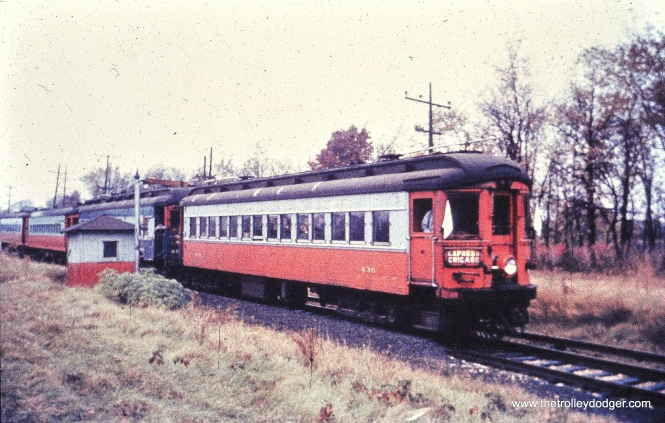
Chicago, Aurora & Elgin interurban car 460 at Trolleyville USA in July 1963. This was part of an order of 10 cars built by St. Louis Car Company in 1945-46. Brookins managed to save four of these cars.

Chicago, Aurora & Elgin interurban car 460 at Trolleyville USA in July 1963. This was part of an order of 10 cars built by St. Louis Car Company in 1945-46. Brookins managed to save four of these cars.

Time was, faded-out color slides, usually old Ektachromes from around 1956 that had turned red, were considered a “lost cause,” suitable only for converting to black-and-white. But today’s software and digital technology has made it possible to bring many of these old images back to life, with spectacular results.

However, we tackle an even more intractable problem today- Anscochrome, a “grade Z” cheaper alternative to Kodak film that appealed to thrifty photographers back in the 1950s and 60s. These images have not held up well over the years, exhibiting color shifts that are all over the place. In some cases, it may not be possible to make these pictures look 100% normal, even with all the tools in our digital toolbox.

We have also included some faded Ektachrome slides, and even one Kodachrome example. For many years, Kodachrome was the benchmark, the “gold standard” against which all other slide films had to be judged, in terms of dye stability and color accuracy.

By the 1990s, Fujichrome Velvia had caught up to Kodachrome in terms of sharpness, color, and resistance to fading. With the rise of digital photography, demand for Kodachrome slide film gradually declined, to the point where Kodak discontinued it, and the last roll was developed in 2010. It used a considerably more complicated and difficult developing process than other slide films.

Most pictures in today’s post were shot on Anscochrome in the early 1960s, at two early railway museum operations in Ohio, Trolleyville USA and the Ohio Railway Museum. Presumably, they were taken by the same unidentified photographer.

The former operation is now history, after an aborted effort to re-establish it in Cleveland, while the latter has had its problems over the years. (As of this writing, the Ohio Railway Museum has not yet opened for the 2016 season, with an August 21 date scheduled.)

Trolleyville USA was a labor of love for the late Gerald E. Brookins, who owned a trailer park in Olmsted Township, Ohio. He built an operating trolley to bring people who lived in the trailer park to his general store. Starting around 1954, Mr. Brookins developed an extensive collection of equipment, and was responsible for saving many streetcars and interurbans from what would have been certain destruction.

While the Brookins concern no longer exists, much of its collection lives on in a variety of other places, such as the Illinois Railway Museum. (To see a list of equipment owned at various times by the Ohio Railway Museum, go here.)

In addition, there are a few interesting shots taken on other electric railways of the 1950s and 60s. I have only included a few of the “before” pictures, but except for the two shots from 1972, all of the originals looked just as bad as the samples shown.

These images will give you a good idea of what these two early museum operations were like in the 1960s. Recently, we learned that North Shore Line car 154 (a sister to the 160 at Union), built in 1915 and now 101 years old, has deteriorated so much in outdoor storage at the Ohio railway Museum that it is going to be scrapped.

Norfolk and Western steam engine 578, shown in operation below, last ran in 1978.

This makes the point that historic preservation will likely always be two steps forward and one step backward, in spite of everyone’s best efforts. However, there is also good news– Chicago “L” car 24, built in 1898, is far along in its restoration at IRM, and recently ran under its own power for the first time in more than 50 years.

In a few instances, we show the process of color restoration step-by-step. Of course, we can only work with what’s already there to begin with. There is a difference between color restoration such as this, and “colorizing” a black-and-white image. To see examples of colorized railfan images, you can check out Rick Foss‘ work on his Facebook page.

Enjoy!

-David Sadowski

PS- This article is intended to be a brief introduction to the subject of color-correcting badly faded images. It’s been pointed out to me that several of these still have a definite color cast.

In most cases, I spent only a few minutes working on each one. Otherwise, this post would still be far off in the future. Sometimes it is necessary to work for hours on a single image to make it look “right,” if it can be made to look that way.

However, using the right tools, including Photoshop, even the worst of the images shown here is a definite improvement on its badly faded original. It’s remarkable that ANY of these pictures can be color-corrected, all things considered.

In some cases, you may get lucky, and it may take a few brief minutes to make your problem picture look 100% better.

Chances are, I will continue to work on these as time permits, and will post improved versions of some images in future.

As always, you can leave a Comment on this post, or contact us directly at:

thetrolleydodger@gmail.com


Trolleyville USA (most pictures taken in July 1963):

Before.

Before.

After.

After.

tv18

tv19

tv21

Here is Chicago, Aurora & Elgin car 36 at Trolleyville sometime in mid-1962. This car left Wheaton on April 14, 1962, and had already been repainted by January 1, 1963, so this picture must have been taken between those dates.

Here is Chicago, Aurora & Elgin car 36 at Trolleyville sometime in mid-1962. This car left Wheaton on April 14, 1962, and had already been repainted by January 1, 1963, so this picture must have been taken between those dates.

This is CA&E car 36 after being repainted at Trolleyville sometime during 1962.

This is CA&E car 36 after being repainted at Trolleyville sometime during 1962.

tv25

tv26

tv27

tv16

tv15

tv14

tv13

tv12

tv11

tv10

tv09

tv08

tv07

tv06

tv04

tv03

tv02

tv01

These last two pictures were taken a few years later, circa 1972:

tv24

tv05


Ohio Railway Museum, circa 1965:

orm13

orm12

orm11

orm08

orm07

orm06

orm05

orm04

orm03

orm02

orm01

nw02

nw01


Montreal and Southern Counties interurban (quit in 1956):

msc01

msc02

msc03

msc04


Chicago North Shore & Milwaukee (North Shore Line, including a CERA fantrip:

cerafantrip0

The location of this photo has puzzled even some experts. However, one of our regular readers may have the answer: "I think that it is looking north on the old Shore Line route post abandonment say in 1957 or 1958 when brush had grown up on the right of way. I would say that the location is where the old Lake Bluff Shore Line station was located, you can see a part of the old platform on the left side of the photo. If you go to that location today, the North Shore bike path curves slightly just south of where the Mundelein-Lake Bluff shuttle used to pass under the CNW. One track of the Shore Line route was retained from North Chicago Jct to the Highwood Shops until the last day of service. That was how they got cars to the Highwood Shops to be serviced and painted. The train is on the remaining track that led south to Highwood."

The location of this photo has puzzled even some experts. However, one of our regular readers may have the answer: “I think that it is looking north on the old Shore Line route post abandonment say in 1957 or 1958 when brush had grown up on the right of way. I would say that the location is where the old Lake Bluff Shore Line station was located, you can see a part of the old platform on the left side of the photo. If you go to that location today, the North Shore bike path curves slightly just south of where the Mundelein-Lake Bluff shuttle used to pass under the CNW. One track of the Shore Line route was retained from North Chicago Jct to the Highwood Shops until the last day of service. That was how they got cars to the Highwood Shops to be serviced and painted. The train is on the remaining track that led south to Highwood.”

cerafantrip2

cerafantrip1

restore01

restore01-001

restore03

restore17

restore18


South Shore Line/Illinois Central Electric:

restore05

restore16

restore13


Red Ektachromes

Noted railfan Ray DeGroote recently celebrated his 86th birthday. In his honor, I have attempted to color-correct an Ektacrhome slide he shot in 1955.

The original Ektachrome had a film speed of 32, slow by today’s standards, but preferable to its contemporary, Kodachrome 10. Unfortunately, the dyes used in early Ektachrome were unstable. This problem was corrected by the early 1960s.

Ray DeGroote took this picture at the old CTA Garfield Park "L" Laramie stop on May 1, 1955. We are looking to the west. About 30 years later, he had a duplicate slide made for me. That's what I scanned. Chances are, the original slide looks even more red than this today.

Ray DeGroote took this picture at the old CTA Garfield Park “L” Laramie stop on May 1, 1955. We are looking to the west. About 30 years later, he had a duplicate slide made for me. That’s what I scanned. Chances are, the original slide looks even more red than this today.

First, I brought the image up in Photoshop, and let the program try to color-correct the image automatically. As you can see, it already looks better but still has a ways to go.

First, I brought the image up in Photoshop, and let the program try to color-correct the image automatically. As you can see, it already looks better but still has a ways to go.

Next, I added some yellow to remove an overall blue cast. But due to how the original color dyes had faded, the resulting image is lacking in color intensity. It looks "flat." Keep in mind that the amount of red had to be greatly reduced to match the intensity of the greens and blues, which were greatly diminished.

Next, I added some yellow to remove an overall blue cast. But due to how the original color dyes had faded, the resulting image is lacking in color intensity. It looks “flat.” Keep in mind that the amount of red had to be greatly reduced to match the intensity of the greens and blues, which were greatly diminished.

Here, I increased the overall color saturation and tweaked the color balance a bit. The picture looks better now, but we are not yet satisfied.

Here, I increased the overall color saturation and tweaked the color balance a bit. The picture looks better now, but we are not yet satisfied.

Finally, I boosted the color saturation again. This seems to me about the best result. The sky is blue, the grass is green, and the top of the railcars are close to a neutral grey. While the platforms may be slightly red, they may have looked that way, and meanwhile the lighter parts of the CTA cars look slightly cyan. Since we do not want to add any more red back into the picture, this is where we stop and say we are done.

Finally, I boosted the color saturation again. This seems to me about the best result. The sky is blue, the grass is green, and the top of the railcars are close to a neutral grey. While the platforms may be slightly red, they may have looked that way, and meanwhile the lighter parts of the CTA cars look slightly cyan. Since we do not want to add any more red back into the picture, this is where we stop and say we are done.

I also corrected a couple of Ektachrome slides from 1959 that have shifted to red. They show D.C. Transit car 766 in fantrip service. These are extreme cases, and it wasn’t possible to bring the color back to 100% normal for these two slides:

Don’s Rail Photos says:

766 was built by Kuhlman Car Co in 1918 as Capital Traction Co 27. It was rebuilt in 1931 and became Capital Transit 766 in 1934. It is now at the National Capital Trolley Museum.

dctransit1959a

dctransit1959b

dctransit1959c

dctransit1959d

Here’s a picture showing Pacific Electric 1543 and others in a yard in the Los Angeles area on August 11, 1959:

Here is the original faded slide.

Here is the original faded slide.

Here, we have applied the auto color function in Photoshop. It has taken us part of the way, but we are not done yet.

Here, we have applied the auto color function in Photoshop. It has taken us part of the way, but we are not done yet.

We have reduced the amount of red further, and increased color saturation a bit. The picture is starting to look better.

We have reduced the amount of red further, and increased color saturation a bit. The picture is starting to look better.

Finally, we boosted the contrast a bit to give the image some "snap." Now we are finished. The dirt is red, but that is probably how things looked, since the sky is blue, without any trace of red.

Finally, we boosted the contrast a bit to give the image some “snap.” Now we are finished. The dirt is red, but that is probably how things looked, since the sky is blue, without any trace of red.


Faded Kodachrome

Yes, Virginia, there is such a thing as a faded Kodachrome slide. This 1939 photo of the Trylon and Perisphere at the New York World's Fair has shifted to magenta over the years. Apparently, the dyes in the earliest Kodachromes were nowhere near as stable as they soon became.

Yes, Virginia, there is such a thing as a faded Kodachrome slide. This 1939 photo of the Trylon and Perisphere at the New York World’s Fair has shifted to magenta over the years. Apparently, the dyes in the earliest Kodachromes were nowhere near as stable as they soon became.

We have eliminated the magenta cast, but now there hardly seems to be any color at all. It's almost monochrome now.

We have eliminated the magenta cast, but now there hardly seems to be any color at all. It’s almost monochrome now.

Here, we have boosted color saturation and have added some yellow. Unfortunately, it looks like we have gone too far, since the sky is now beginning to turn yellow as well.

Here, we have boosted color saturation and have added some yellow. Unfortunately, it looks like we have gone too far, since the sky is now beginning to turn yellow as well.

Here, we have backed off a bit on color saturation and while there is still a bit of yellow in the sky, the image overall looks much better than it originally did.

Here, we have backed off a bit on color saturation and while there is still a bit of yellow in the sky, the image overall looks much better than it originally did.


Recent Correspondence

Spence Ziegler writes, regarding the Illinois Central Electric suburban service (now the Metra Electric):

Dates of all of the station closures, last run of the turnaround trains (Hyde Park, 72nd St., Burnside) and on what date the original Blue Island Coach yard closed and when the CJ/CR&I viaduct was removed. Any information would greatly be appreciated. Thank you in advance.

We will try to find answers to your questions, thanks.


Help Support The Trolley Dodger

gh1

This is our 151st post, and we are gradually creating a body of work and an online resource for the benefit of all railfans, everywhere. To date, we have received over 185,000 page views, for which we are very grateful.

You can help us continue our original transit research by checking out the fine products in our Online Store. You can make a contribution there as well.

As we have said before, “If you buy here, we will be here.”

We thank you for your support.

Lost and Found

A close-up of Columbia Park & Southwestern 306 on the "Mobile Home Route."

A close-up of Columbia Park & Southwestern 306 on the “Mobile Home Route.”

Today’s post ties a number of photos together under the heading “Lost and Found.” There are images from the Chicago, Aurora & Elgin, the North Shore Line, and various early preservation efforts. Two of the three great Chicago-area interurbans are lost to history.

Interestingly, among the “saved” equipment shown in these early photos, none of these cars is still at the same location where the pictures were taken. In the case of Milwaukee Electric car 882, it was still in use at a Wisconsin electric power plant as late as 1961, three years after the last Milwaukee streetcar ran on the streets. Yet, oddly enough, it does not appear to have been preserved.

While many of these early museum-type operations such as Trolleyville USA* are no longer with us, they should not be regarded as failures. They played a crucial role in saving many electric railcars from the dustbin of history, and provided a “bridge” to a welcome home in some of today’s more durable institutions.

So, while much of our transit history has been lost, thanks to a few dedicated individuals, not all of it was lost. And despite all the travails and convoluted ways that various cars were saved, there is still a rich history that survives to be found by future generations.

-David Sadowski

PS- Trolleyville USA in Olmstead Township, Ohio, which I visited in 1984, was part trolley museum, and part common carrier. It provided much-needed transportation between a trailer park and general store, both of which were owned by the late Gerald E. Brookins. It is thanks to him that many unique pieces of equipment were saved.

Let me take this opportunity to clear up a Trolleyville “factoid” that has circulated.

Cleveland was where Peter Witt developed his namesake streetcar design, but it is one of the ironies of history that none were saved. A solitary Cleveland Peter Witt car lasted until 1962 before it too was unfortunately scrapped.

Don’s Rail Photos reports, “4144 was built by Kuhlman Car Co in August 1929, (order) #951. It was retired in 1954 and sold to an individual in Lorain. It was lettered as Arlington Traction Co 4144.” Owner Norman Muller had the car in his yard with an organ installed inside.

Some have pondered why Gerald E. Brookins did not save the car. Some have speculated that he was tapped out after purchasing four of the curved-side CA&E cars or that Mrs. Brookins would not let him buy another car.

In 2014, author Blaine Hays told me the real story. He says Brookins had plenty of money and could easily have afforded to purchase the 4144. However, in general his interest in trolley cars was limited to purchasing ones that could be readily run on his short railroad. By 1962, the 4144 did not fit into this category and after having been changed around and stored outside for years, would have required a substantial amount of restoration work, in any case a lot more than Brookins wanted to do.

Thanks to Brookins, four of the ten Ca&E St. Louis-built cars from 1945 were saved. But of fate had turned a different way, all ten cars might have ended up in service on the Cleveland rapid on the airport extension. In the early 1960s, Cleveland transit officials were planning to build this extension “on the cheap,” using local funds. If they had, the CA&E cars would likely have provided the original rolling stock. As things turned out, the project got put off for a few years until Federal funds were available. It opened in 1968 with new equipment.

Ironically, at least one CA&E car (303) did eventually run on the Cleveland system. The Lake Shore Electric Railway was a short-lived successor to Trolleyville that planned to operate in Cleveland. Ultimately, the effort failed due to lack of funding, and the cars in the Brookins collection were sold at auction. Some ended up at the Illinois Railway Museum and the Fox River Trolley Museum, but I have seen pictures of the 303 running in Cleveland in the early 21st century with a pantograph installed.

Who’da thunk it?


Help Support The Trolley Dodger

gh1

This is our 119th post, and we are gradually creating a body of work and an online resource for the benefit of all railfans, everywhere. To date, we have received over 123,000 page views, for which we are very grateful.

You can help us continue our original transit research by checking out the fine products in our Online Store. You can make a donation there as well.

As we have said before, “If you buy here, we will be here.”

We thank you for your support.


img994srpo1

American Streetcar R.P.O.s

Mainline Railway Post Offices were in use in the United States from 1862 to 1978 (with the final year being operated by boat instead of on rails), but for a much briefer era, cable cars and streetcars were also used for mail handling in the following 15 cities*:

Baltimore
Boston
Brooklyn
Chicago
Cincinnati
Cleveland
New Bedford, Massachusetts
New York City
Philadelphia
Pittsburgh
Rochester, New York
St. Louis
San Francisco
Seattle
Washington, D.C.


*As noted by some of our readers, this list does not include interurban RPOs.

Our latest E-book American Streetcar R.P.O.s collects 12 books on this subject (nearly 1000 pages in all) onto a DVD data disc that can be read on any computer using Adobe Acrobat Reader, which is free software. All have been out of print for decades and are hard to find. In addition, there is an introductory essay by David Sadowski.

The rolling stock, routes, operations, and cancellation markings of the various American street railway post office systems are covered in detail. The era of the streetcar R.P.O. was relatively brief, covering 1893 to 1929, but it represented an improvement in mail handling over what came before, and it moved a lot of mail. In many places, it was possible to deposit a letter into a mail slot on a streetcar or cable car and have it delivered across town within a short number of hours.

These operations present a very interesting history, but are not well-known to railfans. We feel they deserve greater scrutiny, and therefore we are donating $1 from each sale of this item to the Mobile Post Office Society, in support of their efforts.

# of Discs – 1
Price: $19.95


CA&E 423 and 433 have just passed each other just west of the Forest Park terminal at DesPlaines Avenue in October 1953. Concordia cemetery is to the left. This is now the site of I-290.

CA&E 423 and 433 have just passed each other just west of the Forest Park terminal at DesPlaines Avenue in October 1953. Concordia cemetery is to the left. This is now the site of I-290.

Don's Rail Photos says CA&E 18 was "built by Niles Car in 1902. It was modernized in March 1941 and retired in 1955." Here it is at Wheaton on March 15, 1952.

Don’s Rail Photos says CA&E 18 was “built by Niles Car in 1902. It was modernized in March 1941 and retired in 1955.” Here it is at Wheaton on March 15, 1952.

Curved-sided CA&E car 455, built by St. Louis Car Company in 1945, at Wheaton on July 7, 1954.

Curved-sided CA&E car 455, built by St. Louis Car Company in 1945, at Wheaton on July 7, 1954.

Don's Rail Photos says CA&E merchandise express car 9 was "built by Niles Car in 1907. It was scrapped in 1959." It is shown here at Wheaton in August 1948.

Don’s Rail Photos says CA&E merchandise express car 9 was “built by Niles Car in 1907. It was scrapped in 1959.” It is shown here at Wheaton in August 1948.

CA&E 427 parked at Laramie Avenue in August 1948. It was built by the Cincinnati Car Company in 1927.

CA&E 427 parked at Laramie Avenue in August 1948. It was built by the Cincinnati Car Company in 1927.

The view looking south towards the Wilmette station on the CNS&M Shore Line Route, which was abandoned in 1955. For a view from the other end of the same station, look here. Northbound trains began street running on Greenleaf Avenue here.

The view looking south towards the Wilmette station on the CNS&M Shore Line Route, which was abandoned in 1955. For a view from the other end of the same station, look here. Northbound trains began street running on Greenleaf Avenue here.

The same location today, where the North Shore Line curved to the right to head west on Greenleaf.

The same location today, where the North Shore Line curved to the right to head west on Greenleaf.

Once the North shore Line entered Greenleaf, the street widened. We are looking west.

Once the North shore Line entered Greenleaf, the street widened. We are looking west.

Perhaps one of our keen-eyed readers can tell us if this photo of car 158 was also taken along Greenleaf Avenue in Wilmette.

Perhaps one of our keen-eyed readers can tell us if this photo of car 158 was also taken along Greenleaf Avenue in Wilmette.

Don's Rail Photos says that North Shore Line caboose 1003 "was built by American Car & Foundry Co in 1926. It was rebuilt without a cupola but restored when it was acquired by IRM." There was some discussion recently on a Yahoo group concerning CNS&M cabooses. Someone was interested in making a model, and this nice side view should help determine the dimensions.

Don’s Rail Photos says that North Shore Line caboose 1003 “was built by American Car & Foundry Co in 1926. It was rebuilt without a cupola but restored when it was acquired by IRM.” There was some discussion recently on a Yahoo group concerning CNS&M cabooses. Someone was interested in making a model, and this nice side view should help determine the dimensions.

An Electroliner at speed near Crawford looking west. This picture was taken from a passing train in 1960, three years before the North Shore Line quit. CTA's Skokie Swift began running in 1964. (Richard H. Young Photo)

An Electroliner at speed near Crawford looking west. This picture was taken from a passing train in 1960, three years before the North Shore Line quit. CTA’s Skokie Swift began running in 1964. (Richard H. Young Photo)

Today's CTA Yellow Line looking west from Crawford.

Today’s CTA Yellow Line looking west from Crawford.

CNS&M Silverliner 738 heads up a four-car special train making a station stop at Northbrook during a snowstorm in February 1960. (Richard H. Young Photo)

CNS&M Silverliner 738 heads up a four-car special train making a station stop at Northbrook during a snowstorm in February 1960. (Richard H. Young Photo)

CNS&M 150 in a night scene at Waukegan on January 26, 1962.

CNS&M 150 in a night scene at Waukegan on January 26, 1962.

Electroliner 804-803 at the CTA Roosevelt Road "L" station in Chicago on February 17, 1957.

Electroliner 804-803 at the CTA Roosevelt Road “L” station in Chicago on February 17, 1957.

CNS&M Electroliner 803-804 at Deerpath, Illinois, February 17, 1957. Could be the photographer boarded the train in the previous picture at Roosevelt road and got off here.

CNS&M Electroliner 803-804 at Deerpath, Illinois, February 17, 1957. Could be the photographer boarded the train in the previous picture at Roosevelt road and got off here.

Columbia Park and Southwestern 306, ex-Aurora, Elgin & Fox River Electric, ex-Shaker Heights Rapid Transit, at Gerald E. Brookins' Trolleyville USA in 1962. Electric operations appear to be underway already, or nearly so.

Columbia Park and Southwestern 306, ex-Aurora, Elgin & Fox River Electric, ex-Shaker Heights Rapid Transit, at Gerald E. Brookins’ Trolleyville USA in 1962. Electric operations appear to be underway already, or nearly so.

Don's Rail Photos says, "306 was built by St Louis Car in 1924, #1306. In 1936 it was sold to CI/SHRT as 306 and in 1954 it was sold to CP&SW as 306. It was transferred to the Illinois Railway Museum in 1984 where it is being restored as AE&FRECo 306."

Don’s Rail Photos says, “306 was built by St Louis Car in 1924, #1306. In 1936 it was sold to CI/SHRT as 306 and in 1954 it was sold to CP&SW as 306. It was transferred to the Illinois Railway Museum in 1984 where it is being restored as AE&FRECo 306.”

photo089

CTA Red Pullman 144 and Milwaukee streetcar 972 at the Illinois Electric Railway Museum in North Chicago, February 1960.

CTA Red Pullman 144 and Milwaukee streetcar 972 at the Illinois Electric Railway Museum in North Chicago, February 1960.

A snowy view of the 144 in February 1960, less than two years after this car last ran on the streets of Chicago (in a May 1958 fantrip).

A snowy view of the 144 in February 1960, less than two years after this car last ran on the streets of Chicago (in a May 1958 fantrip).

Indiana Railroad lightweight high-speed interurban car 65 at IERM in February 1960.

Indiana Railroad lightweight high-speed interurban car 65 at IERM in February 1960.

Don's Rail Photos says Milwaukee electric car 882 "was built by St Louis Car Co in 1920, (order) #1239. It was one manned in 1926 and rebuilt in 1954 with a plow on one end and a pilot on the other for use at the Lakeside Power Plant of WEPCo. It also had interurban headlights added. It ran until May 8, 1961." Unfortunately, it does not appear this car was saved.

Don’s Rail Photos says Milwaukee electric car 882 “was built by St Louis Car Co in 1920, (order) #1239. It was one manned in 1926 and rebuilt in 1954 with a plow on one end and a pilot on the other for use at the Lakeside Power Plant of WEPCo. It also had interurban headlights added. It ran until May 8, 1961.” Unfortunately, it does not appear this car was saved.

The two North Shore Line Electroliner sets had a second life for a while as Liberty Liners on the Red Arrow line between Philadelphia and Norristown. Red Arrow President Merritt H. Taylor Jr. (1922-2010) was a closet railfan, and the pride he took in saving these fine streamlined cars is clearly evident in the picture on this 1964 timetable, when they were put into service. This was a morale booster for both the railroad and its riders after enduring a 34-day strike in 1963, the only one in its history.

The two North Shore Line Electroliner sets had a second life for a while as Liberty Liners on the Red Arrow line between Philadelphia and Norristown. Red Arrow President Merritt H. Taylor Jr. (1922-2010) was a closet railfan, and the pride he took in saving these fine streamlined cars is clearly evident in the picture on this 1964 timetable, when they were put into service. This was a morale booster for both the railroad and its riders after enduring a 34-day strike in 1963, the only one in its history.

CNS&M 162 at the American Museum of Electricity in Schenectady, New York in 1968. Don's Rail Photos says, "162 was built by Brill in 1915, #19605. It was acquired by American Museum of Electricity in 1963 and resold to Connecticut Trolley Museum."

CNS&M 162 at the American Museum of Electricity in Schenectady, New York in 1968. Don’s Rail Photos says, “162 was built by Brill in 1915, #19605. It was acquired by American Museum of Electricity in 1963 and resold to Connecticut Trolley Museum.”

This 1968 photo presents a bit of a mystery. The only other North Shore car owned by the American Museum of Electricity was 710, sold along with the 162 to the Connecticut Trolley Museum in 1971. But there are other cars shown in this line-up, and the partial number for this one looks like it's in the 750-series. Stephen B. Rudolph adds, "I just dug up an identical print of the photo of the boarded-up CNS&M 755. The back of my print is machine-dated by the photofinisher "JUNE 64." This wasn't somebody's rubber date stamper, so I think it's correct. Consequently, I believe the 1968 date stated above is incorrect."

This 1968 photo presents a bit of a mystery. The only other North Shore car owned by the American Museum of Electricity was 710, sold along with the 162 to the Connecticut Trolley Museum in 1971. But there are other cars shown in this line-up, and the partial number for this one looks like it’s in the 750-series. Stephen B. Rudolph adds, “I just dug up an identical print of the photo of the boarded-up CNS&M 755. The back of my print is machine-dated by the photofinisher “JUNE 64.” This wasn’t somebody’s rubber date stamper, so I think it’s correct. Consequently, I believe the 1968 date stated above is incorrect.”

Trolley Dodger Mailbag, 1-29-2016

Our previous post Trolley Dodgers (January 15, 2016) included a photo of the old Market Street stub terminal in downtown Chicago. Here is another view, probably from the late 1930s. It was torn down in 1948 after the CTA introduced A/B "skip-stop" service on the Lake Street "L", which rendered it unnecessary. (Chicago Transit Authority Photo)

Our previous post Trolley Dodgers (January 15, 2016) included a photo of the old Market Street stub terminal in downtown Chicago. Here is another view, probably from the late 1930s. It was torn down in 1948 after the CTA introduced A/B “skip-stop” service on the Lake Street “L”, which rendered it unnecessary. (Chicago Transit Authority Photo)

The Trolley Dodger mailbag is pretty full today, since we have received a lot of interesting correspondence lately. Mark Llanuza writes:

How did you get so interested in the CA&E?

I have lived in Chicago’s western suburbs pretty much my entire life. I was born in 1954 and therefore never rode the CA&E. As it was, my mother says she only rode it once, in 1946 as part of an outing with other people from the office she worked in downtown.

I know my mother took the Garfield Park “L” downtown when she worked there in 1952-53, after she married to my dad. They lived in Forest Park for a time.

In general, however, after my parents moved to the Mont Clare neighborhood, we took either the Lake Street “L” or the Logan Square line. (Although we lived very close to the Milwaukee Road commuter train, we didn’t ride it that much.)

When it was reported in the press in 1961 that the CA&E would be dismantled forever, my family took a Sunday drive out to Wheaton, where we looked forlornly at the cars in dead storage in the yard. I recall being glad at the time that they had not been vandalized.

When the Illinois Railway Museum began rail operations around 1966, we drove out there to ride the trains. And I have been back many, many times since.

As I grew up, I learned more and more about the CA&E, and am still learning.

Mark continues:

There were three final passenger trips that took place at year’s end in 1958. On Oct 26th the Central Electric Railfans’ Association chartered three cars (with a fourth car added later due to extra loading). It was listed as the last steel car trip and went to Elgin .

The second trip was charted on Nov 21st by a church group, and went from Glen Ellyn to Clintonville station, to the Fox Valley RR club.

The final one was on December 7th 1958, which I sent you many photos of, but I may have some more.

Mark did in fact send us more images, reproduced below. The ones from the final fantrip have also been added to our previous post A Cold Last Ride (January 25, 2016). We thank him for his generosity in sharing them with our readers.

Mark Llanuza's collection of CA&E slides include Kodachromes and Ektachromes. Kodachrome II was an improved version (with the film speed increased to ISO 25) released near the end of 1961. The original photographer's name is not known. (Mark Llanuza Photo)

Mark Llanuza’s collection of CA&E slides include Kodachromes and Ektachromes. Kodachrome II was an improved version (with the film speed increased to ISO 25) released near the end of 1961. The original photographer’s name is not known. (Mark Llanuza Photo)

The CERA fantrip train on the CA&E at Raymond Street, October 26, 1958. (Mark Llanuza Collection) This is the same curve where several photos were taken during the December trip, where we got them identified as near the Corrugated Box Company.

The CERA fantrip train on the CA&E at Raymond Street, October 26, 1958. (Mark Llanuza Collection) This is the same curve where several photos were taken during the December trip, where we got them identified as near the Corrugated Box Company.

The CERA fantrip train at 5th Avenue in Maywood, looking east, still just three cars at this point. The date is October 26, 1958 and the photographer was standing at the end of the platform, which is why the position is slightly elevated. (Mark Llanuza Collection)

TThe CERA fantrip train at 5th Avenue in Maywood, looking east, still just three cars at this point. The date is October 26, 1958 and the photographer was standing at the end of the platform, which is why the position is slightly elevated. (Mark Llanuza Collection)

Fifth Avenue in Maywood as it looks today. We are facing east.

Fifth Avenue in Maywood as it looks today. We are facing east.

The four-car CERA fantrip train at Raymond Street in Elgin. Mark Llanuza says the entire day was cold and rainy, and they had to add a fourth car at Wheaton because of the large number of people on this trip. (Mark Llanuza Collection)

The four-car CERA fantrip train at Raymond Street in Elgin. Mark Llanuza says the entire day was cold and rainy, and they had to add a fourth car at Wheaton because of the large number of people on this trip. (Mark Llanuza Collection)

320-319 near the Corrugated Box Company on the Elgin branch, December 7, 1958. (Mark Llanuza Collection)

320-319 near the Corrugated Box Company on the Elgin branch, December 7, 1958. (Mark Llanuza Collection)

320 and engineer at the Lakewood station in West Chicago, December 7, 1958. As the CA&E operations wound down, starting with the abandonment of passenger service in 1957, employees were retained on the basis of seniority. Newer ones were let go while the oldest and longest serving employees remained. (Mark Llanuza Collection)

320 and engineer at the Lakewood station in West Chicago, December 7, 1958. As the CA&E operations wound down, starting with the abandonment of passenger service in 1957, employees were retained on the basis of seniority. Newer ones were let go while the oldest and longest serving employees remained. (Mark Llanuza Collection)

319-320 near the Clintonville Station on the Elgin branch, December 7, 1958. (Mark Llanuza Collection)

319-320 near the Clintonville Station on the Elgin branch, December 7, 1958. (Mark Llanuza Collection)

Mark also sent us a couple of before and after pictures:

1953 and 2015 compared in South Elgin. (Mark Llanuza Photo)

1953 and 2015 compared in South Elgin. (Mark Llanuza Photo)

1953 and 2015 at Lakewood. (Mark Llanuza Photo)

1953 and 2015 at Lakewood. (Mark Llanuza Photo)


We also came across some CA&E ephemera:

Lucian C. Sprague (1882-1960) was president of the Minneapolis and St. Louis Railway from 1935 to 1954, and received this pass from the Chicago, Aurora & Elgin. Officials from various railroads gave each other these sorts of passes as a professional courtesy. The Chicago & North Western bought the Minneapolis and St. Louis in 1960.

Lucian C. Sprague (1882-1960) was president of the Minneapolis and St. Louis Railway from 1935 to 1954, and received this pass from the Chicago, Aurora & Elgin. Officials from various railroads gave each other these sorts of passes as a professional courtesy. The Chicago & North Western bought the Minneapolis and St. Louis in 1960.

There was recently some discussion on Facebook regarding CA&E’s extensive use of uncovered third rail without fencing. It was noted that this arrangement had been in place since 1902 and residents of Chicago’s western suburbs were used to it. However, there were various signs warning of the dangers. If the CA&E had survived to the present time, no doubt there would be more protections in place.

This metal sign, said to have been used on the Chicago, Aurora & Elgin, recently sold on eBay for $280.

This metal sign, said to have been used on the Chicago, Aurora & Elgin, recently sold on eBay for $280.

caesign2


The CA&E 315 Story

Joel Salomon writes:

Thanks for the recent posting of all the great CA&E pictures on The Trolley Dodger blog. Some really fascinating images in that post.

I am a member and long time volunteer at the Rockhill Trolley Museum in Rockhill Furnace, PA. We have CA&E 315 at our museum and we are in the process of restoring the car to its original condition as built in 1909,or as close as we can make it.

One question that had always wondered me and others at the museum is how did 315 get out of Chicago and are there any photos of the car after the CA&E abandoned operations? We know the car was stored in a CN&W roundhouse for nearly a year and copies of that invoice are enclosed. But the big question is when did 315 leave the CA&E for the last time and are there any photos of that move? We do know when the car was ready to be moved to Pennsylvania the car was placed on a depressed flatcar and the trucks placed in a gondola car and moved to Mt. Union, PA. It was moved by a highway truck 11 miles to the museum site.

Do you know anyone that I might contact to help with this unknown part of the 315 story? I would appreciate knowing anyone that might be able to answer some of these questions or have pictures of 315 during its years on the CA&E as well as after abandonment.

Thanks for your help with these questions.

Thanks for writing. If, as I suspect, you are related to the late Gerhard Salomon, you might like to know I regard him as a hero for all his preservation efforts over the decades. I can only wish I had met the man to thank him personally.

While I do not have immediate answers to your various questions, I am confidant that I can help you find out, with the help of our readers.

One of my recent blog posts mentioned how the 320 (now at Mt. Pleasant) was the only car taken off the property that did not leave via a temporary interchange track with the C&NW.

It may very well be that the 315 left at the same time as some other cars that were saved, especially the ones that were heading east.

With any luck, I hope it will be possible to visit your fine museum sometime this year.

-David Sadowski

Joel Salomon is too modest. He is in fact the president of the museum. The images that follow are courtesy of Joel Salomon and the Rockhill Trolley Museum:

Screen Shot 01-29-16 at 05.59 AM.PNG

Screen Shot 01-29-16 at 05.59 AM 001.PNG

RTY-PP CAE 315 184

315 flatcar side

RTY 315 Moving to RTM 038

Perhaps somewhat coincidentally, Mark Llaunza writes:

Here are some interesting last CA&E moves from April 1962. An interchange track was built at Wheaton to pick up cars from the yards. Trains were bought over to West Chicago to run around them, and they then headed back to Chicago.

While these photos do not necessarily help answer Mr. Salomon’s question, they do show seven CA&E cars being moved off the property in April 1962. If there were, as I have read, three such trains of cars, with the 320 being handled separately, then perhaps we have a one in three chance that the 315 was part of this train movement.

Since one of the invoices shown above pro-rated the cost for moving the 315 as 1/7th of the total, that would be another indication that it may have been in the group shown in these pictures. There most likely could not have been three such trains, as I recall only around 19 cars were saved. Maybe that improves our odds to 50% or perhaps greater.

The only car whose number I can recognize in these photos is the 303, which originally went to Trolleyville USA in Ohio. However, none of the cars in this photo have curved sides, so the four cars from the 451-460 series, which also went to the Gerald E. Brookins operation, are not among them and would have been moved in a different trip.

The 303 is preserved today at the Connecticut Trolley Museum. The 315 has been owned by the Rockhill group all along.

Update:

Frank Hicks writes:

IRM and RELIC each had their own “hospital train” and the 320 left separately so, by process of elimination, we can figure that the 315 was indeed in the seven-car “eastern museums” train in Mark’s photos. It looks to me like the order was 303-409-319-36-315-308-318.

BINGO! Thanks so much.

PS- The Railway Equipment Leasing and Investment Co. was the predecessor of the Fox River Trolley Museum.

Leaving the Wheaton interchange with the C&NW, April 1962. (Mark Llanuza Collection)

Leaving the Wheaton interchange with the C&NW, April 1962. (Mark Llanuza Collection)

On the C&NW at Wheaton in April 1962. (Mark Llanuza Collection)

On the C&NW at Wheaton in April 1962. (Mark Llanuza Collection)

The saved CA&E cars on the C&NW in West Chicago, April 1962. (Mark Llanuza Collection)

The saved CA&E cars on the C&NW in West Chicago, April 1962. (Mark Llanuza Collection)

The saved CA&E cars on the C&NW in West Chicago, April 1962. (Mark Llanuza Collection)

The saved CA&E cars on the C&NW in West Chicago, April 1962. (Mark Llanuza Collection)

On the C&NW at Western Avenue in April 1962. (Mark Llanuza Collection)

On the C&NW at Western Avenue in April 1962. (Mark Llanuza Collection)

This must be the March 24, 1962 train taking CA&E equipment purchased by RELIC, the predecessor to the Fox River Trolley Museum. According to Don’s Rail Photos, “11 was built by Brill in 1910, (order) #16483. It was rebuilt to a line car in 1947 and replaced 45. It was acquired by Railway Equipment Leasing & Investment Co in 1962 and came to Fox River Trolley Museum in 1984. It was lettered as Fox River & Eastern." This picture was taken in Glen Ellyn along the C&NW. (Mark Llanuza Collection)

This must be the March 24, 1962 train taking CA&E equipment purchased by RELIC, the predecessor to the Fox River Trolley Museum. According to Don’s Rail Photos, “11 was built by Brill in 1910, (order) #16483. It was rebuilt to a line car in 1947 and replaced 45. It was acquired by Railway Equipment Leasing & Investment Co in 1962 and came to Fox River Trolley Museum in 1984. It was lettered as Fox River & Eastern.” This picture was taken in Glen Ellyn along the C&NW. (Mark Llanuza Collection)

From www.thegreatthirdrail.org: The end has come for the Roarin’ Elgin. The rails have rusted over and the hallmark of the railroad, the third rail, has already been taken off of the third rail chairs. Fortunately all isn’t lost. On March 24, 1962, we see EJ&E 212 hauling several CA&E cars past the Wheaton station and Main Street to be preserved at RELIC (today’s Fox River Trolley Museum). Photo by TH Desnoyers, from the Krambles-Peterson Archive

From http://www.thegreatthirdrail.org: The end has come for the Roarin’ Elgin. The rails have rusted over and the hallmark of the railroad, the third rail, has already been taken off of the third rail chairs. Fortunately all isn’t lost. On March 24, 1962, we see EJ&E 212 hauling several CA&E cars past the Wheaton station and Main Street to be preserved at RELIC (today’s Fox River Trolley Museum).
Photo by TH Desnoyers, from the Krambles-Peterson Archive

The rescue train taking CA&E cars purchased by RELIC through Glen Ellyn. (Mark Llanuza Collection)

The rescue train taking CA&E cars purchased by RELIC through Glen Ellyn. (Mark Llanuza Collection)


The Trolley Motel

Ruth Morgan writes:

There is a thesis at Mississippi State University on Land Use in Starkville. It is about 4 inches thick. I am attaching the pages on a trolley motel which is thought to have been the largest in the world. The trolleys were purchased by Vernon Chesteen from Birmingham and made into his motel prior to building one. It had a nice gas island with a streetcar diner. I located an aerial photo. I write an article for the Starkville paper entitled From Days Past and am trying to verify information. What I send you is true. The motel was on Highway 182 about a block west of town.

I wasn’t able to come up with anything about this Trolley Motel via a Google search. Perhaps my readers might know something more.

On Don’s Rail Photos, there is a page with information on the Birmingham streetcars themselves. Note this part:

Then, in August, 1941, cars 812, 816, 817, 830 thru 833, 835, and 838 were scrapped. A number of these car bodies were saved for non rail use, such as sheds and cabins.

Chances are those were the nine cars that were used for the Trolley Motel and associated diner. There is a picture of one such type car, which is known as a double-truck Birney. These cars were built in 1919 and 1920 by the Cincinnati Car Company, and were originally double-ended. They were eventually converted into single-end cars.

When these trolley cars were taken out of service, the motors, wheels, seats and control equipment would have been removed and saved for use on the remaining cars in that series. The car bodies would have been offered for sale, and would have been especially desirable in the immediate post-WWII era, when there was a housing shortage.

Back in those days, postcards were made of just about anything. It’s quite possible that a picture postcard may exist somewhere showing the Trolley Motel. Perhaps our readers may know something.

Ruth replies:

According to the thesis Lucille Liston Mitlin submitted to MSU to receive her master’s in geology and geography in August 1975, entitled “The Historical Development of Land Use in Starkville Mississippi, a Small University City,” it shows there was not much in the area during her days on campus.

The Trolley Motel was replaced by the University Motel about 1960 and all the “stars” who performed at MSU stayed there, including Johnny Cash. The motel no longer exists. Thank you so much for your research.

(Images below are courtesy of Ruth Morgan.)

This section of a 1975 dissertation describes how nine streetcar bodies from Birmingham, Alabama were used in a "Trolley Motel" in Mississippi. Eight were used as cabins and the ninth was a diner.

This section of a 1975 dissertation describes how nine streetcar bodies from Birmingham, Alabama were used in a “Trolley Motel” in Mississippi. Eight were used as cabins and the ninth was a diner.

An aerial photo, probably from the late 1940s, where you can just barely make out (at right) some of the streetcars in the Trolley Motel.

An aerial photo, probably from the late 1940s, where you can just barely make out (at right) some of the streetcars in the Trolley Motel.

Above is a 1952 MSU annual showing ads for the Gas Island, mentioning the diner and tourists.

Above is a 1952 MSU annual showing ads for the Gas Island, mentioning the diner and tourists.

Ruth sent us another note after this was posted:

THANK YOU! You are to be commended for the excellent job you do. This is the most reliable website I have seen. I talked to Mrs. V. J. Robinson, the sister-in-law of Mrs. Vernon Chesteen (about 90 years old). She remembers the trolley car motel. She said each trolley had 2 rooms so that would have been 16 rooms for the motel. Her two sisters worked in the trolley that was the diner. She is searching for old photos. Her mind is still clear as can be She has fond memories of the trolley car motel. Our town was crowded with students coming to Mississippi State University after the war. We had our largest increase in students during this time. Thank you again.

We are only too glad to help out. It’s worth pointing out that calling a double-truck Birney streetcar the largest in the world is a bit of hyperbole. I’m sure it was large, but of the same general size as plenty of other streetcars.


North Shore Line Abandoned Track?

Our youthful railfan Joey Morrow writes:

Does the North Shore Line have any abandoned track? The Skokie Valley doesn’t count because it was not abandoned when the NSL closed it’s doors. But I’ve found some track from the late 90’s though:

image1

image1-1

Skokie Valley? Nope that track was used after the abandonment. But the Shore Line might have some abandoned platforms– the Winnetka platform was still there in 2014. According to (http://www.sarahrothschild.com/real-estate–history-blog/archives/12-2014). The Indian Hill platform was still there in the late 90’s according to http://www.chicagorailfan.com/mpupn.html.
But the tracks… To find both the southbound and the northbound tracks, they weren’t dug up. They were surrounded in concrete almost impossible to notice. But… On 27 Ct. and 52 St. you will see them!

index

image3

(Be aware this is in July 2012 not 2016) I was so happy I almost started crying! To know that the fate of a few yards of track on the Chicago Aurora and Elgin, would be the same for a few yards of track on the Chicago North Shore and Milwaukee! North of this location but before the line turns towards Racine, there might be some more. North of 45th St. I want to check it out, but I don’t live in Kenosha anymore, not even in the Midwest. No where near where I want to be.

Good work, Joey. Perhaps one of our readers can tell us whether your detective work is correct. And in the meantime, keep trying to turn your dreams into your realities. That’s what life is all about.

-David Sadowski

Keep those cards and letters coming in, folks. You can either leave a comment on this or any other post, or reach us at:

thetrolleydodger@gmail.com


Help Support The Trolley Dodger

gh1

This is our 115th post, and we are gradually creating a body of work and an online resource for the benefit of all railfans, everywhere. To date, we have received over 117,000 page views, for which we are very grateful.

You can help us continue our original transit research by checking out the fine products in our Online Store. You can make a donation there as well.

As we have said before, “If you buy here, we will be here.”

We thank you for your support.