Borrowed Time

This January 1960 view, looking northeast, shows the temporary Central Avenue side platform station during construction of the Congress expressway. The CTA Congress median line had opened as far west as Cicero Avenue in June 1958, but farther west, used a series of temporary ground level alignments while highway work continue. The temporary station here was in use from October 1959 until October 1960, when the permanent center platform station opened. You can see a stairway for the new platform, built into the concrete wall of the Central Avenue underpass. The side platforms allowed for simultaneous construction of the new station. The expressway originally ended at Laramie Avenue (5200 W.), but was extended to Central (5600 W. ) in early 1960, and finally opened to Oak Park, Forest Park, and Maywood in October 1960. Newly delivered single car unit 22 heads up this westbound Congress-Milwaukee "A" train. East of here, the tracks curve off to go into the Lotus Tunnel, taking the line into the expressway median. Ultimately, this station did not develop much ridership, and closed in 1973, although it is still extant. (Jeffrey L. Wien Photo)

This January 1960 view, looking northeast, shows the temporary Central Avenue side platform station during construction of the Congress expressway. The CTA Congress median line had opened as far west as Cicero Avenue in June 1958, but farther west, used a series of temporary ground level alignments while highway work continue. The temporary station here was in use from October 1959 until October 1960, when the permanent center platform station opened. You can see a stairway for the new platform, built into the concrete wall of the Central Avenue underpass. The side platforms allowed for simultaneous construction of the new station. The expressway originally ended at Laramie Avenue (5200 W.), but was extended to Central (5600 W. ) in early 1960, and finally opened to Oak Park, Forest Park, and Maywood in October 1960. Newly delivered single car unit 22 heads up this westbound Congress-Milwaukee “A” train. East of here, the tracks curve off to go into the Lotus Tunnel, taking the line into the expressway median. Ultimately, this station did not develop much ridership, and closed in 1973, although it is still extant. (Jeffrey L. Wien Photo)

I was thinking about the expression “living on borrowed time” recently. I guess all of us are doing that, in a sense, but it occurred to me that when we look at old photographs, they can transport us back into the past. It’s almost as if by looking at them, we can borrow back some of the past.

Here are lots of photos that do just that. We also have some pictures from our recent trip to the East Troy Railroad Museum in Wisconsin. This was our first chance to see North Shore Line car 761 since it was restored by the museum.

I can’t say enough good things about the museum and its volunteers. We were treated to a tour of the barn where 761 and several other cars are stored. Even better, we ran into the Heinlein family who just happened to be there that day.

Keep those cards and letters coming in, folks. And thanks for lending us some of your time.

-David Sadowski

PS- You might also like our Trolley Dodger Facebook auxiliary, a private group that now has 835 members.

Our friend Kenneth Gear now has a Facebook group for the Railroad Record Club. If you enjoy listening to audio recordings of classic railroad trains, whether steam, electric, or diesel, you might consider joining.

Work on our North Shore Line book is ongoing. Donations are needed in order to bring this to a successful conclusion. You will find donation links at the top and bottom of each post. We thank you in advance for your time and consideration.

Recent Finds

New York Central loco 5287, a 4-6-4, heads south at Roosevelt Road on August 24, 1954. (David R. Sweetland Photo)

New York Central loco 5287, a 4-6-4, heads south at Roosevelt Road on August 24, 1954. (David R. Sweetland Photo)

I recently purchased this "real photo postcard," and the seller said this was the Harvard station on the Englewood branch of the "L". However, closer inspection of the photo shows that this is actually the Princeton station, which opened in 1905, and closed in 1949 as part of the CTA's restructuring of north-south service.

I recently purchased this “real photo postcard,” and the seller said this was the Harvard station on the Englewood branch of the “L”. However, closer inspection of the photo shows that this is actually the Princeton station, which opened in 1905, and closed in 1949 as part of the CTA’s restructuring of north-south service.

Electroliner 803-804 at Red Arrow's 69th Street Shops on November 10, 1963, shortly after arriving from Chicago. (Jeffrey L. Wien Photo)

Electroliner 803-804 at Red Arrow’s 69th Street Shops on November 10, 1963, shortly after arriving from Chicago. (Jeffrey L. Wien Photo)

Liberty Liner "Valley Forge," formerly North Shore Line Electroliner 801-802, being put into service on Red Arrow's Norristown line on January 26, 1964. (Jeffrey L. Wien Photo)

Liberty Liner “Valley Forge,” formerly North Shore Line Electroliner 801-802, being put into service on Red Arrow’s Norristown line on January 26, 1964. (Jeffrey L. Wien Photo)

SEPTA Liberty Liner "Valley Forge" crosses the Schuylkill River in September 1976, near the end of service on the Red Arrow line to Norristown. (Jeffrey L. Wien Photo)

SEPTA Liberty Liner “Valley Forge” crosses the Schuylkill River in September 1976, near the end of service on the Red Arrow line to Norristown. (Jeffrey L. Wien Photo)

Liberty Liner "Valley Forge," formerly North Shore Line Electroliner 801-802, just after delivery to the Illinois Railway Museum on May 9, 1982. (Jeffrey L. Wien Photo)

Liberty Liner “Valley Forge,” formerly North Shore Line Electroliner 801-802, just after delivery to the Illinois Railway Museum on May 9, 1982. (Jeffrey L. Wien Photo)

Liberty Liner "Valley Forge," aka Electroliner 801-802, at the Illinois Railway Museum on October 2, 1982. (Jeffrey L. Wien Photo)

Liberty Liner “Valley Forge,” aka Electroliner 801-802, at the Illinois Railway Museum on October 2, 1982. (Jeffrey L. Wien Photo)

North Shore Line wood car 134 is on a siding, and may be possibly be in New Trier school tripper service on the Shore Line Route, before the late 1930s Winnetka Grade Separation project. Don's Rail Photos: "134 was built by Jewett Car Co in 1907 as C&ME 134. It was rebuilt in 1914 retired in 1948. In 1936, the CA&E leased 11 surplus cars from the CNS&M. These cars were modified for service by raising the coupler height, installing electric heat instead of the coal-fired hot water heaters, modifying the control, and adding jumper receptacles and other minor fittings to allow them to train with the other CA&E cars. Since these were 50 mile per hour cars, and the CA&E cars were 60 MPH cars, they were soon operated only in trains of their own kind rather than mixed in with other cars. In 1945 they were returned to the North Shore where they operated briefly. They were purchased in 1946 and last ran in regular service in September, 1953."

North Shore Line wood car 134 is on a siding, and may be possibly be in New Trier school tripper service on the Shore Line Route, before the late 1930s Winnetka Grade Separation project. Don’s Rail Photos: “134 was built by Jewett Car Co in 1907 as C&ME 134. It was rebuilt in 1914 retired in 1948. In 1936, the CA&E leased 11 surplus cars from the CNS&M. These cars were modified for service by raising the coupler height, installing electric heat instead of the coal-fired hot water heaters, modifying the control, and adding jumper receptacles and other minor fittings to allow them to train with the other CA&E cars. Since these were 50 mile per hour cars, and the CA&E cars were 60 MPH cars, they were soon operated only in trains of their own kind rather than mixed in with other cars. In 1945 they were returned to the North Shore where they operated briefly. They were purchased in 1946 and last ran in regular service in September, 1953.”

CTA gate car 390. Don's Rail Photos: "390 was built by American Car & Foundry Co in 1905 as SSRT 390. It became CERy 390 in 1913 and became CRT 390 in 1923. It was retired on June 20, 1957." Andre Kristopans: "390 I think is at North/Halsted. At first thought Sedgwick, but background does not match."

CTA gate car 390. Don’s Rail Photos: “390 was built by American Car & Foundry Co in 1905 as SSRT 390. It became CERy 390 in 1913 and became CRT 390 in 1923. It was retired on June 20, 1957.” Andre Kristopans: “390 I think is at North/Halsted. At first thought Sedgwick, but background does not match.”

On March 29, 1943, the first official Chicago Rapid Transit Company train heads into the north portal of the new State Street Subway, then still under construction. Only one track was in service, and the south portal was still being built. Test rides were being given to servicemen and war bond buyers. The official opening was on October 17th.

On March 29, 1943, the first official Chicago Rapid Transit Company train heads into the north portal of the new State Street Subway, then still under construction. Only one track was in service, and the south portal was still being built. Test rides were being given to servicemen and war bond buyers. The official opening was on October 17th.

Shaker Heights Rapid Transit car 302, formerly of the Aurora, Elgin & Fox River Electric, is inbound at Woodhill Road on September 6, 1951. Don's Rail Photos: "302 was built by St Louis Car in 1924, #1308. In 1936 it was sold to CI/SHRT as 302 and in 1954 it was sold to Gerald Brookins for the Columbia Park & Southwestern aka Trolleyville." Sounds like it was scrapped there for parts.

Shaker Heights Rapid Transit car 302, formerly of the Aurora, Elgin & Fox River Electric, is inbound at Woodhill Road on September 6, 1951. Don’s Rail Photos: “302 was built by St Louis Car in 1924, #1308. In 1936 it was sold to CI/SHRT as 302 and in 1954 it was sold to Gerald Brookins for the Columbia Park & Southwestern aka Trolleyville.” Sounds like it was scrapped there for parts.

North Shore Line city streetcar 354 at the Illinois Railway Museum in September 1972.

North Shore Line city streetcar 354 at the Illinois Railway Museum in September 1972.

The conventional view of the North Shore Line station in Lake Forest.

The conventional view of the North Shore Line station in Lake Forest.

A different view of the large North Shore Line station in Lake Forest that served the Shore Line Route. This can't be later than 1916, as the railroad is identified by its previous name, the Chicago and Milwaukee Electric. The station survived the 1955 Shore Line abandonment, but was torn down around 1970.

A different view of the large North Shore Line station in Lake Forest that served the Shore Line Route. This can’t be later than 1916, as the railroad is identified by its previous name, the Chicago and Milwaukee Electric. The station survived the 1955 Shore Line abandonment, but was torn down around 1970.

I believe we are looking north at the Chicago and North Western commuter train station in Highland Park. If so, the North Shore Line's tracks for the Shore Line Route would be at right in the adjacent street. Apparently the station footprint here did not allow for sufficient space to locate the NSL tracks on private right-of-way.

I believe we are looking north at the Chicago and North Western commuter train station in Highland Park. If so, the North Shore Line’s tracks for the Shore Line Route would be at right in the adjacent street. Apparently the station footprint here did not allow for sufficient space to locate the NSL tracks on private right-of-way.

Another view of the C&NW Highland Park station, again looking north with the NSL Shore Line tracks in the street at right.

Another view of the C&NW Highland Park station, again looking north with the NSL Shore Line tracks in the street at right.

The entrance to Ravinia Park around 1915. It was built by the Chicago and Milwaukee Electric to help generate more ridership.

The entrance to Ravinia Park around 1915. It was built by the Chicago and Milwaukee Electric to help generate more ridership.

This shows the wooden "L" ramp under construction for the CTA's Garfield Park temporary trackage that ran east of here in Van Buren Street during construction of the Congress expressway. You can see where the temporary structure was going to turn and head south, to rejoin the existing Garfield Park "L" near Sacramento Boulevard. The new alignment was used starting in September 1953, so this is some time before then. (Henryk Shafer Photo)

This shows the wooden “L” ramp under construction for the CTA’s Garfield Park temporary trackage that ran east of here in Van Buren Street during construction of the Congress expressway. You can see where the temporary structure was going to turn and head south, to rejoin the existing Garfield Park “L” near Sacramento Boulevard. The new alignment was used starting in September 1953, so this is some time before then. (Henryk Shafer Photo)

Philadelphia Suburban Transportation Company (aka Red Arrow) cars 77 and 8 in Media, PA on April 25, 1954. Brilliner 8 is still in its original 1941 paint scheme. (Russell E. Jackson Photo)

Philadelphia Suburban Transportation Company (aka Red Arrow) cars 77 and 8 in Media, PA on April 25, 1954. Brilliner 8 is still in its original 1941 paint scheme. (Russell E. Jackson Photo)

Philadelphia Suburban Transportation Company (aka Red Arrow) car 83 on the West Chester line in 1954. Buses replaced trolleys on this long route the same year, as part of a highway widening project. Don's Rail Photos: "83 was built by Brill Car Co in March 1932, #22980. It became SEPTA 83 in 1970 and sold to Middletown & Hummelstown in 1982." The M&H actually purchased car 86 in 1982, which was found to have some damage. So car 83 was renumbered as 86 by SEPTA and sold to them that way. The original car 86 also went along and was scrapped for parts. M&H is a diesel-powered tourist operation and the Red Arrow car is in storage there.

Philadelphia Suburban Transportation Company (aka Red Arrow) car 83 on the West Chester line in 1954. Buses replaced trolleys on this long route the same year, as part of a highway widening project. Don’s Rail Photos: “83 was built by Brill Car Co in March 1932, #22980. It became SEPTA 83 in 1970 and sold to Middletown & Hummelstown in 1982.” The M&H actually purchased car 86 in 1982, which was found to have some damage. So car 83 was renumbered as 86 by SEPTA and sold to them that way. The original car 86 also went along and was scrapped for parts. M&H is a diesel-powered tourist operation and the Red Arrow car is in storage there.

Laurel Line (Lackawanna and Wyoming Valley Railroad) cars 38, 114, and 35. I assume this is in Scranton, PA. Interurban passenger service quit on December 31, 1952.

Laurel Line (Lackawanna and Wyoming Valley Railroad) cars 38, 114, and 35. I assume this is in Scranton, PA. Interurban passenger service quit on December 31, 1952.

Laurel Line car 32.

Laurel Line car 32.

Laurel Line car 32.

Laurel Line car 32.

Laurel Line car 19 looks like it has seen better days.

Laurel Line car 19 looks like it has seen better days.

Laurel Line car 35.

Laurel Line car 35.

Laurel Line car 32.

Laurel Line car 32.

Another view of Laurel Line car 19.

Another view of Laurel Line car 19.

CTA single car units 41 and 42, equipped with trolley poles for use on the Evanston branch, are posed at Sedgwick on the Ravenswood line. The date may be June 26, 1960. Sunday fantrips were popular, when Ravenswood trains only went as far as Armitage, and the fans could have lengthy photo stops without interfering with regular service. North Shore Line trains were routed via the outer tracks at this time. (Richard J. Anderson Photo)

CTA single car units 41 and 42, equipped with trolley poles for use on the Evanston branch, are posed at Sedgwick on the Ravenswood line. The date may be June 26, 1960. Sunday fantrips were popular, when Ravenswood trains only went as far as Armitage, and the fans could have lengthy photo stops without interfering with regular service. North Shore Line trains were routed via the outer tracks at this time. (Richard J. Anderson Photo)

A CTA single car unit heads south just north of South Boulevard in Evanston on May 26, 1963.

A CTA single car unit heads south just north of South Boulevard in Evanston on May 26, 1963.

A train of 4000s at Armitage.

A train of 4000s at Armitage.

4000s at Wellington.

4000s at Wellington.

6000s at Wellington.

6000s at Wellington.

CTA 2041 at Hamlin on the Lake Street "L", signed as a "B" train, sometime between 1964 and 1969.

CTA 2041 at Hamlin on the Lake Street “L”, signed as a “B” train, sometime between 1964 and 1969.

6000s at Wellington.

6000s at Wellington.

6000s at Wellington.

6000s at Wellington.

CTA single car unit #2 at the Skokie Swift terminal at Dempster, some time in the 1960s.

CTA single car unit #2 at the Skokie Swift terminal at Dempster, some time in the 1960s.

4000s at Wellington.

4000s at Wellington.

Brooklyn and Queens Transit PCC 1070 is at Park Circle on November 11, 1955, running on the 68-C 1 Ave line.

Brooklyn and Queens Transit PCC 1070 is at Park Circle on November 11, 1955, running on the 68-C 1 Ave line.

Brooklyn and Queens Transit PCC 1001 is at the Bristol Street loop on line 35 - Church on May 30, 1956. The auto at right is in the "bathtub" style that was briefly popular around 1950.

Brooklyn and Queens Transit PCC 1001 is at the Bristol Street loop on line 35 – Church on May 30, 1956. The auto at right is in the “bathtub” style that was briefly popular around 1950.

Brooklyn and Queens Transit PCC 1031 in May 30, 1956. This is a Church Avenue car entering the underpass at Ocean Parkway.

Brooklyn and Queens Transit PCC 1031 in May 30, 1956. This is a Church Avenue car entering the underpass at Ocean Parkway.

Chicago Surface Lines work car S-53 on October 21, 1940. Don's Rail Photos: "S53, supply car, was built by Chicago Railways in 1909 as 10. It was renumbered S53 in 1913 and became CSL S53 in 1914. It was retired on November 25, 1949."

Chicago Surface Lines work car S-53 on October 21, 1940. Don’s Rail Photos: “S53, supply car, was built by Chicago Railways in 1909 as 10. It was renumbered S53 in 1913 and became CSL S53 in 1914. It was retired on November 25, 1949.”

Chicago Transit Authority snow plow S-319 (ex-3146) at Skokie Shops in April 1955. Don's Rail Photos: "3146 was built by St. Louis Car in 1901 as Lake Street Elevated RR 146. It was renumbered 3146 in 1913 and became CRT 3146 in 1923." Not sure when it was converted into a work car.

Chicago Transit Authority snow plow S-319 (ex-3146) at Skokie Shops in April 1955. Don’s Rail Photos: “3146 was built by St. Louis Car in 1901 as Lake Street Elevated RR 146. It was renumbered 3146 in 1913 and became CRT 3146 in 1923.” Not sure when it was converted into a work car.

North Shore Line city streetcar 357 is in Waukegan in 1946, signed for the Naval Station. Streetcar service ended the following year. Don's Rail Photos: "357 was built by St Louis Car Co in January 1928, #1453. It was retired in 1948 and scrapped in 1950. The last city cars purchased new by the North Shore were cars 351 thru 360. They came from St. Louis Car in 1927 and 1928 and were designed to operate as one or two man cars. 351 thru 358 went to Milwaukee, and 359 and 360 went to Waukegan. In 1942, 353 thru 358 were sent to Waukegan for wartime service. It is said that 351 and 352 were also sent to Waukegan, but if so, their stay was short. In 1947, with the abandonment of the Waukegan lines, the entire group was sent to Milwaukee to replace the Birneys. They ran until abandonment on August 12, 1951."

North Shore Line city streetcar 357 is in Waukegan in 1946, signed for the Naval Station. Streetcar service ended the following year. Don’s Rail Photos: “357 was built by St Louis Car Co in January 1928, #1453. It was retired in 1948 and scrapped in 1950. The last city cars purchased new by the North Shore were cars 351 thru 360. They came from St. Louis Car in 1927 and 1928 and were designed to operate as one or two man cars. 351 thru 358 went to Milwaukee, and 359 and 360 went to Waukegan. In 1942, 353 thru 358 were sent to Waukegan for wartime service. It is said that 351 and 352 were also sent to Waukegan, but if so, their stay was short. In 1947, with the abandonment of the Waukegan lines, the entire group was sent to Milwaukee to replace the Birneys. They ran until abandonment on August 12, 1951.”

NSL loco 458 at the Pettibone Yard in North Chicago on July 16, 1960. (Gordon E. Lloyd Photo)

NSL loco 458 at the Pettibone Yard in North Chicago on July 16, 1960. (Gordon E. Lloyd Photo)

A North Shore Line freight train, headed by loco 456, at North Chicago Junction on March 2, 1946. (Gordon E. Lloyd Photo)

A North Shore Line freight train, headed by loco 456, at North Chicago Junction on March 2, 1946. (Gordon E. Lloyd Photo)

The North Shore Line headquarters in Highwood, IL. (Gordon E. Lloyd Photo)

The North Shore Line headquarters in Highwood, IL. (Gordon E. Lloyd Photo)

NSL Silverliner756 at Highwood on April 15, 1950. (Gordon E. Lloyd Photo)

NSL Silverliner756 at Highwood on April 15, 1950. (Gordon E. Lloyd Photo)

A three-car North Shore Line train on the "L". (Gordon E. Lloyd Photo)

A three-car North Shore Line train on the “L”. (Gordon E. Lloyd Photo)

NSL 411 at Highwood on June 12, 1949. Don's Rail Photos: "411 was built as a trailer observation car by Cincinnati Car in June 1923 #2640. It was out of service in 1932. It was rebuilt on February 25, 1943 as a two motor coach by closing in the open platform and changing the seating, and was sold to Trolley Museum of New York in 1963. It was sold to Wisconsin Electric Railway & Historical Society in 1973 and sold to the Escanaba & Lake Superior in 1989." (Gordon E. Lloyd Photo)

NSL 411 at Highwood on June 12, 1949. Don’s Rail Photos: “411 was built as a trailer observation car by Cincinnati Car in June 1923 #2640. It was out of service in 1932. It was rebuilt on February 25, 1943 as a two motor coach by closing in the open platform and changing the seating, and was sold to Trolley Museum of New York in 1963. It was sold to Wisconsin Electric Railway & Historical Society in 1973 and sold to the Escanaba & Lake Superior in 1989.” (Gordon E. Lloyd Photo)

A four-car NSL train on Greenleaf Avenue in Wilmette on February 11, 1939. (Gordon E. Lloyd Photo)

A four-car NSL train on Greenleaf Avenue in Wilmette on February 11, 1939. (Gordon E. Lloyd Photo)

We have several pictures from this fantrip, which covered the Shore Line Route and then continued north to Milwaukee. I bought this, as I thought it might shed some light on the photo stops. But this "timetable" only gives the starting time of the trip. It does list points of interest, route mileage, safety rules, and has a complete roster of the equipment as of late 1954... including which 15 cars had already been converted to Silverliners by that time. (I think the total had reached 30 by 1963.)

We have several pictures from this fantrip, which covered the Shore Line Route and then continued north to Milwaukee. I bought this, as I thought it might shed some light on the photo stops. But this “timetable” only gives the starting time of the trip. It does list points of interest, route mileage, safety rules, and has a complete roster of the equipment as of late 1954… including which 15 cars had already been converted to Silverliners by that time. (I think the total had reached 30 by 1963.)

Original 1920s artwork for four North Shore Line posters... in the collection of David A. Myers, who bought them when the railroad was going out of business in 1963.

Original 1920s artwork for four North Shore Line posters… in the collection of David A. Myers, who bought them when the railroad was going out of business in 1963.

The North Shore Line Mundelein Terminal in December 1962.

The North Shore Line Mundelein Terminal in December 1962.

The same location today, looking east. The old terminal was located just to the right of that telephone pole. You can see where the old right-of-way was in that clearing at rear.

The same location today, looking east. The old terminal was located just to the right of that telephone pole. You can see where the old right-of-way was in that clearing at rear.

A North Shore Line train heads north at North Chicago Junction in June 1961. The tracks at left led to the old Shore Line Route. After the 1955 abandonment, one track was kept in service to connect with the headquarters at Highwood (and also for freight use). (William Shapotkin Collection)

A North Shore Line train heads north at North Chicago Junction in June 1961. The tracks at left led to the old Shore Line Route. After the 1955 abandonment, one track was kept in service to connect with the headquarters at Highwood (and also for freight use). (William Shapotkin Collection)

The late William C. Hoffman took this picture of an Electroliner menu on November 12, 1962.

The late William C. Hoffman took this picture of an Electroliner menu on November 12, 1962.

The East Troy Railroad Museum

Milwaukee streetcar 846 at East Troy. Don's Rail Photos: "846 was built by St Louis Car Co in 1920, #1239. It was one-manned in 1925 and was donated to the Kentucky Railway Museum in 1958. After two floods it went to the Appleton Trolley Museum in 1983. It was found to be severely damaged and was finally restored in 1998. In October 2002, the ATM merged with the East Troy Electric Railroad Museum and 846 was the first car moved."

Milwaukee streetcar 846 at East Troy. Don’s Rail Photos: “846 was built by St Louis Car Co in 1920, #1239. It was one-manned in 1925 and was donated to the Kentucky Railway Museum in 1958. After two floods it went to the Appleton Trolley Museum in 1983. It was found to be severely damaged and was finally restored in 1998. In October 2002, the ATM merged with the East Troy Electric Railroad Museum and 846 was the first car moved.”

South Shore Line car 24. Don's Rail Photos: "24 was built by Pullman in 1927. It was lengthened and air conditioned, and got picture windows in 1947." East Troy has turned it into a dining car.

South Shore Line car 24. Don’s Rail Photos: “24 was built by Pullman in 1927. It was lengthened and air conditioned, and got picture windows in 1947.” East Troy has turned it into a dining car.

South Shore Line car 33. Don's Rail Photos: "33 was built by Standard Car in 1929, #P-3340. It was air-conditioned and sold to National Park Service in 1983."

South Shore Line car 33. Don’s Rail Photos: “33 was built by Standard Car in 1929, #P-3340. It was air-conditioned and sold to National Park Service in 1983.”

These stickers were applied to South Shore Line cars in the mid-1970s and became a rallying cry against abandonment.

These stickers were applied to South Shore Line cars in the mid-1970s and became a rallying cry against abandonment.

South Shore Line car 9. Don's Rail Photos: "9 was built by Pullman in 1926."

South Shore Line car 9. Don’s Rail Photos: “9 was built by Pullman in 1926.”

South Shore Line car 13. Don's Rail Photos: "13 was built by Pullman in 1926 and was rebuilt in 1946."

South Shore Line car 13. Don’s Rail Photos: “13 was built by Pullman in 1926 and was rebuilt in 1946.”

CTA 4453. Don's Rail Photos: "4453 was built by Cincinnati Car in 1924, #2860. It was acquired by Indiana Transportation Museum in 1974 and sold to East Troy Electric Ry in 1995." George Trapp adds: "Enjoyed your latest post, but have a correction on the build dates for CRT/CTA 4420 and 4453 at East Troy. This order #2860 for cars 4356-4455 was placed in December of 1924 but the cars were actually built in 1925, being delivered in late summer, August and September. Car #4422 was photographed on September 4, 1925 by Cincinnati Car. The only cars built in 1924 were 4351-4355, order #2715 ordered in 1923 by Chicago Elevated prior to merger of January, 1924 of Northwestern, Metropolitan and South Side into CRT. Bankrupt Chicago & Oak Park purchased at foreclosure later in January, 1924."

CTA 4453. Don’s Rail Photos: “4453 was built by Cincinnati Car in 1924, #2860. It was acquired by Indiana Transportation Museum in 1974 and sold to East Troy Electric Ry in 1995.” George Trapp adds: “Enjoyed your latest post, but have a correction on the build dates for CRT/CTA 4420 and 4453 at East Troy. This order #2860 for cars 4356-4455 was placed in December of 1924 but the cars were actually built in 1925, being delivered in late summer, August and September. Car #4422 was photographed on September 4, 1925 by Cincinnati Car. The only cars built in 1924 were 4351-4355, order #2715 ordered in 1923 by Chicago Elevated prior to merger of January, 1924 of Northwestern, Metropolitan and South Side into CRT. Bankrupt Chicago & Oak Park purchased at foreclosure later in January, 1924.”

Sheboygan Light, Power and Railway Company car 26. Don's Rail Photos: "Sheboygan 26 was built by Cincinnati Car in 1908, #835. It was converted to one man operation. It later was used as a lake cabin for many years and was given full restoration to its original condition." This car was added to the National Register of Historic Places in 2006.

Sheboygan Light, Power and Railway Company car 26. Don’s Rail Photos: “Sheboygan 26 was built by Cincinnati Car in 1908, #835. It was converted to one man operation. It later was used as a lake cabin for many years and was given full restoration to its original condition.” This car was added to the National Register of Historic Places in 2006.

Milwaukee Electric Railway & Light Company locomotive L-9. Don's Rail Photos: "L9 was built at Cold Spring in 1944. It became WEPCo L9 in 1963 and was acquired by WERHS in 1979. It became East Troy Electric Ry L9 in 1989."

Milwaukee Electric Railway & Light Company locomotive L-9. Don’s Rail Photos: “L9 was built at Cold Spring in 1944. It became WEPCo L9 in 1963 and was acquired by WERHS in 1979. It became East Troy Electric Ry L9 in 1989.”

South Shore Line car 30. Don's Rail Photos: "30 was built by Standard Car in 1929, #P-3340. It was air conditioned and sold to Wisconsin Electric Railway Museum in 1984. It was sold to East Troy Electric Ry in 1984. It was later rebuilt without the humps and renumbered 1130."

South Shore Line car 30. Don’s Rail Photos: “30 was built by Standard Car in 1929, #P-3340. It was air conditioned and sold to Wisconsin Electric Railway Museum in 1984. It was sold to East Troy Electric Ry in 1984. It was later rebuilt without the humps and renumbered 1130.”

South Shore Line car 25. Don's Rail Photos: "25 was built by Pullman in 1927. It was lengthened and air conditioned, and got picture windows in 1947." East Troy has turned it into a dining car.

South Shore Line car 25. Don’s Rail Photos: “25 was built by Pullman in 1927. It was lengthened and air conditioned, and got picture windows in 1947.” East Troy has turned it into a dining car.

North Shore Line car 761 has recently been restored by East Troy and looks beautiful. Don's Rail Photos: "761 was built by Standard Steel Car Co in 1930. It was modernized in 1949 and rebuilt as a Silverliner in October 11, 1957." It has had a number of owners since 1963 but came to East Troy from the Michigan Transit Museum in 2001.

North Shore Line car 761 has recently been restored by East Troy and looks beautiful. Don’s Rail Photos: “761 was built by Standard Steel Car Co in 1930. It was modernized in 1949 and rebuilt as a Silverliner in October 11, 1957.” It has had a number of owners since 1963 but came to East Troy from the Michigan Transit Museum in 2001.

Watch your step. The car could board on either high-level or low-level platforms.

Watch your step. The car could board on either high-level or low-level platforms.

761's cab area.

761’s cab area.

This would have been the smoking compartment back in the day.

This would have been the smoking compartment back in the day.

The museum is justifiably proud of their restoration work.

The museum is justifiably proud of their restoration work.

The ticket booth at East Troy.

The ticket booth at East Troy.

Bob Heinlein and his brother at East Troy.

Bob Heinlein and his brother at East Troy.

Aboard 4420.

Aboard 4420.

CTA 4420 at the Elegant Farmer store in Mukwonago. Don's Rail Photos: "4420 was built by Cincinnati Car in 1924, #2860. It was acquired by Wisconsin Electric Historical Society on February 11, 1975, and sold to East Troy Electric Ry in 1988." George Trapp adds: "Enjoyed your latest post, but have a correction on the build dates for CRT/CTA 4420 and 4453 at East Troy. This order #2860 for cars 4356-4455 was placed in December of 1924 but the cars were actually built in 1925, being delivered in late summer, August and September. Car #4422 was photographed on September 4, 1925 by Cincinnati Car. The only cars built in 1924 were 4351-4355, order #2715 ordered in 1923 by Chicago Elevated prior to merger of January, 1924 of Northwestern, Metropolitan and South Side into CRT. Bankrupt Chicago & Oak Park purchased at foreclosure later in January, 1924."

CTA 4420 at the Elegant Farmer store in Mukwonago. Don’s Rail Photos: “4420 was built by Cincinnati Car in 1924, #2860. It was acquired by Wisconsin Electric Historical Society on February 11, 1975, and sold to East Troy Electric Ry in 1988.” George Trapp adds: “Enjoyed your latest post, but have a correction on the build dates for CRT/CTA 4420 and 4453 at East Troy. This order #2860 for cars 4356-4455 was placed in December of 1924 but the cars were actually built in 1925, being delivered in late summer, August and September. Car #4422 was photographed on September 4, 1925 by Cincinnati Car. The only cars built in 1924 were 4351-4355, order #2715 ordered in 1923 by Chicago Elevated prior to merger of January, 1924 of Northwestern, Metropolitan and South Side into CRT. Bankrupt Chicago & Oak Park purchased at foreclosure later in January, 1924.”

Recent Correspondence

We recently received these two photos from our good friend David Harrison:

CTA 3311 on June 19, 2006 charter, paying tribute to the 2005 World Champion Chicago White Sox. (Bruce C. Nelson Photo, courtesy of David Harrison)

CTA 3311 on June 19, 2006 charter, paying tribute to the 2005 World Champion Chicago White Sox. (Bruce C. Nelson Photo, courtesy of David Harrison)

David Harrison in his CTA uniform, near Loomis, in a photo taken by his mother. I couldn't quite make the processing date out on the slide-- it was either December '65 or '66, although this picture was obviously taken at a different time of the year.

David Harrison in his CTA uniform, near Loomis, in a photo taken by his mother. I couldn’t quite make the processing date out on the slide– it was either December ’65 or ’66, although this picture was obviously taken at a different time of the year.

North Shore Line Mystery Photo

If anyone knows who took this picture, taken at the North Shore Line’s Milwaukee Terminal, please let me know. I checked with the Center for Railroad Photography and Art, and it apparently was not taken by the late John E. Gruber, although it does look similar to his work.

Now Available:

SGA-1
Stan Griffith Audio Recordings of the North Shore Line
# of Discs – 1
Price: $15.99

The late Stanwood C. Griffith (1926-2013) was an interesting character who is probably best known for building the two-foot gauge Rock River Valley Traction, a miniature electric railway that is large enough to ride on. He began building it on private property in a mysterious wooded area somewhere near Rockford, IL around 1950. Work continues on it to this day, and there are several videos of it on YouTube.

We only recently found out that he recorded some North Shore Line audio. Even better, what he did record is different than the other known recordings by William A. Steventon and Brad Miller.

Mr. Griffith made the only known recordings of the Shore Line Route, which quit in 1955. Steventon didn’t record NSL until the following year, and the Miller recordings are circa 1960.

This recording has some occasional narration. At one point, Griffith notes that the trolley bus wires in Kenosha are gone. Trolley buses ran there until 1952, so this dates the recordings to circa 1952-55.

He also recorded North Shore Line street running in Milwaukee, which is also unique as far as I am aware. There are also recordings of Milwaukee streetcars on this CD.

Total time – 52:36


Chicago’s Lost “L”s Online Presentation

We recently gave an online presentation about our book Chicago’s Lost “L”s for the Chicago Public Library, as part of their One Book, One Chicago series. You can watch it online by following this link.

The Trolley Dodger On the Air

We appeared on the Dave Plier Show on WGN radio on July 16, 2021, to discuss Chicago’s Lost “L”s. You can hear that discussion here.

Our Latest Book, Now Available:

Chicago’s Lost “L”s

From the back cover:

Chicago’s system of elevated railways, known locally as the “L,” has run continuously since 1892 and, like the city, has never stood still. It helped neighborhoods grow, brought their increasingly diverse populations together, and gave the famous Loop its name. But today’s system has changed radically over the years. Chicago’s Lost “L”s tells the story of former lines such as Garfield Park, Humboldt Park, Kenwood, Stockyards, Normal Park, Westchester, and Niles Center. It was once possible to take high-speed trains on the L directly to Aurora, Elgin, and Milwaukee, Wisconsin. The L started out as four different companies, two starting out using steam engines instead of electricity. Eventually, all four came together via the Union Loop. The L is more than a way of getting around. Its trains are a place where people meet and interact. Some say the best way to experience the city is via the L, with its second-story view. Chicago’s Lost “L”s is virtually a “secret history” of Chicago, and this is your ticket. David Sadowski grew up riding the L all over the city. He is the author of Chicago Trolleys and Building Chicago’s Subways and runs the online Trolley Dodger blog.

The Images of America series celebrates the history of neighborhoods, towns, and cities across the country. Using archival photographs, each title presents the distinctive stories from the past that shape the character of the community today. Arcadia is proud to play a part in the preservation of local heritage, making history available to all.

Title Chicago’s Lost “L”s
Images of America
Author David Sadowski
Edition illustrated
Publisher Arcadia Publishing (SC), 2021
ISBN 1467100007, 9781467100007
Length 128 pages

Chapters:
01. The South Side “L”
02. The Lake Street “L”
03. The Metropolitan “L”
04. The Northwestern “L”
05. The Union Loop
06. Lost Equipment
07. Lost Interurbans
08. Lost Terminals
09. Lost… and Found

Each copy purchased here will be signed by the author, and you will also receive a bonus facsimile of a 1926 Chicago Rapid Transit Company map, with interesting facts about the “L” on the reverse side.

The price of $23.99 includes shipping within the United States.

For Shipping to US Addresses:

For Shipping to Canada:

For Shipping Elsewhere:

Help Support The Trolley Dodger

This is our 289th post, and we are gradually creating a body of work and an online resource for the benefit of all railfans, everywhere. To date, we have received over 879,000 page views, for which we are very grateful.

You can help us continue our original transit research by checking out the fine products in our Online Store.
As we have said before, “If you buy here, we will be here.”

We thank you for your support.

DONATIONS

In order to continue giving you the kinds of historic railroad images that you have come to expect from The Trolley Dodger, we need your help and support. It costs money to maintain this website, and to do the sort of historic research that is our specialty.

Your financial contributions help make this web site better, and are greatly appreciated.


The Winnetka Grade Separation Project

A North Shore Line train on the Shore Line Route is southbound in Winnetka in September 1954. This section was grade-separated in 1940, along with the adjacent Chicago & North Western tracks, following a series of pedestrian accidents. Harold L. Ickes, Secretary of the Interior under President Franklin D. Roosevelt, approved Federal aid that paid for part of this work, in a similar fashion to Chicago's Initial System of Subways. Ickes had lived in the area for many years. The train is moving towards the photographer, and the front is blurred due to the shutter speed that had to be used, in the days when Kodachrome was ISO 10.

A North Shore Line train on the Shore Line Route is southbound in Winnetka in September 1954. This section was grade-separated in 1940, along with the adjacent Chicago & North Western tracks, following a series of pedestrian accidents. Harold L. Ickes, Secretary of the Interior under President Franklin D. Roosevelt, approved Federal aid that paid for part of this work, in a similar fashion to Chicago’s Initial System of Subways. Ickes had lived in the area for many years. The train is moving towards the photographer, and the front is blurred due to the shutter speed that had to be used, in the days when Kodachrome was ISO 10.

As part of my ongoing research for my upcoming North Shore Line book, I decided to read all the other books that are out there. Today’s post features one that may be obscure, but is still very important–The Winnetka Grade Separation Project by Robert L. Anderson. As this was a dissertation, and part of the work Anderson did to receive an engineering degree, I didn’t know what to expect.

I was pleasantly surprised to discover this highly professional, thorough report on one of the outstanding public works projects in the New Deal era. The project’s cost would equate to about $86m in today’s dollars, and was one of two major projects that received 45% federal government funding from the PWA (Public Works Administration), headed by Harold L. Ickes (1874-1952).

19th century railroads ran at ground level in the Chicagoland area, but as population increased, grade crossing accidents became more and more of a public safety issue. When Chicago was chosen by Congress as the site of the World’s Columbia Exposition in 1890, the City began making local railroads elevate their tracks. This grade separation movement continued on through the 20th century.

In the area covered by the Winnetka project, which to a lesser extent also involved the suburbs of Glencoe and Kenilworth, there were two railroads running parallel to each other– the Chicago & North Western, and the Chicago North Shore & Milwaukee (aka the North Shore Line).

This was the Shore Line Route, the interurban’s original route north from Wilmette, where it connected to the Chicago Rapid Transit Company “L” going downtown. The small space between the two train lines undoubtedly created a more dangerous situation than would otherwise have been the case.

The 1921 Plan of Winnetka, spearheaded by pioneer city planner Edward H. Bennett (1874-1954), recommended relocating the two sets of railroad tracks into an open cut. These plans continued to evolve until the late 1930s.

The Village of Winnetka applied for a grant from the PWA in 1938, and it was quickly approved. It did not hurt that FDR’s Secretary of the Interior (and thus, head of the PWA) Harold L. Ickes had been a former resident of Winnetka and therefore, knew there was a need.

Robert Landau Anderson (1906-1974), the author of this book, began working for Winnetka in 1929, and was appointed the head of Public Works in 1935, a position he held until his retirement in 1966. Anderson helped draft some of the plans, and was intimately involved with the project once it received federal approval. As Public Works chief, he helped oversee and coordinate much of the work, representing the village. At times, he also served as acting Village Manager.

He wrote this book in 1941 as his dissertation towards an engineering degree from Northwestern University. At that time, the project was largely complete, but was not 100% finished until 1943. His book is in the public domain, which we present here in full, and we are also including a magazine article he wrote in 1944, based on a presentation he gave for the Western Society of Engineers.

Both railroads were expected to kick in some portion of the cost for this project, but both were technically bankrupt at the time, as this was the Great Depression. The solution to this problem was quite creative.

Cost savings were estimated out for each railroad, based on the anticipated reductions in the need to maintain crossing signals. Bonds were issued in this amount, and immediately purchased by the PWA (in addition to their 45% share of the entire project cost). These were to be repurchased by the two railroads over a period of 30 years.

The North Shore Line abandoned the Shore Line Route in 1955, and the rest of the service went in 1963. At the time of abandonment, there still would have been an outstanding balance on the interurban’s share for a portion of these bonds, but I do not know how much money the government ultimately received.

The former North Shore Line right-of-way in Winnetka is now part of the recreational Green Bay Trail. Diesel replaced steam on the Chicago & North Western in 1956, and commuter rail service continues there today on Metra’s Union Pacific North Line between downtown Chicago and Kenosha.

Our scans were made from what may be the only remaining copy of this book, which is the best account of the Winnetka Grade Separation Project that I have found to date. I am glad we can now share this important history with you.

Sadly, Robert L. Anderson died from a heart attack in 1974, while on vacation in Montana with his wife. His dissertation earned him a Civil Engineering degree from Northwestern in 1941.

Interestingly, his younger brother James Stuart Anderson (1912-1954) was also an engineer, and also worked on the grade separation project as an employee of one of the firms that did the work.

It is entirely possible that this project influenced construction of the Congress Expressway (now I-290) through Oak Park and Forest Park in the late 1950s. After all, both projects involved relocating two sets of railroad tracks from ground level into an open cut, with trains leapfrogging from one set of temporary tracks to another.

-David Sadowski

PS- You might also like our Trolley Dodger Facebook auxiliary, a private group that now has 747 members.

Our friend Kenneth Gear now has a Facebook group for the Railroad Record Club. If you enjoy listening to audio recordings of classic railroad trains, whether steam, electric, or diesel, you might consider joining.

Work on our North Shore Line book is ongoing. Donations are needed in order to bring this to a successful conclusion. You will find donation links at the top and bottom of each post. We thank you in advance for your time and consideration.

Winnetka Grade Separation Project Video

Video segment from The Winnetka Story Documentary, produced by the Winnetka Historical Society:

The Winnetka Grade Separation Project by Robert L. Anderson

Between 1938 and 1943, the Winnetka Grade Separation Project eliminated several dangerous grade crossings along nearly four miles of trackage between Kenilworth and Glencoe. Two railroads were involved-- the Chicago & North Western, and Chicago North Shore & Milwaukee (aka the North Shore Line).

Between 1938 and 1943, the Winnetka Grade Separation Project eliminated several dangerous grade crossings along nearly four miles of trackage between Kenilworth and Glencoe. Two railroads were involved– the Chicago & North Western, and Chicago North Shore & Milwaukee (aka the North Shore Line).

Robert L. Anderson in 1951.

Robert L. Anderson in 1951.

Recent Correspondence

William Shapotkin writes:

This year’s Hoosier Traction Meet will take place Aug 19-20 in Dayton, OH. If you would please be so kind as to help us promote the event, it would be greatly appreciated.

We are glad to do so. You can download the prospectus by clicking on this link.

Keep those cards and letters coming in, folks.

-David Sadowski

A Guide to the Railroad Record Club E-Book

William A. Steventon recording the sounds of the North Shore Line in April 1956. (Kenneth Gear Collection)

William A. Steventon recording the sounds of the North Shore Line in April 1956. (Kenneth Gear Collection)

Our good friend Ken Gear has been hard at work on collecting all things related to the late William Steventon’s railroad audio recordings and releases. The result is a new book on disc, A Guide To the Railroad Record Club. This was quite a project and labor of love on Ken’s part!

Kenneth Gear has written and compiled a complete history of William Steventon‘s Railroad Record Club, which issued 42 different LPs of steam, electric, and diesel railroad audio, beginning with its origins in 1953.

This “book on disc” format allows us to present not only a detailed history of the club and an updated account of Kenneth Gear’s purchase of the William Steventon estate, but it also includes audio files, photo scans and movie files. Virtually all the Railroad Record Club archive is gathered in one place!

Price: $19.99

$10 from the sale of each RRC E-Book will go to Kenneth Gear to repay him for some of his costs in saving this important history.

Now Available on Compact Disc:

RRC08D
Railroad Record Club #08 Deluxe Edition: Canadian National: Canadian Railroading in the Days of Steam, Recorded by Elwin Purington
The Complete Recording From the Original Master Tapes
Price: $15.99

Kenneth Gear‘s doggedness and determination resulted in his tracking down and purchasing the surviving RRC master tapes a few years back, and he has been hard at work having them digitized, at considerable personal expense, so that you and many others can enjoy them with today’s technology. We have already released a few RRC Rarities CDs from Ken’s collection.

When Ken heard the digitized version of RRC LP #08, Canadian National: Canadian Railroading in the Days of Steam, recorded by the late Elwin Purington, he was surprised to find the original tapes were more than twice the length of the 10″ LP. The resulting LP had been considerably edited down to the limited space available, 15 minutes per side.

The scenes were the same, but each was greatly shortened. Now, on compact disc, it is possible to present the full length recordings of this classic LP, which was one of Steventon’s best sellers and an all-around favorite, for the very first time.

Canadian National. Steaming giants pound high iron on mountain trails, rumble over trestles, hit torpedos and whistle for many road crossings. Mountain railroading with heavy power and lingering whistles! Includes locomotives 3566, 4301, 6013, 3560.

Total time – 72:57

$5 from the sale of RRC08D CD will go to Kenneth Gear to repay him for some of his costs in saving this important history.

Chicago’s Lost “L”s Online Presentation

We recently gave an online presentation about our book Chicago’s Lost “L”s for the Chicago Public Library, as part of their One Book, One Chicago series. You can watch it online by following this link.

The Trolley Dodger On the Air

We appeared on the Dave Plier Show on WGN radio on July 16, 2021, to discuss Chicago’s Lost “L”s. You can hear that discussion here.

Our Latest Book, Now Available:

Chicago’s Lost “L”s

From the back cover:

Chicago’s system of elevated railways, known locally as the “L,” has run continuously since 1892 and, like the city, has never stood still. It helped neighborhoods grow, brought their increasingly diverse populations together, and gave the famous Loop its name. But today’s system has changed radically over the years. Chicago’s Lost “L”s tells the story of former lines such as Garfield Park, Humboldt Park, Kenwood, Stockyards, Normal Park, Westchester, and Niles Center. It was once possible to take high-speed trains on the L directly to Aurora, Elgin, and Milwaukee, Wisconsin. The L started out as four different companies, two starting out using steam engines instead of electricity. Eventually, all four came together via the Union Loop. The L is more than a way of getting around. Its trains are a place where people meet and interact. Some say the best way to experience the city is via the L, with its second-story view. Chicago’s Lost “L”s is virtually a “secret history” of Chicago, and this is your ticket. David Sadowski grew up riding the L all over the city. He is the author of Chicago Trolleys and Building Chicago’s Subways and runs the online Trolley Dodger blog.

The Images of America series celebrates the history of neighborhoods, towns, and cities across the country. Using archival photographs, each title presents the distinctive stories from the past that shape the character of the community today. Arcadia is proud to play a part in the preservation of local heritage, making history available to all.

Title Chicago’s Lost “L”s
Images of America
Author David Sadowski
Edition illustrated
Publisher Arcadia Publishing (SC), 2021
ISBN 1467100007, 9781467100007
Length 128 pages

Chapters:
01. The South Side “L”
02. The Lake Street “L”
03. The Metropolitan “L”
04. The Northwestern “L”
05. The Union Loop
06. Lost Equipment
07. Lost Interurbans
08. Lost Terminals
09. Lost… and Found

Each copy purchased here will be signed by the author, and you will also receive a bonus facsimile of a 1926 Chicago Rapid Transit Company map, with interesting facts about the “L” on the reverse side.

The price of $23.99 includes shipping within the United States.

For Shipping to US Addresses:

For Shipping to Canada:

For Shipping Elsewhere:

NEW DVD:

A Tribute to the North Shore Line

To commemorate the 50th anniversary of the demise of the fabled North Shore Line interurban in January 2013, Jeffrey L. Wien and Bradley Criss made a very thorough and professional video presentation, covering the entire route between Chicago and Milwaukee and then some. Sadly, both men are gone now, but their work remains, making this video a tribute to them, as much as it is a tribute to the Chicago North Shore & Milwaukee.

Jeff drew on his own vast collections of movie films, both his own and others such as the late William C. Hoffman, wrote and gave the narration. Bradley acted as video editor, and added authentic sound effects from archival recordings of the North Shore Line.

It was always Jeff’s intention to make this video available to the public, but unfortunately, this did not happen in his lifetime. Now, as the caretakers of Jeff’s railfan legacy, we are proud to offer this excellent two-hour program to you for the first time. The result is a fitting tribute to what Jeff called his “Perpetual Adoration,” which was the name of a stop on the interurban.

Jeff was a wholehearted supporter of our activities, and the proceeds from the sale of this disc will help defray some of the expenses of keeping the Trolley Dodger web site going.

Total time – 121:22

# of Discs – 1
Price: $19.99 (Includes shipping within the United States)

Help Support The Trolley Dodger

This is our 286th post, and we are gradually creating a body of work and an online resource for the benefit of all railfans, everywhere. To date, we have received over 861,000 page views, for which we are very grateful.

You can help us continue our original transit research by checking out the fine products in our Online Store.
As we have said before, “If you buy here, we will be here.”

We thank you for your support.

DONATIONS

In order to continue giving you the kinds of historic railroad images that you have come to expect from The Trolley Dodger, we need your help and support. It costs money to maintain this website, and to do the sort of historic research that is our specialty.

Your financial contributions help make this web site better, and are greatly appreciated.


Gary Railways, Part One

An early railfan photographer (probably armed with a folding or box camera) captures Gary Railways cars 9 and 17 passing each other, probably circa 1938-39. According to Mitch Markovitz, this is "45th on the Crown Point Line."

An early railfan photographer (probably armed with a folding or box camera) captures Gary Railways cars 9 and 17 passing each other, probably circa 1938-39. According to Mitch Markovitz, this is “45th on the Crown Point Line.”

This post features many classic railfan pictures of Gary Railways in the Hoosier State, generously shared from the collections of William Shapotkin.

While it only existed as electric transit from 1906 to 1948, what eventually got reorganized under the name Gary Railways had some interesting characteristics that were of great interest to some of the earliest railfans. The area around Gary developed rapidly into an industrial powerhouse as soon as U.S. Steel built the Gary Works steel mill there. A vibrant and growing city rapidly emerged, but there were many surrounding areas that were kept vacant for future industrial development.

Therefore, Gary Railways had both urban and interurban characteristics. It also had quite a variety of equipment. The system was part of the Samuel Insull empire during the 1920s, and various generations of lightweight, modern cars were purchased.

As with many other electric railways, the system went into a decline during the Great Depression. There was a gradual abandonment and bus substitution, starting with the interurban portions. This, in turn, attracted the attention of many Chicago area railfans who wanted to ride and photograph these lines before they faded into oblivion.

Gary was easily reachable by car and via the South Shore Line. Fans chartered a trip on Gary Railways on May 1, 1938, which was later regarded as the beginning date of the Central Electric Railfans’ Association (CERA). The group wasn’t organized much until later, but that came to be regarded as the start of it all.

The Gary system also had an interesting connection to what was envisioned as the Chicago–New York Electric Air Line Railroad. This “air line” did not involve airplanes, but was meant to be high-speed rail that would travel in a straight line between Chicago and New York City.

Ultimately, only about twenty miles of this Air Line were ever built, before the entire scheme collapsed due to the tremendous cost of actually building it. Portions of what did get built were used by Gary Railways up until 1942.

John F. Humiston (1913-2003) was one of the early railfans photographers whose excellent work is featured here, along with other luminaries as Malcolm D. McCarter, Robert V. Mehlenbeck, Gordon E. Lloyd, Donald Idarius, William C. Janssen, and Edward Frank, Jr.

We will feature more photos from Gary Railways in a future post. In addition, as usual, we have some interesting recent photo finds for your enjoyment.

-David Sadowski

PS- You might also like our Trolley Dodger Facebook auxiliary, a private group that now has 658 members.

Our friend Kenneth Gear now has a Facebook group for the Railroad Record Club. If you enjoy listening to audio recordings of classic railroad trains, whether steam, electric, or diesel, you might consider joining.

Our Annual Fundraiser

Since we started this blog in 2015, we have posted over 13,500 images. This is our 283rd post.

In just about three week’s time, we will need to renew our WordPress subscription, our domain registration, and pay other bills associated with maintaining this site, so it is time for our Annual Fundraiser.

The Trolley Dodger blog can only be kept going with the help of our devoted readers. Perhaps you count yourself among them.

If you have already contributed in the past, we thank you very much for your help. Meanwhile, our goal for this fundraiser is just $700, which is only a fraction of what it costs us each year. The rest is made up from either the profits from the items we sell, which are not large, or out of our own pocket, which is not very large either.

There are links at the top and bottom of this page, where you can click and make a donation that will help us meet our goal again for this coming year, so we can continue to offer you more classic images in the future, and keep this good thing we have going.

We thank you in advance for your time and consideration.

-David Sadowski

Gary Railways

Gary Railways snow sweeper 4 on November 21, 1927. (William Shapotkin Collection)

Gary Railways snow sweeper 4 on November 21, 1927. (William Shapotkin Collection)

Gary Railways Valparaiso Division train 12, car #1, at the Pine Street Siding alongside Central Avenue in East Gary, Indiana on July 24, 1938. Don's Rail Photos: "1 was built by Kuhlman Car Co in May 1924, (order) #825, as Gary & Valparaiso Ry 1. It became GRy 1 in 1925 and retired in 1947." (John F. Humiston Photo, William Shapotkin Collection)

Gary Railways Valparaiso Division train 12, car #1, at the Pine Street Siding alongside Central Avenue in East Gary, Indiana on July 24, 1938. Don’s Rail Photos: “1 was built by Kuhlman Car Co in May 1924, (order) #825, as Gary & Valparaiso Ry 1. It became GRy 1 in 1925 and retired in 1947.” (John F. Humiston Photo, William Shapotkin Collection)

Gary Railways car 11, going eastward, meets car 14 heading in the opposite direction, on the Hammond Division at Kennedy Siding along 165th Street in Hammond. This picture was taken at 11:40 am on Friday, May 6, 1938. Don's Rail Photos: "14 was built by Cummings Car Co in 1926. It was scrapped in 1946." (John F. Humiston Photo, William Shapotkin Collection)

Gary Railways car 11, going eastward, meets car 14 heading in the opposite direction, on the Hammond Division at Kennedy Siding along 165th Street in Hammond. This picture was taken at 11:40 am on Friday, May 6, 1938. Don’s Rail Photos: “14 was built by Cummings Car Co in 1926. It was scrapped in 1946.” (John F. Humiston Photo, William Shapotkin Collection)

Gary Railways car 11 at Sibley and Oakley at the Hammond city street terminal in 1942. The view looks west from Oakley. (William Shapotkin Collection)

Gary Railways car 11 at Sibley and Oakley at the Hammond city street terminal in 1942. The view looks west from Oakley. (William Shapotkin Collection)

Gary Railways car 9 is on 11th Avenue, just west of Rutledge Street on the Hammond line on July 7, 1946. Don's Rail Photos: "1st 9 was built by Cummings Car Co in 1926. It was wrecked on 5th Avenue on April 28, 1927, colliding with 201. It was scrapped. 2nd 9 was built by Cummings Car Co in 1927. It replaced 1st 9 and retired in 1946." (Donald Idarius Photo, William Shapotkin Collection)

Gary Railways car 9 is on 11th Avenue, just west of Rutledge Street on the Hammond line on July 7, 1946. Don’s Rail Photos: “1st 9 was built by Cummings Car Co in 1926. It was wrecked on 5th Avenue on April 28, 1927, colliding with 201. It was scrapped. 2nd 9 was built by Cummings Car Co in 1927. It replaced 1st 9 and retired in 1946.” (Donald Idarius Photo, William Shapotkin Collection)

Gary Railways car 19 on an early CERA fantrip. This date might be March 19, 1939. The well-known CERA drumhead is not yet in evidence. According to the late John Marton, it was first used on a June 25, 1939 sojourn. Don's Rail Photos: "19 was built by Cummings Car Co in 1927. It was retired in 1946 and the body was acquired by Illinois Railway Museum in 1989." (William Shapotkin Collection)

Gary Railways car 19 on an early CERA fantrip. This date might be March 19, 1939. The well-known CERA drumhead is not yet in evidence. According to the late John Marton, it was first used on a June 25, 1939 sojourn. Don’s Rail Photos: “19 was built by Cummings Car Co in 1927. It was retired in 1946 and the body was acquired by Illinois Railway Museum in 1989.” (William Shapotkin Collection)

Gary Railways car 8 in storage in the yard east of the Gary car barn, on January 18, 1941. Don's Rail Photos: "8 was built by by Cummings Car Co in 1926. It was retired in 1946." (William Shapotkin Collection)

Gary Railways car 8 in storage in the yard east of the Gary car barn, on January 18, 1941. Don’s Rail Photos: “8 was built by by Cummings Car Co in 1926. It was retired in 1946.” (William Shapotkin Collection)

Gary Railways car 6 is heading west on 5th Avenue at Clarke Siding in Gary, IN on March 18, 1939. This was the last day of service on the Indiana Harbor Division. Don's Rail Photos: "6 was built by by Cummings Car Co in 1926. It was retired in 1946." (John F. Humiston Photo, William Shapotkin Collection)

Gary Railways car 6 is heading west on 5th Avenue at Clarke Siding in Gary, IN on March 18, 1939. This was the last day of service on the Indiana Harbor Division. Don’s Rail Photos: “6 was built by by Cummings Car Co in 1926. It was retired in 1946.” (John F. Humiston Photo, William Shapotkin Collection)

It's a bit blurred, but this looks like Gary Railways 12. Don's Rail Photos: "12 was built by Cummings Car Co in 1926. It was scrapped in 1946." (Edward Frank, Jr. Photo, William Shapotkin Collection)

It’s a bit blurred, but this looks like Gary Railways 12. Don’s Rail Photos: “12 was built by Cummings Car Co in 1926. It was scrapped in 1946.” (Edward Frank, Jr. Photo, William Shapotkin Collection)

(Edward Frank, Jr. Photo, William Shapotkin Collection) Mike Franklin: "This is looking west on Sibley St. across Oakley Ave. Oakley Hotel is on the corner to the right."

(Edward Frank, Jr. Photo, William Shapotkin Collection) Mike Franklin: “This is looking west on Sibley St. across Oakley Ave. Oakley Hotel is on the corner to the right.”

The interior of Gary Railways car 18. Don's Rail Photos: "18 was built by Cummings Car Co in 1927. It was scrapped in 1946." (Gordon E. Lloyd Photo, William Shapotkin Collection)

The interior of Gary Railways car 18. Don’s Rail Photos: “18 was built by Cummings Car Co in 1927. It was scrapped in 1946.” (Gordon E. Lloyd Photo, William Shapotkin Collection)

Gary Railways car 19 at 145th and Main in Indiana Harbor on Sunday, March 19, 1939 (the day after this line was abandoned). The view looks northwest, with St. Catherine's Hospital in the distance. (Donald Idarius Photo, William Shapotkin Collection)

Gary Railways car 19 at 145th and Main in Indiana Harbor on Sunday, March 19, 1939 (the day after this line was abandoned). The view looks northwest, with St. Catherine’s Hospital in the distance. (Donald Idarius Photo, William Shapotkin Collection)

Broadway looking north from 9th Avenue in Gary on July 8, 1909. This was the "state of the art" in streetcar and roadway construction at that time. (William Shapotkin Collection)

Broadway looking north from 9th Avenue in Gary on July 8, 1909. This was the “state of the art” in streetcar and roadway construction at that time. (William Shapotkin Collection)

Gary Railways car 18 is on Bridge Street in Gary, IN, crossing the South Shore Line, on Sunday, June 5, 1938. (John F. Humiston Photo, William Shapotkin Collection)

Gary Railways car 18 is on Bridge Street in Gary, IN, crossing the South Shore Line, on Sunday, June 5, 1938. (John F. Humiston Photo, William Shapotkin Collection)

Gary Railways 207 exiting the gate at the Tube Works onto 2nd Avenue in Gary on Saturday, June 18, 1938. Don's Rail Photos: "207 was built by Kuhlman Car Co in 1918, #681, as GSRy 207. It was rebuilt by Cummings Car Co in 1927 and scrapped in 1946." (John F. Humiston Photo, William Shapotkin Collection)

Gary Railways 207 exiting the gate at the Tube Works onto 2nd Avenue in Gary on Saturday, June 18, 1938. Don’s Rail Photos: “207 was built by Kuhlman Car Co in 1918, #681, as GSRy 207. It was rebuilt by Cummings Car Co in 1927 and scrapped in 1946.” (John F. Humiston Photo, William Shapotkin Collection)

Gary Railways 19, as a Glen Park local. (William Shapotkin Collection)

Gary Railways 19, as a Glen Park local. (William Shapotkin Collection)

Gary Railways car 120 at the Gary carbarn on May 1, 1938. I assume it was built by the McGuire-Cummins Manufacturing Company in 1911. (Donald Idarius Photo, William Shapotkin Collection)

Gary Railways car 120 at the Gary carbarn on May 1, 1938. I assume it was built by the McGuire-Cummins Manufacturing Company in 1911. (Donald Idarius Photo, William Shapotkin Collection)

Gary Railways car 8 at 5th Avenue and Broadway on May 8, 1932. (Robert V. Mehlenbeck Photo, William Shapotkin Collection)

Gary Railways car 8 at 5th Avenue and Broadway on May 8, 1932. (Robert V. Mehlenbeck Photo, William Shapotkin Collection)

Gary Railways car 14 at the Mill Gate in Gary, working the Hammond route, on August 18, 1946. (Donald Idarius Photo, William Shapotkin Collection)

Gary Railways car 14 at the Mill Gate in Gary, working the Hammond route, on August 18, 1946. (Donald Idarius Photo, William Shapotkin Collection)

Gary Railways car 16 in Hammond on August 18, 1946. Don's Rail Photos: "16 was built by Cummings Car Co in 1926. It was scrapped in 1946." (William C. Janssen Photo, William Shapotkin Collection) Mike Franklin adds: "This is looking east on Sibley St toward Oakley Ave. Oakley Hotel on the corner, the Labor Temple next to the east, and the First Baptist Church (larger dome) further down. All is gone except for the white building, once the Federal Building of Hammond, in front of the car located on NE corner of State St & Oakley Ave."

Gary Railways car 16 in Hammond on August 18, 1946. Don’s Rail Photos: “16 was built by Cummings Car Co in 1926. It was scrapped in 1946.” (William C. Janssen Photo, William Shapotkin Collection) Mike Franklin adds: “This is looking east on Sibley St toward Oakley Ave. Oakley Hotel on the corner, the Labor Temple next to the east, and the First Baptist Church (larger dome) further down. All is gone except for the white building, once the Federal Building of Hammond, in front of the car located on NE corner of State St & Oakley Ave.”

Gary Railways 17 at Mill Gate on March 19, 1939. (Donald Idarius Photo, William Shapotkin Collection)

Gary Railways 17 at Mill Gate on March 19, 1939. (Donald Idarius Photo, William Shapotkin Collection)

Gary Railways car 121. Don's Rail Photos: "121 was built by McGuire-Cummings Mfg Co in 1911 as G&IRy 121. It got a new roof in 1922 and retired in 1940." (William Shapotkin Collection)

Gary Railways car 121. Don’s Rail Photos: “121 was built by McGuire-Cummings Mfg Co in 1911 as G&IRy 121. It got a new roof in 1922 and retired in 1940.” (William Shapotkin Collection)

West 5th Avenue in Gary in 1924. That looks like Gary Railways car 206. If so, it was was built by Kuhlman Car Company in 1918. (William Shapotkin Collection)

West 5th Avenue in Gary in 1924. That looks like Gary Railways car 206. If so, it was was built by Kuhlman Car Company in 1918. (William Shapotkin Collection)

Gary Railways car 203. Don's Rail Photos: "203 was built by Kuhlman Car Co in 1918, #681, as Gary Street Ry 203. It was rebuilt by Cummings Car Co in 1927 and scrapped in 1946." (William Shapotkin Collection)

Gary Railways car 203. Don’s Rail Photos: “203 was built by Kuhlman Car Co in 1918, #681, as Gary Street Ry 203. It was rebuilt by Cummings Car Co in 1927 and scrapped in 1946.” (William Shapotkin Collection)

Gary Railways car 1 is turning into the carbarn off of 22nd Avenue on October 24, 1940. The view looks north from the apron of the car barn. (Donald Idarius Photo, William Shapotkin Collection)

Gary Railways car 1 is turning into the carbarn off of 22nd Avenue on October 24, 1940. The view looks north from the apron of the car barn. (Donald Idarius Photo, William Shapotkin Collection)

Gary Railways car 19, likely on one of those early late 1930s fantrips. (William Shapotkin Collection)

Gary Railways car 19, likely on one of those early late 1930s fantrips. (William Shapotkin Collection)

Gary Railways car 15 in storage at the Gary car barn on January 18, 1941. This car was likely built by Cummings Car Company in 1926. (Malcolm D. McCarter Photo, William Shapotkin Collection)

Gary Railways car 15 in storage at the Gary car barn on January 18, 1941. This car was likely built by Cummings Car Company in 1926. (Malcolm D. McCarter Photo, William Shapotkin Collection)

The former Gary Railways car 50 in service as a diner at 63rd Street and Central Avenue in Chicago on March 8, 1947. Don's Rail Photos: "50 was built by Cummings Car Co in 1929. It was scrapped in 1946." (Donald Idarius Photo, William Shapotkin Collection)

The former Gary Railways car 50 in service as a diner at 63rd Street and Central Avenue in Chicago on March 8, 1947. Don’s Rail Photos: “50 was built by Cummings Car Co in 1929. It was scrapped in 1946.” (Donald Idarius Photo, William Shapotkin Collection)

Gary, IN. The Central Electric Railfans' Association day-after abandonment fantrip on March 19, 1939. The view looks west on 37th Street at Michigan Central Crossing (Mississippi Street). (Gordon E. Lloyd Photo, William Shapotkin Collection)

Gary, IN. The Central Electric Railfans’ Association day-after abandonment fantrip on March 19, 1939. The view looks west on 37th Street at Michigan Central Crossing (Mississippi Street). (Gordon E. Lloyd Photo, William Shapotkin Collection)

Gary Railways car 3 at Mill Gate on May 1, 1938. Don's Rail Photos: "3 was built by Kuhlman Car Co in February 1925, #851 as Gary & Hobart Traction Co 3. It became GRy 3 in 1925 and scrapped in 1947." (Donald Idarius Photo, William Shapotkin Collection)

Gary Railways car 3 at Mill Gate on May 1, 1938. Don’s Rail Photos: “3 was built by Kuhlman Car Co in February 1925, #851 as Gary & Hobart Traction Co 3. It became GRy 3 in 1925 and scrapped in 1947.” (Donald Idarius Photo, William Shapotkin Collection)

Gary Railways car 5 is on a CERA fantrip, in front of the Hobart car barn on March 19, 1939, the day after regular service here ended. The Nickel Plate's tracks are visible at rear. Don's Rail Photos: "5 was built by Kuhlman Car Co in February 1925, #851, as G&HT 5. It became GRy 5 in 1925 and scrapped in 1947." (Donald Idarius Photo, William Shapotkin Collection)

Gary Railways car 5 is on a CERA fantrip, in front of the Hobart car barn on March 19, 1939, the day after regular service here ended. The Nickel Plate’s tracks are visible at rear. Don’s Rail Photos: “5 was built by Kuhlman Car Co in February 1925, #851, as G&HT 5. It became GRy 5 in 1925 and scrapped in 1947.” (Donald Idarius Photo, William Shapotkin Collection)

Gary Railways car 12 at Mill Gate (Gary) on May 1, 1938. The EJ&E embankment is visible at rear. (Donald Idarius Photo, William Shapotkin Collection)

Gary Railways car 12 at Mill Gate (Gary) on May 1, 1938. The EJ&E embankment is visible at rear. (Donald Idarius Photo, William Shapotkin Collection)

Gary Railways car 9 at Mill Gate terminal in 1942, about to pull a trip to Tolleston. (Malcolm D. McCarter Photo, William Shapotkin Collection)

Gary Railways car 9 at Mill Gate terminal in 1942, about to pull a trip to Tolleston. (Malcolm D. McCarter Photo, William Shapotkin Collection)

Gary Railways 213 at 45th and Grand on July 21, 1946. Don's Rail Photos: "213 was built by Kuhlman Car Co in 1919, #658, as Buffalo & Lake Erie Traction Co 231. It was sold as G&I 213 in 1923 and rebuilt by Cummings Car Co in 1927. It was scrapped in 1947." (Gordon E. Lloyd Photo, William Shapotkin Collection)

Gary Railways 213 at 45th and Grand on July 21, 1946. Don’s Rail Photos: “213 was built by Kuhlman Car Co in 1919, #658, as Buffalo & Lake Erie Traction Co 231. It was sold as G&I 213 in 1923 and rebuilt by Cummings Car Co in 1927. It was scrapped in 1947.” (Gordon E. Lloyd Photo, William Shapotkin Collection)

Gary Railways car 19. According to Bob Lalich, the location is Cline Avenue at the Grand Calumet River. He adds, "Photo 889 is looking south. The railroad crossing in the distance is the South Shore." I assume this photo was taken on the same day as Shapotkin875, also in this post, on March 19, 1939. (Edward Frank, Jr. Photo, William Shapotkin Collection)

Gary Railways car 19. According to Bob Lalich, the location is Cline Avenue at the Grand Calumet River. He adds, “Photo 889 is looking south. The railroad crossing in the distance is the South Shore.” I assume this photo was taken on the same day as Shapotkin875, also in this post, on March 19, 1939. (Edward Frank, Jr. Photo, William Shapotkin Collection)

The idea behind the "New York Air Line" was simple-- build a track in a straight path between Chicago and New York, reducing the distance traveled by a considerable amount, and use electric vehicles to compete with the steam railroads. It would have been an early form of high-speed rail. But engineering and fundraising challenges proved insurmountable, and the venture collapsed after only about 20 miles of track were built in the vicinity of Gary. Parts were incorporated into the Gary streetcar system. (William Shapotkin Collection)

The idea behind the “New York Air Line” was simple– build a track in a straight path between Chicago and New York, reducing the distance traveled by a considerable amount, and use electric vehicles to compete with the steam railroads. It would have been an early form of high-speed rail. But engineering and fundraising challenges proved insurmountable, and the venture collapsed after only about 20 miles of track were built in the vicinity of Gary. Parts were incorporated into the Gary streetcar system. (William Shapotkin Collection)

Gary in the early 1900s. I believe this is a part of the New York Air Line. (William Shapotkin Collection)

Gary in the early 1900s. I believe this is a part of the New York Air Line. (William Shapotkin Collection)

Gary was a boom town that sprung up practically overnight in the early 1900s. New roads and streetcar lines sprung up along with it. (William Shapotkin Collection)

Gary was a boom town that sprung up practically overnight in the early 1900s. New roads and streetcar lines sprung up along with it. (William Shapotkin Collection)

A streetcar line under construction in Gary in the early 1900s. (William Shapotkin Collection)

A streetcar line under construction in Gary in the early 1900s. (William Shapotkin Collection)

Gary Railways car 6 on the Indiana Harbor Division, west on Fifth Avenue at Colfax Siding in Gary, IN on Saturday, March 18, 1939. (John F. Humiston Photo, William Shapotkin Collection)

Gary Railways car 6 on the Indiana Harbor Division, west on Fifth Avenue at Colfax Siding in Gary, IN on Saturday, March 18, 1939. (John F. Humiston Photo, William Shapotkin Collection)

Breaking ground for grading at East Gary, five miles from Gary, on June 16, 1909. From the Air Line News, July 1909. (William Shapotkin Collection)

Breaking ground for grading at East Gary, five miles from Gary, on June 16, 1909. From the Air Line News, July 1909. (William Shapotkin Collection)

Gary Union Atation. Chris Cole says this "the former NYC/AMTRAK station in Gary. It still stands although in a derelict condition between the railroad tracks and the Indiana Toll Road."(William Shapotkin Collection)

Gary Union Atation. Chris Cole says this “the former NYC/AMTRAK station in Gary. It still stands although in a derelict condition between the railroad tracks and the Indiana Toll Road.”(William Shapotkin Collection)

(William Shapotkin Collection)

(William Shapotkin Collection)

Railroad dignitaries at Air Line Park. From the Air Line News, July 1909. (William Shapotkin Collection)

Railroad dignitaries at Air Line Park. From the Air Line News, July 1909. (William Shapotkin Collection)

(William Shapotkin Collection)

(William Shapotkin Collection)

The Lake Shore Depot in Gary in the early 1900s. (William Shapotkin Collection)

The Lake Shore Depot in Gary in the early 1900s. (William Shapotkin Collection)

(William Shapotkin Collection)

(William Shapotkin Collection)

Gary Railways 109 in storage at the Gary car barn in September 1938. Don's Rail Photos: "109 was built by McGuire-Cummins Mfg Co in 1910 as G&I Ry 109. It was made one man in 1927 and scrapped in 1939." (Donald Idarius Photo, William Shapotkin Collection)

Gary Railways 109 in storage at the Gary car barn in September 1938. Don’s Rail Photos: “109 was built by McGuire-Cummins Mfg Co in 1910 as G&I Ry 109. It was made one man in 1927 and scrapped in 1939.” (Donald Idarius Photo, William Shapotkin Collection)

Gary Railways car 102. According to the caption, street railway service in Gary was inaugurated with this car. (William Shapotkin Collection)

Gary Railways car 102. According to the caption, street railway service in Gary was inaugurated with this car. (William Shapotkin Collection)

Gary Railways car 17 at the Pennsylvania Railroad crossing in Tolleston on July 21, 1946. Don's Rail Photos: "17 was built by Cummings Car Co in 1926. It was scrapped in 1946." (Gordon E. Lloyd Photo, William Shapotkin Collection)

Gary Railways car 17 at the Pennsylvania Railroad crossing in Tolleston on July 21, 1946. Don’s Rail Photos: “17 was built by Cummings Car Co in 1926. It was scrapped in 1946.” (Gordon E. Lloyd Photo, William Shapotkin Collection)

Gary Railways car 19 on a trestle along a highway. This was a CERA Railfan Special on March 13, 1939 (IMHO, this date may actually have been the 19th, in which case the late Mr. McCarter had a typo in his photo database). According to Bob Lalich, the location is Cline Avenue at the Grand Calumet River. He continues, "Photo 875 is looking north. The factory on the left was a Cudahy soap plant that made Old Dutch Cleanser. I believe there was a car shop located there as well to service Cudahy’s refrigerator fleet. The first railroad crossing near the factory is the EJ&E line between Shearson and Cavanaugh. The distant crossing is the B&OCT/SLIC joint line." (M. D. McCarter Photo, William Shapotkin Collection)

Gary Railways car 19 on a trestle along a highway. This was a CERA Railfan Special on March 13, 1939 (IMHO, this date may actually have been the 19th, in which case the late Mr. McCarter had a typo in his photo database). According to Bob Lalich, the location is Cline Avenue at the Grand Calumet River. He continues, “Photo 875 is looking north. The factory on the left was a Cudahy soap plant that made Old Dutch Cleanser. I believe there was a car shop located there as well to service Cudahy’s refrigerator fleet. The first railroad crossing near the factory is the EJ&E line between Shearson and Cavanaugh. The distant crossing is the B&OCT/SLIC joint line.” (M. D. McCarter Photo, William Shapotkin Collection)

Air Line car 102. (William Shapotkin Collection)

Air Line car 102. (William Shapotkin Collection)

Looking west along the Air Line toward Monon Crossing on October 17, 1908. From the Air Line News, November 1908. (William Shapotkin Collection)

Looking west along the Air Line toward Monon Crossing on October 17, 1908. From the Air Line News, November 1908. (William Shapotkin Collection)

Laying track west of the Monon Railroad crossing on July 22, 1908. From the Air Line News, August 1908. (William Shapotkin Collection)

Laying track west of the Monon Railroad crossing on July 22, 1908. From the Air Line News, August 1908. (William Shapotkin Collection)

Gary Railways car 19 in downtown Gary, on one of those early fantrips, circa 1939. (William Shapotkin Collection)

Gary Railways car 19 in downtown Gary, on one of those early fantrips, circa 1939. (William Shapotkin Collection)

Gary Railways car 128 at the Gary car barn on May 1, 1938. (Donald Idarius Photo, William Shapotkin Collection)

Gary Railways car 128 at the Gary car barn on May 1, 1938. (Donald Idarius Photo, William Shapotkin Collection)

Gary Railways car 22 at the Mill Gate terminal in Gary on May 1, 1938. (Malcolm D. McCarter Photo, William Shapotkin Collection)

Gary Railways car 22 at the Mill Gate terminal in Gary on May 1, 1938. (Malcolm D. McCarter Photo, William Shapotkin Collection)

Gary Railways car 19 on a fantrip, circa 1939. (William Shapotkin Collection)

Gary Railways car 19 on a fantrip, circa 1939. (William Shapotkin Collection)

Gary Railways car 19, likely also on a 1939 CERA fantrip. (William Shapotkin Collection)

Gary Railways car 19, likely also on a 1939 CERA fantrip. (William Shapotkin Collection)

Recent Finds

South Side Elevated locomotive #22 on April 17, 1898, just as this "L" was converting from steam to electricity (note the third rail). This was scanned from a second-generation negative. The original was a 5x7 glass plate neg, and I believe this one was contact printed from that. Now, I took out some of the most obvious imperfections with Photoshop, and the result is probably the best you could hope for, from an image that is 123 years old. (Ralph D. Cleveland Photo)

South Side Elevated locomotive #22 on April 17, 1898, just as this “L” was converting from steam to electricity (note the third rail). This was scanned from a second-generation negative. The original was a 5×7 glass plate neg, and I believe this one was contact printed from that. Now, I took out some of the most obvious imperfections with Photoshop, and the result is probably the best you could hope for, from an image that is 123 years old. (Ralph D. Cleveland Photo)

The North Shore Line's massive Zion station, as it looked in the early 1960s.  The elders in what started out as a religious community insisted that the railroad build a station this size, anticipating rapid growth in their community that did not materialize.  The station was torn down within a few years of the interurban's 1963 abandonment.  The current population is about 23,500.

The North Shore Line’s massive Zion station, as it looked in the early 1960s. The elders in what started out as a religious community insisted that the railroad build a station this size, anticipating rapid growth in their community that did not materialize. The station was torn down within a few years of the interurban’s 1963 abandonment. The current population is about 23,500.

An early postcard view of the Chicago Stock Yards and the "L" branch by the same name.

An early postcard view of the Chicago Stock Yards and the “L” branch by the same name.

Did Not Win

Our resources are always limited, and therefore we do not win the auctions for everything we think will interest our readers. Still, these items we did not win are definitely worth a second look:

This early image of Chicago Aurora and Elgin cars 24, 10, and 20 recently sold for $100.99. It was described as being the original 4x5" negative, not a copy.

This early image of Chicago Aurora and Elgin cars 24, 10, and 20 recently sold for $100.99. It was described as being the original 4×5″ negative, not a copy.

A North Shore Line blueprint recently sold for $122.50 on eBay. Don's Rail Photos: "410 was built as a trailer observation car by Cincinnati Car in June 1923, #2640. It was out of service in 1932. It was rebuilt on December 31, 1942, as a two motor coach by closing in the open platform and changing the seating."

A North Shore Line blueprint recently sold for $122.50 on eBay. Don’s Rail Photos: “410 was built as a trailer observation car by Cincinnati Car in June 1923, #2640. It was out of service in 1932. It was rebuilt on December 31, 1942, as a two motor coach by closing in the open platform and changing the seating.”

Here is a really nice slide that I unfortunately did not win. Lehigh Valley Transit's Liberty Bell Limited, picking up passengers in Allentown, PA. This interurban quit in 1951.

Here is a really nice slide that I unfortunately did not win. Lehigh Valley Transit’s Liberty Bell Limited, picking up passengers in Allentown, PA. This interurban quit in 1951.

A Guide to the Railroad Record Club E-Book

William A. Steventon recording the sounds of the North Shore Line in April 1956. (Kenneth Gear Collection)

William A. Steventon recording the sounds of the North Shore Line in April 1956. (Kenneth Gear Collection)

Our good friend Ken Gear has been hard at work on collecting all things related to the late William Steventon’s railroad audio recordings and releases. The result is a new book on disc, A Guide To the Railroad Record Club. This was quite a project and labor of love on Ken’s part!

Kenneth Gear has written and compiled a complete history of William Steventon‘s Railroad Record Club, which issued 42 different LPs of steam, electric, and diesel railroad audio, beginning with its origins in 1953.

This “book on disc” format allows us to present not only a detailed history of the club and an updated account of Kenneth Gear’s purchase of the William Steventon estate, but it also includes audio files, photo scans and movie files. Virtually all the Railroad Record Club archive is gathered in one place!

Price: $19.99

$10 from the sale of each RRC E-Book will go to Kenneth Gear to repay him for some of his costs in saving this important history.

Now Available on Compact Disc:

RRC08D
Railroad Record Club #08 Deluxe Edition: Canadian National: Canadian Railroading in the Days of Steam, Recorded by Elwin Purington
The Complete Recording From the Original Master Tapes
Price: $15.99

Kenneth Gear‘s doggedness and determination resulted in his tracking down and purchasing the surviving RRC master tapes a few years back, and he has been hard at work having them digitized, at considerable personal expense, so that you and many others can enjoy them with today’s technology. We have already released a few RRC Rarities CDs from Ken’s collection.

When Ken heard the digitized version of RRC LP #08, Canadian National: Canadian Railroading in the Days of Steam, recorded by the late Elwin Purington, he was surprised to find the original tapes were more than twice the length of the 10″ LP. The resulting LP had been considerably edited down to the limited space available, 15 minutes per side.

The scenes were the same, but each was greatly shortened. Now, on compact disc, it is possible to present the full length recordings of this classic LP, which was one of Steventon’s best sellers and an all-around favorite, for the very first time.

Canadian National. Steaming giants pound high iron on mountain trails, rumble over trestles, hit torpedos and whistle for many road crossings. Mountain railroading with heavy power and lingering whistles! Includes locomotives 3566, 4301, 6013, 3560.

Total time – 72:57

$5 from the sale of RRC08D CD will go to Kenneth Gear to repay him for some of his costs in saving this important history.

Chicago’s Lost “L”s Online Presentation

We recently gave an online presentation about our book Chicago’s Lost “L”s for the Chicago Public Library, as part of their One Book, One Chicago series. You can watch it online by following this link.

The Trolley Dodger On the Air

We appeared on the Dave Plier Show on WGN radio on July 16, 2021, to discuss Chicago’s Lost “L”s. You can hear that discussion here.

Our Latest Book, Now Available:

Chicago’s Lost “L”s

From the back cover:

Chicago’s system of elevated railways, known locally as the “L,” has run continuously since 1892 and, like the city, has never stood still. It helped neighborhoods grow, brought their increasingly diverse populations together, and gave the famous Loop its name. But today’s system has changed radically over the years. Chicago’s Lost “L”s tells the story of former lines such as Garfield Park, Humboldt Park, Kenwood, Stockyards, Normal Park, Westchester, and Niles Center. It was once possible to take high-speed trains on the L directly to Aurora, Elgin, and Milwaukee, Wisconsin. The L started out as four different companies, two starting out using steam engines instead of electricity. Eventually, all four came together via the Union Loop. The L is more than a way of getting around. Its trains are a place where people meet and interact. Some say the best way to experience the city is via the L, with its second-story view. Chicago’s Lost “L”s is virtually a “secret history” of Chicago, and this is your ticket. David Sadowski grew up riding the L all over the city. He is the author of Chicago Trolleys and Building Chicago’s Subways and runs the online Trolley Dodger blog.

The Images of America series celebrates the history of neighborhoods, towns, and cities across the country. Using archival photographs, each title presents the distinctive stories from the past that shape the character of the community today. Arcadia is proud to play a part in the preservation of local heritage, making history available to all.

Title Chicago’s Lost “L”s
Images of America
Author David Sadowski
Edition illustrated
Publisher Arcadia Publishing (SC), 2021
ISBN 1467100007, 9781467100007
Length 128 pages

Chapters:
01. The South Side “L”
02. The Lake Street “L”
03. The Metropolitan “L”
04. The Northwestern “L”
05. The Union Loop
06. Lost Equipment
07. Lost Interurbans
08. Lost Terminals
09. Lost… and Found

Each copy purchased here will be signed by the author, and you will also receive a bonus facsimile of a 1926 Chicago Rapid Transit Company map, with interesting facts about the “L” on the reverse side.

The price of $23.99 includes shipping within the United States.

For Shipping to US Addresses:

For Shipping to Canada:

For Shipping Elsewhere:

NEW DVD:

A Tribute to the North Shore Line

To commemorate the 50th anniversary of the demise of the fabled North Shore Line interurban in January 2013, Jeffrey L. Wien and Bradley Criss made a very thorough and professional video presentation, covering the entire route between Chicago and Milwaukee and then some. Sadly, both men are gone now, but their work remains, making this video a tribute to them, as much as it is a tribute to the Chicago North Shore & Milwaukee.

Jeff drew on his own vast collections of movie films, both his own and others such as the late William C. Hoffman, wrote and gave the narration. Bradley acted as video editor, and added authentic sound effects from archival recordings of the North Shore Line.

It was always Jeff’s intention to make this video available to the public, but unfortunately, this did not happen in his lifetime. Now, as the caretakers of Jeff’s railfan legacy, we are proud to offer this excellent two-hour program to you for the first time. The result is a fitting tribute to what Jeff called his “Perpetual Adoration,” which was the name of a stop on the interurban.

Jeff was a wholehearted supporter of our activities, and the proceeds from the sale of this disc will help defray some of the expenses of keeping the Trolley Dodger web site going.

Total time – 121:22

# of Discs – 1
Price: $19.99 (Includes shipping within the United States)

Help Support The Trolley Dodger

This is our 283rd post, and we are gradually creating a body of work and an online resource for the benefit of all railfans, everywhere. To date, we have received over 833,000 page views, for which we are very grateful.

You can help us continue our original transit research by checking out the fine products in our Online Store.
As we have said before, “If you buy here, we will be here.”

We thank you for your support.

DONATIONS

In order to continue giving you the kinds of historic railroad images that you have come to expect from The Trolley Dodger, we need your help and support. It costs money to maintain this website, and to do the sort of historic research that is our specialty.

Your financial contributions help make this web site better, and are greatly appreciated.


Cool Places

In street railway parlance, when there are tracks on cross streets such as this, and cars can turn in any direction, that is called a Grand Union. Chicago had several of these, and this is the one at Madison and Clinton Streets. (Clinton is running left-right in this picture.) Bill Hoffman took this picture on September 17, 1954 from a nearby sixth-floor fire escape.

In street railway parlance, when there are tracks on cross streets such as this, and cars can turn in any direction, that is called a Grand Union. Chicago had several of these, and this is the one at Madison and Clinton Streets. (Clinton is running left-right in this picture.) Bill Hoffman took this picture on September 17, 1954 from a nearby sixth-floor fire escape.

Photographers like Bill Hoffman, Truman Hefner, Joe Diaz, and Edward Frank, Jr. took their cameras with them everywhere back in the 1940s and 1950s. They were able to go to lots of interesting places, many which no longer exist. Today’s post features some of their work, plus that of other railfan shutterbugs. Most are from our own collections, and some have been generously shared by William Shapotkin.

Many of these pictures were taken at the CTA’s South Shops. 1950s streetcar fantrips often included a shops tour, and Hoffman took many pictures of whatever was out on the scrap track at that time. In addition, historic cars that had been saved were trotted out for pictures. This tradition ended after the last Chicago streetcars ran in 1958. In the mid-1980s, the CTA’s collection was parsed out between the Illinois Railway Museum and Fox River Trolley Museum, where these historic vehicles can be appreciated today.

-Enjoy!

-David Sadowski

PS- You might also like our Trolley Dodger Facebook auxiliary, a private group that now has 564 members.

Postage Costs Are Up

Since 2015, we have offered an ever-expanding catalog of classic out-of-print railroad audio from the 1950s and 60s, remastered to CDs. This includes the entire Railroad Record Club output, some of which has now been remastered from the original source tapes. The proceeds from these sales help underwrite the costs of maintaining the Trolley Dodger blog. Postage costs have gone up by a lot, so as of November 15, 2021, we will have no choice but to raise the prices of our single disc CDs by $1. The price of multi-disc sets, DVDs, and books will be unaffected. Until then, you can still purchase discs through our Online Store and via eBay at current prices.

Recent Finds

According to the information I received with this slide, this Jackson Park "L" train is going to the Metropolitan "L" Shops at Racine. But the date given (December 1950) must be wrong, as I doubt whether cars 6149-6150 had yet been delivered to the CTA, much less assigned to the North-South "L". Perhaps a date of 1952 is more likely. (Truman Hefner Photo) George Trapp writes: "The photo of CTA 6149-6150 just east of Throop Street shops on the old Met Mainline I think was taken in September/October of 1951 judging by the brand new look of the cars. The first 200 of the 6000’s (the two orders of flat door cars) and the articulated 5000’s were delivered to 63rd lower yard then sent to Throop Street shops to be readied for service. Jackson Park reading is probably just the reading the factory sent them displaying as this series were first assigned to the Ravenswood line."

According to the information I received with this slide, this Jackson Park “L” train is going to the Metropolitan “L” Shops at Racine. But the date given (December 1950) must be wrong, as I doubt whether cars 6149-6150 had yet been delivered to the CTA, much less assigned to the North-South “L”. Perhaps a date of 1952 is more likely. (Truman Hefner Photo) George Trapp writes: “The photo of CTA 6149-6150 just east of Throop Street shops on the old Met Mainline I think was taken in September/October of 1951 judging by the brand new look of the cars. The first 200 of the 6000’s (the two orders of flat door cars) and the articulated 5000’s were delivered to 63rd lower yard then sent to Throop Street shops to be readied for service. Jackson Park reading is probably just the reading the factory sent them displaying as this series were first assigned to the Ravenswood line.”

This is the view looking east from out of the back of a westbound Stock Yards "L" train near the Indiana Avenue station. We see, at left, a northbound train of 4000s on the North-South main line, and, at right, an eastbound Stock Yards train, also made up of 4000s. There were five tracks in all here-- two for the Stock Yards, and three on the main line. The date given was June 1951, but the presence of steel cars on Stock Yards could mean this picture was taken during one of the two political conventions at the International Amphitheatre in July 1952 instead. (Truman Hefner Photo)

This is the view looking east from out of the back of a westbound Stock Yards “L” train near the Indiana Avenue station. We see, at left, a northbound train of 4000s on the North-South main line, and, at right, an eastbound Stock Yards train, also made up of 4000s. There were five tracks in all here– two for the Stock Yards, and three on the main line. The date given was June 1951, but the presence of steel cars on Stock Yards could mean this picture was taken during one of the two political conventions at the International Amphitheatre in July 1952 instead. (Truman Hefner Photo)

CTA 4270 is on the single-track Stock Yards loop. The date provided (June 1950) may not be correct, as 4000s were only used on this line when there were major events happening at the nearby International Amphitheatre at 4220 S. Halsted Street, which seems to be visible at right and has a bunch of flags flying over it. In that case, the date could be July 1952, when both major political parties held their nominating conventions there. (Truman Hefner Photo)

CTA 4270 is on the single-track Stock Yards loop. The date provided (June 1950) may not be correct, as 4000s were only used on this line when there were major events happening at the nearby International Amphitheatre at 4220 S. Halsted Street, which seems to be visible at right and has a bunch of flags flying over it. In that case, the date could be July 1952, when both major political parties held their nominating conventions there. (Truman Hefner Photo)

CTA 4241 and train are on a double-track portion of the Stock Yards line. The presence of a multi-car train of 4000s would suggest that a major event was taking place at the nearby International Amphitheatre. But I am not sure about the June 1950 date-- there were two major conventions in July 1952, so that's a possibility. I'm also not certain that the car number provided with this slide is correct. (Truman Hefner Photo)

CTA 4241 and train are on a double-track portion of the Stock Yards line. The presence of a multi-car train of 4000s would suggest that a major event was taking place at the nearby International Amphitheatre. But I am not sure about the June 1950 date– there were two major conventions in July 1952, so that’s a possibility. I’m also not certain that the car number provided with this slide is correct. (Truman Hefner Photo)

On February 12, 1950, CTA 3148 plus one are westbound at Laramie Avenue on the Lake Street "L", about to descend to ground level. This is where the changeover from third rail to overhead wire took place back then. The changeover point was later moved to the bottom of the ramp circa 1961, when a section of temporary ramp was installed, as part of the project that resulted in the "L" being shifted onto the nearby C&NW embankment west of here in October 1962. This station was removed during the early 1990s rehab the Lake Street line received, but it was replaced by a new station within a few short years. (Truman Hefner Photo)

On February 12, 1950, CTA 3148 plus one are westbound at Laramie Avenue on the Lake Street “L”, about to descend to ground level. This is where the changeover from third rail to overhead wire took place back then. The changeover point was later moved to the bottom of the ramp circa 1961, when a section of temporary ramp was installed, as part of the project that resulted in the “L” being shifted onto the nearby C&NW embankment west of here in October 1962. This station was removed during the early 1990s rehab the Lake Street line received, but it was replaced by a new station within a few short years. (Truman Hefner Photo)

Work car W226 and a Western Pacific box car at the CTA materials handling yard at 39th and Halsted on April 8, 1951. (William C. Hoffman Photo)

Work car W226 and a Western Pacific box car at the CTA materials handling yard at 39th and Halsted on April 8, 1951. (William C. Hoffman Photo)

Don's Rail Photos: "W226, work car, was built by Chicago City Ry in 1908 as CCRy C33. It was renumbered W226 in 1913 and became CSL W226 in 1914. It was retired on January 12, 1955." Here, we see W226 in the CTA yards at 39th and Halsted on April 8, 1951. (William C. Hoffman Photo)

Don’s Rail Photos: “W226, work car, was built by Chicago City Ry in 1908 as CCRy C33. It was renumbered W226 in 1913 and became CSL W226 in 1914. It was retired on January 12, 1955.” Here, we see W226 in the CTA yards at 39th and Halsted on April 8, 1951. (William C. Hoffman Photo)

CTA supply car S201 at South Shops on July 2, 1949. Don's Rail Photos: "S201, supply car, was built by Chicago City Ry in 1908 as CCRy C45. It was renumbered S201 in 1913 and became CSL S201 in 1914. It was retired on September 27, 1956." (William C. Hoffman Photo)

CTA supply car S201 at South Shops on July 2, 1949. Don’s Rail Photos: “S201, supply car, was built by Chicago City Ry in 1908 as CCRy C45. It was renumbered S201 in 1913 and became CSL S201 in 1914. It was retired on September 27, 1956.” (William C. Hoffman Photo)

The view looking northwest at 71st and Marshfield on October 21, 1953, through Bill Hoffman's lens, shows CTA salt cars AA103 and AA89. Don's Rail Photos: "AA103, salt car, was built by South Chicago City Ry in 1907 as SCCRy 338. It was rebuilt in 1907 and became C&SCRy 837 in 1908. It was renumbered 2852 in 1913 and became CSL 2852 in 1914. It was later converted as a salt car and renumbered AA103 in 1948. It was retired on February 17, 1954." And: "AA89, salt car, was built by CUT in 1900 as CUT 4552. It was rebuilt as 1503 in 1911 and became CSL 1503 in 1914. It was rebuilt as salt car and renumbered AA89 on April 15, 1948. It was retired on September 9, 1954."

The view looking northwest at 71st and Marshfield on October 21, 1953, through Bill Hoffman’s lens, shows CTA salt cars AA103 and AA89. Don’s Rail Photos: “AA103, salt car, was built by South Chicago City Ry in 1907 as SCCRy 338. It was rebuilt in 1907 and became C&SCRy 837 in 1908. It was renumbered 2852 in 1913 and became CSL 2852 in 1914. It was later converted as a salt car and renumbered AA103 in 1948. It was retired on February 17, 1954.” And: “AA89, salt car, was built by CUT in 1900 as CUT 4552. It was rebuilt as 1503 in 1911 and became CSL 1503 in 1914. It was rebuilt as salt car and renumbered AA89 on April 15, 1948. It was retired on September 9, 1954.”

Salt cars and snow plows at South Shops on June 15, 1958. Don's Rail Photos: "E57, sweeper, was built by Russell in 1930. It was retired on March 11, 1959." (William C. Hoffman Photo)

Salt cars and snow plows at South Shops on June 15, 1958. Don’s Rail Photos: “E57, sweeper, was built by Russell in 1930. It was retired on March 11, 1959.” (William C. Hoffman Photo)

CTA freight motor Y303 and Western Pacific box car 40077 at the materials handling yard at 39th and Halsted on April 8, 1951. Don's Rail Photos: "Y303. baggage car, was built by C&ST in 1911 as 59. It was renumbered Y303 in 1913 and became CSL Y303 in 1914. It was retired on September 27, 1956." (William C. Hoffman Photo)

CTA freight motor Y303 and Western Pacific box car 40077 at the materials handling yard at 39th and Halsted on April 8, 1951. Don’s Rail Photos: “Y303. baggage car, was built by C&ST in 1911 as 59. It was renumbered Y303 in 1913 and became CSL Y303 in 1914. It was retired on September 27, 1956.” (William C. Hoffman Photo)

Damaged CTA PCC 4055, built by the St. Louis Car Company in 1947, at South Shops on November 11, 1956. (William C. Hoffman Photo)

Damaged CTA PCC 4055, built by the St. Louis Car Company in 1947, at South Shops on November 11, 1956. (William C. Hoffman Photo)

The late William C. Hoffman took this picture of the scrap line at South Shops on June 17, 1955. Most of these cars are Pullman-built PCCs that had recently been retired from service, and were destined to be shipped to the St. Louis Car Company for scrapping and parts recycling, as part of the so-called "PCC Conversion Program" whereby some parts were used in new 6000-series rapid transit cars. Here's what Don's Rail Photos has to say about work car AA104, seen at front: "AA104, salt car, was built by South Chicago City Ry in 1907 as SCCRy 339. It was rebuilt in 1907 and became C&SCRy 838 in 1908. It was renumbered 2853 in 1913 and became CSL 2853 in 1914. It was later converted as a salt car and renumbered AA104 in 1948. It was retired on December 14, 1956." Somehow, 2843 survived, and is now in the Illinois Railway Museum collection.

The late William C. Hoffman took this picture of the scrap line at South Shops on June 17, 1955. Most of these cars are Pullman-built PCCs that had recently been retired from service, and were destined to be shipped to the St. Louis Car Company for scrapping and parts recycling, as part of the so-called “PCC Conversion Program” whereby some parts were used in new 6000-series rapid transit cars. Here’s what Don’s Rail Photos has to say about work car AA104, seen at front: “AA104, salt car, was built by South Chicago City Ry in 1907 as SCCRy 339. It was rebuilt in 1907 and became C&SCRy 838 in 1908. It was renumbered 2853 in 1913 and became CSL 2853 in 1914. It was later converted as a salt car and renumbered AA104 in 1948. It was retired on December 14, 1956.” Somehow, 2843 survived, and is now in the Illinois Railway Museum collection.

North Shore Line car 718 at Lake Bluff on October 19, 1963, having been vandalized several months after the interurban was abandoned.

North Shore Line car 718 at Lake Bluff on October 19, 1963, having been vandalized several months after the interurban was abandoned.

North Shore Line car 712 at Lake Bluff on October 19, 1963, having been vandalized several months after the interurban was abandoned.

North Shore Line car 712 at Lake Bluff on October 19, 1963, having been vandalized several months after the interurban was abandoned.

The old Chicago & North Western station, torn down in the 1980s. (William Shapotkin Collection)

The old Chicago & North Western station, torn down in the 1980s. (William Shapotkin Collection)

I'm not sure who the Swift is in this picture, but it isn't the Skokie Swift. This picture appears much older than 1964, when the Swift started. Perhaps the Swift here was part of the meat-packing family. (William Shapotkin Collection)

I’m not sure who the Swift is in this picture, but it isn’t the Skokie Swift. This picture appears much older than 1964, when the Swift started. Perhaps the Swift here was part of the meat-packing family. (William Shapotkin Collection)

Got that?

Got that?

Chicago Aurora & Elgin express motor 9 at Wheaton on April 2, 1957. Don's Rail Photos: "9 was built by Niles Car in 1907. It was scrapped in 1959." (William Shapotkin Collection)

Chicago Aurora & Elgin express motor 9 at Wheaton on April 2, 1957. Don’s Rail Photos: “9 was built by Niles Car in 1907. It was scrapped in 1959.” (William Shapotkin Collection)

CSL 2564, signed to go to Torrence and 124th. (Edward Frank, Jr. Photo, William Shapotkin Collection) Andre Kristopans: "2564 - Torrence Shuttle south of CWI crossing at 112th looking ne."

CSL 2564, signed to go to Torrence and 124th. (Edward Frank, Jr. Photo, William Shapotkin Collection) Andre Kristopans: “2564 – Torrence Shuttle south of CWI crossing at 112th looking ne.”

CSL 2773 is running northbound on the Cottage Grove route, next to the Illinois Central Electric commuter rail embankment. (William Shapotkin Collection) Mike Franklin adds: "CSL 2773 is northbound on Lake Park Ave at 55th St." And our resident South Side expert M.E. chimes in: "The destination sign reads State-Lake, which leads you to think this car is running northbound. But Cottage Grove Ave. south of 95th St. was on the east side of the Illinois Central tracks. Therefore this car has to be heading south, despite the destination sign. Also, I see only one streetcar track on the street. Ergo, I think this photo was taken at 115th and Cottage Grove, looking north. 115th was the end of the streetcar line, so the motorman had already changed the destination sign for the northbound trip. To return north, the streetcar will turn left on 115th (into the picture), east on 115th to St. Lawrence, north to 111th, west to Cottage Grove, then north." Andre Kristopans: "2773 - Lake Park/56th looking SE."

CSL 2773 is running northbound on the Cottage Grove route, next to the Illinois Central Electric commuter rail embankment. (William Shapotkin Collection) Mike Franklin adds: “CSL 2773 is northbound on Lake Park Ave at 55th St.” And our resident South Side expert M.E. chimes in: “The destination sign reads State-Lake, which leads you to think this car is running northbound. But Cottage Grove Ave. south of 95th St. was on the east side of the Illinois Central tracks. Therefore this car has to be heading south, despite the destination sign. Also, I see only one streetcar track on the street. Ergo, I think this photo was taken at 115th and Cottage Grove, looking north. 115th was the end of the streetcar line, so the motorman had already changed the destination sign for the northbound trip. To return north, the streetcar will turn left on 115th (into the picture), east on 115th to St. Lawrence, north to 111th, west to Cottage Grove, then north.” Andre Kristopans: “2773 – Lake Park/56th looking SE.”

FYI, the picture above seems to be a better match to 55th than 115th. Compare with this picture, from one of our previous posts:

CTA trolley bus 9440, northbound on Lake Park at 56th, in October 1958. Trolley bus service ended on the 51st-55th route on June 21, 1959, exactly one year after the last Chicago streetcar ran. This was the beginning of a 14-year phase out of electric bus service.

CTA trolley bus 9440, northbound on Lake Park at 56th, in October 1958. Trolley bus service ended on the 51st-55th route on June 21, 1959, exactly one year after the last Chicago streetcar ran. This was the beginning of a 14-year phase out of electric bus service.

This enlarged section of the CSL 1941 track map helps explain why there was but one streetcar track on Lake Park near 55th. M.E. writes: "The 1941 CSL track map you sent explains everything. It tells me I was correct to assume there was some sort of loop south and west of the 55th / Lake Park intersection. Keep in mind, though, that the Cottage Grove / 55th St. photo was taken earlier than 1941. The 1941 CSL map shows double trackage along Lake Park Ave., and even to the north and south. All that "new" trackage was put in place to accommodate the 28 Stony Island streetcar route, which by 1941 was running as far north and west as 47th and Cottage Grove (or maybe as far west as the mainline north/south L station at 47th and Prairie. I'm not certain). Route 28 started at 93rd and Stony Island, ran north on Stony Island to 56th St., turned left to duck under the IC tracks, then turned right on Lake Park Ave., north to 47th St., and west from there. Eventually route 28 ran even farther north, all the way into downtown, using Indiana Ave. to Cermak, west to Wabash, north to Grand, and east to Navy Pier. The 1941 CSL map segment also shows the 59th / 61st St. line, which ended at 60th St. and Blackstone Av. The route had to turn north on Blackstone because there was no viaduct on 61st St. under the IC tracks. And the route could not go north of 60th because no road crossed the Midway Plaisance (part of the city's boulevard system) between Dorchester (1400 E.) and Stony Island (1600 E.). So the CSL did what it could to deliver its route 59 passengers as close as possible to the IC's 59th - 60th St. station."

This enlarged section of the CSL 1941 track map helps explain why there was but one streetcar track on Lake Park near 55th. M.E. writes: “The 1941 CSL track map you sent explains everything. It tells me I was correct to assume there was some sort of loop south and west of the 55th / Lake Park intersection. Keep in mind, though, that the Cottage Grove / 55th St. photo was taken earlier than 1941. The 1941 CSL map shows double trackage along Lake Park Ave., and even to the north and south. All that “new” trackage was put in place to accommodate the 28 Stony Island streetcar route, which by 1941 was running as far north and west as 47th and Cottage Grove (or maybe as far west as the mainline north/south L station at 47th and Prairie. I’m not certain). Route 28 started at 93rd and Stony Island, ran north on Stony Island to 56th St., turned left to duck under the IC tracks, then turned right on Lake Park Ave., north to 47th St., and west from there. Eventually route 28 ran even farther north, all the way into downtown, using Indiana Ave. to Cermak, west to Wabash, north to Grand, and east to Navy Pier. The 1941 CSL map segment also shows the 59th / 61st St. line, which ended at 60th St. and Blackstone Av. The route had to turn north on Blackstone because there was no viaduct on 61st St. under the IC tracks. And the route could not go north of 60th because no road crossed the Midway Plaisance (part of the city’s boulevard system) between Dorchester (1400 E.) and Stony Island (1600 E.). So the CSL did what it could to deliver its route 59 passengers as close as possible to the IC’s 59th – 60th St. station.”

CSL 5074, signed to go to both the old Dearborn Street train station and Racine and 87th. (Joe L. Diaz Photo, William Shapotkin Collection) Mike Franklin adds: "CSL 5074 is southbound on Canal St at 24th St." Our resident South Side expert M.E. adds, "As I remember this route (44), southbound, it took Archer Ave. southwest to Canal St., south on Canal to 29th, west a block to Wallace, south to Root St., west to Halsted, south to 47th, west to Racine, south to 87th. Because it parallels a railroad; because the Pennsylvania Railroad headed straight south out of Union Station (which was also on Canal); and because the Pennsy used a bridge that looks like the one in the background, I think this scene is along Canal, somewhere between Archer and 29th." Andre Kristopans: "5074 - Canal/24th looking n."

CSL 5074, signed to go to both the old Dearborn Street train station and Racine and 87th. (Joe L. Diaz Photo, William Shapotkin Collection) Mike Franklin adds: “CSL 5074 is southbound on Canal St at 24th St.” Our resident South Side expert M.E. adds, “As I remember this route (44), southbound, it took Archer Ave. southwest to Canal St., south on Canal to 29th, west a block to Wallace, south to Root St., west to Halsted, south to 47th, west to Racine, south to 87th. Because it parallels a railroad; because the Pennsylvania Railroad headed straight south out of Union Station (which was also on Canal); and because the Pennsy used a bridge that looks like the one in the background, I think this scene is along Canal, somewhere between Archer and 29th.” Andre Kristopans: “5074 – Canal/24th looking n.”

CSL 2512 and another unidentified streetcar. (Edward Frank, Jr. Photo, William Shapotkin Collection) Andre Kristopans: "2512 - 106th/Indianapolis looking E."

CSL 2512 and another unidentified streetcar. (Edward Frank, Jr. Photo, William Shapotkin Collection) Andre Kristopans: “2512 – 106th/Indianapolis looking E.”

CSL 2518 on the far southeast side of Chicago, signed to go to Brandon and Brainard. (Joe L. Diaz Photo, William Shapotkin Collection) Andre Kristopans: "2518 - Calumet Western crossing about 129th looking N."

CSL 2518 on the far southeast side of Chicago, signed to go to Brandon and Brainard. (Joe L. Diaz Photo, William Shapotkin Collection) Andre Kristopans: “2518 – Calumet Western crossing about 129th looking N.”

Hammond, Whiting, & East Chicago car 76 is signed here to go from Indiana into the City of Chicago, an arrangement that ended in 1940. These cars were just about identical to CSL Pullmans. (William Shapotkin Collection) Andre Kristopans: "HWEC 76 - most likely Indianapolis and Exchange at end of line in East Chicago."

Hammond, Whiting, & East Chicago car 76 is signed here to go from Indiana into the City of Chicago, an arrangement that ended in 1940. These cars were just about identical to CSL Pullmans. (William Shapotkin Collection) Andre Kristopans: “HWEC 76 – most likely Indianapolis and Exchange at end of line in East Chicago.”

Chicago & West Towns 124 is at the east end of the Madison Street line, at Austin Boulevard. Riders going into the city could change here for CSL PCC cars. (Joe L. Diaz Photo, William Shapotkin Collection)

Chicago & West Towns 124 is at the east end of the Madison Street line, at Austin Boulevard. Riders going into the city could change here for CSL PCC cars. (Joe L. Diaz Photo, William Shapotkin Collection)

Hammond, Whiting, & East Chicago car 74. (Edward Frank, Jr. Photo, William Shapotkin Collection) Andre Kristopans: "HWEC 74 - further study suggests Hohman near Michigan looking S - note big buildings in distance, seem to match downtown Hammond in street view, and how the power lines go way up in distance, such as crossing a railroad." Mike Franklin writes: "Hammond, Whiting, & East Chicago car 74 is heading west bound on 119th St at New York Ave, Whiting, Indiana. Building behind the car is the Whiting Post Office (still there)."

Hammond, Whiting, & East Chicago car 74. (Edward Frank, Jr. Photo, William Shapotkin Collection) Andre Kristopans: “HWEC 74 – further study suggests Hohman near Michigan looking S – note big buildings in distance, seem to match downtown Hammond in street view, and how the power lines go way up in distance, such as crossing a railroad.” Mike Franklin writes: “Hammond, Whiting, & East Chicago car 74 is heading west bound on 119th St at New York Ave, Whiting, Indiana. Building behind the car is the Whiting Post Office (still there).”

CSL 2594. Don's Rail Photos notes that this car, nicknamed a Robertson, was "built by St Louis Car Co in 1901. It was retired on August 1, 1947." (Edward Frank, Jr. Photo, William Shapotkin Collection) Andre Kristopans: "2594 - 106th crossing BRC and PRR 106th east of Torrence looking E."

CSL 2594. Don’s Rail Photos notes that this car, nicknamed a Robertson, was “built by St Louis Car Co in 1901. It was retired on August 1, 1947.” (Edward Frank, Jr. Photo, William Shapotkin Collection) Andre Kristopans: “2594 – 106th crossing BRC and PRR 106th east of Torrence looking E.”

Chicago & West Towns Railways car 122 is eastbound on Cermak Road at Oak Park Avenue in suburban Berwyn in 1947. (William Shapotkin Collection)

Chicago & West Towns Railways car 122 is eastbound on Cermak Road at Oak Park Avenue in suburban Berwyn in 1947. (William Shapotkin Collection)

CTA one-man streetcar 1781 has just gone under the Chicago & North Western embankment at Lake Street and Pine Avenue, probably not long before the end of trolley service on Route 16 in 1954. 1781 will head west for a few blocks before reaching the end of the line at Austin Boulevard, the city limits. This picture gives a good view of the C&NW signal tower, which apparently served four tracks at that time. The tower is still there, but just with three tracks on the successor Union Pacific, as the CTA Green Line (former Lake Street "L") has shared space there since 1962. (William Shapotkin Collection)

CTA one-man streetcar 1781 has just gone under the Chicago & North Western embankment at Lake Street and Pine Avenue, probably not long before the end of trolley service on Route 16 in 1954. 1781 will head west for a few blocks before reaching the end of the line at Austin Boulevard, the city limits. This picture gives a good view of the C&NW signal tower, which apparently served four tracks at that time. The tower is still there, but just with three tracks on the successor Union Pacific, as the CTA Green Line (former Lake Street “L”) has shared space there since 1962. (William Shapotkin Collection)

The same location in 2019, when the streetcar tracks were finally being removed, after having been unused for 65 years.

The same location in 2019, when the streetcar tracks were finally being removed, after having been unused for 65 years.

Chicago Surface Lines one-man car 3205. I can't make out the route sign. (Joe L. Diaz Photo, William Shapotkin Collection) Andre Kristopans: "3205 - 51st west of Stewart - sign "55th-LAKE PARK" looking W."

Chicago Surface Lines one-man car 3205. I can’t make out the route sign. (Joe L. Diaz Photo, William Shapotkin Collection) Andre Kristopans: “3205 – 51st west of Stewart – sign “55th-LAKE PARK” looking W.”

Philadelphia Transportation Company 8027 on route 38 at the Pennsylvania Railroad's 30th Street Station. (William Shapotkin Collection) Michael Greene writes: "The picture of PTC 8027 was taken on a weekend between June 1955 and September 10 1955. From September 11 1955 to Route 38’s conversion to bus on October 17 1955, PCCs were used on the 38. The car seen on the 38 was what PTC referred to internally as an SER, an 8000-series car that had been redone inside with chrome stanchions, PCC-style lighting, cross seats up front, the wooden seats getting springing and imitation leather covering, and herringbone gearing. The cars that were not redone were called by PTC, internally, as SE, basically staying the same way as they were delivered in 1923 and 1925, aside from having a PTC logo. Those cars were used on the 38, and, after April 11 1948, on the 37, on weekdays. On Sundays (and Saturdays, at some point) remodeled cars were used on the 37 and 38, in both cases, it was until September 11 1955 that PCCs also came to the 37. Their run ended on November 6 1955 when the 37 and 36, an all-surface route, were merged."

Philadelphia Transportation Company 8027 on route 38 at the Pennsylvania Railroad’s 30th Street Station. (William Shapotkin Collection) Michael Greene writes: “The picture of PTC 8027 was taken on a weekend between June 1955 and September 10 1955. From September 11 1955 to Route 38’s conversion to bus on October 17 1955, PCCs were used on the 38. The car seen on the 38 was what PTC referred to internally as an SER, an 8000-series car that had been redone inside with chrome stanchions, PCC-style lighting, cross seats up front, the wooden seats getting springing and imitation leather covering, and herringbone gearing. The cars that were not redone were called by PTC, internally, as SE, basically staying the same way as they were delivered in 1923 and 1925, aside from having a PTC logo. Those cars were used on the 38, and, after April 11 1948, on the 37, on weekdays. On Sundays (and Saturdays, at some point) remodeled cars were used on the 37 and 38, in both cases, it was until September 11 1955 that PCCs also came to the 37. Their run ended on November 6 1955 when the 37 and 36, an all-surface route, were merged.”

A Chicago & North Western train on the Northwest Line at Mayfair on Chicago's northwest side, during construction of the Northwest (now Kennedy) Expressway on February 3, 1960. (William Shapotkin Collection) Andre Kristopans: "CNW on shoofly - Addison looking N." (Mayfair is a neighborhood located within Albany Park on Chicago's northwest side.) Richmond Bates: "The train on the shoofly at Mayfair has a Milwaukee Road diesel, not North Western. Train 15 was the Olympian Hiawatha. I can't identify the specific photo location. The Milwaukee and the C&NW Wisconsin Division crossed at Mayfair which is near Montrose and the Kennedy Expressway. The photo caption mentions Addison which is about a mile away and might be considered the Irving Park neighborhood. If the photo is near the Mayfair crossing, it could be Milwaukee tracks; if it is Addison, then it must be C&NW tracks."

A Chicago & North Western train on the Northwest Line at Mayfair on Chicago’s northwest side, during construction of the Northwest (now Kennedy) Expressway on February 3, 1960. (William Shapotkin Collection) Andre Kristopans: “CNW on shoofly – Addison looking N.” (Mayfair is a neighborhood located within Albany Park on Chicago’s northwest side.) Richmond Bates: “The train on the shoofly at Mayfair has a Milwaukee Road diesel, not North Western. Train 15 was the Olympian Hiawatha. I can’t identify the specific photo location. The Milwaukee and the C&NW Wisconsin Division crossed at Mayfair which is near Montrose and the Kennedy Expressway. The photo caption mentions Addison which is about a mile away and might be considered the Irving Park neighborhood. If the photo is near the Mayfair crossing, it could be Milwaukee tracks; if it is Addison, then it must be C&NW tracks.”

I don't know for certain, but I think this photo of one of the CTA Skokie Swift cars might date to the Blizzard of '79. (William Shapotkin Collection)

I don’t know for certain, but I think this photo of one of the CTA Skokie Swift cars might date to the Blizzard of ’79. (William Shapotkin Collection)

This shows the Met main line at Halsted and Congress, during expressway construction. Here, the bridge over the highway was being built, and Halsted streetcars were using a shoofly. It looks as though a portion of the CTA "L" station is being removed here, as two of the four tracks at this location were in the expressway footprint. The station itself remained in use by Garfield Park trains until June 1958. This picture is from the early 1950s. (Edward Frank, Jr. Photo, William Shapotkin Collection)

This shows the Met main line at Halsted and Congress, during expressway construction. Here, the bridge over the highway was being built, and Halsted streetcars were using a shoofly. It looks as though a portion of the CTA “L” station is being removed here, as two of the four tracks at this location were in the expressway footprint. The station itself remained in use by Garfield Park trains until June 1958. This picture is from the early 1950s. (Edward Frank, Jr. Photo, William Shapotkin Collection)

CTA red car 3200 is on the scrap track at South Shops on January 30, 1954. Don's Rail Photos: "3200 was built by CSL in 1923. It was given experimental multiple-unit equipment. It was rebuilt as (a) one-two man convertible car in 1936." (William C. Hoffman Photo)

CTA red car 3200 is on the scrap track at South Shops on January 30, 1954. Don’s Rail Photos: “3200 was built by CSL in 1923. It was given experimental multiple-unit equipment. It was rebuilt as (a) one-two man convertible car in 1936.” (William C. Hoffman Photo)

West Chicago Street Railway car 4 at South Shops on October 21, 1956. Historical cars were often trotted out for photos during fantrips, and this was no exception. This car was originally built as Chicago Union Traction 4022 in 1895. CSL had it repainted and renumbered in 1934 for the Chicago World's Fair (A Century of Progress). This car is now at the Illinois Railway Museum. (William C. Hoffman Photo)

West Chicago Street Railway car 4 at South Shops on October 21, 1956. Historical cars were often trotted out for photos during fantrips, and this was no exception. This car was originally built as Chicago Union Traction 4022 in 1895. CSL had it repainted and renumbered in 1934 for the Chicago World’s Fair (A Century of Progress). This car is now at the Illinois Railway Museum. (William C. Hoffman Photo)

The interior of West Chicago Street Railway car 4, as it looked on October 21, 1956. It was originally Chicago Union Traction car 4022 and never actually operated on the West Chicago Street Railway. It was renumbered and painted this way by the Chicago Surface Lines in the 1930s. It is now at the Illinois Railway Museum. (William C. Hoffman Photo)

The interior of West Chicago Street Railway car 4, as it looked on October 21, 1956. It was originally Chicago Union Traction car 4022 and never actually operated on the West Chicago Street Railway. It was renumbered and painted this way by the Chicago Surface Lines in the 1930s. It is now at the Illinois Railway Museum. (William C. Hoffman Photo)

North Chicago Street Railway 8 was built in 1859 and pulled by horses. The last horsecars in Chicago were retired in 1906, and thereafter, this car was only used for ceremonial occasions, like parades or the opening of streetcar extensions. While CSL did build some replicas of old cars in the early 1930s, this one is the real deal, and one of the oldest such cars in existence. To show you how confusing some of this history can be, photographer Bill Hoffman wrote on the mount of this October 21, 1956 slide that this was a "replica," which is incorrect.

North Chicago Street Railway 8 was built in 1859 and pulled by horses. The last horsecars in Chicago were retired in 1906, and thereafter, this car was only used for ceremonial occasions, like parades or the opening of streetcar extensions. While CSL did build some replicas of old cars in the early 1930s, this one is the real deal, and one of the oldest such cars in existence. To show you how confusing some of this history can be, photographer Bill Hoffman wrote on the mount of this October 21, 1956 slide that this was a “replica,” which is incorrect.

The interior of replica cable car trailer 209, as it looked on October 21, 1956. While the sign inside the car says it was used on State Street between 1880 and 1906, in actuality, this was built by the Chicago Surface Lines in the early 1930s, although it includes original parts. Mail car 6 is behind this car. That one is original, but may have been renumbered. (William C. Hoffman Photo)

The interior of replica cable car trailer 209, as it looked on October 21, 1956. While the sign inside the car says it was used on State Street between 1880 and 1906, in actuality, this was built by the Chicago Surface Lines in the early 1930s, although it includes original parts. Mail car 6 is behind this car. That one is original, but may have been renumbered. (William C. Hoffman Photo)

The Humboldt Park "L" crossing Humboldt Boulevard in 1949. Where the "L" crossed a boulevard, the Park Board insisted that the structure should be fancier than normal, and so it was here. The view looks to the northeast. (William Shapotkin Collection)

The Humboldt Park “L” crossing Humboldt Boulevard in 1949. Where the “L” crossed a boulevard, the Park Board insisted that the structure should be fancier than normal, and so it was here. The view looks to the northeast. (William Shapotkin Collection)

The Humboldt Park "L" at Western Avenue in 1949. The picture can be dated by one of the posters at the station. (William Shapotkin Collection)

The Humboldt Park “L” at Western Avenue in 1949. The picture can be dated by one of the posters at the station. (William Shapotkin Collection)

The second annual Television and Electrical Living show took place in Chicago in October 1949. This poster is visible in the previous picture.

The second annual Television and Electrical Living show took place in Chicago in October 1949. This poster is visible in the previous picture.

A 2700-series Met car at the St. Louis Avenue station on the Humboldt Park "L", possibly circa 1949. The view looks east. (William Shapotkin Collection)

A 2700-series Met car at the St. Louis Avenue station on the Humboldt Park “L”, possibly circa 1949. The view looks east. (William Shapotkin Collection)

Bill Hoffman's attempt to get a shot of bot a CTA "L" car on Van Buren and red Pullman #531 on Paulina was thwarted in this instance by a passing truck on October 20, 1953. Edward J. Maurath writes: "This picture shows the Van Buren temporary tracks used by the Garfield Park 'L' from 1953-1958. The front of car 2831 is partially obscured by the infamous stop light erected by the CTA to save the expense of installing crossing gates and other crossing signals. I wonder how many of your readers know how frustrating an experience riding on these temporary tracks for approximately 2½ miles was. The system worked like this. For the 2½ miles of temporary tracks there were 15 street crossings. Chicago blocked 5 of them, leaving 10 with these stop-light control systems. They worked like this: normally the light was red and the traffic light systems for the two streets (Van Buren and the cross street) worked normally. When a CTA train stooped for the red light, both street were given a normal cycle and then both streets were given a red light. Then the CTA train light turned to green and remained so until the train had crossed the street. Then the street traffic lights returned to normal use and the CTA train light turned red and remained red until the next train approached. This meant ten lengthy waits at each cross street over the 2½ miles of temporary tracks. To avoid further delays, there were no stops on this 2½ miles of track, but still the constant waiting at each of the ten cross streets was annoying, to say the least. Notice the yellow color of the stop sign for the train. That was the standard color for stop signs until 1954. Also note the color of the train which had not been painted for about 14 years, and has been described as 'two shades of mud'." It's worth noting that the CTA claimed to simply be following the example of the Chicago Aurora & Elgin interurban, which ran in many places without crossing gate protection, although not in an urban area such as this. The CTA was able to speed up the Garfield Park "L" between 1953 and 1958, however, by eliminating several stops, and using faster railcars, to the point where, by the end of the operation, running time from Forest Park to Downtown was the same as it had been before the ground-level operation started.

Bill Hoffman’s attempt to get a shot of bot a CTA “L” car on Van Buren and red Pullman #531 on Paulina was thwarted in this instance by a passing truck on October 20, 1953. Edward J. Maurath writes: “This picture shows the Van Buren temporary tracks used by the Garfield Park ‘L’ from 1953-1958. The front of car 2831 is partially obscured by the infamous stop light erected by the CTA to save the expense of installing crossing gates and other crossing signals. I wonder how many of your readers know how frustrating an experience riding on these temporary tracks for approximately 2½ miles was. The system worked like this. For the 2½ miles of temporary tracks there were 15 street crossings. Chicago blocked 5 of them, leaving 10 with these stop-light control systems. They worked like this: normally the light was red and the traffic light systems for the two streets (Van Buren and the cross street) worked normally. When a CTA train stooped for the red light, both street were given a normal cycle and then both streets were given a red light. Then the CTA train light turned to green and remained so until the train had crossed the street. Then the street traffic lights returned to normal use and the CTA train light turned red and remained red until the next train approached. This meant ten lengthy waits at each cross street over the 2½ miles of temporary tracks. To avoid further delays, there were no stops on this 2½ miles of track, but still the constant waiting at each of the ten cross streets was annoying, to say the least. Notice the yellow color of the stop sign for the train. That was the standard color for stop signs until 1954. Also note the color of the train which had not been painted for about 14 years, and has been described as ‘two shades of mud’.” It’s worth noting that the CTA claimed to simply be following the example of the Chicago Aurora & Elgin interurban, which ran in many places without crossing gate protection, although not in an urban area such as this. The CTA was able to speed up the Garfield Park “L” between 1953 and 1958, however, by eliminating several stops, and using faster railcars, to the point where, by the end of the operation, running time from Forest Park to Downtown was the same as it had been before the ground-level operation started.

For a few months (September 1953 to January 1954), it was possible to catch CTA red cars crossing the temporary Garfield Park "L" right-of-way at Paulina and Van Burn Streets. Photographer William C. Hoffman tried to do just that, with varying degrees of success. Here, on October 20, 1953, we see CTA Pullman 597 heading south. As you can see, the "L" on Paulina was just west of here, but was not then in use. "L" cars last ran there in February 1951, when the Milwaukee-Dearborn Subway opened. But they would soon run there again, when Douglas Park trains were rerouted via a new connection to the Lake Street "L" starting in April 1954-- a connection used now by Pink Line trains. The streetcar is running on Route 9 - Ashland, but is seen on Paulina at this point, because streetcars were not permitted to operate on boulevards, which part of Ashland (between Roosevelt Road and Lake Street) was.

For a few months (September 1953 to January 1954), it was possible to catch CTA red cars crossing the temporary Garfield Park “L” right-of-way at Paulina and Van Burn Streets. Photographer William C. Hoffman tried to do just that, with varying degrees of success. Here, on October 20, 1953, we see CTA Pullman 597 heading south. As you can see, the “L” on Paulina was just west of here, but was not then in use. “L” cars last ran there in February 1951, when the Milwaukee-Dearborn Subway opened. But they would soon run there again, when Douglas Park trains were rerouted via a new connection to the Lake Street “L” starting in April 1954– a connection used now by Pink Line trains. The streetcar is running on Route 9 – Ashland, but is seen on Paulina at this point, because streetcars were not permitted to operate on boulevards, which part of Ashland (between Roosevelt Road and Lake Street) was.

The two CSL experimental pre-PCC cars (4001 and 7001), used as storage sheds, at South Shops in May 16, 1954. (William C. Hoffman Photo)

The two CSL experimental pre-PCC cars (4001 and 7001), used as storage sheds, at South Shops in May 16, 1954. (William C. Hoffman Photo)

This is the portal to the old Van Buren streetcar tunnel at Franklin Street on July 26, 1959. That's a 1957 Chevy, possibly a Bel Air model. (William C. Hoffman Photo)

This is the portal to the old Van Buren streetcar tunnel at Franklin Street on July 26, 1959. That’s a 1957 Chevy, possibly a Bel Air model. (William C. Hoffman Photo)

CSL 2605, built by St. Louis Car Company in 1902, was damaged by fire, and is shown at South Shops on May 16, 1954. (William C. Hoffman Photo)

CSL 2605, built by St. Louis Car Company in 1902, was damaged by fire, and is shown at South Shops on May 16, 1954. (William C. Hoffman Photo)

Looking west from 78th and Perry on April 25, 1954, photographer Bill Hoffman captured this view of streetcars on the scrap line at South Shops. From left to right, a Pullman, car 2605 in bluish green, and a streetcar trailer.

Looking west from 78th and Perry on April 25, 1954, photographer Bill Hoffman captured this view of streetcars on the scrap line at South Shops. From left to right, a Pullman, car 2605 in bluish green, and a streetcar trailer.

CTA red Pullman 460 at South Shops in March 1958. It had been retired in 1954 and was saved for the CTA Historical Collection. In the 1980s, it went to the Illinois Railway Museum. (William C. Hoffman Photo)

CTA red Pullman 460 at South Shops in March 1958. It had been retired in 1954 and was saved for the CTA Historical Collection. In the 1980s, it went to the Illinois Railway Museum. (William C. Hoffman Photo)

The interior of CTA red Pullman 460 in March 1958. By then, it was being stored as part of the CTA Historical Collection, but now it is at the Illinois Railway Museum. (William C. Hoffman Photo)

The interior of CTA red Pullman 460 in March 1958. By then, it was being stored as part of the CTA Historical Collection, but now it is at the Illinois Railway Museum. (William C. Hoffman Photo)

CTA St. Louis-built PCC 7200 at 81st and Halsted in March 1958. (William C. Hoffman Photo) Andre Kristopans: "PCC 7200 - Vincennes at 81st looking NE."

CTA St. Louis-built PCC 7200 at 81st and Halsted in March 1958. (William C. Hoffman Photo) Andre Kristopans: “PCC 7200 – Vincennes at 81st looking NE.”

We are looking east into the lower level of Navy Pier on June 25, 1956. The tracks at right belonged to the Chicago & North Western. At one time, they were joined by Grand Avenue streetcar tracks. (William C. Hoffman Photo)

We are looking east into the lower level of Navy Pier on June 25, 1956. The tracks at right belonged to the Chicago & North Western. At one time, they were joined by Grand Avenue streetcar tracks. (William C. Hoffman Photo)

Northbound CTA 5573, built by Kuhlman in 1907, is on Paulina at Van Buren on October 29, 1950. Just short of three years later, Garfield Park "L" trains would be re-routed into the south half of Van Buren Street. The streetcar is operating on Route 9 - Ashland. (William C. Hoffman Photo)

Northbound CTA 5573, built by Kuhlman in 1907, is on Paulina at Van Buren on October 29, 1950. Just short of three years later, Garfield Park “L” trains would be re-routed into the south half of Van Buren Street. The streetcar is operating on Route 9 – Ashland. (William C. Hoffman Photo)

The color films available in 1958 were very slow compared to today, and not well suited for night photography. But that didn't stop Bill Hoffman from using Ektachrome for this shot of CTA PCC 7216 on Wentworth at Cermak in Chinatown on April 30, 1958.

The color films available in 1958 were very slow compared to today, and not well suited for night photography. But that didn’t stop Bill Hoffman from using Ektachrome for this shot of CTA PCC 7216 on Wentworth at Cermak in Chinatown on April 30, 1958.

CTA 4408 is on the loop at 80th and Vincennes in March 1958. (William C. Hoffman Photo)

CTA 4408 is on the loop at 80th and Vincennes in March 1958. (William C. Hoffman Photo)

The same location today.

The same location today.

William C. Hoffman captured this view looking east along 63rd Place from Mulligan Avenue on May 19, 1953. He noted on this slide that the last streetcar ran on 63rd on May 23rd. CTA had wanted to convert this line to one-man operation, but there was local opposition on the west end of the line, so buses were substituted instead. This is now a residential area, and the buses ran on 63rd Street a short distance north of here.

William C. Hoffman captured this view looking east along 63rd Place from Mulligan Avenue on May 19, 1953. He noted on this slide that the last streetcar ran on 63rd on May 23rd. CTA had wanted to convert this line to one-man operation, but there was local opposition on the west end of the line, so buses were substituted instead. This is now a residential area, and the buses ran on 63rd Street a short distance north of here.

The same location today.

The same location today.

The view looking east from 63rd Place and Nagle on May 19, 1953. Red Pullman 321 is on the loop at the west end of the 63rd Street line. Until 1948, streetcar service had continued west from here, as you can see from the tracks. (William C. Hoffman Photo)

The view looking east from 63rd Place and Nagle on May 19, 1953. Red Pullman 321 is on the loop at the west end of the 63rd Street line. Until 1948, streetcar service had continued west from here, as you can see from the tracks. (William C. Hoffman Photo)

The view looking east from 63rd Place and Natchez on May 19, 1953. The tracks in the foreground ran to nearby Summit/Argo a mile or so west of here. (William C. Hoffman Photo)

The view looking east from 63rd Place and Natchez on May 19, 1953. The tracks in the foreground ran to nearby Summit/Argo a mile or so west of here. (William C. Hoffman Photo)

CTA red Pullman 225 at Limits car barn at Clark and Schubert on a November 11, 1956 fantrip. (William C. Hoffman Photo)

CTA red Pullman 225 at Limits car barn at Clark and Schubert on a November 11, 1956 fantrip. (William C. Hoffman Photo)

The herald of Central Electric Railfans' Association, hanging on CTA red Pullman 225 on an October 21, 1956 fantrip. When last seen, this item was in the possession of the late John Marton. Car 225 went to Seashore Trolley Museum in Maine in 1957. (William C. Hoffman Photo)

The herald of Central Electric Railfans’ Association, hanging on CTA red Pullman 225 on an October 21, 1956 fantrip. When last seen, this item was in the possession of the late John Marton. Car 225 went to Seashore Trolley Museum in Maine in 1957. (William C. Hoffman Photo)

William C. Hoffman called this photo, taken at South Shops on November 11, 1956, the "twilight of the trolley."

William C. Hoffman called this photo, taken at South Shops on November 11, 1956, the “twilight of the trolley.”

CTA red Pullman 225 at South Shops on October 21, 1956. This was an early Ektachrome slide that had faded to red, and I wasn't able to bring the color back completely to normal. Ektachrome was not as sharp as Kodachrome in these days, but had a film speed of 32, faster than Kodachrome's ASA 10. (William C. Hoffman Photo)

CTA red Pullman 225 at South Shops on October 21, 1956. This was an early Ektachrome slide that had faded to red, and I wasn’t able to bring the color back completely to normal. Ektachrome was not as sharp as Kodachrome in these days, but had a film speed of 32, faster than Kodachrome’s ASA 10. (William C. Hoffman Photo)

The interior of CTA red Pullman 225, as it looked on an October 21, 1956 fantrip. (William C. Hoffman Photo)

The interior of CTA red Pullman 225, as it looked on an October 21, 1956 fantrip. (William C. Hoffman Photo)

Don's Rail Photos: "AA94, salt car, was built by Jewett in 1903. #148, as SCCRy 322. It became Calumet & South Chicago Ry 827 in 1908 and renumbered 2842 in 1913. It became CSL 2842 in 1914 and rebuilt as one man service in 1926. It was later converted as a salt car. It was renumbered AA94 in 1948 and retired on August 17, 1951." Here it is at South Shops on July 2, 1949. (William C. Hoffman Photo)

Don’s Rail Photos: “AA94, salt car, was built by Jewett in 1903. #148, as SCCRy 322. It became Calumet & South Chicago Ry 827 in 1908 and renumbered 2842 in 1913. It became CSL 2842 in 1914 and rebuilt as one man service in 1926. It was later converted as a salt car. It was renumbered AA94 in 1948 and retired on August 17, 1951.” Here it is at South Shops on July 2, 1949. (William C. Hoffman Photo)

"Old retired CTA streetcars at 78th and Vincennes on June 26, 1958." When streetcar service ended in Chicago, there were approximately 26 PCCs left, none of which were used in the so-called "conversion program" that stripped parts from streetcars for use on 6000-series rapid transit cars. These PCCs, with the sole exception of 4391, we simply scrapped outright. And despite the perception that they were "old," these cars were only between 10 and 12 years old when taken out of service. (William C. Hoffman Photo)

“Old retired CTA streetcars at 78th and Vincennes on June 26, 1958.” When streetcar service ended in Chicago, there were approximately 26 PCCs left, none of which were used in the so-called “conversion program” that stripped parts from streetcars for use on 6000-series rapid transit cars. These PCCs, with the sole exception of 4391, we simply scrapped outright. And despite the perception that they were “old,” these cars were only between 10 and 12 years old when taken out of service. (William C. Hoffman Photo)

CTA PCC 7175 on Western Avenue on October 31, 1950. (William C. Hoffman Photo)

CTA PCC 7175 on Western Avenue on October 31, 1950. (William C. Hoffman Photo)

William C. Hoffman took this picture looking northeast into the CTA yards at South Shops on December 21, 1958, six months after the last Chicago streetcar ran. Red Pullman 144 (now at the Illinois Railway Museum) is in the distance.

William C. Hoffman took this picture looking northeast into the CTA yards at South Shops on December 21, 1958, six months after the last Chicago streetcar ran. Red Pullman 144 (now at the Illinois Railway Museum) is in the distance.

Bill Hoffman took this picture of the Chicago Surface Lines logo on a work streetcar on June 15, 1958 at South Shops, less than a week before the last Chicago streetcar ran.

Bill Hoffman took this picture of the Chicago Surface Lines logo on a work streetcar on June 15, 1958 at South Shops, less than a week before the last Chicago streetcar ran.

Experimental CSL pre-PCC streetcar 4001 being used for storage at South Shops on December 18, 1955. It is now at the Illinois Railway Museum. (William C. Hoffman Photo)

Experimental CSL pre-PCC streetcar 4001 being used for storage at South Shops on December 18, 1955. It is now at the Illinois Railway Museum. (William C. Hoffman Photo)

Old CTA/CSL buses and trailers awaiting scrapping at South Shops on April 10, 1955, including (from left to right) trolley bus 9114, gas bus RA-308(?), trolley bus 9071, and streetcar trailer 8013. (William C. Hoffman Photo) Andre Kristopans: "Red salt/sleet bus BA108."

Old CTA/CSL buses and trailers awaiting scrapping at South Shops on April 10, 1955, including (from left to right) trolley bus 9114, gas bus RA-308(?), trolley bus 9071, and streetcar trailer 8013. (William C. Hoffman Photo) Andre Kristopans: “Red salt/sleet bus BA108.”

CSL trailer 9020 at South Shops on October 21, 1956. (William C. Hoffman Photo)

CSL trailer 9020 at South Shops on October 21, 1956. (William C. Hoffman Photo)

CSL trailer 9020 at South Shops on October 21, 1956. (William C. Hoffman Photo)

CSL trailer 9020 at South Shops on October 21, 1956. (William C. Hoffman Photo)

CSL trailer 8013 at South Shops in March 1958. (William C. Hoffman Photo)

CSL trailer 8013 at South Shops in March 1958. (William C. Hoffman Photo)

CSL trailer 8023 at South Shops on November 11, 1956. (William C. Hoffman Photo)

CSL trailer 8023 at South Shops on November 11, 1956. (William C. Hoffman Photo)

BMT 8000 was the prototype of an intended series of 50 such articulated compartment cars, intended to be built by Clark Manufacturing in Michigan for the Brooklyn-Manhattan Transit Company in 1939. These "Bluebirds" were planned for use as "fast locals" on BMT's elevated and subway lines, that could easily keep up with older cars running in express service. However, when the City of New York purchased BMT in 1940, they cancelled the contract, only taking delivery on this prototype and the five sets that were already under construction. They were retired and scrapped in 1956, but were the first rapid transit cars that used PCC technology, and inspired the first postwar cars built for Chicago.

BMT 8000 was the prototype of an intended series of 50 such articulated compartment cars, intended to be built by Clark Manufacturing in Michigan for the Brooklyn-Manhattan Transit Company in 1939. These “Bluebirds” were planned for use as “fast locals” on BMT’s elevated and subway lines, that could easily keep up with older cars running in express service. However, when the City of New York purchased BMT in 1940, they cancelled the contract, only taking delivery on this prototype and the five sets that were already under construction. They were retired and scrapped in 1956, but were the first rapid transit cars that used PCC technology, and inspired the first postwar cars built for Chicago.

Keep those cards and letters coming in, folks!

-David Sadowski

Chicago’s Lost “L”s Online Presentation

We recently gave an online presentation about our book Chicago’s Lost “L”s for the Chicago Public Library, as part of their One Book, One Chicago series. You can watch this online by following this link.

The Trolley Dodger On the Air

We appeared on the Dave Plier Show on WGN radio on July 16, 2021, to discuss Chicago’s Lost “L”s. You can hear that discussion here.

Our Latest Book, Now Available:

Chicago’s Lost “L”s

From the back cover:

Chicago’s system of elevated railways, known locally as the “L,” has run continuously since 1892 and, like the city, has never stood still. It helped neighborhoods grow, brought their increasingly diverse populations together, and gave the famous Loop its name. But today’s system has changed radically over the years. Chicago’s Lost “L”s tells the story of former lines such as Garfield Park, Humboldt Park, Kenwood, Stockyards, Normal Park, Westchester, and Niles Center. It was once possible to take high-speed trains on the L directly to Aurora, Elgin, and Milwaukee, Wisconsin. The L started out as four different companies, two starting out using steam engines instead of electricity. Eventually, all four came together via the Union Loop. The L is more than a way of getting around. Its trains are a place where people meet and interact. Some say the best way to experience the city is via the L, with its second-story view. Chicago’s Lost “L”s is virtually a “secret history” of Chicago, and this is your ticket. David Sadowski grew up riding the L all over the city. He is the author of Chicago Trolleys and Building Chicago’s Subways and runs the online Trolley Dodger blog.

The Images of America series celebrates the history of neighborhoods, towns, and cities across the country. Using archival photographs, each title presents the distinctive stories from the past that shape the character of the community today. Arcadia is proud to play a part in the preservation of local heritage, making history available to all.

Title Chicago’s Lost “L”s
Images of America
Author David Sadowski
Edition illustrated
Publisher Arcadia Publishing (SC), 2021
ISBN 1467100007, 9781467100007
Length 128 pages

Chapters:
01. The South Side “L”
02. The Lake Street “L”
03. The Metropolitan “L”
04. The Northwestern “L”
05. The Union Loop
06. Lost Equipment
07. Lost Interurbans
08. Lost Terminals
09. Lost… and Found

Each copy purchased here will be signed by the author, and you will also receive a bonus facsimile of a 1926 Chicago Rapid Transit Company map, with interesting facts about the “L” on the reverse side.

The price of $23.99 includes shipping within the United States.

For Shipping to US Addresses:

For Shipping to Canada:

For Shipping Elsewhere:

NEW DVD:

A Tribute to the North Shore Line

To commemorate the 50th anniversary of the demise of the fabled North Shore Line interurban in January 2013, Jeffrey L. Wien and Bradley Criss made a very thorough and professional video presentation, covering the entire route between Chicago and Milwaukee and then some. Sadly, both men are gone now, but their work remains, making this video a tribute to them, as much as it is a tribute to the Chicago North Shore & Milwaukee.

Jeff drew on his own vast collections of movie films, both his own and others such as the late William C. Hoffman, wrote and gave the narration. Bradley acted as video editor, and added authentic sound effects from archival recordings of the North Shore Line.

It was always Jeff’s intention to make this video available to the public, but unfortunately, this did not happen in his lifetime. Now, as the caretakers of Jeff’s railfan legacy, we are proud to offer this excellent two-hour program to you for the first time. The result is a fitting tribute to what Jeff called his “Perpetual Adoration,” which was the name of a stop on the interurban.

Jeff was a wholehearted supporter of our activities, and the proceeds from the sale of this disc will help defray some of the expenses of keeping the Trolley Dodger web site going.

Total time – 121:22

# of Discs – 1
Price: $19.99 (Includes shipping within the United States)

Help Support The Trolley Dodger

This is our 280th post, and we are gradually creating a body of work and an online resource for the benefit of all railfans, everywhere. To date, we have received over 818,000 page views, for which we are very grateful.

You can help us continue our original transit research by checking out the fine products in our Online Store.
As we have said before, “If you buy here, we will be here.”

We thank you for your support.

DONATIONS

In order to continue giving you the kinds of historic railroad images that you have come to expect from The Trolley Dodger, we need your help and support. It costs money to maintain this website, and to do the sort of historic research that is our specialty.

Your financial contributions help make this web site better, and are greatly appreciated.


Old and Improved

The view of the Lake Street "L", looking northwest at Paulina on October 20, 1953. The station that is partly visible was called Lake Street Transfer, and had not been used since 1951. Meanwhile, there is new steel added to the "L" structure here to create a new connection with the old Met "L". This was used by Douglas Park trains from 1954-58, and Pink Line trains today. (William C. Hoffman Photo)

The view of the Lake Street “L”, looking northwest at Paulina on October 20, 1953.
The station that is partly visible was called Lake Street Transfer, and had not been used since 1951. Meanwhile, there is new steel added to the “L” structure here to create a new connection with the old Met “L”.
This was used by Douglas Park trains from 1954-58, and Pink Line trains today. (William C. Hoffman Photo)

Life is full of things that are touted as new and improved, but today we present some things that are both old and improved– images made better through use of today’s improved technology.

Some railfans remain wedded to film technology and are suspicious of digital. Often, they say that a film image is permanent, while a digital image is not– that is represents something intangible, while a 35mm slide is something you can hold in your hand.

While it would be wonderful if film images were permanent, especially color images, after scanning tens of thousands of them, I can assure you that such is not the case. Nearly all vintage color slides show some evidence of fading over time, even Kodachrome slides. In addition, they can be scratched, become dirty, lost, or damaged.

Digital has other important advantages– you can see the picture right away, so there is a much shorter learning curve, and once you have the camera, there is no need to buy film, which can be expensive.

Earlier this year I became the custodian of my late friend Jeff Wien‘s image collection, which included those taken by the late William C. Hoffman. Some of the Hoffman slides have been circulating for many years in the form of duplicates, many of which are now 25 years old themselves.

A digital image will look the same 100 years from now as it does today. It won’t get scratched, fingerprinted, or fade over time. It can be copied numerous times, and each copy will be an exact replica of the original, perfect in every detail. On the other hand, when a slide is copied by conventional means, there is always a loss of quality with each succeeding generation.

When taken by a high quality digital camera, in general your results will also be better than with a film camera today. Chances are it will be sharper and have better color.

It will take a long time to digitize the original Hoffman slides and others now in my collection. But I have worked on some. Each of the original slides I have scanned has improved sharpness over the duplicates, but in one or two instances, I have been unable to improve the color, because the original has continued to fade or color shift in the 25 years or more since the duplicates were made. This was most evident in early Ektachrome slides from the late 1950s to early 60s, which are known for having unstable dyes.

Many of these have color shifted to red. What actually has happened is the dyes that are not red have faded badly.

This was a problem that Kodak worked quickly to solve more than 55 years ago, and should not make you concerned about the color films available today.

One of my goals is to share definitive versions of the Hoffman slides, that I hope will stand the test of time, preserving their important historical information for future generations to come.

We also have many other recent photo finds to share today, and others from the collections of William Shapotkin.

Keep those cards and letters coming in, folks!

-David Sadowski

Recent Finds

The Chicago Surface Lines put the first of 83 prewar PCCs into service in November 1936, and all ended service in June 1956 on Route 49 - Western. This picture, showing 4004 loaded onto a flat car, with the trucks and pole removed, was probably taken in either late 1956 or early 1957, when the car was taken from South Shops to a local scrapyard.

The Chicago Surface Lines put the first of 83 prewar PCCs into service in November 1936, and all ended service in June 1956 on Route 49 – Western. This picture, showing 4004 loaded onto a flat car, with the trucks and pole removed, was probably taken in either late 1956 or early 1957, when the car was taken from South Shops to a local scrapyard.

We received no information with this medium format negative, but it shows Washington, D.C. streetcar 1557 and one other near the Capitol Building in the early 1950s. The last DC streetcar (of its original era) ran in 1962, but a new line has since started.

We received no information with this medium format negative, but it shows Washington, D.C. streetcar 1557 and one other near the Capitol Building in the early 1950s. The last DC streetcar (of its original era) ran in 1962, but a new line has since started.

A close-up of 1557, showing it was signed for the Cabin John line.

A close-up of 1557, showing it was signed for the Cabin John line.

One of the two North Shore Line Electroliners on its February 8, 1941 inaugural trip. This image is taken from the original negative. The location is Harmswoods.

One of the two North Shore Line Electroliners on its February 8, 1941 inaugural trip. This image is taken from the original negative. The location is Harmswoods.

NSL freight loco 459 at work.

NSL freight loco 459 at work.

An Electroliner at the Milwaukee Terminal, possibly circa 1942-46.

An Electroliner at the Milwaukee Terminal, possibly circa 1942-46.

The view looking east along the Metropolitan "L" at Marshfield on June 6, 1950. (William C. Hoffman Photo)

The view looking east along the Metropolitan “L” at Marshfield on June 6, 1950. (William C. Hoffman Photo)

The "L" and bridge on this portion of the Jackson Park branch has since been cut back to Cottage Grove. (William C. Hoffman Photo)

North Shore Line car 251 crosses the CTA bridge over the Illinois Central tracks on May 15, 1960 on a fantrip. North Shore Line cars had traveled here as late as 1938 before they terminated at Roosevelt Road instead.
The old Tower Theater is visible at left.
The “L” and bridge on this portion of the Jackson Park branch has since been cut back to Cottage Grove. (William C. Hoffman Photo)

On May 15, 1960, a northbound CTA Jackson Park train is at 61st Street, while North Shore Line car 251, at left, is on a fantrip, running to places where NSL cars had not been since 1938. (William C. Hoffman Photo)

On May 15, 1960, a northbound CTA Jackson Park train is at 61st Street, while North Shore Line car 251, at left, is on a fantrip, running to places where NSL cars had not been since 1938. (William C. Hoffman Photo)

Carl Edward Hedstrom Jr. (1918-2009) congratulating Carl Edward Hedstrom Sr. (1889-1978) on his retirement as a South Shore Line engineer in Michigan City, Indiana on October 30, 1960. Senior worked for the railroad from 1921 to 1960, while Junior also worked as a motorman there from 1939 to 1983. (Michigan City News Dispatch Photo)

Carl Edward Hedstrom Jr. (1918-2009) congratulating Carl Edward Hedstrom Sr. (1889-1978) on his retirement as a South Shore Line engineer in Michigan City, Indiana on October 30, 1960. Senior worked for the railroad from 1921 to 1960, while Junior also worked as a motorman there from 1939 to 1983. (Michigan City News Dispatch Photo)

South Shore Line #100 at Van Buren Street, bound for South Bend.

South Shore Line #100 at Van Buren Street, bound for South Bend.

An unidentified South Shore engineer.

An unidentified South Shore engineer.

South Shore Line coach #5 at Randolph Street Station in Chicago, Illinois on April 20, 1949. The motorman is Carl Edward Hedstrom, Sr. (Carl Edward Hedstrom, Jr. Photo)

South Shore Line coach #5 at Randolph Street Station in Chicago, Illinois on April 20, 1949. The motorman is Carl Edward Hedstrom, Sr. (Carl Edward Hedstrom, Jr. Photo)

A South Shore Line float in a Michigan City parade.

A South Shore Line float in a Michigan City parade.

South Shore Line dispatcher Al Kams.

South Shore Line dispatcher Al Kams.

A pair of 4000s are departing from the old Randolph and Wabash "L" station on the Loop. The picture isn't older than 1959, as the Sun-Times/Daily News Building is in the background. It could be dated further, depending on whether those cars still have their trolley poles, which I think they do. Those were only needed until 1962. The 4000s were replaced by 2000s on Lake Street starting in 1964. Until 1969, the Loop was unidirectional, running counterclockwise, so these cars are heading away from us.

A pair of 4000s are departing from the old Randolph and Wabash “L” station on the Loop. The picture isn’t older than 1959, as the Sun-Times/Daily News Building is in the background. It could be dated further, depending on whether those cars still have their trolley poles, which I think they do. Those were only needed until 1962. The 4000s were replaced by 2000s on Lake Street starting in 1964. Until 1969, the Loop was unidirectional, running counterclockwise, so these cars are heading away from us.

CTA red Pullman 144, which is now at the Illinois Railway Museum. Not sure whether this photo was taken during a 1950s fantrip, as so many other pictures were. Mike Franklin: "Heading west on Kinzie Street just west of Dearborn. Tribune Building in the distance."

CTA red Pullman 144, which is now at the Illinois Railway Museum. Not sure whether this photo was taken during a 1950s fantrip, as so many other pictures were. Mike Franklin: “Heading west on Kinzie Street just west of Dearborn. Tribune Building in the distance.”

CTA 3146 at Marion Street in Oak Park, running on the (then) ground-level portion of the Lake Street "L". Don's Rail Photos: "3146 was built by St. Louis Car in 1901 as LSERR 146. It was renumbered 3146 in 1913 and became CRT 3146 in 1923."

CTA 3146 at Marion Street in Oak Park, running on the (then) ground-level portion of the Lake Street “L”. Don’s Rail Photos: “3146 was built by St. Louis Car in 1901 as LSERR 146. It was renumbered 3146 in 1913 and became CRT 3146 in 1923.”

This looks like a Met "L" line, but which one? The sign on the train is too fuzzy to read, but I can make out the word "Park," which narrows it down to Garfield Park, Humboldt Park, or Douglas Park, and excludes Logan Square. Daniel Joseph: "My guess (is) this is at Independence Boulevard with the Garfield Park station in the background."

This looks like a Met “L” line, but which one? The sign on the train is too fuzzy to read, but I can make out the word “Park,” which narrows it down to Garfield Park, Humboldt Park, or Douglas Park, and excludes Logan Square. Daniel Joseph: “My guess (is) this is at Independence Boulevard with the Garfield Park station in the background.”

This is the old Ogden Avenue station on the Garfield Park "L", on August 22, 1953. This station closed on September 27 and the structure here was demolished soon thereafter. Garfield trains were temporarily relocated to run on ground level in Van Buren Street.

This is the old Ogden Avenue station on the Garfield Park “L”, on August 22, 1953. This station closed on September 27 and the structure here was demolished soon thereafter. Garfield trains were temporarily relocated to run on ground level in Van Buren Street.

6000s at Chicago Avenue on the Ravenswood.

6000s at Chicago Avenue on the Ravenswood.

From the Collections of William Shapotkin

On March 25, 1962, NSL cars 771, 415, 753, and 251 are on a Central Electric Railfans' Association fantrip at the Isabella station in Evanston, where no North Shore cars had been since the Shore Line Route was abandoned in 1955. (William C. Hoffman Photo, William Shapotkin Collection)

On March 25, 1962, NSL cars 771, 415, 753, and 251 are on a Central Electric Railfans’ Association fantrip at the Isabella station in Evanston, where no North Shore cars had been since the Shore Line Route was abandoned in 1955. (William C. Hoffman Photo, William Shapotkin Collection)

CSL 1266, when it was being used as a salt car.(William Shapotkin Collection)

CSL 1266, when it was being used as a salt car.(William Shapotkin Collection)

CSL 205 is on Route 6, and is apparently westbound, heading to Van Buren and Kedzie. Streetcars were replaced by buses on this route in 1951, and from 1953-58, Garfield Park "L" trains ran on Van Buren, between Sacramento Boulevard and Aberdeen (William Shapotkin Collection) Daniel Joseph adds: "My uneducated guess this may be at Kedzie and Douglas with a #12-Roosevelt heading to the car barn. Note the divided boulevard with a parkway and West Side Park District street lamps. But I do not see a traffic signal for the part of the boulevard traveling to the left. If that street is not part of the boulevard, this could be Van Buren and Sacramento." Since the car is signed for Route 6 - Van Buren, I am going to go with Van Buren and Sacramento.

CSL 205 is on Route 6, and is apparently westbound, heading to Van Buren and Kedzie. Streetcars were replaced by buses on this route in 1951, and from 1953-58, Garfield Park “L” trains ran on Van Buren, between Sacramento Boulevard and Aberdeen (William Shapotkin Collection) Daniel Joseph adds: “My uneducated guess this may be at Kedzie and Douglas with a #12-Roosevelt heading to the car barn. Note the divided boulevard with a parkway and West Side Park District street lamps. But I do not see a traffic signal for the part of the boulevard traveling to the left. If that street is not part of the boulevard, this could be Van Buren and Sacramento.” Since the car is signed for Route 6 – Van Buren, I am going to go with Van Buren and Sacramento.

CTA red Pullman 249 on the Kedzie route. (William Shapotkin Collection)

CTA red Pullman 249 on the Kedzie route.
(William Shapotkin Collection)

CSL 3245 is signed for Pershing Road (39th Street). (William Shapotkin Collection)

CSL 3245 is signed for Pershing Road (39th Street). (William Shapotkin Collection)

CSL 1682 is at Lake and Austin, west end of Route 16, with a West Towns streetcar across the border in suburban Oak Park. The Park Theater, at right, closed around 1952. (William Shapotkin Collection)

CSL 1682 is at Lake and Austin, west end of Route 16, with a West Towns streetcar across the border in suburban Oak Park. The Park Theater, at right, closed around 1952. (William Shapotkin Collection)

CSL 2821, signed to go to 115th and Halsted. (William Shapotkin Collection)

CSL 2821, signed to go to 115th and Halsted.
(William Shapotkin Collection)

The Route 22 streetcar means this is Clark Street, and I believe that's the old Astor Theater at right, so this is Clark and Madison looking south. The film Murder in the Fleet was released in 1935, but from the looks of the autos, this is a few years later, so most likely about 1938. (William Shapotkin Collection)

The Route 22 streetcar means this is Clark Street, and I believe that’s the old Astor Theater at right, so this is Clark and Madison looking south. The film Murder in the Fleet was released in 1935, but from the looks of the autos, this is a few years later, so most likely about 1938. (William Shapotkin Collection)

A nice colorized postcard view of the Met "L" twin bridges over the Chicago River. (William Shapotkin Collection)

A nice colorized postcard view of the Met “L” twin bridges over the Chicago River. (William Shapotkin Collection)

Oddly enough, the Chicago Transit Authority used a CSL bus sign when it extended service to Skokie via Route 97 in 1948. This was CTA's first suburban bus route, and replaced the Niles Center branch of the "L". This picture was taken on June 4, 1950. (William C. Hoffman Photo, William Shapotkin Collection)

Oddly enough, the Chicago Transit Authority used a CSL bus sign when it extended service to Skokie via Route 97 in 1948. This was CTA’s first suburban bus route, and replaced the Niles Center branch of the “L”. This picture was taken on June 4, 1950. (William C. Hoffman Photo, William Shapotkin Collection)

The view looking north along Michigan Avenue at Madison Street on December 12, 1949, shows no less than four Chicago Motor Coach buses, including a double-decker. The CTA purchased the CMC assets on October 1, 1952. (William C. Hoffman Photo, William Shapotkin Collection)

The view looking north along Michigan Avenue at Madison Street on December 12, 1949, shows no less than four Chicago Motor Coach buses, including a double-decker. The CTA purchased the CMC assets on October 1, 1952. (William C. Hoffman Photo, William Shapotkin Collection)

Washington and Wells, looking east, on June 8, 1950. Milwaukee Avenue buses share the street with a Chicago Motor Coach double-decker. (William C. Hoffman Photo, William Shapotkin Collection)

Washington and Wells, looking east, on June 8, 1950. Milwaukee Avenue buses share the street with a Chicago Motor Coach double-decker. (William C. Hoffman Photo, William Shapotkin Collection)

Washington and Clark on June 8, 1950. (William C. Hoffman Photo, William Shapotkin Collection)

Washington and Clark on June 8, 1950. (William C. Hoffman Photo, William Shapotkin Collection)

On May 18, 1954, a Route 8 - Halsted streetcar shares wire with a Chicago Avenue trolley bus by the Montgomery Wards complex. We are looking west. The Halsted car is on diversion trackage. (William C. Hoffman Photo, William Shapotkin Collection)

On May 18, 1954, a Route 8 – Halsted streetcar shares wire with a Chicago Avenue trolley bus by the Montgomery Wards complex. We are looking west. The Halsted car is on diversion trackage. (William C. Hoffman Photo, William Shapotkin Collection)

The view looking north along Larrabee Street at Chicago Avenue, by the Montgomery Wards complex. The tower is for switching Milwaukee Road freight trains. (William C. Hoffman Photo, William Shapotkin Collection)

The view looking north along Larrabee Street at Chicago Avenue, by the Montgomery Wards complex. The tower is for switching Milwaukee Road freight trains. (William C. Hoffman Photo, William Shapotkin Collection)

On May 16, 1954, red Pullmans 473 and 479 were used on a fantrip, two weeks before red cars were retired from service and replaced with buses on several routes. Streetcars were able to use trackage here on Irving Park Road in emergencies, since Route 80 had already been converted to use trolley buses.(William C. Hoffman Photo, William Shapotkin Collection)

On May 16, 1954, red Pullmans 473 and 479 were used on a fantrip, two weeks before red cars were retired from service and replaced with buses on several routes. Streetcars were able to use trackage here on Irving Park Road in emergencies, since Route 80 had already been converted to use trolley buses.(William C. Hoffman Photo, William Shapotkin Collection)

On July 3, 1950, a CTA trolley bus operates on the 51-55 Route on 51st Street near the South Side "L". (William C. Hoffman Photo, William Shapotkin Collection)

On July 3, 1950, a CTA trolley bus operates on the 51-55 Route on 51st Street near the South Side “L”. (William C. Hoffman Photo, William Shapotkin Collection)

CTA trolley bus 234 is on Route 51-55 at 51st and Campbell on June 12, 1950, while streetcar tracks here are actually being removed. In most places they were simply paved over. The CTA later renumbered all their trolley buses, with the addition of a "9" before their existing digits. (William C. Hoffman Photo, William Shapotkin Collection)

CTA trolley bus 234 is on Route 51-55 at 51st and Campbell on June 12, 1950, while streetcar tracks here are actually being removed. In most places they were simply paved over. The CTA later renumbered all their trolley buses, with the addition of a “9” before their existing digits. (William C. Hoffman Photo, William Shapotkin Collection)

The view looking north from the old Loop "L" station at State and Van Buren on July 25, 1954. (William C. Hoffman Photo, William Shapotkin Collection)

The view looking north from the old Loop “L” station at State and Van Buren on July 25, 1954. (William C. Hoffman Photo, William Shapotkin Collection)

CTA PCC 7240 is on State Street at Van Buren, heading south on Route 36. (William C. Hoffman Photo, William Shapotkin Collection)

CTA PCC 7240 is on State Street at Van Buren, heading south on Route 36. (William C. Hoffman Photo, William Shapotkin Collection)

CTA PCC 7162 turns from south State Street to westbound Polk on April 19, 1956, on the very last piece of new streetcar track built in Chicago. (William C. Hoffman Photo, William Shapotkin Collection)

CTA PCC 7162 turns from south State Street to westbound Polk on April 19, 1956, on the very last piece of new streetcar track built in Chicago. (William C. Hoffman Photo, William Shapotkin Collection)

Polk and Dearborn on April 19, 1956. (William C. Hoffman Photo, William Shapotkin Collection)

Polk and Dearborn on April 19, 1956. (William C. Hoffman Photo, William Shapotkin Collection)

Looking north along Dearborn Street on November 26, 1954, after both Clark and Dearborn were converted to one-way streets. The Monadnock Building is at left. (William C. Hoffman Photo, William Shapotkin Collection)

Looking north along Dearborn Street on November 26, 1954, after both Clark and Dearborn were converted to one-way streets. The Monadnock Building is at left. (William C. Hoffman Photo, William Shapotkin Collection)

The off-street loop at 63rd Place and Narragansett on July 1, 1951, used by Route 63 streetcars and the bus that went west of there to Argo-Summit. (William C. Hoffman Photo, William Shapotkin Collection)

The off-street loop at 63rd Place and Narragansett on July 1, 1951, used by Route 63 streetcars and the bus that went west of there to Argo-Summit. (William C. Hoffman Photo, William Shapotkin Collection)

On May 16, 1954, CTA red Pullman 579 is at the Western and 79th turnaround loop on a CERA fantrip. During this period, streetcars were used on Western during weekdays only, so the fantrip cars did not impede regular traffic. (William C. Hoffman Photo, William Shapotkin Collection)

On May 16, 1954, CTA red Pullman 579 is at the Western and 79th turnaround loop on a CERA fantrip. During this period, streetcars were used on Western during weekdays only, so the fantrip cars did not impede regular traffic. (William C. Hoffman Photo, William Shapotkin Collection)

CTA PCC 7235 at Western and 41st on August 14, 1955. (William C. Hoffman Photo, William Shapotkin Collection)

CTA PCC 7235 at Western and 41st on August 14, 1955. (William C. Hoffman Photo, William Shapotkin Collection)

Retired CSL bus BW-18 and trolley bus 9186, on the scrap line at South Shops on June 15, 1958. (William C. Hoffman Photo, William Shapotkin Collection)

Retired CSL bus BW-18 and trolley bus 9186, on the scrap line at South Shops on June 15, 1958. (William C. Hoffman Photo, William Shapotkin Collection)

On April 10, 1955, we see various vehicles awaiting scrap at South Shops, including a streetcar trailer in the 8000-series, trolley buses 9114, 9071, and sleet cutter bus BW-108. (William C. Hoffman Photo, William Shapotkin Collection)

On April 10, 1955, we see various vehicles awaiting scrap at South Shops, including a streetcar trailer in the 8000-series, trolley buses 9114, 9071, and sleet cutter bus BW-108. (William C. Hoffman Photo, William Shapotkin Collection)

On October 31, 1954, we see some older trolley buses, including 9114, ready for scrapping at South Shops, along with some red Pullman streetcars. (William C. Hoffman Photo, William Shapotkin Collection)

On October 31, 1954, we see some older trolley buses, including 9114, ready for scrapping at South Shops, along with some red Pullman streetcars. (William C. Hoffman Photo, William Shapotkin Collection)

Kenosha Trip

I recently visited Kenosha, Wisconsin, rode the two-mile trolley there, and sought out the former North Shore Line station. After the interurban was abandoned in 1963, the building became the Spaghetti Station for some years, and is now a school. Additions have been added to the north and west sides. Trains did not run in the side street here, but behind the part of the building that is visible now.

A Sign of the Times

This sign from the Poplar Avenue station in Elmhurst on the Chicago Aurora & Elgin, recently sold on eBay for $1424. Yes, that is a lot of money, but it is also an expression of its historical importance. Note the expert brush work, done by hand. Hopefully the sign will eventually make its way to a museum for the benefit of all.

Did Not Win

Resources are always limited, and for every image we are the successful bidders on, there are others that slip through our fingers. Here are a few that fell into the latter category.

I am not sure just where this picture was taken, showing a westbound four-car train of CA&E woods, headed up by 317. The C&NW is at left. Guesses have so far included Glen Ellyn, Lombard, and Wheaton.

I am not sure just where this picture was taken, showing a westbound four-car train of CA&E woods, headed up by 317. The C&NW is at left. Guesses have so far included Glen Ellyn, Lombard, and Wheaton.

Two Electroliners meet in Waukegan by William D. Volkmer, 1/16/60.

Two Electroliners meet in Waukegan by William D. Volkmer, 1/16/60.

Dempster Street, Skokie 1/16/60, photographer unknown (probably also taken by William D. Volkmer, it just wasn't marked as such).

Dempster Street, Skokie 1/16/60, photographer unknown (probably also taken by William D. Volkmer, it just wasn’t marked as such).

A three-car train in Lake Bluff by William D. Volkmer, 10/8/60.

A three-car train in Lake Bluff by William D. Volkmer, 10/8/60.

NSL 420 in Mundelein by Robert E. Bruneau, 8/20/61. Don's Rail Photos: "420 was was built by Pullman in 1928 as an observation. It was out of service by 1932. On July 21, 1943, it reentered service as a motorized coach. It was sold to Seashore Trolley Museum in 1963."

NSL 420 in Mundelein by Robert E. Bruneau, 8/20/61. Don’s Rail Photos: “420 was was built by Pullman in 1928 as an observation. It was out of service by 1932. On July 21, 1943, it reentered service as a motorized coach. It was sold to Seashore Trolley Museum in 1963.”

This postcard (with a 1910 postmark) shows that the use of "L" for elevated railway was not confined exclusively to Chicago.

This postcard (with a 1910 postmark) shows that the use of “L” for elevated railway was not confined exclusively to Chicago.

A train of CTA 6000s at the old Stony Island terminal on the Jackson Park branch.

A train of CTA 6000s at the old Stony Island terminal on the Jackson Park branch.

The Trolley Dodger On the Air

I recently appeared on the Dave Plier Show on WGN radio, to discuss Chicago’s Lost “L”s. You can hear that discussion here.

Our Latest Book, Now Available:

Chicago’s Lost “L”s

From the back cover:

Chicago’s system of elevated railways, known locally as the “L,” has run continuously since 1892 and, like the city, has never stood still. It helped neighborhoods grow, brought their increasingly diverse populations together, and gave the famous Loop its name. But today’s system has changed radically over the years. Chicago’s Lost “L”s tells the story of former lines such as Garfield Park, Humboldt Park, Kenwood, Stockyards, Normal Park, Westchester, and Niles Center. It was once possible to take high-speed trains on the L directly to Aurora, Elgin, and Milwaukee, Wisconsin. The L started out as four different companies, two starting out using steam engines instead of electricity. Eventually, all four came together via the Union Loop. The L is more than a way of getting around. Its trains are a place where people meet and interact. Some say the best way to experience the city is via the L, with its second-story view. Chicago’s Lost “L”s is virtually a “secret history” of Chicago, and this is your ticket. David Sadowski grew up riding the L all over the city. He is the author of Chicago Trolleys and Building Chicago’s Subways and runs the online Trolley Dodger blog.

The Images of America series celebrates the history of neighborhoods, towns, and cities across the country. Using archival photographs, each title presents the distinctive stories from the past that shape the character of the community today. Arcadia is proud to play a part in the preservation of local heritage, making history available to all.

Title Chicago’s Lost “L”s
Images of America
Author David Sadowski
Edition illustrated
Publisher Arcadia Publishing (SC), 2021
ISBN 1467100007, 9781467100007
Length 128 pages

Chapters:
01. The South Side “L”
02. The Lake Street “L”
03. The Metropolitan “L”
04. The Northwestern “L”
05. The Union Loop
06. Lost Equipment
07. Lost Interurbans
08. Lost Terminals
09. Lost… and Found

Each copy purchased here will be signed by the author, and you will also receive a bonus facsimile of a 1926 Chicago Rapid Transit Company map, with interesting facts about the “L” on the reverse side.

The price of $23.99 includes shipping within the United States.

For Shipping to US Addresses:

For Shipping to Canada:

For Shipping Elsewhere:

NEW DVD:

A Tribute to the North Shore Line

To commemorate the 50th anniversary of the demise of the fabled North Shore Line interurban in January 2013, Jeffrey L. Wien and Bradley Criss made a very thorough and professional video presentation, covering the entire route between Chicago and Milwaukee and then some. Sadly, both men are gone now, but their work remains, making this video a tribute to them, as much as it is a tribute to the Chicago North Shore & Milwaukee.

Jeff drew on his own vast collections of movie films, both his own and others such as the late William C. Hoffman, wrote and gave the narration. Bradley acted as video editor, and added authentic sound effects from archival recordings of the North Shore Line.

It was always Jeff’s intention to make this video available to the public, but unfortunately, this did not happen in his lifetime. Now, as the caretakers of Jeff’s railfan legacy, we are proud to offer this excellent two-hour program to you for the first time. The result is a fitting tribute to what Jeff called his “Perpetual Adoration,” which was the name of a stop on the interurban.

Jeff was a wholehearted supporter of our activities, and the proceeds from the sale of this disc will help defray some of the expenses of keeping the Trolley Dodger web site going.

Total time – 121:22

# of Discs – 1
Price: $19.99 (Includes shipping within the United States)

Help Support The Trolley Dodger

This is our 276th post, and we are gradually creating a body of work and an online resource for the benefit of all railfans, everywhere. To date, we have received over 802,000 page views, for which we are very grateful.

You can help us continue our original transit research by checking out the fine products in our Online Store.
As we have said before, “If you buy here, we will be here.”

We thank you for your support.

DONATIONS

In order to continue giving you the kinds of historic railroad images that you have come to expect from The Trolley Dodger, we need your help and support. It costs money to maintain this website, and to do the sort of historic research that is our specialty.

Your financial contributions help make this web site better, and are greatly appreciated.


CTA’s New 7000s

CTA 7009-7010 at Dempster.

CTA 7009-7010 at Dempster.

Cooler weather returned to the Chicago area last Friday, after a string of hot and muggy days. We took this opportunity to take pictures on the Chicago Transit Authority.

We rode the new 7000-series cars for the first time on the Yellow Line (formerly the Skokie Swift), where they were being tested last week. Our luck was good, as our ride from Dempster to Howard turned out to be the last trip of the day for these new cars, which are being tested extensively on the CTA system.

My impression of these new “L” cars was very favorable. While in many respects they are similar to the existing fleet, the 7000s are instantly recognizable, due to their blue end caps. They are smooth and quiet in operation, and offer improved seating, with fewer sideways seats, which did not prove to be very popular on the 5000s. The 7000s will replace the 2600-series cars, some of which are now 40 years old.

We also took some pictures of the Belmont Flyover construction progress, which is part of the RPM (Red and Purple Modernization) project. The flyover will keep Red, Purple, and Brown Line trains from having to cross in front of each other, and will therefore add capacity to these routes once it opens this November.

In addition, we have more classic traction pictures to share, both our own, and from our contributors Larry Sakar, Bob Bresse-Rodenkirk, and Jack Bejna.

-David Sadowski

PS- If you enjoy reading these posts, you might consider joining our Trolley Dodger Facebook Group as well. We currently have 419 members.

CTA Yellow Line

CTA 7009-7010 has arrived at Dempster in Skokie.

CTA 7009-7010 has arrived at Dempster in Skokie.

Our 7000s train pulls up to the platform at Dempster.

Our 7000s train pulls up to the platform at Dempster.

The 7000s interior. There is less sideways seating than on the 5000s, which should prove popular with riders.

The 7000s interior. There is less sideways seating than on the 5000s, which should prove popular with riders.

Skokie Shops.

Skokie Shops.

Skokie Shops. You can see 6711-6712 and 6101-6102, part of CTA's Historic Fleet.

Skokie Shops. You can see 6711-6712 and 6101-6102, part of CTA’s Historic Fleet.

There are some 2400s at Howard Yard, for use in work service.

There are some 2400s at Howard Yard, for use in work service.

7009-7010 after arriving at Howard. Unfortunately, there was no return trip on these cars.

7009-7010 after arriving at Howard. Unfortunately, there was no return trip on these cars.

From the side, you can hardly tell the 7000s from other "L" cars.

From the side, you can hardly tell the 7000s from other “L” cars.

The new 7000s have distinctive blue caps on the ends.

The new 7000s have distinctive blue caps on the ends.

A northbound Red Line train at Howard.

A northbound Red Line train at Howard.

CTA 7009-7010 at Howard.

CTA 7009-7010 at Howard.

The 7000s were done for the day and about to be put back in the yard.

The 7000s were done for the day and about to be put back in the yard.

5519-5520 at Howard.

5519-5520 at Howard.

5519-5520 at Howard.

5519-5520 at Howard.

5519-5520 at Howard.

Howard Yard.

Howard Yard.

Flatcars at Skokie Shops.

Flatcars at Skokie Shops.

The CTA's historic 6000s at Skokie Shops.

The CTA’s historic 6000s at Skokie Shops.

Skokie Shops. Note the 7000-series car present.

Skokie Shops. Note the 7000-series car present.

East Prairie Road.

East Prairie Road.

This portion of platform is a remnant of the old Crawford-East Prairie station on the Niles Center route.

This portion of platform is a remnant of the old Crawford-East Prairie station on the Niles Center route.

Kostner.

Kostner.

Oakton curve.

Oakton curve.

Although the Skokie Swift has been renamed the Yellow Line, the CTA still uses this distinctive logo. I believe it was designed by the late George Krambles.

Although the Skokie Swift has been renamed the Yellow Line, the CTA still uses this distinctive logo. I believe it was designed by the late George Krambles.

CTA 5519-5520 at the Dempster terminal.

CTA 5519-5520 at the Dempster terminal.

The bus turnaround area has a shelter that is stylistically in keeping with the Dempster Street Terminal.

The bus turnaround area has a shelter that is stylistically in keeping with the Dempster Street Terminal.

This is the back end of the historic Dempster Street Terminal, originally built for the North Shore Line and designed by Arthur U. Gerber. The station was moved a bit from its original location to create a bus turnaround area.

This is the back end of the historic Dempster Street Terminal, originally built for the North Shore Line and designed by Arthur U. Gerber. The station was moved a bit from its original location to create a bus turnaround area.

From 1925 to 1948, Dempster was the terminal of the CRT's Niles Center branch.

From 1925 to 1948, Dempster was the terminal of the CRT’s Niles Center branch.

Belmont Flyover

The Belmont Flyover is massive and work is proceeding rapidly. It may be put into service as soon as this November.

The Belmont Flyover is massive and work is proceeding rapidly. It may be put into service as soon as this November.

This welder wanted me to take his picture with his mask on and the flame lit.

This welder wanted me to take his picture with his mask on and the flame lit.

Thumbs up.

Thumbs up.

The three-story Vautravers Building at 947 West Newport Avenue was recently moved 30 feet to the west by the CTA as part of the flyover project, so a curve could be straightened out.

The three-story Vautravers Building at 947 West Newport Avenue was recently moved 30 feet to the west by the CTA as part of the flyover project, so a curve could be straightened out.

There is more to the RPM project than just the Belmont Flyover. Parts of the century-old "L" embankment north of Wilson Avenue are being replaced. The Lawrence Avenue station is currently closed, and there is a temporary station at Argyle (shown here).

There is more to the RPM project than just the Belmont Flyover. Parts of the century-old “L” embankment north of Wilson Avenue are being replaced. The Lawrence Avenue station is currently closed, and there is a temporary station at Argyle (shown here).

Recent Finds

Red Arrow car 27, from a late 1950s red border Kodachrome slide. It was built by Brill in 1918. Sister car 25 was retired in 1964.

Red Arrow car 27, from a late 1950s red border Kodachrome slide. It was built by Brill in 1918. Sister car 25 was retired in 1964.

Red Arrow car 68 in the late 1950s, from a red border Kodachrome. We ran a different picture taken at this location in a previous post, so I can tell the location is Sheldon and Spring Avenues on the Ardmore line, which was converted to buses at the end of 1966.

Red Arrow car 68 in the late 1950s, from a red border Kodachrome. We ran a different picture taken at this location in a previous post, so I can tell the location is Sheldon and Spring Avenues on the Ardmore line, which was converted to buses at the end of 1966.

On June 6, 1954, William C. Hoffman took this picture looking to the northwest at Congress and Bishop Streets (1432 W.), showing the demolition of main line of the Metropolitan "L".

On June 6, 1954, William C. Hoffman took this picture looking to the northwest at Congress and Bishop Streets (1432 W.), showing the demolition of main line of the Metropolitan “L”.

The view looking west from Congress and Racine Avenue (1200 W.), showing the old Metropolitan "L"'s Throop Street Shops and power plant in the process of being torn down to make way for the Congress Expressway on June 6, 1954. (William C. Hoffman Photo)

The view looking west from Congress and Racine Avenue (1200 W.), showing the old Metropolitan “L”‘s Throop Street Shops and power plant in the process of being torn down to make way for the Congress Expressway on June 6, 1954. (William C. Hoffman Photo)

Again, looking northwest from Congress and Racine, but this time on July 25, 1954. (William C. Hoffman Photo)

Again, looking northwest from Congress and Racine, but this time on July 25, 1954. (William C. Hoffman Photo)

Photographer Bruce C. Nelson took this picture of CTA 5695-5696 on February 19, 2017, when these cars (and two others), decorated to celebrate the Chicago Cubs winning their first World Series since 1908, were used on a fantrip sponsored by the Central Electric Railfans' Association (and made possible by a substantial donation by the late Jeffrey L. Wien).

Photographer Bruce C. Nelson took this picture of CTA 5695-5696 on February 19, 2017, when these cars (and two others), decorated to celebrate the Chicago Cubs winning their first World Series since 1908, were used on a fantrip sponsored by the Central Electric Railfans’ Association (and made possible by a substantial donation by the late Jeffrey L. Wien).

This shows why I am fully in favor of the recent plan to replace the State and Lake station on the Loop "L" with something new and modern. There was little left of the original station anyway, due to previous renovations and a fire. Clark Frazier took this picture looking north from State Street on April 21, 1980.

This shows why I am fully in favor of the recent plan to replace the State and Lake station on the Loop “L” with something new and modern. There was little left of the original station anyway, due to previous renovations and a fire. Clark Frazier took this picture looking north from State Street on April 21, 1980.

This picture of North Shore Line car 254 on the "L" in August 1962 generated a lot of discussion on the Facebook Trolley Dodger group. First of all, where is it? Jon Habermaas has identified it as the Harrison Curve at Harrison and Wabash. He also says that the train is northbound, turning onto Wabash, as the location of the combine as the lead car shows.

This picture of North Shore Line car 254 on the “L” in August 1962 generated a lot of discussion on the Facebook Trolley Dodger group. First of all, where is it? Jon Habermaas has identified it as the Harrison Curve at Harrison and Wabash. He also says that the train is northbound, turning onto Wabash, as the location of the combine as the lead car shows.

Jon Habermaas also posted this picture, taken at the same location.

Jon Habermaas also posted this picture, taken at the same location.

William C. Hoffman took this picture of a four-car train of 4000s at 43rd Street on October 13, 1952... with three cars in the old paint scheme and one in the new.

William C. Hoffman took this picture of a four-car train of 4000s at 43rd Street on October 13, 1952… with three cars in the old paint scheme and one in the new.

The view looking north at the 43rd Street station on October 13, 1952 found a train of flat-door 6000s. (William C. Hoffman Photo)

The view looking north at the 43rd Street station on October 13, 1952 found a train of flat-door 6000s. (William C. Hoffman Photo)

William C. Hoffman took this picture of a southbound train of CTA 6000s at 43rd Street on March 13, 1955.

William C. Hoffman took this picture of a southbound train of CTA 6000s at 43rd Street on March 13, 1955.

The view looking northwest from Congress and Ashland (1600 W.) on October 29, 1950. The one car train is a Douglas Park, and the two-car train of brand new 6000s is from Logan Square. This was a few months before the new Milwaukee-Dearborn Subway opened. (William C. Hoffman Photo)

The view looking northwest from Congress and Ashland (1600 W.) on October 29, 1950. The one car train is a Douglas Park, and the two-car train of brand new 6000s is from Logan Square. This was a few months before the new Milwaukee-Dearborn Subway opened. (William C. Hoffman Photo)

A Lake Street "L" A train prepares to head east from the Harlem terminal in September 1966. These cars were two years old then, and the line had only been elevated here four years earlier.

A Lake Street “L” A train prepares to head east from the Harlem terminal in September 1966. These cars were two years old then, and the line had only been elevated here four years earlier.

The location of this 1950s Loop photo was a mystery. But Graham Garfield writes, "It’s Wells Street looking north at Monroe St. The 200 on the building in the background isn’t 200N, it’s 200W. Everything in this view is gone now, except the “L” and the building on the near left (the SW corner of Wells/Monroe)."

The location of this 1950s Loop photo was a mystery. But Graham Garfield writes, “It’s Wells Street looking north at Monroe St. The 200 on the building in the background isn’t 200N, it’s 200W. Everything in this view is gone now, except the “L” and the building on the near left (the SW corner of Wells/Monroe).”

Halsted looking south from 63rd Street. This picture was taken some time between 1907 and 1910. This station on the Englewood "L" has been rebuilt twice since then and is still in use today as part of the CTA Green Line.

Halsted looking south from 63rd Street. This picture was taken some time between 1907 and 1910. This station on the Englewood “L” has been rebuilt twice since then and is still in use today as part of the CTA Green Line.

A close-up of the previous picture.

A close-up of the previous picture.

This was a slide that was recently sold on eBay that I did not win. North Shore Line car 157 is apparently on a fantrip at the Milwaukee Terminal in the early 1960s, with the Milwaukee Road's train shed in the background.

This was a slide that was recently sold on eBay that I did not win. North Shore Line car 157 is apparently on a fantrip at the Milwaukee Terminal in the early 1960s, with the Milwaukee Road’s train shed in the background.

There were six original slides on auction recently, all taken in Chicago on January 10, 1956. I assume the photographer, who is as of yet unknown, may have simply been in town for a short time. I did win three of these, and will post improved scans once I receive them, but I thought they were interesting as an entire set:

A nice view of a gateman's shanty on the ground level portion of the Lake Street "L" in Oak Park. All 22 grade crossings here were manually operated.

A nice view of a gateman’s shanty on the ground level portion of the Lake Street “L” in Oak Park. All 22 grade crossings here were manually operated.

This is either the Kedzie or Homan station on the Lake Street "L" (today's Green Line). There was a third track on a portion of the line, originally used for express trains. In the CTA era, it was used for midday car storage.

This is either the Kedzie or Homan station on the Lake Street “L” (today’s Green Line). There was a third track on a portion of the line, originally used for express trains. In the CTA era, it was used for midday car storage.

Graham Garfield thinks this is the "L" station at Quincy and Wells, looking north.

Graham Garfield thinks this is the “L” station at Quincy and Wells, looking north.

Wentworth on the Englewood branch. Much of what you see here was cleared away within a few years to build the Dan Ryan Expressway.

Wentworth on the Englewood branch. Much of what you see here was cleared away within a few years to build the Dan Ryan Expressway.

Racine on the Englewood branch.

Racine on the Englewood branch.

Racine on the Englewood branch.

Racine on the Englewood branch.

Here's a 1950s view of the shuttle train that went to the Polo Grounds, where the New York Giants played, before decamping to San Francisco after the 1957 season. It was located in Manhattan, within view of Yankee Stadium (which was across the river in the Bronx). This was apparently the last vestige of the 6th and 9th Avenue Els in Manhattan. The expansion New York Mets played their 1962 and 1963 seasons at the Polo Grounds, while Shea Stadium was being built, after which it was torn down.

Here’s a 1950s view of the shuttle train that went to the Polo Grounds, where the New York Giants played, before decamping to San Francisco after the 1957 season. It was located in Manhattan, within view of Yankee Stadium (which was across the river in the Bronx). This was apparently the last vestige of the 6th and 9th Avenue Els in Manhattan. The expansion New York Mets played their 1962 and 1963 seasons at the Polo Grounds, while Shea Stadium was being built, after which it was torn down.

Ebbets Field

I recently bought seven original red border Kodachrome slides, taken at Ebbets Field in Brooklyn during a World Series game between the New York Yankees and the Brooklyn Dodgers. (They cost me just $7.50 apiece.)

The Dodgers were originally called the Trolley Dodgers in the early part of the 20th century, so I hope you won’t mind seeing these pictures here, even though they do not have a transit connection per se.

It is not often that old photos can be dated, but there are enough clues here that the actual date of this one can be figured out. The advertising signs match other pictures from the 1949 WS, where the Yankees beat the Dodgers, 4 games to 1. Games 3, 4, and 5 were played in Brooklyn, and the first two of those had a 1 pm start. Game 5 started at 2 pm since it was a Sunday.

Since the clock here says it is just after 2, and the game hasn’t started yet, this is Sunday, October 9, 1949. By studying one slide, you can see it was taken during the National Anthem. At the base of the scoreboard, there’s the iconic sign for Abe Stark’s clothing store (“Hit sign, win suit”).

Two blimps were flying overhead, one advertising R&H Beer, the other Tydol Gasoline.

The Yankees defeated the Dodgers that day 10-6 in the deciding game of the Series. Ebbets Field was not a large ballpark, and this game was attended by a crowd of 33,711 (several thousand less than the modern capacity of Fenway Park or Wrigley Field).

Ebbets Field had lights installed in 1938. This game was also historic, since the lights were turned on during the 9th inning, the first time this had been done in a WS game. (All WS games were played in the daytime until 1971.)

When games were over, fans were able to walk on part of the left field grass to exit by the center field gate.

The Brooklyn Dodgers moved to Los Angeles after the 1957 season (and their rivals, the New York Giants, went to San Francisco), leaving the Yankees as the sole New York team until the expansion team Mets joined them in 1962. Ebbets Field, which opened in 1913, was torn down in 1960 and replaced by apartments.

"Hit sign, win suit."

“Hit sign, win suit.”

Recent Correspondence

This is one of the North Shore Line stations designed by Arthur U. Gerber. But which one? My guess is Kenosha. The original slide, from November 1987, was so underexposed that it almost looked opaque, but I did what I could with it.

This is one of the North Shore Line stations designed by Arthur U. Gerber. But which one? My guess is Kenosha. The original slide, from November 1987, was so underexposed that it almost looked opaque, but I did what I could with it.  (William Shapotkin Collection)

Larry Sakar writes:

As regards photo 2021/07/bills228 your guess that this is the Kenosha, WI. NSL station is 100% correct.

The giveaway is the entrance. This is the north end of the station. Sometime in the ’80’a or ’90’s when It was Spaghetti Station and then just “The Station,” the owners decided to add a banquet room to the north end of the building. It completely ruined its historical appearance. No attempt was made to make it look anything like the existing building and that big, square addition looked totally out of place with Arthur Gerber’s original design. They also ended up building across from one platform to the other forever ruining that part as well.

I went there in April or May of 1972. There was no bus service in Kenosha at the time, so I had to walk from the location of the TM station (8th Avenue & 55th St.) to the NSL station at 27th Avenue and 63rd St. When I got there I found the building completely enclosed by a picket fence. Luckily, the gate or whatever was open and I walked in and began snapping photos. In those days I was using an Ansco box camera and 620 b&w film with 8 shots to the roll. Talk about primitive!

Just then a gentleman came out of the station which was open on the south end. I explained that I was a traction fan and the North Shore line which had built this station is one of my areas of study. I thought I was going to get kicked off the property, but the man was quite flattered that I was interested in the building.

Did he know about the NSL and the history of the building? He never said. He said I was welcome to take as many pictures as I wished, and said he’d invite me inside but he had just finished washing the floor and it was slippery.

It was just as well because I’d lost the flash attachment to that camera years earlier. Remember the days of flash attachments and flashbulbs? I was also limited in how much time I could spend there. I’d come down from Milwaukee on the Wisconsin Coach Lines bus, which let you off in the downtown Kenosha area. I was really going to have to hustle if I was going to make the next bus back to Milwaukee. Luckily, I did.

I still have the prints that I shot that day and will send them to you should you wish to use them.

NSL Kenosha Station, north end of the southbound platform, April 5, 1972. (Larry Sakar Photo)

NSL Kenosha Station, north end of the southbound platform, April 5, 1972. (Larry Sakar Photo)

NSL Kenosha Station, looking south from the former track area, April 5, 1972. (Larry Sakar Photo)

NSL Kenosha Station, looking south from the former track area, April 5, 1972. (Larry Sakar Photo)

NSL Kenosha Station, southbound platform from the northbound platform, April 5, 1972. (Larry Sakar Photo)

NSL Kenosha Station, southbound platform from the northbound platform, April 5, 1972. (Larry Sakar Photo)

NSL Kenosha Station, waiting room on the southbound platform, April 5, 1972. (Larry Sakar Photo)

NSL Kenosha Station, waiting room on the southbound platform, April 5, 1972. (Larry Sakar Photo)

Bob Bresse-Rodenkirk sent in three recent photos, taken at the Shore Line Trolley Museum, in East Haven, CT:

“The Chicago Boys in proper North Shore uniform. Stephen B. Rudolph and Bob Bresse-Rodenkirk. Photos by Alan Zelazo.”

Bob adds, “I am the motorman there and Steve Rudolph is conductor.” Chicagoans may remember Bob from WBBM radio, under his professional name, Bob Roberts.

Finally, Jack Bejna sent us this photo of Chicago Surface Lines 4001:

An "as built" photo of experimental Chicago Surface Lines car 4001 in 1934. It was built by Pullman-Standard, and its body shell is now at the Illinois Railway Museum. (Jack Bejna Collection)

An “as built” photo of experimental Chicago Surface Lines car 4001 in 1934. It was built by Pullman-Standard, and its body shell is now at the Illinois Railway Museum. (Jack Bejna Collection)

Keep those cards and letters coming in, folks!

-David Sadowski

The Trolley Dodger On the Air

I recently appeared on the Dave Plier Show on WGN radio, to discuss Chicago’s Lost “L”s. You can hear that discussion here.

Our Latest Book, Now Available:

Chicago’s Lost “L”s

From the back cover:

Chicago’s system of elevated railways, known locally as the “L,” has run continuously since 1892 and, like the city, has never stood still. It helped neighborhoods grow, brought their increasingly diverse populations together, and gave the famous Loop its name. But today’s system has changed radically over the years. Chicago’s Lost “L”s tells the story of former lines such as Garfield Park, Humboldt Park, Kenwood, Stockyards, Normal Park, Westchester, and Niles Center. It was once possible to take high-speed trains on the L directly to Aurora, Elgin, and Milwaukee, Wisconsin. The L started out as four different companies, two starting out using steam engines instead of electricity. Eventually, all four came together via the Union Loop. The L is more than a way of getting around. Its trains are a place where people meet and interact. Some say the best way to experience the city is via the L, with its second-story view. Chicago’s Lost “L”s is virtually a “secret history” of Chicago, and this is your ticket. David Sadowski grew up riding the L all over the city. He is the author of Chicago Trolleys and Building Chicago’s Subways and runs the online Trolley Dodger blog.

The Images of America series celebrates the history of neighborhoods, towns, and cities across the country. Using archival photographs, each title presents the distinctive stories from the past that shape the character of the community today. Arcadia is proud to play a part in the preservation of local heritage, making history available to all.

Title Chicago’s Lost “L”s
Images of America
Author David Sadowski
Edition illustrated
Publisher Arcadia Publishing (SC), 2021
ISBN 1467100007, 9781467100007
Length 128 pages

Chapters:
01. The South Side “L”
02. The Lake Street “L”
03. The Metropolitan “L”
04. The Northwestern “L”
05. The Union Loop
06. Lost Equipment
07. Lost Interurbans
08. Lost Terminals
09. Lost… and Found

Each copy purchased here will be signed by the author, and you will also receive a bonus facsimile of a 1926 Chicago Rapid Transit Company map, with interesting facts about the “L” on the reverse side.

The price of $23.99 includes shipping within the United States.

For Shipping to US Addresses:

For Shipping to Canada:

For Shipping Elsewhere:

NEW DVD:

A Tribute to the North Shore Line

To commemorate the 50th anniversary of the demise of the fabled North Shore Line interurban in January 2013, Jeffrey L. Wien and Bradley Criss made a very thorough and professional video presentation, covering the entire route between Chicago and Milwaukee and then some. Sadly, both men are gone now, but their work remains, making this video a tribute to them, as much as it is a tribute to the Chicago North Shore & Milwaukee.

Jeff drew on his own vast collections of movie films, both his own and others such as the late William C. Hoffman, wrote and gave the narration. Bradley acted as video editor, and added authentic sound effects from archival recordings of the North Shore Line.

It was always Jeff’s intention to make this video available to the public, but unfortunately, this did not happen in his lifetime. Now, as the caretakers of Jeff’s railfan legacy, we are proud to offer this excellent two-hour program to you for the first time.  The result is a fitting tribute to what Jeff called his “Perpetual Adoration,” which was the name of a stop on the interurban.

Jeff was a wholehearted supporter of our activities, and the proceeds from the sale of this disc will help defray some of the expenses of keeping the Trolley Dodger web site going.

Total time – 121:22

# of Discs – 1
Price: $19.99 (Includes shipping within the United States)

Help Support The Trolley Dodger

This is our 274th post, and we are gradually creating a body of work and an online resource for the benefit of all railfans, everywhere. To date, we have received over 792,000 page views, for which we are very grateful.

You can help us continue our original transit research by checking out the fine products in our Online Store.
As we have said before, “If you buy here, we will be here.”

We thank you for your support.

DONATIONS

In order to continue giving you the kinds of historic railroad images that you have come to expect from The Trolley Dodger, we need your help and support. It costs money to maintain this website, and to do the sort of historic research that is our specialty.

Your financial contributions help make this web site better, and are greatly appreciated.


The Spice of Life

The date of this picture is not known, but it must have been in the early 1950s. We see a Chicago & North Western commuter train (aka a "Scoot") at left on an embankment, while an eastbound CTA train is on the ground level portion of the Lake Street "L". Perhaps a more exact location can be determined by the signal tower shown in the photo. I think the woods were off of Lake by the end of 1954, and steam only lasted a couple more years on the C&NW. Now both Metra commuter trains and CTA's Green Line trains share this embankment. (William Shapotkin Collection)

The date of this picture is not known, but it must have been in the early 1950s. We see a Chicago & North Western commuter train (aka a “Scoot”) at left on an embankment, while an eastbound CTA train is on the ground level portion of the Lake Street “L”. Perhaps a more exact location can be determined by the signal tower shown in the photo. I think the woods were off of Lake by the end of 1954, and steam only lasted a couple more years on the C&NW. Now both Metra commuter trains and CTA’s Green Line trains share this embankment. (William Shapotkin Collection)

Variety, they say, is the spice of life, and we certainly have a spicy batch of photos for you today. Most are from the collections of William Shapotkin, whose interests range far afield. Looking through all these photos was, for me at least, like Christmas in July.

We hope that you will enjoy them as much as we do. We thank Mr. Shapotkin for generously sharing these images with our readers.

-David Sadowski

PS- If you enjoy reading these posts, you might consider joining our Trolley Dodger Facebook Group as well. We currently have 391 members.

Meet the Author

We will be appearing at City Lit Books (2523 N. Kedzie Avenue in Chicago) at 1:00 pm this Saturday, July 24, to discuss our new book Chicago’s Lost “L”s.

Our program will start with a 20 minute audiovisual presentation, followed by questions and answers from the audience, and a book signing. We hope to see you there.

Interestingly, City Lit Books occupies the same building that once housed the Logan Square “L” Terminal, although you would hardly know it by looking at the exterior. Our presentation will give an overview of the book, and then delve further into the historic “L”s of the northwest side (Logan Square, Humboldt Park, and Ravenswood), with plenty of pictures of the Logan Square Terminal.

The Trolley Dodger On the Air

On July 16th, I was invited to appear on the Dave Plier Show on WGN radio, to discuss Chicago’s Lost “L”s. You can hear that discussion here.

Recent Finds

CA&E 318 is on a mid-1950s fantrip sponsored by the Illini Railroad Club. The car is out on the Mount Carmel branch. You can see Maury Klebolt (1930-1988), the trip organizer, in the window. Mike Franklin: "This photo is looking west on the north side of Roosevelt Rd in Hillside taken from Oak Ridge Ave. That is not a cemetery on the right but rather the outdoor show room for Peter Troost Monument Co, same as today. Queen of Heaven Mausoleum at Wolf & Roosevelt can be seen in the distant left."

CA&E 318 is on a mid-1950s fantrip sponsored by the Illini Railroad Club. The car is out on the Mount Carmel branch. You can see Maury Klebolt (1930-1988), the trip organizer, in the window. Mike Franklin: “This photo is looking west on the north side of Roosevelt Rd in Hillside taken from Oak Ridge Ave. That is not a cemetery on the right but rather the outdoor show room for Peter Troost Monument Co, same as today. Queen of Heaven Mausoleum at Wolf & Roosevelt can be seen in the distant left.”

The same location today.

The same location today.

We are looking east along Lake Street, just west of Laramie, in the early 1950s. The Lake Street "L" descended to ground level here, running parallel to the CTA Route 16 streetcar for a few blocks. Streetcar service was replaced by buses on May 30, 1954.

We are looking east along Lake Street, just west of Laramie, in the early 1950s. The Lake Street “L” descended to ground level here, running parallel to the CTA Route 16 streetcar for a few blocks. Streetcar service was replaced by buses on May 30, 1954.

The CTA State and Lake station on April 21, 1980, looking north. This is why I am not sorry to see the old station replaced by a new one-- the old one was messed with a lot over the years. It was also damaged by fire, with the result that very little that is original remains. (Clark Frazier Photo)

The CTA State and Lake station on April 21, 1980, looking north. This is why I am not sorry to see the old station replaced by a new one– the old one was messed with a lot over the years. It was also damaged by fire, with the result that very little that is original remains. (Clark Frazier Photo)

On February 19, 2017, thanks to a substantial donation from the late Jeffrey L. Wien, the Central Electric Railfans' Association held a fantrip on the CTA using a four-car train wrapped to celebrate the Chicago Cubs' World Series victory the previous fall. The lead car was 5695. (Bruce C. Nelson Photo)

On February 19, 2017, thanks to a substantial donation from the late Jeffrey L. Wien, the Central Electric Railfans’ Association held a fantrip on the CTA using a four-car train wrapped to celebrate the Chicago Cubs’ World Series victory the previous fall. The lead car was 5695. (Bruce C. Nelson Photo)

On June 1, 1950 CTA PCC 7217 was used as part of an inquest into the fatal collision between car 7078 and a gasoline truck that killed 33 people (and injured many others) on May 25th of that year. The location is 6242 S. State Street. The resulting fire destroyed several nearby buildings. This accident is the subject of a book (The Green Hornet Streetcar Disaster).

On June 1, 1950 CTA PCC 7217 was used as part of an inquest into the fatal collision between car 7078 and a gasoline truck that killed 33 people (and injured many others) on May 25th of that year. The location is 6242 S. State Street. The resulting fire destroyed several nearby buildings. This accident is the subject of a book (The Green Hornet Streetcar Disaster).

Chicago Aurora & Elgin car 205 heads up a westbound four-car train at Cicero Avenue on the Garfield Park "L".

Chicago Aurora & Elgin car 205 heads up a westbound four-car train at Cicero Avenue on the Garfield Park “L”.

The beginnings of demolition of the Stohr Arcade building at Broadway and Wilson in December 1922. This Frank Lloyd Wright-designed triangular structure, partially hidden underneath the Northwestern "L". barely lasted a decade and was replaced by Arthur U. Gerber's Uptown Union Station the following year. (Chicago Daily News Collection, DN-0075219, Chicago History Museum)

The beginnings of demolition of the Stohr Arcade building at Broadway and Wilson in December 1922. This Frank Lloyd Wright-designed triangular structure, partially hidden underneath the Northwestern “L”. barely lasted a decade and was replaced by Arthur U. Gerber’s Uptown Union Station the following year. (Chicago Daily News Collection, DN-0075219, Chicago History Museum)

There was once a veritable railfan comic strip that appeared in hundreds of daily newspapers– Fontaine Fox‘s Toonerville Trolley. Here are eight daily panels from December 1939. You will note that most do not feature the trolley or its Skipper.

December 2, 1939.

December 2, 1939.

December 4, 1939. The reference to Holland relates to the "phony war" period of World War II. War had broken out in Europe, but Germany did not invade Holland until the Spring of 1940.

December 4, 1939. The reference to Holland relates to the “phony war” period of World War II. War had broken out in Europe, but Germany did not invade Holland until the Spring of 1940.

December 6, 1939.

December 6, 1939.

December 7, 1939.

December 7, 1939.

December 9, 1939.

December 9, 1939.

December 11, 1939.

December 11, 1939.

December 13, 1939.

December 13, 1939.

December 14, 1939.

December 14, 1939.

From the Collections of William Shapotkin:

Bill had three different duplicate slides, all of this same image. I tried to stitch them all together to see if the result would be sharper than the three rather fuzzy slides. It didn't seem to help much. All I know about this North Shore Line scene is that it was taken in 1957. One of the dupes was from Ashland Car Works.

Bill had three different duplicate slides, all of this same image. I tried to stitch them all together to see if the result would be sharper than the three rather fuzzy slides. It didn’t seem to help much. All I know about this North Shore Line scene is that it was taken in 1957. One of the dupes was from Ashland Car Works.

CTA 6238 at 71st and Western on February 3, 1953.

CTA 6238 at 71st and Western on February 3, 1953.

February 22, 1956 at the Chicago & North Western's Lake Bluff station. At right, an eastbound passenger train arrives, while a westbound freight (coming off the "New Line") passes. The view looks north.

February 22, 1956 at the Chicago & North Western’s Lake Bluff station. At right, an eastbound passenger train arrives, while a westbound freight (coming off the “New Line”) passes. The view looks north.

CTA single-car unit 41 in July 1992. This car is now at the Illinois Railway Museum. During the 1980s it was usually paired with car 28, which unfortunately was not saved.

CTA single-car unit 41 in July 1992. This car is now at the Illinois Railway Museum. During the 1980s it was usually paired with car 28, which unfortunately was not saved.

North Shore Line 758 heads up a four-car train, while a nearby Milwaukee Electric interurban is visiting on a 1949 fantrip.

North Shore Line 758 heads up a four-car train, while a nearby Milwaukee Electric interurban is visiting on a 1949 fantrip.

CTA 6151, a Stony Island car, at Navy Pier on July 4, 1951.

CTA 6151, a Stony Island car, at Navy Pier on July 4, 1951.

CA&E bus 101.

CA&E bus 101.

CA&E 409 at Trolleyville, USA in Olmstead Falls, OH in July 1966. Since 2009, this car has been at the Illinois Railway Museum.

CA&E 409 at Trolleyville, USA in Olmstead Falls, OH in July 1966. Since 2009, this car has been at the Illinois Railway Museum.

CTA 2923 at the Addison station on the (now) Red Line in June 1993. It was suggested that this might be Addison on the Ravenswood (today's Brown Line) because there are only two tracks visible. However, Graham Garfield says, "No no! This is actually a very special photo! This is a temporary platform at Addison Red Line (only recently having become the “Red Line”, née North-South Route) built as part of the staging for reconstructing the station, which was rather involved because the structure had to be widened to change from dual side platforms to a single island platform. I was interested to see this photo, as I have only seen a handful of photos of the staging and temp facilities from this project. To accommodate the island platform, the space between the center tracks had to the widened, so the two northbound tracks (3 & 4) stayed on the original steel structure and the southbound tracks (1 & 2) were placed on a new concrete deck with direct track fixation instead of the standard cut spikes and tie plates on the steel-deck elevated. While this concrete structure was being built, southbound Evanston and Howard trains ran on track 3 until August 19, 1994, when both where shifted onto track 1 on the new decking. On August 21, southbound Howard trains moved onto their permanent home on track 2. The new island platform had opened earlier in the summer. The layout of the switches in Addison Interlocking north of the station were arranged specifically to make that reroute scheme possible. So this view looks north on the temporary SB platform along track 3, with a SB Red Line A train stopping."

CTA 2923 at the Addison station on the (now) Red Line in June 1993. It was suggested that this might be Addison on the Ravenswood (today’s Brown Line) because there are only two tracks visible. However, Graham Garfield says, “No no! This is actually a very special photo! This is a temporary platform at Addison Red Line (only recently having become the “Red Line”, née North-South Route) built as part of the staging for reconstructing the station, which was rather involved because the structure had to be widened to change from dual side platforms to a single island platform. I was interested to see this photo, as I have only seen a handful of photos of the staging and temp facilities from this project.
To accommodate the island platform, the space between the center tracks had to the widened, so the two northbound tracks (3 & 4) stayed on the original steel structure and the southbound tracks (1 & 2) were placed on a new concrete deck with direct track fixation instead of the standard cut spikes and tie plates on the steel-deck elevated. While this concrete structure was being built, southbound Evanston and Howard trains ran on track 3 until August 19, 1994, when both where shifted onto track 1 on the new decking. On August 21, southbound Howard trains moved onto their permanent home on track 2. The new island platform had opened earlier in the summer.
The layout of the switches in Addison Interlocking north of the station were arranged specifically to make that reroute scheme possible.
So this view looks north on the temporary SB platform along track 3, with a SB Red Line A train stopping.”

A three-car CA&E train at the Aurora terminal.

A three-car CA&E train at the Aurora terminal.

A five-car North Shore Line train on July 5, 1957. (Joseph Canfield Photo)

A five-car North Shore Line train on July 5, 1957. (Joseph Canfield Photo)

CTA Pullman 550 at Madison and Canal in November 1951, presumably running on Route 56 - Milwaukee Avenue. That's the Chicago Daily News building at rear.

CTA Pullman 550 at Madison and Canal in November 1951, presumably running on Route 56 – Milwaukee Avenue. That’s the Chicago Daily News building at rear.

CTA trolley bus 9761 is running on Route 85 - Central near the end of electric bus service. This slide was processed in April 1973. The Manor Theater was located at 5609 W. North Avenue, and was eventually converted into a banquet hall (Ferrara Manor) after it was purchased by the same family that owned the Ferrara Pan Candy Company. So, the location of this slide is at Central and North Avenues, looking to the southwest as the bus is heading north to Bryn Mawr.

CTA trolley bus 9761 is running on Route 85 – Central near the end of electric bus service. This slide was processed in April 1973. The Manor Theater was located at 5609 W. North Avenue, and was eventually converted into a banquet hall (Ferrara Manor) after it was purchased by the same family that owned the Ferrara Pan Candy Company. So, the location of this slide is at Central and North Avenues, looking to the southwest as the bus is heading north to Bryn Mawr.

CTA 550 entering the Imlay loop at Milwaukee and Devon in September 1951.

CTA 550 entering the Imlay loop at Milwaukee and Devon in September 1951.

This is a former Toronto PCC streetcar, but I have no other information about the picture.

This is a former Toronto PCC streetcar, but I have no other information about the picture.

CSL 6022 at Kedzie and 47th Place in June 1943 (?) Not sure if this date is correct, considering the slab-sided postwar auto on the next block. Dan Cluley writes, "Regarding the date of bills188 the sign on the streetcar advertises “Park and Recreation week – May 21-30” That seems to have been a national promotion in 1948. My guess on the car would be postwar Hudson." So let's call it June 1948 then.

CSL 6022 at Kedzie and 47th Place in June 1943 (?) Not sure if this date is correct, considering the slab-sided postwar auto on the next block. Dan Cluley writes, “Regarding the date of bills188 the sign on the streetcar advertises “Park and Recreation week – May 21-30” That seems to have been a national promotion in 1948. My guess on the car would be postwar Hudson.” So let’s call it June 1948 then.

CTA Pullman 900 at 93rd and Stony Island on November 16, 1951.

CTA Pullman 900 at 93rd and Stony Island on November 16, 1951.

CTA 3191 at Stony Island and 93rd on July 11, 1951.

CTA 3191 at Stony Island and 93rd on July 11, 1951.

The Pioneer Limited (live steam) at Kiddieland amusement park in August 1992. After Kiddieland closed, the steam engines were purchased by the Hesston Steam Museum.

The Pioneer Limited (live steam) at Kiddieland amusement park in August 1992. After Kiddieland closed, the steam engines were purchased by the Hesston Steam Museum.

The observation car on the Kiddieland Express at Kiddieland amusement park in Melrose Park, IL in August 1992. (William Shapotkin Photo)

The observation car on the Kiddieland Express at Kiddieland amusement park in Melrose Park, IL in August 1992. (William Shapotkin Photo)

Milwaukee Road "bipolar" electric loco E-2 on display at the National Museum of Transportation in Kirkwood, MO on August 2, 1995. (William Shapotkin Photo)

Milwaukee Road “bipolar” electric loco E-2 on display at the National Museum of Transportation in Kirkwood, MO on August 2, 1995. (William Shapotkin Photo)

CTA gate car 322 is signed as a Kenwood Local on Chicago's Loop "L" in July 1`1948. Kenwood became a shuttle, running only as far as the Indiana Avenue station, in August 1949 as part of CTA's major revision of north-south service.

CTA gate car 322 is signed as a Kenwood Local on Chicago’s Loop “L” in July 1`1948. Kenwood became a shuttle, running only as far as the Indiana Avenue station, in August 1949 as part of CTA’s major revision of north-south service.

Chicago, IL. CTA car 5010 leads the inaugural revenue run of 5000-series cars on CTA's Howard-Dan Ryan Line at Howard terminal. The view looks W-NW on April 19, 2010. (William Shapotkin Photo)

Chicago, IL. CTA car 5010 leads the inaugural revenue run of 5000-series cars on CTA’s Howard-Dan Ryan Line at Howard terminal. The view looks W-NW on April 19, 2010. (William Shapotkin Photo)

Chicago, IL. Rear-end interior view of CTA "L" car 5010. Photo taken during inaugural revenue run of 5000-series cars on the Howard-Dan Ryan line (April 19, 2010). (William Shapotkin Photo)

Chicago, IL. Rear-end interior view of CTA “L” car 5010. Photo taken during inaugural revenue run of 5000-series cars on the Howard-Dan Ryan line (April 19, 2010). (William Shapotkin Photo)

CA&E 604 and 427 in Wheaton.

CA&E 604 and 427 in Wheaton.

CA&E 405.

CA&E 405.

CA&E 56.

CA&E 56.

CA&E car 20 at the Fox River Trolley Museum in July 1987, with CTA 5001 and a 4000 in the background.

CA&E car 20 at the Fox River Trolley Museum in July 1987, with CTA 5001 and a 4000 in the background.

A CTA freight train is on the north side "L" in this undated photo, looking south. Electric freight service was the "L"s responsibility from 1920 to 1973, a holdover from the days when this was a Milwaukee Road line operating at ground level.

A CTA freight train is on the north side “L” in this undated photo, looking south. Electric freight service was the “L”s responsibility from 1920 to 1973, a holdover from the days when this was a Milwaukee Road line operating at ground level.

CA&E 422.

CA&E 422.

The CA&E Wheaton Yard and Shops.

The CA&E Wheaton Yard and Shops.

"In the last days of the last streetcar line in Milwaukee, a Wells Street car trundels through downtown." This would have to be no later than 1958. A new modern streetcar line began operations in Milwaukee a few years ago. (A. C. Kalmbach Photo)

“In the last days of the last streetcar line in Milwaukee, a Wells Street car trundels through downtown.” This would have to be no later than 1958. A new modern streetcar line began operations in Milwaukee a few years ago. (A. C. Kalmbach Photo)

CA&E 430.

CA&E 430.

I did the best I could with this image, which was completely faded to red. It shows Illinois Terminal 451 being used in regular service on the Shaker Heights Rapid Transit line in October 1976, due to a car shortage. (Jim Walker Photo)

I did the best I could with this image, which was completely faded to red. It shows Illinois Terminal 451 being used in regular service on the Shaker Heights Rapid Transit line in October 1976, due to a car shortage. (Jim Walker Photo)

Cleveland RTA PCC 75 is at East 83rd Street on the Shaker Heights Rapid Transit line on May 30, 1976.

Cleveland RTA PCC 75 is at East 83rd Street on the Shaker Heights Rapid Transit line on May 30, 1976.

SEPTA 6139-6140 (ex-CTA) at the Norristown terminal on March 10, 1987. Until 1951, there was a ramp continuing north from here, leading to street trackage used by the Lehigh Valley Transit's Liberty Bell interurban, which continued to Allentown. This terminal has since been replaced.

SEPTA 6139-6140 (ex-CTA) at the Norristown terminal on March 10, 1987. Until 1951, there was a ramp continuing north from here, leading to street trackage used by the Lehigh Valley Transit’s Liberty Bell interurban, which continued to Allentown. This terminal has since been replaced.

This is one of the North Shore Line stations designed by Arthur U. Gerber. But which one? My guess is Kenosha. The original slide, from November 1987, was so underexposed that it almost looked opaque, but I did what I could with it.

This is one of the North Shore Line stations designed by Arthur U. Gerber. But which one? My guess is Kenosha. The original slide, from November 1987, was so underexposed that it almost looked opaque, but I did what I could with it.

This picture shows the Lake Street "L" at Laramie Avenue (5200 W.) in a state of transition on October 22, 1962-- just six days before service west of here was moved to the nearby Chicago & North Western embankment. This two-car train of 4000s (4383-4384) is descending the ramp to ground level, but as you can see, the connection to the embankment is already in place to the left (north). It appears that a section of the ramp was modified when the new track connection was made, as you can see the tracks leading down to ground level bump out a bit to the south. Once the new arrangement was placed in service, the ramp leading to ground level was removed, and the trolley poles were taken off the 4000s used on Lake. They were replaced by new 2000-series cars in 1964.

This picture shows the Lake Street “L” at Laramie Avenue (5200 W.) in a state of transition on October 22, 1962– just six days before service west of here was moved to the nearby Chicago & North Western embankment. This two-car train of 4000s (4383-4384) is descending the ramp to ground level, but as you can see, the connection to the embankment is already in place to the left (north). It appears that a section of the ramp was modified when the new track connection was made, as you can see the tracks leading down to ground level bump out a bit to the south. Once the new arrangement was placed in service, the ramp leading to ground level was removed, and the trolley poles were taken off the 4000s used on Lake. They were replaced by new 2000-series cars in 1964.

CSL trolley bus 87 is on Central Avenue near Lake Street on June 7, 1930. These are probably CSL officials, since trolley bus service on Route 85 - Central began the next day, replacing a Chicago Motor Coach route. CSL had begun trolley bus service on Diversey Avenue on April 17, 1930, which explains why this chartered bus was signed for Route 76. Diversey lost its trolley buses in 1955. CSL chose trolley buses for some northwest side routes as they were in competition with the Chicago Motor Coach company to extend service there. It was quicker (and cheaper) for CSL to institute service with electric buses, with the intention (never realized) to convert them to streetcar lines once ridership justified it. This was part of what CSL called "balanced" transit.

CSL trolley bus 87 is on Central Avenue near Lake Street on June 7, 1930. These are probably CSL officials, since trolley bus service on Route 85 – Central began the next day, replacing a Chicago Motor Coach route. CSL had begun trolley bus service on Diversey Avenue on April 17, 1930, which explains why this chartered bus was signed for Route 76. Diversey lost its trolley buses in 1955. CSL chose trolley buses for some northwest side routes as they were in competition with the Chicago Motor Coach company to extend service there. It was quicker (and cheaper) for CSL to institute service with electric buses, with the intention (never realized) to convert them to streetcar lines once ridership justified it. This was part of what CSL called “balanced” transit.

Milwaukee streetcar 998 in the 1950s.

Milwaukee streetcar 998 in the 1950s.

CTA buses 5076 and 5300 at the Imlay loop, at Milwaukee and Devon.

CTA buses 5076 and 5300 at the Imlay loop, at Milwaukee and Devon.

CTA buses 5253 and 5218 at the Imlay loop.

CTA buses 5253 and 5218 at the Imlay loop.

CTA buses 5143 and 5300 at the Imlay loop, which is still in use today.

CTA buses 5143 and 5300 at the Imlay loop, which is still in use today.

CA&E cars 600 and 702.

CA&E cars 600 and 702.

We are looking to the west/northwest along the Kennedy expressway at Canfield. An inbound CTA Blue Line train approaches the Harlem Avenue station (located behind the photographer). This picture was taken around October 2019.

We are looking to the west/northwest along the Kennedy expressway at Canfield. An inbound CTA Blue Line train approaches the Harlem Avenue station (located behind the photographer). This picture was taken around October 2019.

CTA trolley bus 9657 on Route 53 - Pulaski. Daniel Joseph: "Location is Pulaski/Peterson Terminal."

CTA trolley bus 9657 on Route 53 – Pulaski. Daniel Joseph: “Location is Pulaski/Peterson Terminal.”

Illinois Terminal sleeping car 504, the "Peoria," at the Illinois Railway Museum in May 1977. It was built by American Car and Foundry in 1910.

Illinois Terminal sleeping car 504, the “Peoria,” at the Illinois Railway Museum in May 1977. It was built by American Car and Foundry in 1910.

CA&E car 303.

CA&E car 303.

I am not sure just which CA&E wood car this is, at the Wheaton yards. I stitched together two versions of this slide, both badly faded to red, and attempted to restore the colors.

I am not sure just which CA&E wood car this is, at the Wheaton yards. I stitched together two versions of this slide, both badly faded to red, and attempted to restore the colors.

CA&E 406 at Elgin.

CA&E 406 at Elgin.

CTA 3163 on the ground level portion of the Lake Street "L" in Oak Park on April 27, 1952.

CTA 3163 on the ground level portion of the Lake Street “L” in Oak Park on April 27, 1952.

CA&E 424 and train at the Elgin terminal in August 1953.

CA&E 424 and train at the Elgin terminal in August 1953.

CA&E 428 at the terminal in Elgin on August 10, 1956.

CA&E 428 at the terminal in Elgin on August 10, 1956.

CTA 5436 at 79th and Perry in March 1950.

CTA 5436 at 79th and Perry in March 1950.

CTA 3232 on Route 67. M.E. adds, "This photo was likely taken at 69th and Western. This is an eastbound car making the turn from going north on Western to going east on 69th. After the 69th St. line was converted to buses, the CTA kept the tracks in operation so that PCC cars running along Western could access the barn at Vincennes and 77th."

CTA 3232 on Route 67. M.E. adds, “This photo was likely taken at 69th and Western. This is an eastbound car making the turn from going north on Western to going east on 69th. After the 69th St. line was converted to buses, the CTA kept the tracks in operation so that PCC cars running along Western could access the barn at Vincennes and 77th.”

CTA 3254 at 71st and California on February 3, 1953.

CTA 3254 at 71st and California on February 3, 1953.

CTA 3318 at 71st and California on May 28, 1950.

CTA 3318 at 71st and California on May 28, 1950.

CTA 422 on Kedzie at 47th on May 13, 1954. It would appear this one of one a few locations where there was wire shared by streetcars and trolley buses. M.E. adds, "There was no trolley bus service along Kedzie, so the only explanation for the trolley bus here is that it was going either to or from the trolley bus barn. I don't know precisely where that barn was, but judging by the picture, it had to be somewhere along Kedzie between 47th and 51st Sts., which had the only two trolley bus lines on the south side." John V.: "CTA 422 on Kedzie: Trolley buses for routes 47 & 51 utilized Archer Car Station for storage, accessed via Kedzie north of 47th Street. Kedzie itself changed over to trolley buses in 1955."

CTA 422 on Kedzie at 47th on May 13, 1954. It would appear this one of one a few locations where there was wire shared by streetcars and trolley buses. M.E. adds, “There was no trolley bus service along Kedzie, so the only explanation for the trolley bus here is that it was going either to or from the trolley bus barn. I don’t know precisely where that barn was, but judging by the picture, it had to be somewhere along Kedzie between 47th and 51st Sts., which had the only two trolley bus lines on the south side.” John V.: “CTA 422 on Kedzie: Trolley buses for routes 47 & 51 utilized Archer Car Station for storage, accessed via Kedzie north of 47th Street. Kedzie itself changed over to trolley buses in 1955.”

CTA trolley bus 9289 at the turnaround loop at Belmont and Cumberland.

CTA trolley bus 9289 at the turnaround loop at Belmont and Cumberland.

The same location today.

The same location today.

CTA trolley bus 9504 on Route 53 - Pulaski in 1970. Mike Charnota Photo)

CTA trolley bus 9504 on Route 53 – Pulaski in 1970. Mike Charnota Photo)

We are looking east along Randolph Street on October 16, 1958. We see the old Trailways bus depot, and what was then the newly remodeled CTA "L" station, which was replaced a few years ago by a new station a block south and Washington and Wabash. I am not sure whether the giant CTA logo was saved off the old station.

We are looking east along Randolph Street on October 16, 1958. We see the old Trailways bus depot, and what was then the newly remodeled CTA “L” station, which was replaced a few years ago by a new station a block south and Washington and Wabash. I am not sure whether the giant CTA logo was saved off the old station.

This is an Ashland Car Works duplicate slide, sold by the late Jack Bailey. This is a North Shore Line train in one of the northern suburbs, running on the Shore Line Route, parallel to the Chicago & North Western (which would be just to the right of the frame). Which means we are looking to the south. KV writes that this "appears to be St. Johns Avenue in Highland Park."

This is an Ashland Car Works duplicate slide, sold by the late Jack Bailey. This is a North Shore Line train in one of the northern suburbs, running on the Shore Line Route, parallel to the Chicago & North Western (which would be just to the right of the frame). Which means we are looking to the south. KV writes that this “appears to be St. Johns Avenue in Highland Park.”

Blue Island, IL on September 6, 2001. This two-car section of the Blue Island (Vermont Street) Metra (IC) Electric station platform is all that's left of the original 1926 station. The head house and remainder of the platform have been demolished and a new facility is under construction. The view looks N-NE across the west pocket track.

Blue Island, IL on September 6, 2001. This two-car section of the Blue Island (Vermont Street) Metra (IC) Electric station platform is all that’s left of the original 1926 station. The head house and remainder of the platform have been demolished and a new facility is under construction. The view looks N-NE across the west pocket track.

Near the Armitage CTA "L" station in April 1968.

Near the Armitage CTA “L” station in April 1968.

A Chicago Great Western "piggyback" freight train on Baltimore & Ohio Chicago Terminal tracks on September 13, 1965. The CGW was abandoned in the 1970s. We are looking west from Harlem Avenue in Forest Park, IL, with the CTA Congress rapid transit station at right (part of today's Blue Line). Note how the fiberglass panels on the ramp are arranged in a colorful pattern. Some years later, many of these were removed after some riders were robbed in these secluded walkways. (Dick Talbott Photo)

A Chicago Great Western “piggyback” freight train on Baltimore & Ohio Chicago Terminal tracks on September 13, 1965. The CGW was abandoned in the 1970s. We are looking west from Harlem Avenue in Forest Park, IL, with the CTA Congress rapid transit station at right (part of today’s Blue Line). Note how the fiberglass panels on the ramp are arranged in a colorful pattern. Some years later, many of these were removed after some riders were robbed in these secluded walkways. (Dick Talbott Photo)

South Shore Line car 16 in July 1977.

South Shore Line car 16 in July 1977.

A southbound North Shore Line Electroliner at Lake Bluff. (A. C. Kalmbach Photo)

A southbound North Shore Line Electroliner at Lake Bluff. (A. C. Kalmbach Photo)

This was taken on a Central Electric Railfans' Association fantrip on the Metra Electric around May 1990. The South Shore Line also runs on these tracks somewhere on Chicago's south side.

This was taken on a Central Electric Railfans’ Association fantrip on the Metra Electric around May 1990. The South Shore Line also runs on these tracks somewhere on Chicago’s south side.

South Shore Line 10 in December 1983. (Gregory Markey Photo)

South Shore Line 10 in December 1983. (Gregory Markey Photo)

CA&E 309 at the Wheaton Shops.

CA&E 309 at the Wheaton Shops.

CTA PCC 7171 heads south on State Street at Wacker Drive, most likely on Route 36. The CTA "L" station at State and Lake Streets is a block away, with Fritzel's restaurant and the Chicago Theater visible. This picture dates to the mid-1950s.

CTA PCC 7171 heads south on State Street at Wacker Drive, most likely on Route 36. The CTA “L” station at State and Lake Streets is a block away, with Fritzel’s restaurant and the Chicago Theater visible. This picture dates to the mid-1950s.

A train of Met cars on the Garfield Park "L". (John J. Kelly, Jr. Photo)

A train of Met cars on the Garfield Park “L”. (John J. Kelly, Jr. Photo)

CTA 4053-4336 on the Lake Street "L" in Oak Park on October 19, 1952.

CTA 4053-4336 on the Lake Street “L” in Oak Park on October 19, 1952.

CSL 5222 on Halsted at 79th Street, apparently in the late 1920s. The Capitol Theater was located at 7941 S. Halsted and opened in 1925. The view looks south. M.E. notes: "In this photo you see tracks switching between Halsted and 79th St. These switches took Halsted cars east on 79th St. to Vincennes, then north to 77th St. to the big CSL barn. Those tracks could also have led to Emerald Ave. (a half block east of Halsted), where the Halsted cars turned south, then west into the terminal at roughly 79th Place between Emerald and Halsted. From the picture, I can't determine whether that terminal existed in the 1920s. Halsted cars could have also used the barn farther south at 88th and Vincennes, which had been the barn for the interurban line that ran from Kankakee to the L at 63rd Place and Halsted." "I don't know when the barn at 103rd and Vincennes (also on the Halsted route) opened, but even had it existed in the 1920s, there would not have been a track connection between the Halsted cars running on a private right-of-way east of Vincennes, and the barn on the southwest corner of 103rd and Vincennes. I say this with certainty because, at the intersection of 103rd St., Vincennes Ave. and Beverly Blvd. (which came in from the northwest), there was also the freight line of the Pennsylvania Railroad that ran alongside Beverly Blvd. and crossed both the CSL Vincennes line and the Rock Island main line. So there would not have been any room to run streetcar trackage to the barn! Plus, I believe the 103rd St. barn was strictly a bus barn. But the junction of 103rd and Vincennes, the center of the neighborhood called Washington Heights, would have been a great railfanning location, with Rock Island mainline and commuter trains, CSL Vincennes streetcars, and the Pennsy freights."

CSL 5222 on Halsted at 79th Street, apparently in the late 1920s. The Capitol Theater was located at 7941 S. Halsted and opened in 1925. The view looks south. M.E. notes: “In this photo you see tracks switching between Halsted and 79th St. These switches took Halsted cars east on 79th St. to Vincennes, then north to 77th St. to the big CSL barn. Those tracks could also have led to Emerald Ave. (a half block east of Halsted), where the Halsted cars turned south, then west into the terminal at roughly 79th Place between Emerald and Halsted. From the picture, I can’t determine whether that terminal existed in the 1920s. Halsted cars could have also used the barn farther south at 88th and Vincennes, which had been the barn for the interurban line that ran from Kankakee to the L at 63rd Place and Halsted.”
“I don’t know when the barn at 103rd and Vincennes (also on the Halsted route) opened, but even had it existed in the 1920s, there would not have been a track connection between the Halsted cars running on a private right-of-way east of Vincennes, and the barn on the southwest corner of 103rd and Vincennes. I say this with certainty because, at the intersection of 103rd St., Vincennes Ave. and Beverly Blvd. (which came in from the northwest), there was also the freight line of the Pennsylvania Railroad that ran alongside Beverly Blvd. and crossed both the CSL Vincennes line and the Rock Island main line. So there would not have been any room to run streetcar trackage to the barn! Plus, I believe the 103rd St. barn was strictly a bus barn. But the junction of 103rd and Vincennes, the center of the neighborhood called Washington Heights, would have been a great railfanning location, with Rock Island mainline and commuter trains, CSL Vincennes streetcars, and the Pennsy freights.”

Our Latest Book, Now Available:

Chicago’s Lost “L”s

From the back cover:

Chicago’s system of elevated railways, known locally as the “L,” has run continuously since 1892 and, like the city, has never stood still. It helped neighborhoods grow, brought their increasingly diverse populations together, and gave the famous Loop its name. But today’s system has changed radically over the years. Chicago’s Lost “L”s tells the story of former lines such as Garfield Park, Humboldt Park, Kenwood, Stockyards, Normal Park, Westchester, and Niles Center. It was once possible to take high-speed trains on the L directly to Aurora, Elgin, and Milwaukee, Wisconsin. The L started out as four different companies, two starting out using steam engines instead of electricity. Eventually, all four came together via the Union Loop. The L is more than a way of getting around. Its trains are a place where people meet and interact. Some say the best way to experience the city is via the L, with its second-story view. Chicago’s Lost “L”s is virtually a “secret history” of Chicago, and this is your ticket. David Sadowski grew up riding the L all over the city. He is the author of Chicago Trolleys and Building Chicago’s Subways and runs the online Trolley Dodger blog.

The Images of America series celebrates the history of neighborhoods, towns, and cities across the country. Using archival photographs, each title presents the distinctive stories from the past that shape the character of the community today. Arcadia is proud to play a part in the preservation of local heritage, making history available to all.

Title Chicago’s Lost “L”s
Images of America
Author David Sadowski
Edition illustrated
Publisher Arcadia Publishing (SC), 2021
ISBN 1467100007, 9781467100007
Length 128 pages

Chapters:
01. The South Side “L”
02. The Lake Street “L”
03. The Metropolitan “L”
04. The Northwestern “L”
05. The Union Loop
06. Lost Equipment
07. Lost Interurbans
08. Lost Terminals
09. Lost… and Found

Each copy purchased here will be signed by the author, and you will also receive a bonus facsimile of a 1926 Chicago Rapid Transit Company map, with interesting facts about the “L” on the reverse side.

The price of $23.99 includes shipping within the United States.

For Shipping to US Addresses:

For Shipping to Canada:

For Shipping Elsewhere:

NEW DVD:

A Tribute to the North Shore Line

To commemorate the 50th anniversary of the demise of the fabled North Shore Line interurban in January 2013, Jeffrey L. Wien and Bradley Criss made a very thorough and professional video presentation, covering the entire route between Chicago and Milwaukee and then some. Sadly, both men are gone now, but their work remains, making this video a tribute to them, as much as it is a tribute to the Chicago North Shore & Milwaukee.

Jeff drew on his own vast collections of movie films, both his own and others such as the late William C. Hoffman, wrote and gave the narration. Bradley acted as video editor, and added authentic sound effects from archival recordings of the North Shore Line.

It was always Jeff’s intention to make this video available to the public, but unfortunately, this did not happen in his lifetime. Now, as the caretakers of Jeff’s railfan legacy, we are proud to offer this excellent two-hour program to you for the first time.  The result is a fitting tribute to what Jeff called his “Perpetual Adoration,” which was the name of a stop on the interurban.

Jeff was a wholehearted supporter of our activities, and the proceeds from the sale of this disc will help defray some of the expenses of keeping the Trolley Dodger web site going.

Total time – 121:22

# of Discs – 1
Price: $19.99 (Includes shipping within the United States)

Help Support The Trolley Dodger

This is our 272nd post, and we are gradually creating a body of work and an online resource for the benefit of all railfans, everywhere. To date, we have received over 784,000 page views, for which we are very grateful.
You can help us continue our original transit research by checking out the fine products in our Online Store.
As we have said before, “If you buy here, we will be here.”
We thank you for your support.
DONATIONS
In order to continue giving you the kinds of historic railroad images that you have come to expect from The Trolley Dodger, we need your help and support. It costs money to maintain this website, and to do the sort of historic research that is our specialty.
Your financial contributions help make this web site better, and are greatly appreciated.

Reflections in a Golden Wye

This photo, showing a mirror at the North Shore Line's Milwaukee terminal, was taken on January 21, 1963 (after abandonment) by Allan Y. Scott for the Milwaukee Journal. You can see the photographer in the picture, apparently using a Leica M2 or M3. This picture came from the collection of the late John Horachek. Rather than being a double exposure, it seems like the ghostly image of an Electroliner was applied to the mirror using a stencil and a product known as Glass Wax.

This photo, showing a mirror at the North Shore Line’s Milwaukee terminal, was taken on January 21, 1963 (after abandonment) by Allan Y. Scott for the Milwaukee Journal. You can see the photographer in the picture, apparently using a Leica M2 or M3. This picture came from the collection of the late John Horachek. Rather than being a double exposure, it seems like the ghostly image of an Electroliner was applied to the mirror using a stencil and a product known as Glass Wax.

For today’s post, we are going back in time, often even further back in time than we usually do, to feature some important historical images. Each one is like a small ray of light, that form a beacon when taken together, illuminating the past, like the reflections in a mirror.

It’s the earliest, and oldest pictures that are the hardest to find. So, we’ve had to redouble our efforts to seek them out.

In addition, we have important news about our new book Chicago’s Lost “L”s. We recently received a small number of “author’s copies” from the publisher, and the book is now a reality. We hope you will like the results.

Our initial order is on the way to us, and we are confident that we will soon begin shipping out books to our contributors and everyone who has ordered one in our pre-sale. All such books should be in the post prior to the July 12 release date.

More information about Chicago’s Lost “L”s, including how to order, can be found at the end of this post, or you can click on the link at the top of this page to go to our Online Store.

We would like to thank Kevin Horachek, Andre Kristopans, and William Shapotkin for their contributions to this post.

Enjoy!

-David Sadowski

Recent Finds

As a practical matter, color photography didn't exist in 1910, which is the postmark date of this postcard showing the Lake Street "L" at ground level in the Austin neighborhood on Chicago's west side. The view looks west from Central Avenue along South Boulevard (or, more appropriately, Lake Street, since the name did not change until the line reached suburban Oak Park). The "L" was extended there in 1901. This colorized photo may date to a bit before 1910, though, as by then, the Chicago & North Western trains, which ran parallel to the "L", had already been raised onto the embankment where the "L" joined them in 1962. This is a westbound train, as Lake Street ran left handed in those days (as did the C&NW).

As a practical matter, color photography didn’t exist in 1910, which is the postmark date of this postcard showing the Lake Street “L” at ground level in the Austin neighborhood on Chicago’s west side. The view looks west from Central Avenue along South Boulevard (or, more appropriately, Lake Street, since the name did not change until the line reached suburban Oak Park). The “L” was extended there in 1901. This colorized photo may date to a bit before 1910, though, as by then, the Chicago & North Western trains, which ran parallel to the “L”, had already been raised onto the embankment where the “L” joined them in 1962. This is a westbound train, as Lake Street ran left handed in those days (as did the C&NW).

The same location today. This portion of Lake Street was renamed to Corcoran Place in the mid-1960s, to honor the late Chicago Alderman in this area, who was a close friend of Mayor Richard J. Daley. Lake Street used to run north and south of the two railroads here for a few blocks between Pine Avenue and Austin Boulevard. There were no duplicate street numbers.

The same location today. This portion of Lake Street was renamed to Corcoran Place in the mid-1960s, to honor the late Chicago Alderman in this area, who was a close friend of Mayor Richard J. Daley. Lake Street used to run north and south of the two railroads here for a few blocks between Pine Avenue and Austin Boulevard. There were no duplicate street numbers.

I recently purchased this turn-of-the-century photo showing a Chicago Union Traction streetcar on the Lincoln Avenue line. CUT existed from 1899 to 1908, when it was absorbed into Chicago Railways. Sharpshooter's Park is where Riverview Amusement Park opened in 1904, which narrows down the time of this photo to circa 1899-1903. But the car itself looks like the "Matchbox" type, which was built by St. Louis Car Company in 1903. Car 1374 in this series has been restored and is at the Illinois Railway Museum. In 2015, the body of car 1137 was found in Wisconsin, where it had been used as an addition to someone's house. It is now in Grass Lake, MI.

I recently purchased this turn-of-the-century photo showing a Chicago Union Traction streetcar on the Lincoln Avenue line. CUT existed from 1899 to 1908, when it was absorbed into Chicago Railways. Sharpshooter’s Park is where Riverview Amusement Park opened in 1904, which narrows down the time of this photo to circa 1899-1903. But the car itself looks like the “Matchbox” type, which was built by St. Louis Car Company in 1903. Car 1374 in this series has been restored and is at the Illinois Railway Museum. In 2015, the body of car 1137 was found in Wisconsin, where it had been used as an addition to someone’s house. It is now in Grass Lake, MI.

CSL "Sedan" (aka Peter Witt) 6283 appears to be southbound on Clark, just south of downtown, in this circa 1940 photo. Don's Rail Photos: "6283 was built by CSL in 1929." This might seem unusual, that the Surface Lines had the capability or even the desire to build their own streetcars. But CSL was very much involved with the project that eventually created the PCC car just a few years after this, and it was CSL and not the ERPCC that had the two experimental pre-PCCs (4001 and 7001) built in 1934. Eventually, the CTA became the largest stockholder in the Transit Research Corporation, the successor to the ERPCC.

CSL “Sedan” (aka Peter Witt) 6283 appears to be southbound on Clark, just south of downtown, in this circa 1940 photo. Don’s Rail Photos: “6283 was built by CSL in 1929.” This might seem unusual, that the Surface Lines had the capability or even the desire to build their own streetcars. But CSL was very much involved with the project that eventually created the PCC car just a few years after this, and it was CSL and not the ERPCC that had the two experimental pre-PCCs (4001 and 7001) built in 1934. Eventually, the CTA became the largest stockholder in the Transit Research Corporation, the successor to the ERPCC.

Chicago Surface Line experimental pre-PCC 4001 in 1935, running on Route 22 - Clark-Wentworth. 40001 was built in 1934 by Pullman-Standard and was retired in 1944. The body has survived and is now at the Illinois Railway Museum. Here, it still has the striped trolley pole.

Chicago Surface Line experimental pre-PCC 4001 in 1935, running on Route 22 – Clark-Wentworth. 40001 was built in 1934 by Pullman-Standard and was retired in 1944. The body has survived and is now at the Illinois Railway Museum. Here, it still has the striped trolley pole.

Chicago Surface Lines experimental pre-PCC 7001 on Route 22 - Clark-Wentworth in 1935. It was built by Brill in 1934 and retired in 1944, scrapped in 1959. Here, it already appears to have a dent on the front end.

Chicago Surface Lines experimental pre-PCC 7001 on Route 22 – Clark-Wentworth in 1935. It was built by Brill in 1934 and retired in 1944, scrapped in 1959. Here, it already appears to have a dent on the front end.

Don's Rail Photos: "51 was built by the SP&S in August 1941. It was purchased by the North Shore in December 1947 and was completed as 459 on November 22, 1948." Here it is at the Portland yard on September 9, 1946.

Don’s Rail Photos: “51 was built by the SP&S in August 1941. It was purchased by the North Shore in December 1947 and was completed as 459 on November 22, 1948.” Here it is at the Portland yard on September 9, 1946.

A two-car train of North Shore Line Silverliners in Milwaukee in 1962. Larry Sakar writes: "The train is northbound at the north end of the 6th Street viaduct (which no longer exists). Below it on the right of the train is what was then Fowler Street. Today, that is St. Paul Ave which in NSL days used to end at 6th St. All of that changed when The Milwaukee Road built their new station at 5th St. Impending construction of the Marquette interchange and the end of the Milwaukee Road's 4th & everett St. station gave the city the opportunity to continue St. Paul Ave. beneath 6th St. to connect with then Fowler St. which then became the continuation of W. St. Paul Ave. The warehouse next to the train is also long gone. If you were standing here today you would be looking at the Milwaukee Intermodal station on the right and the main Post Office immediately next door east. If you look two blocks down on the left that is where the present day HOP Streetcar terminates. The train is northbound at the north end of the 6th Street viaduct (which no longer exists). Below it on the right of the train is what was then Fowler Street. Today, that is St. Paul Ave which in NSL days used to end at 6th St. All of that changed when The Milwaukee Road built their new station at 5th St. Impending construction of the Marquette interchange and the end of the Milwaukee Road's 4th & everett St. station gave the city the opportunity to continue St. Paul Ave. beneath 6th St. to connect with then Fowler St. which then became the continuation of W. St. Paul Ave. The warehouse next to the train is also long gone. If you were standing here today you would be looking at the Milwaukee Intermodal station on the right and the main Post Office immediately next door east. If you look two blocks down on the left that is where the present day HOP Streetcar terminates."

A two-car train of North Shore Line Silverliners in Milwaukee in 1962. Larry Sakar writes: “The train is northbound at the north end of the 6th Street viaduct (which no longer exists). Below it on the right of the train is what was then Fowler Street. Today, that is St. Paul Ave which in NSL days used to end at 6th St. All of that changed when The Milwaukee Road built their new station at 5th St. Impending construction of the Marquette interchange and the end of the Milwaukee Road’s 4th & everett St. station gave the city the opportunity to continue St. Paul Ave. beneath 6th St. to connect with then Fowler St. which then became the continuation of W. St. Paul Ave. The warehouse next to the train is also long gone. If you were standing here today you would be looking at the Milwaukee Intermodal station on the right and the main Post Office immediately next door east. If you look two blocks down on the left that is where the present day HOP Streetcar terminates. The train is northbound at the north end of the 6th Street viaduct (which no longer exists). Below it on the right of the train is what was then Fowler Street. Today, that is St. Paul Ave which in NSL days used to end at 6th St. All of that changed when The Milwaukee Road built their new station at 5th St. Impending construction of the Marquette interchange and the end of the Milwaukee Road’s 4th & everett St. station gave the city the opportunity to continue St. Paul Ave. beneath 6th St. to connect with then Fowler St. which then became the continuation of W. St. Paul Ave. The warehouse next to the train is also long gone. If you were standing here today you would be looking at the Milwaukee Intermodal station on the right and the main Post Office immediately next door east. If you look two blocks down on the left that is where the present day HOP Streetcar terminates.”

A Chicago & North Western train of bi-levels at the Milwaukee station on the Lakefront in 1962.

A Chicago & North Western train of bi-levels at the Milwaukee station on the Lakefront in 1962.

This is how the Chicago & North Western's right-of-way looked in Winnetka in July 1964. We are looking south from Elm Street. This area was grade-separated around 1940, with some financial help from the federal government through the PWA agency, in a similar fashion to how Chicago's Initial System of Subways was built. The North Shore Line's Shore Line Route ran at left until July 1955. (William Shapotkin Collection)

This is how the Chicago & North Western’s right-of-way looked in Winnetka in July 1964. We are looking south from Elm Street. This area was grade-separated around 1940, with some financial help from the federal government through the PWA agency, in a similar fashion to how Chicago’s Initial System of Subways was built. The North Shore Line’s Shore Line Route ran at left until July 1955. (William Shapotkin Collection)

An eastbound Lake Street "L" train is in Oak Park in July 1960, running alongside South Boulevard. (William Shapotkin Collection)

An eastbound Lake Street “L” train is in Oak Park in July 1960, running alongside South Boulevard. (William Shapotkin Collection)

A westbound C&NW commuter train stops in Oak Park in July 1960. (William Shapotkin Collection)

A westbound C&NW commuter train stops in Oak Park in July 1960. (William Shapotkin Collection)

A westbound Chicago & North Western commuter train departs from Oak Park in July 1960. Note the ground-level Lake Street "L" station at Marion Street at left. Just over two years later, the "L" was moved to this embankment. (William Shapotkin Collection)

A westbound Chicago & North Western commuter train departs from Oak Park in July 1960. Note the ground-level Lake Street “L” station at Marion Street at left. Just over two years later, the “L” was moved to this embankment. (William Shapotkin Collection)

An eastbound C&NW "scoot" (commuter train) has just departed the Elmhurst station and is seen crossing York Road. The view looks west. (William Shapotkin Collection)

An eastbound C&NW “scoot” (commuter train) has just departed the Elmhurst station and is seen crossing York Road. The view looks west. (William Shapotkin Collection)

What was billed as Manhattan's last elevated train heads north on the Third Avenue El on May 12, 1955.

What was billed as Manhattan’s last elevated train heads north on the Third Avenue El on May 12, 1955.

CSL 5769 on Route 5 - Cottage Grove-South Chicago circa 1940. According to Don's Rail Photos, Nearside 5769 "was built by Brill Car Co in 1912, (order) #18322, It was retired on November 8, 1948."

CSL 5769 on Route 5 – Cottage Grove-South Chicago circa 1940. According to Don’s Rail Photos, Nearside 5769 “was built by Brill Car Co in 1912, (order) #18322, It was retired on November 8, 1948.”

CSL Pullman 621, signed for Clark and Devon, is apparently running on Route 22 and headed north on Clark, having just passed Lake Street in this circa 1940 scene. The Shreve Building, built in 1875, was located at the northwest corner of Clark and Lake. Its construction was supervised by William Warren Boyington (1818-1898), who designed the landmark Chicago Water Tower. Not sure when it was demolished.

CSL Pullman 621, signed for Clark and Devon, is apparently running on Route 22 and headed north on Clark, having just passed Lake Street in this circa 1940 scene. The Shreve Building, built in 1875, was located at the northwest corner of Clark and Lake. Its construction was supervised by William Warren Boyington (1818-1898), who designed the landmark Chicago Water Tower. Not sure when it was demolished.

CSL pre-war PCC 7024 is eastbound on Madison Street at Mayfield Avenue (5900 W.) circa 1940.

CSL pre-war PCC 7024 is eastbound on Madison Street at Mayfield Avenue (5900 W.) circa 1940.

CSL Pullman 329 is on Route 21 - Cermak Road, possibly at the west end of the line, circa 1940.

CSL Pullman 329 is on Route 21 – Cermak Road, possibly at the west end of the line, circa 1940.

CSL 1801 is signed for Adams-Downtown in this circa 1940 photo. Part of Route 7 - Harrison Street went downtown via Adams Street. A nearby truck is delivering Ogden's Milk.

CSL 1801 is signed for Adams-Downtown in this circa 1940 photo. Part of Route 7 – Harrison Street went downtown via Adams Street. A nearby truck is delivering Ogden’s Milk.

The U.S. Patent Office in Washington, DC in the 1920s, with a streetcar out front, apparently powered by conduit via a electric plow running in a trough between the two rails.

The U.S. Patent Office in Washington, DC in the 1920s, with a streetcar out front, apparently powered by conduit via a electric plow running in a trough between the two rails.

Chicago Aurora & Elgin car 403 at Laramie Avenue on July 19, 1933. It was described as "red with gold trim." 403 was a Pullman product, built in 1923. Sister car 409 is at the Illinois Railway Museum. The view looks to the northeast.

Chicago Aurora & Elgin car 403 at Laramie Avenue on July 19, 1933. It was described as “red with gold trim.” 403 was a Pullman product, built in 1923. Sister car 409 is at the Illinois Railway Museum. The view looks to the northeast.

CTA trolley bus 9421 on February 12, 1973. Andre Kristopans adds, "Trolley bus 9421 SB on Pulaski at Sunnyside (4500 N). Old police station, now community center, on right." William Shapotkin Collection)

CTA trolley bus 9421 on February 12, 1973. Andre Kristopans adds, “Trolley bus 9421 SB on Pulaski at Sunnyside (4500 N). Old police station, now community center, on right.”
William Shapotkin Collection)

CTA trolley bus 9458 on February 10, 1973. (Michael N. Charnota Photo, William Shapotkin Collection) Bill Jas: "The pic of the Pulaski trolley bus is just North of Grand. You can see the old streetcar power house on the right. The same building that later collapsed onto Jimmy’s Hot Dog Stand."

CTA trolley bus 9458 on February 10, 1973. (Michael N. Charnota Photo, William Shapotkin Collection) Bill Jas: “The pic of the Pulaski trolley bus is just North of Grand. You can see the old streetcar power house on the right. The same building that later collapsed onto Jimmy’s Hot Dog Stand.”

The Chicago & Milwaukee Electric

The North Shore Line started out as the Chicago & Milwaukee Electric, before it was reorganized by Samuel Insull in 1916. Here are some early photos that reflect that history.

The Chicago & Milwaukee Electric station in Lake Forest. It was torn down around 1970, 15 years after the last North Shore Line trains ran here on the Shore Line Route.

The Chicago & Milwaukee Electric station in Lake Forest. It was torn down around 1970, 15 years after the last North Shore Line trains ran here on the Shore Line Route.

A close-up of the previous image, showing Chicago & Milwaukee Electric car 10. It was built by Pullman in 1899.

A close-up of the previous image, showing Chicago & Milwaukee Electric car 10. It was built by Pullman in 1899.

After the North Shore Line abandoned service on the Shore Line Route in 1955, their former Lake Forest station was used as a campaign headquarters in the 1956 presidential election. (Chicago Tribune Photo)

After the North Shore Line abandoned service on the Shore Line Route in 1955, their former Lake Forest station was used as a campaign headquarters in the 1956 presidential election. (Chicago Tribune Photo)

A Chicago & Milwaukee electric buffet observation car, from an undated postcard. Don's Rail Photos: "401 was built by Jewett Car in 1909 as parlor-buffet car. In 1917 it was converted to straight coach and retired in 1935. It was leased to Chicago Aurora & Elgin and renumbered 142 in 1936. It came back for a short time with the CA&E number in 1945 and sold to CA&E in 1946. It was retired in 1953."

A Chicago & Milwaukee electric buffet observation car, from an undated postcard. Don’s Rail Photos: “401 was built by Jewett Car in 1909 as parlor-buffet car. In 1917 it was converted to straight coach and retired in 1935. It was leased to Chicago Aurora & Elgin and renumbered 142 in 1936. It came back for a short time with the CA&E number in 1945 and sold to CA&E in 1946. It was retired in 1953.”

The Chicago & Milwaukee Electric's Zion station, from a postcard postmarked 1911. The religious fanatics who started this town made the interurban build a large station, in anticipation of rapid growth that did not occur.

The Chicago & Milwaukee Electric’s Zion station, from a postcard postmarked 1911. The religious fanatics who started this town made the interurban build a large station, in anticipation of rapid growth that did not occur.

The Chicago & Milwaukee electric station in Libertyville, from a real photo postcard postmarked 1906.

The Chicago & Milwaukee electric station in Libertyville, from a real photo postcard postmarked 1906.

Chicago & Milwaukee Electric Birney car 334 at 6th and Clybourn in Milwaukee. Don's Rail Photos: "334 was built by Cincinnati Car Co in December 1922, #2625. It was retired in 1947 and scrapped in April 1948." The C&ME name was used on these North Shore Line city streetcars, since that was the franchise holder in Milwaukee.

Chicago & Milwaukee Electric Birney car 334 at 6th and Clybourn in Milwaukee. Don’s Rail Photos: “334 was built by Cincinnati Car Co in December 1922, #2625. It was retired in 1947 and scrapped in April 1948.” The C&ME name was used on these North Shore Line city streetcars, since that was the franchise holder in Milwaukee.

North Shore Line wood car 305 (former Chicago & Milwaukee Electric) in Kenilworth circa 1930, running as a Chicago local on the Shore Line Route. Don's Rail Photos: " 303 thru 305 were built by American Car in 1910 and were almost identical. In 1939 they became sleet cutters and were retired and scrapped in 1940." (Kenilworth Historical Society)

North Shore Line wood car 305 (former Chicago & Milwaukee Electric) in Kenilworth circa 1930, running as a Chicago local on the Shore Line Route. Don’s Rail Photos: ” 303 thru 305 were built by American Car in 1910 and were almost identical. In 1939 they became sleet cutters and were retired and scrapped in 1940.” (Kenilworth Historical Society)

Did Not Win

They say you can’t win ’em all, and we certainly don’t. But while we did not win the auctions for these images, they definitely still worth looking at:

1899 New York City Shopping @ 22nd St & 6th Avenue L Train Glass Photo Negative recently sold for $247.50. Looks like the 6th Avenue line was still using steam power then.

1899 New York City Shopping @ 22nd St & 6th Avenue L Train Glass Photo Negative recently sold for $247.50. Looks like the 6th Avenue line was still using steam power then.

I did not win this auction, but I still think this is a pretty neat picture, of a four-car train of CTA 4000s southbound at Bryn Mawr in 1970. This is a southbound Evanston Express. By then, only freight locos were using the overhead wire here.

I did not win this auction, but I still think this is a pretty neat picture, of a four-car train of CTA 4000s southbound at Bryn Mawr in 1970. This is a southbound Evanston Express. By then, only freight locos were using the overhead wire here.

The following three glass plate negatives were identified as “1915 New York 7th Ave Subway Explosion Collapse 7 Dead.”

The next three glass plate images show women working as streetcar conductors on the New York Railways during World War I:

North Shore Line box motor 230 at the Milwaukee Terminal in 1941. By the late 1950s, the apartment building at rear had been torn down.

North Shore Line box motor 230 at the Milwaukee Terminal in 1941. By the late 1950s, the apartment building at rear had been torn down.

Book Review:

From Garfield ‘L’ to Blue Line Rapid Transit
by David A. Wilson
Dispatch Number 11 of the Shore Line Interurban Historical Society

Congratulations to David Wilson on his excellent new book From Garfield ‘L’ to Blue Line Rapid Transit. I would naturally like this book, since these are subjects I have written about extensively, in my own books and blogs.

Like many other people my age, I became fascinated with the extensive changes going on in the west side during the late 1950s, as construction of the Congress Expressway proceeded west and approached suburban Oak Park. I recall seeing the Garfield Park “L” and Chicago Aurora & Elgin interurban trains, but I never rode on them. We mostly took the Lake Street “L” downtown, and until 1962, that still ran on the ground west of Laramie.

I recall seeing “L” cars parked in Lockwood Yard, and I vividly remember our first drives on the new Congress Expressway, which partially opened in 1955, although it only went as far as Laramie Avenue (5200 W.). It was extended in stages in 1960, first to Central Avenue (5600 W.), and then all the way through Oak Park and Forest Park, to connect with existing highways west of there. I have naturally been a frequent rider on the Congress line (today’s Forest Park branch of the Blue Line) my whole life.

So, I have been interested in learning the details of how all this came to be for a long time, and I have been researching this subject ever since I was a small child. This interest culminated in my 2018 Arcadia book Building Chicago’s Subways, which is available from our Online Store and elsewhere.

The approach I took with that book was a comprehensive overview of the entire subject of Chicago Subways, starting with the river tunnels, first opened in 1869, the extensive downtown freight tunnel system, the various subway plans that were hashed out over 40 years, the Initial System of Subways (first started in 1938), and its culmination in the West Side Subway in 1958, as the Congress rapid transit line was originally known.

This is a large topic, and therefore it should hardly be possible for anyone to have the “last word” on these matters. Chances are, after we are all long gone, others will still find new things to say.

Dave Wilson has lived in Oak Park for a long time, and is also fascinated with this history.  His new book concentrates on just the transition from the Garfield “L” to the current Blue Line setup, and therefore it goes into greater detail than it was possible to do in my book. It will answer just about any questions that anyone might have had about how this all happened, excepting fanatics like me, who are constantly trying to learn more. (In fact, I bring up a few additional related topics later on in this post.)

Now that I have a few volumes under my belt, I tend to pay close attention to editorial decisions that others make, in their own works. This book packs a lot of information into its pages, and it should be no surprise that a few compromises had to be made.  There are only so many pages to fill in any book, something I know from personal experience.

Unfortunately there is no biographical information about the author, and I wish there were. I have known Dave Wilson for a long time, and he has been an avid railfan photographer since his teenage years. He has scanned thousands of his images, and has posted them to Flickr, for all to enjoy. You would do well to check them out.

For a time he worked for the Wisconsin Central railroad, and later, in bus planning for the Chicago Transit Authority.

The maps in this new book are excellent, and were made by Dennis McClendon, who always does fine work. In fact, he also did the book layout, which is attractive and skillfully done.

The photo selection is excellent. While there are a few images that also appear in Building Chicago’s Subways, they are great images in both books.

Another editorial decision was to include some lo-res images in the book. One in particular is rather pixilated, but in general when the image quality suffers, those images are made smaller in turn, so this is less noticeable. I am probably the only person who would notice this, though.  Any author has to collect the best images that are available, and they are not all going to be of the same resolution.

There is yet another book I can recommend, if you are still interested in learning why it was not possible to save the Chicago Aurora & Elgin interurban, despite the best efforts of three powerful Illinois politicians (Mayor Richard J. Daley, Governor William Stratton, and Cook County Board President Dan Ryan): Political Influence by Edward C. Banfield, originally published in 1961 by the Free Press of Glencoe.  I covered that book extensively in a 2015 blog post that you can read here.

In the meantime, I can wholeheartedly recommend David Wilson’s book, which is available anywhere that Shore Line products are sold. They are called Dispatches, even though the North Shore Line used the unusual spelling “despatch” back in the day.

Garfield Park, Where Are You?

A portion of a CTA track map dated October 1955. The tracks curved south west of Lockwood, unlike the way it appears here.

A portion of a CTA track map dated October 1955. The tracks curved south west of Lockwood, unlike the way it appears here.

As you can see here, the Garfield "L" ran straight east and west through Laramie Yard between Laramie (5200 W.) and Lavergne (5000 W.). (From a CTA track map dated October 1955.)

As you can see here, the Garfield “L” ran straight east and west through Laramie Yard between Laramie (5200 W.) and Lavergne (5000 W.). (From a CTA track map dated October 1955.)

For many years, I have been interested in just where the old Garfield Park “L” once ran. By 1960, it was completely replaced by the current Forest Park branch of the Blue Line (formerly the Congress line), most of which runs in the median of I-290.

The Chicago Tribune reported on June 4, 1928 that the Chicago Rapid Transit Company wanted to expand the Garfield Park “L” from two tracks to four between Marshfield and Cicero Avenues. The article states that CRT had already purchased 60% of the necessary land for expansion via private sale.

This expansion never took place (perhaps due to the Great Depression), but naturally the idea behind it may have been a factor in planning for the Congress median line, which has space for four tracks in approximately the same locations as the 1928 CRT plan, in addition to the section east of Marshfield, which leads to four subway portals near Halsted, only two of which have ever been used.

As noted in my book Building Chicago’s Subways (Arcadia Publishing, 2018), when the highway plans were being formulated, the idea was to relocate the Lake Street “L” into the median of the expressway, via a connection either at 4600 West, or near Kedzie (3200 W.).  Lake trains would have then run next to, but separate from, regular Congress rapid transit trains.

At the subway portal, Lake trains would have continued into a new Clinton Street Subway, which would have formed a subway “Loop,” connecting with the sections on Lake, Dearborn, and Congress.  Presumably, Lake trains were intended to circle this subway Loop before heading back out towards the west side.

The City of Chicago’s goal in all this was to tear down the Loop “L”, inspired by New York City’s gradual elimination of all the elevated lines in Manhattan.  This remained the City’s plan until Mayor Jane Byrne decided the Loop “L” was worth saving after all.  Chicago eventually built a new “L” line, the Orange Line, which opened in 1993 and connects to the Loop.

I traced the old right-of-way of the Garfield Park “L” on Google Street View recently, and came to a few interesting conclusions.  Although the “L” ran pretty much in a straight line between Kedzie Avenue (3200 W.) and Lockwood Avenue (5300 W.), heading west, at times, the “L’ is south of the adjacent alleyway, and at other times, it is north of it.

In general, the Garfield line was built mid-block, but at times, the location is about 620 South, and at other times, it is more like 650 South.  Maps seem to show a slight jog just west of Tripp Avenue (4232 W.), but this doesn’t seem like a definitive explanation for the change in alignment relative to the alleys.

The “L” crossed a railroad at around 4600 West, and it’s likely that the areas west of there were not yet developed when the “L” was built.  Early photos seem to show a rather barren area.  Perhaps the alleys preceded the “L” east of here, while they were built after the “L” in the western section.

Interestingly, there weren’t alleys for the entire stretch between Kedzie and Lockwood, because Fifth Avenue, an angle street that was once an important thoroughfare, crossed through near Pulaski Road (4000 W.).  The block narrows near that location, and alleys come to an end.

In general, it seems as though the “L” ran mostly south of the alley east of Cicero Avenue (4800 W.), which was the original end-of-the-line starting in 1895.  It was extended to Laramie (5200 W.) in 1902, and west of Cicero, the “L” seems to run north of the alley.  But of course, there were no alleys in the Laramie Yard area until after the “L” was demolished and the yard removed.  There is an alley where parts of Lockwood Yard once were, but it’s possible there were still tracks in place there for perhaps a year or so after the Congress line opened in June 1958.

Here are some pictures from Google Street View:

649 S. Homan (3400 W.), looking east. Here, the "L" was definitely south of the alley.

649 S. Homan (3400 W.), looking east. Here, the “L” was definitely south of the alley.

649 S. Homan (3400 W.), looking west, showing the area south of the alley, once occupied by the Garfield Park "L".

649 S. Homan (3400 W.), looking west, showing the area south of the alley, once occupied by the Garfield Park “L”.

648 S. St. Louis (3500 W.), looking west. The "L" was south of the alley here.

648 S. St. Louis (3500 W.), looking west. The “L” was south of the alley here.

617 S. Pulaski, looking east. The cross street is Fifth Avenue, which is at an angle running northeast/southwest. The Garfield Park "L" ran east-west here, and crossed Pulaski and Fifth at the same time. The "L" ran right over the area occupied by the building near the mailbox. Not sure if it was the same building then, but parts of it do look similar. There is no alley here, due to the narrowing of this block, as Fifth Avenue approaches from the north.

617 S. Pulaski, looking east. The cross street is Fifth Avenue, which is at an angle running northeast/southwest. The Garfield Park “L” ran east-west here, and crossed Pulaski and Fifth at the same time. The “L” ran right over the area occupied by the building near the mailbox. Not sure if it was the same building then, but parts of it do look similar. There is no alley here, due to the narrowing of this block, as Fifth Avenue approaches from the north.

614 S. Karlov (4100 W.), looking west. The "L" ran south of the alley here.

614 S. Karlov (4100 W.), looking west. The “L” ran south of the alley here.

This is around 650 S. Kilbourn (4500 W.), looking southwest. There was a Garfield Park "L" station at Kilbourn, and it appears to have been south of the alley.

This is around 650 S. Kilbourn (4500 W.), looking southwest. There was a Garfield Park “L” station at Kilbourn, and it appears to have been south of the alley.

At approximately 650 S. Kolmar (4532 W.), the Chicago Transit Authority has a building. Not sure what it is used for, or if the Garfield Park "L" ran over head. It's possible that the "L" ran in the area just north of the alley here. This view looks west.

At approximately 650 S. Kolmar (4532 W.), the Chicago Transit Authority has a building. Not sure what it is used for, or if the Garfield Park “L” ran over head. It’s possible that the “L” ran in the area just north of the alley here. This view looks west.

At around 620 S. Kilpatrick (4700 W.), the Garfield Park "L" ran south of the alley. This view looks east.

At around 620 S. Kilpatrick (4700 W.), the Garfield Park “L” ran south of the alley. This view looks east.

At 650 S. Lavergne (5000 W.), the Garfield Park "L" ran just north of the alley. Laramie Yard was just west of here, and the "L" at this point was descending to ground level from the Cicero Avenue "L" station, two blocks east. This view looks east.

At 650 S. Lavergne (5000 W.), the Garfield Park “L” ran just north of the alley. Laramie Yard was just west of here, and the “L” at this point was descending to ground level from the Cicero Avenue “L” station, two blocks east. This view looks east.

The Garfield Park "L" tracks crossed Lockwood at about 650 South. A short distance west of here, they made a sweeping curve and went a bit to the south, and ran parallel to the B&OCT railroad tracks through Oak Park and Forest Park.

The Garfield Park “L” tracks crossed Lockwood at about 650 South. A short distance west of here, they made a sweeping curve and went a bit to the south, and ran parallel to the B&OCT railroad tracks through Oak Park and Forest Park.

The view looking south at 646 S. Lockwood Avenue (5300 W.), showing the hump where the Garfield Park "L" crossed here. There was no alley to the right until after the "L" was removed, as that was where Lockwood Yard had been.

The view looking south at 646 S. Lockwood Avenue (5300 W.), showing the hump where the Garfield Park “L” crossed here. There was no alley to the right until after the “L” was removed, as that was where Lockwood Yard had been.

And here are some additional clues from the CTA Transit News, reporting on the demolition of the Garfield Park (and Metropolitan main line) “L” after the Congress line opened in June 1958. They show that the “L” ran south of the alley at Kilpatrick Avenue (4700 W.) but at Lavergne Avenue (5000 W.), it was north of the alley.

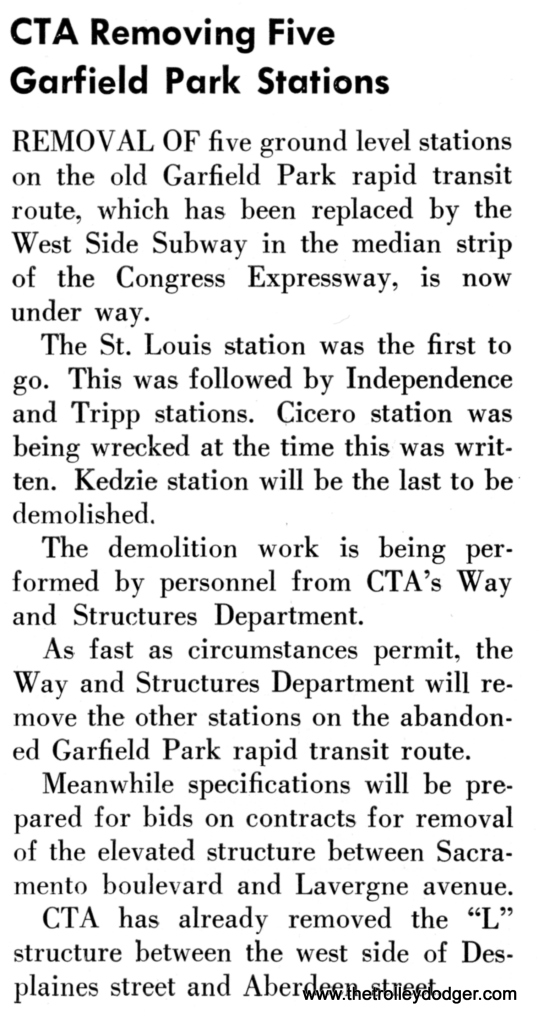
The Garfield Park "L" crossed over railroad tracks at about 4600 West. Interestingly, note that between the two sides of the railroad embankment, the alley between Harrison and Flournoy is not quite in the same location.

The Garfield Park “L” crossed over railroad tracks at about 4600 West. Interestingly, note that between the two sides of the railroad embankment, the alley between Harrison and Flournoy is not quite in the same location.

Recent Correspondence

We recently wrote to fellow historian Andres Kristopans:

It has been my understanding for many years that the CTA right-of-way between the Lotus Tunnel (5400 W.) and Forest Park was planned for three tracks.

This is a self-evident fact; the tunnel has portals on both sides, there is room for a third track north of the existing two west of there, and the bridge over DesPlaines Avenue was obviously designed for three tracks.

The question of what this third track was intended for recently came up in a discussion on the Facebook Chicago Elevated group. My source on that point, that the third track was intended for use by the Chicago Aurora & Elgin interurban, was my discussions and correspondence with George Krambles some 40 years ago).

But that did get me interested in looking into the matter further.

By 1940, planning for the new Congress expressway envisioned replacing the Garfield Park “L” with a line in the expressway median to Laramie Avenue (5200 W.), at least according to the film Streamlining Chicago.

This raises the question, when was the Lotus Tunnel planned, and why are there three tunnels?

The Congress median right-of-way was, to some extent, based on the existing Garfield setup. Garfield had four tracks as far as Paulina (1700 W.), although there had been plans to add two more tracks west of there in the late 1920s.

The three branches of the Met came together at Marshfield Junction, and this was undoubtedly seen as an undesirable situation, one that should be avoided in the future. By routing abandoning the Humboldt Park branch, and re-routing Logan Square into the new Milwaukee-Dearborn subway, this problem was solved.

But another goal of city planners was the gradual elimination of all the “L”s and their replacement by subways. The Lake Street “L” was targeted for this process, first with a plan to connect it to the Milwaukee-Dearborn subway just west of the Loop, and later by diverting it to the Congress median via a mile-long subway or elevated connection, either at Kedzie (3200 W.) or later, at 4600 W.

The Lake Street tracks were to be kept separate from other Congress line trains, therefore requiring a four-track right-of-way all the way to the subway portals just east of Halsted Street. The two unused portals were intended for a Clinton Street subway, a north-south branch that would have created a downtown subway loop in conjunction with the portions on Lake, Dearborn, and Congress.

Lake Street trains could have circled this loop, since otherwise, there was no obvious way to through-route them with another line at that time. It was thought that this change would have made it possible to tear down half of the Loop “L”, namely the Lake Street and Wabash Avenue legs, the exact opposite of what the City hoped to do in the 1970s.

So, the Congress median line, in the planning stages, had space enough for four tracks from Halsted to wherever the Lake line could have been brought in, which could have been as far as 4600 W.

This still does not explain why planners thought there should be three tracks starting at the Lotus Tunnel (5400 W.) and heading west.

As far back as 1945, it was expected that the CA&E tracks running through Forest Park, and the B&OCT, would run in an open cut in the expressway through suburban Oak Park. There are Cook County plans with such illustrations.

CRT leased CA&E’s tracks west of Laramie, and CA&E leased CRT’s tracks east of there, an arrangement that largely resulted in a wash financially for both companies (and, later, CRT’s successor, the CTA).

In the stretch between Forest Park and Laramie, the CA&E operated what amounted to an express service, and CRT, locals. There was a passing track at Gunderson, where express trains could pass slower locals.

That was the “old” way of operating a railroad, one increasingly at odds with the more modern way of doing things. It was labor-intensive and required a high level of competence; split-second timing, in fact.

IMHO, the solution to this in the new plan was simply to keep the locals and expresses separated. There would be two tracks for the CRT locals and one for the CA&E expresses.

As the highway plans neared fruition, the CA&E reported in 1950 that they lacked the funds to build new tracks in a highway right-of-way west of Austin Boulevard. CA&E owned the current trackage west of Laramie Avenue. The City of Chicago only had responsibility to build the Congress expressway as far as the city limits (Austin, 6000 W.).

The Lotus Tunnel was needed all along, because there needed to be some way to connect the CA&E tracks with CRT’s, and it made sense to have the new track alignment run on the south side of the highway footprint, parallel to the B&OCT. It must have been planned early on, perhaps as far back as 1945.

The CTA proposed taking over the right-of-way to Forest Park in 1952, as a way to solve the problems with CA&E. By then, the interurban had already decided not to run downtown on CTA’s tracks. The CTA had abandoned the Westchester branch in December 1951, as a means of saving money. So, CA&E no longer had income to offset the cost of using CTA’s tracks. Continuing operations into the City would be a drain of CA&E’s coffers, whatever the merits pro and con would have been for running on the Van Buren Street temporary trackage.

The highway planners, in the early 1950s, understood that if CA&E had been unable to connect with the CTA somewhere, this would have immediately put them out of business. Hence the county was very much interested in a solution to this problem. CA&E said they could not afford to build new tracks and facilities in the two miles or so of the relocated right-of-way between Austin Boulevard and DesPlaines Avenue.

All the more reason not to change the plans, likely made circa 1945, for three tracks in the new section. Cook County government did not want to be the cause of CA&E’s demise.

It was fortunate that the CTA stepped in and offered a creative solution to this problem, which also allowed them, as a result, to continue operating service to Forest Park.

So, in 1953 CA&E sold their right-of-way to the county as far west as DesPlaines Avenue (but not the river crossing, not until 1957), and the CTA purchased their fixed assets, the tracks, signals, stations, etc., which would all need to be replaced anyway.

This gave the CTA “skin in the game” to continue operating service to Forest Park. The plan to hand off CA&E riders to the CTA at DesPlaines Avenue did not come about until 1953. This is evidenced both in contemporary newspaper reports, and in how the Forest Park Terminal was hurriedly altered at practically the last minute to adopt the new arrangements.

Until then, it was expected that this handoff would take place at Laramie Avenue, where CA&E’s tracks ended and CTA’s began. There was also an intermediate plan to make Central Avenue the changeover point instead, as the CTA briefly considered building a bus-rail facility there instead of Forest Park. CTA made an artist’s rendering of this, which I have seen.

So, in sum, the plan for three tracks west of Laramie probably dated as far back as 1945, when engineering was being done for the expressway extension into the western suburbs. This plan was not changed when the facilities were built. The Lotus Tunnel has three tunnels, the right-of-way has space for three tracks (north of the existing two), and the steel bridge over the DesPlaines Avenue underpass was designed for three tracks.

By the time the final design work was done for the stations in this section, in the late 1950s, the CA&E was no longer an issue. The CTA had built what they needed built, and did the minimum that was necessary just in case it might have been possible for the CA&E to resume operations downtown.

And this is something that CA&E went back and forth on. Both CTA and CA&E seemed perfectly happy to separate their tracks from each other in 1953. It is my belief that, early on, the CA&E decided on a policy of a gradual or piecemeal abandonment, selling off parts of their line, and distributing the proceeds to their shareholders, instead of using it to buy new equipment.

This is based on the notion that the new highway itself had doomed the interurban, which in an era where there were no government subsidies, was likely the only logical conclusion.

The CTA still had to figure out where their yard would be for the new Congress service. In the late 1950s, they were still considering using Laramie Yard, which would need to be connected to the median line by an elevated connection, estimated to cost $1m.

Building a new yard at DesPlaines Avenue was a cost-saving alternative. But there was still the question of who owned the terminal there, as CA&E hadn’t sold it as part of the 1953 deal. It wasn’t part of the highway project, and in fact, in 1957, CA&E had filed suit to evict the CTA from the Forest Park terminal, as a way of putting pressure on the powers-that-be to get more money for the river crossing (which they did) and get the courts to agree to a “temporary” abandonment of passenger service (which they did).

That those two events happened almost simultaneously makes one wonder if perhaps there was a “quid pro quo” involved, although at this stage, there is probably no way to prove it.

Andre replies:

I will go along with your analysis. The whole problem was a lack of money. CTA in 1945 was set up on the premise of taking over all local transportation in the metro area, but there was a fatal flaw in that CTA had no outside income except by selling bonds. When the suburban bus and rail lines were found to be more highly valued than expected, CTA could not come up with enough money to buy them out. There were ideas to take over CA&E to Wheaton and North Shore to Waukegan, but nothing came of them because the various towns along the lines could not agree on financial assistance. Those directly on line demanded those further, especially along CA&E, kick in as they would also benefit, but places like Addison and Bloomingdale refused, so nothing could be agreed to and the idea died. It took until RTA in 1982 to finally do this, with federal money.

In many ways, CTA was an idea way ahead of its time. Remember CTA was the very first “transit authority”. Before you had municipal operations like Cleveland where city took over failing private operations, but this was the first “independent governmental body” with jurisdiction not based on municipal boundaries. Too bad nobody thought to give it taxing authority at the time, as everyone thought once relieved of regulation and duplication, transit would be profitable again, and in fact the idea was that CTA would only be a “temporary” owner, who after restructuring Chicago area transit into profitability would then sell the system to a private operator and use the proceeds to retire the bonds sold to buy and modernize the system. But because nothing could be done with the suburban operators, CTA became the permanent owner of the city system, for 74 years now.

There was the negative example of municipal ownership in New York City, where building the IND subway practically bankrupted the city. So it is no wonder that Chicago had to be dragged, kicking and screaming, into it.

The City of Chicago resisted the idea of public ownership for years, until all the various schemes for unifying CSL and CRT had failed, and there was no other viable option (by 1943). The situation might have festered, but the city had pledged to push through transit unification as a condition of accepting federal funds to pay for 45% of the Initial System of Subways (which ended up being more like 33% by the time the Milwaukee-Dearborn subway opened).

When WWII ended, the City resumed work on the unfinished Dearborn-Milwaukee subway, and soon work began in earnest on building the Congress superhighway. But there was no more federal money in the offing, and it was a struggle just to get the subway open by 1951.

The City had to float a $25m bond issue, which in essence reimbursed the transit improvement fund for monies that were taken from it during the Great Depression.

The scope of projects had to be scaled back. It seems as though the idea of re-routing Lake onto Congress was still alive as of 1948, but got put off into an indefinite future, due to the cost of building a mile long connection between the two lines, plus the Clinton subway.

Once CTA was in charge, they quickly identified the Lake Street “L”s problem area as the grade-level outer end, and not the elevated portion. And service was speeded up by using A/B skip-stop service, which became a model for the rest of the system.

The ultimate solution to Lake’s problems was not realized until 1962, when the line was elevated onto the Chicago & North Western embankment, followed by a proper yard west of Harlem.

The Van Buren temporary trackage gummed things up on Garfield for a few years, but inadvertently helped turn the eventual Congress line into something more like an express service. The CTA responded to the slow running times on Van Buren by closing some of the more minor stations on the line west of there, to the point where Garfield travel times in 1958 were largely the same as they had been prior to the September 1953 change.

This, in turn, influenced the locations of stations on the new Congress line. Whereas at first, plans called for merely replacing the old Garfield stations with new ones on Congress, over time, fewer new stations were planned.

The one glaring exception, of course, was Kostner, which was mandated by the City Council for political reasons, as there were three Aldermen lobbying for it (their wards were nearby). This one example of the “old” way of doing things turned out to be a dismal failure, and the station barely lasted a decade.

Andre:

Actually since 1913 CSL was a strange situation of private ownership but municipal operation. Chicago Surface Lines Joint Board of Management and Operation (the full name) was a city agency that directed day to day operations while CRys, CCRy, C&SCRys, all stock companies, were the actual owners. Probably only such arrangement anywhere. So in fact in 1945 city ceded control to an independent agency, though ownership transfer of assets took two more years to arrange.

CSL was not in trouble per se. Bankruptcy was more to keep franchise from expiring than any real financial collapse, whereas CRT was basically barely able to make payroll, with nothing left over for maintenance, etc. If CRT could not be foisted off on CSL, it would have been abandoned soon.

The Dean of Chicago Railfans

Raymond DeGroote, Jr. waits for DC Transit pre-PCC streetcar 1053 to descend a viaduct in Washington, DC on October 15, 1961, so he can get his picture. Streetcars in portions of the District of Columbia were forbidden to use overhead wire, and were powered by an underground conduit instead. (William C. Hoffman Photo)

Raymond DeGroote, Jr. waits for DC Transit pre-PCC streetcar 1053 to descend a viaduct in Washington, DC on October 15, 1961, so he can get his picture. Streetcars in portions of the District of Columbia were forbidden to use overhead wire, and were powered by an underground conduit instead. (William C. Hoffman Photo)

My friend Raymond DeGroote, Jr. will turn 91 years old on July 15th. He has been very active in Chicago’s railfan community since the 1940s. He was most likely a first-day rider when Chicago’s first subway opened on October 17, 1943, over 77 years ago.

He has taken thousands of photos over the years, starting in about 1948 with black-and-white, and color slides since 1954. Ray is a world traveler, has written numerous articles, and has given numerous presentations on a wide range of railfan subjects. His work has appeared in many books, and he has been a mentor to me in this field since we first met in the late 1970s.  He has worked tirelessly for many of the leading railfan organizations over the years.

Thanks to Ray, I became part of what he likes to call the “intelligence network” of railfans, in an era before the Internet made it possible to have a world of information at your fingertips.

Therefore, when I started work on my new book Chicago’s Lost “L”s, I could not think of anyone more deserving to dedicate the book to than Ray, who I consider the Dean of Chicago railfans. Once I received a small number of “author’s copies,” I sent one to him.

Here is his reply:

Thank you very much for my copy of Chicago’s Lost “L”s. The book is much appreciated and will provide many hours of pleasure reading and looking at the pictures.

I already found several very interesting ones. For example, I had never seen a picture of Willow or Calvary, the latter going even before my time, and the former just as I was becoming interested in the hobby. Also the view of Lower Level Wilson looking southeast (interesting angle) before the structure was above it, and Merchandise Mart under construction. Both must be relatively rare pictures.

On page 17 you had a view of a Robertson streetcar at 63rd. I remember those cars on South Side lines such as Riverdale, but we also had them up north on Riverview-Larrabee– slow cars, but with a commanding presence.

I am glad you included the Lost Interurbans section and also the Lost Terminals section. I vaguely remember Market Street, but know I rode out of Congress Street a few times, and many times out of North Water. That was even used as a display area to introduce and show off the new North Shore Silverliner paint scheme.

This is another good book to your credit. Keep up the good work.

Apparently, he did not initially notice that the book is dedicated to him, so I had to bring that to his attention.

He then wrote:

I am terribly embarrassed that I did not notice my name on the dedication page. I remember looking at the top of the page and seeing the Library of Congress data, and then going right to the Table of Contents. When I saw Northwestern “L” I turned right there to see what pictures you had included.

This is the first time anyone has dedicated a book to me, and I am very surprised and honored. It was totally unexpected. Thank you very much for this recognition, although I do not think I merit the title of “Dean”. “Old Man” might have been more appropriate as there are many others who deserve to be called “Dean.”

So, thank you again for the book dedication. It is a fine book, and I hope it will generate many sales.

Sincerely, Ray

When I can slip a few pictures in there that Ray DeGroote hasn’t seen before, I think I have done pretty well, because Ray has seen just about everything before.  And, he is characteristically modest about his accomplishments.  I can only hope for a small fraction of his wisdom, if I am lucky enough to reach his years.

Keep those cards and letters coming in, folks!

-David Sadowski

Our Latest Book, Now Available for Pre-Order:

Chicago’s Lost “L”s

Arcadia Publishing will release our new book Chicago’s Lost “L”s on July 12, 2021. Reserve your copy today!

From the back cover:

Chicago’s system of elevated railways, known locally as the “L,” has run continuously since 1892 and, like the city, has never stood still. It helped neighborhoods grow, brought their increasingly diverse populations together, and gave the famous Loop its name. But today’s system has changed radically over the years. Chicago’s Lost “L”s tells the story of former lines such as Garfield Park, Humboldt Park, Kenwood, Stockyards, Normal Park, Westchester, and Niles Center. It was once possible to take high-speed trains on the L directly to Aurora, Elgin, and Milwaukee, Wisconsin. The L started out as four different companies, two starting out using steam engines instead of electricity. Eventually, all four came together via the Union Loop. The L is more than a way of getting around. Its trains are a place where people meet and interact. Some say the best way to experience the city is via the L, with its second-story view. Chicago’s Lost “L”s is virtually a “secret history” of Chicago, and this is your ticket. David Sadowski grew up riding the L all over the city. He is the author of Chicago Trolleys and Building Chicago’s Subways and runs the online Trolley Dodger blog.

The Images of America series celebrates the history of neighborhoods, towns, and cities across the country. Using archival photographs, each title presents the distinctive stories from the past that shape the character of the community today. Arcadia is proud to play a part in the preservation of local heritage, making history available to all.

Title Chicago’s Lost “L”s
Images of America
Author David Sadowski
Edition illustrated
Publisher Arcadia Publishing (SC), 2021
ISBN 1467100007, 9781467100007
Length 128 pages

Chapters:
01. The South Side “L”
02. The Lake Street “L”
03. The Metropolitan “L”
04. The Northwestern “L”
05. The Union Loop
06. Lost Equipment
07. Lost Interurbans
08. Lost Terminals
09. Lost… and Found

Each copy purchased here will be signed by the author, and you will also receive a bonus facsimile of a 1926 Chicago Rapid Transit Company map, with interesting facts about the “L” on the reverse side.

The price of $23.99 includes shipping within the United States.

For Shipping to US Addresses:

For Shipping to Canada:

For Shipping Elsewhere:

NEW DVD:

A Tribute to the North Shore Line

To commemorate the 50th anniversary of the demise of the fabled North Shore Line interurban in January 2013, Jeffrey L. Wien and Bradley Criss made a very thorough and professional video presentation, covering the entire route between Chicago and Milwaukee and then some. Sadly, both men are gone now, but their work remains, making this video a tribute to them, as much as it is a tribute to the Chicago North Shore & Milwaukee.

Jeff drew on his own vast collections of movie films, both his own and others such as the late William C. Hoffman, wrote and gave the narration. Bradley acted as video editor, and added authentic sound effects from archival recordings of the North Shore Line.

It was always Jeff’s intention to make this video available to the public, but unfortunately, this did not happen in his lifetime. Now, as the caretakers of Jeff’s railfan legacy, we are proud to offer this excellent two-hour program to you for the first time.  The result is a fitting tribute to what Jeff called his “Perpetual Adoration,” which was the name of a stop on the interurban.

Jeff was a wholehearted supporter of our activities, and the proceeds from the sale of this disc will help defray some of the expenses of keeping the Trolley Dodger web site going.

Total time – 121:22

# of Discs – 1
Price: $19.99 (Includes shipping within the United States)

Keep those cards and letters coming in, folks!

-David Sadowski

Help Support The Trolley Dodger

This is our 269th post, and we are gradually creating a body of work and an online resource for the benefit of all railfans, everywhere. To date, we have received over 777,000 page views, for which we are very grateful.
You can help us continue our original transit research by checking out the fine products in our Online Store.
As we have said before, “If you buy here, we will be here.”
We thank you for your support.
DONATIONS
In order to continue giving you the kinds of historic railroad images that you have come to expect from The Trolley Dodger, we need your help and support. It costs money to maintain this website, and to do the sort of historic research that is our specialty.
Your financial contributions help make this web site better, and are greatly appreciated.

The Old School

CSL 5249 appears to be heading southbound on Larrabee, just north of Chicago Avenue. To the left, you see the Montgomery Ward complex, which has since been turned into residential. 5249 is signed to go to Vincennes and 88th, which probably makes this a Halsted car. (Joe L. Diaz Photo) M. E. writes: "The barn at 88th and Vincennes was originally the barn for the Kanakakee cars that ran from the Englewood L station at 63rd Place and Halsted, south on Halsted, southwest on Summit (a short street connecting Halsted with Vincennes), and Vincennes. When that service folded, the Chicago Surface Lines took over the barn. That barn closed early in my lifetime."

CSL 5249 appears to be heading southbound on Larrabee, just north of Chicago Avenue. To the left, you see the Montgomery Ward complex, which has since been turned into residential. 5249 is signed to go to Vincennes and 88th, which probably makes this a Halsted car. (Joe L. Diaz Photo) M. E. writes: “The barn at 88th and Vincennes was originally the barn for the Kanakakee cars that ran from the Englewood L station at 63rd Place and Halsted, south on Halsted, southwest on Summit (a short street connecting Halsted with Vincennes), and Vincennes. When that service folded, the Chicago Surface Lines took over the barn. That barn closed early in my lifetime.”

Today’s post features many “old school” railfan photos, all from the collections of William Shapotkin. In the 1930s and 40s, photographers such as Joe L. Diaz and Edward Frank, Jr. wandered all over Chicagoland, taking black and white photos of streetcars, “L” cars, and interurbans, which they printed up and sold at railfan meetings.

They were still selling these photos into the 1980s and 90s. Years ago, I met both of these gentlemen, who are sadly no longer with us. Perhaps the late Malcolm D. McCarter was the last of this breed. He started selling photos around 1942, and continued to do so for the next 75 years or so. He was also the last living original member of the Illinois Railway Museum.

Unfortunately, these photos often did not come with any documentation as to when, or where, these pictures were taken. We have written captions that include whatever we could determine. But I know that our highly informed, eagle-eyed readers will help us fill in some of the missing details.

When referring to individual photos, please use the file name (i.e. shapotkin262), which you can get by hovering your mouse over the image, instead of saying “the sixth photo down” or some such. We thank you in advance for helping us with these, and let’s thank Bill Shapotkin again for graciously sharing them with us.

You also might want to consider a trip to Indianapolis to attend this year’s Hoosier Traction Meet, which Mr. Shapotkin runs. You can view a flyer (in PDF form) with all the relevant information here.

-David Sadowski

PS- At the end of this post, you will also find a blurb for our upcoming book Chicago’s Lost “L”s, to be released on July 12 from Arcadia Publishing. So far, we have received orders for more than 70 copies, for which we are very grateful.

FYI, we also have a Facebook auxiliary for the Trolley Dodger, which currently has 368 members.

From the Collections of William Shapotkin

CSL Pullman 172. Daniel Joseph has identified this as the intersection of Ogden, Cermak, and Springfield.

CSL Pullman 172. Daniel Joseph has identified this as the intersection of Ogden, Cermak, and Springfield.

north destination Navy Pier. I'd like to add that I see so many trolley poles on the cars, going in both directions, that I think this place was the south terminal which was just north of 93rd St. South of 93rd St., the tracks were used for only a short distance by 93rd/95th St. cars."

CSL 5638, signed for Navy Pier, may be running on the Stony Island route. M. E. writes, “The caption is undoubtedly correct that these are Stony Island cars that had the
north destination Navy Pier. I’d like to add that I see so many trolley poles on the cars, going in both directions, that I think this place was the south terminal which was just north of 93rd St. South of 93rd St., the tracks were used for only a short distance by 93rd/95th St. cars.”

CSL 2803 is southbound on Ashland. (Joe L. Diaz Photo)

CSL 2803 is southbound on Ashland. (Joe L. Diaz Photo)

This picture, taken on April 12, 1915, shows some window damage to CSL car 6063.

This picture, taken on April 12, 1915, shows some window damage to CSL car 6063.

CSL 6101, signed for 35th Street. Chris Cole says this "appears to be taken at the Cottage Grove car barn at 38th Street. The Ida B Welles public housing project 2 story buildings are in the background. The Wells Homes ran from Cottage Grove to King Drive and 35th to Pershing Rd (39th). I also note that there are a number of overhead lines that would be present on the driveway to the barn. I believe that the 35th streetcar used the Cottage Grove barn from 1946 to 1951."

CSL 6101, signed for 35th Street. Chris Cole says this “appears to be taken at the Cottage Grove car barn at 38th Street. The Ida B Welles public housing project 2 story buildings are in the background. The Wells Homes ran from Cottage Grove to King Drive and 35th to Pershing Rd (39th). I also note that there are a number of overhead lines that would be present on the driveway to the barn. I believe that the 35th streetcar used the Cottage Grove barn from 1946 to 1951.”

CSL 2601 on the 111th Street line. (Joe L. Diaz Photo)

CSL 2601 on the 111th Street line. (Joe L. Diaz Photo)

CSL 1455. (Joe L. Diaz Photo)

CSL 1455. (Joe L. Diaz Photo)

CSL 2745. (Joe L. Diaz Photo) Andre Kristopans says this is "looking W down Wrightwood from Lincoln on Lincoln Carhouse leads - car is pulling out to do a Riverview-Larrabee run." Daniel Joseph adds, "Possibly at Wrightwood, Lincoln & Sheffield at car barn."

CSL 2745. (Joe L. Diaz Photo) Andre Kristopans says this is “looking W down Wrightwood from Lincoln on Lincoln Carhouse leads – car is pulling out to do a Riverview-Larrabee run.” Daniel Joseph adds, “Possibly at Wrightwood, Lincoln & Sheffield at car barn.”

CSL 2599 on the Brandon-Brainard line. (Joe L. Diaz Photo)

CSL 2599 on the Brandon-Brainard line. (Joe L. Diaz Photo)

CSL 419 at the east end of the Chicago Avenue line on December 27, 1946.

CSL 419 at the east end of the Chicago Avenue line on December 27, 1946.

CSL 5653, signed for Ashland. (Joe L. Diaz Photo)

CSL 5653, signed for Ashland. (Joe L. Diaz Photo)

CSL 2730 and 2728. (Joe L. Diaz Photo) Andre Kristopans: "Open yard on west side of Lincoln carhouse looking south."

CSL 2730 and 2728. (Joe L. Diaz Photo) Andre Kristopans: “Open yard on west side of Lincoln carhouse looking south.”

CSL 2731 and 1346. (Joe L. Diaz Photo) Andre Kristopans: "Open yard on west side of Lincoln carhouse looking south."

CSL 2731 and 1346. (Joe L. Diaz Photo) Andre Kristopans: “Open yard on west side of Lincoln carhouse looking south.”

CSL 3315 on the 67-69-71 route.

CSL 3315 on the 67-69-71 route.

CSL 5154.

CSL 5154.

CSL 5702, signed for 93rd and Stony Island. Our resident south side expert M. E. writes: "I'm going to hazard a guess as to where this picture was taken. But first, I present my case. The destination sign on the first car says "Stony Island-93rd"; the sign on the second car says (I think) "Stony Island-Downtown" -- yet both cars are on the same track, heading in the same direction. Why would that happen? It might happen if these were special fan trips, one car following the other, oblivious to their destination signs. Or it might simply be two Stony Island cars heading to 93rd St., but the sign on the second car is wrong. Another factor to consider is that the tracks on Stony Island ran in the street south to 69th St., but south of 69th, they had their own right-of-way between the north- and south-bound auto traffic lanes. In this picture, I believe I see a separation between the tracks and the car lane. Therefore this picture was taken south of 69th St. But the best clue, by far, is the round sign in the distance: "Ruby OK used cars." The dealership was Ruby Chevrolet. I went to Google and looked up "ruby chevrolet used car location south side chicago". Up came a link to a Tribune obituary about Richard Ruby, car dealer and attorney, dated 8 December 2014. In that obituary, it says Ruby's lot was at 72nd and Stony Island. Next, consider the railroad crossing sign. It is a dinky sign with no flashing lights. That would indicate a crossing that was lightly used by trains. I submit that this is the trackage used by the Baltimore and Ohio railroad that started at about 71st and Dorchester (as an offshoot from the Illinois Central main line), then ran southeast, along the ground, through South Shore and to the South Chicago neighborhood. In Google maps, if you enter "73rd and Stony Island Chicago", you will see the path used by that trackage. It crossed Stony Island just south of 73rd. (This railroad trackage lasted a long time, because the B&O did not want to give it up. So, every day at 3 p.m., they ran a diesel engine and caboose -- maybe a few freight cars too -- down that track. Motorists mostly ignored the rail crossing signs, so the train had to proceed very slowly and blow its horn constantly.) So, I think this photo's location is the southeast corner of 73rd and Stony Island, looking north. North of 73rd, Stony Island tracks also carried South Deering cars, which ran from the Jackson Park L at 63rd and Dorchester, south to 64th, east to Stony Island, south to 73rd, then east on 73rd. In the photo, South Deering cars made the turn to the right, whereas Stony Island cars continued straight ahead. Gee, that was much fun to deduce!" Andre Kristopans concurs: "Looking north on Stony at 73rd. RR crossing just out of picture to left was the old B&O Brookdale line, once the main line into Chicago." Mitch Markovitz adds: "That's my old neighborhood. Both cars southbound at 73rd and Stony with the tracks for South Deering branching off. It doesn't really matter what the destination sign reads on the second car. Changing the sign won't make the car stray off to distant lines. Either a pull out, a pull in, or someone futzing and changing the sign."

CSL 5702, signed for 93rd and Stony Island. Our resident south side expert M. E. writes: “I’m going to hazard a guess as to where this picture was taken. But first, I present my case. The destination sign on the first car says “Stony Island-93rd”; the sign on the second car says (I think) “Stony Island-Downtown” — yet both cars are on the same track, heading in the same direction. Why would that happen? It might happen if these were special fan trips, one car following the other, oblivious to their destination signs. Or it might simply be two Stony Island cars heading to 93rd St., but the sign on the second car is wrong. Another factor to consider is that the tracks on Stony Island ran in the street
south to 69th St., but south of 69th, they had their own right-of-way between the north- and south-bound auto traffic lanes. In this picture, I believe I see a separation between the tracks and the car lane. Therefore this picture was taken south of 69th St. But the best clue, by far, is the round sign in the distance: “Ruby OK used cars.” The dealership was Ruby Chevrolet. I went to Google and looked up “ruby chevrolet used car location south side chicago”. Up came a link to a Tribune obituary about Richard Ruby, car dealer and attorney, dated 8 December 2014. In that obituary, it says Ruby’s lot was at 72nd and Stony Island. Next, consider the railroad crossing sign. It is a dinky sign with no flashing lights. That would indicate a crossing that was lightly used by trains. I submit that this is the trackage used by the Baltimore and Ohio railroad that started at about 71st and Dorchester (as an offshoot from the Illinois Central main line), then ran southeast, along the ground, through South Shore and to the South Chicago neighborhood. In Google maps, if you enter “73rd and Stony Island Chicago”, you will see the path used by that trackage. It crossed Stony Island just south of 73rd. (This railroad trackage lasted a long time, because the B&O did not want to give it up. So, every day at 3 p.m., they ran a diesel engine and caboose — maybe a few freight cars too — down that track. Motorists mostly ignored the rail crossing signs, so the train had to proceed very slowly and blow its horn constantly.) So, I think this photo’s location is the southeast corner of 73rd and Stony Island, looking north. North of 73rd, Stony Island tracks also carried South Deering cars, which ran from the Jackson Park L at 63rd and Dorchester, south to 64th, east to Stony Island, south to 73rd, then east on 73rd. In the photo, South Deering cars made the turn to the right, whereas Stony Island cars continued straight ahead. Gee, that was much fun to deduce!”
Andre Kristopans concurs: “Looking north on Stony at 73rd. RR crossing just out of picture to left was the old B&O Brookdale line, once the main line into Chicago.” Mitch Markovitz adds: “That’s my old neighborhood. Both cars southbound at 73rd and Stony with the tracks for South Deering branching off. It doesn’t really matter what the destination sign reads on the second car. Changing the sign won’t make the car stray off to distant lines. Either a pull out, a pull in, or someone futzing and changing the sign.”

CSL 5171.

CSL 5171.

CSL 5909 on Route 47.

CSL 5909 on Route 47.

CSL 1868. I can't make out the destination sign. (Joe L. Diaz Photo) Michael Franklin: "This is the 5200 block of Harrison St, Chicago. Buildings are still there."

CSL 1868. I can’t make out the destination sign. (Joe L. Diaz Photo) Michael Franklin: “This is the 5200 block of Harrison St, Chicago. Buildings are still there.”

CSL 419, at the east end of the Chicago Avenue line on December 27, 1946.

CSL 419, at the east end of the Chicago Avenue line on December 27, 1946.

CSL snow sweeper E1. Don's Rail Photos: "E1, sweeper, was built by Lewis and Fowler in 1895 as Chicago Rys 2. It was renumbered E1 in 1913 and became CSL E1 in 1914. It was retired on November 24, 1950." (Joe L. Diaz Photo)

CSL snow sweeper E1. Don’s Rail Photos: “E1, sweeper, was built by Lewis and Fowler in 1895 as Chicago Rys 2. It was renumbered E1 in 1913 and became CSL E1 in 1914. It was retired on November 24, 1950.” (Joe L. Diaz Photo)

Not sure which CTA snow plow this is. (Joe L. Diaz Photo) Bill Wasik says this "shows an eastbound snowplow on 92nd St. as it approaches Baltimore Avenue. Can't identify the plow, but two buildings of note in this photo are still standing. These include the glass-bricked neo-Romanesque banquet hall at the far right. This is an 1891 corner block at the northwest corner of Baltimore Ave. Also visible one block to the west is a bank building that once was the headquarters of the Steel City National Bank, a facility mired in scandal during the early 1970s."

Not sure which CTA snow plow this is. (Joe L. Diaz Photo) Bill Wasik says this “shows an eastbound snowplow on 92nd St. as it approaches Baltimore Avenue. Can’t identify the plow, but two buildings of note in this photo are still standing. These include the glass-bricked neo-Romanesque banquet hall at the far right. This is an 1891 corner block at the northwest corner of Baltimore Ave. Also visible one block to the west is a bank building that once was the headquarters of the Steel City National Bank, a facility mired in scandal during the early 1970s.”

CSL/CTA salt car AA10. Don's Rail Photos: "AA10, salt car, was built by CUT in 1899 as CUT 4492. It was rebuilt as 1445 in 1911 and became CSL 1445 in 1914. It was rebuilt as (a) salt car in 1930 and renumbered AA10 on October 1, 1941. It was retired on February 18, 1955."

CSL/CTA salt car AA10. Don’s Rail Photos: “AA10, salt car, was built by CUT in 1899 as CUT 4492. It was rebuilt as 1445 in 1911 and became CSL 1445 in 1914. It was rebuilt as (a) salt car in 1930 and renumbered AA10 on October 1, 1941. It was retired on February 18, 1955.”

CSL 3307 is westbound on Montrose, about to cross under the Chicago & North Western railroad at about 1800 West.

CSL 3307 is westbound on Montrose, about to cross under the Chicago & North Western railroad at about 1800 West.

The Chicago Surface Lines tracks were extended to the site of A Century of Progress in 1933. This could be from that year, as a shelter is under construction. We are looking south.

The Chicago Surface Lines tracks were extended to the site of A Century of Progress in 1933. This could be from that year, as a shelter is under construction. We are looking south.

CSL 840 under the "L". (Joe L. Diaz Photo)

CSL 840 under the “L”. (Joe L. Diaz Photo)

CSL 5621, signed to go to Belmont and Clybourn. This picture seems to date to the mid-1930s.

CSL 5621, signed to go to Belmont and Clybourn. This picture seems to date to the mid-1930s.

CSL 204. (Joe L. Diaz Photo)

CSL 204. (Joe L. Diaz Photo)

A Chicago Surface Lines trolley bus on Route 86 - Narragansett. This route used trolley buses from 1930 to 1953.

A Chicago Surface Lines trolley bus on Route 86 – Narragansett. This route used trolley buses from 1930 to 1953.

Chicago Motor Coach Company double-decker bus 500, built in 1923.

Chicago Motor Coach Company double-decker bus 500, built in 1923.

Andre Kritsopans: "Looking west towards east end of "east house" at 77th, basically where Wentworth south of 77th would be. 77th until 1970s had two separate buildings, with an open area between them, until the open area was roofed over. The pile of junk in front is 77th scrap pile, looks like mostly boilers and other building parts."

Andre Kritsopans: “Looking west towards east end of “east house” at 77th, basically where Wentworth south of 77th would be. 77th until 1970s had two separate buildings, with an open area between them, until the open area was roofed over. The pile of junk in front is 77th scrap pile, looks like mostly boilers and other building parts.”

CSL 3286. Might this be Kedzie Station (car house)? (Joe L. Diaz Photo)

CSL 3286. Might this be Kedzie Station (car house)? (Joe L. Diaz Photo)

On April 16, 1946, Mrs. Edith Sands and her family were living in the body of former CSL streetcar 1384. There was a housing shortage once WWII ended. There is a different picture of the interior of this makeshift home in our book Chicago Trolleys.

On April 16, 1946, Mrs. Edith Sands and her family were living in the body of former CSL streetcar 1384. There was a housing shortage once WWII ended. There is a different picture of the interior of this makeshift home in our book Chicago Trolleys.

CSL 3296 is on Montrose. Could this be westbound at Welles Park? Note the Packard at left.

CSL 3296 is on Montrose. Could this be westbound at Welles Park? Note the Packard at left.

CSL 1415 is on Racine at Belden on July 9, 1946.

CSL 1415 is on Racine at Belden on July 9, 1946.

While researching the above photo, I ran across another one, taken at the same location but from the opposite direction:

CSL 1415, built originally in 1906, is at work on Racine at Belden on the WEBSTER RACINE route. The photographer is unknown. An original Kodachrome from February 1942. (John F. Bromley Collection)

CSL 1415, built originally in 1906, is at work on Racine at Belden on the WEBSTER RACINE route. The photographer is unknown. An original Kodachrome from February 1942. (John F. Bromley Collection)

CSL 5241 is southbound on Through Route 8, Halsted. Bill Shapotkin adds, "The car (signed for destination of 111/Sacramento and probably a school tripper for Morgan Park High School) is standing W/B in 111th St JUST EAST of Vincennes Ave. That house with the distinctive roof (left) still-stands today. View looks east."

CSL 5241 is southbound on Through Route 8, Halsted. Bill Shapotkin adds, “The car (signed for destination of 111/Sacramento and probably a school tripper for Morgan Park High School) is standing W/B in 111th St JUST EAST of Vincennes Ave. That house with the distinctive roof (left) still-stands today. View looks east.”

CSL 5436 is westbound on 79th Street at Ashland on June 11, 1948.

CSL 5436 is westbound on 79th Street at Ashland on June 11, 1948.

CSL 5635 at Navy Pier.

CSL 5635 at Navy Pier.

CTA 310.

CTA 310.

I assume that CTA PCC 4300 is turning from Archer onto Clark, running a northbound trip on Route 42 - Halsted-Downtown, and that we are looking to the southwest. Note the Rock Island train in the background. Metra Rock Island District trains still use these tracks.

I assume that CTA PCC 4300 is turning from Archer onto Clark, running a northbound trip on Route 42 – Halsted-Downtown, and that we are looking to the southwest. Note the Rock Island train in the background. Metra Rock Island District trains still use these tracks.

The same location today.

The same location today.

Postwar PCC 4233 being delivered from Pullman.

Postwar PCC 4233 being delivered from Pullman.

Miles Beitler writes: "I searched the listings for the auto service garage on the right side of the photo. I found a listing for "Ragalie Bros. Auto Service" with a location of 3939 West 5th Avenue, a diagonal street. 3939 is at the intersection of 5th Avenue and Harrison Street. When I checked the 1932 telephone book I found (a) listing for Micheli Restaurant. That location -- 3953 West Harrison -- is also near the intersection of Harrison and 5th Avenue and it does seem to fit the photo. Moreover, I believe there was a streetcar line on 5th Avenue which ended at Harrison. Of course, the expressway was not there in 1932. Also note the horse drawn Bowman Dairy wagon on the right. I believe that Bowman Dairy used horse drawn delivery wagons well into the 1920s."

Miles Beitler writes: “I searched the listings for the auto service garage on the right side of the photo. I found a listing for “Ragalie Bros. Auto Service” with a location of 3939 West 5th Avenue, a diagonal street. 3939 is at the intersection of 5th Avenue and Harrison Street. When I checked the 1932 telephone book I found (a) listing for Micheli Restaurant. That location — 3953 West Harrison — is also near the intersection of Harrison and 5th Avenue and it does seem to fit the photo. Moreover, I believe there was a streetcar line on 5th Avenue which ended at Harrison. Of course, the expressway was not there in 1932. Also note the horse drawn Bowman Dairy wagon on the right. I believe that Bowman Dairy used horse drawn delivery wagons well into the 1920s.”

A note re: the picture above. The addresses of the businesses and locations of buildings would seem to confirm that this is Fifth Avenue, just east of Pulaski Road, with Harrison Street as the cross-street in the background. The tracks that end in the middle of the street were for the Madison-Fifth line. When CSL introduced the new single-ended Peter Witts in 1929, they were used on Madison, and a loop was apparently devised for Madison-Fifth by extending these tracks around the block, via Pulaski and Harrison, to form a triangular-shaped loop. The new northbound track on Pulaski was separate from the existing streetcar tracks, so as not to interfere with Pulaski service. In late 1936, CSL put PCC cars on Madison, and these were also used on Madison-Fifth.

This branch line was discontinued on February 22, 1954, when construction of the nearby Congress Expressway reached this area, just to the north. Fifth Avenue was not a major street and would have required a complicated bridge over the highway, crossing at an angle. So it was decided to truncate Fifth instead.

The Garfield Park “L” ran east and west at this point, just south of the alley mid-block between Harrison and Flournoy Streets. The “L” would have been just out of view to the right of this picture. It intersected with Fifth Avenue at Pulaski Road, just behind the photographer.

In this zoomed-in view of the previous picture, the building in the distance matches the building in the next picture, taken in 1953.

CTA 1725 is operating as a one-man shuttle car on the Madison-Fifth branch line on Route 20 on February 15, 1953. The car is heading southwest on Fifth Avenue approaching Harrison Street and Pulaski Avenue, which was the end of the line near the adjacent Garfield Park "L" station. I thought at first that the date might actually have been 1954, but subsequent research shows the 1953 date to be correct. (Robert Selle Photo)

CTA 1725 is operating as a one-man shuttle car on the Madison-Fifth branch line on Route 20 on February 15, 1953. The car is heading southwest on Fifth Avenue approaching Harrison Street and Pulaski Avenue, which was the end of the line near the adjacent Garfield Park “L” station. I thought at first that the date might actually have been 1954, but subsequent research shows the 1953 date to be correct. (Robert Selle Photo)

In addition, this photo, taken from the Pulaski Road station on the Garfield Park “L” station, shows buildings on the north side of Fifth Avenue that match up with those in the shapotkin308 image above. Note it’s the same exact fire escape:

On Sunday, September 13, 1953, CTA one-man shuttle car 3175 is on Fifth Avenue at Pulaski (Crawford), the west end of the Fifth Avenue line. This had been a branch line from route 20 - Madison. From this point, the cars looped via Pulaski and Harrison before going back NE on Fifth. The photographer was on the Garfield Park "L" at Pulaski. The "L" was heading east and west at this point, just south of where the Eisenhower expressway is today. This "L" station remained in use until June 1958. Streetcar service on Fifth Avenue continued into early 1954. The Fifth Avenue line used gauntlet track on Pulaski, so as not to interfere with Pulaski streetcars. This is confirmed by studying the 1948 supervisor's track map. Danny Joseph adds, "As a child I lived near this triangle when both Pulaski and Fifth still operated street cars and Harrison did not. I was very fascinated by the gauntlet on Pulaski which was the first time I saw such construction." (Bob Selle Photo)

On Sunday, September 13, 1953, CTA one-man shuttle car 3175 is on Fifth Avenue at Pulaski (Crawford), the west end of the Fifth Avenue line. This had been a branch line from route 20 – Madison. From this point, the cars looped via Pulaski and Harrison before going back NE on Fifth. The photographer was on the Garfield Park “L” at Pulaski. The “L” was heading east and west at this point, just south of where the Eisenhower expressway is today. This “L” station remained in use until June 1958. Streetcar service on Fifth Avenue continued into early 1954. The Fifth Avenue line used gauntlet track on Pulaski, so as not to interfere with Pulaski streetcars. This is confirmed by studying the 1948 supervisor’s track map. Danny Joseph adds, “As a child I lived near this triangle when both Pulaski and Fifth still operated street cars and Harrison did not. I was very fascinated by the gauntlet on Pulaski which was the first time I saw such construction.” (Bob Selle Photo)

The gas stations on the triangular-shaped corner of Harrison and Fifth also match, between the late 1920s photo and this one from 1950:

This birds-eye view of CTA 1744 was taken from the Pulaski Road "L" station on the Garfield Park branch in April 1950. However, what we are looking at may actually be a Madison-Fifth car at the west end of its route, ready to loop back via Pulaski and Harrison. Bill Shapotkin adds, "This image is looking E-N/E on Fifth Ave from the Garfield Pk 'L'...no question about it. The intersection behind the streetcar is Harrison."

This birds-eye view of CTA 1744 was taken from the Pulaski Road “L” station on the Garfield Park branch in April 1950. However, what we are looking at may actually be a Madison-Fifth car at the west end of its route, ready to loop back via Pulaski and Harrison. Bill Shapotkin adds, “This image is looking E-N/E on Fifth Ave from the Garfield Pk ‘L’…no question about it. The intersection behind the streetcar is Harrison.”

Now that we have determined where shapotkin308 was taken, it’s the presence of a late 1920s Franklin automobile that pins the date down to circa 1926-28. In 1929, the streetcar tracks on Fifth Avenue were extended around the block. Interestingly, the Franklin used an air-cooled engine, and the radiator grill on the car was simply for show. After the Franklin firm failed in 1934, it was succeeded by Aircooled Motors, which was later purchased by Preston Tucker, and provided the engines (water-cooled) for the short-lived 1948 Tucker Torpedo. Aircooled Motors survived Tucker and continued in operation until 1975, providing engines for many small airplanes and helicoptors.

CTA 6002 is southbound on Kedzie on June 22, 1950, having just passed the Garfield Park "L". Service at this station continued until June, 1958, since it was not in the path of the Congress Expressway.

CTA 6002 is southbound on Kedzie on June 22, 1950, having just passed the Garfield Park “L”. Service at this station continued until June, 1958, since it was not in the path of the Congress Expressway.

The same location today.

The same location today.

CSL 5656.

CSL 5656.

This could be the west end of the 75th Street route. CSL Pullmans 122, 126, and 392 are visible. (Joe L. Diaz Photo)

This could be the west end of the 75th Street route. CSL Pullmans 122, 126, and 392 are visible. (Joe L. Diaz Photo)

This photo has a lot of scratches, but it does show CSL 2510 at 75th and the lakefront. Presumably the negative was scratched from being printed many times. (M. D. McCarter Photo)

This photo has a lot of scratches, but it does show CSL 2510 at 75th and the lakefront. Presumably the negative was scratched from being printed many times. (M. D. McCarter Photo)

CSL 5993, on the 31st Street route, is running direct to the World's Fair (A Century of Progress), so this must be 1933-34. (Edward Frank, Jr. Photo)

CSL 5993, on the 31st Street route, is running direct to the World’s Fair (A Century of Progress), so this must be 1933-34. (Edward Frank, Jr. Photo)

CSL 6103 is running on Through Route 17 - Kedzie. (Edward Frank, Jr. Photo) Daniel Joseph: "Probably Kedzie & 30th St looking north at grade crossing."

CSL 6103 is running on Through Route 17 – Kedzie. (Edward Frank, Jr. Photo) Daniel Joseph: “Probably Kedzie & 30th St looking north at grade crossing.”

CSL 1942 is signed for Chicago Avenue. (Joe L. Diaz Photo)

CSL 1942 is signed for Chicago Avenue. (Joe L. Diaz Photo)

CSL 1466. This may be one of the cars that was usually used to train crews in the Van Buren Street tunnel under the Chicago River. (Joe L. Diaz Photo) Daniel Joseph says, "I believe this is at 18th St, Canalport & Normal."

CSL 1466. This may be one of the cars that was usually used to train crews in the Van Buren Street tunnel under the Chicago River. (Joe L. Diaz Photo) Daniel Joseph says, “I believe this is at 18th St, Canalport & Normal.”

CSL 3216 is signed for 51st and Central Park. M. E. writes: "Given that the destination sign reads "51 - Central Park", then this picture was taken from the northwest corner of 51st and Cottage Grove Ave., looking south. The 51st St. line's eastern terminal was actually at 55th St. and the Illinois Central railroad at Lake Park Ave. From there, the route headed west on 55th to Cottage Grove Ave., north to 51st St., and west on 51st St. So the car in this picture is making the turn from northbound Cottage Grove to westbound 51st." On the other hand, Graham Garfield writes, "Note the sign on the light pole that says “4A”. Illinois route 4A was a state highway from Joliet to downtown Chicago via Archer Ave. until 1967. Based on buildings in the background that are still extant, the angled street here is Archer and the car is deadheading from Archer carbarn (where the #51 was out of) to 51st St to start its run. We are looking northeast at Archer/Kedzie."

CSL 3216 is signed for 51st and Central Park. M. E. writes: “Given that the destination sign reads “51 – Central Park”, then this picture was taken from the northwest corner of 51st and Cottage Grove Ave., looking south. The 51st St. line’s eastern terminal was actually at 55th St. and the Illinois Central railroad at Lake Park Ave. From there, the route headed west on 55th to Cottage Grove Ave., north to 51st St., and west on 51st St. So the car in this picture is making the turn from northbound Cottage Grove to westbound 51st.” On the other hand, Graham Garfield writes, “Note the sign on the light pole that says “4A”. Illinois route 4A was a state highway from Joliet to downtown Chicago via Archer Ave. until 1967. Based on buildings in the background that are still extant, the angled street here is Archer and the car is deadheading from Archer carbarn (where the #51 was out of) to 51st St to start its run. We are looking northeast at Archer/Kedzie.”

CTA 5444 is one of two cars at Racine and 87th Street. (Joe L. Diaz Photo)

CTA 5444 is one of two cars at Racine and 87th Street. (Joe L. Diaz Photo)

CSL 3091 is signed for Elston and Lawrence. (Edward Frank, Jr. Photo)

CSL 3091 is signed for Elston and Lawrence. (Edward Frank, Jr. Photo)

CSL 3319, southbound on Damen. (Joe L. Diaz Photo) Daniel Joseph writes, "Probably Damen & 59th looking north at viaduct on the 5800 block."

CSL 3319, southbound on Damen. (Joe L. Diaz Photo) Daniel Joseph writes, “Probably Damen & 59th looking north at viaduct on the 5800 block.”

CSL 133 is signed for 75th and Lake Park. (Joe L. Diaz Photo) Daniel Joseph adds, "Probably 75th & Constance at the now abandoned B & O crossing."

CSL 133 is signed for 75th and Lake Park. (Joe L. Diaz Photo) Daniel Joseph adds, “Probably 75th & Constance at the now abandoned B & O crossing.”

CSL 3010 is signed for Elston-Downtown. Bill Wasik adds, "Shapotkin 294 shows the 4700 block of Elston Ave. looking north toward Lawrence Ave. The photo likely was taken in 1946-47. The large three-story commercial building seen in the distance behind the Drewrys billboard was part of the Bankers Life complex. Demolished in the 1990s, it was replaced by an apartment complex for seniors. Most of the other buildings in this scene are still standing."

CSL 3010 is signed for Elston-Downtown. Bill Wasik adds, “Shapotkin 294 shows the 4700 block of Elston Ave. looking north toward Lawrence Ave. The photo likely was taken in 1946-47. The large three-story commercial building seen in the distance behind the Drewrys billboard was part of the Bankers Life complex. Demolished in the 1990s, it was replaced by an apartment complex for seniors. Most of the other buildings in this scene are still standing.”

CSL 2619 is on the Brandon-Brainard line on the far reaches of Chicago's south side. (Joe L. Diaz Photo)

CSL 2619 is on the Brandon-Brainard line on the far reaches of Chicago’s south side. (Joe L. Diaz Photo)

CSL 3303 is eastbound on Montrose, having just crossed under the Chicago & North Western and the Ravenswood "L".

CSL 3303 is eastbound on Montrose, having just crossed under the Chicago & North Western and the Ravenswood “L”.

CSL 498 and 3085. I am unable to see the route signs, but at least we can tell this picture was taken in the 34th Ward. 498 is signed to go to North Western Station, which was a sign used on Milwaukee Avenue cars. Michael Franklin says we are "looking at the NW corner of Armitage & California."

CSL 498 and 3085. I am unable to see the route signs, but at least we can tell this picture was taken in the 34th Ward. 498 is signed to go to North Western Station, which was a sign used on Milwaukee Avenue cars. Michael Franklin says we are “looking at the NW corner of Armitage & California.”

CSL 5505 is on Through Route 8, (Halsted) signed to run to Vincennes and 88th. (Joe L. Diaz Photo) Bill Shapotkin adds: "Car #5505, working a S/B trip on Chicago Surface Lines (CSL -- a CTA predecessor) Rt #8 -- HALSTED is seen turning from E/B Division into S/B Crosby St on Chicago's North Side in this undated photo. View looks N/W. Normally cars would operate in Halsted all the way from Waveland Ave (3700 North) south to 86th St (as the south end-of-line was until December 4, 1949, 111th/Sacramento). Over the years, the moveable bridge over the North Branch of the Chicago River was out-of-service for repairs. Any time that happened, HALSTED cars (and later buses) detoured around the out-of-service bridge by operating E/B Division-S/B Crosby-Larrabee-W/B Chicago (or the reverse for N/B cars or buses). This car is taking that long-standing detour. The matter of the cantankerous bridge was finally resolved when it was replaced by a fixed (i.e.: non-moveable) bridge -- believe in the 1990s. My sincerest thanks to Andre Kristopans, who assisted in identifying the photo location."

CSL 5505 is on Through Route 8, (Halsted) signed to run to Vincennes and 88th. (Joe L. Diaz Photo) Bill Shapotkin adds: “Car #5505, working a S/B trip on Chicago Surface Lines (CSL — a CTA predecessor) Rt #8 — HALSTED is seen turning from E/B Division into S/B Crosby St on Chicago’s North Side in this undated photo. View looks N/W. Normally cars would operate in Halsted all the way from Waveland Ave (3700 North) south to 86th St (as the south end-of-line was until December 4, 1949, 111th/Sacramento). Over the years, the moveable bridge over the North Branch of the Chicago River was out-of-service for repairs. Any time that happened, HALSTED cars (and later buses) detoured around the out-of-service bridge by operating E/B Division-S/B Crosby-Larrabee-W/B Chicago (or the reverse for N/B cars or buses). This car is taking that long-standing detour. The matter of the cantankerous bridge was finally resolved when it was replaced by a fixed (i.e.: non-moveable) bridge — believe in the 1990s. My sincerest thanks to Andre Kristopans, who assisted in identifying the photo location.”

CSL 2595 is on the 87th Street route, possibly prior to the extension of this line in 1937, which was the final streetcar extension in Chicago.

CSL 2595 is on the 87th Street route, possibly prior to the extension of this line in 1937, which was the final streetcar extension in Chicago.

CSL 5083 is signed for Pitney and Archer. (Joe L. Diaz Photo)

CSL 5083 is signed for Pitney and Archer. (Joe L. Diaz Photo)

CSL 5130, signed for 31st and Lake Park, appears to be eastbound on 31st, having just passed the South Side "L". (Joe L. Diaz Photo)

CSL 5130, signed for 31st and Lake Park, appears to be eastbound on 31st, having just passed the South Side “L”. (Joe L. Diaz Photo)

CSL 927.

CSL 927.

CSL 1145. (Robert W. Gibson Photo)

CSL 1145. (Robert W. Gibson Photo)

CTA snow plow E-207. (Joe L. Diaz Photo)

CTA snow plow E-207. (Joe L. Diaz Photo)

This is actually a picture of CTA 225 at Dearborn and Kinzie, on a December 18, 1955 fantrip, where it was disguised as 144 with a piece of oilcloth. The story goes that Maury Klebolt, who organized this trip, had advertised that car 144 would be used, and for some reason, it was not available that day. 225 was later sold to the Seashore Trolley Museum, where it remains today, while 144 is at the Illinois Railway Museum.

This is actually a picture of CTA 225 at Dearborn and Kinzie, on a December 18, 1955 fantrip, where it was disguised as 144 with a piece of oilcloth. The story goes that Maury Klebolt, who organized this trip, had advertised that car 144 would be used, and for some reason, it was not available that day. 225 was later sold to the Seashore Trolley Museum, where it remains today, while 144 is at the Illinois Railway Museum.

CTA 225 at Clark and Cermak on a February 16, 1957 Central Electric Railfans' Association fantrip.

CTA 225 at Clark and Cermak on a February 16, 1957 Central Electric Railfans’ Association fantrip.

CTA 144 at 81st and Emerald on the final Chicago streetcar fantrip on June 15, 1958.

CTA 144 at 81st and Emerald on the final Chicago streetcar fantrip on June 15, 1958.

Chicao Aurora &Elgin wood car 318. Don's Rail Photos: "318 was built by Jewett Car Co in 1914. It had steel sheating and was modernized in 1944. It was sold to Wisconsin Electric Railway Historical Society in 1962. It was wrecked in transit and the parts were sold to IRM to restore 321." (Joe L. Diaz Photo)

Chicago Aurora & Elgin wood car 318. Don’s Rail Photos: “318 was built by Jewett Car Co in 1914. It had steel sheating and was modernized in 1944. It was sold to Wisconsin Electric Railway Historical Society in 1962. It was wrecked in transit and the parts were sold to IRM to restore 321.” (Joe L. Diaz Photo)

CA&E 10. Don's Rail Photos: "10 was built by Niles Car in 1902. It was rebuilt with a baggage compartment in 1910. It was later removed, but then reinstalled in April 1933 for funeral service. It was wrecked September 10, 1948, and scrapped." (Joe L. Diaz Photo)

CA&E 10. Don’s Rail Photos: “10 was built by Niles Car in 1902. It was rebuilt with a baggage compartment in 1910. It was later removed, but then reinstalled in April 1933 for funeral service. It was wrecked September 10, 1948, and scrapped.” (Joe L. Diaz Photo)

CA&E 455 at the front of a Chicago Limited. Not sure what the workers at left are doing.

CA&E 455 at the front of a Chicago Limited. Not sure what the workers at left are doing.

CA&E electric loco 2002 is at left. I can't make out the numbers on the steel cars at left.

CA&E electric loco 2002 is at left. I can’t make out the numbers on the steel cars at left.

CA&E 48 at left, with 315 at right. Can this be Wheaton? Don's Rail Photos: "315 was built by Kuhlman Car Co in 1909, #404. It was modernized at an unknown date and sold to Rockhill Trolley Museum in 1962." (Joe L. Diaz Photo)

CA&E 48 at left, with 315 at right. Can this be Wheaton? Don’s Rail Photos: “315 was built by Kuhlman Car Co in 1909, #404. It was modernized at an unknown date and sold to Rockhill Trolley Museum in 1962.” (Joe L. Diaz Photo)

CA&E 320 at an unknown location. (Joe L. Diaz Photo)

CA&E 320 at an unknown location. (Joe L. Diaz Photo)

CA&E 410 heads up a two-car train in Wheaton.

CA&E 410 heads up a two-car train in Wheaton.

CA&E 409 at the Wheaton Shops.

CA&E 409 at the Wheaton Shops.

CA&E 452 leads an Aurora-Batavia Limited.

CA&E 452 leads an Aurora-Batavia Limited.

Not sure where this is. Could it be Wheaton? Dann Chamberlin: "Yes, it is. The Wheaton yard and shops are to the rear of the photographer. The photo looks east towards downtown Wheaton. Note the tower of the DuPage County courthouse in the right-rear of the photo."

Not sure where this is. Could it be Wheaton? Dann Chamberlin: “Yes, it is. The Wheaton yard and shops are to the rear of the photographer. The photo looks east towards downtown Wheaton. Note the tower of the DuPage County courthouse in the right-rear of the photo.”

CA&E 458 heads up a Wheaton local. Not sure where this is. Dann Chamberlin: "The train has just left the Main Street Glen Ellyn stop headed west towards Wheaton. The Main Street gate tower can be seen in the left-rear of the photo. To the right of 458 one can make out the tower of today's Glen Ellyn Civic Center. I attended junior high school in that building!"

CA&E 458 heads up a Wheaton local. Not sure where this is. Dann Chamberlin: “The train has just left the Main Street Glen Ellyn stop headed west towards Wheaton. The Main Street gate tower can be seen in the left-rear of the photo. To the right of 458 one can make out the tower of today’s Glen Ellyn Civic Center. I attended junior high school in that building!”

CA&E 459 at the front of a two-car train. Could this be Wheaton? Dann Chamberlin: "Again, yes it is. The photo looks like it could have been taken from the dispatcher's tower. That's the ever-present DuPage County courthouse tower in the background."

CA&E 459 at the front of a two-car train. Could this be Wheaton? Dann Chamberlin: “Again, yes it is. The photo looks like it could have been taken from the dispatcher’s tower. That’s the ever-present DuPage County courthouse tower in the background.”

A CA&E train of woods, headed up by car 26, at an undetermined location.

A CA&E train of woods, headed up by car 26, at an undetermined location.

A CA&E freight train is on a siding while a regular train passes.

A CA&E freight train is on a siding while a regular train passes.

CA&E 460 heads up a two-car train in (I think) Maywood.

CA&E 460 heads up a two-car train in (I think) Maywood.

CA&E 427 is westbound at the ground-level "L" station at Oak Park Avenue. The view looks northeast.

CA&E 427 is westbound at the ground-level “L” station at Oak Park Avenue. The view looks northeast.

CA&E 452 and 454 at the DesPlaines Avenue terminal in Forest Park, between 1953 and 1957.

CA&E 452 and 454 at the DesPlaines Avenue terminal in Forest Park, between 1953 and 1957.

CA&E 411 heads up a westbound train on the Garfield Park "L".

CA&E 411 heads up a westbound train on the Garfield Park “L”.

We previously ran a different version of this photo of CA&E 315 in a different post, where it was credited to Joe L. Diaz. The location appears to be somewhere between Western and Paulina on the Garfield Park "L".

We previously ran a different version of this photo of CA&E 315 in a different post, where it was credited to Joe L. Diaz. The location appears to be somewhere between Western and Paulina on the Garfield Park “L”.

CA&E 317. (Heier Industrial Photo)

CA&E 317. (Heier Industrial Photo)

Our Latest Book, Now Available for Pre-Order:

Chicago’s Lost “L”s

Arcadia Publishing will release our new book Chicago’s Lost “L”s on July 12, 2021. Reserve your copy today!

From the back cover:

Chicago’s system of elevated railways, known locally as the “L,” has run continuously since 1892 and, like the city, has never stood still. It helped neighborhoods grow, brought their increasingly diverse populations together, and gave the famous Loop its name. But today’s system has changed radically over the years. Chicago’s Lost “L”s tells the story of former lines such as Garfield Park, Humboldt Park, Kenwood, Stockyards, Normal Park, Westchester, and Niles Center. It was once possible to take high-speed trains on the L directly to Aurora, Elgin, and Milwaukee, Wisconsin. The L started out as four different companies, two starting out using steam engines instead of electricity. Eventually, all four came together via the Union Loop. The L is more than a way of getting around. Its trains are a place where people meet and interact. Some say the best way to experience the city is via the L, with its second-story view. Chicago’s Lost “L”s is virtually a “secret history” of Chicago, and this is your ticket. David Sadowski grew up riding the L all over the city. He is the author of Chicago Trolleys and Building Chicago’s Subways and runs the online Trolley Dodger blog.

The Images of America series celebrates the history of neighborhoods, towns, and cities across the country. Using archival photographs, each title presents the distinctive stories from the past that shape the character of the community today. Arcadia is proud to play a part in the preservation of local heritage, making history available to all.

Title Chicago’s Lost “L”s
Images of America
Author David Sadowski
Edition illustrated
Publisher Arcadia Publishing (SC), 2021
ISBN 1467100007, 9781467100007
Length 128 pages

Chapters:
01. The South Side “L”
02. The Lake Street “L”
03. The Metropolitan “L”
04. The Northwestern “L”
05. The Union Loop
06. Lost Equipment
07. Lost Interurbans
08. Lost Terminals
09. Lost… and Found

Each copy purchased here will be signed by the author, and you will also receive a bonus facsimile of a 1926 Chicago Rapid Transit Company map, with interesting facts about the “L” on the reverse side.

The price of $23.99 includes shipping within the United States.

For Shipping to US Addresses:

For Shipping to Canada:

For Shipping Elsewhere:

NEW DVD:

A Tribute to the North Shore Line

To commemorate the 50th anniversary of the demise of the fabled North Shore Line interurban in January 2013, Jeffrey L. Wien and Bradley Criss made a very thorough and professional video presentation, covering the entire route between Chicago and Milwaukee and then some. Sadly, both men are gone now, but their work remains, making this video a tribute to them, as much as it is a tribute to the Chicago North Shore & Milwaukee.

Jeff drew on his own vast collections of movie films, both his own and others such as the late William C. Hoffman, wrote and gave the narration. Bradley acted as video editor, and added authentic sound effects from archival recordings of the North Shore Line.

It was always Jeff’s intention to make this video available to the public, but unfortunately, this did not happen in his lifetime. Now, as the caretakers of Jeff’s railfan legacy, we are proud to offer this excellent two-hour program to you for the first time.  The result is a fitting tribute to what Jeff called his “Perpetual Adoration,” which was the name of a stop on the interurban.

Jeff was a wholehearted supporter of our activities, and the proceeds from the sale of this disc will help defray some of the expenses of keeping the Trolley Dodger web site going.

Total time – 121:22

# of Discs – 1
Price: $19.99 (Includes shipping within the United States)

Keep those cards and letters coming in, folks!

-David Sadowski

Help Support The Trolley Dodger

This is our 268th post, and we are gradually creating a body of work and an online resource for the benefit of all railfans, everywhere. To date, we have received over 770,000 page views, for which we are very grateful.
You can help us continue our original transit research by checking out the fine products in our Online Store.
As we have said before, “If you buy here, we will be here.”
We thank you for your support.
DONATIONS
In order to continue giving you the kinds of historic railroad images that you have come to expect from The Trolley Dodger, we need your help and support. It costs money to maintain this website, and to do the sort of historic research that is our specialty.
Your financial contributions help make this web site better, and are greatly appreciated.

Outtakes From Chicago’s Lost “L”s (Part One)

A northbound midday express train passes the 18th Street "L" station, just prior to the October 1943 opening the State Street Subway. The new signals that controlled access to the subway are already in place. A wooden Pullman-built trailer, built around the turn of the century, is being pushed by two early 1920s 4000-series cars. Once the subway opened, all 455 steel-bodied cars were needed there, and mixed consists such as these became a thing of the past. When the Chicago Transit Authority made a major revision of north-south service in 1949, the third track here was taken out of service, and was eventually removed. (Chicago Transit Authority Historical Collection)

A northbound midday express train passes the 18th Street “L” station, just prior to the October 1943 opening the State Street Subway. The new signals that controlled access to the subway are already in place. A wooden Pullman-built trailer, built around the turn of the century, is being pushed by two early 1920s 4000-series cars. Once the subway opened, all 455 steel-bodied cars were needed there, and mixed consists such as these became a thing of the past. When the Chicago Transit Authority made a major revision of north-south service in 1949, the third track here was taken out of service, and was eventually removed. (Chicago Transit Authority Historical Collection)

We are pleased to report that our new book Chicago’s Lost “L”s is now 100% finished, and will be released by Arcadia Publishing on July 12, 2021.  The final proofing process took several days, as there were a number of changes I wanted to make.

We have already received pre-orders for more than 60 copies, better than either of our two previous books.  You will find ordering information at the end of this post, and also on our Online Store.

How does a book like this get made? I am sure the process varies for every author, but for me, it starts out with an idea. I wanted to do a book about the “L”, but I also wanted it to be different than any of the others that are out there.

Once I had settled on my theme, and had determined the chapter titles, I started looking at images, lots of them. I have a collection of perhaps 30,000 digitized images, and I went through all of them– three times. I put the 500 or so images that I considered “possibles” into a folder, and from this, I continued the winnowing down process, until I had a more reasonable number (there are usually around 230 images or so in this type of book).

But this was just the start of the work. I had to put the images into an order that made sense, and then try to write captions for them.

In the process of doing this, it became clear to me that each and every image in the book had to have a clear purpose for being there, and couldn’t just be a place holder. If I couldn’t come up with an interesting and informative caption, there was really no point in including that particular photo.

That’s when the narrative of the book starts to become clear, and you eventually figure out what the story is you are trying to tell. You see what’s missing, and have to seek out the missing images that will help you fill the holes in your narrative.  Often, these have to be purchased outright, and many of the images in the book are taken from original negatives and slides in our own collections, all made possible by your purchases and donations.

Over the course of many months, nearly half the images in my lineup got replaced by others. It’s always the oldest pictures that are the hardest to find. This process took longer for Chicago’s Lost “L”s because of the delays caused by the pandemic.

A book such as this is a partnership between the author and the publisher. They have requirements and standards of their own, and once a book is written and submitted, things go back and forth between author and editor several times, until everyone is happy with the results.

Every effort has been made to make this the best and most comprehensive book on this subject, and we sincerely hope you will enjoy reading it!

In today’s post, (part one of two) we feature some of the images that ultimately were not selected for the book. But they are still interesting in their own right, and we hope they will whet your appetite for Chicago’s Lost “L”s. We’ll see you nexdt time with another batch of outtakes.

-David Sadowski

PS- FYI, we have a Facebook auxiliary for the Trolley Dodger, which currently has 354 members.

This is how the end of the Jackson Park "L" looked for many years at 63rd Street and Stony Island Avenue. The "L" had gone about a block further east during the 1893 World's Columbian Exposition to connect to the experimental Columbian Intramural Railway. In this early 1950s view, a CTA 63rd Street bus has turned the corner onto Stoney Island, as this was the end of the line. Behind the "L" station, we can see a sign advertising the Tower Theater, open from 1926 to 1956, built by the Lubliner and Trinz chain. (Chicago Transit Authority Historical Collection)

This is how the end of the Jackson Park “L” looked for many years at 63rd Street and Stony Island Avenue. The “L” had gone about a block further east during the 1893 World’s Columbian Exposition to connect to the experimental Columbian Intramural Railway. In this early 1950s view, a CTA 63rd Street bus has turned the corner onto Stoney Island, as this was the end of the line. Behind the “L” station, we can see a sign advertising the Tower Theater, open from 1926 to 1956, built by the Lubliner and Trinz chain. (Chicago Transit Authority Historical Collection)

Inventor Frank Julian Sprague was hired by the South Side "L" to equip their cars with electricity (powered by third rail) and multiple unit operation, his latest invention. Here, "L" car 139 is being tested on Harrison Curve on April 16, 1898. (Chicago Transit Authority Historical Collection)

Inventor Frank Julian Sprague was hired by the South Side “L” to equip their cars with electricity (powered by third rail) and multiple unit operation, his latest invention. Here, “L” car 139 is being tested on Harrison Curve on April 16, 1898. (Chicago Transit Authority Historical Collection)

Service on the South Side "L" began under steam power, as seen here in this 1893 view of a train on 63rd Street just west of Cottage Grove. Locomotive #41 was built by Baldwin. Steam was replaced by electricity in the late 1890s. (Chicago Transit Authority Historical Collection)

Service on the South Side “L” began under steam power, as seen here in this 1893 view of a train on 63rd Street just west of Cottage Grove. Locomotive #41 was built by Baldwin. Steam was replaced by electricity in the late 1890s. (Chicago Transit Authority Historical Collection)

The Normal Park "L" was the shortest branch on the rapid transit system. Here we see the end of the line at 69th Street, looking east in 1949. The terminal here was designed for extension, but this did not come to pass. This branch closed in 1954. The sign on the train indicates it is a Ravenswood Express. (Chicago Transit Authority Historical Collection)

The Normal Park “L” was the shortest branch on the rapid transit system. Here we see the end of the line at 69th Street, looking east in 1949. The terminal here was designed for extension, but this did not come to pass. This branch closed in 1954. The sign on the train indicates it is a Ravenswood Express. (Chicago Transit Authority Historical Collection)

Shortly before the Stock Yards branch was discontinued in 1957, a single-car wooden train heads west towards the Exchange station. (Chicago Transit Authority Historical Collection)

Shortly before the Stock Yards branch was discontinued in 1957, a single-car wooden train heads west towards the Exchange station. (Chicago Transit Authority Historical Collection)

In this view at Adams and Wabash station circa 1939, we see the rears of two "L" cars that are both heading away from us, as both Loop tracks then ran in a counter-clockwise direction. The train at left is a Lake Street "L", while the one at right may have been working in north-south service. (Chicago Transit Authority Historical Collection)

In this view at Adams and Wabash station circa 1939, we see the rears of two “L” cars that are both heading away from us, as both Loop tracks then ran in a counter-clockwise direction. The train at left is a Lake Street “L”, while the one at right may have been working in north-south service. (Chicago Transit Authority Historical Collection)

This circa 1910 view of Indiana Junction on the South Side "L" looks to the southwest. Once branch lines were opened here, going to Kenwood and the Stock Yards, this became a busy transfer point. The "L" tracks here ran parallel to 40th Street and were adjacent to the Chicago Junction Railway's freight line, seen at right. A southbound Jackson Park Express train runs on the middle track, turning south, with its next stop at 43rd Street. (Chicago Transit Authority Historical Collection)

This circa 1910 view of Indiana Junction on the South Side “L” looks to the southwest. Once branch lines were opened here, going to Kenwood and the Stock Yards, this became a busy transfer point. The “L” tracks here ran parallel to 40th Street and were adjacent to the Chicago Junction Railway’s freight line, seen at right. A southbound Jackson Park Express train runs on the middle track, turning south, with its next stop at 43rd Street. (Chicago Transit Authority Historical Collection)

The South Side "L" was Chicago's first, and was also known as the Alley "L". On September 5, 1890, a connecting span is raised at what became the 35th Street station. Service began in 1892. (Chicago Transit Authority Historical Collection)

The South Side “L” was Chicago’s first, and was also known as the Alley “L”. On September 5, 1890, a connecting span is raised at what became the 35th Street station. Service began in 1892. (Chicago Transit Authority Historical Collection)

Frank Lloyd Wright designed the triangular Stohr Arcade Building at Wilson Avenue and Broadway in 1909, part of which was underneath the Northwestern "L" structure. Within a decade of its construction, "L" service led to rapid development of the Uptown neighborhood, and the Stohr Arcade was replaced by Arthur U. Gerber's Uptown Union Station in 1923. (Krambles-Peterson Archive)

Frank Lloyd Wright designed the triangular Stohr Arcade Building at Wilson Avenue and Broadway in 1909, part of which was underneath the Northwestern “L” structure. Within a decade of its construction, “L” service led to rapid development of the Uptown neighborhood, and the Stohr Arcade was replaced by Arthur U. Gerber’s Uptown Union Station in 1923. (Krambles-Peterson Archive)

The view looking north from the Wilson Avenue Lower Terminal between 1909 and 1922, showing the Stohr Arcade Building at the intersection of Wilson and Broadway. (Krambles-Peterson Archive)

The view looking north from the Wilson Avenue Lower Terminal between 1909 and 1922, showing the Stohr Arcade Building at the intersection of Wilson and Broadway. (Krambles-Peterson Archive)

We are looking east from Exchange on the Stock Yards branch. The time is circa 1949.

We are looking east from Exchange on the Stock Yards branch. The time is circa 1949.

The stations on the Stock Yards loop had but one side platform, as there was only a single track. This is the Armour station,

The stations on the Stock Yards loop had but one side platform, as there was only a single track. This is the Armour station,

A two-car train of wooden "L" cars on the single-track Stock Yards branch in 1946. This photo has been attributed to Charles Keevil.

A two-car train of wooden “L” cars on the single-track Stock Yards branch in 1946. This photo has been attributed to Charles Keevil.

CTA 1780 heads up an "A" train at Marion Street in Oak Park. The ground-level portion of the Lake Street "L" was relocated onto the nearby C&NW embankment in 1962. This picture was probably taken between 1948 and 1955.

CTA 1780 heads up an “A” train at Marion Street in Oak Park. The ground-level portion of the Lake Street “L” was relocated onto the nearby C&NW embankment in 1962. This picture was probably taken between 1948 and 1955.

Service to Wilson Avenue via the "L" commenced in 1900, but the lower-level station did not open until March 5, 1907, with this modest station house designed by Arthur U. Gerber. In the book, I chose to use a different image, taken on opening day, that shows the other side of this building and the lower level tracks.

Service to Wilson Avenue via the “L” commenced in 1900, but the lower-level station did not open until March 5, 1907, with this modest station house designed by Arthur U. Gerber. In the book, I chose to use a different image, taken on opening day, that shows the other side of this building and the lower level tracks.

A 1908 view of the Argyle station on the Northwestern "L", shortly after service was extended between Uptown and Evanston at ground level. The "L" took over tracks belonging to the Milwaukee Road via a lease arrangement. By 1915, the "L' was gradually being elevated here onto a new embankment, which is now itself in the process of being rebuilt after a century of use. (Chicago Transit Authority Historical Collection)

A 1908 view of the Argyle station on the Northwestern “L”, shortly after service was extended between Uptown and Evanston at ground level. The “L” took over tracks belonging to the Milwaukee Road via a lease arrangement. By 1915, the “L’ was gradually being elevated here onto a new embankment, which is now itself in the process of being rebuilt after a century of use. (Chicago Transit Authority Historical Collection)

This circa 1952 shot of CTA 6097-6098 was taken from the LaSalle and Van Buren platform, looking west towards the junction at Wells and Van Buren. In the distance, you can see the Franklin Street station, used by Metropolitan "L" trains. It was not on the Loop itself. (George Trapp Collection)

This circa 1952 shot of CTA 6097-6098 was taken from the LaSalle and Van Buren platform, looking west towards the junction at Wells and Van Buren. In the distance, you can see the Franklin Street station, used by Metropolitan “L” trains. It was not on the Loop itself. (George Trapp Collection)

The façade of Wells Street Terminal, after it was renovated in the late 1920s, with the addition of two levels. It was designed by Chicago Rapid Transit Company staff architect Arthur U. Gerber. (Jack Bejna Collection)

The façade of Wells Street Terminal, after it was renovated in the late 1920s, with the addition of two levels. It was designed by Chicago Rapid Transit Company staff architect Arthur U. Gerber. (Jack Bejna Collection)

We are looking west along Harrison at Wabash on November 12, 1928. In 2003, the Chicago Transit Authority straightened out this jog with a section of new “L” structure, occupying the area where the building at left once was.

The old Cermak Road station on the south Side "L". Note there are three tracks here. This station was closed in 1977 and removed. A new station replaced it in 2015.

The old Cermak Road station on the south Side “L”. Note there are three tracks here. This station was closed in 1977 and removed. A new station replaced it in 2015.

A train of 4000s, signed for Jackson Park via the Subway, in 1947. If I am reading the sign correctly, this is 31st Street, a station the CTA closed in 1949. There was also apparently a Chicago White Sox home game when this picture was taken. M. E. writes: "pict673.jpg features a Jackson Park train at 31st St. Notice three tracks. The middle track was used, although I am unsure under what circumstances. One possibility that comes to mind is that the Kenwood line (until it became a shuttle out of Indiana Ave.) ran on this trackage into the Loop and up to Wilson. The Kenwood was a local. The Englewood and Jackson Park trains sometimes bypassed the Kenwood locals using the middle track. There were switches up and down the line to enable moving to and from the middle track. Another possibility is that at one point the North Shore ran trains south as far as 63rd and Dorchester (1400 East) on the Jackson Park line. Perhaps some CNS&M trains used the middle track. One impossibility is that the Englewood and Jackson Park trains used the middle track the whole way from south of Indiana Ave. to the Loop. I say this was not possible because all the stations on this line were on the outer sides of the outside tracks. I don't recall any Englewood or Jackson Park trains running express on the middle track along this stretch. By the way, prior to the 1949 changes, only the Jackson Park line ran north to Howard. The Englewood ran to Ravenswood (to Lawrence and Kimball)."

A train of 4000s, signed for Jackson Park via the Subway, in 1947. If I am reading the sign correctly, this is 31st Street, a station the CTA closed in 1949. There was also apparently a Chicago White Sox home game when this picture was taken. M. E. writes: “pict673.jpg features a Jackson Park train at 31st St. Notice three tracks. The middle track was used, although I am unsure under what circumstances. One possibility that comes to mind is that the Kenwood line (until it became a shuttle out of Indiana Ave.) ran on this trackage into the Loop and up to Wilson. The Kenwood was a local. The Englewood and Jackson Park trains sometimes bypassed the Kenwood locals using the middle track. There were switches up and down the line to enable moving to and from the middle track.
Another possibility is that at one point the North Shore ran trains south as far as 63rd and Dorchester (1400 East) on the Jackson Park line. Perhaps some CNS&M trains used the middle track.
One impossibility is that the Englewood and Jackson Park trains used the middle track the whole way from south of Indiana Ave. to the Loop. I say this was not possible because all the stations on this line were on the outer sides of the outside tracks. I don’t recall any Englewood or Jackson Park trains running express on the middle track along this stretch.
By the way, prior to the 1949 changes, only the Jackson Park line ran north to Howard. The Englewood ran to Ravenswood (to Lawrence and Kimball).”

61st Street on the South Side "L", looking north on November 13, 1944.

61st Street on the South Side “L”, looking north on November 13, 1944.

This old photo shows South Side Rapid Transit car 131 at 63rd Street in 1899. Note the wires on the tops of the cars, which were used for current collection via overhead wire in yard areas that did not yet have third rail installed. (George Trapp Collection)

This old photo shows South Side Rapid Transit car 131 at 63rd Street in 1899. Note the wires on the tops of the cars, which were used for current collection via overhead wire in yard areas that did not yet have third rail installed. (George Trapp Collection)

A track map of the Kenwood branch, which ran between Indiana Avenue and 42nd Place. It branched off the South Side "L".

A track map of the Kenwood branch, which ran between Indiana Avenue and 42nd Place. It branched off the South Side “L”.

A track map showing the Stock Yard branch, which operated as a shuttle starting at Indiana Avenue on the South Side "L". It didn't really have an end of the line, since part of the line ran in a single-track loop.

A track map showing the Stock Yard branch, which operated as a shuttle starting at Indiana Avenue on the South Side “L”. It didn’t really have an end of the line, since part of the line ran in a single-track loop.

CTA 2067-2068 head up a westbound Lake Street train in June 1965.

CTA 2067-2068 head up a westbound Lake Street train in June 1965.

A two-car train of 4000s is on the Lake Street "L" during construction of the Northwest (now Kennedy) expressway on February 25, 1958. The new highway opened in 1960. Further south, the Garfield Park "L" also crossed the highway footprint and had to be shored up around the same time this photo was taken. But once the new Congress rapid transit line opened on June 22, 1958 the Garfield line was no longer needed and the structure was removed where it crossed the highway, cutting the line off from the rest of the system. The remaining portions of structure west of there were removed in 1959; east of there, parts remained until 1964. The Lake Street "L", on the other hand, rechristened the Green Line, is still here.

A two-car train of 4000s is on the Lake Street “L” during construction of the Northwest (now Kennedy) expressway on February 25, 1958. The new highway opened in 1960. Further south, the Garfield Park “L” also crossed the highway footprint and had to be shored up around the same time this photo was taken. But once the new Congress rapid transit line opened on June 22, 1958 the Garfield line was no longer needed and the structure was removed where it crossed the highway, cutting the line off from the rest of the system. The remaining portions of structure west of there were removed in 1959; east of there, parts remained until 1964. The Lake Street “L”, on the other hand, rechristened the Green Line, is still here.

This is an inspection train at the Lake Street Transfer "L" station, which provided connections between the Lake Street "L", on the lower level, and the Metropolitan above. The higher level station was closed in February 1951, when the Dearborn-Milwaukee subway opened.

This is an inspection train at the Lake Street Transfer “L” station, which provided connections between the Lake Street “L”, on the lower level, and the Metropolitan above. The higher level station was closed in February 1951, when the Dearborn-Milwaukee subway opened.

CTA 3119, signed as a Lake Street local, is being stored on the third track at Hamlin in August 1948. By then, A/B "skip stop" service had been in effect for some months. It's possible this car was no longer being used on the line. Don's Rail Photos: "3119 was built by St. Louis Car in 1902 as LSERR 119. In 1913 it was renumbered 3119 and became CRT 3119 in 1923."

CTA 3119, signed as a Lake Street local, is being stored on the third track at Hamlin in August 1948. By then, A/B “skip stop” service had been in effect for some months. It’s possible this car was no longer being used on the line. Don’s Rail Photos: “3119 was built by St. Louis Car in 1902 as LSERR 119. In 1913 it was renumbered 3119 and became CRT 3119 in 1923.”

CRT S-200 in the Lake and Hamlin yard. Don's Rail Photos says, "S-200 was built by Barney & Smith in 1901 at M-WSER 783. It was renumbered in 1913 as 2783. In 1916 it was rebuilt as a work motor and numbered S-200. It became CRT S-200 in 1923." In this photo, it looks like it is being used to string trolley wire. You can see the ramp leading up to the "L" at right. (George Trapp Collection)

CRT S-200 in the Lake and Hamlin yard. Don’s Rail Photos says, “S-200 was built by Barney & Smith in 1901 at M-WSER 783. It was renumbered in 1913 as 2783. In 1916 it was rebuilt as a work motor and numbered S-200. It became CRT S-200 in 1923.” In this photo, it looks like it is being used to string trolley wire. You can see the ramp leading up to the “L” at right. (George Trapp Collection)

An eastbound Garfield Park train approaches the Loop in the 1940s, crossing over the Chicago River. (Chicago Transit Authority Historical Collection)

An eastbound Garfield Park train approaches the Loop in the 1940s, crossing over the Chicago River. (Chicago Transit Authority Historical Collection)

This may be an "as new" photo showing Metropolitan West Side "L" car 876. Don's Rail Photos: "2873 thru 2887 were built by Pullman in 1906 as M-WSER 873 thru 887. In 1913 they were renumbered 2873 thru 2887 and in 1923 they became CRT 2873 thru 2987." (George Trapp Collection)

This may be an “as new” photo showing Metropolitan West Side “L” car 876. Don’s Rail Photos: “2873 thru 2887 were built by Pullman in 1906 as M-WSER 873 thru 887. In 1913 they were renumbered 2873 thru 2887 and in 1923 they became CRT 2873 thru 2987.” (George Trapp Collection)

A Douglas Park "B" train heads west at Halsted on the Met main line, prior to the removal of two tracks for expressway construction.

A Douglas Park “B” train heads west at Halsted on the Met main line, prior to the removal of two tracks for expressway construction.

A two car CRT "L" train in December 1935, heading west toward the Douglas Pak "L"s end-of-the-line at Oak Park Avenue in Berwyn.

A two car CRT “L” train in December 1935, heading west toward the Douglas Pak “L”s end-of-the-line at Oak Park Avenue in Berwyn.

The Pulaski station on the Douglas Park "L" on May 10, 1958. There was a yard there at the time. This was once the western terminus of Douglas, and the curved track visible here was part of a turning loop. (Lawrence H. Boehuring Photo)

The Pulaski station on the Douglas Park “L” on May 10, 1958. There was a yard there at the time. This was once the western terminus of Douglas, and the curved track visible here was part of a turning loop. (Lawrence H. Boehuring Photo)

Around July 1, 1957, a westbound CTA Garfield Park "L" train is westbound on the Van Buren temporary trackage at California Avenue (2800 W.).

Around July 1, 1957, a westbound CTA Garfield Park “L” train is westbound on the Van Buren temporary trackage at California Avenue (2800 W.).

A night shot of CTA 2810 and 2818 in the Laramie Yards on February 1, 1957. By then, the Congress Expressway was open as far as Laramie and was adjacent to the Garfield Park "L". It was still under construction west of here, and the "L" ran on temporary trackage. (Robert Selle Photo)

A night shot of CTA 2810 and 2818 in the Laramie Yards on February 1, 1957. By then, the Congress Expressway was open as far as Laramie and was adjacent to the Garfield Park “L”. It was still under construction west of here, and the “L” ran on temporary trackage. (Robert Selle Photo)

The CRT Westchester branch at Roosevelt Road, circa 1929-1930. Service along this line opened in 1926, and when the line was extended, local officials insisted that tracks not cross Roosevelt at grade, thereby necessitating this grade separation project. The platform at left was later moved into the open cut, although the original station house was retained. Service to Mannheim began in 1930. The line was abandoned in 1951. We are looking north. (George Trapp Collection)

The CRT Westchester branch at Roosevelt Road, circa 1929-1930. Service along this line opened in 1926, and when the line was extended, local officials insisted that tracks not cross Roosevelt at grade, thereby necessitating this grade separation project. The platform at left was later moved into the open cut, although the original station house was retained. Service to Mannheim began in 1930. The line was abandoned in 1951. We are looking north. (George Trapp Collection)

A track map showing the Metropolitan "L" branches going to Logan Square and Humboldt Park (Lawndale). All four Met lines came together at Marshfield.

A track map showing the Metropolitan “L” branches going to Logan Square and Humboldt Park (Lawndale). All four Met lines came together at Marshfield.

The Logan Square terminal in 1946. "L" service terminated here from 1895 to 1970, when the CTA extended service to the northwest via a new subway. A portion of this building still exists, although considerably altered. (Chicago Transit Authority Historical Collection)

The Logan Square terminal in 1946. “L” service terminated here from 1895 to 1970, when the CTA extended service to the northwest via a new subway. A portion of this building still exists, although considerably altered. (Chicago Transit Authority Historical Collection)

A Metropolitan "L" motorman in the early 1900s.

A Metropolitan “L” motorman in the early 1900s.

The Humboldt Park "L" station at Lawndale Avenue (3700 W), which was the end of the line. There was just the one platform here. Since the Met hoped to eventually extend the line (which never happened), there was no terminal as such, and trains were stored on the other two tracks when not in use.

The Humboldt Park “L” station at Lawndale Avenue (3700 W), which was the end of the line. There was just the one platform here. Since the Met hoped to eventually extend the line (which never happened), there was no terminal as such, and trains were stored on the other two tracks when not in use.

You would be forgiven for not recognizing this location, but that's the Western Avenue station on the Humboldt Park "L", just north of North Avenue. The station was closed in 1952, probably just a few months before this picture was taken. If the station was open, there would be a sign advertising this, similar to ones seen in some of the other pictures in this post. You can also see trolley bus wires, used on North Avenue. PCC 7151 is a two-man car, and passengers are boarding at the rear. This portion of the old Humboldt Park line was not demolished for another decade, and the story goes that it would have been used by Chicago Aurora & Elgin interurban trains as a midday storage area, if service on that line could have continued after 1957.

You would be forgiven for not recognizing this location, but that’s the Western Avenue station on the Humboldt Park “L”, just north of North Avenue. The station was closed in 1952, probably just a few months before this picture was taken. If the station was open, there would be a sign advertising this, similar to ones seen in some of the other pictures in this post. You can also see trolley bus wires, used on North Avenue. PCC 7151 is a two-man car, and passengers are boarding at the rear. This portion of the old Humboldt Park line was not demolished for another decade, and the story goes that it would have been used by Chicago Aurora & Elgin interurban trains as a midday storage area, if service on that line could have continued after 1957.

Robert Selle took this photo on June 21, 1958, looking out the front window of a northbound CTA Douglas Park train. We are about to pass the old Met station at Madison Street on the Logan Square-Humboldt Park branch, unused since 1951. From 1954 to 1958, Douglas trains were routed downtown over the Lake Street "L" via a new connection seen off in the distance. This is the current route of the CTA Pink Line, but the day after this picture was taken, Douglas trains began using the Congress-Dearborn-Milwaukee subway instead.

Robert Selle took this photo on June 21, 1958, looking out the front window of a northbound CTA Douglas Park train. We are about to pass the old Met station at Madison Street on the Logan Square-Humboldt Park branch, unused since 1951. From 1954 to 1958, Douglas trains were routed downtown over the Lake Street “L” via a new connection seen off in the distance. This is the current route of the CTA Pink Line, but the day after this picture was taken, Douglas trains began using the Congress-Dearborn-Milwaukee subway instead.

Our Latest Book, Now Available for Pre-Order:

Chicago’s Lost “L”s

Arcadia Publishing will release our new book Chicago’s Lost “L”s on July 12, 2021. Reserve your copy today!

From the back cover:

Chicago’s system of elevated railways, known locally as the “L,” has run continuously since 1892 and, like the city, has never stood still. It helped neighborhoods grow, brought their increasingly diverse populations together, and gave the famous Loop its name. But today’s system has changed radically over the years. Chicago’s Lost “L”s tells the story of former lines such as Garfield Park, Humboldt Park, Kenwood, Stockyards, Normal Park, Westchester, and Niles Center. It was once possible to take high-speed trains on the L directly to Aurora, Elgin, and Milwaukee, Wisconsin. The L started out as four different companies, two starting out using steam engines instead of electricity. Eventually, all four came together via the Union Loop. The L is more than a way of getting around. Its trains are a place where people meet and interact. Some say the best way to experience the city is via the L, with its second-story view. Chicago’s Lost “L”s is virtually a “secret history” of Chicago, and this is your ticket. David Sadowski grew up riding the L all over the city. He is the author of Chicago Trolleys and Building Chicago’s Subways and runs the online Trolley Dodger blog.

The Images of America series celebrates the history of neighborhoods, towns, and cities across the country. Using archival photographs, each title presents the distinctive stories from the past that shape the character of the community today. Arcadia is proud to play a part in the preservation of local heritage, making history available to all.

Title Chicago’s Lost “L”s
Images of America
Author David Sadowski
Edition illustrated
Publisher Arcadia Publishing (SC), 2021
ISBN 1467100007, 9781467100007
Length 128 pages

Chapters:
01. The South Side “L”
02. The Lake Street “L”
03. The Metropolitan “L”
04. The Northwestern “L”
05. The Union Loop
06. Lost Equipment
07. Lost Interurbans
08. Lost Terminals
09. Lost… and Found

Each copy purchased here will be signed by the author, and you will also receive a bonus facsimile of a 1926 Chicago Rapid Transit Company map, with interesting facts about the “L” on the reverse side.

The price of $23.99 includes shipping within the United States.

For Shipping to US Addresses:

For Shipping to Canada:

For Shipping Elsewhere:

NEW DVD:

A Tribute to the North Shore Line

To commemorate the 50th anniversary of the demise of the fabled North Shore Line interurban in January 2013, Jeffrey L. Wien and Bradley Criss made a very thorough and professional video presentation, covering the entire route between Chicago and Milwaukee and then some. Sadly, both men are gone now, but their work remains, making this video a tribute to them, as much as it is a tribute to the Chicago North Shore & Milwaukee.

Jeff drew on his own vast collections of movie films, both his own and others such as the late William C. Hoffman, wrote and gave the narration. Bradley acted as video editor, and added authentic sound effects from archival recordings of the North Shore Line.

It was always Jeff’s intention to make this video available to the public, but unfortunately, this did not happen in his lifetime. Now, as the caretakers of Jeff’s railfan legacy, we are proud to offer this excellent two-hour program to you for the first time.  The result is a fitting tribute to what Jeff called his “Perpetual Adoration,” which was the name of a stop on the interurban.

Jeff was a wholehearted supporter of our activities, and the proceeds from the sale of this disc will help defray some of the expenses of keeping the Trolley Dodger web site going.

Total time – 121:22

# of Discs – 1
Price: $19.99 (Includes shipping within the United States)

Keep those cards and letters coming in, folks!

-David Sadowski

Help Support The Trolley Dodger

This is our 267th post, and we are gradually creating a body of work and an online resource for the benefit of all railfans, everywhere. To date, we have received over 767,000 page views, for which we are very grateful.
You can help us continue our original transit research by checking out the fine products in our Online Store.
As we have said before, “If you buy here, we will be here.”
We thank you for your support.
DONATIONS
In order to continue giving you the kinds of historic railroad images that you have come to expect from The Trolley Dodger, we need your help and support. It costs money to maintain this website, and to do the sort of historic research that is our specialty.
Your financial contributions help make this web site better, and are greatly appreciated.