A Tribute to John F. Bromley

The Bromley holiday card from 2017.

The Bromley holiday card from 2017.

As we once again celebrate the holiday season, we all have many reasons to be thankful, including each other. I regret to inform you, if you have not already heard, of the recent passing of noted Canadian railfan historian and photographer John F. Bromley, who died on December 1st after a short illness. I believe he was about 80.

Mr. Bromley was a giant among Canadian railfans, and it is fair to say he was the preeminent historian of Toronto traction, for perhaps the last 50 years.

He authored TTC ’28: The Electric Railway Services of the Toronto Transportation Commission in 1928, published by Upper Canada Railway Society, Toronto (1979), and Fifty Years of Progressive Transit – A History of the Toronto Transit Commission, (with Jack May), published by the Electric Railroaders’ Association (1978). While these are both long out of print, you should have no difficulty in finding them on the used market.

In addition to being a friend of this blog, Mr. Bromley contributed to the various railfan books that I have worked on, including Chicago Streetcar Pictorial: The PCC Car Era, 1936-58 (CERA Bulletin 146), Chicago Trolleys, and Building Chicago’s Subways. Besides his own photographs, which are excellent, he had an extensive collection of many others, including some rare original 1942 Kodachrome slides of the Chicago Surface Lines. Those would be, as far as I know, among the very earliest color CSL images of any kind. Unfortunately, the name of the photographer is not known.

John Bromley specialized in night photography, as you will see in the tribute below, created by Bill Volkmer. This was oriiginally made as a PDF slideshow, and if you want, you can still view it that way here, but since not everyone would be able to see it, I have separated it out into images. We thank Mr. Volkmer for making this tribute, and for sharing it with our readers.

We follow after that with a selection of images from the John F. Bromley Collection that have previously appeared here.

We also have additional contributions from noted Milwaukee historian Larry Sakar, William Shapotkin, and a few recent finds of our own. We thank all our contributors.

Happy Holidays!

-David Sadowski

PS- You can see more pictures by John F. Bromley, or from his collection, here and here. If you ike his style of night shots, we have more in our previous posts Night Beat and Night Beat, Jersey Style.

CSL 4010 and 4035 in experimental paint at the Madison-Austin loop on November 24, 1945. (John F. Bromley Collection)

CSL 4010 and 4035 in experimental paint at the Madison-Austin loop on November 24, 1945. (John F. Bromley Collection)

CSL 7027 is southbound at Dearborn and Monroe, the east end of route 20 Madison, in June 1946. (Ohio Brass Photo, John F. Bromley Collection)

CSL 7027 is southbound at Dearborn and Monroe, the east end of route 20 Madison, in June 1946. (Ohio Brass Photo, John F. Bromley Collection)

CTA 4400 southbound on Clark at Arthur, August 15, 1956. (John F. Bromley Photo, M. D. McCarter Collection)

CTA 4400 southbound on Clark at Arthur, August 15, 1956. (John F. Bromley Photo, M. D. McCarter Collection)

CTA 7208 southbound on Clark at Van Buren, a view from the Loop "L", on August 15, 1956. (John F. Bromley Photo, M. D. McCarter Collection)

CTA 7208 southbound on Clark at Van Buren, a view from the Loop “L”, on August 15, 1956. (John F. Bromley Photo, M. D. McCarter Collection)

CTA 4218 at State and 95th on April 4, 1948 (route 36 - Broadway-State). (John F. Bromley Collection)

CTA 4218 at State and 95th on April 4, 1948 (route 36 – Broadway-State). (John F. Bromley Collection)

CSL 4039 at Madison and Austin on June 30, 1946. (Barney Neuburger Collection, Courtesy of John F. Bromley)

CSL 4039 at Madison and Austin on June 30, 1946. (Barney Neuburger Collection, Courtesy of John F. Bromley)

CSL 4051 at the Madison and Austin loop on February 22, 1942. This car had previously been modified with an experimental door arrangement later used on the 600 postwar Chicago PCCs. By the time this picture was taken, it had been partially returned to its original configuration. As John Bromley notes, "The car is not yet fully restored after the rear entrance experiment. It’s missing one front door and is thus in a hybrid state." (James J. Buckley Photo, Krambles-Peterson Archive)

CSL 4051 at the Madison and Austin loop on February 22, 1942. This car had previously been modified with an experimental door arrangement later used on the 600 postwar Chicago PCCs. By the time this picture was taken, it had been partially returned to its original configuration. As John Bromley notes, “The car is not yet fully restored after the rear entrance experiment. It’s missing one front door and is thus in a hybrid state.” (James J. Buckley Photo, Krambles-Peterson Archive)

CTA 818 by the Park Theatre at Lake and Austin on August 13, 1948. I don't believe the movie theatre stayed open much later than this. (John F. Bromley Collection)

CTA 818 by the Park Theatre at Lake and Austin on August 13, 1948. I don’t believe the movie theatre stayed open much later than this. (John F. Bromley Collection)

C&WT 155 on private right-of-way west of the Brookfield Zoo on April 11, 1948, on the CERA "day after abandonment" fantrip. (John F. Bromley Collection)

C&WT 155 on private right-of-way west of the Brookfield Zoo on April 11, 1948, on the CERA “day after abandonment” fantrip. (John F. Bromley Collection)

C&WT at 52nd and 36th on February 28, 1938. (John F. Bromley Collection)

C&WT at 52nd and 36th on February 28, 1938. (John F. Bromley Collection)

C&WT 119 on August 19, 1947. (John F. Bromley Collection)

C&WT 119 on August 19, 1947. (John F. Bromley Collection)

C&WT 138 at the Brookfield Zoo on July 22, 1938, on the busy LaGrange line. The zoo first opened in 1934. Within a year or two, all West Towns streetcars would be repainted blue. (John F. Bromley Collection)

C&WT 138 at the Brookfield Zoo on July 22, 1938, on the busy LaGrange line. The zoo first opened in 1934. Within a year or two, all West Towns streetcars would be repainted blue. (John F. Bromley Collection)

C&WT 15 on DesPlaines Avenue on April 11, 1948. The occasion was a Central Electric Railfans' Association fantrip, held the day after West Towns streetcar service came to an end. Note one of the distinctive C&WT shelters at rear. (John F. Bromley Collection)

C&WT 15 on DesPlaines Avenue on April 11, 1948. The occasion was a Central Electric Railfans’ Association fantrip, held the day after West Towns streetcar service came to an end. Note one of the distinctive C&WT shelters at rear. (John F. Bromley Collection)

C&WT line car 15 at Harlem and Cermak on August 19, 1947. (John F. Bromley Collection)

C&WT line car 15 at Harlem and Cermak on August 19, 1947. (John F. Bromley Collection)

CSL 1933 at Chicago Avenue and Lake Shore Drive on May 12, 1947. (John F. Bromley Collection)

CSL 1933 at Chicago Avenue and Lake Shore Drive on May 12, 1947. (John F. Bromley Collection)

CTA 6034 is at Kedzie and Bryn Mawr, the north end of route 17, on April 16, 1949. (John F. Bromley Collection)

CTA 6034 is at Kedzie and Bryn Mawr, the north end of route 17, on April 16, 1949. (John F. Bromley Collection)

CSL 3217 is on route 73 - Armitage on July 1, 1946. (John F. Bromley Collection) Andre Kristopans: "EB passing Mozart Park at Armitage and Avers."

CSL 3217 is on route 73 – Armitage on July 1, 1946. (John F. Bromley Collection) Andre Kristopans: “EB passing Mozart Park at Armitage and Avers.”

CSL 3212 heads up the line-up at Archer Station (car house) on October 16, 1946. (John F. Bromley Collection)

CSL 3212 heads up the line-up at Archer Station (car house) on October 16, 1946. (John F. Bromley Collection)

CSL 2802 is on Anthony Avenue at Commercial Avenue in this July 13, 1941 photo. Note the Pennsylvania Railroad station at rear. (John F. Bromley Collection) Bob Laich: "The building immediately behind CSL 2802 on Anthony Avenue was PRR’s South Chicago freight station, which was built at street level. The platform for the South Chicago passenger station can be seen on the elevation in the right background." Andre Kristopans adds, "something odd here – note “Special” sign in front window. Appears to be a charter waiting for its party off the PRR." This must be Central Electric Railfans' Association fantrip #35, which used this car on that date.

CSL 2802 is on Anthony Avenue at Commercial Avenue in this July 13, 1941 photo. Note the Pennsylvania Railroad station at rear. (John F. Bromley Collection) Bob Laich: “The building immediately behind CSL 2802 on Anthony Avenue was PRR’s South Chicago freight station, which was built at street level. The platform for the South Chicago passenger station can be seen on the elevation in the right background.” Andre Kristopans adds, “something odd here – note “Special” sign in front window. Appears to be a charter waiting for its party off the PRR.” This must be Central Electric Railfans’ Association fantrip #35, which used this car on that date.

CTA 3266 at 71st and California on the 67-69-71 route on May 29, 1949. (John F. Bromley Collection)

CTA 3266 at 71st and California on the 67-69-71 route on May 29, 1949. (John F. Bromley Collection)

CTA 6236 at 71st and California on the 67-69-71 route on May 29, 1949. (John F. Bromley Collection)

CTA 6236 at 71st and California on the 67-69-71 route on May 29, 1949. (John F. Bromley Collection)

CTA 5508 at 79th and Western on May 29, 1949. That looks like a 1948-50 Packard at left, which some have nicknamed the "pregnant elephant" styling. We can catch a glimpse of the nearby CTA turnback loop for route 49 - Western at right. (John F. Bromley Collection)

CTA 5508 at 79th and Western on May 29, 1949. That looks like a 1948-50 Packard at left, which some have nicknamed the “pregnant elephant” styling. We can catch a glimpse of the nearby CTA turnback loop for route 49 – Western at right. (John F. Bromley Collection)

CSL Pullman 677 on the outer end of Milwaukee Avenue on March 4, 1946. (John F. Bromley Collection) Andre Kristopans: "677 – Most likely on Milwaukee north of Central where many cars turned back. Originally turnback point was Gale St, right where Jefferson Park terminal now is, but later was moved to Central."

CSL Pullman 677 on the outer end of Milwaukee Avenue on March 4, 1946. (John F. Bromley Collection) Andre Kristopans: “677 – Most likely on Milwaukee north of Central where many cars turned back. Originally turnback point was Gale St, right where Jefferson Park terminal now is, but later was moved to Central.”

CSL Pullman 696 at the Museum Loop in Grant Park in April 1940. (John F. Bromley Collection)

CSL Pullman 696 at the Museum Loop in Grant Park in April 1940. (John F. Bromley Collection)

CSL Pullman 431 on Cicero Avenue, February 22, 1940. (John F. Bromley Collection)

CSL Pullman 431 on Cicero Avenue, February 22, 1940. (John F. Bromley Collection)

CTA Sedan 3377, showing the original door configuration, southbound on Cottage Grove at 95th Street on May 6, 1951. (John D. Koschwanez Photo, John F. Bromley Collection)

CTA Sedan 3377, showing the original door configuration, southbound on Cottage Grove at 95th Street on May 6, 1951. (John D. Koschwanez Photo, John F. Bromley Collection)

CTA Sedans (Peter Witts) 3360 and 3347 are shown here at south Shops in 1952, having been converted to one-man with the removal of some center doors. There were 25 cars so modified, but as far as I know, only one ran in service in this setup. (Robert W. Gibson Photo, John F. Bromley Collection)

CTA Sedans (Peter Witts) 3360 and 3347 are shown here at south Shops in 1952, having been converted to one-man with the removal of some center doors. There were 25 cars so modified, but as far as I know, only one ran in service in this setup. (Robert W. Gibson Photo, John F. Bromley Collection)

Prewar CTA PCC 7020, now converted to one-man operation, is southbound at Western and Maypole in May 1956, about a month before the end of streetcar service on route 49. The prewar cars were used for 364 days on this line. In the back, that is the Lake Street "L", which, oddly enough, does not have a stop on this busy street. (John F. Bromley Collection)

Prewar CTA PCC 7020, now converted to one-man operation, is southbound at Western and Maypole in May 1956, about a month before the end of streetcar service on route 49. The prewar cars were used for 364 days on this line. In the back, that is the Lake Street “L”, which, oddly enough, does not have a stop on this busy street. (John F. Bromley Collection)

CTA 4409 and 4390 at the beautifully landscaped Western-Berwyn loop on May 13, 1950. (John D. Koschwanez Photo, John F. Bromley Collection)

CTA 4409 and 4390 at the beautifully landscaped Western-Berwyn loop on May 13, 1950. (John D. Koschwanez Photo, John F. Bromley Collection)

Pullman-built CTA PCC 4148 southbound at Clark and Thome on May 13, 1950. That is a safety island at right, to protect passengers from errant vehicles. (John D. Koschwanez Photo, John F. Bromley Collection)

Pullman-built CTA PCC 4148 southbound at Clark and Thome on May 13, 1950. That is a safety island at right, to protect passengers from errant vehicles. (John D. Koschwanez Photo, John F. Bromley Collection)

Chicago Surface Lines Brill car 6072 at Kedzie Station on January 28, 1942. (John F. Bromley Collection) I believe this car was built in 1914. You can see part of a Sedan in the background. These were used for fill-in service on Madison along with the prewar PCCs.

Chicago Surface Lines Brill car 6072 at Kedzie Station on January 28, 1942. (John F. Bromley Collection) I believe this car was built in 1914. You can see part of a Sedan in the background. These were used for fill-in service on Madison along with the prewar PCCs.

Chicago Surface Lines 5241 on 111th Street near Vincennes on August 3, 1947. The sign on the front of the car indicates this was on through route 8. According to www.chicagrailfan.com, "Various Through Route combinations existed throughout the early history of this route. Original Through Route operated between Grace/Halsted and 63rd/Stony Island via Halsted and 63rd St. Beginning in 1912, some Halsted service, mainly route 42 Halsted-Downtown service, began operating south of 79th St. via Vincennes and 111th St. to Sacramento, over what now is the 112 route. While for most of through service continuing north on Halsted, the south terminal remained 79th St. Effective 5/24/31, the through Halsted service generally turned around at 111th/Sacramento, with the downtown service generally turning at 79th St. Through service south of 79th St. discontinued 12/4/49, when segment south of 79th St. was converted to buses." (John F. Bromley Collection) Our resident South Side expert M. E. adds, "The caption begins: "Chicago Surface Lines 5241 on 111th Street near Vincennes on August 3, 1947." Not quite. 111th St. approaches Vincennes Ave. only from the east. The car line on 111th St. was not route 8. Instead, route 8 was on Vincennes. Vincennes Ave. continued south of 111th one block to Monterey Ave., whereupon route 8 cars turned right onto Monterey, then about three blocks later, onto 111th St. heading west. (To see all this on a map, use maps.google.com and plug in '60643 post office'.) As for the photo, I'd say this car is on Vincennes, heading south, anywhere between 109th and Monterey. I say 109th because route 8 left its private right-of-way (which started at 89th St.) at 107th St. and ran south from 107th on the street."

Chicago Surface Lines 5241 on 111th Street near Vincennes on August 3, 1947. The sign on the front of the car indicates this was on through route 8. According to http://www.chicagrailfan.com, “Various Through Route combinations existed throughout the early history of this route. Original Through Route operated between Grace/Halsted and 63rd/Stony Island via Halsted and 63rd St. Beginning in 1912, some Halsted service, mainly route 42 Halsted-Downtown service, began operating south of 79th St. via Vincennes and 111th St. to Sacramento, over what now is the 112 route. While for most of through service continuing north on Halsted, the south terminal remained 79th St. Effective 5/24/31, the through Halsted service generally turned around at 111th/Sacramento, with the downtown service generally turning at 79th St. Through service south of 79th St. discontinued 12/4/49, when segment south of 79th St. was converted to buses.” (John F. Bromley Collection) Our resident South Side expert M. E. adds, “The caption begins: “Chicago Surface Lines 5241 on 111th Street near Vincennes on August 3, 1947.” Not quite. 111th St. approaches Vincennes Ave. only from the east. The car line on 111th St. was not route 8. Instead, route 8 was on Vincennes. Vincennes Ave. continued south of 111th one block to Monterey Ave., whereupon route 8 cars turned right onto Monterey, then about three blocks later, onto 111th St. heading west. (To see all this on a map, use maps.google.com and plug in ‘60643 post office’.) As for the photo, I’d say this car is on Vincennes, heading south, anywhere between 109th and Monterey. I say 109th because route 8 left its private right-of-way (which started at 89th St.) at 107th St. and ran south from 107th on the street.”

The picture above has sparked some controversy over where it was taken. Here is some additional correspondence from John Habermaas:

Merry Christmas… thanks for posting another treasure trove of Surface Lines photos. I am reasonably sure the photo of the Halsted car shown at 111th and Vincennes is on 111th east of Vincennes. Surface Lines parked trippers on 111th to operate to Sacramento to accommodate (the) rush of students from nearby Morgan Park High’s afternoon dismissal. Since the east 111th route was an early abandonment, I suspect the tracks east of that point were no longer used.

Often saw cars parked on this short section laying over until they were needed…often as trippers intended to run westbound to Sacramento. It was a long time ago so I could wrong about this car. The route on 111th between Cottage Grove and Vincennes was discontinued by the Surface Lines in SEP ’45 very likely because much of it was single track and though (it) had light usage, required a two man crew due the many RR grade crossings.

When I was in elementary school I often went to watch the cars climb the 111th street hill. Once in which awhile a HS prankster would reach out the rear window if was opened and pull the trolley rope to de-wire the pole stalling the car on the hill. Most of the Brills apparently could not restart the ascent up the hill, and would have to back down the hill to Longwood Drive for a fresh start, with I suspect the conductor guarding the window.

David took a closer look at picture, this car is definitely parked on the short section of active track between Vincennes and the Rock Island mainline. If you look closely you can see the gates at the crossing for the Rock Island mainline (not to be confused with the Rock Island suburban branch which the route 8 cars cross Hale… looks much different as the line made a jog from Monterey to W 111th).

Most of M. E.’s comments about the Halsted route are correct, except for his guess about the location of the streetcar. It is on 111th Street east of Vincennes. He may not be aware of the Surfaces Line’s practice using portion of the abandoned 111th Street line as layover point. I do remember seeing streetcars positioned there. The line on Vincennes was originally built by the C&IT (Chicago and Interurban Traction) which had (a) carbarn at 88th and Vincennes. That early traction ordinance made them divest their property within the city. The CSL used the 88th street carbarn for dead storage, until streetcar service on Halsted was abandoned south of 79th. The portion of the line west of Vincennes on Monterey and 111th was a branch line built to serve the cemeteries at 111th and Sacranento.

I am impressed with John Bromley’s photos. You can see, from these blow ups, the quality of his photos and how detailed it is. The one photo shows that the car is just standing with no motorman at the controls. The second shoes the stretch behind the car and you can clearly make out the Rock Island RR crossing gates. The location is definitely 111th east of Vincennes as John captioned it.

Thank you for sharing your excellent insights.

This picture of CTA one-man car 3236, taken on January 14, 1950 shows it crossing Maplewood Avenue on what is obviously an east-west trolley line. John F. Bromley, who sold me this negative, was unsure of the location. Jeff Wien writes, "I would guess that it is at 71st & Maplewood. Bill Hoffman lived all of his life at 6664 S. Maplewood which was a half mile north. Maplewood is a block or two west of Western. Route 67 covered 67th, 69th and 71st as far west as California (2800). Maplewood is around 2600 West. Check out the streets to see if I am correct. The one man cars were used on route 67." Looks like Jeff is correct, as further research shows that the house at left is still standing at 7053 S. Maplewood.

This picture of CTA one-man car 3236, taken on January 14, 1950 shows it crossing Maplewood Avenue on what is obviously an east-west trolley line. John F. Bromley, who sold me this negative, was unsure of the location. Jeff Wien writes, “I would guess that it is at 71st & Maplewood. Bill Hoffman lived all of his life at 6664 S. Maplewood which was a half mile north. Maplewood is a block or two west of Western. Route 67 covered 67th, 69th and 71st as far west as California (2800). Maplewood is around 2600 West. Check out the streets to see if I am correct. The one man cars were used on route 67.” Looks like Jeff is correct, as further research shows that the house at left is still standing at 7053 S. Maplewood.

John sent me this picture last year, but I didn’t get around to using it until now.

You might be interested in this, pulled off the Internet. Original caption noted this as ”Bronzeville”. CSL April 1941 47th ST looking west.

Cheers
John

Recent Correspondence

Larry Sakar writes:

Here’s a little bit of a mix of things for The Trolley Dodger if you’re interested. First, in keeping with the season here is a picture taken at the corner of N. 4th St. and W. Wisconsin Ave. ca. Xmas 1927. The photographer is facing northeast. The letters “RA” at the bottom of that large sign across the street (NE corner of 4th & Wisconsin) are the last two in the name “Alhambra”. The Alhambra was a movie theater that stood until about 1960 on the northeast corner of 4th & Wisconsin. Directly across the street as you can see was the Boston Store Dept. store. The building is still there but Boston Store went out of business either late last year or earlier this year. For anyone who ever shopped at Carson’s in Chicago, Boston Store was identical. At one time both were owned by P.A. Bergner Co. Note the TM 600 series car westbound on Wisconsin Ave. running on Rt. 12w – 12th St. Brouwer’s next door to the theater was a shoe company one of many shoe stores in downtown like Thom Mc Cann and Packard-Rellin. To the best of my knowledge they, like the movie theaters are now gone.

We know this has to be 1927 or later because of the movie playing at the Alhambra. “Swim Girl Swim” starring Bebe Daniels (1901-1971) was released in 1927. It was a silent movie. Ms.. Daniels was both a star of silent films and talkies. Her biography says she even made a few television appearances. The “Center” destination on the 600 is a bit curious. Rt. 12 streetcars ran all the way to N. Holton & E. Richards Sts. Perhaps it was short turning for some reason. The decorations atop the Boston Store marquee tell us this is Christmas season. Today, the Henry Reuss Federal Plaza occupies the entire north side of Wisconsin Ave. from N. 3rd to N. 4th Sts. Its blue exterior has earned it the nickname “Blue Whale.”

Now for two photographs I call “Foolers.” They’re not where their destination sign says they are. Both of these were real head-scratchers, until I finally determined where they are. The photo of car 651 with TM shorthand of WAU co BLDGS” and a route 10 in the route sign box made me think this was somewhere near the Muirdale Sanitorium (for patients with TB) which was served by Rt. 10 streetcars continuing west from the Harwood Ave. terminal in the heart of the Wauwatosa Village to the Sanitorium in Muirdale. This was out on Watertown Plank Rd. Service west of Harwood Ave. was converted to buses in 1937. WAU CO BLDGS meant Wauwatosa County Buildings. The former Sanitorium still stands today on Research Drive in the Milwaukee County Research Park adjacent to the massive Froedtert Hospital Campus. It is presently used as an office building. Dave Stanley helped me figure out where this really is. The car is laying over at S. 84th & W. Lapham Ave., the west end of RT 19. In all probability the photographer (unknown) talked the motorman into rolling up that sign which hadn’t been used in years. The last 600s ended service in early 1949 except for 607, which was saved by the Railroad Historical Foundation also known as the “607 Gang.” It is often seen in photographs amid the surplus ex TM 1100s stored on the tracks leading into the never completed Rapid Transit subway ca.1949-51 In 1952, The RHF received notice from Hyman-Michaels Scrap Co. that the car had to be removed from the Speedrail property or it would be scrapped. With all of the RHF members save one having been drafted (Korean War) there was nowhere to go with the streetcar, so it was sold to HM for scrap.

When I received the photo of car 943 I couldn’t figure out where the car was on 35th St. Rt 35 was the 35th St route. The 35th St. destination in the sign below the roof route sign made zero sense. If it was a northbound car the destination would say either Burleigh or Fond du lac as the tri-intersection of N. 35th , W. Burleigh St. and W. Fond du lac Ave. was the northern terminus (the west side of Fond du lac car station). If it was southbound the destination would be Mt. Vernon Ave. (the last street before heading across the 35th St. viaduct which streetcars never crossed). Upon closer examination I realized just where this is and what it is. It’s a TM publicity photo. Car 943 is westbound on W. Michigan St. between N. 3rd and N. 4th Sts. The “crowd” waiting to board are TM employees doubtlessly recruited from the Public Service Building out of the picture to the right of 943 . Now take a closer look between the “Front Entrance Safety Car” sign on 943’s right front dash and the “crowd”. This was obviously a time exposure. You see a “ghosted” 1100 series interurban probably headed into the PSB from Sheboygan. or perhaps headed the opposite way. It’s hard to tell.

Recently, I sent you a picture of Al Buetschle, who saved TM 978, holding up pieces from the shattered car 39 . This was at the site of the 9-2-50 fatal head-on collision post abandonment. Here are two more photos. In the first one Al holds up a roof ventilator and another piece of the shattered lightweight duplex. Car 1192 (duplex 1192-93) plowed thru 3/4ths of car 39 before stopping. Duplex 39-40 was so badly damaged that both were shoved off the r.o.w. into the drainage ditch along the east side of the r.o.w. The late Lew Martin, a member of the RHF, snapped this photo of people milling around in the wreckage of car 39. This is followed by a shot of duplex 45-46 enroute Hales Corners at the accident site some time later. I believe Lew Martin also took this photo. In addition to Al with the roof ventilator we see his friend Lee Bremer holding up one of the door panels from car 39. Neither of them owned a car in 1952 so taking the door home with them was not an option. It would have been a bit clumsy to haul on a Transport Co. bus!

I also recently sent a photo of the Port Washington station as it looked in service and in 1983. Here is a much better photo showing KMCL D3 (formerly D23) on the loop with the station at the left. The photo is from the Don Ross collection. In 1983 the QWIK Cement Co. and just about everything else that surrounded the loop was gone replaced by a Wisconsin Telephone Co. bldg. The former station did not appear to be in use.

Unfortunately, it appears that Al Buetschle passed away sometime in 2018. He was probably in his mid-80s.

Larry continues:

Here are two more photos of the 978. The first one is an Ed Wilson photo. I am guessing this is sometime in the 1940s. The location is East Wisconsin Ave near N. Van Buren St. The building with the tall columns rising above 978 is the Northwestern Mutual Life Insurance Co. headquarters. The C&NW lakefront depot would be behind the photographer photo left one block east. Unfortunately, Milwaukee could not see fit to save it, just as they couldn’t with the Milwaukee Road Everett St. station and the North Shore station. I believe it was author Jim Scribbins who said in one of his books, “Milwaukee does not practice urban renewal. In Milwaukee it’s urban removal!”

One thing seen in this photo is rather odd. Rt. 13-Clybourn-Michigan never ran 900 series cars. The ex-Racine city cars renumbered into the 750 series and the 800s were the cars that saw service on Rt. 13. Rt. 13 was an early victim of bustitution as I like to call it being converted to trolley bus on 9-14-41. The route was discontinued by MCTS several years ago due to lack of riders.

The second photo of the 978 was taken by the late Ernie Maragos of Racine, WI in the summer of 1957. Among newsworthy events that year the then Milwaukee Braves won the World Series. It would be the last summer for Milwaukee streetcars. In Ernie’s picture 978 has just crossed the Wells St. bridge over the Milwaukee River, and will soon stop for N. Water St. If Ernie had turned to his right you would be seeing the Oneida St. WEPCO power plant and the west end of the famous Pabst Theatre. Oneida St. was the original name of Wells St. and was named for the Native American tribe that lived in the area before Milwaukee became a city in 1850. The Power Plant was decommissioned some time ago and is now a theatre, like the Pabst next door presenting live stage performances. I believe they call it the “Powerhouse Theatre.”

When it comes to colossal mistakes the Milwaukee & Suburban Transport Company (which bought out TMER&T in late 1952) decided to move a group of surplus streetcars to the stadium spur in Calvary Cemetery cut in the winter of 1955-56. The cars were surplus, because by this time only two or three streetcar lines remained. Space needed to be created for new incoming GM Diesel buses. This was not a scrap line. The cars were stored here for lack of someplace better The photo of car 925 taken by TM interurban motorman Ed Wilson shows what happened. Vandals took full advantage. Note the holes in 925’s front window made by rocks probably taken from track ballast on the streetcar tracks. The spur had been laid on the abandoned Rapid Transit Line r.o.w. in 1953.

Al Buetschle, who saved car 978, recalled that one day while riding a RT. 10 Wells-West Allis streetcar through the cut he saw Transport Company employees laying ballast and rails where the Rapid Transit tracks had been just a year earlier. As he tells it, he immediately got off at the Hawley Rd. station (seen in back of the 925) and walked down the r.o.w. to where the construction crew was working. He thought that the Rapid Transit might be coming back but no such luck. The crew informed him that this was to be a new storage track for streetcars serving County Stadium about one-half mile east. When streetcar service ended on March 1, 1958 the spur was no longer needed and the tracks were taken up in May.

One other thing of note in Ed Wilson’s picture. The covered stairs leading up to the Hawley Rd. overpass were unique to this stop. The Calvary Cemetery cut was part of Phase 3 of the city of Milwaukee Rapid Transit project. This phase was known as the Fairview Ave. grade separation project, which removed streetcar and interurbans from street running on Fairview Ave. between 60th and 68th Sts. and placed them on a magnificent 4-track private right-of-way parallel to Fairview Ave. Streetcars stopped at Hawley Rd. 60th St., 62nd St., 65th St. and then descended to street level approaching 68th St. Rapid Transit trains stopped only at 68th St. Streetcars continued across 68th and turned south beneath the 68th St. station overpass, which was actually closer to 69th St. Upon going under the bridge they once again turned west for 1-1/2 blocs to S. 70th St. which they paralleled on a private right-of-way next to S. 70th St. The Wells-West Allis branch terminated at the intersection of S. 70th St. and W. Greenfield Ave. adjacent to the Allis Chalmers Co. Today both the streetcars and the Allis Chalmers Co. plant are gone.

TM 978 at N. Van Buren St. & E. Wisconsin Ave. Ed Wilson photo

TM 978 at N. Van Buren St. & E. Wisconsin Ave. Ed Wilson photo

M&STC 978 EB on Wells St. between Milw. River and N. Water St. Summer, '57 Ernie Maragos photo

M&STC 978 EB on Wells St. between Milw. River and N. Water St. Summer, ’57 Ernie Maragos photo

M&STC 933 et al stored on Stadium spur 1-56 Don Ross photo

M&STC 933 et al stored on Stadium spur 1-56 Don Ross photo

M&STC 925 stored at west of Stadium spur Winter 1955-56 Ed Wilson photo

M&STC 925 stored at west of Stadium spur Winter 1955-56 Ed Wilson photo

More from Larry:

Here are a few additional items I think Trolley Dodger readers might enjoy. In one of your recent posts you featured a photo of a TM 1100 near the 68th St. station. 68th was a major stop both westbound and eastbound. For westbound passengers this was the first point where they could transfer to continue to West Allis. In this case, you walked down the station stairs and waited for a RT 10-Wells-West Allis streetcar which stopped beneath the Rapid Transit overpass. It would take you all the way to S. 70th St. & W. Greenfield Ave., adjacent to the Allis Chalmers Co. plant. During State Fair week, streetcars turned west on Greenfield and continued to State Fair Park at S. 82nd St. The other West Allis transfer point was S. 84th St., where you boarded a Transport Co. Rt 67 bus to get to West Allis. West Allis car station was in the heart of West Allis at S. 84th & W. Lapham Ave. All trains stopped at 68th St.

The bridge over Brookdale Dr. on the Hales Corners line seemed to be a favorite spot for fans to take pictures of trains headed for Hales Corners, or in earlier years Burlington (until 1938 and West Troy (until 1939). The inaugural Speedrail fan trip of October 16, 1949 using car 60 was no exception. The car was posed on the Brookdale bridge, and it seems that almost every fan aboard it took almost the same picture. Brookdale siding, which stretched all the way from Brookdale Dr. siding to W. Layton Ave., was the point where the line built to carry workmen who were building the suburb of Greendale left the mainline and followed a single track r.o.w., built solely for that purpose. Once construction of Greendale was completed the tracks and wire came down. It was never intended to be a permanent, passenger carrying line.

In 2016, my colleague Chris Barney took these two photos showing what was left of the abandoned r.o.w. at Brookdale Dr. The r.o.w. was graded down some years ago, but the fancy stone bridge over the nearby culvert remains to this day. Look below the Rapid Transit bridge and to the left to see it in Speedrail’s day. Other bits and pieces of the Milwaukee Rapid Transit Line can still be found. West of the Red Star Yeast Plant at about N. 28th St. the r.o.w. was built to accommodate four tracks, though only two were ever built. When I-94, the East-West Expressway, was built through here in the mid-to-late 1960’s, it was built over what had been the Rapid Transit line though at a much higher elevation. That was probably done to reduce the length of the on and off ramps. The abandoned r.o.w. was bought by the city of Milwaukee (the initial phase of the East-West Freeway was a city and not Milwaukee County project). In 1953, then WEPCO sold the abandoned r.o.w. between N. 8th St and W. Hibernia St 4-1/2 miles west to Soldiers Home (52nd St.) for $1,000,800, supposedly the price they paid for it in 1925. The high tension electric transmission towers, like the one seen in the background (that’s the 35th St. viaduct in back of it) of my photo, were moved over to the never used portion of the r.o.w., costing the City of Milwaukee and additional $500,000. Consider that according to trustee Bruno V. Bitker, Speedrail needed at least $250,000 to be successfully reorganized. In the 68-1/2 years since abandonment of the Rapid Transit, time has amply demonstrated which of the two was better (hint; it’s not the East-West Freeway.) In February 1951, when Speedrail VP of Operations Ed Tennyson and Metropolitan Transit Committee Chairman Al Kalmbach met with Milwaukee city officials, they were turned down by the aldermen who claimed that the city could not show favoritism to just the two wards through which The Rapid Transit operated. Yet, they didn’t seem one bit concerned about it when the expressway was built on the Rapid Transit line r.o.w. through those same two wards!

The black and white 8×10 photo of the 68th St. station is from a book later placed on microfilm called “Subways Along Milwaukee Rapid Transit Lines.” No, not the never completed subway. In this case “subways” referred to streets over which the Rapid Transit crossed on a bridge. Its purpose was apparently to measure the clearances, so that the info could be placed on the bridge for cars and trucks passing beneath. Every bridge between Hibernia St. and 84th St. was photographed in all four directions. Also checked for clearances was the North Shore Line from Oklahoma Avenue south to Howell and Rawson Aves. in Oak Creek. Today, all traces of the Rapid Transit line west of the west end of Calvary Cemetery cut have vanished. The embankments from S. 70th St. west were all removed in the mid-1960s, and power lines similar to the ones that now occupy the former NSL Skokie Valley Route placed in the middle of the abandoned r.o.w. The recent rebuilding of the Zoo Interchange has obliterated all traces of West Jct. Widening of Highway 100 (S. 108th St. between W. Forest Home Ave. and W. Edgerton Ave. in Hales Corners has eliminated what remained of the abandoned Hales Corners line r.o.w.

Here’s a great “Then and Now” Speedrail photo for you. The small b&w shows car 60 on the Brookdale Dr. bridge. The date is 10-16-49, and this is the inaugural fan trip introducing the 60 series curved side cars. I think just about every fan on that trip snapped a picture of the car sitting on that bridge. Fast forward to 2016. My colleague, Chris Barney took these photos at Brookdale Dr.
(this is on the Hales Corners line by the way). First, look beneath the bridge on the left hand side. You’ll see a stone barrier in front of a culvert that ran alongside the r.o.w. Now look at the bottom photo. In the center of the picture you see that same stone bridge. The abandoned r.o.w. has been completely removed. The “bridge” to which Chris was referring was the one over the Root River built by the Milwaukee Light Heat & Traction Co. in 1905. WEnergies removed it in 2017 because it was deteriorated to the point where it was going to fall into the river. They could access the power lines on either side of the river so the bridge was no longer needed.

I drew an arrow to the stone bridge in the 1949 photo. It can be kind of hard to make out in the 1949 photo. This entire area is part of Root River Parkway and yes, this is the same Root River crossed by the NSL near 4 1/2 Mile Rd. just north of Racine.

Aband Rapid Transit r.o.w. @ 32nd St. lkg west in 2003 by Larry Sakar

Aband Rapid Transit r.o.w. @ 32nd St. lkg west in 2003 by Larry Sakar

SR 60 posed on Brookdale Bridge from Brookdale Dr. 10-16-49

SR 60 posed on Brookdale Bridge from Brookdale Dr. 10-16-49

SR 60 on Brookdale Dr. bridge 10-16-49 inaugural fan trip. Herb Danneman coll.

SR 60 on Brookdale Dr. bridge 10-16-49 inaugural fan trip. Herb Danneman coll.

Brookdale Dr. xing in 2016 by Chris Barney

Brookdale Dr. xing in 2016 by Chris Barney

Showing culvert bridge in 1949 photo

Showing culvert bridge in 1949 photo

Speedrail 60 WB at 68th St. ca. Summer, 1950. L. Sakar coll.

Speedrail 60 WB at 68th St. ca. Summer, 1950. L. Sakar coll.

68th St. sta. lkg NE in 1937 City of MKE. Survey

68th St. sta. lkg NE in 1937 City of MKE. Survey

Charles Kronenwetter comments:

Love the latest set of photos, especially those from Milwaukee. One comment though, I believe that the photo of the 943 shows it Southbound on 3rd St right in front of PSB. (You can see the tracks heading into the building just to the right of the 943.) The park to the left is the one that sat in front of the Milwaukee Road depot. The building to the rear of the car is, I think the Medford Hotel and the white building to the left is the Boston Store. I’ve seen this photo somewhere else and you are correct, it was a staged photo using volunteers from the PSB.

The photo showing the fan holding up the door from the wrecked 39 appears to have been taken after the tracks had been pulled up. I never did hear what became of the ties after that although I do recall seeing a bulldozer with some sort of plow on the front, maybe out around the gravel pit.

I did salvage and still have a seat cushion from one of the last 1100s being scrapped which my dad picked up for me. I don’t know what to do with it but hate to see it tossed after all those years 🙂

Thanks for the great photos, keep up the good work 🙂

From the Collections of William Shapotkin:

CTA trolley bus 9509, heading south on Route 52 - Kedzie, is at Kedzie and 51st . (Charles E. Keevil Photo, William Shapotkin Collection)

CTA trolley bus 9509, heading south on Route 52 – Kedzie, is at Kedzie and 51st . (Charles E. Keevil Photo, William Shapotkin Collection)

This early postcard shows the Chicago "L" at a time, in the 1890s, when steam provided the power. I would presume this view is of Lake Street, with Wolf Point in the distance. (William Shapotkin Collection)

This early postcard shows the Chicago “L” at a time, in the 1890s, when steam provided the power. I would presume this view is of Lake Street, with Wolf Point in the distance. (William Shapotkin Collection)

This picture was taken on November 24, 1955, at Western Avenue and 75th, with a PCC heading north, about to go under the Belt Railway of Chicago. A mid-50s Ford heads south. (William Shapotkin Collection)

This picture was taken on November 24, 1955, at Western Avenue and 75th, with a PCC heading north, about to go under the Belt Railway of Chicago. A mid-50s Ford heads south. (William Shapotkin Collection)

CTA prewar PCC cars 4041, 4028, and others are on what appears to be the brand new turnaround loop at 63rd Place and Narragansett, which became the west end of Route 63 in 1948. The bus at left offered connecting service west of here. Previously, red streetcars ran to Oak Park Avenue, where they could easily turn back using a crossover, as they were double-ended. There is still a bus loop, although smaller, on this location. The first PCC is wearing "tiger stripes," intended to improve motorist visibility, while its follower has the colors applied by CSL in 1941. (William Shapotkin Collection)

CTA prewar PCC cars 4041, 4028, and others are on what appears to be the brand new turnaround loop at 63rd Place and Narragansett, which became the west end of Route 63 in 1948. The bus at left offered connecting service west of here. Previously, red streetcars ran to Oak Park Avenue, where they could easily turn back using a crossover, as they were double-ended. There is still a bus loop, although smaller, on this location. The first PCC is wearing “tiger stripes,” intended to improve motorist visibility, while its follower has the colors applied by CSL in 1941. (William Shapotkin Collection)

Chicago Surface Lines "Matchbox" 1423 is heading towards Fulton and Western. The notation on the back of the photograph says Fulton-21st-Canal. (William Shapotkin Collection) Andre Kristopans adds, "The Fulton-21 shot looks to be 21st and Sangamon, crossing the Burlington branch that came off the main at 16th and followed Sangamon down to the Lumber District line at Cermak. Mostly ripped up maybe 10 years ago. Lumber District line itself is barely alive with only one or two customers left."

Chicago Surface Lines “Matchbox” 1423 is heading towards Fulton and Western. The notation on the back of the photograph says Fulton-21st-Canal. (William Shapotkin Collection) Andre Kristopans adds, “The Fulton-21 shot looks to be 21st and Sangamon, crossing the Burlington branch that came off the main at 16th and followed Sangamon down to the Lumber District line at Cermak. Mostly ripped up maybe 10 years ago. Lumber District line itself is barely alive with only one or two customers left.”

I believe we may have run a similar picture before. This shows the North Shore Line station adjacent to the CTA "L" station at Adams and Wabash. (William Shapotkin Collection)

I believe we may have run a similar picture before. This shows the North Shore Line station adjacent to the CTA “L” station at Adams and Wabash. (William Shapotkin Collection)

A westbound CTA Route 58 - Ogden streetcar descends into the Washington Street tunnel circa 1950, about to head under the Chicago River. (William Shapotkin Collection)

A westbound CTA Route 58 – Ogden streetcar descends into the Washington Street tunnel circa 1950, about to head under the Chicago River. (William Shapotkin Collection)

Roosevelt Road and Wabash Avenue in the late 1940s. (William Shapotkin Collection)

Roosevelt Road and Wabash Avenue in the late 1940s. (William Shapotkin Collection)

Recent Finds

This April 1975 view of Chicago's Loop "L" is notable, for three things in particular that are no longer there. The 2200-series railcars have been retired, the Sun-Times/Daily News building has been replaced by Trump Tower, and even the station where this photo was taken (Randolph and Wabash) is now gone.

This April 1975 view of Chicago’s Loop “L” is notable, for three things in particular that are no longer there. The 2200-series railcars have been retired, the Sun-Times/Daily News building has been replaced by Trump Tower, and even the station where this photo was taken (Randolph and Wabash) is now gone.

According to the notes the late Robert Selle made for this photograph, taken on October 26, 1958, this is the start of a Central Electric Railfans' Association fantrip. This was more than a year after passenger service had been abandoned on the Chicago Aurora and Elgin interurban. The location is a crossover just east of First Avenue in Maywood, and we are looking mainly to the east. Due to construction of the nearby Eisenhower Expressway, this would have been about as far east as CA&E trains could have gone at this time. Here, the line curved off to the right and headed southeast before crossing the DesPlaines River. Building the highway through that spot meant the CA&E tracks, and bridge, had to be moved slightly north of where they had been. This was all put back in place by 1959, but was never used since the interurban was abandoned. The fantrip train included cars 453 and 430. Mr. Selle did not identify the middle car in his notes, but no doubt it can be determined from other pictures taken on the same trip.

According to the notes the late Robert Selle made for this photograph, taken on October 26, 1958, this is the start of a Central Electric Railfans’ Association fantrip. This was more than a year after passenger service had been abandoned on the Chicago Aurora and Elgin interurban. The location is a crossover just east of First Avenue in Maywood, and we are looking mainly to the east. Due to construction of the nearby Eisenhower Expressway, this would have been about as far east as CA&E trains could have gone at this time. Here, the line curved off to the right and headed southeast before crossing the DesPlaines River. Building the highway through that spot meant the CA&E tracks, and bridge, had to be moved slightly north of where they had been. This was all put back in place by 1959, but was never used since the interurban was abandoned. The fantrip train included cars 453 and 430. Mr. Selle did not identify the middle car in his notes, but no doubt it can be determined from other pictures taken on the same trip.

Bob Selle took this picture on August 8, 1954, during a Central Electric Railfans' Association fantrip on the Chicago Aurora and Elgin interurban, using wood car 310. This was a photo stop on the freight-only Mt. Carmel branch, which ran alongside Mannheim Road. Mr. Selle identified this location as a quarry, but it would be interesting to know just how far south this was. It may be possible to determine this from the location of the houses at right, assuming they are still there. As far as I know, tracks at this time ended just south of Roosevelt Road and had once served the cemetery there.

Bob Selle took this picture on August 8, 1954, during a Central Electric Railfans’ Association fantrip on the Chicago Aurora and Elgin interurban, using wood car 310. This was a photo stop on the freight-only Mt. Carmel branch, which ran alongside Mannheim Road. Mr. Selle identified this location as a quarry, but it would be interesting to know just how far south this was. It may be possible to determine this from the location of the houses at right, assuming they are still there. As far as I know, tracks at this time ended just south of Roosevelt Road and had once served the cemetery there.

Recent Correspondence

Jeff Haertlein wanted to share this video with you that he found on YouTube, showing the extensive model train layout called a Minirama that was on display in the Wisconsin Dells for many years:

Graham Titley writes:

Firstly can I say how much I have enjoyed reading through many of the posts and how informative they are!

I am part of a Facebook group that have been ‘challenged’ to identify a photo of a interurban/streetcar/tram accident.

I have found several images of nearly similar trams (for simplicity I’ll only type this term), some in Chicago and Milwaukee in your posts, as well as early trams in Adelaide and Melbourne, Australia – without finding what I consider an exact match. The main issue is the low placement of the light on the front and the style of the ride board/bumper. The tram is clearly aluminium or steel as the frontage under the windows is a single curve.

There appears to be no identification numbers or names on the front.

It is possible that the image is of a crash in Northern Europe – however, I think the single arm connector makes it more likely that the location is North America.

I would be grateful for any thoughts that you may have.

In my gut I think the locale is North America, possibly Illinois, Connecticut or New England, or perhaps Canada – rather than being Europe.

I have found similarities with cars built by American Car Co, Brill Hicks, Cincinnati Car Co, Jewett and Wason – but nothing I consider an exact match to the configuration of the windows, bumper, horn/light at centre front, and the ‘railroad’ roof with clerestory windows.

I think the car may be more suburban and does not look as if there are any couplings for multi-car use. Due to the perspective it is difficult to estimate the length but the impression given is that it is a short car. I also wondered of it could be a freight trolley.

Unfortunately what I think is the destination board (which has fallen down in the left side window) cannot be enhanced sufficiently to become legible.

I have exhausted the sources, books, images and museum collection rosters that I can think of or find.

If you don’t have any thoughts this image will have to remain unidentified – for now!

Cheers

Graham (in UK).

Perhaps our readers may have some ideas, thanks.

Holiday Greetings

From Bill Volkmer:

From Eric Bronsky:

Eric writes:

This photo was taken in 1936. The USA was deep in the doldrums of the Great Depression. President Roosevelt was elected to a second term, Art Deco and Streamline Moderne were in fashion, the RMS Queen Mary made her maiden voyage, and a loaf of bread cost 8 cents.

On this snowy day, we’re shivering on a windswept ‘L’ platform, watching a Jackson Park-bound 4-car train of Chicago Rapid Transit Co. 4000-series “Baldies” grind out of the University station above 63rd Street. Completed in 1893, this station served South Siders until the mid-1990s, when the line was rebuilt and cut back to Cottage Grove. Express trains used the center track in the old days.

Photographed by Frank Butts, this image is now in the Bruce Moffat Collection. Though it’s spectacular in B&W, I thought that color would truly bring it to life. Bruce graciously provided a high-res scan of the B&W print for this purpose and I colorized it using Adobe Photoshop CS6.

But this scene still looked rather dreary for a Holiday card, so I decided to add a bit of cheer by making a few modifications. Some are fairly obvious but you might need to examine the image more closely to spot others (transit “purists” will note that the brown & orange paint scheme did not appear until 1938).

That’s all for now, folks. We will round out 2019 with one more post next week, featuring all new material.

-David Sadowski

Now Available On Compact Disc
CDLayout33p85
RRCNSLR
Railroad Record Club – North Shore Line Rarities 1955-1963
# of Discs – 1
Price: $15.99

Railroad Record Club – North Shore Line Rarities 1955-1963
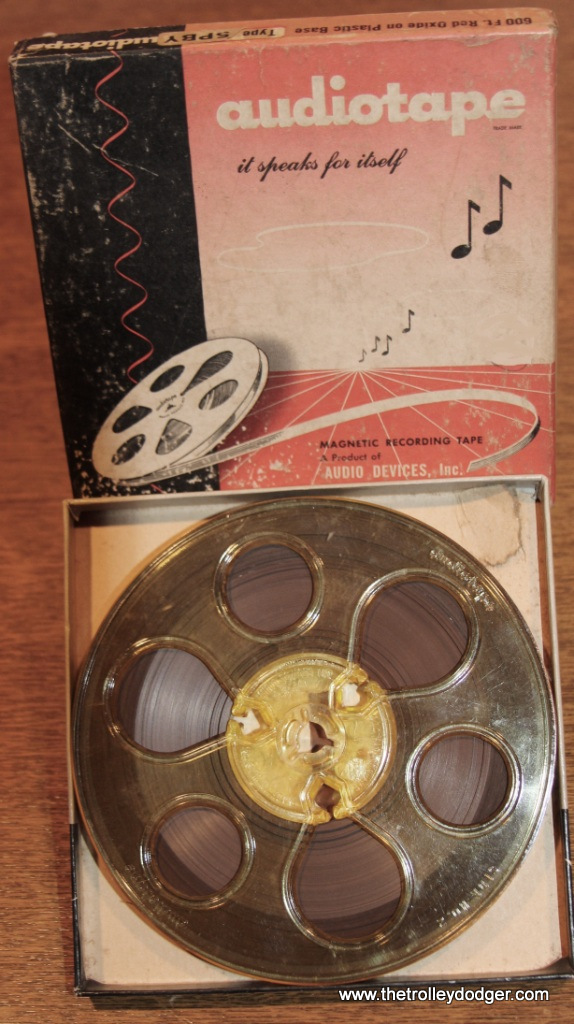
Newly rediscovered and digitized after 60 years, most of these audio recordings of Chicago, North Shore and Milwaukee interurban trains are previously unheard, and include on-train recordings, run-bys, and switching. Includes both Electroliners, standard cars, and locomotives. Recorded between 1955 and 1963 on the Skokie Valley Route and Mundelein branch. We are donating $5 from the sale of each disc to Kenneth Gear, who saved these and many other original Railroad Record Club master tapes from oblivion.
Total time – 73:14
[/caption]


Tape 4 switching at Roudout + Mundeline pic 3Tape 4 switching at Roudout + Mundeline pic 2Tape 4 switching at Roudout + Mundeline pic 1Tape 3 Mundeline Run pic 2Tape 3 Mundeline Run pic 1Tape 2 Mundeline pic 3Tape 2 Mundeline pic 2Tape 2 Mundeline pic 1Tape 1 ElectrolinerTape 1 Electroliner pic 3Tape 1 Electroliner pic 2Notes from tape 4Note from tape 2

RRC-OMTT
Railroad Record Club Traction Rarities – 1951-58
From the Original Master Tapes
# of Discs- 3
Price: $24.99


Railroad Record Club Traction Rarities – 1951-58
From the Original Master Tapes

Our friend Kenneth Gear recently acquired the original Railroad Record Club master tapes. These have been digitized, and we are now offering over three hours of 1950s traction audio recordings that have not been heard in 60 years.
Properties covered include:

Potomac Edison (Hagerstown & Frederick), Capital Transit, Altoona & Logan Valley, Shaker Heights Rapid Transit, Pennsylvania Railroad, Illinois Terminal, Baltimore Transit, Niagara St. Catharines & Toronto, St. Louis Public Transit, Queensboro Bridge, Third Avenue El, Southern Iowa Railway, IND Subway (NYC), Johnstown Traction, Cincinnati Street Railway, and the Toledo & Eastern
$5 from the sale of each set will go to Kenneth Gear, who has invested thousands of dollars to purchase all the remaining artifacts relating to William A. Steventon’s Railroad Record Club of Hawkins, WI. It is very unlikely that he will ever be able to recoup his investment, but we support his efforts at preserving this important history, and sharing it with railfans everywhere.
Disc One
Potomac Edison (Hagerstown & Frederick):
01. 3:45 Box motor #5
02. 3:32 Box motor #5, May 24, 1953
03. 4:53 Engine whistle signals, loco #12, January 17, 1954
04. 4:13 Loco #12
Capital Transit:
05. 0:56 PCC car 1557, Route 20 – Cabin John line, July 19, 1953
06. 1:43
Altoona & Logan Valley:
07. 4:00 Master Unit car #74, August 8, 1953
Shaker Heights Rapid Transit:
08. 4:17 Car 306 (ex-AE&FRE), September 27, 1953
09. 4:04
10. 1:39
Pennsylvania Railroad GG-1s:
11. 4:35 August 27, 1954
12. 4:51
Illinois Terminal:
13. 5:02 Streamliner #300, northward from Edwardsville, February 14, 1955
14. 12:40 Car #202 (ex-1202), between Springfield and Decatur, February 1955
Baltimore Transit:
15. 4:56 Car 5706, January 16, 1954
16. 4:45 Car 5727, January 16, 1954
Niagara, St. Catharines & Toronto:
17. 4:19 Interurbans #83 and #80, October 1954
18. 5:20 #80, October 1954
Total time: 79:30
Disc Two
St. Louis Public Service:
01. 4:34 PCCs #1708, 1752, 1727, 1739, December 6, 1953
Queensboro Bridge Company (New York City):
02. 5:37 Cars #606, 605, and 601, December 31, 1954
03. 5:17
Third Avenue El (New York City):
04. 5:07 December 31. 1954
05. 4:47 Cars #1797, 1759, and 1784 at 59th Street, December 31, 1954
Southern Iowa Railway:
06. 4:46 Loco #400, August 17, 1955
07. 5:09 Passenger interurban #9
IND Subway (New York City):
08. 8:40 Queens Plaza station, December 31, 1954
Last Run of the Hagerstown & Frederick:
09. 17:34 Car #172, February 20, 1954 – as broadcast on WJEJ, February 21, 1954, with host Carroll James, Sr.
Total time: 61:31
Disc Three
Altoona & Logan Valley/Johnstown Traction:
01. 29:34 (Johnstown Traction recordings were made August 9, 1953)
Cincinnati Street Railway:
02. 17:25 (Car 187, Brighton Car House, December 13, 1951– regular service abandoned April 29, 1951)
Toledo & Eastern:
03. 10:36 (recorded May 3-7, 1958– line abandoned July 1958)
Capital Transit:
04. 16:26 sounds recorded on board a PCC (early 1950s)
Total time: 74:02
Total time (3 discs) – 215:03


The Trolley Dodger On the Air
We appeared on WGN radio in Chicago in November 2018, discussing our book Building Chicago’s Subways on the Dave Plier Show. You can hear our 19-minute conversation here.
Chicago, Illinois, December 17, 1938-- Secretary Harold Ickes, left, and Mayor Edward J. Kelly turn the first spadeful of earth to start the new $40,000,000 subway project. Many thousands gathered to celebrate the starting of work on the subway. Chicago, Illinois, December 17, 1938– Secretary Harold Ickes, left, and Mayor Edward J. Kelly turn the first spadeful of earth to start the new $40,000,000 subway project. Many thousands gathered to celebrate the starting of work on the subway.
Order Our New Book Building Chicago’s Subways

There were three subway anniversaries in 2018 in Chicago:
60 years since the West Side Subway opened (June 22, 1958)
75 years since the State Street Subway opened (October 17, 1943)
80 years since subway construction started (December 17, 1938)
To commemorate these anniversaries, we have written a new book, Building Chicago’s Subways.

While the elevated Chicago Loop is justly famous as a symbol of the city, the fascinating history of its subways is less well known. The City of Chicago broke ground on what would become the “Initial System of Subways” during the Great Depression and finished 20 years later. This gigantic construction project, a part of the New Deal, would overcome many obstacles while tunneling through Chicago’s soft blue clay, under congested downtown streets, and even beneath the mighty Chicago River. Chicago’s first rapid transit subway opened in 1943 after decades of wrangling over routes, financing, and logistics. It grew to encompass the State Street, Dearborn-Milwaukee, and West Side Subways, with the latter modernizing the old Garfield Park “L” into the median of Chicago’s first expressway. Take a trip underground and see how Chicago’s “I Will” spirit overcame challenges and persevered to help with the successful building of the subways that move millions. Building Chicago’s subways was national news and a matter of considerable civic pride–making it a “Second City” no more!

Bibliographic information:
Title Building Chicago’s Subways
Images of America
Author David Sadowski
Edition illustrated
Publisher Arcadia Publishing (SC), 2018
ISBN 1467129380, 9781467129381
Length 128 pages
Chapter Titles:
01. The River Tunnels
02. The Freight Tunnels
03. Make No Little Plans
04. The State Street Subway
05. The Dearborn-Milwaukee Subway
06. Displaced
07. Death of an Interurban
08. The Last Street Railway
09. Subways and Superhighways
10. Subways Since 1960
Building Chicago’s Subways is in stock and now available for immediate shipment. Order your copy today! All copies purchased through The Trolley Dodger will be signed by the author.
The price of $23.99 includes shipping within the United States.
For Shipping to US Addresses:

For Shipping to Canada:

For Shipping Elsewhere:

Redone tile at the Monroe and Dearborn CTA Blue Line subway station, showing how an original sign was incorporated into a newer design, May 25, 2018. (David Sadowski Photo) Redone tile at the Monroe and Dearborn CTA Blue Line subway station, showing how an original sign was incorporated into a newer design, May 25, 2018. (David Sadowski Photo)

Help Support The Trolley Dodger

gh1

This is our 243rd post, and we are gradually creating a body of work and an online resource for the benefit of all railfans, everywhere. To date, we have received over 574,000 page views, for which we are very grateful.

You can help us continue our original transit research by checking out the fine products in our Online Store.

As we have said before, “If you buy here, we will be here.”

We thank you for your support.

DONATIONS

In order to continue giving you the kinds of historic railroad images that you have come to expect from The Trolley Dodger, we need your help and support. It costs money to maintain this website, and to do the sort of historic research that is our specialty.

Your financial contributions help make this web site better, and are greatly appreciated.

The Sunset Lines

Chicago Aurora and Elgin car 453, which will soon find a new home at the Illinois Railway Museum. (William Shapotkin Collection)

Chicago Aurora and Elgin car 453, which will soon find a new home at the Illinois Railway Museum. (William Shapotkin Collection)

It is a shame that only four out of ten postwar interurban cars built in 1945 for the Chicago Aurora & Elgin were saved, after that railroad ceased operations in the late 1950s.

Having only been in service for a dozen years or so, these cars could have been a nice addition to the North Shore Line, but that interurban ceased operations in 1963. There was also an unrealized plan to use them on an extension of the Cleveland rapid transit line to the local airport. The extension was delayed for several years, and ultimately new cars were ordered.

That any of the ten were saved is due to Gerald E. Brookins, who bought them in 1962 for his Trolleyville U.S.A. operation in Ohio. They were cars that could be put into service right away, with minimal effort, on his new line serving a trailer park, where operations began in 1963. There they remained until the Brookins family decided to sell the trailer park. An attempt to use the collection, or parts of it, in Cleveland did not pan out, and the collection was put up for sale in 2009, ultimately dispersed among a consortium of railway museums.

Cars 451 and 460 went to the Illinois Railway Museum. 458 was purchased by the Fox River Trolley Museum in South Elgin. The fourth car (453) traveled to Pennsylvania and the Electric City Trolley Museum in Scranton. They originally planned to restore it as an ersatz Laurel Line interurban, since no cars from that line were saved after it quit in 1952.

Fortunately for us, the folks in Scranton changed their minds, and recently put the 453 up for sale instead. Thanks to a quick fundraiser, it will now be coming to the Illinois Railway Museum. All four surviving cars in the 451-460 series will be back in Illinois for the first time since 1962, with three of the four at IRM.

As the Hicks Car Works blog reported:

We are overjoyed to announce that the fund-raising drive has been successful in raising the money needed to purchase, transport, and store car 453! It will be coming soon to a museum near you!

A large number of people contributed to make this possible, and we thank you all. Two donors in particular gave substantial amounts. One of them came from a long-time member, who wishes to remain anonymous, in celebration of his 45th year since joining the Museum in 1974. The other came from Jeffrey L. Wien. Jeff comments: “I felt that I was playing the role of a White Knight in making my donation…. I donated to the 453 fund because the 450 class were the last interurbans built in the U.S. and to me were very aesthetically attractive. Now we will have 75% of the surviving 450 class! It should also be mentioned that as a former North Shore Line employee, that I have always favored North Shore equipment, but this time I wanted to make sure that a rare piece of CA&E history is preserved. Julie Johnson would be pleased.”

It has often been stated that the ten curved-sided CA&E cars were the “last” interurbans built in the United States. To accept this, some caveats come into play.

First of all, what constitutes an interurban? Depending on how you define this, why wouldn’t the PATCO Speedline, which runs between Philadelphia and Camden County, New Jersey qualify as an “interurban,” even though it did not begin service until 1969?

What about the double-ended cars built by St. Louis Car Company for the Philadelphia Suburban Transportation Co. (aka Red Arrow) in 1949? They ran on the line between Philadelphia and West Chester, which is generally considered an interurban. But they resembled PCC cars, although they had conventional motors and were not “offically” considered PCCs.

Actual PCC cars were used in interurban service by Pittsburgh Railways, to Charleroi and Washington, PA until 1953.  Some of these cars were built in 1949.

The Norristown High-Speed Line in suburban Philadelphia has also at times been considered an interurban.  So when rapid transit cars from the Chicago Transit Authority were used there, in the 1980s and 90s, did they become interurban cars?

Perhaps it is fair to say that the CA&E cars were the last classic or conventional interurban cars built in the United States. There have been other interurban cars built since 1945 outside of the US, such as the cars operated on the South Shore Line.

An interurban is as much a sociological concept as anything, and has come to represent a particular era in American history. Pacific Electric ran an interurban between Los Angeles and Long Beach until 1961. But when service between those two cities was restored in 1990, via the Blue Line Metro, it was called light rail, even though much of the line runs in the same alignment that Pacific Electric used.

For that matter, is the South Shore Line, the so-called “last” interurban that survived, still an interurban?  Or would most of its riders today think of it as commuter rail?

To celebrate the return of car 453, we present many classic black-and-white views of the Chicago Aurora and Elgin from the collections of William Shapotkin, and as always, we thank him for his generosity in sharing them with our readers. These were scanned from small prints of the type once sold by the late Barney Neuberger and others, most of which did not have any information along with them.

There are a few things we can do know, however. The two pictures of crossings on the ground-level tracks west of Laramie, at Oak Park Avenue and Ridgeland in suburban Oak Park, were taken in 1935. The pictures of street running are most likely in Aurora. In 1939, the Aurora terminal was relocated to off-street trackage. The pictures of two wood cars while it is snowing were most likely taken during the final passenger fantrip in December 1958.

There are a couple wreck pictures. We don’t know the circumstances, or even if they are from the same incident. Someone on Facebook was recently wondering if the CA&E had any fatal accidents. We know that the employees were very conscientious, and had an admirable safety record, but I am sure there were some.

There was only a brief period of time (1953) when the picture showing CA&E cars on the Met main line at Halsted, next to the newly completed bridge over the Congress Expressway construction site, could have been taken.

When we scanned these prints, there were a few duplicates. If we did not weed out all of these, we hope you will forgive us.

If you do have useful information to add, you can make a Comment on this post. Be sure to refer to the pictures by their file names, which can be found by hovering your mouse over the image. For example, the fist picture in this post is img989. That will be more helpful to us than just saying, “the third picture down,” or some such.

As you enjoy your Labor Day holiday weekend, we hope you will appreciate all the labor that has gone into preserving the memory of the Sunset Lines, as the CA&E was once fondly named.  Thanks to the work of many dedicated volunteers, we hope the sun will never truly set on the Sunset Lines.

Enjoy!

-David Sadowski

From the Collections of William Shapotkin:

Now Available On Compact Disc
CDLayout33p85
RRCNSLR
Railroad Record Club – North Shore Line Rarities 1955-1963
# of Discs – 1
Price: $15.99

Railroad Record Club – North Shore Line Rarities 1955-1963
Newly rediscovered and digitized after 60 years, most of these audio recordings of Chicago, North Shore and Milwaukee interurban trains are previously unheard, and include on-train recordings, run-bys, and switching. Includes both Electroliners, standard cars, and locomotives. Recorded between 1955 and 1963 on the Skokie Valley Route and Mundelein branch. We are donating $5 from the sale of each disc to Kenneth Gear, who saved these and many other original Railroad Record Club master tapes from oblivion.
Total time – 73:14
[/caption]


Tape 4 switching at Roudout + Mundeline pic 3Tape 4 switching at Roudout + Mundeline pic 2Tape 4 switching at Roudout + Mundeline pic 1Tape 3 Mundeline Run pic 2Tape 3 Mundeline Run pic 1Tape 2 Mundeline pic 3Tape 2 Mundeline pic 2Tape 2 Mundeline pic 1Tape 1 ElectrolinerTape 1 Electroliner pic 3Tape 1 Electroliner pic 2Notes from tape 4Note from tape 2

RRC-OMTT
Railroad Record Club Traction Rarities – 1951-58
From the Original Master Tapes
# of Discs- 3
Price: $24.99


Railroad Record Club Traction Rarities – 1951-58
From the Original Master Tapes

Our friend Kenneth Gear recently acquired the original Railroad Record Club master tapes. These have been digitized, and we are now offering over three hours of 1950s traction audio recordings that have not been heard in 60 years.
Properties covered include:

Potomac Edison (Hagerstown & Frederick), Capital Transit, Altoona & Logan Valley, Shaker Heights Rapid Transit, Pennsylvania Railroad, Illinois Terminal, Baltimore Transit, Niagara St. Catharines & Toronto, St. Louis Public Transit, Queensboro Bridge, Third Avenue El, Southern Iowa Railway, IND Subway (NYC), Johnstown Traction, Cincinnati Street Railway, and the Toledo & Eastern
$5 from the sale of each set will go to Kenneth Gear, who has invested thousands of dollars to purchase all the remaining artifacts relating to William A. Steventon’s Railroad Record Club of Hawkins, WI. It is very unlikely that he will ever be able to recoup his investment, but we support his efforts at preserving this important history, and sharing it with railfans everywhere.
Disc One
Potomac Edison (Hagerstown & Frederick):
01. 3:45 Box motor #5
02. 3:32 Box motor #5, May 24, 1953
03. 4:53 Engine whistle signals, loco #12, January 17, 1954
04. 4:13 Loco #12
Capital Transit:
05. 0:56 PCC car 1557, Route 20 – Cabin John line, July 19, 1953
06. 1:43
Altoona & Logan Valley:
07. 4:00 Master Unit car #74, August 8, 1953
Shaker Heights Rapid Transit:
08. 4:17 Car 306 (ex-AE&FRE), September 27, 1953
09. 4:04
10. 1:39
Pennsylvania Railroad GG-1s:
11. 4:35 August 27, 1954
12. 4:51
Illinois Terminal:
13. 5:02 Streamliner #300, northward from Edwardsville, February 14, 1955
14. 12:40 Car #202 (ex-1202), between Springfield and Decatur, February 1955
Baltimore Transit:
15. 4:56 Car 5706, January 16, 1954
16. 4:45 Car 5727, January 16, 1954
Niagara, St. Catharines & Toronto:
17. 4:19 Interurbans #83 and #80, October 1954
18. 5:20 #80, October 1954
Total time: 79:30
Disc Two
St. Louis Public Service:
01. 4:34 PCCs #1708, 1752, 1727, 1739, December 6, 1953
Queensboro Bridge Company (New York City):
02. 5:37 Cars #606, 605, and 601, December 31, 1954
03. 5:17
Third Avenue El (New York City):
04. 5:07 December 31. 1954
05. 4:47 Cars #1797, 1759, and 1784 at 59th Street, December 31, 1954
Southern Iowa Railway:
06. 4:46 Loco #400, August 17, 1955
07. 5:09 Passenger interurban #9
IND Subway (New York City):
08. 8:40 Queens Plaza station, December 31, 1954
Last Run of the Hagerstown & Frederick:
09. 17:34 Car #172, February 20, 1954 – as broadcast on WJEJ, February 21, 1954, with host Carroll James, Sr.
Total time: 61:31
Disc Three
Altoona & Logan Valley/Johnstown Traction:
01. 29:34 (Johnstown Traction recordings were made August 9, 1953)
Cincinnati Street Railway:
02. 17:25 (Car 187, Brighton Car House, December 13, 1951– regular service abandoned April 29, 1951)
Toledo & Eastern:
03. 10:36 (recorded May 3-7, 1958– line abandoned July 1958)
Capital Transit:
04. 16:26 sounds recorded on board a PCC (early 1950s)
Total time: 74:02
Total time (3 discs) – 215:03


The Trolley Dodger On the Air
We appeared on WGN radio in Chicago last November, discussing our book Building Chicago’s Subways on the Dave Plier Show. You can hear our 19-minute conversation here.
Chicago, Illinois, December 17, 1938-- Secretary Harold Ickes, left, and Mayor Edward J. Kelly turn the first spadeful of earth to start the new $40,000,000 subway project. Many thousands gathered to celebrate the starting of work on the subway. Chicago, Illinois, December 17, 1938– Secretary Harold Ickes, left, and Mayor Edward J. Kelly turn the first spadeful of earth to start the new $40,000,000 subway project. Many thousands gathered to celebrate the starting of work on the subway.
Order Our New Book Building Chicago’s Subways

There were three subway anniversaries in 2018 in Chicago:
60 years since the West Side Subway opened (June 22, 1958)
75 years since the State Street Subway opened (October 17, 1943)
80 years since subway construction started (December 17, 1938)
To commemorate these anniversaries, we have written a new book, Building Chicago’s Subways.

While the elevated Chicago Loop is justly famous as a symbol of the city, the fascinating history of its subways is less well known. The City of Chicago broke ground on what would become the “Initial System of Subways” during the Great Depression and finished 20 years later. This gigantic construction project, a part of the New Deal, would overcome many obstacles while tunneling through Chicago’s soft blue clay, under congested downtown streets, and even beneath the mighty Chicago River. Chicago’s first rapid transit subway opened in 1943 after decades of wrangling over routes, financing, and logistics. It grew to encompass the State Street, Dearborn-Milwaukee, and West Side Subways, with the latter modernizing the old Garfield Park “L” into the median of Chicago’s first expressway. Take a trip underground and see how Chicago’s “I Will” spirit overcame challenges and persevered to help with the successful building of the subways that move millions. Building Chicago’s subways was national news and a matter of considerable civic pride–making it a “Second City” no more!

Bibliographic information:
Title Building Chicago’s Subways
Images of America
Author David Sadowski
Edition illustrated
Publisher Arcadia Publishing (SC), 2018
ISBN 1467129380, 9781467129381
Length 128 pages
Chapter Titles:
01. The River Tunnels
02. The Freight Tunnels
03. Make No Little Plans
04. The State Street Subway
05. The Dearborn-Milwaukee Subway
06. Displaced
07. Death of an Interurban
08. The Last Street Railway
09. Subways and Superhighways
10. Subways Since 1960
Building Chicago’s Subways is in stock and now available for immediate shipment. Order your copy today! All copies purchased through The Trolley Dodger will be signed by the author.
The price of $23.99 includes shipping within the United States.
For Shipping to US Addresses:

For Shipping to Canada:

For Shipping Elsewhere:

Redone tile at the Monroe and Dearborn CTA Blue Line subway station, showing how an original sign was incorporated into a newer design, May 25, 2018. (David Sadowski Photo) Redone tile at the Monroe and Dearborn CTA Blue Line subway station, showing how an original sign was incorporated into a newer design, May 25, 2018. (David Sadowski Photo)

Help Support The Trolley Dodger

gh1

This is our 237th post, and we are gradually creating a body of work and an online resource for the benefit of all railfans, everywhere. To date, we have received over 542,000 page views, for which we are very grateful.

You can help us continue our original transit research by checking out the fine products in our Online Store.

As we have said before, “If you buy here, we will be here.”

We thank you for your support.

DONATIONS

In order to continue giving you the kinds of historic railroad images that you have come to expect from The Trolley Dodger, we need your help and support. It costs money to maintain this website, and to do the sort of historic research that is our specialty.

Your financial contributions help make this web site better, and are greatly appreciated.

Sweet Home Chicago

In 1938, a visitor to Chicago from the Soviet Union snapped this picture of Chicago PCC 4032 running on route 20 - Madison downtown, and brought it home. Now, more than 80 years later, it has returned to Chicago.

In 1938, a visitor to Chicago from the Soviet Union snapped this picture of Chicago PCC 4032 running on route 20 – Madison downtown, and brought it home. Now, more than 80 years later, it has returned to Chicago.

They say you can never go home again. But no matter how far we may wander from home, there is something, almost like an unseen force, that calls us back to the places we lived in, grew up in, or love the most. And while we often feature transit photos from other cities, Chicago remains our home and will always be our favorite. So today, we are featuring Chicago-area streetcars, rapid transit, interurbans, and buses.

We do have a couple examples of things that, improbably, did find their way home. First, a picture of a Chicago PCC streetcar that has come back “from Russia with love.” Second, prints and negatives of Chicago transit, taken in 1952, that have been reunited after who knows how many years.

We also have some recent photo finds of our own, including a news report from Miles Beitler on the new Pulse bus rapid transit operation in Chicago’s northwest suburbs, and more classic photos shared by Bill Shapotkin and Jeff Wien of the Wien-Criss Archive.  Finally, there is some correspondence with Andre Kristopans.

We thank all our contributors.

Enjoy!

-David Sadowski

PS- If you have comments on individual photos, and I am sure you will, please refer to them by their image number, which you can find by hovering your mouse over the photo (for example, the picture at the top of this post is img882). That is more helpful to me than just saying something was the seventh photo down, etc. We always appreciate hearing from you if you have useful information to contribute regarding locations and other details. Thanks in advance.

We also should not let the opportunity pass to wish Raymond DeGroote, Jr. a happy belated 89th birthday. Ray is a world traveler, a raconteur, and the Dean of Chicago railfans.

Recent Finds

CSL "Matchbox" 1412 is on the Morgan-Racine-Sangamon route in this photo by Edward Frank, Jr. Don's Rail Photos adds, "1412 was built by St Louis Car Co in 1906 as CUT 4641. It was renumbered 1412 in 1913 and became CSL 1412 in 1914. It was retired on March 30, 1948... These cars were built by St. Louis Car in 1903 and 1906 for Chicago Union Traction Co. They are similar to the Robertson design without the small windows. Cars of this series were converted to one man operation in later years and have a wide horizontal stripe on the front to denote this. Two were used for an experimental articulated train. A number of these cars were converted to sand and salt service and as flangers." Car 1374 in this series has been lovingly restored to operating condition, at the Illinois Railway Museum.

CSL “Matchbox” 1412 is on the Morgan-Racine-Sangamon route in this photo by Edward Frank, Jr. Don’s Rail Photos adds, “1412 was built by St Louis Car Co in 1906 as CUT 4641. It was renumbered 1412 in 1913 and became CSL 1412 in 1914. It was retired on March 30, 1948… These cars were built by St. Louis Car in 1903 and 1906 for Chicago Union Traction Co. They are similar to the Robertson design without the small windows. Cars of this series were converted to one man operation in later years and have a wide horizontal stripe on the front to denote this. Two were used for an experimental articulated train. A number of these cars were converted to sand and salt service and as flangers.” Car 1374 in this series has been lovingly restored to operating condition, at the Illinois Railway Museum.

A two-car Chicago Aurora & Elgin train, headed up by 433, is just west of the Canal Street station on the Metropolitan four-track main line in August 1953, a month before CA&E service was cut back to Forest Park. (John Szwajkart Photo)

A two-car Chicago Aurora & Elgin train, headed up by 433, is just west of the Canal Street station on the Metropolitan four-track main line in August 1953, a month before CA&E service was cut back to Forest Park. (John Szwajkart Photo)

CTA 4060 is at the front of a two-car Ravenswood "L" train approaching Kimball and Lawrence in this undated photo (1950s-60s).

CTA 4060 is at the front of a two-car Ravenswood “L” train approaching Kimball and Lawrence in this undated photo (1950s-60s).

CTA Pullman 460 is on either Route 8 - Halsted or 9 - Ashland in the early 1950s, you can't quite make it out on the roll sign. However, I am leaning towards Halsted, as Ashland got bussed in 1951, and the auto at left looks more like 1953 vintage. This streetcar was saved by the CTA, and is now at the Illinois Railway Museum. It is one of only three red Pullmans saved, the others being 144 (also at IRM) and 225 (at the Seashore Trolley Museum in Maine). Charles F. Amstein adds that 460 is "on Ashland, just north of 95th Street, looking north-northwet. I grew up in this area and spent much of my time at Beverly Bowling Lanes, seen in the distance at right."

CTA Pullman 460 is on either Route 8 – Halsted or 9 – Ashland in the early 1950s, you can’t quite make it out on the roll sign. However, I am leaning towards Halsted, as Ashland got bussed in 1951, and the auto at left looks more like 1953 vintage. This streetcar was saved by the CTA, and is now at the Illinois Railway Museum. It is one of only three red Pullmans saved, the others being 144 (also at IRM) and 225 (at the Seashore Trolley Museum in Maine). Charles F. Amstein adds that 460 is “on Ashland, just north of 95th Street, looking north-northwet. I grew up in this area and spent much of my time at Beverly Bowling Lanes, seen in the distance at right.”

CTA 4374 is southbound on Clark Street, just south of Diversey, on September 6, 1957, the last day for the north half of Route 22 - Clark-Wentworth. Ricketts (no relation to the current Cubs ownership) was a popular restaurant. At left, down the street, you can just make out the marquee of the Parkway Theater. Autos visible include several Chevys, a Studebaker, and (at left) a 1957 Ford. (Charles H. Thorpe Photo) The tracks curving off to the left went into the CTA's Limits car barn (station), which was located at 2684 N. Clark. It got its name because, a long time earlier, this had been the city limits. There were facilities for cable cars at this location dating back to 1888. Limits car house opened in 1909, and was last used by streetcars in 1954 (the end of the Red Car era). It was used by buses until 1994, and the building was torn down in 1998.

CTA 4374 is southbound on Clark Street, just south of Diversey, on September 6, 1957, the last day for the north half of Route 22 – Clark-Wentworth. Ricketts (no relation to the current Cubs ownership) was a popular restaurant. At left, down the street, you can just make out the marquee of the Parkway Theater. Autos visible include several Chevys, a Studebaker, and (at left) a 1957 Ford. (Charles H. Thorpe Photo) The tracks curving off to the left went into the CTA’s Limits car barn (station), which was located at 2684 N. Clark. It got its name because, a long time earlier, this had been the city limits. There were facilities for cable cars at this location dating back to 1888. Limits car house opened in 1909, and was last used by streetcars in 1954 (the end of the Red Car era). It was used by buses until 1994, and the building was torn down in 1998.

CTA Met car 2907 is at Indiana Avenue, running the Kenwood shuttle on the last day of service, November 30, 1957 (also the last day for regular passenger service for wooden "L" cars).

CTA Met car 2907 is at Indiana Avenue, running the Kenwood shuttle on the last day of service, November 30, 1957 (also the last day for regular passenger service for wooden “L” cars).

CTA one-man car 1769 (here painted green, not red) is at Lake and Austin, west end of Route 16. The date of this Bob Selle photo is December 19, 1953, one year to the day before I was born. The Park Theater at right appears to already be closed.

CTA one-man car 1769 (here painted green, not red) is at Lake and Austin, west end of Route 16. The date of this Bob Selle photo is December 19, 1953, one year to the day before I was born. The Park Theater at right appears to already be closed.

CTA one-man car 1732, in red, heads southwest on Fifth Avenue at Harrison on July 5, 1953. Madison-Fifth was part of Route 20, but as of May 11, 1952, buses were substituted for streetcars on weekends– except for the Fifth Avenue branch, which used streetcars. That must be a Harrison bus in the background. (Robert Selle Photo)

On June 19, 1953 CTA PCC 7070 heads south on Roue 8 - Halsted, passing by the Congress Expressway construction site. PCCs were soon taken off Halsted, which ended streetcar service the following year using older equipment. This photo was taken from the nearby Halsted "L" station, which was not in the expressway footprint. (Robert Selle Photo)

On June 19, 1953 CTA PCC 7070 heads south on Roue 8 – Halsted, passing by the Congress Expressway construction site. PCCs were soon taken off Halsted, which ended streetcar service the following year using older equipment. This photo was taken from the nearby Halsted “L” station, which was not in the expressway footprint. (Robert Selle Photo)

On May 12, 1954, Bob Selle took this picture of CTA Pullman 600, southbound on Route 8 - Halsted. This was less than three weeks before the end of streetcar service on this line. We are just south of the Metropolitan "L" station at Halsted, and crossing over the Congress Expressway construction. That looks like a Studebaker at left.

On May 12, 1954, Bob Selle took this picture of CTA Pullman 600, southbound on Route 8 – Halsted. This was less than three weeks before the end of streetcar service on this line. We are just south of the Metropolitan “L” station at Halsted, and crossing over the Congress Expressway construction. That looks like a Studebaker at left.

In this undated (probably late 1960s) photo taken on the Red Arrow Lines in suburban Philadelphia, Brilliner 10 appears to be changing ends. It is signed for the Media route, although this is not the end of that line. Perhaps there was track work going on. Matthew Nawn adds, "The photo of Red Arrow Lines #10 was taken at the Penn Street stop in Clifton Heights, PA. This is a stop on the Sharon Hill Line."

In this undated (probably late 1960s) photo taken on the Red Arrow Lines in suburban Philadelphia, Brilliner 10 appears to be changing ends. It is signed for the Media route, although this is not the end of that line. Perhaps there was track work going on. Matthew Nawn adds, “The photo of Red Arrow Lines #10 was taken at the Penn Street stop in Clifton Heights, PA. This is a stop on the Sharon Hill Line.”

This is how the interior of Chicago Aurora & Elgin car 301 looked on August 8, 1954, the date of a fantrip for the Central Electric Railfans' Association. Don's Rail Photos: "301 was built by Niles Car & Mfg Co in 1906. It was modernized in December 1940." (Robert Selle Photo)

This is how the interior of Chicago Aurora & Elgin car 301 looked on August 8, 1954, the date of a fantrip for the Central Electric Railfans’ Association. Don’s Rail Photos: “301 was built by Niles Car & Mfg Co in 1906. It was modernized in December 1940.” (Robert Selle Photo)

CA&E car 434 at an unidentified terminal. possibly Elgin.

CA&E car 434 at an unidentified terminal. possibly Elgin.

Once CA&E service stopped running to downtown Chicago, less equipment was needed. Here, wooden cars 137 and 141 are on the scrap track at the Wheaton Shops. Bob Selle took this picture on August 8, 1954. These cars were purchased from the North Shore Line in 1946.

Once CA&E service stopped running to downtown Chicago, less equipment was needed. Here, wooden cars 137 and 141 are on the scrap track at the Wheaton Shops. Bob Selle took this picture on August 8, 1954. These cars were purchased from the North Shore Line in 1946.

CA&E car 701, ex-Washington, Baltimore & Annapolis. Don's Rail Photos: "701 was built by Cincinnati Car Co in 1913 as WB&A 81. It was sold as CA&E 701 in 1938." Don also notes, "In 1937, the CA&E needed additional equipment. Much was available, but most of the cars suffered from extended lack of maintenance. Finally, 5 coaches were found on the Washington Baltimore & Annapolis which were just the ticket. 35 thru 39, built by Cincinnati Car in 1913, were purchased and remodeled for service as 600 thru 604. The ends were narrowed for service on the El. They had been motors, but came out as control trailers. Other modifications included drawbars, control, etc. A new paint scheme was devised. Blue and grey with red trim and tan roof was adopted from several selections. They entered service between July and October in 1937."

CA&E car 701, ex-Washington, Baltimore & Annapolis. Don’s Rail Photos: “701 was built by Cincinnati Car Co in 1913 as WB&A 81. It was sold as CA&E 701 in 1938.”
Don also notes, “In 1937, the CA&E needed additional equipment. Much was available, but most of the cars suffered from extended lack of maintenance. Finally, 5 coaches were found on the Washington Baltimore & Annapolis which were just the ticket. 35 thru 39, built by Cincinnati Car in 1913, were purchased and remodeled for service as 600 thru 604. The ends were narrowed for service on the El. They had been motors, but came out as control trailers. Other modifications included drawbars, control, etc. A new paint scheme was devised. Blue and grey with red trim and tan roof was adopted from several selections. They entered service between July and October in 1937.”

CA&E 401 at the end of the line in Elgin.

CA&E 401 at the end of the line in Elgin.

CA&E 452 at either Elgin or Aurora.

CA&E 452 at either Elgin or Aurora.

CA&E 457 at the front of a two-car train near the end of either the Aurora or Elgin terminals, as it is operating with overhead wire instead of third rail.

CA&E 457 at the front of a two-car train near the end of either the Aurora or Elgin terminals, as it is operating with overhead wire instead of third rail.

CA&E 429 at the head of a two-car train.

CA&E 429 at the head of a two-car train.

CA&E 451 heads up a two-car limited heading towards Chicago.

CA&E 451 heads up a two-car limited heading towards Chicago.

Speedrail (Milwaukee) car 63, a curved-sided product of Cincinnati Car Company, is operating as a local on the turnback track in Waukesha, on June 28 1951, two days before abandonment. (Photo by R. H. Adams, Jr.)

Speedrail (Milwaukee) car 63, a curved-sided product of Cincinnati Car Company, is operating as a local on the turnback track in Waukesha, on June 28 1951, two days before abandonment. (Photo by R. H. Adams, Jr.)

Six years ago, I purchased a couple strips of 35mm Super-XX black-and-white negatives and ran the photos on the blog I had at that time. There was no way to tell the exact date the pictures were taken, but they did contain various clues that helped narrow down the date. I posted the images, and several people guessed as to when they were shot. The consensus that eventually emerged was they were taken between Fall 1952 and Spring 1953. Well, in an act of serendipity, Jeff Wien (by way of Mr. Edward Springer) donated a set of snapshots to me that were made from these same negatives. They are dated December 1952, which is a better answer than we had before. You can see the rest of the photos here.

Six years ago, I purchased a couple strips of 35mm Super-XX black-and-white negatives and ran the photos on the blog I had at that time. There was no way to tell the exact date the pictures were taken, but they did contain various clues that helped narrow down the date. I posted the images, and several people guessed as to when they were shot. The consensus that eventually emerged was they were taken between Fall 1952 and Spring 1953. Well, in an act of serendipity, Jeff Wien (by way of Mr. Edward Springer) donated a set of snapshots to me that were made from these same negatives. They are dated December 1952, which is a better answer than we had before. You can see the rest of the photos here.

Pulse Bus Rapid Transit Celebration

Pace launched its Pulse bus rapid transit this week with the Pulse Milwaukee line which runs between Golf Mill in Niles and the Jefferson Park transit center in Chicago. Pace held a celebration event earlier today (August 15th) at Milwaukee and Touhy in Niles featuring speeches by various politicians, agency bureaucrats, and public transit advocates. A new Pulse bus was parked at the event and was available for public inspection, as well as a Pulse bus station with its passenger amenities.
Since you include bus photos on your blog, I have attached several photos of the event. Feel free to post any or all of them. The Pace website has detailed information about the Pulse service.
Ironically, Richmond (VA) has operated a bus rapid transit line for over a year which is very similar, and it’s also called “Pulse”. I don’t know if this is just a coincidence or if there is some connection between them. However, the Richmond line has dedicated bus-only lanes for part of its length, while our line runs in mixed traffic along Milwaukee Avenue.
-Miles Beitler

From the Collections of William Shapotkin:

On June 21, 1958 an eastbound CTA train is in the station at Pulaski Road on the new Congress rapid transit line, then also known as the West Side Subway. Notice how little fencing there was separating the right-of-way from the highway. Eventually, this was replaced by concrete Jersey barriers after numerous vehicle crashes that impacted the "L". That way, when something hits the fence, it can take a "Jersey bounce."

On June 21, 1958 an eastbound CTA train is in the station at Pulaski Road on the new Congress rapid transit line, then also known as the West Side Subway. Notice how little fencing there was separating the right-of-way from the highway. Eventually, this was replaced by concrete Jersey barriers after numerous vehicle crashes that impacted the “L”. That way, when something hits the fence, it can take a “Jersey bounce.”

On June 21, 1958 a woman enters the new CTA rapid transit station at Pulaski Road on the Congress line, which replaced the Garfield Park "L" the following day. On this day, free rides were given out between Halsted and Cicero Avenues. The fiberglass panels on the sides of the entrance ramp were eventually cut down to allow for better visibility from outside.

On June 21, 1958 a woman enters the new CTA rapid transit station at Pulaski Road on the Congress line, which replaced the Garfield Park “L” the following day. On this day, free rides were given out between Halsted and Cicero Avenues. The fiberglass panels on the sides of the entrance ramp were eventually cut down to allow for better visibility from outside.

A North Shore Line Electroliner on December 28, 1962, less than a month before the end of the line for this interurban.

A North Shore Line Electroliner on December 28, 1962, less than a month before the end of the line for this interurban.

A new 2000-series CTA train at (I am guessing) the Douglas Park yards at 54th Avenue in Cicero on October 25, 1964.

A new 2000-series CTA train at (I am guessing) the Douglas Park yards at 54th Avenue in Cicero on October 25, 1964.

What I presume is the Douglas Park yard on October 25, 1964.

What I presume is the Douglas Park yard on October 25, 1964.

CTA articulated car set 51 (formerly 5001) found new life on the Skokie Swift after being oddball equipment on other lines, along with its three mates. Here, they are seen on the Swift on October 25, 1964, where they helped provide much-needed capacity in the face of unexpectedly large ridership several months after the new branch line began service.

CTA articulated car set 51 (formerly 5001) found new life on the Skokie Swift after being oddball equipment on other lines, along with its three mates. Here, they are seen on the Swift on October 25, 1964, where they helped provide much-needed capacity in the face of unexpectedly large ridership several months after the new branch line began service.

The date stamped on this slide is April 18, 1964, when demonstration rides were given out on the new CTA Skokie Swift branch line. However, that date may be incorrect, as my understanding is on that day, single car units 1-4 were coupled together and operated as a unit to provide demonstration rides, Regular service began on April 20, 1964. So either the units were uncoupled, or the date is wrong. Here, one of the high-speed cars is lowering its pan trolley, at the point where the line changed from overhead wire to third rail "on the fly."

The date stamped on this slide is April 18, 1964, when demonstration rides were given out on the new CTA Skokie Swift branch line. However, that date may be incorrect, as my understanding is on that day, single car units 1-4 were coupled together and operated as a unit to provide demonstration rides, Regular service began on April 20, 1964. So either the units were uncoupled, or the date is wrong. Here, one of the high-speed cars is lowering its pan trolley, at the point where the line changed from overhead wire to third rail “on the fly.”

On October 25, 1964 a pair of 4000-series "L" cars are seen at the Dempster terminal on the Skokie Swift, presumably on a fantrip.

On October 25, 1964 a pair of 4000-series “L” cars are seen at the Dempster terminal on the Skokie Swift, presumably on a fantrip.

This picture of the Dempster terminal is dated April 18, 1964, which would have been the very first day people could ride the Skokie Swift.

This picture of the Dempster terminal is dated April 18, 1964, which would have been the very first day people could ride the Skokie Swift.

Line car S-606 at the Dempster terminal on October 25, 1964. Don's Rail Photos adds, "S-606 was built by Cincinnati in January 1923, #2620, as Chicago North Shore & Milwaukee 606. In 1963 it became CTA S-606 and burned in 1978. The remains were sold to the Indiana Transportation Museum." Since the museum was evicted from its home, whatever portion of the car that survives has been taken on by another preservation group, in hopes that it can eventually be rebuilt or restored.

Line car S-606 at the Dempster terminal on October 25, 1964. Don’s Rail Photos adds, “S-606 was built by Cincinnati in January 1923, #2620, as Chicago North Shore & Milwaukee 606. In 1963 it became CTA S-606 and burned in 1978. The remains were sold to the Indiana Transportation Museum.” Since the museum was evicted from its home, whatever portion of the car that survives has been taken on by another preservation group, in hopes that it can eventually be rebuilt or restored.

The following South Shore Line photos, again courtesy of William Shapotkin, are all dated October 1965 and are from a fantrip.

Here are some classic postcard views, again from the collections of William Shapotkin:

From Jeff Wien and the Wien-Criss Archive:

These pictures of the Illinois Terminal Railroad were taken on July 4, 1950:

Don's Rail Photos: "1565, Class B, was built at Decatur in 1910. It was sold to Illinois Power & Light Co at Campaign on April 10, 1955. It was acquired by Illinois Railway Museum in 1960."

Don’s Rail Photos: “1565, Class B, was built at Decatur in 1910. It was sold to Illinois Power & Light Co at Campaign on April 10, 1955. It was acquired by Illinois Railway Museum in 1960.”

IT 270.

IT 270.

IT 273.

IT 273.

Don's Rail Photos: "276 was built by St Louis Car in 1913. It was air conditioned and the arch windows were covered. It was sold for scrap to Compressed Steel Co on March 13, 1956."

Don’s Rail Photos: “276 was built by St Louis Car in 1913. It was air conditioned and the arch windows were covered. It was sold for scrap to Compressed Steel Co on March 13, 1956.”

IT 281.

IT 281.

IT 284.

IT 284.

Don's Rail Photos: "1201 was built by McGuire-Cummings in 1910 as an express motor with 20 seats at the rear. In 1919 it was rebuilt with a small baggage section at the front and the trucks were changed from Curtis to Baldwin."

Don’s Rail Photos: “1201 was built by McGuire-Cummings in 1910 as an express motor with 20 seats at the rear. In 1919 it was rebuilt with a small baggage section at the front and the trucks were changed from Curtis to Baldwin.”

IT 052. This looks like a sleeping car or bunk car and is unpowered.

IT 052. This looks like a sleeping car or bunk car and is unpowered.

Again from the Wien-Criss Archive, here are a series of photos taken at the Chicago Aurora & Elgin’s Wheaton Yards, in August 1959 after the line had stopped running even freight service. Several cars were sold to museum interests and moved off the property in early 1962. Everything else was scrapped. It’s possible that these pictures may have been taken by the late Joseph Saitta of New York.

Looking somewhat worse for wear, here is CA&E car 321 as it looked at the Illinois Electric Railway Museum in North Chicago on June 9, 1962. This and the other cars that were saved from the line had been stored outdoors for a few years, and exposure to the elements took their toll. The museum, now just IRM, moved to Union in 1964. (Wien-Criss Archive Photo)

Looking somewhat worse for wear, here is CA&E car 321 as it looked at the Illinois Electric Railway Museum in North Chicago on June 9, 1962. This and the other cars that were saved from the line had been stored outdoors for a few years, and exposure to the elements took their toll. The museum, now just IRM, moved to Union in 1964. (Wien-Criss Archive Photo)

The following pictures, also from the Wien-Criss Archive, are not very sharp, but do show Chicago transit vehicles in September 1953 and May 1954. There are several shots of the temporary ground-level trackage used from 1953 to 1958 by the Garfield Park “L”, during construction of the Congress Expressway. Those pictures were taken at Van Buren and Western. Some of the PCC photos were snapped in the vicinity of Roosevelt Road, which is also where the Greyhound bus picture was probably taken.

Recent Correspondence

We recently asked Andre Kristopans about which Chicago streetcars, including PCCs, were converted to one-man operation in the CTA era.  Here’s what he reports:

In 1951, all 83 prewar PCCs to OMC on AFE S14000. At same time, 21 Sedans to OMC (3325,3347-3349,3351-3352,3354-3355,3357,3360-3363,3368,3372,3378-3379,6303,6305,6310,6319) on AFE S14001

However almost immediately 20 postwars 4052-4061,7035-7044 to OMC on S14011

155 older cars 1721-1785,3119-3178,6155-6198 to convertible OMC 1948 on S11381

Some additional info. Of the 169 cars in the three groups listed for one-manning, the following were already gone when the plan was announced:

6 under CSL 1945-47 1738,1754,1770,3133,3170,3176
8 under CTA 1948 1727,1763,3130,3150,3152,3155,3159,6197

169 minus above 14 leaves 155 for conversion in 1949

Me: Thanks… and none of the Peter Witts were used in one-man service, right?

Andre: Redone then scrapped replaced by postwars?

Me: Didn’t this have to do with the decision not to one-man 63rd Street? Or was it simply that mixing the Sedans with PCCs would have slowed things down?

Andre: Supposedly one of the aldermen along 63rd pitched a bitch about the sedans after he saw one. Thought they would be “unsafe”. Not sure on what grounds, suspect had to do with center door arrangement. But plan was dropped and sedans scrapped.

Me: Thanks!

Now Available On Compact Disc
CDLayout33p85
RRCNSLR
Railroad Record Club – North Shore Line Rarities 1955-1963
# of Discs – 1
Price: $15.99

Railroad Record Club – North Shore Line Rarities 1955-1963
Newly rediscovered and digitized after 60 years, most of these audio recordings of Chicago, North Shore and Milwaukee interurban trains are previously unheard, and include on-train recordings, run-bys, and switching. Includes both Electroliners, standard cars, and locomotives. Recorded between 1955 and 1963 on the Skokie Valley Route and Mundelein branch. We are donating $5 from the sale of each disc to Kenneth Gear, who saved these and many other original Railroad Record Club master tapes from oblivion.
Total time – 73:14
[/caption]


Tape 4 switching at Roudout + Mundeline pic 3Tape 4 switching at Roudout + Mundeline pic 2Tape 4 switching at Roudout + Mundeline pic 1Tape 3 Mundeline Run pic 2Tape 3 Mundeline Run pic 1Tape 2 Mundeline pic 3Tape 2 Mundeline pic 2Tape 2 Mundeline pic 1Tape 1 ElectrolinerTape 1 Electroliner pic 3Tape 1 Electroliner pic 2Notes from tape 4Note from tape 2

RRC-OMTT
Railroad Record Club Traction Rarities – 1951-58
From the Original Master Tapes
# of Discs- 3
Price: $24.99


Railroad Record Club Traction Rarities – 1951-58
From the Original Master Tapes

Our friend Kenneth Gear recently acquired the original Railroad Record Club master tapes. These have been digitized, and we are now offering over three hours of 1950s traction audio recordings that have not been heard in 60 years.
Properties covered include:

Potomac Edison (Hagerstown & Frederick), Capital Transit, Altoona & Logan Valley, Shaker Heights Rapid Transit, Pennsylvania Railroad, Illinois Terminal, Baltimore Transit, Niagara St. Catharines & Toronto, St. Louis Public Transit, Queensboro Bridge, Third Avenue El, Southern Iowa Railway, IND Subway (NYC), Johnstown Traction, Cincinnati Street Railway, and the Toledo & Eastern
$5 from the sale of each set will go to Kenneth Gear, who has invested thousands of dollars to purchase all the remaining artifacts relating to William A. Steventon’s Railroad Record Club of Hawkins, WI. It is very unlikely that he will ever be able to recoup his investment, but we support his efforts at preserving this important history, and sharing it with railfans everywhere.
Disc One
Potomac Edison (Hagerstown & Frederick):
01. 3:45 Box motor #5
02. 3:32 Box motor #5, May 24, 1953
03. 4:53 Engine whistle signals, loco #12, January 17, 1954
04. 4:13 Loco #12
Capital Transit:
05. 0:56 PCC car 1557, Route 20 – Cabin John line, July 19, 1953
06. 1:43
Altoona & Logan Valley:
07. 4:00 Master Unit car #74, August 8, 1953
Shaker Heights Rapid Transit:
08. 4:17 Car 306 (ex-AE&FRE), September 27, 1953
09. 4:04
10. 1:39
Pennsylvania Railroad GG-1s:
11. 4:35 August 27, 1954
12. 4:51
Illinois Terminal:
13. 5:02 Streamliner #300, northward from Edwardsville, February 14, 1955
14. 12:40 Car #202 (ex-1202), between Springfield and Decatur, February 1955
Baltimore Transit:
15. 4:56 Car 5706, January 16, 1954
16. 4:45 Car 5727, January 16, 1954
Niagara, St. Catharines & Toronto:
17. 4:19 Interurbans #83 and #80, October 1954
18. 5:20 #80, October 1954
Total time: 79:30
Disc Two
St. Louis Public Service:
01. 4:34 PCCs #1708, 1752, 1727, 1739, December 6, 1953
Queensboro Bridge Company (New York City):
02. 5:37 Cars #606, 605, and 601, December 31, 1954
03. 5:17
Third Avenue El (New York City):
04. 5:07 December 31. 1954
05. 4:47 Cars #1797, 1759, and 1784 at 59th Street, December 31, 1954
Southern Iowa Railway:
06. 4:46 Loco #400, August 17, 1955
07. 5:09 Passenger interurban #9
IND Subway (New York City):
08. 8:40 Queens Plaza station, December 31, 1954
Last Run of the Hagerstown & Frederick:
09. 17:34 Car #172, February 20, 1954 – as broadcast on WJEJ, February 21, 1954, with host Carroll James, Sr.
Total time: 61:31
Disc Three
Altoona & Logan Valley/Johnstown Traction:
01. 29:34 (Johnstown Traction recordings were made August 9, 1953)
Cincinnati Street Railway:
02. 17:25 (Car 187, Brighton Car House, December 13, 1951– regular service abandoned April 29, 1951)
Toledo & Eastern:
03. 10:36 (recorded May 3-7, 1958– line abandoned July 1958)
Capital Transit:
04. 16:26 sounds recorded on board a PCC (early 1950s)
Total time: 74:02
Total time (3 discs) – 215:03


The Trolley Dodger On the Air
We appeared on WGN radio in Chicago last November, discussing our book Building Chicago’s Subways on the Dave Plier Show. You can hear our 19-minute conversation here.
Chicago, Illinois, December 17, 1938-- Secretary Harold Ickes, left, and Mayor Edward J. Kelly turn the first spadeful of earth to start the new $40,000,000 subway project. Many thousands gathered to celebrate the starting of work on the subway. Chicago, Illinois, December 17, 1938– Secretary Harold Ickes, left, and Mayor Edward J. Kelly turn the first spadeful of earth to start the new $40,000,000 subway project. Many thousands gathered to celebrate the starting of work on the subway.
Order Our New Book Building Chicago’s Subways

There were three subway anniversaries in 2018 in Chicago:
60 years since the West Side Subway opened (June 22, 1958)
75 years since the State Street Subway opened (October 17, 1943)
80 years since subway construction started (December 17, 1938)
To commemorate these anniversaries, we have written a new book, Building Chicago’s Subways.

While the elevated Chicago Loop is justly famous as a symbol of the city, the fascinating history of its subways is less well known. The City of Chicago broke ground on what would become the “Initial System of Subways” during the Great Depression and finished 20 years later. This gigantic construction project, a part of the New Deal, would overcome many obstacles while tunneling through Chicago’s soft blue clay, under congested downtown streets, and even beneath the mighty Chicago River. Chicago’s first rapid transit subway opened in 1943 after decades of wrangling over routes, financing, and logistics. It grew to encompass the State Street, Dearborn-Milwaukee, and West Side Subways, with the latter modernizing the old Garfield Park “L” into the median of Chicago’s first expressway. Take a trip underground and see how Chicago’s “I Will” spirit overcame challenges and persevered to help with the successful building of the subways that move millions. Building Chicago’s subways was national news and a matter of considerable civic pride–making it a “Second City” no more!

Bibliographic information:
Title Building Chicago’s Subways
Images of America
Author David Sadowski
Edition illustrated
Publisher Arcadia Publishing (SC), 2018
ISBN 1467129380, 9781467129381
Length 128 pages
Chapter Titles:
01. The River Tunnels
02. The Freight Tunnels
03. Make No Little Plans
04. The State Street Subway
05. The Dearborn-Milwaukee Subway
06. Displaced
07. Death of an Interurban
08. The Last Street Railway
09. Subways and Superhighways
10. Subways Since 1960
Building Chicago’s Subways is in stock and now available for immediate shipment. Order your copy today! All copies purchased through The Trolley Dodger will be signed by the author.
The price of $23.99 includes shipping within the United States.
For Shipping to US Addresses:

For Shipping to Canada:

For Shipping Elsewhere:

Redone tile at the Monroe and Dearborn CTA Blue Line subway station, showing how an original sign was incorporated into a newer design, May 25, 2018. (David Sadowski Photo) Redone tile at the Monroe and Dearborn CTA Blue Line subway station, showing how an original sign was incorporated into a newer design, May 25, 2018. (David Sadowski Photo)

Help Support The Trolley Dodger

gh1

This is our 236th post, and we are gradually creating a body of work and an online resource for the benefit of all railfans, everywhere. To date, we have received over 539,000 page views, for which we are very grateful.

You can help us continue our original transit research by checking out the fine products in our Online Store.

As we have said before, “If you buy here, we will be here.”

We thank you for your support.

DONATIONS

In order to continue giving you the kinds of historic railroad images that you have come to expect from The Trolley Dodger, we need your help and support. It costs money to maintain this website, and to do the sort of historic research that is our specialty.

Your financial contributions help make this web site better, and are greatly appreciated.

Posters Plus

Today, we are featuring lots of poster images from the Samuel Insull era in Chicago transit, the early 1900s, thanks to the generosity of Jim Huffman. For some years, the Insull interests owned the Chicago Rapid Transit Company, as well as all three major Chicago-area interurban railroads, the North Shore Line, South Shore Line, and Chicago Aurora & Elgin. Therefore, it should not be too surprising that there was a lot of similarity in their advertising posters.

There is a current special exhibit at the Art Institute of Chicago called Everyone’s Art Gallery: Posters of the London Underground, and these posters appear to have influenced Chicago’s.

You may also want to check out Keeping Everyone in the Loop: 50 Years of Chicago “L” Graphics, by our friend J. J. Sedelmaier.

Finally, we have Bill Shapotkin‘s reminiscences of two recently departed railfans, Roy Benedict and Myron Lane.

Enjoy!

-David Sadowski

PS- There are multiple versions of some posters… and, there are also a few “ringers,” modern posters inspired by the originals, pamphlets, etc. etc.

From the Collections of Jim Huffman


“Ringers” by Mitch Markovitz

Mitch Markovitz is a well-known and very talented artist, who is also a student of history. You would be forgiven if you mistook some of his modern-day works for classic transit posters.

Poster painting image used with permission, Copyright Mitch Markovitz.

Poster painting image used with permission, Copyright Mitch Markovitz.

Poster painting image used with permission, Copyright Mitch Markovitz.

Poster painting image used with permission, Copyright Mitch Markovitz.

Poster painting image used with permission, Copyright Mitch Markovitz.

Recent Correspondence

William Shapotkin writes:

Two long-time friends and members or the rail/transit enthusiast community passed away within the last week or so. Myron Lane (Friday, July 5th), was born June 15, 1951. Myron was one of, if not the best known Chicago-area bus photographers around. Myron took tons and tons and tons of slides over the years. His widow (Brenda, who I have not spoken with) is aware that his material does NOT belong in the dumpster and that disposition of same is pending.

Myron had been in poor health for a number of years. It had been at least two months since I last spoke with him, as he was often too ill to talk. We did do some photo work together — traveling to Kenosha, WI (at least twice), following a chartered Amtrak train to Illinois Railway Museum and, of course, a number of Omnibus Society of America fantrips. We even worked together for a number of years at the RTA Travel Information Center. “Mr Lane” was a WONDERFUL photographer. He would often stand at a given location for as along as an hour to get the “right” pix (i.e.: no autos or pedestrian traffic in sight, correct destination sign display, lighting, etc.). Have a number of fine examples of his work in my collection. Will miss him greatly.

While on vacation in the wilds of Wisconsin, I was saddened by the death of long-time friend and fellow rail/transit enthusiast Roy G Benedict. Roy, a bachelor and life-long Chicagoan passed away suddenly on/about June 29th. A retired high school teacher, Roy had worked tirelessly in the study and preparation of electric traction history — more especially in the Chicagoland area.

He worked as a cartographer on a large number of Bulletins for the Central Electric Railfans’ Association for over 55 years. An accomplished author, he wrote numerous articles and was editor of FIRST AND FASTEST, quarterly publication of the Shoreline Interurban Historical Society — the staff of which my late wife, Rosemarie and myself served with him for some two years in the early 2000s.

I met Roy shortly after joining CERA in 1973. He was very knowledgeable on the history and operations of streetcar, interurban and rapid transit operations in the Chicago area and was almost always the “go to” guy when questions arose regarding those subjects. Aside from a great personal knowledge, he had a library of research work, including books, journals (compiled by himself and others), maps and notes from the collection of James J. Buckley. Aside from his work on CERA Bulletins, he spent many hours with me pouring over my own work, FASTER THAN THE LIMITEDS, the story of the Chicago-New York Electric Air Line and successor Gary Railways. He was by far the most major contributor of material for that book and assisted me in proofreading and preparation… without his invaluable assistance the finished work would have been far less satisfying.

Roy and I made numerous “field trips,” more especially with the late John Van Kuiken, searching for and documenting the routes of the Chicago Interurban Traction, Illinois Valley Lines, Sterling Dixon and Eastern, Winona Railroad (the one in Indiana — NOT the one in Minnesota) and the streetcar lines of Dixon, Joliet, La Salle, Ottawa, Streator and other towns and cities in the Chicago area. He kept maticulas notes and had data bases covering existing electric railway facilities (carbarns, substations, etc.) of the area — which have proved invaluable to me in doing my own research.

Roy also introduced me to the Hoosier Traction Meet — held annually in Indianapolis, IN the weekend after Labor Day. Well, he did not introduce me to the meet, what he really did was recruit me (as program (auditorium) manager) — a duty which I have undertaken for some 15 years now. We communicated regularly (sometimes as often as four times a week) by phone, often spending hours discussing a given subject and often pouring over maps while doing so.

Roy was 78 years old. The first realization that something was not right was when he did not show up at the designated time/place to be picked up for a trip to the Illinois Railway Museum on Sunday, June 30th. A check of his home found him dead on Monday, July 1st. As I was out-of-town at the time and unable to advise anyone (other than by phone) of his passing. He had made all of his final arrangements thru Craig Moffat (brother of long-time friend Bruce Moffat). His remains will be cremated and there is to be no memorial service. Understand (thru my numerous conversations with Roy) that his collection of books, papers, etc. is to be turned over to the Illinois Railway Museum’s Strahorn Library — where it will be preserved for future generations of historians to use in their research.

The attached photo of Roy was taken October 2016 by Eric Bronsky while at Bob Olson’s South Bend Electric Railway.

The loss of a friend is always difficult. Roy’s passing is more especially so. We spent so much time together in compiling, proofreading and writing material and well as traveling along and being involved with CERA, Hoosier Traction Meet and Shoreline Interurban Historical Society. His passing leaves a major hole in my soul… it was a great honor and a privilege to have known him. I and the rail/transit enthusiast community were blessed for having him. Roy, you are already greatly missed.

Bill Shapotkin

Now Available On Compact Disc
CDLayout33p85
RRCNSLR
Railroad Record Club – North Shore Line Rarities 1955-1963
# of Discs – 1
Price: $15.99

Railroad Record Club – North Shore Line Rarities 1955-1963
Newly rediscovered and digitized after 60 years, most of these audio recordings of Chicago, North Shore and Milwaukee interurban trains are previously unheard, and include on-train recordings, run-bys, and switching. Includes both Electroliners, standard cars, and locomotives. Recorded between 1955 and 1963 on the Skokie Valley Route and Mundelein branch. We are donating $5 from the sale of each disc to Kenneth Gear, who saved these and many other original Railroad Record Club master tapes from oblivion.
Total time – 73:14
[/caption]


Tape 4 switching at Roudout + Mundeline pic 3Tape 4 switching at Roudout + Mundeline pic 2Tape 4 switching at Roudout + Mundeline pic 1Tape 3 Mundeline Run pic 2Tape 3 Mundeline Run pic 1Tape 2 Mundeline pic 3Tape 2 Mundeline pic 2Tape 2 Mundeline pic 1Tape 1 ElectrolinerTape 1 Electroliner pic 3Tape 1 Electroliner pic 2Notes from tape 4Note from tape 2

RRC-OMTT
Railroad Record Club Traction Rarities – 1951-58
From the Original Master Tapes
# of Discs- 3
Price: $24.99


Railroad Record Club Traction Rarities – 1951-58
From the Original Master Tapes

Our friend Kenneth Gear recently acquired the original Railroad Record Club master tapes. These have been digitized, and we are now offering over three hours of 1950s traction audio recordings that have not been heard in 60 years.
Properties covered include:

Potomac Edison (Hagerstown & Frederick), Capital Transit, Altoona & Logan Valley, Shaker Heights Rapid Transit, Pennsylvania Railroad, Illinois Terminal, Baltimore Transit, Niagara St. Catharines & Toronto, St. Louis Public Transit, Queensboro Bridge, Third Avenue El, Southern Iowa Railway, IND Subway (NYC), Johnstown Traction, Cincinnati Street Railway, and the Toledo & Eastern
$5 from the sale of each set will go to Kenneth Gear, who has invested thousands of dollars to purchase all the remaining artifacts relating to William A. Steventon’s Railroad Record Club of Hawkins, WI. It is very unlikely that he will ever be able to recoup his investment, but we support his efforts at preserving this important history, and sharing it with railfans everywhere.
Disc One
Potomac Edison (Hagerstown & Frederick):
01. 3:45 Box motor #5
02. 3:32 Box motor #5, May 24, 1953
03. 4:53 Engine whistle signals, loco #12, January 17, 1954
04. 4:13 Loco #12
Capital Transit:
05. 0:56 PCC car 1557, Route 20 – Cabin John line, July 19, 1953
06. 1:43
Altoona & Logan Valley:
07. 4:00 Master Unit car #74, August 8, 1953
Shaker Heights Rapid Transit:
08. 4:17 Car 306 (ex-AE&FRE), September 27, 1953
09. 4:04
10. 1:39
Pennsylvania Railroad GG-1s:
11. 4:35 August 27, 1954
12. 4:51
Illinois Terminal:
13. 5:02 Streamliner #300, northward from Edwardsville, February 14, 1955
14. 12:40 Car #202 (ex-1202), between Springfield and Decatur, February 1955
Baltimore Transit:
15. 4:56 Car 5706, January 16, 1954
16. 4:45 Car 5727, January 16, 1954
Niagara, St. Catharines & Toronto:
17. 4:19 Interurbans #83 and #80, October 1954
18. 5:20 #80, October 1954
Total time: 79:30
Disc Two
St. Louis Public Service:
01. 4:34 PCCs #1708, 1752, 1727, 1739, December 6, 1953
Queensboro Bridge Company (New York City):
02. 5:37 Cars #606, 605, and 601, December 31, 1954
03. 5:17
Third Avenue El (New York City):
04. 5:07 December 31. 1954
05. 4:47 Cars #1797, 1759, and 1784 at 59th Street, December 31, 1954
Southern Iowa Railway:
06. 4:46 Loco #400, August 17, 1955
07. 5:09 Passenger interurban #9
IND Subway (New York City):
08. 8:40 Queens Plaza station, December 31, 1954
Last Run of the Hagerstown & Frederick:
09. 17:34 Car #172, February 20, 1954 – as broadcast on WJEJ, February 21, 1954, with host Carroll James, Sr.
Total time: 61:31
Disc Three
Altoona & Logan Valley/Johnstown Traction:
01. 29:34 (Johnstown Traction recordings were made August 9, 1953)
Cincinnati Street Railway:
02. 17:25 (Car 187, Brighton Car House, December 13, 1951– regular service abandoned April 29, 1951)
Toledo & Eastern:
03. 10:36 (recorded May 3-7, 1958– line abandoned July 1958)
Capital Transit:
04. 16:26 sounds recorded on board a PCC (early 1950s)
Total time: 74:02
Total time (3 discs) – 215:03


The Trolley Dodger On the Air
We appeared on WGN radio in Chicago last November, discussing our book Building Chicago’s Subways on the Dave Plier Show. You can hear our 19-minute conversation here.

Chicago, Illinois, December 17, 1938-- Secretary Harold Ickes, left, and Mayor Edward J. Kelly turn the first spadeful of earth to start the new $40,000,000 subway project. Many thousands gathered to celebrate the starting of work on the subway.

Chicago, Illinois, December 17, 1938– Secretary Harold Ickes, left, and Mayor Edward J. Kelly turn the first spadeful of earth to start the new $40,000,000 subway project. Many thousands gathered to celebrate the starting of work on the subway.
Order Our New Book Building Chicago’s Subways

There were three subway anniversaries in 2018 in Chicago:
60 years since the West Side Subway opened (June 22, 1958)
75 years since the State Street Subway opened (October 17, 1943)
80 years since subway construction started (December 17, 1938)
To commemorate these anniversaries, we have written a new book, Building Chicago’s Subways.

While the elevated Chicago Loop is justly famous as a symbol of the city, the fascinating history of its subways is less well known. The City of Chicago broke ground on what would become the “Initial System of Subways” during the Great Depression and finished 20 years later. This gigantic construction project, a part of the New Deal, would overcome many obstacles while tunneling through Chicago’s soft blue clay, under congested downtown streets, and even beneath the mighty Chicago River. Chicago’s first rapid transit subway opened in 1943 after decades of wrangling over routes, financing, and logistics. It grew to encompass the State Street, Dearborn-Milwaukee, and West Side Subways, with the latter modernizing the old Garfield Park “L” into the median of Chicago’s first expressway. Take a trip underground and see how Chicago’s “I Will” spirit overcame challenges and persevered to help with the successful building of the subways that move millions. Building Chicago’s subways was national news and a matter of considerable civic pride–making it a “Second City” no more!

Bibliographic information:
Title Building Chicago’s Subways
Images of America
Author David Sadowski
Edition illustrated
Publisher Arcadia Publishing (SC), 2018
ISBN 1467129380, 9781467129381
Length 128 pages
Chapter Titles:
01. The River Tunnels
02. The Freight Tunnels
03. Make No Little Plans
04. The State Street Subway
05. The Dearborn-Milwaukee Subway
06. Displaced
07. Death of an Interurban
08. The Last Street Railway
09. Subways and Superhighways
10. Subways Since 1960
Building Chicago’s Subways is in stock and now available for immediate shipment. Order your copy today! All copies purchased through The Trolley Dodger will be signed by the author.
The price of $23.99 includes shipping within the United States.
For Shipping to US Addresses:

For Shipping to Canada:

For Shipping Elsewhere:

Redone tile at the Monroe and Dearborn CTA Blue Line subway station, showing how an original sign was incorporated into a newer design, May 25, 2018. (David Sadowski Photo) Redone tile at the Monroe and Dearborn CTA Blue Line subway station, showing how an original sign was incorporated into a newer design, May 25, 2018. (David Sadowski Photo)

Help Support The Trolley Dodger

gh1

This is our 235th post, and we are gradually creating a body of work and an online resource for the benefit of all railfans, everywhere. To date, we have received over 535,000 page views, for which we are very grateful.

You can help us continue our original transit research by checking out the fine products in our Online Store.

As we have said before, “If you buy here, we will be here.”

We thank you for your support.

DONATIONS

In order to continue giving you the kinds of historic railroad images that you have come to expect from The Trolley Dodger, we need your help and support. It costs money to maintain this website, and to do the sort of historic research that is our specialty.

Your financial contributions help make this web site better, and are greatly appreciated.

Ravenswood Rarities

CTA 4271-4272 head up a Ravenswood "A" train leaving Kimball and Lawrence on October 21, 1973. This shows how this pair of cars looked before they were renovated as part of CTA's historical fleet. (Apparently, in spite of the sign, this wasn't a regular service train, but was part of a CERA fantrip that day.)

CTA 4271-4272 head up a Ravenswood “A” train leaving Kimball and Lawrence on October 21, 1973. This shows how this pair of cars looked before they were renovated as part of CTA’s historical fleet. (Apparently, in spite of the sign, this wasn’t a regular service train, but was part of a CERA fantrip that day.)

This time around, we have lots of classic traction photos for your consideration. For whatever reason, many of them were taken in the vicinity of Lawrence and Kimball, terminus of the CTA Brown Line (formerly known as the Ravenswood “L”).

There was a recent fantrip on the CTA “L” system, using historic cars 4271-4272. This sold out quickly, and unfortunately, we were not able to participate. But it did help raise money for two very worthy causes. Besides helping to keep these early 1920s railcars running on the CTA, funds also went to assist the Fox River Trolley Museum recover from the vandalism they suffered last year. We encourage our readers to help with these efforts by contacting those organizations directly.

We do have several images of 4271-4272 from previous fantrips, however (and one, at the top of this page, from one of the last times they were used in regular service).

Many of these images come courtesy of Bill Shapotkin. We hope that you will support Mr. Shapotkin’s efforts by attending his programs, which include the upcoming Hoosier Traction Meet this September. More about that will be found further down in this post. We also have some additional recent photo finds of our own.

Just to dispel any notion that these images always looked this way, this time we have included some “before” shots that you can contrast with the “after” ones. There is a lot of work that goes into making these images look better.

As always, if you can help provide any additional information about these photos, we would love to hear from you.

Enjoy!

-David Sadowski

PS- A few of our readers have pointed out that in our last couple of posts, clicking on the various images with your mouse would not bring up a larger version of that picture, so you can study it more closely. We have fixed that issue in this new post, and promise we will go back soon and correct it on those two as well.

From the Collections of William Shapotkin:

CTA PCC 4380 on the Wentworth line on June 16, 1958, less than a week before the end of streetcar service in Chicago.

CTA PCC 4380 on the Wentworth line on June 16, 1958, less than a week before the end of streetcar service in Chicago.

This is a duplicate slide, but started out as a 1958 Ektachrome slide, where the color layers other than red were unstable and faded badly. This left very little to work with, but I did the best I could.

This is a duplicate slide, but started out as a 1958 Ektachrome slide, where the color layers other than red were unstable and faded badly. This left very little to work with, but I did the best I could.

Here it is again, tweaked by our good friend J. J. Sedelmaier.

Here it is again, tweaked by our good friend J. J. Sedelmaier.

CTA historic cars 4271-4272 on the Skokie Swift on December 11, 1976.

CTA historic cars 4271-4272 on the Skokie Swift on December 11, 1976.

This and several other similar photos were seriously underexposed.

This and several other similar photos were seriously underexposed.

CTA 2200-series "L" cars at Skokie Shops on December 11, 1976.

CTA 2200-series “L” cars at Skokie Shops on December 11, 1976.

CTA Wheel Car S-313 at Skokie Shops on December 11, 1976.

CTA Wheel Car S-313 at Skokie Shops on December 11, 1976.

CTA "Met" cars at Kimball Yard, being used either as offices or for storage, in August 1967. (Compare with the picture of these same cars a few years later, showing how they had deteriorated somewhat after being stored outdoors.)

CTA “Met” cars at Kimball Yard, being used either as offices or for storage, in August 1967. (Compare with the picture of these same cars a few years later, showing how they had deteriorated somewhat after being stored outdoors.)

CTA 5001 in the Kimball Yard on July 14, 1961.

CTA 5001 in the Kimball Yard on July 14, 1961.

Restoring this photo was particularly satisfying.

Restoring this photo was particularly satisfying.

CTA 2858 at Kimball on the Ravenswood line on April 14, 1957. I believe the occasion was a charter trip, held by the Illinois Electric Railway Museum. Don's Rail Photos: "2858 was built by Pullman in 1906 as M-WSER 858. In 1913 it was renumbered 2858 and in 1923 it became CRT 2858."

CTA 2858 at Kimball on the Ravenswood line on April 14, 1957. I believe the occasion was a charter trip, held by the Illinois Electric Railway Museum. Don’s Rail Photos: “2858 was built by Pullman in 1906 as M-WSER 858. In 1913 it was renumbered 2858 and in 1923 it became CRT 2858.”

CTA 4063 at Kimball and Lawrence on January 31, 1958.

CTA 4063 at Kimball and Lawrence on January 31, 1958.

CTA 6706 at the Kimball Yard on November 1, 1986. (Ronald J. Sullivan Photo)

CTA 6706 at the Kimball Yard on November 1, 1986. (Ronald J. Sullivan Photo)

CTA 6049-6050 at Kimball Yard on March 16, 1980.

CTA 6049-6050 at Kimball Yard on March 16, 1980.

CTA 6041-6042 at Kimball and Lawrence on March 2, 1977. (Ronald J. Sullivan Photo)

CTA 6041-6042 at Kimball and Lawrence on March 2, 1977. (Ronald J. Sullivan Photo)

CTA 4271-4272 and 3441-3442 at Lawrence and Kimball. These cars were used on a Central Electric Railfans' Association fantrip in 2000. (John Allen Photo)

CTA 4271-4272 and 3441-3442 at Lawrence and Kimball. These cars were used on a Central Electric Railfans’ Association fantrip in 2000. (John Allen Photo)

CTA 2411-2412 have derailed at Kimball Yard on August 25, 1978.

CTA 2411-2412 have derailed at Kimball Yard on August 25, 1978.

Here, a couple of old CTA "Met" cars are being used as either offices or storage at Kimball Yard in April 1974.

Here, a couple of old CTA “Met” cars are being used as either offices or storage at Kimball Yard in April 1974.

CTA 6643-6644 in the Kimball Yard on February 1, 1987.

CTA 6643-6644 in the Kimball Yard on February 1, 1987.

CTA 4387 and 4432 in the Kimball yard on July 25, 1970.

CTA 4387 and 4432 in the Kimball yard on July 25, 1970.

CTA 6165-6166 at Kimball, the outer terminal on the Ravenswood line (today's Brown Line), on May 21, 1977. (Ronald J. Sullivan Photo)

CTA 6165-6166 at Kimball, the outer terminal on the Ravenswood line (today’s Brown Line), on May 21, 1977. (Ronald J. Sullivan Photo)

CTA 6166-6165, working a westbound trip on CTA's Ravenswood Line, approaches the Kimball and Lawrence terminal on June 20, 1952.

CTA 6166-6165, working a westbound trip on CTA’s Ravenswood Line, approaches the Kimball and Lawrence terminal on June 20, 1952.

CTA 6139-6140 at Kimball and Lawrence on November 13, 1977. (Ronald J. Sullivan Photo)

CTA 6139-6140 at Kimball and Lawrence on November 13, 1977. (Ronald J. Sullivan Photo)

CTA 4271-4272 at Kimball and Lawrence., during an NRHS fantrip on December 13, 1998. During the fantrip, these cars were operated between the terminal and the storage yard, for the benefit of ticket-holders. (William Shapotkin Photo)

CTA 4271-4272 at Kimball and Lawrence., during an NRHS fantrip on December 13, 1998. During the fantrip, these cars were operated between the terminal and the storage yard, for the benefit of ticket-holders. (William Shapotkin Photo)

On December 13, 1998, CTA historic cars 4271-4272 are being operated as part of an NRHS fantrip. At left, 3455-3456 has just arrived as an in-service train, and is about to be moved to the yard. The view looks north, off the south end of track 3. (William Shapotkin Photo)

On December 13, 1998, CTA historic cars 4271-4272 are being operated as part of an NRHS fantrip. At left, 3455-3456 has just arrived as an in-service train, and is about to be moved to the yard. The view looks north, off the south end of track 3. (William Shapotkin Photo)

CTA gate car (either 280 or 390) at Kimball and Lawrence on a Central Electric Railfans' Associaiton fantrip in the 1950s. (Ken Rieger Photo)

CTA gate car (either 280 or 390) at Kimball and Lawrence on a Central Electric Railfans’ Associaiton fantrip in the 1950s. (Ken Rieger Photo)

As you can see, the original for this 1950s slide was somewhat washed out and devoid of much color.

As you can see, the original for this 1950s slide was somewhat washed out and devoid of much color.

CTA 2769-2770 at Kimball and Lawrence on a Central Electric Railfans' Association fantrip on August 29, 1994. (William Shapotkin Photo)

CTA 2769-2770 at Kimball and Lawrence on a Central Electric Railfans’ Association fantrip on August 29, 1994. (William Shapotkin Photo)

CTA 6101-6102 at Kimball and Lawrence in March 1993. (John J. Le Beau Photo)

CTA 6101-6102 at Kimball and Lawrence in March 1993. (John J. Le Beau Photo)

CTA 6139-6140 at Kimball and Lawrence on June 12, 1976. (Ronald J. Sullivan Photo)

CTA 6139-6140 at Kimball and Lawrence on June 12, 1976. (Ronald J. Sullivan Photo)

It appears CTA 6138 is at the tail end of a train that is approaching the Ravenswood terminal at Kimball and Lawrence in August 1978.

It appears CTA 6138 is at the tail end of a train that is approaching the Ravenswood terminal at Kimball and Lawrence in August 1978.

CTA articulated 5003 near Kimball and Lawrence on September 9, 1958.

CTA articulated 5003 near Kimball and Lawrence on September 9, 1958.

CTA gate car 270 at Kimball yard on September 13, 1953.

CTA gate car 270 at Kimball yard on September 13, 1953.

There is a difference between the faded-out brown here, and "Traction Orange."

There is a difference between the faded-out brown here, and “Traction Orange.”

CTA wooden "L" cars 361 and 257 in the Kimball Yard on February 4, 1951.

CTA wooden “L” cars 361 and 257 in the Kimball Yard on February 4, 1951.

CTA 6103-6104 are at the head of a 6-car Ravenswood train at Kimball and Lawrence on January 23, 1979. (Ronald J. Sullivan Photo)

CTA 6103-6104 are at the head of a 6-car Ravenswood train at Kimball and Lawrence on January 23, 1979. (Ronald J. Sullivan Photo)

A CTA single-car Skokie Swift train near Skokie Shops on December 11, 1976.

A CTA single-car Skokie Swift train near Skokie Shops on December 11, 1976.

CTA Flatcar S-300 at Skokie Shops on May 21, 1977.

CTA Flatcar S-300 at Skokie Shops on May 21, 1977.

CTA Flatcar S-324 at Skokie Shops on May 21, 1977.

CTA Flatcar S-324 at Skokie Shops on May 21, 1977.

CTA Flatcar S-329 at Skokie Shops on May 21, 1977.

CTA Flatcar S-329 at Skokie Shops on May 21, 1977.

CTA Flatcar S-1500 at Skokie Shops on May 21, 1977.

CTA Flatcar S-1500 at Skokie Shops on May 21, 1977.

A train of CTA 2000s (on the Lake-Dan Ryan line) are on the Loop "L" on September 13, 1976.

A train of CTA 2000s (on the Lake-Dan Ryan line) are on the Loop “L” on September 13, 1976.

The CTA Randolph and Wells station on September 13, 1976. This station has since been replaced by Washington and Wells.

The CTA Randolph and Wells station on September 13, 1976. This station has since been replaced by Washington and Wells.

I was particularly happy that I could improve this picture, which is practically monochrome.

I was particularly happy that I could improve this picture, which is practically monochrome.

At left, CTA's Tower 18, at the junction of Lake and Wells, on September 13, 1976. The view looks north.

At left, CTA’s Tower 18, at the junction of Lake and Wells, on September 13, 1976. The view looks north.

CTA articulated train at Skokie Shops in August 1986. Here, it has been repainted to its original Chicago Rapid Transit Company livery. Don's Rail Photos: '5001 was built by Pullman-Standard in 1947, #6747. It was renumbered 51 in 1963 and acquired by Fox River Trolley Museum in 1986. It was restored as 5001."

CTA articulated train at Skokie Shops in August 1986. Here, it has been repainted to its original Chicago Rapid Transit Company livery. Don’s Rail Photos: ‘5001 was built by Pullman-Standard in 1947, #6747. It was renumbered 51 in 1963 and acquired by Fox River Trolley Museum in 1986. It was restored as 5001.”

CTA Flatcar S-1501 at Skokie Shops on May 21, 1977.

CTA Flatcar S-1501 at Skokie Shops on May 21, 1977.

A CTA work train, powered by 6000-series "L" cars, including S-406, at Skokie Shops on May 21, 1977.

A CTA work train, powered by 6000-series “L” cars, including S-406, at Skokie Shops on May 21, 1977.

The CTA bridge over the Chicago & North Western, used by the Lake-Dan Ryan line, in September 1977.

The CTA bridge over the Chicago & North Western, used by the Lake-Dan Ryan line, in September 1977.

CTA 4271 at Skokie Shops on December 11, 1976.

CTA 4271 at Skokie Shops on December 11, 1976.

The front trucks of CTA 4271, at Skokie Shops on December 11, 1976.

The front trucks of CTA 4271, at Skokie Shops on December 11, 1976.

A CTA single-car unit, equipped with an airfoil pan trolley, on the Skokie Swift on December 11, 1976.

A CTA single-car unit, equipped with an airfoil pan trolley, on the Skokie Swift on December 11, 1976.

A CTA single-car unit, equipped with an airfoil pan trolley, on the Skokie Swift on December 11, 1976.

A CTA single-car unit, equipped with an airfoil pan trolley, on the Skokie Swift on December 11, 1976.

If you are used to seeing old slides that look this way, you may not realize that much of the original color has faded, or that it is even possible to bring it back now.

If you are used to seeing old slides that look this way, you may not realize that much of the original color has faded, or that it is even possible to bring it back now.

A train of CTA 2200-series "L" cars at Clinton on the Lake branch of the Lake-Dan Ryan line in September 1977. the view looks west.

A train of CTA 2200-series “L” cars at Clinton on the Lake branch of the Lake-Dan Ryan line in September 1977. the view looks west.

A train of CTA 2000-series "L" cars, running on the Lake-Dan Ryan line, approaches the bridge over the Chicago & North Western in September 1977, heading westbound.

A train of CTA 2000-series “L” cars, running on the Lake-Dan Ryan line, approaches the bridge over the Chicago & North Western in September 1977, heading westbound.

Bringing back the color in this shot made this photo into something special.

Bringing back the color in this shot made this photo into something special.

A train of CTA 2000-series "L" cars at Clinton on the Lake Street "L" (today's Green Line) in September 1977.

A train of CTA 2000-series “L” cars at Clinton on the Lake Street “L” (today’s Green Line) in September 1977.

A CTA single-car unit, equipped with trolley poles, is running on the Evanston branch near Howard on May 28, 1977. Although overhead wire was no longer being used on Evanston, poles were left on a few such cars to serve as backups on the Skokie Swift if needed.

A CTA single-car unit, equipped with trolley poles, is running on the Evanston branch near Howard on May 28, 1977. Although overhead wire was no longer being used on Evanston, poles were left on a few such cars to serve as backups on the Skokie Swift if needed.

CTA Line Car S-606 at Howard Yard on May 28, 1977. Don's Rail Photos: "S-606 was built by Cincinnati in January 1923, #2620, as Chicago North Shore & Milwaukee 606. In 1963 it became CTA S-606 and burned in 1978. The remains were sold to the Indiana Transportation Museum." With the demise of the ITM site in Noblesville, Indiana in 2018, the 606 was acquired by another group, with the intention of restoring it.

CTA Line Car S-606 at Howard Yard on May 28, 1977. Don’s Rail Photos: “S-606 was built by Cincinnati in January 1923, #2620, as Chicago North Shore & Milwaukee 606. In 1963 it became CTA S-606 and burned in 1978. The remains were sold to the Indiana Transportation Museum.” With the demise of the ITM site in Noblesville, Indiana in 2018, the 606 was acquired by another group, with the intention of restoring it.

CTA historic cars 4271-4272 on the Skokie Swift on December 11, 1976.

CTA historic cars 4271-4272 on the Skokie Swift on December 11, 1976.

The east side of Skokie Shops on December 11, 1976.

The east side of Skokie Shops on December 11, 1976.

The CTA junction of Lake and Wells, by Tower 18, on September 13, 1976.

The CTA junction of Lake and Wells, by Tower 18, on September 13, 1976.

CTA Wheel Car S-313 at Skokie Shops on December 11, 1976.

CTA Wheel Car S-313 at Skokie Shops on December 11, 1976.

CTA MoW car S-365 at Skokie Shops on December 11, 1976.

CTA MoW car S-365 at Skokie Shops on December 11, 1976.

CTA MoW car S-365 at Skokie Shops on December 11, 1976.

CTA MoW car S-365 at Skokie Shops on December 11, 1976.

CTA Wheel Car S-313 at Skokie Shops on December 11, 1976.

CTA Wheel Car S-313 at Skokie Shops on December 11, 1976.

The CTA Skokie Swift (today's Yellow Line) on December 11, 1976.

The CTA Skokie Swift (today’s Yellow Line) on December 11, 1976.

A CTA single car unit on the Skokie Swift (today's Yellow Line), on May 28, 1977.

A CTA single car unit on the Skokie Swift (today’s Yellow Line), on May 28, 1977.

CTA 6000s on the Evanston branch at Howard Yard on May 28, 1977.

CTA 6000s on the Evanston branch at Howard Yard on May 28, 1977.

A CTA 6000-series "L" car at Skokie Shops on December 11, 1976.

A CTA 6000-series “L” car at Skokie Shops on December 11, 1976.

Hoosier Traction 2019

This PDF file explains what’s happening in Indianapolis this September 6-7:

hoosiertractionmeet_2019_05_public

Recent Finds

Steinway Lines Birney car 1660 in September 1937, signed for the H line in Pelham Manor, NY. According to a knowledgable historian: "There's a rather long story behind this. Yes, it's a Steinway car, and yes, it's on the TARS line in Westchester County. (The specific line was the route from New Rochelle to Pelham Manor.) Fontaine Fox, a Pelham native and creator of the "Toonerville Trolley" cartoons, said that he used this line as his original inspiration for the cartoon. So when the line was discontinued in 1937, the locals put on a big celebration at which Fox held forth as honored guest. For the occasion, TARS imported the Birney from Queens as the closest thing to the Toonerville Trolley. (Normal service was TARS convertibles or 700s.) The photo shows the car some time before or after the ceremony."

Steinway Lines Birney car 1660 in September 1937, signed for the H line in Pelham Manor, NY. According to a knowledgable historian: “There’s a rather long story behind this. Yes, it’s a Steinway car, and yes, it’s on the TARS line in Westchester County. (The specific line was the route from New Rochelle to Pelham Manor.) Fontaine Fox, a Pelham native and creator of the “Toonerville Trolley” cartoons, said that he used this line as his original inspiration for the cartoon. So when the line was discontinued in 1937, the locals put on a big celebration at which Fox held forth as honored guest. For the occasion, TARS imported the Birney from Queens as the closest thing to the Toonerville Trolley. (Normal service was TARS convertibles or 700s.) The photo shows the car some time before or after the ceremony.”

Prewar Chicago PCC 7010 is at the western terminal of Route 63 - 63rd Street, located at 63rd Place and Narragansett Avenue. After streetcars were cut back to this loop in 1948 (double-ended cars had previously gone a half mile west to Oak Park Avenue) this became a transfer point for buses heading west. This bus is heading to Argo, which is not the name of a suburb, but the name of a factory in suburban Summit that produced Argo corn starch. If you could see the front of the PCC, there were "tiger stripes," intended to make the cars more visible to motorists and pedestrians. PCCs ran on 63rd Street from 1948-52. (William Hoffman Photo, Wien-Criss Archive)

Prewar Chicago PCC 7010 is at the western terminal of Route 63 – 63rd Street, located at 63rd Place and Narragansett Avenue. After streetcars were cut back to this loop in 1948 (double-ended cars had previously gone a half mile west to Oak Park Avenue) this became a transfer point for buses heading west. This bus is heading to Argo, which is not the name of a suburb, but the name of a factory in suburban Summit that produced Argo corn starch. If you could see the front of the PCC, there were “tiger stripes,” intended to make the cars more visible to motorists and pedestrians. PCCs ran on 63rd Street from 1948-52. (William Hoffman Photo, Wien-Criss Archive)

Here, we see CTA PCC 7236, a postwar product of the St. Louis Car Company. Jeff Wien: "It is on Western Avenue Avenue during the one man period 1955-56. Because of the grass in the foreground, it seems park-like, which was the case where Western Avenue was paralleled by Western Blvd., which I believe extended from Archer to Garfield. I would guess that the slide is on Western Ave south of Archer." (Wien-Criss Archive)

Here, we see CTA PCC 7236, a postwar product of the St. Louis Car Company. Jeff Wien: “It is on Western Avenue Avenue during the one man period 1955-56. Because of the grass in the foreground, it seems park-like, which was the case where Western Avenue was paralleled by Western Blvd., which I believe extended from Archer to Garfield. I would guess that the slide is on Western Ave south of Archer.” (Wien-Criss Archive)

Philadelphia Suburban Transportation Company (aka Red Arrow Lines) car 18, a double-ended product of St. Louis Car Company that closely resembled a PCC but had conventional running gear, at the end of the line in West Chester. Rail service on this long interurban line was replaced by buses in June 1954.

Philadelphia Suburban Transportation Company (aka Red Arrow Lines) car 18, a double-ended product of St. Louis Car Company that closely resembled a PCC but had conventional running gear, at the end of the line in West Chester. Rail service on this long interurban line was replaced by buses in June 1954.

CTA 4355 and it's semi-permanently attached mate (not sure of the #) at Marion Street, on the ground level portion of the Lake Street "L", on September 10, 1957.

CTA 4355 and it’s semi-permanently attached mate (not sure of the #) at Marion Street, on the ground level portion of the Lake Street “L”, on September 10, 1957.

Chicago Aurora & Elgin car 50 (with 44 at left) at the Wheaton yards on September 13, 1953. (Robert Selle Photo)

Chicago Aurora & Elgin car 50 (with 44 at left) at the Wheaton yards on September 13, 1953. (Robert Selle Photo)

Chicago Aurora & Elgin car 428 at the Forest Park loop at DesPlaines Avenue on October 10, 1953. Less than a month earlier, CA&E trains stopped running downtown, and a new terminal arrangement was hurriedly put into use, so riders could switch between CA&E and CTA trains. (Robert Selle Photo)

Chicago Aurora & Elgin car 428 at the Forest Park loop at DesPlaines Avenue on October 10, 1953. Less than a month earlier, CA&E trains stopped running downtown, and a new terminal arrangement was hurriedly put into use, so riders could switch between CA&E and CTA trains. (Robert Selle Photo)

A three-car Chicago Aurora & Elgin train, including cars 316 and 314, as seen from the Halsted Street platform of the Garfield Park "L". The view looks east on June 18, 1953, about three months before CA%E service was cut back to Forest Park. (Robert Selle Photo)

A three-car Chicago Aurora & Elgin train, including cars 316 and 314, as seen from the Halsted Street platform of the Garfield Park “L”. The view looks east on June 18, 1953, about three months before CA%E service was cut back to Forest Park. (Robert Selle Photo)

Someone gave me this slide. I am not sure of the circumstances, but it seems to show Blue Bird Coach Lines bus #1.

Someone gave me this slide. I am not sure of the circumstances, but it seems to show Blue Bird Coach Lines bus #1.

This is an interesting photo for several reasons. It shows the temporary ground-level operation on the Garfield Park "L" in the south portion of Van Buren Street, used from 1953-58 while construction of the new Congress rapid transit line was underway in the nearby expressway. But this is not a regular service train-- it's a fantrip for the Illinois Electric Railway Museum. By the time this photo was taken (1958), wooden "L" cars were no longer in use on this line. The second car has been repainted for use in work service. We are at Van Buren and Ogden. In the distance, you can see the old Paulina "L" crossing Ogden. By this time, it was being used by Douglas Park trains to reach the Lake Street "L", as the Pink Line does today.

This is an interesting photo for several reasons. It shows the temporary ground-level operation on the Garfield Park “L” in the south portion of Van Buren Street, used from 1953-58 while construction of the new Congress rapid transit line was underway in the nearby expressway. But this is not a regular service train– it’s a fantrip for the Illinois Electric Railway Museum. By the time this photo was taken (1958), wooden “L” cars were no longer in use on this line. The second car has been repainted for use in work service. We are at Van Buren and Ogden. In the distance, you can see the old Paulina “L” crossing Ogden. By this time, it was being used by Douglas Park trains to reach the Lake Street “L”, as the Pink Line does today.

Chicago Aurora & Elgin interurban box motor 5 at Wheaton in 1949.

Chicago Aurora & Elgin interurban box motor 5 at Wheaton in 1949.

A single CTA wooden "L" car heads east on the ground-level portion of the Lake Street "L" circa 1955. This was relocated onto the adjacent Chicago & North Western embankment in 1962.

A single CTA wooden “L” car heads east on the ground-level portion of the Lake Street “L” circa 1955. This was relocated onto the adjacent Chicago & North Western embankment in 1962.

A mother and her two kids have just gotten off a northbound Evanston train of 4000s at Isabella in June 1972. This station closed on July 16, 1973 and within a short period of time, all traces of it were removed, as it was a short distance from the Linden terminal and had low ridership. That same year, the Evanston branch was converted to third rail operation, and overhead wire was removed.

A mother and her two kids have just gotten off a northbound Evanston train of 4000s at Isabella in June 1972. This station closed on July 16, 1973 and within a short period of time, all traces of it were removed, as it was a short distance from the Linden terminal and had low ridership. That same year, the Evanston branch was converted to third rail operation, and overhead wire was removed.

Recent Correspondence

Andre Kristopans
writes:

In 1935 CSL and CRT began exchanging transfers. In 1936 CMC and CRT transfers followed.Some time soon, exact date unknown to me, CRT and West Towns transfers followed, but these were gone sometime after 1938. Each transfer type was its own color as follows:

CRT to CSL – yellow (actually “newsprint?”)
CRT to CMC – green
CRT to West Towns – pink
CSL to CRT – blue
CMC to CRT – unknown to me
CWT to CRT – unknown – any ideas what they looked like?

In 1943 CSL and CMC transfers began and colors were revised:

CRT – CSL – blue
CRT – CMC – green
CMC – CSL – pink

Around 1947 CMC to CSL and CRT became orange. Once CTA was formed all L transfers became blue, both to CTA durface system and to CMC, while surface to CMC remained green and CMC to CTA surface or L remained orange. In 1953 orange transfers were eliminated as former CMC routes were put on regular surface transfers. L transfers remained blue until about 1962 when they became green.

If anybody has any additional information or can offer any corrections, they would be very welcomed!

Jon Roma writes:

I can offer the attached color image of CNS&M/C&NW Ryan Tower, given your recent feature on the subject along with the statement that there are few shots of the location. This is digitized from a slide by unknown photographer that resides in my collection; it’s obviously a railfan excursion taken on or about March 1962. Please feel free to use if you’d like.

We thank all our contributors!

TRACTION AUDIO, NOW AVAILABLE ON COMPACT DISC:

CDLayout33p85

RRCNSLR
Railroad Record Club – North Shore Line Rarities 1955-1963
# of Discs – 1
Price: $15.99

Railroad Record Club – North Shore Line Rarities 1955-1963

Newly rediscovered and digitized after 60 years, most of these audio recordings of Chicago, North Shore and Milwaukee interurban trains are previously unheard, and include on-train recordings, run-bys, and switching. Includes both Electroliners, standard cars, and locomotives. Recorded between 1955 and 1963 on the Skokie Valley Route and Mundelein branch. We are donating $5 from the sale of each disc to Kenneth Gear, who saved these and many other original Railroad Record Club master tapes from oblivion.

Total time – 73:14


Tape 4 switching at Roudout + Mundeline pic 3Tape 4 switching at Roudout + Mundeline pic 2Tape 4 switching at Roudout + Mundeline pic 1Tape 3 Mundeline Run pic 2Tape 3 Mundeline Run pic 1Tape 2 Mundeline pic 3Tape 2 Mundeline pic 2Tape 2 Mundeline pic 1Tape 1 ElectrolinerTape 1 Electroliner pic 3Tape 1 Electroliner pic 2Notes from tape 4Note from tape 2

The Trolley Dodger On the Air

We appeared on WGN radio in Chicago last November, discussing our book Building Chicago’s Subways on the Dave Plier Show. You can hear our 19-minute conversation here.

Chicago, Illinois, December 17, 1938-- Secretary Harold Ickes, left, and Mayor Edward J. Kelly turn the first spadeful of earth to start the new $40,000,000 subway project. Many thousands gathered to celebrate the starting of work on the subway.

Chicago, Illinois, December 17, 1938– Secretary Harold Ickes, left, and Mayor Edward J. Kelly turn the first spadeful of earth to start the new $40,000,000 subway project. Many thousands gathered to celebrate the starting of work on the subway.

Order Our New Book Building Chicago’s Subways

There were three subway anniversaries in 2018 in Chicago:
60 years since the West Side Subway opened (June 22, 1958)
75 years since the State Street Subway opened (October 17, 1943)
80 years since subway construction started (December 17, 1938)

To commemorate these anniversaries, we have written a new book, Building Chicago’s Subways.

While the elevated Chicago Loop is justly famous as a symbol of the city, the fascinating history of its subways is less well known. The City of Chicago broke ground on what would become the “Initial System of Subways” during the Great Depression and finished 20 years later. This gigantic construction project, a part of the New Deal, would overcome many obstacles while tunneling through Chicago’s soft blue clay, under congested downtown streets, and even beneath the mighty Chicago River. Chicago’s first rapid transit subway opened in 1943 after decades of wrangling over routes, financing, and logistics. It grew to encompass the State Street, Dearborn-Milwaukee, and West Side Subways, with the latter modernizing the old Garfield Park “L” into the median of Chicago’s first expressway. Take a trip underground and see how Chicago’s “I Will” spirit overcame challenges and persevered to help with the successful building of the subways that move millions. Building Chicago’s subways was national news and a matter of considerable civic pride–making it a “Second City” no more!

Bibliographic information:

Title Building Chicago’s Subways
Images of America
Author David Sadowski
Edition illustrated
Publisher Arcadia Publishing (SC), 2018
ISBN 1467129380, 9781467129381
Length 128 pages

Chapter Titles:
01. The River Tunnels
02. The Freight Tunnels
03. Make No Little Plans
04. The State Street Subway
05. The Dearborn-Milwaukee Subway
06. Displaced
07. Death of an Interurban
08. The Last Street Railway
09. Subways and Superhighways
10. Subways Since 1960

Building Chicago’s Subways is in stock and now available for immediate shipment. Order your copy today! All copies purchased through The Trolley Dodger will be signed by the author.

The price of $23.99 includes shipping within the United States.

For Shipping to US Addresses:

For Shipping to Canada:

For Shipping Elsewhere:

Redone tile at the Monroe and Dearborn CTA Blue Line subway station, showing how an original sign was incorporated into a newer design, May 25, 2018. (David Sadowski Photo)

Redone tile at the Monroe and Dearborn CTA Blue Line subway station, showing how an original sign was incorporated into a newer design, May 25, 2018. (David Sadowski Photo)

Help Support The Trolley Dodger

gh1

This is our 230th post, and we are gradually creating a body of work and an online resource for the benefit of all railfans, everywhere. To date, we have received over 513,000 page views, for which we are very grateful.

You can help us continue our original transit research by checking out the fine products in our Online Store.

As we have said before, “If you buy here, we will be here.”

We thank you for your support.

DONATIONS

In order to continue giving you the kinds of historic railroad images that you have come to expect from The Trolley Dodger, we need your help and support. It costs money to maintain this website, and to do the sort of historic research that is our specialty.

Your financial contributions help make this web site better, and are greatly appreciated.

101 Dalmatians

CSL prewar PCC 4022 heads west on Madison Street in the late 1940s. It is signed for the Madison-Fifth branch line. Fifth Avenue is an angle street that heads southwest. Service on the branch line terminated at the Garfield Park

CSL prewar PCC 4022 heads west on Madison Street in the late 1940s. It is signed for the Madison-Fifth branch line. Fifth Avenue is an angle street that heads southwest. Service on the branch line terminated at the Garfield Park “L” station at Pulaski Road. Several parts of Fifth Avenue have been truncated since streetcars stopped running there in early 1954. (Edward Frank, Jr. Photo)

It has been nearly two months since our last post, but we are back with a bevy of classic traction photos for your consideration.

Things have been quite busy of late, as we worked as an election judge for two recent elections (three in the last six months). Although you have not seen a new post for a while, work behind the scenes continued. We scanned hundreds of images, and many needed extra help in Photoshop.

When you see as post such as this, it is like the tip of an iceberg. For every image we share, there are others that, for whatever reason, do not make the grade, as well as others that are being stored up in an inventory of images, waiting for their moment in the sun.

Leopards, they say, never change their spots… but I assume you can identify certain breeds of dogs, such as Dalmatians, by the location of their spots. Spots factor into our images in any number of ways. Our readers often help us determine just which spot a picture was taken at. And we often have to do spot removal, a tedious practice, on old images.

Brian Wilson has his Pet Sounds, and we have our own pet images. Today’s batch are particular favorites, but each one is a different animal– a horse of a different color, you could say. You should have seen some of these pictures before we got hold of them and gave them triage. On second thought, just stick to the finished product you see here.

There are many, many hours of work that go into each post, and money too. When you see an image here, figure that it cost at least $10 on average to obtain it. We are fortunate that some of our readers have shared images from their extensive collections with us.

In particular, today’s post benefited tremendously from the generosity of both William Shapotkin and Jeffrey L. Wien, both of whom recently celebrated birthdays.

So, we are calling this post 101 Dalmatians, as we have at least that many new pictures here, and after working on them for so long, we are starting to see spots everywhere we look. We hope you will appreciate our modest efforts, and we will be back soon with more posts.

-David Sadowski

Our best wishes also go out to Ray DeGroote, the dean of Chicago railfans at age 88, who was recently injured in a fall. We wish him a speedy recovery. If anyone can do it at that age, Ray can.

Recent Finds

A bird's-eye view of the Wells Street Terminal used by the Chicago, Aurora and Elgin interurban on September 19, 1953. The following day, CA&E stopped running trains downtown, and their track connection with the CTA was severed forever in suburban Forest Park. There is a similar image, taken in 1960, showing the same terminal, or what was left after the CTA built a new track connection to the Loop elevated through it in 1955. You can find that in my book Building Chicago's Subways.

A bird’s-eye view of the Wells Street Terminal used by the Chicago, Aurora and Elgin interurban on September 19, 1953. The following day, CA&E stopped running trains downtown, and their track connection with the CTA was severed forever in suburban Forest Park. There is a similar image, taken in 1960, showing the same terminal, or what was left after the CTA built a new track connection to the Loop elevated through it in 1955. You can find that in my book Building Chicago’s Subways.

On July 27, 1962, a CTA Douglas Park “B” train pulls away from us at the Racine stop on the Congress rapid transit line., then only four years old. The train will go downtown through the Dearborn Subway, and then out to Logan Square via the Milwaukee Avenue tube.

On May 28, 1978, photographer William D. Lloyd caught this picture of CTA Historic cars 4271-4272 on the north side “L”. Now nearing the century mark, they are still on the property today. Here, they were only about five years out of regular service.

On January 26, 1964, approximately one year after the North Shore Line quit, the two Electroliners were rechristened as Liberty Liners on the Red Arrow's 13-mile line between Philadelphia and Norristown. In the distance, we see a pair of early 1930s Bullet cars, which had a storied history of their own.

On January 26, 1964, approximately one year after the North Shore Line quit, the two Electroliners were rechristened as Liberty Liners on the Red Arrow’s 13-mile line between Philadelphia and Norristown. In the distance, we see a pair of early 1930s Bullet cars, which had a storied history of their own.

MBTA (Boston) ex-Dallas double-end PCC 3336 at Mattapan yards on December 5, 1976. (Ed McKernan Photo)

MBTA (Boston) ex-Dallas double-end PCC 3336 at Mattapan yards on December 5, 1976. (Ed McKernan Photo)

picture255

Two CRT Met cars at the Laramie Shops in 1947. (John Gibb Smith, Jr. Photo)

In the last couple years of red car service in Chicago, which ended in 1954, the CTA painted a few of the older streetcars green. It was not an attractive color for them. Here, we see inbound car 6172 jogging from one side of Lake Street to another via Pine Avenue. To this day, tracks are still visible under the viaduct. At this point, streetcars crossed the Lake Street

In the last couple years of red car service in Chicago, which ended in 1954, the CTA painted a few of the older streetcars green. It was not an attractive color for them. Here, we see inbound car 6172 jogging from one side of Lake Street to another via Pine Avenue. To this day, tracks are still visible under the viaduct. At this point, streetcars crossed the Lake Street “L”, which ran on the ground here until 1962.

CSL 1466 was used as a training car for the three river tunnels. (Edward Frank, Jr. Photo)

CSL 1466 was used as a training car for the three river tunnels. (Edward Frank, Jr. Photo)

CSL 173X (full number not visible) is heading west on Madison Street in the 1930s. The Civic Opera House, built by Samuel Insull in 1929, is visible at rear. (Edward Frank, Jr. Photo)

CSL 173X (full number not visible) is heading west on Madison Street in the 1930s. The Civic Opera House, built by Samuel Insull in 1929, is visible at rear. (Edward Frank, Jr. Photo)

A maintenance of way car along the overhead section of the North Side “L”, exact date and location unknown. Jeff Wien adds that this is: “Wilson Avenue, freight connection to Buena Yards, probably in the early 50s.”

Laurel Line car 31 is at the Plains substation on August 3, 1952. Edward Skuchas writes: “I believe the locations of the two Laurel Line photos are incorrect. The top photo is Pittston. The lower photo may be the Plains sub-station. West Pittston is on the other side of the Susquehanna River, and the Laurel Line did not go there.”

Laurel Line car 39 is at the Plains sub-station on December 28, 1952, shortly before abandonment.

Laurel Line car 39 is at the Plains sub-station on December 28, 1952, shortly before abandonment.

The interior of Lehigh Valley Transit car 1007, showing its leather bucket seats, which were popular when this car was built for the Cincinnati and Lake Erie in the early 1930s.

The interior of Lehigh Valley Transit car 1007, showing its leather bucket seats, which were popular when this car was built for the Cincinnati and Lake Erie in the early 1930s.

Conductors on a Humboldt Park

Conductors on a Humboldt Park “L” train, circa 1907-15.

A Loop-bound Metropolitan

A Loop-bound Metropolitan “L” train, circa 1907-15.

The Chicago Surface Lines used trailers during the 1920s, as a way of dealing with increasing crowds of riders. But with the advent of the Great Depression, ridership fell sharply, and the trailers were no longer needed. Some thought was given to reviving them during World War II, but this did not happen. Here, 1756 pulls 8049. Don's Rail Photos notes,

The Chicago Surface Lines used trailers during the 1920s, as a way of dealing with increasing crowds of riders. But with the advent of the Great Depression, ridership fell sharply, and the trailers were no longer needed. Some thought was given to reviving them during World War II, but this did not happen. Here, 1756 pulls 8049. Don’s Rail Photos notes, “8056 was built by Brill in 1921, #21272. It became a shed at 77th and scrapped on July 17, 1957.” 1756 was a “169” or Broadway-State car. Again, Don Ross: “1756 was built by CSL in 1923. It was rebuilt as one-man in 1949.”

CTA prewar PCC 7028 on private right-of-way at the south end of Route 4 - Cottage Grove, in June 1953.

CTA prewar PCC 7028 on private right-of-way at the south end of Route 4 – Cottage Grove, in June 1953.

CTA Sedan (aka Peter Witt) 3848 on priate right-of-way at the south end of Route 4 - Cottage Grove in June 1952. Here, the line ran parallel to the Illinois Central Electric suburban service, now the Metra Electric.

CTA Sedan (aka Peter Witt) 3848 on priate right-of-way at the south end of Route 4 – Cottage Grove in June 1952. Here, the line ran parallel to the Illinois Central Electric suburban service, now the Metra Electric.

After the Chicago Transit Authority retired the last of the wooden

After the Chicago Transit Authority retired the last of the wooden “L” cars in 1957, some were used for a few more years in work service. Here, a Met car has been renumbered as S-308 at Skokie Shops.

CTA single cat unit 23 is outbound on the Skokie Swift at Niles Center Road on August 20, 1970.

CTA single cat unit 23 is outbound on the Skokie Swift at Niles Center Road on August 20, 1970.

CTA single car unit 26 on the open-cut section of the Skokie Swift in August 1978.

CTA single car unit 26 on the open-cut section of the Skokie Swift in August 1978.

CTA postwar PCC 4337, built by Pullman, heads south on State Street in the early 1950s.

CTA postwar PCC 4337, built by Pullman, heads south on State Street in the early 1950s.

An outbound CTA Douglas Park train ascends the ramp that will take from the Congress (now Eisenhower) Expressway to the old

An outbound CTA Douglas Park train ascends the ramp that will take from the Congress (now Eisenhower) Expressway to the old “L” structure in the mid-1960s. This ramp is not used much now, as Douglas trains, now renamed the Pink Line, have been rerouted to the Lake Street “L” via the Paulina Connector. (Mark D. Meyer Photo)

I ought this Red Border Kodachrome slide, which dates to the early 1950s, thinking perhaps it might e the old Park Theater on Chicago’s west side (on Lake near Austin). But after studying the image for a while, I am inclined to think it’s somewhere else. While the facade looks similar to the actual Park Theater, it is not identical. There should be streetcar tracks visible– the movie theater closed in 1952, about two years before the streetcar quit. And the theater on Lake Street at Austin Boulevard did not have a streetlight such as the one seen at right. There was a light attached to a line pole that held the trolley wire– a line pole not visible in this picture. That, plus the rounded nature of the signage, which I have never seen in any other pictures of the Park, tell me that this is not it. But we have in the past posted several pictures of streetcars near the actual theater. If you type “park theater” or “lake austin” in the search window on our page, these various pictures will come up.

CSL 1039 at Wabash and Lake in June 1947. Signed for the Indiana-Lincoln through route #3, it is southbound, and headed to Indiana and 51st.

CSL 1039 at Wabash and Lake in June 1947. Signed for the Indiana-Lincoln through route #3, it is southbound, and headed to Indiana and 51st.

CSL 6284 on Wabash at Roosevelt Road on June 13, 1947. Although the car is full of people, for some reason the side sign says Not In Service.

CSL 6284 on Wabash at Roosevelt Road on June 13, 1947. Although the car is full of people, for some reason the side sign says Not In Service.

A two-car CTA train of 4000s at right, in Evanston shuttle service, heads southbound approaching Howard in the 1950s.

A two-car CTA train of 4000s at right, in Evanston shuttle service, heads southbound approaching Howard in the 1950s.

TMER&T 1121, on a December 4, 1949 fantrip on the North Shore Line.

TMER&T 1121, on a December 4, 1949 fantrip on the North Shore Line.

CTA historic cars 4271-4272 at McCormick Boulevard (Yellow Line aka Skokie Swift) on July 16, 1989. (Bruce C. Nelson Photo)

CTA historic cars 4271-4272 at McCormick Boulevard (Yellow Line aka Skokie Swift) on July 16, 1989. (Bruce C. Nelson Photo)

The CTA has a yard for the Green Line (formerly the Lake Street

The CTA has a yard for the Green Line (formerly the Lake Street “L”) just west of the Harlem Avenue terminal in suburban Forest Park. Here, various cars in the 2000-series are seen, along with a Metra commuter train on the adjacent Union Pacific West Line. This picture was most likely taken during the 1990s. (Bruce C. Nelson Photo)

CTA gate car 2318 is parked along the outer portion of the Douglas Park line in February 1950.

CTA gate car 2318 is parked along the outer portion of the Douglas Park line in February 1950.

Chicago Rapid Transit Company gate car 305 is seen on the Loop

Chicago Rapid Transit Company gate car 305 is seen on the Loop “L” in the 1940s, signed as a Wilson Avenue Local.

The presence of double track would seem to indicate that this picture of a South Shore Line train was taken in East Chicago, Indiana in the 1950s. The street running through the middle of town was replaced by a new section running parallel to the Indiana Toll Road in 1956.

The presence of double track would seem to indicate that this picture of a South Shore Line train was taken in East Chicago, Indiana in the 1950s. The street running through the middle of town was replaced by a new section running parallel to the Indiana Toll Road in 1956.

CTA Holiday Trains have become an annual tradition. Photographer Bruce C. Nelson captured this one on December 2, 2017.

CTA Holiday Trains have become an annual tradition. Photographer Bruce C. Nelson captured this one on December 2, 2017.

Chicago Surface Lines red Pullman 426 is most likely running on Route 65 - Grand, as it is signed to go to Grand and Armitage. Chances are, this photo was taken circa 1939-40, and shows temporary trackage for construction of Chicago's first subways.

Chicago Surface Lines red Pullman 426 is most likely running on Route 65 – Grand, as it is signed to go to Grand and Armitage. Chances are, this photo was taken circa 1939-40, and shows temporary trackage for construction of Chicago’s first subways.

October 27, 1962 was the last day of ground-level operation on the CTA Lake Street

October 27, 1962 was the last day of ground-level operation on the CTA Lake Street “L”. The following day, service was relocated to the adjacent Chicago & North Western embankment. Here, we see a pair of 4000s heading west on South Boulevard at Kenilworth.

After serving Chicago for many years, some of the original CTA

After serving Chicago for many years, some of the original CTA “flat door” 6000s had a second life on Philadelphia’s Norristown High-Speed Line. 6089-6090 are approaching Radnor on April 10, 1987.

Here is a view of the old Tower 18 on Chicago's Loop

Here is a view of the old Tower 18 on Chicago’s Loop “L”, when this was the world’s busiest railroad crossing. The old Loop ran both tracks in only one direction, but this changed in 1969, when the CTA wanted to connect the Lake Street “L” with the new Dan Ryan line. Therefore, the old tower had to go, as it was situated right where the new tracks had to go.

Both CTA and CA&E trains are visible in this July 8, 1953 photo taken at Laramie on the Garfield Park

Both CTA and CA&E trains are visible in this July 8, 1953 photo taken at Laramie on the Garfield Park “L”. Just a little over two months later, the CA&E interurban cut back service to Forest Park, a few miles west of here (and behind the photographer).

The Milwaukee Rapid Transit & Speedrail Company's car 60, seen here in 1950, was a Cincinnati curved-side car. The ill-fated attempt to keep electric transit service going in Milwaukee was doomed to failure, once a horrific head-on collision took the lives of several people.

The Milwaukee Rapid Transit & Speedrail Company’s car 60, seen here in 1950, was a Cincinnati curved-side car. The ill-fated attempt to keep electric transit service going in Milwaukee was doomed to failure, once a horrific head-on collision took the lives of several people.

CA&E 425 is passing over Union Station in this undated photo. Trains going more or less straight would end up at the Wells Street Terminal, while the tracks in the background leading off to the right connected to the Loop

CA&E 425 is passing over Union Station in this undated photo. Trains going more or less straight would end up at the Wells Street Terminal, while the tracks in the background leading off to the right connected to the Loop “L” Van Buren. When Lower Wacker Drive was being built, this necessitated tearing down this second connection to thee Loop, and building a new one through the second floor of Wells Terminal. The switchover between the two took place in 1955.

Riders at the old Laramie stop on the CTA's Garfield Park

Riders at the old Laramie stop on the CTA’s Garfield Park “L” in 1947. Met cars are seen in storage in the background. (John Gibb Smith, Jr. Photo)

A CRT gate car, running in service on the old Garfield Park

A CRT gate car, running in service on the old Garfield Park “L” in 1947. This is the Laramie stop. (Charles R. Griffin Photo)

This CTA brochure, dated July 1949, explains the changes that were coming from the CTA's plan to revise north-south

This CTA brochure, dated July 1949, explains the changes that were coming from the CTA’s plan to revise north-south “L” and subway service. This included A/B “skip stop” service and making the Evanston branch a shuttle.

new935new936new937

From the Wien-Criss Archive:

One of the two North Shore Line Electroliners on Chicago's South Side

One of the two North Shore Line Electroliners on Chicago’s South Side “L” on February 17, 1962. (Wien-Criss Archive)

A North Shore Line Electroliner barrels through, having just crossed under the EJ&E, on January 12, 1963, a little over a week before the end of service. (Wien-Criss Archive)

A North Shore Line Electroliner barrels through, having just crossed under the EJ&E, on January 12, 1963, a little over a week before the end of service. (Wien-Criss Archive)

A North Shore Line Electroliner on June 1, 1962. (Wien-Criss Archive)

A North Shore Line Electroliner on June 1, 1962. (Wien-Criss Archive)

A North Shore Line Electroliner at Edison Court on February 17, 1962. (Wien-Criss Archive)

A North Shore Line Electroliner at Edison Court on February 17, 1962. (Wien-Criss Archive)

Chicago Surface Lines experimental pre-PCC car 7001 at 77th and Vincennes in October 1956. It is a shame that this historic car, which ran in Chicago from 1934 to 1944, was not saved. (Wien-Criss Archive)

Chicago Surface Lines experimental pre-PCC car 7001 at 77th and Vincennes in October 1956. It is a shame that this historic car, which ran in Chicago from 1934 to 1944, was not saved. (Wien-Criss Archive)

A Milwaukee streetcar, presumably on Route 10, in the 1950s. (Wien-Criss Archive)

A Milwaukee streetcar, presumably on Route 10, in the 1950s. (Wien-Criss Archive)

Interior shots were not easy for photographers on September 4, 1962, when Robert F. Collins took this picture of the North Shore Line's Milwaukee terminal. (Wien-Criss Archive)

Interior shots were not easy for photographers on September 4, 1962, when Robert F. Collins took this picture of the North Shore Line’s Milwaukee terminal. (Wien-Criss Archive)

Don's Rail Photos:

Don’s Rail Photos: “E223, sweeper, was built by McGuire-Cummings in 1908 as CCRys E23. It was renumbered E223 in 1913 and became CSL E223 in 1914. It was sold to Illinois Railway Museum on August 29, 1958.” (Wien-Criss Archive)

On March 17, 1957 the late James J. Buckley caught this terrific 3/4 view of a Chicago, Aurora & Elgin freight train at Lakewood. (Wien-Criss Archive)

On March 17, 1957 the late James J. Buckley caught this terrific 3/4 view of a Chicago, Aurora & Elgin freight train at Lakewood. (Wien-Criss Archive)

It's June 1963, several months after the CTA elevated the Lake Street

It’s June 1963, several months after the CTA elevated the Lake Street “L” onto the Chicago & North Western embankment. A four-car train made up of “circus wagons,” the fan’s name for experimental high-speed cars, is making a rare appearance at Harlem Avenue, the end of the line. This view looks east. (Wien-Criss Archive)

CTA postwar PCC 7237 is running southbound on Clark Street in the late 1950s. (Wien-Criss Archive)

CTA postwar PCC 7237 is running southbound on Clark Street in the late 1950s. (Wien-Criss Archive)

CTA postwar PCC 7196 is at 81st and Halsted, the southern end of Route 22 - Clark-Wentworth. (Wien-Criss Archive)

CTA postwar PCC 7196 is at 81st and Halsted, the southern end of Route 22 – Clark-Wentworth. (Wien-Criss Archive)

CTA 7195 is southbound on Clark at Washington. (Heier Industrial Photo, Wien-Criss Archive)

CTA 7195 is southbound on Clark at Washington. (Heier Industrial Photo, Wien-Criss Archive)

CTA red Pullman 144, which is now at the Illinois Railway Museum. (Wien-Criss Archive)

CTA red Pullman 144, which is now at the Illinois Railway Museum. (Wien-Criss Archive)

CTA red Pullman 144, which is now at the Illinois Railway Museum. (Wien-Criss Archive)

CTA red Pullman 144, which is now at the Illinois Railway Museum. (Wien-Criss Archive)

CTA PCC 7187 on Clark Street on September 6, 1957, the last day of street railway service on Chicago's north side. (Charles H. Thorpe Photo, Wien-Criss Archive)

CTA PCC 7187 on Clark Street on September 6, 1957, the last day of street railway service on Chicago’s north side. (Charles H. Thorpe Photo, Wien-Criss Archive)

On September 6, 1957, CTA 4372 pulls into the turnaround loop at Clark and Howard. (Charles H. Thorpe Photo, Wien-Criss Archive)

On September 6, 1957, CTA 4372 pulls into the turnaround loop at Clark and Howard. (Charles H. Thorpe Photo, Wien-Criss Archive)

CTA 7189 is southbound at Clark and Ohio on September 6, 1957. (Charles H. Thorpe Photo, Wien-Criss Archive) Daniel Joseph notes, "The Hotel Wacker was at Clark and Huron."

CTA 7189 is southbound at Clark and Ohio on September 6, 1957. (Charles H. Thorpe Photo, Wien-Criss Archive) Daniel Joseph notes, “The Hotel Wacker was at Clark and Huron.”

On September 6, 1957, Charles H. Thorpe took this picture of CTA 7139, the last pull-out from Devon Station (car barn). (Wien-Criss Archive)

On September 6, 1957, Charles H. Thorpe took this picture of CTA 7139, the last pull-out from Devon Station (car barn). (Wien-Criss Archive)

CTA 4379 is on north Clark Street on September 6, 1957. (Charles H. Thorpe Photo, Wien-Criss Archive) Daniel Joseph adds, "This streetcar is traveling southbound to 81st & Halsted (as the destination sign states) somewhere near Clark and Glenlake." (This is, however, on the northern portion of Clark Street as we stated.)

CTA 4379 is on north Clark Street on September 6, 1957. (Charles H. Thorpe Photo, Wien-Criss Archive) Daniel Joseph adds, “This streetcar is traveling southbound to 81st & Halsted (as the destination sign states) somewhere near Clark and Glenlake.” (This is, however, on the northern portion of Clark Street as we stated.)

CTA 7195 is on Halsted Street, near the south end of Route 22 - Clark-Wentworth. (Heier Industrial Photo, Wien-Criss Archive)

CTA 7195 is on Halsted Street, near the south end of Route 22 – Clark-Wentworth. (Heier Industrial Photo, Wien-Criss Archive)

CTA Sedan (aka Peter Witt) 3360 is running Route 4 - Cottage Grove, circa 1951-52. (Wien-Criss Archive)

CTA Sedan (aka Peter Witt) 3360 is running Route 4 – Cottage Grove, circa 1951-52. (Wien-Criss Archive)

CTA 7154 is near Limits Station (car barn), near 2700 N. Clark Street, on September 6, 1957. (Charles H. Thorpe Photo, Wien-Criss Archive)

CTA 7154 is near Limits Station (car barn), near 2700 N. Clark Street, on September 6, 1957. (Charles H. Thorpe Photo, Wien-Criss Archive)

CTA steeple cab S-343, a

CTA steeple cab S-343, a “yard shifter,” serving the rapid transit system, is at 64th and Prairie. Don’s Rail Photos notes, “S-343 was built by Chicago City Ry in 1909 as Chicago City Ry C50. It was renumbered L202 in 1913 and became CSL L202 in 1914. It was rebuilt as S-343 in 1959 and acquired by Railway Equipment Leasing & Investment Co in 1979. It was acquired by Fox River Trolley Museum in 1983 and restored as L202.” (Wien-Criss Archive)

Chicago Surface Lines crane car X-4 at the Illinois Railway Museum. Don's Rail Photos says,

Chicago Surface Lines crane car X-4 at the Illinois Railway Museum. Don’s Rail Photos says,”X4, derrick, was built by McGuire-Cummings in 1910 as CRys 2. It was renumbered N2 in 1913 and became CSL N2 in 1914. It was rebuilt as X4 in 1947 and rebuilt as S344 in 1958. It was sold to Electric Railway Historical Society in 1963 and donated to Illinois Railway Museum in 1973.” (Wien-Criss Archive)

CTA postwar PCC 7220, a product of the St. Louis Car Company, on Route 22. (Wien-Criss Archive)

CTA postwar PCC 7220, a product of the St. Louis Car Company, on Route 22. (Wien-Criss Archive)

From the William Shapotkin Collection:

CSL 5301 is at Lake and Ashland, running on Route 9, in April 1937. Streetcars were not permitted on boulevards, and the section of Ashland between Lake and Roosevelt was just such a boulevard. Therefore, in that stretch, Ashland streetcars jogged over the nearby Paulina. (William Shapotkin Collection)

CSL 5301 is at Lake and Ashland, running on Route 9, in April 1937. Streetcars were not permitted on boulevards, and the section of Ashland between Lake and Roosevelt was just such a boulevard. Therefore, in that stretch, Ashland streetcars jogged over the nearby Paulina. (William Shapotkin Collection)

This picture was taken on a Central Electric Railfans' Association fantrip on the Illinois Central Electric on April 24, 1966. (William Shapotkin Collection)

This picture was taken on a Central Electric Railfans’ Association fantrip on the Illinois Central Electric on April 24, 1966. (William Shapotkin Collection)

The slide mount for this had the word

The slide mount for this had the word “junk” written on it, but I don’t agree. This is also from that same April 24, 1966 fantrip. (William Shapotkin Collection)

picture056

A photo stop at Washington Park race track on the April 24, 1966 CERA fantrip on the IC. (William Shapotkin Collection)

Illinois Central Electric 1427 and 1186 on the Washington Park Branch on the April 24, 1966 CERA fantrip. Note that the motor unit in this pair faces north. (William Shapotkin Collection)

Illinois Central Electric 1427 and 1186 on the Washington Park Branch on the April 24, 1966 CERA fantrip. Note that the motor unit in this pair faces north. (William Shapotkin Collection)

The Illinois Central Electric at Blue Island in June 1978. (William Shapotkin Collection)

The Illinois Central Electric at Blue Island in June 1978. (William Shapotkin Collection)

This slide mount has George Strombeck written on it, but I am not sure whether that is the name of the photographer, or the man in the picture. Either way, this shows a Milwaukee Road commuter train in Downtown Chicago on April 21, 1973. (William Shapotkin Collection)

This slide mount has George Strombeck written on it, but I am not sure whether that is the name of the photographer, or the man in the picture. Either way, this shows a Milwaukee Road commuter train in Downtown Chicago on April 21, 1973. (William Shapotkin Collection)

The GM&O

The GM&O “Abe Lincoln” at 18th Street in Chicago on April 22, 1966. (William Shapotkin Collection)

Ryan Tower

Photos of Ryan Tower, where the North Shore Line crossed the Chicago & North Western, are scarce, as this was a somewhat remote location for fans. But thanks to the good offices of Bill Shapotkin, here are several such views, along with his usual contemporary photos showing what the area looks like today.

Milwaukee County, WI - A pair of CNS&M cars (the

Milwaukee County, WI – A pair of CNS&M cars (the “Silverliner” at left is on a fantrip) pass one another at Ryan Tower – crossing with the C&NW “New Line.” Note that the once-double-tracked C&NW is now ut a single-track line through here (the one-time westbound main has been removed). The view looks north. (William Shapotkin Collection)

Ryan Tower, WI - TM interurban #1121, in fantrip service, heads southbound on the CNS&M as it crosses over the C&NW

Ryan Tower, WI – TM interurban #1121, in fantrip service, heads southbound on the CNS&M as it crosses over the C&NW “New Line” at Ryan Tower on December 4, 1949. The view looks north. (William Shapotkin Collection)

Milwaukee County, WI - A southbound CNS&M

Milwaukee County, WI – A southbound CNS&M “Silverliner” (in fantrip service) is about to cross over the (now single-track) C&NW “New Line” at Ryan Tower. View looks north. (William Shapotkin Collection)

On the stretch between Milwaukee limits and Racine station, a North Shore train crosses North Western freight route at Ryan Road. (A. C. Kalmbach Photo, William Shapotkin Collection)

On the stretch between Milwaukee limits and Racine station, a North Shore train crosses North Western freight route at Ryan Road. (A. C. Kalmbach Photo, William Shapotkin Collection)

Milwaukee County, WI - In 1958, a southbound CNS&M passenger train approaches the crossing with C&NW

Milwaukee County, WI – In 1958, a southbound CNS&M passenger train approaches the crossing with C&NW “New Line” at Ryan Road (that’s Ryan Tower at left). The view looks north. (William Shapotkin Collection)

Near the Milwaukee County line, a North Shore car crosses the C&NW freight line at an acute angle. (A. C. Kalmbach Photo, William Shapotkin Collection)

Near the Milwaukee County line, a North Shore car crosses the C&NW freight line at an acute angle. (A. C. Kalmbach Photo, William Shapotkin Collection)

Milwaukee County, WI - Looking N/NW (timetable NB) on long-abandoned right-of-way of CNS&M from

Milwaukee County, WI – Looking N/NW (timetable NB) on long-abandoned right-of-way of CNS&M from “Old Ryan Road,” (formerly Ryan Road). The CNS&M once crossed the C&NW (now UP) “New Line” – visible at right at “Ryan Tower,” located behind the photographer on the south side of the road. Photo by William Shapotkin on September 20, 2003.

(William Shapotkin Photo)

(William Shapotkin Photo)

Milwaukee, WI - Looking SB on UP (ex-C&NW)

Milwaukee, WI – Looking SB on UP (ex-C&NW) “New Line” from “Old Ryan Road” (new Ryan Road is visible overhead in the distance). This once double-tracked line once crossed the long-abandoned CNS&M at “Ryan Tower,” located south of the Roadway. Photo by William Shapotkin on September 6, 2003.

C&WT 104 at the end of the line in LaGrange. (William Shapotkin Collection)

C&WT 104 at the end of the line in LaGrange. (William Shapotkin Collection)

C&WT 164 on Lake Street. (William Shapotkin Collection)

C&WT 164 on Lake Street. (William Shapotkin Collection)

C&WT 145 is westbound on Lake Street at Harlem Avenue. To the left is the Marshall Field & Company store, a local landmark. (William Shapotkin Collection)

C&WT 145 is westbound on Lake Street at Harlem Avenue. To the left is the Marshall Field & Company store, a local landmark. (William Shapotkin Collection)

This picture is not very sharp, but it does show a C&WT streetcar stopped at the south parking lot of Brookfield Zoo, sometime in the 1940s. (William Shapotkin Collection)

This picture is not very sharp, but it does show a C&WT streetcar stopped at the south parking lot of Brookfield Zoo, sometime in the 1940s. (William Shapotkin Collection)

C&WT 133 has changed ends at Madison and Austin, and is ready to head west. Across the street from Oak Park into Chicago, riders could change to a Chicago Surface Lines PCC for a fast ride into the city. (William Shapotkin Collection)

C&WT 133 has changed ends at Madison and Austin, and is ready to head west. Across the street from Oak Park into Chicago, riders could change to a Chicago Surface Lines PCC for a fast ride into the city. (William Shapotkin Collection)

This shows westbound C&WT car 108, signed Berwyn-Lyons, on Stanley having just passed Oak Park Avenue circa 1941. At right is the Berwyn stop on the Chicago Burlington & Quincy. Today, Pace bus route 302 runs here, and commuter train service is under the auspices of Metra. (William Shapotkin Collection)

This shows westbound C&WT car 108, signed Berwyn-Lyons, on Stanley having just passed Oak Park Avenue circa 1941. At right is the Berwyn stop on the Chicago Burlington & Quincy. Today, Pace bus route 302 runs here, and commuter train service is under the auspices of Metra. (William Shapotkin Collection)

I am not sure of where this C&WT photo was taken. (William Shapotkin Collection) Patrick Cunningham: “The unidentified C&WT photo looks like it was taken just east of the Stone Ave. station on the CB&Q in LaGrange. The view is east. If you look at the prior photo of the end of the C&WT in LaGrange (which was at Brainard Ave.), you’ll note that the line was single track. This appears to be a passing siding or layover point.” On the other hand. Michael Murray writes, “I believe the 7th C&WT picture is looking east at Harlem and Stanley Aves. Page 128 of the Buckley book shows the signal on the pole, the track alignment, the CBQ shelter, and the CBQ signal in a photo near where yours was taken. I originally thought the same about the C&WT picture, but it’s Berwyn, not La Grange. The Buckley book confirms the location. ” Charles R. Vlk: “The “I am not sure of where this C&WT photo was taken. (William Shapotkin Collection)” photo is looking East on Stanley Avenue where the single track line crossing the Burlington at Harlem Avenue goes to double track. Harlem Avenue is behind the camera to the West.”

C&WT 112 is eastbound at Stanley and Oak Park Avenue. The CB&Q Berwyn stop is at left. (William Shapotkin Collection)

C&WT 112 is eastbound at Stanley and Oak Park Avenue. The CB&Q Berwyn stop is at left. (William Shapotkin Collection)

We have seen this picture of C&WT 141 before (it is also in my book Chicago Trolleys), but why pass up another chance to see it again? This is the bridge where the LaGrange line crossed the DesPlaines River, and I believe we are looking the the southeast. (William Shapotkin Collection)

We have seen this picture of C&WT 141 before (it is also in my book Chicago Trolleys), but why pass up another chance to see it again? This is the bridge where the LaGrange line crossed the DesPlaines River, and I believe we are looking the the southeast. (William Shapotkin Collection)

I assume these are the C&WT tracks in LaGrange. (William Shapotkin Collection) Michael Murray: “I’m skeptical that photo 10 is on the La Grange line. There wasn’t any single track on the line similar to the one in the photo. My guess is perhaps the Berwyn-Lyons line? Ogden Ave. on the right, and this is the easternmost passing track, which, according to the Buckley book, was west of Harlem. Note that the line poles are only briefly wide of the main “march” of poles into the distance.”

A C&WT streetcar in LaGrange. (William Shapotkin Collection) Michael Murray: “Photo 11, which you have captioned as “A C&WT streetcar in LaGrange” is found on page 129 of the Buckley book, and is captioned: “Between Harlem Ave and the Des Plaines River, the Berwyn-Lyons streetcar line was built on private right-of-way on the south side of Ogden Ave. It was abandoned October 26, 1933 because the land was wanted to widen Ogden Ave. The railway here was single track with two passing sidings. Car 133 was photographed on the passing siding near the Des Plaines River in October 1933, a few days before abandonment.”

C&WT 111. (William Shapotkin Collection)

C&WT 111. (William Shapotkin Collection)

C&WT 105 on Cermak Road. (William Shapotkin Collection)

C&WT 105 on Cermak Road. (William Shapotkin Collection)

An unidentified C&WT car, probably in the 1930s. (William Shapotkin Collection)

An unidentified C&WT car, probably in the 1930s. (William Shapotkin Collection)

C&WT 107. (William Shapotkin Collection)

C&WT 107. (William Shapotkin Collection)

C&WT 165 is at Lake and Austin, the east end of the line, in suburban Oak Park. (William Shapotkin Collection)

C&WT 165 is at Lake and Austin, the east end of the line, in suburban Oak Park. (William Shapotkin Collection)

C&WT 158 in LaGrange. Not sure why this section of track is blocked off, except that perhaps it is due to the tracks being unstable, due to the nearby excavation going on. (William Shapotkin Collection) Patrick Cunningham adds, “C&WT 158 is just east of LaGrange Road. In the background, you can just make out the Jackson Moving and Storage sign on the building with the towers. The building is there, the towers are gone. Probably about here: https://www.google.com/maps/@41.8166104,-87.8687401,3a,75y,70.46h,80.48t/data=!3m6!1e1!3m4!1st0yuoCYe7FXm6EGEmBkuQA!2e0!7i16384!8i8192!5m1!1e1

From a high vantage point, here we see C&WT 112 has just turned from Ridgeland onto Stanley in suburban Berwyn, and is heading west, just north of the CB&Q, which it will cross at Harlem Avenue one mile west of here. (William Shapotkin Collection)

From a high vantage point, here we see C&WT 112 has just turned from Ridgeland onto Stanley in suburban Berwyn, and is heading west, just north of the CB&Q, which it will cross at Harlem Avenue one mile west of here. (William Shapotkin Collection)

C&WT 132 on Cermak Road in the late 1930s. (William Shapotkin Collection)

C&WT 132 on Cermak Road in the late 1930s. (William Shapotkin Collection)

C&WT 105 at the Harlem and Cermak car barn. (William Shapotkin Photo)

C&WT 105 at the Harlem and Cermak car barn. (William Shapotkin Photo)

C&WT 111 on Cermak Road. (William Shapotkin Photo)

C&WT 111 on Cermak Road. (William Shapotkin Photo)

The Trolley Dodger On the Air

We appeared on WGN radio in Chicago last November, discussing our book Building Chicago’s Subways on the Dave Plier Show. You can hear our 19-minute conversation here.

Order Our New Book Building Chicago’s Subways

There were three subway anniversaries in 2018 in Chicago:
60 years since the West Side Subway opened (June 22, 1958)
75 years since the State Street Subway opened (October 17, 1943)
80 years since subway construction started (December 17, 1938)

To commemorate these anniversaries, we have written a new book, Building Chicago’s Subways.

While the elevated Chicago Loop is justly famous as a symbol of the city, the fascinating history of its subways is less well known. The City of Chicago broke ground on what would become the “Initial System of Subways” during the Great Depression and finished 20 years later. This gigantic construction project, a part of the New Deal, would overcome many obstacles while tunneling through Chicago’s soft blue clay, under congested downtown streets, and even beneath the mighty Chicago River. Chicago’s first rapid transit subway opened in 1943 after decades of wrangling over routes, financing, and logistics. It grew to encompass the State Street, Dearborn-Milwaukee, and West Side Subways, with the latter modernizing the old Garfield Park “L” into the median of Chicago’s first expressway. Take a trip underground and see how Chicago’s “I Will” spirit overcame challenges and persevered to help with the successful building of the subways that move millions. Building Chicago’s subways was national news and a matter of considerable civic pride–making it a “Second City” no more!

Bibliographic information:

Title Building Chicago’s Subways
Images of America
Author David Sadowski
Edition illustrated
Publisher Arcadia Publishing (SC), 2018
ISBN 1467129380, 9781467129381
Length 128 pages

Chapter Titles:
01. The River Tunnels
02. The Freight Tunnels
03. Make No Little Plans
04. The State Street Subway
05. The Dearborn-Milwaukee Subway
06. Displaced
07. Death of an Interurban
08. The Last Street Railway
09. Subways and Superhighways
10. Subways Since 1960

Building Chicago’s Subways is in stock and now available for immediate shipment. Order your copy today! All copies purchased through The Trolley Dodger will be signed by the author.

The price of $23.99 includes shipping within the United States.

For Shipping to US Addresses:

For Shipping to Canada:

For Shipping Elsewhere:

Redone tile at the Monroe and Dearborn CTA Blue Line subway station, showing how an original sign was incorporated into a newer design, May 25, 2018. (David Sadowski Photo)

Redone tile at the Monroe and Dearborn CTA Blue Line subway station, showing how an original sign was incorporated into a newer design, May 25, 2018. (David Sadowski Photo)

Help Support The Trolley Dodger

gh1

This is our 228th post, and we are gradually creating a body of work and an online resource for the benefit of all railfans, everywhere. To date, we have received over 504,000 page views, for which we are very grateful.

You can help us continue our original transit research by checking out the fine products in our Online Store.

As we have said before, “If you buy here, we will be here.”

We thank you for your support.

DONATIONS

In order to continue giving you the kinds of historic railroad images that you have come to expect from The Trolley Dodger, we need your help and support. It costs money to maintain this website, and to do the sort of historic research that is our specialty.

Your financial contributions help make this web site better, and are greatly appreciated.

Traction Valentines

I believe this photo postcard of Chicago Surface Lines 5812 was taken at the 72nd and Cottage Grove loop. Don's Rail Photos says, "5712 was built by Brill Car Co in 1912, #18322. It was rebuilt as one man/two man service in 1933 and retired on August 25, 1947." This picture appears to date between 1914 and 1933.

I believe this photo postcard of Chicago Surface Lines 5812 was taken at the 72nd and Cottage Grove loop. Don’s Rail Photos says, “5712 was built by Brill Car Co in 1912, #18322. It was rebuilt as one man/two man service in 1933 and retired on August 25, 1947.” This picture appears to date between 1914 and 1933.

Valentine’s Day is fast approaching, and here we have some tasty traction Valentines for your consideration. First, we have some recent finds of our own, followed by many generously shared from the collections of William Shapotkin. We finish this post with an important find from J. J. Sedelmaier.

-David Sadowski

Recent Finds

LVT 812 in front of the Easton car barn on a June 30, 1947 fantrip. (James Maloney, Jr. Photo)

LVT 812 in front of the Easton car barn on a June 30, 1947 fantrip. (James Maloney, Jr. Photo)

LVT 710 at Philadelphia, PA on August 19, 1945. (James Maloney, Jr. Photo)

LVT 710 at Philadelphia, PA on August 19, 1945. (James Maloney, Jr. Photo)

LVT 1000 is on an ERA fantrip, "at the east end of the Ham Street Bridge," in Allentown on October 29, 1950. (James Maloney, Jr. Photo)

LVT 1000 is on an ERA fantrip, “at the east end of the Ham Street Bridge,” in Allentown on October 29, 1950. (James Maloney, Jr. Photo)

LVT 1003 is at the Allentown car barn in September, 1940. (James Maloney, Jr. Photo)

LVT 1003 is at the Allentown car barn in September, 1940. (James Maloney, Jr. Photo)

LVT 1004 in Allentown, October 1939. (James Maloney, Jr. Photo)

LVT 1004 in Allentown, October 1939. (James Maloney, Jr. Photo)

LT 1006 at Allentown on January 23, 1943. (James Maloney, Jr. Photo)

LT 1006 at Allentown on January 23, 1943. (James Maloney, Jr. Photo)

LVT 803, in dead storage awaiting scrapping in Allentown, on November 8, 1939. (James Maloney, Jr. Photo)

LVT 803, in dead storage awaiting scrapping in Allentown, on November 8, 1939. (James Maloney, Jr. Photo)

A single-car CTA Skokie Swift train leaves Howard Street in June 1977.

A single-car CTA Skokie Swift train leaves Howard Street in June 1977.

An artist's rendering of the high-level us subway the CTA envisioned for Washington Street between Canal and Michigan, 1961.

An artist’s rendering of the high-level us subway the CTA envisioned for Washington Street between Canal and Michigan, 1961.

Indiana Railroad #1150 is southbound at Springport station on the New Castle line on January 1, 1941 in the waning days of that storied Hoosier interurban. (Eugene Van Dusen Photo)

Indiana Railroad #1150 is southbound at Springport station on the New Castle line on January 1, 1941 in the waning days of that storied Hoosier interurban. (Eugene Van Dusen Photo)

SF Muni cable car 524 is at Powell and Market at 1 am on September 2, 1956.

SF Muni cable car 524 is at Powell and Market at 1 am on September 2, 1956.

SF Muni cable car 503 at Washington and Octavia on September 1, 1956.

SF Muni cable car 503 at Washington and Octavia on September 1, 1956.

Cable car track work at Powell and California on October 31, 1957.

Cable car track work at Powell and California on October 31, 1957.

Red Arrow Lines Brilliner #7 is running on the street, presumably on the Sharon Hill branch, on November 27, 1960.

Red Arrow Lines Brilliner #7 is running on the street, presumably on the Sharon Hill branch, on November 27, 1960.

On June 3, 1962 Red Arrow car 20 is turning onto a cobblestone street on the Sharon Hill line.

On June 3, 1962 Red Arrow car 20 is turning onto a cobblestone street on the Sharon Hill line.

At first, you might think this lineup of NSL cars in dead storage at Highwood (headed up by 158) is post-abandonment, but apparently not. The slide not only has a 1/20/63 date stamped on it (last full day of operations), the slide was processed by Kodak in January 1963.

At first, you might think this lineup of NSL cars in dead storage at Highwood (headed up by 158) is post-abandonment, but apparently not. The slide not only has a 1/20/63 date stamped on it (last full day of operations), the slide was processed by Kodak in January 1963.

In this April 11, 1964 view, one of the former North Shore Line Electroliners has been rechristened as a Red Arrow Liberty Liner on the Norristown High Speed Line in Philadelphia's suburbs. I would expect that the abandoned right-of-way at left is where the Strafford branch once was.

In this April 11, 1964 view, one of the former North Shore Line Electroliners has been rechristened as a Red Arrow Liberty Liner on the Norristown High Speed Line in Philadelphia’s suburbs. I would expect that the abandoned right-of-way at left is where the Strafford branch once was.

North Shore Line electric loco 456 heads up a short freight train on January 20, 1963-- the last full day of operations prior to abandonment.

North Shore Line electric loco 456 heads up a short freight train on January 20, 1963– the last full day of operations prior to abandonment.

CTA 7108, already signed for its northbound trip on Route 36, is near 120th and Halsted in the 1950s.

CTA 7108, already signed for its northbound trip on Route 36, is near 120th and Halsted in the 1950s.

CTA 4095 is eastbound at Lake and Ashland on June 24, 1961. In the background, you can see the old Lake Transfer station, where riders could change (up until February 1951) for Logan Square and Humboldt Park trains.

CTA 4095 is eastbound at Lake and Ashland on June 24, 1961. In the background, you can see the old Lake Transfer station, where riders could change (up until February 1951) for Logan Square and Humboldt Park trains.

A CTA two-car Lake Street "L" train heads east in this 1960 photo by Al Holtz.

A CTA two-car Lake Street “L” train heads east in this 1960 photo by Al Holtz.

April 1963.

April 1963.

From the Collections of William Shapotkin

CTA trolley us 9377 is at Irving Park and Neenah. This bus turnaround is no longer in use by CTA, and has now become part of a driveway for a development.

CTA trolley us 9377 is at Irving Park and Neenah. This bus turnaround is no longer in use by CTA, and has now become part of a driveway for a development.

At right, 2411-2412 are on the same fantrip mentioned in the revious photo. At left, a southbound Howard-Dan Ryan train passes the Diversey station on the Ravenswood "L". William Shapotkin took this picture on December 13, 1998.

At right, 2411-2412 are on the same fantrip mentioned in the revious photo. At left, a southbound Howard-Dan Ryan train passes the Diversey station on the Ravenswood “L”. William Shapotkin took this picture on December 13, 1998.

At right, CTA cars 2411-2412 are on an NRHS (National Railway Historical Society) fantrip. At left, a southbound Howard-Dan Ryan train blasts by the Armitage station on the Ravenswood "L". William Shapotkin took this photo on December 13, 1998.

At right, CTA cars 2411-2412 are on an NRHS (National Railway Historical Society) fantrip. At left, a southbound Howard-Dan Ryan train blasts by the Armitage station on the Ravenswood “L”. William Shapotkin took this photo on December 13, 1998.

CTA 2177 heads up an Evanston Express train at Armitage on July 10, 1989.

CTA 2177 heads up an Evanston Express train at Armitage on July 10, 1989.

CTA bus 8413 is southbound on Broadway at Lawrence in October 1973, running on Route 36. (Ronald J. Sullivan Photo)

CTA bus 8413 is southbound on Broadway at Lawrence in October 1973, running on Route 36. (Ronald J. Sullivan Photo)

CTA 3140, working a southbound trip on CTA Route 38 - Indiana, heads southbound on Wabash Avenue, crossing Roosevelt Road. Visible above the red car at right is the one-time Union Bus Deport. The view looks north.

CTA 3140, working a southbound trip on CTA Route 38 – Indiana, heads southbound on Wabash Avenue, crossing Roosevelt Road. Visible above the red car at right is the one-time Union Bus Deport. The view looks north.

CTA trolley bus 9537, working Route 12 - Roosevelt Road, departs its east end terminal at Roosevelt Road east of Wabash Avenue. the view looks north.

CTA trolley bus 9537, working Route 12 – Roosevelt Road, departs its east end terminal at Roosevelt Road east of Wabash Avenue. the view looks north.

CSL 5925 heads southbound on Wabash Avenue and crosses Roosevelt Road. The Union Bus Depot is on the northeast corner. The view looks northeast.

CSL 5925 heads southbound on Wabash Avenue and crosses Roosevelt Road. The Union Bus Depot is on the northeast corner. The view looks northeast.

CTA trolley bus 9453, working a westbound trip on Route 12 - Roosevelt Road, has just crossed Wabash Avenue. (The building on the northeast corner is the one-time Union Bus Depot.) The view looks northeast on May 27, 1967, taken from the CTA Roosevelt Road station.) Jeffrey L. Wien Photo, Wien-Criss Archive)

CTA trolley bus 9453, working a westbound trip on Route 12 – Roosevelt Road, has just crossed Wabash Avenue. (The building on the northeast corner is the one-time Union Bus Depot.) The view looks northeast on May 27, 1967, taken from the CTA Roosevelt Road station.) Jeffrey L. Wien Photo, Wien-Criss Archive)

A northbound Lake-Englewood "A" train of 2000-series cars approaches the "L" station at 40th and Indiana in September 1993. (Myron Lane Photo)

A northbound Lake-Englewood “A” train of 2000-series cars approaches the “L” station at 40th and Indiana in September 1993. (Myron Lane Photo)

A northbound CTA train approaches the Indiana "L" station on the south side of Chicago on June 28, 1992. The occasion was a Central Electric Railfans' Association fantrip, celebrating a century of rapid transit. (Jim Arvites Photo)

A northbound CTA train approaches the Indiana “L” station on the south side of Chicago on June 28, 1992. The occasion was a Central Electric Railfans’ Association fantrip, celebrating a century of rapid transit. (Jim Arvites Photo)

CTA 2821, a wooden Met car running northbound on the Kenwood shuttle circa 1956-57. These were the last type of cars used for that service, which ended in 1957.

CTA 2821, a wooden Met car running northbound on the Kenwood shuttle circa 1956-57. These were the last type of cars used for that service, which ended in 1957.

We are looking east off the CTA's Indiana Avenue "L" station in the early 1950s. At left, a Kenwood train has just departed en route to 42nd Place. At right, two 200-series cars (used as equipment on the Kenwood line) are in storage on what once had been the northbound local track of the South Side "L".

We are looking east off the CTA’s Indiana Avenue “L” station in the early 1950s. At left, a Kenwood train has just departed en route to 42nd Place. At right, two 200-series cars (used as equipment on the Kenwood line) are in storage on what once had been the northbound local track of the South Side “L”.

CTA gate car 268 at the Indiana Avenue station "pocket."

CTA gate car 268 at the Indiana Avenue station “pocket.”

CTA 268 is a Kenwood local, at the Indiana Avenue station.

CTA 268 is a Kenwood local, at the Indiana Avenue station.

A two-car train, including #227, is being stored for Kenwood service, on what had once been the northbound local track on the South Side "L", in the early 1950s.

A two-car train, including #227, is being stored for Kenwood service, on what had once been the northbound local track on the South Side “L”, in the early 1950s.

CTA 385 is at the Indiana Avenue station in July 1948,signed as a Wilson Avenue local via the elevated (instead of the State Street subway, which opened in 1943). The following year, the CTA introduced A/B "skip stop" service to North-South and the Kenwood and Stockyards branches became shuttles.

CTA 385 is at the Indiana Avenue station in July 1948,signed as a Wilson Avenue local via the elevated (instead of the State Street subway, which opened in 1943). The following year, the CTA introduced A/B “skip stop” service to North-South and the Kenwood and Stockyards branches became shuttles.

CTA car #273, working the Kenwood "L" shuttle, is seen at the 40th and Indiana Avenue station. The view looks northeast.

CTA car #273, working the Kenwood “L” shuttle, is seen at the 40th and Indiana Avenue station. The view looks northeast.

Once the Kenwood and Stockyards ranch lines became full-time shuttle operations, the CTA station at 40th and Indiana Avenue was reconfigured. Here is a Kenwood car in the "pocket."

Once the Kenwood and Stockyards ranch lines became full-time shuttle operations, the CTA station at 40th and Indiana Avenue was reconfigured. Here is a Kenwood car in the “pocket.”

Looking west from the west end of the Indiana Avenue "L" station, 4000-series "L" cars are laying over on the Stockyards "L". 4000s were used on this branch during the 1952 and 1956 political conventions held at the International Amphitheater. (Joseph N. Canfield Photo)

Looking west from the west end of the Indiana Avenue “L” station, 4000-series “L” cars are laying over on the Stockyards “L”. 4000s were used on this branch during the 1952 and 1956 political conventions held at the International Amphitheater. (Joseph N. Canfield Photo)

The Indiana Avenue station on the South Side "L" circa 1956. A northbound Englewood-Howard train departs the station, while a Stockyards shuttle train awaits departure time. The view looks east. (Joseph N. Canfield Photo)

The Indiana Avenue station on the South Side “L” circa 1956. A northbound Englewood-Howard train departs the station, while a Stockyards shuttle train awaits departure time. The view looks east. (Joseph N. Canfield Photo)

Looking east (timetable south) into 63rd and Cottage Grove station on the Jackson Park "L" on May 12, 1996. (William Shapotkin Photo)

Looking east (timetable south) into 63rd and Cottage Grove station on the Jackson Park “L” on May 12, 1996. (William Shapotkin Photo)

A Lake-Jackson Park train approaching 63rd and Cottage Grove on May 12, 1996. The train has crossed over to the northbound track and is arriving at the station. (William Shapotkin Photo)

A Lake-Jackson Park train approaching 63rd and Cottage Grove on May 12, 1996. The train has crossed over to the northbound track and is arriving at the station. (William Shapotkin Photo)

A southbound Jackson Park train approaches 63rd and Cottage Grove on May 12, 1996. The train is about to cross over and arrive at the station. The view looks west (timetable north) from the north platform. (William Shapotkin Photo)

A southbound Jackson Park train approaches 63rd and Cottage Grove on May 12, 1996. The train is about to cross over and arrive at the station. The view looks west (timetable north) from the north platform. (William Shapotkin Photo)

Chicago, IL. Looking westbound on O'Neil Street (now 23rd Place) from Halsted Street. Well into the 1900s, this was an important terminal/transfer point. Note cable slots-- the West Chicago Street Railroad Company's Halsted-Van Buren cable line terminated in the carbarn at left. This was also the south terminal of Chicago Union Traction's Halsted line. CUT car #4171 (Pullman 1898) prepares for its northward journey. (Fred J. Borchert Photo)

Chicago, IL. Looking westbound on O’Neil Street (now 23rd Place) from Halsted Street. Well into the 1900s, this was an important terminal/transfer point. Note cable slots– the West Chicago Street Railroad Company’s Halsted-Van Buren cable line terminated in the carbarn at left. This was also the south terminal of Chicago Union Traction’s Halsted line. CUT car #4171 (Pullman 1898) prepares for its northward journey. (Fred J. Borchert Photo)

Chicago, IL. Looking westbound on 23rd (O'Neil) Street from Halsted Street, once a busy street-- once a busy streetcar/cable car terminal (with a carbarn). The rails (along with a crossover) are still intact and visible in this July 30, 2004 photo by William Shapotkin.

Chicago, IL. Looking westbound on 23rd (O’Neil) Street from Halsted Street, once a busy street– once a busy streetcar/cable car terminal (with a carbarn). The rails (along with a crossover) are still intact and visible in this July 30, 2004 photo by William Shapotkin.

(William Shapotkin Photo)

(William Shapotkin Photo)

Bus stop sign at the northwest corner of 23rd (O'Neil) Street and Halsted Street. The view looks northeast on July 30, 2004. (William Shapotkin Photo)

Bus stop sign at the northwest corner of 23rd (O’Neil) Street and Halsted Street. The view looks northeast on July 30, 2004. (William Shapotkin Photo)

Chicago, IL. Looking eastbound on 3rd (O'Neil) Street towards Halsted Street, once a busy streetcar/cable car terminal. Both sets of rails (which head onto northbound Halsted) are still visible (as of July 30, 2004) lo these many years since the discontinuance of streetcar service. (William Shapotkin Photo)

Chicago, IL. Looking eastbound on 3rd (O’Neil) Street towards Halsted Street, once a busy streetcar/cable car terminal. Both sets of rails (which head onto northbound Halsted) are still visible (as of July 30, 2004) lo these many years since the discontinuance of streetcar service. (William Shapotkin Photo)

Indiana Avenue station on the South Side "L". Left-- a northbound Kenwood train arrives, while at right, a westbound Howard train also arrives. The view looks east off the overhead transfer ridge in 1950. (Joseph N. Canfield Photo)

Indiana Avenue station on the South Side “L”. Left– a northbound Kenwood train arrives, while at right, a westbound Howard train also arrives. The view looks east off the overhead transfer ridge in 1950. (Joseph N. Canfield Photo)


Another North Shore Line Poster

Following up on our previous post Anniversaries (January 24, 2019), here is an interesting find, courtesy of our friend J. J. Sedelmaier.

Looking north on Chicago's Michigan Avenue at Ohio Street circa mid-late 1920s. BTW - the billboard on the right was originally produced in 1925 as a South Shore Line one-sheet poster. (J. J. Sedelmaier Collection)

Looking north on Chicago’s Michigan Avenue at Ohio Street circa mid-late 1920s. BTW – the billboard on the right was originally produced in 1925 as a South Shore Line one-sheet poster. (J. J. Sedelmaier Collection)

The Trolley Dodger On the Air

We appeared on WGN radio in Chicago last November, discussing our book Building Chicago’s Subways on the Dave Plier Show. You can hear our 19-minute conversation here.

Order Our New Book Building Chicago’s Subways

There were three subway anniversaries in 2018 in Chicago:
60 years since the West Side Subway opened (June 22, 1958)
75 years since the State Street Subway opened (October 17, 1943)
80 years since subway construction started (December 17, 1938)

To commemorate these anniversaries, we have written a new book, Building Chicago’s Subways.

While the elevated Chicago Loop is justly famous as a symbol of the city, the fascinating history of its subways is less well known. The City of Chicago broke ground on what would become the “Initial System of Subways” during the Great Depression and finished 20 years later. This gigantic construction project, a part of the New Deal, would overcome many obstacles while tunneling through Chicago’s soft blue clay, under congested downtown streets, and even beneath the mighty Chicago River. Chicago’s first rapid transit subway opened in 1943 after decades of wrangling over routes, financing, and logistics. It grew to encompass the State Street, Dearborn-Milwaukee, and West Side Subways, with the latter modernizing the old Garfield Park “L” into the median of Chicago’s first expressway. Take a trip underground and see how Chicago’s “I Will” spirit overcame challenges and persevered to help with the successful building of the subways that move millions. Building Chicago’s subways was national news and a matter of considerable civic pride–making it a “Second City” no more!

Bibliographic information:

Title Building Chicago’s Subways
Images of America
Author David Sadowski
Edition illustrated
Publisher Arcadia Publishing (SC), 2018
ISBN 1467129380, 9781467129381
Length 128 pages

Chapter Titles:
01. The River Tunnels
02. The Freight Tunnels
03. Make No Little Plans
04. The State Street Subway
05. The Dearborn-Milwaukee Subway
06. Displaced
07. Death of an Interurban
08. The Last Street Railway
09. Subways and Superhighways
10. Subways Since 1960

Building Chicago’s Subways is in stock and now available for immediate shipment. Order your copy today! All copies purchased through The Trolley Dodger will be signed by the author.

The price of $23.99 includes shipping within the United States.

For Shipping to US Addresses:

For Shipping to Canada:

For Shipping Elsewhere:

Redone tile at the Monroe and Dearborn CTA Blue Line subway station, showing how an original sign was incorporated into a newer design, May 25, 2018. (David Sadowski Photo)

Redone tile at the Monroe and Dearborn CTA Blue Line subway station, showing how an original sign was incorporated into a newer design, May 25, 2018. (David Sadowski Photo)

Help Support The Trolley Dodger

gh1

This is our 227th post, and we are gradually creating a body of work and an online resource for the benefit of all railfans, everywhere. To date, we have received over 488,000 page views, for which we are very grateful.

You can help us continue our original transit research by checking out the fine products in our Online Store.

As we have said before, “If you buy here, we will be here.”

We thank you for your support.

DONATIONS

In order to continue giving you the kinds of historic railroad images that you have come to expect from The Trolley Dodger, we need your help and support. It costs money to maintain this website, and to do the sort of historic research that is our specialty.

Your financial contributions help make this web site better, and are greatly appreciated.

Anniversaries

For fans of the North Shore Line interurban, January 21, 1963 will always be a day that will “live in infamy,” to borrow a phrase from Franklin D. Roosevelt, as that was the date of abandonment.

But January 21 is also the day we started this blog, four years ago. We can’t do anything to bring back the NSL, but we can honor its memory going forward, and a lot of other memories besides, in this space.

As far as we are concerned, every day is a day to celebrate the North Shore Line. But today, as we begin our fifth year, we are fortunate to have much NSL material to share. First, courtesy of Jim Huffman, we have nearly 60 images of North Shore Line posters. To these, we have added some additional classic photos from the collections of William Shapotkin.

To round things out, we have some recent photo finds of our own, plus some interesting correspondence from Jeff Marinoff.

Throughout its existence, the Chicago, North Shore & Milwaukee prided itself on SERVICE. In our own small way, we try to do the same for you and the railfan community.

-David Sadowski

Annual Fundraiser

Thanks to the generosity of our readers, we have already exceeded our goal of raising $436 by the end of this month. To date, we have received $725. We have tried to personally thank everyone who contributed. Unfortunately, a couple of e-mail addresses we were given, along with these donations, appear to be out of date, as our thank you messages were returned by the mail server. So, if you did not receive a thank you note from us, that is probably why, but we are still thankful nonetheless.

It is a fact of life that this blog has run at a deficit since it began. Our goal is to get it to a point where it can be self-sufficient. We lost at least $10k in each of our first two years, and $6k in our third year.

While we have not yet determined the amount of loss for last year, it is expected to have been less than $6k.

It costs real money to bring you many of these classic images. We have already paid our fees for the coming year, and additional donations in excess of that goal will be used to pay for more images that will show up in future posts.

On average, it probably costs about $10 for each image we purchase for this blog. So if you have 50 images in a post, that represents a $500 expenditure, and $1000 for 100 images. Now you can see the challenge, and how beneficial it is when individuals share their material with us.

We also hope to work on another book project this year. The costs of doing the necessary research on our first two volumes are far in excess of the revenue received. But it is possible these books will continue to sell over time, and in the long run, may also eventually reach a break-even point.

So, while we have now met our immediate goal, the need is ongoing throughout the year. Your generous contributions are always appreciated, in whatever amount you choose to give.

You will find links for donations at the end of this post.

Thanks.

North Shore Line Posters

Again, we thank Jim Huffman for sharing these with our readers. There are color variations for a few of the posters. Presumably, these went through more than one printing.

As you can see, many of these iconic posters have little, if anything, to do with actually riding on the North Shore Line. But they were tremendously successful in promoting the North Shore itself, its beauty, charm, and history, along with the idea of easy and convenient travel, resulting in a greater sense of freedom and ultimate satisfaction in life. Now, they are an important part of our history.

North Shore Line Photos

These are from the collections of William Shapotkin:

CNS&M 756 is at the rear of the 10:55 am train to Milwaukee, leaving Roosevelt Road station on November 7, 1962. (William Shapotkin Collection)

CNS&M 756 is at the rear of the 10:55 am train to Milwaukee, leaving Roosevelt Road station on November 7, 1962. (William Shapotkin Collection)

CNS&M Electroliner 802-801 at Roosevelt Road in Chicago on November 11, 1962. (William Shapotkin Collection)

CNS&M Electroliner 802-801 at Roosevelt Road in Chicago on November 11, 1962. (William Shapotkin Collection)

The Roosevelt Road/Holden Court station on the South Side "L". The view looks north. (William Shapotkin Collection)

The Roosevelt Road/Holden Court station on the South Side “L”. The view looks north. (William Shapotkin Collection)

North Shore Line cars are stored on the center track at the CTA's Roosevelt Road station on November 7, 1962. The view looks south. CNS&M had exclusive use of the station from 1949 to 1963, as rapid transit cars on North-South were routed through the State Street subway. The station was eventually removed, but since put back. (William Shapotkin Collection)

North Shore Line cars are stored on the center track at the CTA’s Roosevelt Road station on November 7, 1962. The view looks south. CNS&M had exclusive use of the station from 1949 to 1963, as rapid transit cars on North-South were routed through the State Street subway. The station was eventually removed, but since put back. (William Shapotkin Collection)

North Shore Line Electroliner 801-802 at Roosevelt Road in Chicago, 1962. (William Shapotkin Collection)

North Shore Line Electroliner 801-802 at Roosevelt Road in Chicago, 1962. (William Shapotkin Collection)

Recent Finds

CTA 6186 heads east over the Illinois Central right-of-way in the early 1950s, heading towards the Field Museum and Soldier Field. This extension of the Roosevelt Road streetcar line was built for A Century of Progress, the 1933-34 Chicago World's Fair.

CTA 6186 heads east over the Illinois Central right-of-way in the early 1950s, heading towards the Field Museum and Soldier Field. This extension of the Roosevelt Road streetcar line was built for A Century of Progress, the 1933-34 Chicago World’s Fair.

CTA 3173, at right, is a one-man car running on Route 38, as is the red car it is passing. At left is a Route 4 - Cottage Grove prewar PCC. We are looking south on Wabash Avenue, just north of the Chicago River, in the early 1950s.

CTA 3173, at right, is a one-man car running on Route 38, as is the red car it is passing. At left is a Route 4 – Cottage Grove prewar PCC. We are looking south on Wabash Avenue, just north of the Chicago River, in the early 1950s.

CTA 4180 heads southbound at State and 86th Streets in May 1952. (John D. Koschwanez Photo)

CTA 4180 heads southbound at State and 86th Streets in May 1952. (John D. Koschwanez Photo)

CTA 4164, a Pullman PCC, heads north on Clark Street circa 1948, ready to cross LaSalle Drive, which runs at an angle at this point. In the background, you can see the Chicago Historical Society (now Chicago History Museum) building. The Standard gas station at right is now a BP.

CTA 4164, a Pullman PCC, heads north on Clark Street circa 1948, ready to cross LaSalle Drive, which runs at an angle at this point. In the background, you can see the Chicago Historical Society (now Chicago History Museum) building. The Standard gas station at right is now a BP.

CTA 4111 heads south on Route 22 - Clark-Wentworth in this undated view. This image was restored from a badly faded Kodacolor print.

CTA 4111 heads south on Route 22 – Clark-Wentworth in this undated view. This image was restored from a badly faded Kodacolor print.

Chicago Surface Lines 7008, in "tiger stripes," is in the Madison-Austin loop, circa 1945-46. (Robert J. Mahar Photo)

Chicago Surface Lines 7008, in “tiger stripes,” is in the Madison-Austin loop, circa 1945-46. (Robert J. Mahar Photo)

Four generations of Chicago rapid transit cars, as they were posed in Forest Park on January 9, 1994-- cars 6102, 1992 (formerly 2008), 1, and 4271. After this, their fates diverged; car 1 is now at the Chicago History Museum, 1992 eventually went to the Illinois Railway Museum for parts scrapping, 4271 is still part of the CTA's Heritage Fleet, and 6102 was stored at the Fox River Trolley Museum for several years, before returning to CTA in 2017, where it will hopefully one day run again. (Bruce C. Nelson Photo)

Four generations of Chicago rapid transit cars, as they were posed in Forest Park on January 9, 1994– cars 6102, 1992 (formerly 2008), 1, and 4271. After this, their fates diverged; car 1 is now at the Chicago History Museum, 1992 eventually went to the Illinois Railway Museum for parts scrapping, 4271 is still part of the CTA’s Heritage Fleet, and 6102 was stored at the Fox River Trolley Museum for several years, before returning to CTA in 2017, where it will hopefully one day run again. (Bruce C. Nelson Photo)

Philadelphia Suburban Transportation Company (aka Red Arrow Lines) car #17 is near West Chester on May 1, 1954. Much of this line was single track, running along the side of West Chester Pike.

Philadelphia Suburban Transportation Company (aka Red Arrow Lines) car #17 is near West Chester on May 1, 1954. Much of this line was single track, running along the side of West Chester Pike.

Recent Correspondence

Jeff Marinoff writes:

Among the several post cards that I’ve added to my collection lately are two awesome Chicago Union Traction Company cards from 1906. Note that car # 4911 is pulling an open trailer. Also, if you zoom in on the rear of car # 4911, you’ll see on the opposite track in the distant background is another car pulling an open trailer car in the other direction.

Also of interest is the wooden roof sign on car # 4911. It reads N. CLARK STREET. The side roll sign on # 4911 reads CLARK – DEVON. The front roll sign reads CLARK ST . Possibly helping to identify the location is the address painted on the window of the building behind car # 4911 which looks like it says 4362. I wonder if this was 4362 North Clark Street. I’m being told that the scene showing # 4911 is in the area of the Devon Station car barn and near the intersection of Clark and Devon. In September 1909, the City of Chicago changed its street numbering system. In the c1906 post card photo, you see the street number 4362. That number was changed in 1909 to 6333 N. Clark, which is about a block south of Devon Avenue, which is 6400 North.

On the card that shows the Chicago Union Traction Company crews in 1906, note that one of the conductors has hung the round metal run number sign on his uniform jacket. A novel place to carry it to his assignment. This post card scene is said to be outside of the Devon Station car barn.

As usual, I am indebted to Walter Keevil for technical info on Chicago Union Traction Company car # 4911.

Thanks for sharing these wonderful photos, plus your research. Keep those cards and letters coming in, folks.

-David Sadowski

The Trolley Dodger On the Air

We appeared on WGN radio in Chicago last November, discussing our book Building Chicago’s Subways on the Dave Plier Show. You can hear our 19-minute conversation here.

Order Our New Book Building Chicago’s Subways

There were three subway anniversaries in 2018 in Chicago:
60 years since the West Side Subway opened (June 22, 1958)
75 years since the State Street Subway opened (October 17, 1943)
80 years since subway construction started (December 17, 1938)

To commemorate these anniversaries, we have written a new book, Building Chicago’s Subways.

While the elevated Chicago Loop is justly famous as a symbol of the city, the fascinating history of its subways is less well known. The City of Chicago broke ground on what would become the “Initial System of Subways” during the Great Depression and finished 20 years later. This gigantic construction project, a part of the New Deal, would overcome many obstacles while tunneling through Chicago’s soft blue clay, under congested downtown streets, and even beneath the mighty Chicago River. Chicago’s first rapid transit subway opened in 1943 after decades of wrangling over routes, financing, and logistics. It grew to encompass the State Street, Dearborn-Milwaukee, and West Side Subways, with the latter modernizing the old Garfield Park “L” into the median of Chicago’s first expressway. Take a trip underground and see how Chicago’s “I Will” spirit overcame challenges and persevered to help with the successful building of the subways that move millions. Building Chicago’s subways was national news and a matter of considerable civic pride–making it a “Second City” no more!

Bibliographic information:

Title Building Chicago’s Subways
Images of America
Author David Sadowski
Edition illustrated
Publisher Arcadia Publishing (SC), 2018
ISBN 1467129380, 9781467129381
Length 128 pages

Chapter Titles:
01. The River Tunnels
02. The Freight Tunnels
03. Make No Little Plans
04. The State Street Subway
05. The Dearborn-Milwaukee Subway
06. Displaced
07. Death of an Interurban
08. The Last Street Railway
09. Subways and Superhighways
10. Subways Since 1960

Building Chicago’s Subways is in stock and now available for immediate shipment. Order your copy today! All copies purchased through The Trolley Dodger will be signed by the author.

The price of $23.99 includes shipping within the United States.

For Shipping to US Addresses:

For Shipping to Canada:

For Shipping Elsewhere:

Redone tile at the Monroe and Dearborn CTA Blue Line subway station, showing how an original sign was incorporated into a newer design, May 25, 2018. (David Sadowski Photo)

Redone tile at the Monroe and Dearborn CTA Blue Line subway station, showing how an original sign was incorporated into a newer design, May 25, 2018. (David Sadowski Photo)

Help Support The Trolley Dodger

gh1

This is our 226th post, and we are gradually creating a body of work and an online resource for the benefit of all railfans, everywhere. To date, we have received over 483,000 page views, for which we are very grateful.

You can help us continue our original transit research by checking out the fine products in our Online Store.

As we have said before, “If you buy here, we will be here.”

We thank you for your support.

DONATIONS

In order to continue giving you the kinds of historic railroad images that you have come to expect from The Trolley Dodger, we need your help and support. It costs money to maintain this website, and to do the sort of historic research that is our specialty.

Your financial contributions help make this web site better, and are greatly appreciated.

Our 225th Post

A Ravenswood "L" train at State and Lake in April 1964. Trains ran counter-clockwise around the Loop in one direction until the opening of the Dan Ryan line in 1969. Fritzel's restaurant is at left. At right, you can just make out one of those "praying mantis" street lights, installed in 1959. Steve Felsenthal adds, "Ravenswood trains switched to the inner track after stopping on the outer track at Randolph & Wells except during weekdays rush hours during the CTA era from sometime in the early to mid 50s until 1969 when the direction of the inner loop track was reversed."

A Ravenswood “L” train at State and Lake in April 1964. Trains ran counter-clockwise around the Loop in one direction until the opening of the Dan Ryan line in 1969. Fritzel’s restaurant is at left. At right, you can just make out one of those “praying mantis” street lights, installed in 1959. Steve Felsenthal adds, “Ravenswood trains switched to the inner track after stopping on the outer track at Randolph & Wells except during weekdays rush hours during the CTA era from sometime in the early to mid 50s until 1969 when the direction of the inner loop track was reversed.”

Happy New Year! We begin 2019 with classic traction photos for our 225th post. William Shapotkin has generously shared more with us, and we have some recent finds of our own to round things out.

It costs real money to bring you these fine images, and soon the bill will come due for maintaining this site. It’s the time of year for our annual fundraiser, and our goal is to raise $436, to keep the Trolley Dodger blog around for another year. Can you help us?

We thank you in advance for your generosity in helping to keep this site going and free of advertising.  If you wish to contribute, there are links at the end of this post.

We finished 2018 with 122,358 page views from 38,469 visitors.  Page views increased by nearly 3% from the year before, making this our second-best year to date.  We had about 10% more visitors than the year before, and in that category, it was our best year yet.

January 21 marks our fourth anniversary, and we will have another new post for you then.

During 2018, we made 22 posts in all. While this was less than in previous years, several of these posts had more than 100 images apiece (as does this one). With 225 posts, we have achieved our initial goal of creating an online archive and resource for people who are interested in vintage transit images. Our current goal is to keep the quality high while avoiding repeating ourselves.

We also published Building Chicago’s Subways, our second book in two years. Information on that book can be found at the end of this post.

Enjoy!

-David Sadowski

From the William Shapotkin Collection

Classic South Shore Line Photos

Here are 49 great South Shore Line images, all from the William Shapotkin Collection. We are very grateful to Mr. Shapotkin for his generosity in sharing these photos with our readers and the railfan community.

#8 heads up train #511 at Miller on May 30, 1988. (Gordon E. Lloyd Photo)

#8 heads up train #511 at Miller on May 30, 1988. (Gordon E. Lloyd Photo)

#44 at Dune Park, headquarters of the Northern Indiana Commuter Transit District that funded the electric operation and the new cars. This was a charter train. (Walter Veilbaum Photo)

#44 at Dune Park, headquarters of the Northern Indiana Commuter Transit District that funded the electric operation and the new cars. This was a charter train. (Walter Veilbaum Photo)

#3 at Michigan City in 1938. (C. V. Hess Photo)

#3 at Michigan City in 1938. (C. V. Hess Photo)

#4 at Gary on June 16, 1946. (Gordon E. Lloyd Photo)

#4 at Gary on June 16, 1946. (Gordon E. Lloyd Photo)

#6 at Michigan City in 1938. (C. V. Hess Photo)

#6 at Michigan City in 1938. (C. V. Hess Photo)

#12 at Michigan City in 1939. (C. V. Hess Photo)

#12 at Michigan City in 1939. (C. V. Hess Photo)

#22 in East Chicago, Indiana in 1953. (Richard Brown Photo)

#22 in East Chicago, Indiana in 1953. (Richard Brown Photo)

#26 in Gary on October 29, 1949. (Gordon E. Lloyd Photo)

#26 in Gary on October 29, 1949. (Gordon E. Lloyd Photo)

#30 at South Bend in August 1938. (C. V. Hess Photo)

#30 at South Bend in August 1938. (C. V. Hess Photo)

#30 at Tremont on May 17, 1941. (Charles Savage Photo)

#30 at Tremont on May 17, 1941. (Charles Savage Photo)

#32 at South Bend on September 15, 1948. (Paul Stringham Photo)

#32 at South Bend on September 15, 1948. (Paul Stringham Photo)

#34 at Michigan City in September 1953. That's the note that came with the photo... on the other hand, Spence Ziegler says, "Looks more like CSS&SB Car #34 is in the South Bend coach yard." (Richard Brown Photo)

#34 at Michigan City in September 1953. That’s the note that came with the photo… on the other hand, Spence Ziegler says, “Looks more like CSS&SB Car #34 is in the South Bend coach yard.” (Richard Brown Photo)

#100 at Chicago on February 8, 1944. The only patriotic car of CSS&SB. (Gordon E. Lloyd Photo) (Editor's note: there is a different picture of car 100 in this paint scheme in my book Chicago Trolleys.)

#100 at Chicago on February 8, 1944. The only patriotic car of CSS&SB. (Gordon E. Lloyd Photo) (Editor’s note: there is a different picture of car 100 in this paint scheme in my book Chicago Trolleys.)

#100 at South Bend, apparently in the 1940s. (Charles Savage Photo)

#100 at South Bend, apparently in the 1940s. (Charles Savage Photo)

Another photo of #100 at South Bend, but not taken at the same time. Note how the windows have been changed, with the installation of air conditioning. This photo appears to date to the early 1950s. (Charles Savage Photo)

Another photo of #100 at South Bend, but not taken at the same time. Note how the windows have been changed, with the installation of air conditioning. This photo appears to date to the early 1950s. (Charles Savage Photo)

#100 at Wagner Siding, east of Gary, on May 30, 1940. (Eugene Van Dusen Photo)

#100 at Wagner Siding, east of Gary, on May 30, 1940. (Eugene Van Dusen Photo)

#100 at Wagner Siding, east of Gary, on May 30, 1940. (Eugene Van Dusen Photo)

#100 at Wagner Siding, east of Gary, on May 30, 1940. (Eugene Van Dusen Photo)

#103 on September 20, 1942. (Paul Stringham Photo)

#103 on September 20, 1942. (Paul Stringham Photo)

#106A at Chicago on August 22, 1968. (Will Whittaker Photo)

#106A at Chicago on August 22, 1968. (Will Whittaker Photo)

#102 at South Bend on July 8, 1947. At right, the auto appears to be a 1947 Studebaker, known as the "which way is it going" model. (Charles Savage Photo)

#102 at South Bend on July 8, 1947. At right, the auto appears to be a 1947 Studebaker, known as the “which way is it going” model. (Charles Savage Photo)

#201 at Michigan City in September 1953. (Richard Brown Photo)

#201 at Michigan City in September 1953. (Richard Brown Photo)

Trailer #203 at South Bend in October 1938. (C. V. Hess Photo)

Trailer #203 at South Bend in October 1938. (C. V. Hess Photo)

Dining car #301 in 1939. (Photo by A. Q.)

Dining car #301 in 1939. (Photo by A. Q.)

Parlor car #352 at Lydick, Indiana on September 20, 1942. It appears to have been rebuilt later and gone to the Canada Gulf & Terminal Railway. See their car 504 for comparison. (Paul Stringham Photo)

Parlor car #352 at Lydick, Indiana on September 20, 1942. It appears to have been rebuilt later and gone to the Canada Gulf & Terminal Railway. See their car 504 for comparison. (Paul Stringham Photo)

#354 was built by Pullman in 1927 as a parlor car trailer, and rebuilt as a passenger car trailer in 1939.

#354 was built by Pullman in 1927 as a parlor car trailer, and rebuilt as a passenger car trailer in 1939.

Loco #802 at Fremont, Indiana in June 1956. (Will Whittaker Photo)

Loco #802 at Fremont, Indiana in June 1956. (Will Whittaker Photo)

Loco #701 at Michigan City on August 22, 1968. (Gordon E. Lloyd Photo)

Loco #701 at Michigan City on August 22, 1968. (Gordon E. Lloyd Photo)

Loco 702, lettered for South Shore RR.

Loco 702, lettered for South Shore RR.

Loco #900. (R. Biermann Photo)

Loco #900. (R. Biermann Photo)

Loco #903 (ex-IC), and #503 (ex-Indiana Railroad #375.

Loco #903 (ex-IC), and #503 (ex-Indiana Railroad #375.

Loco #1005 at Michigan City in April 1940.

Loco #1005 at Michigan City in April 1940.

Locos #1009 and 1004 at Michigan City in June 1939. (Birney Miller Photo)

Locos #1009 and 1004 at Michigan City in June 1939. (Birney Miller Photo)

Loco #1013 at Michigan City. (Gordon E. Lloyd Photo)

Loco #1013 at Michigan City. (Gordon E. Lloyd Photo)

Loco #1014 at Michigan City. (C. V. Hess Photo)

Loco #1014 at Michigan City. (C. V. Hess Photo)

Line car #1100. (Gus Wilson Photo)

Line car #1100. (Gus Wilson Photo)

Line car #1100 at Chicago on June 28, 1986 (for a fantrip, which I also attended). (Gordon E. Lloyd Photo)

Line car #1100 at Chicago on June 28, 1986 (for a fantrip, which I also attended). (Gordon E. Lloyd Photo)

#1100 in Chicago on June 28, 1986. (Gordon E. Lloyd Photo)

#1100 in Chicago on June 28, 1986. (Gordon E. Lloyd Photo)

Don's Rail Photos says, "73 was built by Niles in 1908. In 1927 it was rebuilt into work motor 1126. In 1941 it was sold and converted to a house. In 1994 it was purchased for restoration from a buyer who had picked it up the month before for back taxes. He really did not want the car, just the land. Bob Harris began restoration in 2005. There were delays when Bob had a heart attack. There is a recent report on June 17, 2017."

Don’s Rail Photos says, “73 was built by Niles in 1908. In 1927 it was rebuilt into work motor 1126. In 1941 it was sold and converted to a house. In 1994 it was purchased for restoration from a buyer who had picked it up the month before for back taxes. He really did not want the car, just the land. Bob Harris began restoration in 2005. There were delays when Bob had a heart attack. There is a recent report on June 17, 2017.”

#1100 at Hudson Lake on June 28, 1986. (Gordon E. Lloyd Photo)

#1100 at Hudson Lake on June 28, 1986. (Gordon E. Lloyd Photo)

#1100 at Dune Park on June 28, 1986. (Gordon E. Lloyd Photo)

#1100 at Dune Park on June 28, 1986. (Gordon E. Lloyd Photo)

Loco #1014A at New Carlisle, Indiana on August 7, 1938, during an Illinois Central excursion. (Eugene Van Dusen Photo)

Loco #1014A at New Carlisle, Indiana on August 7, 1938, during an Illinois Central excursion. (Eugene Van Dusen Photo)

Line car #1101, formerly a passenger car, at Michigan City in April 1940. (Eugene Van Dusen Photo)

Line car #1101, formerly a passenger car, at Michigan City in April 1940. (Eugene Van Dusen Photo)

#1126 in August 1938. (Photo by R. S.)

#1126 in August 1938. (Photo by R. S.)

CSS&SB combo, used by railfans at South Bend on March 22, 1938.

CSS&SB combo, used by railfans at South Bend on March 22, 1938.

An 8-car train at Lake Park in Fall 1940.

An 8-car train at Lake Park in Fall 1940.

RTA loco #126 heads a leased 10-car train, which supplemented electric service for a time due to a car shortage. It made one round-trip a day out of Michigan City.

RTA loco #126 heads a leased 10-car train, which supplemented electric service for a time due to a car shortage. It made one round-trip a day out of Michigan City.

Loco #2000 at Michigan City in May 1988. (Walter H. Vielbaum Photo)

Loco #2000 at Michigan City in May 1988. (Walter H. Vielbaum Photo)

#2004 and caboose #003 at Michigan City in May 1988. (Walter H. Veilbaum Photo)

#2004 and caboose #003 at Michigan City in May 1988. (Walter H. Veilbaum Photo)

Misc. Photos From the Shapotkin Collection

On July 25, 1943 several railfans posed on the northbound platform of the as-yet unopened State Street Subway station at North and Clybourn. From left to right, we have John Goehst, O. Scheer, George Krambles, N. Strodte, John R. Williams, J. E. Merriken Jr., R. Burns, J. Hughes, and R. E. Geis. (William Shapotkin Collection)

On July 25, 1943 several railfans posed on the northbound platform of the as-yet unopened State Street Subway station at North and Clybourn. From left to right, we have J. Goehst, O. Scheer, George Krambles, N. Strodte, John R. Williams, J. E. Merriken Jr., R. Burns, J. Hughes, and R. E. Geis. (William Shapotkin Collection)

A train station at an unidentified location in February 1970. (William Shapotkin Collection)

A train station at an unidentified location in February 1970. (William Shapotkin Collection)

This is car #202 of the Chippewa Valley Electric in Eau Claire, Wisconsin. (William Shapotkin Collection)

This is car #202 of the Chippewa Valley Electric in Eau Claire, Wisconsin. (William Shapotkin Collection)

Grand River Railway (Canada) baggage car 622. (William Shapotkin Collection)

Grand River Railway (Canada) baggage car 622. (William Shapotkin Collection)

Yakima (Washington) trolley #1776 in 1976. (William Shapotkin Collection)

Yakima (Washington) trolley #1776 in 1976. (William Shapotkin Collection)

Two CTA 4000-series "L" cars in Sylvania, Ohio in August 1976. (William Shapotkin Collection)

Two CTA 4000-series “L” cars in Sylvania, Ohio in August 1976. (William Shapotkin Collection)

Recent Finds

We have a picture of South Shore Line car 100 of our own. This one was taken on October 15, 1967 at the shops in Michigan City.

We have a picture of South Shore Line car 100 of our own. This one was taken on October 15, 1967 at the shops in Michigan City.

This picture shows CTA trolleybus 234 (prior to the renumbering, where a "9" was added before all TB #s) running on the 51st-55th line. Perhaps the machine at left is removing streetcar track. Presumably this is the early 1950s. (William Hoffman Photo, Wien-Criss Archive)

This picture shows CTA trolleybus 234 (prior to the renumbering, where a “9” was added before all TB #s) running on the 51st-55th line. Perhaps the machine at left is removing streetcar track. Presumably this is the early 1950s. (William Hoffman Photo, Wien-Criss Archive)

CTA trolleybus 9672 and red Pullman 685 are near the Montgomery Wards complex at Chicago and Larrabee. This would be a Halsted streetcar, running on diversion trackage via Division to Crosby and Larrabee, then Chicago to Halsted, when work was being done on the Halsted Street bridge over the Chicago River. That dates the picture to 1953-- after Marmon trolleybuses were delivered, but before streetcars stopped running on Halsted in 1954. (William Hoffman Photo, Wien-Criss Archive)

CTA trolleybus 9672 and red Pullman 685 are near the Montgomery Wards complex at Chicago and Larrabee. This would be a Halsted streetcar, running on diversion trackage via Division to Crosby and Larrabee, then Chicago to Halsted, when work was being done on the Halsted Street bridge over the Chicago River. That dates the picture to 1953– after Marmon trolleybuses were delivered, but before streetcars stopped running on Halsted in 1954. (William Hoffman Photo, Wien-Criss Archive)

Chicago's Initial System of Subways originally had parcel lockers for public use. This picture helps explain why they were eliminated. In this April 17, 1962 photo, bomb squad detectives are carefully removing some hand grenades that were found in just such a locker at State and Randolph, along with machine gun ammunition.

Chicago’s Initial System of Subways originally had parcel lockers for public use. This picture helps explain why they were eliminated. In this April 17, 1962 photo, bomb squad detectives are carefully removing some hand grenades that were found in just such a locker at State and Randolph, along with machine gun ammunition.

Jim Huffman: Pix #564 & 565 (below) are SB Cottages returning from Grand and State on Wabash. The #38 Indiana north terminal was Navy Pier via Wabash and Grand, when it ended as a route, the #4 Cottage took its place north to Grand on State & south on Wabash, for awhile.

CTA 4056 is running on Route 4 - Cottage Grove in 1953. This is one of the postwar PCCs that was converted to one-man operation.

CTA 4056 is running on Route 4 – Cottage Grove in 1953. This is one of the postwar PCCs that was converted to one-man operation.

CTA 7013 running on Route 4 - Cottage Grove in 1953.

CTA 7013 running on Route 4 – Cottage Grove in 1953.

A colorized postcard view of a two-car Lake Street train crossing the Chicago River in the early 1900s. The postcard itself was mailed in 1907.

A colorized postcard view of a two-car Lake Street train crossing the Chicago River in the early 1900s. The postcard itself was mailed in 1907.

This transit worker is wearing a Chicago Union Traction cap, and a Chicago Railways jacket. This may help date the photo, as Chicago Railways acquired Chicago Union Traction in 1908.

This transit worker is wearing a Chicago Union Traction cap, and a Chicago Railways jacket. This may help date the photo, as Chicago Railways acquired Chicago Union Traction in 1908.

CSL 7003 on Madison.

CSL 7003 on Madison.

CSL 4018 in experimental colors, at Kedzie Station circa 1945-46. It's signed for the Madison-Fifth branch line. (Joe L. Diaz Photo)

CSL 4018 in experimental colors, at Kedzie Station circa 1945-46. It’s signed for the Madison-Fifth branch line. (Joe L. Diaz Photo)

CTA 4012 and 4090 at Kedzie Station. Since neither PCC has a logo, this is probably early in the CTA era that started on October 1, 1947. Both cars would have been running on Route 20 - Madison. (Joe L. Diaz Photo)

CTA 4012 and 4090 at Kedzie Station. Since neither PCC has a logo, this is probably early in the CTA era that started on October 1, 1947. Both cars would have been running on Route 20 – Madison. (Joe L. Diaz Photo)

CTA prewar PCC 4047 is running on the 10-cent Madison Shuttle.

CTA prewar PCC 4047 is running on the 10-cent Madison Shuttle.

CSL 7053, 4145, and follower, at the Vincennes and 80th turning loop.

CSL 7053, 4145, and follower, at the Vincennes and 80th turning loop.

CSL 3300 on Montrose. Note the old Divco milk truck at left. Jim Hufman adds that we are "looking west on Montrose from Ashland, the building on the right is on the NW corner." (Joe L. Diaz Photo)

CSL 3300 on Montrose. Note the old Divco milk truck at left. Jim Hufman adds that we are “looking west on Montrose from Ashland, the building on the right is on the NW corner.” (Joe L. Diaz Photo)

CTA prewar PCC 4007 at 63rd Place and Narragansett, west end of Route 63, on September 11, 1948.

CTA prewar PCC 4007 at 63rd Place and Narragansett, west end of Route 63, on September 11, 1948.

CSL 2730 and 2728, among others, at an unknown location. Jim Huffman: "Seems to be a Riverview-Larrabee car, could be Wrightwood car barn." (Joe L. Diaz Photo)

CSL 2730 and 2728, among others, at an unknown location. Jim Huffman: “Seems to be a Riverview-Larrabee car, could be Wrightwood car barn.” (Joe L. Diaz Photo)

CSL 4080, a Pullman PCC newly delivered at South Shops.

CSL 4080, a Pullman PCC newly delivered at South Shops.

CSL 3210 on Montrose at Milwaukee, west end of the line. Streetcars were replaced by buses on July 29, 1946. Trolley buses ran west o here. The entire line was converted to trolley bus on April 19, 1948, and they continued in used until January 13, 1973. Jim Huffman adds, "car #3310 is behind the car waiting to go east. This was always a problem with PM pull-out trippers at the end of line crossovers. The regular cars would have a longer layover/recovery time than the pull-outs would have. Often the tripper would arrive after their follower, hence the follower at the extreme end with its leader squeezed in so as to leave first. If two followers were there first, one would have to take the crossover & back up on the adjacent track. This I learned from observation when I was younger & also from CSL family members. Buses do not have this problem, they just go around." (Joe L. Diaz Photo)

CSL 3210 on Montrose at Milwaukee, west end of the line. Streetcars were replaced by buses on July 29, 1946. Trolley buses ran west o here. The entire line was converted to trolley bus on April 19, 1948, and they continued in used until January 13, 1973. Jim Huffman adds, “car #3310 is behind the car waiting to go east. This was always a problem with PM pull-out trippers at the end of line crossovers. The regular cars would have a longer layover/recovery time than the pull-outs would have. Often the tripper would arrive after their follower, hence the follower at the extreme end with its leader squeezed in so as to leave first. If two followers were there first, one would have to take the crossover & back up on the adjacent track. This I learned from observation when I was younger & also from CSL family members. Buses do not have this problem, they just go around.” (Joe L. Diaz Photo)

CSL 3298 on Montrose. (Joe L. Diaz Photo)

CSL 3298 on Montrose. (Joe L. Diaz Photo)

CSL 5702 on Archer. (Joe L. Diaz Photo)

CSL 5702 on Archer. (Joe L. Diaz Photo)

CSL 5731 on Route 5, South Chicago Avenue. Note two fans on the railroad embankment, taking pictures. (Joe L. Diaz Photo)

CSL 5731 on Route 5, South Chicago Avenue. Note two fans on the railroad embankment, taking pictures. (Joe L. Diaz Photo)

CTA 4036 is turning westbound on 63rd Place at Central. There was a section of nearly a mile of private right-of-way west of here. (Joe L. Diaz Photo)

CTA 4036 is turning westbound on 63rd Place at Central. There was a section of nearly a mile of private right-of-way west of here. (Joe L. Diaz Photo)

CSL 3287 on Montrose near Kedzie. (Joe L. Diaz Photo)

CSL 3287 on Montrose near Kedzie. (Joe L. Diaz Photo)

CSL 3307 on Montrose. (Joe L. Diaz Photo)

CSL 3307 on Montrose. (Joe L. Diaz Photo)

CSL 2616, signed for 115th and Halsted. (Joe L. Diaz Photo)

CSL 2616, signed for 115th and Halsted. (Joe L. Diaz Photo)

CSL 2733, signed for Downtown. Jim Huffman: "Riverview-Larrabee." (Joe L. Diaz Photo)

CSL 2733, signed for Downtown. Jim Huffman: “Riverview-Larrabee.” (Joe L. Diaz Photo)

CSL 5073, signed for Archer and Western. (Joe L. Diaz Photo)

CSL 5073, signed for Archer and Western. (Joe L. Diaz Photo)

CSL 2754 on a wintry day, signed or Roscoe and Western. Andre Kristopans writes, "I strongly suspect (2754 is) northbound on Larrabee at Clybourn on Route 40 Riverview-Larrabee." (Joe L. Diaz Photo)

CSL 2754 on a wintry day, signed or Roscoe and Western. Andre Kristopans writes, “I strongly suspect (2754 is) northbound on Larrabee at Clybourn on Route 40 Riverview-Larrabee.” (Joe L. Diaz Photo)

CSL 3298 on Montrose. (Joe L. Diaz Photo)

CSL 3298 on Montrose. (Joe L. Diaz Photo)

CSL 2816, signed or Cottage Grove and 38th.

CSL 2816, signed or Cottage Grove and 38th.

CTA 4330, a Pullman PCC, heads south on Halsted, crossing a brand-new bridge over the Congress Expressway, then under construction, in 1950. In the background is the Met "L" main line, which remained in use at this location until June 1958. The PCC is signed for Route 42, Halsted-Downtown. M. E. adds, "The streetcar's destination sign reads route 42, but route 42 did not run when and where the picture was taken (Halsted at Congress). At that spot, only route 8 ran. The correct sign would have said 8 Halsted-79." Jim Huffman adds, "The motorman saw the 79th thru the little view window & stopped there."

CTA 4330, a Pullman PCC, heads south on Halsted, crossing a brand-new bridge over the Congress Expressway, then under construction, in 1950. In the background is the Met “L” main line, which remained in use at this location until June 1958. The PCC is signed for Route 42, Halsted-Downtown. M. E. adds, “The streetcar’s destination sign reads route 42, but route 42 did not run when and where the picture was taken (Halsted at Congress). At that spot, only route 8 ran. The correct sign would have said 8 Halsted-79.” Jim Huffman adds, “The motorman saw the 79th thru the little view window & stopped there.”

CTA 282 and 285 at 63rd and Kedzie in August 1953.

CTA 282 and 285 at 63rd and Kedzie in August 1953.

The same location today, looking north on Kedzie at 63rd Street.

The same location today, looking north on Kedzie at 63rd Street.

CTA 6101-6102 on the Paulina Connector, crossing the Congress rapid transit line, on April 21, 1991. This trackage is now used by the CTA Pink Line. Ater being stored at the Fox River Trolley Museum for many years, these cars are now back on CTA property as part of their historical collection and it is hoped they will someday run again. (Albert J. Reinschmidt Photo)

CTA 6101-6102 on the Paulina Connector, crossing the Congress rapid transit line, on April 21, 1991. This trackage is now used by the CTA Pink Line. Ater being stored at the Fox River Trolley Museum for many years, these cars are now back on CTA property as part of their historical collection and it is hoped they will someday run again. (Albert J. Reinschmidt Photo)

CTA red Pullman 225 and PCC 4406 on an October 21, 1956 fantrip. M. E. adds, "This picture is at 16th and Clark, facing north. Streetcars had their own private right-of-way west of Clark going under the two railroad viaducts located here."

CTA red Pullman 225 and PCC 4406 on an October 21, 1956 fantrip. M. E. adds, “This picture is at 16th and Clark, facing north. Streetcars had their own private right-of-way west of Clark going under the two railroad viaducts located here.”

CA&E #321 is at the rear of an outbound train at Marshfield Junction.

CA&E #321 is at the rear of an outbound train at Marshfield Junction.

A train of CA&E woods near Wells Street Terminal in downtown Chicago.

A train of CA&E woods near Wells Street Terminal in downtown Chicago.

CTA 2067-2068 head up a westbound Lake Street train in June 1965.

CTA 2067-2068 head up a westbound Lake Street train in June 1965.

CTA 2175-2176, a northbound Lake-Dan Ryan "B" train, near Adams and Wabash station on August 2, 1974. (Douglas N. Grotjahn Photo)

CTA 2175-2176, a northbound Lake-Dan Ryan “B” train, near Adams and Wabash station on August 2, 1974. (Douglas N. Grotjahn Photo)

Chicago, Aurora & Elgin wood car #30. Don's Rail Photos notes, "These 15 motor cars and 5 trailers were built by Stephenson Car Co. in 1903 and were part of the original stock. 30 was built by Stephenson in 1903. It was retired in 1959."

Chicago, Aurora & Elgin wood car #30. Don’s Rail Photos notes, “These 15 motor cars and 5 trailers were built by Stephenson Car Co. in 1903 and were part of the original stock. 30 was built by Stephenson in 1903. It was retired in 1959.”

North Shore Line city streetcar #354, which once ran on the streets of Milwaukee and Waukegan, at the Illinois Electric Railway Museum in North Chicago, September 15, 1957.

North Shore Line city streetcar #354, which once ran on the streets of Milwaukee and Waukegan, at the Illinois Electric Railway Museum in North Chicago, September 15, 1957.

CTA Pullman PCC 4111 heads west on Monroe Street in 1950, running on Route 20 - Madison.

CTA Pullman PCC 4111 heads west on Monroe Street in 1950, running on Route 20 – Madison.

A two-car train of CTA 6000s heads east on Garfield Park temporary trackage at Paulina on April 3, 1954. The photographer was standing on the platform of the Met "L" station at Marshfield Junction, then still in use or Douglas Park trains.

A two-car train of CTA 6000s heads east on Garfield Park temporary trackage at Paulina on April 3, 1954. The photographer was standing on the platform of the Met “L” station at Marshfield Junction, then still in use or Douglas Park trains.

Red Arrow Brilliner #9 at the end of the Ardmore line in May 1965.

Red Arrow Brilliner #9 at the end of the Ardmore line in May 1965.

Philadelphia Suburban Transportation Co. (aka Red Arrow) #17, a double-ended interurban car built by St. Louis Car Co. in 1949, is at the west end of the long West Chester line, which was bussed in 1954 to facilitate the widening of West Chester Pike.

Philadelphia Suburban Transportation Co. (aka Red Arrow) #17, a double-ended interurban car built by St. Louis Car Co. in 1949, is at the west end of the long West Chester line, which was bussed in 1954 to facilitate the widening of West Chester Pike.

Philadelphia Transportation Co. PCC #2031 is on a section of private right-of-way at the end of Route 6 in the early 1950s. That looks like aa 1953 Cadillac at right. This section of route was eventually cut back due to highway construction. (Walter Broschart Photo)

Philadelphia Transportation Co. PCC #2031 is on a section of private right-of-way at the end of Route 6 in the early 1950s. That looks like aa 1953 Cadillac at right. This section of route was eventually cut back due to highway construction. (Walter Broschart Photo)

Public Service #2695 is inbound on the Hudson line on the old Hoboken elevated near the Summit turnoff at Palisade Avenue.

Public Service #2695 is inbound on the Hudson line on the old Hoboken elevated near the Summit turnoff at Palisade Avenue.

A Brooklyn-Manhattan Transit articulated "Bluebird" set of cars, on its inaugural run in 1939.

A Brooklyn-Manhattan Transit articulated “Bluebird” set of cars, on its inaugural run in 1939.

A set of articulated Brooklyn-Manhattan Transit "Bluebird" cars on Fulton Street at Tompkins Avenue.

A set of articulated Brooklyn-Manhattan Transit “Bluebird” cars on Fulton Street at Tompkins Avenue.

We recently purchased some original plans from the Initial System of Subways, which detail where various utilities were intended to be relocated at the subway station at Grand and State. This just goes to show the incredible level of detail required for a project of this sort. Interestingly, these plans were in London, England and have now been repatriated back to Chicago. They are dated October 1939, and this document was voided out in December of that same year (and no doubt replaced with an updated version, based on the actual locations of utilities).

Recent Correspondence

Ashley Koda writes:

I came across your website while researching the history of my apartment building. I have the attached photo reflecting a Chicago Surface Line Car No. 3098 on the corner of Erie & Bishop. I understand that this line was in operation between 1913-1947. I found a photo on your website of a 3098 car at Erie & Racine which looks identical to the one attached, so I was hoping you could please help me narrow the time frame of this photo or perhaps point me to some resources that may assist.

Thanks for writing.

Your note doesn’t mention which route the streetcar is on, and neither does the caption on the picture you found on my blog. However, it is probably this one, although the dates don’t quite match up with 1913-1947 (information from www.chicagorailfan.com):

23 Morgan-Racine
Horse car route introduced by Chicago Passenger Railway
Streetcar route introduced by West Chicago Street Railroad/Chicago Railways (north of 21st St.)
Streetcar route introduced by Southern Street Railway (21st St. to Archer)
Streetcar route introduced by Chicago City Railway (south of Archer)

1886 – horse car service introduced primarily on Erie between downtown and Ashland
1886 – horse car service introduced on Racine between downtown and 21st St.
1896 – service on Erie and Racine converted to electric streetcar
1898 – Racine streetcar extended south via Throop and Morgan to Union Stockyards
12/1/12 – Through Route streetcar introduced, combining Erie and Racine routes
7/25/48 – streetcar route converted to buses
9/13/81 – discontinued

Through Route operated between Union Stockyards and near northwest side. Segment between 21st St. and Archer actually introduced by Chicago General Railway Co., acquired by Southern Street Railway Co. in 1905.

Midday service discontinued 9/10/61

Car House: Noble (until 8/31/47)
Blue Island (8/31/47-7/25/48)
Bus Garage: Blue Island (7/25/48-1/16/55)
Archer (1/16/55-9/13/81)

As for the streetcar itself, Don’s Rail Photos gives the following information:

3098 was built by CSL in 1922. It was scrapped in 1948.

More pictures of streetcars were taken by fans in the 1940s than in the 1930s, perhaps in part because it was widely known that the older ones would soon be disappearing. So while there may not be much in the picture that can help date it, chances are it is from the period 1940-1948 than anything earlier than that, just due to statistics.

I hope this helps.

-David Sadowski

PS- Here is the other picture of 3098 that we previously ran.

Andre Kristopans: "3098 SB turning off Erie into Racine." (Railway Negative Exchange Photo)

Andre Kristopans: “3098 SB turning off Erie into Racine.” (Railway Negative Exchange Photo)

The Trolley Dodger On the Air

We appeared on WGN radio in Chicago last November, discussing our book Building Chicago’s Subways on the Dave Plier Show. You can hear our 19-minute conversation here.

Order Our New Book Building Chicago’s Subways

There were three subway anniversaries in 2018 in Chicago:
60 years since the West Side Subway opened (June 22, 1958)
75 years since the State Street Subway opened (October 17, 1943)
80 years since subway construction started (December 17, 1938)

To commemorate these anniversaries, we have written a new book, Building Chicago’s Subways.

While the elevated Chicago Loop is justly famous as a symbol of the city, the fascinating history of its subways is less well known. The City of Chicago broke ground on what would become the “Initial System of Subways” during the Great Depression and finished 20 years later. This gigantic construction project, a part of the New Deal, would overcome many obstacles while tunneling through Chicago’s soft blue clay, under congested downtown streets, and even beneath the mighty Chicago River. Chicago’s first rapid transit subway opened in 1943 after decades of wrangling over routes, financing, and logistics. It grew to encompass the State Street, Dearborn-Milwaukee, and West Side Subways, with the latter modernizing the old Garfield Park “L” into the median of Chicago’s first expressway. Take a trip underground and see how Chicago’s “I Will” spirit overcame challenges and persevered to help with the successful building of the subways that move millions. Building Chicago’s subways was national news and a matter of considerable civic pride–making it a “Second City” no more!

Bibliographic information:

Title Building Chicago’s Subways
Images of America
Author David Sadowski
Edition illustrated
Publisher Arcadia Publishing (SC), 2018
ISBN 1467129380, 9781467129381
Length 128 pages

Chapter Titles:
01. The River Tunnels
02. The Freight Tunnels
03. Make No Little Plans
04. The State Street Subway
05. The Dearborn-Milwaukee Subway
06. Displaced
07. Death of an Interurban
08. The Last Street Railway
09. Subways and Superhighways
10. Subways Since 1960

Building Chicago’s Subways is in stock and now available for immediate shipment. Order your copy today! All copies purchased through The Trolley Dodger will be signed by the author.

The price of $23.99 includes shipping within the United States.

For Shipping to US Addresses:

For Shipping to Canada:

For Shipping Elsewhere:

Redone tile at the Monroe and Dearborn CTA Blue Line subway station, showing how an original sign was incorporated into a newer design, May 25, 2018. (David Sadowski Photo)

Redone tile at the Monroe and Dearborn CTA Blue Line subway station, showing how an original sign was incorporated into a newer design, May 25, 2018. (David Sadowski Photo)

Help Support The Trolley Dodger

gh1

This is our 225th post, and we are gradually creating a body of work and an online resource for the benefit of all railfans, everywhere. To date, we have received over 480,000 page views, for which we are very grateful.

You can help us continue our original transit research by checking out the fine products in our Online Store.

As we have said before, “If you buy here, we will be here.”

We thank you for your support.

DONATIONS

In order to continue giving you the kinds of historic railroad images that you have come to expect from The Trolley Dodger, we need your help and support. It costs money to maintain this website, and to do the sort of historic research that is our specialty.

Your financial contributions help make this web site better, and are greatly appreciated.

From the Collections of Bill Shapotkin

On August 13, 1971 Chicago Rock Island & Pacific #303 and 125 are backing into Blue Island (Burr Oak) yard. Bill Shapotkin adds, "The train is a ROCK Mainline Suburban train (if it had operated via Beverly, it would be west of the depot (to left)."

On August 13, 1971 Chicago Rock Island & Pacific #303 and 125 are backing into Blue Island (Burr Oak) yard. Bill Shapotkin adds, “The train is a ROCK Mainline Suburban train (if it had operated via Beverly, it would be west of the depot (to left).”

Today, we feature more classic photos of buses, trolleys, and trains, courtesy of Bill Shapotkin, long a friend of this blog. Mr. Shapotkin should be well-known to many of you from his longtime activities as a transit historian, author, and the many informative programs he has given over the years.

Today’s sampling from the Shapotkin Collection includes some rare pictures of Chicago & North Western RDCs (Budd Rail Diesel Cars), which were self-propelled and ran in Chicago area commuter train service for a short period of time in the 1950s. They replaced steam-powered trains and were in turn replaced by the familiar push-pull diesel bi-levels still in use today.

In addition, there are several pictures of Grand Central Station, a Chicago landmark in use between 1890 and 1969, which was torn down in 1971. We have some interesting correspondence, plus some new images of our own.

Enjoy!

-David Sadowski

PS- We have done our part to make these old images look as good as they possibly can. The C&NW RDC pictures were all shot around 1956 on early Ektachrome film, whose dyes turned out to be unstable and quickly shifted to red. (Technically, the red layer was relatively stable, while the green and blue layers faded.)

It used to be some people thought these sorts of images were only suitable for use as black-and-whites. But with modern technology, it is possible, to some extent, to bring back the original colors. This was easier to do on some than others, but the results look much better than you might expect. If you have ever seen one of these early red Ektachromes, you will know what I mean. Modern films are much more stable and resistant to dye fading.

I would be remiss without mentioning Bill has been involved for many years with the annual Hoosier Traction meet, which takes place in September:

It is that time of year again — the 35th annual gathering of the Hoosier Traction Meet is being held Fri-Sat, Sept 7-8 in Indianapolis, IN. The meet includes two full days of interesting presentations on a variety of subjects, as well as our “Exhibition Room” of vendors — with everything from transfers to track charts available. Book now and you can join us for just $25.00 ($40.00 at the door). We recommend that once you book hotel accommodations as early as possible, as there is an event scheduled at the Indianapolis Motor Speedway that same weekend. By calling the number of the Waterfront Inn (where our event is being held), by mentioning that you are with the Hoosier Traction Meet, you should be able to register at our group rate.

For those of you would are unable to attend both days, we have a special “Saturday Only” rate of just $15.00 ($25.00 at the door). As many of our Friday presentations are repeated on Saturday, you will be able to partake of a wide variety of subjects and presenters.

We hope you are able to join us for what many consider to be THE electric railway gathering in the country…see you there!

Thanking you in advance,

Bill Shapotkin

The Milwaukee Road's Elgin terminal in August 1970. Bill Shapotkin adds, "The MILW depot in Elgin was built 1948. It is the second depot constructed at the same site. View looks south from Chicago St."

The Milwaukee Road’s Elgin terminal in August 1970. Bill Shapotkin adds, “The MILW depot in Elgin was built 1948. It is the second depot constructed at the same site. View looks south from Chicago St.”

Chicago & Milwaukee Electric 354, built in 1928 by the St. Louis Car Company, is seen at the Illinois Railway Museum in May 1977. It ran in Milwaukee and Waukegan as a North Shore Line city streetcar.

Chicago & Milwaukee Electric 354, built in 1928 by the St. Louis Car Company, is seen at the Illinois Railway Museum in May 1977. It ran in Milwaukee and Waukegan as a North Shore Line city streetcar.

The Chessie Steam Special in Wellsboro, IN on June 17, 1978.

The Chessie Steam Special in Wellsboro, IN on June 17, 1978.

The Chessie Steam Special in Wellsboro, IN on June 17, 1978.

The Chessie Steam Special in Wellsboro, IN on June 17, 1978.

The Chessie Steam Special in Wellsboro, IN on June 17, 1978.

The Chessie Steam Special in Wellsboro, IN on June 17, 1978.

The Chessie Steam Special in Wellsboro, IN on June 17, 1978.

The Chessie Steam Special in Wellsboro, IN on June 17, 1978.

The Chessie Steam Special in Peru, IN on June 17, 1978.

The Chessie Steam Special in Peru, IN on June 17, 1978.

The Chessie Steam Special in Wellsboro, IN on June 17, 1978.

The Chessie Steam Special in Wellsboro, IN on June 17, 1978.

Minneapolis & St. Louis "doodlebug" GE 29, was used as a railway post office (RPO). According to http://www.rrpicturearchives.net/, " Number GE-29 was built in 1931, body by Saint Louis Car Company (c/n 1550), the power plant was 400 horsepower EMC Winton Model 148 gasoline engine (c/n 491) coupled to GE electrical gear. I don't know who is responsible for the boxy structure on the roof but it's likely the cooling system for the prime mover. This unit went by the name 'Montgomery' (painted above the rear truck) and was repowered in August 1950 with a Caterpillar 400 horsepower Model D diesel."

Minneapolis & St. Louis “doodlebug” GE 29, was used as a railway post office (RPO). According to http://www.rrpicturearchives.net/, ” Number GE-29 was built in 1931, body by Saint Louis Car Company (c/n 1550), the power plant was 400 horsepower EMC Winton Model 148 gasoline engine (c/n 491) coupled to GE electrical gear. I don’t know who is responsible for the boxy structure on the roof but it’s likely the cooling system for the prime mover. This unit went by the name ‘Montgomery’ (painted above the rear truck) and was repowered in August 1950 with a Caterpillar 400 horsepower Model D diesel.”

CTA bus 4606 is at the Roosevelt/Monitor Loop in October 1992 (same one used by trackless trolleys a few years earlier). The view looks E-N/E (toward Monitor Avenue). I don't know much about the GM Fishbowl next to it, however.

CTA bus 4606 is at the Roosevelt/Monitor Loop in October 1992 (same one used by trackless trolleys a few years earlier). The view looks E-N/E (toward Monitor Avenue). I don’t know much about the GM Fishbowl next to it, however.

A Milwaukee Road dome car near Union Station in Chicago.

A Milwaukee Road dome car near Union Station in Chicago.

Milwaukee Road equipment in downtown Chicago.

Milwaukee Road equipment in downtown Chicago.

Pace buses in Elgin, June 2003.

Pace buses in Elgin, June 2003.

A westbound NYC passenger train as it approaches LaSalle Street Station in November 1963. At right is the CRI&P's coach yard. The view looks south from the Roosevelt Road bridge. (John Szwajkart Photo)

A westbound NYC passenger train as it approaches LaSalle Street Station in November 1963. At right is the CRI&P’s coach yard. The view looks south from the Roosevelt Road bridge. (John Szwajkart Photo)

Chicago, IL. NYC loco #7300 is seen as it passes the CRI&P coachyard. The view looks south from the Roosevelt Road bridge in November 1963. (John Szwajkart Photo)

Chicago, IL. NYC loco #7300 is seen as it passes the CRI&P coachyard. The view looks south from the Roosevelt Road bridge in November 1963. (John Szwajkart Photo)

Metra Milwaukee District loco 124 is pushing an eastbound train towards Union Station in Chicago. The view looks east from DesPlaines Street. August 1995. (Dan Munson Photo)

Metra Milwaukee District loco 124 is pushing an eastbound train towards Union Station in Chicago. The view looks east from DesPlaines Street. August 1995. (Dan Munson Photo)

Loco 604 leads a northbound (timetable: westbound) Metra/Milwaukee District passenger train out of Union Station in Chicago. The view looks south-southwest off the Lake Street bridge over the south branch of the Chicago River. July 19, 1990. (Dan Munson Photo)

Loco 604 leads a northbound (timetable: westbound) Metra/Milwaukee District passenger train out of Union Station in Chicago. The view looks south-southwest off the Lake Street bridge over the south branch of the Chicago River. July 19, 1990. (Dan Munson Photo)

Control cab 3244 brings up the reat of a westbound Metra/Rock Island train at Joliet Union Station. The view looks west in December 1990. (Paul D. Schneider Photo)

Control cab 3244 brings up the reat of a westbound Metra/Rock Island train at Joliet Union Station. The view looks west in December 1990. (Paul D. Schneider Photo)

Joliet, IL: Loco 163 is seen pushing an eastbound Metra/Rock Island suburban train across the ATSF/IC (ex-ICG, former GM&O, nee C&A) diamonds at Union Station. The view looks south in December 1990. (Paul D. Schneider Photo)

Joliet, IL: Loco 163 is seen pushing an eastbound Metra/Rock Island suburban train across the ATSF/IC (ex-ICG, former GM&O, nee C&A) diamonds at Union Station. The view looks south in December 1990. (Paul D. Schneider Photo)

The imposing clock tower of Grand Central Station, in operation from 1890 to 1969. Located at the southwest corner of Wells and Harrison, it was demolished in 1971. This view looks northwest. (Ron Peisker Photo)

The imposing clock tower of Grand Central Station, in operation from 1890 to 1969. Located at the southwest corner of Wells and Harrison, it was demolished in 1971. This view looks northwest. (Ron Peisker Photo)

The Wells Street side of Grand Central Station in Chicago. The view looks north along Wells Street in the 1960s. (Ron Peisker Photo)

The Wells Street side of Grand Central Station in Chicago. The view looks north along Wells Street in the 1960s. (Ron Peisker Photo)

In the 1960s, and auto is parked on Wells Street in front of Grand Central Station. The view looks to the west-northwest across Wells Street. (Ron Peisker Photo)

In the 1960s, and auto is parked on Wells Street in front of Grand Central Station. The view looks to the west-northwest across Wells Street. (Ron Peisker Photo)

Looking west from the clock tower at Grand Central Station in the 1960s. Through these windows are various railroad offices. The building at left in the background is the CGW freight house. (Ron Peisker Photo)

Looking west from the clock tower at Grand Central Station in the 1960s. Through these windows are various railroad offices. The building at left in the background is the CGW freight house. (Ron Peisker Photo)

Grand Central Station, Chicago is viewed from the west side of Franklin Street from a point north of Harrison Street. The view looks southwest. (Ron Peisker Photo)

Grand Central Station, Chicago is viewed from the west side of Franklin Street from a point north of Harrison Street. The view looks southwest. (Ron Peisker Photo)

Looking north on Holden Court in March 2000, under the South Side "L", we are looking north under the St. Charles Air Line bridge. (William Shapotkin Photo)

Looking north on Holden Court in March 2000, under the South Side “L”, we are looking north under the St. Charles Air Line bridge. (William Shapotkin Photo)

A westbound B&O freight train prepares to cross the IHB at the Illinois/Indiana state line. The view looks east in September 1959. (John Szwajkart Photo)

A westbound B&O freight train prepares to cross the IHB at the Illinois/Indiana state line. The view looks east in September 1959. (John Szwajkart Photo)

This is 91st St Tower in November 1949 -- protecting the PRR/ROCK Xing on the ROCK's Suburban (now Beverly) Branch. The tracks heading off to the upper right are the ROCK. Tracks heading off to the upper left are the PRR.

This is 91st St Tower in November 1949 — protecting the PRR/ROCK Xing on the ROCK’s Suburban (now Beverly) Branch. The tracks heading off to the upper right are the ROCK. Tracks heading off to the upper left are the PRR.

This billboard, advertising SouthShore Freight, is located west of Indianapolis Boulevard north of the Indiana Toll Road in East Chicago, IN. The view looks west. June 28, 2018. (William Shapotkin Photo)

This billboard, advertising SouthShore Freight, is located west of Indianapolis Boulevard north of the Indiana Toll Road in East Chicago, IN. The view looks west. June 28, 2018. (William Shapotkin Photo)

C&NW cab-coach 152 in Chicago, north of the Clinton Street Tower on August 2, 1978.

C&NW cab-coach 152 in Chicago, north of the Clinton Street Tower on August 2, 1978.

An eastbound C&NW train is passing under the CGW bridge on July 9, 1968. Bill Shapotkin adds, "This photo was taken in Lombard east of Grace St. Today, a Great Western Trail x/o over the UP (C&NW) at the same location. View looks west."

An eastbound C&NW train is passing under the CGW bridge on July 9, 1968. Bill Shapotkin adds, “This photo was taken in Lombard east of Grace St. Today, a Great Western Trail x/o over the UP (C&NW) at the same location. View looks west.”

C&NW cab car 254 at Davis Street in Evanston on July 18, 1976.

C&NW cab car 254 at Davis Street in Evanston on July 18, 1976.

C&NW GP7 is at an unknown location, on a morning train running between Milwaukee and Madison, Wisconsin in March 1954. Bill Shapotkin: "This location is West Allis, WI just west of Belden Tower (the freight line to Butler is in background). View looks N/E."

C&NW GP7 is at an unknown location, on a morning train running between Milwaukee and Madison, Wisconsin in March 1954. Bill Shapotkin: “This location is West Allis, WI just west of Belden Tower (the freight line to Butler is in background). View looks N/E.”

C&NW KO Tower in Lake Bluff, IL on May 5, 1977.

C&NW KO Tower in Lake Bluff, IL on May 5, 1977.

C&NW 1653 at Kenmore station, Chicago.

C&NW 1653 at Kenmore station, Chicago.

The C&NW commuter stop in Zion, July 30, 1966.

The C&NW commuter stop in Zion, July 30, 1966.

The C&NW commuter stop in Zion, July 30, 1966.

The C&NW commuter stop in Zion, July 30, 1966.

The C&NW commuter stop in Zion, July 30, 1966.

The C&NW commuter stop in Zion, July 30, 1966.

The C&NW commuter stop in Zion, July 30, 1966.

The C&NW commuter stop in Zion, July 30, 1966.

The C&NW commuter stop in Zion, July 30, 1966.

The C&NW commuter stop in Zion, July 30, 1966.

The C&NW commuter stop in Zion, July 30, 1966.

The C&NW commuter stop in Zion, July 30, 1966.

C&NW RDC cars in Park Ridge, IL.

C&NW RDC cars in Park Ridge, IL.

C&NW RDC cars southbound departing Kenmore station (Granville Avenue) in Chicago.

C&NW RDC cars southbound departing Kenmore station (Granville Avenue) in Chicago.

C&NW 1531 in Kenmore station, Chicago in May 1956.

C&NW 1531 in Kenmore station, Chicago in May 1956.

C&NW RDC cars, southbound at Kenmore station, Chicago, 1956.

C&NW RDC cars, southbound at Kenmore station, Chicago, 1956.

C&NW RDC cars in Waukegan, IL.

C&NW RDC cars in Waukegan, IL.

C&NW RDC car 9933 just north of Thome Avenue in August 1956.

C&NW RDC car 9933 just north of Thome Avenue in August 1956.

Chicago Surface Lines 6213. Tony Waller adds, "The photo of the red streetcar on route 95 captioned as being at 93rd and Anthony Ave. is actually at 93rd and Exchange Ave. The streetcar line westbound turned from Exchange onto 93rd. Anthony Ave. parallels the PRR/NYC viaducts (and now the Skyway bridge alignment) that is in the near distance; crossing the streetcar line at a perpendicular angle."

Chicago Surface Lines 6213. Tony Waller adds, “The photo of the red streetcar on route 95 captioned as being at 93rd and Anthony Ave. is actually at 93rd and Exchange Ave. The streetcar line westbound turned from Exchange onto 93rd. Anthony Ave. parallels the PRR/NYC viaducts (and now the Skyway bridge alignment) that is in the near distance; crossing the streetcar line at a perpendicular angle.”

CTA 6213 at 95th and State in 1949.

CTA 6213 at 95th and State in 1949.

CSL 6212 on Route 93 near Blackstone, west of Stony Island on August 13, 1947.

CSL 6212 on Route 93 near Blackstone, west of Stony Island on August 13, 1947.

Here, we are looking north (from 31st Street) under the South Side "L" mainline. Note supports at left - that portion of the structure dates back to 1892. The pillars and structure at right was added when a third main (express) track was added. June 28, 2018. (William Shapotkin Photo)

Here, we are looking north (from 31st Street) under the South Side “L” mainline. Note supports at left – that portion of the structure dates back to 1892. The pillars and structure at right was added when a third main (express) track was added. June 28, 2018. (William Shapotkin Photo)

A southbound Englewood train approaches 31st Street on the South Side "L" main line. The view looks north from 31st Street. June 28, 2018. (William Shapotkin Photo)

A southbound Englewood train approaches 31st Street on the South Side “L” main line. The view looks north from 31st Street. June 28, 2018. (William Shapotkin Photo)

A southbound CTA Englewood train has just crossed over 31st Street on the South Side "L" main line. The view looks south across 31st. June 28, 2018. (William Shapotkin Photo)

A southbound CTA Englewood train has just crossed over 31st Street on the South Side “L” main line. The view looks south across 31st. June 28, 2018. (William Shapotkin Photo)

A southbound CTA Englewood train has just crossed over 31st Street on the South Side "L" main line. The view looks south across 31st. June 28, 2018. (William Shapotkin Photo)

A southbound CTA Englewood train has just crossed over 31st Street on the South Side “L” main line. The view looks south across 31st. June 28, 2018. (William Shapotkin Photo)

A southbound CTA Jackson Park train makes its stop at the 35th Street "L" station. The view looks north. June 28, 2018. (William Shapotkin Photo)

A southbound CTA Jackson Park train makes its stop at the 35th Street “L” station. The view looks north. June 28, 2018. (William Shapotkin Photo)

A westbound Metra train in Blue Island on June 26, 1992. (R. Bullermann Photo)

A westbound Metra train in Blue Island on June 26, 1992. (R. Bullermann Photo)

Metra loco #104 is seen heading a westbound Metra/Milwaukee District suburban train out from Union Station in August 1995. The view looks east from DesPlaines Street. (Dan Munson Photo)

Metra loco #104 is seen heading a westbound Metra/Milwaukee District suburban train out from Union Station in August 1995. The view looks east from DesPlaines Street. (Dan Munson Photo)

A 7900-series CTA bus, working a westbound trip on Route 31 - 31st, is westbound in 31st Street approaching the South Side "L" main line. The view looks east. June 28, 2018. (William Shapotkin Photo)

A 7900-series CTA bus, working a westbound trip on Route 31 – 31st, is westbound in 31st Street approaching the South Side “L” main line. The view looks east. June 28, 2018. (William Shapotkin Photo)

A 7900-series CTA bus, working a westbound trip on Route 31 - 31st, is westbound in 31st Street approaching the South Side "L" main line. The view looks east. June 28, 2018. (William Shapotkin Photo)

A 7900-series CTA bus, working a westbound trip on Route 31 – 31st, is westbound in 31st Street approaching the South Side “L” main line. The view looks east. June 28, 2018. (William Shapotkin Photo)

CTA bus 1158, working an eastbound trip on Route 103 - West 103rd, is eastbound in 103rd Street, approaching the Metra Rock Island tracks at Hale Avenue. The view looks west. June 28, 2018. (William Shapotkin Photo)

CTA bus 1158, working an eastbound trip on Route 103 – West 103rd, is eastbound in 103rd Street, approaching the Metra Rock Island tracks at Hale Avenue. The view looks west. June 28, 2018. (William Shapotkin Photo)

CTA bus 1158, working an eastbound trip on Route 103 - West 103rd, is eastbound in 103rd Street, makes a stop before crossing over the Metra Rock Island tracks at Hale Avenue. The view looks west. June 28, 2018. (William Shapotkin Photo)

CTA bus 1158, working an eastbound trip on Route 103 – West 103rd, is eastbound in 103rd Street, makes a stop before crossing over the Metra Rock Island tracks at Hale Avenue. The view looks west. June 28, 2018. (William Shapotkin Photo)

CTA bus 1158, working an eastbound trip on Route 103 - West 103rd, is eastbound in 103rd Street, crossing over the Metra Rock Island tracks at Hale Avenue. The view looks west. June 28, 2018. (William Shapotkin Photo)

CTA bus 1158, working an eastbound trip on Route 103 – West 103rd, is eastbound in 103rd Street, crossing over the Metra Rock Island tracks at Hale Avenue. The view looks west. June 28, 2018. (William Shapotkin Photo)

CTA bus 1158, working an eastbound trip on Route 103 - West 103rd, is eastbound in 103rd Street, having just crossed over the Metra Rock Island tracks at Hale Avenue. The view looks east. June 28, 2018. (William Shapotkin Photo)

CTA bus 1158, working an eastbound trip on Route 103 – West 103rd, is eastbound in 103rd Street, having just crossed over the Metra Rock Island tracks at Hale Avenue. The view looks east. June 28, 2018. (William Shapotkin Photo)

CTA bus 1094, working a westbound trip on Route 103 - West 103rd, is westbound in 103rd Street at Hale Avenue and the Metra Rock Island tracks. View looks northeast. June 28, 2018. (William Shapotkin Photo)

CTA bus 1094, working a westbound trip on Route 103 – West 103rd, is westbound in 103rd Street at Hale Avenue and the Metra Rock Island tracks. View looks northeast. June 28, 2018. (William Shapotkin Photo)

CTA bus 1094, working a westbound trip on Route 103 - West 103rd, is westbound in 103rd Street, having just crossed over Hale Avenue and Metra Rock Island tracks. The view looks northwest. June 8, 2018. (William Shapotkin Photo)

CTA bus 1094, working a westbound trip on Route 103 – West 103rd, is westbound in 103rd Street, having just crossed over Hale Avenue and Metra Rock Island tracks. The view looks northwest. June 8, 2018. (William Shapotkin Photo)

My Metra title slide... nice, eh? December 1990. (Paul D. Schneider Photo)

My Metra title slide… nice, eh? December 1990. (Paul D. Schneider Photo)

A close-up of Metra 126 and its brethren in December 1990. (Paul D. Schneider Photo)

A close-up of Metra 126 and its brethren in December 1990. (Paul D. Schneider Photo)

Recent Site Additions

This picture was added to our recent post The Magic of Jack Bejna (August 4, 2018):

Don's Rail Photos says, (North Shore Line) "213 was built by Cincinnati in March 1920, #2445, as a merchandise despatch car. In 1940 it was rebuilt as a disc harrow ice cutter. It was retired in 1955 and sold to CHF as their 242. It was donated to Illinois Railway Museum in 1964." Here, we see the car at the Chicago Hardware Foundry Company in February 1960. This was also then the location of the Illinois Electric Railway Museum.

Don’s Rail Photos says, (North Shore Line) “213 was built by Cincinnati in March 1920, #2445, as a merchandise despatch car. In 1940 it was rebuilt as a disc harrow ice cutter. It was retired in 1955 and sold to CHF as their 242. It was donated to Illinois Railway Museum in 1964.” Here, we see the car at the Chicago Hardware Foundry Company in February 1960. This was also then the location of the Illinois Electric Railway Museum.

Chicago Streetcar Tracks Exposed

Exposed streetcar tracks are a rare sight in Chicago nowadays. We recently took some pictures of some on Western Avenue under a viaduct just north of 18th Street, in the northbound lane.

-David Sadowski

While we were in the neighborhood, we took this picture of an inbound CTA Orange Line train on Archer:

Recent Finds

CTA 2029-2030 on the turnaround loop at the DesPlaines Avenue terminal in October 1964. We are looking west. Here, you can see the close proximity of the Chicago Great Western tracks to the right. These have since been removed, and the area turned into a bike path connecting with the Illinois Prairie Path at First Avenue in Maywood.

CTA 2029-2030 on the turnaround loop at the DesPlaines Avenue terminal in October 1964. We are looking west. Here, you can see the close proximity of the Chicago Great Western tracks to the right. These have since been removed, and the area turned into a bike path connecting with the Illinois Prairie Path at First Avenue in Maywood.

On July 12, 1955 we see Pittsburgh Railways car 4398 at the Drake Loop. It is signed for the Washington interurban, which continued for several miles from here until interurban service was cut back a few years before this picture was taken. Don's Rail Photos adds, "4398 was built by St. Louis Car Co. in 1916." This car was retired in 1956 and has been at the Pennsylvania Trolley Museum in (fittingly) Washington, PA ever since. Service to the Drake Loop ended in 1999, when the last PCC streetcars were retired. In its last few years, it had operated as a shuttle. You can read more about the final days of the Drake Loop here. (C. Foreman Photo)

On July 12, 1955 we see Pittsburgh Railways car 4398 at the Drake Loop. It is signed for the Washington interurban, which continued for several miles from here until interurban service was cut back a few years before this picture was taken. Don’s Rail Photos adds, “4398 was built by St. Louis Car Co. in 1916.” This car was retired in 1956 and has been at the Pennsylvania Trolley Museum in (fittingly) Washington, PA ever since. Service to the Drake Loop ended in 1999, when the last PCC streetcars were retired. In its last few years, it had operated as a shuttle. You can read more about the final days of the Drake Loop here. (C. Foreman Photo)

We recently acquired this World War II-era brochure promoting the Chicago Aurora & Elgin interurban’s services as a way to get around in spite of wartime gasoline rationing and tire shortages:

Here is an article about the new Chicago Subway, from the May 1943 issue of Trains magazine. (For information about our new book Building Chicago’s Subways, see the end of this post).

Recent Correspondence

Mark Batterson
writes:

We recently purchased the Navy Yard Car Barn, built in 1891 by the Washington and Georgetown Railroad Company. It was one of four streetcar barns in DC. We’d like to celebrate the history of streetcars in our buildout of the space. I know you’ve got some amazing images in your collection. Is there a way to purchase some of those? We’re also trying to purchase an old DC streetcar. Thought I’d ask if you know where we might be able to find one?

Thanks so much for your time and consideration.

Thanks for writing.

FYI, there is a web page that lists the current whereabouts (as of 2014) of all surviving DC trolley cars:

http://www.bera.org/cgi-bin/pnaerc-query.pl?sel_allown=DC+Transit&match_target=&Tech=Yes&pagelen=200

After the DC system quit in 1963, some PCC cars were shipped overseas and others were heavily modified for use in the Tandy Subway operation, which no longer exists. The bulk of remaining equipment is in museums.

Unfortunately, there were a few DC streetcars that were preserved at first, but were later destroyed. These include the Silver Sightseer PCC and pre-PCC car 1053.

We can offer prints from some of the images on this site, but not others… only the ones we own the rights to. We specialize in the Chicago area, and as a result, do not have that many DC images. But perhaps some of our readers can point you in the right direction for those. (If anyone reads this and can help, write to me and I can put you in touch with Mr. Batterson.

-David Sadowski

Chicago Rapid Transit Company Door Controls

A picture appeared in our last post The Magic of Jack Bejna that has stirred up some correspondence:

This three-car train of Chicago Transit Authority 4000-series "L" cars is signed as a Howard Street Express in June 1949. (L. L. Bonney Photo) Our resident south side expert M. E. adds, "Methinks this photo was taken looking west at the Indiana Av. (at 40th St.) station. Because the train destination sign says Howard Express, the location has to be on the main north/south line. (Plus, this train had to originate on the Jackson Park branch, because Englewood trains at that time ran to Ravenswood.) Also, I don't recall any other three-track main anywhere else on the north/south line. Also, Indiana Ave. had the overhead walkway to get to and from the Stock Yards L, which terminated to the left of the left-hand platform in the photo. When this photo was taken, the Kenwood L ran as through service from 42nd Place, through Indiana Ave., up to Wilson Ave. Later in 1949, the Kenwood service was cut back to a shuttle ending at Indiana Ave. The inbound station platform was extended over the northernmost track, then mainline north/south service used the middle track heading downtown. A fuller explanation is at https://www.chicago-l.org/operations/lines/kenwood.html . Also of interest is that this photo shows a three-car train. Before the advent of new equipment in 1950 there were no "married pairs" of cars. Trains could be as small as a single car, which I recall seeing on the Englewood branch on Sunday mornings. Plus, the three-car train shown in the photo would have had two conductors whose job was to open the passenger entry doors (which were on the sides, at the ends of the cars) using controls situated between the cars. So conductor #1 operated the doors at the rear of car 1 and the front of car 2. Conductor #2 operated the doors at the rear of car 2 and the front of car 3. Side doors at the front of car 1 and the rear of car 3 were not used by passengers. To operate his side doors, a conductor had to stand between the cars. (Yes, in any weather.) And the conductors had to notify the motorman when to proceed. To do this, the conductors had to observe when there was no more boarding or alighting at their doors. They used a bell system to notify the motorman. Two dings meant "proceed". One ding meant "hold". The rearmost conductor started with his bell, then the next rearmost, etc., until two dings rang in the motorman's compartment, his signal to go. The longer the train, the longer it took to leave the station."

This three-car train of Chicago Transit Authority 4000-series “L” cars is signed as a Howard Street Express in June 1949. (L. L. Bonney Photo) Our resident south side expert M. E. adds, “Methinks this photo was taken looking west at the Indiana Av. (at 40th St.) station.
Because the train destination sign says Howard Express, the location has to be on the main north/south line. (Plus, this train had to originate on the Jackson Park branch, because Englewood trains at that time ran to Ravenswood.) Also, I don’t recall any other three-track main anywhere else on the north/south line. Also, Indiana Ave. had the overhead walkway to get to and from the Stock Yards L, which terminated to the left of the left-hand platform in the photo.
When this photo was taken, the Kenwood L ran as through service from 42nd Place, through Indiana Ave., up to Wilson Ave. Later in 1949, the Kenwood service was cut back to a shuttle ending at Indiana Ave. The inbound station platform was extended over the northernmost track, then mainline north/south service used the middle track heading downtown. A fuller explanation is at
https://www.chicago-l.org/operations/lines/kenwood.html .
Also of interest is that this photo shows a three-car train. Before the advent of new equipment in 1950 there were no “married pairs” of cars. Trains could be as small as a single car, which I recall seeing on the Englewood branch on Sunday mornings.
Plus, the three-car train shown in the photo would have had two conductors whose job was to open the passenger entry doors (which were on the sides, at the ends of the cars) using controls situated between the cars. So conductor #1 operated the doors at the rear of car 1 and the front of car 2. Conductor #2 operated the doors at the rear of car 2 and the front of car 3. Side doors at the front of car 1 and the rear of car 3 were not used by passengers. To operate his side doors, a conductor had to stand between the cars. (Yes, in any weather.)
And the conductors had to notify the motorman when to proceed. To do this, the conductors had to observe when there was no more boarding or alighting at their doors. They used a bell system to notify the motorman. Two dings meant “proceed”. One ding meant “hold”. The rearmost conductor started with his bell, then the next rearmost, etc., until two dings rang in the motorman’s compartment, his signal to go. The longer the train, the longer it took to leave the station.”

Recently, Jim Huffman commented:

Photo #365? 3-car train of CTA 4000s standing at the 38th St station. I differ with your explanation of the conductors door work.
1. When the CTA took over they made all the doors on the 4000s one-man operated, allowing for trains with odd number of cars . Thus, 8-cars, 4-cars, 3-cars, 1-car= only 1-conductor per train.
2. Way prior to that, the CRT used a conductor between each two cars, doing the doors as you described. 8-cars=8-conductors, etc.
3. But later, prior to the CTA, the CRT re-wired (air?) the 4000s so that a conductor between every two cars could operate all the doors on two cars. 8-cars=4-conductors etc.
4. On multi conductor trains, there was only one signal used and that was by the front conductor, not by the other conductors. Nor were there differing sounds or number of bells or buzzers! The front conductor monitored the rear conductors doors, when all were closed, then he would signal the Motorman. There usually was not much of any delay, the reason for less men was to lower labor costs, not to speed up the train.
This is from my memory & further info from conductors back then.

We replied:

You are referring to the explanation of how door controls worked on the 4000s, given by one of our readers (M. E.) in the caption for the photo called proofs365.jpg.

We had previously reproduced a CTA training brochure dated March 1950 in our post Reader Showcase, 12-11-17. By this time, the 4000s had been retrofitted into semi-permanent married pairs, so a three-car train, as shown in the June 1949 picture, no longer would have been possible.

The 1950 training brochure does mention using a buzzer to notify the next train man in one direction.

This is how Graham Garfield’s excellent web site describes the retrofit:

After the CTA ordered the first set of 6000s (6001-6200), they set about retrofitting the 4000s to make them operate more safely, economically and basically more like the forthcoming 6000s. By the time the 6000s started rolling in, the changes had been pretty much completed. In this overhaul, the 4000s were given multiple unit door control, standardized to use battery voltage for control, the trolley feed on Evanston cars was tied together so only one pole per pair was needed, and they were paired up into “semi-permanently coupled pairs” (as opposed to the “married-pairs” of the 6000s), usually in consecutive numerical order. Additionally, the destination signs (which were all still hand-operated) were changed to display either the route names (i.e. “Ravenswood” or “Lake A”) or both terminals (i.e. “Howard – Jackson Park B”) so they wouldn’t have to be changed for the reverse trip. The number of signs per car was reduced from four to two, not counting the destination board on the front. All this allowed a two-man crew to staff a train of any length.

This does not of course explain door operation prior to 1950, and I promised to do further research, by contacting Andre Kristopans.

PS- in addition to this, in a previous comment on this post, Andre Kristopans wrote, “On CRT the conductor was the man between the first and second cars. The rest were Guards. Motorman and conductor worked together all day but guards were assigned according to train length that trip.”

So, I asked Andre to explain. Here’s what he wrote:

Wood cars very simple – man between each two cars as doors were completely local control. End doors of train were not used. Steel cars more complicated. Originally same as woods – man between each two cars. Remember steels and woods were mixed. In 1940’s changed so man could control doors at both ends of cars on either side of him, so conductor between 1and 2, guards between 3 and 4, 5 and 6, 7 and 8 only. Then in 1950’s full trainlined doors. Initially one conductor for 2 or 4 car trains, working between last 2 cars, on 6 or 8 car trains conductor between cars 3 and 4, guard between last two. Guard eliminated late 50’s, conductor in sane (same?) position now controls all doors.

Thanks for the info. On the woods and early 4000s, how did the guards and conductor signal each other?

They had signal bells. First rear guard pulled the cord that rang the gong at forward end of that car. Then that guard pulled the rope by his position to signal the next guard up. When the conductor got the signal and pulled his rope, the gong by the motorman rang and he released and started up.

Yes the 4000’s evolved. Originally basically operationally identical to woods. Circa 1943 before subway, converted from line voltage control to battery control. Now they were no longer able to train with woods. Around same time changed to door control at each end controlling doors at both ends. In 1950’s full mudc, paired with permanent headlights and permanent markers (over a period of a decade or so!). Shore Line’s Baldies book shows how this happened over time if you compare photos. Large door controls early for single door control, small door controls for entire car control, then no door controls on paired sets.

This is something that has not been looked into much, but a 1970’s 4000 was VERY different from a 1930’s 4000!

Our thanks to Andre and everyone else who contributed to this post. Keep those cards and letters coming in, folks!

-David Sadowski

Pre-Order Our New Book Building Chicago’s Subways

There are three subway anniversaries this year in Chicago:
60 years since the West Side Subway opened (June 22, 1958)
75 years since the State Street Subway opened (October 17, 1943)
80 years since subway construction started (December 17, 1938)

To commemorate these anniversaries, we have written a new book, Building Chicago’s Subways.

While the elevated Chicago Loop is justly famous as a symbol of the city, the fascinating history of its subways is less well known. The City of Chicago broke ground on what would become the “Initial System of Subways” during the Great Depression and finished 20 years later. This gigantic construction project, a part of the New Deal, would overcome many obstacles while tunneling through Chicago’s soft blue clay, under congested downtown streets, and even beneath the mighty Chicago River. Chicago’s first rapid transit subway opened in 1943 after decades of wrangling over routes, financing, and logistics. It grew to encompass the State Street, Dearborn-Milwaukee, and West Side Subways, with the latter modernizing the old Garfield Park “L” into the median of Chicago’s first expressway. Take a trip underground and see how Chicago’s “I Will” spirit overcame challenges and persevered to help with the successful building of the subways that move millions. Building Chicago’s subways was national news and a matter of considerable civic pride–making it a “Second City” no more!

Bibliographic information:

Title Building Chicago’s Subways
Images of America
Author David Sadowski
Edition illustrated
Publisher Arcadia Publishing (SC), 2018
ISBN 1467129380, 9781467129381
Length 128 pages

Chapter Titles:
01. The River Tunnels
02. The Freight Tunnels
03. Make No Little Plans
04. The State Street Subway
05. The Dearborn-Milwaukee Subway
06. Displaced
07. Death of an Interurban
08. The Last Street Railway
09. Subways and Superhighways
10. Subways Since 1960

Building Chicago’s Subways will be published on October 1, 2018. Order your copy today, and it will be shipped on or about that date. All copies purchased through The Trolley Dodger will be signed by the author.

The price of $23.99 includes shipping within the United States.

For Shipping to US Addresses:

For Shipping to Canada:

For Shipping Elsewhere:

Redone tile at the Monroe and Dearborn CTA Blue Line subway station, showing how an original sign was incorporated into a newer design, May 25, 2018. (David Sadowski Photo)

Redone tile at the Monroe and Dearborn CTA Blue Line subway station, showing how an original sign was incorporated into a newer design, May 25, 2018. (David Sadowski Photo)

Help Support The Trolley Dodger

gh1

This is our 218th post, and we are gradually creating a body of work and an online resource for the benefit of all railfans, everywhere. To date, we have received over 432,000 page views, for which we are very grateful.

You can help us continue our original transit research by checking out the fine products in our Online Store.

As we have said before, “If you buy here, we will be here.”

We thank you for your support.

DONATIONS

In order to continue giving you the kinds of historic railroad images that you have come to expect from The Trolley Dodger, we need your help and support. It costs money to maintain this website, and to do the sort of historic research that is our specialty.

Your financial contributions help make this web site better, and are greatly appreciated.