Chicago Surface Lines Photos, Part Five

CTA Pullman 143 changing ends at Grand and Harlem in July 1949. It appears that the motorman is just about ready to head east and switch over to the other track. Before the advent of shopping centers, this was one of the busiest shopping districts in the entire city. Note the 1949 Ford just to the right of the streetcar, with some sort of advertising sign on top. My Dad had a '49 Ford, but I doubt he ever put any advertising on it. (C. Edward Hedstrom Photo) CTA Pullman 143 changing ends at Grand and Harlem in July 1949. It appears that the motorman is just about ready to head east and switch over to the other track. Before the advent of shopping centers, this was one of the busiest shopping districts in the entire city. Note the 1949 Ford just to the right of the streetcar, with some sort of advertising sign on top. My Dad had a '49 Ford, but I doubt he ever put any advertising on it. (C. Edward Hedstrom Photo)

CTA Pullman 143 changing ends at Grand and Harlem in July 1949. It appears that the motorman is just about ready to head east and switch over to the other track. Before the advent of shopping centers, this was one of the busiest shopping districts in the entire city. Note the 1949 Ford just to the right of the streetcar, with some sort of advertising sign on top. My Dad had a ’49 Ford, but I doubt he ever put any advertising on it. (C. Edward Hedstrom Photo)

Everyone wants to go home for the holidays, even if just in spirit. So, for this, our latest batch of classic views of Chicago streetcars, we have made sure to include some pictures from our old stomping grounds.

I grew up near Grand and Harlem on Chicago’s west side, in the Mont Clare neighborhood, then one of the busier shopping areas outside of the Loop. The Grand Avenue streetcar stopped running in 1951, three years before I was born, so I don’t remember that. Today, however, we have not one but two photos showing the west end of the line. I can assure you that such pictures are rare indeed.

I do fondly recall the Grand trolley bus, which terminated at Grand and Noridca, an off-street loop about two blocks east of Harlem, which the CTA still uses for various bus routes (65 – Grand and 74 – Fullerton). The #90 – Harlem bus used to terminate here, but now goes south all the way to the CTA Green Line in Forest Park. I’ve been told that the CTA would have preferred to put the loop closer to Harlem, but this was the closest point at which the necessary land was available.

I recall walking over to Grand and Harlem along with my mother and siblings to go shopping on many occasions. With the rise of various shopping centers within easy driving distance, the Grand and Harlem area went into a gradual decline in the 1970s and 80s, resulting in many empty storefronts and, eventually, demolished buildings.

The great Montclare theatre opened around 1929, prospered for decades, and eventually sputtered into permanent closure in the mid-80s. It is now but a memory along with many other local landmarks of my youth. We saw films all the time at the Mont Clare, which at one time had an expensive organ. I even worked there for six weeks in 1970 as an usher, and some years later, my sister worked at the candy counter.

We also have a few pictures of the route 16 – Lake streetcar. Again, I am too young to remember this (it quit six months before I was born) but I certainly recall riding the Lake Street “L” many times when it still ran at ground level for the two-and-a-half miles west of Laramie.

Nowadays, the CTA doesn’t even offer bus service on Lake Street, which was at one time an important route. For a time, CTA used special narrow buses to navigate around the “L” support columns on Lake. Streetcars, of course, could operate on much closer clearances, since they were on rails.

Fortunately, we still have our memories and these great pictures, which date to the “red car” era in Chicago.

As always, if you can help identify locations, or have interesting facts or reminiscences to add, don’t hesitate to drop us a line. You can leave comments on this post, or write us directly at:

thetrolleydodger@gmail.com

FYI there will be additional posts in this series coming up in the near future, so watch this space. To see previous posts in this series, use the search window on this page.

Yesterday, we reached another milestone with 100,000 page views in less than 11 months since our first post on January 21st. We must be doing something right and hope to do even better in 2016. Thank you for spending time with us.

Happy Holidays!

-David Sadowski


gh1

Help Support The Trolley Dodger

This is our 103rd post, and we are gradually creating a body of work and an online resource for the benefit of all railfans, everywhere. To date, we have received over 100,000 page views from approximately 29,000 individuals.

You can help us continue our original transit research by checking out the fine products in our Online Store. You can make a donation there as well.

As we have said before, “If you buy here, we will be here.”

We thank you for your support.


New Addition to Our Collection of Traction Audio CDs – Toronto Streetcars

It’s always a good day when we can expand our offerings of traction audio CDs. We have several additional steam titles that are coming down the pike, but there just happen to have been a lot fewer audio recordings made of streetcars and interurbans in the classic era.

We thank collector Kenneth Gear for sharing a 1962 recording of Toronto streetcars (described below) with us. This features Peter Witts and PCCs.

It has been our intent to pair up traction LPs on CDs, to give our customers the best value for their money. The only traction CD in our collection that still was not paired up with another recording is Interurban Memories, which has audio from both Pacific Electric and the North Shore Line recorded circa 1959-60, the waning days of both these great interurbans.

Combining these two LPs onto a single CD results in a running time of more than 73 minutes, at no additional cost to you. All our traction CDs are new 2015 digital remasters, using the modern technology, from the best available sources. In some cases, we have compared multiple versions of the same recording in order to pick the best one to use.

We are glad to make these long out-of-print public domain recordings available once again at very reasonable prices. Many of these “orphan works” of long-gone enterprises like the Railroad Record Club have been rescued from the dustbin of history and are now sounding better than ever. Eventually, we hope to have all the Railroad Record Club recordings available once again.


Capture16SOTS.PNG

IM & TS
Interurban Memories
The Sounds of Toronto Streetcars
# of Discs – 1
Price: $14.95

Interurban Memories features Hi-Fi audio of the Pacific Electric and the North Shore Line in their twilight years 1959-1960. The Sounds of Toronto Streetcars was recorded in 1962.

You will hear sounds at trackside and on board trains. The North Shore Line portion, from 1960, includes a run from Skokie (Dempster Street) to Edison Court. The Pacific Electric recordings were made on the line between L. A. and Long Beach, including the Watts Local that quit in late 1959. You will hear both the Blimps and the Hollywood Cars.

The Toronto streetcar audio recordings include both a Peter Witt car and a PCC. While streetcars still do run in Toronto, both these types of cars have long since been replaced with more modern equipment.

Both these recordings were originally issued on LP by record companies that have long been out of business.

Total time – 73:42


CTA 927 at Grand and Harlem, then the west end of route 65 - Grand. Note the S. S. Kresge dime store at right. There were once three different dime stores in this shopping area (Kresge's, Neisner's, and Woolworth's). There were still two of these when I was growing up. All are long gone now. The buildings at right, which were probably built circa 1910-1915, have since been torn down and there is a Chase Bank facility there now. Behind the streetcar, you can just catch a glimpse of Ablin Drugs, a local landmark for many decades. There is an Alden's department store visible. They were considerably downmarket from stores like Marshall Field's. This picture was probably taken in July 1949. Alden's and Ablin's were in suburban Elmwood Park. There is a Caputo's Fresh Market on that corner now. (C. Edward Hedstrom Photo)

CTA 927 at Grand and Harlem, then the west end of route 65 – Grand. Note the S. S. Kresge dime store at right. There were once three different dime stores in this shopping area (Kresge’s, Neisner’s, and Woolworth’s). There were still two of these when I was growing up. All are long gone now. The buildings at right, which were probably built circa 1910-1915, have since been torn down and there is a Chase Bank facility there now. Behind the streetcar, you can just catch a glimpse of Ablin Drugs, a local landmark for many decades. There is an Alden’s department store visible. They were considerably downmarket from stores like Marshall Field’s. This picture was probably taken in July 1949. Alden’s and Ablin’s were in suburban Elmwood Park. There is a Caputo’s Fresh Market on that corner now. (C. Edward Hedstrom Photo)

The corner of Grand and Harlem, looking to the southwest into Elmwood Park. A West Towns bus is turning west on Grand; a double-ended CTA route 65 streetcar is parked in the street, and will soon head back east; and a CTA route 90 - Harlem bus is parked at the corner and will then make a right turn and head north. Note that the trolley seems to have parked far enough off from Harlem to permit cars to make left turns. In 1951, the streetcar was replaced with a trolley bus that terminated a couple blocks east of here at Grand and Nordica, which then became the transfer point for the CTA Harlem bus. In the 1980s, the West Towns was purchased by Pace and this bus route became today's route 307. Nowadays the CTA #90 bus continues south of here to the Green Line in Oak Park. (Illinois Digital Archives Photo)

The corner of Grand and Harlem, looking to the southwest into Elmwood Park. A West Towns bus is turning west on Grand; a double-ended CTA route 65 streetcar is parked in the street, and will soon head back east; and a CTA route 90 – Harlem bus is parked at the corner and will then make a right turn and head north. Note that the trolley seems to have parked far enough off from Harlem to permit cars to make left turns. In 1951, the streetcar was replaced with a trolley bus that terminated a couple blocks east of here at Grand and Nordica, which then became the transfer point for the CTA Harlem bus. In the 1980s, the West Towns was purchased by Pace and this bus route became today’s route 307. Nowadays the CTA #90 bus continues south of here to the Green Line in Oak Park. (Illinois Digital Archives Photo)

National was a popular grocery chain in postwar Chicago. This is how their new location at 1705 N. Harlem Avenue (a few blocks south of Grand ) looked on July 18, 1949, three days before opening. The building eventually became an Osco Drug and was torn down several years ago when Osco moved to a new building on the next block north. (Bob Kotalik Photo)

National was a popular grocery chain in postwar Chicago. This is how their new location at 1705 N. Harlem Avenue (a few blocks south of Grand ) looked on July 18, 1949, three days before opening. The building eventually became an Osco Drug and was torn down several years ago when Osco moved to a new building on the next block north. (Bob Kotalik Photo)

This is what the the area near Grand and Nordica looked like before things got very built up. Service was extended west to Harlem in 1911. The date given for this picture is 1916, but by then at least some of the retail buildings at Grand and Harlem had already been built. We are looking to the west. In the late 1800s, this area had been farmland. Local pioneer Harriet Sayre's house was located not far from here at the corner of Grand and Sayre. I recall seeing it demolished in 1960 to make way for a bank. A few blocks to the south, Sayre elementary school opened in 1929. My father went to school there, and I also went there through the fifth grade. (Illinois Digital Archives Photo)

This is what the the area near Grand and Nordica looked like before things got very built up. Service was extended west to Harlem in 1911. The date given for this picture is 1916, but by then at least some of the retail buildings at Grand and Harlem had already been built. We are looking to the west. In the late 1800s, this area had been farmland. Local pioneer Harriet Sayre’s house was located not far from here at the corner of Grand and Sayre. I recall seeing it demolished in 1960 to make way for a bank. A few blocks to the south, Sayre elementary school opened in 1929. My father went to school there, and I also went there through the fifth grade. (Illinois Digital Archives Photo)

The Grand Avenue streetcar at the end of the line in 1921. 72nd Avenue was later renamed Harlem. (Illinois Digital Archives Photo)

The Grand Avenue streetcar at the end of the line in 1921. 72nd Avenue was later renamed Harlem. (Illinois Digital Archives Photo)

A 1960 CTA photo of the Grand and Nordica off-street bus loop. Route 65 - Grand trolley buses began operating from here in 1951, as did route 90 - Harlem buses. 74B West Fullerton buses began using the loop on December 12, 1955.

A 1960 CTA photo of the Grand and Nordica off-street bus loop. Route 65 – Grand trolley buses began operating from here in 1951, as did route 90 – Harlem buses. 74B West Fullerton buses began using the loop on December 12, 1955.

This image from www.trolleybuses.net, credited to the Scalzo collection, shows a Grand trolleybus, Marmon 9437, at Grand and Nordica on October 12, 1968. There was a grocery next to the loop, which later became a thrift store.

This image from http://www.trolleybuses.net, credited to the Scalzo collection, shows a Grand trolleybus, Marmon 9437, at Grand and Nordica on October 12, 1968. There was a grocery next to the loop, which later became a thrift store.

Marmon 9437 westbound on Grand at Newland on September 7, 1969, again from www.trolleybuses.net and the Scalzo collection. From 1954 to 1964, my family lived just south of here on Medill. The Rambler dealer later became AMC, then Jeep, Chrysler-Jeep and is now demolished. We are a short distance from the Grand-Nordica loop.

Marmon 9437 westbound on Grand at Newland on September 7, 1969, again from http://www.trolleybuses.net and the Scalzo collection. From 1954 to 1964, my family lived just south of here on Medill. The Rambler dealer later became AMC, then Jeep, Chrysler-Jeep and is now demolished. We are a short distance from the Grand-Nordica loop.

The CTA bus loop at Grand and Noridca as it appears today. The two halves of the loop are bisected by retail, which once included the Terminal Grill, which had pictures of Grand Avenue streetcars hanging on the wall. From 1951 to 1973, CTA route 65 trolley buses turned back here.

The CTA bus loop at Grand and Noridca as it appears today. The two halves of the loop are bisected by retail, which once included the Terminal Grill, which had pictures of Grand Avenue streetcars hanging on the wall. From 1951 to 1973, CTA route 65 trolley buses turned back here.

CSL 1616 heads west towards Lake and Austin, while running parallel to a ramp just west of Laramie that will bring the Lake Street "L" down to ground level. Both lines will then run side-by-side for a few blocks. At rear, an eastbound "L" train is changing over from overhead wire to third rail. By 1961, the changeover point had been moved further west as part of the process that eventually relocated this portion of "L" to the nearby Chicago & North Western embankment. (Joe L. Diaz Photo)

CSL 1616 heads west towards Lake and Austin, while running parallel to a ramp just west of Laramie that will bring the Lake Street “L” down to ground level. Both lines will then run side-by-side for a few blocks. At rear, an eastbound “L” train is changing over from overhead wire to third rail. By 1961, the changeover point had been moved further west as part of the process that eventually relocated this portion of “L” to the nearby Chicago & North Western embankment. (Joe L. Diaz Photo)

A contemporary view looking east on Lake Stret just west of Laramie. Until October 1962, the "L" descended onto the left portion of Lake Street and ran at ground level to Forest Park.

A contemporary view looking east on Lake Stret just west of Laramie. Until October 1962, the “L” descended onto the left portion of Lake Street and ran at ground level to Forest Park.

CSL 1627, heading west on route 16 - Lake, prepares to cross the ground-level tracks of the Lake Street "L" at Pine Avenue, one block east of Central. It will then proceed just over half a mile before turning back at Austin Boulevard. This is also where Lake Street itself takes the same jog. (Joe L. Diaz Photo)

CSL 1627, heading west on route 16 – Lake, prepares to cross the ground-level tracks of the Lake Street “L” at Pine Avenue, one block east of Central. It will then proceed just over half a mile before turning back at Austin Boulevard. This is also where Lake Street itself takes the same jog. (Joe L. Diaz Photo)

Lake and Pine today, the same general view as the previous photo.

Lake and Pine today, the same general view as the previous photo.

CTA 6172 passes under the Chicago & North Western overpass near the west end of route 16 - Lake in June 1952. We are facing south, and the streetcar would also have just crossed the Lake Street "L" tracks on the other side of the viaduct. The ground-level portion of Lake was elevated onto the embankment in 1962. Route 16 ended a short distance west of here at Austin Boulevard, the city limits.

CTA 6172 passes under the Chicago & North Western overpass near the west end of route 16 – Lake in June 1952. We are facing south, and the streetcar would also have just crossed the Lake Street “L” tracks on the other side of the viaduct. The ground-level portion of Lake was elevated onto the embankment in 1962. Route 16 ended a short distance west of here at Austin Boulevard, the city limits.

Pine Avenue at Lake Street, looking south. This is the same view as in the previous photo showing where the Lake streetcar went under the C&NW embankment until the end of May, 1954.

Pine Avenue at Lake Street, looking south. This is the same view as in the previous photo showing where the Lake streetcar went under the C&NW embankment until the end of May, 1954.

CSL 3144 is eastbound on route 16 - Lake, just west of where the line passed under the C&NW.

CSL 3144 is eastbound on route 16 – Lake, just west of where the line passed under the C&NW.

The view today looking west on Lake Street at Pine Avenue, where Lake and its streetcar crossed under the C&NW embankment. This is approximately the same view as the previous photo.

The view today looking west on Lake Street at Pine Avenue, where Lake and its streetcar crossed under the C&NW embankment. This is approximately the same view as the previous photo.

In 1946, my grandparents on my mother's side bought a wooden frame house at 6226 South Honore Street in Chicago. Previously, they had lived in Lakeview on Newport starting in 1937. This is what their block on Honore looked like in 1946. The jalopy at left, which looks like a Model A Ford, was their car and must have been the oldest one on the block. The house remained in the family until the early 1970s when my uncle sold it. It has since been demolished, as have most of the other homes on this block. They lived just north of 63rd Street, which had a busy streetcar line, and less than a mile away from Loomis, west end of the Englewood branch of the south side "L". In 1969 the "L" was extended west a few blocks to Ashland, a more logical place to transfer to buses.

In 1946, my grandparents on my mother’s side bought a wooden frame house at 6226 South Honore Street in Chicago. Previously, they had lived in Lakeview on Newport starting in 1937. This is what their block on Honore looked like in 1946. The jalopy at left, which looks like a Model A Ford, was their car and must have been the oldest one on the block. The house remained in the family until the early 1970s when my uncle sold it. It has since been demolished, as have most of the other homes on this block. They lived just north of 63rd Street, which had a busy streetcar line, and less than a mile away from Loomis, west end of the Englewood branch of the south side “L”. In 1969 the “L” was extended west a few blocks to Ashland, a more logical place to transfer to buses.

CTA Pullman 133, eastbound on 63rd Place private right-of-way between Narrangansett and Central on the 63rd Street line.

CTA Pullman 133, eastbound on 63rd Place private right-of-way between Narrangansett and Central on the 63rd Street line.

PCC 7023 heads west on the mile-long private right-of-way at the west end of the 63rd Street line. This is a built-up residential neighborhood today.

PCC 7023 heads west on the mile-long private right-of-way at the west end of the 63rd Street line. This is a built-up residential neighborhood today.

CTA prewar PCC 7012 at the west end of the 63rd Street line (63rd Place and Narragansett). Not sure which direction we are facing.

CTA prewar PCC 7012 at the west end of the 63rd Street line (63rd Place and Narragansett). Not sure which direction we are facing.

A view of the CTA bus loop at 6400 West 63rd Place as it appears today. The wooden frame building at right looks very much like one in the previous prictrue. According to Andre Kristopans, the loop was reduced in size to make room for the new Chicago Public Library branch at rear.

A view of the CTA bus loop at 6400 West 63rd Place as it appears today. The wooden frame building at right looks very much like one in the previous prictrue. According to Andre Kristopans, the loop was reduced in size to make room for the new Chicago Public Library branch at rear.

CTA 3167 and 479 at Cermak and Kenton on May 16, 1954, by the massive Western Electric plant. 479 was there on a "farewell to red cars" fantrip sponsored by Central Electric Railfans' Association, which was organized by Bernard Rossbach.

CTA 3167 and 479 at Cermak and Kenton on May 16, 1954, by the massive Western Electric plant. 479 was there on a “farewell to red cars” fantrip sponsored by Central Electric Railfans’ Association, which was organized by Bernard Rossbach.

CTA regular service car 3167, painted green, is at Cermak and Kenton, west end of route 21. Red cars 479 and 473, at the rear, are on the famous CERA "farewell to red cars fantrip." The date is May 16, 1954, two weeks before the end of red car service in Chicago.

CTA regular service car 3167, painted green, is at Cermak and Kenton, west end of route 21. Red cars 479 and 473, at the rear, are on the famous CERA “farewell to red cars fantrip.” The date is May 16, 1954, two weeks before the end of red car service in Chicago.

CTA 1728 and 3127 at Cermak and Kenton in May 1952. This was the western end of route 21 - Cermak.

CTA 1728 and 3127 at Cermak and Kenton in May 1952. This was the western end of route 21 – Cermak.

CTA 1724 is westbound at Ogden and Cicero on June 24, 1951.

CTA 1724 is westbound at Ogden and Cicero on June 24, 1951.

CTA Pullman 144 in fantrip service, April 1956. Regular use of these cars had ended nearly two years before. This car is now preserved in operating condition at the Illinois Railway Museum. George Trapp adds, "144 is actually westbound on Devon at Ravenswood, (the) photographer must have been on the Chicago & NorthWestern's viaduct. Track curving off to the left was used by Route 36 Broadway cars, by this date the State end had been bustituted. Out of sight was a track curving from eastbound Devon to northbound Ravenswood used by Western pull ins to Devon Depot. Eastbound track on Devon between Ravenswood and Clark not used for regular service after Dec. 1947."

CTA Pullman 144 in fantrip service, April 1956. Regular use of these cars had ended nearly two years before. This car is now preserved in operating condition at the Illinois Railway Museum. George Trapp adds, “144 is actually westbound on Devon at Ravenswood, (the) photographer must have been on the
Chicago & NorthWestern’s viaduct. Track curving off to the left was used by Route 36 Broadway cars, by this date the State end had been bustituted. Out of sight was a track curving from eastbound Devon to northbound
Ravenswood used by Western pull ins to Devon Depot. Eastbound track on Devon between Ravenswood and Clark not used for regular service after Dec. 1947.”

CTA 3207 is signed for the 93rd-95th route on June 27, 1948. This was early in the CTA era, and this car does not appear to have either a CTA or CSL logo on its side. M. E. writes, "CTA 3207 is signed for the 93rd-95th route on June 27, 1948." The railroad on the right is the east-west line (I believe the Rock Island) that ran at about 94th Place. If this picture had been taken about a block behind the current camera location, it would show the north-south railroad that crosses the east-west railroad. So this view faces east and is situated at about 94th Place and a block west of Stony Island Ave. The streetcar is heading west. The 93rd-95th line wiggled a bit in this area. It went west on 93rd St. to Stony Island Ave., south on Stony Island to about 94th St., west a half-block or so, south another half-block (the streetcar trackage at the left of the picture), then west alongside the east-west railroad. It is this last-mentioned turn that is photographed." Andre Kristopans: "Regarding the PROW west of Stony Island – there are THREE railroads to the right – nearest is the Belt Ry of Chicago, furthest is the Rock Island, both heading for South Chicago, and coming into the middle from the right is the Chicago & Western Indiana from State Line. The CWI crossed the RI and the Nickel Plate (New York Chicago & St Louis) which headed north towards the NYC at 75th St at what was called Pullman Junction. Also, the reason for the PROW was because before Calumet Yard was built by the Nickel Plate about 1950, their yard was between 83rd and 93rd, and thus 93rd St was never put thru."

CTA 3207 is signed for the 93rd-95th route on June 27, 1948. This was early in the CTA era, and this car does not appear to have either a CTA or CSL logo on its side. M. E. writes, “CTA 3207 is signed for the 93rd-95th route on June 27, 1948.” The railroad on the right is the east-west line (I believe the Rock Island) that ran at about 94th Place. If this picture had been taken about a block behind the current camera location, it would show the north-south railroad that crosses the east-west railroad. So this view faces east and is situated at about 94th Place and a block west of Stony Island Ave. The streetcar is heading west. The 93rd-95th line wiggled a bit in this area. It went west on 93rd St. to Stony Island Ave., south on Stony Island to about 94th St., west a half-block or so, south another half-block (the streetcar trackage at the left of the picture), then west alongside the east-west railroad. It is this last-mentioned turn that is photographed.”
Andre Kristopans: “Regarding the PROW west of Stony Island – there are THREE railroads to the right – nearest is the Belt Ry of Chicago, furthest is the Rock Island, both heading for South Chicago, and coming into the middle from the right is the Chicago & Western Indiana from State Line. The CWI crossed the RI and the Nickel Plate (New York Chicago & St Louis) which headed north towards the NYC at 75th St at what was called Pullman Junction. Also, the reason for the PROW was because before Calumet Yard was built by the Nickel Plate about 1950, their yard was between 83rd and 93rd, and thus 93rd St was never put thru.”

CTA 5309 is running a charter on the 59th-61st Street line, July 4, 1949 (date of an ERA fantrip). (Charles K. Willhoft Photo) M. E. writes, "Based on the L in the background, this picture shows either the Englewood L station at State St. south of 59th St. or the Jackson Park L station at 61st St. and Prairie Ave. If the former, this view faces north on State St. from about 61st St. If the latter, this view faces west on 61st St. from about 600 east." Another reader says, "I do not believe that this is 61st and State because the street is too narrow to be State Street. Take a look at (Bill) Hoffman's photos of State & 62nd Place on route 36 (in CERA Bulletin 146) and you can see how wide State Street was and is today." Mike Franklin: "Car 5309 is headed west on 61st Street having just passed Indiana Avenue. Building to the far left is St. Anselm's, still standing at 110 E 61st St, Chicago."

CTA 5309 is running a charter on the 59th-61st Street line, July 4, 1949 (date of an ERA fantrip). (Charles K. Willhoft Photo) M. E. writes, “Based on the L in the background, this picture shows either the Englewood L station at State St. south of 59th St. or the Jackson Park L station at 61st St. and Prairie Ave. If the former, this view faces north on State St. from about 61st St. If the latter, this view faces west on 61st St. from about 600 east.” Another reader says, “I do not believe that this is 61st and State because the street is too narrow to be State Street. Take a look at (Bill) Hoffman’s photos of State & 62nd Place on route 36 (in CERA Bulletin 146) and you can see how wide State Street was and is today.” Mike Franklin: “Car 5309 is headed west on 61st Street having just passed Indiana Avenue. Building to the far left is St. Anselm’s, still standing at 110 E 61st St, Chicago.”

CTA 5257 at 79th and Western on July 31, 1948. (C. Edward Hedstrom Photo)

CTA 5257 at 79th and Western on July 31, 1948. (C. Edward Hedstrom Photo)

CTA 3262, signed for route 28, is at the Vincennes Avenue shops on July 4, 1949. (Charles K. Willhoft Photo) This picture may have been taken during an ERA fantrip. One of our readers opines, "Burnside Station at 93rd & Drexel (possibly)."

CTA 3262, signed for route 28, is at the Vincennes Avenue shops on July 4, 1949. (Charles K. Willhoft Photo) This picture may have been taken during an ERA fantrip. One of our readers opines, “Burnside Station at 93rd & Drexel (possibly).”

CTA 3232 is on route 67 at 71st and California, the west end of the line.

CTA 3232 is on route 67 at 71st and California, the west end of the line.

CTA Pullman 187 is southbound on route 9 - Ashland in a winter wonderland. M. E. writes, "The only at-grade railroad crossing I know of on Ashland Ave. is the one at 89th St., trackage used by Rock Island Beverly branch commuter trains (Metra trackage today) and the daily B&O Capitol Limited. Because the streetcar's destination sign reads Ashland and 69th, this car is probably heading north on Ashland."

CTA Pullman 187 is southbound on route 9 – Ashland in a winter wonderland. M. E. writes, “The only at-grade railroad crossing I know of on Ashland Ave. is the one at 89th St., trackage used by Rock Island Beverly branch commuter trains (Metra trackage today) and the daily B&O Capitol Limited. Because the streetcar’s destination sign reads Ashland and 69th, this car is probably heading north on Ashland.”

CTA 523 on a Madison Street shoo-fly, during construction of lower Wacker Drive in the early 1950s. (C. Edward Hedstrom Photo)

CTA 523 on a Madison Street shoo-fly, during construction of lower Wacker Drive in the early 1950s. (C. Edward Hedstrom Photo)

CSL 6234.

CSL 6234.

CTA Pullman 426 on route 52 - Kedzie-California on July 23, 1953, at California-Roscoe.

CTA Pullman 426 on route 52 – Kedzie-California on July 23, 1953, at California-Roscoe.

CTA 255 on Route 52 - Kedzie-California, with its two-man crew on July 23, 1953, at California-Roscoe.

CTA 255 on Route 52 – Kedzie-California, with its two-man crew on July 23, 1953, at California-Roscoe.

CTA Pullman 509, an Ashland car at Southport-Clark.

CTA Pullman 509, an Ashland car at Southport-Clark.

CSL 1731 at Armitage Station (car house) in War Bond livery, July 1942.

CSL 1731 at Armitage Station (car house) in War Bond livery, July 1942.

CTA 6297 stops to let off passengers just south of the Loop. The sign advertising the Stevens Hotel should provide a clue as to the location. This is now the Hilton Chicago, located at 720 S. Michigan, but of course no streetcars ran on Michigan downtown. (The second trolley pole you see at rear is on another streetcar that is hidden from view by this one.) M. E. writes, "These cars, called Sedans, ran on Cottage Grove Ave., sometimes in conjunction with the pre-war PCC cars. The Cottage Grove route downtown used Wabash Ave. Now let's talk about the big buildings. The two big buildings at the left are the back side of the Stevens Hotel, which fronted on Michigan Ave. The sign advertising the Stevens Hotel is on a separate building along Wabash. Another factor is the intersecting street, which must be Balbo (700 South). Balbo ran along the north side of the Stevens Hotel. Ergo, this picture is at Wabash and Balbo, facing southeast, and the streetcar is southbound."

CTA 6297 stops to let off passengers just south of the Loop. The sign advertising the Stevens Hotel should provide a clue as to the location. This is now the Hilton Chicago, located at 720 S. Michigan, but of course no streetcars ran on Michigan downtown. (The second trolley pole you see at rear is on another streetcar that is hidden from view by this one.) M. E. writes, “These cars, called Sedans, ran on Cottage Grove Ave., sometimes in conjunction with the pre-war PCC cars. The Cottage Grove route downtown used Wabash Ave. Now let’s talk about the big buildings. The two big buildings at the left are the back side of the Stevens Hotel, which fronted on Michigan Ave. The sign advertising the Stevens Hotel is on a separate building along Wabash. Another factor is the intersecting street, which must be Balbo (700 South). Balbo ran along the north side of the Stevens Hotel. Ergo, this picture is at Wabash and Balbo, facing southeast, and the streetcar is southbound.”

CSL 6177 southbound at State and Wacker on July 26, 1939. George Trapp: "Photo of car 6177 on State just south of Wacker, car is empty and is probably laying over as it's on the northbound track. After closure of old State Street bridge it was a good place for short turn State Downtown cars to lay over. Side sign says State-Michigan."

CSL 6177 southbound at State and Wacker on July 26, 1939. George Trapp: “Photo of car 6177 on State just south of Wacker, car is empty and is probably laying over as it’s on the northbound track. After closure of old State Street bridge it was a good place for short turn State Downtown cars to lay over. Side sign says State-Michigan.”

CSL 1910 at the eastern end of the Chicago Avenue line in April, 1941.

CSL 1910 at the eastern end of the Chicago Avenue line in April, 1941.

CTA 5457 at 79th and Western on May 29, 1949. Note the PCC in the nearby loop at rear. M. E. writes, "The PCC loop was at the south end of the Western Ave. streetcar line. The loop itself was on the east side of Western at about 78th Place. Car 5457 is at the end of the westbound track on 79th St. east of Western. The trolley has been reversed and the car is ready to head back east on 79th St. To the left of car 5457 is the intersection of 79th and Western."

CTA 5457 at 79th and Western on May 29, 1949. Note the PCC in the nearby loop at rear. M. E. writes, “The PCC loop was at the south end of the Western Ave. streetcar line. The loop itself was on the east side of Western at about 78th Place. Car 5457 is at the end of the westbound track on 79th St. east of Western. The trolley has been reversed and the car is ready to head back east on 79th St. To the left of car 5457 is the intersection of 79th and Western.”

C&IT stands for the Chicago & Interurban Traction Company. Don's Rail Photos says, "The Chicago & Interurban Traction Company was incorporated in February 1912, taking over all trackage outside Chicago in March 1912 (all trackage in the City of Chicago went to the Chicago City Railway Company). C&IT interurban service continued from the south side Engelwood Elevated Station at 63rd and Halsted (trackage in Chicago was leased along with the shops at 88th and Vincennes) to Kankakee." Samuel Insull took over the C&IT in 1922 and tried to revive the line, but when the competing Illinois Central elevated much of their line and electrified, the C&IT could not compete and interurban service was abandoned in 1927.

CSL 2802 on a charter, possibly a July 4, 1949 fantrip held by the Electric Railroaders’ Association on various south side lines. Bill Shapotkin writes: “Believe this pic is in the streetcar terminal next to the 63/Halsted ‘L’ station (where the C&IT cars and later busses of South Suburban Safeway and Suburban transit began their runs). View looks east.” M. E. adds, “Bill Shapotkin is correct. This view faces east along 63rd Place on the south side of the 63rd and Halsted (Englewood) L station, which was east of Halsted. One small nit about Bill’s text: The bus lines were named Suburban Transit System and South Suburban Safeway Lines.”
C&IT stands for the Chicago & Interurban Traction Company. Don’s Rail Photos says, “The Chicago & Interurban Traction Company was incorporated in February 1912, taking over all trackage outside Chicago in March 1912 (all trackage in the City of Chicago went to the Chicago City Railway Company). C&IT interurban service continued from the south side Engelwood Elevated Station at 63rd and Halsted (trackage in Chicago was leased along with the shops at 88th and Vincennes) to Kankakee.” Samuel Insull took over the C&IT in 1922 and tried to revive the line, but when the competing Illinois Central elevated much of their line and electrified, the C&IT could not compete and interurban service was abandoned in 1927.

The "L" station at 63rd and Halsted as it looks today.

The “L” station at 63rd and Halsted as it looks today.

More Chicago PCC Photos – Part Six

CSL 7003 lets passengers off in front of the old Chicago & North Western Station on Madison just west of the Loop. The late 1930s Packard at left helps date the picture.

CSL 7003 lets passengers off in front of the old Chicago & North Western Station on Madison just west of the Loop. The late 1930s Packard at left helps date the picture.

The Trolley Dodger at 100

We have reached a milestone with this, our 100th post. When we began this venture in January of this year, I would never have dreamed it possible, to have come so far in so little time. But here we are.

The challenge then was to get people to take a look, even though there wasn’t yet much to look at. Little by little, we have gradually built up an archive of work that people can refer to. Many times, when I am researching a subject on the Internet, a lot of the “hits” that come up with are simply posts from this blog.

At first, we thought there was a need for something like this, a place where photos, information, reminiscences, and original research in transit history could be shared with people who have similar interests. We just didn’t know how many people would be interested in it.

There is a tendency in some quarters to think of this as a hobby in decline, that will simply shrivel up and fade away in future years. Nothing, I think, could be further from the truth. There are, I believe, a lot of folks who are interested, but you have to know how to reach them and how to engage them.

This we have done. We are well on our way to achieving 100,000 page views by the middle of December, and The Trolley Dodger has been visited by more than 28,000 individuals to date. Over time, the number of visitors and page views is increasing.

That would not be possible if this was really a hobby in an irreversible decline.

The good thing is we are not doing this alone. If we have had some success already, it is mainly due to all the various people who have helped us out and have shared things with us and others. Even in less than a year, the names of all who have helped are too numerous to mention individually here. It would be a very long list.

It is a rule of life that no one person ever has all the facts. I have made plenty of mistakes, and I apologize for that, but my errors are usually quickly corrected by an ever-larger army of keen-eyed, fact-checking readers.

I frankly admit that many of my readers know more about these subjects than I do. If you find yourself in the position of knowing more, we would love to hear from you. Lend us a hand.

I like to think of The Trolley Dodger as a collaborative effort. Your help and participation makes it all possible.

There will always be room for improvement here, and may our reach always exceed our grasp. As for the future, we have many exciting things in the pipeline. I don’t know just what our second 100 posts will bring, but of one thing I am certain.

We hope it will be something worthwhile. Something of lasting value. We will do our best, and with your help, we cannot fail.

Thanks.

-David Sadowski

More Chicago PCC Photos – Part Six

For our 100th post, here are lots of classic photos of Chicago PCC streetcars, all of them new to this blog.

Some show prewar Chicago PCCs in experimental paint schemes. These were tried out by the Chicago Surface Lines in 1945-46 before settling on the well-known combination of Mercury Green, Croydon Cream, and Swamp Holly Orange for the 600 postwar cars that were on then on order.

In similar fashion, the door arrangement used on the postwar PCCs had first been tried out (before the war intervened) on CSL car 4051, and we have pictures of that car as well to go along with others we have previously featured.

All of the pictures in today’s post are being added to our E-book Chicago’s PCC Streetcars: The Rest of the Story, available through our Online Store.

If you have already purchased our E-book, and wish to get an updated copy with the additional information, this can be done at little or no cost to you. We always intended that it would be improved over time and offer an upgrade service to our purchasers on an ongoing basis.

We also wish to thank the great photographers who took these pictures originally. We have provided attribution for each photo, if we have the information.

As always, clicking on each photo with your mouse should bring up a larger version of the picture in your browser. You may be able to magnify this if you then see a “+” on your screen.

Finally, if you have any interesting tidbits of information to share about the photos you see here, don’t hesitate to let us know, either by making a comment on this post, or by dropping us a line to:

thetrolleydodger@gmail.com


gh1

Help Support The Trolley Dodger

In addition to 100 posts, we have put out two electronic book collections, with a third on the way. We are also well on our way towards our goal of reissuing the entire output of the long-gone Railroad Record Club on compact discs for a new generation of railfans. So far, we have issued 25 different CD collections of vintage material, covering both electric railroads and steam. Nearly all of these collections include two LPs on a single disc. A few are multiple CDs.

All this has been done in less than a year, for the benefit of all railfans, everywhere.

You can help us continue our original transit research by checking out the fine products in our Online Store. You can make a donation there as well.

As we have said before, “If you buy here, we will be here.”

We thank you for your support.


CSL 4081 and another PCC are northbound on Clark at Wacker Drive, June 13, 1947. (J. William Vigrass Collection) On the back of the photo it says the second car is 7174, but George Trapp counters, "The St. Louis built car cannot be 7174 based on the date, car 7174 being delivered 2/25/48. Note the car has a CSL logo and also has its rear marker and stop lights mounted on tubes, a spotting feature of the first 90 St. Louis Post War PCC's. It looks to me like the car is either 7071 or 7074."

CSL 4081 and another PCC are northbound on Clark at Wacker Drive, June 13, 1947. (J. William Vigrass Collection) On the back of the photo it says the second car is 7174, but George Trapp counters, “The St. Louis built car cannot be 7174 based on the date, car 7174 being delivered 2/25/48. Note the car has a CSL logo and also has its rear marker and stop lights mounted on tubes, a spotting feature of the first 90 St. Louis Post War PCC’s. It looks to me like the car is either 7071 or 7074.”

CSL 4118 southbound on Clark at Wacker, June 13, 1947. (J. William Vigrass Collection)

CSL 4118 southbound on Clark at Wacker, June 13, 1947. (J. William Vigrass Collection)

Clark and Wacker today, looking north.

Clark and Wacker today, looking north.

Although signed for Clark-Wentworth, CSL 4160 is eastbound on Madison at Central Park in this 1947 CSL photo, with the Garfield Park fieldhouse in the background. The newly delivered car was brought here to pose for staged photos.

Although signed for Clark-Wentworth, CSL 4160 is eastbound on Madison at Central Park in this 1947 CSL photo, with the Garfield Park fieldhouse in the background. The newly delivered car was brought here to pose for staged photos.

CTA 4218 at State and 95th on April 4, 1948 (route 36 - Broadway-State). (John F. Bromley Collection)

CTA 4218 at State and 95th on April 4, 1948 (route 36 – Broadway-State). (John F. Bromley Collection)

CSL prewar cars 4042 and 7029, in "tiger stripes," are at the loop at 63rd Place and Narragansett, western terminal of the 63rd Street line.

CSL prewar cars 4042 and 7029, in “tiger stripes,” are at the loop at 63rd Place and Narragansett, western terminal of the 63rd Street line.

CSL 4050 in experimental Coronado Tan, with 4047 behind it, at the Madison-Austin loop on November 2, 1946. (Harold A. Smith Photo)

CSL 4050 in experimental Coronado Tan, with 4047 behind it, at the Madison-Austin loop on November 2, 1946. (Harold A. Smith Photo)

CSL 4028 is eastbound on Madison at Dearborn in Chicago's Loop, having already changed the sign for the trip west . O'Connor and Goldberg shoe stores were once a fixture throughout the Chicago area, with 15 locations. (Ohio Brass Company Photo)

CSL 4028 is eastbound on Madison at Dearborn in Chicago’s Loop, having already changed the sign for the trip west . O’Connor and Goldberg shoe stores were once a fixture throughout the Chicago area, with 15 locations. (Ohio Brass Company Photo)

4020, in experimental colors, is eastbound on Madison Street between Parkside and Central circa 1946. (Robert W. Gibson Photo)

4020, in experimental colors, is eastbound on Madison Street between Parkside and Central circa 1946. (Robert W. Gibson Photo)

CTA 4208 on a shoofly at Halsted and Congress circa 1950-51, during the early stages of construction on the Congress Expressway. Two of the four Metropolitan "L" tracks were removed in this area, since they were in the expressway footprint. (M. D. McCarter Collection)

CTA 4208 on a shoofly at Halsted and Congress circa 1950-51, during the early stages of construction on the Congress Expressway. Two of the four Metropolitan “L” tracks were removed in this area, since they were in the expressway footprint. (M. D. McCarter Collection)

CTA Pullman PCC 4173 on the long Broadway-State route. The building at rear advertises the Werner Brothers - Kennelly moving and storage firm, owned by Martin H. Kennelly, Chicago's mayor from 1947-55. This picture was taken in January 1951.

CTA Pullman PCC 4173 on the long Broadway-State route. The building at rear advertises the Werner Brothers – Kennelly moving and storage firm, owned by Martin H. Kennelly, Chicago’s mayor from 1947-55. This picture was taken in January 1951.

7024 at Madison and Austin on July 16, 1938. (M. D. McCarter Collection)

7024 at Madison and Austin on July 16, 1938. (M. D. McCarter Collection)

CSL 4090 and follower at 81st and Halsted, south end of the Clark-Wentworth line, circa 1947.

CSL 4090 and follower at 81st and Halsted, south end of the Clark-Wentworth line, circa 1947.

CSL 4043, despite the sign, is eastbound on Madison near LaSalle on May 12, 1945. (Thomas H. Desnoyers Photo, Krambles-Peterson Archive)

CSL 4043, despite the sign, is eastbound on Madison near LaSalle on May 12, 1945. (Thomas H. Desnoyers Photo, Krambles-Peterson Archive)

A more recent view of Madison near LaSalle. We are looking west. Bus rapid transit stops are under construction.

A more recent view of Madison near LaSalle. We are looking west. Bus rapid transit stops are under construction.

CSL 4033 and 7002 on 78th Street by South Shops on October 23, 1938, during a fantrip. Although sponsored by the Chicago Surface Lines, this trip helped recruit many members to the fledgling Central Electric Railfans' Association. (M. D. McCarter Collection)

CSL 4033 and 7002 on 78th Street by South Shops on October 23, 1938, during a fantrip. Although sponsored by the Chicago Surface Lines, this trip helped recruit many members to the fledgling Central Electric Railfans’ Association. (M. D. McCarter Collection)

CSL 4039 at Madison and Austin on June 30, 1946. (Barney Neuburger Collection, Courtesy of John F. Bromley)

CSL 4039 at Madison and Austin on June 30, 1946. (Barney Neuburger Collection, Courtesy of John F. Bromley)

CSL 4022 and 4018, with varying stripes, at Kedzie and Van Buren in December 1945. (Joe L. Diaz Photo)

CSL 4022 and 4018, with varying stripes, at Kedzie and Van Buren in December 1945. (Joe L. Diaz Photo)

7002 and 7006 show the first and second generation CSL paint schemes. The "tiger stripes" were added in 1945 to warn motorists that these streetcars were wider than the older red ones.

7002 and 7006 show the first and second generation CSL paint schemes. The “tiger stripes” were added in 1945 to warn motorists that these streetcars were wider than the older red ones.

From left to rigth, at Ashland and 69th Station, we have prewar PCC 4032, Pullman 813, postwar St. Louis Car Company PCC 7259 and an unidentified prewar car.

From left to rigth, at Ashland and 69th Station, we have prewar PCC 4032, Pullman 813, postwar St. Louis Car Company PCC 7259 and an unidentified prewar car.

CTA 4009 is on route 4 - Cottage Grove, circa 1952-55. Patrick writes, "Photo 981 is in the 6700 block of (south) Cottage Grove, looking north. The one story Michael Dunn building still exists, as does the biggest building (now a self storage facility). This is across the street from Oak Woods Cemetery."

CTA 4009 is on route 4 – Cottage Grove, circa 1952-55. Patrick writes, “Photo 981 is in the 6700 block of (south) Cottage Grove, looking north. The one story Michael Dunn building still exists, as does the biggest building (now a self storage facility). This is across the street from Oak Woods Cemetery.”

The 6700 block of South Cottage Grove today.

The 6700 block of South Cottage Grove today.

CSL 7014 is westbound on the wider, outer end of Madison Street in this 1940s view. The auto at left is a type referred to as a "business coupe," a two-door car with a small back seat and a large trunk-- the type of car favored by salesmen of the 1940s. (Joe L. Diaz Photo)

CSL 7014 is westbound on the wider, outer end of Madison Street in this 1940s view. The auto at left is a type referred to as a “business coupe,” a two-door car with a small back seat and a large trunk– the type of car favored by salesmen of the 1940s. (Joe L. Diaz Photo)

CSL 4027 at 64th and Stony Island, east end of the 63rd Street line. Again, at left, we have a 1940s business coupe. This Joe L. Diaz photo was taken at the same time as some others we previously posted here: http://thetrolleydodger.com/2015/10/12/more-chicago-pcc-photos-part-four/

CSL 4027 at 64th and Stony Island, east end of the 63rd Street line. Again, at left, we have a 1940s business coupe. This Joe L. Diaz photo was taken at the same time as some others we previously posted here:
http://thetrolleydodger.com/2015/10/12/more-chicago-pcc-photos-part-four/

CSL 4051 at the Madison and Austin loop on February 22, 1942. This car had previously been modified with an experimental door arrangement later used on the 600 postwar Chicago PCCs. By the time this picture was taken, it had been partially returned to its original configuration. As John Bromley notes, "The car is not yet fully restored after the rear entrance experiment. It’s missing one front door and is thus in a hybrid state." (James J. Buckley Photo, Krambles-Peterson Archive)

CSL 4051 at the Madison and Austin loop on February 22, 1942. This car had previously been modified with an experimental door arrangement later used on the 600 postwar Chicago PCCs. By the time this picture was taken, it had been partially returned to its original configuration. As John Bromley notes, “The car is not yet fully restored after the rear entrance experiment. It’s missing one front door and is thus in a hybrid state.” (James J. Buckley Photo, Krambles-Peterson Archive)

CSL 4051 at Kedzie and Van Buren, during the 1940-41 experiment with a modified door arrangement. (CSL Photo)

CSL 4051 at Kedzie and Van Buren, during the 1940-41 experiment with a modified door arrangement. (CSL Photo)

CSL 4020 and 4044 at Madison and Austin on November 7, 1945, showing off contrasting paint schemes (4020's is experimental). These experiments eventually led to the adoption of the well-known combination of Mercury Green, Croydon Cream, and Swamp Holly Orange. (Joe L. Diaz Photo)

CSL 4020 and 4044 at Madison and Austin on November 7, 1945, showing off contrasting paint schemes (4020’s is experimental). These experiments eventually led to the adoption of the well-known combination of Mercury Green, Croydon Cream, and Swamp Holly Orange. (Joe L. Diaz Photo)

CSL 4050 in experimental paint (Coronado Tan), most likely in late 1945. (Joe L. Diaz Photo)

CSL 4050 in experimental paint (Coronado Tan), most likely in late 1945. (Joe L. Diaz Photo)

CSL 4035, in experimental colors, at Madison and Austin, probably in late 1945. (Joe L. Diaz Photo)

CSL 4035, in experimental colors, at Madison and Austin, probably in late 1945. (Joe L. Diaz Photo)

CSL 4036 on Madison Street. (CSL Photo)

CSL 4036 on Madison Street. (CSL Photo)

PCC 7026 at West Shops, temporarily fitted with experimental roof-mounted forced air ventilation, of a type that was used in Boston, but did not find favor in Chicago. (CSL Photo) Chuck Amstein adds, "The large building behind the shop building is the back of the Paradise Theatre, 231 N. Crawford/Pulaski. It was one of the last big movie palaces built in Chicago (1928) and one of the first to be torn down (1956)."

PCC 7026 at West Shops, temporarily fitted with experimental roof-mounted forced air ventilation, of a type that was used in Boston, but did not find favor in Chicago. (CSL Photo) Chuck Amstein adds, “The large building behind the shop building is the back of the Paradise Theatre, 231 N. Crawford/Pulaski. It was one of the last big movie palaces built in Chicago (1928) and one of the first to be torn down (1956).”

A side view of the 1934 Brill-built experimental pre-PCC 7001, with doors open.

A side view of the 1934 Brill-built experimental pre-PCC 7001, with doors open.

A side view of the 1934 Brill-built experimental pre-PCC 7001, with doors closed.

A side view of the 1934 Brill-built experimental pre-PCC 7001, with doors closed.

A rare 1947 picture showing 7001 at Rockwell Depot, signed as an Instruction Car. It had been retired from regular service in 1944 and was turned into a shed in 1948.

A rare 1947 picture showing 7001 at Rockwell Depot, signed as an Instruction Car. It had been retired from regular service in 1944 and was turned into a shed in 1948.

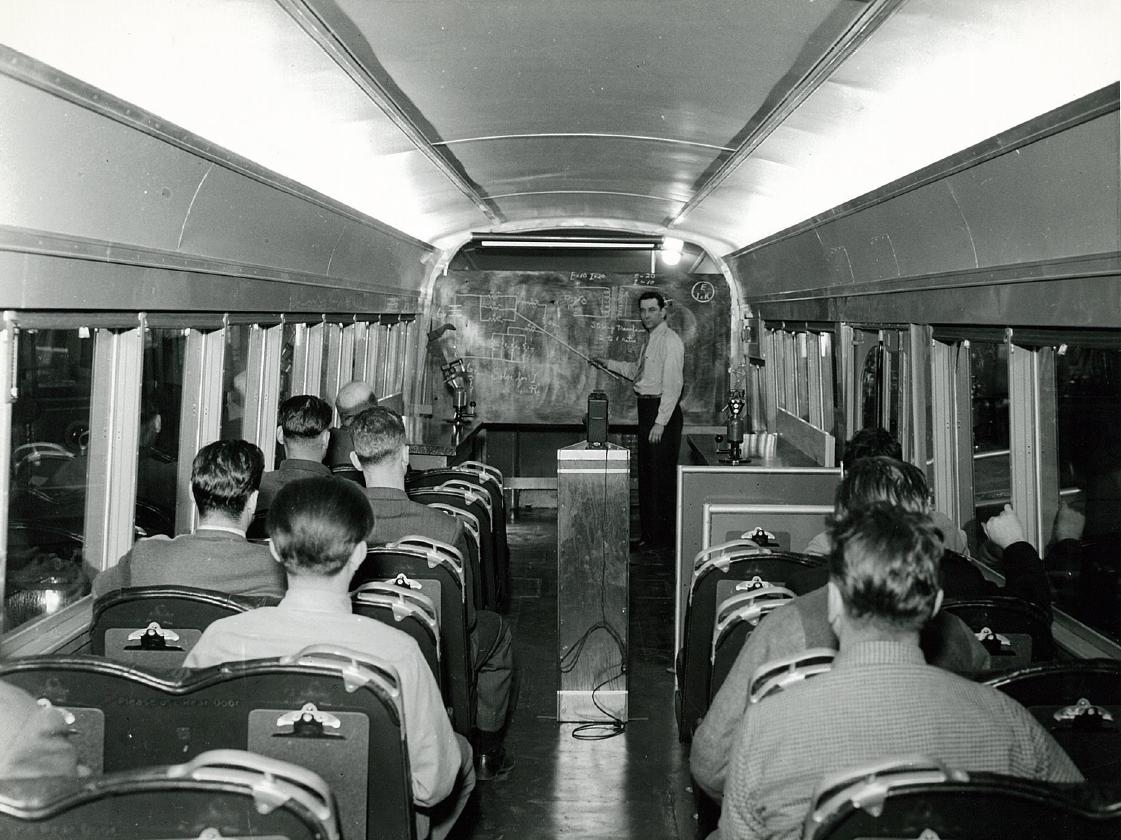
A close-up of the 7001 during its instruction car days. On the front of the car, it says, "Please enter and leave by center door." A picture of the car's interior during this period, from the Hicks Car Works blog, shows why: http://3.bp.blogspot.com/-CibxtjFSWwY/T37_s3ADAxI/AAAAAAAABXc/A3Aief1Y1iA/s1600/kpa7001-classroom3-48.JPG

A close-up of the 7001 during its instruction car days. On the front of the car, it says, “Please enter and leave by center door.” A picture of the car’s interior during this period, from the Hicks Car Works blog, shows why:
http://3.bp.blogspot.com/-CibxtjFSWwY/T37_s3ADAxI/AAAAAAAABXc/A3Aief1Y1iA/s1600/kpa7001-classroom3-48.JPG

Chicago & West Towns Railways car 130 is at the east end of the Madison line on March 31, 1946, while a Chicago Surface Lines prewar PCC sits nearby at the Madison-Austin loop. This is the borderline between Chicago and suburban Oak Park. (Don Ross Photo)

Chicago & West Towns Railways car 130 is at the east end of the Madison line on March 31, 1946, while a Chicago Surface Lines prewar PCC sits nearby at the Madison-Austin loop. This is the borderline between Chicago and suburban Oak Park. (Don Ross Photo)

CSL 7034 eastbound at Madison and Hamlin in July 1937. The tall building at rear is still there. (CSL Photo) Marty Robinson adds, "The tall building is the Midwest Hotel, which housed the studio of WNIB in the attic. I was a program host there in 1957."

CSL 7034 eastbound at Madison and Hamlin in July 1937. The tall building at rear is still there. (CSL Photo) Marty Robinson adds, “The tall building is the Midwest Hotel, which housed the studio of WNIB in the attic. I was a program host there in 1957.”

Chicago Surface Lines Photos, Part Four

CSL 3167 on Broadway at Sheridan. The old Granada Theatre, one of Chicago's lost movie palaces, is visible at rear. It was located at 6427 North Sheridan Road. (Railway Negative Exchange Photo) George Trapp adds: "CSL #3167 is on Broadway between Rosemont and Devon-Sheridan, photo dates to around 1930. Note that car 3167 is the last car in a line of six 169 class cars as is the southbound Broadway car. These cars ran on Broadway and it's variants from 1923 until early 1948. Building at far right next to Kushler Chevrolet is the Rosemont Garage of the Chicago Motor Coach Company."

CSL 3167 on Broadway at Sheridan. The old Granada Theatre, one of Chicago’s lost movie palaces, is visible at rear. It was located at 6427 North Sheridan Road. (Railway Negative Exchange Photo) George Trapp adds: “CSL #3167 is on Broadway between Rosemont and Devon-Sheridan, photo dates to around 1930. Note that car 3167 is the last car in a line of six 169 class cars as is the southbound Broadway car. These cars ran on Broadway and it’s variants from 1923 until early 1948. Building at far right next to Kushler Chevrolet is the Rosemont Garage of the Chicago Motor Coach Company.”

Thanksgiving is a time to share the abundance of life with family and friends. During this past year, our readers have shared many things with us. In keeping with the holiday spirit, we present a “feast for the eyes.”

Thanks to the generosity of George Trapp, here is another abundant helping of classic Chicago Surface Lines streetcar photos from his collection. (To see additional photos he has already shared with us, just type “George Trapp” into the search window at the top of this page. Several other posts should come up.)

Most of these pictures date to the “red car” era in Chicago, which began in the early 1920s and ended in 1954.

As always, if you can help identify locations, or have interesting facts or reminiscences to add, don’t hesitate to drop us a line. You can leave comments on this post, or write us directly at:

thetrolleydodger@gmail.com

FYI there will be additional posts in this series coming up in the near future, so watch this space.

Happy Holidays!

-David Sadowski


gh1

Help Support The Trolley Dodger

This is our 99th post, and we are gradually creating a body of work and an online resource for the benefit of all railfans, everywhere. To date, we have received 95,000 page views from nearly 28,000 individuals.

You can help us continue our original transit research by checking out the fine products in our Online Store. You can make a donation there as well.

As we have said before, “If you buy here, we will be here.”

We thank you for your support.


CSL 2733, signed for 79th and Brandon. (Heier Industrial Photo) Chuck Amstein writes, "79th St. and just east of Emerald Ave., looking NW. The buildings to the left of #2733 are still there."

CSL 2733, signed for 79th and Brandon. (Heier Industrial Photo) Chuck Amstein writes, “79th St. and just east of Emerald Ave., looking NW. The buildings to the left of #2733 are still there.”

George Trapp: "CSL #6055 is on Route 17 in front of Kedzie Depot." (Heier Industrial Photo) Through route 17 was Kedzie and ran from 1911 to 1949.

George Trapp: “CSL #6055 is on Route 17 in front of Kedzie Depot.” (Heier Industrial Photo) Through route 17 was Kedzie and ran from 1911 to 1949.

George Trapp: "CSL #872 on Through Route 3, Lincoln-Indiana is on the North approach to the Wabash Avenue bridge. Note the Chicago Motor Coach 45-passenger GM bus on the Michigan Avenue Blvd. bridge." (Heier Industrial Photo)

George Trapp: “CSL #872 on Through Route 3, Lincoln-Indiana is on the North approach to the Wabash Avenue bridge. Note the Chicago Motor Coach 45-passenger GM bus on the Michigan Avenue Blvd. bridge.” (Heier Industrial Photo)

CSL salt spreader AA102, formerly car #2851, retired on 8/10/1951 and scrapped in 1952. (Heier Industrial Photo)

CSL salt spreader AA102, formerly car #2851, retired on 8/10/1951 and scrapped in 1952. (Heier Industrial Photo)

George Trapp: "CSL Brill #5349 is eastbound on 63rd Street near State judging from the address of Indian Trailer." (Heier Industrial Photo)

George Trapp: “CSL Brill #5349 is eastbound on 63rd Street near State judging from the address of Indian Trailer.” (Heier Industrial Photo)

CSL 426, is on Armitage, signed to go downtown. Milwaukee Avenue cars also used these signs for North Western Station. (Heier Industrial Photo) George Trapp: "CSL #426 is on the Armitage-Downtown line, which was almost a branch of the Milwaukee Avenue line."

CSL 426, is on Armitage, signed to go downtown. Milwaukee Avenue cars also used these signs for North Western Station. (Heier Industrial Photo) George Trapp: “CSL #426 is on the Armitage-Downtown line, which was almost a branch of the Milwaukee Avenue line.”

CSL 3093, a one-man car, signed for Morgan and Pershing. (Railway Negative Exchange Photo) George Trapp: "CSL #3093 is on Erie at Ashland."

CSL 3093, a one-man car, signed for Morgan and Pershing. (Railway Negative Exchange Photo) George Trapp: “CSL #3093 is on Erie at Ashland.”

3093 again, this time signed for Erie and Ashland. Andre Kristopans: "3093 on Bridge is on the old Throop St bridge over the Sanitary & Ship Canal." (Railway Negative Exchange Photo)

3093 again, this time signed for Erie and Ashland. Andre Kristopans: “3093 on Bridge is on the old Throop St bridge over the Sanitary & Ship Canal.” (Railway Negative Exchange Photo)

3093 turning at 21st. Note the late 1930s Packard at left. (Railway Negative Exchange Photo)

3093 turning at 21st. Note the late 1930s Packard at left. (Railway Negative Exchange Photo)

Close-up of the Packard. The trim design on the side of the engine compartment makes this a 1938 model. (Railway Negative Exchange Photo)

Close-up of the Packard. The trim design on the side of the engine compartment makes this a 1938 model. (Railway Negative Exchange Photo)

Andre Kristopans says, "2909/1419 on 87th are just west of Commercial Av, the east end of the route." (Railway Negative Exchange Photo)

Andre Kristopans says, “2909/1419 on 87th are just west of Commercial Av, the east end of the route.” (Railway Negative Exchange Photo)

Andre Kristopans: "2918 is at Pershing and Western – McKinley Park in background. Note side sign “35-PERSHING”. Most of time West Pershing was a shuttle between Western and Ashland, but rush hours cars ran thru via Ashland and 35th to Cottage Grove." (Railway Negative Exchange Photo)

Andre Kristopans: “2918 is at Pershing and Western – McKinley Park in background. Note side sign “35-PERSHING”. Most of time West Pershing was a shuttle between Western and Ashland, but rush hours cars ran thru via Ashland and 35th to Cottage Grove.” (Railway Negative Exchange Photo)

CSL 204 on Western Avenue. (Railway Negative Exchange Photo)

CSL 204 on Western Avenue. (Railway Negative Exchange Photo)

CSL modernized small Pullman 804 on south Cicero Avenue, near Midway Airport (which may have been called Chicago Municipal Airport when this picture was taken). (Railway Negative Exchange Photo)

CSL modernized small Pullman 804 on south Cicero Avenue, near Midway Airport (which may have been called Chicago Municipal Airport when this picture was taken). (Railway Negative Exchange Photo)

CSL Big Pullman 204 signed for route 22 - Clark-Wentworth. (Railway Negative Exchange Photo)

CSL Big Pullman 204 signed for route 22 – Clark-Wentworth. (Railway Negative Exchange Photo)

CSL 453 northbound on Clark. (Railway Negative Exchange Photo)

CSL 453 northbound on Clark. (Railway Negative Exchange Photo)

CSL 3041 on Montrose in winter. Jim Huffman writes, "Photo #936 shows two Montrose cars, waiting their time, about to go EB at Milwaukee Av. Note that the 1st car is a two-man car & the following car is a one-man car. On Lawrence Av after it went to one-man cars, on certain nights when the Aragon ballroom let out, two-man cars would be used at that time for the crowds." (Railway Negative Exchange Photo) Streetcar service on Montrose ended on 7/29/46. The entire route was converted to trolley buses as of 4/19/48, which continued to 1973.

CSL 3041 on Montrose in winter. Jim Huffman writes, “Photo #936 shows two Montrose cars, waiting their time, about to go EB at Milwaukee Av. Note that the 1st car is a two-man car & the following car is a one-man car. On Lawrence Av after it went to one-man cars, on certain nights when the Aragon ballroom let out, two-man cars would be used at that time for the crowds.” (Railway Negative Exchange Photo) Streetcar service on Montrose ended on 7/29/46. The entire route was converted to trolley buses as of 4/19/48, which continued to 1973.

CSL 459 heading towards Soldier Field and the Field Museum of Natural History, crossing over the Illinois Central right-of-way. (Railway Negative Exchange Photo)

CSL 459 heading towards Soldier Field and the Field Museum of Natural History, crossing over the Illinois Central right-of-way. (Railway Negative Exchange Photo)

Andre Kristopans: "3098 SB turning off Erie into Racine." (Railway Negative Exchange Photo)

Andre Kristopans: “3098 SB turning off Erie into Racine.” (Railway Negative Exchange Photo)

3096 signed for Morgan and Pershing, heads through some backyard private right-of-way. (Railway Negative Exchange Photo)

3096 signed for Morgan and Pershing, heads through some backyard private right-of-way. (Railway Negative Exchange Photo)

CSL 3295 has just gone under an "L" storage yard. (Railway Negative Exchange Photo) George Trapp: "CSL #3295 is on Montrose just west of North Side "L", (with the) south end of Wilson Avenue shop storage yard in background."

CSL 3295 has just gone under an “L” storage yard. (Railway Negative Exchange Photo) George Trapp: “CSL #3295 is on Montrose just west of North Side “L”, (with the) south end of Wilson Avenue shop storage yard in background.”

CSL 1784, in WWII garb supporting the Women's Army Corps on route 22 - Clark-Wentworth. That's the Ridge Theatre at right. (Railway Negative Exchange Photo)

CSL 1784, in WWII garb supporting the Women’s Army Corps on route 22 – Clark-Wentworth. That’s the Ridge Theatre at right. (Railway Negative Exchange Photo)

CSL 1776 in patriotic garb during World War II, on through route 1 (Cottage Grove-Broadway). (Railway Negative Exchange Photo) George Trapp: "CSL #1776 is on Broadway just south of Devon."

CSL 1776 in patriotic garb during World War II, on through route 1 (Cottage Grove-Broadway). (Railway Negative Exchange Photo) George Trapp: “CSL #1776 is on Broadway just south of Devon.”

George Trapp: "Photo of car 204 with new Twin Coach buses in background, it appears car is in process of being converted to a salt spreader, cars last assignment was on Western after PCC's bumped it from Clark-Wentworth." (Railway Negative Exchange Photo) I'm not sure about a salt car, since 204 does not appear on the list of conversions we got from Andre Kristopans, which you can read here: http://thetrolleydodger.com/2015/10/04/trolley-dodger-mailbag-10-4-2015-etc/ George Trapp adds, "It seems to be a mystery what the bracket on the side of car 204 is for nor the location, is it South Shops property? This car was extensively modernized after a fire in the early 1930's."

George Trapp: “Photo of car 204 with new Twin Coach buses in background, it appears car is in process of being converted to a salt spreader, cars last assignment was on Western after PCC’s bumped it from Clark-Wentworth.” (Railway Negative Exchange Photo) I’m not sure about a salt car, since 204 does not appear on the list of conversions we got from Andre Kristopans, which you can read here:
http://thetrolleydodger.com/2015/10/04/trolley-dodger-mailbag-10-4-2015-etc/
George Trapp adds, “It seems to be a mystery what the bracket on the side of car 204 is for nor the location, is it South Shops property? This car was extensively modernized after a fire in the early 1930’s.”

CSL 2909, signed for Division and Grand. Since it is on an angle street, this may be Grand Avenue. (Railway Negative Exchange Photo)

CSL 2909, signed for Division and Grand. Since it is on an angle street, this may be Grand Avenue. (Railway Negative Exchange Photo)

CSL 2907, at the west end of the 87th Street route. Jon Habermaas writes: "The line ended east of the Rock Island viaduct, and there was no connection to the tracks on Vincennes. The car has changed ends and is ready for a new trip eastbound on 87th." (Railway Negative Exchange Photo) M. E. adds, "The 87th St. streetcar line's west end was on the east side of the Rock Island main line. Therefore, the streetcar shown has ended its run on the westbound track, switched trolleys, and is ready to head back east. On the west side of the railroad viaduct is Vincennes Ave., on which is a Halsted-Vincennes car. Just to the east of this view on 87th St. is Halsted St."

CSL 2907, at the west end of the 87th Street route. Jon Habermaas writes: “The line ended east of the Rock Island viaduct, and there was no connection to the tracks on Vincennes. The car has changed ends and is ready for a new trip eastbound on 87th.” (Railway Negative Exchange Photo) M. E. adds, “The 87th St. streetcar line’s west end was on the east side of the Rock Island main line. Therefore, the streetcar shown has ended its run on the westbound track, switched trolleys, and is ready to head back east. On the west side of the railroad viaduct is Vincennes Ave., on which is a Halsted-Vincennes car. Just to the east of this view on 87th St. is Halsted St.”

CSL 2859 at Southport and Clark, the north terminus of route 9 - Ashland. (Railway Negative Exchange Photo)

CSL 2859 at Southport and Clark, the north terminus of route 9 – Ashland. (Railway Negative Exchange Photo)

George Trapp: "CSL #3168 is at Devon and Kedzie," signed for route 36 - Broadway-State. He continues, "photo taken after CTA takeover as evidenced by ad on 3168, probably just before Broadway-State cut back to Ravenswood Avenue. Notice all the open land in the area, CTA could have built a loop for PCC cars if they had wanted." (Railway Negative Exchange Photo)

George Trapp: “CSL #3168 is at Devon and Kedzie,” signed for route 36 – Broadway-State. He continues, “photo taken after CTA takeover as evidenced by
ad on 3168, probably just before Broadway-State cut back to Ravenswood Avenue. Notice all the open land in the area, CTA could have built a loop for PCC cars if they had wanted.” (Railway Negative Exchange Photo)

CSL 230 crosses the old Milwaukee Road freight tracks near Wrigley Field. (Railway Negative Exchange Photo)

CSL 230 crosses the old Milwaukee Road freight tracks near Wrigley Field. (Railway Negative Exchange Photo)

CSL 1759 on through route 1, Cottage Grove-Broadway. (Railway Negative Exchange Photo) George Trapp: "CSL #1759 is on Devon approaching Kedzie."

CSL 1759 on through route 1, Cottage Grove-Broadway. (Railway Negative Exchange Photo) George Trapp: “CSL #1759 is on Devon approaching Kedzie.”

CSL 5279, signed for Halsted and Waveland, north terminus of route 8. However, this looks more like Clark Street near Lincoln Park. (Railway Negative Exchange Photo) George Trapp: "CSL #5279 is on Route 42, which ran through to Halsted-Waveland via Clark and Halsted returning via Broadway and Clark until late 1947." (I assume the route was changed once PCCs began running on route 8 - Halsted.)

CSL 5279, signed for Halsted and Waveland, north terminus of route 8. However, this looks more like Clark Street near Lincoln Park. (Railway Negative Exchange Photo) George Trapp: “CSL #5279 is on Route 42, which ran through to Halsted-Waveland via Clark and Halsted returning via Broadway and Clark until late 1947.” (I assume the route was changed once PCCs began running on route 8 – Halsted.)

CSL 3120 in the same location as the previous picture. (Railway Negative Exchange Photo)

CSL 3120 in the same location as the previous picture. (Railway Negative Exchange Photo)

CSL 209, westbound on route 72 - North Avenue, prepares to cross the north branch of the Chicago River near Goose Island. (Railway Negative Exchange Photo)

CSL 209, westbound on route 72 – North Avenue, prepares to cross the north branch of the Chicago River near Goose Island. (Railway Negative Exchange Photo)

CSL 117 has just left the Cermak loop near the lakefront, added for the 1933-34 World's Fair (A Century of Progress) (Railway Negative Exchange Photo)

CSL 117 has just left the Cermak loop near the lakefront, added for the 1933-34 World’s Fair (A Century of Progress) (Railway Negative Exchange Photo)

CSL 113 crosses the Milwaukee Road freight tracks that used to go by Wrigley Field. This was originally their main line. The large sign indicates a "through route," in this case 22 - Clark-Wentworth. (Railway Negative Exchange Photo)

CSL 113 crosses the Milwaukee Road freight tracks that used to go by Wrigley Field. This was originally their main line. The large sign indicates a “through route,” in this case 22 – Clark-Wentworth. (Railway Negative Exchange Photo)

CSL 1775 during WWII, promoting the Navy, is signed for Broadway. At right there is one of those supervisor's shantys that used to dot the Chicago landscape. (Railway Negative Exchange Photo) George Trapp: "CSL #1775 turning from Clark onto Devon."

CSL 1775 during WWII, promoting the Navy, is signed for Broadway. At right there is one of those supervisor’s shantys that used to dot the Chicago landscape. (Railway Negative Exchange Photo) George Trapp: “CSL #1775 turning from Clark onto Devon.”

CSL 1775 again. (Railway Negative Exchange Photo)

CSL 1775 again. (Railway Negative Exchange Photo)

CSL 1775 on route 22, this time promoting the Merchant Marine. Folksinger Woody Guthrie was a member of the Merchant Marine during World War II. (Railway Negative Exchange Photo) George Trapp: "CSL #1775 Merchant Marine is northbound on Clark at Devon."

CSL 1775 on route 22, this time promoting the Merchant Marine. Folksinger Woody Guthrie was a member of the Merchant Marine during World War II. (Railway Negative Exchange Photo) George Trapp: “CSL #1775 Merchant Marine is northbound on Clark at Devon.”

CSL 1784 signed for Broadway-State during WWII, advertising the U. S. Maritime Service. (Railway Negative Exchange Photo) George Trapp: "CSL #1784 is on Schreiber alongside Devon Depot."

CSL 1784 signed for Broadway-State during WWII, advertising the U. S. Maritime Service. (Railway Negative Exchange Photo) George Trapp: “CSL #1784 is on Schreiber alongside Devon Depot.”

George Trapp: "CSL #3157 is at 77th Street Depot." (Railway Negative Exchange Photo)

George Trapp: “CSL #3157 is at 77th Street Depot.” (Railway Negative Exchange Photo)

CSL 577 and 536 pass each other near downtown. Bill Shapotkin writes, "Believe this pic looks S-S/E on Milwaukee Ave from approx Des Plaines. The bridge x/o the joint MILW/PRR tracks." (Railway Negative Exchange Photo)

CSL 577 and 536 pass each other near downtown. Bill Shapotkin writes, “Believe this pic looks S-S/E on Milwaukee Ave from approx Des Plaines. The bridge x/o the joint MILW/PRR tracks.” (Railway Negative Exchange Photo)

CSL 5012. The sign "Stock Yards Direct" may provide a clue as to which route this is. (Railway Negative Exchange Photo) M. E. writes, "Magnifying the picture twice, the destination sign reads Racine - Downtown. Also, the side roller sign says Racine. Because of the Santa Fe in the background, and because the streetcar appears to be on a diagonal street, I think the streetcar is on Archer Ave. heading northeast. It will turn left (north) on either Clark St. or State St. to get downtown. As for the Stock Yards Direct sign, the Stock Yards are in the opposite direction. Heading southwest on Archer, the Racine car line went south on Wallace (600 West) to Root (4132 South), west to Halsted (800 West), south to 47th St., west to Racine (1200 West), south to 87th St. The Stock Yards were in the square mile bordered by Pershing, Halsted, 47th and Ashland, so the Racine car ran alongside the Stock Yards from Root and Halsted to 47th and Racine."

CSL 5012. The sign “Stock Yards Direct” may provide a clue as to which route this is. (Railway Negative Exchange Photo) M. E. writes, “Magnifying the picture twice, the destination sign reads Racine – Downtown. Also, the side roller sign says Racine. Because of the Santa Fe in the background, and because the streetcar appears to be on a diagonal street, I think the streetcar is on Archer Ave. heading northeast. It will turn left (north) on either Clark St. or State St. to get downtown. As for the Stock Yards Direct sign, the Stock Yards are in the opposite direction. Heading southwest on Archer, the Racine car line went south on Wallace (600 West) to Root (4132 South), west to Halsted (800 West), south to 47th St., west to Racine (1200 West), south to 87th St. The Stock Yards were in the square mile bordered by Pershing, Halsted, 47th and Ashland, so the Racine car ran alongside the Stock Yards from Root and Halsted to 47th and Racine.”

CSL 3154 at the Clark-Arthur loop. (Railway Negative Exchange Photo)

CSL 3154 at the Clark-Arthur loop. (Railway Negative Exchange Photo)

CSL 1457, during its days as a salt spreader. (Railway Negative Exchange Photo) George Trapp: "CSL #1457 is in Devon Depot open South Yard, note Pullman PCC in 4300's alongside."

CSL 1457, during its days as a salt spreader. (Railway Negative Exchange Photo) George Trapp: “CSL #1457 is in Devon Depot open South Yard, note Pullman PCC in 4300’s alongside.”

CSL 3134, southbound on Broadway-State. (Railway Negative Exchange Photo)

CSL 3134, southbound on Broadway-State. (Railway Negative Exchange Photo)

CSL modernized small Pullman 804 on south Cicero Avenue near Midway Airport. (Railway Negative Exchange Photo)

CSL modernized small Pullman 804 on south Cicero Avenue near Midway Airport. (Railway Negative Exchange Photo)

CSL 5915. (Heier Industrial Photo) Patrick writes, "Photos 953, 952 and 947 are taken in front of the Eighth Street Theater http://www.artic.edu/aic/resources/resource/2002?search_id=1&index=0 , which was home of the WLS National Barn dance as can be seen on the marquee in 947. The featured streetcars are southbound on Wabash. The taller building to the left still exists. The theater and the nearer tall building were demolished for exposition space for the Hilton (former Stevens) Hotel."

CSL 5915. (Heier Industrial Photo) Patrick writes, “Photos 953, 952 and 947 are taken in front of the Eighth Street Theater http://www.artic.edu/aic/resources/resource/2002?search_id=1&index=0 , which was home of the WLS National Barn dance as can be seen on the marquee in 947. The featured streetcars are southbound on Wabash. The taller building to the left still exists. The theater and the nearer tall building were demolished for exposition space for the Hilton (former Stevens) Hotel.”

CSL 5777. (Heier Industrial Photo)

CSL 5777. (Heier Industrial Photo)

CSL Sedan 3351. Note the marquee on the Eighth Street Theater at right, advertising the WLS National Barn Dance, which was broadcast "every Saturday." George Trapp: "(The) three shots on Wabash at Eighth were probably taken in Summer of 1947 when the Sedans were beginning to replace the Nearsides on Routes 4 and 5 after being bumped off of Route 22 by new PCC's." (Heier Industrial Photo)

CSL Sedan 3351. Note the marquee on the Eighth Street Theater at right, advertising the WLS National Barn Dance, which was broadcast “every Saturday.” George Trapp: “(The) three shots on Wabash at Eighth were probably taken in Summer of 1947 when the Sedans were beginning to replace the Nearsides on Routes 4 and 5 after being bumped off of Route 22 by new PCC’s.” (Heier Industrial Photo)

CSL 3100. If the sign at right is any indication, that is probably the South Side Park "L" at rear. (Railway Negative Exchange Photo) M. E. thinks this streetcar is on the 18th Street line, which "started at Leavitt (2200 West) and Blue Island, went north on Leavitt to 18th St., then east to probably Michigan Ave." George Foelschow: "I believe 3100 is eastbound on 18th Street crossing South Clark Street. There was a Catholic church at 18th and Clark. The 18th St. line ended at State. Track on 18th east of State and Wabash turned south on Indiana and was used by Indiana and Cottage Grove cars."

CSL 3100. If the sign at right is any indication, that is probably the South Side Park “L” at rear. (Railway Negative Exchange Photo) M. E. thinks this streetcar is on the 18th Street line, which “started at Leavitt (2200 West) and Blue Island, went north on Leavitt to 18th St., then east to probably Michigan Ave.”
George Foelschow: “I believe 3100 is eastbound on 18th Street crossing South Clark Street. There was a Catholic church at 18th and Clark. The 18th St. line ended at State. Track on 18th east of State and Wabash turned south on Indiana and was used by Indiana and Cottage Grove cars.”

Historic Chicago Buses, Part Three

CTA trolley bus 374 at Montrose and Narrangansett in 1948, "Another New CTA Bus." (Railway Negative Exchange Photo)

CTA trolley bus 374 at Montrose and Narrangansett in 1948, “Another New CTA Bus.” (Railway Negative Exchange Photo)

We generally don’t feature buses on this blog, since our main interest is in streetcars, light rail, and electric rail transit. But we do get requests to post more bus photos, and we are fortunate to have some excellent ones to show you today, thanks to the incredible generosity of George Trapp. Mr. Trapp has been collecting these type of pictures for nearly the last 50 years, and we thank him for sharing them with us. Some of these pictures also have streetcars in them.

To see additional photos he has already shared with us, just type “George Trapp” into the search window at the top of this page. Several other posts should come up.

For the streetcar fans, we have also included several additional trolley pictures from our own collections, featuring the Chicago & West Towns Railways, Illinois Terminal Railroad, and its subsidiary the Chicago, Ottawa & Peoria.

As always, if you can help identify locations, or have interesting facts or reminiscences to add, don’t hesitate to drop us a line. You can leave comments on this post, or write us directly at:

thetrolleydodger@gmail.com

-David Sadowski

gh1


Help Support The Trolley Dodger

This is our 98th post, and we are gradually creating a body of work and an online resource for the benefit of all railfans, everywhere. To date, we received more than 93,000 page views from nearly 27,500 individuals.

You can help us continue our original transit research by checking out the fine products in our Online Store. You can make a donation there as well.

As we have said before, “If you buy here, we will be here.”

We thank you for your support.


Bill Robb: "Chicago City Railway 430 is a 1938 ACF H-13-S. These units lasted unit 1953-55."

Bill Robb: “Chicago City Railway 430 is a 1938 ACF H-13-S. These units lasted unit 1953-55.”

CSL buses 6515 and 6407 at South Shops. The destinations signs on 6515 do not match. George Trapp: "CSL bus 6515 built by GM model TD-4506 built in 1946 is newly delivered and photo most likely taken by CSL."

CSL buses 6515 and 6407 at South Shops. The destinations signs on 6515 do not match. George Trapp: “CSL bus 6515 built by GM model TD-4506 built in 1946 is newly delivered and photo most likely taken by CSL.”

Bill Robb: "Chicago City Railways 402 is a 1934 ACF H-13-S."

Bill Robb: “Chicago City Railways 402 is a 1934 ACF H-13-S.”

Andre Kristopans: "The Diversey TB shot is eb at Kimball. Large building across street still there." Trolley bus service on Diversey ended in 1955 once the route was consolidated with former Chicago Motor Coach route 134. Ray Piesciuk: "The Diversey TB route was extended to Harlem (actually a wye at Neva) on 06/19/1932." (Railway Negative Exchange Photo)

Andre Kristopans: “The Diversey TB shot is eb at Kimball. Large building across street still there.” Trolley bus service on Diversey ended in 1955 once the route was consolidated with former Chicago Motor Coach route 134. Ray Piesciuk: “The Diversey TB route was extended to Harlem (actually a wye at Neva) on 06/19/1932.” (Railway Negative Exchange Photo)

CSL bus 825, signed for Peterson. Bill Robb: "Calumet & South Chicago 825 is a 1939 White 805M which ran until a general purge of obsolete buses in 1949." Andre Kristopans: "Most likely turning from north on Catalpa to west on Hollywood. Loop at the time was Bryn Mawr-Catalpa-Hollywood-Broadway."

CSL bus 825, signed for Peterson. Bill Robb: “Calumet & South Chicago 825 is a 1939 White 805M which ran until a general purge of obsolete buses in 1949.” Andre Kristopans: “Most likely turning from north on Catalpa to west on Hollywood. Loop at the time was Bryn Mawr-Catalpa-Hollywood-Broadway.”

CSL bus 6520 on extension route 103A. The original version of this route operated between 1930 and 1941. (Railway Negative Exchange Photo)

CSL bus 6520 on extension route 103A. The original version of this route operated between 1930 and 1941. (Railway Negative Exchange Photo)

CTA trolley bus 465. (Railway Negative Exchange Photo)

CTA trolley bus 465. (Railway Negative Exchange Photo)

Another new trolley bus being delivered to Chicago by rail. (Railway Negative Exchange Photo) George Trapp: "New St. Louis trolley bus #411 on flatcar in a freight train in April of 1948 on Illinois Terminal, note catenary."

Another new trolley bus being delivered to Chicago by rail. (Railway Negative Exchange Photo) George Trapp: “New St. Louis trolley bus #411 on flatcar in a freight train in April of 1948 on Illinois Terminal, note catenary.”

CTA trolley buses 570 and 571 being delivered on Illinois Central flatcars.

CTA trolley buses 570 and 571 being delivered on Illinois Central flatcars.

North and Lamon was the approximate location of CTA North Avenue garage, so presumably that is where this picture of trolley bus 403 was taken. (Railway Negative Exchange Photo) George Trapp: "St. Louis trolley bus 403 is next to Pullman-Standard trolley bus 344 built at Worcester plant. Both delivered in 1948, St. Louis unit in March-April, Pullman in Nov.-Dec."

North and Lamon was the approximate location of CTA North Avenue garage, so presumably that is where this picture of trolley bus 403 was taken. (Railway Negative Exchange Photo) George Trapp: “St. Louis trolley bus 403 is next to Pullman-Standard trolley bus 344 built at Worcester plant. Both delivered in
1948, St. Louis unit in March-April, Pullman in Nov.-Dec.”

A St. Louis Car Company builder's photo of trolley bus 172. (Railway Negative Exchange Photo)

A St. Louis Car Company builder’s photo of trolley bus 172. (Railway Negative Exchange Photo)

CSL had an open-air trolleybus yard at Central and Avondale, adjacent to the Chicago & North Western. The Kennedy expressway now occupies this location. (Railway Negative Exchange Photo) Ray Piesciuk: "The open air TB yard at Central-Avondale shows two buses with poles that are not trolley buses. They are work motor buses BA-106 & BA-115 outfitted with sleet scraping poles." Another reader writes: "Note the "Marmon-Herrington" builder's plate on the front of the bus. When the buses were retired, there were no such builder's plates to be found under the advertising holders that had existed at that location for most of the lives of the coaches. "

CSL had an open-air trolleybus yard at Central and Avondale, adjacent to the Chicago & North Western. The Kennedy expressway now occupies this location. (Railway Negative Exchange Photo) Ray Piesciuk: “The open air TB yard at Central-Avondale shows two buses with poles that are not trolley buses. They are work motor buses BA-106 & BA-115 outfitted with sleet scraping poles.”
Another reader writes: “Note the “Marmon-Herrington” builder’s plate on the front of the bus. When the buses were retired, there were no such builder’s plates to be found under the advertising holders that had existed at that location for most of the lives of the coaches. “

Another view of the old Central and Avondale yard. (Railway Negative Exchange Photo)

Another view of the old Central and Avondale yard. (Railway Negative Exchange Photo)

Here is a 1940s map of the area around Central and Avondale on Chicago's northwest side, where the Surface Lines had a temporary open-air trolley bus yard parallel to the Chicago & North Western starting in 1943. It was replaced by the Forest Glen garage in 1955. This area is now occupied by the Kennedy expressway.

Here is a 1940s map of the area around Central and Avondale on Chicago’s northwest side, where the Surface Lines had a temporary open-air trolley bus yard parallel to the Chicago & North Western starting in 1943. It was replaced by the Forest Glen garage in 1955. This area is now occupied by the Kennedy expressway.

George Trapp: "CSL #3226 is at South end of South Damen streetcar line, bus 6805 is on the shuttle bus extension to 87th Street." (Railway Negative Exchange Photo)

George Trapp: “CSL #3226 is at South end of South Damen streetcar line, bus 6805 is on the shuttle bus extension to 87th Street.” (Railway Negative Exchange Photo)

CSL 6153 on a charter, eastbound at Washington and State. Meanwhile, a suburban bus bound for the Brookfield Zoo approaches. (Edward Frank, Jr. Photo) Andre Kristopans: "The Brookfield Zoo bus is Bluebird Coach Lines. Route was from downtown out Randolph, Ogden, 26th Desplaines, with most trips continuing out 31st, LaGrange, Ogden to Aurora."

CSL 6153 on a charter, eastbound at Washington and State. Meanwhile, a suburban bus bound for the Brookfield Zoo approaches. (Edward Frank, Jr. Photo) Andre Kristopans: “The Brookfield Zoo bus is Bluebird Coach Lines. Route was from downtown out Randolph, Ogden, 26th Desplaines, with most trips continuing out 31st, LaGrange, Ogden to Aurora.”

CSL 3189, northbound at State and Lake, on August 29, 1947. Note the Greyhound bus at right. (Thomas H, Desnoyers Photo, Krambles-Peterson Archive)

CSL 3189, northbound at State and Lake, on August 29, 1947. Note the Greyhound bus at right. (Thomas H, Desnoyers Photo, Krambles-Peterson Archive)

CSL Sedan 3332 southbound at Wabash and Roosevelt on September 27, 1947. Note the Greyhound bus at right. (Thomas H. Desnoyers Photo, Krambles-Peterson Archive) Allen Breyer: "Also shows the old Union Bus Terminal behind the Greyhound."

CSL Sedan 3332 southbound at Wabash and Roosevelt on September 27, 1947. Note the Greyhound bus at right. (Thomas H. Desnoyers Photo, Krambles-Peterson Archive) Allen Breyer: “Also shows the old Union Bus Terminal behind the Greyhound.”

CSL 5289 passes some CSL buses at 78th and Vincennes, looking NE. According to Don's Rail Photos, "5251 thru 5300 were built by Brill in 1906, #15365, for CCRy. They were brought up to higher standards in 1909." (Gordon Lloyd Photo) This CSL bus photo is not part of the Trapp collection. Chuck Amstein: "The South Shops building in the background is still there." Another reader notes, "The two Yellow Coach gas buses in the background were purchased by CSL and are painted in the pre-Mercury Green CSL motor bus colors of Red and Cream with Black Striping as found on CSL 3407 at the Illinois Railway Museum today."

CSL 5289 passes some CSL buses at 78th and Vincennes, looking NE. According to Don’s Rail Photos, “5251 thru 5300 were built by Brill in 1906, #15365, for CCRy. They were brought up to higher standards in 1909.” (Gordon Lloyd Photo) This CSL bus photo is not part of the Trapp collection. Chuck Amstein: “The South Shops building in the background is still there.”
Another reader notes, “The two Yellow Coach gas buses in the background were purchased by CSL and are painted in the pre-Mercury Green CSL motor bus colors of Red and Cream with Black Striping as found on CSL 3407 at the Illinois Railway Museum today.”

Chicago & West Towns Railways

FYI, we have also added these two pictures to our earlier post West Towns Streetcars in Black-and-White (August 4th).

C&WT 104 at the Harlem and Cermak car barn on April 3, 1948, less than two before the end of streetcar service. One of the replacement buses is at right. (C. Edward Hedstrom Photo)

C&WT 104 at the Harlem and Cermak car barn on April 3, 1948, less than two before the end of streetcar service. One of the replacement buses is at right. (C. Edward Hedstrom Photo)

C&WT line car 15, with its famous bent pole.The defect was apparently accidental, but it was certainly distinctive.

C&WT line car 15, with its famous bent pole.The defect was apparently accidental, but it was certainly distinctive.

Illinois Terminal Railroad

IT 273.

IT 273.

According to Don's Rail Photos, IT 104 "was built by American Car in 1917 as AG&StL 64. In 1926 it became StL&ARy 64 and in 1930 it became IT 104." This picture was taken in Granite City on August 14, 1956.

According to Don’s Rail Photos, IT 104 “was built by American Car in 1917 as AG&StL 64. In 1926 it became StL&ARy 64 and in 1930 it became IT 104.” This picture was taken in Granite City on August 14, 1956.

IT 284, decked in bunting, on what must have been the final revenue trip on this portion of the interurban in 1955. If anyone can identify the exact date or the location, please let me know. (Glenn L. Sticken Photo) You can see a picture of the same bunting applied to IT 277 at the Illinois Railway Museum in 2011 here: http://hickscarworks.blogspot.com/2011/04/illinois-terminal-society-meet.html

IT 284, decked in bunting, on what must have been the final revenue trip on this portion of the interurban in 1955. If anyone can identify the exact date or the location, please let me know. (Glenn L. Sticken Photo) You can see a picture of the same bunting applied to IT 277 at the Illinois Railway Museum in 2011 here:
http://hickscarworks.blogspot.com/2011/04/illinois-terminal-society-meet.html

IT double-end PCC 455 at speed in St. Louis on May 18, 1951.

IT double-end PCC 455 at speed in St. Louis on May 18, 1951.

Chicago, Ottawa & Peoria

Here are four rare photos of the CO&P. Since it was abandoned in 1934, photos are scarce. We previously posted a few more here.

CO&P freight motor 1523 at the Ottawa Shops in 1934, presumably around the time of abandonment.

CO&P freight motor 1523 at the Ottawa Shops in 1934, presumably around the time of abandonment.

CO&P express freight car 301 in November 1910.

CO&P express freight car 301 in November 1910.

CO&P first #60 at Depue in 1910, a product of the Danville Car Company.

CO&P first #60 at Depue in 1910, a product of the Danville Car Company.

CO&P #66 at the Ottawa Shops in 1934, presumably at the time of abandonment. It was built by St. Louis Car Company in 1924. Some cars in this series were rebuilt for use on the rest of the Illinois Terminal system, including IT 415 (former CO&P 64) which is now at the Illinois Railway Museum.

CO&P #66 at the Ottawa Shops in 1934, presumably at the time of abandonment. It was built by St. Louis Car Company in 1924. Some cars in this series were rebuilt for use on the rest of the Illinois Terminal system, including IT 415 (former CO&P 64) which is now at the Illinois Railway Museum.

Chicago Surface Lines Photos, Part Three

Bill Shapotkin writes: "This pic is on the Riverdale line. The location is JUST SOUTH of 130th St (the tracks on the embankment are the IC). View looks E-N/E." George Trapp: "CSL #2595 is on Riverdale line, side sign reads Michigan-Indiana." M. E. writes: "The first picture is on the Riverdale line, which ran south along the west side of the Illinois Central main line, then under the IC, then south to Riverdale." The car number looks like 2595, making this a "Robertson" car, built by St. Louis Car Company in 1901. Robert Leffingwell writes: "(This) picture is most likely Indiana Ave between 130th and 134th where it ran on private right of way along side the IC tracks. (The tracks on 134th are still clearly visible to this day)." Andre Kristopans: "2595 is on 34-Riverdale (sign would say Michigan-Indiana) along the IC between 127th and 134th."

Bill Shapotkin writes: “This pic is on the Riverdale line. The location is JUST SOUTH of 130th St (the tracks on the embankment are the IC). View looks E-N/E.” George Trapp: “CSL #2595 is on Riverdale line, side sign reads Michigan-Indiana.” M. E. writes: “The first picture is on the Riverdale line, which ran south along the west side of the Illinois Central main line, then under the IC, then south to Riverdale.”
The car number looks like 2595, making this a “Robertson” car, built by St. Louis Car Company in 1901.
Robert Leffingwell writes: “(This) picture is most likely Indiana Ave between 130th and 134th where it ran on private right of way along side the IC tracks. (The tracks on 134th are still clearly visible to this day).”
Andre Kristopans: “2595 is on 34-Riverdale (sign would say Michigan-Indiana) along the IC between 127th and 134th.”

Thanks to the generosity of George Trapp, here is another generous helping of classic Chicago Surface Lines streetcar photos from his collection. (To see additional photos he has already shared with us, just type “George Trapp” into the search window at the top of this page. Several other posts should come up.)

Most of these pictures date to the “red car” era in Chicago, which began in the early 1920s and ended in 1954. Some are even older than that.

As always, if you can help identify locations, or have interesting facts or reminiscences to add, don’t hesitate to drop us a line. You can leave comments on this post, or write us directly at:

thetrolleydodger@gmail.com

FYI there will be several additional posts in this series coming up in the near future, so watch this space.

-David Sadowski

PS- We’ve already received a lot of excellent comments on this post. I will incorporate them into the photo captions later this evening. We thank all our contributors.

M. E. writes:

More thoughts about CSL Photos part 3:

Using the map at http://chicagoinmaps.com/chicagostreetcars.html I make the assumption that the carbarn at 93rd and Drexel serviced all these east/west lines: 87th St., 93rd/95th St., 103rd St., 111th/115th St., 119th/Vincennes. All these lines likely used Cottage Grove to get to and from the carbarn.

Several of the pictures are of cars 3100 and 3113. The one captioned “CSL 3113, signed for 93rd and Drexel” seems to be in the carbarn at that location.

I think the one captioned “CSL 3100, signed for 103rd and Vincennes” was taken at 103rd and Michigan. The destination sign reads 103rd and Vincennes, so the view must be looking east from Michigan. Notice the man standing in front of the Buy Now sign.

This could be the same man who “has just taken a picture” in the photo captioned “CSL 3100, probably on the south side …” In the distance in this picture is the Illinois Central main line paralleling Cottage Grove Ave. The IC right-of-way was above ground at that point.

Next, the picture captioned “CSL 3100 again, possibly getting ready to change ends”. The destination sign reads 103rd and Vincennes, which is where this photo was taken, facing northeast.

Next, the picture captioned “CSL 3100, signed to go to 103rd and Vincennes”, was taken just east of the last one I mentioned.

Next, the picture captioned “CSL 3100 at the end of the 103rd Street line”, was taken from the same spot as the first one I cited.

All of these CSL 3100 shots at Vincennes must have been taken at the same time.

Finally, “CSL 3113. The sign at rear, advertising the Beverly Bakery” is at the same spot but a different car.

In this 1941 CSL map, which you can find in Chicago's PCC Streetcars: The Rest of the Story, you can see how the 103rd route ended east of Vincennes and the Rock Island (although there was a single track connection with Vincennes).

In this 1941 CSL map, which you can find in Chicago’s PCC Streetcars: The Rest of the Story, you can see how the 103rd route ended east of Vincennes and the Rock Island (although there was a single track connection with Vincennes).

Unrelated, but interesting: In the map, on the 93rd St. line, west of Stony Island, notice that the track goes almost back to 95th St. This was a prime viewing site for streetcars and trains. There was a busy north/south railroad, and an east/west railroad, that crossed just north of 95th St. The streetcar line ran along the north side of the east/west railroad. The streetcar line crossed the north/south railroad at grade. I do not remember whether there were crossing gates over the streetcar tracks. If not, then each streetcar would have required a two-man crew so the conductor could act as lookout before the motorman crossed the railroad track.

CSL streetcar service on route 103, subject of several pictures in this post, was replaced by buses on October 13, 1941. Chances are theses photos were taken shortly before that early abandonment.


Help Support The Trolley Dodger

This is our 97th post, and we are gradually creating a body of work and an online resource for the benefit of all railfans, everywhere. To date, we received more than 91,000 page views from nearly 27,500 individuals.

You can help us continue our original transit research by checking out the fine products in our Online Store. You can make a donation there as well.

As we have said before, “If you buy here, we will be here.”

We thank you for your support.


A map of the area around 103rd and Vincennes, as it looked in the 1940s when these streetcar pictures were taken. Vincennes is the angle street that runs parallel to the Rock Island, which heads to the southwest.

A map of the area around 103rd and Vincennes, as it looked in the 1940s when these streetcar pictures were taken. Vincennes is the angle street that runs parallel to the Rock Island, which heads to the southwest.

CSL 3100 at 103rd and Vincennes, the west end of this line. Bill Shapotkin writes, "The pic below, looking N-N/W (and a few feet west of the above photo) is indeed a car at the west end of (revenue) trackage. (a single track, normally not used in revenue service, did x/o the ROCK and connected with trackage on Vincennes Ave). I have a contemporary photo of a CTA bus at this same location. The building on the north side of the street remains standing (at least as of six months ago)." M. E. writes: "The last picture is likely at 103rd and Vincennes, on the east side of the Rock Island main line. I say this because it looks like the end of the line, where the streetcar tracks merge."

CSL 3100 at 103rd and Vincennes, the west end of this line. Bill Shapotkin writes, “The pic below, looking N-N/W (and a few feet west of the above photo) is indeed a car at the west end of (revenue) trackage. (a single track, normally not used in revenue service, did x/o the ROCK and connected with trackage on Vincennes Ave). I have a contemporary photo of a CTA bus at this same location. The building on the north side of the street remains standing (at least as of six months ago).”
M. E. writes: “The last picture is likely at 103rd and Vincennes, on the east side of the Rock Island main line. I say this because it looks like the end of the line, where the streetcar tracks merge.”

103rd and Vincennes today. We are looking west.

103rd and Vincennes today. We are looking west.

CSL 2006 in storage, apparently having last been used on one of the light far south side lines.

CSL 2006 in storage, apparently having last been used on one of the light far south side lines.

CSL 3100, signed to go to 103rd and Vincennes. According to M. E., this picture was taken just east of 103rd and Michigan. Chuck Amstein: "103rd and Eberhart Ave., looking NE. The building just to the right of #3100 is still there, and matches the one in the background in misc831."

CSL 3100, signed to go to 103rd and Vincennes. According to M. E., this picture was taken just east of 103rd and Michigan. Chuck Amstein: “103rd and Eberhart Ave., looking NE. The building just to the right of #3100 is still there, and matches the one in the background in misc831.”

103rd and Eberhart Avenue today. We are looking east.

103rd and Eberhart Avenue today. We are looking east.

CSL 3093 at Erie and Ashland, signed to go to Morgan and Pershing.

CSL 3093 at Erie and Ashland, signed to go to Morgan and Pershing.

CSL 2910 heading west (signed for Austin, the city limits) in the 1940s. George Trapp: "CSL 2910 is on West Division line, Destination reads Division-Austin, this type of car a regular on this route." From our comments section: "CSL 2910 is signed DIVISION-AUSTIN. Short line operated on Division between Grand and Austin until it was through routed by bus to California until it was further through routed to downtown." "CSL 2910 heading west (signed for Austin, the city limits) possibly Division / Austin … location is possibly on Division just east of Grand ave." Andre Kristopans: "2910 is most likely on West Division St, California to Austin, as it is a small one-man car." Mike Franklin: "CSL 2910 heading west and the two flats are located on the 5000 block of Division."

CSL 2910 heading west (signed for Austin, the city limits) in the 1940s. George Trapp: “CSL 2910 is on West Division line, Destination reads Division-Austin, this type of car a regular on this route.”
From our comments section: “CSL 2910 is signed DIVISION-AUSTIN. Short line operated on Division between Grand and Austin until it was through routed by bus to California until it was further through routed to downtown.” “CSL 2910 heading west (signed for Austin, the city limits) possibly Division / Austin … location is possibly on Division just east of Grand ave.”
Andre Kristopans: “2910 is most likely on West Division St, California to Austin, as it is a small one-man car.”
Mike Franklin: “CSL 2910 heading west and the two flats are located on the 5000 block of Division.”

The 5000 block on west Division street today.

The 5000 block on west Division street today.

Chicago City Railway 2503.

Chicago City Railway 2503.

CSL 2910, signed for Pershing. (Edward Frank, Jr. photo)

CSL 2910, signed for Pershing. (Edward Frank, Jr. photo)

CSL "Little" Pullman 810, built in 1910, on route 10. George Trapp: "CSL 810 is at Western-Howard."

CSL “Little” Pullman 810, built in 1910, on route 10. George Trapp: “CSL 810 is at Western-Howard.”

Andre Kristopans writes, "3236 looks like nb on Racine about to turn east into Armitage. Building to right is the Maud St wreck truck house, part of CUT’s North Shops complex, most of which was closed when West Shop opened in the teens."

Andre Kristopans writes, “3236 looks like nb on Racine about to turn east into Armitage. Building to right is the Maud St wreck truck house, part of CUT’s North Shops complex, most of which was closed when West Shop opened in the teens.”

Racine and Armitage today. We are looking north.

Racine and Armitage today. We are looking north.

CSL Birney 2901, also seen in another picture elsewhere in this post.

CSL Birney 2901, also seen in another picture elsewhere in this post.

George Trapp: "CSL Trailer 8050 is also at Devon Depot, Note new track in foreground, car is sandwiched between a Big Pullman and a 169 class car." The trailer was built in 1921.

George Trapp: “CSL Trailer 8050 is also at Devon Depot, Note new track in foreground, car is sandwiched between a Big Pullman and a 169 class car.” The trailer was built in 1921.

CSL 3298 on, I believe, route 73. If so, we are most likely at about 600 West Armitage. (Edward Frank, Jr. Photo)

CSL 3298 on, I believe, route 73. If so, we are most likely at about 600 West Armitage. (Edward Frank, Jr. Photo)

Chicago Union Traction 4776, signed for Van Buren. I believe this may have been renumbered as CSL 1247 later on. The sign advertises a ferry across Lake Michigan to Grand Rapids for $1.50. Michael Franklin adds: "This location is looking west on Van Buren just east of Kedzie. Car house in background. Wm. A. Lavin Saloon sat on the NE corner of Van Buren and Kedzie."

Chicago Union Traction 4776, signed for Van Buren. I believe this may have been renumbered as CSL 1247 later on. The sign advertises a ferry across Lake Michigan to Grand Rapids for $1.50. Michael Franklin adds: “This location is looking west on Van Buren just east of Kedzie. Car house in background. Wm. A. Lavin Saloon sat on the NE corner of Van Buren and Kedzie.”

CSL trailer 8027, built by the Surface Lines in 1921 during a time when ridership was greatly increasing. Trailers were no longer needed in the 1930s due to the Depression, and while they were considered for use during World War II they ended up as storage sheds such as this one. According to George Trapp, this photo was taken at the Devon Depot. Andre Kristopans: "As for the trailers, all were sheds by 1930 or so. Some were fixed up to go back into service about 1942, but never did, and these were the ones scrapped in 1944-45."

CSL trailer 8027, built by the Surface Lines in 1921 during a time when ridership was greatly increasing. Trailers were no longer needed in the 1930s due to the Depression, and while they were considered for use during World War II they ended up as storage sheds such as this one. According to George Trapp, this photo was taken at the Devon Depot.
Andre Kristopans: “As for the trailers, all were sheds by 1930 or so. Some were fixed up to go back into service about 1942, but never did, and these were the ones scrapped in 1944-45.”

CSL 3100 again, possibly getting ready to change ends. M. E. writes: "The destination sign reads 103rd and Vincennes, which is where this photo was taken, facing northeast."

CSL 3100 again, possibly getting ready to change ends. M. E. writes: “The destination sign reads 103rd and Vincennes, which is where this photo was taken, facing northeast.”
Chuck Amstein: ” 103rd near Vincennes, just east of the Rock Island tracks, looking ENE. The building with the “MEATS” sign is still there.”

103rd just east of Vincennes today. Note the same building as in the previous picture.

103rd just east of Vincennes today. Note the same building as in the previous picture.

CSL 3100 on 103rd. Looks like the man at right has just taken a picture. Chuck Amstein writes: " 103rd St. just west of Vernon Ave., looking ENE. The 3-story apartment bldg. (approx. 10235 S. Vernon) and the building just to the right of #3100 in the distance, are still there."

CSL 3100 on 103rd. Looks like the man at right has just taken a picture.
Chuck Amstein writes: ” 103rd St. just west of Vernon Ave., looking ENE. The 3-story apartment bldg. (approx. 10235 S. Vernon) and the building just to the right of #3100 in the distance, are still there.”

The three-flat at 10235 S. Vernon today.

The three-flat at 10235 S. Vernon today.

CSL 3113, signed for 93rd and Drexel. M. E. writes: "The destination 93rd and Drexel (900 east) is a block east of Cottage Grove Ave. According to Wikipedia, "Burnside car barn at 93rd and Drexel is still basically intact." So Cottage Grove cars and 93rd/95th cars could be signed for 93rd and Drexel. (It) seems to be in the carbarn at that location."

CSL 3113, signed for 93rd and Drexel. M. E. writes: “The destination 93rd and Drexel (900 east) is a block east of Cottage Grove Ave. According to Wikipedia, “Burnside car barn at 93rd and Drexel is still basically intact.” So Cottage Grove cars and 93rd/95th cars could be signed for 93rd and Drexel. (It) seems to be in the carbarn at that location.”

CSL 3100, signed for 103rd and Vincennes. M. E. writes: "I think the one captioned "CSL 3100, signed for 103rd and Vincennes" was taken at 103rd and Michigan. The destination sign reads 103rd and Vincennes, so the view must be looking east from Michigan. Notice the man standing in front of the Buy Now sign. This could be the same man who "has just taken a picture" (in another photo in this post). In the distance in this picture is the Illinois Central main line paralleling Cottage Grove Ave. The IC right-of-way was above ground at that point." Chuck Amstein writes: "103rd and Michigan, looking ESE. The house just to the right of #3100 is still there."

CSL 3100, signed for 103rd and Vincennes. M. E. writes: “I think the one captioned “CSL 3100, signed for 103rd and Vincennes” was taken at 103rd and Michigan. The destination sign reads 103rd and Vincennes, so the view must be looking east from Michigan. Notice the man standing in front of the Buy Now sign.
This could be the same man who “has just taken a picture” (in another photo in this post). In the distance in this picture is the Illinois Central main line paralleling Cottage Grove Ave. The IC right-of-way was above ground at that point.”
Chuck Amstein writes: “103rd and Michigan, looking ESE. The house just to the right of #3100 is still there.”

While lightweight single-truck Birney cars were successful in many smaller cities and towns, such as Fort Collins, Colorado, they were not successful in Chicago. Here we see a rare shot of CSL 2901 at 71st and State in 1924.

While lightweight single-truck Birney cars were successful in many smaller cities and towns, such as Fort Collins, Colorado, they were not successful in Chicago. Here we see a rare shot of CSL 2901 at 71st and State in 1924.

An early Chicago City Railway streetcar at 75th Street and Manhattan Beach. According to the Encyclopedia of Chicago History, "Located near Windsor Bathing Beach, Manhattan Beach (later Rainbow Beach) was a popular spot for middle-class boys and girls to meet in the early decades of the twentieth century. Some religious leaders and conservative politicians opposed this and other private beaches, claiming that they encouraged sexual promiscuity and the consumption of alcohol among minors. Rainbow Beach was also reclaimed by the city and operated as a municipal beach in the 1920s. "

An early Chicago City Railway streetcar at 75th Street and Manhattan Beach. According to the Encyclopedia of Chicago History, “Located near Windsor Bathing Beach, Manhattan Beach (later Rainbow Beach) was a popular spot for middle-class boys and girls to meet in the early decades of the twentieth century. Some religious leaders and conservative politicians opposed this and other private beaches, claiming that they encouraged sexual promiscuity and the consumption of alcohol among minors. Rainbow Beach was also reclaimed by the city and operated as a municipal beach in the 1920s. “

CSL 2832 signed for a charter. From the autos, it would appear this picture was taken in the 1940s.

CSL 2832 signed for a charter. From the autos, it would appear this picture was taken in the 1940s.

CTA 1722 at Western and Howard on May 22, 1948. The northernmost portion of route 49 was bussed on August 1, 1948. At the same time, streetcar service was cut back to 79th on the south end, via a new loop there. George Trapp writes: "On Aug. 1, 1948 north terminal changed to Schreiber loop at Devon Depot also shared with Route 36 cars. Berwyn loop opened Dec. 12, 1948."

CTA 1722 at Western and Howard on May 22, 1948. The northernmost portion of route 49 was bussed on August 1, 1948. At the same time, streetcar service was cut back to 79th on the south end, via a new loop there.
George Trapp writes: “On Aug. 1, 1948 north terminal changed to Schreiber loop at Devon Depot also shared with Route 36 cars. Berwyn loop opened Dec. 12, 1948.”

CSL 1457 and 3193. The former car appears to be in work service. According to Don's Rail Photos, it was "rebuilt as salt car AA68 in 1948." George Trapp writes: "CSL #1457 and 3193 are in the South open yard of the Devon Depot, open area to left later used for additional storage tracks added in mid 1940's for PCC's which included an additional single track repair bay added to the south side of the existing building and a stand alone single track brick building along the south property line which housed an automatic car washer." Another reader: "Devon Station (Clark and Schreiber)." Andre Kristopans: "1457 was a salt car in the 30″s. When the 36 PCC’s came, many 13-1400’s were made into salters. Some went back to passenger service during WW2, rest were r# AA’s either by CSL after the war or CTA in 1948. "

CSL 1457 and 3193. The former car appears to be in work service. According to Don’s Rail Photos, it was “rebuilt as salt car AA68 in 1948.” George Trapp writes: “CSL #1457 and 3193 are in the South open yard of the Devon Depot, open area to left later used for additional storage tracks added in mid 1940’s for PCC’s which included an additional single track repair bay added to the south side of the existing building and a stand alone single track brick building along the south property line which housed an automatic car washer.”
Another reader: “Devon Station (Clark and Schreiber).”
Andre Kristopans: “1457 was a salt car in the 30″s. When the 36 PCC’s came, many 13-1400’s were made into salters. Some went back to passenger service during WW2, rest were r# AA’s either by CSL after the war or CTA in 1948. “

CSL 5659 at 95th, the south end of the #9 Ashland through-route. We previously posted some photos of this same location here: http://thetrolleydodger.com/2015/03/20/chicago-streetcars-in-color-part-3/ George Foelschow: "According to Lind, this was a Crete single-end suburban car acquired from Chicago & Southern Traction Company. I would guess that the wide space denotes a smoking compartment in its first life."

CSL 5659 at 95th, the south end of the #9 Ashland through-route. We previously posted some photos of this same location here:
http://thetrolleydodger.com/2015/03/20/chicago-streetcars-in-color-part-3/
George Foelschow: “According to Lind, this was a Crete single-end suburban car acquired from Chicago & Southern Traction Company. I would guess that the wide space denotes a smoking compartment in its first life.”

CSL 1210 on the Webster and Racine route, which was single track with one passing siding. There are several other pictures of this seldom photographed line in our previous post: http://thetrolleydodger.com/2015/11/16/chicago-surface-lines-photos-part-two/

CSL 1210 on the Webster and Racine route, which was single track with one passing siding. There are several other pictures of this seldom photographed line in our previous post:
http://thetrolleydodger.com/2015/11/16/chicago-surface-lines-photos-part-two/

CSL 1531 on July 14, 1947. George Trapp writes: "CSL 1531 is at North end of Taylor-Sedgewick-Sheffield line at Sheffield and Clark a month before conversion to bus." Another reader writes: "Sheffield at Clark (looks the same today, no transit service on Sheffield anymore), was the Taylor-Sedgwick-Sheffield car line." (Gordon Lloyd Photo)

CSL 1531 on July 14, 1947. George Trapp writes: “CSL 1531 is at North end of Taylor-Sedgewick-Sheffield line at Sheffield and Clark a month before conversion to bus.” Another reader writes: “Sheffield at Clark (looks the same today, no transit service on Sheffield anymore), was the Taylor-Sedgwick-Sheffield car line.” (Gordon Lloyd Photo)

CSL 2721 signed for Cicero Avenue. (Edward Frank, Jr. Photo)

CSL 2721 signed for Cicero Avenue. (Edward Frank, Jr. Photo)

CSL 3113. M. E. writes: "As for Beverly Bakery: On 103rd, south side, just west of Vincennes was a bus barn, then the Beverly Bank. So it's logical to assume that Beverly stretched east of Vincennes, at least as far as the bakery. However, the Rock Island commuter station at 103rd and Vincennes is called Washington Heights." Chuck Amstein: "103rd and just west of Elizabeth St., looking ENE. The 2 buildings just left of #3113 are still there. They can also be seen in the background in misc832. The track layout agrees with the CSL 1941 track map, conveniently included in “Chicago’s PCC Streetcars: The Rest of the Story”."

CSL 3113. M. E. writes: “As for Beverly Bakery: On 103rd, south side, just west of Vincennes was a bus barn, then the Beverly Bank. So it’s logical to assume that Beverly stretched east of Vincennes, at least as far as the bakery. However, the Rock Island commuter station at 103rd and Vincennes is called Washington Heights.”
Chuck Amstein: “103rd and just west of Elizabeth St., looking ENE. The 2 buildings just left of #3113 are still there. They can also be seen in the background in misc832. The track layout agrees with the CSL 1941 track map, conveniently included in “Chicago’s PCC Streetcars: The Rest of the Story”.”

103rd Street just west of Elizabeth, looking east, as it appears today. Note that the two buildings match the previous photo.

103rd Street just west of Elizabeth, looking east, as it appears today. Note that the two buildings match the previous photo.

CSL 2859 northbound on the Broadway-State route, preparing to cross the Chicago River. George Trapp: "CSL Car #2859, this car was the only modern steel car owned by the Calumet & South Chicago, it was a four motored two man car with a body constructed like an MU car with same trucks as 169 Class. Northbound on Broadway-State before old State Street bridge taken out of service during 1939." (Edward Frank, Jr. Photo)

CSL 2859 northbound on the Broadway-State route, preparing to cross the Chicago River. George Trapp: “CSL Car #2859, this car was the only modern steel car owned by the Calumet & South Chicago, it was a four motored two man car with a body constructed like an MU car with same trucks as 169 Class. Northbound on Broadway-State before old State Street bridge taken out of service during 1939.” (Edward Frank, Jr. Photo)

New Railroad Record Club Discs

RRC23

Trolley Dodger Records
is making considerable progress towards our goal of releasing the entire output of the long-gone Railroad Record Company on compact discs. Today, we announce the availability of six more RRC LPs in digital form. Now there are just seven remaining RRC LPs that we are still looking for (see the list at the end of this post).

We have found several of these titles thanks to the generosity of collector Kenneth Gear.

Most of the 40 or so RRC discs were 10″ records with a running time of about 30 minutes apiece. Therefore, we have paired up various RRC recordings, since two will fit on a single CD. So, today we are offering three new CD collections. One previous release has been expanded.

Perhaps the rarest Railroad Record Company LP of them all is #23, Pennsylvania Trolleys. This disc showcases two of the smaller trolley systems in the Keystone State, as they existed in the early 1950s– Altona & Logan Valley and Johnstown Traction. We are excited to add this to our list of available titles as one of the “crown jewels” of the RRC collection, of which there are many.

This has been paired with RRC #30, Sound Scrapbook – Traction. This includes additional recordings from Johnstown Traction and the Altoona & Logan Valley, and adds to them the Rochester Subway, the old US Senate Subway, Grand River Railway, and Scranton Transit.

It’s worth noting that Johnstown Traction car 311, featured on these recordings, is now preserved at the Rockhill Trolley Museum.

Even by 1953-54, when these recordings were made, it was apparent that the traction era in many of the smaller cities of Pennsylvania was fast coming to an end. The last Altoona & Logan Valley streetcar ran on August 7, 1954, and the final Scranton trolley on December 18, 1954. Johnstown, the smallest US city ever to purchase new PCC streetcars, was the last to go on June 11, 1960.

Today, there is an effort underway by the Electric City Trolley Museum to restore Scranton car 505, an “Electromobile” built in 1929 by Osgood-Bradley. Its sister car 506 can be heard operating in Scranton on these recordings.

The Altoona & Logan Valley recordings on discs 23 and 30 feature car 74, which was also an Osgood-Bradley Electromobile, built in 1930. There is a picure of the car on Don’s Rail Photos:

http://donsdepot.donrossgroup.net/dr0902/alv74.jpg

Unless you are a Canadian traction fan, you may not know much about the Grand River Railway, an Ontario electric interurban. Passenger service was abandoned on April 23, 1955. While we do not know when the Grand River audio was recorded for RRC disc #30, most likely it was around this time. There were two final fantrips, the last of which took place on May 1, 1955. Electric freight service continued until October 1, 1961. According to the Wikipedia, parts of the old Grand River right-of-way are going to be used in the next few years for light rail.

RRC LP #28, with both Charles City Western and Waterloo, Cedar Falls & Northern, has been added to our previous CD release of #11, Shaker Heights Rapid Transit, a Cleveland area interurban.

Some of the cars on this CD are also preserved. Charles City Western car 50, now 100 years old, still operates in Iowa on the Boone & Scenic Valley Railway & Museum. Box motor OX is at the Northern Ohio Railway Museum. SHRT car 306 (formerly of the Aurora, Elgin & Fox River Electric) is now being restored at the Illinois Railway Museum.

Sadly, WCF&N car 100, which survived that interurban operation, was itself destroyed in an unfortunate fire on November 24, 1967 at the Iowa Terminal Railroad. As Don’s Rail Photos notes, “It had been the only car saved from the WCF&N roundhouse fire on October 31, 1954, when the other two cars of its class burned.” While the car itself is gone, at least these audio recordings remain.

Turning to steam, we have paired RRC LPs #03 and 16, since they are both narrow gauge recordings. These feature the Denver, Rio Grande & Western, East Broad Top Railroad, and the Westside Lumber Company.

RRC #20, which mainly features New York Central steam from the early 1950s, was almost entirely recorded in the state of Illinois. Here is where these records bring some unexpected personal stories to light.

The late William A. Steventon, founder of the Railroad Record Club, was the son of a railroad man. This record includes audio of his father operating a New York Central steam engine for the very last time in his career.

Although the RRC was based out of Hawkins, Wisconsin, Steventon himself grew up in Mt. Carmel, Illinois, in the southern part of the state, very close to the Indiana border. Therefore it should be no surprise that Steventon’s voice, as featured in the narration on the East Broad Top recordings, has a decided southern Indiana twang.

The liner notes to the Altoona & Logan Valley recordings were written by Walter Evans, who was blind from birth, but very much tuned in to the sound of Altoona trolleys. His recollections of these streetcars dated back to 1916.

I did some Internet searches and determined that Mr. Evans was born in 1910 and died in 1999, apparently living his whole life in the Altoona, Pennsylvania area. He taught at a school for the blind and retired in 1975 after having done this for 31 years.

RRC #20, which also has steam recordings of the Chicago & Illinois Midland in addition to New York Central, has been paired with an LP called Railroad Sounds. This late 1950s release came from another obscure and long defunct small record label, and includes both steam and diesel sounds from the Illinois Central.

Following up on an earlier post, one of our readers reports that the model of Chicago Surface Lines car 7001 was imported to this country by Ken Kidder. You can read more about his line of models here. Apparently, Mr. Kidder worked in the shoe department of a San Francisco department store. He was, it seems, more concerned with getting these fine models into people’s hands than he was in making money.

We are still looking for the following Railroad Record Club recordings, which are needed to complete our collection:

#19 – Duluth, Missabe & Iron Range
#21 – Duluth & Northeastern
#22 – Buffalo Creek & Gauley
#31 – Sound Scrapbook – Steam
#32 – New York Central
#33, 34 – South Shore Line (freight)

All other RRC recordings, including LPs #1-19, 20, 23-30, 35-36, plus Special releases 1-6, are available now in our Online Store. These come with free shipping within the United States.

-David Sadowski

RRC30


Help Support The Trolley Dodger

This is our 96th post, and we are gradually creating a body of work and an online resource for the benefit of all railfans, everywhere. To date, we received more than 91,000 page views from more than 26,800 individuals.

You can help us continue our original transit research by checking out the fine products in our Online Store. You can make a donation there as well.

As we have said before, “If you buy here, we will be here.”

We thank you for your support.


RRC23 RRC30

RRC #23 and 30
Pennsylvania Trolleys
Sound Scrapbook – Traction
# of Discs – 1
Price: $14.95

Record #23:
Car No. 311 of the Johnstown Traction Company running in city streets, going over switches, and the thump of the compressor. You can almost “feel” the sway of the car over low joints! Side Two is car No. 74 of the Altoona and Logan Valley on track work in Altoona.

Johnstown Traction car 311 is now preserved at the Rockhill Trolley Museum in Pennsylvania.

Record #30:
A wide selection of traction sounds including Rochester Subway, Senate Subway, Grand River Railway, Scranton Transit, Altoona & Logan Valley and the Johnstown Traction Company compressors, air horns, flange squeal, and even trolley seats being turned.

Total time – 61:22


Screen Shot 05-06-15 at 12.28 AMRRC28

RRC #11 and 28
Shaker Heights Rapid Transit
Charles City Western
Waterloo, Cedar Falls & Northern
# of Discs – 1
Price: $14.95

Record #11:
Shades of the past with Shaker Heights Rapid Transit Nos. 30 and 306 sporting air horns and whistles from the Lake Shore Electric and Cincinnati & Lake Erie. Box Motor OX on rusty rail with lots of whistling. Even line car 101 puts in its appearance! If you like traction, you’ll like this.

Record #28:
An “on train” recording of Charles City Western No. 50 on the Colwell branch. A whistle that varies in pitch, controller notching and motor hum. Waterloo, Cedar Falls & Northern city car 381 leaving the Waterloo station for Cedar Falls. Also loco 184 and compressors on No. 100.

Total time – 64:45


RRC03 RRC16

RRC #03 and 16
East Broad Top Railroad and Coal Company
Denver and Rio Grande Western
Westside Lumber Company
# of Discs – 1
Price: $14.95

Record #03:
Trackside recordings of the East Broad Top while it was still a common carrier. Scenes from Rockhill Furnace to Robertsdale, including an upgrade struggle near Kimmel. Side Two is a trackside scene of No. 499 and 481 fighting upgrade at Cumbres Pass on the Denver and Rio Grande Western.

Record #16:
The exhaust of a Shay is soft and rapid. Here are soft, stuttering exhausts and whistles echoing along rocky hills. This is lumber transport in rough country with Westside Lumber Company Nos. 8, 9, and 10 picturing the indestructible Shay in action!

Total time – 68:48


RRC20CoverRRSounds

RRC #20 and RRS
New York Central
Chicago and Illinois Midland
# of Discs – 1
Price: $14.95

Record #20:
New York Central locomotives 5382, 1599, 3140 and an “on train” switching scene at Cairo, Illinois on the 1441. Side Two is Chicago & Illinois Midland No. 701 southbound, and the No. 540 switching. Gulf, Mobile & Ohio diesel No. 1110 presents an unusual program with the 540.

Record #RRS:
The steam and diesel sounds of a vanishing era… they become dimmer and dimmer as the sounds of a new and greater power age grow to be more of a reality with every passing day. They are part of the romance of America that will always be with us, in spite of atomic power and new technical wonders. for here, through the process of full frequency range recording, every nuance of this sound world of railroading is captured with earth-shaking dynamism. Here is a galvanic auditory experience for high fidelity enthusiasts to enjoy as they contemplate the rich pageantry of railroading and its mighty impact on the growth of an industrial world. Featuring the sounds of the New Orleans Division of the Illinois Central Railroad.

Total time – 55:37


Chicago Surface Lines Photos, Part Two

A Pullman emerges from one of the downtown streetcar tunnels that went under the Chicago River, but which one? George Trapp says "car 558 (is) emerging from the East end of the Washington Tunnel at Franklin on an inbound Milwaukee Avenue run." Andre Kristopans notes that the grades in these tunnels were "VERY steep - something close to 10%. They had very strict rules regarding following distance and speed."

A Pullman emerges from one of the downtown streetcar tunnels that went under the Chicago River, but which one? George Trapp says “car 558 (is) emerging from the East end of the Washington Tunnel at Franklin on an inbound Milwaukee Avenue run.” Andre Kristopans notes that the grades in these tunnels were “VERY steep – something close to 10%. They had very strict rules regarding following distance and speed.”

Thanks to the generosity of George Trapp, here is another generous helping of classic Chicago Surface Lines streetcar photos from his collection. (To see additional photos he has already shared with us, just type “George Trapp” into the search window at the top of this page. Several other posts should come up.)

These pictures date to the “red car” era in Chicago, which began in the early 1920s and ended in 1954. A particular highlight is a half-dozen shots of CSL streetcar 1415 shown in various places along the same route, in pictures taken by the late Joe L. Diaz.

George Trapp notes, “Car #2908 and all of the shots of #1415 were taken on the Webster-Racine line before it’s abandonment on August 30, 1947. Elevated station is the Webster Station closed in 1949 used by Wilson Avenue locals. Webster-Racine was single track with a passing siding under the “L”.” (Bill Shapotkin also identified this as the Webster station.)

My guess is Joe Diaz set out to document this line just prior to the end of streetcar service, judging by the age of the various autos shown in the pictures. The date of abandonment predated the official takeover of CSL by the Chicago Transit Authority by one month.

Bill Shapotkin writes:

Webster/Racine was not widely photographed. As I understand it (from conversation with Roy Benedict), the line operated with one car — two in the “rush.” The two cars would pass under the ‘L’ at Sheffield (only passing track on the otherwise single-track line).

The 1415 was part of the same series as car 1374, the “Matchbox,” which as been restored to operating condition at the Illinois Railway Museum. Earlier this year, the body of car 1137, also part of this series, was unearthed in Wisconsin, although we do not know its ultimate fate.

According to Don’s Rail Photos:

Small St. Louis Cars 1101-1425

These cars were built by St. Louis Car in 1903 and 1906 for Chicago Union Traction Co. They are similar to the Robertson design without the small windows. Cars of this series were converted to one man operation in later years and have a wide horizontal stripe on the front to denote this. A number of these cars were converted to sand and salt service and as flangers.

We also have some interesting street scenes from around 1928 showing various “L” lines in the city. These have a fascination in their own right, especially comparing the “then and now.”

One photo in particular shows the Lindy Theatre, which somehow seems to have escaped the notice of the otherwise very thorough Cinema Treasures web site. Photos posted here would seem to indicate the Lindy was in operation on Madison at Paulina from around 1928 to at least 1937. Cinema Treasures has a different location for this movie theater.

As always, if you can help identify locations, or have interesting facts or reminiscences to add, don’t hesitate to drop us a line. You can leave comments on this post, or write us directly at:

thetrolleydodger@gmail.com

FYI there will be several additional posts in this series coming up in the near future, so watch this space.

-David Sadowski

George Trapp notes:

Notice that in the two photos of Sedans, cars 3340 and 3332 that neither car is going to the South end of the line. Car 3340 is only going as far as Wentworth-Cermak looping via Clark, Cermak, Wentworth and Archer back to Clark Northbound. Car 3332 is a Clark local only going as far as Downtown (Van Buren?). It is followed by a small St. Louis car in salt service. Only cars 1398-1423 were one manned in the early 1920’s; the rest remained two man until stored in the Depression with approximately 85 being scrapped along with Brill built 1424-1428 after arrival of 1936 PCC’s in 1937.

Some thought on the Franklin and Elm trackage, looking at the photo of curve, it may have been impossible for double truck cars to pass on that curve, it may have never been upgraded for double truck cars in the 1908-1914 period.

CSL Sedan 3340 crosses the old Milwaukee Road freight tracks near Wrigley Field. (Joe L. Diaz Photo)

CSL Sedan 3340 crosses the old Milwaukee Road freight tracks near Wrigley Field. (Joe L. Diaz Photo)

George Trapp: "Car 5913 at South shops freshly painted signed for the old designation for Western Avenue as Through Route #10." (Joe L. Diaz Photo)

George Trapp: “Car 5913 at South shops freshly painted signed for the old designation for Western Avenue as Through Route #10.” (Joe L. Diaz Photo)

CSL 561 and 1466 at the entrance to the Van Buren streetcar tunnel. 1466 is signed as a demonstration car, i.e. training. You can see another view of this tunnel, taken from the opposite direction, in a previous post: http://thetrolleydodger.com/2015/02/28/chicago-streetcars-in-black-and-white-part-2/ (Joe L. Diaz Photo)

CSL 561 and 1466 at the entrance to the Van Buren streetcar tunnel. 1466 is signed as a demonstration car, i.e. training. You can see another view of this tunnel, taken from the opposite direction, in a previous post:
http://thetrolleydodger.com/2015/02/28/chicago-streetcars-in-black-and-white-part-2/ (Joe L. Diaz Photo)

CSL 2908 near the old Webster "L" station, on the Webster-Racine line.  (Joe L. Diaz Photo)

CSL 2908 near the old Webster “L” station, on the Webster-Racine line. (Joe L. Diaz Photo)

The site of the old Webster "L" station as it appears today, at approximately 950 West Webster. Until the Webster-Racine streetcar line was abandoned in 1947, there was a passing siding here.

The site of the old Webster “L” station as it appears today, at approximately 950 West Webster. Until the Webster-Racine streetcar line was abandoned in 1947, there was a passing siding here.

CSL 1415 near the Webster "L" station, on the Webster-Racine streetcar line. (Joe L. Diaz Photo)

CSL 1415 near the Webster “L” station, on the Webster-Racine streetcar line. (Joe L. Diaz Photo)

CSL 1415 on Webster-Racine. (Joe L. Diaz Photo)

CSL 1415 on Webster-Racine. (Joe L. Diaz Photo)

CSL 1415 near rowhouses, on the Webster-Racine line. Can that be a vaulted sidewalk? Perhaps that might be a clue as to the location. (Joe L. Diaz Photo) Rob L. Segal says this location, "is on Webster just west of Lincoln Avenue. Many of the rowhouses in the background are still there on the north side of Webster (652 W. Webster, for example) across from Oz Park."

CSL 1415 near rowhouses, on the Webster-Racine line. Can that be a vaulted sidewalk? Perhaps that might be a clue as to the location. (Joe L. Diaz Photo) Rob L. Segal says this location, “is on Webster just west of Lincoln Avenue. Many of the rowhouses in the background are still there on the north side of Webster (652 W. Webster, for example) across from Oz Park.”

1415 yet again, on the Webster-Racine route. This time the destination is clearly visible as Racine and Fullerton. Bill Shapotkin writes, "Believe this photo is taken at Webster/Lincoln (view looks east) -- which was the east (south(?)) end-of-the-line. (Note that the cross-street is an angular street. The streetcar (left) would be heading S/B in Lincoln." (Joe L. Diaz Photo)

1415 yet again, on the Webster-Racine route. This time the destination is clearly visible as Racine and Fullerton. Bill Shapotkin writes, “Believe this photo is taken at Webster/Lincoln (view looks east) — which was the east (south(?)) end-of-the-line. (Note that the cross-street is an angular street. The streetcar (left) would be heading S/B in Lincoln.”
(Joe L. Diaz Photo)

1415 on the Webster-Racine line, near the Webster "L" station on the north-south main line.  (Joe L. Diaz Photo)

1415 on the Webster-Racine line, near the Webster “L” station on the north-south main line. (Joe L. Diaz Photo)

1415 again, on the Webster-Racine route. (Joe L. Diaz Photo)

1415 again, on the Webster-Racine route. (Joe L. Diaz Photo)

According to George Trapp, this is the Webster "L" station, where there was a passing siding, near the midpoint of the Webster-Racine streetcar line. (Joe L. Diaz Photo)

According to George Trapp, this is the Webster “L” station, where there was a passing siding, near the midpoint of the Webster-Racine streetcar line. (Joe L. Diaz Photo)

929 and 1077. The former is signed to go to Dearborn and Polk. (Joe L. Diaz Photo)

929 and 1077. The former is signed to go to Dearborn and Polk. (Joe L. Diaz Photo)

George Trapp says, "Small Pullman #1039 is Southbound on (the) Lincoln-Rosehill line," signed to go to Dearborn and Polk. Another writer says 1039 is southbound on Wells at North Avenue, an area now known as Old Town. (Joe L. Diaz Photo)

George Trapp says, “Small Pullman #1039 is Southbound on (the) Lincoln-Rosehill line,” signed to go to Dearborn and Polk. Another writer says 1039 is southbound on Wells at North Avenue, an area now known as Old Town. (Joe L. Diaz Photo)

North and Wells today.

North and Wells today.

Geroge Trapp writes, "Car #1744 (is) on Western at Ravenswood "L" just south of Leland." This station was completely rebuilt circa 1979-81.

Geroge Trapp writes, “Car #1744 (is) on Western at Ravenswood “L” just south of Leland.” This station was completely rebuilt circa 1979-81.

CSL 1739 heads southwest on Ogden, having just passed under the Douglas Park “L”.

CSL 6181, southbound on Halsted. Michael D. Franklin adds, "This picture shows 6181 heading south on Larrabee St between Crosby St and Kingsbury Street. Building with 'Adams Mfg. Co.' is still standing at 907 N. Larrabee Ave."

CSL 6181, southbound on Halsted. Michael D. Franklin adds, “This picture shows 6181 heading south on Larrabee St between Crosby St and Kingsbury Street. Building with ‘Adams Mfg. Co.’ is still standing at 907 N. Larrabee Ave.”

CSL 1416 at Laramie and Harrison. The Chicago Rapid Transit Company's Laramie Yard is visible at rear. We are looking to the southwest. The building at rear is still there today.

CSL 1416 at Laramie and Harrison. The Chicago Rapid Transit Company’s Laramie Yard is visible at rear. We are looking to the southwest. The building at rear is still there today.

Harrison today. The Eisenhower expressway is a short distance south of this location.

A view of the same scene at Laramie and Harrison today. The Eisenhower expressway is a short distance south of this location.

The sign on the train station identifies it as Fernwood. That should help us determine the location of CSL 3100. Bill Shapotkin writes, "This picture is on 103rd St (I believe looking east). The car is W/B and about to x/o the C&WI."

The sign on the train station identifies it as Fernwood. That should help us determine the location of CSL 3100. Bill Shapotkin writes, “This picture is on 103rd St (I believe looking east). The car is W/B and about to x/o the C&WI.”

CSL Birney car 2001. Don's Rail Photos notes that sister car 2003 was

CSL Birney car 2001. Don’s Rail Photos notes that sister car 2003 was ” was built by Brill Car Co in October 1920, (order) #21211. It was retired in 1932 and scrapped in March 1937.” Chances are the same is true of this car. Birneys were generally used in very small cities and were not very successful in Chicago.

CSL 4000 on a charter. The side sign says Cicero (Avenue).

CSL 4000 on a charter. The side sign says Cicero (Avenue).

This picture must have been taken during World War II, since this car advertises recruitment in the WACs (Women's Army Corps). George Trapp adds, "1721-1785 class car painted for WAC is southbound on Clark at Devon signed for Route 22."

This picture must have been taken during World War II, since this car advertises recruitment in the WACs (Women’s Army Corps). George Trapp adds, “1721-1785 class car painted for WAC is southbound on Clark at Devon signed for Route 22.”

This picture is identified as Ashland north of Roscoe on January 23, 1929. This would be the Ravenswood “L” (today’s Brown Line), and the “L” station one block west is Paulina. We are looking north.

Ashland just north of Roscoe today.

Ashland just north of Roscoe today.

This is identified as Elm Street looking west at Franklin on December 28, 1928, which makes this the mainline Northside "L". George Trapp notes, "Tracks on Franklin and Elm were not in regular service since at least 1924 if not before, once used as an alternate route for the old Southport-Downtown route. Work cars did use the tracks and had to jump the tracks on Sedgwick and Orleans."

This is identified as Elm Street looking west at Franklin on December 28, 1928, which makes this the mainline Northside “L”. George Trapp notes, “Tracks on Franklin and Elm were not in regular service since at least 1924 if not before, once used as an alternate route for the old Southport-Downtown route. Work cars did use the tracks and had to jump the tracks on Sedgwick and Orleans.”

Here is a view of the "L" looking east from Orleans and Elm. Franklin Street no longer goes through this area and dead-ends at Walton. So, this is a view of the same general area as the previous picture, but looking at it from the other side.

Here is a view of the “L” looking east from Orleans and Elm. Franklin Street no longer goes through this area and dead-ends at Walton. So, this is a view of the same general area as the previous picture, but looking at it from the other side.

Lincoln Avenue just north of Addison, as it looked on January 28, 1929. That’s the Ravenswood “L” in the background with the Chicago & North Western in the foreground.

Madison and Paulina on November 26, 1928. That is the Logan Square “L”, now part of the CTA Pink Line. You can see a picture taken 9 years later from the station platform here:
http://thetrolleydodger.com/2015/10/12/more-chicago-pcc-photos-part-four/
Comparing the two pictures, we find the same pawn shop in both, along with the Lindy Theatre, here showing Cecil B. De Mille’s 1927 silent film King of Kings, starring H. B. Warner. That would mean we are looking west here instead of east.

Jefferson Street and Van Buren on December 19, 1928. That’s the old Met “L” in the background, which was replaced by the Congress rapid transit line nearly 30 years later.

Lincoln Avenue just south of Sheffield on January 8, 1929.

Lincoln Avenue just south of Sheffield on January 8, 1929.

The same general location today (intersection of Lincoln, Wrightwood, and Sheffiled, looking SE).

The same general location today (intersection of Lincoln, Wrightwood, and Sheffiled, looking SE).

Franklin Street looking south at Chestnut on February 20, 1928. In the background, we see the “L” station at Chicago Avenue on what was then the north-south main line.

Franklin looking south from Chestnut today.

Franklin looking south from Chestnut today.

As winter approaches, we bid you adieu with this snowy scene showing CSL Peter Witt (aka Sedan) 3332 heading south on Clark at at Menomonee near Lincoln Park; note snow plow behind Sedan with wing extended. (Edward Frank, Jr. Photo)

As winter approaches, we bid you adieu with this snowy scene showing CSL Peter Witt (aka Sedan) 3332 heading south on Clark at at Menomonee near Lincoln Park; note snow plow behind Sedan with wing extended. (Edward Frank, Jr. Photo)


Help Support The Trolley Dodger

This is our 95th post, and we are gradually creating a body of work and an online resource for the benefit of all railfans, everywhere. To date, we received more than 90,000 page views from more than 26,500 individuals.

You can help us continue our original transit research by checking out the fine products in our Online Store. You can make a donation there as well.

As we have said before, “If you buy here, we will be here.”

We thank you for your support.


Two New CD Collections of Vintage Steam Train Audio Are Now Available

Here are two new additions to our catalog of vintage train sounds on Compact Disc available in our Online Store. Additional titles, including some rare traction audio CDs, are in the pipeline and will be available soon. We are well on the way towards fulfilling our goal of making the entire Railroad Record Club collection available once again to the public, after being out of print for so many years.

We thank Kenneth Gear for lending us these and many other original LPs from his collection. Thanks to his generosity, you too can now hear these public domain “orphan works” put out by long-gone obscure record labels 40 or 50 years ago.

There is a lot of hard work involved in digitizing these classic recordings, but with the use of modern technology and a lot of plain old hard work, these recordings are sounding better than ever.


Screen Shot 11-12-15 at 10.43 PM.PNG

TOS-12
Twilight of Steam
# of Discs – 2
Price: $19.95

Record #TOS-12:
The long out-of-print, thrilling audio counterpart to the exciting and controversial 1963 book The Twilight of Steam Locomotives by Ron Ziel. (Book not included.)

Railroads covered include the Reader, Virginia Blue Ridge, Southern Pacific, Bevier & Southern, Mobile & Gulf, Kentucky & Tennessee, Magma Arizona, the Mississippian, Graham County Railroad, Brooklyn Eastern District Terminal, Denver & Rio Grande, East Broad Top, Reading, Canadian Northern, the Strasburg, the Burlington, Buffalo Creek & Gauley, Grand Trunk Western, Alabama Central, Valle de Mexico, Rockton & Rion, Duluth Missabe & Iron Range, and Great Western. These were among the last steam locos in regular service on North American railroads, in recordings made between 1958 and 1966.

Total time – 130:51


FFRCover

FFR
Fast Freight Rolling
# of Discs – 1
Price: $14.95

Record #FFR:
This album represents the ultimate audio documentation of the grand age of the iron horse on the Western Maryland Railway, in recordings made circa 1952-53.

These are the only known audio recordings of the Western Maryland Railway. Every major class of steam motive power operated by the Western Maryland is included. It also includes Western Maryland #6, the last and most modern Shay-type locomotive ever built.

From the Wikipedia:

The Western Maryland Railway (reporting mark WM) was an American Class I railroad which operated in Maryland, West Virginia, and Pennsylvania. It was primarily a coal hauling and freight railroad, with a small passenger train operation. The WM became part of the Chessie System in 1973, although it continued independent operations until May 1975 after which time many of its lines were abandoned in favor of parallel Baltimore and Ohio Railroad lines. In 1983 it was fully merged into the Baltimore & Ohio Railroad, which later was also merged into the Chessie System with the former Chesapeake and Ohio Railroad, which is now CSX Transportation.

Total time – 67:38


Chicago Surface Lines Photos, Part One

CSL 6313 heads north past the Balaban & Katz Century Theater, located at 2828 N. Clark. The theater was later gutted and replaced by an indoor mall, but it has since been turned back into a movie theater. According to http://www.cinematreasures.org:
“The Century opened as the Diversey Theater in 1924 at the busy intersection of Clark and Diversey Streets in Lakeview, designed in Spanish Baroque style by architect Edward Eichenbaum of the firm of Levy & Klein, whose work also included the Granada in Rogers Park and the Marbro in Garfield Park. The theater was remodeled in the Art Deco style in the early 1930s, when it was renamed the Century, in honor of the Century of Progress World’s Fair that was held in Chicago during 1933 and 1934.
In 1973, the Century was closed, the interior was completely gutted, and the theater was rebuilt as the Century Shopping Centre, a multi-level shopping mall.
In 2000, the struggling mall gave its uppermost levels over, ironically, to a new seven-screen art house cinema, operated by the Landmark Theatres chain. The small auditoriums were decorated in a neo-Art Deco style, and the ornate Baroque terra-cotta facade was cleaned and restored and given new signage.” (Robert V. Mehlenbeck Photo, Joe L. Diaz Collection)

Thanks to the generosity of George Trapp, here is another generous helping of classic Chicago Surface Lines streetcar photos from his collection. (To see additional photos he has already shared with us, just type “George Trapp” into the search window at the top of this page. Several other posts should come up.)

The great majority of today’s pictures are from the far north side of Chicago. Clicking on each picture with your mouse should bring up a larger version in your browser for closer scrutiny.

Most of these pictures date to the “red car” era in Chicago, which began in the early 1920s and ended in 1954. But a few images are even older than that.

As always, if you can help identify locations, or have interesting facts or reminiscences to add, don’t hesitate to drop us a line. You can leave comments on this post, or write us directly at:

thetrolleydodger@gmail.com

FYI there will be several additional posts in this series coming up in the near future, so watch this space.

-David Sadowski

PS- According to www.chicagorailfan.com:

Devon Station (Car Barn)

6454 N. Clark St. (at Devon Ave.)
Opened in 1901
Capacity in 1911: 180 cars
Capacity in 1943: 112 cars inside/144 cars outside
Also administered buses based at Ardmore Garage
Closed September 7, 1957
Operations consolidated into North Park Garage
Building demolished, police station presently occupies location


Help Support The Trolley Dodger

This is our 92nd post, and we are gradually creating a body of work and an online resource for the benefit of all railfans, everywhere. To date, we received more than 86,000 page views from more than 25,000 individuals.

You can help us continue our original transit research by checking out the fine products in our Online Store. You can make a donation there as well.

As we have said before, “If you buy here, we will be here.”

We thank you for your support.


Today's Landmark Century Theatres, a multiplex on the site of a former movie palace.

Today’s Landmark Century Theatres, a multiplex on the site of a former movie palace.

CSL 6167 on the Broadway route. (Robert V. Mehlenbeck Photo, Joe L. Diaz Collection)

CSL 6167 on the Broadway route. (Robert V. Mehlenbeck Photo, Joe L. Diaz Collection)

The extension of the Ashland streetcar across a new bridge over the Chicago River in 1936 was one of the last such line extensions by CSL. We previously posted a photo of the parade celebrating this line extension here: http://thetrolleydodger.com/2015/02/28/chicago-streetcars-in-black-and-white-part-2/ (Edward Frank, Jr. Photo) Bill Shapotkin adds, "This pic was taken from the Clybourn C&NW passenger station (the platform for the S/B (timetable E/B) North Line (then Milwaukee Division) is visible at left) looking N/B on Ashland. Great pic!"

The extension of the Ashland streetcar across a new bridge over the Chicago River in 1936 was one of the last such line extensions by CSL. We previously posted a photo of the parade celebrating this line extension here:
http://thetrolleydodger.com/2015/02/28/chicago-streetcars-in-black-and-white-part-2/ (Edward Frank, Jr. Photo) Bill Shapotkin adds, “This pic was taken from the Clybourn C&NW passenger station (the platform for the S/B (timetable E/B) North Line (then Milwaukee Division) is visible at left) looking N/B on Ashland. Great pic!”

Clark and Devon in early days.

Clark and Devon in early days.

The east end of Navy Pier in early days, showing how streetcars originally ran on an upper level.

The east end of Navy Pier in early days, showing how streetcars originally ran on an upper level.

The old Windsor Theatre, which was located at 1225 N. Clark. The film Mary Burns, Fugitive (starring Sylvia Sidney and Melvyn Douglas) was released on November 15, 1935. The theatre is also advertising a “Bank Nite” raffle on Tuesdays. This was a Depression-era promotion that helped bring in customers.
Here is a plot summary of Mary Burns, Fugitive:
“A young woman who owns a coffee shop falls for a handsome young customer, unaware that he is a gangster. The association results in her being tried and sentenced to a long prison term. However, the authorities permit her to escape, hoping that she will lead them to her boyfriend.”
Sounds like a plot inspired at least in part by the story of how John Dillinger was fingered by the “Lady in Red” on July 22, 1934.
According to http://www.cinematreasures.org, “The Windsor Theatre was opened September 20, 1886. The theatre suffered two major fires, and was rebuilt in 1914, opening as part of the Lubliner & Trinz circuit on May 9, 1914. It was one of the earliest projects from the architectural firm of Rapp & Rapp. The theatre was later run by the H & E Balaban chain. It was located on Clark Street near Division Street, in the Gold Coast neighborhood.
The Windsor Theatre was remodeled by the architectural firm Pereira & Pereira in 1936. The Windsor Theatre operated into the late-1950’s, and was razed by 1961.
Today the site is occupied by condominiums and retail.” The scaffolding in this photo would indicate renovations were already underway when this photo was taken. (Edward Frank, Jr. Photo)

A Chicago streetcar railway post office car at Broadway and Ardmore. Such services ended in 1915, early in the CSL era. (Fred Borchert Photo)

A Chicago streetcar railway post office car at Broadway and Ardmore. Such services ended in 1915, early in the CSL era. (Fred Borchert Photo)

Devon Station at Clark and Schreiber. Officially opened for business on April 1, 1901 by the Chicago Union Traction Company, predecessor to the Chicago Railways Company.

Devon Station at Clark and Schreiber. Officially opened for business on April 1, 1901 by the Chicago Union Traction Company, predecessor to the Chicago Railways Company.

CSL 230 crosses the old Milwaukee Road freight tracks, southbound on Clark Street near Wrigley Field.

CSL 230 crosses the old Milwaukee Road freight tracks, southbound on Clark Street near Wrigley Field.

CTA 310 and 150 at the Museum Loop in Grant Park in 1950. (Robert W. Gibson Photo)

CTA 310 and 150 at the Museum Loop in Grant Park in 1950. (Robert W. Gibson Photo)

CSL 403 at Broadway and Victoria in 1938. (Edward Frank, Jr. Photo)

CSL 403 at Broadway and Victoria in 1938. (Edward Frank, Jr. Photo)

Broadway and Victoria (approx. 5744 N.) today. We are looking north.

Broadway and Victoria (approx. 5744 N.) today. We are looking north.

CSL 1008 at Western and Howard.

CSL 1008 at Western and Howard.

Western and Howard today, looking north into Evanston. At one time, many Chicago streetcar lines ended at the city limits, and cars simply stopped in the middle of the street, changed ends, and switched over to the other track to head on their way.

Western and Howard today, looking north into Evanston. At one time, many Chicago streetcar lines ended at the city limits, and cars simply stopped in the middle of the street, changed ends, and switched over to the other track to head on their way.

George Trapp writes, "875 on Devon followed by 169 class, both cars are pull outs from Devon barn for Western shortly before Western route shortened in Aug. 1948. 169 class cars used as two man on Western, Halsted and Ashland after being displaced by PCC's on Broadway-State until CTA one manned them." This is the corner of Devon and Western, because the Devon-North Town State Bank was then located at 2345 W. Devon. We are looking east. (Edward Frank, Jr. Photo)

George Trapp writes, “875 on Devon followed by 169 class, both cars are pull outs from Devon barn for Western shortly before Western route shortened in Aug. 1948. 169 class cars used as two man on Western, Halsted and Ashland after being displaced by PCC’s on Broadway-State until CTA one manned them.” This is the corner of Devon and Western, because the Devon-North Town State Bank was then located at 2345 W. Devon. We are looking east. (Edward Frank, Jr. Photo)

Devon at Western today.

Devon at Western today.

CSL 1665 is eastbound at Irving Park and Southport. You can see the corner of the New Deal-era Lakeview post office at left.

CSL 1665 is eastbound at Irving Park and Southport. You can see the corner of the New Deal-era Lakeview post office at left.

Irving Park and Southport today , we are looking west.

Irving Park and Southport today , we are looking west.

The Lakeview post office at 1343 W. Irving Park Road.

The Lakeview post office at 1343 W. Irving Park Road.

CSL 3353 at Clark and Rogers. (Edward Frank, Jr. Photo)

CSL 3353 at Clark and Rogers. (Edward Frank, Jr. Photo)

Clark and Rogers today, looking north.

Clark and Rogers today, looking north.

The area around Clark, Arthur, and Schreiber.

The area around Clark, Arthur, and Schreiber.

The Clark-Arthur loop, looking northeast. (Chicago Surface Lines Photo, Krambles-Peterson Archive)

The Clark-Arthur loop, looking northeast. (Chicago Surface Lines Photo, Krambles-Peterson Archive)

“Sedans” at Clark and Arthur. (Edward Frank, Jr. Photo)

CSL 3343 at Clark and Devon. (Krambles-Peterson Archive)

CSL 3343 at Clark and Devon. (Krambles-Peterson Archive)

CSL 3342 at the Clark-Arthur loop. We are looking east. (Chicago Surface Lines Photo, Krambles-Peterson Archive)

CSL 3342 at the Clark-Arthur loop. We are looking east. (Chicago Surface Lines Photo, Krambles-Peterson Archive)

CSL 3362 and 3327. A view of the Clark-Schreiber loop, looking west from Ashland and Arthur. George Trapp writes, "The Schreiber loop was the loop via Ravenswood and Schreiber along the South side of the car barn yard generally used by Broadway-State cars after PCC's replaced the 169 class and the route cut back from Kedzie in Dec. 1947." (Chicago Surface Lines Photo, Krambles-Peterson Archive)

CSL 3362 and 3327. A view of the Clark-Schreiber loop, looking west from Ashland and Arthur. George Trapp writes, “The Schreiber loop was the loop via Ravenswood and Schreiber along the South side of the car barn yard generally used by
Broadway-State cars after PCC’s replaced the 169 class and the route cut back from Kedzie in Dec. 1947.” (Chicago Surface Lines Photo, Krambles-Peterson Archive)

CSL 1772 and 1771 at Devon and Ravenswood. (Krambles-Peterson Archive)

CSL 1772 and 1771 at Devon and Ravenswood. (Krambles-Peterson Archive)

CSL 1770 and Peter Witt 3337 at Clark and Schreiber. (Joe L. Diaz Photo)

CSL 1770 and Peter Witt 3337 at Clark and Schreiber. (Joe L. Diaz Photo)

CSL 804 appears to be a Broadway-State car on Devon westbound at Clark, with the old Ridge Theater (1554 W. Devon) in the background. According to http://www.cinematreasures.org, “This Edgewater neighorhood theatre, while under management of the Lubliner & Trinz theatre chain, was originally known as the Ellantee Theatre and opened in 1919. The theatre was later renamed the Ridge Theatre. Long ago closed as a movie house, today the building houses a hardware store.” (Joe L. Diaz Photo)

The former Ridge Theater as it appears today.

The former Ridge Theater as it appears today.

CSL 977. This, and the next few pictures, were all taken at Ravenswood and Rosehill, by the Rosehill Cemetery. The building at left is a commuter rail station. (Joe L. Diaz Photo)

CSL 977. This, and the next few pictures, were all taken at Ravenswood and Rosehill, by the Rosehill Cemetery. The building at left is a commuter rail station. (Joe L. Diaz Photo)

CSL 977 begins its trip south to Dearborn and Polk. (Joe L. Diaz Photo)

CSL 977 begins its trip south to Dearborn and Polk. (Joe L. Diaz Photo)

Ravenswood and Rosehill today. The building at right is still there, but the train station is long gone.

Ravenswood and Rosehill today. The building at right is still there, but the train station is long gone.

CSL 1080. (Joe L. Diaz Photo)

CSL 1080. (Joe L. Diaz Photo)

CTA’s Yellow Line Returns

Oakton station is open for business again.

Oakton station is open for business again.

After a five month interruption, service on the Chicago Transit Authority’s five mile long Yellow Line resumed today (October 3Oth). Part of the 90-year old embankment had collapsed back in May, probably due to a nearby construction project.

To celebrate this, the CTA ran a ceremonial train at about 8:00 am, made up of new “L” cars 5713-5714, the final pair of 5000-series cars received. I did not get to see this train as I arrived in Skokie about an hour later. Various dignitaries, including the mayor of Skokie, were to be on it.

However, besides some 5000s, the CTA also ran a pair of 2400s on the Yellow Line for a while. Nearly 40 years old now, these are considered historic cars. A pair of them are already out at the Illinois Railway Museum.

When the 4000s were finally retired from service in 1973, they were about 50 years old. At the time, that seemed really old. Now 40 years is not too shabby either, but when you are of a certain age, having lived through the 1970s, it’s the nostalgia that seems a bit strange. It will get even worse, since 1990s nostalgia is just around the corner.

I had thought perhaps they would wait until after the AM rush hour to run the ceremonial train, but, as CTA’s Graham Garfield explained to me, there are only three sets of cars on the line then anyway, so it’s not like they would have got in the way of anything.

The weather, fortunately, was sunny all day, with temps in the mid-50s, so we got some good shots of what was going on.

We have written about the Yellow Line before. On February 3rd, our post Skokie Swift: The “True Gen” covered the origins of the line, and included several pictures of the CTA’s 1920s-era 4000-series “L” cars in operation there. We also featured some images of the old Niles Center line (predecessor of the Skokie Swift/Yellow Line) in our post More Chicago Rapid Transit Photos on September 21.

Photos of the Niles Center branch in action are somewhat rare, since it only operated for 23 years. By comparison, the North Shore Line used these tracks for about 38 years, and the Skokie Swift went into operation 51 years ago.

I have some history with this line, since my Dad and I rode it on the very first day of operation in April 1964. Back then, service was provided by high-speed versions of the CTA’s single car units in the 1-50 series, which were then less than five years old.

The emphasis was completely on speed. All intermediate stops that had been served by the old Niles Center branch were eliminated, and these cars could shake, rattle, and roll at speeds of at least 60 miles per hour. The total trip between Dempster and Howard only took about six minutes or so, at an average speed of at least 45 mph end to end.

I can assure you it was quite a thrilling ride!

In the years since, things have slowed down a bit, and one additional station has been added at Oakton. Still, the ride takes only about 8 and a half minutes, as you can see from the back window video we shot today. This will give you a good look at the 1200 feet of right-of-way that had to be redone. You can tell where it is, since the new fill is pure white, and there are CTA personnel walking around inspecting things.

Ordinarily, I would try to smooth out some of the shakiness in the video, but I think that leaving it this way does give you more of the exciting feel of riding the Yellow Line.

In the five months since service was disrupted, CTA has been offering replacement bus service. But to entice riders back, they are offering free rides for one week, and free parking in the Dempster lot for the rest of this year.

It is a smart strategy and appears to be working. The parking lot was already full by the time I got there.

Kudos to CTA for a job well done.

-David Sadowski


CERA Bulletin 146 Gets a Rave Review

Railfan and Raiload magazine reviews Chicago Streetcar Pictorial: The PCC Car Era, 1936-1958 in their November issue. I am one of the co-authors of that book.

You can read their glowing review, filled with superlatives, here. This is reproduced with the permission of Railfan and Railroad.

Trolley Dodger Press is not affiliated with Central Electric Railfans’ Association. Bulletin 146 is available from CERA and their dealers.


New Print Making Services

We’ve been getting requests to make prints available from some of the many great photographs we have posted to The Trolley Dodger. So, we have decided to offer 5″ x 7″ and 8.5″ x 11″ color and black-and-white prints to you at very reasonable prices. These are suitable for matting and framing.

One of our customers says that our work is “Simply stupendous!” We hope you will agree.

These are high resolution digital prints on glossy paper, made on a professional grade Epson model 1430 printer. Each print comes with descriptive information on the back, and will be shipped in the USA via First Class Mail. Shipping within the United States is included in these prices.

Prints will be made full-frame unless otherwise indicated, and may have white borders since most original images are not directly proportional to these print sizes. Prices for other sizes are available upon request. The largest size we can make is 13″ x 44″.

All prints will be shipped in manila envelopes with cardboard inserts to prevent them from being bent.

Many, but not all, the images posted to The Trolley Dodger are available. We can only make prints for those images that we either have rights to or are in the public domain. It is not our intention to deprive others of the profit from their copyrighted work. Let us know what you are interested in and we can discuss this.

Each image on our web site has a unique identifying number. If you hover your mouse over the image, you should be able to see this number. If you click on the image to bring up a larger version of it, that is the last part of the URL (like “misc783,” for example).

While the images we post to the Internet have a “watermark” on them, this will not appear on the prints we make for you, which also use higher resolution.

There is a shipping surcharge for orders sent outside the United States— $5 USD for Canada, and $10 USD elsewhere. There are payment buttons for these surcharges at the bottom of this page.

All proceeds from the sale of these prints go towards supporting our research efforts and historic preservation. With your support, we can continue to bring you more of these fine images in the future. These payment buttons have been added to our Online Store.


8.5″ x 11″ Color or Black-and-White Prints
Price: $7.50 each


5″ x 7″ Color or Black-and-White Prints
Price: $3.75 each


We Thank Our Readers

Since this blog began just over nine months ago, we have had more than 85,000 page views from 25,000 individuals. We’ve just gone over 10,000 page views this month for the third time this year. We are well on our way to a total of over 100,000 page views by the end of this year.

We thank you for your support and encouragement.


P1060087

Northbound at Oakton.

Northbound at Oakton.

CTA has added extra signage to promote safety.

CTA has added extra signage to promote safety.

Southbound at Oakton.

Southbound at Oakton.

P1060091

2400s going into the turnback track at Dempster.

2400s going into the turnback track at Dempster.

CTA historic cars 2455-2456 ready to head south.

CTA historic cars 2455-2456 ready to head south.

P1060096

P1060097

P1060098

P1060099

2400s interior. This class of cars has been retired from service now.

2400s interior. This class of cars has been retired from service now.

A Red Line train prepares to enter Howard station for its run south.

A Red Line train prepares to enter Howard station for its run south.

Howard Yard is a busy place, with lots of trains coming and going.

Howard Yard is a busy place, with lots of trains coming and going.

Two Yellow Line trains pass each other. Besides the 2400s, I saw 5519-5520 and 5521-5522 running.

Two Yellow Line trains pass each other. Besides the 2400s, I saw 5519-5520 and 5521-5522 running.

P1060104

2400s at Howard.

2400s at Howard.

A northbound Red Line train approaches Howard.

A northbound Red Line train approaches Howard.

A southbound Red Line train.

A southbound Red Line train.

A northbound Purple Line train approaches Howard. They used to be called the “Evanston Express.”

Yellow Line train 5521-5522 enters the pocket track south of Howard.

Yellow Line train 5521-5522 enters the pocket track south of Howard.

Comings and goings at Howard.

Comings and goings at Howard.

A Yellow Line train prepares to head north from the pocket, while a Purple Line train approaches.

A Yellow Line train prepares to head north from the pocket, while a Purple Line train approaches.

One of the last AM Purple Line Express trains enters the station. It will continue to Linden over the Evanston branch.

One of the last AM Purple Line Express trains enters the station. It will continue to Linden over the Evanston branch.

Our Yellow Line train is finally ready to head back to Skokie.

Our Yellow Line train is finally ready to head back to Skokie.

5000s at Dempster.

5000s at Dempster.

Going into the turnback track.

Going into the turnback track.

Stopping at the pedestrian crossing.

Stopping at the pedestrian crossing.

P1060119

5500s ready to head south from Dempster.

5500s ready to head south from Dempster.

Northbound at Main Street in Skokie.

Northbound at Main Street in Skokie.

A southbound train of 5000s approaches Kostner at speed, having just gone around the Oakton curve.

A southbound train of 5000s approaches Kostner at speed, having just gone around the Oakton curve.

A northbound train at Kostner.

A northbound train at Kostner.

From 1925 to 1948, Chicago Rapid Transit Company trains terminated at this arch, which supports high tension lines. The North Shore Line station was originally situated in front of the arch, with tracks on the sides. The track layout was reconfigured in 1964 for Skokie Swift service a year after the North Shore Line quit.

From 1925 to 1948, Chicago Rapid Transit Company trains terminated at this arch, which supports high tension lines. The North Shore Line station was originally situated in front of the arch, with tracks on the sides. The track layout was reconfigured in 1964 for Skokie Swift service a year after the North Shore Line quit.

The old Insull-era North Shore Line station has been moved to a slightly different location, but has been preserved.

The old Insull-era North Shore Line station has been moved to a slightly different location, but has been preserved.

More Chicago PCC Photos – Part Five

CTA 7208 southbound on Clark at Van Buren, a view from the Loop “L”, on August 15, 1956. (John F. Bromley Photo, M. D. McCarter Collection)

We recently presented four installments of Chicago PCC pictures from the collections of George Trapp. Today we offer another batch made up of our own recent acquisitions for your enjoyment.

To see the previous four posts, and another featuring Mr. Trapp’s pictures of historic Chicago buses, just type “George Trapp” in the search window on this page. Links to these should come right up.

Some of these pictures show prewar Chicago PCCs in experimental paint schemes. These were tried out by the Chicago Surface Lines in 1945-46 before settling on the well-known combination of Mercury Green, Croydon Cream, and Swamp Holly Orange for the 600 postwar cars that were on order.

We found this online about the development of Swamp Holly Orange:

Yellow (truck lines) commissioned DuPont to determine what color was most visible from the greatest distance for the fleet. After careful research, DuPont presented a color, dubbed “Swamp Holly Orange.” And so the company named Yellow had an official color—orange—the safest color on the road.

All of the pictures in today’s post are being added to our E-book Chicago’s PCC Streetcars: The Rest of the Story, available through our Online Store.

Over the next few weeks, we will post some of George Trapp’s pictures of red Chicago streetcars, so watch this space.

We also wish to thank the great photographers who took these pictures originally. We have provided attribution for each photo where we have the information. The two pictures taken by John F. Bromley in 1956 are presented with his permission.

He writes:

I was still a teenager with a Voightlander camera and was on a trip with my parents at the time. I recall riding the 36 up to the carhouse, and I think I came back on the 22.

Mr. Bromley is a well known historian and is the author of two books on the Toronto transit system.

Of course, the deluxe hardcover book Chicago Streetcar Pictorial: The PCC Car Era 1936-1958, published in June by Central Electric Railfans’ Association, is the premier volume covering the rise and fall of the modern streetcar in the Windy City. That book contains hundreds of great color photos and is a must-have for anyone who is interested in the subject, or even anyone who is interested in knowing what Chicago’s disparate neighborhoods looked like in a bygone era. While I am proud to be a co-author of that work, B-146 is available directly from the publisher. I would be remiss if I did not mention that Trolley Dodger Press is not affiliated with CERA.

In my humble opinion, B-146 is a fantastic bargain and a great value for the money, and I urge you to get a copy if you have not already done so.

My more recent E-book, available on a data disc in PDF format, is intended as a very unofficial supplement and companion to that noble work. One advantage that an electronic book has over a printed one is that more information can be added to it as things become available. We have already added numerous photos, maps, etc. to it, and the material from the Trapp Collection is a tremendous addition, which we are very grateful to have.

On top of that, we have now added another section of photographs to the book covering Chicago’s rapid transit system as it appeared early in the CTA era. That will give the reader a very clear idea of how badly the system was in need of improvement and modernization, a factor in the process by which CTA ultimately decided to eliminate streetcars.

With the E-book, we are not attempting to duplicate anything covered in B-146, which mainly showcases color photography. But there are still lots of great black-and-white photos that deserve to be seen, and lots of other information which could not be included even in a 448-page book. Chicago once had the largest streetcar system in the world, and chances are it will be a long time, if ever, before anyone has the “last word” about it.

If you have already purchased our E-book, and wish to get an updated copy with the additional information, this can be done at little or no cost to you. We always intended that it would be improved over time and offer an upgrade service to our purchasers on an ongoing basis.

As always, clicking on each photo with your mouse should bring up a larger version of the picture in your browser. You may be able to magnify this if you then see a “+” on your screen.

Finally, if you have any interesting tidbits of information to share about the photos you see here, don’t hesitate to let us know, either by making a comment on this post, or by dropping us a line to:

thetrolleydodger@gmail.com

Thanks.

-David Sadowski

PS- We have just added a couple more pictures to our post Railfan Ephemera (August 26th). One shows the interior of Chicago, Aurora & Elgin car 300 shortly before it was scrapped in 1962. The other is of CA&E car 36 in action.

All of the photos in today's post are being added to our E-book Chicago's PCC Streetcars: The Rest of the Story.

All of the photos in today’s post are being added to our E-book Chicago’s PCC Streetcars: The Rest of the Story.

CSL 4160 is westbound on Madison near Central Park in this 1947 Surface Lines photo.

CSL 4160 is westbound on Madison near Central Park in this 1947 Surface Lines photo.

CSL 4020 leaves the Madison-Austin loop for a trip eastbound on November 7, 1945. (Joe L. Diaz Photo)

CSL 4020 leaves the Madison-Austin loop for a trip eastbound on November 7, 1945. (Joe L. Diaz Photo)

CSL 4022 at Kedzie and Van Buren on July 22, 1946. (Thomas H. Desnoyers Photo, Krambles-Peterson Archive)

CSL 4022 at Kedzie and Van Buren on July 22, 1946. (Thomas H. Desnoyers Photo, Krambles-Peterson Archive)

CSL 4027 at Fifth Avenue and Pulaski, the west end of the Madison-Fifth branch line. (Joe L. Diaz Photo)

CSL 4027 at Fifth Avenue and Pulaski, the west end of the Madison-Fifth branch line. (Joe L. Diaz Photo)

CSL 4062 eastbound on Madison at Central Park, with the Garfield Park fieldhouse in the background. This CSL photo most likely dates to September 1946, when this car was new.

CSL 4062 eastbound on Madison at Central Park, with the Garfield Park fieldhouse in the background. This CSL photo most likely dates to September 1946, when this car was new.

A close-up of the preceding photo, showing what appears to be a 1940 Packard.

A close-up of the preceding photo, showing what appears to be a 1940 Packard.

CTA 4022, with some obvious front end damage, eastbound on the 63rd Street line. There is an ad on the side of the car promoting Hawthorne Race Course, which opened in 1891. One of our readers writes, "I believe that this car is laying over on the wye at 63rd and Central Park waiting to head east to Stony Island. The car was still two man at the time, but being in Everglade Green, I would date it as mid 1952 before the cars were sent to Cottage Grove after being converted to one-man operation." (R. Alexander Photo, Krambles-Peterson Archive)

CTA 4022, with some obvious front end damage, eastbound on the 63rd Street line. There is an ad on the side of the car promoting Hawthorne Race Course, which opened in 1891. One of our readers writes, “I believe that this car is laying over on the wye at 63rd and Central Park waiting to head east to Stony Island. The car was still two man at the time, but being in Everglade Green, I would date it as mid 1952 before the cars were sent to Cottage Grove after being converted to one-man operation.” (R. Alexander Photo, Krambles-Peterson Archive)

CTA 4085 westbound at Fifth Avenue and Pulaski on August 9, 1950. Madison-Fifth was a branch line from route 20. Today, this location is just south of the Eisenhower expressway. Thomas H. Desnoyers Photo, Krambles-Peterson Archive)

CTA 4085 westbound at Fifth Avenue and Pulaski on August 9, 1950. Madison-Fifth was a branch line from route 20. Today, this location is just south of the Eisenhower expressway. Thomas H. Desnoyers Photo, Krambles-Peterson Archive)

CSL 4018 at Madison and Austin on November 2, 1946. (Harold A. Smith Photo)

CSL 4018 at Madison and Austin on November 2, 1946. (Harold A. Smith Photo)

CTA 7006 at 63rd and Wolcott on January 4, 1951.

CTA 7006 at 63rd and Wolcott on January 4, 1951.

CTA 7070 southbound on the then-new State Street bridge over the Chicago River on February 25, 1950.

CTA 7070 southbound on the then-new State Street bridge over the Chicago River on February 25, 1950.

A “blind side” view of CSL 4051 at Kedzie and Van Buren on May 24, 1939. (CSL Photo)

CSL 4002 is eastbound at Madison and Paulina on July 4, 1941. (M. D. McCarter Collection)

CSL 4002 is eastbound at Madison and Paulina on July 4, 1941. (M. D. McCarter Collection)

CSL 4010 at Madison and Austin in November 1945. (Joe L. Diaz Photo)

CSL 4010 at Madison and Austin in November 1945. (Joe L. Diaz Photo)

CTA 4151, still wearing a CSL badge, heads south on the Clark Street bridge over the Chicago River in March 1948. (Harold A. Smith Photo)

CTA 4151, still wearing a CSL badge, heads south on the Clark Street bridge over the Chicago River in March 1948. (Harold A. Smith Photo)

Riders are exiting from the middle door in this view of 7101 at State and Roosevelt taken on October 24, 1948. These concrete platforms were called Safety Islands and once dotted the city.

Riders are exiting from the middle door in this view of 7101 at State and Roosevelt taken on October 24, 1948. These concrete platforms were called Safety Islands and once dotted the city.

CTA 4165 southbound at Halsted and Congress on shoofly trackage, September 15, 1950. This was the beginnings of construction of the Congress (now Eisenhower) expressway, which opened in this area late in 1955. (Thomas H. Desnoyers Photo, Krambles-Peterson Archive)

CTA 4165 southbound at Halsted and Congress on shoofly trackage, September 15, 1950. This was the beginnings of construction of the Congress (now Eisenhower) expressway, which opened in this area late in 1955. (Thomas H. Desnoyers Photo, Krambles-Peterson Archive)

The caption on this picture of CTA 7136, taken in August 1954, says it is at the end of the Western Avenue line, but does not say which end. George Trapp writes, "I believe car 7136 is a pull out from Devon Depot slightly north of the Berwyn loop, pull outs did carry passengers." Another reader says this car is southbound on Western at Winona, which is one block south of Foster (and a few blocks south of the Berwyn loop).

The caption on this picture of CTA 7136, taken in August 1954, says it is at the end of the Western Avenue line, but does not say which end. George Trapp writes, “I believe car 7136 is a pull out from Devon Depot slightly north of the Berwyn loop, pull outs did carry passengers.” Another reader says this car is southbound on Western at Winona, which is one block south of Foster (and a few blocks south of the Berwyn loop).

One of our readers thinks that CTA 7217 is likely eastbound on 78th pulling off of Vincennes Avenue in this December 1953 view. They continue, "Since the sun is obviously in the east, this appears to be a route 22 pull-in after the AM rush." (Harold A. Smith Photo)

One of our readers thinks that CTA 7217 is likely eastbound on 78th pulling off of Vincennes Avenue in this December 1953 view. They continue, “Since the sun is obviously in the east, this appears to be a route 22 pull-in after the AM rush.” (Harold A. Smith Photo)

A close-up of the last shot. According to William Barber, this is a 1954 Chevrolet model 210.

A close-up of the last shot. According to William Barber, this is a 1954 Chevrolet model 210.

CSL 4047 is eastbound on Madison near Canal, with the landmark Chicago Daily News building (1928) at rear. (George Krambles Photo, Krambles-Peterson Archive)

CSL 4047 is eastbound on Madison near Canal, with the landmark Chicago Daily News building (1928) at rear. (George Krambles Photo, Krambles-Peterson Archive)

Prewar PCC 4013 on private right-of-way near the western end of the 63rd Street route, between Central and Narragansett. I think the car is heading west. This is now a completely built up residential area today. Most likely we are early in the CTA era. (Joe L. Diaz Photo)

Prewar PCC 4013 on private right-of-way near the western end of the 63rd Street route, between Central and Narragansett. I think the car is heading west. This is now a completely built up residential area today. Most likely we are early in the CTA era. (Joe L. Diaz Photo)

63rd Place and Austin today. We are facing west.

63rd Place and Austin today. We are facing west.

CSL 4035 at the Madison-Austin loop on November 7, 1945. (Joe L. Diaz Photo)

CSL 4035 at the Madison-Austin loop on November 7, 1945. (Joe L. Diaz Photo)

CSL 4018 at the Madison-Austin loop in February 1946. (Joe L. Diaz Photo)

CSL 4018 at the Madison-Austin loop in February 1946. (Joe L. Diaz Photo)

CTA 4400 southbound on Clark at Arthur, August 15, 1956. (John F. Bromley Photo, M. D. McCarter Collection)

CTA 4400 southbound on Clark at Arthur, August 15, 1956. (John F. Bromley Photo, M. D. McCarter Collection)

Riders are about to board via the rear on postwar PCC 4257, "Another New CTA Streetcar," southbound at State and Roosevelt in 1948.

Riders are about to board via the rear on postwar PCC 4257, “Another New CTA Streetcar,” southbound at State and Roosevelt in 1948.